Wisconsin Weekly Advocate
Thursday, May 2, 1901
Milwaukee, Wisconsin
Page text (machine-generated)
State Historical Society
WISCONSIN
WEEKLY
The negro must work out his own problem.
ADVOCATE
DEVOTED TO THE INTERESTS OF THE NEGRO RACE
VOLUME IV.
EDITORIAL PARAGRAPHS.
---
Cards have been issued for the twentyfifth anniversary of J. J. Miles' services as head and second waiter of the Plankinton house dining rooms, to be held at the family residence, 408 Wells street, May 19, 1901. J. J. Miles first entered the employ of the Plankinton house as second waiter May 19, 1876, under C. W. Dorsey, who was head waiter at that time. He soon afterward, upon the retirement of Mr. Dorsey, became head waiter and has served continuously in that capacity for a quarter of a century.
If some of the newspapers and a few of the people knew of some of the difficulties with which we have to contend in our efforts to supply families in the city and state with reliable help, they would not be so ready to criticise and sometimes abuse us if we fail to furnish an angel from heaven in the form of a cook or second girl within twenty-four hours after they have given us a subscription to our paper. Only yesterday we paid the fares of a man and wife to this city, they having been engaged by our agent to supply our subscribers in the northern part of the state. We met them at the boat, took them to our home, fed them, gave them a good bed and charged them nothing. We noticed that as soon as their stomachs were full they began to get independent and when we finally succeeded in getting them to the train to start for their destination, because the gent could not be found just on the instant they grew sulky and refused to go. We have this same trouble with both white and colored. All that shines is not gold. We are doing our best to give satisfaction. Have patience. Give us half a chance and we will succeed.
Conservator Turned Down Agri
Conservator Turned Down Again.
It is a weakness with a certain class of so-called race newspapers to make public attacks upon respectable people and then back water. A certain Chicago race paper published recently a scurrillous and abusive article attacking Rev. A. L. Murray, pastor of Bethel church, and endeavoring to cast aspersions upon his character. At a joint meeting of the official boards of Bethel and Quin chapels at Chicago Monday evening. April 22, strong resolutions were adopted vindicating Rev. Murray and all negro clergymen of Chicago from villainous attacks, and calling upon the parents of Chicago to prohibit certain poisonous sheets from coming into their houses, thereby protecting their children against the pernicious influences of the slanderous articles they contain. Many affidavits were read branding the article as false in every particular. The article was entitled "A Bad Preacher," and appeared in the columns of the Chicago Conservator April 13, and was followed by another April 20.
An Act Not Soon Forgotten.
Like many young men who have heretofore gone the way that leads to regret, Mr. James Hayes continued a round of pleasure that landed him in the "cooler" at the central station Sunday morning about 1:30 a.m. From the galeties of a Saturday night's comfort he spent the time usually alloted by law to the perusal of the holy teachings in meditating and reflecting upon the text of "Look not upon the wine when it is red," etc. Monday morning, upon being called before the docket of Judge Neelen and finned $25 and costs, the many friends who have known and worked with him in the theatrical profession, headed by Whale Oil Gus, Chinese Wood and wife, George Harris (of Harris & De Loss), etc., nobly came to his assistance and redeemed him from the confines of the law that knows no relenting.
Among the numerous friends who rallied to his support were: Whale Oil Gus, Little Monday, E. W. (Chinese) Wood and wife, Edgar Keltner, Francis Shine, Texas Jack Saunders, Little Jennie, Miss Ella, George Allen, George Harris, Miss De Loss, Harry Hall, Little Fay, George Fisher, Harry Bradford, Barney Hall, Baby Gladys, Bert Small, Mr. Richards, G. Whitech, Mrs. Townsend. This shows professional sympathy and love for a brother performer.
Call Your Dogs Off Us.
Our sales of the Advocate for last week containing our famous article, "Solid Shot," exceeded all previous records and we were compelled to order 500 extra copies. Hundreds of people all over the state want to know what we mean about little Clara Newcomb. If they will just be patient we will explain the whole thing. We are going to turn the light on the whole gang in a few days and there will be "A hot time in the old town tonight."
Spacial Announcement
Beginning May 5, 1901, the services of the People's pulpit will be held in the Davidson theater every Sunday at 3 p. m. Everybody welcome.
"One er de bigges' damages dese hyun trusts is li'be to do," said Uncle Eben, "is temptin' folks to lose time fum dere reglar business, hollerin' agin whut dey can't help."—Washington Star.
THE CATERING ART.
THE CATERER OF MODERN TIMES
Must be an Adept Connoisseur, Wel Equipped for the Growing Needs and Demands of Business.
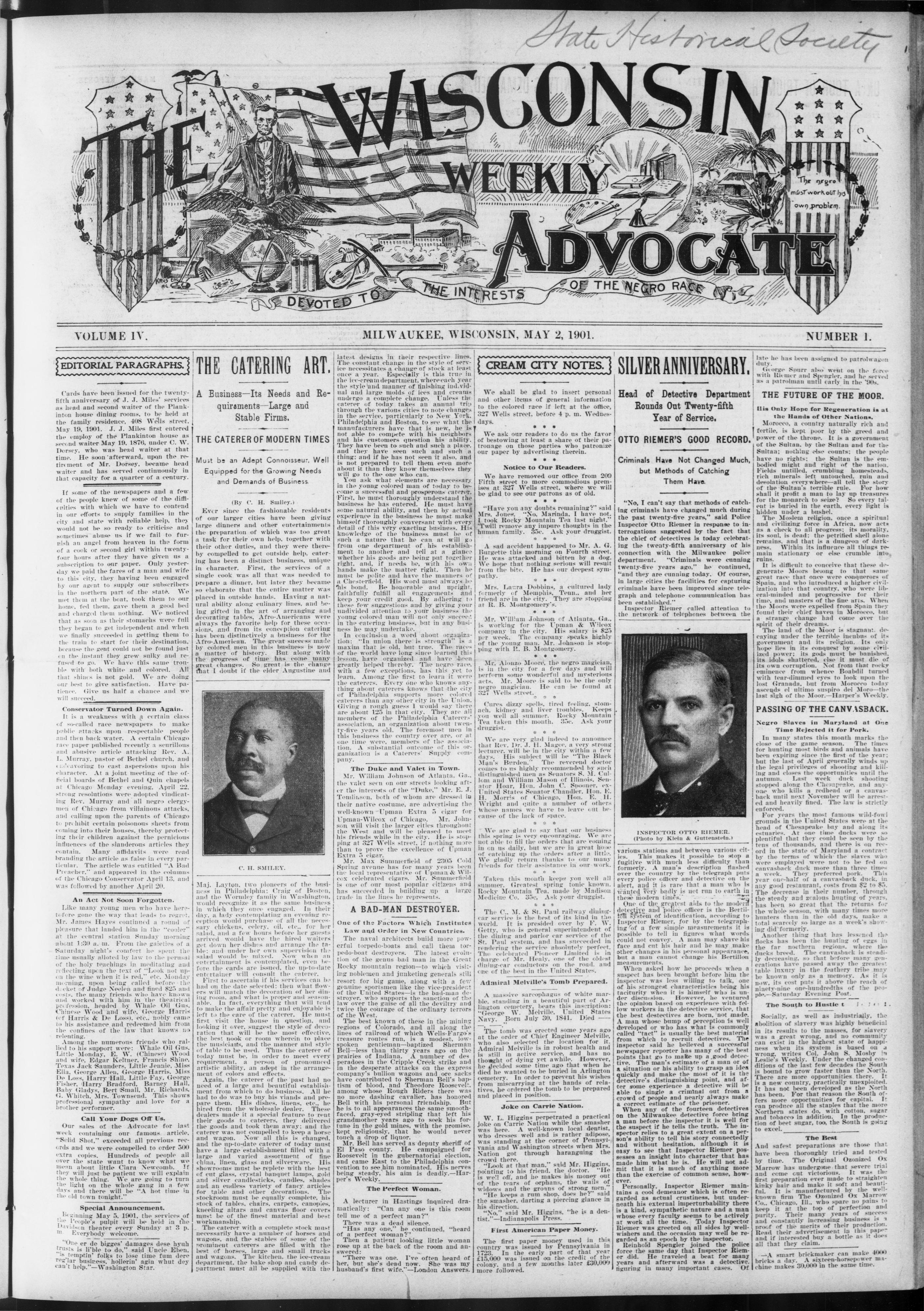
(By C. H. Smiley.)
Ever since the fashionable residents of our larger cities have been giving large dinners and other entertainments the preparation of which was too great a task for their own help, together with their other duties, and they were thereby compelled to get outside help, catering has been a distinct business, unique in character. First, the services of a single cook was all that was needed to prepare a dinner, but later they became so elaborate that the entire matter was placed in outside hands. Having a natural ability along culinary lines, and being gifted in the art of arranging and decorating tables, Afro-Americans were always the favorite help for these occasions, and from its conception catering has been distinctively a business for the Afro-American. The great success made by colored men in this business is now a matter of history. But along with the progress of time has come many great changes. So great is the change that I doubt if the elder Augustine and
[Picture of a man with a mustache and a bow tie. He is wearing a dark suit with a white shirt and a black bow tie. The background is a light color.]]
Maj. Layton, two pioneers of the business in Philadelphia: Craig of Boston, and the Wormley family in Washington, would recognize it as the same business in which they once engaged. In their day, a lady contemplating an evening reception would purchase of all the necessary chickens, celery, oil, etc., for her salad, and a few hours before her guests arrived would have the hired waiters get down her dishes and arrange the table; and under her own supervision the salad would be mixed. Now when an entertainment is contemplated, even before the cards are issued, the up-to-date entertainer will consult the caterer.
First to ascertain if his services can be had on the date selected: then what flowers will match the decoration of her dining room, and what is proper and seasonable. In fact, everything that will tend to make the affair pretty and enjoyable is left to the care of the caterer. He must first visit the house in question, and looking it over, suggest the style of decoration that will be the most effective, the best nook or room wherein to place the musicians, and the manner and style of table to be used. Thus the caterer of today must be, in order to meet every requirement, a person of pronounced artistic ability, an adept in the arrangement of colors and effects.
Again, the caterer of the past had no need of a large and beautiful establishment from which to do business. All he had to do was to buy his viands and prepare them. His dishes, linens, etc., he hired from the wholesale dealer. These dealers made it a special feature to rent their goods to caterers, they delivered the goods and took them away; and the caterer was not compelled to keep a horse and wagon. Now all this is changed, and the up-to-date caterer of today must have a large establishment filled with a large and varied assortment of fine china, linen, glass and silverware. His showrooms must be replete with the best of cut glass, crystal banquet lamps, gold and silver candlesticks, candles, shades and an endless variety of fancy articles for table and other decorations. The stockroom must be equally complete, his stock of tables, chairs, carpets, canopies, kneeling altars and canvas floor covers must be of the finest material and best workmanship.
The caterer with a complete stock must necessarily have a number of horses and wagons, and the stables of some of the prominent caterers are filled with the best of horses, large and small trucks and wagons. The kitchen, the ice-cream department, the bake shop and candy department must all be supplied with the
latest designs in their respective lines. The constant change in the style of service necessitates a change of stock at least once a year. Especially is this true in the ice-cream department, where each year the style and manner of finishing individual and large molds of ices and creams undergo a complete change. Unless the caterer of today takes an annual trip through the various cities to note changes in the service, particularly to New York, Philadelphia and Boston, to see what the manufacturers have that is new, he is not able to compete with his neighbors and his customers question his ability. They have been to such and such a place, and they have seen such and such a thing; and if he has not seen it also, and is not prepared to tell them even more about it than they know themselves they will go to the one who can.
You ask what elements are necessary in the young colored man of today to become a successful and prosperous caterer. First, he must thoroughly understand the business he has entered. He must have some natural ability, and then by actual experience in the business he must make himself thoroughly conversant with every detail of this very exacting business. His knowledge of the business must be of such a nature that he can at will go from one department of his establishment to another and tell at a glance whether his goods are being put together right, and, if needs be, with his own hands make the matter right. Then he must be polite and have the manners of a Chesterfield. His word must always be his bond. Be honorable and upright, faithfully fulfill all engagements and keep your credit good. By adhering to these few suggestions and by giving your undivided attention to your business the young colored man will not only succeed in the catering business, but in any business he may undertake.
In conclusion a word about organization: "In union there is strength" is a maxim that is old, but true. The races of the world have long since learned this lesson, have organized and have been greatly helped thereby. The negro race, with a few exceptions, has this yet to learn. Among the first to learn it were the caterers. Every one who knows anything about caterers knows that the city of Philadelphia supports more colored caterers than any other city in the Union. Giving a rough guess I would say there are about 125 in that city. They are all members of the Philadelphia Caterers' association, an organization about twenty-five years old. The foremost men in this business the country over are, or at one time were, members of the association. A substantial outcome of this organization is a Caterers' Supply company.
The Duke and Valet in Town
Mr. William Johnson of Atlanta, Ga., the valet seen on our streets looking after the interests of the "Duke," Mr. E. J. Tomlinson, both of whom are dressed in their native costume, are advertising the well-known Upman Extra 5 cigar for Upman-Wilcox of Chicago. Mr. Johnson will visit the larger cities throughout the West and will be pleased to meet his friends while in the city. He is stopping at 327 Wells street, if nothing more than to prove the excellence of Upman Extra 5 cigar. Mr. Max Summerfield of 2305 Cold Spring avenue has for many years been the local representative of Upman & Wilcox celebrated cigars. Mr. Summerfield is one of our most popular citizens and has succeeded in building up a large trade in the lines he represents.
A BAD-MAN DESTROYER.
One of the Factors Which Institutes Law and Order in New Countries. The naval architects build more powerful torpedo-boats and call them torpedo-boat destroyers. The latest evolution of the genus bad man in the Great Rocky mountain region—to which visiting noblemen and junketing generals still resort for big game, along with a few genuine sportsmen like the vice-president of the United States—is the bad-man destroyer, who supports the sanction of the law over the guise of all the deviltry and twice the courage of the ordinary terrors of the West.
The best known of these in the mining regions of Colorado, and all along the lines of railroad of which Wells-Fargo's treasure routes run, is a modest, low-spoken gentleman—baptized Sherman Bell—less than thirty years ago on the prairies of Indiana. A number of desperadoes in the Cripple Creek strike and in the desperate attacks on the express company's bullion wagons and ore sacks have contributed to Sherman Bell's baptism of blood, and Theodore Roosevelt, among whose Rough Riders there was no more dashing cavalier, has honored Bell with his personal friendship. But he is to all appearances the same smooth-faced, gray-eyed stripling that left his grandmother years ago to seek his fortune in the gold mines, with the promise, kept religiously, that he would never touch a drop of liquor.
Mr. Bell has served as deputy sheriff of El Paso county. He campaigned for Roosevelt in the gubernatorial election, and came East to the Philadelphia convention to see him nominated. His nerves being steady, his aim is deadly.—Harper's Weekly.
The Perfect Woman.
A lecturer in Hastings inquired dramatically: "Can any one is this room tell me of a perfect man?" There was a dead silence. "Has any one," he continued, "heard of a perfect woman?"
Then a patient looking little woman rose up at the back of the room and answered:
"There was one. I've often heard of her, but she's dead now. She was my husband's first wife."—London Answers.
CREAM CITY NOTES.
---
We shall be glad to insert personal and other items of general information to the colored race if left at the office, 327 Wells street, before 4 p. m. Wednesdays.
* * *
We ask our readers to do us the favor of bestowing at least a share of their patronage on those parties who patronize our paper by advertising therein.
Notice to Our Readers.
We have removed our office from 209 Fifth street to more commodious premises at 327 Wells street, where we will be glad to see our patrons as of old.
* * *
"Have you any doubts remaining?" said Mrs. Jones. "No. Marinda, I have not. I took Rocky Mountain Tea last night." 'Twill remove any impure thoughts in the human family. 35c. Ask your druggist.
A sad accident happened to Mr. A. G. Burgette this morning on Fourth street. He was attacked and bitten by a dog. We hope that nothing serious will result from the bite. He has our deepest sympathy.
空 素 空
Mrs. Laura Dobbins, a cultured lady formerly of Memphis, Tenn., and her friend are in the city. They are stopping at R. B. Montgomery's.
* * *
Mr. William Johnson of Atlanta, Ga., is working for the Upman & Wilcox company in the city. His salary is $25 per week. The company speaks highly of the young man. Mr. Johnson is stopping with P. B. Montgomery.
* * *
Mr. Alonzo Moore, the negro magician, is in the city for a few days and will perform some wonderful and mysterious acts. Mr. Moore is said to be the only negro magician. He can be found at 327 Wells street.
Cures dizzy spells, tired feeling, stomach, kidney and liver troubles. Keeps you well all summer. Rocky Mountain Tea taken this month. 35c. Ask your druggist.
☆ ☆ ☆
We are very glad indeed to announce that Rev. Dr. J. H. Magee, a very strong lecturer, will be in the city within a few days. His subject will be "The Black Man's Burden." The reverend doctor comes to us highly recommended by such distinguished men as Senators S. M. Culom and William Mason of Illinois, Senator Hoar, Hon. John C. Spooner, ex-United States Senator Chandler, Hon. E. H. Morris of Chicago, Hon. E. H. Wright and quite a number of others whose names we have to leave out because of the lack of space.
* * *
We are glad to say that our business this spring is very encouraging. We are not able to fill the orders that are coming in on us daily, but we are in great hope of catching up the orders after a little. We gladly return thanks to our many friends for their assistance in our work.
* * *
Taken this month keeps you well all summer. Greatest spring tonic known. Rocky Mountain Tea, made by Madison Medicine Co. 35c, Ask your druggist.
后勤
The C., M. & St. Paul railway dining-car service is the best of its kind in the world. It is presided over by F. W. Getty, who is general superintendent of the dining and parlor car service of the St. Paul system, and has succeeded in rendering the service absolutely perfect. The celebrated Pioneer Limited is in charge of Mr. Healy, one of the oldest dining-car conductors on the road, and one of the best in the United States.
Admiral Melville's Tomb Prepared.
A massive sarcophagus of white marble, standing in a beautiful part of Arlington cemetery, bears this inscription: "George W. Melville, United States Navy. Born July 30, 1841. Died — —." The tomb was erected some years ago at the order of Chief Engineer Melville, who also selected the location for it. Admiral Melville is in robust health and is still in active service, and has no thought of dying yet awhile. However, he decided some time ago that when he died he wanted to be buried in Arlington cemetery. In order to prevent his wishes from miscarrying at the hands of relatives, he ordered the tomb to be prepared and placed in position.
Joke on Carrie Nation.
W. L. Higgins perpetrated a practical joke on Carrie Nation while the smasher was here. A well-known local dentist, who dresses well and is rather adipose, was standing at the corner of Pennsylvania and Washington streets when Mrs. Nation got through haranguing the crowd there.
"Look at that man," said Mr. Higgins, pointing to his friend, the doctor. "He is well off, and he makes his money out of the tears of orphans, the wails of widows and the groans of strong men."
"He keeps a rum shop, does he?" said the smasher, darting a piercing glance in his direction.
"No," said Mr. Higgins, "he is a dentist"—Indianapolis Press.
First American Paper Money.
The first paper money used in this country was issued by Pennsylvania in 1723. In the early part of that year £15,000 was issued on the credit of the colony, and a few months later £30,000 more followed.
SILVERANNIVERSARY.
Head of Detective Department Rounds Out Twenty-fifth Year of Service.
OTTO RIEMER'S GOOD RECORD.
Criminals Have Not Changed Much, but Methods of Catching
"No, I can't say that methods of catching criminals have changed much during the past twenty-five years," said Police Inspector Otto Riemer in response to interrogations suggested by the fact that the chief of detectives is today celebrating the twenty-fifth anniversary of his connection with the Milwaukee police department. "Criminals were cunning twenty-five years ago," he continued, "and they are cunning today. Of course, in large cities the facilities for capturing criminals have been improved since telegraph and telephone communication has been established." Inspector Riemer called attention to the network of telephones between the
PETER H.
INSPECTOR OTTO RIEMER. (Photo by Klein & Guttenstein.) various stations and between various cities. This makes it possible to stop a fugitive with much less difficulty than formerly. A man's description flashed over the country by the telegraph puts every police officer and detective on the alert, and it is rare that a man who is wanted very badly is not run to earth in these modern times.
One of the greatest aids to the modern detective and police officer is the Bertillon system of identification, according to Inspector Riemer, for by the telegraphing of a few simple measurements it is possible to tell in figures what words could not convey. A man may shave his face and cut his hair and he may make other changes in his personal appearance, but a man cannot change his Bertillon measurements.
When asked how he proceeds when a suspect has been brought before him the inspector was less willing to talk, one of his strongest characteristics being his taciturity when it is himself who is under discussion. However, he ventured the opinion based on experience with fellow workers in the detective service, that the best destectives are born, not made. A man whose bump of perception is well developed or who has what is commonly called "tact" is usually the best material from which to recruit detectives. The inspector said he believed a successful newspaper reporter has many of the best points that go to make up a good detective. The man's estimate of a man or of a situation or his ability to grasp an idea quickly and make the most of it is the detective's distinguishing point, and after some experience a detective will be able to single a criminal out from a crowd of people and nearly always make a correct estimate of the prisoner.
When any of the fourteen detectives on the Milwaukee detective force bring a man before the inspector it is well for the suspect if he tells the truth. The inspector relies to a great extent on a person's ability to tell his story connectedly and without hesitation, although it is easy to see that Inspector Riemer possesses an insight into character that has made him what he is. He will not admit that it is much of anything more than the exercise of common sense, however.
Personally, Inspector Riemer maintains a cool demeanor which is often regarded as actual crustiness, but underneath his external imperturbability there is a kind, sympathetic nature and a man whose every faculty seems to be actively at work all the time. Today Inspector Riemer was greeted on all sides by well-wishers and the occasion may well be regarded as an epoch by the inspector.
Reinhold Spengler joined the police force the same day that Inspector Riemer did. He traveled a beat for many years and afterward was a detective, figuring in many important cases. Of
late he has been assigned to patrolwagon duty. George Spurr also went on the force with Riemer and Spengler, and he served as a patrolman until early in the '90s.
THE FUTURE OF THE MOOR
His Only Hope for Regeneration is at the Hands of Other Nations
Morocco, a country naturally rich and fertile, is kept poor by the greed and power of the throne. It is a government of the Sultan, by the Sultan and for the Sultan; nothing else counts; the people have no rights; the Sultan is the embodied might and right of the nation. Fields untilled, crumbling homesteads, rich minerals left untouched, ruin and desolation everywhere—all tell the story of the Sultan's terrible rule. For how shall it profit a man to lay up treasures for the monarch to seize? So every talent is buried in the earth, every light is hidden under a bushel.
The Moslem religion, once a spiritual and civilizing force in Africa, now acts as a check to all progress; its morality, its soul, is dead; the petrified shell alone remains, and that is a dungeon of darkness. Within its influence all things remain stationary or else crumble into ruins.
It is difficult to conceive that these degenerate Moors belong to that same great race that once were conquerors of Spain, and who introduced a higher civilization into that country, who were liberal-minded and progressive for their time, and masters of the fine arts. When the Moors were expelled from Spain they found their chief haven in Morocco, but a strange change had come over the spirit of their dreams.
The land of the Moor is stagnant, decaying under the terrible incubus of its government and its religion. Its only hope lies in its conquest by some civilized power; its gods must be banished, its idols shattered, else it must die of its own corruption. Not from that rocky eminence from whence Boabdil turned with tear-dimmed eyes to look upon the lost Granada, but from Morocco today ascends el ultimo suspiro del Moro—the last sigh of the Moor.—Harper's Weekly.
PASSING OF THE CANVASBACK.
Negro Slaves in Maryland at One Time Rejected it for Pork.
In many states this month marks the close of the game season. The times for hunting most birds and animals have been expiring since the first of the year; but the last of April generally winds up the legal privileges of shooting and killing and closes the opportunities until the autumn. Last week duck shooting stopped along the Chesapeake, and anyone who kills a redhead or a canvasback until next November will be arrested and heavily fined. The law is strictly enforced.
For years the most famous wild-fowl grounds in the United States were at the head of Chesapeake bay and along its estuaries. At one time ducks were so plentiful that they could be seen by the tens of thousands, and there is on record in the state of Maryland a contract by the terms of which the slaves who were employed were not to be fed on canvasback duck more than three times a week. They preferred pork. This year one-half of a canvasback duck, in any good restaurant, costs from $2 to $5. The decrease in their number, through the steady and zealous hunting of years, has been so great that the returns for the whole season, with many times more hunters than in the old days, make a total scarcely so large as a week's showing did formerly.
Another thing that has lessened the flocks has been the hunting of eggs in the far northern regions, where the ducks breed. The canvasback is steadily decreasing, so that before many generations have passed away the greatest table luxury in the feathery tribe may be known only as a memory. As it is now, its cost puts it above the reach of ninety-nine one-hundredths of the people.—Saturday Evening Post.
The South to Hustle t
Socially, as well as industrially, the abolition of slavery was highly beneficial in its results to the masses, for slavery was a great wrong, and no community can exist in the highest state of happiness when its system is based on a wrong, writes Col. John S. Mosby in Leslie's Weekly. Under the changed conditions of the last few decades the South is bound to grow faster than the North. There are more opportunities there. It is a new country, practically unexploited. It has not been developed as the North has been. For that reason the South offers more opportunities for capital. It can produce all the staples that the more Northern states do, with cotton, sugar and tobacco in addition. In the production of beet sugar, too, the South is going to excel.
The Best
And safest preparations are those that have been thoroughly tried and tested by time. The Original Ozonized Ox Marrow has undergone that severe trial and come cut victorious. It was the first preparation ever made to straighten kinky hair and make it soft and beautiful. It is manufactured by the well-known firm The Ozonized Ox Marrow Co., Chicago, Ill., who spare no pains to keep it at the top of perfection and purity. Their many years of success and constantly increasing business is a proof of the merits of their production. Read their advertisement in this paper and if interested buy a bottle as it does all that they claim.
A smart brickmaker can make 4000 bricks a day. A sixteen-horsepower machine makes 30,000 in the same time.
ON A TOUR OF TRIUMPH
Confederate Veterans Demonstrate Their Loyalty in a Striking Manner at Memphis.
Vicksburg, Miss., May 1.—After passing through the heart of Dixie the President's train reached Memphis at 4:30 yesterday afternoon. The President is more than ever deeply impressed with the sincerity of the feeling south of Mason and Dixon's line, and he has expressed his sentiments several times.
The Confederate veterans have made it their duty to show how thoroughly they have forgotten the days of the Civil war. Many grizzled veterans have appeared before the President, some wearing tattered gray uniforms and others bearing ragged banners of the Confederacy below the Stars and Stripes.
A national salute of twenty-one guns fired from the river bluffs signaled the approach to Memphis.
Escort of Confederate Veterans.
A military parade, with a company of grizzled Confederate veterans in their old uniforms acting as the guard of honor, escorted the party in carriages through the principal streets to Court square.
The city was elaborately decorated with flags and bunting. Banners were stretched across the streets bearing such inscriptions as "Mr. President, the City is Yours," "The Nation's President." The cheering through which the procession passed was tremendous. In Court square, where the open-air reception occurred, the platform was so hedged around with roses and other blossoms as to make it a flower show. More than 10,000 people were packed into the square when the President was introduced.
President's Speech at Memphis.
In response to the cheers which greeted him the President made the first really notable speech of his trip, saying in part: I reclocate the sentiments of goodwill and fraternity expressed by this cordial reception on the part of the people of Tennessee. It is representative of that universal good feeling happily subsisting among the people of the United States and which is not bounded by state, political or geographical lines. It is coextensive with the Union itself and exists because of our love for the Union. No citizen of the republic rejoices more than I do at this happy state and none will do more within his sphere to continue and strengthen it. Without internal troubles to distract us or jealousies to disturb our judgment, we will solve the problems which confront us untrammeled by the past and wisely and courageously pursue a policy of right and justice in all things, making the future, under God, even more glorious than the past.
I am glad to meet with the people of Memphis and of the state of Tennessee. Their history is associated with the greatest struggles and sacrifices of our country and their valor has been conspicuous on every battlefield of the republic. I shall never forget that during the anxious days of 1899 it was the Tennessee soldiers in the Philippines who, with unfaltering patriotism, led all others in re-enlistments for the new regiments then forming. (Re-posed anglue.)
newed applause.
Nor can I fall to remember and make heartfelt acknowledgment to the gallant First Tennessee volunteers, who, having once embarked on the transports, with their faces turned homeward and toward those they loved, voluntarily disembarked and, marching to the relief of their comrades in distress, fought a brave fight and, with them, turned defeat into victory. All honor to the First Tennessee volunteers and all the gratitude of which my heart is capable to the noble men and women of this city for this magnificent welcome to myself and my associates. (Prolonged applause.)
Meets Bevy of Southern Beauties.
After this speech the party was driven to the Twentieth Century club, a woman's organization of this city. Here there was a veritable beauty show. About thirty charming Southern belles held court in a bower of roses, ranged around a gilded armchair, which was designed to hold the President. Mr. McKinley, however, was too wary to be caught in the net. He did not take the chair, but he braved the battery of eyes, and after greeting each of the young ladies personally in turn he was introduced by W. J. Crawford of the Commercial Appeal and made a pretty
After this function the ladies of the party were taken in hand by the women of Memphis. A reception was held in their honor and later a banquet was given them at the Peabody hotel. At the same time on the floor above the President and the gentlemen of his party, with about 200 prominent business men of the city, sat down to an elaborate dinner. At 1:30 in the morning the presidential train resumed its journey for New Orleans
Cabinet Meeting on Wheels.
At the regular hour for the cabinet to assemble the President summoned his advisers into the observation car and there, behind closed doors, the first cabinet meeting on wheels was held. No important advices had been received from Washington which required action, but the foreign dispatches in the papers were talked over and some of the details as yet undetermined were discussed.
Significant Utterances.
Vicksburg, Miss., May 1.—Through the low, rich valley of the Yazoo the presidential special sped southward to New Orleans today. The President was up early and several times appeared on the rear platform to acknowledge the cheers of the crowds at the small stations. Among the members of the cabinet, the President's speech last night, with its pointed allusions to the principle of subsidies as a means of enlarging transportation facilities, with the brilliant picture he drew of the commercial possibilities in the Orient under the "open door" policy in China, is regarded as an exceedingly-important utterance, and one which will instantly rivet the attention of the country.
A Town of Swarming Memories.
Vicksburg, with its swarming memories of the Civil War, was reached at 8:30. Jackson, Miss., May 1.—The presidential train arrived here at 11 o'clock sharp, fifteen minutes ahead of time. Acres of people, Democrats, Republicans, white and black, had congregated at the depot to give a royal welcome to the President and his party to Mississippi's capital. Gov. Longino welcomed the President on behalf of the state. Mr. McKinley expressed delight at the cordial reception and the fifteen minutes stop here was heartily enjoyed.
CONGRESSMAN CRUMP DEAD.
Representative from Tenth Michigan District Passes Away.
Bay City, Mich., May 1.—Congressman Rousseau Crump, representative from the Tenth congressional district, died at his home in West Bay City early today from heart trouble. He was elected to Congress in 1895, has served three terms, and was re-elected last fall for the fourth time.
GETTING UNEASY.
Omaha Kidnaper Offers to Return
$21,000 of Ransom Money
If Case is Dropped.
Omaha, Neb., April 30.—An unknown person purporting to be an agent of the kidnapers has made a proposition to Edward A. Cudahy to return $21,000 of the money paid for the ransom of his son, who was abducted December 18, last. It demanded in return a withdrawal of the $25,000 reward and a cessation of the search that is being prosecuted, together with an abandonment of the determination to punish the criminals.
This proposition came in a letter from Elgin, Ill., and Mr. Cudahy is convinced of its authenticity. He went to Chicago recently because of it, being summoned there by his brother in response to overtures that had been made. Mr. Cudahy refused to consider the proposition and declares his unchanged resolve to prosecute to the end the search for the men who stole his boy.
Getting Uneasy.
"I received a letter about ten days ago," said Mr. Cudahy. "It was dated April 15 at Elgin, and bore the Elgin postmark. I turned it over to the detectives and did not make a copy. It was very brief and recited that the chief kidnaper had communicated with the writer and was getting uneasy. It set forth that the chase by the detectives was getting uncomfortably close and asked if I would withdraw the offer of reward now outstanding and let up on the effort to find the criminals and have $21,000 of the $25,000 ransom returned to me.
"It seems that the writer got some-what in a hurry, for as soon as he mailed the letter he must have slipped right over to Chicago, where he called on my brother Michael the same day, which was two weeks ago today. He asked my brother whether I would consider a proposition of that kind. My brother told him that he did not know anything about it, but would ask me to come over to Chicago and talk the matter over, although he did not believe that I would consider it."
Mailed from Elgin, Ill.
"That afternoon I received a telegram from my brother, asking me if I could come over and I replied that I would be over there in the morning. I left here on the afternoon train and on reaching Chicago learned what had transpired there. I arrived home on Thursday and the letter from Elgin was here awaiting me. The letter was signed and gave directions how a reply should be addressed to reach the writer at Elgin.
"So far as the offer is concerned, it has been rejected. I refused absolutely and unqualifiedly to consider it and am determined to prosecute this search as vigorously as I know how. That is what we started out to do, and I feel as if I would follow those men to the ends of the earth.
"I realize that this means $46,000 to me and is a sum that is certainly an object to any man, no matter what may be his means. As I feel about the matter, I would spend my last thousand dollars rather than compromise with the criminals. I am desirous of having them punished for what they have done and to deter any other daring gang from compelling other parents to undergo what we have undergone."
PRAISES HIS BRAVERY.
Lieut. Daniel Wells of Menominee, Mich., Receives Letter from Department Commander.
Menominee, Mich., April 30.—[Special.]—Lieut. Daniel Wells, son of Mr. and Mrs. J. W. Wells of this city, has been praised for his bravery by Gen. J. C. Bates. The letter is as follows:
Manila, March 6, 1901.—Lleut. Daniel Wells, Thirtleth Infantry, U. S. V., Manilla.—Sir: I am directed by Brig.-Gen. J. C. Bates, U. S. A., commanding the department of southern Luzon, to inform you that he has learned with great pleasure of your gallant conduct in action at the barrio of Dingin, near Sampaloc, Tayabas province, January 8, 1901. Your conduct on this occasion, when with other members of a small detachment under Capt. (now major) Charles P. Newberry, Thirtleth infantry, U. S. V., you crossed a swollen stream and raging mountain torrent under a heavy fire from a large force of the enemy entrenched in a commanding position on the opposite bank, and by a gallant charge drove the enemy out of his trenches, is entitled to the highest praise.
The department commander desires also to extend to you his best wishes for your future success and prosperity, in which I most cordially join.
(Signed) ARTHUR L. WAGNER. Assistant Adjutant General. Lieut. Wells enlisted in 1898. He is a graduate of Hamilton college. Lieut. Wells has resigned and is now making a tour around the world.
LOST LOVE AND CASH.
Peter Baumgartner's Bride-Elect Disappears and So Does All His Money.
Chicago, Ill., April 30.—[Special.]—Peter Baumgartner sold his farm in Sagole, Wis., and came to Chicago to marry a young woman, with whom he had been corresponding nearly a year. A marriage license was obtained yesterday afternoon and, if matters had proceeded as expected, Baumgartner today would have been on his way back to Sagole with a bride. But he is out $505 in cash, a check for $200, and his bride. The woman has disappeared with all the money and the Wisconsin man has asked Capt. Rehm of the Des Plaines street station to help him find her.
BOY DROWNED BY A BIG FISH.
Lad 12 Years of Age Pulled from a Trestle by His Catch.
St. Louis, Mo., April 30.—In attempting to drag in a large fish with his net at the mouth of Cahokia creek in East St. Louis Freddie Schoeffer, 12 years old, was pulled from a trestle into the water and drowned.
His uncle, John Schoeffer, who was fishing with the boy, heard a scream, followed by a splash in the creek, and upon running to the edge of the trestle saw Freddie floundering in the water.
Mr. Schoeffer plunged in after him, but the boy sank immediately. His body has not yet been recovered, but the net containing the fish was found.
Gold Find in Mozambique.
Reports from Beira state that there has been a rich "strike" of gold on the Macequece claims belonging to Jose Matt's Mozambique company, says a Lorenzo Marques correspondent. Macequece is 200 miles from Beira, and the official center of Portuguese Monicaland. It was well known that there were a number of reefs in the neighborhood, some of which have been energetically worked for some time.
The largest gulf is the Gulf of Mexico, which has an area of about $800,000 square miles, double that of the Bay of Bengal, and nearly one-third the area of the United States.
The Teacher—"Now, which of you can tell me what happened when Lot's wife turned to look back?" Willie—"I can, mum; everybody hollered 'Rubber!'"—Brooklyn Life.
INDEMNITY IS DEMANDED.
Paris, May 1.—The foreign office has received a dispatch from Pekin announcing that M. Pichon, the French minister, presented today the report of the committee on indemnity. The amount China is to pay has been fixed at 1,365,000,000 francs. How it is proposed that the indemnity shall be distributed among the powers is not set forth; but as the dispatch does not mention The Hague it is thought the ministers are hopeful of being able to settle the proportion to be received by each power by discussion at Pekin.
Official advices received here from Pekin say the ministers are divided into two parties in the discussion to decide how China is to raise the indemnity. France, Germany, Russia and Japan agree in favor of raising the customs duties, which can be relied upon to produce a great part of the requisite sum, and the imposition of a duty on junks, which will constitute a tax on inland navigation, and the taking over of some of the likin (provincial transit duties).
On the other hand the United States and Great Britain decline to agree to an increase of the customs duties, but they do not appear to have presented a counter-proposition. The fact that the United States and Great Britain have joined hands on this question has caused surprise here. It was hoped the United States would stand with France and Russia. The result will be to greatly protract the negotiations.
Pekin, Tuesday, April 30.—Field Marshal Von Waldersee, in the letter which he sent to the ministers today, says a garrison of 6000 men should be left at Tien Tsin and the adjoining district, Great Britain, France, Germany and Japan to contribute 1400 men each, and Italy to contribute 400 men. To garrison Shan Hai Kwan, France, Russia, Great Britain and Germany are to contribute 300 men each and Italy one company until the forts are razed. So long as any forces occupy Chinese territory the foreign military commanders must exercise the full authority of a civil administration, according to the principle established at The Hague in 1899. The Chinese may remain in office as in the case of Pao Ting Fu, and, partly, Tien Tsin.
Besides the 6000 men in the Tien Tsin district, warships, which must always be in the Pei Ho, will preserve communication with the international fleet at Taku.
CARDINAL GETS RED HAT
Martinelli Receives the Insignia Marking His Elevation—Consistorial Letter.
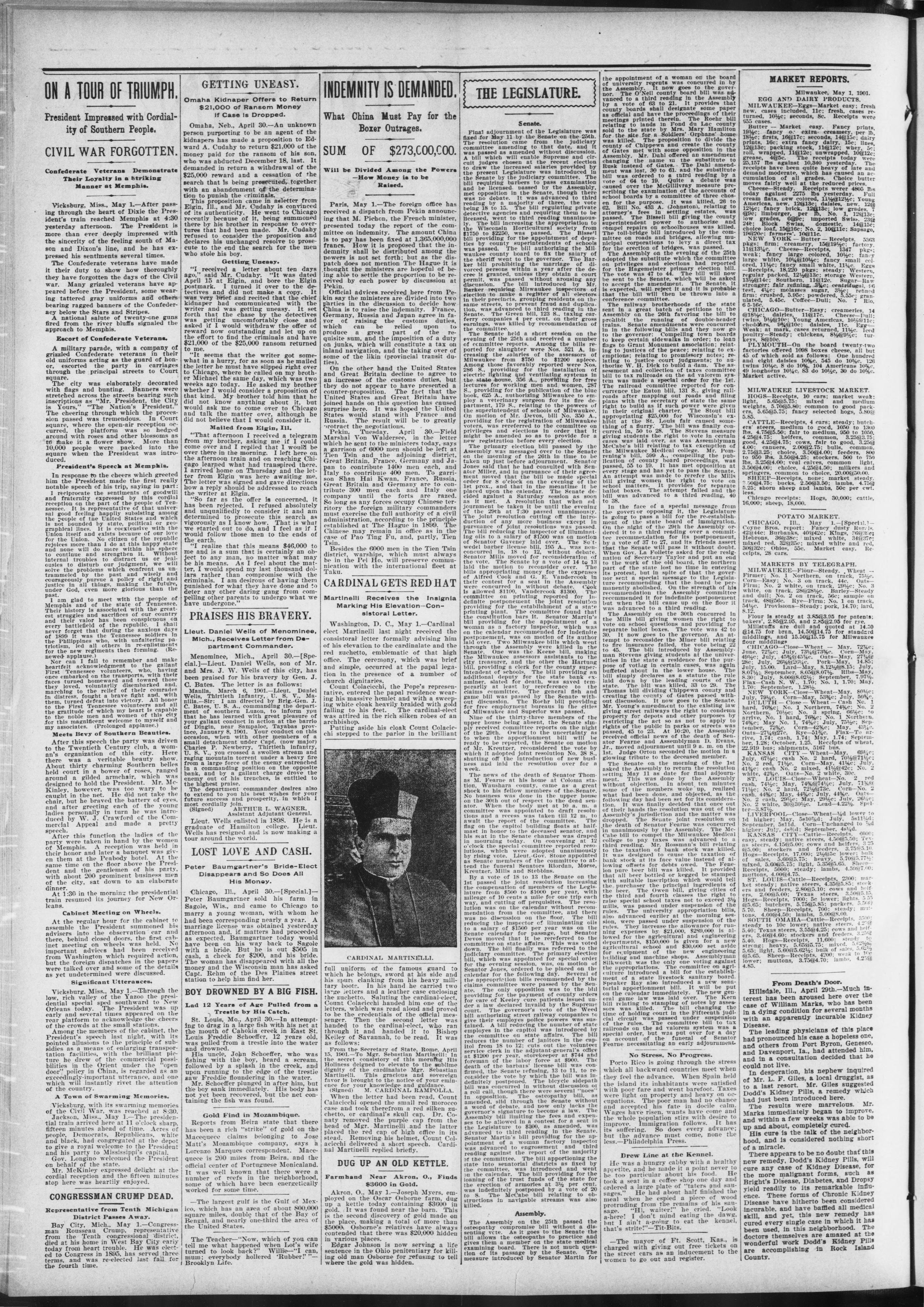
Washington, D. C., May 1.—Cardinal elect Martinelli last night received the consistoral letter formally advising him of his elevation to the cardinalate and the red zuchetto, emblematic of that high office. The ceremony, which was brief and simple, occurred at the papal legation in the presence of a number of church dignitaries.
Count Colacicchi, the Pope's representative, entered the papal residence wearing his massive hemlet and with a sweeping white cloak heavily braided with gold falling to his feet. The cardinal-elect was attired in the rich silken robes of an archbishop.
Putting aside his cloak Count Colacicchi stepped to the parlor in the brilliant
P.
CARDINAL MARTINELLI.
full uniform of the famous guard to which he belongs, sword at his side and his spur, clanking from his heavy military boots. In his hand he carried two large letters and a leather case enclosing the zuchetto. Saluting the cardinal-elect, Count Colacicchi handed him one of the letters, which was read aloud and proved to be the credentials of the official messenger. Then the second letter was handed to the cardinal-elect, who ran through it and handed it to Bishop Keiley of Savannah, to be read. It was as follows:
From the Secretary of State, Rome, April 15, 1901.—To Mgr. Sebastian Martinelli: In the secret consistory of this morning His Holiness designed to elevate to the sublime dignity of the cardinalate Mgr. Sebastian Martinelli. This gracious and sovereign favor is brought to the notice of your eminence for your knowledge and guidance. (Signed) M. CARDINAL RAMPOLLA.
When the letter had been read, Count Calacicchi opened the small red morocco case and took therefrom a red silken zuchetto, or cardinal's skull cap. Dr. Conaty removed the purple cap from the head of Mgr. Martinelli and the latter placed the red cap of high office in its stead. Removing his helmet, Count Colacicchi delivered a short speech. Cardinal Martinelli replied briefly.
DUG UP AN OLD KETTLE.
Farmhand Near Akron, O., Finds $3600 in Gold.
Akron, O., May 1.—Joseph Myers, employed on the Oscar Osborne farm, dug up a kettle today containing $3600 in gold. It was found near the barn. This is the second discovery of gold made on the place, making a total of more than $5000. Osborne's relatives have always contended that there was $20,000 hidden in various places.
Edgar Johnson is now serving a life sentence in the Ohio penitentiary for killing old man Osborne for refusing to tell where the gold was hidden.
THE LEGISLATURE.
Senate.
Final adjournment of the Legislature was fixed for May 11 by the Senate on the 25th. The resolution came from the judiciary committee amending to that date, and it was passed as amended without discussion. A bill which will enable Supreme and circuit judges chosen at the recent election to draw the increased salaries provided by the present Legislature was introduced in the Senate by the judiciary committee. The bill requiring barbers to pass examination and be licensed, passed by the Assembly, met opposition in the Senate, though there was no debate. It was advanced to third reading by a majority of three, the vote being 18 to 15. The bill regulating private detective agencies and requiring them to be licensed, went to third reading unanimously. The bill increasing the appropriation to the Wisconsin Horticultural society from $1750 to $2250, was passed. The Blissell bill providing for the appointment of deputies by county superintendents of schools was passed. The bill authorizing the Milwaukee county board to fix the salary of the sheriff went to the governor. The Barker bill prohibiting the marriage of divorced persons within a year after the decree is granted, unless they obtain a court permit, was passed without arousing any discussion. The bill introduced by Mr. Barker requiring Milwaukee inspectors of election to make a register of all electors in their precincts, grouping residents on the same streets, to prevent fraud and duplication, was advanced to third reading in the Senate. The Green bill, 123 S., taxing carrery companies 4 per cent. on their gross earnings, was killed by recommendation of the committee.
The Senate held a short session on the evening of the 25th and received a number of committee reports. Among the bills reported for slaughter were Nos. 521 A, increasing the salaries of the assessors of Milwaukee from $750 to $1200 apiece. Among those favorably reported were Nos. 286 S., providing for the installation of electric lighting and ventilating systems in the state house, 356 A., providing for free lectures for working men and women, 287 S., providing for the publication of the blue book, 625 A., authorizing Milwaukee to employ a veterinary surgeon for its fire department, 179 S., relating to the powers of the superintendent of schools of Milwaukee. On motion of Mr. Devos, bill No. 350 A., providing for the registration of Milwaukee voters, was referred to the committee on privileges and elections in order that it might be amended so as to provide for a new registration before every election.
The primary election bill passed by the Assembly was messaged over to the Senate on the morning of the 26th in time to be taken up just before adjournment. Senator Jones said that he had consulted with Senator Miller, and in pursuance of their agreement moved that the bill be made special order for 8 o'clock on the evening of the 1st prox., and that in the meantime it be placed upon the calendar. The Senate decided against a Saturday session as soon as it met. A resolution that when adjournment be taken it be until the evening of the 29th at 7:30 passed unanimously. The joint resolution cutting off the introduction of any more business except in pursuance of joint resolutions was passed. The bill reducing the inspector of illuminating oils to a salary of $1500 was on motion of Senator Gaveney laid over. The So'tweed barber license bill, 195 A., was nonconcurred in, 18 to 12, without debate. Senator Mills moved for reconsideration of the vote. The Senate by a vote of 14 to 13 laid the motion to reconsider over. The bills appropriating money for the expenses of Alfred Cook and G. E. Vandercook in their contest for a seat in the Assembly were concurred in without debate. Cook is allowed $1100, Vandercook $1300. The committee on printing reported for indefinite postponement the joint resolution providing for the establishment of a state printing plant. The committee found that the constitution bars it. Senator Martin's bill providing for the appointment of a woman as a factory inspector, which was on the calendar recommended for indefinite postponement, was on motion of its author laid over. Two Milwaukee bills which went through the Assembly were killed in the Senate. One was the Keene bill, making the Milwaukee assessors assistants to the city treasurer, and the other the Hartung bill, providing a clerk for the county superintendent of schools. The bill providing an additional deputy for the state bank examiner, slated for death, was saved temporarily at least by rereference to the claims committee. The general fish and game bill was passed by the Senate without discussion. The Roehr bill providing for free employment bureaus in the cities of Milwaukee and Superior was passed.
Nine of the thirty-three members of the upper house being absent, the Senate simply received committee reports on the night of the 29th. Owing to the uncertainty as to when the apportionment bill will be ready to be reported, the Senate on motion of Mr. Kreutzer, reconsidered the vote by which it adopted joint resolution No. 38 S., shutting off the introduction of new business and laid the resolution over for a week.
The news of the death of Senator Thomas M. Fearne at his home at Coloma station, Waushara county, came as a great shock to his fellow members of the Senate. No business was done in the upper house on the 30th out of respect to the dead senator. When the body met at 10 a. m. a committee was appointed to draft resolutions and a recess was taken till 12 m. to await the report of the committee. The flag on the capitol building floats at half-mast in honor to the deceased senator, and his seat in the Senate chamber was draped in mourning today. On convening at 12 o'clock the special committee reported resolutions, which were adopted unanimously by rising vote. Lieut.-Gov. Stone appointed as Senate members of the committee to attend the funeral Senators Riordan, Morse, Kreutzer, Mills and Stebbins.
By a vote of 18 to 13 the Senate on the 1st passed the joint resolution increasing the compensation of members of the Legislature from $500 to $1000 per year, with mileage of 10 cents a mile for one trip each way, and cutting off perquisites. The resolution was on the calendar without recommendation from the committee, and there was no discussion on the floor. The bill reducing the inspector of illuminating oils to a salary of $1500 per year was on the Senate calendar for passage, but Senator Devos moved that it be referred to the committee on state affairs. This was voted down. The bill finally was referred to the judiciary committee. The primary election bill, which was appointed for special order for the evening session, was, on motion of Senator Jones, ordered to be placed on the calendar for the following day. Several of the appropriation bills recommended by the claims committee were passed by the Senate. The only opposition was to the bill providing for the payment of county orders for care of Keeley cure patients issued under a law declared invalid by the Supreme Court. The governor's veto of the Weed bill authorizing street railway companies to give their employees police powers was sustained. A bill reducing the number of state employees in the capitol was introduced by the committee on state affairs. The bill reduces the number of janitors in the capitol from 18 to 12; cuts out the volunteer service clerk in the adjutant-general's office at $1200 per year, in storekeeper at $744 and foreman of the labor force at $900. The death of the barbars' license bill was confirmed, the Senate refusing, 13 to 11, to consider the vote by which the bill was indefinitely postponed. The bicycle sidepath bill was concurred in without discussion on a roll call, though there were several "noes" in opposition. The osteopathy bill, as amended, slid through the Senate without a word of debate, and now only lacks the governor's signature to become a law. The Assembly bill limiting the fees and expenses to be allowed in a contest for a seat in the Legislature to $300, as amended, was advanced to third reading in the Senate. Senator Martin's bill providing for the appointment of a woman factory inspector was advanced to engrossment and third reading against the report of the majority of the committee. The bill apportioning the state into senatorial districts as fixed by the committee, was introduced and went on the calendar. The bill providing for the loaning of the trust funds of the state for the erection of armories at $3½ per cent. was indefinitely postponed by a vote of 20 to 8. The McCabe bill relating to obstructions in navigable streams was also killed.
The Assembly on the 25th passed the osteopathy compromise bill without a dissenting vcte. As it goes to the Senate the bill allows the osteopaths to practice and gives them a member on the state medical examining board. There is not much question of its passage by the Senate. The measure introduced by Senator Martin for
the appointment of a woman on the board of university regents was concurred in by the Assembly. It now goes to the governor. The O'Nell county board bill was advanced to a third reading in the Assembly by a vote of 63 to 21. It provides that county boards shall designate some paper as official and have the proceedings of their meetings printed therein. The Roehr bill relating to lands in Fond du Lac county sold to the state by Mrs. Mary Hamilton for the site for a Soldiers' Orphans' home was killed. The proposition to divide the county of Chippewa and create the county of Gates met with some opposition in the Assembly. Mr. Dahl offered an amendment changing the name in the substitute to Rusk instead of Gates. The Dahl amendment was lost, 30 to 61, and the substitute bill was ordered to a third reading by a vote of 64 to 19. Quite a debate was caused over the McGillivray measure prescribing the examination of the accounts of school boards by a committee of three chosen for the purpose. It was killed, 26 to 62. Bill No. 433 A. (Johnston), relating to attorney's fees in settling estates, was passed. The Bissell bill giving the county superintendent power to authorize and compel repairs on schoolhouses was killed. The toll-bridge bill introduced by the committee on roads and bridges, allowing municipal corporations to levy a direct tax for the erection of bridges, was passed.
The Assembly on the evening of the 25th adopted the substitute which the committee on privileges and elections had reported for the Hagemelister primary election bill. The vote was 47 to 44. The bill will now be sent to the Senate, which will be asked to accept the amendment. The Senate, it is expected, will reject it and it is probable that the bill will then be thrown into a conference committee.
The railway brotherhoods of the state sent in a great batch of petitions to the Assembly on the 26th favoring the bill to prohibit the running of double-header trains. Senate amendments were concurred in in the following bills and they now go to the governor: Compelling town boards to keep certain sidewalks in order; to loan flags to Grant Monument association; relating to justices of the peace; relating to exemptions; relating to promissory notes; relating to justice court judgments; to authorize W. H. Dick to build a dam. The assessment and collection of taxes committee bill to tax railroads on the ad valorem system was made a special order for the 1st. The railroad committee reported for concurrence the Eaton bill, 131 S., giving railroads after mapping out roads and filing plans with the secretary of state the same right to build as if such power were given in their original charter. The Stout bill appropriating $25,000 for Wisconsin's exhibit at the St. Louis fair caused something of a flurry. The bill was finally concurred in, 50 to 28. The Stevens measure giving students the right to vote in certain cases was laid over, as was Assemblyman McCabe's bill relating to tax exemption of the Milwaukee Medical college. Mr. Pomerening's bill, 599 A., compelling the publication of county board proceedings, was passed, 55 to 19. It has met opposition at every stage and has yet to pass the Senate. An attempt was made to rerefer the Mills bill giving women the right to vote on school matters. It provides for separate ballot boxes. The attempt failed and the bill was advanced to a third reading, 40 to 38.
In the face of a special message from the governor opposing it, the Legislature is going to pass a bill for the re-establishment of the state board of immigration. On the night of the 29th the Assembly ordered it to a third reading over a committee recommendation for its postponement, by a vote of 37 to 27, and its friends assert that the Senate will pass it without doubt. When Gov. La Follette asked for the resignation of Secretary Taylor and put an end to the work of the old board, the northern part of the state lost no time in entering its protest, but in spite of that the governor sent a special message to the Legislature recommending that the board be permanently abolished. On the strength of his recommendation the Assembly committee recommended it for indefinite postponement but when the bill came up on the floor it was advanced to a third reading.
The Assembly on the 30th concurred in the Mills bill giving women the right to vote on school questions and providing for separate ballot boxes. The vote was 42 to 30. It now goes to the governor. An attempt to reconsider the Miner bill relating to fire insurance failed, the vote being 22 to 45. The bill introduced by Assemblyman Stevens giving students at the universities in the state a residence for the purpose of voting in certain cases, was again buffeted about in the lower house. The bill simply declares as a statute the rule laid down by the leading courts of the state. The bill was killed, 33 to 29. The Thomas bill dividing Chippewa county and creating the county of Gates passed without discussion. It now goes to the Senate. Mr. Young's amendment to the existing law giving street railways the right to condemn property for depots and other purposes by restricting the act so as not to apply to rights of the public in parks or streets was passed, 45 to 23. At 10:20, the Assembly received official news of the death of Senator Fearne and Assemblyman D. Evans, Jr., moved adjournment until 9 a. m. on the 1st. Judge Orton seconded the motion in a glowing tribute to the deceased member.
glowing in the light.
The Senate on the morning of the 1st asked the Assembly to return the resolution setting May 11 as date for final adjournment. This was done by the Assembly without objection. In about ten minutes some of the members woke up, realized what had been done, and objected, as the following day had been set for its consideration. It was finally decided that once out of their hands the resolution was out of the Assembly's jurisdiction and the matter was dropped. The Senate joint resolution on the death of Senator Fearne was concurred in unanimously by the Assembly. The McCabe bill to compel the Milwaukee Medical college to pay taxes was advanced to a third reading. Mr. Rossman's bill relating to the taxation of bank stock was killed. It was designed to cause the taxation of bank stock at its face value instead of allowing offsets for debts owed. The Fenelon pure beer bill was killed. It provided that all beer bottled or kegged be stamped with suitable inscription which would tell the purchaser the principal ingredients of the beer. The Owen bill, giving cities of the thirst and fourth classes the right to raise special school taxes not to exceed 3% mills, was passed under suspension of the rules. The university appropriation bills, also advanced earlier at the morning session, were passed under suspension of the rules. They increase the allowance for running expenses by $21,000, $289,000 is allowed for the agricultural and engineering departments, $150,000 is given for a new agricultural school and $30,000 set aside for equipment of the new engineering building and machine shops. Assemblyman Silkworth was the only one voting against the appropriations. The committee on agriculture introduced a bill for the establishment of a state livestock sanitary board. Speaker Ray also introduced a new senatorial apportionment bill. It will be put on the calendar immediately. The new general game law was laid over. The Kern bill relating to stamping of notes by assessors was killed. The bill changing the time of holding court in the Fifteenth judicial circuit was passed under suspension of the rules. The committee bill to tax railroads on the ad valorem system was a special order, but was put over for a day on account of the funeral of Senator Fearne necessitating an early adjournment-
No Stress. No Progress.
Porto Rico is going through the stress which all backward countries meet when they feel the advance. When Spain held the island its inhabitants were satisfied with poor fare and went barefoot. Taxes were light on property and heavy on occupations. The poor man had no chance and accepted his fate in docile calm. Wages have risen, wants have come and the whole population stirs with desire to improve. Immigration follows. It has its suffering. So does every advance; but the advance must come, none the less.—Philadelphia Press.
Brew Line at the Kennel.
He was a hungry cabby with a healthy appetite, and he made it a point never to he too particular about his food. He took a seat in a coffee shop one day and ordered a large plate of "taters and sausages." He had about half finished the meal when he espied a piece of wood protruding from the remains of his sausage. "Hi, waiter!" he cried. "Look a-here! I don't mind eating the dawg, but I ain't a-going to eat the kennel, that's strite!"—Tit-Bits.
—The mayor of Ft. Scott, Kas., is charged with giving out free tickets on the street cars as an inducement to the women to go out and register.
MARKET REPORTS.
Milwaukee, May 1, 1901.
EGG AND DAIRY PRODUCTS.
MILWAUKEE—Eggs—Market easy; fresh new, cases included, 11c; fresh, cases returned, 10½c; seconds, 8c. Receipts were 955 cases.
Butter — Market easy. Fancy prints, 19½c; fancy o; extra creamery, per lb, 18½c; firsts, 16@17c; seconds, 14@15c; dairy prints, 16c; extra fancy dairy, 15c; lines, 12@13c; packing stock, 11@12c; whey, 5c; roll, wrapped, 11@12c; unwrapped. 10@12c; grease, 4@5c. The receipts today were 25,157 lbs against 10,340 yesterday. The receipts have been quite heavy of late and demand moderate, which has caused an accumulation of all grades. Choice butter moves fairly well at the reduced prices.
Cheese—Steady. Receipts wereer 4805 lbs today against 2275 lbs yesterday. Full cream flats, new colored, 11½@12½c; Young Americas, new, 12½@13c; dales, new, 12½@12½c; fancy brick, 12½@13c; low grades, 7 @9c; limburger, per lb, No. 1, 12½@13c; low grades, 6@9c; imported Swiss, 23½@24c; Block Swiss, domestic, 14½@15c; choice loaf, 15½@16c; No. 2, 10½@11c; Sapsago, 19½@20c; farmers, 10½@11c.
NEW YORK — Butter — Receipts, 5363 pkgs; firm; creamery, 15@19½c; factory, 11@13½c. Cheese—Receipts, 1347 pkgs; weak; fancy large colored, 10½c; fancy large white, 10½@10½c; fancy small colored, 11½c; fancy small white, 11½c. Eggs — Receipts, 18.220 pkgs; steady; Western, regular packed, 12½@13c; storage Western, 13½@14c; Southern, 11½@12c. Sugar—Raw stronger; fair refining, 3½c; centrifugal, 46 test, 4½c; molasses sugar, 3½c; refined firm; crushed, 5.95c; powdered, 5.55c; granulated, 5.45c. Coffee—Dull; No. 7 Rio, 6.5-16c.
CHICAGO—Butter-Easy; creameries, 14
@18%c; dairies, 11@17c. Cheese—Dull;
twins, 9½@10c; Young Americas, 10½@11c;
cheddars, 9½@10c; daisies, 11c. Eggs—
Weak; at mark, cases returned, 11½c. Iced
poultry—Steady; chickens, 8½@9½c; turkeys,
8½@10c.
PLYMOUTH—On the board twenty-two
factories offered 1098 boxes cheese, all but
45 of which sold as follows: One hundred
and eight daisies 10½c, 545 do 10½c, 126
twins 10½c, 8 do 10½c, 104 Americans 10½c,
49 longhorns 10½c, 83 do 10½c, 30 do 10½c.
Market active.
MILWAUKEE LIVESTOCK MARKET
HOGS—Receipts, 10 cars; market weak; light, 5.65@5.75; mixed and medium weights, 5.70@5.80; common to good packers, 5.65@5.75; fancy selected hogs, 5.80@5.85.
CATTLE—Receipts, 4 cars; steady; butchers' steers, medium to good, 1050 to 1300 lbs, 4.75@5.50; fair to medium, 950 to 1050, 4.25@4.75; helfers, common, 3.25@3.75; good, 4.25@4.75; cows, fair to good, 3.25@4.00; canurers, 2.00@2.75; bulls, common, 2.75@3.25; choice, 3.50@4.00; feeders, 800 to 950 lbs, 3.50@4.25; stockers, 500 to 750 lbs, 3.25@4.00; real calves, common light, 3.50@4.00; choice, 4.25@4.50; milkers and springers, common to choice, 20.00@50.00.
SHEEP—Receipts, none; market steady, 3.50@4.75; bucks, 2.50@3.50; lambs, 4.75@5.25; shorn sheep and lambs, 50c per cwt. less.
Chicago receipts: Hogs, 30,000; cattle, 16,000; sheep, 18,000.
POTATO MARKET
CHICAGO, Ill. May 1.—[Special]—Coyne Bros. report: Faney dusty Rourls, 42@44c; Burbanks, 40@42c; Kings, 30@33c; Hebrons, 30@38c; mixed white, 34@37c; mixed red. 32@35c; mixed white and red, 30@32c; Ohios, 55c. Market easy. Receipts, 28 cars.
MARKETS BY TELEGRAPH
MILWAUKEE—Flour—Steady, Wheat —
Firm; No. 1 Northern, on track, 75%c
Corn—Easy; No. 3 on track, 44c; Oats—
Firm; No. 2 white, on track, 29%c; No. 3
white, on track, 28@28%c; Barley—Steady
and dull; No. 2 on track, 56c; sample on
track, 48@56c; Rye—Firm; No. 1 on track,
54%c; Provisions—Steady; pork, 14.70; lard,
8.12.
Flour is steady at 3.85@3.95 for patents;
bakers', 2.85@2.95, and 2.85@2.95 for rye.
Millstuffs are dull and quoted at 14.50
@14.75 for bran, 14.50@14.75 for standard
middlings, and 15.50@15.75 for Milwaukee
four middlings.
CHICAGO—Close—Wheat — May, 72%c;
June, 72%c; July, 73%@73%c; Corn—May,
49%c; July, 45%@45%c; Oats—May, 27%@28c;
July, 26%@26%c; Pork—May, 14.85;
July, 15.00; Lard—May, 8.12%@8.15; July,
8.07%@7%, September, 8.05@8.07%, Ribs—May,
8.30; July, 8.00@8.02%; September, 7.97%
Flax—Cash N. W., 1.70; No. 1, 1.70; May,
1.70; September, 1.28%.
NEW YORK—Close—Wheat—May, 80%c;
July, 79%c; Corn—May, 53%c; July, 50%c;
DULUTH—Close—Wheat—Cash No. 1
hard, 76%c; No. 1 Northern, 74%c; No. 2
Northern, 70%c; No. 3 spring, 66%c; to
arrive, No. 1 hard, 76%c; No. 1 Northern,
74%c; May No. 1, 74%c; July, 75%c; Sept
ember, 72%c; Corn—42%c; May, 43%c;
Oats—27%@27c; Rye—51%c; Flax—To
arrive, 1.74; cash, 1.74; May, 1.74; Sept
ember, 1.28; October, 1.25. Receipts of wheat,
22.919 bus. shipments, 5167 bus.
KANSAS CITY—Wheat—May, 69%c;
July, 67%c; cash No. 2 hard, 70%@71%c;
No. 2 red, 71%c; Corn—May, 43%c; July,
41%c; cash No. 2 mixed, 41%@42c; No. 2
white, 42%c; Oats—No. 2 white, 30c.
ST. LOUISE—Close—Wheat—No. 2 red
cash, 74%c; May, 74%@74%c; July, 71%@
71%c; No. 2 hard, 72%@73c; Corn—No. 2
cash, 44%c; May, 44%c; July, 44%c; Oats—
No. 2 cash, 29%c; May, 29%c; July, 26%c;
No. 2 white, 30@30%c. Lead—4.22%2. Spel-
ter—3.87%2.
LIVERPOOL- Close- Wheat -1/4 d lower to 1d higher; May, 51/10 d; July, 51/11 d; September, 51/11 d. Corn-Unchanged to 7/8 higher; July, 48/10 d; September, 48/10 d.
KANSAS CITY-Cattle-Recelpts. 6000; easy, steady; native steers, 4.50@5.50; Texas steers, 4.15@5.00; cows and heifers, 3.25@5.00; stockers and feeders, 3.75@5.10. Hogs-Recelpts, 17.00%; 2.50@5c lower; bulk of sales, 5.60@5.75; heavy, 5.70@5.774mixed, 5.60@5.75; light, 5.35@5.65. Sheep-Recelpts, 5000; steady; lambs, 4.50@7.00; muttons, 4.00@4.75.
ST. LOUISE-Cattle-Recelpts, 2300; market steady; native steers, 4.35@5.85; stockers and feeders, 2.80@5.10; cows and heifers, 2.00@5.00; Texas steers, 3.50@5.15. Hogs-Recelpts, 7000; 5c lower; lights, 5.55@5.65; butchers, 5.75@5.85; packers, 5.50@5.70. Sheep-Recelpts, 700; steady; muttons, 4.00@4.50; lambs, 5.00@8.00
SOUTH OMAHA—Cattle—Receipts, 3300
steady to 10c lower; native steers, 4.25@
5.40; Texas steers, 3.55@4.25; cows and heifers,
3.40@4.60; stockers and feeders, 3.25@
5.40. Hogs—Receipts, 11,600; steady to
strong; heavy, 5.65@5.75; mixed, 5.62½@
5.65; light, 5.60@5.62½; bulk of sales, 5.62½@
5.65. Sheep—Receipts, 4200; weak to 10c
lower; muttons, 3.75@4.70; lambs, 4.25@
4.85.
From Death's Door:
Hillsdale, Ill., April 29th.—Much interest has been aroused here over the case of William Marks, who has been in a dying condition for several months with an apparently incurable Kidney Disease. The leading physicians of this place had pronounced his case a hopeless one, and others from Port Byron, Geneseo, and Davenport, Ia., had attended him, and in a consultation decided that he could not live. In desperation, his nephew inquired of Mr. L. F. Giles, a local druggist, as to a last resort. Mr. Giles suggested Dodd's Kidney Pills, a remedy which had just been introduced here.
The results were marvelous. Mr. Marks immediately began to improve, and within a few weeks was able to be up and about, completely cured. His cure is the talk of the neighborhood, and is considered nothing short of a miracle.
There appears to be no doubt that this new remedy, Dodd's Kidney Pills, will cure any case of Kidney Disease, for the more malignant forms, such as Bright's Disease, Diabetes, and Dropsy yield readily to its remarkable influence. These forms of Chronic Kidney Disease have hitherto been considered incurable, and have baffled all medical skill, and yet, this new remedy has cured every single case in which it has been used, in this neighborhood. The doctors themselves are amazed at the wonderful work Dodd's Kidney Pills are accomplishing in Rock Island County.
WHEN FATHER FILES HIS SAW.
When father starts to file his saw,
As oft he has to do.
There is a rush for other spheres
Until he gets all through.
My ma she goes across the street,
Altho' it's cold and raw:
And sister takes her sewing out
When father files his saw.
-Joe Cone in New York Sun.
A DEBT WELL PAID.
"You are very hard?"
"I am only just."
"But justice without mercy must be hard." The girl's dark eyes looked wistfully up into the man's determined face. "I am not taking Martin's part, indeed," she went on, gently. "I think he behaved very badly, and I don't wonder you are angry; still, you might give him a chance to do better."
"See here, Mabel, it is no use going over all this again; the fellow must go, and there's an end of it."
"Of course, he must go, dear, I quite agree to that; but don't send him off without a character; he will never get on if you do. And I thought you took an interest in him, as he is a Reservist."
The young captain's lip curled scornfully as he said:
"Yes, and a nice specimen of the men that our army relies on; the dregs of the lower classes, creatures without a scrap of honesty or good feeling."
"Now you are not even just."
Capt. Chetwyn's cane cut savagely at the grass border of the garden path down which he and his young wife were walking. For a moment he did not speak; then he said resentfully:
"You take no account of my annoyance, although you know how particular I am about the mare, never lending her to any one; and then for this fellow to have the impertinence to lend her to some acquaintance of his own. Oh, it is monstrous! and there is not another man in the regiment who would have taken the matter as quietly as I have done."
If Mabel Chetwyn had not been the loyal wife she was she might have smiled at this, but she did not, she only said earnestly:
"I do think of your annoyance, dear Walter, and am very sorry for it. It is true the man who had the mare was one of Lord Stretford's groomes, who understands the best horses; still, that was no reason why Martin hould disobey your orders—and he deserves to be punished for it."
"One of Stretford's grooms, was it?" a little doubtfully. "I did not know that." "Yes, I heard Martin tell you so." In truth, the captain's quiet reception of the news had been so blustering that he had listened to no explanations; now he felt himself relenting, but he shook off the feeling with angry determination. "There is no excuse who the man was," he said. "Martin goes today. I have paid him his money, and, as I told him, I never wish to set eyes on him again."
After six months of happy married life Mabel Chetwyn was not going to be frightened by this the first difference with her husband, so she slipped her hand confidingly through his arm, as she pleaded that they who were so blessed themselves should do what they could to make life easy for others. At length her arguments prevailed. The anger died out of his face but, though he smiled at her, it was somewhat grudgingly that he agreed to the compromise she suggested, namely, that she should give Martin a written reference in her husband's name.
Not a hundred yards away from the little path in which the young couple were walking a man stood, completely hidden from them by the surrounding shrubs; this was George Martin, the subject of their talk, every word of which he had overheard. He was a powerfully-built man of 30, with nothing particular in his appearance, nothing apparent to a casual observer, but his nature was one capable of intense feeling. A strong character that in another rank of life or among more advantageous circumstances, might have done great things. His hot-tempered young master had been undulv severe upon him, and bitter was his resentment. The varying expressions that passed over his face as he heard what was said about him showed how deeply he was moved with anger against the one speaker and tender gratitude for the other.
"God bless her," he muttered under his breath, "and curse the captain."
But the feeling of gratitude and goodwill prevailed, and when, an hour later he went out of his young mistress' presence with her words of encouragement ringing in his ears, his heart was filled with the burning resolve to do something to win her approval.
A few more months of blissful happiness, then a great change came. Almost before she had realized what was happening Mabel Chetwyn found herself alone in her pretty home, and her husband out in South Africa fighting for his Queen and country. Up to this the lines of her life had fallen in pleasant places and sorrow and anxiety were unknown. But now her heart was torn with apprehension; she was restless and anxious; her one object in life was to get the latest telegrams from the front. Day by day, almost hour by hour the news came, appalling lists of killed and wounded—and her heart almost ceased to beat while her frightened eyes went down the columns in their agonized search for that one dear name.
Walter Chetwyn was every inch a soldier. Among all the officers who led out their brave little companies, none was more eager for the fray than he, or more full of energy and resource. In many a fierce conflict he took his part, and saw the bravest and the best fall on every side, while he himself passed scathless through the deadliest perils. But at length a day came when rallying his men for a last desperate attack against fearful odds, a bursting shell caught him, and he fell from his horse with what he believed was his death wound. The battlefield and its horrors seemed to fade, and the sweet face of his young wife rose clear and distinct before him as he sank into unconsciousness. A few hours later, when the day was closing in, Walter Chetwyn came to himself. He raised himself upon his arm, and looked about him, keenly alive to the peril of his situation. It was a ghastly sight that met his eyes. Round him on the damp grass lay many rigid forms that one glance showed to be dead. "Rider and horse, friend, foe—in one red burial blent." In that corner of the battlefield he was the only one alive. There was something so solitary in the thought that it was terrible, and he, too, longed to die. Then came the fear that he might be taken prisoner, and anything would be preferable to that. He did not know the locality he was in, for they had been pushing on and on for many hours before he fell. If only he were able to move, that he might try to return to his living comrades. But to move unaided was impossible, for his right leg seemed shattered.
Suddenly he became aware that men were approaching in the distance; he could see twenty or thirty figures in the familiar khaki. They were coming straight to where he lay, and a feeling of intense thankfulness came over him, and he praised God for the help that was at hand.
They were not of his regiment, but they were friends and brothers. As they came near he saw that they were led by a young subaltern he knew, who had evidently just taken his dead captain's plaec. He was a mere boy, and the horrors he had been passing through were some excuse for the look of utter panic that was on his white face. His one object now was to get his men back to safe quarters with all possible speed, so that he saw nothing of the arm stretched out in a frantic effort to claim attention, nor heard the agonized cry:
"For Heaven's sake, take me with you!"
They were passing by, and unseen, unheard, he was to be left to his cruel fate. Walter Chetwyn sank back fainting with pain and disappointment. At the last moment one of the men in the rear of the little party turned, dropped out of his place, and, coming back to the prostrate form upon the grass, sank on his knee beside him.
"Captain, Captain Chetwyn." he said. "Rouse yourself and let me try to help you."
Walter Chetwyn raised his head and looked at the man in bewilderment. Where had he seen him before? For a moment each looked into the other's eyes without speaking; then the private said
captain; it was not a pleasant one.
Then Walter Chetwyn knew that his last words to this man had been that he never wished to set eyes on him again.
"And you wish to save me?" was all he said.
"God helping me, I will," the other replied. "Now, let me lift you," but even as he spoke a spasm passed over his face.
Capt. Chetwyn looked at him attentively for an instant, then, placing his hand upon his shoulder, pressed him gently back.
"No, my brave fellow," he said, "you are wounded yourself," and he pointed to a blood stain on his breast. "You are not fit for the task. Leave me and save yourself while there is time."
"I will save you, captain," the other said almost roughly; "don't try to stop me," and as he spoke he lifted him from the ground, and Walter Chetwyn, weak and faint with pain, offered no further resistance.
Who shall say that the saddest share of the battle does not fall to the surgeon's lot? When the excitement and glamor of the fight is over—his turn comes. It is his task to take those mangled forms, one by one, and see what science, in the shape of the latest improvements in medical appliances, can do to mend what science in the latest improvements in gun and bayonet has broken. It is a piteous sight, for the forms he ministers to are not those wracked with sickness or disease or weakened by age. They are men in the full glory of their health and strength, often in the first beauty of their young manhood. Surgeon O'Rourke, the genial little Irish doctor of Walter Chetwyn's regiment, felt all this keenly, and even his mother wit was hardly proof against it. He was standing outside the ambulance wagon with some of his assistants when he caught sight of two figures coming toward them. One, who was half carrying the other, was strangely bent. The doctor looked at them curiously.
"It's a case of the blind leading the blind, I'm thinking," he said.
Then he hurried forward, and, as he looked closer at the men his face grew grave.
The officer was taken by some of the corps, and the doctor himself helped to lift the poor private gently into the wagon and prop him up in a sitting posture.
He felt his pulse and looked at him for a moment, and then turned with a strangely-moved expression to those about.
"The man's a hero," he cried; "a hero. And, by Jove, even with a will of iron, how he managed to do it is a miracle."
"What's wrong, doctor?"
"Internal hemorrhage," he said, briefly. "And he is almost spent. Who did he bring in?"
Someone went to inquire.
"Capt. Chetwyn, badly broken legs, nothing else wrong, they think."
The doctor dismissed the captain from his mind, and gave all his attention to the man before him, who presently asked faintly:
"Is the captain safe?"
"Ah, he is all right," the doctor answered. "But that is more than can be said of you, my poor fellow." A slight smile of comprehension flickered over the man's face, but he only said, after a little pause: "Tell him it was for her sake." And then the feeble thread of life under the doctor's fingers suddenly gave out.—Penny Pictorial Magazine.
A FORMER SLAVE'S BURIAL.
Her Old Master's Family Had Cared for Her and Honored Her in Death.
A remarkable scene took place in Selma Tuesday, one of the little incidents common in the long ago, but which of late years, by reason of changed conditions, have become obsolete. It goes to show the tender and affectionate relations that existed between the old slaveowners and the slave before the war.
The incident alluded to was the burial of Rose Graham, an old colored woman, who was in her 67th year. She had belonged to Mrs. M. K. Graham before the war, coming here with the Graham family from North Carolina. She has never known any other home than that of the Graham family. When the negroes were set free it made no difference to her. She remained in the family and was Mrs. Graham's maid and nursed all of her children.
Several years ago the old woman's health failed, and the family she had served so faithfully took care of her when she was unable to work for herself. They procured her a good, comfortable room, had her food furnished her, paid for all of her medicine, and she had the best of attention. The old woman died, and the family had her put in a handsome casket. The funeral took place from the parlors of the Graham home, as many white persons attending as there were colored. Her body was laid to rest in Live Oak cemetery, in the burial lot of the Graham family, so that in death she would not be separated from those she loved so tenderly. As a further mark of esteem for the good old colored woman, these prominent citizens acted as pall-bearers: Messrs. R. H. Agee, H. R. Dawson, T. W. Hall, Dr. Goldsby King, Emil Gillman and J. K. Graham. Some of those who helped to lay old Aunt Rose's body away had been nursed by her when their little feet were too weak to bear their bodies. She was their "old black mammy."—Montgomery (Ala.) Advertiser.
Terrors of the Pilgrimage
As is always the case when the first day of the Courban-Bairam festival falls on a Friday, there will this year be an enormously-increased outpouring of pilgrims from all Mohammedan countries to Mecca, writes a Cairo correspondent. From Algeria and Tunis alone more than 60,000 are expected; from Egypt and the Egyptian Soudan, and from Morocco and the Saharan hinterland, there will probably be twice as many more, while from Turkey in Europe, Asia Minor, Central Asia, India and the Far East the multitudes cannot even be guessed. It is unnecessary to add, considering all the conditions of the Mecca pilgrimage, that the danger of epidemics in Europe is greatly augmented.
GEN. TINIO SURRENDERS.
Organized Rebellion in Philippine Islands Ended.
COLLAPSE IS COMPLETE.
One of the Worst Sections in Northern Luzon is Quite Pacified.
Washington, D. C., April 30.—Two important cablegrams were received today at the war department from Gen. MacArthur at Manila. In the opinion of the officials the news contained in them marks the almost complete collapse of organized rebellion in the Philippines. The cablegrams are as follows:
"Gen. Tinio surrendered with his command today at Sinait. He will deliver all men and guns in his command as soon as they can be gathered together. This completely pacifies the first department, northern Luzon, for many months the worst in Luzon. "Cols. Cipriano Callao and Gregorio Katibac, Malvars' best officers, surrendered to Col. Jacob Kline at Lipa on April 28 with 23 officers, 108 men and 86 rifles." Tinio was one of the highest officers in the insurrectionary force. He was in command in northern Luzon during the famous chase after Commander Gilmore.
Malvars, whose colonels surrendered to Kline, was also one of the best-known Filipino leaders. He was Lawton's most formidable foe and commanded the insurrectos at the fight at Zapote river, the most serious battle fought in the Philippines. He has confined his operations to southern Luzon, which never has been completely subjugated, and Lipa, where the surrender occurred, has long been one of the principal insurgent arsenals.
It is said at the war department by officers recently back from the Philippines, that there now remains in the field in Luzon only one chief whom they are particularly desirous of catching, namely, Cailles, the head hunter. This man has violated every rule of warfare and it is not expected that he will be taken alive. Later, the following cable message, dated today at Manila, was received from Gen. MacArthur announcing several other important surrenders in the Philippines:
"Juan and Blas Villamor, leaders Abra, surrendered Bangued April 27; now engaged assembling scattered commands, delivered arms. Agilpay, ex-priest, leader Ilocos Norte province, Luzon, surrendered at Laoag, April 28."
Manila, April 30.—The report that Gen. Alejandrino has surrendered is confirmed. He was looked upon as the possible successor of Aguinaldo. Padre Agilpay, the ex-communicated Filipino priest, who preached the doctrine of a holy war against the United States, has also surrendered.
Capt. John B. McDonald with twenty-one men of the Third cavalry, recently attacked sixty insurgent riflemen and forty bolomen in the mountains of Abra province. The insurgents were defeated. Capt. McDonald was wounded in the lungs and a private was killed.
Fifteen Filipino officers have surrendered to Col. Baldwin of the Fourth infantry at Cavite Viejo.
GUESTS IN A PANIC.
Chicago Hotel Damaged by Fire, Smoke and Water-Actress in Distress.
Chicago, Ill., April 30.—Two hundred guests of the Revere house ran down the stairways of the hotel early this morning to escape what they feared would be death in the flames, which for a time seemed to threaten the building with destruction. The loss by fire, smoke and water will be $10,000.
May Hosmer, an actress, was sleeping in her room on the third floor when roused by a cry of fire. She ran into the hall, already filled with fleeing guests, and begged the men to save her trunk of stage costumes.
"I'll give $5 to anyone who will carry that trunk out," she cried, but no one accepted the offer.
"I'll give $10—$20," she cried again. Still no takers. So Miss Hosmer ran back to her room and dragged the trunk out herself. She had reached the second floor when she tripped and fell over a line of hose, but was not badly injured. The trunk was saved. The Revere house is a six-story brick structure. It belongs to the John Mackin estate.
RESCUED THE CREW.
Schooner In Collision with a Steamer
—Former on Her Beam Ends
Off Barnegat.
New York, April 30.—The Panama Railroad Steamship company's steamer City of Washington, which arrived here today from Colon, had on board the crew of eight men of the schooner Emma C. Knowles, which was discovered off Barnegat one day last week on her beam ends and abandoned. The crew were picked up by the steamer Allianca, of the same line, bound from New York for Colon, on April 23, after the steamer had been in collision with the schooner. The Allianca transferred them to the City of Washington April 26. The Knowles was bound from Charleston to Fall River, and it was feared that her crew had all been lost. She was towed to Philadelphia.
PLOT REVEALED BY SECRET LETTERS.
Six Hundred Alleged Nihilists Ar-
Berlin, April 30.—The Lokal Anzeiger prints a dispatch from Breslau, which says: "An extensive Nihilistic plot has been discovered in Russian Poland. Six hundred arrests were made today, of which number 200 were transported by special train to the Warsaw citadel. The towns of Sosnovice, Sielce and Domborwa have been occupied two companies of Cossacks. Secret correspondece was discovered at Sielce by which the plot was revealed."
JOHNSTON GIVES ADVICE.
Calls Upon Dean of Engineering Department at Wisconsin University. Pittsburg, Pa., April 30.—[Special.]—The trustees of Carnegie institute, having unlimited funds, hope to make it the greatest technical university in the world. They have called leading experts of all countries for advice, among them being John B. Johnston, dean of the engineering department of the University of Wisconsin.
Fire-Brick Trust.
Toronto, O., April 30.—Promoters are at work on the plans of formation of a fire-brick trust to include all the plants in this valley on both sides of the river.
ELEVATOR FULL OF CO-EDS FALLS.
Lift at Chadbourne Halls Drops Twenty-five Feet and Girls Badly Frightened.
Madison, Wis., May 1.—[Special.]—The elevator at Chadbourne hall, with thirteen of the young ladies and Miss A. S. Mayhew, preceptress of the hall, took a fall of twenty-five feet yesterday afternoon, but fortunately without harm to any of them except for the scare. The elevator started on its downward course at the second floor and the operator was unable to bring it to a stop, until it bounded on the air cushion at the bottom of the shaft.
BURG ADMITS GUILT.
Kenosha Young Man Is Arrested Charged with Committing Burglaries.
Kenosha, Wis., May 1.—[Special.]—John A. Burg, a son of ex-Postmaster A. J. Burg, occupies a cell at the Kenosha county jail. He is charged with burglary and has made a complete confession of his crime to the chief of police. Burg was arrested in Racine late last night. Early yesterday morning the police of the city became convinced that Burg was guilty of robbing the story of Henry Deberge and the saloon of Henry Anderson. They went to the home of Burg and they discovered that he had fled from the city.
Burg left Kenosha shortly after 8 o'clock. He spent an hour in hiding near the Birch farm, north of the city, and took the 9 o'clock car to Racine. Once in Racine he managed to evade the officers and went to a hotel and went to bed. He slept until late in the afternoon and then went downtown. He was seen on the street by a newspaper man, who reported the fact to the police. When the prisoner was searched two loaded revolvers and a large amount of small change were found on him. He also had two gold rings, which he stated were the property of his wife. Chief Newhouse at once started with his prisoner for Kenosha and en route Burg made a partial confession of his crime. He admitted that he was connected with the burglary of the two stores. He said that since he returned from serving his sentence in Milwaukee everyone had been down on him. He had tried to get work, but he was an object of suspicion and no one would have anything to do with him. Under such conditions he decided that it mattered little what he did and he joined in the gang to rob the stores. He admitted that there were two men with him in the crime, but absolutely refused to give the names of the guilty parties. Burg declared that he was not in either of the stores, but that he stood on the outside and took the stolen goods as they were handed out of the window by other members of the gang. He said he had been drixen to the crime through drink.
Burg's downfall has been a rapid one. Two years ago he was one of the most respected young men of the city. His father, while postmaster, appointed him assistant postmaster and he was continued as an employee of the office when Capt. Frantz was named as postmaster. In August he was arrested on a charge of tampering with the mails. He pleaded guilty to the charge and Senator Quarles appeared and asked for mercy. He received a light sentence. It is thought that he will file an application at once asking to be allowed to plead guilty to a charge of burglary and be sentenced.
SUES FOR $70,000.
Former Milwaukee and Marinette Man Says He Was Falsely imprisoned at Houghton.
Marinette, Wis., April 30.—[Special.]—Dennis St. John, a former Marinette man, has entered suit against Houghton county, Mich., for $70,000 damages. He alleges false imprisonment and cruel and inhuman treatment while confined in jail awaiting trial.
St. John was arrested charged with arson. He was accused of complicity in the destruction of a large clothing store. He was bound over and kept in jail for several months and last Saturday has case was nolle pressed. He claims his health was shattered by his jail confinement. St. John lived in Milwaukee about two years ago.
FIGHT CLOSING LAW.
M. M. Secor Takes a Hand in the Barber's Case at Racine-Long Eight Probable.
Racine, Wis., May 1.—[Special.]—Charles M. Riffey, a barber, this morning pleaded guilty in the municipal court to a charge of keeping his shop open on Sunday. He was fined $5 and costs. Ex-Mayor M. M. Secor, in whose building the shop is located, says he will appeal the case and that Riffey had no business to plead guilty. He has retained lawyers and an application was made to change the plea to not guilty. The prosecution was instigated by the Barbers' union.
TWO COMPANIES ADMITTED.
Union Surety & Guaranty and Stuyvesant Insurance Companies. Madison, Wis., May 1.—[Special.] Two new insurance companies have secured license to do business in Wisconsin, the Union Surety and Guaranty company of Philadelphia, a stock company, to do a fidelity and guaranty business, and the Stuyvesant Insurance company of New York city, to do a reinsurance business only.
OBITUARY MENTION.
W. D. Niles. Necedah.
Necedah, Wis., May 1.—[Special.]—W. D. Niles, Sr., a pioneer settler of Wisconsin, died here yesterday, aged 87 years. He settled in Wisconsin in 1854, and is survived by his wife. They had been married for sixty-six years. Three of their sons served in the Union army, one of them rising to the rank of major in the Sixteenth Wisconsin volunteers, and one died in the service.
John W. Hudson, Madison.
Madison, Wis., May 1.—[Special.]—John W. Hudson, an old and prominent resident of the city, actively identified with its business life for many years, died at his home this morning, after an illness of several months, from kidney and liver trouble. He was prominent in Masonic and Odd Fellow circles, having held offices in the grand lodges of both
Frank Hill, Chippewa Falls.
Chippewa Falls, Wis., May 1.—[Special.]—Frank Hill, late private of Co. D. Forty-fifth Volunteer infantry, U. S. A., died at the home of his mother, Mrs. Thomas Hill, at the age of 23, death being caused by a complication of maladies brought on by an attack of malarial fever, contracted while deceased was serving in the Philippines.
Mrs. R. Faull, Linden.
Dodgeville, Wis., April 30.—[Special.]—Mrs. R. Faull died at Linden today, aged 60 years.
EACH WIN A BATTLE.
TWO TRAINS DERAILED
Twenty-five Men of Prince of Wales Light Horse Captured by the Boers.
London, April 29.—Lord Kitchener reports to the war office of Pretoria under date of April 23, as follows:
"Kitchener's fighting scouts, under Grenfell, have surprised and captured Van Rensburg's laager at Klipdam, north of Petersberg. Seven Boers were killed and thirty-seven taken prisoners. Eight thousand rounds of ammunition and all the wagons, carts, oxen, horses and mules were captured. Our only casualty was one wounded.
"The other columns report 3 killed, 58 taken prisoners, 57 surrendered and one quick-firer captured."
A prior dispatch from Lord Kitchener reports that the Boers recently derailed two trains in the Kroonstad district and also captured, after a severe fight, twenty-five men of the Prince of Wales light horse, whom they stripped of their horses and accounterments and then liberated. Col. Plumer's force captured a small laager of forty-five men, including the Transvaal state engineer, Munnick, who planned the destruction of the Johanesburg mines in the spring of last year, and his father, who was formerly landrost at Boksburg. Cape Town, April 29.—A party of Boers blew up the railroad between Graspan and Belmont, Cape Colony, in three places, April 27, apparently with the intention of intercepting a train carrying Cecil Rhodes. The damage done was slight and was quickly repaired.
JESSIE M. BODYNE HAS GOOD FRIENDS.
Two Clergymen and Her God-
Mother Come to the Assistance
of Girl at Pittsburg.
Pittsburg, Pa., April 29.—[Special.]—Jessie Mae' Bodyne, the supposed wife of Ed Wright, alias Biddle, member of the Biddle burglar gang, who murdered Detective Fitzgerald, while resisting arrest for robbery and the Lane murder three weeks ago, has found three good friends. Rev. Arundel, rector of Trinity Episcopal church, with a fashionable congregation, today visited District Attorney Haymaker to arrange for counsel for the Bodyne woman. His action is the result of letters received from Mrs. Gates of Denver, Jessie's godmother, and Rev. Radcliffe of Ashland, Pa., who baptized her as a baby in Pueblo, Col. Rev. Radcliffe says the Bodyne woman was a good girl when he knew her in his parish. He believes about six years ago she married a man named Lane, who is now a soldier in the Philippines. Jessie Bodyne wrote to Mrs. Gates a week ago, telling her she was innocent of crime and asked her for a change of linen and the loan of $2 to buy food, as the jail fare does not agree with her. Mrs. Gates will provide funds to hire attorneys. The Biddle gang are all in jail. The two women are charged with receiving stolen goods.
FATAL FIRE AT PITTSBURG.
Blaze in Department Store Spreads to Other Buildings.
Pittsburg, Pa., April 29.—Fire at the corner of Carson and Seventeenth streets, south side, today caused the loss of one life, a property loss estimated at $225,000, consumed over a dozen buildings and rendered a score of families homeless. The flames were discovered in the basement of the four-story department store of George E. Lorsch & Bro., and in a very short time the entire building was burning furiously. It was in ruins within thirty minutes.
A panic ensued among the customers and employees, which resulted in what seemed at first a well-founded report that eight persons had perished. This happily proved untrue after the fire had been controlled, the only fatality being the burning to death of Mrs. Kate Donley's $2\frac{1}{2}$-year-old child. When the fire broke out Mrs. Donley and child were on the fourth floor of the Lorsch building. In her haste to escape the mother fell on the stairway and was rendered unconscious. The child was either forgotten or burned before aid could reach it.
A shower of burning timbers were thrown from the Lorsch building, carrying destruction in all directions. E. and A. Ernwein's clothing store on the opposite side of the street was the first to catch, but was not entirely destroyed. The grocery of P. McGrath, next door to Lorsch, was entirely consumed, followed quickly by the drug store of J. P. Stenger and several other buildings between Sixteenth and Seventeenth streets. The confectionery of John Nelson and the saloon of P. Donohue were the next to succumb and in quick succession followed the store of Mrs. McIntosh, the fruit stand of Samuel Morini, the produce store of Frank Weissman and four dwellings adjoining. A double brick dwelling owned by Mrs. Miller was badly damaged and a number of smaller residences on Sixteenth street were made either in the whole or partial wrecks.
The losers are. Lorsch & Bros. $50,000; Stenger, $25,000; offices in Stenger building, $35,000; Nelson, $15,000; McGrath, $25,000; Ernwein, $20,000, and Donohue, $10,000. The losses are pretty well covered by insurance.
Six Lives Imperiled.
Latrobe, Pa., April 29.—Fire at the Dorothy coke and coal plant of the American Steel and Wire company, which started last night, is still burning. It was feared that six men were entombed in the mine, but it is known that all escaped. The mine will be flooded today. The loss to the plant will reach about $150,000, fully insured.
Fatal Fire in France.
Cannes, France, April 29.—Fire broke out last night at the artillery camp in the vicinity of St. Jean. Eight artillerymen were burned to death and several were injured.
MARIE BURROUGHS MARRIES.
Actress is Wed in New York City to Robert Barclay MacPherson.
New York, April 29.—Marie Burroughs, the actress, was married yesterday to Robert Barclay MacPherson, the New York manager for Marshall Field & Co. of Chicago. It had been announced that they would be married in June, but they decided not to wait. The wedding took place at the home of George Morris in the Ariston, Broadway and Fifty-fifth street, where Miss Burroughs has made her home for some time. Mr. Morris said tonight that Miss Burroughs and Mr. MacPheerson were introduced to each other at his house a short time ago, and it seemed a case of love at first sight. The wedding was arranged so quietly he was surpris d himself.
M'KINLEY IN DIXIE.
President and His Party Given an Enthusiastic Welcome in Virginia.
Corinth, Miss., April 30.—President and Mrs. McKinley and party are speeding over the rails through Dixie on their special. Every precaution has been taken by the officials of the lines over which the train will pass to guard against mishap. The tracks, switches and bridges have been carefully inspected and all passenger and freight trains are sidetracked. Also a pilot train is run ahead of the presidential special.
The crowds everywhere have been most cordial in greeting President and Mrs. McKinley. In fact, so warm has been this greeting that the President expressed himself as being affected with the evidences of esteem which met him at all points.
The excitement and the good feeling of the people have had their effect on Mrs. McKinley, who was not feeling very well when she left Washington. Last night she declared with beaming eyes that she had enjoyed every minute of the day's journey and events. The first brief stop made after leaving Washington was at Alexandria. A big crowd had assembled around the station and cheers brought the President and McKinley to the rear platform to acknowledge the salutes. At Manassas, Culpeper and Orange the crowds were, especially large. As the train approached Charlottesville the party had a glimpse of the old home of President Madison at Montpelier.
Noisy Demonstrations.
Stops were made at Charlottesville, Lynchburg and Roanoke, where the visitors were greeted by old-fashioned Virginia enthusiasm. At each place the President addressed great crowds of people and was followed by Secretary Hay and Postmaster-General Smith.
At Lynchburg the train was switched from the Southern railway to the tracks of the Norfolk & Western, over which line it took a short cut to Bristol, where it again resumed its flight over the Southern road. If the reception through Virginia is an indication of what is to occur throughout the rest of the trip the President's tour across the continent will be a triumphal one. Some of the people in their eagerness to grasp Mr. McKinley's hand clambered up the railing surrounding the platform. The President received these demonstrations goodnaturedly and never failed smilingly to grasp the hand extended to him. Mrs. McKinley, sitting at the window in the observation car, smiling and waving her handkerchief in response to the greetings of the multitudes, created no less enthusiasm than the President.
Watching for the Train.
Stevenson, Ala., April 30.—President McKinley and party arrived here at 7:10 o'clock this morning on schedule time. At almost every station passed during the night crowds of people who had remained up to see the presidential special cheered as it sped by. Several hundred people were at the station at Stevenson, despite the early hour. The President, who had already arisen, appeared and bowed his acknowledgments. Huntsville, Ala., April 30.—Scenes attending the passage of the presidential train along the route today were a repetition of those of yesterday. Crowds at every way station cheered and waved to the passing train and every farmhouse and crossroads had its group of eager watchers.
At Huntsville, a stop of ten minutes was made. Apparently the entire population of the town turned out to welcome the President. A big cotton mill is located here and hundreds of the operators were in the crowd. The station was decorated with American flags and a band was playing as the train drew up to the station
Once Foes. Now Friends.
The President was introduced by Judge Richardson, Gen. Joe Wheeler's successor in Congress. The President responded as follows:
I very greatly appreciate and return to all of you my thanks for this welcome so warm and so generous upon the part of the people, of the members of the Grand Army of the Republic, Loyal Legion and Confederate Veterans who speak their greetings to us as we pass through your beautiful city. If I have been in any sense the instrument in the hands of the people to bring together the North and the South, it is the highest distinction that I could covet. I am glad to see the boys in gray uniting in giving the reception. Once does, now friends forever. (Great applause.) Once with hostile arms in their hands, now with affection in their hearts, one for another, and both united in love and loyalty for the flag and for the land we love. We are not a military people. We are not dedicated to arms. We love peace and the United States never goes to war except for peace, and only where it can have it in no otherway. We have never gone to war for conquest, for exploitation, or for territory, but always for liberty and humanity, and in our recent war with Spain the people of the whole United States as one man marched with the flag for the honor of the nation to relieve the oppressed people in Cuba.
The United States has never acquired a foot of territory that has not been forever dedicated to liberty. I feel almost like apologizing for having taken from you Gen. Wheeler (Great applause), but my compensation is found in the fact that you have elected a distinguished successor to represent you. (Great applause.)
Secretary Hitchcok, who was born in Mobile, was called upon. The secretary was plainly touched as he referred to his early days in Alabama and the tender memories which clustered about his native state.
Mrs. McKinley was also called to the platform and fairly deluged with roses and wild flowers.
Decatur, Ala., April 30. All the steam whistles screamed a greeting at Decatur, the home of Gen. Joseph Wheeler, as the President's train entered the city and the fellow townsmen of the redoubtable old veteran gave the executive a particularly enthusiastic reception. The train passed under two big American flags hung above the track.
Operator Got Excited.
Corinth, Miss., April 30.—Between Decatur and Tuscumbia, the presidential train was stopped to permit the party to be photographed. The operators at Decatur and Tuscumbia had not been notified of the intended stop and when the train did not appear at Tuscumbia on schedule time he flashed the news along the line—"President's train lost." The report even reached the home office in Washington. For several minutes the wires hummed with messages back and forth as the officials were becoming alarmed over the whereabouts of the President, when the train appeared at Tuscumbia and the operator reported its arrival.
Wm. McKinley, LL. D.
Boston, Mass., April 30.—The Harvard university corporation has expressed itself unanimously in favor of granting the degree of doctor of laws to President McKinley.
Bar Girls and Gambling Machines.
Iron Mountain, Mich., April 30.—[Special.]—Mayor Hammond says that the barmaid and dancing girls must go from the saloons here. Slot machines must also go.
Runs Down an Old Man.
Iron Mountain, Mich., April 30.—[Special.]—An old man was run down by a drayman while crossing the North-Western tracks on Ludington street, and badly injured.
Printed in the Interests of the Negro Race,
MILWAUKEE, WIS.
Richard B. Montgomery.....
.....Editor and Proprietor
Office: 327 Wells Street.
Telephone Black No. 244.
SUBSCRIPTION RATES
One Year ..... $2.00
Six Months ..... 1.25
Three Months ..... .75
Send money by Express Money Order, P. O.
Money Order or Registered Letter to the
Wisconsin Weekly Advocate.
ADVERTISING RATES
One inch, single insertion..... 25c
One inch, per year..... $9.00
Business locals 5c per line each insertion.
Apply for rates to the Advocate.
TO CONTRIBUTORS:
All communications must be sent with the
name and address of the sender as an evidence
of good faith, but not necessarily for
publication. No manuscript returned if not
accepted, unless accompanied by stamps.
All subscribers of the Advocate that fail
to get their paper promptly will please notify
us at once. The Advocate, at 327 Wells
street.
The Wisconsin Weekly Advocate company wishes to notify the public that all contracts and business transactions with this company must have the company stamp, otherwise they will be void. Neither will this company be responsible for paid subscriptions unless given to duly-accredited agents, who, on request, will give the company's receipt for same. Subscribers failing to receive their papers regularly will kindly notify the general office. Address all business communications to the general manager, 327 Wells street.
Mr. Richard B. Montgomery.
Entered at the Milwaukee P. O. as second- class matter.
The Helping Hand Colored Mission
incorporated under the laws of the State of Wisconsin has for its object the supplying of qualified colored help to those requiring the same. In order to be able to get servants from the mission it is necessary, that in order to partly cover expenses incurred, those parties desiring help should become subscribers for this paper. No actual charge is made. Parties who secure situations through this agency are also expected to become subscribers.
expected to become subscribers. We have at present on our books: Cooks, General Servants, Waitresses, Laundresses, Nurses, Coachmen, Porters, Waiters. Office hours 9-12 and 1-4.
R. B. MONTGOMERY, Mgr. 327 Wells St., Milwaukee
When Mr. Hambright throws open Wisconsin's Pan-American building, all Badgers can be made Buffaloes.
Miss Bowman's walk from Chicago to New York will possibly lift the business of the "hobo" to the level of popular sport.
Walter Wellman has purchased a ship for a new venture in the ice business; that is, he will make another attempt to reach the North pole.
When Gen. Gomez comes to the United States the people will see a man whose success as a revolutionary leader was due largely to the fact that he did not burden himself with political ambition.
The establishment of an independent match factory with a capacity of 50,000,000 matches a day will relieve any anxiety the underwriters may have felt as to the future stock of kindling.
J. Pierpont Morgan's outlay of $150,000 for the Gainsborough painting of the Duchess of Devonshire is a high price for a picture. He could have had a large-size, high-art photograph made for less than that.
The woman who has millions in sight through her invention of the "pork and beans bis-kit" for the army commissary has shown that the culinary field should not be abandoned by aspiring women of the new variety.
Those who are tempted to pull up stakes and make a dash for fortune among the "Coal Oil Johnnies" of Texas should recall the fact that oil bubbles have invariably burst and left plenty of Johnnies with their longing for millions unsatisfied.
The Londoner who has invented a way by which the sting is taken out of a broken trolley wire has made the overhead wire less menacing. If the principle could be applied to electric wires generally human life would be made safer in large cities.
James Gordon Bennett's reported remark that if the new Shamrock should win the America cup he would build a challenger is pleasing to American yachtsmen. Real yachting on this side of the Atlantic was at its zenith when Mr. Bennett was commodore of the fleet.
Detroit's private advices that "there is great vitality in the Canadian canal project for connecting Georgian bay with the Atlantic ocean," is in keeping with the temper of investors and promoters. Everything seems to be buzzing, and waterways for the floating of schemes are particularly valuable to promoters.
The Paris cabby's luck in happening around at the right time, and Senator Clark's characteristic freedom with money in rewarding him, for fighting off the thugs who were trying to rob the Senator, has made Paris safe for American millionaires so long as the cabbies are out—and they are generally "all nighters."
Going at the rate of ninety miles an hour for six minutes is fast traveling; but it differs vastly from going at that speed for a full hour. There are plenty of good stretches of track in the United States over which great speed can be maintained, but the time is still quite far ahead when people will travel between Milwaukee and Chicago in an hour.
Aguinaldo has been released from prison at Manila and is now occupying a private house in that city with his wife and his mother. He is conducting him-
self with such prudence and good sense that it is generally believed he is acting in good faith, and no one fears that he will hereafter interfere against the government of the United States.
The Russian government is about to construct a new transport, intended to serve at the same time as a training ship for stokers and engineers. The proposed vessel is to be able to stow 4000 tons of coal, and to be of 12,000 tons displacement. Her boilers will be of four types; Schultz, Belleville, Niclausse and Yarrow, and she will have two triple expansion engines. Her estimated speed is 18 knots.
The reports of the damage by flood along the Ohio river are impressive. But it is by no means sure that the lesson which they teach is, "Woodman, spare that tree." Journalistic wiseacres may head the accounts of destruction "Penalty of Forest Waste," but people who refuse to jump at conclusions will learn by examination of the records that there have been destructive floods in the Ohio river valley at intervals ever since it was settled.
An order has just been issued from the war department providing for the granting of leave to army nurses, in accordance with a recent decision of the secretary. Nurses who have been regularly appointed to the Army Nurse corps may have thirty days' leave each year with pay. Reserve nurses are allowed two and one-half days for each month of active service, but not to exceed thirty days during a calendar year.
Our Buffalo friends are now experiencing all the disadvantages of an exposition. The buildings have been so carelessly constructed that in the great storm of yesterday and Sunday the roofs leaked so badly as to cause damage estimated at $75,000. Therefore the formal opening must be postponed until May 20. Every city finds an exposition an elephant on its hands, causing great expense and no little difficulty to properly manage the "little monster."
Upon learning that the bill of Dr. Walter G. Browning of Philadelphia for twenty-one months' attendance on a wellknown Pennsylvanian is $190,000, being computed at the rate of $80 per hour, the off-hand reflection of the average man and brother would be that it is cheaper to die than to hire a physician who charges like that. However, the wellknown Pennsylvanian not only secured the expensive physician, but died too. There will be natural wonder as to how large Dr. Browning would have made his bill if his patient had lived.
The distances over which birds migrate vary between wide limits and are often surprisingly great. The bobolinks, which rear their young on the shores of Lake Winnipeg and go to Cuba and Porto Rico to spend the winter, twice traverse a distance exceeding 2800 miles, or more than a fifth of the circumference of our earth, each year. The kingbird lays its eggs as far north as the 57th degree of latitude and is found in the winter in South America. The biennial pilgrimage of the little redstart exceeds 3000 miles and the tiny humming bird 2000.
Perhaps the suggestion from San Francisco that all battleships and cruisers built there must be sprinkled with wine in the ceremony at the launching was prompted by the rumor three years ago that the Wisconsin was to be sprinkled with Milwaukee lager. Wisconsin isn't a beer state, but Milwaukee has the reputation of making a good article of celebrating liquid, and the suggestion that beer be used on the cruiser Milwaukee might eventually be made if somebody could find a way by which every brewer could be represented in the bottle that is spilled.
Portions of old Fort Amsterdam, erected about 1630, have been laid bare by excavations for the new custom house in Bowling Green, New York. The laborers found masonry fifteen feet below the lowest foundations of the surrounding buildings. It was a strong wall of rock and bricks, with joints of mortar made by mixing sand and burned clamshells. The bricks were shaped like those of which many buildings in New Amsterdam were constructed. In the center of the custom-house site a rounded piece which was a part of the buttresses of the old fort was dug up.
Minnesota's dairy and food commissioner says reports received thus far by him indicate that at least 100 new creameries will be opened in that state this year. There are now 782. The commissioner says: "The plans for these creameries do not come from any particular section of the state, but interest has been awakened all through the commonwealth. The interest is especially intense, however, at Hinckley and surrounding towns. This portion of the state is recovering rapidly from the effects of the big fires that swept it off the map."
Congressman Frederic Storm of Long Island has appointed Raymond Perry Rodgers Neilson of Far Rockaway as a student in the Naval academy at Annapolis from his district. Mr. Neilson will take up his studies in the academy this fall, having passed all the examinations and fulfilled all the requirements of the institution. The new cadet is a descendant in the fifth generation of a family of naval heroes. Commodore Perry was his great grand-uncle and Commodore Rodgers was his great grandfather, and his uncle, Commodore Raymond Rodgers, served as an officer of the Iowa at the battle of Santiago, and during the troubles in China was in command of another vessel. Another uncle was an officer at Manila and is now on his way home.
A Terrible Weapon.
Many military men have, however, no hesitation in pronouncing the improved Hotchkiss machine gun far superior even to the Maxim. The barrel has beneath it a second closed barrel, the two being connected by a small hole near the muzzle through which, when the bullet passes, a part of the gas charge also flows, driving back a piston in the lower barrel which throws out the empty cartridges, inserts new ones, and fires the gun, at the rate of 500 shots per minute, as long as the piece is fed with cartridges. It is made in three types, for field, naval, or mountain use, and weighs about 33 pounds.—Patent Record.
SOLDIERS AT HOME.
THEY TELL SOME INTERESTING ANECDOTES OF THE WAR.
How the Boys of Both Armies Whiled Away Life in Camp-Foraging Experiences, Tiresome Marches-Thrilling Scenes on the Battlefield.
"Gen. Sherman," said the Major, "had a keen appreciation of humor, and of soldier fun, but he couldn't always take a joke. In St. Louis he lived in the house presented to him by the citizens. It was a large, well-arranged, comfortable, and somewhat pretentious house when it was erected, but in time boarding houses were located on either side, and nearly opposite a wealthy pork packer erected a very handsome residence, which eclipsed anything in the neighborhood.
"On one occasion the Rev. Dr. Snyder, showing some visitors about the city, pointed out Gen. Sherman's residence on one side and the pork man's residence on the other, and said, quietly: 'You notice "the pen is mightier than the sword."' The papers took this up, and a good deal was said about it. Sherman himself was in a fury. He never forgave Dr. Snyder nor any of those who seemed to find fun in the remark, and finally he shook the dust of St. Louis from his feet and located in New York."
"Sherman," said the Colonel, "was sometimes petulant at headquarters, but he was rarely so in the presence of his troops. He was never petulant in the sense that Rosecrans was. I can remember occasions when old Rosy was a great trial to his best friends. I remember an artillery officer who came to consult with him at headquarters who went away in a high state of indignation and utterly discouraged. He tried to have the General understand his scheme for massing artillery in case of general assault by an enemy.
"Rosecrans wouldn't listen and said peremptorily that he didn't want to discuss the matter. But a few days later when his army was engaged in battle he took the greatest interest in the scheme, and the bateries of three or four divisions were concentrated to open upon the enemy the most terrific artillery fire of the war. In that moment Rosecrans was the very opposite of the Rosecrans at headquarters. He rode the storm of battle, the master spirit of a great emergency."
"There was good artillery shooting on that day," said George Harter of Company M. First Illinois Light Artillery, "but there was just as good on other occasions. In the Atlanta campaign I had a Rodman ten-pounder three and one-half inch rifle, as lovely a piece of ordnance as an artilleryman ever sighted, and it was as true as the needle to the pole. I could hit the head of a barrel at a distance of a mile, and it only took me three shots to get the range. When the Sixth Ohio Battery, with whom we were associated in the Second Division of the Fourth Corps, got up against the long-distance proposition they gave me a chance with my Rodman.
"At Resaca, May 14-16, 1864, eleven of the guns in the two bateries fired ten shots each at a rebel brass rifle gun which was in position almost broadside to our lines. Its outline was clear and distinct above the rebel works. After all the other guns had done their best I was asked to train my Rodman on the gun, which had not been hit up to that time. My first shot was short about sixty feet, but in line. My second shot struck the embankment line and burst. My third shot wrecked both wheels of the gun, and before I could get my fourth load home the rebels crawled up with their prolonge and and dragged the gun down over the hill out of range. Our position on that day was on the left of the Union line, and we lay facing Resaca."—Chicago Inter Ocean.
Fun on Wooden Legs.
During the war two young men, brothers, enlisted in a Massachusetts regiment, and did good service until at one of the battles in Virginia both were wounded, one losing the right and the other the left leg. There was a great deal of fun in those days, and the loss of a limb or two did not suppress it. In fact, they were then and are now noted for their lively dispositions.
Of course each is supplied with a cork leg full of all sorts of springs and devices and manage to get around very easily. But these cork legs are the cause of some very amusing incidents. A few years since one of them, then residing in a neighboring city, attended a high-toned evening entertainment, to which some of the ladies had come unattended by gentlemen, and as it was late before the party broke up his natural gallantry induced him to act as escort to one, a bright and intelligent young lady, and offering his services they were accepted, and the pair started for her residence gayly talking over the events of the evening.
They had accomplished nearly half of the distance and arrived at the middle of a rather lonesome street, when there was a snap, and the combination of cork, steel springs, straps and buckles that furnished the walking gear for one side went out from under him. An important strap had broken, and our friend was hung up under rather distressing circumstances.
It was near midnight and few were passing. The young lady was plucky, and she would not leave him and he could not go with her, and neither desired to call up the residents, so they sat down on the steps of a house near by and waited. The delay was not particularly objectionable to either, but the uncertainty of its duration was. In the course of an hour, however, a
friendly hack came along and relieved them from their dilemma, and each arrived safely at their homes.
At another time the two brothers arrived one evening at Newburyport and put up at a hotel, which was for some reason so crowded that they were obliged to occupy a double-bedded room with two strangers.
The brothers retired first, and in the spirit of fun one took the two cork legs and placed them in the bed so that the feet projected several inches beyond the footboard, and then lay there awaiting results.
After a time the two strangers were shown to the room and proved to be two countrymen. They had completed preparations for retiring when one of them saw the feet. "Great Scott! They have put a fellow eight feet long in this room with us!" said he.
Sheoting of Stonewall Jackson.
After night fell, Stonewall Jackson rode out with his staff to reconnoiter in front of the line he had gained. It was his idea to stretch completely around in the rear of Hooker and cut him off from the river.
The night was dark and Jackson soon came upon the Union lines. Their infantry drove him back, and as he returned in the darkness, his own soldiers began firing at their commander, of course mistaking his party for the enemy Jackson was shot in the hand and wrist, and in the upper arm at the same time. His horse turned, and the General lost his hold of the bridle-rein; his cap was brushed from his head by the branches; he reeled, and was caught in the arms of an officer. After a moment he was assisted to dismount, his wound was examined and a litter was brought. Just then the Union artillery opened again, and a murderous fire came down upon the party through the woods and darkness. One of the litter-bearers stumbled and fell, and the others were frightened; they laid their litter on the ground, the furious storm of shot and shell sweeping over them like hail. Jackson attempted to rise, but his aid-de-camp held him down till the tempest of fire was lulled. Then the wounded General was helped to rise, and walked a few steps in the forest, but he became faint, and was laid again in the litter. Once he rolled to the ground, when an assistant was shot, and the litter fell. Just then General Pender, one of his subordinates, passed; he stopped and said:
"I hope you are not seriously hurt, General. I fear I shall have to retire my troops, they are so much broken." But Jackson looked up at once and exclaimed: "You must hold your ground, General Pender; you must hold your ground, sir!" That was the last order he ever gave. He was borne some distance to the nearest house, and examined by the surgeon, and after midnight his left arm was amputated at the shoulder.
When Lee was told that his most trusted lieutenant had been wounded, he was greatly distressed, for the relations between them were almost tnder. "Jackson has lost his left arm," said Lee, "but I have lost my right arm."
A Good War Story.
When General O. O. Howard was marching down through Tennessee General Whittlesey, late President of the Freedman's Bank, was Assistant Adjutant General on his staff. Whittlesey had been a clergyman down in Maine, and was fully as strait-laced as Howard. One day Howard drove into a farmyard from which Whittlesey was just departing. A woman and her grown daughter were standing outside the door.
"My good woman," said Howard, "will you kindly give me a drink of water?"
"No. Get out of my yard. A lot of more impident Yankees I never seed." "But I have done nothing and said nothing out of the way, and will severely punish any of my soldiers who should do or say anything wrong." "That sojer insulted me," said she, pointing to the retreating form of General Whittlesey. "He axed me for a drink of water and when I done give it to him he sassed me." "But—but that is General Whittlesey, of my staff. I am sure he would not be rude to any woman." "Maw," said the girl, pullling her mother's dress, "I reckon he moughtn't have meant anything misbehold'n."
"Hush; don't I know low-down black-guard talk when I hears it? He axed me what was the State of my nativity." —Ohio Soldier.
Creddiford's Retreat.
When the Union attack was made on the left, at Fredericksburg, in 1862, the Sixteenth Maine Regiment was among those which had penetrated farthest in driving back Stonewall Jackson's men. In the Sixteenth was a private named Oliver Creddiford, a large, powerfully built man, but wholly lacking in physical courage. A fellow-private named Levi Barker had fallen wounded, and Creddiford, who was only too willing to go anywhere else than longer endure the fire under which his comrades were forced to stay, picked up Barker, and with the wounded man upon his back, between himself and the enemy's bullets, started for the rear. The Captain of his company, whose name was Wentworth, said: "Creddiford, come back here in the ranks." Creddiford, without stopping, replied: "Captain, you must think I'm a d-d fool to let Barker die here on the field?" and no more was seen of Creddiford during that battle.
Among Solon's laws there is one forbidding jewelers to retain copies, models or impressions of signet rings which they had made. This was to prevent forgery.
THE BAR
JAMES T. BRETT
307 REED STREET and Always Open 410 GRAND AVENUE.
Telephones: South 122. Grand 2467. Milwaukee, Wis.
ES
going to visit HotSprings,
this winter, should pa-
the
ELSBERG
HOUSE,
BK SARGENT, Manager.
21 BATHS $3.00
WAYS.
g a For-
motive.
ged to the
Sustaining Life
intending to visit HotSprings Ark., this winter, should patronize the
RAMMELSBERG BATH HOUSE,
MARK SARGENT, Manager. 21 BATHS $3.00
BayView Mission OF
WHEN IN KENOSHA CALL ON MATT GREENWALD Who is Up-to-Date in His Business AGENT FOR
S. F. PEACOCK & SON
Funeral Directors
AND
EMBALMERS
131 Eroadway. MILWAUKEE, WIS.
M.
PARTIES
intending to
Ark., this w
tronize the
RAMMELS
BATH HO
MARK SA
21 B
OUR INLAND WATERWAYS.
The Steamboat is Becoming a For-
warding River of the Invention
midable Rival of the Locomotive. While the last century belonged to the steam engine, the present seems destined to bring the steamboat as a means of transportation to an equality with the railroad train. Incomplete government reports place the annual traffic of the rivers of America at something over 110,000,000 tons. It is, however, certainly more than this figure. The total freight traffic of the Great lakes amounts to 124,000,000 tons; but as all of this leaves one lake port to enter another, the figures are divided by two, giving the traffic on the lakes 62,000,000 tons. The river traffic, however, goes largely to, and comes from the harbors of the sea coast so that the same rule cannot be applied. Probably 100,000,000 tons would be a fair estimate of the tonnage of our rivers, exclusive of the coast harbors and inland waterways which are arms of the ocean. The average distance traveled by freight on the lakes is 841 miles; on the rivers probably not very much more than 150; so that the mile tonnage borne on the rivers is probably one-fourth that of the Great lakes. The mile tonnage of the Great lakes amounts to 40 per cent. of the total mile tonnage carried on the railways; that of the rivers foots up another 10 per cent.; so that on the inland waterways of America, exclusive of harbors, bays and salt-water sounds, is borne fully 50 per cent. of our inland commerce.
So far the government has been as lavish in its donation to railways as it has been in its appropriations for the improvement of our rivers, with the difference that it owns the waterways and does not possess a single line of connecting railway. Almost every navigable river in America is paralleled by railway lines; yet our rivers do not only hold their own, but for the first decade their traffic has shown a marked increase. The railroads of Long Island and southern New England, from fighting steamboat competition have taken to the water; and they find it to their interest to increase the fleet of Sound steamboats, both in number and magnificence.—Forum.
Camp for Civil Engineering.
The trustees of Harvard university have purchased about 400 acres of land in New Hampshire to be used as a camp where surveying and railroading will be taught during the summer months. The land is near Center Harbor and borders upon Squam lake. The land is especially adapted for topographic and hydrographic work. During the first summer the students will probably live in tents, but a house will be built to serve as dining room and kitchen.
Before Starting on Your Travels
CALL ON
Geo. Burroughs & Sons
MANUFACTURERS OF
PREMIUM TRUNKS
VALISES, SAMPLE CASES, Etc.
424 & 426 East Water St., Milwaukee.
---
MRS. JAMES T. BRETT,
Lady Undertaker.
on the choice juicy meats served by us is just what our athletic, bicycle riding, tennis playing and golfing twentieth century men and women need. Pie days have gone with the spinning wheel. Good bone, muscle and tissue is what is needed now. You can get them by patronizing the Chicago Market. Our meats are fresh, tempting and choice, and are sold at prices that will let you feast in comfort.
WILLIAM RASCH GENEVA LAKE, WIS.
ST. JOHN'S E. M. E. CHURCH 310 SUPERIOR STREET. Rev. JOSEPH A. JACKSON, Pastor.
Services at 11 a.m. and 7:30 p.m. Sundays. Wednesday and Friday Evenings, at 8:30 p.m.
E. KLINKERT'S RACINE KEG and BOTTLED BEER. Depot: No.15 North Main Street. Telephone 163. KENOSHA - WISCONSIN
Fond du Lac Wisconsin
Come to this wide-awake city! Visit our fine store! We were here since 1856! Modern store and selling goods of the most reliable character. It will be quite easy to find us as our location is central.
Whittelsey Dry Goods Co. 492 MAIN STREET
WHEN IN MADISON
Call at the
Avenue
Hotel...
M. J. REGAN, Prop.
$2.00 Rate .....
Free 'Bus.
Northwestern House
APPLETON, WIS.
JOHN A. BRILL, - Proprietor.
Terms $1.00 Per Day.
Accommodations the best in the State. When in Appleton stop at the
TONEY THE ARTIST FINE ART Shining Parlor
216½ GRAND AVENUE
Opposite Flanner's Music Store
MILWAUKEE, WIS.
MILWAUKEE...
GAS STOVE CO.,
MANUFACTURERS OF
PROFECTION
MACHINERY CO.
PERFECTION GAS RANGES
AND SPECIALTIES
Instantaneous Cleanable Star Burners,
Adjustable Needle Valve,
For Natural, Artificial or Gasoline Gas.
139 Burrell St., Milwaukee, Wis.
Do You Wish to be a
MASTER PAINTER
You know Good Painters make from $5.00 to
$10.00 a day easy.
OUR BOOK
is so explicit that even Boys can become Masters
of the trade.
PAINTING POINTERS
on Sign, House and Carriage Painting, Decorating, Graining, Gilding, Silvering and Calsomin-
ing. This Book will also teach you how to
CONTRACT FOR BUSINESS on profitable basis. It will teach you all we know after having spent a life time in the business, and will generally
SAVE YOU MONEY.
Mailed postpaid for only 50c.
VAL. SCHRIER SIGN WORKS. Milwaukee, Wis.
NORTH OR SOUTH
Always ask for tickets via the Monon Route THE SHORT LINE BETWEEN Chicago, Indianapolis, Cincinnati,
Louisville
Six traius daily between Chicago and the Ohio river.
For folders, rates, etc., call at any Monon ticket office or address
FRANK J. REED,
Gen'l Pass. Agent, Chicago.
S. B. JONES,
C. P. Agent, 232 Clark St., Chicago.
TALMAGES SERMON
(Copyright Louis Klonsch, 1901.)
IN this discourse Dr. Talmage draws his illustrations from a realm seldom utilized for moral and religious purposes; text, Proverbs, vi., 6-8, "Go to the ant, thou sluggard, consider her ways and be wise, which, having no guide, overseer or ruler, provideth her meat in the summer and gathereth her food in the harvest."
The most of Solomon's writings have perished. They have gone out of existence as thoroughly as the twenty books of Pliny and most of the books of Aeschylus and Euripides and Varro and Quintilian. Solomon's Song and Ecclesiastes and Proverbs, preserved by inspiration, are a small part of his voluminous productions. He was a great scientist. One verse in the Bible suggests that he was a botanist, a zoologist, an ornithologist, an ichthyologist and knew all about reptilia. I. Kings iv., 33, "He spake of trees, from the cedar tree that is in Lebanon even unto the hyssop that springeth out of the wall; he spake also of beasts and of fowl and of creeping things and of fishes." Besides all these scientific works, he composed 3,000 proverbs and 1,005 songs.
Although Solomon lived long before the microscope was constructed, he was also an insectologist and watched and describes the spider build its suspension bridge of silk from tree to tree, calling it the spider's web, and he notices its skillful foothold in climbing the smooth wall of the throneroom in Jerusalem, saying, "The spider taketh hold with her hands and is in king's palaces." But he is especially interested in the ant and recommends its habits as worthy of study and imitation, saying, "Go to the ant, thou sluggard, consider her ways and be wise, which, having no guide, overseer or ruler, provideth her meat in the summer and gathereth her food in the harvest."
But it was not until about 300 years ago, when Jan Swammerdam, the son of an apothecary at Amsterdam, Holland, began the study of the ant under powerful lens that the full force of Solomon's injunction was understood. The great Dutch scientist, in his examination of the insect in my text, discovered as great a display of wisdom of God in its anatomy as astronomers discover in the heavens and was so absorbed and wrought upon by the wonders he discovered in the ant and other insects that body and mind gave way, and he expired at 43 years of age, a martyr of the great science of insectology.
No one but God could have fashioned the insect spoken of in the text or given it such genius of instinct, its wisdom for harvesting at the right time, its wonders of antennae, by which it gathers food, and of mandibles, which, instead of the motion of the human jaw up and down in mastication, move from side to side; its nervous system, its enlarging doors in hot weather for more sweep of breeze, its mode of attack and defense, closing the gate at night against bandit invaders; its purification of the earth for human residence, its social life, its republican government, with the consent of the governed; its maternal fidelities, the habit of these creatures of gathering now and then under the dome of the ant hillock, seemingly in consultation, and then departing to execute their different missions.
Not Altogether Commendable.
Not Altogether Commendable.
But Solomon would not commend all the habits of the ant, for some of them are as bad as some of the habits of the human race. But what are the habits which Solomon would enjoin when he says, "Consider her ways and be wise." First of all, providence, forethought, anticipation of coming necessities. I am sorry to say these qualities are not characteristic of all the ants. These creatures of God are divided into granivorous and carnivorous. The latter are not frugal, but the former are frugal. While the air is warm and moving about is not hindered by ice or snowbank they import their cargoes of food. They bring in their caravan of provisions; they haul in their long train of wheat or corn or oats. The farmers are not more busy in July and August in reaping their harvest than are the ants busy in July and August reaping their harvest. They stack them away; they pile them up. They question when they have enough. They aggregate a sufficient amount to last them until the next warm season. When winter opens, they are ready. Blow, ye wintry blasts! Hang your icicles from the tree branches! Imbed all the highways under snowdrifts! Enough for all the denizens of the hills. Hunger shut out, and plenty sits within. God, who feedeth every living thing, has blessed the ant hill.
In contrast with that insectile behavior, what do you think of that large number of prosperous men and women who live up to every dollar that they make, raising their families in luxurious habits and at death expecting some kind friend to give their daughters employment as music teachers or typewriters or government employees? Such parents have no right to children. Every neighborhood has specimens of such improvidence. The two words that most strike me in the text are "summer" and "winter." Some people have no summer in their lives. But in most lives there is a period of summer, although it may be a short summer, and that is the time to provide for the future.
One of the best ways of insuring the future is to put aside all you can for charitable provision. You put a crumbling stone in the foundation of your fortune if you do not in your plans, regard the sufferings that you may alleviate. You will have the pledge of the high heavens for your temporal welfare when you help the helpless, for the promise is: "Blessed is he that considereth the poor. The Lord will deliver him in time of trouble." Then there is another way of providing for the future. If you have $1,000 a year income, save $100; or $2,-000 a year, save $500; or $3,000, save $1,000. Do you say such economy is
meanness? I say it is a vaster meanness for you to make no provision for the future and compel your friends or the world to take care of you or yours in case of bereavement or calamity.
Wrecked by Extravagance.
There are women who at the first increase of their husband's resources wreck all on an extravagant wardrobe. There are men who at the prospect of larger prosperity build houses they will never be able to pay for. There are people with $4,000 a year income who have not $1 laid up for a rainy day. It is a ghastly dishonesty practiced on the next generation. Such men deserve bankruptcy and impoverishment. In almost every man's life there comes a winter of cold misfortune. Prepare for it while you may. Whose thermometer has not sometimes stood below zero? What ship has never been caught in a storm? What regiment at the front never got into a battle? Have at least as much foresight as the insectile world. "Go to the ant, thou sluggard, consider her ways and be wise, which, having no guide, overseer or ruler, provideth her meat in the summer and gathereth her food in the harvest."
This is no argument for miserliness. Avarice and penuriousness destroy a man about as soon as any of the other vices. Accumulation of bonds, mortgages and government securities and town lots and big farms just for the pleasure of accumulation is despicable, but the putting aside of a surplus for your self-defense when your brain has halted or your right hand has forgotten its cunning or your old age needs a man servant or for the support of others when you can no more be a breadwinner for your household that is right, that is beautiful, that is Christian, that is divinely approved. That shows that you have taken Solomon's ant hill for an object lesson.
Going out of this world without leaving a dollar for those who remain behind, if you have done your best you have a right to put your head in calm confidence on the pillow which Jeremiah shook up in the forty-ninth chapter of his prophecy, "Leave thy fatherless children, I will preserve them alive, and let thy widows trust in me." But if having the means through mortgages or houses or life insurance for providing for hedpless widowhood and orphanage you make no provision for post mortem need, how dare you go up and take a palace in heaven and let your wife and children go to the poorhouse or into a struggle for bread that makes life a horror and sometimes ends in suicide?
But my subject reaches higher than temporalities—foresight for the soul, provision for eternal experiences, preparation for the far beyond. Ant hills, speak out and teach us a larger and mightier lesson of preparing food for the more important part of us! Do you realize that a man may be a millionaire or a multimillionaire for time and a bankrupt for eternity, a prince for a few years and a pauper forever? The ant would not be satisfied with gathering enough food for half a winter or quarter of a winter. But how many of us seem content, though not having prepared for the ten-millionth part of what will be our existence! Put yourself in right relations to the Christ of the ages, through him seek pardon for all you have ever done wrong and strength for all you will be called to endure, and there will be no force in life or death or eternity to discomfit you. I declare it! There is enough of transforming and strengthening power in Christ for both hemispheres.
Does Not Decline Work.
Furthermore, go to the ant and consider that it does not decline work because it is insignificant. The fragment of seed it hauls into its habitation may be so small that the unaided eye cannot see it, but the insectile work goes on, the carpenter ant at work above ground, the mason ant at work underground. Some of these creatures mix the leaves of the fir and the catkins of the pine for the roof or wall of their tiny abode, and others go out as hunters looking for food, while others in domestic duties stay at home. Twenty specks of the food they are moving toward their granary put upon a balance would hardly make the scales quiver. All of it work on a small scale. There is no use in our refusing a mission because it is insignificant. Anything that God in his providence puts before us to do is important. The needle has its office as certainly as the telescope and the spade as a parliamentarian scroll. You know what became of the man in the parable of the talents who buried the one talent instead of putting it to practical and accumulative use. His apology was of no avail.
There is no need of our wasting time and energy in longing for some other sphere. There are plenty of people to do the big and resounding work of the church and the world. No lack of brigadier generals or master builders or engineers for bridging Niagaras or tunneling Rocky Mountains. For every big enterprise of the world a dozen candidates. What we want is private soldiers in the common ranks, masons not ashamed to wield a trowel, candidates for ordinary work to be done in ordinary ways in ordinary places. Right where we are there is something that God would have us do. Let us do it, though it may seem to be as unimportant as the rolling of a grain of corn into an ant hill.
Furthermore, go to the ant and consider its indefatigableness. If by the accidental stroke of your foot or the removal of a timber the cities of the insectile world are destroyed, instantly they go to rebuilding. They do not sit around moping. At it again in a second. Their fright immediately gives way to their industry. And if our schemes of usefulness and our plans of work fail, why sit down in discouragement? As large ant hills as have ever been constructed will be constructed again. Put your trust in God and do your duty, and your best days are yet to come. Persistence is the lesson of every ant hill. Waste not a moment in useless regrets or unhealthy repining. Men fret themselves down, but no man ever yet fretted himself up. Make the obstacles in your way your coadjutors, as all those have who have accomplished anything worth accomplishment.
John Philpot Curran, master of the rolls in Ireland, at his first attempt in court stammered and sat down in confusion and for that stammering was derisively called "Stuttering Jack Curran" and because of his failure in speech was speeered at as "Orator Mum." But
he went to work and conquered himself and then conquered courtrooms and great assemblages whom he thrilled with his eloquence. So instead of running against obstacles as against a stone wall he placed them aslant like steps on which to mount. Put your trust in God and nothing can stand before you. Rittenhouse, the astronomer, at the start was so poor that he figured out eclipses on a plow handle.
Imparts Useful Lessons.
Furthermore, go to the ant and consider that if God honors an insect by making it our instructor in important lessons we ought not to abuse the lower orders of creation. It has been found by scientists that insects transfixed in the case of a museum have been alive and in torture for years. How much the insect and the fowl and the brute may be rightly called to suffer for the advancement of human knowledge and the betterment of the condition of the human race I do not now stop to discuss, but he who uselessly harms any of God's living creation insults the Creator. Alas, for the horrors of vivisection! I have no confidence in the morality of a man or a woman who would harm a horse or a dog or a cat or a pigeon. Such men and women, under afront, if they dared would take the life of a human being. You cannot make me believe that God looks down indifferently upon the galled neck of the ox or the cruelly curbed bit of the horse or the unsheltered cattle in the snowstorm or the cockpit or the bear baiting or the pigeon shooting or the laceration of fish that are not used. Go to the ant, thou miscreant, and see how God honors it.
Furthermore, go to the ant and learn the lesson of God appointed order. The being who taught the insect how to build was geometer as well as architect. The paths inside that little home radiate from the door with as complete arrangement as ever the boulevards of a city radiated from a triumphal arch or a flowered circle. And when they march they keep perfect order, moving in straight lines, turning out for nothing. If a timber lie in the way, they climb over it. If there be house or barn in the way, they march through it. Order in architectural structure, order in government, order of movement, order of expedition. So let us all observe this God appointed rule and take satisfaction in the fact that things are not at loose ends in this world. If there is a divine regulation in a colony or republic of insects, is there not a divine regulation in the lives of immortal men and women? If God cares for the least of his creatures and shows them how to provide their meat in the summer and gather their food in the harvest, will he not be interested in matters of human livelihood and in the guidance of human affairs? I preach the doctrine of a particular providence. "Are not two sparrows sold for a farthing, and yet not one of them is forgotten before God? Are ye not of more value than many sparrows?" Let there be order in our individual lives, order in the family, order in the church, order in the State. In all the world there is no room for anarchy.
In Fulton street prayer meeting, New York, a young man rose and said: "I have been an infidel fourteen years; I had the prayers of a pious mother, but I spurned them. I have not seen her for fifteen years. I suppose she has given me up as lost. I don't know where to find her, but I would like to tell her what the Lord has done for me in answer to her earnest prayers." Did it just happen so that his mother was present and cried out, "Oh, my son, my son!" You know of the glorious Christian work in Japan, but do you know how it began? A New Testament was dropped from an English ship in the harbor of Tokyo. The little book came into the hands of a prominent Japanese, who read it and was brought to God and immediately began to commend Christ to the people. Did all that merely happen so? Tell that to those who do not believe there is a God, but do not tell it to at least a hundred of us who have had in our own lives providential rescues as easily proved as that we have ever lived at all.
All Under God's Care.
But we live in times when there are so many clashings. There seems almost universal unrest. Large fortunes swallow up small fortunes. Civilized nations trying to gobble up barbaric nations. Upheaval of creeds and people who once believed everything now believing nothing. The old book that Moses began and St. John ended bombarded from scientific observatories and college classrooms. Amid all this disturbance and uncertainty that which many good people need is not a stimulus, but a sedative, and in my text I find it—divine observation and guidance of minutest affairs. And nothing is to God large or small—planet or ant hill—the God who easily made the worlds employing his infinity in the wondrous construction of a spider's foot.
And now I bethink myself of the fact that we are close to a season of the year which will allow us to be more out of doors and to confront the lessons of the natural world, and there are voices that seem to say, "Go to the ant; go to the bird; go to the flowers; go to the fields; go to the waters." Listen to the cantatas that drop from the gallery of the tree tops. Notice in the path where you walk the lessons of industry and divine guidance. Make natural religion a commentary on revealed religion. Put the glow of sunrise and sunset into your spiritual experiences. Let every star speak of the morning star of the Redeemer, and every aromatic bloom make you think of him who is the Rose of Sharon and the Lily of the Valley, and every overhanging cliff remind you of the Rock of Ages, and every morning suggest the "dayspring from on high, which giveth light to those who are in darkness," and even the little hillock built by the roadside or in the fields reminds you of the wisdom of imitating in temporal and spiritual things the insectile forethought, "which having no guide, overseer or ruler, provideth her meat in the summer and gathereth her food in the harvest."
Religion in Business.—The use a man makes of his religion in his business relationship in life is dependent, first, upon the religion he practices. If one of ecclesiastical formalism, dependent upon proximity to the plaster-form of a saint or a shrine for inspiration, it can be of little use. The business must also be of the right character in order that one may realize benefit; but more than this, there must be a vital conception of what religion is for, in order to be rightly used.—Rev. Geoi. R. Stair, Baptist, Hackensack, N. J.
The man who always wants favors is the last to get them of.
HOUSEHOLD DEPARTMENT
Among meats beef leads off as the most expensive; but it is also the most nourishing for people in good health. Porterhouse and sirloin steaks and the rib roasts are the choice for general family use. Fillets for roasting and steaks cut in a special way are much higher in price, and are not seen on the average table. Hotels and restaurants have them always on hand, and they really are not so expensive in such cases, where all the buying is done on a very large scale, thus reducing the price of every pound. If the housekeeper of small or average means will adopt this perfect plan of purchasing her meats in fairly large quantities she will reduce her butcher's bill perceptibly, and at the same time give her family better cuts and more. When there is a family of from four to six people it is an advantage to buy from ten to fifteen pounds of beef at a time. If this is bought from what is known to the butcher as "the best part of the small of the back" the housekeeper will have the best cuts for her table at a very moderate cost.—Mary Graham, in Woman's Home Companion.
Convenient Pantry Arrangement.
1
meal and often bulky articles may be kept. Each bin swings on a screw pivot at each side in the lowest point of the V. The advantage and convenience of such receptacles are too apparent to need comment.
Table Hints
Salted almonds, olives, pickles, etc., are placed in little dishes about the table and remain through the meal. Potato is the vegetable to serve with fish; also cucumber, celery or lettuce. An attractive dish for a luncheon table may be made of lemon and any cardinal colored jellies cut into blocks and piled in a sort of rockwork fashion on a flat plate, the amber and pink blocks alternating in the mound. This may be garnished with asparagus fern studded with carnations.
Cheese sticks to serve with a salad or with a meat jelly may be made quickly from bread. Trim off the crust and cut into finger length pieces an inch and a half thick. Toast over the fire and sprinkle with Parmesan cheese. A delicious cranberry marmalade is made from one and one-half pints of cranberries, one-half pound of English walnuts, one pound of sugar. Boll together till very thick and pour in a mold. When cold slice down in thin slices and serve.
For Breakfast.
Cut the crust from a stale loaf, slice, evenly, toast the slices, butter them lightly, and arrange on a baking sheet. Break a fresh egg on each slice, sprinkle thickly with grated cheese, add a little salt and red pepper, and bake in a very quick oven to whatever hardness is preferred. Make a sauce by frying a Spanish onion sliced thin in two ounces of butter, and when tender stirring into it a pint can of tomatoes. Season to taste with salt and pepper, and a little sugar, and just before serving the strained juice of a lemon.
Pot Roast.
For this the brisket of beef, which sells for five cents a pound, is generally used. Brown it on all sides in a hot frying pan over the fire, then put in a kettle with a closed lid, add one pint of boiling water and cook slowly fifteen minutes (after it begins to boil) for every pound. Do not add any more water. Season with salt and pepper to taste when the meat is half done. Make a brown sauce of the fat left in the pot after the meat is cooked.
Delicious Apples.
Pare and quarter—if large, cut in eighths—as many apples as the family appetite requires. Put a layer of apples in a granite or enameled shallow pan, put bits of butter, a goodly supply of sugar and dash of cinnamon on the apples. Do this in layers till the pan is full; add a little water and bake till rich and clear, not just barely done.
Sponge Cake.
Take six ounces of rice flour, half a pound of pulverized sugar, one teaspoonful of baking powder and five eggs. Beat the yolks and sugar together, then the well-beaten whites, then add lightly the rice flour. Flavor with lemon. Bake in jelly tins.
BLACK SKIN REMOVER.
REGISTERED
IN
PATENT OFFICE
U.S.
BEFORE AFTER
A Wonderful Face Bleach.
AND HAIR STRAIGHTENER.
both in a box for $1, or three boxes for $2.
Guaranteed to do what we say and to be the
"best in the world." One box is all that is
required if used as directed.
A WONDERFUL FACE BLEACH
A PEACH-LIKE complexion obtained if used as directed. Will turn the skin of a black or brown person four or five shades lighter, and a mulatto person perfectly white. In forty-eight hours a shade or two lighter will be noticeable. It does not turn the skin in spots but bleaches out white, the skin remaining beautiful without continual use. Will remove wrinkles, freckles, dark spots, pimples or bumps or black heads, making the skin very soft and smooth. Small pox pits, tan, liver spots removed without harm to the skin. When you get the color you wish, stop using the preparation.
THE HAIR STRAIGHTENER
that goes in every one dollar box is enough to make anyone's hair grow long and straight, and keeps it from falling out. Highly perfumed and makes the hair soft and easy to comb. Many of our customers say one of our dollar boxes is worth ten dollars, yet we sell it for one dollar a box.
Any person sending us one dollar in a letter or Post-Office money order, express money order or registered letter, we will send it through the mail postage prepaid; or if you want it sent C. O. D., it will come by express, 35c. extra.
In any case where it fails to do what we claim, we will return the money or send a box free of charge. Packed so that no one will know contents except receiver.
THOS. B. CRANE,
122 West Broad St.,
RICHMOND, VA.
CURLY HAIR MADE STRAIGHT
BY THE
TAKEN FROM LIFE.
BEFORE AND AFTER TREATMENT.
WONDERFUL DISCOVERY
ORIGINAL
OZONIZED OX MARROW
[COPYRIGHTED.]
Will straighten your hair, quickly and easily so that you can do it yourself at home no matter how kinky or curly it is. This wonderful hair pomade has been made and sold many years giving perfect satisfaction to everybody. It is the only safe preparation in the world that straightens kinky hair as shown above. Nourishes the scalp, cures dandruff, prevents falling, and makes the hair grow. Sold over forty years. Warranted harmless. Testimonials free on request. It was the first preparation ever cold treatment kinky hair. Howeve of imitations. Get the Original Ozonized Ox Marrow as the genuine never fails to keep the hair pliable and beautiful. A toilet necessity for ladies and gentlemen. Elegantly perfumed. Owing to its superior and lasting quality it is the most economical. It is not possible for anybody to produce a preparation equal to it. Full coverage, while every bottle Only 50 cents. Sold by dealers or we will ship you express paid one bottle for 65 cents or three for $1.40. Send postal or express money order, as we do not send goods C. O. D. Write your name and address plainly to OZONIZED OX MARROW CO., 70 Wabash-Ave., Chicago, Ill.
For the Safest and Quickest Road between
Milwaukee and Chicago
Take the Chicago; Milwaukee & St. Paul Railway.
NORTHERN WISCONSIN RAILROAD LANDS
Are increasing in value from year to year. Railroads are the great civilizers, for they give the settler as well as the manufacturer equal opportunity to work in undeveloped fields, thereby rapidly settling the country and bringing forth its undiscovered riches. Northern Wisconsin is rich in iron ore, clay, kaolin, marl, timber and fine farm lands. It has made many a settler independent and added to the wealth of manufacturers who have sought this territory. Opportunities have not passed, as there is still a generous supply of land which can be obtained at low figures and on easy terms.
THE WISCONSIN CENTRAL RY.
Was one of the first roads to penetrate the vast Northern Wisconsin Wilderness which stretches across the State from east to west. It, also, has developed from year to year and today offers the best of transportation facilities, enabling all to ship the products of that section to any market in the world. Illustrated pamphlets and maps which are interesting as well as instructive can be obtained by addressing W. H. KILLEN. Land & Industrial Commissioner; Geo. T. Jarvis, Gen. Mgr.; Burton Johnson, G. F. A., or Jas. C. Pond, G. P. A., Colby & Abbot Building, Milwaukee, Wis.
Pabst
MaltExtract
The Best Tonic
Builds up both the body
and nerves; brings refresh-
ing sleep, insures a healthy
appetite, aids
digestion and
feeds blood,
brain and bone
It cannot fail
to benefit in
every case
where more
strength is re-
quired Once
tried, you will
never take a
substitute.
AT YOUR DRUGGIST
MAS. RUSSELL 1S DEAD.
First Trial Resulted in the Wom-
an’s Conviction.
FAMOUS MURDER CASE.
Discharged on Second Trial—She waa
Eau Claire, Wis., May 1.—[Special.]
—The funeral of Mrs. Elizabeth Russell,
who died at her home in Bruce, Wis.
Sunday, took place here yesterday after-
noon. She was the wife of Thomas Rus-
sell, who is engaged in the lumber busi-
ness at Bruce. Pneumonia was the cause
of death. The interment was at Lake-
view cemetery, where the body was laid
at rest beside the father and mother of
deceased. Thomas Russell, the husband,
accompanied the body to this city. Only
a few friends attended the funeral.
Mrs. Russell was the principal figure in
the famous Russell murder trial of ten
years ago.. She was accused of adminis-
tering poison to Bertha Erickson, caus-
ing death. On May 26, 1891, a coroner's
jury found against Mrs. Russell, who
was held for trial in the cireuit court be-
fore Judge W. F. Bailey. The trial was
very sensational and resulted in a ver-
dict of guilty. The late George A. But-
fington and the late William Carson, both
of the Valley Lumber company, for
whom Thomas Russell had worked for
years, believed in the innocence of the
accused and gave their aid in her de-
fense, standing the burden of the cost
themselves. W. H. Frawley was the
prosecuting attorney, and W. W. Erwin,
the eminent criminal lawyer, called at
times “The Tall Pine,” was appointed te
assist Mr. Frawley. Attorney V. W.
Janes appeared for Mrs. Russell and
was assisted by J. V. Quarles of Mil-
waukee, now United States senator.
Seven questions arose in the trial of
the case that had a decided bearing
thereon and Judge Bailey deemed them
of so great importance that they were
submitted to the Supreme court on July
14, 1892. On October 25, 1892, the Su-
preme court answered the questions and
the cireuit court was advised to grant a
new trial. -
The first of the seven ae related
to the employment of Mr. Erwin to as-
sist the district attorney. This the Su-
preme court held was an error on the
part of the circuit court. The second
question pertained to alleged vindictive-
ness on the part of the prosecution. This
question was not answered. The third
question related to the famous telephone
incident of the trial. The Supreme court
held the matter to be error, and stated
that circuit court should not proceed to
sentence any judgment on the verdict.
The other questions were answered in
favor of the defendant. Mrs. Russell
was finally discharged by_the court.
Up to her death, Mrs. Russell claimed
her innocence. Many friends have stood
by her, and various OSU have been
formed. Some think that Mrs. Erickson
met her death through taking badly put
up prescriptions, containing poison in un-
even quantities to aid her complexion.
DECLARE FLOUR WAR.
New Richmond Roller Mills Com-
pany Starts an Extensive
Campaign.
New Richmond, Wis., May 1.—[Spe-
cial.J—If present plans are carried out,
there will be something done in flour
trade in every town of 5000 population
and over along the Omaha, Wisconsin
Central and North-Western lines all over
Wisconsin and northern Illinois. The
New Richmond Roller Mills company has
just completed improvements in pe ae
greatly increasing its capacity, and has
started a flour war. The first town tack-
led was Eau Claire, where the retail
grocers’ combine was selling flour at
$1.25 a sack. The New Richmond com-
pany cut the price to 90 cents. Another
concern cut the price to 85 cents, but
when the stock on hand was exhausted
did not get any more, leaving the New
Richmond company in command of the
situation. The same company today
opened a war in Hudson, es out at
95 cents. The company is sending out
additional traveling men every day. It
is the general plan to deal directly with
consumers everywhere.
BIG FLOURING MILLS LEASED.
Duluth-Superior Milling Company Or-
ganized fer Extensive Businzess.
Superior, Wis., May 1.—[Special.]—A
lease of the seven flouring mills at the
head of the lakes has been closed by the
Duluth-Superior Milling company, a new
corporation now being formed under the
laws of the state of Minnesota. The deal
has just been closed in New. York and
the mills will be operated by this com-
pany, which, with a few exceptions, is
composed of people who are not connect-
ed with the United States Flouring Mills
on or the Standard Milling com-
pany. ‘The new company is formed sim-
ply to operate these mills.
The Ree, has a total valuation of
'$4,000,000, while there is a producing ca-
pacity of $100,000 worth of flour a day.
MINISTERS OPPOSE EXCURSION
\ ==
Do Not Want Big Crowds at La Crosse
{ on Sundas.
La Crosse, Wis., May a pow
The Chicago, Milwaukee & St. Paul rail-
way is meeting with unexpected opposi-
tion with their Sunday excursion, hich:
they will run from all points of the sys-
tem touching La Crosse, to this city,
on Sunday, May 5. The Pastors’ union,
which is composed of all orthodox and
Unitarian ministers in the city, has
drawn up a petition protesting against
the excursion on the aoe that it is a
desecration of the Sabbath. La Crosse
expects to entertain about 10,000 visitors
on this date.
HAD TO CALL THE SHERIFF.
Family at Somerset Fight Against a
Qnarantine.
New Richmond, Wis., May 1.—[Spe-
cial.]—The assistance of Sheriff Bell was
required to enforce a quarantine in Som-
erset. Diphtheria broke out in the family
of Lute Royal and a quarantine was
declared, but Royal refused to abide by
it and continued to go to work with oth-
er laborers. The sheriff is now enforc-
ing a strict quarantine.
PORTAGE BOY RUN OVER.
John Carroll Has a Miraculous Es-
cape from Death.
Portage, Wis., May 1.—[{Special.J—
John Carroll, the 10-year-old son of J. A.
Carroll, was run over yesterday after-
noon ie wagon heavily loaded with
sand. e wheels passed over his right
side. No bones were broken, and his
escape from death was miraculous. He
will recover.
Forest Fire Near Baraboo,
Baraboo, Wis., May See
The forest fire which has been burning
on the rocky slope for days is not yet
extinguished. The loss is not great as
the tract of land is of little value.
STUDENTS ARE NOT
IMMODESTLY DRESSED.
age
| Girls at Lawrence University Find
No Fault with Costumes
Worn by Athietes.
| Appleton, Wis., April 30.—[Special.]—
President Plantz of Lawrence university,
in an interview, states positively that no
complaint has ever been made by any
woman student or teacher of the cos-
tumes worn by athletes in training on
the ait | ey asserted in dispatches from
here. e faculty, since the publication
of articles claiming the lady students
considered such costumes immodest, have
investigated and find no such feeling
among the ladies. They have also in-
spected the athletes at their work, found
their costumes unobjectionable, and have
authorized continuance of their wear on
the campus.
NEW REGISTRATION
AT EACH ELECTION.
Necessary to Clear the Voting List
of ‘Dead Wood’’—Proposed
Amendment.
Madison, Wis., April 30.—[Special.]—
Something of a revolution in Milwaukee
registration is provided for in the bill,
410 A., relating thereto, as amended by
the Senate committee on privileges and
elections and reported last evening. It
has been customary for the inspectors,
in making up the registration lists, to use
the list_at the previous registration as a
basis. In this way the new lists became
filled up with “deadwood”—names of peo-
ple who had died, moved out of the city
or the precinct, and leaving opportunity
for fraud by voting other aoople under
these names. The amended bill requires
an entirely new registry list to be made
for each election.
This abuse of the registry lists under
the old law pois in other cities be-
sides Milwaukee, and it may be that the
bill will be amended on the floor to in-
clude cities of the second and third class.
A bill was introduced in the Senate
last evening by the committee on state
affairs withdrawing from sale the public
lands in Marathon county and providing
for their appraisal. It was mona
that these Tends had been withdrawn,
with others, but applications for parcels
recently came to the land office and it
was discovered that a are still on the
market. The bill provides that after ap-
‘ee the lands may be sold when
leemed for the best interests of the state.
‘A resolution by Senator Kreutzer was
iadopted recalling from the governor 10
A., inereasing the bounty on wolves.
Senator Kreutzer stated that the bill
contained some objectionable features
which it was desired to correct.
Se
Places Where the New Sheboygan
Electric Railway will Run Lines
Finally Settled.
Sheboygan, Wis., April 30.—[Special.]
—John M. Seamann announced yester-
day that the route of the new electric
railway had finally been definitely decid-
ed upon. The route selected is from She-
boygan to Riverside, Riverside to She-
boygan Falis, thence west four miles to
Parrish’s Corners, thence northwest to
Plymouth, Crystal Lake and Elkhart
Lake; also from Parrish’s Corners a
branch’ line three and one-half miles long
will be construeted to Waldo. A public
and private right of way has been se-
cured the entire distance, P. P. Brick-
bauer of Elkhart Lake is the only She-
boygan county man associated with Mr.
Seamann in this enterprise. All other
stocknolders are Eastern people. Just as
soon as the city takes favorable action
upon the franchise now pending before it
work on the line will be commenced.
SENATOR FEARNE DIES.
} He Passes Away at His Home in
| Coloma After Two Days’
Illness.
~~
| Coloma, Wis., April 30.—[Special.J—
Senator Thomas Fearne of the Ninth dis-
trict died at his home here last evening
at 8 o'clock, of heart failure. He was
ill_but_ two days.
Madison, Wis., April 30.—[Special.]—
“Senator Fearne, who died last night at
his home’in Coloma, left here three days
ago, saying that he was feeling ill. He
| expected to return on Wednesday.
| John Wall, Black Earth,
-_ Madison, Wis., ee 30.—[Special.]—
John Wall, one of the pioneers of Dane
county, died at his home in Black Earth.
~The deceased, who was 94 years old, had
spent the latter half of his life in this
country and had been identified with al!
the progressive movements made by the
community in which he lived. He was
an extensive landowner. His estate is
| variously estimated at from $100,000 to
$200,000.
SLASHED WITH A KNIFE.
Cutting Affray in a Saloon at Ashland
May Result in Murder.
Ashland, Wis., Sits 30.—{ Special. ]—
John Erickson and John Oman, two Fin-
landers, started a row in a saloon here
last night, resulting in Oman’s being so
badly slashed with a knife that sixteen
stitches were necessary to mend up his
wounds. Erickson has been arrested and
is charged with the crime of assault with
intent to kill. Oman was taken to a hos-
pital and chances for his recovery are
doubtful.
COMMITS SUICIDE.
Hans Halvorson Kills Himself on
Farm Near,Stoughton.
Stoughton, Wis., April 30.—[Special.]
—Hans Halvorson, about 29 years old,
son of Antone Halvorson, committed sui-
cide at the home of his father in Wheeler
Prairie, four miles east of here, by shoot-
ay himself through the head with a_re-
yolver. He fired three times, each bul-
let taking effect. No reason is known
for the rash act.
WILL REBUILD FACTORY.
The Ripon Underwear Company De-
cides to Resume.
Ripon, Wis., April 30.—[Special.]—
The stockholders of the ison Unde:
wear company have voted to resume op-
erations as soon as possible. A consid-
erable force is now engaged in clearing
avay the wreck of the fire in order to
rebuild the factory.
FIRE AT CHAPIN MINE.
Engine House at Iron Mountain,
Mich., is Destroyed.
Iron Mountain, Mich., April 30.—[Spe-
cial.]—Engine house No. 5 of the Chapin
Mining company was burned to the
ground. The fire department had to lay
3400 feet of hose to reach the fire. The
building was totally consumed and the
valuable machinery badly damaged.
Forests Are Burning.
Iron Mountain, Mich., April St
cial.]—The St. Paul train was delayed
about an hour by forest fires between
this city and Pembine, Wis. The woods
on both sides of the track for a_ mile
-pelow the Menominee river are on fire.
AAIN CAME JUST IN TIME.
Great Damage Done by Flames
in Northern Wisconsin.
QUENCH FOREST FIRES.
Reports Received at Ashland Indicate
Ashland, Wis., April 30.—[Special.]—
If a drenching rain had not set in on
Saturday and Sunday nights the damage
which might have been done to thig en-
tire pine region and especially along the
lines of various railways that run through
this part of the country, would certainly
have been great. The Wisconsin Cen-
traks afternoon passenger train from the
south, which arrives in Ashland at 4:30
p. m., passed through sheets of fire, near
Mellen, where some hemlock logs which
had been skidded on either side of the
track, took fire and burned furiously until
over 1,000,000 feet of lumber were de-
stroyed. Considerable damage was done
to timber all through this region, not only
at Mellen, where the loss in logs was
very heavy, but also at Iron River and
at points lying along the Northern Pacific
and Omaha railroads. At Norway, a lit-
tle station in the immediate neighborhood
of Iron river, the forest fires were so de-
cidedly dangerous and aggressive that the
residents had to get out and fight the
flames to prevent their homes and other
property from being comple de-
stroyed. As it was, several homes were
burned up and much damage done to
logs, ties and cedar Serpe and posts. At
Saxon, a town which lies along the Go-
gebic range branch of the North-West-
ern railway, several hundred cords of
charcoal wood and five box car. At Park
Falls considerable damage was also done
and it appears from the reports which
are constantly coming in from the out-
lying country, that this region was men-
aced to a degree that was not fully ap-
preciated by the residents in the city at
the time the fires were going.
CHAIN UP THE DELLS.
Madison Street Rallway System
will be Operated by the
Power.
Madison, Wis., April 30.—[Special.]—
The Madison street railway system may,
within three years, be operated by power
transmitted about thirty-five miles across
the country from Kilbourn City, where
negotiations are about completed for the
purchase of the large water pas by a
syndicate of Appleton capitalists, whose
object primarily is the establishment of
pepe and pulp mills at Kilbourn. There
will be more power developed than will
be needed for the mills and this power
may be leased for electric light plants at
Kilbourn and Portag, for interurban rail-
ways in the Dells region and to the Mad-
ison Street Railway company.
Ex-Senator A. B. Whitman of Apple-
ton, who is in the city today, is one of
the Seen men actively interested in
the scheme. In response to questions he
admitted that there is talk of leasing a
part of the surplus power to be developed
to the Madison street railway and he
says it would be entirely practical to
transmit it across the country for that
Dare tas a
“Our object primarily,” said Mr, Whit-
man, “is to secure the power for the
mills, which it is proposed to erect at
Kilbourn, but there will be a surplus
power which can be leased for other
uses. Yes, there is talk of bringing the
power to Madison for the use of the
street railway system. I have been at
Kilbourn about two weeks securing prop:
erty in connection with the water power.
The first purchase price is $35,000, but
to secure all the property needed will re-
quire as much more.”
EXPLAIN MIRACLE.
Red Flower Over Picture at Me-
nominee Responsible for
the “‘Bleeding.”’
Marinette, Wis., April 30.—[Special.]
—There is great excitement in Menomi-
nee over the alleged bleeding picture mir-
acle. Hundreds of people have visited
the house and today policemen were sta-
tioned there to keep the crowds away.
The family in whose house the manifes-
tation occurred have been almost terror-
stricken ever since it was first seen. The
coloring matter on the picture resembles
coagulated blood. It has not yet been
submitted to an analysis. The priests in
Menominee are inclined to be reticent re-
garding it and Rey. Father Cleary, pas-
tor of St. John’s church, who investigat-
ed it, says he believes it was due to some
natural cause. Above the ees were
hung two large red paper. owers. He
thinks it is possible that either the flow-
ers were sprinkled with holy water or
they gathered moisture in the room and
the colored drops then fell on the pic-
ture. He says that if it was a miracle
there will be other manifestations | to
prove its genuineness. It is claimed that
aun Eis has been asked to look into
‘it. The Polish people firmly believe it
was a miracle and many of them have
prayed before the picture.
| Menominee, Mich., April 30.—[Spe-
cial.|—Catholic priests unanimously dis-
credit the miracle theory of the Christ
picture bleeding. They claim it is a_big
farce, incited by an ignorant. religious
crank, Six thousand people visited the
house yesterday. The police ordered it
closed today. <
EXAMINE WITNESS INTHE EAST
Giljohaun and Hicks will Go to New
York.
Madison, Wis., April 30.—[Special.]—
The hearing in the case of the Equitable
Insurance company, revocating of whose
license is asked for because of alleged
violation of the statutes, which was ap-
pointed for aay was postponed to a
date to be fixed later, to give Insurance
Commissioner Giljohann and Attorney-
General Hicks opportunity to go to New
York and examine witnesses, which they
will do soon after the close of the Legis-
lative session.
WILL FIGHT BARBERS.
Cc. H. Ripley of Racine Says He will
Shave on Sunday.
Racine, Wis., April 30.—[Special.]J—
The barbers are determined to prosecute
Cc. H. 7opley, for ae his barber shop
open on Sunday. M. M. Secor, formeriy
mayor of the city, owner of the buiiding
in which the shop is situated, says he
will back Ripley to_the extent of $5000
in his fight against Sunday closing.
Yniured in a Wreck.
Abbotsford, Wis., April 30.—[ Special.]
—Train No, 24, which runs between here
and Minneapolis and due here at 8 a. m.,
was wrecked between here and Boyd.
The caboose was hurled down a twenty-
five-foot embankment. Conductor Lowell
was hurt quite badly, being cut on the
face, and Brakeman J. E. Ambrose was
also hurt.
a) AS a ) VG From Monday to Saturday—at every [§-
turn in the kitchen work—a Wickless
GIN” aches Blue Flame Oil Stove will save labor,
gE Ff time and expense—and keep the cook
SS H lee comfortable. No bulky fuel to prepare
Fy i egy of carry, no waiting for the fire to come
He nN up or die down; a fraction of the expense
a ey” = of the ordinary stove. A 4
a a — f "4 i ‘
Pe lll 1. . 4
Ps AK emo meni ie -
bese” Wickless °
aL BLUE FLAME ». .g%
Ary ———————— ==
Oil Stove -/lmse +
ee ets este
will boil, bake, broil or fry better “than a Tamim, 4 ae ey
coal stove. It is safe and cleanly—can Sgn ul
not become greasy, can not emit any ea Sh
odor. Bade in several sizes, from one lhe al he
burner to five. If your dealer does not Se he
have them, write to nearest agency of
STANDARD OIL COMPANY. ae To BAK Te WN G
Snooks on Profits.
On the subject of the notoriety he got
from his political opponents Julian aint
Telates an anecdote of Mark Hanna. He
said Hanna called upon Phil Armour iu
Chicago and found the great merchani
veing shaved, eating !unch and dictating
to a stenograpner ail at the same time.
That was the way the deceased mer-
chant used’ to do his: work.
“Mark, you are ee a lot of free
advertising.” said Mr. Armour.
“Yea, I cea am, Phil,” said Sen-
ator Hanna. “What do you think it’s
worth in money?”
“It’s worth a million,” said Mr. Ar
mour.
“All right.” said the senator; “part of
your business is making soap. Now you
get out a Hanna brand of soap and I'l!
go snooks with you on the profits.” 3
“That's not a bad business proposi-
tion,” said Phil Armour.
Deafness Cannot be Cured
by local applications, as they cannot reach
the Giseased portion of the ear. There ts
only one way to cure Deafness, and that Is
by constitutional remedies. Deafness is
caused by an inflamed condition of the mu-
cous lining of the Eustachian Tube. When
this tube fete inflamed you have a rumbling
sound or imperfect hearing, and when it ts
entirely closed Deafness {s the result, and
unless the inflammation can be taken out
and this tube restored to its normal condl-
tion, hearing will be destroyed forever;
nine cases out of ten are caused by catarrh,
which Is nothing but an inflamed condition
of the mucous surfaces.
We will give One Hundred Dollars for
any case of Deafness (caused by catarrh)
that cannot be cured by Hall’s Catarrh
Cure. Send for circulars, free.
F. J. CHENRY & CO., Toledo, O.
Sold by Druggists, T5c.
Use Whole Length of Ear.
Dr. J. M. Buckley is unequaled at
repartee. One afternoon he was lectur-
ing to an audience of 5000 or more. He
had no sooner started than some man on
the outskirts of the audience shouted,
“Louder!” The doctor responded with a
little more force in his voice; but the
man soon shouted, “Louder!” again. The
doctor turned, and, pointing his finger at
him, said, “If that man will use the en-
tire length of his ear, he will have no
trauhle :n hearing.’
What Do the Children Drink ?
Don’t give them tea or coffee. Have
you tried the new food drink called
GRAIN-O? It is @elicious and nour-
ishing and takes the place of coffee.
The more wrain-O you give the children
the more health you distribute through
their systems. Grain-O is made of pure
grains, and when properly prepared
tastes like the choice grades of coffee, but
costs about % as much. All grocers sell
it. 13 and 25c.
Punishment Fit the Crime.
“I own up judge; I hit him with a
picket I snatched from a fence, and he
curled up like a sick caterpillar.” “What
had he done that tempted you to commit
this assault?” “Judge, he was trying to
figure out to me how much John D.
Rockefeller’s income was a minute.”—
“Discharged.”—Cleveland Plain Dealer.
You Can Get Allen’s Foot-Ease FREE,
Write to-day to Allen S. Olmsted, Le Roy,
N. ¥., for a FREE sample of Allen’s Foot-
Ease, a powder to shake into your shoes.
It cures tired, sweating, damp, swollen,
aching feet. It makes mew or tight shoes
easy. A certain cure for Corns and Bunions.
All druggists and shoe stores sell it. 25¢.
Rapid Transit of the Future.
To be able to ride from Atlantic City
to New York in thirty minutes, or to
Philadelphia in fifteen is among the pos-
sibilities of the near future, according to
the assertions of Capt. Lina Beecher.
Lane's Family Medicine
Moves the bowels each day. In order
to be healthy this is necessary. Acts
gently on the liver and kidneys. Cures
sick headache. Price 25 and 50c.
—Denmark has a tax for commercial
travelers. Its rate is $42.88 for the first
firm and $21.44 for every additional one
where a man represents more than one,
good for one year.
if You Have Rheumatism
Send no money, but write to Dr. Shoop, Racine,
Wis.. Box 149, for six bottles of Dr. Shoop's
Rheumatic Cure; express paid. If cured pay
$5.50. If not, It is free.
—Two long-lost mines have recently
been relocated—one in New Mexico, the
other in Arizona.
I do not believe Piso’s Cure for Con-
sumption has an equal for aoe ae
colds.—John F. Boyer, Trinity Springs,
Ind. Feb. 15. 1900.
—Picture postcards yielded the German
government an average income of $15,-
$45.33 a day last year.
PUTNAM FADELESS DYES do not
spot, streak or give your goods an un-
evenly-dyed appearance.
—Australia’s first measured wool clip
was 20,000 tons in 1821. This has now
risen to 2,700,000.
MRS. WINSLOW'S SOOTHING SYRUP for
Children teething; softens the gums, reduces In-
flammation, allays pain, cures wind colle. 25
cents a bottle.
—Our deposits of borax are believed to
be practically inexhaustible.
FITS Rerennnentiz cored, Noteace nervousnessafter
first day's use of Dr. Kline's Great Nervo Re-
storers Send for F REE @2.00 trial bottle and treatise.
Dkk. He KLINE, Ltd., 91 Arch St., Philadelphia, Pa,
—Pens are polished with emery powder
in a large revolving drum.
E,W. BEEBE. M. W.. Hye, Ear Nose and
Throat, 173 Wisconsin St. (opp, P. 0.,) Milwaukee,
Wis. Oftice hours from 10 to 12 and 3 to 5.
—London has 690 acres of docks; Liv-
erpool, 560 acres.
Have an Abiding Faith in Lydia E.
Pinkham’s Vegetable Compound.
LET ON ies
Zp aN
(= NAC COUN)
= SO
Ns |
—« SF. ==
ft w@P
— ea
| ARR
| SASS on
SS SS
After eye of strngale to attain and merit public confidence, with a firm
and si fast. belief that some day others would recognize in us the truth,
goes faith, and honesty of purpose which we know we | reepige what a genu-
ine satisfaction it is to succeed, and to realize the uplifting infiuence of the
merited confidence of a vast army of our fellow beings.
Thus stands the Pinkham name in New tia, rene? and all over America,
and nowhere is the faith in Lydia E. Pinkham’s Vegetable Compound greater
than in New England, its home. Merit, and merit alone, can gain this.
W. L. DOUGLAS E SS
Fa 3
$3 & $3.50 SHOES wise fags. ©
. MADE. Game
‘The real worth of my $3.00 and §2.50 shoes compared with. i> Bee
other makes is $4.00 to $5.00. My 54.00 Gilt ‘Edge Line cannot be ¥ {
— stent ee: ‘Best in the work for men. Oke ,,
make and sell more men’s fine shoes, Geodyear es er, bs
Welt (Hand-Sewed recess), hes. any ether manufne- mas
turer in the world. X will pay’ 1,000 (oany one whoean oy
cha not trne. re
woes ‘Signed W. 1. Bougias. Pees
‘Take no substitute! Insist on having W. L. Douglas shoes Gases)
with name and price stamped on bottom. Your dealer should LN a {}
keep them ; I rive ‘one dealer exelusive sale in each town. If SS a/ i
he does not Keep them and will not get them for you, order 5 SS gen
direct from factory, enclosing price and 25c. extra for carriage. ec AOE
Over 1,000,000 satisfied wearers. ‘New Spring Catalog free. “Wi A ese
Fast Color Eyelets used exclusively. W. L. DOUGLAS, Beockton, Mass. DIS, 9 ae
a
————————— eee
—About forty-eight miles from Dead-
wood, 8. D., is a mountain of good size | (PME RSMo -§ a ae). mers
Which prospectors say is almost solid | "—S™"™"GHRrS WHERE nll ELSE FAILS. fa
copper. A company capitalized for $5,- id Best Cough Syrup. Tastes Good. Use fy)
600,000 has secured control of the moun- 2 in time. Sold by truggists. =
tain. The men interested say it will be ieretol Ete) ice Boe
the richest copper mine in the world.
ORGANIC INFLAMMATION.
“Dear Mrs. Prvcuam:—I was
troubled very badly with inflamma-
tion of the bladder, was sick in bed
with it. Ihad two doctors, but they
did me no good. A friend gave me
Lydia E. Pinkham’s Vegetable Com-
pound, and it helped me. I have now
taken three bottles of it, and I am
entirely cured. It is a God-send to
any woman, and I would recommend it
toany one suffering as I was. I think,
if most of the women would take
more of your medicine instead of
going to the doctors, they would be
ter off. The Compound has also
cured my husband of kidney trouble.”
Mrs. Mase GooxIN,
Box 160. Mechanic Falls, Maine.
NERVOUS PROSTRATION.
“For two years I suffered from
nervous prostration, the result of
female weakness. I had leucorrhoea
yery ea and at time of menstrua-
tion would be obliged to go to bed.
Also suffered with headaches, pain
across back, and in lower part of
abdomen. I was so discouraged. I
had read of Lydia E. Pinkham’s Com-
poe: and concluded to give it a trial.
wrote to Mrs. Pinkham, and received
avery nice letter in return. I began
at once the use of her Vegetable Com-
pa and Blood Purifier, and am now
feeling splendid. I have no more pain
at monthly periods, can do my own
work, and have gained ten pounds. I
would not be without your Vegetable
Compound. It isa splendid medicine.
Iam very thankful for what ithas done
for me.”— Mrs. J. W. J., 76 Carolina
Ave., Jamaica Plain, Mass.
If Lydia E. Pinkham’s Vegetable ¢
not you — you cannot tell until you tr
get well, commence its use at once, an
that he has something of his own w
hie ¢ta nrodnaw the ecidence we do.
PAINFUL PERIODS. °
«tI cannot help but feel that it is
my duty to do something in regard to
recommending your remertal medi-
Vien cine. I must say it
f sarees is the grandest
» Ad “ medicine on earth,
\ = > jand have advised
ny a great sold suf-
4 fering with female
J, X 4 irae to take it.
7 tell ple I wish
> I exiacs on the
SES BS yplatform and lec-
3) ASS FA ture on it.
MRS Hs BALL‘ My trouble was
Cnc. + MUST Say it
is the grandest
medicine on earth,
and have advised
a at many suf-
parce with iecale
T'tell people I wish
te! le I wi
I could go on’ the
platform and lec-
ture on it.
“* My trouble was
painful menstrua-
ation. The suffering i endured pen
cannot describe. I was treated by
one of our most prominent Tone
here for five months, and found myself
getting worse instead of better. At
the end of the fifth month he told me
he had done all he could for me, and
that I had better go to the hospital.
‘* My sister advised me to try your
Vegetable Compound, as it cured her
of backache. T aia so, and took it
faithfully, and am now cured of my
trouble, and in perfect health, many
thanks to your medicine. I cannot
praise it enough, and would recom-
mend it to all who suffer from any
female weakness.” — Mrs. H. S. BALL,
461 Orchard St., New Haven, Cona.
$5000 REWARD. = "se tte
City Bank of Lynn, $5000, which
Vill be paid to any per son who can find that
the above testimonial letters are not genu-
ine, or were published before obtaining the
writer's spectal Permission.
Lypra E, Pixkgim Mepicine Co.
VALID FOR TWO WEEKS.
A Commutation Excuse for a Pupil's Absence.
A teacher in one of our public schools who had been much annoyed by truancy, has recently been stringent in enforcing the rule that her scholars, on their return to school after an absence, must bring her a note stating in full the causes of such absence, the note to be in writing of a parent or guardian. The following is a note brought by one of her pupils after two weeks' absence, says Youth's Companion:
* Louisa was absent monday, please *
* excuse her. *
* Louisa was absent toosday, she *
* had a sore throte. *
: had a sore throte.
: Loulsa was absent wensday, she
: had a sore throte.
: Loulsa was absent thursday, she
: had a sore throte.
: Loulsa was absent friday, she had
: a sore throte and could not chew her
: food.
: Read this over again for the next :
: week.
ruins your digestion, makes you nervous and sallow complexioned, keeps you awake nights and acts against your system genera, try Grain-O, the new food drink. It is made of pure selected grain and is healthful, nourishing and appetizing. It: has none of the bad effects of coffee, yet it is just as pleasant to the taste, and when properly prepared can't be told from the finest coffees. Costs about $4 as much. It is a healthful table drink for the children and adults. Ask your grocer for Grain-O. 15 and 25c.
A Close Communion Baptist.
When Bishop Potter the other day tried to open the door of a Fifth avenue stage it was playfully held closed by Rev. Dr. Edward Judson, the pastor of the Judson Memorial Baptist church, who was inside. "Ah, Judson," exclaimed the bishop when he saw what Dr. Judson was doing. "I have discovered that you are a close communion Baptist."
Coughing Leads to Consumption.
Kemp's Balsam will stop the cough at once. Go to your druggist today and get a sample bottle free. Sold in 25 and 50 cent bottles. Go at once; delays are dangerous.
—The United States spends $10,000,000 a year on its Indian subjects, more than five times as much as Canada expends on a similar number.
—The consumption of beer in Germany has doubled in the past twenty years.
WHY GET SOAKED
WHEN
TOWER'S
TRADE
MARK
FISH BRAND
SLICKER
BLACK OR YELLOW
WILL KEEP YOU DRY
IN THE
HARDEST STORM?
ON SALE
EVERYWHERE.
LOOK FOR ABOVE TRADE MARK BEWARE OF IMITATIONS.
CATALOGUES FREE
SHOWING FULL LINE OF GARMENTS AND HATS.
A.J.TOWER CO., BOSTON, MASS.
ABSOLUTE
SECURITY.
Genuine
Carter's
Little Liver Pills.
Must Bear Signature of
Grettwood
Very small and as easy to take as sugar.
CARTER'S
LITTLE
IVER
PILLS.
FOR HEADACHE.
FOR DIZZINESS.
FOR BILIOUSNESS.
FOR TORPID LIVER.
FOR CONSTIPATION.
FOR SALLOW SKIN.
FOR THE COMPLEXION
Price 25 Cents Purely Vegetable.
CURE SICK HEADACHE.
Free New Map of Oregon, Washington and Idaho.
The tide of emigration is strong toward the North Pacific Coast states, but there is still ample room for more, and the country wants you.
The best sections of those states for agriculture, cattle, sheep, hogs, lumbering or mining, are in the Columbia and Snake river basins.
For a new map of the region and a book descriptive of its resources, send 6 cents in stamps to pay postage, to A. L. CRAI,Gen. Pass. Agt. Oregon R. R. & Nav. Co., Portland, Ore.
WESTERN CANADA
EXCURSION RATES
to Western Canada and
particulars as to how to secure
160 acres of the best Wheat
growing land on the Continent,
can be secured on application
to the Department of Immigration,
Ontario, Canada, or the under-
igned. Specially con-
ducted excursions will leave St. Paul Minn. on the last
and 3d Tuesday in each month, and specially low rates
on all lines of railway are being quoted for excursions
leaving St. Paul on March 29th and April 4th, for Manitoba, Assinibia, Saskatchewan and Alberta.
Write to F. Pedley, Supt. Immigration, Ottawa, Canada, or the undersigned, who will mail you atlases, pamphlets, etc., free: T. O. Currie, 1 New Insurance Building, Milwaukee, Wis., Agent for Government of Canada.
Special Excursions to Western Canada during March and April.
Ely's Cream Balm
WILL CURE
CATARRH
Druggists, 50 Cts.
Apply Balm into each nostril.
ELY BROS., 56 Warren St., N.Y.
Buy a Virginia Farm. Good lands, fine climate, schools u exceeded. Seat of University of Virginia. McAennie, Charlottesville, Va.
LAST ALLEGANY PINES.
Surviving Monarchs Have Been Sold and will be Cut Off.
The last clump of pine trees, the rear guard of the virgin forest that once covered the hills and valleys of Allegany county, 490 trees in all, have been sold for $7500, probably the highest price ever paid in the state for that number of pine trees on the stump. The trees have been for many years one of the sights of southern Allegany county, and heretofore Lucius and Ebenezer Norton, the owners, have refused to put a price on them.
The pines are on the hillside in the town of Scio, seven miles east of Bolivar. During the last winter one-third of the trees have been cut away and the logs hauled to the mills at Belmont and Wellsville. In all, it is expected that the 490 trees will cut 720,060 feet of lumber. The price paid is over $15 a tree. The largest tree cut so far was over 16 feet in circumference at the butt and the rings on the stump showed it to be over 295 years old.
Clear pine lumber is now worth $70 for each 1000 feet. When the pioneers came to Allegany county their greatest trouble was to get rid of the pine forest and to get the land cleared. The virgin pines were cut down, rolled into heaps and burned. The finest pine lands in the county for years went begging for buyers at $1 an acre. That was before the canals and the railroads came. During the last three years, since the great jump in lumber prices went into effect, every available piece of timber land in the county has been bought by the owners of portable mills and the lumber marketed, so there is today very little standing timber of any kind in the county. The telegraph companies have the chestnut for poles, the railroads have bought the small chestnut for fenceposts and the oak for ties, and the hemlock has been cut off for lumber. In the oil-producing district lumber has to be shipped in and even wood for fuel is becoming scarce, while the price of heavy timbers for drilling rigs is advancing steadily. The mangle roller mills are working up all of the maple that the forest worms did not destroy and in ten years the farmer will wake up to the fact that he must burn coal for fuel because there will be nothing else to burn.—Buffalo Express.
HUMOROUS ITEMS.
"Do you know, Willie, what a horrible example is?" said the fond mother.
"Yes," said the schoolboy, with a frown; "I never saw any other kind."—Yonkers Statesman.
"I wish you'd pay a little attention!" roared counsel to a witness who, in cross-examination, had been giving him irrelevant answers. "I am paying as little as I can," the witness replied.
Rev. Dr. Henry Van Dyke speaks truly when he says that "the first day of spring is one thing, and the first spring day is another. The difference between them is sometimes as great as a month."
The Pastor (making a call)—"I am sorry to hear. Mrs. Upjohn, that you have given up family worship."
Parishioner—"O, dear, no! Only till the house cleaning is over, doctor."—Chicago; Record-Herald.
Suspicious and Wily Conductor—"Do you mean to say that child is not over five?"
"He's just four."
"So I thought. All over three have to pay full fare."—Philadelphia Times.
"Your name," said the obscure plutocrat, "is not near worth mine on the bottom of a check." "No," said the distinguished, yet impecunious statesman, "but it can give yours cards and spades at the bottom of a patent medicine testimonial."—Indianapolis Press.
Lord Rosebery not long ago wrote a witty contribution in a lady's column. The guests at a ducal country house were invited each to put down the reason why they were staying there. Lord Rosebery gave as his reason: "To please their graces and to shoot their grouses."
"When I get to Heaven," said a woman to her Baconian husband, according to the Boston Journal, "I am going to ask Shakespeare if he wrote those plays." "Maybe he won't be there," was the reply.
"Then you ask him," said the wife.
Savagery—"And do these Indian girls never evince a tendency to relapse into their former savagery?" Tears sprang to the eyes of the mission worker. "Ah, yes!" sighed she; "only last evening they set the table without putting doylies under the finger-bowls!"—Detroit Journal.
The quickest time on record is summed up by a Billville editor in the following stanza:
He was the very best of men—
His age was sixty-seven:
He left this world at half-past ten—
Reached t'other by eleven.
"What does this fellow mean by speaking of 'the light of her countenance' in describing his heroine?" asked the Party Who Always Wants to Know.
"I suppose it is a delicate way of saying that she is lantern-jawed," answered the Ready Explainer.—Baltimore American.
Mrs. Crimsonbeak—"You say Mr. Penman told you that his meter was frozen up, the other night, and you didn't understand him?"
Mr. Crimsonbeak—"Exactly. I didn't know whether his gas meter had been touched by the cold or his spring poetry had suffered from frosted feet."—Yonkers Statesman.
"Fur what wor yez lickin' yer b'y Dinny?" asked Mr. Dolan.
"He wor too pranksome. He cem up ty me an' he says did I want ty know how ty be sure iv gittin' the genuine butter instid iv oleomargerine."
"An' you says 'yes.'"
"An' I says 'yes.'"
"An' what did he say?"
"He says, 'Buy a goat.'"—Washington Star.
No Barbers Wanted in Africa
Two discouraged New Orleans negroes who went to South Africa with a ship-load of mules are convinced that the Transvaal is filled with unregenerate savages. They arrived today on the Servia after a futile attempt to show the colonials north of Cape Town how a first-class barber shop could aid the scheme of reorganization. The voyage from New Orleans to Cape Town was by no means a summer idyl, for the mules were seasick and quarrelsome. After reaching terra firma the duo started for the front with their razors and a box of shaving soap. The red and white pole which they planted as an evidence of good faith, however, did not bring the trade. "Jus' lak savages," said one of the travelers, a Memphis buck and wing dancer. Sho'ly like savages. Hair all long and whiskers—On Lor'! Never shave at all. We all lak to starve to death." One of them claims to have shaved Lord Kitchener, but he was so moved by the honor that his hand trembled at a critical moment during the operation, and—well, the barbar shop was closed the same day. New York Letter.
Canada's Lobster Crop
"Canada," says the Lewiston (Me.) Evening Journal, "now hatches from 70,000,000 to 80,000,000 lobsters a year. This, however, is but little compared with what Newfoundland has done. In no other country in the world is lobster hatching conducted on such a large scale as in that colony, or on so economical a
plan. This is owing to the invaluable invention of floating incubators, which can be used in any suitable locality in the neighborhood of a canning establishment. They were originated by Mr. Neilsen, a Norwegian fish culturist, who took charge of these operations for the government of the island a few years ago. By their employment an average of 450,000,000 lobsters a year have been hatched and planted; so that in seven years the enormous number of 3,150,000,000 of lobster ova have been brought to life. These life germs, preserved and artificially hatched, are all taken from female lobsters, which are brought to the various factories, and would all perish in the boilers if not thus rescued and brought to life.
Raw material—eggs.
We wouldn't exactly call a fondness for veal "calf love."
A widely-known quartette—the four corners of the earth.
The tremulo in a singer's voice doesn't improve it any great shakes.
Though he may not be self-taught, the correctist is always his own tooter.
The costumer doesn't always enlarge his clothes when he lets them out.
A hearty "round" of applause is what an actor considers "square" treatment.
A lively martial air doesn't become a dead march every time it is murdered.
Of course, a person doesn't have to lose the right hand to have only one left.
It isn't at all pleasant to pay the laundryman stiff prices for slimsy work.
In days of old when a maiden wanted to make a match she set her knight cap.
"Where am I?" thought the transplanted fruit tree. "I have lost my bearings."
A flat in the ninth story of an apartment house is a place intended for high livers.
You cannot always improve an uncultured man by cultivating him as an acquaintance.
A guest chamber should not be furnished with the idea that "company loves misery."
Keep to the right. The sidewalks are not the place for go-as-you-please pedestrianism.—Philadelphia Bulletin.
COMMONERS AND PLUTOCRATS
Political Demagogues Menace Society by the Use of These Terms.
The dictionaries tell us that a "commoner" is one of the common people, as distinguished from the titled class. Having no titled class, no aristocracy, with whom shall we compare a man in order to discover whether or not he is a "commoner?" Moreover, this designation implies inferiority, however different may be the intention of the gentlemen who are now using it so freely. It does not mean the same thing as Lincoln's phrase, "the plain people." This is a term that we can all understand. The plain people are not necessarily commoners; they are distinguished by nothing except the absence of ostentation. The plain people may be rich or poor, educated or ignorant; they may be more or less worthy. As a matter of fact, the plain people comprehend all sorts and conditions of men, and whereas to "commoners" the idea of inferiority at once attaches the "plain people" suggests merely the mass; the term carries with it no odium, and implies the existence of no contrast with a defined higher class of special privileges.
How, indeed, can there be any classes in a state where any line that should be attempted to be drawn between them would be quickly scuffed out of sight by the feet of those pressing upward in intelligence, capacity and wealth, "virtue and talents?" There can be no classes in a country where the "commoner" of yesterday is the statesman, capitalist, "plutocrat," if you like, of today. And great harm may be done politically and socially by the propagation of the idea that the people of the United States are divided into any other classes than these two, the worthy and the unworthy; those who have "virtue and talents" and those who lack these characteristics.
Even in the most democratic of European countries, England, the son of a farmer or a shopkeeper is discouraged in any desire he may manifest to occupy a higher social position. The idea of class or caste, in a form somewhat modified, is as firmly held in England today as it was ever held. Here, on the other hand, the greatest encouragement to effort and improvement has been the knowledge that the most desirable and the most sought-after things of life, together with the highest honors, are open to all without regard to birth. To disseminate a theory of caste is to impair effort and weaken ambition, and not even in the name of politics should an attempt to do this be permitted.—Saturday Evening Post.
Great Engineering Feat.
A wonderful piece of engineering is the new Jerome park reservoir which is being built for New York city on the former site of the famous race course in the Bronx. It is being blasted out of solid rock, the contract calling for the removal of 2,500,000 feet of earth and 3,000,000 of rock. This rock is of the hardest kind, almost granite, and 850 men are in service constantly blasting and drilling. When finished the reservoir will resemble a huge bathtub in shape and finish, for the bottom and half the slopes will be paved with stone and brick. At present the work is little more than half finished. When the big contract was awarded in 1895 it was thought that the work would be completed so that the reservoir would be in use in 1901, but it is now evident that it will be 1905 or a year later before it can be filled. The basin will cover 250 of the 300 acres purchased by the city from 20 property owners at a cost of about $1000 an acre.—Municipal Journal and Engineer.
Where the Proprietor Was
The Philadelphia Record's account of "John" of the Roycroft shops: "I have just returned from the Roycroft shops at East Aurora, N. Y., where Elbert Hubbard makes beautiful books and beautiful articles of interior decoration,' said a physician. 'Hubbard employs 250 hands, all of whom call him John. I asked him why they called him by that name, and he said: 'Well, one summer day several years ago I was trimming trees with a number of the boys in a field near here, when a stranger drove up in a buggy. He jumped out and shouted to me: "Come here, John, and hold my horse a minute." "All right, sir," said I, and I went and held his horse. He entered the office and asked for Mr. Hubbard. One of the clerks looked through the window. "Why, that's Mr. Hubbard holding your horse, sir," said the clerk. And since that time,' Hubbard concluded, 'everybody has called me John around here.'"
—The heaviest precious stone is the zircon, which is four and a half times heavier than an equal quantity of water: the lightest is the opal, only twice as heavy as water.
is nervous and your doctor's medicine does her no good, why don't you write to Dr. Greene about her and get his advice? This will not cost you anything, and it will probably be the means of making your wife a well woman. Dr. Greene's address is 35 W.14th St., New York City. He is the discoverer of Dr. Greene's Nervura and has the greatest success curing nervousness in all its forms. It is no exaggeration to say that thousands of women and men have been made well through his counsel. Absolutely no charge for advice by mail.
benefit. Try it! Send for a 10c box of CASCARETS to-day and you will find that, as we guarantee, all irregularities of the little and big childrens insides are
CURED BY
Cavarets
LIVER TONIC
BEST FOR THE BOWELS
10c.
25c. 50c.
ALL DRUGGISTS.
NEVER
SOLD IN BULK.
CURE all bowel troubles, appendicitis, biliousness, bad breath, bad blood, wind on the stomach, bloated bowels, foul mouth, headache, indigestion, pimples, pains after eating, liver trouble, sallow complexion and dizziness. When your bowels don't move regularly you are getting sick. Constipation kills more people than all other diseases together. It is a starter for the chronic ailments and long years of suffering that come afterwards. No matter what ails you, start taking CASCARETS to-day, for you will never get well and be well all the time until you put your bowels right. Take our advice; start with CASCARETS to-day, under an absolute guarantee to cure or money refunded. 454
HE THOUGHT HE HAD A CLUE.
Captain was Trying to Learn Who Brought Grog Aboard.
A well-known naval officer, with an extensive list of stories and a knack in their telling, relates the following yarn as one of the best in his mental storehouse:
"Someone had brought grog aboard ship in goodly quantities, and a large share of the crew reported to quarters one afternoon in anything but a fit condition to work the vessel. Next morning the captain started a rigid investigation of the affair. The crew was again lined up on deck and in turn each member was catechised.
"Goodacre, stand out,' would call the chief petty officer, and then the skipper would say:
"Goodacre, do you know who brought liquor aboard ship yesterday?"
"I cannot answer, sir," the man replied.
"So it went through the whole list of the crew, and the officers were well-nigh at their wit's end to know how to get at the bottom of the whole affair. Suddenly there appeared a rift in the black cloud of mystery.
"A coal-passer just up from the firehole came on deck, and walking up to the commander, saluted, saying:
"You have not asked me yet, captain."
"A grunt of satisfaction came from the skipper. Here at last was an honest man among all the crew. He would tell all.
"Well, Smithers, who brought the grog on board?"
"The man's hands again went to his cap in respectful salute as he said:
"I cannot answer, sir."
"What happened to him? Well, it didn't get into the official records."—Washington Star.
A DISTINGUISHED AUDIENCE.
No Person There of Less Rank Than Vice-President.
There are two ways of looking at anything; and the way a wit of Washington explained a certain lack of audience in the Senate, when a Southern senator made a speech, was certainly the most delightful way of defining a somewhat chilling incident, relates the Saturday Evening Post. It has passed into history that Wilkinson Call of Florida, though for three terms a United States senator and highly honored by his state, did not make a great impression on the Senate as a speaker, and that he thus disappointed all those who have the tradition in their minds that all Southern statesmen are orators.
Senator Call, it is said, once arose to make a speech when the Senate chamber was rather empty. As he spoke, the few members of the Senate who were there filed out to get luncheon. No one remained on the floor to listen to the speech; but the president of the Senate still sat in his place, dignified and calm. The galleries were also rather empty, and the incident became the subject of Washington gossip. At a dinner party where a Southern politician was a guest it was asked what he thought of the Southern senator's audience when he made his speech in the Senate that morning. Then came a clever answer, for the Southern man said with a grave face: "I thought it a very distinguished audience. There was no person there of less rank than the vice-president of the United States."
Workers and Tools.
Generally speaking, a workman is known by his tools, but in the case of a political worker, it is doubtful if his tools know him as thoroughly well as they think—Detroit Journal.
If Your Wife
If Your Wife
is nervous and your doctor's men
don't you write to Dr. Greene all
This will not cost you anything,
means of making your wife a wif
Dr. Greene's address is 35
He is the discoverer of Dr. Gre
greatest success curing nervous
exaggeration to say that thousand
been made well through his co
for advice by mail.
A
benefit. Try it! Send for a guarantee, all irregularities of the
10c.
BISHOP HANDY
"I Cheerfully Recommend Peruna to All Who Want a Good Tonic and a Safe Cure for Catarrh."
Prominent members of the clergy are giving Peruna their unqualified endorsement. These men find Peruna especially adapted to preserve them from catarrh of the vocal organs which has always been the bane of public speakers, and general catarrhal debility incident to the sedentary life of the clergyman. Among the recent utterances of noted clergymen on the curative virtues of Peruna is the following one from Bishop James A. Handy, D. D., of Baltimore:
"I take great pleasure in acknowledging the curative effects of Peruna. At the solicitation of a friend I used your remedy and cheerfully recommend your Peruna to all who want a good tonic and a safe cure for catarrh."—James A. Handy.
Do you forget that summer's coming with all its dangers to the little ones-all troubles bred in the bowels. The summer's heat kills babies and little children because their little insides are not in good, clean, strong condition. Winter has filled the system with bile. Belching, vomiting up of sour food, rash, flushed skin, colic, restlessness, diarrhoea or constipation, all testify that the bowels are out of order.
If you want the little ones to face the coming dangers without anxious fear for their lives, see that the baby's bowels are gently, soothingly, but positively cleaned out in the spring time, and made strong and healthy before hot weather sets in. The only safe laxative for children, pleasant to take (they ask for more) is CASCARETS. Nursing mothers make their milk mildly purgative for the baby by eating a CASCARET now and then. Mama eats a CASCARET, baby gets the
OTHER NOTABLE CURES.
A Husband Escaped the Pangs of Catarrh of the Lungs.
Most Cases of Incipient Consumption Are Catarrh.
M.
Edward Stevens.
Mrs. Edward Stevens, of Carthage, N. Y., writes as follows:
"I now take pleasure in notifying you that my husband has entirely recovered from catarrh. He is a well man to-day, thanks to you and Peruna. He took six bottles of your medicine as directed, and it proved to be just the thing for him. His appetite is good and everything he eats seems to agree with him. His cough has left him and he is gaining in flesh, and seems to be well every way. I hope others will try your medicine and receive the benefits that we have."—Mrs. Edward Stevens.
SAYS
When the catarrh reaches the throat it is called tonsillitis, or laryngitis. Catarrh of the bronchial tubes is called bronchitis; catarrh of the lungs, consumption. Any internal remedy that will cure catarrh in one location will cure it in any other location. This is why Peruna has become so justly famous in the cure of catarrhal diseases. Its cures catarrh wherever located. Its cures remain. Peruna does not palliate; it cures. Mrs. Frederick Williams, President of the South Side Ladies' Aid Society of Chicago, Ill., writes the following words of praise for Peruna from
A.
"My home is never with ou t Peruna, for I have found during the past six years that there is no remedy that will at once alleviate suffering and actually cure, as Peruna does. Four bottles completely cured me of ca
cured me of cata rrh of the head Mrs. Fred Williams. of several years' standing, and if my husband feels badly, or either of us catch cold, we at once take Peruna, and in a day or two it has thrown the sickness out of the system."—Mrs. Frederick Williams.
Mrs. W. A. Allison, of 759 Sheffield avenue, Chicago, Ill., is the Assistant Matron of the People's Hospital. She has the following to car about Peruna:
1830
"I have had frequent opportunities to observe the wonderful curative effects of Peruna, especially on persons suffering with a congested condition of the head, lungs, and stomach, generally called catarrh. It
called catarrh. It alleviates pain and Mrs. W. A. Allison, soreness, increases the appetite and so tones up the entire system that the patient quickly regains strength and health."—Mrs. W. A. Allison.
If you do not derive prompt and satisfactory results from the use of Peruna, write at once to Dr. Hartman, giving a full statement of your case and he will be pleased to give you his valuable advice gratis.
Address Dr. Hartman, President of The Hartman Sanitarium, Columbus, O.
DROSTATIC CONES
Cure Diseases of the Prostate Gland (often mistaken for stricture, bladder and kidney troubles)—too frequent urination, pain and smarting, small twisted stream, difficulty in starting, dribbling of urine, inability to hold the water, ammoniacal urine, etc., especially in middle aged and elderly men. Speedy relief and radical cure $1 per box. Sample and literature (sealed).
THE LA CROIX CLINIC, Milwaukee, Wis.
M. N. U..... No. 18,1901
WHEN WRITING TO ADVERTISERS please say you saw the Advertisement in this paper.
Wanted. Active man by large manufacturing house; $36.00 in cash paid for 12 days' trial; promotion and permanent position if satisfactory. Address G. B. P. Co., 723 Chestnut St., Philadelphia.
“THESE IDLE DAYS.”
{ have read from the great book of na-
ture,
How the seasons unceasingly roll;
And where myriads of stars are unfolded
By night, on the heaven's wide>scroll.
[ have learned that their law is to labor,
Inaction would wreck the great plan
That holds worlds upon worlds in their
orbits,
And governs the frail life of man.
There is neyer a night in the summer,
So still but the dew dripping air
Is keen with the singing of insects
‘At work in some cool grassy lair;
And the day, rising bright-eyed and
rosy.
From the depths of the green eastern
sea,
When it trails down the western horizon,
Will be morning on some distant lea.
Whea winter lies chilling around us,
Each snowbound, and skies sullen gray,
In the -heart of the trees, gaunt and leaf-
less, ‘
There’s a song of the sunshine of May;
And the flowers that drooped in the au-
tumn,
Are waiting to grow up anew,
When the springtime shall smile a bright
welcome
To brooklets and grasses and dew.
So these days that seem clouded by wait-
ing
With listless and sad folded hands,
While all of life's brightest endeavor
Has fled with time’s vanishing sands,
May be only some wise preparation
For a part in the infinite plan
That has governed the worlds since crea-
tion,
And considers the brief life of man,
—Boston Globe.
The Trick Was Exposed.
wes & yuurg was oo UE
J suticient means to enable me to
live at my ease, when suddenly
there came a blow which scattered my
prosperity to the winds and forced me
to labor in the general struggle of gain-
ing a living.
Securing a clerkship in the house of
a creditor of our late firm, my first care
was to look up a less expensive board-
ing house. I inserted an advertisement
in several city papers, asking for rea-
sonable board in a strictly private fam-
ily, and received a multitude of an-
swers by next post. Out of this motley
installment of epistles, there was but
one which pleased me, and I decided
to answer that one in person immedi-
ately.
Grace Kingsley was the name of the
favored landlady writing to me, and
the letter stated that her house was
entirely private, she having no board-
ers whatever. I was much pleased
with the fair, delicate handwriting, and
an idea took possession of me that
Grace was a young and fascinating
widow. I was not disappointed when
I reached the house, and my ring at
the doorbell was answered by the lady
herself. She invited me into the par-
lor in a manner that was so courteous
and yet so modest, that I had fallen in
love with her before I even crossed the
threshold.
Before leaving my former boarding
house, a letter was handed me by the
postman, but I did not find time to
examine it until I was comfortably en-
sconced in the parlor of Mrs. Kings-
ley’s cosy establishment.
Opening it, I discovered it to be from
a wealthy uncle, residing in Vermont,
who regularly sent me a letter every
year, but whom I had never seen.
About a year previous my _ uncle
made some pressing inquiries respect-
ing my matrimonial prospects, and
stated that if I wasn’t already married
1 should immediately enter into the
wedded state and let him know of it
or “he would never more be uncle of
mine.”
Now. as my uncle lived in Vermont
and [ in Philadelphia, and I never
anticipated the old gentleman would
ever pay me a visit and discover the
falsehood, I wrote to him and inform-
ed him that I was not only married,
but also the father of a bouncing boy.
This intelligence so pleased him that
he sent me a gold goblet and a silver
pap-spoon, to be presented to my child.
1 at first sat down and wrote a very
romantic letter to my uncle, thanking
him for the present and then visited
the nearest jewelry store and turned
both the goblet and the spoon into cash,
which I pocketed.
LT had received no further letters from
my uncle until the one which I read
in Mrs. Kingsley’s parlor. The post-
script to this one not only astonished,
but absolutely frightened me. It read
as follows:
«“p_ §.—I have never visited Philadel-
phia, so T have decided to do so at once
and get a look at you and your wife
and child. You may expect me about
the 10th of the month.”
“Good gracious; my uncle coming to
visit me,” I exclaimed, “and it is past
the 10th of the month now! I don’t
‘know at what moment he may pop in.
What am I to do for a wife and child?”
At that moment there came a terrible
ring at the door bell, as if the man who
pulled it imagined he owned the
frouse and could make as much noise
as he pleased. A sickening sensation
took possession of me, for I had a mis-
giving it was my uncle.
Now, as good fortune would have it,
Mrs. Kingsley had gone out for a few
minutes and had requested me to have
an eye to her child while she was gone.
As I glanced at the cradle, and thought
of my uncle at the door, a bright idea
entered my mind. I determined in
case the visitor was my uncle to claim
the youthful occupant of that cradle as
my own. . ‘
The visitor proved to be my uncle.
I knew him by the picture of him I had
seen, and he likewise recognized me
by my photograph. After a mutual rec-
ognition and handshaking, I ushered
my honored relative into the parlor and
presented to him my newly claimed
offspring.
So far I had succeeded in deceiving
my uncle, but the worst I feared was
that when Mrs. Kingsley returned she
might object to my claiming ownership
‘in her child. Besides, to carry out my
deception I must find a wife as well as
an infant, and Mrs. Kingsley was the
only one I could conveniently claim.
The only difficulty was to get her con-
sent to the deception, and this might
be done if I could secure a private con-
versation with her before I introduced
her to my uncle.
I watched my opportunity, and gain-
ed an interview with her before she
entered the room. I told her, in a few
brief, hurried words, the extent of my
difficulty, and how I had taken the lib-
erty of acting as papa for her little one.
I then told her I must find a wife some-
where, and begged her to allow me to
introduce her to my uncle in that ca-
pacity. She laughed heartily at the
suggestion, said she could comprehend
my difficulty, and consented to my pro-
posal, but warned me roguishly not to
presume upon the occurrence.
We entered the parlor, and I intro-
duced her as my better half. My uncle
was much pleased with her, and com-
plimented me upon my good choice in
the selection of a wife. Mrs. Kingsley
colored most charmingly at this com-
pliment, and I could see she could
searcely refrain from laughing.
A short time afterward Mrs. Kings-
ley came to me, when I was alone, in
an adjoining room, and I saw imme-
diately something very humorous must
have happened, for the corners of her
lips were breaking out into beaming
smiles.
“Do you know, sir, into what an
awkward predicament you have gotten
me?” she inquired.
“What's the matter?” I asked.
“Why, your uncle came to me a short
time ago and asked to see my marriage
certificate, as he said he had some
money to settle upon us immediately,
but wanted to be sure everything was
right first.”
“Did you expose me?” I inquired anx-
iously.
“No, sir, I did not, for I never enter
into a deception or anything else by
halves.”
“Then we must lose no time,” I re-
plied; “if my uncle is so anxious to
have our marriage certificate, let us
put no obstacles in his way.” .
We lost no time, I assure you. I
don’t think Mrs. Kingsley ever got into
her Sunday clothes in such a hurry in
her life before, while I spoiled two
pairs of suspenders in my frantic en-
deavors to be “on time.” We quite as-
tonished the parson by our haste, and
at the conclusion of the ceremony I
would have forgotten to give him the
usual fee if he had not reminded me
of it.
We had secured the coveted marriage
certificate, signed and sealed, and were
now safely out of our difficulties, as we
thought. We had omitted one precau-
tion, as we found when we had pre-
sented the certificate to my uncle. The
date was too modern.
“Why, how is this?” said my uncle.
“I thought you were married over a
year ago?”
“So we were, uncle,” I said, solemnly.
“How comes it, then, the certificate
is dated to-day?” he asked in a voice
of thunder.
We were both struck speechless.
“Come,” said my uncle. “I see there
has been some trickery here. Own up
to it, or I will never forgive you.”
I did own up to it, and told him the
. whole story. I expected it would make
him angry, but it didn’t, for he laughed
heartily, and said I was a clever rascal
and he was proud of me.—Indianapolis
Shests.
A Substitute for Pockets.
Everybody knows that British sailors
wear their trousers wide at the bottom,
but everybody may not know that they
can either make, mend or wash their
own clothes. Now, at one time every
sailor had sufficient cloth given out te
make the articles in question, with just
a bit left over for future repairs. But
here came the difficulty. He was not
allowed to have any pockets. So, quite
naturally,*he kept the repairing bit in
a handy place, where it could not get
lost. If he wanted to mend a hole in
his jumper all he had to do was to cut
a piece out of his trouser ends. It wil
be readily seen, therefore, that by the
time the trousers were altogether worr
our they had become the same width
the whole of the way down, or, bettet
still, the much-desired peg-top shape
The navy is so conservative, that’s why
sailors’ trousers still continue to: float ir
the breeze nowadays.
Bermuda's Revenue from Lily Buds,
The Bermuda lily was introduced in
to this country in 1875. Two plants iu
bud and bloom were brought to Phila-
delphia by lady and given to the flor:
ist. This florist, appreciating their
beauty and value, cultivated the plants
‘for the bulbs, Since that time the ex
porting of the lily bulbs has been one
of the industries of Bermuda. Very
few lilies are exported, as the cut flow
ers do not arrive in good condition. Non
does it pay to export the growing
plants, because of the duty and the cost
of freighting so delicate a cargo. The
bulbs are exported all over the world
and are a valuable source of revenue,
Defined.
Willie—Pa, what's an “old flame?’
Pa—My son, when a man speaks ot
“his old flame,” he refers to something
over which he used to burn his money.
aaa Press.
Ocean Freight Rates.
Within the last twenty years freigh
rates from and to England have de
creased from 50 to 75 per cent.
HAGGIN'’S GREAT HORSE FARM
Embraces Seven Square Miles of Finest
Bluegrass Land.
Millionaire J. B. Haggin is ereeting
at Elmendorf, near Lexington, Ky., a
$300,000 residence. He intends to spend
the remainder of his days in Kentucky,
and will endow the place so that after
his death it will be run as a breeding
establishment. He has now 4,500 acres
and is buying as fast as owners can
be induced to sell, im order to put the
establishment in a square tract, The
main tract is that which was settled
by the great-grandfather of Mayor
Carter Harrison of Chicago. The new
residence stands upon the summit of
the long slope within a hundred yards
of the old Harrison home. Hundreds
of men are working in the attempt to
have the place ready for occupancy of
the owner and his young wife by fall.
bee
° : Ga Bt ree tt ee
gi en
2) ees 2%. 2 Ge a
Bee 7 Jere iu Be i 22 era
boa (1 bt ae MG ee Ls
Ys «| ae ee : dees ote : Renny
Sema es a i caty SR Pe fare ye s
Sa ee Cah Way
oe aiaaares oe By oe Pay
f mF 8 ee SH
i E 7 ce ate Ve ae
J. B. HAGGLN’S $300,000 RESIDENCE.
Mr. Haggin’s reasons for making
this his permanent residence are that
his wife, as well as himself, is a native
of the State. After his death Mr. Hag-
gin desires his widow to live in the
greatest comfort and to continue at the
head of the greatest breeding establish-
ment in the world. He will rename
the establishment “Green Hills,”
The house itself stands out like a
white landmark against the sea of
green on every side, and can be seen
for miles around. In this home of his
declining years Mr. Haggin purposed
to spend a quarter of a million dol-
lars, but so many alterations have been
made since the beginning that not even
the architects can tell what the cost
will be. The house, apparently, is al-
ready on the verge of completion, but
so elaborate will be the finishing
touches that ten months or a year will
probably elapse before the mansion is
really finished.
Some idea of the estate which Mr.
Haggin intends to make of Elmendorf
may be obtained from the improve-
ments already made. The blacksmith’s
‘and wheelwright’s shop, completely
equipped, is, of course, an essential,
but on this farm the blacksmith’s shop
is the central office of a complete tele-
phone system, connecting twenty-five
different points on the farm, and run-
ning to the town office of C. J. En-
right, who has the management of the
estate. A grain elevator, with machin-
ery for cracking corn and oats and
mixing them, is an institution which no
other breeding farm in the world
boasts. The power station, with two
large gasoline engines, will furnish
lights and electric power, and there is
now in prospect a plant involving the
expenditure of several thousands which
will cook food for the brood mares dur-
ing the season that they require it.
Many of the brood-mare barns are to
be torn out and more improved ones
put in. and countless other improve-
Semen arn LEI SOI eee NESEY B.S RIE Oe oe
ae ‘Ge
. : Ss
pe eee MN ra Pe fh at ao
eat J Seb te = ‘Gegneeee te
es Te 1 RS Oe He iB iss 2
ag s oe ep mie
ere ene | CR pha yp e Wi feomten per ee
Bee See ile, id eee eee
Beles ms a greenest ee Te a ey ae el Me ay asc
SLALLION SAKA UN MAGIA ©S MU bAuM.
ments on the place are in project. Four
or five years’ time will be required to
put it in the condition that Mr. Hag-
gin wishes.
NEW USE FOR ELECTRICITY.
Guinea Pigs Are Fattened by the Em-
ployment of the Fiuid.
This is the age of electricity, so that
one is not surprised to hear that an
electric diet has been discovered.
Naturally, you would conclude that
it is designed to aid invalids of weak
digestion, but it is something of a shock
to learn that the latest scientific dis-
covery has no nobler object than the
fattening of pigs!
Certainly, there is an element of
novelty in the notion of eating electrici-
ty fattened pork. Besides, from pigs
we may yet rise to higher things.
Anyway, Dr. W. J. Herdman has
found out that the galvanic current pro-
motes the growth of tissne—that is te
say, the increase of flesh. It had pre.
viously been ascertained that plants de.
velop more rapidly under the electric
stimulus and there was no obvious rea
son why animals should not be equalls
responsive to it. Hence the idea ot
Dr. Herdman, which promises well
though its application cannot as yet be
said to have passed beyond the expert
mental stage.
_ The doctor began his experiments
| with guinea pigs, half a dozen of which
he put in each of two cages, taking care
| that they should all be of, exactly the
same age, so as to make the conditions
of the trial as free from flaw'as pos-
sible. Around one of the cages he
strung seyeral wires, through which
a current of electricity was passing
night and day, while nothing of the
kind was done with the other. Mean-
while, for a stated period, the animals
in both cages were fed with a precisely
equal quantity of provender of the same
kind, so that there should be no ad-
vantage in this respect on either side.
As a result, it was found that the
guinea pigs that lived in an. electric
environment gained in weight during
a measured time 10 per cent more than
those in the nonelectrie cage.
Dr. Herdman is confident that ordi.
nary pigs, if subjected to similar treat:
ment, would exhibit like results. He
proposes to build suitably wired pens
and to furnish the growing swine with
regular supplies of electricity, much in
the same way as was done with the
guinea pigs.
- Nobody can say what may be the fina!
‘influence of this new discovery upon
the pork trade, or whether the “electric
bacon” of the future may not command
a special price in the market. The
Imagination extends to almost any
lengths. Why may not the day come
when every cow in her stall shall have
her private wire? And if electricity is
good for pigs, it may serve to fatten
babies, or even grown persons who are
desirous of increasing their avoirdupois,
and thus most interesting possibilities
for the improvement of the human
physique are opened up.—London Ex-
press.
Barrooms of the Rishon,
The people of England are much in-
terested these days concerning the
working of the plan of the Bishop of
Chester for dealing with the evil of ex-
cessive drinking. The Bishop thinks
that prohibition does not prohibit and
that regulation is much better. As reg-
ulation has in view the evil done by
drinking, special pains are taken to
supply only the purest drinks. The
houses under the Bishop’s scheme are
to have a uniform external appear-
ance, distinguishing them from ordi-
nary licensed houses, notices promi-
nently displayed that food and non-
intoxicants are supplied at popular
prices, the intoxicants to be placed at
one end of the bar and the nonintoxi-
eants at the other, with tables at which
buns, sandwiches, tea, coffee, etc., can
be served.
In villages the houses-are to have
club, temperance and recreation rooms,
and where space is available a billiard-
room and library, with backgammon,
drafts and similar games, are to have
also a bowling green and other counter
attractions to the bar and tap room.
The idea is that it is hopeless to try to
| extinguish thirst for stimulants, but
wise to reduce the danger arising from
excess or from bad whisky and beer to
the minimum, The good of the drinker,
not the promotion of a theory, is the
main object.
The Symptoms of Love.
A German scientist has recently de-
scribed the symptoms of love as fol-
lows: The oscillations in the interior of
a person’s body, as may be seen in the
case of vibratory attraction, are in har-
mony—that is to say, they are at the
first movement in complete concordance
with the oscillations in the interior of
some other person’s body. It is, of
course, necessary that the reactionary
sentiment in the case of the two sub-
jects should be of an agreeable nature,
since the two vibrations facilitate the
movements of the atoms, which in this
case accumulate and emit their rays
without disturbing the diffusion.
Good Year for Farmers.
| Last year the farmers of the United
States received $185,000,000 more for
| their products than in 1899.
PARTNERS IN BUSINESS.
Street begging.
| While Broad street was crowded with
theater-goers on Saturday evening, a
fairly well-dressed yousg man ap-
| proached a gentleman who was accom-
panied, by a lady and asked for “a
‘nickel to buy a cup of coffee.” The
‘man spoken to was feeling in his pocket
when a third man came up hurriedly
and, addressing the beggar, said:
“What do you mean, you wretch, by
stopping other people and asking for
money just after I have given you the
necessary money to buy the food you
said you wanted. It’s plain that you're
not hungry, but that you are a common
beggar, no better than a swindler. I’ve
half a mind to have you arrested.”
Assuming an alr of anger, the beg-
gar, in a choked voice, answered: “I
am a beggar, I am sorry to say, and
for twenty-four hours I have not had
a bite to eat. You, having plenty, don’t
know what hunger is. I had hoped to
get a few cents more to add to what
you gave me, so that I could get a
square meal, but I’d rather die of starv-
ation than take money from such as
you.” With that he handed the man a
five-cent piece, and the latter walked
off muttering.
Quite a crowd had gathered, and
nearly a dozen persons, including the
lady and gentleman, indignant at the
man who took back his nickel, gave the
beggar nickels, dimes and quarters,
telling him not to mind the mean man.
One man, who was skeptical, watched
the beggar, and, after his sympathizers
had departed, saw him join the man
who had berated him, when they di-
vided the coins the beggar received.
They were partners in the begging
business.—Philadelphia Record.
TOM: JOHNSON,
Millionaire Single-Taxer, Recently
Elected Mayor of Clevelanc.
Tom L. Jghnson, the millionaire
single-taxer, who was elected mayor of
Cleveland, is a native of Kentucky, and
began active life in a street car ottice
in Louisville when he was 15. A
dozen years later he owned a line in
Indianapolis and was at the head of
the entire system of street railways i
Cleveland, which he had consolidated.
He purchased and operated lines in
ene he
es)
A Te -5 X ee iti
a ie: He es c
‘Soe i
ae: = aes ae
Sea ee See ee) oe ee ee ee
many other cities, built a steel rail mill
at Johnstown, Pa., and owned large
works at Lorraine, near Cleveland. He
served two terms in Congress, elected
as a Democrat by remarkable majori-
ties in Republican districts. He studied
Henry George’s single-tax theories, be-
came a convert and a few years ago
abandoned all his immense properties
to devote all his time to the spreading
of the single-tax idea. Recently he has
lived in comparative quiet in Cleve-
land. When petitioned a few months
ago by 15,000 veters to run for mayor,
he declared that he would do so if the
Democrats nominated him. His vic-
tory is thought by his friends to be a
forerunner to his entrance into State
and National polities. °
What He Wanted to Know.
A man was being tried recently in
New South Wales for stealing a watch.
The evidence was conflicting and the
jury made up their minds to retire, but
before they left the hall the judge re-
marked that if there were any points
on which they required information he
would be pleased to assist them, Elev-
en of the jurymen had left the box, but
the twelfth remained standing, with his
eyes fixed downward, as if absorbed in
thought. “Well, sir,” said the judge,
“is there any question you would like
to ask me before you retire?” “I would
like to know, my lord,” came the reply,
“if you could tell us whether the pris-
oner stole the watch?”
i ia ei ees
“Little boy,” said the kindly old gen-
tleman, “you must not cry. You know
it is a waste of time to cry.”
And the little boy who is from Boston
dried his tears long enough to remark:
“And it is also a waste of time te
tell anybody it is a waste of time to
ery.”—Washington Star.
Might Be Turne1 Down.
Rantson Storms (loftily)—I am going
to appear at a Broadway theater in a
couple of months.
Harrison Legree—Well, you want te
have the price of a ticket with you—
most of them don’t recegnize the pro-
fession any more.—Puck.
Fibre of Pine Needles.
The Germans make underclothing of
the fibre of the pine needles, while knee-
warmers, knitting and darning yarns,
cork soles, quilts, wadding, pine needle
soap, incense, and even cigars made
from the same material have been ex-
ported from Germany for years.
Texas as a Petoleum State.
Texas has been regarded for some
years as one of the coming States in the
petroleum industry. :
SF see
Some men are measured by feet and
some by their heads.
es ACHIDRUL eit,
pd ey.
Were tele te eS eee ee | (CS
pens run! His Neighbor (applying q
blotter to his trousers)—Oh, I have an
inkling!—Harvard Lampoon.
Frankly Explained: “Why did you
hit the complainant with a fence
picket?” the judge asked. “Because,
sorr, Oi didn’t have time to pull up a
post,” answered the accused.—Indian.
apolis Press.
Sereen—I say, old man, how is Ho)-
son regarded in the navy? Mareey—
Well, I'll tell you; the navy looks on
him as a man who made his reputation
on a collier and lost it on a smack.—
‘Town Topies.
““We cannot consider your story seri.
ously,” wrote an editor to an author:
“you have killed your hero in the mid-
dle of it.” To which the author re.
plied: “I killed him because he made
me tired.”—Current Literature.
Bullying His Wife: Jones—Dear me!
You say you often lay down the law to
your wife; how do you go about it?
Bones—Why, all you need is firmness:
I usually go into my study, lock the
door, and do it through the keyhole—
Tit-Bits,
Not to be Expected: Shopman—This
matches your sample perfectly, mad-
am. Customer—It certainly does; it
eouldn’t be closer. Shopman—How
many yards do you wish? Customer
—Oh! not any yet; you see, this is the
very first shop I've tried!
Mrs. Ondego (making a call)—I am
sorry to hear you are haying trouble
Sith four cook. Mrs. Upjohn—Yes; T
shall have to let Serena go; I didn't
mind her practicing on the piano now
and then, but she yants to join our
golf club!—Chicago Tribune.
| In the,great corridor of obscurity two
men faced each other. “Give me the
| wall,” said one; “I, sir, was once Vice-
President.” The other laughed a de-
risive laugh. “Nonsense!” he exclaim-
ed; “I take precedence here. I am the
husband of an authoress.”—Life.
Teacher—Jimmy, if you found eight-
een pennies and another boy should
take two-thirds of them away, what
would each of you have? . Jimmy—I'l
have six pennies, and he'd have a gool
thumpin’ ‘less he’d handed back the
rest of ’em mighty quick.—Tit-Bits.
Strategy: Elder Sister—Mr. Billmore
said you were in the parlor a long time
last night, but I don’t suppose you used
much gas. Younger Sister—The reason
you didn’t see any burning, Emily, was
because Harold carelessly hung his hat
on the door knob.—Chicago Tribune.
Knew His Boy: Benson—Look here.
that boy of yours threw a stone at me
just now, and barely missed me! Prowl
Father—You say he missed you? Ben-
son (angrily)—You heard what I said.
didn’t you? Proud Father—Then it
couldn’t have been my boy.—Tit-Bits.
Mamma—What* makes you so sick?
I hope you haven't been chewing tobac-
co. Tommy—O-boo-hoo! No, ma‘am.
Mamma—lI'm glad to hear that, but
what——- Tommy—TI was goin’ to chew
it, but—boo hoo—I seen you comin’ an’
I swallowed it whole.—Philadelplia
Record.
Kind of Bess: Ethel—Mamma toll
me I could stay im the parlor last night
while Mr. Huggard was calling om sis
ter Bess. Elsie—Did she? Ethel—Yes.
and it was great fun. We played
“blind-man’s bluff,” and they let me be
the blind man nearly all the tine.
Philadelphia Press. ‘
“Don’t you think the republic is in
danger?” asked one politician. “Of
course it is,” answered the other; “if
it wasn’t in danger how could we
statesmen come forward every election
and save it? And we're gong to kee)
on coming forward and saving it unt 1
the end of time.”—Washington Star.
Anxious Mother—Tommy, your teach
er says you are the poorest seholir 2
your class. Tommy—That’s 0: ng
It ts only because I don’t answer all
the questions she is asking every ‘ay.
It isn’t wise to tell all you know to 2
woman, even if she does happen bd m
a school teacher.—Boston Transcript.
“I own up, judge; I hit him with a
picket I snatched from a fence, and he
curled up like a sick caterpillar.
“What had he done that tempted you
to commit this assault?” “Judge. ie
was trying to figure out to me bow
much John D. Rockefeller’s income was
a minute.” «“pischarged.”—Clevelant
Plain Dealer.
First Lady Passenger—If that win-
dow isn't opened this minute I know I
shall die. Second ditto—Who opened
that window? If it is not shut, I's nal
die, I'm sure. Philosophical Gentle
man—Conduetor, please keep that wit’
dow open till one of these ladies sites
then shut it and give the other an 01"
portunity to quit this vale perareere
Boston Transcript. me
What He Wanted: “Now,” said tit
celebrated designer, who had been ca’