Wisconsin Weekly Advocate
Thursday, May 9, 1901
Milwaukee, Wisconsin
Page text (machine-generated)
State Historical Society
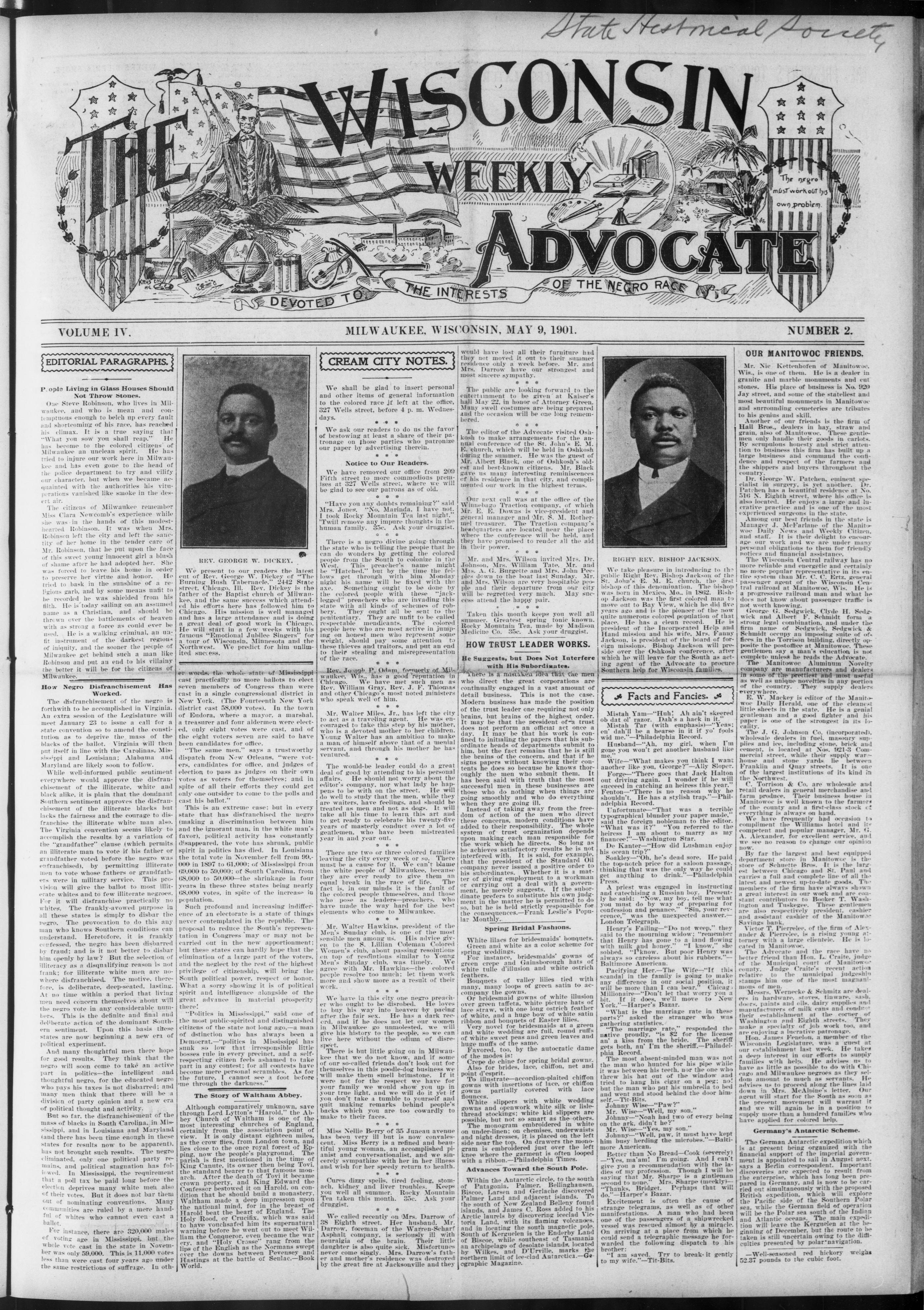
WISCONSIN
WEEKLY
Advocate
DEVOTED TO THE INTERESTS OF THE NEGRO RACE
EDITORIAL PARAGRAPHS.
People Living in Glass Houses Should Not Throw Stones.
One Steve Robinson, who lives in Milwaukee, and who is mean and contemptuous enough to belch up every fault and shortcoming of his race, has reached his climax. It is a true saying that "What you sow you shall reap." He has become to the colored citizens of Milwaukee an unclean spirit. He has tried to injure our work here in Milwaukee and has even gone to the head of the police department to try and vilify our character, but when we became acquainted with the authorities his vituperations vanished like smoke in the desert air.
The citizens of Milwaukee remember Miss Clara Newcomb's experience while she was in the hands of this modest-hearted Robinson. It was when Mrs. Robinson left the city and left the sanctity of her home in the tender care of Mr. Robinson, that he put upon the face of this sweet young innocent girl a blush of shame after he had adopted her. She was forced to leave his home in order to preserve her virtue and honor. He tried to bask in the sunshine of a religious garb, and by some means unfit to be recorded he was shielded from his filth. He is today sailing on an assumed name as a Christian, and should be thrown over the battlements of heaven with as strong a force as could ever be used. He is a walking criminal, an unfit instrument of the darkest regions of iniquity, and the sooner the people of Milwaukee get behind such a man like Robinson and put an end to his villainy the better it will be for the citizens of Milwaukee.
How Negro Disfranchisement Has Worked.
The disfranchisement of the negro is forthwith to be accomplished in Virginia. An extra session of the Legislature will meet January 23 to issue a call for a state convention so to amend the constitution as to deprive the mass of the blacks of the ballot. Virginia will then put itself in line with the Carolinas, Mississippi and Louisiana; Alabama and Maryland are likely soon to follow.
While well-informed public sentiment everywhere would approve the disfranchisement of the illiterate, white and black alike, it is plain that the dominant Southern sentiment approves the disfranchisement of the illiterate blacks but lacks the fairness and the courage to disfranchise the illiterate white man also. The Virginia convention seems likely to accomplish the results by a variation of the "grandfather" clause (which permits an illiterate man to vote if his father or grandfather voted before the negro was enfranchised), by permitting illiterate men to vote whose fathers or grandfathers were in military service. This provision will give the ballot to most illiterate whites and to few illiterate negroes. For it will disfranchise practically no whites. The frankly-avowed purpose in all these states is simply to disbar the negro. The provocation to do this any man who knows Southern conditions can understand. Heretofore, it is frankly confessed, the negro has been disbarred by fraud; and is it not better to disbar him openly by law? But the selection of illiteracy as a disqualifying reason is not frank; for illiterate white men are nowhere disfranchised. The motive, therefore, is deliberate, deep-seated, lasting. At no time within a period that living men need concern themselves about will the negro vote in any considerable numbers. This is the definite and final and deliberate action of the dominant Southern sentiment. Upon this basis these states are now beginning a new era of political experiment.
And many thoughtful men there hope for good results. They think that the negro will soon come to take an active part in politics—the intelligent and thoughtful negro, for the educated negro who pays his taxes is not disbarred; and many men think that there will be a division of party opinion and a new era of political thought and activity.
But so far, the disfranchisement of the mass of blacks in South Carolina, in Mississippi, and in Louisiana and Maryland (and there has been time enough in these states for results now to be apparent), has not brought such results. The negro eliminated, only one political party remains, and political stagnation has followed. In Mississippi, the requirement that a poll tax be paid long before the election deprives many white men also of their votes. But it does not bar them out of nominating conventions. Many communities are ruled by a mere handful of whites who cannot even cast a ballet.
For instance, there are 320,000 males of voting age in Mississippi, but the whole vote cast in the state in November was only 59,000. This is 11,000 votes less than were cast four years ago under the same restrictions of suffrage. In oth-
[Name]
REV. GEORGE W. DICKEY.
We present to our readers the latest cut of Rev. George W. Dickey of "The Burning Bush Tabernacle," 2442 State street, Chicago, Ill. Rev. Dickey is the father of the Baptist church of Milwaukee, and the same success which attended his efforts here has followed him to Chicago. His mission is well managed and has a large attendance and is doing a great deal of good work in Chicago. He will start in a few weeks with his famous "Emotional Jubilee Singers" for a tour of Wisconsin, Minnesota and the Northwest. We predict for him unlimited success.
er words, the whole state of Mississippi cast practically no more ballots to elect seven members of Congress than were cast in a single congressional district in New York. (The Fourteenth New York district cast 58,000 votes). In the town of Eudora, where a mayor, a marshal, a treasurer and four aldermen were elected, only eight votes were cast, and of the eight voters seven are said to have been candidates for office.
"The same men." says a trustworthy dispatch from New Orleans. "were voters, candidates for office, and judges of election to pass as judges on their own votes as voters for themselves; and in spite of all their efforts they could get only one outsider to come to the polls and cast his ballot."
This is an extreme case: but in every state that has disfranchised the negro (making a discrimination between him and the ignorant man, in the white man's favor), political activity has constantly disappeared, the vote has shrunk, public spirit in politics has died. In Louisiana the total vote in November fell from 99,000 in 1897 to 61,000; of Mississippi from 69,000 to 59,000; of South Carolina, from 68,000 to 50,000—the shrinkage in four years in these three states being nearly 68,000 votes, in spite of the increase in population.
Such profound and increasing indifference of an electorate is a state of things never contemplated in the republic. The proposal to reduce the South's representation in Congress may or may not be carried out in the new apportionment; but these states can hardly hope that the elimination of a large part of the voters, and the neglect by the rest of the highest privilege of citizenship, will bring the South political power, respect or honor. What a sorry showing it is of political spirit and intelligence alongside of the great advance in material prosperity there!
"Politics in Mississippi," said one of the most public-spirited and distinguished citizens of the state not long ago,—a man of distinction who has always been a Democrat,—"politics in Mississippi has sunk so low that irresponsible little bosses rule in every precinct, and a self-respecting citizen feels ashamed to take part in any contest; for all contests have become mere personal scrambles. As for the future, I cannot see a foot before me through the darkness."
The Story of Waltham Abbey.
Although comparatively unknown, save through Lord Lytton's "Harold," the Abbey Church of Waltham is one of the most interesting churches of England, certainly from the association point of view. It is only distant eighteen miles, as the crow flies, from London town, and lies close to the once royal forest of Epping, now the people's playground. The parish is first mentioned in the time of King Canute, its owner then being Tovi, the standard bearer to that famous monarch. After the death of Tovi it became crown property, and King Edward the Confessor bestowed it on Harold, on condition that he should build a monastery. Waltham made a deep impression upon the national mind, for in the breast of Harold beat the heart of England. The Holy Rood, or Crucifix, which was said to have vouchsafed him its supernatural warning before he went out to meet William the Conqueror, even became the warry, and "Holy Crosse" rang from the lips of the English as the Normans swept over the downs between Pevensey and Hastings at the battle of Senlac.—Book World.
MILWAUKEE, WISCONSIN, MAY 9, 1901.
CREAM CITY NOTES.
---
We shall be glad to insert personal and other items of general information to the colored race if left at the office, 327 Wells street, before 4 p. m. Wednesdays.
* * *
We ask our readers to do us the favor of bestowing at least a share of their patronage on those parties who patronize our paper by advertising therein.
Notice to Our Readers.
We have removed our office from 209 Fifth street to more commodious premises at 327 Wells street, where we will be glad to see our patrons as of old.
***
"Have you any doubts remaining?" said Mrs. Jones. "No, Marinda. I have not. I took Rocky Mountain Tea last night." 'Twill remove any impure thoughts in the human family. 35c. Ask your druggist.
There is a negro divine going through the state who is telling the people that he can do wonders by getting the colored people from the South to colonize in the West. This preacher's name might be "Hatched." but by the time the fellows get through with him Monday night his name will be fixed with the axe. Something ought to be done by the colored people with these "jack-legged" preachers who are invading this state with all kinds of schemes of robbery. They ought all be sent to the penitentiary. They are unfit to be called respectable mendicants. The colored people here who are most active in jumping on honest men who represent some weight, should pay some attention to these thieves and traitors, and put an end to their stealing and misrepresentation of the race.
***
Rev. Joseph P. Odam formerly of Milwaukee, Wis., has a good reputation in Chicago. We have met such men as Rev. William Gray, Rev. J. F. Thiomas and other Chicago's most noted ministers who speak well of him.
\* \* \*
Mr. Walter Miles, Jr., has left the city to act as a traveling agent. He was encouraged to take this step by his mother, who is a devoted mother to her children. Young Walter has an ambition to make a man of himself above that of a meuial servant, and through his mother he has ventured.
* * *
The would-be leader could do a great deal of good by attending to his personal affairs. He should not worry about the editor's company, nor what lady he happens to be with on the street. He will do well to study that the men, while they are waiters, have feelings, and should be treated as men and not as dogs. It will take all his time to learn this art and to get ready to celebrate his twenty-five years of masterly conduct over a lot of gentlemen, who have been mistreated year in and year out.
* * *
There are two or three colored families leaving the city every week or so. There must be a cause for it. We can't blame the white people of Milwaukee, because they are ever ready to give them an equal break in the race of life. The fact is, in our minds it is the fault of the colored people thimeselves, and those who pose as leaders—preachers, who have made the way hard for the best elements who come to Milwaukee.
\* \* \*
Mr. Walter Hawkins, president of the Men's Sunday club, is one of the most sensible men among us. His advice given to the S. Lillian Coleman Colored Women's club, about passing resolutions on top of resolutions similar to Young Men's Sunday club, was timely. We agree with Mr. Hawkins—the colored people resolve too much; let them work more and show more as a result of their work.
***
We have in this city one negro preacher who ought to be disrobed. He loves to buy his way into heaven by pacing after the fair sex. He has a dark record, and if he does not let our women in Milwaukee go unmolested, we will give his history to the people, so we can live here without the odium of disrespect.
There is but little going on in Milwaukee that we do not know, and if some of our so-called friends don't look out for themselves in this poodle-dog business we will make them smell brimstone. If it were not for the respect we have for your family we would show you up in your true light, and we will do it yet if you don't take a tumble to yourself and quit making remarks behind people's backs which you are too cowardly to make to their faces.
```markdown
```
Miss Nellie Berry of 35 Juneau avenue has been very ill but is now convalescent. Miss Berry is a refined and beautiful young woman, an accomplished pianist and conversationalist, and we sincerely sympathize with her in her illness and wish for her speedy return to health.
* * *
Cures dizzy spells, tired feeling, stomach, kidney and liver troubles. Keeps you well all summer. Rocky Mountain Tea taken this month. 35c. Ask your druggist.
***
We called recently on Mrs. Darrow of 38 Eighth street. Her husband, Mr. Darrow, foreman of the Warren-Scharf Asphalt company, is seriously ill with neuralgia of the brain. Their little daughter is also quite sick. Misfortunes never come singly. Mrs. Darrow's father and mother's residence was destroyed by the great fire at Jacksonville and they
would have lost all their furniture had they not moved it out to their summer residence only a week before. Mr. and Mrs. Darrow have our strongest and most sincere sympathy.
* * *
The public are looking forward to the entertainment to be given at Kaiser's hall May 22, in honor of Attorney Green. Many swell costumes are being prepared and the occasion will be one long remembered.
六 点 条
The editor of the Advocate visited Oshkosh to make arrangements for the annual conference of the St. John's E. M. E. church, which will be held in Oshkosh during the summer. He was the guest of Mr. Albert Black, one of Oshkosh's oldest and best-known citizens. Mr. Black gave us many interesting reminiscences of his residence in that city, and complimented our work in the highest terms.
* * *
Our next call was at the office of the Winnebago Traction company, of which Mr. E. E. Downs is vice-president and general manager and Mr. S. M. Rothermel treasurer. The Traction company's headquarters are located near the place where the conference will be held, and they have promised to render all the aid in their power.
* * *
Mr. and Mrs. Wilson invited Mrs. Dr. Johnson, Mrs. William Tate, Mr. and Mrs. A. G. Burgette and Mrs. John Peoples down to the boat last Sunday. Mr. and Mrs. Wilson are very hospitable people and their departure from our city will be regretted very much. May success attend the happy pair.
* * *
Taken this month keeps you well all summer. Greatest spring tonic known. Rocky Mountain Tea, made by Madison Medicine Co. 35c. Ask your druggist.
HOW TRUST LEADER WORKS.
He Suggests, but Does Not Interfere with His Subordinates.
There is a mistaken idea that the men who direct the great corporations are continually engaged in a vast amount of detail business. This is not the case. Modern business has made the position of the trust leader one requiring not only brains, but brains of the highest order. It may be that the president of a trust does not perform an official act once a day. It may be that his work is confined to initialing the papers that his subordinate heads of departments submit to him, but the fact remains that he is still the brains of the concern, and that if he signs papers without knowing their contents he does so because he knows thoroughly the men who submit them. It has been said with truth that the most successful men in these businesses are those who do nothing when things are going smoothly and who do everything when they are going ill.
Instead of taking away from the freedom of action of the men who direct these concerns, modern conditions have added to their responsibility. The whole system of trust organization depends upon making each man responsible for the work which he directs. So long as he achieves satisfactory results he is not interfered with. It is said, for example, that the president of the Standard Oil company never issued a positive order to his subordinates. Whether it is a matter of giving employment to a workman or carrying out a deal with a government, he merely suggests. If the subordinate prefers to substitute his own judgment in the matter he is permitted to do so, but he is held strictly responsible for the consequences.—Frank Leslie's Popular Monthly.
Spring Bridal Fashions
White lilacs for bridesmaids' bouquets. Green and white as a color scheme for spring weddings. For instance, bridesmaids' gowns of green crepe and Gainsborough hats of white tulle d'illusion and white ostrich feathers. Bouquets of valley lilies tied with many, many loops of green satin to accompany the gowns. Or bridesmaid gowns of white illusion over green taffeta, white picture hats of lace straw, with one long ostrich feather of white, and a huge bow of white satin ribbon and bouquets of Easter lilies.
Very novel for bridesmaids at a green and white wedding are full, round ruffs of white sweet peas and green leaves and huge muffs of the same.
Favored, too, by the autocratic dame of the modes is:
Crepe de chine for spring bridal gowns.
Also for brides, lace, chiffon, net and point d'esprit.
To illustrate—accordion-plaited chiffon gowns with insertions of lace, or chiffon gowns partially covered with lace flouces.
White slippers with white wedding gowns and openwork white silk or lisle-thread stockings; white kid slippers are possible, but not so smart as the others.
The monogram embroidered in white on under-linen; on chemises, underwaists and night dresses, it is placed on the left side near the top. On drawers the monogram is embroidered just over the left knee where the garment is often looped with a ribbon.—Philadelphia Times.
Advances Toward the South Pole.
Within the Antarctic circle, to the south of Patagonia, Palmer, Bellinghausen, Biscoe, Larsen and Gerlache discovered Palmer Land and adjacent islands. To the south of New Zealand Belleny found islands, and James C. Ross added to his Arctic laurels by discovering iceclad Victoria Land, with its flaming volcanoes, and in locating the south magnetic pole. South of Kerguelen is the Enderby Land of Biscoe, while southeast of Tasmania an archipelago of desolate islands, located by Wilkes, and D'Urville, marks the northern limit of ice-clad Antarctica.—Geographic Magazine.
[Picture of a man in a suit with a tie].
RIGHT REV. BISHOP JACKSON.
We take pleasure in introducing to the public Right Rev. Bishop Jackson of the St. John's E. M. E. church, the first bishop of this denomination. The bishop was born in Mexico, Mo., in 1862. Bishop Jackson was the first colored man to move out to Bay View, which he did five years ago and is the pioneer of the now quite numerous colored population of that place. He has a clean record. He is president of the Incorporated Help and Hand mission and his wife, Mrs. Fanny Jackson, is president of the board of foreign missions. Bishop Jackson will preside over the Oshkosh conference, after which he will leave for the South as acting agent of the Advocate to procure Southern help for Wisconsin families.
Facts and Fancies.
Mistah Yam—"Huh! Ah ain't skeered ob dat ol' razor. Dah's a hack in it." Mistah Tar (with emphasis)—"Yeas; en' dah'll be a hearse in it if yo' fools wid me."—Philadelphia Record. Husband—"Ah, my girl, when I'm gone you won't get another husband like me." Wife—"What makes you think I want another like you, George?"—Ally Sloper. Forge—"There goes that Jack Halton out driving again. I wonder if he will succeed in catching an heiress this year." Fenton—"There is no reason why he shouldn't. He has a stylish trap."—Philadelphia Record.
Unfortunate—"That was a terrible typographical blunder your paper made," said the foreign nobleman to the editor. "What was it?" "You referred to the heiress I am about to marry as my financee!"—Washington Star.
De Kanter—"How did Lushman enjoy his ocean trip?"
Soakley—"Oh, he's dead sore. He paid the top-notch price for a saloon passage, thinking that was the only way he could get anything to drink."—Philadelphia Press.
A priest was engaged in instructing and catechising a Russian boy. Presently he said: "Now, my boy, tell me what you must do by way of preparing for confession and penance." "Sin, your reverence," was the unexpected answer.—London Telegraph.
Henry's Failing—"Do not weep," they said to the mourning widow; "remember that Henry has gone to a land flowing with milk and honey." "I know," she sobbed. "I know. But poor Henry was always so careless about his rubbers."—Baltimore American.
Pacifying Her.—The Wife—"If this scandal in the family is going to make any difference in our social position, it will be more than I can bear." Chicago Millionaire—"Don't let that worry you a bit. If it does, we'll move to New York."—Harper's Bazar.
"What is the marriage rate in these parts?" asked the stranger who was gathering statistics.
"The marriage rate." responded the native proudly. "is $2 for the license an' a kiss from the bride. The sheriff gets both, an' I'm the sheriff."—Philadelphia Record.
The most absent-minded man was not the man who hunted for his pipe while it was between his teeth, nor the one who threw his hat out of the window and tried to hang his cigar on a peg; no! but the man who put his umbrella to bed and went and stood behind the door himself.—Tit-Bits.
Johnny Wise—"Paw?"
Johnny "Well, my son."
Mr. Wise—"Well, my son."
Johny—"Noah had two of every being on the ark, didn't he?"
on the ark, didnt he Mr. Wise—"Yes, my son."
Mr. Wise—Yes, my son.
Johnny—"Well, paw, it must have kept him busy herding the microbes."—Baltimore American.
Better than No Bread—Cook (severely)
—"Yes, ma'am! I'm going. And I can't give you a recommendation with the ladies of my profession. Though I will be saying that Mr. Sharpe is a gentleman second to none." Mrs. Sharpe (meekly)—"Thanks, Bridget. Perhaps that will do."—Harper's Bazar.
Excitement is often the cause of strange telegrams, as well as of other manifestations. A man who had been one of the passengers of a shipwrecked vessel was rescued almost by a miracle. On arriving at a place from which he could send a telegraphic message he forwarded the following dispatch to his brother:
"I am saved. Try to break- it gently to my wife."—Tit-Bits.
OUR MANITOWOC FRIENDS.
Mr. Nic Kettenhofen of Manitowoc. Wis., is one of them. He is a dealer in granite and marble monuments and cut stones. His place of business is No. 920 Jay street, and some of the stateliest and most beautiful monuments in Manitowoc and surrounding cemeteries are tributes to his genius and skill.
Another of our friends is the firm of Hall Bros., dealers in hay, straw and grain, also of Manitowoc. These gentlemen only handle their goods in carlots. By scrupulous honesty and strict attention to business this firm has built up a large business and command the confidence and respect of the farmers and the shippers and buyers throughout the country.
Dr. George W. Patchen, eminent specialist in surgery, is yet another. Dr. Patchen has a beautiful residence at No. 516 N. Eighth street, where his office is also located. He enjoys a large and lucrative practice and is one of the most experienced surgeons in the state.
Among our best friends in the state is Manager J. McFarlane of the Manitowoc Daily News and Weekly Citizen, and staff. It is their delight to encourage our work and we are under many personal obligations to them for friendly notices and financial assistance.
The Wisconsin Central railway has no more reliable and energetic and certainly no more popular representative in its entire system than Mr. C. C. Ertz, general passenger agent of the Wisconsin Central railroad at Manitowoe, Wis. He is a progressive railroad man and what he does not know about passenger traffic is not worth knowing.
George G. Sedgwick, Clyde H. Sedgwick and Albert F. Schmidt form a strong legal combination, and under the firm name of Sedgwick, Sedgwick & Schmidt occupy an imposing suite of offices in the Torrison building, directly opposite the postoffice at Manitowoe. These gentlemen say a man's education is not complete unless he reads the Advocate. The Manitowoe Aluminum Novelty company are manufacturers and dealers in some of the prettiest and most useful as well as unique novelties in any portion of the country. They supply dealers everywhere. E. W. Mackey is editor of the Manitowoc Daily Herald, one of the cleanest little sheets in the state. He is a genial gentleman and a good fighter and his paper is one of the strongest in its locality.
The J. G. Johnson Co. (incorporated), wholesale dealers in fuel, masonry supplies and ice, including stone, brick and cement, is located at Nos. 921-3 Commercial street, while their supply warehouse and stone yards lie between Franklin and Quay streets. It is one of the largest institutions of its kind in the Northwest. C. Torrison & Co. are wholesale and retail dealers in general merchandise and farm produce. Their business house in Manitowoc is well known to the farmers of the county and a first-class stock of everything is always on hand. We have frequently had occasion to compliment the Williams hotel and its competent and popular manager, Mr. G. A. Alexander, for excellent service, and we see no reason to change our opinion now.
By far the largest and best equipped department store in Manitowoc is the store of Schuette Bros. It is the largest between Chicago and St. Paul and carries a full and complete line of all the latest and newest up-to-date goods. The members of the firm have always shown a great interest in our work and are constant contributors to Booker T. Washington and Tuskegee. These gentlemen are also respectively president, cashier and assistant cashier of the Manitowoc Savings bank. Victor T. Pierrelee, of the firm of Alexander & Pierrelee, is a rising young attorney with a large clientele. He is located in Manitowoc.
The Advocate and the race have no better friend than Hon. L. Craite, judge of the Municipal court of Manitowoc county. Judge Craite's recent action relative to the municipal judgeship stamps him one of the most magnanimous of men. Messrs. Wernecke & Schmitz are dealers in hardware, stoves, tinware, sash, doors, paints and oils, dairy supplies and manufacturers of milk cans and conduct their establishment at the corner of Washington and Eighth streets. They make a specialty of job work too, and are enjoying a lucrative patronage.
Hon. James Fenclon, a member of the Wisconsin Legislature, was a guest at our establishment last week. He takes a deep interest in our efforts to supply families with help. He advises us to have as little as possible to do with Chicago and Milwaukee negroes as they seldom amount to much as servants. He advises us to proceed along the lines laid down in Mrs. McAlpine's letter. Our agent will start for the South as soon as the present movement will warrant it and we will again be in a position to supply more than a hundred families who have applied for colored help.
Germany's Antarctic Scheme
The German Antarctic expedition which is at present being organized with the financial support of the imperial government is appointed to sail in August next, says a Berlin correspondent. Important discoveries are expected to result from the enterprise, which has long been prepared in Germany, and is now to be carried out simultaneously with the proposed British expedition, which will explore the Pacific side of the Southern Polar sea, while the German field of operation will be the Polar sea south of the Indian and Atlantic oceans. The main expedition will leave the Kerguelen at the beginning of December, but the route to be taken is still uncertain owing to the difficulties presented by polar navigation.
Well-seasoned red hickory weighs 52.37 pounds to the cubic foot.
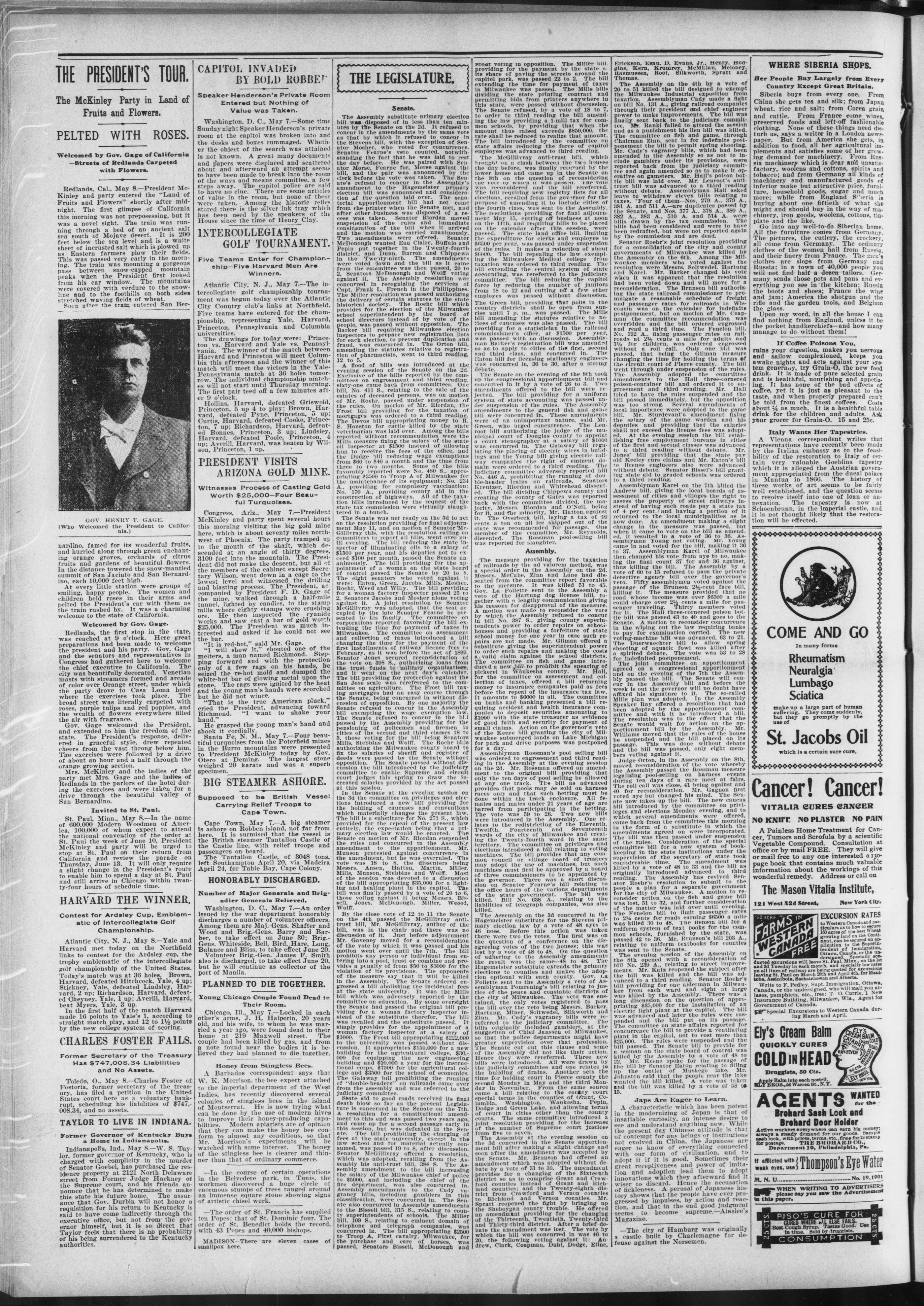
THE PRESIDENT'S TOUR.
The McKinley Party in Land of Fruits and Flowers.
Welcomed by Gov. Gage of California Streets of Redlands Carpeted with Flowers
Redlands, Cal., May 8.—President McKinley and party entered the "Land of Fruits and Flowers" shortly after midnight. The first glimpse of California this morning was not preposessing, but it was a novel sight. The train was running through a bed of an ancient salt sea south of Mojave desert. It is 200 feet below the sea level and is a white sheet of incrusted salt which is plowed up as Eastern farmers plow their fields. This was passed very early in the morning. The train was mounting a gorgeous pass between snow-capped mountain peaks when the President first looked from his car window. The mountains were covered with verdure to the snowline and to the foothills on both sides stretched waving fields of wheat.
Soon after the train entered San Ber
THE MAYOR OF BROOKLYN
GOV. HENRY T. GAGE. (Who Welcomed the President to California.) nardino, famed for its wonderful fruits, and hurried along through green enchanting orange groves, orchards of citrus fruits and gardens of beautiful flowers. In the distance towered the snow-mantled summit of San Jacinto and San Bernardino, each 10,000 feet high. At every little station were groups of smiling, happy people. The women and children held roses in their arms and pelted the President's car with them as the train rushed by. It was a charming welcome to the state of California.
Welcome by Gov. Gage.
Redlands, the first stop in the state, was reached at 9 o'clock. Here great preparations had been made to welcome the president and his party. Gov. Gage and the senators and representatives in Congress had gathered here to welcome the chief executive to California. The city was beautifully decorated. Venetian masts with streamers formed and arcade of color over Orange street, under which the party drove to Casa Loma hotel where the exercises took place. The broad street was literally carpeted with roses, purple tulips and red poppies, and the wealth of flowers everywhere filled the air with fragrance.
Gov. Gage welcomed the President, and extended to him the freedom of the state. The President's response, delivered in graceful style, drew repeated cheers from the vast throng below him. The exercises were followed by a drive of about an hour and a half through the orange growing section. Mrs. McKinley and the ladies of the party met Mrs. Gage and the ladies of Redlands in the parlors of the hotel during the exercises and were taken for a drive through the beautiful valley of San Bernardino.
Invited to St. Paul.
St. Paul, Minn., May 8.—In the name of 600,000 Modern Woodmen of America, 100,000 of whom expect to attend the national convention of the order at St. Paul the week of June 10, President McKinley and party will be urged to stop at St. Paul on their return from California and review the parade on Thursday, June 13. It will only require a slight change in the President's route to enable him to spend a day at St. Paul and still arrive in Chicago within twenty-four hours of schedule time.
HARVARD THE WINNER.
Contest for Ardsley Cup, Emblematic of Intercollegiate Golf Championship.
Atlantic City, N. J., May 8.—Yale and Harvard met today on the Northfield links to contest for the Ardsley cup, the trophy emblematic of the intercollegiate golf championship of the United States. Today's match was at 36 holes. Brown, Harvard, defeated Hitchcock, Yale, 4 up; Stickney, Yale, defeated Lindsley, Harvard, 2 up; Richardson, Harvard, defeated Cheyney, Yale, 1 up; Averill, Harvard, beat Myers, Yale, 3 up.
In the first half of the match Harvard made 16 points to Yale's 1, according to straight match play, and 12 to $1\frac{1}{2}$ points by the new college system of scoring.
CHARLES FOSTER FAILS.
Former Secretary of the Treasury Has $747,008.34 Liabilities and No Assets.
Toledo, O., May 8.—Charles Foster of Fostoria, former secretary of the treasury, has filed a petition in the United States court here as a voluntary bankrupt, scheduling his liabilities of $747,008.34, and no assets.
TAYLOR TO LIVE IN INDIANA.
Former Governor of Kentucky Buys a Home in Indianapolis.
Indianapolis, Ind., May 8.—W. S. Taylor, former governor of Kentucky, who is charged with complicity in the murder of Senator Goebel, has purchased the residence property at 2121 North Delaware street from Former Judge Hackney of the Supreme court, and his friends announce that he has determined to make this state his future home. The assurance that Gov. Durbin will not honor a requisition for his return to Kentucky is said to have come indirectly through the executive office, but not from the governor himself, but it is so direct that Taylor feels that there is no probability of his being surrendered to the Kentucky authorities.
CAPITOL INVADED BY BOLD ROBBER
Speaker Henderson's Private Room Entered but Nothing of Value was Taken.
Washington, D. C., May 7.—Some time Sunday night Speaker Henderson's private room at the capitol was broken into and the desks and boxes rummaged. Whether the object of the search was attained is not known. A great many documents and papers were displaced and scattered about and afterward an attempt seems to have been made to break into the room of the ways and means committee, a few steps away. The capitol police are said to have no clue. There are some articles of value in the room, but none of these were taken. Among the historic relies stored there is the silver ink tray which has been used by the speakers of the House since the time of Henry Clay.
INTERCOLLEGIATE GOLF TOURNAMENT.
Five Teams Enter for Championship-Five Harvard Men Are Winners.
Atlantic City, N. J., May 7.—The intercollegiate golf championship tournament was begun today over the Atlantic City Country club's links at Northfield. Five teams have entered for the championship, representing Yale, Harvard, Princeton, Pennsylvania and Columbia universities.
The drawings for today were: Princeton vs. Harvard and Yale vs. Pennsylvania. The winner of the match between Harvard and Princeton will meet Columbia this afternoon and the winner of this match will meet the victors in the Yale-Pennsylvania match at 36 holes tomorrow. The individual championship matches will not start until Thursday morning. The first pair teed off a few minutes after 9 o'clock.
Hollins, Harvard, defeated Griswold, Princeton, 5 up 4 to play; Brown, Harvard, defeated Pyne, Princeton, 5 up Curtis, Harvard, defeated Cooke, Princeton, 7 up; Richardson, Harvard, defeated Bonnes, Princeton, 3 up; Lindsley, Harvard, defeated Poole, Princeton, 4 up; Averill, Harvard, was beaten by Wilson, Princeton, 1 up.
PRESIDENT VISITS ARIZONA GOLD MINE.
Witnesses Process of Casting Gold
Worth $25,000—Four Beautiful Turquoises.
Congress, Ariz., May 7.—President McKinley and party spent several hours this morning visiting the big gold mine here, which is about seventy miles northwest of Phoenix. The party tramped up to the mouth of the shaft, which descended at an angle of thirty degrees, 3100 feet into the mountain. The President did not make the descent, but all of the members of the cabinet except Secretary Wilson, went down in a cage to the lowest level and witnessed the drilling and blasting process. The President, accompanied by President F. D. Gage of the mine, walked through a half-mile tunnel, lighted by candles, to the stamp mills where eighty stamps were crushing ore. He then inspected the cyanide works and saw cast a bar of gold worth $25,000. The President was much interested and asked if he could not see the bar.
the bar. "It is red-hot" said Mr. Gage.
"It is red-hot, said Mr. Gage.
"I will show it," shouted one of the melters, a man named Richmond. Stepping forward and with the protection only of a few rags on his hands, he seized the re-hot mold and dumped the white-hot bar of glowing metal upon the stone. The rags were ignited by the heat and the young man's hands were scorched but he did not wince.
"That is the true American pluck," cried the President, advancing toward Richmond. "I want to shake your hand."
He grasped the young man's hand and shook it cordially.
Santa Fe, N. M., May 7.—Four beautiful turquises from the Potterfield mines in the Burro mountains were presented to President McKinley today by Gov. Otero at Deming. The largest stone weighed 20 karats and was a superb specimen.
BIG STEAMER ASHORE.
Supposed to be British Vesse Carrying Relief Troops to Cape Town.
Cape Town, May 7.—A big steamer is ashore on Robben island, not far from here. It is surmised that the vessel is the British steamer Tantallon Castle of the Castle line, with relief troops and passengers on board. The Tantallon Castle, of 3048 tons, left Southampton April 20, via Madeira April 24, for Table Bay, Cape Colony.
HONORABLY DISCHARGED
Number of Major Generals and Brig adier Generals Relieved.
Washington, D. C., May 7.—An order issued by the war department honorably discharges a number of volunteer officers. Among them are Maj.-Gens. Shafter and Wood and Brig.-Gens. Barry and Barber, to take effect on June 30; Brig.-Gens. Whiteside, Bell, Bird, Hare, Long, Balance and Bliss, to take effect June 20.
Volunteer Brig.-Gen. James F. Smith also is discharged, to take effect June 20, but he will continue as collector of the port of Manila.
PLANNED TO DIE TOGETHER.
Young Chicago Couple Found Dead in Their Room.
Chicago, Ill., May 7.—Locked in each other's arms, J. H. Halporin, 20 years old, and his wife, to whom he was married a year ago, were found dead in their home at 219 Maxwell street. The couple had been killed by gas, and from a note found near the bodies it is believed they had planned to die together.
Honey from Stingless Bees.
A Barbados correspondent says that W. K. Morrison, the bee expert attached to the imperial department of the West Indies, has recently discovered several colonies of stingless bees in the island of Montserrat. He is now trying what can be done by the use of modern hives to improve their honey-producing capabilities. Modern apiarists are of opinion that they can make the honey bee conform to almost any conditions, so that Mr. Morrison's experiments will be watched with some interest. The honey of the stingless bee is clearer and thinner than that of ordinary commerce.
-In the course of certain operations in the Belvedere park, in Tunis, the workmen discovered a huge circle of enormous stumps of trees ranged around an immense square stone showing signs of artistic chisel work.
The order of St. Francis has supplied ten Popes; that of St. Dominic four. The order of St. Benedict holds the record, with 43 Popes and 40,000 bishops.
MADISON-There are eleven cases of smallbox here.
Senate.
The Assembly substitute primary election bill was disposed of in less than ten minutes by the Senate on the 2d. It refused to concur in the amendments by the same vote as that by which it refused to concur in the Stevens bill, with the exception of Senator Mosher, who voted for concurrence. Senator Fearne's veto counted, notwithstanding the fact that he was laid to rest the day before. He was paired with Senator Morse, Fearne for, Morse against the bill, and the pair was announced by the clerk before the vote was taken. The Senate's refusal to concur in the Assembly's amendment to the Hagemeister primary election bill was announced and consideration of the question laid over. The senatorial apportionment bill had not come from the printer when the Senate met, and after other business was disposed of a recess was taken. Senator Riordan moved suspension of the rules and immediate consideration of the bill when it arrived and the motion was carried unanimously. Two amendments were offered. Senator McDonough wanted Eau Claire, Buffalo and Pepin put together in the Twenty-fourth district, and Dunn, Barron and Chippewa in the Twenty-ninth. The amendments were voted down and the bill as it came from the committee was then passed, 20 to 2, Senators McDonough and Wolff voting against it. The Assembly resolution was concurred in recognizing the services of Capt. Frank L. French in the Phillippines. The Miller resolution was passed authorizing the delivery of certain statutes to the state historical society. The Roehr bill which provides for the election of the Milwaukee school superintendent by the board of school directors instead of by vote of the people, was passed without opposition. The Barker bill requiring Milwaukee election inspectors to prepare new registration lists for each election, to prevent duplication and fraud, was concurred in. The Orton bill, amending the statutes relative to registration of pharmacists, went to third reading, 12 to 5.
A flood of bills was introduced at the evening session of the Senate on the 2d. Exclusive of the bills reported by the committees on engrossment and third reading, sixty-one came back from committees. One bill, No. 411 S., relating to the sale of the estates of deceased persons, was on motion of Mr. Roehr, passed under suspension of the rules. On motion of Mr. Riordan, the Frost bill providing for the taxation of mortgages was ordered to a third reading. The Devos bill appropriating money to R. S. Houston for cattle killed by the state veterinarian was laid over. Among the bills reported without recommendation were the Mills measure fixing the salary of the state oil inspector at $1500 instead of allowing him to receive the fees of the office, and the Dodge bill reducing wage exemptions from $60 to $40 a month and the time from three to two months. Some of the bills favorably reported were No. 480 S., appropriating $2500 to Troop A of Milwaukee for the maintenance of its equipment; No. 234 A., providing for compulsory vaccination; No. 170 A., providing county aid in the construction of highways. All of the taxation bills introduced by the request of the state tax commission were virtually slaughtered in a bunch.
The Senate was not ready on the 3d to act on the resolution providing for final adjournment May 11, and on motion of Senator McGillivray this, with the resolution calling on committees to report all bills, went over until evening. The bill reducing the state inspector of illuminating oils to a salary of $1500 per year, and his deputies not to exceed $100 per month, passed the Senate unanimously. The bill providing for the appointment of a woman on the state board of control passed the Senate by 20 to 8. The eight senators who voted against it were: Eaton, Green, Jacobs, Mills, Mosher, Roehr, Weed and Willy. The bill providing for a woman factory inspector passed 25 to 2. Senators Jacobs and Mosher alone voting against it. A joint resolution by Senator McGillivray was adopted, that the seat occupied by the late Senator Fearne be presented to his family. The committee on corporations reported favorably the bill extending the time for payment of taxes in Milwaukee. The committee on assessment and collection of taxes introduced a bill changing the time for the payment of the first installments of railway license fees to February, as it was before the act of 1899. Senator Jones secured reconsideration of the vote on 398 S., authorizing loans from the trust funds to military organizations, and it went on the next day's calendar. The bill providing for protection against the San Jose scale was referred to the committee on agriculture. The Frost bill taxing mortgages had an easy course through the Senate, being concurred in without discussion of opposition. By one majority the Senate refused to concur in the Assembly bill exempting the wage exemption law. The Senate refused to concur in the bill passed by the Assembly providing for the pensioning of policemen and firemen in cities of the second and third classes 18 to 3, those voting for the bill being Senators Mills, Stebbins and Wolff. The Roehr bills authorizing the Milwaukee county board to fix the salaries of sheriff and register of deeds were passed by the Senate without opposition. The Senate passed without discussion the bill introduced by the judiciary committee to enable Supreme and circuit court judges this spring to draw the increased salaries provided by the act passed at this session.
In the Senate at the evening session on the 3d the committee on privileges and elections introduced a new bill providing for the holding of caucuses and conventions which materially changes the present law. The bill is a substitute for No. 271 S., which provided for the repeal of the present law entirely, the expectation being that a primary election law would be enacted. The Senate on motion of Mr. Riordan suspended the rules and concurred in the Assembly amendment to the apportionment. Mr. Munson protested against concurrence in the amendment, but he was overruled. The vote was 18 to 8, the dissenters being Messrs. Anson, Hatton, Martin, Miller, Mills, Munson, Stebbins and Wolff. Most of the session was devoted to a discussion of the bill appropriating $35,000 for a lighting and heating plant in the capitol. The bill was finally passed by a vote of 20 to 6, those voting against it being Messrs. Bissell, Jones, McDonough, Miller, Weeed, Wolff.
By the close vote of 12 to 11 the Senate on the 4th passed the McGillivray antitrust bill, Mr. McGillivray, author of the bill, was in the chair and there was no discussion of it. Just before adjournment Mr. Gaveney moved for a reconsideration of the vote by which it was passed and his motion went over until the 7th. The bill prohibits any person or individual from entering into a pool, trust or combine and provides a penalty of from $50 to $3000 for the violation of its provisions. The opponents of the measure say that it will be killed in the Assembly. The Senate ordered engrossed a bill abolishing the incidental fees at the state university. It was the Mills bill which was adversely reported by the committee on education. By some oversight the Senate had passed the original bill providing for a woman factory inspector instead of the substitute therefor. The bill was recalled and the substitute passed. It simply provides for the appointment of a woman factory inspector at a salary of $1000. The Frost bill appropriating $222,000 to the university was passed without discussion. It appropriates $150,000 for a new building for the agricultural college, $30,000 for equipping the new engineering building and $10,000 a year for the instructional corps, $7500 for the agricultural college and $5500 for the school of economics. The Galaway bill prohibiting the running of "double-headers" on railroads came over from the assembly and was referred to the judiciary committee.
State aid to good roads received its final death blow so far as the present Legislature is concerned in the Senate on the 7th. A resolution for a constitutional amendment to this end was passed two years ago, and came up for a second passage early in this session, but was defeated in the Senate. The bill prohibiting the charging of fees at the state university, except in the law school and for material actually consumed, was passed 19 to 8, after discussion. Senator McGillivray offered a resolution, which was adopted, recalling from the Assembly his anti-trust bill, 384 S. The Assembly amendment to the bill increasing the salary of the Milwaukee chief of police to $5000, and including the chief of the fire department, was also concurred in. Assembly amendments to the Cady vagrancy bills, including gamblers in this classification, were concurred in. The Senate also concurred in Assembly amendments to the Bissell bill, 315 S., relating to country superintendents of schools. The Miller bill, 109 S., relating to eminent domain of telephone and telegraph companies, was concurred in. The bill appropriating $2500 to Troop A, First cavalry, Milwaukee, for the purchase and care of horses, was passed, Senators Bissell, McDonough and
Stoot voting in opposition. The Miller bill, providing for the payment by the state of its share of paving the streets around the capitol park, was passed 22 to 2. The bill extending the time for payment of taxes in Milwaukee was passed. The Mills bills dividing the state printing contract and permitting bids from printers anywhere in this state, were passed without discussion. The Senate refused, by a vote of 18 to 7, to order to third reading the bill amending the law providing a 1-mill tax for common schools, by providing that when the amount thus raised exceeds $850,000, the rate shall be reduced to realize that amount. The bill introduced by the committee on state affairs reducing the force of capitol employees was advanced to third reading.
The McGillivray anti-trust bill, which brought on a clash between the two houses the day before, was finally returned by the lower house and came up in the Senate on the 8th on the question of reconsidering the vote by which it was passed. The vote was reconsidered and the bill referred. The bill requiring new registry lists for all elections, recalled from the governor for the purpose of amending it to include cities of the fourth class, was sent to the Assembly. The resolutions providing for final adjournment May 15, cutting off business at noon on the 11th, and requiring bills to be placed on the calendar after this session, were passed. The state land office bill, limiting the expenditure for clerks and employees to $6500 per year, was passed under suspension of the rules. It makes a reduction of about $6000. The bill repealing the law exempting the Milwaukee Medical college from taxation was ordered to third reading. The bill extending the central system of state accounting, was referred to the judiciary committee. The bill reducing the capitol force by reducing the number of janitors from 18 to 12 and cutting off a few other employees was passed without discussion. The Green bill, providing that polls in the country districts shall be open from sunrise until 7 p. m., was passed. The Mills bill amending the statutes relative to notices of caucuses was also passed. The bill providing for a statistician in the railroad commissioner's office, at $1500 per year, was passed with no discussion. Assemblyman Barker's registration bill was amended so as to apply to cities of the first, second and third class, and concurred in. The Eaton bill for licensing stationary engineers was concurred in, 36 to 30, after a stormy debate.
The Senate on the evening of the 8th took up the congressional apportionment bill and concurred in it by a vote of 26 to 3. Two amendments offered to the bill were rejected. The bill providing for a uniform system of state accounting was passed under suspension of the rules. The Assembly amendments to the general fish and game bill were concurred in. These amendments were of an unimportant nature, said Mr. Green, who urged concurrence. The Lenroot bill authorizing the judge of the municipal court of Douglas county to appoint a court stenographer at a salary of $1000 was concurred in. The Galaway bill regulating the placing of electric wires in buildings and the Young bill giving electric railway companies the right of eminent domain were ordered to a third reading. The judiciary committee adversely reported bill No. 446 A, prohibiting the running of double-header trains on railroads. Senators Kreutzer, Rlordan and Whitehead dissented. The bill dividing Chippewa county and creating the county of Gates was reported back with the committee divided, the majority, Messrs. Rlordan and O'Neill, being for it, and the minority, Mr. Hatton, against it. The Overbeck bill, laying a tax of 40 cents a ton on all ice shipped out of the state was recommended for passage. One member of the committee, Mr. Reynolds, dissented. The Rossman pool-selling bill was reported for slaughter.
Assembly.
The measure providing for the taxation of railroads by the ad valorem method, was a special order in the Assembly on the 2d. Messrs. McCabe, Zinn and Lane had dissented from the committee report favorable to the measure. It was killed 51 to 45. Gov. La Follette sent to the Assembly a veto of the Hartung dog license bill, together with a lengthy communication giving his reasons for disapproval of the measure. A motion was made to reconsider the vote by which the Assembly refused to concur in bill No. 387 S., giving county superintendents power to order repairs on schoci houses and providing a forfeiture of state school money for one year in case such repairs are not made. Mr. Gilman offered a substitute giving the superintendent power to order such repairs and making the costs a valid claim against the school districts. The committee on fish and game introduced a new bill to prohibit the spearing of pickerel in Waukesha county. Mr. Hall, for the committee on assessment and collection of taxes, offered a bill returning money to insurance companies paid as fees before the repeal of the insurance tax law. It amounts to $6000 in all. The committee on banks and banking presented a bill requiring accident and health insurance companies to deposit securities amounting to $1000 with the state treasurer as evidence of good faith and security for payment of small claims. Action on the governor's veto of the Keene bill granting the city of Milwaukee submerged lands on Lake Michigan for park and drive purposes was postponed for a day.
Assemblyman Rossman's pool selling bill was ordered to engrossment and third reading in the Assembly at the evening session on the 2d. Mr. Rossman offered an amendment to the original bill providing that only the ten days of pool selling be allowed at any one track. The bill as advanced provides that pools may be sold on harness races only and that such betting must be done within the track enclosure. All females and males under 21 years of age are barred from participating in the betting. The vote was 59 to 26. Two new bills were introduced in the Assembly. One relates to the redistricting of the Eleventh, Twelfth, Fourteenth and Seventeenth wards of the city of Milwaukee and creating the Twenty-fourth ward in the same territory. The committee on privileges and elections introduced a bill relating to voting machines. The bill provides that any common council or village board of trustees may adopt the use of machines, but such machines must first be approved by a board of three commissioners to be appointed by the governor. There was a short discussion on Senator Fearne's bill relating to the office hours of the various departments of the state government. The bill was killed. Bill No. 638 A., relating to the liabilities of telegraph companies, was also killed.
The Assembly on the 3d concurred in the Hagemeister substitute for the Stevens primary election law by a vote of 48 ayes to 46 noose. Before this action was taken there were two the votes. The first was on the question of a conference on the disagreeing votes of the two houses; this was lost by a vote of 48 to 48. On the question of adhering to the Assembly amendments the result was the same—48 to 48. The Hagemeister substitute extends the primary elections to counties and makes the adoption optional with each county. Gov. La Follette sent to the Assembly a veto of Assemblyman Pomrening's bill relating to justice of the peace and constable districts of the city of Milwaukee. The veto was sustained, the only votes registered to pass the bill over the veto being Messrs. Barker, Hartung, Miner, Soltwedel, Silkworth and Zinn. Mr. Cady's vagrancy bills were referred to the judiciary committee. The bills originally included gamblers, at the suggestion of Chief Janssen or Milwaukee, so that the police departments might have greater supervision over that profession. The Senate cut out this clause and some of the Assembly did not like their action. Hence they were referred. Three new bills were introduced. All were drawn by the judiciary committee and one relates to the building of drains. Another sets the time for holding court in Pierce county the second Monday in May and the third Monday in November. From the same source came a bill relating to the county court special terms in the counties of Grant, Columbia, Washington, Waukesha, Peplin, Dodge and Green Lake, and allowing terms of court in cities other than the county courts. The same committee introduced a joint resolution providing for the increase of the number of Supreme court justices from five to seven.
The Assembly at the evening session on the 3d concurred in the Senate apportionment bill after making a slight change and soon after the amendment was accepted by the Senate. Mr. Brunson had offered an amendment which was adopted without debate by a vote of 31 to 30. The amendment provides for a changing of the Sixteenth district so as to comprise Grant and Crawford counties instead of Grant and Richland counties; and the Twenty-eighth district from Crawford and Vernon counties to Richland and Vernon counties. Mr. Spratt reopened the fight by bringing up the Sheboygan county trouble. He offered an amendment providing for the changing of the Thirteenth, Twentieth, Twenty-third and Thirty-third district. After a brief debate the amendment was lost. The vote by which the bill was concurred in was 46 to 20, the following voting against it: Andrew, Clark, Coapman, Dahl, Dodge, Eline,
Erickson, Esau, D. Evans, Jr., Henry, Hodgins, Kern, Krumrey, McMilian, Meloney, Rasmussen, Root, Silkworth, Spratt and Thomas.
The Assembly on the 4th by a vote of 20 to 51 killed the bill designed to exempt the Milwaukee Industrial exposition from taxation. Assemblyman Cady made a fight on bill No. 131 A., giving railroad companies through their president and chief engineer power to make improvements. The bill was finally sent back to the judiciary committee. Mr. Rankl failed to attend the session and as a punishment his lien bill was killed. The committee on fish and game, through Chairman Zinn, sent in for indefinite postponement the bill to permit spring shooting. Mr. Cady's vagrancy bills, which had been amended in the Assembly so as not to include gamblers under its provisions, were reported back from the judiciary committee and again amended so as to make it operative on gamsters. Mr. Hall's poison bottle bill was laid over. Mr. Lenroot's ant-trust bill was advanced to a third reading without debate. Assemblyman Hall asked leave to withdraw eleven bills relating to taxes. "Four of them—Nos. 279 A., 379 A., 381 A. and 511 A.—are duplicates passed by the Senate, and Nos. 377 A., 378 A., 380 A., 382 A., 383 A., 510 A. and 514 A. were bills drawn by the tax commission. The bills had been considered and were to have been redrafted, but were not reported again by the commission and are dead.
Senator Roehr's joint resolution providing for a consolidation of the city and county governments of Milwaukee was killed by the Assembly on the 6th. Among the Milwaukee members who voted against the resolution were Messrs. Soltwedel, Hartung and Karel. Mr. Barker changed his vote when it was apparent that the resolution had been voted down and will move for a reconsideration. The Brunson bill authorizing the state railroad commissioner to promulgate a reasonable schedule of freight and passenger rates for railroads in Wisconsin was on the calendar for indefinite postponement, but on motion of Mr. Coapman the committee recommendation was overridden and the bill ordered engrossed and read a third time. The Fenclon bill, No. 192 A., fixing passenger rates on railroads at 2½ cents a mile for adults and 1½ for children, was ordered engrossed without a roll call. Only one bill was passed, that being the Gilman measure changing the time for holding the terms of the circuit court of Pierce county. The bill went through under suspension of the rules. The Assembly adopted the committee amendments to the Hall three-cornered poison-container bill and ordered it to engrossment and third reading. Mr. Hall tried to have the rules suspended and the bill passed immediately, but the opposition was too strong. Several amendments of local importance were adopted to the game bill. Mr. Sturdevant's amendment fixing the salary of the game warden and his deputies and providing that the salaries shall not exceed the license fees was adopted. At the evening session the bill establishing free employment bureaus in cities of the first and second classes was advanced to a third reading without debate. Mr. Jones' bill providing that the state pay old Keeley cure claims and Mr. Eaton's bill to license engineers also were advanced without debate. Senator Bissel's bill granting state aid to graded schools was ordered to a third reading.
Assemblyman Karel on the 7th killed the Andrew bill, giving the local boards of assessment of cities and villages the right to assess the property of street railways instead of having such roads pay a state tax of 4 per cent./and having a portion of it returned to the local municipalities as is now done. An amendment making a slight change in the measure was passed, but when it came to vote on the bill as amended, it resulted in a vote of 36 to 36. Assemblyman Young not voting. Mr. Young came in and voted for the bill, making it 36 to 37. Assemblyman Karel of Milwaukee then changed his vote from aye to no, making the final count 37 for and 36 against, thus killing the bill. The Assembly by a vote of 60 to 15 refused to pass the private detective agency bill over the governor's veto. Fifty assemblymen voted against the passage of the Brunson $2½-cent fare bill, killing it. The measure provided that no road whose income was over $6500 a mile could charge over $2½ cents a mile for passenger traveling. Thirty members voted for it. The Hall three-cornered poison bottle bill was passed 43 to 40 and goes to the Senate. A motion to reconsider concurrence in the wiping out the law requiring banks to pay for examination carried. The new voting-machine bill was advanced, 63 to 21. The Duerwaechter bill to allow spring shooting of aquatic fowl was killed after a spirited debate. The vote was 53 to 28 for indefinite postponement.
The joint committee on apportionment agreed on a congressional apportionment and on the evening of the 7th the Assembly passed the bill. The Senate will concur in the Assembly bill and before the week is out the governor will no doubt have affixed his signature to it. The so-called Mills plan was adopted. In the Assembly Speaker Ray offered a resolution that had been adopted by the apportionment committee and with it he introduced a bill. The resolution was to the effect that the Senate would wait for action on the apportionment bill by the Assembly. Mr. Williams moved that the rules of the house be suspended and the bill placed on its passage. This was done without debate and the bill was passed, only eight members voting against it.
Judge Orton. In the Assembly on the 8th, moved reconsideration of the vote whereby the Assembly passed the Rossman measure legalizing pool-selling on harness events during ten days of a race meet at fairs. The roll call was close, 41 being against and 40 for reconsideration. Mr. Gagnon first voted aye but changed his mind. The Senate now takes up the bill. The new caucus bill introduced by the committee on privileges and elections Monday evening, and to which several amendments were offered, came back from the committee this morning in the form of a substitute in which the amendments agreed on were incorporated. The bill was then passed under suspension of the rules. Consideration of the special committee bill for a new system of book-keeping in the state institutions under the supervision of the secretary of state took considerable time. The amendment was killed by a vote of 48 to 33 and the bill as originally introduced advanced to third reading. The Assembly has revived Senator Roehr's resolution to submit to the people a plan for a separate government for the city of Milwaukee. A motion to reconsider action on the fish and game bill was lost, 51 to 32, and further consideration of the matter was laid over until evening. The Fenelon bill to limit passenger rates to 21% cents for roads earning $6500 a mile was killed 30 to 48. The Benson bill for a uniform system of text books for the common schools, furnished by the state, was passed 42 to 36. Mr. Brunson's bill 203 A., relating to uniform textbooks for counties was sent to the Senate.
The evening session of the Assembly on the 5th opened with a reconsideration of bill No. 239 A., relating to street improvements. Mr. Katz reopened the subject after the bill was killed and the bill was advanced to a third reading. Senator Rohr's bill providing for one alderman in Milwaukee from each ward and eight at large was killed by the Assembly. There was a long discussion on the question of appropriating $35,000 for the installation of an electric light plant at the capitol. The bill was advanced and later the rules were suspended and the bill put on its passage. The committee on state affairs reported for concurrence the bill to provide a ventilating plant in the capitol, not to cost more than $25,000. The rules were suspended and the bill passed. The Senate bill to provide for a woman on the state board of control was killed by the Assembly by a vote of 48 to 22. Mr. Keene spoke for the passage of the bill by Senator Eaton relating to filling up the outlet of Muskego lake. Mr. Johnston said that the people near the lake wanted the bill killed. A vote was taken and the bill was killed by a vote of 58 to 15.
Japs Are Eager to Learn.
A characteristic which has been potent in the modernizing of Japan is that of insatiable curiosity, an intense desire to see and understand anything new. While the present day Chinese attitude is that of contempt for any beings or institutions not evolved in China, the Japanese are eager to know of everything connected with our form of civilization, and to adopt it if it is good. Sometimes their great receptiveness and power of imitation and adoption lead them to adopt innovations which they afterward find wiser to discard. Hence the accusation of fickleness. A perusal of Japanese history shows that the people have ever progressed by impulses, by action and reaction, and that in the end good judgment seems to become supreme.—Ainslee's Magazine.
The city of Hamburg was originally a castle built by Charlemagne for defense against the Norsemen.
WHERE SIBERIA SHOPS.
Her People Buy Largely from Every Country Except Great Britain.
Siberia buys from every one. From China she gets tea and silk; from Japan wheat, rice and salt; from Corea grain and cattle. From France come wines, preserved foods and left-off fashionable clothing. None of these things need disturb us, says a writer in a London newspaper. But from America she gets, in addition to food, all her agricultural implements and satisfies some of her growing demand for machinery. From Russia machinery which is dear and unsatisfactory, woolens and cottons, spirits and tobacco; and from Germany all kinds of machinery and manufactured goods of inferior make but attractive price, furniture, household goods, sugar and much more; while from England Siberia is buying about one fiftieth of what she might and should buy in the way of machinery, iron goods, woolens, cottons, tinplate and the like.
Go into any well-to-do Siberian home. All the furniture comes from Germany. The pictures, the cutlery, the crockery, all come from Germany. The ordinary clothes of the women hail from Russia, and their finery from France. The men's clothes are slops from Germany and Russia; in a town of 40,000 people you will not find half a dozen tailors. Germany sends those pots and pans and everything you see in the kitchen; Russia the boots and shoes; France the wine and jam; America the shotgun and the rifle and the garden tools, and Belgium the glass.
Upon my word, in all the house I can find nothing from England, unless it be the pocket handkerchiefs—and how many manage to do without them!
If Coffee Poisons You.
ruins your digestion, makes you nervous and sallow complexioned, keeps you awake nights and acts against your system generally, try Grain-O, the new food drink. It is made of pure selected grain and is healthful, nourishing and appetizing. It has none of the bad effects of coffee, yet it is just as pleasant to the taste, and when properly prepared can't be told from the finest coffees. Costs about $4 as much. It is a healthful table drink for the children and adults. Ask your grocer for Grain-O. 15 and 25c.
Italy Wants Her Tapestries.
A Vienna correspondent writes that representations have recently been made by the Italian embassy as to the feasibility of the restoration to Italy of certain very valuable Goeblins tapestry which it is alleged the Austrian government appropriated from the ducal palace in Mantua in 1866. The history of these works of art seems to be fairly well established, and the question seems to resolve itself into one of loan or annexation. The tapestry is now at Schoenbrunn, in the imperial castle, and it is not thought likely that the restoration will be effected.
COME AND GO
In many forms
Rheumatism
Neuralgia
Lumbago
Sciatica
make up a large part of human suffering. They come suddenly, but they go promptly by the use of
St. Jacobs Oil
which is a certain sure cure.
A Painless Home Treatment for Cancer, Tumors and Scrofula by a scientific Vegetable Compound. Consultation at office or by mail FREE. They will give or mail free to any one interested a 130page book that contains much valuable information about the workings of this wonderful remedy. Address or call on
The Mason Vitalia Institute.
EXCURSION RATES to Western Canada and particulars as to how to secure 160 acres of the best growing land on Continent, can be secured on appartenent of the Superintendent of Immigration, Ottawa, Canada, or the undersigned. Specially con
FARMS IN WESTERN CANADA FREE
EXCURSION RATES to Western Canada and particulars as to how to secure 160 miles of the best Wheat growing land on the Continent, can be secured on application to the Superintendent of Immigration, Ottawa, Canada, or the undersigned. Specially conducted excursions will leave St. Paul, Minnesota, on the last 3d Tuesday in each month, especially low rate on all lines of railway are quoted for excursions leaving St. Paul on March 28th and April 4th, for Manitoba, Assiniboia, Saskatchewan and Alberta.
Write to F. Pedley, Supt. Immigration, Ottawa, Canada, or the undersigned, who will mail you at lamps, pamphlets, etc., free: T. O. Currie, 1 New Insurance Building, Milwaukee, Wis., Agent for Government of Canada.
Special Excursions to Western Canada during March and April.
ELY'S
CREAM BALM
CURPED
CATARRH
MORE COLOR
HEAD
HAY-FEVER
BRAINBOSS
BRAINACHE
50 CTS.
NEW YORK
ELY BROS
Active workers everywhere can earn big money; always a steady demand for our goods. Sample cash lock, with prices, terms, etc., free for 2c stamp for postage. THE BROHARD CO., Department 10, Philadelphia, Pa.
WHEN WRITING TO ADVERTISERS please say you saw the Advertisement in this paper.
PISO'S CURE FOR
CURES WHERE ALL ELSE FAILS.
Best Cough Syrup. Tastes Good. Use in time. Sold by druggists.
25 CTS.
CONSUMPTION
SEAFARERS.
The traders that hail from the Clyde,
And the whalers that sail from Dundee.
Put forth in their season on top of the tide
To gather the grist of the sea,
To ply in the lanes of the sea.
By fairway and channel and sound,
By shoal and deep water they go,
Guessing the course by the feel of the ground.
Or chasing the drift of the floe—
Nor'west in the track of the floe.
* * * * * *
To the placid, palm-skirted bayou,
To coasts that are drear and forlorn.
We follow the courses the admirals drew
In the days when they doubled the Horn,
When Drake lost a month off the Horn.
And what of the cargo ye bring
For the venture ye bore overseas?
What of the treasure ye put forth to wring
From the chances of billow and breeze,
In spite of the billow and breeze?
Oh, we carry the keys of the earth,
And the password of Empire we bear!
Wherever the beaches held promise of
worth
We 'stablished your sovereignty there.
We planted your flag over there.
And the guerdon for blood ye have shed?
The glory that haloes your name?
Oh, a grave where the dipsy is dim over
head.
And the aftermath tribute of fame,
A chip from the flotsam of fame.
—Percival Gibbon in the Spectator
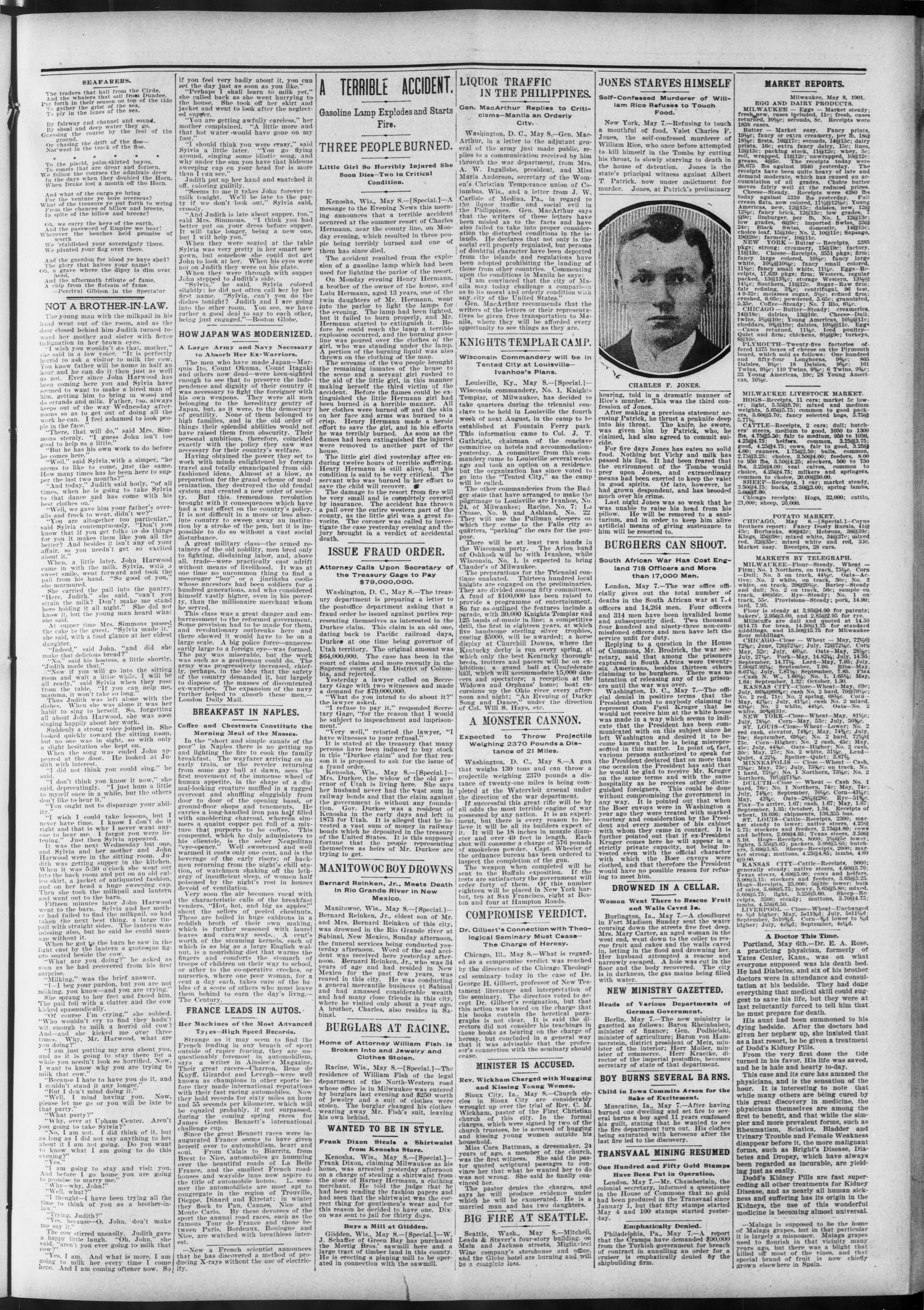
NOT A BROTHER-IN-LAW.
The young man with the milkpail in his hand went out of the room, and as the door closed behind him Judith turned toward her mother and sister with fierce indignation in her brown eyes.
"I wish you wouldn't do that, mother," she said in a low voice. "It is perfectly horrid to ask a visitor to milk the cow. You know father will be home in half an hour and he can do it then just as well as not. Ever since John Harwood has been coming here you and Sylvia have seemed to want to make a hired man of him, getting him to bring in wood and do errands and milk. Father, too, always keeps out of the way Wednesday afternoons so as to get out of doing all the work he can. I feel ashamed to look people in the face."
"There, that will do," said Mrs. Simmons sternly. "I guess John isn't too good to help us a little."
"But he has his own work to do before he comes here."
"Well," said Sylvia, with a simper, "he seems to like to come, just the same. How many times has he been here to supper the last two months?" "And today," Judith said hotly, "of all times, when he is going to take Sylvia to that dance and has come with his best clothes on." "Well, we gave him your father's overalls and frock to wear, didn't we?" "You are altogether too particular," said Sylvia contemptuously. "Don't you know that if you get folks to do things for you it makes them like you all the better? And besides it isn't any of your affair, so you needn't get so excited about it." When, a little later, John Harwood came in with the milk, Sylvia, with a sweet smile, went forward and took the pail from his hand. "So good of you," she murmured.
She carried the pail into the pantry. "Here, Judith." she said. "can't you strain the milk? Don't make me stand here holding it all night." She did not know it, but the young man heard what she said.
At supper time Mrs. Simmons passed the cake to the guest. "Sylvia made it." she said, with a fond glance at her eldest daughter.
"Indeed," said John. "and did she make that delicious bread?"
"No," said his hostess, a little shortly, "Indith made that."
"Now if you will go into the sitting room and wait a little while, I will be all ready," said Sylvia when they rose from the table. "If you can help me, mamma, it won't take so long."
Thus Judith was left alone with the dishes. When she was alone it was her habit to sing to herself. So, forgetting all about John Harwood, she was soon singing happily about her work.
Suddenly a strong voice joined in. She looked quickly toward the sitting room, but no one was in sight, so with only a slight hesitation she kept on.
When the song was ended John appeared at the door. He looked at Judith with interest.
"I did not think you could sing," he said.
"I don't think you know it now," she said, deprecatingly. "I just hum a little to myself once in a while, but the others don't like to hear it."
"You ought not to disparage your ability."
"I wish I could take lessons, but I never have time. I know I don't do it right and that is why I never want anyone to hear me. I forgot you were listening." Just then Sylvia appeared.
It was the next Wednesday but one, and Sylvia and her mother and John Harwood were in the sitting room. Judith was getting supper in the kitchen. When it was 5:30 o'clock she went out into the back room and put on an old calico skirt, a jacket of antiquated fashion, and on her head a huge sweeping cap. Then she took the milkpail and lantern and went out to the barn.
Fifteen minutes later John Harwood went to the barn. Sylvia and her mother had failed to find the milkpail, so had taken the next best thing, a large tin-pail with straight sides. The lantern was missing also, but he said he could manage without it.
When he got to the barn he saw in the light cast by the lantern a grotesque figure seated beside the cow.
"What are you doing?" he asked as soon as he had recovered from his first surprise.
surprise.
"Milking," was the brief answer.
"I—I beg your pardon, but you are not milking, you know—and you are crying."
She sprang to her feet and faced him. The pail fell with a clatter and the cow kicked spasmodically.
"Of course I'm crying," she sobbed.
"Who wouldn't cry to find they hadn't wit enough to milk a horrid old cow? And—and she kicked me over three times. Why, Mr. Harwood, what are you doing?"
"I am just putting my arm about you, and as it is going to stay there for a while you needn't look so horrified. Now, I want to know why you are trying to milk that cow."
"Because I hate to have you do it, and I couldn't stand it any longer."
"But I don't mind doing it."
"Well, I mind having you. Now, please let me go or you will be late to that party."
"What party?"
"Why, over at Upham Center. Aren't you going to take Sylvia?"
"No, I am not. I did think of it, but as long as I did not say anything to her about it I am not going. Do you want to know what I am going to do this evening?"
"Yes."
"I am going to stay and visit you. And before I go home you are going to promise to marry me."
"Why—why, John!"
"Why—why, John?
"Well, what?"
"I thought—I have been trying all the time to think of you as a brother-in-law."
"Trying. Judith?"
"Yelling, Judith?
"Yes, because—O. John, don't make me say it."
The cow stirred uneasily. Judith gave a happy little laugh. "Oh, John," she said. "aren't you ever going to milk that cow?
"Yes. I am. And what is more, I am going to milk her every time I come here. And I am coming offener now. So
if you feel very badly about it, you can set the day just as soon as you like."
"Perhaps I shall learn to milk yet," she called back as she went hurrying to the house. She took off her skirt and jacket and went to look after the neglected supper.
"You are getting awfully careless," her mother complained. "A little more and that hot water would have gone on my foot."
"I should think you were crazy," said Syivia a little later. "You go flying around, singing some idiotic song, and why under the sun you have that hideous sweeping cap on your head for is more than I can see."
Judith put up her hand and snatched it off, coloring guiltily.
"Seems to me it takes John forever to milk tonight. We'll be late to the party if we don't look out," Syivia said, crossly.
"And Judith is late about supper, too," said Mrs. Simmons. "I think you had better put on your dress before supper. It will take longer, being a new one, but I will help you."
When they were seated at the table Sylvia was very pretty in her smart new gown, but somehow she could not get John to look at her. When his eyes were not on Judith they were on his plate.
When they were through with supper John stepped to Judith's side.
"Sylvia," he said. Sylvia colored slightly: he did not often call her by her first name. "Sylvia, can't you do the dishes tonight? Judith and I are going into the other room. You see, we have rather a good deal to say to each other, being just engaged."—Boston Globe.
HOW JAPAN WAS MODERNIZED.
A Large Army and Navy Necessary to Absorb Her Ex-Warriors.
The men who have made Japan—Marquis Ito, Count Okuma, Count Itagaki and others now dead—were keen-sighted enough to see that to preserve the independence and dignity of their country it was necessary to fight the foreigner with his own weapons. They were all men belonging to the hereditary gentry of Japan, but, as it were, to the democracy of gentility. None of them belonged to high families, and in the old order of things their splendid abilities would not have raised them from obscurity. Their personal ambitions, therefore, coincided exactly with the policy they saw was necessary for their country's welfare.
Having obtained the power they set to work with minds enlightened by foreign travel and totally emancipated from old-fashioned ideas. Almost at a blow, as preparation for the grand scheme of modernization, they destroyed the old feudal system and created a new order of society. But this tremendous revolution brought with it consequences which have had a vast effect on the country's policy. It is not difficult in a more or less absolute country to sweep away an institution by a stroke of the pen, but it is impossible to do so without a vast social disturbance.
A great military class—the armed retainers of the old nobility, men bred only to fighting, disdaining labor, and, above all, trade—were practically cast adrift without means of livelihood. It was at one time no uncommon thing to find a messenger "boy" or a jinriksha coolie whose ancestors had been soldiers for a hundred generations, and who considered himself vastly higher, even in his poverty, than the millionaire merchant whom he served.
This class was a great danger and embarrassment to the reformed government. Some provision had to be made for them, and revolutionary outbreaks here and there showed it would have to be on a large scale. A big police force—unnecessarily large to a foreign eye—was formed. The pay was miserable, but the work was such as a gentleman could do. The army was progressively increased, chiefly, perhaps, in the idea that the safety of the country demanded it, but largely to dispose of the masses of discontented ex-warriors. The expansion of the navy further helped to absorb these men.—London Daily Mail.
BREAKFAST IN NAPLES.
Coffee and Chestnuts Constitute the Morning Meal of the Masses.
In the "short and simple annals of the poor" in Naples there is no getting up and lighting the fire to cook the family breakfast. The wayfarer arriving on an early train, or the reveler returning from some gay ball at dawn, sees the first movement of the immense wheel of human appetite, in the shape of a dismal-looking creature muffled in a ragged overcoat and shuffling sluggishly from door to door of the opening bassi, or ground-floor shops and tenements. He carries a long-handled iron pan half filled with smoldering charcoal, whereon simmers a quaint copper pot full of a mixture that purports to be coffee. This compound, which he duly administers to his clientele, is the sober Neapolitan "eye-opener." Well sweetened and well warmed it costs only one cent, and is the beverage of the early risers; of hackmen returning from the night's chill station, of watchmen shaking off the lethargy of insufficient sleep, of women half poisoned by the night's rest in houses devoid of ventilation.
Very soon the air becomes vocal with the characteristic calls of the breakfast venders, "Hot, hot, and big as apples!" shout the sellers of peeled chestnuts. These are boiled in huge caldrons in a reddish broth of their own making, which is further seasoned with laurel leaves and caraway seeds. A cent's worth of the steaming kernels, each of which is as big as a large English walnut, is a nourishing diet that warms the fingers and comforts the stomach of troops of children on their way to school, or ather to the co-operative creches, or nurseries, where one poor woman, for a cent a day each, takes care of the babies of a score of others who must leave them behind to earn the day's livng.—The Century.
FRANCE LEADS IN AUTOS.
Her Machines of the Most Advanced Tyres—High Speed Records. Strange as it may seem to find the French leading in any branch of sport outside of rapier fencing, they are unquestionably foremost in automobilism, says a writer in Ainslee's Magazine. Their great racers—Charron, Rene de Knyff, Girardot and Levegh—were well known as champions in other sports before they made international reputations with their fast racing automobiles. Now they hold records for sixty miles an hour and 55 seconds per kilometer, which will be equaled probably, if not surpassed, during the coming spring races for James Gordon Bennett's international challenge cup.
Since the great Bennett races were inaugurated France seems to have given herself over to automobileism, heart and soul. From Calais to Biarritz, from Brest to Nice, automobiles go humming over the beautiful roads of La Belle France, and the smallest French road houses and wayside inns now aspire to the title of automobile hotels. L., summer the automobilists are most apt to congregate in the region of Trouville, Dieppe, Dinard and Etretat; in winter they flock to Pau, Cannes, Nice and Monte Carlo. By these devotees of the sport the annual road races, such as the famous Tour de France and those between Paris, Bordeaux, Boulogne and Nice, are watched with breathless interest.
Now a French scientist announces that he has discovered a method of producing X-rays without the use of electricity.
A TERRIBLE ACCIDENT.
THREE PEOPLE BURNED.
Kenosha, Wis., May 8.—[Special.]—A message to the Evening News this morning announces that a terrible accident occurred at the summer resort of Charles Hermann, near the county line, on Monday evening, which resulted in three people being terribly burned and one of them has since died.
The accident resulted from the explosion of a gasoline lamp which had been used for lighting the parlor of the resort.
On Monday evening Henry Hermann, a brother of the owner of the house, and Lulu Hermann, aged 13 years, one of the twin daughters of Mr. Hermann, went into the parlor to light the lamps for the evening. The lamp had been lighted, but it failed to burn properly, and Mr. Hermann started to extinguish it. Before he could reach the lamp a terrible explosion occurred, and the burning gasoline was poured over the clothes of the girl, who was standing under the lamp. A portion of the burning liquid was also thrown on the clothing of the man.
The screams of the two people brought the remaining inmates of the house to the scene and a servant girl rushed to the aid of the little girl, in this manner making herself the third victim of the accident. Before the flames could be extinguished the little Hermann girl had been burned in a horrible manner. All her clothes were burned off and the skin on her face and arms was burned to a crisp. Henry Hermann made a heroic effort to save the girl, and in his efforts he was terribly burned. As soon as the flames had been extinguished the injured were removed to another part of the house.
The little girl died yesterday after enduring twelve hours of terrible suffering. Henry Hermann is still alive, but his condition is said to be very critical. The servant who was burned in her effort to save the child will recover. The damage to the resort from fire will be very small and is completely covered by insurance. The accident has thrown a pall over the entire western part of the county, as the little girl was a great favorite. The coroner was called to investigate the case yesterday evening and the jury brought in a verdict of accidental death.
ISSUE FRAUD ORDER.
Attorney Calls Upon Secretary of the Treasury Gage to Pay $79,000,000.
Washington, D. C., May 8.—The treasury department is preparing a letter to the postoffice department asking that a fraud order be issued against parties representing themselves as interested in the Durkee claim. This claim is an old one, dating back to Pacific railroad days, Durkee at one time being governor of Utah territory. The original amount was $64,000,000. The case has been in the court of claims and more recently in the Supreme court of the District of Columbia, and rejected. Yesterday a lawyer called on Secretary Gage with two witnesses and made a demand for $79,000,000. "What do you intend to do about it?" the lawyer asked.
the lawyer asked. "I refuse to pay it," responded Secretary Gage, "for the reason that I would be subject to impeachment and imprisonment." "Very well," retorted the lawyer, "I have witnesses to your refusal." It is stated at the treasury that many persons have been induced to buy stock in this "Durkee claim" and for that reason it is proposed to ask for the issue of a fraud order.
Kenosha, Wis., May 8.—[Special.]—Mrs. Durkee, the widow of the old governor of Utah is living here. She says her husband never had the vast sum in railway bonds and that the claim against the government is without any foundation. Gov. Durkee was a resident of Kenosha in the early days and left in 1873 for Utah. It is alleged that he invested a vast sum of money in railway bonds which he deposited in the treasury of the United States. It is this supposed fortune that the people representing themselves as heirs of Mr. Durkee are trying to get.
MANITOWOC BOY DROWNS
Bernard Reinken, Jr., Meets Death In Rio Grande River in New Mexico.
Manitowoc, Wis., May 8.—[Special.]—Bernard Reinken, Jr., eldest son of Mr. and Mrs. Bernard Reinken of this city, was drowned in the Rio Grande river at Sabinal, New Mexico, Sunday afternoon, the funeral services being conducted yesterday afternoon. Word of the sad accident was received here yesterday afternoon. Bernard Reinken, Jr., who was 34 years of age and had resided in New Mexico for the past few years, was reared in this city. He was conducting a general mercantile business at Sabinal and had amassed considerable wealth and had many close friends in this city, where he visited only about a year ago. A brother, Charles, also resides in Sabinal.
BURGLARS AT RACINE.
Home of Attorney William Fish. Is Broken Into and Jewelry and Clothes Stolen.
Racine, Wis., May 8.—[Special.]—The residence of William Fish of the legal department of the North-Western road whose office is in Milwaukee was entered by burglars last evening and $250 worth of jewelry and a suit of clothes were stolen. The burglar changed his clothes, wearing away Mr. Fish's suit, leaving his own behind.
WANTED TO BE IN STYLE.
Frank Dixon Steals a Shirtwaist from Kenosha Store. Kenosha, Wis., May 8.—[Special.]—Frank Dixon, claiming Milwaukee as his home, was arrested yesterday afternoon on a charge of stealing a shirtwaist from the store of Barney Hermann, a clothing merchant. He told the judge that he had been reading the fashion papers and had seen that the shirtwaist was the correct thing for gentlemen's wear and for this reason he decided to have one. Dixon was sent to jail for thirty days.
Buys a Mill at Glidden.
Glidden, Wis., May 8.—[Special.]—W. J. Schaffer of Green Bay has purchased the Mertig Bros.' sawmill here and a large tract of timber land in this county. He is erecting a planing mill to be operated in connection with the sawmill.
LIQUOR TRAFFIC IN THE PHILIPPINES.
Gen. MacArthur Replies to Criticisms-Manila an Orderly City.
Washington, D. C., May 8.—Gen. MacArthur, in a letter to the adjutant general of the army just made public, replies to a communication received by him through the war department, from Mrs. A. W. Ingallsbe, president, and Miss Maria Anderson, secretary of the Women's Christian Temperance union of Columbus, Wis., and a letter from J. W. Carlisle of Medina, Pa., in regard to the liquor traffic and social evil in the Philippines. Gen. MacArthur says that the writers of these letters have been misled as to the facts and have also failed to take into proper consideration the disturbed conditions in the islands. He declares that not only is the social evil properly regulated, but persons of doubtful character have been deported from the islands and regulations have been adopted prohibiting the landing of those from other countries. Commenting upon the conditions in Manila he says:
"I am convinced that the city of Manila may today challenge a comparison as to its moral and orderly condition with any city of the United States." Gen. MacArthur recommends that the writers of the letters or their representatives be given free transportation to Manila, where they will be afforded every opportunity to see things as they are.
KNIGHTS TEMPLAR CAMP.
Wisconsin Commandery will be in Tented City at Louisville Ivanhoe's Plans.
Louisville, Ky., May 8.—[Special.] Wisconsin commandery, No. 1, Knights Templar, of Milwaukee, has decided to take quarters during the triennial conclave to be held in Louisville the fourth week of next August, in the camp to be established at Fountain Ferry park. This information came to Col. J. T. Gathright, chairman of the conclave committee on hotels and accommodations yesterday. A committee from this commandery came to Louisville several weeks ago and took an option on a residence. but the organization has since voted to go into the "Tented City," as the camp will be called.
The other commanderies from the Badger state that have arranged to make the pilgrimage to Louisville are Ivanhoe, No. 24, of Milwaukee; Racine, No. 7; La Crosse, No. 9, and Ashland, No. 22 They will use the Pullman sleepers on which they come to the Falls city as quarters, "parking" the cars for the purpose. There will be at least two bands in the Wisconsin party. The Arion band of Oshkosh will be with Ivanhoe, while Wisconsin, No. 1, is expected to bring Clauder's of Milwaukee.
The preparations for the Triennial continue unabated. Thirteen hundred local knights are engaged on the preliminaries. They are divided among fifty committees. A fund of $100,000 has been raised to provide a programme of entertainment. So far as outlined the features include a parade, with 30,000 Knights Templar and 125 bands of music in line; a competitive drill, the first in eighteen years, at which five handsome sterling silver trophies, costing $5000, will be awarded; a horse display at Churchill Downs, where the Kentucky derby is run every spring, at which only the best Kentucky thoroughbreds, trotters and pacers will be on exhibition; a grand ball at Confederate hall, which will accommodate 15,000 dancers and spectators; a reception at the Widows and Orphans' home; boat excursions up the Ohio river every afternoon and night; "An Evening of Darky Song and Dance," under the direction of Col. Will S. Hays, etc.
A MONSTER CANNON.
Expected to Throw Projectile Weighing 2370 Pounds a Distance of 21 Miles.
Washington, D. C., May 8.—A gun that weighs 130 tons and can throw a projectile weighing 2370 pounds a distance of twenty-one miles is being completed at the Watervleit arsenal under the direction of the war department. If successful this great rifle will be by all odds the most terrible engine of war possessed by any nation. It is an experiment, but there is every reason to believe it will be all its builders expect of it. It will be 18 inches in muzzle diameter and over 49 feet in length. Each shot will consume a charge of 576 pounds of smokeless powder. Capt. Wheeler of the ordnance bureau has been ordered to inspect the completion of the gun.
The weapon when completed will be sent to the Buffalo exposition. If the tests are satisfactory the government will order forty of them. Of this number eighteen will be placed in New York harbor, ten at San Francisco, eight at Boston and four at Hampton Roads.
COMPROMISE VERDICT.
Dr. Gilbert's Connection with Theological Seminary Must Cease- The Charge of Heresy.
Chicago, Ill., May 8.—What is regarded as a compromise verdict was reached by the directors of the Chicago Theological seminary today in the case of Dr. George H. Gilbert, professor of New Testament literature and interpretation of the seminary. The directors voted to accept Dr. Gilbert's resignation, but that this action was based on the charge that his books contain the heretical paragraphs is not clear. It is said the directors did not consider his teachings in these books as bearing on the charge of heresy, but concluded in a general way that it was advisable that the professor's connection with the seminary should cease.
MINISTER IS ACCUSED.
Rev. Wickham Charged with Hugging and Kissing Young Women. Sioux City, Ia., May 8.—Church circles in Sioux City are considerably wrought up over the trial of Rev. C. M. Wickham, pastor of the First Christian church of this city. In the formal charges, which were signed by two of the church trustees, he is accused of hugging and kissing young women outside his household.
Miss Cora Battman, a dressmaker, 24 years of age, a member of the church, was the first witness. She said the pastor quoted scriptural passages to convince her that what he wanted her to do was not wrong. She said he finally convinced her. The pastor denies the charges, and says he will produce evidence under which he will be exonerated. He is a married man and has two daughters.
BIG FIRE AT SEATTLE.
Seattle, Wash., May 8.-Mitchell, Leads & Staver's four-story building, on Main and Jackson streets, Migliavici Wine company's storehouse and office, and the Globe hotel are burning and will be a complete loss.
JONES STARVES HIMSELF
Self-Confessed Murderer of William Rice Refuses to Touch Food.
New York, May 7.—Refusing to touch a mouthful of food, Valet Charles F. Jones, the self-confessed murderer of William Rice, who once before attempted to kill himself in the Tombs by cutting his throat, is slowly starving to death in the house of detention. Jones is the state's principal witness against Albert T. Patrick, now under indictment for murder. Jones, at Patrick's preliminary
M.
hearing, told in a dramatic manner of Rice's murder. This was the third confession of Jones. After making a previous statement accusing Patrick, he thrust a penknife deep into his throat. The knife, he swore, was given him by Patrick, who, he claimed, had also agreed to commit suicide. For five days Jones has eaten no solid food. Nothing but Vichy and milk has passed his lips. It had been feared that the environment of the Tombs would prey upon Jones, and extraordinary means had been exerted to keep the valet in good spirits. Of late, however, he had grown despondent, and has brooded much over his crime.
Last night Jones was so weak that he was unable to raise his head from his pillow. He will be removed to a sanitarium, and in order to keep him alive artificial means of giving sustenance to him will be resorted to.
BURGHERS CAN SHOOT.
South African War Has Cost England 718 Officers and More than 17,000 Men.
London, May 7.—The war office officially gives out the total number of deaths in the South African war at 7,4 officers and 14,264 men. Four officers and 314 men have been invalided home and subsequently died. Two thousand four hundred and ninety-three non-commissioned officers and men have left the service unfit for duty.
Replying to a question in the House of Commons, Mr. Brodrick, the war secretary, said that among the prisoners captured in South Africa were twenty-six Americans, besides thirteen others claiming to be burghers. There was no intention of releasing any of the prisoners until the war was over.
Washington, D. C., May 7.—The official denial in positive terms that the President stated to anybody claiming to represent Oom Paul Kruger that he would not receive him at the white house was made in a way which seems to indicate that the President has been communicated with on this subject since he left Washington and desired it to become known that he is being misrepresented in this matter. In point of fact, various persons authorized to speak for the President declared that on more than one occasion the President has said that he would be glad to receive Mr. Kruger on the same terms and with the same hospitality as he receives other distinguished foreigners. This could be done without compromising the government in any way. It is pointed out that when the Boer envoys were in Washington a year ago they were treated with marked courtesy and consideration by the President and every member of his cabinet with whom they came in contact. It is further pointed out that if ex-President Kruger comes here he will appear in a strictly private capacity, not being invested even with the official character with which the Boer envoys were clothed, and that therefore the President would have no possible reason for refusing to meet him.
DROWNED IN A CELLAR.
Woman Went There to Rescue Fruit and Walls Caved In.
Burlington, Ia., May 7.—A cloudburst in Fort Madison Sunday sent the water coursing down the streets five feet deep. Mrs. Mary Carter, an aged woman in the west end, went down to the celler to rescue fruit and cakes and the walls caved in, letting in the flood and drowning her. Her husband attempted a rescue and narrowly escaped. A hole was cut in the floor and the body recovered. The city is in darkness, the gas mains being filled with water.
NEW MINISTRY GAZETTED.
Heads of Various Departments of German Government. Berlin, May 7.—The new ministry is gazetted as follows: Baron Rheinbaben, minister of finance; Gen. Podbielski, minister of agriculture; Baron von Hammerstein, district president of Metz, minister of the interior; Herr Moller, minister of commerce. Herr Kraetke, director of the imperial postoffice, becomes secretary of state of that department.
BOY BURNS SEVERAL BARNS.
Child in Iowa Commits Arson for the Sake of Excitement.
Muscatine, Ia., May 7.—After having burned one dwelling and set fire to several barns a boy aged 11 years confessed his guilt, stating that he wanted to see the fire department turn out. His clothes being saturated with kerosene after the last fire led to the discovery.
TRANSVAAL MINING RESUMED
One Hundred and Fifty Gold Stamps Have Been Put in Operatioo. London, May 7.—Mr. Chamberlain, the colonial secretary, informed a questioner in the House of Commons that no gold had been produced in the Transvaal since January 1, but that fifty stamps started May 4 and 100 stamps started yesterday.
Emphatically Denied.
Philadelphia, Pa., May 7.—A report that the Cramps have demanded $90,000 from the Turkish government for breach of contract in annulling an order for a cruiser is emphatically denied by the shipbuilding firm.
MARKET REPORTS.
Milwaukee, May 8, 1901.
EGG AND DAIRY PRODUCTS.
MILWAUKEE — Eggs — Market steady;
fresh, new, cases included, 11c; fresh, cases
returned, 10%c; seconds, 8c. Receipts were
1858 cases.
Butter — Market easy. Fancy prints, 191¾c; fancy or extra creamy, per lb, 18¾c; firsts, 16¾c17c; seconds, 14¾c15c; dairy prints, 16c; extra fancy dairy, 15c; lines, 12¾c13c; packing stock, 11¾c12c; whey, 5c; roll, wrapped, 11¾c12c; unwrapped, 10¾c12c; grease, 4¾c5c. The receipts today were 26,675 lbs against 9340 yesterday. The receipts have been quite heavy of late and demand moderate, which has caused an accumulation of all grades. Choice butter moves fairly well at the reduced prices. Cheese—Steady. Recelpts were 4380 lbs today against 5310 lbs yesterday. Full cream flats, new colored, 11¾c12¾c; Young Americas, new, 12¾c13c; daisies, new, 12¾c12¾c; fancy brick, 12¾c13c; low grades, 7¾c; limburger, per lb, No. 1, 12¾c13c; low grades, 6¾c9c; imported Swiss, 23¾c24c; Block Swiss, domestic, 14¾c15c; choice loaf, 15¾c16c; No. 2, 10¾c11c; Sapsago, 19¾c20c; farmers, 10¾c11c.
NEW YORK — Butter — Receipts, 5385
pkgs; strong; cremery, 15@19c; factory,
11@13c. Cheese—Receipts, 3551 pkgs; firm;
fancy large colored, 10%c; fancy large
white, 10%@10%c; fancy small colored,
11%c; fancy small white, 11%c. Eggs—Receipts, 17.639 pkgs; firm; Western, regular
packed, 13@13%c; storage Western, 13%@14%c; Southern, 11@12c. Sugar—Raw firm;
falt refining, 33%c; centrifugal, 96 test,
4.9-32c; molasses sugar, 3%c; refined firm;
crushed, 6.05c; powdered, 5.65c; granulated,
5.55c. Coffee—Steady; No. 7 Rio, 6%c.
CHICAGO — Butter—Steady; creamerles,
14@18c; dalries, 13@16c. Cheese—Dull;
twins, 9%@10c; Young Americas, 10%@11c;
cheddars, 9%@10c; dalsies, 10%@11c. Eggs—Cases returned, 11%c. Iced poultry—Quiet and firm; chickens, 8%@9c; turkeys,
8@10c.
PLYMOUTH—Twenty-five factories offered 1375 boxes of cheese on the Plymouth board, which sold as follows: One hundred and fifty-four Longhorns, 9½¢; 885 Dalesls, 9½¢; 18 Dalesls, 9½¢; 161 Twins, 9½¢; 110 Twins, 9½¢; 6 Twins, 9½¢; 33 Young Americas, 10¢; 28 Young Americas, 10½¢.
HOGS—Recelpts, 11 cars; market 5c lower; light, 5.55@5.70; mixed and medium weights, 5.65@5.75; common to good packers, 5.60@5.70; fancy selected hogs, 5.75@5.77½.
CATTLE—Recelpts, 2 cars; dull; butchers' steers, medium to good, 1050 to 1300 lbs, 4.75@5.50; falr to medium, 950 to 1050, 4.25@4.75; helfers, common, 3.25@3.75; good, 4.25@4.75; cows, falr to good, 3.25@4.00; canners, 1.75@2.50; bulls, common, 2.75@3.25; choice, 3.50@4.00; feeders, 8.00 to 950 lbs, 3.50@4.25; stockers, 500 to 750 lbs, 3.25@4.00; veal calves, common to choice, 4.25@4.75; milkers and springers, common to choice, 20.00@50.00.
SHEEP—Recelpts, 1 car; market steady, 3.50@4.75; bucks, 2.50@3.00; spring lambs, 5.00@7.00.
Chicago recelpts: Hogs, 32,000; cattle, 21,000; sheep, 20,000.
CHICAGO, May 8.—[Special.]—Coyne Brothers report: Fancy Dusty Rurals, 41@ 43c; Burbanks, 40@42c; Hebrons, 38@39c; Klings, 35@38c; mixed white, 34@37c; mixed red, 32@35c; mixed white and red, 33c. Market easy. Recelpts, 28 cars.
MARKETS BY TELEGRAPH.
MILWAUKEE—Flour—Steady. Wheat — Firm; No. 1 Northern, on track, 75%c. Corn — Dull; No. 3 on track, 44%c. Oats—Active; No. 2 white, on track, 30c; No. 3 white, on track, 29@29%c. Barley—Steady and dull; No. 2 on track, 56c; sample on track, 48@56c. Rye—Steady; No. 1 on track, 55c. Provisions—Steady; pork, 14.90; lard, 7.95. Flour is steady at 3.95@4.00 for patents; bakers' 2.95@3.00 and 2.85@2.95 for rye.
bakers, 2.90@8.00, and 2.50@2.95 for 14.50
Millstuffs are dull and quoted at 14.50
@14.75 for bran, 14.50@1.75 for standard
middlings, and 15.50@15.75 for Milwaukee
flour middlings.
CHICAGO—Close — Wheat — May, 72½@
72½c; June, 72@72½c; July, 72@72½c; Corn
May, 52c; July, 46½c; Oats—May, 28½c;
July, 27½c; Pork—May, 14.82½; July, 14.95
September, 14.77½; Lard—May, 7.95; July,
7.90@7.92½; September, 7.90. Rlbs—May,
8.07½; July, 7.87½; September, 7.85. Flax
—Cash N. W, 1.66½; No. 1, 1.65½; May,
1.64; September, 1.32; October, 1.30.
KANSAS CITY—Close — Wheat—May, 69c;
July, 66½@66½c; cash No. 2 hard, 70@70½c;
No. 2 red, 71c; No. 2 spring, 68½c; Corn-
May, 42½c; July, 41½c; cash No. 2 mixed,
43½c; No. 2 white, 44½c; Oats—No. 2
white, 30%@31c
NEW YORK—Close—Wheat—May, 81%c;
July, 78%c. Corn—May, 53c; July, 50%c.
ST. LOUIS—Close—Wheat—Lower; No. 2
red cash, elevator, 74%c; May, 74%c; July,
70c; September, 60%c; No. 2 hard, 72%c;
73c. Corn—Higher; No. 2 cash, 45c; May,
45c; July, 44%c. Oats—Higher; No. 2 cash,
30c; May, 27c; No. 2 white, 31%c. Lead—
Quiet, 4.22%c. Spelter—Quiet; 3.87%c.
MINNEAPOLIS—Close—Wheat—Cash,
73%c; May, 73c; July, 73%c; on track, No.
1 hard, 75%c; No. 1 Northern, 73%c; No. 2
Northern, 70%c@71%c.
DULUTH—Close—Wheat—Cash No. 1
hard, 76c; No. 1 Northern, 74c; May, 74c;
July, 74%c; September, 70%c. Corn—43%c;
May, 43%c. Oats—28%@28c. Rye—51%c.
Flax-To arrive, 1.67; cash, 1.67; May, 1.67;
September, 1.35; October, 1.34. Recepts of
wheat, 19.036; shipments, 136.355 bus.
ST. LOUIS—Cattle—Recelpts, 2300; market steady to lower; native steers, 4.25@5.75; stockers and feeders, 2.75@4.80; cows and helfers, 2.00@4.95; Texas steers, 3.50@5.10. Hogs—Recelpts, 8000; 2½@6e lower; lights, 5.55@5.65; packers, 5.00@5.65; butchers, 5.60@5.85. Sheep—Recelpts, 2000; market strong; muttons, 4.25@4.85; lambs, 4.60@9.00.
KANSAS CITY—Cattle—Recelpts, 9000; generally steady; native steers, 4.60@5.70; Texas steers, 4.00@5.00; cows and helfers, 3.00@5.15; stockers and feeders, 3.65@5.25. Hogs—Recelpts, 23,000; 5@10e lower; bulk of sales, 5.60@5.75; heavy, 5.65@5.80; mkxed, 5.60@5.75; light, 5.25@5.60. Sheep—Recelpts, 3500; steady; muttons, 3.70@4.75; lambs, 4.55@6.50.
LIVERPOOL — Close—Wheat—Unchanged to ½d higher; May, 511%d; July, 511%d; September, 510%d; Corn—3d lower to ½d higher; July, 45%d; September, 45%d.
A Doctor This Time.
Portland, May 6th.—Dr. E. A. Rose, a practicing physician, formerly of Yates Center, Kans., was on what everyone supposed was his death bed. He had Diabetes, and six of his brother doctors were in attendance and consultation at his bedside. They had done everything that medical skill could suggest to save his life, but they were at last reluctantly forced to tell him that he must prepare for death. His aunt had been summoned to his dying bedside. After the doctors had given her nephew up, she insisted that as a last resort, he be given a treatment of Dodd's Kidney Pills. From the very first dose the tide turned in his favor. His life was saved, and he is hale and hearty to-day.
This case and its cure has amazed the physicians, and is the sensation of the hour. It is interesting to note that while many others are being cured by this great discovery in medicine, the physicians themselves are among the first to benefit, and that while the simpler and more prevalent forms, such as Rheumatism, Sciatica, Bladder and Urinary Trouble and Female Weakness disappear before it, the more malignant forms, such as Bright's Disease, Diabetes and Dropsy, which have always been regarded as incurable, are yielding just as easily.
Dodd's Kidney Pills are fast superceding all other treatments for Kidney Disease, and as nearly all human sickness and suffering has its origin in the Kidneys, the use of this wonderful medicine is becoming almost universal.
Malaga is supposed to be the home of Malaga grapes, but in that particular it is largely a misnomer. Malaga grapes used to flourish in that vicinity many years ago, but there was a blight that killed off most of the vines, and that special brand of fruit is now chiefly grown elsewhere in Spain.
The Wisconsin Weekly Advocate
Richard B. Montgomery.....Editor and Proprietor
Office; 327 Wells Street.
Telephone Black No. 244.
postage paid.
One Year ..... $2.00
Six Months ..... 1.25
Three Months ..... 75
Send money by Express Money Order, P. O. Money Order or Registered Letter to the Wisconsin Weekly Advocate.
ADVERTISING RATES.
One inch, single insertion..... 25c
One inch, per year..... $9.00
Business locals 5c per line each insertion.
Apply for rates to the Advocate.
TO CONTRIBUTORS:
All communications must be sent with the name and address of the sender as an evidence of good faith, but not necessarily for publication. No manuscript returned if not accepted, unless accompanied by stamps.
All subscribers of the Advocate that fail to get their paper promptly will please notify us at once. The Advocate, at 327 Wells street.
The Wisconsin Weekly Advocate company wishes to notify the public that all contracts and business transactions with this company must have the company stamp, otherwise they will be void. Neither will this company be responsible for paid subscriptions unless given to duly-accredited agents, who, on request, will give the company's receipt for same. Subscribers failing to receive their papers regularly will kindly notify the general office. Address all business communications to the general manager, 327 Wells street.
Mr. Richard B. Montgomery.
Entered at the Milwaukee P. O. as second-class matter.
The Helping Hand Colored Mission
incorporated under the laws of the State of Wisconsin has for its object the supplying of qualified colored help to those requiring the same. In order to be able to get servants from the mission it is necessary, that in order to partly cover expenses incurred, those parties desiring help should become subscribers for this paper. No actual charge is made. Parties who secure situations through this agency are also
expected to become subscribers. We have at present on our books: Cooks, General Servants, Waitresses, Laundresses, Nurses, Coachmen, Porters, Waiters. Office hours 9-12 and 1-4. R. B. MONTGOMERY, Mgr. 327 Wells St., Milwaukee
One of the surest things about the building of British cup challengers is Sir Thomas Lipton's confidence in the craft he is paying for.
The real character of the Nation crusade is revealed by the smasher's treatment for insanity and the reported buncoing of her husband in a saloon. What a smash!
The report that Mrs. Carrie Nation has lost her reason as a result of confinement in jail is incredible. She was not imprisoned until after the beginning of her smashing career.
The Italian brigands who are reported to have gone West to make their home ought to be informed by their sympathizing countrymen that the hemp necktie is fashionable out there for men of their kidney.
Chicago's Paul Kruger, who has had his stomach cut out, can get along without the organ if he has any of the chief characteristics of his namesake in South Africa, who is still a president, and getting along without a defunct republic which once elected him.
The German Emperor's persistent irritation over the Weiland assault may be due to the fact that the Kaiser was prevented by his august dignity from striking back like an ordinary man, and thus "getting even."
The Chicago contractor who reports the wreck of the battleship Maine to be in a condition warranting the repair of the ship may have had some experience in rebuilding old and damaged craft on the double discard principle,—cutting the boats in two, and throwing both ends away in turn as new ends are built.
The agitation of the shirt-waist question among the letter carriers may eventuate in the adoption of a summer uniform. The heavy uniform with helmet is unsuitable for the hot months, but there ought to be a "happy medium" between wearing winter goods and going about in short sleeves.
The Empress dowager's abdication for the Emperor is a dog-in-the-manger act which may redound to the benefit of the Flowery Kingdom, because the board of regents she appointed may possibly inject more wisdom into their policies than she has done. The woman in the China affair has been the cause of much trouble.
One of the Canada cup defenders—the yacht built in Boston for Chicago owners was wrecked by a railroad washout in Massachusetts. Yachting in a heavy dew has been made possible with the modern piano-finish skimming dish, but trips over dry land are still dangerous. The yacht of the future must have wheels.
The sale of three steel lake steamers to San Francisco parties, for service on the Pacific ocean, is proof that the lake type of vessel is equal to the demands of any service. There has never been any question on this point, except during the years in which the rage for schooners of the full size of the old Welland canal gave birth to the square-bilged, blunt-ended craft which was well classified in marine parlance as the "bull of the woods."
Funston's letter in praise of his brother officers, written before he went on the expedition, which added to his fame, ought to remove some of the prejudice against him that was aroused by differences of opinion as to the advisability of making him a brigadier general in the
"regular establishment." Nobody can be blamed for taking good things that come his way, and in Funston's case the good thing was a brigadier's commission.
Promising reports of the results of a serum treatment of tuberculosis in the military hospital in Buenos Ayres are not credited by American physicians; but this does not signify that the physicians of this country are unwilling to adopt anything that will cure disease or alleviate pain. If the Buenos Ayres report does not go the way or all past reports concerning discovered cures for tuberculosis, the physicians of America will quickly experiment with it.
The historic Burt mansion, in Abbeville, S. C., which has been offered for sale, was once the scene of a Confederate cabinet meeting, which was called by Jefferson Davis while a guest of Mr. Burt. At that meeting the career of the Confederacy was virtually ended, and there the great seal of the Confederate government was seen for the last time. The seal was reported to have been cast into a well on the premises, but it has been searched for without avail.
A magnificent oak tree at Athens, Ga.. not only owns itself, but possesses other property. It was owned many years ago by Col. W. H. Jackson, who, in his childhood, played around its massive trunk and in later years grew to love it almost as he would his own child. Fearing that after his death the old oak would fall into the hands of persons who would destroy it, he recorded a deed conveying to the tree "entire possession of i self and of all land wi hin eight feet of it on all s'des."
An American locomotive firm will supply mine engines for the port commissioners of Calcutta, India, its bid being £1378 as against £1549 by a Glasgow concern. In addition to thus cutting under the Glasgow builders, the American firm offered to deliver the engines inside of six months while the shortest time promised by the Scotch firm was nine months. This is said to be the first time that a contract for locomotives has been secured abroad through lower prices as well as speed of delivery, and the fact is significant.
Attention was recently called to the fact that engineers have taken a hint from the beaver in building a dam with an arch facing the current. It is said that they are indebted to the clam for the idea of using a water jet in sinking piles in sand. The story is that the jet was first used in 1852, and by the advice of George B. McClellan, afterward the well-known general. It seems that he was walking on the seashore one day when he saw a clam close its shell and squirt a little stream of water into the sand, by which means it was able to bury itself more easily. This gave him the idea of the water-jet in pile-sinking.
It is estimated that there are 7600 pushcart merchants in the city of New York, although most of them are working on commission. The trade of the pushcarts is so large that the Retail Grocers' Advocate has made it a subject of an investigation. It finds that one association controls about 400 pushcarts, which handle $2200 worth of goods a day, or $686,000 a year. There is a buying agent and a central storehouse and several distributing points. The business is handled scientifically, and though the pushcart men have no rights on the streets except the right to keep moving, and are subject to the whims of every policeman, yet a profit of about 10 per cent. is made. The pushcart men themselves earn about $1 a day.
Consul Skinner at Marseilles, in a report to the state department, says he has been applied to by shoe merchants of Marseilles for addresses of United States manufacturers of boots and shoes who are desirous of extending their trade to France. The consul says he has received complaints that American manufacturers are too much disposed to establish central agencies at Paris and to rely upon them to cover the entire French field. In consequence, they are frequently unable to do justice to the great extent of territory, and are under the necessity of increasing their prices to such an extent as to prevent successful competition in the provincial states. Shoes that are imported into Paris are required to be transferred a number of times before they reach the ultimate buyer throughout the French territory.
The trustees of Harvard university have purchased about 400 acres of land in New Hampshire, to be used as a camp where surveying and railroading will be taught during the summer months. Instructions will begin about the middle of August. The land is near Center Harbor, and borders upon Squam lake. There are about one and one-half miles of lake front. The lake itself is eight miles long and two miles wide, and there are many islands in it. The land is especially adapted for topographic and hydrographic work. The camp will include a working room for draughting and study. During the first summer the students will probably live in tents, but a house will be built to serve as dining room and kitchen. All students of civil engineering are required to take the summer courses, and other students registered at the university may take these courses without additional fee, if their courses are allied to engineering.
The venerable Senator Bate of Tennessee is the original straw-hat man of the season, and he created some excitement around the white house and in several of the departments in Washington the other day by wearing a new headpiece in the shape of a fresh, white Panama sombrero, which he bought in Cuba. The senator is just back from Havana, and he was so proud of his purchase that he could not resist the temptation to display it for the benefit of his Washington friends, notwithstanding the temperature was almost down to the freezing point and furs and heavy overcoats were in demand. Senator Bate is the only member of the Senate at present who can boast of having served in the Mexican war. He is delighted with his ten-days' trip to Cuba, and speaks in the highest terms of the cleanliness and the improved condition of Havana under Gen. Wood's administration.
TALMAGESSERMON
A. B.
N this discourse Dr. Talmage calls the roll of influences once antagonistic but now friendly to the gospel and encourages Christian workers; text, 1. Samuel xxi., 9, "There is none like that; give it me."
David fled from his pursuers. The world runs very fast when it is chasing a good man. The country is trying to catch David and to slay him. David goes into the house of a priest and asks him for a sword or spear with which to defend himself. The priest, not being accustomed to use deadly weapons, tells David that he cannot supply him, but suddenly the priest thinks of an old sword that had been carefully wrapped up and laid away—the very sword that Goliath formerly used—and he takes down that sword, and while he is unwrapping the sharp, glittering, memorable blade it flashes upon David's mind that this is the very sword that was used against himself when he was in the fight with Goliath, and David can hardly keep his hand off it until the priest has unwound it. David stretches out his hand toward that old sword and says, "There is none like that; give it me." In other words, "I want in my own hand the sword which has been used against me and against the cause of God." So it was given him. Well, my friends, that is not the first or the last sword once used by giant and Philistine iniquity which is to come into the possession of Jesus Christ and of his glorious church. I want, as well as God may help me, to show you that many a weapon which has been used against the armies of God is yet to be captured and used on our side, and I only imitate David when I stretch out my hand toward that blade of the Philistine and cry, "There is none like that; give it me."
I remark first that this is true in regard to all scientific exploration. You know that the first discoveries in astronomy and geology and chronology were used to battle Christianity. Worldly philosophy came out of its laboratory and out of its observatory and said, "Now, we will prove by the very structure of the earth and by the movement of the heavenly bodies that the Bible is a lie and that Christianity as we have it among men is a positive imposition." Good men trembled. The telescope, the Leyden jars, the electric batteries, all in the hands of the Philistines. But one day Christianity, looking about for some weapon with which to defend itself, happened to see the very old sword that these atheistic Philistines had been using against the truth and cried out, "There is none like that; give it me!" And Copernicus and Galilei and Kepler and Isaac Newton and Herschel and O. M. Mitchell came forth and told the world that in their ransacking of the earth and heavens they had found overwhelming presence of the God whom we worship, and this old Bible began to shake itself from the Koran and Shaster and Zendavesta with which it had been covered up and lay on the desk of the scholar and in the laboratory of the chemist and in the lap of the Christian unharmed and unanswered, while the tower of the midnight heavens struck a silvery chime in its praise.
The Eternal Master.
Worldly philosophy said: "Matter is eternal. The world always was. God did not make it." Christian philosophy plunges its crowbar into rocks and finds that the world was gradually made, and if gradually made there must have been some point at which the process started. Then who started it? And so that objection was overcome, and in the first three words of the Bible we find that Moses stated a magnificent truth when he said, "In the beginning."
Worldly philosophy said: "Your Bible is a most inaccurate book. All that story in the Old Testament, again and again told, about the army of the locusts—it is preposterous. There is nothing in the coming of the locusts like an army. An army walks; locusts fly. An army goes in order and procession, locusts without order." "Wait," said Christian philosophy, and in 1868 in the southwestern part of this country Christian men went out to examine the march of the locusts. There are men right before me who must have noticed in that very part of the country the coming up of the locusts like an army, and it was found that all the newspapers unwittingly spoke of them as an army. Why? They seem to have a commander. They march like a host. They halt like a host. No arrow ever went in straighter flight than the locusts come, not even turning aside for the wind. If the wind rises, the locusts drop and then rise again after it has gone down, taking the same line of march, not varying a foot. The old Bible is right every time when it speaks of locusts coming like an army; worldly philosophy wrong.
Worldly philosophy said, "All that story about the light 'turned as clay to the seal' is simply an absurdity." Old time worldly philosophy said, "The light comes straight." Christian philosophy says, "Wait a little while," and it goes on and makes discoveries and finds that the atmosphere curves and bends the rays of light around the earth, literally "as the clay to the seal." The Bible right again; worldly philosophy wrong again. "Ah," says worldly philosophy, "all that allusion in Job about the foundations of the earth is simply an absurdity. 'Where wast thou,' says God, 'when I set the foundations of the earth?' The earth has no foundation." Christian philosophy comes and finds that the word as translated "foundations" may be better translated "sockets." So now see how it will read if it is translated right, "Where wast thou when I set the sockets of the earth?" Where is the socket? It is the hollow of God's hand—a socket large enough for any world to turn in.
Worldly philosophy said: "What an absurd story about Joshua making the sun and moon stand still! If the world had
stopped an instant, the whole universe would have been out of gear." "Stop," said Christian philosophy; "not quite so quick." The world has two motions—one on its own axis and the other around the sun. It was not necessary in making them stand still that both motions should be stopped—only the one turning the world on its own axis. There was no reason why the halting of the earth should have jarred and disarranged the whole universe. Joshua right and God right; infidelity wrong every time. I knew it would be wrong. I thank God that the time has come when Christians need not be scared at any scientific exploration. The fact is that religion and science have struck hands in eternal friendship, and the deeper down geology can dig and the higher up astronomy can soar all the better for us. The armies of the Lord Jesus Christ have stormed the observatories of the world's science and from the highest towers have flung out the banner of the cross, and Christianity now from the observatories at Albany and Washington stretches out its hand toward the opposing scientific weapon, crying. "There is none like that; give it me." I was reading of Herschel, who was looking at a meteor through a telescope, and when it came over the face of the telescope it was so powerful he had to avert his eyes. And it has been just so that many an astronomer has gone into an observatory and looked up into the midnight heavens, and the Lord God has through some swinging world flamed upon his vision, and the learned man cried out: "Who am I? Undone! Unclean! Have mercy, Lord God!"
Temptations of the Traveler.
Temptations of the Traveler.
Again, I remark that the traveling disposition of the world, which was adverse to morals and religion, is to be brought on our side. The man that went down to Jericho and fell amid thieves was a type of a great many travelers. There is many a man who is very honest at home who when he is abroad has his honor filched and his good habits stolen. There are but very few men who can stand the stress of an expedition. Six weeks at a watering place have ruined many a man. In the olden times God forbade the traveling men for the purposes of trade because of the corrupting influences attending it. A good many men now cannot stand the transition from one place to another. Some men who seem to be very consistent here in the way of keeping the Sahbath when they get into Spain on the Lord's day always go out to see the bull fights. Plato said that no city ought to be built nearer to the sea than ten miles lest it be tempted to commerce. But this traveling disposition of the world which was adverse to that which is good is to be brought on our side. These mail trains, why, they take our Bibles; these steamships, they transport our missionaries; these sailors, rushing from city to city all around the world, are to be converted into Christian heralds and go out and preach Christ among the heathen nations. The gospels are infinitely multiplied in beauty and power since Robinson and Thompson and Burckhardt have come back and talked to us about Siloam and Capernaum and Jerusalem, pointing out to us the lilies about which Jesus preached, the beach upon which Paul was shipwrecked, the fords at which Jordan was passed, the Red sea bank on which were tossed the carcasses of the drowned Egyptians. A man said: "I went to the Holy Land an infidel. I came back a Christian. I could not help it."
I am not shocked, as some have been, at the building of railroads in the Holy Land. I wish that all the world might go and see Golgotha and Bethlehem. How many who could not afford muleteers now easily buy tickets from Constantinople to Joppa! Then let Christians travel! God speed the rail trains and guide the steamships this night panting across the deep in the phosphorescent wake of the shining feet of him who from wave cliff to wave cliff trod bestormed Tiberius. The Japanese come across the water and see our civilization and examine our Christianity and go back and tell the story and keep that empire rocking till Jesus shall reign.
Where'er the sun
Does his successive journeys run.
And the firearms with which the infidel traveler brought down the Arab horseman and the jackals of the desert have been surrendered to the church, and we reach forth our hand, crying, "There is none like that; give it me!"
Universality of Religion.
So it has also been with the learning and eloquence of the world. People say, "Religion is very good for aged women, it is very good for children, but not for men." But we have in the roll of Christ's host Mozart and Handel in music, Canova and Angelo in sculpture, Raphael and Reynolds in painting, Harvey and Boerhaave in medicine, Cowper and Scott in poetry, Grotius and Burke in statesmanship, Boyle and Leibnitz in philosophy, Thomas Chalmers and John Mason in theology. The most brilliant writings of a worldly nature are all aglow with Scriptural allusions. Through senatorial speech and through essayist's discourse Sinai thunders and Calvary speaks and Siloam sparkles.
Samuel L. Southard was mighty in the court room and in the Senate chamber, but he reserved his strongest eloquence for that day when he stood before the literary societies at Princeton commencement and pleaded for the grandeur of our Bible. Daniel Webster won not his chief garlands while responding to Hayne nor when he opened the batteries of his eloquence on Bunker Hill, that rocking Sinai of the American Revolution, but on that day when in the famous Girard will case he showed his affection for the Christian religion and eulogized the Bible. The eloquence and the learning that have been on the other side come over to our side. Captured for God! "There is none like that; give it me."
So also has it been with the picture making of the world. We are very anxious on this day to have the printing press and the platform on the side of Christianity, but we overlook the engraver's knife and the painter's pencil. The antiquarian goes and looks at pictured ruins or examines the chiseled pillars of Thebes and Nineveh and Pompeii and then comes back to tell us of the beastliness of ancient art, and it is a fact now that many of the finest specimens—merely artistically considered—of sculpture and painting that are to be found amid
those ruins are not fit to be looked at, and they are locked up. How Paul must have felt when, standing amid those impurities that stared on him from the walls and pavements and bazaars of Corinth, he preached of the pure and holy Jesus. The art of the world on the side of obscenity and crime and death.
Much of the art of the world has been in the possession of the vicious. What to unclean Henry VIII. was a beautiful picture of the Madonna? What to Lord Jeffreys, the unjust judge, the picture of the "Last Judgment?" What to Nero, the unwashed, a picture of the baptism in the Jordan? The art of the world on the wrong side. But that is being changed now. The Christian artist goes over to Rome, looks at the pictures and brings back to his American studio much of the power of these old masters. The Christian minister goes over to Venice, looks at the "Crucifixion of Christ" and comes back to the American pulpit to talk as never before of the sufferings of the Savior. The private tourist goes to Rome and looks at Raphael's picture of the "Last Judgment." The tears start, and he goes back to his room in the hotel and prays God for preparation for that day when
Shriveling like a parched scroll,
The flaming heavens together roll
Our Sunday school newspapers and walls are adorned with pictures of Joseph in the court, Daniel in the den, Shadrach in the fire, Paul in the shipwreck, Christ on the cross. Oh, that we might in our families think more of the power of Christian pictures! One little sketch of Samuel kneeling in prayer will mean more to your children than twenty sermons on devotion. One patient face of Christ by the hand of the artist will be more to your child than fifty sermons on forbearance. The art of the world is to be taken for Christ. What has become of Thorwaldsen's chisel and Ghirlandajo's crayon? Captured for the truth. "There is none like that; give it me."
Christ's Social Position.
Christ's Social Position.
So I remark it is with business acumen and tact. When Christ was upon earth, the people that followed him for the most part had no social position. There was but one man naturally brilliant in all the apostleship. Joseph of Arimathea, the rich man, risked nothing when he offered a hole in the rock for the dead Christ. How many of the merchants in Asia Minor befriended Jesus? I think of only one—Lydia. How many of the castles on the beach at Galilee entertained Christ? Not one. When Peter came to Joppa, he stopped with one Simon, a tanner. What power had Christ's name on the Roman exchange or in the bazaars of Corinth? None. The prominent men of the day did not want to risk their reputation for sanity by pretending to be one of his followers. Now that is all changed. Among the mightiest men in our great cities to-day are the Christian merchants and the Christian bankers, and if to-morrow at the Board of Trade any man should get up and malign the name of Jesus he would be quickly silenced or put out. In the front rank of all our Christian workers to-day are the Christian merchants, and the enterprises of the world are coming on the right side. There was a farm willed away some years ago, all the proceeds of that farm to go for spreading infidel books. Somehow matters have changed, and now all the proceeds of that farm go toward the missionary cause. One of the finest printing presses ever built was built for the express purpose of publishing infidel tracts and books. Now it does nothing but print Holy Bibles. I believe that the time will come when in commercial circles the voice of Christ will be the mightiest of all voices and the ships of Tarsish will bring presents and the queen of Sheba her glory and the wise men of the east their myrrh and frankincense. I look off upon the business men of this land and rejoice at the prospect that their tact and ingenuity and talent are being brought into the service of Christ. It is one of the mightiest of weapons. "There is none like that; give it me."
Now, if what I have said be true, away with all downheartedness! If science is to be on the right side and the traveling disposition of the world on the right side and the learning of the world on the right side and the picture making on the right side and the business acumen and tact of the world on the right side, thine, O Lord, is the kingdom! Oh, fall into line, all ye people! It is a grand thing to be in such an army and led by such a commander and on the way to such a victory. If what I have said is true, then Christ is going to gather up for himself out of this world everything that is worth anything, and there will be nothing but the scum left. We have been rebels, but a proclamation of amnesty goes forth now from the throne of God saying, "Whosoever will, let him come." However long you may have wandered, however great your crimes may have been, "whosoever will, let him come." Oh, that this hour I could marshal all the world on the side of Christ! He is the best friend a man ever had. He is so kind, he so loving, so sympathetic! I cannot see how you can stay away from him. Come now and accept his mercy. Behold him as he stretches out the arms of his salvation, saying, "Look unto me, all ye ends of the earth, and be ye saved, for I am God." Make final choice now. You will either be willows planted by the water courses or the chaff which the wind driveth away.
Business and Religion.—We learn that business is not incompatible with religion.—Rev. William Rader, Congregationalist, San Francisco, Cal.
God's Work.—God does his own work in saving us without our knowledge. There are many days of resurrection.—Rev. Homer Wellman, Episcopalian, Brooklyn, N. Y.
Greatest Weakness of Church.—One of the greatest weaknesses of the church of Christ to-day is its divided condition.—Rev. A. A. Smither, Christian Church, Los Angeles, Cal.
Christ's Love.—Christ's love for man was a love that could not be bribed or bought. The machinations of evil men and the hatred of devils might break the heart and take the life of the Son of Man, but no power on earth or in hell could quell or kill the eternal power of such a love.—Rev. Dr. John H. Elliott, Reformed, New York City.
Come to this wide-awake city! Visit our fine store! We were here since 1856! Modern store and selling goods of the most reliable character. It will be quite easy to find us as our location is central.
Whittelsey Dry Goods Co. 492 MAIN STREET
WHEN IN MADISON
Call at the
Avenue
Hotel...
M. J. REGAN, Prop.
$2.00 Rate.....
Free 'Bus.
Northwestern House
APPLETON, WIS.
JOHN A. BRILL, - Proprietor.
Terms $1.00 Per Day.
Accommodations the best in the State. When in Appleton stop at the
NORTHWESTERN
TONEY THE ARTIST
FINE ART
Shining Parlor
2164 GRAND AVENUE
Opposite Flanner's Music Store
MILWAUKEE, WIS.
MILWAUKEE...
GAS STOVE CO.,
PROFECTION
INC. A. M. H. CO. LTD.
PERFECTION GAS RANGES
AND SPECIALTIES
Instantaneous Cleanable Star Burners,
Adjustable Needle Valve,
For Natural, Artificial or Gasoline Gs.
139 Burrell St., Milwaukee, Wis.
MASTER PAINTER
You know Good Painters make from $5.00 to
$10.00 a day easy.
OUR BOOK
is so explicit that even Boys can become Masters
of the trade.
PAINTING POINTERS
on Sign, House and Carriage Painting, Decorat-
ing, Graining, Gilding, Silvering and Calsomin-
ing. This Book will also teach you how to
CONTRACT FOR BUSINESS
on profitable basis. It will teach you all we
know after having spent a life time in the busi-
ness, and will generally
SAVE YOU MONEY.
Mailed postpaid for only 50c.
VAL. SCHREIER SIGN WORKS. Milwaukee, Wis.
NORTH OR SOUTH
Always ask for tickets
via the
Monon Route
THE SHORT LINE BETWEEN Chicago, Indianapolis, Cincinnati, Louisville
Six trains daily between Chicago and the Ohio river.
For folders. rates, etc., call at any Monon ticket office or address
FRANK J. REED,
Gen'l Pass: Agent, Chicago.
S. B. JONES,
C. P. Agent, 232 Clark St., Chicago.
SOLDIERS' STORIES.
ENTERTAINING REMINICENCES OF THE WAR.
Graphic Account of Stirring Scenes Witnessed on the Battlefield and in Camp-Veterans of the Rebellion Recite Experiences of Thrilling Nature.
"Some of the boys," said the Colonel, "are raising the question of regularity of General Funston's operations in the capture of Aguinaldo. They seem to believe that the stratagem resorted to, in which a general officer masqueraded as a prisoner in charge of native soldiers dressed as and pretending to be rebels, did not comport with the dignity of a Brigadier General in the American army. The truth is that General Funston did not go so far in the way of disguise and deception as our own officers in the civil war did in hundreds of cases in which they penetrated the Confedarate lines.
"It was a common practice for the scouts and raiding parties of both armies in the civil war to employ all sorts of stratagems and disguises to get information from the enemy and to capture important persons or military posts. When General Gordon made his first visit to Chicago I was one of the committee appointed to receive him, and General Crook was another. In the course of the conversation between Unionists and Confederates on that occasion several very interesting stories came out, one of them relating to the capture of General Crook himself in 1864.
"Previous to the capture of Crook, General Sheridan heard through his spies and scouts that Harry Gilmore, the dashing Confederate guerrilla, was holding 'a camp meeting' about ninety miles southwest of Winchester, the purpose of which was to enlist a number of men for the Confederate service. Sheridan directed Colonel H. K. Young to take twenty of his best men, dress them in Confederate uniforms, repair to the point where Gilmore was housed and capture him. The plan was to have this detachment of alleged Confederates followed by 300 vavalry under Colonel Whittaker.
"Colonel Young's men were to pretend that they were Marylanders going to join Gilmore, and that they were being pursued by a strong battalion of Union cavalry. Acting the part to perfection, they were welcomed by Gilmore's men, and Young was taken at once to Gilmore's room. Gilmore was found in bed, and when he awoke, he looked into the barrel of a revolver. Young informed him that he was a prisoner of one of Sheridan's staff, ordered him to dress without delay, and he was hustled out of the camp.
"Gilmore's men, like Aguinaldo's, learned of th edeception that had been played upon them and attempted to rescue their leader. Then up came Colonel Whittaker's cavalry and the rebels were scattered or captured. Gilmore was carried a prisoner over the long route to Winchester and was sent from there to Fort Warren. The 'camp meeting' came to an abrupt close, and most of the men who had attended it and who had enlisted in the Confederate service returned to their homes.
"Out of this bold exploit by Colonel Young came the capture of General Crook. Some of Gilmore's men, who had been managing his camp meeting, joined the guerrilla band of Jesse McNeil. When they told their story to McNeil, he swore that he would pay the Unionists back in their own coin. He organized a company of bold fellows, among whom was James Daily, the brother of the lady whom General Crook afterward married, and made a dash into Cumberland. At 3 o'clock on the morning of the 21st of February, 1864, McNeil and his band rode up quietly to the hotel in Cumberland where Generals Crook and Kelly were sleeping, took them out of bed, and carried them off to Richmond. A troop of Union cavalry gave hot chase, striving to intercept the Confederate party at Moorefield, where Gilmore had been captured. But they failed.
"General Crook was not held a prisoner for a very long time, and he returned to take command of his division and participate in the engagement that broke the Confederate power in the Shenandoah valley, but he was always reluctant to refer to his capture in Cumberland, and not one of his staff would talk on the subject. After the General's death in Chicago several of us went on to the place of interment at Oakland, Md. Among those present were Colonel (now Adjutant General) Corbin, Major Randall, Dr. E. H. Bartlett, who had been present at the wedding of General and Mrs. Crook, and three soldiers of the Confederacy, who had formed part of the detachment that captured General Crook at Cumberland. These three men asked as a privilege that they be permitted to participate in the funeral ceremonies. Their names, as I remember them, were May, Johnson and Mason, and they all had stories to tell not only of the capture of Crook but of Colonel Young's bold exploit in capturing Harry Gilmore.
"These are only sample cases. If the Unionists disguised as Confederates or Confederates disguised as Unionists had been captured, they would have been shot. If General Funston and his men had been captured, although they wore the American uniform of private soldiers, they would have been shot. In all such expeditions, the men who engage in them understand the risks.—Chicago Inter-Ocean.
Sherman's Resources.
Sherman's Resources. The utter hopelessness of trying to combat the numbers, money and re-
sources of the North, backed by able generalship, was evident towards the last to the humblest Confederate. When Gen. Sherman's army was approaching Kenesaw Mountain in the Atlanta campaign, at which point Gen. Johnston's army was strongly fortified, a group of Confederates lay in the shade of a tree one hot day, overlooking Sherman's camps about Big Shanty. Looking off toward the Union posts, one solider remarked to his fellows:
"Well, the Yanks will have to git up and get now, for I heard Gen. Johnston himself say that Gen. Wheeler had blown up the tunnel near Dalton, and that the Yanks would have to retreat because they could git no more rations."
"Oh," said a listener, "don't you know that Sherman carries a duplicate tunnel along?"
Gobble. Gobbling. Gobbled.
During the fall of 1864, while our regiment lay in camp at Lexington, Ky., thirty of us, with Lieutenant Jones in command, were detailed to go to Georgetown, Ky., to guard the polls again surprise and intimidation by guerrillas.
We arrived the evening previous to election day, and immediately set about securing a place to encamp for the night. Fortune seemed to favor us; a large dwelling house in the neighborhood had been vacated that day, and our Lieutenant obtained permission for us to quarter in it that night, he to be responsible for all damages accruing from such occupancy. Some rough furniture still remained in the house—a stove, with pots and kettles, chairs, tables, and a couple of old straw ticks. But most astonishing of all was the fact that the old gentleman had not as yet removed his live stock, which consisted of a large fat pig, six or eight fine turkeys and several hives of bees.
"Hold on, now, boys; you know what the Lieutenant said, when he called us up around him, before going to the hotel for the night."
Ha, ha! Oh, yes, we remember! He said:
"Now, boys, don't 'gobble' any tonight; you have plenty of rations; don't disturb the old man's pig or turkeys; he's a good Union man, and very kind to let us into his house to-night."
Ha, ha! Oh, no, we didn't forget! But supper over, and there being, as I said, just two straw ticks in the house, we soon discovered that there were either not beds enough to accommodate thirty of us, or else there were just two too many.
I had as good a right as he, and he as I. To this all were agreed. We were all right; the mischief lay in the limited number of beds. What next? Well, resolving ourselves into a committee of the whole, we held a council of war, in which it was unanimously decided that we would "gobble" that night instead of the turkeys, and "gobble" we did. There were neither sleepy eyes nor idle hands in or about "the old Kentucky home." Having decapitated the turkeys and stripped them of their plumage; stabbed and dressed the occupant of the stye in the highest style of the art; pressed into service the stove and kettles for commissary duty without meeting any resistance, we proceeded to charge and capture the small army quartered in the bee-house. They were surprised, of course, but we found the plucky little soldiers sleeping on their arms, and the industry with which they used their bayonets that night would have done credit to any veteran infantry brigade in the service. Victory in this quarter was not so quietly or easily achieved. Of course we supped on nectar, but it was at the expense of swollen tongues, disfigured faces and enlarged limbs. By daylight each haversack was well supplied with fresh meat and turkey, nicely cooked and seasoned, ready for a forced march. The Lieutenant came from the hotel soon, after breakfast, and, looking over the battle-ground of the night previous, turned his gaze upon the scarred and wounded victors, with the facetious remark, "You fellows all have a wonderfully innocent appearance this morning."
Pretty soon the elderly proprietor put in his appearance, and was not at all slow in grasping the situation. The Lieutenant quietly told him to make a reasonable estimate of the damage done and he would settle with him. After a few minutes careful consideration, the old gentleman said sixty dollars would satisfy him. Our commander promptly cashed the bill; we voted him a jolly, good fellow, and, hoisting him to our shoulders, bore him around in triumph. Nor was this all; we did not forget his generosity after we returned to camp, but on the next visit of the Paymaster we made the matter all right with Lieutenant Jones.—American Tribune.
---
Grievel at the Colonel's Remark. Jack L., who was born and raised in the same small town, and had known all his life Col. V., of the —th Regiment Kentucky Volunteers, enlisted some time after the beginning of the war and was assigned to Col. V.'s regiment, then in Louisiana. Jack happened to arrive while the regiment was on the march, and just as we stopped for the night. Being unused to rough soldiering, he at once pulled off some boards from a fence near by to make himself a shelter. In carrying the boards to his mess he chanced to meet Col. V., who ordered him to return them. Jack's version of it, told with a most injured air, was: "Boys, I don't like this kind of soldiering, and wish I was out of it. Here I haven't seen Dan V. for nearly two years, and the very first words he spoke to me were, 'D—n you, Jack L., take those planks right back where you got them.'
TEMPERANCE TOPICS
HOMES ARE RUINED BY STRONG DRINK.
Thousands of Lives, Characters and Fortunes Are Annually Wrecked Along the Gilded Pathway Having Its Beginning in the Wine Room.
Oliver Brent, a young merchant, decided to visit a village where his boyhood days were spent. As he walked through a grove one morning he met Lawyer Goodman, and received a cordial greeting from that good man. They walked along together and presently came near a pleasant spot, where was a broken, rustic seat.
"Ah," said Oliver, "I must bring out a hammer and nails and repair my seat. You may have forgotten it, but it was in this very spot you talked to me like a father when I was a wild boy. I was easily led astray; you knew it, and plainly showed me that the habits I was forming would make my life a failure. I had my own way to make in the world, no one seemed to care whether I made a success in life or not. "You plainly showed me that the use of tobacco and strong drink were costly habits, ruinous to health, and begged me to give up both and apply myself to study or business."
"You followed my advice."
"Yes, on the spot I emptied my pockets of the cigars it held, resolved to say 'No' when asked to drink, and soon after got a position in the city. I joined the Young Men's Christian Association, am now president of a Christian Endeavor Society, and am doing a good business. You started me on the right road."
"I am glad if I helped you," said his friend, smiling. "I always liked you, you were bright, and it seemed a pity to let you go to the dogs."
"You should speak at the Endcavorers meeting to-morrow." "If I do," Oliver said, "I shall surely tell the boys what you told me. A temperance pledge is a good thing to start with."
111 Effects of Tobaceo.
Tobacco has long been known to cause palpitation of the heart in those especially susceptible to its influence. This always has been considered, nevertheless, to be nothing more than a passing incident. The palpitation usually disappears when the use of tobacco is discontinued or limited. A physician from Constantinople reported at one of the sessions of the international medical congress at Paris a series of cases of organic lesions of the heart for which, in his opinion, the excessive use of tobacco was primarily responsible. In all these cases tobacco had been used to great excess, and the smoke was inhaled and drawn into the lungs. French and German physicians, in discussing this report, told of other cases of organic heart disease for which there seemed to be no other reason than the abuse of tobacco. Many of them occurred in cigarette smokers, but the general opinion of the medical men seemed to be that cigarettes are not particularly harmful in themselves, but that this form of tobacco tempts to more frequent smoking, and also encourages the inhalation of the smoke.
There seems to be a distinctly growing impression among medical men that, for persons who are susceptible to its influence, the use of tobacco even in moderate quantities does harm, temporarily or permanently. The symptoms of this evil effect are to be found mainly in the heart and vascular system. It is noteworthy that lately French medical men have to a considerable extent abandoned the use of tobacco. United States Tobacco Journal.
Temperance Notes.
As a result of C. N. Howard's work at the last Maryland convention, a Prohibition union of Christian men has been formed in Baltimore numbering one hundred. The War Department has appropriated $600,000 to supply the United States soldiers with the little luxuries which were formerly provided for by the profits from liquor sold in the canteen.
A writer in the Lancet of London points out that whereas there has been of late years a great falling off in the death rate of a number of diseases, the deaths which can be traced directly to intemperance in Great Britain have risen from 45 per 1,000,000, to 77 per 1,000,000 during the last twenty years. The Dominion Alliance of Canada is thinking of urging revival of the Scott Act, a measure of local option which prohibited the sale of liquor except in quantities of five gallons. It was felt that this measure had not received a fair trial, and the government will be asked to legislate for its better observance.
At the recent conference of British friends of temperance held at Manchester, a resolution was passed committing the representative men present to support the positions reported by the minority of the last royal commission appointed to investigate the liquor traffic. This means that they have consented to be opportunists as opposed to being radicals as previously.
The prohibitory measure passed in Manitoba has been declared unconstitutional and the temperance people of Canada are greatly depressed as a result. After the plebiscite some three years ago it was felt that prohibition must be fought on provincial lines. The decision in Manitoba therefore is unfavorable to the other provinces, and it is doubtful if an appeal to a higher court will change the result.
Nothing more completely baffles one who is full of trick and duplicity than straightforward and simple integrity in another.—Colton.
THE HOUSEHOLD
With a modern range, or any good cook stove, the heat of the oven is easily regulated; but too many otherwise good cooks are careless in the intelligent use of dampers and other regulators.
A low stand, such as is used for sadirons or teapots, kept in the oven or other warm place, is excellent for placing under any dish that is apt to bake too fast. A dish of cold water will lower the temperature of the oven for cake.
Many a roast is made dry and tasteless from being put in an oven that was not hot enough to sear over the surface and prevent the escape of juices
Moist bread and pies that do not stew out around the edge are due in great part to being placed in a hot oven at first, and the temperature lowered after a short time.
Fruit cake, which requires to be kept in the oven four or five hours should have a greased paper placed over the bottom and sides of the cake tin; let the paper in the pan come half an inch above the top of the pan, and you can then rest a paper across it, to prevent overbaking on the top.
Half a teaspoonful of baking powder added to each pint of flour used for pie crust will increase the flakiness of the latter.
A tablespoonful of granulated sugar sifted over the top of two-crust pies before they are baked adds much to their attractiveness. Granulated sugar is by far the best sugar for cake.
Spiced Apples.
Spiced apples will be found useful at the moment in tiding the housekeeper through the scantiness of her preserve closet. Make a syrup of equal parts of sugar, water, and vinegar, adding a few whole cloves and a few pieces of stick cinnamon. When scalding hot put in firm, tart apples, peeled and quartered and cooked gently until tender, but not broken. Remove with a skimmer, boil the syrup until it thickens, and pour over the apples. The canned apples may be treated in this way quite as successfully as the fresh variety.
How to Use Cold Meat.
Suppose you have some pieces of cold roast lamb on hand. The supposition is that your family is well tired of the idea of stewing up these pieces in the gravy for a second day's repast. Therefore cut the meat into fine bits and stew it till soft in milk. Thicken with flour to a creamy consistency and half fill the little gem pans that have been lined with good pie crust. Cover the tops with seasoned crumbs and bake. These little meat pies should be served warm. They may be made of cold veal or pork just as well as of lamb.
Don't Remove the Fat.
The practice of removing the fat from chops and steaks before roasting or grilling is bad in the extreme in the opinion of good authorities on cooking. One says: By removing the fat before cooking, additional vessels in the meat are opened through which the juices and flavor of the meat escape. If the fat is left on, the cooking produces a slight circulation of fluids, the fat invading the lean to a small extent and the reverse, but the blood that enters the fat from the lean is nothing compared to the loss that occurs when the fat is cut off.
Boiled Chop3
Trim the fat and gristle from the chops and broil about ten minutes over a hot fire, turning them often and watching that they do not smoke. Have ready a puree of potatoes, made of one cupful of mashed potatoes, beaten light, with one egg; one teaspoonful butter, one-half cupful of milk and a sprinkling of salt and pepper. Lay the chops in a baking pan, and put one spoonful of the potato on top of each; set in a quick oven long enough to brown the potato, and serve at once before it falls.
At Breakfast.
Do not leave your spoon in your tea-cup. Crack the top of your egg, instead of peeling it. If you have bacon or fish, have a separate plate for your bread or toast-and-butter, but not when only having boiled eggs, which require very careful eating, by the by, as nothing looks so nasty as yolk of egg spilt all over the plate and egg cup.
Do not sip your tea or coffee with a spoon.
Do not drain the cup.
Preserved Fear Chips.
Eight pounds of pears, six lemons, five pounds of sugar, one-half box of preserved ginger. Cut the pears into small, thin slices, slice four lemons, peeled, and two lemons with peel on; slice the ginger also. Put all into a deep dish or preserving kettle, and let it stand twenty-four hours. Then let it cook slowly until tender, when the fruit will be transparent. Can while it is hot. These chips may be used at lunch.
Lemon Butter
Grate one lemon and add the juice to the rind, one and one-half cups of sugar, one tablespoonful of vinegar, one egg, one cup of boiling water, piece of butter the size of a large walnut; boil until it thickens, then add one tablespoonful of cern-starch and let boil five or six minutes.
THE BANK
...UNION.... Laundry and News Co. No. 432 State Street GEO. W. SAYLES ...ALL WORK CAREFULLY DONE... Lowest Prices and Satisfaction Guaranteed.
JAMES T. BRETT
EMBALMER and
FUNERAL DIRECTOR
307 REED STREET and
410 GRAND AVENUE. Always Open
MRS. JAMES T. BRETT,
Lady Undertaker.
Telephones:
South 122.
Grand 2467. Milwaukee, Wis.
ES
going to visit HotSprings,
this winter, should pa-
the
ELSBERG
HOUSE,
K SARGENT, Manager.
21 BATHS $3.00
ing.
plants are
with, partic-
to training
respect they
Sustaining Life
PARTIES
intending to visit
Ark., this winter,
tronize the
RAMMELSBI
BATH HOUSE
MARK SARGE
21 BATHS
intending to visit HotSprings Ark., this winter, should patronize the
RAMMELSBERG BATH HOUSE,
MARK SARGENT, Manager. 21 BATHS $3.00
on the choice juicy meats served by us is just what our athletic, bicycle riding, tennis playing and golfing twentieth century men and women need. Pi days have gone with the spin ning wheel. Good bone, muscle and tissue is what is needed now. You can get them by patronizing the Chicago Market. Our meats are fresh, tempting and choice, and are sold at prices that will let you feast in comfort.
WILLIAM RASCH
GENEVA LAKE, WIS.
BayView Mission
OF
Rev. JOSEPH A. JACKSON, Pastor.
HOUSES AND FLATS TO RENT. W.F. Hunter & Co. ATTORNEYS AT LAW.
WHEN IN KENOSHA
CALL ON
MATT GREENWALD
Who is Up-to-Date in His Business.
AGENT FOR
E. KLINKERT'S RACINE KEG and
BOTTLED BEER.
CHICAGO.
Before Starting on Your Travels
CALL ON
Geo. Burroughs & Sons
MANUFACTURERS OF
PREMIUM TRUNKS
VALISES, SAMPLE CASES, Etc.
---
A. H.
Care of Plants in Spring.
In the springtime, when plants are making strong and rapid growth, particular attention must be given to training them. If neglected in this respect they soon get beyond control, and the only way to bring them into subjection then is by sacrificing a good deal of the growth they have made. This there is no need of doing if the training is begun in the right way and at the right time. If a branch is inclined to outgrow others pinch off the end of it and keep all such branches from growing by pinching until other branches have had a chance to catch up. If a plant is not bushy and compact, make it so by pinching off the ends of all its branches. Keep up this treatment until as many branches have started as you think the plant ought to have. If you desire a plant to grow in tree form, train it to one stalk until it reaches the height you desire and then nip off its top and force it to branch. Save the branches at the top to form the head of the tree. If you want a shrubby plant, begin the pinching process when it is small, thus forcing it to branch close to the pot. The old saying of "as the twig is bent the tree inclines" applies pertinently to the training of plants when in their early stages of development.—Ladies' Home Journal.
Flaxseed from Argentina.
Fifteen bushels of flax from Argentina, South America, were sown as an experiment in North Dakota last year, and the result was so satisfactory that 6000 bushels will be sown this year on about 12,000 acres of land. This flax is larger, plumper and is said to contain several per cent. more of oil than the native flax. The seed used in Argentina came originally from Russia.
WAGES COLLECTED.
NOTARY PUBLIC.
RESIDENCE: 3240 STATE ST.
OFFICE: 3240 STATE ST.
Office Hours: 8:00 A.M. 8:30 P.M.
Money Loaned on Securities.
Real Estate Broker.
424 & 426 East Water St., Milwaukee.
ST. JOHN'S E. M. E. CHURCH 310 SUPERIOR STREET.
Services at 11 a.m. and 7:30 p.m. Sundays. Wednesday and Friday Evenings, at 8:30 p.m.
FORCE HIM TO REMAIN
Rev. Merton C. Andrews of Oshkosh Withdraws Resignation.
RITUALISM'S VICTORY.
Hot Resolutions Are Adopted by the Members of St. Paul's Episcopal Church.
Oshkosh, Wis., May S.—[Special.]—In the congregation of St. Paul's Episcopal church of this city declining to accept the resignation of Rev. Merton C. Andrews, an ardent follower of Bishop Grafton of Fond du Lac in his ritualistic ceremonies, the "high church" movement in this part of the diocese will receive renewed life. The rector has withdrawn his resignation and will enter into his work with added zeal in an effort to build up an influential ritualistic church that he is confident will rival Trinity Episcopal church, which is strongly anti-ritualistic and which caused attention all over the country in its declaration against the display attendant upon the recent consecration ceremony at the Fond du Lac cathedral.
Adhered to Ritualism.
Rev. Mr. Andrew has occupied a unique and uncomfortable position during the past five years as rector of St. Paul's. His adherence to the ritualism favored by Bishop Grafton made him unpopular among a large number of people, especially those opposed to the so-called high church. It was mainly as a result of this criticism that he tendered his resignation.
But the church would not listen to his request and at a meeting of the congregation strong resolutions were presented, denouncing the public for alleged efforts to blacken the rector's reputation. The members agreed that for him to resign would injure the work as they stated that his request had been used by the opponents of the ritualistic school as an indication of the defeat of high church in this part of the diocese. Letters of protest against his resigning, together with reports of alleged personal attacks on the rector's character and work aroused several members of the congregation to bitter and sarcastic utterances. Charles Smithers, lay reader of the church, spoke strongly of alleged incorrect newspaper comments. The rector informed the meeting that he would'request justice and that he would decline to be condemned by persons unacquainted with his efforts.
Career of Father Andrews.
The career of Rev. Mr. Andrews in this city has been unique. The reports at the meeting developed the fact that the church had a membership of but 17 persons five years ago, whereas now it has 143 communicants, with 101 children enrolled in the Sunday school and 308 names on the visiting list. When the rector took charge the financial condition of the church was such that he could not be supported sufficiently and he combined the role of priest and business man. He established a grocery store and meat market, conducting these under his personal supervision on the co-operative plan, often taking out his pay in work performed by the parishioners. At times he drove his own delivery wagon and during the week was at the store most of the time waiting upon customers. He still holds his interest in the parish grocery, but declares that he will retire entirely from business, as the church has provided for his support. He also dealt in wood and coal in the winter months. Members of his parish were clerks and assisted him in carrying on the business. The confirmation service held at St. Paul's the second Sunday following Easter was one of the most extreme ritualistic functions of the character of high church celebration ever witnessed in Oshkosh. Bishop Coadjutor Heber Weller was present and took part in the service.
Unique Resolution Adopted.
The resolutions presented at the church meeting were one of the most unique of ecclesiastical documents, and are as follows:
Whereas, we remember the days and nights which he has spent at our sickbeds, the utter willingness with which he has listened to personal appeals for sympathy and even financial aid from those who have no claim upon him, and the silent and manly way in which he has sacrificed reputation, social opportunity and personal case, even for those who immediately forgot that he had aided them; and
Whereas, when we listened on Sunday to his personal call upon us for lives of self-sacrifice, we keenly realized that during the coming week he would live in example what he had preached as being the best form of thinking and acting; and
Whereas, the congregation being poor, he tried to make their way easier by working with his own hands that he might not be chargeable to them; and
Whereas, because he had been a fearless teacher of the best ideas in the Oxford Catholic movement, and thereby aroused the fear and personal hatred of opponents whom he had never once attacked nor repelled to their gross misrepresentations; and Whereas, our beloved priest and friend has for five years silently endured these bitter attacks, which have not spared his honor, his common honesty, nor his secret motives, whose sole aim has been to destroy a work which could not otherwise be destroyed; and Whereas, the bishop of the diocese, the bishop coadjutor, the clergy and many personal friends of our pastor in other cities are making direct and indignant requests that this present congregation state its position and vindicate its priest. Be it Resolved, that this congregation make such financial arrangements that our priest be immediately freed from the burden of business life and a work foreign to his holy office and calling; be it further
Resolved, that we request an intelligent and discriminating public to be fair and just in its attitude to our pastor and his largely unknown work; be it
Resolved, that we request the bishop, clergy and laity of this diocese to aid us by their moral support thrown around a pastor, a father and friend, whom to really know is to respect truly and love deeply.
LIGHTNING ENDS DISPUTE.
Cow Killed While People Are Fighting for It.
Black River Falls, Wis., May 8.—[Special.]—During an electrical storm at Cataract while Mr. and Mrs. Gus Woodruff were disputing over the ownership of a cow which stood in the door yard the animal was struck by lightning and killed. The home of Mrs. Cole was struck, doing much damage.
REBUILD OSHKOSH PLANT.
Electric Light and Power Company will Expend $50,000. Oshkosh, Wis., May 8.—[Special.]— The Oshkosh Electric Light and Power company will rebuild its entire plant at a cost of between $40,000 and $50,000 as soon as the city lighting contract is awarded. The company and the Oshkosh Gaslight company are bidding on the city lighting.
GIRL KILLS MAD DOG.
Animal was About to Attack Children Left in Her Care.
Burlington, Wis., May 8.—[Special.]—A girl, aged 16 years, employed in the family of W. G. Bartbolt, three miles west of this place, shot and killed a mad dog, which was in the act of attacking the children which had been left in her care.
LIGHTNING KILLS AN AGED COUPLE.
Mr. and Mrs Fred Krinke of Packwaukee Meet Death While Standing Under Tree. Portage, Wis., May 8.—[Special.]— Lightning instantly killed Mr. and Mrs. Fred Krinke, an aged couple who resided on a farm a half mile from Packwaukee. They were standing together under a tree where they had taken shelter from the rain.
ROW OVER THE BODY.
Remains of Peter Klaus of La Crosse, Who was Drowned, Are Recovered.
La Crosse, Wis., May 8.—[Special.]—The body of Peter Klaus, who was drowned off the levee here last Thursday, was recovered yesterday nine miles below the city. The body was lodged in the fork of a snag on the Wisconsin side of the river.
A disgraceful scene occurred when Klaus' body reached the city, being brought here by the steamer Beaver. Coroner Theodore Mannstedt and the police, acting for the relatives, came to blows over the possession of the body.
The brother-in-law of the dead boy gave orders to have the body taken to Tillman Bros.' undertaking establishment, and Mannstedt, who is an undertaker, wanted to keep it in his possession. The body was placed in a rough box brought to the shore by the coroner, and this was loaded onto a dray and taken up Main street with a policeman and the coroner sitting on the box. The county official attempted to drive the horse down the street towards the undertaking establishment owned by him, and a policeman had to interfere to prevent him from doing so. When Tillman Bros.' place was reached the coroner refused to give up his seat on the rough box, over the corpse, saying he wanted to know who was going to pay for the box and his trouble. Finally the policeman threw him off the box and the body was taken out of the box owned by Mannstedt and taken into the undertaking establishment. Mannstedt stood on the outside of the crowd all this time crying "Body snatchers."
SOLD TO TIN TRUST.
La Crosse Packers' Package Company Forced to Sell to Great Monopoly.
La Crosse, Wis., May 8.—[Special.]—The La Crosse Packers' Packing company has been absorbed by the trust, recently organized and known as the American Can company. This company is composed of men who control the American Tin company, more familiarly known as the tin trust. Said President A. Hirshheimer: "The Packers' Package company was forced to sell out to the trust. They control the tin output and they have been hindering us so during the past month that we have not been able to run our factory only one-half its capacity. They have refused to deliver us the tin we ordered, shipping only one or two cars a week. The company's official informed me that they intended to increase the plant here at La Crosse very materially and add to its capacity. I understand that they are contemplating moving their factory, now located at St. Paul, to this city, owing to nearer shipping accommodations."
The transfer was made yesterday. The deed transferring the property of the concern to the trust bore revenue stamps to the amount of $5, showing that $5000 was paid for the ground alone. The local manager and head machine man will be retained by the trust, but Messrs. Hyde and Hirshheimer are entirely out of it.
GET LARGER SALARIES.
More Wisconsin Postmasters Have Their Pay Increased-Escanaba is Advanced.
Washington, D. C., May 8.—[Special.]
—Under the readjustment of presidential postmasters' salaries, these additional changes have been made: Mondovi, increased $200; Milton, Mineral Point, Necedah and New Lisbon, increased $100; New London, decreased $100.
Escanaba, Mich. has been increased from $2300 to $2400.
GIFT OF SONS OF VETERANS.
Handsome Fountain Donated to the Waupaca Home.
Waupaca, Wis., May 8.—[Special.]—A recent visit to the home by a special committee of Messrs. A. G. Braband and Martin Grasse of Milwaukee, members of the Sons of Veterans, brings to light the fact that the handsome fountain in the park of the Wisconsin Veterans' home was donated to the home in 1894 by the Wisconsin Sons of Veterans. Two bronze plates have been purchased and were brought up by the committee and will be placed upon the fountain. They read: "Erected by the Wisconsin Division Sons of Veterans, 1894." It cost in the neighborhood of $600. The fact was not generally known that it was donated by the Sons of Veterans until the visit of the committee.
ENTERS PLEA OF INSANITY.
Milwaukee-Man on Trial at Oshkosh Charged with Burglary.
Oshkosh, Wis., May 8.—[Special.]—Testimony has been completed in the case of Curtis Pulliam, who is charged with burglary of the store of Frank Percy, September 28, 1900. The defendant and his two sisters, Miss Sallie T. Pulliam and Miss Matie E. Pulliam of Milwaukee were the only witnesses for the defense in its peculiar special plea of insanity, entered by the attorney for the defense, A. H. Blatchley of Milwaukee. The Misses Pulliam told the court how they had brought their brother to Milwaukee to live with them and that he had a habit of stealing articles and had been confined in an asylum twice.
HUNG FOR A WEEK.
Body of Dodgeville Man Found in an Old Shed.
Dodgeville, Wis., May 8.—[Special.]—The body of Hugh Davis, a laborer, 50 years of age, was found hanging in an old shed in the woods near here. It is supposed heavy drinking led him to commit suicide. He disappeared a week ago
JOY TURNED TO SORROW
DEATH IS THE VICTOR.
Adolph Werner, Formerly of La Crosse, Quarrels with His Wife and Then Dies.
La Crosse, Wis., May 7.—[Special.]—A sad story is connected with the death of Adolph Werner, a former La Crosse boy, whose body was buried from the residence of his sister in this city today. His sister-in-law, Mrs. Louis Mann, after traveling 3000 miles to see the happy reunion between Werner and his wife, was forced to place the bunch of white roses she had bought for the supposed joyful occasion, in the coffin besides the body of her dead brother-in-law. On reaching her sister's residence in Chicago she learned that Werner had died Saturday night, and that his wife had not been home for a month, and that the trouble, which had existed between man and wife and which, it was supposed, was all smoothed over, had broken out anew, and the wife had left. The 4-year-old son is with a brother of the dead man.
Mrs. Mann's visit to Chicago with the discovery of Werner's death and disappearance of her sister forms the last chapter in a romantic love story. Before her marriage Mrs. Werner was Miss Ada Webb, and she and her sister, Mazie, now Mrs. Mann, formed the vaudeville team of the Webb sisters. After touring the country the team joined a company known as the Leonard Comedians, in which the young women filled singing roles. While the company was passing through Chicago, Ada Webb was taken sick, and for three weeks was confined to her bed. It was during her convalescence that she met Werner, who was staying at her hotel. It was a case of love at first sight, and after a short engagement they were married. This was six years ago. They lived happily together for five years, and then an estrangement followed. Several times a reconciliation was effected, and two months ago it was thought that all trouble was settled. Mrs. Mann was told to come to visit her sister, but the visit was delayed owing to her husband's, Horace Mann, many theatrical engagements. Finally she left her home at Seattle, Wash., and arrived in Chicago Sunday. Werner was head bookkeeper and expert accountant in the Corn Exchange bank in Chicago.
The police have been asked to assist in the search for Mrs. Werner.
APPEAL LAND CASE.
Government Declares Titles Secured in 1854 Were Obtained by Fraud.
Racine, Wis., May 7.—[Special.]—John B. Simmons, special assistant United States district attorney, received instructions this morning from the attorney general to appeal the decision of Judge Bunn in the case against James Stinson to the United States court of appeals. Stinson was formerly of Superior but now resides in Chicago. The case involves the title of fourteen quarter-sections of land located in the city of Superior which is worth $750,000. In 1854, under the pre-emption law, several Swedes secured title to this land. As soon as they made entries they conveyed the property to Stinson. In 1889 the government began action to vacate the titles holding that the property had been secured through fraud as the Swedes had been hired to make the pre-emption. The government holds that the Swedes never occupied nor improved the land. Judge Bunn handed down a decision three years ago against the government.
RAIN COMES AT LAST.
Long Drouth in Northern Wisconsin is Broken and the Crops Are Saved.
New Richmond, Wis., May 7.—[Special.]—A general rain is in progress all over northern Wisconsin. It is the first of the year and is worth many thousands of dollars to the farmers of this region. So far this spring has been characterized by unprecedented drouth, though the season began so early no material damage has been done to the crops.
U. S. COURT AT SUPERIOR.
First Session of District and Circuit Court.
West Superior, Wis., May 7.—[Special.]—The first term of United States district and circuit courts to be held in this city is expected to commence the first of June when Judge Bunn will be here to hold these sessions. Judge J. B. French has been named as deputy clerk by Clerk Oakley and will commence his duties almost immediately, having taken his oath of office before United States Court Commissioner Phil Perkins and furnished two bonds of $5000 each, one for each court.
MARRIED BY BISHOP.
Heiress of Delavan will Become Wife of a Clergyman.
Delavan, Wis., May 7.—[Special.]—Cards have been issued by Mr. and Mrs. Alexander H. Allyn for the marriage of their daughter, Susan Frances, to Harry T. Moore, Tuesday afternoon at 1 o'clock, at Christ church. Bishop Nicholson, assisted by others, will perform the ceremony. Mr. Allyn is one of the wealthiest men in Walworth county. Mr. Moore has been studying to be an Episcopal minister, and has one year more to study. They will take an extended trip to Europe.
STRUCK BY LIGHTNING.
Barn Near Platteville is Totally De-
troyed by Fire.
Platteville, Wis., May 7.—[Special.] Lightning struck the barn of Charles Roselief, Jr., south of this city, destroying by fire 1000 bushels oats, 600 bushels barley, several tons of hay and straw, farm machinery, a small shed and a few valuable hogs. It is impossible to estimate the entire loss.
BIG LUMBER DEAL CLOSED.
Five Million Feet of Lumber Sold at Marinette.
Marinette, Wis., May 7.—[Special.]—A. Spies of Menominee has sold 5,000,000 feet of good lumber to Francis Beidler of Chicago. The consideration is about $100,000. Most all the lumber to be manufactured this year on the Menominee has been contracted for.
No Changes at Beloit.
Beloit, Wis., May 7.—[Special.]—The newly-appointed board of fire and police commissioners has announced that no changes are to be made in the present forces unless it be under the rules for cause. George M. Appleby will be the chief of police and E. E. Goss fire marshal.
This is the Smallest WICKLESS Blue Flame OILSTOVE
IN HIS BARE FEET.
Andrew Carnegie's Tough Experience as a Wondering Savoyard.
Andrew Carnegie, who is now in France, had a curious experience there. He had started early with three companions—an English woman and two French women—to explore the Savoy hills. When it was time to return one of the women found her shoes too tight. Her feet had been badly blistered, and she declared herself unable to go home. The spot was deserted and night was approaching.
"Do you think you could for once walk four miles in your bare feet?" asked the girl of the millionaire. Carnegie was puzzled, but the pretty maid finally induced him to give her his shoes, which, though tremendously large, enabled her to proceed slowly.
Carnegie at first accepted the ordeal in a spirit of fun, but the stones and thorns often made him cry out. Half way down he was compelled to discard his socks, which had become too tattered and filled with pebbles and sand. When the sedate Carnegie, somewhat ahead of the other three, was seen to enter the fashionable hotel in bare and bleeding feet, carrying a pair of dainty ladies' boots swung on his alpenstock over his shoulder, there was great excitement.
There is more Catarrh in this section of the country than all other diseases put together, and until the last few years was supposed to be incurable. For a great many years doctors pronounced it a local disease, and prescribed local remedies, and by constantly failing to cure with local treatment, pronounced it incurable. Science has proven catarrh to be a constitutional disease and therefore requires constitutional treatment. Hall's Catarrh Cure, manufactured by F. J. Cheney & Co., Toledo, Ohio, is the only constitutional cure on the market. It is taken internally in doses from 10 drops to a teaspoonful. It acts directly on the blood and mucous surfaces of the system. They offer one hundred dollars for any case it fails to cure. Send for circulars and testimonials. Address.
Lodging House for Pilgrims to Rome.
A Rome correspondent says that the Pope has decided that the great building which is now under construction by the side of the Vatican, and which is destined for the accommodation of pilgrims, shall be ready by the end of 1902, in expectation of the early arrival of the pilgrims in 1903, the twenty-fifth anniversary of the election of Leo XIII. The building will have a length of 220 meters, consist of four stories and contain 1600 chambers, accommodating 2500 persons. The Vatican itself contains 11,000 chambers, and this addition will raise the total to 12,600, making it the greatest palace in the world.
The Wane of the Honeymoon
Honeymoons seem gradually disappearing. Their days are shortened, their severity is being modified, says the London Graphic. The fortnight of our grandmothers' honeymoons has merged into a few days, and during that time all kinds of amusements are admissible. We read of brides going out hunting, attending theaters (abroad in this case), paying visits and otherwise mitigating the seriousness of the tete-a-tete, until it is quite possible that we may be approaching the extinction of the honeymoon.
What Do the Children Drink?
Don't give them tea or coffee. Have you tried the new food drink called GRAIN-O? It is delicious and nourishing and takes the place of coffee. The more Grain-O you give the children the more health you distribute through their systems. Grain-O is made of pure grains, and when properly prepared tastes like the choice grades of coffee, but costs about $ \frac{1}{4} $ as much. All grocers sell it. 15c and 25c.
Relics of the Bronze Age.
A French farmer at St. Brieuc has just made an interesting find on one of his fields. In a cavity in the clay he discovered 180 bronze axes. They are all of the same size and are believed by local antiquarians to have been the stock of a Celtic merchant in the Bronze Age.
You Can Get Allen's Foot-Ease FREE.
Write to-day to Allen S. Olmsted, Le Roy, N. Y., for a FREE sample of Allen's Foot-Ease, a powder to shake into your shoes. It cures tired, sweating, damp, swollen, aching feet. It makes new or tight shoes easy. A certain cure for Corns and Bunlons. All druggists and shoe stores sell it. 25c.
—The Niagara Falls Power company now generates 50,000 horsepower of electricity and is doubling its capacity.
A Month's Test Free.
If you have Dyspepsia, write Dr. Shoop, Racelue. Wis. Box 149, for six bottles of Dr. Shoop's Restorative. Express paid. Send no money. Pay $5.50 if cured.
—The Hudson river, the Rhine of America, from its mouth to the lakes takes in 400 miles.
I am sure Piso's Cure for Consumption saved my life three years ago.—Mrs. Thos. Robbins, Maple Street, Norwich, N. Y., Feb. 17, 1900.
—Well-seasoned red hickory weighs 52.3 pounds to the cubic foot.
MRS. WINSLOW'S SOOTHING SYRUP for Children teething; softens the gums, reduces inflammation, allays pain, cures wind colic. 25 cents a bottle.
—Slow rivers flow at the rate of three to seven miles an hour.
WANTED -Young men to learn telegraphy. See letters from graduates with railroads. Milwaukee Telegraph School, Germania bldg., Milwaukee
-In Berlin women are being trained as sign painters.
A
When a cheerful, brave and light-hearted woman is suddenly plunged into that perfection of misery, the blues, it is a sad picture.
She has been feeling out of sorts for some time, experiencing severe headache and backache; sleeps very poorly and is exceedingly nervous.
Sometimes she is nearly overcome by faintness, dizziness, and palpitation of the heart; then that bearing-down feeling is dreadfully wearing.
Her husband says, "Now, don't get the blues! You will be all right after you have taken the doctor's medicine."
But she does not get all right. She grows worse day by day, until all at once she realizes that a distressing female complaint is established.
Her doctor has made a mistake.
She loses faith; hope vanishes; then comes the morbid, melancholy, everlasting blues. She should have been told just what the trouble was, but probably she withheld some information from the doctor, who, therefore, is unable to accurately locate her particular illness.
Mrs. Pinkham has relieved thousands of women from just this kind of trouble, and now retains their grateful letters in her library as proof of the great assistance she has rendered them. This same assistance awaits every sick woman in the land.
Mrs. Winifred Allender's Letter.
"DEAR MRS. PINKHAM:—I feel it my duty to write and tell you of the benefit I have received from your wonderful remedies. Before taking Lydia E. Pinkham's Vegetable Compound, I was a misery to myself and every one around me. I suffered terrible pain in my back, head, and right side, was very nervous, would cry for hours. Menses would appear sometimes in two weeks, then again not for three or four months. I was so tired and weak, could not sleep nights, sharp pains would dart through my heart that would almost cause me to fall.
"My mother coaxed me to try Lydia E. Pinkham's Vegetable Compound. I had no faith in it, but to please her I did so. The first bottle helped me so much that I continued its use. I am now well and weigh more than I ever did in my life."—MRS. WINIFRED ALLENDER. Farmington, Ill.
REWARD Owing to the fact that some skeptical people have from time to time questioned the genuineness of the testimonial letters we are constantly publishing, we have deposited with the National City Bank, of Lynn, Mass., $5,000, which will be paid to any person who can show that the above testimonial is not genuine, or was published before obtaining the writer's special permission.—LYDIA K. PINKHAM MEDICINE Co.
W. L. DOUGLAS $3 & $3.50 SHOES UNION MADE.
The real worth of my $3.00 and $2.50 shoes compared with other makes is $4.00 to $5.00. My $4.00 Glt Edge Line cannot be equaled at any price. Best in the world for men. Goodyear Welt (Hand-Sewed Process), than any other manufacturer in the world. I will pay $1,000 to any one who can prove that my statement is not true.
Take no substitute! Insist on having W. L. Douglas shoes with name and price stamped on bottom. Your dealer should keep them; I give one dealer exclusive sale in each town. If he does not keep them and will not get them for you, order direct from factory, enclosing price and 25c, extra for carriage. Over 1,000,000 satisfied wearers. New Spring Catalog free. Fast Color Evolves used exclusively. W. L. DOUGLAS, Brockton, Mass.
it for passage said he bought it about eight years ago, but heard there was a wreck on the road, and was afraid to get on the train. He never summoned up courage enough to ride on a railroad until last Wednesday.—Paducah (Ky.) Sun.
Conductor Felix Wright, who runs into Fulton on the Illinois Central, collected a ticket from Clinton to Fulton, sold December 21, 1892, a few days ago on his train. The old man who presented
It is usually this way :
MRS.WINIFRED ALLENDER
$5000
MISS
VIVIAN
SARTORI
Miss Vivian Sartoris, the grand-daughter of Gen. Grant, will soon marry Archibald Balfour, a member of the eminent English family. Miss Sartoris is now in London preparing her trousseau. The wedding will probably take place in Washington.
ITALY'S MILLIONAIRES
The Pope, with Two Milliards of Lire, Said to be the Richest of Them All.
The Italian government now in office has decided to bring in a bill imposing inheritance taxes, and to that end has just finished making inquiries as to the distribution of wealth in the kingdom. The statistics thus obtained are interesting and instructive.
In Sicily, which was generally supposed to have been ruined by brigandage and occasional failures of crops, there are more rich persons compared with the total population than in any other part of Italy. Fourteen families in that beautiful island have fortunes aggregating 350,000,000 of lire. Commander Florio takes an easy first place in the list with 100,000,000.
In Rome there are forty-four persons with fortunes exceeding 1,000,000 lire. Of these fortunate individuals the richest are Prince Torlonia, whose wealth is 200,000,000 of lire; Prince Odescaichi, 80,000,000; the Duke of Caetani, 60,000,000, and Count Caprarar, 50,000,000. In Milan there are no fewer than 150 lire-millionaires; in Genoa, 49; in Turin, 62, and in Padua, 30. In the Chamber of Deputies there are 38 millionaires and in the Senate 116. The richest deputy is Signor Quintieri with about 200,000,000. Count Papadopoli has a fortune of 50,000,000; Prince di Trable, 30,000,000, and the ex-premier, Marquis di Rudini, 15,000,000.
Many of the cardinals are very rich. Cardinal Cassetta, for instance, owns more than 100 big palaces and other buildings, new and old, in Rome, and is worth at least 30,000,000 of lire. Cardinal Casali del Drago has a fortune of 25,000,000. Translated into dollars these Italian fortunes are from an American standard reduced to one-fifth. But taking into consideration the cost of living in the United States and Italy the lire may be reckoned to be equal to three times its quoted exchange value.
The newspaper Italie estimates the wealth of the Pope at two milliards of lire, and his personal income at 12,000.000 of lire a year. These figures are probably not very wide of the mark. The Pope's various jubilees have brought him gifts from the faithful all over the world of the estimated aggregated value of 150,000,000 of lire. His holiness has from time to time invested his surplus income in United States government bonds and his present holding is estimated at 30,000,000 of lire. The cash reserves of the Holy See are estimated at 250,000,000 of lire invested for the most part in American, British, Italian, Belgian and French government securities. The interest on all this capital has for the past twenty-three years been accumulated and invested in various directions with the result that the Holy See was never in a more satisfactory financial position than it is today.
THE ELDORADO OF CATHAY.
China to be an Important Factor in the Production of Coal and Iron. The province of Shansi, in China, where the Pekin syndicate of London has secured the sole right to open and work the coal and iron deposits of the central and southern portion, lies to the west of Chih-Li, says a London newspaper. It consists of an interior plateau of 3000 feet elevation, more or less cut up by rivers. This plateau is bounded on all sides by mountains rising to 8000 feet and 14,000 feet above the sea. In some places these ranges have been cut through by rivers; but in all parts they are rugged, and the transportation must be effected by pack mules or camels.
In the eastern portion of the province, and running into the province of Honan, are deposits of anthracite coal. The western half has bituminous coal covering some 12,000 square miles, and all along the western boundary are deposits of petroleum. At many different points in the coal region are deposits of rich iron ore.
The coal strata are practically horizontal and at an elevation of about 2500 feet. They show wherever erosion has cut to a sufficient depth. This anthracite coal vein is unbroken over an area of 13,500 square miles, and its thickness varies from 25 feet to 50 feet, an average of 40 feet. All of this deposit is within the limits of the concession. There are thousands of native coal mines now in operation, and the coal has been used for probably 3000 years. The iron ore is now worked by the natives.
Consul Ragsdale says that there is probably no coal field known in the world that can compare with this of Shansi, either in quality or quantity of coal, or the possibility of cheap production.
Art as an Investment.
It is said that the Gainsborough portrait of the Duchess of Devonshire, which was so long hidden and recently recovered, for which Pierpont Morgan paid $150,000, originally cost only $1000, says a writer in the Chicago Chronicle. That is the sum (£200) which the artist received for his work. And that was an immense sum of money for a portrait 125 years ago. Commenting on this fact, many writers have exhausted language in telling us how much great works of are increase in value with age. They do not stop to think of the other side of the
case. The gain on the investment in the picture is comparatively only a trifle. If the sum of $1000 had been put out at 6 per cent. compound interest 125 years ago—and that was then a low rate of interest—the total interest and principal would now amount to $425,000. It was a poor investment to put so much money into a painting.
Humorous Items.
Ethel—"You know, I want a husband who is easily pleased." Maud—"Don't worry, dear. That's the kind you'll get."—Tit-Bits.
Changing Names—"If I had a name as homely as Keturah's I'd change it." "Nonsense. It isn't her front name a girl worries about."—Cleveland Plain Dealer.
His Devotion—Fanny—"You bad boy! I don't believe you ever pray." Tommy—"Yes, I do. I thank the Lord every night and morning that I ain't a girl."—Chicago Tribune.
Henry L. Clapp, in a company of good fellows, once said of a well-known editor who was constantly impressing people with his own importance: "Yes, he is a self-made man, and he worships his creator."
Literary—"How do you get on with your literary work, old man?" "Oh, famously! I have invented an extremely silly attitude in which to be photographed for the literary periodicals, and have now only to write something."—Detroit Journal.
Phrenologist (enthusiastically)—"Why, sir, your bump of veneration is the greatest I have ever seen; such a bump should make you a bishop!" Delighted subject—"Begorra, an' is that so? Well, I'll get Paddy Nolan to give me another whack in the same place, and I'll be a archbishop at once."—Tit-Bits.
"In saying last week," remarks a western Kansas paper, "that 'if everybody will take an interest and help supply the needed material our new cemetery will prove a success,' we were the victim of a typographical error. We wrote 'creamery, not 'cemetery,' and the hellish typo did the rest."
Where they make the best mint juleps You will find on this round earth. —Baltimore World.
Insects Recommended for Food.
A French entomologist, M. Dagin, recommends insects as an article of food. He speaks with authority, having not only read through the whole literature of insect eating, but having himself tasted several hundreds of species raw, boiled, fried, broiled, roasted and hashed. He has even eaten spiders prepared according to the following recipe: "Take a plump spider, remove the legs and skin. Rub over with butter, and swallow." However, he does not recommend them, but this may be prejudice on his part. He states two objections to spiders. They are not insects, and they feed on animal food.
Cockroaches are a foundation for a delicious soup. M. Dagin follows the recipe given by Senator Testelin in a speech delivered in the Senate on February 12, 1878: "Peund your cockroaches in a mortar; put in a sieve, and pour in boiling water or beef stock." Connoisseurs prefer this to real bisque. M. Wilfrid de Fonville, the French scientist, prefers the cockroaches in the larval state. The perfect insect may be shelled and eaten like a shrimp; that way Dr. Gastier, member of the National assembly of 1848, used to eat them.
Caterpillars are a light food of easy digestion. Not only African and American native races, but Frenchmen appreciate them. M. de Lalande, astronomer, had dinner every Saturday with the zoologist, Quatremere d'Isjonvalle. Madame d'Isjonvalle, who knew his taste, collected in the afternoon all the caterpillars she could find in her garden and served them on a plate to her guest. The most popular insect food is the locust. It is eaten fried, dried in the sun, ground in flour, broiled (among the Bedum), boiled in milk (a Morocco recipe), or fried and served with rice as in Madagascar. The Jesuit Father Cambon thinks that locust flour might become popular in Europe as a condiment. Travelers' opinions on locusts differ. Amicis finds they taste like shrimps, Niebuhr like sardines, Livingston like caviare.—London Daily News.
Wanted—Sailor Poets.
An English literary writer says that the time is fully ripe for the advent of the sailor poet and the marine engineer poet. Whether they write in terms of rhyme or no I care not. A virgin field awaits them, a noble inheritance maturing for ages. They can, if they come utterly refute the false and foolish prattle of the armchair philosophers, and prove triumphantly that, so far from the romance and poetry of the sea being dead, it has hardly yet been given any adequate expression whatever.
Close Work—Gladys—"Did he kiss you by surprise?" Ethel—"Dear me, yes! Why. I hardly had time to pucker up my lips!"—Judge.
A Poor Woman
has just as much right to good health as a rich woman. Dr. Greene offers free of charge to every woman, the advice that leads to health and strength. Write to him at 35 W. 14th St., New York City, and tell him all about your weakness. The special advice of the discoverer of Dr. Greene's Nervura cannot be bought for money, but it will be given to you free if you will write.
Liver Don't Act?
You know very well how you feel when your liver don't act. Bile collects in the blood, bowels become constipated and your whole system is poisoned. A lazy liver is an invitation for a thousand pains and aches to come and dwell with you. Your life becomes one long measure of irritability and despondency and bad feeling. CASCARETS act directly, and in a peculiarly happy manner on the liver and bowels, cleansing, purifying, revitalizing every portion of the liver, driving all the bile from the blood, as is soon shown by increased appetite for food, power to digest it, and strength to throw off the waste. Beware of imitations!
GUARANTEED TO CURE all bowel troubles, appendicitis, billiousness, bad breath, bad blood, wind on the stomach, bloated bowels, foul mouth, headache, indigestion, pimples, palms after eating, liver trouble, sallow complexion and dizziness. When your bowels don't move regularly you are getting sick. Constipation kills more people than all other diseases together. It is a starter for the chronic ailments and long years of suffering that comes afterwards. No matter what all you, start taking CASCARETS today for you will never get well and be well all the time until you put your bowels right. Take our advice; start with CASCARETS today, under an absolute guarantee to cure or money refunded.
SILK, RICE AND INDIGO.
How and When Their Cultivation was
Blinked After Ending America.
The culture of silk has been attempted several times in Carolina. The first Huguenots brought over silkworm eggs, that hatched on the voyage, so that the worms perished for want of food. Sir Nathaniel Johnson, however, at his plantation, Silk Hope, was more successful, in 1699. While he was governor, a few years later, he realized several hundred pounds a year from this industry. But the eggs frequently hatched before the mulberry supplied food, and the experiment failed finally. The cultivation of rice was more successful. Accounts differ as to its introduction. The most interesting is that while Thomas Smith was governor, 1693, a ship captain from Madagascar gave him a bag of rough rice, which he distributed among his friends. The experiment was so successful that today rice is one of the staple crops of South Carolina.
Indigo had been introduced, but its culture had failed, although wild indigo grew abundantly. A second experiment was made, about 1741, by Miss Eliza Lucas, daughter of the governor of Antigua, who was in Carolina on her father's place. Her efforts were crowned with success; and her father's gift to her when she married Charles Pinckney was the crop of indigo on his Wappoo place. The total crop for the colony netted a million pounds a year. This remarkable woman was the mother of Charles Cotesworth and Thomas Pinckney—Pearson's Magazine.
WATERLOO AVENGED.
Napoleon's Sugar Bounty Impairs England's Refining Industry. One of the great staple trades of old times in England—a trade which helped largely to build up the fortunes of Bristol and Greenock, and even of London—was the refining of raw sugar. That industry has now gone to the dogs, and from the same cause which has turned the colonial plantations into waste places—the European sugar bounties.
At Bristol there were five refineries at work a few years ago; today there is only one. At Greenock in 1884 there were sixteen refineries; in 1900 two. Statistics of a similar kind might be quoted in respect to London, to Dublin, to Liverpool and other towns. Glance only at the change which sixteen years have wrought. In 1884 out of a total consumption in this country of 1,050,000 tons of refined sugar British refineries supplied 800,000; today out of a total consumption of 1,500,000 tons our refineries supply only 600,000 tons. In 1884 we refined 80 per cent. of the total consumption. Had we kept that proportion we should now be refining 1,200,000 tons a year.
A century ago Napoleon conceived the idea of growing beet sugar in Europe for the sake of destroying the wealth of England's famous West Indian colonies and of injuring the home refining industry, which contributed to the wealth and therefore the power of the nation which dared to stand up against him. That was the origin of the bounty system. Our troops vanquished Napoleon at Waterloo; today the beet sugar has avenged Waterloo.—London Express.
Prosperity Turns Southward.
The figures of the growth of the South since the Civil war seem more miracle than fact. In many states values have increased tenfold; in some particular spots a hundred and a thousand fold. There was a time, not many years ago, when the South received a setback second only in its disastrous effects to the Civil war, and that was through the outbreak of speculation and the almost universal exploitation of land booms. But all that has gone. The people have recovered and have settled down to the normal, and now the growth is legitimate development, and thus all who, wanting to change their abode, have gone there are finding out that it is a goodly place, inhabited by goodly people. Saturday Evening Post
SPRING CATARRH MAKES PEOPLE WEAK AND NERVOUS
MRS. ANNA BRYAN OF WASHINGTON, D. C.
MISS ANNA BRYAN, OF WASHINGTON, D. C.
Miss Anna Bryan, a favorite cousin of William Jennings Bryan socially in Washington, D. C., where she has a host of friends. cently studied music at Fairmount Seminary, of Washington, D. letter to The Peruna Medicine Co., of Columbus, Ohio, she says:
1459 Florida Avenue, N. W., Washing The Peruna Medicine Co., Columbus, O.:
Gentlemen--"At the solicitation of a friend I weeks ago to take your Peruna and I now feel like a I take pleasure in recommending it to all who want and a permanent cure for catarrh."--Anna Bryan.
Bryan, a favorite cousin of William Jennings Bryan, is well known Washington, D. C., where she has a host of friends. Miss Bryan remusic at Fairmount Seminary, of Washington, D. C. In a recent Peruna Medicine Co., of Columbus, Ohio, she says:
1459 Florida Avenue, N. W., Washington, D. C.
Medicine Co., Columbus, O.:
"At the solicitation of a friend I began some to take your Peruna and I now feel like a new person. cure in recommending it to all who want a good tonic ment cure for catarrh."--Anna Bryan.
```markdown
```
Miss Anna Bryan, a favorite cousin of William Jennings Bryan, is well known socially in Washington, D. C., where she has a host of friends. Miss Bryan recently studied music at Fairmount Seminary, of Washington, D. C. In a recent letter to The Peruna Medicine Co., of Columbus, Ohio, she says:
Gentlemen--"At the solicitation of a friend I began some weeks ago to take your Peruna and I now feel like a new person. I take pleasure in recommending it to all who want a good tonic and a permanent cure for catarrh."--Anna Bryan.
MRS. BERTHA KOCKLER, 177 Guinett street, Brooklyn, N. Y., writes:
"Peruna and Manalin have done me very great service, and I recommend them with pleasure to all who suffer with nervous catarrh of the stomach as I did. Should such a disease ever attack me again I shall immediately take Peruna. I now feel very well and have a good appetite all the time. I have gained in weight. I recommended Peruna to an acquaintance of ours and he is making remarkable progress. I looked so badly for a time before I began your medicine, that now when I meet some of my friends they say: 'I was very much worried about you, but now you are looking so well.' I shall always keep Peruna and Manalin in the house as family medicines."—Mrs. Bertha Kockler.
r Don't Ac
feel when your liver don't act. Bile collects in th
is poisoned. A lazy liver is an invitation for a thou
becomes one long measure of irritability and despair
a peculiarly happy manner on the liver and bow
driving all the bile from the blood, as is soon show
gth to throw off the waste. Beware of it
act swimmin."—Washington St.
"I have been troubled a great deal with a torpid liver, which produces constipation. I found CASCARETS to be all you claim for them, and secured such relief the first trial that I purchased another supply and was completely cured. I shall only be too glad to recommend Cascarets whenever the opportunity is presented." J. A. SMITH, 1920 Susquehanna Ave., Philadelphia, Pa.
"He did it quickly and automatically and
GUARANTEED TO CURE: Five years ago the first box of CAS-CARETS was sold. Now it is over six million boxes a year, greater than any similar medicine in the world. This is absolute proof of great merit, and our best testimonial. We have faith, and will sell CAS-CARETS absolutely guaranteed to cure or money refunded. Go buy today, two 50c boxes, give them a fair, honest trial, as per simple directions, and if you are not satisfied after using one 50c box, return the unused box to us by mail, or the drugstore, and get your money back. Make our advice—no matter what all you—start today. Health will quickly follow and you will bless the day you first started the use of CAS-CARETS. Book free by mail. Add: STERLING MEDI 00., New York or Chicago.
in weight. I recommended Peruna to an acquaintance of ours and he is making remarkable progress. I looked so badly for a time before I began your medicine, that now when I meet some of my friends they say: 'I was very much worried about you, but now you are looking so well.' I shall always keep Peruna and Manalin in the house as family medicines."—Mrs. Bertha Kockler.
Extent of Russia's Great Railway. It is nine years since the Trans-Siberian railway was commenced, and at the present moment 3240 miles of rails have been laid, showing an average of 360 miles a year, writes a Moscow correspondent. If the bridges were joined together they would make a line three miles long. The connection between Europe and Vladivostok is now fully assured by means of the steamship service in the center of Siberia. The journey from the continent of Europe to Vladivostok occupies about eighteen days, and from London to Paris three and a half weeks, as against six weeks via the Suez canal. When the line is finished it will have a length of 5282 miles, and a still greater saving in time will be effected.
Thousands of Fair Women Are Never Without Pe-ru-na The National Catarrh Remedy.
Miss Marie Coats, President of the Appleton Young Ladies' Club, writes the following concerning Peruna: Appleton, Wis. The Peruna Medicine Co., Columbus, O.:
Gentlemen
"I find Peruna an excellent spring and summer medicine and am glad to call the attention of my friends to it. When that languid, tired feeling comes over you, and your food no longer tastes
"I find Peruna an excellent spring and summer medicine and am glad to call the attention of my friends to it. When that languid, tired feeling comes over you, and your food no longer tastes good, and small annoyances irritate you, Peruna will make you feel like another person inside of a week. I have now used it for three seasons and find it very reliable and efficacious."—Marie Coats.
Mrs. Al. Wetzel, 21 South 17th street, Terre Haute, Ind., writes: "Peruna is the greatest medicine on earth. I feel well and that tired feeling is all gone. When I began to take your medicine I could not smell nor hear a church bell ring. Now I can smell and hear. When I began your treatment my head was terrible, all sorts of buzzing, chirping and loud noises. Three months ago I dragged around like a snail; now I can walk as briskly as ever. I am going to go and see the doctor that said I was not long for this world, and tell him that Peruna cured me."—Mrs. Al. Wetzel
If all the tired women and all the nervous women, and all the women that needed a tonic would read and heed the words of these three fair ladies who have spoken right to the point, how many invalids would be prevented and how many wretched lives be made happy.
Peruna restores health in a normal way.
Peruna puts right all the mucous membranes of the body, and in this way restores the functions of every organ.
If it is the stomach that is out of order, and the digestion impaired, Peruna quickly makes things right by restoring the mucous membrane of the stomach.
If the nerves tingle, if the brain is tired, if the strength is flagging and the circulation of blood weakened by flabby mucous membranes of the digestive organs, Peruna reaches the spot at once by giving to these membranes the vitality and activity which belongs to them.
The pelvic organs are also lined with mucous membrane which in the female sex is especially liable to derangements. Peruna is an absolute specific in these cases. The women everywhere are praising it. No other remedy has ever received such unqualified praise from such a multitude of women.
If you do not derive prompt and satisfactory results from the use of Peruna, write at once to Dr. Hartman, giving full statement of your case and he will be pleased to give you his valuable advice gratis.
Address Dr. Hartman, President of The Hartman Sanitarium, Columbus. O.
The tide of emigration is strong toward the North Pacific Coast states, but there is still ample room for more, and the country wants you.
The best sections of those states for agriculture, cattle, sheep, hogs, lumbering or mining, are in the Columbia and Snake river basins.
For a new map of the region and a book descriptive of its resources, send 6 cents in stamps to pay postage, to A. L. CRAIG, Gen. Pass. Agt. Oregon, R. R. & Nav. Co., Portland, Ore.
MOVING A
PRESIDENTIAL
TRAIN
---
sibility endanger its safety. Close behind the Presidential train is usually
starts on a long journey across the continent, much more is involved than appears on the surface. In the load which such a train carries is involved the possible safety and the welfare of the nation, and it is literally the chief business of thousands of men, while the train is on the road, to see that it passes in safety and without delays or inconveniences of any kind.
sent a second engine, so that it is closely guarded before, behind, and on both sides. Still other precautions are taken. Every station agent is notified that on the night or day when the train bearing the President is to pass his station he must be continuous.
```markdown
```
Before the route of a Presidential train is finally settled upon there is intense rivalry among the representatives of competing railroads to secure it as an advertisement for their lines. Once the route is fixed the successful railroad officials begin a season of nerve-racking strain and anxiety, which does not cease until the train with its pre-
THE TRACKWALKER.
A man carrying a lantern
must be continuous. AWAITING THE TRAIN. ly on duty. He may not leave the responsibility to his subordinates. He must personally attend to the arrangement of the proper signals and see to it with his own eyes that everything possible is done to forward the train with speed and safety. It may pass his little station at sixty miles an hour, but he must stay on duty and watch and wait until it flashes by in the night, and, with a sigh of relief, he can call up the next station on the wire and announce that the President's train has gone by, and the weight has been lifted from his shoulders.
THE TRACKWALKER. train with its precious freight is delivered safely into the hands of the company the lines of which form the next link in the journey.
When a train carrying a King or an Emperor leaves one of the great capitals of Europe it is always possible to stop every other wheel on the line and leave the track perfectly free for the passage of the imperial special. But in the United States the railroad manager has also the problem of running the regular passenger trains and keeping freight trains moving with as little delay as possible. This greatly complicates the problem. As a matter of fact few freight trains run on the regular schedules when the Presidential train is moving its wheels, and the Traffic Manager has troubles of his own for a day or two after it has passed. Every train dispatcher on each division knows that the special has passed for several days by the complaints which come in from shippers of perishable goods, even if official notice were lacking. It is his hard task to see that everybody is kept satisfied, even while the demands of the Presidential train are complied with. It is safe to say that traffic will be entirely upset on every road which is traversed by the train for at least forty-eight hours.
In the first place, every division superintendent, and practically every employee of the roads over which the Presidential train passed was notified days in advance of
its coming. The exact minute of its departure and a carefully arranged schedule of its arrival and departure from every station on the line was sent out to every station agent and section hand. Beginning several hours before the train was due every foot of
```markdown
```
the track was carefully patrolled by keen-eyed men, who felt the responsibility which rested upon them. If President McKinley had sat up in the observation car attached to the train he might have seen at intervals of a few minutes and all night long the yellow lights of the lanterns of the sleepless
A
sentinels who were to guard his safety and assure his convenience. Practically it might almost be said that the train passed between two lines of watchmen, so close were they together and so careful was their watch.
These same train dispatchers and their assistants have in charge the difficult task of keeping the President and his movable Cabinet in constant communication with Washington. Telegrams in the obscure Presidential cipher may be thrown from the train at the most out-of-the-way station and there must always be on duty there a man capable of handling the work in an intelligent way. A mistake made by a night operator at Spodunk might possibly result in an international difficulty. The responsibility which every man connected with one of the roads over which the train passes may therefore be imagined.
AUTOCRAT OF DINER. Nor does railroad vigilance stop there. That, in fact, is only the beginning. All day and all night long a pilot engine runs a little in advance of the Presidential train to make sure that nothing has been overlooked which could by any human pos-
increase her stock of commercial vessels, with the result that within the last few years a remarkable development has been shown. Not long ago all she had of a merchant fleet was a few steamers and about 200 Finnish sailing vessels, which were employed almost exclusively in the Baltic wood trade. To-day that fleet amounts to more than 3,050 vessels, including river steamers, and still is growing.
HOTEL IN A SEWER.
Serves Over Sixty Breakfasts a Day- One Thrives in a Graveyard. The most remarkable hotel in the world is that situated in the Parisian sewers, almost immediately beneath the Madeline Church, and which is patronized exclusively by the municipal scavengers.
Entrance to it can only be had dryshod at certain hours. At all other times a boat has to be employed. The interior is singularly neat and clean, despite the noisomeness of the surroundings, and between 60 and 70 breakfasts and dinners are served therein daily. There are also provided three beds for the use of the night watchmen who patrol the great main drain which runs tunnel-wise beneath the gay city. The hotel constitutes a sort of annex to this monster drain pipe, and has been excavated, at infinite labor, out of the solid limestone rock which here constitutes Paris foundations.
The Russian government encourages the merchant marine by various laws, such as limiting the coast trade to its own ships, though on account of the troubles with China Asiatic Russia temporarily is exempt from this decree. Then, too, Russia pays the Suez canal dues on all her ships bound for ports in Asiatic Russia, and two-thirds of the canal dues on all her ships which pass through the canal bound for other ports in Asia. Besides she admits duty free all anchors, chains, cables and sailing ship tackle, as well as foreign built iron vessels for external navigation and all vessels for the Danube which fly the Russian flag.
The exact antithesis to this subterranean place of entertainment is the Hotel Savai, located in the Chang-la, a pass in Ladak, or Western Thibet. This is the highest hotel in the world. The building is over 16,000 feet above the level of the sea. The extreme height of the pass is 18,368 feet.
Maternal Affection.
"Joslar don't appear to be much bent on his books," said Farmer Corntossel. "I don't think he was cut out for a student."
There is at least one hotel in the world which is built in a graveyard, and this hotel, which is one of the largest in Central America, and by far the largest in Belize, Honduras, is surrounded by tombstones. As this old and abandoned cemetery was located in the center of the town, and afforded an excellent site for a hotel, the necessary permission was obtained from the authorities, and in less than a year a large and handsome building was erected. In digging the foundations hundreds of skulls were discovered, all of which were carefully collected and interred in the new cemetery. The hotel possesses a room in which service is conducted by a local preacher every Sunday.
"You're allus findin' fault with the boy," rejoined his mother. "If you'd read the papers more you'd git along better. It do seem to me that after all these students' riots in St. Petersburg an' Madrid an' Paris, you'd feel kind o' proud o' Josiar fur not wantin' to mix into 'em."—Washington Star.
Apprehension.
"No, I haven't been at the club lately."
"So they told me. I was afraid something might be wrong—thought you might be married."—Puck.
The Boomerang of Business.
"Well, has the current prosperity reached you yet?"
"Oh, yes; I've got so much to do now that I can't get time to do any of it."
Russia Is Building Ships.
In case of war an efficient merchant marine is a most important aid to a nation, and Russia is working hard to
The man who does a little and does it well does a great deal.
RUBBER CULTIVATION.
Plantations Increasing in Mexico and Africa.
"The cultivation of rubber, prompted by the wasteful methods of the natives on the upper Amazon, in Central America, and the East Indies, who chop down trees to drain the milk quickly—a foolish notion—promises to be an important industry some day, and planters already derive a profit from it. The oldest plantation in the world is on the Pamanukan-Tjiassem estate, in the Residence Krawang in Java. It was started in 1864 from plants of the Fiscus elastica. In 1898 its seventy-two acres, as many trees to the acre, produced 6,731 pounds of pure rubber of a value of $4,213 above expenses. Importers of crude rubber from Para make light of the Nicaraguan and Mexican plantations. 'Why cultivate rubber,' they say, 'when you can go into the forest and get it?' They declare that millions of trees in the Amazon basin and the Congo Free State have never been tapped and will endure for generations. Nevertheless, the Congo government, by a decree of Feb. 25, 1899, requires that for every ton of rubber taken out annually 150 trees shall be planted. Nicaragua offers a premium for the cultivation of rubber, and has interdicted the gathering of it in the national forests for exportation. In Peru the 'caucheros' have destroyed so many trees that imports from Iquique have greatly declined. In the East Indies restrictive legislation is general. But, after all, the question with the planter is whether cultivation will pay. Such is the demand that he can sell every pound he produces. The uses of rubber are illimitable. In Mexico and Central America the tree grown is the Castilloa elastica of the native forest, which flourishes in a rich, but not a wet soil, like the smaller Hevea brasiliensis of Amazonas. Senor Jose Horta, of the city of Guatemala, an experienced agriculturist, calculates that a 10-year-old plantation 'will produce double the amount expended during that time,' taking into account that for seven years there is no yield of milk. He says that the net annual product will be incomparably more remunerative than that which coffee under the best and most favorable circumstances can yield. During the seven years of waiting, he advises the cultivation of vanilla simultaneously. A plantation in Mexico produced in 1899, 30,000 pounds of rubber. In the neighborhood of Bluefields, Nicaragua, there are some promising plantations. Current expenses are light, for labor is cheap and the trees require little care. But cash and patience are needful for success. Our Department of Agriculture, it is worthy of note, is preparing to give its attention to the cultivation of rubber in the Philippines."—Ainslee's.
MILLIONS OF RAILROAD TIES.
How to Make Them Last Longer a Problem Railroad Men Can't Solve. It is impossible to estimate, except vaguely, the number of railroad ties in use in the United States, but a single road, the New York Central, replaced 1,800,000 old ties with new ones last year, the Erie 400,000 in New York State and 900,000 on its whole line, the Delaware-Lackawanna 150,000, and other New York roads in like proportion.
On all the roads of the country fully 75,000,000 new ties are required for renewals, extensions and additions each year and this entails a vast use of railroad materials, is a steady drain upon the available lumber supplies and costs moreover a large sum for the labor and hauling. Much ingenuity has been expended on projects for retaining wooden ties longer in use than is possible at present.
The standard American railroad tie is 9 feet long by 8 inches deep and 8 inches wide, and a fairly hard wood is required to prevent the rails from sinking and from becoming displaced. Oak, chestnut, locust and cedar are the usual cross-ties.
Many attempts have been made to treat the ties so as to prevent decay of the wood. Some years ago the crossties used on the Reading railroad were notched where the rails crossed them and their ends dipped in coal tar. It was supposed that the tar would preserve the ends from decay. Since then another process by which the ties were saturated with a solution of zinc has been tried, but it was found too costly.
A railroad tie costs about 50 cents and it is customary to add 25 cents for the labor of putting ties in position, or 75 cents for each new tie. Any plan whereby the durability of ties may be increased without undue expense will be welcomed by railroad men, but so far the problem remains an unsolved one.New York Sun.
Observant.
Little Harold Oxford—I wish I had $50,000, like my Uncle Hezekiah!
His Sister—Why so?
Little Harold Oxford—'Cause then I could say, "There ain't no" and "busted" without having ma and pa correcting me all the time.—Brooklyn Eagle.
Disappointed.
Maude—Why did you go into the conservatory with Mr. Lovering?
Clara—Oh, merely to satisfy my curiosity.
Maude—And was it satisfied?
Clara—No; he didn't even attempt to kiss me.
Sis—What are you going to give little sister for a birthday present? Johnny—Well, I'm thinking of getting dad to give me the money to buy her a nice new football, so's I can teach her how to play for nothing.
When a girl marries, there is always a howl from her sisters that she is takink away their "things."
Awful Cost of WAR
---
HERE appears to be great excitement over the fact that the
citement over the fact that the war in South Africa has already cost Great Britain more than $732,000,000. Compared with the cost of some of the great wars of the last century, however, this sum is hardly a drop in the bucket.
The most costly war of all time was the Civil War of 1861-'65 in the United States. That war cost the Northern States a total of 62,200 million dollars, while the South spent more than 2,000 million in addition. And this does not consider the enormous expense of the pensions which have been paid for the last thirty-five years. Next in cost to the War of the Rebellion was the Franco-Prussian war of 1870. It cost, in
It costs enough to fire this gun one time to pay a private soldier for five years.
round numbers, 2,500 millions of dollars. The Crimean war stands third on the list of comparatively recent wars, with a total loss of 1,700 millions. The little affair in South Africa has cost the British, up to date, less than one-tenth of what the United States spent in the four years of its great civil conflict, and less than a third as much as France and Germany poured out in their short struggle.
The present aggregate war debts of all the nations in the world as so great as to entirely pass comprehension. They sum up more than 27,000 millions of dollars. As there are nearly 1,500 millions of people in the world it will be seen that if equally divided among them the world's war debt would give an average of $18 apiece for every man, woman and child in the world to carry.
8
BILLION
DOLLARS
AMERICAN CIVIL WAR
Even more startling are the figures which show what war has cost in the destruction of human life. In this line also the United States Civil War stands in first place, with a total of more than 800,000 men killed in battle and died of wounds and disease. Close to this terrible record is that of the Crimean war, in which 750,000 men lost their lives, while in the Franco-Prussian conflict the losses were 225,000. In these three wars alone enough people were killed to more than entirely wipe out the population of Chicago and leave it a lonely and uninhabited desert.
In addition to those who are recorded as dying in battle and of disease, there
$
Total war debt of world is 27 billions of dollars, a burden of $18 on each person in the world.
were other hundreds of thousands who were maimed in these wars or who contracted disease from which they never fully recovered. And, doubtless, in thousands of cases deaths were caused by the absence from home of their natural providers while these great wars were being waged. How much the word lost by losing the services of all these millions of stalwart men it is entirely impossible even to estimate.
In the nature of things, a great war becomes more costly each year. The invention of great guns and of enormous fortresses are among the causes of this rapid increase. A few years ago, comparatively, the cost of firing the largest gun made was not more than a few dollars. Now it costs $827 to fire a single shot from a 16-inch rifle, or more than enough to pay the wages of a private soldier in the regular army for five long years. Even an 8-inch rifle costs $125 each time it is discharged. If the twenty-seven large seaports
of the United States were each protected, as military men say they should be, with ten batteries of five rifles each, it is estimated that it would cost nearly half a million dollars to fire a single round from all the guns in position. A single battleship or large cruiser costs millions, and yet it may be entirely destroyed by a torpedo or by a few shots if they happen to hit the right places. Every new discovery, either in the way of new engines of warfare or of more deadly and dangerous explosives, makes war more costly. A dozen old ships of the line could be built and completely equipped for less than it costs to put a modern battleship into the water. A ton of gunpowder would not do as much damage as a few hundred pounds of melenite or any of the modern explosives.
For military and naval purposes the nations of Europe spend annually 750 millions of dollars. They keep under arms continually more than 3,000,000 men, with six times as many ready to fly to arms when the word "mobilize" is spoken. It is estimated that the community loses at least $200 a year for each man who is kept under arms and is, therefore, unproductive. For all Europe this loss would amount to 600 millions of dollars, which should be added to the 750 millions annually paid out for military and naval purposes. Taking the two together, it appears that Europe pays something like $3,000,000 a day in times of peace for the purpose of keeping itself ready to go to war.
Russia's Diversified Trade
Each part of the Russian empire seems to require different kinds of machinery and supplies. At Odessa and Azof seaports it is a common sight to observe miles of Chicago-made reapers and other agricultural implements awaiting shipment inland, while at Batum is unloading machinery for the oil wells, the tubing for the pipe lines being constructed by a Russo-American factory in Russia. In the west machinery for electrical plans, railway material, and mill machinery find their way to Riga and St. Petersburg, while in the East the result of the Czar's ukase abolishing all tariffs on materials entering Pacific ports of Russia has had the desired effect of vastly increasing Siberia's commerce with America. Through these Siberian ports passed the rails, ties, locomotives, and equipment of the Manchoorian and Eastern section of the Trans-Siberian railway,
2.5 BILLION DOLLARS
1.7 BILLION DOLLARS
.7 OP
BILLION DOLLARS
FRANCO-
PRUSSIAN WAR
CRIMEAN
WAR
BOER-
BRITISH WAR
to say nothing of the iron work for bridges and material for constructing and supplying new cities and workshops.—Engineering Magazine.
Surprised at Her Ignorance
A little boy, a street gamin, yet with a philosophy beyond his years, was endeavoring the other day to drag a reluctant dog along the sidewalk. He was not unkind to it, and the dog did not seem unhappy, but was struggling and yelping after the manner of his kind. It was, by the way, a typical street dog, just about on a par with his ragged little master. A well-meaning lady, of middle age, stopped to look at the dirty pair.
"What is the matter?" she asked.
"What makes him pull and bark so?" The gamin looked at her pityingly.
"Why, lady, that's just because he's a dog."—New York Mail and Express.
A Clerical Snuff Taker:
Apropos of the snuff habit, an eloquent preacher of Glasgow, the Rev. William Anderson, was so addicted to snuff that he would take a pinch in the pulpit. Once, while uttering the words, "My soul cleaveth to the dust," he took a pinch of snuff. He lamented the mastery which the habit had gained over him, and once, while preaching from the text, "All is vanity," treated his nose to snuff, and then said: "And this also is vanity."
Where the Ark Came In.
"No," candidly admitted Noah, "the ark is not exactly a Herreshoff finkeel; I didn't know anything about aluminum when I planked her top sides, and her canvas is not cross-cut, nor does she carry a spinnaker.
"But," he added, complacently, "we are right in it when it comes to mascots!"—Brooklyn Eagle.
The Unexpected.
The Father—Well, my boy, I hope you have everything you need at college, without being too reckless.
The Son—I have tried to, governor. But I couldn't have done half so well if your credit hadn't been so good.
An Ancient Art.
The art of manicure had its origin in the convents of France many centuries ago.
What the miser has is of no more use to him than what he has not.
BLACK SKIN REMOVER.
REGISTERED
IN
PATENT OFFICE
U.S.
BEFORE AFTER
A Wonderful Face Bleach.
AND HAIR STRAIGHTENER
both in a box for $1, or three boxes for $1.
Guaranteed to do what we say and to be the
"best in the world." One box is all that is
required if used as directed.
A WONDERFUL FACE BLEACH
A PEACH-LIKE complexion obtained if used as directed. Will turn the skin of a black or brown person four or five shades lighter, and a mulatto person perfectly white. In forty-eight hours a shade or two lighter will be noticeable. It does not turn the skin in spots but bleaches out white, the skin remaining beautiful without continual use. Will remove wrinkles, freckles, dark spots, pimples or bumps or black heads, making the skin very soft and smooth. Small pox pits, tan, liver spots removed without harm to the skin. When you get the color you wish, stop using the preparation.
THE HAIR STRAIGHTENER
that goes in every one dollar box is enough to make anyone's hair grow long and straight, and keeps it from falling out. Highly perfumed and makes the hair soft and easy to comb. Many of our customers say one of our dollar boxes is worth ten dollars, yet we sell it for one dollar a box.
Any person sending us one dollar in a letter or Post-Office money order, express money order or registered letter, we will send it through the mail postage prepaid; or if you want it sent C. O. D., it will come by express, 35c. extra.
In any case where it fails to do what we claim, we will return the money or send a box free of charge. Packed so that no one will know contents except receiver.
THOS. B. CRANE,
122 West Broad St.,
RICHMOND, VA.
CURLY HAIR MADE STRAIGHT
BY THE
TAKEN FROM LIFE.
BEFORE AND AFTER TREATMENT.
WONDERFUL DISCOVERY
ORIGINAL
OZONIZED OX MARROW
[COPYRIGHTED.]
Will straighten your hair, quickly and easily so that you can do it yourself at home no matter how kinky or curly it is. This wonderful hair pomade has been made and sold many years giving postion satisfaction to everybody. It is the only safe preparation in the world that straightens kinky hair as shown above. Nourishes the scalp, cures dandruff, prevents falling, and makes the hair grow. Sold over forty years. Warranted harmless. Testimonials free on request. It was the first preparation ever sold or straightened kinky hair. Beware of imitation. Get the Original OZONIZED OX Marrow as the genuine never fails to keep the hair pliable and beautiful. A toilet necessity for ladies and gentlemen. Elegantly perfumed. Owing to its superior and lasting quality it is the most economical. It is not possible for anybody to produce a preparation equivalent to Marrow. Only 50 cents. Sold by dealers or we will ship you express paid one bottle for 65 cents or three for $1.40. Send postal or express money order, as we do not send goods C. O. D. Write your name and address plainly to OZONIZED OX MARROW CO., 76 Wabash Ave., Chicago, Ill.
For the Safest and Quickest Road between Milwaukee and Chicago Take the Chicago; Milwaukee & St. Paul Railway.
NORTHERN WISCONSIN RAILROAD LANDS
Are increasing in value from year to year. Railroads are the great civilizers, for they give the settler as well as the manufacturer equal opportunity to work in undeveloped fields, thereby rapidly settling the country and bringing forth its undiscovered riches. Northern Wisconsin is rich in iron ore, clay, kaolin, marl, timber and fine farm lands. It has made many a settler independent and added to the wealth of manufacturers who have sought this territory. Opportunities have not passed, as there is still a generous supply of land which can be obtained at low figures and on easy terms.
THE WISCONSIN CENTRAL RY.
Was one of the first roads to penetrate the vast Northern Wisconsin Wilderness which stretches across the State from east to west. It, also, has developed from year to year and today offers the best of transportation facilities, enabling all to ship the products of that section to any market in the world. Illustrated pamphlets and maps which are interesting as well as instructive can be obtained by addressing W. H. KILLEN, Land & Industrial Commissioner; Geo. T. Jarvis, Gen. Mgr.; Burton Johnson, G. F. A., or Jas. C. Pond. G. P. A., Colby & Abbot Building, Milwaukee, Wis.
Builds up both the body and nerves; brings refreshing sleep, insures a healthy
appetite, aids digestion and feeds blood, brain and bone It cannot fail to benefit in every case where more strength is required Once tried, you will never take a substitute. AT YOUR DRUGGIST
BEST MALT EXTRACT
The Best Tonic
MALT
HOP
BEST BREWING CO.
MILWAUKEE, WIS.