Wisconsin Weekly Advocate
Thursday, May 16, 1901
Milwaukee, Wisconsin
Page text (machine-generated)
State Historical Society
WISCONSIN
WEEKLY
ADVOCATE
DEVOTED TO THE INTERESTS OF THE NEGRO RACE
EDITORIAL PARAGRAPHS.
Why the Negroes Should Not Keep Ouiet.
Taking the words of Samuel, have we not a cause for unrest? There are many reasons why the negroes should not keep quiet. First, because we are American citizens and have an interest at stake; second, what concerns Americans concerns the negro race, and that elevates, enriches and places the white man on a higher plane, it will do the same thing for the negro.
Thirdly, the negro has been an important factor in making America what she is today, and the negro means to enjoy alongside the white man what there is to be enjoyed, and he cannot enjoy it by keeping quiet, as Dr. Parkhurst advises. Does not wisdom cry and understanding put forth her mighty voice? Then how in the name of Heaven's God
can a progressive race like the negroes keep quiet? Why would an intelligent man like Dr. Parkhurst make such a foolish request right in the time of universal triumph, while the flags are flying to the breezes from thousands of seats of education, with their thousands of negro students, who are receiving the same education as that of any other race? Then to say to keep such a mass of intelligent people quiet, why, you might as well point to the rising sun and try to stop it from coming up and making its usual course across the trackless sky to the western horizon as to try to keep the negro quiet at this progressive age. Is not the black soldier returning home with his white brother from the battlefield where they both have fought for their country's honor? Was he requested to keep quiet when the call for troops was made, when shot and shell were to be faced, when the flag of triumph was to be planted on San Juan Hill, did we hear the command, "keep quiet?" No, it was "go forward, boys; fight for your country?" Now, allow me to advise: Fight on, boys, and don't forget yourselves and maintain your rights above every opposition. God told Job to girdle up himself and step like a man, and that same voice is still echoing in the ears of the negro, telling him to prepare himself and take his stand in the race and for his race, standing in the fear and knowledge of God, regardless of man or the host of hell
Keep quiet! No, not while there is a God that rules the Heaven and the earth. The negro was advised by such men as Dr. Parkhurst over eighty-five years ago to keep quiet and allow the white man to dominate and dictate to him, but that grand old man, Richard Allen, said "No." and the fruits of that "no." coming from the heart of that old chief we have today a church organization that is second to none. If we were dumb animals we would crouch like whining puppies, beneath our master's lash, but since we are men we propose to fight for our race, and by proving true to God the Father, God, the Son, and God, the Holy Ghost, we shall triumph over every opposition and gain the Mountain Passes. Respectfully, E. B. STOYALL.
2939 Dearborn street, Chicago, Ill.
One More Mouth Closed
It is easy enough to talk to curious neighbors, but when it comes to talking to the police department—well, that's another matter. It so happened (nothing strange) that one of our good Christian (?) women made it her special duty to make defamatory remarks concerning a lady of this city; the lady got wind of it, and called in the strong arm of the law to put a stop to this busybody. When the good Christian (?) woman saw a possibility of a sojourn in the county jail, she quickly went in her hole and pulled the hole after her. Verily. Chief Janssen is a powerful man! The other one skipped out to St. Paul before they got on to her. Club woman.
The district conference was held at the St. Marks A. M. E. church in this city, commencing Tuesday morning at 10:30. Rev. George W. Gaines presided over the assembly. The reverend gentleman is a brilliant orator. He has the faculty of winning hosts of friends by his kind and pleasant words to all that he meets. We are sorry the colored people of Milwaukee manifest so small interest in these noble leaders of the race. Too much praise cannot be given to Rev. T. W. Lewis for the noble work he has done since he came to our city. The church was in a critical state financially when this noble man came to our city and on Easter Sunday he made a raise of $75, and over two-thirds of this amount came from the worldly young men of our city. This collection has excelled anything of its kind for the past ten years. The bishop was very much rejoiced with the outlook and spoke of the beautiful little church and thought every
seat should be filled on the Sabbath morning.
Oh, bishop! dear bishop, if you only lived here a few days, as we do, you would soon know the reason why there are so many empty benches. The bishop's discourse could not have been more appropriate if he had selected from Genesis to Revelations than on Sunday morning last. "Blessed is the man that walketh not in the counsel of the ungodly nor standeth in the way of sinners, nor siteth in the seat of the scornful." These words can be found in the first book of Psalms and the first verse. The reverend gentleman held his audience spellbound from start to finish.
DER VATER MILL.
I readts aboudt dot vater mill dot runs der
life long day.
Und how der vater denid soon neck von
Und now der vater don'd coom pack ven
vonce id flows avay;
Und off der mill sthream dot glides on so
beacefully and sthill.
But don'd vas putting in more vork on dot
same vater mill.
Der boet says, 'tvas beddher dot you holdt
dis broverb fast.
"Der mill id don'd would grind some more
mit vater dot vas past."
Dot boem id vas beautiful to readt aboudt;
dot's so!
Budt eef dot vater vas n't past how could
dot mill wheel go?
Und why make trouble mit dot mill, when
id vas been inclined
To dake each obbordunity dot's gifen id
to grind?
Und when der vater cooms along in quandl-
dies so vast.
Id lets some oder mill dake oup der vater
dot vas past.
Dhen der boet shange der subject, und she
dells us vonce again:
"Der seckle nefter more shall reap der
yellow garnered grain."
Vell! vonce vas blenty, ain'd id? Id
vould n't peen so nice
To haf dot seckle reaping oup der same
grain ofer twice!
Vhy! vot's der use off cutting oup der
grass dot vonce vas mown?
Id vas pest, mine moder dold me, to ledt
vell enough alone.
"Der summer vinds reffe no more leafs strewn o er earth und mal."
Vell! who vants to reiffe dhem? Dhere vas blenty more again!
Der summer vinds they step rightdt oup in goot dime to brepare
Der new leafs don'd vas been aroundt undl der oldt vas past.
Dhen neffer mindt der leafs dots dead, der grain dots in der bin:
Dhey poth of dhem haf had dheir day, und shust vas gathered in.
Und neffer mindt der vater when id vonce goes droo der mill:
Id's vork vas done! Dhere's blenty more dot vaits ids place to fill.
Let each von dake dis moral, vrom der king down to der peasant:
Don'd mindt der vater dot was past, budt der vater dot vas present.
—Yawcob Strauss (Charles Follen Adams).
"Have you heard the story of the onion?" asked Wattles of Pettigrew; "no? Well, don't breathe it to a soul."—Cleveland Spectator.
The woman who will tie a light-pink satin ribbon around the neck of a bow-legged, cross-eyed, hang-lipped bulldog ought to be sent to a sanitarium.—New York Press Bachelor.
Wife—"I somehow just feel in my bones that we will go to Europe this summer." Husband—"In which bone do you feel it most?" "Well, I don't exactly know, but I guess it's my wishbone."—Judge.
Mamma—"Tommy, the teacher tells me that you do not behave well in school and that you are sadly behind in your studies." Tommy—"And you sat and listened to her! Mamma, don't you know it takes two persons to gossip?"—Boston Transcript.
Preparing for a Siege.—Wife—"The last time I asked you to give me some money you couldn't because the cashier was sick—now you say it's the treasurer." Husband—"I know it—he caught it from the cashier, and now I'm afraid the secretary will get it."—Life.
Hoax—"Wigwag is crazy on the subject of golf, and his wife is equally insane over auction sales." Joax—"Yes, and the funny part of it is they both talk in their sleep. Wigwag shouted 'Fore!' and his wife immediately yelled 'Four and a quarter!'"—Philadelphia Press.
Miss Douglaston—"Then, you do not think a woman can be feminine who shoots and plays golf?" Hempstead (hedging)—"Oh, no; I feel that she can be feminine if she shoots and plays golf, providing she does not shoot and play golf too well."—Brooklyn Eagle. "Why can't you sing out the names of the stations clearly?" said an irate railway passenger to a London porter who had just delivered himself of the regulation string of unintelligible gibberish.
"Phew!" exclaimed that individual,
"'ere's a feller as expects hopera singers
for the wages of a railway porter."—Tit-
Bits.
Willie Boerum—"Pa, why do some people call vegetables garden sass?"
Mr. Boerum (wearily) — "Oh—ah—
'Why do some people call vegetables garden sass?"
"Why, because having a garden and raising vegetables is so conducive to the use of profanity. Now, run away, Willie, and for goodness sake, don't ask me what conducive means!"
—The Benedictine distillery at Fecamp produced last year 1,681,000 bottles. One hundred and forty tons of this liquor, valued at £16,000, were exported to Hamburg.
---
CREAM CITY NOTES.
We shall be glad to insert personal and other items of general information to the colored race if left at the office, 327 Wells street, before 4 p. m. Wednesdays.
We ask our readers to do us the favor of bestowing at least a share of their patronage on those parties who patronize our paper by advertising therein.
Notice to Our Readers
We have removed our office from 209 Fifth street to more commodious premises at 327 Wells street, where we will be glad to see our patrons as of old.
* * *
"Have you any doubts remaining?" said Mrs. Jones. "No, Marinda, I have not. I took Rocky Mountain Tea last night." "Twill remove any impure thoughts in the human family. 35c. Ask your druggist.
The reception given at the parlors of the A. M. E. church on Tuesday evening for Bishop A. Grant was a success, socially and financially. A welcome address by Rev. T. W. Lewis, a recitation by Miss Naomia Harper, song by the audience, responses by Revs J. W. King of Joliet, Ill., G. F. Shaw of La Grange, Ill., and Dr. Murry of Bethel church of Chicago. Mr. Murry was entertained by the editor of the Advocate, Mr. R. B. Montgomery. He spoke how royally the people of Milwaukee could entertain strangers. He said he had long wanted to set his foot on the soil of the metropolis of the Northwest. All things come to those that wait for it.
* * *
Mrs. H. H. Bland gave a dinner for the bishop at her residence on Seventh street on Thursday afternoon.
We certainly congratulate Mrs. Burnette, 194 Fourth street, for cooking such a nice dinner for our visiting delegates. Mrs. Burnette is a handsome brunette and these gentlemen are going to ask the presiding elder to transfer them to a place where they can get to see this handsome widow oftener.
* * *
The pastors spoke very highly of the ladies and how charming they looked. The greatest trouble is that these ladies are matrons and widows.
* * *
We feel well pleased over the collection, as it was in good honest hands this time, and we think it was used for the purpose it was solicited for. Long live Rev. Lewis.
Now that the Legislature has adjourned and what has it done, nothing as usual, more than to kill a few bills. It seems rather strange to me that this committee did not meet and pass resolutions and extend a vote of thanks to the gentlemen who fought the Cady bill so hard, such as Hon. Morris McCabe Hon. Francis B. Keene and Hon. Charles Barker. Where are your RESOLUTION AND RESOLVES. The trouble is with the Negro that they make such good resolutions, but they fail to continue to the end. Was there any truth in the report that some of our halfcaste aristocrats sent a letter to Mr. Cady hoping that the bill would pass? If it is so, they got it where the chicken got the axe.
* * *
Cures dizzy spells, tired feeling, stomach, kidney and liver troubles. Keeps you well all summer. Rocky Mountain Tea taken this month. 35c. Ask your druggist.
Royal Relics Sold at Auction.
When Queen Victoria's wedding cake was made by Gunter in 1840 over twenty-one thousand persons were admitted to see it. A great number of people seem to have been the fortunate recipients of slices of it. The pieces sold recently in Covent Garden, London, are not the first that have come under the hammer since her late majesty's death, and doubtless they will soon be as familiar objects in the King street auction room as Queen's chocolate boxes, though whether they will ever suffer such a "slump" is uncertain, says the Newcastle (England) Chronicle. They do not, of course, derive any value from their edibility after all these years, which explains the fact that the three hard morsels realized as much as £2 10s apiece. Bits of his majesty's christening cake, less in age only by a about a couple of years, are also being brought to light out of cupboard corners, and one of them in the original box as sent from Windsor Castle on January 23, 1842, was sold for £2.
Ups and Downs of Fortune.
The ups and downs of fortune in the lead-mining region are thus described in the Galena (Kas.) Republican: "On our streets we can point to men who could not draw a check for 10 cents six months ago. Now they can draw their check for $10,000—and the bank wouldn't accept it. Yonder is a man who walked into Galena as a tramp a year ago. Today he is a porter in a hotel. Here comes a man who borrowed 10 cents of us last week to get a glass of milk. Now he wants to borrow 10 cents more. He says he wants to buy a meal. He dines on liquid meals. Another, who was put in the lockup and borrowed money to pay his fine, was arrested again the other day and sent to jail. He couldn't borrow anything this time. Here's another man who came here with his last cent in his pocket. Last month he drew a check for $20,000. He, too, is in jail. He signed another man's name to the check. Such are the ups and downs of lead life. Here today, in jail tomorrow."
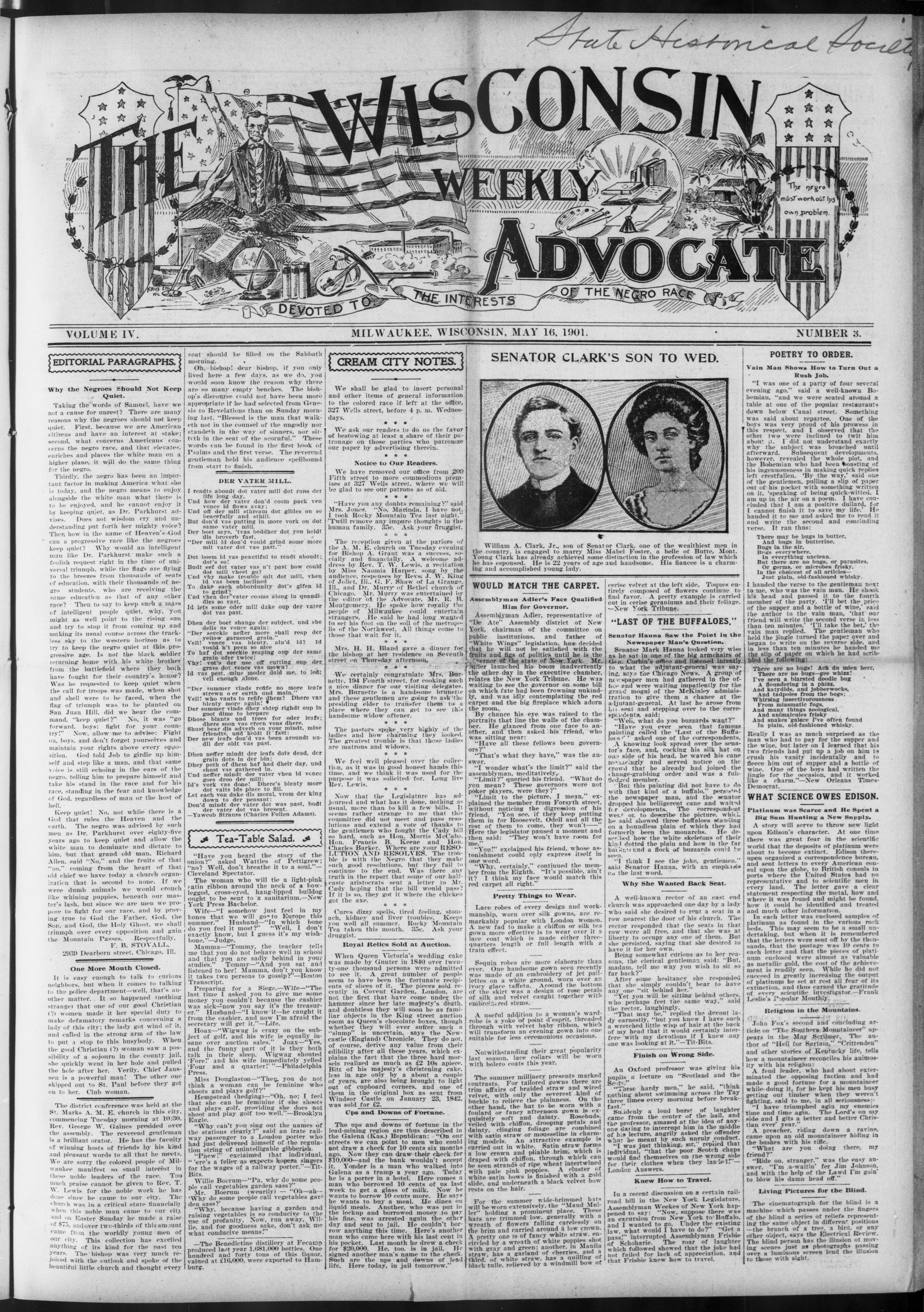
SENATOR CLARK'S SON TO WED.
Mary
William A. Clark, Jr., son of Senator Clark, one of the wealthiest men in the country, is engaged to marry Miss Mabel Foster, a belle of Butte, Mont. Young Clark has already achieved some distinction in the profession of law which he has espoused. He is 22 years of age and handsome. His fiancee is a charming and accomplished young lady.
William A. Clark, Jr., son of Senator Clark, one of the wealthiest men in the country, is engaged to marry Miss Mabel Foster, a belle of Butte, Mont. Young Clark has already achieved some distinction in the profession of law which he has espoused. He is 22 years of age and handsome. His fiancee is a charming and accomplished young lady.
WOULD MATCH THE CARPET.
Assemblyman Adler's Face Qualified Him for Governor.
Assemblyman Adler, representative of "De Ate" Assembly district of New York, chairman of the committee on public institutions, and father of "White Wings" legislation, has decided that he will not be satisfied with the fruits and figs of politics until he is the governor of the state of New York. Mr. Adler launched his boom inadvertently the other day in the executive chamber, relates the New York Tribune. He was waiting to see the governor on some bill on which fate had been frowning unkindly, and was idly contemplating the red carpet and the big fireplace which adorn the room.
By chance his eye was raised to the portraits that line the walls of the chamber. He glanced from one face to another, and then asked his friend, who was sitting near: "Have all these fellows been governors?"
"That's what they have," was the answer.
swer.
"I wonder what's the limit?" said the assemblyman, meditatively.
"Limit?" queried his friend. "What do you mean? These governors were not poker players, were they?"
"Limit to the picture, I mean," explained the member from Forsyth street, without noticing the digression of his friend. "You see, if they keep putting them in for Roosevelt, Odell and all the rest of them to come, they won't—" Here the legislator paused a moment and then said: "They won't have room for me."
"You!" exclaimed his friend, whose astonishment could only express itself in one word.
"Why, certainly," continued the member from the Eighth. "It's possible, ain't it? I think my face would match this red carpet all right."
Pretty Things to Wear.
Lace robes of every design and workmanship, worn over silk gowns, are remarkably popular with London women. A new fad to make a chiffon or silk tea gown more effective is to wear over it a lace coat which is made either three-quarters length or full length with a train effect.
Sequin robes are more elaborate than ever. One handsome gown seen recently was made of an embroidery of jet paillettes on a white ground, worn over an ivory glace taffeta. Around the bottom of the skirt was a design of rose petals of silk and velvet caught together with embroidered stems.
A useful addition to a woman's wardrobe is a yoke of point d'esprit, threaded through with velvet baby ribbon, which will transform an evening gown into one suitable for less ceremonious occasions.
Notwithstanding their great popularity last season, lace collars will be worn with bolero coats this year.
The summer millinery presents marked contrasts. For tailored gowns there are trim affairs of braided straw and wired velvet, with only the severest kind of buckle to relieve the plainness. On the other hand, the hat to be worn with a foulard or fancy afternoon gown is exquisitely soft and dainty. Rosebuds, veiled with chiffon, drooping petals and dainty, clinging foliage are combined with satin straw or mousseline in charming models. An attractive example is carried out in white. Satin straw forms a low crown and pliable brim, which is draped with chiffon, through which can be seen strands of ripe wheat intertwined with pale pink poppies. A cluster of white satin bows is finished with a gold slide, and underneath a black velvet bow rests on the hair.
For the summer wide-brimmed hats will be worn extensively, the "Maud Muller" holding a prominent place. These hats are trimmed low, generally with a wreath of flowers falling carelessly on the brim and carried around a low crown. A pretty one is of fancy white straw, encircled by a wreath of white poppies shot with gray and green; another, in Manila straw, has a garland of cherries, and a third, of white straw, has a quilling of black tulle relieved by a windmill bow of
cerise velvet at the left side. Toques entirely composed of flowers continue to find favor. A pretty example is carried out in cerise geraniums and their foliage. New York Tribune.
"LAST OF THE BUFFALOES."
Senator Hauna Saw the Point in the Newspaper Man's Question.
Senator Mark Hauna looked very wise as he sat in one of the big armchairs of Gen. Corbin's office and listened intently to what the adjutant-general was saying, says the Chicago News. A group of newspaper men had gathered in the office and were waiting impatiently for the grand mogul of the McKinley administration to give them a chance at the adjutant-general. At last he arose from his seat and stepping over to the correspondents, said:
"Well, what do you buzzards want? "Have you ever seen that famous painting called the 'Last of the Buffalos/' asked one of the correspondents. A knowing look spread over the senator's face, and, cocking his silk hat on one side of his head, he waved his cane menacingly and served notice on the crowd that he already had joined the change-grabbing order and was a fulledged member.
But this painting did not have to do with that kind of a buffalo," persisted the newspaper man, and the senator dropped his belligerent cane and waited for developments. The correspondent went on to describe the picture, which he said showed three buffaloes standing on a boundless plain of which they had formerly been the monarchs. He described how the white skeletons of their kind dotted the plain and how in the far background a flock of buzzards could be seen.
"I think I see the joke, gentiemen." said Senator Hanna, with an emphasis on the last word.
Why She Wanted Back Seat.
A well-known rector of an east end church was approached one day by a lady who said she desired to rent a seat in a row nearest the door of his church. The rector responded that the seats in that row were all free, and that she was at liberty to occupy any one of them. But she persisted, saying that she desired to have it for her own.
Being somewhat curious as to her reasons, the clerical gentleman said: "But, madam, tell me why you wish to sit so far back?"
After some hesitancy she responded that she simply couldn't bear to have any one "sit behind her."
"Yet you will be sitting behind others, who perhaps feel the same way," said the rector laughingly.
"That may be," replied the devout lady earnestly. "but you know I have such a wretched little wisp of hair at the back of my head that it would certainly interfere with my devotions if I knew any one was looking at it."—Tit-Bits.
Finish on Wrong Side.
An Oxford professor was giving his pupils a lecture on "Scotland and the Scots."
"These hardy men," he said, "think nothing about swimming across the Tay three times every morning before breakfast."
Suddenly a loud burst of laughter came from the center of the hall, and the professor, amazed at the idea of anyone dating to interrupt him in the middle of his lecture, angrily asked the offender what he meant by such unruly conduct.
"I was just thinking, sir," replied that individual, "that the poor Scotch chaps would find themselves on the wrong side for their clothes when they landed!"—London Answers.
Knew How to Travel.
In a recent discussion on a certain railroad bill in the New York Legislature, Assemblyman Weekes of New York happened to say: "Now, suppose there was an excursion from New York to Buffalo, and I wanted to go. Under the existing law, what would I have to do?" "Get a pass!" interrupted Assemblyman Frisbie of Schoharie. The roar of laughter which followed showed that the joke had not failed for lack of appreciation, and that Frisbie knew how to travel.
POETRY TO ORDER.
Vain Man Shows How to Turn Out a Rush Job.
"I was one of a party of four several evening ago," said a well-known Bohemian, "and we were seated around a table at one of the popular restaurants down below Canal street. Something was said about repartee. One of the boys was very proud of his prowess in this respect, and I observed that the other two were inclined to twit him about it. I did not understand exactly why the subject was broached until afterward. Subsequent developments, however, revealed the whole plot, and the Bohemian who had been boasting of his ingenuousness in making quick replies left crestfallen. 'By the way,' said one of the gentlemen, pulling a slip of paper out of his pocket with something written on it, 'speaking of being quick-witted. I am up in the air on a poem. I have concluded that I am a positive dullard, for I cannot finish it to save my life.' He handed it to me and asked me to read it and write the second and concluding verse. It ran thus:
There may be bugs in butter, and then in butter.
I handed the verse to the gentleman next to me, who was the vain man. He shook his head and passed it to the fourth member of the party. 'I'll bet the price of the supper and a bottle of wine, said the author to the vain man, 'that our friend will write the second verse in less than ten minutes.' 'I'll take the bet,' the vain man replied. The gentleman who held the jingle turned the paper over and began to write on the reverse side, and in less than ten minutes he handed me the slip of paper on which he had scribbled the following:
And snakes galore I've often found In plain, old-fashioned whisky.
Really I was as much surprised as the man who had to pay for the supper and the wine, but later on I learned that his two friends had put up a job on him to crush his vanity incidentally and to fleece him out of supper and a bottle of wine. One of the boys had written the jingle for the occasion, and it worked like a charm."—New Orleans Times-Democrat.
WHAT SCIENCE OWES EDISON.
Platinum was Scarce and He Spent a Big Sum Hunting a New Supply. A story will serve to throw new light upon Edison's character. At one time there was great fear in the scientific world that the deposits of platinum were about to become extinct. Edison thereupon organized a correspondence bureau, and sent letters to every American consul upon the globe, to British consuls in ports where the United States had no representative and to scientific men in every land. The letter gave a clear statement respecting the metal, how and where it was found and might be found, how it could be identified and treated and much other information.
In each letter was enclosed samples of platinum as found in the various rock beds. This may seem to be a small undertaking, but when it is remembered that the letters were sent off by the thousands, that the postage was 10 cents to each letter and that the pieces of platinum enclosed were almost as valuable as metallic gold, the cost of the achievement is readily seen. While he did not succeed in greatly increasing the output of platinum he set at rest all fear of its extinction, and thus earned the gratitude of every scientific investigator.—Frank Leslie's Popular Monthly.
Religion in the Mountains.
John Fox's second and concluding article on "The Southern Mountaineer" appears in the May Scribner. The author of "Hell for Sartain," "Crittenden" and other stories of Kentucky life, tells how a mountaineer reconciles his animosity with his religion:
A feud leader, who had about exterminated the opposing faction and had made a good fortune for a mountaineer while doing it, for he kept his men busy getting out timber when they weren't fighting, said to me, in all seriousness:
"I have triumphed again my enemies time and time again. The Lord's on my side and I gits a better and better Christian ever year."
A preacher, riding down a ravine, came upon an old mountaineer hiding in the bushes with his rifle.
"What are you doing there, my friend?"
"Ride on, stranger," was the easy answer. "I'm a-waitin' fer Jim Johnson, and with the help of the Lawd I'm goin' to blow his damn head off."
Living Pictures for the Blind.
The cinematograph for the blind is a machine which passes under the fingers of the blind a series of reliefs representing the same object in different positions—the branch of a tree, a bird, or any other object, says the Electrical Review. The blind person has the illusion of moving scenes just as photographs passing over a luminous screen lend the illusion to those with sight.
A WALKOUT 1S IN SIGHT.
Machinists will Strike May 20 if
Demands Are Not Met.
DECISION IS REACHED.
PN are eo re eae
Men involved directly.......--. 100,000 ¢
Men in allied trades affected
Indirectly ......2-22.02 2+-+++ 150,000
Money in International treasury $40,044 |
Money in reserve strike fund of
BION .--.--.2eeee oeeeeee += $200,000 |
Weekly fund that may be raised
by assessment .........-..-..- $50,000"
Machinists in cities, estimated—
Milwaukee ... 2,500 Buffalo........ 2,500
New York :..10,000 Pittsburg .... 2,500 (
Chicago ...1/1 5,000 Cleveland +... 2,000 |
Boston ...... 3,000/Cincinnati ... 2,000 |
Providence... 2,000/New Orleans. 1,500 |
} Philadelphia... 3.000S8an Francisco 2,500 |
Washington, D. C., May 15.—By a de-
cision reached by the representatives of
the Machinery and Allied Metal Trades’
National and International union, all
workers in these trades will demand an
increase of 12% per cent. in wages in ad-
dition to the concession of nine hours as
a working day, their demands to be com-
plied with before May 20. The big chiefs
of these organizations, after a long con-
ference, gave out for publication this
statement.
Its significance is that a strike among
the several cLundred thousand workmen
can now ke averted only by yielding. oa
the part of the employers.
A significant decision of the several
cfficers was io the effect that each er-
ganization would stand by the other
should it be necessary to cease work. In
othe: words. a strike that will extend
throughout aii branches of the several
trades is premised should not the de-
mands of the mechanics be complied
with,
Expect a Speedy Surrender.
The officers discussed at length the ay
sibilities of a strike and held that while
one was imminent unless the demands
are conceded within a few days, they
hoped by a combination of interests to
avoid a leug holdout. Accordingly it was
determined to give out for publication a
somewhat encouraging declaration of the
“opinion” of the several chiefs after
there had been a full discussion of the
situation in all its phases. This opinion
follows:
“In view of the encouraging reports
received from a large number of em-
ployers in trades havimg already notified
their employes of the concession to the
above demand, no serious opposition to
the movement is anticipated.
_ The idea was to talk encouragingly un-
til there are signs of absolute refusal
from employers. Then the tune of the
~utterances of the leaders will change and
the word will go along the line to quit
work.
Signing the Agreement.
President O'Connell of the National
Association of Machinists, stated today
that 300 firms throughout the country so
far have signed the nine-hour agreement.
Recah reports from Boston show
that a large number there signed today
and in Elmira, what is claimed ‘to be
the largest steam fire engine plant out-
side of the trust has agreed to terms.
The executive board of the machinists
association will meet here Friday and
remain until after the 12th instant, the
date when the strike order is ta be effec-
ota.
NINE MEN KILLED.
Lighted Torch Carried Into a Mine
Causes an Explosion with
Fatal Results.
Farmington, W. Va., May 15.—Nine
men were killed, three fatally injured,
and a number of others burned by an ex-
plosion in the shaft of the Georges Creek
Coal & Iron company, at this place, at
9:15 o'clock today. The number of dead
may exceed nine, as several miners are
still missing and only a few of the bodies
have been brought out of the mine. The
known dead are: Carl Hunter, Daniel
Alferie, Tony Reminick, I. H. Everson,
Joseph Nichols, Hanor Beatty and three
unknown Italians.
Injured: Jeff Fast, Joseph Blaney,
Hershel Everson, Thomas Bambridge,
Charles Carpenter and several unknown
Italians.
The explosion is said to be due to car-
rying a lighted torch in the mine.
ASLEEP IN THE HOLD.
Steamer Owensboro Burns to the
Water’s Edge and Four Men
" Are Killed.
Evansville, Ind., May 15.—Four men
were killed during the night in a fire
which destroyed the steamer Owensboro,
a _towboat, tied up at dock at Calhoun,
Ky. The dead are: Fireman Crenshaw
of Evansville, Fireman Brinkman of
Evansville; two roustabouts, names un-
known.
A fire broke out aboard the boat short-
ly before midnight and in a short time it
burned to the water's edge. Capt. East-
man and Engineer Robinson barely had
time to escape. The others are sup-
posed to have been asleep in the hold
and were overcome by smoke. Loss on
boat, $6000.
HIS PLEASURE MARRED.
Divorced Wife Leaves Three Children
on Former Husband's Porch,
Princeton, Ind., May 15.—Daisy Wil-
hite was divorced from her husband,
Lawrence Wilhite, seven months ago and
given custody of three smell children, the
youngest being 11 months old. Socn
after Wilhite married the widow of Wil-
jiam McCarty, a wealthy livery man and
farmer, who had been dead only six
months. Mrs. Wilhite left the three chil-
dren on the porch of the residence of
her former husband. He refused to take
them and the mother cannot be found.
as she at once took the Chicago limited
going north. The children are now [n
eustody of the matron of the Orphans’
heme.
SHOCK TO GAMBLERS.
Attorney General’s Order Closes Every
House in Montana.
Helena, Mont., May 15.—Every gam-
bling house in Montana closed yesterday,
Attorney-General Donovan having in-
structed every county attorney to see
that they were shut up, or else he would
roceed against them for neglect of duty.
it is the most radical step at reformation
ever taken in Montana, and the first
time since the discovery of gold that
faro has not been dealt in the state.
Former School Teacher Insane.
Iron Mountain, Mich., May 15.—Miss
Nellie Keene, a former teacher in the
public schoois, has been adjudged insane
and has been taken to the state hospital
at Newberry.
LIPTON IS CHAGRINED.
Disappointed Over Work of the
Cup Challenger in Yester-
day’s Race.
Gays mace
London, May 14.—Sir Thomas Lipton
returned to London this morning, cha-
grined by the result of yesterday's race;
but he is confident the Shamrock II. is
the better boat and thoroughly believes
something has gone wrong. He is anx-
jous to see her in drydock.
It is just possible the Shamrock I. may
cross the Atlantic, but Sir Thomas Lip
ton does not entertain any idea of sub-
stituting the old for the new boat in the
cup races, being certain Mr. Watson's
creation, in the Jong run, will prove su-
perior to Mr. Fife’s.
How the Race was Sailed.
Weymouth, May 13.—Yesterday’s race
was over a triangular course of twenty
miles. A fresh easterly wind was blow-
ing at the start, dying away to a light
breeze toward the end of the trial. The
time was: Shamrock I., 2:06:14; Sham-
rock II., 2:11:19.
At 10:30 o'clock Shamrock I. sent up
its working topsail, broke away its jib,
and got under way for the outside break-
water. 5
At 11:20 Shamrock II. had its anchor
on deck and headed out of the roads
sen the wind, following the old chal-
lenger.
The wind outside was fresh, and both
yachtg heeled until their lee rails were
well under water. he ene whis-
tle was sounded at 11:40 o'clock, and
the yachts reached to port for the flag-
boat, Shamrock I. a length ahead of the
cae The first stage of the trial
was a Jong tack to the southward. The
new boat seemed to make no gain for the
first mile. Capt. Sycamore tried in vain
for the weather passage, and when off
the breakwater he bore away under the
old boat's stern.
Close Together at Third Mile.
On the reach for the Shambles light-
ship the challenger was still astern. As
they came about at the ight time
taken was: Shamrock I., 12:17:02; Sham-
rock II., 12:17:47. On the Sena tack
toward Whitenose es the challenger
drew up on the’ leader; and after three
miles it sailed right under the old boat's
lee quarter.
Capt. Sycamore, on the challenger,
could not squeeze past on the leeward.
At 12:40 he cast round to port, Sham-
rock I. coming after and showing clear
ont on the weather bow. There was a
decided lessening of the breeze and the
sun began to break through. They came
about again to starboard, fifteen minutes
later, wite the positions unchanged, and
in two more tacks rounded Erin to the
southward of Whitenose point. Both
yachts swung mainsails to port for a
free stretch, carrying jib topsails.
On the last leg of the course the old
challenger still seemed to be having the
better of it. With sheets eased off. it
seemed to be the new boat’s superior if
they were sailing on their real form.
Booms were nearly square off as they
ran down for the mark, and on a signal
from the challenger the trial was brought
to a close with one round.
The wind was light at the close. It
looked as if the challenger was more up
by the head than before, but there was
no question about it showing more of a
fuss at the bows, both down the wind
and while working against a sea.
Excuse for the Defeat.
The party aboard the Shamrocks and
Erin after the race admitted that it was
a real trial, and that the challenger was
beaten, but they minimize the result.
‘The defect in the challenger’s mainsail,
they say, was bad, and Shamrock I. was
in_remarkable form.
Robert Ure, who was on Shamrock L.,
says it never sailed a better race.
No doubt there was keen disappoint-
ment over the result, and especially after
the performance of Shamrock II. in the
Solent on Thursday, where pans the
tides had something to do with the result,
but there is a strong conviction that: it
will be greatly improved by a new main-
sail and better set topsails.
A well-known Baghish yachting author-
ity, who sailed on Shamrock I., said the
chalieniee® was quite outsailed and is no
good.
On the reach in the first leg Shamrock
I. gained one minute; it eae three-
quarters of a minute on the beat, and
over two and a half minutes on the run
home.
Shamrock I. {neligible.
New York, May 14.—According to the
deed of gift of the America cup to the
New York Yacht club, it would, appear
that the Shamrock I. cannot be motatl-
tued for the Shamrock II. in this year’s
contest for the America cup. One clause
of the deed of ae reads:
“No vessel which has been defeated in
a match for this cup can be again select-
ed by any club as its representative un-
til after a contest for it by some other
vessel has intervened. or until after the
expiration of two years from the time
of ee defeat.” %
e necessa: two years have not
aoe The ‘Columbia and the Sham-
rock I. met October 16, 17 and 20, 1899,
and the next series of races were sched-
uled, in the acceptance of the challenge,
for ‘August 20, 22 and 24, of this year,
or a week later if anything should hap-
yen to delay the challenger. Consequent-
y, it seems the two-year condition can-
not be made available until after the next
MANDAMUS REFUSED.
Ohio Judge Forbids Publication of
Testimony in Murder Case.
Columbus, O., May i4.—An_ opinion
was handed down today by the Supreme
court in the application by a Cleveland
newspaper for_a writ of mandamus
against Judge Young to compel him to
carat the publication of testimony in the
ohnson reurder case now on trial at Up-
per Sandusxy. ‘he writ is denied. The
ease has attracted wide notice because of
Judge Young's ruling-forbidding the pub-
lication of testimony in the case.
Ter: Cents on the Dollar.
Menominee, Mich., May 14.—According
to the reports filed in the probate court
ofqMenaminee, the liabilities of the late
Joseph Miesheim aggregate $80,000, while
the asecty sre about £10,000. arate of
Probate Grignon says that the creditors
will receive about 10 cents on the dollrr
in settlement of their claims.
OM Reate Steam in Reaste.
| In Russia oi! holds absolute sway. And
from Baku to Nishni Novgorod petro!-
-eum finds favor on railways and steam-
ships alike. For 2000 miles long the Voi-
ga boats ply from north to south pro-
Pouca by. means of oil, of which 8,000,.
0 tons is used in Russia alone. A fleet
of nearly forty steamers, burning noth-
ing but liquid fuel. is run between Lon-
don and Borneo. with the most satisfac.
tory results. This ime, called the “Shetl
Transport & Trading company,” brings
petroleum direct from the oil fields of
Borneo to London.—London Express.
The Pear! Islands.
For something like a hundred years
and more the small group of islands fifty
miles to the south of Panama, known as
the “Pearl Islands.” have been famous
for their remarkable yield of pearls and
coral.
—In the last sixty years the speed of
ocean steamers has increased from 8%
to 22% knots an hour.
—London has 690 acres or docks; Liv-
erpool, 560 acres.
BECOMES SERIOUS.
Septeaeeeee
An Alarming Bulletin Issued at San
Francisco Regarding the Illness
of Mrs. McKinley.
San Franciseo, Cal., May 15.—The
President has abandoned his trip to the
Northwest.
Poe ee TT
Sap Francisco, Cal., May 15.—At 10
o'clock this morning Secretary Cor-
telyou informed the Associated press
that Mrs. .MeKinley’s serious — ill-
ness had compelled the President
to abandon his proposed visit to other
/states to which he had looked forward to
with such pleasure. As soon as Mrs.
McKinley's health permits he will return
to Washington, by the most direct route.
Secretary Cortelyou also issued the fol-
lowing bulletin as to Mrs. MeKinley’s
condition: ‘
“There has been but little change in
Mrs. McKinley’s condition since last
night. She has gained in some respects
and lost in others.”
The President will remain quietly at
Mr. Scott’s residence today and will not
take part in any of the exercises given
in his honor.
Cosultation of Physicians,
It is learned that Mrs. McKinley's con-
dition is considered serious by the phy-
sicians attending her.
Drs. Rixey and Hirschfelder were in
consultation this morning and another
physician will be called in this afternoon.
It is probable that if she recovers Mrs.
McKinley will be unable to leave Sau
Francisco by next Monday, when the
stay of the presidential party was to
have terminated. , e
The President will remain here with
Mrs. McKinley.
Ominously Silent.
At noon Secretary Cortelyou stated
that he could give no additional -infor-
mation about Mrs, McKinley beyond the
bulletin issued at 10 o'clock.
When informed that it was reported
that Mrs. McKinley’s condition was most
critical, the secretary said he could not
discuss the matter.
Hay in President’s Place.
President McKinley did not go to
Berkeley today to attend the commence-
ment exercises at the Lele Cali-
fornia. The illness of Mrs. McKinley
prevented the President from participat-
ing in the ceremonies, but the members
of the cabinet and others of the presiden-
tial party crossed the bay on the reve-
nue tug, Slucum. As the little steamer
crossed the harbor the warships lying at
anchor in the bay saluted and all the bay
steamers sounded their sirens, The
guests were taken to the university
grounds and the exercises of the day
were observed with Secretary Hay acting
in the President's stead.
President Benjamin Ide Wheeler of the
University of California then entertained
the party at luncheon.
BANISHED ROYALIST
SUDDENLY RETURNS.
Threatening Letter Read to French
Senate—Conspirscy Against
the Republic.
Paris, May 15.—Another convocation
of the French Senate as the high court
of France is promised by the unexpected
return to this country of the Marquis
de Lur-Saluces, the well-known royalist
and former member of the chamber of
deputies, who. in January, 1900, at the
time of the conspiracy trials, vat oe
demned, in default of appearance, té/
years’ banishment for treason. The pre-
ident of the Senate, M. Fallieres, re-
ceived a letter today in which the mar-
quis says:
“At the present moment, when the
zovernment. of the republic is striving
desperately to ruin industry and com-
merce, paralyze national work, disorgan-
ize the army and destroy religious faith
—in a word, to utterly destroy the Fath-
erland itself—I intend to provoke anoth-
er public discussion before the high
court, on the question of who are the
Teal authors of the conspiracy threaten-
ing the existence of France. I hold my-
self at your disposition.”
The letter caused much stir in the lob-
bies of the, Senate.
The Marquis de Lur-Saluces sought
refuge in Belgium, where he was closely
watched by the police, whom he succeed-
ed in eluding and returned to his man-
sion in Paris a few days ago.
MANY LIVES LOST.
——
Houses in Italian Village Swept
Away by Fall of Immense
Rock.
Rome, May 15.—Most of the houses of
the village of Acerenza, near Potenza,
have been swept away by the fall of an
immense rock. Troops have been dis-
patched to the scene of the disaster.
Thus far fifteen bodies have been recov-
ered.
SHOT AT J. K. CHOATE.
wrt _——
Widow had Judgment Against Him
for Breach of Promise.
Denver, Col., May 15.—Mrs. Marths
Ewart, a widow, proprietress of a fash
ionable rooming house, fired two shots ai
Joseph K. Choate, manager of the Over
land Cotton mills, and nepaew of Unitec
States Ambassador Choate, in the law
office ef Wolcott & Vaile, during a con
ference last night. Neither of the bullet:
took effect.
About a year ago Mrs. Ewart suec
Choate for alleged breach of promise an¢
secured a judgment. She says she at
sempiee to shoot him because he had no’
settled the judgment. She was arrested
On February 14 last Mr. Choate was
married in Brooklyn, N. Y., to Miss Alice
Muller.
SMITH WILL NOT RETIRE.
Postmaster General Hes Not Even Con:
sidered Such a Step.
San Francisco, Cal., May 15.—Rumor:
circulated in the East that Postmaster
General Charles Emory Smith contem
plates retiring from the cabinet and that
H. Clay Evans, United States - commis
sioner of pensions, is scheduled to suc
ceed him, were denied today by Mr
Smith. He said:
“I have not even considered such ¢
step. I think it peers the report aros¢
from the fact that upon the expiratior
of the lease upon the house I occupy ir
Washington I did not renew it, for the
reason that I wished to make a change
of residence, but not leave Washington.’
COULDN’T SEE THE TAIL.
Comet Discovered in Australia Noted
by Observers in California,
Lick Observatory, Cal.. May 15.—A
comet discovered at Queenstown, Aus-
tralia, on 7 24, was seen here last
night. In the strong twilight no tail
could be seen, only the head of the com-
et. Its position, observed by Mr. Aitken
at 8 p. m., was right ascension 5 hours
and 33 minutes, declining 3 degrees 37
minutes north. This is the first time
the comet has been seen at any observ-
atory in the Northern hemisphere. The
comet is much fainter than when discov:
ered and will not ve visible here withou!
a telescope.
THE LEGISLATURE.
Senate.
MaRS ee Se eee, See ee ee
to the Senate the governor held that it Is
| the power of a common council to fix the
salaries of both chiefs. The bill creating
| the county of Gates from the northern Pet
of Chippewa county, was advanced to third
reading, 18 fo 11, with an amendment as-
signing the new Kreg! to its proper sena-
torial and assembly districts. ‘The Senate
refused by a vote of 20 to 8 to order to ep-
grossment the bill providing for the adep-
tion of the Torrens system of land titles fn
‘Visconsin. Senator Whitehead endeavored
ro have recoonsidered the vote by which the
Senate killed the bill providing that when
the one-miii school tax realizes a greater
amount thar $850,000, the rate shall be
lowered to bring in’ that umount only. The
Senate refesed, 20 to 10, to reconsider its
xetion. The Hatton bill providing for the
payment of traveling expenses of state
officials and employes traveling on public
business, was advanced to third reading.
The Whitehead bill, 333 8.. amending the
statutes relative to extension of spur tracks
to warehouses, etc.. was Killed. The Owen
LIU, authorizing cities of the third. and
fourth classes to levy a S-mill special tux
for school purposes, was concurred In The
move to permit the city of Milwaukee to
Issve long-term bonds was endorsed by the
Senate. that body concurring, 23 to 7, In
the Keene resolution for a constitutional
amendment permitting cities having a popu-
lation of over 25,000 to issue bonds for a
term of fifty years. The bill prokitelting
the running ‘of double-header trains, which
has been agitated by the Assembly railroad
committee most of the winter, and was
passed by the Assembly, was killed by the
Senate with scant ceremony by a vote of
22 to 7. The Rossman pool ill, permitting
the selling of pools on harness races not
more than ten days wes killed. It was
passed by the Assembly by a close vote,
but found only six supporters in the Sen:
ate. The Senate refused by a tle vote, 14
to 14, to order to third reading the bill’ im-
posing a tax of 10 cents a ton on ice shipped
uvt of the state.
The Senate on the evening of the 9th con-
curred In joint resoimtion No. 8 A., provid-
ing for a constitutional amendment pr)
hibiting public officers from using railr at
passes or telephoue and teiegraph franks.
[he resolution was coneurred in by 2 yote
of 21 to %. The Senate suspended the rues
and concurred in the Assembiy amendmen
to the Roehr bill providing for ¢ consol‘da-
tion of the county and city governments of
Milwaukee. Senator Riordan decided not
to press the motion made in the morning
for a reconsideration of the vote by which
the congressional apportionment Dill was
concurred in, Mr. Devos, at the request
of Mx. Riordan, made the motion to _recon-
sider, but later withdrew it. The Whitson
bill, No. 611 A., providing for a standard
scale for the measuring of logs. was orderod
to a third reading. The comimittee on pub
lic health and sanitation adversely report-
ed the Dill prohibiting the cutting of fe?
in the Milwaukee river for domestic use:
also the Hall three-eornered polson bottle
bill. — Another bill reported for slaughter
was No. 554 A., allowing villages and cities
to tax rallroad property within thelr con-
fines. Among the bills favorably reported
were those providing for the creation of a
state livestock sanltury board, exempting
beet sugar factories “fram taxation, com
peling foreign corporations to comply with
the regulations governing domestic com-
panies of the same character, allowing fish
to be sneared In Waukesha county, ‘and cre-
ating the office of county supervisor of es
sessment.
Gov. La Follette’s veto of the Hagemeis-
ter substitute primary élection bill was sent
to the Senate on the 10th. At the con-
clusion of the reading of the governor's
message Senator “Long” Jones, leader of
the supporters of the bill In the Senate,
moved that immediate acGon ve taken on
the veto, and the motion prevailed. The
yote was 18 to 11, the supporters of the bill
lacking but two of the necessary two-thirds
to pass the measure over tne veto. The
governor also returned without ‘approval
No, 328 S., repealing an act passed in 1803,
petkorieing iE. 8. Hammond to improve
‘Lost Creek, in Sawyer county. ‘The gover-
nor based ‘his disapproval on the ground
that it would deprive the owner of his.
rights, which could be properly settled in
court. The vote on So the bill over
the veto was: Ayes 17, noes 12, again lack-
ing two for the hecessary two-thirds. The
governor's veto of the bill increasing the
salaries of the Milwaukee police and fire
chiefs was sustained. Senator MeGillivray
started another move for good roads by the
introduction in the Senate of a joint resolu-
tion authorizing the governor “to appoint |
a commission, to be known as the comiis-
sion on country reads, the members to
serve without compensation." The resolu-
tlon was passed under suspension of the |
rules, The Senate by a vote of 17 to 10.
reconsidered its vote killing the bill taxing |
lee shipped out of the state 10 cents a ton,
and ordered it to third reading. The Hall
triangular poison bottle bill, which found
its way through the Assembly after a hard
fight, was killed in the Senate. The Len-_
root anti-trust bill, recommended by the
committee for nonconcurrence, was killed
without discussion or a roll call, The
Milwaukee ice bill was killed 16 to 8 The
Senate by unanimous vote adhered to its
amendments to the bill authorizing bieu-
nial elections in cities, refused by the As-
sembly, and 2 conference committee was
requested. Senators Hatton, Gaveney and
Miller were appoisited as Senate members
of the committee. The Reynolds bill re,
pealing the law relative to the purchase of
road machines by towns on petition was
killed.
Senator Jones in a speech in the Senate
on the evening of the 10th scored Gov. La
Follette for the way he criticizes in his
veto message the opponents of the so-called
radical primary election bill, The opper-_
fey for this speech came when the Ag-
7 amendment to the bill providing for |
a uniform system of state bookkeeping was |
taken up. The Overbeck bill levying a
charge of 10 cents a ton on all ice cut by
foreign corporations for shipment outside |
the state was passed by a vote of 17 to 9.
The McGillivray anti-trust bill was killed.
The judiciary committee amendment modi-
tying the provisions of the bill was reject-
ed by a vote of 15 to, 10, The bill was
killed by a viva voce vote. In order to kill
it beyond possible resurrection, Mr. Devos
moved a reconsideration, which motion was
lost by a vote of 19 to 5. The report of
the conference committee on the bill pro-
viding for biennial instead of annual elec-
tions in cities was adopted. It provides
for biennial election of all elective officers,
except aldermen. in cities of the second,
third. and fourth classes. The Assembly
amendment to the bills giving the Lge
authority to investigate state Institutions.
previding for a woman factory Insp-¢ or
and providing for a distribution of ali leg-
islative bills and resolutions among coun y
and city clerks were concurred in. The b'll
providing for the use of voting machines
at elections and that providing for the sub-
mission of the anti-pass resolution to the
people for approval or rejeccion were or-
dered to a third reading. *
So far as business is concerned, the forty-
fifth regular session of the Wisconsin Legis-
lature cxume to an end shortly after noon on
the 11th. The closing session of the Senate
Was un exciting one. Senator Roehr offered
a resolution to the effect that the Senate
resented the aspersions cast upon its official
nets by the governor's message vetoing bili
No. 73 S., commonly known as the Hage-
meister primary election bill. Senator Me-
Gillivray answered in a heated speech and
was followed by Senator Miller, who re-
ferred to the spe house as a “subsidized”
body. Senator Kreutzer replied to Senator
McGillivray’s remarks and Senators Mar-
tin and Mills spoke briefly, the latter ex-
pressing. rawret at the tanenage tised by
ee Seer ae So Se ee
Investigate the state departments and re-
por an te reductions in the clerical forces,
he state accounting bill was finally brought
to life by the Senate concurring in the bil)
as passed by the Assembly with the pre-
vision for the employment of clerks by the
secretary of state and treasurer stricken
ovt. The vote was 15 to 6, at the neces-
sary three-fifths voting. e Assembly
omendments to the state forestry bill, re-
‘ueing the expense of the commission from
$10.000 to $5000 and the salary of the su-
perintendent from $2500 to $1800 were con-
cwred in. The last act of the Senate was
to kill the Hatton bill No. 335 &,
relative to auditing bills, by refusing to con-
evr in the Assembly amendments. Ad-
journment: was to the evening of the 13th.
Both houses of the Legislature met for a
short session on the evening of the 13th,
with a few members in their seats. The
roll could not be called in either house, as
it would have disclosed the lack of a quo-
rrm. The Senate came very near to having
a quorum, there being fourteen members
present, Chairman Hatton of the commit-
tee on cnrolled bills reported thirty-two
laeasnves to the Senate ax correctly en-
rolled. The governor had no message for
the Senate and Jt adjourned after a very
short session until! 10 a. m. on the 14th.
The Senate was In session seven minutes
on the 14th, Just long enough for the read-
ing of a message from Gov. La Follette re-
porting his approval of thirty-three | bills.
Among them was the general fish and gime
bil, the bill providing for un electric light-
ing plant for the ee building and
grcunds, thesbill providing for the payment
of covnty ofders issued wnder the invalid
Keeley cure law, the Milwaukee school
card bill, and the bill providing for county
training scbools for teachers in the com-
mon schools, There were no vetoes, Ad-
journment was taken until the following
tmwerning at 10 o'clock,
Both houses of the Legislature adjourned
ov the 15th, sine die at noon by the clocks
of the two hovses, but at 12:28 by actual
time, the clocks in both houses being
turned back to give the governor opportun-
ity to report on bills. ‘Phere were iourteen
senators on hand to close the session of
the upper house. Sergeant-at-Arms_ Petti-
bone was presented with a roll of cash
umovnting to an even $100 us a token of
the esteem in which-he is held by the sen-
ators. Senator Jones quietly handed hin:
the roll, to which all the senators present
contributed. Mr. Pettibone finished has
second term as sergeant, and prior to that
he served two terms as assistant.
Assembly.
The time of adjournment was finally set-
tled on the 9th by the Assembly concurring
in the Senate resolution calling for the end
of all busiuess at noon on the lith except
consideration of reports from committees
on enrolled bills ind messages from the
governor, and final edjournment on the 15th
ut 12 o'clock noon. The first bill tuken oy
was the Collins bill prone for compu! fe]
sory vaccination in case of epidemics. The
Senate amended it so as to exempt from the
workings of the law any person who shall
go before a judge and swear that vacciua-
tion is against his religious belief. The As-
sembly concurred in this amendment, which
practically kills the bill. The Assembly
passed the bill allowing the common voun-
cil of the city of Milwaukee vy a two-thirds
vote within two years after any state or
United States census to redistrict the city
into wards. No ward shall be created hay-
ing less than 8000 or more than 20,000
ae ane The voting-machine bill to al-
low any eens to adopt a machive
after its approval by a commission was
passed, It has yet to pass the upper house.
‘The House refused toe concur in the Senate
amendment to the committee bill calling
for biennial elections in cities. Senate bills
were concurred in: Relating to attorneys’
fees in settling estates; authorizing George
Tarrant to build a bridge across the Chip-
pars at Ladysmith. Senator Whitehead s
pill relating to street Improvement, which
had caused so much trouble, was on the
calendar for concurrence. It was killed, 32
to 47. This is the second death of the
measure. The stationary engineers’ license
question was threshed over again upon mo-
tion of Mr. Meloney to reconsider. It had
been concurred in, but was killed. Sen-
ator Roehr’s bill to compensate Milwaukee
county for caring for insane persons was
concurred in; also the bills introduced by
the same legislator fixing the salaries of
the Milwaukee county register of deeds
and ¢lerk of courts at $5000. Judge Orton
amended Senator Hatton's bill giving the
governor power to audit the accounts of the
board of control so as to also take in the
university and normai schoo! regents, The
Assembly then advanced it. Mr. Sturde-
vant thought $20,000 was a large amount
to appropriate gor teachers’ institutes con-
sidering that a few years ago they had only
$8000. The Hatton bill for the ‘appropria-
tion was killed 24 to 38. The Roebr resolu-
tion to submit to the people the proposition
for a separate county government for Mil-
waukee county was concurred in,
At the evening session on the 9th the As-
sembly indulged In horseplay. Toward the
close of the session an effort was made to
have a mock session, but the effort failed
and as a pastime the members indulged in
throwing about the chamber files and
waste paper baskets. The bill relating to
the central system of bookkeeping | was
passed by the Assembly. Mr. Keene offered
an amendment ee | out the amendment
which the Senate had adopted to the Dill
giving the secretary of state power t¢ em:
Joy more help if he needed it, Mr. Mills’
bin giving the railroad commissioner the
power to appoint another clerk was ad-
vanced to third reading. The Senate sent
to the House a request for the return of
the congressional apportionment _ bill, but
the House was not disposed to do so and
the matter finally dropped. The commit-
tee on education of the Assembly reported
for non-concurrence the bill cutting off the
feos of the state university and providing
for free tuition. Clerk Nowell reported
thai twenty-seven bills were still in the
hauds of the committees. Among the bills
passed was one appropriating $2500 for the
Light Horse squadron of Milwaukee for the
purchase of horses. The bill creating the
office of a woman factory inspector was
passed after a sharp debate.
The Assembly on the 10th had a hard
fight over Senator Jones’ measure ca‘ling
for 2 more complete registration of birchs
and deaths, and ae killed it, 26 to 36.
The Senate joint resolution for a commit-
tee on yg roads was concurred in under
muepene jon of the rules. The committee
wil report at the next Legislature. Mr,
McCabe moved reconsideration of No. s53
8.. ee to investigations of state in-
stitutions, In which the Assembly had con-
curred, it was amended slightly and
again concurred in, An attempt was made
to reconsider the vote concurring in No.
131 §., Senator Enton’s railroad bill, giving
additional powers to the ——- and
chief engineer of railroads in laying cut
tidings and extensions. The As-embiy re-
fused to reconsider. The railroad commit-
tee bill prescribing when the xe quesilon
is to be submitted to the people as ordered
under a joint resolution just pasted was
rushed throng under ponpees jon of the
rules. Wastehaskets, overshoes and other
festive missiles flew about the chamber in
reat bunches al! during the session and
fe was almost taking one’s life In his hands
to get up to speak. Resolutions were of-
fered and passed tendering sympathy to
‘Assemblyman Zinn because of the death of
his father.
The conference committee appointed to
consider the Keene Biennial election bili
reported to the Assembly on the evening
mitted by the governor to the Legislature
next to convene. The forestry commissio:,
Uill was considered by the Assembly again
and advaveed as far a8 passage when |;
appeared that there were not enough mem
bers present to pass an appropriatien, bi!
There was not even enough to suspend the
rules, only 33 pe for it and 2;
against, 56 in all answering the roll call
‘This killed the bill as €O are necessary 1.
pass an appropriation. A new cauens }j\!
was taken up and. it was Giscovered thir
the members had left so fast that no qno
rum remained and the measure is suspende:!
between the two houses with amendment.
not conenrred in. The Assembly conewri |
in 324 8. a bill allowing state employs.
traveling expenses when on official busines.
It was acted on under suspension of (1...
rules. Adjournment was to the evening «|
the 13th.
In the Assembly on the evening of ())
13th there were twenty-one members pres
ent. Fifteen bille were reported to the Ax
sembly as correctly enrolud. Gov. La Fo
lette sent his veto of the Frost mortgage
tasation bil! to the Assembly and after (:
had been read that body adjourned.
Only fifteen of the 100 members of 11,
Assembly put in an appearance at the xer
sion on the morning of the 14th. The busi
ness of the session occupied about thirtees
minvtes, Consideration of the governor
veto of the Frost mortgage bill was azain
put over, this thne rntil tomorrow. Fifty
six bills were reported signed by the coy
ernor, among them being the measure limi:
ing fees the state will pay in lexislatiy:
seat contest cases, the state charitable an
penal institution Appropriations, Wisconsin
Veterans’ Home bill, the measure abolishing
the present law exempting the Milwauke
Medical college from taxation, Chief Jans
sen’s vagranecy bills and the congression,)
apportionment. Adjournment was taken t,
the morning of ahe 15th.
Gov. La Follette marked the closing day
(15th inst.) of the legislative session |)
sending in four vetoes. The bills vetoed
were No. 415 S8., extending the time of pay
ing taxes in Milwaukee; No. 266 8., to pro
vide the railroad commissioner's office with
f statistician: No. 478 A., to exempt beet
sugar factories from taxation for a period
of ten years, and No. 254 A., providing for
compulsory vaccination. Not counting the
bills still in the hands of the governor, ita)
chapters have been added to the state laws,
eleven joint resolutions were passed ani
twenty-one vetoes were submitted: Only
fifteen faithful members were !n their seats
at the last session and Speaker Ray said
with a smile that if there were no objec
tions the roll call would be dispensed with.
This was to keep the record from showing
no quorum present. Chief Clerk W. A.
Nowell was presented with a check for $i
by his clerical force with which to buy rugs
for his residence in Milwaukee. Assembly
man Stevens offered a resolution thanking
Speaker Ray for the efficient manner in
which he bas presided over the lower house.
SPORTING NEWS. |
CEEEECEE
Manager Jimmy MeAleer of the Cleve-
land club is in a bad way for pitchers
and no mistake. Before leaving for hone
Yesterday he eee Manager Hush
Duffy of the Brewers with an offer to
trade Pitcher Hoffer for “Smiling Pete”
Dowling, but this the Milwaukee man-
ager refused to consider. Manager Dut-
fy wants all the men who give promise
of making good and the chances are that
he will not be letting men go to other
clubs just yet. Duffy realizes that theo
Babes are badly off for pitchers, but he
also realizes that he must look after the
Milwaukee end. McAleer is a fine fel-
low and Hugh would like to help him
out, but at the present time he cannot.
In speaking of the pitchers Manager
MeAleer said: “We have had our share
of hard luck in getting pitchers in shap».
We have not got one man in condition
and here we are returning home for im-
Rortare games with Eastern clubs.
Moore, who was our mainstay, has in-
jured his arm and may not be right for
several days yet. Hoffer is in no con-
dition at all to pitch. Scott has been
worrying along, but is not in form. Hart
is the only man that has been near shape,
but he cannot carry the team along.
Pitcher Braggins, whom we had last fal!,
met with an accident before we left
home, having his eyes damaged. I hope
to have him join the team when we get
home. To make matters worse, Erve
Beck was_ severely hurt Sunday in a
collision with Duffy at second base, hav-
ing his kneecap injured. He can hardly
stand, his leg often giving way when
he thinks he is all right. The doctor says
he will be able to get into the game by
the end of the week.”
2 ©
After declaring that he wouldn't, Pat
Powers has paid for protection under the
beneficent National agreement. If Pat-
rick can figure it out a good scheme all
right; but to an outsider it looks as
though he was throwing that much good
money away. In what way will or can
the National league protect him in the
scramble for players at the close of this
season? Agents of the American league
will certainly keep tab on any promising
youngsters that may be developed by the
Eastern, and when the proper time ar-
rives they will go after them, and doubt-
less tempe them by the “glitter of glisten-
ing gold.” The fact that they will not
have to put up the drafting price will
be a card in favor of the American peo-
ple, for they will be able to offer the de-
sired player just that much extra salary
instead of giving it to the club.
ee 8
The American league seems to agree
with Lajoie, as never before has he field-
ed or hit the way he is doing now.
Fort Wayne has signed “Red” Ehret.
the old National league pitcher. He
was mapotied as signed with Louisville
Fort Wayne has also signed Pitcher
Simonton, released by Marion.
The Pittsburg club wants to send
Catcher Jiggs Donohue back to Dayton,
whence he came. Donohue declines to
make the trip. His future is uncertain.
Developments at the National leagne
headquarters point to a postponement for
one month of the enforcement of the
agreement to cut down the club rosters
to sixteen players each.
The Philadelphia National league club
on Tuesday released Pitcher Conn and
Second-baseman Dolan. th
Word comes from the East that as
soon as young Delehanty is in shape to
play there will be a shakeup of the Or
phans.
eee Li
Terry McGovern is matched’ to fight
Aurelio Herrera of Bakersfield, Cal., a
that city on May 29. The contest will
be a twenty-round affair. Herrera Ban
a great reputation among the sports 0
the interior. He has had many fights,
all with comparatively unknown men,
and has never been defeated. His most
conspicuous victory was the defeat of
Toby Irwin some two months ago. :
Bobby Dobbs. the lightweight w ho is
much sought after by Al Herford, man-
ager of Joe Gans, has been heard from.
Dobbs is in Kansas City nursing a brok-
en arm. Dobbs says he has beaten Gans
onee and will fight him again as soon “>
his arm heals.
eee
After an absence of nearly six peonths
Jim Jeffries returned to New York Mon
day. he big fighter declared that
was feeling as chipper_as a 2-year’:
“T am glad to get back East again. ae
Jeffries. “I have done well, that is.
made some money. But acting is not =
good as fighting and you can bet that
am going to get into the game acai
soon. After a stay of ten days I will ee
to California, where I expect to enza-\
in three fights. My first opponent wi!
be Gus Ruhlin. I cannot say who ''
others will be. I have not split with
Billy Brady. Sate
John A. Nelson and Will C. Stin~ =
have been matched for a one-hour Tr"
at Providence, June 12. It is probalie
that the pair will meet in a pent te
mile race at een eee cet
i ‘althour
June 17 Michael ad ake
TWO LITTLE FEET.
O life, so prodigal of life!
O love and destiny at strife!
O earth, so full of busy feet!
O woods and hills, and all things sweet!
Was there no room amidst you all!
For two small feet, so soft and small?
Didst envy me, where thousands sing.
The one bird that made all my spring.
My dove, that had so many ways
Of making beautiful life's days?
No room! Or rather it may be
Earth was too small to imprison thee.
God only knows. I know I miss
Thy sweet caress, thy loving kiss,
The patter of thy dear small feet.
Thy hand in mine through lane and street;
While all that now remains to me
Is just a precious memory.
Two little feet 'neath earth's brown sod.
Two white wings somewhere safe with God.
-Sidney Dayre in Chambers' Journal.
A BRAVE COWARD By Capt. Paul Comstock.
There are two roads—one leading out from the southern side of the city, up through green hills and fields three leagues before it drops downward toward the gulf, winding and turning, coming into the village from the south; the other, an indifferent track along the coast through the soft, burning sand and over the old lava beds, still kept warm by the tropical sun, enters from the east.
The village is built around a fine, smooth, crescent-shaped bay, a few hundred yards across, but one must look to the sea or to the hills behind to please the eye, for the people are poor and their thatched huts are poor and the place is miserably kept.
From the horns of the crescent, in either direction along the beach, run the old rifle trenches, telling of fretful war times, long ago. Three old blockhouses, with embrasures for the guns like eyes, look grim and dark, as if doubting the apparent peace; these are older even than the trenches; one on either horn of the crescent, the other behind the huts. An occasional palm, that regal decoration given to those south lands, rears itself high above the gray, colorless village, which, after all, is only a collection of huts with a sandy stretch between them and the sea.
As it is today, so it was in the time of Gustic and Sebastian
Simple fisher folk though they may have been, those soft-eyed, soft-voiced people of the tropics knew how to love and be loved, and in Cecelia and Sebastian the wild, fierce passion of the Latin races seemed matching itself against itself.
She was 16, an age rich with impulse; the village belle and beauty—an honor accorded her without chagrin or bitterness by those who seemed less favored by nature, and accepted by her in the kindly spirit in which it was given—and the village knew the handsome Sebastian to be a fortunate man. They were to be married when his great net had caught enough—he cast and hauled and counted the days—but before the ringing of the wedding bells came the alarm of war—not war with a foreign foe—but a war for liberty—it was the turning of an oppressed people, and there must be no cowards. The nets were laid aside.
It was a proud, but sad, day for Cecelia when her lover disappeared in the bush to join the insurrectos in the struggle for
The sounds of war came close to the village. What was at first said to be a bandit warfare spread as a gangrene. A detachment of the enemy's troops occupied the blockhouses forming an outpost in the chain of defense, and the lines were drawn closely about the place, and those who remained at home, the women and old men, suffered.
In spite of the alert sentinels, however, there was an occasional home-coming—a messenger from the fisher soldier, bearing tales of bravery and of suffering from wounds and sickness, or one would come as a spy—he would be concealed in a hut for a day or two, then away again—sometimes by land, often by sea.
At such times there often came messages for Cecelia from her brave Sebastian, or accounts of his heroism and devotion to the cause. Such accounts brought a flush of pride and love to the pale cheeks. Her heart beat in rapture at the deeds of patriotism or fluttered feebly at the danger and suffering.
Sebastian was her only thought, the one thing in all her life—aye, her life itself—her soul was with him.
On a night when there was no moon, as she sat alone in her father's hut, he stood before her. With a cry of love and pity and fright she flung herself upon his breast. No word was spoken. Never was the poverty of speech so shown. He held her long, both standing in the darkness, hearing but the beating of two hearts, giving breath for breath. It seemed a dream. She stroked his hair with trembling hands, her fingers moved lightly over his handsome features, then satished that it was he, she threw her arms once more about his neck, fiercely, as if to crush him. The sound of a movement outside recalled the perilous situation.
Sebastian, peering through an opening in the wall of the hut, saw the glitter of arms and the shapes of men. They closed about him; there was no escape. He was torn from her arms to be embraced by the cold walls of a cell in a blockhouse. It was a good catch—a spy, and an officer at that—for his bravery had been rewarded; there would be but one result. Cecelia lay in a swoon until daylight. The trial—bah! But why a trial? The game had been played and lost. But by some strange plan the shooting was delayed a week.
Cecelia was allowed to see him an hour each day. Her love-made her brave, although the dreams of the future were gone. There was to be no future when life was really to begin. She was stunned, and passed between the guards with unseeing eyes and deafened ears. There were no words between the lovers; it was all caressing. The strain was telling on both.
On the third day there was a decided change in Sebastian. He who had held himself so proudly, he who had been so brave, paled at the slightest sound. His nights had been sleepless. Great circles appeared under his eyes; he trembled as he sat within the cell.
The veil was drawn from Cecelia's eyes—a kindly providence gave her sight
the poor, bleeding heart, bleed pierced by the arrow of mortification; her brave lover had turned coward; she saw he couldn't stand before the firing squad, that he could not meet the death awaiting him, as a hero, as the man whom she loved, should; as the man whom the village loved—he, Cecelia's lover, turned craven, the pitiful victim of fear. She had pictured him walking out with firm step, erect, with fearless eyes between the files of soldiers, taking his place unaided, readily in front of the rear wall of his prison. Now that consolation was gone. Tottering from weakness and shame, she sought the seclusion of her home.
There she lay on a rude couch, trembling and sobbing, thinking until the sunrise of the next day. Then she bedecked herself with flowers, plucking some for Sebastian. The world seemed brighter and she awaited with impatience the time when she might again see her lover. Entering the cell, brightening it with her sweet presence, and bringing the fresh morning flowers caused Sebastian to notice the change. She put her pretty tips to his ear, whispering words which seemed to transform the man—words that caused him to throw off the heavy pall of fear and dread. He stood again as a man. "And are you sure," said Sebastian, "Yes," replied Cecelia. "I heard it from the officer; it is but a joke, a sham, a jest—yes, the charges are to be blank—you need have no fear of that,
and we will be together some day, Sebastian." And Sebasian laughed, and Cecelia laughed. Again, as she went away, he asked, "Are you sure, Cecelia?" Again came the assurance. The prisoner laughed long and loud, and his guards knew him for a brave man. The morning for the execution came, an hour after sunrise was the time. A muffled drum sounded the step—as the little procession filed from the blockhouse
—Sebastian at the head with the padre. He desired to act his part well; with head erect and shoulders thrown back, he marched to the little patch of green near the white wall, in the rear of his prison; having kissed the crucifix, and having been blessed by the padre, he stood erect, with arms free, dauntless and brave before his eight executioners. He waved his hand gayly to a little figure standing alone near the beach. He smiled as the command to load was given. Ready! Aim! It was a pretty farce well acted—Fire!
The hero turned slowly to the right, sank to his knees and fell forward on his face, a stream of blood gushing from his mouth.
The outgoing tide carried something with it—tenderly and gently—the mermaids wondered at the beautiful sleeping face, and the long, raven tresses. Indianapolis News.
GREAT BRITAIN'S INCOME TAX.
It Has Varied from Twopence to Two Shillings During 102 Years.
The British citizen is wont to look upon the income tax as the most objectionable of the various duties levied on him by the state because it is a direct tax; and though we have now grown accustomed to it as one of the necessary evils to which flesh is heir, time was, and that not so many years ago, when John Bull regarded this imposition with anything but the equanimity of today.
It is 102 years since income tax, as we understand it, was first imposed, and from 1792 to 1901 there have been no fewer than thirty-nine changes in the amount of the income tax, which has varied from twopence to two shillings in the pound. A penny in the pound nowadays realizes £2,312,000.
It was in order to furnish the means for defraying the expenses of the war begun with France in 1793 that Pitt proposed, amid great opposition, a tax on incomes. This tax, which produced an average of $5,500,000 annually, was repealed after the Peace of Amiens in 1802, but in the following year the income tax was revised under the name of the property tax, but it was finally repealed on Brougham's motion in 1816.
The next appearance of the income tax was in 1842, when Sir Robert Peel's bill imposing a tax at the rate of 7d in the £1 on incomes of £150 and upward was passed, the measure being limited in its operation to three years, and was renewed for similar periods in 1845 and 1848. Such is the story of the income tax in brief. In 1842 it yielded £5,710,-550; in 1852 £5,509,637; in 1862, £10,300,000; in 1872, £9,000,000; in 1882, £9,950,-000; in 1892, £13,810,000, and last year, £25,300,000.—London Express.
How Ships Disappear
A paper bearing the prosaic title of "Underladen Sailing Ships and Steamers," read yesterday before the Shipmasters' society by William Allingham, contained enough material to have supplied Clark Russell with a foundation for a dozen sea romances. The public know of some of the risks incurred by those who go down to the sea in ships. But one not frequently heard of by landsmen is that of "underloading when in ballast." As the author of the paper observed, "If we could have truthful accounts of the narrow margin between safety and disappearance experienced by the tramp steamers and big sailing ships in ballast during the last few years, they would be more thrilling than any of the yarns evolved from the inner consciousness of the nautical romancer." The danger of underloading, Mr. Allingham pointed out, was hardly less great than that of overloading. Yet sailing ships and steamers proceed to sea daily with insufficient ballast, whereas an overladen vessel would be prevented from leaving port. There was an increasing shipping casualty list due to underloading. Some action, he said, would have to be taken, and the question of insuring the safety of ships in ballast by providing an underload line in addition to the present loadline might well be considered. In the period from 1890 to 1900 no fewer than twenty-two British ships disappeared while on interocean voyages without leaving a trace as to their fate.—London Chronicle.
Moderate Use of Wine Not Harmful
M. L. Roos of Herault has been experimenting on rooks. He wished to verify, by experiments on birds, whether the consumption of a daily allowance of wine mixed with their food exercised an action unfavorable, favorable or produced no effect on their organism. Six pairs of rooks were placed in conditions of life exactly identical, and they received the same kind of food, wine only excepted. And the result? After nine months of such treatment the wine-consumers carried all before them. Their muscular force was greater—they could draw heavier weights up an inclined plane. The wine-drinkers had increased in weight and in a greater proportion than the abstainers. "Science does not reveal in good wine," states the report to the academy, "any injurious principle; and experience, during ages, has demonstrated that a moderate use of this beverage has never been injurious."—Paris Messenger.
Why We Lose Cuba's Trade.
It is doubtless quite true, as the officials assert, that American manufacturers must conform to the Cuban taste and custom before they can secure the shoe trade, and the same applies to cotton goods, writes William E. Curtis in the Chicago Record-Herald. The nearness of the United States does not affect the situation. It costs little more to bring a case of shoes or cotton goods from Barcelona or Liverpool than from New York, and the English and Spanish manufacturers through long experience have learned what the people prefer in patterns and quality, and make goods expressly for the market. During the first eight months of 1900 Cuba purchased $3,800,000 worth of cotton goods, most of them from England, and very little from the United States, but there is no reason why the Southern states should not control the entire market if they will adopt the practice of their European ri-
Sea Level Canal the Best.
In the opinion of all engineers a sea level canal across the Isthmus of Panama is the most desirable, although it would be the most expensive. The greatest objection to it is the length of time required for its construction, which is estimated at 20 years. It is believed that with the work already done a canal with locks across Panama could be completed in six or seven years. Ten years is the time fixed for the Nicaragua route. The reason that the sea level canal at Panama would take so long a time is that the space is limited and it would be possible to work only a small number of men and excavators. The heavy digging is all at the water sheds, within the limits of a few miles.—Chicago Record-Herald.
The National Bible society of Scotland reports that its work goes on unmolested in southern China. During the past quarter 16,000 copies of Scriptures have been sold there, and at Pekin the work of the society has been resumed.
CHAS. B. TICKNOR DIES.
Railroad Man is Found Dead in Bed at Home in Racine.
TOO MUCH MEDICINE.
He Took All the Medicine at Once Which Physician Had Given Him.
Racine, Wis., May 15.—[Special.]—Charles B. Ticknor, at one time an auditor of the Wisconsin Central railway, and very well known in railroad circles in the Northwest, was found dead in bed this morning.
Mr. Ticknor went to a physician last night and got some medicine. This morning the bottle was found beside the bed, empty. Dr. Sorenson, who gave Ticknor the prescription, said that if had drunk the entire contents of the bottle it would have caused his death. A post mortem examination will be held today.
For several days Mr. Ticknor has been very despondent and drinking hard. He has been out of employment.
Mr. Ticknor is 40 years of age. Oshkosh, Wis., May 15.—[Special.]— Charles D. Ticknor, who was found dead at Racine this morning, was at one time ticket agent for the Wisconsin Central road in this city. While here he was married to a daughter of Judge Gary, one of the pioneers of this section. Mrs. Ticknor secured a divorce some years ago and retained the custody of the children—two boys. She is now Mrs. Rieckoff of Milwaukee, and one of the boys lives with her, while the other is cared for at the Gary home in this city.
O. P. Dow, Palmyra.
Palmyra, Wis., May 15.—[Special.]— Oliver P. Dow, one of the well-known business men of this place and also one of the earliest settlers in this vicinity, died. Mr. Dow was born in New Hampshire in 1823 and came to Palmyra in 1845. Early in the history of Palmyra he engaged in the general merchandise business which he carried on until his death. In March, 1874, he started the Palmyra Enterprise, the first Prohibition paper started in the state. He published and edited the Enterprise for nineteen years when he sold out to Tubbs & Badger of Elkhorn, Wis. In 1885 Mr. Dow, with several of his friends, organized the Old Settlers' association of Southern Wisconsin at Palmyra, meeting at the Bidwell house. He was chosen president and has continuously held the office ever since.
John Burger, Appleton.
Appleton, Wis., May 15.—[Special.]— John Burger, aged 44 years, died this morning. The cause of his death was cancer of the stomach. He was a member of the city council and for four years held a position as chairman of the Sixth congressional district. He was well known in Democratic politics in the state and was a candidate for elector on the Democratic ticket at the last presidential election. He leaves a wife and three children
HASTY ACTION COST PORTAGE MAN $2000.
Henry Epstein Sells His Plant and Regretting Deal, Buys it Back Again.
Portage. Wis., May 15.—[Special.]— Henry W. Hoch of Duluth, Minn., about three weeks ago purchased the Epstein brewery in this city from the proprietor, Henry Epstein. Almost immediately Mr. Epstein regretted having made the sale, and set about recovering the property. Yesterday he repurchased it at an advance of $2000 over the price paid by Mr. Koch, which was $15,400.
CLUB HOUSES ROBBED.
Boy Charged with Raiding Places on Beaver Lake.
Beaver Dam, Wis., May 15.—[Special.]—Walter Fuerst, who, although but 18 years of age, has become known as a burglar, sneakthief and a passer of counterfeit money, was arrested here. Fuerst was released from the Waukesha reform school about one year ago. Last week, it is alleged, he made a raid upon the clubhouses located on Beaver lake. His hiding place was not discovered until yesterday, when he was found in the sheds of the Dodge county fair grounds, where he was discovered by some boys. He escaped to the lumberyard of the Roede-Jacobs company, which was soon surrounded by the citizens, and after two hours' diligent search he was found secreted beneath one of the lumber piles.
ENJOINS THE COUNTY.
Racine Man Tries to Save Property from Being Sold.
Racine, Wis., May 15.—[Special.]—William H. Lathrop, a wealthy resident of this city, will enjoin the county treasurer from selling $13,000 in special tax certificates against his property. Recently the harbor at his place was improved and the city assessed benefits against the property for that amount. Lathrop refused to pay the same on the ground that he had deeded the property to the United States government and that they were liable. On his refusal to pay the assessments they were turned over to the county treasurer as delinquent.
THREATEN AWFUL SUICIDE.
Man and Woman from Milwaukee Arrested at Fond du Lac. Fond du Lac, Wis., May 15.—[Special.] James Cummings and wife, who formerly resided here, but who now hail from Milwaukee, were arrested on a charge of drunkenness and this morning they paid fines amounting to $9. A few hours later they were found at the railroad depot, where, it is alleged, Mrs. Cummings threatened to throw herself on the track in front of a train. Before the police could be summoned she set out down the track and that is the last that has been seen of her. Cummings was again taken into custody.
KEPT MARRIAGE SECRET.
Jancsville Wife Has Passsed as Single for Many Years.
Janesville, Wis., May 15.—[Special.]—Edgar Bundy has been granted a divorce from Nellie Bundy, being a mutual separation. Notwithstanding the fact that the couple had been married for twenty years, they had not lived together for the past sixteen years. The defendant is known here as Miss Nellie Peters, and has always passed as a single woman. None of her friends knew she had ever been married.
FROST IN RACINE COUNTY.
Great Damage is Done to the Strawberry Crop.
Racine Wis., May 15.—Last night a heavy frost visited this city and county and farmers say that thousands of dollars' worth of strawberry plants were killed, which will shorten the crop materially this year.
GREAT TOBACCO DEAL AT MADISON'
Thirteen Thousand Cases of Last Year's Crop of Wisconsin Weed Sold.
Madison, Wis., May 15.—One of the largest tobacco deals ever made in the West has just been carried through here by the sale to a Philadelphia firm of 13,000 cases of last year's crop of Wisconsin tobacco. About $350,000 cash changed hands. The shipment will amount to about 260 carloads.
MARRIAGE WAS NOT A LOVE MATCH.
Green Bay Judge in Granting Divorce Says it was Only a Business Arrangement.
Green Bay, Wis., May 15.—[Special.]
—Christine Nuss has been granted a divorce from Michael Nuss by Judge Hastings. Both of the parties are residents of Depere. The claim of the plaintiff was cruel and inhuman treatment on the part of the defendant. In the division of the property the plaintiff is given the property which was in her name at the time of her marriage in 1897 and also a part of the money which the defendant used to improve the property. In the decision Judge Hastings says that the marriage was not a love match but a business arrangement.
DESPERATE FIGHT WITH UGLY TRAMP.
Brakeman is Corfronted with a Revolver but Succeeds in Putting Man Off Train.
Kaukauna, Wis., May 15.—[Special.]—Dell Spencer, a brakeman on the North-Western road, had an exciting encounter with a desperate character, who tried to beat his way over the road. The way freight was just leaving Little Rapids, when Spencer saw a man between the cars whom he ordered off, and who refused to leave giving Spencer to understand that he would have to put him off, at which Spencer mounted the brumper, along side the tramp, only to find himself facing a gun. The train was fast gaining headway, and just then gave a sudden jerk, which caused the tramp to slightly change his position. Spencer caught the pistol hand and threw it up, at the same instant locking his arm over a projecting iron, he drew himself up and landed both feet right into the body of Mr. Tramp, who suddenly found it was all he could do to act on the defensive against Spencer, who was delivering kick after kick all over the astonished tramp's anatomy. In the struggle he worked himself along and grasped one of the irons forming the steps up the side of the car, upon which Spencer redoubled his efforts and the tramp dropped out of sight, landing in some loose gravel forming the roadbed. The train was running about thirty miles an hour when the battle came to an end.
BADGER HEIRESS WEDS.
Miss Theda Clark of Neenah Becomes the Wife of an Indiana Newsbaper Man.
Neenah, Wis., May 15.—[Special.]—Miss Theda Clark, daughter of the late Charles B. Clark, who when living was one of the largest owners of the Kimberley & Clark Paper company which operates fifteen paper mills in Wisconsin and Michigan, was married last night to W. B. Peters of Goshen, Ind. Mr. Peters is managing editor of a Goshen daily, and was formerly a well-known Indianapolis reporter. He is interested in the firm of Cresswell & Washburn, wallpaper dealers at Philadelphia. Mr. and Mrs. Peters met first about six years ago.
Delavan, Wis., May 15.—[Special.]—The marriage of Susan Frances Allyn, daughter of Mr. and Mrs. Alexander H. Allyn, and Harry T. Moore took place yesterday. Mr. and Mrs. Moore went to New York and will sail next week for a four months' wedding journey in Europe.
STEAL AWAY AND MARRY.
Eau Claire Couple Make Chippewa
Ealls Their Gretau Green.
Eau Claire, Wis., May 15.—[Special.]—Quietly stealing away on Saturday last, the well-known and popular Miss Vera Meader and Roy Fowler of this city were united in marriage in Chippewa Falls, treating their relatives and friends to quite a surprise. Miss Meader has been a leading member of Eau Claire's younger social circles, is a talented singer, and has been connected with the choirs of the Congregational and Presbyterian churches. Mr. Fowler is the son of the late J. T. Fowler. He served in the campaign in Porto Rico.
GETTING OUT OF TROUBLE.
Goes Through a Real Marriage Ceremony with Girl He Wronged.
Marinette, Wis., May 15.—[Special.]—Criminal proceedings against Edward Sharick will probably be dismissed, he having married the girl whom, it is alleged, he wronged. Sharick and Miss Harriet Orth were married Saturday afternoon while an officer kept guard, as the young man was still in the custody of the law. Sharick will probably be given his liberty this week. He was brought to Marinette to answer the charge of forgery and proved to be the wrong man.
BURNED ON WEDDING EVE.
Racine County Girl Won't Allow Postponement of Marriage. Racine, Wis., May 15.—[Special.]—By the explosion of a can of burning kerosene oil, Ellen Searls, a comely country girl, was nearly burned to death, a few hours before she became a bride. The accident did not stop the ceremony, however, and she was united to Peter Johnson, although suffering much from burned face, hands and arms.
SLEEPS FOR FORTY HOURS.
Marinette Women in Somnambulistic State for Nearly Two Days. Marinette, Wis., May 15.—[Special.]— Late yesterday afternoon Mrs. Kern, a young widow, awoke from a sleep which had lasted forty hours. All efforts to arouse the sleeping woman had proved futile until a physician succeeded in awaking her. She does not feel any the worse for her strange experience. Physicians cannot account for the long sleep.
HELD DYNAMITE OVER FIRE.
Ashland Homesteader Has a Hand and Wrist Blown Off.
Ashland, Wis., May 15.—John Lawrence, a homesteader, was trying to thaw out a stick of dynamite by holding it over a fire, when it exploded. His hand and wrist were blown off. He nearly bled to death.
Heavy Frost Damages Crops.
Tony, Wis., May 15.—[Special.]—A heavy frost last night did great damage to growing crops and garden stuff. Ice coated the rivers in dormant places.
EARL OF YARMOUTH WINS LIBEL SUIT.
Judgment Rendered Against Telegraph Publishing Company- Hetty Green Explains.
New York, May 15.—The Earl of Yarmouth won his action for libel against the Daily Telegraph Publishing company. Justice Blanchard opened the sealed verdict, which was for $2500. After the case was over the earl thanked the jury for his vindication. Counsel for the defense secured a thirty days' stay of execution pending the preparation of papers on appeal from the verdict. Shortly after the verdict was given Howe & Hummel, counsel for the earl, entered the judgment and costs in the county clerk's office, the total amount being $2757.
At the same time that this judgment was entered in favor of the earl, a judgment was taken against him by default in the city court in favor of George C. Boldt, proprietor of the Waldorf-Astoria. It was for board, lodging and lunches between September 1 and October 31, 1900, and amounted to $84.
The fact that the Earl of Yarmouth offered to call off his libel suit because Miss Sylvia Green, the daughter of Hetty Green, had been subpoenaed by the defense as a witness, and the statement made by Yarmouth that Hetty Green advised him to continue his suit have set the gossips' tongues wagging and uniting in the talk the names of Yarmouth and Sylvia Green. Mrs. Green said today:
"These stories about Yarmouth and us are mere talk. There is absolutely no truth in reports that Yarmouth will marry my daughter."
VACATION TRIPS FOR THE TEACHERS.
Winona, Minn., May 15.—The executive committee of the National Educational association will issue tomorrow the official programme and bulletin for the fortieth annual convention of the National Educational association to be held in Detroit, Mich., July 8-12, 1901.
The usual rate of one fare plus $2 membership fee for the round trip is granted from all parts of the United States and Canada, with provision for extension of tickets for return until September 1.
Side trips after the convention are offered to various vacation resorts of the Great lakes and Canada at one fare for the round trip, tickets good for return until September 10.
The programmes of the general sessions and the eighteen departments are extensive and excellent. During the five days of the convention fifty-one separate sessions will be held, the programme comprising about 150 prepared papers by prominent educators besides numerous discussions, round tables, conferences and committee reports. The Detroit local executive committee is preparing to entertain 20,000 guests.
COWGIRL'S DARING FEAT.
Jumps from One Horse to Another While Going at Full Speed— Fatally Injured.
Vincennes, Ind., May 15.—Miss Theresa Russell, "Queen of the Cowgirls," met with a shocking and probably fatal accident while practicing a daring feat after the performance of a wild west show with which she is traveling. The performers were rehearsing "The Race for a Bride," a new feature, in which Miss Russell springs from one horse to another while the animals are running at full speed. In the attempt she fell, her foot caught in the stirrup and she was dragged around the ring and trampled by the horse.
The cowboys attempted to lasso her horse, but failed. Finally a hostler rushed out with a pitchfork and plunged it into the animal's vitals, bringing the broncho to its knees. Three physicians who were called said Miss Russell could not recover. She is a pretty girl, 18 years old. Her home is at Denver.
MRS. NATION FOUND GUILTY.
Plea of Insanity Fails to Save the Joint Smasher from Conviction.
Topeka, Kas., May 15.—The jury in the case of Mrs. Carrie Nation, charged with joint smashing, returned a verdict of guilty. It is the general impression that the prisoner will be released on the payment of a fine and costs.
The trial of the case began yesterday. The defense made no effort to deny the truth of the accusation. An effort was made, however, to prove that Mrs. Nation was insane at the time of the raid. The jury was out only a short time.
The verdict is a general surprise, as it was expected that the jury would disagree or bring in an acquittal.
Mrs. Nation was convicted for breaking into Ed Murphy's saloon one Sunday morning last February.
PUTS AWAY HIS GUN.
Injunction Restraining Interference with Building of Railroad. Iron Mountain, Mich., May 15.—[Special.]—An injunction has been served on James Dickey, restraining him from interfering with the work of laying the rails for the St. Paul extension to Quinnesece, through his property. Yesterday the railroad gang arrived at Dickey's place and prepared to go to work, but Dickey was there also and he carried the Winchester rifle which the gang had had poked under their noses on Sunday. Dickey wouldn't allow them to do any work until his attorney arrived and found the injunction all correct. The rails are now being put down in a hurry.
SUIT FOR SLANDER.
S. C. Patton Demands Damages of Dr.
C. D. Luckett of English, Ind.
English, Ind., May 15.—One of the most sensational damage suits ever filed in Crawford county was filed yesterday afternoon by S. C. Patton against Dr. C. D. Luckett for $10,000. Dr. Luckett accused Patton publicly of setting fire to the Duffin & Gregory store January 23, when this town was burned out and the loss amounted to more than $500,000. The Lucketts are the most prominent people in English. C. D. Luckett is a physician, his brother is a banker and his parents are hotelkeepers. John H. Luckett, district prosecuting attorney, is also a brother of the defendant.
CERTIFICATES RETURNED.
Thieves Kept the Cash and Gave Up What They Couldn't Use.
St. Paul, Minn., May 15.—Mr. and Mrs. Leonard Wells, the gypsies camped at the Midway, received at 2 o'clock yesterday afternoon the certificates of deposit for $3000, of which they were robbed Monday evening by a man in a buggy and a confederate. The $400 in cash the thieves did not return.
The certificates came in an envelope with a Minneapolis postmark. There was no letter.
HIGH-SEA SPEEDS PAY
An Additional Knot Adds Prestige to a Vessel's Earning Power. The launch of the Celtic was opportune in one respect, since it took place just at that time when the accounts published by the chief German competing line showed the utter falsity of the policy that guided its construction.
No one in the shipping business is likely to forget the wisdom that consigned the Deutschland and her sister vessel to prospective failure, it being argued contemptuously that these ships could never be made to pay, because their normal profits would be consumed in the vessels' furnaces. "What," said they, "is the good of another knot or two, since it must be paid for so heavily?" Well, they have found out by this time. That extra knot or two, small as it is, has been sufficient to transfer "prestige," an asset of enormous financial importance, from the English to the German line, with results that find visible impress in its balance sheet.
The fast liners, so far from proving a loss, show a profit on their merits, apart from government subsidies, which may be regarded as prodigious. The Deutschland in one voyage alone brought in £18,000 clear to its owners. The earnings for the past year to the company are £1,089,220, showing an increase of £530,680. It seems clear on these facts that the English firm which has the necessary audacity to put on the sea a still faster liner would not only restore to the country some of the prestige of which it stands so sadly in need, but, in addition, would find its patriotic enterprise a rich financial speculation.—London Express.
MARKET REPORTS.
Milwaukee, May 15, 1901.
ND DAIRY PRODUCTS.
EGG AND DAIRY PRODUCTS.
MILWAUKEE—Eggs—Market firm; fresh new, cases included, 11c; fresh, cases returned, 10%c; seconds, 5c. Receipts were 737 cases.
Butter — Market steady. Fancy prints, 18%c; fancy or extra creamery, per lb. 18c; firsts, 10@17c; seconds, 14@15c; dairy prints, 15%c; extra fancy dairy, 15c; lines, 12@13c; packing stock, 11@12c; whey, 5c; roll, wrapped, 11@12c; unwrapped, 10@12c; grease, 4@5c. The receipts today were 28,355 lbs against 10,690 yesterday. There has been a slight falling off in receipts the past week, and the accumulations have been well cleaned up. The consumption too, has increased, making a steadier market. The Elgin market was quoted firm at 18%c yesterday.
Cheese-Steady. Receipts were 4700 lbs today against 3490 lbs yesterday. Full cream flats, new colored, 10½@11½c; Young Americas, new 11½@12c; daisies, new, 11½@12c; fancy brick, 11@11½c; low grades, 9½c; limburger, per lb. No. 1, 11½@11c; low grades, 6@9c; imported Swiss, 23½@24c; Block Swiss, domestic, 14½@15c; choice loaf, 15½@16c. No. 2, 10½@11c; Sapsago, 19½@20c; farmers', 10½@11c.
CHICAGO-Butter-Firm; creameries, 14 @18½c; dairies, 11@16c. Cheese-Easy; twins, 9½@9½c; Young Americas, 10½@11c; cheddars, 10½@10½c; daisies, 10½@10½c; Eggs-Easy, loss off, cases returned, 11½c. Iced Poultry-Steady; chickens, 8½@9½c; turkeys, 8½c.
NEW YORK — Butter — Receipts, 6441
pkgs; firm; state dairy, 15%; creamy, 15%i13c; factory, 11%i13c. Cheese—Receipts,
2611 pkgs; quiet; new fancy large colored,
8c; fancy large white, 8%c; fancy small colored,
8%c; fancy small white, 8%c. Eggs—Receipts, 14,779 pkgs; irregular; Western,
regular packed, 12%i13c; storage Western,
13%i14c. Sugar—Raw steady; fair refining,
3%c; centrifugal, 96 test, 4.9 32c; mola ses
sugar, 3%c; refined quiet; crushed, 6.05c;
powdered, 5.65c; granulated, 5.63c. Coffee—Dull: No. 7 Rlo, 6%c nominal.
PLYMOUTH—Twenty-five factories offered
1935 boxes cheese, and all sold as
follows: 104 longhorns, 9%c; 756 daisies,
9c; 425 daisies, 9%c; 279 twins, 8%c; 133
twins, 8%c; 238 Young Americans, 10%c; market active.
MILWAUKEE LIVESTOCK MARKET.
HOGS—Receipts, 9 cars; market steady; light, 5.60@5.72; mixed and medium weights, 5.63@5.75; common to good packers, 5.55@5.75; fancy selected hogs, 5.75@5.80.
CATTLE—Receipts, 2 cars; steady; butchers' steers, medium to good, 1050 to 1300 lbs, 4.75@5.50; fair to medium, 950 to 1050, 4.25@4.75; helfers, common, 3.25@3.75; good, 4.23@4.75; cows, fair to good, 3.25@4.00; canners, 1.75@2.50; bulls, common, 2.75@3.25; choice, 3.50@4.00; feeders, 800 to 950 lbs, 3.50@4.25; stockers, 500 to 750 lbs, 3.25@4.00; veal calves, 4.00@4.75; milkers and springers, common, 18.00@25.00; choice, 35.00@50.00.
SHEEP—Receipts, none; market steady, 3.50@4.75; bucks, 2.50@3.00; spring lambs, 5.00@6.50.
Chicago receipts: Hogs, 27,000; cattle, 19,500; sheep, 16,000.
MILWAUKEE—Flour—Steady. Wheat—
Steady; No. 1 Northern, on track, 75c; Corn
Dull; No. 3 on track, 44½c; Oats—Firm;
No. 2 white, on track, 31c; No. 3 white, on
track, 29½% of 30½c. Barley—Steady and dull;
No. 2 on track, 56c; sample on track, 48½
56c; Rye—Steady; No. 1 on track, 54½c.
Provisions—Steadier; pork, 14.62½; lard,
7.90.
Flour is steady at 3.95% of 4.00 for patents;
bakers', 2.95% of 3.00, and 2.85% of 2.95 for rye.
Millstuffs are dull and quoted at 14.50
@14.75 for bran, 14.50% of 1.75 for standard
middlings, and 15.50% of 15.75 for Milwaukee
flour middlings.
CHICAGO—Close—Wheat—May, 71½c;
June, 71½c; July, 71½% of 71½c; Corn—May,
58c; July, 45½c; Oats—30½c; July, 28½%
28½c; Pork—May, 14.57½; July, 14.70; Sept-
ptember, 14.47½; Lard—May, 7.90; July,
7.90; September, 7.90% of 7.92½; Ribs—May,
8.02½; July, 7.85; September, 7.80; Flax-
Cash Northwest, 1.73; No. 1, 1.73; May,
1.72; September, 1.32; October, 1.30
DULUTH — Close — Wheat — Cash No. 1 hard, 77c; No. 1 Northern, 74c; No. 2 Northern, 70c; No. 3 spring, 69c; to arrive, No. 1 hard, 77c; No. 1 Northern, 74c; May, 74c; July, 74c; September, 70%c; Corn—May, 42%c; Oats—29%@29c; Rye—51c; Flax—To arrive, 1.74%; cash, 1.74%; May, 1.74%; September, 1.28; October, 1.28; Receipts of wheat, 4106 bus; shipments, 429,320 bus.
MINNEAPOLIS — Close — Wheat — Cash, 72%c; July, 72%@72%c; September, 69%@69%c; on track, No. 1 hard, 74%c; No. 1 Northern, 72%c; No. 2 Northern, 70%@71c.
KANSAS CITY — Close — Wheat — July, 66%c; September, 65%c; cash No. 2 hard, 69%@70%c; No. 2 red, 69%@71%c; Corn—May, 42%c; July, 41%c; cash No. 2 mixed, 42%@43c; No. 2 white, 43%c; Oats—No. 2 white, 31%@32%c
NEW YORK—Close—Wheat—May, 81%c; July, 78%c; Corn—May, 51c; July, 49%c;
ST. LOUIS—Close—Wheat—Higher. No. 2 red cash, 73%c; May, 73%c; July, 69%c; September, 69c; No. 2 hard, 72@72%c; Cora—No. 2 cash, 43%c; May, 44c; July, 43%c; 43%c; September, 43c; Oats—Higher. No. 2 cash, 30c; May, 30%c; July, 27%c; September, 25%c; No. 2 white, 21c. Lead—Firm, 4.22%@4.25. Speelter—3.85.
LIVERPOOL—Close — Wheat — Quiet, ½d lower, spot, 51%1d; July, 51%10d; September, 55%1d. Corn—Quiet, unchanged to ½d higher, spot, 4s; July, 31%1d; September, 35%1d.
ST. LOUIS—Cattle—Recelpts, 2700; market steady; native steers, 4.00@5.80; stockers and feeders*2.85@5.00; cows and heifers, 2.25@5.25; Texas and Indian steers, 3.55@5.40. Hogs—Receipts, 6500; market 5c lower; pigs, 5.40@5.60; packers, 5.60@5.70; butchers, 5.62@5.85. Sheep—Receipts, 2000; steady; native muttons, 4.25@4.65; lambs, 4.25@7.00.
KANSAS CITY—Cattle—Receipts, 4000;
steady to strong; native steers, 4.65@5.00;
Texans, 3.85@5.00; cows and heifers, 3.25@
5.10; stockers and feeders, 3.85@4.00; bulls,
3.25@4.75. Hogs—Receipts, 20,000; market
5@10c lower; bulk of sales, 5.55@5.75;
heavy, 5.70@5.80; packers, 5.60@5.75; mixed,
5.55@5.75; plgs, 4.00@5.20. Sheep—Receipts,
1600; market strong; muttons, 3.75@4.75;
lambs, 4.75@6.50.
SOLTH OMAHA—Cattle—Receipts, 2,000;
steady to strong; native steers, 4.00@5.50;
Texans, 3.50@4.25; cows and heifers, 3.50@
4.70; stockers and feeders, 3.40@5.20. Horses
—Receipts, 9500; market 5c lower; heavy,
5.671%@5.771% mixed, 5.65%@5.671% light, 5.60
@5.65; bulk of sales, 5.63%@5.671%. Sheep—
Receipts, 5500; steady; common and stock
sheep, 3.00@3.75; lambs, 4.00@5.10.
—The Philippine islands are to be carefully surveyed. The natives will not be
forgotten. Fifteen Filipinos will be selected to assist in the coast survey at
$720 per year.
Richard B. Montgomery.....Editor and Proprietor
Office: 327 Wells Street.
Telephone Black No. 244.
SUBSCRIPTION RATES
One Year ..... $2.00
Six Months ..... 1.25
Three Months ..... 75
Send money by Express Money Order, P. O.
Money Order- or Registered Letter to the
Wisconsin Weekly Advocate.
ADVERTISING RATES.
One inch, single insertion..... 25c
One inch, per year..... $9.00
Business locats 5c per line each insertion.
Apply for rates to the Advocate.
TO CONTRIBUTORS:
all communications must be sent with the name and address of the sender as an evidence of good faith, but not necessarily for publication. No manuscript returned if not accepted, unless accompanied by stamps.
All subscribers of the Advocate that fail to get their paper promptly will please notify us at once. The Advocate, at 327 Weils street.
The Wisconsin Weekly Advocate company wishes to notify the public that a.1 contracts and business transactions with this company must have the company stamp, otherwise they will be void. Neither will this company be responsible for paid subscriptions unless given to duly-accredited agents, who, on request, will give the company's receipt for same. Subscribers failing to receive their papers regularly will kindly notify the general office. Address all business communications to the general manager, 327 Weils street.
Mr. Richard B. Montgomery.
Entered at the Milwaukee P. O. as second-class matter.
The Helping Hand Colored Mission
incorporated under the laws of the State of Wisconsin has for its object the supplying of qualified colored help to those requiring the same. In order to be able to get servants from the mission it is necessary, that in order to partly cover expenses incurred, those parties desiring help should become subscribers for this paper. No actual charge is made. Parties who secure situations through this agency are also expected to become subscribers. We have at present on our books: Cooks, General Servants, Waitresses, Laundresses, Nurses, Coachmen, Porters, Waiters. Office hours 9-12 and 1-4.
R. B. MONTGOMERY, Mgr.
327 Wells St., Milwaukee
The fool who rocks the boat or the skiff because quiet rowing and paddling about isn't dangerous enough to give zest to sport on the water, is furnishing the usual items at the opening of the boating season.
While Count Boni de Castellane is taking the month's complete rest ordered by his physicians, he will not be spending his wife's money; that is, as much as he would spend if he were at liberty to cavort in his usual circles.
American railroads have constructed some wonderful tunnels, and made heavy "fills" to bring tracks to levels; but the 145 and 130-foot "fills" on the Union Pacific railroad near Sherman, Wyoming, probably represent the biggest jobs of grading ever done on railroad lines.
The Ann Arbor plague case and the reported attack by cancer of a California medical specialist who has been investigating the disease, afford proof that it isn't safe for scientists to attack microbes in their lairs, unless they are first put through a process of germ-proofing.
The Chicago morphine incident reveals a side of the speculators' life which is not considered in the columns of "readable gossip" which excite the money-hungry with stories of big winnings from small investments. The lucky go to Europe, while the other fellows seek rest elsewhere.
The fact that the young Chicago capitalist who made a profit of $1,000,000 on Union Pacific stock had to plank down a cool $200,000 to begin the deal, will keep those who do not possess the millionth part of a million from kicking themselves because they didn't seize the opportunity to become famous among the Napoleons of the ticker crowd.
A start has been made at Cramp's shipyard on the first of the new armored cruisers, the navy department having been advised that the keel of the Colorado has been laid. There are three vessels of this class, and as the contracts have been let for some time, it is a source of gratification to naval officials that a start has been made on what promises to oe the finest ships in the navy.
The Shamrock was launched in a pontoon and in skirts. The Constitution will be launched at night. If the lines of either of the yachts were to be seen at this time, somebody might copy them for a new yacht next season, after both of this year's freaks are out of date. The secrecy attendant upon the construction of cup-racers is almost as impressive as the passes of a hoodoo corn doctor.
Although a story that came over the cable that the first Shamrock defeated the second Shamrock in one of the trial spins on Saturday and Monday, was quite promptly denied, the fact that Capt. Sycamore of the new boat has said that there has been no trial between the boats and the same time has ordered a new mainsail to displace a sail that has had only two days' use indicates that the second Shamrock isn't breaking the records even in her home waters.
The use of bilge-boards in one of the paper-shell flyers for the inland lake fleet recalls an experiment in the same direction in the commercial marine, a number of years ago. The three-masted schooner James Crouch, one of the largest coal and grain carriers of her time, came from the builders with lee boards instead of a center-board. The lee boards were hung upon king bolts at the sides, and were raised and lowered the same as the centerboard. The lee boards didn't last long, as they didn't hold the
Crouch up to her windward work, and the schooner was provided with a centerboard. But what has failed in a freight carrier might be successful in the case of the paper-shell skimming dishes.
The state department at Washington has received from Ambassador Tower, at St. Petersburg, a translation of the Russian laws relating to the rights of foreigners in that country and the conditions under which Jews are permitted to settle there. Two of the provisions are that natives of Corea and China are prohibited from settling on the frontiers of Russia, and that foreign Jews, with the exception of Jews from Central Asia, are not allowed to settle in Russia nor to become Russian subjects.
Copper deposits in the province of Lepanto, near Mt. Data, P. L., have been worked by the Igorrotes since before the Spanish discovery of the archipelago. These barbarians, who are heathens, living in squalor, have developed industrially to a surprisingly high point, and the skill they exhibit in the extraction and working of metals is extraordinary. They turn out copper kettles no less than 31/2 feet in diameter, and they also make numerous kinds of implements and ornaments out of the same metal.
Now that the state of California has purchased the big redwoods which lumbermen threatened to reduce to merchantable shape, it is asserted that the trees could not be made into lumber at a profit, because of the difficulty and cost of felling them, and because also that they could not be split up to milling sizes without destroying a large amount of the timber. But nobody can say what might be done at a profit, and men are inclined to try things that seem impossible; therefore the big redwoods are safer since the state purchased them for preservation as curiosities that attract tourists.
At the annual banquet of the Canadian club of Boston the proposition of establishing an "Old Home" month for Canada was considered and referred to a committee to take action thereupon. This committee has forwarded letters to the various boards of trade in the Dominion asking their co-operation towards the success of the movement. It is stated that in Massachusetts alone there are some 207,000 Canadians, and in Greater Boston about 112,000. The committee in charge is negotiating for special rates on railways and steamers, and it is believed that a large number of Canadians will avail themselves of the opportunity to visit their native provinces.
Consul Hughes of Coburg writes to the state department that the lead pencil industry of Germany is at present suffering from American competition. It is alleged that our success in this branch of industry is mostly due to the perfection of the machinery. Another important point is the fact that we have the best cedar wood, which is particularly suitable for the manufacture of lead pencils, while the Germans are compelled to import it and cannot get it in such good quality. Numerous trials have been made to find another material which could take the place of wood in the manufacture of lead pencils; metal tubes, coverings made from rolled, compressed paper, etc., have been tried, but none has met with suc-
Among the machines exhibited during the recent exposition at Vincennes, says L'Automobile Belge, was an eight-horse power gasoline agricultural automobile, capable not only of rendering the services of an ordinary vehicle in the conveyance of people and crops upon roads, but also of being quickly converted into a locomotive for hauling plows, mowing machines, harrows, etc., over fields. For farm work in the fields it has speed of one and two miles an hour, while for road hauling it has a maximum limit of $9\frac{1}{2}$ miles an hour. Its wheels are provided with flanges to enable them to get a purchase in friable soil, while upon the felloes are arranged wide flanges to prevent them from sinking too deep into the ground.
Experiments in carnation growing at the Michigan Agricultural college promise to make a change in cultural methods for the plant. In a house under electric light at night, with a portion under natural conditions for check purposes, the plants with night light were three weeks in advance of the others. The experiment began October 15, with the setting of the plants. From November 15 a weekly tally was kept upon the buds. The lighted plants gave 30 per cent. more than the others. Although there had scarcely been a clear day, the first blooms opened early in December, the blossoming reaching its height in March, when there was a difference of about four inches in length of stem and an eighth inch in breadth of flower in favor of the lighted plants.
A most interesting relic of the Indian career of the famous Lord Ellenborough, who was viceroy in the early '40s, and, on his return to England, made first lord of the admiralty, has just reached London. This is a curious lamp from the Kaaba at Mecca, which was given by a high native dignitary to Lady Ellenborough, and it bears the "Tugrah," or Sultan's seal, is octagonal in shape, and upwards of four feet in length, including the porcelain egg and tassel. It formerly hung in her boudoir, and was surrounded by a number of other lights holding vessels of lesser value, exact copies of those which were originally around it in the Kaaba. At Lady Ellenborough's death it passed into the possession of Rev. J. Reichardt, a well-known missionary at Damascus.
A demonstration of the practical use of wireless telegraphy which occurred in Belgium has been reported to the state department in a communication from Consul General Guenther at Frankfort, Germany. A captain of a channel mail steamer, which was fully equipped with wireless telegraphy apparatus, reported that on his last trip in he received a wireless message from a French light ship anchored some 25 miles at sea from Dunkirk on the Belgian coast, stating that the warning light could not shine again until aid was received from shore. The captain of the steamer at once sent a second wireless message to La Panne, also on the coast of Belgium, whence it was forwarded from Dunkirk to the light ship, and the repairs necessary to enable the signal light to burn again were made.
HANGS BY A THREAD
Illness of Mrs. McKinley Takes a Dangerous Turn.
Consultation of Physicians was Had This Morning-Sufferer May Expire at Any Moment.
San Francisco, Cal., May 16.—9:40 a.m. (Pacific time).—The Associated press is informed that Mrs. McKinley's life hangs by a thread and that she is likely to expire at any moment.
8 a. m. (Pacific time).—Drs. Hirschfelder and Gibbons have been summoned to the bedside of Mrs. McKinley, and have been in consultation for an hour with Dr. Rixey, who remained all night with his patient. It is expected the result of their conference will be given out shortly. The earliness of the hour at which the consulting physicians were called indicated that Mrs. McKinley had not improved during the night. 9:30 a. m.—Secretary Cortelyou has just given the Associated press the following bulletin: "At 9 o'clock the doctors report Mrs. McKinley's condition not no favorable. she having had a sinking spell at 5 o'clock this morning. There will not be another official bulletin until noon. President McKinley has canceled every engagement for the day."
10:30 a. m.—The President was with Mrs. McKinley constantly during the night. At his request all relatives have been notified of the extremely critical character of her illness. She is unconscious most of the time and is just hovering between life and death. Artificial heart stimulants have been resorted to and three physicians are in constant attendance. Thousands of telegrams have been received not only from all parts of the country but from all over the world. As far as possible they are being answered with the information that Mrs. McKinley's condition is very critical. At 10 o'clock Mrs. Morse, the President's niece, arrived at the house. Everything at that hour indicated that the end was approaching.
11:30 a. m.—The attending physicians were in consultation and they believe that there is a bare chance for Mrs. McKinley to rally. Her lack of reserve strength, however, makes her ability to revive extremely doubtful. The President is at her bedside and the ladies of the cabinet, with Mr. and Mrs. Morse and Mr. and Mrs. Scott, are in the adjoining room. Secretary Hitchcock and Postmaster-General Smith are in the parlor below awaiting tidings from the sick room.
At 11:45 a. m. Secretary Cortelyou made the following statement:
"The physicians have been most of the morning with Mrs. McKinley and report that while she has had no relapse during the morning, her condition is grave. She is not suffering, but is very weak." At noon there was a report that Mrs. McKinley had died and at once flags began to drop to half-mast all over the city. It was soon learned that it was incorrect and gradually the flags were restored to their former position. Canton, O., May 16.—Mrs. Marshall Barber, sister to Mrs. McKinley, received the following dispatch shortly before noon from President McKinley:
"Ida rallied from sinking spell which she had at 5 o'clock this morning and while now fairly comfortable she is critically ill."
San Francisco, Cal., May, 16.—10 a., m.—President McKinley is at the bedside of his wife, without hope that she will ever recover. After a comparatively easy night she commenced to sink rapidly at 5 o'clock this morning. Dr. Rixey, who has been in attendance almost without relief for several days, hurriedly summoned Drs. Hirschfelder and Gibbons. They arrived at the Scott residence before 7 o'clock and everything their knowledge and skill could suggest was done to keep Mrs. McKinley alive. Access to the house for the first time was denied to newspaper reporters. Guards were posted at the door and everyone but the doctors were turned away.
Sinking Spell at 5 O'Clock.
At 9 o'clock the physicians held a consultation and at 9:30 a. m. Secretary Cortelyou gave out a bulletin announcing that Mrs. McKinley's condition had become more alarming owing to the sinking spell at 5 o'clock, and that the President had canceled all engagements. Later, it was learned by the Associated press that Mrs. McKinley was barely alive and that she was liable to expire at any moment. The distressing news was spread rapidly over the city and crowds gathered about the newspaper bulletin boards, anxiously awaiting further information.
About the house on the hill where Mrs. McKinley lies groups of people gathered and discussed in low tones the illness of the President's wife. Everybody who left the house was eagerly questioned for information, but everybody was referred to Secretary Cortelyou. As that gentleman was invisible to those who called, nothing definite could be learned. The Scott mansion is on the crest of a high hill overlooking Lafayette square, and there is very little traffic in that neighborhood. When it became known how dangerously ill Mrs. McKinley was even the few vehicles that pass that way were stopped and the streets on all sides of the house were kept free from noise.
Abandon All Functions.
It is very probable that the local committees having in charge the arrangements for entertainments and bacquets for the President and the visitors from Ohio will abandon everything.
In the event of Mrs. McKinley's death it is likely that the launching of the battleship Ohio, planned for Saturday, will be postponed.
The members of the President's cabinet called at the house early this morning, but they could be of no assistance and they returned sadly to their hotels. From there they kept in constant telephonic communication with Secretary Cortelyou, who even to the members of the President's official family, was very reticent.
DR. ROGERS GETS YALE CHAIR.
Ex-President of Northwestern University Elected a Professor.
New Haven, Conn., May 16.—At a meeting of the Yale corporation Henry Wade Rogers, LL. D., formerly president of Northwestern, Evanston, Ill., was elected a professor in the Yale law school. Frank K. Sanders, Ph. D., at present Woolsey professor of Biblical literature in the college, was formally chosen dean of the Yale Divinity school, his term of service to begin at the close of the bicentennial celebration.
UPHAM IS AN OFFICER.
Price of Chamber Suit Furniture is Advanced.
Chicago, Ill., May 16.—[Special.]—William H. Upham of Marshfield, Wis., was elected vice-president of the National Association of Chamber Suit and Case Work Manufacturers which is in session here. An advance of 10 per cent. in the cost of all higher priced chamber suit furniture was decided on. The increase is said to have been made necessary by the continued advance in the cost of labor and material.
CHARGED BAYONETS.
Armed Soldiers at Albany, N. Y., Make a Dash on Strikers and Sympathizers.
Albany, N. Y., May 16.—Promptly at 8 o'clock this morning the United Traction company began preparations to move its cars. At that hour Gen. Barnes, in command of the Twenty-third regiment, brought out before the Quail street barn his entire regiment. At the same time the Tenth battalion started downtown, dropping out details at the street corners along the traction line running to Broadway. One company of the Twenty-third, Co. A, started to clear out the mob massed at the curve on Central avenue. Persuasion was of no avail and back went the company a dozen paces. "Charge bayonets," shouted Lieut-Col. Brady, who was near by Down went the gleaming points and on a rush the men started for the crowd. Just as they reached them there was a quick reverse of the guns and the butts smashed against human bodies. With a howl the crowd started back, some with bloody faces and some with broken bones. The mob was not allowed to stop until it had been driven three blocks away. Then every side street for blocks around was cleared and details began the work of closing up the saloons and houses. In two corner saloons they found surly groups, and in one the soldiers had to club the men with their rifles. Gen. Barnes then ordered windows in the houses closed. Usually a rifle pointed was sufficient, but in one or two cases details had to enter the houses and close them.
All the time inside the barn doors were five open cars ready manned with nonunion men waiting the word to run out.
Detectives Aboard.
On each car were two motormen, two conductors and two Pinkerton detectives, the latter with loaded rifles in their hands. "The men are ordered not to fire except it is absolutely necessary," said Supt. Fassett of the road. At 8:30 o'clock the first car emerged from the barn and rounded the curve to the spot where the crowd had wrecked two others Tuesday. Gen. Barnes was on the car and when it reached the obstructions a coupling was made and the damaged cars soon removed to the barn. The crowd was too far distant to even see the operation and if a window went up a guardman soon shut it with an order.
While this was going on the street corners along the State street route began to assume the conditions of military posts. Details of soldiers in every prominent square kept people moving so that no large crowd could gather.
At 9:20 a. second car left the stable and started over towards Madison avenue, a thoroughfare not guarded. On board of it were Lieut.Col. Brady and a company of the Twenty-third regiment guarding two motormen and two conductors. They proceeded over Quail street, stopping to remove flagstone obstructions from the track. The car was an open one.
When the road officials were ready to move another car word was sent to Col. Lloyd, in command of the Second regiment at North Albany, and he immediately began placing his men along Broadway at points where trouble was feared. Householders were warned that a brick thrown from a housetop or a window would mean the arrest of all the inmates, and stragglers on the street corners were notified to keep moving.
Cara Run Without Interference
Cars Run Without Interference.
It was 10 o'clock before the first car reached the last of the obstructions, and then it was run up to the end of the line. In the meantime the company ran out seven other cars and got them ready for business. On each was a full company of militia. The first car moved out and down the avenue with no trouble and car No.2 with a trailer followed a few minutes after. There was hardly a ripple of excitement as the cars moved down the hill to take different routes. There were hoots and hisses at several points, but up to the time the various cars reached the foot of State street no serious trouble had occurred and there were no great crowds at any point. Evidently the great display of military force and the way the crowds were handled had awed the riotous element.
Charged by the Militia.
As the numerous cars kept coming down the hill the crowd near the post-office increased in numbers and began to get excited. The military charged and drove them two blocks away from the junction of State and Broadway. The cars ran up Broadway as far as the company's barn and although there were several thousand people the hostile demonstration was limited to jeering. Following the procession of cars the repair wagons, guarded by seventy mounted signal corps men, came down the street and turned up Broadway, where there was some repairing to be done. The United Traction company has added to its five rewards offered yesterday for information as to who hurt the nonunion men, five more rewards of $100 each.
Arbitration Inaugurated.
A conference was held in the office of Mayor Blessing today between the mayor, Corporation Counsel Andrew and Attorney Woolard, the latter representing the strikers. It was there decided that the strikers should hold a meeting late this afternoon for the purpose of drawing up a compromise proposition to submit to the traction company as the basis of the settlement of the strike. The mayor will act as arbitrator between the strikers and the company. The members of the common council of Albany have decided to hold a special meeting tomorrow to pass a resolution calling upon the United Traction company to terminate the strike before Monday next.
At 2 o'clock this afternoon the strikers succeeded in cutting the traction company wires in Clinton avenue near Quail street. The line is now being repaired by the power wagon under a heavy guard.
LOW FARES IN MICHIGAN.
Wabash Offers to Make Passenger Rate of Two Cents a Mile.
Lansing, Mich., May 16.—Railroad Commissioner Osborn was notified by the officers of the Wabash railroad that if he would refrain from beginning suit to compel a reduction of fares the company would next week put in force in this state a passenger rate of 2 cents a mile.
WASHOUT CAUSES WRECK.
Engineer and Brakeman Are Killed— Track Walkers Disappear.
Ellis, Kas., May 16.—Union Pacific westbound freight train No. 11 was wrecked today by a washed-out bridge, three miles east of Sharon Spring. Engineer Herriman and Brakeman Osborn were killed instantly. Two track walkers who were at the bridge have disappeared and it is believed they lost their lives.
PLEASURE FOR CARNEGIE.
Gives £100,000 to Establish District Libraries in Glasgow. London, May 16.—Andrew Carnegie has given £100,000 to establish district libraries in Glasgow.
In making the gift to Glasgow, Mr. Carnegie wrote a letter in which he recalled the fact that, fifty-two years ago, he sailed for America from Glasgow. He had done so much for other places that it was a pleasure to do something for her.
THE BAKERY
...UNION.... Laundry and News Co. No. 432 State Street GEO. W. SAYLES ...ALL WORK CAREFULLY DONE... Lowest Prices and Satisfaction Guaranteed.
JAMES T. BRETT
307 REED STREET and Always Open 410 GRAND AVENUE.
Telephones: South 122. Grand 2467. Milwaukee, Wis.
ES
ing to visit Hot Springs,
this winter, should pa-
the
HELSBERG
HOUSE,
BK SARGENT, Manager.
21 BATHS $3.00
OUT."
English
r."
mrymore is
are many
Sustaining Life
PARTIES
intending to
Ark., this w
tronize the
RAMMELS
BATH HO
MARK SA
21 B
intending to visit HotSprings Ark., this winter, should patronize the
RAMMELSBERG BATH HOUSE,
MARK SARGENT, Manager. 21 BATHS $3.00
Barrymore's Comment on English Spelling of "Homour."
BayView Mission OF
HOUSES AND FLATS TO RENT. W.F.Hunter&Co. ATTORNEYS AT LAW.
WHEN IN KENOSHA
CALL ON
MATT GREENWALD
Who is Up-to-Date in His Business.
AGENT FOR
E. KLINKERT'S RACINE KEG and
... CHICAGO.
Before Starting on Your Travels
CALL ON
Geo. Burroughs & Sons
MANUFACTURERS OF
PREMIUM TRUNKS
VALISES, SAMPLE CASES, Etc.
---
M.
"WE LEAVE 'YOU' OUT."
Now that poor Maurice Barrymore is in an insane asylum, there are many stories of him when he was at his best. He was "a fellow of infinite jest." And he loved to relate his experiences. One of the last stories he told at the Lambs' club was of a wordy encounter between himself, and an Englishman who believed, as do so many Britons, in the entire superiority of everything English to what is American. "You outstrip us in only one particular," said Barrymore. "In England there are better Englishmen." The foreigner then spoke of differences in the spelling of words. "For instance," he said, "the word 'honor' should be spelled h-o-n-o-u-r, but Americans spell it h-o-n-o-r." "Yes," replied Barrymore, "when we spell 'honor' we leave 'you' out. Barrymore's children have, on both sides, a wealthy heritage of cleverness. Their mother, the late Georgie Drew Barrymore, was a brilliant woman and the possessor of a keen vein of wit. When her health became impaired Mrs. Barrymore removed to California, where she died. While she was there in idleness a benefit was planned for a charity, and Mrs. Barrymore was asked to appear. As she was under contract to Mr. Frohman, and could not play without his permission, she wired him at length, requesting permission to give a performance. In reply to her wordy dispatch came one from her manager, which was as abnormally short as hers had been long. "No." was all it said. Mrs. Barrymore forthwith sent an acknowledgment of her manager's message. It simply read, "Oh!"
WAGES COLLECTED.
NOTARY PUBLIC.
CALUMET
TELEPHONE
NO.2621
RESIDENCE: 3240 STATE ST.
OFFICE: 3240 STATE ST.
Office Hours: 8:00 A.M. 8:30 P.M.
Money Loaned on Securities.
Real Estate Broker.
424. & 426 East Water St., Milwaukee.
MRS. JAMES T. BRETT,
Lady Undertaker.
on the choice juicy meats served by us is just what our athletic, bicycle riding, tennis playing and golfing twentieth century men and women need. Pie days have gone with the spin ning wheel. Good bone, muscle and tissue is what is needed now. You can get them by patronizing the Chicago Market. Our meats are fresh, tempting and choice, and are sold at prices that will let you feast in comfort.
WILLIAM RASCH
GENEVA LAKE, WIS.
ST. JOHN'S E. M. E. CHURCH
310 SUPERIOR STREET.
Rev. JOSEPH A. JACKSON, Pastor.
Services at 11 a. m. and
7:30 p. m. Sundays.
Wednesday and Friday Evenings,
at 8:30 p. m.
RI ACK SKIN REMOVER.
~ aotiees be i
(Gee
e
7]
recistento >
PATENT OFFICE 4g
: US. a
"N BEFORE <.. ’ >AFTER ~~
A Wonderful Face Bleach.
AND HAIR STRAIGHTENER.
both in a box for $1, or three boxes for $2.
Guaranteed to do what we say and to be the
“best.in the world.” One*box is all that is
required if used as directed.
A WONDERFUL FACE BLEACH.
A PEACH-LIKE complexion obtained if used
as directed. Will turn the skin of a black or
brown person fouror five shades lighter, and
e mulatto person perfectly white. In forty-
eight hours a shade or two lighter will be no-
ticeable, It does not turn theskin in spots but
bleaches out white, the skin remaining beauti-
ful without continual use. Will remove
wrinklen froekies- ae soos pimples orbumps
or black ‘heads making the skin very soft and
smooth. Small pox pits, tan, liver spots re-
moved without harm to the skin. When you get
the color you wish, stop using the preparation.
THE HAIR STRAIGHTENER
that goes in every one dollar box is enough to
make anaes nae goe Jong, a semen, and
keeps ing out. rfumed
and makes the hair soft and sony t comb.
Many of our customers say one of our dollar
boxes is worth ten dollars, yet we sell it for one
dollar a box.
Any person sending us one dolisrin a letter
or Post-Office be yom Soni ee money or-
der or registered letter, we will send it through
the mall postage prepaid; or if you wantit sent
C_O. D., it Ww come by express, 35s. extra.
In any case where it fails to do what we
claim, we will return the money or send a box
free of charge. Packed so that no one will
krow contents except receiver.
THOS. B. CRANE,
122 West Broad St.,
RICHMOND, VA,
4 BY THE
a So
3 Fe ya
a . 7
= 4 r =
ee cate
pasond ee ne cee
ORIGINAL
OZONIZED OX MARROW
[coPpYRIGHTED.]
‘Will straighten your hair, quickly and oantly,
so that you ean do it yourself at-home no mat-
ter how kinky or curly it s.. This wonderful
hair pomade has been made and sold many
years giving perfect satisfaction to everybody.
See ah reenact
ishes the scalp, cures dandruff, prevents fall.
years. Warranted harmless, Testimoniais free
On'request. It was the first preparation ever
sold for straightening kinky hair. Beware of
imitations. Get the Original Ozontized Ox
Marrow as the genuine never fails to keep
ty for ladies and gentlemen. Elegantly per-
fumed. Owing to its superior and lasting
quality it is the most economical. It is not
fossible for anybody. to produce a preparation
Equal to it. Fulldirections with every bottle.
Ghly BO cents. Sold by dealers or we will ship
Vou express paid one bottle for 6§ cents or
ni oper pal ome Votle Ter Og conte or
money order, as we do not send goods C. O. D.
Write your’ name and address. plainly to
OZONIZED OX MARROW CO., 76
Wabash Ave., Chicage, Ill.
6464644444 4444446465+si5ibi;h5b545664
For the Safest and” ©
Quickest Road be=
tween *% % % &
és .
Milwaukee
e
and Chicago
Take the Chicago;
Milwaukee & St.
Paul Railway.
NORTHERN WISCONSIN RAIL-
ROAD LANDS
Are increasing in value from year to
year. Railroads are the great civilizers,
for they give the settler as well as the
manufacturer equal: opportunity to work
in undeveloped fields, thereby rapidly set-
tling the country and bringing forth its
undiscovered riches. Northern Wiscon-
sin is rich in iron ore, clay, kaolin, marl,
timber and fine farm lands. It has made
many a settler independent and added to
the wealth of manufacturers who have
sought this territory. Opportunities have
not bree as there is still a generous
supply of land which can be obtained at
low figures and on easy terms.
THE WISCONSIN CENTRAL RY.
Was one of the first roads to penetrate
the vast Northern Wisconsin Wilderness
which stretches across the State from
east to west. It, also, has developed
from year to year and today offers the
best of transportation facilities, enabling
all to = the products of that section to
any market in the world. Illustrated
pamphlets and maps which are interest-
ing as well as instructive can be obtained
by addressing W. H. KILLEN,
Land & Industrial Commissioner;
Geo. T. Jarvis, Gen. Mgr.; Burton John-
son, G. F. A., or Jas. C. Pond, G. P.
Se Colby & Abbot Building, Milwaukee,
1s.
* Pabst °
The "Bes¥ Tonic
Builds up both the body
and nerves; brings refresh-
ing sleep, insures a healthy
ma appetite, aids
fal = digestion and
ae feeds blood.
pat brain and bone
| ' ltecannot fail
to benefit in
every case
se where more
E=\arned strength is re-
Leah quired Once
b—smoeam tried. you will
EG) iy never take a
| substitute. @
aS ae AT YOUR DRUGGIST
Oe GE
. a Uf if és Xe
ol fe y A
| A ef Satay Xe
SSDs x .
CES ye (y Uy)
en DROS acy a ee ene See ore cae
N this discourse Dr. Talmage urges
Ye Christian workers to increased
fidelity and shows how much effort
at doing good fails through lack of
adroitness; text, Genesis x., 9, “He was
a mighty hunter before the Lord.”
In our day hunting is a sport, but in the
lands and the -times infested of wild
beasts it was a matter of life or death
with the people. It was very different
from going out on a sunshiny afternoon
with a patent breechloader to shoot reed-
birds on the flats, when Pollux and
Achilles and Diomedes went out to clear
the land of lions and panthers and bears.
Xenophon grew eloquent in regard to
the art of hunting. In ‘the far east peo-
ple, elephant mounted, chased the tiger.
Francis I. was called the father of hunt-
ing. And Moses, in my text, sets forth
Nimrod as a hero, when it presents him
with broad shoulders and shaggy apparel
and.sun-browned face and arm bunched.
with muscle, “a mighty hunter before the
Lord.” I think he used the bow and the
arrows with great success practicing
archery.
I have thought if it is such a grand
thing and such a brave thing to clear wild
beasts out of a country if it is not a bet-
ter and braver thing to hunt down and
destroy those great evils of society that
are stalking the land with fierce eye and
bloody paw and sharp tusk and quick
spring. I have wondered if there is not
such a thing as gospel archery, by which
those who have been flying from the
truth may be captured for God and
heaven. The Lord Jesus in his sermon
used the art of angling for an illustration
when he said, “I will make you fishers of
men.” And so I think I have authority
for using hunting -as an illustration of
gospel truth, and I pray God that there
may be many a man enlisted in the work
who shall begin to study gospel archery
of whom it may after awhile be said,
“He was a mighty hunter before the’
Lord.” .
How much awkward Christian work
there is done in the world! How many
good people there are who drive souls
away from Christ instead of bringing
them to him! All their fingers are thumbs
—religious blunderers who upset more
than they right. Their gun has a crook-
ed barrel and kicks as it goes off. They
are like a clumsy comrade who goes
along with skillful hunters. At the very
moment he ought to be most quict he is
erackling an alder or falling over a log
and frightening away the game.
‘The archers of olden time studied their
x They were yery precise in the mat-
<The “ol@® books *gave special direc-
tions as_to how an archer should go and
as to what an archer should do, He
must stand erect and firm, his left foot
a little in advance of the right foot.
With his left hand he must take hold
of the bow in the middle, and then with
the three fingers and the thumb of his |
right hand he should lay hold the arrow’
and affix it to the string—so precise was.
the direction given. But how clumsy we |
are about religious work! How little|
skill and care we exercise! How often
our arrows miss the mark! I am lad
that there are institutions established
in many cities of our land where men
may leara the art of doing good—study-|
ing spiritual archery and become known
as “mighty hunters before the Lord!” |
In the first place, if you want to be ee
fectual in doing good you must be very
sure of your weapon. There was some-
thing very fascinating about the archery
of olden times. Perhaps you do not know
what they could do with the bow and are
row. Why, the chief battles fought by
the English Plantagenets were with the
longbow. . They would take the arrow of
polished wood and feather it with the
plume of a bird, and then it would fly
from the bowstring of plaited silk. The
bloody fields of Agincourt and Solway
Moss and Neville’s Cross heard the loud
thrum of the archer’s bowstring. Now,
my Christian friends, we have a mightier
weapon than that. It is the arrow of the
gospel: it is a sharp arrow; it is a straight
arrow; it is feathered from the wing of
the dove of God’s spirit; it flies from a
bow made out of the wood of the cross,
As far as I can estimate or calculate, it
has brought down 400,000,000 of souls.
Paul knew how to bring the notch of
that arrow on to the bowstring, and its
whir was heard through the Corinthian
theaters and through the court room until
the knees of Felix knocked together. It
| was that arrow that stuck in Luther's
heart when he cried out: “Oh, my sins!
Oh, my sins!” If it strike a man in the
head, it kills his skepticism; if. it strike
him in the heel, it will turn his. step; if
it strike him in the heart, he throws up
his hands, as did one of old when wound-
ed in the battle, crying, “O Galilean,
thou hast conquered!”
In the armory of the Earl of Pem-
broke there are old corselets which show
that the arrow of the English used to go
through the breatspiate, through the body
of the warrior and out through the back-
plate. What a symbol of that gospel
which is sharper than a two-edged sword,
piercing to the dividing asunder of soul
and body and of the joints and marrow!
Would to God we had more faith in that
gospel! The humblest man in the world,
ithe bad enough :faith in it, could bring
a hundred souls to Christ—perhaps 500.
The religion of Ralph Waldo Emerson
was the philosophy of icicles; the religion
of Theodore Parker was a sirocco of the
— covering up the soul with dry
sand; the religion of Renan was the ro-
mance of believing almost nothing; the
religion of the Huxleys and the Spencers
is merely a pedestal on which human phi-
285. 2 APOLUSMAD, LurOws Ye. ak ih
catches the ball flying through the ait,
just so easily will this gospel after awhile
cateli this round world flying from its or
bi and bring it back to the heart of
Christ. “Give it full swing, and it will
pardon every sin, hedl every wound, cure
every trouble; emancipate every slave and
ransom every nation. Take careful aim:
Pull the arrow clear back until the head
strikes the bow! Then let it fy, And
may the slain of the Lord be many.
Again, if you want to be skillful in
spiritual archery. you must hunt in un-
frequented and secluded places. Why
does the hunter go three or four days in
the Pennsylvania forests or over Ra-
quette lake into the wilds of the Adiron-
dacks? It is the only way to do, The
deer are shy, and one “bang” of the gun
clears the forest. From the California
stage you see, as you go over the plains,
here and there a’ coyote trotting along al-
most within range of the gun—sometimes
quite within renge of it. No one cares
for that: It is worthless. The good
game is hidden and secluded. Every
hunter knows that. So many of the souls
that will be of most worth for Christ and
of most value to the church are secluded.
‘They do not come in our way. You will
have to go where they are. Yonder they
are down in that cellar, Yonder they
are up in that garret—far away from the
door of any church. The gospel arrow
has not been pointed at them. The tract
distributer and the city missionary some-
times just catch a glimpse:of them, as a
hunter through the trees gets a momen-
tary sight of a partridge or roebuck. The
trouble is we are waiting for the game to
come to us. We are not good hunters.
We are standing on some street or road
expecting that the timid antelope will
come up and eat out of our hand, We
are expecting that the prairie fowl! will
light on-our church steeple. It is not
their habit. If the church should wait
10,000,000 of years for the world to come
in and be saved, it will wait in vain. The
world will not come.
What the church wants now is to lift
its feet from damask ottomans and put
them in the stirrtps. The church wants
not so much cushions as it wants saddle-
bags and arrows. We have got to put
aside the gown and the kid gloves and
put on the hunting shirt. We want a
pulpit on wheels. We have been fishing
so long in the brooks that run under the
shadow of the church that the fish know
us, and they avoid the hook and escape
as soon as we come to the bank, while
yonder is Upper Saranac and Big Tup-
per’s lake, where the first swing of the
gospel net would break it for the multi-
tude of the fishes. ‘There is outside work
to be done. What is it that I see in the
backwoods? It is a tent. The hunters
have made a clearing and camped out.
What do they care if they have wet feet
or if they have nothing but a pine branch
for a pillow or for the northeast storm?
If 2 moose in the darkness steps into the
lake to drink, they hear it right away.
If a loon cry in the midnight, they hear
it. So in the service of God we have ex-
posed work. We have got to camp out
and rough it. We are putting all our
care of the Sen Te few people who:
go to church. What are we doing for
the millions who do not come? Have they
no souls? Are they sinless that they need
no pardon? Are there no dead in their
houses that they need nw comfort? Are
they cut off from God to go into eternity,
no wing to bear them, no light to cheer
them, no welcome to greet them? “Go
ye into all the world and preach the gos-
pel to every creature. He that believeth
and is baptized shall be saved, but he
that believeth not shall be damned”—a
command, you see, punctuated with a
throne of heaven and a dungeon of hell.
I remark, further, if you want to suc-
ceed in spiritual archery you must have
courage. If the hunter stands with trem-
bling hand or shoulder that flinehes with
fear, instead of his taking the cata-
mount the catamount takes him. What
would become of the Greenlander if when
out hunting for the bear he should stand
shivering with terror on an _ iceberg?
What would have become of Du Chaillu
and Livingstone in the African thicket
with a faint heart and a weak knee?
When a panther comes within twenty
paces of you-and it has its eye on you
and it has squatted for the fearful
spring, “Steady there!” Courage, O ye
spiritual archers! There are great mon-
sters of iniquity prowling all around
about the community. Shall we not in
the strength of God go forth and combat
them? We not only need more heart, but.
more backbone. What is the church of
God that it should fear to look in the
eye any transgression? There is the
Bengal tiger of drunkenness that prowls
around, and instead of attacking it how
many of us hide under the church pew or
the communion table? There is so much
invested in it we are afraid to assault
it. Millions of dollars in barrels, in vats,
in spigots, in corkscrews, in gin palaces
with marble floors and Italian top tables
and chased ice coolers, and in the strych-
nine and the logwood and the tartaric
acid and:the nux vomica that go to. make
up our “pure” American drinks. I lock-
ed with wondering eyes on the “Heidel-
berg tun.” It is the great liquor vat of
Germany, which is said to hold 800 hogs-
heads of wine, and only three times in
100 years it has been filled. But as I
stood and looked at it I said to myself:
“That is nothing—800 hogsheads. Why,
our American vat holds 10,200,000 bar-
rels of strong drinks, and we keep 300,-
000 men with nothing tc do but to see
that it is filled,”
Oh, to attack this great monster of in-
shgptly with the slain bodies of wild
beasts. Would to God that instead of
here and there a straggler going out to
fight these great monsters of iniquity in
our country the millions of membership
| of our churches would band together and
hew in twain these great crimes that
make the land frightful with their roar
and are fattening upon the bodies and
souls of immortal men; Who is ready
| for such a party as that? Who will be a
mighty hunter for the Lord?
I remark, again, if you want to be suc-
cessful in.spiritual archery you need not
only bring down game, but bring it in.
Ithink one of.the most-heautiful-pictures
of Thorwaldsen is his “Autumn.” It rep-
) resents a sportsman coming home and
standing under a grapevine. He has a
| staff over his shoulder, and on the other
| end of that staff are hung a rabbit'and a
brace of birds. Every hunter brings home
| the game. No one would think of bring-
ing down a roebuck or whipping up a
stream for trout and letting them lie in
the woods. At eventide the camp is
adorned with the treasures of the forest
beak and fin and antler. ~
If you go out to hunt for immortal
souls, not only bring.them down under
the arrow of the gospet, but bring them
into the church of God, the grand home
and encampment we have pitched this
side the skies. Fetch them in; do not let
them lie out in the open field. They need
our prayers and sympathies and help.
That is the meaning of the church of
God—help. O ye hunters for the Lord,
not only bring down the game, but bring
it in,
if Mithridates liked bunting so well
that for seven years he never went in-
doors, what enthusiasm ought we to have
who are hunting for immortal souls! [f
Domitian practiced archery until he
could stand. a boy down in the Roman
amphitheater with a hand out, the fingers
spread apart, and then the king could
shoot an arrow between the fingers with-
out wounding them, to what drill and
what practice ought we to subject our-
selves in order to become spiritual arch-
ers and “mighty hunters before the
Lord?’ But let me say you will never
work any better than you pray. The
old archers took the bow, put.one end of
it down beside the foot, elevated the
other end, and it was the rule that the
bow should be just the size of the archer.
If it were just his size, then he would
go into the battle with confidence. Let
me say that your power to project good
im the world will correspond exactly to
your own spiritual stature. In other
words, the first thing in preparation for
Christian work is personal consecration.
Oh, for a closer walk with God,
A calm and heavenly frame,
A light to shine upon the road
That leads me to the Lamb!
I am sure that there are some men who
at some time have been hit by the gos-
pel arrow. You felt the wound of that
conviction, and you plunged into the
world deeper, just as the stag, when the
hounds are after it, plunges into Schroon
lake, expecting in that way to escape.
Jesus Christ is on your track to-day, O
impentinent man! Not in wrath, but in
mercy. O ye chased and panting souls!
Here is the stream of God’s mercy and
salvation, where you may cool your
thirst! Stop that chase of sin to-day. By
the red fountain that leaped from the
heart of my Lord, I bid you stop! There
is‘imerey for’ you—mercy that pardons,
miigy that heals, everlasting mercy. The
twelye gates,.of God's love stand wide
open. Enter and be forever safe.
CAME TO TOWN TO BE HANGED.
, seader, anc ord Wolseley.
The dispatches from South Africa a
short time ago announced the coming
into the British lines of a prominent
Boer, Abel Erasmus, and his family.
This Erasmus is not the commandant
of the same name who failed to effect
a junction with Lucas Meyer at the at-
tack on Glencoe at the opening of the
war, but the great political adversary
of President Kruger.
A good story is told by the New York
Sun of the old Boer and Lord Wolse-
ley,then Sir Garnet Wolseley, in con-
nection with the part Erasmus took in
Wolseley’s campaign in 1879 against
Sekukuni, the chief of the Bapedis, on
the borders of Swaziland. After the
capture of Sekukuni he was immedi-
ately brought before Sir Garnet Wolse-
ley, who asked him how he, a miserable
‘Kaffir, living in a cave, dared to defy
the great Queen of England. The chief
replied that he had been instigated to
do so by Abel Erasmus.
Sir Garnet, in describing the scene at
a ptiblic dinner given to him at Pre-
toria on his return from the campaign,
said he wished there and then to let
Abel Erasmus know that if ever he
found that Erasmus had been inciting
any chief to levy war against England,
and he was able to lay hands on him,
Abel Erasmus would hang as high as
Haman,
A few days after the dinner Sir Hen-
ry Brackenbury, Sir Garnet's military
secretary, was sitting in his office when
a tall, bearded Boer entered and‘ asked
permission to speak with him.
“I am Abel Erasmus,” he said, “and
I have very important business to do
here.”
He explained that he had come to see
Sir Gernet Wolseley, for he had heard
that Sir Garnet had said that if he
could lay hold of him he would hang
him, and so he had come to be hanged.
Sir Garnet was in the next room and
Sir Henry Brackenbury thought jit
would be advisable to consult him on
the subject. Sir Garnet, however, hap-
pened to be too busy at the moment to
see anybody, and Sir Henry, after re-
flection, persuaded his angry visitor to
take his leave and allow the hanging
to stand over for the time. t
A Census Curiosity.
As a curiosity of the recent German
census, it is recorded that the returns
showed the village of Reutenbourg
contained 444 inhabitants, 222 being of
the masculine and 222 of the feminine
gender. Quadrilles ought to flourish in
Reutenbourg.
Gate oi barton pees
Chanc- to Get Acquainte’.
“Do you think our new neighbors will
call on us, Clara?’
“Curiosity will bring some of them.”
FOUSEROLD_
Sg NUR
ges ict
SIR
EN
hn ee eR ae ee
Dates stuffed with marshmallows of-
fer another form of the stuffed-date
relish that Is a pleasant variation for
the nuts oftenest used. A half of a
marshmallow stuffs a date. -
The bitter teste sometimes noticed in
orange or lemon sherbet indicates that
a little of the white part of the rind
bas got into the juice of the fruit. This
eset rind or pith is intensely bitter,
and some of its flavor escapes if a
Wooden lemon squeezer is used. The
glass squeezer is-better for this pur-
pose but it is safest of all to strain the
juice through double cheesecloth.
In selecting pineapples it is well to
remember that the tops of the finest
ones have smooth-edged spines, while
those of the poorer grades are saw-
edged.
Generally, canned peas should be
carefully drained from their liquor be-
fore they are put over to cook. It is
also better te wash them in cold water
and then put them In freshly boiling
water sufficient to cover them, Add a
teaspoonful oY brown sugar, but _ ne
salt, since salt has a tenden¢ey toward
hardening them, ‘Twenty minutes
cooking is enough. The peas should
then be drained and served with 4
dressing of melted butter, pepper anc
salt.
In buying pumice stone upon. which
to pour perfume extracts to use in
drawers and on shelves, the broke:
lumps in th@ir natural stgte shoulc
ibe selected. The variety that is
powdered and compressed into cake:
is too finely packed for the liquid tc
penetrate and be retained.
Celery salad is particularly appetiz:
ing and wholesome as a spring dish
Cut the white stalks in short pieces anc
let them stand in ice water until reads
ito serve. Then dry and mix with may
onnaise dressing and serve in nests of
lettuce leaves, Place a spoonful ot
Senne on top of each.
Spinach contains a large amount ot
iron and is an excellent tonic, and ix
that capacity a great beautifier 1
muddy complexions. r
Cake- Making.
When milk is used in cake makin:
the result is a cake that will cut firm
Water, on the other hand, makes ¢
lighter, more tender cake. Very ho
water makes a tough cake. Wery colt
water makes a heavy cake: Neithe
should be used is the clear deduction
Opening the oven door too’ quickly
closing it carelessly, allowing the ai
to strike the cake while in the oven-
these are a few of the mistakes tha
may attend the baking part of the cake
making process. Really, the cool
should curb her curiosity and refraii
from looking into the oven for a ful
ten minutes after the cake has enteret
through the portal. She should like
wise refrain from shifting its positior
until it has fully risen. When sh
does move it, it should be with :
steady, careful hand. Neglect of an;
of these precautions is apt to bring it
own punishment in a collapsed loaf.
Yeilow and White Corumea’.
It is important in any discussion o
cornmeal to refer to the difference be
tween yellow and white meals. In th
New England States yellow meal i
usel almost. exclusively, the whit
meal being counted flavorless, In th
South, the region of the best cornmea
dishes in the world, the colored coo!
holds yellow meal in utter contempt
fit onl for “chicken feed,” always re
plying when asked about it: “I make
my co'n braid yellow with aigs.” Nox
the truth of the matter is, the yellov
meal of New England is the equivalen
of the white meal of the South, owin;
to the difference of soil and climate
The stony soil of New England doe
not produce rank growths like that o
the West and South, but it bas wondet
ful qualities for imparting sweetnes
and delicate flavors to everything i
produces.--Ella Morris Kretschimar it
Good Housekeeping.
Clarified Apple«< for Yessert.
Melt two cupfuls of granulated suga
over the fire, adding a little water t
keep from burning, and drop in a fev
pieces of lemon peel. Pare eight larg
green apples and slice them very thir
Put apples into a saucepan full of boil
ing water. Let them cook until par
boiled, but not soft enough to break
Skim them out, drop into the boilin;
syrup and shake them continually ove
a slow fire until done. The slices shoul
be almost transparent. Serve wit]
fresh sponge cake.—Chicage American
Dainty New Dessert.
| Mushrooms in cream is a dessert Gis!
whose appearance corresponds perfect
ly with its title, though no mushroom:
go into its compounding. Cream i:
“whipped and flavored, and arranged it
little paper cases or cups. The toy
and sides are then garnished with pet
‘fectly counterfeited mushrooms mail
of meringue, which is poured into Litth
mushroom moulds, and afterward
slightly browned to od the tint of ty
fungus.
Indian Meal Soup.
Prepare this as a basty pudding. anc
then thin it with hot milk to a creamy
consistency, and it can be served witt
a dish of crisp, hot pork seraps eu’
very small. Try it befere you decide
that you wil! not like it. Small dice o1
bread fried like doughnuts are good
with it. :
Whittelsey
°
Dry Goods le
(66
Fond du Lac,
Wisconsin
| Come to this wide-awake city!
' Visit our fine store!“ We were
|heresince 1856! Modern store
|and selling goods of the most
‘reliable character. It will be
jquite easy to find us as our
location is central.
Whittelsey
e
=I Dry Goods
Gi
492 MAIN STREET
WHEN IN MADISON
Call at the __—_
Avenue
Hotel eee
M, J. REGAN, Prop.
$2.00 Rate.......
aa Free ’Bus.
Northwestern House
APPLETON, WIS.
JOHN A. BRILL, - Proprietor.
Terms $1.00 Per Day.
St hae eee
NORTHWESTERN +
TONEY ither
FINE ART
Shining Parlor
216} GRAND AVENUE
ae eee
—_— STOVE Co.,
ia
PERFECTION GAS RANGES
139 Burrell St. Milwaukee, Wis,
Do You Wish to bea
MASTER PAINTER
You know Good Painters make from $5.00 to
$10.00 a dar easy.
is so explicit that even Boys can vecome Mastera
of the trade.
PAINTING POINTERS
on Sign, House and Carriage Painting. Decora-
ting, Graining, Gilding, Sfivering and Calsomin-
ing.’ ‘This Book will also teach you how to
CONTRACT FOR BUSINESS
on profitab.e basis. It will teach you all we
know after having spent a life time in the busi-
ness, and will generally
SAVE YOU MONEY.
Mailed postpaid for nly 500.
VAL. SCHR-IER SIGN WORKS, Milwaukee, Wis.
Always ask for tickets
via the
THE SHORT LINE BETWEEN
Chicago,
} Indianapolis,
Cincinnati,
| Louisville
| Six trains daily between Chicogo and
the Ohio river.
| For folders, rates, etc., call at any
Monon ticket office or address
FRANK J. REED,
Gen’i Pass. Agent, Chic igo.
S. B. JONES,
|G. P. Agent, 232 Clark St., Chie=go.
ee é LA ZH
F - a . $e oe jh VP }
are STM al Zé
a Scape res pantie, £8 Zz Ate =
De ii a Teh techy hake eg ey ae
Ba eat Ne fon ecto i A UR ee Nira a bp
3 ue et ge Po ere 4 ae 3 at at P|! :
2 rusia Uleeg Coan myc M Riad
ta Bo Ce fh Bae ec sl
Se LT es
BUFFALO’S BIG SHOW
PAN-AMERICAN EXPOSITION A
.GORGEOUS DISPLAY.
Plenty of Contrast and Color, Unlike
the Chicago Fair—A Correspondent
Says It’s Well Worth Crossing the
Continent to See.
Buffalo correspondence:
The Pan-American exposition In many
respects ought to be the most successful
international exposition ever held in
America. The Centennial at Philadel-
phia and the Columbian World's Fair at
Chicago are the only exhibitions that can
fairly be compared with the Pan-Ameri-
can at Buffalo. Bach of those was held
in a slough of bad times. The nation was
sick at heart.. Most of the people were
too poor for entertainments. Buffalo gets
the benefit of the most marvelous rush of
prosperity the country has ever known.
She has the advantage, too, of eight
years of scientific progress over Chicago,
7 = = a:
ee fae ae
Be ee gir .
ies ee ar ho
i ee ee
ETHNOLOGY BUILDING.
and of twenty-five years over Philadel-
phia—a quarter of a century as full of
miracles as half a dozen centuries in
slower times. And then she has Niagara
Falls—a thing no other city could have
matched eight years ago, or twenty-five,
or at any other time.
It is a happy thought of Buffalo to in-
vite the world to come and see the falls
while she has them. They will not last
very long. Even if they were left to
themselves they would probably wear
away and disappear within the next ten
or fifteen thousand years, but industrial
enterprise is not likely to let us keep
them even as long as that. Within the
next half century the Niagara river may
be all running through a double row of
electric power tunnels, leaving nothing
but a dry cliff where now the cataract
surges. So all should hasten to Buffalo
and prepare to tell their grandchildren
truthfully that they once looked upon
the glory of Niagara Falls.
The Pan-American Exposition is well
worth crossing the continent to see. The
buildings here, excepting those erected by
the government for its exhibits, are in
variegated tints the very opposite of the
white city at Chicago. Opulent contrasts
are offered by the red tile roofs, with the
greens, yellows and other tasteful tints
of the walls, and the blues, reds, gold,
purple and other rich hues used in the
decoration of the pavilions, archways,
cornices and towers of the Spanish ie-
naissance architecture in which all the
buildings are harmoniously constructed.
At night the electric illuminations bring
out in full the beauties of the statuary
and of the many cascades. The effect
is wonderful. Over 500,000 incandescent
‘ ca a
CRY Gy ant 3
rs )
3 Sas ay
Cas “S44
Sa ya ~ \
dey 16 a
rs Ge
pare ae ey ye ps 1 OY eS eae |
Si Bt A Bee — RT Sa
aa Ht ia the ae
eg NR
ey ig igs,
eee, en
ieee rs WATS :
Se OLE ee
OG ae
SERVICE BUILDING.
lights are used in the marvelous illumi-
nation.
The things that greet the eye of the
visitor in the Rainbow City give one a
comfortable feeling, and the greetings of
the Buffalo people enhance the pleasure.
Comparisons are bound to be made be-
tween the Pan-American Exposition and
the Chicago World’s Fair. But the con-
ditions are so different that comparisons
are out of order. Experts in stch af-
fairs who have made a study of both dis-
plays say the effects at Buffalo are more
satisfactory because of the warmth in
the coloring of the buildings, which gives
a variety that was lacking in the White
City.
These Pan-American grounds include
133 acres of improved park lands and are
completely surrounded by big trees, la-
goons, canals and waterways. At the
north is the railway approach, and at
the south or city end is a shaded boule-
—_———————
She Won't Give Up.
“Which sex is the more persistent, Mr.
Smithers?”
“] thought everyone knew that. Thirty
years ago, when we were married, my
wife and I started in to make each other
over. I gave up the job at the end of
five weeks, and my wife is working at it
yet.”—New York Herald.
Growing Trade of New Orleans.
Foreign exports at New Orleans last
year reached a total of $142,000,000, the
largest on record and an increase over
the previous year of $45,000,000.
v
yard, the Lincoln parkway. The visitor,
ase. stands with the music gardens at
the left, the court of State and foreign
buildings at the right, and the triamphal
bridge in front, from which he sees ev-
erything. On the east are the United
States government buildings, on the west
the buildings devoted to horticulture, for-
estry, mines and graphic arts.
Directly in front is the esplanade,
reaching to the court of fountains, with
its bubbling cascades from the electric
tower. At the right of the court of
fountains are the ethnology, manufac-
tures and liberal arts buildings; <o the
left the temple of music, machinery and
transportation buildings. ‘The mall runs
east and west across the north end of the
court of fountains, and in front of the
electric tower, east and west of which
will be respectively the agriculture and
the electricity buildings. At, the right,
north of the mall, will be the stadium,
“Just like the old Coliseum of Rome,”
say the Buffaloes, and on the left the
midway. “Something like the old Co-
lumbian midway,” they explain.
OUR NEW POSSESSIONS.
Oe Se ee ete
at Buffalo.
The diversified and valuable resources
of Cuba are exhibited at the Pan-Ameri-
can Exposition. A Cuban building has
been erected in the Court of State and
Foreign Buildings and it is one of the
most picturesque of this fine group. Its
architecture and materials are peculiar to
the island. The building is surmounted
by the traditional “Tower of Havana,”
and attracts the attention of all visitors.
It has a splendid view of the Park lakes,
the Approach, the Fore Court, the Tri-
umphal Bridge and other parts of the ex-
position. ‘The exhibits are the best ever
collected in the island and are entirely
representative of its industries.
Porto Rico has a building desirably lo-
cated in the Court of State and Foreign
Buildings. , The building was constructed
entirely of native woods of all varieties
and was built in Porto Rico and “knock-
ed down,” ready to be set up on its ar-
rival at the exposition grounds. ‘he
island also has 1,200 square feet of space
in the Agrjculture Buildin and the same
space in the Horticulture Building for
exhibits. Most of the space allotted to
the island in the Agriculture Building is
occupied by a comprehensive exhibit of
sugar, coffee and tobacco in various
stages of growth and manufacture. Be-
sides everything produced and manufac-
tured on the island, instructive tables of
information haye been prepared which
will be invaluable to agriculturists and
others intending to invest in Porto Rico.
The space occupied by the Philippine
exhibit covers four acres. It is laid out
as a Filipino village with a broad street
down the center from the front entrance.
The buildings lining both sides of this
street are of native construction of bam-
boo and nipa. A yery complete collec-
tion has been made of the woods, flora,
insect, reptile, animal and bird life of the
islands. The trade, vocations and pro-
fessions of the natives are shown by na-
tives’ at work, material in quantities for
this purpose being a big part of the col-
lection. This exhibit is one of the most
important at the exposition,
NOTES OF THE BUFFALO FAIR.
Items of Interest to Prospective Visit-
ors of the Exposition,
The biggest logs in the Western Hemi-
sphere may be seen at Buffalo.
The Ohio State Historical and Archae-
ological Society has an exhibit.
Canada’s exhibit at the Pan-American
exposition occupies a space of about
3,000 square feet.
"The Louisiana exhibit at the Pan-
American Exposition occupies 2,000
square feet of space.
Stamp collectors all over the world are
adding the new Pan-American series of
stamps to their collections.
Wisconsin makes a very important dis-
play of agricultural products at the Pan-
American Exposition,
Michigan has a splendid State building.
New York State has about 4,000 square
feet of space for its exhibit.
- The ordnance exhibit at the Pan-
American Exposition surpasses any dis-
play of the kind ever made at an exposi-
tion.
- Chicago yachtsmen propose to organ-
ize a fleet of local yachts to cruise to
Buffalo for the purpose of attending the
Pan-American Exposition.
-Sousa’s famous band, and more than
thirty other great musical organizations
have been engaged to give concerts at
the Pan-American Exposition.
Every woman who visits the Pan-
American Exposition will make compari-
son between her home methods of cook:
ing and those she will find in the electri-
cal kitchen of the exposition.
The farmers of America are thorough-
ly interested in what electricity will do
for them on the farm. In the electrical
features of the Pan-American Exposi-
tion there is much for the members of
farming communities to study, and they
may see where the toil of the farm may
be greatly lessened.
This and That.
A face that cannot smile is never good.
—Martial.
Europe has had 321 monarchs since the
battle of Hastings.
To seek favor. Merit is self-evident.
Mediocrity seldom achieves, socially or
otherwise.
One of the fortunate affairs of life is
that the woman of a man’s choice wil!
seldom have him.
There are no persons more solicitous
about the preservation of rank than those
, who have no rank at all.—Shenstone,
i ao a a
FANCY CATTLE SELL
FOR FANCY PRICES.
Big Sale Held at the University of
Wisconsin Farm—Many Stock
Buyers in Attendance.
Madison, Wis., May 15.—[Special.]—
Fancy cattle sold for fancy prices at a
sale held in the big dairy barn of the
university farm yesterday afternoon, A
large number of stockbuyers from all
over the Northwest were present and the
auction was an anunated one. Proml-
nent among those who attended the sale
were A. G. Leonard of the Union Stock-
yards of Chicago; Editor Alvin H. San-
ders of the Breeders’ Gazette: J. M.
Forbes of Henry, Ill.; C. EB. Blodgett of
Marshfield; William) Scott, of Grand
Rapids; R. B. Ogilvie of Chicago; W.
E. Skinner, general manager of the In-
ternational Livestock exhibition at Chi-
eago, and George Alien of Allerton, Ill.
Fine specimens of cattle which brought
big prices were the following:
“Fauny,” owned by George Harding &
Son of Waukesha, to H. J. Evans of Lake
Geneva, Wis., for $265.
“Altona,” owned by J. N. Chamberlain
of Beloit to A. J. Leonard of Chicago for
$635,
“Golden Lavender Fourth,” owned by C.
E. Blodgett of Marshtield, uw 8. E. Prather
& Sou of Springtela, for $610.
“Clara Maid,” owned by James Watters
of*Mineral Feint, to B. R. Stangland, Mara-
thon, Ta., for $725.
“Rosemary 134th," owned by George
Harding & Son, Waukesha, to E. R. Stang-
jand, Marathon, Ia., for $445.
“Ury Sixteenth,” owned by C. E, Blod-
gett of Marshticid, to Henry Welnbuff of
Torrtington, Wis... for $430.
‘Mary Fourth," owned by Harding &
Sou, te Gritliths of Dodgeville, for $750,
“Lady Pride.” owned by C. KE. Blodgett,
to E. R. Stangisnd, for $610.
“Bashford Beauty Second,” owned by
Rebertson & Bissell cf Lodi, to Charles
Fengally of Dodgeyille, Ia., for $245,
“Lady Hamilton,” owned by H. B. Drake
& Son of Beaver Dam, to E. G. Jones of
Rockland, Wis.. for, $175.
“Rosemary Third,” owned by Harding &
Son, to E. R. Stangland, Marathon, ia.,
for $285.
“Buchan Countess Third," owned by C.
E. Blodgett to Geo, Allen of Allerton, Ill,
for $255.
“Bennie Lesste,’ owned by Harding &
Son, to Griffith of Dodgeville, for $680.
CAN'T FIND THE BOYS.
Police Heleve Acthue Baring-Goula
is Taking Sons to
Europe.
Oshkosh, Wis., May 15.—{Special.]—
W. W. Waterhouse, brother-in-law of
Mrs. Baring-Gould, whose two boys
were kidnaped by their father yesterday,
returned from Chicago this morning,
having been unable to get any trace of
the party in that city, though the police
are quite certain they are in hiding
there and think they cannot leave the
city without being apprehended.
Mrs. Baring-Gould, who was ill of
peritonitis and who was prostrated by
the news of the abduction, is somewhat
improved today. She inclines to the be-
lief thet the father will try to take the
bors to his old home in England. Though
Mr. and Mrs. Baring-Gould have been
separated for nearly two years, no di-
vorce has been secured.
Chicago, Ill, May 15.—After_ seizing
his two children in Oshkosh and fleeing
from Wisconsin by carriage and train
Arthur Baring-Gould, member of the
noted English family bearing his name,
slipped through Chi€ago yesterday with
the two sons he had taken by stealth
trom their mother.
‘That the man is now en route to Cana-
da is the conclusion reached by a half
dozen detectives, who searched” every
depot and downtown hotel. os
At the heels of the fleeing man an@his
two charges came W. W. Water-
house, brother-in-law of Mrs. Baring-
Gould. He directed the search in Chi
cago, but late last night it was reported
that he had given up the chase and re-
turned to his home in the Wisconsin city.
WISCONSIN POSTAL NEWS.
New Rural Routes and Postmasters’
Salaries Increased.
Washington, D. C., May 15,—[Spe-
cial.J—Rural free delivery service will
be established July 1 next at_ Brooklyn,
Green county, with one carrier, A, G.
Piller. The length of the route is 28%
miles, and the area covered is 34 square
miles. A population of 540 is served. The
salaries of the postmasters at Hurley
and West Salem, Wis.. were today each
ordered increased $100 a year aiter
July 1.
SIGNED BY FILLMORE.
Deed Filed at La Crosse Which was
Executed in 1851.
La Crosse, Wis., May 15.—[Special.}—
An old deed, bearing the signature of
President Filmore, was filed in the
register of deeds’ Gffice here, yesterday.
The deed conveys a piece of property in
Mineral Point to Justice Jacobs, Jacobs
was a corporal m a company. which was
the second regiment of United States
dragoons during the Seminole war in
Florida. The deed was issued in 1851
and conveys what is knowu as a land
bounty. It is printed and written on
sheepskin, mr
TRAGEDY OF RUMMAGE SALE.
Valuable Pipe Belonging to Kankauna
Man Sold by Mistake.
Kaukauna, Wis., May 15.—[Speetal.]
—During the rummage sale just closed
here by the Ladies’ Aid society an amus-
ing incident took place, A’ well-known
railroad man had a valuable meersehaum
pipe, by which he set great store, and
which was carefully laid away for’ state
oceasions. The pipe by some means
found its way onto a bargain table at
the sale, and was eagerly purchased at
about one-tenth of its value by a con-
noisseur of articles of the kind.
SAVED THE BUREAU.
About All that is Left of Kaukauna
Man’s ‘Home.
Kankauna, Wis. May 15.—[Special.]
—The frame house on Lawe street, occu-
pied by George Brendel and his mother,
was burned to the ground early this
morning. The occupants barely had time
to eseape and about the only thing saved
was the bureau. | The loss on the build-
ing was $1200 with $950 insurance, and
on the contents $1000 with $300 insur-
ance.
WILL HAVE TO READ GERMAN.
Nordwesten is Made Official Paper
of Manitowoc,
- Manitowoc, Wis., May 15.—[Special.]
—Manitowoce pepple who want to be pust-
ed on the doings of the common council
will have to Jearn to read German as the
council has chosen the Nordwesten as of-
ficial paper and it will publish exclusive-
ly all the official proceedings.
GUILTY OF STEALING WIRE.
Frank Mondl Convicted at Oshkosh—
Shipped Wire to Milwankee;
Oshkosh, Wis., May 15.—[{Special.J—
Frand Mondl was convicted in munici-
pal court of stealing $44.98 worth of cop-
per bond wire from the Winnebago Trae-
tion company. The wire was shipped to
Milwaukee.
gaa Pe __
WF ~ ™ SP
NX Match ~~
Starts the Meal \
lf Youuse a e
{ WICKLESS Biv |
FLAME F
| Oil Stove y
: No Fuss Ey ese ico fea ,
IMPROVEMENT IN BICYCLES.
vets Sent Geew Muaior Hyowink oud
Wettes Wihieble Ath stone:
A racing man whose name is familiar
throughout the country made recently
this statement on the general improye-
ment of the construction of bicycles:
“L know: that every year, my wheel is
faster. ‘The tires are’ made better, the
construction of the wheels, spokes and
rims are improved just a litte each yeas
but enough to make them more resilient,
and that means more speedy. The bear-
ings are finished and fitted nmiore_ per-
tectly; the chains atid sprockets are hard-
er, more true and more smoothly fin-
ished. All these things mean that the
machines run casier. Then, too, the
frame lines have been improved, and even
that counts. There has not been a year
when the standardized American wheels
have not heen easier running and better
all around than in the previous year. A
new wheel means seconds on the track to
a racing man, and it means much easier
going on the road for every rider, if they
only knew it.”
Pronounce It.
weykholasveit,
Bardastrandarsyslu,
Iceland, Europe.
This is the address given in an order
for Dodd’s Kidney. Pills received and
filled by the Dodds Medicine Company
of Buffalo on April 16.
This unique direction means, that to
reach the sick people of Iceland, the
parcel must travel to New York, then
to London, England, then northwest to
Greenland, to be landed finally on the
lonely island at the edge of the Arctic
Circle.
This is a pointed illustration of how
United States goods find their. way to
the remotest corners of the earth.
America to-day produces better med-
icines, as well as better manufactured
articles, than any other country in the
world, and this fact accounts for the
demand for Dodd’s Kidney Pills from
every part of the known universe.
Irrigation in New Jersey.
__ A private citizen of southern New Jer-
sey, who owns considerable land which
is too dry during the summer months for
successful farming, has determined to try
irrigation, which has proved so wonderful
in the dry lands of the West, and has
consulted with the survey as to the best
methods of laying out the work. This
experiment will be watched with interest.
There is no doubt that many other dis-
tricts in the East could be greatly bene-
fited and made much more productive if
the example of the West were followed
and systematic irrigation practiced.—New
York Commercial Advertise.
What Do the Children Drink ?
Don’t give them tea or coffee. Have
you tried the new food drink called
GRAIN-O? [It is delicious and nour-
ishing and takes the place of coffee.
The more wrain-O you give the children
the more health you distribute through
their systems. Grain-O is made of pure
grains, and when properly prepared
tastes like the choice grades of coffee, but
costs about 4 as much. All grocers sell
it, 15¢ and 25c.
Women Gardeners.
Women have been gardeners at heart
since the beginning of all things, but it
is only relbea§ the latter portion of the
last century that they thought of flowers
as makers of a fortune, or of fruit and
vegetables as sources of income.
You Can Get Allen's Foot-Ease FREE.
Write to-day to Allen S. Olmsted, Le Roy,
N. Y., for a FREE sample of Allen’s Foot-
Ease, a powder to shake into your shoes.
It cures tired, sweating, damp, swollen,
aching feet. It makes new or tight shoes
easy. A certain cure for Corns and Bunions.
All druggists and shoe stores sell It. 25c.
Elevated Capitals.
Fifteen of the capitals of the states
of Mexico have an altitude of 5000 feet
or more; ten are above 6000 feet; five
above 7000 feet. Zacatecas, Pachuca
and Toluca are 8000 feet above sea level.
If You Have Dyspepsia
Send no money, but write Dr. Shoop, Racine.
Wis.. Box 149," for six bottles of Dr. Shoop's
Restorative; express paid. If cured, pay $5.50—
if nor, it is free.
—No new states were admitted be
tween 1896 and 1900. New Mexico, Ar-
izona and Oklahoma are now the terri-
torial candidates for statehood.
Piso’s Cure for Consumption is an in-
fallible medicine for coughs and colds.—
N. W. Samuel, Ocean Grove, N. J., Feb.
17, 1900.
—Twenty per cent. of all horned cattle
are killed for food in a year, 40 out of
every 100 sheep and 90 out of every 100
pigs.
MRS. WINSLOW'S SOOTHING SYRUP for
Children teething; softens the gums, reduces in;
flammation, allays pain, cures wind colic. 23
cents a bottle. ;
—The branches of the Mississippi have
an aggregate length of 15,000 miles.
FITS Rermamemy cures, Notts ‘or nervousnessafter
first day's use of Dr. Kline’s Great Nerve Re-
morer, Send for FREE @2.00 trial bottie and treatise,
Di. R. H. KLINE, Ltd., 981 Arch St. Philadelphia, Pa.
—There are 120 twenty different lan-
guages or dialects in the Philippines.
E,W. BEEBE. M. W.. Eye, Far, Nose and
Throat, 173 Wisconsin St. (opp, P.O.) Milwaukee,
‘Wis, Office hours from 10 to 12 and 3 to 5.
—The “army food of the future,” it is
sredicted, will be dried eggs in cans.
ei Sar
8 : SS J eo
it Cay 6 ce sR
i S se “ite ‘i y ad ae
" is NN i My ib a Co) > i fe ae |
ig as. ra : se ee)
Cc Leen Z's 4
|| ae Ye es a Pe ¥:
4 i é Beso a £5; _
Bae es i cmp
ear Rorsk =) 1d See
We NRE See: XS See Moet on
pe ps ep. a aan on
\ Rr oy he he
iy Ate a
‘Ges 2h AY Cee
we a ios ey
i : Cily LT Wi, Bb! 7 aeaeal ;
| Yi 6 fe. ee TN i f
rs dps Ue! Ss bree: |e mAMD Ve
{ ee ae a
4 Se radaege ss a ee CP
die aah) & mo
es
MMM a mT MMMM TATA OR MMSaT MMMGIMLUN i ol
All manner of extravagant expressions are possible when
@ woman’s nerves are overwrought.
The spasm at the top of the wind pipe or bronchial tubes,
ee A ae the jp megea violent peeten. of bed heart,
aughing and crying by turns, muscular spasms (throwing
the arms about), fepiiteand by the most insignificant occur-
rences—are all symptoms of a hysterical condition and se-
rious derangement of the female organs. “
Any female complaint may produce hysterics, which
must be ms alg as a symptom only. The cause, however,
yields Siaae kly to Lydia E. Pinkham’s vege Com-
pound, which acts at once == the ora icted and the
nerve centers, dispelling effectually all those distressing
symptoms.
Mrs. Lewis Says: «I Feel Like a New Person,
Physically and [entally.”
*‘Dzar Mrs. PinkHAM :—I wish to speak a good word for Lydia E.
Pinkham’s Vegetable Compound. For years I had ovarian trouble
and suffered sree Sst, nervousness, severe headache, and pain in
back and abdomen. I had consulted different physicians, but decided to
try your medicine, and I soon found it was giving me much relief. I con-
tinued its use and now am feeling like a new person, physically and mentally,
and am Gee to add one more testimonial to the value of your remedy.”—
Mrs. M. H. Lewis, 2108 Valentine Ave., Tremont, New York, N. Y.
Writing to Mrs. Pinkham is the quickest and surest cai
to get the right advice about all female troubles. Her ad-
dress is Lynn, Mass. She advises women free. Following
is an instance :
Mrs. Haven’s First Letter to Mrs. Pinkham.
“Dear Mrs. PinkuamM:—I would like your advice in regard to ay
troubles. I suffer every month at time of menstruation, and flow so muc:!
and for so long that I become very weak, also get very dizzy. Iam troubled
with a discharge before and after menses, have pains in ovaries so bad some-
times that I can hardly get around, have sore feeling in lower part of bowels,
pain in back, bearing-down feeling, a desire to pass urine chi tase with
pains in passing it; have leucorrhoea, headache, fainting ge3 is, and some-
times have hysteria. My blood is not in le condition. oping: to hear
from you, Iain,” Mrs. Emma HAVEN, 2508 South Avo., Council Bluffs, Iowa.
(June 8, 1899.)
Mrs. Haven’s Second Letter.
“Dear Mrs, Prnkuam :—I wish to express my gratitude for what your
medicine has done for me. I suffered for four oo with womb trouble.
Every monzh I flowed very badly. I got so bad that I could hardly do my
work, Was obliged to sit or lie down the most of the time. I doctored for
a long time, but obtained no relief. I began msing your remedias—Lydia
E. Piskham’s Vegetable Compound, Blood Purifier, Sanative Wash
and Liver Pills—and now feel like a new women.”—Mrs. Emus Haven,
2508 Bouth Ave., Council Bluffs, Iowa. (Feb. 1, 1960.)
Owing to the fact that some skeptical
people ha:ye,from time to time questioned
the genuit.eneascf the testimonial letters
sich we are ccastantly publishing, we hw
® deposited with the National City Bank. of Lynn, Mass. $5,000,
A which will be paid to any person who wit show ‘that the above
testimonials are not genuine, or were published before obtaining the
writers’ special permission,—Lypia E. Prvxnam Mxpreme Co.
LS
ae $3, & $3.50 SHOES mace. fo =
FAST COLORS Wp R =e th ew L. D. a sates &
x > on wrth of + Be 4 cy -.
RS EYELETS pee Su shocs Is Si to Ss. My 82 pers = ©
FP bs Gilt Edge Line cannot be equalled ES i
a ac any price. y)
tf. "ACTORY, Broce ott . ¥ Fits not-alone the best ‘ams. fe
ae ‘ON, MASS, if leather that makes a tirst — RAIN.
stmt tt 3 b cinss shoe it is the Drains, (gaia
Ms cclniiishiatintiees t\int have planned the best ee ae
‘style, lastsa perfect mgdel — . et
of the foot, and the constraction of the shoe. It is mechanical, skill and Rec
knowledge that have made W. 1.. Douglas shoes the best in the werld for men. SS oa
"Pake no substitute. insist on having W. L. Dougias shoes with name Ss /2
and price stamped on Bottom. Your Geairr shoud keep them, if he does not, iy Ss: Apa
nd for catalog a rurtions how to order by mail. Men /, i
wl Oe SAVING, WT DOUGLAS, Brockton, Mass. (@emineess ey ar
; Cure Diseases of the Prostate Gland (often
mistaken for stricture, bladder and kid-
ney tronbles)—too frequent urination,
pain and smarting, small twisted stream, dif.
culty in etarting, dribbling of urine, Inability to hutd
the water, ammoniacal uriue, ete., expect Ty in miadle
aged and elderly men. Speedy relief and radical eure.
$ per box. Sample and literature (sealed).
THE LA CROIX CLINIC, Milwaukee, Wis.
DMN No Wa aenn menneenemneescsenemee nessa No. 20,1901
Se” WHEN warrina To ADVERTISERS
: please say you saw the Advertisement
in this paper.
RTIFICIAL LIMBS.
Latest Patented Improved Legs.
| Braces for All Deformities—Cataloqu* Fre>
‘i eave Sitiwanic
The Doerflincer Artificial Limb Go, Wwittace
A Famous Old House.
The house of Walter Baker & Co., whose manufactures of cocoa and chocolate have become familiar in the mouth as household words, was established one hundred and twenty-one years ago (1780) on the Nepouse River in the old town of Dorchester, a suburb of Boston. From the little wooden mill, "by the rude bridge that arched the flood," where the enterprise was first started, there has grown up the largest industrial establishment of the kind in the world. It might be said that, while other manufacturers come and go, Walter Baker & Co. go on forever.
What is the secret of their great success? It is a very simple one. They have won and held the confidence of the great and constantly increasing body of consumers by always maintaining the highest standard in the quality of their cocoa and chocolate preparations, and selling them at the lowest price for which unadulterated articles of good quality can be put upon the market. They welcome honest competition; but they feel justified in denouncing in the strongest terms the fraudulent methods by which inferior preparations are palmed off on customers who ask for and suppose they are getting the genuine articles. The best grocers refuse to handle such goods, not alone for the reason that, in the long run, it doesn't pay to do it, but because their sense of fair dealing will not permit them to aid in the sale of goods that defraud their customers and injure honest manufacturers.
Every package of the goods made by the Walter Baker Company bears the well-known trade-mark, "La Belle Chocolatiere," and their place of manufacture "Dorchester, Mass." Housekeepers are advised to examine their purchases, and make sure that other goods have not been substituted. An attractive little book of "Choice Recipes" will be mailed free to any housekeeper who sends her name and address to Walter Baker & Co., Ltd., 158 State Street, Boston, Mass.
Japs Live to Learn.
The foreigner traveling in Japan is soon made aware of the quality of curiosity, says a writer in Ainslee's Magazine. On every railroad platform he is surrounded by a crowd of people who, with their mouths as wide open as their eyes in their effort to lose no detail of interest, regard him slowly from head to foot, and comment upon him among themselves the while. These people may have seen hundreds of foreigners—they may see them every day—but they continue to act as if they had never seen one before. I visited some Americans in Tokio who had lived in the same house with the same Japanese neighbors for about a year. Yet each time we went out to drive the people in the little Japanese house nearby would rush to their windows and stand there watching as eagerly as a small Yankee at the circus. This happened every day.
A Miracle Explained.
Bryant, Mo., May 13.—The sensational cure of Mrs. M. A. Goss, of this place, has sent a ripple of excitement all over Douglas County, and Dodd's Kidney Pills, the remedy in question, are receiving thereby the greatest advertisement any medicine has ever had in this State. To satisfy the many inquiries which she finds it impossible to answer by letter, Mrs. Goss has sent the following statement of her case to the St. Louis Globe-Democrat:
"I did not think I could live a day and suffer, as I have lived and suffered for months with Sciatica and Rheumatism. I used baths and liniments of all kinds. Two physicians treated me, one of them for two months. Nothing helped me in the least. I never slept more than ten or fifteen minutes at a time. I was bedfast, and had to lie on one side all the time. I used to wish for death, to deliver me from such torture.
"A friend suggested Dodd's Kidney Pills, and after I had used them a week I began to improve, and in about four weeks I could sit up in bed. A few days later I walked a quarter of a mile and back. I now do all my own cooking and house work. The pain has entirely left me, and I am a well woman. I have taken altogether sixteen boxes of Dodd's Kidney Pills. Dodd's Kidney Pills saved my life.
"MRS. M. A. GOSS."
People come for miles to see Mrs. Goss, and hear her wonderful story. Dodd's Kidney Pills are working marvelous cures in Missouri.
Milk of the Buffalo.
The government of India has recently published an interesting note on the milk of cows and Indian buffaloes. This is based on the work of Dr. Leathes, and states that the milk of the Indian cow corresponds very closely to that of the English one, but in the milk of the buffalo the proteids are in higher proportion and the lactose is in lower proportion than in cow's milk. Buffalo's milk usually contains much more fat also. The mineral matter is about the same.—Lancet.
Western Canada's December Weather Equal to that of May in Minnesota.
To the Editor—Thomas Regan and C. Collins, of Eden Valley, Minn., went out to Western Canada last December as delegates, to look over the grazing and grain lands that are being offered at such low prices and reasonable terms. This is what they say:
"We arrived in Calgary about the 20th December, and although we had left winter in Minnesota and Manitoba, we were surprised to find beautiful warm weather at this point, quite equal to what we have in May in Minnesota. There was no snow nor trace of winter to be seen, and the climate was really splendid. Horses, cattle and sheep were running out, in prime condition, with plenty of feed on the prairie, and really better than that of ours stabled in the South. We are impressed with this country as one of the finest mixed farming countries we have ever seen. The immense tracts of fertile lands well sheltered and abundantly watered leave nothing to be desired.
Leaving Alberta, we returned east and visited the Yorkton district in Assiniboia. We drove out about ten miles at this point, and were highly pleased with the splendid samples of grain we were able to see, wheat yielding twenty-five bushels, oats sixty bushels. Roots were also good specimens. From what we have seen, we have decided to throw in our lot with the Yorktoners—satisfied that this part of the country will furnish good opportunities for any one anxious to make the best of a really good country. Any agent of the Canadian government, whose advertisement appears elsewhere in the columns of your paper, will give you full particulars of the new districts being opened out this year in Assiniboia and Saskatchewan. Vours truly, OLD READER.
Babies are now sent to sleep by a lullaby trilled forth by the phonograph.
SECRETARY HAY'S PRIVATE QUARTERS.
THE CAFE
Here is a snapshot of Secretary Hay's private quarters aboard McKinley's special train. Every cabinet officer aboard the train has equally luxurious diggings.
SACRED VASE LOST.
Tien Tsin yielded loot galore during the sacking of the native city last summer, probably greater in actual value than the plunder of Pekin, but to this day there are many men who are still watching for trace of a famous vase. It is known as the "Vase of Tien Tsin" or "The Sacred Vase." The latter name was given it by the foreigners from the fact that the natives guarded it with wonderful care and preserved about it a secrecy even in excess of the natural reticence of the Chinaman. So thoroughly has this piece of porcelain been hidden, so completely has its tracks been covered that no white man has had sight of it or been able to grasp a clue to its whereabouts since late in the autumn of last year.
That the vase of Tien Tsin exists, or did exist in October of last year, is an indisputable fact. That it was once in possession of an American for a few moments is also true and the story of how he lost this valuable piece of loot shows the remarkable cunning of the Oriental.
Description of the Vase.
From the fleeting glimpse obtained of the treasure it is described as about two feet tall and very graceful in design, the material being the famous oxblood red. The swell of the vase was banded with several cross bands of beautiful cloisonne, of the old Pekin workmanship. To those familiar with Oriental art work and porcelain its value will readily appear. Many buyers of bric-a-brac who arrived in Tien Tsin shortly after the fighting in search of bargains exhausted every effort that money and ingenuity could suggest in a vain search for this work of art.
The vase of Tien Tsin was first heard of by the foreign police of the native city. This was a force composed of small contingents from all the powers represented in the allies, which, under direction of the provisional government of the city, had charge of the entire native or walled city. As an auxiliary to the foreign police a large number of natives were appointed, and it is probable that the rumor of the vase's existence first leaked out from this source. Inquiries were set afoot, as it was understood that the vase was not in possession of its rightful owners. But who they were has never been disclosed, although it was commonly reported to be the property of a temple. The search for the vase, both on the part of the police and the buyers and their agents who had gotten wind of the matter was prosecuted most thoroughly for several months, until even the faint clues which for a time had kept hope of its discovery alive disappeared and absolutely all trace of it was lost.
Seen by Chance.
In the densely-populated city of Tien Tsin, with its teeming thousands in narrow streets and tortuous by ways, its blind alleys and maze-like courts of house within house, connecting buildings and courtyards, the hunt for the vase of Tien Tsin was like that of the proverbial needle in the mythical haystack. Yet chance, a single stroke of blundering good luck, disclosed the treasure for a few brief moments, and for a like length of time placed it in possession of a white man, though at the time he was not aware of his luck or the value of what he thought was only an unusually pretty piece of china.
The event occurred in one of the most remote sections of the walled city, near the south arsenal, and but a short distance from the gate which the Japanese and Americans first entered after the fighting in June. In this portion of the native town the shells had wrought terrible havoc, and the flames added to the ruin. Square after square of crumbling walls and debris-filled streets show where the allies did their work completely, and only in scattered localities had the natives gathered and resumed their vocations. Late in October a disturbance occurred in this vicinity which necessitated a search of the houses, and it was while this was in progress that the vase turned up.
Unusual Actions.
It was noticed when the military police arrived that there was a large crowd of Chinese present. They gathered rapidly, like a crowd at a city fire, and the fact attracted attention from the soldiers. Ordinarily when the foreign devils appeared there would be a quick scattering of the native loungers, and they would disappear like rabbits in a warren at the approach of a uniform. But around the little group of houses when the soldiers began their search—always prosecuted for weapons and other contraband—the Chinese assembled, talking excitedly in low tones and evidently much perturbed. A guard was placed in front of the house and the rest of the squad, headed by an officer, entered the building.
The natives, overcoming their repugnance and fear of the police, crowded into the courtyard and even into the very rooms where the police were at work. With the thoroughness and system born of practice the men went through the premises, handing out and piling out all articles which from their apparent value seemed out of place in this poor quarter, and which, under the circumstances, were evidently plunder secured in the terror-filled days of the siege when the lawless had a free hand.
Vase Had Disappeared.
Among the articles was a vase—the
vase, as it was afterward proven. It was scanned hastily and passed over to the rapidly-accumulating pile of loot. No one took more than a cursory glance at it, and it was placed on the floor near the door. In a few minutes the swarm of natives began to melt quietly away, and when the search of the premises was finished not a Chinaman was in sight. Neither was the vase. With that cunning and dexterity which marks the Oriental above all men, the vase of Tien Tsin had been lifted from under the very nose of the guard and had disappeared with the crowd. It was not until the adventure was described later and the officer casually remarked that "a mighty pretty piece of china had been taken" that its identity was disclosed. An Englishman who knew of the vase of Tien Tsin asked him to describe the missing article, and when he had concluded the Britisher drew a long breath and explained the value of the prize.
At rare intervals vague word of the wonderful piece of porcelain has come to light, but never again, it is believed, has a white man seen the rich red of its graceful shape shining under the glistening bands of cloisonne.—Washington Post
SEA SCARE AND PRAYER.
Remarks by Dr. Parkburst on the Prayerless Overland Route.
"Devoutness goes out of our hearts just as fast as comfort comes into our bodies. We thank God when we are hungry and forget him when we have enough. That is why the 'blessing' comes at the beginning of the dinner rather than at the end. This having body and soul tied up in one bundle is a precarious experiment. To be one-half dirt and the other half divinity is awkward. Great devoutness is likely to be tied to a body that is skinny, and full development of body is the easy accompaniment of a soul that is emancipated.
"Pastors are often asked to put up prayers for those in distress, disappointment, bereavement, indigence. A man who is making money needs more praying for than the man who is losing it. The man who has abounding health is more in danger than the one who is invalided. Sense of sufficiency is a foe to saintliness and rubs devotion clean out. We are, at any rate, not inclined to trust in God and to lean upon him so long as the appearance is that only our own resources and ingenuity are requisite.
"It is approximately the same distance from New York to California as from New York to Liverpool. Now, first and last, a good many members of this congregation have asked that prayer might be made for themselves and their friends when about to sail for Europe. But, so far as I remember, not a soul ever solicited from me such prayerful remembrance when about to sail for San Francisco—by the overland route, of course, Land is more solid than water and the thought is that it takes less God to see a train safely across the continent than to see a boat safely across the Atlantic. At the request of friends I have prayed a good many people across from Sandy Hook to Queenstown, but in only two instances, I think, have I ever been asked to return thanks to God for their having got safely over. People are devout when they are a little frightened of the sea, but recover themselves and turn atheistic when they strike terra firma. There are no such lively prayer meetings as those that have been held on the decks of vessels that were foundering or afire.
"Such cases do not indicate a lack of religious appreciation or of religious conviction. All that is in stock may be on the back shelves, instead of being unbundled and put forward in the front windows, but it is there. And when a man who has never prayed since he knelt at his mother's knee stands at the edge of a boat that is at the point of sinking and screams to Almighty God as he feels himself dropping down among the watery depths, it is not because he has just begun to believe in God, the eternal world and the Judgment day, but because all the props of his self-sufficiency have been knocked out from under him."—New York Sun.
The Transmission of Electric Power. It is some credit to Indian enterprise that it should come next to America in the utilization of a great natural water power for generating electric force. The project for harnessing the falls of the Cauvery river in the Mysore state is already well advanced and the installation will be completed in a year and a half. It will convey the electric energy of 4000 horse-power ninety-three miles to the Kolar gold fields, where it will supply all the motive power required for the great mines there, to the advantage both of the mines and of the state which constructs the work. In length of its transmission line this scheme far surpasses the Niagara one, which supplies Buffalo only twenty-seven miles away. Probably other industries besides gold mining will grow up when the Cauvery gets to work. And better still, this may be only the first of such schemes by which India will find in her great water-power compensation for the deficiency of her-coat supplies.—London Saturday Review.
ADJUSTING MATTERS
The urchin yelled: "Oh, father, do Not cane me so confounded hard!" The parent said: "I'm giving you A striking proof of my regard.
"Then do not ask me to refrain. But stand it, since you may not sit. I find you have been raising Cain— I must proceed to lower it."
A UNITED STATES MARSHAL
Thanks Peruna for His Rapid Recovery From Catarrh.
K.
EX-UNITED STATES MARSHAL MATTHEWS, OF MISSISSIPPI.
Hon. S. S. Matthews, ex-United States Marshal of Mississippi, in a recent letter to The Peruna Medicine Company of Columbus, Ohio, written from Hazelhurst, Miss., says:
"I am happy to say that I am cured of catarrh and need no more attention from you. It is a great satisfaction that I am able to write you that Peruna has in my case done all that you claim, and that I will need no more medicine."
A man is falling down on the floor while a woman sits on a couch, laughing at him.
happen. The way to make the body ache-proof is to use CASCARETS, gentle, sweet, fragrant CASCARETS, the perfect system cleaners and bowel strengtheners. For fear that anybody in the family should ever be attacked by belly-ache, keep a box of CASCARETS in the house always, and remember that all pains and troubles in your insides are
QUICKLY CURED BY
Cancarets
LIVER TONIC
BEST FOR THE BOWELS
10c.
25c. 50c.
ALL DRUGGISTS.
NEVER
SOLD IN BULK.
CURE all bowel troubles, appendicitis, blissness, bad breath, bad blood, wind on the stomach, bloated bowels, foul mouth, headache, indigestion, pimples, pains after eating, liver trouble, sallow complexion and dizziness. When your bowels don't move regularly you are getting sick. Constipation kills more people than all other diseases together. It is a starter for the chronic alliments and long years of suffering that come afterwards. No matter what ails you, start taking CASCARETS to-day, for you will never get well and be well all the time until you put your bowels right. Take our advice; start guarantee to cure or money refunded.
Protection of Sea Birds.
The American Ornithologists' union succeeded last year in protecting, by means of carefully-selected wardens, all of the known breeding grounds of the sea birds along the Northern Atlantic coast from Virginia to Maine. The union now appeals to the public for funds to enable it to extend its protection to the birds along the Southern Atlantic and Gulf coasts.
$100 Reward. $100.
The readers of this paper will be pleased to learn that there is at least one dreaded disease that science has been able to cure in all its stages, and that is Catarrh. Hall's Catarrh Cure is the only positive cure known to the medical fraternity. Catarrh being a constitutional disease, requires a constitutional treatment. Hall's Catarrh Cure is taken internally, acting directly on the blood and mucous surfaces of the system, thereby destroying the foundation of the disease, and giving the patient strength by building up the constitution and assisting nature in doing its work. The proprietors have so much faith in its curative powers, that they offer One Hundred Dollars for any case that it falls to cure. Send for list of testimonials.
Address, F. J. CHENEY & CO., Toledo, O.
Sold by Druggists, 75c. Hall's Family Pills are the best. There are 130 public libraries in Mexico, containing nearly 1,000,000 volumes.
Small boys, and many times large ones, and occasionally girls, too, big and little, suffer terribly from convulsive pains or "cramps" in the bowels and stomach—pain so violent that it "doubles up" the ones attacked, and makes it impossible for them to stand up.
Some people call it colic, but most honest, plain-spoken people call it "belly-ache" and very properly, for the seat of the trouble is in the bowels, and caused by the violent efforts of the bowels to rid themselves of something which doesn't belong there. The small boy usually gets it from over-eating or from eating forbidden fruit, and suffers mostly in the summer time. It's spring now, and "in times of peace, prepare for war." Let the boys and girls and the big folks, too, for that matter, clean out the clogged channels filled with winter bile and putrid undigested food, strengthen the 30-feet of bowel canal, liven up the liver, and "summer belly-aches" will have no terrors, because they won't
Wireless Telegraphy
Attempts are being made by the Marconi Wireless Telephone company of London to inaugurate a wireless telegraph service to Australia. Although the total distance is considerably in excess of that from England to this country, it can be more easily negotiated owing to the facilities offered at various points en route for transmitting stations. Arrangements are being made to erect stations at Prawle Point, the Lizard, Ushant, Cape Finisterre, Gibraltar, Malta, Algiers, Sardinia, Sicily, Cape Malea, in Greece, Alexandria, Aden, Socotra, Colombo, Sumatra, the Cocoa islands, Perth, Albany, Adelaide and Melbourne.
If Coffee Poisons You.
ruins your digestion, makes you nervous and sallow complexioned, keeps you awake nights and acts against your system genera, try Grain-O, the new food drink. It is made of pure selected grain and is healthful, nourishing and appetizing. It has none of the bad effects of coffee, yet it is just as pleasant to the taste, and when properly prepared can't be told from the finest coffees. Costs about $4 as much. It is a healthful table drink for the children and adults. Ask your grocer for Grain-O. 15 and 25c.
—A nugget of gold weighing 123 ounces has been found at Karnalpi, West Australia.
The great multitude take this comedy without any other advice than the directions to be found upon the bottle and in the pamphlets. There are those who prefer however, to correspond with Dr. Hartman during their sickness. To all such he will make prompt and careful answer without charge.
Hon. J. F. Crooker, of Buffalo, N. Y., who was for years Superintendent of Schools at Buffalo, in a letter dated October 16, writes:
"I have been a sufferer from
catarrh six or seven years, and after trying many remedies I was induced by a friend to take Peruna. The results have been highly satisfactory I take pleasure in recommending Peruna to
catarrh six or seven years, and after trying many remedies I was induced by a friend to take Peruna. The results have been highly satisfactory. I take pleasure in recommending Peruna to any one suffering with catarrh, as my cure is complete."
Hon. B. B. Doviner, Congressman from West Virginia, in a letter from Washington, D. C., to The Peruna Medicine Co., says the following of their catarrh remedy, Peruna:
"I join with my colleagues in the House of Representatives in recommending your excellent remedy, Peruna, as a good tonic and also an effective cure for catarrh."
Mrs. Mary C. Fentress writes from Paradise, Tex., the following: "I think I can say that your good advice and medicine has cured me of chronic catarrh. I have had no pain in my head since I have taken Peruna. I have been in bad health ever since '59, and have taken a good many medicines which were only of temporary relief. Peruna is the catarrh cure. The Peruna stopped my catarrh of the head so that it did not become chronic, and I am very thankful for Dr. Hartman's advice and medicine."
Peruna is a specific for all catarrhal diseases. It acts quickly and beneficially upon the inflamed mucous membrane, thus removing the cause of catarrh.
Catarrh is catarrh wherever located. Catarrh is essentially the same everywhere. The remedy that will cure catarrh in one situation will cure it in all situations.
If you do not derive prompt and satisfactory results from the use of Peruna, write at once Dr. Hartman, giving a full statement of your case and he will be pleased to give you his valuable advice gratis. Address Dr. Hartman, President of The Hartman Sanitarium, Columbus, O.
Uses of Sawdust.
Sawdust is used in Scotland to some extent in making floorcloth and linoleum, certain kinds of heavy stamps or embossed material to be used instead of wallpaper, coarse wrapping paper and millboard and certain coal substitutes for domestic use. It is also employed (mixed with melted resin) in making fire-lighters.
60 ACRE IN FARMS IN WESTERN CANADA FREE
EXCURSION RATES to Western Canada and particulars as to how to secure 160 acres of the best Wheat growing land on the Continent, can be secured on application to the Superintendent of a Municipality Ottawa, Canada, or the under-igned. Specially con-
60 ACRE
FARMS
WESTERN
CANADA
FREE
EXCURSION RATES
to Western Canada and particulars as to how to secure
100 acres of the best Wheat
growing land on the Continent
by application to the Superintendent of Immigration,
Ottawa, Canada, or the undersigned. Specially con-
ducted excursions will leave St. Paul, Minn., on the 1st
and 3rd Tuesday in each month, and specially low rates
on all lines of railway are being quoted for excursions
leaving St. Paul, Minn., 8th and 14th, for Manitoba,
Assiniboia, Saskatchewan and Alberta.
Write to F. Pedley, Supt. Immigration, Ottawa,
Canada, or the undersigned, who will mail you at-
lases, pamphlets, etc., free: T. O. Currie, 1 New
Insurance Building, Milwaukee, Wis., Agent for
Government of Canada.
AISO'S CURE FOR
CURES WHERE ALL ELSE FAILS.
Best Cough Syrup. Tastes Good. Use
in time. Sold by druggists.
CONSUMPTION
THE LIQUOR TRAFFIC
SHORT, IMPRESSIVE TEMPERANCE SERMONS.
Dangers that Lurk in the Flowing Bowl-How Bright and Influential Men Have Been Dragged Down by the Demon Drink-Suppress the Traffic.
According to the estimates of Mr. George B. Waldron, associate editor of the Railway Gazette, and F. N. Barrett, editor of the American Grocer, as to prices, and the statistical abstract of the United States as to quantity, the people of the United States spent $1,172,493,445 for liquors during the year ending June 30, 1900.
Of distilled domestic liquors, 95,542, 589 proof spirit gallons were consumed, which, at an estimated retail cost, amount to $477,711,945. The imported distilled liquors are valued at $13,647, 984. Malt liquors, domestic, $609,091, 636. Malt liquors, imported, $3,316, 908. Wines, domestic, $52,984,982. Wines, imported, $15,740,000. All of these aggregate a per capita expenditure of $15.38 for the year ending June 30, 1900. This is the largest sum spent for liquor in any one year in the history of the nation. The annual expenditure during the past twenty-five years has been as follows:
1876 ..... $483,857,596
1877 ..... 481,963,735
1878 ..... 453,278,770
1879 ..... 482,064,339
1880 ..... 568,441,257
1881 ..... 608,070,693
1882 ..... 666,765,428
1883 ..... 708,089,263
1884 ..... 717,881,045
1885 ..... 678,374,931
1886 ..... 717,069,816
1887 ..... 762,599,015
1888 ..... 818,087,725
1889 ..... 840,880,849
1890 ..... 902,645,867
1891 ..... 979,582,803
1892 ..... 1,014,894,364
1893 ..... 1,079,483,172
1894 ..... 1,024,621,491
1895 ..... 962,192,854
1896 ..... 947,413,155
1897 ..... 995,155,298
1898 ..... 1,041,143,083
1899 ..... 1,069,249,832
1900 ..... 1,172,493,445
The Northwestern Christian Advocate comments on these figures as follows:
"The consumption of liquors is increasing at a startling rate, yet there is ground for believing that the number of individuals who drink is decreasing. The amount consumed per capita is no basis upon which to determine whether the number of consumers is increasing or decreasing. We believe they are decreasing. One of the most effective causes of decrease is the greater care being taken by employers. The employe who drinks finds that even though he may not be discharged for drinking, he is one of the first to be laid off when the force is reduced. He also finds that it is more difficult for a drinking man to secure employment than for a total abstainer. A thorough investigation would doubtless show that those who drink habitually consume more liquor than formerly, and that many who formerly drank do so no longer. This is one of the hopeful signs of the times in their relation to the temperance movement."
Total Abstinence.
"A tree is known by its fruits." Look at the tree of alcoholism and the tree planted in the world of the temperance reformation. Imagine a blackboard, and let me represent on its two sides
first, the results of drinking, and then the results of total abstinence. On the one side what shall I have to present? Pauperism, crime, miserable homes, wretched wives, still more wretched children, and ruined men—all the consequences of this demon of drink. Is there anything to set off against this? When we contemplate this ruin, and ask whether the drinking custom has anything to set off against this, what is the response? Is the wife ever heard of who thanks God because her husband has become so much kinder, and brought home so much more money, and attended so much more thoroughly to the comforts of home since he went to the Royal Oak? Have children ever been heard of who are prepared to declare that that which has done their father the most good has been the public-house? The supposition is absurd. There is no set-off. Strong drink is a curse, wholly, continuously, and completely. That is one side: "By their fruits shall we know them."
And what is the fruit of the temperance reformation? Hundreds and thousands of men have been plucked as brands from the burning, and have been brought to Jesus and made apostles to others, and have wrought righteousness, which is issuing still in benefit and blessing to the world. More than this, an enormous preventive work has been done, and, in truth, time would fail me to tell the story of the beneficent results of the temperance reformation. As surely as strong drink is the foe of God, so surely is the temperance reformation the friend of God.—Dr. Clifford.
Is Their Claim True?
"Those engaged in the liquor business say they are our masters. They claim to have obtained political power, and for what purpose? Oh, God of Charity and Purity, for what purpose! In order that they may, day by day, and night by night, Sundays and Mondays, deal out this curse of alcohol. Their trade is to create an appetite for this hellish drink. Every new appetite created in man, woman or child, is a new opening for their business, and to them a new source of fortune."—Archbishop Ireland.
SALUTING MOUNT VERNON.
A Ceremony Observed on All United States War Vessels.
A naval officer describes in the Youth's Companion how the United States dispatch-boat Dolphin saluted Mount Vernon:
The navigator, looking up from his observation of the chart, turned toward the captain, who was gazing fixedly through his binoculars, trying to make out or, to make use of the nautical term, to "pick up" a buoy which the ship was nearing.
"Mount Vernon is just ahead, sir," he said.
"Very well, call all hands to quarters," was the reply.
"Sound to quarters, sir." This to the officer of the deck from the navigator. "Aye, aye, sir. Bugler, sound to quarters!" rung out the voice of the young officer who then had the deck. He was but lately graduated from the Naval Academy, and the hardships of sea life had not yet roughened the youthful freshness of his voice.
A moment's pause, and the assembly call rung out over the silent current of the river and echoed back from the heights above its banks. The white pillars of Washington's beautiful home flashed out through the deep green of the trees high up above the ship, as the officers and men, hurrying from all parts of the vessel, ranged themselves at their quarters.
"Form on the port side, facing outboard!" came the sharp order from the bridge, and later, "Sound attention!"
The bugle again broke the stillness. The Dolphin was now abreast of the historic home of the first chief magistrate of the country; all hands were lined up along the port side of the ship, standing at attention and facing the shore. As the order, "Salute!" came sharply cut and abrupt from the bridge, the right hand of every officer and man was raised to his cap, and remained there while the ship's bell rung out twenty-one slow, solemn strokes, one for each gun of a national salute.
The venerable mansion, with the white pillars of its porch like giant sentinels on guard, looked down from the heights through a framework of majestic trees to the river below. As an old gray-bearded patriarch receives the homage of youth, so this dignified monument to the first head of the government seemed to receive the passing salute of the representative of the government of to-day.
With the last stroke of the bell came the order, "Sound the retreat."
The bugle answered, and as the last note came back from the shore, Mount Vernon disappeared behind the green of the trees.
Every vessel of war of the United States passing the home of Washington observes this impressive ceremony.
Savages on the Scent.
Among many savage tribes the sense of smell is almost as acute as in some of the lower animals. The Peruvian Indians are able, according to Humboldt, to distinguish in the middle of the night, whether an approaching stranger is a European, American, Indian, or negro. M. Houzeau also asserts that he proved by repeated experiments that negroes and Indians can distinguish persons in the dark by their color. Indian travelers have recorded that certain natives who habitually abstain from animal food have a sense of smell which is so exquisitely delicate that they can tell from which well a vessel of water has been obtained. By smell alone the negroes of the Antilles will detect the footsteps of a Frenchman from those of a negro. The guides who accompany travelers on the route from Aleppo to Babylon wi' tell by smelling the desert sand how near they are to the latter place. But the people gifted with delicate olfactory nerves, above all others, are the aborigines of Australia; and to such an extent is their gift relied upon that the government had, a few years back, a number of natives in the police force who were employed solely as trackers for hunting out criminals by smell alone, which they did with the greatest success.
Child Held for Board.
Little 4-year-old Edna Wallig has been in pawn in New York for $25 board, which her mother could not pay. When Mrs. Wallig separated from her husband last July she arranged with her friend, Mrs. Mary Brushard, to care for the child. Mrs. Wallig agreed to pay $3 a week. She was able to meet
When Mrs. Wallig separated from her husband last July she arranged with her friend, Mrs. Mary Brushard, to care for the child. Mrs. Wallig agreed to pay $3 a week. She was able to meet the payments regularly until about two months ago, when she became ill, and could not do all the work required of her. The $3 a week went unpaid until it had grown to be a debt of $25.
The mother wanted the child and promised to pay the $25 in installments. But Mrs. Brushard refused. She declared she would keep the child till the money was paid in full. Magistrate Lemon was affected by the pitiful story and advised the mother to get out a habeas corpus writ for possession of her little girl.
Where Water Was Found.
The Arabs of the Nubian desert supposed they knew all about their country, but an engineer recently bored a well 75 miles from the Nile and 1,000 feet above the river and found an abundant supply of water at a depth of 56 feet.
Mukado's Outdoor Game.
The outdoor sporting tastes of the Emperor of Japan range from lawn tennis to football.
Praising your rival may be good Christianity but it's poor politics.
AVOID THE SUMMER HOTEL And Take the Children to a Farm for the Vacation Time.
"What possible excuse the average mother can concoct to justify her in taking her very young children to a summer hotel I have never been able to discover," writes Edward Bok, in the Ladies' Home Journal. "It cannot be the food, because in the few summer hotels where it is not positively bad and uneatable, it is cooked in such large quantities and in such a slap-dash manner that all the nutritive qualities are cooked out of it. It cannot be the freedom from conventionalities, because conventionally reigns as supreme at the summer hotel as it does in the city drawing-room. There is all the slavery of dress and none of its freedom. * * There is a bigness, a freedom, an honesty, a sincerity in the life of the farm and its folks which thousands of us know nothing about. The sanest, the highest lives are led by these people, and yet in our narrow horizon we think their lives are contracted. The fact is, that we are narrow; not they. It is their lives that are real—not ours.
"It is the essence of the lives that are lived in the country that we need so much in our lives: the essence of simplicity, of sincerity, of freedom from things which are external and not worth while. We cannot, of course, live in the city and live as do country folk. What we can do, however, is to go to the country in the summertime and live with them and extract some of the wholesome lessons of simple living which their lives can teach us. The love of Nature is implanted in all of us to a more or less degree: the crime to ourselves is that we give it so little chance of development or expression. And the crime is doubled when we withhold the expressions of Nature's workings in our children."
Edward VII. and Harriet Lane.
"During the Prince of Wales' stay in Washington (upon the occasion of his visit to America, in 1860), he was President Buchanan's guest, and occupied apartments of the Executive Mansion looking over Lafayette Square," writes William Perrine, in the Ladies' Home Journal. "One evening when an elaborate display of fireworks was given in his honor he stood on the balcony of the White House, together with Mr. Buchanan and Miss Lane, amidst great cheers. When dining with his hosts he would escort Miss Lane to the table, seating himself at her right. His manner was somewhat bashful, and most public ceremonies apparently bored him. But while he was with Miss Lane and the coterie of beautiful women of her set it was noted that for the first time since he had been in this country he seemed to show the manner of a gallant young gentleman desirous of pleasing. One of the merriest mornings she had with him was at a gymnasium in Washington attached to a female seminary. On the brass rings suspended from the ceiling he swung himself one by one across the room, and the whole party laughed heartily at his pranks on the rope ladder. Then he fell to playing tenpins. Miss Lane and the Prince together succeeded in conquering Mrs. Thompson and the Duke of Newcastle; it was next the turn of the victors to play against each other, and Harriet, who was one of the most robust girls of the day, speedily outbowled the Prince and put his muscle to shame."
Sold At Last.
A traveling man who is absent from the city about sixty days on each trip carried a pair of shoes to a German shoemaker to be half-soled before leaving on a tour through the country towns. The shoemaker was accustomed to selling articles left with him for repairs if not called for in thirty days. The drummer stated to the shoemaker he would be absent from the city for at least sixty days, and would not leave the shoes to be repaired unless he was assured that they would not be sold. The traveler's trip was prolonged to ninety days. When he returned he went immediately to the shoemaker for his shoes.
The shoemaker's inability to distinguish between have and half came near resulting in his receiving a thrashing. "Have you sold my shoes?" asked the drummer.
"Ya, I haf-soled them," replied the shoemaker.
"What in blazes did you do that for?" yelled the traveler.
"You told me for to do it."
And then the drummer engaged in a bit of shocking profanity and threatened to clean up the ranch.—Memphis Scimitar.
Great Skua in Danger of Extinction. The fishermen of Dieppe, Boulogne and Gravelines are accused by the Society for the Protection of Birds of catching that rare species of gull known as the great skua and using it as bait. The great skua is already in danger of extinction, and its only known nesting place now is Foula, a mountainous islet off the west coast of Scotland. Steps are being taken to have the breeding grounds closely watched this season. Foula was the last haunt of the extinct great auk. London Express.
The Point of View.
"Mike," said Plodding Pete, "do you t'ink New York is de wickedest city on de map?"
"No, sir," answered Meandering Mike. 'Dese little towns is de ones dat sets de dogs on you an' makes ye saw wood, instid of arrestin' you an' tryin' to make you comfortable."—Washington Star.
Costly Butterflies.
One of the Rothschilds is reported to have paid $1,000 for a butterfly. His extensive collection of butterflies is valued at $500,000.
Person & Riegel Co. THIRD AND PRAIRIE STREETS.
Friday Bargains Hold Sway Here Tomorrow
and they are bargains worth coming for in every way, in point of styles, qualities and prices all classes of merchandise have been specially reduced to make these grand values:
Bargains in Suits and Skirts
P. & R. again to the fore with a remarkable bargain sale of Suits and Skirts, the most desirable, dependable garments ever offered at the prices. We quote two leaders out of tomorrow's list:
$2.85 for fashionable Walking Skirts-made $2.85 with inserted plait, stitched at bot tom-perfect in fit and finish-modish materials of blue, gray, Oxford, etc. The greatest bargains ever offered at $2.85.
$4.78 for choice of $12.00 man tailored suits, specially reduced for this great sale. Jackets lined with excellent quality silk taffeta-skirts cut in the latest styles-all best of workmanship.
$1.00 Homespun Suitings at 43c—Bargain extraordinary for Friday only, $1.00 Suitings in blue, brown, tan and gray mixed, 56-inch widths, tomorrow..... 43c
Summer Corsets
The kind you usually pay 25c for all sizes here, Friday at.....19c
Cushion Tops
4 sorts priced for quick clearance.
35c and 40c ones, while
they last.....18c
20c and 15c ones, checks and
tinted patterns.....5c
BARGAIN ERIDAY Shoe Clearing
Pairs left from recent big sales and many others.
There are Infants' Shoes and Women's Oxfords and Slippers, broken lines of 25c
50c to $1.50 kinds.....
Women's, Children's and Little Gent's Shoes and Oxfords, $1.50 to $2.00
qualities, at .....
Broken Lines of Women's Shoes, Misses'
and Children's Hand-turned Sandals, 50c
75c to $2.00 grades....
AT 5c -Infants' 19c Moccasins. Waterproof shoe polish. Patent leather paste and tan combination polish.
CHOKE IT DOWN.
When th' gall gits in your neck,
Choke it down;
When your heart gits out o' check,
Choke it down;
When you feel you're gittin' blue,
An' your mind's all in a stew,
'Tis the best thing you can do—
Choke it down.
When th' world gives you a slap,
Choke it down;
Don't appear you care a rap,
Choke it down;
When someone gits in your way
Don't start out t' kill th' jay,
An' be careful what you say—
Choke it down.
Don't let sorrow spoil your face,
Choke it down;
Take another firmer brace,
Choke it down;
Take a whirl at it again.
Don't let darkness shut you in—
Keep a-fightin'; you will win;
Choke it down.
Don't you let this ole world's ways—
Choke it down;
Kill the sweetness o' your days;
Choke it down;
Jes' keep peggin' long your way;
Don't care what all others say. *
You'll come out all right some day,
Choke it down.
MISCELLANEOUS ITEMS.
—Daisy was originally the eye of day, or day's eye.
—Great Britain's revenues from the Chinese opium trade amount to $40,000. 000.
—Some historians say that the manufacture of silk was introduced into Spain by the Moors.
—The lowest tides, where any exist at all. are at Panama, where two feet is the average rise and fall.
—The Salvation army is at work in forty-seven countries, and has fifty-five periodicals, printed in twenty-one languages.
The Great Eastern has faded into the era of small things. Her tonnage was 10,300 below that of the Celtic, just launched at Belfast.
Roughly speaking Britain produces for export a little less than twice as much per head of her population as the United States, France or Germany.
Mortality among the colored people of Baltimore during 1900 was three times greater than among the whites. Tuberculosis caused one-tenth of the deaths.
An official return states that the output of coal in the United Kingdom during the year 1900 amounted to 225,170,000 tons, compared with 220,085,000 in 1899.
A new law requires that there be kept constantly on hand at the bureau of engraving and printing at Washington 100,000,000 two and 20,000,000 one-cent stamps.
A young lady residing at Queerstown who had been deaf and dumb since her birth, eighteen years ago, has suddenly attained her hearing and power of speech.
Prescott, being almost blind, required ten years to prepare "Ferdinand and Isabella;" the "Conquest of Mexico" required six years, and the "Conquest of Peru" four.
The first potatoes were cultivated in the Andes, somewhere between San Diego, Chili, and Lima, Peru. Potatoes still grow wild in the mountain districts of South America.
The lighthouse at Cape Kaliakra, on the European coast of the Black sea, was destroyed by the earthquake on March 31. Steps have been taken for the provision of a temporary light.
Great Salt lake is beginning to show the drain upon it due to irrigation, and is receding. A canal to the lake from the headwaters of the Snake river has been suggested as a possible remedy.
The municipal ownership party in St. Louis which polled 30,000 votes in the recent city election is encouraged to become active in state politics. Its name will be changed from "municipal owner-
Extra Millinery Bargains
We advise inspection if you want to save money. Never mind why we sell at such a discount.
200 Trimmed Hats—made to sell at $2.50 and $3.00—must go at once if the price will sell them, no fault with the style or quality, Friday.....$1.25
Handsomely Trimmed Shirt Waist Hats—new and sought-for shapes, $1.75 ones, Friday only.....98c
Flower Sale—Roses and foliage, vio'ets, forget-me-nots in pink, white and blue, children's wreaths, Friday's price.....5c
Table Damask New Embroidery
35c turkey red Table Damask, checks and floral designs, Fri. only.....18c
Many hundreds of yards that were meant for 15c and 12½c leaders, go on
Towels
Large size Huck Towels, white, fringed, regular 10c quality.....5c Bed Spreads 60c white crochet full-size bed spreads,choice Friday.....42c
ship" to "public ownership" if the idea matures. It is socialistic from the ground up.
In England 29 per cent. of the population live in cities of over 100,000 inhabitants. In other countries the percentage is lower—United States 19, Germany 16,17, France 12, Austria 8, Russia 5.
The number of treasury department employees in Washington in January was 4881. 1400 more than the population of Albany at the close of the Revolutionary war and 400 more than the population of Chicago in 1840.
It is reckoned that 458,445,648 passengers traveled last year on the Berlin elevated railway, the trams, omnibuses and electric cars of that city. This means a total increase of 43,763,227 persons on the preceding year.
A strong effort is being made by postal officials in New York city to do away with rented boxes. At first the rental was $4 per year; now it is $16, and as a consequence the number of such boxes has decreased from 4000 to 2100.
Some years ago there was produced in the English court of probate a plank on which were scratched the testamentary dispositions of a shipwrecked naval officer. The board, with its rough carving, was held to be a will duly executed.
Morocco does a considerable business with the outside world, exporting beans, almonds, dates, wool, gum, eggs, goat skins and wax, and taking in return cotton goods, silks, candles, woolen cloth, flour, earthenware, alcoholic liquors and glass.
One of the smallest parishes in Wales is the historic parish of Sher in the Bridgend union. It has only a population of eight or nine souls. Nash and Stembridge, two other parishes, only number fourteen inhabitants between them.
America recently claimed to have the smallest horse in the world, namely Sixpence, a dwarf pony, but it appears that a smaller one can be seen at the Nouveau Cirque, Paris. Prince Asha is about $26\frac{1}{2}$ inches high and the foal of two Iceland ponies.
An acre of bananas will produce, in weight, 133 times as much as an acre of wheat. Banana flour is coming into use. Brewers are experimenting with bananas as a substitute for barley. From the fiber of the plant rope, canvas and thin clothing are being made.
The labor unions of San Francisco have erected the biggest woodworking plant in the state of California, and are turning out material as fast as 2000 union carpenters can place it on the buildings in the city. It gives employment to 160 union millmen.
New Hampshire very early in its history was denominated the "Switzerland of America," on account of its mountainous character and the hardy habits of its people. It has also been called the "Granite State," from the abundance of that mineral within its boundaries.
-It is curious to note that sixteen out of the twenty-one English coronations that occurred between William Rufus and Elizabeth, both inclusive, were held on Sunday. For each of the exceptions there was special reason. After the days of Elizabeth not a single coronation took place on a Sunday.
-It is said that a telephone system, using common barb-wire fences as a conductor of the voice of its patrons, has been placed in use in Pullman, Wash., conversation being held over this as easily as any long-distance telephone line. The line runs from a hotel in Pullman to a farm nine miles south of the town and it was placed in operation by several farmers for their private use. The entire line, nine miles in length, with four telephones, cost less than $100.
Many of the coast towns of California instituted last year on Memorial day a unique form of tribute to the memory of our sailor dead whose unknown graves lie in the ocean. Bands of children marched to the water's edge and while singing patriotic songs strewed the sea with flowers. It is now urged that this pretty ceremony be made a national custom, and with this idea in view a circular, signed by Mrs. Armitage
Friday's Silk Furore
Extraordinary reductions for quick selling.
29c for Polka Dot Silks and Fancy Figured Foulards, a limited quantity, sp'endid values and splendid colorings, regular 75c and 50c lines.....29c
59c for beautiful patterns in satin finish foulards and fancy silk poplins, pretty styles and checks, our $1.00 the yard grade—
Friday only.....59c
Wash Goods
Shilling the yard Ginghams, in new and tasty checks and stripes, right for dress and waists..... 9c
15c Dimities in beautiful floral patterns, fancy stripes and open work effects, special Friday, the yard at..... 11c
Allinery Bargains
ction if you want to save money.
sell at such a discount.
made to sell at $2.50 and $3.00—
the price will sell them. no
or quality, Friday.....$1.25
Shirt Waist Hats—new and
1.75 ones, Friday only.....98c
and foliage, vio'ets, forget-me-nots in
children's wreaths, Friday's
5c
New Embroidery
New Embroidery Many hundreds of yards that were meant for 15c and 121/2c leaders, go on special sale for Friday only,3 to 5 inch widths. 9c
Handkerchiefs
8c and 10c initial, plain white and colored border Handkerchiefs, some lace trimmed Friday... 6 for 25c
S. C. Forbes of Los Angeles, Cal., is being sent about, urging all interested and influential people to concur and assist in perpetuating the ceremony.
WAR MAKES COSTLY CHANGES
British Government Put to Great Expense by Out-of-Date Equipment. Great Britain will soon begin to make the greatest and most costly change in war equipment that the world has ever known. She has in her naval vessels $12,000,000 worth of bodies which have been officially condemned by engineering experts. This is but an item in a long list, and the total expense will tax even the enormous resources already sapped by $500,000,000 of expenditures for South Africa.
Larger in size and more radical in character and broader in scope will be the army reorganization. Guns and ammunition and clothes and machines that were considered satisfactory before the war in South Africa began will be discarded, and tens of millions of dollars will be used to outfit soldiers according to the new ideas, and to modernize methods.
After our war with Spain the department stores in the large cities had bargain sales of guns which the government had discarded and which were sold for less than the value of the metal that was in them. If our small force could throw such a quantity of old material upon the rummage market, what a pleasant prospect must open to the merchants of England when they contemplate the vast amount of booty that will go to them for almost nothing.
War nowadays puts an army behind the times. Theories succumb to practice. Materials and tactics are knocked to pieces and better things take their place. The change is incessant, for invention is always busy, but it is the shock of battle that brings the revolutions.—Saturday Evening Post.
NOT WORTH HIS SALT.
Conflicting Testimony in Widow's Suit for Husband's Death.
"Madam." said the attorney of the railroad company to the woman on the stand, "as I understand it, at the time of your husband's death his life was insured for $10,000."
"Yes, sir."
"You also claim that he was killed by a train and you are now suing the railroad company for $25,000."
"Yes, sir."
"Do you think he was worth $25,000?"
"I do."
"That's all, madam."
that's an idea.
The man stepped down and a tired
looking man, took the stand.
looking man took the look of
"Your name, sir?" asked the attorney.
"John Beesley."
"You have been a neighbor of the plaintiff?"
"Yes, sir."
"Have you ever heard plaintiff say anything regarding the value she set upon her husband?"
"Yes, sir; I have heard her tell him on several occasion that he wasn't worth his salt."
And in just one minute the henpecked jury brought in a verdict that the railroad company could not be held responsible for damages.—Indianapolis Sun.
How Apples Should be Eaten
Apples, to be really beneficial, should be eaten as children eat them, rind and all, and in sufficient quantities to be satisfying. The man who, first paring off the skin, and with it the best part of the flesh, dallies with the residue of an apple after dinner, is no true apple-lover. I believe that the ferment germs which reside on the skin of the fruit and play the most prominent part in the conversion of the expressed juice of the vintage varieties into cider, are themselves aids to digestion. Certain it is that to those who are accustomed to them, and who eat them skin and all, no fruits are so easy of digestion as apples.—C. W. Radeliffe Cooke.
Vintage Architecture