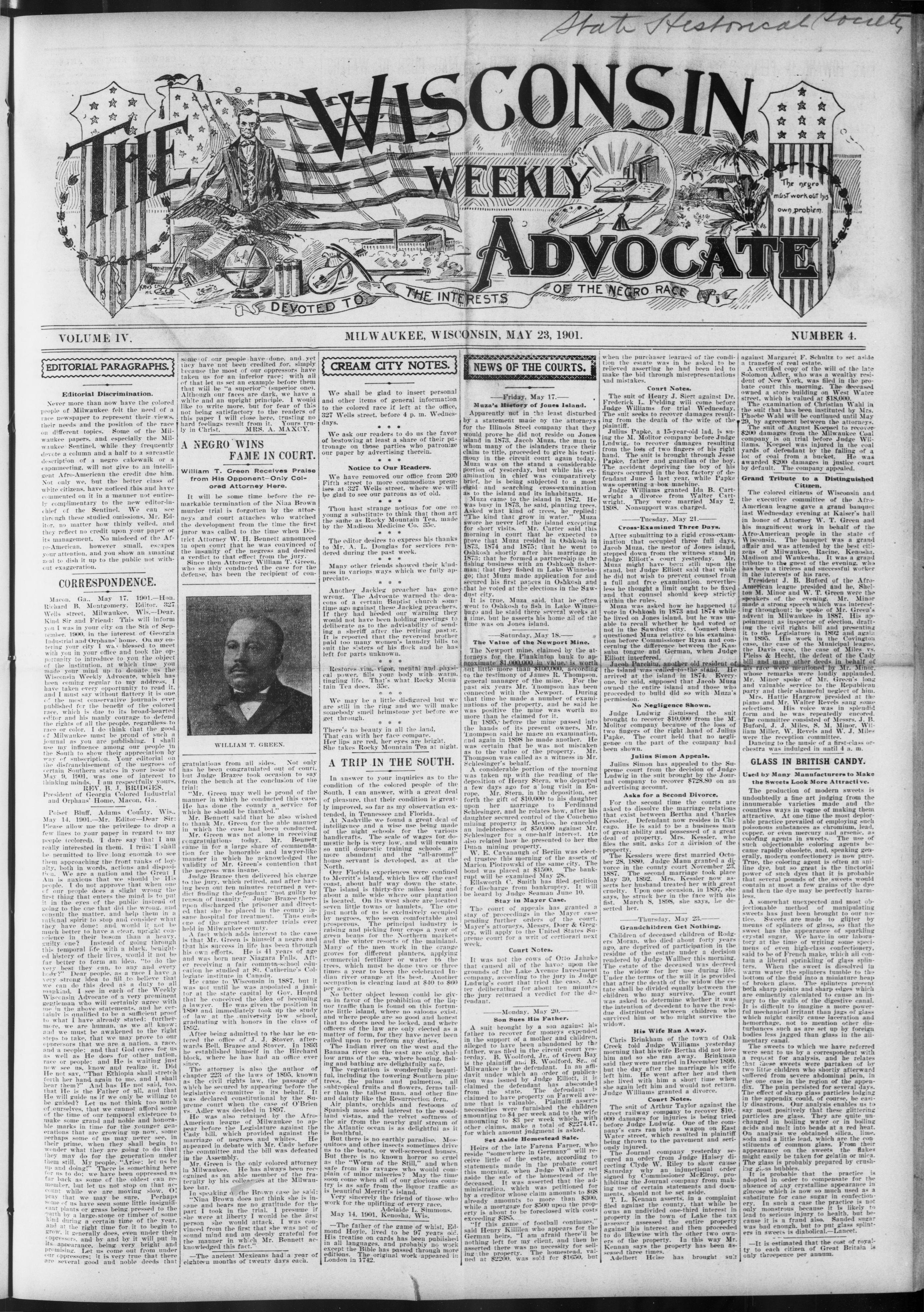
Wisconsin Weekly Advocate
Thursday, May 23, 1901
Milwaukee, Wisconsin
Page text (machine-generated)
WISCONSIN
WEEKLY
ADVOCATE
DEVOTED TO THE INTERESTS OF THE NEGRO RACE
EDITORIAL PARAGRAPHS.
Editorial Discrimination
Never more than now have the colored people of Milwaukee felt the need of a race newspaper to represent their views, their needs and the position of the race on different topics. Some of the Milwaukee papers, and especially the Milwaukee Sentinel, while they frequently devote a column and a half to a sarcastic description of a negro cakewalk or a capmmeeting, will not give to an intelligent Afro-American the credit due him. Not only we, but the better class of white citizens, have noticed this and have commented on it in a manner not entirely complimentary to the new editor-in-chief of the Sentinel. We can see through these studied omissions, Mr. Editor, no matter how thinly veiled, and they reflect no credit upon your paper or its management. No misdeed of the Afro-American, however small, escapes your attention, and you show an amazing zeal to dish it up to the public not without exaggeration.
CORRESPONDENCE.
Macon, Ga., May 17, 1901.—Hon. Richard B. Montgomery, Editor, 327 Wells street, Milwaukee, Wis.—Dear, Kind Sir and Friend: This will inform you I was in your city on the 5th of September, 1900, in the interest of Georgia Industrial and Orphans' home. On my entering your city I was blessed to meet with you in your office and took the opportunity to introduce to you the object of the institution, at which time you made your mind up to donate us the Wisconsin Weekly Advocate, which has been coming regular to my address. I have taken every opportunity to read it, and I must say without flattery it is one of the most conservative journals ever published for the benefit of the colored race, which is due to its broad-hearted editor and his manly courage to defend the rights of all the people, regardless to race or color. I do think that the good of Milwaukee must be proud of such a journal as you are publishing. I shall use my influence among our people in the South to show their appreciation by way of subscription. Your editorial on the disfranchisement of the negroes of certain Southern states in your issue of May 9, 1901, was one of interest to thinking minds. I am respectfully yours, REV. B. J. BRUDGES.
President of Georgia Colored Industrial and Orphans' Home, Macon, Ga.
Poiset Bluff, Adams County, Wis., May 14. 1901.—Mr. Editor—Dear Sir: Please allow me the privilege to drop a few lines to your paper in regard to my people (colored). I dare say that I am really interested in them. I trust I shall be permitted to live long enough to see them approaching the front ranks of loyalty, both in words, actions and disposition. We are a nation and the Great I Am is anxious that we should be His people. I do not approve that when one of our people does a slight wrong the first thing that enters the mind is to put it in the eyes of the public instead of going to the one that did the wrong, and consult the matter, and help them in a rational spirit to stop and consider what they have done; and would it not be much better to have a clear, upright conscience in their bosom than a heavy, guilty one? Instead of going through this temporal life with a black, benighted history of their lives, would it not be far better to form an idea. "to do the very best they can, to any and every body?" Dear people, as a race I have a very strong idea to fill to believe that we can do this deed as a duty to all mankind. I see in each of the Weekly Wisconsin Advocate of a very prominent gentleman who will certainly agree with me in the above statements, and he certainly is qualified to be a sufficient proof to what I have already stated: furthermore, we are human, as we all know; and we must be awakened to the right steps to take, that we may prove to our oppressors that we are a nation, a race and a people; and that God cares for us as well as He does for other nation, race or people; and He is waiting just now see us, know and realize it. Did He not say, "That Ethiopia shall stretch forth her hand again to me, and I shall hear them?" And has He not said, too, that He is the Father of all, and that He will guide us if we only be willing to be guided? Let us not think too much of ourselves, that we cannot afford some of the time of our temporal existence to make some grand and noble and honorable marks in time for the younger generations that are growing up now, some perhaps some of us may never see, in their prime, when they shall begin to wonder what they are going to do that they may do for the generation under them still. My people, "Arise; let us be up and doing!" There is something here for us to do; we have been oppressed as far back as some of the oldest can remember, but let us not stop on that account while we are moving slow. O' pray that we may be sure. Perhaps some of us have seen some little insignificant plants or grass being pressed to the earth by a large, stone or timber of some kind during a certain time of the year, and at the right time for it to begin to grow, it generally does, even under their oppressors, and by and by it will put in its appearance, being very bright and promising. Let us come out from under our oppressors; it is very true that there are several good and noble deeds that
some of our people have done, and yet they have not been credited for, simply because the most of our oppressors have taken us for an inferior race; with all of that let us set an example before them that will be "a superior" (superior one). Although our faces are dark, we have a white and an upright principle. I would like to write more, but for fear of this not being satisfactory to the readers of this paper I will close here, trusting no hard feelings result from it. Yours truly in Christ. MRS. A. MAXCY.
A NEGRO WINS FAME IN COURT.
William T. Green Receives Praise from His Opponent-Only Colored Attorney Here. It will be some time before the remarkable termination of the Nina Brown murder trial is forgotten by the attorneys and court attaches who watched the development from the time the first juror was called to the time when District Attorney W. H. Bennett announced in open court that he was convinced of the insanity of the negress and desired a verdict to that effect from the jury. Since then Attorney William T. Green, who so ably conducted the case for the defense, has been the recipient of con-
WILLIAM T. GREEN
gratulations from all sides. Not only has he been congratulated out of court, but Judge Brazze took occasion to say from the bench at the conclusion of the trial: "Mr. Green may well be proud of the manner in which he conducted this case. He has done the county a service for which he should be thanked." Mr. Bennett said that he also wished to thank Mr. Green for the able manner in which the case had been conducted. Mr. Green was not alone in receiving congratulations today. Mr. Bennett came in for a large share of commendation for the honorable and lawyer-like manner in which he acknowledged the validity of Mr. Green's contention that the negress was insane.
Judge Brazee then delivered his charge to the jury, which retired, and after having been out ten minutes returned a verdict finding the defendant "not guilty by reason of insanity." Judge Brazee thereupon discharged the prisoner and directed that she be placed in the county insane hospital for treatment. Thus ends one of the greatest murder trials ever held in Milwaukee county.
A fact which adds interest to the case is that Mr. Green is himself a negro and that his success in life has been through his own efforts. He is 41 years of age and was born near Niagara Falls. After receiving a fair common-school education he studied at St. Catherine's Collegiate institute in Canada.
He came to Wisconsin in 1887, but it was not until he was appointed a janitor at the state capital by Gov. Hoard that he conceived the idea of becoming a lawyer. He was given the position in 1890 and immediately took up the study of law at the university law school, graduating with honors in the class of 1892.
After being admitted to the bar he entered the office of J. J. Stover, afterwards Bell, Brazee and Stover. In 1893 he established himself in the Birchard block, where he has had an office ever since.
The attorney is also the author of chapter 223 of the laws of 1895, known as the civil rights law, the passage of which he secured by appearing before the legislative committee in its behalf. It was declared constitutional by the Supreme court when the case of O'Brien vs. Adler was decided in 1897.
He was also retained by the Afro-American league of Milwaukee to appear before the Legislature against the Cady bill, which provided against the marriage of negroes and whites. He appeared in debate with Mr. Cady before the committee and the bill was defeated in the Assembly.
Mr. Green is the only colored attorney in Milwaukee. He has always been recognized as an able member of the fraternity by his colleagues at the Milwaukee bar.
In speaking to the Brown case he said: "Nina Brown does not think she is insane and bears me no gratitude for the part I took in the trial. I presume if she were at liberty I would be the first person she would attack. I was convinced from the first that she was not of sound mind and am deeply grateful for the manner in which Mr. Bennett acknowledged this fact."
The ancient Mexicans had a year of eighteen months of twenty days each.
CREAM CITY NOTES.
---
We shall be glad to insert personal and other items of general information to the colored race if left at the office, 327 Wells street, before 4 p. m. Wednesdays.
** **
We ask our readers to do us the favor of bestowing at least a share of their patronage on those parties who patronize our paper by advertising therein.
Notice to Our Readers.
We have removed our office from 209 Fifth street to more commodious premises at 327 Wells street, where we will be glad to see our patrons as of old.
* * *
Thou hast strange notions for one so young a substitute to think that thou art the same as Rocky Mountain Tea, made by the Madison Medicine Co. 35c.
* * *
The editor desires to express his thanks to Mr. A. L. Douglas for services rendered during the past week.
* * *
Many other friends showed their kindness in various ways which we fully appreciate.
Another Jackleg preacher has gone wrong. The Advocate warned the deacons of a certain Baptist church some time ago against these Jackleg preachers. If they had heeded our warning they would not have been holding meetings to deliberate as to the advisability of sending a sheriff after the retiring pastor. It is reported that the reverend brother paid too many women's laundry bills to suit the sisters of his flock and he has left for parts unknown.
***
Restores vim, vigor, mental and physical power, fills your body with warm, tingling life. That's what Rocky Mountain Tea does. 35c.
* * *
We may be a little disfigured but we are still in the ring and we will make somebody smell brimstone yet before we get through.
* * *
There's no beauty in all the land.
That can with her face compare.
Her lips are red, her eyes are bright.
She takes Rocky Mountain Tea at night.
A TRIP IN THE SOUTH.
In answer to your inquiries as to the condition of the colored people of the South, I can answer, with a great deal of pleasure, that their condition is greatly improved, so far as my observation extended, in Tennessee and Florida. At Nashville we found a great deal of intelligence and a wise use being made of the night schools for the various handicrafts. The scale of wages for domestic help is very low, and will remain so until domestic training schools are more abundant and the "all-around" house servant is developed, as at the North.
Our Florida experiences were confined to Merritt's island, which lies off the east coast, about half way down the state. The island is thirty-five miles long and about a mile wide where our plantation is located. On its west shore are located seven little towns or hamlets. The one just north of us is exclusively occupied by negroes, who seem comfortable and prosperous. The principal industry is raising and picking four crops a year of green beans for the Northern markets and the winter resorts of the mainland. Many of the men work in the orange groves for different planters, applying commercial fertilizer or water to the trees, which must be done two or three times a year to keep the celebrated Indian river orange at its best. Another occupation is clearing land at $40 to $60 per acre.
No better object lesson could be given in favor of the prohibition of the liquor traffic than is found on this fortunate little island, where no saloons exist, and where people are so good and honest that no doors need be locked, and where officers of the law are only elected as a matter of form, for they have never been called upon to perform any duties. The Indian river on the west and the Banana river on the east are only shallow arms of the sea, where boating, fishing and bathing are delightfully safe. The vegetation is wonderfully beautiful, including the towering Southern pine trees, the palms and palmettos, all subtropical fruits and flowers, ferns taller than the tallest man, and other fine and dainty like the Resurrection fern.
Air plants, orchids and festoons of Spanish moss add interest to the woodland vistas, and the velvet softness of the air from the nearby gulf stream of the Atlantic ocean is as delightful as it is healthful.
But there is no earthly paradise. Mosquitoes and other insects sometimes drive us to the boats, or well-screened houses. But there is no known horror so cruel as the "Worm of the Still," and when safe from its ravages who would complain of minor miseries? May the time soon come when all of our glorious country is as safe from the liquor traffic as is beautiful Merritt's island.
Very sincerely the friend of those who work for the uplifting of every race.
May 14, 1901, Kenosha, Wis.
The father of the game of whist, Edmond Hoyle, lived to be 97 years old. His treatise on cards has been published in all languages, and probably no work except the Bible has passed through more editions. The original work appeared in London in 1742.
NEWS OF THE COURTS.
Friday, May 17.
Muza's History of Jones Island. Apparently not in the least disturbed by a statement made by the attorneys for the Illinois Steel company that they would prove he did not reside on Jones island in 1873. Jacob Muza, the man to whom many of the islanders trace their claim to title, proceeded to give his testimony in the circuit court again today. Muza was on the stand a considerable portion of yesterday, but while his examination in chief was comparatively brief, he is being subjected to a most rigid and searching cross-examination as to the island and its inhabitants.
Muza came to the island in 1872. He was busy in 1873, he said, planting trees. Asked what kind of trees, he replied: "The kind that grow in water." Muza swore he never left the island excepting for short visits. Mr. Carter said this morning in court that he expected to prove that Muza resided in Oshkosh in 1873, 1874 and 1875; that he went to Oshkosh shortly after his marriage in 1873; that he formed a partnership in the fishing business with an Oshkosh fisherman; that they fished in Lake Winnebago; that Muza made application for and secured his first papers in Oshkosh and that he voted at the elections in the Sawdust city. It is true, Muza said, that he often went to Oshkosh to fish in Lake Winnebago and he staid there several weeks at a time, but he asserts his home all of the time was on Jones island.
Saturday, May 18. The Value of the Newport Mine
The Newport mine, claimed by the attorneys for the Plankinton bank to approximate $1,000,000 in value, is worth but little more than $100,000, according to the testimony of James R. Thompson, general manager of the mine. For the past six years Mr. Tnompson has been connected with the Newport. During that time he made a number of examinations of the property, and he said he was positive the mine was worth no more than he claimed for it.
In 1895, before the mine passed into the hands of its present owners, Mr. Tnompson said he made an examination, and again in 1898 he made another. He was certain that he was not mistaken as to the value of the property. Mr. Thompson was called as a witness in Mr. Schlesinger's behalf.
A considerable portion of the morning was taken up with the reading of the deposition of Henry Stern, who departed a few days ago for a long visit in Europe. Mr. Stern, in the deposition, set forth the gift of $10,000 to his daughter upon her marriage to Ferdinand Schlesinger, and he relates how, after his daughter secured control of the Concheno mining property in Mexico, he canceled an indebtedness of $50,000 against Mr. Schlesinger for a one-half interest. He also related how he presented to her the Dunn mining property. W. E. Cavanaugh of Berlin was elected trustee this morning of the assets of Marion Piotrowski of the same city. The bond was placed at $1500. The bankrupt will be examined May 28. Ellsworth C. Smith has filed petition for discharge from bankruptcy. It will be heard by Judge Seaman June 10.
Stay in Mayer Case.
The court of appeals has granted a stay of proceedings in the Mayer case pending further orders of the court. Mayer's attorneys, Messrs. Dorr & Gregory, will apply to the United States Supreme court for a writ of certiorari next week.
Court Notes.
It was not the cows of Otto Jahnke that caused all of the havoc upon the grounds of the Lake Avenue Investment company, according to the jury in Judge Ludwig's court that tried the case. After deliberating for about ten minutes the jury returned a verdict for the defendant.
Monday, May 20.
Son Sues His Father.
A suit brought by a son against his father to recover for moneys expended in the support of a mother and children, alleged to have been abandoned by the father, was filed in the circuit court yesterday. B. Woolford, Jr., of Green Bay is the plaintiff and B. Woolford, Sr., of Milwaukee is the defendant. In an affidavit under which an order of publication was issued by Judge Elliott, it is claimed the defendant has absconded from the state. The defendant is claimed to have property on Farwell avenue that is valuable. Plaintiff asserts necessities were furnished the children amounting to $4 per week and to the wife amounting to $3 per week which, with other claims, make a total of $2274.47, for which amount judgment is asked.
Set Aside Homestead Sale.
Heirs of the late Farena Farner, who reside "somewhere in Germany" will receive little of the estate, according to statements made in the probate court this morning, when Judge Wailber set aside the sale of the homestead of the deceased. It was asserted that the administration, which was petitioned for by a creditor whose claim amounts to $68 already amounts to more than $300, while a mortgage for $500 upon the property is about to be foreclosed with costs exceeding $385
"If this game of football continues," said Henry Killilea who appears for the German heirs, "I am afraid there'll be nothing left for my client, and then he asserted there was no necessity for selling the property. The homestead, valued at $2200, was sold for $1650, but
when the purchaser learned of the condition the estate was in he asked to be relieved asserting he had been led to make the bid through misrepresentations and mistakes.
Court Notes.
The suit of Henry J. Siert against Dr. Frederick L. Fielding will come before Judge Williams for trial Wednesday. The suit seeks to recover damages resulting from the death of the wife of the plaintiff. Julius Papke, a 15-year-old lad, is suing the M. Molitor company before Judge Ludwig, to recover damages resulting from the loss of two fingers of his right hand. The suit is brought through Jesse Papke, father and guardian of the boy. The accident depriving the boy of his fingers occurred in the box factory of defendant June 5 last year, while Papke was operating a box machine. Judge Williams granted Ida B. Cartwright a divorce from Walter Cartwright. They were married May 2, 1898. Nonsupport was charged.
-Tuesday, May 21.____
Cross-Examined Three Days.
After submitting to a rigid cross-examination that occupied three full days, Jacob Muza, the nestor of Jones island, stepped down from the witness stand in Judge Elliott's court yesterday. Mr, Muza might have been stili upon the stand, but Judge Elliott said that while he did not wish to prevent counsel from a full and free examination, nevertheless he thought a limit ought to be fixed and that counsel should keep strictly within the rules. Muza was asked how he happened to vote in Oshkosh in 1873 and 1874 while he lived on Jones island, but he was unable to recall whether he had voted or not in the Sawdust city. Counsel then questioned Muza relative to his examination before Commissioner Ryan and concerning the difference between the Kassuba tongue and German, when Judge Elliott interfered.
Jacob Parchim, another old resident of the island was called to the stand. He arrived at the island in 1874. Everyone, he said, supposed that Jacob Muza owned the entire island and those who proceeded to build did so with Muza's permission.
No Negligence Shown.
Judge Ludwig dismissed the suit brought to recover $10,000 from the M. Molitor company because of the loss of two fingers of the right hand of Julius Papke. The court held that no negligence on the part of the company had been shown.
Julius Simon Appeals.
Julius Simon has appealed to the Supreme court from the decision of Judge Ludwig in the suit brought by the Journal company to recover $728.80 on an advertising account.
Asks for a Second Divorce.
For the second time the courts are asked to dissolve the marriage relations that exist between Bertha and Charles Kessler. Defendant now resides in Chicago. He is said to be a business man of great ability and possessed of a great deal of property. Mrs. Kessler, who files the suit, asks for a division of the property.
The Kesslers were first married October 28, 1880. Judge Mann granted a divorce in the county court November 23, 1887. The second marriage took place May 30, 1892. Mrs. Kessler now asserts her husband treated her with great cruelty. Upon one occasion, in 1897, she says, he struck her in the face with his fist. March 8, 1898, she says, he deserted her.
-Thursday, May 23.
Children of deceased children of Rodgers Moran, who died about forty years ago, are deprived of participation in the residue of the estate under a decision rendered by Judge Wallber this morning. The estate of the deceased was decreed to the widow for her use during life. Under the terms of the will it is provided that after the death of the widow the estate shall be divided equally between the children who may survive. The court was asked to determine whether it was the intention of decedent to have the residue distributed between children who survived him or who might survive the widow.
His Wife Ran Away.
Chris Brinkham of the town of Oak Creek told Judge Williams yesterday morning that his wife Bertha did not love him and so she ran away. Brinkman said they were married in December 1899, but the day after the marriage his wife left him. He went after her and then she lived with him a short time when she again left him and would not return. Judge Williams granted a divorce.
Court Notes.
The suit of Arthur Taylor against the street railway company to recover $10,000 damages for injuries is being tried before Judge Ludwig. One of the company's cars ran into a wagon on East Water street, which resulted in plaintiff being thrown to the pavement and seriously injured.
The Journal company yesterday secured an order from Judge Halsey directing Clyde W. Riley to show cause Saturday why an injunctional order signed by Commissioner McElroy, prohibiting the Journal company from making use of certain statements and documents, should not be set aside. T. L. Kennan asserts, in a complaint filed against the county, that while he owns an undivided one-third interest in property in the town of Lake the tax assessor assessed the entire property against his interest and then proceeded to do likewise with the other two owners of the property. In this way Mr. Kennan says the property has been assessed three times.
Adelbert Heise has brought suit.
against Margaret F. Schultz to set aside a transfer of real estate.
A certified copy of the will of the late Solomon Adler, who was a wealthy resident of New York, was filed in the probate court this morning. The deceased owned a store building on West Water street, which is valued at $18,000.
The examination of Christian Wahl in the suit that has been instituted by Mrs. Phoebe Wahl will be continued until May 29, by agreement between the attorneys.
The suit of August Koepsel to recover $200 damages from the Milwaukee Coal company is on trial before Judge Williams. Koepsel was injured in the coal yards of defendant by the falling of a lot of coal from a bucket. He was awarded $200 damages in justice court by default. The company appealed.
Grand Tribute to a Distinguished Citizen.
The colored citizens of Wisconsin and the executive committee of the Afro-American league gave a grand banquet last Wednesday evening at Kaiser's hall in honor of Attorney W. T. Green and his magnificent work in behalf of the Afro-American people in the state of Wisconsin. The banquet was a grand affair and was attended by the best citizens of Milwaukee, Racine, Kenosha, Madison and Waukesha. It was a grand tribute to the guest of the evening, who has been a tireless and successful worker in the interests of his race.
President J. B. Buford of the Afro-American league presided and he, Shelton M. Minor and W. T. Green were the speakers of the evening. Mr. Minor made a strong speech which was interesting throughout; he spoke of Mr. Green's advent in Milwaukee in 1887. His appointment as inspector of election, drafting the civil rights bill and presenting it to the Legislature in 1892 and again in 1895. His work in the Covington case, the case of the Municipal league, the Davis case, the case of Miles vs. Pleiss & Hecht, the defeat of the Cady bill and many other deeds in behalf of his race were mentioned by Mr. Minor, whose remarks were loudly applauded. Mr. Minor spoke of Mr. Green's long and valuable service to the Republican party and their shameful neglect of him.
Mrs. Hattie Hargrow presided at the piano and Mr. Walter Revels sang some selections. His voice was in splendid form and he was repeatedly enced. The committee consisted of Messrs. J. B. Buford, J. J. Miles, S. M. Minor, William Miller. W. Revels and W. J. Miles were the reception committee. Dancing to the music of a first-class orchestra was indulged in until 4 a. m.
GLASS IN BRITISH CANDY.
Used by Many Manufacturers to Make the Sweets Look More Attractive.
The production of modern sweets is undoubtedly a fine art judging from the innumerable varieties made and the countless ways in vogue of making them attractive. At one time the most deplorable practice prevailed of employing such poisonous substances as chromium, lead, copper, or even mercury and arsenic, as coloring agents in sweets. The use of such objectionable coloring agents became rapidly obsolete, and, speaking generally, modern confectionery is now pure. True, the coloring agent is often an aniline dye, but so great is the tinctorial power of such dyes that it is probable that several pounds of the sweets would contain at most a few grains of the dye and then the dye may be perfectly harmless.
A somewhat unexpected and most objectionable method of manipulating sweets has just been brought to our notice. Sweets are made to glitter by means of splinters of glass, so that the sweet has the appearance of sparkling crystal sugar. We have in our laboratory at the time of writing some specimens of even high-class confectionery, said to be of French make, which all contain a liberal sprinkling of glass splinters. When the sweet is dissolved in warm water the splinters tumble to the bottom of the fluid into a miniature heap of broken glass. The splinters present both sharp points and sharp edges which are eminently calculated to cause an injury to the walls of the digestive canal. It is difficult to imagine a more powerful mechanical irritant than jags of glass which might easily cause laceration and hemorrhage, not to mention other disturbances such as are set up by foreign bodies less jagged than glass in the alimentary canal.
The sweets to which we have referred were sent to us by a correspondent with a request for analysis, and he relates that these sweets were partaken of by two little children who shortly afterward suffered from severe abdominal pain, in the one case in the region of the appendix. The pain persisted for several days. The effect of sharp glass particles lodging in the appendix could, of course, be easily disastrous. Our analysis enables us to say most positively that these glittering particles are glass. They are quite unchanged in boiling water or in boiling acids and melt into beads at a red heat. On analysis we obtained silica, lime, soda and a little lead, which are the constituents of common glass. From their appearance on the sweets the flakes might easily be taken for gelatin or mica. The glass is probably prepared by crushing glass bubbles.
It is probable that the practice is adopted in order to compensate for the absence of any crystalline appearance in glucose which is now so much used as a substitute for cane sugar in confectionery. In such a case the practice is not only monstrous because it is likely to lead to serious injury to health, but because it is a fraud also. Sanded sugar was bad enough, but to put glass splinters in sweets is diabolical.—Lancet.
—It is estimated that the cost of royalty to each citizen of Great Britain is only threepence per annum.
KING EDWARD IN PERIL.
Edward Has a Miraculous Escape Topmast and Mainmast Are Broken Short Off.
Southampton, May 22.—The cup challenger, with King Edward and a party on board, was totally dismasted today by a squall, off Cowes, Isle of Wight. The King, who was on deck, had a miraculous escape. The topmast, mast and howspirit were broken short off.
The interest shown in the event by King Edward added special zest to today's trial. His majesty, who was accompanied only by his personal attendants, was met at the pier by Sir Thomas Lipton and W. G. Jameson. They entered a launch and proceeded to the Erin. The visit was quite informal, a few additional policemen on the pier being the only evidence of anything unusual. Immediately after the King boarded the Erin she started in the wake of the yachts, which were already en route for the starting line.
A Spirited Race.
Ryde, Isle of Wight, May 22.—The yachts were to be sent today reaching over a triangular course similar to one of the America's cup series. The entrance into the race of the yawl Sybarita (about 99 feet over all), added to the interest taken in the contest, especially as the fresh weather and reaching course were both in favor of the yawl, placing the captains of the two Shamrocks under the necessity of driving their boats at full speed, in order to make any creditable showing against the outsider and promising King Edward an opportunity of witnessing what promised to be the smartest race of the series.
There was a fine easterly breeze, driving a short, white-tipped sea up the channel, when the three yachts set their club topsails shortly after noon and proceeded to the starting point.
There was some delay in establishing a starting line. The wind freshened considerably and blew twelve to thirteen knots, with the prospect of magnificent racing.
Where the King Went on Board.
King Edward, desiring to take a more active part in the proceedings than was possible from the deck of the Erin, was taken on board the challenger, accompanied by Sir Thomas Lipton and two ladies.
The preliminary starting signal was given from the Erin.
While the yachts were maneuvering for the start a squall came without the slightest warning and the bowsprit of the challenger was carried away short. The extra strain thus thrown on the topmast proved too much for the spar. It whipped, broke and doubled off to leeward, carrying the whole weight of the jackyard and gear over the side in a terrible tangle.
Almost as the topmast fell, the great steel mast, weighing more than two tons and carrying spars and gear weighing an additional three or four tons swayed for a moment and then, almost by a miracle, plunked over the side into the water, with the ripping, tearing sound of breaking wire and tearing gear in the air.
The members of the royal party were seated on deck, close to the companionway.
The king was showing keen pleasure, watching the fight which Capt. Sycamore was making for the advantage at the start. The yacht was racing along at a formidable angle, and the sloping deck, with a mere fringe of rail, seemed a rather perilous place for the accommodation of the visitors.
A Moment of Peril.
As the wreckage swept the deck it was most astonishing that no one was injured. For a moment or two the situation appeared to be very grave. The king maintained his composure. Most of the head men went overboard.
Within five seconds of the disaster the Shamrock I. bore around to render assistance, when she in turn was caught by the squall and her gaff and topsail spars collapsed, leaving her helplessly crippled.
The press tug following the racers ranged alongside the helpless yachts and a torpedo-boat which was in the vicinity and the Sybarita sent boats to the scene. But, in answer to a hail, Capt. Sycamore sent the reassuring message that all on board had escaped without injury.
King Boards the Erin.
As quickly as possible the King and the royal party were transferred to the Erin, and, later the King, accompanied by Sir Thomas Lipton, landed at Southampton, from which place his majesty will proceed to London.
Meanwhile the crews of the racers set about clearing away the wreckage. Owing to the unwieldy nature of the spars and gear it was found impossible to get them on board, and they were cut away and allowed to sink, after buoys had been placed to mark the places where the wreckage sank. The yachts were then tewed back to Hythe, there to await a decision as to what shall be done towards repairing them.
CLEVELAND BUYS A FARM.
Ex-President Secures Small Place with Trout Brook in Connecticut.
Winsted, Conn., May 22.—Former President Grover Cleveland has purchased a small farm, owned by Hiram Thompson and located near West Otis. There is a splendid trout brook on the premises and Mr. Cleveland will, it is said, establish a trout preserve on the premises. Some of the villagers believe that he will erect a summer residence on his newly acquired land next summer. Riverside, the historic old house in Tyringham where Mr. Cleveland and his family will spend the coming season, is only five miles north of his trouting stream.
THINK THEY HAVE KIDNAPER.
Police of Frankfort, Ind., Are Sure They Captured Pat Crowe. Frankfort, Ind., May 22.—Charles Bain, arrested here for a robbery at Lafayette, answers the description of Pat Crowe to a marked degree. The chief of police caused him to be measured by the Bertillon system and he answers the measurements of Crowe as given in the description of the famous kidnaper almost perfectly. He was taken to Lafayette. The police will make a thorough investigation of his record.
CHINESE WEDS WHITE WIDOW.
Marriage of Charlie Sing and Mrs. Marsh Stirs Knoxville, Iowa.
Knoxville, Ia., May 22.—Charlie Sing, a Chinaman, was married to a Mrs. Marsh here. Sing was Americanized enough to have his queue taken off. It is the first marriage of a Chinaman to a white woman in this section of the country and much indignation is felt against the issuer of the license.
WEST POINT CADETS WILL BE DISMISSED.
Washington, D. C., May 21.—Secretary Root has approved the action of the board of officers at West Point which recommended the dismissal of five cadets and the suspension of six others. This sustains the course of Col. Mills and the other officers in the recent disturbances at the academy.
Uprising of Cadets.
West Point, May 20.—It is an open secret at the Military academy that there will be an uprising of cadets which will paralyze discipline and amount to practical mutiny if the young men who are "spotted" for dismissal are ordered to leave the institution. The finding of the board of inquiry or court-martial which investigated charges against eighty-three cadets recommends the dismissal of at least two and severe punishment for many others. The offense consisted in training the big "sunset" gun upon the house of Col. Mills, the superintendent. It was participated in by nearly every cadet at the academy. The report from Washington that the secretary of war has confirmed the decision of the court-martial has been like fuel to the flame of discontent among the cadet corps. The cadets declare that in order to induce them to pass resolutions abolishing the severer forms of hazing, Col. Mills assured them privately that he would be lenient in his construction of certain mflder forms of hazing, such as bracing, rat funerals, etc. Almost immediately, the cadets allege, Col. Mills began to punish them for doing the minor things which they had understood he would tolerate.
When asked if it is true that he had agreed to put a lenient and mild construction on certain phases of hazing, such as "bracing" and rat funerals, Col. Mills replied: "I shall neither affirm nor deny it. I will only say that Congress has recently passed a law requiring the superintendent of the academy to put a stop to hazing here, and so long as I am superintendent I intend to obey the law."
Douglas MacArthur Involved.
The feeling in the corps is intensified by rumors that MacArthur, Perry and Herr are three of the five slated for suspension or dismissal. All are on the baseball team and they are looked upon as heroes. No matter what agreement was reached, hazing still continues, but it is not the brutal old-style kind. One of the pleasant ways of instilling a proper spirit in the plebeis is to make them "kiss the bug." A beetle is tied to a string, and the victim is forced to kiss the squirming insect as often as the older classmen deem expedient. Sometimes the bug is suspended from a string so that its legs and wings may just touch the victim's hair; his arms are pinioned and he cannot scratch. This treatment, after one hour's application, is said to render docile even the most athletic plebe. It could not be learned whether Col. Mills had classed this pastime as permissible hazing.
The cadets made no secret of the fact that they are waging a relentless war to have him removed. This fight is being carried on by them through their congressmen, senators and influential friends. Stories are told here that Col. Mills has suffered much from a wound in the head received in Cuba in the Spanish war. His friends deny this rumor and its implication. Mrs. MacArthur, wife of the commander-in-chief in the Philippines, is at the West Point hotel waiting to hear the verdict in her son's case. Gen. Wesley Merritt is also at the hotel. Col. Mills went to New York early in the day and had not returned at a late hour last night.
Innocent of Wrongdoing.
While it is the common belief that MacArthur, Herr and Percy are among those who will come in for severe punishment, it is by no means certain that they are deserving of it. To the contrary, it is said that these three are practically innocent of wrongdoing, but will be selected to supply the demand for examples. As one cadet put it, "Some of us must suffer, and it is usually the innocent, in spite of all their red tape and solemnity." Young MacArthur is considered a model student, standing first in his class. He has been at the Point for three years, in which time he has gained the esteem of his instructors as well as of the students.
He was one of the committee that called upon Col. Mills after the Booz investigation and agreed to doing away with several forms of hazing, in return for which the superintendent, upon whom the discredit of such conditions naturally fell, made, it is said, an agreement with the corps akin to a bill of rights by which the cadets were guaranteed the continuation of certain customs and traditions of the academy to which they were devoted. The cadets were sincere in making their agreement and earnest in observing it. They say it was broken by the superintendent himself. This caused the first breach, which, ever since has been widening.
Mrs. MacArthur, who is spending this month at West Point hotel, in order that she may be near her son, is credited with supporting the cadets in their stand against Col. Mills. Douglas MacArthur explained the situation to her, and, it is said, won her over to the side of the cadets. Mrs. MacArthur denies the published statement attributed to her in New York papers.
DEATH IN THE FLOODS.
John M. Glover, Former Missouri Congressman, Has Been Missing Since Sunday.
Victor, Col., May 21.—John M. Glover, an ex-congressman from the St. Louis (Mo.) district, is reported to have met his death in the floods near Love, Col., ten miles from here, on Sunday last. A horse with a saddle was found in that vicinity today and it is thought to have belonged to Glover, who is missing.
Just before the big flood reached the little hamlet of Love a man was seen riding a horse down the gulch. He was in the direct path of the roaring wall of water that went tearing down the ravine. This man, it is believed, was Glover.
Mr. Glover came west about a year ago and was engaged in mining near Clyde.
Fortune in a Mattress.
The police of Levallois-Perret, a suburb of Paris, were informed some little time ago of the sudden death of an old woman named Marguerite Blassau, who had long been regarded as a pauper. She had been in receipt of outdoor relief for a number of years, and had been regularly aided as well by charitable persons. The police doctor who inquired into the causes of her death found some $1000 in bank-notes concealed about her clothing, and further investigations revealed the existence—stowed away in the woman's mattress—of a small fortune, consisting of bonds to the value of over $20,000, and a considerable sum in gold.
THE SPRING QUESTION.
Off now our overcoats we lay,
For loud the robin calls;
But shall the clothes be put away
With gilt or camphor balls?
—Town and Country.
—A law has been passed by the Kansas Legislature forbidding the requirement of study at home for children in certain grades.
CRUSHED TO DEATH BY A BLACK BEAR.
Awful Fate of Three Little Children of a Mountaineer in West Virginia
Pittsburg, Pa., May 22.—A Job, West Virginia, special says: To be crushed to death in the embrace of a monstrous black bear and their little bodies afterwards mangled and partly devoured, was the frightful fate that befell the three young children of E. P. Porterfield, a mountaineer residing about twelve miles southeast of this place. The remains were found yesterday by a searching party which had been out since Sunday evening. The party included John Weldon, a Maryland hunter, who within a few minutes after the discovery of the bodies shot and killed the bear in a neighboring thicket
The children were Mary, aged 3; Willie, aged 5, and Henry, aged 7. Shortly after noon Sunday they left home to gather flowers in a clearing near their home. Nothing more is known, but it is supposed that they wandered into the woods, and becoming lost, continued on their way until they were overtaken by the bear in the dense forest three miles from their parents' home.
TRAIN IN A TORRENT.
Cloudburst Sends Wall of Water 14 Feet High Over the Track Crushed a Cabin.
Pueblo, Col.. May 22.—A passenger train, carrying eighteen people besides the crew, was submerged in a wall of water 14 feet high, which swept over the Denver & Rio Grande tracks ten miles south of here. The escape of the passengers was miraculous. They clambered through the broken windows and perched on top of the cars until assisted to places of safety. The flood was the result of a cloudburst in the Sierra Ojada mountains. The torrent of water came tearing down the valley and swept away the bridge over St. Charles creek. The train was just crossing the bridge and went down with it.
At Beulah, twenty miles further up the stream. Mr. and Mrs. J. Brown of Avondale, who were occupying a cabin in the canyon for the summer, were drowned, the flood crushing their cabin into kindling wood at the first onslaught.
M'ARTHUR ESCAPES.
Names of Cadets Dismissed from the Military Academy Are Given Out.
Washington, D. C., May 22.—The names of the cadets who have been dismissed from the Military academy at West Point as the result of the recent disturbances there are as follows: Henry L. Bolby, John A. Cleveland, Tranfett F. Teller, Raymond A. Linton, Birchie O. Mahaffey. All these cadets are of the second class. The dismissed cadets are from the following states: Bolby, Nebraska; Cleveland, Alabama; Teller, New York: Linton, Michigan; Mahaffey, Texas
The following cadets have been suspended: Olan C. Aleshire, Illinois; Benjamin F. McClellan, Mississippi; James A. Shannon, Minnesota; Charles Telford, Utah, all of the second class. Also Thomas N. Gimperling, Ohio, and Harry Hawley, New York, of the third class. These cadets are suspended without pay until April 1, 1902.
BIG PAPER MILL BURNED.
"Old Jerusalem" at Marseilles, Ill. Suffers Loss by Fire of About $200,000.
Ottawa, Ill.. May 22.—The paper mill known as Old Jerusalem, operated at Marseilles by W. D. Boyce, was almost totally destroyed by fire yesterday. The fire originated in the print-paper department and spread quickly. It was not until noon that the flames were extinguished. The loss in round figures is $200,000. The insurance on the entire plant, which takes in the pulp mill located at another point, is $210,000.
In the finishing room there was $10,000 worth of print paper ready for shipment. Two large machines, the print paper and strawboard presses were destroyed, the former costing $40,000, the latter $25. 000. By the fire fully 150 persons were thrown out of employment.
MICHIGAN ADOPTS AD VALOREM SYSTEM.
New Basis for Taxation of Railroads Agreed to-Report of Conference Committee.
Lansing, Mich., May 21.—Both houses of the Legislature today adopted the report of the joint conference on the railroad ad valorem bill, which provides for the taxation of steam railroads upon an ad valorem basis instead of specifically upon their earnings, as at present. The bill originally included many other public utilities. Final adjournment on May 28 is probable.
AGED COUPLE ELOPE.
Man of Si and Woman of 60 Run Away from Their Children.
Greenup, Ky., May 22.—An eloping couple, whose combined ages foot up to 141 years, passed through here en route to some Ohio town to be married.
William Henderson, giving his home as Lawrence county, Ky., and his age at 81, has been a widower for a number of years and is the father of a large family of grown-up and married children. The youngest son and his wife kept house for the old man.
Mrs. Martha Jaynes, a widow, aged 60, lived on an adjoining farm alone. She, too, has a large family of grown-up sons in the neighborhood. The old people fell in love, but their children objected to their marriage, hence the elope-
Mr. Henderson says he has plenty of money and expects to devote considerable time to travel. The couple will visit Cincinnati, St. Louis, Chicago and the Pan-American exposition.
OAKMAN LOSES OFFICE
Michigan State Tax Commissioner
Ousted by the Supreme Court.
Lansing, Mich., May 22.—The Supreme court issued a writ of ouster in the case of William T. Dust against State Tax Commissioner Robert Oakman, removing the latter from office. Oakman claimed the right to hold the office under appointment from Gov. Pingree.
He was confirmed by the Senate, but the vote on confirmation was reconsidered. Oakman claimed that having once voted to confirm his appointment the Senate could not reconsider its action, and that the appointment by the governor was illegal.
The court quotes approvingly the decision of a New Jersey court that a deliberative assembly may do and undo, consider and reconsider, but that its final decision only is conclusive.
MAD RUSH OF WATERS.
Portions of East Tennessee Devastated by Floods.
Sixty-two Dwellings Are Wrecked and Numerous Bridges Are Washed Away.
Elizabethtown, Tenn., May 22.—A flood from the Dee and Wautauga rivers swept through the low-lying section of Elizabethtown during the night, drowned three persons, carried away sixty-two dwellings, and caused damage in the rich farming district of Carter county estimated at $1,000,000. Nearly every farmhouse for some distance along both rivers was destroyed or washed from its foundations, and it is possible that the loss of life will be greatly increased when full reports are received. The known dead are: Mrs. Gregg, Miss Filley and a negro known as Sonchong.
With a rush unprecedented in the history of this section, the waters tore down through the Dee and Watauga channels last night, carrying away dozens of bridges and small buildings. When the flood reached Elizabethtown it made quick work of sixty-two small dwellings along the river banks, where were sheltered 250 persons. Three were drowned in their efforts to escape. Several others are reported missing.
All means of communication are destroyed and news of the disaster did not reach outside points until late in the morning.
Knoxville, Tenn., May 22.—Many streams in eastern Tennessee are reported out of their banks and five persons are reported to have lost their lives.
A bridge over the Watauga, near Bristol, was wrecked last night, stopping traffic to the east on that route over the Southern railway. At Embreeville the Southern railway bridge also was partially wrecked, stopping traffic on the Embreeville branch. Tennessee river is high and rising rapidly. Those reported dead are: Unknown man, dropped dead from fright at Elizabethtown; three Hill children, at Ripley's island, drowned in the destruction of their home; Thomas Jerald, at Tate Hill, believed to have been drowned in the flood from the Chucky river, which carried away his store.
STRIKERS WILL WIN.
Declaration Made by President O'Connell After a Survey of the Situation.
Washington, D. C., May 22.—President O'Connell of the International Association of Machinists estimates that the number of machinists engaged in the strike today is 40,000. He claims to be satisfied with the situation, and has confidence in the result. "By next Monday, morning probably 90 per cent. of the men who went out will be back at work with their demands granted," said President O'Connell today. "The other 10 per cent. are mostly on the Pacific coast and in several Ohio cities. San Francisco is the only place where we look for a protracted strike. The situation there is good, but the strike may cover several weeks. No new developments are reported at Cincinnati, though fifteen small firms have signed the agreement. The situation also is unchanged at Hamilton, Dayton and Alliance, O., and Tacoma and Seattle, Wash. Reports from all other sections indicate that negotiations are progressing and that agreements are in sight."
President Mulholland of the Allied Metal Trades association, comprising the semi-skilled men in machine shops, has notified the machinists headquarters here that he is ready to order out his men whenever the latter body deems it necessary. The strike leaders, however, do not care to involve any more men in the movement than is necessary and the indications are that there will be no general augmentation of the force of the strikers by the allied men
Kansas City advices indicate that nine firms there signed today, leaving approximately 300 men still out. All of the fourteen firms in Hoboken, N. J., have signed. In Buffalo twenty-two firms are reported as having made agreements with the strikers. At Sharon, Pa., the Continental Iron company has signed and the Hazelton Iron works and the Janesville Iron works at Hazelton, Pa., have made the concessions. Mr. O'Connell will not attend the conference in New York tonight between district No. 2. National Metal Trades association (the employers' association) and district No. 15 of the Machinists' association
NEW SHOOTING RECORD.
W. R. Crosby Kills 109 Birds in 109 Shots and Captures the Championship.
Springfield, Ill., May 22.—W. R. Crosby of O'Fallen, Ill., today won the championship shooting trophy and a purse of $1000 on the grounds of the Illinois Gun club and established a record that is believed to be without precedent. Crosby killed 109 birds straight. The match, which began yesterday, showed three men tied last night with 100 each. Gilbert missed his 108th bird today, while H. J. Secone failed to get his 103d. When Crosby killed the 109th he was, therefore, declared the winner. R. Merrill of Milwaukee is a member of the team which will compete in the trap shooting contest in London, June 11.
VOTE OF CONFIDENCE.
Motion to Disapprove British Tax Budget Rejected in Commons by 300 to 123. London, May 21.—The House of Commons today by 300 to 123 votes rejected the motion of Sir Henry Fowler, Liberai, which was approved by the Liberal leaders, disapproving the budget proposals. Mr. Balfour, the government leader, announced that the government would regard the adoption of the motion as a vote of non-confidence. The Irish abstained from voting.
BOODLERS CONVICTED.
Manila. May 22.—The correspondent of the Associated press is informed that the following approved sentences will seem be promulgated:
Capt. Fred J. Barrows, Thirtieth Volunteer infantry, late depot quartermaster of the department of Southern Luzon, who was charged with embezzlement and selling government property, to be dishonorably discharged and to undergo five years' imprisonment.
Lieut. Frederick Boyer, Thirty-ninth infantry, former depot commissary at Calamba, on Bay lake, on similar charges, to be dishonorably discharged and to undergo a year's imprisonment.
Both Barrows and Boyer eventually will be removed to Leavenworth prison. Kansas.
BOUTELLE IS DEAD.
One of Maine's "Big Four" in Congress Succumbs to Brain Trouble.
Boston, Mass., May 21.—Former Congressman Charles A. Boutelle of Bangor, Me., died today at the McClean asylum, Waverly, Mass. Mr. Boutelle had been at the institution for many months undergoing treatment for brain trouble.
Mr. Boutelle was one of the "big four" from Maine which included T. B. Reed, Nelson Dingley and S. L. Milliken, who represented the Pine Tree state in the
M.
CHARLES A. BOUTELLE. House of Representatives for periods averaging sixteen years or more each. All were continued in Congress by their respective constituencies until their death except in the case of Reed, who resigned.
Mr. Boutelle served with conspicuous gallantry in the navy during the Civil war and during his service in Congress was chairman of the naval committee and managed many of the measures for the upbuilding of the navy. In private life he was a journalist and for many years he was editor of the Bangor (Me.) Whig. While in the hospital for treatment and suffering with the disease which proved fatal, his devoted constituency elected him to the House of Representatives for the eighth consecutive time. When it became apparent that he could not live a special act was passed by Congress unanimously authorizing the President to appoint him a captain in the regular service and place him on the retired list. He was 62 years old.
WOLTER RELEASED.
Ernest J. Wolter's Threat Violated No United States Statute.
Omaha, May 21.—Ernest J. Wolter, charged with having sent a letter to Senator Kearns of Utah, threatening to kidnap his son if $5000 was not sent, has been released from custody, Judge Munger having sustained a demurrier to the indictment returned by the grand jury.
Attorneys for Wolter contended that there is no such crime as kidnapping under the United States law, and that the letter received by Kearns did not show that there was a scheme to defraud. The demurrier was sustained, throwing the suit out of court.
ELOPES WITH GIRL OF 15.
Railroad Brakeman will be Charged with Abduction.
Iron Mountain, Mich., May 21.—Menominee range officers have been instructed to arrest a couple who eloped from Crystal Falls. The girl is Lucy Eldred of that village, and she is but 15 years old, and the man in the case is a brakeman named Jasper Smith.
Miss Lucy's father runs a hotel at Crystal Falls and it was while boarding there that Smith met the young girl.
The parents of the girl are making a strong effort to locate them, and Mr. Smith will be charged with abduction when captured.
"BATTLE AXE" GLEASON DEAD
Former Mayor of Long Island City Passes Away, Aged 70.
New York, May 21.—Patrick J. Gleason, former mayor of Long Island city and popularly known as "Battle Axe" Gleason, died at his home in that place last night, aged about 70 years.
While fighting the Long Island railroad he cut down the sheds of the road on Front street, claiming they were obstructions. For this he was presented with a battle axe by his constituents and thus earned the sobriquet.
GYPSIES MUST GO BACK.
Cannot be Admitted to This Country Because of Their Filthiness. New York, May 21.—The fifty Servian gypsies who were detained on Ellis island as likely to become public charges have been taken to the steamship Lahn for deportation. In spite of the fact that the gypsies had about $5000, and were bound for Canada, the immigration officials decided that they could not land. One of the objections to admitting the gypsies to the country is their filthiness.
EXPLOSION IN A BANK.
Building was Wrecked and the Cashier Seriously Injured. Cambridge, Mass., May 21.—An explosion occurred at the Cambridgeport National bank at 10 o'clock this morning which badly wrecked the building and seriously injured the cashier, W. H. Roas. The cause of the explosion has not been ascertained definitely, although the police claim to have evidence that it resulted from a time bomb.
CANNOT LIVE IN GERMANY.
Ruling Regarding Naturalized Citizens of the United States. Berlin, May 21.—The government has instructed the police that persons who have emigrated to the United States to avoid military service, and who have been naturalized there, will be permitted to visit Germany only temporarily, permanent stay being forbidden.
IBISH CENSUS SHOWS A LOSS.
Decrease of 5.3 Per Cent. Compared with Previous Returns.
London, May 21.—In the House of Commons George Wyndham, chief secretary for Ireland, stated that the census returns for Ireland showed a population of 4,456,546, a decrease of 5.3 per cent. since the previous census.
Mrs. McKinley Growing Stronger.
San Francisco, Cal., May 21.—Reports from the Scott mansion this afternoon are to the effect that Mrs. McKinley is resting easily and growing stronger.
CROWNED KING IN AMERICA
Offshoot of the Mormons, Who Ruled the Kingdom of Beaver Island. Few people are aware that at one time on the soil of democratic America there reigned a king, but such is the case. James Jesse Strang, a disappointed claimant as successor of Joseph Smith of Mormon fame, settled a colony of Mormons on Big Beaver island, in Lake Michigan, in 1848, and was crowned King July 8, 1850. Strang was ready for the turn things took, and discovered, by a vision, three brazen plates covered on both sides with symbolic figures and cabalistic signs which he translated as a commission from the Lord. The plates are known as the "Voree Plates."
These plates were dug out of the ground under the roots of an oak tree a foot in diameter by four of his faithful ones whom he took as witnesses to dig them up. They were found not far from the bridge across White river, near the east line of Walworth county, Wis. There they were taken out September 13, 1845, and were encased in an earthen vessel which crumbled on handling.
St. James was in 1849 declared the headquarters of the church, and the island was designated as "The Kingdom of Beaver Island." When the next annual conference was convened, in July, 1850, Strang was crowned King by an imposing ceremony. He retained the offices of "Apostle, Prophet, Seer, Revelator and Translator." Subordinate officers were also created, as "councillors, judges, deacons, elders, apostles, priests, teachers, embassadors and a viceroy" provided for. All these offices are fully explained in the "Book of the Law of the Lord," and all objections to them fully answered.—National Magazine.
An "M. D.'s" Open Letter
Benton, Ill., May 20.—R. H. Dunaway, M. D., of this place, in an open letter, makes the following startling statement:
"I had Diabetes with all its worst symptoms. I applied every remedy known to the profession, as well as every prescription suggested in our books. In spite of all, I was dying, and I knew it.
"As a last resort, and with scarcely any faith whatever, I commenced taking Dodd's Kidney Pills. In one week I saw a great improvement. After I had taken five boxes, I was sound and well. This is ten months ago, and I have not taken any medicine of any kind since, and am convinced that my cure is a permanent one.
"As a practicing physician with years of experience, I most positively assert that Dodd's Kidney Pills are the best medicine in the word to-day, for Diabetes or any other Kidney Disease. Since using them myself, I have used them in many cases in my practice, and they have never failed.
"I am making this statement as a professional man, after having made a most thorough test of Dodd's Kidney Pills, and because I feel it my duty to the public and to my professional brethren. The truth can never hurt anyone, and what I have said is the absolute truth.
"B. H. DUNAWAY M. D."
It is no wonder that the public are enthusiastic over this new medicine, when our leading physicians themselves are being won over to its use.
Circus Engineering.
In Europe it is the custom to load cannons and caissons over the side of the car. When one of the sovereigns who visited an American circus in his domains saw the runways placed at the end of the cars, the block and tackle fixed far ahead of the runway, the rope running through the block and attached to the heavy cages; when he saw heavy rolls of canvas and wagons being lifted from the ground and a single team of horses drawing them into the cars, he expressed the utmost astonishment that his engineers had never thought of that before.—Collier's Weekly.
What Do the Children Drink?
Don't give them tea or coffee. Have you tried the new food drink called GRAIN-O? It is delicious and nourishing and takes the place of coffee. The more Grain-O you give the children the more health you distribute through their systems. Grain-O is made of pure grains, and when properly prepared tastes like the choice grades of coffee, but costs about $ \frac{1}{4} $ as much. All grocers sell it. 15c and 25c. —Among the Burmese a newly-married couple, to insure a happy life, exchange a mixture of tea leaves steeped in oil.
FOR CATARRH OF
HEAD
THROAT
LUNGS
STOMACH
KIDNEYS
BLADDER
FEMALE
ORGANS
GEN. JOE WHEELER Says of Peruna: "I join Senators Sullivan, Roach and McEnery in their good opinion of Peruna as an effective catarrh remedy."
PERUNA
THE GREAT
TONIC
HALF
ACTUAL
SIZE.
---
BROTHERHOOD.
That plenty but reproaches me
Which leaves my brother bare.
Not wholly glad my heart can be
While his is bowed with care.
If I go free, and sound and stout
While his poor fetters clank.
Unsated still, I'll still cry out,
And plead with Whom I thank.
Almighty: Thou who Father be
Of him, of me, of all.
Draw us together, him and me,
That whichsoever fall.
The other's hand may fail him not-
The other's strength decline
No task of succor that his lot
May claim from son of Thine.
Best be whose shoulders best endure.
The load that brings relief.
And best shall he his joy secure
Who shares that joy with grief.
—E. S. Martin in Scribner's
IN AN OLD GARDEN.
"A week after you receive this I shall be with you, and then, my darling, there need be no more waiting for you and me."
The letter was dated from Chicago, and signed Sydney. It was a passionate letter. A cheerful, earnest letter, the letter of a man who loved deeply and saw within his reach at last, the paradise for which he had toiled and striven in exile. And the woman who loved him read it for the twentieth time, with tender eyes, and cheeks aglow with happiness.
"A week after you receive this I shall be with you, and then——"
Eight days had dragged themselves slowly away since the news had reached her. The arrival of nis steamer at Queenstown had been reported yesterday, by this morning's paper the vessel was in dock at Liverpool. From Liverpool to Threeegates was but a question of hours. He might come at any moment. She had been faithful to him in word, and thought, and deed for three years. For three years she had worn his portrait in a locket on her heart, and prayed for him morning and night. And now she was waiting for him among the roses, where they had spent so many pleasant hours; where they had parted, and vowed, if all went well, to meet again.
It was a sultry summer afternoon, and very quiet and still in the old garden. Scarcely a leaf stirred, and the silence was unbroken save by the droning of the bees in the rose-scented air. The girl sat down on a rustic seat to wait with a book, which she had not the patience to read, her ears strained to catch the sound of familiar footsteps. An hour passed—two hours. The sunlight pierced the foliage overhead, and fell upon her cotton gown, and touched her uncovered hair with gold. Would he never come? The book had dropped on her knees, her nerves were strained to breaking, and every minute seemed an age. At length a firm tread crunched the gravel and she started to her feet with his name upon her lips.
is name upon her lips
"Sudden, at last"
"Sydney, at last.
"No, it isn't Sydney, my child."
An elderly man, whose likeness to the girl betrayed their relationship, appeared round a curve in the path. His face was pale with a great trouble, and he crushed a telegram in his hand.
crushed a toy on my shoulder.
"No. it isn't Sydney, my child," he repeated huskily. His eyes wandered to the grass, the trees, anywhere to avoid her questioning gaze. "In fact, he won't be coming here at all today. I've just had news of him."
"Father!" The girl went white to the lips. "There is something the matter. What is it? Speak."
"He is ill—very ill. Agnes, child, don't look at me like that! I—oh! how can I tell you! He will never come; neither today nor any other day. He is dead."
dead. "Dead"
"Dead: Hardied on the voyage home."
"He died on the voyage home.
Then, like a blinding flash of light, her desolation came home to her.
"Dead! Oh, father!" she wailed.
He caught the slender, swaying figure; he held it close against his breast, and smoothed her hair.
"Cry, little one; why don't you cry?"
But her eyes were wide and dry. Her grief was too terrible for tears. She felt as though the shock had numbed her, and that no trouble would be great enough to make her feel again.
Before two days were over the girl was tossing in the delirium of brain fever. For weeks her life hung in the balance, and then youth and a fine constitution proved the conqueror, and she rose, a pallid little ghost, with sad eyes, to face the long years of loneliness and regret.
"She is young, she will forget," her father tried to believe, and he said it to the man, his nephew, who had loved her since her childhood. But when he suggested as much to the girl, she shook her head.
"I shall never forget," she answered, "and I shall never marry another man."
She meant her words, but fate was too strong for her. The cousin was so kind to her father and herself, and they told her that her coldness was spoiling his life.
"But for his generosity I should be a ruined man today," her father said. "He is a good fellow, he is rich, he worships you. Make him happy! You have had a great loss, but you are too young to sit down and brood over the past for the rest of your days. It is a wrong thing to meditate; you will grow morbid, old before your are young. Agnes, believe me, that I have your welfare at heart when I say that for your own sake, as much as his, you ought to marry Ralph." She was still weak from her illness. She thought she had no interest left in life, no desire save to please those who loved her. So she listened to persuasion, and when her cousin spoke one day, she answered "Yes." "I have no feeling for you," she explained, "other than affection and gratitude; my heart froze when he died. But if it will make you happy, I will be your wife when the swing comes."
"My unselfish angel, I will teach you to care for me!" he said. "Heat melts ice. The fire of my love shall warm you back to life!"
She did not like to damp his ardor, but she knew full well how vain his hopes were.
When the day of the wedding dawned, she knew more—knew how culpable she had been in imagining that she cared nothing of what became of her—recognized in a revulsion of feeling what a mistake she had made. At the last moment the cloak of indifference with which she had enveloped herself fell from her. "I can't marry him. I cannot! I was weak, foolish to consent. Oh, Sydney, my darling, why did you leave me here alone!"
But she could not retract her word now, it would have been shameful, cruel; she had let matters go too far.
Of the events of the next few hours she had only a confused recollection. She played her part in them mechanically, and persons and things seemed blurred to the miserable girl, distant as they are in dreams, until, with a shock of reality, she found herself walking up the aisle of the church with her hand on her father's arm. The sound of the organ grew tumultuous in her ears; an hysterical longing seized her to tear the veil from her head, to shrick aloud before all those people, that she could not, would not marry this man, that her heart was in the grave of Sydney—Sydney whom she had lost; and then—
She awoke! The scent of the roses was in her nostrils, the soft wind of summer stirred her hair, and her lover had reached home, was bending over her,
with his hands on her shoulders and his smiling lips upon her cheek.—Penny Pictorial Magazine.
MISCELLANEOUS ITEMS.
- In a British infantry regiment an officer's private allowance must be from £100 to £300.
- It is stated that three-fourths of the Irish members of Parliament are testotalers.
- Owing to the mildness of the climate in Portugal heating stoves are rarely used in that country.
- The Belgian government has offered a prize for the best picture showing the evil effects of drunkenness.
- Shipping bananas from the West Indies on barges towed by steam tugs reduces the expense fully 25 per cent.
- It is believed that the figures of the recent English census will prove more reliable than any similar returns previously made.
The patronage of 952 English parishes is vested in the crown, of 4694 in the hands of bishops and of 5996 in private hands.
There are now 175,000 children of school age in Cuba and 132,000 of them are at school. There are 1000 schoolhouses in daily use.
The $120,000,000 of iron and steel products exported last year exceeds the total of American manufactures exported twenty years ago.
The stupid policy of hunters in South Africa has led to the almost total destruction of a host of wild animals—the quagga among them.
As the result of the Salvation Army "self-denial week" in England £47,181 has been collected. £4336 more than last year. London gave £10,693.
New Orleans, with 700 miles of streets, 18,000 arrests in a year and a large floating, turbulent colored population, has only 300 policemen.
The new shipbuilding works of Messrs. Yarrow & Co. at Poplar, on the Thames, in England, cover eleven acres, and 1000 men are employed there.
Competition of electric tramways is alluded to in many of the half-yearly reports of English railways as affecting short-distance passenger movement.
Stoves made of tiling are in general use in Austria. They are said to be superior to iron stoves on account of the great economy of fuel possible by their use.
A French writer states that of every 100,000 men of the army or naval profession 199 become hopeless lunatics. Among mechanics the number is only 66 per 100,000.
Work has begun on a new cable between England and Germany. The line will run from Emden to Barton, and will be the seventeenth cable to be laid between these countries.
Within six years the New Zealand government has bought back of the original settlers 324,167 acres of land used for sheep runs, and 1630 families have found homes on them.
An instrument which is designed to simplify instruction in telegraphy and to impart in a comparatively short time a complete knowledge of the Morse alphabet has recently been invented.
—If all Great Britain's exports of coal and coal used for gas and household purposes were collected it would represent 50,000,000 horsepower per annum, or the work of 500,000,000 working people.
—Engineers have taken a hint from the beaver in building a dam with an arch facing the current. It is said that they are indebted to the clam for the idea of using a water jet in sinking piles in sand.
—According to an apparently authentic article in a French periodical, not less than 20,000 aristocrats are at present confined in the prisons of Europe. Russia stands first with 12,000 blue-blooded lawbreakers.
—The largest block of granite ever quarried is being used in the construction of the Beachy Head lighthouse, England. It comes from Cornwall, weighs 1400 tons, and is 68 feet long, 20 feet wide and 14 feet deep.
—Boston has a new windy corner since two neighboring skyscrapers were completed on Pemberton square. It is not uncommon to see hats sailing up four stories, and policemen are kept busy clearing away wrecked umbrellas.
—The Minnesota game warden is hatching 100,000,000 wall-eyed pike. A large portion will be placed in Case lake, where they have never been before. That will be upon the request of the citizens in that part of the state.
ROMANCE OF OKLAHOMA.
Its Attractions Were Irresistible Before it Had a Place on the Map. The story of Oklahoma is one of the romances of American history, says a writer in the St. Louis Globe-Democrat. The "Beautiful Land." which is the meaning of this name in one of the Indian languages, became an object of great interest to many would-be settlers years before it got a place on the map of the United States, except as part of the Indian territory.
Capt. Randolph B. Marcy and young Lieut. George B. McClellan were on an exploring expedition through that country in 1852, and their report, which was soon afterward published by the government in fine style, with a great number of beautiful illustrations, gave the country its first view of the region afterward known as Oklahoma. It was probably part of the region traversed by Coronado, Charles V.'s conquistadore, back in 1542. Squatters by dozens located in the parts of Oklahoma not occupied by the Indians soon after the close of the Civil war, but were expelled by the government.
Later on the movement to that region took on larger proportions, chiefly under the leadership of David L. Payne, who organized in Kansas what was called the Oklahoma Town company and the Southwest colony. Several times, beginning in 1880, Payne and his boomers were driven out of Oklahoma by troops, and once or twice he and some of his companions were imprisoned for a short time. In the beginning Payne founded a town named Ewing, and subsequently, this time in 1884, and with 600 settlers, he established the town of Rock Falls. This settlement, too, was broken up by order of the President, but later in the same year a band of armed men under the lead of W. L. Couch, invaded the region, camped at Stillwater, on the Cimmaron river, and declared they would hold their ground in defiance of the troops. They surrendered after a few weeks, however, early in 1885, and were marched across the line into Kansas under arrest.
As the government would neither be able nor willing to keep out settlers much longer, adjustments were made with the Indians and legislation was enacted by Congress which permitted the opening of the territory to settlement.
Tea Cozy for the Summer Home.
For the summer home nothing is prettier for the tea cozy than white linen, which admits of no end of variety in decoration. The rose, fleur-de-lis, cornflower, thistle or shamrock, according to the nationality of the owner, embroidered on one side, with the monogram on the other, is a favorite mode. Dainty drawn or lace work or lace insertions may be let into one side to form square, triangular or diamond shaped spaces, in which the monogram may be worked. A hemlitched or lace frill may be used on the edge. Honiton lace covers, made by their owners, are favorites. These are used over cozys of delicate colored satins.
MAN SLAIN BY A WOMAN.
MYSTERY CLEARED UP.
Declares that Ayres Had the Revolver and that it was Discharged During a Seafile.
Washington, D. C., May 21.—A remarkable murder mystery was partly cleared by the confession of Mrs. Lola Ida Bonine, a married woman, 32 years old, that she shot and killed James Seymour Ayres, a census clerk, early in the morning of May 15, at his room in the Kenmore hotel. Up to the hour of her confession Mrs. Bonine had stoutly maintained her innocence of any connection with the murder.
Mrs. Bonine acknowledged that some time in the morning, presumably about 2 o'clock, Ayres knocked on her door. She opened it and he told her he thought he was going to have a chill and wanted to know if she had anything that would prevent it. She said that she thought she had some laxative quinine and went to her boy's room adjoining hers, to get it. In the meantime he was standing in the hall. He was dressed in his trousers, coat and undershirt.
When she came back she said she could not find the quinine. Ayres threw his arm over her shoulder and asked her if she would not come over to his room, where they would talk over their differences. To this she assented, saying she would go as soon as she could dress herself. She had been in bed when he aroused her by knocking at the door and went to the door in her nightrobe. Ayres left her then and went back to his room.
She dressed herself, putting on all her clothing except her corsets, including a wrapper. She then went to his room, opened the door and entered. Ayres stood behind the door and as soon as she entered he slammed it and bolted the lock. He was attired only in his undershirt and had a revolver in his right hand. She was very much agitated and attempted to make a break toward the window to get out. He went over and threw his left arm around her, saying:
"I guess you will listen to me now. Ayres still had the pistol in his right hand. She grabbed it with her right hand and threw it up and it went off. In the struggle which followed she got hold of the weapon with both hands. She does not know how many shots were fired and does not remember anything about what took place until Ayres fell over against her and his blood spurted over her shoulder. Mrs. Bonine said it was she who cried for help and moaned. Miss Mimas, who occupied the next room, had testified to hearing moans, but said she was too frightened to give an alarm.
Mrs. Bonine then went through the window and down the fire escape to the second floor, where there is a landing. She passed through the parlor and upstairs to her room on the fourth floor. She then washed her hands and the wrapper which she wore. Mrs. Bonine declared she had never been intimate with Ayres, but that when she went into the room that night he made a proposition to her which she resented. This was the first time he had ever made such a proposition. Prior to March 4 he had sometimes been affectionate in his remarks, but had never made any sort of improper proposition. She declared that the reason why she had not said anything about the crime before was that she wanted to preserve the good name of her two boys.
The coroner's jury that has been investigating the murder of James S. Ayres, the census office clerk, returned a verdict this afternoon to the effect that Ayres was killed during a conflict between himself and Mrs. Lola Ida Henri Bonine. The woman was held for the grand jury.
CHLLENGER BEATEN.
Shamrock II Leads Shamrock I. In Race of Fifteen Miles and
Return.
Ryde, Isle of Wight, May 21.—The two Shamrocks started today over a course as nearly as possible similar to those of the windward and leeward courses of the contests for the America's cup. Starting from No Man fort, the course was laid fifteen miles to windward and return. A moderate, varying breeze of eight to twelve knots was blowing and the water was smooth.
The racers had a preliminary bout as they beat out from Cowes Roads for the starting line. The Shamrock I. started half a mile ahead, but the challenger, after four long tacks, closed up and stayed broad to leeward, holding a better wind and traveling the faster. She luffed out to windward in magnificent style and when she met the Shamrock I. someone had to give way in order to avoid a foul. Capt. Wringe of the Shamrock I. should have yielded, but he held on and Capt. Sycamore was forced to round up in the wind to clear her. The Erin was awaiting the boats at No Man fort and started them. The Shamrock II. came around ahead of Fife's boat, and immediately after the signal was given led her out to a fine start, having an advantage of probably half a minute. They went off beating to windward, on short tacks, with the challenger pointing rather the better, going fast and increasing her lead a little on every tack. The wind hauled round a little southerly, but held fair and steady, and the racers slipped along smoothly and fast. The weather conditions were such, however, as to raise doubts if they could finish the third-mile course within the five and a half hours allowance in cup matches. The conditions seemed to admirably suit the challenger. She pointed higher and footed faster than the old boat and gradually edged out to windward and went ahead. Once clear of the island point they had a few cross tacks in-shore and the Shamrock I. dropped into the wake of the leader, as they fetched off.
The times at a mark off the end of the island were as follows: H. M. S.
12:34:10 Shamrock IL ..... 12:36:2 Shamrock L ..... 12:36:2
Shamrock I. .....12:36:2
This showed nearly two minutes gain for the challenger in an hour's sailing, and part of the time the Shamrock II. sailed without a jib topsail and looked as though she had the whole game in hand.
3:29 p. m.—The Shamrock I. overhauled and passed the Shamrock II. on the home run.
4:12 p. m.—The Shamrock I. won by barely half a minute.
SAIL SEAS IN CANOE.
One of the Venturesome Voyagers Said to be a Milwaukee Man.
Victoria, B. C., May 21.—J. C. Vose, a seafaring man who, two years ago, started from here in the yacht Xora for Paris but abandoned the trip at Panama, started today on a similar expedition, this time in an Indian war canoe decked over and fitted with sails and made thoroughly seaworthy. He is accompanied by Norman Luxton, a newspaper man formerly of Winnipeg and Milwaukee. They will visit the South seas, Australia, South Africa and Great Britain.
AGED ENGINEER KILLED IN WRECK.
AGED ENGINEER KILLED IN WRECK.
Thomas McCrea of Oconto Victim of Head-End Collision on the Milwaukee Road.
Oconto, Wis.. May 21.—[Special.]—A head-end collision on the Milwaukee railway at Oconto Junction yesterday resulted in the death of the engineer on the Oconto branch, Thomas McCrea of this city, aged about 70 years, and the wrecking of two engines. McCrea lived to get to his home here in this city.
BOILER EXPLODES WRECKING BUILDING.
Furniture Store and Barber Shop at Baraboo Are Badly Damaged by Explosion.
Baraboo. Wis.. May 21.—[Special.]—A four-foot boiler in the bathroom of J. S. L. Wink's barber shop at Lodi exploded. The boiler was in the basement and tore through two floors, badly wrecking the building. No one was injured. The ground floor was occupied by the Mandiville Furniture company, which sustained considerable loss.
FEARS WOMAN WILL PROPOSE TO HIM.
Unhappy State of New Holstein Farmer Who Does Not Want to Get Married.
New Holstein, Wis., May 21.—[Special.]—Herman Minster, the New Holstein farmer, purported to be in search of a wife, most emphatically denies that he wants to marry. He did not put up the sign heralding his desire to enter the noble order of Benedicts and would like to find out who did, for it has made him no end of trouble. Being of a most modest and retiring disposition, his sudden notoriety affects him greatly; so much, in fact, that he hates to meet a girl on the street for fear she will propose. Some time ago, he says, he broke his engagement with a certain young woman, and his idea is that she was so incensed at the lightness with which he regarded her maiden affections that she sought vengeance in instigating the late proceedings which have so embarrassed him. This is only his supposition, however. His sister keeps house for him, and as she is possessed of the highly desirable qualities of a loving nature and considerable ability in the culinary line, there is no reason why he should seek a life partner, especially as he is but 22 years of age and is hardly to be classed as a confirmed bachelor.
Miss Minster, the young man's sister and housekeeper, expresses herself as highly indignant at what she feels is an insult. "I don't see what they did it for," said she, referring to the sign, "he don't want to be married, and then I am here to look after him."
SHEBOYGAN FALLS MERCHANT DIES.
Henry Schilichting, Sr., a Prominent Business Man and Old Settler, Passes Away.
Sheboygan Falls, Wis., May 21.—[Special.]—Henry Schlichting, Sr., one of the oldest and most prominent merchants here, died at 4:30 o'clock this morning after an illness of eight weeks. He was 66 years old and was a native of Mecklenberg, Schwerin, Germany. He came to Wisconsin in 1853, settling near this village, where he has since resided except from 1864 to 1867, when he was engaged in mining in Idaho. A widow and seven children survive. The funeral will take place Thursday afternoon. Mrs. Nancy Hiley, Black River Falls. Black River Falls, Wis., May 21.—[Special.]—Nancy Wiley, a resident of this city, aged 90 years, died from the effects of a paralytic stroke. Mrs. Wiley was a native of New York and had been married 71 years.
Mrs. W. H. Ellas, New Richmond.
New Richmond, Wis., May 21.—[Special.]—Mrs. W. H. Ellas, one of the pioneers of New Richmond, died last evening of softening of the brain. She was 64 years old, born in Delaware, N. Y.
Miss Myrtle Murry, Stevens Point.
Stevens Point, Wis., May 21.—[Special.]—Myrtle Murray, aged 20 years, died at the home of her parents, Mr. and Mrs. T. J. Murray. She had been suffering with consumption for several months.
Adam Eulberg, Portage.
Portage, Wis., May 21.—[Special.]— Adam Eulberg, senior member of Eulberg Brothers Brewing company, died from heart trouble yesterday, aged about 65 years.
COMMENCEMENT AT UNIVERSITY.
The Exercises at Madison will Begin Sunday, June 16, and Last Four Days.
Madison, Wis., May 21.—[Special.]—Commencement week at the university will begin Sunday, June 16, and the exercises will last until the following Thursday. Sunday morning Acting President Birge will deliver the baccalaureate address to the graduating class at the armory. Monday evening Bourke W. Cockran of New York city will deliver the annual address to the graduating law class. Tuesday, which will be class day, there will be exercises morning, noon and night. In the morning the class will plant the ivy on the upper campus; the class day exercises and the presentation of the class memorial will take place in the afternoon at Library hall. The class play will be given in the evening at the Fuller Opera house, and after that performance the pipe-of-peace ceremonies will take place on the lower campus. On Wednesday morning the alumni association of the university will hold its annual meeting and Wednesday noon the alumni dinner will take place at the armory. In the afternoon the university band will give a concert on the shore of Lake Mendota. The commencement concert of the school of music will take place in the evening.
The commencement exercises themselves will be held on Thursday. The procession of the faculty and graduate students will start at 9 a. m. from the campus off main hall and make a circuit of the college grounds, in the nature of a farewell. At 10 a. m. the commencement graduating exercises will be held at the gymnasium. From 4 to 6 p. m. Acting President and Mrs. Birge will hold a reception at their home to the graduates and the alumni. The alumni reunion ball will be held in the evening at the armory, which will end the week's exercises. A number of class reunions are being arranged for, which will probably be held on Wednesday afternoon.
Wonderful Skin Grafting
Ashland, Wis., May 21.—[Special.]— One of the most extensive cases of skin grafting on record has just left Dodd's hospital, entirely healed. The surfaces grafted were 175 square inches in area, and about fifty grafts, varying from half an inch to an inch in size were transplanted. The grafts were removed from the patient's own body.
ARREST OF A LAWYER.
THREATENED HER LIFE
Her Family Broke Off the Engagement Alleging that Man was Meutally Unbalanced.
Kenosha, Wis., May 21.—[Special.]—Christian Jensen, a lawyer of this city, was placed under arrest last evening on a charge of threatening to kill Miss Tillie Jacobsen, a young woman to whom Jensen was formerly engaged. Jensen and Miss Jacobsen were to have been married some months ago, but the parents of the girl declared that Jensen was mentally unbalanced and called the wedding off. Jensen at once prepared papers for a suit of breach of promise, but the papers were never served. Recently Jensen has been pursuing the girl, claiming that during his engagement to her he gave her large sums of money. The lawyer has twice been arrested for attempting to extort money from the girl and twice escaped through technicalities. Last evening he followed the girl and her father and when he found them he demanded that the girl pay him the money which she was alleged to have received. At the same time Jensen threatened to brain the girl with a club. He was promptly arrested and locked up. He failed to secure bail and is still in jail awaiting trial.
WAGES ARE RAISED.
Voluntary Act of the N. R. Allen's Sons' Tannery at Kenosha.
Kenosha, Wis., May 21.—[Special.]—By the voluntary act of the proprietors of the N. R. Allen's Sons' tannery, the wages of between 400 and 500 men, employed in the tannery, have been greatly increased. The increase of wages came as the result of no strike but simply in recognition of the faithful service of the men. The managers of the tannery found that they were able to pay more wages and for this reason they have added some $15,000 more to their annual pay roll. Men in nearly every part of the tannery are affected by the raise in wages, but those especially favored are the men working in the yards and the men employed as workmen and helpers in the beam room.
There was an interesting little story connected with the increase of the wages for the men in the yards. A few days ago Charles Allen, who has charge of the men employed, was sitting in his office when three men from the yards came in to interview him. One of the men, who was evidently the spokesman for the party, was a great strapping fellow, more than 6 feet in height. He stated that the men were not thinking of striking, or anything of the kind, but he explained to Mr. Allen that prices of commodities had gone up and that the laborer was not able to live as cheaply on the wages formerly received. The man wore heavy boots and he explained to the employer that the boots were costing more money than in years past. Mr. Allen gave the matter a moment's thought and turning to the men he said, "Boys, you are right and you shall have an increase in wages." The foreman of the factory was called and an increase of wages ordered for all the men employed in the yard. In most cases the increase is from 6 to 10 per cent.
After the men at work in the yards had been raised Mr. Allen carried the plan into other parts of the factory and, without any request whatever from the men, wages were increased right and left. In several cases the increases were large and coming as they did as a complete surprise to the men they caused great rejoicing: The Kenosha firm has been paying its men higher wages than any similar concern in the state.
GAME WARDEN NAMED.
Sturgeon Bay Assemblyman Appointed by La Follette to Succeed James T. Ellarson.
Madison, Wis., May 21.—[Special.]—Gov. La Follette today appointed Henry Overbeck, Jr., of Sturgeon Bay, as state fish and game warden, to succeed James T. Ellarson, resigned.
Assemblyman Overbeck is in the city today and was in consultation with the governor at the executive office. Mr. Ellarson's term expired April 15 and his resignation has been in the hands of the governor for some time. A chief deputy and several deputies are still to be named.
COMMISSIONS ISSUED.
Gov. La Follette Makes Several Military Appointments—Places for Milwaukee Men.
Madison, Wis., May 21.—[Special.]—Military commissions were issued today to Peter Piaseck of Milwaukee, as captain of Co. K, First regiment, W. N. G., to Joseph R. Edwards of Milwaukee as assistant lieutenant of Battery A; to M. Rossman of Beloit as captain of Co. L, First regiment; to S. K. Sumner of Mariette as first lieutenant, and Phil Wood as second lieutenant of Co. I, Second regiment; to Steven A. Lewis of Chippewa Falls as second lieutenant of Co. A, Tenth Separate battalion.
NEW STATE BUILDINGS.
Board of Control will Open Bids on May 29.
Madison, Wis., May 21.—[Special.]—The board of control will open bids May 29 for the following buildings at the Chippewa Falls home for the feeble-minded: Two dormitories, an administration building, school (capacity 600), and a congregation room. Also for the completion of the north cellroom at the Green Bay reformatory, one-third of which is already constructed. The members of the board think that the recent appropriation of $108,000 will cover the building of only another third of the cellroom.
DIDN'T KEEP THE PEACE.
Man Shoots Himself While Warrant is Being Issued.
Chippewa Falls, Wis., May 21.—[Special.]—Frederick Bingham, a laborer, aged 33 years, shot himself dead at Withee Sunday night. A justice who was issuing a peace warrant for his arrest heard the shot and found him dead. A jury returned a verdict of suicide.
New Companies Incorporated.
Madison, Wis., May 21.—[Special.]—The following companies have filed articles of association with the secretary of state: Robbins Manufacturing company of Ashland, capital $10,000, incorporators S. B. Stewart, J. T. Gregory, J. S. Ellis; Spring Prairie Creamery company, Spring Prairie, capital, $3000, incorporators A. L. Clark, L. W. Merrick.
MARKET REPORTS.
Milwaukee, May 22, 1901.
EGG AND DAIRY PRODUCTS
MILWAUKEE — Eggs — Market steady; fresh new, cases included, 11c; fresh, cases returned, 10½c; seconds, 8c. Receipts were 476 cases.
Butter — Market steady. Fancy prints, 18½c; fancy or extra creamery, per lb. 48c; firsts, 16@17c; seconds, 14@15c; dairy prints, 15½c; extra fancy dairy, 15c; lines, 12@13c; packing stock, 11@12c; whey, 5c; roll, wrapped, 11@12c; unwrapped, 10@12c; grease, 4@5c. The receipts today were 31,248 lbs against 11,997 yesterday. The receipts continue liberal and the demand good, all grades being well cleaned up.
Cheese — Stady. Receipts were 10,910 lbs today, against 3536 lbs yesterday. Full cream flats, new colored. 10½@11½c; Young Americas, new 11@12c; dalsles, new, 11@12c; fancy brick, 11@11½c; low grades, 7@9c; limburger, per lb. No. 1, 11@11½c; low grades, 6@9c; imported Swiss, 23@24c; Block Swiss, domestic, 14@15c; choice loaf, 15@16c. No. 2, 10@11c; Sapsago, 19@20c; Sapsons, 10@11c.
CHICAGO—Butter—Firm; creameries, 14
@18½c; dairles, 11@16c. Cheese—Easter;
twins, 9½c; Young Americas, 10@10½c;
cheddars, 9c; dairles, 9½c. Eggs—Cases re-
turned, 10½c. Iced poultry—Chickens, 8½c;
turkeys, 8@9c.
SHEBOYGAN—On the dairy board sales
were 1222 boxes, as follows; 202 Young
Americas at 9½c; 135 do at 9½c; 008 daisies
at 8½c; 126 longhorns at 9½c and 151 at
9½c.
NEW YORK—Butter—Receipts, 8743
pkgs; steady; creamy, 15@19c; factory, 11
@13c. Cheese—Receipts, 4890 pkgs; quiet;
fancy large colored, 8½c; fancy large white,
8½c; fancy small colored, 8½c; fancy small
white, 8½c. Eggs—Receipts, 14,012 pkgs;
steady; Western ungraded, 11½@12½c.
Western selected, 13@13½c. Sugar—Raw
firm; fair refining, 3½c; centrifugal, 96 test,
49-32c; molasses sugar, 3½c; refined quiet;
crushed, 6.05c; powdered, 5.65c; granulated,
5.55c. Coffee—Dull; No. 7 Rlo, 6½c.
MILWAUKEE LIVESTOCK MARKET.
HOGS-Recelpts, 12 cars; market 5c lower; light, 5.65@5.75; mixed and medium weights, 5.70@5.80; common to good packers, 5.60@5.75; fancy selected hogs, 5.80@5.85.
CATTLE-Recelpts, 2 cars; firm; butchers' steers, medium to good, 1050 to 1300 lbs, 4.75@5.50; fair to medium, 950 to 1050, 4.25@4.75; helfers, common, 3.25@3.75; good, 4.25@4.75 cows, fair to good, 3.25@4.25; canners, 2.00@2.75; bulls, common, 2.75@3.40; choice, 3.75@4.25; feeders, 800 to 950 lbs, 3.50@4.25; stockers, 500 to 750 lbs, 3.25@4.00; veal calves, common, 4.50@4.85; choice, 5.00@5.35; milkers and springers, common, 18.00@25.00; choice, 35.00@50.00.
SHEEP-Recelpts, none; market steady; 3.50@5.00; bucks, 2.50@3.00; spring lambs, 5.00@6.50.
Chicago receipts: Hogs, 39,000; cattle,
16,500; sheep, 18,000.
POTATO MARKET.
CHICAGO, Ill., May 22.—[Special.]—Coyne Brothers report: Fancy Dusty Rurals, 45@47c; Burbanks, 43@45c; Hebrons, 39@42c; mixed white, 40@43c; mixed red, 46@48c; mixed white and red, 35@37c. Market steady. Receipts, 17 cars.
MARKETS BY TELEGRAPH
MILWAUKEE—Flour—Steady. Wheat—Steady; No. 1 Northern, on track, 76c. Corn—Steady; No. 3 on track, 43½c. Oats—Steady; No. 2 white, on track, 31c; No. 3 white, on track, 29½@30½c. Barley—Steady and dull; No. 2 on track, 56c; sample on track, 48@56c. Rye—Steady; No. 1 on track, 55c. Provisions—Steady; pork, 14.87½; lard, 8.15.
Flour is steady at 3.95@4.00 for patents; bakers', 2.95@3.00, and 2.85@2.95 for rye.
Millstuffs are dull and quoted at 13.75 @14.00 for bran, 13.50@13.75 for standard middlings, and 15.00@15.25 for Milwaukee flour middlings.
CHICAGO -Close - Wheat-May, 74% @ 74½¢; July, 73½¢; Corn-May, 48¢; July, 44½¢; Oats-May, 30½¢; July, 28½¢; Pork-May, 14.65; July, 14.77½; September, 14.75; Lard-May, 8.17½; July, 8.15@8.17½; September, 8.17½; Ribs-May, 8.22½; July, 7.95; September, 7.92½; Flax-Cash N. W., 1.11; No. 1, 1.71; May, 1.70; September, 1.30; Kye-May, 53¢; July, 52¢; Barley-Cash, 42@56¢; Timothy-September, 3.45. Clover --Cash, 9.50.
KANSAS -CITY -Close - Wheat -July, 66½¢; September, 65¢; cash No. 2 hard, 60½¢ @70¢; No. 2 red, 70@71¢; No. 3, 69¢. Corn-May, 41½¢; July, 40½¢; September, 40½¢; cash No. 2 mixed, 41¢; No. 2 white, 42¢. Oats-No. 2 white, 21¢¢.
MINNEAPOLIS — Close — Wheat — Cash,
72%c; July, 72%@72%c; September, 69%@
69%c; on track. No. 2 hard, 74%c; No. 1
Northern, 72%c; No. 2 Northern, 70@70%c,
DULUTH — Close — Wheat — Cash. No. 1
hard, 77%c; No. 1 Northern, 74%c; No. 2
Northern, 70%c; No. 3 spring, 66%c; to arrive.
No. 1 hard, 77%c; No. 1 Northern,
74%c; May, 74%c; July, 74%c; September,
71c. Corn—41%c; May, 42c. Oats—29%c
29c. Rye—51%c. Flax—To arrive. 1.70
cash, 1.70; May, 1.70; September, 1.31; Oct
ober, 1.30. Receipts of wheat, 39,747 bus;
shipments, 198,982 hus.
ST. LOUIS—Close — Wheat—Steady. No. 2
cash, 72%c; May, 72%c; July, 69%@69%c,
September, 68%c; No. 2 hard, 72%@72%c,
Corn—Lower. No. 2 cash, 43c; May, 43c;
July, 42%@42%c; September, 42%c; Oats—
Lower. No. 2 cash, 30c; May, 30c; July, 28c;
September, 26%c; No. 2 white, 31@31%c,
Lead—Firm, 4.25. Spetter—Dull. 3.80
NEW YORK—Close-Wheat-May, 3.50%
July, 79%c. Corn-May, 49%c. July, 48%c.
LIVERPOOL—Close-Wheat-Steady, 1.40%
½d higher; July, 58%l.d. September, 5
10%d. Corn-Steady, unchanged to ¼d higher;
July, 381l.d. September, 381l.d.
ST. LOUIS—Cattle-Recelpts, 2000; market steady to strong; native steers, 3.50@6.00; stockers and feeders, 2.85@4.70; cows and heifers, 2.00@4.80; Texans, 3.60@5.00.
Hogs-Recelpts, 5500; market 2.50@5c lower;
plgs, 5.60@5.70; packers, 5.60@5.75; butchers, 5.80@5.90. Sheep-Recelpts, 2000; market strong; native, 4.35@4.85; lambs, 5.50@7.25.
KANSAS CITY—Cattle-Recelpts, 500; generally steady; native steers, 4.00@5.60;
Texans, 3.90@5.10; cows and heifers, 3.25@5.00; stockers and feeders, 3.75@5.10; bulls, 3.00@4.75. Hogs-Recelpts, 21,000; steady to 5c lower; bulk of sales, 5.65@5.75; Heavy, 5.75@5.85; packers, 5.65@5.75; mixed, 5.60@5.75; stockers, 5.25@5.65; plgs, 4.25@5.15. Sheep-Recelpts, 15,00; strong; muttons, 3.75@4.90; lambs, 4.60
SOUTH OMAHA—Cattle—Receipts, 2600;
strong to 10c higher; native steers, 4.40#
5.50; Texans, 3.40#, 4.25; cows and hogs.
ABSOLUTE
SECURITY.
Genuine
Carter's
Little Liver Pills.
Must Bear Signature of
Grant Wood
See Fac-Simile Wrapper Below.
Very small and as easy
to take as sugar.
CARTER'S
LITTLE
LIVER
PILLS.
FOR HEADACHE.
FOR DIZZINESS.
FOR BILIOUSNESS.
FOR TORPID LIVER.
FOR CONSTIPATION.
FOR SALLOW SKIN.
FOR THE COMPLEXION
GENUINE MUST HAVE SIGNATURE.
Purely Vegetable.
Price
25 Cents
CURE SICK HFADACHE.
Fond du Lac Wisconsin
Come to this wide-awake city! Visit our fine store! We were here since 1856! Modern store and selling goods of the most reliable character. It will be quite easy to find us as our location is central.
Whittelsey Dry Goods Co. 492 MAIN STREET
WHEN IN MADISON
Call at the
Avenue
Hotel...
M. J. REGAN, Prop.
$2.00 Rate .....
Free 'Bus.
Northwestern House
Northwestern House
APPLETON, WIS.
JOHN A. BRILL, - Proprietor.
Terms $1.00 Per Day.
Accommodations the best in the State. Where in Appleton stop at the
NORTHWESTERN
TONEY THE ARTIST
FINE ART
Shining Parlor
2161 GRAND AVENUE
Opposite Flanner's Music Store
MILWAUKEE...
GAS STOVE CO.
MANUFACTURERS OF
PERFECTION GAS RANGES
AND SPECIALTIES
Instantaneous Cleanable Star Burners,
Adjustable Needle Valve.
For Natural, Artificial or Gasoline G3s.
139 Burrell St., Milwaukee, Wis.
Do You Wish to be a
Do You wish to be a
MASTER PAINTER
You know Good Painters make from $5.00 to $10.00 a day easy.
OUR BOOK
is so explicit that even Boys can become Masters of the trade.
PAINTING POINTERS
on Sign, House and Carriage Painting. Decorating, Graining, Gilding, Silvering and Calsomin-ing. This Book will also teach you how to
CONTRACT FOR BUSINESS
on profitable basis. It will teach you all we know after having spent a life time in the business, and will generally
SAVE YOU MONEY.
Mailed postpaid for only 50c.
NORTH OR SOUTH
Always ask for tickets via the Monon Route THE SHORT LINE BETWEEN
Chicago,
Indianapolis,
Cincinnati,
Louisville
Six trains daily between Chicago and the Ohio river.
For folders, rates, etc., call at any Monon ticket office or address
FRANK J. REED,
Gen'l Pass. Agent, Chicago.
S. B. JONES,
C. P. Agent, 232 Clark St., Chicago.
Printed in the Interests of the Negro Race,
MILWAUKEE, WIS.
Richard B. Montgomery.....
.....Editor and Proprietor
Office: 327 Wells Street.
Telephone Black No. 244.
SUBSCRIPTION RATES.
Any part of the United States and Canada,
postage paid.
Send money by Express Money Order. P. O. Money Order or Registered Letter to the Wisconsin Weekly Advocate.
ADVERTISING RATES.
TO CONTRIBUTORS:
All communications must be sent with the name and address of the sender as an evidence of good faith, but not necessarily for publication. No manuscript returned if not accepted, unless accompanied by stamps.
All subscribers of the Advocate that fail to get their paper promptly will please notify us at once. The Advocate, at 327 Wells street.
The Wisconsin Weekly Advocate company wishes to notify the public that a.1 contracts and business transactions with this company must have the company stamp, otherwise they will be void. Neither will this company be responsible for paid subscriptions unless given to duly-accredited agents, who, on request, will give the company's receipt for same. Subscribers failing to receive their papers regularly will kindly notify the general office. Address all business communications to the general manager, 327 Wells street.
Mr. Richard B. Montgomery.
Entered at the Milwaukee P. O. as second- class matter.
The Helping Hand Colored Mission
The Helping Hand Colored Mission
incorporated under the laws of the State of Wisconsin has for its object the supplying of qualified colored help to those requiring the same. In order to be able to get servants from the mission it is necessary, that in order to partly cover expenses incurred, those parties desiring help should become subscribers for this paper. No actual charge is made. Parties who secure situations through this agency are also expected to become subscribers. We have at present on our books: Cooks, General Servants, Waitresses, Laundresses, Nurses, Coachmen, Porters, Waiters. Office hours 9-12 and 1-4.
R. B. MONTGOMERY, Mgr. 327 Wells St., Milwaukee
It was only a flurry, after all; but it will inspire caution.
The plan. of burning the veldt to subdue the Boers will end in smoke.
The plow trust is no indication that the trust business is running into the ground.
Mrs. Nation's case isn't the first time that insanity has been mistaken for enthusiasm.
The three Kansas girls who tried to imitate Mrs. Nation found that the saloon-keepers have their "second wind."
Phillips, the corn king, is planning a hot summer for the speculators without even consulting the weather bureau.
If the Russian grand duke comes to America he will fall into so much hospitality that he will forget that his name is Mike.
The Shamrock lost her gaff and gaff-topsail in a squall, but is said to have sailed so fast that she didn't lose her reputation.
The Zuyder Zee reclamation scheme suggests the remark that when Holland makes up her mind to grow, the sea must take a back seat.
The two Ohio trains in California should not infect the engineers and conductors with a feeling of rivalry for precedence on the same track.
If a few extra nips on pay day will make the vicinity of Fort Sheridan a horrible example of the effects of abolishing the canteen, the boys in blue at the Fort will take those nips, and a few on the side.
Many of the people who have been taught the risk of trying to make a fortune in a week in Wall street will now turn their attention and their capital to legitimate investments. It will be a good thing for real estate.
The case of the Kenosha girl who married a Swedish nobleman without knowing it is in contradistinction to the cases of the American girls who married titled foreigners under the belief that they were getting noble men.
A Boston literary woman, viewing the prevailing rage to write and eagerness to read the last new book, hits off the situation by characterizing the United States as "a land flowing with ink and money." Which is not bad.
The fatal steamer fire on Lake Superior is an occurrence that should caution watchmen on passenger boats to keep a sharp lookout for fire. The finest and staunchest steamers that float are as subject to fire as the meanest rattlest-traps that drifts along with weak engines and seamy hulls.
The defeat of the new Shamrock by the challenger of 1899 is not hailed with glee by American yachtmen, who with sportsmanlike spirit desire always to meet the very best the British yachtmen have. The Constitution or the Independence would win no fresh glory in defeating a yacht that could meet her superior on her own side of the water.
The House of Commons has adopted King Edward's civil list. Parliament appropriated £470,000, or $2,335,000, annually for the comfortable support of the King and his family. Queen Victoria received $2,075,000. Labouchere made an effort to reduce King Edward's allowance to that amount. His motion failed
by 58 to 287, so the King will receive $265,000 more than Queen Victoria. The Chancellor of the Exchequer announced that the King had not a private fortune of one penny.
In order to encourage and stimulate the cotton industry a London firm is making arrangements with its New Orleans house to send an expedition of experts to West Africa, in order to teach the natives how to plant and grow cotton. The idea is to send two experts from the Southern states to each of the principal West African colonies, viz., Lages, Sierra Leone, Bathurst and Cape Coast Castle, and it is anticipated that this will be the means of creating a new and important industry in that part of the world.
One of the greatest needs of astronomy at the present time, says Prof. E. C. Pickering, director of the Harvard College observatory, in his last annual report, is a large telescope mounted in the Southern hemisphere. Nearly all the large telescopes of the world are north of latitude 30 north, and only one or two of them are located where the conditions of the air permit work of the highest grade to be done. The cost of a telescope of the largest size would be about $100,000, and an equal sum would be required for a building and the incidental expenses.
The department of agriculture at Washington is making some novel experiments in tree propagation in the expectation of eventually developing a marketable orange that will withstand the rigor of the Northern climate. The fact that many relatives of the sweet orange thrive and make the usual tree growth in the latitude of Washington and Philadelphia encourages the expert horticulturists of the department to hope that they may, by grafting on these trees, ultimately produce a sweet orange that will do well as far north as the national capital.
The trustees of the New York Public library have just come into possession of a map of New York harbor, which most likely was made about 1776. It is a copy of a map which is now in the British war office, and it is said that there is but one other copy in existence. The latter copy is at present in private hands in London. The map was made by B. F. Stevens of London. It is about three feet square, and it shows the fortifications about the harbor as they are supposed to have been at the beginning of the Revolution. The map will be sent to the Lenox building.
Australian papers state that the experiment of the West Australian government in turning domestic cats loose in the southeastern districts of the colony to check the invasion of rabbits from South Australia has been a pronounced success. The felines destroyed immense numbers of the pests, and in some places almost cleared the squatters' runs of rabbits. In anticipation of the demand which is expected for cats for this work, breeding establishments are being started. It is believed, however, that it will be found much cheaper to import the animals from Great Britain and European countries, and preparations are being made for some shipments.
A translation of an article in a Berlin publication regarding German enterprise in Central America has been received at the State Department from Vice Consul General Murphy at Frankfort, Germany. The article sets forth that fully $60,000,000 of German capital is invested in Central American enterprises, and German plantations occupy an area of 740,000 acres. It is also stated that large German business houses in Nicaragua, Guatemala and Costa Rica control, in addition to the entire traffic between Germany and Central America, almost the entire foreign trade of the five republics with England and California. The shipping trade, also, along the Central American coasts is to a large extent in German hands.
A Berlin correspondent writes that the German public is again demanding more stringent laws against the adulteration of wine, which has lately been very prevalent. Wine merchants of repute, who ought to know better, buy the pure wine from the peasants, and out of one barrel they make five or six by watering and the addition of defenderious adjuncts. Most of the doubtful and deteriorated wine is exported to England, to her colonies and to Russia. Formerly it used to go to America, but wise legislation there has partially stopped it. The Rhine and Moselle wine merchants are terribly afraid that their nefarious trade may be interfered with, and numerous meetings are being held for the purpose of creating a parliamentary majority against the proposed anti-adulteration law.
The United States geological survey has just sent to the printer an interesting monogram on the bauxite fields of Arkansas. It is the work of Charles Willard Hayes, who recently returned from an extensive investigation in the field there, and who has now gone to Cuba to make researches into the mineral deposits that can be turned to commercial account. The interesting feature in the monogram to be issued lies in the fact that the author points out that other bauxite fields in the United States are nearly exhausted, and hence the discoveries of deposits in Arkansas indicate that it soon will be the principal source of supply for the country. The bauxite is used in the production of aluminum, but to a greater extent in the production of a number of by-products.
Following the example of the German government, the French military authorities are planning to use the entire automobile strength of the country—5286 vehicles, according to the latest tax lists—in the event of the breaking out of hostilities. The war office will fix in advance the prices to be paid for the vehicle, but in the event of actual purchase a second valuation will be made to account for any deterioration that may have taken place. The general staff has expressed a preference for covered or closed vehicles. It is intended at present that these automobiles shall be utilized by the transport service, but their employment in other branches of the service is only a question of time, and it is highly probable that before long the proprietors of motor cars will be put on the same footing with respect to the military authorities as the proprietors of horses.
TAX COLLECTION IN CHINA. Frauds Perpetrated Upon the People and Upon the Government.
The Chinese plenipotentiaries are objecting, of course, to the amount of indemnity demanded by the powers, and representing that it will cripple the resources of China for years to come; but examination shows that the interest and sinking fund of the capital sum can be easily met with a very elementary reform in the financial system of the empire. An enormous saving can be made by doing away with the tribute rice system. At present two great rice-growing provinces, Anhai and Kiangsu, are obliged to send up to Pekin annually something over 1,000,000 tons of rice. This is supposed to be collected in kind from the farmers, but the officials really collect the tax in money, fixing the rate at which the farmers commute at about two and a half times the market price. The required quantity of rice is then bought in the market by the officials, and here the Government begins by losing three-fifths of the money actually paid by the farmers. This rice is then shipped in junks by the Grand Canal, and in steamers by the sea route to Tien-tsin, and 30 per cent is allowed for waste and damage on the way.
A further loss accrues to the Government in that the crews of the junks always take a quantity of general cargo on their own account, on which they pay no duties, the junks being protected by the imperial flag. When it gets to Pekin the rice—what is left of it—is put in the imperial granaries and is freely pilfered by the officials, good rice being taken out and old grain, mud, and rubbish of all kinds being substituted. The pensioners of the Government and the troops do not get this rice, as they are supposed to do; they get warrants for a certain quantity, which they are obliged to exchange at the rice shops, where they are given, perhaps, 30 per cent of the face value of the warrant. The ingenious can calculate what the Government would save if it still collected the tax in money in these provinces, and then paid its pensioners and troops in money, allowing them to buy their rice in the open market. A much larger saving could be made if the present system of taxation and distribution of salt were abolished, and the salt were bought by the Government where it is cheapest and sold at the present average price. At present enormous "squeezes" are made by the officials out of salt as well rice. There will be another great economy to the Government when the likin is merged in the duties collected by the imperial maritime customs, as will, it is hoped, be arranged.—Shanghai correspondence London Standard.
FREDERICK LUST IS DEAD
Composer of "My Rosary" Passes Away in Poverty. Of thousands who have thrilled to the tender melody of "My Rosary," few know of the pathetic inspiration of the song. It was the last effort of a dying musician, dedicated to a beautiful girl who had brightened his sad life by her sympathy. Frederick Lust, the composer, came from Germany about thirty-five years ago, pursued then and to his death by the sorrow of a lovers' quarrel and separation. In his art he made a splendid success. He became organist of a
LUST AND HIS INSPIRATION.
Vermont church at $3,000 a year, an opera of his was produced, and his other compositions won wide popularity, the famous "Trilby Waltz" alone bringing him a small fortune. He traveled widely, and spent his money with a free hand.
But as he grew older his health failed and his fortune shrunk until he had nothing left. He lived for a time in San Francisco, then in Colorado Springs, in Chicago and Boston. In this last named city he was instructor for a large choral society. Finally, he became conductor for the Marie Bell Opera Co. But the season was not a success, and the company disbanded in Clarksville, Tenn. Lust was left without money, broken in health and spirit. Attracted by his gentle patience, strangers who met him became his friends. They obtained pupils for him, and also contributed personally to his support.
Among those he taught was the beautiful Rosa Walker, whose picture appears here. Often she used to send him flowers to brighten his lonely studio, or delicacies to tempt him when he was ill. One day last fall, while playing an accompaniment to her singing, he fell in a swoon: When he revived the girl was bending over him. The thought of her kindness overcame him. "Your name is Rosa," he said. "I shall write a song to you. It will be my last. When it is finished I shall go."
When he reached his studio he began work on the composition and toiled all night, despite his weakness. At dawn he had completed "My Rosary," and carried the manuscript to the girl's home, where she sang it for him. Then he went back to his room to die. While he lay ill the song traveled far, and was sung from one end of the country to the other. The young girl sent him flowers every day, and was with him when he died. She sang "My
Rosary" at his funeral, and on the grave of her dead friend placed a mound of the roses that he had loved in his last days.
OUTDOOR PANTRY.
Fresh Air Food Safe Conducted in Peculiar Southern Style.
Pantry requirements are a trifle paradoxical, in that they are air and light and darkness. A pantry window is essential, even if it be no more than a tiny two-light sliding sash, set anyhow in the outer wall. A regular window is much better. It need not waste wall-space-shelves, but can be so placed across it as to admit its working. But if a pantry can be allotted as much as six feet of house wall it is better to have the window set crosswise, with the lower edge a little more than breast high. Then, by making one sash of glass, and filling the other with wine-gauze, the pantry can have a handy outdoor closet. Have a tight deal partition running out from the sash division, as far as the space permits. Put shelves around three sides of the
```markdown
```
A FRESH AIR FOOD SAFE. two compartments thus formed, and close them with tight light deal doors. Thus the indoor pantry can subserve its proper purposes, and the outside closet banish the iceman for six months in the year.
People with plenty of ground space, yet constricted houses, may profitably take a leaf from the book of south country household economy. It is common there for country folk to have a sort of outdoor freshaircloset, a small detached structure set in the shadiest place possible, standing upon four tall legs, with a flat shingle roof of barely enough pitch to shed rain. The floor is at least four feet from the ground, and the whole structure hardly big enough to reach well across. There are shelves all around, and the weatherboarding up next the roof is full of tiny auger holes. The door fits tight, and fastens with a lock. Around each of the four legs is commonly a tar bandage, applied six inches above the ground. This traps venturesome ants, spiders and their kidney, thus keeping the inside clear. The structure is whitewashed inside and out twice a year. In hot weather floor and shelves are washed every morning, and scoured twice a week. Such a fixture should not cost over three or four dollars, even if one hires it built, and it is certainly among the handiest things on can have about the house or yard.
Books of Great Price.
A rare collection of old books and autographs was offered for sale recently by a London auction house. One of the most remarkable of the collection was an argument in favor of Henry VIII.'s divorce from Catherine of Arragon, printed by Wynkyn de Worde, a pupil of Caxton. Only three other copies of this book are known to be in existence. The first Greek grammar printed in Latin, in 1497, was another of the curiosities of the collection. Tyndale's New Testament, dated 1552, with a picture of Satan with a wooden leg. Cranmer's Bible, printed four years later at Rouen, and Cromwell's act of 1652, putting down bear-baiting and wrestling on Sundays are equally of interest. Autographs of Pitt, Fox, Burke, Warren Hastings, Voltaire, and King Edward VII. were included. London Daily Mail.
A Cautious Millionaire.
Mr. Midas (about to make a will)—In disposing of my estate, while I am anxious that my son shall have the benefit of a goodly share of it, I do not wish him to become possessed of it in bulk.
Lawyer—Excuse me for saying it, but the inference of that instruction seems to do your son injustice. He has always seemed to me to be a young man absolutely free from any tendency to dissipation.
Mr. Midas—Very true, but you cannot tell to what channel ambition for notoriety may lead him; he may take into his head to become a United States Senator.—Richmond Dispatch.
American Footwear.
American-made boots and shoes are driving British-made goods out of Australia and the British colonies in the East and West Indies and Africa, where they have always had a monopoly.
Improving Grant's Tomb.
The grounds around Grant's tomb at Riverside are to be beautified. The trees will be planted, the steep embankment terraced and asphalt walks laid.
Texas Oil-Pipe Line.
A pipe line will be built in the oil belt of Beaumont, Texas, with a company backing it for $10,000,000. There are not many people smart enough to tell the difference between a hoodoo and a mascot.
BLACK SKIN REMOVER.
REGISTERED
IN
PATENT OFFICE
U.S.
BEFORE AFTER
A Wonderful Face Bleach.
AND HAIR STRAIGHTENER.
both in a box for $1, or three boxes for $2.
Guaranteed to do what we say and to be the
"best in the world." One box is all that is
required if used as directed.
A WONDERFUL FACE BLEACH
A PEACH-LIKE complexion obtained if used as directed. Will turn the skin of a black or brown person four or five shades lighter, and a mulatto person perfectly white. In forty-eight hours a shade or two lighter will be noticeable. It does not turn the skin in spots but bleaches out white, the skin remaining beautiful without continual use. Will remove wrinkles, freckles, dark spots, pimples or bumps or black heads, making the skin very soft and smooth. Small pox pits, tan, liver spots removed without harm to the skin. When you get the color you wish, stop using the preparation.
THE HAIR STRAIGHTENER
that goes in every one dollar box is enough to make anyone's hair grow long and straight, and keeps it from falling out. Highly perfumed and makes the hair soft and easy to comb. Many of our customers say one of our dollar boxes is worth ten dollars, yet we sell it for one dollar a box.
Any person sending us one dollar in a letter or Post-Office money order, express money order or registered letter, we will send it through the mail postage prepaid; or if you want it sent C. O. D., it will come by express, 35c. extra.
In any case where it fails to do what we claim, we will return the money or send a box free of charge. Packed so that no one will know contents except receiver.
THOS. B. CRANE,
122 West Broad St.,
RICHMOND, VA.
CURLY HAIR
MADE STRAIGHT
BY THE
TAKEN FROM LIFE.
BEFORE AND AFTER TREATMENT.
WONDERFUL DISCOVERY
ORIGINAL
OZONIZED OX MARROW
Will straighten your hair, quickly and easily so that you can keep yourself at home no matter how kinky or only it is. This wonderful hair pomade has been made and sold many years giving perfect satisfaction to everybody. It is the only safe preparation in the world that straightens kinky hair as shown above. Nourishes the scalp, cures dandruff, prevents falling, and makes the hair grow. Sold over forty years. Warranted harmless. Testimonials free on request. It was the first preparation ever sold for straightening kinky hair. Beware of it! The hair is too tough to tolerate. Marrow as the genuine never fails to keep the hair pliable and beautiful. A toilet necessity for ladies and gentlemen. Elegantly perfumed. Owing to its superior and lasting quality it is the most economical. It is not possible for anybody to produce a preparation equal to it. Full directions with every bottle. Only 50 cents. Sold by dealers or we will ship you express paid one bottle for 65 cents or three for 40. 400. Express money order or cash do not send goods. C.O. Write your name and address plainly to OZONIZED OX MARROW CO., 76 Wabash Ave., Chicago, Ill.
For the Safest and Quickest Road between
Milwaukee and Chicago
Take the Chicago; Milwaukee & St. Paul Railway.
NORTHERN WISCONSIN RAILROAD LANDS
Are increasing in value from year to year. Railroads are the great civilizers, for they give the settler as well as the manufacturer equal opportunity to work in undeveloped fields, thereby rapidly settling the country and bringing forth its undiscovered riches. Northern Wisconsin is rich in iron ore, clay, kaolin, marl, timber and fine farm lands. It has made many a settler independent and added to the wealth of manufacturers who have sought this territory. Opportunities have not passed, as there is still a generous supply of land which can be obtained at low figures and on easy terms.
THE WISCONSIN CENTRAL RY.
Was one of the first roads to penetrate the vast Northern Wisconsin Wilderness which stretches across the State from east to west. It, also, has developed from year to year and today offers the best of transportation facilities, enabling all to ship the products of that section to any market in the world. Illustrated pamphlets and maps which are interesting as well as instructive can be obtained by addressing W. H. KILLEN, Laud & Industrial Commissioner; Geo. T. Jarvis, Gen. Mgr.; Burton Johnson, G. F. A., or Jas. C. Pond, G. P. A., Colby & Abbot Building, Milwaukee, Wis.
Pabst
MaltExtract
The Best Tonic
Builds up both the body
and nerves; brings refresh-
ing sleep, insures a healthy
appetite, aids
digestion and
feeds blood,
brain and bone
It cannot fail
to benefit in
every case
where more
strength is re-
quired Once
tried, you will
never take a
substitute.
AT YOUR DRUGGIST
---
THE FIELD OF BATTLE
INCIDENTS AND ANECDOTES OF THE WAR.
The Veterans of the Rebellion Tell of Whistling Bullets, Bright Bayonets, Bursting Bombs, Bloody Battles, Camp Fire, Festive Bugs, Etc., Etc.
It was when we were stationed at Harrodsburg, Ky., in 1863. Our regiment, the Seventh Ohio, was pitted against John Morgan and his followers, and we were kept as busy as a nest of wasps.
Deserters and stragglers from his command were continually coming to us with reports that the forces of their chivalrous chieftain were fading away, and that only a handful of men were with him. His raiders were always "goin' home" and "comin' back," and it did seem to us as if they all returned before we found them.
To tell just how a social game was interrupted one night in Harrodsburg by two of them "comin' back" unannounced is the object of this "ower true tale." The writer, a real sergeant, but a brigadier general in his mind, sat playing euchre with the sister of two of Morgan's flyers—the latter supposed at the time to be with their chief somewhere in the mountainous portion of the State. Hand after hand in the seductive game had been played, when the conversation turned upon the war and its terrible consequences.
"Just think of it," said the fair sister. "Here you are to-night in my house, professing the greatest friendship for me, and yet the fates may compel you to engage in mortal combat with those dearer to me than life."
The sergeant hoped the fates might always hurl him against some other girl's brothers.
"But you can't tell," said the sister, "whom you are fighting, and you might kill both my brothers before the week ends."
The sergeant here glanced at the chevrons on his cavalry jacket, and said if he did kill them he hoped he would never know it.
"Or your regiment might capture my brothers and hold them as prisoners of war, right here in sight of their own house," continued the girl.
The sergeant said that if the last picture ever came to be a reality, the sister should see her brothers every night; and that, if he could help it, they should never be sent away to a military prison, so help him Moses, or words to that effect.
"That settles it," said a deep, quiet voice from behind the sitting-room door, and both brothers stepped into the parlor, armed, booted and spurred, but smiling exceedingly "childlike and bland" two handsome and good-natured looking raiders as could be found between the Potomac and the James.
For once in his life the sergeant felt as if his chevrons indicated as much, if not more, than all the military rank he possessed. He declared himself as having always been in favor of that factor which in due time is not only to be the salvation of individuals but of nations as well, namely, arbitration. The big brothers did arbitrate, and to such an extent that a four-handed game of euchre, a social lunch, and the firing of jokes instead of pistols was the consequence for the evening.
Months afterward the Seventh Ohio met Morgan in battle at Cynthiana, and captured many of his command, driving the raiders, including the chief, into and across the river. Among the captured were the two brothers, and, though the sergeant did what he could to prevent it, both of them were sent away with the rest of the prisoners to Camp Chase, Ohio. Another unromantic truth which we are obliged to record, and which is out of the usual vein of story-writing, is that the sister never became the sergeant's wife.
He Knew Not the Future.
It is the night of the 2d of April, 1865—Sunday night—in the Confederate army. General Robert E. Lee is even more thoughtful than it is his habit to be. He has determined upon a last desperate resort to save the remnants of his army from the Union troops. His plan involves the abandonment of Richmond and Petersburg—the forced marching to the south, the junction with Johnston's force, the whipping of Sherman and the maintenance of the ill-starred Confederacy for a year or two longer. As he thinks of these things his weary mind takes in a broader scope of subjects. He sees himself again a colonel in the United States Army—serving on the staff of Lieutenant General Winfield Scott, whose favorite he is. Supposing that he had not resigned. He might have been in command of the Union troops; his Virginia birth would not have stood in his way, as is shown in the case of George H. Thomas. But did he have any choice? Nay, for his first duty, as he saw it, was to his State. His State—proud old Virginia, the birthplace of Washington—could he forsake her in time of trouble? Could he, for the sake of food and clothing and money and rank, have proved false to the old dominion? Nay. Lieutenant General Grant is in command of the Northern forces. Lee remembers him—way back in Mexico—where his brother officers used to speak of him as "Sam" Grant. He was a lieutenant then, and Lee was a major. Who would have supposed that nineteen years could have wrought such changes!
As General Lee thus muses he sees the whole heavens lighted up with a great blaze. The cannon are discharging around him; the musketry is rattling. But the blaze is distinct from either of these and it indicates the burning of such records as the Con-
federates cannot take with them. This day he has communicated to President Davis his intention to depart. And the home of the executive in Richmond has been a scene of wild confusion ever sine Jefferson Davis received Lee's dispatch. In Richmond, too, confusion worse confounded reigns. The citizens there are panic-stricken. Their capital to be abandoned, which they have held through four years, and to Lincoln's hirelings.
At last General Lee, having directed the movement of his shattered, starving soldiers, mounts his horse and rides slowly out of Petersburg toward the south. Even yet he does not know what is coming; how a week from today he will surrender to Grant, who will receive his capitulation with every sign of delight and give him the best terms possible; how he will not leave Virginia now or at any future time; how the patient President Lincoln will walk through the streets of Richmond to-day or to-morrow; how his evacuation of Petersburg is the first step toward a restoration of the Union; how thirty-three years later his nephew, FitzHugh Lee, shall be commissioned a general in the United States Army; how he and Joe Wheeler shall both fight for the Union which they have labored to destroy, and how the whole American people shall honor the memory of Robert E. Lee.—Utica Observer.
A Flying Wedge in Battle.
"I remember Turchin at Chickamauga," said Rilea of the Eighty-sixth Illinois, "although I wasn't in his brigade or division, and saw him only at long range. Just before noon Sept. 20 our regiment was lying near some haystacks on the Ringold or Redhouse bridge road. There was sound of heavy firing south of us and I saw two officers slide down one of the haystacks and heard one of them say: 'Orders or no orders. I am going forward.'
"One of these officers was General Gordon Granger and the other was General Steedman, and in a few minutes the division of the latter was on the march. There was some discussion among the several officers gathered about the haystacks as to the danger of a movement that would leave uncovered the road on which we were posted, but Granger assumed the responsibility and Steedman was ordered to march, while Colonel Dan McCook, commanding our brigade, called out: 'Am I to go, too?'
"McCook was instructed to await orders, and Steedman's brigades moved off. Later, when we had marched southward, and when Thomas was withdrawing from Horseshoe Ridge, and the lines were being broken by the rebels, I saw one of our own brigades about face and charge to the rear. I did not understand the maneuver at first, but the boys called out that the rebs were enveloping us and that Thomas had ordered Turchin to drive them off, and they were betting 10 to 1 Turchin couldn't do it.
"The charging brigade went forward like a great flying wedge, the center being farthest advanced. At the very apex of the triangle, or at the point of the wedge, rode General Turchin, and as long as I could see the brigade I could see the flash of the General's sword. Later Turchin's horse was killed by a cannon ball and the General hurried along on foot until another horse was brought him. He cleared the rear of rebels, and the Union army retired to the gaps in Missionary Ridge."—Chicago Inter Ocean.
His Last Smoke.
During the siege of Vicksburg an amusing incident came under my observation. The command to which I belonged was directly in front of the stockade at the right of the ridge on which ran the Messurguttery and Yazoo wagon roads. While on picket duty one night a Johnny and a Yank struck up a conversation. Both were Irishmen, and both from the same locality in Missouri. After bantering each other a while they found they were old acquaintances. When through asking after friends, which they knew well in the different commands, the Johnny Irishman said to the Union Irishman:
"Say, Tom, can't ye come oop this way and gimme a poipe er terbaccy?"
way and glimine a porpe er terbaccy: "Ter ther devil wid yer!" exclaimed the bluecoat; "yez air er dirthy trather ter yere counthry, an' ye desarve ter doy wid the want av er good schmoke." At this moment Waterhouse's Board of Trade battery sent a shell which exploded in the vicinity of where the Irish Confederate was sitting on the earthworks, and our Irishman yelled: "Say, yer dirthy rebbil, put that in yer dudeen an' schmoke ut!" As he spoke the shell burst and sent him to his long home, and my bunk mate, who lay near me, remarked: "I pity that poor fellow, for he never knew what stopped his last smoke."
Designed the Merrimac.
It was the Monitor which destroyed the Merrimac, but it was the latter ship which made the invention of the
Monitor a necessity and which revolutionized methods of marine warfare. The man who designed the Merrimac is still alive. He is Captain John M. Brooke.
A. B.
CAPT. BROOKE. emeritus professor of physics at the Virginia Military Academy. Captain Brooke has made many other important inventions, one of them being the well-known Brooke gun. He enlisted in the United States navy as a midshipman in 1841, and graduated from Annapolis in 1847 with the first class sent out from the Naval Academy. Captain Brooke's whole life has been strangely compounded of adventure and scientific discoveries and inventions.
BE NOT DECEIVED
TO THE COLORED PEOPLE OF AMERICA.
King of all Hair Tonics,
"OZONO."
Recognizing the fact that there are many SO-CALLED hair-growers and hair-straighteners now on the market, and knowing to a certainty that many of these are frauds pure and simple, we wish to make a straight-forward, honest statement to the colored race through this great paper. In the year 1871 our late secretary, Mrs. S. M. Moore, through a fortunate circumstance, acquired the receipt for OZONO. It was not offered for sale or purchase to any extent until 1875, when it was put upon the market and met with marked success. After a thorough test by the colored people of that time it was pronounced an honest, legitimate remedy, true to all that was claimed for it, and worthy in every respect of the confidence of every member of the colored race, because they found it to cause the hair to grow long and straight, soft and fine, and as beautiful as an April morning. Now, whenever a genuine article appears upon the market there are always a number of people who imitate and make capital out of the merits of other people's goods. Seeing our marked success, numerous firms have entered the market, offering hair-growers and hair-straighteners, many of which are worthless, causing the hair to fall out and doing great damage to the hair and scalp, and the colored people are buying these spurious compounds, which are filled with animal fats, and do the hair more harm than good. To these let us sound a warning—be careful what you use on your hair. Do not be deceived by flaring advertisements and big words. Buy the King of all Hair Tonics,
OZONO.
iron-clad guarantee to do all that is claimed for it, or Now, we ask you a plain question—would we absorb $50.00 if you are dissatisfied with our preparations, or to all we claim for them? We have advertised for this guarantee, and we are glad to say that every one has been satisfied in every respect.
On day using our preparations, and every purchaser, the King of all Hair Tonics. Ozono will positively Knotty, Kinky, Harsh, Curly, Refractory, Troublesome short, harsh hair long and straight. It will cure, worrying scalp diseases. Itch, Eczema, Dandruff after Ozono has been applied. It will stop your hair will restore gray hair to its natural color, making the set us make a statement. Many firms are advertising hair, but when they send the preparation they tell Friends, do not use hot irons; they will burn up the use it to drop out. Ozono straightens without any nothing but Ozono is necessary, and the hair stays can stop the use at any time. The good effects on day or two after the first application.
We is 50c. a bottle—4 boxes do the work. We make hair is good at any time! Cut out this coupon and send the sum of One Dollar, and we will forward to you Ozono and one large bottle of Electrical Skin Refiner in bright, rough skin soft and pliant, and cures all removes all facial imperfections, and actually removes will also include one fancy jar of our Electrical Skin beautifier—removes wrinkles, moth patches, freckles; makes the old look young and the young look.
Make one package of our celebrated Scalp Soap, which is FULLY PURE, and no soap but a pure soap should ever
which is sold with an iron-clad guarantee to do all that is claimed for it, or we will forfeit $50.00. Now, we ask you a plain question—would we absolutely agree to forfeit $50.00 if you are dissatisfied with our preparations, if they were not true to all we claim for them? We have advertised for several years under this guarantee, and we are glad to say that every one who has used Ozono has been satisfied in every respect.
20,000 people are to-day using our preparations, and every purchaser recommends Ozono as the King of all Hair Tonics. Ozono will positively take the Kinks out of Knotty, Kinky, Harsh, Curly, Refractory, Troublesome Hair. It will make short, harsh hair long and straight. It will cure your head of all itching, worrying scalp diseases. Itch, Eczema, Dandruff, and Scurf can not live after Ozono has been applied. It will stop your hair from falling out. It will restore gray hair to its natural color, making the hair long and soft.
Now, right here, let us make a statement. Many firms are advertising remedies to straighten hair, but when they send the preparation they tell you to use hot irons. Friends, do not use hot irons; they will burn up the life of the hair, and cause it to drop out. Ozono straightens without any outside assistance. Nothing but Ozono is necessary, and the hair stays straight forever. You can stop the use at any time. The good effects on the hair are seen in a day or two after the first application.
The price of Ozono is 50c. a bottle—4 boxes do the work. We make this liberal offer, which is good at any time. Cut out this coupon and send to us, enclosing with it the sum of One Dollar, and we will forward to you four large boxes of Ozono and one large bottle of Electrical Skin Refiner, which makes black skin bright, rough skin soft and pliant, and cures all skin diseases. Also removes all facial imperfections, and actually removes small-pox pits. We will also include one fancy jar of our Electrical Skin Food—Nature's great beautifier—removes wrinkles, moth patches, freckles, and all facial blemishes; makes the old look young and the young look younger.
We will also include one package of our celebrated Scalp Soap, which is absolutely CHEMICALLY PURE, and no soap but a pure soap should ever
On the last stroke of 8 there came a sharp rat-tat-tat at the outer door of William Searle's rooms in Jermyn street. Bill, as he was called by all concerned, was standing before his dressing glass, struggling with a dress tie, the second; the first lay on the floor, discarded and creased. "Sorry I'm late, old man," he called, as his man admitted the visitor; "be with you in a minute. Have a look at the evening paper."
"All right," replied Archibald. Suffield. "I thought I was a bit late myself; I told the jarvey to wait. Hallo, Hooligan." This last to the bulldog which advanced to meet him as he entered the sitting room.
Recognizing the newcomer as an old friend, Hooligan returned to his cushion on the saddlebag chair with an easy mind, while Archie Suffield made a tour of the photos on the mantelpiece to see if there were any new ones. Presently Bill came in, clothed and in his right mind, to find his friend intently studying a water color sketch propped against the clock.
"Think it good?" he asked.
"Oh, immense! I didn't know you had been studying Miss Glade."
"It struck me all at once the other night at your place, just as she turned at the door to answer you, with those chrysanthemums in her hand; and I dashed off the sketch when I came home." Although he had been educated for, and followed the law, Bill was by temperament an artist, and had a not always happy knack of knocking off caricatures which his friends knew only too well.
The sketch represented a girl in a closely-fitting gray dress, relieved only from severe plainness by a cloudy bunch of white chiffon at the throat. In her hands she held a great loose bunch of yellow and bronze chrysanthemums. Her hair was of something the same bronze hue, and she had a piquant oval face and rather long, narrow, dark eyes, with delicately-penciled brows arching above them. The face was pale, but the lips were a vivid scarlet, and, on the whole, the sketch was a very faithful portrait of Miss Glade. Archie Suffield was the only son of his
---
A STROLLING SINGER.
He sang along the woodland paths
When all the world was warm and gay,
The birds half mocked him overhead.
The shadows cooled his greenlit way.
The earth was sweet with growing things
The vintage promised full and fair;
And one with eyes like larkspur birds,
And garnered sunshine in her hair.
Stood watching by the ilex trees,
A glow, a welcome in her eyes.
He sank, too tired, at her feet,
And smiled through wistful little sighs.
"Dear Love," he said, "I cannot live,
I shall not see the morrow's sun,
But I am fortunate to die
While yet my loving is not done
While yet my loving is not done.
THE NOTORIOUS MISS GLADE.
"Think it good?" he asked.
mother, a widow residing in South Kensington, and Miss Glade was her companion. Beyond that, she seemed to have no claim on anyone; no relations, no friends. She was just Miss Glade.
Taking an affectionate farewell of Hooligan, the two men went down to their cab, and thence to dinner at Bill's club, where they were joined by another man. The evening was finished up at the Alhambra, followed by a smoke at the other man's rooms, and it was nearly 2 when Hooligan awoke from his dreams to greet his master. But even then Bill was not going to bed, for, replacing his dresscoat by an old smoking jacket, and pushing his feet into his slippers that lay in the fender, he lit his pipe, turned Hooligan out of the big chair, and sat himself therein with a deep sigh.
"Hooligan," he said, presently, "do you remember Mr. Micawber's valuable advice about living within one's income? It is good advice, and I wish I'd thought so before. I think, Hooligan, that unless, as that worthy man also remarked, 'something turns up,' I shall be in Queer street." In short. Bill was in debt.
Hooligan sat against his master's knee, his pathetically ugly face resting on it, and a world of adoration and sympathy in his faithful eyes. He knew that Bill's mood demanded sympathy. Looking up presently to see the time, Bill's gaze fell on the littie sketch of Miss Glade, and an inspiration seized him. "By Jove!" he said aloud. "I wonder—h'm—it's worth trying."
What he wondered was this: A few days before the commencement of this tale he had been at a dinner party given by Ralph Wanless, head of the big publishing firm of Wanless Brothers, owners of a daily paper and a score of magazines. The conversation had turned upon magazines, and Ralph Wanless had imparted the information that he was about starting a new one, and was casting about for a taking sketch to put on the cover of the first number. And where the success of anything Wanless took up was at stake, money was no object. Bill made a point of seeing the publisher next day and of showing him the sketch, which Wanless studied carefully. Then he turned to Bill.
"I like this," he said: "it's original and taking, and would look awfully well on a poster. We are going to spend some thousands on advertising this magazine and making it go. A fancy portrait?" "Ye-es." replied Bill, rather taken back by the success of his venture. Ralph Wanless opened a drawer and took out his check book
"I'm awfully glad you thought to bring it. Searle," he said, writing at the same time a little check that gladdened the heart of Bill's tailor.
"Let me have anything else you do."
A month passed, and one day, as not infrequently happens, the unexpected came to pass, in the form of a substantial windfall for Bill. His mother's uncle, a wealthy cotton-spinner, who had hitherto regarded Bill with extreme disfavor, died, leaving him a third share of his large fortune. The favored legatee bought a mourning band that reached nearly to the top of his hat, and a silver-studded collar for Hooligan, and took
be used on the scalp. And, lastly, to prove our liberality, we will put in a pint package of Anti-Odor, a positive cure for Sore Throat or Mouth, all forms of Womb Diseases, Chilblains, Sore and Frosted Feet; also removes all smells and odors arising from the human body, such as feet, arm pits, etc. The actual value of this Grand Aggregation is $4.00, but we let you have it for $1.00, simply to introduce honest goods. In order to protect the public in general from imitations of our goods, and to avoid mistakes, we have placed upon our coupon our Trade-Mark, one head showing Short Hair and the other head Long Hair. The U. S. Government has granted us this trade-mark, and it is registered in the Patent Office at Washington; so if the coupon has this trade-mark on it, you will make no mistake. Use only the coupon having the two heads on it. As to our responsibility, we refer you to the Editor of this paper or to the Metropolitan Bank of Richmond, Va. We have thousands of testimonials we have not space to publish. Here is a sample of one:
Dear Sirs,—You are at liberty to state in any newspaper that I have used OZONO, and give it my most hearty recommendation. I have been fooled so often, it does me good to recommend honest goods.
Gentlemen,—After using OZONO a short whilo only, I am glad to say that my hair is already straight and growing finely.
MISS BESSIE POWERS,
383 Missouri street, Toledo, O.
A last word. OZONO is absolutely guaranteed to straighten hair and cause a beautiful and luxurious growth. If your hair is already straight, you can use it to secure a glossy long growth. Buy only the genuine "OZONO." Send us $1.00 at once, and the goods will be sent the same day we receive your order.
4 Boxes of Ozono, worth $2.00. 1 Bottle Electrical Skin Refiner, worth 50c. 1 Bottle Electrical Skin Food, worth 50c. 1 Package (1 pint) Anti-Odor, worth 50c. 1 Package Scalp Soap, worth 50c. Total, $4.00.
If you want 4 lots like above, send $3.00. If you have a friend who has no coupon, let her write her name on a piece of paper and pin to coupon when you send your order.
Boston Chemical Company ;
Dear Sirs,—You are at liberty to use OZONO, and give it my most heeded so often, it does me good to record
Here is another:
Gentlemen,—After using OZONO a that my hair is already straight and grow
A last word. OZONO is absolutely cause a beautiful and luxurious growth you can use it to secure a glossy look "OZONO." Send us $1.00 at once, and day we receive your order.
BOST
CHINESE TOMBSTONE MARKER
CHINESE TOMBSTONE MARKER
the following goods:
4 Boxes of Ozono, worth $2.00.
worth 50c. 1 Bottle Electrical
(1 pint) Anti-Odor, worth 50c.
Total, $4.00.
Name.
Street.
County.
If you want 4 lots like above, send
no coupon, let her write her name on a
when you send your order.
Archie Suffield to a big feed at the Trocadero.
In due course Waniess Brothers brought out their magazine, the Bystander, with the picture of Miss Glade on the cover, as in Bill's sketch; and on the same day about 10,000 posters, similar to the cover, were distributed in conspicuous positions in the metropolis and elsewhere; so that Bill, going out to lunch one morning in December, was confronted by a lifesize representation of Miss Glade on a hoarding in Chancery lane.
He stood still before it and held his breath.
Next morning one of the newspapers published a paragraph headed:
WHO IS THE GIRL IN GRAY?
Later in the day his clerk announced that "a lady called Miss Glade would like to see him."
And Bill knew that his worst hour had come.
She came in, a graceful, slim-built figure in her plainly-made tweed gown. Her face was paler than usual, and there were dark shadows under her beautiful eyes.
To say that Bill felt uncomfortable is putting it very mildly.
"You are surprised to see me, I dare say," she began, in her soft, musical voice.
"I am extremely honored. Will you sit in the armchair?"
"I have come for your advice," she went on. "You know, of course, that I am a woman with no friends—I mean acquaintances."
Bill inclined his head.
"My father and mother died when I was a baby. My grandmother, who brought me up, when I was just 16; since which time I have had to make my own way in the world—fight all my own battles. I thank God I have been able to do so—so far; but I am the victim just now of an awkward experience. As some people are born notorious, and some achieve notoriety, so it has been thrust upon me. You will wonder to what I allude."
It was lucky for Bill she went straight on without pausing for his reply, for he was fast losing his reason.
"A portrait—Mrs. Suffield and several people who have seen it sav a lifelike portrait—of me is now posted all over London. I passed at least a dozen on my way here. It is also on the cover of a magazine called the "Bystander," which Mr. Suffield brought in last night."
Oh, perfidious friend!
"I wondered who could help me to unravel this mystery," Miss Glade went on.
"Plenty of people have offered comments—mostly unkind or unjust—but I thought that you, being a lawyer and a friend, might tell me how to go about it."
"Certainly," answered Bill, weakly.
"You have been so often to our house, and know so much of Mrs. Suffield, that I need not tell you how straitlaced and
"Narrow-minded." suggested Bill.
"Well, perhaps so. How narrow-minded she is—how easily swayed by any and every one's opinion. Knowing this, you can understand that she is exceedingly put out over this matter. and looks to me for an explanation. I have never
MAGGIE B. PROCTOR,
Box 114, Fairfield, Texas.
short whilo only, I am glad to say
wing finely.
MISS BESSIE POWERS,
383 Missouri street, Toledo, O.
guaranteed to straighten hair and
If your hair is already straight,
ing growth. Buy only the genuine
the goods will be sent the same
TON CHEMICAL CO.,
10 E. Broad St., Richmond, Va.
Chemical Co.,
First Broad Street, RICHMOND, VA.
$1.00, for which please send at once
1 Bottle Electrical Skin Refiner,
Skin Food, worth 50c. 1 Package
1 Package Scalp Soap, worth 50c.
House, No.
City.
State.
$3.00. If you have a friend who has
piece of paper and pin to coupon
had my portrait taken in my life; I have never worn that gray dress in public. Now, I ask you, how could that picture have got about? If Mrs. Suffield gives me notice to leave her, I may have some difficulty in getting another place, and—" her voice faltered a little. "I am so alone."
"She would never do a thing like that!" cried Bill, indignantly. "She says I have made a disgraceful exhibition of myself, and holds me responsible and to blame. How am I to prove she is wrong and I am blameless?" All Bill's indecision fled like chaff before the wind. He drew himself together and met her appealing gaze. "I will prove that she is wrong and that no one is to blame but myself," he said firmly. "Miss Glade, I apologize most humbly, most earnestly." "You!" in some surprise. "Yes. I made that sketch of you and sold it to Wanless, the publisher. I regret it deeply."
"You made a sketch of me?"
You made a sketch of me:
"One night when I had dined at your place you came into the billiard room to show Archie and me some chrysanthemums that had come from a show."
"Oh, yes, I remember. How could you?" tears coming into her eyes.
No reproach, no opprobrium, no disgrace could have touched Bill as this did. He felt himself to be the greatest scoundrel in creation, but with the feeling there came another and a deeper, and he knew that he loved the woman before him. Love alone could have made that lifelike sketch from memory—only love could atone for the wrong.
"Miss Glade," he said. "can you ever forgive me—ever bear to think of me again?"
"I am sure you did not mean to harm me." she replied, softly.
"Harm you! I would rather die a hundred times than harm should come to you."
She was crying in real earnest now.
She was crying in real earnest now.
"You shall never have it to say again that you are all alone, darling. I will atone for my folly all my life—if you will let me."
"I think," said the clerk to Archie Suffield some half hour later, "that Mr. Searle is engaged."
And he was right.—The Free Lance.
—That rare element, helion, has been discovered in gases from the hot springs at Bath, Eng. It costs £200 per cubic foot to collect.
S. F. PEACOCK & SON
Funeral Directors
AND
EMBALMERS
431 Broadway, MILWAUKEE, WIS.
---
ATTACKED A POLICEMAN.
Racine Officer Has Desperate Battle with Seven Men.
Men Were Trying to Break the Door of a Resort When Officers
Racine, Wis., May 22.—[Special.] Christian Anderson, the oldest member of the local police force, was found in an unconscious condition outside of a resort of ill-repute at an early hour this morning. He was carried to his home and physicians state that he may not recover.
Anderson was called to the resort at 2:30 o'clock this morning, on account of a gang of men who were trying to break in the door. The officer ordered the men away, when they all turned on him and pounded and cut him in a terrible manner. He fired his revolver into the air to attract the attention of another officer who was a block away and who immediately responded to the signal. The men ran away and left Anderson lying on the ground in an unconscious condition. It was necessary to take twelve stitches to close one of the wounds in his head and five in another. Seven men have been placed under arrest charged with attacking the officer. At noon Anderson was still unconscious and his physicians gave it out that he was in a very critical condition. His body is bruised from head to foot where the men kicked and hit him.
The officer who responded to Anderson's signal for help found two men, one without a hat, who were hiding. Both were arrested and they confessed and gave the names of the men who were with them.
The following are charged with assaulting Anderson: Henry York, Gilbert Leitzman, William Bloomfield, Nolan Foss, William Techman, Louie Juhri and Theo Rost. All are in jail.
The men are all employed in plants at Racine Junction. The first five, under sweating process at the station, admitted they were in the crowd but claimed that the last two attacked Anderson and beat him. The men will be held pending the outcome of Anderson's injuries.
EPIDEMIC OF SUICIDE.
Reports of Self-Destruction Received from Many Parts of the State.
Sheboygan, Wis., May 22.—[Special.]
—John Kappellean, aged 40, who lived near Franklin, this county, committed suicide today by taking carbolic acid. He had brooded over an inheritance matter until it is thought his mind became affected. He leaves a wife and two children.
Hartford, Wis., May 22.—[Special.]
—Miss Lizzie Endlich of Colesville, aged 26 years, while demented, drowned herself in a six-inch pool of water in the woods near her home. The girl slipped away from her home Sunday night, and a search lasting all through Monday was instituted. Yesterday the girl's body was found in a clump of woods, lying face downward in a shallow pool of water.
Ashland, Wis., May 22.—[Special.]— Martin O'Brien, a well-known character about town, committed suicide here last evening by taking carbolic acid. The poison ate a hole in his stomach four inches long and three inches wide. O'Brien attempted suicide last week by jumping into Chequamegon bay, but was dragged out of the water before life was extinct.
BIGAMY IS CHARGED.
Joseph Sukorski of Oshkosh Seemed to Have Married Too Frequently.
Oshkosh, Wis., May 22.—[Special.]—Joseph Suhorski, an employee of the Oshkosh factory of the Northwestern Grass Twine company, was a greatly surprised man when, in municipal court this morning, he was confronted by the wife he is alleged to have deserted about eight years ago. There was no specific charge against Suhorski at the time, but as a result of the investigation by the authorities, the man will be prosecuted for bigamy, for it is alleged that about eight months ago he was married to Magdalene Tobich at West Algoma, where the couple have since made their home.
Mrs. Suhorski No. 1 had with her a 13-year-old daughter. Through an interpreter the woman informed the court that the man in custody, whom she identified as her husband, left home in Russia ten years ago, intending to come to America. For a time she got an occasional letter, but for the past seven years she had heard nothing, and finally she decided to come in search of him. Upon arrival in this country she went to friends at Berlin, Wts., and while there she got track of her husband. She came to Oshkosh by boat this morning, and it was not long before the officers had Suhorski in custody. The prisoner was perturbed, but he was shrewd enough not to make any incriminating statements.
LEAVE STATE TO WED.
Prominent Young People of Appleton Run Away and Get Married
Appleton, Wis., May 22.—[Special.]—Edward Boland and Miss Grace M. Phillips, two prominent young people of this city, eloped on an early train Sunday morning and were married at Memominee, Mich., that city being selected, as it is located just beyond the state boundary line, which fact enabled the young couple to evade the marriage license law of this state. The couple returned to this city this morning and made the facts known, taking up temporary abode at a local hotel. Reconciliation has already been effected between the couple and their parents.
COMET IS OUT OF REACH.
Star with Three Tails is Leaving the Earth.
Williams Bay, Wis., May 22.—[Special.]—The new comet is now very faint and is leaving the earth and sun with such rapidity that it will soon be out of reach even of the great Yerkes telescope. When first seen it was reported to have three tails. On later observations this extraordinary feature had disappeared. An object seen by Prof. Frost on the morning of April 27, was not the comet which since has been seen scurrying away from our solar system. There are grounds for believing that there were two comets. The new star, Nova Persev, which flared into great prominence in February, has also nearly disappeared.
Changes in Postoffice Salaries.
Washington, D. C., May 22.—The salary of the postmaster at Whitewater will be raised $200 year beginning on July 1, to $2200 a year, and that of the postmaster at Kenosha will be increased $100 on the same date to $2600 a year.
TERRIBLE FALL OF MAN AT ASHLAND.
Alonzo Barnes of Port Huron Is Not Expected to Survive His Injuries.
Ashland, Wis., May 22.—[Special.]—Alonzo Barnes, the chief steward on the barge Berkhead, a lumber hooker from Port Huron, which is taking boards at the Schroeder docks in this city, fell from the top of a 20-foot pile of lumber last evening and so seriously injured himself that it is thought by the hospital attendants that he cannot recover. In the descent, Barnes grated his sides on protruding timbers, breaking four ribs close to their juncture with the spinal column and so injured his left lung that when his heart pumps blood it is splashed about his chest. Barnes is a man of 35 years and has a wife and family residing at Port Huron.
MISSING MAN
FOUND DEAD.
Mystery Surrounding the Whereabouts of D. F. Sullivan of Ishpeming Mich., Is Cleared Up. Escanaba, Mich., May 22.—[Special.] The mystery surrounding the whereabouts of Daniel F. Sullivan of Ishpeming, a traveling salesman for Nelson Morris & Co. of Chicago, who disappeared in this city a month ago, while the authorities were hunting him, was cleared up this afternoon, when his body was found floating in Bayde Noque, near the end of the Stephenson dock. At the time of his disappearance Sullivan was charged with a shortage of $1200 in his accounts, and a warrant was out for his arrest.
It is presumed that he committed suicide by jumping into the bay on the night of his arrival here from Gladstone, April 18. In his pockets were found checks and money amounting to $400. Of the former the last issued was one from a Gladstone firm, April 18. Sullivan was 30 years of age, and unmarried.
MEETING OF GIDEONS.
Their National Convention will be Held at Madison July 5 to 7. Madison, Wis., May 22.—[Special.]—A somewhat unusual national convention will be held in Madison, July 5-7, it being the second annual session of the Gideons, an organization formed for religious purposes by traveling men. It is expected to bring here fully 300 Gideons, and their wives are expected to add 200 more.
Thirty states will be represented by this unique Christian order, which will have trebled its membership over that of last year by the time the convention assembles. At the first national gathering, held in Waukegan, iii., iast June, there were 600 traveling men enrolled as members. At the rate applications are coming in there will be fully 1800 men who "work for the master and sell goods on the side" wearing the simple badge, which is the only recognition the order has. From a little personal effort on the part of a few men the organization has grown to be a power and a force in applied Christianity that makes itself felt throughout the nation.
The organization is the result of some earnest endeavor of a few traveling men who felt the spiritual and social need of protecting the good name of their calling. The order grew wonderfully from the start, exceeding the expectations of its founders.
Elaborate Entertainment Planned.
A Madison committee, headed by R. L. Adams of this city, is making extensive preparations for the reception of the visitors. Meetings will be held in the city churches and the proceedings will have more the air of a purely-religious gathering than anything else. The convention will open in the First Methodist Episcopal church with an executive committee meeting, including all the visiting state superintendents. A varied literary and musical programme will be given at each morning, afternoon and evening session, in which the National Gideon quartette and the Iowa Gideon quartette will participate. S. E. Hill of Janesville will deliver the president's annual message and there will be reports from officers and state superintendents, election of officers, and the opening of a question box on Gideon work.
Saturday evening, July 6, a welcome on behalf of the Madison churches will be extended by Rev. B. B. Bigler, pastor of Christ Presbyterian church, while R. L. Adams will speak the welcome of the Madison Gideons and citizens to the visitors. After the response five minute talks, interspersed with music, will be given by the Gideons.
Programme for the Closing Day.
Sunday the visitors will take possession of all the principal city churches. The services will be conducted by the Gideons, whose organization will furnish the music. In the afternoon, at the Presbyterian church, a song service will be held, followed by a soul-saving, prayer and testimony meeting. From 6 o'clock to 7 a union young people's meeting will be held, conducted by Moderator N. W. Lundy of the order. The closing service will follow with President Hill as moderator. The National Gideon quartette will sing and the Scripture reading will be by R. L. Adams of this city, from Judges, chapter vii., verses 1 to 8 and 16 to 21 inclusive, all the Gideons to stand at the reading of the words "and they stood," etc., and to remain standing while they sing "The Sword of the Lord and of Gideon."
The convention sermon will be by Rev. L. C. Smith, chaplain of the order. At the closing song by the congregation all will stand and the Gideons will form in a circle. The retiring president will then make a farewell address, introducing the new officers. The acceptance of the office by the new president and his charge to the Gideons will be followed by the closing hymn by the congregation, the benediction by the chaplain and the farewell handshake.
UNPOPULAR ORDINANCES.
To Give Street Railway More Rights in Racine. Racine, Wis., May 21.—[Special.] Two ordinances were introduced in the common council last night which have caused a great deal of dissatisfaction among contractors and property-owners here. The first allows the street railway company the right to carry such building material as the city may need in carrying public works. The second gives the railway company the right to lay tracks on ten additional streets in this city. The first ordinance is introduced at the request of Harding C. Nelson and P. B. Johnson, who have the contract to lay the pavement on Washington street to Mound cemetery. These contractors claim that much time and labor could be saved if the cars could haul the material.
CHILD SCALDED TO DEATH.
Baby Falls Into a Tub of Boiling Water. Milton, Wis., May 22.—[Special.]—The 4-year-old daughter of Herman W., Tress fell into a tub of hot water and was scalded so badly that she lived but a few hours.
BANKERS ARE WARNED.
State Examiner Kidd Tells Them to Beware of Speculation.
CARE OF SECURITIES.
Present Speculation Era May Prove Harmful to Institutions Which Do Not Use Caution.
Madison, Wis., May 20.—[Special.]—State Bank Examiner E. I. Kidd sounds a note of warning to those bankers who are tempted by speculation, in his report on the present condition of state and private banking institutions of Wisconsin. He says:
In my judgment, the present speculative era may be productive of harm, as there are many temptations and incentives for bankers to loan money upon securities which are speculative in character and likely to prove harmful to the safety of the institutions which do not exercise a proper degree of caution. There is a strong temptation at the present time for bankers to handle a class of securities which in the recent past they did not hesitate to reject. Bankers should use great caution at this time.
His report shows that the condition of business of the private and state banks of Wisconsin at the close of business on April 24 was most gratifying. In commenting upon the reports received from these institutions the examiner says:
The increase in loans and discounts since December 13 last (the time of the previous report), is $2,220,107.01; increase in deposits $5,390,813.37, which is the greatest increase in deposits in the same length of time since the formation of this department. Another notable feature of the statements is the marked decrease in the amount of liabilities represented by bills payable and bills re-discounted. The call of December 13 showed $433,963.37. The present call shows $122,892.60, a decrease of $311,070.68. The cash reserve is 30 per cent.
The aggregate resources and liabilities of these institutions at the close of business on April 24 are as follows:
Loans and discounts.....$45,225,677.31
Unpaid capital stock.....788,450.00
Overdrafts.....670,903.19
Banking house.....1,102,012.90
Other real estate.....823,209.99
Furniture and fixtures.....317,361.56
Bonds, stocks and securities.....5,460,376.85
Cash items.....154,436.07
Checks on other banks.....352,841.28
Due from banks and bankers.....14,186,219.12
U. S. and national currency.....2,250,700.14
Gold.....1,600,041.10
Silver.....369,124.62
Nickels and cents.....25,061.73
Revenue seamps.....23,532.14
Other resources.....100,415.50
Total $73,450,363.89
LIABILITIES.
Capital $7,839,612.09
Surplus fund 1,460,130.75
Undivided profits 1,279,348.54
Individual deposits subject to
check 21,743,702.05
Certificates of deposit 27,695,450.01
Savings deposits 11,342,190.85
Due to banks 1,799,447.63
Dividends unpaid 928.50
Certified checks 44,766.22
Cashier's checks 106,795.47
Bills rediscounted 28,150.00
Bills payable 94,742.69
Other liabilities 15,000.09
Totali ..... $73,450,363.89
Since the December 13 report the Commercial State bank of Medford, capital $25,000, and the Bank of Mondovi, Mondovi, capital $25,000, have changed to national banks. The new state banks are:
Capital.
State Bank of Orfordville ..... $25,000.00
Farmers & Merchants' bank, Orfordville ..... 25,000.00
State Bank of Spring Green ..... 25,000.00
The new private banks are:
The new private banks are:
Belleville bank. Belleville..... 6,000.00
Larson & Melby. Eleva..... 5,000.00
Farmers' bank, Lone Rock..... 5,000.00
Bank of Prentice, Prentice..... None.
Bank of Spooner, Spooner..... 3,000.00
Bank of Wauzeka, Wauzeka..... 5,000.00
Bank of Walworth, Walworth..... 3,373.50
The following banks have changed to
state banks since last report:
Capital.
Bank of Mauston, Mauston..... $25,000.00
Westfield bank, Westfield..... 40,000.00
The examiner will issue his report on the building and loan associations of the state for the period ending December 31, 1900. Monday. These associations, which number forty-eight, are enjoying great prosperity. The aggregate resources of the associations are $3,580,125.08, an increase for the year of $89,655.30. Loans increased $135,518.41 and the capital stock $60,795.32. The total amount of dividends paid was $131,430.68, an increase over the previous year of $17,869.72. The surplus and undivided profits amounted to $360,479.89, an increase of $4801.01.
MARKET FOR TOBACCO.
Madison is to Have the Only Public Auction in the North.
Madison, Wis., May 20.—[Special.]—Madison is soon to have the only public leaf tobacco market in the North. Representatives of the American Tobacco company, Sutter Bros., Cohn & Co., and other large dealers are preparing to establish such a market, where the buying and selling of tobacco can be conducted on the public auction plan, as in the Southern states.
This country has a greater acreage of tobacco this year than any other country in the United States. Last year it was the second largest producing county in the country. The acreage this year will exceed 16,000 and the yield over 20,000,000 pounds. The second largest producing county will probably be Lancaster of Pennsylvania, which is expected to grow about 19,000,000 pounds. Madison is the center of the Dane county district and practically all of the leaf grown in this section is handled here.
At present the leaf is bought on the stalk, the competition among the dealers being so keen that they often make contracts with growers before the crop has been in the ground a month. This method of buying frequently leads to dissatisfaction to both buyer and seller. Fortified by a contract, farmers sometimes harvest the weed before, it is ripe and sometimes after it should have been harvested, thus greatly reducing the grade of the product.
Much of the tobacco grown last year was not harvested at the proper time, and as a result many lots were rejected by the buyers. This, of course, resulted in great dissatisfaction to both grower and buyer, and it is for the purpose of removing this difficulty that the auction market is to be established.
W. W. WRIGHT DYING.
Oldest Resident of Oshkosh Lies at Death's Door—Came to Wisconsin in 1836.
Oshkosh, Wis., May 20.—[Special.]—William W. Wright, the oldest resident of Oshkosh, is very near death and it is feared that he will only survive a few hours. Mr. Wright is 82 years old. He was born in Auburn, N. Y., July 7, 1819, and came to Brothertown, this state, in October, 1836, where he built a flour mill. The following year he came to Oshkosh, where he has since resided. He was the first treasurer of Winnebago county and has been an alderman many times and also road commissioner.
---
MYSTERY SURROUNDS DEATH OF FARMER.
William Thilen Falls Dead While He Is at Work Near Mount Pleasant.
Racine, Wis., May 21.—[Special.]—William Thielen, a prominent farmer of Mount Pleasant, aged 62, was found dead in his pasture today. The coroner was notified and he is investigating. Mr. Thielen was plowing when he was seen to fall to the ground. He was dead when help arrived. The cause of death is a mystery.
Sad Death of G. P. Lochins of Sun Prairie, on Train at Janesville.
Janesville, Wis., May 22.—[Special.]—Alone and friendless, George P. Lochins, a young man of Sun Prairie, Wis., en route from San Antonio, Tex., died suddenly on the Rockford and Madison passenger train on the Milwaukee road, three miles from this city, this morning. He was in the last stages of consumption. The body was embalmed and sent on to his home by the railroad company.
WOMEN DENOUNCE ORIENTAL DANCES.
Eau Claire Club Condemns Improper Exhibitions Given in Connection with Street Fair.
Eau Claire, Wis., May 22.—[Special.]
—The Eau Claire Woman's club came out yesterday in severe denunciation of Oriental dances. The resolutions were presented by Mrs. Galloway, and the measure passed almost without a dissenting vote. The tent shows are especially under the ban of the woman's club. The protest was almost directly at the Eau Claire street fairs where it was said that improper exhibitions have beer held.
EDITOR NEGLECTS TO MAKE ANNOUNCEMENT.
Doesn't Let His Readers Know that He Has Been Married for Several Months.
Oshkosh, Wis., May 22.—[Special.]—C. H. Slocum, manager of the Omro Herald, is open to the charge of not playing fair with his readers, for it appears that since last March he has had a choice bit of society news, which he might have published, but didn't. Mr. Slocum, according to announcement made today, was married at Glencoe, Minn., March 25, to Miss Harriet A. Rose of Berlin, Wis. Since the ceremony the bride has been visiting friends in Chicago, but it is understood that Mr. Slocum is getting ready to print some "at home" cards and that they will bear date June 15.
CONGREGATIONALISTS TO MEET AT DEPERE.
Convention of Churches of the Winnebago District will Take Place June 4 and 5.
Depere, Wis., May 22.—[Special.] The programmes for the fiftieth annual meeting of the Winnebago convention of Congregational churches, which will be held at Depere on June 4 and 5, are being sent out to the different pastors and members of the district. The first session will be held on Tuesday afternoon and this will be opened with a devotional service led by Rev. Philo Hitchcock of Shiocton and then the organization will be effected. Among the people who will speak during the sessions are:
Rev. R. Paton of Brandon, Rev. S. T. Kilder of Ripon, Rev. E. H. Merrill of Ripon, Rev. W. R. Gaylord of New London, Rev. C. A. Payne of Berlin, Rev. Mat Evans of Oshkosh, Rev. F. T. Rouse of Appleton, Rev. J. A. Chandler of Fond du Lac, Rev. G. E. Plant of Peshtigo, Rev. G. C. Lochridge of Waupun, Rev. E. H. Smith of Oshkosh, Rev. H. W. Carter of Beloit, Rev. J. W. Stewart of Rosendale, Rev. G. E. Farnam of Oshkosh, Rev. J. H. Rowland of Kaukauna and others.
ALL FIGHTS BARRED.
La Follette will Not Allow Any Sparring Matches to be Held in Wisconsin.
Fond du Lac, Wis., May 22.—[Special.]—Gov. La Follette delivered the knockout blow to boxing or prizefighting in Wisconsin by issuing orders to Sheriff Sheridan and District Attorney Morse of this county late yesterday afternoon to stop the bouts which were to be pulled off in this city in the evening. No intimation that the scheduled fights were to be interfered with was had by the promoters or local officers until 4 o'clock in the afternoon, when word was received by the sheriff from the governor's secretary that he should see to it that no prizefighting takes place. This was supplemented by an order worded similarly to the one issued to the Oshkosh officials when the Root-Carter fight was estopped.
The principals of the scheduled bouts, Magmer and Berry and Percente and Nelson besides 200 or 300 sports from Milwaukee and other points, were on the ground and their disappointment was keen.
Sheriff Sheridan was informed that Oshkosh people had made the complaint to the governor which resulted in his interference.
The promoters of the fight were Will McLaughlin and Peté Kaufman of Milwaukee, who say they are out about $350, expended in advertising and in other arrangements for the contests.
DEATH CAME TOO SOON.
Soldier Boy Unable to Get Home Before His Mother Died.
Beloit, Wis., May 22.—[Special.]
Mrs. Edward Kerwin died today after a lingering illness. There is a sad incident connected with her death. Her son, James Kerwin, has been serving in the Philippines for the last year and a half in the Forty-fifth regiment of the United States volunteers. Last week he arrived at San Francisco, where he received word that his mother was dying. The war department dismissed him and he at once started for home, but did not arrive until after his mother had passed away. Her last words were for her soldier son.
Dr. George Heitzmann, Marinette.
Marinette, Wis., May 22.—[Special.]—Dr. George Heitzmann, a well-known German physician, died suddenly. Dr. Heitzmann was 62 years of age and had resided here about eight years. He is survived by his wife.
Patrick McCaffrey, Janesville, Janesville, Wis., May 22.—[Special.]—Patrick McCaffrey, for over half a century a resident of this city, is dead, aged 72 years. For twenty-five years he was employed in the mechanical department of the Chicago & North-Western Railway company.
PERIODS OF PAIN.
MRS. E. KUEHL.
While no woman is entirely free from periodical suffering, it does not seem to have been the plan of nature that woman should suffer so severely. Lydia E. Pinkham's Vegetable Compound is the most thorough female regulator known to medical science. It relieves the condition which produces so much discomfort and robs menstruation of its terrors. The three letters here published should encourage every woman who suffers:
If there is anything about your case about which you would like special advice, write freely to Mrs. Pinkham. No man will see your letter. She can surely help you, for no person in America has such a wide experience in treating female ills as she has had. She has helped hundreds of thousands of women back to health. Her address is Lynn, Mass., and her advice is free. You are very foolish if you do not accept her kind invitation.
$5000 REWARD. — We have deposited with the National City Bank of Lynn, $5000, which will be paid to any person who can find that the above testimonial letters are not genuine, or were published before obtaining the writer's special permission.
LYDIA E. PINKHAM MEDICINE CO.
W.L. DOUGLAS
$3. & $3.50 SHOES UNION MADE.
Real worth of W. L. Douglas $3 and
$3.50 shoes is $4 to $5. My $4
Gilt Edge Line cannot be equalled
at any price.
It is not alone the best
leather that makes a first
class shoe it is the brains,
that have planned the best
style, lasts a perfect model
of the foot, and the construction of the shoe. It is mechanical skill and
knowledge that have made W. L. Douglas shoes the best in the world for men.
Trade are substitute. Insist on having W. L. Douglas shoes with name
and price stamped on bottom. Your dealer should keep them, if he does not,
send for catalog giving full instructions how to order by mail.
W. L. DOUGLAS, Brockton, Mass.
WINCHESTER
GUN CATALOGUE FREE
Tells all about Winchester Rifles, Shotguns, and Ammunition
Send name and address on a postal now. Don't delay if you are interested.
WINCHESTER REPEATING ARMS CO.
180 WINCHESTER AVENUE NEW HAVEN, CONN.
"DEAR MRS. PINKHAM:—I have suffered since the age of sixteen with painful menstruation. I have been treated for months, and was told that the womb had fallen a little. The doctor says that is now in place again, but I still have the same pain. Please tell me what to do."—MRS. EMMA KUEHL, 113 Trautman St., Brooklyn, E. D., N.Y.
Jan. 19, 1899.
"DEAR MRS. PINKHAM:—After receiving your reply to my letter of Aug. 6 I followed your kind advice, and am glad to tell you that I have been cured of the severe pain at time of menstruation through the use of Lydia E. Pinkham's Vegetable Compound. I have taken six bottles of it, felt better after the first bottle, and after a while had no more pain or womb trouble.
"I had doctored from the age of sixteen to twenty-six, and had lost all hope, but your medicine has made me well.
"I would like to have you use my testimonial, so that others may see, and be inspired with hope, and take your medicine."—Mrs. EMMA KUEHL, 112 Trautman St.,Brooklyn,E.D.,N.Y. Feb. 20, 1900.
"I saw your medicine so highly recommended I thought I would write to you for advice.
"My menstruation occurs every two weeks, lasts a week, and is painful. I have been troubled in this way for some time. I suffer from sick headache and backache all the time, appe-
If there is anything about your case advice, write freely to Mrs. Pinkham. surely help you, for no person in America ing female ills as she has had. She l women back to health. Her address is You are very foolish if you do not accept $5000 REWARD. — We have deposit which will be paid to any person are not genuine, or were published mission.
W.L.DOU
$3. & $3.50
Real worth of W. $3.50 shoes is Gilt Edge Line at any p of the foot, and the construction of the shoe. It is knowledge that have made W. L. Douglas shoes the best Take no substitute. Insist on having W. L. D and price stamped on bottom. Your dealer should know send for catalog giving full instructions how to order W. L. DOUGLAS
WIN C
GUN CAL
Tells all about Wine
Send name and address on a postal no WINCHESTER REP
180 WINCHESTER AVENUE
Coal Mines in Ocean Depths. The New York Times says that coal mining is to be carried on this summer in the waters of Long Island Sound. Scattered all along the shores of Long Island and Connecticut between New York and Montauk Point are the wrecks of coal barges and coal schooners that have been abandoned by their owners and by the insurance companies that had insured the cargoes. During the past winter one of the submarine boats that has been experimented with in the Sound has located a lot of the wrecks of coal barges while the work of testing the value of the boat was in progress. The wrecks were buoyed, and where there was proof that the owners of the cargoes had abandoned them the wrecks were charted. Since then a number of venturesome capitalists have organized a company that will soon get to work hauling the coal from these wrecks and sending it to markets where it may be disposed of.
New York Bankers Pool Issues.
The concentration of banking capital partially explains the amazing record made by the New York clearing house recently in comparison with records made elsewhere in the United States. As, for instance, in one financial center, one of the most important outside of New York, the clearings for the month of April aggregated $250,000,000, and this was looked upon as a wonderful record, and so it is, standing by itself, and yet the clearings of the associated banks of New York have been averaging as much as this every day for the past three or four months, and some days have been twice as much.—Holland in Philadelphia Press.
---
MAGGIE POLLARD
tite poor, sick at stomach every morning, everything I eat hurts me, am very weak, thin, and sallow.
"I have tried a doctor, but he did not seem to do me any good." — Miss MAGGIE POLLARD, 319 So. 4th St., Richmond, Va.
"Since receiving your answer to my letter I have been taking your Vegetable Compound, and it has done me more good than any medicine I have ever taken. My menses are all right now, and appear once a month, and I feel so much stronger. I shall always praise your medicine."—Miss MAGGIE POLLARD, 319 So. 4th St., Richmond, Va.
"I was troubled with female weak-
"I was troubled ness,irregular and painful menstrua-ation, and leucorrhoea. The doctor's medicine did me no good. I have taken one bottle and a half of your Vegetable Compound, and thanks to your medicine,my pains are gone. I advise
ness, irregular and painful menstrua-
ation, and leucorrhoea. The doctor's medicine did me no good. I have taken one bottle and a half of your Vegetable Compound, and thanks to your medicine, my pains are gone. I advise all women suffering as I have to use your Vegetable Compound." — EMMA J. PRIBBLE. Indianola. Ill.
S.
Substitute for Lawn Tennis. "Ping Pong," a society amusement started in England, has found its way to this side and is increasingly popular. It is a table version of lawn tennis, with celluloid balls, parchment racquets and a 6-inch net. Only three weeks are required to develop a perfect mosquito from the egg.
A Painless Home Treatment for Cancer, Tumors and Scrofula by a scientific Vegetable Compound. Consultation at office or by mail FREE. They will give or mail free to any one interested a 130page book that contains much valuable information about the workings of this wonderful remedy. Address or call on
The Mason Vitalia Institute,
121 West 42d Street. New York City.
If afflicted with} weak eyes, use} Thompson's Eye Water
PISO'S CURE FOR
CURES WHERE ALL ELSE FAILS.
Best Cough Syrup. Tastes Good. Use
in time. Sold by druggists.
CONSUMPTION
THE WORLD'S FIRST WORLD WAR
Albert L. Johnson, the millionaire railway magnate, is contemplating building a colossal trolley road from New York to Philadelphia. The fare will not be more than 50 cents for the entire trip, whereas the cheapest excursion trains now charge $2 for the single fare.
Albert L. Johnson, the millionaire railway magnate, is contemplating building a colossal trolley road from New York to Philadelphia. The fare will not be more than 50 cents for the entire trip, whereas the cheapest excursion trains now charge $2 for the single fare.
"AL" JOHNSON
Tea-Tab'e Salad.
All's Well that Ends Well.—Timid Lady—"Are people ever lost in this river?" Boatman—"No, ma'am; we always find them in a day or two."—Fun.
Bifkins (who is giving a party)—"What do you get an evening for waiting at entertainments?" Waiter—"Five shillings, sir; but if there is to be singing I must ask six, sir."—Tit-Bits.
The Difficulty.—Manager—"I am sorry that you wish to resign. What is the trouble?" Star—"It is too much of a strain on me to try to live up to the salary your press agent says I get."—Baltimore American.
The newly made father was impulsive. "Martha," he exclaimed, "let's call him 'Darn,' he's such an insignificant little cuss." It was more amusing than tactful and cost two bonnets and a L'Aiglon coat—Philadelphia Press.
Farmer Whiffletree—"Since yew got back from college yew don't seem to take no interest in the old farm."
College Son—"No interest, dad? Haven't I spent nearly two weeks laying out golf links?"—Judge.
"There is one thing I can't understand," remarked the Observer of Events and Things, "and that is when a hen starts in to do a turn on your spring garden beds she never happens to disturb the weed germs."—Yonkers Statesman.
"Why did you leave your last place?"
"Master was too sarcastic."
"How was that?"
"Well, I told him I seen a snail on the garden path, an' he says to me: 'You must have met it.'"—Moonshine.
Mrs. Bossier—"I see there was a woman arrested yesterday for horsewhipping her husband in the street."
Mrs. Vizavee—"The police were quite right: these painful duties should be performed in the privacy of the home."—Brooklyn Life.
"Please I want a pennorth of—er—er—I want—er—er—"
"Have you forgotten what you came for?"
"Camphor."—Moonshine.
Mrs. Newlywed—"Oh, dear, I'm always getting swindled."
Mr. Newlywed—"What's the matter now?" Mrs. Newlywed—"I bought some Schweitzer cheese for you, and when I got it home I found it was full of holes." -Philadelphia Record. Haste is Waste—Dollard—"Bis dat qui cito dat.' That's Eye-talian, I guess. What's it mean? Do you know?" Scollard—"Literally, 'He gives twice who gives quickly.' A freer translation would be: 'He who gives quickly gives twice as much as he would if he stopped to think it over.'"—Philadelphia Press.
"I see," said a gentleman approaching Dr. Spurgeon after services in the Tabernacle, "that you have forgotten me, sir; and yet you once did me the greatest service that one man can do another." "And what service was that?" asked Spurgeon. "You buried my wife, sir," responded the stranger, his eyes filling with grateful tears.
"Darling," exclaimed the happy man, the next moment, "I never dared hope you would accept me."
"I'll explain." said Miss Lakeside. "I consulted a fortune-teller the other day, and she told me my second marriage would make me very happy and wealthy, so, of course, I had to get my first marriage over with."—Philadelphia Press.
"Do you suppose it is really true that the Sultan of Turkey actually shot and killed his physician?" asked Mrs. Snaggs. "Guess it's true," replied Mr. Snaggs. "What caused him to do it?" "The doctor's inefficiency."
"How's that?"
"The Sultan is evidently tired of being called the Sick Man of Europe."—Pittsburg Chronicle-Telegraph.
A teacher in one of the public schools of R——recently asked her pupils to write a sentence which should introduce the word "anonymous," explaining to them that the word meant "without a name."
When the papers were handed in this startling sentence met her eye: "On my way to school this morning I saw an anonymous cow."—Judge.
"Well, what's the trouble now?" asked the gruff old physician of the chronic patient.
"Oh, doctor," whined the professional invalid, "I feel such an awful pain in my side every time I raise my hand to my head."
"Huh." grunted the g. o. p., "then don't raise your hand to your head. Two dollars, please."—Philadelphia Press.
"John says he'll have his graduation papers purty soon."
"What's he been a-larnin' of?"
"Greek, an' Latin, an' French, an' German, an' so forth."
"An' what's he goin' to do after he comes clear?"
"Well, ef he don't go to splittin' rails, or farmin', I reckon he'll spend the rest of his days a-writin' on dialect!"—Atlanta Constitution.
Adjourn Unanimously.—Correspondent (approaching Irish sergeant)—"I am told, sergeant, that you had a skirmish with the enemy this morning." Ser-
geant—"We did that, sor." "And did you come off with flying colors?" "Floyin' colors, is it? Bedad! It wasn't ownly the colors that was floyin', but ivery mother's son of us in the bargain."—Boston Courier.
Fashions in Hangings
The bonne femme curtains which have been popular on the other side are becoming more liked over here. They were formally introduced last year and are now becoming familiar friends. The bonne femme, with its flounce at the lower edge, has a style of its own and is different from the draperies that have been used so long, and is a welcome change. The curtains come in all the different varieties of muslin, lace and embroidery. The flounces suggest those that are worn on women's frocks. There is more often than people think a certain relation between gowns and furnishings. The workers in different lines borrow from each other and the notes of a season's fashions in all kinds of things will be found usually to be all in the same key.
A garden party of flowers is one of the most popular designs for cretonnes. Beautiful red poppies, white yellow-eyed daisies and blue bachelors' buttons with small yellow flowers dropping in, seem to form a procession on these cretonnes, and, of course, on the wallpaper as well. A rather new way of introducing the cretonne is on pretty little sets of furniture with frames of polished mahogany. This is unusual, for, as a rule, the cretonnes and similar cotton materials are made up into couches and chairs in which no frame is to be seen. The cretonnes made into screens are like miniatures of flower gardens, and being made usually big and high are invaluable and practical pieces of furniture.
One wealthy woman who spends much of her life in hotels always carries a large screen with her in her travels. It is useful and at the same time gives a decorative effect to her rooms, with the aid of a few exquisite hangings that she takes with her in her trunks.
The cretonnes are more frequently used as coverings for the big "Forty Winks" chairs which are so delightfully big and comfortable and which give an air of coziness to a bedroom. They are good in any room, for that matter, and are made up in many forms. They cost very little in comparison to the comfort there is in them, for they are made up for from $21.50 upward.
Another article of furniture that all these attractive materials go into is the most charming of couches. It is soft and springy, with no back, and the two ends, upholstered like the seat, turn up, giving the couch the effect of a tete-a-tete seat. It has the extra advantage of having beneath it a big box into which gowns and waists and all sorts of things can be tucked away. It can be made up as low as $25, or more when more expensive tapestries and other materials are used.
The various hangings of the season and the various purposes for which they are used are innumerable. In one of the least expensive of these, material used for many different purposes, there are 100 different designs. One stunning material in silk damask, which is used chiefly for hangings proper, is delightful. It has the soft ground in greens and blues, yellows, and the soft French pink, with a magenta tint in it, which is beautiful when it is used properly, but it must be used with discretion. The damask is made in a peculiar double weave, the two sides quite separate so that the finger can be inserted between, except where the pattern comes in and the weaving is solid. The colors are reversed on the two sides. The material in these hangings is delightful, but it is the pattern which is particularly pleasing and striking. It is of a "splashing" lily design, the lily plain, with its long, narrow leaves and growing from each plant several round conventionalized blossoms on long stems. The ground work is in beautiful shades, and one used for draperies in a girl's room is beautiful. One damask is very wide—some fifty inches—and costs $2.25 a yard.
There are other things in silk hangings which are delightful, and comparatively inexpensive, and in some designs are beautiful for wall coverings. One excellent, small conventional design is in reds and greens. It has something of a Moorish effect, though it is possible that it could not be classed. An uptown bachelor has used this in his apartment. hall and a smoking room covered with it are most effective. It is put on perfectly plain and all the effect of the pattern is obtained. There are fine hangings in linens and some that are inexpensive in cotton.
One of these is only 28 cents a yard and is to be found in many patterns and designs, and will wear and wash well. It is a strong, twilled material, something of the nature of galatier. It comes in various designs in stripes, with broad bands of flowers. It is not only used for furniture coverings and hangings, but for trimmings, and broad and narrow bands of the flowers are cut out and used for borders for draperies in plain colors with excellent effect.—New York Times.
—The Bullion mine in the Black Hills has been sold to Eastern parties for $1,-250,000.
Undigested, decaying food remnants, in the mouth and stomach, giving off pestiferous gases, are the cause of that awful breath, so repulsive as to cause a halt in friendship, affection, love, any form of intimacy. Nobody can stand its overpowering stench, and it is a cause of terrible misery to those afflicted and their dear ones. There is only one way to cure it-disinfect the digestive canal with CASCARETS! Clean it out, keep it clean, let CASCARETS stimulate the lining of mouth and stomach, and put it in shape to work naturally and properly. Nothing but CASCARETS will bring about the desired result. BE SURE YOU GET THEM!
ens.—Detroit Free Press.
"I have been using CASCARETS and as a mild and effective laxative they are simply wonderful. My daughter and I were bothered with sick stomach and our breath was very bad. After taking a few doses of Cascarets we have improved wonderfully. They are a great help in the family."
WILHELMINA NAGEL,
1137 Rittenhouse St., Cincinnati, Ohio.
"Well, I'm glad to know about it."
Cascarets
BEST FOR BOWELS AND LIVER.
THEY WORK WHILE YOU SLEEP
THIS IS
CCC
THE TABLET
10c.
25c. 50c.
NEVER SOLD IN BULK.
DRUGGISTS
GUARANTEED TO CURE all bowel troubles, appendicitis, biliosness, bad breath, bad blood, wind on the stomach, bloated bowels, foul mouth, headache, indigestion, pimples, palms after eating, liver trouble, sallow complexion and dizziness. When your bowels don't move regularly you are getting sick. Constipation kills more people than all other diseases together. It is a starter for the chronic ailments and long years of suffering that come afterwards. No matter what all you, start taking CASCARETS today, for you will never get well and be well all the time until you put your bowels right. Take our advice; start with CASCARETS today, under an absolute guarantee to cure or money refunded. 457
One of the New Western Canada Districts.
The Great Advantages of Settlement Where the Soil Is of Unexampled
During the past year or two a large number of American settlers (those going from the United States to Canada) have made homes in the Saskatoon district in Western Canada. They have found the climate all that could be desired, and their prospects are of the brightest. In writing of it a correspondent says:
The lands for sale are choice selections from a large area, and every farm is within easy distance of a railway station. Experience has shown that this district enjoys immunity from summer frost, from cyclones and blizzards. The South Saskatchewan, flowing through the tract, is one of the finest rivers in the country, being navigable and having an average width of stream of 1.000 feet.
The agents of the government of Canada, whose advertisement appears elsewhere in your paper, and who will be glad to give full information, tell me that within the limits of the tract there are two distinct varieties of soil. One is a rich black loam, and the other is a somewhat lighter loam, containing a small admixture of sand. There appears to be no appreciable difference between the fertility of these two kinds of soil. Both are alluvial in their characteristics; both are marvelously productive, and both rest upon a subsoil of clay. The advantage of this formation is that it retains the heat of the day during the night, and is favorable to the early maturity of crops. Every kind of crop will here attain the highest perfection of quality. The land is admirably adapted for stock raising and dairy farming, as well as growing grain. Some idea of the richness of the natural grasses of the prairie may be formed from the fact that more than 200 tons of hay were gathered within a short distance of Saskatoon, and stored up for use during the winter. A growth so luxuriant demonstrates beyond all possible question the suitability of the land for pasturing cattle, and no doubt this important industry will be largely carried on.
Nature has been lavish in her gifts to this territory. Not only is the soil of unexampled fertility, but the climate is delightful and healthy. Such is the testimony of every settler, and this testimony is confirmed by enthusiastic opinions from every traveler, explorer, missionary or newspaper correspondent, who has ever visited this far-famed Saskatchewan Valley. In former years vast herds of buffalo came here to winter from the elevated storm-swept regions south of the United States boundary line, proving thereby the adaptation of these rolling prairies to the purpose of raising stock. The land is dry, with sufficient, but not excessive rainfall, capable of early cultivation in the spring, and free from summer frosts. The configuration of the country renders artificial drainage unnecessary, and prevents the accumulation of stagnant pools; mists and fogs are seldom seen. The days of summer are full of sunshine, under the genial influence of which crops rapidly ripen. Autumn is characterized by an almost unbroken succession of fine weather, during which the crops are safely garnered. In winter it is cold, but extremely exhilarating and pleasant, owing to the wonderful dryness and bracing qualities of the air. The winter is a source of profit as well as enjoyment to the people, being far healthier than a humid climate.
Water and Fuel-These two prime necessaries of life are plentiful throughout the district.
Huge Machines, Delicate Mechanism.
To illustrate the absolute and delicate control of electric cranes the manager of a large ironworks at Ipswich, England, during a recent engineering meeting, stated that his cranes of twenty-five-ton capacity "could be started and stopped many times in an inch.
Toasting - broiling
baking - ironing
anything that can be done with a wood or coal fire is done better, cheaper and quicker on a
WICKLESS
Blue Flame Oil Stove
Heat is not diffused throughout the house—there is no smell, soot, or danger, and the expense of operating is nominal. Made in many sizes; sold wherever stoves are sold. If your dealer does not have it write to nearest agency of
STANDARD OIL
COMPANY
Nocturnal Marauders Who Prey-Upon Sparrows and Other Small Birds.
For a number of mornings past the men who keep the approaches to the white h use clean have observed a bunch of feathers under a large tree that hangs over the walk. They were swept up with the other trash, but regularly every morning the ground at that spot would be covered again with small feathers. Occasionally there was a leg or a pie of a wing of a sparrow. The attention of the employees was finally attracted to the singular collection of feathers, and an effort was made to solve the mystery. After considerable search, a good-sized owl was located in the tree above the spot where the feathers appeared every morning, and still clinging to his claws were several of the tell-tale pieces. The owl makes his home on that particular twin, and at night feeds on the sarrows that roost in the trees of the white house grounds. He finds no difficulty in catching half a dozen birds, and, carrying them to his roost, he lets the feathers drop to the walk below.
The white house grounds keeper is wondering if a pair of hawks that made their home about the executive mansion for years will return this spring. Usually the birds remained there during the entire winter, but a few months ago they disappeared. If they put in an appearance they will probably be shot, for they make sad havoc among the robins, starlings and blackbirds that are seen in the trees and bushes of the white house grounds. The pair of hawks are extremely sharp, and have evaded the gun of the keeper for several years. Finally they made their nest behind the wing of the big stone eagle at the top of the east front of the navy department. There they reared several families, all of whom were shot by the white house keeper. The old birds were too watchful, however, and always escaped. A net was stretched over the eagle, in the hope of breaking up the nest, and the parents then disappeared.—Washington correspondence of the Brooklyn Eagle.
American Ways in Jamaica.
When you arrive at your hotel in Kingston, Jamaica—and here it may be remarked that the town contains but one hotel worthy of the name—you are at once made aware that the establishment is conducted "on the American plan," says a correspondent in the London Daily Mail. The guide book says so, and the inevitable iced water confirms the statement. Outside, on Harbor street, the fine system of electric trams makes you as an Englishman blush to the hat brim. Call a "bus"—it is a buggy of the American pattern—and drive to the railway station, and once more the handiwork and enterprise of the Americans are in evidence, for the engine is of United States design and the cars are of the same make. One is therefore not surprised to learn that an American started the railway business in Jamaica and eventually sold out at a handsome figure to the government of the colony.
GUARANTEED TO CURE: Five Years ago the first box of CASCARETS was sold. Now it is over six million boxes a year, greater than any similar medicine in the world. This is absolute proof of CASCARETS absolutely guaranteed to cure or money refunded. Go buy them at 50 20c boxes, give them a fair, honest trial, as per simple directive, and if you are not satisfied after using one 50c box, return it to CASCARETS 50c box and the empty box to us by mail, or the drug, whom you purchased it, and get your money to take our advice—no matter what all you—start today. Health will quickly follow and you will bless the day you first started the use of CASCARETS. Book free by mail. Add: STERLING RECOIL CO., New York or Chicago
Agents of Swiss watchmakers who have been in the United States, headed by one of their chief experts, have reported that their only salvation was to be found in the introduction of American machinery. If that is their only chance the American companies are likely to take the markets whether they combine or not. The stronghold of the Swiss watchmakers is their manual skill, which is, in some sense, hereditary. In the use of machinery, so far from enjoying an advantage over Americans, they will be at a disadvantage. They may survive, however, as there is no small market in which hand work, though more costly, will be given a decided perference over machine work for a long time to come.—Chicago Chronicle.
If Coffee Poisons You.
ruins your digestion, makes you nervous and sallow complexioned, keeps you awake nights and acts against your system generally, try Grain-O, the new food drink. It is made of pure selected grain and is healthful, nourishing and appetizing. It has none of the bad effects of coffee, yet it is just as pleasant to the taste, and when properly prepared can't be told from the finest coffees. Costs about 4/4 as much. It is a healthful table drink for the children and adults. Ask your grocer for Grain-O. 15 and 25c.
Anti-Toxin for Diphtheria.
A Yonkers (N. Y.) physician writes to the London Lancet that he has had most satisfactory results in many cases of diphtheria by administering anti-toxin by the mouth.
You Can Get Allen's Foot-Ease FREE.
Write to-day to Allen S. Olmsted, Le Roy,
N. Y., for a FREE sample of Allen's Foot-
Ease, a powder to shake into your shoes.
It cures tired, sweating, damp, swollen,
aching feet. It makes new or tight shoes
easy. A certain cure for Corns and Bunlons.
All druggists and shoe stores sell it. 25c.
—A new discovery has been made in
the Kelly gulch, three and a half miles
northeast of Winston, Mont. There are
from eight to twelve inches of gold, silver and lead ore that averages $40 per ton.
A Month's Test Free.
If you have Rheumatism, write Dr. Shoop, Racine, Wis., Box 149, for six bottles of his Rheumatic Cure, express paid. Send no money. Pay $5.50 if cured.
—The secretary of state for India has sanctioned a scheme for five large central asylums for the insane in India.
Piso's Cure is the best medicine we ever used for all affections of the throat and lungs.—Wm. O. Endsley, Vanburen, Ind., Feb 10, 1900.
—Tacoma, Wash., has the largest per capita net debt in the country—$115.74.
MRS. WINSLOW'S SOOTHING SYRUP for Children teething; softens the gums, reduces inflammation, allays pain, cures wind colic. 25 cents a bottle.
—London has the poorest water service of any of the large cities of the world.
Tied Up
When the muscles feel drawn and tied up and the flesh tender, that tension is
Soreness and Stiffness
from cold or over exercise. It lasts but a short time after
St. Jacobs Oil
is applied. The cure is prompt and sure.
EXCURSION RATES to Western Canada and particulars as to how to secure 180 acres of the best Wheat growing land on the Conti- application to the Superintendent of Immigration, Ottawa, Canada, or the undersigned. Specially con-
160 ACRE IN FARMS IN WESTERN CANADA FREE
EXCURSION RATES to Western Canada and particulars as to how to secure 160 acres of the best Wheat land on the continent, can be secured on application to the Superintendent of Immigration, Ottawa, Canada, or the undersigned. Specially conducted excursions will leave St. Paul, Minn., on the 1st and 3d Tuesday in each month, and specially low rates on all lines of railway are being quoted for excursions leaving St. Paul on March 28th and April 4th, for Manitoba, Assinibola, Saskatchewan and Alberta.
Write to F. Pedley, Supt. Immigration, Ottawa, Canada, or the undersigned, who will mail you at pamphlets, pamphlets, etc., free: T. O. Currie, 1 New Insurance Building, Milwaukee, Wis., Agent for Government of Canada.
WHEN WRITING TO ADVERTISERS please say you saw the Advertisement in this paper.
DENSION JOHN W.MORRIS,
Washington, D.C.
Successfully Prosecutes Claims.
Late Principal Examiner U.S. Pension Bureau.
3 yrs in civil war, 15 adjudicating claims, atty since
Don't Let Your Hair Fall Out
FREE
Sample of
LUSTORONE
to every one
When you can save it by the timely use of our great hair tonic, "LUSTORONE." If your hair has been scalded, burnt and split out by the roots by harmful applications of injurious so-called hair tonics, or by sickness, fever and disease, our celebrated "LUSTORONE" will prove a boon to you. A Godsend to suffering humanity because it produces an abundant and beautiful growth of soft, fine hair. As the hair grows it softens and becomes straight. "LUSTORONE" cures all scalp diseases. Removes scurf and dandruff. Causes the hair to grow out again on bald spots and bare places. It is the greatest hair tonic on earth. To prove the merits of this great remedy, we will send to any one who will send us their name and address together with roc. to pay for mailing case and postage, a free SAMPLE that will prove its own worth. Write to
DOMINION
M'E'G CO.
2220 East
Marshall St.
Richmond, Va.
Sustaining Life
on the choice juicy meats served by us is just what our athletic, bicycle riding, tennis playing and golfing twentieth century men and women need. P days have gone with the spin ning wheel. Good bone, muscle and tissue is what is needed now. You can get them by patronizing the Chicago Market. Our meats are fresh, tempting and choice, and are sold at prices that will let you feast in comfort.
WILLIAM RASCH
GENEVA LAKE, WIS.
WAGES COLLECTED.
NOTARY PUBLIC.
CALUMET TELEPHONE
NO. 2621
HOUSES AND FLATS TO RENT.
W. F. Hunter & Co.
ATTORNEYS AT LAW.
RESIDENCE: 3240 STATE ST.
OFFICE: 3240 STATE ST.
Office Hours: 8:00 A.M. 8:30 P.M.
Money Loaned on Securities.
Real Estate Broker.
... CHICAGO.
Bay View Mission
OF
ST. JOHN'S E. M. E. CHURCH
310 SUPERIOR STREET.
Rev. JOSEPH A. JACKSON, Pastor.
Services at 11 a. m. and
7:30 p. m. Sundays.
Wednesday and Friday Evenings,
at 8:30 p. m.
WHEN IN KENOSHA
CALL ON
MATT GREENWALD
Who is Up-to-Date in His Business.
AGENT FOR
E. KLINKERT'S RACINE KEG and
BOTTLED BEER.
Depot: No. 15 North Main Street.
Telephone 163.
KENOSHA - WISCONSIN
Before Starting on Your Travels
CALL ON
Geo. Burroughs & Sons
MANUFACTURERS OF
PREMIUM TRUNKS
VALISES, SAMPLE CASES, Etc.
424 & 426 East Water St., Milwaukee.
TEMPERANCE TALKS.
THE RUM TRAFFIC SHOULD BE SUPPRESSED.
Dangers that Always Lurk in the Flowing Bowl - How Bright and Influential Men Have Been Dragged Down by the Demon Drink.
1. Sign the Pledge; it is a protest against strong drink. You must take a side. Neutrality in this war is impossible—to sit on the fence despicable. To partake of strong drink is to range yourself on the side of the greatest foe of the Gospel, and of human happiness. "Come out, and be separate, and touch not the unclean thing."
2. Sign the Pledge; it will save you from temptation. Wise men, good men, strong men have fallen. You cannot be sure that daily dram-drinking may not induce a habit, or excite a raving, or wake some slumbering appetite. Be on the safe side.
3. Sign the Pledge; it will be a good example for the children. How imitative they are! How quickly they see through us! Let us say what we like, they will do as we do. Because of the children that are coming up behind us, whose young feet may not be as strong and sure as ours, let us take the safe path.
4. Sign the Pledge; it keeps it from becoming the badge of the reclaimed drunkard. If everyone of reputable and stainless character were to stand aloof, the pledge would be a hopeless failure. None would dare to take it for fear of exciting inquiry about their past.
5. Sign the Pledge. We surely can hardly ask others to do what we are not prepared to do ourselves. Our refusal may lead others to refuse, for whom it is a vital necessity. We are our brothers' keepers.
6. Sign the Pledge; it is Evangelic and Apostolic. The Apostle Paul may be said to have led the way in his memorable words: "If meat maketh my brother to stumble, I will eat no flesh for ever more, that I make not my brother to stumble." (I. Cor., viii., 13, R. V.)
7. Sign the Pledge; it will react on your own well-being. Your pocket, your health, your power for endurance and work, your temper and spirit will greatly benefit.—Rev. F. B. Meyer.
Look After the Boys.
Rev. A. E. Dunning says: "I had once in my Sunday school a class of boys from ten to twelve years old. They belonged to good families. Three or four years later they formed a club. It was secret, but they said that they had organized it for intellectual and moral improvement. They hired a room in which they gathered evenings. They brought in several other boys. One of the class was appointed chaplain. After a while it was learned that liquor was being brought into the club room. The chaplain soon withdrew. He is now a Christlan minister. One day one of the most attractive members of the club came and confessed to me that he had been drinking, and that his parents had found it out, and he begged me to tell his mother, who was almost insane with anxiety, that he would never drink again. But he did, and went from bad to worse till he disappeared. Friends of another came to ask counsel what to do, because he had forged a check. Employers of another told me that he had made false entries in their books, and defrauded them of money. Another became engaged to a charming girl, but she broke the engagement because he drank, and in a few years he died a drunkard. None of these boys at ten years of age seemed likely to be exposed to the temptation to drink."
Women and Drink.
At a meeting in London recently of the Charity Organization of that city Dr. Heywood Smith, the noted specialist on women's diseases, read a carefully prepared paper in which he cited facts and figures to prove that British women are drifting towards inebriety. He asserted that the vice is more rapid and is increasing with greater rapidity among the rich and well-to-do women than among the lower strata of society. In an interview Dr. Smith said: "I get my knowledge of the facts from everyday contact with woman's ills. Drunkenness has not yet reached the aristocracy but in the so-called upper classes it is epidemic."
Dr. Smith added that the medical profession is not altogether blameless. He accuses his fellow practitioners of needlessly prescribing wine and whisky to many women patients and he declares that even babies in arms are not immune from alcoholic medicine. Statistics were introduced showing 10,166 cases where women were convicted in the London courts for drunkenness during the year 1899, of which number 4,145 were habitual drunkards. This is an appalling condition of things.
How to Take Wine.
A well-known English vicar, when taken ill, sent for Sir William Gully, who at once detected the complaint, and gave instructions accordingly. As no intoxicants were recommended, the vicar (who enjoyed a glass of wine), asked, "Won't a little wine do me good?" "Yes," said the famous physician, "I think it will; but you must only take it in the form I prescribe. If you want wine you must eat grapes."
The Curse of Curses.
Not war, not pestilence, not famine, but the trade in "strong drink," was the curse of curses at the beginning and at the end of the last century, and is now the curse of curses at the beginning of the new century, 1901.
The WEYLAND CO.
The New Store is Primed With Splendid Opening Bargains
The different departments of this enterprising establishment have contributed great bargains for the opening day's selling. Shoppers shall learn to know that they will never be disappointed here. Hundreds of opportunities to purchase seasonable merchandise at about one-half to one-third its actual value. A regular Paradise for bargain seekers; a store that will always be filled with departments that are loaded with first-class goods that we are willing to sacrifice.
Trimmed Millinery at $3.45
The exquisite creations we are showing during these opening days
TO HAVE AND TO HOLD YOUR Shoe Trade
That's our plan, and that's why we make Friday and Saturday days of shoe opening that will not soon be forgotten by any who come and look into the splendid quality of shoes sacrificed at the following low prices:
A lot of Women's, Misses', Boys' and Youths' Shoes-vici kid, box calf and patent leather, each and every pair in the lot a genuine $2.00 and $2.50 value-Opening sale price..... 98c
An excellent assortment of Women's, Misses' and Children's Slippers and Oxfords that are the same kind you have been paying from $1.25 to $1.50 for-Opening sale price..... 19c
Store Open Friday and Saturday Until 9 P.M.
MILK SHOP
A
Women's Vests
8c and 10c Ecru Vests, low neck and no sleeves —Sale price.....
TO HAVE AND
TO HOLD YOUR
That's our Friday a ing that any who quality o ing low
fresh new goods—Opening day
A lot of Women's, Misses', Box calf and patent leather, each the lot a genuine $2.00 and $2.50 sale price.
An excellent assortment of Slippers and Oxfords that are the been paying from $1.25 to $1.50 price.
...UNI
Laundry an
No. 432 St
GEO. W.
...ALL WORK CAR
Lowest Prices and Sa
Mr. Balfour, the other day, made a good deal of the fact that already this session the Irish members had, between them, delivered eighty-four speeches. The House had then sat for sixteen days, and this gives an average of but five speeches a day; not an extraordinary number considering that many of them were made in committee of supply, and were quite short. If Mr. Balfour will throw his memory back to the early '80s, when, as a member of the Fourth party, he was graduating in the school of parliamentary obstruction, he will find that things were very much worse. In the session of 1881, which lasted altogether 154 days, among the Irish members, "Tim" Healy attracted the attention of the speaker or of the chairman of committees on 591 occasions: Mr. Bigar, 450; T. P. O'Connor, 390; Mr. Parnell, 380; A. O'Connor, 358; Mr. Callan, 348;
---
THIRD AND PRAIRIE STREETS.
are showing during these opening days at this price at once make The Weyland Co. the headquarters for medium-priced millinery, as well as for more expensive kinds. Hats that are the product of the best thought and study of the most skilful milliners—hats that you'd expect to pay $5 and $6 for...Friday and Saturday your choice at.....$3.45
Sailor Hats
The lot that the Person & Riegel Co. intended as a 45c leader we shall have during these opening days 29c at.....
Flowers of All Kinds
Pretty Roses of many different and beautiful shades, tasty Foliage, pretty Wreaths, etc., etc.—choice during these opening days. 5c
Men's Socks
Men's 15c Fancy Cotton Socks—in this sale at just one half. 7 $ \frac{1}{2} $ C Shoe Trade It's our plan, and that's why we make day and Saturday days of shoe openhat will not soon be forgotten by who come and look into the splendidity of shoes sacrificed at the followow prices:
Women's $3.00 and $4.00 Shoes in an endless assortment of vici kid, box calf and velour calf—in lace and button—in Welts. Turns and McKays, all sizes, no odds and ends, all price $1.85
es', Boys' and Youths' Shoes—vici kid,
r, each and every pair in
and $2.50 value—Opening
98c
at of Women's, Misses' and Children's
t are the same kind you have
$1.50 for—Opening sale
19c
ore Open Friday and
NION....
and News Co.
22 State Street
W. SAYLES
CAREFULLY DONE...
and Satisfaction Guaranteed.
A. M. Sullivan, 224; Mr. O'Donnell, 207; Mr. Leamy, 193; Maj. Nolan, 166; Mr. Dawson, 155; Sir J. McKenna, 125; Mitchell Henry, 119, and Mr. Finigan, 116. Thus 3828 speeches were delivered by fourteen Irish members alone.—London Chronicle.
A Critical Time for Labor
Just at this moment, when the greatest industrial consolidation in the world's history has been consummated, it is of crucial importance that no point be lost in maintaining and advancing the proper status of organized labor. If a serious effort were to be made to break down labor organization or restrict the freedom of laborers to unite for mutual advantage and protection, by discharging men for belonging to unions, the whole American people would have an interest in seeing that any such undertaking met with the most determined and widespread resistance.—Gunton's Magazine.
```markdown
```
Sensational Values in Laces
ns in
lc
Valenciennes Laces, pretty designs in one to three-inch widths, worth 4c and 5c the yard, at.....1c
Great Wash Good
New Prints, Percales and Muslins—in the mill prices.
Standard Prints, a great variety of patterns at.....
Percales—An endless variety of 8c Percales at.....
LL Unbleached Sheeting, the same that you and thought a bargain, goes on these openi
sh Goods Sensation
and Muslins—in every instance way below
riety of patterns, 6c grades, 3½c
city of 8c Percales, in blues, reds, etc., 4½c
the same that you've been buying at 5c
on these opening days at. 3½c
Great Wash Goods Sensation
New Prints, Percales and Muslins—in every instance way below the mill prices.
Standard Prints, a great variety of patterns, 6c grades,
at..... 31/2c
Percales—An endless variety of 8c Percales, in blues, reds, etc.,
at..... 41/2c
LL Unbleached Sheeting, the same that you've been buying at 5c
and thought a bargain, goes on these opening days at..... 31/2c
Six interesting items in Muslin Underwear. A great clearance sale of the Person & Riegel stock. Gowns, Drawers, Shirts, Corset Covers, etc., etc., neatly trimmed with tucks, embroidery and laces; all reduced for this sale.
22c for 30c and 35c Corset Covers.
38c for 60c 38c for 50c and 65c Skirts. Gowns.
63c for 85c Tuck and Lace Trimmed Skirts.
24c for Lace and Tuck Trimmed Drawers.
35c for an extra fine 50c grade of Tucked Drawers.
Hosiery for Women
Ladies' fine gauge full seamless fancy black and colored Cotton and Lisle Thread Hose, the 50c a pair grade-opening price..... 35c
25c Union Web Suspenders, opening sale price at.....18c
39c Extra large size 10c White Huek Towels, opening sale price 5c until 9 P. M. BRETT
Saturday Until 9 JAMES T. BRET
JAMES T. BRETT
EMBALMER and FUNERAL DIRECTOR
307 REED STREET and
410 GRAND AVENUE. Always Open
MRS. JAMES T. BRETT,
Lady Undertaker.
Telephones:
South 122.
Grand 2467. Milwaukee, Wis.
ES
ing to visit Hot Springs,
this winter, should pa-
the
ELSBERG
HOUSE,
K SARGENT, Manager.
21 BATHS $3.00
PARTIES
intending to vi
Ark., this win
tronize the
RAMMELS
BATH HOU
MARK SAR
21 BAT
PARTIES
intending to visit HotSprings Ark., this winter, should patronize the
RAMMELSBERG BATH HOUSE,
MARK SARGENT, Manager. 21 BATHS $3.00
Is Were Introduced. London newspaper, pub. 10, 1830, the follower the head of "In." "Amongst the diffented for obtaining a easily ought certainly to of Mr. Walker, chem-ees. He supplies the prepared matches, which oxes, but are not liable atmosphere, and also one glass paper folded in two. Even a strong blow will not inflame the matches, because of the softness of the wood underneath, nor does rubbing upon wood or any common substance produce any effect except that of spoiling the match; but when one is pinched between the folds of the glass paper and suddenly drawn out it is instantly inflamed. Mr. Walker does not make them for extensive sale, but only to supply the small demand in his own neighborhood."—Newcastle (England) Chronicle.
---
---
Torchon Laces
that are surprisingly good bargains at 7c and 8c our opening sale price..... 3c
55cfor$1Gloves
500 dozen Women's Kid Gloves, new, clean and perfect
gloves, just received from the maker, all the desirable spring shades, as well as black and white, fancy metal clasps and embroidered backs, a full and complete assortment of sizes, no limit to purchases. It is undoubtedly the greatest and best glove bargain ever offered at..... 55c
Women's Wrappers Well-made Wrappers with fitted linings (mostly dark shades), regular 60c goods, open'g sale price 35c
Shirt Waists
New spring styles in Women's Percale Shirt Waists,pretty stripes in pink, blue and lavender, worth 75c,opening sale price..... 39c
M.
When Matches Were Introduced.
The Atlas, a London newspaper, published on January 10, 1830, the following paragraph under the head of "Instantaneous Light:" "Amongst the different methods invented for obtaining a light instantaneously ought certainly to be recorded that of Mr. Walker, chemist. Stockton-on-Tees. He supplies the purchaser with prepared matches, which are put into tin boxes, but are not liable to change in the atmosphere, and also with a piece of fine glass paper folded
Muslin Underwear
Suspenders
```markdown
```