Wisconsin Weekly Advocate
Thursday, May 30, 1901
Milwaukee, Wisconsin
Page text (machine-generated)
State Historical Society
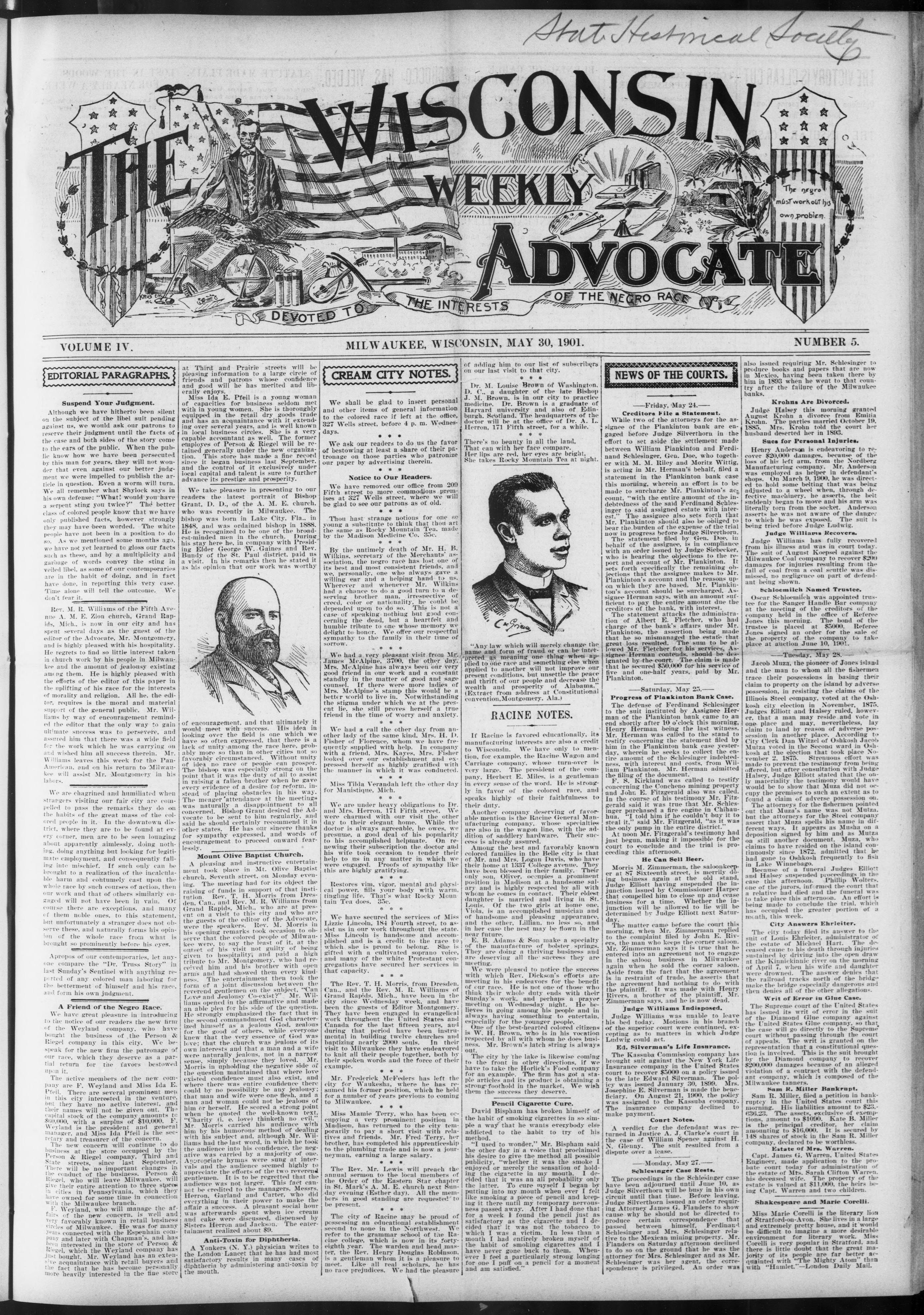
WISCONSIN
WEEKLY
ADVOCATE
DEVOTED TO THE INTERESTS OF THE NEGRO RACE
EDITORIAL PARAGRAPHS.
Suspend Your Judgment
Although we have hitherto been silent on the subject of the libel suit pending against us, we would ask our patrons to reserve their judgment until the facts of the case and both sides of the story come to the ears of the public. When the public know how we have been persecuted by this man for years, they will not wonder that even against our better judgment we were impelled to publish the article in question. Even a worm will turn. We all remember what Shylock says in his own defense: "What! would you have a serpent sting you twice?" The better class of colored people know that we have only published facts, however strongly they may have been worded. The white people have not been in a position to do so. As we mentioned some months ago, we have not yet learned to gloss our facts such as these, and by a multiplicity and garbage of words convey the sting in veiled libel, as some of our contemporaries are in the habit of doing, and in fact have done, in reporting this very case. Time alone will tell the outcome. We don't fear it.
Rev. M. R. Williams of the Fifth Avenue A. M. E. Zion church, Grand Rapids, Mich., is now in our city and has spent several days as the guest of the editor of the Advocate, Mr. Montgomery, and is highly pleased with his hospitality. He regrets to find so little interest taken in church work by his people in Milwaukee and the amount of jealousy existing among them. He is highly pleased with the efforts of the editor of this paper in the uplifting of his race for the interests of morality and religion. All he, the editor, requires is the moral and material support of the general public. Mr. Williams by way of encouragement reminded the editor that the only way to gain ultimate success was to persevere, and assured him that there was a wide field for the work which he was carrying on and wished him all success therein. Mr. Williams leaves this week for the Pan-American, and on his return to Milwaukee will assist Mr. Montgomery in his labors.
We are chagrined and humiliated when strangers visiting our fair city are compelled to pass the remarks they do on the habits of the great mass of the colored people in it. In the downtown district, where they are to be found at every corner, men are to be seen lounging about apparently aimlessly, doing nothing, doing anything but looking for legitimate employment, and consequently falling into mischief. If such only can be brought to a realization of the incalculable harm and contumely cast upon the whole race by such courses of action, then our work and that of others similarly engaged will not have been in vain. Of course there are exceptions, and many of them noble ones, to this statement, but unfortunately a stranger does not observe these, and naturally forms his opinion of the whole race from what is brought so prominently before his eyes.
Apropos of our contemporaries, let anyone compare the "Dr. Truss Story" in last Sunday's Sentinel with anything reported of any colored man laboring for the betterment of himself and his race, and form his own judgment.
A Friend of the Negro Race
We have great pleasure in introducing to the notice of our readers the new firm of the Weyland company, who have bought the business of the Person & Riegel company in this city. We bespeak for the new firm the patronage of our race, which they deserve as a partial return for the favors bestowed upon it.
The active members of the new company are F. Weyland and Miss Ida E. Pfeil. There are several prominent men in this city interested in the venture, but they have no active interest, and their names will not be given out. The capital stock of the company amounts to $60,000, with a surplus of $10,000. F. Weyland is the president and general manager, and Miss Ida Pfeil is the secretary and treasurer of the concern.
The new concern will continue to do business at the store occupied by the Person & Riegel company, Third and State streets, since last September. There will be no important changes in the conduct of the business. Person & Riegel, who will leave Milwaukee, will give their entire attention to three stores in cities in Pennsylvania, which they have owned for some time in connection with the Milwaukee branch
F. Weyland, who will manage the affairs of the new concern, is well and very favorably known in retail business circles of Milwaukee. He was for many years connected with the Espenhain company and later with Chapman's, and has been interested in the store of Person & Riegel, which the Weyland company has just bought. Mr. Weyland has an extensive acquaintance with retail buyers and the fact that he has become personally more heavily interested in the fine store
at Third and Prairie streets will be pleasing information to a large circle of friends and patrons whose confidence and good will he has merited and liberally enjoys. Miss Ida E. Pfeil is a young woman of capacities for business seldom met with in young women. She is thoroughly equipped in the retail dry goods trade and has an acquaintance with it extending over several years, and is well known in local business circles. She is a very capable accountant as well. The former employees of Person & Riegel will be retained generally under the new organization. This store has made a fine record since it began business last September, and the control of it exclusively under local capital and talent is sure to further advance its prestige and prosperity.
We take pleasure in presenting to our readers the latest portrait of Bishop Grant, D. D., of the A. M. E. church, who was recently in Milwaukee. The bishop was born in Lake City, Fla., in 1848, and was ordained bishop in 1888. He is recognized to be one of the broadest-minded men in the church. During his stay here he, in company with Presiding Elder George W. Gaines and Rev. Bundy of the St. Paul district, paid us a visit. In his remarks then he stated it as his opinion that our work was worthy
A.
of encouragement, and that ultimately it would meet with success. His idea in looking over the field is one which we have so often expressed, that there is a lack of unity among the race here, probably more so than in other cities not so favorably circumstanced. Without unity of idea no race or people can prosper. The bishop was especially strong on the point that it was the duty of all to assist in raising a fallen brother when he gave every evidence of a desire for reform, instead of placing obstacles in his way. The meager attendance at the meetings was naturally a disappointment to all concerned. Bishop Grant desired the Advocate to be sent to him regularly, and said he should certainly recommend it in other states. He has our sincere thanks for sympathy expressed, and words of encouragement to proceed onward fearlessly.
Mount Olive Baptist Church.
A pleasing and instructive entertainment took place in Mt. Olive Baptist church, Seventh street, on Monday evening. The meeting had for its object the raising of funds in support of that institution. Rev. T. H. Morris from Dresden, Can., and Rev. M. R. Williams from Grand Rapids, Mich., who are at present on a visit to this city and who are the guests of the editor of the Advocate, were the speakers. Rev. M. Morris in his opening remarks took occasion to observe that the colored people of Milwaukee were, to say the least of it, at the outset of his visit not guilty of being given to hospitality, and paid a high tribute to Mr. Montgomery, who had received him and his brother with open arms and had showed them every kindness. The entertainment then took the form of a joint discussion between the reverend gentlemen on the subject, "Can Love and Jealousy Co-exist?" Mr. Williams opened in the affirmative and made an able plea for his side of the question. He strongly emphasized the fact that in the second commandment God characterized himself as a jealous God, zealous for the good of others, while everyone knew that the very essence of God love; that the church was jealous of its own interests and that a man and a wife naturally jealous, not in a narrow sense, simply because they loved. Mr. Morris in upholding the negative side of the question maintained that where love existed confidence must also exist, and where there was entire confidence there could by no possibility be any jealousy; that man and wife were one flesh, and a man and woman could not be jealous of him or herself. He scored a strong point when he quoted the well-known text, "Charity (i. e. love) thinketh no evil." Mr. Morris carried his audience with him by his humorous method of dealing with his subject and, although Mr. Williams had the last word, in which he took the audience into his confidence, the negative was carried by a majority of one. Appropriate hymns were sung at intervals and the audience seemed highly to appreciate the efforts of the two reverend gentlemen. It is to be regretted that the audience was not larger. This fact cannot be credited to the managers, Messrs. Herron, Garland and Carter, who did everything in their power to make the affair a success. A pleasant social hour was afterwards spent when ice cream and cake were discussed, dispensed by Sisters Herron and Jackson. The entertainment realized about $9.
Anti-Toxin for Diphtheria.
A Yonkers (N. Y.) physician writes to the London Lancet that he has had most satisfactory results in many cases of diphtheria by administering anti-toxin by the mouth.
CREAM CITY NOTES.
We shall be glad to insert personal and other items of general information to the colored race if left at the office, 327 Wells street, before 4 p. m. Wednesdays.
***
We ask our readers to do us the favor of bestowing at least a share of their patronage on those parties who patronize our paper by advertising therein.
Notice to Our Readers.
We have removed our office from 209 Fifth street to more commodious premises at 327 Wells street, where we will be glad to see our patrons as of old.
***
Thou hast strange notions for one so young a substitute to think that thou art the same as Rocky Mountain Tea, made by the Madison Medicine Co. 35c.
\* \* \*
By the untimely death of Mr. H. B. Wilkins, secretary of the Merchants' association, the negro race has lost one of its best and most consistent friends, and we, personally, one who always gave a willing ear and a helping hand to us. Wherever and whenever Mr. Wilkins had a chance to do a good turn to a deserving brother man, irrespective of creed, color or nationality, he could be depended upon to do so. This is not a case of speaking nothing but good concerning the dead, but a heartfelt and humble tribute to one whose memory we delight to honor. We offer our respectful sympathy to the family in their time of sorrow.
We had a very pleasant visit from Mr. James McAlpine, 3700, the other day. Mrs. McAlpine has always been our very good friend in our work and a constant standby in the matter of good and sage counsel. If there were more ladies of Mrs. McAlpine's stamp this would be a better world to live in. Notwithstanding the stigma under which we at the present lie, she still proves herself a true friend in the time of worry and anxiety.
* * *
We had a call the other day from another lady of the same kind, Mrs. H. D. Fisher of Florence, whom we have frequently supplied with help. In company with a friend, Mrs. Kayes, Mrs. Fisher looked over our establishment and expressed herself as highly gratified with the manner in which it was conducted.
* * *
Miss Tilda Verandah left the other day for Manistique, Mich.
* * *
We are under heavy obligations to Dr. and Mrs. Herron, 171 Fifth street. We were charmed with our visit the other day to their elegant home. While the doctor is always agreeable, he owes, we presume, a good deal of his popularity to his accomplished helpmate. On renewing their subscription the doctor and his wife took occasion to tender their help to us in any matter in which we were engaged. Proofs of sympathy like this are highly gratifying.
* * *
Restores vim, vigor, mental and physical power, fills your body with warm, tingling life. That's what Rocky Mountain Tea does. 35c.
* * *
We have secured the services of Miss Lizzie Lincoln, 184 Fourth street, to assist us in our work throughout the state. Miss Lincoln is handsome and accomplished and is a credit to the race to which she is proud to belong. She is gifted with a cultivated soprano voice, and many of the white Protestant congregations have secured her services in that capacity.
that capacity.
The Rev. T. H. Morris, from Dresden, Can., and the Rev. M. R. Williams of Grand Rapids, Mich., have been in the city since Wednesday week, and have been the guests of Editor Montgomery. They have been engaged in evangelical work throughout the United States and Canada for the last fifteen years, and during that period have been instrumental in building twelve churches and baptizing nearly 2000 souls. In their visit to Milwaukee they have endeavored to knit all their people together, both by their spoken words and the force of their example.
* * *
Mr. Frederick McFeders has left the city for Waukesha, where he has resumed his former position, which he held for a number of years previous to coming to Milwaukee.
***
Miss Mamie Terry, who has been occupying a very prominent position in Madison, has returned to the city temporarily to pay a short visit with relatives and friends. Mr. Fred Terry, her brother, has completed his apprenticeship to the plumbing trade and is now a journeyman, earning a large salary.
***
The Rev. Mr. Lewis will preach the annual sermon to the local members of the Order of the Eastern Star chapter in St. Mark's A. M. E. church next Sunday evening (Esther day). All the members in good standing are requested to be present.
***
The city of Racine may be proud of possessing an educational establishment second to none in the Northwest. We refer to the grammar school of the Racine college, which is now in its forty-eighth year. The warden and head master, the Rev. Henry Douglas Robinson, is a gentleman whom it is a pleasure to meet. Like all real scholars, he has no race prejudices. We had the pleasure
of adding him to our list of subscribers on our last visit to that city.
※ ※ ※
Dr. M. Louise Brown of Washington, D. C., a daughter of the late Bishop J. M. Brown, is in our city to practice medicine. Dr. Brown is a graduate of Harvard university and also of Edinburgh, Scotland. The headquarters of the doctor will be at the office of Dr. A. L. Herron, 171 Fifth street, for a while.
* * *
There's no beauty in all the land. That can with her face compare. Her lips are red, her eyes are bright. She takes Rocky Mountain Tea at night.
C. S. Srinagar
"Any law which will merely change the name and form of fraud or can be interpreted as meaning one thing when applied to one race and something else when applied to another will not improve our present conditions, but unsettle the peace and thrift of our people and decrease the wealth and prosperity of Alabama." (Extract from address at Constitutional convention, Montgomery, Ala.)
BACINE NOTES.
If Racine is favored educationally, its manufacturing interests are also a credit to Wisconsin. We have only to mention, for example, the Racine Wagon and Carriage company, whose turn-over is very large. The president of the company, Herbert E. Miles, is a gentleman in every sense of the word. He is strongly in favor of the colored race, and speaks highly of their faithfulness to their duty.
Another company deserving of favorable mention is the Racine General Manufacturing company, whose specialties are also in the wagon line, with the addition of saddlery hardware. Their success is already assured.
Among the best and favorably known colored families in the Belle city is that of Mr. and Mrs. Logan Davis, who have their home at 1337 College avenue. They have been blessed in their family. Their only son, Oliver, occupies a prominent position in Madison at a handsome salary and is highly respected by all with whom he comes in contact. Their eldest daughter is married and living in St. Louis. Of the two girls at home one, Viola, is an accomplished musician and of handsome and pleasing appearance, and the other, Lillian, no less so, and in her case the nest may be flown in the near future. E. B. Adams & Son make a specialty of the manufacture of bolster springs. They are doing a thriving business and are deserving all the success they are meeting.
We were pleased to notice the success with which Rev. Dickson's efforts are meeting in his endeavors for the benefit of our race. He is not one of those who think their whole duty ends with their Sunday's work, and perhaps a prayer meeting on Wednesday night. He believes in going among his people and in always having something to entertain, especially for the younger people. One of the best-hearted colored citizens is W. H. Brown, who is in his vocation respected by all with whom he does business. Mr. Brown's latch string is always out. The city by the lake is likewise coming to the front in other directions, if we have to take the Horlick's Food company for an example. The firm has got a staple articles and its product is obtaining a strong foothold in the market. We wish them the success they deserve.
Pencil Cigarette Cure.
David Bispham has broken himself of the habit of smoking cigarettes in so simple a way that he wants everybody else addicted to the habit to try of his method.
"I used to wonder," Mr. Bispham said the other day in a voice that proclaimed his desire to give the method all possible publicity, "whether it was the smoke I enjoyed or merely the sensation of holding the cigarette in my mouth. I decided that it was an all probability only the latter. To cure myself I began by putting into my mouth when ever I felt like smoking a piece of pencil and keeping it there until my temporary nervousness passed away. After I had done that for a week I found the pencil just as satisfactory as the cigarette and I decided that it was not the tobacco to which I was a victim. In less than a month I had entirely broken myself of the habit of smoking cigarettes and I have never gone back to them. Whenever I feel a particularly strong longing for one I puff on a pencil for a moment and am satisfied."
NEWS OF THE COURTS.
-Friday, May 24.
Creditors File a Statement.
While two of the attorneys for the assignee of the Plankinton bank are engaged before Judge Silverthorn in the effort to set aside the settlement made between William Plankinton and Ferdinand Schlesinger, Gen. Doe, who together with M. M. Riley and Moritz Wittig, is acting in Mr. Herman's behalf, filed a statement in the Plankinton bank case this morning, wherein an effort is to be made to surcharge Mr. Plankinton's account, "with the entire amount of the indebtedness of the said Ferdinand Schlesinger to said assigned estate with interest." The assignee also sets forth that Mr. Plankinton should also be obliged to bear the burden of the expense of the trial now in progress before Judge Silverthorn.
The statement filed by Gen. Doe, in behalf of the assignee, is in compliance with an order issued by Judge Siebecker, who is hearing the objections to the report and account of Mr. Plankinton. It sets forth specifically the remaining objections that the assignee makes to Mr. Plankinton's account and the reasons upon which they are based. Mr. Plankinton's account should be surcharged. Assignee Herman says, with an amount sufficient to pay the entire amount due the creditors of the bank, with interest.
The statement attacks the administration of Albert E. Fletcher, who had charge of the bank's affairs under Mr. Plankinton, the assertion being made that he so mismanaged the estate that great loss resulted. The sum to be allowed Mr. Fletcher for his services, Assignee Herman contends, should be designated by the court. The claim is made that he secured $50,000 for his service of five and one-half years, paid by Mr. Plankinton.
-Saturday, May 25.
the defense of Ferdinand Schlesinger to the suit instituted by Assignee Herman of the Plankinton bank came to an end shortly after 10 o'clock this morning, Henry Herman being the last witness. Mr. Herman was called to the stand to testify concerning the statement filed by him in the Plankinton bank case yesterday, wherein he seeks to collect the entire amount of the Schlesinger indebtedness, with interest and costs, from William Plankinton. Mr. Herman admitted the filing of the document.
F. S. Kirkland was called to testify concerning the Concheno mining property and John E. Fitzgerald also was called. In the course of his testimony Mr. Fitzgerald said it was true that Mr. Schlesinger purchased a fire engine in Chihauhua. "I told him if he couldn't buy it to steal it," said Mr. Fitzgerald, "as it was the only pump in the entire district."
At noon Mr. Fitzgerald's testimony had just begun, making it impossible for the court to conclude and the trial is proceeding this afternoon.
He Can Sell Beer.
Morris M. Zimmerman, the saloonkeeper at 87 Sixteenth street, is merrily doing business again at the old stand, Judge Elliott having suspended the injunction issued by Commissioner Harper that compelled him to close up and cease business for a time. Whether the injunction will be allowed to lie will be determined by Judge Elliott next Saturday.
The matter came before the court this morning, when Mr. Zimmerman replied to the complaint filed by John E. Rivers, the man who keeps the corner saloon. Mr. Zimmerman says it is true that he entered into an agreement not to engage in the saloon business in Milwaukee again when he sold the corner saloon. Aside from the fact that the agreement is in restraint of trade, he asserts that the agreement had nothing to do with the plaintiff. It was made with Henry Rivers, a brother of the plaintiff, Mr. Zimmerman says, and he is now dead.
Indge Williams Indisposed.
Judge Williams was unable to leave his bed today. Motions in his branch of the superior court were continued, excepting as to matters in which Judge Ludwig could act.
Ed. Silverman's Life Insurance.
The Kassuba Commission company has brought suit against the New York Life Insurance company in the United States court to recover $5000 on a policy issued to the late Edward Silverman. The policy was issued January 30, 1899. Mrs. Josephine E. Silverman is made the beneficiary. On August 21, 1900, the policy was assigned to the Kassuba company. The insurance company declined to make payment.
Court Notes.
A verdict for the defendant was returned in Justice A. J. Clarke's court in the case of William Spence against H. N. Glenny. The suit resulted from a dispute over a lease.
Monday, May 27.
Schlesinger Case Rests.
The proceedings in the Schlesinger case have been adjourned until June 10, as Judge Silverthorn will be busy in his own circuit until that time. Before leaving, Judge Silverthorn issued an order requiring Attorney James G. Flanders to show cause why he should not be directed to produce certain correspondence that passed between himself. Ferdinand Schlesinger and Mrs. Schlesinger relative to the Mexican mining property. Mr. Flanders on Saturday afternoon declined to do so on the ground that he was the attorney for Mrs. Schlesinger and as Mr. Schlesinger was her agent, the correspondence is privileged. An order was
also issued requiring Mr. Schlesinger to produce books and papers that are now in Mexico, having been taken there by him in 1893 when he went to that country after the failure of the Milwaukee banks.
Krohns Are Divorced.
Judge Halsey this morning granted August Krohn a divorce from Emitia Krohn. The parties married October 19, 1885. Mrs. Krohn told the court her husband deserted her in 1893.
Sues for Personal Injuries.
Henry Anderson is endeavoring to recover $20,000 damages, because of the loss of his left arm, from the Nordberg Manufacturing company. Mr. Anderson was employed as helper in defendant's shops. On March 9, 1900, he was directed to hold some belting that was being adjusted to a wheel when, through defective machinery, he asserts, the belt suddenly began to move and his arm was literally torn from the socket. Anderson asserts he was not aware of the danger to which he was exposed. The suit is being tried before Judge Ludwig.
Judge Williams Recovers.
Judge Williamis has fully recovered from his illness and was in court today. The suit of August Koepsel against the Milwaukee Coal company to recover $200 damages for injuries resulting from the fall of coal from a coal scuttle was dismissed, no negligence on part of defendant being shown.
Schloemilch Named Trustee.
Oscar Schloemilch was appointed trustee for the Sanger Handle Bar company at the meeting of the creditors of the company held in the office of Referee Jones this morning. The bond of the trustee is placed at $5000. Referee Jones signed an order for the sale of the property of the company to take place at auction June 10, 1901.
-Tuesday, May 28.
Jacob Muza, the pioneer of Jones island and the man to whom all the fishermen trace their possessions in basing their claim to property on the island by adverse possession, in resisting the claims of the Illinois Steel company, voted at the Oshkosh city election in November, 1875. Judges Elliott and Halsey ruled, however, that a man may reside and vote in one place and may, nevertheless, lay claim to land by reason of adverse possession in another place. According to City Clerk Dan Witzel of Oshkosh Jacob Mutza voted in the Second ward in Oshkosh at the election that took place November 2. 1875. Strenuous effort was made to prevent the testimony from being offered, but after consultation with Judge Halsey, Judge Elliott stated that the only materiality the testimony would have would be to show that Muza did not occupy the premises to such an extent as to found a claim of adverse possession on.
The attorneys for the fishermen pointed out that Muza's name was not Mutza, but the attorneys for the Steel company assert that Muza spells his name in different ways. It appears as Musha on a deposition signed by him and as Mutza on still another document. Muza, who claims to have resided on the island continuously since 1872, admitted that he had gone to Oshkosh frequently to fish in Lake Winnebago. Because of a funeral Judges Elliott and Halsey suspended proceedings in the case this afternoon. Phillip Wolters, one of the jurors, informed the court that a relative had died and the funeral was to take place this afternoon. An effort is being made to conclude the trial, which has occupied the greater portion of a month, this week.
City Answers Ehrleiter.
The city today filed its answer to the suit of Louis Ehrleiter, administrator of the estate of Michael Hart. The deceased came to his death through injuries sustained by driving into the open draw at the Kinnickinnie river on the morning of April 7. when his wife and daughter were drowned. The answer denies that the railroad tracks north of the bridge make the bridge especially dangerous and then denies all of the other allegations.
Writ of Error in Glue Case.
The Supreme court of the United States has issued its writ of error in the suit of the Diamond Glue company against the United States Glue company, so that the case will go directly to the Supreme court without passing through the court of appeals. The writ is granted on the representation that a constitutional question is involved. This is the suit brought by the Diamond company to recover $200,000 damages because of an alleged violation of a contract with the defendant company, which is composed of the Milwaukee tanners.
Sam R. Miller Bankrupt.
Sam R. Miller, filed a petition in bankruptcy in the United States court this morning. His liabilities amount to $23,636.23. The assets, exclusive of exemptions, amount to $1000. Kate B. Miller is the principal creditor, her claim amounting to $16,000. It is secured by 148 shares of stock in the Sam R. Miller company, declared to be worthless.
Estate of Mrs. Warren.
Capt. James G. Warren, United States Engineer, made application to the probate court today for administration of the estate of Mrs. Sarah Clifton Warren, his deceased wife. The property of the estate is valued at $11,000, the heirs being Capt. Warren and two children.
Shakespeare and Marie Corelli.
Miss Marie Corelli is the literary lion of Stratford-on-Avon. She lives in a large and extremely pretty house, and it would be difficult to imagine a more desirable environment for literary work. Miss Corelli is very popular in Stratford, and there is little doubt that the great majority of its people are far better acquainted with "The Mighty Atom" than with "Hamlet."—London Daily Mail.
DOWN THE CREEK.
Settin' on a sickamore
With yer ole cane pole;
Lookin' at yer bobber dance
On th' sun-fish hole.
Set thare whis'lin' e' yerself,
Waitin' fer a bite;
Worter singin' in yer ear;
Sun a-shinin' bright.
Killdeer flyin' up th' crick
Sassin' you jes' vile;
Ornree little bobbin' scamp
Makes a feller smile.
Suthin' tuggin' at yer hook;
Bobber jerkin' round;
Bites jes like a dog-gone whale;
Mus' weigh fifteen pound.
Pull with all th' stren'th y've got;
Break th' dern cane pole;
Lose yer holts an' tumble off
In th' sun-fish hole.
IN GAY NEW YORK.
Scenes and Incidents of Everyday Life in the Paris of America.
Louis Schepp has sold his stock exchange seat for $60,000, and will go abroad on a protracted trip. He was for years one of the most daring of the many room traders, and is credited with having made large winnings.
The old ice palace on the northwest corner of Lexington avenue and One Hundred and Seventh street will be reconstructed into a modern theater, from plans by Samuel Cohen, who has placed the estimate of the work at $150,000.
Plans are on foot for a transformation of Greeley square into an open plaza. The elevated stations at Thirty-third street are to be moved farther up Sixth avenue and the present park abolished. This is destined to become the greatest business center uptown.
The estate of Edwin Booth, situated in Middletown, near Newport, R. L., and known as "Boothden," has been rented to J. De Wolfe Cutting of New York for the coming season. This is one of the most historic spots near Newport, and is situated on the rock cliff overlooking the Atlantic ocean.
For the first time in several years the members of the stock exchange are plunging heavily in wheat. The Waldorf-Astoria crowd around the United States Steel posts are carrying about 1,500,000 bushels of wheat futures. The stock exchange members plunge more heavily than the local speculators on the produce exchange.
C. Oliver Iselin won in the action brought against him by William Stricker, a broker, to recover a commission of $6500 on the sale of the yacht Defender to M. Samuels & Sons. Mr. Iselin denied that he had employed Stricker, and a jury before Justice Clarke in the Supreme court brought in a verdict in a few minutes for Mr. Iselin.
Strawberries are to be found in the bonbon shops. Boxes of them, the regular little wooden boxes with a top row of berries, are to be seen as fine as anyone could wish. But they differ from other boxes of berries, for the top layer is the poorest, nothing but papier mache, while beneath are the very best bonbons that the market affords.
William C. Whitney, who was to have started for Europe on the White Star liner Oceanic, canceled his room and former Senator Edward O. Wolcott took it. The ship was crowded to the last inch, taking away 400 first cabin, 240 second cabin and 1000 steerage. Of the latter 600 were Scandinavians from the West and Northwest who are going home for the May festivals.
Eugene Zimmermann, father-in-law of the Duke of Manchester, arrived from Liverpool aboard the Teutonic. He said the reports he had gone abroad to settle with the creditors of the duke were untrue. "My daughter has plenty of money," he said, "and I do not interfere with her affairs or those of her husband. I am glad to get home. America is good enough for me."
Hotelkeepers in New York city are already overwhelmed with applications from persons abroad who desire to witness the international yacht races. They report that the demand is unprecedented and will tax the accommodations of all the hotels and apartment houses. Employes of hotels have been given notice that they must take any vacation they expect this year before August 15.
Aristocratic wine sellers are to have a notable addition to their ranks in the person of the Earl of Yarmouth, late actor and later plaintiff in a famous libel suit, he having decided to boom among his friends the particular brand of champagne formerly sold by Harry Lehr. The profession of wine selling received a great impetus when Harry Lehr became one of its members. Now that he has deserted it, it became the aim of all the wine houses to fill the void in as brilliant a manner as possible.
"The initial letter 'J.'" says the Philadelphia Record, "figured prominently in the recent great financial game in Wall street. In former times of storm and stress J. Gould and J. Fisk were constantly before the speculative public. Now we have J. Pierpont Morgan, J. R. Keene, J. J. Hill, J. Stillman, J. Schiff, J. H. Moore, J. W. Gates, J. Loeb and George J. Gould—to say nothing of the numerous jays who bought and sold on small margins in a feverish market and lost their money in the twinkling of an eye."
When the passengers from the steamship Kaiser Wilhelm der Grosse landed from her last trip the customs officials became suspicious that Leo Goodman, a cabin passenger, had not declared all the goods he brought with him. After questioning the man they took him on board and searched him. They found wound about his waist a long thin gold chain, and in a pocket a small chain of gold. The chains were confiscated and sent to the appraisers' stores. The officials describe the chain as "very thin and almost a mile long."
"An X-ray machine might be a good thing for the uptown hotels," remarked one of the Waldorf-Astoria detectives thoughtfully. "The fact that a lady attending the X-Ray society's demonstration, the other day, was detected with a silver spoon in her corsage by the machine opens up a new field for long-suffering hotel proprietors. Every big hotel like the Waldorf-Astoria suffers from the 'souvenir spoon' mania. Many a fair guest, with no thought of petty larceny, will appropriate a bit of silver 'as the memento of a very pleasant evening.' An X-ray served with the finger bowls might bring about a change."
An engagement of interest has been cabled from the other side. It is that of Lady Mary Sackville, the daughter of the seventh Lord Delawarr, and Hamilton Dent. Lady Mary Sackville has been in this country on two occasions, as the guest of Mr. and Mrs. George Gould at Georgian court. She is a tall, handsome girl, with auburn hair. She has made a great success in amateur theatricals, and was one of the young women who posed in the famous tableaux arranged by Mrs. Arthur Paget in London winter
before last for the benefit of the South African war fund. Nothing is known of Hamilton Dent in New York.
The walking-stick craze has made its appearance here among the women. Over in London the fad has taken complete possession of the fair sex, and a collection of jeweled sticks, one as different as possible from the other, is made by every up-to-date maiden. Two pretty girls appeared on Fifth avenue recently carrying walking sticks of the London style, with fanciful heads. Several dealers have imported a stock of light sticks and another month will probably find Broadway as well as Fifth avenue full of them. The proper caper is to have a walking stick to match every walking costume, and this makes the fad a pretty expensive one.
The New York Times man is authority for the statement that the woman of today wears a heart in her corset. That is not a surprise to anatomically-inclined individuals, for they have always guessed as much. But they must guess again this time. The heart to which the woman gives thought is a nice little satin one, scented with her favorite sachet, and is used as a buffer for the corset steel, which is apt to press against her uppermost ribs in a way which announces itself unpleasantly. Hence the little satin heart, tacked to the top of the corset, where it discourses in fragrant tones of lilacs, violets, or mignonette and matches the corset, if that is of fancy material, or the ribbons in the woman's lingerie.
Gray, according to one authority, has become so positively the color for men's summer dress that other colors are rarely made up now. The only other shade that compares in popularity with gray is blue, which is moreover used only in the solid color or with merely a stripe. Gray is, on the other hand, found in all kinds of checks and stripes and the purchaser not to be suited by the supply must indeed be exacting. Every pattern is present in the shades of gray and there is scarcely any other shade to be found. This exclusiveness in color is the reaction against a long popularity of brown as a summer shade. A salesman in one of the largest stores devoted to the sale of ready-made garments, said that the preponderance of gray would in all probability continue for some two or three seasons to come.
Sigmund Morse found himself $100,000 richer as the result of being on the right side in the recent bulli market and now his father has gone to Germany to claim a $1,000,000 estate to which he is coheir. Morse, whose "flyer" in Wall street at the right moment won him a fortune, secured his original capital by frugal savings. He came to America from Germany fourteen years ago when he was 16 years old with his family and became their main support. The second day of the upward movement in Wall street Morse took his little bank account and invested in Northern Pacific and U. S. Steel. Two days later he found himself the possessor of $100,000 and close following the news of the death of a rich relative in Posen, Germany, leaving his enormous fortune to Sigmund Morse and his family.
James J. Hill, railroad magnate and reputed partner of J. P. Morgan in the great Northern Pacific and Burlington deal, has decided to make New York his home in the future. On May 1 he rented a magnificent apartment in the Bolkenhayn, adjoining the Hotel Savoy, at Fifty-eighth street and Fifth avenue. The apartment faces the Plaza on Fifth avenue and is on the third floor. It consists of fourteen rooms, and the annual rental is $8000. Since the signing of the lease Boston decorators have had artists at work fitting the apartment up in an elaborate manner for Mr. Hill's occupancy. A foreman comes from Boston every Monday and returns on Friday night. Mr. Hill has stated that his wife and daughters will be here about June 1, at which time the apartment will be ready for them. Mr. Hill's determination to become one of the colony of New York millionaires comes as a surprise to his friends in Wall street.
An endless stream of the lame, halt and blind is passing through the Church of Our Lady of Lourdes in Brooklyn these days. Since the reported miracle of when a little crippled boy drank a bottle of holy water from the real spring at Lourdes, France, and then walked to the church without crutches, scores of persons have journeyed to the little church. Many of them traveled miles to seek a cure. They are mostly old men and silent, tearful women dressed in black. The tiny crutches of the original cripple adorn the church walls near the shrine of the Lady of Lourdes and not a worshiper enters the door but firmly believes that a miracle wrought this wonderful cure. The shrine is patterned after that in the original church at Lourdes with a reproduction of the famous grotto. The youngster who is responsible for these pilgrimages declares he never felt better in his life, and that improvement dated from the moment he drank the holy water given him by a priest.
To shoes and cotton cloth and cough syrup may be added a dozen bottles of peroxide of hydrogen in the monthly expenses of the New York Foundling home. The use of the last item will be for the protection of red-haired children. "No charitable family intent upon adoption will have a red-haired child." Agent Swayne says, "for the sake of the proportion of red-haired children yearly passed in at the institution, peroxide looks like the only fair way out." "It is quite true," said Sister Agnes, "that nobody seems to want red-haired children. It is because the general idea prevails that these children have bad tempers, though I really don't know that that reason is such an important one as that red-haired children are sometimes freckled. As a matter of fact we haven't a freckled child in the whole 700." In the records of the home there is one letter filed asking for a child "if possible with auburn hair." The letter, however, is without precedent and has never been duplicated.
Blasting has become one of the fine arts above Madison square. Section four of the new rapid transit tunnel, which comprises the fashionable hotel district, is being carved through a massive barrier of rock, and ordinary mining is mere child's play in comparison. Workmen who have been laboring with drills and dynamite appreciate some of the difficulties of carving out modern catacombs. From Thirty-fourth street to Forty-second Park avenue is underlaid with rock. Through this rock the tunnel route was projected. Explosions that rattle the windows for blocks around and cause guests at the Waldorf-Astoria to wonder if the roof has fallen in are of common occurrence. The two tunnels look more like horizontal shafts in a coal mine than anything else. Gasoline lamps are burning at the entrance, while rows of small incandescent bulbs throw a curious half light along the jagged walls. A company of patient mules completes the coal mine illusion, and more than one Pennsylvanian has remarked on its truthfulness when the grimy workmen, picks in hand, marched out for a breath of fresh air.
A dozen hotels, costing from $500,000 to $1,000,000, will be erected by syndicates on sites on Broadway and adjacent streets. Plans for Pabst's Grand Circle hotel and the Park theater at Fifty-eighth street and Eighth avenue were filed the other day, and this is but one of many combination hotel and amusement enterprises projected by ambitious capitalists. W. E. D. Stokes is at the head of a syndicate which is building the Ansonia, a $2,500,000 apartment
hotel, at Broadway and Seventy-third street. William Waldorf Astor will build a new Hotel Muschenheim on Broadway, extending from Forty-fourth to Forty-fifth streets, at a cost of $1,500,000. An addition is being built to the Hotel Martinique in West Thirty-third street, near Broadway, at a cost of $400,000. A $1,000,000 hotel for Riverside drive is planned for a One Hundred and Twenty-fourth street corner. The Hotel Wellington, costing $700,000, at Seventh avenue and Fifty-fourth street; the Mohawk, in West Forty-seventh street, costing $450,000, and the Wistaria, in West Fifty-ninth street, costing $550,000, are also in course of erection.
The new country house which Howard Gould is to build on the north shore of Long island, at Sand Point, the accepted plans for which Abner J. Hayden, the architect, is now completing, will be unique in the way of country homes and on the whole more elaborate than any place in this vicinity. It will be somewhat larger than the famous Biltmore and will be on the lines of the famous Kilkenny castle, although the interior arrangements will be in every way American. The walls will be built of gray stone in the old style without a steel frame, and there will be no steel pillars or beams such as are generally used in the modern house of large dimensions.
Following the idea of Kilkenny castle, which is on a precipice above the River Nore, Mr. Gould's house will be built on a bluff overlooking the sound. The house will be in the form of a square with the inland side open. The three chief rooms on the ground floor will be cut through from the court to the front of the house. Huge towers, the highest 150 feet, will rise at each angle of the walls. The landscape features have been planned on an elaborate scale, and the place in this particular will, it is said be without an equal in this country.
Before the house will be a terrace stretching to the edge of the bluff and bounded by a marble balustrade. At the bottom of the ravine, like a moat cutting the castle off from the mainland, a lake will be formed and a garden will stretch from this up the open court. A brook will run through it and terraces and fountains will further increase its picturesque effect. The road to the house will cross the ravine by stone bridges. Work on the grounds has already been begun, and it is expected that ground will shortly be broken for the house. It is expected that it will take over two years to finish it.
Edna Wallace Hopper and Lillian Russell have for several years run a close race for the record in originality and amount of personal exploitation, but the little comedienne has taken a sudden spurt that left Miss Russell away back.
Mrs. Hopper is a devotee of horse racing, and the prospect of appearing in a matinee of "Florodora" on Saturday, while the Brooklyn handicap was being run, she declared unbearable. She asked John C. Fisher, the manager of "Florodora," what he would sell Saturday afternoon's house for. He told her that the capacity was $1600, and that at every recent matinee that amount of money had been taken in. Mrs. Hopper said:
"I will pay you $1700 to give no performance. I must go to the Brooklyn handicap."
Fisher regarded the offer as a joke, until Mrs. Hopper gave a check for the $1700. The announcement signed by Fisher was put on the bulletin board at the stage door, telling the company that there would be no matinee. People who came to buy tickets got the same information. There is no doubt of the genuineness of this thing. There is no deception about it. Mrs. Hopper thus buys for herself the first place among American stage advertisers.
All the Lillian Russell devices are eclipsed, and those of Sadie Martinot, Anna Held and a hundred others. The actual cost of this to Mrs. Hopper is proved by the number of prospective purchasers of tickets for next Saturday afternoon who have already been turned away, and by Mrs. Hopper's certified check. Of course, the actress will be a conspicuous figure at the race. That she will, therefore, enjoy the sport keenly is sure. But, even as a business investment, her outlay is probably shrewd. It will bring to her an amount and kind of celebrity worth more than $1700 to an actress desirous of obtaining it.
CANADA'S STEEL BOOM.
Manufacturers Flock There to Secure the Government Bounty.
A Montreal correspondent writes that so many iron and steel plants are being started in Canada that it is feared the bounties offered by the government will become a greater burden than the country will be able to bear.
The Dominion Iron & Steel company alone expects to clear in this way over £1,600,000 in the next seven years.
The amount of the bounties expected to be received from the Canadian government by the steel plants in actual operation in seven years was given in the debate on the bounties in the Commons last week as probably $15,000,000 to $20,-000,000.
The finance minister, when confronted with these figures, took the ground that the more Canada should be called upon to pay under this head the better it would be. Every additional ton manufactured he regarded as so much more cause for congratulation. His only comment on the large estimates of the bounties looked for by the companies that were in the market to place their stock was that companies in that position usually indulged themselves in rosette views.
The bounties paid out in solid reality are shown by the auditor-general's report for the last year, covering the period before the sudden development of Canada's steel industries. Although the steel plants already in existence were only starting, or in their early infancy, the Hamilton Blast Furnace company received $107,000 in bonuses for the year, the Nova Scotia Steel company $73,000, the same concern a further sum of $64,000, and six other concerns various smaller amounts.
KEARSARGE GUN REPL ACED.
Naval Constructor Capps Successfully Carries Out His Plans.
Naval Constructor L. C. Capps' plans for sliding into the forward turret of the United States battleship Kearsarge a new seventy-ton 13-inch gun were executed at the Brooklyn navy-yard as successfully as were those he conceived for the novel removal of the disabled gun of the same size and weight. The new gun was swung from its trucks on the dock near the Kearsarge and it took thirty-three minutes to lift the gun and place it on the ways on the Kearsarge.
In sliding the new gun the method was just the reverse of the plan of sliding the old gun out. The old gun was pushed out with hydraulic jacks, which were placed against the breech of the gun inside the turret. The new gun was pulled in by means of a steel cable, which was run through its bore and cleated to the muzzle. It took about four hours to pull the gun in.
For removing the old gun and putting in the new one, according to Contractor Capps' plans, the entire cost will be less than $6000. When it was originally planned to remove the disabled gun from the turret in the old way, that of tearing the turret apart, a shipbuilding concern agreed to do the work for $75,000. It was decided that it could be done at the yard for less than $40,000, and that it would take three or four months to do it. Contractor Capps then worked out the less expensive plans, which could be executed more expeditionally.
ONLY TWO ARE SAVED.
Thrilling Story of the Disaster by Second Engineer Thomas Murphy of Milwaukee.
East Tawas, Mich.. May 25.—The steamer Baltimore foundered in Lake Huron off Au Sable yesterday, and out of a crew of fourteen men but two are reported to have been saved.
The dead follow:
ANDERSON, AUGUST, deckhand.
BREATHEN, MICHAEL, first mate.
DELDERS, JOHN, second steward.
KRUEGER, F., fireman.
MARCOUX, PETER, chief engineer.
PARKER, WILLIAM, fireman.
PLACE, M. H., captain.
PLACE, MRS. M. H., captain's wife,
steward.
OWEN, EDWARD, wheelsman.
SCOTT, GEORGE W., watchman.
SEARS, C. W., wheelsman.
WINNING, HERBERT, watchman.
Capt. Place resided at Lakewood, a suburb near Cleveland. He sailed the steamer Germanic for years, and took command of the Baltimore only this spring, after buying an interest in the ship. He was a member of the Shipmasters' association, carrying $1000 insurance in that organization. His wife went with him in the new command as steward. Capt. Place was well known in marine circles, and the news of his death was received with general regret among marine men.
P. Marcoux, the chief engineer, resided with his aunt at 780 North Mozart street, Chicago. Thomas Murphy, the second engineer, who according to dispatches was saved, came from Milwaukee.
The Baltimore came out in 1881, and was then known as the Escanaba. She belonged to a fleet owned largely by O. W. Potter and his associates in the North Chicago Rolling mills. Carrying iron ore from Escanaba to the rolling mills, the steamer paid for herself more than a half dozen times. When the steel magnates closed out their interests, the Escanaba passed into the hands of P. H. Fleming & Co., and ran in the Baltimore & Ohio line between Fairport and Chicago, her name being changed at that time to Baltimore. The Baltimore was 201 feet keel, 35 feet beam, and carried about 2000 tons of freight. Her last cargo was a load of coal from Lorain, O., to Washburn. Wis. The cargo was owned by the Northwestern Fuel company. The steamer was rated at $40,-000 by the underwriters, and was insured for nearly that amount.
Story of a Survivor.
The two who survived the wreck of the Baltimore are George McGinnis, a deckhand, who went crazy from his experience, and Thomas Murphy of Milwaukee, second engineer. It was some time after the Columbia had brought the shipwrecked men into port before Murphy was revived sufficiently to tell his story. The Baltimore foundered about 6 o'clock yesterday morning, and he was in the water until 2 in the afternoon, exposed to the buffeting of a furious northeast sea. Murphy lives at 325 Bartlett street, Milwaukee.
"We were bound from Lorain to Sault Ste. Marie," he said, "and had in tow a large steam drill and scow. When off Thunder bay Thursday night Capt. Place saw the steamer was making bad weather, for the waves had smashed in the engineers' quarters and the washrooms, and the water was running into the hold. Capt. Place decided to turn about and run for Tawas for shelter. Everything went all right until we were off Au Sable, when the steamer struck heavily on the bottom. The seas broke over her at the same time, and carried away the deckhouse, then the after cabin, and finally the smokestack fell. Both rails forward broke in two just aft of the forward deckhouse, and we knew that it was only a few minutes before the steamer would go to pieces.
"It is every man for himself now," shouted Capt. Place. The look of despair on Mrs. Place's face was something I shall never forget. It was awful. We took the captain's advice, and every man started to save himself as best he could. Some of the boys took to the rigging, but McGinnis and I lashed ourselves to a ringbolt in a piece of the after cabin, and we were washed overboard shortly afterward.
Made Crazy by the Strain.
"The strain was too much for McGinnis, and he went crazy before we had been in the water very long. He tried to throw me off the wreckage, but I talked to him and encouraged him. Twice he got loose and tried to drown us both, but each time I succeeded in quieting him. I told him a boat was coming to take us off, and then I would get him tied fast again.
"The passenger steamer City of Holland passed by us, but we were too far away for her crew to see us, I believe. This made me feel pretty despondent for a time, for I was getting weak, and the seas broke over my head so as to drive the breath out of my body at times."
"The Columbia finally came along and picked us up, just as I was about to give up hope. I am afraid all of the rest of the crew were drowned, including Mrs. Place. I only wonder how it was that we lived through it all. Our wreckage was big enough to make a raft, but it was small, and the seas swept it constantly."
ENDOWMENT FOR BELOIT.
College will Have $350,000 Within a Month.
Chicago, Ill., May 25.—The trustees of Beloit college met at the Union League club last night to discuss the prospects for raising the $150,000 required to secure the donation of $200,000 from Dr. D. K. Pearsons for the endowment fund. Chairman E. H. Pitkin announced that the efforts of the friends of the college had been fairly successful and that there was every reason to believe that the endowment would be secured within a month.
Created a Panic.
Madrid, May 25.—An earthquake has occurred in Malaga. A number of houses were damaged and a panic was created among the inhabitants. Storm and floods at Puebla de Alcocer, province of Badakjos, have resulted in the loss of two lives and injury to several persons. At Motril, province of Granada, several houses were destroyed and the inhabitants were panic-stricken.
Twenty-one Miners Perished
Berlin, May 25.—A dispatch from Waldenburg, Prussia, says that as a result of a fire which broke out today in the Herman mine twenty-one miners perished.
New Minister to Persia.
Washington, D. C., May 25.—Herbert W. Bowen of New York was today appointed envoy extraordinary and minister plenipotentiary to Persia.
Boer Commanders to Meet.
London, May 25.—"Gen. Botha has asked Gen. Dewet to meet him," says the Pretoria correspondent of the Daily Mail. "to discuss the situation."
WHY WE NEED HOBBIES.
Our Daily Occupations will Not Keep Fresh the Springs of Life.
Business is not inseparable from higher things, says a writer in the St. Louis Globe-Democrat. Men may be born grocers, but need not live only as grocers. Solon and Thales, wise men of the Greeks, were merchants; Plato peddled oil; Spinzona, the philosopher, mended spectacles. Linnaeus was a cobbler as well as a botanist. Shakespeare prided himself more upon his success as a stage manager than as a dramatist. Spenser was a sheriff. It might require a rather strong wrench of the imagination to imagine sheriffs of today writing another "Faerie Queen"—but why? Milton taught school, as have almost all great men. Walter Scott, the wizard of the North, was circuit clerk and practical man of affairs: Grote was a London banker, Ricardo a stock jobber and Sir Isaac Newton master of the English mint. Paul was a tentmaker and the Great Gentleman an apprentice at a carpenter's bench.
"I practice law simply to support myself," said one of the greatest of St. Louis attorneys—an attorney-at-law, not an attorney-at-politics—"but my real life is at home in my library." Thoroughly practical people need the help of hobbies to keep them from shriveling up.
MARKET REPORTS.
MILWAUKEE—Eggs—Market easy; fresh new, cases included, 11c; fresh, cases returned, 10½c; seconds, 8c. Receipts were 405 cases.
Butter--Market steady to firm. Fancy prints, 18½c; fancy or extra creamery, per lb, 18c; firsts, 16@17c; seconds, 14@15c; dairy prints, 15½c; extra fancy dairy, 15c; lines, 12@13c; packing stock, 11@12c; whey, 5c; roll, wrapped, 11@12c; unwrapped, 10@12c; grease, 4@5c. The receipts today were 27,425 lbs against 12,929 yesterday. The receipts continue liberal and the demand good, all grades being well cleaned up. There has been no change in prices during the week, although an effort was made to advance the market ½c. The feeling at the close of the week is really firmer.
Cheese—Steady. Receipts were 26,740 lbs today against 3670 lbs yesterday. Full cream flats, new colored, 10½% of ½c; Young Americas, new, 11@12c; daisies, new, 11@12c; fancy brick, 11@11c; low grades, 7 @9c; limburger, per lb, No. 1, 11@11½c; low grades, 6@9c; imported Swiss, 23@24c; Block Swiss, domestic, 14@15c; choice loaf, 15@16c; No. 2, 10@11c; Sapsago, 19@20c; farmers, 10@11c.
NEW YORK—Butter — Receipts, 9841
pkgs; firm; creamery, 15@19c; factory, 11@13½c. Cheese—Receipts, 2191 pkgs; firm;
fancy large colored, 8½@8½c; fancy large
white, 8½@8½c; fancy small colored, 9½@9½c; fancy small white, 9½@9½c. Eggs—Receipts, 9336 pkgs; Western ungraded, 11@12½c. Western selected, 13@13½c. Sugar—Raw, steady; fair refining, 3½c; centrifugal, 96 test, 4 9-32c; molasses sugar, 3½c; refined quiet; crushed, 6.05c; powdered, 5.65c; granulated, 5.55c. Coffee—No. 7, 6 5-16c, nominal.
CHICAGO — Butter—Strong; creamerles, 14@18½c; dairies, 14@16c. Cheese—Firm; twins, 9@9½c; Young Americas, 10½c; cheddars, 9c; dalses, 10c. Eggs—Firm; loss off, cases returned, 11½c. Iced poultry—Steady; chickens, 8@8½c; turkeys, 7@9c.
MILWAUKEE LIVESTOCK MARKET
HOGS—Receipts, 14 cars; market 5c higher; light, 5.70@5.80; mixed and medium weights, 5.75@5.85; common to good packers, 5.60@5.85; fancy selected hogs, 5.85@5.90.
CATTLE—Receipts, 3 cars; strong; butchers' steers, medium to good, 1050 to 1300 lbs, 4.75@5.50; fair to medium, 950 to 1050, 4.25@4.75; helfers, common, 3.25@3.75; good, 4.25@4.75; cows, fair to good, 3.25@4.25; canners, 2.00@2.75; bulls, common, 3.00@3.50; choice, 3.75@4.25; feeders, 800 to 950 lbs, 3.50@4.25; stockers, 500 to 750 lbs, 3.25@4.00; veal calves, common, 5.25@5.50; choice, 5.75@6.00; milkers and springers, common, 18.00@25.00; choice, 35.00@50.00.
SHEEP—Receipts, none; market steady, 3.50@4.50; bucks, 3.50@4.50; spring lambs, 5.00@6.50.
Chicago receipts: Hogs, 34,000; cattle, 20,500; sheep, 20,000.
MARKETS BY TELEGRAPH
MILWAUKEE—Wheat—Higher and active; No. 1 Northern, on track, 76c. Corn—Steady; No. 3 on track, 42c. Oats—Steady; No. 2 white, on track, 30c; No. 3 white, on track, 29@30c. Barley—Dull; No. 2 on track, 55c; sample on track, 48@55c. Rye—Easy; No. 1 on track, 54½c. Provisions—Steady; pork, 14.62½; lard, 8.20.
Millstuffs are dull and quoted at 13.75 @14.00 for bran. 13.50@13.75 for standard middlings, and 15.00@15.25 for Milwaukee flour middlings.
CHICAGO—Close—Wheat—May, 74c; July, 78%@73%c. Corn—May, 43%c; July, 44%c. Oats—May, 30%c; July, 28%@28%c. Pork—May, 14.67%i; July, 14.77%i; September, 14.75. Lard—May, 8.22%i; July, 8.20; September, 8.22%i; October, 8.22%i; November, 8.10. Rlbs—May, 7.90; July, 7.90; September, 7.87%i. Flax—Cash Northwest, 1.72%i. No. 1, 1.72; May, 1.73; October, 1.32. ST. LOUISE—Close — Wheat — Weak. No. 2 red cash, 72%c; May, 72%c; July, 70%c; September, 69%c; No. 2 hard, 73%@73%c. Corn—Higher; No. 2 cash, 42%c; May, 42%c; July, 42%c; September, 42%c. Oats—Higher; No. 2 cash, 29c; May, 29c; July, 28c; September, 28%@28%c; No. 2 white, 30%@30%c. Lead—Higher, strong, 4.32%@4.35. Speller—Oullet, 3.80
DULUTH — Close — Wheat — Cash No. 1
hard, 75%c; No. 1 Northern, 74%c; No. 2
Northern, 70%c; No. 3 sprng, 66%c; to arrive, No. 1 hard, 77%c; No. 1 Northern,
74%c; May, 74%c; July, 74%c; September,
71%c; Corn-40%c; May, 41c; Oats-28%@
28c. Rye-51c. Flax-To arrive, 1.64; cash,
1.75; May, 1.75; September, 1.35; October,
1.33. Receipts of wheat, 22,261; shipments,
67,050 bus.
KANSAS CITY — Close — Wheat — July,
66%c; September, 65%c; cash No. 2 hard,
60%@70c. Corn-July, 40%c; September,
43%c; cash No. 2 mixed, 40%@40%c; No.
2 white, 41%c; Oats-No. 2 white, 30%@
31c.
MINNEAPOLIS — Close — Wheat — Cash,
72%c; July, 72%c; September, 70%c.
NEW YORK—Close — Wheat-May, 815%c;
ST. LOUIS—Cattle—Receipts, 2500; market steady; native steers, 3.50@6.00; stockers and feeders, 2.85@4.80; cows and heifers, 2.00@5.00; Texans, 3.60@5.00. Hogs—Receipts, 6000; steady to strong; pigs, 5.00@5.70; packers, 5.60@5.75; butchers, 5.75@5.90. Sheep—Receipts, 1500; strong; native muttons, 4.25@4.60; lambs, 5.00@5.85. KANSAS CITY—Cattle—Receipts, 5000; strong to 5@10c higher; native steers, 4.75@5.85; Texans, 3.40@5.90; cows and heifers, 3.35@5.25; stockers and feeders, 3.75@5.05. Hogs—Receipts, 17,000; strong; bulk of sales, 5.65@5.85; heavy, 5.80@5.90; packers, 5.70@5.85; mixed, 5.65@5.85; yorkers, 5.35@5.70; pigs, 4.50@5.30. Sheep—Receipts, 5000; steady; muttons, 3.75@5.00; lambs, 4.70@6.50
SOUTH OMAHA—Cattle—Receipts, 4500;
steady; native steers, 4.00@5.60;
Texas steers, 3.50@4.40; cows and heifers, 3.60@
4.60; canners, 2.00@3.50; stockers and feeders,
3.25@5.10. Hogs—Receipts, 15,300;
steady; heavy, 5.62½@5.72½; mixed, 5.60@
5.62½; pigs, 5.00@5.50; bulk of sales, 5.60@
5.62½. Sheep—Receipts, 2500; steady; common and stock sheep, 3.00@3.75; lambs, 4.50@6.00.
You Can Get Allen's Foot-Ease FREE.
Write today to Allen S. Olmsted, Le Roy, N. Y., for a FREE sample of Allen's Foot-Ease, a powder to shake into your shoes. It cures tired, sweating, damp, swollen, aching feet. It makes new or tight shoes easy. A certain cure for Corns and Bunions. All druggists and shoe stores sell it. 25c.
Ancient Manuscript.
The library of Heidelberg university has just acquired 27 sheets of a Septuagint code, written in uncials, of the Sixth or Seventh century, on papyrus, containing the Alexandrian translation of chapters IV. to XIV. of Zachariah, and chapters I. to IV. of Malachi.
Frank Bliss has found copper ore on the East Boulder river in Montana running as high as 40 per cent. He is working the property on a bond.
Convict at Waupun Prison Inherits Fortune of $50,000.
Just as He Became an Heir He Commits Robbery and is Sent to Penitentiary.
Waupun, Wis., May 29.—[Special.]—To fall heir to $50,000 is very pleasant, but to be unable to get the money for two years is aggravating. J. H. Stokes has inherited the $50,000, but for the next two years he will be forced to be the guest of the state at the prison in this city. He was convicted of a charge of burglary in Dane county and was sent up to serve a sentence. That was before he fell heir to the fortune.
Inquiries have been made from Fort Dodge, Ix., in regard to J. H. Stokes of that place, who was last heard of in Oshkosh. The letters of inquiry stated that a rich relative had died, leaving $50,000 to him. Stokes had been sent up from Oshkosh in 1896 and served four years for robbing the Percy gun store in that city. After his discharge he wrote to ex-Sheriff Horn of Winnebago county that he was going to the Paris exposition, where he contemplated doing some big jobs. It is evident that he did not go to Paris, as he was arrested and convicted of a robbery at a small town near Madison.
Stokes was sent up under the name of John Johnson and it was not at first known that he was the man who had inherited the fortune, but today he was absolutely identified as Stokes and the news of his good luck was broken to him. All that he can do is to wait for his term to expire, when he can collect his fortune and then reform. Stokes is known to the police under several aliases. He has served in Waupun under the names of Johnson, Stokes, Morgan and Langford.
Chief of Police Baker of Madison was in the city today and threw some light on the whereabouts of J. H. Stokes, a burglar who has fallen heir to $50,000. Stokes' good fortune was heralded throughout the country, but no trace of Stokes could be found. Chief Baker said Stokes was sent up a short time ago from Madison under the name of John Johnson for burglary and he is now serving a two-years' sentence at Waupun for the crime. Chief Baker looked through the Bertillon cabinet at the central police station today and found several pictures of the man. He is positive that Johnson and Stokes are the same.
BIG FACTORIES CLOSE.
Machinists' Strike Spreads and There is Little Hope of Any Change.
Kenosha, Wis., May 29.—[Special.]—A. W. Holmes, agent of the International Association of Machinists came to Kenosha this afternoon to make an effort to settle the strike between the machinists and the factory managers. His visit was of little consequence as the men are all still out and there is little hope of any change. Mr. Holmes visited all the factories this afternoon, but at a meeting held at noon the managers decided to make no concessions to the machinists. The situation in Kenosha is critical and industries are being tied down so tight that there is danger of the city losing several large plants. On account of the strike at the Simmons factory the managers of the plant have sent out a notice this afternoon that the shop will be closed down indefinitely this evening. This action will throw some 1100 men out of employment and will be a terrible blow to the city. A. D. Meiselbach will not reopen his machine shops here, but announced today that in the future he will have his machine work done in other cities.
GETS $2500 DAMAGES.
Albert Zahn of Waukesha Wins Suit Against Milwaukee & Superior Railway.
Waukesha, Wis., May 29.—[Special.]
—Albert Zahn was awarded $2500 in a damage suit against the Milwaukee & Superior railway, in a $5000 damage suit against the company, which has been given a trial by jury in the circuit court. Zahn was an employee of the Milwaukee road and suffered an injury to his hand from an accident, which took place while in the company's employment. The company held that the accident occurred in the ordinary course of operating the railway and did not happen as a result of carelessness. A motion for a new trial was made by the defendant's attorney, but the date for listening to the arguments on the motion was not set.
MURDERED IN IDAHO.
Former Platteville Man Is Shot and Killed on a Cattle
Platteville, Wis., May 29.—[Special.]
—Word has just been received of the murder of Edward Otto in Idaho.
Mr. Otto sold a large sheep ranch, which he had been running several years, for other property and he retained a mortgage on the sheep. Hearing that the parties with whom he had made the deal intended to sell the sheep, he made a protest to them and was immediately shot and killed. After three days' search a posse of men secured the murderer.
Mr. Otto was a former Platteville boy and his aged parents still reside two miles east of this city.
CUT IN TWO BY CARS.
Young Boy is Killed While Playing on the Streets of Janesville.
Janesville, Wis., May 29.—[Special.]—Clarence Babcock, the 14-year-old son of Oliver C. Babcock, 107 North Jackson street, met a horrible death this morning by being almost cut in two by an electric street car.
The dead boy was playing on the street with some companions and ran in front of the car. He was knocked down and the carwheels passed over him. Death was instantaneous.
STEAL VALUABLE HORSES.
Kenosha Liveryman is Now Minus a $700 Team.
Kenosha, Wis., May 29.—[Special.]—Two horsethieves visited Kenosha yesterday and stole a fine team of horses from H. A. Kupfer, a liveryman. The men rented the team for a day and stated that they were intending to drive to Paris Crossing. They failed to return, and it is now learned that they drove directly toward Chicago. The horses stolen were considered the finest pair of horses in the city and were valued at $729.
宗
Fond du Lac Wisconsin
Come to this wide-awake city! Visit our fine store! We were here since 1856! Modern store and selling goods of the most reliable character. It will be quite easy to find us as our location is central.
Whittelsey Dry Goods Co.
WHEN IN MADISON
Call at the
Avenue
Hotel...
M. J. REGAN, Prop.
$2.00 Rate . . . .
Free 'Bus. Northwestern House
Free 'Bus.
APPLETON, WIS.
JOHN A. BRILL, - Proprietor.
Terms $1.00 Per Day.
Accommodations the best in the State. Where in Appleton stop at the
NORTHWESTERN
TONEY THE ARTIST
FINE ART
Shining Parlor
2161 GRAND AVENUE
Opposite Flanner's Music Store
MILWAUKEE, WIS.
MILWAUKEE...
GAS STOVE CO
MANUFACTURERS OF
PERFECTION GAS RANGES
Instantaneous Cleanable Star Burners,
Adjustable Needle Valve,
For Natural, Artificial or Gasoline Gas.
139 Burrell St., Milwaukee, Wis.
Do You Wish to be a
MASTER PAINTER
You know Good Painters make from $5.00 to
$10.00 a day easy.
PAINTING POINTERS on Sign, House and Carriage Painting, Decorating, Graining, Gilding, Slivering and Calsomin-ing. This Book will also teach you how to CONTRACT FOR BUSINESS on profitable basis. It will teach you all we know after having spent a life time in the business, and will generally SAVE YOU MONEY. Mailed postpaid for only 50c. VAL. SCHREIER SIGN WORKS. Milwaukee, Wis.
NORTH OR SOUTH
Always ask for tickets via the Monon Route THE SHORT LINE BETWEEN
Chicago,
Indianapolis,
Cincinnati,
Louisville
Six trains daily between Chicago and the Ohio river.
For folders, rates, etc., call at any Monon ticket office or address
FRANK J. REED,
Gen'l Pass. Agent, Chicago.
S. B. JONES,
C. P. Agent, 232 Clark St., Chicago.
The Wisconsin Weekly Advocate
The Wisconsin Weekly Advocate
Printed in the Interests of the Negro Race,
MILWAUKEE, WIS.
Richard B. Montgomery
Editor and Proprietor
Office: 327 Wells Street.
Telephone Black No. 244.
SUBSCRIPTION RATES.
Any part of the United States and Canada,
postage paid.
One Year $2.00
Six Months 1.25
Three Months .75
Send money by Express Money Order. P. O.
Money Order or Registered Letter to the
Wisconsin Weekly Advocate.
ADVERTISING RATES
One inch, single insertion..... 25c
One inch, per year..... $9.00
Business locals 5c per line each insertion.
Apply for rates to the Advocate.
TO CONTRIBUTORS:
All communications must be sent with the name and address of the sender as an evidence of good faith, but not necessarily for publication. No manuscript returned if not accepted, unless accompanied by stamps.
All subscribers of the Advocate that fail to get their paper promptly will please notify us at once. The Advocate, at 327 Wells street.
The Wisconsin Weekly Advocate company wishes to notify the public that all contracts and business transactions with this company must have the company stamp, otherwise they will be void. Neither will this company be responsible for paid subscriptions unless given to duly-accredited agents, who, on request, will give the company's receipt for same. Subscribers failing to receive their papers regularly will kindly notify the general office. Address all business communications to the general manager, 327 Wells street.
Mr. Richard B. Montgomery.
Entered at the Milwaukee P. O. as second-class matter.
The Helping Hand Colored Mission
The Helping Hand Colored Mission
incorporated under the laws of the State of Wisconsin has for its object the supplying of qualified colored help to those requiring the same. In order to be able to get servants from the mission it is necessary, that in order to partly cover expenses incurred, those parties desiring help should become subscribers for this paper. No actual charge is made. Parties who secure situations through this agency are also expected to become subscribers. We have at present on our books: Cooks, General Servants, Waitresses, Laundresses, Nurses, Coachmen, Porters, Waiters. Office hours 9-12 and 1-4.
R. B. MONTGOMERY, Mgr. 327 Wells St., Milwaukee
The announcement that the young King of Spain has taken to the saddle may be of especial interest to the Carlists.
The Modern Woodman lodge in Iowa that frightened an initiate into an alarming stupor must be the owner of a goat that can double discount the bock beer animal.
A Chicago bank has taken the precaution to require photographs of its employes, and this may suggest the introduction of the Bertillon system in the management of financial institutions.
The discovery that naphthalene is a cure for mosquite bites will be of great importance in the yellow fever country if it is found that the naphthalene neutralizes every poison that goes with the bite.
The second Shamrock defeated the Shamrock of 1899 yesterday by a margin so narrow that the British yachtmen cannot feel highly elated; although it is evident that both of the Shamrocks are flyers.
A few rivets are being placed in the plating of the Shamrock, now in dry-dock, and those who believe in hoodoos will now have fresh hope that she can beat the world, and particularly the Yankee end of it.
Col. Van Horne's protest from Fort Sheridan concerning the bad effects of the abolition of the canteen is not endorsed by the keepers of the "hog ranches" just beyond the limits of the military reservation.
Five thousand dozens of wine from the cellars of the late Queen are to be sold in London with the royal label on the bottles, and dealers will undoubtedly do some royal labeling in order to meet the demand for this wine.
The young Missouri farmer who tried the Crowe game of squeezing money out of a millionaire will have an opportunity to imitate the movements of the Crowe gang for a number of years to come. They will be chiefly of the rock-step variety.
The Texas suit for four millions as the value of a "tip" in the boring of an oil well may suggest a chance to recoup to those who took a "tip" on the wrong side of the stock market. A bad "tip" ought to have a standing in court of a good "tip" is recognized.
It doesn't strike Designer Watson, who is grieved because Fife's Shamrock beat his newest creation, that as the second Shamrock is the result of towing tests in a basin she cannot be seen at her best until the Erin has her at the end of a tow-line.
The population of London is 6,578,784. Chicago is happy at this showing of the British census, as it throws Greater New York into the shade. The Chicago Times-Herald gleefully recites the fact that all New York state has a population of "only 7,268,012."
The Shah of Persia is dying of kidney troubles. The fear is expressed in England that upon his death Russia will pounce down upon Persia and slice off another piece of its territory. England does not like this possibility, as it may require some intervention on her part.
It is said that the Bank of France has an invisible studio in a gallery behind the cashier, so that at a given signal from one of them any suspected customer can instantly have his photograph taken
without his knowledge. The camera has also become very useful in the detection of frauds, a word or figure that to the eye seemed completely erased being clearly reproduced in photographs of the document that had been tampered with.
The new battleship Ohio is larger than the Wisconsin, and will undoubtedly go faster, in accordance with the contract with her builders, but the Wisconsin will remal. queen of her class, as future battleships will probably all be of the Ohio class or larger
Although steel and wire enter largely into the construction of the modern yacht. Mr. Gates has discovered that the manufacture thereof doesn't make a man eligible to membership in the New York Yacht Club, any more than a man's ability to weather a flurry in a stock market.
"When Jefferson was minister to France," said a prominent Virginian the other day, "he had the idea of introducing silk culture in Virginia, and brought back with him several slips of the mulberry tree. It was his custom to ride from Monticello over to the plantation of John M. Walker, whose property adjoined some of his own. He brought with him on one of these trips two young mulberry shoots, which were planted in front of Walker's door. One of these trees still survives, a giant, on what is now my farm."
In ascribing the defeat of the second Shamrock by the challenger or 1899 to the gaff and the mainsail of the beaten yacht, Sir Thomas Lipton and Designer Watson are taking refuge behind a traditional excuse which puts money into the purses of sailmakers and riggers. Since the days of the first yacht money enough has been spent on sails, spars and rigging for the purpose of improving faults which lay in the lines of defeated craft, to set up a number of Carnegies.
The navy department at Washington has received a fine oil portrait of R. W. Crowninshield, who was secretary of the navy from 1814 to 1818, during the days of the War of 1812, when the Chesapeake, the Constitution and the President gave the first incentive to upbuilding the American navy. The portraits of American naval secretaries now are about complete. Secretary, Whitney's portrait is not yet obtained, however, and Acting Secretary Hackett recently urged him to add his portrait to the collection.
The American museum of Natural History is going to send an ethnological expedition to China. The enterprise will be under way in a few weeks and the investigations in the Flowery Kingdom will continue three years. The funds for the expedition are furnished by a friend of the museum, who withholds his name from public record. Dr. Franz Boas, at the head of the department of ethnology, under which the expedition goes out, said that the object of the expedition is to give as clear as possible a representation of the present state of Chinese culture and of the influence Chinese culture has had over the whole of eastern Asia.
In dismantling an old brick house at Baxter street and Mulberry Bend Park, New York, the workmen unexpectedly pried open a square trap door at the left of the stairs leading into a secret chamber extending the whole depth of the house, 48 feet, and $3\frac{1}{2}$ feet wide and 4 feet high. Investigation shows that the place was for years before the war one of the chain of stations on the "underground railroad" by which friends of the negro sent fugitive slaves to the North. According to the best information, Henry Ward Beecher directed runaway negroes to the house, there to lie concealed in "the cage," as the chamber was known, until the coast was clear.
A peculiar thing has developed in connection with the telegraph and telephone systems in the Philippines. Great trouble is being experienced in getting permanent poles to support the wires. The ordinary telegraph pole has a life of only one year in that hot tropical country, its base rotting out in that time. If it does not decay it falls a victim to the voracious white ants that abound there and destroy no end of property. The experiment of using iron poles has been tried, but is too expensive. Lately the army men have adopted the plan of utilizing growing trees for telegraph and telephone poles. Where no trees are found in the line of communication they are transplanted. This has been found to work very successfully.
Consul Hughes of Coburg informs the state department that a canal to unite the Caspian and Black seas is under consideration. The projected waterway will be 22 feet deep and about 150 feet broad; will begin at Astrakhan, on the Caspian, and end at the harbor of Taganrog, on the Sea of Azof. It is estimated that the cost will be about 40,000,000 rubles ($20,-600,000). The center of Russian trade and manufacture, adds the consul, is gradually shifting southward, where the production of iron, coal and petroleum is rapidly increasing. The metallurgical industries and the trade in cotton from middle Asia are also being largely developed. The railroads at times prove insufficient carriers, and the construction of other roads and the digging of this canal will be necessary in the near future to meet the growing demands of commerce.
The Smithsonian institute at Washington will soon open a new department, "the children's room." Prof. Langley has sought out some of the most interesting phases of bird and fish and inanimate life, and placed them on a level with 10-year-old noses, written in the simplest English, and illustrated by the birds, fish and plants themselves. As a result, the children's room is a teeming mass of singing birds and birds that outshine the sun in glory of plumage; fish that swim about before the eyes of youngsters, and curious things from earth and sea, as well as an exquisite arrangement of mounted birds, surrounded with enough of their natural environment to tell the story of their habits of life. The chimney swallow has a cunning nest built in a more cunning chimney flue; the industrious woodpecker is perched on the side of a branch, and looks to be working for dear life, while a curious little pewee has forgotten superstition and built her nest in a human skull.
THE LIQUOR TRAFFIC
SHORT, IMPRESSIVE TEMPERANCE SERMONS.
Dangers that Lurk in the Flowing Bowl-How Bright and Influential Men Have Been Dragged Down by the Demon Drink-Suppress the Traffic.
It may be questioned whether the boasted quickening and brightening effects of alcohol are not always, in a less degree, that same beguiling of sense and exciting of imagination which in their extreme form, make a man such a pitiable and ridiculous sight. It is better to be dull, and see things as they are, than to be brilliant, and see things larger, brighter, or any way other than they are, because we see them through a mist. Imagination set agoing by such stimulus will not work to as much purpose as if aroused by truth; God's world, seen by sober eyes, is better than rosy dreams of it. If we need to draw our inspiration from alcohol, we had better remain uninspired. If we desire to know the naked truth of things, the less we have to do with strong drink the better. Clear eyesight and self-command are in some degree impaired by it always. The earlier stages are supposed to be exhilaration, increased brilliancy of fancy and imagination, expanded good-fellowship, and so on. The latter stages are these in our lesson, when strange things dance before cheated eyes, and strange words speak themselves out of lips which their owner no longer controls. Is that a condition to be sought after? If not, do not get on the road that leads to it.—Rev. Dr. Alexander McLaren.
Notes from George Scott.
After God had used John Brown for all he was worth He took him to heaven and then selected Lincoln, Grant and others to finish the work. Old John Brown's death set the people of the North singing for liberty. But when God brought Lincoln, Grant and Stanton to the front the singing ceased; for a gigantic struggle was on men were called on to toe the mark, and the order of the day was fight. Men are not in the liquor business for fun nor for their health. Give them to understand that the people have stopped fooling with them, and there will be a change brought about as far as they are concerned.
The liquor traffic is at last frightened. To make it still more frightened do your best to circulate in your community the news that there is a fight going on between God and the devil, with a good prospect that the devil will be worsted. If any of my readers have the idea that the saloon power will be put down in this country in a quiet, orderly way, they have not made the subject a careful study.
I know a man who thought he could control his naughty son by saying. "If you please," etc. But finding that such a course on his part would not work worth a cent, he put the boy across his knee and gave him prohibition. That boy reformed, and is now a good man.
What He Took
The Dean of the Chapel Royal, Dublin, says the "Nineteenth Century Review," appeared recently as a witness to oppose a liquor license.
The publican's lawyer asked him how he knew that the house was conducted in a disorderly way and the Dean said he knew it from his own personal observation.
"What?" the lawyer cried, "do you, the Dean of the Chapel Royal, mean to say that you were in that public house?"
"I was," the Dean replied.
"And may I ask, Mr. Dean of the Chapel Royal, did you take anything while you were there?"
"I did," said the Dean, and there was a great sensation in the court.
"And may I ask, Mr. Dean of Chapel Royal," sneered the lawyer, "may I ask what you took?"
"You may," the Dean replied. "I took a chair and further I took notes, and here they are."
Temperance Notes.
The Free Churches of Great Britain have united through their Total Abstinence Societies, and are uniting in a great temperance crusade. An effort will be made to secure one million new pledges to total abstinence for the new century. A revival of pledge signing is now in progress in England. The Christian, of London, commenting on a decrease of £1,271,756 spent for intoxicating liquors in 1900, as contrasted with 1899, says: "Let temperance workers meanwhile take heart, and continue their good work with renewed energy."
At a meeting of the eighth International Temperance Congress at Vienna, Dr. W. Chevalier von Hartel, Minister of Public Worship and Instruction and Privy Councilor, said that 60 per cent of the crimes committed in Austria were caused primarily by the use of intoxicating liquors, and almost 50 per cent of the insanity was due to the same cause.
Under the wise direction of Lord Roberts the English Government is making special efforts to increase the moral and physical tone of the army by reducing intemperance. The War Office requested railway companies to co-operate to prevent returning soldiers being treated to intoxicating liquors. The Great Eastern and the Lancashire and Yorkshire Railway Companies issued sixpenny tickets, which may be purchased for giving to soldiers, who can with the same obtain non-intoxicating beverages or food at a cheap rate.
THE HOUSEHOLD
Stir one teaspoonful of baking powder and one-half teaspoonful of salt into one pint of sifted flour. Beat the yolks of three eggs light, add one and one-fourth cups of milk; stir this into the flour mixture. Then add one rounding tablespoonful of butter, melted, and lastly, the whites of three eggs beaten stiff. Give the batter a vigorous beating before filling the waffle iron. Have the iron hot, and grease both griddles with a small piece of butter twisted in a bit of clean cloth. Pour the mixture into the center of the griddle over the fire, letting it come nearly to the edge. Drop the cover over the waffle, cook one or two minutes, then invert the iron and cook a little longer on the other side. Beat the batter and grease the iron for every waffle. Serve with butter and maple syrup or sugar.
Housecleaning Hinta
For soiled spots in wallpaper, try rubbing with dry cornmeal or stale bread.
Keep a small square of carpet to carry about while cleaning to set a pail of water on. The precaution will save blemishes on polished floors or carpets.
Crude petroleum, well rubbed in, is as simple and good a polisher as one can find for floors which have been oiled, varnished or painted.
If a mark has been made by the dripping from the water faucet in a marble wash bowl, scrub it off with pulverized chalk moistened with ammonia.
When you mop the floors add to each pail of warm water two tablespoons of carbolic acid. It leaves the wood in a sweet and healthy condition.
Fearl Pudding
Three tablespoonfuls of pearl tapioca, cooked in boiling water till softened, and then boiled with one quart of milk and one small cup of sugar. When boiled, stir this into the beaten yolks of four eggs. Flavor with vanilla, and pour into pudding dish. Beat the whites of the eggs very stiff, add three tablespoonfuls of powdered sugar and a few drops of lemon juice. Place this over the pudding, dropping it off the end of a fork so that it does not go on smoothly. Grate some lemon rind over this and brown slightly in a quick oven, and you have a pretty and palatable deesert.
Duster Bag.
A dainty duster bag made by an octogenarian relation for a young Brooklyn bride, was of white scrim, hemstitched on each side of the strip, which was about nine inches in width. A line of feather stitching in gold colored silk ran along this hem. The strip was then made into two loops, hanging one above the other, a chrysanthemum being embroidered on the front of each in the gold silk. Through these loops the dust rags were thrust, new hemmed rolls of white cheese cloth. This pretty affair was hung from yellow satin ribbons.
Corn Muffins.
Mix a cup of corn meal with a cup of white flour which has been sifted with two teaspoonfuls of baking-powder and a teaspoonful of salt. Stir in two tablespoonfuls of powdered sugar, three beaten eggs, and enough milk to make a good batter. Beat hard; add a tablespoonful of melted butter; beat again, and pour into greased and heated muffin tins. Bake for fifteen minutes in a hot oven.
Brevities
Table salt and a wet cloth will remove egg stains on silver.
Fish and onions, or strongly flavored foods, must be kept separate.
Train the waitress to hold a dish with her hand underneath.
Onions in any appetizing form are well adapted to the spring bill of fare.
Hot water used in making sponge cake will make it whiter; cold water produces a yellow cake.
To prevent the smell of cabbage permeating the house when boiling, place on the stove a dish containing vinegar.
A rich color may often be given to a soup by long boiling, instead of employing browned flour or burned sugar.
If coffee is spilt on linen the stains can be removed by soaking the part in clear cold water, to which a little borax has been added, for twelve hours.
In cooking macaroni or spaghetti it will be found an improvement to melt the butter and cheese together and add them to the white sauce, instead of sprinkling them, as usual, between layers of the macaroni.
Medium-sized carrots scraped and sliced and boiled till tender in salted water may be made into a salad with the addition of a simple French dressing. Sliced parsnips, boiled first, are alsoliked by some persons when served as a salad. Turnip may be served delicately by cutting it while raw with a vegetable scoop and boiling the little balls in salted water until tender. being careful that they keep their shape. Drain, cover with melted butter, a dash of white pepper or paprika, and minced parsley.
Crisped crackers to serve with an oyster stew or any white soup are a quickly prepared substitute for crountons or toast fingers. They are made by splitting butter crackers and spreading one side of each with butter. An range in a pan, with the buttered side up, and brown in a hot oven.
BLACK SKIN REMOVER.
REGISTERED
IN
PATENT OFFICE
U.S.
BEFORE
AFTER
A Wonderful Face Bleach.
AND HAIR STRAIGHTENER.
both in a box for $1, or three boxes for $2.
Guaranteed to do what we say and to be the
"bast in the world." One box is all that is
required if used as directed.
A WONDERFUL FACE BLEACH
A PEACH-LIKE complexion obtained if used as directed. Will turn the skin of a black or brown person four or five shades lighter, and a mulatto person perfectly white. In forty-eight hours a shade or two lighter will be noticeable. It does not turn the skin in spots but bleaches out white, the skin remaining beautiful without continual use. Will remove wrinkles, freckles, dark spoils, pimples or bumps or black heads, making the skin very soft and smooth. Small pox pits, tan, liver spots removed without harm to the skin. When you get the color you wish, stop using the preparation.
THE HAIR STRAIGHTENER
that goes in every one dollar box is enough to make anyone's hair grow long and straight, and keeps it from falling out. Highly perfumed and makes the hair soft and easy to comb. Many of our customers say one of our dollar boxes is worth ten dollars, yet we sell it for one dollar a box.
Any person sending us one dollar in a letter or Post-Office money order, express money order or registered letter, we will send it through the mail postage prepaid; or if you want it sent C. O. D., it will come by express, 35c. extra.
In any case where it fails to do what we claim, we will return the money or send a box free of charge. Packed so that no one will know contents except receiver.
THOS. B. CRANE,
122 West Broad St.
RICHMOND, VA.
CURLY HAIR
MADE STRAIGHT
BY THE
TAKEN FROM LIFE.
BEFORE AND AFTER TREATMENT.
WONDERFUL DISCOVERY
ORIGINAL
OZONIZED OX MARROW
[COPYRIGHTED.]
Will straighten your hair, quickly and easily so that you can do it yourself at home no matter how kinky or curly it is. This wonderful hair pomade has been made, and sold many years giving perfect satisfaction to everybody. It is the only safe preparation in the world that straightens kinky hair as shown above. Nourishes the scalp, cures dandruff, prevents falling, and makes the hair grow. Sold over forty years. Warranted harmless. Testimonials free on request. It was the first preparation ever sold for straightening kinky hair. Beware of imitation. Get the Original and Ozonized OX Marrow as the genuine never fails to keep the hair pliable and beautiful. A toilet necessity for ladies and gentlemen. Elegantly perfumed. Owing to its superior and lasting quality it is the most economical. It is not possible for anybody to produce a preparation equivalent to the Original and Ozonized OX Marrow. Only 50 cents. Sold by dealers or we will ship you express paid one bottle for 65 cents or three for $1.40. Send postal or express money order, as we do not send goods C. O. D. Write your name and address plainly to OZONIZED OX MARROW CO., 76 Wabash Ave., Chicago, Ill.
For the Safest and Quickest Road between
Milwaukee and Chicago
Take the Chicago; Milwaukee & St. Paul Railway.
NORTHERN WISCONSIN RAILROAD LANDS
Are increasing in value from year to year. Railroads are the great civilizers, for they give the settler as well as the manufacturer equal opportunity to work in undeveloped fields, thereby rapidly settling the country and bringing forth its undiscovered riches. Northern Wisconsin is rich in iron ore, clay, kaolin, marl, timber and fine farm lands. It has made many a settler independent and added to the wealth of manufacturers who have sought this territory. Opportunities have not passed, as there is still a generous supply of land which can be obtained at low figures and on easy terms.
THE WISCONSIN CENTRAL RY.
Was one of the first roads to penetrate the vast Northern Wisconsin Wilderness which stretches across the State from east to west. It, also, has developed from year to year and today offers the best of transportation facilities, enabling all to ship the products of that section to any market in the world. Illustrated pamphlets and maps which are interesting as well as instructive can be obtained by addressing W. H. KILLEN, Land & Industrial Commissioner; Geo. T. Jarvis, Gen. Mgr.; Burton Johnson, G. F. A., or Jas, C. Pond, G. P. A., Colby & Abbot Building, Milwaukee, Wis.
Pabst
MaltExtract
The Best Tonic
Builds up both the body
and nerves; brings refresh-
ing sleep, insures a healthy
appetite, aids
digestion and
feeds blood,
brain and bone
It cannot fail
to benefit in
every case
where more
strength is re-
quired Once
tried, you will
never take a
substitute.
AT YOUR DRUGGIST
Don't Let Your Hair Fall Out
FREE
Sample of
LUSTORONE
to every one
When you can save it by the timely use of our great hair tonic, "LUSTORONE." If your hair has been scalded, burnt and split out by the roots by harmful applications of injurious so-called hair tonics, or by sickness and disease your scalp has, "LUSTORONE" will prove a boon to you. A Godsend to suffering humanity because it produces an abundant and beautiful growth of soft, fine hair. As the hair grows it softens and becomes straight. "LUSTORONE" cures all scalp diseases. Removes scurf and dandruff. Causes the hair to grow softer and on bald spots and bare places. It is the greatest hair tonic on earth. To prove the merits of this great remedy, we will send to any one who will send us their name and address together with roc. to pay for malling case and postage, a free SAMPLE that will prove its own worth. Write to
DOMINION
M'E'G CO.
2220 East
Marshall St.
Richmond, Va.
Sustaining Life
on the choice juicy meats served by us is just what our athletic, bicycle riding, tennis playing and golfing twentieth century men and women need. Pic days have gone with the spin ning wheel. Good bone, muscle and tissue is what is needed now. You can get them by patronizing the Chicago Market. Our meats are fresh, tempting and choice, and are sold at prices that will let you feast in comfort.
WILLIAM RASCH
GENEVA LAKE, WIS.
WAGES COLLECTED.
NOTARY PUBLIC.
WAGES COLLECTED.
NOTARY PUBLIC.
CALUMET TELEPHONE
NO. 2621
HOUSES AND FLATS TO RENT.
W.F. Hunter & Co.
ATTORNEYS AT LAW.
RESIDENCE: 3240 STATE ST.
OFFICE: 3240 STATE ST.
Office Hours: 8:00 A. M. 8:30 P. M.
Money Loaned on Securities.
Real Estate Broker.
CHICAGO.
Bay View Mission
OF
ST. JOHN'S E. M. E. CHURCH
310 SUPERIOR STREET.
Rev. JOSEPH A. JACKSON, Pastor.
Services at 11 a.m. and 7:30 p.m. Sundays. Wednesday and Friday Evenings, at 8:30 p.m.
WHEN IN KENOSHA
CALL ON
MATT GREENWALD
Who is Up-to-Date in His Business.
AGENT FOR
E. KLINKERT'S RACINE KEG and
BOTTLED BEER.
Depot: No. 15 North Main Street.
Telephone 163.
KENOSHA - WISCONSIN
Before Starting on Your Travels
CALL ON
Geo. Burroughs & Sons
MANUFACTURERS OF
PREMIUM TRUNKS
424 & 426 East Water St., Milwaukee.
A. B.
N this discourse, from a symbol of the Bible, Dr. Talmage urges the adoption of an unusual mode of estimating character and shows how different is the divine way from the human way; text, Proverbs xvi., 2, "The Lord weigheth the spirits."
The subject of weights and measures is discussed among all nations, is the subject of legislation and has much to do with the world's prosperity. A system of weights and measures was invented by Phidon, ruler of Argos, about 800 years before Christ. An ounce, a pound, a ton, were different in different lands. Henry III. decided that an ounce should be the weight of 640 dried grains of wheat from the middle of the ear. From the reign of William the Conqueror to Henry VIII. the English pound was the weight of 7,680 grains of wheat. Queen Elizabeth decreed that a pound should be 7,000 grains of wheat taken from the middle of the ear. The piece of platinum kept at the office of the exchequer in England in an atmosphere of 62 F. decides for all Great Britain what a pound must be. Scientific representatives from all lands met in 1869 in Paris and established international standards of weights and measures.
You all know something of avoirdupois weight, of apothecaries' weight, of troy weight. You are familiar with the different kinds of weighing machines, whether a Roman balance, which is our steelyard, or the more usual instrument consisting of a beam supported in the middle, having two basins of equal weight suspended to the extremities. Scales have been invented to weigh substances huge like mountains, and others delicate enough to weigh infinitesimals. But in all the universe there has only been one balance that could weigh thoughts, emotions, affections, hatreds, ambitions. That balance was fashioned by an Almighty God and is hung up for perpetual service. "The Lord weigheth the spirits."
This divine weigher puts into the balance the spirit of charity and decides how much of it really exists. It may go for nothing at all. It may be that it says to the unfortunate, "Take this and do not bother me any more." It may be an occasional impulse. It may depend upon the condition of the liver or the style of breakfast partaken of a little while before. It may be called forth by the loveliness of the solicitor. It may be exercised in spirit of rivalry, which practically says, "My neighbor has given so much; therefore I must give as much." It is accidental or occasional or spasmodic. When such a spirit of charity is put into the balance and weighed, God and men and angels look on and say there is nothing of it. It does not weigh so much as a dram, which is only the one-eighth part of an ounce, or a seruple, which is only the twenty-fourth part of an ounce. A man may give his hundreds and thousands of dollars with such feelings and amid such circumstances, and he will get no heavenly recognition.
But into the divine scale another man's charity is placed. It starts from love of God and man. It is born in heaven. It is a lifelong characteristic. It may have a million dollars or a penny to bestow, but the manner in which that giver bestows it shows that it is a divinely implanted principle. The one penny given may, considering the limited circumstances, attract as much angelic and heavenly attention as though the check given in charity was so large it staggered the cashier of the bank to cash it. It is not the amount given, but the spirit with which it is given. "The Lord weigheth the spirits."
A Noble Resolve.
Perhaps no one but God heard that good man's resolutions, but it amounted about to this: "From this present moment to my last moment on earth, God helping me, I will do all I can to make this world a purer world, a better world, a happier world." But the resolution shines out in his face, sweetens his conversation, enlarges his nature, controls his life and shows itself as plainly in the contribution of $1 as though he had the means to contribute $500,000. When that charity is put into the royal balance, the heavens watch the weighing and invisible choirs chant from the clouds, and I catch one bar of the music, "Now abideth faith, hope, charity—these three; but the greatest of these is charity"
So also in the celestial scales is placed the spirit of faith. In most cases faith depends on whether or not the sun shines, and the man had sound sleep last night, and whether the first person he meets in the morning tells him something agreeable or disagreeable. Some day the sales in his store do not amount to so much as he expected, and he goes home with enough complaints to fill the house as soon as he enters it. Another day the sales are 20 or 40 per cent larger than usual, and as he is putting the key into the door lock his family hear him whistling a tune most jubilant. He has faith that everything in his own affairs and in the affairs of church and state are tending toward better conditions until something depressing happens in his own personal experiences or under his own observation.
There are Christian people who had faith that China would be redeemed and for thirty years have been contributing toward that object, but they changed their minds and now despair of the Flowery Kingdom since the Boxers began their massacres. There are those who were busy in New York missions and expected the salvation of our American cities until recent developments showed that the police were in complicity with crime, and now these Christian workers are despairful, as though all were lost. Of what worth is such a man's faith? When weighed, will they have what the chemists call atomic weight—the weight of an atom? No. Such faith is no faith at all.
But there is another man who by repentance and prayer-has put himself into alliance with the Almighty God. Made all right by the Savior's grace, this man goes to work to make the world right. He says to himself: "God launched this world, and he never launched a failure. The garden of Eden was a useless morass compared with what the whole world will be when it blossoms and leaves and flashes and resounds with its coming glory. God will save it anyhow, with me or without me, but I want to do my share. I have some equipment—not as much as some others, but what I have I will use. I am not a soloist, but I can sing 'Rock of Agos' to a sick pauper. I cannot write a great book, but I can pick a cinder out of a child's eye or a splinter from under his thumb nail. I now enlist in this army that is going to take the world for God, and I defy all the evil powers, human and satanic, to discourage me. Count me into the service. I cannot play upon a musical instrument, but I can polish a cornet or string a harp or applaud the orchestra."
A Cheerful Faith:
All through that man's experience there runs a faith that will keep him cheerful and busy and triumphant. I like the watchword of Cromwell's Ironsides, the men who feared nothing and dared everything, going into battle with the shout: "The Lord of hosts is with us, the God of Jacob is our refuge! Selah!" No balance that human brain ever planned or human hand ever constructed is worthy of weighing such a spirit. Gold and precious stones are measured by the carat, which is four grains. The dealer puts the diamond or the pearl on one side of the scales and the carat on the other side and tells you the weight. But we need something more delicately constructed to weigh that wonderful quality of faith which I am glad to know will be recognized and rewarded for all time and all eternity. The earthly weighman counterpoises on metallic balances the iron, the coal, the articles of human food, the solids of earthly merchandise, but he cannot test or announce the amount of things spiritual. Here is something which the Attic and Babylonian weighing systems of the past and the metric weighing system of the present cannot manage. "The Lord weigheth the spirits."
Put also into those royal scales the ambitious spirit. Every healthy man and woman has ambition. The lack of it is a sure sign of idiocy or immorality. The only question is, What shall be the style of our ambition? To stack up a stupendous fortune, to acquire a resounding name, to sweep everything we can reach into the whirlpool of our own selfishness—that is debasing, ruinous and deathful. If in such a spirit we get what we start for, we only secure gigantic discontent. No man was ever made happy by what he got. It all depends upon the spirit with which we get it, and the spirit with which we keep it, and the spirit with which we distribute it.
God's Discipline.
But look into the dream of that schoolboy who, without saying anything about it, is planning his lifetime career. From an old book partly written in Hebrew and partly written in Greek, but both Hebrew and Greek translated into good English, he reads of a great farmer like Amos, a great mechanic like Aholiab, a great lawyer like Moses, a great soldier like Joshua, a great king like Hezekiah, a great poet like David, a great gleaner like Ruth, a great physician like Luke, a great preacher like Paul, a great Christ like no one on earth or in heaven because the superior of all beings terrestrial or celestial. He has learned by heart the Ten Commandments and the sermon on the mount and has splendid theories about everything. Between that fair haired boy and the achievement of what he wants and expects there are obstacles and hindrances known only to the God who is going to discipline him for heroics magnificent. I have no power to prophecy that different experiences of his encouragement and disappointment, of his struggle or his triumph, but as sure as God lives to make his word come true that boy who will sleep to-night nine hours without waking will be final victor. I do not know the intermediate chapters of the volume of that young man's life, but I know the first chapter and the last chapter. The first chapter is made of high resolve in the strength of God, and the last chapter is filled with the rewards of a noble ambition. As his obsequies pass out to the cemetery the poor will weep because they will lose their best friend. Many in whose temporal welfare and eternal salvation he bore a part will hear of it in various places and eulogize his memory, and God will say to the ascending spirit, "To him that overcometh will I give to eat of the tree of life which is in the midst of the paradise of God." In the hour of that soul's release and enthronement there will be heavenly acclamation, as in the royal balances "the Lord weigheth the spirits."
Other balances may lack precision and fail in counterpoise. Scales are affected by conditions of atmosphere and acid vapors. After all that the nations have done to establish an invariable standard, perfection has never yet been reached, and never will be reached. But the royal balances of which I speak are the same in heat and cold, in all weathers, in all lands and in all the heavens—just and true to the last point of justice and truth.
To measure the time we have calendars. To measure the lightning we have the electrometers. To measure the heat we have the thermometers. To measure the atmospheric pressure we have the barometers. To measure souls we have the royal balances. "The Lord weigheth the spirits."
The Weighing of Nations.
In the same divine scales the spirit of nations and civilizations is weighed. And so the spirit of our American nation is put into the royal balance, and it will be weighed as certainly as all the nations of the past were weighed and as all the nations of the present are being weighed. When we go to estimate the wealth of this nation, we weigh its gold and silver and coal and iron and copper and lead, and all the steelyards and all the balances are kept busy. So many tons of this and so many tons of that, a mountainful of this metal and another mountainful of another metal. That is well. We want to know our mining wealth, our manufacturing wealth, our agricultural wealth, and the bushel measure and the scales have an important
work. But know right well there is a divine weighing in this country all the time going on, and I can tell you our country's destiny if you will tell me whether it shall be a God honoring nation, reverential to the only book of his authorship, observing the "shalt nots" of the law of right given on Mount Sinai and the law of love-given on the Mount of Beatitudes, one day out of the week observed not in revelry, but in holy convocation, marriage honored in ceremony and in fact, blasphemy silenced in all the streets, high toned systems of morals in all parts of our land, then our institutions will live, and all the wondrous prosperities of the present are only a faint hint of the greater prosperities to come. Richer harvests will rustle in the fields, a higher style of literature will turn its leaves in our libraries, nobler men will adorn our State and national legislatures, and there will be Washingtons and Hamiltons and Patrick Henrys and John Marshalls and Abraham Lincoln in the future quite equal to those of the past. And the last day of the world's existence will find our free American institutions permanent as the mountains before they begin to fall and glorious as the seas before they begin to die.
Keep the National Life Pure.
Keep the National Life Pure.
But if our character and behavior as a nation are reversed and good morals give place to loose living and God is put away from our hearts and our schools and our homes and our people and our literature be debauched and anarchism and atheism have full sway and our American Sabbath becomes a Parisian Sabbath and infamous laws get a place on our statute books and the marriage relation becomes a joke instead of a sanctity and the God whom Columbus prayed to on the day of his landing from stormy seas and whom Benjamin Franklin publicly reverenced when he moved amid derisive cries the regular opening of the American Congress with prayer shall in our national future be insulted and blasphemed, then it will not be long before we will need another Edward Gibbon to write the decline and fall of the United States republic, and it will not be another case of destruction by the Goths and Huns and Tartars and Tamerlanes and Attilas of foreign opposition and hate, but it will be a case of world astounding national suicide.
The wish of this sermon is to emphasize the invisible—to show that there are other balances besides those of brass and platinum and aluminum and set in earthly storehouses; that the spirit is the most important part of us; that the scales which weigh your body are not as important as the scales which weigh your soul. Depend not too much for happiness upon the visible. Pyrrhus was king and had large dominion, but was determined to make war against the Romans, and Cineas, the friend of the king, said to him, "Sir, when you have conquered them, what will you do next?" "Then Sicily is near at hand and easy to master." "And what when you have conquered Sicily?" "Then we will pass over to Africa and take Carthage, which cannot long withstand us." "When these are conquered, what will you next attempt?" "Then we will fall upon Greece and Macedonia and recover what we have lost there." "Well, when all are subdued, what fruit do you expect from all your victories?" "Then," said the king, "we will sit down and enjoy ourselves." "Sir," said Cineas, "may we not do it now? Have you not already a kingdom of your own, and he that cannot enjoy himself with a kingdom cannot with the whole world." I say to you who love the Lord, the kingdom is within you; make more of the invisible conquests. Study a peace which the world has no bushel to measure, no steelyards to weigh. As far as possible we should make our balances like to the divine balances.
The Uniform Standard.
By joint resolution of Congress, in 1836, the treasurer of the United States was ordered to send a complete set of the standard weights and measures adopted by the national government to the Governors of all the States, so that there might be uniformity and accuracy, and that distribution was made. So, now, the Ruler of earth and heaven, having established forever the right standard, sends to us all and to all people a copy of that standard—the standard by which "the Lord weigheth the spirits."
What a world this will be when it is weighed after its regeneration shall have taken place! Scientists now guess at the number of tons our world weighs, and they put the Apennines and the Sierra Nevadas and Chimborazo and the Himalayas in the scales. But if weighed as to its morals at the present time in the royal balance the heaviest things would be the wars, the international hatreds, the crimes mountain high, the moral disasters that stagger the hemispheres on their way through immensity. But when the gospel has gardenized the earth, as it will yet gardenize it, and the atmosphere shall be universal balm and the soil will produce universal harvest and fruitage and the last cavalry horse shall be unsaddled and the last gun carriage unwheeled and the last fortress turned into a museum to show nations in peace what a horrid thing war once was, then the world will be weighed, and as the opposite side of the scales lifts as though it was light as a feather the right side of the scales will come down, weighing more than all else those tremendous values that St. Peter enumerated—faith, virtue, knowledge, temperance, patience, godliness, brotherly kindness, charity.
God forbid that it should ever be written concerning us as individuals or communities or nations as it was written on the wall of Belshazzar's banqueting hall the hour when Daniel impeached the monarch and translated the fiery words which blanched the cheeks of the revelers and made them drop their chalices brimming with wine, "Thou art weighed in the balances and found wanting."
The Natural Christ.—There comes a time when the natural Christ does not satisfy the soul, and then the ecclesiastical Christ is brought out to please those who are seeking deeper knowledge. Christ recognizes a life midway between nature and reason; between the simplicity of the blade and the finality of the full ear of corn in the ear.—Rev. J. A. Milburn, Congregationalist, Chicago, Ill.
The World Needs Christ.—The world needs a divine, a supernatural Christ. The first century had one and crucified him, but he rose again and belongs to every century.—Rev. H. E. Foss, Methodist, Philadelphia, Pa.
THE BAKERY
...UNION.... Laundry and News Co. No. 432 State Street GEO. W. SAYLES ...ALL WORK CAREFULLY DONE... Lowest Prices and Satisfaction Guaranteed.
307 REED STREET and Always Open 410 GRAND AVENUE.
Telephones: South 122. Grand 2467. Milwaukee, Wis.
ES
going to visit HotSprings,
this winter, should pa-
the
ELSBERG
HOUSE,
K·SARGENT, Manager.
21 BATHS $3.00
intending to visit Hot Springs Ark., this winter, should patronize the
RAMMELSBERG BATH HOUSE.
S. F. PEACOCK & SON
Funeral Directors
AND
EMBALMERS
place, but
M.
PARTIES
intending to
Ark., this w
tronize the
RAMMELS
BATH HO
MARK SA
21 B
LARGEST WATCH FINISHED.
Mammoth Timepiece Required a Year to Build and Cost $5000.
The largest watch in the world has just been finished by a watch manufacturing company of Boston. The mammoth timepiece was built for a watch company in Manhattan, which will place it in the front of its Fulton street store for advertising purposes. Work has been in progress for some time on the foundation, and it is expected that the watch will be in place and indicating the time of day in about a week. It is not an advertising watch in the sense that such instruments usually are, but it is a timepiece of the highest order. The works are equal to any that have ever been made, and the unusual size of them makes it possible to employ adjustments and error-correcting devices that could not be used in an ordinary watch. Beside the usual adjustments for heat and cold, etc., that are to be found in all good works, this watch contains adjustments for correcting astronomical variations and changes of cycles. In addition to this the case is plated with 22-carat gold.
When placed upon its seven-foot pedestal the top of the timepiece will be fifteen feet above the sidewalk. To the pedestal will be affixed several long rods that will extend through the sidewalk and will be bolted to the cellar foundation. The watch has no back, but is a double dial, so that the time may be distinguished from both directions. At night the interior will be illuminated with electric lights, so that the dials can be seen at a distance of several blocks. The faces of the watch are more than four feet across. The watch, including the stem and ring, is about six feet high. The timepiece had to be made unusually thick in proportion to the diameter, as the lights inside could not be brought into close contact with the dials and works. But its thickness of two feet will not appear to be so great, as it is surmounted by an immense stem ten inches in diameter. The crystals are three feet in diameter and will produce a telescopic effect to the distant observer, so that the hands can be readily distinguished for blocks away.
Several thousand dollars' worth of 22carat gold will be used in the case, and this will stand upon the sidewalk night and day every day in the year. As the whole affair weighs two and a half tons it is not feared that any one will carry it away surreptitiously. It has taken nearly a year to build the watch, and by the time it is placed the whole thing will have cost about $5000.—Brooklyn Eagle.
Colored-Labor Issue in Australia.
Colored-Labor Issue in Australia. The perennial problem in Queensland is that which touches colored labor. It is a pity, therefore, that a colony which, without reservation, threw her particular politics into the common crucible should suffer so rude a shock as that proceeding from the Federal Premier's recent utterance at Maitland. It is true that Mr. Barton has in subsequent speeches tempered his blunt dictum that black labor must go, by explaining that no repressive legislation is immediately contemplated; but it is evident that the attractive euphemism, "Australia for the White Man," is still doing political duty in the Australian colonies.
A bitter experience has convinced the sugar planter that for some time to come the black man is necessary, and, indeed, that he is all that stands between the reclaimed cane-fields and their reversion to a state of tropical wilderness. He is not without hope that the day will come—perhaps after a generation or two of acclimatization—when black labor may go and white labor shall take its place; but
MRS. JAMES T. BRETT,
Lady Undertaker.
he knows that time, not legislation, is the only specific. Meanwhile, he knows that in the field the white man (even when he can be got to attempt it) costs more and is worth less than the Kanaka; and Australia must needs have the cheapest possible labor to enable her to compete with the bounty-fed sugar of foreign nations.—Gilbert Parker in the Nineteenth Century.
POLITICS AND GEOLOGY.
Rich Soil Made Republicans; Poor Soil Produced Democrats.
An interesting story, showing how geology may, on certain occasions, have something to do with present-day politics, is told by members of the governmental geological survey, who for some years have been at work in Michigan, in Wisconsin and in Illinois immediately south of Chicago, studying the glacial drift, says a Washington correspondent of the New York Post.
In 1896, during the first Bryan campaign, a geological party under government direction was at work on several of the glacial deposits in Illinois, just below Chicago. One of the drifts, which extended for many miles east and west, and was perhaps fifty miles across from north to south, had deposited materials which afterward turned into rich soil. The farmers living in the drifts were thrifty and the country towns seemed prosperous, notwithstanding the hard times. It was noticed by the geologists, as they went from one part of the drift to another, that McKinley and Hobart lithographs were in the windows, in both town and country, in the ratio of more than 3 to 1 as compared to those of Bryan and Sewall.
Hmediately adjoining this rich glacial deposit there is a sand plain equally large in area and quite as populous. The soil on the sand plain is thin and the crops are poor, save when conditions are perfect. The geologists made a careful inspection of the windows and discovered that Bryan and Sewall lithographs of homes and stores in the sand plain outnumbered those of McKinley and Hobart more than 2 to 1.
Fortune in a Mattress
The police of Levallois-Perret, a suburb of Paris, were informed some little time ago of the sudden death of an old woman named Marguerite Blassau, who had long been regarded as a pauper. She had been in receipt of outdoor relief for a number of years, and had been regularly aided as well by charitable persons. The police doctor who inquired into the causes of her death found some $1000 in bank-notes concealed about her clothing, and further investigations revealed the existence—stowed away in the woman's mattress—of a small fortune, consisting of bonds to the value of over $20,000, and a considerable sum in gold.
131 Broadway. MILWAUKEE, WIS.
MAY LOSE THE COMPANY.
Chippewa Falls Military Company May be Mustered Out.
HAS NO LOCAL SUPPORT
Other Cities in the State Anxious to Enter National Guard When Vacancy Occurs.
Chippewa Falls, Wis., May 29.—[Special.]—Maj. John J. Lynch of Milwaukee, commanding the Tenth Separate battalion, W. N. G., inspected Co. C last night. The visit of the major at this time is significant. While his mission is not of an executive nature, he comes with a spirit of investigation and dire things may be in store for the city and for Co. C, for there is an insistent demand in various parts of the state for the admission of militia companies already formed.
Before any new ones can be admitted some of those now existing must be mustered out of service. Maj. Lynch said today that Co. C has fewer accommodations for caring for state property than has any other company that he has visited.
"I understand that the citizens take no interest in the company at all," said he. "Reedsburg, with a population of 3500, has a good armory and takes very good care of the state property.
"They are enabled to do this by the co-operation of the business men and residents of the city. There the militia company is the pride of the town. It is an object of lively interest to all and it is prosperous and flourishing as a result.
"I was very much pleased with your company last year in camp. They made a very good record for discipline and soldierliness. The officers are good ones and the men are all right. But without local support the company cannot continue. The state authorities are besieged continually by cities wanting militia companies and if the conditions obtaining here are not improved upon, action of some sort can be expected.
"There is no valid reason why this city should not have one of the best companies in the state. You have good officers and could get the men if they were properly treated and their interests cared for. The city should take pride in such an organization and in most places they are considered something worthy of consideration and fostering.
"During the winter," continued the major, "I corresponded with Capt. Hartwell relative to rifle practice and asked why it was that the company did not have gallery practice in the armory or work on the range. He replied that they were not allowed to shoot in the armory and had no range."
FIGHT FOR CORPSES.
Coroner of La Crosse County and City Police Force Can-
La Crosse, Wis., May 29.—From proceedings just commenced it would appear that the unfortunate struggle between the county coroner, Theodore Mannstedt, and several members of the police department of the city, for the possession of the corpse of Peter Klaus of Wabasha, who was drowned in the Mississippi river here some weeks ago, is not a closed incident. For some years, ever since the election of Mr. Mannstedt to the office of coroner, there has been continual friction in every instance where a case of death from unknown means occurred, or there has been an inquest necessary. Mr. Mannstedt contends that the local police force is partial to a local firm of undertakers and throws all the business to them, while the police department on the other hand sets up that Mr. Mannstedt uses his office as coroner to help his private business as undertaker.
The present unpleasantness began several weeks ago. Peter Klaus, a young man from Wabasha, Minn., attending a local business college, went boating with some friends and was overturned and drowned in the Mississippi river. The body was found a day or so later by men near Brownsville, down the river a few miles, and Coroner Mannstedt was notified. He met the steamer bringing the body to the city, with a coffin and loaded the body into a private conveyance. The police then appeared and, under claim of authority from the relatives of the deceased, attempted to get charge of the body to take it to a local undertaking firm instead of to Mr. Mannstedt's shop. All went well until the corner was reached where the roads to the two different establishments diverge, and a struggle ensued in which the police department came off victorious and Mr. Mannstedt went home corpseless.
Now he claims the coffin was not theirs to take, and that the members of the force had no right to take it. He has retained counsel gnd will ask the local police board to define the department's rights in the matter, so that future jangles will be prevented. His request practically means an investigation into the methods of the department on such occasions, and both sides claim they are blameless.
FAMILY IS REUNITED.
Brother and Sister Left Milwaukee Orphan Asylum 1859.
Racine, Wis., May 29.—[Special.]—A brother and sister, separated since 1859, met in this city yesterday. Michael Hanley is assistant chief of the Minneapolis fire department, and the sister is Mrs. John Young. There were several children, and among them Mary and Julia Hanley. They were placed in the St. Rose Orphan asylum in Milwaukee on the death of their parents in 1859, and the brother, Michael, was adopted by a Minnesota family. For years Michael searched the state of Wisconsin for a clue to his sisters. Julia was adopted by Thomas Ryan, and changed her name to Annie Ryan, but Mary was adopted by Charles Smith and retained her right name. Julia married John Gilmore, and Mary married John Young. A few days ago Mrs. Young saw an advertisement in a Milwaukee paper that Michael Hanley was looking for his sisters. She wrote, and Hanley came and identification was established. They will go to Chicago and meet Mrs. Gilmore.
TRY TO LURE PASTOR AWAY.
Tongha Attempt to Do Violence to Minister.
Richland Center, Wis., May 29.—[Special.]—An attempt was made by a couple of ruffians to lure Rev. James W. Irish of the Methodist church from his home at a late hour with apparent intention of doing him violence. The men told Mr. Irish that the wife of one of them was dying and that she wanted to see a minister. The minister was leaving the house when a neighbor said the men were toughs. The men then took to their heels and ran up an alley. This act, following an attempt to destroy the church building by dynamite a few months ago, has aroused great indignation among the citizens.
THROWS BURNING CHILD INTO WELL.
Flames Are Extinguished but Girl is Nearly Drowned Before She Is Rescued.
Marinette, Wis., May 29.—[Special.]—The 10-year-old daughter of Peter Klaver, a farmer, was so badly burned here today that she will probably die. She was playing in the yard around a stump that was ablaze, when her clothes became ignited. The father ran out and seeing her all aflame picked her up and threw her into an old well. The water extinguished the flames, but the little girl had a narrow escape from drowning. Her entire body is a mass of burns.
LA CROSSE PLANT KILLED BY TRUST.
Thh Packers' Package Company's Factory is Closed Down by the Octopus.
La Crosse, Wis., May 29.—[Special.]— The Packers' Package company's plant, recently absorbed by the trust, will shut down. It was started some months ago by local capital and had grown so as to employ over 100 hands already. The plant manufactured tin lard pails and meat packers supplies and filled quite an gap left by the removal of the sawmill industry of the north side of town. It flourished so that 1000 hands were promised employment in a couple of years. The trust took so much of the tin output of the United States that the infant industry had difficulty in getting enough raw product to keep the machines busy and finally had to sell out or quit business, as the orders could not be filled. The American Tin Can company bought the plant and it was said it would be enlarged and continued. Today the removal of the local manager, A. A Morse, to Chicago to work for the American Tin Can company and the statements of the other local men practically confirm the report that the octopus has killed the promising plant.
LOW BIDS FOR THE STATE COAL SUPPLY.
Contracts Are Let at Figures Lower than Last Year-Milwaukee Firm Successful.
Madison, Wis., May 29.—[Special.]— Contracts for the coal supply at the various state institutions were awarded today by the state board of control. Very favorable figures were secured, some of the prices being lower than last year. The awards were:
At the state hospital for insane, Mendota, 3500 tons of Monongahela nut, to C. F. Cooley, Madison, at $3.45 per ton; 500 tons of gas coal, Youghiogheny screenings, Conklin & Sons, at $4.35.
Northern hospital, Oshkosh, 4000 tons Youghiogheny screenings, to B. Uhrig Coal company, Milwankee, $2.89.
State public school, Sparta, 1000 tons Marquette third vein nut screened, to company of same name, $3.
Home for feeble-minded, Chippewa Falls,
4000 tons Monongahela nut, C. F. Cooley,
$3.65.
State prison, Waupun, 3500 tons Hocking lump screened, B. Uhrlg Fuel company,
$3.67.
Industrial school, Waukesha, 2000 tons new Kentucky washed nut, Beloit Lumber company, $2.40.
company, $2.40. School for blind, Janesville, and school for deaf, Delavan, 1500 tons each Youghlogheny screenings, Conklin & Sons, $3.15 each. A contract for 400 tons of anthracite, to be used at various institutions, went to the B. Uhrig company. The contract for the supply at the state reformatory, Green Bay, was not awarded, owing to a question of freight rates.
ON A SERIOUS CHARGE.
Defense of His Supposed Rights by Henry Stolze, Sr., Gets Him Into Trouble.
Manitowoc, Wis., May 29.—[Special.]
—Henry Stolze, Sr., a prominent and well-to-do resident of this city and one of the early settlers of this county, was arrested late yesterday afternoon by Sheriff Pierre Burt and arraigned before Municipal Judge Schenian on a charge of having committed an assault with intent to do great bodily harm and being armed with a dangerous weapon. Mr. Stolze waived the reading of the complaint and pleaded not guilty. The examination was then adjourned to June 27. The charge grows out of the dispute over the title to some land claimed by Mr. Stolze as a part of his property just west of the Chicago & North-Western railroad bridge and also claimed by Thomas Torrison of this city. The complainant and his companion, being in the employ of the O. Torrison company, entered, it is said, upon Mr. Stolze's land and did damage thereon and Mr. Stolze ordered them off. Mr. Stolze being widely known in the city and throughout the county his arrest on a serious charge created considerable of a stir.
LIFE CRUSHED OUT.
Herman Schroeder of Platteville Is Killed in a Creamery at Pipe- stone, Minn.
Platteville, Wis.. May 27.—[Special.]— Mrs. James Schroeder has received word that her son Herman has been killed in a creamery at Pipestone, Minn. He was accidently caught in the machinery and crushed to death. Until recently he had work in the creamery at Ellenboro, eight miles from this city, and was considered a fine buttermaker. The remains were interred at Pipestone.
ALLEGED DISCRIMINATION
Madison People Claim Railway is Unfair to Capital City.
Madison, Wis., May 29.—[Special.] At the regular meeting of the Forty Thousand club last night the railroad committee, after a long investigation, reported that unjust discrimination in freight rates against Madison as a city existed. A committee was appointed to receive grievances and investigate them. Attorney D. K. Tenney, a capitalist, offered to build a summer hotel, to cost $50,000, if he were guaranteed a small interest on the investment. The proposition was taken under consideration by the Forty Thousand club.
FALLS TO HIS DEATH.
Eau Claire Man Killed at Spokane, Wash.
Spokane, Wash., May 29.—Frank Charles of Eau Claire, Wis., a bridge builder working on the Great Northern's steel bridge across the Spokane river, shipped from a trestle and plunged headlong sixty-five feet to the ground. He was dead when his companions reached him. The remains will be shipped to Eau Claire.
Will Rahe Sunken Tug:
Green Bay. Wis., May 29.---[Special.]
—Hans Knudson of Menominee, Mich., owner of the fishing tug Constance, which was run into and sunk at Marinette by the steamer C. W. Moore of the Hart steamboat line of this city, was here presenting his claims to the managers of the Hart line. An agreement was finally reached and the tug will be raised.
Alleged that He is the Principal in the Bank Robbery-May Cause Great Scandal.
Ripon, Wis., May 28.—[Special.]—It is reported here that Stewart Jelleff of this city, son of one of the most prominent citizens of this county, is under arrest at Mineral Point, charged with robbing the First National bank at that place.
Jelleff has been away from here for some time, and it is said that he was in the barber business at Mineral Point. The description of the man under arrest tallies exactly with that of Jelleff. Chief of Police Sullivan is going to Mineral Point tonight to identify the man. He says that the chief of police at that place has notified him that the man admits that his name is Jelleff and that he was acquainted with the chief of police of Ripon. He denies that he robbed the bank and claims that he can prove his innocence.
Fond du Lac, Wis., May 28.—[Special.]—The local police have received word from the Mineral Point police of the arrest of a suspect in the bank robbery case. The information is also accompanied with a description of the man, which the police claim tallies exactly with that of Stewart Jelleff of Ripon. Jelleff left Ripon about a month ago and his whereabouts is unknown. About two years ago he was arrested, tried and acquitted of a charge of robbing a store at Ripon. He is an electrician by profession and is 24 years old. He is unmarried.
One Arrest is Made.
Mineral Point, Wis., May 28.—[Special.]—A man, supposed to be the principal in the National bank robbery, was captured last evening about a mile from the city by Marshal Ovltz. The prisoner was very composed and the only answers he would give were short and indefinite. When asked where he had been since Friday night his only answer was, "You know." He has been to Blanchardville, Madison, Janesville, and other places, but was coming toward this city when captured. The man was hanging about the city for six weeks or more, lodging in a private dwelling house. On Thursday morning a note was found on his bed, which stated that he was going away and would, when settled, send money to express his grip to him. On Sunday, however, his grip was searched and found to contain files and other suspicious tools. No money was found on the person of the prisoner.
The man gives his name as H. C. Winter.
Big Reward Offered.
It is now definitely known that the robbers secured over $26,000, the most of it being in currency. The authorities have offered a reward of $3000 for the capture of the robbers.
A Pinkerton detective is working on the case and has unearthed several things since his arrival in Mineral Point. The ladder that was used to get from the roof of the building down into the vault was cut in the woods nearby. The place was found where it was cut and made and a saw used by the robbers was found at that place. A farmer living a short distance from the town had a sick cow that night and was up attending to it. He saw three men go by on bicycles shortly after the time the robbery is supposed to have been committed. From this this the police are confident that the men escaped on bicycles as three bicycles were found in the woods near the railroad track where the men had abandoned them.
The robbery must have occurred at about 1:30 o'clock as the clock in the bank was stopped by the shock and the position of the hands showed that it was about that time.
PHIL KING. LOBBYIST.
'Varsity Football Coach Spent $100 During Legislative Session.
Madison, Wis., May 28.—Phil King, the football and baseball coach of the state university, spent $100 as a lobbyist during the recent session of the Legislature. He represented the Ohio Coal company during the legislative session just closed. Other lobbyists or legislative counsel who filed statements of expenses with the secretary of state yesterday were: B. K. Miller, representing the Wisconsin Telephone company, $219.15; William F. Gruenewald, representing the Winnebago County Abstract company, $53.55; E. P. Arpin, representing the Arpin Hardwood Lumber company, $185.67; McConnell & Schweitzer, representing W. J. Boycott, $127.50; Harry D. Baker, George H. Thompson and A. Isaacson, all advocating the establishment of an interstate park in the dalles of the St. Croix, $27.60, $28.10 and $27.70 respectively. Mr. Baker was appointed one of the three commissioners to represent the state in the establishment of the park.
DOG HAD THE RABIES.
Bit Two People and Several Animals at New Holstein.
New Holstein, Wis., May 28.—[Special.]—Great excitement was occasioned here some days ago, when a dog, exhibiting every sign of hydrophobia, bit its owner, Henry Scennidt, and a child of about 3 years of age. Numerous dogs, several sheep and a horse were bitten by the animal, which was later killed. The injured man and the child, a few days later, with the body of the dog, were taken to the Pasteur institute at Chicago, where it was found that the dog had suffered from rabies in its most pronounced and virulent form. The man and child will remain at the institute until all danger of the disease developing in them is past. All the animals bitten have been killed.
POSTOFFICE DISCONTINUED.
Big Rural Mail Route Established Out of Oconomowoc.
Washington, D. C., May 28.[Special.]—Rural free delivery service will be established July 1 at Oconomowoc, Waukesha county, with two carriers. The route embraces an area of sixty-eight square miles, containing a population of 1550. G. F. Counsell and Henry Frary were appointed carriers. The postoffices at Ashippun and Alderly, Dodge county, and Mapleton, Monterey and Stonebank, Waukesha county, will be discontinued.
WEEDING OUT AT CAPITOL.
W. P. Higgins, Oconto, and W. A. Owens, Dodgeville, Dismissed.
Madison, Wis., May 28.—[Special.]—The weeding-out process at the capitol continues gradually. W. P. Higgins of Oconto, state carpenter, and W. A. Owens of Dodgeville, messenger in the railroad commissioner's office, have received notice that their services will not be required after the first of the month. Their successors have not yet been announced.
DARING ROBBERY ON PASSENGER TRAIN.
Thief Coolly Slashes Coat and Trousers of Sleeping Man and Secures $65.
Marinette, Wis., May 28.—[Special.]— In the presence of a coach full of passengers, Fred Kopplin of this city was robbed ten miles north of Menominee, on a North-Western passenger train last evening. He was asleep when a tough character slashed his coat and trousers and took from the pockets $65 in currency and silver. Kopplin did not know he was robbed until he reached Menominee and the thief had disappeared.
SALOONMEN START A SUNDAY CRUSADE.
Will Shut Up the Ripon Brewery and Make City a "Closed Town."
Ripon, Wis., May 28.—[Special.]—It is understood that a meeting of the saloonmen of this city was held Sunday for the purpose of petitioning the council to take steps to prevent John Haas, proprietor of the brewery, from selling on Sundays, his product by the case or keg. Should the petition be granted it is expected that Mr. Haas will then engage with the saloonkeepers in a crusade against the proprietors of drug stores, cigar stores and news stands, restaurants and livery stables and all others engaged in Sunday traffic. It is suspected that Mr. Haas sympathizes with the action of the Sunday meeting.
GOVERNOR NAMES WOMAN REGENT.
Dr. Almah J. Frisby of Milwaukee on University Board-Other Regents Appointed.
Madison, Wis., May 28.—[Special.] Dr. Almah J. Frisby of Milwaukee was appointed by Gov. La Follette this afternoon as the first woman member of the board of State university regents, under the law passed by the recent Legislature. Dr. Frisby graduated from the university in 1878 and was for several years preceptress at the institution.
Other regents were appointed as follows: First Congressional district—H. C. Taylor of Orfordville, Rock county, succeeding Ogden Fethers of Janesville; Second district—Dwight T. Parker of Fennimore, Grant county, succeeding J. E. Morgan of Spring Green; Eighth district—James C. Kerwin of Neenah, succeeding C. A. Gallaway of Fond du Lac; Ninth district—E. W. Edmunds of Oconto Falls, succeeding Orlando E. Clarke of Appleton. Mr. Taylor is a leading agriculturist and stockman, Mr. Parker is a banker and farmer, Dr. Frisby is a physician, Mr. Kerwin is an attorney of the Fox river valley and Mr. Edmunds is a manufacturer.
WARDEN WILL APPEAL.
He was Made to Pay for Fish They Selzed In Winnebago
Fond du Lac, Wis., May 28.—[Special.]—Deputy State Game Warden M. F. Carpenter of this city and Assistant States Attorney-General Hamilton of Madison went to Oshkosh today to take an appeal to the circuit court in the cases in Winnebago county in which judgments were entered against the game warden for seizure of fish he recently made in that county. Warden Carpenter made no appearance in any of the cases in the lower courts.
The Fond du Lac warden's attention was again called today to the second report from Appleton that a carload of fish had been shipped through that city from Oshkosh to Green Bay the early part of this month. He had denied the truth of the report of that shipment at its first publication and says now that he will give $100 to the newspaper correspondent or anyone else who will furnish evidence proving that the alleged shipment was made. He also denies the report that Former Deputy Waite of Appleton, in the capacity of a deputy sheriff, made a seizure of an illegal shipment of fish last week, saying he had investigated that report and had also found it to be erroneous.
The Fond du Lac warden who is devoting most of his time in operations around Oshkosh confiscated seven barrels and four boxes of net-caught fish in Oshkosh Saturday night. The seven barrels were consigned to A. Booth & Co. at Green Bay, and the four boxes to that company's representative in Milwaukee. He also seized ten barrels consigned to the same firm at Appleton Junction Saturday night.
TRIED TO CHLOROFORM WOMAN
Scheme to Overcome Her and Then Rob House.
Baraboo, Wis., May 28.—[Special.]—A man representing himself to be a sewing machine agent attempted to chloroform Mrs. James Fay in this city Saturday afternoon. After some time Mrs. Fay suddenly became dizzy and at the same time detected the odor of chloroform. She had presence of mind enough to order the fellow out of the house and as soon as she had strength enough to venture out she gave the alarm, but in the meantime the fellow made good his escape. He tried the same scheme at several places in this city Saturday, but without success. Robbery was evidently his motive.
CHICAGO MAN'S TROUBLES.
Arrested in Milwaukee and Later in Racine.
Racine, Wis., May 28.—[Special.]—Charles Ott, aged 24, was arrested last Sunday, charged with stealing two gold watches from passengers on a Milwaukee-Racine interurban car. When searched at the station the watches were found on his person, together with $130. Ott, who has been employed here as a telephone lineman, went to Milwaukee yesterday, where he was arrested, charged with disorderly conduct. He put up $30 bail and came here in the afternoon. His home is in Chicago.
UNABLE TO SWIM.
One Boy Rescued but His Companion Drowns.
Woodland, Wis., May 28.—[Special.] While boating on the Rock river at Hustisford village, six miles from here, two sons of Frederick Koch, aged 12 and 16 years, fell in the river, while changing seats in the boat. The younger boy was rescued but is now in a critical condition. The elder was drowned. Both were unable to swim.
SWINDLED OLD SOLDIERS.
Man Represented Himself as Pension Office Detective.
Brothertown, Wis., May 28.—[Special.]—A clever swindler, purporting to be a detective sent out by the United States pension department, recently attempted to victimize several old soldiers residing near here. From one party he secured about $2.70.
Effort to Secure the Release from Prison of William Fuller.
KILLED AGED COUPLE.
Convicted with William Bestor of Black Earth, Who Took Most of Blame in Dying Confession.
Madison, Wis., May 27.—[Special.]—Application is to be made June 27 for the pardon, from state prison, of William Fuller, who, with William Bestor, pleaded guilty to the murder of Andrew Nelson and wife, an aged couple at Black Earth, about three years ago. Bestor, whose home was at Black Earth, died in prison about six months ago. Fuller lived at Waukesha, where both were captured by Sheriff Moulton. Both made a full confession of the murder in jail, the night before they pleaded guilty, each, however, putting the actual killing on the other. It is said that Bestor, before his death, made a statement in which he took the chief part of the crime upon himself. W. H. Rogers of Ft. Atkinson has the matter in charge. A. W. Anderson of the city, who was district attorney at the time, secured the signatures of both men, while in prison, to the confessions made in jail, which were taken down by a stenographer.
HAD NOTHING TO DO WITH THE ROBBEERY.
Man Who Stole Horse and Buggy at Belleville Did Not Rob Mineral Point Bank.
Madison, Wis., May 27.—[Special.]—The man who stole a horse and buggy on the streets of Belleville Friday evening, and who was believed to be connected with the bank robbery at Mineral Point, was captured yesterday by Deputy Sheriff Charles Kanouse about five miles north of Evansville, and the rig was found eighteen miles away, near New Glarus. The officers do not think the thief has anything to do with the Mineral Point robbery. The thief is Paul Rothschild, a German, who has been working at Brooklyn. He was drunk when he took the rig and says he did not know what he was doing. He was brought to the county jail and when arraigned in court this morning admitted taking the rig, but said he did not intend to steal it. The case went over until this afternoon.
RUNAWAY TEAM TEARS UP CEMETERY.
Horses Run Over Graves, Doing Much Damage, Until Stopped by Collision with Monument.
Rush Lake, Wis., May 27.—[Special.]
A freak runaway occurred here Sunday. A team belonging to a well-known stock buyer of Ripon had been hitched near the baseball grounds where a game was in progress. The horses suddeniy took fright at something and started off at a furious pace, doing little damage, however, until they turned in at a cemetery. Here they tore about, demolishing plants, breaking down shrubbery, overturning headstones and trampling on graves until the harness became caught on a projection from a large granite monument, where they were held fast until discovered and released some time later.
HEART AS LARGE AS THAT OF AN OX.
George Schneider of La Crosse Found Dead and Postmortem Discloses the Cause.
La Crosse, Wis., May 27.—[Special.]—George Schneider, aged 60, who has been employed for some time past on section work for the Milwaukee road, was found dead in bed yesterday. An inquest was called and a postmortem examination made by Dr. Kinnear. It was found that the man's heart was nearly as large as that of an ox and this was no doubt the cause of his death. He leaves a widow and seven children in Barcaria. He had lived here for the last fifteen years.
DEATH OF DR. NOYES.
Surgeon at the Waupaca Veterans' Home Dies Suddenly of Heart Disease.
Waupaca, Wis., May 27.—[Special.]— George B. Noyes, the surgeon of the Wisconsin Veterans' home, died Saturday night of heart failure. Dr. Noyes had been in charge of the hospital for six years. He was about 54 years old and for many years practiced medicine at Winneconne, Wis., but prior to coming to the Veterans' home had removed with his family to West Superior. He was prominent in Masonic and Grand Army circles, and was widely known throughout the state. He has a brother, also a physician, living at Oshkosh. A widow, two daughters and a son survive him.
Bernhard Saltbreiler, Racine.
Racine, Wis., May 27.—[Special.]— Bernhard Saltbreiler, the oldest German resident of Racine, died yesterday, aged 95 years. He had lived in the city nearly sixty years.
Mrs. Louis Zander, Two Rivers.
Two Rivers, Wis., May 27.—[Special.]
—Mrs. Louis Zander, wife of former Mayor Zander, died of old age. She was 77 years old and was one of the old settlers, having settled here with her husband in 1857.
Washington James, Beloit.
Beloit, Wis., May 27.—[Special.]
Washington James, an early resident and wealthy retired farmer, died Sunday at the age of 80 years.
MAY CAUSE BOY'S DEATH.
Marinette Cyclist Collides with a Horse and Carriage.
Marinette, Wis., May 27.—[Special.]—Eddie Gilmore, 16 years old, will probably die as the result of a bicycle collision today. He was run into by a horse and carriage and was thrown so that he struck a water hydrant. He sustained serious internal injuries and is not expected to recover.
Bayfield, Wis., May 27.—[Special.]—A special election was held here for the purpose of voting upon the question of borrowing $5000. from the state trust funds for building sewers. The resolution was carried by 102 majority.
Frost at Sturgeon Bay.
Sturgeon Bay, Wis., May 27.—[Special.]—A frost visited this section Saturday night and considerable damage is reported to growing crops.
FIRE ON A STEAMER.
Blaze on the Fannie G. Hart Throws 200 People Into a Panic. Marinette, Wis., May 27.—[Special.] Two hundred passengers on the steamer Fannie C. Hart were thrown into panic yesterday by a fire on the vessel while far from shore. When the flames appeared above the deck there was a rush for the boats, but the officers fought the excited throng back and held the people in check until the seamen got the fire under control.
The boat was bringing an excursion party, members or the Sons of Hermann society and their families, from Escanaba to this city. The steamer had completed about half of its trip when fire was discovered in the boiler-room. Within a few minutes the flames were seen above the deck and the passengers realized their peril. It was feared the boats would prove too few to carry all aboard the vessel, and everyone wanted to secure a place in case it became necessary to leave the steamer.
Prompt work by the members of the crew averted the threatened danger, and the fire was extinguished without great damage. It took some time to restore order among the terrified passengers. A number of women had fainted and others were in hysterics. The excitement had not subsided when this city was reached, and many of the excursionists refused to return to Escanaba by the steamer, preferring the longer trip by rail.
Passengers praise the officers and crew for their coolness during the panic, and declare the manner in which the seamen obeyed orders and worked in subduing the flames averted a disaster. The sailors had to divide their time between keeping the passengers in check and in battling with the fire.
BIG COMPANY FORMED.
Great Rival to the Wisconsin Telephone Company Enters the Field.
Appleton, Wis., May 27.—[Special.]—Negotiations now under way will result, within a few days, in the formal consolidation of all the lines of the Fox River Valley, Wolf river and Little Wolf Telephone companies, making the strongest independent telephone company in the state and one of the largest in the Northwest.
The Fox River company operates a toll line from Kaukauna to Dale, connecting with the Little Wolf toll lines, and is now building a local system in Appleton, besides having franchises for systems in Kaukauna, Neenah and Menasha. The Appleton system has already nearly 600 subscribers. The Wolf River company has exchanges of 100 each in Waupaca, New London and Weyauwega, besides exchanges in eleven other towns along the Wolf river.
The Little Wolf company has its main exchange of 580 instruments at Fond du Lac with exchanges also in Oshkosh, Green Bay, Ripon and sixty-one other towns in the Wolf and Fox river districts, as far north at Shawano, Clintonville and Seymour. The consolidation will be under the name of the Fox River Valley Telephone company with general headquarters at Appleton. The details will be perfected and the consolidation formally made within a few days. Officers of the Fox River and Little Wolf companies here are reticent as to details, but admit the pending negotiations and prospect of their immediate successful termination.
ENCAMPMENT IS CALLED.
Order Sent Out from G. A. R. Headquarters at Madison.
Madison, Wis., May 27.—[Special.]—The following order has been sent out from the headquarters of the Department of Wisconsin of the Grand Army of the Republic:
The thirty-fifth annual encampment of the Grand Army of the Republic, department of Wisconsin, will be held in the city of Sheboygan, June 19 and 20, 1901.
The business session of the encampment will meet in the Opera house at 10 o'clock a. m., June 19.
The council of administration and the committee on credentials will meet in the reception room of the Hotel Foeste, June 18, at 7:30 p. m.
The following-named comrades are appointed as a committee on credentials: Louis Sholes, post No. 1, Milwaukee; C. H. Russell, post No. 4. Bernn; J. W. Curran, post No. 11, Madison; George Barry, post No. 52, Eau Claire; C. M. Wolf, post No. 157. Sheboygan
The following-named officers are to be elected during the session of the encampment: Two trustees in place of J. H. Woodnorth and A. J. Smith, and one trustee to fill vacancy; a department commander in place of D. G. James; a senior vice-commander in place of J. H. Agen; a junior vice-commander in place of P. H. Saylor; a medical director in place of George Dale; a department chaplain in place of D. O. Sanborn; a council of administration; thirteen delegates to the national encampment—one to every 750 members—and one at large, fourteen in all. The railroads have made a flat rate of one fare from all points in Wisconsin to Sheboygan and return; excursion tickets to be sold on June 17-19 inclusive, good to return leaving Sheboygan until and including June 21, 1901. Tickets limited for going passage commencing date of sale and for continuous passage in each direction. The Goodrich line of steamers will make a one-fare rate for the round trip from all points along the lake in Wisconsin.
Department headquarters will be in the Hotel Foeste, Sheboygan, and will be closed in the city of Madison for the week of the encampment.
Those wishing supplies should send in their requisitions on or before the 15th of June, in order that they may receive the articles required.
The commander-in-chief, Leo Rasseur, has accepted an invitation to be present during the encampment and is expected during his session.
The committee and comrades of the city of Sheboygan are putting forth every effort to make this visit, of the Grand Army to their city a pleasant affair, and a programme is being arranged for the entertainment of the visitors while in their city; boat rides, campfires and various other entertainments will be held.
tertirements will be to arrange for accommodations will address W. M. Root, chairman of the executive committee, Sheboygan. It is with sincere regret that we are called upon to announce the death of our comrade, George Dale, medical director of this department, who died at the home of his son in the city of Chicago. Wednesday, April 24, 1901, and was buried at his home city, Iola, April 26, 1901. Comrade Dale was born in England and came to America when he was 13 years old. He served in the Second Illinois Light artillery, serving three years as surgeon's assistant, and rose to the rank of first assistant surgeon. He participated in many battles in which his command was engaged and was several times wounded. Returning to Chicago after the war, he finished his studies, and in 1876 located at Iola as a practicing physician and has been prominent in that io-
cally ever since.
The following posts have failed to report for the term ending December 31, 1900
Nos. 64, 119, 120, 143, 148, 181, 242, 277.
The following posts have sent no credentials for the term ending December 31, 1900
Nos. 5, 24, 34, 57, 64, 73, 119, 120, 121,
182, 204, 221, 234, 276.
182, 241, 254, 264
By order of
D. G. JAMES.
Department Commander.
Department Commander
J. C. M'FARLIN.
Assistant Adjutant General.
BARRON COUNTY COURTHOUSE.
Barron, Wis., May 27.—[Special.] The cornerstone of the new Barron county courthouse will be laid under the auspices of the Masons tomorrow. Grand Master Rogers of Milwaukee will have charge of the ceremony.
WHAT WE HEAR FROM ASSINIBOIA, WESTERN CANADA.
"Don't Think of Coming, but Come." To the Editor—The above is the emphatic manner in which a friend in Yorkton writes to a friend near St. Paul, Minnesota, and it is pretty nearly right, too, when the advantages that Western Canada offers to those seeking homes are considered. The Assiniboia district is one of the best. The writer from whose letter we quote goes on to say:
"John, if you miss this chance you are foolish, for you can get out cheaper when there are so many coming, and I would not tell you to come if I thought you could not do well, and if you don't come in the spring you will have to go away back, for you do not want to think that there is no one living out here but us. I saw nicer buildings out here than I ever saw before, and if the country was no good what would they want them for? John, if you sold everything you have and came out here you would be worth more than ever you were before, and if you can bring your team, you can get anything you want on tick and when they do that with strangers they are not afraid they can't make enough to pay for it. I saw as nice wheat as I ever saw in my life, and if they could not grow grain what would the flour mill be for? And it cost $20,000."
Now, this was what Mr. Thomas Fitzpatrick of Yorkton, Assiniboia, Western Canada, wrote to a friend. There will be opened up this summer new districts in Saskatchewan and Assiniboia, at low prices, particulars of which can be had of any agent of the Government of the Dominion of Canada, whose advertisement appears elsewhere in the columns of your paper. Yours truly.
AN OLD READER.
Colors Reproduced by Photography.
A Geneva correspondent writes that the color photography recently invented by Mr. Gurtner was tested recently in Berne. No one could discover the secret process, but all the leading photographers present were unanimous in agreeing that the discovery would revolutionize photography. All the colors showed distinctly both on paper and glass, but brown, yellow and red were the most successful.
RISO'S CURE FOR
CURES WHERE ALL ELSE FAILS.
Best Cough Syrup. Tastes Good. Use in time. Sold by druggists.
CONSUMPTION
"It Seems a Back Would
Is it not true? Women suv
out of them, grow old before
wake up determined to do so
and yet—
Before the morning is very
attacks them, the brave spin
matter how hard they struggle
and they fall upon the couch o
"Why should I suffer so?
The answer is ready, you
woman is able to restore you t
Backache is only a symp
heed its warning in time.
Lydia E. Pinkham's
stop your torture and restore
come from unnatural menstru
of the womb. Let those who
ton's letter and be guided by h
"It Seems as Though my Back Would Break."
Is it not true? Women suffer, feel the very life crushed out of them, grow old before their time. Each morning wake up determined to do so much before the day ends, and yet--
Before the morning is very old the dreadful BACKACHE attacks them, the brave spirit sinks back in affright; no matter how hard they struggle, the "clutch" is upon them and they fall upon the couch crying:
"Why should I suffer so? What can I do?"
The answer is ready, your cry has been heard, and a woman is able to restore you to health and happiness.
Backache is only a symptom of more fatal trouble—heed its warning in time.
Lydia E. Pinkham's Vegetable Compound will stop your torture and restore your courage. Your pains come from unnatural menstruation or some derangement of the womb. Let those who are suffering read Mrs. Morton's letter and be guided by her experience.
AN OPEN LETTER TO WOMEN.
"DEAR MRS. PINKHAM:—I have been with Lydia E. Pinkham's Vegetarian. I thought I would write and thank you, was entirely run down. I suffered w ache in the small of my back and on upright; was more tired in the morning at night. I had no appetite. Since we pound I have gained fifteen pounds every week. My appetite has improved ache, and I look better than I ever look.
"I shall recommend it to all my tainly is a wonderful medicine."—MR 826 York St., Cincinnati, O.
When a medicine has been more than a million women, trying it, "I do not believe it don't hesitate to get a bottle of Compound at once, and write special advice—it is free.
"DEAR MRS. PINKHAM:—I have been so delighted with Lydia E. Pinkham's Vegetable Compound I thought I would write and thank you. My system was entirely run down. I suffered with terrible backache in the small of my back and could hardly stand upright; was more tired in the morning than on retiring at night. I had no appetite. Since taking your Compound I have gained fifteen pounds, and am gaining every week. My appetite has improved, have no backache, and I look better than I ever looked before.
"I shall recommend it to all my friends, as it certainly is a wonderful medicine."—MRS. E. F. MORTON, 826 York St., Cincinnati, O.
When a medicine has been successful in restoring to health more than a million women, you cannot well say, without trying it, "I do not believe it will help me." If you are ill, don't hesitate to get a bottle of Lydia E. Pinkham's Vegetable Compound at once, and write Mrs. Pinkham, Lynn, Mass., for special advice—it is free.
Make Your Trousers Last.
"A year or two ago," said a young man to a friend, "I spent a few weeks at south coast watering places. One day I saw a machine which bore the inscription, 'Drop a penny in the slot, and learn how to make your trousers last.' As I hadn't a great deal of money I thought an investment of a penny to show me how to save the purchase of a pair of trousers would be small capital put to good use, so I dropped the required coin in and a card appeared. What do you suppose it recommended as the way to make my trousers last?"
"Don't year 'em, I suppose."
"No."
"What did it say?"
"Make your coat and waistcoat first."
—Tit Bits.
Verdict Meant Death:
Aldrich, Mo., May 27.—Four of the best doctors in the vicinity have been in attendance on Mrs. Mollie Moore of this place, who has been suffering with a very severe case of nervousness and Kidney Disease. Each of them told her that she would die.
Hearing of Dodd's Kidney Pills, she began to use them, and instantly noticed a change for the better. Her improvement has been continuous since then. She says that the disease first manifested itself by the appearance of dark spots floating before her eyes. Her nerves were so bad that many times they would collapse completely, and she would fall down as if shot.
The fact that Dodd's Kidney Pills saved her after four doctors had given her up, has caused no end of talk in this neighborhood, and all are loud in their praises of this new remedy—Dodd's Kidney Pills—which is curing so many hitherto incurable cases, in this State and elsewhere.
Lake Constance Mystery Solved.
Interesting experiments have been in progress for some time on Lake Constance with a new type of submarine vessel designed by Herr Gurt, a German, but built at Schaffhausen, writes a Berlin correspondent. It is claimed that the boat can sink as low as 100 feet. Even 100 yards are hinted at, with a view to the inspection of wrecks at great depths. The experiments are stated to have already elucidated the causes of the disturbance so often observed in the waters of Lake Constance.
Sweet Pea Day at Buffalo.
Progress in variation has been remarkable with the sweet pea. The PanAmerica Exposition is taking a hand in helping it along. A special exhibit, under various classes, is to be held on the opening day, July 23. Entries must be made not later than July 20, and specimens be in place not later than noon on the opening day.—Meehan's Monthly.
Though my
d Break."
offer, feel the very life crushed
their time. Each morning
so much before the day ends,
old the dreadful BACKACHE
bit sinks back in affright; no
ple, the "clutch" is upon them
crying:
What can I do?"
our cry has been heard, and a
to health and happiness.
bottom of more fatal trouble—
Vegetable Compound will
be your courage. Your pains
equation or some derangement
to are suffering read Mrs. Mor-
ner experience.
successful in restoring to health
you cannot well say, without
will help me." If you are ill,
"Lydia E. Pinkham's Vegetable
Mrs. Pinkham, Lynn, Mass., for
ARD Owing to the fact that some skeptical
people have from time to time questioned
the genuineness of the testimonial letters
we are constantly publishing, we have
the National City Bank, of Lynn, Mass., $5,000,
paid to any person who can show that the above
not genuine, or was pulished before obtaining the
permission.—Lydia E. Pinkham Medicine Co.
MRS. E. F MORTON
WILD BILL'S FIRST BATTLE.
Story of the Most Remarkable Conflict in Border Annals.
Forty years ago, in December, ten men on bay horses galloped across the dry bed of Rock creek, skirted a little clump of cottonwoods, and drew rein before the bars of the Overland Stage company's horse corral on the California trail a few miles north of Manhattan. Bill McKandlas, jumping from his horse, put his hand on the top bar. A tall, slender young man stepped to the door of the dugout a few yards away with a gun in his hand, and eyed the McKandlas gang with dark disfavor. He called out with some emphasis that he would shoot the first man who took down a bar, and made some comments on their parent-
A few hours before they had gone by his quarters jerking an old preacher at the end of a lariat. As they passed they announced that they would come back for the stage horses in the corral at 3 o'clock in the afternoon. The young man with the gun had replied that he would be there when they came back. He was paid to feed, harness and protect the company's property, and intended to earn his money. The ten visiting gentlemen tied their horses to the corral, and turned to the more cheerful duty of exterminating the imprudent and forward young watchman. He retired into his dugout domicile, barred the door, and stood waiting with a rifle in his hand. Even then he had the habit of not shooting until the occasion really demanded it. The highwaymen hunted up a log from among the cottonwoods, and with praise-worthy industry proceeded to batter down the door.
Jim McKandlas, with a revolver, a bowie-knife, a whoop, and a yell leaped across the threshold and into eternity. As the others rushed through the door the man inside fired three shots, with that accuracy of aim for which he was so much admired in the years that were to come. The six somewhat startled horse-thieves who remained alive swarmed across the dugout floor, and piled upon the young station keeper with revolvers and bowie-knives. One beat him over the head with a gun, and Bill McKandlas struck with a bowie-knife, only to bury it in the table, and when a bullet in his heart, to suddenly terminate a career which had furnished an infinite variety of interest for the sheriffs and vigilants of several counties. The rusty stove fell from its insecure foundation across the surginb combatants, mixed in inextricable and sanguinary confusion. Outside a horse broke his hitching strap and galloped away. The little table broke down beneath the weight of a thousand pounds of shooting, stabbing, swearing frontiersmen. The fattest bandit rolled toward the door, and catching a glimpse of the brown prairies outside, which looked good to him, suddenly reached the conclusion that he did not really need any stage company horses in his business and bolted.
By this time the affair had ceased to have for the other four horse fanciers that enticing interest which had drawn them into it. As he afterwards expressed it, the young man in charge of the stage station had "gone wild." Covered with wounds and freckled with bullet holes he had lost every thought and instinct except the lust of death and victory. As they fought he struck the sixth man in the throat with the bowie, and the man fell across the little pile of blankets. The three who were now on their feet retreated through the door and toward their horses, their host staggering after them with the gleam of battle still in his blue eye. That morning his associate in the company's service had gone hunting, to return on the run barely in time to witness the close of the tragedy. Doc Mills, the associate, had lost a golden opportunity. While he was out shooting quail, Fame had knocked at the dugout door, handed a laurel to James Butler Hickok, and passed on. Hickok wrested the gun from Mills' hand, and killed another of his fleeing fees before they were fifty yards away. One, badly wounded, sped down the little creek, found his way to Manhattan, and diced within two days. The ninth, more fortunate, mounted a horse, and followed the fat deserter across the prairie.
When the stage from the East came rumbling in, half an hour later, they found this hero of the most savage and the most remarkable conflict in border annals insensible and at the point of death. The floor of his dugout looked like the deck of a viking's warship after a glorious triumph. Six months elapsed before he recovered. He had beaten ten men in fair fight, killing eight of them, but he had won his fight, saved his employer's property, and henceforth he was "Wild Bill" for all time.—E. C. Little in Everybody's Magazine.
SAFETY FOR TELEPHONES.
Companies Must Provide Suitable Lightning Conductors.
An interesting and somewhat unique case, involving the use of lightning arresters on telephone lines, has recently been decided by the Supreme court of Vermont, says the New York Sun. A physician while sitting in his library near a telephone instrument was instantly kiled by an electrical discharge from the wire, and the plaintiff contended that, in not having provided a suitable apparatus or appliances to conduct the lightning to the earth, or at least out of the house, the telephone company was guilty of culpable negligence. In the lower court judgment was rendered in favor of the heirs of the physician, and the Supreme court, to which the case was appealed affirmed the decision.
It appears that the fatal bolt struck one of the company's poles about a quarter of a mile from the doctor's house, that it scattered and went into the ground by various routes, and that only a small fraction of the original charge could have entered the residence. However, in the absence of proof that lightning had struck elsewhere in that neighborhood at the time, it appeared to be established conclusively that the discharge from the telephone wire, small as it was, caused the trouble. The province of the jury, therefore, was to determine whether, if there existed devices for diverting or controlling the force of the lightning, the company was liable for not having employed one of practical value in the house of the physician.
The evidence showed that on top of the house there was an arrangement intended to insure the desired protection, consisting of two metal plates, one of which was attached to the telephone wire. The other plate, in order to make the arrester operative by the insertion of a plug between the two, should have had a metallic connection with the ground; but there was no such ground connection, and, consequently, although the plug had been carefully placed between the plates shortere the accident, the device was ineffective.
Coal and International Politics
The coal problem to-day, as it affects international affairs, is found in a steadily increasing demand by every progressive nation, and a limited and rapidly diminishing supply. The United States alone need have no anxiety in this respect for some generations. Meanwhile in China are enormous deposits of coal, both anthracite and bituminous, unexplored, and not likely to be by the Chinese unless there is a radical change in their ideas and methods. The effect of these facts upon the European attitude toward China may be readily seen. Access to an adequate coal supply is to some of them, notably Russia and Germany, a matter of self-preservation. The Chautauquan.
BACKACHE
SHOULD
WARN
WOMEN.
MISS LUCY ANNIE HEISER, OF MINNEAPOLIS, MINN.
Miss Lucy Annie Heiser, a graduated nurse of nine years' experience, trained and graduated from the Homeopathic Hospital of Minneapolis, Minn., writes as follows:
Gentlemen—"Although my school does not believe in patent medicines, I have found it to be a fact that Peruna is a grand and valuable medicine. I have known it to cure Mrs. Sampson, suffering with an inflamed womb, aggravated by malaria, after the doctors had failed to help her. Another of my former patients suffered with a complication of female diseases; she was so thin, nothing but skin and bones, but Peruna cured her and she is to-day in good health and good flesh. Facts prove that Peruna revives lost strength and restores to the sick that most wonderful blessing of life—health." Lucy Annie Heiser.
If all the tired women and all the nervous women, and all the women that needed a tonic would read and heed the words of these fair ladies who have spoken right to the point, how many invalids would be prevented and how many wretched lives be made happy.
Peruna restores health in a normal way.
Peruna puts right all the mucous membranes of the body, and in this way restores the functions of every organ.
A
without them. You will find all your other disorders commence to get better at once, and soon you will be well by taking—
THE TONIC LAXATIVE
Cancarets
LIVER TONIC
BEST FOR THE BOWELS
10c.
25c. 50c.
ALL DRUGGISTS.
NEVER
SOLD IN BULK.
CURE all bowel troubles, appendicitis, biliousness, bad breath, bad blood, wind on the stomach, bloated bowels, foul mouth, headache, indigestion, pimples, pains after eating, liver trouble, sallow complexion and dizziness. When your bowels don't move regularly you are getting sick. Constipation kills more people than all other diseases together. It is a starter for the chronic alliments and long years of suffering that come afterwards. No matter what all you, start taking CASCARETS to-day, for you will never get well and be well all the time until you put your bowels right. Take our advice; start with CASCARETS to-day, under an absolute guarantee to cure or money refunded.
The Peruna Medicine Co., Columbus, Ohio;
Gentlemen—"Although my school does have found it to be a fact that Peruna is a known it to cure Mrs. Sampson, suffering with malaria, after the doctors had failed to help suffered with a complication of female dis skin and bones, but Peruna cured her and s flesh. Facts prove that Peruna revives to that most wonderful blessing of life—health.
If all the tired women and all the nervous a tonic would read and heed the words of the point, how many invalids would be prevent happy.
Peruna restores health in a normal way.
Peruna puts right all the mucous membran the functions of every organ.
Few Lobsters This Year.
The lobster fishery along the Atlantic coast is a failure this year. Stormy weather may have interfered somewhat with the trapping, but the authorities believe that nothing but severe measures will save the industry from ruin. Along the Quebec shore this season many canners have not operated at all.
STATE OF OHIO, CITY OF TOLEDO, } ss.
LUCAS COUNTY.
FRANK J. CHENEY makes oath that he is the senior partner of the firm of F. J. CHENEY & Co., doing business in the city of Tole lo. County and Slate aforesaid, and that said firm will pay the sum of ONE HUNDRED DOLLARS for each and every case of Catarrh that cannot be cured by the use of HALL'S CATARRH CURE.
FRANK J. CHENEY.
Sworn to before me and subscribed in my presence, this 6th day of December, A. D. 1886.
A. W. GLEASON.
Notary Public.
Hall's Catarrh Cure is taken internally, and acts directly on the blood and mucous surfaces of the system. Send for testimonials free. F. J. CHENRY & CO., Toledo, O.
F. J. CHENEY & CO., Toledo, O.
Sold by Druggists, 75c.
Nearly 900,000 square miles, or about 30 per cent., of the area of the United States has been mapped by the experts of the United States geological survey during the last twenty years.
If You Have Rheumatism
Send no money, but write to Dr. Shoop, Racine, Wis., Box 149, for six bottles of Dr. Shoop's Rheumatic Cure; express paid. If cured pay $5.50. If not, it is free.
—A hotel is to be built in Vancouver, B. C., that will cost $1,500,000.
WE USE FAST COLOR EYELETS
W.L. DOUGLAS
$3. & $3.50 SHOES UNION MADE
Real worth of W. L. Douglas $3 and $3.50 shoes is $4 to $5. My $4 Gilt Edge Line cannot be equalled at any price.
It is not alone the best leather that makes a first class shoe it is the brains, that have planned the best style, lasts a perfect model of the foot, and the construction of the shoe. It is mechanical skill and knowledge that have made W. L. Douglas shoes the best in the world for men.
Take no substitute. Insist on having W. L. Douglas shoes with name and price stamped on bottom. Your dealer should if he does not, send for catalog giving full instructions how to order by mail.
W. L. DOUGLAS, Brockton, Mass.
No matter how pleasant your surroundings, health, good health, is the foundation for enjoyment. Bowel trouble causes more aches and pains than all other diseases together, and when you get a good dose of bilious bile coursing through the blood life's a hell on earth. Millions of people are doctoring for chronic ailments that started with bad bowels, and they will never get better till the bowels are right. You know how it is—you neglect—get irregular—first suffer with a slight headache—bad taste in the mouth mornings, and general "all gone" feeling during the day—keep on going from bad to worse untill the suffering becomes awful, life loses its charms, and there is many a one that has been driven to suicidal relief. Educate your bowels with CASCARETS. Don't neglect the slightest irregularity. See that you have one natural, easy movement each day. CASCARETS tone the bowels—make them strong—and after you have used them once you will wonder why it is that you have ever been
Albert Lea, Minn., Nov. 8, 1899.
IO: I does not believe in patent medicines, I has a grand and valuable medicine. I have long with an inflamed womb, aggravated by help her. Another of my former patients is diseases; she was so thin, nothing but and she is to-day in good health and good is lost strength and restores to the sick health." Lucy Annie Heiser.
ous women, and all the women that needed of these fair ladies who have spoken right to vented and how many wretched lives be made of the body, and in this way restores
Milan in Italy will soon have a "Rowton-house" in which 600 persons can get clean beds in well-ventilated rooms for 7 cents a night.
Piso's Cure cannot be too highly spoken of as a cough cure. J. W. O'Brien, 322 Third Ave., N., Minneapolis, Minn., Jan. 6, 1900.
The service of gold plate used at royal banquets is worth something like £2,000,000.
FITS Permanently Cured. No fits or nervousness after first day's use of Dr. Kline's Great Nerve Restorer. Send for FREE $2.00 trial bottle and treatise. DR. R. H. KLINE, Ltd., 931 Arch St., Philadelphia, Pa.
Kaffirs own nine-tenths of the 12,000,000 acres of Natal.
MRS. WINSLOW'S SOOTHING SYRUP for Children teething; softens the gums, reduces inflammation, allays pain, cures wind colic. 25 cents a bottle.
Chicago has ten unlicensed dogs to each one licensed.
W.L.DOU
WE USE
FAST COLOR
$3. & $3.50
From Mrs. Amanda Shumaker, who has charge of the Grammar Department of the Public Schools of Columbia City, Wash., also Past Grand of Independent Order of Good Templars, Dr. Hartman received the following letter:
Columbia City, Wash.
"I can speak only good words of the repeated benefits I have had from the use of Peruna.
"Too constant application to work last winter caused me to have severe head and backache and dragging pains. I could not stop my work, neither was I fit to go on. Reading of the beneficial results from the use of Peruna I purchased a bottle, and within a few days after using it, began to feel better.
"I constantly improved and before the seventh bottle was completely used, all palms were gone, my strength was restored, and I now seem ten years' younger.
"If I get tired or feel bad, I peruna at once helps me, and I feel you deserve praise for placing such a conscientious medicine before a suffering public."
Mrs. Amanda Shumaker.
"I suffered for over a year with general weakness and debility, manifested especially in severe backache and headache.
2
"My physician prescribed different medicines, none of which seemed to help me any until a club associate advised me to try Peruna, as it cured her of constitutional headache and stomach troubles. I at once ordered a bottle and before it was used, felt greatly improved.
"I have taken four bottles and for two months have been entirely free from these maladies. Several of my friends are using Peruna with beneficial results, especially in cases of troubles with the kidneys and other pelvic organs, together with weaknesses peculiar to women."
Peruna is a specific for the catarrhal derangements of women.
If you do not derive prompt and satisfactory results from the use of Peruna, write at once to Dr. Hartman, giving a full statement of your case and he will be pleased to give you his valuable advice gratis.
Address Dr. Hartman, President of The Hartman Sanitarium, Columbus, Ohio.
EXCURSION RATES
WESTERN CANADA
to western Canada and particulars as to how to secure 160 acres of the best What growing land on the Continent, can be secured on apples, or the tenderest of Immigration, Ottawa, Canada, or the undersigned. Specially con-
ducted excursions will leave St. Paul, Minn., on the 1st and 8d Tuesday in each month, and specially low rates on all lines of railway are being quoted for excursions leaving St. Paul on March 28th and April 4th, for Manitoba, Assiniboia, Saskatchewan and Alberta.
Write to F. Pedley, Supt. Immigration, Ottawa, Canada, or the undersigned, who will mail you at-lases, pamphlets, etc., free: T. O. Currie, 1 New Insurance Building, Milwaukee, Wis., Agent for Government of Canada.
M. N. U. No. 22,1901
WHEN WRITING TO ADVERTISERS please say you saw the Advertisement in this paper.
—During the siege of Paris sixty-four balloons left the city carrying 3,000,000 letters, weighing in all nine tons.
N.
GRANT IN ANECDOTE.
SHORT STORIES CONCERNING
THE GREAT UNION LEADER.
Incidents Illustrating His Quickness of
Decision, Coolness in Emergency, Ten-
derness, Dislike of Vuigarity, Truth-
fulness, and Sympathy for Fallen Foe.
During the battle of the Big Black
River Gen. Grant was sitting motion-
less on his horse. His attitude was ex-
pressive of that thoughtfulness for
which he was noted. A messenger
clattered up to the General with every
evidence of excitement and solicitude.
“They haye opened a battery on our
left!” he cried.
Grant lifted his eyes from the ground,
and, turning half-way toward the sol-
Mier, without the smallest observable
concern on his face, in a way that
seemed to say that this affair was a
merely incidental interruption to his
train of thought, in the most undra-
matic and matter-of-fact way possible,
replied:
' #*Seand a brizvade and take it!”
In the battle of the Wilderness the
General was apprised of the news that
Hancock was falling back. He glanced
up at the sky, and at once made this
simple and marvelous response:
“I guess not; the guns don’t sound
that way.”
Hugh Hastings went down to Long
Branch at one time to visit the Grants.
He was told that the General was sit-
ting on the bluff overlooking the sea,
and he presently found him there gaz-
ing out in apparent abstraction over
a tees B
pe! Ee Ry
Pe i ry
| pk
\ a A we
| Bee” le
5 NER WAR a
ey SX ON “6 Be
Fe 3 Ain fs # : BS
THE GREAT COMMANDER,
the waters. Hastings stole softly up
and put his hands over Grant’s eyes,
saying: “Now, guess who it is!”
But Hastings drew his hands back
almost immediately; they were wet
with tears; Grant was weeping. Hast-
ings was too surprised to say anything,
but Grant looked up and said kindly:
“Hello, Hughey!”
“You are crying, General. What has
happened? What is the matter?” de-
,Manded Hastings.
Grant came. pretty near breaking
down, but by a heroie effort he pulled
himself together. “We get bad news
from England,” he said. “Nellie is un-
happy, and I can’t help thinking about
it—thinking about it all the time. [am
in trouble, Hughey—the greatest trou-
ble of my life.”
The most famous sayings of Gen.
Grant were:
“Ul fight it out on this line if it takes
all summer,” and “Let us have peace.”
He was a man of few words. At one
time he rode up to Gen. MeGinnis, who
was in command of a division, and,
pointing to a hill where the Confeder-
ates were intrenched, asked:
“Will your men go up that hill?”
“They will go through hell, if neces-
gary,” was the prompt reply.
“All right; they will have a chance
to do it after a while,” said Grant
quictly.
Shortly after the order was given to
storm the hill, and four-fifths of Me-
Ginnis’ men were killed or wounded,
but it was a move that cost the Confed-
erates the day.
The day the outer lines of Petersburg
were carried and the troops were clos-
ing up on the inner lines, Gen. Graut
halted near a house on a piece of ele-
vated ground which overlooked the
field.
The position was under fire and the
enemy’s batteries seemed to pay par-
ticular, attention to the spot where
Grant and his staff were. It was sug-
gested that he move to a less exposed
position, but he paid no attention to
the advice. After he had finished his
dispatches and taken another view of
the enemy’s works, he quietly mounted
his horse and rode slowly to another
part of the field, remarking to the offi-
cers about him, with a decided twinkle
in his eye: “Well, they do not seem to
have the range on us.”
Gen. Grant was always singularly
free from profanity, and he despised
yulgarity. On one occasion a young
officer joined a group about the Gen-
eral and laughingly said:
“I've just heard a capital racy story
I must tell you. No ladies about, I
suppose?”
“No, sir,” said Gen. Grant shortly,
“but there are some gentlemen here.”
The story remained untold.
Among Gen. Grant’s most marked
personal traits were five attributes
which were-conspictous and pronounc-
ed toa degree. They were truth, cour-
age, modesty,. generosity and loyalty.
He was an absolutely truthful man.
+ One day while sitting in his bed-room
in the White House, where he had re-
tired with a message to Congresss, a
card was brought in by a servant. An
officer on duty at the time, seeing that
the President did not wish to be dis-
turbed, said to the servant: “Say that
the President is not in.”
Gen. Grant overheard the remark,
turned around suddenly in his chair
and cried out to the servant:
“Tell him no such thing. I don’t lie
myself, and I don’t want anyone to lie
for me.”
So. careful was Grant to tell only the
exact truth, even to the most trifling
details, that it was said of him once
that he was “tediously truthful”
After the surrender at Appomattox
the Federal troops began to fire salutes.
Grant sent orders at once to have them
stopped, using thé following words:
The war is over, the rebels are our
countrymen again, and the be&t sign
of rejoicing after the victory will be to
abstain from all demonstrations on the
field.”*
Grant had absolutely no ear for
music, He said himself that the only
two tunes he knew were “Yankee Doo-
dle” and “Old Hundred.” In the spring
of 1880 General and Mrs. Grant were in
Galena, and on April 27, Grant's fifty-
eighth birthday, a band serenaded him
and opened with “The Girl I Left Be-
hind Me.” One of the party, after the
serenade, apologized for the quality of
the band, and Grant said to him:
“Oh, I didn’t notice anything wrong.
You might as well have serenaded me
with tin horns, so far as I am con-
cerned, for I know less about music
than anything. I know, of course, that
your band played ‘Yankee Doodle’ for
its opening piece, but whether it played
it artistically or not I am unable to
judge.” <
His uncultivated ear had mistaken
“The Girl I Left Behind Me” for one
of the only two airs he thought he
knew.
Frederick Dent Grant, in a letter to
the World of Sept. 13, 1889, wrote that
about a week before his father’s death
the General wrote on a bit of paper to
him (he was unable to talk at the time):
“It is possible that my funeral may
become one of public demonstration, in
which event I have no particular choice
of burial place; but there is one thing
which I wish you and the family to in-
sist upon, and that is, that wherever
my tomb may be, a.place sHall be re-
served for your mother at my side.”—
New York World.
had difficult parts to play. Some of
them, in the North attending school,
were carried into the three-month regi-
“ments on the wave of patriotism that
swept over the North when Fort Sum-
ter was fired on. At the time they be-
lieved their people at home would stand
with them, and they enlisted without
consultation with parents or other rel-
atives. When the real situation was un-
derstood they were greatly distressed.
While most of the men In our company
were carried over the period of home-
sickness by encouraging letters from
home, the Southern boys were bur-
dened by the knowledge that their fam-
ies had disowned them.
“To the everlasting credit of these
men, it should be said that they stood
every test and trial. Most of them in
our regiment re-enlisted for three years
and were among our very best soldiers.
We carried one in victory to his old
home in Tennessee. We drove the en-
emy from the home of another in East-
ern Kentucky and saw him welcomed
by his mother. We lost a dashing
Louisianian before we were well on
our way to Shiloh, and his death de-
pressed the company more than that
of any other occurring in the first year
of the war. We swept with another
into his native village in North Carolina
in the last year of the war to meet
with a peculiar experience.
“We were on our northward march to
Washington when we came to the vil-
lage of four or five hundred people. In
most of the towns we had found many
men but among all the people who
flocked to our line of march through
this town there were only four men,
and these old and feeble. I asked an
old darky, ‘Where are all the men of
this town, uncle?’ He replied, very
gravely, ‘You all done killed them all
at one pop.”
“This was literally true. The men
and larger boys of the village had con-
stituted a full company in a Confeder-
ate regiment. In the vicinity of Rich-
mond they were caught in a cross fire
of infantry and artillery and literally
annihilated, nearly a hundred men fall-
ing. So it happened that the one man
of this town serving in a Union regi-
ment returned after nearly four years
of war to find not one of the young
men of the old time to greet him or to
quarrel with him.”—Chicago Inter
‘Cains
A Soldier Boy.
During the Civil War a Confederate
soldier one day saw a boy in the Union
Army uniform lying wounded in the
hot sun. As the man passed the boy
had the courage to ask:
“Neighbor, won’t you get me a drink
of water? I’m very thirsty.”
“Of course I will,” said the man, and
he brought the water.
Encouraged by this the boy asked
again: “Won't you get me taken to
the hospital? I’m badly wounded.”
The man said: “Well, now, my boy,
if I get you taken care of and you get
well, so that you can go home again,
will you come down here and fight me
and my folks once more? How about
that?”
It was a hard test for a wounded
prisoner boy, but that boy stood the
test. Looking his captor in the eye he
said, firmly: “That I would, my friend.”
“I tell you,” said the soldier when
telling of it afterward, “I liked that
pluck. 1 had that boy taken to the
hospital and good care taken of him.”
THE WEYLAND CO.
THIRD AND PRAIRIE STREETS
TOMORROW~§FRIDAY=—A CREAT,
eS (CE ds
_ A Colossal Clearance of all the Person & Riegel Odds and Ends,
short lengths, etc., at a sacrifice. Every department in the house is
Jull to overflowing with unexampled Bargains. These short lengths of
Silks, Dress Goods, Wash Goods, White Goods, Linens, Ribbons, Laces,
Trimmings, odds and ends of Hosiery, Underwear, Corsets, Shoes,
Millinery, etc., etc., all on sale tomorrow at prices similar to these:
15c Dress Goods at ..evcc-sesesese4AC 80 Unbleached Muslins at.....414¢ 35¢ Summer Corsets at............18¢
65c Al-Wool Dress Goods.....0.00§8¢ 1230 Huck Towels at..cccsssescosees-7¢ 85c House Wrappers at...........43¢
Go Wash Goods atrercrereveossoeed4c 75c Umbrellas at.....sccccecsorsoese2% $3 and $4 Shoes for women ...$1.85
6c Unbleached Muslins'at.....334c 8c Black Hose at...ccccsssrrerseeee4@ $1.50 Shoes for boys and youths
é Ete, Etcs Etc., Ete, Bees sonoasscooecsqstvcases Paco 080
: BE°NOT DECEIVED+ |
h TO THE COLORED PEOPLE OF AMERICA. }
i Wing of all Hair Tonics,
, “ OZONO.” !
A ‘i e 4
N 4
f Siete, Pa . £ar* f =
(eof: te te
ayn Lg Sw bjZ Nyy \\ 6p) v \@ iY, i" é
GF EDEN SAW
i. - BEFORE. AFTER. _. ggasi aa ;
be used onthe scalp. And, lastly, to prove our liberality, we will put in a pint ,
package of ‘Anti-Odlor, a positive cure for Sore Throat or Mouth, all forms of
‘Womb Diseases, Chilblains, Sore and Frosted Feet; also removes all/
smells and odors eae! from the human body, such as feet, arm pits, ete. |
The actual value of this Grand Aggregation is $4.00, but we let you
have it for $1.00, simply to introduce honest goods. in order to protect the 4
pone in general from imitations of our 0%. and to avoid mistakes, we ,
ave placed upon our coupon our Trade-Mark, one head showing Short
Hair and the other head Long Hair. The U. 8. Government has granted us!
this trade-mark, and it is registered in the Patent Office at Washington; 80
if the coupon has this trade-mark on it, you will make no mistake. Use ;
only the coupon having the two heads on it. As to our responsibility, we’
refer you to the Editor of this peor or to the Mbstropatitan Bunk of Rich-
mond, Va. We have thousands of testimonials we have not space to pub- 4
lish, ‘Here is a sample of one: ;
Boston Chemical Company : ’
Dear Sirs,—You are at liberty to state in any newspaper that I have ”
used OZONO, and give it my most hearty recommendation. I have been
fooled so often, it does me good to recommend honest goods. ’
MAGGIE B. PROCTOR,
Here is another: Box 114,.Fairfield, Texas. 4
Gentlemen,—After using OZONO a short while only, I am glad to say §
that my hair is already straight and growing finely. ° 4
MISS BESSIE POWERS, f
383 Missouri street, Tolede, O.
A last word. OZONO is absolutely guaranteed to straighten hair and j
cause a beautifal and luxurious growth. If your hair is already straight,
you can use it to secure a glossy long growth. Buy only the genuine {
*QZONO.” Send us $1.00 at once, and the goods will be sent the same |
day we receive your order.
BOSTON CHEMICAL CO., :
‘ 810 E. Broad St., Richmond, Va. |
\ _ Recognizing the fact that there are many SO-CALLED hair-growers and
” hair-straighteners now on the market, and knowing to a certainty that a
N\ of these are frauds pure and simple, we wish to make a straight-forward,
honest statement to the colored race through this great Depee: In
the year 1871 our late secretary, Mrs. S. M. Moore; through a fortunate
\ circumstance, acquired the receipt for OZONO. It was not offered for sale
or purchase to any extent until 1875, when it was put upon the market and
* met with marked success. After a thorough test by the colored pee of
N that time it was pronounced an honest, legitimate remedy, true to all that
was claimed for it, and worthy in every respect of the confidence of every
member of the colored race, because they found it to cause the hair to grow
N long and straight, soft and fine, and as beautiful as an April morning. Now,
whenever a genuine article appears upon the market there ure always a
* number of people who imitate and make capital out of the merits of other
N people’s goods. Seeing our marked success, numerous firms have entered
the market, offering hair-growers and hair-straighteners, many of which are
worthless, causing the hair to fall out and caine great damage to the hair
and scalp, and the colored people are ge a these eperous compounds,
which are filled with animal fats, and do the hair more harm than good. To
these let us sound a warning—be careful what you useon yourhair. Do not
\ be deceived by flaring advertisements and big words. Buy the King of all
Hair Tonics,
OZOoNO.-.
WW which is sold with an iron-clad guarantee to do all that is claimed for it, or
we will forfeit $50.00. Now, we ask you a plain question—would we abso-
‘a lutely agree to forfeit $50.00 if you are dissatisfied with our preparations,
WN if they wore not true to all we claim for them? We have advertised for
several years under this cae: and we are glad to say that every one
"a- who has used Ozono has been satisfied in every respect.
y 20,000 people are to-day usin; oy beerer een and ant purchaser
recommends Ozono as the King a all Hair Tonics. Ozono will positively
. take the Kinks out of Knotty, Kinky, Harsh, Ourly, EARNS Trouble-
§§\ some Hair. It will make short, harsh hair long and straight. It will cure
your head of all itching, worrying scalp diseases. Itch, Eczema, Dandruff,
"<- and Scurf can not live after Ozono has been applied. It will stop your hair
VN from falling out. It will restore gray hair to its natural color, making the
hair long and soft.
ai Now, right here, let us make a statement. Many firms are saved
remedies to straighten hair, but when ey send the preparation they tell
fies to use hotirons. Friends, do not use hot irons ; rtd will burn up the
“Xx life of the hair, and cause it to drop out. Ozono straightens without any
£9 outside assistance. Nothing but esa is necessary, and the hair stays
straight forever. You can stop the use at any time. The good effects on
» the hair are seen in a day or two after the first application.
nas The price of Ozono is 50c. a bottle—4 boxes do the work. We make
this liberal offer, which is good at any time: Cut out this coupon and send
@, (0 us, enclosing with it the sum of One Dollar, and we will forward to you
#99 four large boxes of Ozono and one large bottle of Electrical Skin Refiner,
which makes black skin eee ane skin soft and pliant, and cures all
as, skin diseases. Also removes facial imperfections, and actually removes
£9 small-pox pits. We will also include one aay jar of our Electrical Skin
Food—Nature’s great beautifier—removes wrinkles, moth patches, freckles,
4, and all facial blemishes; makes the old look young and the young look
nes yonueer s ; a
‘e will also include one pactnee of our celebrated Scalp Soap, which is
4a, absolutely CHEMICALLY PURE, and no soap but a pure soap should ever
Se ee er ee eee eee es lUlll”t”té«CU
°
i Boston Chemical Co., é
= 810 East Broad Street, RICHMOND, VA. ¢
\G7 2 <a I enclose you $1.00, for which please send at once f
the following goods: 4
4 Boxes of Ozono, worth $2.00. 1 Bottle Electrical Skin Refiner, %
Forth 0c. 1 Bottle Electrical Skin Food, worth 50c. 1 Package f
a aoe worth 50c. 1 Package Scalp Soap, worth 50c. ¢
Total, $4.00. j
NGI osc nc spawn c cdccecdsecicccecccs +e TOU Ose ccscace sresnng
Street......eneeeeecececeeeeeseccecseeeey OitVereeeeseeesesterceeneee ees te g
Cotte snc. dssbew ss: seringas sen sere ory OUMOT: te 3 og: ake é
If you want 4 lots like above, send $3.00. If you have a friend who has §
no coupon, let her write her name on a piece of paper and pin to coupon 7
when you send your order. = 4