Wisconsin Weekly Advocate
Thursday, June 6, 1901
Milwaukee, Wisconsin
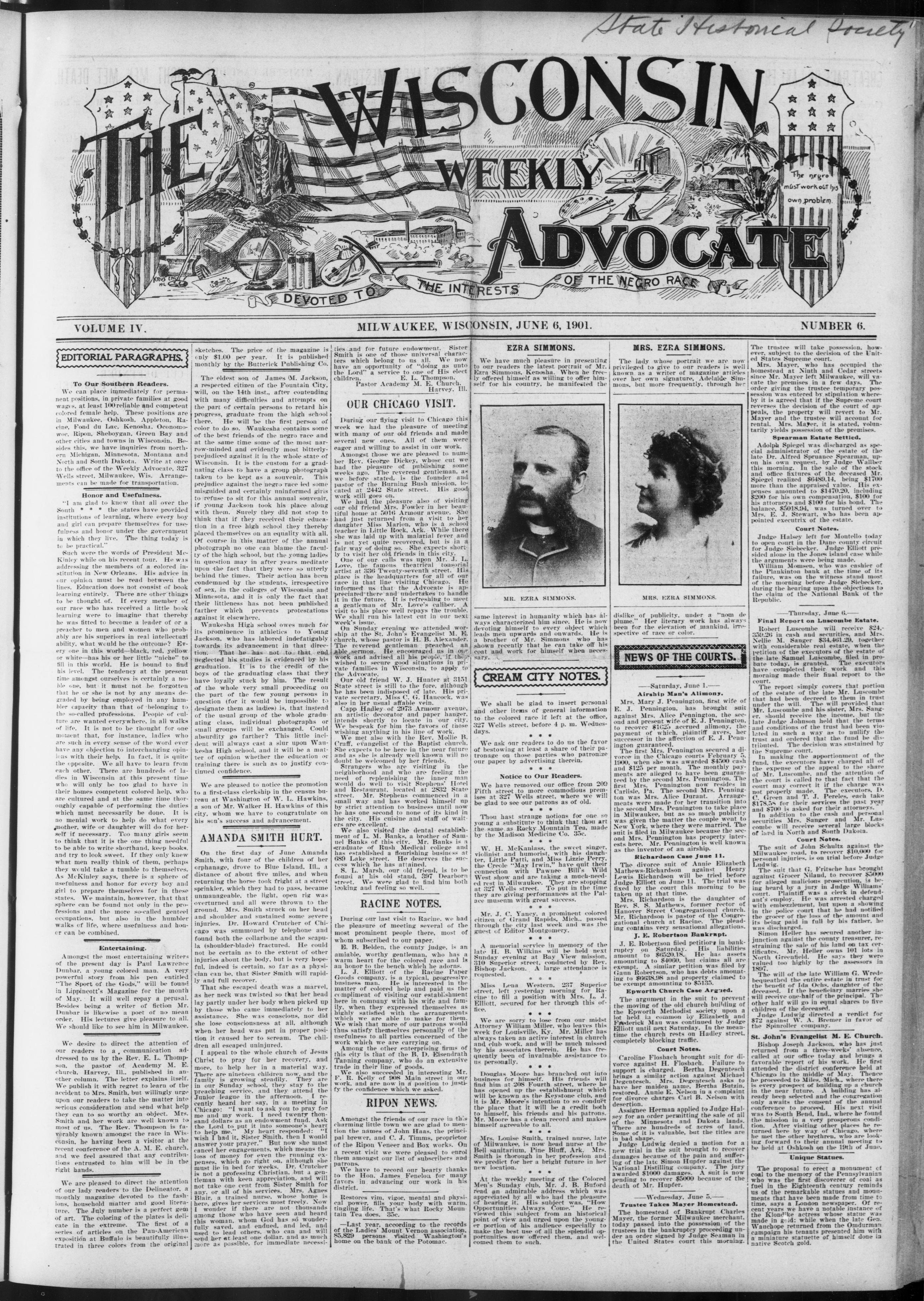
Page text (machine-generated)
WISCONSIN
WEEKLY
The negro
must work out his
own problem.
ADVOCATE
DEVOTED TO THE INTERESTS OF THE NEGRO RACE
To Our Southern Readers
We can place immediately for permanent positions, in private families at good wages, at least 100 reliable and competent colored female help. These positions are in Milwaukee, Oshkosh, Appleton, Racine, Fond du Lac, Kenosha, Oconomowoc, Ripon, Sheboygan, Green Bay and other cities and towns in Wisconsin. Besides this, we have inquiries from northern Michigan, Minnesota, Montana and North and South Dakota. Write at once to the office of the Weekly Advocate, 327 Wells street, Milwaukee, Wis. Arrangements can be made for transportation.
Honor and Usefulness.
"I am glad to know that all over the South * * * the states have provided institutions of learning, where every boy and girl can prepare themselves for usefulness and honor under the government in which they live. The thing today is to be practical."
Such were the words of President McKinley while on his recent tour. He was addressing the members of a colored institution in New Orleans. His advice in our opinion must be read between the lines. Education does not consist of book learning entirely. There are other things to be thought of. If every member of our race who has received a little book learning were to imagine that thereby he was fitted to become a leader of or a preacher to men and women who probably are his superiors in real intellectual ability, what would be the outcome? Every one in this world—black, red, yellow or white—has his or her little "niche" to fill in this world. He is bound to find his level. The tendency at the present time amongst ourselves is certainly a noble one, but it must not be forgotten that he or she is not by any means degraded by being employed in any humbler capacity than that of belonging to the so-called professions. People of culture are wanted everywhere, in all walks of life. It is not to be thought for one moment that, for instance, ladies who are such in every sense of the word ever have any objection to interchanging opinions with their help. In fact, it is quite the opposite. We all have to learn from each other. There are hundreds of ladies in Wisconsin at this present time who will only be too glad to have in their homes competent colored help, who are cultured and at the same time thoroughly capable of performing the duties which must necessarily be done. It is no menial work to help do what every mother, wife or daughter will do for herself if necessary. Too many girls seem to think that it is the one thing needful to be able to write shorthand, keep books, and try to look sweet. If they only knew what men really think of them, perhaps they would take a tumble to themselves. As McKinley says, there is a sphere of usefulness and honor for every boy and girl to prepare themselves for in these states. We maintain, however, that sphere can be found not only in the professions and the more so-called genteel occupations, but also in the humbler walks of life, where usefulness and honor can be combined.
Entertaining
Amongst the most entertaining writers of the present day is Paul Lawrence Dunbar, a young colored man. A very powerful story from his pen entitled "The Sport of the Gods," will be found in Lippincott's Magazine for the month of May. It will well repay a perusal. Besides being a writer of fiction Mr. Dunbar is likewise a poet of no mean order. His lectures give pleasure to all. We should like to see him in Milwaukee.
We desire to direct the attention of our readers to a communication addressed to us by the Rev. E. L. Thompson, the pastor of Academy M. E. church, Harvey, Ill., published in another column. The letter explains itself. We publish it with regret to learn of the accident to Mrs. Smith, but willingly urge upon our readers to take the matter into serious consideration and send what help they can to so worthy an object. Mrs. Smith and her work are well known to most of us. The Rev. Thompson is favorably known amongst the race in Wisconsin, he having been a visitor at the recent conference of the A. M. E. church, and we feel assured that any contributions entrusted to him will be in the right hands.
We are pleased to direct the attention of our lady readers to the Delineator, a monthly magazine devoted to the fashions, household matter and good literature. The July number is a perfect gem of art. The coloring of the plates is delicate in the extreme. The first of a series of articles on the Pan-American exposition at Buffalo is beautifully illustrated in three colors from the original
.
sketches. The price of the magazine is only $1.00 per year. It is published monthly by the Butterick Publishing Co.
The eldest son of James M. Jackson, a respected citizen of the Fountain City, will, on the 14th inst., after contending with many difficulties and attempts on the part of certain persons to retard his progress, graduate from the high school there. He will be the first person of color to do so. Waukesha contains some of the best friends of the negro race and at the same time some of the most narrow-minded and evidently most bitterly-prejudiced against it in the whole state of Wisconsin. It is the custom for a graduating class to have a group photograph taken to be kept as a souvenir. This prejudice against the negro race led some misguided and certainly uninformed girls to refuse to sit for this annual souvenir, if young Jackson took his place along with them. Surely they did not stop to think that if they received their education in a free high school they thereby placed themselves on an equality with all. Of course in this matter of the annual photograph no one can blame the faculty of the high school, but the young ladies in question may in after years meditate upon the fact that they were so utterly behind the times. Their action has been condemned by the students, irrespective of sex, in the colleges of Wisconsin and Minnesota, and it is only the fact that their littleness has not been published farther which prevents protestations against it elsewhere.
Waukesha High school owes much for its prominence in athletics to Young Jackson, who has labored indefatigably towards its advancement in that direction. That he has not to that end neglected his studies is evidenced by his graduation. It is to the credit of the boys of the graduating class that they have loyally stuck by him. The result of the whole very small proceeding on the part of the few young persons in question (for it would be impossible to designate them as ladies) is, that instead of the usual group of the whole graduating class, individual photographs or small groups will be exchanged. Could absurdity go farther? This little incident will always cast a slur upon Waukesha High school, and it will be a matter of opinion whether the education or training there is such as to justify continued confidence.
We are pleased to notice the promotion to a first-class clerkship in the census bureau at Washington of W. L. Hawkins, a son of Mr. Walker H. Hawkins of this city, whom we have to congratulate on his son's success and advancement.
AMANDA SMITH HURT.
On the first day of June Amanda Smith, with four of the children of her orphanage, drove to Blue Island, Ill., a distance of about five miles, and when returning the horse took fright at a street sprinkler, which they had to pass, became unmanageable, the light, open rig was overturned and all were thrown to the ground. Mrs. Smith struck on her head and shoulder and sustained some severe injuries. Dr. Howard Crutcher of Chicago was summoned by telephone and found both the collarbone and the scapula (shoulder-blade) fractured. He could not be certain as to the extent of other injuries about the body, but is very hopeful, indeed is certain, so far as a physician can be, that Sister Smith will rapidly and full recover.
That she escaped death was a marvel, as her neck was twisted so that her head lay partly under her body when picked up by those who came immediately to her assistance. She was conscious, nor did she lose consciousness at all, although when her head was put in proper position it caused her to scream. The children all escaped uninjured.
I appeal to the whole church of Jesus Christ to pray for her recovery, and more, to help her in a material way. There are nineteen children now, and the family is growing steadily. They are in our Sunday school, they stay to the preaching service, and they attend the Junior league in the afternoon. I recently heard her say, in a meeting in Chicago: "I want to ask you to pray for me and my work. I need twenty thousand dollars as an endowment fund. Ask the Lord to put it into someone's heart to help me." My heart responded: "I wish I had it, Sister Smith, then I would answer your prayer." But now she must cancel her engagements, which means the loss of money for even the running expenses, which go right on, although she must lie in bed for weeks. Dr. Crutcher is not a professing Christian, but a gentleman with keen appreciation, and will not take one cent from Sister Smith for any, or all of his services. Mrs. Agnes Blair, a trained nurse, whose home is here, gives her services most freely. Now I wonder if there are not thousands among those who have seen and heard this woman, whom God has so wonderfully saved, and endued, and led, and used to lead others, who can and will send her at least one dollar, and as much more as possible, for immediate necessi-
ties and for future endowment. Sister Smith is one of those universal characters which belong to us all. We now have an opportunity of "doing as unto the Lord" a service to one of His elect children. E. L. Thompson. Pastor Academy M. E. Church. Harvey, Ill.
OUR CHICAGO VISIT.
During our flying visit to Chicago this week we had the pleasure of meeting with many of our old friends and made several new ones. All of them were eager and willing to assist in our work. Amongst those we are pleased to number Rev. George Dickey, whose cut we had the pleasure of publishing some weeks ago. The reverend gentleman, as we before stated, is the founder and pastor of the Burning Bush mission, located at 2442 State street. His good work still goes on.
We had the pleasure also of visiting our old friend Mrs. Fowler in her beautiful home at 5016 Armour avenue. She had just returned from a visit to her daughter Miss Marion, who is a school teacher in Little Rock, Ark. While there she was laid up with malarial fever and is not yet quite recovered, but is in a fair way of doing so. She expects shortly to visit her old friends in this city.
One of our calls was upon Mr. J. L. Love, the famous theatrical tonsorial artist at 336 Twenty-seventh street. His place is the headquarters for all of our race in that line visiting Chicago. He informed us that the Advocate is appreciated there and undertakes to handle it in the future. It is refreshing to meet a gentleman of Mr. Love's caliber. A visit to his place well repays the trouble. We shall run his latest cut in our next week's issue.
On Sunday evening we attended worship at the St. John's Evangelist M. F. church, whose pastor is H. B. Alexander. The reverend gentleman preached an able sermon. He encouraged us in our work and advised all his people, if they wished to secure good situations in private families in Wisconsin, to apply to the Advocate.
Our old friend W. J. Hunter at 3151 State street is still to the fore, although he has been indisposed of late. His private secretary, Miss C. G. Hancock, was also in her usual affable vein.
Capp Hadley of 2973 Armour avenue, an artistic decorator and paper hanger, intends shortly to locate in our city. We bespeak for him the favors of those wishing anything in his line of work.
We met also with the Rev. Mollie B. Craff, evangelist of the Baptist church. She expects to be here in the near future and as she is already well known will no doubt be welcomed by her friends. Strangers who are visiting in the neighborhood and who are feeling the need of replenishing the inner man would do well to visit Stephens' Hotel and Restaurant, located at 2832 State street. Mr. Stephens commenced in a small way and has worked himself up by strict attention to business until now he has one second to none of its kind in the city. His cuisine and staff of waiters are excellent.
We also visited the dental establishment of L. M. Banks, a brother of Samuel Banks of this city. Mr. Banks is a graduate of Rush Medical college and has established a flourishing business at 689 Lake street. He deserves the success which he has attained. S. L. Marsh, our old friend, is to be found at his old stand, 397 Dearborn street. We were glad to find him both looking and feeling so well.
RACINE NOTES.
During our last visit to Racine, we had the pleasure of meeting several of the most prominent people there, most of whom subscribed to our paper.
E. B. Belden, the county judge, is an amiable, worthy gentleman, who has a warm heart for the colored race and is an honor to the bench which he adorns.
L. J. Elliott of the Racine Paper Goods company, is a typical, progressive business man. He is interested in the matter of colored help and paid us the compliment of visiting our establishment here in company with his wife and family, when they expressed themselves as highly satisfied with the arrangements which we are able to make for them. We wish that more of our patrons would thus satisfy themselves personally of the usefulness to all parties concerned of the work which we are carrying on.
Among the other enterprising firms of this city is that of the B. D. Eisendrath Tanning company, who do an extensive trade in their line of goods. We also succeeded in interesting Mr. F. R. Kelly of 908 Main street in our work, and are now in a position to justify the confidence which we asked.
RIPON NEWS.
Amongst the friends of our race in this charming little town we are glad to mention the names of John Haas, the principal brewer, and C. J. Timms, proprietor of the Ripon Veneer and Box works. On a recent visit we were pleased to enrol them amongst our list of subscribers and patrons.
We have to record our hearty thanks to the Hon. James Fenelon for many favors in advancing our work in his district.
Restores vim, vigor, mental and physical power, fills your body with warm, tingling life. That's what Rocky Mountain Tea does. 35c.
—Last year, according to the records of the Ladies' Mount Vernon association, 85,829 persons visited Washington's home on the bank of the Potomac.
EZRA SIMMONS.
We have much pleasure in presenting to our readers the latest portrait of Mr. Ezra Simmons, Kemosha. When he freely offered himself as willing to offer himself for his country, he manifested the
P.
MR. EZRA SIMMONS
same interest in humanity which has always characterized him since. He is now devoting himself to every object which leads men upwards and onwards. He is a brother of Mr. Simmons who has shown recently that he can take off his coat and work for himself when necessary.
CREAM CITY NOTES.
We shall be glad to insert personal and other items of general information to the colored race if left at the office, 327 Wells street, before 4 p. m. Wednesdays.
***
We ask our readers to do us the favor of bestowing at least a share of their patronage on those parties who patronize our paper by advertising therein.
Notice to Our Readers.
We have removed our office from 209 Fifth street to more commodious premises at 327 Wells street, where we will be glad to see our patrons as of old.
* * *
Thou hast strange notions for one so young a substitute to think that thou art the same, as Rocky Mountain Tea, made by the Madison Medicine Co. 35c.
* * *
W. H. McKanlass, the sweet singer, violinist and humorist, with his daughter, Little Patti, and Miss Lizzie Perry, the Creole "May Irwin," have quit their connection with Pawnee Bill's Wild West show and are taking a much-needed rest in Milwaukee. They are stopping at 327 Wells street. To put in the time they are giving performances at the Palace museum with great success.
***
Mr. J. C. Yancy, a prominent colored citizen of Grand Rapids, Mich., passed through the city last week and was the guest of Editor Montgomery.
** **
A memorial service in memory of the late H. B. Wilkins will be held next Sunday evening at Bay View mission. 310 Superior street, conducted by Rev. Bishop Jackson. A large attendance is requested.
赤 冶 肃
Miss Lena Western, 237 Superior street, left yesterday morning for Racine to fill a position with Mrs. L. J. Elliott, secured for her through this office.
---
We are sorry to lose from our midst Attorney William Miller, who leaves this week for Louisville, Ky. Mr. Miller has always taken an active interest in church and club work, and will be much missed by his associates therein. He has frequently been of invaluable assistance to us personally.
* * *
Douglas Moore has branched out into business for himself. His friends will find him at 208 Fourth street, where he has opened up the establishment which will be known as the Keystone club, and it is Mr. Moore's intention to so conduct the place that it will be a credit both to himself, his friends and his patrons. Mr. Moore has a clean record and makes himself agreeable to all.
***
Mrs. Louise Smith, trained nurse, late of Milwaukee, is now head nurse at the Bell sanitarium, Pine Bluff, Ark. Mrs. Smith is thorough in her profession and we predict for her a bright future in her new location.
***
At the weekly meeting of the Colored Men's Sunday club, Mr. J. B. Buford read an admirable address which was appreciated by all who had the pleasure of hearing it. His subject was, "How Opportunities Always Come." He reviewed this subject from an historical point of view and urged upon the younger portion of his audience especially to make the best use of all the splendid opportunities now offered them, and welcomed them to such.
MRS. EZRA SIMMONS
The lady whose portrait we are now privileged to give to our readers is well known as a writer of magazine articles over her own signature, Adelaide Simmons, but more frequently, through her
A.
MRS. EZRA SIMMONS
dislike of publicity, under a "nom de plume." Her literary work has always been for the elevation of mankind, irrespective of race or color.
NEWS OF THE COURTS.
Airship Man's Alimony.
Mrs. Mary J. Pennington, first wife of E. J. Pennington, has brought suit against Mrs. Alice Pennington, the second and present wife of E. J. Pennington, to recover $1625 accrued alimony, the payment of which, plaintiff avers, her successor in the affection of E. J. Pennington guaranteed.
The first Mrs. Pennington secured a divorce in the Chicago courts February 5, 1900, when she was awarded $4500 cash and $125 per month. The monthly payments are alleged to have been guaranteed by the second Mrs. Pennington. The first Mrs. Pennington now resides in Carlisle, Pa. The second Mrs. Pennington was Mrs. Alice Durant. Arrangements were made for her transition into the second Mrs. Pennington to take place in Milwaukee, but as so much publicity was given the matter the couple went to New York, where they were married. The suit is filed in Milwaukee because the second Mrs. Pennington has property interests here. Mr. Pennington is well known as the inventor of an airship.
Richardson Case June 11.
The divorce suit of Annie Elizabeth Mathews-Richardson against Henry Lewis Richardson will be tried before Judge Elliott on June 11. The trial was fixed by the court this morning to be taken up at that time. Mrs. Richardson is the daughter of Rev. S. S. Mathews, former rector of Hanover Street Congregational church. Mr. Richardson is pastor of the Congregational church at Racine. The pleading contains very sensational allegations.
I. E. Robertson Bankrupt.
J. E. Robertson filed petitions in bankruptcy on Saturday. His liabilities amount to $6520.18. He has assets amounting to $4060, but claims all are exempt. A similar petition was filed by Gaun Robertson, who has debts amounting to $6638.98 and property claimed to be exempt amounting to $5135.
Enworth Church Case Argued.
The argument in the suit to prevent the moving of the old church building of the Epworth Methodist society upon a lot held in common by Elizabeth and Frederick Mau was continued by Judge Elliott until next Saturday. In the meantime the church rests on Hadley street, completely blocking traffic.
Court Notes.
Caroline Flosbach brought suit for divorce against H. Flosbach. Failure to support is charged. Bertha Degentesch brings a similar action against Michael Degentesch. Mrs. Degentesch asks to have her maiden name, Bertha Butzin, restored. Annie E. Nelson in a complaint for divorce charges Carl B. Nelson with desertion. Assignee Herman applied to Judge Halsey for an order permitting the sale of all of the Minnesota and Dakota lands. There are hundreds of acres of land. Some of it is valuable, but the titles are in bad shape.
Judge Ludwig denied a motion for a new trial in the suit brought to recover damages because of the pain and suffering of the late Simon Hupfer against the National Distilling company. The jury awarded $1000 damages. A suit is now pending to recover $5000 because of the death of Mr. Hupfer.
Wednesday, June 5
Trustee Takes Mayer Homestead. The homestead of Bankrupt Charles Mayer, the former Milwaukee merchant, today passed into the possession of the trustees in the bankruptcy proceeding under an order signed by Judge Seaman in the United States court this morning.
The trustee will take possession, however, subject to the decision of the United States Supreme court. Mrs. Mayer, who has occupied the homestead at Ninth and Cedar streets since Mr. Mayer left Milwaukee, will vacate the premises in a few days. The order giving the trustee temporary possession was entered by stipulation whereby it is agreed that if the Supreme court reverses the decision of the court of appeals, the property will revert to Mr. Mayer and the trustee will account for rental. Mrs. Mayer, it is stated, voluntarily yields possession of the premises.
Spearman Estate Settled.
Adolph Spiegel was discharged as special administrator of the estate of the late Dr. Alfred Spruance Spearman, upon his own request, by Judge Wallber this morning. In the sale of the stock and office fixtures of the deceased Mr. Spiegel realized $6480.14, being $1700 more than the appraised value. His expenses amounted to $1470.20, including $200 for his own compensation, $100 for his attorneys and $100 for his bond. The balance, $5018.94, was turned over to Mrs. E. J. Stewart, who has been appointed executrix of the estate.
Court Notes.
Judge Halsey left for Montello today to open court in the Dane county circuit for Judge Siebecker. Judge Elliott presided alone in the Jones island case while the arguments were being made. William Momsen, who was cashier of the Plankinton bank at the time of its failure, was on the witness stand most of the morning before Judge Siebecker, during the hearing upon the objections to the claim of the National Bank of the Republic.
Thursday, June 6.
Final Report on Luscombe Estate.
Final Report on Luscombe Estate.
Robert Luscombe will receive $24,359.26 in cash and securities, and Mrs. Nellie M. Sanger $34,461.29, together with considerable real estate, when the petition of the executors of the estate of the late Samuel Luscombe, filed in probate today, is granted. The executors have completed their work and this morning made their final report to the court.
The report simply covers that portion of the estate of the late Mr. Luscombe that had been decreed to them in trust under the will. The will provided that Mr. Luscombe and his sister, Mrs. Sanger, should receive the income, but the late Judge Johnson held that the terms and conditions of the trust had been violated in such a way as to nullify the trust and ordered that the fund be distributed. The decision was sustained by the Supreme court.
In making the apportionment of the fund, the executors have charged all of the expense of the appeal to the share of Mr. Luscombe, and the attention of the court is called to that fact that the court may correct it if the charge was not properly made. The executors, D. C. Green and T. J. Pereles, each take $178.58 for their services the past year and $700 is asked for their attorneys. In addition to the cash and personal securities Mrs. Sanger and Mr. Luscombe will receive several large blocks
Court Notes.
The suit of John Schultz against the Milwaukee road, to recover $10,000 for personal injuries, is on trial before Judge Ludwig.
The suit that G. Fritsche has brought against Grocer Niland, to recover $5000 for alleged malicious prosecution, is being heard by a jury in Judge Williams' court. Plaintiff was a clerk in defendant's employ. He was arrested charged with embezzlement, but upon a showing in the police court that he had notified the grocer of the loss of the amount and its being paid in full by his father, he was discharged.
Simon Heller has secured another injunction against the county treasurer, restraining the sale of his land on tax certificates. Mr. Heller owns 101 lots in North Greenfield. He says they were valued too highly by the assessors in 1897
The will of the late William G. Wrede bequeathed the entire estate in trust for the benefit of Ida Ochs, daughter of the deceased. If the beneficiary marries she will receive one-half of the principal. The other half will go in equal shares to five children of the deceased.
Judge Ludwig directed a verdict for $72 against W. A. Bremer in favor of the Spinroller company.
St. John's Evangelist M. E. Church.
Bishop Joseph Jackson, who has just returned from a three-weeks' absence, called at our office today and brings a favorable report of his work. He first attended the district conference held at Chicago in the middle of May. Thence he proceeded to Miles, Mich., where there is every prospect of building up a church in the near future. A building has already been selected and the congregation only awaits the consent of the annual conference to proceed. His next visit was to South Bend, Ind., where he found the mission in a very prosperous condition. After visiting other places he returned here by way of Chicago, where he met the other brethren, who are looking forward to their annual meeting to be held at Oshkosh on the 19th of June.
Unique Statues.
The proposal to erect a monument of coal to the memory of the Pennsylvanian who was the first discoverer of coal as fuel in the Eighteenth century reminds us of the remarkable statues and monuments that have been made from time to time, says a London newspaper. Of recent years we have a notable instance of the Klondike actress whose statue was made in gold; while when the late Gen. Wauchope returned from the Omdurman campaign his tenants presented him with a miniature statuette of himself done in native Scotch gold.
GREAT RACE ON LAKE ERIE
Cleveland Steamer Wins by 1 Minute and 34 Seconds.
Modern Side-Wheel Passenger Steamers in Great Contest-A 100- Mile Course.
RACE BULLETINS.
Erie, Pa., June 4.—City of Erie crossed the line first. She reached the stakeboat one minute and thirty-four seconds ahead of the Tashmoo, unofficial.
Cleveland, O., June 4.—The Erie crossed the starting line at 9:37:56; Tashmoo at 9:38:31 (official time).
Off Nottingham, fourteen miles east, Tashmoo led by one length. Erie apparently was slowly gaining, however.
Off Fairport, twenty-eight miles off starting line, the City of Erie led by nearly a quarter of a mile. The boats were both steaming at a terrific speed.
Off Ashtabula harbor, about sixty miles from the starting point, the City of Erie led by about a length and a half.
The racing steamers passed a few miles off Conneaut harbor at 12:45 p. m. Apparently the City of Erie was then leading by an eighth of a mile. Conneaut is about seventy miles from Cleveland. Tashmoo and Erie passed Fairview, Pa., eleven miles from Erie, at 1:30 p. m., central time. The Erie still maintained a good lead, apparently about an eighth of a mile. At 1:45 p. m. Erie, Pa., reports that the boats are within five miles of the stakeboat and that the City of Erie appears to be slightly in the lead.
Cleveland, O., June 4.—Stripped of everything that would unnecessarily catch the wind, the two large modern side-wheel passenger steamers, City of Erie of Cleveland and the Tashmoo of Detroit, lined up this morning for their great 100-mile dash from Cleveland to Erie to decide the speed championship of the Great Lakes. Steamboat men from many lake ports gathered to see the contest. Special excursion boats from Cleveland, Toledo, Erie, Buffalo and smaller ports took large loads of passengers to points along the course. Throngs of curious people also gathered along the lake shore to catch a glimpse of the racers.
The day dawned bright and clear with a light southwesterly breeze stirring a gentle swell. Long before starting time Cleveland harbor was alive with crafts and the wharves were black with people. Thousands of whistles and bells sounded as the two racers steamed up to the stakeboat. They apparently were evenly punched.
Just before the boats started the wind veered around to the north and the racers had a seven-mile breeze against their quarter bows. When the starter gave the signal the steamers were at a dead stop and on even terms. Much to the surprise of the spectators, the Erie was first to gain headway and crossed the stake-boat line fully two lengths ahead of the Tashmoo. The Detroit boat, however, gradually drew up on the Erie and as they disappeared in the haze three or four miles eastward, the Tashmoo had overtaken the Cleveland steamer. A carrier pigeon message from the City of Erie off Willoughby, about eighteen miles east, says that boat leads by a length.
Conditions of the Race.
The race conditions were quite simple. Manager Newman of the Cleveland and Buffalo line, owner of the City of Erie, and Manager Parker of the Detroit line, owner of the Tashmoo, arranged them. It was Manager Parker who first offered to wager $1000 that his boat could beat, and after Manager Newman had promptly covered the money it was agreed that the stake after the race is decided shall go to some charity either in Detroit or Cleveland. The officials selected are: For the City of Erie—Judges, Commodore Percy W. Rice, principal; Commodore George H. Worthington, alternate. Searchers—Capt. John Edward and Capt. W. C. Richardson. Timekeepers—John A. Donaldson and G. H. Gardner. For the Tashmoo—Judge, Waldo A. Avery. Searchers—Capt. John Mitchell and Capt. A. E. Stewart. Timekeepers—J. C. Gilchist and J. A. McBrler.
The officials selected by Messrs. Newman and Parker agreed on David Vance of Milwaukee as independent judge, John Johnson of Buffalo as independent searcher, and Frank Hower, commodore of the Buffalo Yacht club, as independent timekeeper.
All Coal Picked by Hand.
Capt. Hugh McAlpine of the City of Erie was on deck. Chief Engineer Rendall had all the coal picked by hand. All worthless or bad-burning coal was carefully removed, and only the choicest, fiercest-burning left.
Capt. B. S. Baker of the Tashmoo had under him Chief Engineer Dubois, and he painted the coal of the steamer instead of having it varnished.
Special correspondents of all the leading Eastern newspapers have been pouring into Cleveland, eager to get on board one or other of the racers. They have all failed. No passengers are to be carried. The few Cleveland, Detroit, Toledo, Buffalo and other newspaper men that will be permitted to embark go as members of the crew. They will all sign the ship's articles and act as crew members.
With all the precautions taken against accident, government inspectors on board and government tugs aiding to guard the course from intrusion, there is some danger in the race. The unexpected may happen, and the owners of both boats do not propose to have any unnecessary loss of life if it must be.
The rivalry shown was a repetition of the famous race between the Robert E. Lee and the Natchez. Then it was Cincinnati against Louisville, and Louisville won. More than $1,000,000 changed hands on that race, run from New Orleans to St. Louis in 1870.
famous Robert E. Lee and the Natchez. Then it was Cincinnati against Louisville, and Louisville won. More than $1,000,000 changed hands on that race, run from New Orleans to St. Louis in 1870.
Both Built by Frank Kirby.
She is a sidewheeler. So is the City of Erie. Both were built by the same man, Frank Kirby of the Detroit Drydock company. He designed the City of Erie to cover the 200-mile run from Cleveland to Buffalo at a high rate of speed under all weather conditions. She can carry 1000 tons of freight and a good passenger list and make twenty-three knots an hour in a storm. Kirby built the Tashmoo for high speed on a short river route. This is her first experiment with lake water, but she is the challenger and is boldly defiant.
The principal difference in the steamers is in their machinery. The City of Erie has a compound beam engine, which has developed 6000 horsepower, and the Tashmoo has a triple expansion incline engine capable of developing 2800 horsepower. The City of Erie has six single end Scotch boilers fitted with the Howden draft system. Her wheels are $30\frac{1}{2}$ feet in diameter, and the steel feathering buckets are 4 by 12 feet. The Erie has beaten everything on Lake Erie, even the crack steamers of the Northern Steamship company, cost-
ing $750,000 apiece. The Tashmoo has defeated everything on the Detroit river, and there you are. The gamblers are giving no odds on the outcome. All betting is at even money.
WILL NOT BE CALLED.
President and Cabinet Decide that an Extra Session of Congress is Unnecessary.
Washington, D. C., June 4.—The cabinet today unanimously decided that existing conditions do not warrant the calling of an extra session of Congress this summer. Secretary Root and Attorney-General Knox both rendered legal opinions to the effect that the authority to govern the Philippines vested in the President by the Spooner amendment was ample. These amendments were concurred in by all the members of the cabinet. The decision of the cabinet was announced after the cabinet meeting in the following statement issued by Secretary Cortelvoy.
"The President has determined that existing conditions do not require or warrant calling Congress together during the present summer or making any change in the policy hitherto pursued and announced in regard to the Philippine islands."
It can be authoritatively stated that the Dingley rates upon goods from the Philippines entering the United States, will remain in force as heretofore. The President will put into effect such changes in the tariff duties on goods going into the Philippines as the Taft commission may recommend. The establishment of civil government. so-called. in the archipelago, can proceed without interruption as soon as as the military authorities consider the time ripe for its establishment.
Will Ultimately be Adopted.
Inside information concerning the action of the Cuban convention on the Platt amendment has just been received in Washington. It appears that the first draft of the amendment, as interpreted by the majority of the committee on relations with the United States was submitted to Gen. Wood and by him sent to Washington. This draft was approved by Secretary Root and his approval was made known to the Cuban convention. When the matter came up for discussion, however, it was found that there were a number of delegates whose votes could only be obtained by the extended alterations, amendments and interpretations which finally were adopted by the convention and rejected by Secretary Root.
It is stated officially that the people of Cuba believed at first that the Platt amendment had been adopted and that they were satisfied. Such was the belief of the people of the United States until the draft of the adopted amendment was received here. The belief is expressed in official circles here that the Cuban people as a whole are perfectly satisfied with the Platt amendment and that it will finally be adopted.
THE FIRST VOYAGE.
Steamer Northman Reaches Hamburg from Chicago After Passage of 35 Days.
New York, June 4.—The cable today announced the arrival of the steamer Northman at Hamburg today from Chicago, after a passage of thirty-five days, of which nineteen days had been occupied traversing the great lakes and canals before leaving Quebec for the ocean voyage. The Northman is the first steamer in the new Chicago-Hamburg service to cross the ocean, and her voyage has been watched with interest as a test of the probable success of the undertaking. She was preceded by the Northwestern, a sister ship, but that vessel was detained by a mishap, and lost the honor of being the ship to make the first voyage in the new service. The Northman, which is a steamer of 1496 tons net, sailed from Chicago April 30, in command of Capt. Ross, with a general cargo. She sailed from Montreal May 17 and Quebec two days later, on May 22, she sailed from Sydney, B. C., after coaling. The scheme of going through the canals was to give the vessel the maximum cargo to Buffalo, there partially unload and then, after passing through the canal, reload at Montreal. The round trip is expected to take sixty days.
SHOT THE MARSHAL.
Officer Assassinated by Hotelkeeper While In the Discharge of His Duty.
Metropolis, Ill., June 4.—Marshal W. E. Oakes was shot in the back, just below the heart, last night and it is feared fatally injured by A. M. Covington, a hotel and saloon keeper. Covington, in turn, was shot three times and instantly killed by Marshal Oakes. The shooting took place at 10 o'clock and was caused by a visit to the hotel by the marshal, who demanded that certain women whom Covington had been harboring be sent away. Marshal Oakes, having delivered his order, turned to go. As soon as his back was turned, however, Covington shot him. Wheeling about, Marshal Oakes brought his revolver into action, and, before he fell from his own wound, he had sent three bullets into the body of his assassin and killed him.
BLAINE-HICHBORN.
Daughter of Rear Admiral Weds Son of Late Maine Statesman.
Washington, D. C., June 4.—Miss Martha Hichborn, daughter of Rear-Admiral Hichborn, was married to James G. Blaine, youngest son of the late Maine statesman, today, at the residence of her parents. A small gathering of immediate relatives and friends witnessed the ceremony. They included Mrs. Blaine, mother of the groom; Mr. and Mrs. Damrosch and Mrs. Beale, his sisters. Mr. and Mrs. Blaine will sail Thursday for Europe to be gone three months. They will reside in New York.
BRITISH STEAMER SUNK.
An Unusual Spectacle for the Summer Visitors at Atlantic City. Atlantic City, N. J., June 4.—The British steamship Ranalada, from Trinidad for New York, and whose cargo of asphalt melted and caused the ship to list so badly that she anchored off here yesterday, sank early this morning off shore about a mile from Young's pier. The ship lies easy in six fathoms of water. Her crew came ashore in rowboats. An immense crowd of summer visitors is gathered along the board walk viewing the unusual spectacle.
TRAGEDY IN TENEMENT.
Woman Shot by Her Cousin Who Then Commits Suicide.
New York, June 4.—Francisco Alasko, 22 years old, shot and killed his first cousin, Mrs. Angelina Faia, 27 years old, in the woman's home today, and then committed suicide by shooting himself in the breast. The tragedy occurred in a tenement at 163 Elizabeth street, a poor part of the city. Alasko was in love with the woman. Faia went out to buy milk and bread for breakfast and in his absence the tragedy occurred. Faia's little daughter, Carmelia, witnessed the shooting.
SLAIN BY HER LOVER.
Edward Forshay Shoots Edna May Stokes, an Actress, in a Chicago Hotel.
Chicago, Ill., June 4.—Edward Forshay, an actor who claims to have been one of the May Hosmer company last year, shot his common-law wife, whose stage name was Edna May Stokes, through the heart in the parlor of the Vernon hotel, last night, killing her almost instantly. From letters found in his possession, Forshay had intended to kill himself after shooting the woman. Instead he dashed down the hotel stairs, revolver in hand, and after being chased by 150 citizens, was caught at Washington and Clark streets.
Two weeks ago Edna Stokes, or Forshay went to the Vernon hotel to live. Last Saturday night Forshay, who was living at Dale's hotel sent for her to come to that hotel. She did so and quarreled with Forshay. She returned to the Vernon bruised, and explained to Vernon Johns, the proprietor, that she had been badly beaten. She asked that Forshay be not allowed to come to her hotel.
Ejected by the Porter.
According to employees of the hotel Forshay took up a station in Randolph street opposite the Vernon about 6 o'clock yesterday morning and began to watch the entrance, presumably for the woman he intended to kill. Several times during the day he tried to gain entrance to the hotel. Twice he got as far as the office, and as many times was put out by William Kennedy, the porter.
About 8 o'clock Forshay found Johns and asked to be allowed to see his wife. He was told to wait in the parlor until she could be sent for. Soon after the door was closed on the couple two shots were heard, and the woman rushed screaming from the room, followed by Forshay with a revolver. In the hall the wounded woman fell and died a minute later. Both bullets struck her in the breast, one entering the heart.
Letter to His Mother.
Three letters were found on the prisoner. Two were addressed to his mother, Mrs. J. M. Forshay, 1323 Broadway, Kansas City, Mo., and the third to Chief of Police O'Neill. In this letter Forshay asked the chief to take care of the belongings of both himself and his wife, and send them to his mother. One of the letters to his mother follows:
Darling Monie and all: No doubt when you get this the blow will almost kill you, mother. I love you and feel sorry. I have to do what I am going to do, but I love my darling Edna too much to give her up. Hopling God and yourself will forgive me, I will close with love. ED. FORSHAY.
I will also say goodbye for my darling girl, as she don't know of this. CHOSHAN
CHURCH TOO NARROW.
Rev. E.W. Hunt Retires from the Ministry Because His Faith Has Changed.
Lansing, Mich., June 4.—A sensation has been created by Rev. E. W. Hunt's statements accompanying the announcement of his resignation as rector of St. Paul's Episcopal church and his withdrawal from the ministry. He says that every step of his study since he left the theological seminary has developed an interpretation of facts beyond those laid down in the creeds of the churches, and that a minister cannot preach a modest amount of truth without being cursed to his face, for the reason that the conservative element in the church will not tolerate the preaching of religious truths as they are now commonly accepted by modern thinkers and students.
He cites numerous instances to show the alteration modern research is making in the old accepted tenets and says that the glory and beauty of religion is not lessened, but is infinitely increased.
"It is a question of retreat for the church, and while the church is retreating it is not doing so rapidly enough. Present changes and shifting will result in a beautiful and more perfect religion, but whether with the aid of the churches or in spite of it cannot yet be told."
MANIAC IN VATICAN.
Intruder Passes the Gate-Keepers and Reaches Door of the Pope's Room.
Rome, June 4.—While the Pope was at work in his private room a maniac made his way to the anteroom and shouted: "The Pope is dead. I am his successor; give me the crown."
The noble guards on duty seized the intruder and prevented him from penetrating to the Pope's chamber. But the holy father had heard the shout. He ordered that the man be arrested. He turned out to be Valentino Paterno, a religious fanatic. He was taken to a lunatic asylum.
How he passed the gatekeepers, guards and ushers all the way from the outer gate of the Vatican to the very door of the Pope's room is a mystery as yet unexplained.
NO MATERIAL CHANGE.
Latest Bulletin of Physicians Regarding Mrs. McKinley's Condition.
Washington, D. C., June 4.—Drs. Johnston, Sternberg and Rixey were in consultation over an hour at the white house this forenoon. At 11:30 o'clock Secretary Cortelyou gave out the following statement: "Mrs. McKinley's physicians report that she has had a comfortable night and that her condition has not materially changed since yesterday."
VAST DEPOSITS OF ASPHALT.
An Important Discovery on an Island off Coast of Ecuador.
New York, June 4.—A cable message to the Ecuadorian association, which has offices in this city, announced the discovery of vast deposits of asphalt on the island of Salango, off the coast of Ecuador. Trinidad is now the chief source of the world's asphalt supply, which is controlled by the trust.
Boiling Point of Hydrogen
The boiling point of hydrogen, according to a new determination made recently by Prof. Dewar, is 252.5 degrees below zero on the centigrade scale, or 20 degrees above absolute zero. Investigations as to the temperature of solid hydrogen are now being carried out, and show a still closer approach to absolute zero.
The Game of Bridge
The game of bridge has been taken up with so much seriousness in England that bridge classes have, it is said, become quite popular.
A Pertinent Query.—"And just in the nick of time," said Maj. Bluff, describing an alleged experience in the Philippines. "I was rescued. That was an awful ordeal. I was afraid every minute I would become hopelessly insane." "And didn't you?" inquired Miss Sharpe.—Philadelphia Press.
—Only 80,331 British subjects out of the 700,000 who died last year had anything to leave by will.
BOERS TAKE JAMESTOWN
Town Surrendered by British After Four Hours' Fighting.
BURGHERS AGGRESSIVE.
Battle at Viakfontein One of the Most Desperate Engagements of the War.
London, June 5.—The war office has received the following dispatch from Gen. Kitchener, dated Pretoria yesterday:
"Jamestown surrendered to Kritzinger's commando after four hours' fighting. The town guard and local volunteers were overpowered before our pursuing column could reach the town. Our casualties were three killed and two wounded. The Boer loss is stated to have been greater. The stores were looted. The garrison were released.
"I have placed French in charge of the operations in the Cape Colony. The enemy attacking Dixon's column numbered 1200, under Kemp."
Details received regarding the fighting at Vlakfontein show that it was one of the most desperate engagements of the war. Gen. Dixon's column was traversing the district and establishing posts, when it was attacked by 1200 Boers under Commandant Kemp. The Boers were so close that fifty British fell at the first volley.
The yeomanry held the position, protecting the guns until they were nearly decimated, and then, finding it impossible to save the guns, the artillerymen shot the gun horses to prevent the Boers moving the guns. The column quickly recovered from the shock of the unexpected attack. The Derbyshires charged with bayonets, and after a short, desperate fight drove off the Boers and recovered the guns. The Derbyshires and yeomanry both lost very heavily.
It is asserted that while the Boers had temporary possession of the guns they shot two artillerymen in cold blood for refusing to work them against their own comrades. The appointment of Gen. French, who has been recruiting his health in Cape Town, to command the operations in Cape Colony indicates that Lord Kitchener attaches considerable importance to the invasion. The recrudescence of such fighting brings further demands for the sending out of reinforcements. The surrender of Jamestown is regarded as a disagreeable incident, because it has provided Commandant Fritzinger with a fresh supply of the sinnes of war.
Police Stage Not Reached.
New York, June 5.—A dispatch to the Tribune from London says: Military men were not surprised when the official story of the battle of Vladfontein came out yesterday. They had suspected, from the heavy British losses, that the Boer attack was a surprise, but had not guessed that the rear guard of Dixon's force had been rushed and that two guns had been temporarily captured before the main body could be rallied for their recovery. This engagement occurred further west than was at first reported, and communications with Pretoria were interrupted. Delarey fought with desperate energy, and was repulsed after he had secured important advantages.
Clearly the war has not yet reached the police stage. The Boers proved once more that they could plan a battle with skill and, while they were driven off, they made an effective demonstration of fighting force, which would seem to put an end to all rumors of peace negotiations. This is the interpretation which Mr. Kruger's group of advisers in Holland place upon it. An irrepressible conflict goes on, with a revival of courage on the Boer side.
WHITNEY'S HORSE WON.
Great Intererst Taken in This Year's Derby at Epsom-Society Out in Force.
London, June 5.—Whitney's Volodyovski won the derby. Twenty-five horses started. The conditions of the race were as follows: The derby stakes of 6000 sovereigns, by subscription of 50 sovereigns each; for 3-year-olds; the nominator of the winner to receive 500 sovereigns, the owner of the second horse, 300, and the owner of the third, 200 sovereigns out of the stake, about one-mile and a half. There were 279 subscribers.
The result in detail was as follows: William C. Whitney's brown colt Volodyovski (L. Reiff), Florizel II.-La Reine, first; the Duke of Portland's bay colt William the Third, St. Simon-Gravit, second; Douglas Baird's chestnut colt Veronese, Donovan-Maize, third.
Volodyovski won in record time, 2 minutes 40 4-5 seconds.
The widespread interest in this year's derby, owing to the open character of the race, was testified to by the vast numbers that left London throughout the morning for Epsom. From an early hour the roads and railroads southward were densely thronged with a strange medley of racegoers The road, as usual, was favored by everyone able to secure room in any kind of conveyance, and a continuous stream of every conceivable type of vehicle, from the luxurious four-in-hand to the coster's donkey cart,roiled toward the famous Downs. An exceptional number of motors evidenced the growing popularity of automobilism. Huge crowds gathered at the main points along the route, to watch the quaint scenes, only witnessed on Derby day. The Nadine cold (Maher) won the Juvenile plate of 200 sovereigns for 2-year-olds, distance five furlongs.
Epsom, June 5.—Today's contest for the blue ribbon of the British turf was witnessed by much greater crowds than for some years past. The weather was all that could be wished for this, the people's picnic. Vehicles first rolled in by twos and threes and then by dozens and scores until the white road leading to the Downs smoked with the dust of the vast, heterogeneous cavalcade, and the air was filled with a weird medley from tin trumpets, barrel organs and cornets.
MAYOR HITS REPORTER.
Iron Mountain Newspaper Man Unable to Get a Warrant for His Honor.
Iron Mountain, Mich., June 5.—[Special.]—Mayor Hammond today assaulted Reporter Stoney of the Daily Tribune in Justice Miller's office for the publication of an article relative to the city police troubles. Neither of the police justices will issue a warrant for the mayor's arrest, claiming that as the mayor is prosecuting attorney he will dismiss the case. The matter will be carried to Judge Stone on application for a mandamus compelling the issuance of a warrant. The common council refused to pay the mayor's special-police, who have been on the past month, and last night he refused to sign checks for the old force, who have been working, although suspended by the mayor.
MINISTER CAST OUT.
Congregationalists Convict Rev. Herron of Immoral and Unchristian Conduct.
Grinnell, Ia., June 5.—George D. Herron was dismissed formally from the Christian ministry and from membership in the Congregational church. The council, including representatives of eight churches in the district and summoned by the members of the Congregational church of this city, found Mr. Herron guilty on each of the three counts in the indictment.
A letter from Mr. Herron explaining his views, accepting the decision of the council as final, but seeking in no way to deny the charges, was read at the council.
The findings were as follows:
At a council held in the First Congregational church of Grinnell, on the 4th of June, 1901, to consider the right to church membership and ministerial standing of George D. Herron, the following findings were rendered: First-That the charge of immoral and unchristian conduct is sustained by the findings of the court which at Algona on March 21, 1901, granted a decree of divorce to Mary Everhard Herron from her husband on the grounds of cruel and inhuman treatment.
Wife Praised for Her Conduct.
Second—The same charge is further sustained by evidence presented to the council showing that George D. Herron's manner toward the wife who consecrated her life to the effort to make him happy, relieve him of care, and aid him in what she believed to be his high calling, has been that of unfeeling and selfish indifference, and at least since 1896 of studied neglect, culminating in a heartless desertion and the final tragedy of divorce.
Third—The same charge is still further sustained by confession contained in the paper written by Mr. Herron in his own defense and read to the council. In this paper he denies the right of society to sanction or undo the marriage tie between man and woman, presents a view of conjugal relation, parenthood, and the home which is abhorrent to enlightened Christian sentiment, and which confirms the council in the opinion that this action of George D. Herron is simply the criminal desertion of a worthy wife and a devoted mother by a man who has deliberately falsified his marriage vows.
Stricken from Church Rolls.
In view of these findings it is resolved:
That we recommend to the Grinnell association that the name of George D. Herron be dropped from its roll of membership. Resolved also.
That we express our conviction that George D. Herron has forfeited all right to be known by the churches of our faith and order as a minister of the Gospel, and that he is by vote of the council deposed from the Christian ministry.
Prof. Herron's letter, read before the council, is dated New York, May 24. Its main feature is a disquisition upon marriage and divorce. There is not in it a word of love or gratitude for the woman who read his lessons to him when he was a half-blind, struggling college student.
Denunciation of Marriage.
Prof. Herron follows with a ferocious denunciation of the present system of marriage and of the church which enforces it. Here are some of his sentences:
If love and truth are the basis of morality, then a marriage system which makes one human being the property of another, without regard to the well-being of either the owned or the owner, seems to me to be the very soul of blasphemy and immorality. The family founded on force is a survival of slavery and one of the expressions of the slave principles on which our whole civilization is built. It is a mode of the superstition which thinks it good for human beings to own each other, and good for the race to have all its sources and tools of life owned by the few who are strong and cunning enough to possess them.
The ethics of the legally and ecclesiastically enforced family make it possible for a man to live a life of monstrous wrong, of ghastly falsehood, even of unbridled lust, and yet be highly moral according to the standards by which we are judged. The same standards condemn and disgrace the purest expressions of comradeship, if they cross the conventions or forget the decrees of custom. Free and truthful living is thus made a tragedy, to have overwhelming and revengeful retribution added unto it, while slave-living and falsehood may be rewarded with world-blessings and ecclesiastical canonization.
I thoroughly believe in the vital and abiding union of one man with one woman as a true basis of the family life. But we shall have few such unions until we have a free family. Men and women must be economically free—free to use their powers to the fullest extent—free from the interference of legal and ecclesiastical force, and free to correct their mistakes, before we can have a family that is noble, built on unions that are good. Lives that are essentially one, co-operative in the love and truth that make oneness, need no law of state or church to blind or keep them together. Upon such the imposition of force is a destruction and a blasphemy.
Must be Free.
On the other hand, no law in the universe has a right to keep together those who are not vitally and essentially one. It is only in freedom that love can find its own, or truth blossom in the soul, or other than a slave individually, unfold. It is the business of society to see to it that every child is surrounded by the full and free resources of a complete life; it is the business of society to see to its own fatherhood and motherhood of every child, as well as to hold every parent responsible; it is the business of society to know every child of woman as a free and legitimate child of God, and welcome it as an inheritor of the reverence and resources of the earth; but it is not the business of society to unite or separate men and women in the marriage relation. Love must be set free and liberty must be trusted, if noble and beautiful homes are to spring up to make the earth a garden of truth and gladness. The coercive family system is filling the earth with falsehood and hypocrisy, misery and soul disintegration, and is perpetuating the morality of slaves and lilars.
The writer proceeds to arraign the religious and moral ideas current in society. Morality, he says, is calculation, having nothing to do with truth or reality. Religion and conduct deal with custom, are matters of the dice and not of the soul. Civilization is a network of falsehood and suspicion, retribution and revenge. He says:
The life which you condemn me for not living was a lie. Yet I fruitlessly tried to convert it into truth, in order to be moral and self-denying according to the standards of religion and private ownership. The life I now live is the truth, though these same standards condemn me for living it. I will accept obloquy and destruction from the world and not complain, nor defend myself, nor ask to have any cup of punishment pass from me, but I will not live a lie—not to win or keep the favor of gods or men.
SITUATION IS CRITICAL.
Spain Threatened with General Strike of Workingmen-Anarchists Active in Barcelona. Madrid, June 5.—The situation throughout Spain remains critical. Nominal tranquillity has been restored at Corunna, but the Octroi offices are still occupied by gendarmes, and arrests continue to be made. A general strike is threatened owing to the refusal of one factory to employ 300 workmen. The railway men have struck at Vigo and Anarchist excitement is rife in Barcelona, where the "Reds" met in defiance of the civil governor's prohibition and passed secret resolutions.
Senor Gamazeo, leader of the dissident Liberals, in an interview characterized the crisis as an exceedingly grave moment for Spain, adding, "The government must act with great energy with regard to the Catalan and separatist movement to prevent the evil being irremediable."
Horrible Accident in Mine at Iron Mountain, Mich.
Suffocated in Ludington Shaft by the Fumes of Burning Powder-Only One Man Disfigured.
Iron Mountain, Mich., June 4.—Eight men were killed at the seventh level of the Ludington shaft, Chapin mine, at 2 o'clock this morning by an explosion and suffocation from the fumes of burning powder. All the men in that part of the mine are dead, so the exact cause of the burning of the powder cannot be determined. All the men but one were married.
Following is a list of the victims: Antonio Farnetti, John Amone. Joseph Passiri, John Miano, Louis Tassi, John Bertelli, Rinaldo Ausnino, a Pole, name unknown.
Nearly thirty children are rendered fatherless by the accident.
Only one man was disfigured, as if by an explosion, and he but slightly; the others were completely covered by black powder soot. The men were using a powder-thawing machine and it is thought they neglected to supply it with powder. The machine becoming red-hot, set fire to the dynamite and the men were stricken down by the deadly fumes before they could escape. The town is in mourning and work at the mine is at a standstill.
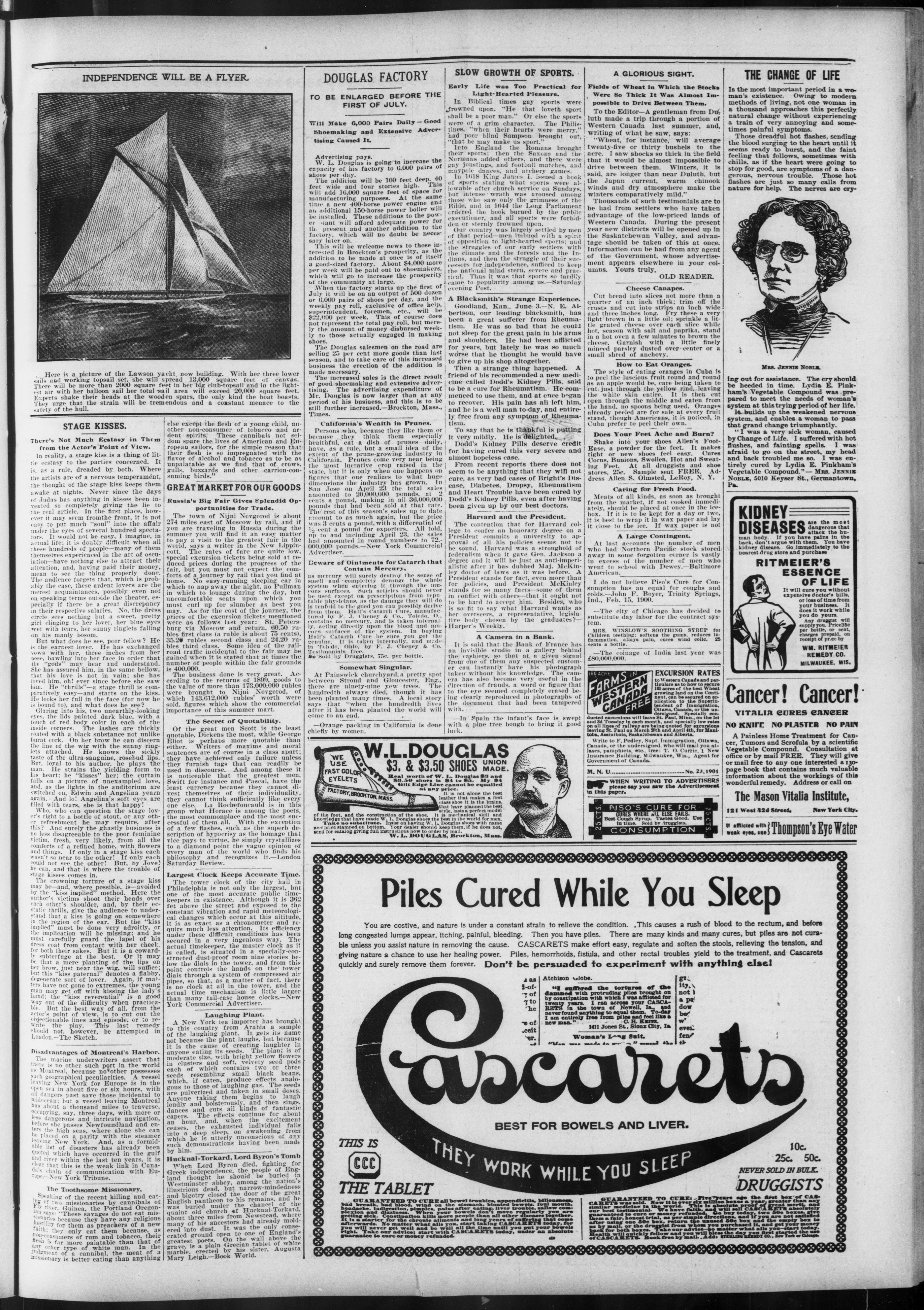
CUP DEFENDER BADLY DAMAGED.
Newport, R. I., June 4.—The cup defender Constitution was dismantled while on her trial spin this afternoon.
The accident happened while the yacht was off Brenton's Reef lightship, about three miles out from Narragansett Pier, about 2:15 this afternoon. To all appearances the Constitution is badly crippled. From the shore the mainmast appeared to have broken about half way up. The boom swung to the lee side and the mainsail and its rigging were carried overboard.
The tender Mount Morris took the Constitution in tow and headed for Newport.
The wind was blowing strong from the southwest when the mast went down. Just what caused the accident was not apparent from shore. It is believed none of the rigging was lost.
The collapse of the Constitution's mast was much similar to the accident which befell the Columbia two years ago not far from the same locality of today. The Constitution was rushing along and without apparent warning the mast bent at a point bout half way up and in flash the topmast and its canvas, the gaff and all the upper works were in the water dragging alongside the yacht.
The next moment the crew were clambering over the wreckage. The Mount Morris was quickly alongside and set to work gathering up the broken rigging and water-soaked canvass. After that had been accomplished the Mount Morris took aboard a line and started with the sorry-looking craft dragging behind her. It could not be determined from shore whether or not anyone was hurt. The impression is that no injury was sustained by anyone.
SUFFRAGISTS PROTEST.
European System of State-Regulated Vice Vigorously Condemned at Minneapolis.
Minneapolis, Minn., June 4.—State regulation of vice was one of the leading topics at this morning's session of the National American Woman Suffrage association. The telegram of the Philippine commission to Secretary Root on January 17, 1901, reciting that the military authorities in Manila had for over two years subjected women of bad character to "certified examination" and the course of Gen. MacArthur in defending such policy, was made the occasion for the adoption of a set of resolutions earnestly protesting against "the introduction of the European system of state-regulated vice in the new possessions of the United States. The reasons urged against such a course were: To furnish bad women with official health certificates was contrary to good morals and would impress both soldiers and natives as officially sanctioning vice; it was unjust to subject vicious women to compulsory medical examination not applied to vicious men; official regulation of vice while lowering the moral tone of the community is quite ineffective in protecting public health, as shown by experience in Paris, where the system originated, by its abandonment in England, Switzerland and other countries and its failure everywhere it has been tried. The resolutions "protest in the name of American womanhood against introducing in our foreign dependencies a system that would not be tolerated at home."
A COUPLE AGREE TO DIE TOGETHER.
Woman Is Dead, but Man, Said to be Former Milwaukeean, May Recover.
Lincoln, Neb., June 4.—J. Albert Brink, formerly of Milwaukee, and Mrs. Mabel H. Walker, wife of a traveling salesman, took cocaine and wood alcohol in Brink's apartments late last evening. Mrs. Walker died. Brink was hastily taken to a hospital and is now in a fair way to recover. He is in charge of the police. Brink stated this morning that he and Mrs. Walker were hopelessly in love and that the latter challenged him to end their lives together. He agreed to the proposition, he says, and only the groans heard issuing from the room by hotel attaches prevented the consummation of the plan. Brink is well connected here.
TO BLOW UP CHURCHES.
Pastors Told to Observe Saturday as Holiday or Suffer the Penalty.
Boston, Mass., June 4.—A strange notice confronted the sexton of the Third Universalist church in West Somerville yesterday, containing a threat, that by next Sunday all the West Somerville churches will be destroyed by dynamite unless next Saturday is observed as a holy day.
The notice was written on a piece of notepaper with a pencil and was tacked on the door of the church. It read as follows:
"I, the Lord, live to reign. The church, perhaps, opened for the last time yesterday. All the churches in West Somerville will be destroyed by dynamite before next Sunday morning unless the pastors hold services and observe next Saturday as a holy day."
Little hands, that closely hold
Favorite toys which soothed your rest;
Here a doll clasped to the breast,
There a book with tale oft told—
All your treasure safe to keep,
While you sleep.
While you sleep, the calm dark night
Passes by so cruelly fast.
Little hearts! Time seems so vast,
Love is fain to hold you tight
One more kiss; away I creep
While you sleep.
—Constance Farmer in Chambers' Journal.
Two Debts and a Dinner.
Mons. Aristide Chapoulot, retired haberdasher, a widower with an only daughter, sat in his dining room and from time to time threw a glance of despair at the neatly-laid table. He held the evening paper in his hands, but derived little information from it for the simple reason that he was holding it upside down. The glances which he cast at the table alternated with other glances bestowed on the old oak cuckoo clock ticking monotonously on the mantel. Now and then his glance fell on the steaming soup tureen, and then his eyes grew moist. The table was laid for two. Clearly M. Chapoulot was waiting for somebody.
Like Louis XIV., with whom he had no other point of resemblance, he hated to wait—especially ror dinner. In business, punctuality had always been a fad with him, and now he made a point of eating his meals at 11 and 6 o'clock, as regularly as he used to settle his accounts on the 1st of the month. And, on this occasion, he was unusually hungry, so the state of his feelings when the clock chirped half-past 6 may be better imagined than described.
His eyes wandered from the spoons to the forks, from the forks to the knives, as if he were seeking an effective implement of self-destruction. At this critical moment old Gertrude entered, muttering to herself. She was his cook and waitress, his daughter's maid and all the rest of the servants.
"Well?" she mumbled.
"Well: she humbled. "Well: Gertrude," he sighed.
"Shall I take away the soup?"
"By no means, Gertrude! Charlotte will surely be here in a minute. It is very strange that she is not here now. When did she go out?" "At 4 o'clock, as usual, for her piano lesson. An hour for the lesson, an hour to go and come, she should have been home at 6, as usual."
bite at 6, as usual.
"And now it is 6:39""
And now it is 0:55.
"Perhaps the omnibuses were full, or perhaps mademoiselle, as it is such a fine day, is walking home. And there are the milliners' and the jewelers', you know, so many things to attract a young lady."
"Confound the milliners and jewelers, and the young lady, too, if she can't be on time! What can there be to see at dinner time, I should like to know?"
"To say nothing of the young men."
"Oh, I am quite easy on that score. Charlotte is able to take care of herself. She has been brought up a l'Americaine, and I'm glad of it."
"Perhaps you'll be sorry. I don't know what brings up a la mer, or whatever it is, means, and she only a stupid old woman, but I don't like this fashion of young girls running about the streets alone."
But the unnatural father was not listening. He had formed a sudden resolution.
"Take away the soup and keep it warm," he said. "And bring me my boots. I will go to meet her."
The old woman, still grumbling, went off with the soup, and had come back with the boots when the sound of the doorbell caused master and maid to exclaim in concert: "There she is!"
Gertrude dropped the boots on the floor and hurried to the door, and the next instant Charlotte entered like a young cyclone. A little face, all puckered with smiles, fluffy hair, 18 years, thirty-two teeth, slender figure, graceful carriage, diminutive feet and hands, shod and gloved to perfection, ribbons, flowers, etc.—in short, a typical butterfly of the boulevards.
"What! Home so soon?" her father exclaimed with fine irony, as he seated himself at table and began to unfold his napkin.
"Oh, papa! I have something to tell you—"
"Dinner first, or you can tell your story as we eat. I shall understand it better. I've waited long enough already. Gertrude, the soup."
"Oh, but, papa, you don't know what has happened. I have had an adventure, a real adventure."
"An adventure?" cried her father, starting from his chair, while Gertrude flung him, over the soup tureen, a glance of mingled reproof and triumph which clearly meant, "Didn't I tell you so?"
"Yes, papa, an adventure, in the omnibus, with a young man—"
"Good heavens!" groaned the horrified father, dropping his spoon and jumping up like a jack-in-the-box. "An adventure? What do you mean?"
"This is your bringing up a la maire something or other," muttered the old woman as she left the room.
"Oh, papa, he was very nice, a very proper and correct young man, I assure you." replied Charlotte, all smiles.
"Let me inform you, young lady, that very nice, very proper and correct young men do not have adventures with young ladies—not in omnibuses, at any rate. Explain yourself."
"It was a very simple thing, poppy. It really isn't worth looking so fierce or talking so loud about. I merely forgot my pocketbook. That happens every day, doesn't it?"
"H'm. yes; especially to people without pocketbooks. Go on."
"I did not miss it until the conductor held out his hand for my fare. What should I do? Or say? I might have been taken for a pauper—or even for a swindler. I turned red as a peony and then I felt that I was turning white, by way of variety. Fortunately a very well-dressed young man who sat beside me promptly handed the conductor a coin, saying, 'Two.' This kind young gentleman, seeing my embarrassment, had divined the true state of affairs and came to my assistance in this delicate and graceful manner."
"Weli, mademoiselle, I am proud of you. Accept 6 sous from a strange young man. You might better have appealed to the conductor, to the driver, to the whole company. How are you going to repay those 6 sous? Or do you intend to preserve them as souvenirs?"
"Oh, he gave me his card, papa. Here it is—M. Agenor, Baluchot."
Papa snatched the card from her hand and roared:
"What! Not satisfied with insolently leading you G sous in defiance of all the laws of polite society, this very nice and proper and correct young man give you his card in the bargain. He is the most atrocious of ruffians; the vilest of scoundrels!"
"Dear me, papa, how could I return the money without knowing his address?"
M. Chapoulot, being unable to answer this ingenious argument in words, had recourse to action.
"It is fated that I shall not dine today," he exclaimed, angrily. "Gertrude, go and call a cab. I will immediately
pay this Agenor his 6 sous and also tell him a few plain truths."
"Oh, papa, papa! You surely won't. That would be very ungrateful. Remember that he rescued your daughter from an embarrassing situation."
"With the intention of placing her in a more embarrassing one, no doubt. Silence, young woman! My memory does not need to be refreshed by a young idiot who forgets her pocketbook."
Gertrude having returned with the cab, the irate parent went out, banging the door. Then Charlotte, all excitement and blushes, proceeded to tell the old servant that she knew much more of the nice young man than she had dared to confess to her father; that she had met him in the omnibus every evening for a month at least, and that she, without appearing to notice him, had soon noticed that he noticed her, etc., etc.
"Here's a pretty how-de-dot" exclaimed the old woman, shaking her head and invoking silent maledictions on education a-la-whatever it was. Meanwhile Aguerer Bainuchot, in his bachelor apartments, was musing over his brief but pleasing adventure in the omnibus.
He was startled by a furious knocking at the door, upon opening which he was confronted by a stout gentleman very much out of breath, with a big came grasped after the manner of a club, and his hat cocked fiercely over his right eye.
"your conduct has been most immoral, unworthy of a French gentleman. No man of honor would thus take advantage of the innocence, the inexperience, the simplicity, the embarrassment of a respectable young woman. Profiting by the simultaneous absence of a father and a pocketbook you brutally forced 6 sous and your infernal card upon an unprotected young lady. You thought it a good investment, no doubt, but it was a dishonorable action. Here are your six sous, monsieur. Neither my daughter nor I wish to have anything further to do with you."
While the infuriated visitor was concluding this speech his hands were diligently searching his pockets, but before the stupefied Agenor could utter a word a third actor appeared on the scene. This was the cab driver, who came in brandishing his whip and his tongue.
"You're a nice one, you are," he shouted. "I tell you I can only take you one way. You agree. You keep hurrying me up, and when you get here you skip and tell me to wait. Wait? Not much! I've been there before. Come! Pay up. Never mind the tip, but I want my 30 sous, and I want 'em quick."
All this was Greek to Agenor, but the stout gentleman, who by this time had turned all his pockets inside out, had become pale, then red, crimson, violet and was showing symptoms of turning green. Convinced at last that his search was useless, he feebly stammered, mopping his forehead with his gloves in his distraction:
"I have—forgotten—my—pocketbook!"
"Of course." growled the cabman.
"That's an old trick. It won't work with me. You can tell it to the police sergeant. You are a nice one, you are."
And he was laying hands on the wretched M. Chapoulot, who, utterly overcome and apparently on the brink of apoplexy, offered no resistance, when Agenor, who seemed destined to play the part of special providence to the whole family, interfered.
"With your permission," the young man politely said to Chapoulot, as he handed the cabman his fare.
"Why, certainly, my dear sir, with pleasure," replied Chapoulot. "But not more than 5 sous per boire. I beg you."
The mysterious workings of fate had brought it about that Charlotte's father, who had failed to understand how a sensible person could ever be without omnibus fare, was forced to admit that it is sometimes very convenient to meet a gentleman who will politely advance 35 sous and get rid of an implacable cabman. He turned with a gracious smile to Agenor and said:
"Monsieur—Monsieur Balucho*, I believe? Six sous to my daughter and 35 to me make 41 sous that I owe you. If you will do me the honor of dining with me this evening I shall take pleasure in setting the little account at once. I am an old business man, and I hate to be in debt. Besides, you know, prompt payments make good friends."
A quarter of an hour later Gertude laid another plate on the table. It is there yet, for within a month the banns were read for the marriage of Charlotte and Agenor.—From the French of Henri Second, translated for the Commercial Advertiser by Lawrence B. Fletcher.
THE HISTORY OF RUBBER.
Man that Came Over with Columbus Saw Haitians Playing Ball. The world was a long time learning the uses and value of rubber. For two centuries after the Spaniards saw the gum in the hands of natives of the new world it was little more than a curiosity. Old Herrea, who went with Columbus on his second voyage, made a note of an elastic ball which was molded from the gum of a tree. At their games the Haitians made it bound high in the air. The Aztecs were familiar with the gum and called it ule, and from them the Spaniards learned to smear it on their coats to keep out the wet. They had crossed the seas for gold, and never dreamed of a time when the sticky milk the uncouth Indians drew from strange trees would be worth more than all the treasures of the hills.
treasures of the king of Portugal, in 1555, comes down to us as the wearer of a pair of boots sent out to Para to be covered with a waterproof gum. Yet 300 years were to lapse before a Connecticut Yankee should make a pair of boots of rubber which would not decompose. Dr. Priestly, author of a work on "Perspective," now forgotten, recorded that caoutchouc (pronounced "kachook") was useful in small cubes for rubbing out pencil marks—hence the name rubber. The India linked with it refers to the savages who gathered it in the Amazon wilderness. Dr. Priestly's cubes were half an inch long and sold for 3 shillings, or 75 cents, apiece. A stiff price for the finest rubber today is $1 a pound. Its price for ten years has ranged from 62 cents to $1.09.
The conversion of the gum to useful purposes made but slow headway. The first waterproof cloth in 1797 was the work of an Englishman. It was tentative, and, of course, it would not stand heat. In 1823 Charles Mackintoch of Glasgow discovered naphta, and dissolving rubber in it, produced a varnish which, when spread on cloth, made it really impervious to water.—Ainslee's Magazine.
President Madison's Old Home.
President Madison's Old Home. Montpelier, the beautiful home of the late President Madison, down in Orange county, Va., at the foot of the Blue Ridge mountains, has recently been sold at auction, and the purchaser was William Dupont, the powder manufacturer of Wilmington, Del. The estate includes 1300 acres, 60 acres of which is in gardens, 500 acres in forests and about 300 acres under cultivation, although the land is pretty well worn out. The mansion, which is one of the best types of colonial architecture and compares well with Mount Vernon and Monticello, the home of Jefferson, has passed through many vicissitudes, but is still dignified and imposing. The local traditions attribute it to William Thornton, who designed the capitol of the United States, and say that it was built by Madison's grandfather with bricks brought from England, but the latter is questionable. Montpelier is more than 200 years old, so that Dr. Thornton could not have designed it, but it is very likely that it was restored under his direction in 1794. W. E. Curtis in Chicago Record-Herald.
TO TRANSFER CONTROL.
Allied Forces Making Preparations to Withdraw Troops.
A FEW WILL REMAIN.
Evacuation will be Gradual Until Chinese Show Evidence of Ability to Maintain Order.
Tien Tsin, June 3.—There was a serious affray yesterday between international troops. Some British fusiliers who were acting as police here sought to prevent French soldiers from housebreaking, when they were attacked with bayonets and bricks. The fusiliers, in self-defense, fired in the air. This brought a number of Germans to the aid of the Frenchmen. They numbered altogether 200 men. Five fusiliers fired again, killing a Frenchman and wounding three others. In subsequent fighting, four fusiliers, five Germans and one Japanese were wounded. The arrival of a German officer and a strong guard ended the fray.
Preparing to Transfer Control.
Pekin, June 3.—The generals of the allied forces have decided to transfer the government of Pekin to Chinese officers gradually during June. The allies are making preparations for evacuating the city. Count von Waldersee, accompanied by his staff, will leave Pekin soon. Two special trains will run all the week, taking troops to Taku. The Germans are removing an extraordinary quantity of baggage, including Chinese carts, rickshaws, tables and chairs. Von Waldersee will, however, leave here temporarily nine skeleton battalions of 300 men each, which nearly equals the number of British troops here. The French are withdrawing from the province of Chih Li. Nine thousand Japanese, 3000 British and the Twenty-sixth Beioochistan regiment left Saturday. The rest of the troops will remain until July, or until the court's return is certain, and evidence is given that the Chinese authorities are able to maintain order. It is certain that the simultaneous withdrawal of all the allies would tend to inflame Chinese conceit and endanger foreign interests in the northern provinces.
Wrangle Over Famine Fund.
Another meeting has been held to consider the question of the distribution of the fund raised by the Christian Herald for the relief of the famine sufferers in the province of Shen Si. The missionaries here have telegraphed to Chairman Arthur Smith at Tien Tsin stating that the committee requires unrestricted power, and that the distribution of the fund by foreigners is impracticable, this being possible only through native officials. It also asks for funds to send missionaries to Shen Si.
The Catholics in Shen Si have demanded sites for two schools adjoining the property held by the Protestants, and also a site for a church.
Afraid of American Competition.
Paris, June 3.—In the Chamber of Deputies today M. Des Tournelles de Constant asked the foreign minister, M. Delcasse, for a statement on the Chinese situation.
In the course of his remarks, the deputy alluded to American business competition, saying the "American peril" was advancing toward them with methodical rapidity. The Napoleons of American industry declared openly that their enterprise meant the conquest of Europe and her economic ruin. The "yellow peril" was more distant than the American peril, but the Chinese had given a warning which ought not to be neglected.
M. Delcasse replied in a reassuring manner regarding China. He said the French trooops would leave at the earliest possible moment. Two blatches had already been ordered home and he hoped the bulk of the expedition would soon follow. The powers only insisted on measures of justice, having the character of reparation for the past and guarantees for the future.
Regarding the indemnity, France thought the immediate payment of a lump sum was preferable. A guarantee of some form or other was necessary and France believed a collective guarantee was the best. China accepted the principle of an indemnity some months ago and she now consents to pay the indemnity demanded. It is expected she will pay with her customs duties, but commercial relations will not be injured if as intimated that China herself will pay the indemnity which was only just and the expenses incurred by the powers.
M. Des Tournelles de Constant suggested that the powers agree not to accept exorbitant private claims, to which M. Delcasse replied that the principle of those claims had already been accepted.
STARTED BY ROBBERS.
Fire Destroys the Greater Part of Jasper, Tex.—County Treasurer's Office Blown Up. Beaumont, Tex., June 3.—The town of Jasper, about 100 miles north of this city on the gulf, Beaumont & Kansas City railroad extension, was almost totally destroyed by fire yesterday morning. The loss amounts to over $100,000 and includes the entire business portion of the town. Seventeen houses in all were destroyed, but so far as can be learned here no lives were lost.
The fire was the work of robbers, who blew open and rifled the safe in the postoffice and in the county treasurer's office. It cannot be learned how much money the robbers obtained, but it is probable that the loot was large, as the county carries a great amount of cash on hand at this time of year. Jasper is not yet connected with the railroad, though the line is almost completed.
The robbers will necessarily have to travel over country to get out, and they will most likely make for this point to catch a train. Officers are keeping a strict watch, with a view to capturing the desperadoes. Jasper has a population of about 1000 and is the capital of the county bearing the same name. It is in the center of a rich agricultural country.
CUT A GIRL'S THROAT.
Assassin Then Tried to Drown Himself but was Caught and Jailed. Carver, Minn., June 3.—Andrew Tapper, a bartender, killed Miss Rosa Mix today by cutting her throat. She was 20 years old and lived at Montgomery. Both were employed in a local hotel. Tapper attempted to drown himself, but was caught and placed in jail at Chaska.
PLAYED GOLF ON SUNDAY.
Members of Board of Education Yonkers, N. Y., Arrested. New York, June 3.—Benjamin Adams, a member of the board of education of Yonkers, was arraigned today on a charge of violating the Sunday law in playing golf. June 7. was fixed for the trial, which will be a test case, heard by a jury.
UNION IS IMPOSSIBLE.
Ballington Booth Says Volunteers Cannot Join Forces with Salvation Army.
New York, June 3.—Ballington Booth, head of the Volunteers of America, denied today that he was about to return to the Salvation Army and to be reunited with his father. The following statement is published by authority:
"Ballington Booth denies most emphatically that there have been any secret negotiations between himself and his father. He has not had one line from his father since the latter left the country, nor has he heard from his seven brothers and sisters with but one excep-
[Picture of a man with a mustache and a suit].
tion, that of a personal communication from Mrs. Booth Clibborn, nor have they taken back the bitter and uncalled-for things they said against him. The government and principles of the two movements are so at variance that a union will be impossible."
For twelve years Ballington Booth was the commander-in-chief of the Salvation Army in America. About five years ago he disagreed with his father, severed his connection with the Salvation Army and organized the Volunteers of America. Secretary Hazard says:
"The primary cause of the rupture was the refusal of Ballington Booth to obey his father when the latter issued an order transferring him from the head of the Salvation Army in the United States to the head of the army in Canada. The word 'obey' means the same in the Salvation Army as it does in the regular army, and when Ballington Booth refused to obey the orders to go to Canada he was obliged to relinquish his position. He then formed the rival organization—the Volunteers of America. Commander Booth-Tucker, the son-in-law of Gen. William Booth, was called from his post in India and placed at the head of the Salvation army to succeed Ballington Booth."
NINE-HOUR MOVEMENT.
President O'Connell Convinced that 150,000 Machinists will Have Shorter Day.
Toronto, Ont., June 3.—The annual convention of the International Association of Machinists opened here today. About 200 delegates were present. In his address President O'Connell showed that the past two years 197 charters were issued, with a membership of 7404. During his term, the executive had approved of 66 strikes, involving 9650 machinists, of which 41 were won, 10 settled on compromise and ten lost. The locals engaged in the 246 strikes, involving 12,192 men. Two hundred lodges reported having settled 759 grievances without a strike. The president asked that the law be changed so as to compel local unions before striking to obtain the consent of the grand lodge. Regarding piece work the address recommended either to accept it on condition that the employer will unionize his shop or to declare war against the entire system.
"A reduction in the hours of labor has been our hope since the association started," continued the president. "Up to May 1, the number of shops working less than ten hours per day was only 1870. I am firmly convinced that our nine-hour movement will result in reducing the hours of labor for 150,000 machinists." President O'Connell promised to bring in supplemental reports on the strike question during the convention. He also recommended that the minimum monthly dues be placed at 75 cents, 35 cents of which is to be paid to the grand lodge. A number of changes in the loan system, insurance, sick benefits and constitution in general are recommended.
A report that President O'Connell of the International Machinists' association had said that the action of the machinists of the New York Central in Buffalo who struck on Saturday was precipitate and contrary to the constitution of the order was referred to Mr. O'Connell today, but he declined to say anything until he had interviewed the Buffalo delegation. The matter will come before the convention, but in any event it is expected the association cannot approve of the strike as it had not been sanctioned by three-fourths of all machinists on the Central's system as provided for in the constitution.
Saginaw, Mich., June 3.—All machinists on the Pere Marquette railroad system struck today for a nine-hour day with ten-hours' pay.
Chicago, Ill., June 3.—Manufacturers and the 1600 striking machinists in this city apparently settled down for a siege today. The strikers put out pickets, but, so far as known, no attempts were made to engage nonunion men. The pickets are organized on military lines.
Newport News, Va., June 3.—In accordance with the plan announced several days ago about 300 machinists struck this morning at the Newport News shipyard. All other departments of the yard remain unaffected.
Youngstown, O., June 3.—The National Tube company of the United States Steel corporation today voluntarily advanced the wages of all the workers in the Youngstown plant an average of $17\frac{1}{2}$ cents per day.
The increase affects 425 men and goes into effect at once.
NEWMAN ELECTED.
President of Lake Shore Chosen President of New York Central.
New York. June 3.—William H. Newman, president of the Lake Shore, was today, elected president of the New York Central & Hudson River Railroad company, to succeed Samuel R. Callaway, resigned. Mr. Newman has not yet resigned the presidency of the Lake Shore, so he is now president of both railroads. Gen. Supt. Edgard Van Etten was made second vice-president.
New Steel Mast for Shamrock II.
Southampton, June 3.—The Shamrock II. will be drydocked tomorrow and she will start for the Clyde Tuesday, June 11. to have her new steel mast fitted.
LOVE AND TRAGEDY.
LOVE AND TRAGEDY.
Aged Man Weds Young woman and Commits Suicide When She Leaves Him.
Baraboo, Wis., June 5.—[Special.]—A case full of love, tragedy and all that goes to make up the exciting phases of life, was brought before the public in a trial today. before Judge Kelsey in the Sauk county court. All the incidents have developed within a year, which commenced with the marriage of a man of 80 years anod a woman of less than half his age, and closes with his death and the division of the property, which he had accumulated during a long life of earnest toil.
One day last summer Frederick Mockler of Denzer, in this county, and Mrs. Anna M. Deicourt of Milwaukee were married by E. August Runge of this city. As previously stated he was almost 80 years old, while the bride was not more than 35. They lived together most of the time for about five months, then the wife went to Milwaukee. While she was absent he committed suicide by hanging himself in the stairway of his home at Denzer. For some time he had been alone and it is supposed that he had become despondent over this way of living. The old gentleman was very fond of companions and after the death of his former wife expressed himself many times at the solitary life he was forced to lead. This grew upon him to such an extent, it is stated, that he one day offered one of his neighbors, Richard Alexander, as much as $1000 to procure for him a companion and helpmeet. With the going to Milwaukee of his wife, much of his property went also, it is alleged, and when Alexander talked to him seriously concerning being compensated for his trouble in getting him a wife the old gentleman felt much embarrassed for in all his life he had not known what it was to have persons insist on the payment of money so carefully had he lived concerning the liquidating of all his bills.
All of his property, amounting to almost $4000, had been converted into cash and this has gone with his wife to Milwaukee, it was said. There remained a mortgage of over $1000 on the farm of John Huber, near by, which Mr. Mockler willed to his wife before she left and at the time of his death she demanded the right to the same, but to this his children by his first wife seriously objected, hence the suit. There are three sons and two daughters who claim that they should have the property involved. A large number of witnesses were subpoenaed and on account of the nature of the case it is watched with deep interest in the county.
A. G. Weissert of Milwaukee and F. R. Bentley of this city are the attorneys for Mrs. Mockler. She was present today at the trial. It will take some time to determine whether or no the will be probated.
Another peculiar feature of the case is the influence it had in the last judicial election. W. D. Kelsey and E. A. Runge were the candidates for the office and Mr. Runge, the Republican, was defeated by just ten votes. The children of Mr. Mockler were opposed to the marriage and when Mr. Runge announced himself as a candidate the sons of the deceased had enough influence in the town to throw several votes to Mr. Kelsey and this resulted in his election.
WAUKESHA COUNTY PIONEER DIES.
WAUKESHA COUNTY PIONEER DIES.
John Stewart Passes Away at His Old Home In Dousman.
Dousman, Wis., June 5.—[Special.]—John Stewart died at his home in this village last night of old age. Mr. Stewart was born in Ireland in the year 1814 and emigrated to this country with his parents in 1840 and settled in New York, where he worked in a tannery for three years, then came West and settled on a quarter-section of government land in the township of Ottawa. Waukesha county, where he lived until 1885, when he sold his farm and retired to Dousman to live. Mr. Stewart was married twice. In 1844 he was wedded to Elizabeth Davis, who bore him eleven children, of whom only three are living—David of Butte, Mont.; William of Sacramento, Cal., and Samuel of Milwaukee. Mr. Stewart was married the second time to Mrs. Ann Lassey of Ottawa, Wis., who survives him. Mr. Stewart is the last of a family of eleven children that have been well identified with the history of Waukesha county for over half a century. The funeral will be at 10 o'clock Thursday from residence.
Mrs. John Petre, Two Rivers.
Two Rivers, Wis., June 5.—[Special.] Mrs. John Petre of the south side died yesterday at her home here of consumption. She was 38 years of age and is survived by a husband and family.
Mrs. C. K. Brown, Chippewa Falls. Chippewa Falls, Wis., June 5.—[Special.]—Mrs. C. K. Brown, a very old resident, died this morning of paralysis.
KAUKAUNA GIVES IN.
After Two Years the Electric Railway Franchise is Passed.
Kaukauna, Wis., June 5.—[Special.] After about two years of discussion over the matter the city council last evening passed the franchise asked for by the Wisconsin Traction Light, Heat and Power company. The company has the right to build and maintain the route through Kaukauna on Wisconsin avenue and Lawe street from the western to the eastern city limits. H. D. Smith, treasurer of the company, who was here yesterday, said they had all the material purchased and were in readiness to begin building operations on the line between Appleton and Kaukauna through the village of Little Chute. This line, as is well known, is but a connecting link of the ultimate through interurban route from Chicago to Green Bay, and will doubtedly be extended on from Kaukauna soon through Wrightstown to Depere, where a line is already built from that city to Green Bay.
ROMANTIC MARRIAGE.
Kenosha Couple Nearly Parted by Lovers' Friend.
Kenosha, Wis.. June 5.—[Special.]—Quite a pretty little love romance is woven around the courtship and marriage of Mr. and Mrs Henry, Baker, which occurred in Waukegan yesterday. Mr. Baker left his sweetheart to go with Uncle Sam's soldiers to the Philippines. It is said that another young man in trying to console her during the absence of her lover-caused her heart to flutter. After a "tiff" with No. 2 she wrote Baker, who had returned and was living in St. Joseph. Mich.. to meet her in Milwaukee. Baker, like n true lover, was on hand on time. The preliminaries were arranged and they went to Waukegan, where the ceremony was performed.
FAILS TO KILL HERSELF.
Oshkosh Girl Says She will Try Again and Succeed.
Oshkosh, Wis., June 5.—[Special.]—Miss Dora Zahn, the young women who took carbolic acid because her lover took another girl out riding on Memorial day, is recovering at St. Mary's hospital, and is able to talk today for the first time. She expressed regret that her act failed of its results, and says that the next time she does it there will be no mistake.
MARKET REPORTS.
Milwaukee, June 5, 1901.
DAIRY PRODUCTS.
MILWAUKEE — Eggs — Market steady; fresh new, cases included, 11c; fresh, cases returned, 10½c; seconds, 8c. Receipts were 452 cases.
Butter—Market steady to firm. Fancy prints, 18½c; fancy or extra creamery, per lb, 18c; firsts, 16@17c, seconds, 14@15c; dairy prints, 15½c, extra fancy dairy, 15c; lines, 12@13c; packing stock, 11@12c; whify, 5c; roll, wrapped, 11@12c; unwrapped, 10@12c; crease, 4@5c. The receipts today were 41,641 lbs against 27,418 yesterday. The receipts continue liberal and the demand good, all grades being well cleaned up. Elgin went 18½c and firm yesterday.
Cheese—Steady. Receipts were 12,420 lbs today against 16,575 lbs yesterday. Full cream flats, new colored, 10½@11½c; Young Americas, new, 11@12c; daisies, new, 11@12c; fancy brick, 11@11½c; low grades, 7@9c; limburger, per lb, No. 1, 11@11½c; low grades, 6@9c; imported Swiss, 23@24c; Block Swiss, domestic, 14@15c; choice loaf, 15@16c; No. 2, 10@11c; Sapsago, 19@20c; farmers, 10@11c.
MILWAUKEE LIVESTOCK MARKET
HOGS- Receipts, 11 cars; market slow-
light, 5.70@5.82%; mixed and medium
weights, 5.75@5.85; common to good pack-
ers, 5.00@5.85; fancy selected hogs, 5.90.
light, 5.70@5.822; mixed and medium weights, 5.75@5.85; common to good packers, 5.60@5.85; fancy selected hogs, 5.90.
Cattle—Recelpts, 3 cars; steady; grass cattle lower; butchers' steers, medium to good, 1050 to 1300 lbs, 4.50@5.25; fair to medium, 950 to 1050, 4.25@4.75; helfers, common, 3.00@3.50; good, 4.00@4.50; cows, bulls, common, 2.75@3.50; choice, 3.50@4.25; fair to good, 2.95@3.50; canners, 1.75@2.40; feeders, 800 to 950 lbs, 3.50@4.25; stockers, 500 to 750 lbs, 3.25@3.75; veal calves, common, 3.00@3.50; choice, 5.09@5.50; milkers and springers, common, dull, 18.00@25.00; choice, 35.00@45.00.
SHEEP—Recelpts, 1 car; market dull; 3.00@4.00; bucks, 2.50@3.00; spring lambs, 5.00@6.50.
Chicago receplts: Hogs, 36,000; cattle, 20,000; sheep, 23,000.
POTATO MARKET
CHICAGO, Ill., June 5.—[Special.]—Coyne brothers report: Fancy Dusty Rurals, 69@73c; Burbanks, 68@71c; Kings, 67@70c; Hebrons, 66@68c; mixed white, 65@69c; mixed red, 65@67c; mixed white and red, 60@64c. Market firm. Receipts 34 cars.
MARKETS BY TELEGRAPH.
MILWAUKEE-Wheat - Easier; No. 1
Northern, on track, 76%c. Corn-Easy; No.
3 on track, 42%c. Oats-Easier; No. 2
white, on track, 29%c. No. 3 white, on
track, 28%@29c. Barley-Steady; No. 2 on
track, 55c; sample on track, 48%55c. Rye-
Dull; No. 1 on track, 54c. Provisions-
Steady; pork, 14.55; lard, 8.25.
Millstuffs are dull and quoted at 13.75
@14.00 for bran. 13.50@13.75 for standard
middlings, and 15.00@15.25 for Milwaukee
dour middlings
CHICAGO-Close - Wheat - June, 74c;
July, 75c; September, 71%c. Corn-June,
43%c; July, 44%c; September, 44%c. Oats-
June, 27%c; July, 28@28%c; September,
26%c. Pork-June, 14.52%@14.55; July,
14.52%@14.55; September, 14.67%c. Lard-
June, 8.25; July, 8.25; September, 8.27%c.
October, 8.27%c. December, 8.00 year, 7.97%c.
Ribs-June, 7.85; July, 7.85; September,
7.85%@7.87%c. Flax-Cash N. W., 1.71; No.
1.71; September, 1.30; October, 1.26%c.
ST. LOUIS—Close—Wheat—Lower; No. 2
cash, 72c; July, 68%@70c; September, 68%
@69c; No. 2 hard, 73%@73%c; Corn—Higher;
No. 2 cash, 42%c; July, 42%@42%c; September,
43%c; Oats—Lower; No. 2 cash,
28%c; July, 27%c; September, 26%c; No.
2 white, 31%c; Lead—Firm; 4.32%@4.35.
Spelter—Firm; 3.82%
DULUTH—Close—Wheat—Cash No. 1
hard, 76%c; No. 1 Northern, 73%c; No. 2
Northern, 69%c; No. 3 spring, 65%c; to
arrive, No. 1 hard, 76%c; No. 1 Northern,
72%c; July, 72%c; September, 71c; Corn—
42c; Oats—28%@28%c; Rye—51c; Flax—
To arrive, 1.64; cash, 1.65; September, 1.30;
October, 1.26. Receipts of wheat, 69,977
bus; shlpments, 10,936 bus.
NEW YORK—Close—Wheat—July, 08%c;
September, 76%c; Corn—July, 48%c; Sept-
ember, 48%c.
MINNEAPOLIS — Close—Wheat — Cash,
71%c; July, 71%c; September, 69%@99%c.
LIVERPOOL — Close—Wheat—Unchanged to
½d lower; cash quiet, 61%d; July, 51
11%d; September, 510%d; Corn—Unchanged to ½d higher; July, 311%d; September, 311%d.
KANSAS CITY—Close — Wheat — July,
67%c; September, 65%c; cash No. 2 hard, 70%@71c; No. 2 red, 71c; Corn—July, 40%c; September, 41%@41%c; cash No. 2 mixed, 41%c; No. 2 white, 42c; Oats—No. 2 white, 28%@28%c.
KANSAS CITY—Cattle—Recelpts, 7000; steady to strong; native steers, 5.00@5.40; Texans, 4.50@5.40; cows and heifers, 3.25@5.25; stockers and feeders, 3.65@4.90. Hogs—Recelpts, 22.000; steady to 5c lower; bulk of sales, 5.65@5.80; heavy, 5.80@5.90; packers, 5.70@5.80; mixed, 5.65@5.80; yorkers, 5.50@5.65; pigs, 4.50@5.55. Sheep—Recelpts, 3500; steady; muttons, 3.75@4.85; lambs, 4.75@5.75.
ST. LOUIS—Cattle—Recelpts, 3500; market steady to firm; native steers, 3.50@5.10; stockers and feeders, 2.80@4.85; cows and heifers, 2.00@5.20; Texas and Indian steers, 3.60@5.25. Hogs—Recelpts, 7500; steady; pligs, 5.65@5.80; packers, 5.70@5.85; butchers, 5.85@6.00. Sheep—Recelpts, 5000; market weak; muttons, 4.00@4.50; lambs, 4.65@5.50.
SOUTH OMAHA—Cattle—Recelpts, 2300; shade stronger; native steers, 4.00@5.70; Texans, 3.50@4.50; cows and heifers, 3.60@4.80; stockers and feeders, 3.25@5.00. Hogs—Recelpts, 9500; shade lower; heavy, 5.70@5.80; mixed, 5.67@5.70; pligs, 5.00@5.50; bulk of sales, 6.67@5.72%. Sheep—Recelpts, 1200; steady; common and stock sheep, 3.00@3.80; lambs, 4.25@5.75.
What Two Papers Consume.
Two newspapers of New York spend about $1,000,000 a year each for papers, the quantity consumed being 31,878 tons. To furnish this, a village of 2000 souls is employed year in and year out, and every day ten acres of spruce trees are swept off to make paper.
Siberian Petroleum.
Experiments made in Kasan, in Russia, of the petroleum found in Siberia prove that it is almost identical with Pennsylvanian naphtha. The wells on the lake of Balkal are said to be rich and reliable, so far as the borings go down.
ABSOLUTE
SECURITY.
Genuine
Carter's
Little Liver Pills.
Must Bear Signature of
Grant Good
See Fac-Simile Wrapper Below.
Very small and as easy
to take as sugar.
CARTER'S
LITTLE
LIVER
PILLS.
FOR HEADACHE.
FOR DIZZINESS.
FOR BILIOUSNESS.
FOR TORPID LIVER.
FOR CONSTIPATION.
FOR SALLOW SKIN.
FOR THE COMPLEXION
Price
25 Cents
GENUINE
MUST HAVE SIGNATURE.
Purely Vegetable.
The Wisconsin Weekly Advocate
Richard B. Montgomery.....Editor and Proprietor
Office: 327 Wells Street.
Telephone Black No. 244.
SUBSCRIPTION RATES.
Any part of the United States and Canada,
postage paid.
One Year.....$2.00
Six Months.....1.25
Three Months.....75
Send money by Express Money Order. P. O.
Money Order or Registered Letter to the
Wisconsin Weekly Advocate.
ADVERTISING RATES.
One inch, single insertion.....$250
One inch, per year.....$9.00
Business locals 5c per line each insertion.
Apply for rates to the Advocate.
TO CONTRIBUTORS
All communications must be sent with the name and address of the sender as an evidence of good faith, but not necessarily for publication. No manuscript returned if not accepted, unless accompanied by stamps.
All subscribers of the Advocate that fall get their paper promptly will please notify us at once. The Advocate, at 327 Wells street.
The Wisconsin Weekly Advocate company wishes to notify the public that all contracts and business transactions with this company must have the company stamp, otherwise they will be void. Neither will this company be responsible for paid subscriptions unless given to duly-accredited agents, who, on request, will give the company's receipt for same. Subscribers failing to receive their papers regularly will kindly notify the general office. Address all business communications to the general manager, 327 Wells street.
Mr. Richard B. Montgomery.
Entered at the Milwaukee P. O. as second- class matter.
The Helping Hand Colored Mission
incorporated under the laws of the State of Wisconsin has for its object the supplying of qualified colored help to those requiring the same. In order to be able to get servants from the mission it is necessary, that in order to partly cover expenses incurred, those parties desiring help should become subscribers for this paper. No actual charge is made. Parties who secure situations through this agency are also expected to become subscribers
expected to become subscribers.
We have at present on our books: Cooks, General Servants, Waitresses, Laundresses, Nurses, Coachmen, Porters, Waiters. Office hours 9-12 and 1-4.
R. B. MONTGOMERY, Mgr. 327 Welis St., Milwaukee
Now that there is a shirt and collar trust, collars may be higher than ever.
England's proposed Academy of Letters will be a failure unless she gets some great figures in it.
Now that Mrs. Dowie has been ordained, it is safe to say that she is as good a man as her husband.
A Texas editor recently wrote to one of his correspondents, "Oil has taken the place of politics down here." Oil is pretty slippery, too.
Premier Laurier says that the Alaskan boundary is unsettled. No doubt it will be unsettled if Canadian political strategists can effect that result.
Pennsylvania has enacted a law establishing courts for juvenile offenders. Two years hence Wisconsin will have another chance to adopt this reform.
The commencement season will soon be under way, and will fully demonstrate that this great and glorious country's gushers are not confined to Texas.
The new Chicago city directory will claim an increase in the population of 64,000 since the taking of the census of 1900. But a directory estimate is not an actual count.
Kaiser Wilhelm will no longer permit the publication of stenographic reports of his speeches. The newspapers will have to print what he meant to say. This will give the readers better-considered speeches, but less entertaining.
The Omaha newspaper man who says that the highest ambition of his life is to have two pairs of suspenders at one time has probably never thought of going to Chicago. Hold-ups are altogether too numerous in Chicago.
From the report of "profane yells" hurled at Col. Mills by the young men of the Military Academy, it appears that tabasco is not the only kind of sauce known to the would-be future commanders who are studying the art of war at West Point.
The corn exports of the United States last year amounted to 213,000,000 bushels. Europe took 193,000,000, against only 24,000,000 in 1890. The result of Uncle Sam's corn propaganda is a convincing demonstration that it pays to advertise.
The Chicago Natural History Society has proposed for itself as a task meet for Twentieth Century ambition the muzzling of cats, to keep them from killing song-birds. It has perhaps not occurred to these benevolent enthusiasts that this would also keep the cats from killing mice.
There is no argument against filial love in the fate of the Chicago burglar who was tracked by his mother's picture which he wore in his buttonhole. The only lesson the incident conveys is that when burglar go forth to ply their craft they should leave their mothers' pictures at home.
Milwaukee is not the only city whose officials are directing attention to sanitary conditions in saloons. Newark, New Jersey, has a board of health which has abolished the bar-room towel. Microbes that believe in expansion by colonization will probably look upon the removal of the towel as a heavier blow at their policy than the inspection of faucets.
Whn the British Under Secretary for Foreign Affairs declared in the House of
Commons the other day that Great Britain's credit is the highest in the world. he uttered a taradiddle, donchuknow, unless he meant to be understood in a metaphorical sense. In that sense British credit has been knocked higher than Gilderoy's kite by the result of the Boer War.
It is stated that the newest wrinkle in Chicago public schools—"blackboards" of red, blue, green and yellow—has been adopted with the idea of enabling the children to gain a notion of color. Possibly the yellowness of the Chicago press has been put on with the intention of educating older people in the same direction. This is a progressive age—in Chicago.
"Parting the hair in the middle is a sign of degeneracy," said Anthropologist Starr, in a lecture to his class in the University of Chicago. The sex which parts its hair in the middle will have an incredulous smile for Prof. Starr. Possibly the anthropologist did not mean what he said. Possibly he referred only to men. But the late James Russell Lowell parted his hair in the middle. What is the matter with Anthropologist Starr?
On July 4 next the town of Natick, Mass., which was founded by John Eliot, the famous apostle to the Indians, will celebrate its 250th anniversary. On July 3 there will be a gathering of the descendants of John Eliot himself, who have scattered into widely-separated parts of the country, and who call themselves indifferently Eliot, Eliot or Elliott. This will be the second reunion of the members of the Eliot family. The first, held in 1875 at Guilford, Conn., was attended by nearly 200 persons.
Interesting statistics have just been issued by the German postal authorities. The German craze for sending illustrated postal cards showing views of cities and landscapes is well known in this country. To what extent this custom has grown may be gathered from the fact that during one single week no less than 10,128,569 such cards were sent through the German mail. These 10,000,000 cards, a German cotemporary says, would, if piled up, form a column 11,468 feet high. Their weight exceeds 36 tons.
Slang is objectionable from certain points of view. But here on the one hand is the literary hack who describes a book as "along the lines" of a historical romance, and remarks that its sales are progressing "by leaps and bounds;" and here on the other hand is a breezy story-of-the-town feuilletonist who states that when his heroine "gets her glad rags on" she "is de limit when it comes to looks." If a critic should declare the style of the former infinitely preferable to that of the latter, wouldn't it jar you?
Pearl Harbor, Hawaii, will be the site of one of the most important of the American naval stations on the Pacific. Large machine shops and a dry dock will be built and a first-class repair station for warships will be established. Capt. John F. Merry, commandant of the coaling station at Honolulu, has informed the department that conditions about Pearl Harbor have changed. Sugar planters have extended their plantations and planted cane, and the price of the land has increased. As the cost is limited to $150,000 some change in the original site must be made.
A report from Consul-General Guenther, at Frankfort, says that, according to the German papers, Prof. Voges, the director of the national board of health at Buenos Ayres, has found a remedy for mosquito bites. He discovered it by accident during his trip to Paraguay to study the pest. He had been supplied with all sorts of remedies, among them "naphthalene," an article of no value whatever against the pest; but, on using it for mosquito bites he round it of surprising effect. It neutralizes the poison, even when the spot bitten is greatly inflamed. If fresh bits are rubbed with naphthalene no swelling follows.
Dr. McNamara, in a lecture recently delivered before the Royal College of Surgeons in London, supplemented the Darwinian theory of man's descent from the ape by explaining why the latter cannot talk. It has been proved, he said, that man and the anthropoid ape come from the same stock, but the ape cannot talk because it lacks the nerve center that in man controls the faculty of speech. The anterior lobes of the ape's brain, containing the part that controls speech, are defective, because the skull is ossified, during the animal's first year, into a rigid closed case that keeps the brain from expanding. The skull of man does not consolidate until the adult age has been reached, so that the anterior lobes and speech nerve-centers can go on developing until the twentieth year.
TRANSLATORS' TROUBLES.
Some Curious Instances of How They Handle Idioms.
Some amusing instances of translators' misunderstandings are mentioned by the London Daily News. An Italian paper not long ago turned Kipling's "Absent-Minded Beggar" into a "Distracted Mendicant." A foot-note to the same version explained "son of a Lambeth publican" as a reference to Mr. Kruger! Another Italian editor, who translated a passage from an English paper about a man who had killed his wife with a poker, added an ingenuous foot-note to say: "We do not know with certainty whether this thing, 'pokero,' be a domestic or surgical instrument." In the French version of one of Scott's novels, a Welsh rabbit has to be dealt with. The translator, never having met with that article of food, naturally turned it into "un lapin de Galles," and in a foot-note explained that the peculiarly delicious flavor of the rabbits of Wales created a large demand for them in Scotland, whither they were exported in bulk that would compare with the trade of Ostend. The desperate expedient of the French translator of Cooper's "Spy," who had to explain how a horse could be hitched "to a locust," is also worth recalling. He had never heard of a locust tree, and rendered the word by "sauterelle," or grasshopper. Feeling that this needed some explanation, he appended a foot-note explaining that grasshoppers grew to a gigantic size in the United States, and that it was the custom to place a stuffed specimen at the door of every considerable mansion for the convenience of visitors, who hitched their horses to it.
The human voice is produced by the assistance of eight pairs of muscles, and fifteen other pairs contribute in various ways.
HOUSEHOLD TALKS
Exquisite designs at the silversmiths are to be seen in the separate spoons and forks, which are of sufficiently recent introduction to claim the prestige of novelty. These include sandwich and sardine tongs, tomato servers, pea servers, both of which latter are beautiful pieces and quite supersede the vogue of berry spoon and pieknife. Apropos of pieknives, though these are still in stock, and many of them preserve the triangular, flatiron design long accepted as suitable, their use for serving pie is extremely limited. They are convenient, though, for several other purposes, as, for example, ice cream when served from a mold, croquettes and molded jellies. It was noticed at the same silversmiths that in a large assortment of tea strainers every one, even the most expensive and elaborate, had ebony handles. The silver handles retain the heat to an uncomfortable degree, and have been entirely replaced by those of ebony, whose polished richness is by no means an unattractive contrast.
Polishing Tables.
A soft woolen cloth, plenty of rubbing, and one tablespoonful of vinegar mixed with three of pure linseed oil will make a mahogany dinner table shine like a mirror. Piano keys when in need of cleaning should be wiped off with alcohol. For sponging out bureau drawers and drawers of sideboards use tepid water containing a 1 per cent solution of carbolic acid, or, if that is disliked, use a small quantity of thymoline in the tepid water. Instead of paper, some housekeepers line such drawers with white oilcloth. If the contents of the drawers are delicate waists or other articles likely to be injured by dust, it is a good plan to lay in the bottom of the drawers a piece of cheesecloth as wide as the drawer, but twice as long, so that it can be folded over the top of things in the drawer.
Gloves for Housework.
Several pairs of gloves will be found a great convenience in working about the house. They should be loose enough to allow a free play of the hands. And when it comes to the dishwashing every helpful device is a day added to your life. Rubber gloves by all means, but be sure to wash them well on the hands from every trace of grease, or they will be found an expensive luxury. With these use a dish mop, an iron chain and soap shaker.
Cheese Canapes.
Cut bread into slices not more than a quarter of an inch thick; trim off the crusts and cut into strips an inch wide and three inches long. Fry these a very light brown in a little oil; sprinkle a little grated cheese over each slice while hot, season with salt and paprika, stand in a hot oven a few minutes to brown the cheese. Garnish with a little finely minced parsley dusted over center or a small shred of anchovy.
Bread Pudding.
To make "bread pudding" with oranges, take a pint of grated bread crumbs and soak them in one and one-half pints of milk; add one well-beaten egg, one-quarter of a cup of sugar, and butter the size of a walnut. Pour about two-thirds of the mixture into a buttered pudding dish. and on top lay a cupful of sliced oranges. Add the rest of the pudding and bake in a moderate oven.
Frozen Fruits:
Boil two cups sugar and one quart water twenty minutes, skim and cool. Add two or three pints mashed and sifted pulp and juice of any fruit or mixture of fruits you prefer, like peaches, plums and apricots. Freeze as usual, and if you prefer, add when partly frozen one pint cream, whipped. Some fruits will need more sugar, others will be improved with lemon juice.
Cauliflower Cheese.
Take one large cauliflower and place it in a kettle of boiling water, with a little salt; cook until it can be removed from the kettle without breaking; take it from the stems and lay it in a deep round dish in small pieces; cover it well with grated cheese, which has been seasoned with pepper, salt and a little mustard; put in the oven and bake a light brown.
Fried Rye Drop Cakes.
Mix three-fourths cup rye meal, three-fourths cup flour, one scant half teaspoon salt, one tablespoon sugar, and two teaspoons baking powder. Stir in one-half cup of milk and one egg beaten light. Beat thoroughly and drop by teaspoonfuls into deep hot fat. Cook till they turn over and brown and do not stick to the fork.
Blackberry Jam.
Allow equal weight of sugar and berries. Mash half of the berries, and sift all but the seeds through a fine sieve. Add the remainder of the berries, mashed but not sifted, and simmer half an hour, stirring frequently. Add sugar and boil five minutes. Turn into small jars and seal when cold.
Groupe.
Remove head, wings and entrails, wipe, tie feet to tail, dredge with flour, cover breast and legs with thin, fat pork, and bake twenty minutes in hot oven. Serve in a bed of bread sauce, and sprinkle fried crumbs over the whole.
The Weyland Co.,
Bargain Friday
surely create a stir among the shrewd, knowing shoppers are offered. We're making every day in June count by quoting unmatchable values.
Shilling Dress Plaids, New Goods 5½c
Colored Border and White Handkerchiefs 2c
Women's Untrim'ed Hats, Fancy Shapes 29c
Hand Embroidered Initial Handk'ch'fs 4c
8c Dress and Quilting Challies 4c
Lisle Thread Gloves, blk., white and colors, 23c
75c New Percale Shirt Waists 33c
½-lb packages Moth Balls 3c
Roses Foliage, Clovers, etc., Wreaths 10c
$4 Dress Shirts—new—all colors $2.35
Fancy Lace and Corded 15c Ribbons 9c
5c Shirting Prints, pretty patterns Muslin 3½c
2-in. widths, Fancy Silk Ribbons, 4c
10c deep flounced Petticoats, all colors, 75c
$2.50 Rope Portieres—New Styles $1.75
85 cent house wrappers 43c
TapestryPortieres, worth $1.75, $1.15
75c Black Gloria Umbrellas, 29c
15c Patent Leather Belts, new 8c
Large 10c Cotton Huck and Damask Towels, 6c
Bone Dress Cones, many styles, 7c
6c the yard Bleach Muslin 4½c
Women's 8c shortsleeve and low neck Vests, 4c
Women's 10c Hose 4c
Men's Shoes and Oxfords, patent leather and vici kid, hand turned and welt, new Cuban and Lewis XV heels, genuine $3 and $4 values, at $1.95
A lot of Women's, Misses', Boys' and Youths' Shoes and Oxfords, some sandals that are $1.50 and $2 kinds, go at 98c
A lot of Children's Shoes and Sandals, assorted colors, hand turned, $1.00 sorts.. 49c
Infants 29c Moccasins in pink, white, blue and red, leader at.. 4c
15c Soft Finish Silk Taffeta Ribbons, 11c
Women's Sailor Hats, white 29c
36-inch Black Taffeta Shirt Lining, 4¾c
Shirt Waist Hats $1.49
25c Summer Corsets, all sizes, 19c
$1.75 Rope Portieres, excellent combinations $1.35
CENSUS OF BRITISH TOWNS.
London Has 4,536,034—Thirty Towns
Houses Over 100,000 Inhabitants.
The first provisional returns from the British census, taken on March 31, have been published. They give the population for the chief towns of England and Wales only, or more exactly, for the county boroughs, which represent the towns for administrative purposes. The population of the administrative county of London, 4,228,317 in 1891, is now 4,536,034, an increase in ten years of 307,717 souls. The population of the city of London proper decreased from 37,705 to 26,908. The figures for the other towns of over 100,000 inhabitants in England and Wales are as follows:
1891. 1901.
Liverpool 629,548 685,276
Manchester 505,368 543,930
Birmingham 478,113 522,182
Leeds 367,505 428,953
Sheffield 324,243 380,717
Bristol 289,280 328,836
Bradford 265,728 279,809
West Ham 204,903 267,308
Nottingham 213,877 239,753
Kingston-upon-Hull 200,472 238,562
Salford 198,139 221,015
Newcastle-upon-Tyne 186,300 214,881
Leicester 174,624 211,574
Portsmouth 159,278 189,160
Bolton 146,487 168,025
Cardliff 128,915 163,844
Sunderland 131,686 146,828
Oldham 131,463 137,298
Croydon 102,695 133,885
Blackburn 120,064 127,527
Brighton 115,873 123,478
Preston 107,573 120,860
Norwich 100,970 111,728
Birkenhead 99,857 110,906
Gateshead 85,692 109,891
Plymouth 88,926 107,509
Derby 94,146 105,785
Hallifax 97,714 104,997
Southampton 82,126 103,500
Millinery Modishness.
There is the usual strong preference shown this spring for capping all sorts and conditions of gowns with solid black hats or colored straws decorated entirely with black. The fancy straws in twine color with trimmings of black velvet or black taffeta are the smart headwear of the moment.
If any woman is belatedly seeking a spring hat, or is extravagantly adding to her stock in hand, she should bear in mind the importance of decorating the inside of the brim. Late comers from Paris have their brims faced with cream lace, through the mesh of which bebe ribbon is run and bunched in tiny rosettes at intervals. Other smart chapeaux show facings of shirred chiffon, dotted net or silk muslin, that at intervals gather in very narrow groups of pendant flounces, which seem no more than a fluffy, feathery trimming.
A very fashionable milliner is treating hat brims with opalescent effects in gauze, the differently tinted gauzes laid one over the other, and for a set of June bridesmaids there have already been imported a bewitching group of faint green grass straws, the brims of which are lined with white over green chiffon, upon which run neat little rows of baby roses made of pink tulle.
Very little girls are wearing very big hats, and sweet and becoming are these big hats, too. They droop naturally around the little one's head and are trimmed most simply, either with a wreath of flowers or an immense bow of satin taffeta ribbon. Only the delicate shades of ribbon seem to be in demand, especially the pinks and blues. The ends of the bows are fringed about half an inch and the loops are almost as long as the ends. Few leghorns are seen, the lace straws seeming to have gained all the popularity.
THE STORE
JAMES T. BRETT
EMBALMER and FUNERAL DIRECTOR 307 REED STREET and Always Open 410 GRAND AVENUE.
MRS. JAMES T. BRETT,
Lady Undertaker.
Telephones:
South 122.
Grand 2467. Milwaukee, Wis.
S. F. PEACOCK & SON
Funeral Directors
AND
EMBALMERS
While in city visit.... STEPHENS' HOTEL and RESTAURANT S.F. Fune
131 Broadway. MILW4UKEE. WIS
No. 2832 State St., CHICAGO, ILL.
Why Not?—Orthodox—"How ever can you refer to Adani as a yachtman?" Dryodox—"Well, wasn't Eve his first mate?"—Philadelphia Press.
---
M.
First-Class Accommodations Home Cooking a Specialty...
China and Japan possess half the world's coal fields.
TALMAGES SERMON
TALMAGES
(Copyright, Louis Klopsch, 1901.) HIS is a discourse by Dr. Talmage for those given to depreciate themselves and who have an idea that their best attempts amount to little or nothing; text, Matthew xxv., 15, "To another one."
Expel first from this parable of the talents the word "usury." It ought to have been translated "interest." "Usury" is finding a man in a tight place and compelling him to pay an unreasonable sum to get out. "Interest" is a righteous payment for the use of money. When the capitalist of this parable went off from home, he gave to his stewards certain sums of money, wishing to have them profitably invested. Change also your idea as to the value of one talent. You remember the capitalist gave to one of his men for business purposes five talents, to another two, to another one. What a small amount to this last, you think, and how could he be expected to do anything with only one talent? I have to tell you that one talent was about $7,200, so that when my text says, "To another one," it implies that those who have the least have much.
We bother ourselves a great deal about those who are highly gifted or have large financial resource or exalted official position or wide reaching opportunity. We are anxious that their wealth, their eloquence, their wit, be employed on the right side. One of them makes a mistake, and we say, "What an awful disaster." When one of them devotes all his great ability to useful purposes, we celebrate it, we enlarge upon it, we speak of it as something for gratitude to God. Meanwhile we give no time at all to consider what people are doing with their one talent, not realizing that ten people of one talent each are quite as important as one man with ten talents. In the one case the advantage or opportunity is concentrated in a single personality, while in another it is divided among ten individuals. Now, what we want to do in this sermon is to waken people of only one talent to appreciation of their duty. Only a few people have five talents or ten talents, while millions have one. My short text is like a galvanic shock, "To another one."
The most difficult thing in the world is to make an accurate estimate of ourselves. Our friends value us too high, our enemies too low. To find out what we are worth morally and mentally is almost impossible. We are apt to measure ourselves by those around us, but this is not fair, as they may be very brilliant or very dull, very good or very bad. Indeed there are no human scales that can tell our exact moral and mental weight, nor is there a standard by which we can measure our exact intellectual height, so the hardest thing to do is to calculate our real stature or heft. But it will be no evidence of egotism in any of us if we say that we have at least one talent. What is it and, finding what it is, what use shall we make of it? The most of the people, finding that they have only one talent, do as the man spoken of in the parable, they hide it. But if all of the people who have one talent brought it out for use before this century is half past and correspondents begin to write at the head of their letters 1950 the earth would be one of the outskirts of heaven. I ask you again, What is your one talent?
Carry Good Cheer.
Is it a cheerful look? Carry that look wherever you go. It must come from a cheerful heart. It is not that inane smile which we sometimes see which is an irritation. In other words, it must be a light within us so bright that it illumines eye, cheek, nostril and mouth. Let ten men who are accustomed to walking a certain street every day resolve upon a cheerful countenance as a result of a cheerful heart, and the influence of such a facial irradiation would be felt not only in that street, but throughout the town. Cheerfulness is catching. But a cheerful look is exceptional. Examine the first twenty faces that you meet going through Pennsylvania avenue or Chestnut street or Broadway or State street or La Salle street or Euclid avenue, and nineteen out of the twenty faces have either an anxious look or a severe look or a depressing look or an avaricious look or a sneering look or a vacant look. Here is a missionary work for those who have trouble. Arm yourself with gospel comfort. "Why art thou cast down, O my soul, and why art thou disquieted within me? Hope thou in God, for I shall yet praise him who is the health of my countenance and my God."
Religion of Happiness.
Religion of Happiness.
In one of the towns of New York State an inhabitant said of a friend of mine, "I do not believe as that man does, but I cannot despise a religion that makes a man look as happy as he seems to be." If we have a rough visage, we cannot help that God so made us; if accident or battle have defaced us, that is no fault of ours; if strabismus has hurt our eyes, no one will satirize us; if our features were not suited for Lavater's physiognomy, no one could blame us for that. The jaw may too much project or retreat, the forehead may not be Shakpearean, but a cheerful spirit in that man will triumph over all defects and pour around all who meet him a supernal influence. If that cheerful look be your only talent, use it for the world's consolation. There will be a hundred people whom you will meet this week to whom you will have no right to speak. It would be an impertinence. You have never been introduced to them, they were never introduced to you. You have no right to stop them on their way, as they have no right to stop you on your way. But you have a right to look at them. Then look with a faith in God and a holy purpose and a manliness and a good cheer that will keep them thinking all that day and wondering who you are and what is the cause of the victory which they saw depicted between the top of your forehead and the round of your chin.
If you are the right kind of a man, the right kind of a woman, something has happened to you that ought to fill your soul with courage and your face with glorious sunrise. Your sins all forgiven, that makes you all right with the past; an eternal heaven promised to your soul, that makes you all right with the future.
New Race of Ministers.
More people go now to church than ever in the world's history, and the reason is in all our denominations there is a new race of ministers stepping into the pulpits which are not the apostles of humdrum. Sure enough, we want in the Lord's army the heavy artillery, but we want also more men who, like Burns, a farmer at Gettysburg, took a musket and went out on his own account to do a little shooting different from the other soldiers. The church of God is dying of the proprieties. People who in every other kind of audience show their emotions in their countenances in religious assemblies while we are discussing coming release and the joys of heaven look as doleful as though they were attending their own funeral. My friends, if you have the one talent of wit or humor are you using it merely to make a few people laugh winter nights around the stove in the corner grocery? Has it never occurred to you that you have a mission to execute with that bright faculty? Do you employ it only in idle conundrum or low farce or harlequinade or humiliating banter? Quit that and swing that flashing scimitar which God has put in your hand for the slaying of sin and the triumph of righteousness.
Or is your talent an opportunity to set a good example? One person doing right under adverse circumstances will accomplish more than many treaties about what is right. The census has never been taken of lovely old folks. Most of us, if we have not such a one in our own house now, have in our memory such a saint. We went to those old people with all our troubles. They were perpetual evangelists, by their soothing words, by their hopefulness of spirit, an inexpressible help. I cannot see how heaven could make them any lovelier than they are or were. But there are exceptions. There is a daughter in that family whose father is impatient and the mother querulous. The passage of many years does not always improve the disposition, and there are a great many disagreeable old folks. Some of them forget that they were ever young themselves, and they become untidy in their habits and wonder how, when their asthma or rheumatism is so bad, other people can laugh or sing and go on as they do. The daughter in that family bears all the peevishness and unreasonable behavior of senility without answering back or making any kind of complaint. If you should ask her what her five talents are or her one talent is, she would answer that she has no talent at all. Greatly mistaken is she. Her one talent is to forbear and treat the childishness of the old as well as she treats the childishness of the young. She is no musician, and besides there may not be a piano in the house. She cannot skillfully swing a croquet mallet or golf stick. Indeed, she seems shut up to see what she can do with a ladle and a broom and a brush and other household implements. She is the personification of patience, and her reward will be as long as heaven. Indeed, much of her reward may be given on earth. She is in a rough college, from which she may after awhile graduate into brightest domesticity. She is a heroine, though at present she may receive nothing but scolding and depreciation. Her one talent of patience under trial will do more good than many morocco covered sermons on patience preached to-day from the tasseled cushion of the pulpit. "To another one."
The Talent of Honesty.
There is a man in business life whose one talent is honesty. He has not the genius or the force to organize a company or plan what is called a "corner in wheat" or "a corner in stocks" or "a corner" in anything. He goes to business at a reasonable hour and returns when it is time to lock up. He never gave a check for $20,000 in all his life, but he is known on the street and in the church and in many honorable circles as an honest man. His word is as good as his bond. He has for thirty years been referred to as a clean, upright, industrious, consistent Christian man. Ask him how many talents he has, and he will not claim even one. He cannot make a speech, he cannot buy a market, he cannot afford an outshining equipage, but what an example he is to the young, what an honor to his household, what a pillar to the church of God, what a specimen of truth and integrity and all-roundness of character! Is there any comparison in usefulness between that man with the one talent of honesty and the dashing operators of the money market, who startle the world first with a "boom" and then with a "slump?" I tell you that the one man with the one talent will live a happier life and die a more peaceful death and go to a better place than his brilliant but reckless contemporary. "To another one."
The chief work of the people with many talents is to excite wonderment and to startle and electrify the world. What use is there in all that? No use at all. I have not so much interest in the one man out of a million as I have in the million. Get the great masses of the world right and it does not make much difference about what the exceptional people are doing. Have all the people with the one talent enlisted for God and righteousness, and let all those with five or ten talents migrate to the north star or the moon, and this world would get on splendidly. The hard working, industrious classes of America are all right and would give no trouble, but it is the genius who gives up work and on a big salary goes around to excite dissatisfaction and embroilment, the genius who quits work and steps on the stage or political platform, eats beefsteak and quail on toast and causes the common laborers, compelled to idleness, to put their hands into empty pockets and eat gristle and gnaw bones. The world would be mightily improved if it could slough off about 5,000 geniuses, for there are more than that on our planet. Then the man or woman of one talent would take possession of the world and rule it in a common sense and Christian way. There would be less to amaze and startle, but more to give equipoise to church and state and world. "To another one." The most brilliant and many sided man
that ever trod this world, in my opinion, was Napoleon Bonaparte, and no man that ever lived did the world more damage. I have read a book advocating him as a great emancipator and reformer. I was not surprised at the book, for I have heard of a pamphlet in defense of Judas Iscariot. I suppose it may set forth the idea that he was out of money and needed the thirty pieces of silver, and the money was not spent for himself, but to open a respectable graveyard. I would not be surprised to find a book in honor of satan, the chief miscreant of the universe. We all admire industry, and there is no more industrious being than satan. But when a man tells me Napoleon was a reformer and emancipator I would like to take him out and show him the grave trenches of those who fell in the Napoleonic wars. Alas for the work of this great emancipator and reformer! He turned Europe into a channel house and filled Europe with widowhood and orphanage and childlessness. Though he was the brilliant man of the ages, would it not have been better for the world if he had died in his cradle six weeks after he was born? Compare that with the man who had one talent and that the talent for invention. He was born on a farm in Spencer, Mass., in 1819. He went to the district school in the winter and never had any other literary advantages. He became a machinist. In 1846 he came on to a battlefield where more women have been slain by the needle than in the wars I spoke of men were slain by the sword. Elias Howe! He could not make an oration. He could not marshal a host. He could not write a constitution. But he could contrive a sewing machine, which said to millions of beggared, consumptive, bent over, half blinded sewing women: "Go free! Take back your health! Recover your eyesight! Come down out of that garret! Go free!"
The Talent of Persuasion.
Is your talent that of persuasion? Make good use of it. We all have it to some extent, yet none of us thinks of it as a talent. But it is the mightiest of talents. Do you know that this one talent will fetch the world back to God? Do you know it is the mightiest talent of the high heavens? Do you know that it is the one talent chiefly employed by all the angels of God when they descend to our world—the talent of persuasion? Do you realize that the rough lumber lifted into a cross on the hill back of Jerusalem was in persuasion as well as sacrifice? That is the only, absolutely the only, persuasion that will ever induce the human race to stop its march toward the city of destruction and wheel around and start for the city of light. Now may the Lord this moment show each one of us that to a greater or less extent we have that one talent of persuasion and impel us to the right use of it. You say you cannot preach a sermon, but cannot you persuade some one to go and hear a sermon? You say you cannot sing, but cannot you persuade some one to go and hear the choir chant on Christmas or Easter morning? Send a bunch of flowers to that invalid in the hospital, with a message about the land where the inhabitants never say, "I am sick." There is a child of the street. Invite him into the mission school. There is a man who has lost his fortune in speculation. Instead of jeering at his fall go and tell him of riches that never take wings and fly away. Buckle on that one talent of persuasion, O man, O woman, and you will do a work that heaven will celebrate 10,000 years.
The Final Review.
After the resurrection day and all heaven is made up, resurrected bodies joined to ransomed souls, and the gates which were so long open are shut there may be some day when all the redeemed may pass in review before the great white throne. If so, I think the hosts passing before the King will move in different divisions. With the first division will pass the mighty ones of earth who were as good and useful as they were great. In this division will pass before the throne all the Martin Luthers, the John Knoxes, the Wesleys, the Richard Cecils, the Miltons, the Chrysostoms, the Herschells, the Lenoxes, the George Peabodys, the Abbott Lawrences and all the consecrated Christian men and women who were great in literature, in law, in medicine, in philosophy, in commerce. Their genius never spoiled them. They were as humble as they were gifted or opulent. They were great on earth, and now they are great in heaven. Their surpassing and magnificent talents were all used for the world's betterment. As they pass in review before the King on the great white throne to higher and higher rewards it makes me think of the parable of the talents. "To another ten."
I stand and watch the other divisions as they go by, division after division, until the largest of all the divisions comes in sight. It is a hundred to one, a thousand to one, ten thousand to one, larger than the other divisions. It is made up of men who never did anything but support their families and give whatever of their limited means they could spare for the relief of poverty and sickness and the salvation of the world, mothers who took good care of children by example and precept, starting them on the road to heaven, millions of Sabbath school teachers who sacrificed an afternoon's siesta for the listening class of young immortals, women who declined the making of homes for themselves that they might take care of father and mother in the weaknesses of old age, ministers of the gospel who on niggardly stipend preached in the backwoods meeting houses, souls who for long years did nothing but suffer, yet suffered with so much cheerful patience that it became a helpful lesson to all who heard of it; those who served God faithfully all their lives and whose name never but once appeared in print and that time in the three lines of the death column which some survivor paid for, sailors who perished in the storm while trying to get the life line out to the drowning, persecuted and tried souls who endured without complaint malignity and abuse, those who had only ordinary equipment for body and ordinary endowment of intellect, yet devoted all they had to holy purposes and spiritual achievement.
As I see this, the largest of all the divisions, from all lands and from all ages, pass in review before the King on the great white throne I am reminded of the wonderful parable of the talents and more especially of my text, "To another one."
Christ Immutable.—Christ is immutable in his ministry. He lives on the ever-abiding consolation of the heart.—Rev. J. R. Boyle, Methodist, Philadelphia, Fa.
BLACK SKIN REMOVER.
REGISTERED
IN
PATENT OFFICE
U.S.
BEFORE AFTER
A Wonderful Face Bleach,
AND HAIR STRAIGHTENER
and HAIR STRAIGHTENER. Both in a box for $1, or three boxes for $2. Guaranteed to do what we say and to be the "best in the world." One box is all that is required if used as directed.
A WONDERFUL FACE BLEACH.
A WONDERFUL FACE BLEACH.
A PEACH-LIKE complexion obtained if used as directed. Will turn the skin of a black or brown person four or five shades lighter, and a mulatto person perfectly white. In forty-eight hours a shade or two lighter will be noticeable. It does not turn the skin in spots but bleaches out white, the skin remaining beautiful without continual use. Will remove wrinkles, freckles, dark spots, pimples or bumps or black heads, making the skin very soft and smooth. Small pox pits, tan, liver spots removed without harm to the skin. When you get the color you wish, stop using the preparation.
THE HAIR STRAIGHTENER
that goes in every one dollar box is enough to make anyone's hair grow long and straight, and keeps it from falling out. Highly perfumed and makes the hair soft and easy to comb. Many of our customers say one of our dollar boxes is worth ten dollars, yet we sell it for one dollar a box.
Any person sending us one dollar in a letter or Post-Office money order, express money order or registered letter, we will send it through the mail postage prepaid; or if you want it sent C. O. D., it will come by express, 35c. extra.
In any case where it fails to do what we claim, we will return the money or send a box free of charge. Packed so that no one will know contents except receiver.
THOS. B. CRANE,
122 West Broad St.,
RICHMOND, VA.
[COPYRIGHTED.]
Will straighten your hair, quickly and easily so that you can do it yourself at home no matter for what occasion. Its. This wonderful hair pomade has been made and sold many years giving perfect satisfaction to everybody. It is the only safe preparation in the world that straightens kinky hair as shown above. Nourishes the scalp, cures dandruff, prevents falling, and makes the hair grow. Sold over forty years. Warranted harmless. Testimonials free on request. It was the first preparation ever made for limitations. Get the Original Ozonized Ox Marrow as the genuine never fails to keep the hair pliable and beautiful. Elegantly perfumed. Owing to its superior and lasting quality it is the most economical. It is not possible for anybody to produce a preparation equal to it. Full directions with every bottle. Only 50 cents. Sold by dealers. Will you express paid one bottle for 65 cents or three for $1,40. Send postal or express money order, as we do not send goods C. O. D. Write your name and address plainly to OZONIZED OX MARROW CO., 76 Wabash Ave., Chicago, Ill.
For the Safest and Quickest Road between
Milwaukee and Chicago
Take the Chicago; Milwaukee & St. Paul Railway.
NORTHERN WISCONSIN RAILROAD LANDS
Are increasing in value from year to year. Railroads are the great civilizers, for they give the settler as well as the manufacturer equal opportunity to work in undeveloped fields, thereby rapidly settling the country and bringing forth its undiscovered riches. Northern Wisconsin is rich in iron ore, clay, kaolin, marl, timber and fine farm lands. It has made many a settler independent and added to the wealth of manufacturers who have sought this territory. Opportunities have not passed, as there is still a generous supply of land which can be obtained at low figures and on easy terms.
THE WISCONSIN CENTRAL RY.
Was one of the first roads to penetrate the vast Northern Wisconsin Wilderness which stretches across the State from east to west. It, also, has developed from year to year and today offers the best of transportation facilities, enabling all to ship the products of that section to any market in the world. Illustrated pamphlets and maps which are interesting as well as instructive can be obtained by addressing W. H. KILLEN, Land & Industrial Commissioner; Geo. T. Jarvis, Gen. Mgr.; Burton Johnson, G. F. A., or Jas. C. Pond, G. P. A., Colby & Abbot Building, Milwaukee, Wis.
Builds up both the body and nerves; brings refreshing sleep, insures a healthy
appetite, aids digestion and feeds blood, brain and bone It cannot fail to benefit in every case where more strength is required Once tried, you will never take a substitute. AT YOUR DRUGGIST
BEST MALT EXTR
The Best Taste
MALT EXTR
HOPP
PARK BREWING CO.
BILWAUKEE, WI.
Come to this wide-awake city! Visit our fine store! We were here since 1856! Modern store and selling goods of the most reliable character. It will be quite easy to find us as our location is central.
Whittelsey Dry Goods Co. 492 MAIN STREET
WHEN IN MADISON
Call at the
Avenue
Hotel...
M. J. REGAN, Prop.
$2.00 Rate .....
Free 'Bus.
Northwestern House
APPLETON, WIS.
JOHN A. BRILL, - Proprietor.
Terms $1.00 Per Day.
Accommodations the best in the State. Who in Appleton stop at the
NORTHWESTERN
TONEY THE ARTIST
FINE ART
Shining Parlor
216 1/2 GRAND AVENUE Opposite Flanner's Music Store MILWAUKEE WIS
MILWAUKEE...
GAS STOVE CO.,
MANUFACTURERS OF
AND SPECIALTIES
Instantaneous Cleanable Star Burners,
Adjustable Needle Valve,
For Natural, Artificial or Gasoline Gas.
139 Burrell St., Milwaukee, Wis.
Do You Wish to be a
MASTER PAINTER
You know Good Painters make from $5.00 to
$10.00 a day easy.
OUR BOOK
is so explicit that even Boys can become Masters
of the trade.
PAINTING POINTERS
on Sign, House and Carriage Painting. Decorating, Graining, Gilding, Silvering and Calsomining. This Book will also teach you how to
SAVE YOU MONEY.
Mailed postpaid for only 50c.
VAL. SCHREIER SIGN WORKS, Milwaukee, Wis.
NORTH OR SOUTH
Always ask for tickets via the Monon Route THE SHORT LINE BETWEEN
Chicago,
Indianapolis,
Cincinnati,
Louisville
Six trains daily between Chicago and
the Ohio river.
For folders, rates, etc., call at any
Monon ticket office or address
FRANK J. REED,
Gen'l Pass. Agent, Chicago.
5. B. JONES,
C. P. Agent, 232 Clark St., Chicago.
Don't Let Your Hair Fall Out
FREE
Sample of
LUSTORONE
to every one
When you can save it by the timely use of our great hair tonic, "LUSTORONE." If your hair has been scalded, burnt and split out by the roots by harmful applications of injurious so-called hair twinks, of by skinness, for disease, out brated "LUSTORONE" will prove a boon to you. A Godsend to suffering humanity because it produces an abundant and beautiful growth of soft, fine hair. As the hair grows it softens and becomes straight. "LUSTORONE" cures all scaly diseases. Removes scurf and handruff. Causes the hair to grow out again on bald spots and bare places. It is the greatest hair tonic on earth. To prove the merits of this great remedy, we will send to any one who will send us their name and address together with roc. to pay for mallining case and goes age, a free SAMPLE that will prove its own worth. Write to
DOMINION M'F'G CO.
2220 East Marshall St.
Richmond, Va.
Sustaining Life
on the choice juicy meats served by us is just what our athletic, bicycle riding, tennis playing and golfing twentieth century men and women need. Pie days have gone with the spin ning wheel. Good bone, muscle and tissue is what is needed now. You can get them by patronizing the Chicago Market. Our meats are fresh, tempting and choice, and are sold at prices that will let you feast in comfort.
WILLIAM RASCH
GENEVA LAKE, WIS.
WAGES COLLECTED.
NOTARY PUBLIC.
WAGES COLLECTED.
NOTARY PUBLIC.
CALUMET
TELEPHONE
NO. 2621
HOUSES AND FLATS TO RENT.
W. F. Hunter & Co.
ATTORNEYS AT LAW.
RESIDENCE: 3240 STATE ST.
OFFICE: 3240 STATE ST.
Office Hours: 8:00 A. M. 8:30 P. M.
Money Loaned on Securities.
Real Estate Broker.
... CHICAGO.
Bay View Mission
OF
ST. JOHN'S E. M. E. CHURCH
310 SUPERIOR STREET.
Rev. JOSEPH A. JACKSON, Pastor.
Services at 11 a. m. and
7:30 p. m. Sundays.
Wednesday and Friday Evenings,
at 8:30 p. m.
WHEN IN KENOSHA
CALL ON
MATT GREENWALD
Who is Up-to-Date in His Business.
AGENT FOR
E. KLINKERT'S RACINE KEG and
BOTTLED BEER.
Depot: No. 15 North Main Street.
Telephone 163.
KENOSHA - WISCONSIN
Before Starting on Your Travels
CALL ON
Geo. Burroughs & Sons
MANUFACTURERS OF
PREMIUM TRUNKS
VALISES, SAMPLE CASES, Etc.
424 & 426 East Water St., Milwaukee.
---
SWEPT BY A CYCLONE.
Village of Prentice Visited by Terrible Wind Storm.
CHURCH IS DEMOLISHED
Many Dwelling Houses Are Wrecked by the Storm-No One Reported Injured.
Prentice, Wis., June 5.—[Special.]—A cyclone struck this place at 6 o'clock last evening. The wind tore up fences and telegraph poles and totally destroyed the Swedish church and tore out the front of S. W. Pierson's store. Many dwellings were damaged and the property loss will be very heavy. The storm lasted only a few moments.
The windstorm came from the southwest and looked like a funnel-shaped cloud. The new Swedish Lutheran church crumbled into kindling and the front of S. Pierson's general store was torn out. The large boarding house of J. E. Huss was moved off the foundation and all the chimneys and twenty-two windows in the Jump River house were destroyed. Many dwelling were damaged. The storm played havoc with Van Dusen & Co.'s lumber yard. Heavy lumber was carried over half a mile and tramways were torn down.
No lives were lost. The loss on the church is $1700. Pierson's loss is $600.
No reports have been received from the country.
Phillips, Wis., June 5.—[Special.]—It is reported here that the village of Prentice was struck by a cyclone last evening and that a church and two houses were demolished. It is not known whether or not anyone was injured. People from this place have gone to Prentice to offer aid.
A heavy rainstorm, accompanied by high winds and lightning, visited this place last evening.
Prentice is a village on the Jump river on the "Soo" road and the Wisconsin Central railway, in Prentice township, Price county. It has a population of 1800.
G. A. R. AT SHEBOYGAN.
Programme for the Encampment of the Veterans Has Been Completed.
Sheboygan, Wis., June 5.—[Special.]—The complete programme for the G. A. R. state encampment to be held here June 18 to 20, has been arranged and is as follows:
—Tuesday, June 18.
10 a. m. Promenade concert in Fountain park by the Second Regiment band.
park by the Second Regiment band.
3 p. m. Evolutions of the Lifesaving crew at the foot of Pennsylvania avenue.
Parade of Second Regiment band from Fountain Square to the lifesaving station,
where a concert will be given during the evolutions.
8 p. m. Grand reception at the Foeste hotel. Concert in Fountain park by Second Regiment band and vocal and instrumental concert in Concordia hall by Schmidt's full military band, Concordia Singingt society and pupils of the high school.
—Wednesday, June 19.
10 a. m. Promenade concert in Fountain park by Schmidt's band.
1:30 p. m. Grand parade of G. A. R. and all military and civic seeties of the city. A salute of twenty-one guns will be fired when the march begins.
4 p. m. Concert in Fountain park by Schmidt's orchestra. Trolley party to Sheboygan Falls.
8 p. m. Spanshil Night, concert and bail in Born's park. A good time is promised to all participants.
— Thursday, June 20.
10 a. m. Promenade concert in Fountain park by Schmidt's orchestra.
10 a. m. Trombenade concert in Fountain park by Schmidt's orchestra.
2 p. m. Parade to Gillman's park. Gymnastic exhibitions by the Turnverenl Sheboygan, closing with a game of baseball between the Appletons and Sheboygans.
mastic exhibitions by the Turnvereln Sheboygan, closing with a game of baseball between the Appletons and Sheboygans. 8 p. m. Campfire of the G. A. R. in Lake View park, theatrical performance, bivouacs, orations; concert by Schmidt's orchestra. Night attack and maneuvers by Co. C, Second Regiment W. N. G. Fairyland on the lake and water carnival, decorated tugs and schooners, fireworks and pyrotechnical display. Concert by the Second Regiment band.
Sheboygan, Wis., June 5.—In compliance with the usage adopted by recent G. A. R. encampments, opportunity will doubtless be given to each of the regimental organizations to hold reunions on the first day of the coming encampment at Sheboygan. Such opportunity is hereby assured to each of the four regiments of the Wisconsin Cavalry brigade, and also to the brigade itself. The hours and places will be made known for these reunions on arriving at Sheboygan. Every indication points to a most successful encampment and it is to be hoped that the cavalry veterans will be ready to bear a part at the reunions on June 19.
CONDITION OF CROPS.
Good Reports Have Been Received from Farmers in Southern Wisconsin.
Racine, Wis., June 5.—[Special.]—The Wisconsin Agriculturist tomorrow will say: "Special reports from experienced crop reporters of the Wisconsin Agriculturist in every locality in all counties in the southern half of Wisconsin show the following crop conditions on June 1: Acreage planted this spring as compared with that planted in 1900: Spring wheat, 97 per cent.; oats, 101; barley, 100; corn, 103; peas, 91, and potatoes, 99. Average condition of the crops as compared with a full or normal crop: Winter wheat, 94 per cent.; winter rye, 93; clover, 95; timothy, 94; pasture, 94; spring wheat, 95; oats, 93; barley, 95; peas, 98, and potatoes, 99."
DATES FOR ENCAMPMENT.
National Guard will Go to Camp Douglas in August.
Madison, Wis., June 5.—[Special.]— Adjt-Gen. C. R. Boardman has decided the dates for the annual encampment of the different divisions of the Wisconsin National guard. The first division to go to Camp Douglas will be the Second regiment, which will arrive there August 3 and remain until August 10. The First regiment, Troop A, and battery, will follow, remaining in camp from August 10 to 17. The Third regiment and the Tenth separate battalion will be the last division to go into camp and will be there from August 17 to 24.
The following have been commissioned captains and commissaries: First Lieut. Hiram Manville of Milwaukee, First regiment; James McCulley of Ashland, Second regiment; W. H. Becker of Memomonie, Third regiment. These promotions were made in accordance with the new law reorganizing the National guard.
AGED MAN DISAPPEARS.
Starts Out for Church and Has Been Missing Since.
Oshkosh, Wis., June 5.—John Piski started out for church Sunday morning and has not been seen since. He was 88 years old and it is feared that he wandered down to the river and fell in. He is the father of the wife of Herman Lindner, a retail baker.
CHILD DROWNS IN A MUD PUDDLE.
Two Rivers Child was Playing Near Pool When He Accidentally Fell In.
Two Rivers, Wis., June 5.—[Special.]
—The 5-year-old child of Anton Rutzow,
a farmer residing near here, was accidentally drowned yesterday in a shallow mud puddle. It is supposed that the child was playing near the water when he fell face downward and suffocated before help arrived.
SNAPPING TURTLE IN MAN'S STOMACH.
It Must Have Been Swallowed, When Very Small, in Drinking Water
Eau Claire, Wis., June 5.—[Special.]—Dr. J. H. Noble has a snapping turtle three inches long from the tip of the tail to the tip of the nose, which was vomited by a man who came to the doctor, complaining of severe pains in his stomach. The doctor gave an emetic. He supposed his patient swallowed the turtle when it was very small, in drinking water. He refuses to divulge the name of his patient.
GAME LAWS DON'T APPLY TO INDIANS.
Madison, Wis., June 5.—[Special.]— Judge Bunn this morning ordered discharged from custody John Blackbird, the Indian who was brought before the United States court on writ of habeas corpus. Blackbird was convicted in Ashland of seine net fishing in the reservation contrary to the state law. Judge Bunn's order sets forth that the state fish and game laws do not apply to the tribal Indians fishing and hunting on their reservation.
TWO BOYS FALL INTO POOL AND DROWN.
They Were Playing on a Raft Which Broke Up Letting Them Into Water.
Port Washington, Wis., June 5.—Raymond and Vernon, two sons of James Cassidy, aged 7 and 5 years respectively, living in this city, were drowned yesterday afternoon in a small pond in the south part of the city. They had been playing on a raft. Their little playmates became frightened and ran away, giving no notice for, it is supposed, a half hour after the mishap. Every effort made to resuscitate the lads was fruitless. Four lads were on the raft when it broke up, but two escaped.
PROTEST OF WOMEN NOT CONSIDERED.
Madison Business Men Decide to Hold Another Carnival During the Summer.
Madison, Wis., June 5.—[Special.]—The Forty Thousand club last night, by unanimous vote, decided that Madison should have another carnival this year and that it should be held under the direction and auspices of that organization. The Woman's club had protested against another carnival, as had also many prominent church people, on the grounds that immoral shows are brought to the city. The business men of the club felt that they were as much interested in th preservation and protection of the good name of the city as any other class of citizens could be and therefore took immediate and definite action without consulting the protesting elements.
CLEARED OF CHARGES.
Hudson Woman Says Her Husband Tried to Blacken Her Character.
Chicago, Ill., June 5.—Mrs. May C. Van Houten and Frank Tyler, an advertising solicitor, were exonerated from the statutory charges preferred against them by the woman's husband, William C. Van Houten, when their case was called in Justice Hall's court. The charges against them were dismissed at the request of Van Houten's attorneys for lack of evidence.
Now Mrs. Van Houten charges her husband with cruelty and says her arrest was due to a plot between her husband and a private detective agency to blacken her character and force her to compromise on the amount of alimony she expects to receive when her divorce suit now pending is decided.
Mrs. Van Houten, who is a pretty brunette, about 25 years old, was arrested with Tyler May 28. "Mr. Van Houten has treated me brutally ever since I married him four years ago in Hudson, Wis." said the woman. "Several times he has threatened to kill me. He would not take me out or allow any one else to do so. He was even jealous of the poor old janitor; of the milkman; the groceryman, and the meat man. He ordered the supplies for the house and paid for them, so that I could not come in contact with these men. I tried to live with him for the sake of my little child, but I could not stand it."
WISCONSIN MEN ORGANIZE.
Society Formed by Former Residents Now Living in New York.
New York, June 5.—A number of former natives and residents of the state of Wisconsin met yesterday for the purpose of discussing plans looking to the organization of a Wisconsin society similar to the Ohio and Missouri societies. Dr. William A. Fricke was made temporary chairman. Among those attending were Miles Menander Dawson, C. D. Fahset, P. B. Haid, Gustaf Finkler, Charles A. Jenney, Gilbert E. Roe and George W. Hayes, Jr. To become a member of the proposed organization one must be a native, or son of a native, of the state of Wisconsin, the son of a member of the society, or a resident for seven years of the state. Committees on constitution and bylaws and organization were appointed.
NEARLY LOST HIS HORSE.
Strange Accident Befalls a Sand Lake Coolie Farmer.
La Crosse, Wis., June 5.—[Special.]—William Houser, a farmer residing in Sand Lake Coolie almost lost a valuable horse late yesterday by its falling into a cesspool in a most peculiar manner. Houser was delivering a load of hay to a resident of the eastern side of town, when the animal broke through the covering and plunged hind feet foremost into the hole. It was so narrow that the horse's body just squeezed into the aperture, and it sank slowly toward the bottom, which is thirty-five feet below the ground level. It took hours of hard work and a great amount of rope and tackle to rescue the horse which is valued at $150. It is possible that a suit for damages will follow.
COMPANIES COMBINING.
Telephone Interests of Wisconsin River Valley.
TO CONSOLIDATE LINES.
Independent Companies of State Hope to Build Into Milwaukee—Conference at La Crosse.
Wausau, Wis., June 4.—[Special.]—A meeting of the leading telephone men of the Wisconsin river valley was held at the Bellis hotel here yesterday. The purpose of the meeting was to formulate plans for the consolidation of all toll line interests in the valley and it being the consensus of opinion that the toll lines should be consolidated, a committee consisting of J. A. Gaynor of Grand Rapids, Arthur Taylor of Rhinelander, F. P. Stone of Wausau, Julius Thielman of Merrill and W. H. Bradley of Tomahawk, was appointed to perfect the consolidation. The corporation when organized will be known as the Wisconsin Valley Telephone company and will be capitalized at $75,000. J. A. Gaynor and A. W. Bryant, both of the Grand Rapids Telephone company, have the project in hand and will, with the support of the others engineer the project to a successful culmination. The following companies were represented:
Will Build to Milwaukee.
La Crosse, Wis., June 4.—[Special.] The date for the semi-annual convention of the Wisconsin Independent Telephone association has been set for June 26 and 27 at La Crosse. Plans will be made for the construction of a through telephone line between La Crosse and Milwaukee, and a movement to connect all independent lines between the two cities will be considered.
EXPENSES OF THE STATE INSTITUTIONS.
During the Month of May $58,582,- 91 was Expended to Main-
Madison, Wis., June 4.—[Special.]— The state board of control has audited the expenses of the various state institutions for the month of May. The Northern hospital leads in the amount of money expended with a total of $10,557.-13, and the Home for the Feeble-Minded is second with $10,213.94. A complete statement follows: State hospital for Insane, Mendota, $9772.-70.
School for the deaf, Delavan, $4625.58.
School for the blind, Janesville, $3864.09.
Industrial school, Waukesha, $5576.65.
State prison, Waupun, $6684.64.
State public school, Sparta, $3098.35.
Reformatory, Green Bay, $4188.93.
Total, $58,582.91.
RACINE COLLEGE BOY RUNS AWAY.
A Lad Named Adams, of Cleveland, O., Has Been Missing for Over a Month.
Laporte, Ind., June 4.—[Special.]—Rev. Henry D. Robinson, warden of Racine college at Racine. Wis., has written to the authorities for a description of the young man who was recently killed on the Lake Shore railway near Miller station and whose remains were buried in the potters' field.
PUTS CARTRIDGES IN STOVE.
Lad Tires of School and Attempts to Enforce a Vacation.
Madison, Wis., June 4.—[Special.]—Joseph Walsh, a Roxbury youth, was before Judge Donovan on a charge of the malicious destruction of property. It seems that the boy, tiring of school, tried to end the session by placing some cartridges in the school stoves. But the plan failed of its end and to add to the boy's ill luck Judge Donovan fined him $10 and costs, a total of $32.22, which was paid by Walsh's older brother, who also guaranteed to keep a watchful eye over his ingenious brother.
REPAIR PORTAGE LEVEE.
Gov. La Follette Appoints Commission to Supervise the Work.
Madison, Wis., June 4.—[Special.]
Gov. La Follette this afternoon appointed Byron J. Kinear, J. S. Tower and J. E. Jones of Portage as a commission to superintend the reconstruction and repairing of the Portage levee on the Wisconsin river. The commissioners will meet next week and employ an engineer, who will go over the ground thoroughly, to ascertain just what improvements can be made for the appropriation of $20,000 allowed by the last Legislature.
OBITUARY MENTION.
I. S. Manning, Columbus.
Columbus, Wis., June 4.—[Special.] Joseph S. Manning died in this city this morning, at the age of 82, from the infirmities of old age. He came here in 1851, and for many years he was owner of the Columbus Flouring mills. He leaves a wife and a widowed daughter, the latter having been the wife of the late Harvey K. Dodge of Sparta.
Lafayette Dow, Portage.
Portage, Wis., June 4.—[Special.]—Lafayette Dow, aged 80 years, died at the home of his daughter, Mrs. Warren Spear, in the town of Wyocena. He leaves a widow and three sons in Cedar Falls, Wis. He settled in the town of Pacific, near Portage, half a century ago.
Struck by a Train.
Eland Junction, Wis., June 4.—[Special.]—James Snipes, a laborer employed by the Ridout company at Eland Junction, was struck by a south-bound passenger train near Eland. His hips were broken and he was badly injured. He was fishing from the end of a pile too near the track. Snipes was taken to Clintonville for treatment.
Steamer Smashes Into Bridge
La Crosse, Wis., June 4.—[Special.] The steamer Neptune struck the Chicago, Milwaukee & St. Paul railway bridge above here this morning in a high wind and lost a brail of logs. The loss outside of the logs is small.
Overbeck Has Little Money.
Madison, Wis., June 4.—State Fish and Game Warden Henry Overbeck has discovered that owing to lack of funds he will be able to keep only seven or eight deputies at work from now until September.
JEALOUS WOMAN COMMITS SUICIDE.
Oshkosh Girl Drinks Carbolic Acid Because Her Lover Paid Attention to Another Girl.
Oshkosh, Wis., June 4.—[Special.]— Dora Zahn, a domestic, drank carbolic acid last evening and will die because her sweetheart had taken out another girl Memorial day.
BURNED TO DEATH IN HOTEL FIRE.
Miss Bertha Pilton of Reedsburg Is Killed at Dodge Center, Minn.
Baraboo. Wis., June 4.—[Special.]—Miss Bertha Pilton, aged 30, of Reedsburg, was burned to death in a hotel fire at Dodge Center, Minn., last night. She was a graduate of the Whitewater normal school.
THROWN THROUGH PLATE GLASS WINDOW
Timothy McKinney May Die of Injuries Received in Runaway at La Crosse.
La Crosse, Wis., June 3.—[Special.]—Timothy McKinney, a farmer living on the Minnesota side of the Mississippi, was nearly killed this afternoon by being hurled through a plate-glass window by a runaway team. McKinney and daughter were driving over the Mississippi bridge when the team took fright and dashed into town, turning a sharp corner near Boycots' printing establishment, throwing him through the window and also injuring the daughter. The huge plate of glass was totally destroyed.
FARMER WANTS TO BOARD THE TRAIN.
He Put Torpedoes on the Track and Holdup Story is Sent Broadcast.
La Crosse, Wis., June 4.—[Special.]—The unique method taken by a farmer near Savanna to stop and board a limited Burlington train has been found to be the source of the story spread broadcast that several men had attempted to hold up the train. He wished to go north with a couple of other men and there being no depot near put a few railroad torpedoes on the track. The engineer hearing the explosions put on the air and stopped. The story appearing in the papers was to the effect that the engineer, suspecting a robbery was being attempted, opened the throttle wider and dashed past the robbers.
OUTSIDE FIRMS ON THE INSIDE.
La Crosse Contractors Could Not Get Figures on Which to Base Their Bids.
La Crosse, Wis., June 4.—[Special.]—An alleged combination of granite curbing men may prevent the letting of the large contract for paving West avenue. The lowest bidders were A. S. Mead & Co. of Chicago, but a peculiar fact was that all of the outside bidders were within $200 of each other, while local men were away above them. About ten of the local contracting companies some time ago wrote to granite curb dealers at Devils Lake and other places for figures and were told that representatives would be in La Crosse in time to give figures so that La Crosse men could bid. The representatives arrived this morning, but the local men allege that although they labored until time for putting in bids these curb men would give them no figure, but did let outside people have figures long ago. As they have a corner on the curb market the local men were forced to put in guess bids. The local men charge trust methods were used and will try to have all bids rejected. Legal counsel has already been sought.
WORRIED TO DEATH.
Winnebago Farmer Takes Carbolic Acid and Dics.
Oshkosh. Wis., June 4.—[Special.]—August Mischke, a farmer who resided about a mile and a half north of Clemensville, committed suicide this morning by drinking carbolic acid. His body was found in the barn. Mischke was about 50 years of age and came to this vicinity from Fond du Lac county last March. He bought a farm near Clemensville, paying $200 down, it is understood, and worry over paying the balance of $1800 is believed to have unsettled the man's reason. He leaves a wife and three children.
GIVES HIMSELF UP.
Italian Who Slashed Hurley Police Chief with a Knife.
Hurley, Wis., June 4.—[Special.]—The Italian, charged with slashing and cutting Chief of Police John Sealy on the night of May 19, while the latter was trying to arrest him for being disorderly, gave himself up to Sheriff Lucia today. In the hearing given him in justice court he waived examination and was bound over to the June term of circuit court. He gave him name as John Carrotti.
CYCLING CAUSES INSANITY.
Wrightstown Wheelman Takes Long Ride and Goes Mad.
Green Bay, Wis., June 4.—[Special.]—Ed Martens of the town of Wrightstown has been committed to the Northern hospital for the insane at Oshkosh. One week ago Sunday Martens took a long and hard bicycle ride. Soon after his arval home he began to act very violently. It is supposed the insanity was brought on by overexertion. He is about 21 years old.
BOY WAS NOT KIDNAPED.
Tramp Induced Eau Claire Lad to Go on a Trip with Him. Eau Claire, Wis., June 4.—[Special.] —Charles Erickson, aged 12 years, who, is was feared, had been kidnapped by a tramp, returned home today with his arms covered with tattoo marks. The tramp induced the lad to take a trip with him, offering to teach him the art of tattooing.
FOLLOWS HUSBAND IN DEATH.
Mr. and Mrs. L. Phoenix of La Valle Both Pass Away. Baraboo, Wis., June 4.—[Special.]—Mrs. L. Phoenix, whose husband died yesterday, passed away this morning. She has been unconscious and never knew of her husband's demise. Both will be buried tomorrow at La Valle.
Madison, Wis., June 4.—[Special.] About 500 farmers from McHenry county, Ill., are here today visiting the university farm and college of agriculture. A picnic dinner was served at the farm.
PLUNDER IS RECOVERED.
Bags of Money Stolen from Mineral Point Bank Found.
HIDDEN UNDERAWALK
Loot was Discovered Near the Boarding Place of Stewart Jelleff, Accused of Robbery.
Mineral Point, Wis., June 3.—[Special.]—Eight thousand dollars was found under a sidewalk near the former boarding place of Stewart Jelleff, held here on a charge of robbing the First National bank.
Two bottles of nitro-glycerin, a bunch of skeleton keys and a letter were also found.
Madison, Wis., June 3.—[Special.]—Last night William Dawe, a resident of this place, while walking along the streets, saw a bag sticking out from the edge of the sidewalk. Upon investigation he found that it contained about $2000 in gold.
This morning a little boy, named Kiefer, found another bag near the same place, containing about $6000.
Much excitement prevails and a thorough search is being made for the remaining money stolen from the bank.
The bank business has been transferred to other apartments while a new vault is being built and the bank repaired.
ERVIN LEIHY IS DEAD.
One of the First White Settlers of Northern Wisconsin.
Bayfield, Wis., June 3.—[Special.]—Ervin Leihy, one of the first white settlers to come to the northern part of Wisconsin, died at his home in this city last week. He was born in Oswego county, N. Y., October 12, 1822. His early life was passed on a farm and at 18 moved to Illinois. Later he bought a farm at Bad River, Ashland county, and in 1846 moved onto it. In 1870 he moved to Bayfield, built his present home and opened a general store which he conducted for a number of years. While living at Bay River he was a member of the town and county boards of Ashland county for a number of years and in 1871 and 1872 was a member of the town board of Bayfield. Besides these he held numerous other offices. He was a public-spirited man, had plenty of means and was always ready to assist in anything that would tend to advance the interests of the town in which he resided.
TWO NEARLY DROWNED.
Narrow Escape of Fond du Lac Young Men Who Were Out Fishing.
Fond du Lac, Wis., June 3.—[Special.]
—Two well-known young men of this city had a narrow escape from death while fishing yesterday. Otto Mitzelfeldt and John Keenan went out in a rowboat to a fishing ground off Lucko creek. They anchored the boat and fished for a while without having any luck. At length they decided to move to another place. In pulling up the anchor the boat was capsized and both men were thrown into the water. They cried for
MONTEREY MILLS BURN.
John P. Roth Suffers a Loss of $15,- 000 on the Buildings Which Were Destroyed.
Oconomowoc. Wis., June 3.—[Special.]
—Fire last night destroyed the grist and saw mills at Monterey. The fire was discovered about 10:30 o'clock and the origin is unknown. The property was owned by John P. Roth and was valued at $15,000. There was an insurance of $2000 on the property.
TOURNEY AT COLUMBUS
The Wisconsin State League of Gun Clubs Holding Its Annual Shoot.
Columbus, Wis., June 3.—[Special.]—Clubs from Milwaukee, Chicago, Minneapolis, Racine, Palmyra, Marshfield, Portage, Scott and Columbus are entered in the tournament of the Wisconsin League of Gun Clubs, which is being held here today. Eighteen clubmen are taking part. The weather is fine.
EDITOR IS ABRESTED.
E. F. Greyson of Tomahawk Charged with Embezzlement.
Tomohawk, Wis., June 3.—E. F. Greyson, formerly editor of the Tomahawk, who disappeared for a time under strange circumstances, and who reappeared as strangely as he went away, has been arrested on a charge of embezzlement. As secretary of the school board it was his duty to draw the orders for the payment of the teachers' salaries and other bills. Shortly before the Northern Newspaper association met here in February, Greyson disappeared and it was charged that he had cashed the teachers' orders for the month and had taken the money with him.
PASSION PLAY WRECKED.
La Crosse Man Badly Injured in Runaway Accident.
La Crosse, Wis., June 3.—John Sherer of this city lies in a hospital in Mason City, Ia., in a serious condition, resulting from a runaway accident. He was traveling around the country with a company producing the Passion play, with a wagon and team. Near Mason City the team ran away, and he was thrown out and seriously injured. His injuries are of such a serious nature that he will be confined there for some weeks to come.
NEENAH CHURCH DEDICATED.
New Presbyterian House of Worship Cost $35,000.
Neenah, Wis., June 3.—[Special.]—The dedicatory services for the new and beautiful Neenah Presbyterian church were held yesterday. The church is one of white stone and cost between $35,000 and $40,000. It is one of the finest places of worship in this section of the state. Rev. John McCory of Appleton delivered the dedication sermon.
Sues City of La Crosse.
La Crosse, Wis., June 3.—[Special.]—George C. Rogers has sued the city of La Crosse for $5000 for injuries alleged to have been sustained by reason of a defective plank in the Mississippi river wagon bridge.
Bridge Across Mississippi.
Dubuque, Ia., June 3.—[Special.] Contracts for building a wagon bridge between this city and Grant county, Wis., have been closed. It will cost $115,000.
MRS. EDDY TRIUMPHS.
Court Orders Verdict for the Defendant in Libel Sult of Mrs. Woodbury.
Boston, Mass., June 5.—The court has ordered a verdict for the defendant in the suit of Mrs. Woodbury vs. Mrs. Eddy for alleged libel.
The trial has been in progress for about a week and has excited great interest throughout the country because of the sensational charges in the complaint and because of the wealth and power of the defendant. Mrs. Eddy is said to have acquired a fortune of $1,000,000 and she is the acknowledged head of the Christian Science church in this country.
Papers in the suit were filed in October, 1899. Mrs. Wodobury was for several years one of the most arduous workers in the cause of Christian Science. It is said she was cured of a disease of long standing through Christian Science and then became a firm believer in Eddyism.
After Mrs. Woodbury left the Christian Science church, it is asserted, references made by Mrs. Eddy in her message read before the congregations in the mother church had special reference to Mrs. Woodbury; and it is these statements upon which the libel is largely based.
Mrs. Woodbury's husband died on May 10, 1899, and on June 4, 1899, at a service held in the First Church of Christ, Scientist, in this city, when the annual communion service was held, a message from Mrs. Eddy was read, in which was a quotation from the seventeenth chapter of Revelation, which, it is asserted in the declaration, referred to Mrs. Woodbury, making her out a bad woman.
Mrs. Eddy's message was read four times and afterward published in a local paper. The claim is made that Mrs. Eddy had in mind Mrs. Woodbury when she used the words "the doom of a Babylonish woman referred to in the Book of Revelations in being fulfilled."
Previous to this Mrs. Woodbury had been excommunicated by the church.
In her answer Mrs. Eddy admitted that the particular address was delivered on the days and at the times named in the declaration of the plaintiff, but declared that neither Mrs. Woodbury nor any other human being was meant by the term "Babylonish woman," the phrase being used simply to describe a type of sin.
Plaintiff's Attorney Speaks.
Frederick W. Peabody, attorney for the plaintiff, began his argument. Taking up the questions as to whether the alleged libel was authorized by Mrs. Eddy, Mr. Peabody said: "Mrs. Eddy is the autocrat of Christian Science and has full power over the church and publishing society. When Mrs. Eddy desired the publishing company of the society to publish and disseminate the doctrines of Christian Science as taught by her, she left it to their discretion as to what should be done with it." Mr. Elder, in reply, said Mrs. Eddy had relieved herself of all power by conferring it upon the trustees, and the by-laws admit that it is only on very important matters that she is consulted.
Judge Bell ruled that the testimony of Mrs. Helen M. Winchester, given on this point yesterday, could not stand. With regard to the letters which Judge Bell took for decision as to their admission, he announced that they should be admitted as evidence. Mrs. Woodbury was the first witness today. Mr. Peabody at once plunged into the mysteries of Christian Science, some of which developed in yesterday's evidence regarding correspondence between Mrs. Woodbury and Mrs. Eddy.
Taking up a communication from Mrs. Eddy in which she said that Mrs. Woodbury should remain outside of the First Church of Christ until she had ceased to be controlled by M. A. M. (interpreted malicious animal magnetism) counsel asked the witness if she had ever practiced "M. A. C." which is understood to mean "malicious animal control." Mrs. Woodbury smiled as she answered "No." At this point a question as to Mrs. Woodbury's children brought out the information that she has three, a daughter of 24, a son of 23 and a son of 11 years.
Mr. Peabody devoted considerable time to efforts to show the relations existing between the followers of Christian Science and Mrs. Eddy. At every point the lawyers for the respondent interposed objections. Some of those were sustained, some were overruled, an exception being taken to each ruling.
One question admitted by the court was "what is the belief of the members of the First church as to Mrs. Eddy, its founder?"
Mrs. Woodbury answered: "The members believe in the infallibility of Mrs. Eddy and of science and health; and that Mrs. Eddy is a woman especially designated by God to reveal the work of Christian science."
There was a protracted battle between the lawyers over a question, the apparent purpose of which was to show that the members of the church believed that Mrs. Eddy was an instrument used by God to perform His work.
Mr. Peabody made repeated attempts to formulate a question covering the subject, but each time he met with objections which the court sustained. At length the examining lawyer gave up and Mrs. Woodbury retired, as the other side did not desire to ask her any questions.
GREAT FIRE IN PEKIN.
Conflagration Breaks Out In Forbidden City-Guarded by Americans and Japanese.
Berlin, June 5.—A special dispatch from Pekin, dated June 4, says a great conflagration has occurred in the Forbidden City. The Americans and Japanese are barring all access to the quarter involved, and details, therefore, are not obtainable.
CONTINUES TO IMPROVE.
Mrs. McKinley's Condition Is, However, Precarious—Heart Stimulants Used.
Washington, D. C., June 5.—Drs. Sternberg, Johnson and Riey were in consultation at the white house about half an hour this forenoon, after which the following bulletin, timed 11 o'clock, was given out:
"Mrs. McKinley's physicians report that she has had a very comfortable night and that her general condition is somewhat improved."
Mrs. McKinley had been unable as yet to take solid food, although it has not been necessary to resort to powerful heart stimulants like nitro-glycerin since her return to Washington. Brandy is administered. Raw eggs and chicken broth are her food. After the physicians had gone this morning, the President, accompanied by Representative Taylor, of Ohio, who represents Mr. McKinley's home district in the lower house, went out for a stroll.
APPOINTED LIEUTENANT
President Issues Commission to Arthur MacArthur, Jr.
Washington, D. C., June 5.—The President today appointed Arthur MacArthur, Jr., son of Gen. MacArthur, a lieutenant in the navy.
```markdown
```
Here is a picture of the Lawson yacht, now building. With her three lower sails and working topsail set, she will spread 13,000 square feet of canvas. There will be more than 2000 square feet in her big club-topsail and in the lightest air with her balloon sail her total sail area will exceed 20,000 square feet. Experts shake their heads at the wooden spars, the only kind the boat boasts. They urge that the strain will be tremendous and a constant menace to the safety of the hull.
STAGE KISSES
There's Not Much Ecstasy in Them
fors the Actor's Point of View.
In reality, a stage kiss is a thing of little ecstasy to the parties concerned. It is, as a rule, dreaded by both. Where the artists are of a nervous temperament, the thought of the stage kiss keeps them awake at nights. Never since the days of Judas has anything in kisses been invented so completely giving the lie to the real article. In the first place, however it may seem from the front, it is not easy to put much "soul" into the affair under the eyes of several hundred spectators. It would not be easy. I imagine, in actual life; it is doubly difficult when all these hundreds of people—many of them themselves experienced in the art of osculation—have nothing else to attract their attention, and, having paid their money, mean to see the thing properly done. The audience forgets that, which is probably the case, these ardent lovers are the merest acquaintances, possibly even not on speaking terms outside the theater, especially if there be a great discrepancy in their respective salaries. No, the dress circle sees nothing but a sweet, pretty girl clinging to her lover, her blue eyes wet with tears, her sunny ringlets falling on his manly bosom.
But what does he see, poor fellow? He is the earnest lover. He has exchanged vows with her, three inches from her nose, bawling into her face in order that the "gods" may hear and understand. She has assured him, in the same bellow, that his love is not in vain; she has loved him, oh! ever since before she saw him. He "thrills"—a stage thrill is comparatively easy—and starts on the kiss. He looks her full in the face (for now he is bound to), and what does he see?
Glaring into his, two unearthly-looking eyes, the lids painted dark blue, with a touch of red body color in each of the inside corners. The lashes are thickly coated with a black substance not unlike burnt cork. On her brow he can discern the line of the wig with the sunny ringlets attached. He knows the sickly taste of the ultra-sanguine, rosebud lips. But, loyal to his author, he plays the man. He strains the yielding form to his heart; he "kisses" her; the curtain falls on a picture of unexampled love, and, as the lights in the auditorium are switched on, Edwin and Angelina yearn again. And lo! Angelina's soft eyes are filled with tears, she is that happy!
Who, who can question the stage lover's right to a bottle of stout, or any other refreshment he may require, after this? And surely the ghastly business is no less disagreeable to the poor feminine victim, fresh, very likely, from all the comforts of a refined home, with flowers and things. If only in a stage kiss each wasn't so near to the other! If only each could not see the other! But, by Jove! he can, and that is where the trouble of stage kisses comes in.
The crowning torture of a stage kiss may be—and, where possible, is—avoided by the "kiss implied" method. Here the author's victims shoot their heads over each other's shoulder, and, by their ecstatic thrills, give the audience to understand that a kiss is going on somewhere in the region of the ear. But the "kiss implied" must be done very adroitly, or the implication will be missing; and he must carefully guard the lapel of his dress coat from contact with her cheek, for both their sakes. But it is a cowardly subterfuge at the best. Or it may be that a mere planting of the lips on her brow, just near the wig, will suffice; but this "kiss paternal" denotes a flabby, degenerate sort of lover. Again, if matters have not gone to extremes, the young man may get off with kissing the lady's hand; the "kiss reverential" is a good way out of the difficulty when practicable. But the best way of all, from the actor's point of view, is to cut out the objectionable lines and episode, or to rewrite the play. This last remedy should not, however, be attempted in London.—The Sketch.
Disadvantages of Montreal's Harbor.
Disadvantages of Montreal's Harbor. The marine underwriters assert that there is no other such port in the world as Montreal, because no other possesses such geographical peculiarities. A vessel leaving New York for Europe is in the open sea in about five or six hours, with all dangers past save those incidental to midocean; but a vessel leaving Montreal has about a thousand miles to traverse, occupying, say, three days, with more or less dangerous and intricate navigation, before she passes Newfoundland and enters the high seas, where alone she can be placed on a parity with the steamer leaving New York. And, as a formidable list of disasters has already been quoted which have occurred in the gulf and river within the last ten years, it is clear that this is the weak link in Canada's chain of communication with Europe. New York Tribune.
The Toothsome Missionary.
Speaking of the recent killing and eating of two missionaries by cannibals of Fly river, Guinea, the Portland Oregonian says: "These savages do not eat missionaries because they have any religious hostility for them as preachers of a new faith; they only eat them because, as non-consumers of rum and tobacco, their flesh is far more palatable than that of any other type of white man. In the judgment of a cannibal, the meat of a missionary is better eating than anything
else except the flesh of a young child, another non-consumer of tobacco and ardent spirits. These cannibals not seldom spare the lives of American and European sailors, for the simple reason that their flesh is so impregnated with the flavor of alcohol and tobacco as to be as unpalatable as we find that of crows, gulls, buzzards and other carrion-consuming birds."
GREAT MARKET FOR OUR GOODS
Russia's Big Fair Gives Splendid Opportunities for Trade.
The town of Nijni Novgorod is about 274 miles east of Moscow by rail, and if you are traveling in Russia during the summer you will find it an easy matter to pay a visit to the greatest fair in the world, says a writer in the New Lippincott. The rates of fare are quite low, special excursion tickets being sold at reduced prices during the progress of the fair, but you must not expect the comforts of a journey by rail that you find at home. No easy-running sleeping car in which to nap away the night, no Pullman in which to lounge during the day, but uncomfortable seats upon which you must curl up for slumber as best you may. As for the cost of the journey, the prices of the excursion tickets mentioned were as follows last year: St. Petersburg via Moscow and return, 60.50 rubles first class (a ruble is about 75 cents), 35.20 rubles second class and 24.20 rubles third class. Some idea of the railroad traffic incidental to the fair may be gained when it is stated that at times the number of people within the fair grounds is 400,000.
The business done is very great. According to the returns of 1899, goods to the value of more than 173,000,000 rubles were brought to Nijni Novgorod, of which 143,612,000 rubles' worth were sold, figures which show the commercial importance of this summer mart.
The Secret of Quotability.
Of the great men Scott is the least quotable. Dickens the most, while George Eliot is perhaps more quotable than either. Writers of maxims and moral sentences are of course in a class apart; they have achieved only failure unless they furnish tags that can readily be used in discourse. And among these it is noticeable that the greatest men, Swift for instance and Pascal, have the least currency because they cannot divest themselves of their individuality, they cannot think sufficiently like every one else. La Rochefoucauld is in this group what Horace is among the poets, the most commonplace and the most successful of them all. With the exception of a few flashes, such as the superb description of hypocrisy as the homage that vice pays to virtue, he simply crystallizes to a diamond point the vague opinion of every man of the world who finds his philosophy and recognizes it.—London Saturday Review.
Largest Clock Keeps Accurate Time. The tower clock of the city hall in Philadelphia is not only the largest, but one of the most accurate public timekeepers in existence. Although it is 362 feet above the street and exposed to the constant vibration and rapid meteorological changes which occur at this altitude, it is as exact as a chronometer and requires much less attention. Its efficiency under these difficult conditions has been secured in a very ingenious way. The actual timekeeper, the master clock as it is called, is situated in a specially-constructed dust-proof room nine stories below the dials in the tower, and from this point controls the hands on the tower dials through a system of compressed air pipes, so that, as a matter of fact, there is no clock at all in the tower, and the actual time mechanism is little larger than many tall-case house clocks.—New York Commercial Advertiser.
Laughing Plant.
A New York tea importer has brought to this country from Arabia a sample of the laughing plant. It gets its name not because the plant laughs, but because it is the cause of creating laughter in anyone eating its seeds. The plant is of moderate size, with bright yellow flowers in clusters and soft, velvety seed pods each of which contains two or three seeds resembling small black beans, which, if eaten, produce effects analogous to those of laughing gas. The seeds are pulverized and taken in small doses. Anyone taking them begins to laugh loudly and boisterously, and then sings, dances and cuts all kinds of fantastic capers. The effects continue for about an hour, and, when the excitement ceases, the exhausted individual falls into a deep sleep, on awakening from which he is utterly unconscious of any such demonstrations having been made by him.
Hucknal-Torkard, Lord Byron's Tomb
Hucknal-Torkard, Lord Byron's Tomb
When Lord Byron died, fighting for Greek independence, the people of England thought he should be buried in Westminster abbey, among the nation's illustrious dead, but narrow-mindedness and bigotry closed the door of the great English pantheon to his remains, and he was buried under the chancel of the quaint old church of Hucknal-Torkard, about three miles from Newstead, where many of his ancestors had already molded into dust. It was the only consecrated ground open to one of England's greatest poets. On the wall above the grave, is a plain Grecian tablet of white marble, erected by his sister, Augusta Mary Leigh.—Book World.
W.L. DOUGLAS
$3. & $3.50 SHOES UNION MADE.
Real worth of W. L. Douglas $3 and
$3.50 shoes is $4 to $5. My $4
Gilt Edge Line cannot be equalled
at any price.
It is not alone the best
leather that makes a first
class shoe it is the brains,
that have planned the best
style lasts a perfect model
of the foot, and the construction of the shoe. It is mechanical skill and
knowledge that have made W. L. Douglas shoes the best in the world for men.
Take no substitute. Insist on having W. L. Douglas shoes with name
and price stamped on bottom. Your dealer should keep them, if he does not,
send for catalog giving full instructions how to order by mail.
W. L. DOUGLAS, Brockton, Mass.
Piles Cured While You Sleep
You are costive, and nature is under a constant strain to relieve the condition. This causes a rush of blood to the rectum, and before long congested lumps appear, itching, painful, bleeding. Then you have piles. There are many kinds and many cures, but piles are not curable unless you assist nature in removing the cause. CASCARETS make effort easy, regulate and soften the stools, relieving the tension, and giving nature a chance to use her healing power. Piles, hemorrhoids, fistula, and other rectal troubles yield to the treatment, and Cascarets quickly and surely remove them forever. Don't be persuaded to experiment with anything else!
Atchison Globe.
"I suffered the tortures of the damned with protruding piles brought on by constipation with which I was afflicted for twenty years. I ran across your CASCARETS in the town of Newell, Ia., and never found anything to equal them. To-day I am entirely free from piles and feel like a new man." C. H. KEITZ, 1411 Jones St., Sioux City, Ia
Woman's Long Suit.
Cascarets
BEST FOR BOWELS AND LIVER.
THEY WORK WHILE YOU SLEEP
THIS IS CCC
THE TABLET
10c.
25c. 50c.
NEVER SOLD IN BULK.
DRUGGISTS
GUARANTEED TO CURE all bowel troubles, appendicitis, billioness, bad breath, bad blood, wind on the stomach, bloated bowels, foul mouth, headache, indigestion, pimples, pain after eating, liver trouble, sallow complexion and dizziness. When your bowels don't move regularly you are getting sick. Constipation kills more people than all other diseases together. It is a starter, for the chronic ailments and long years of suffering that come afterwards. No matter what all you, start taking CASCARETS today, for you will never get well and be all the time until you put your bowels right. Take our advice; start with CASCARETS today, under an absolute guarantee to cure or money refunded.
DOUGLAS FACTORY
DOUGLAS FACTORY
TO BE ENLARGED BEFORE THE FIRST OF JULY.
Will Make 6,000 Pairs Daily - Good Shoemaking and Extensive Advertising Caused It.
Advertising pays.
W. L. Douglas is going to increase the capacity of his factory to 6,000 pairs of shoes per day. The addition will be 100 feet deep. 40 feet wide and four stories high. This will add 16,000 square feet of space for manufacturing purposes. At the same time a new 400-horse power engine and an additional 150-horse power boiler will be installed. These additions to the power plant will afford adequate power for the present and another addition to the factory, which will no doubt be necessary later on.
This will be welcome news to those interested in Brockton's prosperity, as the addition to be made at once is of itself a good-sized factory. About $4,000 more per week will be paid out to shoemakers, which will go to increase the prosperity of the community at large.
When the factory starts up the first of July it will be on an output of 500 dozen or 6,000 pairs of shoes per day, and the weekly pay roll, exclusive of office help, superintendent, foremen, etc., will be $22,000 per week. This of course does not represent the total pay roll, but merely the amount of money disbursed weekly to those actually engaged in making shoes.
The Douglas salesmen on the road are selling 25 per cent more goods than last season, and to take care of this increased business the erection of the addition is made necessary.
The increased sales is the direct result of good shoemaking and extensive advertising. The advertising expenditure of Mr. Douglas is now larger than at any period of his business, and this is to be still further increased.—Brockton, Mass., Times.
California's Wealth in Prunes.
Persons who, because they like them or because they think them especially healthful, eat a dish of prunes daily, have, as a rule, but a small idea of the extent of the prune-growing industry in California. Prunes come very near being the most lucrative crop raised in the state, but it is only when one happens on figures that one realizes to what huge dimensions the industry has grown. In San Jose on April 23 the total sales amounted to 20,000,000 pounds, at 2 cents a pound, making in all 36,000,000 pounds that had been sold at that rate. The rest of this season's sales up to date amount to as much again, but the price was 3 cents a pound, with a differential of 1/2 cent a pound for exporters. All told, up to and including April 23, the sales had amounted in round numbers to 72,000,000 pounds.—New York Commercial Advertiser.
Deware of Ointments for Catarrh that Contain Mercury.
as mercury will surely destroy the sense of smell and completely derange the whole system when entering it through the mucous surfaces. Such articles should never be used except on prescriptions from reputable physicians, as the damage they will do is tenfold to the good you can possibly derive from them. Hall's Catarrh Cure, manufactured by F. J. Cheney & Co., Toledo, O., contains no mercury, and is taken internally, acting directly upon the blood and mucous surfaces of the system. In buying Hall's Catarrh Cure be sure you get the genuine. It is taken internally, and made in Toledo, Ohio, by F. J. Cheney & Co. Testimonials free. Sold by Druggists 75c per bottle.
Somewhat Singular.
At Painswick churchyard, a pretty spot between Stroud and Gloucester, Eng., there are ninety-nine yew trees. The hundredth always died, though it has been planted many times. A local story says that "when the hundredth lives after it has been planted the world will come to an end.
Orange packing in California is done chiefly by women.
SLOW GROWTH OF SPORTS.
Early Life was Too Practical for Light-Hearted Pleasure.
In Biblical times gay sports were frowned upon. "He that loveth sport shall be a poor man." Or else the sports were of a grim character. The Philistines, "when their hearts were merry," had poor blind Sampson brought out, "that he may make us sport."
Into England the Romans brought their sports; then the Saxons and the Normans added others, and there were gay joustings, and football matches, and marycle dances, and archery games.
In 1618 King James I. issued a book of sports stating what sports were allowable after church service on Sundays, but intense wrath was aroused among those who saw only the grimness of the Bible, and in 1644 the Long Parliament ordered the book burned by the public executioner, and all sports were forbidden or sternly frowned upon. Our country was largely settled by men of that period—men imbued with a spirit of opposition to light-hearted sports; and the struggles of our early settlers with the climate and the forests and the Indians, and then the struggle of their successors for independence, sufficed to keep the national mind stern, severe and practical. Thus it was that sports so tardily came to popularity among us.—Saturday evening Post.
A Blacksmith's Strange Experience.
A Blacksmith's Strange Experience
Goodland, Kan., June 3—N. E. Albertson, our leading blacksmith, has been a great sufferer from Rheumatism. He was so bad that he could not sleep for the great pain in his arms and shoulders. He had been afflicted for years, but lately he was so much worse that he thought he would have to give up his shop altogether.
Then a strange thing happened. A friend of his recommended a new medicine called Dodd's Kidney Pills, said to be a cure for Rheumatism. He commenced to use them, and at once began to recover. His pain has all left him, and he is a well man to-day, and entirely free from any symptom of Rheumatism.
To say that he is thankful is putting it very mildly. He is delighted. Dodd's Kidney Pills deserve credit for, having cured this very severe and almost hopeless case. From recent reports there does not seem to be anything that they will not cure, as very bad cases of Bright's Disease, Diabetes, Dropsy, Rheumatism and Heart Trouble have been cured by Dodd's Kidney Pills, even after having been given up by our best doctors.
Harvard and the President
The contention that for Harvard college to confer an honorary degree on a President commits a university to approval of all his policies seems not to be sound. Harvard was a stronghold of federalism when it gave Gen. Jackson a degree and it will be just as anti-imperialistic after it has dubbed Maj. McKinley doctor of laws as it was before. A President stands for fact, even more than for policies, and President McKinley stands for so many facts—some of them in conflict with others—that it ought not to be hard to accept him. Besides, who is so fit to say what Harvard wants as her overseers, a representative, legislative body chosen by the graduates?—Harper's Weekly.
A Camera in a Bank.
It is said that the Bank of France has an invisible studio in a gallery behind the cashiers, so that at a given signal from one of them any suspected customer can instantly have his photograph taken without his knowledge. The camera has also become very useful in the direction of frauds, a word or figure that to the eye seemed completely erased being clearly reproduced in photographs of the document that had been tampered with.
—In Spain the infant's face is swept with a pine tree bough to bring it good luck.
S.
GUARANTEED TO CURE: Five Years ago the first box of CASCAETS was sold. Now it is over six million boxes a year, greater than any similar medicine in the world. This is absolute proof of great merit, and our best testimonial. We have faith, and will sell CASCAETS absolutely guaranteed to cure or money refunded. We buy today, and you give them a fair, honest trial, as per standard. Do if you are not satisfied after using one of the unused 50€ box and the empty box to be used by the drugrist from whom you purchased it, and get your money back for both boxes. Take our advice—no matter what all you—start today. Health will quickly follow and you will bless the day you first started the use of CASCAETS. Book free by mail. Add: STILLING HEEDY 60., New York or Chicago
A GLORIOUS SIGHT.
Fields of Wheat in Which the Stocks Were So Thick It Was Almost Impossible to Drive Between Them.
To the Editor—A gentleman from Duluth made a trip through a portion of Western Canada last summer, and, writing of what he saw, says:
"Wheat, for instance, will average twenty-five or thirty bushels to the acre. I saw shocks so thick in the field that it would be almost impossible to drive between them. Winters, it is said, are longer than near Duluth, but the Japan current, warm chinook winds and dry atmosphere make the winters comparatively mild."
Thousands of such testimonials are to be had from settlers who have taken advantage of the low-priced lands of Western Canada. During the present year new districts will be opened up in the Saskatchewan Valley, and advantage should be taken of this at once. Information can be had from any agent of the Government, whose advertisement appears elsewhere in your columns. Yours truly,
Cheese Canapes.
Cut bread into slices not more than a quarter of an inch thick; trim off the crusts and cut into strips an inch wide and three inches long. Fry these a very light brown in a little oil; sprinkle a little grated cheese over each slice while hot, season with salt and paprika, stand in a hot oven a few minutes to brown the cheese. Garnish with a little finely minced parsley dusted over center or a small shred of anchovy.
How to Eat Oranges.
The style of eating oranges in Cuba is to peel the luscious fruit round and round as an apple would be, care being taken to cut, just through the yellow rind, leaving the white skin entire. It is then cut open through the middle and eaten from the hand, no spoons being used. Oranges already peeled are for sale at every fruit stand, though Americans, it is noticed, in Cuba prefer to peel their own.
Does Your Feet Ache and Burn?
Shake into your shoes Allen's FootEase, a powder for the feet. It makes tight or new shoes feel easy. Cures Corns, Bunions, Swollen, Hot and Sweating Feet. At all druggists and shoe stores, 25c. Sample sent FREE. Address Allen S. Olmsted, LeRoy, N. Y.
Caring for Fresh Food.
Meats of all kinds, as soon as brought from the market, if not cooked immediately, should be placed at once in the icebox. If it is to be kept for a day or two, it is best to wrap it in wax paper and lay it close to the ice. If wax paper is not
A Large Contingent.
At last accounts the number of men who had Northern Pacific stock stored away in some forgotten corner is vastly in excess of the number of men who went to school with Dewey.—Baltimore American.
I do not believe Piso's Cure for Consumption has an equal for coughs and colds.—John F. Boyer, Trinity Springs, Ind., Feb. 15, 1900.
—The city of Chicago has decided to substitute day labor for the contract system.
MRS. WINSLOW'S SOOTHING SYRUP for Children teething; softens the gums, reduces inflammation, allays pain, cures wind colic. 25 cents a bottle.
The coinage of India last year was £80,000,000.
EXCURSION RATES to Western Canada and particulars as to how to secure 160 acres of the best Wheat growing land on the Continent, can be secured on application to the Superintendent, Ottawa, Canada, or the undersigned. Specially con-
160 ACRE IN
FARMS IN
WESTERN
CANADA
FREE
EXCURSION RATES
to Western Canada and particulars as to how to secure
160 acres of the best Wheat
growing land on the Continent, can be secured on appl
ification to the Imperi
tendant of Immigration,
Ottawa, Canada, or the undersigned. Specially con-
ducted excursions will leave St. Paul, Minn., on the 1st
and 8d Tuesday in each month, and specially low rates
on all lines of railway are being quoted for excursions
leaving St. Paul on March 28th and April 4th, for Manitoba,
Assiniboia, Saskatchewan and Alberta.
Write to F. Pedley, Supt. Immigration, Ottawa,
Canada, or the undersigned, who will mail you at-
lases, pamphlets, etc., free: T. O. Currie, 1 New
Insurance Building, Milwaukee, Wis., Agent for
Government of Canada.
M. N. U. No. 23,1901
WHEN WRITING TO ADVERTISERS
please say you saw the Advertisement
in this paper.
THE CHANGE OF LIFE
Is the most important period in a woman's existence. Owing to modern methods of living, not one woman in a thousand approaches this perfectly natural change without experiencing a train of very annoying and sometimes painful symptoms. Those dreadful hot flashes, sending the blood surging to the heart until it seems ready to burst, and the faint feeling that follows, sometimes with chills, as if the heart were going to stop for good, are symptoms of a dangerous, nervous trouble. Those hot flashes are just so many calls from nature for help. The nerves are cry-
1
ing out for assistance. The cry should be heeded in time. Lydia E. Pinkham's Vegetable Compound was prepared to meet the needs of woman's system at this trying period of her life. It builds up the weakened nervous system, and enables a woman to pass that grand change triumphantly.
"I was a very sick woman, caused by Change of Life. I suffered with hot flushes, and fainting spells. I was afraid to go on the street, my head and back troubled me so. I was entirely cured by Lydia E. Pinkham's Vegetable Compound."—Mrs. JENNIE NOBLE, 5010 Keyser St., Germantown, Pa.
KIDNEY DISEASES are the most dangerous that attack the human body. If you have pains in the back, don't argue with them. You have kidney disease. Go immediately to the nearest drug store and purchase
RITMEIER'S ESSENCE OF LIFE
It will cure you without expensive doctor's bills, or loss of time from your business. It does it work while you do yours.
Any druggist will supply you. Price35c per bottle, or sent, charges prepaid, on receipt of pr.cc by
WM. RITMEIER
REMEDY CO.
MILWAUKEE, WIS.
Cancer! Cancer!
VITALIA CURES CANCER NO KNIFE NO PLASTER NO PAIN A Painless Home Treatment for Cancer, Tumors and Scrofula by a scientific Vegetable Compound. Consultation at office or by mail FREE. They will give or mail free to any one interested a 130page book that contains much valuable information about the workings of this wonderful remedy. Address or call on
if afflicted with} Thompson's Eye Water weak eyes, use
THE BOOMING CANNON
RECITALS OF CAMP AND BATTLE INCIDENTS.
Survivors of the Rebellion Relate Many Amusing and Startling Incidents of Marches, Camp Life, Foraging Experiences and Battle Scenes.
"Yes," said the Colonel, "there were penitentiary convicts in the Union Army. There were twenty of them in one company in my regiment and they were put there with my knowledge and approval. In 1862, when the regiment was being organized, several convicts in the Ohio penitentiary whose terms had nearly expired, expressed a desire to enlist. The Governor was prevailed upon to issue conditional pardons or paroles to these men, and on their release from prison they enlisted for three years or during the war.
"Other convicts asked the privilege of enlisting on the same terms, and in every case where the warden gave a recommendation as to good conduct, the released convict was accepted as a recruit. They were placed in one company that they might be more conveniently watched and might make a record for themselves. For good reasons the matter was kept secret, although a story was published at the time to the effect that Ohio had sent out a regiment of jail birds, recruited from the Ohio penitentiary, and there was much unfavorable and venomous comment in the Democratic and Southern papers. Only a few knew that the foundation for the story was the enlistment of twenty pardoned prisoners in one of the very best regiments Ohio sent to the field.
"The experiment was watched with the greatest interest by the Governor and officers in the secret. With only one exception, the convicts made splendid soldiers. They were chosen from the best behaved of the prisoners, and they were eager to enter the service that they might escape from the prison record and redeem themselves in the eyes of their friends. They yielded readily to discipline, were more than ordinarily scrupulous in the performance of their duty, and were as courageous and patriotic as any men in the regiment. At Kenesaw I saw three of them dead in one group, and others were wounded in the hottest battle of my experience. In eight minutes our regiment lost 108 men out of 450 in action. Not one of the ex-convicts faltered, and all were in the thickest of the fight.
"I had trouble with only one of the convict squad. He was a large, unruly, sullen fellow, and while the regiment was unloading steamers at Nashville in January, 1863, refused to obey a very reasonable order. I turned to look the man in the eye, and caught him in the act of making a menacing movement. I dropped my hand to my revolver and quietly repeated the order. The fellow gave me a surprised, comprehending glance and sullenly obeyed. After that he held himself to the strictest line of soldierly duty. The orderly reported that his conduct was beyond criticism, and I watched his course with sympathy and approval.
"On the evening of July 18, 1864, the night before the battle of Peach Tree Creek, I was walking on the outskirts of camp, when I met my sullen mutineer of the Nashville wharf. He spoke to me and said he would like to tell me his story. He was the black sheep of a good Ohio family, and had perversely gone from waywardness and country roistering to crime, and had landed in the penitentiary. He explained that army discipline and my friendship had made a new man of him. When I asked him about the wharf scene at Nashville, he surprised me by saying that was the turning point in his life.
"He said that when he turned on me he saw shoot in my eye, and at the same time saw something that made him believe that I was disposed to excuse him and treat him fairly. He realized that while he was in the wrong he was being treated for the first time in his life like a man. The more he thought about this the more he was impressed by my firmness, and he declared that when he returned to Ohio he proposed to lead a different life. But he never returned. It was my privilege to lead the charge in the battle of Peach Tree Creek next day, and among the foremost in the charge was the man who had told me his life story the night before. He fell mortally wounded and died on the field."—Chicago Inter Ocean.
The President and the Private. When Mahlon Shaaber, of the Ninety-third Pennsylvania Volunteers, was passing through Washington with his regiment in 1862, he noticed standing on the pavement an unusually tall man in a group of tall men. As Shaaber marched on, this man extended a long arm and called out, "Bub! Bub!"
Captain Arthur of my company, says Mr. Shaaber, saw that the tall man was addressing me, and without telling me who he was, ordered me to leave the ranks and go to him. With a friendly smile the stranger took my hand and said:
"Excuse my rudeness. It was jealousy on my part that made me call you out to size you up. How tall are you, and what is your age and weight?"
"I am 6 feet $6\frac{1}{2}$ inches," I said, "in my seventeenth year, and weigh 135 pounds."
As he jotted these figures down in a black memorandum book it seemed to strike him that I didn't know who he was, so he said:
"I am old Abe. This gentleman, my son, is Vice President Hamlin."
The other members of the party were Gen. Cameron and Governor Curtin.
"It will be a good while, I guess," went on the President, "before as small a party as this can show so great a total of inches." And he read out the entry as he put it down:
Mahlon Shaaber, Ninety-third Penn. Vol. 6 feet $6\frac{1}{2}$ inches
Abraham Lincoln 6 " 4 "
Hannibal Hamlin 6 " 2\frac{1}{4} "
Gov. Curtin 6 " 2 "
Gen. Cameron 6 " 1 inch
The President gave me a good deal of advice. I remember that he cautioned me against pie and particularly warned me against liquor. He told me that when I lay down to sleep I should rest the head lower than the chest to expand my lungs, and he added: "I am afraid you won't stand the service." When he bade me good-by he put his hands on my shoulders and said, with the kindliest tone:
"Good-by, my son. God bless you! Come soon and dine with me."
After I was wounded and had returned to Washington I remembered the President's invitation, and went to call on him. He knew me at once, gave me a cordial greeting, showed me around the building, presented me to the guests of the day, and invited me to dine. There I lost courage, but Mr. Lincoln insisted, and said:
"I will give you a seat on my right hand as my particular guest.
This frightened me the more, and I colinfessed that I was ashamed to sit in my shabby clothes with such elegantly dressed company. To this the President replied gravely:
"It's not the clothing that makes the man, my son; it's the heart. I think more of the man dressed in blue for the love of his country than of these gay visitors, whose chief business in these trying times is simply to dress for receptions."
But I still declined, and the President took both my hands in his, gave me a parting blessing, and said:
"If you lie around Washington in future, call again."
It has been my life-long regret, concludes Mr. Shaaber, that I did not dine with the President.—Youth's Companion.
Where Did He Go?
The raid of the Eighth Illinois Cavalry below Fredericksburg in the latter part of May, 1863, known as Lieut. Col. Clendennin's raid, for the purpose of arresting smugglers and freeing slaves, says E. Bassett, in the National Tribune, was a success. While on that neck of land my company was ordered to the bank of the Potomac to interview a smuggler. On reaching the river we found a gravelly beach about one hundred feet wide, thinly interspersed with low pine bushes. A number of boats were there, but no one to claim them. Very soon a man in a skiff appeared. Upon landing the company formed a circle around a very odd-looking specimen of humanity, crooked and apparently deformed. He was held until a line of guards was placed parallel with the river and far enough back to prevent surprise. Capt. Smith then began to question the strange party, who said but little. It was, however, in his own defense. All eyes were upon the supposed smuggler. The questioning had proceeded but a few moments when a strange feeling came over me. I suggested to Capt. Smith the propriety of at once taking him into custody. But the Captain seemed to feel differently, and continued his questions, when all at once, and without any warning, the center of attraction was gone—the supposed smuggler had disappeared. The space in the circle was vacant. We all discovered the same thing at the same time. A cheap-looking lot of cavalrymen! We would have sold out to the first bidder. If any member can explain now, at the expiration of thirty-eight years, let him speak up.
New Commander.
Major L. M. Hosea has been elected Commander of the Ohio Commandery, Military Order of the Loyal Legion. He has been a member
of the order since it was founded. His military record dates from April 19, 1861, when he enlisted as a private in the Sixth Ohio on the first call of the President. The following June he was commissioned First Lieutenant in the Sixteenth United States Infantry. In
MAJOR HOSEA.
October, 1863, he was promoted to Captain, and on May 19, 1865, he was brevetted Major for gallantry at Selma and Columbus, and in the succeeding campaign in Alabama and Georgia.
Notes from a Diary.
The following notes were found in a diary of a young Confederate, dead upon the battlefield of Bull Run, July 21, 1861:
May 18—The long-looked-for letter comes at last, and oh, how much joy it gives me! All well at home, and want to see us, but not worse than we want to see them. We both cried over the letter.
Sunday, May 19—A good old-fashioned sermon by our pastor, Chadwick. Oh, how I love to listen to him!
July 4—The memorable day of all days for the American people. We could hear the sound of the enemy's guns, I suppose, in celebration of the day. We did not celebrate it; I do not know why. I think we ought to have done so. Would like to know how the folks at home spent it.
July 21—Got up a little after sunrise, broiled my meat, and ate it, with old crackers full of bugs. Expecting orders to march every moment.
BE NOT DECEIVED
TO THE COLORED PEOPLE OF AMERICA.
King of all Hair Tonics,
"OZONO."
BEFORE. AFTER. TRADE-MARK.
Recognizing the fact that there are many SO-CALLED hair-growers and hair-straighteners now on the market, and knowing to a certainty that many of these are frauds pure and simple, we wish to make a straight-forward, honest statement to the colored race through this great paper. In the year 1871 our late secretary, Mrs. S. M. Moore, through a fortunate circumstance, acquired the receipt for OZONO. It was not offered for sale or purchase to any extent until 1875, when it was put upon the market and met with marked success. After a thorough test by the colored people of that time it was pronounced an honest, legitimate remedy, true to all that was claimed for it, and worthy in every respect of the confidence of every member of the colored race, because they found it to cause the hair to grow long and straight, soft and fine, and as beautiful as an April morning. Now, whenever a genuine article appears upon the market there are always a number of people who imitate and make capital out of the merits of other people's goods. Seeing our marked success, numerous firms have entered the market, offering hair-growers and hair-straighteners, many of which are worthless, causing the hair to fall out and doing great damage to the hair and scalp, and the colored people are buying these spurious compounds, which are filled with animal fats, and do the hair more harm than good. To these let us sound a warning—be careful what you use on your hair. Do not be deceived by flaring advertisements and big words. Buy the King of all Hair Tonics,
OZONO.
which is sold with an iron-clad guarantee to do all that is claimed for it, or we will forfeit $50.00. Now, we ask you a plain question—would we absolutely agree to forfeit $50.00 if you are dissatisfied with our preparations, if they were not true to all we claim for them? We have advertised for several years under this guarantee, and we are glad to say that every one who has used Ozono has been satisfied in every respect.
20,000 people are to-day using our preparations, and every purchaser recommends Ozono as the King of all Hair Tonics. Ozono will positively take the Kinks out of Knotty, Kinky, Harsh, Curly, Refractory, Troublesome Hair. It will make short, harsh hair long and straight. It will cure your head of all itching, worrying scalp diseases. Itch, Eczema, Dandruff, and Scurf can not live after Ozono has been applied. It will stop your hair from falling out. It will restore gray hair to its natural color, making the hair long and soft.
Now, right here, let us make a statement. Many firms are advertising remedies to straighten hair, but when they send the preparation they tell you to use hot irons. Friends, do not use hot irons; they will burn up the life of the hair, and cause it to drop out. Ozono straightens without any outside assistance. Nothing but Ozono is necessary, and the hair stays straight forever. You can stop the use at any time. The good effects on the hair are seen in a day or two after the first application.
The price of Ozono is 50c. a bottle—4 boxes do the work. We make this liberal offer, which is good at any time: Cut out this coupon and send to us, enclosing with it the sum of One Dollar, and we will forward to you four large boxes of Ozono and one large bottle of Electrical Skin Refiner, which makes black skin bright, rough skin soft and pliant, and cures all skin diseases. Also removes all facial imperfections, and actually removes small-pox pits. We will also include one fancy jar of our Electrical Skin Food—Nature's great beautifier—removes wrinkles, moth patches, freckles, and all facial blemishes; makes the old look young and the young look younger.
We will also include one package of our celebrated Scalp Soap, which is absolutely CHEMICALLY PURE, and no soap but a pure soap should ever
NO PEDIGREES THERE.
The "Best People" of Sydney Had Convict Ancestors-Impressof the Country.
"People in Sidney are not anxiously engaged in looking up pedigrees or forming societies of 'Sons' or 'Daughters,'" said Arthur West, one of the mechanical engineers of the E. P. Allis company, who, with his wife, has just returned from a pleasure trip to Australia. "You see, nearly all the 'best people' of the city are descendants of the convicts who were transported from England to the Botany Bay colony, and they are very ticklish concerning questions of ancestry. Indeed, when I was at Sidney, I was told that but a few months before a raid was secretly made and all of the books of record carried away from the state house and destroyed. These books contained the names and offenses of all the criminals who had been transported there, and these same names were borne by their descendants, who naturally found it unpleasant to have their ancestor's shotcomings a matter of official record. At any rate the books disappeared from the face of the earth, and my informant told me that there was no hue and cry raised over the loss, either, for all were anxious to hush it up."
Asked for particulars regarding his trip, Mr. West said:
"We sailed from San Francisco January 24, going in the Sonoma, a ship of the Spreckles line, which by the way, though it is an exclusively American line, it is interesting to know carries the mail from Australia to England. It is the only line, also, that makes stops prior to reaching Auckland, the others only booking passengers for the through trip. We made a short stop at Honolulu, and then went on to the Samoan islands, where we put into the port of Pango Pango on the American island of Tutuila. The harbor there is unquestionably one of the finest in the world, and the island is now a coaling station. Our vessel was the third ship to stop there under the new order of things which places the coaling station there instead of at Upulo, the German island.
"From Pango Pango we sailed on to Auckland, making the voyage from the Golden Gate to that port in twenty-one days. Auckland, you know, is the principal seaport of New Zealand, but notwithstanding the extravagant praise awarded to this city by Kipling in his
Saw Our Samoan Harbor.
guarantee to do all that is claimed for it, or ask you a plain question—would we absolutely dissatisfied with our preparations, claim for them? We have advertised for us, and we are glad to say that every one died in every respect. Our preparations, and every purchaser all Hair Tonics. Ozono will positively sky, Harsh, Curly, Refractory, Trouble-rush hair long and straight. It will cure scalp diseases. Itch, Eczema, Dandruff, has been applied. It will stop your hair may hair to its natural color, making the statement. Many firms are advertising when they send the preparation they tell not use hot irons; they will burn up the cup out. Ozono straightens without any Ozono is necessary, and the hair stays we use at any time. The good effects on after the first application. Bottle—4 boxes do the work. We make any time: Cut out this coupon and send One Dollar, and we will forward to you large bottle of Electrical Skin Refiner, tough skin soft and pliant, and cures all special imperfections, and actually removes hide one fancy jar of our Electrical Skin removes wrinkles, moth patches, freckles, the old look young and the young look age of our celebrated Scalp Soap, which is and no soap but a pure soap should ever
'Song of the English.' to an American's eye it does not present the attractive and substantial appearance which we associate with a fine city. The whole town has a cheap appearance, owing to the unsubstantial character of the buildings. In fact, it looks as though the inhabitants were simply there to make some money and intended to go back to the mother country afterwards, though I don't know that this is so. But though if is a city of about 70,000, it will not compare with any bustling Western town of the United States. The country round about is very interesting from a naturalist's standpoint, being of a volcanic nature and abounding in geysers and mud springs.
The Albatross is Plentiful.
"The harbor at Auckland is magnificent, the cliffs running down sheer into the water, which is of so great a depth that ships can approach very close to the shore. On these Australian waters, by the way, the albatross is very plentiful. Magnificent birds they are, measuring sometimes eight feet from tip to tip. Occasionally, in a hard storm, when they have been weakened by being buffeted in the wind, they will fall exhausted on a ship's deck, but never a sailor will injure an albatross, the superstition which Coleridge mentions being still very much alive in the sailor's breast. It is a curious fact, by the way, that an albatross becomes deathly seasick when on deck, and neither can he fly away without help if the wind lands him there. He is perfectly powerless until a sailor gives him a helping hand and sends him on his way once more.
Sydney's Cheap Villas.
"From Auckland we went to Sidney, where there is another fine harbor. Sidney is a very English-looking town, of probably 500,000 inhabitants. There are very handsome municipal buildings, and of course the world-famous botanical gardens, but here again are the cheaply-constructed houses which appear to be the rule in Australia. It seems a bit odd to an American to see an ordinary, insignificant story-and-a-half cottage bearing a little sign announcing that this is 'Rose Villa,' or some other equally high-sounding name. Not set in ample grounds, either, but standing in a thirty-foot lot, probably. Equally odd to an American seems the practice of not numbering the houses, and the postman is expected to remember the names of all the numerous 'villas.'
Run by Allis Engines.
"Trolley cars have but recently been installed in Sidney. The Allis company furnished the engines for the plant. Both street railways and steam railways, as well as the telegraph systems, are owned by the government and there is a special cabinet officer, called the minister of railways. Pullman cars are run on the line from Melbourne to Sidney. It seems odd enough to an American to see the street cars running on the left-hand track, carrying out the English principle of turning to the left.
"As an example of the extreme rivalry existing between Victoria and New South Wales, I might mention the two-inch difference in the gauge of the railways in the two provinces, thus necessitating a change of cars at Albury, which
---
BEFORE.
CHRISTOPHER ENG CO.
WILLIAMS VIL.
AFTER.
be used on the scalp. And, lastly, to prove our liberality, we will put in a pint package of Anti-Odor, a positive cure for Sore Throat or Mouth, all forms of Womb Diseases, Chilblains, Sore and Frosted Feet; also removes all smells and odors arising from the human body, such as feet, arm pits, etc. The actual value of this Grand Aggregation is $4.00, but we let you have it for $1.00, simply to introduce honest goods. In order to protect the public in general from imitations of our goods, and to avoid mistakes, we have placed upon our coupon our Trade-Mark, one head showing Short Hair and the other head Long Hair. The U. S. Government has granted us this trade-mark, and it is registered in the Patent Office at Washington; so if the coupon has this trade-mark on it, you will make no mistake. Use only the coupon having the two heads on it. As to our responsibility, we refer you to the Editor of this paper or to the Metropolitan Bank of Richmond, Va. We have thousands of testimonials we have not space to publish. Here is a sample of one:
Dear Sirs,—You are at liberty to s used OZONO, and give it my most hea fooled so often, it does me good to recom
Dear Sirs, You are at liberty to state in any newspaper that I have used OZONO, and give it my most hearty recommendation. I have been fooled so often, it does me good to recommend honest goods.
Gentlemen,—After using OZONO a that my hair is already straight and grow
A last word. OZONO is absolutely cause a beautiful and luxurious growth. you can use it to secure a glossy lor "OZONO." Send us $1.00 at once, and day we receive your order.
Gentlemen, After using OZONO a short while only, I am glad to say that my hair is already straight and growing finely.
A last word. OZONO is absolutely guaranteed to straighten hair and cause a beautiful and luxurious growth. If your hair is already straight, you can use it to secure a glossy long growth. Buy only the genuine "OZONO." Send us $1.00 at once, and the goods will be sent the same day we receive your order.
Boston Chemical Co.,
the following goods:
4 Boxes of Ozono, worth $2.00.
worth 50c. 1 Bottle Electrical S
(1 pint) Anti-Odor, worth 50c.
Total, $4.00.
Name.....
Street.....
County.....
If you want 4 lots like above, send $ no coupon, let her write her name on a when you send your order.
4 Boxes of Ozono, worth $2.00. 1 Bottle Electrical Skin Refiner, worth 50c. 1 Bottle Electrical Skin Food, worth 50c. 1 Package (1 pint) Anti-Odor, worth 50c. 1 Package Scalp Soap, worth 50c. Total, $4.00.
place, by the way, is likely to be selected as the new capital, since the constitution provides that it must not be in New South Wales and must be 100 miles from Sidney. Albury is but a small town, and the new capital will have to be built up practically as Washington was.
Press Very Conservative.
"Newspapers in Australia are very conservative, and cannot compare with our American press. They are devoted almost solely to local news, and but very little space is given to foreign dispatches, this, of course, owing to the enormously high cable tolls. For instance while we were there, there was but a line or two given to an account of the great snowstorm in the eastern part of New York, and a similar amount of space to the loss of the Rio Janeiro. The news from England mainly comes by mail, and is printed beneath a cable dispatch headline.
"The Australian people have a very high regard for the United States and the American people, and there is a constant increase in the importation of American machinery and manufactures. There is a great opportunity over there for engineers in various lines.
"Australian hotels in one respect compare very favorably with American hostelries. I think they serve even better meals than the American hotel of the same grade, but are not quite equal in other ways. The best hotel in Sidney is kept by a man from St. Louis. One curious feature of life in the hotels there is the fact that evening dress is almost universal. Go into the great dining rooms after 6 o'clock and you will see the women all in decollete gowns and the men in evening clothes.
"We went from Sidney to Melbourne and from Melbourne to Bairnesdale, on the southeast coast, from whence we went on a coaching trip through the Australian Alps. We went on a mail coach, which changed horses every twelve miles, and galloped the horses all the way. The mountain scenery is very fine, and very different from anything we have here, owing to the color of the foliage which grows upon the mountains. The principal trees are the eucalyptus, or gum trees, as they call them there, and the foliage is a sort of gray color, giving a somber tinge to the landscape. Yes, we saw kangaroos, big and little, and ostriches as well. We went through the gold region of Victoria, which was formerly the bushrangers' haunt, and heard many tales of the wild forays of these lawless men, who would clap the mayor and the whole police force of a town into their own jail and ride away, leaving them to get out as best they could.
"We made but a hurried trip through Australia, being in the country only two weeks, and on the 26th of February we sailed again for home, returning by the same route, and reaching San Francisco on March 18. We spent considerable time journeying through California, and came home by way of New Orleans and Chattanooga.
"The general impression which I brought away from Australia," concluded Mr. West, "was, that though it is undoubtedly a fine country and one with great possibilities, nevertheless, for an
Boston Chemical Company ;
Here is another:
MICHAEL A. MAYER
MICHAEL A. MAYER
Hotels Are Good.
MAGGIE B. PROCTOR,
Box 114, Fairfield, Texas
MISS BESSIE POWERS,
283 Missouri street, Toledo, O.
American thoroughly to enjoy his stay there he must know just when he is going to sail for home."—Evening Wisconsin.
THE DEALER'S PERQUISITE.
Ocean Captain's Opinion of Four Aces in Poker Game.
According to reports strenuous efforts are to be made to suppress gambling frauds on the ocean steamers, relates the New York World. It is said to have attained disgraceful proportions. The victims are many and the card sharpers are bold and defiant. This recalls a story which old Capt. Judkins of the Cunard line—in his day the most famous of Atlantic captains—used to tell. There were stringent rules against gambling on the Cunarders, but there was another company that was most lenient in the matter.
One day a hot game was in progress on one of the boats of the latter line. There were several lookers-on, among them the ship's captain, who had strolled in for a moment. Another bystander noticed that one of the players, while dealing, dealt himself cards from the bottom of the pack and certified himself for four aces. Shocked at the fraud, the bystander looked at the captain, but the captain gave no sign of having seen the trick. Pulling him away from the table the bystander said: "Did you see that, captain?" "See what?" was the retort. "Why, that fellow dealt himself four aces!"
"Well, wasn't it his deal?"
A Modern Solomon.
Police Justice John J. Mahoney of Chicago gave a good reproduction of the judgment of Solomon not long ago. Two Germans had each other arrested on the charge of stealing a fine dachshund, which they both claimed. "That dog is mine!" said one. "I wouldn't take $100 for him."
"He's mine," said the other. "I think more of that dog than I do of my children."
"One of you is mistaken," said the judge. "I cannot decide this matter. I will settle it by letting a policeman take the dog out and shoot him." "All right," said one of the claimants, waving his fist in the face of the other man. "Just so you don't get him." "No, don't kill the dog," shouted the other man. "He's too nice a dog to be ruthlessly shot. Let the other man have him; only I hope, your honor, that you will make a stipulation that he treats him right."
him right. "The dog is yours." said the judge to the second man. "Take him home with
Portugal Has Too Much Wine
According to a Lisbon correspondent a number of deputations from the agricultural districts have arrived in that city to beg the government to take some measures for disposing of the heavy stocks of wine lying in cellar all over the country. The wine producers represent that they will be unable even to provide casks for the next vintage unless the stocks are cleared off.