Wisconsin Weekly Advocate
Thursday, June 13, 1901
Milwaukee, Wisconsin
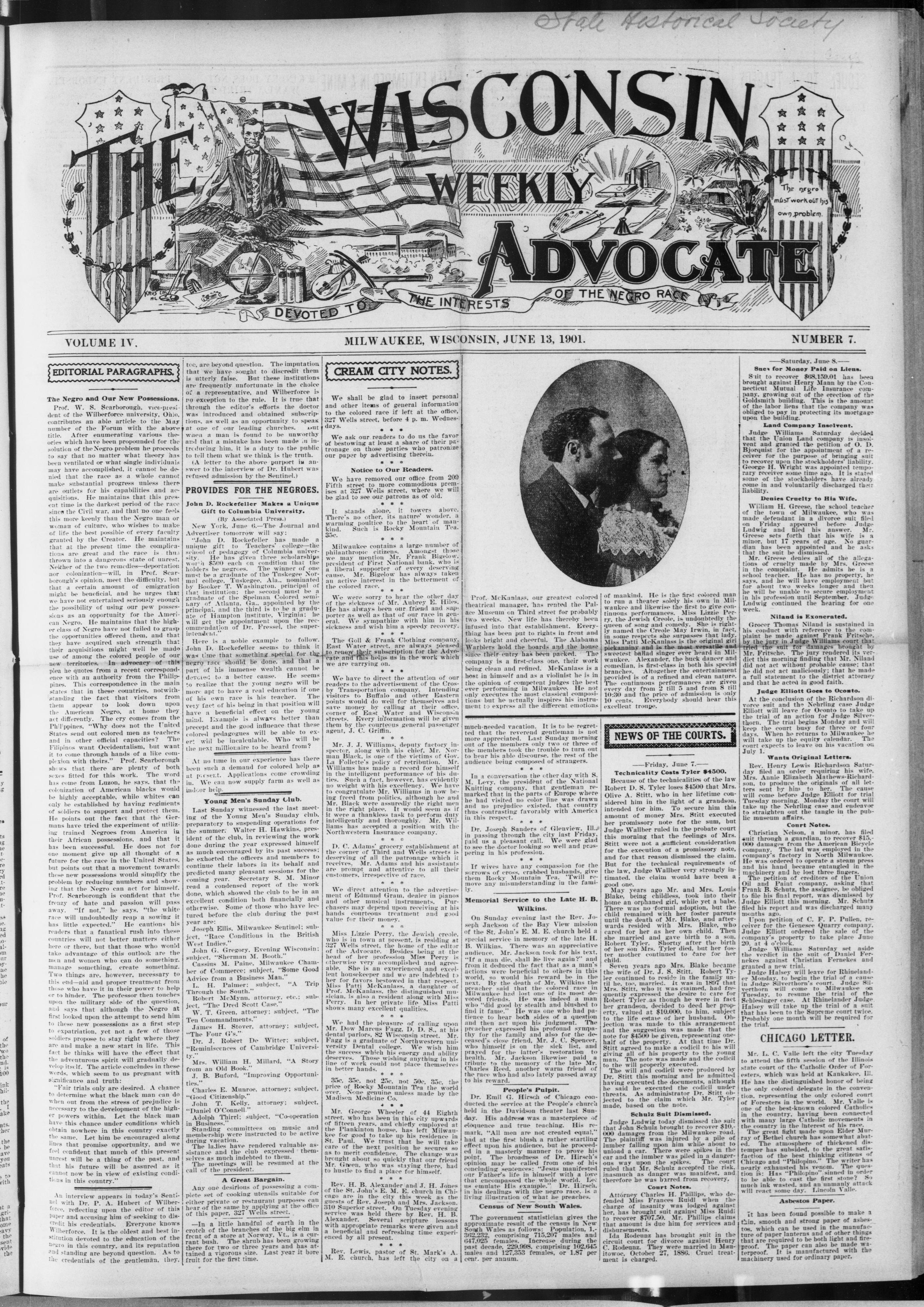
Page text (machine-generated)
WISCONSIN
WEEKLY
ADVOCATE
DEVOTED TO THE INTERESTS OF THE NEGRO RACE
EDITORIAL PARAGRAPHS.
The Negro and Our New Possessions
Prof. W. S. Scarborough, vice-president of the Wilberforce university, Ohio, contributes an able article to the May number of the Forum with the above title. After enumerating various theories which have been propounded for the solution of the Negro problem he proceeds to say that no matter what theory has been ventilated or what single individuals may have accomplished, it cannot be denied that the race as a whole cannot make substantial progress unless there are outlets for his capabilities and acquisitions. He maintains that this present time is the darkest period of the race since the Civil war, and that no one feels this more keenly than the Negro man or woman of culture, who wishes to make of life the best possible of every faculty granted by the Creator. He maintains that at the present time the complications are great and the race is thus thrown into a dangerous state of unrest. Neither of the two remedies—deportation nor colonization—will, in Prof. Scarborough's opinion, meet the difficulty, but that a certain amount of emigration might be beneficial, and he urges that we have not entertained seriously enough the possibility of using our pew possessions as an opportunity for the American Negro. He maintains that the higher class of Negro have not failed to grasp the opportunities offered them, and that they have acquired such strength that their acquisitions might well be made use of among the colored people of our new territories. In advocacy of this plea he quotes from a recent correspondence with an authority from the Philippines. This correspondence in the main states that in these countries, notwithstanding the fact that visitors from them appear to look down upon the American Negro, at home they act differently. The cry comes from the Philippines, "Why does not the United States send out colored men as teachers and in other official capacities? The Filipinos want Occidentalism, but want it to come through hands of a like complexion with theirs." Prof. Scarborough shows that there are plenty of both sexes fitted for this work. The word has come from Luzon, he says, that the colonization of American blacks would be highly acceptable, while whites can only be established by having regiments of soldiers to support and protect them. He points out the fact that the Germans have tried the experiment of utilizing trained Negroes from America in their African possessions, and that it has been successful. He does not for one moment give up all thought of a future for the race in the United States, but points out that a movement towards these new possessions would simplify the problem by reducing numbers and showing that the Negro can act for himself. Prof. Scarborough is confident that the frenzy of hate and passion will pass away. "If not," he says, "the white race will undoubtedly reap a sowing it has little expected." He cautions his readers that a fanatical rush into these countries will not better matters either here or there, but that those who would take advantage of this outlook are the men and women who can do something, manage something, create something. Two things are, however, necessary to this end—aid and proper treatment from those who have it in their power to help or to hinder. The professor then touches upon the military side of the question, and says that although the Negro at first looked upon the attempt to send him to these new possessions as a first step to expatriation, yet not a few of those soldiers propose to stay right where they are and make a new start in life. This fact he thinks will have the effect that the adventurous spirit will gradually develop itself. The article concludes in these words, which seem to us pregnant with significance and truth:
"Fair trials only are desired. A chance to determine what the black man can do when out from the stress of prejudice is necessary to the development of the higher powers within. Let the black man have this chance under conditions which obtain nowhere in this country exactly the same. Let him be encouraged along lines that promise opportunity, and we feel confident that much of this present unrest will be a thing of the past, and that his future will be assured as it cannot now be in view of existing conditions in this country."
An interview appears in today's Sentinel with Dr. P. A. Hubert of Wilberforce, reflecting upon the editor of this paper and accusing him of seeking to discredit his credentials. Everyone knows Wilberforce. It is the oldest and best institution devoted to the education of the negro in this country, and its reputation and standing are beyond question. As to the credentials of the gentleman, they.
at a grith that some avvy the sent vide the
toc, are beyond question. The imputation that we have sought to discredit them is utterly false. But these institutions are frequently unfortunate in the choice of a representative, and Wilberforce is no exception to the rule. It is true that through the editor's efforts the doctor was introduced and obtained subscriptions, as well as an opportunity to speak at one of our leading churches. But when a man is found to be unworthy and that a mistake has been made in introducing him, it is a duty to the public to tell them what we think is the truth. (A letter to the above purport in answer to the interview of Dr. Hubert was refused admission by the Sentinel.)
PROVIDES FOR THE NEGROES.
John D. Rockefeller Makes a Unique Gift to Columbia University. (By Associated Press.) New York, June 6.—The Journal and Advertiser tomorrow will say:
"John D. Rockefeller has made a unique gift to 'Teachers' college—the school of pedagogy of Columbia university. He has given three scholarships worth $500 each on condition that the holders be negroes. The winner of one must be a graduate of the Tuskegee Normal college, Tuskegee, Ala., nominated by Booker T. Washington, principal of that institution; the second must be a graduate of the Spelman Colored seminary of Atlanta, Ga., appointed by the principal, and the third is to be a graduate of Hampton institute, Virginia; he will get the appointment upon the recommendation of Dr. Fressel, the superintendent."
Here is a noble example to follow. John D. Rockefeller seems to think it was time that something special for the negro race should be done, and that a part of his immense wealth cannot be devoted to a better cause. He seems to realize that the young negro will be more apt to have a real education if one of his own race is his teacher. The very fact of his being in that position will have a beneficial effect on the young mind. Example is always better than precept and the good influence that these colored pedagogues will be able to exert will be incalculable. Who will be the next millionaire to be heard from?
At no time in our experience has there been such a demand for colored help as at present. Applications come crowding in. We can now supply farm as well as indoor help.
Young Men's Sunday Club.
Last Sunday witnessed the last meeting of the Young Men's Sunday club, preparatory to suspending operations for the summer. Walter H. Hawkins, president of the club, in reviewing the work done during the year expressed himself as much encouraged by its past success; he exhorted the officers and members to continue their labors in its behalf and predicted many pleasant sessions for the coming year. Secretary S. M. Minor read a condensed report of the work done, which showed the club to be in an excellent condition both financially and otherwise. Some of those who have lectured before the club during the past year are:
Joseph Ellis, Milwaukee Sentinel; subject. "Race Conditions in the British West Indies."
John G. Gregory, Evening Wisconsin; subject, "Sherman M. Booth." Cassius M. Paine, Milwaukee Chamber of Commerce; subject, "Some Good Advice from a Business Man."
L. H. Palmer; subject, "A Trip Through the South."
Robert McMynn, attorney, etc.; subject. "The Dred Scott Case."
W. T. Green, attorney; subject, "The Ten Commandments."
James H. Stover, attorney; subject,
"The Four G's."
Dr. J. Robert De Witter; subject,
"Reminiscences of Cambridge University."
Mrs. William H. Millard, "A Story
from an Old Book."
J. B. Buford, "Improving Opportunities."
Charles E. Munroe, attorney; subject,
"Good Citizenship."
John T. Kelly, attorney; subject,
"Daniel O'Connell."
Adolph Thirrl: subject, "Co-operation in Business."
Standing committees on music and membership were instructed to be active during vacation.
The ladies have rendered valuable assistance and the club expressed themselves as much indebted to them. The meetings will be resumed at the call of the president.
A Great Bargain.
Any one desirious of possessing a complete set of cooking utensils suitable for either private or restaurant purposes can hear of the same by applying at the office of this paper, 327 Wells street.
In a little handful of earth in the crotch of the branches of the big elm in front of a store at Norway, Vt., is a currant bush. The shrub has been growing there for two or three years and has attained a vigorous size. Last year it bore fruit for the first time.
CREAM CITY NOTES.
We shall be glad to insert personal and other items of general information to the colored race if left at the office, 327 Wells street, before 4 p. m. Wednesdays.
***
We ask our readers to do us the favor of bestowing at least a share of their patronage on those parties who patronize our paper by advertising therein.
Notice to Our Readers
We have removed our office from 209 Fifth street to more commodious premises at 327 Wells street, where we will be glad to see our patrons as of old.
* * *
It stands alone, it towers above. There's no other, its nature' wonder, a warming poulice to the heart of mankind. Such is Rocky Mountain Tea. 35c
***
Milwaukee contains a large number of philanthropic citizens. Amongst those we may mention Mr. Frank Bigelow, president of First National bank, who is a liberal supporter of every deserving cause. Mr. Bigelow has always taken an active interest in the betterment of the colored race.
* * *
We were sorry to hear the other day of the sickness of Mr. Aubrey E. Hiles. He has always been our friend and supporter as well as that of our race in general. We sympathize with him in his sickness and wish him a speedy recovery.
* * *
The Goll & Frank Clothing company, East Water street, are always pleased to renew their subscription for the Advocate and this helps us in the work which we are carrying on.
***
We have to direct the attention of our readers to the advertisement of the Crosby Transportation company. Intending visitors to Buffalo and other Eastern points would do well for themselves and save money by calling at their office, corner of East Water and Wisconsin streets. Every information will be given them by the courteous general passenger agent, J. C. Griffin.
* * *
Mr. J. J. Williams, deputy factory inspector, along with his chief, Mr. Norman Black, is one of the victims of Gov. La Follette's policy of retribution. Mr. Williams has made a record for himself in the intelligent performance of his duties. Such a fact, however, has evidently no weight with his excellency. We have to congratulate Mr. Williams in now being freed from politics, although he and Mr. Black were assuredly the right men in the right place. It would seem as if it were a thankless task to perform duty intelligently and thoroughly. Mr. Williams has accepted a position with the Northwestern Insurance company.
歌 咏 恋
D. C. Adams' grocery establishment at the corner of Third and Wells streets is deserving of all the patronage which it receives. Mr. Adams and his assistants are prompt and attentive to all their customers, irrespective of race.
* * *
We direct attention to the advertisement of Edmund Gram, dealer in pianos and other musical instruments. Purchasers may depend upon receiving at his hands courteous treatment and good value for their money.
```markdown
```
Miss Lizzie Perry, the Jewish creole, who is in town at present, is residing at 327 Wells street, the home of the editor of the Advocate. Besides being at the head of her profession Miss Perry is otherwise very accomplished and agreeable. She is an experienced and excellent housekeeper and we are indebted to her for favors bestowed in that respect. Miss Patti McKanlass, a daughter of Prof. McKanlass, the distinguished musician, is also a resident along with Miss Perry. In her private life Miss Patti shows many excellent qualities.
六 六 ★
We had the pleasure of calling upon Mr. Dow Marcus Fagg, D. D. S., at his dental parlors, 82 Wisconsin street. Mr. Fagg is a graduate of Northwestern university Dental college. We wish him the success which his energy and ability deserves. Those wishing anything in his line of work could not place themselves in better hands.
本 本 本
35c, 35c, not 25c, not 50c, 35c, the price of Rocky Mountain Tea the world over. None genuine unless made by the Madison Medicine Co.
```markdown
```
Mr. George Wheeler of 44 Eighth street, who has been in this city upwards of fifteen years, and chiefly employed at the Plankinton house, has left Milwaukee for good to take up his residence in St. Paul. We trust that he will take care of the next position he secures so as to merit confidence. The change was brought about so quickly that our friend Mr. Green, who was staying there, had to hustle to find a place for himself.
* * *
Rev. H. B. Alexander and J. H. Jones of the St. John's E. M. E. church in Chicago are in the city this week as the guests of Rev. Joseph and Mrs. Jackson. 310 Superior street. On Tuesday evening service was held there by Rev. H. B. Alexander. Several scripture lessons with appropriate remarks were given and a beneficial and refreshing time experienced by all present.
***
Rev. Lewis, pastor of St. Mark's A. M. E. church, has left the city on a
[Picture of a man and a woman in profile, the man facing the woman. The woman is wearing a lace dress with a high collar.]
Prof. McKanlass, our greatest colored theatrical manager, has rented the Palace Museum on Third street for probably two weeks. New life has thereby been infused into that establishment. Everything has been put to rights in front and looks bright and cheerful. The Alabama Warblers hold the boards and the house since their entry has been packed. The company is a first-class one, their work being clean and refined. McKanlass is a host in himself and as a violinist he is in the opinion of competent judges the best ever performing in Milwaukee. He not only executes the most classical compositions but he actually inspires his instrument to express all the different emotions
much-needed vacation. It is to be regretted that the reverend gentleman is not more appreciated. Last Sunday morning out of the members only two or three of the members took the trouble to turn out to hear his able discourse, the rest of the audience being composed of strangers.
* * *
In a conversation the other day with S. M. Levy, the president of the National Knitting company, that gentleman remarked that in the parts of Europe where he had visited no color line was drawn and no prejudice existed, that country thus contrasting favorably with America in this respect.
Dr. Joseph Sanders of Glenview, Ill., in passing through the city last Friday, paid us a pleasant call. We were glad to see the doctor looking so well and prospering in his profession.
* * *
If wives have any compassion for the sorrows of cross, crabbed husbands, give them Rocky Mountain Tea. 'Twill remove any misunderstanding in the family.
Memorial Service to the Late H. B. Wilkins.
On Sunday evening last the Rev. Joseph Jackson of the Bay View mission of the St. John's E. M. E. church held a special service in memory of the late H. B. Wilkins. There was an appreciative audience. Mr. Jackson took for his text, "If a man die, shall he live again?" and from it deduced the fact that as a man's actions were beneficial to others in this world, so would his reward be in the next. By the death of Mr. Wilkins the preacher said that the colored race in Milwaukee had lost one of its most devoted friends. He was indeed a man who "did good by stealth and blushed to find it fame." He was one who had patience to hear both sides of a question and then act upon his judgment. The preacher expressed his profound sympathy for the family and also for the deceased's close friend, Mr. J. C. Spencer, who himself is on the sick list, and prayed for the latter's restoration to health. Mr. Jackson likewise paid a tribute to the memory of the late Mr. Charles Reed, another warm friend of the race who had also lately passed away to his reward.
People's Pulpit.
Dr. Emil G. Hirsch of Chicago conducted the service at the People's church held in the Davidson theater last Sunday. His address was a masterpiece of eloquence and true teaching. His remark, "All men are not created equal," had at the first blush a rather startling effect upon his audience, but he proceeded in a masterly manner to prove his point. The broadness of Dr. Hirsch's opinion may be called from one of his concluding sentences: "Jesus manifested our Father's life in himself with a love that encompassed the whole world. Let us emulate His example." Dr. Hirsch, in his dealings with the negro race, is a living illustration of what he preaches.
Census of New South Wales.
The government statistician gives the approximate result of the census in New South Wales as follows: Population, 1,362,232, comprising 715,207 males and 647,025 females. Increase during the past decade, 229,998, comprising 102,645 males and 127,353 females, or 1.87 per cent per annum.
* * *
in this respect.
\* \* \*
of mankind. He is the first colored man to run a theater solely his own in Milwaukee and likewise the first to give continuous performances. Miss Lizzie Perry, the Jewish Creole, is undoubtedly the queen of song and comedy. She is rightly named the Creole May Irwin, in fact, in some respects she surpasses that lady. Miss Patti McKanlass is the original girl pickanniny and is the most versatile and sweetest ballad singer ever heard in Milwaukee. Alexander, the buck dancer and comedian, is first-class in both his special branches. Altogether the entertainment provided is of a refined and clean nature. The continuous performances are given every day from 2 till 5 and from 8 till 10:30 and the price of admission is only 10 cents. Everybody should hear this excellent troupe.
NEWS OF THE COURTS.
Because of the technicalities of the law Robert D. S. Tyler loses $4500 that Mrs. Olive A. Stitt, who in her lifetime considered him in the light of a grandson, intended for him. To secure him this amount of money Mrs. Stitt executed her promissory note for the sum, but Judge Wallber ruled in the probate court this morning that the feelings of Mrs. Stitt were not a sufficient consideration for the execution of a promissory note, and for that reason dismissed the claim. But for the technical requirements of the law, Judge Wallber very strongly intimated, the claim would have been a good one.
May years ago Mr. and Mrs. Louis Blake, being childless, took into their home an orphaned girl, while yet a babe. There was no formal adoption, but the child remained with her foster parents until the death of Mr. Blake, and afterwards resided with Mrs. Blake, who cared for her as her own child. Then she married and gave birth to a son, Robert Tyler. Shortly after the birth of her son Mrs. Tyler died, but her foster mother continued to care for her child.
Seven years ago Mrs. Blake became the wife of Dr. J. S. Stitt. Robert Tyler continued to reside in the family until he, too, married. It was in 1897 that Mrs. Stitt, who it was claimed, had frequently expressed the desire to care for Robert Tyler as though he were in fact her grandson, decided to deed her property, valued at $10,000, to him, subject to the life estate of her husband. Objection was made to this arrangement and the suggestion was made that the note for $4500 be given, representing one-half of the property. At that time Dr. Stitt agreed to make a codicil to his will giving all of his property to the young man. The note was made and the codicil to the will properly executed.
The will and codicil were produced by Dr. Stitt this morning and he admitted having executed the documents, although he said he executed the codicil under threats. As administrator Dr. Stitt objected to the claim which Mr. Tyler made, based on the note.
Schulz Suit Dismissed.
Judge Ludwig today dismissed the suit that John Schulz brought to recover $10,000 damages from the Milwaukee road. The plaintiff was injured by a pile of lumber falling upon him while about to unload a car. There were spikes in the car and the lumber was piled in a dangerous way upon the spikes. The court ruled that Mr. Schulz accepted the risk, inasmuch as danger was manifest, and therefore he was barred from recovery.
Court Notes
Attorney Charles H. Phillips, who defended Miss Frances Ruidl when the charge of insanity was lodged against her, has brought suit against Miss Ruidl to recover $707.50. Mr. Phillips claims that amount is due him for services and disbursements. Ida Rodeunz has brought suit in the circuit court for divorce against Henry C. Rodeunz. They were married in Mauitowoc, October 27, 1886. Cruel treatment is charged.
NUMBER 7.
Snear for Money Paid on Lions
Suit to recover $68,159.01 has been brought against Henry Mann by the Connecticut Mutual Life Insurance company, growing out of the erection of the Goldsmith building. This is the amount of the labor liens that the company was obliged to pay in protecting its mortgage upon the building.
Land Company Insolvent.
Judge Williams Saturday decided that the Union Land company is insolvent and granted the petition of O. D. Bjorquist for the appointment of a receiver for the purpose of bringing suit to recover upon the stockholders' liability. George H. Wright was appointed temporary receiver some time ago. It is stated some of the stockholders have already come in and voluntarily discharged their liability.
Denies Cruelty to His Wife.
William H. Greese, the school teacher of the town of Milwaukee, who was made defendant in a divorce suit filed on Friday appeared before Judge Ludwig and filed his answer. Mr. Greese sets forth that his wife is a minor, but 17 years of age. No guardian has been appointed and he asks that the suit be dismissed. Mr. Greese denies all of the allegations of cruelty made by Mrs. Greese in the complaint. He admits he is a school teacher. He has no property, he says, and he will have employment but for about two weeks longer and then he will be unable to secure employment in his profession until September. Judge Ludwig continued the hearing for one week.
Niland is Exonerated.
Grocer Thomas Niland is sustained in his conduct with reference to the complaint he made against Frank Fritsche, by the jury in Judge Williams court that tried the suit for damages brought by Mr. Fritsche. The jury rendered its verdict this morning finding that Mr. Niland did not act without probable cause; that he did not act maliciously; that he made a full statement to the district attorney and that he acted in good faith.
Judge Elliott Goes to Oconto.
At the conclusion of the Richardson divorce suit and the Nehrling case Judge Elliott will leave for Oconto to take up the trial of an action for Judge Silverthorn. The trial begins Monday and will keep the court busy for three or four days. When he returns to Milwaukee he will take up the equity calendar. The court expects to leave on his vacation on July 1.
Wants Original Letters.
Rev. Henry Lewis Richardson Saturday filed an order requiring his wife, Mrs. Annie Elizabeth Mathews-Richardson, to produce the originals of all letters sent by him to her. The cause will come before Judge Elliott for trial Tuesday morning. Monday the court will take up the Nehrling case and endeavor to straighten out the tangle in the public museum affairs.
Court Note.
Christian Nelson, a minor, has filed suit through a guardian, to recover $15.000 damages from the American Bicycle company. The lad was employed in the company's factory in North Milwaukee. He was ordered to operate a steam press and his hand became entangled in the machinery and he lost three fingers. The petition of creditors of the Union Oil and Paint company, asking that Frank B. Schutz, the assignee, be obliged to file his final report, was dismissed by Judge Elliott this morning. Mr. Schutz filed his report and was discharged many months ago. Upon petition of C. F. P. Pullen, receiver for the Genesee Quarry company, Judge Elliott ordered the sale of the company's property to take place June 20, at 4 o'clock.
Judge Williams Saturday set aside the verdict in the suit of Daniel Fernekes against Christian Fernekes and granted a new trial.
Judge Halsey will leave for Rhinelander Monday, to begin the trial of a cause in Judge Silverthorn's court. Judge Silverthorn will come to Milwaukee on Tuesday, to resume the trial of the Schlesinger case. At Rhinelander Judge Halsey will take up the trial of a suit that has been to the Supreme court twice. Probably one month will be required for the trial.
CHICAGO LETTER.
Mr. L. C. Valle left the city Tuesday to attend the fifth session of the Illinois state court of the Catholic Order of Foresters, which was held at Kankakee, Ill. He has the distinguished honor of being the only colored delegate in the convention, representing the only colored court of Foresters in the world. Mr. Valle is one of the best-known colored Catholics in the country, having been connected with many large Catholic movements in the country in the interest of his race.
The great fight made upon Elder Murray of Bethel church has somewhat abated. The atmosphere of thickened distemper has subsided, to the great satisfaction of the best thinking citizens of Chicago and "Philopino." The writer has nearly exhausted his venom. The question is: Has "Philopino" sinned in order to be able to cast the first stone? So much ink wasted, and an unmanly attack will react some day. Lincoln Valle.
Asbestos Paper.
It has been found possible to make a thin, smooth and strong paper of asbestos, which can be used in the manufacture of paper lanterns and of other things that are required to be both light and fireproof. The paper can also be made waterproof. It is manufactured with the machinery used for ordinary paper.
SEQUEL TO A TRAGEDY.
Elizabeth Flagler, Who Shota Negro Poacher, Becomes a Bride. GROOM IS DR. M'KEEN.
Spent Five Years Ministering to the Poor in Nova Scotia, Where She Met Her Afflianced.
Washington, D. C., June 12.—Miss Elizabeth Moore Flagler, daughter of the late Gen. Flagler, and Dr. George MacKeen of Nova Scotia were married at St. Margaret's church in this city today. The bride's brother, Capt. Flagler, gave her away. None but relatives and personal friends witnessed the ceremony, but 800 persons attended a reception afterwards, given at the residence of the bride's mother.
The marriage of Miss Flagler recalls an event which is full of pathetic interest. On an August morning in 1895 Miss Flagler detected a colored boy in the act of stealing apples from a tree in her father's orchard. Seizing a small sporting rifle that belonged to her brother with the intention of scaring the little urchin, she raised the rifle and fired.
Almost instantaneously something fell from the tree. A child lay on the ground, with the blood flowing from a bullet wound in his head. The coroner's jury exonerated Elizabeth Flagler, but the verdict brought down a storm of indignation from negro residents. After a season of tremendous agitation she was indicted and brought to trial.
Fined and Imprisoned.
"Guilty of involuntary manslaughter" was the verdict the second time, and Elizabeth Flagler was fined $500 and sentenced to three-hours' imprisonment. From end to end of the United States those three hours in jail were recorded. In her father's carriage Miss Flagler arrived to fulfill the sentence. With a friend she sat in the matron's room while her father, Gen. Flagler, smoked a cigar in the warden's office. At 9:30 a.m. Elizabeth Flagler entered the city jail; at 12:30 she was discharged. The trial ended, a wave of relief swept over Washington society, where the brigadier-general's daughter was a great favorite. Every one was eager to show the young girl sympathy.
She was, perhaps, the only one in her set whom the sentence did not seem to relieve. Elizabeth Flagler's conscience suffered for the taking of the boy's life. The expiation that the court failed to impose upon her she dealt out to herself. She saw no one, she went nowhere until she had made up her mind. Suddenly one day she disappeared. Elizabeth Flagler had become a recluse in a little fishing village in Nova Scotia, a recluse whose aim in the future should be to redeem what she considered her sin by doing good to the poorest and the saddest.
Ministered to the Sick.
The place Elizabeth Flagler selected was Baddeck, in Cape Breton, where not a human being knew her. It was in tending the sick that she was first brought back as if in a vision to the world she had left. For the first time in many months she met at the bedside of an invalid, a man of culture and refinement, such a man as once she had been accustomed to meet and dance with in the drawing rooms and ballrooms of the city she had graced. His name was George Wilbert McKeen. As a physician he had come to seek experience and practice among the poor of Nova Scotia.
From being absorbed in the practice of medicine he had come to be absorbed in something else. The lady of Cape Breton had awakened in him an interest more absorbing than medicine. The doctor asked her to tell him of herself, of her hopes, her plans, her ambitions. She answered in one single sentence: "I am Elizabeth Flagler." she said: "the Elizabeth Flagler of Washington." In that sentence the doctor heard the "blessed lady's" story and, being of the world, he understood.
From that hour he set himself a task that her relatives and friends had failed at completely. He determined that this beautiful young woman should no longer live in exile, a self-condemned sinner. To entice her back to the world he divided his hours between her and the sickest of his patients. Soon he had the delight of knowing that she needed him quite as much. It was the first and most important step in the cure that he hoped to effect
The heart conquered where conscience had stood firm. Back to the old gay world, which had not known her for five years, came the brigadier-general's daughter. Early in June her return is to be signalized by a splendid wedding in St. Margaret's Protestant Episcopal church and a great reception afterward, when the "blessed lady" of Baddeck will receive the congratulations of Washington's 400.
STRIKE OF TRAINMEN.
Tie-Up of Pere Marquette System is Threatened-Demands Are Submitted.
Saginaw, Mich., June 12.—A strike among the trainmen of the Pere Marquette railroad that will tie up the entire system, is threatened. The engineers have grievances which were submitted to the management some time ago and have not been adjusted. They have decided to make new demands now and if not acceded to they may strike. Officers of the Brotherhood of Railway Trainmen have been notified of the condition and a representative will visit Michigan to investigate.
The Pere Marquette closed down all its shops yesterday, throwing out of employment 100 more men who were still at work. In addition, the honeyard gang and coal heavens quit, their places being taken by Italian laborers from repair crews. The wrecking crews will also quit.
HAZING MUST CEASE.
Strigent Regulations Are Issued by the War Department.
New York, June 12.—According to a special to the Herald from Washington, stringent regulations defining and prohibiting hazing have been issued by the war department. These regulations are the direct result of the recent muntinous proceedings at the Military academy. Dismissal is the penalty of violation of these regulations. The practice of a duel or personal combat is also prohibited, and the principals and other persons involved, or any cadet abusing or condemning another for declining to accept a challenge will be dismissed.
TRIED BY COURTMARTIAL
Licut. H. T. Mitchell Charged with Embezzling Public Funds.
Manila, June 12.—Lieut. Henry T. Mitchell of the Forty-first regiment has been arrested and will be tried by court-martial on the charge of embezzlement, at Bacolor, of $277 of public funds.
Capt. William H. Wilhelm of the Twenty-first infantry, who was recently wounded in the shoulder in an engagement with insurgents at Lipa, Batangas province, died today.
PLOTTERS CONVICTED.
Chicago, Ill., June 11.—Dr. August M. Unger and F. Wayland Brown were yesterday found guilty of conspiracy to commit the insurance frauds which culminated in the death of Marie Defenbach last fall.
The jurors were unanimous for conviction on the first ballot. It took them only fifty-five minutes to look over the judge's instructions, sum up the evidence and prepare their written verdict.
Punishment by imprisonment in the penitentiary for an indeterminate term of from one to five years is the penalty. Sentence will be passed next week upon the two men and at the same time upon Frank H. Smiley, the third conspirator, who pleaded guilty at the beginning of the trial.
A Remarkable Case.
The Defenbach conspiracy case has been one of the most interesting and complicated with which the criminal officials of Cook county have had to deal for many months. The evidence showed that Marie Defenbach, a beautiful young woman of fair education, became infatuated with Dr. Unger. On Aril 3, 1900, Dr Unger, under the assumed name of Dr Scott, accompanied by Marie Defenbach, called on one of the officials of the Independent Order of Foresters. Marie sought to secure $5000 insurance and after some weeks of waiting her name was finally entered on the rolls of the organization. This was the beginning of a series of dealings with insurance companies and organizations which finally resulted in an aggregate of $12,000 in insurance being secured on the life of the girl. This money was distributed as follows: Independent Order of Foresters, $5000; New York Life Insurance conpany, $5000; Knights and Ladies of Honor, $2000. If they had been successful in all their efforts she would have carried a total of $67,000 in insurance.
Francis Wayland Brown and Frank H. Smiley did not come into the conspiracy until the first week of August. At the time Brown was acting manager of the Mooney & Boland detective agency in the absence of W. H. Sutherland in Europe. Smiley had been for years a trusted employee of the firm. Brown and Smiley came into prominence through an arrangement making Smiley, as her afflianced husband, the beneficiary in the Foresters' policy.
Miss Defenbach Dies.
The girl died on the night of August 25. For an hour before her death she suffered intense agony. She called repeatedly for Dr. Unger. The day following the body was embalmed at a neighboring undertaking establishment. Brown and Smiley called at the house and made all preparations for the funeral and the disposition of her personal effects. Tuesday she was cremated at Graceland in accordance with the provisions of a will found in her bedroom and dated August 23.
Smiley and Brown set to work to collect the $5000 policy in the Foresters, and Unger sought to get the money called for in the other two policies. Smiley attempted to probate the will and the publicity brought about an expose. Calvin Huntsman, an uncle of the dead girl, started an investigation on his own hook and after a time interested John Boland, president of the Mooney & Boland detective agency. The state's attorney's office was placed in possession of all the facts and indictments against Unger, Brown, Smiley and Marie, though dead, were returned.
The case just closed was begun three weeks ago. The state furnished an array of circumstantial evidence that the defense scarcely attempted to impeach. While the prosecution occupied ten days in the presentation of its testimony, the defense was content with placing Brown on the stand, the presentation of character witnesses and two witnesses for Dr. Unger.
CONTROLS ORE LAND.
Eastern Railway of Minnesota Now Has 20,000 Acres on Mesaba Range
Duluth, Minn., June 11.—The Eastern Railway of Minnesota has purchased from A. M. Miller, Jr., eighty-four forties, or about 3200 acres of lands in the Mesaba iron belt that have never been explored, with the exception of two or three forties, and these in the most superficial manner. It may be said that the lands are among the most promising on the Mesaba range, for they lie in the vicinity of Virginia and Mountain Iron.
The newly-acquired lands of the Eastern Minnesota road adjoin much of the United States Steel Corporation properties in the neighborhood of Virginia and Mountain Iron. How much ore may be contained on the Miller lands remains to be seen, but mining men are of the opinion that the property will produce millions of tons. Mr. Miller has done very well, having bought the property before the boom in iron ore which began during the winter of 1898 and 1899. The purchase of the Miller lands by the Eastern Minnesota road draws public attention to the activity of the new range ore road on the Mesaba. It is reliably stated that the Eastern Minnesota road now controls not less than 20,000 acres on the Mesaba range, and the amount may be fully 25,000 acres.
CAN'T MAKE CONTRACTS.
Neenah School Board is Tied Up by an Injunction.
Neenah, Wis., June 11.—[Special.]—Another school sensation has been sprung here. The superintendent of schools and the board of education have been restrained from making contracts with teachers for the ensuing year. The injunction was issued upon the ground that the present board has no authority under the law to bind the city by teachers' contracts for the ensuing year, but that such power is vested in the members of the new board, whose term of office begins on the first Monday of July. Many prominent citizens, including the mayor, are behind the action.
Latest Fad of Critics.
The latest fad of critics, the New York Press, says, is to rebel against the names of months. They point out that it is absurd for Europeans and Americans of today to dedicate one-sixth of the year to the memory of Julius Caesar and Augustus, to name a third after heathen gods and goddesses, to nave two months of doubtful nomenclature, and to designate the remaining four by misleading numericals. September being obviously ninth and not seventh in order.
—We purchase from Egypt, strange to say, over forty-four million pounds of cotton annually. Efforts are being made to produce substitutes for this cotton by hybridizing. There is every prospect that we are succeeding in producing the long, fine staple that now comes from the land of the Pharaohs, and for which we pay over $6,000,000 annually.
What It's Coming To.—First Mother—
"What makes your little boy get up so early mornings?" Second Mother—"He has to; he sells the evening papers."—Fun.
—Saw and axe contests are favorite pastimes in Tasmania.
PREPARED TO FIGHT.
Metal Trades' Association Adopts an Aggressive Policy in View of the Pending Strike.
New York, June 12.—The National Metal Trades' association has taken steps for an aggressive fight against the 50,000 machinists who are now on strike at shops of members of the organization. They have decided to raise immediately money sufficient to make the treasury fund of the association $500,000. This fund is to be used for the protection of the manufacturing industries of the United States and Canada devoted to the machinery business. Nearly 200 delegates were in attendance when President Reynolds called the convention to order.
The meetings were held behind closed doors. Every delegate was identified, registered and furnished with a numbered badge. These precautions were taken to prevenen the presence of emissaries of the machinists' union, representing the strikers in various parts of the United States. The preliminary declaration of principles, formulated at a meeting of the administrative council of the association, held in Chicago in the last week of May, was reaffirmed. That declaration is an open defiance of the machinists' organization. It proclaims at the start that there can be negotiations with men on strike. Grievances, real or alleged, can be discussed only with men who are at work.
Expect Long Struggle.
Some of the metal manufacturers who are old members of the association expect a long and bitter struggle with the machinists. It is one of the principles of the Metal Trades' association that no uniform scale of wages or regulation of hours can be adopted throughout the United States. The cost of living, the price of raw material, the expense of maintaining plants and the element of transportation all differ in different localities. By thus localizing the issues it is sought to avert a general battle all over the country between the allied machinists and the organized manufacturers.
This has led to the division of the country into districts. These groups are known as; First district, New England; second, New York and New Jersey; third, Pennsylvania, Delaware, Maryland and the District of Columbia; fourth, Michigan and Ohio; fifth, Indiana and Illinois; sixth, Minnesota and Wisconsin; seventh, Iowa and Missouri; eighth, the South. Other districts are to be organized, embracing other states and the Canadian provinces of Ontario and Quebec.
New Members Admitted.
Thirty-eight manufacturing establishments, employing upward of 7500 men, signed applications for membership, and were immediately enrolled, and are now active members of the National Metal Trades' association.
A committee of ten, five from the visiting delegates and five from the National Metal Trades' association, was appointed by the president to revise the constitution and bylaws and report back to the convention.
The finance and strike committee, as well as other standing committees, were appointed by the president and are now engaged in formulating plans for the future conduct of the affairs of the association during the present crisis.
Machinists Elect Officers
Toronto, June 11.—At today's session of the International Machinists' association President O'Connell was re-elected. The other officers elected were: First vice-president—J. Conlin, Sioux City, Second vice-president—A. W. Holmes, Toronto.
Third vice-president—George Mulberry, Chicago.
Fourth vice-president—Thomas Wilson. Cheyenne, Wyo.
Fifth vice-president—Maurice Landers,
Hartford, Conn.
General secretary and treasurer—George Preston, Detroit, re-elected.
Executive board-Hugh Doran, Chicago E. L. Tucker, Washington; Henry F. Garrot, Atlanta, Ga.; M. J. Ford, New York and James A. Reynolds, Cleveland.
Editor-D. Douglass Wilson, Birmingham. Ala. re-elected.
Ala., re-elected. Delegates to the convention of the American Federation of Labor at Scranton next December-James O'Connell, Washington; J. J. Creamer, Richmond, Va.; John J. Keegan, Philadelphia, and George H. Warner, New York. Milwaukee was decided upon as the meeting place of the next convention two years hence. After the installation of officers the convention adjourned sine die.
Shipyards Not to Yield.
Atlanta, Ga., June 12.—A special from Newport News, Va., says: It was announced today that 1000 men will be laid off at the yards of the Newport News Ship Building & Dry Dock company, on account of the machinists' strike. This will make a total of 2000 men out. It is expected the entire plant will be closed by Saturday night. It is the understanding here that all the shipyards in the country are determined not to accede to the demands of the machinists.
Workmen Attacked by Strikers.
Rochester, N. Y., June 12.—About 1000 men who recently struck work on street improvements contracts, paraded the streets today, and attacked a gang of men who had taken work at the old rate of wages. Policemen drove off the rioters, who resumed their march and caused the suspension of work on other contracts. Subsequently the paraders visited city hall, where their leaders interviewed Mayor Carnahan. That official promised his best endeavors to induce the contractors to come to terms.
Machinists Return to Work.
Buffalo, N. Y., June 12.—About 120 machinists of the Snow Steam Pump works who have been out since May 20, returned to work today. Neither side will state the nature of the agreement under which the men resumed.
EIGHTEEN VICTIMS.
West Newton, Pa., June 12.—The death of Harvey Beveridge at the McKeesport hospital, last night brought the total number of fatalities of the Port Royal mine disaster up to eighteen. The last rescuing party entered the ill-fated mine shortly before midnight and explored it for a distance of 3000 feet. The body of David James was found. Five bodies have been recovered since the first explosion. There are still thir-
NOTED WOMAN ASKS DIVORCE
Daughter of Ambassador Andrew D. White Seeks a Decree.
Sandusky, O., June 12.—Sandusky society is agog over the filing of a petition for alimony by Mrs. Clara Newberry, daughter of Andrew D. White, United States ambassador to Germany, against her husband, S. B. Newberry, manager of the Sandusky Portland Cement works. The wife asks for alimony and an injunction to restrain the husband from disposing of his property pending a suit for divorce. It has been generally supposed that the relations between Mr. and Mrs. Newberry were happy, but friends say, however, there has been incompatibility of temper.
Friends of both of the parties are doing all in their power to bring about an amicable settlement of the case, as they have a horror of the courts.
MEN ENTOMBED IN A MINE
SOUNDED LIKE CYCLONE
Black Damp Makes Rescue Work Impossible-Hope for the Missing Abandoned.
Port Royal, Pa., June 11.—By the explosion of gas in shaft No. 2 of the Pittsburg Coal and Coke company's mine, about 6 o'clock last night, thirty men are supposed to have been killed.
Smoke arose from the mouth of the shaft in volumes during the night. Great excitement prevailed and the entire population of the town remained all night at the mine eagerly awaiting some news from those thought to be either buried under tons of slate or slowly awaiting either death from flames or relief from the outside, with small chance favoring the former.
Following is a list of the dead as far as the names have become known:
WILLIAM M'CUNE, general superintendent of this district, who resided at West Newton.
DENNIS WARDLEY, pit boss of the mine.
MICHAEL ROY, one of the foremen.
MICHAEL DALY, who entered the mine for the first time this morning.
FRANK DAVENPORT, married and residing here.
ANTONIO STICKLE, married, who lived here, with his wife, and child.
lived here with his wife and child.
JOHN PEOPLES, who has a wife and
two small children here.
JOHN KECK, pit boss.
WILLIAM ALLISON, superintendent,
West Newton, married, four children.
DANIEL ALSOP, mine boss.
THOMAS LABIN, miner, married.
THOMAS GLEASON, fire boss, married.
CHRIS HOWELLS, fire boss, married.
TAYLOR GUNSAULUS, SR., married.
TAYLOR GUNSAULUS, JR.
JOHN STACKLE, miner.
BETTER MIGANLE, married.
Supt. Allison was a second cousin of President McKinley
Rescuers Badly Hurt.
The last rescue party had been in the mine about an hour when the muffled report of another explosion was heard issuing from the depths of the shaft, and a rush for the cage was made by the men above, who thought that these rescuers had met the fate of those who had gone before. A dozen men volunteered to go down and try and rescue the party, but their services were not needed, as the signal to hoist the cage was given from the bottom, and when it reached the top three unconscious forms were found lying on it. Fire Inspector Callaghan and Fire Boss William McFee of the Wyckhaven mines were the most dangerously hurt of the party, and these men were taken to a hotel nearby, where two physicians worked with them almost an hour before they could be brought back to life.
So far the bodies of J. Kountz of Smithson and Taylor Gunsaules, Sr., of Port Royal, have been recovered. From what could be ascertained here last night about 6 o'clock there was a low rumbling sound, followed by a roar which sounded like a cyclone, then three sharp and short reports. Immediately the mine catastrophe of seven years ago still fresh in the mines of those made fatherless, was recollected and simultaneously a rush was made for the mouth of the mine.
About 7 o'clock William McCune of West Newton, general superintendent of this district; Dennis Wortley, pit boss of the mine; Michael Roy, foreman, and several other bosses, with about twenty men, went down shaft No. 1, which is just opposite on the Baltimore & Ohio side of the river, and they are probably lost, as about three hours after the rescue party had been in the mine two more explosions were heard. Meanwhile the crowd around the opening of the shaft had increased, the crowd including mothers, wives and sisters of many of the men onboard.
Mines Extremely Gaseous.
The Port Royal mines are situated on the Youghiogheny river thirty-seven miles from Pittsburg. They are owned by the Pittsburg Coal company. District Superintendent McCune, who is reported killed at the head of a brave band of volunteers, was one of the most experienced and best-known miners in western Pennsylvania. The Port Royal mines are located in the thick vein coal belt and are for that reason extremely gaseous and dangerous. The state mining officials have made their management the object of repeated caution.
At 3 o'clock W. A. Sweeney and Frank Stratton came to the surface bringing Harry Beveridge in an unconscious condition, with both arms and a leg broken and badly burned. He cannot live. All three men succumbed shortly after reaching the surface. Sweeney, who was mainly instrumental in saving Beveridge, was able to tell that he climbed over the bodies of at least three men on his way out.
The explosion occurred at the time when the shifts were changing from day to night turn, and it is impossible to tell how manw were in the mine at the time, but certainly no less than thirty are entombed
Late this afternoon the officials of the Pittsburg Coal company issued an order refusing to allow any more men to enter the shaft, as the danger was too great. They are now considering the advisability of flooding the mine for the purpose of extinguishing the fire. There is now no hope of rescuing the entombed men.
West Newton, Pa., June 11.—Another explosion occurred at the Port Royal mine of the Pittsburg Coal & Coke company shortly before noon and several of the rescuers were dangerously injured. Fire Inspector Callaghan and Fire Boss McFee were the most dangerously hurt and may die. This last explosion in many minds settles the fate of the entombed men and all hope of getting them out alive has been abandoned.
MAYTAX THE FRANCHISE
New Jersey Supreme Court Holds Street Railway Charters May Be Assessed as Real Estate.
Trenton, N. J., June 11.—The Supreme court decided the case of the mayor and aldermen of Newark against the North Jersey Street Railway company, holding that street railway franchises in New Jersey are taxable as real estate, thus adding to the state revenues several million annually. This is considered an important opinion, as it will affect every city, township and borough through which a trolley road passes. It is thought it will prevent the building of some small trolley roads for which franchises have already been granted.
Suicide of Bank Cashier.
Dexter, Kas., June 11.—Cashier Watkins of the bank here, shot and killed himself last night and the bank is closed this morning awaiting action of Bank Commissioner Albaugh.
M'KINLEY DOES NOT WANT A THIRD TERM.
M'KINLEY DOES NOT WANT A THIRD TERM.
President Declares He Would Not Accept Nomination if It Were Tendered Him.
Washington, D. C., June 11.—The following statement has been given out at the white house: "I regret that the suggestion of a third term has been made. I doubt whether I am called upon to give it notice. But there are now questions of gravest importance before the administration and the country and their just consideration should not be prejudiced in the public mind by even the suspicion of the thought
[Picture of a man in a suit with a bow tie].
PRESIDENT M'KINLEY.
of a third term. In view, therefore, of the reiteration of the suggestion of it, I will say now, once for all, expressing a long-settled conviction, that I am not and will not be a candidate for a third term, and would not accept a nomination for it, if it were tendered me.
"My only ambition is to serve through my second term to the acceptance of my countrymen, whose generous confidence I so deeply appreciate, and then with them to do my duty in the ranks of private citizenship."
WILLIAM M'KINLEY.
Executive Mansion, Washington, June
10, 1901
OFFER OF MEDIATION.
Permanent Committee of Arbitration Court Discusses the Transvaal Situation.
London, June 11.—A dispatch from The Hague says the permanent committee of the court of arbitration met on Saturday to discuss the Transvaal question. It was decided to offer mediation to Germany and Holland between Great Britain and the South African countries, but no date was fixed for such a step. The chief point of the proposals will be the independence of the two republics. The Hague, June 11.—President Kruger has decided to grant an interview to Mrs. Botha, wife of the commander-in-chief of the Boer forces in South Africa. The meeting will take place at the residence of A. D. W. Wolmarans, a former member of the Transvaal executive council at Scheveningen. Dr. Leyds, the former Transvaal plenipotentiary, will also be present.
Boere Fight at Close Quarters.
Cape Town, June 11.—It is reported that a force of Boers have occupied Lauschagne's Nek, near Dordrecht. A majority of the invaders consist of rebels, many of whom are of a very low type. The constabulary have had very severe work in the neighborhood of Petrusberg attempting to clear out the Brand and Hertzog commandoes. In one affair eleven out of the fifty British engaged were either killed or wounded. The fighting was at such close quarters that revolvers were used. It is reported that Gen. Dewet, with about 1000 men, has occupied a position in the Gatsrand hills, south of the Krugersdorn-Potchefstroom railway.
The military authorities are enforcing stringent restrictions in the distribution of foodstuffs northward from De Aar and southward from Buluwayo. Only essentials are permitted to be distributed, and these only in limited quantities, so as to deprive the Boers of this source of supply.
Sir Gordon Sprigg, the prime minister of the colony, reports that the Boers in the northwestern districts resolutely avoid coming in contact with the British troops, and content themselves with sniping. Marauding bands of burghers occasionally appear in the midlands, but they appear to be bent only on looting. The Boers captured 30,000 cartridges and 75 rifles when they compelled the surrender of Jamestown a few days ago. The Boer prisoners now number 19,042.
MURDER AND SUICIDE.
Jealous Man Kills Actress He Eloped with and Then Shoots Himself.
Chicago, Ill., June 11.—Louis Hartman of New York killed Miss Rose LeFebvre in their room in the Great Northern hotel yesterday and committed suicide. The motive probably was jealousy. They eloped from New York city three weeks ago.
The tragedy was the climax of a quarrel in which Hartman accused the young woman of flirting. Under the stage name of Rose Violet she was to have commenced rehearsals at the Orpheon music hall yesterday morning.
The couple came to this city last Tuesday. The story of their elopement is an interesting one. Miss Le Febvre met Hartman in New York only three weeks ago. It seemed to be a case of love at first sight, and the young people decided that they could not live without each other. Although Hartman was married, and a close watch was being kept on him by his parents, he succeeded in getting away from the city and, in company with Miss Le Febvre, went to Hartford, Conn. The elder Hartman, who is a wealthy tobacco manufacturer, and resides on East One Hundred and Twelfth street, at once put detectives on his son's track, and they have been shadowing him ever since. The eloping couple went from Hartford to Springfield, Mass., and came from there to Chicago, where they at once registered at the Great Northern.
After the discovery of the bodies Coroner Morris was notified and came to the hotel. He said that it was evident that the crime had been planned with the greatest care. According to his statement, Rose Le Febvre never knew how death overtook her, for he believes that she was killed while sleeping.
Counterfeiting Outfit is Found.
Rhinelander, Wis., June 11.—An outfit for counterfeiting silver dollars was found on the farm of George Clark, at the outskirts of the city. The discovery was made by Clark's little boy, while at play.
PRESIDENT ENDORSED.
Rejection of Third Term Idea Unanimously Approved by the Cabinet.
Washington, D. C., June 11.—When Senator Depew's suggestion that the President should be re-elected for a third term began to be seriously discussed, the President decided that the public mind should be instantly cleared of even the suspicion that he was seeking to break down the precedents of the past by becoming a candidate for another term. He broached the subject to Secretary Long late yesterday afternoon. He told him he believed that an announcement at the very inception of the discussion would be wise and last night officially informed the members of the cabinet, who had been informally called together, of his decision. It met with hearty approval. There was unanimous concurrence in the belief that public discussion, if allowed to go on, would not only place the President in a false light before the country, but would arouse antagonism and seriously embarrass the administration in the solution of the great questions before it.
Senator Harna Talks.
Cleveland, O., June 11.—"It is just what I expected the President would say, if he said anything at all on the subject," was the comment of Senator Hanna today when he read President McKinley's statement in reference to a third term. "I have never exchanged one word with the President concerning the matter," he continued, "and have considered all the talk bearing on the subject as premature. According to my judgment it is too early to discuss presidential candidates for the next term." Asked if he was in favor of maintaining the precedent established by President Washington in reference to the number of years the chief executive should hold office, Mr. Hanna said.
"I don't think the precedent set by Washington has a great deal to do with the matter. But there is undoubtedly a strong sentiment among the people against such a proposition."
What Senator Spooner Says.
Madison, Wis., June 11.—Senator John C. Spooner does not take any stock in Senator Depew's effort to launch a third term boom for President McKinley.
"It will be abundant time to discuss the successorship to President McKinley a year or so before the nomination is made, which will give ample time for reflection before the discussion will become practicable."
"Now, as to a third term for McKinley?"
"It will be time enough to discuss that question when it arises. It certainly has not arisen."
CHIEF SWENIE IS OUT.
After Half a Century of Fire Fighting the Veteran Marshal Hands in His Resignation.
Chicago, Ill., June 11.—Denis J. Swenie, fire marshal of Chicago, walked into the office of Mayor Harrison yesterday afternoon and with tears in his eyes laid his resignation on the mayor's desk. The news spread in a few moments all over the city hall, and was received everywhere with expressions of regret and the most sincere sympathy. The telephone carried it to every enginehouse, and Swenie's death could hardly have touched the fire fighters more deeply than did his resignation. Early in the morning, the mayor sent word to Swenie that he would like to hear the report of Dr. Henrotin and Dr. F. S. Hartmann, who attended him during his recent illness, concerning his present physical condition.
Swenie sent for the physicians, who went to Mr. Harrison and in answer to his questions informed him that the chief was in such a condition that he could not stand the work without the greatest danger to himself, and that his heart could very easily become seriously affected by the excitement and exertions inseparable from a fire. The mayor pressed them further and was told finally that they would not be at all surprised if Swenie should collapse at any moment, if he continued to act as chief. After a declaration of this character the mayor had only one course before him. He was just about to notify the chief of his decision when the veteran himself stepped into the room and placed his written resignation in his hands. It simply set forth the fact, adding that the resignation was to take effect at the pleasure of the mayor.
"I believe I felt as bad about it as he did," said the mayor afterward. "It touched me more deeply than I can tell to see him standing there on such a mission, and to realize that it was my own father, in his first year as mayor, who appointed him chief of the department. Our interview was not a long one. His eyes were flooded with tears as he said to me: 'I'm beaten all right. The majority rules, and here's a case of two doctors against one fireman. I guess that's the finish.'
"I told him that he ought to rejoice to think that he was able to retire with a record such as I believe no other man of our present generation could boast. He told me that he would like a couple of weeks to get his affairs in order, and I at once notified him that I expected him to take all the time he wanted, and added that I would not think of appointing his successor till he had everything in readiness to leave.
"He agreed with me before he left that it would be folly for him to risk his life any further after what the physicians had said, and told me that he had known for several months that it would not be wise for him to continue in harness much longer."
WRECKED BY TORNADO.
Stores, Dwellings, Barns, Etc., in Minnesota Town Smashed to Places
Adrian. Minn., June 11.—About 1 o'clock this morning a tornado struck this town and swept a strip about 3000 feet wide. Charles Abbott's house was turned about and all the fences and sidewalks in the block carried away. The cupola on the Jones residence was torn off, the roof carried away and the barns and outbuildings blown to pieces. William Morris' house was wrecked and Sam Jones' barn was blown over and a valuable horse killed. The barns of Faragher Bros., W. Kilpatrick and W. H. Prideaux were razed. The big Klondike barn was moved from its foundation. The furniture store of George Legros, the restaurant of Mrs. Peterson, hardware store of C. A. Sands, the Esser meat market and Roenig's jewelry store were smashed to pieces. Telephone and electric light wires are scattered over the streets and hundreds of fine shade trees are prostrate. The damage will aggregate many thousands. There were no fatalities.
St. Paul, Minn., June 11.—A Larchwood, Ia., special to the Dispatch says: A cyclone did considerable damage early this morning six miles southwest. Ed Uglands' house was wrecked. Mr. Uglands and a child were carried some distance and landed in a wheat field. The other members of his family were unhurt. Near Lester, some distance east, a baby was killed and several people were badly injured. Many buildings and much farm property was destroyed.
THE GOOD SHIP EARTH.
By Edward Vaughn Moody.
This earth is not the steadfast place
We landsmen build upon;
From deep to deep she varies pace,
And while she comes is gone,
Beneath my feet I feel
Her smooth bulk heave and dip;
With velvet plunge and soft upreel
She swings and steadies to her keel
Like a gallant, gallant ship.
These summer clouds she sets for sail,
The sun is her masthead light,
She tows the moon like a pinnace frail
Where her phosphor wake churns bright.
Now hid, now looming clear,
On the face of the dangerous blue
The star feets tack and wheel and veer,
But on, but on does the old earth steer
As if her port she knew.
God, dear God! Does she know her port,
Though she goes so far about?
Or blind astray, does she make her sport
To brazen and chance it out?
I watched when her captains passed;
She were better captainless,
Men in the cabin, before the mast,
But some were reckless and some aghast,
And some sat gorged at mess.
By her battered hatch I leaned and caught
Sounds from the nolsome hold—
Cursing and sighing of souls distraught
And cries too sad to be told,
Then I strove to go down and see;
But they said, "Thou are not of us!"
I turned to those on the deck with me
And cried, "Give help!" but they said, "Let
be;
One shine soils factor thus."
A DEED OF SEPARATION.
They were neither of them bad. On the contrary, they were average human beings, were Jack Ensor and his wife Olive, but they had certain faults of temper which brought the less pleasant characteristics of each of them to the surface. The principle of "bear and forbear," which is the first and last essential of wedded comfort and peace, had not been observed by them; so that little by little, bit by bit, day by day and year by year they had drifted apart.
There were days when they would not exchange more than a few hurried words of conventional politeness. There were other days when even these formal utterances hung fitfully upon the lips of man and wife, and did not form themselves into speech.
The climax arrived one foggy December morning. Olive had risen with a severe headache, and her husband, aching with business cares, had passed a restless night. They glanced at each other with unsympathetic looks when they met, and at length Jack rose from the table, leaving his meal untouched.
"Olive," he said, in a voice that was sick with despair, "this sort of thing must come to an end."
"What sort of thing, Jack?"
He laughed, but the laugh had the ring of a sob.
"You know as well as I know. This unhappy farce of living together must be terminated. Neither of us can endure it much longer."
"You are only saying what I—what I have thought for months."
"Exactly so."
Silence followed. Olive sat motionless at the table, while Ensor paced the room moodily. Presently he said, speaking in a tone of sorrow rather than reproach:
"We ought never to have been married, you and I. Marriage was the great mistake of our lives."
"It is usually the great mistake of most lives."
"Mistakes may be rectified. If I make a mistake in my ledger in the city, I take my knife and scratch it out."
"You cannot scratch out a mad marriage," she said.
"You are wrong. The law has provided an outlet for unhappy men and women like myself and you. Have you ever heard of deeds of separation?" "I have read of them in the papers." "Let us be separated. You shall live where you like and have an ample allowance. It would be happier for both of us."
"As you please."
"It is hardly a question of pleasure," he made answer in a sorrow-stricken tone. "I do not anticipate that I shall revel in my solitary condition—nor you in yours. But any state of life must assuredly be preferable to our present existence—to the daily antagonism which prevails between us. I am sure—quite sure of that."
Olive bowed her dark head with resignation.
"You are right—perfectly right," she observed softly. "Though sometimes I fancy that if Jackie had lived, things might have been so different. You and I were good friends, Jack, until we lost our darling—"
Ensor faced her steadily as he replied: "I envy the boy—envy him with all my heart, for I wish that I also were dead—"
Three days later, Mr. Oldborough, solicitor, of Clement's Inn, was sitting in his private office, when a clerk entered and stated that Mr. Ensor desired to see him.
"Show Mr. Ensor in at once," replied the lawyer; "and place a chair."
The clerk obeyed, and an instant later the visitor was ushered into the apartment.
"Good morning," said the genial old solicitor, as he held out his hand in greeting. "Sit down, and tell me what I can do for you. It may sound unbusinesslike on my part to say so, but I sincerely trust that you are in no legal bother?"
"I am glad to hear it. Pray go on."
"My trouble is worse than any legal trouble could be." said Ensor, huskily, "for it concerns my home. Mr. Oldborough, I can speak to you quite frankly, I know, and I have come to tell you that my wife and I have found further existence under the same roof impossible. My object in coming here is to instruct you to draw up a deed of separation."
The worthy lawyer stared aghast. He had known Jack Ensor since childhood; had in bygone days "tipped" him when a boy at Harrow, and took an interest in him far greater than the ordinary interest bestowed by solicitor upon his client. Surprised beyond all measure, he ejaculated slowly:
"A deed of separation! My dear sir, you cannot be speaking seriously."
"I wish to Heaven I was speaking in jest. Look at me, and tell me if I seem as one who jokes."
His face was drawn, white and haggard. It did not require the experienced eye of the man of law, grown learned in the devious ways of humanity, to perceive that his client was on the borderline of despair, and he therefore said, in a kind and encouraging tone:
"Perhaps the facts are not as bad as they appear to you. I have known many persons come to me as you have come to seek such separations, and after a little comfortable chat I have been able to persuade them that in cases of this kind it is better, far better, to forgive and to forget."
Ensor shook his head.
"Do not misunderstand me," he said, quietly. "There is little in my wife that needs forgiveness, and doubtless she would tell you the same thing regarding me. Neither of us has committed any special wrong. It is simply a question of incompatability of temper. The wrong man married the wrong woman. That is all."
"Then nothing that I say can bring you to change your mind?" asked the other man, gravely.
"Nothing that you can say or do. Mr. Oldborough—well-meaning and kind as you always are—can cause me or my wife to hate our resolution one lot. Come.
let us cease this purposeless conversation, and come to business. I require a deed of separation drawn up at once."
"In that case," returned Mr. Oldborough, sadly, "there is no alternative left me but to accede to your wishes."
He then drew a sheet of paper towards him, and took down the details of the document, all of which details Ensor dictated in a firm tone.
"When will the deed be ready for signature?" asked the latter, as he rose to quit the office.
"I will have it prepared this afternoon, and, if you choose, I will call at your house to obtain the signatures next Monday morning."
Ensor bowed.
"Good," he said, promptly. "On Monday morning you will find my wife and myself waiting to receive you."
A moment later he was passing rapidly down the grimy stairs of the inn, whilst the lawyer stood regarding him with a mournful expression.
"His mind is made up," he pondered, "and only heaven itself can change him now."
The week wore to its end. Sunday came and went, and the fateful Monday dawned.
All was ready for Olive's departure. Her clothing, jewelry and other belongings had been packed, and quiet lodgings had been found for her, pending more permanent arrangements. Nothing remained now but to sign the deed of separation, and then—goodby.
A hansome drew up at the gate, and Mr. Oldborough alighted carrying a small bag.
He greeted the silent couple with solemn kindness. Taking each one aside, he asked whether, even at this late hour, a reconciliation might not be contemplated, but the answer which he received from husband and wife convinced him that his good-natured words had fallen on barren soil. Controlling the sigh which trembled on his breath, he opened his bag and produced the deed which was to separate "this man and this woman" who, seven years before, had stood at God's altar and sworn to love and cherish each other for better for wrose until death should intervene. Death had not intervened, but for all that separation was at hand—a few more minutes, and all would be done.
A pause ensued. There was a formality to be gone through before the signing of the deed. The solicitor explained it would be necessary that the marriage certificate should be produced, and that the date and number of registration should be transferred from that certificate to the present document.
"Fetch the deed, Olive, if you please," said Ensor to his wife. "I think it is locked away in your drawer."
She obeyed. During her absence no word was spoken for a few minutes. Then Mr. Oldborough said, more for the sake of breaking the awkward silence than for any other reason:
"Mrs. Ensor is a long time gone, is she not?
"Perhaps she has had some difficulty in opening the drawer," responded Ensor mechanically. "I know that it has not been touched for years."
They waited in quiet patience, and presently the door opened and Olive entered. She carried in one hand the marriage certificate and in the other a small woolen object.
What was it? It seemed to Mr. Oldborough that it was a baby's shoe.
Olive's face had changed. All the dull resentment had gone out of her eyes, a light shone in them that had not shone there for many, many weary months. There were tears upon her cheeks as she approached her husband, and said brokenly:
"Jack. 'Do you remember this shoe?' Jack Ensor turned away to conceal his emotion.
"It was our child's shoe," he replied huskily.
"Yes. It lay in my drawer beside the certificate."
For the man and the woman who stood close to each other in that supreme moment, the room faded and memory took each of them back to a certain gray dawn, five years ago, when they had stood at a certain bedside, and over a dead child's face had renewed the old, old vows of love and tenderness. That child's face was before them now—those baby lips were pleading in passionate fervor, bidding husband and wife put aside ancient bitterness, and clasp hands in friendship once more.
Mr. Oldborough, with wonderful tact, took in the situation at once. With a quick movement he grasped the deed of separation, and vanished from the room, whilst a smile of deep gratification lit his benevolent face.
And when, some ten minutes later, he glided into the apartment. Olive was in her husband's arms, and the light of ineffable joy mingled in their eyes with the blessed light of forgiveness.—Woman's Life.
MISSIONARIES NOT TO BLAME.
Minister Conger Writes About the Harrowing of the Boxers in China.
The missionaries have been criticised in the severest terms for going into the houses of the Boxers immediately after the allies reached Pekin. I myself pointed out to them two large houses that had been used as Boxer headquarters, and where there were stores, and suggested that they take possession of these places for themselves and for the native Christians. As soon as the soldiers arrived, the missionaries and native Christians had to vacate the legations and some place had to be found for them. These houses were naturally vacant, and at that time I thought there would be great scarcity of food and shelter. I did not know that so many of the wealthy Chinese had fled the city. I said, "If there is a Boxer habitation abandoned, take possession of it so that you can have a place in which to shelter and care for the native Christians," for at that time there was good reason to believe that some of these might starve to death. The property that the missionaries found in these houses was sold for the benefit of the native Christians. As soon as the siege was raised, the allies were scouring the town for every available bushel of rice and everything upon which they could sustain their soldiers.
I did not realize that 250,000 wealthy Chinese had left the city, while only 50,000 soldiers had come in, so that the usual amount of provisions would be ample to support all. The missionaries did not go out to loot or to sell, but they took possession of two large places where they stored such goods as they could collect
It took every white man we had to stand by the guns. Without the missionaries the legationers would not have been saved, and without the native Christians none of us would be alive today. It was all for mutual protection. The native Christians could not have lived an hour outside our walls. How can they say that the missionaries were the prime cause of the war? Could the missionaries be responsible for the building of railroads, the introduction of foreign goods, or any one of the dozen things that added to the hatred and dread of the white man and precipitated the Boxer uprising?—U. S. Minister E. H. Conger in the National Magazine.
CHEIRO IS RICH.
The Palmist Retires After Having Become a Millionaire. At Paris, Count Hamong, better known in the United States as Cheiro, the palmist, has retired from the business a millionaire. The only known man to make a million telling fortunes has bought a chateau in the champagne country, where he has gone to cultivating vines.
WILLIAM GIVES CONSENT
APPEAL TO THE HAGUE.
Count von Buelow, However, Says Great Britain is Unwilling to Arbitrate Transvaal Disputes.
Berlin, June 10.—The Kleines Journal today prints a dispatch from The Hague saying that Queen Wilhelmina's recent visit here was meant to obtain Emperor William's consent to end the South African war, both the Zweibund and the Dreibund being willing to do so, through The Hague arbitration court, and that the Emperor consented and the court began work thereon. The dispatch has created a sensation here.
The Associated press has just obtained the following war office statement which is issued by Count von Buelow, the imperial chancellor:
"Neither Great Britain, France or Russia ever approached Germany to participate in any action aiming at ending the South African war. Germany has all along distinguished between offering her good offices and intervention. To render her good offices would be possible if both parties to the war requested it; but it will be remembered that Great Britain only joined The Hague conference on condition that the Boer states were excluded. There is no doubt that Mr. Kruker, who is a serious statesman, came to Europe to obtain the good offices of several of the powers to end the war, but there is also no doubt that Great Britain does not want their good offices. At least, it is true that since the South African war began Great Britain has never either verbally or in writing, confidentially or officially, broached such an idea. It is quite possible that the Boer side has now formally asked the Hague arbitration court to lend its aid to end the war somehow and that the court has held a session regarding the matter; but that, of course, is entirely different from any serious steps to end the war."
The Hague, June 10.—Mr. Kruger and Dr. Leyds arrived here today. They drove from the railroad station at Hilversum Junction in a closed carriage and are staying at the residence of Mr. Wolmarins, one of the Boer peace envoy.
Conference at the Hague.
London, June 10.—The Sun hears that Mrs. Botha starts Wednesday for the Hague, where Mr. Kruger has been summoned to attend a conference of the Boer agents in Europe and the United States, to consider the report that Mrs. Botha has brought from her husband, in which he advises Mr. Kruger, as the constitutional head of the Transvaal, to sue for peace and the best terms obtainable.
Work of British Raiders.
Cape Town. June 10.—Gen. Blood's operations in the eastern Transvaal have been eminently successful in keeping Gen. Botha's force in a comparatively small area. The bulk of Botha's command, with whom he is present, is still south of the Delagoa Bay railway. There are now only 600 Boers north of the line. Gen. Blood has denuded the country of supplies.
Night Attacks Successful.
Durban, June 10.—Details of Bullock's column, which is operating in the eastern part of the Transvaal, show that during the past three weeks the British have made frequent successful night attacks while in pursuit of Gen. Botha's forces. They have captured a number of Boers, and also large quantities of stock. Quantities of foodstuffs have been destroyed. The efforts to discover the location of a long Tom in possession of the Boers have been futile.
False Report of British Victory.
London, June 10.—A dispatch to the Reuter telegram company on June 5 reported that Col. Wilson had surprised Beyers' commando and killed thirty-seven Boers, besides capturing 8000 cattle and all the burghers' supplies. As the war office received no report of the engagement, a dispatch was sent to Gen. Kitchener asking him about the reported engagement. He has now replied, stating that the report was without foundation.
Says Boers will Never Yield.
New York, June 10.—Rev. H. D. von Brockhuizen of Pretoria, South Africa, the minister who closed the Volksraad with prayer after President Kruger's ultimatum had been read to that body, is in this city. He says that the Afrikanders will never be overcome, and all reports to the contrary are false. The Boer army numbers 15,000 to 17,000 men, and is constantly being augmented by Cape Colony Boers. The Boer forces are now armed with Lee-Metford rifles, he says, and they have tons of ammunition buried which they can use at any time against the British.
London, June 10.—Lord Kitchener in a dispatch from Pretoria under today's date says the number of Boers killed, imprisoned or surrendered during the last month totaled 640. From June 1 to June 9 twenty-six Boers were killed, four were wounded, 409 were made prisoners and thirty-three surrendered, and 651 rifles, 115,550 rounds of ammunition, 120 wagons and 4000 horses were captured.
SIR WALTER BESANT DEAD.
Writer of Many Well-Known Books Passes Away at Hampstead, Eng. London, June 10.—Sir Walter Besant, the novelist, died yesterday at his residence in Hampstead, after a fortnight's illness, from influenza. He was born in 1836. Walter Besant was a prolific writer and his works have a permanent place in many libraries. Originally intended for the church, he was educated at King's college, London, and Christ's college, Cambridge, but he preferred a literary career. In 1868 he produced his first work, "Studies in Early French Poetry." In 1873 he brought out "The French Humorists," and in 1877 "Rabelais." A complete catalogue of his books includes some twenty or thirty well-known and popular publications.
MRS. EDDY'S DENIAL.
Founder of Christian Science Disc
claims Infallibility.
Boston, Mass., June 10.—Mary Baker Eddy, the discoverer and founder of Christian Science, when asked for a statement regarding certain points that came out in the testimony submitted by the plaintiff in the trial of the Woodbury-Eddy libel case, authorized the following statement: "Mrs. Eddy does not believe or teach or want any one else to believe that she is infallible. She believes in the infallibility of God only."
THREE DROWN AT DUBUQUE.
Boat is Upset During a Storm on the Mississippi River.
Dubuque, Ia., June 10.—A boat containing five persons, returning from a fishing trip, was upset during a storm on the Mississippi three miles north of here. Julius Guderian and wife and Mrs. Nicholas Kalle were drowned. The crew of a ferryboat rescued two boys, who hung onto the upturned skiff for an hour and were nearly exhausted.
Emil Danne was expelled from the board of trade on charges preferred by his former partner. John Reitz committed suicide in the basement of the Joyce Methodist Episcopal church. Reitz was employed in the church as a janitor. Chicago was deluged by a storm in which a woman was probably fatally injured by lightning. Downtown basements were flooded and much damage done. While crossing the street car tracks Thomas Sichilo, 9 years old, was struck by a car. The boy was removed to the Samaritan hospital, where he died an hour later.
Liabilities amounting to $31,800 are scheduled in a petition in bankruptcy filed in the United States district court by Clinton E. Woods, general manager of the Woods Motor Vehicle company.
Miss Mary Karney died at the German hospital from injuries received Decoration day in falling from the Northwestern Elevated railroad station at Center avenue.
Mrs. Annie Scheer, wife of Frank Scheer, a saloonkeeper, died from the effects of strychnine and arsenic she took Wednesday night. She was 40 years old.
The price of ice has been increased 8 cents a hundred pounds to small consumers, while the increase to larger consumers is between 2 cents and 7 cents a hundred
—Henry B. Lewis, the "Godfather of Englewood." died at his home. Mr. Lewis settled in the locality now known as Englewood years ago, when it was called "The Junction."
MARKET REPORTS.
Milwaukee. June 12. 1901.
EGG AND DAIRY PRODUCTS.
MILWAUKEE—Eggs—Market firm; fresh new, cases included, 11½c; fresh, cases returned, 10¾c; seconds, 8c. Receipts were 308 cases.
Butter — Market steady. Fancy prints, 19c; fancy or extra creamy, per lb, 18½c; firsts, 16@17c, seconds, 14@15c, dairy prints, 15½c; extra fancy dairy, 15c; lines, 12@13c; packing stock, 11@12c; whey, 5c; roll, wrapped, 11@12c; unwrapped, 10@12c; grene, 4@5c. The receipts today were 30,405 lbs against 12,316 yesterday. The receipts lbs against liberal and the local demand fair. There is a good demand from outside, which creates a better feeling here and keeps the market steady. There is considerable of the better grades going into cold storage. Elgin went 18½c yesterday for extras.
Cheese—Steady. Receipts were 25,936 Ibs today against 13,250 Ibs yesterday. Full cream flats, new colored, 9@10e; October, 10%@11c; Twins, October, 11@11½c; Young Americas, new, 9@10½c; daisies, new, 9@10½c; fancy brick, new, 9½@10c; low grades, 7@9c; limburger, per lb, No. 1, 10@11½c; low grades, 6@9c; imported Swiss, 23@24c; Block Swiss, domestic, 14@15c; choice loaf, 15@16e; No. 2, 10@11c; Sapsago, 19@20e; farmers', 10@11c.
NEW YORK — Butter — Receipts, 12,492 pkgs; steady; creamy, 15½@19½c; factory, 12@14½c. Eggs—Receipts, 1798 pkgs; weak; Western candled, 13@13½c; Western ungraded, 11@12c. Sugar—Raw steady; fair refining, 3½c; centrifugal, 96 test, 4½c; molasses sugar, 3½c; refined steady; crushed, 6.05c; powdered, 5.65c; granulated, 5.55c.
Coffee—Ouiet
CHICAGO — Butter—Steady; creamerles,
15@18½c; dairies, 13@16½c. Cheese-
Steady; twins, 9@19½c; Young Amerleas,
10½c; cheddars, 8½@9c; daisies, 9½@10c.
Eggs—Weak; loss off, cases returned, 10½c.
Iced poultry—Chickens, 8@9c; turkeys, 7@
9c.
MILWAUKEE LIVESTOCK MARKET.
HOGS—Recelpts, 8 cars; market 5c higher;
light, 5.90@6.05; mixed and medium
weights, 5.95@6.10; common to good packers,
5.75@6.05; fancy selected hogs, 6.10@
6.15
CATTLE—Receipts, 2 cars; steady; butchers' steers, medium to good, 1050 to 1300 lbs, 4.85@5.50; fair to medium, 950 to 1050, 4.25@4.75; heifers, common, 3.00@3.50; good, 4.00@4.50; cows, fair to good, 2.75@3.75; canners, 1.75@2.40; bulls, common, 2.75@3.25; choice, 3.50@4.00; feeders, 800 to 950 lbs, 3.25@4.00; stockers, 500 to 750 lbs, 3.00@3.75; veal calves, common to choice, 3.50@6.25; milkers and springers, common, 18.00@25.00; choice, 35.00@50.00.
SHEEP—Receipts, none; market steady: 3.00@3.50; bucks, 2.50@3.00; spring lambs, 5.00@5.75.
Chicago receipts: Hogs, 26,000; cattle, 21,000; sheep, 15,000
POTATO MARKET.
CHICAGO. Ill., June 12.—[Special.]—Coyne Brothers report: Fancy Dusty Rurals, 75@80c; Burbanks, 73@77c; Kings, 70@73c; Hebrens, 69@72c; mixed white, 69@72c; mixed red, 67@69c; mixed white and red, 65@67c. Market steady. Receipts, 22 cars.
MARKETS BY TELEGRAPH.
MILWAUKEE—Flour—Steady. Wheat—
Lower; No. 2 spring, on track, 71½c; No. 1
Northern, on track, 72½c; Corn—Easier;
No. 3 on track, 40c; Oats—Steady; No. 2
white, on track, 28½@29c; No. 3 white, on
track, 27½c; Barley—Steady; No. 2 on
track, 55c; Rye—Dull and lower; No. 1 on
track, 53c; Provisions—Higher; pork, 14.85;
lard, 8.57 July; 8.65 September.
CHICAGO—Close—Wheat—June, 70c;
July, 70½@70½c; September, 69@69½c;
Corn—June, 41½c; July, 42½c; September,
43½@43½c; Oats—June, 27½c; July, 27½c;
September, 25½c; Pork—June, 14.85; July,
14.85; September, 15.02½c; Lard—June,
8.52½; July, 8.52½@8.55; September, 8.60@
8.62½; October, 8.62½; November, 8.50; December, 8.30; January, 8.30; year, 8.27½;
Ribs—June, 8.07½; July, 8.07½; September,
8.10@8.12½; Flax—Cash Northwest, 1.70;
No. 1, 1.70; September, 1.28; October, 1.26;
Rye—July, 48½c; September, 48½c; Barley—Cash, 40@53c; Timothy—September, 3.70;
Clover, Cash, 8.50
KANSAS CITY—Close—Wheat—July, 63%; September, 63%; cash No. 2 hard, 67%;@ 68%; No. 2 red, 70%;70%;c Corn—July, 39%;c September, 40%; cash No. 2 mixed, 39%;@ 40%; No. 2 white, 41%. Oats—No. 2 white, 29%;c
MINNEAPOLIS— Close— Wheat—Cash, 68%; July, 67%;c September, 63%; on track. No. 1 hard, 70%; No. 1 Northern, 68%; No. 2 Northern, 65%;@66.c
NEW YORK—Close— Wheat—July, 77%; September, 74%;c Corn—July, 46%;c September, 47%;c
ST. LOUIS—Close— Wheat—Lower; No. 2 red cash, 68%;c July, 65%;c September, 66%; No. 2 hard, 70%;70%;c Corn—Lower. No. 2 cash, 40%; July, 40%;@40%;c September, 41%;c Oats—Lower; No. 2 cash, 28%;c July, 27%;c September, 25%;c No. 2 white, 31%;c Lead—Strong, 4.32%;@4.35. Spelter Firm, 3.82%
DULUTH—Close — Wheat — Cash No. 1 hard, 72%c; No. 1 Northern, 60%c; No. 2 Northern, 64%c; No. 3 spring, 60%c; to arrive, No. 1 hard, 73c; No. 1 Northern, 70c; July, 70c; September, 68%c; Corn—None. Oats—27%@27%c. Rye—48%c. Flax—To arrive, 1.66 nominal; cash, 1.66 nominal; September, 1.28%; October, 1.27. Receipts of wheat, 84,039 bus; shipments, 288,054 bus. PEORIA—Whisky on the basis of 1.27 for finished goods. SOUTH OMAHA—Cattle—Receipts, 3500; steady to 5@10 lower; native steers, 4.00@6.00; Texans, 3.50@4.65; cows and heifers, 3.50@4.70; canners, 2.00@3.40; stockers and feeders, 3.25@5.00. Hogs—Receipts, 12,200; steady; heavy, 5.92%@6.00; mixed, 5.90@5.92%; pigs, 5.00@5.80; bulk of sales, 5.90@5.92%; Sheep, receipls, 12,000; 10@15c lower; common and stock sheep, 3.00@3.75; lambs, 4.25@5.50.
LIVERPOOL—Close—Wheat—Steady,
unchanged to ¼d higher; spot, 5s11¼@6s1¼d;
July, 5s9¼d; September, 5s9¼d. Corn—
Steady, unchanged to ¼d lower; July, 3s
10¾d; September, 3s11¼d.
ST. LOUISE—Cattle—Receipts, 1400; shade
lower; native steers, 3.50@6.10; stockers and
feeders, 2.70@5.00; cows and heifers, 2.00@
5.10; Texans, 3.60@5.30. Hogs—Receipts,
6500; 5c higher; pigs, 5.85@5.95; packers,
5.85@6.00; butchers, 6.05@6.25. Sheep—Receipts,
1500; steady; native muttons, 3.50@
4.25; lambs, 4.25@5.25.
KANSAS CITY—Cattle—Receipts, 8000;
steady to weak; native steers, 5.10@5.95.
Texans, 4.50@5.40; cows and heifers, 3.35@
5.40; stockers and feeders, 3.50@4.90. Hogs
—Receipts, 20,000; steady to 5c higher; bulk
of sales, 5.85@6.00; heavy, 5.95@6.10; packers,
5.90@6.00; mixed, 5.85@6.00; yorkers,
5.70@5.90; pigs, 5.00@5.60. Sheep—Receipts,
4500; steady to shade lower; muttons, 3.75@
4.85; lambs, 4.65@5.25.
IN ST. LOUIS NEXT.
IN ST. LOUIS NEXT.
The Railway Surgeons Adjourn Dr. Goode of Mobile, Ala., is Elected President.
St. Louis was chosen for its next annual convention and the following officers elected in the final meeting of the International Association of Railway Surgeons this morning:
President, R. Goode, Mobile, Ala.; vicepresidents, Surgeons J. A. Barr, McKees Rocks, Pa.; Walter M. English, London, Can.; Lester Keller, Ironton; Bacon Sanders, Fort Worth, Tex.; S. R. Miller, Knoxville, Tenn.; Benjamin Thompson, Tama, Ia., and A. L. Peterson, Parker, S. D.; secretary, L. J. Mitchell, Chicago; treasurer, James A. Duncan, Toledo, O.; new members of executive committee, C. R. Dickson, Toronto, Ont.; L. Warsham, Evansville, Ind., and J. N. D. Thinkle, Friars' Point, Miss.
President Good appointed Dr. W. S. Hoy, Wellston, O., his successor on the executive board.
The society was divided on the advisability of continuing the publication of its journal, the Railway Surgeon. A majority were in favor of abandoning the publication of a separate journal and of printing the society's papers in the International Journal of Surgery of New York. It was contended, however, that the society's papers bearing on a special field would form a miserable tail end to this journal and the matter was left to the executive board.
At the close of the meeting it was agreed that though the attendance had been small, the interest and profit had been great. Members were urged to fight for the prosperity of the association. This afternoon the doctors visited the Pabst brewery and Whitefish Bay, the first recreation indulged in. Most of them will have left for home by tonight.
A FINE SPECTACLE.
King Edward Presents Medals to 3000 Veterans of the South African War.
London, June 12.—London seldom had a finer spectacle than was witnessed on the Horse Guards' parade today when King Edward presented medals to 3000 soldier participants in the South African campaign. Near St. James park were draw up 3000 officers and men of the guards, household cavalry and city imperial volunteers, all of whom had served in the campaign. The Admiralty, Horse Guards and other official buildings fronting the parade, were all decorated with flags. From the house of Joseph H. Choate, the United States ambassador, on Carlton house terrace, flew the American flag.
Promptly at 11 o'clock the King in a field marshal's uniform, the Queen, Princess Victoria and other members of the royal family arrived and took up places on the dais and the ceremony began. The recipients of the medals, in a long line, marched past the King, received the decoration from his majesty, saluted and passed on. Lord Roberts came first, followed by Lord Milner, while behind them came crowds of generals and lesser officers whose names have become familiar owing to the war-Buller, Ian Hamilton and a host of others. The ceremony lasted nearly three hours, the Queen standing beside the King throughout.
REDSKINS ARE UGLY.
ous Sun Dance.
Helena, Mont., June 12.—A special from Red Lodge, Mont., says that serious trouble is threatened with the Arapahoe Indians on the Shoshone reservation, just across the state line in Wyoming. The reds have openly defied the authorities and are preparing for the barbarous sun dance. A company of state militia has been ordered to the scene and should arrive in the morning. The Indians are said to be in an ugly mood and as they outnumber the whites ten to one the outlook is regarded as serious.
The county commissioners of Flathead county have reported to Gov. Toole that a band of Creek Indians is camped in that county and smallpox is rife among them, and asks advice. The governor referred the matter to the attorney general, who wired to have the band quarantined. The Indians are some of the band which had strayed over from Canada and was returned across the boundary about five years ago by United States troops.
SHOOTS FRIENDS IN ERROR.
Illinois Farmer, Jealous of Wife, Commits a Fatal Mistake.
Centralia, Ill., June 12.—Peter Gooch, a wealthy farmer of Omego township, shot and dangerously wounded Nathan Cox and wife, neighbors, Sunday night. The shooting was a clear case of mistaken identity. Gooch and wife have been separated for several months. She was living with his neighbor Chapman. Gooch was insanely jealous about other men paying attention to his wife, and a few days ago told a friend that his wife and Chapman were too intimate and that he would stop their game.
Last Sunday Gooch secured a shotgun, hid himself in the scrubbery along the roadside and awaited their coning. Mr. and Mrs. Cox came along and Gooch in his jealous frenzy mistook them for Chapman and his wife and fired. On seeing his awful mistake Gooch fled. He went to a neighbor and gave himself up and is now in jail. Had Mr. and Mrs. Cox died at the time there would have been a lynching. Those in position to know say Gooch has no grounds for his jealousy.
LIVES ON MEAGER SUM.
Woman Runs Her Household Fifteen Days on 84 Cents.
Cincinnati, O., June 12.-Mrs. Etta Schatzman told Judge Davis in the divorce court that she ran her household for fifteen days, January 2 to 16, for 84 cents. She furnished an itemized account, declaring that her husband, Harvey K. Schatzman, who is houseman at the Gibson house, only allowed her $5 a week to pay for rent, board and clothing for herself and five children. Her itemized account for the fifteen days was: coffee 19 cents; lard
Carfare, 5 cents; coffee, 10 cents; lard, 5 cents; prunes, 10 cents; soap, 5 cents; beans, 5 cents; beef, 10 cents; kraut, 5 cents; tomatoes, 15 cents; turnips, 10 cents; oil, 4 cents.
She declared her husband was afraid she might get extravagant.
CROKER'S HORSE AHEAD.
Flambard Won Imperial Cup Handicap at Lingfield Park Meeting. London, June 12.—Richard Croker's Flambard (L. Reiff) won the Imperial cup handicap of 400 sovereigns in specie, and a cup valued at 50 sovereigns at the Lingfield park spring meeting today. Ten horses started.
HUSBAND WAS JEALOUS.
He is Now in Jail and His Wife is at the Point of Death. Des Moines, Ia., June 12.—Elijah Heathcote, a contractor, shot his wife early today, because of jealousy. Heath cote is now in jail. His victim is at the point of death.
HERE IS REAL BOHEMIA.
A Quaint Long Island Village Where Old Customs Are Still Observed.
One of the quaintest places to be found near New York city is the village of Bohemia, which lies a few miles from Stony Brook, a prosperous village on the Long Island railroad. This village is inhabited by Bohemians who maintain in the heart of Long Island the customs, manners, language and prejudices of their native land.
There are about 300 inhabitants in the village. It has one main street, on which are shops and stores with the names of the proprietors and the character of the business marked in words that appear to be made up mostly of consonants.
The inhabitants seem primitive in many ways. The men wear the heavy shoes, short jackets and caps of the European Bohemian and the women wear the wooden shoes of their fatherland and go bareheaded. A New Yorker who happens suddenly to fall in among these people can scarcely believe he is still on Long Island. The men are mostly farmers, some working tracts which they own and which lie beyond the village. Others work for American farmers in the neighborhood. They are sober and industrious and hard times have never struck the village.
Here on a Sunday afternoon the people give themselves up to amusement. The music sounds strange to the American, but it is that of the ancient kingdom. The villagers gather in the public dance halls and young and old dance and make merry. The provisions of the Sunday liquor law do not seem to apply to the village, and between the dances the hop brew and wines of the old country pass freely around. While the men are good citizens, still, there is more talk of the happenings in the country across the sea than of what is going on in the United States.
One of the most prominent features of the village is a monument erected to John Huss. It stands near the village church. Recently the monument has fallen into decay. Some of the leaders of the village have started a fund to repair it.—New York Sun.
How's This!
We offer One Hundred Dollars Reward for any case of Catarrh that cannot be cured by Hall's Catarrh Cure.
F. J. CHENEY & CO., Props, Toledo, O.
We, the undersigned, have known F. J.
Cheney for the last 15 years, and believe
him perfectly honorable in all business
transactions and financially able to carry
out any obligation made by their firm.
WEST & TRUAN, Wholesale Druggists,
Toledo, O.
WALDING, KINNAN & MARVIN, Wholesale
Druggists, Toledo, O.
Hall's Catarrh Cure is taken internally,
acting directly upon the blood and mucous
surfaces of the system. Price 75c. per
bottle. Sold by all Druggists. Testimonials
free.
Tacoma-Liverpool Line.
A new line of steamers has been established to ply between Tacoma and Liverpool via the Suez canal, touching at Manila and other Philippine ports, all the Straits ports and those of India, Arabia, Egypt, the Mediterranean and the continent. There are nine ships engaged in this line, with a tonnage varying from 4000 to 11,000 tons.
WHY MBS. PINKHAM
Is Able to Help Sick Women When Doctors Fail.
How gladly would men fly to woman's aid did they but understand a woman's feelings, trials, sensibilities, and peculiar organic disturbances.
Those things are known only to women, and the aid a man would give is not at his command.
To treat a case properly it is necessary to know all about it, and full information, many times, cannot be given by a woman to her family phy-
MRS. G. H. CHAPPELL.
sician. She cannot bring herself to tell everything, and the physician is at a constant disadvantage. This is why, for the past twenty-five years, thousands of women have been confiding their troubles to Mrs. Pinkham, and whose advice has brought happiness and health to countless women in the United States.
Mrs. Chappell, of Grant Park, Ill., whose portrait we publish, advises all suffering women to seek Mrs. Pinkham's advice and use Lydia E. Pinkham's Vegetable Compound, as they cured her of inflammation of the ovaries and womb; she, therefore, speaks from knowledge, and her experience ought to give others confidence. Mrs. Pinkham's address is Lynn, Mass., and her advice is absolutely free.
THE BATTLE OF LIFE
requires a sound mind in a sound body. If your health is not what it should be, take
RITMEIER'S
California Wine Bitters
It is a permanent cure for catarrh, salt rheum, faintness, nervous prostration and other diseases, caused by impure blood or defective nutrition. Highly recommended by physicians. Any drugstist will supply you. Price $1 per bottle, six bottles for $5, or sent, charges prepaid, on receipt of price by
WM. RITMEIER
REMEDY CO.
Milwaukee, WI.
M. N. U. No. 24, 1901
WHEN WRITING TO ADVERTISERS please say you saw the Advertisement in this paper.
PISO'S CURE FOR CURES WHERE ALL ELSE FAILS. Best Cough Syrup. Tastes Good. Use in time. Sold by truffgists.
CONSUMPTION
The Wisconsin Weekly Advocate
Printed in the Interests of the Negro Race,
MILWAUKEE, WIS.
Richard B. Montgomery.....
Editor and Proprietor
Office: 327 Wells Street.
Telephone Black No. 244.
SUBSCRIPTION RATES.
Any part of the United States and Canada, postage paid.
One Year ..... $2.00
Six Months ..... 1.25
Three Months ..... .75
Send money by Express Money Order. P. O.
Money Order or Registered Letter to the
Wisconsin Weekly Advocate.
ADVERTISING RATES.
TO CONTRIBUTORS:
All communications must be sent with the name and address of the sender as an evidence of good faith, but not necessarily for publication. No manuscript returned if not accepted, unless accompanied by stamps.
All subscribers of the Advocate that fail to get their paper promptly will please notify us at once. The Advocate, at 327 Wells street.
The Wisconsin Weekly Advocate company wishes to notify the public that all contracts and business transactions with this company must have the company stamp, otherwise they will be void. Neither will this company be responsible for paid subscriptions unless given to duly-accredited agents, who, on request, will give the company's receipt for same. Subscribers falling to receive their papers regularly will kindly notify the general office. Address all business communications to the general manager, 327 Wells street.
Mr. Richard B. Montgomery.
Entered at the Milwaukee P. O. as second-class matter.
The Helping Hand Colored Mission
incorporated under the laws of the State of Wisconsin has for its object the supplying of qualified colored help to those requiring the same. In order to be able to get servants from the mission it is necessary, that in order to partly cover expenses incurred, those parties desiring help should become subscribers for this paper. No actual charge is made. Parties who secure situations through this agency are also expected to become subscribers
We have at present on our books: Cooks, General Servants, Waitresses, Laundresses, Nurses, Coachmen, Porters, Waiters. Office hours 9-12 and 1-4.
327 Wells St., Milwaukee
Dowie's claim that he is Elijah will attract particular attention to his ravens.
There are better fish in the sea than the Herron that Mrs. Herron has lost and Miss Carrie Rand has caught.
It is perhaps a lucky thing for the United States that the Congress of Poets, at Paris, was not called to meet in a census year.
A Paris dentist asserts that music will stop toothache. He does not explain whether it should be applied with a ragtime or poured in clear.
The main wheel of a watch makes 1460 revolutions in a year. There isn't a South American republic which makes as many revolutions as that.
Dr. Dowie seems to be entertaining Chicagoans with a "continuous performance," and the newspapers are giving him unlimited advertising without cost.
Emma Goldman says she is preparing to launch "a millenium of anarchy." Most people, if it didn't look like swearing, would prefer "a h—l of a good time."
The population of London—6,578,748 is larger than that of any state in the American Union, except New York. It may be remarked that London is nearly as big as Chicago talks.
The recent discovery in Texas has come at an opportune time to supply a new demand of Southern civilization, the use of oil to "remove" negro ravishers being now firmly established.
If the young women of the country adopt Miss Alice Stone Blackwell's advice and become eagles, it won't be long before most of them will feel dissatisfied and yearn to be double-eagles.
The Chicago Civil Service Commission has been driven to strenuous measures to dissuade its young women employees from girding by telephone. Chicago femininity plunges as gaily into courtship as into divorce.
The snow on the moon being 24,000 miles distant, it can not be depended upon for use in refrigeration during the heated term by householders in Chicago who desire to escape the extortions of the ice trust.
If the kind of emancipation for women which Elizabeth Cady Stanton desires can be erected only upon the ruins of the Christian religion, a majority of her sex will consider that it wouldn't be worth the cost.
Venus is to be a brilliant object in the summer sky this year, and the revival by the astronomers of the theory that she is inhabited will give those who stroll out evenings to look at the stars a ready topic of conversation.
What's in a name? In the United States, Dusty Rhodes is the jeer of the comic press, but in South Africa Cecil Rhodes is strongly urged by the newspapers for appointment to the premiership of Cape Colony.
A Pennsylvania railway company has been cast in damages to the amount of $10,000 for an accident that fractured the cheek-bone of a woman passenger. If she was in the matrimonial agency line, it isn't a cent too much.
It is a Boston paper which proposes a federal game law establishing a close
.
season for umpires, to extend from April to October. So even culture cannot keep people from giving way to passion when the decision runs against the home team!
It is said that Indians have taken up all the good farming lands in the Wichita reservation, Oklahoma. Well, whites have taken up about all the rest of the good farming lands in North America, though the Indians were first on the ground.
The space accorded to notices of the Herron wedding was larger than was conceded on the following day to any single topic under the head of sports, and was exceeded only by the space assignment to the decision of the supreme court in the insular cases.
The first prize awarded by Vanderbilt University has gone to a Chinaman this year. While the Indian is Lo, and the Mongolian is high, the black man, in the South at least, seems to be everybody's game.
A Kenosha young woman seeks a divorce because after her marriage she discovered that her husband had a wooden leg. If he didn't use it to beat her, the Kenosha young woman might consider herself lucky. Many another girl has discovered, after marriage, that her husband has a wooden head.
Prof. Pickering, of the Harvard Observatory, has obtained photographic evidence establishing the presence of snow on the moon. Those who have imagined that they discerned blood on the moon have never produced any testimony on the subject beyond their own word of mouth.
The rage for economy among the crowned heads of Europe is an interesting subject of contemplation. Kaiser Wilhelm dismissed a garrison chaplain at Berlin who declined a hint to cut his sermons down to a quarter of an hour, and now King Edward has decided to dispense with the services of twenty-four chaplains, thus reducing his ecclesiastical establishment from thirty-six to twelve.
Prof. W. J. McGee, of the Bureau of Ethnology, at Washington, says that Andrew Carnegie could discover the north pole if he would divert to that object some of the money which he is expending upon libraries. Probably the frost he has encountered by offering to give $10,000,000 to universities in Scotland will deter the steel king from prosecuting further excursions into the realms of cold.
"Next to writing one's own autobiography," says W. D. Howells, in the opening sentence of an article in the current issue of the North American Review," there is probably no pleasure literature can give greater than reading that of some one else." Howells is a master of form, but hasn't he been guilty of carelessness here? Isn't "one's own autobiography" a phrase that his ripe judgment would utterly condemn?
While some Episcopalians complain that their church is becoming too high, and others that it is too low, and others still that it is too broad, the Rev. E. W. Hunt, of Lansing, Mich., finds it too narrow, and has withdrawn from its ministry on that account. The church that meets the views of everybody does not exist at the present day. Perhaps it is just as well that there is plenty of variety, and that everybody is free to choose.
The Smithsonian Institution is preparing to establish a system of absolute color standards, by classifying each tint with the wave-length or combination of wave-lengths which it represents. Just as water is known to chemists as HO2, so shrimp pink may come to be designated in the future as 36000-14592, or something like that. It will mark a great advance in scientific accuracy, and will be a handy thing for a man when his wife sends him down town for a piece of ribbon, unless he gets his color memoranda mixed up with the telephone numbers that he keeps in his note-book.
The leading architects of the country will soon be called upon to submit designs in competition for a $2,500,000 public building at Washington. The present structure occupied by the department of agriculture is to be replaced by a fine modern building, and it has been decided that the drawings for the new building shall be selected after competition by the best designers of the East and West. The matter is in charge of H. A. Taylor, assistant secretary of the treasury department, who is now arranging for the appointment of a board of awards to pass on the plans. Three members of this board have already been appointed and accepted, Messrs. Gilbert, Marshall and Rankin, who have had charge of construction of numerous public buildings in New York, Baltimore, Indianapolis and other cities. Three other members are to be appointed, after which the terms of the competition will be announced. The last Congress appropriated $5000 for the preparation of preliminary drawings and plans, and ultimately an appropriation of $2,500,000 will be made to construct the building.
"Another Princeton geological expedition to the far west is projected for next summer," says the Alumni Princetonion, "for the purpose of adding to the very valuable collections already in the university museums, a large part of which have been gathered by this means during the last twenty-five years. Ten or a dozen upper class men are expected to compose the party, besides Dr. M. S. Farr, '92, the new curator of the vertebrate paleontology, who will be in command, since Prof. W. B. Scott, '77, who has led so many of these expeditions, expects to be in South America next summer. Southern Montana will be the principal field of exploration of the Princeton scientists, though, after two months of research, they will have a pleasure trip of two or three weeks in the Yellowstone National park. Dr. Farr expects to go to Montana about the middle of May to make the arrangements, the other members of the party following after commencement. The fossils to be specially hunted are the dinosaurians, but the scientists say there need be no alarm for the safety of the party—such as there was at the fake reports of the capture and scalping of the last expedition out there by the Indians of Jackson's Hole."
BE NOT DECEIVED
TO THE COLORED PEOPLE OF AMERICA.
King of all Hair Tonics,
"OZONO."
BEFORE. AFTER. TRADE=MARK.
Recognizing the fact that there are many SO-CALLED hair-growers and hair-straighteners now on the market, and knowing to a certainty that many of these are frauds pure and simple, we wish to make a straight-forward, honest statement to the colored race through this great paper. In the year 1871 our late secretary, Mrs. S. M. Moore, through a fortunate circumstance, acquired the receipt for OZONO. It was not offered for sale or purchase to any extent until 1875, when it was put upon the market and met with marked success. After a thorough test by the colored people of that time it was pronounced an honest, legitimate remedy, true to all that was claimed for it, and worthy in every respect of the confidence of every member of the colored race, because they found it to cause the hair to grow long and straight, soft and fine, and as beautiful as an April morning. Now, whenever a genuine article appears upon the market there are always a number of people who imitate and make capital out of the merits of other people's goods. Seeing our marked success, numerous firms have entered the market, offering hair-growers and hair-straighteners, many of which are worthless, causing the hair to fall out and doing great damage to the hair and scalp, and the colored people are buying these spurious compounds, which are filled with animal fats, and do the hair more harm than good. To these let us sound a warning—be careful what you use on your hair. Do not be deceived by flaring advertisements and big words. Buy the King of all Hair Tonics,
OZONO.
which is sold with an iron-clad guarantee to do we will forfeit $50.00. Now, we ask you a plain lately agree to forfeit $50.00 if you are dissatisfied if they were not true to all we claim for them several years under this guarantee, and we are who has used Ozono has been satisfied in every 20,000 people are to-day using our prepara recommends Ozono as the King of all Hair Tort take the Kinks out of Knotty, Kinky, Harsh, Ozono some Hair. It will make short, harsh hair long your head of all itching, worrying scalp diseases and Scurf can not live after Ozono has been applied from falling out. It will restore gray hair to its hair long and soft.
Now, right here, let us make a statement. remedies to straighten hair, but when they send you to use hot irons. Friends, do not use hot in life of the hair, and cause it to drop out. Ozono outside assistance. Nothing but Ozono is need straight forever. You can stop the use at any the hair are seen in a day or two after the first a
The price of Ozono is 50c. a bottle—4 boxes this liberal offer, which is good at any time: Cut to us, enclosing with it the sum of One Dollar, four large boxes of Ozono and one large bottle which makes black skin bright, rough skin soft skin diseases. Also removes all facial imperfect small-pox pits. We will also include one fancy Food—Nature's great beautifier—removes wrinkles and all facial blemishes; makes the old look younger.
We will also include one package of our celebs absolutely CHEMICALLY PURE, and no soap.
iron-clad guarantee to do all that is claimed for it, or
Now, we ask you a plain question—would we abso-
$50.00 if you are dissatisfied with our preparations,
to all we claim for them? We have advertised for
this guarantee, and we are glad to say that every one
has been satisfied in every respect.
On-day using our preparations, and every purchaser
the King of all Hair Tonics. Ozono will positively
Knotty, Kinky, Harsh, Curly, Refractory, Trouble-
like short, harsh hair long and straight. It will cure
worrying scalp diseases. Itch, Eczema, Dandruff,
after Ozono has been applied. It will stop your hair
will restore gray hair to its natural color, making the
us make a statement. Many firms are advertising
hair, but when they send the preparation they tell
Friends, do not use hot irons; they will burn up the
use it to drop out. Ozono straightens without any
nothing but Ozono is necessary, and the hair stays
can stop the use at any time. The good effects on
day or two after the first application.
It is 50c. a bottle—4 boxes do the work. We make
it is good at any time: Cut out this coupon and send
the sum of One Dollar, and we will forward to you
Ozono and one large bottle of Electrical Skin Refiner,
in bright, rough skin soft and pliant, and cures all
removes all facial imperfections, and actually removes
will also include one fancy jar of our Electrical Skin
beautifier—removes wrinkles, moth patches, freckles,
les; makes the old look young and the young look
one package of our celebrated Scalp Soap, which is
ALLY PURE, and no soap but a pure soap should ever
which is sold with an iron-clad guarantee to do all that is claimed for it, or we will forfeit $50.00. Now, we ask you a plain question—would we absolutely agree to forfeit $50.00 if you are dissatisfied with our preparations, if they were not true to all we claim for them? We have advertised for several years under this guarantee, and we are glad to say that every one who has used Ozono has been satisfied in every respect.
20,000 people are to-day using our preparations, and every purchaser recommends Ozono as the King of all Hair Tonics. Ozono will positively take the Kinks out of Knotty, Kinky, Harsh, Curly, Refractory, Troublesome Hair. It will make short, harsh hair long and straight. It will cure your head of all itching, worrying scalp diseases. Itch, Eczema, Dandruff, and Scurf can not live after Ozono has been applied. It will stop your hair from falling out. It will restore gray hair to its natural color, making the hair long and soft.
Now, right here, let us make a statement. Many firms are advertising remedies to straighten hair, but when they send the preparation they tell you to use hot irons. Friends, do not use hot irons; they will burn up the life of the hair, and cause it to drop out. Ozono straightens without any outside assistance. Nothing but Ozono is necessary, and the hair stays straight forever. You can stop the use at any time. The good effects on the hair are seen in a day or two after the first application.
The price of Ozono is 50c. a bottle—4 boxes do the work. We make this liberal offer, which is good at any time: Cut out this coupon and send to us, enclosing with it the sum of One Dollar, and we will forward to you four large boxes of Ozono and one large bottle of Electrical Skin Refiner, which makes black skin bright, rough skin soft and pliant, and cures all skin diseases. Also removes all facial imperfections, and actually removes small-pox pits. We will also include one fancy jar of our Electrical Skin Food—Nature's great beautifier—removes wrinkles, moth patches, freckles, and all facial blemishes; makes the old look young and the young look younger.
We will also include one package of our celebrated Scalp Soap, which is absolutely CHEMICALLY PURE, and no soap but a pure soap should ever
CROSBY TRANSPORTATION COMPANY
AQUILA TRANSPORTATION CO.
Grand Haven, $1.00. Muskegon, $1.00.
E. G. CROSBY, G. M.
'Phone Main 894 Ticket
Muskegon, $1.00. Grand Rapids, $1.50
J. C. GRIFFIN, G. P. A.
Ticket Office, 400 E. Water St.
JAMES T. BRETT
EMBALMER and
FUNERAL DIRECTOR
307 REED STREET and
410 GRAND AVENUE. Always Open
MRS. JAMES T. BRETT,
Lady Undertaker.
Telephones:
South 122.
Grand 2467. Milwaukee, Wis.
have round her dining room. It roused his heathen instincts, and calling in the painters he ordered every bit of it scraped and stained and polished up till it now looks exactly like the imitation oak that decorates the drawing rooms of the infidel masses. It is a sickly pale yellow color, just as spick and span as though it had come from Tottenham Court road
Their Horror of the Ravages of Time
Spoiled a Twentieth Century Ead.
One conceives that the early Victorian age will always pass into history as "the dastardly age of British art," says a London correspondent. The things our British grandfathers did and lived among were things it makes one weep to think of. Perhaps the most curious mania they had was for staining oak. In many century old English mansions practically everything is of oak—the chairs, the great four-poster beds, the staircase, the doors, ceilings and panels. Some barbarian of, say, 1815-1830, looking upon this oak saw to his horror that age had turned it black. Wherever his eyes wandered the same deep, luscious, glowing black oak—such as the good American of today would sell her soul to
And the odd thing is that this frenzy of vandalism was all but universal through England about eighty years ago. Only the remote outlying country houses escaped the contagion and preserved their old oak unspoiled.
—The Locomotive, published by the Hartford Steam Boiler Inspection & Insurance company, gives the total number of boiler explosions in 1900 as 873, ten less than recorded in 1899. There were 383 in 1898 as well as in 1899, 369 in 1897 and 346 in 1896.
---
1967 and 1968
M.
UNAPPRECIATIVE BRITONS.
The shortest and most direct line to all points in Michigan, Canada and the East. Low rates and good service.
We have the low rates excursions to Grand Haven, Grand Rapids and Muskegon every Saturday night.
BEFORE.
AFTER
CHRISTOPHER E. NOGO
BILLINGTON, N.
be used on the scalp. And, lastly, to prove our liberality, we will put in a pint package of Anti-Odor, a positive cure for Sore Throat or Mouth, all forms of Womb Diseases, Chilblains, Sore and Frosted Feet; also removes all smells and odors arising from the human body, such as feet, arm pits, etc. The actual value of this Grand Aggregation is $4.00, but we let you have it for $1.00, simply to introduce honest goods. In order to protect the public in general from imitations of our goods, and to avoid mistakes, we have placed upon our coupon our Trade-Mark, one head showing Short Hair and the other head Long Hair. The U. S. Government has granted us this trade-mark, and it is registered in the Patent Office at Washington; so if the coupon has this trade-mark on it, you will make no mistake. Use only the coupon having the two heads on it. As to our responsibility, we refer you to the Editor of this paper or to the Metropolitan Bank of Richmond, Va. We have thousands of testimonials we have not space to publish. Here is a sample of one:
Dear Sirs, You are at liberty to state in any newspaper that I have used OZONO, and give it my most hearty recommendation. I have been fooled so often, it does me good to recommend honest goods.
Gentlemen, After using OZONO a short while only, I am glad to say that my hair is already straight and growing finely.
A last word. OZONO is absolutely guaranteed to straighten hair and cause a beautiful and luxurious growth. If your hair is already straight, you can use it to secure a glossy long growth. Buy only the genuine "OZONO." Send us $1.00 at once, and the goods will be sent the same day you receive your order.
4 Boxes of Ozono, worth $2.00. 1 Bottle Electrical Skin Refiner, worth 50c. 1 Bottle Electrical Skin Food, worth 50c. 1 Package (1 pint) Anti-Odor, worth 50c. 1 Package Scalp Soap, worth 50c. Total, $4.00.
If you want 4 lots like above, send $3.00. If you have a friend who has no coupon, let her write her name on a piece of paper and pin to coupon when you send your order.
THE BAR
intending to visit HotSprings Ark., this winter, should patronize the
Boston Chemical Company ;
Dear Sirs,—You are at used OZONO, and give it a fooled so often, it does me g
Here is another:
Gentlemen,—After using that my hair is already straight
A last word. OZONO cause a beautiful and luxurious you can use it to secure "OZONO." Send us $1.00 day we receive your order.
the following goods:
4 Boxes of Ozono, w
worth 50c. 1 Bottle
(1 pint) Anti-Odor,
MAGGIE B. PROCTOR,
Box 114, Fairfield, Texas.
MISS BESSIE POWERS,
383 Missouri street, Toledo, O.
Don Let
Youre wt)
¢ all Ou
. .
eb fe.
‘Sample of
,USTORONE!
LUSTORON
to every one
fj Pr és .
C73
ae ~ «
(gle bd
ig y sare
fie Ce
Tipe
ig ;
fg, Ny mar 7 y
Cae Anes
(CANN S82 a
- SR ee ee LB yy
‘SRS: er
ee
Menntie MLUSTORONES Wi yor meres |
been scalded. burnt and split out by the roots by
pee
tonics, or by sickness, fevers and disease,our cele-
ics oP STORET oat came tees
WEA Colsens teetering betaahy betel
produces an abundant and beautiful rowth of
Lex de ah NAD eke gree ane tad
tae ee ee Rema ened
ye pe
Snd bare places.” {tls the greatest hair tonic om
carth, To prove the merits of this great remedy,
we will send to any one who will send us the! \
name and om pave are 300. to pay se
meme iste. tice SAMPLE Jom
GE EE
eee
=” DOMINION 4
M’E'’G.CO. (
x ee
2220East ,
Marshall St. tf
& Richmond, Va. ;
* onthe choice juicy meats served
»* by us is just what our athletic,
#* bicycle riding, tennis playing
and golfing twentieth century
2 men and women need. Pig
w days have gone with the spin;
ning wheel. Good bone, muscle
and tissue is what is needed #&
now. You can getthem by pat-
ronizing the Chicago Market. #
Our meats are fresh, tempting
and choice, and are sold at
prices that will let you feastin
comfort. th st oF ot ot TF Tt
WILLIAM RASCH
GENEVA LAKE, WIS.
WAGES COLLECTED. (“Orener
_ NOTARY PUBLIC. fra bbe
HOUSES AND FLATS TO RENT.
W.F. Hunter &Co.
ATTORNEYS AT LAW.
RESIDENCE: 3240 STATE ST.
OFFICE: 3240 STATE ST.
Office Hours: 8:00 A. M. 8:30 P. [1.
Money Loaned on Securities.
Real Estate Broker.
.-. CHICAGO.
Bay View Mission
ee
ST. JOHN'S E, M. E. CHURCH
310 SUPERIOR STREET.
Rev. JOSEPH A, JACKSON, Pastor.
Services at 11 a. m. and
7:30 p. m. Sundays.
Wednesday and Friday Evenings,
at 8:30 p. m.
WHEN IN KENOSHA
MATT GREENWALD
E. KLINKERT'S RACINE KEG and
BOTTLED BEER.
Depot: No. 15 North Main Street.
Telephone 163.
Kno
Before Starting on Your Travels
Ceo, Burroughs & Sons
MANUFACTURERS OF
PREMIUM TRUNKS
VALISES, SAMPLE CASES, Etc.
424 & 426 Bast Water St., Milwaukee
SOLDIERS AT HOME.
THEY TELL SOME INTERESTING
ANECDOTES OF THE WAR.
flow the Boys of Both Armies Whiled
Away Life in Camp—Foraging Ex-
periences, Tiresome Marches—Thril-
ling Scenes on the Battlefield.
ling Scenes on the Battlefield.
“Whenever I see a tasseled Turkish
fez,” said a Confederate veteran, whose
attention had been atracted by a
smoking cap of that pattern in a Canal
street window, “I am reminded of a
curious and rather grewsome incident
of my campaigning days. It was on
the morning after the second battle of
Manassas,” he continued, in response
to a request for the story, “and several
of us from my company had gone over
to the field in the hope of picking up
a few things that we badly needed and
for which the dead had no further use
--waterproofs, for instance, and sound
canteens. During the previous day’s
engagement, you may remember that a
regiment of freshly recruited New
York zouaves held the crest of a hill
and were charged and almost annihi-
lated by Hood’s brigade. They were
mowed down like ripened grain, and
fell so thickly that their corpses lit-
erally carpeted the earth. I daresay it
was as awful a slaughter, considering
the number engaged, as occurred any-
where in. the course of the-war. Well,
we hadn’t gone very far when we came
to this hill, and began to get among
the dead men. The poor fellows had
been mustered into service less than a
week before, and they were said to be
the most gorgeously uniformed military
troop ever organized. They wore scar-
let Turkish trousers, blue jackets em-
broidered with gold bullion braid, and
purple fezzes with long, pendant tas-
sels. Being just from the outfitter’s,
all this fine regalia was perfectly fresh
and new, and somehow or other it add-
ed to the ghastliness of the spectacle on
the hillside. The corpses were in all
sorts of strange postures, and their
fantastic costumes gave them an air
of horrible grotesqueness that I
couldn't begin to describe in words.
“However, to come to my point, I
had picked up a fez to carry away as
a relic, and was about to leave the
spot when I happened to notice a much
handsomer specimen on the head of lit-
tle zouave, stretched out, stiff and
stark, a few yards away, with a hand-
kerchief over his face. I stepped up
to make a ‘swap,’ but had barely touch-
ed the tassel when a low, sweet-toned
yoice under the handkerchief said:
‘Please don’t!’
“For a moment,” continued the vet-
eran, “that unpleasant protest, coming
from what I had supposed to be a
corpse, made my hair bristle on my
head. Then I lifted the handkerchief,
and was shocked to see the delicate,
refined features of a boy not over 15.
He was pale as death and evidently
desperately wounded, but he looked at
me calmly. ‘My God!’ I exclaimed,
‘what a lad you are to be here? ‘I’m
afraid I'm dying unless I have help,’
he replied. ‘Do you think,the surgeons
will be around pretty soon?’ ‘The Lord
knows,’ I groaned, for the boy’s cour-
age touched me to the heart. ‘Your
surgeons have all run away, and we
only have a few, with more wounded
than they can attend to.’ ‘Then I guess
all I can do is to lie here quietly and
die,’ he said in the same gentle voice.
‘Can you get me a little water before
you. go?’
“I took his canteen and hurried down
to a branch at the foot of the hill,
where the first thing I saw, by the way,
was the corpse of a zouave floating in
a pool. I went up the stream far enough
to get out of the horrible death zone,
filled the canteen with pure water, and
was soon back at the bey’s side. I gave
him a drink and he thanked me. ‘Is
there nothing else I can do? I asked
awkwardly, because I knew our com-
pany was under early marching orders
that morning and that it would be im-
possible for me to linger much longer.
‘Nothing at all, thank you,’ he replied
‘No message to anybody? ‘No—noth- |
ing, thanks.’ 7
“I turned away most reluctantly, |
and had gone only a few yards when I
heard his thin voice calling me back. |
‘Excuse me,’ he said, ‘but I want you,
to accept this as a present,’ and he
handed me his fine purple fez. ‘No!
no! I exclaimed, greatly embarrassed; |
‘I couldn’t think of taking it. When
I started to, a little while ago, I
thought you—you—’ ‘You thought I
was dead, of course,’ he interrupted.
‘Well, I soon will be, and that other
fez will,do me just as well. Please put
it on my head and take mine.’ I saw
that he would be hurt unless I did as
he desired, so I took the fez and went
away. In less than half an hour our
company was on the march, and, need- |
less to say, I never heard anything
more of the little child zouave. He was |
padly wounded, and undoubtedly died
where I left him. I kept the fez a long
time.” added the veteran, “but it was
Temperance in the Army.
In an address at Reading, Pa., ex-
Governor Curtin once humorously said:
“Who ever knew an old soldier to re-
fuse commissary whisky?” To his sur-
prise a tall, gray-bearded man arose
and answered: “Here’s one.” The
‘Governor was not so much surprised
put that he could exlaim: “Then you
must have been as dry as a graven
image!” The old soldier who was not
afraid to make known his temperance
principles is William H. K. Bush, of
Reading. _He served as Sergeant four
years in the war and was in twenty-
two battles. He was a temperance
man first, last, and all-the time. He
organized a temperance society of
twenty-eight members in his company,
but after he returned from two sonths’
imprisonment at Belle Isle he found
that all but four had broken the pledge.
He at once reorganized the society and
built it upto sixty-eight members. Once
there came an order that every soldier
should haye two doses of quinine in
whisky every day. Sergeant Bush
marched his company up ‘to the Sur-
geon’s tent at “sick call” and the Sur-
geon said: “Put out a big one for the
Sergeant.” But the Sergeant answered:
“I swore allegiance to Uncle Sam to
fight, but not to drink whisky.” The
Surgeon was inclined to make a fuss,
but the Colonel backed up the Sergeant
and others of his company who refused
the whisky. “When the Governor asked
that question,” said Mr. Bush, “!
thought it my duty to stand up, and
up I went.”
tae Gen. Merrison Enliste3.
| How Gen. Harrison turned his back
von all fair prospects and determined to
offer his services to his country at the
opening of the Civil War has bech told
as follows, according to the Des Moines
Leader:
“I went one day to see Gov. Morton
with Mr. Wallace to seek an appoint-
ment as Heutenant for a: young man in
the northern part of the State. After
getting through with this business Gov.
Morton invited me into an inner room.
He there spoke of the call and of the
response being made thereto. The Gov-
ernor seemed quite discouraged at the
apathy of the people, and, pointing over
toward the Gallop block, where men
were dressing stone, remarked that men
were more interested in their own busi-
ness than in the safety of the nation. I
said right there: ‘Governor, if I can be
of service to my country I am ready to
go.”
“He said: ‘You can; you can raise a
regiment in this district. He went on
| to say: ‘You have a good office, and it
would be too much to ask you to give
it up, but you can get up the regiment
and we can find some one else to take
it into the field.’ I said: ‘No, if I make
a recruiting speech and ask men to en-
list, I propose to go with them and to
stay as long as they do, if I live that
long.’ ‘Well, said the Governor, ‘you
can command the regiment.’ I said: ‘I
don’t know that I want to. I have no
military experience. We can see about
that’ ”
After this conversation Mr. Harrison
proceeded up the street with Mr. Wal-
lace and bought a military cap; they
got the bills for a war meeting, hired
a‘fife and drum and hung the fiag out
of a window. Mr. Harrison took out a
second lieutenant’s recruiting commis-
sion in July, 1862, and raised and took
the first company (A) of the Seven-
teenth Regiment into camp, and in less
than thirty days from the date of the
first recruiting commission he was in
Kentucky with 1,010 men, having been
first promoted to a captaincy and then
to a coloneley.
| This was the first regiment in the field
under that call. The record of the Sev-
enteenth Infantry was a notable one
and the story of the battles of Reseca
and Peach Tree Creek and Gen. Harri-
son’s conduct for bravery tontinues one
of the inspiring pages of the history of
the Civil War.
Wt Wae Official.
During the battle of Wilson’s Creek
the Confederates were taken complete-
ly by surprise. The columns moved by
different roads, and we were ordered
to march as silently as possible. The
only sounds were the rumbling of the
wheels and an occasional clash of arms.
At midnight the Federal forces were
encamped in a meadow, four miles from
the Confederate camp. At dawn the
Federals were in motion, and at day-
break the smoke of the Confederate
camp could be plainly seen. No pick-
ets were encountered, and the Johnnies
were unaware of the nearness of the
Union forces. Indeed, the Confederate
forces were not aware of the condition
of affairs until their pickets, about one
thousand yards from their camp, were
driven in. Many of them were loath to
believe that the Federals were so near,
and attributed the firing upon the pick-
ets to the work of a scouting party.
One of the Confederate officers was in
his tent at the time. He paid no atten-
tion to the firing, but presently receiv-
ed a message from his commander to
order his forces out. He turned over
in bed and lazily asked the courier if
the order was official. Even before the
bearer of the dispatch had time to an-
swer a shell went crashing through his
tent. The officer waited no longer for
a confirmation of the order, but tum-
bled out of bed rather hurriedly, ex-
claiming, “Well, that’s official, any-
way,” and soon had his men in line, It
was at this battle that General Lyon
was killed.
Flints Are Still in Use.
It may surprise you to hear that in
spite of the millions of niodern guns
and rifles nowadays turned out the
ancient fiintlock is not quite a thing of
the past. There is still in England at
least one manufactory of flints for this
use. The flints are all made by hand,
being place on the operator’s knee and
chipped with a hammer to the proper
shape. Of course a number of these
flints are used for fire-making. These
go principally to countries like Spain
and Italy, where the duties on ordinary
matches and wax matches are so high
as to convert them from the absolute
necessity they are in Great Britain to
a positive luxury, so that flint and
steel are used.—New York Herald.
—
Every person is responsible for all the
good within the scope of his abiltiies,
and for no more, and none can tell
whose sphere is the largest—Gail Ham-
ilton.
The onty jewel which will not decay
is knowledge.—Langford:
i Beet
(pee
Rea RNra re
E ‘40 Prustrate the Wily Mois.
‘There is really nothing that more de-
‘lights a moth than a spot of some kind
on a woolen dress. it behooves one
then to see that everything is clear
se it is put away for the suin-
mer.
_ Cedar chips put into trunks and bu-
rean drawers are fairly good moth pre-
| ventives.
. Newspapers are good for wrapping
| about clothing because the priuter’s ink
is offensive to the moths.
Some housekeepers dip pieces of pa-
per in melted paraffine and lay them,
when Cry, between the folds of articles
they wish to protect.
_ Turpentine has a following of per-
sons who consider it the best thing
possible for the work. The great ob-
jection to turpentine, as to most of the
‘moth preventives, is the fact that it is
so objectionable to human beings as
well.
You can prepare powder that while
lnetoruing the work of a sachet will
‘drive away the moth miller as weil. If
small bags are filled with it and hung
‘among the contents of the wardrobe,
‘they will be reascnably safe. Mix to-
gether six ounces of Florentine orris
root and one ounce each of carraway
seed, powdered tenquin bean, cloves,
mace, nutmeg and cinnamon.
Cf Ganeral *ntercses.
Hang up a pincushion in the kitchen.
One keep-clean is worth a dozen
make-cleans.
_ Apply a drop of oil to the door hinges
to keep them from creaking.
A cork soaked in oii makes a good
substitute for a glass stopper.
Flowerpot siains may be removed
from window sills with fine wood
ashes,
Try a litle baking soda and hot water
when cleaning kitchen utensils.
The most effectual remedy for slimy
and greasy drain pipes is copperas dis-
‘solved and left to work gradually
through the pipes.
Soot can be easily removed from a
carpet, when freshly fallen, by scatter.
ing salt over it. The soot adheres to
‘the salt and both can be lightly
brushed off.
_ Kitchen tables may be made “white
as’ snow” if washed with soap and
wood ashes. Floors look best scrubbed
with cold water, soap and wood ashes.
‘The mica windows of coal stoves can
easily be cleaned with a soft rag dipped
in vinegar and water. This should be
done when putting the stove up.
The Table.
. THe “plates should be properly heat.
ed and placed before the carver.
A mea! should never be announced
until everything is in readiness.
The coffee should be served very hot
and with hot milk.
The glasses should be freshly filled
with clear, cold water.
‘The butter should be kept in the re-
frigerator until the last minute in sum-
mer, but kept where it will be soft
enough to spread easily in winter.
The table should always be so kept
as to be ready for a guest with but a
moment's notice.
A cotton flannel “silence cloth” not
only makes the tablecloth look infinite-
ly handsomer, but preserves the var-
nished surface from stains from hot
dishes.
A polished table if used must be spot-
less; it is therefore not desirable for
every day use, as there is too much
work involved in keeping it in order.
A sufficient number of knives, forks
and spoons should be placed on the ta-
bie so that nothing need be called for
after the family are seated.
Fricadilloes
Chop cold cooked beef fine; add a
slice of onion chopped fine, and if the
meat be lean add one or two slices of
bacon; season highly with salt, pepper,
sage, thyme, lemon juice and parsley;
add one-fourth as much breadcrumbs
or boiled rice ax you have meat. Moist-
en with beaten egg and hot water or
stock, if needed; shape like a ball, egg
or cylinder, Brown them in drippings
or butter in a frying-pan, or roll them
in crumbs, egg and crumbs again and
fry in hot, deep fat. Allow one egg to
one cup of meat.
Fricassee’d Eges.
Put two tablespoonfuls of butter in
the chating-dish; when melted, add a
tablespoonful of flour, stirring con-
stantly, a sprig of parsley, cut fine, five
or six minced mushrooms, half a pint
of white stock, veal or chicken, or the
same quantity of cream, in which a
dessert-spoonful of fluid beef has been
dissolved. Simmer about five minutes,
and add six hard-boiled eggs cut in
thick slices; boil up once, and serve
hot.
Cottage Cake.
Three-fourths of a cup of butter, one
cup of white sugar, one and one-half
cups of flour, four eggs, yolks and
whites beaten separately; one table-
spoonful of sweet milk, one and one-
half teaspoonfuls of baking powder, a
little salt; flavor with lemon. Sift the
fiour and baking powder together
twice.
Saneaces ant Fried Anp'te<.
_ Prick the sausages if in links, slice
‘one-half inch thick if in bags. Bake
in hot oyen till brown and cooked
through. Core tart apples and cut
across the center in half-inch rings.
Cook in sausage fat till soft and slight-
ly brown.
BLACK SKIN REMOVER.
- oe ES
tn
ZB es
= 7h;
‘ ReeisTeRCD
t PATENT OFFICE s
us. _-
RE “AFTER
A Wonderful Face Bleach.
AND HAIR STRAIGHTENER
voth in a box for $1, or three boxes fr $2.
Guaranteed to do what we say and to be the
“best in the world.” One box is al! that is
Tequired if used as directed.
A WONDERFUL FACE BLEACH.
A PEACH-LIKE complexion obtained if used
as directed. Will turn the skin of a black o1
brown person four or five shades lighter. and
@ mulatto person perfectly white. In forty-
eight hours a shade or two lighter will be no-
ficeable. It does not turn the skin in spots but
bleaches out white, the skin remaining beauti-
ful without continual use. Will remove
wrinkles, freckles. dark spo*s, pimplesor bumps
or black heads, making the skin very soft and
smooth. Small pox pits, tan, liver spots re-
moved without harm to the skin. When you get
the color you wish, stop using the preparation.
THE HAIR STRAIGHTENER
that goes in every one dollar box is enough to
make anyone's hairgrow long and straight. and
keeps it from falling out. Highly perfumed
and makes the hair soft and easy to comb.
Many of our customers say one of our dollar
boxes is worth ten dollarz, yet we sell it for one
dollar a box.
Any person sending us one dollarin a letter
or Post-Office money order, i pace money or-
= or ee ein wa send it ee
themail postage prepaid; or if you wantit sent
C_O. D., it will ‘come 7. express, S5e. extra.
In any case where it fsils to do what we
claim, we will return the money or send a box
free of charge. Packed so that no one will
krow contents except receiver.
THOS. B. CRANE,
122 West Broad St.,
¢ RICHMOND, Va.
pepe. BY THE
a By ‘
= e Ss
ASML a>
carer waved Sore.
ee
ORIGINAL
e
OZONIZED OX MARROW
{corrricnTEp.}
‘Will straighten your hair, quickly and easily
so that you can doit yourself at home no mat-
fee NSe Paks Seedy Thin wansettel
hair pomade has been made and sold many
years piving: perfect satisfaction to everybody.
It is the only safe oe in the world that
straightens kinky hair as shown above. Nour-
ishes the scalp, cures dandruff, prevents fall-
ieee ease ae aicenor BAS hte
years. Warranted harmless. Testimonials free
Tesch ance "aver Hae dar peepartties over
shaietteahtaiag kanes Rake Rewhce St
imitations. Get the Original Ozonized Ox
Marrow as the genuine never fails to keep
the hair pliable and beautiful. A toilet necessi-
ty for ladies and gentlemen. Elegantly per-
fumed. yrs to its superior and lasting
qual, it is the most economical. It is not
possible for anybody to produce a preparation
equal toit. Fulldirections with every bottle.
Only $0 cents. Sold by dealers or we will ship
you express paid one bottle for @§ cents or
three for $4.40. _Send. postal or express
money order, as we do not send goods C. O. D.
Write Torn name and address plainly to
OZONIZED OX MARROW CO., 76
Wabash Ave., Chicago, iil.
For the Safest and
Quickest Road be-
tween # 2% % #
=
Milwaukee
e
and Chicago
Take the Chicago;
Milwaukee & St.
Paul Railway.
NORTHERN WISCONSIN RAIL-
ROAD LANDS
Are increasing in value from year to
year. Railroads are the great civilizers,
for they give the settler as well as the
manufacturer equal opportunity to work
in undeveloped fields, thereby rapidly set-
tling the country and bringing forth its
undiscovered riches. Northern Wiscon-
sin is rich in iron ore, clay, kaolin, marl,
timber and fine farm lands. It has made
many a settler independent and added to
the wealth of manufacturers who have
sought this territory. Opportunities have
not a as there is still a generous
supply of land which can be obtained at
low figures and on easy terms.
THE WISCONSIN CENTRAL RY.
‘Was one of the first roads to penetrate
the vast Northern Wisconsin Wilderness
which stretches across the State from
east to west. It, also, has developed
from year to year and today offers the
best of transportation facilities, enabling
all to ship the products of that section to
any market in the world. Tilustrated
pecrels and maps which are interest-
ing as well as instructive can be obtained
by addressing W. H. KILUEN,
Land & Industrial Commissioner;
Geo. T. Jarvis, Gen. Mer.; Burton Jobn-
son, G. F. A., or Jas. C. Pond, G. P.
- ‘Colby & Abbot Building, Milwaukee,
‘is,
* Pabst °
‘the ‘Bes¥ Tonic
Builds up both the body
and nerves; brings refresh-
ing sleep, insures a healthy
= appetite, aids
Ae digestion and
i , feeds blood,
: brain and bone
| Itecannot fail
to benefit in
every case
See where mere
——————ag strength is re-
Ps quired Once
PSE tried. you will
mae gees never take a
es “pees coli
e
Whittelsey
Dry Goods lé
| oS
| Fond du Lac,
| Wisconsin
Come to this wide-awake city!
| Visit our fine store! We were
| heresince 1856! Modern store
and selling goods of the most
reliable character. It will be
quite easy to find us as our
location is central.
Whittelsey
e
SI} Dry Goods
(ae
: 492 MAIN STREET
OOo
WHEN IN MADISON
Call at the —___~—_
Avenue
Hotel...
M, J. REGAN, Prop.
$2.00 Rate.......
aa Free "Bus. |
Northvesiera douse
| APPLETON, WIS.
0H A. BRILL, - Proprietor,
Terms $1.00 Per Day.
NORTHWESTERN ~
TONEY arrist
FINE ART
Shining Parlor
2163 GRAND AVENUE
Opposite Flanner’s Music Store
ee—__ MILWAUKEE, WIS.
MILWAUKEE...
GAS STOVE CO.,
MANUFACTURERS OF
Vea
PERFECTION GAS RANGES
AND SPECIALTIES
Instantaneous Cleanabie Star Burners,
Adjustable Needle Valve,
For Natural, Artificial or Gasoline G:s.
139 Burrell St.. Milwaukee, Wis.
Do You Wish to bes
You know Good Painters make from $5.00 to
$10.00 a das easy.
OUR BOOK
isso explicit that even Boys can vecome Masters
of the trade.
PAINTING POINTERS
on Sign, House and Carriage Painting, Decore-
ting, Graining, a Silvering and Calsomin-
ing. This Book will also teach you how to
CONTRACT FOR BUSINESS
on profitable basis. It will terch you all we
know after having spent a life time in the busi-
ness, and will generally
SAVE YOU MONEY.
Mailed postpaid for only SOc.
VAL. SCHREIER SIGH WORKS, Milwaukee, Wis.
Always ask for tickets
via the
THE SHORT LINE BETWEEN
Chicago,
Indianapolis,
Cincinnati,
Louisville
Six trains daily between Chicago and
the Ohio river.
For folders, rates, ete., call at any
Monon ticket office or address
FRANK J, REED,
Gen’! Pass. Agent, Chicago.
S. B. JONES,
| C. P. Agent, 232 Clark St., Chicago.
SPORT IN WESTERN CANADA.
While the Farmers' Grain Is Ripening and His Stock Growing Fat, He May Have Plenty of Shooting.
There is probably no country on the American continent where the life of the farmer carries with it that assurance of comfort and success as does Western Canada. Nor is there to be found anywhere else such a pleasant combination. Game abounds everywhere, and nowhere does it afford such perfect amusement. A noted sportsman writing of the favorite pastime says: "There is one particular spot where I saw a man drop seventy mallards one morning, and bring them all to bag, too, for they dropped in open water or on flat prairie. At the right season of the year you can see black lines and triangles cut sharply out against the sky all round you, moving very swiftly, and you begin to wonder whether you have enough cartridges to hold out. You can hear the prairie chicken crowing like barn-door fowls; and a little to the northeast is a bit of marshy ground, cattle-poached, and dappled with gleaming pools, where the snipe are nearly as thick as mosquitoes. A thin column of blue smoke curling up in the distance shows you where a few wandering Indians have pitched their camp, but there is no other indication of civilization in sight. Still, the neighborhood is well settled, and a short drive will bring you to a farmhouse where you can buy the finest butter and the freshest eggs for uncivilized prices.
"A very short railway journey will bring you to a country full of deer and the lordly wapiti, the king of the deer tribe the world over; and down on the flat, boggy land by the lake shores the moose will stand knee-deep in water on the summer evenings, ready to lie down when the flies get bothering. All day you breathe the wild free air of the prairie, and at night you are lulled to sleep by the surge and ripple and splash of the waves on the beach, broken now and then by the weird banshee cry of strange water fowl." Particulars regarding settlement of the lands of Western Canada can be had from any agent of the Canadian Government, whose advertisement appears elsewhere in your columns.
Bluck Won a Job and Husband.
When the proprietors of drug stores first began to employ women prescription clerks the men did not propose to stand this infringement on their territory if they could help it.
In one case of this kind in New York city the male clerks first demurred and carried the report of their resolution to their employer, who had engaged what they derisively termed the "woman prescription." Ultimately they all refused to work unless the young woman was discharged.
The woman in question was young, courageous and capable. When the preprietor told her the situation, and asked her wishes, she promptly replied that she hoped to stay if he were satisfied with her accuracy in filling prescriptions. She remained; the men, feeling that they must act up to the requirements of their joint resolution, all left; their places were filled without the least trouble, and the preprietor found the "woman prescription" such a valuable thing that he secured it as his patent right by marrying the girl. He now has a faithful and competent partner as well as a first-class prescription clerk.—The Home Magazine.
Couldn't Wear Shoes.
Sumpter, Ill., June 10.—Mrs. J. B. Flanigan of this place had suffered with Dropsy for fifteen years. She was so very bad that for the last three years she has not been able to wear her shoes. She had doctored all the time, but was gradually getting worse. Last winter Mr. Flanigan, who was very much discouraged, called for some medicine at Mr. J. J. Dale's drug store in Carmi. Mr. Dale persuaded him to have his wife try Dodd's Kidney Pills, and he bought six boxes. His wife used five out of the six, before she was entirely cured. She is now as sound and well as ever she was, completely restored to health, and free from any symptom whatever of Dropsy.
To say that Mrs. Flanigan is pleased at her wonderful deliverance does not half express her feelings, and she and Mr. Flanigan are loud in their praises of Dodd's Kidney Pills, and of Mr. Dale for recommending this wonderful remedy to them. The fact that Dodd's Kidney Pills cured Mrs. Flanigan of such a severe case of Dropsy, after the doctors had given her up, has made them the most talked of remedy ever known in White County.
The Fly Settled the Question.
At a recent meeting of the Entomological society in London the president, G. H. Verrall, told an amusing story to prove that a knowledge of insects may even be useful in settling questions in literary history, says the Youth's Companion. Commentators on the works of Robert Louis Stevenson were trying in vain to discover whether the notes made by him in a certain book were written before or after he took up his residence in Samoa. It happened that a fly had been squeezed between the pages, and when Mr. Verrall saw it, he instantly recognized it as belonging to a species peculiar to the Polynesian islands. That settled the question
Afraid of Precedent.
Germany has demanded £5000 compensation on behalf of German subjects expelled from the Transvaal, which the British government has refused on the ground that it does not wish to establish a precedent.
160 ACRE IN
FARMS IN
WESTERN
CANADA
FREE
EXCURSION RATES
to Western Canada and particulars as to how to secure 160 acres of the best Wheat growing land on the Continent, can be secured on application to the Superintendent of Immigration, Ottawa, Canada, or the un-
EXCURSION RATES to Western Canada and particulars as to how to secure 150 acres of the best Wheat growing land on the Continent, be can be secure Superintendent of Immigration, Ottawa, Canada, or the undersigned. Specially con-
conducted excursions will leavo St. Paul, Minn., on the 1st and 3d Tuesday in each month, and specially low rates on all lines of railway are being quoted for excursions leaving St. Paul on March 28th and April 4th, for Manitoba, Assinibola, Saskatchewan and Alberta.
Write to F. Pedley, Supt. Immigration, Ottawa, Canada, or the undersigned, who will mail you atlases, pamphlets, etc., free: T. O. Currie, 1 New Insurance Building, Milwaukee, Wis., Agent for Government of Canada.
BUSINESS CHANCE.
An incorporated Grain Company, owing to their large increase in business, will sell a limited amount of their capital stock. If you desire an absolutely safe investment, where very large dividends are assured, would be pleased to hear from you. We invite thorough investigation and personal interview. Address, Box 96, Milwaukee, Wis.
ARTIFICIAL LIMBS.
Latest Patented Improved Legs
Braces for All Deformities—Catalogue Free
The Doerflinger Artificial Limb Co. Milwaukee Wisconsin.
THE WEEKLY NEWS
Finlay S. Douglas is one of the best-known players on American golf links. It is rumored that he contemplates playing in England next season.
A WICKED MONKEY. THIS.
Its Cure Undertaken by Keeper Cook at the Park Menagerie.
A sad-looking, mild-mannered man the other day glided into the office of Menagerie Director Smith in the Central Park arsenal. His overcoat, which he kept buttoned, buiged conspicuously in front. Sliding up to a low, wooden locker near one of the windows, he sank down upon it with a sigh so deep that it took him nearly a minute to fetch it out.
Director Smith has had to deal with so many different kinds of animals that by this time he is accustomed to all sorts of eccentricities. He merely stroked his stubby white mustaches and awaited developments.
"I am a liquor dealer," began the stranger mournfully.
"A saloonkeeper, you mean?" The director has the scientist's fondness for correct classifications.
"Why, yes," admitted the other one. "I suppose that's what it is generally called, but liquor dealer sounds more respectable."
"The police station is next room," ventured Mr. Smith, pointing with his short-stemmed pipe toward the partition which separates his office from the Arsenal station. "Perhaps you have——"
"No, no," and the stranger shook his head. "It ain't myself that's in trouble exactly. I've got a monkey."
"That's nothing against you," the director said, consolingly. "I have about forty."
"Mine is getting bad."
What are you feeding him on?" Mr. Smith reached out his hand to take a standard volume on monkeys from the bookshelf above his desk.
"It ain't the food." The visitor's voice was lowered to a whisper.
"It's drink."
"Why, I've never found the Croton water in disagree——"
"It's something stronger," rejoined the man, dejectedly.
man, dejectedly.
Mr. Smith whistled.
"Well," he said after a while, "I don't know how it may affect monkeys, but as far as I am concerned myself, I think that a little something —"
"And then its language," interrupted the man on the locker. "It's simply heartrending."
"But how has it come to happen?" asked the director, sympathizingly. "Bad company, bad examples," replied the stranger, more mournfully than ever. "I own a saloon well down on the east side." Mr. Smith nodded gravely. "I begin to understand." "The poor beast saw and heard everything, and soon he began to taste everything, too. You know they are so imitative. And I was weak enough to submit because it drew customers."
"It would spoil the best monkey," remarked Mr. Smith.
"Well, judge for yourself." The man unbuttoned his overcoat and took from under it a hideworn, disreputable-looking specimen of the ringtail variety of monkeys. If the owner had not kept a good grip on it the animal would have started for Mr. Smith at once, apparently with hostile intentions. While struggling to get loose it uttered a sharp cry that sounded very much like "Damn!"
"You hear?" said the saloonkeeper.
"It may have been 'Dang.'" Mr. Smith suggested.
"But it wasn't." The man held out the wriggling and scratching animal between himself and the menagerie director. His voice quivered. "Can you save it?" he asked.
Mr. Smith pondered long before he answered: "You might leave it with us to be placed on exhibition."
"Will it help?"
"Good examples will tell just as well as bad ones," asserted the director. "Our monkeys have a name for good manners and good morals. There is only one thing ____"
"And that is?"
"If it has become addicted to drink and is suddenly broken of the habit it may take sick and die."
The saloonkeeper sighed. Mr. Smith smoked. The monkey produced a sound that might have been taken for "Rats!" "Horrible," said the visitor, "I love the little beast, but even with the possibility of a catastrophe before my eyes. I'll leave him." The man gently cuffed the ringtail which had just made a determined endeavor to bite off his left thumb. "Rather let its body perish than see its morals ruined beyond all hope!"
"All right," said Mr. Smith, pressing an electric button to call Keeper Cook. "I'll fix him," promised the keeper as soon as the monkey had been handed over to him and its case explained. "If you come back in a couple of weeks, sir, you'll find your pet more temperate than a seminarist."
Yesterday afternoon the new inmate of the monkey house colony was found installed in a cage near the western end of the southern tier. It had for company only a broken-backed lame creature of its own species, which positively refused to participate in any extravagances. The policeman on duty in the building kept near the cage all the time, with his ears wide open. A small boy who cried "Gee whizz!" when he saw the new monkey pull the cripple's tail, came near being arrested—N. Y. Sun.
Nobby Hats for Women.
The "ladies' hatter" makes some of the most stylish hats in town. She does not make toques and she does not make bonnets, but she will make upon demand sometimes a big hat of ostrich feathers, soft straw, and chiffon. Those are not her style. They are the style that every one else can make, she says, and she usually makes them under protest.
There are as many kinds of milliners as there are lawyers, though they do not always—more's the pity—differentiate their business as distinctly. The woman who can make one kind of a hat should not attempt to be a success with others. The woman of fluff and feathers cannot make the hat with lines that are strong and stylish. There is as much difference between the woman hatter and the milliner as between the modiste and the tailor. There is a secret in making tailor hats, for they are in a way more difficult to make than the tailor gown, since the hat is the part of her dress upon which a woman depends chiefly for her good looks. She wishes straight and good lines for her tailor hats, but at the same time she does not wish the uncompromising hardness which neither a Venus nor a Recamier could have worn, and in which only the prettiest of Twentieth century women can look lovely.
"The secret of it all," says the hatter, "is to make severe lines and make them soft."
It is late in the season for hats, but it is never too late to need another, and here are some of the others that are attractive. There is, first, the riding hat, which is one of the most necessary. It is a nobby hat, and just the thing for the equestrienne to wear with her white duck or crash riding suits. It is the Duke of Norfolk shape, which every man knows, and which, with the fine Milan straw and high crown, gives a particular style to the woman on horseback. It is trimmed with a simple black band, which is softened by the white chiffon veil with black dots, loosely knotted around the crown and falling with short ends at the back.
There have been all sorts of round trimmed sailors this season, and some of the most attractive of steamer hats. One of those which has already made a European trip, and which is particularly becoming to its wearer, is of soft white felt, with a band of black velvet around the crown, two chous of it in front, and a rhinestone buckle. Or here is another charming one, which no one has worn. It is of the same white felt, with the black band and three black feather pompons, tipped with white, at the front. Add to that a black dotted chiffon veil, and the ocean voyager will be proud of herself both on board ship and when she reaches the other side. A young girl's hat may be of soft fawn shade, with tight folds of dotted batiste of the same color around the crown and a chou of it in front.
A pretty hat that has the desirable good lines has a crown of felt, with a Panama brim, and is draped with white liberty silk, with a chou in front, and at one side a black-dotted white breast. A little round black-and-white turban is draped with black and white and turquoise liberty silk, and has a white breast at the side.
An English walking hat has a black and white satin straw crown, and a rim of horsehair, with white tulle beneath. The edge of the rim is bound with black velvet. Black roses trim the hat. Another hat which shows some good lines has a crown of black, with the rim made of turquoise blue braid on tulle, while there is for draping, a scarf knotted in front, with its ends hanging at the back, and a black and white breast at the side.
A hat of light and soft effect is made entirely of rosettes of black braid or tubing, combined with tulle, and an English imported hat of black is draped with broad folds of gray horse hair, held in place with a straw buckle of black straw in the front. There will be a variety of riding hats later in the season—derbys and the smart little silk top hats.New York Times.
No Roman Catholic Women at Court.
In one matter Roman Catholic women are at a disadvantage—to them are never awarded any of the high offices about the court, neither has a Roman Catholic girl ever been made a maid of honor; indeed, the only woman now much about the court who belonds to the ancient faith is the Marquise d'Hautpoul (Miss Julia Stonor).
There is at the present moment but one Roman Catholic duchess, her grace the Dowager Duchess of Newcastle, who some years ago started a highly-successful east end settlement which does much excellent work among the poorer Irish of that district. The Duke of Norfolk's sister, Lady Mary Howard, has long acted as hostess both at her brother's house parties at Arundel and at the receptions given by him at Norfolk house, St. James' square. The Primrose league numbers many Roman Catholic great ladies in its ranks, for, be it noted, on the whole the Pope's followers in this country belong to the Tory and Unionist ranks.—London Sketch.
Progress of Denmark
Denmark started last century as the poorest country, per head of population, in Europe; it ended as one of the richest. And it has to thank its land system and dairy system for the fact.
I
cular walls of the bowels and gives them new life; then they act regularly and naturally; that is what you want—it is guaranteed to be found in.
THE TONIC LAXATIVE
ASCARETS
LIVER TONIC
BEST FOR THE BOWELS
10c.
25c. 50c.
ALL DRUGGISTS.
NEVER
SOLD IN BULK.
CURE all bowel troubles, appendicitis, biliousness, bad breath, bad blood, wind on the stomach, bloated bowels, foul mouth, headache, indigestion, pimples, pains after eating, liver trouble, sallow complexion and dizziness. When your bowels don't move regularly you are getting sick. Constipation kills more people than all other diseases together. It is a starter for the chronic ailments and long years of suffering that come afterwards. No matter what ails you, start taking CASCARETS to-day, for you will never get well and be well all the time until you put your bowels right. Take our advice; start with CASCARETS to-day, under an absolute guarantee to cure or money refunded.
GUARANTEED
TO CURE: Five years ago the first box of CASCARETS was sold. Now it is over six million boxes a year, greater than any similar medicine in the world. This is absolute proof of great merit, and our best testimonial. We have faith and will sell CASCARETS absolutely guaranteed to cure or money refunded. Go buy today, two 50c boxes, give them a fair, honest deal, as per simple directions, and if you are not satisfied, after using one 50c box, return the unused 50c box and the empty box to us by mail, or the druggist from whom you purchased it, and get your money back for both boxes. Health will quickly follow and you will bless the day you first started the use of CASCARETS. Book free by mail. Address: STERLING REMEDY CO., NEW YORK or CHICAGO.
NEW YORK TAILORS RULE.
What They Say is the End of it Nowadays.
That New York is the capital of fashion for the Western world is now an established fact. Along about February last the lawgivers of style in this city sent out their edicts of what men should wear this summer. Plates went all over the United States, and in every tailor shop in every town may be seen the sign, "New York Fashions."
It used to be the thing for men traveling to get their clothes made in London, and for the women to order in Paris. But it is now known that the London tailors cannot fit as well as the best New York cutters. A good cutter has an income far higher than the average clerk, and more than the average lawyer, and about six times the salary of the average Methodist minister. He is an artist, an autocrat, a man of ideas, a dictator, a lawgiver as to clothes. He takes the men of destiny and bosses them.
Some of the great tailors have agents traveling throughout the country taking orders. It is a common thing for merchants visiting the city to get measured for clothes and take them along on their return. Many merchants leave their measure and order by mail every season. It is a common thing for foreign ambassadors, members of Congress, military men and wealthy men from all parts of the country to order clothes from their favorite tailors in New York. And some, when they have once been measured, let the tailors depend upon those measures for a few years at a time and have their clothes sent on without ever coming to the shop.
New York cutters have the boldness and confidence in themselves and their art, some of them, to finish clothes without trying them on. Some of the best London tailors will try on a garment several times and baste it up, take in the seams here and there and put a customer to a lot of fuss and trouble. This sort of thing disgusts most men. The best New York cutters have found this out. They take a measure to fit and not as a mere haphazard to begin to fit. They will take, as they often have to do, some of the clumsy garments of London tailors and turn them into works of art.
Another indication of the fact that New York is a fashion center is the high prices that are obtained by first-class tailors. They fix their own prices, and the men who wish to be well dressed must pay them. A man who has been thoroughly fitted out by a first-class New York tailor need not fear to go anywhere.—New York Journal.
Tariff Prompted by Fashion.
Woolen manufacture itself claims to be an industry peculiarly in need of tariff protection. The labor cost in America is high, the change in pattern very rapid and very costly, and the further fact that fashions originate abroad, in Paris for women's goods and in London for men's, puts our manufacturers at a disadvantage of about a year. The foreign manufacturers know what they are going to make the styles, while our manufacturers in many instances have to wait until they come so that they may see them; some time then elapses before they can get the patterns ready and the goods on the market. Thus this conventionality by which the eyes of the world look to London and Paris for fashions, becomes the basis for a demand for a very considerable duty to equalize the American manufacturers' disadvantage. How long it will be before the leadership in fashion will come to this country is an interesting speculative question.—New York Post.
Autos to Figure in Crusades.
The automobile is becoming a factor in French politics nowadays, and the fortunes of politicians may often in the future depend upon a carburettor or a pneumatic tire. Mr. Max-Regis, the archenemy of the Hebrews in France, laid a deep plan for spreading his doctrines in Tunis with the help of a four-seated automobile, and by means of which he was going to make his crusade in northern Africa in a speedy and comfortable manner. However, he did not reckon with the strike in Marseilles, and his car only got as far as the docks in that city, where it is "stuck fast" awaiting the termination of the stevedores' strike. Automobile Notes.
—London is to have an automatic hamsandwich machine.
FOR SYSTEMIC CATARRH
ADVOCATE DEMOCRAT
CRAWFORDVILLE, GA.
CLEM.
G.
MOORE
Clem G. Moore, Editor of the Advocate-Democrat of Crawfordsville, Ind., writes the Peruna Medicine Company as follows:
Gentlemen--"After four years of intense suffering, caused by systemic catarrh, which I contracted while editing, and traveling for my paper, I have been greatly relieved by the use of Peruna. I gave up work during these years of torture, tried various remedies and many doctors, but all the permanent relief came from the use of Peruna. My trouble was called indigestion, but it was catarrh all through the system, and a few bottles of Peruna made me feel like a new person, noting the improvement after I had used the first bottle. Peruna is undou edly the best catarrh remedy ever compounded.—Clem G. Moore.
W.L. DOUGLAS
$3. & $3.50 SHOES UNION MADE
WE USE
FAST COLOR
EYELETS
FACTORY, BROCKTON, MASS.
Real worth of W. L. Douglas $3 and
$3.50 shoes is $4 to $5. My $4
Gilt Edge Line cannot be equalled
at any price.
It is not alone the best
leather that makes a first
class shoe it is the brains,
that have planned the best
style, lasts a perfect model
of the foot, and the construction of the shoe. It is mechanical skill and
knowledge that have made W. L. Douglas shoes the best in the world for men.
Take no surplus manue. Insist on having W. L. Douglas shoes with name
and price stamped on bottom. Your dealer should keep them, if he does not,
send for catalog giving full instructions how to order by mail.
W. L. DOUGLAS, Brockton, Mass.
Fight on for wealth, old "Money Bags." your liver is drying up and bowels wearing out, some day you will cry aloud for health, offering all your wealth, but you will not get it because you neglected Nature in your mad rush to get gold. No matter what you do, or what ails you, to-day is the day-every day is the day-to keep watch of Nature's wants-and help your bowels act regularly-CASCARETS will help Nature help you. Neglect means bile in the blood, foul breath, and awful pains in the back of the head with a loathing and bad feeling for all that is good in life. Don't care how rich or poor you are, you can't be well if you have bowel trouble, you will be regular if you take CASCARETS-get them to-day-CASCARETS in metal box; small box 10c, whole month's treatment 50c; take one, eat it like candy and it will work gently while you sleep. It cures; that means it strengthens the mus
Captain Percy W. Moss, Paragould, Ark., says: "I think Peruna is undoubtedly the finest and surest catarrh cure ever prepared, and it has taken but two bottles to convince me of this fact."
Judge Wm. T. Zenor of Washington, D. C., writes from 213 N. Capital street, Washington, D. C.:
"I take pleasure in saying that I can cheerfully recommend the use of Peruna as a remedy for catarrhal trouble
W.L.DOU
$3. & $3.50
Real worth of W.
$3.50 shoes in
Gilt Edge Line
at any p
WE USE
FAST COLOR
EYELETS
FACTORY, BROCKTON, MASS
of the foot, and the construction of the shoe. It
knowledge that have made W. L. Donglas shoes the b
Take no substitute. Insist on having W. L. L
and price stamped on bottom. Your dealer should k
send for catalog giving full instructions how to order
W. L. DOUGLA
Low Wages in North Carolina.
The bulletin of the United States department of labor quotes some astonishingly low wages for farm labor from the last annual report of the North Carolina bureau of labor. The average monthly wages paid were: Men, $8.91; women, $5.27; children, $3.58. In addition to wages, rations to the value of $3.82, and house, pasture, garden, etc., to the value of $2.63 were provided, bringing the average monthly wages of men to $15.36.
Does Your Feet Ache and Burn?
Shake into your shoes Allen's Foot-Ease, a powder for the feet. It makes tight or new shoes feel easy. Cures Corns, Bunions, Swollen, Hot and Sweating Feet. At all druggists and shoe stores, 25c. Sample sent FREE. Address Allen S. Olmsted, LeRoy, N. Y.
Iron production in Germany in the first quarter of 1901 is reported as 1,973,869 tons, an increase of 18,136 tons, a little over 1 per cent.
and a most excellent tonic for general conditions."—Wm. T. Zenor. If you do not derive prompt and satisfactory results from the use of Peruna, write at once to Dr. Hartman, giving a full statement of your case, and he will be pleased to give you his valuable advice gratis. Address Dr. Hartman, President of The Hartman Sanitarium, Columbus, Ohio.
S.
The cost of a telescope of the largest size is about $10,000, and an equal sum is required for a building and the incidental expenses.
I am sure Piso's Cure for Consumption saved my life three years ago.—Mrs. Thos. Robbins, Maple Street, Norwich, N. Y., Feb. 17, 1900.
The Apaches have three different kinds of violins, each having but one string and played with a small bow.
MRS. WINSLOW'S SOOTHING SYRUP for Children teething; softens the gums, reduces inflammation, allays pain, cures wind colic. 25 cents a bottle.
The per capita of wealth in the United States was $308 in 1850, $780 in 1870 and is now $1200.
FITS Permanently Cured. No fits or nervousness after first day's use of Dr. Kline's Great Nerve Restorer. Send for FREE $2.00 trial bottle and treatie. DR. R. H. KLINE, Ltd., 931 Arch St., Philadelphia, Pa.
—It requires more than 100 gallons of oil a year to keep the largest locomotive in smooth running order.
BATE) Ca >
a) Bhd LAW Ft
(ALTACE
CF, OC Pw NEG
y) ia a Bs AG
YT ita (Be se hae
ROOK, pose Pe
CASE)
7 KS
‘cage aeons acon: 1901.)
Sand gives some account of the finan-
cial ruin of other days; Proverbs: xxiii.,
5, “Riches certainly make themselves
wings; they fly away as an eagle toward
heaven.”
Money is a golden breasted bird with
silver beak. It alights on the office desk
or on the parlor center table. Men and
women stand and admire it. They do not
notice that it has wings larger than a
raven’s, larger than a flamingo’s, larger
than an eagle’s. One wave of the hand
of misfortune and it spreads its beautiful
plumage and is gone—“as an eagle to-
ward heaven,” my text says, though
sometimes I think it goes in the other di-
rection.
What a verification we have had of the
flying capacity of riches in Wall street!
‘And Wall street is one of ‘the longest
streets in the world. It does not begin at
the foot of Trinity Church, New York,
and end at the East river, as many sup-
pose. It reaches through all our Ameri-
can cities and across the sea. Encour-
aged by the revival of trade and by the
fact that Wall street disasters of other
years were so far back as to be forgotten,
speculators run up the stocks from point
to point until innocent people on the out-
side suppose that the stocks would al-
ways continue to ascend. They gather in
from all parts of the country. Large
sums of money are taken into Wall strect
and small sums of money. he crash
comes, thank God, in time to warn off a
great many who were on their way thith-
er, for the sadness of the thing is that a
great many of the young men of our cities
who save a little money for the purpose
of starting themselves in business, and
who have $500 or $1,000 or $2,000 or
$10,000 go into Wall street and lose all.
And if there ever was a time for the pul-
pit to speak out in regard to certain kinds
of nefarious enterprises now is the time.
Stocks rose and fell, and now they be-
gin to rise again, and they will fall again
until thousands of young men will be
ruined unless the printing press and the
pulpit give emphatic utterance. My coun-
sel is to countrymen, so far as they may
hear of this discourse, if they have sur-
plus to invest it in first mortgages and in
moneyed institutions which, though pay-
ing comparatively small interest, are
sound and safe beyond dispute, and to
stand clear of the Wall street vortex.
A Street with a History.
Across the island of New York in 1685
a wall made of stone and earth and can-
non mounted was built to keep off the
savages. Along by that wall a street
was laid out, and as the street followed
the line of the wall it was appropriately
called Wall street. It is narrow, it is un-
architectural, and yet its history 1s
unique. Excepting Lombard street, Lon-
don, it is the mightiest street on this
planet. here the government of the
United States was born. There Wash-
ington held his levees. There Mrs. Ad-
ams and Mrs. Caldwell and Mrs. Knox
and other brilliant women of the Revolu-
tion displayed their charms, There
Witherspoon and Jonathan Edwards and
George Whitfield sometimes preached.
‘There Dr. Mason chided Alexander
Hamilton for writing the constitution of
the United States without any God in it.
There negroes were sold in the slave
mart. ‘here criminals were harnessed
to wheelbarrows and, like beasts of bur-
den, compelled to draw or were lashed
through the street behind carts to which
they were fastened. There fortunes
have come to coronation or burial since
the day when reckless specuiators in
powdered hair and silver shoe buckles
‘dodged Dugan, the governor general of
his majesty, clear down to yesterday at 3
o'clock. The history of Wall street is to
a certain extent the financial, commer-
cial, agricultural, mining, literary, artis-
tic, moral and religious history of this
country and there are the worst. Every-
thing from unswerving integrity to tiptop
scoundrélism—everything from heaven
born charity to bloodless Shylockism.
I want to put the plow in at the curb-
stone of Trinity and drive it clear
through to Wall street ferry. And so it
shall go if the horses are strong enough
to draw the plow.
First of all, Wall street stands as a
type in this country for tried integrity
and the most outrageous villainy. Farm-
ers who have only a few hundred dollars’
worth of produce to put on the market
have but little to test their character, but
put a man into the seven times heated
furnace of Wall street excitement and he
either comes out a Shadrach, with hair
unsinged, or he is burned into a black
moral cinder. No half way work about
it. If I wanted to find integrity bomb-
proof, I would go among the bankers and
merchants of Wall street, yet because
there have been such villainies enacted
there at different times some men have
supposed that it is a great financial de-
bauchery, and they hardly dare go near
the street or walk up or down it unless
they have buttoned up their last pocket
and had their lives insured or religiously
crossed themselves. Yet if you start at
either end of the street and read the busi-
ness signs you will find the names of
more men of integrity and Christian be-
nevolence than you can find in the same
space in any street of any of our cities.
When the Christian commission and the
sanitary commission wanted money to
send medicine and bandages to the
wounded, when breadstuffs were wanted
for famishing Ireland, when colleges were
to be endowed and churches were to be
supported and missionary societies were
to be equipped for their work of sending
the gospel all around the world, the first
street to respond has been Wall street,
and the largest responses in all the land
—,
| up through the slime to cranch the calf.
‘There are the anacondas, with lifted loop,
ready to crush the unwary. There are
financial wreckers, ee, stand on the
beach praying for a Caribbean whirlwind
to sweep over our commercial interests.
Let me say it is no place for a man to
go into business’unless his moral princi-
ple is thoroughly settled. That is no
place for a man to go into business who
does not know when he is overpaid $5 by
mistake whether he had better take it
back again or not. That is no place for
a man to go who has large funds in trust
and who is all the time tempted to spec-
ulate with them. That is no place for a
man to go who does not quite know
whether the laws of the State forbid
usury or patronize it. Oh, how many
men have risked themselves in the vortex
and gone down for the simple reason
their integrity had not been thoroughly
established. Remember poor Ketcham.
How soon the flying hoofs of his iron
grays clattered with him to his destruc-
tion! Remember poor Gay, at 30 years of
age astonishing the world with his for-
tunes and his forgeries. Remember that
famous man whose steamboats and
whose opera houses could not atone for
his adulterous rides through Central Park
in the face of decent New York and
whose behavior on Wall street by its ex-
emple has blasted tens of thousands of
young men of this generation.
I hold up the polluted memory to warn
young men whose moral principles are
not thoroughly settled to keep out of
Wall street. It is no place for a man
who shivers under the blast of tempta-
tion. Let me say also to those who are
doing legitimate business on that or sim-
ilar streets of which that is a type to
stand firm in Christian principle. You
are in a great commercial battlefield. Be
courageous. There is such a thing as a
hero of the bank and a hero of the Stock
Exchange. You be that hero, Remem-
ber, my friend, that all these scenes of
business will soon have passed away, and
by the law of God’s eternal right all the
affairs of your business life will be adjud-
icated. Honesty pays best for both
worlds.
Justifiab!e Speculation.
Again, I have to remark that Wall
street is a type throughout the country of
legitimate speculation on the one hand
and of ruinous gambling on the other.
Almost every merchant is to some extent
a speculator. He depends not only upon
the difference between the wholesale
price at which he gets the goods and the
retail at which he disposes of them, but
also upon the fluctuation of the markets.
If the markets greatly rise, he greatly
gains. If the markets greatly sink, he
greatly loses. It is as honest to deal in
stocks as to deal in iron o# coal or hard-
ware or dry goods. He who condemns all
stock dealings as though they were in-
iquitous simply shows hts own ignorance.
Stop all legitimate speculation in this
country and you stop all banks, you stop
all factories, you stop all storehouses,
you stop all the great financial prosper-
ities of this country, A stock dealer is
only a commission merehant under an-
other name. He gets his commission on
one style of goods. You, the grocer, get
your commission on another style of
goods. The dollar that he makes is just
as bright and fair and honest a dollar as
the dollar earned by the day laborer. But
here we must draw the line between le-
gitimate speculation and ruinous gam-
bling. You, a stock operator without any
property behind you, financially irrespon-
+ sible, sell $100 of nothing and get paid
for it. You sell 100 shares at $10,000 at
thirty days. If at the end of thirty days
you can get the scrip for $9,000, you
have made a thousand. If st the end of
thirty days you have to pay $11,000, then
you have lost a thousand. Now that it
trafficking in fiction; that is betting on
chances; that involves the spirit of gam-
bling as much as anything that ever goes
on in the lowest gambling hell.
At certain times almost every prosper-
ous merchant wakes up, and he says:
“Now, I have been successful in my line
of trade, and I have a tolerable income.
I think I shall go down to Wall street
and treble it in three weeks. There’s my
neighbor. He was in the same line of
business. He has his $300,000 or $400,-
000 from the simple fact that he went
into Wall street. I think I shall go, too.”
Here they come, retired merchants who
want to get a little excitement in their
lethargic veins. Here they come, the
trustees of great property, to fool every-
thing away. Here they come, men cele-
brated for prudence, to trifle with the
livelihoods of widows and orphans. Do
you wonder that sometimes they become
insane? It is insanity. Do you know
there are hundreds of young men who
are perishing under the passion for stock
gambling? Do you know that in all
Christian lands this is one of the greatest
curses?
It is not peculiar to mercurial Ameri-
cans. Oh, no! Almost every nation has
indulged in it. The Hollanders, the most
phlegmatie people in the world, had their
gambling seizure in 1683. It was called
the tulip mania. It was a speculation in
tulips. Properties worth $500,000 turned
into tulips. All the Holland nation either
buying or selling tulips. One tulip root
sold for $200, another for $2,000. Ex-
citement rolling on and rolling on until
| history tells us that one Amsterdam tulip
which was supposed to be the only one
|of the kind in all the world actually
brought in the markets $1,816,000! That
jis a matter of history. Of course, the
| crash came, and all Holland went down
Historical Gambling Schem>-.
But France must have its gambling ex-
pedition, and that was in 1716. John
Law's Mississippi scheme, it was called.
The French had heard that this Ameri-
can continent was built out of solid gold,
and the project was to take it across the
ocean and drop it in France, Excitement
beyond anything that had yet been seen
in the world. Three hundred thousand
applicants for shares. Excitement so
great that sometimes the mounted mili-
tary had to disperse the crowds that had
come to buy the stock. Five hundred
temporary tents built to accommodate
the people until they could have opportu-
nity of interviewing John Law. A lady
of great fashion had her coachman upset
her near the place where John Law was
passing in order that she might have an
interview with that benevolent and sym-
‘pathetic gentleman. Stocks went up to
2,050 per cent, until one day suspicion
got into the market, and down it all went
—John Law’s Mississippi scheme—bury-
ing its projector and some of the greatest
financiers in all France and was almost
as bad as a French revolution.
Sedate England took its chance in
1720. That was the south sea bubble.
‘They proposed to transfer all the gold of
Peru and Mexico and the islands of the
sea to England. Five millions’ worth of
shares were put on the market at £300 a
share, The books open, in a few days it
is all taken and twice the amount sub-
seribed.
Excitement following excitement until
all kinds of gambling projects came forth
under the wing of this south sea enter-
prise. There was a large company form-
ed with great capital for providing fu-
nerals for all parts of the land. Another
company with large capital—£5,000,000
of capital—to develop a wheel in perpet-
ual motion. Another company with a
capital of £4,000,000 to insure people
against loss by servants. Another com-
pany with £2,500,000 capital to trans-
plant walnut trees from Virginia to Eng-
land. Then, to cap the climax, a com-
pany was formed for “a great undertak-
ing, nobody to know what it is.” And,
lo! £600,000 in shares were offered at
£100 a share. Books were opened at 9
o'clock in the morning and closed at 3
o'clock in the afternoon, and the first day
it was all subscribed. “A great under-
taking, nobody to know what it is.”
The Largest Swindles.
But it was left for our own country to
surpass all, about thirty-seven years ago.
We have the highest mountains and the
greatest cataracts and the longest rivers,
and, of course, we had to have the larg-
est swindle. One would have thought
that the nation had seen enough in that
“direction during the morus miulticaulis
excitement, when almost every man had
a bunch of crawling silkworms in his
house, out of which he expected to make
a fortune. But all this excitement was
as nothing compared with what took
place in 1864 when a man near Titusville,
Pa., digging for a well struck oil. Twelve
hundred oil.companies call for a_ bill-
ion of stock. Prominent members of
churches, as soon as a certain amount of
stock was assigned them, saw it was
their privilege to become presidents or
secretaries or members of the board of
direction. Some of these companies nev-
er had a foot of ground, never expected
to have. Their entire equipment was a
map of a region where oil might be and
two vials of grease, crude and clarified.
People rushed down from all parts of the
country by the first train and put their
hard earnings in the gulf. A young man
came down from the oil region of Penn-
sylvania utterly demented, having sold
his farm at a fabulous price because it
was supposed there might be oil there—
coming to a hotel in Philadelphia at.the
time I was living there, throwing down
a $5,000 check to pay for his noonday
meal and saying he did not care any-
thing about the change! Then he step-
ped back to the gas burner to light his
eigar with a $1,000 note. Utterly insane.
The good Christian people said, “This
company must be all right, because Elder
So-and-so is president of it, and Elder
So-and-so is secretary of it, and then
there are three or four highly respécted
professing Christians in the board of di-
rectors.” hey did not know that when
a profound Christian goes igto stock
gambling he lies like sin. But ala# ‘for
the country! It became a tragedy, dnd a
thousand million dollars were swamped.
There are families to-day sitting in the
shadow of destitution who but for that
great national outrage would have: had
their cottages and their homesteads. I
hold up before the young men these'four
great stock gambliag schemes that they
may see to what length men will go smit-
ten to this passion, and I want to show
them how all the best interests of society
are against it, and God is against it and
will condemn it for time and condemn it
for eternity. I do not dwell upon the
frenzied speculations in Wall street, last
month. You all have enough remem-
brance of that financial horror, I only
want you to know that it was in a proces-
sion of monetary frenzies, some of which
have passed and others are to come.
Prayer for Success.
O men of Wall street and of all
streets, stand back from nefarious enter-
paagity. aris wee Margee ey abn eteeiecire Te fra
O men of Wall street and of all
streets, stand back from nefarious enter-
prises, join that great company of Chris-
tian men who are maintaining their integ-
rity, notwithstanding all the pressure of
temptation. In the morning, when you
open business in the broker's office or in
the banking house, ask God's blessing,
and when you close it pronounce a bene-
diction upon it. A kind of business that
men cannot engage in without prayer is
no business for you. I pray upon you
God's protecting and prospering blessing.
I hope you may all make fortunes for
time and fortunes for eternity.
Some day when you come out of your
place of business and you go to the
clearing house or the place of custom or
the bank or your own home—as you come
out of your place of business just look up
at the clock in the tower and see by the
movement of the hands how your life is
rapidly going away and be reminded of
the fact that before God's throne of in-
exorable judgment you must yet give ac-
count for what you have done since the
day you sold the first yard of cloth or the
first pound of sugar. I pray for you all
prosperity. Stand close by Christ, and
Christ will stand close by you. The
greater the temptation the more magnifi-
cent the reward. But, alas, for the stock
gambler—what will he do in the judg-
ment? That day will settle everything.
That to the stock gambler will be a
“break” at the “first call.” No smug-
gling into heaven. No “collaterals” on
which to trade your way in. Go in
through Christ the Lord or you will for-
ever stay out. God forbid that after
you have done your last day's work on
earth and the hushed assembly stands
around with bowed heads at your obse-
quies—God forbid that the most appro-
priate text for your funeral oration
should be, “As a partridge sitteth on
eggs and hatcheth them not, so he that
getteth riches, and not by right, shall
leave them in the midst of his days, and
at the end he shall be a fool,” or that
the most appropriate funeral psalm
should be the words of the poet:
Price of many a crime untold—
Gold,-gold, gold, gold.
In Gay Paree,
Mull—Why did you remain in Paris
so long?
Milo—My friends kept me there.
Mull—I didn’t know you had friends
in the city.
Milo—I didn’t; but I had friends in
New York, and they refused to send
me any passage money.—Judge.
OS rT
THIRD AND PRAIRIE STREETS.
Those 75c Shirtwaists are selling fast. There are 50c Wash Silks—in corded, striped and 34
still all sizes there. As before the price for 33 dotted effects—choice colorings ............c..00+ Cc
Friday and Saturday. w...ssessssessosssseesseeesesed Cc &c and 10c Torchon Laces—a lot bought for less
_ 6c Challies and Full Standard Prints, 4 than half its value—Friday,
| in light grounds—neat patterns............s0eeeeecee C the yard Oe ee OC
AES mag Bemis, (hat eelat be cere 3c Washable Tam O’Shanters—that are worth
ae hag — BR epee cea waies : id 15c, made of white Aone. OC
c Dress Ginghams, in checks, stripes and plaids, as :
most dress and waist lengths, Friday 4ic Pour. ary ese pt Aaa shapes and 3c
only, Bb... sscesccosadsseconccasuasass bscceucensbectsedeseesy 4 eR “ Eee eran ene mene ns
5c the yard kinds Unbleached Muslin, g Ready-to-wear Hats—that are worth l
full width, Friday ee ane $2.00, $2.50 and $3.00—choice Friday... e
Bleached Muslin that sells ordinarily at 6c, 4i Cc oS a the bunch l s c
Fridhy at. cggacnicencueemeen ane mee kinds—roses, foliage, Galsl€S, ClC.........sseeee
Towels that are bargains at 8c—two kinds 5c womens 8c Vests—in white and cream— 4c
all in one-bunch,. Friday.........:....c0csessseseesseeese SHEE SHOR VES os 5) sins vcs sateacsanceendeacegais iy canctcseeeek
25c Summer Corsets, all sizes, white only, Children’s Fine Jersey Ribbed Vests— 3
Fee cena AY ae I RO excellent bargains at 10c—Friday only, at........ iC
85c House Wrappers, dark and medium 50c Umbrellas—fast black, paragon frames
shades, well made and 7 ee ae — Friday Only: <.5.sisi<cagsevesnnescoste ee
Ww iday’ markabl
A Few of Friday’s Remarkable
e ®
Bargains in the Shoe Corner
for choice of a lot of women’s, men’s, for $2 and $3 shoes and oxfords, patent
$1.98 boys’ and youths’ shoes, oxfords and 1. leather. vici kid and calf, sizes to fit wo-
sandals, in vici kid and velour calf—hand turned men, boys, misses, youths and little gents.
and welt—$3.50 and $4.00 footwear. for choice of a lot of manufacturer's
for infant's and children’s patent leather and 98c samples—$1.50 to $2.50 calf, vici kid
49c¢ vici kid shoes, and sandals that are worth up and patent leather shoes for women, boys, men and
to $1.00 the pair. youths.
.GR
207 and 209 Grand Ave.,
The Leading Music House in the city.
Wer ——— ,
re ae (
Steinway, Steck,
Everett and other
pita
fo? oe ee oe
EPIANOS=
Pianos For Rent or For Sale
on Easy Terms.
Bargains in Second-Hand Pianos
always on hand. Don’t fail
to give us a call.
D.C.Adams
And Jobber In Catsups, Mustards,
Olives and All Kinds of
Country Produce,
Corner Third and Wells Streets,
MILWAUKEE, WIS.
Terms Cash. Telephone 6155.
Free Homes
to all
Nationalities
D. P. Redd
317 State Gatton
Street Bu-eau,
——— Milwaukee, Wis.
STEPHENS
HL ETH
a
THE HOUSE OF COMMONS.
What the New Members Say and
Do—How They Are Sworn in—
Some Leading Lights.
| f The swearing of the troops in Flanders
ie as nothing to the swearing at West-
paste when 670 gentlemen take the
oath of fealty to Queen and constitution.
A new Parliament is being brought into
existence. In the dun-walled chamber,
with long, dull benches, called the House
of Commons—a musty-odored place, and
a Sean in size to the visitor
from the provinces—there are long
queues of | newly-appointed legislators
waiting their turn to kiss the Book.
Staid and «decorous though members
may be individually, the House of
Commons as a whole can be as rowdy
as a medical ciass when the lecturer is
unpopular. When the House is tired of
a man, it behaves im a way that can
hardly be called kind. There is a hub-
bub of chatter and shouting and laugh-
ter. The speaker sternly cries “Order,
order!” and for about two minutes there
is a lull. Then the roar breaks out
again. “Vide, ’vide. ‘vide!’ men’ begin
calling, eager for a division to be, taken.
The shouts are not discriminative.
“Vide, ‘vide, ’vide, ’vide!” is kept going
in solid thumps for all in the world like
the stamping of the gallery boys in a
theater when impatient for the curtain
to rise.
The ecruelest interruption is the yell
“Agreed! agreed!” to everything the
boresome person is saying. “I am not to
be shouted down.” defiantly screeches the
orator, “Agreed. agreed!” iaughs -back
the House. “In my opinion this is a
question—(“Agreed. agreed!” and rippling
laughter)—i say it is a great question
not to be treated—(“Hear, hear! Agreed,
agreed, agreed!” and loud laughter). Is
.not this a_ burning matter? (Agreed,
agreed!") Now what I say is—(“Agreed,
agreed!”) So it goes on until, crack-
voiced with shouting, the unappreciated
enlightener of Parliament sits down in
disgust, and receives one rousing cheer
from the House, delighted at having at
last snuffed him out.
On great nights, when full-dress de-
bates are in swing, then the House is_a
striking sight. Though there be 670
members, there is only seating room for
about 400. The treasury .bench is
packed with ministers and under-secreta-
ries, wedged tight like an omnibus seat
on a rainy day. Across the table on
the front opposition bench is a row of ex-
ministers and ex-under secretaries, equal-
ly uncomfortbale. As for the overflow
of members, they squat in the gang-
ways, with their feet on one another's
coat-tails; or they crowd awkwardly
down by the great doorway behind a
! toe-line which marks the bar. To stand
inside this would be to stand inside the
House and invite the speaker to shout
“Order, order!” in his severest tone.—
John Foster Fraser in Pall Mail Maga-
zine.
Consueio’s Laughable Little Speech,
The Duchess of Marlborough opened
the arts and crafts exhibition at Oxford
with the following good-humored little
‘speech, which excited much laughter and
applause:
“I must thank the mayor for the
charming words he has used in my be-
half, and the company for the kind wel-
come it has extended to me. My first
appearance as a public speaker was
made, I recall, at a similar exhibition,
and you will be glad to hear that, though
I am still nervous, my sufferings on these
occasions are graduaily becoming lessened
by experience.
“But the improvement in myself as an
orator is as nothing compared with the
ae peranene in the artistic beauty of the
exhibits now compared with then. And
as we are told that art is long, that im-
provement warns me that the years must
be speeding on.
“I hope there will be a good attend.
ance, and that this exhibition will ad.
yanee an art whose products I have al-
ways admired—all the more, perhaps, be
cause I never have been able to achieve
anything in that direction with my own
fingers.”
Prussia to Husband Her Coal.
Prussia, it is ete will nationalize
some of her coal lands as a measure of
self-preseryation, says the Chicago
Chronicle. The radical legislation to that
end will not be, however, on Henry
George’s line of confiscation. A fair
price ‘will be paid to the present owners.
@ state will thus acquire sufficient fue!
to operate the most important railways
and it will work the mines on a system
of the utmost justice to the miners. Tho
step. if taken, will be the first officia!
confession that Prussia feels the ap-
proaching diminution of the British coa!
deposits, a fear emphasized by the sug-
gestion in high quarters that an export
duty be put on German coal to keep it at
home.
IMPROVEMENTS AT GUAM.
Pilanned—Characteristics of Natives,
Capt. J. F. Merry of the navy, Maj.
John Biddle of the army engineering
corps, Lieut. A. M. Berther of the navy
and four civil engineers and draught=-
men have just returned from the govers-
ment survey of the island of Guam.
They spent four months studying the
partly-sheltered harbor of San Luis
d’Apra, which will probably be improved
by dredging the basin or building au
outer breakwater so that the hayen can
be fitted with a naval base coaling sta-
tion of large capacity, and with wharves
and docks for commercial purposes.
The party has been away from here
seven months, but it still has months of
office work to do before its report will
be ready, with aii the maps and plans
and estimates and contractors’ figures.
The report will suggest what houses, bar
racks, Luspitals and other buildings may
be needed, what water supply is requi-
site, what sewage system is necessary.
what pore defenses are advisable, along
with the nuniber and types of guns, sulr
marine mines, fortifications, emplac~
ments, magazines and all other constru~
tion work and also the determination up
on and laying out of a site for a town,
having in view the poveresre large in
crease in the commercial importance of
the port after the improvements have
been made.
All the men are enthusiastic about
Guam. There are 10,000 natives. Chi-
moros, and they are superior to the Sa
moans, Hawaiians, Fijians or Filipinos.
Five thousand or 6000 of them live in
the tewn of Agana, which is up the west
coast about five miles above the bay.
All the rest of the population live in vi!-
lages, though the people are devoted to
aa aa
THE CZAR’S FORESTS.
No One Can Cut Timber at Will in Rus-
sia; Amount is Regulated.
Russia has elaborated a system for the
protection of her forests as stringent 1
its provisions as if it were instituted for
the (eens of human veings. Only »0
much wood may be cut down annually
in each locality as will be compensated
for by the growth of the remaining trees.
and all the clearances made are immedi-
ately replenished by young plants. Even
private owners of forests are not permit
ted to cut down their trees except under
government inspection. No absolute
ownership in trees is now recognized, in
fact, but that of the state. As a matter
of fact, a very large part of the Russias
forests belong entirely to the state. The
largest private. or, rather, semi-private.
proprietor is the administration of the im-
perial appanages, which possesses numet-
ous estates, the revenues from which are
devoted exclusively to the support of the
members of the Russian imperial family.
| The total area ofthese estates is 4
good deal over 20,000,000 acres. Being
Situated in the most diverse districts, 4°
extraordinary variety of subtropical and
temperate natural productions is cultivat-
ed, including sugar, tobacco, cotton.
wine, tea, fruit, roses, as well as grata
of every kind. The principal eulture,
however, at any rate in extent, is tm
ber, forests ene nearly 15,000.00
acres of the total. In the exploitation of
these forests the greatest care has to
given.—Pearson’s Magazine.
SF. DEAGOGK & SUN
Funeral Directors
EMBALMERS