Wisconsin Weekly Advocate
Saturday, December 14, 1901
Milwaukee, Wisconsin
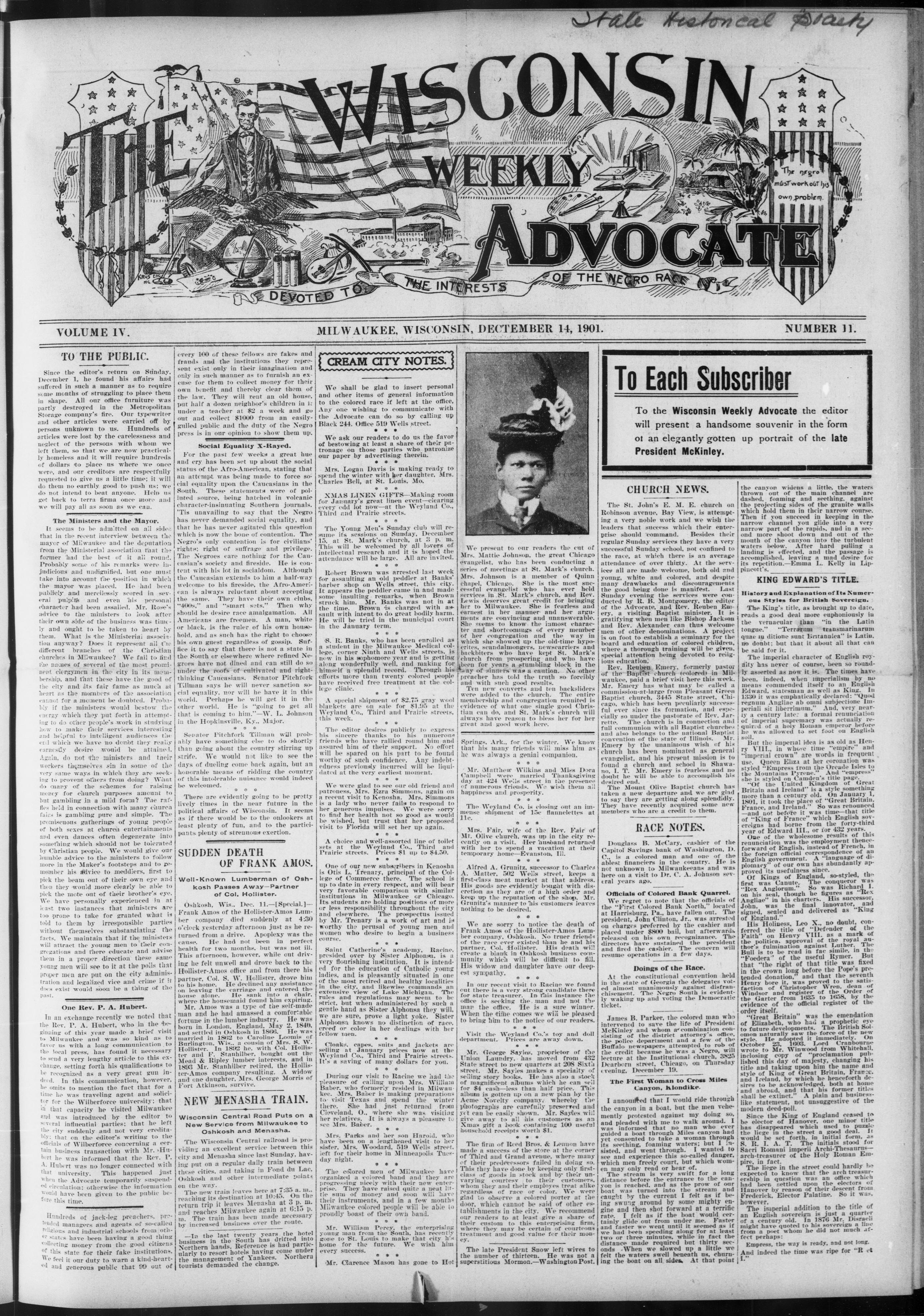
Page text (machine-generated)
Hale Historical Draft
WISCONSIN
WEEKLY
ADVOCATE
DEVOTED TO THE INTERESTS OF THE NEGRO RACE
VOLUME IV.
TO THE PUBLIC.
Since the editor's return on Sunday, December 1, he found his affairs had suffered in such a manner as to require some months of struggling to place them in shape. All our office furniture was partly destroyed in the Metropolitan Storage company's fire. Our typewriter and other articles were carried off by persons unknown to us. Hundreds of articles were lost by the carelessness and neglect of the persons with whom we left them, so that we are now practically homeless and it will require hundreds of dollars to place us where we once were, and our creditors are respectfully requested to give us a little time; it will do them no earthly good to push us; we do not intend to beat anyone. Help us get back to terra firma once more and we will pay all as soon as we can.
The Ministers and the Mayor.
It seems to be admitted on all sides that in the recent interview between the mayor of Milwaukee and the deputation from the Ministerial association that the former had the best of it all round. Probably some of his remarks were injudicious and undignified, but one must take into account the position in which the mayor was placed. He had been publicly and mercilessly scored in several pulpits and even his personal character had been assailed. Mr. Rose's advice to the ministers to look after their own side of the business was timely and ought to be taken to heart by them. What is the Ministerial association anyway? Does it represent all the different branches of the Christian churches in Milwaukee? We fail to find the names of several of the most prominent clergymen in the city in its membership, and that these have the good of the city and its fair fame as much at heart as the members of the association cannot for a moment be doubted. Probably if the ministers would bestow the energy which they put forth in attempting to do other people's work in studying how to make their services interesting and helpful to intelligent audiences the end which we have no doubt they really earnestly desire would be attained. Again, do not the ministers and their workers themselves sin in some of the very same ways in which they are seeking to prevent others from doing? What do many of the schemes for raising money for church purposes amount to but gambling in a mild form? The raffles held in connection with many church fairs is gambling pure and simple. The promiscuous gatherings of young people of both sexes at church entertainments and even dances often degenerate into something which should not be tolerated by Christian people. We would give our humble advice to the ministers to follow more in the Maker's footsteps and to remember his advice to meddlers, first to pick the beam out of their own eye and then they would more clearly be able to pick the mote out of their brother's eye. We have personally experienced in at least two instances that ministers are too prone to take for granted what is told to them by irresponsible parties without themselves substantiating the facts. We maintain that if the ministers will attract the young men to their congregations and there educate and advise them in a proper direction these same young men will see to it at the polls that proper men are put on the city administration and legalized vice and crime if it does exist would soon be a thing of the past.
One Rey, P. A. Hubert.
In an exchange recently we noted that the Rev. P. A. Hubert, who in the beginning of this year made a brief visit to Milwaukee and was so kind as to favor us with a long communication to the local press, has found it necessary to send a very lengthy article to this exchange, setting forth his qualifications to be recognized as a very great gun indeed. In this communication, however, he omits to mention the fact that for a time he was traveling agent and solicitor for the Wilberforce university; that in that capacity he visited Milwaukee and was introduced by the editor to several influential parties; that he left the city suddenly and not very creditably; that on the editor's writing to the officials of Wilberforce concerning a certain business transaction with Mr. Hubert he was informed that the Rev. P. A. Hubert was no longer connected with that university. This happened just when the Advocate temporarily suspended circulation; otherwise the information would have been given to the public before this time.
Hundreds of jack-leg preachers, pretended managers and agents of so-called religious and industrial schools from other states have been having a good thing collecting money from the good citizens of this state for their fake institutions. We feel it our duty to warn a kind-hearted and generous public that 99 out of
every 100 of these fellows are fakes and frauds and the institutions they represent exist only in their imagination and only in such manner as to furnish an excuse for them to collect money for their own benefit and thereby clear them of the law. They will rent an old house, put half a dozen neighbor's children in is under a teacher at $2 a week and go out and collect $1000 from an easily-gulled public and the duty of the Negro press is in our opinion to show them up.
Social Equality X-Rayed.
For the past few weeks a great hue and cry has been set up about the social status of the Afro-American, stating that an attempt was being made to force social equality upon the Caucasians in the South. These statements were of polluted source, being hatched in volcanic character-insinuating Southern journals. 'Tis unavailing to say that the Negro has never demanded social equality, and that he has never agitated this question which is now the bone of contention. The Negro's only contention is for civilians' rights: right of suffrage and privilege. The Negroes care nothing for the Caucasian's society and fireside. He is content with his lot in socialdom. Although the Caucasian extends to him a half-way welcome to his fireside, the Afro-American is always reluctant about accepting the same. They have their own clubs, "400s," and "smart sets." Then why should he desire race amalgamation. All Americans are freemen. A man, white or black, is the ruler of his own household, and as such has the right to choose his own guest regardless of gossip. Suffice it to say that there is not a state in the South or elsewhere where refined Negroes have not dined and can still do so under the roofs of cultivated and right-thinking Caucasians. Senator Pitchfork Tillman says he will never sanction social equality, nor will he have it in this world. Perhaps he will get it in the other world. He is "going to get all that is coming to him."—W. L. Johnson in the Hopkinsville, Ky., Major.
Senator Fitchfork Tillman will probably have something else to do shortly than going about the country stirring up strife. We would not like to see the days of dueling come back again, but an honorable means of ridding the country of this intolerable nuisance would indeed be welcomed.
There are evidently going to be pretty lively times in the near future in the political affairs of Wisconsin. It seems as if there would be to the onlookers at least plenty of fun, and to the participants plenty of strenuous exertion.
SUDDEN DEATH OF FRANK AMOS.
Well-Known Lumberman of Oshkosh Passes Away—Partner of Col. Hollister.
Oshkosh, Wis., Dec. 11.—[Special.]—Frank Amos of the Hollister-Amos Lumber company died suddenly at 4:30 o'clock yesterday afternoon just as he returned from a drive. Apoplexy was the cause. He had not been in perfect health for two months, but was not ill. This afternoon, however, while out driving he felt unwell and drove back to the Hollister-Amos office and from there his partner, Col. S. W. Hollister, drove him to his home. He declined any assistance on leaving the carriage and entered the house alone. He sank into a chair, where the housemaid found him expiring.
Mr. Amos was a type of the self-made man and he had amassed a comfortable fortune in the lumber industry. He was born in London, England, May 2, 1840, and settled in Oshkosh in 1866. He was married in 1862 to Caroline Loomis of Burlington, Wis., a cousin of Mrs. S. W. Hollister. In 1892 he, with Col. Hollister and F. Stanhilber, bought out the Mead & Ripley lumber interests, and in 1893 Mr. Stanhilber retired, the Hollister-Amos company resulting. A widow and one daughter, Mrs. George Morris of Fort Atkinson, survive.
NEW MENASHA TRAIN.
Wisconsin Central Road Puts on a New Service from Milwaukee to Oshkosh and Menasha. The Wisconsin Central railroad is providing an excellent service between this city and Menasha since last Sunday, having put on a regular daily train between these cities, and taking in Fond du Lac, Oshkosh and other intermediate points on the way. The new train leaves here at 7:35 a. m., reaching its destination at 10:45. On the return trip it leaves Menasha at 3 p. m. and reaches Milwaukee again at 6:15 p. m. The train has been made necessary by increased business over the route.
-In the last twenty years the hotel business in the South has drifted into Northern hands. Reference is had particularly to resort hotels having come under the management of Yankees. Northern tourists demanded the change.
CREAM CITY NOTES.
We shall be glad to insert personal and other items of general information to the colored race if left at the office, Any one wishing to communicate with the Advocate can do so by calling up Black 244. Office 519 Wells street.
* * *
We ask our readers to do us the favor of bestowing at least a share of their patronage on those parties who patronize our paper by advertising therein.
* * *
Mrs. Logan Davis is making ready to spend the winter with her daughter, Mrs. Charles Bell, at St. Louis, Mo.
XMAS LINEN GIFTS—Making room for January's great linen event—clearing every odd lot now—at the Weyland Co., Third and Prairie streets.
* * *
The Young Men's Sunday club will resume its sessions on Sunday, December 15. at St. Mark's church, at 3 p. m. This will be welcomed by all lovers of intellectual research and it is hoped the attendance will be large. All are invited.
Robert Brown was arrested last week for assaulting an old peddler at Banks' barber shop on Wells street, this city. It appears the peddler came in and made some insulting remarks, when Brown struck him. Mr. Banks was not in at the time. Brown is charged with assault with intent to do great bodily harm. He will be tried in the municipal court in the January term.
* * *
S. R. Banks, who has been enrolled as a student in the Milwaukee Medical college, corner Ninth and Wells streets, is now in his sophomore year and is getting along wonderfully well, and making for himself a splendid record. Through his efforts more than twenty colored people have received free treatment at the college clinic.
* * *
A special shipment of $2.75 gray wool blankets are on sale for $1.95 at the Weyland Co., Third and Prairie streets, this week.
The editor desires publicly to express his sincere thanks to his numerous friends who have rallied round him and assured him of their support. No effort will be spared on his part to be found worthy of such confidence. Any indebtedness previously incurred will be liquidated at the very earliest moment.
---
We were glad to see our old friend and patroness, Mrs. Ezra Simmons, again on a recent visit to Kenosha. Mrs. Simmons is a lady who never fails to respond to her generous impulses. We were sorry to find her health not so good as would be wished, but trust that her proposed visit to Florida will set her up again.
* * *
A choice and well-assorted line of toilet sets at the Weyland Co., Third and Prairie streets. Prices $1 up to $4.50.
* * *
One of our new subscribers in Kenosha is Otis L. Trenary, principal of the College of Commerce there. The school is up to date in every respect, and will bear very favorable comparison with similar institutions in Milwaukee or Chicago. Its students are holding positions of more or less responsibility throughout the city and elsewhere. The prospectus issued by Mr. Trenary is a work of art and is worthy the perusal of young men and women who desire to begin a business course.
* * *
Saint Catherine's academy, Racine, presided over by Sister Alphonsa, is a very flourishing institution. It is intended for the education of Catholic young ladies, and is pleasantly situated in one of the most retired and healthy localities in the city, and likewise commands an extensive view of Lake Michigan. The rules and regulations may seem to be strict, but when administered by such a gentle hand as Sister Alphonsa they will, we are sure, prove a light yoke. Sister Alphonsa knows no distinction of race, creed or color in her dealings with her fellow men.
Cloaks, capes, suits and jackets are selling at January prices now at the Weyland Co., Third and Prairie streets. It's a saving of many dollars for you.
During our visit to Racine we had the pleasure of calling upon Mrs. William Baber, who formerly resided in Milwaukee. Mrs. Baber is making preparations to visit Texas and spend the winter there. She had just returned from Cleveland, O., where she was visiting her relatives. It is always a pleasure to see Mrs. Baber.
* * *
Mrs. Parks and her son Harold, who have been on a lengthened visit to her sister, Mrs. Woodard, 519 Wells street, left for their home in Minneapolis Tuesday night.
* * *
The colored men of Milwaukee have organized a colored band and they are progressing nicely with their new enterprise. They have raised quite a neat little sum of money and soon will have their instruments, and in a few months Milwaukee colored people will be able to proudly boast of their own band.
杂杂杂
Mr. William Percy, the enterprising young man from the South, has recently gone to St. Louis to make that city his home for the future. We wish him every success. * * *
Mr. Clarence Mason has gone to Hot
WILLIAMS
We present to our readers the cut of Mrs. Mattie Johnson, the great Chicago evangelist, who has been conducting a series of meetings at St. Mark's church. Mrs. Johnson is a member of Quinn chapel, Chicago. She is the most successful evangelist who has ever held services in St. Mark's church, and Rev. Lewis deserves great credit for bringing her to Milwaukee. She is fearless and earnest in her manner and her arguments are convincing and unanswerable. She seems to know the immost character and shortcomings of every member of her congregation and the way in which she showed up the old-time hypocrites, scandalmongers, newscarriers and backbiters who have kept St. Mark's church from prospering and who have been for years a stumbling block in the way of sinners was a caution. No other preacher has told the truth so forcibly and with such good results.
Ten new converts and ten backsliders were added to the church. The entire membership and congregation reunited is evidence of what one single good Christian can do, and St. Mark's church will always have reason to bless her for her great and good work here.
Springs, Ark., for the winter. We know that his many friends will miss him as he was always a genial companion.
* * *
Mr. Matthew Wilkins and Miss Dora Campbell were married Thanksgiving day at 424 Wells street in the presence of numerous friends. We wish them all happiness and prosperity.
* * *
The Weyland Co. is closing out an immense shipment of 15c flannelettes at 11c.
* * *
Mrs. Fair, wife of the Rev. Fair of Mt. Olive church, was up in the city recently on a visit. Her husband returned with her to spend a vacation at their temporary home—Evanston, Ill.
* * *
Alfred A. Grunitz, successor to Charles A. Matter, 502 Wells street, keeps a first-class meat market at that address. His goods are evidently bought with discretion as they are of a high order and keep up the reputation of the shop. Mr. Grunitz's manner to his customers leaves nothing to be desired.
* * *
We are sorry to notice the death of Frank Amos of the Hollister-Amos Lumber company, Oshkosh. No truer friends of the race ever existed than he and his partner, Col. Hollister. His death will create a blank in Oshkosh business community which will be difficult to fill. His widow and daughter have our deepest sympathy.
赤 赤 赤
In our recent visit to Racine we found cut there is a very strong candidate there for state treasurer. In this instance the office is seeking the man and not the man the office. He is a sure winner. When the time comes we will be pleased to bring him to the notice of our readers.
* * *
Visit the Weyland Co.'s toy and doll department. Prices are away down.
Mr. George Sayles, proprietor of the Union Laundry, has moved from 432 State street to new quarters at 208 Sixth street. Mr. Sayles makes a specialty of selling story books. He has also a stock of magnificent albums which he can sell for $4 cash—less than half price. This album is gotten up on a new plan by the Acme Novelty company, whereby the photographs are carefully preserved and yet can be easily shown. Mr. Sayles will give away to all his customers as an Xmas gift a book containing 100 useful household receipts worth $1.
The firm of Reed Bros. & Lemon have made a success of the store at the corner of Third and Grand avenue, where many of their predecessors failed in doing so. This they have done by keeping only first-class of goods in stock and by their unvarying courtesy to their customers, whom they and their employees treat alike regardless of race or color. We were glad to observe a colored porter at the door, which cannot be said of other establishments in the city. We recommend our readers to at least give a share of their custom to this enterprises firm, where they may be certain of courteous treatment and good value for their money.
The late President Snow left wives to the number of thirteen. He was not a superstitious Mormon.—Washington Post.
To Each Subscriber
To the Wisconsin Weekly Advocate the editor will present a handsome souvenir in the form of an elegantly gotten up portrait of the late President McKinley.
CHURCH NEWS.
The St. John's E. M. E. church on Robinson avenue, Bay View, is attempting a very noble work and we wish the leaders that success which their enterprise should command. Besides their regular Sunday services they have a very successful Sunday school, not confined to the race, at which there is an average attendance of over thirty. At the services all are made welcome, both old and young, white and colored, and despite many drawbacks and discouragements the good being done is manifest. Last Sunday evening the services were conducted by R. B. Montgomery, the editor of the Advocate, and Rev. Reuben Emery, a visiting Baptist minister. It is gratifying when men like Bishop Jackson and Rev. Alexander can thus welcome men of other denominations. A project is on foot to establish a seminary for the board and education of colored children, where a thorough training will be given, special attention being devoted to religious education.
Rev. Reuben Emery, formerly pastor of the Baptist church (colored) in Milwaukee, paid a brief visit here this week. Mr. Emery has what may be called a commission-at-large from Pleasant Green Baptist church, 3445 State street, Chicago, which has been peculiarly successful ever since its formation, and especially so under the pastorate of Rev. Jarrette. The church is in connection and full communion with all Baptist churches and also belongs to the national Baptist convention of the state of Illinois. Mr. Emery by the unanimous wish of his church has been nominated as general evangelist, and his present mission is to found a church and school in Shawano, I. T. Mr. Emery is fearless and no doubt he will be able to accomplish his desired end.
The Mount Olive Baptist church has taken a new departure and we are glad to say they are getting along splendidly. They have recently acquired some new members who are a credit to them.
RACE NOTES.
Douglass B. McCary, cashier of the Capitol Savings bank of Washington, D. C., is a colored man and one of the ablest financiers in the country. He is not unknown to Milwaukeeans and was here on a visit to Dr. C. A. Johnson several years ago.
Officials of Colored Bank Quarrel.
We regret to note that the officials of the "First Colored Bank North," located at Harrisburg, Pa., have fallen out. The president, John Clinton, Jr., was arrested on charges preferred by the cashier and placed under $800 bail, but afterwards released on his own recognizance. The directors have sustained the president and fired the cashier. The concern will resume operations in a few days.
Doings of the Race.
At the constitutional convention held in the state of Georgia the delegates voted almost unanimously against disfranchisement. The Negro South is evidently waking up and voting the Democratic ticket.
James B. Parker, the colored man who intervened to save the life of President McKinley and whom a combination consisting of the district attorney's office, the police department and a few of the Buffalo newspapers attempted to rob of the credit because he was a Negro, will lecture at the Institutional church, 3825 Dearborn street, Chicago, on Thursday evening. December 19.
The First Woman to Cross Miles Canyon, Klondike.
I announced that I would ride through the canyon in a boat, but the men vehemently protested against my doing so, and pleaded with me to walk around. I was informed that no man who ever guided a boat through Miles canyon had yet consented to take a woman through its seething, foaming waters; but I insisted, and went through. I wanted to see and experience this so-called danger, which men freely court, but which women may only read or hear of.
The stream is very swift for a long distance before the entrance to the canyon is reached, and as the prow of our boat was turned into the stream and caught by the current I felt as if being swung around by some mighty engine and then shot forward at a terrific rate. I felt as if the boat would certainly glide out from under me. Faster and faster we went until it seemed as if we had been speeding along for at least two or three minutes, while in fact the distance made required but thirty seconds. When we slowed up a little we felt the waters swell beneath us, churning the boat on all sides. At that point
NUMBER 11.
scriber
weekly Advocate the editor
me souvenir in the form
up portrait of the late
the canyon widens a little, the waters thrown out of the main channel are dashed, foaming and seething, against the projecting sides of the granite walls which hold them in their narrow course. Then if you succeed in keeping in the narrow channel you glide into a very narrow part of the rapids, and in a second more shoot down and out of the mouth of the canyon into the turbulent waters below. After hard pulling a landing is effected, and the passage is accomplished, leaving a mad desire for its repetition.—Emmina L. Kelly in Lippincott's.
KING EDWARD'S TITLE.
ous Styles for British Sovereign.
The King's title, as brought up to date,
reads a good deal more euphoniously in
the vernacular than "in the Latin
tongue." "Terrarum transmarinarum
quae m ditione sunt Britannica" is Latin,
no doubt; but that it about all that can
be said for it.
The imperial character of English royalty has never of course, been so roundly asserted as now it is. The times have been, indeed, when imperialism by no means commended itself to an English Edward, statesman as well as King. In 1330 it was emphatically declared: "Quod regnum Angliae ab omni subjectione Imperiali sit liberrimum." And, very nearly a century later, a formal renunciation of imperial supremacy was actually required of a holy Roman emperor before he was allowed to set foot on English soil.
But the imperial idea is as old as Henry VIII., in whose time "empire" and "imperial crown" are words in frequent use. Queen Eliza at her coronation was styled "Empress from the Orcade Isles to the Mountains Pyrene." And "empress" she is styled on Camden's title page. "Of the United Kingdom of Great Britain and Ireland" is a style something more than a century old. On January 1, 1801, it took the place of "Great Britain, France, and Ireland." So was renounced—and not before it was time—that title of "King of France" which English sovereigns had borne from the forty-third year of Edward III., or for 432 years.
One of the wholesome results of this renunciation was the employment thenceforward of English, instead of French, in the foreign official correspondence of an English government. A "language of diplomacy" of our own has abundantly approved its usefulness since. Of Kings of England, so-styled, the first was Canute. The conqueror was "Rex Anglorum." So was Richard I. on his seal, though he figures as "Bex Angliae" in his charters. His successor, John, was the final innovator, and signed, sealed and delivered as "King of England."
His Holiness, Leo X., no doubt, conferred the title of "Defender of the Faith" on Henry VIII. as a mark of the politica, approval of the royal author's fulmination against Luther. The Bull is to be read in fac simile, in the "Foedera" of the useful Rymer. But that "the right of that title was fixed in the crown long before the Pope's pretended donation," and that the seventh Henry bore it, was proved to the satisfaction of Christopher Wren, dean of Windsor and register of the Order of the Garter from 1635 to 1658, by the evidence of the official register of the order itself.
"Great Britain" was the emendation of Elizabeth, who had a prophetic eye to future developments. The British Solomon naturally saw the force of the new style. He adopted it immediately. On October 23, 1603. Lord Cranbourne wrote to Mr. Winwood from Whitehall, inclosing copy of "proclamation published this day of majesty, changing his title and taking upon him the name and style of King of Great Britain, France, and Ireland, by which he henceforth desires to be acknowledged, both at home and abroad, and that his former titles shall be extinct." A plain and business-like statement, not unsuggestive of the modern deed-poll.
Since the King of England ceased to be elector of Hanover, one minor title has disappeared which used to puzzle the liege in the street a good deal. It would be set forth, in initial form, as S. R. I. A. T. The initials stood for Sacri Romani imperii Archi-Thesaurus—arch-treasurer of the Holy Roman Empire in fact.
The liege in the street could hardly be expected to know that the arch treasurership in question was an office which had been settled upon the electors of Hanover by reason of their descent from Frederick, Elector Palatine. So it was, however,
The imperial addition to the title of an English sovereign is just a quarter of a century old. In 1876 Mr. Disraeli might have quoted to his sovereign a line from a poet whom he did not much affect perhaps:
Empress, the way is ready, and not long. And indeed the time was ripe for "R et I."
MR. ROCKHILL'S REPORT.
Indemnity Claims Scaled Down and Rigor of Punishments Greatly Lessened.
Washington, D. C., Dec. 11.—The longexpected report of Special Commissioner Rockhill on the results of his work in connection with the Chinese negotiations in Pekin has been submitted to Congress, with the full text of the protocol and a mass of detailed statements.
Mr. Rockhill says, in addressing Secretary Hay
As regards the punishment of the responsible authors and actual perpetrators of the anti-foreign outrages, the government of the United States, while insisting that all such should be held to the utmost accountability, declined to determine in every case the nature of the punishment to be inflicted, and maintained that the Chinese government itself should in all cases carry them out. As soon as the chief culprits had been punished the United States threw the weight of its influence on the side of moderation and the prevention of further bloodshed.
To this it was mainly due that the demands for capital punishment were finally reduced from ten to four, and many names, erroneously or on insufficient evidence, placed on the lists were removed or lighter forms of punishment asked.
Opposed to Occupation of China.
While seeking the best means to prevent the recurrence of such troubles and to guard in the future American residents in Pekin from such dangers as they had passed through, the United States did not lend its support to any plan which contemplated either the prolonged occupation by foreign troops of any portion or points in China or the erection of an international fort in Pekin from which to carry on friendly relations with the Chinese government. The results have proved beneficial to all.
As regards the equitable indemnification of the various states for the losses and expenses incurred by them in China, and also the securing of indemnities to societies, companies and individuals for their private losses, the United States advocated that the sum total of these indemnities should not exceed a reasonable amount. You reached the conclusion that China could not pay as indemnities to the powers more than $200,000,000.
Necessary to Demand More.
Though it became necessary to accept the proposition of the other powers to demand of China the sum total of their losses and disbursements, reaching the enormous sum of $333,000,000, overinsistence in pressing for a much lower sum, and the weight of the arguments adduced in favor of such a policy, resulted in closing the indemnities at the above lump sum, when the bid fair to go on swelling indefinitely. This and the acceptance of your suggestion that the indemnities be paid in bonds, issued at par and bearing a low rate of interest-4 per cent., was finally agreed upon—and running for forty years, resulted in saving a vast sum to China, hastened the evacuation of the country, and the restoration of order.
The question of the ceremonial to be observed in the public audiences granted by the Emperor of China to foreign representatives was finally settled on lines perfectly satisfactory to all parties. The tsung ii yamen, or bureau of foreign affairs, was altered in the way suggested by the conferences, and changed into a responsible ministry of foreign affairs.
ARRESTED IN BROOKLYN
Stamp-Dealer Suspected of Being Concerned in the Robbery of Chicago Postoffice.
New York, Dec. 11.—Postoffice Inspectors Stuart and Mayer of Chicago, in conjunction with Inspector Swift of this city, arrested Charles Stokes, a stamp dealer of 651 Monroe street, Brooklyn, on suspicion of being concerned in the robbery of the Chicago postoffice on October 19. On that night burglars, who had tunneled under one of the vaults of the postoffice, broke in and got away with $76,610 in stamps.
Stokes was lodged in Ludiow street jail, and his house searched by the post-office inspectors and the Brooklyn police. The search revealed stamps aggregating in value $2298.89, and Stokes when arrested had on his person stamps worth $2000 more. The stamps are of all denominations, from 1 cent to $1. They are mostly in sheets, and their quantity and the manner in which Stokes offered them for sale drew suspicion upon him. The arrest is regarded by the inspectors as of the highest importance. They took their prisoner before United States Commissioner Shields, charging him with having in his possession stamps belonging to the United States government, and he was committed to jail in default of $5000 bail pending examination on Thursday.
MME. NORDICA HAS CLAIM FOR MILLIONS.
Singer Demands Indemnity for Several Ships Destroyed During Revolutionary War.
Sioux City, Ia., Dec. 11.—From relatives of Mme. Nordica, whom she visited in this city a few days ago, it is learned that she placed with former Speaker Thomas B. Reed and another prominent attorney a claim against the government for between $3,000,000 and $4,000,000, which she says is due her as direct descendant of Ichabod Norton. Norton was a wealthy New England shipowner during the Revolutionary war and had several ships and their cargoes confiscated by French vessels. The government is said to have secured indemnity for the loss, but Nordica claims the amount was never paid to Norton or his heirs. She says she has established a complete genealogy showing herself to be the direct descendant and heir to Norton.
RAISE ASSESSMENT OF ST. LOUIS ROADS.
Movement Similar to that of Chicago Teachers-Will Bring a Mandamus Suit.
St. Louis, Mo., Dec. 11.—The city of St. Louis and the board of education will bring a mandamus suit jointly against the state board of equalization to endeavor to compel that body to raise the franchise tax of the United Railways company and several other St. Louis corporations, contending that the street railway company should be assessed for its full value of $50,000,000 instead of only $8.500,000.
President John Schroers of the board of education has appointed a committee of three to confer with similar committees from Kansas City and St. Joseph boards of education in an endeavor to have the school tax raised from 40 to 60 cents.
Heavy Shipments of Oranges.
El Paso, Tex., Dec. 11.—The railway yards are blocked with cars of eastbound California oranges, which are continually pouring into the city to be handled across Texas to the Eastern markets. The orange movement this year through El Paso is the heaviest ever known and additional men have been put on to handle the traffic.
SEVERE TEST FOR SUBMARINE BOAT.
SEVERE TEST FOR SUBMARINE BOAT.
The Fulton will Make Trip Under Water from New York to Washington City. New York, Dec. 10.—The recently completed but already famous Fulton will start tomorrow from its anchorage in Long Island Sound on a 450-mile trip on and under water from New York to Washington. No submarine boat has ever attempted such a task before.
The Fulton will make the trip with its captain, Frank T. Cable, and a crew of seven men. These mariners say that they will feel safer at sea in a storm than in a regular ocean-going craft. for if the Fulton gets into a raging storm it will simply turn its nose toward the bottom of the sea, and when it gets to a depth where the motion of the water is not felt it will get on its course again.
The Fulton will be accompanied by the vacht Giralda with the Holland's officers.
RIVAL TO BONINE CASE.
Woman Found with Skull Fractured and Jaw Broken—Detectives are at Work.
Washington, D. C., Dec. 10.—Mrs. Ada Gilbert Dennis, a fashionable dressmaker, was found in an almost dying condition in her room at 5 o'clock this morning under circumstances that promise to rival the Bonine murder case. Her skull was fractured, jawbone broken and left ear almost severed from the head. Her left arm bore bruises indicative of a struggle, and her clothing and bedding were saturated with blood. She was removed to the Garfield hospital and a large force of detectives put upon the case. The name of her assailant is not yet known.
The general belief is that Mrs. Dennis was attacked while asleep in her back room upon the first floor and that the first blow in all probability was administered with the piano stool, which was smeared with blood. The preliminary investigation by the police fail to indicate that there was any struggle. Mrs. Dennis in a conscious moment, while being carried to the hospital, said that someone had "hurt" her, but when pressed for details merely responded, "Never mind." Robbery apparently was not the motive for the crime, for on the table at the foot of the bed was a small box containing a pocketbook well filled with greenbacks and other coin. There was a bloody imprint on the piano lid in the parlor and a window in that room was open. It is supposed the assailant escaped through this window. When found Mrs. Dennis was clad in her night garments and was in bed under the cover. She was partly conscious, although she had been unconscious most of the time since. The detectives are satisfied that several blows of the piano stool must have been wielded with considerable force. Her groans were heard by a woman on the third floor and by occupants of the adjoining house. About the same time Policeman Livingston and a watchman who were two blocks away heard what they believed to be a woman's scream. Mrs. Dennis is about 47 years of age and is one of the best-known women in business here. She is the widow of Walter Dennis, an actor.
An operation was performed on Mrs. Dennis at the hospital this morning. Very little hope is held out for her recovery.
DISASTER AVERTED.
British Attempt to Capture Dewet Nearly Results in a British Defeat.
London, Dec. 10.—An obscure dispatch from Pretoria indicates that an attempt has been made to capture Dewet, with the result that the British force itself escaped capture by the timely arrival of Gen. Rimington after a night march covering fifty miles. The press censor has permitted the information to pass that both British columns were able to retire to Heilbron, and it is admitted that the British sustained a few casualties. Details of the affair may be expected to come along in driblets. The Pretoria dispatch referred to is as follows:
"Gen. Dewet has managed to concentrate about 2000 Boers near Heilbron. Col. Wilson, with Kitchener's scouts, was in close touch with this force for two days. There was danger that Wilson might be surrounded, and Gen. Rimington was sent to his assistance. Gen. Rimington marched fifty miles by night and relieved Col. Wilson. Both columns then retired to Heilbron. The British sustained a few casualties."
Another dispatch from Pretoria says:
"Col. Colin MacKenzie is following Col. Benson's tactics. He is utilizing the Scottish horse for sudden morning rushes and has captured thirteen Boers and 500 head of cattle. The Scots Fusileers, who are with the column, are doing good work. They matched thirty-five miles in twenty-four hours."
Kruger in Improved Health.
New York, Dec. 10.—Commandant W. D. Snyman, formerly on the staff of Gen. Dewet, recently visited Holland, and while there spent two days with President Kruger and the envoys. He has returned to this city and reports that President Kruger is enjoying better health than at any time in the last four years. Commandant Snyman brings from President Kruger a message of thanks to the friends of the Boer cause. It has been definitely decided that President Kruger will not visit the United States.
London, Dec. 10.—In a dispatch from Pretoria, dated Monday, December 9, Lord Kitchener reports that the result of the week's work is 31 Boers killed, 17 wounded, 352 made prisoners, 35 surrendered and quantities of supplies captured. Columns have cleared the southeastern districts of Orange River colony and are now operating northward of the Thabanchu line. The Boers are still in force in the extreme west of Cape Colony. They are there commanded by Maritz, who recently attacked Tontellboschkop. The Boers were driven off and Maritz was severely wounded.
Porto Rico's Library Plans.
According to recommended plans the Carnegie Library building for San Juan, P. R., which is to cost $60,000, will be two stories high. 75 feet wide fronting on Plaza Colon and 50 feet deep. The second floor will be designed as an assembly hall, the first floor will be provided with shelves for 100,000 books, and in the basement it is designed to arrange two reading rooms, one of which shall be for children.
Bathing Dolls.
There are many bathing dolls this year, real little tub dolls, and ever so many things in the doll world run to bathtubs and bathing arrangements. The bathing dolls are of celluloid and of Parian and are made with the idea that they will take frequent baths. They cost all prices, from 10 cents to $3.50, and the elaborate bathing outfit will cost more than that.
Explorers in the neighborhood of Chama, Guatemala, have discovered treasures during their excavations in search of mines. Coins and jewels decorating corpses buried centuries ago by the Aztecs and Montezumas have been found. So far the valuables have amounted to over $50,000.
BOSTON DEMOCRATIC.
Gen. Collins is Elected Mayor of Beantown by an Unprecedented Majority.
Boston, Mass., Dec. 11.-Gen. Patrick A. Collins, Democrat, was elected mayor of Boston by upwards of 18,970 majority over Thomas N. Hart, Republican and present incumbent. This is by many thousands the largest plurality ever given a candidate in the history of
J.
MAYOR-ELECT COLLINS.
the city, and some idea of its magnitude can be had when the vote of two years ago is considered, in which Mr. Hart beat Gen. Collins by 2281 votes.
Complete returns from the twenty-five wards gave Collins 52,046 and Hart 33. 076. In 1899 the vote was: Hart, 40, 838; Collins, 38,557.
In 1900 the vote for President was: McKinley, 36,244; Bryan, 45,127, a plurality for Bryan of 8883. At the state election four weeks ago Craine, Republican, received 31,465 and Quincy, Democrat, 39,073; Quincy's plurality, 7608. It will be seen from these figures that Gen. Collins' plurality is more than two and one-half times as large as either Bryan's or Quincy's.
Salem D. Charles, Democrat, for street commissioner, is elected by about 15,000. The board of aldermen stands ten Democrats and three Republicans, while the common council has a Democratic majority of nearly two to one.
The campaign was one of the hottest ever waged in a mayoralty contest. The Democrats raised the issue of "unbusinesslike administration" by Mayor Hart, continually flaunting the heavy increase of taxes in the last two years—nearly $2 per $1000.
That this was the master stroke is shown by returns from the back bay districts, where the heaviest taxpayers and property-owners reside. In this district, always Republican, Gen, Collins made his greatest gains.
DR. DOWIE SUED.
Attempt to Force Receivership for Lace Factories-Charges of Fraud are Made.
Chicago, Ill., Dec. 11.—Much interest centered around the opening session of the suit brought against "Dr." John Alexander Dowie, head of the Christian Catholic church and the self-styled "Elijah II," to force a receivership for his Zion lace industries. A bill of complaint filed by Dowie's brother-in-law, Samuel Stevenson, was read in Judge Tuley's court today charging him with defrauding him of $185,000. According to the bill Dowie approached Stevenson in Boston, England, and pursued him to relinquish a lace business earning $20,000 yearly income and to come to this country as Dowie's partner. To seal the bargain Stevenson related that he married Dowie's sister and gave her a wedding dower of $50,000 which was to be returned to him in the form of stock in the Zion lace industries. The plaintiff said it was his belief that he was Dowie's partner and that Dowie had secured by fraud his name to a paper giving Dowie all right in the company. Stevenson charged that Dowie, on the night of August 8, 1901, changed papers on him when he supposed he was signing joint partnership agreements.
"Dr." Dowie himself was not in court, but through Attorney S. W. Packard, a general denial was entered to all the charges. The answer stated that Stevenson was in debt in England, was not prosperous and that he had approached Dowie to join forces. He further alleged that Stevenson was dismissed from the Christian Catholic church for improper conduct.
BOERS ROUNDED UP.
Bruce Hamilton Surprises a Commando and Takes a Large Number of Prisoners.
London, Dec. 11.—Lord Kitchener in a dispatch from Standerton, Transvaal colony, dated Tuesday, December 10, announces that Gon. Bruce Hamilton, after a night march, surprised and captured practically the whole of the Boer Bethel commando at Trichterdsfontein on that morning. Seven Boers were killed and 131 made prisoners.
Utrecht, Dec. 11.—Mr. Kruger, former President of the South African republic, has arrived here and has taken possession of his new residence.
SERUM WAS POISONOUS.
Startling Testimony Given by St. Louis Assistant Bacteriologist.
St. Louis, Mo., Dec. 11.—At the second session of the tetanus inquiry commission, organized to fix the responsibility for thirteen deaths following the use of city anti-toxin, Martin Schmidt, assistant city bacteriologist, testified that Dr. Amand Ravold, city bacteriologist, had directed him, on October 3, to prepare for distribution the serum drawn from the horse "Jim," which had been shot the day before because it had tetanus.
"Dr. Ravold told me," said Schmidt, "that the serum could be safely used, as the horse had not been affected with tetanus on September 29, when the drawing was made. I knew that the serum was poisonous, and unfit for use on human beings, but I felt that I could not question Dr. Ravold's order."
The witness repeated his recent assertion before the coroner, that the poisoned serum was sent out to physicians without having been first treated on guinea pigs because none were available.
FOUND IN THE RIVER.
Body of Brakeman Who was Knocked from Railroad Bridge.
La Crosse, Wis., Dec. 11.—[Special.]
—The body of Brakeman Albert Mink of Winona, missed from the top of a freight train Sunday morning, was found at the bottom of the Mississippi river today.
It is supposed he was struck by the top of the bridge and knocked into the water. The body was not bruised much except about the head.
WHIPPED THE FILIPINOS.
Detachment of the Twentieth Infantry Defeats Rebels.
THEY SUFFER SEVERELY
THEY SUFFER SEVERELY
Manila, Dec. 11.—A detachment of the Twentieth infantry defeated a force of insurgents at Labo, province of Camarines. The insurgents suffered severely. The Americans had Sergt. Sachrist and Privates McGeary and Huff killed. The loss of the enemy is not known, but it is believed to have been heavy. Gen. Bell anticipates a speedy extermination of the irreconciliables. A large force of insurgents recently attacked the town of Lipa, province of Batangas, killing one soldier and several Americanistas. Troop H, First cavalry, killed ten of the enemy before the remainder of the insurgent force escaped. The Filipinos evidently expected a victory, for they had cut the wires and carried off a hundred yards of the line.
The natives are stirred by the closing of the ports and bitterly object to reconcentration. A Filipino force consisting of 200 riflemen and 400 bolomen recently attacked Nagpartian, province of North Ilocos. Co. M, acting on the defensive, drove off the enemy, killing eleven of them, with no loss to themselves. Thousands of people are leaving Batangas province for places of safety.
Capt. Harry Preston, a Virginian, formerly of the Forty-third Volunteer infantry, committed suicide by shooting himself with a pistol.
The Supreme court, after examining all the papers in the case, rendered a decision dismissing the application for a writ of habeas corpus in the case of the Englishman Patterson, who was the secretary of Sixto Lopez, the Filipino agent, and who was ordered to be deported because he would not take the oath of allegiance to the United States. The court confirmed the order for his deportation.
The American and fusion Federals elected their full ticket at the local elections held in Iloilo, island of Panay. The constitutional code allowing soldiers to vote played an important part in the elections.
Cannibal to be Hanged.
Washington, D. C., Dec. 11.—Cannibalism has appeared in the varied list of crimes charged against Filipinos by American military courts. According to the record of a court-martial convened in the department of the Viscayas, P. L., which has been received at the war department, Raymundo Fonte, a native, found his working companion, Liberato Benliro, sleeping in his (Fonte's) boat. Fonte became enraged, killed the slumbering man with a blow of an oar, cut off his nose and ears, and, according to his own confession, cooked and ate part of the body. He was sentenced to be hung at Capiz, Panay, on the 13th inst.
HOVERS BETWEEN LIFE AND DEATH.
Washington, D. C., Dec. 11.—Mrs. Ada Gilbert Dennis, found mysteriously assaulted in her apartments yesterday morning, is hovering between life and death. She showed some improvement this morning, but the chance for recovery is very slight. "It's a woman," "It's in a book," and "I'll tell you all about it." are the only coherent words that the detectives sitting by her side have been able to distinguish. The detectives are not yet ready to announce a motive for the crime. William H. Johns of Gettysburg, Pa., a nephew of the victim, arrived today, and after being admitted to the sick room went to police headquarters, leaving there subsequently with a detective. The hospital attendants are keeping the patient quiet and hope she may be able to give some information by tomorrow.
A small, old-fashioned hatchet, which probably has been used by the family for many years, was found by detectives today in a closet in the room of the older Mrs. Dennis, mother-in-law of the injured woman. This room is in the rear part of the second floor. There were indications of rust and other stains on both the handle and blade and these are being analyzed by Chemist Hurd of the health department. The result of the chemical analysis of the hatchet found in Mrs. Dennis' room failed to disclose the presence of bloodstains on that weapon and the police attach no significance to the finding of it.
ANTI-WINEROOM ORDINANCE SIGNED.
Chicago Mayor Says Its Provisions will be Rigidly Enforced Orders to the Police.
Chicago, Ill., Dec. 11.—Mayor Harrison signed the anti-wineroom ordinance yesterday, and issued an order for its enforcement. Saloonkeepers having private rooms in their places will be given two or three days to remove the partitions.
"This ordinance is no bluff," said Mayor Harrison. "It is an administration ordinance. I will see that it is enforced to the letter. Every partition in a saloon will have to be pulled down. There will be no exception."
The mayor issued an order to Chief O'Neill explaining the meaning of the ordinance, as follows:
"Under a strict construction of the first section neither doors, curtains, screens, partitions, nor any other device may be used to separate a portion or portions of saloon from public view.
"As far as the second section is concerned it merely prohibits a regular restaurant or eating house from serving liquor to less than four persons in a private room, unless those persons be of the same sex. It should be understood, however, in advance that the order must be complied with within the time limit, and that pending the removal of these partitions the use of these apartments as wine-rooms is prohibited."
"The mayor's order will be carried out to the letter," said Chief O'Neill.
OPPOSED BY FARMERS.
Michigan Clubs Condemn Ship Subsidy and Irrigation Appropriation. Lansing, Mich., Dec. 11. -The State Association of Farmers' clubs, in session here today, adopted resolutions declaring for the election of United States senators by popular vote and for government construction of a Pacific cable. Resolutions also were adopted opposing the ship subsidy bill, opposing an appropriation for irrigating Western lands and opposing the reduction of the sugar tariff.
CONGRESS
Senate.
Senator McComas (Md.) made an extended and carefully prepared speech in the Senate on the 5th with anarchy for his theme, and was followed by some brief remarks by Mr. Hoar of Massachusetts on the difficulties in the way of dealing with Anarchists' assassins. Mr. McComas' remarks showed careful examination of the legal authorities. His resolution was then laid aside for discussion later. Senator Penrose introduced in the Senate a bill for the regulation of immigration, prepared by himself and the commissioner-general of immigration, which looks to a general revision of the laws upon this question. Mr. Penrose favorably reported from the committee on education and labor the bill continuing the industrial commission until February 15, in order that it may close up work now in hand, and secured immediate consideration for the measure. The bill was passed. The Senate received from the President the treaties renewing the reciprocity treaties, and in executive session referred them to the committee on foreign relations. The principal renewals are with Great Britain and cover the British West Indies. The extradition treaty with the Argentine Republic and the trademark treaty with Guatemala also were received by the Senate and were referred without debate.
The Senate committee on foreign relations voted to report favorably the new Hay-Pauncefote treaty, providing for the construction of an isthmian canal. No votes were cast against it, but it was criticised very sharply by Senators Money and Bacon, who found it in many of the objections which they urged against the old treaty. The contention was made that the effect of the treaty as sent to the Senate would be to deprive the United States of control of the canal in case of war. Senators Money and Bacon did not go to the extent of voting against the report of the treaty, and they acknowledge they are anxious to see it ratified, because of their great desire to have the canal built. It was the sense of the committee that the consideration of the treaty should be pressed as speedily as possible, some senators expressing the hope that action might be secured before the adjournment for the holidays.
The Senate chamber was the scene of a highly dramatic episode on the 9th, when Senator Tillman of South Carolina challenged his colleague, Senator McLaurin, to resign with him on the spot, in order, to use his own language, that they might be able to "wash their dirty linen at home." Mr. McLaurin did not take up the gauge. The incident was the direct sequel of the bitter controversy which arose between the senators in South Carolina last spring. Senator Hale introduced a number of bills relating to the navy, among them being bills to enable naval courts-martial and naval courts of inquiry to compel the attendance of civilian witnesses; to equalize the pay of officers of the navy with those of corresponding ranks in the army and marine corps. Senator Hoar introduced a bill giving the United States jurisdiction in cases of lynching, and making the crime of participation in lynchings punishable by death. Mr. Stewart (Nev.) apropos of the President's recommendation of irrigation, called the attention of the judiciary committee to what he said was a defect in the jurisdiction of the United States and presented a joint resolution for a constitutional amendment to cure the defect.
When the Senate went into executive session on the 11th the new Hay-Pauncefote isthmian canal treaty was taken up. Senator Culberson spoke briefly in criticism of it and was followed by Senator Bacon, who made a somewhat extended argument against it. Senator Bacon criticised the treaty as un-American and said that it contained many of the objectionable features of the original agreement, while it was entirely unsafeguarded, as the old treaty had been, by the Senate amendments. He said, however, that he would not obstruct the ratification of the new treaty
House.
Speaker Henderson on the 6th announced the appointment of the following committees:
Ways and Means—Payne (N. Y.) Dalzell (Pa.), Hopkins (L.), Grosvenor (O.), Russell (Conn.), Steele (Ind.), Tawney (Minn.), McCall (Mass.), Long (Kas.), Babcock (Wis.), Metcalfe (Cal.), Republicans. Richardson (Tenn.), Robertson (La.), Swanson (Va.), McClellan (N. Y.), Newlands (Nev.), and Cooper (Tex.). Democrats.
Appropriations—Cannon (Ill.), Bingham (Pa.), Hemenway (Ind.), Barney (Wis.), Moody (Mass.), Van Voorhis (O.), McCleary (Minn.), Littauer (N. Y.), Brownlow (Tenn.), Gardner (Mich.), Burkett (Neb.), Republicans. Livingston (Ga.), McRae (Ark.), Bell (Col.), Pierce (Tenn.), Beuton (Mo.), and Taylor (Ala.). Democrats.
Enrolled Bills—Wachter (Md.), Ball (Del.), Burk (Pa.), Currier (N. H.), Republicans. Lloyd (Mo.) and Edwards (Mont.), Democrats.
In each of the committees announced the majority representation was increased one and the minority representation reduced to that extent. This policy is to be followed in the appointment of the other committees.
Speaker Henderson announced the remainder of the House committees on the 10th. The principal chairmanships remain unchanged. The Wisconsin members retain the places they have held. Mr. Cooper remains at the head of insular affairs, one of the most important committees, and Mr. Babcock at the head of District of Columbia. His reappointment to ways and means had been announced previously. Mr. Otjen secures an important promotion to a place on foreign affairs. Mr. Minor is given a place on public buildings and remains on merchant marine and coinage, weights and measures. Mr. Davidson secures a chairmanship—that on railways and canals—and remains on rivers and harbors. Mr. Jenkins is reappointed to the judiciary committee, committee on District of Columbia and to the committee on irrigation; Mr. Esch to military affairs and public lands; Mr. Dahle to agriculture and to committee on expenditures in agricultural department; Mr. Brown, the only new member from Wisconsin, to Indian affairs, mines and mining and public lands.
WHEN RUSSIANS EAT.
Have No Fixed Meal Time, but Many peculiarities at the Table.
The Russian has no fixed meal time. He eats when he is hungry, which is often. He has about six square meals a day. He has at least a dozen lunches, a little bit of salt fish or some caviare, or a piece of bread and cheese, washed down with a nip of fiery vodki. He never passes a station without a glass of tea—marvelous tea, with a thin slice of lemon floating in it. You get a fondness for Russian tea, and forswear bemilked decoctions forever.
The table manners of the Russian—such as you see in hotels and buffets—are not pleasing. He sprawls with outstretched elbow on the table, and gets his mouth down to his food rather than raise the food to his mouth. He makes objectionable noises in his throat. He has a finger bowl, and rinses his mouth as the rest of us do when cleaning our teeth in our bathrooms. Then he squirts the water back into the bowl. In time one may get used to this.—London News.
A. Biblical Discovery.
The supposed audience chamber of Nebuchadnezzar is alleged to have been discovered by a German exploring commission that is now engaged in delving among the ruins of Babylon, says a Berlin correspondent. The building measures 156 feet long by 54 feet wide. The wall paintings and ornaments are well preserved, and several clay tablets have been unearthed with Assyrian inscriptions, said to be psalms and contracts. The excavations are being vigorously prosecuted.
Metals Used as Fuel.
"Metals may be burned for the sake of the heat and light they produce, just as ordinary fuels are burned," said Prof. Roberts-Austen in a recent discourse at the Royal institution in London. But the burning of metals, he proceeded to show, differs from that of ordinary fuels in that the products of combustion are not gaseous but solid. "The burning of aluminum gives sapphires and rubies in the place of ashes." An instance of
burning metal for the sake of light is furnished by the "magnesium star," a contrivance by which a shell packed with magnesium and attached to a parachute is fired, electrically, high in the air, thus producing an illumination of the ground beneath at night. This finds its use in warfare. Recently aluminum has been found to be an admirable fuel for producing an intense heat to be used in welding. This kind of metallic fuel has assumed much industrial importance at Essen, in Germany, where, in consequence, "metallurgy enters upon a new phase."—Youth's Companion.
LATEST MARKET REPORTS
Milwaukee, Dec. 11, 1901.
EGG AND DAIRY PRODUCTS.
EGG AND DAIRY PRODUCTS.
MILWAUKEE—Eggs—Market firm, fresh new, cases included, 23½c; fresh, cases returned, 23c; storage, 18½@19c; country storage, 16@17c; seconds, 9c. Receipts were 178 cases.
Butter — Market steady, fancy prints, 25c; fancy o or extra creamery, per lb, 24½c; firsts, 20@21c; seconds, 17@18c; dairy prints, 20c; extra fancy dairy, 19c; lines, 17@18c; packing stock, 13@14c; roll, 14@16c; whey, 8c; grease, 4@5c. The receipts today were 14,579 lbs against 9698 yesterday. The demand for fancy butter is brisk, there being very little in the market. Dairy is very source and in good demand. The receipts of fancy creamery are very light and not sufficient to meet requirements. Merchants have hard work filling orders.
Cheese—Steendy. Receipts were 10,445 lbs today against 530 lbs yesterday. Full cream flats, new, colored, fancy, 11½¼¹²c; good to choice, 10½¼¹¹c; Young Americas, new, 12½¼¹²c; daisies, new, 11½¼¹²c; fancy brick, new, 11½¼¹²c; low grades, 10½¼¹¹c; limburger, per lb, No. 1, 13½¼¹²c; low grades, 9½¼¹¹c; imported Swiss, 24¹c; Black Swiss, domestic, 14½¼¹¹c; choice loaf, 14½¼¹¹c; No. 2, 12½¼¹¹c; Sapsago, 20¹c; farmers' 10½¹¹c. There is a fair demand for new made full cream and market is firm; brick is firm and Limburger steady, to firm with light supply.
NEW YORK — Butter — Receipts, 7007 pkgs; steady; state dairy, 15½¼¹¹c; creamery, 16½¼¹¹c; June creamery, 15½¼¹¹c; factory, 12½¼¹¹c; Cheese—Receipts, 5827 pkgs; firm; fancy large September, 10½¼¹¹c; fancy small September, 10½¼¹¹c; late made, best large, 9½¹¹c; do small, 10½¼¹¹c. Eggs—Receipts, 6098 pkgs; steady; state and Pennsylvania, 26½²¹c; Western at mark, 26¹c; Southern at mark, 20½²¹c. Coffee—Steendy; No. 7 Rio, 6½¹¹c.
CHICAGO—Butter-Unchanged; creameries, 14%@9%c; dairies, 12%@20c. Cheese—Steady; twins, 9%@9%c; Young Americas, 10c; daisies, 10%@10%c. Eggs—Firm; loss off, cases returned, 24%@25c. Dressed poultry—Firm; turkeys, 7%@9%c; chickens, 7%@8c.
PLYMOUTH—Eleven factories offered 48 boxes of cheese, all but 12 selling as follows: Sixty longhorns, 10%c, and 25 at 11c; 224 daisies, 10%c; 50 twins, 10c; 26 twins, 10%c; 18 Young Americas, 10%c; 58 Young Americas, 10%c
MILWAUKEE LIVESTOCK MARKET.
HOGS—Receipts, 12 cars; market 5%@10c lower; light, 5.70@5.85; mixed and medium weights, 5.80@6.10; common to good packers, 5.60@6.00; fancy selected hogs, 6.10@6.20. Pigs, 90 to 120 lbs, 4.75@5.25.
CATTLE-Receipts, 3 cars; 10@15c lower; butchers' steers, medium to good, 1050 to 1300 lbs, 4.75@5.50; fair to medium, 950 to 1050, 3.25@3.75; heifers, common, 2.25@2.65; good, 3.25@4.25; cows, fair to good, 2.00@3.25; canners, 1.50@2.00; bulls, common, 2.25@2.65; choice, 2.85@3.50; feeders, 800 to 950 lbs, 2.50@3.00; stockers, 500 to 750 lbs, 2.25@2.65; veal calves, common to choice, 4.00@5.25; milkers and springers, common very dull; choice, 30.00@42.00.
SHEEP-Receipts, 1 car; market steady; 2.25@3.25; bucks, 1.75@2.25; mats, common to choice, 3.50@4.50.
Chicago receipts: Hogs, 55,000; cattle,
23,000; sheep, 22,000.
MARKETS BY TELEGRAPH
MILWAUKEE—Flour—Steady. Wheat—Easier; No. 1 Northern, on track, 77½%; No. 2 Northern, on track, 76½%; Corn—Steady; No. 3 on track, 65½; Oats—Dull; No. 2 white, on track, 48½; No. 3 white, or track, 47@48½; Barley—Steady; No. 2 on track, 62½; sample on track, 57@63½%. Rye—Steady; No. 1 on track, 63½%. Provisions—Lower; pork, 16.77; hard, 9.90.
Flour market is steady: patents, 3.85@3.95; bakers', 2.802.95; rye, 2.90@3.15.
Millstuffs are firm and quoted at 22.50 for bran, 22.00@22.50 for standard middlings, and 23.50 for Milwaukee flour middlings, in 100 lb sacks; dog, 24.50.
CHICAGO—Close—Wheat—December, 76c;
January, 76½c; May, 80½c@80½c; July, 80c;
Corn—December, 63½c; May, 66½c; July,
66½c; Oats—December, 44½c; May, 45½c;
July, 39½c; September, 34½c; Pork—December,
15.47½; January, 16.55; May,
16.97½; Lard—December and January, 9.8;
May, 9.82½@9.85; Ribs—December and January,
8.45; May, 8.60@8.62½; Flax—Cash, 1.45; No. 1 and December, 1.44; May,
1.48; Rye—December, 62c; May, 66½c; Barley—Cash, 50@62c; Timothy—March, 6.55;
Clover—March, 9.45.
LIVERPOOL—Wheat—Spot firm; No. 2
red Western winter, 61½d; No. 1 Northern
spring, 61½d; No. 1 California, 63d; futures quiet; March, 62½d; May, 63d; Corn—Spot steady; American mixed, old, 5s6½d; futures quiet; January, 5s4½d; March, 5s
4d; May, 5s4d
ST LOUIS—Close — Wheat—Lower; No.
2 red cash and December, 82%c; May, 82%c;
No. 2 hard, 79@79%c; Corn—Lower; No. 2
cash and December, 65%c; May, 68%@68%c;
Oats—Lower; No. 2 cash and December,
48c; May, 47%c; No. 2 white, 49%@50c;
Lead—Quiet, 4.27@4.27½; Spelter—Firm,
4.15@4.17½;
DULUTH — Close — Wheat — Cash No. 1
hard, 77%c; No. 1 Northern, 74%c; No. 2
Northern, 71%c; No. 3 spring, 69%c; to
arrive, No. 1 hard, 77%c; No. 1 Northern and
December, 74%c; May, 77%c; Corn—63%c;
Rye—60%c; Barley—Malting, 49@58c; Flax
—Cash, 1.40%; to arrive, 1.40; December,
1.40½; May, 1.45½; Receipts of wheat, 320,
653 bus; shipments, none.
KANSAS CITY — Close — Wheat—December,
73%c; May, 77%c; cash No. 2 hard, 75c;
No. 2 red, 86%c; Corn—December, 68%@
68%c; January, 67%@67%c; May, 68%@68%c;
cash No. 2 mixed, 68@69c; No. 2 white, 68%@
68%c; Oats—No. 2 white, 47%@48%c.
TOLEDO — Wheat — Weak, lower; cash
83½c; December, 83½c; May, 85½c. Corn—
Lower; December, 67½c; May, 67½c. Oats—
December, 45½c; May, 46½c. Clover seed—
Firm; December, 5.70; March, 5.80.
MINNEAPOLIS—Wheat — Cash, 75½c;
December, 74c; May, 76½c; on track, No. 1
hard, 78½c; No. 1 Northern, 75½c; No. 2
Northern, 72½c.
KANSAS CITY—Cattle—Receipts, 8000;
steady; beef steers, 4.75@7.00; Texans, 3.90
@4.85; cows and helpers, 2.00@5.70; steckers
and feeders, 3.00@4.50. Hogs—Receipts,
22,000; 5c lower; heavy, 6.50@6.65; packers,
6.25@6.55; medium, 6.25@6.50; yorkers, 5.65
@6.25; pigs, 4.50@5.60. Sheep—Receipts,
2000; steady; sheep, 2.85@4.00; lambs, 4.00@
4.85.
ST. LOUISE—Cattle—Receipts, 4500; slow,
lower; beef steers, 3.50@7.50; Texans, 3.20
@5.30; cows and helpers, 2.50; stockers and
feeders, 2.40@3.90. Hogs—Receipts, 7000; 5
@10c lower; pligs, 5.85@6.00; packers, 5.95
@6.15; butchers, 6.25@6.45. Sheep—Receipts,
2500; steady; sheep, 3.25@3.75;
lambs, 4.25@5.15.
SOUTH OMAHA-Cattle-Receipts. 3300
steady; beef steers, 4.00@7.00; Texans, 3.50
@4.40; cows and heifers, 2.90@4.75; stockers
and feeders, 2.75@4.35; Hogs-Receipts. 13.
000; 5@10c higher; heavy, 6.25@6.40; mixed,
6.10@6.20; pigs, 4.75@5.75; Sheep-Receipts,
2500; steady; sheep, 2.00@3.85; lambs, 3.75
@4.75
4.15 LIVERPOOL—Hams—Short cut quiet, 488
6d. Bacon—Cumberland cut dull, 455; long
clear middles, light, quiet, 47s6d; long clear
middles, heavv. quiet, 48s6d; short clear
backs quiet, 45s6d; clear bellles dull, 55s.
Rainbows from Coal.
A pound of cannel coal is a lump about the size of a man's fist. Out of this dyes can be distilled sufficiently to color the following lengths of flannel three-quarters of a yard wide: Five feet of yellow, $3\frac{1}{2}$ feet of scarlet, 2 feet of violet, 2 inches of orange, 4 inches of turkey red and 8 inches of magenta. By judicious blendings you can obtain 16 distinct yellow colors, 12 orange, 30 red, 15 blue, 7 green and 9 violet; and in all 89 separate tints. These colors are made from the waste left over after the gas has been extracted.—Cardiff Western Mail.
A man named Ferris, employed at a pumping station near Barstow, on the Santa Fe rairoad, is the latest victim of desert loneliness. For nine years he saw hardly anything except passing trains, and finally he became insane.
THREE GIFTS.
<a
There is a night which children fove.
A time of fadeless youth,
A time when tenderest legendry
Entwines with holiest truth.
O bappy night! O holy night!
Still shines thy radiant star
On shepherds watching 1m the fields,
O’er wise men journeying far.
‘There isa tree thetchildren love
Whose flowers are all of lHght.
Whose iruitage is a shower of gifts
Of wonder and delight.
Beneath the branches of that tree
Care flics and pain is mute,
‘And hands jong sundered meet agaln
When gathering its fruit.
‘There ts a Child the children love,
Covched on His mothers knee,
On Him the babes. star does shine,
Aud on the Christmas tree.
ut from those baby hands of His,
Like rose leaves softly curled,
Hath come that happy, ‘boiy thing.
‘The Christmas of the world.
Florence Evelyn Pratt.
——————
TWO BUNCHES OF VIOLETS.
TRO Ea ee ee ae
neighbor can by any chance be congenial
—oh, no. “I just put them where and by
whom I consider the enormity of their
social sins toward me merits,” she says,
judicially, when her husband puts in the
plea for “sorting the poor souls a trifle
better, my dear.” Consequently Van
Cortlandt dinners would not be successes
except that Jacques, the chef, is the
grand master of his craft, and so the
guests come simply to eat—and go home
to curs? when they remember their ill-|
selected companions. |
‘This dinner is to be no exception to the
rule, for when Jean, the butler, comes to
say, “The table is all ready, and will ma-
dame come and put the cards at the
places?” madame rises up from the couch |
where she has been resting and sweeps
Alba Purves along in her train to assist
in mapping out future annoyance for the
coming guests. The hostess stands, in the
subdued light of the lowered gas, at the
diningroom door, surveying the most
beautiful of violet-bedecked tables with
approval.
“It all looks very pretty,”’ she says, as
she hovers around it, a number of little
white cards in her hand. “Of course I
sit here and Harry at the foot. Of course
Gen. Townes take me in, and Harry Mrs.
Townes. Clotilde Fay shall sit next the
general, because she never says a word,
and consequently won't distract the gen-
eral’s attention from your humble ser-
vant, who wishes to make herself partic-
ularly fascinating in that direction, as she
‘has an axe to grind.’ Herbert Hall next |
Clotilde; he is as deaf as the dead, and |
won't hear a word Clotilde could say,
even if she could be persuaded to talk.
Next, Jessie Lawrence. That young
person was pleased to interfere with
some of my most cherished plans for the
Children’s Home, so here she shall sit for
her sins, the stone-deaf Herbert on one
side and Capt. Horrows on the other,
who would rather eat unmolested than
talk to the archangel Gabriel. Jessie
may have had her way at the last meet-|
ing, but now, to put it vulgarly, I ‘get in’
my innings.” But, my beloved Alba, 1
will make an exception in your favor;
you shall ‘go unwhipt of Justice’—behold! |
you, shall have a nice time, though it is
against my dinner principles to allow it—|
you shall sit by Harold Vane!” ere
Miss Purves, who has been following |
her hostess about and watching the train:
laid for the future boredom of the revel-
ers, hurriedly grasps Mrs. Wan Cort- |
landt’s arm as she lays the last two
cards down. “Oh, Mary, no! Please put.
me by anyone else, I beg of you—even |
Capt. Horrows. I detest Mr. Vane,” she
says vehemently. Mrs, Van Cortlandt
turns and surveys the girl with an ae
tonished look.
“And ay this sudden aversion, may I |
inquire? ast winter when you were
here you twe were such good friends that
I really thought something interesting
was coming of it. Come, tell me all
about it. What has happened between
you?”
‘ “We have quarreled,” answers Alba,
priefly.
“Quarreled! Nonsense! At your age!
How undignified! What about, pray?”
The young girl flushes an angry pink.
Then after a moment of silence, she says
defiantly:
“You shall see I had good cause when
I tell you why I dislike Mr. Vane, You
are rgiht when you say Mr. Vane and [
scemed to be good friends last winter.
We understood each other perfectly, so I
foolishly thought, and when I went away
in the spring he asked me if he might
come to Baltimore to see me, and, of
course, T answered yes. You remember
my little fox terrier, Trick, that father
gave me the day he died? Yes! But you
cannot realize how I love the little fel-
low—beeause he was dear papa’s last
gift.” A pause. Then in a trembling
voice: “One day he escaped from the
house and was struck by a passing car-
riage and his foot crushed. No human
being could have had greater attention
or better medical skill than my poor little
Trick had; but it was useless. After a
week of awful suffering, when he lay
most of the time in my arms, they told
me it was useless to try and cure my lit-
tle dog; he must be put out of his mis-
ery. So he was chloroformed. and I was
eee and positively ill with my
grief.
“The same day,” her tone hardening,
“I received a note from Mr. Vane telling
me he was in town, and might he call
that evening? I answered I was too ill
to see any one that day, and would he
posipone his visit until the next? And,
vh, Mary! I could not have believed he
could have been so heartless, so cruel, for,
in reply, he sent me the silliest poem
about the death of my dog, making fun
of my grief, ina bunch of violets. Angry
is not the word for my feelings! I flung
his horrid flowers into the box and sent
them back to him with a short note say-
ing he had hurt me more than words
could express, and that I would not be at
home the following evening. ‘That's all.
[have not seen him since.”
Mrs. Ven Cortlandt sinks into a chair
with a yasp. ‘My dear Alba,” she says
briskly, “if you will excuse my saying so,
you and Mr. Vane are a pair of young
fools, and ought to be ashamed of your-
selves. And, after all, I shall carry out
the idea of my social punishment dinner
even in your ‘case, for nothing you can
say will prevent my making you sit beside
me it will be good discipline for
you both.”
So this is why Harold Vane finds him-
self later escorting in to dinner a yery
pretty girl who wears not only a black
hespangled gown, but_a most downeast
and forbidding look. For a few moments
they sit in gloomy silence; then Vane rap-
idly comes to the conclusion that good
manners towards his hostess demand that
he shall try to make himself agreeable to
his neighbor, even if she refuses to re
spond in kind,
“It seems so natural to see you once
more in New York,” he begins lamely.
“Yes,” frigidly, “it seems very natural
tor me to be here again.”
Anger flashes up in Vane’s heart for a
moment, and a feeling of “Confound it.
Vl turn my back on her and leave her
severely alone,” comes over him; then,
too. comes a remembrance of what
friends they have been in the past and
how congenial they really are. so he
smiles as he answers Miss Purves’ for-
bidding sallies.
. "Do you know I had a great idea of
Jibing one of these numerous parties
moment of making up my mind finally.
However, my second thought on the sub-
ject has been of no avail, for your treat-
ment of me is such at the ce mo-
ment that I am enjoying all the hard-
ships of the trip I did not take, without
any of its pleasures. Kindly thaw a
little toward me, I am positively con-
gealed. Let's quarrel if maces else; 2
heated argument at least would bring
our conversational thermometer a few
degrees above zero.”
in spite of nerself the girl laughs and
the ice is broken between them. “Won't
you let me explain away our misunder-
standing?’ he says hurriedly, in a low
tone “You know I would not have
caused you a moment's unhappiness for
the world, 1 did not realize what your
dog was to you, and when I did I wrote
and tried to make the ‘amende honora-
ble, but you took no notice of my nete.”
“I never received it,” she answers slow-
ly. *I went away, South, the day after
Trick died; the letter could not haye
been forwarded or was lost in the mail:
I am sorry. Oh, I was so disappointed
in you; we had been such friends, and 1
thovgh you knew of my tender asso-
ciations with my littie dog, and then to
burst in upen what was a great sorrow
to me with what seemed unsympathetic
frivolity. Mary says I was childish in
my treatment of you, but it all was so
real, so _heartiess to me.”
The girl stops and gazes steadfastly at
her plate to hide the tears glistening in
her eyes, not seeing that Jean, the butier,
has appeared noiselessly at Vane's right,
holding a: bench of violets in his hand.
“Madame sent you these,” he whispers.
“She says you will know what to do with
them.” And Harold, looking up, catchés
a bright, encouraging smile from his host-
ess. Vane holds the flowers a moment
ia his hand, undecided what te do; then
turning, he says hestatingly:
“Will -you let me give you these now;
will you take them as a token of your
forgiveness to me?” Snae looks up at the
serious face, bent toward her, holds out
her hand. draws it back, then stretching
it out again takes the flowers. Then she
says vehemently:
“Oh, if you knew how I hated myself
ever since I sent you back those violets!
{ have had to keep my anger hot against
you by every conceivable means to keep
under the realization of how uncalled for
my rudeness to you was. Oa, will you
forget what I did and let it all be as if
it had never happened; let it be as it was
last year when we were friends indeed?
Shake hands,” she continues with a
tremulous little laugh, ‘won't you? Just
to show there's no ill feeling?’ and she
holds out her hand to him under cover of
the table. In a moment Vane holds it in
his warm grasp, and oblivious of the com-
pany at large for a moment, and con-
scious only of one sweet, upturned face,
he says softly:
“T can forgive you anything because—
because—confound it!” catching himself
up in time, “I cannot tell you here before
all these people; may I come tomorrow
and tell you? I promise not to write any
more poetry in the meantime to bar the
gates of paradise to me. Answer me,
Alba, may I come?”
And as the hostess rises and the guests
proceed to follow her example, Vane
eatches a little “Yes” wafted to him over
Miss Purves’ shoulder.—New York Com-
mercial Advertiser.
Leather Novelties for Christmas.
A convenient article for the desk is a
reund leather box about 4 inches in di-
ameter and 10 high, with three com-
partments for holding twine, and a pair
of scissors in a little pocket on the out-
side of the box.
Combination veil and handkerchief
cases, which are especially appreciated
when one is traveling, are seen in the
shops. They are usually made of Rus-
sien leather and are lined with satin or
moire silk. There is a dong pocket for
keeping the veils neatly folded and two
square pockets for handkerchiefs.
Another variation in this attractive
new art leather work is seen in photo-
graph holders, portfolios and other pret-
‘tr trifles for the library table or desk.
These are made of a light shade of tan
and are decorated with fanciful designs
in sea green raised leather. Some of the
more expens‘ve articles are further beau-
tified with mountings in dull gold.—New
York Mail and Express.
Jewel boxes, which make such _ pieas-
ing holiday gifts. were never prettier or
more yaried in style. Dainty boxes in
Russian, leather come in round and oval
shapes in various sizes, with covers of
glass sct in a leather frame about an inch
wide, ‘They are lined with silk or satin
in shades to match the leather outside,
or in ey contrasting hues. The lin-
ing shows to advantage through the
glass cover.
Dressing for the Christmas Turkey.
In spite of efforts of scientific cooking
teachers to educate women to a proper
sense of the importance of juicy meat,
and consequently to an abandonment of
the toothsome stuffing of turkey and oth-
er poultry, which, they say, acts as an
absorbent, these dressings continue to be
used. Doubtless as a result of bread,
potato, chestnut and other fillings the
meat loses some of its flavor and juice.
but what is lost in the meat is gained
in the stuffing.
An excellent dressing to serve with
poultry may be made and baked sepa-
rately, but it will not be so delicious as
the stuffing. If this is done it should
be seasoned with the chopped giblets of
the bird or with some of the meat
chopped fine. It may also be basted
with a little of the liquor from the pan
in which the bird is baked. a
It is a common mistake of honsewives
‘to make the poultry stuffing too wet, am
‘the result is that it is too often what in
domestic parlance is known as ‘salvy:
Only water enough should be used in
moistening the bread to soften it, and
‘that should be hot. Squeeze the bread
crumbs dry before seasoning, them. Then
add two. tablespoonfuls of butter. melt-
‘ed, and season with saz, pepper, sage
or thyme. In place of thyme or sae,
oysters cut fine, chopped celery, and even
stoned raisins and dates, are often em-
ployed. The celery stuffing is especially
desirable with roast duck or boiled tur-
key. Haif of the giblets boiled tender
and chopped fine may be used for the
sstulfing, the other half employed for the
sauce. Most people, however, use the
giblets only for the sauce,
- French chestnuts, are liked as a stuff-
‘ing by many people. For a ten-pound
‘turkey shell two quarts of Frenca chest
nuts. Pour boiling water over tacm andl
remove the brown skins. Then bo‘l chem
‘in salted water until they are sof:. Mash
them fine. ‘Take three-quarters of them
for the stuffing, and save the rest for the
‘sauce. Mix with those saved for the
stuffing one and one-half cupfuls of
cracker erumbs, and season the mixture
with one-half cupful of meited butter.
salt and pepper to taste, and, if it ts
wanted, a teaspoonful of chopped pars-
Jey. Chefs occasionally mix a iittle app‘e
satiee, flavored with wine, lemon and
sugar, with chestnut stuffing.
For chestnut sauce, drain the fat from the
dripping pan and add two cupfuis of hot
water. Thicken with brown flour, season
with salt and pepper and add the chest-
nuts saved for the purpose, Eggs are
used in the stuffing by many cooks to
bind it together,
Here is a receipt given by an oid house-
keeper which may be used for capon,
chicken or turkey: Soak a small loaf ef
baker's bread for a few minutes in cold
water, removing the crusts. Meanwhile
cook in a saucepan over the fire two
tablespoonfuls of finely chopped onions
in two tablespoonfuls of butter. Add the
bread, and cook all together for five mip-
utes without browning. Tiirn tae mix-
ture out, and when it és cool season li
with salt, pepper and one-haif teaspoon-
ful of thyme, and add two whole eggs.
Mix well together and fill into the bird.
A chestnut dressing with sausage
meat is made as follows: Boil for twenty
minutes one and one-half pounds of large
chestnuts. Shell and blanch them, and
put one-half of them into a saucepan
with two cupfuls of milk and a table
spoonful of butter, and cook until the
nuts are soft. Mash them smooth, and
when they are cold season with salt and
pepper, one-half pound of sausage meat
and the whole chestnuts. Mix all well
ence before filling them inio the
ird.
Potato stufling is sometimes used, but
by most persons it is thought to be soggy.
For ducks and geese, and even for tur:
key and chicken, it is, however, liked by
some people. For a small turkey or duck
mix together two cupfuls of hot mashed
potato, one tablespoontul of onion juice
the yolks of two eggs. one tablespoonful
of chopped parsley, one tablespoonful of
butter, four tablespoonfuls of cream, and
salt and pepper to taste. Beat the mix:
ture until it is light-—New York Tribune.
STORIES OF SENATOR INGALLS.
Told by a Man Who Has Been a Senate
Employe for Nearly Fifty Years.
— In the room of the Senate committee on
‘the District of Columbia, where the
‘board of architects and landscape gar-
‘deners are preparing their report outlin-
‘ing a plan for a new park system for
‘Washington, there is on duty an official
of the sergeant-arm’s oflice who has been
‘in the continuous employ of the Senate
for nearly half a century. His name
is Charles S. Draper, and he has known
personally almost every man who has
been a member of the Senate in all those
years. The late John J. Ingalls of Kan-
‘sas was once chairman of the district
committee, and in recalling reminiscences
of his administration the other day,
Draper told two very good stories. One
of them was this:
When the late David Davis of Illinois
was president pro tem. of the Senate,
holding the balance of power as an inde-
pendent Democrat and preventing the
Republicans from taking possession of
the Senate patronage, he was presiding
one day at a long-drawn-out session, and,
becoming very tired and hungry, was anx-
ious to have the Senate adjourn. Send-
ing for a senator, he requested him te
make a certain point of order that would
have broughi about such a legislative sit-
uation that adjournment would necessari-
ly have to follow. The senator made his
point, which was a very bad one, indecd,
and Mr. Davis promptly decided that it
was well taken. Just as he did so Sena-
tor Ingalls emerged from the cloak room.
Strutting down the main aisle, he ad-
dressed the chair and in his sternest voice
and most dramatic manner shouted:
“Mr, President, L am amazed.’
“So am I,” said the presiding officer
promptly, dropping his head on the desk
to conceal his laughter, and then quickly
entertained a motion for adjournment
and retired to the lunchroom.
On another occasion, toward the end
of a session lasting far into the summer.
the usual proposition was before the Sen-
ate to give everybody on the empioye’s
pay roll an extra month’s pay. The bi.)
was about to pass when Senator Ingalls,
arousing himself, sent tu the iibrary for
a stack of books and began such a fierce
attack on the measure as quickly to &.
the Senate chamber with an audience to
listen to his sarcasm and _inyective.
“There is no precedent for this, Mr.
President,” was the burden of his speec!.
and over and over again at the end of
each well-directed attack he wou!d _re-
peat: “There is no precedent for this, Mr.
President.” At the close of his speech,
as the senator was passing from the
Senate chamber to his committee room,
Draper, who had been standing with a
group of other employes, anxiously
awaiting the result of the onsiaught on
their salary grab, stepped out from the
others and said to Mr. Ingails:
“Senator, that was an able speech
from your standpoint, but why do you
oppose it? We thought that you of a!l
the senators would be our particular
friend.”
With a frown Mr. Ingaiis turned and
said in his most cutting tones: “Draper,
‘do you mean to tell me that you men
who have so little to do and who are s)
weil paid desire to draw thirteen mouths
pay for twelve months’ service? If yon
are not satisfied why don’t you resign
and let someone have your piaces who
will be satisfied to draw a legitimate sa!-
ary?” ci
- “Why,” said Draper, quickiy, uncon-
sciously imitating the voice and manner
of Mr. Ingalls in His oo “There is
‘no precedent for this, Mr. Senator,” an-]
Ingalls went off laughing so loud that he
could be heard over at the House of Rep-
-_resentatives. ‘ =
The next day the bill passed and the
employes got their thirteen months’ pay
for twelve months of semi-idleness.
Noise Nulsance Increases.
The present great extension of the trol-
ley systems is welcomed by the Independ-
ent because it thinks the trolley will give
us relief from the nerve-exhausting, in-
sanity-producing noise of the steam en-
gines. In view, or rather within hearing,
of the omnipresent ear-splitting, clatter-
ing, squeaking, bell ringing, rambling and
jarring of the present day trolley we
think the change is for the worse. The
profession should demand of inventors a
lessening, instead of an increase, of the
health-destroying noises of our modern
life.—American Medicine.
BATTLE IN TIEN TSIN,
Serious International Complica-
tions Likely to Result.
TROOPS IN FREE FIGHT.
British pelea Liqaor,
Empties His Revolver Into a
German Regiment.
Tien Tsin, Dee. 10.—Serious interna-
tional complications may result from an
encounter which took place yesterday be-
tween the German troops and a company
ue Punjaub infantry, which is stationed
ere,
Three German privates were killed and
one German officer was mortally wound-
ed in the fight. On the British side
three men were slain and several more
wounded.
The accounts of the fray, which was
short but decisive, differ somewhat, the
Germans claiming that they acted from
first to last in self-defense, while the
Indian troops aver that the Germans
were aching for a chance of showing
their hatred for the English.
Cause of the Trouble.
The trouble was started by a sentry
belonging to the Indian regiment, who
ran amuck and killed two of his com-
rades. The sentry, who is said to have
been crazed by lique>, whiie quarreling
with companions suddenly brandished
two revolvers and without a word of
warning shot at random into a crowd of
unarmed soldiers who had tried to quiet
him. Two men were killed outright and
others were slightly wounded.
The sentry then ran through the
streets of the city, shouting and swear-
ing. The people fled in terror right and
left. A company of Punjaub infantry was
at once sent out to secure him.
Soldiers in a Free Fight.
The sentry later met a company of
German troops, whom he called cow-
ards and brutes, saying that they de-
served to be treated like the Boers in
South Africa. He emptied his revolver
in the regiment, wounding one German
officer mortally. He was shot dead by
the Germans.
In the meantime the company of Pun-
jaub infantry arrived on the scene. A
row ensued between the commanding of-
ficers and a free fight was precipitated.
‘The battle lasted but a short time, the
Punjaubs being put to flight, leaving
their dead and injured on the street.
Afterward the Germans took the
wounded of both sides to their barracks
and eared for them.
The German troops have been confined
io their barracks until further orders.
GIFTS OF MILLIONS.
Mrs. Stanford Transfers Stocks,
Bonds and Real Estate to
Stanford University.
San Francisco, Cal., Dec. 10.—Mrs.
Jane L. Stanford has transferred to the
a of Stanford university $18,000,-
in bonds and stocks and redeemed to
that institution property valued at $12,-
000,000.
The deeds of gift exeeuted by Mrs.
Stanford do not affect her control of
that institution during her dees The
total of her endowment is said t@ be three
times greater thah was ever before
given by one individual, to educatioual
purposes in the historg‘of the world. It
includes interest-bearing stocks and.ponds
of the highest class, conservativel¥ ap-
praised at $18,000,000, and mostly bought
with the following estimated possessions
of two years ago: Two hundred and
eighty-five thousand shares Southern Pa-
cific ‘stock at $40 a share, $11,400,000;
10,000 shares Central Pacific stock at
$25 a share, $250,000; 10,000 shares Cen-
tral Pacific stock at $57 a share, $570,-
000; Market Street Railway stock, $1,-
500,000; one-fourth interest in Pacific
Improvement i ee $7,000,000. ‘To-
tal, $20,700,000. Real estate in twenty-
six counties aggregating about 100,000
acres of land valued at $12,000,000.
One deed transfers the bonds and
stocks to the university and provides that
nothing shall alienate them. Upon this
gift the annual income at 3 per cent. will
not be less than $540,000. From the real
estate the income is probably not over
$250,000. This real estate includes the
great Vera ranch of 52,000 acres in Te-
hama county on which the grapes are
converted into brandy. The vineyard
covers 8500 acres, and is the largest in
the world.
Includes Ranches and Mines.
Another big property is the Gridley
ranch of 35,000 acres, also in Tehama
county, which is mostly in wheat. Other
properties are in twenty-six counties of
ee and represent ranches, mines,
ete.
The grounds of the university proper
include 9000 acres, and besides the spa-
cious grounds around the buildings they
include a vineyard, orchard and other
ranch properties.
A third deed transfers Mrs. Stanford's
home on Nob Hill to the university. It
was thought she would retain this prop-
erty until her death, but she declared she
wished to make her gift complete. This
fine house is superbly decorated and fur-
nished and is worth $400,000. This will
eventually be converted into an art gal-
tery and museum.
Has Millions Left.
Despite these big gifts Mrs. Stanford
has retained property worth several mil-
lions, so that she will be able to provide
for many charities and to make a few
bequests to relatives and friends. Her
great ambition now is to push the uni-
versity buildings to completion. Many
men are now at work on the memorial
chapel, which is to be the finest of all
the structures. Four other buildings are
now going up and plans are being drawn
for a great model gymnasium.
Stanford university stands as one of
the two great educational institutions
west of the Missouri river. With Cali-
fornia it ranks in efficiency and scope
with Michigan, Wisconsin, Chicago,
penne tae and Cornell, and possibly
exceeds any of them in financial backing.
Since the university first opened its
doors, October 1, 1891, it has received
about 4000 matriculated students from
all parts of the world and has conferred
degrees upon 1200. Instruction at the
university is free.
MRS. DALE EXONERATED.
Child’s Death Due to Poison Taken
Accidentally,
New York, Dec. 10.—Mrs, Elizabeth
Howe Dale was, exonerated from all
blame in connection with the poisoning
of her child, Emmetline Dale, by the ver-
dict of the coroner's jury that concludea
the inquest. It was found that the child’s
death was due to poison, but that this
had been taken accidentally and withou'
the knowledge of the mother.
Mrs. Dale is the Chicago woman whose
child died suddenly while the two were
living temporarily in Hoboken. Charges
have been preferred against her and des-
pite the action of the coroner’s jury she
must face a grand jury in connection
with the death. Her attorneys announce
that they will ask her release on bail
pending the hearirg by the grand jury.
NO TRACE OF MILLER.
a
It Is Feared that Missing Friend-
ship Man will Perish Un-
less Found.
Friendship, Wis., Dec. 9.—[Special.]—
No trace of Fred C. Miller, a resident of
Friendship, who mysteriously disap-
Degred, has been found. He came here
on December 2 and is known to have
taken the Chicago & North-Western
See Pee J
a
: |
a c - ]
é oe
f i
Lee —
e oe eo
we Yes a.
bee _ Se £€ bis
os ee
Se a ee
FRED C. MILLER.
train for Camp Douglas that day, since
which time he has completely disap-
peared. His relatives have made and
are still making every effort to locaic
his whereabouts. He was subject to fits
of mental depression, during which he
was in the habit of wandering away in
the woods, and it is feared he may per-
ish unless he is found.
POLICE WATCH
z + ny, >
CRACKSMEN WORK.
See eee a
See Them Drili a Hole tn Safe at
Superior—Burglars Make
Their Escape.
West Superior, Wis., Dec. 9.—[Spe-
cial.|]—The police are still on the trail
of the other two burglars who a few
nights ago attempted to crack the safe
of the Great Northern Bottling works.
One of them has already been captured
and is now in the city lockup; the police
believe that they know where the second
one is, and only the third of the trio is
missing. At the time of the attempted
burglary the police had anticipated the
raid, and were iying in wait for the
thieves. The three entered the building
and were just ready to drill through the
sate, when a team drove up in front of
the building and stopped there for a mo-
ment. This frightened them, and, drop-
ping their tools, they bolted. The police
waited for about half an hour for the
men to come back, as they had done be-
fore, but they failed to return. Later in
the morning Miller was arrested as one
of the three. The police claim to know
who th. other two are.
T
BURGLARY EPIDEMIC.
ee
Many Stores and Offices In South-
ern Wisconsin Towns are En-
tered by Robbers.
Coloma, Wis., Dec. 9.—{Special.]—W.
A. Roblier’s general store was entered by
burglars some time last night and about
$3 in pennies taken. They also entered
the office of ‘I. H. Cochrane, produce
buyer, and opened the safe, which was
not locked, but did not secure anything,
there being nothing of value to them in
the safe.
Palmyra, Wis., Dec. 9.—[Special.]--
The meat market owned by J. H. Gosa
was entered by burglars last night. The
safe was blown open and the casa regis-
ter demolished. Only $2 was secured in
paper money and coins. The damage to
Gosa’s store is estimated at $200. To es-
cape the men stole a rig and team of
John Selota, valued at $250,
Genesee, Wis., Dec. 9.—The safe in
the general store of D. L. Edwards was
attacked by burgiars, but the thieves
were frightened away before taeir work
was completed.
VALUABLES FOUND
IN RUBBISH PILE.
Express Package Containing $15,-
000 in Mortgages and Notes
was Not Stolen.
Racine, Wis., Dec. 9.—[Special.]—This
afternoon the clerks in the Racine office
of the American Express company found
a package containing $15,000 worth of
mortgages and notes sent from Mason
City, Ia., to the J. I. Case Threshing
Machine company of this city. The pack-
age had been -lost since November 15
and it was thought that it had been sto-
len. The package had gotten among some
rubbish.
PASTOR FOUND DEAD IN BED.
Rev. John Lawson of Janesville Ex-
pires Suddenly at Plainfield,
Plainfield, Wis., Dec. 9.!—Rev, John
Lawson of Janesville was found dead in
bed at the home of his daughter, Mrs.
John Bentley, in Plainfield, Saturday.
He was 78 years old and was troubled
with heart disease.
Mrs. Mary Buchanan, Rio.
Rio, Wis., Dec. 9.—[Special.]—Mrs.
Mary Buchanan, one of the oldest resi-
dents of this village, died at her home
here on Saturday evening of heart fail-
ure. She came to Wisconsin from Scot-
jiand and settled with her husband, Dan-
iel Buchanan, at Fort Winnebago, they
being among the first settlers of this sec-
tion. Four sons and two daughters
gurdrve her.
Mrs. Barbara Dais, Madison.
Madison, Wis. Dec. 9.—[Special.]—
Mrs. Barbara Dais, widow of Gottlieb
Dais, died at her home Saturday even-
ing. She leaves a cane, Mary, and
a son, George, the latte residing near
Baraboo. A stepson, William Dais, lives
in Milwaukee, and a stepdaughter, Katie
Dais, resides in Iowa.
Lowell G. Paplin, Oshkosh.
Oshkosh, Wis., Dec. 9.—[Special.]—
Lowell G. Paplin, aged 88 years, died
yesterday afternoon of old age. He came
to this city in 1857 amd had engaged in
the lumber business many years. He
was well known.
Three Pioneers of Kenosha Die,
Kenosha, Wis., Dec. 9.--[Special.}—
Three pioneers of this county died Satur-
day. uy were Mrs. Sarah Bristol,
aged 85: Carl Beyer, 89, and Nicholas
Roders, 81.
Barron County Clerk Dies.
Cumberland, Wis., Dee. Dp Seyecial.,
—William M. Bienen county clerk o
Barron county, died at b's home at Bar
ron.
ABSCONDS WITH $100,000
Trusted Officer of Bank at Los
Angeles, Cal., Disappears.
WOMAN IN THE CASE.
Property aces Bebind that will More
than sehbpeens. ome of
Los Angeles, Cal., Dec. 10.—Henry J.
Fleishman, for years the trusted cashier
of the Farmers and Merchants’ bank,
has dropped from sight, and with him
has gone $100,000 of the bank’s curren-
ey. The last heard of Fleishman was
Saturday morning about 9 o'clock, when
he telephoned the bank from the Cali-
fornia club that he was not. feeling welt
and would not be down until later.
Even when he failed to put in an ap-
pearance later in the a absence did
not attract attention. e was attentive
to business and seldom absent. When
he failed to appear pete when the
bank opened for business there was a
hurried examination, which disclosed
that Fleishman was short approximately
$100,000 in his cash.
I. W. Hellman, Poeeee of the bank,
said Fleishman evidently had taken the
currency with him, as his accounts are
all straight. The bank will not- lose
anything, being amply protected by sure-
e loans and securities standing in
leishman’s name for more than the
amount of the shortage.
The missing cashier began work in the
bank as a boy, gradually working his way
upward, having been with the institution
twenty-six years. He was divorced from
his wife a few years ago.
It is currently believed that Fleishman
took a train for old Mexico, where he
would arrive via Nogales before the He-
falcation could be discovered.
San Francisco, Cal., Dec. 10.—I. W.
Hellman, president of the Nevada bank
of this city and holding a similar office
in connection with the Farmers and Mer-
chants’ bank of Los Angeles, made the
following statement:
“The bank will go ow as usual. The
loss does not affect the capital of the
concern at all. I am arene eeeree and
disappointed in the man. He has been
in our employ for over twenty years, and
of course was looked upon as one of the
best men in our service, or he would not
have had the position so long.
“TI have made up my mind to prosecute
him to the end should he be capturea.
There will be no compromise. The bank
is looked upon as one of the model banks
of this country. I went over the books
two weeks ago and everything was
straight, so we are reasonably certain
that the money was taken within the last
few days. I cannot but believe that
there is a woman in the case somewhere.
I feel certain that the defalcation was
not made to cover up private speculative
losses.”
MAN’S AWFUL DEED.
Cuts Throats of His Wife and
Children While They
Slept.
Calumet, Mich.. Dec. 10.—[Special.]—
While in a fit of despondency over his
inability ‘to find work and prowde for
his family, John Kinonen cut his wife's
throat, the throat of a son, 16 years of
age, slashed a younger son less‘seriously
Toe then committed suicide by cutting
is own throat.
Kinonen is dead, but the other mem-
bers of the family, while in serious con-
ditions, are not fatally wounded, and
the attending physicians think that they
will recovei.
The awful attempt at murder and the
suicide took place at Crepe Falls, twen-
ty-two miles from t city, at 2
o'clock this morning. All of the
family were sleeping when Kinonen arose
from his bed, and taking his razor from
the bureau crept to the bed where his
wife lay. Ip a moment he had cut a
wide, gaping wound in her throat. He
then went te the bedroom of his sons and
cut their throats while at slept. He
then passed the keen blade across his
own throat, dying within a few moments.
The veunpee boy, who was less severe-
ly injured than the rest, ran to a neigh-
bor for help, and doctors soon arrived
and took charge of the wounded.
John Kinonen was 50 years of age and
had resided at Copper Falls for many
years. He was the father of six chil-
dren. He had been a miner, but a few
months ago he was thrown out of work
and since that time he had been unable
to ay the wants of his family. He
Jocked for work in vain and | ate! de-
mponneats It is thought that his trou-
bles caused his mind to give way and
that he committed the awful deed while
temporarily insane.
ON GRAND ISLAND.
— ee
Owners Enclose a Lake Superior
Isle with Wire Netting—A
Corps of Wardens.
Munising, Mich., Dec. 10.—[Specia!.]—
The Cleveland-Cliffs Iron company,
which owns Grand island, located off this
village, is planning to make the place an
extensive game preserve. For severas
months a crew of men has been at work
enclosing the island with wire fencing.
the object being to prevent the deer es-
eaping to the mainland when ice forms tn
the bay. The place fairly teems with
deer, partridge and other game, and pri-
vate wardens are employed to keep all
poachers out. The island is about eight
miles in length and about four miles
wide.
TO SEARCH FOR HIS CORPSE.
Peculiar Request Made of John Karl-
son of Hancock, Mich.
Hancock, Mich., Dec. 10.—[{Special.]—
To be asked to help search for his own
corpse was the experience of John Karl-
son of this city yesterday. It had been
supposed that Karlson committed suicide
by drowning, and to recover the body
Mayor Scott procured grappling hooks
and wended his way toward the docks.
On the way ‘here he hailed a man and
asked his assistance, explaining at the
same time the circumstances of the case.
On the name of the supposed dead man
being mentioned, Karlson _ exclaimed:
“Why, thar is my name, and I don’t
think I am dead.” The mayor olapeee
In explanation of his disappearance, Kar!-
son stated that the boat on which he
was employed had sailed suddenly for
Lake Linder and he did not have time
to get his cvat and pack which had been
left ot the deck. The finding of the
man’s belongings Jed to the suicide idea
after two days of investigation.
JUDGE WOODS’ SUCCESSOR.
President Selects Judge Francis E.
Baker to Fill Vacancy.
Washington, D. C., Dec. 10.—It was
announced after the cabinet meeting to-
day that Judge francis E. Baker had
been decided upon by the President for
the vacant judgeship in the Seventh cir-
euit court of Indiana.
Richard B. Montgomery.....Editor and Proprietor
Telephone Black No. 244.
SUBSCRIPTION RATES
Any part of the United States and Canada,
postage paid.
One Year ..... $2.00
Six Months ..... 1.25
Three Months ..... 7.5
Send money by Express Money Order. P. O.
Money Order or Registered Letter to the
Wisconsin Weekly Advocate.
ADVERTISING RATES
One inch, single insertion..... 25c
One inch, per year..... $9.00
Business locals 5c per line each insertion.
Apply for rates to the Advocate.
TO CONTRIBUTORS:
All communications must be sent with the
name and address of the sender as an evidence
of good faith, but not necessarily for
publication. No manuscript returned if not
accepted, unless accompanied by stamps.
The Wisconsin Weekly Advocate company wishes to notify the public that all contracts and business transactions with this company must have the company stamp, otherwise they will be void. Neither will this company be responsible for paid subscriptions unless given to duly-accredited agents, who, on request, will give the company's receipt for same. Subscribers failing to receive their papers regularly will kindly notify the general office. Address all business communications to the general manager, 327 Wells street. Mr. Richard B. Montgomery.
Mrs. Carrie Nation is now open to engagements.
A horse show might give the Milwaukee Industrial Exposition a new lease of usefulness.
Young Pullman's death ought to convince members of the "fast set" that the faster they go the sooner they will reach "the finish."
The Minnesota hen which is laying eggs 9 by 6%4 inches has established a new gauge for reporters who describe future hailstorms.
Like all defeated fighters, McGovern doesn't know how it happened, and is eager for another trial. It is now his turn to be patient.
The Brewers will go to St. Louis, prestige and all; but the Missouri metropolis will have no difficulty in providing accommodations for the prestige.
The football season is over for 1901-2, but the man who thinks that there will on that account be a let-up on kicking is not a close student of human nature.
Jenkins, the champion wrestler who has entered the prize ring, has a powerful neck, and therefore presumes that he can get "it" there without being knocked out.
It isn't surprising that the Sultan was too sorry to celebrate his birthday. There is generally very little of Turkey left to celebrate with on the day after Thanksgiving.
Buffalo's proposition that the winners of Pan-American Exposition medals pay for their metal diplomas or certificates is about as generous as sending bills with Christmas presents.
Milwaukee is to be in a new baseball league, and there is some hope that she may also take on a new habit in regard to the struggle for the pennant, and "get there" occasionally.
Fitzsimmons declared before the Corbett-McGovern fight: "McGovern will win in two rounds; he is like me, and has the punch." "Fitz" evidently forget that in his case punch did not insure victory.
Had not young George M. Pullman been born to the trying role of a rich man's son, he might have been living yet, in rugged health, working at some honest trade, a useful member of the community.
The feather-weights of the prize ring will now monopolize the interest of the "sports" until they fall into the habit of fighting like the heavy-weights, in a way to arouse suspicion of hippodroming and agreement as to gate receipts.
Evanston's war against flats brings the question of property rights up against a bit of neighborhood jealousy that resents the attempts of anybody in an already high-toned community to go to still higher levels, architecturally or otherwise.
The cases of illness and death in North Dakota, resulting from the tasting of butter color, present to the Congressional committee which is to decide as to the use of the coloring matter in butter and oleomargarine a new phase of the important subject.
The news from London of a scarcity of ermine growing out of the demand incident to the approaching coronation ceremony ought to warn American Anglomaniacs to purchase without further delay the royal fur trimmings for their turned-up trousers.
The conventional loving cup for successful coaches of university football teams should be a silver mug with cut lips, broken arms and battered sides, and silversmiths should give the cup a distinct personal value by permitting the victorious eleven to contribute the proper touches by using it for a game or two on the gridiron.
Caspar Whitney's admission that the Western university football teams compare favorably with the best football teams of the East may lead to a trial of conclusions by the champions of future pigskin seasons; in which event Mr. Whitney might discover that his praise didn't go far enough.
William Ernest Henley knew Robert Louis Stevenson intimately, and no one can deny that he possesses qualifications as a critic; but if the same percentage of deduction that Henley suggests in Stevenson's case were made from all the contemporaneous reputations which are products of adulation, some of them would shrivel so far out of sight that no exploring expedition could ever find them.
Recently a Wisconsin "baggage-smusher" handled a hunter's trunk in his usual careless' way and evoked a startling pro
test from a supply of unused cartridges. In Illinois a similar smasher destroyed a trunk and found it full of quail illegally shipped by a man who is now subject to an aggregate fine of $6512. All of which goes to show that there are many ways in which baggagemen can inflict injury.
The hunting accident by which the Duke of Teck was injured was caused by a barbed wire fence, the introduction of which may put an end to the "cross country" runs of the English aristocracy. The barbed fence is considered a barbarism by naturalists who like to "cut across lots" to favorite tracts of woods; but the pedestrian can bow to fate and thus defeat the fence while those who ride after the hounds must take the chances of accidents.
The Henley stewards have decided that American crews may continue to row for the grand challenge cup, despite the claim of those who are opposed to the proposition that the necessity of defending the trophy takes the best rowing muscle in England and thus detracts from the interest in all other rowing contests. The stewards are probably of the opinion that there is more excitement and interest in one international race than in an entire season's races between home crews.
The old Pennsylvania, which is known as one of the backbone railroads of the world, is preparing for a colossal business. It intends to expend during the next year on locomotives, cars and other equipments $25,000,000. This presumes that the iron and steel trade will continue very active during the next year. Our iron and steel industry is now controlling the world, and there appears to be no let-up in the demand. Germany suffers seriously from this sharp competition. The Pennsylvania is also building at Pittsburg a $2,000,000 station—so expensive that Carnegie declares it to be unwise. Further, the company is straightening and improving its lines materially between Pittsburg and Harrisburg.
The deficiency in the cost of carrying the second-class mail matter amounts to $24,694,285 annually. A large part of this deficit is due to abuses of the privilege by book publishers and so-called journals which are simply trade circulars. If a law were passed cutting off mail which is not entitled to the privilege of the 1-cent rate, the deficiency in the accounts of that class might be cut down 50 per cent. Congress ought to attend to this matter. The report for the last fiscal year does not show the effect of the late reform order of the Postmaster-General, as that did not go into operation until October.
VALUE OF STAMPS.
Prices Brought by Various Specimens at a Recent Sale.
"What's the use of collecting stamps?" sniffed the Practical Person. He leaned contemptuously over the album proudly brought out by his host. "What intrinsic value is there in a piece of paper that has been stuck on an envelope and smeared over with ink by a postoffice clerk?"
"What value, did you say?" repeated the owner of the album. "What value, eh? Well, what value is there in a collection of beer steins, or of furniture a couple of centuries old, or of old armor? I'll tell you what value there is in stamps, without further embarrassing you."
He selected a scrap of paper—a clipping from the news—and offered it for the reading of the Practical Person.
"This," he said, "is the recent money result of the sale of a stamp collection."
The Practical Person read:
Canada, 1851, 12d, black, unused.....$305
Hawaii, 1851, 5c, blue, a little repaired. 250
Newfoundland, 1857, 2d, scarlet, unused 250
New Brunswick, 1851, 1s, mauve, un-
used 225
used..... 120
Nova Scotia, 1851-57, 1s, purple, unused..... 180
British Guiana, 1850, 4c, orange yellow..... 180
Newfoundland, 1857, 1s, scarlet, unused 175
Mauritius, 1859, 2d, dark blue, two
copies..... 142
Mauritius, 1848, 1d, orange, fine..... 137
Nova Scotia, 1851-57, 1s, violet, used..... 90
Queensland, 1860, 2d, blue, strip of
three..... 81
St. Vincent, 1880-81, 4d on 1s, vermillion 80
Nova Scotia, 1851-57, 1s, dark purple..... 77
New South Wales, 1885, 8d, yellow, fine..... 75
Tasmania, 1856-57, 2d, emerald green..... 72
Nevia, 1878, 1s, deep green, entire sheet
of twelve..... 70
New York Telegram
IMPROVE ON NATURE.
Slackwatering and Levees are Remodeling the Rivers.
But for slackwatering in the Ohio and Monongahela Pittsburg would be a dryland city in the summer months. On account of its enormous coal traffic this would be especially calamitous. Accordingly its river system has been improved and will be improved still further.
It is perhaps easier to put the brakes on a river that tends at seasons to run out too fast than to hurry along to the sea one that would otherwise devastate the country with its overflow. More than $30,000,000 have been expended on levees in the lower Mississippi and much more remains to be done. Other remedies like reservoirs and artificial outlets have proved either inadequate or impracticable.
Although about the same quantity of rainwater falls now as in the past its flow in the rivers is much more irregular, in consequence of the tilling of the soil and the cutting away of the forests. Modern engineering improvements in a sense restore nature, and for purposes of navigation go much farther, providing a better waterway than the primeval forests ever shaded.-Youth's Companion.
Peers Who Speak Gaelic.
"Your informant in last issue of 'M. A. P..'" writes "Highlander," "is, I am convinced, too cautious in supposing that the Marquis of Tullibardine is one of the few, if not the only one, among men of position, who can make a speech in the old Gaelic language. The marquis is certainly a very enthusiastic Highlander, and more power to his elbow on that account; but he is by no means the rare exception of men of position who speak the Gaelic language. It is difficult to define men of position, and the eldest sons of dukes are not as common as blackberries at this time of year in the Highlands. But among other 'men of position' Lord Archibald Campbell, the heir-presumptive to the dukedom of Argyll, speaks Gaelic fluently, and I have once heard the Earl of Dummore make a speech in Gaelic that might do credit to a 'meenister' of the Auld Kirk. Indeed, there are many more men of position who speak and love the beautiful Gaelic language than is apparently dreamed of in your correspondent's philosophy."—Mainly About People.
A fly will survive long immersion in water, and will sustain the odors of sulphur and other disinfectants without apparent injury. Only turpentire, chioroform and ammonia can get the better of a fly.
Waist Reductions
Holiday Hosiery
A complete line of silk embroidered, ankle and all-over lace hosiery. black grounds with the dainty contrasting colors, much under the reg. price-43.98 down to. 50c
Great Discount Sale
Cloaks, Suits Sweeping reductions through Suits, Furs, Skirts, Children's a genuine reduction sale-not a ment cut 25 per cent. to $ \frac{1}{2}. $ liable goods-newest styles.
reductions throughout our entire line of Cloaks, skirts, Children's and Misses' Jackets. This is a action sale—not an item reserved. Every garber cent. to $ \frac{1}{2} $ . All this season's high-class, re-newest styles.
Cloaks, Suits and Furs
$7.50 Women's 27-in. Coats, $3.75 for
$10.00 Women's 27-in. Coats, $5.50 for
$25.00 Women's 27-in. Coats, $12.50 for
$15.00 Automobiles, 44-in., $8.50 for
$20.00 Automobiles, 44-in., $14.50 for
$25.00 Women's 50-in. Coats, $18.00 for
$28.50 Women's 46-in. Coats, $21.00 for
$16.50 Newmarkets, 58-in., $11.50 for
$22.50 Newmarkets, 58-in., $16.50 for
Holiday Silks a
Our annual Xmas sale of high
now at its best. Nothing but use
is the time to buy.
White Wash Silks—in cords, stripes and
manufactured, Friday at...
27-inch White Wash Jap Silk—appropri
underwear, 75c quality for...
22-inch Black Peau de Soie—pure silk a
$1.25 value, Friday at...
45-inch Black Etamine—soft and slazy,
Friday...
50-inch Black Storm Serge, the firm, ne
$1.00 value...
38-inch Black Albatross—pure wool, in g
only.
Christmas Jewelry
Ladies' Solid Gold Rings with Ruby,
emerald, turquoise, pearl and
opal settings, special value.....$1.00
Cuff Buttons, gold filled in choice
styles, elegant values
at .....$1.00, 69c and 49c
Brooch Pins, more than 2000 styles,
handsomely mounted
at .....98c, 69c, 50c and 25c
$1.00 Bag Frames for 49c.
Holiday Suggestions FOR MEN
Neckwear, a complete line, all the latest winter shapes, a handsome collection of colorings, ranging in price from $1.50 down to.....25c
Holiday Suspenders, a complete line of fancy silks with handsome sterling trimmings, put up one in fancy box, prices from $2.50 down to..50c
Holiday Mufflers, a handsome new line just in, all the new styles, rich colorings and designs, full assortment, ranging in price from $2.25 down to.....50c
at Wonderful Toy are right in touch with life, our ba latest novelties in toys from 3 cen ing elsewhere, we will save you di and new a r d up-to-date, no last sea
Grand Ave., Main Aisle. That Wor Our Toys are right in taining the latest novel before buying elsewhere have is brand new and
That Wonderful Toy and Christmas Bazaar
Our Toys are right in touch with life, our basement is a complete Christmas store, containing the latest novelties in toys from 3 cents up. In justice to yourselves look us over before buying elsewhere, we will save you dimes and dollars. Remember every toy we have is brand new and up-to-date, no last season's goods here.
An immense variety of Go-Carts and Do Carriages, all the way from 15c to $6.75 each
city of Go-Carts and Doll
ray from
$6.75 each
and Tool Boxes
to $5.50 each
Chairs and
Rockers,
5c
to
$3.50
apiece.
from 8c to
Best made Drum
to the real Mili
at $2.50
Tool Sets and Tool Boxes
from 8c to $5.50 each
EATING AT NIGHT MAKES FAT.
Food Taken Just Before Retiring Conducive to Sleep. It was formerly thought that food taken at bedtime created indigestion and bad dreams. While undoubtedly rich and hearty food is inappropriate at the time chosen for repose, a light, nourishing repast at night often conduces to sound sleep by drawing the blood away from the brain, says the Chicago Chronicle. Physicians are now advising a bedtime lunch for weak, nervous and emaciated people. The long hours of sleep consume about one-third of our existence. Although the demand made upon the system is naturally much less than during the waking hours, there is a wasting
---
---
Silk Headquarters of Milwaukee.
ed Bros & Lenn
GRAND AVE. & THIRD ST.
Fashion Leaders in Cloaks and Suits.
Hiday Bargain Day
eful Christmas
never was a real headquarters for
place. Another thing that is well to
pay at REED BROS. & LENNON is
and always lowest in price. Be amo
If there ever was a real headquarters for holiday gifts, this is the place. Another thing that is well to remember what you buy at REED BROS. & LENNON is good-right in quality and always lowest in price. Be among the early ones Friday. Open Evenings Until Xmas.
Hale
d Furs
fire line of Cloaks,
packets This is a
Box Ha
Handkerchiefs
packed in fancy box
for Friday.
Holiday Silks and Dress Gifts
Real Xmas sale of high grade silks and dress
at. Nothing but useful and always acces-
t buy.
xls—in cords, stripes and checks, best quality
Friday at.
Wash Jap Silk—appropriate for waists, dresses and
quality for.
Bau de Soie—pure silk and dye, bright lustrous f
day at.
Jamine—soft and slazy, best $!.25 grade in the ci
form Serge, the firm, never wear out kind,
batross—pure wool, in great demand for waists,
New Holiday Linen
Ideas in pillow top linens, Friday
18c,
assortment of hemstitched or fringed
Friday each
98c,4
Ideas in Lunch Cloths, worth $2.00,
Bleached Satin Damask Napkins, worth $3.50,
Bedspreads, extra size, worth $3.00,
Soul Toy and Ch
high life, our basement is a
days from 3 cents up. In ju-
save you dimes and dolls
te, no last season's goods h
Holiday Silks and Dress Goods
Our annual Xmas sale of high grade silks and dress goods is now at its best. Nothing but useful and always acceptable. Now is the time to buy.
White Wash Silks—in cords, stripes and checks, best quality manufactured, Friday at..... 45c
27-inch White Wash Jap Silk—appropriate for waists, dresses and underwear, 75c quality for..... 59c
22-inch Black Peau de Soie—pure silk and dye, bright lustrous finish, $1.25 value, Friday at..... 85c
45-inch Black Etamine—soft and slazy, best $!.25 grade in the city, Friday..... 90c
50-inch Black Storm Serge, the firm. never wear out kind, $1.00 value..... 75c
38-inch Black Albatross—pure wool, in great demand for waists, etc., only..... 50c
New Holiday Linens
500 yards New Ideas in pillow top linens, Friday 18c, 15c and 12c a yard ......
50 dozen choice assortment of hemstitched or fringed damask towels, Friday each ..... 98c,49c and 25c
10 dozen New Ideas in Lunch Cloths, worth $2.00,
Friday each..... $1.35
25 dozen 22-inch Bleached Satin Damask Napkins, worth $3.50,
Friday, a dozen..... $2.75
50 Satin Camee Bedspreads, extra size, worth $3.00,
Friday..... $1.98
MACHINE FOR PRINTING
Printing Outfits and Printing Presses from 8c to $5.90 each
$5.50 apiece. Best made Drums from 18c apiece to the real Military Style Drums, at $2.00 apice.
away of tissues consequent upon the suspension of nutriment for many hours. The body feeds upon itself, for food taken at dinner is digested at bedtime. Often one is restless and wakeful at night because the stomach is empty.
DIFFERENT WAYS
Men Have a Better Me ing Rest than How differently men
Says a well-known physician: "Man is the only creature I know of who does not deem it proper to sleep on a good meal. The infant instinctively cries to be fed at night, showing that food is necessary during that time as well as through the day, and that left too long without it causes it discomfort, which it makes known by crying."
If you crave it eat a light, easily digested lunch at bedtime. And the long hours of sleep will work out for you a problem in addition, instead of subtraction, of adipose tissue.
Rocking Chair
Full sized Children's Chairs and Rockers,
Box Handker Handkerchiefs—the choices packed in fancy boxes--ready to for Friday.
Box Handkerchiefs--For Christmas
Ladies' linen, 6 in a fancy box,
for.....50c
Ladies' linen, 6 in a fancy box,
at.....60c
Ladies' linen, 6 in a fancy box,
for.....75c
Ladies' linen, 6 in a fancy
box, for.....$1.00
Silk Handkerchiefs — Gents' pure
Silk Handkerchiefs with handsome
init al in corner, worth 40c,
special.....25c
Ribbon Bows
In fancy boxes—a large assortment of soft pastel shades, in plain & novelty rib'on, tied in the latest effects, 75c, $1, $1.25 each
Hair Bows, special, 25c
and Dress Goods
with grade silks and dress goods is useful and always acceptable. Now
and checks, best quality 45c
diate for waists, dresses and 59c
and dye, bright lustrous finish, 85c
best $1.25 grade in the city, 90c
over wear out kind, 75c
great demand for waists, etc., 50c
Holiday Linens
linens, Friday 18c, 15c and 12¹c
shined or fringed 98c, 49c and 25c
worth $2.00, $1.35
k Napkins, worth $3.50, $2.75
size, worth $3.00, $1.98
and Christmas
assessment is a complete
puts up. In justice to you
times and dollars. Re-
ason's goods here.
Drums from 18c apiece
Military Style Drums,
.00 apice.
DIFFERENT WAYS OF RESTING.
Men Have a Better Method of Obtaining Rest than Women.
How differently men and women indulge themselves in what is called a resing spell! "I guess I'll sit down and mend these stockings and rest awhile," but her husband throws himself upon the easy lounge, or sits back in his armchair, with hands at rest and feet placed horizontally upon another chair. The result is that his whole body gains full benefit of the half hour he allows himself from work, and the wife only receives that indirect help which comes from the change of occupation. A physician would tell her that taking a ten minutes' rest in a horizontal position, as a change from
---
C
Feather Pillows, 16x16,
for.....19c
Feather Pillows, 18x18,
for.....23c
Feather Pillows, 20x20,
for.....33c
Feather-Pillows, 22x22,
for.....39c
Feather Pillows, 24x24,
for.....45c
Feather Pillows, 26x26,
for.....50c
Petticoat Sale
50 doz. Petticoats, made of mercerized sateen, black and colors, accordion pleats and ruffles, actual value $1.50—Friday special.....93c
75 doz. Petticoats, made of the finest mercerized sateen, black and colors, Spanish flounce, and dust ruffle, value $2.50—Friday.....$1.50
Silk Petticoats, fine taffetas, deep Spanish flounce, edged with ruche, dust ruffle, regular price $8.48—Friday to close.....$3.75
Cloak Dep't.
chiefs--For Christmas
st assortment in the city—already to send away. Extra special prices
Ladies' embroidered, 6 in a fancy box, for..... 60c
Ladies' linen embroidered, 6 in a fancy box..... 90c
Ladies' embroidered, sheer linen, 6 in a fancy box, for..... $1.50
Ladies' lace edges, 6 in a fancy box, for 60c, 75c, 90c, $1.25, $1.50
Gents' best quality Japanese Silk Handkerchiefs, with beautiful initial corners, 75c value, Friday special..... 50c
We are showing a line of dainty Holiday Fans, hand painted and spangled styles, carved sticks, 50c to..... $7.00
Silk Ruffs, made very full, in black and white effects, prices from 98c to..... $7.50 each
Holiday
Leather Goods
Pocket Books—seal, morocco and alligator, in 50 styles.
Friday.....25c
Real seal, real alligator, real morocco and fancy leathers, beautifully mounted.....$1.50, 98c, 75c and 49c
Leather Chatelaines—a handsome assortment, prices from
25c up to.....$5.00
Millinery
A table of Ladies' Trimmed Hats, formerly sold at $5.00 and $6.90, Friday special..... $2.50
$1.00 Untrimmed Hats for..... 39c
5'c Feather Breasts and Pompons ..... 21c
75c Child's Angora Tams for..... 49c
50c Children's Bonnets for..... 25c
mas Bazaar Christmas store, con- ourselves look us over remember every toy we
Our variety of Dolls is immense. Comprising
Kid Dolls, Bisque Dolls Dressed Dolls Jointed Dolls,
Washable Dolls, etc.,
and we have also a complete line of separate bodies and heads. They are going fast. We would advise you to buy them now,therefore,and secure the best bargains and prime pick. You can get a fine looker of a Kid Doll with us now, 14-inch long, at only
18c EACH
standing or sitting at work, would prove more beneficial to her than any of her makeshifts at resting.
Busy women have a habit of keeping on their feet just as long as they can, in spite of backaches and warning pains. As they say, "I used to think I must do thus and so, but I have grown wiser and learned to slight things." The first years of housekeeping are truly the hardest, for untried and unfamiliar cares are almost daily thrust upon the mother and homemaker.—Leslie's Weekly.
Where genuine mahogany furniture is too expensive for a housewife desiring the artistic but with a slender purse good shapes after old models, painted green. make an excellent substitute.
Fond du Lac Wisconsin
Come to this wide-awake city! Visit our fine store! We were here since 1856! Modern store and selling goods of the most reliable character. It will be quite easy to find us as our location is central.
Whittelsey Dry Goods Co. 492 MAIN STREET
WHEN IN MADISON
Call at the
Avenue
Hotel...
M. J. REGAN, Prop.
$2.00 Rate.....
Free 'Bus.
Northwestern House
APPLETON, WIS.
JOHN A. BRILL, - Proprietor.
Terms $1.00 Per Day.
Accommodations the best in the State. When in Appleton stop at the
NORTHWESTERN
MILWAUKEE...
GAS STOVE CO.,
MANUFACTURERS OF
PERFECTION GAS RANGES
AND SPECIALTIES Instantaneous Cleanable Star Burners, Adjustable Needle Valve, For Natural, Artificial or Gasoline Gas. 139 Burrell St., Milwaukee, Wis.
DO YOU WISH TO BE A
MASTER PAINTER
You know Good Painters make from $5.00 to $10.00 a day easy.
OUR BOOK
is so explicit that even Boys can become Masters of the trade.
PAINTING POINTERS
on Sign, House and Carriage Painting. Decorating, Graining, Gilding, Silvering and Calsomining. This Book will also teach you how to
CONTRACT FOR BUSINESS
on profitable basis. It will teach you all we know after having spent a life time in the business, and will generally
SAVE YOU MONEY.
Mailed postpaid for only 500.
VAL. SCHREIER SIGN WORKS, Milwaukee, Wis.
NORTH OR SOUTH
Always ask for tickets via the Monon Route THE SHORT LINE BETWEEN
Chicago,
Indianapolis,
Cincinnati,
Louisville
Six trains daily between Chicago and
the Ohio river.
For folders, rates, etc., call at any
Monon ticket office or address
FRANK J. REED,
Gen'l Pass. Agent, Chicago.
S. B. JONES,
C. P. Agent, 232 Clark St., Chicago.
While in city visit . . .
STEPHENS'
HOTEL and RESTAURANT
First-Class Accommodations
Home Cooking a Specialty...
No. 2832 State St., CHICAGO, ILL.
Ta
N this discourse Dr. Talmage recites some great events and shows that the world is advancing in the right direction; text, Joel ii., 30, "I will show wonders in the heavens and in the earth."
Dr. Cumming—great and good man—would have told us the exact time of the fulfillment of this prophecy. As I stepped into his study in London on my arrival from Paris, just after the French had surrendered at Sedan, the good doctor said to me: "It is just what I have told you about France. People laughed at me because I talked about the seven horns and the vials, but I foresaw all this from the book of Daniel and the book of Revelation." Not taking any such responsibility in the interpretation of the passage, I simply assert that there is in it suggestions of many things in our time.
Our eyes dilate and our heart quickens in its pulsations as we read of events in the third century, the sixth century, the eighth century, the fourteenth century, but there were more far-reaching events crowded into the nineteenth century than into any other, and the last twenty years eclipse any preceding twenty. We read in the daily newspapers of events announced in one paragraph and without any special emphasis—events which a Herodotus, a Josephus, a Xenophon, a Gibbon would have taken whole chapters or whole volumes to elaborate. Looking out upon our time we must cry out, in the words of the text, "Wonders in the heavens and in the earth."
I propose to show you that the time in which we live is wonderful for disaster and wonderful for blessing, for there must be lights and shades in this picture as in all others. Need I argue that our time is wonderful for disaster? Our world has had a rough time since by the hand of God it was bowled out into space. It is an epileptic earth—convulsion after convulsion; frosts pounding it with sledge hammer of iceberg and fires melting it with furnaces seven times heated. It is a wonder to me it has lasted so long. Meteors shooting by on this side and grazing it and meteors shooting by on the other side and grazing it, none of them slowing up for safety. Whole fleets and navies and argosies and flotillas of worlds sweeping all about us. Our earth like a fishing smack off the banks of Newfoundland, while the Majestic and the St. Paul and the Kaiser Wilhelm der Grosse rush by. Besides that, our world has by sin been damaged in its internal machinery, and ever and anon the furnaces have burst, and the walking beams of the mountains have broken, and the islands have shipped a sea, and the great hulk of the world has been jarred with accidents that ever and anon threatened immediate demolition.
A Century of Disasters.
But it seems to us as if the last hundred years were especially characterized by disaster—volcanic, oceanic, epidemic. I say volcanic because an earthquake is only a volcano hushed up. When Stromboli and Cotopaxi and Vesuvius stop breathing, let the foundations of the earth beware! Seven thousand earthquakes in two centuries recorded in the catalogue of the British association! Trajan, the emperor, goes to ancient Antioch and amid the splendors of his reception is met by an earthquake that nearly destroys the emporor's life. Lisbon, fair and beautiful, at 1 o'clock on the 1st of November, 1775, in six minutes 60,000 have perished, and Voltaire writes of them, "For that region it was the last judgment, nothing wanting but a trumpet!" Europe and America feeling the throb—1,500 chimneys in Boston partly or fully destroyed!
But the disasters of other times have had their counterpart in later times. In 1812 Caracas was caught in the grip of an earthquake, in 1882 in Chilli 100,000 square miles of land by volcanic force upheaved to four and seven feet of permanent elevation, in 1854 Japan felt the geological agony; Naples shaken in 1857, Mexico in 1858; Mendoza, the capital of the Argentine Republic, in 1861; Manila terrorized in 1863; the Hawaiian Islands by such force uplifted and let down in 1871; Nevada shaken in 1871, Antioch in 1872, California in 1872, San Salvador in 1873, while in 1883 what subterranean excitement! Ischia, an island of the Mediterranean, a beautiful Italian watering place, vineyard clad, surrounded by all natural charm and historical reminiscence; yonder Capri, the summer resort of the Roman emperors; yonder Naples, the paradise of art—this beautiful island suddenly toppled into the trough of the earth, 8,000 merrymakers perishing, and some of them so far down beneath the reach of human obsequies that it may be said of many a one of them, as it was said of Moses, "The Lord buried him." Italy, all Europe weeping, all Christendom weeping, where there were hearts to sympathize and Christians to pray. But while the nations were measuring that magnitude of disaster, measuring it not with golden rod like that with which the angel measured heaven, but with the black rule of death, Java of the Indian archipelago, the most fertile island of all the earth, is caught in the grip of the earthquake, and mountain after mountain goes down and city after city until that island, which produces the best beverage of all the world, produced the ghastliest catastrophe. One hundred thousand people dying, dead! Coming nearer home, on Aug. 31, 1886, the great earthquake which prostrated one-half of Charleston, S. C.
But look at the disasters cyclonic. At the mouth of the Ganges are three islands—the Hattiah, the Sundeep and the Dakin Shabazpore. In the midnight of October, 1877, on all those three islands the cry was, "The waters." A cyclone arose and rolled the sea over those three islands, and of a population of 340,000, 215,000 were drowned. Only those saved who had climbed to the top of the highest
trees? Did you ever see a cyclone? No? Then I pray God you may never see one. I saw a cyclone on the ocean, and it swept us 800 miles back from our course, and for thirty-six hours during the cyclone and after it we expected every moment to go to the bottom. They told us before we retired at 9 o'clock that the barometer had fallen, but at 11 o'clock at night we were awakened with the shock of the waves. All the lights out. Crash went all the lifeboats. Waters rushing through the skylights down into the cabin and down on the furnaces until they hissed and smoked in the deluge. Seven hundred people praying, shrieking. Our great ship poised a moment on the top of a mountain of phosphorescent fire and then plunged down, down, down, until it seemed as if she never would again be righted. Ah, you never want to see a cyclone at sea!
But I was in Minnesota, where there was one of those cyclones on land that swept the city of Rochester from its foundations and took dwelling houses, barns, men, women, children, horses, cattle and tossed them into indiscriminate ruin and lifted a rail train and dashed it down, a mightier hand than that of engineer on the airbrake. Cyclone in Kansas, cyclone in Missouri, cyclone in Wisconsin, cyclone in Illinois, cyclone in Iowa! Satan, prince of the power of the air, never made such cyclonic disturbances as he has in our day. And am I not right in saying that one of the characteristics of the time in which we live is disaster cyclonic?
But look at the disasters oceanic. Shall I call the roll of the dead shipping? Ye monsters of the deep, answer when I call your names. The Ville de Havre, the Schiller, the City of Boston, the Melville, the President, the Cimbria, the Oregon, the Mohegan. But why should I go on calling the roll when none of them answers and the roll is as long as the white scroll of the Atlantic surf at Cape Hatteras breakers? If the oceanic cables could report all the scattered life and all the bleached bones that they rub against in the ocean, what a message of pathos and tragedy for both beaches! In one storm eighty fishermen perished off the coast of Newfoundland and whole fleets of them off the coast of England. God help the poor fellows at sea and give high seats in heaven to the Grace Darlings and the Ida Lewises and the life-boat men hovering around Goodwin sands and the Skerries! The sea, owning three-fourths of the earth, proposes to capture the other fourth and is bombarding the land all around the earth. The moving of the hotels at Brighton Beach backward 100 yards from where they once stood a type of what is going on all around the world and on every coast. The Dead sea rolls to-day where ancient cities stood. Pillars of temples that stood on hills geologists now find three-quarters under the water or altogether submerged. The sea, having wrecked so many merchantmen and flotillas, wants to wreck the continents, and hence disasters oceanic. Alas for Galveston and other cities almost drowned!
The Work of Epidemics.
Look at the disasters epidemic. I speak not of the plague in the fourth century that ravaged Europe and in Moscow and the Neapolitan dominions and Marseilles wrought such terror in the eighteenth century, but I look at the yellow fevers and the choleras and the diphtherias and the scarlet fevers and the typhoids of our time. From Hurdwar, India, where every twelfth year 3,000,000 devotees congregate, the caravans brought the cholera, and that one disease slew 18,000 in eighteen days in Bossorah. Twelve thousand in one summer slain by it in India and 25,000 in Egypt. Disasters epidemic. Some of the finest monuments in Greenwood and Laurel Hill and Mount Auburn are to doctors who lost their lives battling with southern epidemic.
But now I turn the leaf in my subject, and I plant the white lilies and the palm tree amid the nightshades and the myrtle. This age no more characterized by wonders of disaster than by wonders of blessing—blessing of longevity; the average of human life rapidly increasing. Forty years now worth 400 years once. Now I can travel from Manitoba to New York in less than three days. In other times it would have taken three months. In other words, three days now are worth three months of other days. The average of human life practically greater now than when Noah lived, with his 950 years, and Methusaleh lived his 969 years.
Blessings of Quick Information. Blessings of quick information: Newspapers falling all around us thick as leaves in a September equinoctial. News three days old rancid and stale. We see the whole world twice a day—through the newspaper at the breakfast table and through the newspaper at the tea table, wih an "extra" here and there between.
Blessings of gospel proclamation: Do you not know that nearly all the missionary societies have been born within a hundred years and nearly all the Bible societies and nearly all the great philanthropic movements? Christianity is on the march, while infidelity is dwindling into imbecility. While infidelity is thus dwindling the wheel of Christianity is making about a thousand revolutions in a minute. All the copies of Shakspeare and Tennyson and Disraeli and of any ten of the most popular writers of the day less in number than the copies of the Bible going out from our printing presses. A few years ago in six weeks more than 2,000,000 copies of the New Testament purchased—not given away, but purchased, because the world will have it. The most popular book to-day is the Bible, and the mightiest institution is the church, and the greatest name among the nations and more honored than any is the name of Jesus.
Wonders of self sacrifice: A clergyman told me in the Northwest that for six years he was a missionary at the extreme north, living 400 miles from a postoffice, and sometimes, the thermometer 40 degrees below zero, he slept out of doors in winter, wrapped in rabbit skins woven together. I said: "Is is possible? You do not mean 40 degrees below zero?" He said "I do, and I was happy." All for Christ! Where is there any other being
that will rally such enthusiasm? Mothers sewing their fingers off to educate their boys for the gospel ministry. For nine years no luxury on the table until the course through grammar school and college and theological seminary be completed. Poor widow putting her mite into the Lord's treasury, the face of emperor or president impressed upon the coin not so conspicuous as the blood with which she earned it. Millions of good men and women, but more women than men, to whom Christ is everything. Christ first and Christ last and Christ forever.
Why, this age is not so characterized by invention and scientific exploration as it is by gospel proclamation. You can get no idea of it unless you can ring all the church bells in one chime and sound all the organs in one diapason and gather all the congregations of Christendom in one "Gloria In Excelsis." Mighty camp meetings! Mighty Ocean Groves! Mighty Chautauquas! Mighty conventions of Christian workers! Mighty general assemblies of the Presbyterian Church! Mighty conferences of the Methodist church! Mighty associations of the Baptist church! Mighty conventions of the Episcopal church! There may be many years of hard work yet before the consummation, but the signs are to me so encouraging that I would not be unbeleiving if I saw the wing of the apocalyptic angel spread for its last triumphal flight in this day's sunset or if to-morrow morning the ocean cables should thrill us with the news that Christ the Lord had alighted on Mount Olivet to proclaim universal dominion.
The Coming of Light.
All dead churches, wake up! Throw back the shutters of stiff ecclesiasticism and let the light of the spring morning come in! Morning for the land! Morning for the sea! Morning of light and love and peace! Morning of a day in which there shall be no chains to break, no sorrows to assuage, no despotism to shatter, no woes to compassionate, Blessed Christ, descend! Scarred temple, take the crown! Bruised hand, take the scepter! Wounded foot, step on the throne! "Thine is the kingdom."
These things I say because I want you to be alert. I want you to be watching all these wonders unrolling from the heavens and the earth. God has classified them, whether calamitous or pleasing. The divine purposes are harnessed in traces that cannot break and in girths that cannot slip and in buckles that cannot loosen and are driven by reins they must answer. I preach no fatalism. A swarthy engineer at one of the depots in Dakota said, "When will you get on the locomotive and take a ride with us?" "Well," I said, "now, if that suits you." So I got on one side of the locomotive, and a Methodist minister, who was also invited, got on the other side, and between us were the engineer and the stoker. The train started. The engineer had his hand on the agitated pulse of the great engine. The stoker shoveled in the coal and shut the door with a loud clang. A vast plain slipped under us, and the hills swept by, and that great monster on which we rode trembled and bounded and snorted and raged as it hurled us on. I said to the Methodist minister on the other side of the locomotive: "My brother, why should ministers quarrel about the decrees and free agency? You see that track, that firm track, that iron track; that is the decree. You see this engineer's arm; that is free agency. How beautifully they work together! They are going to take us through. We could not do without the track, and we could not do without the engineer."
So I rejoice day by day. Work for all to do, and we may turn the crank of the Christian machinery this way or that, for we are free agents. But there is the track laid so long ago no one remembers it—laid by the hand of the Almighty God in sockets that no terrestrial or satanic pressure can ever affect. And along the track the car of the world's redemption will roll and roll to the Grand Central depot of the millennium. I have no anxiety about the track. I am only afraid that for our indolence and unfaithfulness God will discharge us and get some other stoker and some other engineer. The train is going through with us or without us. So, my brethren, watch all the events that are going by. If things seem to turn out right, give wings to your joy. If things seem to turn out wrong, throw out the anchor of faith and hold fast.
Standing on the Watehtower.
Years ago I was at Fire Island, Long Island, and I went up in the cupola from which they telegraph to New York the approach of vessels hours before they come into port. There is an opening in the wall, and the operator puts his telescope through that opening and looks out and sees vessels far out at sea. While I was talking with him he went up and looked out. He said, "We are expecting the Arizona to-night." I said: "Is it possible you know all those vessels? Do you know them as you know a man's face?" He said: "Yes. I never make a mistake. Before I see the hulls I often know them by the masts. I know them all—I have watched them so long." Oh, what a grand thing it is to have ships telegraphed and heralded long before they come to port, that friends may come down to the wharf and welcome their long absent ones! So to-day we take our stand in the watchtower, and through the glass of inspiration we look off and see a whole fleet of ships coming in. That is the ship of peace, with one star of Bethlehem floating above the top gallant. That is the ship of the church, mark of salt water high upon the smokestack, showing she has had rough weather, but the Captain of Salvation commands her, and all is well with her. The ship of heaven, mightiest craft ever launched, millions of passengers waiting for millions more, prophets and apostles and martyrs in the cabin, conquerors at the foot of the mast, while from the rigging hands are waving this way as if they knew us, and we wave back again, for they are ours. They went out from our own households. Ours! Hail, hail! Put off the black and put on the white. Stop tolling the funeral bell and ring the wedding anthem. Shut up the hearse and take the chariot.
Now the ship comes around the great headland. Soon she will strike the wharf and we will go aboard her. Tears for ships going out. Laughter for ships coming in. Now she touches the wharf. Throw out the planks. Block not up that gangway with embracing long lost friends, for you will have eternity of reunion. Stand back and give way until other millions come aboard her. Farewell to sin! Farewell to struggle! Farewell to sickness! Farewell to death! "Blessed are all they who enter in through the gates into the city."
To Make Scrap-Books Without Pasting.
Many people have an undoubted penchant for cutting out interesting things from magazines and newspapers, but have also a decided aversion to the sticky fingers that invariably result from the old-fashioned scrapbook and murcilage pot. A new and useful desk ornament has just been introduced which requires no paste nor bother, and is self-indexing. These have three pockets on each page, and each scrap may be readily found in its indexed pocket when wanted. Finished in red moscocea, lizard and pigskin, with large gold or silver letters, they are very ornamental.
S. F. PEACOCK & SON
Funeral Directors
AND
EMBALMERS
431 Broadway, MILWAUKEE, WIS.
WILLIAM T. GREEN
Lawyer
Notary Public
Rooms 17-18 Birchard Block.
105 GRAND AVENUE.
Telephone White 9214
MILWAUKEE.
For the Safest and Quickest Road between
Milwaukee and Chicago
Take the Chicago; Milwaukee & St. Paul Railway.
TONEY THE ARTIST FINE ART Shining Parlor
2161 GRAND AVENUE
Opposite Flanner's Music Store
MILWAUKEE, WIS.
Bay View Mission
OF
ST. JOHN'S E. M. E. CHURCH
310 SUPERIOR STREET.
Rev. JOSEPH A. JACKSON, Pastor.
Services at 11 a. m. and
7:30 p. m. Sundays.
Wednesday and Friday Evenings,
at 8:30 p. m.
NORTHERN WISCONSIN RAIL ROAD LANDS
Are increasing in value from year to year. Railroads are the great civilizers, for they give the settler as well as the manufacturer equal opportunity to work in undeveloped fields, thereby rapidly settling the country and bringing forth its undiscovered riches. Northern Wisconsin is rich in iron ore, clay, kaolin, marl, timber and fine farm lands. It has made many a settler independent and added to the wealth of manufacturers who have sought this territory. Opportunities have not passed, as there is still a generous supply of land which can be obtained at low figures and on easy terms.
THE WISCONSIN CENTRAL RY.
Was one of the first roads to penetrate the vast Northern Wisconsin Wilderness which stretches across the State from east to west. It, also, has developed from year to year and today offers the best of transportation facilities, enabling all to ship the products of that section to any market in the world. Illustrated pamphlets and maps which are interesting as well as instructive can be obtained by addressing W. H. KILLEN,
Land & Industrial Commissioner; Geo. T. Jarvis, Gen. Mgr.; Burton Johnson, G. F. A., or Jas. C. Pond, G. P. A., Colby & Abbot Building, Milwaukee, Wis.
Pabst
MaltExtract
The 'Best' Tonic
Builds up both the body
and nerves; brings refresh-
ing sleep, insures a healthy
appetite, aids
digestion and
feeds blood,
brain and bone
It cannot fail
to benefit in
every case
where more
strength is re-
quired Once
tried, you will
never take a
substitute.
AT YOUR DRUGGIST
---
WAGES COLLECTED.
NOTARY PUBLIC.
CALUMET
TELEPHONE
N. J. 2621
HOUSES AND FLATS TO RENT.
W. F. Hunter & Co.
ATTORNEYS AT LAW.
RESIDENCE: 3240 STATE ST.
OFFICE: 3240 STATE ST.
Office Hours: 8:00 A. M. 8:30 P. M.
Money Loaned on Securities.
Real Estate Broker.
... CHICAGO.
BLACK SKIN REMOVER.
REGISTERED
IN
PATENT OFFICE
U.S.
BEFORE AFTER
A Wonderful Face Bleach.
AND HAIR STRAIGHTENER
AND HAIR STRAIGHTENER
both in a box for $1, or three boxes for $2.
guaranteed to do what we say and to be the
"best in the world." One box is all that is
required if used as directed.
A WONDERFUL FACE BLEACH.
A PEACH-LIKE complexion obtained if used as directed. Will turn the skin of a black or brown person four or five shades lighter, and a mulatto person perfectly white. In forty-eight hours a shade or two lighter will be noticeable. It does not turn the skin in spots but bleaches out white. The skin remaining beautiful without continual use. Will remove wrinkles, freckles, dark spots, pimples or bumps or black head4, making the skin very soft and smooth. Small pox pits, tan, liver spots removed without harm to the skin. When you get the color you wish, stop using the preparation.
THE HAIR STRAIGHTENER
that goes in every one dollar box is enough to make anyone's hair grow long and straight, and keeps it from falling out. Highly perfumed and makes the hair soft and easy to comb. Many of our customers say one of our dollar boxes is worth ten dollar, yet we sell it for one dollar a box.
Any person sending us one dollar in a letter or Post-Office money order, express money order or registered letter, we will send it through the mail postage prepaid; or if you want it sent C. O. D., it will come by express. 35c. ex ra.
In any case where it fails to do what we claim, we will return the money or send a box free of charge. Packed so that no one will know contents except receiver.
THOS. B. CRANE,
122 West Broad St.,
RICHMOND, VA.
CURLY HAIR
MADE STRAIGHT
BY THE
TAKEN FROM LIFE.
BEFORE AND AFTER TREATMENT.
WONDERFUL DISCOVERY
ORIGINAL
OZONIZED OX MARROW
Will straighten your hair, quickly and easily so that you can do it yourself at home. This wonderful hair pomade has been made and sold many years giving perfect satisfaction to everybody. It is the only safe preparation in the world that straightens kinky hair as shown above. Nourishes the scalp, cures dandruff, prevents falling, and makes the hair grow. Sold over forty years. Warranted harmless. Testimonials free on request. It was the first preparation ever sold by the Original Ozonized Ox Marrow as the genuine never fails to keep the hair pliable and beautiful. A toilet necessity for ladies and gentlemen. Elegantly perfumed. Owing to its superior and lasting quality it is the most economical. It is not possible for anybody to produce a preparation equal to it. Full directions with every bottle. Only 50 cents. Sold by dealers or we will ship you a pomade with bottles for 45 cents three for $1.40. Send postal or express money order, as we do not send goods C. O. D. Write your name and address plainly to OZONIZED.OX.MARROWCO.,70 Wabash Ave., Chicago, Ill.
Don't Let Your Hair Fall Out
FREE
Sample of
LUSTORONE
to every one
When you can save it by the timely use of our great hair tonic, "LUSTORONE." If your hair has been scalded, burnt and split out by the roots by harmful applications of injurious so-called hair tonics, or byicturous agents and disease, our celebrated "LUSTORONE" will prove a boon to you. A Godsend to suffering humanity because it produces an abundant and beautiful growth of soft, fine hair. As the hair grows it softens and becomes straight. "LUSTORONE" cures all scalp diseases. Removes scurf and dandruff. Causes the hair to grow out again on bald spots and bare places. It is the greatest hair tool on earth. To prove the merits of this great remedy, we will send to any one who will send us their name and address together with noc. to pay for mailing case and postage, a free SAMPLE that will prove its own worth. Write to
DOMINION
M'F'G CO.
2220 East
Marshall St.
Richmond, Va.
---
ARE HELD UP IN CHICAGO.
Two Wisconsin Men Have an Exciting Time.
POUNDED AND ROBBED.
Beer Checks from a Manitowoc Saloon Leads to the Arrest of One of the Highwaymen.
Chicago, Ill., Dec. 11.—[Special.]—Oscar Anderson of Manitowoc, Wis., was held up and robbed at $7 at 4:30 o'clock in the morning at the corner of Wells and Illinois streets in this city. Anderson said that he met three men and one of them pointed a revolver at his head and demanded his money. Anderson refused to comply and shouted for help. One of the men struck him over the eye with the butt of his revolver and knocked him down, taking his money from him. The police were attracted by the noise and gave chase to the robbers. One man was captured after several shots were exchanged. Later two other men were arrested, whom Anderson identified. On one of the men were found beer checks from a saloon in Manitowoc, which he could not account for. The three men were indicted by the grand jury. Anderson will remain in the city and prosecute.
Charles Browlett, a wealthy farmer from Zimmerman. Minn., was held up and robbed on Fifth avenue, near Harrison street, early last night by three men. One robber knocked Browlett to the pavement with a "billy," and the two others quickly searched him, taking $16 from one of his pockets. A roll of bills containing $110, concealed in the victim's clothing, was not found.
Browlett and Jones Blomberg of Glenwood, Wis., were walking to the Grand Central depot together. The assault and robbery were seen by many persons on their way to the station, who were so astonished at the boldness of the deed that they allowed the bandits to escape. William Swartz, who was seen running from the scene, was arrested by Detectives Money and Niland after a chase and short struggle near the scene of the robbery. The prisoner was identified by Browlett.
MAY DROP THE CASE.
It is Thought that James Lonergan will Never be Tried
Fond du Lac, Wis., Dec. 11.—[Special.]—A case of considerable importance which will be watched with interest is the disposal of the case of the state against James Lonergan, who was previously convicted of the murder of Officer Frank Prinzlow. This case comes up for a new trial in the circuit court in this county by order of the Supreme court. The evidence which came up at the examination of the case before the Supreme court was of a nature which would appear to entirely exonerate the defendant, as it was stated that the defendant was several miles from the city riding on a box car when the crime was committed.
Lonergan, who is now confined at the county jail, is perfectly confident of his acquittal and asks only that the matter be disposed of as soon as possible. He is cheerful and good-matured and anticipates that his case will be nolled or that he will secure a speedy verdict of "not guilty" at the hands of the jury, if the case comes to trial. Lonergan is engaged at present in making several new violins out of cigar boxes, a favorite pastime of his, and these will be given to some of the inmates of the jail.
GO AFTER ROBBERS.
People of Windsor Have an Exciting Chase After Two Burglars.
Madison, Wis., Dec. 11.—[Special.]—Citizens of Windsor, a village ten miles north of this city, had an exciting chase after two burglars, who had blown the safe and wrecked the general store of C. S. Ellis last night.
The explosion, which blew out the end of the store, woke several people, who hurried to the scene in time to see two men running away. Two shots were fired after them, but neither took effect.
Owing to the wrecking of the store it is not yet known what the thieves secured.
It is the fourth time Ellis' store has been burglurized in four years.
The burglars got away with $300 worth of jewelry. Sheriff Burmeister is after them, but thus far they have eluded pursuit.
RACINE GETS LIBRARY.
Takes Steps to Avail Itself of Andrew Carnegie', Offer.
Racine, Wis., Dec. 11.—[Special.]— Mayor Higgins today received a letter from Congressman Cooper presenting the conditions upon which Andrew Carnegie will give $50,000 for a public library building in this city. It is necessary that the people purchase a site valued at $10,000 and agree to expend $5000 each year for the maintenance of the library. Action upon this communication will be taken at the meeting of the common council Monday evening. A number of the moneyed men of the city have agreed to give liberally toward the purchase of a site and no trouble in raising the total amount is apprehended. A number of sites have been offered, but no action can be taken until Mayor Higgins appoints a committee.
DESTROY RURAL MAIL BOXES.
Organized Gang of Hoodlums Working Near Appleton.
Appleton, Wis., Dec. 11.--[Special.]-- Reports are coming in from some of the rural mail routes to the effect that a number of the mail boxes along the road have recently been destroyed and the work appears to be that of an organized hand of hoodlums. No mail has as yet been missed and for that reason the depredations appear to be pure mischief rather than malice.
CALLED TO MADISON CHURCH.
Rev. R. G. Capen of Boston will Take Charge of Baptist Church.
Madison, Wis., Dec. 11.—[Special.]—Rev. Randall G. Capen of Boston has been called by the Baptist church here to succeed Rev. H. S. Comstock, who resigned to accept a position in an Iowa seminary. Mr. Capen, who is a young man, will come here January 1, after having spent a year in Europe.
Cumberland, Wis., Dec. 11.—[Special.] The Barron County Medical society met at this place yesterday and a number of interesting papers were read and discussed. Some of the most prominent physicians in this part of the state and nearly all of those in the county were present. An exhibit of X-ray work was given and officers elected for the ensuing term.
GIVEN $12,000 DAMAGES.
Fond du Lac Man Gets a Big Verdict on Account of the Depere Wreck.
Fond du Lac, Wis., Dec. 11.—[Special.]—A verdict of $12,000 was awarded Henry Reuping in the case against the North-Western road. He sued for $15.,000 damages for injuries received in the wreck at Depere in June, 1900, and is the first and only suit growing out of this wreck to be brought to the circuit court. Mr. Reuping is secretary and treasurer of the Bowen Manufacturing
9
company and is a well-known business man of this city. He was one of those who were badly injured in the wreck, his injuries consisting of a number of fractures and injuries to bones of his limbs, which will permanently cripple him. The complaint alleges negligence on the part of the company. The attorney for the defense admitted the liability of the company to Mr. Reuping for compensatory damages and the argument was mainly in regard to the amount of the damages to be awarded.
The verdict of the jury included five questions answered by the jury. In answering these questions the jury does not charge the engineer of the passenger train with "gross negligence," nor lay any blame upon the train dispatcher at Oshkosh, but does state that the accident was due to the failure and neglect of the engineer of the passenger train to stop the train when he saw the flag signal. The case will undoubtedly be carried to the Supreme court.
ACCEPTED BY MEN.
Papermakers' Union of Appleton Thanks the Manufacturers for the Concessions Made.
Appleton, Wis., Dec. 11.—[Special.]—The following letter was today sent to the Fox River Paper company of Appleton, the Kimberly-Clark Paper company of Neenah and the Gilbert Paper company of Neenah:
Gentlemen—We hereby acknowledge receipt of your reply to our communication to you of date November 12, 1901. We note that you propose as a counter proposition the following:
1. Beginning with January 1, 1902, to grant our workers, except those working on eight-hour shifts, off from 6 o'clock Saturday night until 7 o'clock Monday morning, without any reduction in the week's pay for said time off.
2. To grant finishing room help off Saturday at noon with full pay, except that in case of need to finish paper on Saturdays for time delivery finishers shall work to complete such orders without any extra pay. Also when the condition of the water requires the distribution of the water throughout the twenty-four hours, calendar men to work nights.
3. To grant time and one-half for Sunday repair work, for actual time worked.
4. Said schedule to remain in force indefinitely, provided competing mills grant like favors to their workmen by April 1, 1902; but if such competing mills do not grant such concessions by April 1, 1902, then said schedule to terminate on said date.
In accepting the foregoing we determine at the outset to thank you for the favors therein extended to us. We are unable to express to you our deep gratitude for your manly course, for we realize that you have taken this action while resting in the belief that you will be great losers. Our gratitude, however, is not called forth by any sacrifice that you are making, but rather by the spirit you have displayed in granting our request. We do not believe that you will be the loser. We do not feel that we produce too much for the pay received. If we did we would have asked for higher wages rather than for shorter hours. We believe that we will not be the only gainers by the adoption of said schedule. We believe that we can accomplish more and do better work by working six days in a week, than we can by working seven days in a week. We believe that rest is as essential to production as is food. The stomach is not the only source of energy. Air, sunshine, love, home, recreation and rest make muscle as well as does beefsteak. Just as the man who is underfeed does not and cannot produce as much as the man who is properly fed, so the man who works unusually long hours does not and cannot produce as much as the man that works reasonable hours.
What we desire is not to do less work in a week, but to have more leisure to devote to ourselves and our families, and we shall make every effort to see that the week's output shall not be curtailed, and we assure you that we believe with the reverend gentleman who addressed you the other day that "It is our firm conviction that while some few might abuse the leisure time thus given them, the vast majority will use it to the cultivation of interests hitherto necessarily neglected, and their home and family life and physical welfare will be greatly benefitted thereby." While we shall endeavor to get all competing mills to grant the same favors to their employees within the time specified, we would consider it another great favor if you would use your good offices to assist us in bringing about this desired end.
Again thanking you for your action in this matter and assuring you that the same has increased our high regard for you, we accept your proposition, as hereinbefore set forth, in the firm belief that it will redound to our mutual benefit. Very truly yours, Appleton Lodge of the United Brotherhood of Papermakers.
LEFT TRACKS IN SNOW.
Two Inmates Escape from the State Reformatory. Green Bay, Wis., Dec. 11.—[Special.] Two inmates of the state reformatory, employed in the kitchen, mdea their escape yesterday by scaling a fence. Five hours later they had been recaptured and were locked up again. Freshly-fallen snow rendered it easy to track the prisoners, who were found seven miles from the institution, hidden in a stone quarry, exhausted from their tramp and from the cold.
BLIND PIGS RAIDED.
Work of Law and Order League at Hammond.
Hammond, Wis., Dec. 11.—[Special.] Sheriff Bell of Hudson and four deputies made a raid on the blind pigs here yesterday. The five offenders have been arrested and taken to Hudson, where they await trial. This is the outcome of the work of the Law and Order league, a company of the best men of the village.
FINES AND SALE OF CONFISCATED GAME.
FINES AND SALE OF CONFISCATED GAME.
Warden Has Turned Over to State $1361.12 In This Form of Revenue.
Madison, Wis., Dec. 11.—[Special.]—State Game Warden Overbeck has thus far turned into the state treasury $1361.12 in fines and sales of confiscated game this season
GETS FIVE YEARS FOR TRYING TO KILL WIFE.
Lost Lake Saloonkeeper Is Sentenced to the Penitentiary—Appeals to Supreme Court.
Juneau, Wis., Dec. 11.—[Special.]—Judge Dick brought the Goodwin case to a close yesterday and passed sentence upon the defendant for a term of five years in the state penitentiary. The defendant is Thomas Goodwin, a wealthy saloonkeeper of Lost Lake. The charge preferred against him was the attempted murder of his wife on the night of May 29, 1900, when it was alleged he threw her into an old well, where she was found in a semi-conscious condition. It is understood that Goodwin will take an appeal to the Supreme court and in the meantime be released on bail.
GIRLS DID PROTEST AGAINST THE FARE.
But There was No Clash Between Preceptress and Matron of Chadbourne Hall.
Madison, Wis., Dec. 11.—[Special.]—It is true that the University of Wisconsin girls united in protest against the meals served at Chadbourne hall, but the report to the effect that there was a clash between Miss Abby Mayhew, the preceptress, and Mrs. Comly, the matron of the hall, is declared to be absolutely unfounded. Miss Mayhew was in Chicago at the time the protest was drawn up and knew nothing about the matter until it was announced in the morning papers.
Upon being interviewed, Miss Mayhew said: "Although I had heard some complaints against the food furnished at the hall, I never knew that they had reached such a stage when a protest to the officials of the university was even contemplated. I wish to emphatically deny the report in a morning paper concerning a clash between Mrs. Conly and myself. We are on the best of terms and contrary to the report of a Milwaukee morning paper. I never said: 'I would like to see a new matron in the hall.'"
SUDDEN DEATH OF FRANK AMOS.
Well-Known Lumberman of Oshkosh Passes Away—Partner of Col. Hollister.
Oshkosh, Wis. Dec. 11.—[Special.]
Frank Amos of the Hollister-Amos Lumber company died suddenly at 4:30 c'clock yesterday afternoon just as he returned from a drive. Apoplexy was the cause. He had not been in perfect health for two months, but was not ill. This afternoon, however, while out driving he felt unwell and drove back to the Hollister-Amos office and from there his partner, Col. S. W. Hollister, drove him to his home. He declined any assistance on leaving the carriage and entered the house alone. He sank into a chair, where the housemaid found him expiring.
Mr. Amos was a type of the self-made man and he had amassed a comfortable fortune in the lumber industry. He was born in London, Eng., May 2, 1840, and settled in Oshkosh in 1866. He was married in 1862 to Caroline Loomis of Burlington, Wis., a cousin of Mrs. S. W. Hollister. In 1892 he, with Col. Hollister and F. Stanhilber, bought out the Mead & Ripley lumber interests, and in 1893 Mr. Stanhilber retired, the Hollister-Amos company resulting. A widow and one daughter. Mrs. George Morris of Ft. Atkinson, survive.
REFORM METHOD OF PAYING INDIANS.
Government May Hold Back Money Until Reds Reach 45 Years of Age.
Black River Falls, Wis., Dec. 11.—[Special.]—The records of Paymaster Jacobson, who has just finished the annual payment to the Wisconsin Winnebago Indians, show that there are now 1399 members living in Wisconsin. There has been paid to them $26,903. Of this amount $11,323 was paid out to the members of the tribe residing in this locality. There have been 63 deaths during the past year and 61 births, showing a slight decrease. The belief is general among the people that some change is about to be made in the method of paying the tribe. The offices of Indian and the Senate committee on Indian affairs are gathering all the information possible on the subject. One plan is to pay annuities only to those who have reached the age of 45, thus making the young and middle-aged self-supporting, but as the fund of $900,000 belongs to the entire band it is argued by the merchants who deal with the Indians that there would be no equity in the plan and such a move would require a company of soldiers to keep order, as the young bucks would go on the warpath if they were deprived of what they consider their rights.
GO TO NATURALISTS' MEETING.
Dern Birge and Prof. Harper of Wisconsin University. Madison, Wis., Dec. 11.--[Special.] Dean Birge and Prof. Robert Harper will attend the twentieth annual meeting of the American Society of Naturalists to be held at Chicago, December 30 to January 2. This society meets to talk over problems of natural science and transact business pertaining to the association. Prof. Birge takes part in the discussion of the "Relation of the American Society of Naturalists to Other Scientific Societies," which is on the programme for January 1. The members of this convention will be guests of the University of Chicago during the session. Charles E. Allen and Hamilton G. Timberlake, instructors in botany, also expect to be present at this meeting of the society.
BUYS MARINETTE LAND.
La Crosse Man will Use it for Colonization Purposes.
Marinette, Wis., Dec. 11.—[Special.]— Henry Salzer of La Crosse, Wis., purchased 2163 acres of cut lands in Marinette county from the Kirby-Carpenter company. It will probably be used for colonization. The Nagle Tie company of Chicago has leased 800 feet of dock from the Kirby-Carpenter company. It will start a cedar yard here next spring.
Old Railroader Killed.
Kenosha, Wis., Dec. 11.—[Special.]—Charles Henion, a former well-known resident of this city, was killed in a railway accident in Chicago yesterday. Mr. Henion was one of the best-known of the early residents of Kenosha and was one of the first white children born in southern Wisconsin. He was an old-time railway man.
THE MUSEUM OF THE WESTERN WESTERN WESTERN
is finished in quarter-sawed white oak, the second floor in red oak, and the third floor in yellow pine. The above, taken from a photograph by A. J. Packard, is a cut of the building, which is, without question, the finest structure in the city. C. H. Tegen was the architect.
The Schuette Bros. company has been in business over half a century. In 1849 on the very spot where the present building now stands, John Schuette, Sr., father of the present members of the firm, in a small frame building started the business. For some years he carried on an old-fashioned department store, until in 1857 he retired and was succeeded by his sons, Henry and John. In 1869 Henry retired and Fred Schuette entered the business. Later August and George were taken in as partners and the firm went by the name of John Schuette & Bros. In 1894 John Schuette withdrew to go into the banking business and the firm name became Schuette Bros. and has remained so until 1901, when the business was incorporated under the name of the Schuette Bros. company. The business has been under the same management for the past thirty-two years. The present officers are: President, Fred Schuette; vice-president, George Schuette; secretary and treasurer, August Schuette; directors, including the above officers, Albert Schuette and Gustave Alter.
YOUNG GROOM IS ARRESTED.
Honeymoon of a Week is Broken Up-Husband Charged with Forgery.
Oshkosh, Wis., Dec. 10.—A honeymoon was rudely broken up yesterday when Henry Badke was arrested for forgery and taken to Fond du Lac. He is only 18 years old, and his bride of a week, aged 16 years, is attired in short clothes. Radke is accused of affixing the name of a former employer to an order for a pair of trousers. He claims that the order is genuine and that the money was coming to him.
FIFTY THOUSAND FOR LAWRENCE.
Another Chair of Science will be Established with the McMillan Bequest.
Appleton, Wis., Dec. 10.—[Special.]—At a meeting of the trustees of the estate of the late Robert McMillan of Oshkosh, held yesterday, a final settlement was made and the bequest of $25,000 to Lawrence university, which was made over five years ago, was today forwarded to the authorities of the institution. Together with the $25,000 bequest came a similar amount which was for the payment of a debt for which the authorities of Lawrence held a note of over five years' duration. The $50,000 thus received will be appropriated towards the establishment of another chair in science, either biology or physics.
STATE TAX ON VESSELS.
Amounts Collected Under New Law One-half Returned to Counties Where Boats Register.
Madison, Wis.. Dec. 10.—The state treasurer has certified to the secretary of state that the total amount of vessel taxes paid this year by owners of craft registered at Wisconsin ports was $1387.96. Of this sum one-half, or $693.98, was returned today to the various counties where the taxed vessels are registered
The Legislature last winter passed a law assessing vessels 3 cents per net ton of their registered tonnage. The old law allowing registry ports to tax vessels as other personal property was taxed was repealed. This old law drove nearly all of the Wisconsin boats to other states, where the taxation laws were more favorable to vessel owners. As a result the revenue from vessel taxation last year was very small. The new law was passed upon the recommendation of a joint legislative committee, which conferred with Minnesota and Michigan authorities regarding vessel taxation in those states.
The amount received from the various counties and the amounts to be returned, as certified by the state treasurer, are as follows:
Counties.
Ashland ..... Brown ..... Bayfield ..... Door ..... Douglas ..... La Crossse ..... Manitowoc .....
REV. SAUER NOT CONSULTED.
Appleton Minister Knows Nothing About His Election as a Missionary.
Appleton. Wis., Dec. 10.—[Special.]—Rev. T. J. Sauer, who, according to press dispatches, was at the meeting of the Milwaukee County Missionary association held at Milwaukee Sunday evening, elected as missionary to take charge of the work in Milwaukee county, denies having received any official announcement of his appointment and when interviewed this morning said: "I have received no official notice of my election to the position named nor have I any information as to why I was placed as candidate for the position. I am not at this time prepared to state whether or not I will accept the position, not having consulted my congregation nor church societies and being entirely ignorant of the duties and requirements of the position to which I have been elected."
Racine. Wis., Dec. 10.—[Special.] There is an epidemic of mumps in the Howell school. Thirty of the students are ill with the disease.
Manitowoc, Wis., Dec. 7.—[Special.]—One of the finest store buildings in the state, outside of Milwaukee, is that of the Schuette Bros.' company, just completed and located on Eighth and Jay streets, opposite Packard's photograph studio. The building is 152x90 feet large, three stories high, with basement throughout, and is built of model hydraulic pressed brick and terra cotta and blue Bedford stone trimmings. A striking and artistic feature of the structure is the fine, heavy polished granite column with a heavy granite carved cap, two stories high, at the corner entrance. The first and second stories are provided with plate-glass show windows, being 16 feet high for a distance of ninety-five feet on Eighth street and ninety-two feet on Jay street on the ground floor. The entire first floor of the building will be used for the dry goods, clothing and grocery departments; on the second floor will be the cloak, millinery and carpet departments, with the tailoring department and storerooms on the third floor. The basement is to contain the crockery department. The offices are to be near the center of the store on the first floor. The building is provided with all the modern conveniences, there being two hydraulic elevators. About in the center of the store is a fine broad oak stairway leading to the second floor. The entire first floor
MAN HELD FOR MURDER.
Charged with Purposely Killing His Sweetheart.
Jacob Schaumberger Says He Shot Ida Andryjewski by Accident-Claims She was to Blame.
Wausau, Wis., Dec. 10.—[Special.]—In the examination of Jacob Schaumberger today, continued from November 29. the defendant was bound over to the next term of the circuit court to answer the charge of murder.
Schaumberger shot and instantly killed Ida Andryewski on the afternoon of October 25. The shotgun in his hands discharged, tearing off the girl's head. He was at first held without bail, but later his bail was fixed at $1000, which he furnished.
The defendant claimed that the girl exploded the gun by striking it with a stick, but in the examination today Dr. Dicken, the county coroner, stated in his opinion that the gun had been fired at a distance of twelve or fourteen feet, which lays aside the defendant's story of the accident.
Miss Andrjewski was engaged to marry Schaumberger. He claims that he was starting on a hunting trip and stopped to see her. While he was there she was shot and killed.
S. M. KNOX IS DEAD.
Former Member of the State Legislature Dies at His Home in Ripon.
Ripon, Wis., Dec. 10.—[Special.]—Seymour M. Knox, a resident of Wisconsin for fifty-seven years, most of which time he has lived in Ripon and immediate vicinity, died at his home here, aged 82 years, after a long illness. Mr. Knox came to Wisconsin from Russell, St. Lawrence county, New York, in 1845, first settling at Geneva Lake. As a member of the Assembly branch of the state Legislature in 1873 and 1874 he, in company with one other assemblyman, exerted an influence which resulted in the passage of a bill essentially modifying the management of the state's prison.
Madison, Wis., Dec. 10.—[Special.]—Mrs. Carrie Bradley Miller, wife of W. S. Miller, M. D., professor of vertebrate anatomy at the university, died at Chicago after an operation for appendicitis. She was well known in social circles here.
APPLETON MAN SWINDLED.
Man Arrested Charged with Trying to "Do" Acquaintance. Appleton, Wis., Dec. 10.—Walter Dudley, whose home is in Lincoln county, was arrested at Minneapolis by Sheriff Louis Wurl of this city, charged with having swindled James Heath out of $100. Dudley, it is alleged, visited Heath two weeks ago and guaranteed, upon the payment of $100, to direct him to some choice government claims in Washington. Heath paid over the money and started with his companion for the West. It is alleged that when Dudley reached Minneapolis he proceeded to spend the money as rapidly as possible and refused to go farther. He is now in the county jail awaiting his examination next week.
GETS A BIG CONTRACT.
Appleton Firm will Build Sewers at Sault Ste. Marie. Appleton, Wis., Dec. 10.—[Special.]—J. H. Green & Sons of this city have been awarded the contract for a large job of sewer work at Sault Ste. Marie, which will amount to about $100,000.
LOSES MONEY AND CHILD.
Wife of Menasha Saloonkeeper Leaves Home with $3000.
Menasha, Wis., Dec. 10.—[Special.]—The Menasha police are looking for Mrs. John Bublitz, the wife of a saloonkeeper in this city, who disappeared Saturday night with a 4-year-old son and $3000 in cash belonging to her husband.
Epidemic of Mumps.
Many Phases that the Fancy of Collectors Take.
With all the other epidemics present and threatening, there runs along that of keeping a scrapbook. Almost every man, woman and child has it in some stage or other, for there are many stages. Some never get beyond the first—that of buying the best book to be found and stowing away loosely in it a bundle of clippings to be pasted in at the first opportunity. The opportunity never comes, really, but just threatens to set in every time on who has passed through a succeeding stage tells of his experience. Some persons again let their scraps accumulate, and have one happy season of pasting; while others paste from day to day, almost from hour to hour, the subjects suitable for this preservation process.
There is no end to the variety of things that may compose a scrapbook. It may be a collection of one's own effusions published or refused such honor, or it may be simply newspaper pictures or monograms, or hotel letterheads, or souvenir postal cards, or dance orders, or menus, dramatic criticisms, or book reviews, or rise to the dignity of a collection of opinions on the Chinese situation or the constitutional convention. Some are capable of keeping as many scrapbooks as there are subjects for them, and thereby become the possessor of a scrapbook library, to be consulted once in a decade on rainy days by the compiler, and to be thrown out into the dust heap when the compiler's heirs and assigns are faced with the question of what they shall do with it.
Perhaps one heir and assign in a million will have among his emotional assets a fondness and respect for anything which is evidence of the deceased compiler's handiwork, and so cherish the collection; but the percentage of folk so fine-grained is not larger than this. As this rare person is not of the kind to live long, probably his heir will be sure to regard the whilom treasure as rubbish. This sad fact of the American average is rather worth thinking on by all the scrapbook makers as they set about a task that they fondly and foolishly tell fancy will be a light and a joy down to the third and fourth generation.—Boston Transcript.
Physicians Much Interested.
Northport, Mich., Dec. 9.—The medical men are just now eagerly discussing a most remarkable cure of a severe case of Kidney Disease in this county. Mr. Byron O. Leslie of Northport has for years been a victim of Kidney derangements with all the consequent pain and annoyance. He was gradually growing worse and as the disease advanced he became very despondent, often wondering if he would have to endure this suffering all his lifetime.
But at last he found a remedy that cured him in Dodd's Kidney Pills. He was much pleased, but did not say much about it lest the good effect he experienced would not last. Now, however, after months of continued good health, he has concluded that he is permanently cured and his announcement of this has caused a profound sensation among the physicians and the people who knew of his apparently hopeless condition.
Big Engineering Project for Texas.
The irrigable water in Texas is derived mostly from the Rio Grande, the Pecos and the Canadian, and enough water flows down these streams to irrigate the whole valley from end to end. In the autumn the water of the Rio Grande is somewhat exhausted before it reaches the Texas line, and the farming industry below El Paso is thus threatened, but the June floods send the water down in riotous abundance, so that valuable crops are often ruined by its overflow. The engineering question of paramount importance in Texas is to control the waters of the Rio Grande by storing the overflow of June for the droughts of August. Attempts are already being made to do this, but it will be a gigantic engineering feat that will require years for completion.—Gunton's Magazine.
"To Yell with Hale."
The tradition runs at Cambridge that when a tourist asked old John the orange man what the Latin inscription "Christo et Ecclesiae," on the old Harvard seal, meant, he replied that he was not entirely clear in his mind about it, but he had heard it meant "To h—wid Yale." This time-honored joke explains the curiously profane suggestiveness of Dr. Francis Peabedy's reply to one who met him in company with Dr. Edward Everett Hale on their way to a Harvard-Yale football game on Soldiers' field, and asked "Whither bound?" "To the football game, of course," Peabody cheerfully responded—"to yell with Hale."—Buffalo Commercial.
Cold-Wave Warnings for Farmers.
Recently the postoffice department, through its rural mail delivery, has placed at the disposal of the weather service one of the most efficient means of bringing its daily forecasts, frost and cold-wave warnings to the very doors of those who can make the most profitable use of them. The latest forecast of the weather is printed on small slips of paper, and each carrier is given a number equal to the number of houses on his rural route. Thus does the meteorological service insinuate itself into every avenue that promises efficient dissemination of its reports.—National Geographic Magazine.
Beware of Ointments for Catarrh that Contain Mercury.
as mercury will surely destroy the sense of smell and completely derange the whole system when entering it through the mucous surfaces. Such articles should never be used except on prescriptions from reputable physicians, as the damage they will do is tenfold to the good you can possibly derive from them. Hall's Catarrh Cure, manufactured by F. J. Cheney & Co. Toileth O., contains no mercury, and is taken internally, acting directly upon the blood and mucous surfaces of the system. In buying Hall's Catarrh Cure be sure you get the genuine. It is taken internally, and made in Toledo, Ohio, by F. J. Cheney & Co. Testimonials free. Sold by Druggists, price 75c. per bottle. Hall's Family Pills are the best.
Symmetrically planted trees along such streets as East Seventy-second and East Forty-ninth bear witness to the successful operation of a plan set in motion by the Tree Planting association, whereby neighborhood clubs are formed and street improvement gone about in a systematic way. The improvement of Seventy-second street is said to be due to the energy of one woman. This is the season of the year at which planting is most advantageously done.—New York Evening Post.
Mrs. Austin's Famous Buckwheat makes the finest Buckwheat cakes. Ready in a moment. Ask for Mrs. Austin's Buckwheat. Refuse substitutes.
—In France duels are most frequent in winter; in Itlay, in the spring.
CASTORIA
For Infants and Children.
The Kind You Have Always Bought
Bears the
Signature of
Charles H. Fletcher.
The Legislature of Texas appropriated $5000 to have the statue of Gen. Sam Houston executed in marble for the Hall of Statuary in the rotunda of the national capitol at Washington.
A French farmer has made experiments which show that caterpillars avoid black objects, but are attracted in numbers by white.
Rheumatic
Sciatic, Sharp and Shooting Pains,
Strains, Weakness and all bodily aches
and pains relieved almost instantly,
Backache, Headache, Faceache,
Chest Pains, and all Nervous Pains
and Muscular Weakness cured by
St. Jacobs Oil
After all other remedies fail.
Acts like magic!
Conquers Pain
Price, 25c and 50c.
SOLD BY ALL DEALERS IN MEDICINE.
BILIOUSNESS
indigestion, colic and all disorders of the
stomach, liver and kidneys are
speedily cured by
RITMEIER'S
FATHER JANSEN
TEA
prepared from the original
prescription of the late
Father Jansen. Endorsed
by physicians.
Price 25c per package,
five packages for $1.00 at all
druggists, or sent, charges
prepaid, on receipt of price
by......
WM. RITMEIER
REMEDY
CO. MILWAUKEE, WIS.
Capsicum Vaseline
Put Up in Collapsible Tubes.
A Substitute for and Superior to Mustard or any other plaster, and will not blister the most delicate skin. The pain allaying and curative qualities of this article are wonderful. It will stop the toothache at once, and relieve headache and sclation.
We recommend it as the best and safest external counter-irritant known, also as an external remedy for pains in the chest and stomach and all rheumatic, neuralgic and gouty complaints.
A trial will prove what we claim for it, and it will be found to be invaluable in the household. Many people say "It is the best of all your preparations."
Price 15 cents, at all druggists, or other dealers, or by sending this amount to us in postage Stamps we will send you a tube by mail.
No article should be accepted by the public unless the same carries our label, as otherwise it is not genuine.
CHEESEEROUGH MANUFACTURING CO.,
17 State Street, New York City.
New and Enlarged Edition
Webster's
International
Dictionary
of English, Biography, Geography, Fiction, etc.
25,000 NEW WORDS, ETC.
Edited by W. F. HARRIS, Ph.D., LL.D.,
United States Commissioner of Education.
New Plates Throughout. Rich Bindings.
2364 Pages. 5000 Illustrations.
BEST FOR THE HOUSEHOLD
Also Webster's Collegiate Dictionary with a valuable Scottish Glossary. 1100 Pages. 1400 Illustrations. Size 7x10x25in.
Specimen pages, etc., of both books sent on application.
G. & C. Merriam Co., Springfield, Mass.
The Contented Farmer
Is the man who never has a failure in crops, gets splendid returns for his labors, and has best social and religious advantages, together with splendid climate and excellent health. These we give to the Western Canada which
settlers on the lands of Western Canada, which comprises the great grain and ranching lands of Manitoba, Assiniboia, Alberta andaskathewan. Exceptional advantages and low rates of fare are given to those desirous of inspecting the all grant lands. The handsome 40-page Atlas of Western Canada sent free to all applicants. Apply to F. Pedley, Supt. of Immigration, Ottawa. Can., or to T. O. Currie, 1 New Insurance Building. Milwaukee, Wis., Agent for Government of Canada.
CANDY CATHARTIC
Cancareto
REST FOR THE BOWL
Genuine stamped C. C. C. Never sold in bulk.
Beware of the dealer who tries to sell
"something just as good."
ASTHMA-HAY FEVER
CURED BY
DR.TAFT'S
ASTHMALENE
SEND FOR
FREE TRIAL BOTTLE.
ADDRESS DR.TAFT, 79 E.130TH ST., N.Y. CITY.
50,000 TRIAL BOXES FREE
CHAMBARD'S TEA cures Constipation
Billiousness, Sick Head-Ache, Eczema. It cleans the
Bowels, regulates the Liver, the Bladder and the Kidneys,
clears the Complexion and restores Health, Strength and
Vigor. Palatable, no after-effects, no fatigue of the
Stomach. Don't delay, write to-day for a free trial box.
Legoll's Pharmacy, 286 Seventh Ave., New York.
EXPERIENCED traveling salesman, one acquainted with the general merchandise trade in this state preferred; must have first-class references and give bond; permanent position to the right man. Address Box 514, Chicago.
ALSO'S CURE FOR
CURES WHERE ALL ELSE FAILS.
Best Cough Syrup. Tastes Good. Use in time. Sold by druggists.
CONSUMPTION
1904
Andrew Weymouth, who plays fullback on the Yale 'varsity eleven, is one of the most remarkable athletes old Eli has ever seen. He was Yale's best freshman oarsman last year, is a tennis champion, track and field athlete and is a phenomenal baseball player, always catching for Christy Mathewson when the latter was at Bushnell.
FASHION NOTES
In the fashions for the year there is little latitude allowed in the way of collars. Gradually the old wing style is coming back, and it is quite an agreeable variation on the all-around turned down collar of the Eton boy variety. In fact, several men who make dress a study in New York have gone further and have adopted the very high standing collar with pointed ends and a wide space at the throat. This is a collar that is seen in the portraits of Henry Clay and men of his time. It goes with a stock of the period of the first half of the last century.
E. Berry Wall, who at the last horse show came in for some criticism, and who seems to have advanced to the front again, wore one of these collars with his frock coat in afternoon dress. Oliver H. P. Belmont, it seems, has electrified Washington with the same fashion. Mr. Belmont has always had a picturesque manner of dressing. He has some very original indoor smoking suits which serve the purpose of the old Tuxedo. The coats, or jackets rather, are marvels of the tailor's art. Clarence Mackay also has some very ultra garments of this kind. Mr. Belmont has adopted the standing collar. For a man with a round face this is possibly a compromise. The all-around turned collars make him look too chubby and somewhat like an overgrown schoolboy, while the winged collar has also its disadvantages.
So far the old French fashion has not been adopted of having colored shirts all of one material or pattern. Whether attached or not, the collars must be white. In Paris there are some very neat effects in black and narrow dark stripes on white, the collar being of the same pattern as the bosom of the shirt. This was once popular in America, but it seems to have gone out with the 70s.
The most fashionable winged collars are rectangular in their proper proportions. The wings are stitched and the height is never more than $2\frac{1}{2}$ inches. The collars worn by Mr. Wall and Mr. Belmont are about 3 inches and have the appearance of being even taller than they are. The poke collar is gradually coming into popularity. It almost meets at the neck, and it is a bit rounded. The high band or all-around turned-down collar of the year has rounded ends and has, in ract, the effect of a semi-circle. It is not very high and keeps within the $2\frac{1}{2}$-inch limit. The very exaggerated form is not in vogue.
The question comes up nearly every week as to the advisability of wearing the high-banded collar with the frock coat. The all-around or high-band is not formal dress. It is a badge of informality and it goes much better with jackets and sack coats and any other garments which are rounded in their cut. In fact men can stick to a simple rule which will guide them in matters of this kind. Formal dress is rectangular; informal dress is rounded. With informal dress one wears the derby or the soft hat with rounded brim and rounded crown; while with formal dress goes the top hat, this year more than all others, of an extremely uncompromising shape. The frock coat is square cut and its lines as rigidly defined as if they formed part of a problem in geometry in that book in which the famous hypothenuse is one of those which linger in the memory long after school days are over. For evening dress the tail, straight collar is by far the smartest. The bows this year of cambric or of lawn are rather stiff, and the idea of the square prevails rather than that of the circle. In fact, this would be an admirable season for the man who cut paper silhouettes and Aubrey Beardsley would be in his element. The very furniture which is a recent inspiration from the Paris exposition, founded on some medieval models, is in well-defined lines.
There is a tendency to wear white rather than colored shirts in winter, even with lounging or business suits. The col-
ored shirt waits its turn in the sommer. There are, however, some very pretty French shirtings, with small figures in black on a white ground, or narrow stripes, which are enjoying a bit of a vogue. The question of wearing colored shirts with frock coats has already been discussed. It is done in England quite generally, but the coats are not black usually, but of some gray or mixture. These frock suits are seen in the morning and early afternoon, and for the Londoner who is a man of leisure they form, in the season, the tie between the formal afternoon dress and the lounge of the morning.
An Englishman frequently varies his dress gradually, and he passes from one stage to another as if in a period of transition. When a man has nothing else to do this changing of dress several times a day becomes perhaps a pleasure and an interesting occupation, but in this land of activity and excitement and hurry and push there are very few men, even among those who have fortunes ample enough to allow them to remain uptown and pass half the early forenoon at the club, who put their whole minds, as it were, into the subject of dress.
Returning for a last word on collars, it is well to add that although the very fashionable man will tell you that he never wears detached collars, and that, like cuffs, the collar must be a part of the shirt, still, owing to the exigence of the modern laundry, the detached collar has become almost universal. It is true that a man who orders his evening shirts of an expensive and ultra fashionable haberdasher and pays no less than from $50 to $60 or more a dozen for them, requires attached collars. But the average man is very happy with the other kind. They are impossible to detect and they are a great economy. The laundries generally wear out a shirt first at the collar, and it must be sent to be recollared, while with the other method this is not necessary.—New York Commercial Advertiser.
No Marriage Without Competence.
Army and navy officers in Germany are not allowed to marry unless they have a certain private income and must make a deposit of 30,000 marks cash ($7500) with the government before the marriage can take place. This is deposited to their credit in the public treasury, and they receive 3 per cent. interest a year. At the death of the officer the principal is refunded to his family. The purpose of this rule is to protect the government from the burden of destitute officers' families, and also to protect the officer against court-martial, for the regulations prohibit him from incurring debts.
Father of Arbitration Interviewed.
Pember Reeves, father of compulsory arbitration and agent general for New Zealand, declared to a Daily Mail representative that the law has been a complete success. "There has been no strike of organized labor for the past six years," he said. "There have been a few petty cases by unorganized laborers varying in numbers from sixteen to fifty. In no case has there been a strike affecting more than fifty men during these six years. It must be remembered that the act deals only with organized labor."—London Mail.
The Shortest Name.
The shortest name ever put on the register at the Imperial hotel is that of U. Ita, a business man of Chattanooga. He registered yesterday and everyone thought somebody had started to register and stopped off before finishnig it. The name as registered contains only four letters and reminds one of the shortest address that can be put on an envelope so it will be promptly delivered. This address is, "Sun, N. Y."—Knoxville Sentinel.
Last American Camel Dead.
The last American camel died in southwestern Arizona a few weeks ago. The camels came to the United States from Egypt and Smyrna in 1857.
SYRUP OF FIGS
Acts Gently;
Acts Pleasantly;
Acts Beneficially;
Acts truly as a Laxative.
Syrup of Figs appeals to the cultured and the well-informed and to the healthy, because its component parts are simple and wholesome and because it acts without disturbing the natural functions, as it is wholly free from every objectionable quality or substance. In the process of manufacturing figs are used, as they are pleasant to the taste, but the medicinal virtues of Syrup of Figs are obtained from an excellent combination of plants known to be medicinally laxative and to act most beneficially.
To get its beneficial effects—buy the genuine—manufactured by the
CALIFORNIA FIG SYRUP CO.
San Francisco, Cal.
Louisville, Ky.
New York, N.Y.
For sale by all druggists. Prices fifty cents per bottle.
The Joys of Automobiling.
Hail the new and dainty Divinity that sits up aloft; the Twentieth Century's Charioteer! She has one foot on the gong; one hand controls the steering-gear, the other moves the lever that starts or backs the auto, her keen eyes scan the avenue for impediments; yet withal she has a witching glance for acquaintances on foot or madame in her cob-drawn landau, and her airy persiflage never flags as her seatmate interjects remarks of admiration or wonder at the psychic force that sets the whole ensemble in motion.—Collier's Weekly.
Mother Gray's Sweet Powders for Children.
Successfully used by Mother Gray, nurse in the Children's Home, in New York. Cure Feverishness. Bad Stomach, Teething Disorders, move and regulate the Bowels and Destroy Worms. Over 30,000 testimonials. At all druggists, 25c. Sample mailed FREE. Address Allen S. Olmstead, LeRoy, N. Y.
Collects Philippine Orchids.
The finest collection of Philippine orchids in this country is owned by J. C. Siegfried of Alameda, Cal., and is kept in a private conservatory, which has but lately been opened to the public. In the various hothouses of his botanical gardens Mr. Siegfried has collected 2760 orchid plants, and their commercial value is approximately $69,000. For upward of fifteen years he has been adding to the list until now he has more than 166 varieties imported from thirty-six different parts of the world.
Brooklyn, N. Y., Dec. 9.—A medical authority says: "In many families throughout the world Garfield Tea often takes the place of the family physician, for practically every one suffers at times from disorders of stomach, liver, kidneys or bowels. Certainly, from no other medicine can such good results be obtained. This Herb remedy makes people well, thus greatly increasing their capacity for enjoying life; it is good for young and old."
Ausgekickt.
The Wurtemberg ministry of education has instructed teachers throughout that kingdom to substitute German words for sporting terms which have hitherto been given in English or German adaptations from the English. Thus, instead of the word kicken, in football phraseology, the word stossen is to be used. It is especially laid down that German words are to be introduced in connection with gymnastic instruction and games. London Standard.
ELY'S LIQUID CREAM BALM is prepared for sufferers from nasal catarrh who are used to an atomizer in spraying the diseased membranes. All the healing and soothing properties of Cream Balm are retained in the new preparation. It does not dry up the secretions. Price, including spraying tube, 75 cts. At druggists' or Ely Bros., 56 Warren street, New York, mail it.
There are 2800 acres of celery this year in the peatlands near Westminster, Cal., which, it is estimated, will produce 1600 carloads.
We are never without a bottle of Piso's Cure for Consumption in our house. Mrs. E. M. Swayze, Wakita, Okla., April 17, 1901.
A heathen was originally a dweller on the German heaths, the last localities in Germany to accept the Christian religion.
FITS Permanently Cured. No fits or nervousness after first day's use of Dr. Kline's Great Nerve Restorer. Send for FREE $2.00 trial bottle and treatise. DR. R. H. KLINE, Ltd., 931 Arch St., Philadelphia, Pa.
Last year's production of gold was $68,000,000 less than that of the preceding year.
MRS. WINSLOW'S SOOTHING SYRUP for Children teething; softens the gums, reduces inflammation, allays pain, cures wind colic. 25 cents a bottle.
The microscope has shown yeast cells in Egyptian bread more than 4000 years old.
PUTNAM FADELESS DYES do not stain the hands or spot the kettle.
-The Indian school at Pierre, S. D. has an average daily attendance of 155.
Mrs. Austin's Buckwheat is the real thing, gives you the real genuine old buckwheat flavor. Be Sure and get the genuine.
-In Oregon they call mudhens coots.
E
Miss Lillie Degenkolbe, Treasurer South End Society of Christian Endeavor, 3141 Michigan Ave., Chicago, Ill., Cured by Lydia E. Pinkham's Vegetable Compound.
"DEAR MRS. PINKHAM:—When life looked brightest to me I sustained a hard fall and internal complications were the result. I was considerably inflamed, did not feel that I could walk, and lost my good spirits. I spent money doctoring without any help, when a relative visited our home. She was so enthusiastic over Lydia E. Pinkham's Vegetable Compound, having used it herself, that nothing would satisfy her until I sent for a bottle. I have thanked her a hundred times for it since, for it brought blessed health to me and cured me within seven weeks.
I now wish to thank you, your medicine is a friend to suffering women."—LILLIE DEGENKOLBE.
$5000 FORFEIT IF THE ABOVE LETTER IS NOT GENUINE.
When women are troubled with irregular, suppressed or painful menstruation, weakness, leucorrhoea, displacement or ulceration of the womb, that bearing-down feeling, inflammation of the ovaries, backache, bloating (or flatulence), general debility, indigestion, and nervous prostration, or are beset with such symptoms as dizziness, faintness, lassitude, excitability, irritability, nervousness, sleeplessness, melancholy, "allgone," and "want-to-be-left-alone" feelings, blues, and hopelessness, they should remember there is one tried and true remedy. Lydia E. Pinkham's Vegetable Compound at once removes such troubles. Refuse to buy any other medicine, for you need the best.
Mrs. Pinkham invites all sick women to write her for advice. She has guided thousands to health. Address, Lynn, Mass.
For More Than a Quarter of a Century the reputation of W. L. Douglas $5.00 and $3.50 shoes for style, comfort and wear has excelled all other makes sold at these prices. This excellent reputation has been won by merit alone. W. L. Douglas shoes have to give better satisfaction than other $8.00 and $3.50 shoes because his reputation for the best $3.00 and $3.50 shoes must be maintained.
Sold by G3 Douglas Stores in American cities selling direct from factory to wearer at one profit; and best shoe dealers everywhere.
W. L. DOUGLAS
$3.50 SHOES $3.00
UNION·MADE
The standard has always been placed so high that the wearer receives more value for his money in the W. L. Douglas $3.00 and $3.50 shoes than he can get elsewhere. W. L. Douglas makes and sells more $3.00 and $3.50 shoes than any other two manufacturers in the world. Fast Color Eyellets Used.
W. L. Douglas $3.00 and $3.50 shoes are made of the same high-grade leathers used in $5.00 and $6.00 shoes and are just as good in every way.
Insist upon having W. L. Douglas shoes with name and price stamped on bottom. Shoes sent anywhere on receipt of price and 25 cents additional for carriage. Take measurements of foot as shown; state style desired; size and width usually worn; plain or cap toe; heavy, medium or light soles.
CATALOG FREE.
W. L. DOUGLAS, Brockton, Mass.
ASTHMA
POPHAM'S ASTHMA SPECIFIC
Gives relief in FIVE minutes. Send
for a FREE trial package. Sold by
Druggists. One Box sent postpaid
on receipt of $1.00. Six boxes $5.00.
Address THOS, POPHAM, PHILA., PA.
M. N. U.... No. 50, 1901
WHEN WRITING TO ADVERTISERS
please say you saw the Advertisement
in this paper.
RUBBER INVESTMENT, INCOME FOR LIFE.
If you want to invest a few dollars a month in
a good company write to AMERICAN LUMBER
AND RUBBER CO., 53-STATE STREET, BOSTON, MASS.
PINES FOR HER DEAD.
MRS. M'KINLEY CRUSHED UNDER HER GREAT SORROW.
President's Widow Spends Her Days Thinking Only of the Past and Awaiting the Messenger of Death-Life Has No Interest for Her.
The saddest woman in all the land today is its former happy "first lady," Mrs. McKinley, who in the sorrowful atmosphere of her home on North Market street, Canton, is pathetically solving the poet's problem of "living on earth with her heart in the grave." For her the world, as she formerly knew it and had lived in it, is no more. Its sunshine and its joys, its pleasures and its allurements, its ambitions and its glories make no appeal to her. The sun of her life has set-extinguished by the infamous deed in Buffalo's Temple of Music—and she sits in the darkness thinking of past splendors and happy joys and bathing her soul in the reflected rays of memory. Her world is now her home and—the cemetery; Westlawn Cemetery, where in the family plot her two children lie and the vault where soldiers stand sentinel over the dust of her hero and idol and the nation's martyr.
Throughout her life. from the time when as Ida Saxton she pledged her faith to William McKinley, she was wrapped up in him. While inspiring him with her own sublime faith in his abilities and in heaven, she learned, on account of physical feebleness, to lean upon him and they grew up in happy, wedded life in as close a companionship of spirit as the ivy and the
MRS. M'K
M.
oak. The oak is now fallen and the ivy is bent and torn, deprived of its support. In the North Market street house Mrs. McKinley is reminded at every turn of the sorrow that shuds her life. When her husband was living he was by her side whenever her condition warranted his presence. No matter how heavy might be the cares of State he found time to read to her, and every day before dinner the family Bible was opened and a selection was read. But these thoughtful ministrations are hers no more to enjoy, and she turns from the kind offices which others would pay to commune with the dead.
After the President's funeral it was Mrs. McKinley's custom to go daily to the vault and sit for a time by the casket. A rocking chair was placed there for her accommodation, and a strip of carpet was spread on the floor, lest the dampness might injure her health. Her friends feared that these visitations might induce cold and more serious consequent sickness, and recently their importunities prevailed to this extent that Mrs. McKinley is now satisfied to drive to the tomb, whose gloomy walls and dark recesses her earnest, pleading eyes seem to pierce. From the tomb she
THE CHURCH OF THE NATIONAL SCHOOL OF CHRISTIANITY
THE CHAPEL
M'KINLEY'S TOMB AT CANTON.
turns to the family plat where her children lie and then she returns to her home, where ever before her eyes is the memory of two children stricken in infancy and the image of him, cut down like a flower in the zenith of his powers and usefulness, and at the height of his political fame.
She has no desire in life now save to die and be with him. This feeling she expressed soon after the funeral and the same feeling burns in her longings still. To those around her she speaks little. She sits silent, contemplative, with fixed eyes and pathetic face, her thoughts being ever on him who is gone. Her sister, Mrs. Barber, constantly attends her, but the most assiduous care cannot recall her mind from her own and the nation's supreme tragedy.
She has lost all interest in the little domestic labors that formerly enabled her to forget that she was an invalid. It was her custom to embroider and to knit slippers and turn out many other kinds of handiwork. These little articles she used to give to her friends as presents. Sometimes they went to bazars when money was being raised for charity. But she knits and embroiders no more. The pastime so long delightful to her no longer appeals. All her thoughts are attuned to one heart chord and that vibrates only to the memory touch of William McKinley.
Similarly, in former times, Mrs. McKinley loved music and was as happy as a school girl in the midst of little family functions and the quiet entertainments furnished by her friends. But these, too, are of the past. She no longer cares for them. It is doubtful if she ever thinks of them. Her mind has but one subject and that subject absorbs all her thoughts, waking and sleeping.
INLEY.
As to her physical health, she is as well now as at any time in many years. That is, she is in her normal state of invalidism. But it is not her mere physical condition that gives the most anxiety. Some day it is feared the awful load of sorrow that weighs upon her mind will prove too heavy and her life will go out at the same time. Hers indeed is a melancholy, pathetic widowhood. Her frail body submits to the encroachments of time, but her heart is divorced from it and lies buried in the grave.
One of the most valued treasures of the Asiatic museum at St. Petersburg is a bank note which dates from 1399 B. C., and which is said to be the oldest such note in existence. It bears the name of the imperial bank, the date and number of issue and the signature of a mandarin, together with a list of punishments for forgery. This relic is probably written, for printing from wooden tablets is said to have been introduced in China in the year 160 A. D.
Ever remark the fool things apparently sensible people will do?
THE GARDEN
---
TRADE MARK
REGISTERED 1892.
U.S.PATENT OFFICE
WASHINGTON, D.C.
BEFORE USING
HARTONA
AFTER USING
HARTONA
Hartona will make the hair grow long and soft, straight and beautiful. Makes the hair grow on bald and thin places. Restores GRAY HAIR to its original color. Hartona cures Dandruff, Baldness, falling out of the hair, itching, and all scalp diseases. Hartona does not have to be used all the time, as it straightens the hair and gives it fresh life and lustre, and the hair stays and grows naturally beautiful and straight after the use of Hartona. No hot irons necessary. No pasting the hair down with grease. Hartona is positively harmless—one box can be used by every one in the family. Benefits and improves children's hair just the same as adults. To meet the popular and ever-increasing demand for Hartona Hair-Grower and Straightener, we have placed it on sale in 25c. and 50c. sizes, in our special round, patent box. See that the word Hartona is on every box.
Money positively refunded if you are not absolutely delighted with the Hartona remedies. Remember, we handle no fake goods, and you are positively protected by our $100.00 guarantee to any one proving otherwise. All our remedies are trade-marked, registered and copyrighted at United States Patent Office at Washington, D. C., in the years 1892 and 1900. We refer you, as to our responsibility, to the City Bank of Richmond, Va., Adams and Southern Express Companies, and to the editor of this paper.
We want lady and gentlemen agents, white or colored, in every city and town in the United States. Write to us to-day, no matter if you are employed or not, and we will show you how to make a splendid living, with easy and pleasant work, and no risk of losing your good money. Write to us and we will send you a book of over one hundred genuine testimonials in your own State of people who have used and are using Hartona remedies. Is this not fair and honest enough?
HARTONA FACE WASH.
Hartona Face Wash will gradually turn the skin of a black person five or six shades lighter, and will turn the skin of a mulatto person perfectly white. The skin remains soft and bright without continual use of the face wash. One bottle does the work. Hartona Face Wash will remove wrinkles, dark spots, pimples, blackheads, freckles, and all blemishes of the skin. You can regulate the shade of skin on neck, face and hands to any shade you wish. Full directions with each bottle. Hartona Face Wash is perfectly harmless, and is sent to any part of the United States on receipt of price, 50c. per bottle; securely sealed from observation. It is your duty to look as beautiful as possible. Thousands of delighted patrons send us testimonials every year. Please remember that your money is positively refunded if you are not perfectly satisfied and delighted with the Hartona remedies. We want agents in every city in the United States. Write to us, no matter if you are employed or not, and we will show you how to make money without risking any of your own money.
Hartona No-Smell will remove all smells and bad odors of the body; cures sore and aching feet, chafed limbs, etc. Hartona No-Smell is a God-send to all persons suffering from disagreeable odors caused by perspiration of the feet, arm-pits, etc. Sent anywhere on receipt of price, 10 cents and 25 cents a package. Address all orders to
Send us One Dollar, and mention this paper, and we will send you three large boxes of Hartona Hair-Grower and Straightener, two large bottles of Hartona Face Wash, and one large box of Hartona No-Smell. Goods will be sent securely sealed from observation. Write your name and post-office and express-office address very plainly. Money can be sent by post-office money order, or enclosed in a registered letter, or by express. Address all Orders to
HARTONA REMEDY CO.,909 E.Main St.,Richmond, Va.
TEL. MAIN 6253. 502 W
JAMES T. BRETT
EMBALMER and FUNERAL DIRECTOR
307 REED STREET and
410 GRAND AVENUE. Always Open
MRS. JAMES T. BRETT,
Lady Undertaker.
Telephones:
South 122.
Grand 2467. Milwaukee, Wis.
You Can Buy a Fine Piano for $10.00 Cash and $1.50 Per Week
Sustaining Life
on the choice juicy meats served by us is just what our athletic, bicycle riding, tennis playing and golfing twentieth century men and women need. Pi days have gone with the spin ning wheel. Good bone, muscle and tissue is what is needed now. You can get them by patronizing the Chicago Market. Our meats are fresh, tempting and choice, and are sold at prices that will let you feast in comfort.
WILLIAM RASCH GENEVA LAKE, WIS.
Corner Broadway and Mason St. WHEN IN KENOSHA CALL ON MATT GREENWALD
```markdown
```
M.
MONDSCHEIN PIANO CO.
Before Starting on Your Travels CALL ON
..HARTONA..
arations for the
Preparations for the Hair!
The Original and Only Hartona.
Matchless and Positively Unequaled for Straightening all Kinky, Knotty, Stubborn, Harsh. Curly Hair.
HARTONA REMEDY CO., 909 E. Main St., Richmond, Va.
A. N.
...UNION....
Laundry and News Co.
No. 432 State Street
GEO. W. SAYLES
...ALL WORK CAREFULLY DONE...
Lowest Prices and Satisfaction Guaranteed.
Those wishing a First=Class Meal at Any Hour are Cordially Invited to Call at the
519 Wells St., Milwaukee, Wis. Mrs. Lee Woodard, Prop. SUNDAY 5 O'CLOCK DINNER A SPECIALTY.
intending to visit HotSprings Ark., this winter, should patronize the
MARK SARGENT, Manager. 21 BATHS $3.00