Wisconsin Weekly Advocate
Saturday, December 21, 1901
Milwaukee, Wisconsin
Page text (machine-generated)
State Historical Society
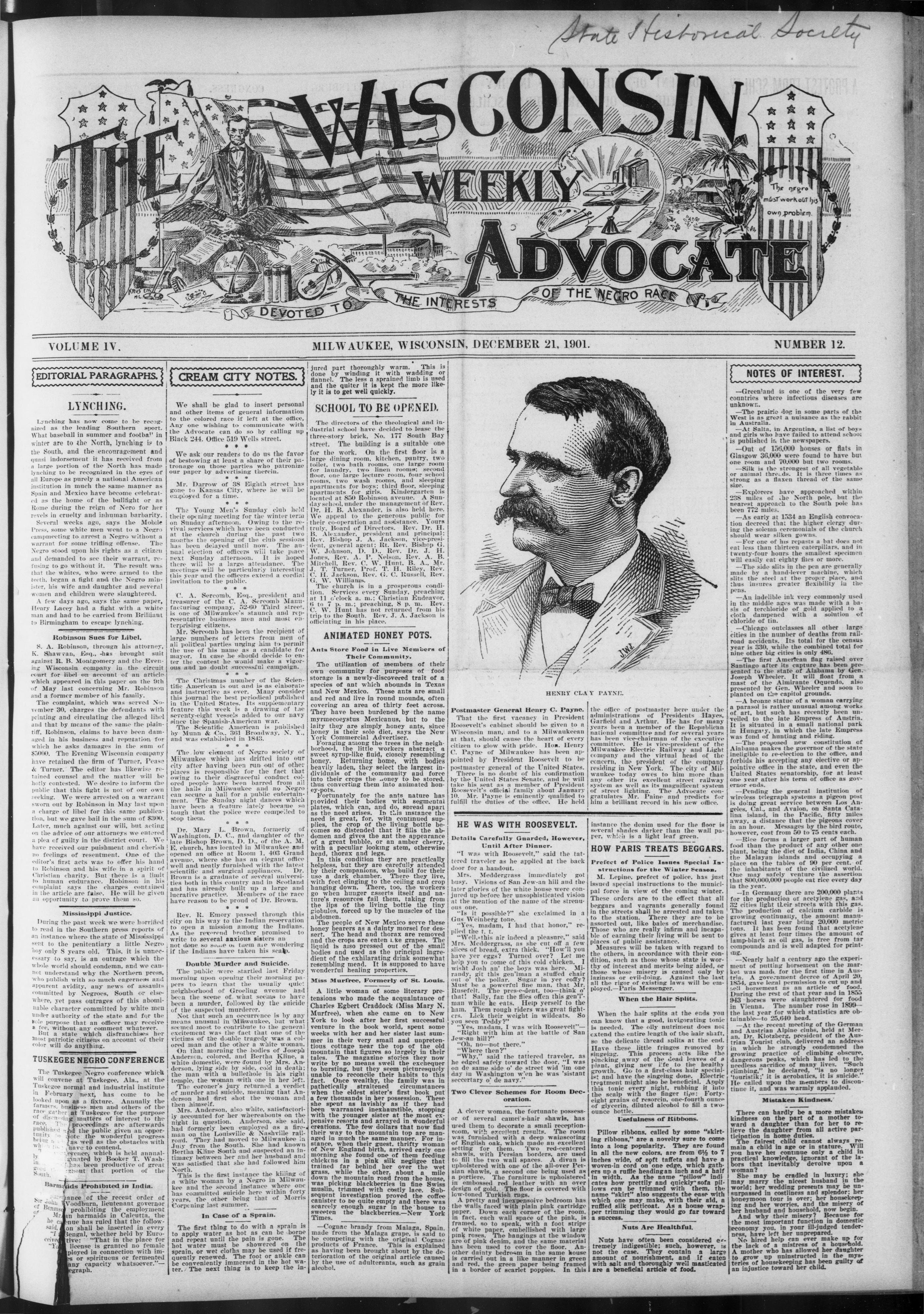
WISCONSIN
WEEKLY
ADVOCATE
DEVOTED TO THE INTERESTS OF THE NEGRO RACE
VOLUME IV.
EDITORIAL PARAGRAPHS.
LYNCHING.
Lynching has now come to be recognized as the leading Southern sport. What baseball in summer and football in winter are to the North, lynching is to the South, and the encouragement and quasi indorsement it has received from a large portion of the North has made lynching to be recognized in the eyes of all Europe as purely a national American institution in much the same manner as Spain and Mexico have become celebrated as the home of the bullfight or as Rome during the reign of Nero for her revels in cruelty and inhuman barbarity.
Several weeks ago, says the Mobile Press, some white men went to a Negro campmeeting to arrest a Negro without a warrant for some trifling offense. The Negro stood upon his rights as a citizen and demanded to see their warrant, refusing to go without it. The result was that the whites, who were armed to the teeth, began a fight and the Negro minister, his wife and daughter and several women and children were slaughtered. A few days ago, says the same paper, Henry Lacey had a fight with a white man and had to be carried from Brilliant to Birmingham to escape lynching.
Robinson Sues for Libel
S. A. Robinson, through his attorney, K. Shawvan, Esq., has brought suit against R. B. Montgomery and the Evening Wisconsin company in the circuit court for libel on account of an article which appeared in this paper on the 9th of May last concerning Mr. Robinson and a former member of his family.
The complaint, which was served November 30, charges the defendants with printing and circulating the alleged libel and that by means of the same the plaintiff, Robinson, claims to have been damaged in his business and reputation for which he asks damages in the sum of $5000. The Evening Wisconsin company have retained the firm of Turner, Pease & Turner. The editor has likewise retained counsel and the matter will be hotly contested. We desire to inform the public that this fight is not of our own seeking. We were arrested on a warrant sworn out by Robinson in May last upon a charge of libel for this same publication, but we gave bail in the sum of $300. Later, much against our will, but acting on the advice of our attorneys we entered a plea of guilty in the district court. We have received our p punishment and cherish no feelings of resentment. One of the editor's first acts was to offer his hand to Robinson and his wife in a spirit of Christian charity. But there is a limit to human endurance. Robinson in his complaint says the charges contained in the article are false. He will be given an opportunity to prove them so.
Mississippi Justice
During the past week we were horrified to read in the Southern press reports of an instance where the state of Mississippi sent to the penitentiary a little Negro boy only 8 years old. This, it is unnecessary to say, is an outrage which the whole world should condemn, and we cannot understand why the Northern press, who publish with so much eagerness and apparent avidity, any news of assaults committed by Negroes, South or elsewhere, yet pass outrages of this abominable character committed by white men under authority of the state and for the sole purpose that an officer may receive a fee, without any comment whatever. But a state which disfranchises her most patriotic citizens on account of their color will do anything
TUSKEGEE NEGRO CONFERENCE
The Tuskegee Negro conference which will convene at Tuskegee, Ala., at the Tuskegee normal and industrial institute in February next, has come to be looked upon as a fixture. Annually the farmers, business men and others of the race gather at Tuskegee for the purpose of discussing matters of interest to the race. The proceedings are afterwards published and the public given an opportunity to note the wonderful progress being made as well as the obstacles with which they have to contend. The conference, which is held annually originated by Booker T. Wash-in, has been productive of great good throughout that portion of the South
Barmstids Prohibited in India.
pursuance of the recent order of Sir John Woodburn, lieutenant governor of Benmse, prohibiting the employment of Mr.ann barmaids in Caleutta, the he caenue has ruled that the followsaid, on shall be inserted in every "I to Bengal, whether held by Euroceiveative: "That in the place for "Your license is granted no female employed in connection with images or spirituous or fermented any capacity whatsoever."—tegraph.
CREAM CITY NOTES.
We shall be glad to insert personal and other items of general information to the colored race if left at the office. Any one wishing to communicate with the Advocate can do so by calling up Black 244. Office 519 Wells street.
* * *
We ask our readers to do us the favor of bestowing at least a share of their patronage on those parties who patronize our paper by advertising therein.
***
Mr. Darrow of 38 Eighth street has gone to Kansas City, where he will be employed for a time.
* * *
The Young Men's Sunday club held their opening meeting for the winter term on Sunday afternoon. Owing to the revival services which have been conducted at the church during the past two months the opening of the club sessions has been delayed until now. The annual election of officers will take place next Sunday afternoon. It is hoped there will be a large attendance. The meetings will be particularly interesting this year and the officers extend a cordial invitation to the public.
☆ ☆ ☆
C. A. Sercomb, Esq., president and treasurer of the C. A. Sercomb Manufacturing company, 52-60 Third street, is one of Milwaukee's staunch and representative business men and most enterprising citizens. Mr. Sercomb has been the recipient of large numbers of letters from men of all political parties urging him to permit the use of his name as a candidate for mayor. In case he should decide to enter the contest he would make a vigorous and no doubt successful campaign.
The Christmas number of the Scientific American is out and is as elaborate and instructive as ever. Many consider this journal the best periodical published in the United States. Its supplementary feature this week is a drawing of the seventy-eight vessels added to our navy since the Spanish-American war. The Scientific American is published by Mann & Co., 361 Broadway, N. Y., and was established in 1843.
```markdown
```
The low element of Negro society of Milwaukee which has drifted into our city after having been run out of other places is responsible for the fact that owing to their disgraceful conduct colored people have been barred from all the halls in Milwaukee and no Negro can secure a hall for a public entertainment. The Sunday night dances which have been a feature lately became so tough that the police were compelled to stop them.
※ ※ ※
Dr. Mary L. Brown, formerly of Washington, D. C., and daughter of the late Bishop Brown, D. D., of the A. M. E. church, has located in Milwaukee and opened an office at Room 1, 403 Grand avenue, where she has an elegant office well and neatly furnished with the latest scientific and surgical appliances. Dr. Brown is a graduate of several universities both in this country and in Scotland and has already built up a large and lucrative practice. Members of the race have reason to be proud of Dr. Brown.
```markdown
```
Rev. R. Emory passed through this city on his way to the Indian reservation to open a mission among the Indians. As the reverend brother promised to write to several anxious sisters an not done so some or them are wondering if the Indians have taken his scalp.
Double Murder and Suicide.
The public were startled last Friday morning upon opening their morning papers to learn that the usually quiet neighborhood of Groeling avenue had been the scene of what seems to have been a murder, followed by the suicide of the suspected murderer.
Not that such an occurrence is by any means unusual in Milwaukee, but what seemed most to contribute to the general excitement was the fact that one of the victims of the double tragedy was a colored man and the other a white woman. On that morning the bodies of Joseph Anderson, colored, and Bertha Kline, a white domestic, were found by Mrs. Anderson, lying side by side, cold in death; the man with a bullethole in his right temple, the woman with one in her left. The coroner's jury returned a verdict of murder and suicide, meaning that Anderson had first shot the woman and then himself.
Mrs. Anderson, also white, satisfactorily accounted for her whereabouts on the night in question. Anderson, she said, had formerly been employed as a fireman on the Louisville & Nashville railroad. They had moved to Milwaukee in July from the South. She had known Bertha Kline South and suspected an intimacy between her and her husband and was satisfied that she had followed him North.
This is the first instance the killing of a white woman by a Negro in Milwaukee and the second instance where one has committed suicide here within forty years, the other being that of Morris Corpening last summer.
In Case of a Sprain.
The first thing to do with a sprain is to apply water as hot as can be borne and repeat until the pain is gone. The hot water must be showered on the sprain, or wet cloths may be used if frequently renewed. The foot or ankle can be conveniently immersed in the hot water. The next thing is to keep the in-
MILWAUKEE, WISCONSIN, DECEMBER 21, 1901.
jured part thoroughly warm. This is done by winding it with wadding or flannel. The less a sprained limb is used and the quiter it is kept the more likely it is to get well quickly.
SCHOOL TO BE OPENED.
The directors of the theological and industrial school have decided to lease the three-story brick, No. 177 South Bay street. The building is a suitable one for the work. On the first floor is a large dining room, kitchen, pantry, two toilet, two bath rooms, one large room for laundry, two linen rooms; second floor, one large lecture room, four school rooms, two wash rooms, and sleeping apartments for boys; third floor, sleeping apartments for girls. Kindergarten is located at 850 Robinson avenue. A Sunday school, under the management of Rev. Dr. H. B. Alexander, is also held here. We appeal to the generous public for their co-operation and assistance. Yours truly, Board of Directors. Rev. Dr. H. B. Alexander, president and principal; Rev. Bishop J. A. Jackson, vice-president, general agent; Rt. Rev. Bishop G. W. Johnson, D. D., Rev. Dr. J. H. Jones, Rev. A. P. Nelson, Rev. A. B. Mitchell, Rev. C. W. Hunt, B. A., Mr. J. T. Turner, Prof. T. H. Riley, Rev. C. H. Jackson, Rev. G. C. Russell, Rev. G. W. Williams.
The church is in a prosperous condition. Services every Sunday, preaching at 11 o'clock a. m.; Christian Endeavor, 6 to 7 p. m.; preaching, 8 p. m. Rev. C. W. Hunt has not returned from his trip to the South. Rev. J. A. Jackson is officiating in his place.
ANIMATED HONEY POTS.
Ants Store Food in Live Members of Their Community. The utilization of members of their own community for purposes of food storage is a newly-discovered trait of a species of ant which abounds in Texas and New Mexico. These ants are small and red and live in round mounds, often covering an area of thirty feet across. They have been burdened by the name myrmecoystus Mexicanus, but to the laity they are simply honey ants, since honey is their sole diet, says the New York Commercial Advertiser.
Foraging among the trees in the neighborhood, the little workers abstract a sweet syrup-like fluid, closely resembling honey. Returning home, with bodies heavily laden, they select the largest individuals of the community and force into their crops the money to be stored, thus converting them into animated honey-pots. Fortunately for the ants nature has provided their bodies with segmental plates, which can, and do, spread apart as the need arises. In this instance the need is great, for, with continued supplies, the crop of the living bottle becomes so distended that it fills the abdomen and gives the ant the appearance of a great bubble, or an amber cherry, with a peculiar looking stem, otherwise head, thorax and legs.
In this condition they are practically helpless, but they are carefully attended by their companions, who build for their use a dark chamber. There they live, with feet clinging to the ceiling and crop hanging down. There, too, the workers go when hunger asserts itself and nature's resources fail them, taking from the lips of the living bottle the tiny giobules, forced up by the muscles of the abdomen. The people of New Mexico serve these honey bearers as a dainty morsel for dessert. The head and thorax are removed and the crops are eaten like grapes. The liquid is also pressed out of the small bodies and used as the principal ingredient of the exhilarating drink somewhat resembling mead. It is supposed to have wonderful healing properties.
Miss Murfree, Formerly of St. Louis.
A little woman of some literary pretensions who made the acquaintance of Charles Egbert Craddock (Miss Mary N. Murfree), when she came on to New York to look after her first successful venture in the book world, spent some weeks with her and her sister last summer in their very small and unpretentious cottage near the top of the old mountain that figures so largely in their tales. The magazine stories they now write by no means swell the exchequer to bursting, but they seem picturesquely unable to reconcile their habits to this fact. Once wealthy, the family was in pathetically straitened circumstances when the eldest sister's first book put a few thousands in her possession. These she spent as lavishly as if they had been warranted inexhaurstible, stopping with the younger sister at the most expensive resorts and arrayed in wonderful creations. The few dollars that now find their way to the mountain top are managed in much the same manner. For instance, when their guest, thrifty woman of New England birth, arrived early one morning she found one of them feeding chickens in a pink silk negligee that trained far behind her over the wet grass, while the other, about a mile down the mountain road from the house, was picking blackberries in fine Swiss muslin, trimmed with costly lace. Subsequent investigation proved the coffee canister to be quite empty and there was scarcely enough sugar in the house to sweeten the blackberries.—New York Times.
Cognac brandy from Malaga, Spain, made from the Malaga grape, is said to be competing with the original Cognac products of France. This is explained as having been brought about by the deterioration of the original article caused by the use of adulterants, such as grain alcohol.
J.W.J.
HENRY CLAY PAYNE.
Postmaster General Henry C. Payne. That the first vacancy in President Roosevelt's cabinet should be given to a Wisconsin man, and to a Milwaukeean at that, should cause the heart of every citizen to glow with pride. Hon. Henry C. Payne of Milwaukee has been appointed by President Roosevelt to be postmaster general of the United States.
There is no doubt of his confirmation by the United States Senate, and he will take his seat as a member of President Roosevelt's official family about January 10. Mr. Payne is eminently qualified to fulfill the duties of the office. He held
HE WAS WITH ROOSEVELT.
Details Carefully Guarded, However, Until After Dinner. "I was with Roosevelt," said the tattered traveler as he applied at the back door for a handout. Mrs. Meddergrass immediately got busy. Visions of San Jew-an hill and the later glories of the white house were conjured up before her unsophisticated vision at the mention of the name of the strenuous one.
"Is it possible?" she exclaimed in a Gus Weinberg tone. "Yes, madam, I had that honor," replied the t. t.
"Well, this air indeed a pleasure," said Mrs. Meddgrass, as she cut off a few slices of bread, extra thick. "How'll you have yer eggs? Turned over? Let me help you to some of this cold chicken. I wish Josh an' the boys was here. Mirandy, git this gen'lman a stuffed chair out o' the pollar. Sugar in yer coffy? Must be a powerful fine man, that Mr. Rusefelt. The pres-e-dent, too—think o' that! Sally, fan the flies offen this gen'lman while he eats. Help yerself to the ham. Them rough riders was great fighters. Lick their weight in wildcats. So you seen Teddy?"
"Yes, madam, I was with Roosevelt"— "Right with him at the battle of San Jew-an hill?" "Oh, no—not there." "Where then?" "Why," said the tattered traveler, as he edged safely toward the door, "I was on de same side o' de street wid 'im one day in Washington w'en he was 'sistant seccertary o' de navy."
Two Clever Schemes for Room Decoration.
A clever woman, the fortunate possessor of several camel's-hair shawls, has used them to decorate a small reception-room, with excellent results. The room was furnished with a deep wainscoting of English oak, which made an excellent setting for them. Two red-centered shawls, with Persian borders, are used to fill the two wall spaces. A divan is upholstered with one of the all-over Persian shawls, a second one being used as a portiere. The furniture is upholstered in embossed red leather with an over design of gold. The floor is covered with low-toned Turkish rugs.
A pretty and inexpensive bedroom has the walls faced with plain pink cartridge paper. Down each corner of the room, in fact, each wall space of the pink, is framed, so to speak, with a foot stripe of white paper, embellished with large pink roses. The hangings at the window are of pink denim, and the same material has been used to cover the floor. Another dainty bedroom in the same house is carried out in a like manner in green and red, the green paper being framed in a border of scarlet poppies. In this
"Oh, no—not there."
the office of postmaster here under the administrations of Presidents Hayes, Garfield and Arthur. He has for many years been a member of the Republican national committee and for several years has been vice-chairman of the executive committee. He is vice-president of the Milwaukee Electric Railway and Light company and the virtual head of the concern, the president of the company residing in New York. The city of Milwaukee today owes to him more than any other its excellent street railway system as well as its magnificent system of street lighting. The Advocate congratulates Mr. Paine and predicts for him a brilliant record in his new office.
instance the denim used for the floor is several shades darker than the wall paper, which is a light leaf green.
HOW PARIS TREATS BEGGARS.
Prefect of Police Issues Special Instructions for the Winter Season. M. Lepine, prefect of police, has just issued special instructions to the municipal force in view of the coming winter. These orders are to the effect that all beggars and vagrants generally found in the streets shall be arrested and taken to the station. There they are to be assorted out, like bales of merchandise. Those who are really infirm and incapable of earning their living will be sent to places of public assistance.
Measures will be taken with regard to the others, in accordance with their condition, such as those whose state is worthy of interest and merits being aided, or those whose misery is caused only by laziness or evil-doing. Against the last all the rigor of existing laws will be employed.—Paris Messenger.
When the Hair Splits.
When the hair splits at the ends you can know that a good, invigorating tonic is needed. The oily nutriment does not extend the entire length of the hair shaft, so the delicate thread splits at the end. Have these little fringes removed by singeing. This process acts like the plucking away of the dead leaves of a plant, giving new life to the healthy growth. Go to a first-class hair specialist and have the singeing done. Electric treatment might also be beneficial. Apply this tonic every night, rubbing it into the scalp with the finger tips: Forty-eight grains of resorcin, one-fourth ounce of glycerin, diluted alcohol to fill a two-ounce bottle.
Usefulness of Ribbons
Pillow ribbons, called by some "skirting ribbons," are a novelty sure to come into a long popularity. They are found in all the new colors, are from $6\frac{1}{2}$ to 7 inches wide, of soft taffeta and have a woven-in cord on one edge, which gathers up a ruffle heading an inch and a half in width. As the name "pillow" indicates how prettily and quickly sofa pillows can be trimmed with them, the name "skirt" also suggests the ease with which one may make, with their aid, a ruffled silk petticoat. As a house wrapper trimming they would go far toward a success.
Nuts have often been considered extremely indigestible; such, however, is not the case. They contain a large amount of nourishment, and if eaten with salt and thoroughly well masticated are a beneficial article of food.
Nuts Are Healthful.
NUMBER 12.
NOTES OF INTEREST.
-Greenland is one of the very few countries where infectious diseases are unknown.
-The prairie dog in some parts of the West is as great a nuisance as the rabbit in Australia.
-At Salta, in Argentina, a list of boys and girls who have failed to attend school is published in the newspapers.
-Out of 156,000 houses or flats in Glasgow 36,000 were found to have but one room and 70,000 but two rooms.
-Silk is the strongest of all vegetable or animal threads. It is three times as strong as a flaxen thread of the same size.
-Explorers have approached within 238 miles of the North pole, but the nearest approach to the South pole has been 772 miles.
As early at 1534 an English convocation decreed that the higher clergy during the solemn ceremonials of the church should wear silken gowns.
For one of his repasts a bat does not eat less than thirteen caterpillars, and in twenty-four hours the smallest specimen will easily eat eighty flies or more.
The side slits in the pen are generally made by a hand-lever machine, which slits the steel at the proper place, and thus insures greater flexibility in the pens.
An indelible ink very commonly used in the middle ages was made with a basis of terchloride of gold applied to a cloth dampened with a solution of chloride of tin.
—Chicago outclasses all other large cities in the number of deaths from railroad accidents. Its total for the census year is 330, while the combined total for nine other big cities is only 486.
—The first American flag raised over Santiago after its capture has been presented to the state of Alabama by Gen. Joseph Wheeler. It will float from a mast of the Almirante Oquendo, also presented by Gen. Wheeler and soon to planted on the capitol grounds.
—A bronze statue of a woman carrying a parasol is rather unusual among works of art, but such has recently been unveiled to the late Empress of Austria. It is situated in a small national park in Hungary, in which the late Empress was fond of hunting and riding.
The proposed new constitution of Alabama makes the governor of the state ineligible to re-election to the office, and forbids his accepting any elective or appointive office in the state, and even the United States senatorship, for at least one year after his term of office as governor ends.
Pending the general institution of wireless telegraph systems a pigeon post is doing great service between Los Angeles, Cal., and Avalon, on Santa Catalina island, in the Pacific, fifty miles away, a distance that the pigeons cover in an hour. Messages by the bird route, however, cost from 50 to 75 cents each.
—Rice forms a larger part of human food than the product of any other one plant, being the diet of India, China and the Malayan islands and occupying a place on the tables of 90 per cent. of the inhabitants of the civilized world. One may safely venture the assertion that 800,000,000 people eat rice every day in the year.
—In Germany there are 200,000 plants for the production of acetylene gas, and 32 cities light their streets with this gas. The production of calcium carbide is growing continually, the amount manufactured last year being 20,000 metric tons. It has been found that acetylene gives at least four times the amount of lamp-black as oil gas, is free from tar compounds and is well adapted for printing.
—Nearly half a century ago the experiment of putting horsemeat on the market was made for the first time in Austria. A government decree of April 20, 1854, gave legal permission to cut up and sell horsemeat as an article of food. During the rest of that year and in 1855 943 horses were slaughtered for food in Vienna. The number rose in 1899—the last year for which statistics are obtainable—to 25,640 head.
At the recent meeting of the German and Austrian Alpine clubs, held at Meran, Dr. Klotzberg, president of the Austrian Tourist club, delivered an address in which he strongly condemned the growing practice of climbing obscure, dangerous peaks, which has led to the needless sacrifice of many lives. "Such climbing," he declared, "is no longer 'touristik:' it is acrobatics, it is suicide." He called upon the members to discontinue it, and was warmly applauded.
Mistaken Kindness.
There can hardly be a more mistaken kindness on the part of a mother toward a daughter than for her to relieve the daughter from all active participation in home duties. The fairest child cannot always remain a child in age or in stature. Will you have het continue only a child in practical knowledge, ignorant of the labors that inevitably devolve upon a woman? She may be cradled in luxury; she may marry the nicest husband in the world; her wedding presents may be unsurpassed in costliness and splendor; her honeymoon tour is over; her housekeeping and her worries, and the misery of her husband and household, now begin. And why their misery? Because for the most important function in domestic economy you, in your ill-judged tenderness, have left her unprepared.
No hired help can ever make up for the lack of a mistress of a household. A mother who has allowed her daughter to grow up uninstructed in the mysteries of housekeeping has been guilty of an injustice toward her child.
A PROTEST FROM SCHLEY.
Formal Objections to Findings of Court of Inquiry.
HE FILES EXCEPTIONS.
Claim Made that Unimpeachable Evidence was Ignored—Effectiveness of Blockade.
Washington, D. C., Dec. 18.—Admiral Schley, late this afternoon, through his counsel presented to the secretary of the navy his bill of exceptions to the finding of the majority of the court of inquiry. The bill claims that the majority of the court gave their opinion that Commodore Schley should have proceeded with the utmost dispatch off Cienfuegos when there was no specification covering this point and without giving the applicant an opportunity to furnish evidence on it.
The fact that no place was mentioned in what is known as the "McCalla memorandum" for meeting the insurgents is regarded as a paramount reason why communication was not held with the insurgents and further that the said memorandum was sent to Commodore Schley only for use in connection with the information which it contained relative to certain batteries at or being constructed in the vicinity of Cienfuegos.
Evidence Ignored.
The bill further contends that overwhelming evidence was presented to the court to show that a close blockade of Cienfuegos was maintained; that the majority of the court entirely ignored the uncontradicted testimony proving that the British steamer Adula was allowed to enter Cienfuegos to obtain information regarding the Spanish fleet; that the order of Admiral Sampson, known as No. 7, was an imperative order for Commodore Schley to hold his squadron off Cienfuegos whether the Spanish fleet was in that harbor or not; that the majority of the court have ignored the admitted fact that the commander of the Eagle did not communicate the situation at Cienfuegos to Commodore Schley; that they ignored the fact that Capt. Evans failed to communicate to Commodore Schley the meaning of the signal lights on shore at Cienfuegos; that Commodore Schley, as proven by the evidence, had no knowledge of these lights until the night of May 23, 1898; that the majority of the court are silent in their reference to masking the movements of the flying squadron in front of Cienfuegos; that the majority based their opinion as to the retrograde movement upon a statement that Commodore Schley before sailing for Cienfuegos had reliable information that ships could be coaled in the vicinity of Cape Cruz and Gonaives channel, whereas it is denied that there was any such positive information and that the records show that not until three days after leaving Cienfuegos did Commodore Schley receive definite information concerning the feasibility or practicability of coaling ships from a collier in Gonaives channel; that the majority erred in stating that Commodore Schley received no positive information from the scout ships as to the enemy's presence in Santiago harbor, because Capt. Sigsbee had reported to Commodore Schley that the Spanish fleet was not in that harbor.
Secretary Long's Orders.
Commander at the Battle.
The majority of the court entirely failed to determine who was commander-in-chief in the battle of Santiago, which finding was necessary to determine the first specification of the precept as to the conduct of Commodore Schley; that the majority of the court have rejected the whole of the testimony on behalf of the applicant and the testimony of the applicant himself, and that by so doing has perverted the ends of justice and deprived him of his common law and constitutional rights; that he has been found guilty upon specifications substantially abandoned by the judge advocate, and that the testimony of a few hostile witnesses has been made prominent. The bill concludes with the statement that the proceedings of the majority of the court were irregular; that Admiral Schley's right have been prejudiced and his testimony in many particulars not considered, and that the evidence is absolutely insufficient to sustain the opinion which has been rendered, and therefore a grave and irreparable injustice has bene done Admiral Schley.
Admiral Schley through counsel has served notice that if Admiral Sampson objects to the finding of Admiral Dewey he will claim the right to be heard in reference to such objection.
In regard to the last claim, Secretary Long informed counsel that it was not the practice of the department to have oral hearings on matters of this kind. He intimated that he would entertain a written argument.
Reorganize Racine Old Settlers
Racine, Wis., Dec. 18.—The Racine County Old Settlers' society is to be reorganized and conducted on a more extensive plan. John S. Blakey of Union Grove, vice-president of the society, sent out notices to the leading old settlers of towns, villages and the city, asking them to meet at Union Grove on January 10 to formulate arrangements.
JUDGMENT OF THE COURT OF INQUIRY IN THE CASE OF REAR ADMIRAL SCHLEY.
MAJORITY REPORT--JUDGMENT OE REAR ADMIRALS BENHAM AND RAMSAY.
The majority judgment of the court of inquiry in the case of Rear-Admiral Schley comprises the opinions of Rear-Admirals Benham and Ramsay. Admiral Dewey, the president of the court, signs the report, but he takes exceptions to many material features, and these are contained in a personal minority report. The majority report follows:
Commodore Schley, in command of the flying squadron, should have proceeded with utmost dispatch off Clenfuegos, and should have maintained a close blockade of that port.
He should have endeavored, on May 23, at Clenfuegos, to obtain information regarding the Spanish squadron by communicating with the insurgents at the place designated in the memorandum delivered to him at 8:15 a. m. of that date. He should have proceeded from Clenfuegos to Santiago de Cuba with all dispatch, and should have disposed his vessels with a view of intercepting the enemy in any attempt to pass the firing squadron.
any attempt to pass the fying squadron. He should not have delayed the squadron for the Eagle.
chor near the entrance of Santiago harbor on May 29 and 30.
He did not do his utmost with the force under his command to capture or destroy the Colon and other vessels of the enemy which he attacked on May 31.
By commencing the engagement on July 3 with the port battery and turning the Brooklyn around with port helm, Commodore Schley caused it to lose distance and position with the Spanish vessels—especially with the Vizcaya and Colon.
The turn of the Brooklyn to starboard was made to avoid getting it into dan-
and position with the Spanish vessel was made. The turn of the Brooklyn to starboard was made to avoid getting it into dangerous proximity to the Spanish vessels. The turn was made toward the Texas, and caused that vessel to stop and back its engines to avoid possible collision. Admiral Schley did injustice to Lleut-Commander A. C. Hodgson in publishing only a portion of the correspondence which passed between them. Commodore Schley's conduct in connection with the events of the Santiago campaign prior to June 1, 1898, was characterized by vacillation, dilatoriness and lack of enterprise.
His official reports regarding the coal supply and the coaling facilities of the flying squadron were inaccurate and misleading.
His conduct during the battle of July 3 was self-possessed, and he encouraged in his own person, his subordinate officers and men to fight courageously. GEORGE DEWEY, Admiral U. S. N., President. SAMUEL C. LEMLY, Judge Advocate General U. S. N., Judge Advocate.
MINORITY REPORT—JUDGMENT OF ADMIRAL DEWEY, PRESIDENT OF THE COURT.
Admiral Dewey's minority report is as follows:
In the opinion of the undersigned, the passage from Key West to Clenfuegos was made by the flying squadron with all possible dispatch. Commodore Schley having in view the importance of arriving off Clenfuegos with as much coal as possible in the ships' bunkers.
The blockade of Clenfuegos was effective.
Commodore Schley, in permitting the steamer Adula to enter the port of Clenfuegos, expected to obtain information concerning the Spanish squadron from it when it came out.
Commodore Schley, in permitting the steamer Adult fuegos, expected to obtain information concerning the when it came out.
The passage from Cienfuegos to a point about twen ago was made with as much dispatch as was possible a unit.
The blockade of Santingo was effective.
Commodore Schley was the senior officer of our squail Spanish squadron attempted to escape on the morning of absolute command and is entitled to the credit due for the glorious victory which resulted in the total ships.
The passage from Cienfuegos to a point about twenty-two miles south of Santiago was made with as much dispatch as was possible while keeping the squadron a unit.
The blockade of Santiago was effective.
Commodore Schley was the senior officer of our squadron off Santiago when the Spanish squadron attempted to escape on the morning of July 3, 1898. He was in absolute command and is entitled to the credit due to such commanding officer for the glorious victory which resulted in the total destruction of the Spanish ships.
GEORGE DEWEY. Admiral U. S. N.
SAMUEL C. LEMLY. Judge Advocate General U. S. N., Judge Advocate.
SAMUEL C. LEMLY, Judge Advocate General U.
RECOMMENDATION—"LET NO FURTHER PROCESS
In view of the length of time which has elapsed since events of the Santiago campaign the court recommended had in the premises.
GEORGE DEWEY, Admiral U. S. N., President
SAMUEL C. LEMLY, Judge Advocate General U.
HE LOST HIS COMMISSION.
Officer Punished for Deserting His Bride at Altar.
REFUSED TO SAY WHY.
RECOMMENDATION—"LET NO FURTHER PROCEEDINGS BE TAKEN."
In view of the length of time which has elapsed since the occurrence of the events of the Santiago campaign the court recommends no further proceedings be had in the premises.
GEORGE DEWEY, Admiral U. S. N., President.
SAMUEL C. LEMLY, Judge Advocate General U. S. N., Judge Advocate.
pointment was soon made and accordingly the wedding day set.
The Bridegroom Never Came.
Miss Douglass prepared an elaborate trousseau. The cards were issued, the wedding breakfast ordered. But when the day came there was no bridegroom. Capt. Crawford two days before sent a letter to the mother of the bride. Just what is in that letter only the captain, the mother, possibly Miss Douglass, and recently the secretary of war and the President, know. On the contents of that letter hung Capt. Crawford's fate.
Immediately upon the mortifying breaking off of the marriage Miss Douglass left Chester and has since remained in seclusion. She has talked but little and will say nothing for publication.
It was, therefore, not with her consent that her friends made the affair public by carrying it to the war department and demanding that Crawford's commission be withheld.
Pending investigation their wishes were complied with. Then these friends secured the aid of influential congressmen.
Crawford declined to make an explanation to the adjutant general beyond saying that he did not love the young lady and could not marry her.
On the eve of his own marriage Gen. Corbin ruled against Crawford, saying his conduct barred him from that class of "gentlemen in which holders of commissions must belong."
In the absence of Gen. Corbin. Crawford had a personal interview with Secretary of War Root, and so impressed that official by his manner and appearance that the secretary consented to give him another hearing.
"It is true that I was engaged to Miss Douglass," Crawford confessed. "It is true that I refused to marry her. But I had good reasons."
"Name them," demanded the secretary.
"I must decline to do so," said the captain respectfully; "they are in the possession of one person only, Miss Douglass' mother. If she is willing to communicate them to you I can have no objection."
"Very well, captain," said the secretary, "we will let your honor and your commission rest upon that letter."
Which has been the case. After long delay Mrs. Douglass produced the letter. President Roosevelt and Secretary Root saw it. And they withdrew Capt. Crawford's commission.
Senate Acts Favorably on Nominatio of Attorney General.
Washington, D. C., Dec. 17.—Just before adjournment last night the Senate confirmed the nomination of Philander C. Knox to be attorney-general of the United States. The opposition was led by Senators Jones and Turner, who dwelt on the charge that the attorney-general, previous to entering upon the duties of that office, had been attorney for the United States Steel Corporation and the armor plate manufacturers. In reply to these accusations it was argued that his position as counselor for those interests could not be used legitimately against him. So long as he had conducted himself with propriety his relationship as an attorney should not be used to his injury as an official.
The vote on a motion to recommit was lost. The ballot stood 43 to 7. Confirmation without the necessity of a roll call immediately followed.
MANY HONOR JOHN SWINTON.
Host of Friends Show Grief Over Demise of Noted Journalist.
New York, Dec. 17.—Since the demise of John Swinton, the well-known journalist, there has been a constant stream of visitors at the family residence in Brooklyn anxious to view the remains and to express condolence to the relatives.
The decedent had a host of friends not only among the newspaper men, but also among labor organizations. He was a writer on labor topics for over thirty years. Letters and telegrams have been received from friends in all parts of the country. The New York Press club is making preparations to render homage at the funeral, which will take place Wednesday.
VOYAGE AROUND THE WORLD.
Capt. Voss and His Little Canoe Arrives Safely at Sydney.
San Francisco, Cal., Dec. 17.—News comes from Australia that Capt. Voss and his little 40-foot canoe arrived at Sydney November 20, having made the voyage safely from British Columbia. At Fiji his mate, Luxton, concluded to go to Sydney by steamer, so Capt. Voss shipped a sailor named Louis Degonte, but the man was washed overboard five days out and Capt. Voss made the rest of the voyagee alone. He will go from Sydney to Ceylon on his voyage around the world.
---
The blockade of Cienfuegos was effective.
GEORGE DEWEY. Admiral U. S. N.
After Hearing the Mother's Story the President Declined to Give the Captain His Commission.
Washington, D. C., Dec. 17.For "conduct unbecoming an officer and a gentleman" Capt. William P. Crawford of the United States volunteers has been refused by President Roosevelt and Secretary of War Root his commission as a lieutenant in the regular army, to which his military superiors warmly recommended him. This case is unique in the military history of the country.
Because he broke faith with the woman he had promised to marry the path to military distinction—to an honorable career in the service of his country upon which he had so promisingly entered—is forever closed to him. Crawford, says the secretary of war, played an unworthy part toward the woman that loved him. Therefore, he is unworthy to wear an officer's uniform.
If you have never known that Presidents and cabinet officers gave up weeks to the consideration of the love affairs of would-be lieutenants, study the following curious and instructive history of Capt. Crawford, who, because he would not wed Miss Rebecca Douglass when he might, could not become a lieutenant when he would.
But in spite of the publicity the affair has gained, the reason for the captain's strange action is not even suspected.
His First Love Affair.
It is told in South Carolina that Crawford's military career began, as it ended, in a love affair. Some years ago, it is said, the young man was engaged to a beautiful girl. She jilted him and married another man. Embittered by this experience Crawford tried to divert his mind by assuming the editorship of a local paper. He shortly tired of this, however, and decided to enter the army. It was arranged that he should go to Cuba. He was utterly desperate. He told his friends that Cuba might bring him death or it might bring him distinction—he cared nothing. And he buckled on his sword with a fine air of indifference. Cuba brought him little opportunity. But it gave him a taste for war. He returned with the determination to go to the Philippines.
The day before he left for the East, however, he met for the first time the woman who was to have so strange an influence in the ordering of his fate. This was Miss Rebecca Douglass, a charming and cultivated young woman, in whose presence Crawford forgot the disasters that had previously befallen his heart and fell precipitately in love. "I feel as if I had known you always," he said to Miss Douglass with a deep sigh.
She smiled encouragingly. "Indeed," protested the impetuous lover, "if I had known you years I could not love you more. Will you marry me? Will you wait for me?" Now Crawford, as even Secretary Foot will tell you, has the most winning face, the most persuasive manner in the world. And Miss Douglass promised. The next day he was off for the Philippines with Rebecca Douglass' picture next his heart. As for Miss Douglass, she took up her profession of trained nurse with a light-heartedness she had never known before. Crawford fought bravely in the Philippines.
Crawford was a Good Soldier.
"It is the thought of your love, your pride in me, that has helped me," he wrote to his fiancee. Nor did his brave deeds pass unnoticed.
"That boy will make a soldier," said his superiors. "Some day he'll be heard from."
And indeed, when Capt. Crawford came back to the United States he bore as many honors as a man in his position could have won. No wonder that he saw fame shining ahead.
It was at Raleigh, N. C., that the young man found his betrothed still engaged in nursing.
"I cannot have you give up your time to caring for other people now," he said.
"I shall need you. Give up your work, come back to Chester, and as soon as I get my commission we will be married."
They had not to wait long. The ap-
KNOX IS CONFIRMED.
TRAGEDY AT PITTSBURG
Burglar Detected in Entering House Commits Murder and Makes His Escape.
Pittsburg, Pa., Dec. 17.—Harriet P. Murphy, prominent in church and society circles and treasurer of the Kingsley house fund, was murdered at her home, 6221 Howe street east end, by a burglar about 3 o'clock this morning. The murderer made his escape and although the whole detective and police force of that section was called he has not been captured.
Miss Murphy was the only sister of Select Councilman John A. Murphy from the Twentieth ward and was 30 years old. She, with her brother and two servants, women, lived alone in the house.
Miss Murphy, who slept on the second floor, was an expert with the revolver, having practiced for the purpose of protecting herself in the event of just such an attack as happened this morning and she always had a pistol within easy reach.
About 3 o'clock this morning her brother was awakened by two shots in the house and hastening to his sister's room, found her lying dead on the floor with a bullet wound in the head. The burglar had sealed the porch posts and entered the window of Miss Murphy's room by breaking the glass. It is supposed that the noise of the crashing glass awakened her and that as she jumped from the bed with her revolver in her hand the man fired. Marks in the snow on the porch roof indicate that only one man entered the room. Miss Murphy usually kept the collections for the Kingsley house fund in her room until recently and it is thought the burglar was after this money.
YANKEE LOCOMOTIVES.
Americans Secure Number of Contracts from Japan, Australia and South Africa.
New York, Dec. 17.—A number of important contracts for locomotives to be used by various foreign governments and private railroads have been placed in the United States within the last few days. Thirty locomotives, intended for the Japanese government railways, will be built at Schenectady. The American Locomotive company is also building twelve locomotives for the Kuishi railway, one of the big government roads operated in the Japanese empire. This makes the sixth order—seventy-two engines in all—that the American Locomotive company has secured from that road within the last two years. The Hokkaido railway, controlled by the Japanese government, also has ordered six American-built engines.
The Baldwin Locomotive works of Philadelphia will build eighteen locomotives for the West Australian government railways and thirty-six American locomotives for the New South Wales government railways. The H. K. Porter company of Pittsburg has an order for four locomotives for use in the coal mines near Johannesburg, South Africa.
EARTHQUAKE SHOCKS.
Scarcely a Building in New Zealand Town Left Standing-Chimneys Fall Like Toy Houses.
San Francisco, Cal., Dec. 17.—New Zealand news received by steamer gives details of great destruction of property in the Cheviot district by an earthquake on November 18. In the town of Cheviot and the surrounding country scarcely a building was left standing. The fine homestead of Sir George Clifford was wrecked. Great fissures opened in the earth and water issued from them. In one office a heavy safe was thrown across the room and brick chimneys fell like toyhouses. The people are panic-stricken as the shocks still continue. At Waiian river, great cracks opened in the river bed and when they closed volumes of water were sent hundreds of feet into the air.
COMMITTEE ON PENSIONS.
One that will Consider the Interests of the Government.
Minneapolis, Minn., Dec. 17.—Eli Torrance, commander-in-chief of the G. A. R., today announced the following as the committee on pensions: Col. Robert Beath, Philadelphia; Col. John C. Black Chicago; Gen. James R. Carnahan, In dianapolis; Judge Charles G. Burton, Nevada, Mo.; ex-Gov. W. H. Upham Marshfield, Wis.; Henry E. Taintor Hartford, Conn.; John C. Linehan Penacook, N. H.
In view of the pension office controversy this committee is most important. It is understood that the commander's desire in naming this committee was to secure one that would consider the interests of the government equally with those of the veterans.
LOW TAKES MAYOR'S OATH.
New York's Future Executive Deviates from Time-Worn Custom.
New York, Dec. 17.—Seth Low, to the great surprise of politicians of all parties, was sworn in yesterday afternoon as mayor of New York. The oath was administered by Justice Morgan J. O'Brien of the appellate division of the Supreme court in his private chamber in the court building. In taking the oath of office two weeks before the time he will take his seat at the city hall Mayor-elect Low has deviated from the usual custom, which is to be sworn in on January 1. It was his intention to make public nearly his entire cabinet yesterday, but circumstances have arisen which have caused one or two changes in the slate.
ROCKEFELLER IN BAD HEALTH.
Oil Magnate's Appearance Startles His Friends in Tarrytown.
Tarrytown, N. Y., Dec. 17.—John D. Rockefeller is so changed in appearance that his friends scarcely recognize him. Since Mr. Rockefeller made the trip to Cleveland last summer his health has suffered greatly. He had his mustache shaved off while away, and now the hair on his head is falling out so that he is nearly bald. He is able to attend to business, though he looks very weak
Protestantism in Russia.
There are some 6,000,000 Protestants in Russia who enjoy religious liberty with the stipulation that they must be born of Protestant parents and must not proselyte. Preaching in nine languages is heard every Sunday in St. Petersburg in the Protestant churches.
—Trying to get an orange which was out of her reach on a table, Jennie Harris, 3 years old, pulled a lighted lamp upon herself. The flame ignited her clothing and the child died an hour later at the Englewood Union hospital.
Iron experts are over-running the province of British Columbia, in search of iron mines, promising to pay the most extravagant prices for anything that touches the Bessemer limit.
Bread baked on Christmas eve is supposed never to become moldy.
CONGRESS
During the executive session of the Senate on the 12th Senator Spooner of Wisconsin made a lengthy speech in favor of the Hay-Pauncefote treaty. The points of international law were thoroughly covered. The point that has been raised by the opponents of the treaty that the United States would be bound by its terms not to build fortifications in time of war was met by Senator Spooner in explaining the terms of the Clayton-Railer treaty and the first Hay-Pauncefote treaty, and showing that the objections contained in the former instruments against fortifying by this nation have been eliminated and do not now appear to prevent this government not only from building but from protecting and defending the canal. Senator Spooner had just concluded speaking when Senator Lodge made an effort to secure a vote. It developed that there were other senators who desired to be heard, the result being that the date for the vote was postponed until the 16th. The Senate committee on isthmian canals authorized a favorable report upon Senator Morgan's bill providing for the acquisition from Nicaragua and Costa Rica of the right of way via the Nicaragua route. Senator Morgan later presented this report to the Senate, accompanying the return of the bill with a voluminous report upon the general subject of a canal across the isthmus. Action on the bill providing for the construction of the canal was deferred.
The Senate on the 16th ratified the Hay-Pauencefote isthmian canal treaty by the decisive vote of 72 to G. The vote was reached a few minutes before 5 o'clock, after almost five hours' discussion behind closed doors. There were no sensational incidents during this entire time. The debate was confined exclusively to a discussion of the merits of the agreement and the policy of its provisions. The principal speech of the day was made by Senator Teller, in opposition to the treaty. A movement was inaugurated by Senator Nelson of Minnesota to put a stop to the dock charges and other discriminations alleged to be imposed by trans-Atlantic transportation companies upon exports of commodities to foreign ports. Mr. Jones (Ark.) introduced a joint resolution tendering the thanks of Congress and the American people are hereby tendered to Read-Admiral Winfield S. Schley and the officers and men under his command for highly distinguished conduct in conflict with the enemy, as displayed by them in the destruction of the Spanish fleet off the harbor of Santiago, Cuba, July 3, 1808. Just before adjournment the Senate confirmed the nomination of Philander C. Knox to be attorney-general of the United States.
Soon after the Senate convened on the 17th a joint resolution making some amendments to the act, "to establish a code of law for the District of Columbia" was reported and passed. A new immigration bill, which is the joint production of Senator Penrose and Commissioner General Powderly, was introduced by Mr. Frye. The bill provides an educational test and in addition to the present system of domestic inspectors of immigrants authorizes the appointment of inspectors at the principal foreign ports. Senator Frye also introduced a joint resolution authorizing the President to invite the King of Siam to visit the United States. The Republican senators met in caucus to hear the report of the committee on committees, which had completed the committee assignments. The report was made by Senator Platt of Connecticut, chairman of the committee. Following are the assignments made of the Wisconsin senators: Finance, Spooner; foreign relations, Spooner; military affairs, Quarles; relations with Cuba, Spooner; Indian affairs, Quarles; agriculture, Quarles; public building, Quarles; rules, Spooner (chairman); census, Quarles (chairman); irrigation. Quarles: executive expenditures, Quarles (chairman); public health, Spooner.
After the transaction of routine business in the Senate on the 18th, Mr. Platt (Conn.) offered a resolution suspending the rule providing for the appointment of members of the various Senate committees by ballot. The resolution was adopted. Mr. Platt then submitted another resolution appointing formally the committees for the Fifty-seventh Congress. It was adopted.
House.
Chaliman Payne of the committee on ways and means presented to the House on the 13th the majority report on the Philippine tariff bill. Representative Robinson of Indiana introduced two measures designed to secure the extradition of ex-Gov. Taylor of Kentucky from Indiana, where he is said to be sojourning, to Kentucky, where he is wanted in connection with the Goebel tragedy. One of the measures is for an investigation whether the governor of that state is refusing to recognize extradition papers from the governor of another state. The other measure provides that in case a governor refuses to recognize extradition papers, they may be executed by a United States marshal. After some discussion by Messrs. Cannon, Livingston of Georgia and Maddox of Georgia the bill was passed. The speaker announced the appointment of the following regents of the Smithsonian institution: Messrs. Hitt of Illinois, Adams of Pennsylvania and Dinsmore of Arkansas. Mr. Cassel (Pa.) officially announced the death of Mr. Brosius (Pa.).
Chairman Ray of the House committee on judiciary on the 10th appointed the special committee to draft an anti-anarchy measure, as follows: Ray (N. Y.), Jenkins (Wis.), Overstreet (Ind.), Littlefield (Me.), Republicans, and Lanham (Tex.), Elliott (S. C.), Smith and Fleming, Democrats. The special committee will meet after the holidays and in the meantime the chairman will introduce a measure which will be the basis of committee action: Representative Esch wants appropriation of about $18,000 for needed improvements at the Tomah (Wis.) Indian schools.
The bill to provide temporary revenues for the Phillipine islands was debated in the House on the 17th, and will be voted on at 4 o'clock on the 18th. It was the first debate of the session and was conducted calmly and without display of temper. Delegate Wilcox of Hawaii introduced a bill making the leper colony of Hawaii a government reservation and providing that the colony shall be under the control of the secretary of the treasury. Representative Wheeler of Kentucky, a member of the House committee on naval affairs, introduced a resolution for an investigation of the Schley case. The resolution recites the results of the recent court of inquiry, and provision is made for a report to the House of Representatives and authority is given to send for persons and papers. Representative Mudd of Maryland also introduced a resolution relative to Admiral Schley.
The bill to provide revenue temporarily for the Philippine islands passed the House on the 18th by a vote of 163 to 128. Five Republicans, Messrs, McCall (Mass.), Littlefield (Me.), Heatwole, Eddy and Stevens (Minn.), voted with the Democrats against the bill, and three Democrats, Messrs. Robertson, Davey and Broussard (La.) voted with the Republicans for it. Mr. Meyer, a Democrat (La.), was paired in favor of the bill with Mr. Foster (Dem., Ill.). Mr. Warner (Ill.), who voted against the Porto Rican bill last Congress, voted for the Philippine measure. Mr. Crumpacker (Ind.), who also voted against the Porto Rican bill, was absent.
—John P. Hopkins was found near death from cold in the road in front of his home.
—Charles E. Vincent was found dead in his employer's kitchen. Vincent was 40. years old.
—William Langer, a machinist, was fatally injured at the Garfield Turner hall by falling from a tightrope. While giving an exhibition he became confused and lost his balance.
—Rudolph Dolan, a carpenter, committed suicide at his home by shooting himself in the head. His daughter, 5 years old, was in the room when the shot was fired. Dolan died instantly.
—Harry Cross, candymaker for the Columbia restaurant of Evanston, lost his thumb in machinery, it being torn from his hand with the long tendons attached.
—Miss Stella Riggs of Maringo, Ill., who is visiting friends, slipped on the icy pavement in front of the First National bank, and fell, dislocating her left thighbone and sustaining slight internal injuries.
—The explosion of a gasoline lamp under which he was sitting seriously burned
John Mooney. Mooney was in a restaurant eating his evening meal. A gasoline lamp exploded and Mooney's clothing caught fire. He was severely burned about the hands, face and head. —Leon Kusell, formerly treasurer of the Academy of Music, died in the Samaritan hospital, where he was taken by the police suffering from morphine poisoning. Whether the taking of the drug was with suicidal intent or by mistake is a question which will be settled by a coroner's jury.
—A remarkable series of fires, fifteen in number, entailing a property loss of about $175,000 and driving 150 scantily-clad people in to the streets in weather bitterly cold, occurred yesterday. Nearly 200 cars were burned in a fire which destroyed the barns of the Chicago Union Traction company. The loss to the company is between $125,000 and $130,000.
—Five children have died from burns here since Saturday morning, according to the records of the cononer's office. All the victims were under 5 years of age. William Homa, 2 years old, burned while playing at the kitchen stove; Elmer Reynier, 9 months old, lamp overturned, setting fire to the child's clothing; James Mortaka, 3 years old; George Welsh, 4 years old, burned at kitchen stove; Julia Harris, 3 months old, overturned lamp set fire to clothing.
Thinking he had brought disgrace to himself and relatives because the police called at his home, James Oatsen shot and killed himself in the presence of his brother and mother. The tragedy resulted from a quarrel which Oatsen had with his brother Robert over the admission of a niece to the household. James did not want the girl to come and live with them, it is said, while his brother did. The men came to blows, and neighbors sent word to the Kensington police station.
—Inquiry into the suicide of Michael Leviche shows that it was prompted by worry over the disclosure of another's man's alleged defalcation. Leviche, while working as confidential bookkeeper at Ottumwa in the place of George J. Dubose during the latter's temporary absence, discovered a shortage of $1700 on the books of the Iowa and Illinois Coal company. Leviche reported the discovery to his employers. Dubose, who is now ill with smallpox in the detention hospital at Ottumwa, is under surveillance with a charge of embezzlement hanging over him.
LATEST MARKET REPORTS.
Milwaukee, Dec. 18, 1901.
DAIRY MARKETS.
MILWAUKEE—Eggs—Market firm, fresh new, cases included, 23½¢; fresh, cases returned, 23¢; storage, 19¢; country storage, 16@17¢; seconds, 9¢. Receipts were 106 cases.
CHICAGO—Butter—Steady; creameries, 15@24¢; dairies, 14@20¢. Cheese—Steady; twins, 9¼@9½¢; daisies, 10@10¼¢; Young Americas, 10¼@10¼¢. Eggs—Very strong; loss off, cases returned, 8@8¼¢. Dressed poultry—Steady; turkeys, 8@10¢; chickens, 6½@8¢.
SHEBOYGAN—On the board the market was active and 1%@1%c higher. The offerings were small. Daisies brought 10%c
Young Americas, 10%c; longhorns, 11%11%c.
NEW YORK — Butter — Receipts, 4848
pkgs; firm; state dairy, 15%23c; creamery,
16%23c; June cakeery, 15%21%c; factory,
12%15%c; Cheese—Receipts, 1858 pkgs,
firm; fancy large September, 10%10%c;
fancy small September, 10%11%c; late
made, best, large, 9%1c; do small, 10%10%c.
Eggs—Receipts, 4532 pkgs; strong; state
and Pennsylvania, 29%30c; Western, at
mark, 23%29c; Southern, at mark, 22%28c.
Coffee—Quiet; No. 7 Rio, 6%c.
MILWAUKEE STOCKYARDS REPORT.
HOGS—Receipts, 8 cars; market steady;
light, 5.50@5.80; mixed and medium
weights, 5.75@6.10; common to good packers,
5.60@6.10; choice heavy, 6.20@6.30.
Pkgs, 18 to 120 pkgs, 4.75@5.25.
CATTLE - Receipts, 4 cars; steady;
butchers' steers, medium to good, 1050 to
1300 lbs, 4.75@5.75; fair to medium, 950 to
1050, 3.50@4.00; heifers, common, 2.35@
2.85; good, 3.50@4.50; cows, fair to good,
2.50@3.25; canners, 1.25@2.25; bulls, common,
2.40@2.75; choice, 3.00@3.75; feeders,
8.00 to 950 lbs, 2.50@3.25; stockers, 500 to
750 lbs, 2.25@2.75; veal calves, common to
choice, 4.00@5.50; milkers and springers,
common unsalable; choice, 20.00@45.00.
SHEEP Receipts: 1 car; market steady
Chicago receipts: Hogs, 48,000; cattle, 20,000; sheep, 24,000.
CHICAGO POTATO MARKET
CHICAGO POTATO MARKET
CHICAGO, Ill., Dec. 18.—[Speciall.]
Coyne Bros. report: Receplts, 14 cars;
movement slow on account of the cold
weather; rurals, 83@85c; long and round
white, 81@83c; red, 76@79c; mixed red and
white, 75@78c.
OTHER TELEGRAPH MARKETS.
MILWAUKEE-Flour-Steady. Wheat — Firmer; No. 1 Northern, on track, 76%c; No. 2 Northern, on track, 75%c. Corn-Steady; No. 3 on track, 64%c. Oats-Steady; No. 3 white, on track, 47@48c; No. 2 white, on track, 48%c. Barley-Firm and active; No. 2 on track, 63c; sample on track, 57@62%c. Rye-Steady. No. 1 on track, 63%@64c. Provisions-Steady; pork, 16.35; lard, 9.87. Flour market is steady; patents. 3.50@4.00; bakers. 2.90@3.00; rye. 3.20@3.00.
Millstuffs are firm and quoted at 22.50 for bran. 22.00@22.50 for standard middlings, and 23.50 for Milwaukee flour middlings, in 100-lb sacks; reg-dog. 24.50.
CHICAGO — Close — Wheat — December,
75½c; January, 75½c; May, 79½@79½c;
July, 79½@79½c. Corn—December, 63½c;
May, 66½c; July, 66½c. Oats—December,
44½c; May, 44½c; July, 38½c; September,
33½c. Pork—December, 15.00; January,
16.30; May, 16.75@16.77½. Lard—December
and January and May, 9.85. Ribs—December
and January, 8.40; May, 8.60. Flax—
Cash Northwest and May, 1.56. Southwest,
1.54; December, 1.55½. Rye—December,
62½c; May, 66½c. Barley—Cash, 56@63½.
Timothy—March, 6.55. Clover—March, 9.50.
TOLEDO—Wheat—Dull; December, 85½c;
May, 85½c. Corn—Dull; December, 67½c;
May, 67½c. Oats—December, 46½c; May,
46½c. Clover seed—December, 5.75; March,
5.85.
KANSAS CITY—Wheat—December, 73%c
May, 77%c; cash No. 2 hard, 74%c%c;
No. 2 red, 86%@86%c; No. 2 spring, 73%c@
Corn—December, 68%@68%c; January, 68c;
May, 68%c; cash No. 2 mixed, 67%@68%c;
...o. 2 white, 68%c; Oats.No. 2 white, 47%c
LIVERPOOL—Lard—American refined in
pails steady, 40s6d. Bacon—Cumberland
dull, 45s; short ribs quiet, 47s; long clear
middles, light, quiet, 46s; long clear
middles, heavy, quiet, 45s 6d.
KANSAS CITY—Cattle—Receipts, 8000;
easy to shade lower; beef steers, 4.75@6.50;
Texans, 3.00@4.75; cows and heifers, 2.25@
5.25; stockers and feeders, 3.00@4.25; Hogs
—Receipts, 17.000; steady to 10c lower;
heavy, 6.65@6.75; packers, 6.25@6.65; yorkers,
5.25@6.25; plgs, 4.25@5.15; Sheep—
Receipts, 2500; 5c higher; sheep, 3.00@4.25;
lambs, 4.50@5.30.
ST. LOUISE-Cuttle-Recelpts, 7000; market steady; beef steers, 3.40@6.40; fancy, 6.50@8.00; Texans, 2.00@4.50; cows and heifers, 2.00@4.75; stockers and feeders, 2.40@3.80. Hogs-Recelpts, 10,000; steady on best, lower on others; plugs, 5.95@6.15; packers, 6.15@6.40; butchers, 6.35@6.65. Sheep-Recelpts, 2000; steady; sheep, 3.40@4.50; lambs, 4.00@5.75.
SOUTH OMAHA—Cattle—Receipts: 3500;
slow, 5@10c lower; beef steers, 4.00@6.75;
Texans, 3.50@4.40; cows and helpers, 2.80@
4.65; stockers and feeders, 2.75@4.40. Hoqs
—Receipts, 12.500; slow and 10c lower;
heavy, 6.50@6.70; mixed, 6.20@6.40; pligs,
5.00@5.50. Sheep—Receipts: 3500; steady;
sheep, 2.75@4.25; lambs, 4.75@5.50.
You will get a genuine Mexican Opal ready to be mounted, sent prepaid send us 250 in silver or stamps, and th and addresses of two friends.
WM. G. GRUSER & C
525 Germania Building, Milwaukee
WANTED - Trustworthy ladies and gent travel and advertise for an old se house; salary $18 a week and expenses canvassing required; good references, close self-addressed and stamped envel dress Manager, 1195 Adams street, Chi
Everywhere, everywhere, Christmas to right!
night
Christmas in lands of fir trees and pine;
Christmas in lands of palm tree and vine;
Christmas where snow peaks stand solemn
and white;
Christmas where cornfields lie sunny and
GREAT OAKS AND LITTLE ACORNS
A Christmas Story.
It was two weeks before Christmas. The weather had been mild and pleasant until a few days before the story begins. The older folks had predicted an open winter, adding that there are no such snows now as there were when they were young. But the winter had started now in earnest and it was cold enough to satisfy the most winter-loving heart. The inhabitants of Allentown were satisfied at any rate.
In the western part of Indiana was Ruby valley, the most beautiful and fertile spot in all the country round. In the midst of this valley Allentown lay, the hills that arose on all sides were covered with walnut and oak. A small cottage, cozy and clean, stood a little removed from the main portion of the town. The small yard was surrounded by a neat fence. A large oak spread its great branches over the tiny house with a protecting air that seemed to say, "Don't be afraid; I am here to take care of you."
That same oak had stood there for many a year, beaten by storm and rain, shone on by sun and moon alike, but tall and straight as ever. Years ago old 'Squire Martin had planted it, watching its growth with much interest and often repeating the old adage, "Great oaks from little acorns grow." When his sons and daughter became dissatisfied with the farm and the hard work and longed to give it up and go out into the world and do something great, the old man would say, "Have patience. Even that great oak from a little acorn grew; your time, too, will come."
The 'squire died long ago but his memory is still green in the hearts of the old folks who can remember him. The old house was torn down, and the cottage, built some years ago, is now occupied by the 'squire's granddaughter, a widow with three children.
Mrs. Roderic had been making a scant living for herself and children by sewing for some of the ladies in the town. But for some weeks work had been scarce, so scarce, indeed, that she sometimes wondered where she should obtain the next meal. As for Christmas presents, they were entirely out of the question; she must not entertain the thought for a moment. Last year it was different, but now—.
Clyde, a manly boy of 12, felt that he could do without Christmas presents, for he was almost a man. But Dorothy and little Noel, they must have something. What! Christmas without even some candy for them?
"Never mind, mother mine! There are two whole weeks yet, I shall find something to do," he added in a voice of determination, as he picked up his books and started for school.
"All that day the thought was in his head. What could he do? Sell papers? No! There were already more newsboys than were needed. And he could not black boots. "But there must be something for me to do," he said.
That evening and for many succeeding evenings he hunted for something that he could make a little money at, to buy a Christmas present for Dorothy and the baby. It now lacked only five days until Christmas. Clyde was discouraged but not ready to give up. He went to bed early that the morrow might bring something.
"I remember," he said as he climbed to the room where he slept, "mother used to say that her grandfather's favorite saying was 'great oaks from little corns grow.' I just wish I could find an acorn. Then kneeling, he asked the Maker of all good to help him. He was soon sleeping and dreaming of baby Noel hanging up his tiny sock and laughing in delight when he found what Santa Claus had brought him.
All that night the snow fell softly, softly, as though afraid of waking the sleeping earth, and field and fence were soon wrapped in a soft white blanket. The trees were soon transferred into ghostly forms, but Clyde slept on unconscious of the good fortune the snow was storing up for him.
The next morning when Clyde looked out upon the beautiful snow he was pleased. Then, as an idea struck him, he bounded down the stairs. Nobody was astir. Stepping softly, he put on cap and mittens and, taking a shovel, he quietly let himself out into the cold morning air. There was no snow falling now, but the sky was still cloudy.
Going to the different houses, he asked if they did not want him to shovel the snow off their paths. Many, knowing and liking the bright-faced lad and his hard-working mother, gave him the work to do.
The last place he went was to a store of Oscar Alan, grocer. Clyde entered the store and taking off his cap advanced to the desk where Mr. Alan was busy writing and waited for that gentleman to speak. Mr. Alan was very busy and not disposed to be very amiable over an interruption.
"Well, what is it?" he asked rather grumily, without looking up.
"If you please, would you like your sidewalk cleaned?" asked Clyde.
"Do I want my sidewalk cleaned, boy?" glancing at the boy over his glasses. "Well, yes, I believe I do," he added kindly when he noticed the eager look.
Clyde went to work briskly. "I believe he found an acorn. It is small, but he it will grow," he laughed to himself.
Mr. Alan watched Clyde. and then, as he came in glowing from the exercise, said, "That boy will do."
"I thank you, sir," said Clyde as he received his pay.
"You have no school until after Christ-
---
CHRISTMAS MORNING.
Y
mas, do you?" questioned the storekeeper. "No, sir." was the answer.
"How would you like to run errands for the store while you are not at school? Our errand boy is sick. I shall pay you according to your work. What do you say?" "I say I thank you, and it is very good in you to offer me the place. I accept with pleasure," responded Clyde.
"Well, come back after you have had your breakfast and you will find plenty to do."
"Yes, sir," and Clyde was off like a shot to tell mother.
"I must find out more about him. Why, he looked as pleased as if I had offered him five dollars—more so, for I believe he is too proud for that," soliloquized the merchant.
Clyde's mother rejoiced with him.
"My brave boy," she said. "I am very glad you were sure you would succeed and you have."
"Yes, mother, that acorn is growing," he said, and then laughed at his own strange idea. He had his money in the loft where he slept and then after eating his breakfast he started for the store.
"Indeed, I need not tell you to be honest. You are always that," said his mother. "Remember that an all-seeing eye watches you, though your mother cannot."
"Don't worry about me, mother," he answered, cheerily.
In his few leisure moments that day, Clyde looked around to see what he would buy. There was a beautiful golden-haired doll—Dorothy must have that; how pleased she would be! She had only a rag doll since Melinda had broken her head. There was also a box of soldiers, the very thing for Noel. Clyde almost see the baby clap his small hands when he saw those gaily-dressed soldiers. That night Clyde went home tired but very happy.
The morning of the twenty-fourth came at last. Clyde intended to buy his presents that day. Carefully he reached for the box that held his small store of money, the little acorn from which such a great oak was to grow. Why, were was the box? Surely he had put it back in its old hiding place last night, after he had counted the money. Yes, he had replaced the box, but it surely was not there now. Where could it be? Clyde sat down to think. Poor boy! All his beautiful air castles came tumbling down about his ears. Sorrowfully he descended to the family room. His mother was scarcely less disappointed than he was.
Mr. Alan noticed the boy's face that day and wondered why it was that he did not whistle about his work as usual and why he looked so sad. By a little questioning Mr. Alan soon had the whole story; how the money was lost and Dorothy and Noel could not have the doll and soldiers and how he had even hoped to buy a shawl for mother and was bitterly disappointed. Of himself he thought little; it was for the little brother and sister. Mr. Alan said nothing, but his silent sympathy did Clyde good.
It was Christmas eve, a time of peace and good cheer on earth and good will to men. Sweet thoughts of the Christ child in His lowly cradle, of the brilliant star that guided the wise men to the far-off town where the Savior lay; thoughts of the dear father who last year was with them but who was now in heaven filled him with a strange peace as he hurried home through the crowded streets. The snow was falling fast, but no one seemed to mind. It was Christmas eve.
After the children were in bed, Clyde sat talking to his mother, who had a bit of work to finish. Outside the wind howled and moaned down the narrow streets, wailed through the oak and drove the snow in clouds everywhere. The drifts were piled high until one could scarce see where the fences were. Inside the fire glowed and burned brightly; the shining trees on the opposite wall twinkled merrily and reflected the firelight.
"Clyde, I think you had better get another stick of wood," said Mrs. Roderic. Clyde took the lantern and opening the door, stepped out. His foot struck something, a dark object at his feet; it was a basket. A subdued shout brought his mother to the door and together they brought the basket in.
With trembling hands Clyde took off the cover. There lay a card: "For Clyde Roderic, from one who appreciates his efforts. A merry Christmas." Beneath was the golden-haired doll, the soldiers, a cap for the baby, a dress for Dorothy, a shawl for mother, a fur cap for himself, and last but not least some candy and nuts.
"Oh, it must have been Mr. Alan, mother. How good of him!"
"Yes, indeed. Dorothy asked me if Santa Claus was coming and cried when I told her I was afraid not," replied Mrs. Roderic.
Clyde was dancing around like a will-o'-the-whisp, with the cap upon his head.
"Yes, and I was so discouraged when I lost the money I had begun to think my acorn was not going to grow. But I really think it is growing, don't you mother?"
"Yes, Clyde, yes. But look how late it is!"
"I wish you a Merry Christmas, mother. Soon all was quiet in the cottage. It was Christmas eve. Clyde in his
dreams saw a tall oak all ablaze with light hung with glittering jewels and toys, tin soldiers and yellow-haired dolls that wore fur caps. Acorns showered from the branches when they were shaken. He awoke to find the blaze of light was the sun rising over the hills, the glittering jewels and toys and the sparkling frost work on the windows. It was Christmas day.—Columbus Dispatch.
Christmas Puddings.
With the approach of the Christmas season many housekeepers are looking up the old recipes for plum pudding and experimenting to get their "hand in" so that no failure may attend the final dish of the feast of feasts. It has often been said that the best recipes are not those to be found in cook books, but are handed down from generation to generation by means of directions written in old notebooks and rendered almost illegible from time and long use.
Many new ingredients have been added to the old-time suet, or plum, pudding, but those who have tasted the real English suet pudding, as made by the English housekeeper, prefer it to the rich, dark variety which is so universally served at restaurants and homes. The most digestible suet pudding is that which is light in color when done, and is so tender that it will almost break on being sliced. Old English families still cling to the time-honored custom of having the pudding surmounted by flames as it is brought in. Those who do not have the pudding lighted decorate the top with a sprig of holly, on which there are several bright red berries.
SUET PUDDING
Ingredients: Three cups of flour, one small cup of suet, two eggs, one cup of seeded raisins, two tablespoonfuls of sugar, half a teaspoonful of salt, one teaspoonful of baking powder and enough milk to make a stiff batter. For the soft sauce, three cups of water, the juice of two small lemons and grated rind of one, half a cup of butter, nutmeg to flavor, sugar to taste and enough flour to thicken the whole. For hard sauce, half a pound of butter (not too salt), a teaspoonful of vanilla, two tablespoonfuls of cream and all the powdered sugar that these ingredients will take up.
Sift the flour for the pudding and add the dry ingredients. Beat the eggs slightly, add one-half cup of milk and mix with the flour and suet. Add just enough milk to form a stiff batter. Put the pudding in a bag large enough to allow for its increased size when cooked, and place it in water that is boiling rapidly. Let it cook for three-quarters of an hour, never allowing the water to stop boiling, and keep it covered. If it becomes necessary to add more water, let that be brought to a boiling point before putting it in.
For the soft sauce simmer all the ingredients, but the lemon and flour, together for five minutes, then thicken with flour. Add the lemon rind and juice just before removing from the fire, as the flavor of the lemon will be changed if it is cooked. For the hard sauce rub the sugar into the butter with a silver fork, add the vanilla and cream, then beat, for ten minutes. This should be made one hour before serving and put on ice to cool.—New York Tribune.
Quaint English Christmas Customs
Quaint English Christmas Customs
Rev. E. J. Hardy chats of some curious Christmas customs and superstitions, both ancient and modern, in the Quiver.
"Presents endear absents," and it is well when "the compliments of the season" are interchanged in the form of gifts, and if these are eatable they are no worse but all the better for being that. Barrels of oysters and baskets of fish are sent from London to country cousins and other relatives, and these keep up the game literally by returning presents of pheasants and partridges, together with fruit and other garden stuff. In Germany long ago domestic animals were given Christmas presents, and Santa Claus did not reserve them only for the stockings of the children. This was a nice custom, and no doubt helped to educate young human beings to be kind to their sister the cow, and their brother the ass, as Francis of Assisi used to call these animals. Some of us now know ponies and horses who get Christmas boxes of carrots, apples, sugar, rocksalt and other things which are in the stable what turkey, plum pudding and mince pies are in the dining room. In the barrack rooms of cavalry soldiers I generally notice among the colored paper mottoes which form part of the Christmas decorations the hint—"Don't forget the horses in the stables." Even trees used to have the compliments of the season paid to them. On Christmas eve a Devonshire farmer, accompanied by his men, was wont to take a large bowl of cider with toast in it to his orchard. He would then salute the apple trees with much ceremony, sprinkle cider on their roots and place bits of toast on their branches. All would then form a ring and sing songs. The trees were supposed to bear better for these attentions.
The Jordan, during its course, falls over 1200 feet. At no point is it navigable, even by a small craft, to any considerable distance, and presents the unique spectacle of a river which has never been navigated flowing into a sea which contains not one living creature.
BIG LOSS BY FLOODS.
Great Damage by Rain, Wind and Snow in the East.
HUNDREDS HOMELESS.
Rivers Rise Far Above Their Natural Bounds and Property is Overflowed.
New York, Dec. 16.—Rain, wind and melting snow have wrought untold damage throughout the state of New York and Pennsylvania and portions of West Virginia. Rivers and creeks have risen far above their banks and sent their rushing floods into homes and business houses, washed out railway tracks and torn scores of railroad bridges from their foundations. Trains have been stalled in consequence and traffic paralyzed. Hundreds of persons have been forced to flee from their homes to save their lives. Warm weather and heavy rains Saturday were followed at night by terrific gales and more excessive rains. In New York city the wind blew at the rate of forty-eight miles an hour.
Reports from every city and town in the state tell of ruin by flood. Landslides have been frequent and on the Lehigh Valley road alone twenty bridges were washed out in the vicinity of Auburn. Many dams are reported to have burst
Ithica Reports $500,000 Loss.
Ithica reports the most serious damage by flood since 1857. The damage done there amounts to $500,000. The rain turned the nearby creeks into torrents and at midnight the flood was poured upon the city. One dwelling house was swept away. The power and lighting plant was washed out and two trolley cars were swallowed up in the flood. All street car traffic is suspended and the city is in darkness. Percy field at Cornell university was turned into a lake and the university power plants were abandoned. The lower floor of the city hospital was overflowed and no heat or light was available in the institution.
At Oneida the Oneida creek overflowed and the water was from one to three feet deep on the first floors of residences. At Troy the damage from wind and rain is estimated at $50,000, and the electric car service to Albany is suspended.
Tornado in Nortkern New York.
Much damage has been done throughout northern New York by the extremely high wind which prevailed for twenty-four hours, reaching the velocity of a tornado. At Middletown large landslides occurred on the Erie railroad. In a collision between two trains one man was killed and several injured.
Corning reports that the Chemung and Canisteo valleys have had the biggest flood since June, 1889. The Chemung and Canisteo rivers overflowed their banks and for miles east and west the lowlands are flooded and great damage has been done.
The village of Painted Post has been under water all day and the water is two feet deep in most of the dwellings.
Besides the twenty bridges on the Lehigh Valley railway that were washed away south of Auburn the track was undermined in many places and blocked by landslides. All traffic from that city south over the Lehigh railroad has been suspended and it is thought it will be several days before trains are again running. At Moravia, twenty miles south of Auburn, the entire village was under three feet of water when the rain ceased.
Water Now Falling.
Pittsburg, Pa., Dec. 16.—The marks at Smithfield street bridge at 8 o'clock this morning showed 25 feet 8 inches of water in the Monongahela river, but the waters are now falling.
River men and dwellers along the river banks of Pittsburg and Allegheny had a fearful experience. Hundreds of men toiled all night with the gigantic coal tows tied up to the landings on both sides of all three rivers, in the face of bitterly cold winds. Warning was sent out from the weather bureau that a flood stage was possible, but it was not heeded because a cold snap usually takes all the danger out of a flood. It failed to do so yesterday and as a result the freshet will cost hundreds of thousands of dollars that might have been saved.
In addition to this many mills and factories along both rivers were forced to close down temporarily and thousands of men and women will be out of work.
Costly Bridges Destroyed.
Utica, N. Y., Dec. 16.—The damage from the flood in the valley of the West Canada creek will reach $500,000. From 75,000 to 100,000 logs were washed away from Noblesboro, Hinckley and Trenton Falls. Four expensive railroad bridges were destroyed. One mill was taken down stream and two others were badly wrecked. There are six washouts between this city and Rome and one between Rome and Oneida.
Mauch Chunk, Pa., Dec. 16.—The Lehigh Valley railroad is in bad condition owing to serious washouts. The New Jersey Central Railroad company's tracks between Lehighton and Mauch Chunk, a distance of three miles, are washed out.
Syracuse, N. Y., Dec. 16.—The overflow of Onondaga creek Saturday night and Sunday did about $150,000 damage in this city.
Rome, N. Y., Dec. 16.—The Mohawk river has fallen to its natural volume. The damage in the city will reach $20,000. The Utica Suburban Railroad company, whose tracks were recently laid in this city, suffered a severe loss.
Thirty-four Washouts.
Malone, N. Y., Dec. 16.—The storm of Saturday did more damage than was reported yesterday. There was thirty-four washouts on the Adirondacks division of the New York Central and heavy financial loss was caused in all outlying districts.
Reading, Pa., Dec. 16.—At 10 o'clock this morning the flood in the Schuylkill river had reached five feet, but it is still ten feet above low water mark. The Reading railway suffered the greatest damage on its Little Schuylkill branch.
Bordentown, N. J., Dec. 16.—The heaviest freshet in many years is now running in the Delaware river here. Docks and piers and the lowlands are under water. The Pennsylvania railroad tracks between Bordentown and Trenton are covered with water for a distance of three miles.
FATAL FIGHT ABOUT A PIG.
Munising, Mich., Dec. 16.—Solomon H. Huber, who claims to be a direct descendant of the reigning house of Germany, is a prisoner at the county jail awaiting trial on the charge of murder in a dispute involving a pig worth a dollar and a half. Thomas McKinney, the victim, was instantly killed by a charge of buckshot. The pig strayed from McKinney's farm and was located at Huber's. Huber claims that McKinney was about to attack Mrs. Huber when he killed him.
Governor of Rhode Island Dead.
Wickford, R. I., Dec. 16.—Gov. William Gregory of this state died at his home here this afternoon. He had been ill for several weeks.
WARMLY APPROVED.
Mr. Payne's Appointment Received with Favor by Public Men at Capital.
Washington, D. C., Dec. 18.—The appointment of Henry C. Payne to succeed Charles Emory Smith as postmaster-general is received with unwonted favor at the capitol. His activity in national politics gave him a wide acquaintance with public men, and his ten years experience as postmaster of Milwaukee specially fitted him to take charge of the postoffice department. These qualities of political leadership and knowledge of postal affairs have long been acknowledged, and Mr. Payne has figured in cabinet speculations ever since the election of President Harrison. Indeed it is said that Mr. Payne might have been named as postmaster-general in 1888 had it not been for the fact that Wisconsin had another candidate for a cabinet position in Jeremiah M. Rusk.
Mr. Payne's appointment as postmaster-general gives general satisfaction not only because he is extremely popular personally, but also because he is better fitted for the position of postmaster-general so far as experience goes than any man who has held the position for generations, with the possible exception of Mr. James of New York. Mr. Payne was postmaster at Milwaukee from 1876 to 1886, and had ample opportunity to learn thoroughly the business of the postoffice department. He goes into the office thoroughly equipped from a civil service point of view.
Relations with Roosevelt.
For twenty years or so he has been a member of the Republican national committee and during each campaign served in an executive capacity, so his acquaintance with public men is extraordinarily large. In the national committee the relations of Mr. Payne, the vice-chairman, to Col. Roosevelt were of the most intimate character. He arranged all the details for the great railroad trip of the tough Rider candidate, and thus was brought into constant communication with the candidate for vice-president. These relations have ripened steadily.
Mr. and Mrs. Payne have heretofore entertained President and Mrs. Roosevelt at their own home in Milwaukee, and one of the first informal dinners given by the President after his advent to the white house was to this couple, who are destined to be among the leaders of the brilliant administration now in its first season.
The retirement of Postmaster-General Smith was not requested by President Roosevelt and was not even precipitated by the death of President McKinley. On the contrary, Mr. Smith decided nearly a year ago to leave the cabinet of President McKinley, and last spring he announced that he was determined to go.
Remained at McKinley's Request.
Mr. Smith remained during the summer at the personal solicitation of President McKinley. so as to make a beginning of the great work of reforming the second-class mail service. He had expected to resume his editorial duties early this fall, and would have done so had it not been for the tragedy at Buffalo. He consented to remain, like other members of the cabinet, merely for the good effect upon the country.
Mr. Payne was decided upon for the place some time ago, but was formally notified of his appointment only at the time of his visit here during the first week of the congressional session. He would have been asked to take the place at the opening of Congress, but was unable to arrange his affairs in Milwaukee. In response to the urgent request of President Roosevelt, Postmaster-General Smith consented to remain until January, when he will resume his position as editor of the Philadelphia Press.
Smith's Letter of Resignation.
Postmaster-General Smith's letter of resignation is as follows:
My Dear Mr. President: Following my verbal communication of some time ago, I oeg to tender my resignation of the office of postmaster-general, to take effect at your early convenience on the appointment and qualification of my successor.
This step is taken in fulfillment of a plan long since formed, for purely personal reasons, the execution of which has been delayed until it could be carried out without embarrassing your declared policy, and until department measures in which I am deeply interested could be satisfactorily advanced and assured.
In laying down the trust committed to my hands I want to thank you most sincerely for the confidence you have reposed in me and for the great pleasure I have found in an association which has deepened my esteem for you personally and my admiration for the spirit and aims of your administration.
Has No Plans to Announce.
Jamestown, N. Y., Dec. 18.—Henry C. Payne has been visiting his sister, Mrs. W. S. Cameron, in this city for several days. He said last evening: "While in Washington last week as a member of the McKinley memorial commission, President Rooseveit tendered me the office of postmaster general, and, after some consideration, I accepted, previous to leaving the city. I shall leave for home tomorrow, and beyond that there is nothing to make public in regard to my plans for the future."
FROM ISAAC STEPHENSON.
Warmly Approves Appointment and Sends Congratulations.
Marinette, Wis., Dec. 18.—[Special.]—The appointment of Henry C. Payne as postmaster general was well received in Marinette, where Mr. Payne has many personal friends. Isaac Stephenson wired his congratulations to Mr. Payne early this morning. To an Evening Wisconsin representative Mr. Stephenson said: "Mr. Payne is an able man and well fitted for the important position of postmaster general. I was pleased to hear of his appointment, especially because years ago I went personally to Mr. McKinley in his behalf for the same position, and he would have received the appointment then had he been located geographically different. There were three other cabinet officers, Gage of Illinois, Wilson of Iowa and Alger of Michigan, coming from one portion of the country them, and this militated against him."
PRICE OF BROOMS ADVANCED.
National Association Holds a Meeting in Chicago. Chicago, Ill., Dec. 18.—The National Broom Manufacturers' association of the United States and Canada decided today to advance the price of brooms and are considering a further advance which will be agreed upon by the members of the association at a meeting in Chicago on February 25. About 90 per cent. of the broom manufacturing interests in the United States and Canada were represented. It was decided that individual manufacturers should advance the price considerably at their own discretion, according to necessity.
FATHER GROSSE IS DEAD.
Aged Priest Served at Sauk City, Iruton and Other Places.
Baraboo, Wis., Dec. 18.—[Special.]—Rev. Father Grosse died at Cazenovia this morning at an advanced age. He served for many years in central Wisconsin; at Sauk City, Ironton and other places.
—Nearly the whole of the Central American indigo crop is gathered in San Salvador.
CONGRESS OUGHT TO PAY.
Doctors Assumed Tremendous Respon sibilities and Expect to be Hand- somely Rewarded.
Buffalo, N. Y., Dec. 18.—The Buffalo surgeons who operated on President Mcinley and attended him during the last days of his life have been requested to present bills for their services to the executors of the estate of the late President. The executors are George B. Cortelyou and William R. Day. The first request of this character came several days ago, and was not complied with. Then another was made and repeated and with such urgency that the surgeons have felt some embarrassment.
There are reasons why the surgeons prefer not to present bills to the executors. Briefly stated, their services are worth more than the estate could afford to pay. The cabinet engaged the surgeons, and for that reason, if for no other, it was a fair supposition, say friends of the doctors, that the services were performed for the government and not for an individual; and the government can afford to pay well for services of such character.
It is not easy to set a value upon the services of men like Dr. Mann, Dr. Park, Dr. Myunter and Dr. Stockton. They gave up practically all their time to the President during the seven days of his illness, and it is reasoned that their remuneration should be generous.
A Government Appropriation.
It is not known here whether the McKinley estate will insist on settling the bills or whether the government will make an appropriation. It has been supposed right along that the government would foot the bills. The government paid the bills for services rendered to President Garfield. The appropriation for that purpose was $87,000.
In view of the wide discussion incidental to the question of who should pay the physicians Dr. Matthew D. Mann consented to make a statement setting forth the attitude of himself and his associates. Dr. Mann, in reply to questions, said:
"We feel that when we operated on the President of the United States we operated for the American people with a view to saving their President for them; we were not called by the family of President McKinley, but by the authorities, the cabinet and others, to take charge of the President, and we feel, therefore, that we have a right to look to Congress and the nation for our remuneration.
Took Great Responsibility.
"We took a tremendous responsibility because we took in our hands the life of the most prominent man in the world; and we feel that in taking such a responsibility we ran an immense risk. Had the autopsy showed that we made any serious mistake we would have received unlimited condemnation—we might even have been ruined professionally.
"From all these facts we feel that we should not be called upon to render bills to the family. Any bill which we might render to the late President's estate would be larger than Mrs. McKinley ought to be called upon to pay.
"If we should render such a bill as she could properly pay we should feel that we would be imperfectly remunerated."
Congress to Fix Amount.
"We feel, therefore, that Congress should take up the matter and make an appropriation such as it may see fit and save us from becoming the objects of criticism by sending in a bill. For no matter what bill we might send in we would receive a certain amount of abuse.
"We feel also that the dignity of the medical profession demands that Congress should pay this bill and that the services should be handsomely rewarded. The medical profession all over the world is waiting with great interest to see how this affair will turn out, and we do not propose to do anything if we can avoid it which will lay us open to criticism."
ROCKEFELLER'S GIFT.
Treasury of Chicago University Enriched by Donations Aggregating $1,625,437.
Chicago, Ill., Dec. 18.—[Special.]—John D. Rockefeller has made the University of Chicago a Christmas gift amounting to $1,250,000. It was announced yesterday by President Harper at the close of his quarterly statement on the condition of the university, made at the fortiest convocation at Studebaker hall. Besides the gift of Mr. Rockefeller, President Harper announced additional contributions amounting to $375,437, from sources and for purposes not to be made public at the present time. Altogether the wealth of the Midway school has been increased by $1,625,437.
Of the amount given by Mr. Rockefeller $250,000 is to be used for the general expenses of the institution during 1901-1902. This amount is required to meet the deficit in the budget and to enable the university to make ends meet in the coming year. One million dollars is to be added to the general endowment fund, and will be turned over to the board of trustees in cash or approved securities, as that body may determine. No conditions are attached to the gift. Despite the fact that this last gift by the founder of the institution bears the date December 1, 1901, President Harper was not informed of the intention of Mr. Rockefeller to add to his gifts until Monday, when he received a message, to which he immediately sent an acknowledgment. The total amount contributed by Mr. Rockefeller to date is $10,251,000.
BARLEY FROM OREGON.
Milwaukee and Other Brewing Centers Secure Supplies from the Columbia Valley.
Portland, Or., Dec. 18. About 1,000, 000 bushels of barley, 350,000 bushels of wheat and perhaps 100,000 bushels of oats from the Columbia valley will find a market in the East this season. Most of the oats will go to Colorado. One of the factors in the movement of the grain is a reduction in the rate from 90 cents to 60 cents per 100 pounds. Much of the wheat goes to the manufacture of cereal food preparations. The shortage of the wheat crop of Utah made it necessary for that state to look to the Columbia valley for its supply and a special rate of 45 cents per hundred pounds was made for that movement. The most notable feature of this season's grain shipment to the eastward, however, is the barley. The crop in the Columbia basin this year is exceptionally fine quality for brewing. The big brewing centers of the East—Milwaukee, Chicago, St. Louis, Kansas City, Omaha and other cities—became aware of the excellence of the Northwestern barley early in the season and began placing orders for supplies.
The Wisconsin Weekly Advocate
Richard B. Montgomery.....Editor and Proprietor
Telephone Black No. 244.
SUBSCRIPTION RATES
One Year ..... $2.00
Six Months ..... 1.25
Three Months ..... .75
Send money by Express Money Order, P. O.
Money Order or Registered Letter to the
Wisconsin Weekly Advocate.
ADVERTISING RATES.
One inch, single insertion.....25c
One inch, per year.....$9.00
Business locals 5c per line each insertion.
Apply for rates to the Advocate.
TO CONTRIBUTORS:
all communications must be sent with the name and address of the sender as an evidence of good faith, but not necessarily for publication. No manuscript returned if not accepted, unless accompanied by stamps.
The Wisconsin Weekly Advocate company wishes to notify the public that all contracts and business transactions with this company must have the company stamp, otherwise they will be void. Neither will this company be responsible for paid subscriptions unless given to duly-accredited agents, who, on request, will give the company's receipt for same. Subscribers falling to receive their papers regularly will kindly notify the general office. Address all business communications to the general manager, 327 Wells street.
Mr. Richard B. Montgomery.
The dispatches from Holland fail to state whether or not the return of Prince Henry ended the life of a fatted calf.
The hash-and-hamburger strike at the State University turns out to be a kick against the superintendent of the "hash foundry."
The Austrian premier's threat to suspend the constitution is like a Chinaman's disposition to commit suicide to spite his enemies.
The reports from Holland concerning Maj. Van Tets, the Queen's bodyguard, furnish physicians with a new cause for appendicitis.
The secret of M. Santos-Dumont's navigable balloon is now out. He is coming to the United States to deliver a course of lectures.
With the Boers and the Britons both unable to make concessions in the interest of peace, the fight must go on until a knock-out is delivered.
The tetanus antitoxin investigation at St. Louis has educated evidence that the city's health department is infected with the germs of carelessness.
The United States is now doing so much of the world's business that the big fellows on the other side are beginning to quarrel for what is left.
The coroner's jury at Adrian distributed the blame for the Wabash disaster as broadly as the onset of the trains scattered the wreckage of the cars.
The submarine torpedo boat Fulton's latest experience shows that she can stay down like other ships when she is submerged under the same conditions.
It cost the government $100,000 to find that a bit of gossip retailed to the navy department by a woman in Samoa was without foundation. Who's to blame?
Crown Prince Maha Vajiravudh, of Siam, will soon visit the United States in the full panoply of his royal title, which in this case is something formidable.
The Kaiser has decided that he must be made the official referee in all quarrels among army officers. This will give dueling a firmer status than ever in Germany.
National politics in Cuba are making a hot start, with the partisans of Maso calling Gomez and Estrada Palma assassins. But allowance must be made for the climate.
The baron who negotiated a worthless check in New York belongs to the class of noble scions who come to America to take the risks incident to marriage with the daughters of millionaires.
The Texas doctor and Kentucky beauty who were wired together in matrimony will hold the freak marriage championship until an enterprising pair join themselves in accordance with the Marconi system.
It transpires that Queen Wilhelmina married a fighter of the domestic variety, which in civilized countries keeps criminal judges in the habit of saying $10 and costs or twenty days in the house of correction.
The fatal railroad collision in Arkansas was due to the impatience of a conductor who, because a train his was to meet got behind time, moved ahead to meet it. Arkansas railroading seems to lack telegraphic conveniences.
Chicago's new ordinance prohibiting private wine rooms in saloons, restaurants and hotels is an extension of the movement against stall saloons that will, if it is consistently enforced, eradicate one of the worst evils of the saloon business.
A reported grazing combine in Wyoming may be one of the opening movements of a struggle between sheep and cattle interests for narrowing ranges that give the administrators of justice a difficult task in separating the sheep from the goats.
The Chinese sense of humor is attested by the bestowal upon Yung Lu of the two-eyed peacock feather as a reward for his efforts to protect foreigners, although the records show that Yung was a regular "Lu Lu" at the head of the troops that opposed the allies.
According to Sir Robert Ball, the famous astronomer, the earth will be forty-eight hours in making each revolution. 60,000,000 years hence. This provides a "good time coming" for a long time, for men whose chief enjoyment is in staying down town and making "a night of it." New York's zoological garden at the Bronx will be the largest in the world,
comprising within its boundaries no fewer than 261 acres. The next largest is in Washington, which has 168 acres. The Berlin garden has 60, the Paris garden 50, and the London garden 31 acres.
Nothing is sure concerning the Holland royal matrimonial imbroglio except the fact that Prince Henry is securely tied to the Queen. It has been denied that there was a quarrel, the duel story is said to be a canard, and Maj. Van Tets is said to be in the land of the living. What caused all the racket?
The Cramp Shipbuilding Company's notification to Turkey that it is ready to build the warship which the latter is to pay for as an indemnity, is in a sense a dun; and if the Sultan is slow about sending an inspector to oversee the job his action will be consistent with his proverbial slowness as a debtor.
The Mendon (Mass.) Historical society has presented to the town of Mendon a monument commemorating the massacre at that place during King Philip's war. It is a huge granite boulder, suitably inscribed, and has been placed on the spot where the wife of Matthias Puffer and his 12-year-old son were murdered by the Indians on July 14, 1675.
A Harvard student went to New Haven and sealed at great risk to his life a cliff that no Yale student had dared to climb, and now presumably the universities are entered upon a test of how near to death foolhardy representatives can deliberately go without actually crossing into the unknown. A suicide championship might follow as the next formal indulgence in rivalry.
Chicago educators are all torn up by differences as to the merits of the new visualization system of spelling as against those of the old phonetic system. Laymen are satisfied that something is wrong, as poor spellers are now the rule instead of the exception. The trouble with the new way of spelling seems to be that it compels pupils to attempt the spelling of big words without mentally analyzing them into syllables.
The cosmopolitan character of Greater New York's population is strikingly illustrated by the fact that 40,000 Hungarian residents were on Sunday celebrating the fiftieth anniversary of the landing of Kossuth, the great Hungarian patriot, in that city in 1851. Kossuth received a welcome equaled in enthusiasm only to that extended to Cyrus W. Field on the completion of the Atlantic cable and to Admiral Dewey at the end of the Spanish war. Only a few men now living took part in that welcome.
A coin of considerable interest to numismatists has just been sold in Germany. It is one of the few coins in the history of the world which can be accused of having a humorous side to it. In 1679 the Danes descended on the port of Hamburg, but their attack on the famous Hanse town proved unsuccessful. The inhabitants of the town struck a medal to commemorate the occasion. The legend on the coin was as follows: "The King of Denmark has been to Hamburg. If thou wouldst know what he achieved, look on the other side." It is needless to add that "the other side" is a blank.
The Philadelphia fire underwriters are warning insurers in that city that risks involved in Christmas decorations and illuminations are not covered by ordinary policies of insurance, and that unless countenanced by a special permit, they may make the recovery on policies difficult in case of fire. Independently of official warnings, it behooves people to weigh well the problem of taking avoidable risk at Christmas-time, for the safety of life as well as the safety of property is involved. Every show window in which cotton is used to simulate snow and in which inflammable articles are grouped for display is a danger, and so is every Christmas tree. Where these dangers exist constant care should be exercised to offset it. It is to be hoped that the season now approaching may pass without making important additions to the chapter of holiday horrors.
MOUNTAIN MOVEMENTS.
Experience Shows that the Rockies are Constantly in Motion.
"The mountains are constantly moving," was the remark of an officer of the Denver & Rio Grande road recently in speaking of the great landslides in the canyon above Glenwood Springs, Col. "We find from actual experience in maintaining tunnels, bridges and tracks in the mountains that the mountains are moving. It costs a railway passing through the mountains a great deal of money in the course of ten years to keep the tracks in line, and maintenance of tunnels is even more expensive. Drive a stake on the side of a mountain, take the location with the greatest care, and return after a few months. The stake is not in the same location. The whole side of the mountain has moved. This experiment has often been tried, and in all cases the result proves that the mountains are moving. The mountains are gradually seeking the level of the sea."
While we do not quite agree with the last assertion that "the mountains are seeking the sea level," there appears no question but that local movements are in progress in the Rockies, and the observations of the railroad surveyor are confirmed by those experienced in some of the mines. In quite a number of mines located on fissure veins or between highly tilted strata, or in the vicinity of great faults, movements have been for a long time observed, and sometimes of so pronounced a nature that timbers after a few years are found so out of place as to require a complete new timbering of portions of the mine, and these movements do not seem to be the result, as in coal mines, of a creeping from excavation of material, but actual slipping or faulting movements of the mountain itself along certain lines, especially old fault planes and veins, the latter generally occupying fissures along fault lines.
A notable instance is in the mines of Smuggler mountain, at Aspen, Col., where in some of the deep workings timber two feet thick and eight to ten feet long placed across the stopes are snapped in two like reeds and their ends broomed up by the overwhelming pressure and slipping movements of the walls. The ore bodies lie between strata almost vertically uplifted against a granite wall, and abound in faults and slipping planes. These movements are not the result of excavation of the ore, but appear to come from a general movement of the hills, slipping or faulting off from the granite wall—Miners and Minerals.
TEMPERANCE TOPICS
HOMES ARE RUINED BY STRONG DRINK.
Thousands of Lives, Characters and Fortunes Are Annually Wrecked Along the Gilded Pathway Having Its Beginning in the Wine Room.
Attention has been directed to the recognition by the Life Insurance Societies of Great Britain of the claims of the total abstainer that he is a better risk than the drinking man. Now some American life insurance companies are coming to take the same position and officially recognize the total abstainer as a man in better health and with better chances of long life than the drinking man, hence entitled to lower rates; and one of the leading companies has established a total abstinence class, and offers lower rates to men who do not drink.
The abstinence clause in the contract is at once an avowal of temperance in the past and a pledge not to drink in the future. The applicant must testify that he has been a total abstainer from all sorts of liquors, and must pledge himself to the same abstinence during the life of the policy.
Officials of the company admit that an injustice was done to men who have been total abstainers in placing them on the same rating as men who drink. The records of the company readily establish the fact that the proportion of deaths among drinking men was greater than the proportion among abstainers, and yet, as an insurance risk, both have been regarded upon the same footing.
An actuary of the company which has taken the step new to American insurance said that while the company did not consider itself a temperance society and was not segregating, all its policy holders who are total abstainers, it would put in this new class any accepted applicant for insurance who declared that he had been a total abstainer from the use as a beverage of alcoholic liquors, including wine, beer and fermented cider, and as a condition of membership in this class would agree to remain a total abstainer as long as his policy is in force, any surplus being based upon the experience of the society on policies belonging to the total abstinence class.
Disaster Caused by Alcohol. "Alcoholism," said the Professor, "is the most potent factor in propagating tuberculosis. The strongest man, who has once taken to drink, is powerless against it. Time is too short for me now to draw comparisons between the laws in force in different countries, those which are proposed, private efforts, associated efforts, and temperance societies. But I can say that a universal cry of despair rises from the whole universe at the sight of the disasters caused by alcoholism. I will quote but two sets of statistics, but they speak for themselves. Tatham's show that the mean mortality being represented by 100, that caused by tuberculosis is in—
"Any measures, State or individual, tending to limit the ravages of alcoholism will be our most precious auxiliaries in the crusade against tuberculosis, but the question is too large a one to deal with here. Still, I should like to draw attention to a mistake made too easily in the different countries by ministers who have the charge of the financial department of the State. They like to calculate the sum the State gets from the duty on alcohol, but they should deduct from it the cost to the community of the family of the ruined drunkard, his degenerate, infirm, scrofulous and epileptic children, who must have shelter.
"This invasion of alcoholism ought to be regarded by every one as a public danger, and this principle, the truth of which is incontestable, should be inculcated into the masses, that the future of the world will be in the hands of the temperate."
Confessions of an Anarchist.
"You can never drive anarchy out of Chicago until you drive out the saloon, for the saloon is the hotbed of anarchy and every anarchistic plot is hatched out in a saloon, under a saloon or over a saloon."
The above declaration was not made by a prohibitionist or temperance fanatic, but by one of the leading and most prominent anarchists at the time of the Haymarket riot. The above declaration was made several months ago in a Baptist church of Chicago after the anarchist had been converted and engaged in Christian missionary work. He was not only present at the Haymarket riot, but at that time was assistant editor of the anarchist paper in that city. He is a powerful orator and is doing good work in the slum districts. Such a declaration comes from a man who knows all about anarchy from beginning to end.
The Drink Habit.
It is important to secure the absolute legal suppression of the saloon, and for that we shall ever work and pray and vote; but it cannot be had, nor could it be made effectual if we had it, until we have made the liquor business and the drink habit hateful in the eyes of all honest people; and hateful enough will these things have become when we recognize the seller as at heart vicious, and the drinker who might reform but will not do it, as meriting the dire punishment of universal contempt. Cumberland Presbyterian.
HOUSEHOLD
DEPARTMENT
The value of egg albumen in food in certain diseased conditions is referred to in the Pacific Medical Journal. When fever is present the appetite is nil, and what one then wants is an aseptic article of diet; the white of an egg, raw, then serves both as food and medicine.
One way to give it is to drain off the albumen from an opening about half an inch in diameter in the small end of an egg, the yolk remaining inside the shell. Add a little salt to this and direct the patient to swallow it. In typhoid fever the mode of feeding materially helps in carrying out an antiseptic, plan of treatment. Furthermore, the albumen, to a certain extent, may antidote the toxines of the disease.
Patients may at first rebel at the idea of eating a raw egg, but the quickness with which it goes down without the yolk proves it to be less disagreeable than they suppose, and they are then ready to take a second dose.
Scalloped Tomatoes
Peel and slice a quart of ripe tomatoes; break in small pieces an equal measure of stale bread, and make a pint of white sauce. Put all these ingredients in layers in an earthen baking-dish, sprinkling upon the tamatoes two tablespoonfuls of granulated sugar; over the top of the dish dust a layer of fine crumbs, season them with salt and pepper, dot them with bits of butter, and bake the tomatoes in a moderate oven for about a half hour, or until they are nicely browned; then serve them in the dish which they were baked.
Tomato Omelet.
Remove skin from the tomatoes, chop fine, place in the saucepan with one finely chopped onion, one teaspoon butter, half as much salt and half as much pepper as salt, one large spoon cracker crumbs; cover tight and let simmer about one hour. Beat three eggs to a froth and stir into the tomatoes; beat well together and pour on a hot, well-greased griddle; brown on one side; fold and brown on the other; serve on a hot dish.
Beefsteak Pie with Oysters
Cut several small slices of sirloin or tenderloin steak and fry them in a little butter. Then add a little water to them, season with salt and pepper, cover tightly and simmer till very tender. Take up, pour the liquor into the bottom of a baking dish, laying the steak in alternate layers with oysters. Pour in more stock, if needed, cover with a good crust and bake till this seems done.
Potato Rolls.
Rub four floury potatoes through a wire sieve; add four ounces of minced ham, tongue or bacon, a teaspoonful of chopped parsley, a teaspoonful of chopped onion, pepper, salt, half an ounce of warm butter, and the yolk of an egg. Stir over the fire for a few minutes; spread on a plate to cool. Shape into balls, egg and breadcrumb these, and fry in deep, hot fat. These are very good for breakfast.
To Lay Matting:
A housekeeper who has made the experiment discovers that matting may be sewed like carpet and put down better and easier than in the usual way with matting tacks. Undoubtedly this method would increase the wear of the matting if it were necessary to take it up often. One or two liftings of matting are apt to tear it unless the greatest care is used.
Cheese Straws.
Two cupfuls of grated cheese, one cupful of flour, three tablespoonfuls of melted butter, one-quarter of a teaspoonful of salt and one-quarter of a teaspoonful of cayenne pepper; mix together, roll thin, cut into narrow strips and bake brown.
Brief Hints.
Stained brass may be cleaned with whiting and ammonia.
Wash japanned ware with a sponge dampened in warm water and dry it immediately with a soft cloth. Sweet oil applied with a woolen cloth will remove obstinate spots.
Melted beef dripping or clean tallow is well nigh equal to paraffine for covering jelly, if when it is cold a little is run around the edge where it has shrunk away from the glass.
Hominy croquettes are delicious for breakfast. Soften one cupful of cold cooked hominy with a little hot milk. Add the beaten yolk of an egg. Salt the mixture to taste, and when it is cold form into croquettes. Fry in deep fat. Canned fruit which shows signs of fermentation can be saved by adding more sugar, some spices and a little vinegar. If it has soured in the least, put in a little soda and cook until it thickens. Use as a relish with cold meat.
To prepare grape juice, cover the grapes with water and let them boil until the skins crack open. Then put them into jelly bags and allow them to drip over night. In the morning dissolve thoroughly in the juice sugar in the proportion of a pound to every gallon of juice. Seal carefully in jars.
Keep pulverized borax on hand in hot weather. Borax keeps the dishcloths sweet, cleans silverware, is used in boiled or cold starch, sets red table linen and saves soap. Borax powder sprinkled over fresh meat will keep it sweet longer, and will preserve dried meats from the attacks of insects.
HARTONA POSITIVELY STRAIGHTENS ALL Kinky, Knotty, Stubborn. Harsh, Curly Hair.
NA makes the hair grow long, straight, be
cured, Cures Dandruff, Baldness, Itching, Eczes.
Prevents Falling Out of the Hair.
HARTONA POSITIVELY STRAIGHT
HAIR. Guaranteed harmless. Sent a
price—25c. and 50c. per box.
NA FACE BLEACH will gradually turn to
dark person five or six shades lighter, and
culmatto person almost white. HART
moves Wrinkles, Dark Spots, Pimples, Free
all Blemishes of the Skin. Guaranteed
sent to any address on receipt of price—
Remedies are absolutely guaranteed, and
refunded if you are not perfectly satisfied.
Will send you free a book of testimonials or
people in your own State who have us
na Remedies.
REAL GRAND OFFER. Send us One
mention this
you three large boxes of HARTONA HAIR
RIGHTENER, two large bottles of HART
and one large box of HARTONA NO-SM
disagreeable odors caused by Perspiration.
will be sent securely sealed from observa-
tion and post-office and express office address
to be sent in Stamps or by Post-Office Mon-
registered Letter or by Express.
all orders to—
HARTONA makes the hair grow long, straight, beautiful, soft, and glossy. Cures Dandruff, Baldness, Itching, Eczema, and all Scalp Diseases. Prevents Falling Out of the Hair and Premature Baldness. HARTONA POSITIVELY STRAIGHTENS THE KINKIEST HAIR. Guaranteed harmless. Sent anywhere on receipt of price—25c. and 50c. per box.
HARTONA FACE BLEACH will gradually turn the skin of a black or dark person five or six shades lighter, and will turn the skin of a mulatto person almost white. HARTONA FACE BLEACH removes Wrinkles, Dark Spots, Pimples, Freckles, Blackheads, and all Blemishes of the Skin. Guaranteed absolutely harmless. Sent to any address on receipt of price—25c. and 50c. per bottle.
Hartona Remedies are absolutely guaranteed, and your money is positively refunded if you are not perfectly satisfied. Write to us, and we will send you free a book of testimonials of more than one hundred people in your own State who have used and are using Hartona Remedies.
SPECIAL GRAND OFFER. Send us One Dollar and mention this paper, and we will send you three large boxes of HARTONA HAIR GROWER AND STRAIGHTENER, two large bottles of HARTONA FACE BLEACH, and one large box of HARTONA NO-SMELL, which removes all disagreeable odors caused by Perspiration of the Feet, Arm-Pits, &c.
Goods will be sent securely sealed from observation. Write your name and post-office and express office address very plainly. Money can be sent in Stamps or by Post-Office Money Order or enclosed in Registered Letter or by Express.
HARTONA REMEDY CO.
909 E. Main Street,
RICHMOND, VIRGINIA.
AGENTS WANTED in Every Town and
City. Liberal Salary Paid.
Alfred A. G
DEALER IN
Frogh Saltod V Sm
```markdown
```
The interior of the building features a large wooden table with a high ceiling, surrounded by shelves filled with books and other items. The walls are painted in a light color, and there are large windows allowing natural light to enter the space. The floor is made of wooden planks, and there are several staircases leading to the upper levels of the building.
...UNION.... Laundry and News Co. No. 432 State Street GEO. W. SAYLES ...ALL WORK CAREFULLY DONE... Lowest Prices and Satisfaction Guaranteed.
Those wishing a First=Class Meal at Any Hour are Cordially Invited to Call at the
519 Wells St., Milwaukee, Wis. Mrs. Lee Woodard, Prop. SUNDAY 5 O'CLOCK DINNER A SPECIALTY.
intending to visit HotSprings Ark., this winter, should patronize the
MARK SARGENT, Manage 21 BATHS $3.00
TRADE-MARK. I
BEFORE USING
HARTONA
AFTER USING
HARTONA
Alfred A. Grunitz
DEALER IN
Fresh, Salted & Smoked Meats
OF ALL KINDS.
Fresh Fish and Oysters in Season
N 6253. 502 WELLS ST.
AFTER USING
beautiful, soft,
azema, and all
and Prema-
RIGHTENS THE
anywhere on
the skin of a
will turn the
TONA FACE
beckles, Black-
ed absolutely
-25c. and 50c.
and your money
used. Write to
of more than
used and are
the Dollar and
paper, and
GROWER
TONA FACE
HELL, which
of the Feet,
action. Write
very plainly.
money Order or
TRADE-MARK.
BEFORE USING
HARTONA
runitz
WANTED--AGENTS
We want 100 agents in every city, town and hamlet in the U. S. for the Wisconsin Weekly Advocate. It will be devoted to the interest of the Negro race and will contain the news of their sayings and doings throughout the world.
50 Per Cent. Commission
ADDRESS
WISCONSIN WEEKLY ADVOCATE
MILWAUKEE, WIS.
S. F. PEACOCK & SON
Funeral Directors
AND
EMBALMERS
431 Broadway. MILWAUKEE. WIS.
WILLIAM T. GREEN
Lawyer
Notary Public
Rooms 17-18 Birchard Block.
105 GRAND AVENUE.
Telephone White 9214
MILWAUKEE.
For the Safest and Quickest Road between
Milwaukee and Chicago
Take the Chicago; Milwaukee & St. Paul Railway.
TONEY THE ARTIST
FINE ART
Shining Parlor
2161 GRAND AVENUE
Opposite Flanner's Music Store
MILWAUKEE, WIS.
Bay View Mission
OF
ST. JOHN'S E. M. E. CHURCH
310 SUPERIOR STREET.
Rev. JOSEPH A. JACKSON, Pastor.
Services at 11 a.m. and 7:30 p.m. Sundays. Wednesday and Friday Evenings, at 8:30 p.m.
NORTHERN WISCONSIN RAILROAD LANDS
Are increasing in value from year to year. Railroads are the great civilizers, for they give the settler as well as the manufacturer equal opportunity to work in undeveloped fields, thereby rapidly settling the country and bringing forth its undiscovered riches. Northern Wisconsin is rich in iron ore, clay, kaolin, marl, timber and fine farm lands. It has made many a settler independent and added to the wealth of manufacturers who have sought this territory. Opportunities have not passed, as there is still a generous supply of land which can be obtained at low figures and on easy terms.
THE WISCONSIN CENTRAL RY.
Was one of the first roads to penetrate the vast Northern Wisconsin Wilderness which stretches across the State from east to west. It, also, has developed from year to year and today offers the best of transportation facilities, enabling all to ship the products of that section to any market in the world. Illustrated pamphlets and maps which are interesting as well as instructive can be obtained by addressing W. H. KILLEN, Land & Industrial Commissioner; Geo. T. Jarvis, Gen. Mgr.; Burton Johnson, G. F. A., or Jas. C. Pond, G. P. A., Colby & Abbot Building, Milwaukee, Wis.
Pabst
MaltExtract
The Best Tonic
Builds up both the body
and nerves; brings refresh-
ing sleep, insures a healthy
appetite, aids
digestion and
feeds blood,
brain and bone
It cannot fail
to benefit in
every case
where more
strength is re-
quired Once
tried, you will
never take a
substitute.
AT YOUR DRUGGIST
```markdown
```
Talmage's Sermon.
Tal
THIS discourse is a most unusual presentation of things that take place in many lives, and Dr. Talmage pleads for merciful interpretation of human behavior. The text is Joshua iii., 4, "Ye have not passed this way heretofore."
In December, 1889, I waded the river Jordan, and, although the current was strong, I was able to bear up against it, but in the time of spring freshet, when the snows on Mount Lebanon melt, nothing but a miracle would enable any one to cross this river. It was at the dangerous springtime that Joshua and the officers of his army uttered the words of my text to the people who were in a few hours to cross the Jordan. About that crossing we say but little, because on a previous occasion we discoursed concerning that piling up of the waters into crystal barricade. We only speak of the march to the brink of the river. No stranger thing has ever occurred in all history.
The ark of the covenant was a brilliant chest of acacia wood, overlaid with gold, on the top of which were two winged figures facing each other. It was five feet long and three feet wide. Poles were thrust through the rings at the side, and by these poles the ark was lifted. This splendid box was to be carried three-quarters of a mile head of the hosts of Israel on the way to the crossing. That distance between the box and the advancing thousands must be kept because of reverence. There was a sanctity in that divine symbol that they must observe by keeping three-quarters of a mile away. They must watch that glittering box and follow, otherwise they would lose their way and not arrive at the right place for crossing. They had never been there before, and they must be guided. For that reason Joshua utters the words of my text, "Ye have not passed this way heretofore," and the subordinate officers at the head of the regiment repeated it, "Ye have not passed this way heretofore."
What was truthfully said of the ancient Israelites may be truthfully said of us. We are making our first and last journey through this world. It is possible, as some of my good friends believe, that this world will be corrected and improved and purified and floralized and emparadised as to climate and soil and character until it shall become a heaven for the ransomed, but I do not think it. I have an idea that heaven is already built somewhere. Our departed friends could not wait until this world is fixed up for saintly and angelic residence. Having once gone out of the world, I do not think we will come back, except as ministering spirits to help those who remain in the earthly struggle or perhaps to look at the wondrous spectacle of a burning planet.
Our First Trip.
But, leaving that theory aside, we are very sure that we are for the first time walking the earthly pilgrimage. "Ye have not passed this way before." Every minute is a new minute, every hour a new hour, every century a new century. Other folks have gone over the same road we are traveling, but it is our first trip. New appearances, new temptations, new sorrows, new joys. That is the reason so many lose their way. They meet some one on the road of life and ask for direction, and wrong direction is given. We have all been perplexed by misdirection after asking the way to some place we wished to visit. Some one said to us, "Take the first road to the right and, having gone a mile on that road, take the first road to the left, and you will soon reach your destination." We took the advice, but our informer forgot a turn in the road or forgot one of the roads leading to the left, and we took the wrong road and were lost in the woods, and night came on, and we were put to great irritation and trouble.
The fact is I blame no one for making lifetime mistakes. I pity them instead of blaming them. There are so many wrong roads, but only one right one. You cannot in midlife draw upon your youthful experiences for wisdom, for midlife is so entirely different from youth. You cannot in old age draw upon midlife experiences, for the two stages of existence are so diverse. What is wisdom for one man to do would be folly for another to undertake. A man of nerve and pluck is not qualified to advise a man timid and shrinking. An achievement that would be easy for you might be impossible for me. Human advice is ordinarily of little value. People review their own successes or failures and then tell us what is best for us to do, not realizing that our circumstances are different, our temperament is different, our physical and mental and moral capacities different. Most of the great mistakes that have been made have been made under human advisement.
So, also, it may be said to every nation, "Ye have not passed this way before." Our own republic is going through novel experiences. Could wisest statesmen twenty years ago have prophesied present conditions? Every president, every congress, has new crises to meet and new questions to settle. So prophecies made about conditions in this country fifty years from now may turn out as far untrue as the prophecies made fifty years ago by the greatest of American statesmen when he declared on yonder Capitol hill that it was unwise to think of civilization or prosperity the other side of the Rocky Mountains, and according to his belief the Pacific coast would be the perpetual abode of barbarians and mountain lions, and we must not thing of annexing those forbidding regions.
The World's Advance.
Many prophecies in regard to our nation failed and many prophecies concerning its future will fail because it is traveling a new road. Every step it takes on that road is a novelty. The opinion of a
Monroe or a Jefferson in the far past is not of as much value as the opinion of our wisest men now. How could men know in 1823 what it would be best for this nation to do in 1901? It is belittling as well as unwise for our statesmen, who are quite equal to the statesmen of the past and who have, in addition to the natural talents of their predecessors, attainments in knowledge that were impossible in any decade but our own, to depend on advice of men who have been dead three-quarters of a century. In all other things the world has advanced. Can it be that in statesmanship it has gone back and that this opening of the twentieth century must consult the opening of the nineteenth century? "Ye have not passed this way before."
Yea, our entire world is on a new pathway. It is another world than that which was first started in the solar system. Yet it is all the time changing and will keep changing until the hour of its demolition. Of this beautiful world, this lustrous world, this glorious world, it may be said, "Ye have not passed this way before."
What is the practical use of this subject? Instead of putting so much stress upon human advice and instead of asking of the past what we ought to do, follow the divine leading as the men of Joshua followed the golden lidded chest of acacia, which was the symbol of the divine presence. Not human, but divine, leadership, Joshua not consulting with his colonels and lieutenants, but consulting with God—the God of individuals, the God of nations, the God of worlds.
The Lesson of Reverence.
That three-quarters of a mile distance between the ark or sacred box and the front column of Joshua's troops mightily impresses me. It was a forceful way of teaching reverence for the Almighty. They needed to learn that lesson of reverence, as we all need to learn it. Irreverence has cursed all nations, and none more than our own. Irreverence in the use of God's name. Hear you it not on the streets and in social groups, and is not a profane word sometimes thought necessary to point jocosity? Irreverence for the Scriptures, the phraseology of the Bible often introduced into the most frivolous conversation and made mirth provoking. Irreverence for the oath in court room or custom house or legislative hall by the conventional and mechanical mode of its administration. Irreverence for the holy Sabbath by the way it is broken in pleasurable excursion and carousal. Irreverence on the part of children for their parents, insolence being substituted for obedience. Irreverence for rulers, which induces vile cartoons and assassination. Irreverence in church during prayer, measuring off song and sermon by cold, artistic or literary criticism, and in prayer time neither bowing the head nor bending the knee nor standing as one does in the presence of earthly ruler, thus showing more respect for a man than to the King of kings. We ask not for genuflexions or circumflexions or prostrations, but when prayer is offered let us either bow the head or bend the knee or let us in some way prove that we are not indifferent. In how many places have presumption and foolhardiness taken the place of reverence! That three-quarters of a mile between the chest of acacia covered with gold and mounted with wings—a symbol of the divine presence—and the marching regiments of Joshua suggests a reverence that is woefully lacking in social life, in legislative hall and religious assemblage. A farmer went to the wheat field, taking his son with him. The child said: "These stalks that stand straight up must have the best grain. Those stalks that bend over cannot be worth anything." Then the faher broke off two of the tops of the stalks and said, "Child, that one that bends clear over has the grain." It is the soul that bows in deepest reverence which is the best soul.
But though Joshua's host observed the three-quarters of a mile command, they followed the ark, and you will do well to follow the divine leading, as the path you tread now has not yet been trodden. "Ye have not passed this way before." Many of you are suffering from just such annoyances as have not occurred in all your history. There have been meannesses practiced upon you or you have received slights or you are the subject of misinterpretations or you are in the midst of sore disappointments or there are demands made upon your strength and time more than you can meet or some physical ailment is laying siege to your castle of health or you are under embarrassments that you cannot mention even to nearest friends. You say: "Well, I never saw anything like this. I never expected such treatment as this. I never thought it possible to be placed in such circumstances." And when you say all that you are only translating the words of my text into your own phraseology. If you had suffered something like this before, you would have known what to do, but here is a flank movement for which you are not ready.
Ask God's Help.
As you have had no experience of this kind upon which to draw for wisdom and as you cannot fully state all the circumstances to any human ear, go to God and tell him all about it. He knows already, but it will relieve you and help you if you tell him. That is what he has been doing ever since the world got into trouble by disobedient behavior on the banks of the Euphrates. If in the first chapter of the Bible we see the gate through which the woes of the world entered, in the third chapter of the Bible we see the opening of the gate through which they are to be driven out. Promises by the score and hundreds and thousands. Sacrificial lambs foretelling the Lamb of God. Rock stricken into gushing floods, typical of the fact that the world's thirst is going to be slaked. Pillar of fire hoisted above wilderness march. Star of hope over birthplace in a barn. Sepulchers rent open. Trumpets of deliverance sounded. All heaven to take part in the rescue of our planet. The Infinite God listening with an ear in which a whisper 10,000 miles away is as audible as thunder.
Perhaps it is a bereavement. You have felt sorrow for those who lost children or thought you did, but now that the sor-
row has come to your own nursery it is a different thing. You never could have imagined the silences about the house now that the little feet are quiet and the infant voice has ceased its prattle. What a sensation at eventide with no one to put to bed! What toys put away to be looked at on anniversary days! How Christmas day is shadowed and the world is changed! Get over it? You never can get over it in this world. Perhaps it is your first sorrow. "Ye have not passed this way before." God grant that you may never pass this way again.
But follow the ark, and it will lead you to rivers of consolation. You will find that your child has gone into a heaven of children, a land where children are in vast majority, a score of infant souls to one manly or womanly soul, for the vast majority of the race die in infancy. It is the exception when people live to grow up. Heaven a great playground for children. Palaces for kings and queens? Oh, yes! But what wide halls of pleasure, what gardens of delight, what raptures, such as on earth with ball and kite and hoop they never felt! Let them go, mother. You can trust him in the land of music and flowers. The front door of that eternal home was opened by him who said, "Suffer the little children to come unto me and forbid them not, for such is the kingdom of heaven." What a time the children have up there! Follow the ark, and it will lead you to the crossing into the reunions of the home where you will never part.
Discovery of New Things.
As our sorrows are new, our joys are new and all our experiences are new. Our life is one long discovery of things that we did not know and could not know, because we have not passed this way before. We have found, for instance, that gratitude is the rarest of virtues. You used to suppose that if you do a kindness it will be fully appreciated and reciprocated. You have found out by experience, as you could have found out in no other way, that gratitude is apt to be only another ax to grind. While there is a possibility that you may return still more service you are thanked, but when you can return no more advantage you are dropped. Here is a man whom you have helped in political elevation. When the time comes for the compliment to be returned, you are not only refused help, but you receive positive opposition. You have found out that you should do the right thing not with respect to reward or gratitude, but because it is the right thing to do. Many are miserable because they are all the way looking for gratitude which they cannot find. You might as well go down Pennsylvania avenue, Washington, or Broadway, New York, or Tremont street, Boston, your eyes scrutinizing the pavements looking for turquoises and emeralds and rubies. Perhaps you might find them, but there is not much probability that in fifty years you would find one of them. No one has come to midlife who has not been stung of ingratitude. On the battlefield of Alma in 1854 a wounded Russian was crying in anguish of thirst for water. Captain Eddington of the English army ran to him and gave him drink. As the captain was running by to join his regiment the wounded soldier shot him. Almost all languages have proverbs setting forth this perversity.
You will never be happy in this world if you do not do all the good you can and look for no responsive gratitude. All the damage I did a man who is my enemy was to take him from a position where he received $700 a year salary into a position where he has ever since received $2,500 a year. He never forgave me, but has pursued me with a pen vitriolic ever since. The worst enemy you ever had is the man you introduced and favored and helped. But be not disturbed or even irritated. You are no better than your Lord. If the world had had any thankful appreciation of his coming, it would have filled that Bethlehem caravansary with flowers which bloom there clear on into the December month, and Herod, instead of attempting his death, would have sent a chariot to fetch the infant to the palace, and the oyer and terminer of Pilate's court room would have pronounced him not guilty, and instead of a cross and a crown of thorns it would have been a coronation, with all the mighty ones of the earth kneeling at the foot of his throne.
Crossing the Jordan.
I ask you to notice the fact that my text does not call attention to the crossing of the Jordan, but to the way leading thereto. We all think much of our crossing of the Jordan when the march of our life is ended, but put too little emphasis on the way that leads to the crossing. What you and I need most to care about is the direction of the road we are traveling. We need have no fear of the crossing if we come to it in the right way. In other words, we need not care about death if our life has been what it ought to be. We will die right if we live right.
What an absurdity it would have been for Joshua and his men to have asked each other questions like these: "How can we cross the Jordan if we get there? Will not the water be too deep to allow us to wade? Will we not all be so saturated that we may lose our lives by exposure? How many of us can swim? Had we better not wait until the annual freshet has subsided?" No such folly did they commit. They were chiefly anxious about the way that they had "not passed before" and were ignorant of and to keep their eyes on the golden covered acacia box, wing mounted, which was the ark of the covenant.
O hearer, stop bothering about your exit from sublunary scenes! By the grace of God get your heart right and then go ahead. If the Lord takes care of you clear on to the bank on this side of the river, I think you can trust him to take you from bank to bank, from the willows on this side the stream to the palms on the other side, from the last kiss of sorrowing ones on this side to the welcome, saintly, cherubic, seraphic, deific, on the other side. Keep your eye on the ark, and, whatever betides, you will go through all right.
Obligations of the Home.—There seems to be a release from the obligations of the home, and children grow up without much needed culture, and their righteous education is neglected. Rev. L. M. Zimmerman, Lutheran, Baltimore, Md. Faith.—Believe and you will be able to believe more. At last, men come into a faith habit of life. They live in the atmosphere of faith.—Rev. Dr. Myers, Baptist, Chicago, Ill.
Come to this wide-awake city! Visit our fine store! We were here since 1856! Modern store and selling goods of the most reliable character. It will be quite easy to find us as our location is central.
Whittelsey Dry Goods Co. 492 MAIN STREET
WHEN IN MADISON Call at the
Avenue Hotel...
M. J. REGAN, Prop.
$2.00 Rate.....
Free 'Bus.
Northwestern House
APPLETON, WIS.
JOHN A. BRILL, - Proprietor.
Terms $1.00 Per Day.
Accommodations the best in the State. When in Appleton stop at the
MILWAUKEE...
GAS STOVE CO.,
MANUFACTURERS OF
PERFECTION GAS RANGES
AND SPECIALTIES
Instantaneous Cleanable Star Burners,
Adjustable Needle Valve,
For Natural, Artificial or Gasoline Gas.
139 Burrell St., Milwaukee, Wis.
Do You Wish to be a
MASTER PAINTER
You know Good Painters make from $5.00 to
$10.00 a day easy.
OUR BOOK
is so explicit that even Boys can become Masters
of the trade.
PAINTING POINTERS
on Sign, House and Carriage Painting. Decorating, Graining, Gilding, Silvering and Calsomining. This Book will also teach you how to
CONTRACT FOR BUSINESS on profitable basis. It will teach you all we know after having spent a life time in the business, and will generally
SAVE YOU MONEY.
Mailed postpaid for only 50c.
VAL. SCHRAIER SIGN WORKS, Milwaukee, Wis.
NORTH OR SOUTH
Always ask for tickets
via the
Monon Route
THE SHORT LINE BETWEEN
Chicago,
Indianapolis,
Cincinnati,
Louisville
Six trains daily between Chicago and the Ohio river.
For folders, rates, etc., call at any Monon ticket office or address
FRANK J. REED,
Gen'l Pass. Agent, Chicago.
S. B. JONES,
C. P. Agent, 232 Clark St., Chicago.
While in city visit . . .
STEPHENS'
HOTEL and RESTAURANT
First-Class Accommodations Home Cooking a Specialty...
No. 2832 State St., CHICAGO, ILL.
Depot: No.15 North Main Street. Telephone 163. KENOSHA - WISCONSIN
REGISTERED
IN
PATENT OFFICE
U.S.
BEFORE AFTER
A Wonderful Face Bleach.
AND HAIR STRAIGHTENER
AND HAIR STRAIGHTENER.
Both in a box for $1, or three boxes for $2.
Guaranteed to do what we say and to be the
"best in the world." One box is all that is
required if used as directed.
A WONDERFUL FACE BLEACH
A PEACH-LIKE complexion obtained if used as directed. Will turn the skin of a black or brown person four or five shades lighter, and a mulatto person perfectly white. In forty-eight hours a shade or two lighter will be noticeable. It does not turn the skin in spots but bleaches out white, the skin remaining beautiful without continual use. Will remove wrinkles, freckles, dark spots, pimples or bumps or black heads, making the skin very soft and smooth. Small pox pits, tan, liver spots removed without harm to the skin. When you get the color you wish, stop using the preparation.
THE HAIR STRAIGHTENER
that goes in every one dollar box is enough to make anyone's hair grow long and straight, and keeps it from falling out. Highly perfumed and makes the hair soft and easy to comb. Many of our customers say one of our dollar boxes is worth ten dollars, yet we sell it for one dollar a box.
Any person sending us one dollar in a letter or Post-Office money order, express money order or registered letter, we will send it through the mail postage prepaid; or if you want it sent C. O. D., it will come by express, 35c. extra.
In any case where it fails to do what we claim, we will return the money or send a box free of charge. Packed so that no one will know contents except receiver.
THOS. B. CRANE,
122 West Broad St.,
RICHMOND, VA.
CURLY HAIR
MADE STRAIGHT
BY THE
TAKEN FROM LIFE.
BEFORE AND AFTER TREATMENT.
WONDERFUL DISCOVERY
ORIGINAL
OZONIZED OX MARROW
Will straighten your hair, quickly and easily so that you can do it yourself at home no matter what hair pomade is. This wonderful hair pomade has been made and sold many years giving perfect satisfaction to everybody. It is the only safe preparation in the world that straightens kinky hair as shown above. Nourishes the scalp, cures dandruff, prevents falling, and makes the hair grow. Sold over forty years. Warranted harmless. Testimonials free. Made by a skilled craftsman. Sold for straightening kinky hair. Beware of imitations. Get the Original Ozonized Ox Marrow as the genuine never fails to keep the hair pliable and beautiful. A toilet necessity for ladies and gentlemen. Elegantly perfumed. Owing to its superior and lasting quality it is the most economical. It is not possible for anybody to produce a preparation equal to Full Force. Full Force Ox 40 cents. Sold by dealers or we will ship you express paid one bottle for 65 cents or three for $1.40. Send postal or express money order, as we do not send goods C. O. D. Write your name and address plainly to OZONIZED OX MARROW CO., 76 Wabash Ave., Chicago, Ill.
Don't Let Your Hair Fall Out
FREE
Sample of
LUSTORONE
to every one
When you can save it by the timely use of our great hair tonic, "LUSTORONE." If your hair has been scalded, burnt and split out by the roots by harmful applications of lustorone, called head tonics, or by sickness, fever and disease, our celebrated "LUSTORONE" will prove a boon to you. A Godsend to suffering humanity because it produces an abundant and beautiful growth of soft, fine hair. As the head and roots soothe and becomes straight, "LUSTORONE" cures all scalp diseases. Removes scurf and dandruff. Causes the hair to grow out again on bald spots and bare places. It is the greatest hair tonic on earth. To prove the merits of this great remedy, we will send to any one who will send us their name and address together with soc. to pay for medical age, a free SAMPLE that will prove its own worth. Write to
DOMINION
M'E'G CO.
2220 East
Marshall St.
Richmond, Va.
---
MURDER IS SUSPECTED.
Friends of Patrick Patton of Appleton Think He was Killed.
Many Reasons to Show that Aged Watchman was Murdered for His Money.
Appleton, Wis., Dec. 18.—[Special.]—In view of the fact that several hold-ups, assaults and robberies have recently occurred in the yards of the Chicago & North-Western railway in this city, friends of Patrick Patton, the aged watchman whose mangled remains were found on the water-power switch track Sunday morning, think that he was fouly dealt with by highway robbers and his body placed upon the track to hide the crime. In support of their theory they urge that one other hold-up took place in the yards on the same evening that Patton was killed; that Patton had recently been paid and it was believed that he had a considerable sum of money on his person, none of which was found with the dead body; the fact that he was without his overcoat when run over, despite the fact that the thermometer registered 25 degrees below zero; that he always was particularly cautious and has never been seen walking on the tracks. The theory of foul play will be thoroughly investigated at the inquest, though it is not likely that any valid evidence can at this time be found to support it.
DENTAL CASE BEFORE THE SUPREME COURT.
W. L. Coffey is Trying to Compel State Board to Grant Him a License to Practice.
Madison, Wis., Dec. 18.—[Special.]—The suit of W. L. Coffey, on relation of the state, to compel the state board of dental examiners to issue him a license to practice dentistry, without examination, was argued before the Supreme court today. J. B. Doe made the argument for the board, and B. K. Miller, Jr., appeared for Coffey, who won his case in the lower court.
Arguments were completed today in the libel suit of H. Nehrling, former custodian of the Milwaukee museum, against Der Herold company, the arguments being made by Ernst Bruncken for Nehrling, the appellant, and by Nathan Glicksman for the respondent.
The case of Estelle H. Berg, by guardian, respondent, against Frank Damkoehler, administrator, etc., appellant, was argued by James Sheridan for the appellant and F. S. Hunt for the respondent.
BREAK ENGAGEMENT AND WED SECRETLY.
Sheboygan Couple Meet in Chicago, are Secretly Married and Surprise Friends.
Sheboygana, Wis., Dec. 18.—[Special.]
A great surprise was caused in this city today when it was announced that Otto Preussler and Anna Rosenthal, both well known here, had been quietly married in Chicago this morning. The bride has been spending the winter in Denver with relatives, and it was not suspected that she intended being married. Mr. Preussler left here yesterday, going to Chicago, where he met Miss Rosenthal this morning. Two years ago they were engaged, but later it was understood that they had decided not to wed. It was not known that the engagement had been renewed and the announcement caused a sensation among the friends of the young people.
FLYWHEEL GOES THROUGH BODY
Young Man Instantly Killed at New Diggings, Near Benton, While Working Circular Saw.
Benton, Wis., Dec. 18.—[Special.]—While sawing wood with a circular saw yesterday at New Diggings, Charles Thompson was instantly killed. The flywheel burst and a piece over a foot long passed completely through his body and was found over 100 yards away. He was thrown several yards by the force of the blow. Young Thompson was on his way to Benton for a load of coal, but stopped to give the workmen the use of his team.
SKATER IS DROWNED.
Racine Boys Break Through Ice of River-One Lad Is Rescued by Bridge Tender.
Racine, Wis., Dec. 18.—[Special.]—Andrew Olson, aged 20 years, was drowned in the Root river at 2 o'clock this afternoon while skating with George Bassinger, aged 18. The ice gave way and both went into the water. Olson sank at once, but Bassinger held himself up and was rescued by Capt. Hall, tender of Main street bridge. The crew of the tug Bloecker recovered Olson's body. Bassinger is in a serious condition and may die.
FALLS FROM BRIDGE.
Watertown Man is Badly Injured at Ixonia.
Oconomowoc, Wis., Dec. 18.—[Special.]
—Henry Eggert of Watertown, an employee of the Milwaukee road, while repairing a bridge with a gang of men at Ixonia, near this place, lost his balance and fell twenty feet, landing on some piles. His head was badly cut and injured. He was brought here and later taken to his home. His doctor states that he will recover unless internally injured. He is 25 years of age and unmarried.
TO PARDON ANNA HOWARD.
Milwaukee Girl Convicted of Shoplifting is in Poor Health.
Madison, Wis., Dec. 18.—[Special.]—An application for the pardon of Anna Howard, convicted of larceny in a dry goods store at Milwaukee, and who is now serving a nine-months' sentence at the house of correction, was presented to the governor by Attorney John F. Donovan of Milwaukee. The girl's health is poor and she was confined in the county jail six months before she pleaded guilty.
KILLED AT GORDON.
Jake Schwalbold of Black River Falls Meets Death.
Black River Falls, Wis., Dec. 18. [Special.]—A dispatch from, Gordon this morning announces that Jake Schwaibold was killed there yesterday. Mr. Schwaibold was a well-known citizen of this place and a prominent member of the K. P. lodge. The cause of death was not given.
FOND DU LAC HAS FINE NEW CHURCH.
THE CHURCH OF THE NATIONAL SCHOOL
ST. MARY'S CATHOLIC CHURCH
(Photo by H. J. Russ.)
Fond du Lac, Wis., Dec. 16.—[Special.]—The new St. Mary's church on Merrill street is not only one of the most handsome edifices in the city, but is one of the finest church buildings in the state. The exterior of the building has been entirely completed and the work now consists only of interior finishing. The edifice is of limestone and is built in the form of a cross with four gables. The cornerstone was laid July 1. When completed the new church and its furnishings will cost between $35,000 and $40,000. The furnishings of the church will be very elaborate, a large portion of them being presented by private parties. There will be a number of handsome stained-glass windows. Two of these,
SAILOR, MUSICIAN AND MINISTER.
The Remarkable Record of Rev William Doane Mancross, Formerly of Fox Lake, Wis.
Baltimore, Md., Dec. 18.—[Special.]—From sailor to musician, thence to minister, is the record of Rev. William Doane Mancross, formerly of this city, but more recently of Fox Lake, Wis., who has been appointed rector of St. Michael's Protestant Episcopal church, Chestnut and Adams streets, Philadelphia. Mr. Mancross was for several years a musician in the bands of the First and Fifth regiments of this city, where he played the cornet, and was well kown in musical circles. During his childhood he came to Baltimore, where he attended school and imbibed, it appears, a love for the sea. When 16 years of age he shipped from New York as a sailor on an East Indiaman and spent several years in the Orient. Thence he came back to Baltimore, where he played in the bands of the Maryland National guard and the Sons of Veterans. In 1897 he became a tactical officer of St. John's Military school, Annapolis; later he studied theology and was ordained in 1898. He then married Miss Helen E. Wilson in 1897 and was engaged in Mission work among the Indians on the Onondaga reservation in New York and as superintendent of St. Mary's Indian Mission school on the Rosebud reservation, South Dakota, and later in Wisconsin.
TWO INJURED IN ACCIDENT.
Car and Carriage Collide at Oshkosh with Serious Results—Mrs. Newton in Danger.
Oshkosh, Wis., Dec. 18.—[Special.]—Two persons were badly hurt in a collision between a trolley car and a carriage this morning. In the carriage were Mrs. Fred Newton, Don Corigle and Emma Mauthen, the latter a servant girl. Corigle is a young boy and was driving. Mrs. Newton jumped as the car collided with the vehicle and escaped with a few bruises, but the other two fell in front of the car and were pushed for 150 feet before the car could be brought to a stop. The life-guard prevented them from being carried under the wheels. Both were unconscious when picked up and their heads were badly cut. They were taken to St. Mary's hospital. They will recover. No blame is attached to the motorman. Mrs. Newton is a daughter of William Dichmann, superintendent of the American Grass Twine plant in this city.
RAILROAD TO RIPON.
Fond du Lac, Wis., Dec. 18.—[Special.]—Attorney C. D. Smith states that the Southern Railway company has secured a right-of-way for the greater part of the distance between this city and Ripon and will build an electric road next summer. The road, he says, will operate upon a steam road charter. The Wisconsin Southern Railway company has no connection with the Wisconsin Traction company, which Mr. Smith represents and which proposes to build a road to Oshkosh. The road to Ripon, he says, will in time be extended to Green Lake, and will also embrace smaller places along the line. It is thought that Chicago capitalists are back of the project of building a line to Green Lake. Mr. Smith also states that the company which he represents has no intention of "backing out" on the Oshkosh deal, but will build its line irrespective of what any of the other companies may do.
EARLY-DAY NEWSPAPER.
Ancient Sheet Found in Capitol at Madison.
Madison, Wis., Dec. 18.—[Special.]—A few days ago in the office of the railroad commissioner the iron door of the big vault became fast and workmen had to remove its back. An old newspaper, yellow with age, was found. There was nothing to show the date, but the fact that the stages ran in and out of Madison and that H. A. Patterson was postmaster of Janesville was made out. There was also a statement regarding the question of unequal taxation, showing that the Legislature had appointed a committee to investigate. It is supposed that the paper is at least fifty years old. Railroad Commissioner Rice has retained the paper, but before the door was put in place a newspaper of the present day was inserted, and in it was an article on the same question, so that if the back of the door is removed again fifty years from now the paper will be found.
the large windows on either side, have been donated by the St. Michael's and St. Joseph's societies and the others by individuals. The ladies' society of the church has donated the large altar and the young ladies' society a side altar. The other side altar has been given by a private-individual as a memorial. The communion rail and a number of the statues have also been given by different parties. The pews are of handsome design and are now being manufactured by the Bowen Manufacturing company. It is expected that the building will be completed and ready for occupancy early in the spring. Arrangements are being made for the dedication, which will probably take place about Easter-time. Archbishop Katzer of Milwaukee will officiate.
BURGLARS CHOP OPEN A CASH REGISTER.
BURGLARS CHOP OPEN A CASH REGISTER.
Proprietor of a Saloon at Channing' Mich., is Minus $140 and a Lot of Checks.
Marinette, Wis., Dec. 18.—[Special.]—Burglars broke into the saloon of B. Cuculi at Channing, Mich., last night and carried the cash register to a secluded place, where they chopped it open with an axe, also stolen from the saloon. They were rewarded by finding $140 in cash and a lot of checks. The local officers are without a clue and have little hopes of catching the burglars.
STUBBORN BLAZE AT HARTFORD.
Firemen Work Hard to Prevent Flames from Spreading-People Narrowly Escape Death.
Hartford, Wis., Dec. 18.—[Special.]—The brick building owned by Adolph Hahn on Main street was destroyed by fire last night about midnight. The upper floor was occupied by Dr. H. R. Nehrbass and family and also contained the doctor's dental office. The ground floor was rented by Varlin & Jennings, clothiers. Dr. Nehrbass and family had retired and were awakened by the smoke just in time to escape with their lives. They were unable to save anything but a few wraps they put on.
Although the fire originated in the upper story it quickly spread below and nothing of the clothing stock was saved. The firemen worked until this forenoon to prevent the flames from spreading to adjoining buildings. At one time it was thought the shoe store of F. Tilorsky, Gehl's bakery and the Central hotel could not be saved, but by the diligent work of the firemen further spread was prevented. The intense cold made the work very difficult, as one section of the hose froze at one time and had to be thawed out. Mrs. Nehrbass and daughter were taken home by United States Attorney Butterfield. The loss is estimated at $15,000, including building, Dr. Nehrbass' furniture and clothing and Varlin & Jennings' stock. The loss is partially covered by insurance.
FRIENDS THREATENED.
Trial of Clarence Hastings of Genoa on a Serious Charge will be Held Soon.
La Crosse, Wis., Dec. 18.—[Special.]
—The trial of Clarence Hastings of Genoa, Wis., charged with assaulting little Clara Dose of Stoddard, and who fled to Iowa and was caught in Lansing, is on the present calendar of the Vernon county court. His friends, it is said, threatened during his incarceration to burn the city of Lansing if he were not liberated immediately, but the placing of guards around the town prevented any attempt to carry the threat into execution.
Hastings, it is alleged, shot a man in the eye at Genoa last year, the result of a feud between two families. His friends state that his present difficulties are the result of a job put up on him by his enemies, but this is strenuously denied.
Hastings, it is charged, attempted to assault the girl, but she fought desperately with him, hitting him a blow across the head with a heavy missile, badly bruising him. He fled and for some time hid in the woods, being fed by friends, but finally had to cross the state line into Iowa. At Lausing he had a running fight with Eugene Clark, the watchman, but was finally arrested, and after some delay extradition papers were issued by the Iowa governor. Meanwhile some of his friends had also crossed the Mississippi to aid Hastings, if possible. A veritable reign of terror was instituted, and until the extradition papers were finally delivered strong forces of extra men were placed on guard and the firemen stopped in the firehouse contrary to custom, so as to be on hand if the threatened burning and pillaging were attempted.
From Lansing he was taken to Viroqua and placed in jail there, and since that time no trouble has been experienced.
Error was Made in Personal Property Assessment.
Portage, Wis., Dec. 18.—[Special.] The county board of supervisors convened in special session in this city to take steps toward correcting the erroneous assessment made on the personal property of the city of Portage at its regular session in November. The city officials object to the assessment and unless satisfactory action is taken by the board they will apply to the court for the appointment of commissioners to adjust the matter in the manner provided by the statutes of the state.
Collision on Milwaukee Road Near La Crosse.
Passenger Train was Behind Time and Crashes Into Freight Standing on Main Track.
La Crosse, Wis., Dec. 17.—[Special.] Three men were seriously injured and several were more or less hurt in a railway wreck near this city last evening when passenger train No. 2 on the Chicago, Milwaukee & St. Paul road, at 8:37 crashed into a switch engine and five cars which were moving on the main track at North La Crosse. The engine, express car and three freight cars were destroyed. The seriously injured are: HARRY TURNER, Saginaw, Mich., internal, will recover. S. CLARK, La Crosse, side of face crushed, condition critical. G. R. ODEAN, Minneapolis, express messenger, spinal and internal injuries, recovery doubtful.
The passenger train was seven minutes late, and it is supposed that Foreman Connelly of the switching crew ordered the switch engine on the main track. The engineer and fireman of the passenger train escaped injury. A large hole was stove in the boiler of the passenger engine, and the escaping steam obscured the scene, throwing the passengers into something of a panic and the crews into confusion. The three demolished freight cars were loaded with farm implements. Wrecking crews had the track cleared just before midnight, and the train proceeded with a new engine and express car. The fast mail train, due at 10:35, was delayed for more than an hour. The blame has not yet been fixed, but the accident is said to have been due to misjudgment of the time of the passenger train's arrival.
CALVIN D. SINCLAIR DIES
Racine Wagon Manufacturer Passes Away-One of Heaviest Insured Men in the State.
Racine, Wis., Dec. 17.—[Special.]—Calvin D. Sinclair, treasurer of the Mitchell-Lewis Wagon company, and well known to the wagon trade of the United States, died last night of a complication of diseases. Mr. Sinclair was born in Bangor, Me., and was 68 years old. He was educated in that state. When a young man he came West, and located in Racine in 1856. In 1861 he went to British Columbia prospecting, and made considerable money. He returned to Racine in 1867 or 1868, and commenced work for Mitchell & Co. In 1880 the Mitchell-Lewis company was incorporated. Mr. Sinclair was elected its treasurer, and held the place up to his death. He was also interested in the Wisconsin Wheel works, and other factories, and was a vice-president of the First National bank. He was one of the most heavily insured men in the city, carrying a policy, it is said, of $50,000 in an insurance company of Milwaukee.
Sparta, Wis., Dec. 17.—[Special.] Nathan H. Huntley, a prominent contractor and builder of this city, died of brain trouble this morning, after an illness of about a year. He was one of Sparta's oldest and most prominent citizens. The funeral will be held Thursday, conducted by the Masonic order, of which he was a member.
Albert West, Racine.
Racine, Wis., Dec. 17.—[Special.]—Albert West died of pneumonia. At one time he was an engineer on the lakes. He was a member of the Masonic fraternity and Royal Arcanum.
TRYING TO SETTLE.
Samuel Knellen of Monroe is Forced Into Bankruptcy by His Creditors.
Monroe, Wis., Dec. 17.—[Special.]—J. B. Treat, as court receiver, is in possession of Knellen's department store of this city, on order made in the United States district court at Madison on petition made by Chicago creditors to have Samuel Knellen, proprietor, declared bankrupt. Mr. Knellen claims that he is being pressed on account of false reports that were sent to creditors regarding his credit, with the result that payment is demanded for accounts not yet due. He is in Chicago today and hopes to make a settlement with the creditors. The liabilities are estimated at between $40,000 and $50,000, with assets of $25,000. Mr. Knellen has been among the leading business men of this city for a dozen years. He has a branch store at Beloit.
ADMITTED TO BAIL.
Man Charged with Murder Held in $20,000 Bonds.
Appleton, Wis., Dec. 17.—[Special.]—A motion requesting that Philip Ryan of Summit Station, who is at present confined in the Langlade county jail on the charge of murder, be released on bail, was brought before Judge John Goodland yesterday. After due consideration of the crime, the judge placed the bail at $10,000, to be in two sureties, which practically calls for a bond to the extent of $20,000. Ryan is at present awaiting his trial at the regular term of circuit court, being charged with the murder of Conductor Frank O'Brien at Antigo, a few weeks ago.
EJECTED A GAME WARDEN.
Paul B. LeFever and Wm. Rogers Fined $100 at Oskhosh.
Oshkosh, Wis., Dec. 17.—In the municipal court in the case of the state of Wisconsin against Paul B. LeFever, captain of the steamer John Lynch, and William Rogers, constable of the village of Winneconne, for forfeiture of $100, was tried and the defendants were found guilty of the charge of ejecting Deputy Game Warden Valentine Raethe of Milwaukee from that steamer and of interfering with him in the pursuit of his official duties. The court imposed a joint forfeiture of $100 against them. Notice of appeal to Iblthe county court was given.
CAN'T CHEAT GAME WARDENS.
Find Birds Hidden in Lard, Butter and Beans.
Madison, Wis., Dec. 17.—[Special.]—Deputy Game Warden G. W. L. Brown seized twenty partridges at Marshfield shipped in a firkin of lard. He also got twenty birds at Dorchester, shipped in butter. Deputy Haslam seized birds at Green Bay shipped as beans and hidden in a box partially filled with beans.
Menasha Boat Fectory Burns.
Neenah, Wis., Dec. 17.—The Menasha Boat company's factory at Menasha was destroyed by fire. Loss, $2000; partly covered by insurance.
RAILWAY SETTLES CASE FOR $20,000.
North-Western Road will Pay Manitowoc Property Owners-End of Long Litigation.
Manitowoc, Wis., Dec. 17.—[Special.]
—The cases against the Chicago & North-Western Railway company instituted by the property owners whose property abuts on Franklin, Quay and Lake streets in this city, to recover damages for the laying of a spur track directly through the city from the Chicago & North-Western freight depot east to the lake front, were yesterday afternoon settled, the company agreeing to pay $20,000. The cases have been pending for several years and have been to the Supreme court three times, the court each time deciding squarely in favor of the property holders. In 1890 the Chicago & North-Western Railway company, then known as the Milwaukee, Lake Shore & Western Railway company, laid down a track on the above-named streets through the heart of the city, thus greatly decreasing the value of the abutting property. Soon after suits were started and the cases stubbornly fought. Yesterday afternoon, however, the attorneys in the proceedings, Sedgwick, Sedgwick & Schmidt of this city and A. J. Schmitz of Milwaukee, acting for the property owners, and E. M. Hyzer of Milwaukee, the attorney of the railway, effected a settlement.
The successful parties are Mrs. Anna Williams, Dr. John E. Barnstein, August Schmidt, Michael Kuhl, Jane E. Harris et al., Michael Replinger, Jacob Lenz, Edward Zander, Thomas Mangin, Mrs. Mary Bahr, Herman Zeichold, Thomas E. Sullivan et al., William Schuette, Joseph Ametmer, Frank W. Seidl, Peter Schwarzenbart, Kunz & Bleser, Mrs. Katherine Keppler, Henry Martens, all of this city, and Mrs. Lena Zabel of Milwaukee. The case of Capt. H. C. Albrecht was not settled.
GROOM STRICKEN DAY AFTER MARRIAGE.
Sad Story of A. B. Pynch of Rosendale and Florence Scofleld of Waupun.
Marinette, Wis., Dec. 17.—[Special.]—Arthur B. Pynch of Rosendale, Wis., a traveling man representing a Fond du Lac house, left here yesterday for Hot Springs, Ark. He was accompanied by his wife, a young lady who was married to him last Wednesday in Menomonie. Mr. Pynch was in a partially paralyzed condition, and had to be carried to the train, where he was tenderly cared for by his young wife.
The story is a rather sad one. Mr. Pynch and Miss Florence Scofield of Waupun left Fond du Lac Wednesday morning and came to the Hotel Marinette. That evening they drove over to Menomonie and were united in wedlock by a minister, and Friday Mr. Pynch was stricken with paralysis, which affected his lower limbs from the knees down. He was unable to walk or move about, and had to be attended by a physician while at the Hotel Marinette.
The young couple, instead of taking the honeymoon trip they had planned, decided to go to Hot Springs, Ark. in an effort to restore Mr. Pynch's health.
BIG WELSH FESTIVAL.
Literary and Musical Meeting will Take Place on New Year's Day.
Racine, Wis., Dec. 17.—[Special.] The Eisteddfdfod or musical festival of the Welsh people of the states of Wisconsin, Minnesota, Illinois and Ohio, which will be held in this city January 1, 1902, promises to be the grandest musical and literary treat ever offered to the people of the Northwest, and although the Eisteddfdfod held in Racine, Milwaukee, Chicago and other cities of the Northwest have been very successful and there were many contestants for the several prizes, reports so far received clearly show that the Eisteddfdfod of 1902 will excel all others. Letters received by the officers of the Kymric club, having charge of the Welsh, festival, lead them to believe that on New Year's day there will be 2000 strangers in the city of Welsh parentage. The festival will open at 10 o'clock
The festival will open at 10 o'clock New Year's morning and three sessions will be held. Michael Higgins, Jr., mayor of Racine, will act as chairman of the morning session and will deliver the address of welcome to the visitors. Joseph E. Davies of Watertown, Wis., will be chairman of the afternoon session and W. T. Lewis of Racine will act as chairman of the evening session.
The members of the club having in charge the selection of adjudicators of prose, poetry, recitations and music have selected Rev. T. C. Edwards Cynon-fardd, as the conductor of the sessions and adjudicator of prose, poetry and recitations. Prof. David Davis of Cincinnati, O., and Prof. F. A. Parker of Madison, Wis., will act as the adjudicators of music. While the morning and afternoon programmes are excellent ones, consisting of competitions between soloists, mixed quartettes, glees, essayists, the evening programme is, as usual, the most interesting, as it will be during this session that will occur the competition between the mixed choruses and ladies' chors competition.
The prize offered to the successful mixed chorus is $500 and Racine, Milwaukee, Chicago, Columbus, O., and possibly choruses from Oshkosh and Cambria, Wis., will contest. The songs selected for the mixed chorus competition are: "O Great Is the Depth," by Mendelssohn, and "Sunset" (unaccompanied), by Protheroe. The number of lady choruses to be entered in the competition cannot be stated as yet. The song selected for the competition is "Jesus, Lover of My Soul," Protheroe. The festival will be held at the Lake-side auditorium.
TO ASK CHIEF TO RESIGN.
New Head of the Police Department at Oshkosh. Oshkosh, Wis., Dec. 17.—[Special.] It is reported that the police and fire commissioners will ask R. H. Weisbrod, the present chief of police, to resign. At a recent meeting of the commission Mayor Mulva stated that in his opinion the chiefs of the fire and police departments should be required to take the civil service examination. He said that the chief of police was over 70 years of ago and was physically unable to fulfill the duties of his office.
DISEASE STOPS CHARITY.
Annual Dinner for Poor at Oshkosh is Abandoned. Oshkosh, Wis., Dec. 17.—[Special.] At a meeting of the Christmas Dinner club last evening it was decided to abandon the annual dinner for the poor this year on account of the prevalence of contagious diseases in the city. Dinners have been served for the past seven years on Christmas day and over 500 poor persons have attended.
Gabe Bouck's Birthday.
Oshkosh, Wis., Dec. 17.—[Special.]—Col. Gabe Bouck celebrated his seventy-third birthday anniversary yesterday. He is still hale and hearty and expects to live many years.
UNABLE TO STAND FOR MONTHS BECAUSE OF SPRAINED ANKLES.
Among the thousands of voluntary indorsements of the great value of St. Jacobs Oil for sprains, stiffness and soreness, is that of Mrs. G. Thomas, 4 Alexandra road, Gelli, Ysbrod, near Pontypidd, South Wales, who says:
"It is with great pleasure that I add my willing testimony to the invaluable excellence of your celebrated St. Jacobs Oil, as experienced in my own case. I sprained both my ankles in walking down some steps so severely that I was unable to stand for several months. The pain I suffered was most severe, and nothing that I used helped me until I applied St. Jacobs Oil, when they immediately became better daily, and in a short time I was able to go about, and soon after I was quite cured. I am now determined to advise all persons suffering from pains to use this wonderful remedy, which did so much for me."
Mrs. Thomas does not enlighten us as to what treatment she pursued during the months she was unable to stand, and during which time she was suffering so much, but we venture to suggest that had she called in any well-known medical man he would have at once prescribed St. Jacobs Oil, for it has conquered pain upwards of fifty years, and doctors know there is nothing so good. The proprietors of St. Jacobs Oil have been awarded twelve gold medals by different international exhibitions as the premier painkilling remedy of the world. The committees who made the awards were in each instance composed largely of the most eminent medical men obtainable. Mrs. Thomas evidently did not know the high opinion in which St. Jacobs Oil is held by almost every progressive medical man.
DUTIES OF A LORD RECTOR.
Mr. Carncgie's Selection by St. Andrew's Students a High Honor.
Andrew Carnegie's new office of lord rector of St. Andrew's university carries with it no emoluments and does not involve any renunciation of that American citizenship which he first acquired through his father's naturalization, and subsequently confirmed through his own acquisition of the necessary papers on attaining his majority. As lord rector he presides over the Senate and governing body of the university and is essentially the representative of the students, since they alone elect him triennially, the professors and other members of the faculty having no voice whatsoever in the voting.
As a rule the election is carried out on political party lines and bitterly contested. But in this instance the election was unanimous, the entire body of students uniting to pay tribute to the munificence of the author of "Triumphant Democracy" toward the Scotch seats of learning.—New York Tribune.
In a letter to the Reed City, Mich., Clarion, Mr. Jas. G. Armstrong of Meltford, Saskatchewan, says, writing on 27th of May, 1901:
"This is a fine country for a poor man, as he can go out on the hay slews and cut all the hay he needs. He turns his cattle out on the prairie, and when he is not using his horses, he turns them out also. There is such an abundance of food they never wander away.
"A lady, who has lived here eight years, told me that this was the original 'Garden of Eden.' I certainly would believe it, if we could only find the apple trees. But as it is, we have many varieties of fruit—strawberries, cranberries, saskatoons, huckleberries, red and black currants, dewberries, plums, red and black cherries, and red raspberries. All of these fruits grow wild. Then the flowers that dot the prairies, making them look like a real garden. We have eaten of the wild red currants, and they are equal if not superior to those grown in Michigan. We have sweet corn $7\frac{1}{2}$ inches high. As the western farmers are all done seeding, branding cattle and sheep shearing are now progressing. Wool is only five cents a pound, and many ranchers have on hand last year's clip. I close you a potato blossom, slice of new potato, which measured $6\frac{1}{2}$ inches when cut. This is no fairy tale, if we are so much farther north than Reed City. It is all facts. Come up and see. This has been truly called the 'garden of the West.' With fruits and flowers, lakes and streams, fish and fowl, beautiful rivers, tracts of timber and mountains, what more does a man want? Information concerning all parts of Western Canada will be cheerfully given by communicating with the agent of the Government of Canada, whose advertisement appears elsewhere.
Resourceful Rhodes.
Cecil Rhodes was greatly amused some time ago when he was coming home from the Cape on a Castle liner. While passing Cherbourg several vessels of the French channel squadron were drawn up in line to salute the ex-Empress Eugenie's yacht. The Frenchmen who were spread out on the yards of their vessels shouted "Vive l'Imperatrice." The Castle liner's captain, wishing to show his respect to the Empress, got his men ready to salute, but in the short time at his disposal he could not school his crew to repeat the French words.
"Tell them to say 'Beef, lemons and cheese,'" suggested Rhodes, playfully, and to his utter amazement the yacht was greeted with a deafening yell of "beef, lemon and cheese," which entirely drowned the voices of the French sailors. The ex-Empress is stated to have expressed great pleasure at the compliment afterward.
Mrs. Austin's Famous Buckwheat makes the finest Buckwheat cakes. Ready in a moment. Ask for Mrs. Austin's Buckwheat. Refuse substitutes.
One million miles is the "length" of an American locomotive's life.
Every farmer his own landlord, no incumbrances, his bank account increasing year by year, land value increasing, stock increasing, splendid climate, excellent schools and churches, low taxation, high prices
160 ACRE
FARMS IN
WESTERN
CANADA
FREE
Every farmer his own
landlord, no incom-
brances, his bank account
increasing year by year,
land value increasing,
stock increasing, splen-
did climate, excellent
schools and churches,
low taxation, high prices
possible comfort. This is the condition of the
farmer in Western Canada, Province of Manitoba
and districts of Assiniboia, Saskatchewan and
Alberta. Thousands of Americans are now settled
there. Reduced rates on all railways for home-
seekers and settlers. New districts are being
opened up this year. The new 40-page Atlas of
Western Canada sent free to all applicants. Apply to
F. Pedley, Supt. of Immigration, Ottawa, Can. or
to T. O. Currie, 1 New Insurance Building, Mil-
waukee, Wis., Agent for Government of Canada.
PISO'S CURE FOR CURES WHERE ALL ELSE FAILS. Best Cough Syrup. Tastes Good. Use in time. Sold by druggists. CONSUMPTION
I gat me up to Bethlehem;
How chanced it I should see
Where never yet a hill upreared,
A hill called Calvary?
I gat me up to Bethlehem
To find the little King;
(Moseemed I saw upon the way
A cross where felons swing.)
I gat me up to Bethlehem
With saddened heart. I ween.
For well I knew upon that road
Phoretic sights I'd seen.
—Lippincott's Monthly Magazine.
THE CHRISTMAS TREE.
Tall and straight and fair to see
Stands the green-clad Christmas tree.
On its branches, high and low,
Shine the candles all aglow.
Santa Claus, the good old dear,
Gifts has brought again this year.
Fans and dolls to please the girls,
Ribbons gay to tie their curls,
Kites to fly and tops to spin,
Prancing horses made of tin,
Horns to blow and drums to beat,
Sugar cookies crisp and sweet—
Oh! the children laugh with glee,
Gazing at that wondrous tree!
TOO SLOW.
I sing a song of mistletoe,
And eke a song of holly.
The mistletoe, full well I know,
Gives license now to folly.
So while the yule-log glimmers low,
I lie in wait for Polly.
Where to and fro the shadows go
Amongst the leaves of holly.
As here I hide with heart aglow,
Too late I see my folly:
For there below the mistletoe
Another kisses Polly! —Criterion.
OLD-TIME CHRISTMAS FARE.
Sir Walter Besant Tells of English Feasting, Boar's Head, Etc.
Sir Walter Besant, writing in the Christmas number of Cassell's Magazine on "Christmas in Old London," says: As to the Christmas fare itself, we know pretty well what it was. In the houses of the better sort the boar's head was the principal dish; brawn and mustard always formed part of the feast. Among the rich people the great Christmas dish was the peacock. The bird was first killed and then skinned with the feathers adhering to the skin. He was then roasted and stuffed with spices and sweet herbs, and basted with yolk of egg; the skin and feathers were then put on him again, and so, with the splendor of his displayed feathers, he sat royally in the dish, served with abundance of gravy. One would think that the gravy would spoil the feathers; one would ask how the bird within those feathers could be carved at all. One detail is pleasing; the peacock was brought in by the ladies of the house, preceded by maids carrying wax tapers, and was set before the principal guest. When the banquet was less splendid, the peacock, without the feathers, into a pie. In addition to this noble bird they served at Christmas pheasants "drenched with ambergrease," and pies of carps' tongues. It was not, however, everybody who could afford peacocks and pies of carps' tongues. For them there were capons and geese—remark that no mention is made of beef and mutton at the medieval feasts; they were meats too common for festivals and banquets. The Christmas dinner in most houses began with plum pottage or plum broth, which must not be confounded with plum porridge. It consisted of plain mutton or beef broth, thickened with brown bread and enriched by the addition of raisins, currants, plums, cloves, mace and ginger. It seems as if it would be good. Mince pie, or "shred" pie, was also a necessary part of a Christmas feast. Nor must one forget furmenty, a
THE SPIRIT OF CHRISTMAS.
dish of wheat boiled in broth and served with milk and the yolk of egg; nor plum porridge, which was the predecessor of the immortal plum pudding. Other pies there were—fish pie, goose pie, pigeon pie, and there was the wonderful dish called apple florentine. You would like to try an apple florentine next Christmas? Pray do. It it were revived it would probably become once more a national dish, popular especially with temperance societies. Take a large pewter dish; fill it with good baking apples; put in plenty of sugar and lemon; cover it with pastry. When it is baked take off the cover, pour in a quart of well-spiced ale, cover it up again and serve.
THE NOBSE YULETIDE.
How the Scandinavians Celebrated the Feast of Iunl.
In the Scandinavian feast of Juul, when they burned huge bonfires in honor of Thor, we discover the origin of the Yule log. The descendants of the old Norsemen, who no doubt are responsible for the custom in England, carefully preserved half of the log with which to be burned at next Yuletide, and so we have the old English proverb, but in poetical form, by Herrick:
Part must be kept wherewith to tend The Christmas log next year, And where 'tis safely kept the fiend Can do no mischief here.
The Druidical contribution to the modern Christmas celebration originated in the annual feast given in honor of the Druid god Tutanus, who corresponds to the Phoenician sun god Baal. His favorite among all trees and plants of the forest was supposed to be the mistletoe. The number of three was held in reverence by these ancient people, and, because the leaves and berries of this parasite grew in clusters of three, this, in addition to the glory of being Tutanus' favorite, made the plant sacred, and annually there was a great festival given in its honor.
In the choice and selection of the Yule log the ash tree plays a very important part. In Scandinavian mythology it is Odin's tree and was most noble, for its wood made the spear and the javelin, the oar and the mast. In their language ash means man, and the legend runs that when the sons of Bor, who were sons of Odin, formed the first man and woman they were made out of a piece of ash. This man was named Aska. And at the present day in Devonshire, as a relic of this pagan reverence for this tree, we find the Christmas fagot made of ash sticks, bound tightly together by green withes or bands of pollard oak. As each withe bursts a quart of cider is passed around, and healths are drunk, amid great glee and rejoicing. The gypsies, too, and the wild hill people of Bavaria and Bohemia reverence the ash, although their legends attached to it are Christian in their origin.—Albany Press.
Some Don't About Children.
Don't force the child's mind; there is a time for everything.
Don't indulge him on one occasion and deprive him on another, without good reason.
Don't decide everything for him; leave something to his budding judgment.
Don't reprove him before outsiders, thereby wounding his keen sensitiveness.
Don't fail to recognize his ideals—children's ideals are very high.
Above all, don't nag him.
And, lastly, don't expect too much of the little child who you have dared to bring into this world, and whose whole future life may be blighted by the mistakes of your careless hands. Use for his development all the wisdom that patience and thought and love can suggest.
That the restriction, "Don't force the child's mind," was needed in one suburban town might be demonstrated from the fact that in a little folk's school the boys and girls 9 or 10 years old are studying what the teacher calls "Ethics." One of the children, when asked, outside the school, by an amazed woman, what this study meant, answered: "Oh, it's hitch your wagon to a star—that is what it means."
City Asks Submarine Boats.
The city council of Newport, R. I., has adopted a resolution addressed to the navy department asking that two submarine torpedic boats, when completed, be assigned for the defense of that port as supplementary to the land defenses. This may be accepted as a straw showing how the wind of popularity is blowing toward the submarine boat—Marine Journal.
—In the belief that the dockyard men at Devonport waste a lot of time the British admiralty has introduced destectives into the workshops, to the men's great resentment.
TOYS IN THE SHOPS.
Elephants in different sizes lift their heads up and down savagely and move their tails.
Here is one of the cheapest sets of furniture on record. It is of the colored bamboo, a full set including a sofa and a table, large enough for medium sized dolls, and it costs only 25 cents.
No well-regulated doll should ever undertake to keep house without a coffee mill. The genuine article in an appropriate size is to be found among the kitchen furniture for little doll house-keepers.
Edison dolls, which are not new, are the college graduates of doll iand. There are undoubtedly Vassars, Barnard, Smith college, and all the other doll young ladies with Bachelor degrees. These dolls speak several pieces, "Mary Had a Little Lamb," and other classics.
Among the finest dolls are those of bisque, but one does not have to pay $500 to buy one which has many accomplishments. A very nice doll which can say "Papa" and "Mamma," walk, and also has three faces, one which is laughing, one crying, and one smiling, will cost only $1.50.
Lambs are a favorite animal for the smaller children, and there are all sizes of them, and they can "Baa-a-a-a" in various tones. There are more mechanical toys than ever this year, and an increasing number of animals. Dolls and animals are staple articles, two things which are always in demand.
A very charming little family is a bantam hen and her three chickens. These animals are exquisitely made, covered with real white feathers, and so natural it would be hard to tell them from the fowl in a barnyard. The little mother hen can lift her wings and cackle to her offspring. Like the duck, she is on a carriage which can be rolled around.
Alice in Wonderland is outdone nowadays in an up-to-date toy shop. It is not a question of which animals can talk, but which cannot. Small things in papier mache in the shape of animals of all sorts and kinds would startle the beasts in a real zoologica lgarden. Lions, tigers, bears, horses, cows, dogs, cats, mules, ducks and chickens can each speak in its own language and without an accent.
One may pay any price for a doll, from 1 cent to $500. Department stores now have fully equipped toy departments, and in one of them, where everything in the way of toys is to be found, they tell of a doll who was sent out with a fine trousseau, made to order. She cost with her wardrobe just $500. That sum does not include a house, furniture of any kind, not even a chair in which my lady could sit.
It is probably the increasing interest in the study of birds which has resulted in the beautiful specimens of the feathered family to be seen this year. They are dressed in actual feathers and are delightful to behold. One charming duck, nearly as large as life, has a peacock blue head, a brilliant green tail, and rests upon a beautiful carriage, by which it is rolled around the floor. This is really an exquisite duck. It will quack in the most natural manner.
One of the finest things in toyland is a cow which would delight the man in the old song of the "Little Brown Jug." The lover of the little brown jug declared that "if he had a cow and she gave such milk he'd dress her in the finest silk." This is the cow for the occasion. She is, in the first place, a beautiful animal, a Jersey presumably. She has horns which are the genuine article; she can move her head, say "moo." and, if properly milked, will give a whole milk pail of the lacteal fluid—that or any other kind of fluid that is to be desired. It is telling a secret to say that in the cow's back there is a tin-lined reservoir, which opens at the top, and after it is filled the cow can be milked as long as the contents of the reservoir last. Only $1 for this beautiful Jersey cow.-New York Times.
England's National Cat Show
The National Cat club has just held its twelfth championship show at the Crystal palace. The entries showed an increase, no less than 601 cats, divided into 106 classes, being shown. The challenge cup for the best short-haired English or foreign cat was taken by Lady Alexander's Ballochmyle Perfection, which now holds over a hundred firsts and championships. The same animal
was also awarded several specials. Among the exhibitors and prize-winners were Princess Victoria of Schleswig-Holstein (whose Chinchilla kitten was very highly commended), the Countess of Aberdeen, Viscountess Maitland, Lady Decies and the Hon. Philip Woodehouse. Illustrated London News.
NOT THREE-QUARTERS LIKE LI.
Chinese Minister Finds Defects in Dutch Painter's Canvas.
Wu-Ting-Fang, the Chinese minister, was exploring the Corcoran art gallery one day last spring, evidently, says the Washington Times, with the idea of impressing on his mind the fundamental difference between Oriental and Occidental brands of art.
Hubert Vos, the noted Dutch painter, happened to have on exhibition in the Hemicycle a number of portraits of representative types of various races. Mr. Vos had strayed far afield in collecting his gems, and the display included the presentments of Tibetan Lamas, Indian rajahs, Arabian chiefs, Japanese nobles and Chinese mandarins. Among the latter were portraits of Prince Ching and Li-Hung-Chang.
The artist, with the diplomat in tow, paused before these canvases.
"Who is that?" asked Mr. Wu, pointing toward the picture of Ching. "That is Prince Ching," replied Vos. "It don't look like him," was his only comment, and the party passed on to Earl Li.
"Who's that?"
"That is Li-Hung-Chang."
"It don't look like him," said the minister again.
"But it's only three-quarters view, you know," said the artist, apologetically.
"It don't look three-quarters like him," said Wu.
And later, when the remark hit the chorus of sweet girl art students, who had been forming an animated background, they retired without and giggled.
Toilet Hints.
If your hair is brittle and breaks very easily, try a shampoo with eggs instead of soap suds. The sulphur in the eggs will act as a tonic, and you will have a medicinal effect as well as a fluffy, soft clean little topknot. A goodly mop of hair will call for six or eight eggs. Beat lightly, adding a cupful or more of hot water. Rub half of this mixture into the dry hair and on to the scalp. Hold the head over a bowlful of hot water and wash thoroughly. Use the rest of the eggs, washing again. Then rinse with a bath spray. If tiny particles of the whites of the eggs adhere to the silky strands do not proceed to have a high fever or a nervous chill, for the brush will remove them nicely.
For stained fingers try the following: Moisten dry starch with glycerine, two parts starch to one of glycerine, and rub upon stained fingers. The result is magical. Some stains require frequent applications of the remedy, but even so it is good to know something which removes the traces of soil from fingers which have ripped old dresses apart, scrubbed stained woods, peeled potatoes, dusted rooms and made fires.
The Making of Christmas Toys
The total value of trade in toys has grown to tremendous proportions. Accurate figures are not obtainable, but experts estimate that the American people buy annually between $15,000,000 and $20,000,000 worth. Of this sum about one-third goes to foreign markets. To offset this importation the domestic manufacturers have begun to invade the European markets. Iron toys, which we make better than any nation in the world, are sent in large quantities, especially to England. Our tin toys, too are beginning to make their way abroad, thanks to their general superiority. Between 5,000,000 and 6,000,000 games are turned out every year, and most of them remain in the United States. Many of these games are variations on checkers. Scores of people are busily at work day in and day out devising new games. Few things are more profitable than a successful invention in this line. Dr. George H. Monks of Boston, who invented the game of "Halma," received over $25,000 in royalties during the past twelve years.
A Wonderful Frieze.
The modeling and carving of an immense frieze on the Stanford university memorial arch, in California, marks the completion of a colossal undertaking in sculpture. The arch is over 100 feet high, and is built of San Jose limestone; running around it at a height of 80 feet is the frieze, illustrating American civilization. The total length of the frieze on the four sides of the structure is 232 feet; its height is 12 feet. It contains 150 heroic figures in high relief.
are used by the best shots in the country because they are so accurate uniform and reliable. All the world's championships and records have been won and made by Winchester shells. Shoot them and you'll shoot well USED BY THE BEST SHOTS, SOLD EVERYWHERE
SWISS HAVE SMALL BUDGET.
A Little Over Twenty Millions Meets Natural Bills.
According to the department of finance, says a Bern dispatch to the Chicago News, it is going to cost $20,800,000 to run the federal government of Switzerland during the year 1902. Aside from the post and railroad department, which is practically self-supporting and for which, it is estimated, $8,400,000 will be expended during the course of the twelve months, the military department requires the largest appropriation. This will be $5,500,000 for next year.
The federal receipts will come principally from the postal department and from customs duties: $9,400,000 from the former and $8,900,000 from the latter. Salaries and all expenses of the federal council, including the president of the confederation and the six other members, will be only $20,650.
New Cure for Rheumatism.
Hester, Mo., Dec. 16.—An unusual case which has recently come to light here is exciting the keenest interest among medical men. Mrs. Ellenor Guardhouse suffered for over forty years with Sciatic Rheumatism so severely and so constantly that her case has been regarded as chronic and absolutely incurable. At times the pain was almost unbearable and she could not rest day or night.
Some few months ago she was inductd to try Dodd's Kidney Pills, a remedy recently introduced in this neighborhood. The immediate results were magical and she continued till she had taken eight boxes, and now she declares she has not an ache or pain left. She believes that she is completely and permanently cured, and as she has not used the pills for some months and is to-day in the best of health, the doctors who were at first skeptical are amazed.
Vaccinated by Pills.
The Iowa state board of health is investigating the question whether it is possible to render a person immune from smallpox by the administration of a substance internally. A Cedar Rapids homeopathic physician has been giving school children certificates showing they have been vaccinated. The treatment on the strength of which the certificates are given consists not in vaccination, as it is generally understood, it is alleged, but in the administration of pills, which are taken into the stomach. It is supposed by members of the board of health the pills contain vaccine virus. The problem the committee has to solve is whether the vaccine virus taken into the stomach is effective.—Springfield Republican.
How's This!
We offer One Hundred Dollars Reward for any case of catarrh that cannot be cured by Hall's Catarrh Cure.
F. J. CHENEY & CO., Props, Toledo, O.
We the undersigned have known F. J. Cheney for the last 15 years, and believe him perfectly honorable in all business transactions and financially able to carry out any obligation made by their firm.
WEST & TRUAX. Wholesale Druggists, Toledo, O. WALDING. KINNAN & MARVIN. Wholesale Druggists, Toledo, O. Hall's Catarrh Cure is taken internally, acting directly upon the blood and mucous surfaces of the system. Price 75c. per bottle. Sold by all Druggists. Testimonials free.
man's Family Pills are the best.
Houses Wrecked by Mortar
According to reports from Fort Preble, Me., as a result of the firing of the mortar tests at that place dwellings in the neighborhood were well nigh demolished, and in one case the front part of a house bulged outward, while the damaging of furniture in houses was of frequent occurrence. The quartermaster's department has a fund out of which the repairs may be made to the damaged buildings at the Preble, but owners of injured property in the vicinity of the fort will have to make a special appeal to Congress for relief.—Washington Post.
CONVINCE YOURSELF that Ely's Cream Balm deserves all that has been said of it as a means of quick relief and final cure in obstinate cases of nasal catarrh and hay fever. A trial size costs but ten cents. Full size, 50 cents. Sold by druggists or mailed by Ely Bros., 56 Warren street, New York.
Messrs. Ely Bros.—Please send me one bottle of Cream Balm, family size. I think it is the best medicine for catarrh in the world. Mt. Olive, Ark.
J. M. SCHOLTZ.
Messrs. Ely Bros.—I have been afflicted with catarrh for twenty years. It made me so weak I thought I had consumption. I got one bottle of Ely's Cream Balm and in three days the discharge stopped. It is the best medicine I have used for catarrh.
FRANK E. KINDLESPIRE. Proberta, Cal.
Where Painting Never Ceases
Ever since the Forth bridge was opened—eleven years ago—painting has gone on continuously. Beginning at the south end the workmen take three years to cover the entire length of the bridge, and, as three years represent approximately the life of the paint, no sooner are they finished than the men have to begin again. In this way every square inch of steel comes under observation at least once in three years. The staff of men employed varies in number from the maximum of thirty-five.
Football in China.
Among the many things that Japan borrowed from China was football, said to have been introduced as early as the middle of the Seventh century. The Emperor Toba II. was an expert player and got up a club at his palace.
Piso's Cure for Consumption is the best medicine I have ever found for coughs and colds.—Mrs. Oscar Tripp, Big Rock, Ill., March 20, 1901.
—It is estimated that the projected railway from southern to western Australia will cost $22,000,000 and take five years to build.
Each package of PUTNAM FADELESS DYE colors either Silk, Wool or Cotton perfectly at one boiling.
It is possible in some cases to assist the process of seasoning by dissolving the sap of wood by immersion in water.
MRS. WINSLOW'S SOOTHING SYRUP for Children teething; softens the gums, reduces inflammation, allays pain, cures wind colic. 25 cents a bottle.
In Arkansas vast belts of forest lands still lie untouched by the axe of the woodman.
Mrs. Austin's Buckwheat is the real thing, gives you the real genuine old buckwheat flavor. Be Sure and get the genuine.
There were 3516 immigrants refused admission to the United States last year.
Colorado Springs, Col., reports a number of new gold strikes.
AN OPEN LETTER
Address to Women by the Treasurer of the W. C. T. U. of Kansas City, Mrs. E. C. Smith.
"My DEAR SISTERS:—I believe in advocating and upholding everything that will lift up and help women, and but little use appears all knowledge and learning if you have not the health to enjoy it.
A.
MRS. E. C. SMITH.
"Having found by personal experience that Lydia E. Pinkham's Vegetable Compound is a medicine of rare virtue, and having seen dozens of cures where my suffering sisters have been dragged back to life and usefulness from an untimely grave simply by the use of a few bottles of that Compound, I must proclaim its virtues, or I should not be doing my duty to suffering mothers and dragged-out housekeepers.
"Dear Sister, is your health poor, do you feel worn out and used up, especially do you have any of the troubles which beset our sex, take my advice; let the doctors alone, try Lydia E. Pinkham's Vegetable Compound; it is better than any and all doctors, for it cures and they do not."—Mrs. E. C. Smith, 1212 Oak St., Treasurer W. C. T. U., Kansas City, Mo.—$5000 forfeit if above testimonial is not genuine.
Mrs. Pinkham advises sick women free. Address, Lynn, Mass.
A
is the best remedy for freckles, pimple, tan, inflamed eyes, sores, and all skin disease. It leaves the skin firm, white and healthy. It is absolutely pure. Price 25c per box, or 5 boxes for $1, at all druggists, or send to WM. RITMEIER REMEDY CO. MILWAUKEE. WIS. We prepay charges on all mail orders.
Capsicum Vaseline
Put Up in Collapsible Tubes.
A Substitute for and Superior to Mustard or any other plaster, and will not blister the most delicate skin. The pain allaying and curative qualities of this article are wonderful. It will stop the toothache at once, and relieve headache and sciatica.
We recommend it as the best and safest external counter-irritant known, also as an external remedy for pains in the chest and stomach and all rheumatic, neuralgic and gouty complaints.
A trial will prove what we claim for it, and it will be found to be invaluable in the household. Many people say "It is the best of all your preparations."
Price 15 cents. at all druggists, or other dealers, or by sending this amount to us in postage stamps we will send you a tube by mail.
No article should be accepted by the public unless the same carries our label, as otherwise it is not genuine.
CHEESEBROUGH MANUFACTURING CO.,
17 State Street, New York City.
ASTHMA-HAY FEVER
CURED BY
DR.TAFT'S
ASTHMALENE
SEND FOR
FREE TRIAL BOTTLE
While you think of it, buy and try a box of Cascarets Candy Cathartic, ideal laxative, tonight. You'll never regret it. Genuine tablets stamped C. C. C. Never sold in bulk. All druggists, 10c.
60,000 TRIAL BOXES FREE
CHAMBARD'S TEA cures Constipation
Billiousness, Sick Head-Ache, Eczema. It cleanses the Bowels, regulates the Liver, the Bladder and the Kidneys, clears the Complexion and restores Health. Strength and Vigor. Palatable, no after-effects, no fatigue of the Stomach. Don't delay, write to-day for a free trial box. Legoll's Pharmacy, 286 Seventh Ave., New York.
A GREAT HELP TO RAISERS OF HOGS IS to use Holcomb's Great Cholera Remedy for all swine troubles. Sample pail 50 cents. Dealers wanted. For further particulars inquire W. J. HOLCOME, Neillsville, Wis.
RUBBER INVESTMENT. INCOME FOR LIFE.
RUBBER INVESTMENT, INCOME FOR LIFE. If you want to invest a few dollars a month in a good company write to AMERICAN LUMBER AND RUBBER CO., 53 STATE STREET, BOSTON, MASS.
WHEN WRITING TO ADVERTISERS please say you saw the Advertisement in this paper.
afflicted with weak eyes, use $ Thompson's Eye Water
WANTED—SALESMAN; $75 MONTHLY and expenses; permanent. PERRY NURSERY CO., Rochester, N. Y.
FOR SALE—27 FARMS AND WILD LANDS; cheap. Wittenberg Land Co., Wittenberg, Wis.