Wisconsin Weekly Advocate
Saturday, December 28, 1901
Milwaukee, Wisconsin

Page text (machine-generated)
WISCONSIN
WEEKLY
ADVOCATE
DEVOTED TO THE INTERESTS OF THE NEGRO RACE
VOLUME IV.
---
We shall be glad to insert personal and other items of general information to the colored race if left at the office. Any one wishing to communicate with the Advocate can do so by calling up Black 244. Office 519 Wells street.
* * *
We ask our readers to do us the favor of bestowing at least a share of their patronage on those parties who patronize our paper by advertising therein.
The social gathering of the S. Lillian Coleman club at 716 Wells street Thursday night was well attended. Every one present had a joyful time. The club is engaged in a good work. Its motto is "Lifting as We Climb."
```markdown
```
Mrs. Jessie Hackley, nee Howard, of Cleveland, O., presented her husband, Mr. Walter Hackley, with a son on Thanksgiving day last. It will be remembered that Mrs. Hackley, who was married last February, was at that time a resident of Milwaukee. She is a relative by marriage of Dr. C. A. Johnson of that city. Dr. Johnson, who recently visited Cleveland, states that both mother and son are doing well.
\* \* \*
Dr. C. A. Johnson, our popular surgeon dentist, is distributing a handsome and attractive souvenir among his many friends and patrons. The souvenir is in the form of a very pretty calendar and represents a winter landscape scene. Single blessedness seems to agree with the doctor and he is growing fat and prosperous. His office is thronged with patients, including some of the best people in the city. We wish him continued success.
---
St. Mark's Sunday school is in a prosperous condition and under the efficient and hard-working superintendent new life seems to have been given to the school. The officers are as follows: Superintendent, Mrs. Mattie Gant; teachers; Bible class, Mrs. Nelson; intermediate, girls' class, Mrs. Gant; intermediate, boys' class, Mrs. C. Bland; primary class, Mrs. H. Bland; secretary, Miss May Coleman; treasurer, Mrs. Henry Bland.
* * *
The National Distilling company of Milwaukee is one of the leading liquor houses in the Northwest. They have been in business for many years. This house makes a specialty of gin and handles only the oldest and best brands. Mr. A. M. Grau, the president, is a genial gentleman, a great friend of the race and an admirer of Booker T. Washington and his institute, to which he is a frequent contributor.
* * *
We received a call from Mrs. Annie McDougall of 281 Superior street, Bay View, the other day. This poor woman has five small children and her husband is sick and unable to work. The great work, the Help and Hand mission, has been engaged in, being temporarily suspended, we were unable for the first time in years to take care of this family, but through the aid of A. G. Buyette and the Associated Charities and others they were provided for. Hundreds of poor people miss the Help and Hand mission.
* * *
Mrs. L. Relford leaves for Chicago to attend the informal ball Christmas day. She will visit Mrs] C. L. Patterson of 2922 Calumet avenue.
内
Mrs. D. J. Ballad and brother left today to spend the holidays with their mother in Clarksville, Tenn.
牵 凉 牵
Mrs. E. Nolk will accompany her daughter home to the Cream City on her way to St. Paul, where she will spend a few weeks. The Christmas presents received by ladies from their friends excel anything we have ever seen.
* * *
Mr. D. Moore and Mr. R. Phillips cordially extend an invitation to their friends and the public to visit their Keystone Hotel club. 208 Fourth street. Fine wines, liquors and cigars always on hand. These gentlemen are up-to-date in their business. Open day and night.
痊 疡 疝
Boys, when you are downtown don't forget to stop in at Trudell's place, 222 Wells street. Choice wines, liquors and cigars always on hand. Their free lunches surpass anything in town. We wish Mr. Trudell a Merry Christmas and a Happy New Year.
\* \* \*
The editor had a very pleasant interview with the general manager of the Armour Packing company. It would do the public good to go through their place of business and see the grand Christmas and New Year display. Dressed beef, sheep, lambs and veal, fresh pork, cuts of all kinds, provisions, including Armour's famous Star hams and bacon, Glue, curled hair, anhydrous ammonia, sandpaper. Produce department includes apples, potatoes, beans, celery, oranges, etc. Packing houses at Chicago, Kansas City, Omaha, Sioux City, Fort Worth, Louis. They also have a nice map giving the whole outline, etc., of the great Armour Packing company. This firm has thousands of employees, both white and colored, in the establishment. Mr. W. H. Raymond is a right man in a right place. We wish him a Merry Christmas and a Happy New Year.
humilitor called at the residence of
] George N. Wiswell, the presi-
the Milwaukee Insurance com-
y, is lying seriously ill with
a at his home. 600 Lake drive.
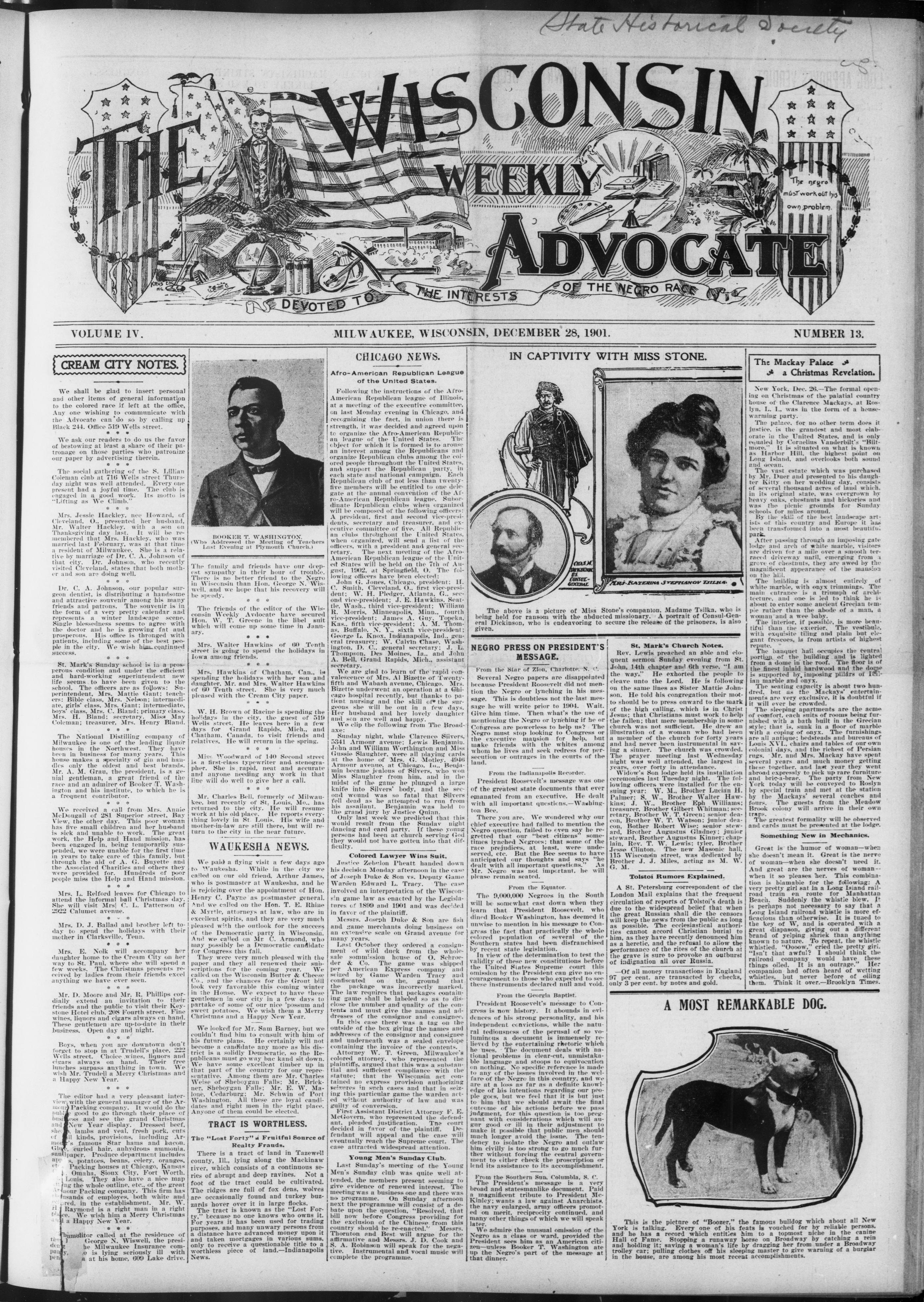
[Picture of a man in a suit with a bow tie].
BOOKER T. WASHINGTON. (Who Addressed the Meeting of Teachers Last Evening at Plymouth Church.)
The family and friends have our deepest sympathy in their hour of trouble. There is no better friend to the Negro in Wisconsin than Hon. George N. Wiswell, and we hope that his recovery will be speedy.
```markdown
```
The friends of the editor of the Wisconsin Weekly Avdocate have secured Hon. W. T. Greene in the libel suit which will come up some time in January.
※ ※ ※
Mrs. Walter Hawkins of 60 Tenth street is going to spend the holidays in Iowa among friends.
Mrs. Hawkins of Chatham, Can., is spending the holidays with her son and daughter, Mr. and Mrs. Walter Hawkins of 60 Tenth street. She is very much pleased with the Cream City paper.
W. H. Brown of Racine is spending the holidays in the city, the guest of 519 Wells street. He leaves here in a few days for Grand Rapids, Mich., and Chatham, Canada, to visit friends and relatives. He will return in the spring.
牵 恋 恋
Miss Woodward of 140 Second street is a first-class typewriter and stenographer. She is rapid, neat and accurate and anyone needing any work in that line will do well to give her a call.
※ ※ ※
Mr. Charles Bell, formerly of Milwaukee, but recently of St. Louis, Mo., has returned to the city. He will resume work at his old place. He reports everything lovely in St. Louis. His wife and mother-in-law are still there, but will return to the city in the near future.
WAUKESHA NEWS.
We paid a flying visit a few days ago to Waukesha. While in the city we called on our old friend, Arthur James, who is postmaster at Waukesha, and he is rejoicing over the appointment of Hon. Henry C. Payne as postmaster general. And we called on the Hon. T. E. Rhine & Myrtle, attorneys at law, who are in excellent spirits, and they are very much pleased with the outlook for the success of the Democratic party in Wisconsin. And we called on Mr. C. Armond, who may possibly be a Democratic candidate for Congress this fall.
They were very much pleased with the paper and they all renewed their subscriptions for the coming year. We called on the Wisconsin Butter & Cheese Co., and the chances for the Grout bill look very favorable this coming winter in the House. We expect to have these gentlemen in our city in a few days to partake of some of our nice 'possum and sweet potatoes. We wish them a Merry Christmas and a Happy New Year.
We looked for Mr. Sam Barney, but we couldn't find him to consult with him of his future plans. He certainly will not become a candidate any more as his district is a solidly Democratic, so the Republicans must go way bac kand sit down. We have some excellent timber up in that part of the country for our representative. Among them are Mr. Charles Weise of Sheboygan Falls; Mr. Brickner, Sheboygan Falls; Mr. E. W. Malone, Cedarburg; Mr. Schwin of Port Washington. All these are loyal candidates and right men in the right place. Anyone of them could be elected.
TRACT IS WORTHLESS.
The "Lost Forty" a Fruitful Source of Realty Frauds.
There is a tract of land in Tazewell county, Ill., lying along the Mackinaw river, which consists of a continuous series of abrupt and deep ravines. Not a foot of the tract could be cultivated. The ridges are full of fox dens, wolves are occasionally found and turkey buzzards hover over it in large flocks.
The tract is known as the "Lost Forty." because no one knows who owns it. For years it has been used for trading purposes, and many unwary persons from a distance have advanced money upon it and taken mortgages in various sums, only to receive a questionable title to a worthless piece of land.—Indianapolis News.
CHICAGO NEWS.
Afro-American Republican League of the United States.
Following the instructions of the Afro-American Republican league of Illinois, at a meeting of the executive committee, on last Monday evening in Chicago, and recognizing the fact, in union there is strength, it was decided and agreed upon to organize the Afro-American Republican league of the United States. The object for which it is formed is to arouse an interest among the Republicans and organize Republican clubs among the colored people throughout the United States, and support the Republican party, in each state and national campaign. Each Republican club of not less than twenty-five members will be entitled to one delegate at the annual convention of the Afro-American Republican league. Subordinate Republican clubs when organized will be composed of the following officers: A president, first and second vice-presidents, secretary and treasurer, and executive committee of five. All Republican clubs throughout the United States, when organized, will send a list of the officers, with a president and general secretary. The next meeting of the Afro-American Republican league of the United States will be held on the 7th of August, 1902, at Springfield, O. The following officers have been elected:
John G. Jones, Chicago, president; H. C. Smith, Cleveland, O., first vice-president; W. H. Pledger, Atlanta, G., second vice-president; J. E. Hawkins, Seattle, Wash., third vice-president; William R. Morris, Minneapolis, Minn., fourth vice-president; James A. Guy, Topeka, Kas., fifth vice-president; A. M. Thomas, Buffalo, N. Y., sixth vice-president; George L. Knox, Indianapolis, Ind., general treasurer; W. Calvin Chase, Washington, D. C., general secretary; J. L. Thompson, Des Moines, Ia., and John A. Bell, Grand Rapids, Mich., assistant secretary.
We are glad to learn of the rapid convalescence of Mrs. Al Bizette of Twenty-fifth and Wabash avenue, Chicago. Mrs. Bizette underwent an operation at a Chicago hospital recently, but thanks to patient nursing and the skill of the surgeons she will be out in a few days. Her husband and her lovely daughter and son are well and happy. We clip the following from The Broad axe:
Sunday night, while Clarence Silvers, 5341 Armour avenue; Lewis Benjamin, John and William Worthington and Miss Gussie Slaughter, were all playing cards at the home of Mrs. G. Motley. 4946 Armour avenue, at Chicago, In., Benjamin became jealous of Silvers, who won Miss Slaughter from him, and in the midst of the game he plunged a large knife into Silvers' body, and the second wound was so fatal that Silvers fell dead as he attempted to run from his assailant. Benjamin was held to the grand jury by Justice Quinn.
Only last week we predicted that this would result from the Sunday night dancing and card party. If these young persons had been at church serving God they would not have gotten into that difficulty.
Colored Lawyer Wins Suit
Justice Zebulon Pheatt handed down his decision Monday afternoon in the case of Joseph Duke & Son vs. Deputy Game Warden Edward L. Tracy. The case involved an interpretation of the Wisconsin game law as enacted by the Legislatures of 1899 and 1901 and was decided in favor of the plaintiff. Messrs. Joseph Duke & Son are fish and game merchants doing business on an extensive scale on Grand avenue for many years.
Last October they ordered a consignment of wild duck from the wholesale commission house of O. Schroeder & Co. The game was shipped per American Express company and seized by Game Warden Tracy and confiscated on the ground that the package was incorrectly marked. The law requires that packages containing game shall be labeled so as to disclose the number and quality of the contents and must give the names and addresses of the consignor and consignee.
In this case there was a tag on the outside of the box giving the names and addresses of the consignor and consignee and underneath was a sealed envelope containing the invoice of the contents.
Attorney W. T. Green, Milwaukee's colored attorney, who represented the plaintiffs, argued that this was a substantial and sufficient compliance with the statute; that the Wisconsin act contained no express provision authorizing seizures in such cases and that in seizing this particular game the warden acted without authority of law and was guilty of conversion.
First Assistant District Attorney F. E. McGovern, who represented the defendant, pleaded justification. The court decided in favor of the plaintiff. Defendant will appeal and the case will eventually reach the Supreme court. The case attracted widespread attention.
Young Men's Sunday Club.
Last Sunday's meeting of the Young Men's Sunday club was quite well attended, the members present seeming to give evidence of renewed interest. The meeting was a business one and there was no programme. On Sunday afternoon next the programme will consist of a debate upon the question, "Resolved, that bill now before Congress providing for the exclusion of the Chinese from this country should be re-enacted." Messrs. Thornton and Best will argue for the affirmative and Messrs. J. D. Cook and S. A. Robinson will speak for the negative. Instrumental and vocal music will complete the programme.
IN CAPTIVITY WITH MISS STONE.
CHAS M.
DARKINSON
US
CONSUL-
GENERAL
ARJ. KATERINA STEPHANOV TSILHA
The above is a picture of Miss Stone's companion, Madame Tsilka, who is being held for ransom with the abducted missionary. A portrait of Consul-General Dickinson, who is endeavoring to secure the release of the prisoners, is also given.
The above is a picture of Miss Stone's companion, Madame Tsilka, who is being held for ransom with the abducted missionary. A portrait of Consul-General Dickinson, who is endeavoring to secure the release of the prisoners, is also given.
NEGRO PRESS ON PRESIDENT'S MESSAGE.
From the Star of Zlon, Charlotte, N. C. Several Negro papers are disappointed because President Roosevelt did not mention the Negro or lynching in his message. This is doubtless not the last message he will write prior to 1904. Wait, Give him time. Then what's the use of mentioning the Negro or lynching if he or Congress are powerless to help us? The Negro must stop looking to Congress or the executive mausion for help, but make friends with the whites among whom he lives and seek redress for persecution or outrages in the courts of the land.
From the Indianapolis Recorder.
President Roosevelt's message was one of the greatest state documents that ever emanated from an executive. He dealt with all important questions.—Washington Bee.
There you are. We wondered why our chief executive had failed to mention the Negro question, failed to even say he regretted that our "best citizens" sometimes lynched Negroes; that some of the race prejudices, at least, were undeserved, etc. But the Bee seems to have anticipated our thoughts and says "he dealt with all important questions." As Mr. Negro was not important, he will please remain seated.
From the Equator
The 9,000,000 Negroes in the South will be somewhat cast down when they learn that President Roosevelt, who dined Booker Washington, has deemed it unwise to mention in his message to Congress the fact that practically the whole colored population of several of the Southern states had been disfranchised by recent state legislation.
In view of the determination to test the validity of these new constitutions before the United States Supreme court this omission by the President can give no encouragement to those who expected to see these instruments declared null and void.
From the Georgia Baptist.
President Roosevelt's message to Congress is now history. It abounds in evidences of his strong personality, and his independent convictions, while the natural tediousness of the perusal of so voluminous a document is immensely relieved by the entertaining rhetoric which he uses. The document deals with national problems in clear-cut, unmistakable language and stoops to equivocation on nothing. No specific reference is made to any of the issues involved in the welfare of the Negro in this country, and we are at a loss as far as a definite knowledge of his intentions regarding our people goes, but we feel that it is but just to him that we should await the final outcome of his actions before we pass judgment, for this question is too pregnant with considerations which will augur good or ill in their adjustment to make it possible that public men should much longer avoid the issue. The tendency to isolate the Negro and outlaw him civilly is too strong to go much further without forcing the central government to either check the proscription or lend its assistance to its accomplishment.
From the Southern Sun, Columbia, S. C.
The President's message is a very broad and statesmanlike document. Paid a magnificent tribute to President McKinley; wants a law against Anarchists, the navy enlarged, army officers promoted on merit, reciprocity continued, and many other things of which we will speak later.
We admire the unusual omission of the Negro as a class or ward, provided the President sees him as an American citizen—unless Booker T. Washington ate up the Negro's part of the message at that dinner.
St. Mark's Church Notes.
Rev. Lewis preached an able and eloquent sermon Sunday evening from St. John, 14th chapter and 6th verse, "I am the way." He exhorted the people to cleave unto the Lord. He is following on the same lines as Sister Mattie Johnson. He told his congregation their motto should be to press onward to the mark of the high calling, which is in Christ Jesus; that Christians must work to help the fallen; that mere membership in some church was not sufficient. He drew an illustration of a woman who had been a member of the church for forty years and had never been instrumental in saving a sinner. The church was crowded. The prayer meeting last Wednesday night was well attended, the largest in years, over forty in attendance.
Widow's Son lodge held its installation ceremonies last Tuesday night. The following officers were installed for the ensuing year; W. M., Brother Lucian H. Palmer; S. W., Brother Walter Hawkins; J. W., Brother Eph Williams; treasurer, Brother Gilbert Whitman; secretary, Brother W. T. Green; senior deacon, Brother W. T. Watson; junior deacon, Brother Robert Wise; senior steward, Brother Augustus Gladney; junior steward, Brother Augustus Kinner; chapplain, Rev. T. W. Lewis; tyler, Brother Jesse Clinton. The new Masonic hall, 115 Wisconsin street, was dedicated by Brother J. J. Miles, acting as M. W. G. M.
Tolstoi Rumors Explained.
A St. Petersburg correspondent of the London Mail explains that the frequent circulation of reports of Tolstoi's death is due to the widespread belief that when the great Russian shall die the censors will keep the news from the public as long as possible. The ecclesiastical authorities cannot accord Christian burial to him, as they have recently denounced him as a heretic, and the refusal to allow the performance of the rites of the church at the grave is sure to provoke an outburst of indignation all over Russia.
Of all money transactions in England 97 per cent. are transacted by checks, only 3 per cent. by notes and gold.
A MOST REMARKABLE DOG.
This is the picture of "Boozer," the famous bulldog which about all New York is talking. Every one of his feats is vouchered for by reliable persons, and he has a record which entities him to a topmost niche in the canine Hall of Fame. Stopping a runaway horse on Broadway by catching a rein and holding it; saving a woman's life by dragging her from under a Broadway trolley car; pulling clothes off his sleeping master to give warning of a burglar in the house, are among his most recent accomplishments.
This is the picture of "Boozer," the famous bulldog which about all New York is talking. Every one of his feats is vouchered for by reliable persons, and he has a record which entities him to a topmost niche in the canine Hall of Fame. Stopping a runaway horse on Broadway by catching a rein and holding it; saving a woman's life by dragging her from under a Broadway trolley car; pulling clothes off his sleeping master to give warning of a burglar in the house, are among his most recent accomplishments.
The Mackay Palace a Christmas Revelation.
New York, Dec. 26.—The formal opening on Christmas of the palatial country house of the Clarence Mackays, at Roslyn, L. L., was in the form of a housewarming party.
The palace, for no other term does it justice, is the grandest and most elaborate in the United States, and is only equaled by Cornelius Vanderbilt's "Biltmore." It is situated on what is known as Harbor Hill, the highest point on Long Island, and overlooks both sound and ocean.
The vast estate which was purchased by Mr. Duer and presented to his daughter Kitty on her wedding day, consists of several thousand acres of land which, in its original state, was overgrown by heavy oaks, chestnuts and hickories and was the picnic grounds for Sunday schools for miles around.
By the skill of the best landscape artists of this country and Europe it has been transformed into a most beautiful park.
After passing through an imposing gate lodge and arch of white marble, visitors are driven for a mile over a smooth terraced driveway until, emerging from a grove of chestnuts, they are awed by the magnificent appearance of the mansion on the hill.
The building is almost entirely of white marble, with onyx trimmings. The main entrance is a triumph of architecture, and one is led to think he is about to enter some ancient Grecian temple rather than the abode of a man, a woman and a wee baby.
The interior, if possible, is more beautiful than the exterior. The vestibule, with exquisite tiling and plain but elegant frescoes, is from artists of highest repute.
The banquet hall occupies the central portion of the building and is lighted from a dome in the roof. The floor is of the finest inlaid hardwood and the dome is supported by imposing pillars of Italian marble and onyx.
The seating capacity is about two hundred, but as the Mackays' entertainments are very exclusive, it is doubtful if it will ever be crowded.
The sleeping apartments are the acme of comfort, each suits of rooms being furnished with a bath built in the Grecian style; that is, sunk in a floor of marble with a coping of onyx. The furnishings are all antique; bedsteads and bureaus of Louis XVI, chairs and tables of our own colonial days, and the richest of Persian rugs. Mr. and Mrs. Mackay have spent several years and much money getting these together, and last year they went abroad expressly to pick up rare furniture and brize-a-brac. The party from New York today will be conveyed to Roslyn by special train and met at the station by the Mackays' several coaches and fours. The guests from the Meadow Brook colony will arrive in their own traps. The greatest formality will be observed and cards must be presented at the lodge.
Something New in Mechanics.
Great is the humor of woman—when she doesn't mean it. Great is the nerve of woman—when she doesn't need it. And great are the nerves of woman—when it so pleases her. This combination is blamable for the following: A very pretty girl sat in a Long Island railroad train en route for Manhattan Beach. Suddenly the whistle blew. It is perhaps not necessary to say that a Long Island railroad whistle is more efficacious than otherwise. It is tuned to the key of W, and is operated with a great diapason, giving out a different brand of yelping shriek than anything known to nature. To repeat, the whistle whistled. "Oooow," cried the pretty girl. "Isn't that awful? I should think the railroad company would have these things oiled. It is an outrage." Her companion had often heard of wetting whistles, but never before of oiling them. Think it over.—Brooklyn Times.
LONG APPROVES VERDICT.
Findings of Admirals Benham and Ramsay Upheld.
MILES IS REPRIMANDED
Case is Now Finally Closed as Far as the Navy Department is Concerned
Washington, D. C., Dec. 21.—Secretary Long has disposed finally of the Schley case so far as the navy department is concerned by acting upon the findings and conclusions of the court of inquiry. He approves the findings of fact and the opinion of the full court; he approves the majority opinion where there is a difference in the court; he holds that the court could not have entered into a consideration of the question of command at the battle of Santiago, and finally he accepts the recommendation that no further proceedings shall be had.
The secretary also has declined the application of Admiral Sampson's counsel to enter upon an inquiry into the question of command and has notified Admiral Schley's counsel of that fact as a reason for declining to hear them on that point.
Secretary Long's approval of the majority report was as follows:
The department has read the testimony in this case; the arguments of counsel at the trial; the court's findings of fact, opinion and recommendation; the individual memoranda of the presiding member; the statement of exceptions to the said findings and opinion by the applicant; the reply to said statement by the judge advocate of the court and his assistant, and the brief this day submitted by counsel for Rear-Admiral Sampson traversing the presiding member's view as to who was in command at the battle of Santiago.
And after careful consideration the findings of fact and the opinion of the full court are approved. As to the points on which the presiding member differs from the majority of the court, the opinion of the majority is approved.
As to the further expression of this views by the same member, with regard to the question of command on the morning of July 3, 1898, and of the title to credit for the ensuing victory, the conduct of the court in making no finding and rendering no opinion on those questions is approved—indeed, it could with propriety take no other course—evidence on these questions during the inquiry having been excluded by the court.
The report approves the recommendation of the court that no further proceedings be had in the premises.
The department records its appreciation of the arduous labors of the whole court. (Signed)
JOHN D. LONG,
Governor of the Navy
Long's Letter to Sampsons
The text of the secretary's letter to Admiral Sampson's attorneys and to Admiral Schley follows:
Navy Department, Washington, D. C., Dec. 20, 1901.—Gentlemen: In view of the department's approval this day of the recommendation of the court of inquiry in the case of Rear-Admiral Schley, that no further proceedings be had, and of the fact that the question of command was excluded from consideration by the court, the department will take no action upon the brief filed by you in behalf of Rear-Admiral William T. Sampson. Very respectfully,
JOHN D. LONG,
Secretary.
Messrs. Stayton, Campbell & Theall Johnston building, 30 Broad street, New York
Long's Letter to Schley.
Navy Department, Washington, D. C., Dec. 20, 1901—Sir: Referring to the department's letter of the 13th instant, you are advised that action today has been taken upon the findings, opinions and recommendation of the court of inquiry in your case, and upon the minority opinion of the presiding member, and a copy of the endorsement embodying such action is herewith transmitted for your information. In response to your request of the 18th instant, heretofore acknowledged, that if a protest should be filed by Rear-Admiral W. T. Sampson relative to the question of command of the American naval forces during the battle of Santiago and credit for the victory won in that battle, you be accorded an opportunity to present, through your counsel, oral argument against such protest, you are advised that a brief on the subject has this day been filed by Messrs. Stayton, Campbell & Theall, counsel for Admiral Sampson.
A copy of the report of the judge advocate of the court and his assistant, upon your communication of the 18th instant, objecting to the approval of the findings of the court, is also herewith transmitted. Very respectfully, JOHN D. LONG, Secretary. Rear-Admiral Winfield S. Schley, U. S. Navy (retired), The Richmond, Washington, D. C.
"Arbitrary and Tyrannical."
Baltimore, Md., Dec. 21.—Isidor Raynoi, attorney-general of Maryland and counsel for Admiral Schley, when shown the decision of Secretary Long today declared the "whole proceeding is arbitrary and tyrannical" and manifested great surprise and indignation.
"The court decided the case," said he, "without considering the testimony of Admiral Schley and his witnesses, and Secretary Long seems to have decided it without so much as permitting us to file a reply to the protest filed by Admiral Sampson's attorneys.
"This protest was filed late yesterday afternoon and just one hour ago we finished our reply to it and sent it to Washington. Now I understand the secretary has decided against Admiral Dewey and adverse to Schley's being in command at Santiago and virtually in favor of Sampson without even permitting us to produce before him the conclusive proof, admitted at the hearing by consent, that the command practically and officially devolved upon Schley. The whole proceeding is too arbitray and tyrannical for me now to discuss. I really wonder whether the people who live under free institutions will tolerate the exercise of such despotic measures.
"You ask me what our next step will be. I do not know unless the President intervenes. There is a power in the courts to compel the secretary to file the dissenting opinion of Admiral Dewey whether he agrees with it or not. We will determine next week what proceedings we will adopt." When seen at his hotel this afternoon, Admiral Schley stated that he did not care to make any comment whatever upon the action taken by Secretary Long on the findings of the court of inquiry. The admiral said he would leave Washington Monday next for New York city, where he will remain for an indefinite period.
Messrs. Rayner and Teague of counsel for Admiral Schley were in Baltimore today and in their absence the admiral was not prepared to say whether any further action would be taken in his behalf at the navy department or in Congress or whether or not a final appeal to President Roosevelt would be made.
Secretary Long this afternoon issued the formal order dissolving the Schley court of inquiry. The order was communicated at once to Admiral Dewey, president of the court, who acknowledged its receipt and said that in conformity with the order of the secretary he had announced the dissolution of the court.
The following order was made public
this afternoon by Secretary of War
Root:
Navy Department, Washington, D. C., Dec. 20—Rear-Admiral A. S. Barker, Commandant Navy-yard, New York—Sir: I am directed by the President to ask Edgar S. Maclay, special labor, general storekeeper's office, navy-yard, New York, to send in his resignation. Very respectfully,
MILES ASKED TO EXPLAIN.
Says Comment on Schley Verdict Did Not Refer to Court of Inquiry.
Washington, D. C., Dec. 21.—Secretary Root has determined that the Sampson-Schley controversy which has tormented the navy since the Spanish war shall not invade the army. Therefore, when his attention was drawn to an interview published in a Cincinnati paper wherein Gen. Miles is represented to have commented upon the findings of the court of inquiry, the secretary immediately decided to call upon Gen. Miles for an explanation. He did this through a letter which was delivered to the general by hand. Today Gen. Miles was at the secretary's door almost as soon as the office opened. He had a verbal explanation to make and this he accompanied by a letter. Secretary Root took the letter to the white house and talked with President Roosevelt over the matter with a view to deciding whether or not the explanation was satisfactory. When the secretary returned to the war department Gen. Miles called again upon him and supplemented his first letter with a further explanatory note. This also was sent to the white house. It is understood the incident will be terminated on the basis of Gen. Miles' last explanation.
Gen. Miles was unwilling to say anything as to what official action had been taken or would be taken on the subject. When asked concerning the publication which is the basis for the official inquiry now directed to him, Gen. Miles said the expressions used referred to individuals and not to any court or branch of the government. What had been said was to the effect that he had no sympathy with efforts which seem to have been made to reflect upon the courage and efficiency of an officer. The statement, however, was not uttered against the action of the court of inquiry, but was intended as an expression of depreciation for individual acts calling in question the fidelity and courage with which an officer had executed the duties falling upon him.
Miles Reprimanded.
Secretary of War Root, by direction of the President, administered a strong reprimand to Lieut-Gen. Miles for uttering the sentiments attributed to him in the Cincinnati interview touching the Schley case. The secretary says in part: "You have no business in the controversy and no right, holding the office which you did, to express any opinion."
ANOTHER EXPLOSION.
Three Fatal Disasters In Pittsburg Iron District Within Three Days.
Pittsburg, Pa., Dec. 21.—For the third time within seventy-two hours Pittsburg steelworkers have been killed or maimed by terrific explosions. Following on the heels of awful disasters at the Soho furnace of Jones and Laughins on Thursday and at the Black Diamond Steel works yesterday, the city was shocked this morning by the report of another explosion at Singer-Nimicks' West End plant of the Crucible Steel company, in which seven were scaled, one badly cut and twenty or thirty other slightly burned
At 6:55 o'clock two of a battery of five boilers used to operate the sheet mill exploded with terrific force. Scalding water played havoc among the sixty workmen, who had just started in for the day, while pieces of the boilers caused great destruction to the mill property. Of the seven men scalded, two, it is said, will die. The injured at the hospital are:
The injured at the hospital are: Charles Miller, engineer, aged 26 years, married, scalded about head and face and chest. William George, aged 45, married, a roller, scalded about head and chest. William Reed, 50 years, roller, married.
scalded about face and shoulders. Ford Reed, 19 years, son of William,
scalded about face and arms. John Brown, 45 years, roller, scaled about face and arms. Boyd Johnson, engineer, 38 years, scaled about face and shoulders.
There were at least twenty other men at work in the mill at the time of the explosion who were more or less injured. The men were all hurt by escaping steam
The cause of the explosion is attributed to frozen pipes which supplied the boilers with water.
TRAIN IS DERAILED.
Engineer, Fireman and Three Passengers are Injured.
New York, Dec. 21.—A passenger train on the Erie railroad was derailed at the tunnel in Jersey City today. The engineer and fireman and three passengers were injured, but none of them was fatally hurt. The engineer of the train, George E. McKinnon, was scalded on the legs and body and his head was lacerated. William Marks, the fireman, was badly scalded about the body and head, and the surgeons at the hospital said his condition was serious. A'fred E. Badgely, Franklin P. Ketcham and Parker G. Jacobus of Montclair, N. J., and Joseph Morris of Arlington, N. J., passengers, were burned and bruised.
BURNS IN BLAZING LOTION.
Girl Student's Effort to Cure Supposed Leprosy Causes Her Death.
Philadelphia, Pa., Dec. 21.—Miss Lillian Vickers of Los Angeles, Cal., a student at Bryn Mawr college, was burned to death in her room in college hall. The giri was roasted alive, her entire body being charred to a crisp. Believing that she had contracted leprosy, Miss Vickers covered herself with alcohol as a remedy. She applied the alcohol freely on every limb and by some accident the alcohol caught fire. In a flash the young girl was enveloped in flames. She was unable to help herself and like a human torch she fled from her room into the hallway, screaming with pain until she fell into unconsciousness.
RELEASED ON BAIL.
Mrs. Dale's Friends Furnish the Sum
Required, $5000, in Cash.
New York, Dec. 21.—Mrs. Elizabeth Dale, who was held in custody at St. Mary's hospital, Hoboken, pending the result of an investigation into the death of her 5-year-old daughter Emeline, was taken before Judge John A. Blair in Jersey City today. Application for Mrs. Dale's release on bail was made and Judge Blair fixed the sum at $5000. This was furnished in cash and Mrs. Dale was released.
SEVERE PUNISHMENT.
Penalty for Running Away After Causing an Accident.
Paris, Dec. 21.—The French Chamber of Deputies has agreed to the bill inflicting from six days to two months' imprisonment, with a fine of from 16 francs to 500 francs, on any cyclist or motorcar driver who, after causing an accident, attempts to run away.
RAN DOWN A DECLINE.
Trolley Car Rushes Over Slippery Rails at Frightful Speed.
SIX PERSONS KILLED.
Car Jumps the Track and is Split in Two After Striking a Telegraph Pole.
Allentown, Pa., Dec. 24.—Six persons were killed and at least ten injured in a trolley accident last evening. It was the last car of the day and was crowded with holiday shoppers and others residing in the rural districts.
The accident took place at the southern base of Lehigh Mountain. The dead:
MRS. D. FETZER of Coopersburg.
TOBIAS KESSLER, a retired Reformed minister of Center Valley.
AMBROSE REINHART of Allentown.
MR. REIMER, a farmer of Zion's Hill.
FRANK WESLEY of Allentown.
ALBERT YEAGER of Allentown.
Of the injured Mrs. Albert Yeager of Allentown, who has concussion of the brain, and Edwin Simon of Lannark, who is hurt internally, are likely to die.
At the point where the accident occurred there is a heavy decline, down which the car started at a rapid rate of speed. A heavy rain had made the rails so slippery that Motorman Stocker's efforts to stop it were of no avail. In a moment the car was beyond his control and went flying around the curves at terrific speed.
The passengers, panic stricken, made desperate efforts to escape from the car, but were restrained by Conductor Leidig. At a sharp curve the car left the track, struck a trolley pole, was split in two, and collapsed on its side, with its human cargo tangled up in the debris.
The screams of the injured and dying brought farmers rushing to the scene. Mr. Reinhart's body was forced through the roof of the car, and he was crushed to death.
Paralleled in San Francisco.
San Francisco, Cal., Dec. 24.—One person was killed and several wounded in a peculiar accident on the Fillmore street electric car last night. Dead:
MRS. MARY PHELAN, domestic; died from fracture of skull.
Injured:
Mrs. M. K. Mansie, wife of William Mansle; foot crushed and scalp wounds; will recover.
Mrs. Mary Kelly, domestic; bruised and suffering from shock.
Robert Keller, knee injured.
Robert Rodgers, cut over eye.
Miss Josephine Bigley, ct over forehead and bruises on back of head.
Mr. Turner, contusions and shock. Mrs. O'Connor, injuries very slight. For four blocks south of Union street the grade is so steep that the cars have to be pulled up the hill by special machinery. As a car containing fifteen people had nearly reached the top of the hill it broke loose in some manner and rushed down with frightful speed. It kept the track until Union street was reached, but here there was an empty car waiting to be hauled up. This obstruction was wrecked by the runaway car, which then jumped the rails and was brought to a standstill by a telegraph pole which it struck with terrific force, completely demolishing the car and scattering the occupants in all directions. Help was at hand and the injured passengers were given immediate care.
CONFINED TO ROOM.
Former President Grover Cleveland Not Recovered from Recent Illness.
Princeton, N. J., Dec. 24.—Mrs. Grover Cleveland made the following statement today concerning the health of the former President:
"The reports that have been published in regard to Mr. Cleveland's health apparently have been construed as indicating his entire recovery. This is shown by a renewal of all sorts of applications for all sorts of things which can hardly be considered even by a man in robust health. He already has received severe epistolary chastisement at the hands of those who are impatiently waiting for answers to letters which should never have been written. While Mr. Cleveland's health is such as to entirely relieve his friends from any apprehensions he is yet far from well and has not been able to leave his room for nearly five weeks."
Camden, N. J., Dec. 24.—United States Senator Sewell was reported by his physician this morning to be slightly weaker, but there has been no serious change in his condition during the past few days. He rested well last night.
Detroit, Mich., Dec. 24.—It was reported at Gen. Alger's house this morning that he passed a very comfortable night and is resting easily.
Washington, D. C., Dec. 24.—Capt. Francis A. Cook, who is ill at the United States naval hospital here, is improving slowly. His physician states that it will be two weeks before he will be able to be out.
Washington, D. C., Dec. 24.—The condition of Gen. William H. Seamans of California, who is seriously ill here, has not grown worse. At his hotel it is said that if there has been any change at all it is for the better.
London, Dec. 24.—Queen Alexandra is progressing satisfactorily toward recovery.
ATE POISONED PORK.
Entire Family at Columbus, O., are Made Ill in Consequence.
Columbus, O., Dec. 24.—Charles C. Lemert, executive clerk to Gov. Nash, and his entire family were poisoned by eating pork for dinner last evening. Some time after the meal members of the family were taken ill and a physician was summoned who pronounced the illness due to the condition of the meat. Mr. Lemert was unable to be at his office today, but it is thought his condition is not serious.
IN TOO GREAT A HUBBY.
Miner Tries to Thaw Out Stick of Dynamite with Disastrous Results. Tacoma, Wash., Dec. 24.—As a result of his haste to thaw a stick of dynamite Andrew Pavik, a miner, was blown to pieces Saturday evening. Pavik's right leg was shattered. Both his arms were blown off, the flesh was ripped off his feet and the force of the explosion blew every stitch of clothes off his body. In this condition Pavik lingered for nearly six hours before he died.
BOER LAAGER TAKEN.
Col. Branders Captures Sixty Prisoners in Pietersburg District.
Pretoria, Dec. 24.—Lieut.-Col. Branders' force surprised a Boer laager in the Pietersburg district December 22 and captured sixty prisoners.
London, Dec. 24.—Lord Kitchener, in a dispatch dated Johannesburg, Monday, December 23, reports the week's results as being 45 Boers killed, 25 wounded, 310 made prisoners and 35 surrendered.
JENNIE JUNE IS DEAD.
Well-Known Authoress and Founder of Sorosis Passes Away.
New York, Dec. 24 - Mrs. Jennie C. Croly, widely known by her pen name, "Jennie June," died yesterday of heart failure. She had never fully recovered her health after the fall in which she broke her hip, two years ago, and last year heart trouble developed. The burial will be at Lakewood, N. J., where Mr. Croly is interred. Mrs. Croly's son and daughter and her daughter-in-law were with her when she passed away.
Jennie Cunningham Croly was the daughter of a Unitar in minister and was born in Market Harborough, Leicestershire, England, on December 19, 1830. Her family came to the United States when she was 9 years old and most of her life has been passed in this city. She began to write at an early age, and had been cailed the pioneer newspaper woman. Marrying a newspaper man, David G. Croly, when extremely young, she wrote for the papers with which he was connected and for many others. Over the signature "Jennie June," Mrs. Croly conducted departments in several periodicals and corresponded with others until within a few years. She is said to have introduced the "syndicate" system and many other newspaper novelties.
Was Founder of Sorosis.
She has been termed "the mother of clubs," because Sorosis, the pioneer woman's club, was founded by her, and the Federation of Women's clubs owes its existence to her. Sorosis was organized in 1868, and Mrs. Croly was asked to be its president, but refused. She accepted the vicepresidency, with Alice Cary as chief officer. Mrs. Croly became the second president, however, being elected by acclamation. From that time until the accident, two years ago, that unfitted her for active work. Mrs. Croly remained one of the most energetic members of the club, and was its president from 1874 to 1886.
The General Federation of Women's clubs was the offspring of her happy thought to celebrate the twenty-first birthday of Sorosis, in 1889, by a convention of women's clubs, with the ultimate object of forming a federation, which was organized in the year following.
Mrs. Croly was most unfortunate during the last years of her life. In addition to her ill-health and helplessness, the enterprises in which her money was invested failed and her income was greatly reduced. Sorosis claimed the right to provide for Mrs. Croly, and had done so for a short time.
Mrs. Croly leaves a son, Herbert, and two daughters, Mrs. Fred Sidney, now in England, and Mrs. William Mathot.
Channing, the Poet, Dies.
Concord, Mass., Dec. 24.—William Ellery Channing, author, died yesterday. He was a writer of marked originality and poetic power. His published volumes number nine, and he left copious manuscripts from which selections will be made for publication later.
William Ellery Channing was the son of Walter Channing of the famous New England family. He was named for his uncle, William Ellery Channing, the New England preacher, orator, and author, whose work in the cause of abolition made him even more prominent than his books.
Channing was born in Boston on June 10, 1818, and was educated at Round Hill school, Northampton, at the Boston Latin school, where he had Charles Sumner as instructor, and at Harvard.
In 1839 Channing moved to Illinois and built himself a log house, in which he lived eighteen months. He then removed to Cincinnati and went to work as a reporter on the Gazette. He returned to Massachusetts in 1842, married Ellen Fuller, a sister of Margaret Fuller, and settled in Concord.
In Concord Channing joined the brotherhood of authors including Thoreau, Hawthorne and Emerson. He was on the editorial staff of the New York Tribune in 1844 and 1845, and later was editor of the New Bedford Mercury.
In 1836 his verses appeared prominently, and he published a series of essays on Shakespeare. He published several volumes of poems, including "The Wanderer," "Near Home," and "The Woodman." His "Life of Thoreau" was his best-known prose work.
SUES ESTATE OF MAGNATE.
Handsome Widow Claims Part of Cleveland Millionaire's Rickes.
Columbus, O., Dec. 24.—Suit was filed in the United States court by Mrs. Alice Fleming, a handsome widow of Philadelphia, for the possession of a large portion of the estate of the late millionaire banker, Carey B. Paul of Delaware, O. The claim is based on three promissory notes, which Mrs. Fleming holds, signed by Mr. Paul, one for $1000, one for $5000 and the third for $35,000. In addition to these notes plaintiff lays claim to 200 shares of stock in the First National bank of Delaware, of which institution Mr. Paul was president at the time of his death. This stock is valued at $28,000.
The claim of Mrs. Fleming will be bitterly fought by Mrs. Paul and her children. Numerous efforts have been made to compromise the case, which, it is asserted, will result in disclosing a romance in connection with the lives of Mr. Paul and Mrs. Fleming, but all have been unavailing. Mrs. Fleming says her relations with the deceased banker were of a purely business character.
STOLE HUSBAND'S LOVE.
Wisconsin People Principals in Case at Cando, N. D.
Cando, N. D., Dec. 24.—The jury in the case of Irene C. King vs. Mary D. Hanson for alienating the affections of Mr. King returned a verdict for $6000 damages. Mrs. Hanson has a hotel at Rice Lake, Wis., and King was in her employ. As the laws of Wisconsin, it is said, do not permit one woman to bring action against another for the alienation of the affections of the husband of complainant, the action was brought in this county, and an attachment was levied upon Mrs. Hanson's property here.
Russia Menaces Austria.
It has just been reported that Russia is quietly constructing two more strategic railways to the Austrian frontier, by means of which the mobilization and concentration of troops from the extreme North and extreme South of the Russian empire, on the confines of Galicia, could be hastened by fully five days. Both lines, it is said, will be finished by February next.—Paris Messenger.
To Suppress Barking Dogs
The Omaha council is considering an ordinance imposing a one of $20 on any person who, after being notified, permits his dog to bark to the annoyance of the neighbors. Offenders must either send their dogs to the country, kill them or shut them up.
—Russia is believed to be making a great effort to get within her control the overland China tea trade.
—The most extensive cemetery in the world is that at Rome, in which over 6.000,000 human beings have been interred.
MACHINISTS' STRIKE LIKELY TO END SOON.
MACHINISTS' STRIKE LIKELY TO END SOON.
Conferences are Held and Amicable Adjustment of Differences Seems Certain.
Chicago, Ill., Dec. 24.—A settlement of the long strike at the Allis-Chalmers machine shops which has involved 400 union workmen and resulted in a murder and many assaults, is in sight. Two conferences were held yesterday between W. J. Chalmers and Attorney W. J. Calhoun for the company and Business Agent Arthur E. Ireland and Attorney Clarence Darrow for the men, and both sides showed a disposition to reach an amicable adjustment.
It is expected that terms of settlement will be agreed upon and ratified within the next few days. It is understood that the ten-hour day will be abandoned and a return will be made to the nine-hour day that was in force at the time the strike was called. It is said that the question of wages and also how many strikers will be taken back and what disposition is to be made of the nonunion men who took the strikers' places are the main points under discussion.
As an initial move the machinists, on the advice of Mr. Darrow, dismissed the conspiracy case in Justice Prindiville's court that had been brought against Mr. Chalmers and his superintendent, Henry A. Penton.
The strike has been on since May 30 and has been really a test of strength between the International Association of Machinists and the National Metal Trades' association. It has cost the company about $300,000 and the union has spent $30,000 in carrying on the fight.
Recent Developments Indicate that it will be a Serious
Fort De France, Island of Martinique, Dec. 24.—(Via Haytian cable.)—The Venezuelan gunboat Restaurador left here during the night. Her destination is unknown. The British steamer Ban Righ said to be loaded with arms and ammunition intended for the adherents of Senor Matos has arrived here from Antwerp, which port she left November 29. Another alleged revolutionary vessel has been signaled to the eastward of this island. There was fighting yesterday in Venezuela, where the revolutionary movement is spreading. The engagement took place at Villa do Coura (about fifty miles from Caracas) and it is reported that the revolutionary commander, Gen. Luciano Mendoza was defeated by the government troops.
Fighting has also occurred in the state of Carabobo, but definite news on the subject is difficult to obtain.
A dispute has arisen between the officials of the German railroad running from Caracas to Valencia and the government.
All traffic is suspended between those two points and the railroad stations are occupied by troops.
Great excitement prevails everywhere in Venezuela, particularly at Caracas. The situation is very serious.
Gen. Matos is at the Ivanes hotel here.
The German cruiser Falke is at Porto Cabello and the Dutch cruiser Utrecht is at Laguayra.
New York, Dec. 24.—The revolution against the Castro government which has broken out in Venezuela is a serious affair, according to the Fort de France (Martinique) correspondent of the Herald
The first leaders to rise against the President were Gens. Luciano Mendoza and Cedeno. Gen. Mendoza is president of the state of Arazua and Gen. Cedeno is director of customs at Puerto Cabello. Gen. Mendoza is now marching upon La Victoria, an important point in the vicinity of Caracas. Gen. Cedeno wishes to rescue Gen. Ramon Guerra, formerly minister of war, who is a prisoner in the fortress of Puerto Cabello. The insurrection has spread eastward toward Barquisimeto, in the state of Lara, and toward the state of Falcon. The insurgents are well armed and are about to receive a further supply of guns, rifles and ammunition. The Venezuelan warship Restaurador has arrived here to watch for and try to intercept the steamer which is bringing these munitions of war for the revolutionists.
TURKEYS FROM TEDDY
President Roosevelt Distribute Eighty-seven Birds Among White House Employes.
Washington, D. C., Dec. 24.—Eighty-seven big turkeys were distributed to the white house policemen, messengers, ushers, servants, gardeners and stablemen today with the compliments of the President. Each turkey had on it a card bearing the season's compliments. The distribution was the largest ever made at the white house. President McKinley always gave turkeys to the married employees, but the list of recipients was never so large as that of today. The turkeys were distributed by Henry Pickney, the white house steward.
Express wagons, mail carriers and messengers bore numerous packages to the white house today, presents to the Roosevelt family from friends and admirers throughout the country. Many of the packages were for the children, who will not be allowed to have them until tomorrow. The programme at the white house tomorrow will follow the custom of the family in former years. There will be no Christmas tree, as a tree never has been a part of the celebration of Christmas in the Roosevelt family. The children, however, all hang up their stockings and they will arise early tomorrow to visit them and ascertain what Santa Claus has left for them. Later in the morning the children will assemble in the library, there to receive gifts from their father and mother. In the afternoon the Roosevelt juveniles will go to the home of their uncle and aunt, Capt. and Mrs. Cowles, to see a pretty Christmas tree, and receive other presents. The Christmas dinner will be served at 7:30 and only the family be present.
On Thursday, if the weather permits, it is probable that the Roosevelt family, including the President, will go down the Potomac river on a cruise. Theodore Roosevelt, Jr., is going on a hunting trip with Dr. Rixey and is very anxious that his father should accompany him. The President is inclined to do so if public business will permit. Even if the President cannot go it is the present intention of Mrs. Roosevelt and some of the other children to accompany Dr. Rixey and Theodore, Jr.
MADE A FAST TRIP.
Steamer Crosses Ocean in 5 Days, 15 Hours and 15 Minutes. New York, Dec. 24.—The steamship Kron Prinz Wilhelm steamed into port yesterday after having broken its best previous record from Cherbourg to New York by three hours and twenty-one minutes. The voyage was made in 5 days, 15 hours and 45 minutes. This also beats the best record that has been made so far by its sister ship, the Kaiser Wilhelm der Grosse, which is 5 days, 16 hours and 24 minutes. The steamship brought nearly thirty tons of Christmas mail.
Senate.
The bill temporarily to provide revenue for the Philippine islands which was passed by the House of Representatives yesterday was received by the Senate on the 19th and referred to the committee on Philippines. Senator Hanna introduced a bill granting a pension of $5000 a year to Mrs. McKinley, widow of the late President. At 12:40 p.m. the Senate went into executive session, and twenty minutes later adjourned until the 6th prox.
House.
The House on the 19th agreed to consider the Nicaragua canal bill on the 7th prox. and thereafter until disposed of the order not, however, to interfere with revenue or appropriation bills. The House adjourned to the 8th prox.
Chicago News.
An unidentified woman threw herself under an Illinois Central locomotive at Thirty-first street and was killed. It was necessary to cut off an arm before she could be removed.
Solomon Weinfeld, assistant manager of the cloak and fur department in Siegel, Cooper & Co.'s dry goods store, was arrested on a charge of larceny. It is thought the shortage will amount to $5000.
Authority for Comptroller McGann to borrow $700.000 with which to pay all outstanding bills of the city, the sum to be obtained in anticipation of the 1901 tax levy, which has not yet been collected, was recommended yesterday by the council committee on finance.
—Miss Lillian Schlote died at her home, 132 Bissell street, from shock and fright, causing inflammation of the brain. The woman was a passenger on a Northwestern elevated railroad train on the morning of November 19 when two trains collided in the fog.
—John Webber and Stephen Hinspberger were found dead in a room at the St. James hotel from the inhalation of illuminating gas. The men arrived from North Dakota and were on their way to Ontario, Canada. It is believed they blew out the gas.
—Thomas W. Stout, 70 years of age, who in 1870 was elected a member of the Chicago city council and served two terms in that body, has been adjudged insane and committed to the Jefferson asylum.
While attempting to evict a man from his shop John Irwin of the firm of Irwin Brothers, provision merchants, was stabbed with a case knife. He was taken to the Emergency hospital. His assailant escaped arrest.
By the accidental spilling of a ton of molten iron four employes of the McCormick Harvesting Machine company were badly injured. The injured were Frank Bienstark, aged 31; William Dank, aged 23; Andrew Kreda, aged 27, and Frank Dedi.
Thomas Carson, an old resident of Chicago and a brother of Mrs. Arthur Dixon, died at his home at the age of 64. He is survived by his wife and five daughters—Mesdames Alfred Barron, Guy Hall and Thomas Carson and Misses Harriet and Ida Carson.
James G. Hubbell, chief clerk in the office of Comptroller McGann, sustained a fall that resulted in a scalp wound four inches long and a fractured leg. He was unconscious four hours. Mr. Hubbell's injuries will confine him to his home for several weeks.
William Deering, the founder and senior partner in the Deering Harvester company, has retired from the company of which he has been the head for nearly a third of a century, the transfer of Mr. Deering's undivided interest in the company being recorded yesterday. Mr. Deering's retirement is due to his advanced age and ill-health. The management of the firm will remain unchanged and will continue along the same lines. While on their way to work two young girls were struck by a Pittsburg, Fort Wayne & Chicago suburban train at a crossing. One of them died a few hours later at a hospital, and the other is so badly injured that the doctors say she cannot live. Mary Novak. 19 years old, died at the Provident hospital. Dora Hepel, 15 years old, suffered a fractured skull; armis broken and head bruised. Two other girls who were with them escaped injury.
LATEST MARKET REPORTS.
Milwaukee, Dec. 24, 1901.
EGG AND DAIRY PRODUCTS.
MILWAUKEE—Eggs—Market firm; fresh new, cases included, 24½¢; fresh, cases returned, 24¢; storage, 20@21e; country storage, 17@19c; seconds, 9c. Receipts were 90 cases.
NEW YORK — Butter — Receipts, 6378 pkgs, firm; state dairy, 15@23c; cremery, 16@25c; June cremery, 15@21c; factory, 12½@15¼¢; cremery, 14@18¼¢. Cheese—Receipts, 3642 pkgs; quiet but firm; late made, best, large, 9¼¢; do small, 10@10¼¢; state full cream, large, fall made, fancy, 10¼@10¼¢; do small, 11@11¼¢. Receipts, 10,413 pkgs; steadier; state and Pennsy' vanla, 29c; Western, at mark, 23@28c; Southern, at mark, 23@27c. Coffee—Steady; No. 7 Rio, 6¢.
CHICAGO—Butter — Steady; creameries, 15@24c; dairies, 14@20c. Cheese—Steady; twins, 9%@10c; daisies, 101%@101%c. Young Americas, 10%@101%c. Eggs—Weaker; loss off, cases returned, 26c. Dressed poultry—Easy; turkeys, 6@10c; chickens, 6@71%c.
MILWAUKEE LIVESTOCK MARKET.
HOGS—Receipts, 2 cars; market steady; light, 5.50@6.70; mixed and medium weights, 5.75@6.10; common to good packers, 5.75@6.10; choice heavy, 6.20@6.25. Pligs, 90 to 120 lbs, 4.75@5.00.
CATTLE — Receipts, none; steady; butchers' steers, medium to good, 1050 to 1300 lbs, 4.50@5.50; fair to medium, 950 to 1050, 3.50@4.90; hefters, common, 2.35@2.85; good, 3.50@4.50; cows, fair to good, 2.50@3.25; canners, 1.25@2.25; bulls, common, 2.40@2.75; choice, 3.00@3.75; feeders, 800 to 950 lbs, 2.50@3.25; stockers, 500 to 750 lbs, 2.25@2.75; veal calves, common to choice, 4.00@5.50; milkers and springers, common unavailable; choice, 30%@45.00.
SHEEP—Recelpts, none; market steady;
2.25@3.25; bucks, 1.75@2.25; lambs, common
to choice, 3.75@5.00.
Chicago receipts: Hogs, 40,000; cattle, 18,000; sheep, 20,000.
CHICAGO POTATO MARKET
CHICAGO, Ill., Dec. 24.—[Special.]—Coyne Brothers report: Receipts, sevenen
cars; market steady: rurals, 84@86; long and round white, 82@84; red, 77@80; mixed red and white, 75@79c.
MARKETS BY TELEGRAPH
KANSAS CITY-Cattle-Recelpts, 3000
steady; beef steers, 4.75@6.50; Texans, 2.75
@4.50; cows and feeders, 2.25@5.00; stockers
and feeders, 2.75@4.25. Hogs-Recelpts, 11.
000; @10@15c higher; heavy, 6.50@6.65;
packers, 6.10@6.55; medium, 6.00@6.50; yorks,
5.00@6.10; pigs, 4.00@5.00. Sheep-Recelpts,
500; strong; muttons, 3.00@4.25;
lambs, 4.30@5.35.
ST. LOUISE-Cattle-Recelpts, 3000; steady
to strong; beef steers, 3.50@6.30; fancy, up
to 8.00; Texans, 2.80@5.00; stockers) and
feeders, 2.45@3.80; cows and heifers, 2.00
@4.85. Hogs-Recelpts, 4000; strong to 5c
higher; pigs, 5.50@5.70; packers, 5.50@6.00;
butchers, 6.00@6.35. Sheep-Recelpts, 200;
strong, unchanged.
LIVERPOOL-Hams-Short cut dull, 47s.
Bacon-Short rlbs quiet, 46s6d. Cheese-
American finest colored firm, 47s6d.
Recelpts of wheat during the past three days,
183,000 centals, including 181,000 American.
Recelpts of American corn during the coast
three days, 900 centals. Weather fine.
SOUTH OMAHA—Cattle—Receipts, 1500
active, 10@15@ higher; beef steers, 4,00@
6.75; Texans, 3.50@4.40; stockers and feeders,
2.75@4.35. Hogs—Receipts, 12,500;
strong to 5c higher; heavy, 6.10@15.55;
mixed, 5.95@6.10; pigs, 4.50@5.50. Sheep—
Receipts, 1000, steady to 10c higher; sheep,
2.50@4.25; lambs, 4.50@5.25.
CHRISTMAS AS OF OLD.
Christmas, like it used to be!
That's the kind would gladden me.
Kith and kin from far and near
Joining in the Christmas cheer.
Oh, the laughing girls and boys!
Oh, the feasting and the joys!
Wouldn't it be good to see
Christmas like is used to be?
Christmas like it used to be—
Snow a-bending bush and tree,
Bells a-jingling down the lane;
Cousins John and Jim and Jane,
Sue and Kate and all the rest,
Dressed up in their Sunday best,
Coming to the world of glee—
Christmas like it used to be.
Christmas like it used to be;
Been a long, long time since we
Wished (when Santa Claus should come)
You a doll and I a drum,
You a book and I a sled
Strong and swift and painted red;
Oh, that day of jubilee!
Christmas like it used to be.
* * * * * * * * * * *
Christmas like it used to be;
It is still as glad and free
And as fair and full of truth
To the clearer eyes of youth.
Could we gladly glimpse it through
Eyes our children's children do.
In their joy time we would see
Christmas like it used to be.
—Nixon Waterman in Elliott's Magazine.
A HAPPY NEW YEAR.
"Happy New Year!" I said cheerfully to Susan, my sister, as I entered the library, where she was sitting by the fire. I had just got back to town. To my surprise she looked at me indignantly and declined to return my greeting. She is a very pretty young woman, full of graces and caprices, but is less pretty when she adopts her present mode of expression. Her gray eyes I noted when opened with this particular stare—or is it a glower?—are not near as lovely and fascinating as when bright, pathetic, merry or sad, which are their usual variations of expression.
And her mouth, which I have always told Susan is her best feature, if compressed as at present to accord with the general severe tone of disgusted expression pervading her face, loses at least one-half its charm. Even the waves of Susan's chestnut brown hair seems to wear a rebellious air, indicative of suppressed indignation at some one or something.
"Happy New——" I began again, after I had kissed Sue lightly and started to unfold the morning paper, which I picked up from the center table, not having had time to read it all day.
"Tom Waring, if you say that again I will pitch this at you," interrupted Susan, holding up a well-bound book which she had evidently just removed from a pasteboard box on the table.
Why do women with a view to inspire fear or trepidation ever threaten to "throw" an object, whether book or ball, knife or scissors? Has it not been recognized and establishrd down all the ages that not one of them can hit the side of a house, much less an individual?
"I suppose your desire would be to dislocate the very handsome cover of that book? You might aim at me, but you would probably hit the bookcase." I remarked, drawing up the biggest and most comfortable chair in the room to the hearth, and enscooning myself for an hour or two of lazy enjoyment before dinner time, for I was rather fagged by my hurried journey to and from Chichester, a small town sixty-odd miles away.
"Who sent it?" I inquired. "Did it come with any good wishes attached, or did you impress on the donor your radical objection to any polite adherence to the good and ancient custom of wishing a Happy New Y—"
"Don't you dare say it!" warned Susan, holding up the destructive missile with a gesture so very determined that I abruptly came to a halt, not wishing to see Herbert Cameron's illuminated volume—for I had recognized his handwriting on the cover of the book—land in the fire.
By the time Susan's eyes had lost something of their strong aggressiveness and a glint of puzzled laughter was faintly discernible in their warm depths, albeit a wistful shade was gathering over her bonny face.
In the capacity of elder brother and guardian to a forlorn little mite of an orphan girl, I had watched over Sue with tenderest care and solicitude for eighteen years.
According to my calculation, if a man's calculation in such matters is of any account, Susan was twenty-one on the 5th of the month. But very likely, by a feminine process of reasoning, it was all different. Maybe she was nineteen, maybe twenty-five in the eyes of herself and girl companions.
As Susan is a remarkably bright, not to say a very brilliant girl, and one of decided strength of character, it was clear to perceive that something had gone radically wrong with that young woman during the day.
She had ensconced herself amid a lot of cushions on a big divan near by, and was looking at me with so queer an expression, half-penitent, half-sorrowful and wholly puzzled, that I felt impelled to come to the rescue, although on principle and long-established custom I intermeddled not, having a full confidence in the admiration for that handsome child's capacity to properly conduct her personal affairs.
"May I inquire, Sis, what your objection is to the good wishes of your friends and why you desire to destroy that gift of Cameron's?" I inquired, poking up the fire.
"Why, how in the world did you find out he sent it?" asked Sue in wide-eyed surprise.
I silently took the cover of the box, which lay on the table, and turned it toward her. Her name, written in Herbert's big characterisite scrawl, was a sufficient explanation.
"I am," said Sue in a low and subdued tone, edging close to me on her divan. "I am in an awful quandary! Something positively terrible! I have been half wild over it all day long; and you were so mean as to stay away up to this hour—4 o'clock in the afternoon."
Now, considering that I had gone most reluctantly on an urgent telegraphic summons from an old invalid client (and a very wealthy one), who desired, I knew, some alteration in his will; that I had done without breakfast so as to catch the early train; had driven six miles out from the station in the teeth of a biting north wind; had worked hard all day, and had hurried back to town, to dine this special evening at home with my unreasonable young sister, it seemed to me I hardly deserved her present keen reproach, one intensified by the look
But here, as in the matter of age, women, have their own special way of looking at things, and if they jumble up their stances" with "volition," "intent" with sense sity," it is doubtless owing to the loofness with the hard problems of life, those terrible conundrums of bread-winning which force us to be more cautious in our appreciation and lucid in our inferences.
"Just so," I remarked, without attaining an explanation of the whys and fores of my enforced absence. "As here now, suppose you tell me the trouble is, little one."
"Is awful!" again ejaculated Susan excessively, and I began to believe it really must be, for there was just the association of a dimness in her big gray
began to feel a dim, stern animosiwaken in the bottom of my heart to Cameron. If that man has caused grief to my winsome, joyous pet, I
will neither forgive nor tolerate it, if human intervention is of any avail.
"Awful!" I repeated lightly, scanning closely Sue's lovely, flushed, perturbed face. "What is the catastrophe which has befallen during my absence? Has a burglar carried off your diamonds or have your dressmaker and tailor spoiled your new gowns? Say the word and I'll cable to Paris and London."
"Neither, you silly boy," answered Sue.
"It's worse. Just read that."
Sue tossed over to me an open envelope containing a note or letter, and fixed on me a look of surprise and despair.
"Well." I said, turning over that missive without reading it, "I can't see how this can interest you so keenly, as it is not addressed to you."
On the envelope was written in Cameron's abominable handwriting, "Miss Louise Morrison."
"That's exactly it," said Sue tearfully. "I opened and read it!"
I looked at Sue in astonishment. I knew her to be that exceptional thing, a strictly and scrupulously honorable young fellow—woman, I meant to say. The idea of Sue deliberately opening her friend's letter, especially when she knew—well, never mind. I was now fully determined not to tolerate Cameron's early and late visits any longer. I would not have him send hothouse flowers to Susan and lavish like attentions on Miss Morrison at one and the same time. We would inaugurate a new system with the New Year. "You opened and read this letter," I asked slowly, possibly with some slight severity, "when you knew it was not written to you?" She flushed deeply and a look of pained indignation swept over her face.
"Why, Tom; who do you take me for? Of course not! I thought it was for me, or I would never have broken the seal of the horrid thing! It's awful!" added Sue, clasping her hands with a gesture of despair. "What's in it?" I asked bluntly.
"Read it," responded Sue. "You must read it. Tom, to understand and help me out. Louise will never, never believe that I did not open her hateful letter out of mean curiosity."
"Of that you may be very sure, my dear child," I said.
This was not magnanimous, but I was seriously annoyed at the absurd imbroglio into which four people were being plunged by Cameron's folly.
For it had not escaped me that Sue's large eyes would brighten and a tender hesitation soften her usual wit and brilliancy of spirits whenever Cameron came up to her.
And where in the wide world could any nature be found more true and lovable, more honest and straightforward or one more fascinating, from her changes and fluctuations of moods and spirits, than Susan Haversham Waring, the idol of my brotherly heart?
For the life of me I could not understand how any man in his senses could fail to appreciate that little girl's immense superiority over Louise Morrison, that unreliable, small-souled young woman, whose vanity was as all-pervading as her astuteness. Two hideous traits.
The letter was—well, a glance sufficed to inform me that it contained the usual rhapsodies and idiocies.
"It was in the first pages of the book," explained she tearfully, "and, as you see, Tom, that was sent to me; so without noticing the address I opened and read the nonsensical thing. Do you know, Tom, dear," continued Sue, and in spite of her mortified distress two lovely dimples crept in the corner of her mouth, "it was by a mere accident I noticed Louise's name on the envelope. It fell on the floor with the address uppermost."
"Well, child," I said, "all you have to do is either to notify Cameron of the accident, and let him try his hand at an effusive epistle to his ladylove, or enclose this thing just as it is to Miss Morrison and write her an honest explanation of your error. To my mind, the first would be the safer plan of the two. It would be a little awkward for you both, and will delay the extremely ready acceptance that is waiting for him, which is a pity, as, if I understand his extremely involved sentences, he is hoping. I believe the fellow wrote 'Pining,' or some such word, this very afternoon. Wants to start out on the new year with a cartload of illusions and fantastic anticipations of coming happiness. Happiness, with Louise Morrison!" I added sardonically. "Why, I venture to predict on next New Year's he will be looking around for a method to escape."
I poked the fire viciously, for I was sorely grieved to note the pain way down in the depths of Sue's gray eyes, and purposely I spoke roughly of the absurd affair.
The little girl must needs grow accustomed to the situation. The sooner the better.
"I'll send a note to him right off then, Tom," Sue said hurriedly. "It will be my New Year greeting to him," and she laughed brightly.
But my ear could detect a jangle in the sweet notes.
"What infernal fools men are," I soliloquized internally, and from the vantage ground of my old bachelorhood I looked with supreme contempt on the blunders and misapprehensions I could note in the matrimonial ventures of my friends and acquaintances, by which they so very determinedly brought untold sorrows upon themselves.
"Serves 'em right," I added, mentally. "Harris, take this note around to Mr. Cameron and bring the answer." I directed to the butler, who had answered the bell. "You'll be apt to find him in."
Silence fell between us when the door had closed and I lit a cigar.
Twilight had fallen, filling with its soft shadows the nooks and corners of the library, and outside the bustle and animation of the street were greater than usual for humanity, with its usual lack of perspicacity, must needs celebrate with fireworks and jollity the advent of the incoming year, which is also one less in which the present generation can flaunt and display its folly.
"Well, little one," I said finally, "tis about time to dress for dinner. By the by, I put a small box from Tiffany on your plate."
"You are a dear old boy," she said, putting her arms around my neck.
I drew her down by my side and kept smoking, while she leaned her head confidently and sorrowfully on my shoulder.
A carriage dashed up to the house and I heard a pause and the hall door slam.
"Mr. Cameron, announced Harris.
As Sue had started up and I was sitting in the shadow. Herbert Cameron evidently failed to perceive me.
"Did you believe it possible," he said, agitatedly and in a pleading voice, leaning forward with outstretched arms,
"that I could write such a letter to any one but you? To any one but the dearest and loveliest woman—"
"Ahem!" I interposed, rising and coming forward. "Good evening, Cameron; glad to see you. Wish you a Happy New Year. Hope you understand Susan's slight mistake in opening Miss Morrison's note."
"Hush, man! Stop!" said Cameron, nearly shaking my arm off. "I wrote that to Miss Waring. Of course, you knew that by an absurd mistake I put it in an envelope addressed to Miss Morrison, instead of the card I was sending her with a box of candy."
"Oh." I said, endeavoring to extricate my crushed and aching fingers. "Then
"Yes," said Cameron, in a low tone, and without releasing me. "Ask her, old fellow, to glorify this New Year for me. Ask her
"All right." I hastily interposed, extricating what was left of my hand and
hastily retreating toward the door. "Ask her yourself. I have no earthly objection to it."—New Orleans Times-Democrat
NOTES OF INTEREST.
- The largest wrought iron pillar is at Delhi, India. It is sixty feet high and weighs seventeen tons.
- Sugar exists not only in the cane, beet root and maple, but in the sap of 187 other plants and trees.
- The biggest casting ever ordered is a steamship strut to weigh 134,000 pounds, to be made at Chester, Pa.
- Electric cab service in Paris has proved very unprofitable. It is said that the loss so far represents $900,000.
- The latest society fad among the fashionable women in England is that of being photographed as a moving picture.
- Georgia has only twenty counties in which saloons are permitted and 117 counties in which the sale of liquor is prohibited.
A steam plow weighing 30,000 pounds and owned in San Bernardino county, Cal., is supposed to be the largest plow in the world.
Australia, with a population of but 4,500,000, has a greater external trade than Russia and double that of China, with her 400,000,000.
It is planned to gather all the good portraits and photographs obtainable of Wendell Phillips and place them in an album at the Boston public library.
Investigations conducted recently at Baku by the Russian government lead to the belief that the naphtha beds at that point extend far out under the sea.
Germany owns twenty-four of the sixty-one palatial ocean racers afloat and the value of shares in them is steadily falling in spite of a large government subsidy.
—Experienced lumbermen say that in the process of seasoning wood it should be occasionally repiled, and decayed or defective pieces removed, lest they infect the others.
—During the past decade the Roman Catholics have increased more rapidly in Prussia than the Protestants, while the increase in the number of Hebrews was insignificant.
—In the Isle of Man roads are maintained by the revenue from two sources—a small tax upon every wheel and shod hoof and a levy upon every male inhabitant, who must give a day's work on the road or its equivalent in cash.
An ideal yachting life is that lived by Russell Gardner, a wealthy Mississippiian. He stays on his luxuriously-fitted boat, the Alice Mary, almost all the year. In summer he goes North. In the winter he cruises on the Gulf of Mexico.
The department of agriculture is anxious to encourage the growing of flowers for perfume-making in this country, and attention is called to the fact that conditions in the Southern states, and particularly in southern California, are exceptionally favorable for industries of this kind.
Lavender gives a net profit of $100 an acre. Pure lard saturated with this scent of flowers (pomade) is worth from $6 to $7.50 a pound. Cologne of the finest quality (obtained by soaking the saturated lard in alcohol) brings as much as $17 a pint.
-A deaf mute is suing a street railroad company in New York for the loss of two of his fingers, a loss which he alleges impairs his conversational powers. The defendant replies that under the modern system of talking for mutes one hand is enough.
-A square foot of the best Persian rug is worth about $10, and it takes a single weaver twenty-three days to complete it. This allows the weaver about 44 cents a day for her wool and her labor, but three-fourths of this amount goes to pay for the wool. Only 11 cents a day is left for the weaver.
—A wild cranberry called "tranbar" in Swedish, for which no use ever has been found in the Scandinavian countries, has now found a market in Germany, 2234 quarts having been shipped recently to one firm in Chemnitz. The Germans convert the berries into a jam that bids fair to rival English preserves.
—The total popular vote of the United States in 1900 was within a small fraction of 14,000,000, and the total population of the country, including territories which have no vote on the presidency, was 76,000,000. Practically, therefore, there was one vote cast for each five and a half inhabitants.
A Newark (N. J.) woman has a collection of 1500 pitchers, no two of which are alike. They are of every shape and color under the sun, and have been picked up in all the odd nooks and corners of the world. One of them was obtained at the little store that Dickens immortalized as "the old curiosity shop."
What is said to be one of the earliest known maps of America has been discovered in the library of Wolfegg castle, which belong to Prince von Waldburg-Wolfegg. The map was drawn in 1507 by Martin Waldsee Muller, by whom America is said to have been named after the explorer Amerigo Vespucci.
As an illustration of how closely everything is watched in Russia, take their system of registering firearms. When a weapon of any kind is purchased a permit must be secured from the local authorities. The name of the man who makes the purchase, with the number of the weapon, is recorded. If the purchaser ever wants to dispose of the weapon he must notify the authorities and cause the transfer to be recorded on the books of the firm which sold it.
The Japanese smoke in a very peculiar manner. The pipes have very small metal bowls, with bamboo stems and metal mouthpieces, and only hold enough tobacco for three or four whiffs. They use a tobacco which is cut extremely fine, and looks more like a light blonde hair than anything else. It is of a very good quality, however. The Japs take a whiff of smoke and inhale it, letting it pass out through the nostrils. They rarely smoke more than one pipeful at a time.
Uniform German Postage
Stamp collectors will be interested in learning that one of the German states will disappear as a stamp-issuing country in a few months. At present the kingdoms of Wurtemberg and Bavaria are the only states of the German confederation which have their own special postage stamps. It has long been the desire of the German Emperor to have uniformity in this respect. Quite recently the Reichsanzeiger announced that after April 1, 1902, Wurtemberg will cease to issue its stamps and will use those now in use in Germany generally. Bavaria has been approached, but the Bavarians will not listen to the proposal.—Springfield Republican.
Animal Life in Arctic Circle.
It has been a source of much surprise to Prof. Nordenskjold that during his expedition within the Arctic circle, in regions where animal life is abundant, he has found very few remains of animals which died a natural death. No one has any idea of what becomes of the bodies of such animals, and it is indeed very strange that on Spitzbergen it is easier to find bones of a gigantic lizard of remote geological time than those of "self dead" seal, walrus or bird. The same is also true of some places not so far north.
TWO DIE IN A WRECK.
BODIES ARE CREMATED.
Napolean Delaria and Louis Gilmette Killed and A. J. Burney Badly Injured.
Oconto, Wis., Dec. 23.—[Special.]—A wreck occurred yesterday morning at 2:40 o'clock at Little Suamico, a station on the Chicago & North-Western railway fourteen miles south of this city, which resulted in the death of two persons and seriously burning a third.
The killed:
NAPOLEON DELARIA, North-Western baggageman, of Green Bay, body burned.
LOU1S GILMETTE, North-Western brakeman, of Green Bay, body burned.
Delaria was a baggageman and leaves a wife and eight caudren. Gilmette, who was *19 years of age, lived with his father here.
Former Conductor A. J. Burney of Escanaba, a brakeman, was badly burned. He is now at the general hospital in Green Bay, with good chances of an ultimate recovery. His wife arrived last night from the North, to be with him.
A special freight train in charge of Conductor Green and Engineer Oliver had pulled into the station from the North and Mr. Green had gone ahead to get orders, and while there another special freight from the same direction crashed into the rear of the first train, killing and burning to a crisp the brakeman and baggageman, who run regularly on the passenger arriving at Menominee at 10:40 a.m. They were getting back to their homes at Green Bay to spend Sunday when the accident occurred. The brakeman on the freight was badly injured and burned, but it is thought that he will recover.
The second train was in charge of Conductor Kilpatrick. Both trains were on the main line, and only evidence to be introduced at the inquest can reveal the blame or responsibility for the accident. Back of the locomotive were several cars loaded with coal, and five of them telescoped and caught fire, and with the caboose, were entirely consumed. Conductor Green of the train taking water was in the depot at the time of the collision. The engineer and the fireman of the locomotive that ran into the caboose remained at their posts and both escaped injury.
The wrecking train from Escanaba went down to the scene of the wreck at 10 o'clock this morning and at 6 o'clock had the track cleared. It did not interfere with the traffic on the road. A side-track west of the wreck was clear and permitted the trains to go around the wreck. The telescoped cars were piled up and jammed together in a most peculiar shape. One coal car stood almost upright, and under it were eight pairs of trucks. The cars under these had been either burned or jammed into kindling wood. Nothing was left but the trucks and rods to show that there had been any cars there.
THREE HURT IN WRECK.
Street Cars Collide at Racine and People are Injured.
Racine, Wis., Dec. 23.—[Special.] Three passengers were injured in a headend collision on the street car line Saturday afternoon. A car well filled with passengers had stopped at a street crossing when another car came along at a swift rate of speed. The motorman on the second car attempted to stop his car, but failed, owing to the slippery condition of the rails. Passengers were thrown to the floor and both cars were nearly wrecked.
INDIAN SQUAW WAS 128 YEARS OLD.
Winnebago Woman Passes Away at Camp Near La Crosse-Buried with Great Ceremony.
La Crosse, Wis., Dec. 23.—[Special.]—The Winnebago Indians in camp at Pettibone park, across the river from here, claim that Nuc-se-ga, the squaw who died in their midst and was buried with all the Indian pomp, was the oldest Indian woman living. She was 128 years old. Nuc-se-ga had not been sick but was beginning to show her age when death stepped in and took her to the happy hunting grounds.
FIFTY THOUSAND FOR LA CROSSE COLLEGE.
President W. D. Thomas Secured Two Large Endowments for Institution While East.
La Crosse, Wis., Dec. 23.—[Special.]—W. D. Thomas, president of the new La Crosse college, returned from the East today with promises of two endowments of nearly $50,000.
ROBBED AT NEW RICHMOND.
Two Young Men Arrested Charged with the Crime.
New Richmond, Wis., Dec. 23.—[Special.]—A long season of lawlessness and disorder and official indifference in this city culminated early Sunday morning December 15, in a hold-up and robbery on the streets of New Richmond of John Lind, a farmer residing on Apple river. Lind had spent the night in various "temperance" saloons of the city (New Richmond is a no-license town) until he was about helplessly drunk. After he hitched up his team and started for home he was robbed while scarcely outside of the business part of the city. He had just borrowed quite a sum of money and all that he had left was taken from him. Suspicion immediately centered on the men he had been with during the night. Saturday night, a full week after the crime had been committed, two arrests were made. Will Gunderson and Charles Gillen, two young men about town, were turned over to Sheriff Bell and taken to prison, there to await in jail their preliminary hearing, which takes place Saturday next.
Abundance of Fur-Bearing Animals.
Butternut, Wis., Dec. 23.—[Special.] Barney Kenny, a trapper and hunter at Bear Lake, twenty-four miles west of here, has brought some of his scalps to town to get his bounty. He has in all 2 wolves, 17 wildcats, the bounty on which equals $122, state and county. He has in addition 11 skunks, a badger, 25 muskrats and several minks, and anticipates a successful season before spring, as fur-bearing animals are more plentiful this winter than they have been for some time.
Oshkosh, Wis., Dec. 23.—Milwaukee won in a four-handed whist tournament held at the Athearn hotel Saturday evening. The cities represented were: Milwaukee, seven teams; Oshkosh, eleven teams; Ripon, three teams, and Green Bay, five teams.
CRUSHED UNDER A TRAIN.
Bernard McBride of Menasha Killed at Schlesingerville.
FALLS OFF CABOOSE.
Horribly Mangled by the Wheels Dies at Hospital in Waukek
Waukesha, Wis., Dec. 23.—[Special.] While the way freight No. 34 on the Wisconsin Central railroad was switching at Schleisingerville Saturday evening, Bernard McBride, a brakeman employed by the company, fell from the rear end of the train and was run over by at least one car, sustaining injuries which resulted in his death. The limbs on the right side were badly crashed, and when he was brought to Waukesha to receive medical aid he was in too weak a condition to allow being operated on to any considerable degree.
The freight upon which McBride was working was coming south from Fond du Lac and only comes as far as this city, reaching Schleisingerville, about twenty-five miles north of here, one of the last stations to be stopped at, shortly before 10 o'clock. When the switching was begun McBride was standing on the rear end of the caboose, and the train was backing swiftly. It slowed up with a jerk which threw the brakeman from the platform to the track, and when it again increased the speed the man was lying on the rail in such a position that the wheels ran over his right arm, shoulder and leg, crushing and mangling them. Another trainman who was coming out to the platform saw the accident and signaled to have the train stopped, but it was too late to save McBride's life. The injured man was taken to Waukesha immediately and carried to the Emergency hospital, Dr. A. J. Hodgson, the company's physician, being summoned. The patient was conscious, but so weak that the physicians thought in inadvisable to amputate the limbs, and he died as a result shortly before 2 o'clock yesterday morning.
McBride is survived by his mother and stepfather, both of whom reside at Menasha at present. He was unmarried and had been in the employ of the Wisconsin Central company for about a year. The body will be taken for burial to Van Dyne, where the family formerly resided. The coroner's jury which was empaneled postponed the inquest until Thursday morning.
KILLED IN A SALOON.
Fatal Termination of a Row In a Resort at Rhine- Jander
Rhinelander, Wis., Dec. 23.—[Speciali.]
—Elmer Bonnie was killed in a saloon fight in J. B. Gouelett's place last evening. The authorities are endeavoring to locate the man who fired the shot.
Bonnie was 24 years of age and a member of Co. L. Second regiment. He was not instantly killed but died a few hours after the shooting. He was unable to make any statement. Gouelett is under arrest awaiting the verdict of the coroner's jury.
Reports vary as to the shooting. It is said that Bonnie had engaged in a fight in the saloon and was having the best end of the contest when the proprietor of the place was telephoned for. He arrived shortly after and proceeded to throw the young man out, according to the statements made. In the scuffle that followed Bonnie was hit upon the head with a revolver, and the report has it that the weapon was discharged from the force of the impact. The bail entered the back of the victim.
PASS ON PARDON OF A MILWAUKEE MAN,
George W. Boucher Serving Life Sentence in Michigan Prison for Murder of James Hawkins.
La Porte, Ind., Dec. 23.—[Special.]—The state pardon board of Michigan will this week pass on the application of George W. Boucher for a pardon. Boucher was convicted on circumstantial evidence of the murder of James Hawkins of Milwaukee. Hawkins left Milwaukee to visit in St. Joseph, Mich., and his body was found in the canal. He was last seen alive in the company of Boucher and it was alleged the latter assaulted him and then threw his body in the lake. Boucher was a former resident of Milwaukee and he has always protested his innocence.
DEATHS IN THE STATE.
Ervin Allen and Alva Crofoot of Fond du Lac Pass Away.
Fond du Lac, Wis., Dec. 23.—[Special.]
—Ervin Allen died at an early hour this morning. He suffered a stroke of paralysis a week ago. Mr. Allen was formerly a member of the police force. He is survived by his wife and two sons, Ervin and Benjamin.
The funeral of the late Alva Crofoot was held this morning at 10:30 o'clock from the residence, 19 Linden street, Rev. H. W. Thompson having charge of the services. The remains were interred at Rienzi cemetery, where Masonic services were observed. Fountain lodge No. 26, A. F. & A. M., of which the deceased was a member, attended in a body.
Mr. Crofoot died Saturday after an illness of about a year. He was one of the oldest residents of Fond du Lac, having lived here since 1843. He started in business as a farmer, operating a sawmill in connection with his farm. He afterwards became connected with several lumbering firms and organized the firm of A. Crofoot & Co. in 1894. He is survived by a widow, five daughters and three sons.
The funeral of Frederick Vohs, who died Wednesday at New Cassel from paralysis, was held yesterday morning at 10 o'clock from the New Cassel Baptist church with interment at Union cemetery. The deceased was 70 years of age and was one of the influential citizens of New Cassel.
The funeral of Mrs. Catherine McDermott, who died in the county insane asylum Friday afternoon, was held yesterday morning at 9 o'clock from St. Joseph's church, with interment at Calvary cemetery. The deceased is survived by one daughter, Mrs. Daniel Mullen of Milwaukee.
The funeral of Timothy Murphy, Jr., who died Thursday at Oshkosh, was held yesterday from the residence at 10 o'clock, with services at the Eden church at 11 o'clock, Rev Father McFarland officiating. The Modern Woodmen camp of Byron attended in a body. The burial was at Calvary cemetery.
Miss Myrtle Gilman, Baraboo.
Beloit, Wis., Dec. 23.—[Special.]—Word has been received from Denver, Col., of the death from consumption of Miss Myrtle Gilman, daughter of J. E. Gilman, who lived on Parker avenue. The body will be brought to Beloit. and burial will take place on Christmas day.
FORTY-FIVE DIE BY FIRE
City Market House at Zacatecas Mexico Destroyed.
Men Were Engaged in Saving Goods in Basement When Entire Superstructure Collapsed.
San Antonio, Tex., Dec. 23.—By the burning of the city market house at Zacatecas, Mex., fully forty-five lives were lost and over a score of persons were seriously injured, some of them so badly that they cannot recover. Fifteen bodies have been taken from the ruins. The market house, which was one of the largest buildings in Zacatecas, was owned by the city, and its lower portion was composed chiefly of cold storage cellars, in which local merchants stored their perishable goods. It was in the basement section that the fire originated. The flames had gained such headway when discovered that the entire building was seen to be doomed.
Hundreds of men were formed into gangs, and were busily engaged in the work of saving goods when the entire superstructure, weakened by the rapidly-spreading flames, without a moment's warning collapsed, crushing and burying most of those engaged in the work of salvage. Many of them begged to be killed before the fire could reach them as they saw there was no hope of rescue. The fire department is poorly equipped and the water supply inadequate, so that no effective resistance could be offered to prevent the spread of the fire, which finally burned itself out, leaving many unfortunates buried beneath tons of wreckage. As soon as possible an effort was made to get out the bodies of the dead, but the heat drove back the rescuers for hours, and only fifteen of those who were nearest the outer walls of the building could be taken out.
The market house was one of the handsomest and most costly buildings in the city. It cost $150,000, and in it were stored stocks of merchandise and provisions valued at several hundred thousand more. The insurance on it was light, and it is doubtful if it will be rebuilt. Among those caught in the ruins were several of the minor officials charged with the management of the building.
GEN. MILES SCORED.
The President Displeased Over the Utterances of the General About the Schley Verdict.
Washington, D. C., Dec. 23.—Although it is the apparent determination of the President to put a quietus on the Schley controversy developments have but added fuel to the heated arguments now going on in official circles. In addition to the rebuke administered to Lieut.-Gen. Miles by the secretary of war for statements in the Cincinnati interview, it transpires that the President personally scored Miles. The explanation offered by the latter was rejected as insufficient, and the President gave Miles a severe arraignment. The President was much in earnest, and he told Gen. Miles that his printed interview commending the course of Admiral Dewey, and by inference denouncing the majority of the court, was a gross breach of military discipline, which could not and would not be tolerated.
Gen. Miles has no appeal, as a matter of course, because the President of the United States is the commander-in-chief of the army, and his decision that Gen. Miles' interview commending the opinion of Admiral Dewey was improper is final and disposes of the Miles feature of the case so far as the government is concerned.
OPERATE ON ALGER.
Surgeons Endeavor to Relieve the Former War Secretary of Call Stones.
Detroit, Mich., Dec. 23.—Gen. H. A. Alger, formerly secretary of war, who was operated on yesterday, passed a very comfortable night and was reported in good condition this morning. Dr. Jennings said today that Gen. Alger had passed the first danger of an abnormal operation—that is the shock. Now comes the danger of infection or some other complication, and it will be several days before this is passed, he said. Camden, N. J., Dec. 23.—Senator William J. Sewell's condition this morning was reported by his physician to be much improved. He spent a comfortable night and appeared brighter today than at any time since his relapse several days ago.
RELATIONS BROKEN OFF.
Diplomacy Unavailing In Effort to Settle Dispute Between Chill and Argentina.
Washington, D. C., Dec. 23.—Secretary Hay has received a cabiegram from United States Minister Wilson at Santiago de Chili, confirming the report that the resources of diplomacy had been exhausted in the effort to settle the dispute between Chili and Argentina and that diplomatic relations had been broken off through the withdrawal from Chili of the Argentine minister. Touching the proposition emanating from the Argentine side to refer the dispute to Great Britain as an arbitrator, the Chilian representatives claim that this was their own original proposition. This being the case it is believed there is a way open for a peaceful adjustment of the trouble.
SHOCKING OUTRAGES.
Russian Subjects in Manchuria Attacked by Cossacks, Tortured and Then Beheaded.
London, Dec., 23.—The St. Petersburg correspondent of the London Times says all accounts agree in representing the state of Manchuria as being very unsettled. The presence of the Russian troops has led to most serious abuses. Private letters describe shocking outrages perpetrated by bands of Cossacks on the defenseless inhabitants. A typical case is that of six Mongols, Russian subjects, who were sent in pursuit of horse thieves. They were attacked by Cossacks and, because they were unable to produce passports, five of them were tortured, and then beheaded, in spite of their prayers and entreaties.
HISTORIAN MACLAY REFUSES TO RESIGN.
New York, Dec. 23.—E. S. Maclay, author of the naval history containing severe reflections upon Rear-Admiral Schley, has refused to comply with the order of President Roosevelt that he send in his resignation of the position he holds in the navy-yard here. Maclay claims that he is protected in his position by the provisions of the civil-service law.
The Wisconsin Weekly Advocate
Printed in the Interests of the Negro Race,
MILWAUKEE, WIS.
Richard B. Montgomery.....
Editor and Proprietor
Telephone Black No. 244.
SUBSCRIPTION RATES.
Any part of the United States and Canada,
postage paid.
One Year $2.00
Six Months 1.25
Three Months .75
Send money by Express Money Order, P. O.
Money Order or Registered Letter to the
Wisconsin Weekly Advocate.
One inch, single insertion..... 25c
One inch, per year..... $9.00
Business locals 5c per line each insertion.
Apply for rates to the Advocate.
TO CONTRIBUTORS:
all communications must be sent with the name and address of the sender as an evidence of good faith, but not necessarily for publication. No manuscript returned if not accepted, unless accompanied by stamps.
The Wisconsin Weekly Advocate company wishes to notify the public that all contracts and business transactions with this company must have the company stamp, otherwise they will be void. Neither will this company be responsible for paid subscriptions unless given to duly-accredited agents, who, on request, will give the company's receipt for same. Subscribers failing to receive their papers regularly will kindly notify the general office. Address all business communications to the general manager, 327 Wells street.
Mr. Richard B. Montgomery.
Milwaukee's two clubs will probably be known as the Brewers and the Maltsters.
Common sense has at last excluded "glad hand" politics from the White House.
Hobson is probably taking to matrimony to escape further accusations of promiscuous osculation.
With two base ball clubs in the field, Milwaukee ought to have some chance of winning a pennant.
The Shamrock wasn't successful as a "scorcher," except when the fire caught her in winter quarters.
The periodical corner in broom corn is as regular as the desire of broom manufacturers for higher prices for brooms.
It transpires that the Kaiser is buying up the "rag-time" and "coon" music that some people imagine they are throwing out of the United States.
The problem over which the Pan-American Congress is expected to have the liveliest fight is the problem of universal peace.
In other words, Thomas W. Lawson will try to copper the dog championship, with three English barkers that cost him a cool $75,500.
"Jim" Corbett still believes that if Jeffries hadn't hit him he wouldn't have lost the fight; and Jeffries probably agrees with him.
Ophelia it was who said "There's a pansy; that's for thoughts." The discovery that the violet is for cancer is of a more recent date.
Mr. Lawson, the Copper King, will quit the turf, because he has found the market fast and furious enough to meet the needs of his exacting nature.
If Chili and Argentina would place themselves "in the hands of their friends," the war cloud that hovers over them would quickly disappear.
Admiral Schley's determination not to bring suit for libel against the ineffable Maclay recalls Cowper's lines:
A gentleman
Will not insult me, and no other can.
Prof. Chamberlin says that the earth is not cooling. If he had launched this proposition last summer there would have been a big crowd ready to vote his theory correct.
Although Queen Wilhelmina and Prince Henry have been out for a drive together, opinion is quite general that the atmosphere of the vehicle was similar to that of an ice wagon.
It will be noted that it is the English newspapers which are organs of the old parties whose policies Lord Rosebery attacked that express disappointment with his Chesterfield speech.
Germany having promised to vacate the premises immediately after collecting her account with Venezuela, Uncle Sam will do nothing but look on, to see that the pledge is fulfilled.
Now that Miss Stone is reported to be in Servia, the question arises, "Has she succeeded in converting her Bulgarian captors, and moved on to perform missionary duty in a new field?"
Marconi's success in sending a signal from the coast of Cornwall to Newfoundland will not deter the projectors of the Pacific cable from promoting their schemes in congressional circles.
The high water on the Allegheny and Monongahela is an anomalous mid-winter danger that by comparison places train wrecks caused by cold weather, and fatal fires, in the category of the expected.
The Harvard seniors who have chosen a colored student to be class orator have given Senator Tillman another opportunity to declare that blood must run to offset the effect of the merited compliment.
The injunction served on Marconi by the Anglo-American Telegraph Company, which holds a monopoly of the telegraph business in Newfoundland, is like the declaration "you shan't play in my back yard."
Manila's "worst earthquake shock since 1868" wrecked only one building. When the Americans have been there a few years longer, a shake of the same kind will find more architectural material to rattle down.
The Oil, Paint and Drug Reporter says editorially that the trouble shows the inadvisability of letting government contracts to firms which have not an acknowledged standard of purity in their drugs. Any one of a number of Eastern
firms, says the Reporter, could have filled the order promptly and with no possibility that the purity of the drugs would ever be questioned, while the San Francisco firm, even at its own statement, was so overtaxed by the order that it shipped impure drugs without knowing whether they were pure or not.
The fire which involved the Shamrock's sails and rigging revealed a fine bit of Irish humor that Sir Thomas intended to spring upon the disappointed American yachtsmen, in the event of victory. consisted of a suit of green sails, which will have to do for some other time.
The Wisconsin University boat crew has been invited to participate in an international regatta at Cork, Ireland, next July; but the boys wont' go across the ocean until they have again "taken on" some of the university crews of the East, and walloped them.
The idea of experimenting with the painting of British warships, in order to ascertain what color approaches most nearly to invisibility at long distances, is in conflict with the principle of finding an enemy and then going at him so strongly that he will see all kinds of colors.
The capture of Commandant Kritzinger is a severe blow to the Boer cause, which seems to be waning. The blockhouse system, instituted by Gen. Kitchener is more effective than has been generally expected, and it may be to this war what his snow railroad progress up the Nile was to the campaign against the Mahdi.
The physicians who attended President McKinley should send in their bills, basing them on proper charges for the work performed. If the idea of charging in accordance with the ability of a patient to meet the bill should be carried into the business world, shoppers would have to wear their old clothes and put on "poor faces" in order to get fair treatment.
The British capitalists who have purchased a group of Texas oil wells with a view to piping the product to a gulf port and shipping it to Europe in tank steamers, may find the product as "slow as molasses in cold weather." It has been said of Texas oil that it is too thick to flow through pipes, but the Texans are not compelled to give that fact away—not even to purchasers.
The fire loss for 1901 in the United States and Canada will exceed that of 1900 by almost exactly the amount of the loss during the present month. No single fire of the present year has been as disastrous as the Ottawa-Hull conflagration or the great fire on the Hoboken docks, both of which occurred during 1900. But the total fire loss during 1900 was $151,941,550, while the fire loss for the first eleven months of the present year was $150,874,050, November's contribution to this result being $15,469,800. Well may the insurance men say we are burning up too fast.
Even the foreigners are beginning to acknowledge the good points of the steam automobile, and a recent hill-climbing contest in France gave added proof of their worth. Although generating four and one-half horse power, some of the American steam carriages negotiated the steep grade at a speed almost as great as that furnished by the big forty horse power gasoline vehicles. Makers of steam carriages are much pleased with the recent hill-climbing tests. It is expected that the good work of these machines in Europe will open up an avenue of business which has heretofore been blocked by the gasoline type.
In his decision setting aside the transfers of certain property Graham Polley—once worth about $200,000, but who disposed of that money in many ways—as fraudulent, Judge McAdam of the Supreme court of New York said: "The grantor became reckless and profligate, going from bad to worse, so that he was pleased while upon the witness stand to acknowledge himself a 'high-roller,' a term which, according to his evidence, means a 'sporty' man who rolls round during the night, an overgenerous man, a spendthrift, and giver of wine dinners and entertainments to friends in which sobriety plays but a sfall part." This definition of a "high-roller" is unique, but certainly covers the ground.
Following closely on the recent announcement of the young women of the Delta Gamma club of Northwestern university, Chicago, that they were open to proposals of marriage, comes the formation of a club of celibates among the young men of that institution. The Knights of the Marble Heart is the name of the new organization, and, as the name indicates, the club proposes to give the "marble heart" to the young co-eds with matrimonial inclinations, and to cultivate the joys of jolly bachelorhood. The new society of knights is composed of members of the senior class, and their organization was completed last week. The colors, scarlet and black, were pinned on the thirteen charter members, and these will be worn until the arrival of the society's pins, which will consist of small hearts of marble set in gold.
That there has been trouble in the Philippines with the quality of the drugs furnished by the government contractors to the office of the surgeon general of the army has been a rumor of the drug trade for many months. The Oil, Paint and Drug Reporter in its number of yesterday contains a statement from its Washington correspondent that the trouble occurred nearly two years ago in regard to a shipment of quinine. In the summer of 1898 the surgeon general's office undertook to obtain a large quantity of drugs on short notice for use in the Philippines. Included in this order were 12,500 bottles of two-grain quinine tablets (500 tablets to the bottle). Soon after this consignment, which was furnished by a San Francisco house, reached the Philippines there was complaint that the tablets were adulterated. An investigation was made and as a result 12,227 of the 12,500 bottles were sent back to the contractors. The contractors represented that any adulteration which might be found in the tablets was due to no fault of theirs and they complied with the requirement of the department that they substitute for the rejected tablets others of standard purity.
than of actual numbers. The cloth suit was sketched for the initial, and was pale biscuit satin-faced cloth trimmed with pale brown panne velvet bands. The first of the velvet suits is shown in rear and in front view because of its novelty and because it promises to be much copied before mid-winter. It was black; with cor-colored satin in belt and tie, white satin in the waistcoat and black serpentine braid used as indicated. The other velvet gown was dark green. Black taffeta bands trimmed it. With these dressy tailor gowns the dressmaker is in the most direct competition. She not only uses the same material for her output, but by most of her customers and the wiser ones, is limited in the amount of trimming she may use. An example of her product appears in this group, and was fawn corduroy, with white front and chinchilla trimming.
The most distinctive separate waist is the simple one of handsome material, since the fussy over-trimmed model dominates many show windows. An admirable simple waist may be made of either panne velvet, velvet, silk, satin-faced cloth or flannel. At either side the fronts are folded in a side pleat that spreads out over the shoulders. The opening may be under this, as the edges are finished with rows of stitching. The back has these pleats, but otherwise is plain. Another design is of cream lace with belt and shoulder straps of half-inch black velvet ribbon pinned with an open stitch in white. Chiffon and lace form another model. However plain the separate waist the materials and trimming should be of the best, and even when the fabric is very rich, the result will be in quiet taste. If one wishes to seem in fashion's for-
10
1
at at the back is still the, though some new skirts news of gathers or tiny pleats use a greater variety of is usual, for besides the ways are theirs, the entire materials is now at their ward rank, she'll go in for something more showy. The average stylish separate waist is nearer to the one shown at the left in the next picture than to the simple sorts just described. Here white satin brocaded in rose pink velvet was trimmed with sable and chiffon and belted with pink panne velvet.
Since the smoothest of cloths, and that means a very fine fabric, is quite outdone in richness by the stylish velvet weaves, it no longer can stand alone to such good advantage as it once could. So the quantity of its trimming has increased gradually until now a really fine fabric may be covered in half its surface by lace, embroidery or other garniture, this on cloth that a year ago would have been deemed fine with but very little garniture. This tendency naturally is most noticeable indoors, but evidence of it is not lacking in showy wraps. Two illustrations of it appear in this picture; a dark blue ladies' cloth, with collarette and stole ends of white satin embroidered in red and gold, and a light brown cloth, with mink trimming, to whose Louis coat
200
M
THE FASHION OF THE EIGHTEENTH CENTURY
waistcoat finish are very stylish. This is usually of some handsome dresden or brocaded silk or embroidered material.
Of the three tailor dresses put in these pictures, two were of the velvet order, to one of cloth, a proportion more suggestive of comparative fashionable values was added a fine Irish crochet collar. Cloths have had things much their own way for several seasons, even pushing silk aside at times, but now they need much re-enforcement in the shape of stylish garnitures to keep them in the competition.
---
LATTER NOT AS CONSPICUOUS AS FOR SEVERAL SEASONS.
Tailors Have Wide Range of Fashionable Cloths at Their Disposal—Corduroys and Velyets Have Call Over All Others—Fashion Notes.
URLICUES and bands have the call over fur for dress trimmings, and fur is by no means so conspicuous as it has been for several seasons past. When fur is chosen for trimming, the dress goods usually is a handsome broadcloth, or a satin-faced cloth. Mink, Hudson Bay and Russian sables are used generally as trimming, although chinchilla
C
is seen on gowns of gun metal gray and dark red. Ermine and miniver furs are used for the white gowns so stylish for reception and theater. The skirts are either plain circular or are finished with a graduated Spanish flounce. The in-
verted box-pleat at the back is still the favorite finish, though some new skirts show a few rows of gathers or tiny pleats at the placket.
Tailors may use a greater variety of materials than is usual, for besides the cloths that always are theirs, the entire range of velvety materials is now at their disposal. Cloth suits are as carefully gotten up as ever, yet are a bit outshone by those of corduroy and velvet that are no finer as to fit and finish. Many suits are made with skirted coats. These have pleated or plain skirts, some with long postilion finish that gives the coat a novel appearance. Braid, embroidery and stitched bands of silk and cloth supply the trimming. Few are fur trimmed, but boas and muffs are worn with nearly all. In cloths are seen the light shades, black, dark blue, reds and numerous brown tints. Handsome collars and revers of lace finish the more costly suits. Tailor gowns of velvet and wide-ribbed corduroy are very fine, the skirts being usually quite plain, whatever elaboration there is being on the coat. Those with
waistcoat finish are very stylish. This is usually of some handsome dresden or brocaded silk or embroidered material. Of the three tailor dresses put in these pictures, two were of the velvet order, to one of cloth, a proportion more suggestive of comparative fashionable values
HARTONA POSITIVELY STRAIGHTENS ALL Kinky, Knotty, Stubborn. Harsh, Curly Hair.
HARTONA makes and glossy. Cures Dermatitis and Scalp Diseases. Prevents Baldness. HARTONA KINKIEST HAIR. On receipt of price—25c.
HARTONA FACE, black or dark person's skin of a mulatto BLEACH removes Wrinkles, and all Blemishes. Sent to an per bottle.
Hartona Remedies is positively refunded us, and we will send you one hundred people using Hartona Remedies.
SPECIAL GRA
we will send you three AND STRAIGHTENED BLEACH, and one last removes all disagreeable Arm-Pits, &c.
Goods will be sent your name and post-Money can be sent in enclosed in Registered Address all orders.
A makes the hair grow long, straight, by Cures Dandruff, Baldness, Itching, Eczes. Prevents Falling Out of the Hair. HARTONA POSITIVELY STRAIGHT HAIR. Guaranteed harmless. Sent price—25c. and 50c. per box.
A FACE BLEACH will gradually turn dark person five or six shades lighter, and mulatto person almost white. HART moves Wrinkles, Dark Spots, Pimples, Fryall Blemishes of the Skin. Guaranteed sent to any address on receipt of price.
Remedies are absolutely guaranteed, and refunded if you are not perfectly satisfied. Will send you free a book of testimonials to people in your own State who have HARTONA Remedies.
REAL GRAND OFFER. Send us One mention this you three large boxes of HARTONA HAIR LIGHTENER, two large bottles of HART and one large box of HARTONA NO-SMALL agreeable odors caused by Perspiration.
Will be sent securely sealed from observance and post-office and express office address. Be sent in Stamps or by Post-Office More registered Letter or by Express.
All orders to—
HARTONA REMEDY CO.
909 E. Main Street,
RICHMOND, VIRGINIA.
HARTONA makes the hair grow long, straight, beautiful, soft, and glossy. Cures Dandruff, Baldness, Itching, Eczema, and all Scalp Diseases. Prevents Falling Out of the Hair and Premature Baldness. HARTONA POSITIVELY STRAIGHTENS THE KINKIEST HAIR. Guaranteed harmless. Sent anywhere on receipt of price—25c. and 50c. per box.
HARTONA FACE BLEACH will gradually turn the skin of a black or dark person five or six shades lighter, and will turn the skin of a mulatto person almost white. HARTONA FACE BLEACH removes Wrinkles, Dark Spots, Pimples, Freckles, Blackheads, and all Blemishes of the Skin. Guaranteed absolutely harmless. Sent to any address on receipt of price—25c. and 50c. per bottle.
Hartona Remedies are absolutely guaranteed, and your money is positively refunded if you are not perfectly satisfied. Write to us, and we will send you free a book of testimonials of more than one hundred people in your own State who have used and are using Hartona Remedies.
SPECIAL GRAND OFFER. Send us One Dollar and mention this paper, and we will send you three large boxes of HARTONA HAIR GROWER AND STRAIGHTENER, two large bottles of HARTONA FACE BLEACH, and one large box of HARTONA NO-SMELL, which removes all disagreeable odors caused by Perspiration of the Feet, Arm-Pits, &c.
Goods will be sent securely sealed from observation. Write your name and post-office and express office address very plainly. Money can be sent in Stamps or by Post-Office Money Order or enclosed in Registered Letter or by Express.
AGENTS WANTED in Every Town and City. Liberal Salary Paid.
TEL. MAI
THE BAKERY
...UNION.... Laundry and News Co. No. 208 Sixth Street GEO. W. SAYLES ...ALL WORK CAREFULLY DONE... Lowest Prices and Satisfaction Guaranteed.
Those wishing a First=Class Meal at Any Hour are Cordially Invited to Call at the
519 Wells St., Milwaukee, Wis. Mrs. Lee Woodard, Prop. SUNDAY 5 O'CLOCK DINNER A SPECIALTY.
intending to visit HotSprings Ark., this winter, should patronize the
MARK SARGENT, Manager. 21 BATHS $3.00
TRADE-MARK.
BEFORE USING
HARTONA
TRADE-MAHR.
AFTER USING
HARTONA
AFTER USING
beautiful, soft,
azema, and all
and Prema-
LIGHTENS THE
anywhere on
the skin of a
will turn the
TONA FACE
backles, Black-
ed absolutely
-25c. and 50c.
and your money
need. Write to
of more than
used and are
the Dollar and
his paper, and
OUR GROWER
TONA FACE
HELL, which
of the Feet,
station. Write
very plainly.
money Order or
TRADE-MARK.
BEFORE USING
HARTONA
runitz
We want 100 agents in every city, town and hamlet in the U. S. for the Wisconsin Weekly Advocate. It will be devoted to the interest of the Negro race and will contain the news of their sayings and doings throughout the world.
50 Per Cent. Commission
ADDRESS
WISCONSIN WEEKLY ADVOCATE
MILWAUKEE, WIS.
S. F. PEACOCK & SON
Funeral Directors
AND
EMBALMERS
431 Broadway, MILWAUKEE, WIS.
WILLIAM T. GREEN
Lawyer
Notary Public
Rooms 17-18 Birchard Block.
105 GRAND AVENUE.
Telephone White 9214
MILWAUKEE.
For the Safest and
Quickest Road be-
tween
Milwaukee and Chicago Take the Chicago; Milwaukee & St. Paul Railway.
TONEY THE ARTIST
FINE ART
Shining Parlor
2161 GRAND AVENUE
Opposito Flanner's Music Store
MILWAUKEE, WIS.
Bay View Mission
OF
ST. JOHN'S E. M. E. CHURCH
310 SUPERIOR STREET.
Rev. JOSEPH A. JACKSON, Pastor.
Services at 11 a.m. and 7:30 p.m. Sundays. Wednesday and Friday Evenings, at 8:30 p.m.
NORTHERN WISCONSIN RAILROAD LANDS
Are increasing in value from year to year. Railroads are the great civilizers, for they give the settler as well as the manufacturer equal opportunity to work in undeveloped fields, thereby rapidly settling the country and bringing forth its undiscovered riches. Northern Wisconsin is rich in iron ore, clay, kaolin, marl, timber and fine farm lands. It has made many a settler independent and added to the wealth of manufacturers who have sought this territory. Opportunities have not passed, as there is still a generous supply of land which can be obtained at low figures and on easy terms.
THE WISCONSIN CENTRAL RY.
Was one of the first roads to penetrate the vast Northern Wisconsin Wilderness which stretches across the State from east to west. It, also, has developed from year to year and today offers the best of transportation facilities, enabling all to ship the products of that section to any market in the world. Illustrated pamphlets and maps which are interesting as well as instructive can be obtained by addressing W. H. KILLEN, Land & Industrial Commissioner; Geo. T. Jarvis, Gen. Mgr.; Burton Johnson, G. F. A., or Jas. C. Pond, G. P. A., Colby & Abbot Building, Milwaukee, Wis.
Pabst MaltExtract The Best Tonic Builds up both the body and nerves; brings refreshing sleep, insures a healthy
appetite, aids digestion and feeds blood, brain and bone It cannot fail to benefit in every case where more strength is required Once tried, you will never take a substitute. AT YOUR DRUGGIST
BEST MALT EXTRACT
Topic
HOP
.
almage's Sermon.
Tal
THIS discourse of Dr. Talmage is full of the nativity and appropriate for the holidays; text, Luke ii., 16, "And they came with haste and found Mary and Joseph, and the babe lying in a manger."
The black window shutters of a December night were thrown open and some of the best singers of a world where they all sing stood there, and putting back the drapery of cloud chanted a peace anthem until all the echoes of hill and valley applauded and encored the halleluiah chorus. Come, let us go into that Christmas scene as though we had never before worshiped at the manger. Here is a Madonna worth looking at. I wonder not that the most frequent name in all lands and in all Christian centuries is Mary. And there are Marys in palaces and Marys in cabins, and, though German and French and Italian and Spanish and English pronounce it differently, they are all namesakes of the one whom we find on a bed of straw, with her pale face against the soft cheek of Christ in the night of the nativity. All the great painters have tried, on canvas, to present Mary and her child and the incidents of that most famous night of the world's history. Raphael, in three different masterpeces, celebrated them. Tintoretto and Ghirlandajo surpassed themselves in the doration of the magi. Correggio needed to do no more than his Madonna to become immortal. The "Madonna of the Lily," by Leonardo da Vinci, will kindle the admiration of all ages. But all the galleries of Dresden are forgotten when I think of the small room of that gallery containing the "Sistine Madonna." Yet all of them were copies of St. Matthew's Madonna and Luke's Madonna, the inspired Madonna of the old book, which we had put into our hands when we were infants and that we hope to have under our heads when we die."
Behold, in the first place, that on the night of Christ's life God honored the brute creation. You cannot get into that Bethlehem barn without going past the camels, the mules, the dogs, the oxen. The brutes of that stable heard the first cry of the infant Lord. Some of the old painters represent the oxen and camels kneeling that night before the newborn babe. And well might they kneel! Have you ever thought that Christ came, among other things, to alleviate the sufferings of the brute creation? Was it not appropriate that he should, during the first few days and nights of his life on earth, be surrounded by the dumb beasts, whose moan and plaint and bellowing have for ages been a prayer to God for the arresting of their tortures and the righting of their wrongs? Not a kennel in all the centuries, not a bird's nest, not a wornout horse on towpath, not a herd freezing in the poorly built cowpen, not a freight car in summer time bringing the beeves to market without water through a thousand miles of agony, not a surgeon's room witnessing the struggles of fox or rabbit or pigeon or dog in the horrors of vivisection, but has an interest in the fact that Christ was born in a stable surrounded by brutes.
Standing then, as I imagine now I do, in that Bethlehem night with an infant Christ on one side and the speechless creatures of God on the other, I cry: Look out how you strike the rowel into that horse's side; take off that curbed bit from that bleeding mouth; remove that saddle from that raw back; shoot not for fun that bird that is too small for food; forget not to put water into the cage of that canary; throw out some crumbs to those birds caught too far north in the winter's inclementy; arrest that man who is making that one horse draw a load heavy enough for three; rush in upon that scene where boys are torturing a cat or transfixing a butterfly and grasshopper; drive not off that old robin, for her nest is a mother's cradle and under her wing there may be three or four musicians of the sky in training. In your families and in your schools teach the coming generation more mercy than the present generation has ever shown and in this marvelous Bible picture of the nativity, while you point out to them the angel, show them also the camel, and while they hear the celestial chant let them also hear the cow's moan.
Behold also in this Bible scene how on that Christmas night God honored childhood. Childhood was to be honored by that advent. He must have a child's light limbs and a child's dimpled hand and a child's beaming eye and a child's flaxen hair, and babyhood was to be honored for all time to come, and a cradle was to mean more than a grave. Mighty God, may the reflection of that one child's face be seen in all infantile faces!
Enough have all those fathers and mothers on hand if they have a child in the house. A throne, a crown, a scepter, a kingdom, under charge. Be careful how you strike him across the head, jarring the brain. What you say to him will be centennial and millennial, and a hundred years and a thousand years will not stop the echo and re-echo. Do not say, "It is only a child." Rather say, "It is only an immortal." It is only a masterpiece of Jehovah. It is only a being that shall outlive sun and moon and star and ages quadriennial. God has infinite resources, and he can give presents of great value, but when he wants to give the richest possible gift to a household he looks around all the worlds and all the universe and then gives a child. Yea, in all ages God has honored childhood. He makes almost every picture a failure unless there be a child either playing on the floor or looking through the window or seated on the lap gazing into the face of the mother.
It was a child in Naaman's kitchen that told the great Syrian warrior where he might go and get cured of the leprosy, which at his seventh plunge in the Jor-
dan was left at the bottom of the river. It was to the cradle of leaves in which a child was laid, rocked by the Nile, that God called the attention of history. It was a sick child that evoked Christ's curative sympathies. It was a child that Christ set in the midst of the squabbling disciples to teach the lesson of humility, A child decided Waterloo, showing the army of Blucher how they could take a short cut through the fields when if the old road had been followed the Prussian general would have come up too late to save the destinies of Europe. It was a child that decided Gettysburg, he having overheard two Confederate generals in a conversation in which they decided to march for Gettysburg instead of Harrisburg, and this reported to Gov. Curtin, the Federal forces started to meet their opponents at Gettysburg. And to-day the child is to decide all the great battles, make all the laws, settle all the destinies and usher in the world's salvation or destruction. Men, women, nations, all earth and all heaven, behold the child!
God's Honored Science.
Notice also that in this Bible night scene God honored science. Who are the three wise men kneeling before the Divine Infant? Not boors, not ignoramusses, but Caspar, Balthasar and Melchior, men who knew all that was to be known. They were the Isaac Newtons and Herschels and Faradays of their time. Their alchemy was the forerunner of our sublime chemistry, their astrology the mother of our magnificent astronomy. And when I see these scientists bowing before the beautiful babe I see the prophecy of the time when all the telescopes and microscopes and all the Leyden jars and all the electric batteries and all the observatories and all the universities shall bow to Jesus. It is much that way already. Where is the college that does not have morning prayers, thus bowing at the manger? Who have been the greatest physicians? Omitting the names of the living lest we should be invidious, have we not had among them Christian men like James Y. Simpson and Rush and Valentine Mott and Abercrombie and Abernethy? Whao have been our greatest scientists? Joseph Henry, who lived and died in the faith of the gospels, and Agassiz, who, standing with his students among the hills, took off his hat and said, "Young gentlemen, before we study these rocks let us pray for wisdom to the God who made the rocks." All geology will yet bow before the Rock of Ages. All botany will yet worship the Rose of Sharon. All astronomy will yet recognize the Star of Bethlehem.
Behold also in that first Christmas night that God honored the fields. Come in, shepherd boys, to Bethlehem and see the child. "No," they say; "we are not dressed good enough to come in." "Yes, you are. Come in." Sure enough, the storms and the night dew and the brambles have made rough work with their apparel, but none has a better right to come in. They were the first to hear the music of that Christmas night. The first announcement of a Savior's birth was made to those men in the fields. There were wiseacres that night in Bethlehem and Jerusalem snoring in deep sleep, and there were salaried officers of government
who, hearing of it afterward, may have thought that they ought to have had the first news of such a great event, some one dismounting from a swift camel at their door and knocking till at some sentinel's question, "Who comes there?" the great ones of the palace might have been told of the celestial arrival. No; the shepherds heard the first two bars of the music, the first in the major key and the last in the subdued minor, "Glory to God in the highest and on earth peace, good will to men." Ah, yes, the fields were honored.
Following the Shepherds.
The old shepherds, with plaid and crook, have for the most part vanished, but we have grazing on our United States pasture fields and prairie about 42,000,000 sheep, and all their keepers ought to follow the shepherds of my text and all those who toil in fields—all vine dressers, all orchardists, all husbandmen. Not only that Christmas night, but all up and down the world's history, God has been honoring the fields. Nearly all the messiahs of reform and literature and eloquence and law and benevolence have come from the fields. Washington from the fields, Jefferson from the fields. The presidential martyrs, Garfield and Lincoln and McKinley, from the fields. Henry Clay from the fields. Daniel Webster from the fields. Martin Luther from the fields. Before this world is right the overflowing populations of our crowded cities will have to take to the fields. Instead of ten merchants in rivalry as to who shall sell that one apple we want at least eight of them to go out and raise apples. Instead of ten merchants desiring to sell that one bushel of wheat we want at least eight of them to go out and raise wheat. The world wants now more hard hands, more bronzed cheeks, more muscular arms. To the fields! God honored them when he woke up the shepherds by the midnight anthem, and he will while the world lasts continue to honor the fields. When the shepherd's crook was that famous night stood against the wall of the Bethlehem khan, it was a prophecy of the time when thrasher's flail and farmer's plow and woodman's ax and ox's yoke and sheaf binder's rake shall surrender to the God who made the country as man made the town.
Behold also that on that Christmas night God honored motherhood. Two angels on their wings might have brought an infant Savior to Bethlehem without Mary's being there at all. When the villagers on the morning of Dec. 28 awoke, by divine arrangement and in some unexplained way the child Jesus might have been found in some comfortable cradle of the village. But no, no! Motherhood for all time was to be consecrated, and one of the tenderest relations was to be the maternal relation and one of the sweetest words "mother." In all ages God has honored good motherhood. John Wesley had a good mother. St. Bernard had a good mother. Samuel Budgett a good mother. Doddridge a good mother. Walter Scott a good mother. Benjamin West a good mother. In a great audience, most
of whom were Christians, I asked that all those who had been blessed of Christian mothers arise, and almost the entire assembly stood up. Do you not see how important it is that all motherhood be consecrated? Why did Titian, the Italian artist, when he sketched the Madonna make it an Italian face? Why did Rubens, the German artist, in his Madonna make it a German face? Why did Joshua Reynolds, the English artist, in his Madonna make it an English face? Why did Murillo, the Spanish artist, in his Madonna make it a Spanish face? I never heard, but I think they took their own mothers as the type of Mary, the mother of Christ. When you hear some one in sermon or oration speak in the abstract of a good, faithful, honest mother, your eyes fill up with tears, while you say to yourself, "That was my mother."
The Influence of Mother.
The first word a child utters is apt to be "Mother!" and the old man in his dying dream calls, "Mother, mother!" It matters not whether she was brought up in the surroundings of a city and in affluent home and was dressed appropriately with reference to the demands of modern life or whether she wore the old time cap and great round spectacles and apron of her own make and knit your socks with her own needles seated by the broad fireplace, with great backlog ablaze, on a winter's night; it matters not how many wrinkles crossed and recrossed her face or how much her shoulders stooped with the burdens of a long life, if you painted a Madonna hers would be the face. What a gentle hand she had when we were sick and what a voice to soothe pain, and was there any one who could so fill up a room with peace and purity and light? And what a sad day that was when we came home and she could greet us not, for her lips were forever still. Come back, mother, in these Christmas times and take your old place and as ten or twenty or fifty years ago come and open the old Bible as you used to, read and kneel in the same place where you used to pray and look upon us as of old when you wished us a merry Christmas or a happy New Year. But no! That would not be fair to call you back. You had troubles enough and aches enough and bereavements enough while you were here. Tarry by the throne, mother, till we join you there, your prayers all answered, and in the eternal homestead of our God we shall again keep Christmas jubilee together. But speak from your thrones, all you glorified mothers, and say to all these, your sons and daughters, words of love, words of warning, words of cheer. They need your voice, for they have traveled far and with many a heartbreak since you left them, and you do well to call from the heights of heaven to the valleys of earth. Hail, enthroned ancestry! We are coming. Keep a place right beside you at the banquet.
Slow footed years! More swiftly run Into the gold of that unsetting sun. Homesick we are for thee, Calm land beyond the sea.
SERMONETTES
Moral Truth.—Whatever moral truth was effective in the past is good now.—Rev. J. Henderson, mission, Chicago, Ill.
Christ's Gospel.—Christ's gospel is the ever-present need and ever-eminent salvation of men.—Rev. J. R. Boyle, Methodist, Philadelphia, Pa.
Prayer—Prayer is something that links human weakness to the strength of omnipotence.—Rev. G. Dugan, Presbyterian, Troy, New York.
To Live Right.—People know how to live right; how to live honestly. Do they want to live right?—Rev. Merton Smith, Evangelist, Omaha, Neb.
Christ's Life.—It was not the doctrines of Jesus that made him so great, it was his life. Truth and love were in the world before Christ came, but Jesus put new power in love. He made the truths common, talking with them and living with them.—Rev. Fannie Austin, Universalist, North Dana, Mass.
Success.—No success in material pursuits can be a substitute for faith and love. No activity of industry or commerce can permanently take the place of the higher things of life. Civilization means raising material things to higher valuations. A man is, up to a certain point, a machine, but there is a divinity with him which calls out for the living God.—Rev. Dr. Gunnison, Universalist, Canton, N. Y.
Ministry of Teaching.-The present conditions point to the need of a ministry of teaching, which in dignity and significance shall take its place side by side with the ministry of preaching, so that it may well be a man's pride ever to remain the teacher of a church. One of the most sacred duties intrusted to the church is the training of the young.-Rev. A. L. Gillett, Congregationalist, Worcester, Mass.
The Mistakes of Animals.
It is just as easy to deceive an animal as it is to take in human beings. Thousands of birds leave a field or a garden alone merely beause a scarecrow has been stuck up in the midde of it. Fishes are constantly swallowing hooks that are hidden in make-believe flies. A dog that worried a pasteboard cat looked a truly pitiable object when he found out his error.
Show a toy snake to a monkey, and it will probably scream from terror. There is no word strong enough to express the feelings of a dog that fondled an india rubber pup and then discovered its error. When the grampus charges a herring boat painted white, its folly can only be accounted for on the supposition that it believes it to be a white whale. On the other hand, deer that come to the river bank to drink often do not live to be sorry that they mistook the crocodile floating on the surface for a log of wood.
in great attempts it is glorious even to fail.—Longinus.
Fond du Lac Wisconsin
Come to this wide-awake city! Visit our fine store! We were here since 1856! Modern store and selling goods of the most reliable character. It will be quite easy to find us as our location is central.
Whittelsey Dry Goods Co. 492 MAIN STREET
WHEN IN MADISON Call at the
Avenue Hotel...
M. J. REGAN, Prop.
$2.00 Rate.....
Free 'Bus. Northwestern House
Free 'Bus
APPLETON, WIS.
JOHN A. BRILL, - Proprietor.
Terms $1.00 Per Day.
Accommodations the best in the State. Whe in Appleton stop at the
MILWAUKEE...
GAS STOVE CO.,
MANUFACTURERS OF
PERFECTION
PERFECTION GAS RANGES
AND SPECIALTIES
Instantaneous Cleanable Star Burners,
Adjustable Needle Valve,
For Natural, Artificial or Gasoline Gas.
139 Burrell St., Milwaukee, Wis.
MASTER PAINTER
You know Good Painters make from $5.00 to
$10.00 a day easy.
PAINTING POINTERS on Sign, House and Carriage Painting, Decorating, Graining, Gilding, Silvering and Caisomining. This Book will also teach you how to
CONTRACT FOR BUSINESS on profitable basis. It will teach you all we know after having spent a life time in the business, and will generally
SAVE YOU MONEY. Mailed postpaid for only 50c.
VAL. SCHREIER SIGN WORKS. Milwaukee, Wis.
NORTH OR SOUTH
Always ask for tickets via the Monon Route THE SHORT LINE BETWEEN
Chicago,
Indianapolis,
Cincinnati,
Louisville
Six trains daily between Chicago and
the Ohio river.
For folders, rates, etc., call at any
Monon ticket office or address
FRANK J. REED,
Gen'l Pass. Agent, Chicago.
S. B. JONES,
C. P. Agent, 232 Clark St., Chicago.
While in city visit . . .
STEPHENS'
HOTEL and RESTAURANT
First-Class Accommodations
Home Cooking a Specialty...
No.2832 State St., CHICAGO, ILL.
BLACK SKIN REMOVER.
REGISTERED
IN
PATENT OFFICE
U.S.
BEFORE AFTER
A Wonderful Face Bleach.
AND HAIR STRAIGHTENER
both in a box for $1, or three boxes for $1. Guaranteed to do what we say and to be the "best in the world." One box is all that is required if used as directed.
A WONDERFUL FACE BLEACH.
A PEACH-LIKE complexion obtained if used as directed. Will turn the skin of a black or brown person four or five shades lighter, and a mulatto person perfectly white. In forty-eight hours a shade or two lighter will be noticeable. It does not turn the skin in spots but bleaches out white, the skin remaining beautiful without continual use. Will remove wrinkles, freckles, dark spot's, pimples or bumps or black heads, making the skin very soft and smooth. Small pox pits, tan, liver spots removed without harm to the skin. When you get the color you wish, stop using the preparation.
THE HAIR STRAIGHTENER
that goes in every one dollar box is enough to make anyone's hair grow long and straight, and keeps it from falling out. Highly perfumed and makes the hair soft and easy to comb. Many of our customers say one of our dollar boxes is worth ten dollars, yet we sell it for one dollar a box.
Any person sending us one dollar in a letter or Post-Office money order, express money order or registered letter, we will send it through the mail postage prepaid; or if you want it sent C. O. D., it will come by express, $3e. extra.
In any case where it fails to do what we claim, we will return the money or send a box free of charge. Packed so that no one will know contents except receiver.
THOS. B. CRANE,
122 West Broad St.,
RICHMOND, VA.
CURLY HAIR
MADE STRAIGHT
BY THE
TAKEN FROM LIFE.
BEFORE AND AFTER TREATMENT.
WONDERFUL DISCOVERY
ORIGINAL
OZONIZED OX MARROW
[COPYRIGHTED.]
Will straighten your hair, quickly and easily so that you can keep it home no matter how kinky or curly it is. This wonderful hair pomade has been made and sold many years giving perfect satisfaction to everybody. It is the only safe preparation in the world that straightens kinky hair as shown above. Nourishes the scalp, cures dandruff, prevents dryness and keeps your hair fairly years. Warranted harmless. Testimonials free on request. It was the first preparation ever sold for straightening kinky hair. Beware of imitations. Get the Original Ozonized Ox Marrow as the genuine never fails to keep your hair healthy. Density for ladies and gentlemen. Elegantly perfumed. Owing to its superior and lasting quality it is the most economical. It is not possible for anybody to produce a preparation equal to it. Full directions with every bottle. Only 50 cents. Sold by dealers or we will ship you by post. Only 50 cents. Send postal or express money order, as we do not send goods C. O. D. Write your name and address plainly to OZONIZED OX MARROW CO., 76 Wabash Ave., Chicago, Ill.
Don't Let Your Hair Fall Out
FREE
Sample of
LUSTORONE
to every one
When you can save it by the timely use of our great hair tonic, "LUSTORONE." If your hair has been scalded, burnt and split out by the roots by harmful applications of injurious so-called hair tonics, or by adhensive and disease, our celebrated "LUSTORONE" will prove a boon to you. A Godsend to suffering humanity because it produces an abundant and beautiful growth of soft, fine hair. As the hair grows it softens and becomes straight. "LUSTORONE" cures all scalp diseases. Removes scurf and dandruff. Causes the hair to grow out again on bald spots and bure places. It is the greatest hair tonic on earth. To prove the merits of this great remedy, we will send to any one who will send us their name and address together with roc. to pay for mailing case and postage, a free SAMPLE that will prove its own worth. Write to
DOMINION
M'E'G CO.
2220 East
Marshall St.
Richmond, Va.
---
THE BOXING HOUSE
Portage, Wis., Dec. 20.—[Special.]—The new building erected jointly by the city of Portage and Co. F, Third regiment, W. N. G., to be used as a city hall and armory, is nearly completed and will be dedicated January 9, 1902. Appropriate ceremonies will be held to celebrate the opening of the city hall by the city officials, while a grand military ball will be given by Co. F. The music for the dance will be furnished by Dana's Third Regiment band and orchestra of twenty-eight pieces. The band will give a preliminary concert in connection with the armory opening. The new building is centrally located, with a frontage on
JOICE WILL HAVE TO GO TO MADISON.
Cashier of Defunct Stoughton Bank will Have to Stand Trial on Embezzlement Charge. Madison, Wis., Dec. 24.—[Special.]—Gov. Yates of Illinois h.s. granted the requisition of J. H. Joice, formerly cashier of the defunct Dane county state bank at Stoughton, who is under arrest at Chicago, charged with embezzlement, and Sheriff Burnmeister has gone to bring the prisoner to this city for trial.
CORONER'S JURY HOLD GOULETTE.
CORONER'S JURY HOLD GOULETTE.
Rhinelander Saloon Keeper Is Charged with Causing Death of Elmer Bonnie.
Rhinelander, Wis., Dec. 24.—[Special.]
The coroner's jury rendered a verdict that Elmer Bonnie came to his death from a bullet fired from a revolver in the hands of John Goulette. Goulette is confined in jail pending his examination. It is rumored that Attorney Erwin, the famous criminal lawyer of St. Louis, will defend Goulette.
MARINETTE MAN SHOT BY FRIEND.
Lester Strope Receives Charge from Gun in His Body and will Probably Die. Marinette, Wis., Dec. 24.—[Special.]—Lester Strope, a young man, was seriously and probably fatally injured this morning while hunting. A gun in the hands of Louis Hannon, a companion, was accidentally discharged when he was only six feet away and the entire charge of shot lodged in Strope's body. Doctors may save his life, but he is in a critical condition.
ATTACKED BY WOLVES.
Little Boys Have an Exciting Experience with Wild Beasts Near Amberg.
Marinette, Wis., Dec. 24.—[Special.]—The citizens of Amberg, Wis., expect to organize a wolf hunt and clean out a pack of the vicious animals that have been infesting the woods in that locality, threatening many of the school children. Yesterday Willie and Len Randal, little sons of W. B. Randal, a homesteader, were attacked on their way home and chased by the entire pack right to their place of abode. The little fellows had a very narrow escape and kept the pack off by brandishing clubs as they came near. The cowardly animals would retire for a time to return more savage than ever. Had the distance to their home been much longer the little lads would surely have been food for the ravenous animals.
Prof. P. S. Reinsch Decides to Decline Leland Stanford Call—Prof. Meyer's Offer.
Madison, Wis., Dec. 24.—[Special.]—Prof. Paul S. Reinsch has made the positive statement that he will not resign from the faculty and assume a position in that of the University of Leland Stanford. His friends say that he has been offered a chair in the Western institution.
Prof. Balthaser H. Meyer has been offered a chair in the school of political science in the University of Columbia, and while he is considering the matter and negotiations are under way he has reached no definite conclusion.
NO ONE IS BLAMED.
Verdict on Railroad Accident at Little Snamico.
Green Bay, Wis., Dec. 24.—[Special.]—The coroner's jury returned a verdict of death caused by accidental collision in the inquest held over the bodies of Napoleon Delarnd and Louis Gilmette, killed at Little Suamico, Sunday morning. No blame was fixed.
Five Young Offenders Sentenced.
Marinette. Wis., Dec. 24.—Five boys from this city were sentenced to the Waukesha Industrial school by Judge Bird. They were Tim Matt, Frank Kolkaski, Lundgren Lapeerre, Joseph Miller, Fred Zilner and Nick Longenkamp, all under 14 years of age.
both Wisconsin and Clark streets. The structure is of Portage cream brick, trimmed with St. Louis pressed brick and Lake Superior stone. The first floor will be occupied by the new free public library and the city hall and offices. The armory is located in the second story, occupying the entire floor, above which the balconies are arranged for spectators. The new armory is pronounced by National guard officials the finest in the state. The drillroom is 72x72 feet. The public library will occupy 40x54 feet on the first floor. The building has a frontage of 75 feet, height of 55 feet and depth of 128 feet. The cost of the bare structure was $18,000.
GOVERNMENT MAKES ROOM FOR BRIDE.
Lighthouse on Long Isle, Lake Superior, Is Being Enlarged to Accommodate the Keeper's Wife
Ashland, Wis., Dec. 24.—[Special.]—The lighthouse on Long Isle, Lake Superior, is being enlarged, and all on account of a marriage. The light keeper, William J. Cramer, is to wed Miss Marie La Belle, a Cincinnati girl. The young couple have been wanting to get married for some time, but the lighthouse was too small and they have been waiting to see if the government would not do something for them. The groom-to-be wrote to Washington and told the authorities of his trouble and after some consideration it was decided to give way to cupid and have the house enlarged. The wedding will soon take place and the young couple will go to lighthouse keeping.
WINKED AT THE "BLIND PIGS."
Remarkable Defense Made by Liquor Dealers at New Richmond Authorities Arraigned.
New Richmond, Wis., Dec. 24.—[Special.]—John P. Johnson and William Lavelle, two of New Richmond's "blind piggers," arrested and taken to Hudson yesterday by Sheriff Fred S. Bell, as result of raid he made on this city after local authorities had for a long period been indifferent to continued and flagrant violation of law. pleaded guilty before Justice Disney in Hudson this morning. Each was fined $100 and costs. In addition they pledged themselves to quit business for good and ship their stock of liquor out of town. Each defendant set up in plea in court that he had been paying into New Richmond's city treasury, an assessment of $50, which city authorities have accepted in shape of fines, saloon license having been voted down at last municipal election.
GRANDSON ARRESTED.
Aged Burlington Man Charges that the Boy Maliciously Destroyed His Gold Watch.
Racine, Wis., Dec. 24.—[Special.]—Donald Dardis, son of Hugh Dardis, a well-known lumberman of Burlington, Wis., has been arrested by the undersheriff of this county on a charge of malicious mischief, the warrant, having been sworn out by James Dardis, the young man's grandfather, who alleges that his grandson "did wilfully, maliciously and wantonly destroy a gold watch."
Young Dardis and his father were driving home, according to the story told at the time the warrant was secured, and found the elder Dardis trudging homeward. Father and son, it is alleged, tried to help the old gentleman, who did not seem to be able to assist himself, into their buggy. In the course of this operation, the old gentleman's watch came or was taken out of his pocket, fell to the ground and was broken. The elder Dardis makes allegations regarding his grandson's motives and his lack of care in the matter. Young Dardis was brought into court this morning, but the case was adjourned to January 6.
LIVED NEARLY A CENTURY.
Death of Michael Braun at Home in Eagle.
Eagle, Wis., Dec. 24.—[Special.]—Michael Braun, aged 98 years, died this morning at the home of his son, August Braun.
Well-Known Paper Man.
Appleton, Wis., Dec. 24.—[Special.]—C. H. Dobilinski, a traveling salesman who has visited the paper trade in the Fox river valley for over twenty years past, died in Philadelphia last Thursday of apoplexy.
Mistook Death for Sleep.
La Crosse, Wis., Dec. 24.—[Special.]—Samuel Swenson, a wealthy farmer of Mindoro, was found dead by his family Saturday. Swenson lay on a sofa apparently asleep, his death not being discovered for several hours.
Thomas Hainstock, Ironton.
Ironton, Wis., Dec. 24.—[Special.]—Thomas Hainstock of this place died yesterday morning after an illness of only a few days. He was 32 years old and unmarried.
Lew H. Finnegan, Appleton.
Appleton, Wis., Dec. 24.—[Special.]—Lew H. Finnegan died, aged 36 years.
POSTMASTER IS BURNED
A Large Gasoline Lamp Explodes in Office at Kilbourn.
Young Woman Saves Money and Reg-
istered Mail—F. H. Marshall
Badly Hurt.
Kilbourn, Wis., Dec. 24.—[Special.]—A gasoline lamp exploded in the postoffice here last evening. Postmaster F. H. Marshall had one hand badly burned and barely escaped with his life. His clothing was badly burned. Miss Alice Sweet, postoffice clerk, narrowly escaped injury. She daringly rushed into the flames and brought out the cash drawer and a large package of registered letters. A large quantity of mail was damaged by fire and water. Owing to the promptness of the fire company and the excellent water system the fire was soon under control and several of the largest business houses in the town were saved. The loss to the building and fixtures is $1000.
TAKES HIS OWN LIFE.
Well-Known Business Man of Watertown Hangs Himself at Sanitarium in Oconomowoc.
Oconomowoc, Wis., Dec. 24.—[Special.]—Theodore Huber, a prominent lumber and coal dealer of Watertown, Wis., who has been under treatment at Dr. Voje's Sanitarium Waldheim, near this city, for nervous prostration, committed suicide sometime last evening in the gymnasium of the institution. His body was found this morning hanging to a bar. He struggled himself to death.
Mr. Huber last evening asked to be allowed to go to the city and get shaved. He was given permission to do so, the physicians and nurses in charge having no suspicion that he contemplated killing himself or that he was unbalanced mentally. Late in the evening when he did not return search was made for him and the city authorities made every effort to find him, but to no avail. No one had seen him come here and it was soon decided that he had not come to Oconomowoe.
Early this morning Emil Block, the janitor, entered the gymnasium. In the gloom, at the further end of the building, he saw something hanging. He opened the blinds and let the light in and was horrified to find that Mr. Huber had hanged himself.
Word was sent to Watertown and Max Huber, son of the dead man, came and took charge of the body. The remains will be sent to Watertown this evening and the funeral will take place tomorrow.
Mr. Huber was 58 years of age. He was well known in this part of the county. He is survived by his wife and five children.
It is believed that during his illness his mind became unbalanced and that he committed suicide while temporarily deranged. An inquest will be held to morning morning.
WEST POINTERS ARE OVERBEARING.
Do Not Consider Officer Appointed from Civil Life as Their Social Equal.
La Crosse, Wis., Dec. 24.—[Special.]
—It is understood here that the arrogance and overbearing demeanor of West Point graduates, officers at Fort Sheridan, led Lieut. J. Brooke Shuman of this city to quit the service. He came home today refusing to be interviewed, but his friends insist that, being appointed from civil life, the graduates of the army school in the East thought him not their social equal and made life uncomfortable for him. Shuman began army life as a private in the National guard, serving in Porto Rico and was made corporal. Later he was appointed lieutenant and served in the Philippines, coming home last summer. He was again appointed lieutenant and had just lately been assigned to Fort Sheridan.
SHOT BY GUARDSMAN.
Serious Accident at Co. L Armory at Sparta During Target Practice.
Sparta, Wis., Dec. 24.—[Special.]—Earl McCray was accidentally shot and seriously wounded at Co. L armory last night, during target practice. One squad had finished firing and McCray went to the target to ascertain the score. Another squad was preparing to fire when one of the members accidentally discharged his gun, the bullet entering McCray's back near the lower rib.
The wounded man was immediately put under the surgeon's care, but the ball has not yet been located.
The wound is considered very serious. McCray is not an enlisted man.
AGED WIDOW BURNED.
Lamp Explodes and Sets Fire to Her Dress-She Is In a Critical Condition. Plainfield, Wis., Dec. 24.—[Special.]—Mrs. Mary Ann Applebee, an aged widow living on a farm near here, was badly burned and is now in a critical condition. A kerosene lamp exploded and set fire to her dress.
MISS BUTT ON THE STAGE.
Wisconsin University Instructor Engaged by Otis Skinner. Madison, Wis., Dec. 24.—[Special.]—Miss Jennie Butt, instructor in dramatic reading and elocution at the University of Wisconsin, is being given a trial by Otis Skinner in "Francesca di Rimini" at Chicago, and if her work is satisfactory she will be given a permanent part. She has appeared in amateur plays in this city on many occasions, and scored a great hit in the university production of "The Colonial Girl."
CHILD RESCUES SKATER.
Eight-Year Old Boy Risks Life to Save Girl from Drowning.
Green Bay, Wis., Dec. 24.—By crawling over thin ice, Lester, the 8-year-old son of Paul Hussin, reached Mildred Robinsin, a little girl who had broken through the ice of the river while skating, and succeeded in dragging her to firm ice and ashore.
Madison, Wis., Dec. 24.—[Special.]— Harry Riley, convicted in the Milwaukee municipal court October 12, 1900, and sentenced to the house of correction for three years, has made application for a pardon.
THE CHURCH
LA CROSSE CHURCH WHERE PHANTOM WEDDING TAKES PLACE.
La Crosse, Wis., Dec. 18.—[Special.]
In spite of the efforts of hundreds to solve the problem of the phantom wedding in the little Norwegian Methodist chapel at the southeastern outskirts of the city, the mysterious couple continue to make their periodical visits into this material world and return to the habitations of the unseen dead as strangely as they come, and the mystery of several weeks ago continues to be a mystery today. The little chapel, hitherto unnoticed outside the scanty congregation, promises to become as famous as the celebrated Canton church with its miraculous window. The sidewalks and fences are filled with patient watchers who hope to see and solve the weird scenes the neighbors swear take place before the altar on nights favorable for ghostly manifestations. There have been as many as 200 people patiently waiting for the midnight hour at one time, all as quiet as mice and wholly disregarding the cold, piercing frosts of the winter season. And still the mystery grows. The materialists who have not been converted scoff at the idea and say it is a trick of some practical joker; others, including many leading spiritualists, insist there is no hoax about it and are willing to stake their money on it.
One of the neighbors first saw the strange sight one night while attending a sick child at the midnight hour. She saw a light in the church and going to the house door sought to discover the cause. Upon reaching the open air she says she heard a shrill scream and the lights went out. Other neighbors were told of the strange proceedings and they watched and saw, but discreetly kept their discoveries to themselves so that it was some time before any of the people in the locality found courage to tell it outside. It remained for Mrs. J. Kalbusnik to give the news to the outside world. She finally told a newspaper and now the public are seeing for themselves.
Already people from afar are writing to local people asking if a pilgrimage to the chapel will cure their bodily ills and last night an old pair of crutches was found on the front steps of the church, presumably left by some poor cripple who had come to find relief and had regained,
WISCONSIN PROFESSOR CALLED TO HARVARD.
Prof. C. H. Haskins of Chair of Mediaeval History May Leave Madison.
Madison, Wis., Dec. 23.—[Special.]—Prof. C. H. Haskins of the chair of mediaeval history in Wisconsin university will probably accept a call to Harvard. Prof. Haskins declines to discuss the matter, but it is learned that he intends going to Harvard during the holiday vacation and there is good reason to believe that he will accept.
MANITOWOC BOY SHOOTS HIMSELF.
MANITOWOC BOY SHOOTS HIMSELF.
Revolver Is Discharged In Attempting to Draw it from His Hip Pocket.
Manitowoc, Wis., Dec. 23.—[Special.]
—Roy Giffey, the 15-year-old son of Charles W. Giffey, a well-known confectioner of this city, accidentally shot himself while hunting with some friends at Little Manitowoc yesterday afternoon. He had a revolver in his hip pocket and discharged it in attempting to draw it. The bullet lodged in his right hip. The ball was located with the X-ray and an operation will be performed this afternoon. The boy will recover.
BRINGS SUIT FOR
$20,000 INTEREST.
City of West Superior Starts an Action Against First National Bank of that Place.
West Superior, Wis., Dec. 23.—[Special.]—In a day or so suit will be brought by a taxpayer against the First National bank of this city to recover about $20,000 which it is alleged the bank owes to the city as back interest on money deposited there. For the past twelve years the city has had on deposit in the bank sums varying from $50,000 to $200,000. According to the city charter the bank should have paid 4 per cent. interest on this money, but it has never paid that much, and for the past four or five years has only paid 1½ per cent.
SITE FOR WAUSAU SCHOOL.
County Agricultural Institution will be Built at Once. Wausau, Wis., Dec. 23.—A committee of the county board met Saturday and selected a site for the Marathon county agricultural and training school. The land donated by citizens is located on the west side of the city near the fair and includes twenty-five lots, has water protection and the location is generally considered excellent. Work on the building will begin at once. The plans were drawn by J. W. Jennings, supervising architect of grounds and building at the State university. The building will cost about $12,000.
or thought he had regained his strength by seeing the wierd wedding ceremony. The story told by those who claim to have seen is that the ghostly and ghastly pair appear at a point several feet from the door of the church, as though alighting from a carriage. Then arm in arm the man and woman of mist approach the door and walk through it, for the watchers have never yet seen it open. The church lights up immediately with a dull, misty glow, too foggy to enable one to see objects distinctly and the couple float up to a point in front of the altar. There they halt and for an instant remain perfectly quiet. The phantom bride turns to the unearthly groom utters a scream and the whole scene becomes again enveloped in darkness. Ropes have been tied across the door, declares Mrs. Kalbusnik, and still the visitors go through without the slightest hesitation and the ropes are not disturbed in the least. Sometimes several days elapse between visits.
Members of the La Crosse Spiritualist society have investigated and say there is no sort of fake about the affair and that if one strikes the proper night he will be convinced.
There never, as far as is known, has been an unhappy marriage contracted in the chapel, and so there is no solution from that source. One of a party of Indians who are encamped across the Mississippi, however, tells of a prairie schooner being attacked by desperadoes near that point in the early days and the occupants butchered. They were a young man and woman, and the story goes that the pair were bride and groom and the former had left a sweetheart in the East upon finding the new love, and that he had taken his own life in a fit of temporary insanity. The Indian stated that the massacre was a just retribution sent her from heaven for her infidelity.
A young lady went to the corner with a party of truth-seekers several nights ago, and declaring that she saw the spooks, straightway fainted and had to be carried away. Her male attendants cannot be hired to go back again. While the problem is being solved the church itself is gaining by the ghostly visitations, for many who never saw the place before now attend services out of curiosity.
THEY LOVED IN SPITE OF ALL
Husband and Wife are Reconciliated In Divorce Court at Manitowoc.
Manitowoc, Wis., Dec. 23.—[Special.]
A touching and rather unusual scene was enacted in circuit court before Judge Kirwan Saturday afternoon. Mrs. Theresa Vogel had just recently sued her husband, John Vogel, for a divorce, alleging cruel and inhuman treatment and nonsupport. John Vogel retained attorneys and put in an answer. An agreement as to the division of the property was entered into by the parties and it was understood that an absolute divorce should be granted. Under these circumstances a special term of circuit court was held. The parties and their attorneys, with witnesses, appeared in court. No sooner, however, had Judge Kirwan taken his seat and the case was about to be opened than husband and wife with tears in their eyes clasped each other in their arms and vowed never again to disagree, while the judge, attorneys and those present looked on in utter astonishment. All legal proceedings were thereupon discontinued.
ROBBERS ATTEMPT TO CREMATE BOYS
After Robbing Lads They Tie Them Up and Leave Them in Burning Building.
Eau Claire, Wis., Dec. 23.—Two boys, Seyberth and Bonell, aged respectively 13 and 15 years, while cutting a Christmas tree on Lownes creek, about two miles from the city, yesterday afternoon, were set upon by a man who bound and gagged them and robbed them of what little pocket money they had. He then threw them into an abandoned cottage and set fire to the building. They escaped and reached their homes in this city, one with a black eye and the other with a broken callarbone. The sheriff and police are in pursuit of the assailant.
A QUEER VERDICT.
Decides in Favor of Plantiff but Gives Defendant $2500 for Costs. Marinette, Wis., Dec. 23.—[Special.]—A very queer verdict, affecting a Northern lumber company, has just been made in a Louisiana parish in a trespass case in which the Kirby-Carpenter company of Menominee, Mich., was the plaintiff and W. Neugent the defendant. The plaintiff sued for $25,000 damages for trespass on its Southern pine lands. The jury rendered a verdict in favor of the plaintiff and awarded the defendant $2500 for costs. The attorney for the defense appealed to the prejudices of the Southerners and warned them against allowing Northern capitalists to invade their homes and country and rob them of their lawful land. The case will of course be appealed if a new trial is not granted.
DISTINGUISHED ANCESTORS
Family of Lord Albemarle, Now in New York, Famed in History.
Lord Albemarle's presence in this city serves to recall the fact that it was one of his ancestors, the third earl, who captured Havana in 1762, and one of that peer's grandsons still survives in the person of old Admiral Sir Henry Keppel, who, hale and hearty at the age of 98, has just left England alone and unattended on a little trip to Borneo. While all the Keppels now living enjoy in a very marked degree the favor of the reigning house, the fourth earl was an object of particular aversion to the late Queen Victoria, who on a memorable occasion declined to permit him to exercise his prerogative of master of the horse-of riding in the carriage with her
The father of the present earl was the only member of the British House of Lords who possessed the dignity of a chieftainship in a North American Indian tribe, under the name of "White Caribou," given to him for his remarkable fleetness of foot.—New York Tribune.
Do you use Mrs. Austin's Famous Pan Cake Flour? The Russ Company, makers, South Bend, Ind.
—Thoroughbred dogs are less intelligent than mongrels.
PRINCESS VIROQUA, M. D.
Endorses Lydia E. Pinkham's Vegetable Compound After Following Its Record For Years.
"DEAR MRS. PINKHAM:—Health is the greatest boon bestowed on humanity and therefore anything that can restore lost health is a blessing. I consider Lydia E. Pinkham's Vegetable Compound as a blessing to State and Nation. It cu her mothers and daughters and makes them well and strong.
[Pictorial portrait of a woman with dark hair, wearing a dark coat with a high collar.]
"For fifteen years I have noted the effect of your Vegetable Compound in curing special diseases of women.
"I know of nothing superior for ovarian trouble, barrenness, and it has prevented hundreds of dangerous operations where physicians claimed it was the only chance to get well. Ulceration and inflammation of the womb has been cured in two or three weeks through its use, and as I find it purely an herbal remedy, I unhesitatingly give it my highest endorsement.
—Fraternally yours, Dr. P. Viroqua, Lansing, Mich."—$5000 forselt if above testimonial is not genuine.
If you are ill do not hesitate to get a bottle of Lydia E. Pinkham's Vegetable Compound at once, and write to Mrs. Pinkham at Lynn, Mass. for special advice: it is entirely free.
Capsicum Vaseline
Put Up in Collapsible Tubes.
A Substitute for and Superior to Mustard or any other plaster, and will not blister the most delicate skin. The pain allaying and curative qualities of this article are wonderful. It will stop the toothache at once, and relieve headache and sciatics.
We recommend it as the best and safest external counter-irritant known, also as an external remedy for pains in the chest and stomach and all rheumatic, neuralgic and gouty complaints.
A trial will prove what we claim for it, and it will be found to be invaluable in the household. Many people say "It is the best of all your preparations."
Price 15 cents, at all druggists, or other dealers, or by sending this amount to us in postage stamps we will send you a tube by mail.
No article should be accepted by the public unless the same carries our label, as otherwise it is not genuine. CHEESEBROUGH MANUFACTURING CO. 17 State Street, New York City.
CALIFORNIA CONSOLIDATED OIL COMPANY
19 WELLS-19---19 WELLS-19
SIX DIVIDENDS PAID
This company has over 1200 acres of land, two pumping plants worked by their own gas wells, which also runs all machinery; complete drilling outfits, tanks and pipe lines.
The company has nineteen wells and the oil sells at $1.30 per barrel. The company has paid six dividends on Treasury stock. Prospectuses and order blanks on application. A limited amount of stock offered, at 25 cents per share.
Make a Christmas present of 100 shares to your friend!
Make checks or drafts payable to W. H. Sherrod.
116 Nassau St., New York City.
Billionness, Stok Head-Acha, Ecsemas. It cleanses the Bowels, regulates the Liver, the Bladder and the Kidneys, clears the Complexion and restores Health, Strength and Vigor. Palatable, no after-effects, no fatigue of the Stemach. Don't delay, write to-day for a free trial box. Legoll's Pharmacy, 286 Seventh Ave., New York.
CANDY CATHARTIC
Cascarets
BEST FOR THE BOWELS
20c. 85c. 50c.
Genuine stamped C. C. C. Never sold in bulk Beware of the dealer who tries to sell "something just as good."
ASTHMA-HAY FEVER
CURED BY
DR.TAFTS
ASTHMALENE
SEND FOR
FREE TRIAL BOTTLE
ADDRESS DR.TAFT 79 E.130TH ST. N.Y.CITY.
A GREAT HELP TO RAISERS OF HOGS IS to use Holcomb's Great Cholera Remedy for all swine troubles. Sample pail 50 cents. Dealers wanted. For further particulars inquire W. J. HOLCOMB, Neillsville, Wis.
M. N. U. No. 52, 1901
WHEN WRITING TO ADVERTISERS please say you saw the Advertisement in this paper.
PISO'S CURE FOR
GURES WHERE ALL ELSE FAILS.
Best Cough Syrup. Tastes Good. Use in time. Sold by druggists.
25 CTS
25 CTS
CONSUMPTION
All told, it takes a thief and a reformer to catch a thief.—Life.
Teacher—What is an oasis?
Student—An oasis is a dry spot in a desert.
Apparently the greatest "safety" device yet invented for the automobile is the price.—Kansas City Star.
One of the students in the English history class said that Henry VI. married his great-grandmother.
The general worthlessness of advice is exhibited in the fact that the average man would rather give it than take it.—Life.
Now that Lord Kitchener has located Gen. Dewet, the British public is preparing itself for the worst.—Altanta Journal.
Final.—“Does he love her?” “Love her! Why, he has played whist with her and still is anxious to marry her.”—Town and Country.
Teacher—The new rule is that you are to be careful to speak with silence in passing up and down stairs. (A German bull.)
Teacher—Why has Mr. B. two pairs of spectacles?
Answer—Because he needs one pair to look for the other.
All Surprised.—Bessie—“I was surprised when Mr. Dashleigh asked me to marry him.” Tessie—“Everybody else was”—Ohio State Journal.
A freshman gave the following definition of a common fraction: "A common fraction is made up of two parts, with a separation between them."
Latin Teacher—"I will give you a motto, "Nemo sultat sobrius." Translate.
Student—"No one dances while sober."
Full soon the Christmas poet will,
With wondrous knowing grin,
Pick up his trenchant pen and drag
The Yule log poem in.
—Baltimore American.
Sad, but True.—Mrs. Benham—"Who invented the cornet?" Benham—"What difference does it make now? It's too late to make him suffer."—Brooklyn Life.
---
He—"It is a pleasure to meet a woman who has a sense of humor." She—"But really, one doesn't need a sense of humor to laugh at the things you say."—Life.
The following are some of the bright remarks made by teachers and students at the east division high school, as reported by the Mercury, the school organ:
Caustic.—Minnick—"I sent some verses to that magazine, but I don't think the editor read them at all." Sinnick—"Ah! they were accepted, were they?"—Philadelphia Press.
Something in a Name.—"The clever name that Biggsley adopted has proved a little gold mine." "Yes, it's been a regular nom de plum for him."—Cleveland Plain Dealer.
One Token Barred.—"Dearie, what do you want me to give you for Christmas?" "Well, precious, I've got eleven framed photographs of you now."—Detroit Free Press.
School Board Inspector—"Who is it that sits idly by doing nothing while everybody else is working?"
Bobby—"The teacher.—Glasgow Evening Times.
Somewhat Like One.—"Did you notice how she jabbered away when she sat there between those two men?" "Goodness, yes! It made me think of a tongue sandwich."—Philadelphia Evening Bulletin.
Tigg—"Bigg's automobile was hopelessly wrecked this morning."
Migg—"That so? Hit a locomotive?"
Tiggs—"No. Ran into a football team."
—Baltimore American.
Fanning the Flame.—He—"Do you think your love for me will last as long as this engagement ring?" "I don't know, but if you notice it dying out you can present me with another."—Life.
Encouraging.—He—"My train goes in fifteen minutes. Can you not give me one ray of hope before I leave you forever?" She—"Er—that clock is half an hour fast."—Brooklyn Life.
A DIFFICULTY.
The billionaire is puzzled now,
He cannot hang, you see.
A railway system on the bough
Of one small Christmas tree.
—Washington Star.
Otway died of starvation; Chatterton, starving, committed suicide: Goldsmith couldn't pay a milk bill, and here are the Georgia authors fat, friendly and celebrating a hog-killing!—Atlanta Constitution."
Very Powerful.—Mr. Binks—The paper says a big flour mill out West blew up yesterday." Mrs. Binks—"La sakes! I spose it's where they make this new-fangled self-raising flour."—New York Weekly.
A Practical View.—Struggling Pastor—"The collections have fallen off terribly." Practical Wife—"It's that new vestryman who passes the plate. He never watches what people put in."—New York Weekly.
From the Automobilist's View.—First Chauffeur—"Have any bad luck during your trip yesterday?" Second Chauffeur—"Oh. I ran over a man, but I don't think I hurt the machine any."—Ohio State Journal.
Made an Impression.—City Girl—"Lord Nabob must have made quite an impression in this section, didn't he?" Country Girl—"Yes, indeed. We took him to a picnic and he sat on a pie."—New York Weekly.
The Height of Delicacy.—Clara—"Mabel is so thoughtful about her Christmas presents." Belle—"In what way, dear?" Clara—"Always leaves the price tag on so as to have a trip down town to find cut."—Brooklyn Life.
A Private Choice of Terms.—"I am told," and the friend, "that the manager you have left was paying you a fabulous salary." "No." answered Mr. Storming-ton Lovers: "not fabulous; imaginary."—Washington Star.
Wise Child.—Mamma—"Since Susie invited you in to share her birthday cake last Saturday, you may ask her in tomorrow and I'll make you a cake." Eisic "Oh, won't you make some candy instead?" Mamma—"Would you rather
have candy?" Elsie—"Yes'm. Susie never can eat much candy."—Philadelphia Press.
WOULD HAVE GEFU
Was asked, "What on earth would you gdu
If the savages tried
To catch you for your hled?"
And he answered, "I'd kill off a gfu."
—Baltimore American.
"But you will thunder down the ages!"
the admiring constituent cried.
The Great Politician looked at him perplexed.
"Sometimes I imagine I am going to thunder!" he said.—Smart Set.
Curious Daughter—"Will you get wings when you go to heaven?" asked little Elsie of her father, who is baldheaded.
"Yes, dear," he replied. "And will they put feathers on your head, too, papa?"
she persisted.—Ohio State Journal.
"Do you mean to say that Erastus Pinkley sells his vote?" "No," answered Jim Collisflower; "I wouldn't say dat 'Rastus sells his vote. But he's willin' to hire it out 'casionally to select parties.'"—Washington Star.
IMITATING THE BIG 'UNS.
Involved Logic.—"It isn't long now until Christmas," commented the Optimistic Person. "If it was as long until Christmas as I will be short after Christmas it would be ten years away," remarked the Passionate Individual.—Baltimore American.
Scandal Spoiled.—"Did you hear that Mrs. Uppstreet was separated from her husband?" "Mercy, no! Tell me about it." "Well, they were down town shopping together yesterday, and they got separated in the crowd."—Philadelphia Evening Bulletin.
"Think you, my dear Mr. Professor, that I will enough learn that I may in six months before the public sing?"
"Ah, no, my dear miss. I cannot so much hope. But then you will perhaps enough know that you will do it not try." —Indianapolis News.
Recently a public school teacher wrote the sentence, "Them boys are sliding down hill," and requested someone in the school to "correct and why." One bright youngster held up his hand, and, on being asked, said: "Correction—Those boys are sliding down hill. Why—Because they can't slide up."—Tit-Bits.
"He's thinking of the world," we said,
"And all the good things in it!"
But soon his eyes were lifted—
But soon his eyes were lifted—
His rosk cheeks aglow;
"I'll have to take a week from school,"
He said, "to let you know!"
—Atlanta Constitution.
Mr. Gotham (visiting the Isolates of
Lonelyville)—"I should think that you
would be annoyed by the constant barking
of dogs and bellowing of cows out
here."
Isolate (complacently)—"Oh, no. Our
ears are so affected by the quinine we
take that we don't notice them in the
least."—Brooklyn Eagle.
THE ODOR OF DISEASE.
Smells that are Valuable as a Means of Diagnosis.
Berard says that, apart from the excretions, an abnormal odor of the skin tends to draw flies, and that, however little noticeable it may be, it denotes death is near; and Boerhaave held that a cadaveric odor always presages death. Althaus tells us that Skoda was hardly ever led into error by this indication, and Compton also laid great stress upon this as a clinical symptom; but the smell given off during the "death agony" is totally different from the death odor (that of putridity) and is universally admitted to be specific. In gout the skin secretions take a special odor which Sydenham compared to whey; it is sour, or at least sourish, and there is an excess of ammonia. In rheumatism it is acetoomic, particularly in the regions of engorged articulations (Monin); it is a soursmelling, acid perspiration. In diabetes the smell is sweetish and mawkish, as of hay, according to Latham, "acetone," says Picot, and "midway between aldehyd and acetone, being due to a mixture in variable proportions of the two bodies," according to Bouchardat.
A musky odor obtains to several maladies, notably peritonitis, jaundice and icterus; and a stale, sour beer odor to serofulosis. The pyemic person has a sweet, nauseating breath, with perhaps a flavor of new-mown hay. In milk fever the smell is distinctly acid; in typhoid, musty, often with the odor of blood; in typhus, ammoniaeal and mouse-like, which latter also obtains to favus; in intermittent the odor is that of fresh-baked brown bread; yellow fever has a cadaveric smell, or like the washings of a dirty gun barrel. In measles it closely resembles fresh-picked feathers; in diphtheria, is sickening and gangrenous—an odor that is absolutely pathognomonic; in smallpox, according to severity and stage, it ranges from that of the fallow deer to the dreadful one of the whole menagerie, or it may be that of burning horn or bones. Hysteria usually develops an odor of violets or pineapples; sudamina, that of putrid straw; scabies, moldy; anemia and cholera, ammoniaeal. Otorrhea has a peculiar, clinging, long-lasting odor that once observed will never be forgotten; so, too, is the odor of a hen roost that obtains to ozenas and bad chronic cararrhs. Gangrene has an old, dead meat smell, as have some cancers at certain stages. At the onset of the plague the odor is sweet, or honey-like, according to Doppner.—Medical Recorder.
INVENTORS ARE LEGION.
Paris Parc des Princes Crowded with Airship Enthusiasts. The conquest of the air is now becoming an every-day phrase, and the name of the inventors is legion who have come into the arena with apparatus for soaring above things terrestrial. The Parc des Princes, Paris, is just now the scene of a display of the most remarkable contrivances for soaring aloft, and some attempts would have been made but for the atrocious weather. Some interesting experiments may be looked for, and if all the flying men succeed the air will be full of grotesque. Gargantuan birds, bats, flying foxes, and other winged creatures, all much heavier than air.
M. Santos-Dupont's triumph was great, but the man who managed to defy the storm wind and cross the channel, say, in the teeth of a gale, while ships roll at its mercy, will put the brave Brazilian and all balloonists in the shade. In hopes of witnessing such a conquest there will be crowds at the Parc des Princes and "Nous verrons!"—Paris Messenger.
—The first monument ever erected to a cook is about to be inaugurated in Paris. The chef in question is Urbain Dubois, who labored in the German Emperor's kitchen. So popular was he that his brother cooks have united to do him honor.
Why Syrup of Figs the best family laxative
O CONNECT LAKES AND SEA
Suggestion that Grain Traffic Would Pax for Such a Canal.
In suggesting the possibilities of a canal connecting the Great Lakes and the seaboard Harper's Weekly gives some interesting figures on the probable cost of the construction of such a canal and its possible revenues.
The estimated cost of the construction of the canal is about $70,000,000. Hence the question, Will it pay? This is the answer:
The present yearly traffic on the Great Lakes is about 40,000,000 tons. Assuming that work on the canal will begin in 1903, and the route opened to commerce in 1908, the traffic will have increased probably to 47,000,000 tons. If of this a minimum tonnage of 6,000,000 or 7,000,000 can be diverted the canal will be a paying investment. For instance, it is believed that grain can be carried, if competition requires, at a reduction of 3 cents under the present average rate of $1/2 cents via Buffalo to New York, or Montreal via the Welland canal. This saving would amount to about $1 per ton. It is proposed to charge a toil of 50 cents per ton, or $1/2 cents per bushel. (The rate through Suez canal is 7s6d per ton.) Tonnage is estimated for traffic in one direction only, and no income is calculated from west-bound freight. On the basis of 7,000,000 tons the gross revenue would be $3,500,000. The estimate for working and maintenance is $700,000, leaving a net revenue of $2,800,000, or about 4 per cent, on the investment.
A Blacksmith's Story.
Goodland, Kan., Dec. 23.—N. E. Albertson, a local blacksmith, had almost decided to give up his shop altogether on account of Rheumatism, which had crippled him so that at times he could not use his hammer.
His shoulders and arms were so sore that he couldn't sleep at night. He had suffered for years, but was gradually getting worse till at last he had about made up his mind to give up. But just then he heard of some wonderful cures of Rheumatism by Dodd's Kidney Pills and thought he would try for a cure once more.
They cured him completely and he has not a trace of Rheumatism left. The shop will not be given up and Mr. Albertson may be seen there any day hard at work as if nothing had ever ailed him.
Rixey Not to be Appointed.
A Washington dispatch says that Rear Admiral William K. Van Reypen will be reappointed surgeon-general of the navy upon the expiration of his present term on December 18. This decision by the President is a surprise, as he was reported to have said at Canton that upon the request of Mrs. McKinley he had decided to make Medical Inspector P. M. Rixey surgeon-general when the office became vacant.—New York Advertiser.
Where Woman Reigns
In a tiny island called Minikoi, off the southern cost of India, a most peculiar state of society exists, for woman is lord of all she surveys. The wife is the recognized head of the house. She owns it and everything in it, while anything that her husband, who works very hard, can earn, goes to increase her wealth. Her husband belongs to her, too, and when she marries him she gives him her name instead of taking his.
Mother Gray's Sweet Powders for Children.
Successfully used by Mother Gray, nurse in the Children's Home, in New York. Cure Feverishness. Bad Stomach, Teething Disorders, move and regulate the Bowels and Destroy Worms. Over 30,000 testimonials. At all druggists, 25c. Sample mailed FREE. Address Allen S. Olmstead, LeRoy, N. Y.
Vainest People on Earth
A French explorer has discovered on the west coast of Africa what he regards as the vainest people on earth. They are the Pahonins, a warlike tribe, whose main employment is the adornment of their persons, chiefly by means of tattooing. Great ingenuity is also exhibited in dressing their hair, which in many cases is arranged in astonishingly elaborate fashion.
To Stop Hysteria.
An attack of hysteria simulating unconsciousness in a woman may be stopped, says Modern Medicine, "by the surgeon's taking a pair of scissors and regretfully announcing that he will have to cut all the patient's hair off in order to make application to her head. It is doubtful whether this bluff has ever been known to fail."
The common lizard changes its color like the chameleon. It will become black after remaining upon black soil for about half a minute, but upon an old-fashioned wooden fence the animal soon assumes the motley gray hue of a weather-worn rail. Upon a green leaf the same lizard will take on a greenish tint.
HE DEFENDS BRADDOCK.
Cyrus Townsend Brady Thinks General Unfairly Estimated.
In his new book, "Colonial Fights and Fighters," Cyrus Townsend Brady says: "Nothing defeats like defeat, and poor Braddock has been overwhelmed with unmerited censure, his character and career made the subject of heartless jest, his misfortunes emphasized by undeserved obloquy, his reputation destroyed by insinuation and innuendo, and his good qualities—which were many—have been almost totally lost sight of.
"It was Braddock's misfortune to be the first British officer to conduct a campaign against Indians and savages in the wilderness, and unless he were possessed of the genius which would enable him to adapt himself to unknown and unfamiliar conditions the first soldier was fairly enough doomed to defeat. I have a great sympathy for him and some admiration, which has arisen without design on my part from a study of the various authorities used in preparing this account. Arrogant, imperious, stubborn, self-willed, hard, he had his faults—and they were grave—but they were more than counterbalanced by his virtues."
Deafness Cannot Be Cured
by local applications, as they cannot reach the diseased portion of the ear. There is only one way to cure Deafness, and that is by constitutional remedies. Deafness is caused by an inflamed condition of the mucous lining of the Eustachian Tube. When this tube gets inflamed you have a rumbling sound or imperfect hearing, and when it is entirely closed Deafness is the result, and unless the inflammation can be taken out and this tube restored to its normal condition, hearing will be destroyed forever; nine cases out of ten are caused by catarrh, which is nothing but an inflamed condition of the mucous surfaces.
We will give One Hundred Dollars for any case of Deafness (caused by catarrh) that cannot be cured by Hall's Catarrh Cure. Send for circulars, free.
F. J. CHENEY & CO., Toledo, O.
Sold by Druggists, 75c.
Hall's Family Pills are the best.
Deep Artesian Wells.
An artesian well in Grenelle, France, took ten years of continuous work before water was struck, at a depth of 17S0 feet. At 1259 feet over 200 feet of the boring rod broke and fell into the well, and it was fifteen months before it was recovered. A flow of 900,000 gallons per day is obtained from it, the bore being eight inches. At Passy, France, there is another artesian well 1913 feet in depth and $27\frac{1}{2}$ inches in diameter which discharges an uninterrupted supply of 5,500,000 gallons per day. It cost $200,000. An artesian well at Butte-aux-Cailles, France, is 2900 feet in depth and 47 inches diameter. These are all surpassed by an artesian well in Australia which is 5000 feet in depth.—Scientific American.
Japanese Laborers for Mexico
Eighty Japanese laborers arrived in San Francisco on the Nippon Maru from Yokohama, under contract to work in the coal and iron mines at Baroteran, Mexico, about 100 miles south of the American line. They are the first of a lot of 400. Each is provided with a contract for three years.
ELY'S LIQUID CREAM BALM is prepared for sufferers from nasal catarrh who are used to an atomizer in spraying the diseased membranes. All the healing and soothing properties of Cream Balm are retained in the new preparation. It does not dry up the secretions. Price, including spraying tube, 75 ets. At druggists' or Ely Bros., 56 Warren street, New York, mail it.
Among the active aldermen in the Chicago city council are two blind men.
TRADE
MARK
Who suffers from Bodilly Aches and Pains, such as Rheumatism, Gout, Lumbago, Headache, Pleurisy, Sciatica, Sprains and Bruises Should Use
900 DROPS
CASTORIA
A Vegetable Preparation for Assimilating the Food and Regulating the Stomachs and Bowels of
INFANTS & CHILDREN
Promotes Digestion, Cheerfulness and Rest. Contains neither Opium, Morphine nor Mineral.
NOT NARCOTIC.
Recipe of Old Dr. SAMUEL PITCHER
Pumpkin Seed
Mix Soya
Rockellie Salts
Anise Seed
Peppermint
Bitterbane Salts
Worm Seed
Clarified Sugar
Wintergreen Flavor
Aperfect Remedy for Constipation, Sour Stomach, Diarrhoea Worms, Convulsions, Feverishness and LOSS OF SLEEP.
Fac Simile Signature of
G. H. Hutchison.
NEW YORK.
At 6 months old
35 Doses - 35 CENTS
EXACT COPY OF WRAPPER.
To Balk Listeners.
A listener-detector for telephones is to be adopted by Sweden. The invention is a simple contrivance with a button push. If anyone using the instrument fancies that a third party is "tapping" the wire, or listening, he can satisfy himself as to the truth of his suspicion by pressing the button, for the invention will infallibly reveal the fact, and he can stop the conversation.
Brooklyn, N. Y., Dec. 23.—Garfield Headache Powders are sold here in large quantities; this shows that people realize the value of a remedy at once effective and harmless. These powders are of undoubted value in curing headaches of all kinds and in building up the nervous system. Investigate every grade of remedies offered for the cure of headaches and the Garfield Headache Powders will be found to hold first place. Write the Garfield Tea Co. for samples.
The cost of the water supply in Manhattan and the Bronx at its present scale is at the rate of more than $2 per head for every one of the population.
I find Piso's Cure for Consumption the best medicine for croupy children.—Mrs. F. Callahan, 114 Hall street, Parkersburg, W. Va., April 16, 1901.
Ten minutes of labor by one man is all that is now required to produce a bushel of wheat. In 1830 it required three hours and three minutes.
Each package of PUTNAM FADELESS DYE colors more goods than any other dye and colors them better, too.
Bagdad exports more than $1,000,000 worth of wool per annum, but there is not a woolen mill in all Arabia.
MRS. WINSLOW'S SOOTHING SYRUP for Children teething; softens the gums, reduces inflammation, allays pain, cures wind colic. 25 cents a bottle.
The emigration from Germany, which for some time used to average 220,000 a year, sank last year to 32,000.
FITS Permanently Cured. No fits or nervousness after first day's use of Dr. Kline's Great Nerve Restorer. Send for FREE $2.00 trial bottle and treatise. DR. R. H. KLINE, Ltd., 931 Arch St., Philadelphia, Pa.
Only one man in 100 in the labor unions of the country is reported unemployed by union officials.
Mrs. Austin's Famous Pan Cake Flour will please you. Made by the Russ Company, South Bend, Ind.
One-third of the street cars of Paris are moved by horses.
It is illegal to practice hypnotism in Belgium.
Because
For Infants and Children.
The Kind You Have Always Bought
Bears the Signature of
Chat H. Flitcher.
In Use For Over Thirty Years
CASTORIA
Nervous
Prostration is due to the derange-
ment of the digestive functions.
TAKE
RITMEIER'S CALIFORNIA WINE --- BITTERS
and you will soon be as strong as
ever. It tones the stomach and
nervous system, and is the best tonic yet discovered. Any druggist will supply you. Price $1.00 per bottle. 6 bottles for $5.00, or sent charges prepaid, on receipt of price, by
WM. RITMEIER
REMEDY CO.
Milwaukee, Wis.
A Profitable Newspaper Business In Des Moines, Iowa.
Here is a very exceptional offer,—a business which will almost pay for itself in one year. It is now showing handsome profits and is capable of great expansion. The purchaser needs no particular technical knowledge of the industry in which the paper is devoted. Price $10,500. Write immediately for further information. W. M. OSTRANDER, North American building, Philadelphia, Pa.
ASTHMA
POPHAM'S ASTHMA SPECIFIC
Gives relief in five minutes. Send for a FREE trial package. Sold by Druggists. One Box sent postpaid on receipt of $1.00. Six boxes $6.00. Address THOS, POPHAM, PHILA., Pa.
The only and original memorial song and poem (sample 10c, 4 for 25c) written by one of the late President's comrades in arms. Everybody wants it. (Two copies 25c. Six for 50c.) N. J. PAINTER, Sole Agent, Alice, Ohio.
M'KINLEY MEMORIAL SONG
Railroad Accounting,
etc. Connecte with
Railroads. All graduates placed in positions. Write for Catastitute. Oshkosh. Wis.
PAPERS BY THE PEOPLE
THE TECHNICAL HIGH SCHOOL
The institution called upon in the near future to supply the kind of education which "unites professional and culture interests into a unity of purpose" will have a character and aims distinctly different from the other established schools. It will be neither a high
A.
school nor a manual training school, nor a trade school. It will not be a high school, since the culture element will be subordinate to practical technical training. Manual training, as this term is now understood, will not be taught, although the excellencies of this branch of study are recognized. Instead of a general instruction in using tools or designing things, the following practical subjects will be taught: pattern making, forging, foundry and machine shop practice. It will not be a trade school, however, as its activity is not limited to the teaching of one particular trade, but embodies in its curriculum such studies as will enable a young man not merely to carry on his business, but will also give him the knowledge necessary for good citizenship and the culture demanded by the standard of life of the large middle class. In the technical high school a boy should be able to fit himself for industrial pursuits and a girl should receive instruction in the "home making arts." Instruction should be practical and fruitful of immediate results. All the courses, therefore, should lead toward specific employment.
Heretofore the foreman in the factory, the draftsman in the architect's office, the contractor, the stationary engineer, as well as many others in the ranks of the skilled workmen, received their training during the years of apprenticeship while doing practical work as the exigencies of the day demanded. As much as time and strength allowed and ambition prompted they endeavored to pick up such information and culture as a course in a night school could give, or as conversation with better educated men or newspaper reading and chance opportunity would afford. At best it was a hard struggle, and due appreciation of economic, social and professional values was often gained by too many sacrifices and the loss of years in unnecessary experimenting.
Many a man or a woman perfectly familiar with the three "R's" of primary education never mastered the two "R's" of secondary education—range and readiness. While high school courses will give range, which is "the apperception of a large number of facts of different character," they may fail to impart readiness and mastership in one pursuit or study. This must be acquired by practice "in apperceiving the same or closely allied facts." On the other hand, a trade school, whose aim it is to develop the abilities of its students in one direction, fails to give range and perspective of mental vision.
Examining the statistics offered by the different reports of school superintendents it is interesting to note that on an average only one-third or one-fourth of all the pupils enrolled in the grammar grades enter the public high schools or private institutions of secondary education. On the opening day of the Chicago public schools the enrollment was divided among the different divisions as follows: High schools, 8,545; grammar schools, 60,000; primary schools, 126,500. Furthermore, the reports of high school superintendents show that about one-third of all the students enrolled leave during or at the end of the first year. Of the remaining students about one-fifth leave during or at the end of the second year, and another fraction at the end of the third year, so that only about one-third of the original number of students who entered the high schools graduate.
Why do so few students enter the high schools? And why do more than one-
WIFE ABANDONMENT A FELONY.
First Minneapolis Husband to Suffer a Penalty Under a Minnesota Law. To George A. Kenney belongs the distinction of being the first man convicted in Minneapolis under the new law treating abandonment of or failure to support a wife as a felony. The court was lenient with him and gave him the lowest penalty—only ninety days in the workhouse—instead of the limit of three years in the penitentiary. Mr. Kenney's bad eminence should be a warning to other men, says the Minneapolis Tribune, who are inclined to neglect, evade or shirk their duty to their families.
The Minnesota law is a new departure in sociology. Heretofore such offenses have been treated as misdemeanors. The delinquent husband could be fined—in which case the wife usually hustled around and raised the money to pay—or compelled to give bonds for good behavior or sent to jail in default of security. But now he is confronted by a hard-labor proposition.
If his failure to support his family arises from laziness he finds that he has "jumped out of the frying pan into the fire," in being compelled to work for the State under more disagreeable conditions than free labor could possibly involve. If he has means or property he would naturally prefer to draw upon his resources rather than incur a penal sentence.
It is not to be presumed that the average man will sin more than once in this direction if the law is vigorously enforced against him. If he can show that he has done the best he can and that his failure to support his family arises from inability to find employment that is, of course, a good defense. This law gives the wife a better chance than she had before. She can insist that her husband perform his
```markdown
```
half of these students leave the high school during the first two years? Certainly often for various reasons not to be attributed to our educational system. But it cannot be denied that many do not enter, or leave soon after entering, because the subject matter is not well suited to their need. To supply just such subject matter should be the aim of the technical high school. It should attract all children who cannot afford to spend four additional years of general study in a high school, and who are yet desirous of continuing the studies they like and understand, thus preparing themselves better for practical pursuits. It should relieve the high school of students who show no particular aptitude for theoretical schooling, but who may develop excellent qualities under another regime, the ends and aims of which are more clearly perceived and better understood both by pupils and parents. LOUIS C. MONIN, PH. D.,
Professor of Economics and Philosophy in Armour Institute of Technology, Chicago.
ENGLAND'S BRAVE BURGHER FOES.
England has been fighting a brave foe in South Africa. I believe that every English man is ready to pay a just meed of praise to the brave men who have against such odds, and with a tenacity and courage that are worthy of their race and of their his-
A. B.
tory, maintained for so long a time the resistance against the overwhelming odds which England has thrown against them. They have proven a foeman worthy of our best efforts in warfare. Without discussing which side has been right, no matter whether we, as Englishmen, condemn the cause for which they have been fighting, we laud their strategy, their bravery, and admire their tenacity. It behooves England to meet the resistance with a spirit and tenacity that is the equal of the burghers. This alone will make of England a nation worthy to be their conquerors in war, and their friends in peace.
JOS. CHAMBERLAIN,
British Secretary of State for the Colonies.
ADVICE ON KEEPING POSITIONS.
You can hold your position if you fit yourself to its mold so as to fill every crevice. Be like a cake. At first it is a soft, spongy dough, and is poured into a mold which it but
```markdown
```
half fills. As it bakes it rises and crowds every dent in the mold. Not contented, it bulges over the top; it makes a cake larger than the mold will hold. So, young man and young woman, be larger than your mold. After you have filled every crease and crevice of your position to advantage, work out at the top. It is the largest cake that brings the most money. Always keep your promises. Your employer will never ask you to do more than is possible. Remember that an unfulfilled promise is as bad as a downright untruth. Live within your means. Never let a month pass that you do not put something in the bank. Saving is the
whole duty as the family provider and if he willfully refuses or neglects to do so she can have him "sent up" and so get rid of him. Its enactment is an important step in the direction of the practical accomplishment of women's rights.
NEW USE FOR THE LAMP.
Hot water bags have grown to be a positive necessity in the household of late years, one advantage of this class of heaters being that they retain the warmth for an extended period of time. But the heat will eventually di-
W
minish beyond the point where the water bag is useful, when the water must be renewed. As this cannot be always done conveniently it has occurred to Samuel A. Gotcher, of St. Louis, Mo., that the water might be constantly maintained at the required temperature by an arrangement attached to an ordinary lamp. He has applied the idea in the manner shown, simply connecting two bags with a coll of pipe in conjunction with the flame. As the latter can be readily regulated it is easy to vary the temperature to suit requirements. The inventor does not confine
first great basic principle in the foundation of success. Dress neatly and plainly, for an employer marks a man as a fool who apparels himself with extravagance and glaring colors. Never try to win the favor of your employer by slandering your elbow workers. Slander always sticks. Show kindness to your fellow employes, but do not let it be forced kindness, for that deserves no thanks. Resolve slowly, and act quickly. Remember, it is better to be alone than in bad company; that you cannot give your employer or yourself full value if you try to work after a night of dissipation; that silence, like cleanliness, is akin to godliness, and that a clear conscience gives sound sleep and good digestion and clothes one in an impregnable coat of mail.—James J. Hill in Success.
NO EXCUSE FOR FAILURE.
Among the tragic figures of life is the man without peculiar gifts and graces, fitted by nature for an ordinary place, but forced by circumstances and undue persuasion into one of eminence, or at least of publicity.
Q
Just at present the pulpit does not often allure men who have no fitness for it except that of Christian character, but time has been, and that not very long ago, when the piety of mothers induced them to urge the ministry on sons who, in the most exacting of professions, could only fail. Nothing in this world is sadder than wastefulness, and there is absolute waste when a man who could make an excellent shopkeeper, or a notable mechanic, or a thoroughgoing farmer, is instead pushed into a place where, besides consecration, he needs love of study, persuasive eloquence, instinctive tact, and an almost universal sympathy. The same criticism applies to others of the learned professions. The army and the navy are beckoning more of our sons than of old; forestry is coming to the front as a new profession; journalism has been added to the vocations made practicable to the liberally educated, and in brief, a young man with brains, pluck and perseverance has no excuse for not getting on if only he can secure the right introduction and beginning.
We shall have reason to hail it as a wholesome sign of the times when American youth cease to be indifferent to politics. A country in which any man, however obscure his origin, may, through determination to overcome obstacles and fine strength of character, arrive at the highest distinctions in the gift of the republic, ought to stimulate young men to splendid endeavor and rich achievement. One regrets to observe an aversion on the part of many men to study political economy, and a singular lack of responsibility in wielding that power of the unit which in the aggregate is so tremendous a force in our national life. Margaret E. Sangster in Ladies' Home Journal.
WOMAN IN PUBLIC LIFE.
There is no point which ought to be so strongly emphasized, no fact which so needs to be impressed upon those women who are to work for the different political parties, as that of their utter powerlessness to help
There is no point which ought to be so strongly emphasized, no fact which so needs to be impressed upon those women who are to work for the different political parties, as that of their utter powerlessness to help or hinder. The party leaders welcome all the grist which comes to their mill; they do not reject any fuel which makes steam; they accept every element which increases the enthusiasm, and they honestly desire the sympathy and co-operation of women. But, in politics neither the labors nor the opinions of women have any appreciable influence unless enforced by the ballot. There are object lessons without number to prove this assertion.
Would it not show more wisdom, common sense and self-respect in women to organize and work to make themselves a part of the electorate before they labor in behalf of any political party? No one party or one class of men will ever enfranchise women, but it will have to be done by a combination of the friends in all parties and all classes. SUSAN B. ANTHONY.
himself to the use of the heater for indoor purposes, but applies the same principle to the heating of foot-warmers in carriages and sleighs, obtaining the heat from a lantern carried on the dashboard for lighting the roadway.
Along the Yukon.
The outlook for gardening and some agriculture in the cold interior region of Alaska is decidedly encouraging. Although the season was unusually late last year, new potatoes, cabbage, cauliflower, beets and other vegetables were ready for the table before the middle of August, and lettuce, radishes and turnips grown in the open had been in use for some weeks. Flower gardens containing a large variety of annuals grown from seed furnished last year were in full bloom. At the station at Rampart, rye, seeded the previous fall, wintered perfectly and was ripe in July. Spring seeded barley had ripened about the middle of August, and there was quite a prospect for oats and wheat to mature. Extensive areas of excellent land were found on the Lower Yukon, upon which there was an abundant and often luxuriant growth of grasses over six feet in height. The abundant moisture and long days during the summer months account for the surprising luxuriance of vegetation in that far north region.
A Wild Guess.
"Li Hung Chang is said to have hastened his death by a fit of anger."
"Perhaps he discovered that one of his 3,000-year-old eggs was bad."— Cleveland Plain Dealer.
Big Siberian River.
The Irtish River, in Siberia, is 2,200 miles in length, and drains 600,000 miles of territory.
Any name is pretty to a girl that looks well when engraved on a wedding card.
JOLLY JOKER
"Bridget, did you call the boys?" "Inlade an' Oi called thim everything Oi ud think of, but they won't git up."—Brooklyn Life.
Wigg—The average run of people have very little sympathy for each other. Wagg—Nonsense! Haven't you ever noticed how folks cry at a wedling?
"I wonder if this bridge pays?" said Lord Lennox, in approaching Vauxhall bridge. "Go over it," said Hook, the punster, "and you'll be toled."—Youth's Companion.
Mrs. Porkchops—Bah! They're mere darvenus. Mr. Porkchops—Er—got their money since we did? Mrs. Porkchops—Why, yes; they've just struck oil in Texas—Brooklyn Life.
Mrs. Younglin (going out)—John, do you suppose you can hear the baby from where you are if he wakes up andcries? John (who is reading the newspaper)—I dunno; I hope not.
An Editorial Encounter: Nubbs—He went into the editor's office like a roaring lion and came out like a postage stamp. Bubbs—How was that? Nubbs—Licked.—Detroit Free Press.
A Costly Feed; "We had a feast for taking at our boarding-house yesterday. It included all the choicest delicacies of the season." "What were they?" "Hash und sucetotash."—Cleveland Plain Dealer.
How it looked: Wife-I've gotten so that I don't care if you are not at home nore. I have resources of my own. Husband-You don't mean to say that you have learned to quarrel with yourself?-Life.
Kitty-That young chap, Charlie Osgood, has fallen in love with a chorus girl. Jane - Well, there's nothing strange about that. Young boys always fall in love with girls old enough to be their mothers.
"You seem to be much interested in me, my little girl. What is it?" "I don't see how your face can be so smooth and clear; papa says you have traveled all over the country on it."—Boston Transcript.
A Trifle Mixed: Tess—What is absinthe, do you know? Jess—Oh! I think it's one of those fake love poisons. I read in a book one time that 'absinthe makes the heart grow fonder."—Philadelphia Press.
"Tell me," he sighed, "tell me, beautiful maiden, what is in your heart?" Miss Henrietta Bean, of Boston, gave him a look of icy disdain, and then touchsafed the monosyllable reply: Blood."—Baltimore American.
Some colored folks naturally blue: Miss Johnson—Melindy Jackson says he has blue blood in her veins! Miss Inoflaike—Well, she orter hab! De female side ob her house has been handling washing-blue for ten generations! -Exchange.
For art's sake: "Griselda," said the visiting relative, "you ought not to try sing when you are shaking with the hills." "I haven't got the chills, aunie," replied the church-choir soprano; "I am practicing on my tremolo."—Chicago Tribune.
"Did you ever try any of these health foods?" the sympathetic friend asked of the dyspeptic lady. "Yes," she replied, "and I'm not going to eat any more of them." "Why not?" "Because they spoil my appetite."—Cleveland Plain Dealer.
Before the bout: "Is Mickey in conlition?" "He's as fine as silk. Ah, Mickey's a great boy. He's got something up his sleeve that'll astonish all him other duffers." "What is it, Miser Doolan?" "It's his ar-r-m."—Cleveland and Plain Dealer.
First Teamster—Well, I see, Moike, we've declared a stroike at the Selby vorks. Second Teamster—Naw! Is hat so? And why? First Teamster—Well, you see, it was this way: Thatellow Winters, who made the big haul, wasn't a member of the union.
How he did it: Moses—How did you make your fortune? Levi—By horse-acing. Moses—Not betting? Levi—No, I started a pawnshop just outside the race-course for the people who wanted to get home when the races were over.—Philadelphia Press.
Providing himself with business: 'You run your automobile very fast through the streets,' said the friend to the doctor. "Yes," replied the man of bills and bills; "I'm always in a hurry o get there; and, besides, when times are a little dull, I can pick up a few cases on the way."—Cleveland Plain Dealer.
Man's secret power: "In all my life," she said, with a sigh, "I have seen only one man that I would care o marry." "Did he look like me?" he carelessly asked. Then she flung herself into his arms, and wanted to know what secret power men possess that enables them to tell when they are loved. Chicago Record-Herald.
Hard to tell: "I see your names in the papers a good deal," commented the old friend; "I suppose you're really in society now." "My wife thinks we are," replied the man who had become suddenly rich, "but sometimes I have my doubts." "How so?" "Well, when here's a swell charity entertainment to be given, with boxes quoted at two and three hundred dollars or more, the evidence seems to indicate that we are very much in society; but when some exclusive private function takes place there seems to be nothing but what you might call negative evidence. I think possibly it might be correct to say that our money is in society, but we are not."—Chicago Post.
To Each Subscriber
To the Wisconsin Weekly Advocate the editor will present a handsome souvenir in the form of an elegantly gotten up portrait of the late President McKinley.
JAMES T. BRETT
307 REED STREET and Always Open 410 GRAND AVENUE.
Telephones:
South 122.
Grand 2467.
BUSTS BRONCOS FOR A LIVING
A Diana of the Oregon Plains Who is as Expert as the Cowboys. East and West there are women drummers, women lawyers, doctors and floorwalkers, but out in Woodstock, Or., there is a woman who busts broncos and rounds up cattle for a living, a cowboy in petticoats, who has all the nerve and daring of the pioneer of the plains.
a rather frail-looking woman, neither tall nor short, slightly built, but lithe and muscular, with cool, determined gray eyes and a face tanned by outdoor life. She has a modest tendency to disavow being or doing anything extraordinary, and she does the little things that are inherently feminine just as well as any other woman, perhaps better than some. She can darn a tear or bake biscuits with just as much ease as she can rope a steer, and at that she is as expert as any of her cowboy neighbors.
You Can Buy a Fine Piano for $10.00 Cash and $1.50 Per Week
Mrs. Minnie Thorpe Austin is the woman bronco buster's name. Her father was Thomas Thorpe, one of the shrewdest dealers who ever did business in Oregon.
He had one of the largest ranches in the state and it contained some of the wildest horses and cattie ever offered for sale. With the horses and cattle his baby daughter passed her early life and she became a proficient and daring horsewoman.
Several years ago it was noticed that some of the wild horses from Tom Thorpe's ranch were better broken when they came up for sale than those from any other ranch around, and presently the secret came out. Miss Thorpe had broken them in.
She had become used to seeing the cowboys busting bronchos, ponies for her own use had occasionally recalled bucking feats of their earlier days and had taught her the knack of sticking to the saddle, and she had been fired with ambition to do all that the men did with wilder steeds.
Before Starting on Your Travels
CALL ON
Geo. Burroughs & Sons
MANUFACTURERS OF
PREMIUM TRUNKS
VALISES, SAMPLE CASES, Etc.
First she tried a horse that had been partly broken, then a fiercer animal, and finally she was breaking in with ease horses which had never before known bridle or rope. She disdained the Mexican saddle the cowboys used and accomplished her feats in the conventional side saddle and wearing a riding skirt, a trick few cowboys would care to attempt.
From the day she first mounted an unbroken steed Mrs. Austin has never seen the horse she could not master. Since that time she has had to earn her own living and she has done it, from choice, by breaking in bronchos.
She likes it, and when she isn't doing it for business she is doing it for her own pleasure. She can handle cattle equally well and not long ago she was regularly employed by a firm of cattle dealers to round up bunches of cattle and drive them to the city.
WANTED--AGENTS
In a recent carnival at Portland one of the most attractive features to visitors from the East was Mrs. Austin's daring horsemanship. She jumped hurdles, riding tandem, busted bronchos and did fancy tricks, and no other part of the show was greeted with half so much applause. The applause was the heartier because she plainly enjoyed the tasks she performed.
She herself says that the enjoyment which other women get out of milder pleasures she finds in a rocking, swaying saddle which threatens momentarily to send her to the ground with velocity sufficient to break her neck if the beast she is riding succeeds in his efforts to dismount her.—New York Sun.
WISCONSIN WEEKLY ADVOCATE MILWAUKEE, WIS.
MINISTERS OF COMMERCE
United States is the Only Great Nation Without One. Great Britain, our chief competitor, has a board of trade devoted to commerce and industries, whose president is a cabinet officer; Germany, whose rivalry almost equals England's, has a minister of commerce at a salary of $9000; France has a minister of commerce, industries and telegraphs; Russia, Belgium, the Netherlands, Austria-Hungary, Spain, Portugal and Italy have similar executive officers.
The United States is the only great nation which has failed thus far to provide a distinct governmental department whose duties are to foster commerce. Neither have we any office, bureau or department charged with duties relating to manufacturing or mining. Yet the volume and value of our manufactures exceeds that of any other nation.—Leslie's Weekly.
A tiny girl of 7 gave a dinner party the other day, for which twelve covers were laid, and that number of small maidens sat down to dine. It was a real little girls' dinner, and the little hostess herself presided, sitting at the head of the table. She had been very anxious, in looking forward to it, to do everything as it should be done. "Mamma," she asked, "shall we say grace?" "No," said mamma; "it will be a very informal dinner, and I think you need not do that."
That meant one ceremony the less to be gone through and was a relief. But the little lady was anxious to have all her guests understand it. So, as they gathered about the table, she explained: "Mamma says that this is such an infernal dinner that we need not have grace today!"—Baltimore Sun.
—The most extensive cemetery in the world is that at Rome, in which over 6,000,000 human beings have been interred.
PADOPED IN THE
B. H.
Why Grace was Omitted.
EMBALMER and FUNERAL DIRECTOR
MRS. JAMES T. BRETT, Lady Undertaker.
GEORGE HAYS Turning Mill and Box Factory
Rockers and all kinds of Restaurant Blocks, Extension Ladders, Tea Caddies, Boxes, Turning, Sawing, Mitchell Improved Washers, Trestels, Swinging Scaffolds. Repair Work PromptlyAttended to TELEPHONE MAIN 252. 228-230 Fifth St., Milwaukee, Wis.
S.A. MONDSCHEIN PIANO CO. Corner Broadway and Mason St.
424 & 426 East Water St., Milwaukee
We want 100 agents in every city, town and hamlet in the U. S. for the Wisconsin Weekly Advocate. It will be devoted to the interest of the Negro race and will contain the news of their sayings and doings throughout the world. 50 Per Cent. Commission
50 YEARS' EXPERIENCE
PATENTS
TRADE MARKS
DESIGNS
COPYRIGHTS & C.
Anyone sending a sketch and description may quickly ascertain our opinion free whether an invention is probably patentable. Communications strictly confidential. Handbook on Patents sent free. Oldest agency for securing patents.
Patents taken through Munn & Co. receive special notice, without charge, in the Scientific American.
A handsomely illustrated weekly. Largest circulation of any scientific journal. Terms, $3 a year four months, $1. Sold by all newsdealers.
MUNN & Co. 361 Broadway. New York
Branch Office, 625 F St., Washington, D. C.
A remarkable shell of a new type that has just been introduced into the German army is stated to be receiving the close attention of the British war office. By the introduction of a cartridge composed of amorphous phosphorus into the ordinary charge of smokeless powder a thick white smoke is emitted when the shell bursts, thus showing the gunners, even at the greatest distance, how close the projectile has gone to the enemy's position.
By increasing the proportion of this chemical, an operation which does not lessen the bursting effect, it is held to be possible to deposit in front of the enemy's position a thick wall of white smoke, which for many seconds will altogether obliterate his view of the field. The experiments in the German army have proved highly satisfactory, and it is said that the invention is almost sure to be adopted in England.-London Express.
Milwaukee, Wis.
TO BEFOG THE ENEMY.