Wisconsin Weekly Advocate
Saturday, January 4, 1902
Milwaukee, Wisconsin
Page text (machine-generated)
STATE HISTORICAL SOCIETY
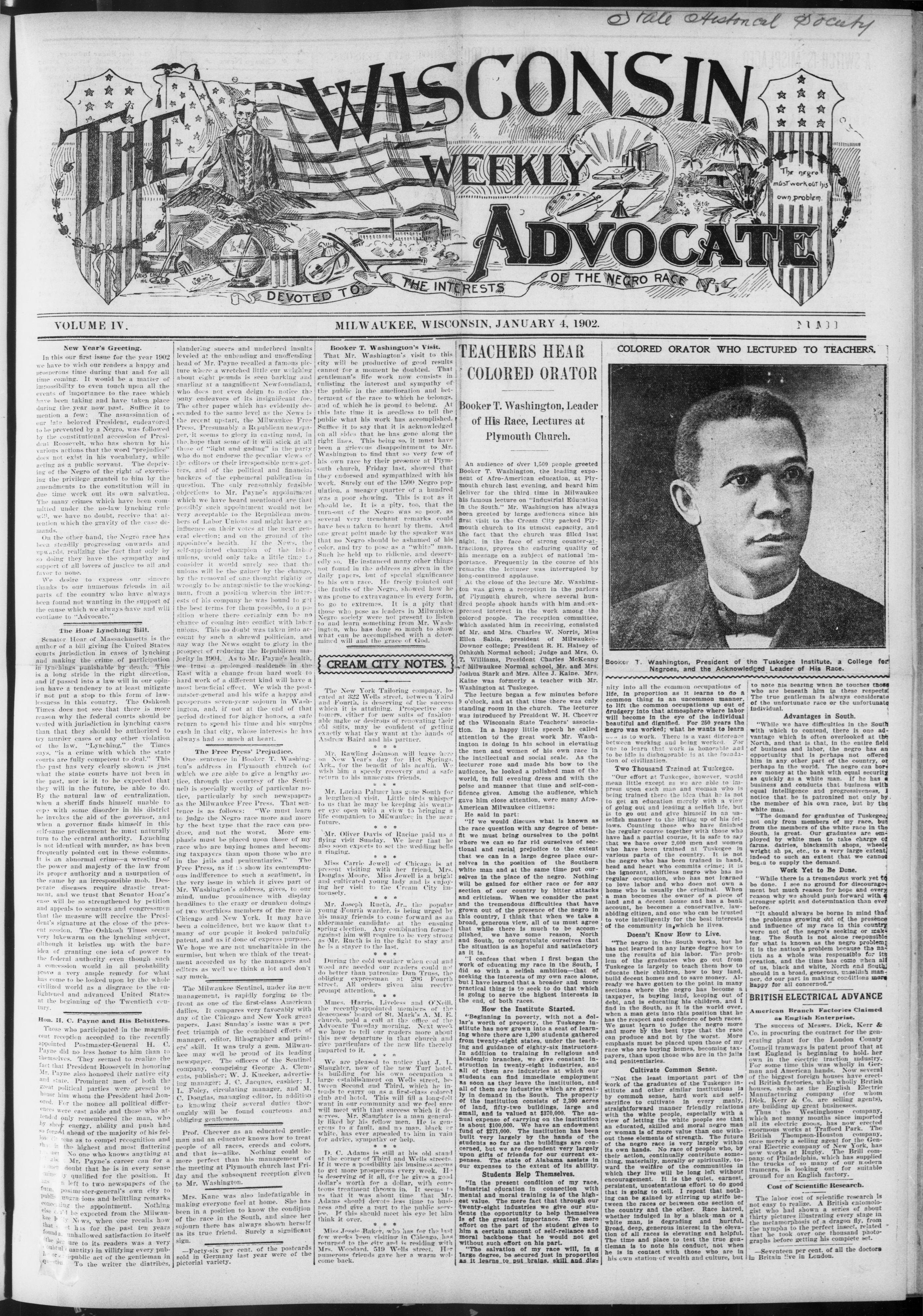
WISCONSIN
WEEKLY
ADVOCATE
DEVOTED TO THE INTERESTS OF THE NEGRO RACE
New Year's Greeting.
In this our first issue for the year 1902 we have to wish our readers a happy and prosperous time during that and for all time coming. It would be a matter of impossibility to even touch upon all the events of importance to the race which have been taking and have taken place during the year now past. Suffice it to mention a few: The assassination of our late beloved President, endeavored to be prevented by a Negro, was followed by the constitutional accession of President Roosevelt, who has shown by his various actions that the word "prejudice" does not exist in his vocabulary, while acting as a public servant. The depriving of the Negro of the right of exercising the privilege granted to him by the amendments to the constitution will in due time work out its own salvation. The many crimes which have been committed under the no-law lynching rule will, we have no doubt, receive that attention which the gravity of the case demands.
On the other hand, the Negro race has been steadily progressing onwards and upwards, realizing the fact that only by so doing they have the sympathy and support of all lovers of justice to all and favor to none.
We desire to express our sincere thanks to our numerous friends in all parts of the country who have always been found not wanting in the support of the cause which we always have and will continue to "Advocate."
The Hoar Lynching Bill
Senator Hoar of Massachusetts is the author of a bill giving the United States courts jurisdiction in cases of lynching and making the crime of participation in lynchings punishable by death. This is a long stride in the right direction, and if passed into a law will in our opinion have a tendency to at least mitigate if not put a stop to this form of lawlessness in this country. The Oshkosh Times does not see that there is more reason why the federal courts should be vested with jurisdiction in lynchings cases than that they should be authorized to try murder cases or any other violation of the law. "Lynching," the Times says, "is a crime with which the state courts are fully competent to deal." This the past has very clearly shown is just what the state courts have not been in the past, nor is it to be expected that they will in the future, be able to do. By the natural law of centralization, when a sheriff finds himself unable to cope with some disorder in his district he invokes the aid of the governor, and when a governor finds himself in this self-same predicament he must naturally turn to the central authority. Lynching is not identical with murder, as has been frequently pointed out in these columns. It is an abnormal crime—a wrestling of the power and majesty of the law from its proper authority and a usurpation of the same by an irresponsible mob. Desperate diseases require drastic treatment, and we trust that Senator Hoar's case will be so strengthened by petition and appeals to senators and congressmen that the measure will receive the President's signature at the close of the present session. The Oshkosh Times seems very lukewarm on the lynching subject, although it bristles up with the bare idea of granting one iota of power to the federal authority even though such a concession would in all probability prove a very ample remedy for what has come to be looked upon by the whole civilized world as a disgrace to the enlightened and advanced United States at the beginning of the Twentieth century.
Hon. H. C. Payne and His Belittlers
Hon. H. C. Payne and His Belittlers.
Those who participated in the magnificent reception accorded to the recently appointed Postmaster-General H. C. Payne did no less honor to him than to themselves. They seemed to realize the fact that President Roosevelt in honoring Mr. Payne also honored their native city and state. Prominent men of both the great political parties were present to honor him whom the President had honored. For the nonce all political differences were cast aside and those who attended only remembered the man, who by sheer energy, ability and push had so forged ahead of the majority of his fellow citizens as to compel recognition and that in the highest and most flattering manner. No one who knows anything at all about Mr. Payne's career can for a woman doubt that he is in every sense uniquely qualified for the position. It was left to two newspapers of the turn, postmaster-general's own city to public ungracious and belittling remarks concerning the appointment. Nothing else could be expected from the Milwaukee Daily News, when one recalls how that set his for the past ten years founda unhallowed satisfaction to itself (the desire to its readers was a veryountful quantity) in villifying every public or republic act of the gentleman in question. To the writer the diatribes,
slandering sneers and underbred insults leveled at the unbending and unoffending head of Mr. Payne recalled a famous picture where a wretched little cur weighing about eight pounds is seen barking and snarling at a magnificent Newfoundland, who does not even deign to notice the puny endeavors of its insignificant foe. The other paper which has evidently descended to the same level as the News is the recent upstart, the Milwaukee Free Press. Presumably a Republican newspaper, it seems to glory in casting mud, in the hope that some of it will stick at all those of "light and gading" in the party who do not endorse the peculiar views of the editors or their irresponsible news-getters, and of the political and financial backers of the ephemeral publication in question. The only reasonably feasible objections to Mr. Payne's appointment which we have heard mentioned are that possibly such appointment would not be very acceptable to the Republican members of Labor Unions and might have an influence on their votes at the next general election; and on the ground of the appointee's health. If the News, the self-appointed champion of the labor unions, would only take a little time to consider it would surely see that the unions will be the gainer by the change, by the removal of one thought rightly or wrongly to be antagonistic to the working-man, from a position wherein the interests of his company he was bound to get the best terms for them possible, to a position where there certainly can be no chance of coming into conflict with labor unions. This no doubt was taken into account by such a shrewd politician, and any way the News ought to glory in the prospect of reducing the Republican majority in 1904. As to Mr. Payne's health, we trust a prolonged residence in the East with a change from hard work to hard work of a different kind will have a most beneficial effect. We wish the postmaster-general and his wife a happy and prosperous seven-year sojourn in Washington, and, if not at the end of that period destined for higher honors, a safe return to spend his time and his surplus cash in that city, whose interests he has always had so much at heart.
The Free Press' Prejudice
One sentence in Booker T. Washington's address in Plymouth church (of which we are able to give a lengthy notice, through the courtesy of the Sentinel) is specially worthy of particular notice, particularly by such newspapers as the Milwaukee Free Press. That sentence is as follows: "We must learn to judge the Negro race more and more by the best type that the race can produce, and not the worst. More emphasis must be placed upon those of my race who are buying homes and becoming taxpayers than upon those who are in the jails and penitentiaries." The Free Press, as if to show its contemptuous indifference to such a sentiment, in the very issue in which it gives part of Mr. Washington's address, gives, to our mind, undue prominence with display headlines to the crazy or drunken doings of two worthless members of the race in Chicago and New York. It may have been a coincidence, but we know that to many of our people it looked painfully patent, and as if done of express purpose. We hope we are not uncharitable in the surmise, but when we think of the treatment accorded us by the managers and editors as well we think a lot and don't say much.
The Milwaukee Sentinel, under its new management, is rapidly forging to the front as one of the first-class American dailies. It compares very favorably with any of the Chicago and New York great papers. Last Sunday's issue was a perfect triumph of the combined efforts of manager, editor, lithographer and printers' skill. It was truly a gem. Milwaukee may well be proud of its leading newspaper. The officers of the Sentinel company, comprising George A. Clements, publisher; W. J. Kuecker, advertising manager; J. C. Jacques, cashier; J. L. Foley, circulating manager, and M. C. Douglas, managing editor, in addition to knowing their several duties thoroughly will be found courteous and obliging gentlemen.
Prof. Cheever as an educated gentleman and an educator knows how to treat people of all races, creeds and colors, and that is-alike. Nothing could be more perfect than his management of the meeting at Plymouth church last Friday and the subsequent reception given to Mr. Washington.
Mrs. Kane was also indefatigable in making everyone feel at home. She has been in a position to know the condition of the race in the South, and since her sojourn there has always shown herself as its true friend. Surely a significant sign.
Forty-six per cent. of the postcards sold in Germany last year were of the pictorial variety.
MILWAUKEE, WISCONSIN, JANUARY 4, 1902.
Booker T. Washington's Visit.
That Mr. Washington's visit to this city will be productive of good results cannot for a moment be doubted. That gentleman's life work now consists in enlisting the interest and sympathy of the public in the amelioration and betterment of the race to which he belongs, and of which he is proud to belong. At this late time it is needless to tell the public what his work has accomplished. Suffice it to say that it is acknowledged on all sides that he has gone along the right lines. This being so, it must have been a grievous disappointment to Mr. Washington to find that so very few of his own race by their presence at Plymouth church, Friday last, showed that they endorsed and sympathized with his work. Surely out of the 1500 Negro population, a meager quarter of a hundred was a poor showing. This is not as it should be. It is a pity, too, that the turn-out of the Negro was so poor, as several very trenchant remarks could have been taken to heart by them. And one great point made by the speaker was that no Negro should be ashamed of his color, and try to pose as a "white" man. Such he held up to ridicule, and deservedly so. He instanced many other things not found in the address as given in the daily papers, but of special significance to his own race. He freely pointed out the faults of the Negro, showed how he was prone to extravagance in every form, to go to extremes. It is a pity that those who pose as leaders in Milwaukee Negro society were not present to listen to and learn something from Mr. Washington, who has done so much to show what can be accomplished with a determined will and the grace of God.
CREAM CITY NOTES.
---
The New York Tailoring company, located at 322 Wells street, between Third and Fourth, is deserving of the success which it is attaining. Prospective customers, either for new suits of fashionable make or desirous of renovating their old suits, may be confident of getting exactly what they want at the hands of Andrew Baird and his partner.
* * *
Mr. Rawling Johnson will leave here on New Year's day for Hot Springs, Ark., for the benefit of his health. We wish him a speedy recovery and a safe return to his numerous friends.
☆ ☆ ☆
Mr. Lucian Palmer has gone South for a lengthened visit. Little birds whisper to us that he may be keeping his weather eye open with a view to bringing a life companion to Milwaukee in the near future.
* * *
Mr. Oliver Davis of Racine paid us a flying visit Sunday. We hear that he also soon expects to set the wedding bells a ringing.
Miss Carrie Jewell of Chicago is at present visiting with her friend, Mrs. Douglas Moore. Miss Jewell is a bright and cultivated young lady and is enjoying her visit to the Cream City immensely.
* * *
Mr. Joseph Rueth, Jr., the popular young Fourth warder, is being urged by his many friends to come forward as an aldermanic candidate at the ensuing spring election. Any combination formed against him will require to be very strong as Mr. Rueth is in the fight to stay and he is a stayer to the last.
\* \* \*
During the cold weather when coal and wood are needed our readers could not do better than patronize Dan Truss, the obliging expressman at 206 Fourth street. All orders given him receive prompt attention.
```markdown
```
Mmes. Harris, Liveless and O'Neill, the recently-appointed members of the deaconess' board of St. Mark's A. M. E. church, paid a call at the office of the Advocate Tuesday morning. Next week we hope to tell our readers more about this new departure in that church and give particulars of the new life thereby imparted to it.
☆ ☆ ☆
We are pleased to notice that J. L. Slaughter, now of the new Turf hotel, is building for his own occupation a large establishment on Wells street, between Second and Third, which he intends to carry on as a first-class colored club and hotel. This will fill a long-felt want in our community and we feel sure will meet with that success which it deserves. Mr. Slaughter is a man generally liked by his fellow men. He is generous to a fault, and no man, black or white, has ever appealed to him in vain for advice, sympathy or help.
\* \* \*
D. C. Adams is still at his old stand at the corner of Third and Wells streets. If it were a possibility his business seems to get more prosperous every week. He is deserving of it all, for he gives a good dollar's worth for a dollar, with courteous treatment thrown in. It seems to us that it was about time that Mr. Adams should devote less time to business and give a part to the public service. If this should meet his eye let him think it over.
* * *
Miss Jessie Baker, who has for the last few weeks been visiting in Chicago, has returned to the city and is residing with Mrs. Woodard. 519 Wells street. Her numerous friends gave her a warm welcome back.
TEACHERS HEAR COLORED ORATOR
Booker T. Washington, Leader of His Race, Lectures at Plymouth Church.
An audience of over 1,500 people greeted Booker T. Washington, the leading exponent of Afro-American education, at Plymouth church last evening, and heard him deliver for the third time in Milwaukee his famous lecture on "Industrial Education in the South." Mr. Washington has always been greeted by large audiences since his first visit to the Cream City packed Plymouth church to its utmost capacity, and the fact that the church was filled last night, in the face of strong counter-attractions, proves the enduring quality of his message on a subject of national importance. Frequently in the course of his remarks the lecturer was interrupted by long-continued applause.
At the close of the lecture Mr. Washington was given a reception in the parlors of Plymouth church, where several hundred people shook hands with him and expressed interest in the work among the colored people. The reception committee, which assisted him in receiving, consisted of Mr. and Mrs. Charles W. Norris, Miss Ellen Sabin, president of Milwaukee-Downer college; President R. H. Halsey of Oshkosh Normal school; Judge and Mrs. O. T. Williams, President Charles McKenny of Milwaukee Normal school, Mr. and Mrs. Joshua Stark and Mrs. Alice J. Kaine. Mrs. Kaine was formerly a teacher with Mr. Washington at Tuskegee.
The lecture began a few minutes before 9 o'clock, and at that time there was only standing room in the church. The lecturer was introduced by President W. H. Cheever of the Wisconsin State Teachers' association. In a happy little speech he called attention to the great work Mr. Washington is doing in his school in elevating the men and women of his own race in the intellectual and social scale. As the lecturer rose and made his bow to the audience, he looked a polished man of the world, in full evening dress and with the poise and manner that time and self-confidence gives. Among the audience, which gave him close attention, were many Afro-American Milwaukee citizens:
He said in part:
"If we would discuss what is known as the race question with any degree of benefit we must bring ourselves to the point where we can so far rid ourselves of sectional and racial prejudice to the extent that we can in a large degree place ourselves in the position of the Southern white man and at the same time put ourselves in the place of the negro. Nothing will be gained for either race or for any section of our country by bitter attacks and criticism. When we consider the past and the tremendous difficulties that have grown out of the presence of the negro in this country, I think that when we take a broad, generous view, all of us must agree that while there is much to be accomplished, we have some reason, North and South, to congratulate ourselves that the situation is as hopeful and satisfactory as it is.
"I confess that when I first began the work of educating my race in the South, I did so with a selfish ambition—that of seeking the interests of my own race alone, but I have learned that a broader and more practical thing is to seek to do that which is going to serve the highest interests in the end, of both races.
How the Institute Started.
"Beginning in poverty, with not a dollar's worth of property, the Tuskegee institute has now grown into a seat of learning where there are 1,200 students gathered from twenty-eight states, under the teaching and guidance of eighty-six instructors. In addition to training in religious and academic branches, we give constant instruction in twenty-eight industries, and all of them are industries at which our students can find immediate employment as soon as they leave the institution, and all of them are industries which are greatly in demand in the South. The property of the institution consists of 2,300 acres of land, fifty-two buildings, large and small, and is valued at $370,000. The annual expense of carrying on the institution is about $100,000. We have an endowment fund of $271,000. The institution has been built very largely by the hands of the students so far as the buildings are concerned, but we are dependent very largely upon gifts of friends for our current expenses. The state of Alabama assists in our expenses to the extent of its ability.
Students Help Themselves.
"In the present condition of my race, industrial education in connection with mental and moral training is of the highest value. The mere fact that through our twenty-eight industries we give our students the opportunity to help themselves is of the greatest importance. The mere effort on the part of the student gives to him a certain amount of self-reliance and moral backbone that he would not get without such effort on his part.
"The salvation of my race will, in a large degree, be secured just in proportion as it learns to put brains, skill and dig-
THE CHRISTIAN CHURCH OF BROOKLYN
nity into all the common occupations of life, in proportion as it learns to do a common thing in an uncommon manner, to lift the common occupations up out of drudgery into that atmosphere where labor will become in the eye of the individual beautiful and dignified. For 250 years the negro was worked; what he wants to learn now is to work. There is a vast difference between working and being worked. For one to learn that work is honorable and to be idle is dishonorable is at the foundation of civilization.
to note his bearing when he touches those who are beneath him in these respects. The true gentleman is always considerate of the unfortunate race or the unfortunate individual.
Advantages in South.
"While we have difficulties in the South with which to contend, there is one advantage which is often overlooked at the North, and that is that, in the entire field of business and labor, the negro has an opportunity that is perhaps not offered him in any other part of the country, or
Two Thousand Trained at Tuskegee
"Our effort at Tuskegee, however, would mean little except as we are able to impress upon each man and woman who is being trained there the idea that he is not to get an education merely with a view of going out and leading a selfish life, but is to go out and give himself in an unselfish manner to the lifting up of his fellows. Counting those who have finished the regular course together with those who have had a partial course, it is safe to say that we have over 2,000 men and women who have been trained at Tuskegee in various parts of the country. It is not the negro who has been trained in hand, head and heart who commits crime; it is the ignorant, shiftless negro who has no regular occupation, who has not learned to love labor and who does not own a home who is usually the criminal. When a man becomes the owner of a piece of land and a decent house and has a bank account, he becomes a conservative, law-abiding citizen, and one who can be trusted to vote intelligently for the best interests of the community in which he lives.
Doesn't Know How to Live.
"The negro in the South works, but he has not learned in any large degree how to use the results of his labor. The problem of the graduates who go out from Tuskegee is largely to teach them how to educate their children, how to buy land, build decent homes and to save money. Already we have gotten to the point in many sections where the negro has become a taxpayer, is buying land, keeping out of debt, and is educating his children, and I find in the South, as it is the world over, when a man gets into this position that he has the respect and confidence of both races. We must learn to judge the negro more and more by the best type that the race can produce and not by the worst. More emphasis must be placed upon those of my race who are buying homes, becoming taxpayers, than upon those who are in the jails and penitentiaries.
Cultivate Common Sense.
"Not the least important part of the work of the graduates of the Tuskegee institute and other similar institutions is by common sense, hard work and self-sacrifice to cultivate in every manly, straightforward manner friendly relations with the white people, especially with a view of letting the white people see that an educated, skilled and moral negro man or woman is of more value than one without these elements of strength. The future of the negro race is very largely within its own hands. No race of people who, by their action, continually contribute something, materially, morally or spiritually, toward the welfare of the communities in which they live will be long left without encouragement. It is the quiet, earnest, persistent, unostentatious effort to do good that is going to tell. I repeat that nothing can be gained by stirring up strife between the races or between one section of the country and the other. Race hatred, whether indulged in by a black man or a white man, is degrading and hurtful. Broad, deep, generous interest in the elevation of all races is elevating and helpful. The time and place to test the true gentleman is to note his conduct, not when he is in contact with those who are in his own station of wealth and culture, but
NNN
LECTURED TO TEACHERS.
the Tuskegee Institute, a College for
edged Leader of His Race.
to note his bearing when he touches those who are beneath him in these respects. The true gentleman is always considerate of the unfortunate race or the unfortunate individual.
Advantages in South.
"While we have difficulties in the South with which to contend, there is one advantage which is often overlooked at the North, and that is that, in the entire field of business and labor, the negro has an opportunity that is perhaps not offered him in any other part of the country, or perhaps in the world. The negro can borrow money at the bank with equal security as quickly as a white man. If he has a business and conducts that business with equal intelligence and progressiveness, I notice that he is patronized not only by the member of his own race, but by the white man.
"The demand for graduates of Tuskegee, not only from members of my race, but from the members of the white race in the South, is great. Our graduates are employed by white men to take charge of farms, dairies, blacksmith shops, wheels wright sh ps, etc., to a very large extent, indeed to such an extent that we cannot begin to supply the demand.
Work Yet to Be Done.
"While there is a tremendous work yet to be done. I see no ground for discouragement but much reason for hope and every reason why we should push forward with a stronger spirit and determination than ever before.
"It should always be borne in mind that the problems growing out of the presence and influence of my race in this country were not of the negro's seeking or making. The South is not alone responsible for what is known as the negro problem. It is the nation's problem because the nation as a whole was responsible for its creation, and the time has come when all of us, black and white, North and South, should in a broad, generous, unselfish manner, do our part in making conditions more happy for all concerned."
BRITISH ELECTRICAL ADVANCE
American Branch Factories Claimed as English Enterprise.
The success of Messrs. Dick, Kerr & Co. in procuring the contract for the generating plant for the London County Council tramways is patent proof that at last England is beginning to hold. her own in the electric traction industry. For some time this was wholly in German and American hands. Now several of the biggest foreign houses have erected British factories, while wholly British houses, such as the English Electric Manufacturing company (for whom Dick, Kerr & Co. are selling agents), are building up great businesses.
Thus the Westinghouse company, which not many months since imported all its electric gooos, has now erected enormous works at Trafford Park. The British Thompson-Houston company, once merely a selling agent for the General Electric company of New York, has now works at Rugby. The Brill company of Philadelphia, which has supplied the trucks of so many of our modern tramcars, is looking out for suitable ground for an English factory.
Cost of Scientific Research.
The labor cost of scientific research is not easy to realize. A British entomologist who had shown a series of about thirty pictures illustrating every stage in the metamorphosis of a dragon fly, from the nympha to the perfect insect, related that he took over one thousand photographs before getting his complete set.
—Seventeen per cent. of all the doctors in Britain live in London.
A SWITCH IS MISPLACED.
Fast Express on North-Western Crashes Into Freight Engine.
WRECK AT MALTA, ILL
Coaches Catch Fire and are Burned to the Trucks-List of the Killed
Chicago, Ill., Dec. 30.—A misplaced switch, a misconstruction of orders, or both, caused the engine of a passenger train on the North-Western railroad to crash into a locomotive drawing a string of freight cars at Malta, a few miles west of De Kalb, early yesterday morning. Four persons were killed and thirty more or less seriously injured either in the shock or by the scalding steam that issued after the collision.
The passenger train was derailed and hurled into a mass of wreckage against a line of cars on a sidetrack, where in less than an hour the debris burned down to the iron of the trucks.
The Dead.
DUNCAN, E. S., sleeping car porter, Chicago; scalded to death by escaping steam from freight engine.
NICHOLS, B. O., Council Bluffs, Ia.; badly burned from hips down; died on train on way to St. Luke's hospital
on way to St. Luke's hospital.
RUDIO, GEORGE W., Omaha, Neb.; internally injured and badly burned; died in a dwelling beside track an hour after the collision.
RUDIO, MRS. GEORGE W., wife of above; fatally scalded and died at St. Luke's hospital, Chicago.
Seriously Injured.
Curran, F. P., fireman of passenger engine, Chicago; right leg fractured and scalded on right side; will recover.
Larrabee, F., engineer of passenger engine, Chicago; right leg fractured and scalded on right side; will recover.
O'Nelll, P. D., special agent Chicago & North-Western road; face and month badly burnt and internally injured; condition very serious.
Others Injured.
Alken, C. W., yardmaster of Chicago & North-Western road; cut about head by falling glass. Carr, Bert., Willett, N. Y.; badly cut about head and hands by falling glass and body bruised. Dawes, W. E., Pullman conductor of train, residence Evanston; slightly injured by shock of collision and cut about head. Durham, Fred, Chicago; cut about body by falling glass and slightly injured interrally.
Ellingwood, Mamie, Omaha, Neb.; bruised about face and body.
Fifler, C. E., Racine, Wis.; face and body badly cut by falling glass.
Fox, George W., Boulder, Col., badly brushed about body.
brushed about body. Gray, H. D., Evanston; badly bruised about head and injured in face by falling glass.
Hail, Mrs. Eva, Chicago; cut about face and hands.
Hinckley, Edward, Surprise, Neb.; badly bruised, with slight internal injuries.
Jameson, L. B., Platte, Neb.; face and hands badly cut; body bruised.
Jameson, Mrs. L. B., wife of above; back badly strained and cut about head by falling glass.
Jewell, A. E., Buffalo, N. Y.; both hands and face badly lacerated by falling glass.
Kiel, Mrs. J. L., Chicago; face and hands badly cut by falling glass and body bruised.
Lazarus, Clarence, Chicago; hands and feet scalded by steam and face cut.
Miller, H. L., brakeman in employ of road; ankle fractured and body bruised. Rohrmoser, Veronica, Millard, Neb.; face and hands badly cut. Schoentgren, John, Council Bluffs, Ia.; face and hands badly cut and bruised about body. Sweeney, W. A., Larchford, Ia.; scalded by steam and ankles dislocated. Taft, Lincoln, Chicago; cut about hands and face and scalded by escaping steam. Wilkie, Marlon, Fremont, Neb.; scalded by escaping steam and badly bruised about body.
Wison, John D., civil engineer Chicago & North-Western road; badly bruised about head and face.
Wrecked Cars Take Fire.
The cars caught fire from the locomotives and all were burned except one sleeper. A number of freight cars were destroyed.
The misplaced switch that caused the wreck was on a cross-over switchtrack between the east and westbound tracks. The freight train, which was bound east, like the passenger train, had crossed over to the other track to allow the passenger train to go by. The freight was moving along slowly, and no warning light showed from the target of the switch. Suddenly the freight engine darted over toward the other line. The passenger train, thundering, along at the rate of a mile a minute, was then 200 yards away. With a crash the two engines came together.
The swiftly moving passenger engine turned halfway around, cut a freight car on the siding in two, and rolled over on its side. The passenger cars left the track and plowed along for the length of the train, when they leaned up against the grain-laden boxcars on the siding. This alone stopped them from going over a fifteen-foot embankment and rolling into a ditch.
Between Two Wrecked Engines. The sleeping car Tolefson, which was the last in the train, stopped midway between the two engines, which were pouring forth clouds of scalding steam. The vapor poured into the Tolefson and the other sleeper, burning every one in both cars. There were cries of terror, confused shouts, and then the screams of the steam-tortured victims. The people who had been sleeping in their berths beat on the heavy panes of plate glass in the windows, hoping to get a chance to escape the steam. Failing in this they staggered toward the doors of the cars and fell to the ground in the open air, some completely denuded of their clothing.
It seemed but an instant when the fire, which lay scattered around from the passenger engine, made its way to the woodwork of the cars. In a few minutes the whole train was blazing fiercely. The ones who were less injured had rallied to the aid of those imprisoned and had begun to carry them into places of shelter. The hotel and railroad depot were turned into improvised hospitals, and the inhabitants of the village of Malta aroused from their beds and opened their doors to the unfortunate ones. So efficient had the work of rescue been that few were burned by fire, but the steam had done deadly work for four.
Relief Trains are Sent.
The railroad employes at Malta immediately had telegraphed the news of the wreck along the line, and within an hour relief trains were started from De Kalb and Rochelle, carrying physicians, who took care of the injured. A wrecking train was dispatched from the West Chicago yards at G o'clock, which picked up the company surgeons from the towns along the road. Duncan, the Pullman porter, was so badly hurt that the doctors could do nothing to save his life, and they did their best to make his last moments comfortable. He expired three hours after the wreck occurred. Mr. Rudio seemed to be more comfortable and it was believed that he would live, when he died suddenly about noon.
Mr. Nelson died when the relief train was passing West Chicago on the run in last evening. Mrs. Rudio died a few minutes after she had been taken to St. Luke's hospital. The ones who were less seriously injured were brought to Chicago on the
second section of the Atlantic express, which reached the city early in the afternoon. The others were taken on board the special train.
ROCK ON TRACK.
Peculiar Accident on B. & O. Road Two Men are Missing.
Parkersburg, W. Va., Dec. 30.—Two men are missing and one badly injured as the result of a landslide on the B. & O. railroad at No. 3 tunnel near Long Run at 6:55 this morning. The engine struck a large rock that had been loosened by the heavy rain and rolled down from the hill, just as the train came out of the tunnel. The two missing men are Fireman A. R. Hile and Brakeman E. B. Putnam, both of Grafton. They probably are dead beneath the wreck. Engineer Hope Goudy of Grafton was so seriously injured he probably will not recover. Washington, D. C., Dec. 30.—The official version of the wreck on the Chesapeake & Ohio railroad yesterday was telegraphed today to the office of the company in this city by President Stevens at Richmond, Va. The dispatch from Mr. Stevens says:
"Number nine, composed of engine, one baggage car and one coach, struck slide two miles west of Reusens on James river branch of Chesapeake & Ohio railway about 7 o'clock last night, derailing the engine, but doing no further damage. Conductor Whitaker, Engineman Fisher, Baggageman Thompson and Express Messenger Shannon with others pushed the coach back out of the way of possible danger and were engaged in pushing the baggage car back when another slide came in, striking the baggage car and throwing it into the river with the four men mentioned, all of whom were killed. No other persons injured, except slightly."
Tiffin, O., Dec. 30.—Four men may die as the result of a collision between freight trains on the Pennsylvania road near here today. Engineer Keister and O. J. Chadwick, operator at Warsaw Junction, were buried under debris and were not rescued for hours. Both were badly injured and nearly frozen. Fireman Bell and Brakeman Cosgrove were thrown 100 feet into a cornfield and probably will die.
Columbus, Miss., Dec. 30.—Train No. 36 on the Southern railway was wrecked at Ittibena, Miss., this morning at 6 o'clock by a big tree which had been blown across the track by last night's storm. The engine was overturned and the train derailed. Engineer McWilliams was buried under the engine.
WARDEN WARNED OF PLOT TO ESCAPE.
Desperate Plans of Convicts In Federal Prison to Secure Their Liberty.
Leavenworth, Kas., Dec. 30.—Another plot to escape from the federal prison here was revealed to Warden McClaughry.
Richard Mullins, Bob Clark, Turner Barnes. Fred Robinson and Frank Thompson, five of the principal mutineers who escaped from the new federal penitentiary stockade on November 7 have been working in a stone shed with balls and chains attached to their ankles. Mullins secured a file, and, it is said, another a knife. The plot was to file off the shackle pins and when four convict barbers visited the stone shed to shave the prisoners their razors were to be seized, and, Guard Brown overpowered, a convict runner was to tell Deputy Warden Lemon to come to the stone shed, and he, too, was to be seized.
The plot included the shooting of the outer guard in a pagoda across the street and all captured officers. Mullins was searched and the file found. Warden McClaughry will ask the attorney-general to have the five desperadoes transferred to the Kansas penitentiary, where they can be worked in the deep coal mine.
FIND CLUE IN ELY-ROGERS CASE.
Bundle of Clothing Discovered Under Railway Platform Fully Identified.
Chicago, Ill., Dec. 30.—The first tangible clue in the Ely disappearance case came to light yesterday and the search for the missing Evanston boy and his aunt is to be resumed along new lines.
The police are now satisfied that the fugitives are living and that young Rogers went away disguised as a girl. It is considered possible also that the woman donned male attire.
The clue consists of a bundle of clothing that was found in the morning under the platform of the Central street waiting station of the Chicago, Milwaukee & St. Paul railroad, in North Evanston. The clothing was identified as that worn by Miss Florence Ely and young Frank Ely Rogers when they left the home of the boy's father, James C. Rogers, on the morning of July 13.
The garments were mildewed and wet, and the police are confident that they have lain under the platform since the pair disappeared. Acting on the supposition that the boy ran away in disguise, the police will send out circulars advertising for a woman and a girl. It is thought likely that if Miss Ely donned male attire she has discarded it before this.
The bundle contained a pair of knickerbockers, a white cap, a waist, a pair of stockings, and a linen collar, all the property of young Rogers. There also was a woman's black chiffon hat, trimmed in green, a black silk waist, a black overskirt, a white underskirt, a black belt, a pair of stockings and a handkerchief that belonged to Miss Ely.
The bundle was seen by Detective Keefe as he was passing the station on a car. A portion of the black skirt was visible under the edge of the platform, and an investigation disclosed the presence of the rest of the clothing.
When the garments were taken to the Rogers residence Mrs. Rogers identified every piece as having been worn by the boy or his aunt on the day they disappeared.
FRANK H. PEAVEY DEAD.
Elevator King Carried a Million Dollars Worth of Life Insurance.
Chicago, Ill., Dec. 30.—Frank H. Peavy, the Minneapolis elevator man, died at the Auditorium Annex at 3:30 o'clock this morning. Mr. Peavy was stricken with pneumonia several days ago.
It is said that Mr. Peavey carried $1,-000,000 insurance on his life.
Minneapolis, Minn., Dec. 30.—Frank H. Peavey, the elevator king who died in Chicago this morning, carried among other life insurance policies one for $1,-000,000 in a New York company. It was the largest single policy ever written save one for the same amount written for W. H. Vanderbilt. The policy was taken out three years ago and is in favor of the Peavey company.
Cargo of Cotton Destroyed
Seattle, Wash., Dec. 30.—The fire which has been burning in the forward hold of the Oriental liner Shinano since December 22 has been extinguished. The damage to the cargo, chiefly cotton, is estimated at $100,000.
EXPLAINED BY CASTRO.
Washington, D. C., Dec. 31.—President Castro of Venezuela has written an open letter, copies of which have been received by officials here, in which he defends the general policy he has pursued and throws considerable light on his aspirations. An indirect allusion is made to German affairs in the President's appeal for united support in defense of the fatherland. The letter was in response to an application which was granted for the release of several journalists imprisoned at Caracas. In the course of the letter President Castro says:
"It is painful to observe that the rashness of some, the impatient ambition of others, the mistaken criticism of the leading classes and the obstinacy of the revolutionary spirit have sorely tried the virtues of my liberal policy. At a time when I have desired to see the country happy and its citizens enjoying every comfort, I have had the painful duty of adopting repressive measures contrary to my character, my education and all my sentiments.
"If the offenders in this case have not succeeded in overthrowing the government they have nevertheless contributed to the propaganda which delays the fruit of peace and makes out progress and our prosperity captive in the clutches of the monster of Civil war. Our prosperity has been withheld through errors and entanglements for which my government is not responsible, but which claim a prompt and quick solution. In carrying out this policy I should have the support of all the citizens of Venezuela, because therein rests the society of the fatherland.
"It is my wish that you convey to these journalists my wish to see them again fulfilling their duties of party opposition. I desire that the press shall bring all the charges it may have against me (being confident that its judgment will not affect me). I do this in order to establish under our Repubhecan system the absolute justification of my political purposes. I do it also because I have no fear of an adverse public judgment upon my acts."
New York, Dec. 31. The outcome of the dispute between Germany and Venezuela is regarded with anxiety in England, cables the London correspondent of the Tribune, and consols, which Mr. Gladstone once described as the most intelligent of all things inanimate, fell three-sixteenths on apprehension as to the attitude that may be adopted by America. There are at least three railways in Venezuela which have been constructed by British capital, and the English shareholders are watching with anxious interest for the sequel to the present disturbed state of the country. Information which is reaching London from the representatives of the various companies is of a very scanty nature. So far, it would seem, the English property has not been seized, but it is feared this immunity will not be long.
In Venezuelan circles in London President Castro is blamed for present disorders. He is accused of having sacrificed the peace and prosperity of his country to his own personal pride and an improvement is not looked for until he has been deposed.
Both Chili and Argentina are eagerly negotiating for the purchase of warships in Great Britain, says the London correspondent of the Tribune. Chili, it says, has been lucky enough to acquire two torpedo boat destroyers now being built on the Thames to the order of Brazil, which latter country has been tempted by the good price offered to sell. These vessels could be launchde at the end of next month. Argentina has a large cruiser on the docks at Elswick, but it cannot be delivered until next summer.
STAFF REORGANIZED.
Directors of the Great Northern Railway Chose Heads of the Executive Departments.
St. Paul, Minn., Dec. 31.—At a meeting of the directors of the Great Northern railway at the general offices in this city the executive staff was reorganized. No announcement was made as to president, but the following were chosen: First vice-president, J. N. Hill, St. Paul; second vice-president, R. I. Farrington, St. Paul; third vice-president, E. T. Nichols, New York; fourth vice-president, J. Blahon, St. Paul.
St. Paul, Minn., Dec. 31.—The appointment of W. W. Broughton as traffic manager of the Eastern Minnesota, makes it possible for the Northern Pacific to advance several of its traffic men to higher positions. Harry E. Still becomes assistant general freight agent, to succeed Mr. Broughton. Mr. Still will have charge of the business over the Duluth Short Line. L. O. Dalzell, now general agent at Duluth, will be division freight agent. This leaves a vacancy at Duluth which will be filled by Thomas E. Blanch, now traveling freight agent at Buffalo.
KITCHENER'S WEEKLY BUDGET
Field Marshal Reports Progress of War in South Africa.
London, Dec. 31.—Lord Kitchener, under date of Johannesburg, December 30, sends a weekly budget showing that since December 23, 35 Boers have been killed, 5 wounded, 237 taken prisoners and 51 surrendered. These, says the commander-in-chief, do not include Dewet's losses in his attacks on Dargell and Firman, when, it is reliably estimated, 50 were killed and 50 wounded. Dewet is still in the vicinity of Langberg. Col. Spence and Col. Plumer came in contact December 28 with Britz's commando and took 27 prisoners. Gen. Bruce Hamilton came in touch with Grobelaar's commando near Marydale December 23 and killed 4 Boers and captured 27.
TO RUN RUSSIAN SHIPS.
American Firm to Supply Motors for Torpedo-Boat Fleet. Marquette, Mich., Dec. 31. After correspondence covering sseveral weeks the Lake Superior Engine works is in receipt of a formal inquiry from the naval department of the Russian government asking as to when engines can be shipped to Russia, and conveying the intimation that a large order will be placed. The engines, operated by gasoline, are wanted for service on the Czar's torpedo-boat fleet.
BENNINGFIELDREMONSTRATED
Mexicans Were Engaged in Shooting Holes in His Tent.
Bisbee, Ariz., Dec. 31. News has reached here of the killing of George Ashton and Cam Benningfield, well-known cattlemen, by Mexican woodchoppers in the Huachuca mountains. The trouble grew out of Benningfield's effort to remonstrate with the Mexicans, who were shooting holes in his tent. The Mexicans escaped to the border line, pursued by the dead cattlemen's friends.
SHOT FIVE PERSONS.
Jeweler at Turners Falls, Mass. Starts Out to Exterminate His Family.
Turners Falls, Mass., Dec. 31.—Louis Bitzer, a jeweler of this place, today shot five persons, two of whom, his clerk, Miss Ida Columbe and Bitzer's 5-year-old son, are dead. His other victims were his wife, Christina, and his two daughters, Annie, about 16 years of age, and Carrie, 12 years old. It is thought they will not die. There is evidence that it was Bitzer's purpose also to take his own life, but his prompt arrest apparently prevented him from carrying out this purpose. He is 35 years of age.
From a note left in his store by Bitzer it appears that while he was cleaning a revolver the weapon was discharged accidentally and the bullet hit Miss Columbie in the head, killing her instantly. Overcome by the situation, Bitzer apparently rushed to his home, hatless and wild with excitement and began the work of exterminating his family. The little boy, ill in bed with the measies, was shot and killed. The 15-year-old daughter, Annie, was wounded through the left hand and in the ear. The 12-year-old daughter, Carrie, was shot through the neck. Mrs. Bitzer was hit in the face, the bullet passing through the nose. The sound of the shots brought neighbors into the house and Bitzer was arrested.
The police believe that Bitzer is insane. The note which they found in his store after the affair was almost an incoherent jumble of words. After telling of the shooting of Miss Columbe, Bitzer wrote that he had determined to go to his home and end the lives of his wife and children and then his own. He asked that at his funeral the hymn "Nearer, My God, to Thee," be sung.
He wished his property should be given to his brother and to his aged mother and ended the letter with an expression to the effect that "God would not blame a man for doing what he had done."
Substantially the same story was told by Bitzer often his most
MEMORY HONORED.
Funeral Services of the Late Senator Wm. J. Sewell at Camden. N. J.
Camden, N. J., Dec. 31.—The funeral of the late United States Senator William Joyce Sewell took place today from the Sewell mansion in this city. From 10 until 11 o'clock the public was permitted to view the body and thousands passed around the bier. The services were conducted by Bishop John Scarborough of the Protestant Episcopal diocese of New Jersey, assisted by Rev. R. A. Roderick of this city. At the conclusion of the services eight sergeants from the Third regiment and Battery B, National Guard of New Jersey, carried the casket to a caisson provided by the war department and the cortege proceeded to Harleigh cemetery, where interment was made.
Gen. Brooke of the military department of the East was in command of the government troops and Brig.-Gen. William H. Cooper was in command of the state troops. At the grave a salute of thirteen guns was fired. After the reading of the committal services the body was lowered into the grave and another salute was fired. Among the honorary pallbearers were Secretary of War Root, Adjt.-Gen. Corbin, Gov. Voorhees, Gov.-elect Murphy, former United States Attorney-General Griggs, A. J. Cassatt, president of the Pennsylvania Railroad company, and Clement A. Griscom, president of the International Navigation company.
The committee of the United States Senate included Senators Kean, Hawley, Proctor, Burrows, Warren, Scott, Quarles, Bate, Cockrell, Pettus, Harris, Foster, Cullom, Aldrich, Penrose, Elkins and Turner. The House committee was composed of the New Jersey delegation. In addition to the United States senators and representatives who came to attend the funeral, there were present a large number of distinguished and prominent men from New Jersey and adjoining states. All of the county and city offices and most of the business houses were closed from noon until 1 o'clock.
PHONES WITHOUT WIRES.
Human Voice Transmitted Successfully by Kentucky Invention. Murray, Ky., Dec. 31.—Nathan B. Stubblefield, an electrician who resides two miles from this city, has perfected a system of wireless telephony by which the sounds of the human voice can be transmitted great distances without wires. Stubblefield gave an exhibition in this city, and in the presence of a large number of witnesses communicated with his 14-year-old son, who is his chief assistant. By the construction of a special electric cell, which he terms his earth cell, he claims to take advantage of the terrestrial magnetism and communicate through this medium.
Stubblefield on Christmas eve produced some weird effects by talking into a room from his home, a quarter of a mile away. A party of children were gathered there and at the receiver obtained messages from Santa Claus. Recently a number of citizens visited the Stubblefield plant and after witnessing experiments in wireless telephony, appended their names to an affidavit setting forth the facts as they saw them.
REPTILE BITES CHILDREN.
Rattlesnake Thawed Out by Warmth of the Kitchen Fire.
Crawfordsville, Ind., Dec. 31.—Willie and Mary Daniels, aged 5 and 7 years, living near San Creek, were bitten several times by a rattlesnake that had taken refuge from the cold weather in a stick of wood. It is feared both will die.
The piece of wood had been carried into the house and placed behind the stove to dry. The parents of the children were attracted by screams from the kitchen, and found the snake coiled in the little girl's lap. Her brother caught the reptile by the tail and was bitten on the hand.
The girl was bitten twice upon the leg. The snake was killed. It was 4 feet long and had seven rattles and a button. The children will be taken to Ferre Haute for treatment.
An Automobile Bank.
Mezieres, France, has probably the distinction of having the first motor-car savings bank. It consists of an electric motor carriage containing four seats, one for the driver, two for the clerks and one for a cashier. The vehicle carries a small safe, and folding shelves make a desk for persons standing outside the vehicle who are despositing. It travels about the country, making short stops in the village on stated days, and receives such sums as the inhabitants of the neighborhood desire to deposit. -Pearson's.
Banking in Canada.
The banking business in Canada is on a different plan from that in this country. The headquarters of most of the banks throughout the Dominion is in Ontario, either at Hamilton, Kingston or Toronto. Each bank has its central office, generally in one of the cities named, and as many branches as it cares to maintain in different parts of Canada. some of these branches being as far distant as Dawson.
—George Magles, a teamster, died at the county hospital from injuries sustained December 21 by falling from a wagon. He was 35 years old.
—Frank Wilcox, a switchman for the Pittsburg, Fort Wayne & Chicago Rail road company, was seriously injured by being caught between a boxcar and the railing of a viaduct.
—Sanford A. Scribner, a veteran board of trade operator, died at his home. Mr. Scribner was 71 years old and was in active business up to the time of his last sickness.
—In a quarrel between two employees yesterday in Wosslick's restaurant, Constantine Ruthofski was cut so badly he may die. James Davidson, who is employed in the kitchen, was the assailant.
—H. D. Hedden, known in Evanston for having been in business there longer than any other merchant, slipped on an icy walk and broke his hip. Mr. Hedden is over 80 years of age, and his injury is regarded as serious.
—Dr. John R. McCoy, a young dentist, formerly of Chicago, died suddenly at Bloomington, Ill., from an overdose of some drug, supposed to be cocaine. The verdict of the coroner's jury was that death was accidental.
—A. R. Jones & Co. have decided to retire from business. Notices to that effect were mailed to all customers Saturday, with an explanation of the recent trouble with the board of trade. The business of the firm's Western circuit will be transferred to George H. Phillips.
—Despondent over the loss of his position and ill-health, J. Kirby Doggett, formerly a salesman for John T. Shayne & Co., committed suicide in the Palmer house by stabbing himself in the heart with a pair of scissors. Before killing himself he telegraphed to his wife and daughter, who are visiting in St. Louis, to prolong their stay indefinitely.
—Robert McEifresh, recently of Chicago, a clerk employed by Swift & Co., died in a cell at the city jail in St. Joseph, Mo. Death was due to arsenic poisoning. The poison was taken during the morning. He was deeply in love with a young woman he met two weeks ago, and it is believed that he took poison because she refused his suit.
LATEST MARKET REPORTS.
Milwaukee, Dec. 31, 1901.
EGG AND DAIRY PRODUCTS.
MILWAUKEE—Eggs — Market steady;
fresh, loss off, cases included, 23½¢; fresh,
cases returned, 23¢; storage, No. 1 April,
city stock, 18¢; country storage, 15@16¢.
NEW YORK—Butter—Receipts, 7299 pkgs;
steady, state dairy, 15@23¢; creamery, 16@
25¢; June creamery, 15@21½¢; factory, 12½
@15½¢. Cheese—Receipts, 5045 pkgs; quiet;
state full cream, large fall made fancy, 10
@10¼¢; do small, 11@11¼¢; late made best
large, 9½¢; do small, 10@10¼¢. Eggs—Receipts, 10,991 pkgs; steady; state and Pennsylvania, 30¢; Western at mark, 23@29¢;
Southern at mark, 22@28¢. Coffee—Steady;
No. 7 Rio, 7 1:16¢.
CHICAGO — Butter — Steady; creameries,
15@24%; dairies, 14@20%. Cheese—Steady;
twins, 9%@10%; daisies, 10%@10%; c. Young
Americas, 10%@10%; Eggs—Steady; loss
off, cases returned, 23@24c. Dressed poultry—Firm; turkeys, 7%@11c; chickens, 7@
8%c.
HOGS—Receipts, 38 cars; market steady; light, 5.90@6.20; mixed and medium weights, 6.10@6.35; common to good packers, 5.90@6.35; choice heavy, 6.40@6.50. Pigs, 90 to 120 lbs, 4.75@5.25.
CATTLE — Receipts, 5 cars; firm; butchers' steers, medium to good, 1050@1300 lbs, 4.75@5.75; fair to medium, 950 to 1050, 3.75@4.25; heifers, common, 2.50@3.25; good, 3.50@4.50; cows, fair to good, 2.75@3.50; canners, 1.50@2.40; bulls, common, 2.40@2.75; choice, 3.00@3.75; feeders, 800 to 950 lbs, 3.00@3.50; stockers, 500 to 750 lbs, 2.50@3.00; veal calves, common to choice, 4.50@6.00; milkers and springers, lower, common, 15.00@20.00; choice, 30.00@45.00.
SHEEP—Receipts none; market steady, 2.25@3.25; bucks, 1.75@2.25; kernbs, common to choice, 4.00@5.25.
Chicago receipts: Hogs, 28,000; cattle, 18,500; sheep, 25,000.
MARKETS BY TELEGRAPH.
MARKETS BY TELEGRAPH
MILWAUKEE—Flour—Steady. Wheat —
Fair demand; No. 1 Northern, on track, 79c;
No. 2 Northern, on track, 78c. Corn—
Steady; No. 3 on track, 63½c. Oats—Easy;
No. 2 white, on track, 48c; No. 3 white,
on track, 46½@47c. Barley—Steady; No. 2
on track, 64½c. sample on track, 57@64½c.
Rye—Easier; No. 1 on track, 65½c. Provisions—Steady; pork, 16.75; lard, 10.05.
Flour market is steady: parents, 3.00 g; bakers, 290@3.00; rye, 3.20@3.30.
Millstuffs are firm and quoted at 22.50 for bran, 22.00@22.50 for standard middlings, and 23.50 for Milwaukee flour middlings, in 100 lb sacks; reg. dog, 24.50.
CHICAGO - Close - Wheat - December, 78%c; January, 78%c; May, 82%c; July, 82%c; August, 80%c; Corn-December and January, 63%c; May, 66%c; July, 65%c; Oats-December, 45%c; January, 44%c; May, 45%c; July, 39%c; September, 33%c; Pork-December, 15.80; January, 16.80; May, 17.30; July, 17.32%; Lard-December and January, 9.95; May, 10.02%; Ribs-December, 8.52%@8.55; January, 8.52@8.55; May, 8.82%Flax-Cash Northwest, 1.61; No. 1, 1.60; May, 1.62; December, 1.60. Rye-December, 66c; May, 68%c; Barley-Cash, 57@62c. Timothy-March, 6.60. Clover-March, 9.65. ST. LOUIS-Close-Wheat-Lower: No. 2
red cash, 86%c; December, 86%c; May, 86%c; July, 80c; No. 2 hard, 80@82%c. Corn
-Lower; No. 2 cash and December, 65%c; May, 68%c; July, 68c. Oats-Easy; No. 2
cash, 47c; December, 47%c; May, 47%c; July, 39c; No. 2 white, 48@48%c.
Lead-Nominal; 3.95. Spelter-Nominal; 4.15.
MINNEAPOLIS — Close — Wheat — Cash, 77%c; May, 78%c; July, 79%c; on track, No.
1 hard, 79%c; No. 1 Northern, 77%c; No. 2
Northern, 75%c.
DULUTH—Close — Wheat-Cash No. 1
hard, 79%c; No. 1 Northern, 76%c; No. 2
Northern, 73%c; No. 3 spring, 71%; to arrive, No. 1 hard and May, 79%c; No. 1
Northern and December, 76%c; Oats-45c.
Rye-62%c. Barley-Malting, 49@58c. Corn-
64c. Flax-Cash, to arrive and December,
1.55%; May, 1.59. Receipts-Wheat,
91.31c. Shipments, 1039
KANSAS CITY—Wheat—May, 80%c; cash
No. 2 hard, 77@77%c; No. 2 red, 87%c; Corn—January, 66%c; May, 68%c; cash No. 2 mixed, 66@66%c; No. 2 white, 67%c; Oats—No. 2 white, 48@48%c.
LIVERPOOL—Wheat—Spot firm; No. 2 red Western winter, 6s2d; No. 1 Northern spring, 62s2d; No. 1 California, 6s5d; futures quiet; March, 6s3d; May, 6s3%d; Corn—Spot American mixed, new. steady, 5s5%d; do old, quiet, 5s8%d; futures quiet; January, 5s4%d; March, 5s8%d; May, 5s3%d.
TOLEDO—Wheat—Cash and December, 88%c; May, 88%c; Corn—December, 66c; May, 67%c; Oats—December, 46c; May, 47c; Cloverseed—December, 5.90; May, 5.97%c
LIVERPOOL—Lard—American refined in pails steady, 51s; prime Western in tierses, steady, 50s6d. Hans—Short cut, steady, 48s. Shoulders—Square cut, 42s. Cheese—American finest white, firm, 48s; American first colored firm, 49s. Cottonseed oil—Hull refined spot steady, 22s9d. Receipts of wheat during the past three days 157,000 centals including 79,000 American. Receipts of American corn during the past three days, 13,400 centals. Weather fine.
KANSAS CITY—Cattle—Receipts. 5000; steady; beef steers. 4.75@6.75; Texans. 3.00@4.80; cows and helfers. 2.25@5.50; stockers and feeders. 3.00@4.50. Hogs—Receipts. 18,000; 5@10c lower; heavy. 6.65@6.75; packers. 6.50@6.70; medium. 6.35@6.70; yorkers. 5.40@6.50; plgs. 4.25@5.50. Sheep—Receipts. 2000; strong; sheep. 3.00@4.50; lambs. 4.75@5.75
ST. LOUIS—Cattle—Recelpts. 1800; market strong; beef steers. 3.50@6.50; fancy, up to 7.50; Texans. 3.10@5.25; cows and heifers. 2.00@4.85; stockers and feeders. 2.50@3.45. Hogs—Recelpts. 6500; 10c lower; plgs. 5.75@6.10; packers. 5.75@6.25; butchers. 6.25@6.75. Sheep—Recelpts. 1000; steady to strong; sheep. 2.00@3.85; lambs. 4.50@5.75. SOUTH OMAHA—Cattle—Recelpts. 3700; steady on best; beef steers. 4.00@6.75; Texans. 3.50@4.40; cows and heifers. 2.80@4.40; stockers and feeders. 2.75@4.30. Hogs—Recelpts. 14.500; heavy. 6.20@6.70; mixed. 6.10@6.25; plgs. 4.50@5.75. Sheep—Recelpts. 3800; active, strong; sheep. 2.50@4.30; lambs. 4.50@5.25.
The Beet Sugar Industry.
A most important article, giving Messrs. Oxnard's and Cutting's views on the beet sugar industry in this country, appeared on the editorial page of the New York Evening Post of Dec. 12, and as every household in the land is interested in sugar the article will be of universal interest:
"The Evening Post bids the heartiest welcome to every American industry that can stand on its own bottom and make its way without leaning on the poor rates. Among these self-supporting industries, we are glad to know, is the production of beet sugar. At all events, it was such two years ago. We publish elsewhere a letter written in 1899, and signed by Mr. Oxnard and Mr. Cutting, the chiefs of this industry on the eastern side of the Rocky Mountains, showing that this was the happy condition of the trade at that time. If parties masquerading as beet sugar producers are besieging the President and Congress at this moment, and pretending that they will be ruined if Cuban. sugar is admitted for six months at half the present rates of duty, their false pretenses ought to be exposed.
"The letter of Messrs. Oxnard and Cutting was probably written for the purpose of inducing the farmers of the Mississippi valley to go more largely into the cultivation of beets for the sugar factories. This was a laudable motive for telling the truth and showing the large profits which awaited both the beet grower and the manufacturer if the industry were perseveringly and intelligently prosecuted. To this end it was pointed out that farmers could clear $65 per acre by cultivating beets, and might even make $100. But in order to assure the cultivator that he would not be exposed to reverses by possible changes in the tariff, they proceeded to show that the industry stood in no need of protection.
"The beet sugar industry, these gentlemen say, 'stands on as firm a basis as any business in the country.' They point out the fact—a very important one—that their product comes out as a finished article, refined and granulated. It is not, like cane-sugar grown in the West India islands, a black and offensive paste, which must be carried in wagons to the seaboard and thence by ships to the United States, where, after another handling, it is put through a costly refinery, and then shipped by rail to the consumer, who may possibly be in Nebraska, alongside a beet sugar factory which turns out the refined and granulated article at one fell swoop. Indeed, the advantages of the producer of beet sugar for supplying the domestic consumption are very great. We have no doubt that Messrs. Oxnard and Cutting are within bounds when they say that 'sugar can be produced here cheaper than it can be in Europe.' The reasons for this are that—
"The sugar industry is, after all, merely an agricultural one. We can undersell Europe in all other crops, and sugar is no exception.'
"It follows as naturally as the making of flour from wheat. If we can produce wheat cheaper than Europe, then naturally we can produce flour cheaper, as we do.
But the writers of the letter do not depend upon a-priori reasoning to prove that they can make sugar at a profit without tariff protection. They point to the fact that under the McKinley tariff of 1890, when sugar was free of duty, the price of the article was 4 cents per pound. Yet a net profit of $3 per ton was made by the beet sugar factories under those conditions, not counting any bounty on the home production of sugar. They boast that they made this profit while working under absolute free trade, and they have a right to be proud of this result of their skill and industry. Many beet sugar factories had been started in bygone years, back in the sixties and seventies of the nineteenth century, and had failed, because the projectors did not understand the business. Since then great progress has been made, both here and abroad, in the cultivation and manipulation of the beet. What was impossible thirty years ago is now entirely feasible. The industry is already on a solid and enduring basis. There are factories in the United States, these gentlemen tell us in their letter, capable of using 350,000 tons of beets per annum at a profit of $3 per ton, and this would make a profit of $1,050,000 as the income to be earned under absolute free trade.
"It must be plain to readers of this letter, signed by the captains of the beet sugar industry, that the people in Washington who are declaiming against the temporary measure which the President of the United States urges for the relief of the Cuban people, are either grossly ignorant of the subject, or are practicing gross deception. The tenable ground for them is to say: 'Other people are having protection that they do not need, and therefore we ought to have more than we need.' This would be consistent with the letter of Messrs. Oxnard and Cutting, but nothing else is so."
The wealth of the United Kingdom is so much greater than that of France that, if both countries had to fight for existence, England would be able to spend £400,000,000 for every £300,000,000 that France could spend.
Another Atlantic Cable.
The cable steamer Faraday has finished laying a cable between the Azore islands and Ireland for the Commercial Cable company, completing the fourth line of cable of that company between the United States and England.
Two groups of eight copper claims in the Waldo district, on Haunch mountain, Grant's pass, Or., have recently been bonded by R. B. Whiteside of Duluth, Minn., for $100,000.
Do you use Mrs. Austin's Famous Pan Cake Flour? The Russ Company, makers, South Bend, Ind.
—There are 600,000 people employed in Italy in rearing silkworms.
THE STORM.
Hark to the sullen roar of the unbarred thunder;
Is there martyrs' blood tonight on th' arena's sand?
Black, black is the robe that the lightning rends asunder,
Like the reddened dagger's gleam in a Borgia's hand!
Fast, ah, how fast the raindrops come a-plashing—
Tears that a thousand broken hearts lent flight!
The wrath Achilles roused the waves are lashing:
The woe of Babylon sobs in the wind tonight.
—Charles Elmer Jenney in Lippincott's Magazine.
FIRST LOVE.
A QUESTION OF PHILOSOPHY.
A glorious autumn day, bright and warm, under a clear blue sky flecked with fleecy clouds, gray hills, freshly ploughed fields, and trees in autumnal garb glow in response to the parting kiss of the vivifying sun. On the high-road a spirited little Irish cob is frisking before a village cart, in which sit two men, old friends, enjoying the glory of the perfect day, and recalling half-forgotten days long past.
Talleges (who is driving)—"My word, old man! What a delight it is to see you again and talk over old times!"
Nancel—"After twenty-five years! How time flies! Twenty-five years since I have seen this place where my childhood was passed, where you and I used to play together, happy and careless of the future!"
Taileges—"A future which strangely parted us—leading you to the great things of life, to art, of which you have become a master, and leaving me to my hills and fields, to farming, to a vegetative life in every sense, with hayseed in my hair."
Nancel—"And hay in your barns, and money in the bank, you ungrateful lucky dog!" (Looking back along the road.) "It is amusing to find at every turn of the road, at every tree and hedge almost, the rags of some pleasant memory fluttering. I have noted a hundred spots associated with our school-boy pranks."
Talleges (with a meaning smile)—“And our post-graduate follies?” Nancel—“Do you mean that for me?” (Uneasily): “Are we getting warm?” Talleges—“We are within two miles of Mile, Ducernaux's hermitage. Are you beginning to feel the spell?”
Nancel—"The spell? No, but a sort of vague uneasiness. How will she receive me, I wonder? I am afraid that this visit is rather bold." Talleges—"How so?"
Talleges—How so?
Nancel—"Good heavens, man! You know well enough."
Talleges—"Because you and she once had a youthful flirtation—romance, if you choose—which has long been buried beneath the dust of years? Because you fell in love with each other without knowing exactly why, in the springtime of life, when the buds were bursting? Bah! what difference does it make where or from whom the heart learns its a b c's? Your experience is not unique."
Nancel—"Very true. But one fine day, without any valid reason—for her family was as good and as rich as my own—I terminated the idyl abruptly, and went away, in spite of sweet and solemn promises, notwithstanding our frequent meetings—"
Talleges—"Oh! open-air meetings where, like two children, you played at kisses without knowing the game. At least, that is what you have told me." Nancel—"I told you the truth. Yet there was a wrench, just as if it had been a grand passion, and a faint fragrance, a delicious after-taste of this first love has always remained with me. For her part, as she is not married—" Talleges—"That is nothing." Nancel—"At all events, she has not left the scene of the idyl, and, as for me, the instant I come back I feel my long-lost youth going to my head like the intoxicating breath of spring." Talleges—"Be calm, old man, be calm."
Nancel—"Perhaps, like a fool, I ran away from happiness. Oh, how pretty she was! I can still see her, divinely fair, with big black eyes, not sparkling with wit, perhaps, but so frank and honest; features rather strongly marked, but good; tall and slender figure—I don't know, though, that I ever noticed her figure particularly. But in my memory I carry a delicious ensemble, softened by time. How does she look now?"
Talleges (enigmatically)—"You will see."
Nancel—"So you won't tell me? She lives a very retired life, you say?"
Talleges—"Very. In twenty-five years I have met her four or five times at friends' houses, and I see her at church—when I go to church."
Nancel (seeing that Talleges is pulling up his horse)—"Hello! Have we arrived? I, that her house among the trees?"
Talleges—"Yes. I will set you down here."
Nancel—"Set me down? Are you not coming with me?"
Talleges—"No; I should be in the way. Besides, I am not on the best of terms with Mlle. Ducernaux. I will light my pipe and wait here for you."
Nancel (hesitating)—"Say! I have half a mind not to go."
Talleges—"Oh, go on, man. Always read a romance to the end."
In another minute Nancel is knocking at the door of a large, square, gloomy-looking house of no particular style. In front extend unweeded paths bordered by fruit trees and beds of vegetables. A few scattered flowers look ashamed of their surroundings. Near the house are several pens filled with poultry, rabbits and other animals.
A crabbed, wrinkled old servant with a face like a winter russet, opens the door and shows Nancel into a parlor, which gives him the impression of having gone back, not twenty-five years, but a century. Mahogany and plush chairs and sofas are arranged stiffly and symmetrically around a center table; there are white shades at the windows and four gilt-framed engravings on the walls. On the mantelpiece stands an Empire clock covered by a glass bell and flanked by two vases of artificial flowers.
A door is opened cautiously, revealing Mile. Ducernaux, stiff, angular, appearing excessively tall in her straight and painfully plain black garments. Her waxen yellow complexion makes her appear like a withered old woman, and this effect is increased by her dull gray hair, closely braided. She regards Nancel as coldly and indifferently as if she took him for a obok agent.
Nancel (stunned by the sudden fall of long-chested illusions)—"I beg you to excuse so manifestly improper a call, mademoiselle, but being here for the first time in so many years. I could not go away without presenting my respects. It was not only my duty, I thought, but almost my right, based on our old—friendship."
Mile. Ducernaux (apparently unconscious of the allusion)—"I thank you, mrs. or, Be seated."
Nalal (in some embarrassment)—"I have been much affected by the sight of the familiar scenes of my childhood, as I was just saying to Talleges."
Mile. Ducernaux—"Ah! Are you staying with him? An eccentric person, this fright of yours! He has peculiar ideas, a special farming, for one thing, but especially about the farmers, the peasants."
Nangel—"What ideas, mademoiselle?"
Mile. Ducernaux—"Humanitarian chimeras—dangerous, utopian fancies. If you yield an inch to those people, they will ruin you. They must be ruled with a strong hand."
Nancel (amazed)—"What! Do you personally—"
Mile. Ducernaux—"I attend to every-
The image provided is too blurry to accurately recognize any text or details. It appears to be a grayscale photograph of a person, but no identifiable features or text can be discerned.
The above curious photograph shows a marvelous discovery recently made in copper jackets of Arlington, N. J. Imprinted on the surface of the rough rock is the perfectly discernible features of a woman of apparently Amazonian build. The find has been submitted to geological experts of Princeton university, who will endeavor to find whether the image is a phenomenon or a relic.
thing, down to the smallest detail. I oversee the farmers, the farm hands, and the servants. I am very busy just now, sowing winter grain, making wine, harvesting late fruits. If the fine weather continues a little longer, we shall have a splendid crop of winter pears."
Nancel—'I am delighted to hear it. I see that even in this solitude you have no time for ennui—especially if you have plenty of good books.'
Mlle. Ducernaux—"I never read. All those novels are only the same thing, over and over again."
Nancel (ironically)—"Certainly. But I think I recall that you used to be interested in art and music."
Mlle. Ducernaux—"My poor mother was crazy on those subjects. They amused me a little when I was a girl, but after I entered upon the serious duties of life—By the way, painting is your profession, I believe?"
Nancel—"Yes."
Mlle. Ducernaux—"Do you paint landscapes or fancy pieces?"
Nancel (suppressing a smile)—"Neither. Portraits"
Mlle. Ducernaux—"Ah! but the photographers take such good likenesses now. Don't they draw your customers away?"
Nancel—"No. There are some customers who prefer good likenesses in oils."
Mlle. Ducernaux—"But they cost so much more! Have you ever had anything in the salon? Perhaps you have won a prize?"
Nancel—"Yes, the first prize—the medal of honor." (Rising.) "I must not take up any more of your time. I see that your minutes are precious."
Mlle. Ducernaux—"Oh! I am well ahead of my work this morning. I have been labeling and putting away preserves. Wouldn't you like to see my fruit cellar?"
Nancel—"Thanks; but I fear it would be—I mean, Talleges is waiting, and his horse is very restless."
Mlle. Ducernaux—"I will accompany you to the gate." (She claps a weather-beaten straw hat on her head, where it balances in unstable equilibrium.) "I will show you my poultry and rabbits."
Nancel—"You are very fond of animals, I see."
Mlle. Ducernaux—"Not at all, but one must have them in the country. I keep rabbits, ducks, chickens, pheasants and guinea-hens. The butcher comes only once a week—and, besides, poultry is cheaper than butcher's meat."
Nancel—"Ah!"
Mlle. Ducernaux—"Yes, even allowing for the cost of the feed, there is a great saving."
After all the coops have been inspected, Nancel makes a final attempt to re-kindle the embers.
Nancel—"I see you still have that fine old oak. How it has grown! Do you remember how we used to climb out on that branch?"
Mlle. Ducernaux (indifferently)—"My poor mother was so careless! Children left to themselves always get into mischief. They should be ruled with a strong hand."
Nancel (giving it up)—"Certainly." (Bowing very stiffly)—"Goodby, mademoiselle, and once more accept my apologies for this intrusion."
A few minutes later Nancel, seated beside his friend in the cart, is gazing silently and intently at the horizon.
Talleges—"Well, old man, what are you thinking of? The scenery or Mlle. Ducernaux?"
Nanceel (gloomily)—“I was thinking that time, or life, if you choose, works strange changes in us, and that it is unwise to revisit the scenes and the persons that we loved a quarter-century ago.”
Talleges—“The tooth of time and the mirage of the heart, eh?”
Nanceel—“Especially the latter. You were right. In the morning of life our souls are in too active fermentation to be transparent to the light of truth. To think that I loved, adored to the point of thinking happiness impossible without her, that—”
Talleges—"That Mlle. Ducernaux, who of all the people I know is the most completely devoid of sentiment, intelligence, kindliness, and taste, imagine yourself—you, with your artist's sensitiveness, you, the exquisite painter of smiles and tears—yoked for life with this weazened, shriveled creature, who economizes on her ducks, and oppresses her dependents, and whose horizon is bounded by preserves and winter pears!"
Nancel (looking at him sharply)—"You knew what you were sending me to, then?"
Talleges—"Perfectly well."
Talleges—"Perfectly well.
Nancel—"You made a mistake. It is better to let the flowers bloom on the ruins."
Talleges—"No. It is better to see the ruins as they are, to tear the lying glamour from the past. It makes us less dissatisfied with the present."
Nancel—"That is a poor philosophy for one who seeks consolation."
Talleges—"A strong man like you has no need of it, and the true philosophy, in my opinion, is to press forward toward the grand goal without a backward glance or a regret. Come, old man, light
your cigarette! Make some more ashes!" —Translated from the French of Michel Provins, for the New York Evening Post, by Lawrence B. Fletcher.
BICYCLE BOOM EXPECTED.
Manufacturers Think Old Machines Will Soon Be Worn Out. While the manufacturers of and dealers in bicycles confess that they have been doing poorly so far as sales are concerned, it is a fact for reflection that the repair men are generally reported to be doing a good business. This indicates that cycling is not dead, as some pessimistic Jeremiahs wall; that there is yet a great deal of riding; that many old machines are being used, and that the manufacturers have ground for their confidence that there will be a revival in the bicycle business.
As Col. George Pope of the American Bicycle company, commonly called "the trust," recently remarked: "Riders have been clinging to their wheels tenaciously. Many of them did not buy last spring because of the protracted term of stormy weather. Those old machines are wearing out, however, and by the thousands. When they are useless the riders will have to buy new ones. Few will quit riding. When the thousands who have wheels three years old start in to get new ones, you will see a revival that will remind you of the booming years, because it is proverbial that a man or woman with a new wheel wants to get out on it and try and lord it over his or her fellows, just the same as a woman must go out when she has a new Easter bonnet."—Leslie's Weekly.
INDIAN ARMY AMYTH.
Civil and Military Gazette Ridicules British Native Forces. The condition of the Indian native army is not one to give satisfaction to the British in these uncertain times. Almost angrily replying to a recent declaration of the British government that in the event of a European war Indian troops would be employed, the Civil and Military Gazette of India asks where those Indian troops are and sarcastically refers to those imaginary defenders of the empire as a "phantom army."
"India has been slumbering peacefully, a Rip Van Winkle among nations," says the Gazette, "and awakes to find the whole civilized world in arms, while she has the equipment of a past century." The East Indian company when India was the conquered possession of a private company maintained some 300,000 native troops. England has cut that number in two. "Europe can no longer be bluffed." says our contemporary, "with an Indian army. Europe knows its quality, that half of it is inefficient from bad material and the whole from lack of officers. And what is that whole
—133 battalions and 170 squadrons, say. 128,000 soldiers of all sorts and descriptions."—Army and Navy Journal.
Otis Skinner Presented with a Loving Cup.
Chicago, Ill., Dec. 27.—Mr. and Mrs. Otis Skinner were surprised last night at the close of the last act of "Francesca da Rimini" at the Grand Opera house by the presentation of a magnificent silver loving cup, the gift of the entire company. The presentation speech was made by Aubrey Boucicault, who also originated the idea and designed the cup. It was intended as a Christmas gift, but did not arrive from the East in time to present it Christmas day, as had been planned. Mr. Skinner responded for himself and Mrs. Skinner in his usually happy vein, and then the cup was filled with champagne and passed around to every member of the company, from Boucicault to the last madrigal boy. Every member of the company contributed toward the purchase of the gift and took great interest in the project.
The cup is a massive affair, and stands over a foot and a half high on its ebony base. There are three handles on it. Occupying one space is the inscription:
* Presented to Mr. and Mrs. Otis :
* Skinner by his company, season of :
* 1901-02, in affectionate remembrance. :
* In a second space is an embossed elephant's head, the seal of the City of Rimini, about which the play clusters, and in a third this quotation from the third act of the play:
* Custom imposes somewhat on my :
* lips; I'll make my levy now.
—Plans to protect Galveston from another invasion of the sea such as the one which devastated the city over a year ago are being perfected. These plans provide for a sea wall to be built on the beach and to extend the whole length of the city limits, and for raising the grade of the entire city.
DAMAGED BY THE FLOOD.
Big Industrial Plants on Schuylkill River Suspends Work.
WATERS RISESTEADILY.
Creeks Emptying Into the Delaware are Out of Their Bauks-Brick Dwellings Undermined.
Philadelphia, Pa., Dec. 30.—The rain which has fallen almost incessantly since Saturday evening has resulted in a dangerous freshet in the Schuylkill river and today the water of that stream is fifteen and one-half feet above normal. All of the big industrial plants along the Schuylkill at Manayank and Norristown, near here, are flooded and work has been suspended.
Two new brick dwellings in Kensington, in the northeastern section of the city, collapsed early today, having been undermined by the heavy rain. The houses were not occupied. Many farms it Tacony, Wissoniming, Collegeville, Holmesburg and Torresdale, suburbs of this city, have been seriously damaged by the storm and the cellars of the residences are flooded. Small creeks emptying into the Delaware river are out of their banks and the flat land between Frankford and Bridesburg is under several feet of water.
Harrisburg, Pa., Dec. 30.—The Susquehanna river is again rising and there are indications of another flood if the rains continue to fall as heavily as it has during the last two days. At midnight the river stood at 4½ feet above lo wwater mark and this morning it was slowly rising.
Paxton and Conologuinot creeks in this locality and the Yellow Breeches creek below Harrisburg are bank-full and rising. The indications are that similar conditions exist in the creeks above this city as the heavy rainfall has been general throughout the state.
Norristown, Pa., Dec. 30.—The Schuylkill river, which had been steadily rising for the past twenty-four hours, is receding and the danger is believed to be over. Much damage has been done to the mills and factories along the river between here and Conschocken. At the Woodstock woolen mills the first floors are under water and 300 employees are thrown out of employment in consequence. The new bridge being constructed over the river at Port Kennedy has been washed away. Along the Perkiomen creek much damage resulted, as the water rose fourteen feet. Street car traffic between this city and Swedeland, which was suspended last night because of the flood, will be resumed late today, as soon as the debris can be cleared away.
Pittsburg, Pa., Dec. 30.—The threatened flood as a result of the heavy rainfall of Saturday and Sunday has been averted by the cold snap. During the night a big ice jam formed in the Allegheny river between the Fort Wayne railroad bridge and the bridge at Sixteenth street and for a time threatened to sweep the new railroad bridge away. The gorge caused the rivers to overflow and at 4 o'clock this morning Pine street and River avenue, Allegheny, were flooded, but a half hour later the jam suddenly broke with a crash. About twenty-five loaded barges lying along the bridge on the Allegheny side were torn from their moorings and forced up on River avenue. The loss of property will amount to several thousand dollars. The rivers are now rapidly being cleared of ice and no more damage is expected.
Reading, Pa., Dec. 30.—A thirteen-foot flood was raging in the Schuylkill river early this morning as a result of the heavy rainfall of the past two days. No serious damake was done, however, and the water is receding.
IN SOUTHERN STATES.
Surplus of Water in Georgia, Alabama and Eastern Tennessee.
Atlanta, Ga., Dec. 30.—The torrential rains of the past two days in Georgia, Alabama and East Tennessee and portions of North Carolina, caused the death of four persons as far as known and inflicted serious damage to all kinds of property. The rains have been followed by clearing and much colder weather, accompanied by high winds. The weather bureau announced today that the Chattahoochee river would continue to rise during the next thirty-six hours and it is feared much damage will result. Three people were drowned at West Point, Ga., while attempting to cross the turbulent Chattahoochee, and Thomas Russell, engineer on the Atlanta & West Point railroad, was killed in a freight wreck caused by a washout near Notasulga, Ala. Thousands of dollars' worth of property has been destroyed at West Point, and there is much suffering. This morning the water in the streets of West Point was from one to five feet deep. Many of the people spent the night in Fort Tyler. No trains have been sent through from Atlanta to Montgomery over the Atlanta & West Point road since Saturday, and the Southern railway's New York and New Orleans limited last night was sent around by Birmingham and Meridian. A washout is reported on the Southern between Asheville and Knoxville. At Columbus, Ga., the Chattahoochee registered 38 feet. The property damage is already heavy. Nearly five inches of rain has fallen in the vicinity of Rome, Ga. Two washouts are reported on the main line of the Louisville & Nashville road south of Montgomery.
Washington, D. C., Dec. 30.—The Potomac river is rising rapidly, but no serious danger of a flood is apprehended here. The Cheasepeake & Ohio canal officials have received reassuring news from up river points. Telegraphic advices from Cumberland, Md., are that the river is not very high there and the ice has disappeared. A message sent at 3 o'clock this morning from Williamsport, Md., forty miles beyond Harper's Ferry and 100 miles from Washington, says the river there was 12 feet high and rising at the rate of 12 inches an hour. At Harper's Ferry the water at noon was 15 feet above low water mark and it is expected to reach 22 feet.
Richmond, Va., Dec. 30.—There is tremendous freshet in the James river. The water is above the danger point at Columbia and is still rising. The lower part of this city is cut off and its people are moving their effects. The steamers are unable to get to their wharves and some parts of the ship building plant are submerged.
Anderson, S. C., Dec. 30.—One hundred and fifty feet of the Anderson Light and Power company's dam at Portman shoals in Seneca river was washed away last night. The damage is at least $100,000. Montgomery, Aia., Dec. 30.—Fifty feet of the big dam across the Tallapoosa river, near Tallapoosa, was washed away last night. The dam had just been completed and cost $500,000.
SCHLEY HAS HAD ENOUGH.
Regards Case as Closed but Friends will Seek a Vindication. New York, Dec. 30.—Capt. James Parker of Perth Amboy, N. J., one of Admiral Schley's counsel, said today that Admiral Schley regards the case as closed, but that his friends will ask Congress, to vindicate him by retiring him on full pay and reimbursing him for the expenses of his trial.
Organization of United Rico Mines
Denver, Col., Dec. 31.—Final details have been arranged for the organization of the United Rico Mines company, with $3,600,000 capital, which will absorb the Enterprise, Rico, Aspen and all the other principal mines, mills and smelters in the Rico (Col.) district. The following are directors: David H. Moffat, Albert B. Roeder and Walter Beam of Denver; Joseph L. Caven of the National Trust company of Philadelphia; William N. Coler, New York; William M. McKelvey, William Conway and James H. Lockhart, Pittsburg, Pa., and Samuel Newhouse of Utah. Mr. McKelvey is president, Mr. Newhouse vice-president, Mr. Moffatt second vice-president, Mr. Roeder secretary and treasurer, and Messrs. Newhouse, Beam and Roeder the executive committee.
As a result of the consolidation seventy-five suits involving various mining points in dispute between the various interests in the consolidation were today dismissed in the federal court.
THE NATION'S FINANCES.
Review of the Year Made by Secretary of Treasury-Unexamplied Strength.
Washington, D. C., Dec. 31. "The treasury is in a condition of unexamplied strength," said Secretary Gage today, when asked to review briefly the treasury situation at the close of the year.
"Only a month ago in my annual report to Congress I reviewed these conditions. The figures for the last month have made but little change. For the calendar year we show receipts in excess of the ordinary expenditures amounting roundly to $100,000,000. Such an excess might have resulted in serious embarrassment had not the department been able by means of this surplus to reduce the public debt in large amounts. Since April 1, last, the treasury has redeemed and cancelled United States bonds to the par value of $58,714,700, which have been applied to the sinking fund, and the disbursement resulting therefrom was $72,226,845. The available cash on hand is therefore only about $30,000,000 larger than the amount held a year ago.
"Comparing the situation as it is today with April 1, 1897, the result is most gratifying. On the latter day the treasury held money of all kinds to the amount of $250,873,000, including $100,000,000 as a gold reserve, leaving, therefore $150,000,000 as a cash balance. Today in money of all kinds the treasury holds $296,659,000 and if we deduct the $150,000,000 now held as a gold reserve the balance stands at $146,000,000, on $4,000,000 less than it was April 1, 1897. It will be seen therefore that substantial equilibrium has been maintained.
There has been a very material increase in the volume of money in circulation since March 1, 1897, as well as in the amount per capita. The volume of money on that date, outside the treasury, was $1,675,694.953 and the amount per capita was $23.14. On the first of December last the amount of money outside the treasury was $2,250,256.230 and the amount per capita was $28.73. The increase in amount, therefore was $574,561,277 and the increase per capita was $5.59.
"The amount of gold coin and gold certificates in circulation increased from $553,860,515 on March 1, 1897, to $914, 300,089 on December 1, 1901. Every other kind of money in circulation is greater in amount now than on March 1, 1897, with the single exception of the treasury notes of the act of July 14, 1890. The amount of these in circulation December 1, 1901, was only $40, 012,622, as against $85,546,621 on March 1, 1897. This reduction in volume grows out of the natural operation of the act of July 14, 1890, and the act of March 14, 1900.
"The increase in the amount of national banknotes in circulation during the period in question was $132,132,731. This increase is mainly attributable to the act of March 14, 1900."
YALE TO PROFIT BY DEATH.
Demise of Mrs. Muir in New York May End Will Feud. New York, Dec. 31.—Mrs. Edla Coleman Muir, daughter of the late Senator McPherson of New Jersey, is dead in this city from pneumonia, complicated with measles.
Some years ago there was a reputed estrangement between Mrs. Muir and her mother. On Mrs. McPherson's death several months ago Mrs. Muir received but a life interest in the estate, which was placed at about $5,000,000. Mrs. McPherson divided the income of her estate, after several charitable bequests, between Aaron S. Baldwin of Hoboken, a life friend of Senator McPherson's, and Mrs. Muir, and the property was to revert at their deaths to Yale university. Mrs. Muir began suit to break the will on the ground that Mr. Baldwin had used undue influence.
It is said that a settlement between counsel for Mrs. Muir, Mr. Baldwin and the trustees of Yale had been arrived at through which a disposition of the estate satisfactory to all parties had been effected and the papers had been drawn and awaited Mrs. Muir's signature. When she became ill the matter was deferred. In some quarters it is thought her death will end in Mr. Baldwin's receiving a life interest in the estate and the property will eventually revert to Yale university.
VAST SHIPMENT FOR RUSSIA.
McCormick Harvesting Machinery Company Sends 800 Carloads.
Philadelphia, Pa., Dec. 31.—Enough harvesting machinery to do the farm work of several states is being accumulated in the warehouse of the Girard Point Storage company. Three hundred and fifty carloads have already arrived and 450 carloads are on the way. This vast cargo is to be shipped to ports along the Black sea and later will be distributed in southern Russia. It will require three steamships to transport the entire shipment. The machinery is from the McCormick Harvesting Machinery company and is consigned to its agents in Russia.
PRESIDENT OF WELLS-FARGO.
Dudley Evans will Probably Succeed the Late J. J. Valentine. New York, Dec. 31.—It is announced that a successor to the late President Valentine of the Wells Fargo Express company has been selected in Dudley Evans, at present general manager of the company, with headquarters in New York. Mr. Evans will not move his present quarters to San Francisco, where the main offices of the Wells Fargo company have been located, but it is believed here that at the next meeting of the directors action will be taken looking to the establishment of the headquarters of the company in this city.
Pekin, Ill., Dec. 31.—It is reported among the Chinese officials that M. Lessar declared, that unless the treaty was concluded by the Russian new year, Russia would break off negotiations with China and maintain her occupation of Manchuria.
BRITISH ARE HARD HIT.
Number of Killed and Wounded at Zeefontein Increased.
MANY OFFICERS SLAIN.
Boers Were Intrenched on the Summit of Precipice and Fought with Great Determination.
London, Dec. 28.—The war office this afternoon published a list of the British casualties at Zeefontein, December 24, when Col. Firman's camp, consisting of three companies of yeomanry and two guns was successfully rushed by a Boer force under the command of Gen. Dewet. The length of the list demonstrates the entire success of Dewet's attack. Six officers and fifty men were killed, eight officers were wounded and four are missing. It is presumed that the missing officers were taken along with the captured guns.
The numbers of the non-commissioned officers and men wounded and missing have not yet been received, but the aggregate promises to make the Zeefontein affair a memorable disaster to the British.
Simultaneously with the above the war office gave out a dispatch from Lord Kitchener chronicling a minor success of the South African constabulary who raided Bothaville and captured thirty-six Boers.
In a subsequent message, Lord Kitchener sends a stirring account of the fighting at Zeefontein, showing the wounded and prisoners must number about 150. He says that in the absence of Col. Firman, Maj. Williams, who was killed, was in command. The colonel was encamped on the slope of a kopje, the southern side of which was precipitous. Outposts held the edge of the precipice. The northern slope on which the camp was pitched was gentle. The outposts were wed pushed out and the position, naturally strong, had been entrenched. It was a moonlight night. The Boers appear to have climbed the precipice and mustering near the top, at 2 a.m., suddenly attacked the picket on the summit. Before the men could get clear of their tents the Boers swooped through them, shooting the soldiers down as they came out. Most of the British officers were shot while trying to stem the rush. Lieut. Harw himself opened fire with the "pompoms" and was shot through the heart while firing. Lieut. Watney was killed while leading a charge. There was no panic and all engaged did their best. But once the picket was overwhelmed, the superior force of the Boers had all the advantage. Including the killed and wounded, about half the column is now at Elands river bridge. The remainder are prisoners. A fifteen-pounder, after two rounds, became jammed. The men composing the detachment stood by the gun and were shot down around it.
Lieut. Scarlett, who was wounded, was overlooked by the Boers and left behind. He saw two wagonloads of dead and wounded Boers carried off. They were mostly hit during the first attack on the picket.
The Boers, who apparently numbered about 1200, under Gen. Dewet, behaved well, leaving men to look after the wounded.
The Imperial Light Horse were fourteen miles distant. They heard of the fighting at 4:30 and arrived on the scene at 6:30. After breathing their horses they galloped after the Boers, who, however, succeeded in reaching the broken country where the Light Horse were useless against superior numbers.
MORE BASEBALL ROWS.
George Tebeau will Appeal to Courts for His Western League Franchise.
Kansas City, Mo., Dec. 28.—[Special.]
—George Tebeau, who returned last evening from Denver, where he disposed of his baseball holdings there to A. R. Beall of Minneapolis in exchange for the park at Minneapolis, stated this morning that he will make trouble for the Western league people. Tebeau says he will sell out his association franchise to Dale Gear and fight for his Western league franchise in the courts.
There promises to be a pretty complication of baseball affairs here before the end is reached. Should the courts uphold Tebeau, it would knock Jimmy Manning and Kid Nichols out of the Western league franchise and practically kill the organization, thus placing the association on top of the troubled waters. The matter will be given a thorough airing before the American association meeting, which convenes here Monday next. President Whitfield of the Western league claims that Tebeau has no right in the premises at all and says he will fight the case to the bitter end. Tebeau has the two baseball parks here and seems to have a shade the better of the argument thus far.
RAISE SHINGLE PRICE.
The Northwestern Cedarmen's Association will Meet at Menominee, Mich., January 7. Menominee, Mich., Dec. 28.—[Special.] The annual meeting of the Northwestern Cedarmen's association will be held in this city on January 7. An effort will be made to raise the price of white cedar shingles 25 per cent., but no attempt will be made to raise the price of noles or posts.
The association was organized in this city in 1898 by G. L. Lindsley and the Wisconsin Land and Lumber company, and low includes all the important cedarmen of Michigan, Wisconsin and Minnesota, and applications are coming in from all over the country. The officers are C. H. Worcester of Marinette, president; Fred T. Gilman, Minneapolis, secretary; H. W. Reed, Escanaba, treasurer.
HUSBAND WHIPS DENTIST.
Former's Wife Accuses Latter of Trying to Kiss Her.
Lebanon, Ky., Dec. 28.—The timely flight of Dr. G. M. Crayton, a well-known dentist of this place, saved him from severe chastisement at the hands of the "Hay Rubes," an organization which does the work that the courts neglect to do. Dr. Crayton's alleged offense was an insult offered to Mrs. Marion L. Pearce.
Mrs. Pearce had been having Dr. Crayton do dental work for her. About the middle of last week she called at his office. There was no one present but Dr. Crayton and herself. While in the act of filling a tooth, it is charged, he attempted to kiss her.
She told her husband, who gathered up a wagon trace and hurried to the dentist's office. He belabored the dentist until he ran into the yard. He whipped him there until he ran back into the office. When the dentist could hardly stand he was forced to go to Mrs. Pearce's home and beg Mrs. Pearce's pardon. Dr. Crayton took the next train out of town and has not been heard of since.
Richard B. Montgomery.....Editor and Proprietor
Telephone Black No. 244.
SUBSCRIPTION RATES.
Send money by Express Money Order, P. O. Money Order or Registered Letter to the Wisconsin Weekly, Advocate.
ADVERTISING RATES.
One inch, single insertion..... 25c
One inch, per year..... $9.00
Business locals 5c per line each insertion.
Apply for rates to the Advocate.
TO CONTRIBUTORS:
All communications must be sent with the name and address of the sender as an evidence of good faith, but not necessarily for publication. No manuscript returned if not accepted, unless accompanied by stamps.
The Wisconsin Weekly Advocate company wishes to notify the public that all contracts and business transactions with this company must have the company stamp, otherwise they will be void. Neither will this company be responsible for paid subscriptions unless given to duly-accredited agents, who, on request, will give the company's receipt for same. Subscribers failing to receive their papers regularly will kindly notify the general office. Address all business communications to the general manager, 327 Wells street.
Mr. Richard B. Montgomery.
Germany can have the Danish West Indies when the United States gets rid of them.
Mr. Maclay might go in cahoots with missed by court martial for writing an offensive book.
There is some comfort in the thought that henceforward this winter the cold nights will be shorter.
The fatal burning at Atchison, Kansas, is a warning that Santa Claus is as combustible as ever.
Those who are planning a cheese trust will have an unenviable task in taking in all there is of Limburger.
Pat O'Dea's experience in Chicago discredits football as an adjunct of the manly art of self-defence.
The rest of the country has its troubles, but the "Athens of America" suffers from the high price of beans.
Maclay evidently belongs in the same category with the historic individual who thought he was "a bigger man than Grant."
Chicago could use oil for fuel instead of coal, if it wasn't for the fact that she isn't connected by pipe-line with the Texas spouters.
People who enjoy winter walks may be interested in the news that the winter trail from White Horse to Dawson, Alaska, is now open.
The $7000 run on an Arkansas bank was made by a man in a buggy who wasn't even a depositor. He made his credit good with a revolver.
Mme. Marni's declaration that "fewer women suffer from bad marriages than from no marriages" implies that there are real woes in spinsterhood.
There are so many societies organized of "Daughters" of This and Daughters of That, that the girls who are just plain daughters will have to get together.
An Indiana jury has found guilty of manslaughter a man who poisoned another in order to get his body to use in a life insurance s indle. What constitutes murder in Hoosierdom?
The census department's attention is called to the numerous changes of sex in the East, which must have a bearing on the statistics as to the relative number of men and women in the country.
After having worked off a little caloric, Argentina and Chili yielded to common sense, shook hands, and left their differences to arbitration. "Peace hath her victories, no less renown'd than war."
The panic in the Panama Canal Company which has resulted in the resignation of President Hutin is a forcible expression of opinion by his fellow stockholders that M. Hutin carried his bluff too far.
Alaskans who are wrought up by reports that the government is about to cede some of their territory to Great Britain, should calm their fears, because Uncle Sam isn't in that kind of real estate business.
The suit for damages for breach of promise, brought against a dead man's estate in Iowa, ought to make men who carry their hearts on the labels of their coats a little more cautious about their matrimonial promises.
The action of the Vanderbilts in paying the debts of distant counsins, amounting to $500,000, in order to preserve the record of the family, is an exhibition of commendable pride that comparatively few others could afford to make.
A few 13-inch guns seem to be the favorite international collection agencies in these enlightened days. Germany and Venezuela are the latest principals. The Sultan has just gotten so he can sleep without dreaming about the Kentucky.
The ceremonious state funeral at Tung Chow, for the victims of the Boxers, affords assurance to future missionaries that if the Chinese government cannot protect them from murderous fanatics it can at least do them post-mortem honors.
The report that young Mr. Vanderbilt intends to marry the girl of his choice, despite the fact that she is not the choice of his family, may be due to the natural belief that a man who has just come to his own in the shape of a fortune of $12,500,000 is in position to do as he pleases.
The recent poisoning in New York of a child who ate strychnine tablets for candy has a counterpart at Mattoon, Illinois, where a child partook of the same
poison, mistaking it for Christmas candy. The tabloid method of dosing for all bodily ailments is responsible for the careless handling of the worst poisons of the pharmacopaeia.
There are some good lines in Edwin Markham's "Lincoln," but also some very bad ones, that make unqualified eulogy of the composition absurd. For instance:
A man that matched the mountains, and compelled The stars to look our way and honor us. If this is poetry, what is fustian?
A little too much speed at the wrong time and place caused the death of six occupants of a trolley car, near Allentown, Pennsylvania. Motormen of electric cars on the inter-urban lines bear as much responsibility as the engineers of locomotives, and speed is always accompanied by dangers that must be watched for. This duty of watchfulness belongs to the city motorman also.
The determination to postpone further racing for the Canada's cup until 1903, because it will be impossible to build boats for races during the yachting season of 1902, shows what the racing machine is forcing yachtsmen to endure. Some of these days the friends of sport on the water will get together and formulate rules that will open the way for real boats to participation in international races.
London is to have an American club. The initiation fee for resident members will be $250, and for nonresidents $125. The home of the club will be near Piccadilly. There will be suites of rooms to be rented by the year to Americans who make annual visits to London. There will be a dining room where members may entertain ladies, and a feature will be a competent American cook. The board of governors will number seven four Americans and three Englishmen.
M. Sally Prudhomme, of Paris, has been awarded the Nobel prize of $40,000 for the most distinguished production in literature during the year. Of course there are young lady artisans of historical novels who will think that favoritism controlled the award. But the object of the present writing is not to go into a discussion of this. It is merely to call attention to the use which M. Sully-Prudhomme purposes to make of his money. He will not expend it in purchasing a house, or in buying purple and fine linen. He will not employ it in any way to his personal advantage. What he has determined to do with it is announced in a special dispatch to the New York Herald. He will employ it "to help deserving poets publish their works." This is pretty tough.
According to Walter Matson, the priests of Guatemala were formerly the money-lenders of the country. Almost every poor man was a slave to the church. The late President Barrios did a great deal to relieve this debtor class of its burdens. On one occasion a man complained to him that the priest, having taken his land for debt, had taken his cow also. Barrios found that the priest had charged an extortionate interest, and commanded the priest to keep the cow at his own expense for two years, to give the man ail the milk, to telegraph to Guatemala every morning concerning the health of the cow, and in case the cow should die the priest's life was to be forfeited. The priest had such respect for Barrios' order that he took the cow into his own house. After he had telegraphed every morning for six months, and the cost of the messages had been considerably more than the original debt, he thought he might as well stop using the wire, but Barrios was prepared for him. He telegraphed to the jefe of the department to arrest the priest and give him a public flogging, and in case he should refuse or neglect to telegraph again he was to be shot.
Young Cornelius Vanderbilt delivered a lecture in Boston Thursday evening, and a dispatch referring to the occasion tells how the millionaire inventor was embarrassed by the attention he received: "Three-fourths of those who surrounded the Walker building of the Massachusetts Institute of Technology, hoping to hear Cornelius Vanderbilt lecture on 'The Development of Locomotive Boilers,' were still on the outside of the building when the lecture was begun, although the room was crowded with Back Bay women and 'Tech' students. Conspicuous among the corporation of the institute in the front seats was Rev. Edward Everett Hale, who led the applause when President Pritchett piloted Mr. Vanderbilt to the platform and introduced him as a young man who had done much for science. Mr. Vanderbilt was plainly embarrassed as he looked down on the sea of bonnets, whose wearers had come to listen to a technical lecture. Nevertheless he started out boldly, and didn't expect the wearers of bonnets to applaud the brilliant points of his address on engineering. They simply sat and looked at him as he read from the manuscript. When he dropped the last page they knew he had finished, and their applause was enthusiastic."
EMBAL LING IN ENGLAND.
Process is Only Now Becoming Understood There.
There is a boom in embalming in England. An Express representative interviewed a big undertaker on the new system of "arterial embalming" of the dead. He said:
"I have embalmed fifty cases during the past twelve months, and am convinced that when the general public realize the advantages of embalming and that the modern method is not a long and costly operation, but can be accomplished in two hours without disturbing the body and without resorting to the ghastly mutilation of bygone times, the custom will become as general in England as it is in every city and town in America.
"It is absurd to expect the sanitary authorities to get any good results by the disinfection of sick rooms when the corpse is allowed to remain in the house during the days between death and burial. But if embalmed all disease germs and bacteria are destroyed, and the body presents as perfect an appearance as one who sleeps. No matter what contagious disease the deceased suffered from, after embalming there need be no fear of infection, and friends who travel from considerable distance to attend the last solemn rites of burial may view the body."—London Express.
OUR EXCHANGES.
ABATE RAG-TIME MUSIC.
Colored Musicians of Ohio Declare it Has a Demoralizing Influence. Cleveland, O.. Dec. 29.—To Mrs. V. Collins of Dayton the Ohio Federation of Colored Women's clubs has committed the task of abolishing rag-time music. Resolutions denouncing rag-time, especially among colored people, were adopted by the federation, it being said that the tendency of rag-time was to lower the natural taste of colored people for music and deprive the race of one of its most promising tendencies toward culture.
NEGROES IN WEST POINT.
Boston Colored Baptist Ministers Favor a Request to the President. Boston, Mass., Dec. 30.—The Negro Baptist Ministers' conference of Boston and vicinity this afternoon adopted resolutions favoring a national conference at Washington with the Baptist church on February 22, the object of which is to ask President Roosevelt to use his influence to get Negro boys into West Point, Annapolis and state agricultural colleges. It is further set forth in the resolutions that as these institutions are supported out of the common fund of the people. Negro boys should have all the rights guaranteed under the constitution.
Eight Great Indictments.
Booker T. Washington has created a national sensation by accepting an invitation to die with the President of the United States. He had an honor accorded him that is not often extended to the white "Profs." But let us remind Prof. Washington that there is one place that he cannot enter and be served. When he goes to Indianapolis he might create another stir. There is a barber shop in that city, owned and controlled by a Mr. Knox, the distinguished Negro editor and platform speaker. Brother Booker may be permitted to put President Roosevelt's forks and spoons in his mouth, but unless he turns pure white, he will never remember the honor of having one of Mr. Knox's razors used on his face in that shop. Mr. Knox is now out lecturing Negroes and riding in "James Crow" cars, but he has left orders at the shop not to let Brother Booker come there and get his black face shaved and kinky hair cut. You have made it professor, from the backwoods of the South to a seat at the dinner table in the white house, and somebody said that you had come a long way. But let us tell you that there is a distance longer than that—from the dinner table of the President of this great nation to a seat in the barber shop of George L. Knox. Hope you will make it; and if you do, the next place for you is heaven.—Ex.
Young Colored Man Elected Class Orator at Harvard.
Roscoe Conkling Bruce, colored, has just been chosen class-day orator at Harvard. This means that next June, when the nearly 1000 seniors have their time-honored class-day exercises, a full-blooded Negro, the son of a slave, will stand before an audience of the most fashionable and cultured whites, to fill one of the most important class-day parts. Bruce is the son of the late Blanche K. Bruce, born a slave in Mississippi. The elder Bruce, after the war set him free, graduated from Oberlin college and later filled many important positions, including those of United States senator from Mississippi and registrar of the treasury. Young Bruce was born in Mississippi, reared in Indianapolis, graduated from Phillips Exeter academy, and entered Harvard in 1898. In the academy he was prominent in debating, and since coming to Cambridge, has won many new laurels in that line. He has won the Coolidge prize once, the Coudertian gold medal once, several lesser prizes, and has twice represented Harvard on intercollegiate debating teams. He is a remarkable crator and popular for his personal qualities.
A special from Topeka, Kas., dated December 22, says:
Theusands of Negroes who were formerly slaves or descendants of slaves, and are now holding land in the Indian territory, may be declared homeless by the courts as the result of a defect in an old Cherokee Indian treaty. This treaty was supposed to have been enacted during the closing days of the Civil war, and gave the former slaves which the Cherokees had owned the right to hold allotments of land. The right was also extended to the descendants of the slaves.
As a result of the treaty, thousands of Negroes now have good farms in the Cherokee country. The Negroes have neglected no opportunities and have settled on the best land in the country, while the Indians in a majority of the cases have taken the poorer farms. The Indians have acquired wisdom with civilization, and have discovered that they have been beaten by the Negroes in the selection of homes. Some of the more intelligent among the Indians have been investigating and have found that the treaty which was enacted during the Civil war was not a tribal act and allege that it and the later treaties which have been based on it will have no standing in the courts. The first treaty was enacted in Missouri, on the Cowskin river, by a small band of Indians, who had enlisted in the Federal army and who had no authority to act for their tribe.
The curse of appointing some of our representative Negroes to government positions is that they not only cease all contention for the rights of the race, but they become at once abject apologists for all persons of standing with the appointing power, who neglect the rights of the race. Instead of using their exalted position and influence in trying to induce the powers that he to treat their race fairly, as other citizens are treated, they give themselves up to shielding those who ignore the rights of the Negro and in trying to convince the Negro that it is his duty to be content and keep quiet under the most flagrant abridgement of his civil and political rights. If the Negro cries out under the heavy burdens that are put upon him, because he is colored, the Negro office holder will seek to still and soothe him by counting over the number of positions colored men hold by the good graces of their oppressors.
Ex-United States Senator Arthur Pue Gorman, the Negro-hater of Maryland, is being slightly mentioned in several parts of the country as the standard-bearer for President in 1904. Ex-Senator Gorman has never in all his political life drawn an honest breath. He is always like the Irishman's flea, when anyone attempts to put their hands on Gorman, he is not there, and no one can ever tell where he is at on any political issue or question. He is an old political hack or fraud and if the leaders of the Democractic party are unable to find any better timber for President in 1904 than A. Pue Gorman, then they had better not go to the expense of holding a national convention.
The Negro pulpit, press and platform ought to stand out boldly in racial matters, and not allow the race to grow conceited in imagining that the difficulty is prejudice alone. We believe yet that respectable, law-abiding, tax paying Negroes will not be offensive to any community when the facts are known. It does not mean well dressed Negroes that are full of intrigue and chicanery; polit-
HON. T. E. RYAN.
We have pleasure in presenting to our readers the portrait of T. E. Ryan of Waukesha, who has always been a staunch and true friend of the Negro race. Mr. Ryan has always acted consistently in this respect, regardless whether a political campaign was or was not on the tapis. Mr. Ryan's name is freely mentioned as a probable candidate for gubernatorial honors next fall. That he is a gentleman whom his party and friends delight to honor is evidenced by the fact that he received the complimentary Democratic vote for United States senator for Wisconsin when the
ical assassins and such like. These too often are in evidence and the rest judged accordingly.—Freeman.
Arthur A. Anderson, the well-known colored African explorer, now on a visit to Chicago, was born in Georgia shortly after the close of the Civil war. About 15 years ago he emigrated to France and, settling in Paris, devoted himself to a study of the French language, which he soon mastered. He made a good success on the stage in the part of Othello and was summoned to the court of the Sultan of Morocco.
Social lines are as closely drawn among the Negroes of Atchison as they are in any white community. No person who is a loafer, or who is dishonest, immoral or trifling can get into this society in Atchison. Thrift, sobriety, morality and industry are the only passports that are recognized when a man or woman knocks for admission to the exclusive circles. The ornery "nigger" is not recognized and must herd by himself or with his kind.
[Image of a man with a mustache and a suit]
Rev. Theodore Wright Lewis, the respected pastor of the St. Mark's A. M. E. church, whose portrait we are pleased to present to our readers, is a native of Iowa. From his early years he always experienced a call to ministerial work. He received his theological training at the Wilberforce and Iowa Western universities. Mr. Lewis having received ordination at the hands of Bishop Brown, acceptably worked in various fields until he was appointed to St. Mark's in September, 1900, from Monmouth, Hl. Mr. Lewis so filled his position that the congregation was unanimous in requesting his reappointment in September last, and their confidence in him has been amply justified. The various organizations of the church are now in good working order, and an enthusiasm in spiritual work is imparted by the force of example. The attendance at the watch meeting on New Year's eve of more than 200 people is only one of the many testimonies to the good that Mr. Lewis is accomplishing.
GREATEST TEXAS RANCH.
Given to Men Who Provided the State Capitol at Austin.
Texas is noted for the number and extent of its ranches. Of a total of several thousand they vary in size from a few thousand to several million acres, the large ones averaging 50,000 acres. The greatest is the "X. I. T.," in the Panhandle, which embraces half a dozen counties and contains nearly 3,000,000 acres. It belongs to the Capitol syndicate, a company of men who received this vast territory some twenty years ago in return for providing the magnificent state house at Austin.
The ranch is divided into seven sections, each managed by a foreman and each connected with the headquarters by means of telephones. The whole is run with the system and dispatch which characterizes all great industries. On this ranch now run considerably over 100,000 head of cattle, and an idea of the size may be gained from the fact that the pasture fence extends 210 miles in one direction and 25 miles in another, making a total of about 5000 square miles. From time to time small parcels of land have been so'd, and meanwhile valuations have appreciated from 50 cents an acre to four times that amount.—Review of Reviews.
—A promising substitute for rubber has recently been made from the young shoots of the Rocky mountain grease-wood plant.
REV. T. W. LEWIS.
junior senator, Mr. Quarles, was elected. Mr. Ryan is evidently destined to be a prominent factor in Wisconsin politics. His speech at the Jefferson club last Friday should be carefully studied. It was a masterpiece and conveyed much sage advice to his own party, and at the same time a timely note of warning to others. His frank acknowledgment that the issues of 1896 and 1900 had been fought and defeated shows that Mr. Ryan is a gentleman who can look both ways—to the past and to the future—and by so doing try to do what is best for the state and country at large.
Humorous Items.
Yeast—“Would you call his automobile a runabout?” Crimsonbeak—“Yes, it will run about ten minutes and then break down.”—Yonkers Statesman.
“Do you think that the devil is worse than those who talk about him?”
“Well, suh, hit 'pends 'pon who doin' de talkin'.”—Atlanta Constitution.
“I wonder why they haven't started any yellow journals in Cuba yet?”
“I don't believe there are enough Americans there to support one.”—Life.
“Miss Flocks has bought a birdless hat,” said Mrs. Cumso.
“It might be called an Audubonnet, might it not?” asked Mrs. Cawker.—Judge.
"Do you think a man has a right to open his wife's letters?"
open his wife's letters:
"Well, he may have the right; but I don't see how he could have the courage."—Tit-Bits.
"I've never been able to save anything," complained the poor man.
"You have probably saved yourself a lot of worry," replied the rich man.—Philadelphia Record.
Harry—"Fred says there is only one girl in all the world for him." Dick—"That's just like Fred's exaggeration. He knows well enough there isn't even one."—Boston Transcript.
ESSENTIAL.
And though all others you neglect,
If you'd make Christmas pleasant
Be sure, be sure you don't forget
To buy the cook a present.
—Town Topics.
"You don't know how to make love!" sneered the gentleman of the old school. "No," laughed the gentleman of the new school, "I leave all that to the women! I have need only to make money!"—Life.
"When the young man surveys that recently-constructed Hall of Fame in New York," remarked the Observer of Events and Things, "he can't for the life of him understand why there is no football player there."—Yonkers Statesman.
Mrs. Hauskeep—"The dishes you have put on the table of late, Bridget, have been positively dirty. Now, something's got to be done about it."
Bridget—"Yis, mum; av ye only had dark-colored wans, mum, they wouldn't show the dirt at all."—Philadelphia Press.
"Is you gwine to hang up any mistletoe dis Christmas?" asked Erastus Pinkley.
"Deed I isn't," answered Miss Miami Brown. "I'm got a little too much pride to advertise foh de ordinary courtesies dat a lady has a right to expect."—Washington Star.
Suitor—"Sir, you are undoubtedly aware of the object of my visit?"
Father—"I believe you desire to make my daughter happy. Do you really mean it?"
Suitor—"Unquestionably."
Suitor—"Unquestionably.
Father—"Well, don't marry her, then."
—Stray Stories.
Willie Boerum—"Pa."
Mr. Boerum—"Well?"
Willie Boerum—"What is a Latin quarter?"
Mr. Boerum—"W-Why, er—a Latin quarter? Hum—er—hum. Oh, a Latin quarter is a quarter made up of bad pennies."—Brooklyn Eagle.
Ba rs Against Consumptives.
The question whether consumptives may legally be prevented from entering this country appears to turn upon the point whether consumption is a loathsome or dangerous disease. It is not loathsome in the usual acceptance of that word. It is certainly extremely dangerous to the patient, but whether it is dangerous to others, in other words infectious, is the real gist of the matter. The present tendency of medical opinion is to hold consumptives dangerous to those about the patient, but it would probably be possible to produce a good deal of expert testimony on the other side.—Louisville Courier Journal.
There is a great scarcity in the herring market and fishermen are unable to explain the reason for it unless the waters of Lake Michigan are becoming depopulated. Next Sunday the closed season of forty-five days for this fish will have ended and then eleven fishing tugs and half a dozen fishing smacks will leave Milwaukee harbor for work. The price has jumped from 2 to 6 cents per pound in the local market, and it is very difficult to get the fish at that price.
ESSENTIAL.
Herring are Scarce.
Come to this wide-awake city! Visit our fine store! We were here since 1856! Modern store and selling goods of the most reliable character. It will be quite easy to find us as our location is central.
Whittelsey Dry Goods Co. 492 MAIN STREET
WHEN IN MADISON
Call at the
Avenue
Hotel...
M. J. REGAN, Prop.
$2.00 Rate ...
Free 'Bus.
Northwestern House
Northwestern House
APPLETON, WIS.
JOHN A. BRILL, - Proprietor.
Terms $1.00 Per Day.
Accommodations the best in the State. When in Appleton stop at the
NORTHWESTERN
MILWAUKEE...
GAS STOVE CO.,
MANUFACTURERS OF
PERFECTION GAS RANGES
AND SPECIALTIES
Instantaneous Cleanable Star Burners,
Adjustable Needle Valve,
For Natural, Artificial or Gasoline Gas.
139 Burrell St., Milwaukee, Wis.
DO YOU WISH TO BE A
MASTER PAINTER
You know Good Painters make from $5.00 to $10.00 a day easy.
OUR BOOK
is so explicit that even Boys can become Masters of the trade.
PAINTING POINTERS
on Sign, House and Carriage Painting, Decorating, Graining, Gilding, Silvering and Calsomining. This Book will also teach you how to
CONTRACT FOR BUSINESS
on profitable basis. It will teach you all we know after having spent a life time in the business, and will generally
SAVE YOU MONEY.
Mailed postpaid for only 50c.
VAL. SCHREIER SIGN WORKS, Milwaukee, Wis.
NORTH OR SOUTH
Always ask for tickets via the Monon Route THE SHORT LINE BETWEEN Chicago, Indianapolis, Cincinnati,
Louisville
Six trains daily between Chicago and the Ohio river.
For folders, rates, etc., call at any Monon ticket office or address
FRANK J. REED,
Gen'l Pass. Agent, Chicago.
S. B. JONES,
C. P. Agent, 232 Clark St., Chicago.
STEPHENS
HOTEL and RESTAURANT
First-Class Accommodations
Home Cooking a Specialty...
No. 2832 State St., CHICAGO, ILL.
---
THE FIELD OF BATTLE
INCIDENTS AND ANECDOTES OF THE WAR.
The Veterans of the Rebellion Tell of Whistling Bullets, Bright Bayonets, Bursting Bombs, Bloody Battles, Camp Fire, Festive Bugs, Etc., Etc.
"I departed from an established rule the other morning," said the Major. "I ran to catch a cable car. There was a time when I could give the gripman a fair start, overtake the train, jump on with ease, and not be winded at all; but some years ago, after opening an old wound, I put myself under strict orders to attempt nothing of the kind. On this particular morning the frost in the air and a brisk walk had started my blood to going in the old way, and I really felt a good deal younger than I was. The train stopped, but I decided not to get on. It started and I saw there were a number of vacant seats, and I immediately decided to take that train.
'Either the train went faster than usual or my legs did not come up to the old standard, and I found myself falling behind. The old spirit of 'Pike's Peak or bust' came over me, and I did my best. I came up on a line with the rear platform, but felt that I was not equal to the old-style running jump. At this juncture I was startled by a voice I had not heard in a good many years saying, 'Come on Johnny; good boy; good boy.' Half a dozen hands were reached out to me and I was helped on the moving car as limp as a rag. I could not have made that jump to save my life.
"That concerned me a good deal, because no one likes to admit that he is not as agile at 60 as he was at 21, but as I stood panting I looked into the face of one of my old company, who smiled down at me in a way that irritated me. He had called me Johnny. He had called me a good boy, and I didn't like it. In the old war days when we were close to the rebels there were times when deserters would leave the lines of the enemy and come running toward us under heavy fire. In such cases one of our boys would expose himself recklessly, wave his hands to the deserters in encouragement, and shout, 'Come along, Johnny, you are making good time,' and then exultingly, 'Good boy, good boy,' treating the whole matter as a joke.
"I have seen this fellow leave our own rifle pits and rush forward to meet a deserter coming in under a rattling fire and have known him to pull a Johnny over our own breastworks, with an encouraging pat on the shoulder and a smile like that with which he welcomed me to the rear platform of the cable car. It is astonishing how the old intonations and peculiarities of speech come down from the firing line of thirty-six or more years ago to the present time, but they do. The case of the man who called me Johnny is only one of many experiences of the kind that have come to me.
"Drollery on the firing line, however, was not confined to our side. I remember, when we were on the Chattahoochee River, that one of the rebel pickete shouted out one day: 'Stop shooting, Yanks. Did you know that we had been re-enforced by two full corps, and had a new commander?' 'No,' replied the Yankee picket. 'Whose corps, and who is the new commander?' Schofield commands one corps,' replied the rebel, 'and McPherson the other, and the new commander is Sherman. He has thrown those two corps in position and ordered us to move, and we are going to move. We always move when re-enforced in that way.' All of which was true, and the sally was greatly enjoyed on our side of the line."
"By the way," said the Captain, "speaking of Sherman, a good many stories have been told of his encounters with officers and teamsters who did not recognize him. All of these stories end in the discomfiture of the offending officer or teamster, but there was one case in which the tables were turned on Sherman himself. On one occasion he came upon a teamster beating his mules unmercifully, and stopped to protest. The teamster swung around on the General and told him to go to Halifax and mind his own business. Sherman thereupon burst out with: 'Be careful, sir; be careful, sir; I am General Sherman.' He expected to see the teamster quail and apologize.
"Instead of that, the offending teamster gave the mules two or three more vigorous whacks, and then turned to the General and said insolently: 'Now, that's played out. Every fellow who comes along here wearing an old brown coat and a dirty slouch hat says he is General Sherman. That game's been played until we are tired of it. I saw Uncle Billy the other day, and he isn't your style of man. So run along and mind your own business, and I will look after the mules,' and he whacked them again. Sherman, looking at the smiling faces of his staff officers, rode away without saying a word."
The Negro and the Bees.
The Negro and the Bees.
During the war a brigade halted and stacked arms in a lane, one day, the Tenth Kentucky being directly in front of a farm house, and the Fourteenth On next down the road. The soldiers were lolling around in the fence corners, waiting for marching orders. An old gentleman came out of the house with every indication of being in an ill-humor. He talked loud and excitedly, boasting that he had four sons in the rebel army, and he wished to God he had forty more, and if he be he would send every one of
them to fight for the South. Now, I was always opposed to pillaging, but that kind of argument gave me an appetite for honey, and I saw a long row of bee-hives in the back yard.. Without saying anything to my comrades, I stepped over to where the hives were. By thumping on them with my finger I discovered one that was filled with honey. Just then a member of the Fourteenth Ohio brass band, with a large horn on his arm, happened to be passing on the outside of the fence opposite the hive.
"Hello, partner, help me get this hive over the fence and we will have some honey."
He stopped and I lifted the hive and placed it on the top rail of the fence. He took hold to steady it until I could get over, but the bees stung his hands and he let it fall. It went on his side of the fence, jarring out a gallon or two of bees directly on his feet. They rose in a perfect cloud, completely covering him. I dodged back in some plum bushes where I was safe from the bees, and where I could enjoy the fun. He started across a large wood pasture, swinging his horn in one hand and fighting bees with the other, and, as far as I could see him, he was running. But while I was laughing at him a negro came around the corner of the fence. I do not know whether he saw the bees or not, but he walked up among them as deliberately as if they were only so many gnats. In two seconds there was at least a quart of bees in his wool, and then the performance began. I can see it all as plain as though it were but yesterday. Sometimes even after I have gone to bed I happen to think of it, and get to laughing, and my wife wants to know if I am going crazy. Language fails me. I cannot describe it, but it was the funniest performance I ever saw. That negro got himself into more ridiculous attitudes and changed from one to another quicker than I ever saw any one before. Although the poor devil was nearly stung to death, I laughed until I was actually sore, and concluded that any man that could not laugh at such a performance was justifiable in committing suicide. But the man with the brass horn I have never seen yet that I know of.
Escapin from Libby.
The loyalty of the women of the South to the cause of the Confederacy has been the subject of many a story; no less honor can be due to the women here and there in the South who assisted the Union cause by words and deeds that attested at least equal loyalty to their convictions.
Miss Abbie Green was so constant in her attendance about the old Libby Prison, hoping for an opportunity to assist the Union prisoners confined therein, that she was told if she did not stop fooling with the Yankee prisoners she would be hustled into Castle Thunder.
Abbie Green happened to know Col. Streight, who was a prisoner there, and she smuggled in to him a pair of large Colt revolvers, with the word that if he escaped he would be taken care of. One night some of the prisoners standing at the window could, by the aid of a pale moonlight, see dark objects popping up, as it were, from the very bowels of the earth in a vacant lot across the street. "Where in the d——l are all those men coming from?" shouted one of the prisoners. "Shut up, you d——n fool," said another who was in the secret. "Come away from that window and keep your mouth shut." When the roll was called the next morning one hundred and seventeen men were missing.
Every effort to discover their means of escape was fruitless. Across the street was a lot full of high weeds, and it suddenly occurred to the searchers to send black Jim across to look about among them. In doing so he suddenly disappeared. On examination a yawning hole was discovered, and while standing wondering what had become of Jim, his sudden appearance running out of the prison at once relieved anxiety on his account and revealed the secret of the escaped prisoners, who had got out of prison by the same hole Jim had got into it.
The men had lowered themselves through a large chimney to the basement, where they kept a quantity of straw; then dug through the basement floor, across the street forty-two feet, and out among the weeds in the vacant lot. Colonel Streight first entered the hole. Being a big, heavy fellow, he got caught between his shoulders and hips in going under, where they had crossed a gas main. For hours he remained in this plight, blocking up the way of escape, and was with difficulty pulled out more dead than alive. More than half the men were recaptured.
The young Queen of Holland is a total abstainer and ostentatiously refuses on all public occasions to take wine. Her most intimate friend, Princess Pauline of Wurtemberg, was by her won over to the ranks of the teetotalers. Now that King Humbert is dead, it is said that Queen Wilhelmina is the only teetotal reigning monarch, if one excepts the Sultan of Turkey.
Our Government has had fourteen great Indian wars, which are estimated to have cost it not less than $150,000,000, and as much more in private loss was sustained by individuals.
An arrangement has been come to whereby the Berlin gas lamps in the streets will be lighted automatically and simultaneously by means of an electric attachment.
In Exodus 30, an account is given of the oil of holy ointment made by Moses from myrrh, cinnamon, calamus, cassia and olive oil.
Corne, brothers, let us reason together; and let us first study conditions, rather than theories.
Some of the conditions that confront us are these:
One hundred thousand American citizens annually sent to premature graves through drunkenness!
A wastage of the wealth of the nation through the dramshops of from one to two billions of dollars annually!
An appalling and constantly increasing murder record, mostly chargeable to the drink curse!
Prisons, almshouses and asylums for the insane and idiotic crowded to repletion, at an enormous cost to the wealth earners of the country, one-half to three-fourths of which condition being chargeable to the legalized drink traffic!
Exaggeration, say you? I think not. My information seems to me reliable. Suppose you examine the matter carefully. Perhaps you will find yourselves in agreement with me.
What think you of the fathers and mothers trembling as they see their loved ones enticed to their ruin, under authority of law, publicly educated to defy parental love and trained, by licensed trainers, to become tramps and vagabonds? And, brothers, who mean to be Christians, what about the immortal souls represented in my problem? What about the drunkard's doom?
And, brothers, who mean to be humane, what shall we say about helpless wives and children, doomed to hell on earth because husband and father has been made a brute by authority of law?
And, brothers, who mean to be patriots, what about the public corruption all over our fair land, of which Tammany has been so pre-eminently leader? Do you know that this condition would have been impossible but for the wealth and organization of the liquor power?
Now, brothers, let me ask, in all kindness, what are you doing, or what do you propose to do about these conditions? I doubt not that most of you regret their existence. Probably a good many of you would say, if you expressed any opinion, that every agency for such mischief and misery ought to be suppressed. But by whom? Perhaps you say that you don't like certain methods of reform. Well, what of it? What is your method? You are not responsible for my method, but only for your own. No matter, at the moment, about my duty. What is your duty? But, brothers, is it not true that three-fourths of your number have not yet accepted any form of positive, active, aggressive duty towards the terrible conditions such as I have recited?
What are you doing or proposing to do now? The enemy works all the time, night and day, with terrible success. How can you and I justify our own idleness under such conditions? If you think you have been enrolled in the army of the Lord, and are looking for an easy place therein, I pray you do not offer service in that section of the army whose business it is to suppress drunkard-making, for there is no place for easy-goers. Human applause for such service will, at present, be very scanty, and human sneers very abundant.
But, I pray you, do not think of this fighting column as anything like a "forlorn hope." You cannot really appreciate its majesty and its dignity until you have joined it and fought with it. Thereafter you will laugh at the world's sneers. To all who truly seek the suppression of drunkard-making and desire to abate the horrors incident thereto, the lesson of duty ought to be plain. There are, absolutely, only two ways of dealing with the problem-viz., either to suppress the evil or to perpetuate it. And suppression is not to be promoted by any form of toleration, whatever the label.
Antagonism to the nation's curse is not represented by opposing a liquor saloon near one's front door. The important place for application of all reformatory law is where iniquity and misery most prevail, whatever may be the wishes of the debauched denizens thereof.
This condition has been established by law, and must be overthrown by law; established by votes, it must be overthrown by votes; maintained by corrupt political parties, it must be overthrown by their overthrow. There is no record of real purification of a corrupted political party, except by its absolute defeat.
The liquor question is in politics because drunkard-makers carried it into politics. Reformers followed it into politics because it was there located and entrenched. The Prohibition party came into existence because both the Republican and Democratic parties were and are avowedly and openly, as organizations, in favor of the legalization of the drink curse.
God and humanity call us to immediate and earnest duty. We may not forget the duty of loving counsel to those liable to fall into temptation, but God's law towards all workers of iniquity is, "Thou shalt not," and that principle should be our unfailing guide.—Hon. Henry B. Metcalf.
It is said that there is a beneficent provision in Denmark that when a man gets so drunk as to need medical attention the doctor's bill must be paid by the proprietor of the tavern where the inebriate got his last drink.
To Each Subscriber
To Each Subscriber
To the Wisconsin Weekly Advocate the editor will present a handsome souvenir in the form of an elegantly gotten up portrait of the late President McKinley.
The New York 322 WELLS
New York Tailoring Co. ELLS STREET
The New York Tailoring Co.
The New York Tailoring Co.
322 WELLS STREET (Bet. 3d and 4th Sts.)
Ladies' and Gents' Suits Made to Order. We also Clean, Press, Repair and Dye All kinds of Ladies' and Gents' Garments. Satisfaction Guaranteed. . . . Milwaukee
ADAMS,
PROCER
sups, Mustards, Olives and
of Country Produce.
D. C. A
GROC
And Jobber in Catsups, all kinds of Coun
And Jobber in Catsups, Mustards, Olives and all kinds of Country Produce.
Cor. Third and Wells Streets
NEED AMERICAN EMBASSIES. Case of Charlemagne Tower in St. Petersburg Merely an Example. Charlemagne Tower, American ambassador at St. Petersburg, has had an experience familiar to the representatives of this country abroad. The leading embassies at the Russian capital, as at other European centers of government, are housed in edifices owned by their governments.
The United States provides no such home for its embassy in St. Petersburg or anywhere else. The number of houses suitable for an embassy is not large in any capital. Such a house must be in the court residence quarter, it must be suited for a dignified social life, and it must be in class and size a seemily resting place for the embassy. Few such are available. Mr. Tower, having rented such a house for the past year, has had the rent raised to an exorbitant figure. He has very properly refused to be swindled. The American embassy has been removed to a hotel. In a European city this is a distinct loss of dignity, and in diplomacy a dignified appearance counts for much.
Yet this is a loss to which the United States constantly submits. Its diplomatic representatives are under-paid. Their salaries are a third of those received by ambassadors and ministers representing other great powers. Where other embassies and legations have a permanent home, the United States leaves its representative to hunt lodgings in a hotel or find some house in which he can live. In a European capital no one ever knows where the American embassy is quartered. The permanent embassies of the great powers are as well known as the royal palace and sometimes almost as large. Congress could make no better national investment than to provide American embassy buildings in the capitals of the five powers. London, Paris, Rome, Berlin and St. Petersburg should have American embassies as conspicuous and as well known as any embassy building in each capital.—Philadelphia Press.
Corner Broadway and Mason St.
Before Starting on Your Travels
CALL ON
Geo. Burroughs & Sons
MANUFACTURERS OF
PREMIUM TRUNKS
VALISES, SAMPLE CASES, Etc.
Long Standing Boundary Dispute Between South American Republics
The Pan-American congress has called attention to the long-standing disputes between Peru and Chili and Bolivia and Chili. After the overwhelming defeat of Peru and Bolivia by Chili in 1883 Peru was forced to surrender unconditionally to her conqueror the province of Tarapaca, which is larger than the states of Vermont and New Hampshire combined. Peru was also compelled to surrender the province of Tacna and Arica for ten years, at the end of which period the people of the province were to decide by a plebiscite whether they would continue allegiance to Chili or resume their allegiance to Peru. In 1894, when the time for taking the plebiscite came, for various reasons advanced by Chili, the voting was deferred, and it has since been repeatedly postponed, notwithstanding the protests of Peru.
WANTED--AGENTS
The province which is in dispute has an area of 8688 square miles, about the size of Massachusetts, and a population of 25,000. It has been a source of great revenue to the Chilian government because of its guano and rich nitrate deposits. The occupation of Chili has now lasted for seventeen years, so that even if a plebiscite should be taken, the chances are that the decision would be in favor of its retention by this more enterprising government.
50 Per Cent. Commission ADDRESS WISCONSIN WEEKLY ADVOCATE MILWAUKEE, WIS.
Bolivia, in penalty for her defeat, was compelled to mortgage to Chili the Littoral department, which was her only province bordering the Pacific ocean. Finally she formally ceded it to Chili in 1896, with the condition that at least one port of the Pacific ocean be granted her. This concession Chili has steadily refused, but she has offered $2,500,000 in compensation, an offer rejected by the Bolivians, who assert that Chili has made $300,000,000 out of the province. The Littoral has an area of 29,910 square miles. An evidence of its commercial value to Chili is that its population doubled during ten years, 1885-1895. Its source of wealth consists in its rich nitrate deposits.—National Geographic Notes.
Better Laws and Fewer Convicts.
Scientific American.
A handsomely illustrated weekly. Largest circulation of any scientific journal. Terms, $3 a year four months, $1 Sold by all newsdealers.
MUNN & Co. 361Broadway. New York
Branch Office, 625 F St., Washington, D.C.
Hawaiian Sugar Crop
Sir Henry Fowler, in his recent presidential address to the Incorporated Law society at Oxford, quoted some interesting figures concerning the improvement in the criminal law and the diminution of crime which were very striking. In 1800 there were 200 crimes punishable with death. At the present time there are only four, viz., high treason, murder, piracy with violence and setting fire to the King's ships, dockyards and naval and military stores. When Queen Victoria came to the throne her convict subjects were about 53,000. The convicts in prison at the end of 1899 were only 3700, notwithstanding an increase in the population of 13,000,000.
---
---
A. BAIRD, Cutter.
TERM8 CASH.
WHAT CHILI CLAIMS.
Telephone Black 9343.
GEORGE HAYS Turning Mill and Box Factory
Rockers and all kinds of Restaurant Blocks, Extension Ladders, Tea Caddies, Boxes, Turning, Sawing, Mitchell Improved Washers, Trestels, Swinging Scaffolds. Repair Work PromptlyAttended to TELEPHONE MAIN 252. 228-230 Fifth St., Milwaukee, Wis.
You Can Buy a
Fine Piano
for
$10.00
Cash and $1.50 Per Week
S.A.
MONDSCHEIN
PIANO
CO. O
424 & 426 East Water St., Milwaukee.
We want 100 agents in every city, town and hamlet in the U. S. for the Wisconsin Weekly Advocate. It will be devoted to the interest of the Negro race and will contain the news of their sayings and doings throughout the world.
50 YEARS' EXPERIENCE
PATENTS
TRADE MARKS
DESIGNS
COPYRIGHTS &C.
Anyone sending a sketch and description may quickly ascertain our opinion free whether an invention is probably patentable. Communications strictly confidential. Handbook on Patents sent free. Oldest agency for securing patents.
Patents taken through Munn & Co. receive special notice, without charge, in the
This year's sugar crop of the Hawaiian islands is the largest in their history. The total sugar produced between October 1. 1900, and September 30, 1901, is 360,038 tons, as against 289,544 last year, which was the largest crop up to that time.
Milwaukee, Wis.
We want 100 agents in every city, town and hamlet in the U. S. for the Wisconsin Weekly Advocate. It will be devoted to the interest of the Negro race and will contain the news of their sayings and doings throughout the world.
50 Per Cent. Commission
ADDRESS
WISCONSIN WEEKLY ADVOCATE
MILWAUKEE, WIS.
S. F. PEACOCK & SON
Funeral Directors
AND
EMBALMERS
131 Broadway. MILWAUKEE F. WS
WILLIAM T. GREEN
Lawyer
Notary Public
Rooms 17-18 Birchard Block.
105 GRAND AVENUE.
Telephone White 9214
MILWAUKEE.
For the Safest and Quickest Road between
Milwaukee and Chicago
Take the Chicago; Milwaukee & St. Paul Railway.
TONEY THE ARTIST
FINE ART
Shining Parlor
2161 GRAND AVENUE
Opposite Flanner's Music Store
MILWAUKEE, WIS.
Bay View Mission
OF
ST. JOHN'S E. M. E. CHURCH 310 SUPERIOR STREET.
Rev. JOSEPH A. JACKSON, Pastor.
Services at 11 a.m. and 7:30 p.m. Sundays. Wednesday and Friday Evenings, at 8:30 p.m.
NORTHERN WISCONSIN RAILROAD LANDS
Are increasing in value from year to year. Railroads are the great civilizers, for they give the settler as well as the manufacturer equal opportunity to work in undeveloped fields, thereby rapidly settling the country and bringing forth its undiscovered riches. Northern Wisconsin is rich in iron ore, clay, kaolin, marl, timber and fine farm lands. It has made many a settler independent and added to the wealth of manufacturers who have sought this territory. Opportunities have not passed, as there is still a generous supply of land which can be obtained at low figures and on easy terms.
THE WISCONSIN CENTRAL RY.
Was one of the first roads to penetrate the vast Northern Wisconsin Wilderness which stretches across the State from east to west. It, also, has developed from year to year and today offers the best of transportation facilities, enabling all to ship the products of that section to any market in the world. Illustrated pamphlets and maps which are interesting as well as instructive can be obtained by addressing W. H. KILLEN,
Land & Industrial Commissioner;
Geo. T. Jarvis, Gen. Mgr.; Burton Johnson,
G. F. A., or Jas. C. Pond, G. P.
A., Colby & Abbot Building, Milwaukee,
Wis.
Pabst
MaltExtract
The Best Tonic
Builds up both the body
and nerves; brings refresh-
ing sleep, insures a healthy
appetite, aids
digestion and
feeds blood,
brain and bone
it cannot fail
to benefit in
every case
where more
strength is re-
quired Once
tried, you will
never take a
substitute.
AT YOUR DRUGGIST
---
SCHOOL TEACHER ELOPES.
Weds Son of Member of Board of
Education.
GO TO WAUKEGAN, ILL.
Misa Yale of Hartland Elopes with
Charles Jones and They are
‘Pewaukee, Wis., Dee. 31.—[Special.]J—
Miss Dollie Yule, a teacher in the; pub-
lie schoo! of this place, and Charles
Jones, a well-known young business man,
left here secretly'yesterday morning and
were married at Waukegan, Ill. The an-
nouncement of the elopement was a
great surprise to the friends and rela-
tives of both and the news has caused
a great sensation in Pewaukee and in
Hartland, the home of the bride. z
Miss Yule is 25 years of age. She is
the fo ge of Edmund Yule of Hart-
land. She secured a place in the local
school in napecopes and has been very
popular with the students. Charles
Soues is the son of William Jones, a lo-
eal meat dealer and a member of the
school board.
In his capacity as_a_ member of the
board of education William Jones enter-
tained Miss Yule at his residence and
introduced her to his sons. It was soon
whispered about that Charles Jones was
desperately in love with the young lady,
but that he had not proposed to her.
He used to meet her afternoons when she
left school and they would take long
walks. In the evening he would accom-
pany her to the social gatherings in the
village. The young people of the village
telt sure that some day he would propose,
but taey were sure that he had never
breathed a word of love to her. Appear-
ances, however, are deceptive.
Early last week the couple decided to
get married. A mutual friend was con-
sulted and they were advised to wait un-
til the school term was over and then
3 to the home of the young woman in
artland and be married in conventional
style. They at first decided that that
would be the better course, put after a
few days they found that it was too dif-
ficult to wait and made up their minds
that they would elope.
Yesterday morning Miss Yule boarded
a train for Milwaukee. Just as the last
car was passing the end of the station
platform Charles Jones jumped on the
smoker. Neither seemed to know of the
other’s presence on the train until Mil-
‘waukee was reached, wher they met in
the depot and bought tickets for Wauke-
an, tes,
age noon they arrived in the Mlinois
mecca for runaway couples and after se-
curing a license went to the home of
Rev. W. E. Toll, the Episcopal minis-
ter. Shortly afterwards they emerged
from the house, husband and wife.
‘They will spend a few days at_Wau-
eS and then will return to Pewau-
ee.
William Jones, father of the groom,
has communicated with his son’s father-
in-law. and they have decided to for-
give the elopers.
STATE FAIR HAS A
BALANCE OF $6135.89.
Considered a Remarkably Good
Showing Considering the Bad
Weather During Exhibition.
Madison, Wis., Dec. 31.—According to
a statement issued by Secretary John M.
True of the Wisconsin state board of ag-
riculture, that organization will have
$6135.89 with which te begin the new
year. Considering the discouraging loss
eaused by the bad weather during the
week of the last fair this balance in the
treasury is most gratifying, The receipts
for the year were as follows: On hand
January 1, 1901, $7410.23; received from
entry fees and all other sources except
gate admissions, $7183.08; special state
appropriation for improvements on. the
grounds, $25,000; annnal-state appropria-
tion, $4000; received from 10 per cent.
of the premiums, $2002.17; received from
gate admissions, $11,637; total, $57,-
232.38. The disbursements of $51,096.49
were approximately as follows: For im-
provement of grounds, $18,000; premiums
and purses, $20,000: special attractions
and music, $2500; advertising, $3500; ad-
ministration expenses of fait, $3500; sal-
ary of secretary, expenses of members of
board and similar expenses, $2500; mis-
cellaneous bills, $1000.
An interesting feature of Mr. True’s
annual report will be a table of the num-
ber of acres of the leading crops raised
during the year (1901), together with the
yield per acre and the approximate value
of the different Cake Bhis is the first
time anything like this has been attempt-
ed by the secretary. He got some of
his figures for this compilation from the
returns of the local assessors to the ec-
retary of state. The table is as follows:
Acres. Bushels.
Wheat ...... 463,704 9,800,446 $6,370,290
Rye ........ 347,300 5,209,500 2,656,845
Barley ......_ 527,620 15,828,600 7,914,200
Oats” ....22..2,170,158 73,785,372 28,038,441
Corn 22....2.7,431,703 42°951.090 22,344,566
Potatoes 222. "217,757 18,509,345 12,081,075
7
INDIANS CIVILIZED.
=
instead of Going on the War
Path They Have Enemy ==
Arrested.
La Grosse, Wis., Dec. 31.—[Special.J—
Stand Straight, Little Bear, Muc Sega
and John Sherman, Indians encamped
near here, had an encounter with William
‘Wanner, a white trapper, this morning in
which a Winchester rifle took +e
nent part iv rea! wild west style. e In-
dians are trapping mink and muskrat and
allege that repeatedly they haye missed
traps, forty-eight in all, and found their
game chopped up and strewn about.
Stand Straight says that this morning he
found tracks in the snow and followed
them to a cabin, where he found Wanner
and upon demanding the traps, the In-
dians allege, Wanner chased them away
with a Winchester. Instead of going on
the warpath the Indians adopted civilized
methods and came to La Crosse for a
warrant for Wanner’s arrest.
STRONG COMPETITION.
State Board of Control Awards Con-
tract for Groceries.
Madison, Wis., Dec. 31.—[Special.]—
Contracts for three months’ supplies of
groceries for the state charitable and
nal institutions, amounting to about
7000, was awarded by the board of _con-
trol this afternoon to the Wellauer, Hoff-
man company of Milwaukee. . For 32,800
unds of granulated sugar the price was
.64 per 100. The highest bid was
.80. The contract for crackers went
to Woodard & Stone of Watertown. Con-
tracts for coffees, teas, avices and ex-
tracts were awarded to Sherman Bros.
& Co. of Chicago. The competition was
the strongest yet, with about twenty bid-
ders.
Beloit Firm e Creditor.
Nashville, Tenn., Dec. 31.—[Special.]—
The firm of I. Wolf & Co. has faled with
liabilities of $25,171.19, of which notes
for $3000 are secured. The assets aggre-
gate $16,577.10. Among the creditors is
the John Foster company of Beloit,
Wis., which has a claim for $152.10.
Gives Library Building to Lake Mills.
oe a a Ce EL pice ee ‘
* el 7 es So ke a. my BAY oe ee Lo oe 7 :
Pe oy oe i i _ o x a ye ue } 4 uy 6a oe
eo fe i i (BE ie ine eB
ee Bs ee i ee Pe Ss) PONS Bagit : ie f fx
ele ok ee eee yo es ee Vu ff AciG
me | e =F a S aes ee 2 b. oe a 4 ie i <a at
oe. pS 2 =f a Ay :
ek bo Oo a Vx E tg 7 eet l / 2 : :
ee Me Ce, re rea ete ~ eee rs 4 oe
pee 8 Sigh Vara \h 4
eo Ne bead a Por os rey é ey of
8 oe ee ae | PAA Be ee re i eo
eee 2 ne at ae
te © ae ek a “a | ae wie ae So is ee
PR, ia, 2 ee s. vial = [ .
ee A — ee Ss J gs ee Beene ‘ween Mer
© ec i ee ee gee ee a ae ARGS Se ee 7
ee ge a a eae
; oe es ‘ ee ee ee ee Ate es
enon e ae Pon hs ee ee ee Re ee
ee ree : : a
THE NEW FARGO LIBRARY AT LAKE MILL §.
Lake Mills, Wis., Dec. 20.—[Special.]
—The new public library building, the
gift to the city by Lorenzo Dow Fargo,
aow nearing completion, will be one of
the most artistic library buildings in this
part of the state.
The structure is 30x70 feet. with two
stories and basement, the entire walls
of which are of rubble-stone, or broken
blue granite, with trimmings of Lake
Superior cut sandstone, giving the build-
ing a decidedly unique appearance. All
of the stone in the walls was gathered
trom the farms in this vicinity.
At each end of the building is a large
bay window. The first floor is divided
into a delivery room, librarian’s office,
book, reading, cloak and toilet rooms.
The second floor is principally an audi-
torium, 25x45 feet, with.a nage at the
east end, for use of the W. C. T. U.,
Woman's club and social and lecture oc-
casions. The city has long needed a
good hall and the library auditorium will
fill the want.
The building will be furnace heated
and electric lighted. Shelving and other
interior furnishings are now Taine made
in Milwaukee.
When _ completed the library, exclusive
of furnishings and the lot upon which
it stands. will cost $6000. Ferry &
Clas of Milwaukee are the architects.
The new public library Is the generous
SCALDED HIS FRIENDS,
Crystal Falls Man is Arrested for
Maiming Six People.
THROWS SOUPAT THEM.
One of the Injared is Disfigured for
Marinette, Wis., Dec. 30.—[{Special.]—
Andrew Slepack of Crystal Falls is un-
der arrest for maiming six of his Polish
countrymen. A large party of Poles
were congregated yesterday for Sunday
dinner when Slepack, just for fun,
grabbed a pot of boiling soup and swung
it around his head a couple times, iike a
cowboy with a lariat, and then dasaed
the contents into the faces of his coun-
trymen. he doctor, who was called,
found six of them with badly sca‘ded
faces and sevetal others burned more or
Jess. Andrew Moka, one of the party,
will be disfigured for life.
Jake Sandal, a Crystal Falls man, was
dangerously wounded yesterday as he
was standing in a saloon drinking with a
crowd when someone ran into the place.
fired a revolver and then dashed out
again. The builet struck him in the arm,
inflicting a bad wound. The man who
fired the shot escaped before his idea-
tity became known and no arrest has
been made.
Y
AMERICAN CIGAR CO.
: Wie Qo
IN WISCONSIN.
Files Articles of Association at
Madison—Effort to Preserve
’ Park Near Ripon.
| Madison, Wis., Dec. 20.—[Special.]—
The American Cigar company organized
under the New Jersey laws with $10,-
000,000 capital, filed articles of associa-
tion with the secretary of state today.
The amount of its capital stock repre-
sented in Wisconsin is $250,000.
The South Woods Park association of
Ripon, having for its special purpose the
preservation in its natural state of what
is commonly known as the South Woods
as a park, filed articles of association.
It is without eo stock and_the incor-
porators are C. T. Tracy, F. W. Dickin-
son, Mary S. Runells, Emilie Grat and
others.
Articles were also filed by the A. G.
Nelson company of Waupaca, capital
stock, $50,000. ‘The incorporators are A.
G. Nelson, Ed W. Nelson and Annie 8S.
Nelson.
The Merkel Manufacturing company of
Layton Park, Milwaukee county, to
manufacture motor cycles, gas eagines
and iron and steel specialties, filed ar-
ticles of association with the secretary ot
state today. The capital stock is t-
000 and the incorporators are J. F. Mer-
kel, Otto C. Uehling and Theodore Jonas
The Morgan Lumber and Cedar com
pany of Oshkosh filed articles of incor-
poration with the secretary of state.
‘The capital stock is $80,000, and the in-
cero are George’ R. Zeiimer, Ave!
Williams and John T. Lloyd. The North-
west Thresher company, organized undes
the jaws of West Virginia, applied for Ii-
conse to operate in Wisconsin. Of its
capital of $500,000, $15,362 is invested
in its property in this state. The Everts.
Krause & Rugee company of Milwauke:
filed an amendment to its artieies, in-
ereasing its capital stock from $24,00(
tn G40).
Many Use Free Bureaus.
Madison, Wis., Dec. 30.—[Special.]—
Reports from the free state employment
bureaus at Milwaukee and Superior show
that last week 65 applications for employ-
ment and 52 applications for ety were
filed; 50 positions were filled; 1 areee:
cations for employment and 2 applica-
tions for help being unfilled. Since the
bureaus were established last July, 3808S
persons have found places through them.
fF. 2
fw. 4 oe
. ss ee 7
— 8 ae
a Bo kes
ee ee
ee
ee
\ Gg 2 oe
LORENZO DOW FARGO.
DEATH OF MRS. BLOOD.
Pioneer Resident of Vernon and
an Original Daughter of
the Revolution.
Waukesha, Wis., Dec. 30.—[Special.])
—Last evening occurred the death of
Mrs. Esther P. Blood, one of the pioneer
residents of Vernon and probably the
last of the original Daughters of the
Revolution remaining in the county. She
had been in feeble health for some time
and her death is attributed merely to old
age and its attendant debilities.
Mrs. Blood was born in Chester, Vt,
on Juiy 26, 1814, and was one of the
eleven children of Josiah and Esther Jor-
dan. Her father was one of the prom-
inent citizens of that place and was a
hero of the Reyolution, having served
seven years in the capacity of cannoneer
with the Continental forces. He was
well acquainted with Gen. Washington,
who one one occasion came to him, took
him by the shoulder and shook him, say-
ing that he wished that he had a thou-
sand more such lads as he. Mrs. Jo-
siah Jordan's father was also a
soldier under Washington and dis-
tinguished himself for ‘his bravery
and military. ability. In 1839 Ira Blood,
who had taken a claim in the then un-
cultivated state of Wisconsin, went East
and married Esther Jordan, whom he
had met at Chester academy, where she
had been a teacher for several months.
The young couple came West immedi-
ately and settled in the little log cabin
which her husband had prepared for them
in Vernon, and by the united efforts of
husband and wife their landed posses-
sions were increased to over 1000 acres,
most of which was purchased from the
government at $1.25 an acre. Mr, Blood
served a term in the Legislature in 1859
and was serving his second term as coun-
ty surveyor at the time of his death in
1868. When her husband died, Mrs.
Blood moved to Mukwonago, where she
was well known by all of the residents
of that part of the county, and where
she resided until three years ago, when
she came to Waukesha to mike her home
with her daughter, Mrs. Gault. She is
survived by three children—Isaac. who
married Clara Stevens of Ogdensburg,
N. Y., in 1841 and now resides on the
homestead in Vernon; Mrs. William
Gault of this city, and Edwin J. Blood,
who was bern in 1848 and served five
years in the United States navy during
the Civil war. His ship was used for
cruising for blockade runners, and he
had many exciting adyentures while be-
longing to the South Atlantic squadron.
He is at present engaged in business in
Chicago. There were five other children
in the family, but they died at an early
age.
The funeral services will be held to-
morrow afternoon at 2 o'clock from the
residence of William Gault, and by the
request of the decedent the services will
be in charg» of Clara Stewart, president
of the state association of spiritualists.
Interment will be at Mukwonago, where
the body will be shipped tomorrow even-
ing.
| Anton C. Schantz died at his home on
| Bell street yesterday morning after a
‘long illness with Bright's disease. Mr.
| Schantz has resided in this city and had
‘become well known as a traveling man,
pte ye8, 198 and owner of a saloon, in
all of which occupations he had engaged
while residing here. He was born in
Germany forty-one years ago_and came
here while a young boy. He is sur-
vived by a wife and three children. The
funeral will take place tomorrow morn-
ing at 8:30 from the residence, and at
9 o'clock from St. Joseph’s church, Fa-
ther Miller officiating.
Carl Lesheneky, Lake Mills,
Lake Mills, Wis., Dec. 30.—[Special.}
Cari Leshensky, an old resident of this
county, died very suddenly at the home
of his daughter, Mrs. Streisemann, yes-
terday afternoon. He was about 75
years of age. Heart disease was th2
cause,
Dies at the Age of 100,
Green Bay, Wis., Dec. 30.—[Special.]—
Mrs. Margaret Welch, a former resident
of the town of Wrightstown, died at the
county poor farm at the age of 100 years.
She is survived by her husband, who is
ney te PE AHN + tata igh eer
Re gk i cisiae oo
and voluntary gift of Lorenzo Dow Far-
go, a retired farmer and vice-president
of the Bank of Lake Mills.
Mr. Fargo, although 77 years of age,
appears to be in the prime of life and.
had just returned from a fox hunt when.
called upon by a Wisconsin reporter. He
takes great pets in the library, which
he hopes will grow to be one of the
best in the state. He is a broad-minded,
public-spirited man and believes in prog-
ress and advancement. He has always
done all he could to encourage education
and learning.
Mr. Fargo first saw the light of day
in Connecticut, November 22, 1824. He
came to Wisconsin in 1845 and settled
on a farm six miles northwest of Lake
Mills, which he still owns, the deed of
which was issued by James Ix. Polk.
He is a strong Prohibitionist and
stands in the front ranks of that party
in this state. Two years ago he was
on the Prohibition ticket as one of the
presidential electors.
Plans for the dedication have not as
yet heen completed, but it is expected
that elaborate exercises will be held when
the building is formally given to the city
by Mr. Fargo.
The citizens take much pride in the
new building and many offers of contri-
butions for books have already been
made.
f T
THAN DIVORCE.
nlite
Racine Woman Tries to Commit
Sulcide by Jumping from
Window.
Racine, Wis., Dee. 80.—[Special.]—Mrs.
Charles Retert, residing on Main street,
yesterday attempted to jump out of a
second-story window. She was prevented
from doing so by a policeman who rushed
into the house and reached her just as
she was about to leap. She was distract-
ed because her husband had brought suit
tor divorcee. The husband said that he
applied for a divorce on various grounds,
and that his wife, who is a great deal
younger than he, was favorable to separa-
tion at first, but when she learned that
suit had actually been commenced she re-
sented the action.
x
FIGHTING FOR A CHILD.
Racine Man Objects to Having
Grandmother Take Posses-
sion of His Son.
Racine, Wis., Dec, 80.—Judge Frank
M. Fish of the cirenit court has granted
a writ of habeas corpus to John 1". Peter-
son in behalf of Chester H. Peterson,
aged 7 years, and now the county judge
must determine whether the child shall
be under the charge of John Peterson or
the grandmother, Mrs. Andrews of Ke-
nosha.
Some weeks ago Mrs. Andrews ap-
peared before the judge of the probate
court and, claiming to be the only living
relative of the bey. was made the guard-
ian. She then visited the Peterson home
in this city and, securing the child, went
to Kenosha. Peterson claims to be the
father of the child and says that there
was no reason why he should be taken
from him.
x
RELEASED TO
7 7) 7
WED HER LOVER.
ee
Manitowoc Girl Discharged from
Industrial School—Husband
Worked Hard for Her.
Manitowoc, Wis., Dec. 30.—[Speciai.]
—Anna Sohn of Maple Grove, this coun-
ty, who was committed to the state in-
dustrial school for girls a number of
years ago, has been granted a reiease by
the state board of control so that sae
may be united in marriage to August
Mach, formerly of Maple Grove but now
of Oolitic, Lawrence county, Ind. Sey-
eral years ago Greta Racka, a mere
child, took up her home in Maple Grove,
adopting the name of Anna Sohn. A
strong friendship mips up between her
and Mach, but the sending of the young
girl to the industrial school on the caarge
of having committed some petty mis-
demeanor, she being unable to prove her
innocence, rudely interfered with the
courtship. Mach’s determination to win
the girl was not weakened, however. He
left Maple Grove and went to Indiana,
where he has Sone Not long ago he
applied, through Judge Anderson, to the
state board of control for the giri's re-
lease and the request was granted.
BITE PROVES FATAL.
Silicate iat
Animal-Trainer at Evansville Dies
After Four Months of In-
tense Suffering.
_ Evansville, Wis.. Dec. 30.—[Special.]
—After four montiis of intense suffering
Benjamin Hess, an animal trainer em-
ployed by Col. George Hall, died yester-
day of a bite and scratches inflicted by
a large leopard. The animal escaped
cary. in_ September from the menagerie
of Col. Hall and for several days it was
at liberty. The whole county was ex-
cited and hunting parties went out in
search for the animal. At last Hess lo-
cated it and in effecting a capture was
badly bitten and clawed. It was thought
that he would survice, but he grew
steadily worse until death ended his suf-
fering.
The animal was sent to the Milwau-
kee Zoo and wounded its keeper, but
no serious results followed.
JUDGE BUNN ORDERS
To 2
Property of Superior Consolidated
Land Company to be Soild to
Pay $400,000 Debts.
Madison, Wis., Dec. 31.—In accordance
with a decree entered by Judge Romanzo
Bunn in the federal court for the West-
ern district of Wisconsin, the vast real
estate holdings and personal property of
the Superior Consolidated Land company
are to be sold at public sale next month.
eee are to be used in liqtfdat-
ing the company’s liabilities, amounting
to $400,000.
The property has been in the hands of
receivers for five years and the decree is
in conformity with an agreement among
the principal creditors.
TWO CHILDREN
NEARLY DROWNED
Break Through Ice at Sheboygan
and are Rescued with
Great Difficulty,
Sheboygan, Wis., Dec. 31.—[Special.]
—Yesterday afternoon, just before dusk,
a boy and girl, named Mueller, aged
respectively 8 and 7 years, slipped into
the river among the floating ice from the
slippery Gilman dock. Alexander Burk-
hardt and John Gerend, carvers in em-
ploy of the M. Winter Lumber company,
saw the children struggling in the water
from the fourth floor of the factory, and
in a minute's time had slid down the fire
escape, onto a woodshed, and jumping
to the frozen ground, eighteen feet be-
low, were able to assist in the rescue of
the children. Burkhardt pulling the boy
on the dock, while Gerend assisted. Sev-
eral teamsters in employ of Crocker
Chair company rescued the girl, whose
dress had kept her from sinking.
n 2
MARINE INTERESTS
OF MANITOWOC.
Great Increase in Tonnage Entered
and Cleared in Year 1901—
Larger Boats Call.
Manitowoc, Wis., Dee. 31.—[Special.]
—The record of Manitowoc as a marine
port for the year just closed shows up
well in the amount of business done
here, and breaks all previous records.
The total tonnage of ships entered for
this year passes the two million mark,
ok 2,041,455 tons for 1901, as against
1,779,247 for 1900. The total tonnage
of ships cleared is 2,082,435 for 1901, as
against 1,769,204 for 1900: total number
of ships entered, 2143 for 1901, as
Sgalnee 2103 for_1900; total number of
es cleared, 2176 for 1901, as against
2089 for 1900. While the number of
ships cleared and entered here does not
exceed that of last year by a very large
margin, yet the increase in tonnage for
1901 is very decided, thus showing that
larger boats came to this port during
the year 1901 than during the year 1900,
COMMISSION FOR
A RACINE MAN.
Walter B. Dutton is Appointed on
the Staff of the Governor
ef Michigan,
Racine, Wis., Dee. 31.—[Special.]—
Walter B. Dutton, one of the most prom-
inent lumber merchants and politicians
in this section of the state, today re-
ceived his commission as colonel and
aide-de-camp on the staff of A. T. Bliss,
governor of Michigan. Mr, Dutton was
rear for one year and his commis-
sion went into effect December 26.
There was no letter accompanying the
commission, which was signed by the
re and secretary of state. Mr.
utton cannot imagine how he came to
be appointed, although he claims to be a
See of the governorof of Michigan,
but why the governor should have to go
out of his own state to appoint a colo-
nel on his staff is a_ mystery.
Col. Dutton served as a member of
Goy. Upham’s staff and was _ always
ready to perform any work assigned to
him. The receipt of the commission was
a great surprise to the Racine man and
he is ready to report to Gov. Bliss at
apy time his services may be required.
BULL RUNS WILD
THROUGH APPLETON.
Animal Creates Havoc and People
are Forced to Seek Places
of Safety
Appleton, Wis., Dec. 31.—[Special.]—
An infuriated bull created havoc among
the residents of the Third ward and all
along the water power in this city yes-
terday afternoon and for five hours man-
aged to remain at large and keep every-
body dodging. ‘The bull, which was an
unusually large one, was brought to town
for sale by Ernest Newman, a farmer
living a few miles from this city. The
animal was in the cattle fair grounds
when it broke the chain with which it
was tied. Dashing wildly through the
Bee oy thoroughfare, endangering the
lives of pedestrians, but evading captiy-
ity, he rapidly made his way to the
water power, where he drove the men
employed at pilling pulpwood to places of
safety. On its wild course a farmers’
buggy which came in its way was taken
for a target, and besides slightly injur-
ing the horses it damaged the vehicle to
a considerable extent. After a half-day’s
chase the infuriated animal was finally
driven into an enclosed field, where an
attempt at capture will be made tomor-
row. In case the animal cannot be cap-
tured the owner has consented to its be-
ing killed.
FALLS ON HIS HEAD,
Sheboygan Man in a Critical Condition
on Account of Injuries.
Sheboygan, Wis., Dec. 31.—[Special.]
—While driving to town yesterday Jo-
seph Fritsch of the town of Wilson, liv-
ing four miles from town, slipped from 2
load of hay about half a mile south of
the city limits and suffered a fractured
skull, beside several cuts about the head
and face. His condition is extremely
critical. Fritsch is 35 years old and
father of seven children.
SURPRISED AT DEATH NOTICE.
Evansville Man Denies that He Has
Passed Away.
Janesville, Wis., Dee. 31.—[Special.J—
Benjamin Hess, the Evansville man who
was bitten by a Jeopers last fa, is not
dead as reported. e has not entirely
recovered from the effects of the bite,
but he is well and hearty and goes about
his usual work. He cannot imagine how
the false report originated.
AGED PEOPLE ARE MARRIED.
Oconto Couple, Both Past 60, Go to
Menominee to Wed.
Menominee, Mich., Dec. 31.—J. F. Mes-
senger, aged 63, and Mrs. Kate Hobley,
aged 63, of Oconto, were married here
yesterday. Messenger is a weil-to-do
farmer.
EASTER LILIES IN BLOOM.
Great Flower Fields in Bermnds o-.
Fragrant Now,
Down in frostless Bermuda, not fa;
from the sea, the great lily fields, some o¢
them more than one hundred acres in ex.
tent, are white with fragrant bloom; the
smell of the sea mingles with the sweet,
heavy scent of the blossoms, and negroes
wend their lazy way among the flowers.
gathering in the snowy harvest. From
these lily farms the bulbs are sent North
in August, and next Easter florists hers
will grow the flowers in their greep.
houses. All the lilies used in decorating
the churches at,Kaster are grown from
these Southern bulbs.
It is the expensive lilies that are hon.
grown. As in England the roses and vin.
lets that are hawked about the streets of
London at Christmas and aster are im-
ported from the villages along the Rivie.
ra, so the lilies that are peddled along
the Bowery and the lower city and thosa
that are sold by the yery small florists
come North in the flower from Bermuda.
—Philadelphia Telegraph.
sarger scene aS e~ SOU.
Owing to the recent large influx of
population into Western Canada it has
become absolutely necessary in many
parts of Manitoba, Assiniboia, Sas-
katchewan and Alberta to increase the
school accommodation. In many places
buildings have been erected that are
only half occupied. This is perhaps as
good evidence as will be found not only
of their satisfaction with their present
school system and their confidence that
it will remain as it is, but also of their
firm belief in the future expansion of
the country, in increased immigration,
and it further indicates that they have
little fear that the well-established
rate of births in civilized communities
will not be maintained there.
The free homestead laws and the
cheap railway lands offer great induce-
ments, which are opening up the new
settlements. Agents of the government
of Canada are actively at work in dif-
ferent portions of the States for the
purpose of giving information to possi-
ple settlers, and advertisements are
now appearing in a large number of pa-
pers, giving the names and locations
of these agents.
Highest of Waterfalls.
The highest waterfall in the world,
geography tells us, is the Cerosola cas-
cade in the Alps, having a fall of 2400
feet; that of Arvey in Savoy is 1100 feet,
and the falls of Yosemite valley range
from 760 to 1000 feet. But higher yet is
the waterfall in the San Cuayatan can-
yon in the state of Durango, Mexico. It
was discovered by some prospectors ten
years ago in the great barranca district,
which is called the Tierras Desconoci-
das. While searching for the famous lost
mine, Naranjal, a great roar of water
was heard. With great difficulty the
party pushed on and He and down the
mighty chasm until they beheld the
superb fall, that is at least 3000 fect
high.—Land of Sunshine,
A Wonderful Cure. ;
Wright Ciiy, Mo., Dec. 30.—Medical
men are still wondering ~ over the
Symes case which has aroused such a
widespread interest in this neighbor-
hood. 7 1
Mr. Joseph G. Symes had suffered
rery severely with Inflammatory Rheu-
matism, enduring pains which were
something terrible and which made it
altogether impossible for him to work
by day or rest or sleep at night. In
spite of all treatments he grew worse
and his case seemed to defy all the
usual remedies.
He began a treatment of Dodd's
Kidney Pills and very soon noticed a
merked improvement which increased
as he kept on till six boxes were used
when he found himself without a trace
of pain or ache. He is now able to
work all day and sleep all night and
his rapid and complete recovery is re-
garded by the doctors as little short
of a miracle.
Woman's Work in Finland.
‘The women of Finland of the lower
slasses perform arduous labor that in oth-
er countries is usually assigned to males,
They wheel handcarts and barrows of
various descriptions containing heavy
burdens. They also sweep the streets,’
act as boatmen and even assist in load-
ing ships. aS
—A shipyard at Ominato, Japan, still
in operation, was estadlished 1900 years
ago.
—There is one titled personage to ev-
ery hundred commoners in Russia.
Of WES
& WSS povenas
MEANY stores direct
= at to wearer
3 ‘atone
RE ERS om ieee
ye WH \Ps::
4 “4 dealers
id P orery-
ities ©: where.
Sree 2
ee Ff gS!
Ke Rein THE
Air worden
BOS acer 3 3
GU is ens
$399 OHGLAS
I 0
? Dp ‘SHOES $2552
UNION MADE.
‘Notice increase of sales tn tabie below?
ant 348.706 Pairs.
ee,
— airse =:
901 — 1,566,720 Pairs
re En Ome Fs wr Years
Te Ppougiasmakes and sellsmdre men’s
$2.00 and$3.50shoes than any other oman-
ufacturers in the world.
'W. L. Douglas $3.00 and $3.50 shoes placed
side’ by side with $5.00 and $6.00 dors of
other makes, are found to be just~Bs goo.
They will outwear two pairs of aoary
$3.00 and $3.50 shoes.
ade of the best leatners, Includin patent
Corona Kid, Corona Colt, and National K&rg2ee
Fast Calor Kyelets and Always Bisck Hook® Cord. _
w. Jo Desaies $00 “Gilt Edge| Line
Shooaw saint * STick. Catalog free-
: pougine, Frocktou, as
Chronic Constipation Cur‘ed-
The most important discov ""! of
recent years is the positive r emedy
for constipation. Cascarets (Candy
Cathartic. Cure guaranteed. Gem
ine tablets stamped C.C.C. Nev
soldin bulk. Druggists, 44
ee ee
© afficted with 1» By:
w amicns wm TH ONUN SON'S EYuh Wale
for Health
dia C. Pinkham
Yours for Health
Lydia C. Pinkham
How Truly the Great Fame of Lydia E. Pinkham's Vegetable Compound Justifies Her Original Signature.
the worst forms of Female Complaints, all Ovarian and Ulceration, Falling and Displacement, frequent Spinal Weakness, and is peculiarly a Life.
uses of Backache and Leucorrhoea than any ever known. It is almost infallible in such pellets tumors from the Uterus in an early stage as any tendency to cancerous humors. or Painful Menstruation, Weakness of the Eating, Flooding, Nervous Prostration, Head-ackly yields to it.
ing pain, weight, and backache, instantly re-rured by its use. Under all circumstances it laws that govern the female system, and is as that Bearing-down Feeling, extreme lassi- "want-to-be-left-alone" feeling, excitability, fizziness, Faintness, sleeplessness, flatulency, and backache. These are sure indications some derangement of the Uterus, which this and Backache of either sex the Vegetable medicine in the world has received such qualified endorsement. No other medicine faces of female troubles.
I refuse to accept anything else are re-used times, for they get what they wanturgists everywhere. Refuse all substitutes.
Lydia E. Pinkham's Vegetable Compound.
It will entirely cure the worst forms of Female Complaints, all Ovarian troubles, Inflammation and Ulceration, Falling and Displacement of the Womb, and consequent Spinal Weakness, and is peculiarly adapted to the Change of Life.
It has cured more cases of Backache and Leucorrhoea than any other remedy the world has ever known. It is almost infallible in such cases. It dissolves and expels tumors from the Uterus in an early stage of development, and checks any tendency to cancerous humors.
Irregular, Suppressed or Painful Menstruation, Weakness of the Stomach, Indigestion, Bloating, Flooding, Nervous Prostration, Headache, General Debility quickly yields to it.
Womb troubles, causing pain, weight, and backache, instantly relieved and permanently cured by its use. Under all circumstances it acts in harmony with the laws that govern the female system, and is as harmless as water.
It quickly removes that Bearing-down Feeling, extreme lassitude, "don't care" and "want-to-be-left-alone" feeling, excitability, irritability, nervousness, Dizziness, Faintness, sleeplessness, flatulency, melancholy or the "blues," and backache. These are sure indications of Female Weakness, or some derangement of the Uterus, which this medicine always cures.
Kidney Complaints and Backache of either sex the Vegetable Compound always cures.
No other female medicine in the world has received such widespread and unqualified endorsement. No other medicine has such a record of cures of female troubles.
Those women who refuse to accept anything else are rewarded a hundred thousand times, for they get what they want—a cure. Sold by Druggists everywhere. Refuse all substitutes.
Removable Steel Calk
Meyer's Removable
Steel Calk Horse Shoe
Acknowledged the Greatest Money, Time and Hoof Saver Ever Made.
Saves one-half to three-fourths Saves three-fourths the Time of the cost of shoeing. Saves three-fourths the Wear and Tear of the Horses' Hoofs, caused by the frequent tearing off and re-setting of the shoes.
THESE shoes are made of the best crucible steel and the calks of tool steel. The calks, when dull, can be replaced by sharp ones in a few minutes in your own stable, without pulling the shoes from the horses' hoofs, by simply drawing out the screws, sliding out the dull calks, sliding in the sharp ones and replacing the screws. The shoes have been thoroughly and severely tested and tried, and have proven what we claim above.
Be sure not to heat the shoes, as it may injure the temper of the steel, which is so perfect and tough, and the shoes are so perfectly shaped that they can be fitted and put on cold, which, besides the convenience, prevents the frequent ruining of the hoof, caused by putting the shoe on too hot.
Neither the screws nor calks will work loose by wear.
The screws will not rust or weige in tight, but if in a very exceptional case they do, they can be punched out without injury to the thread in the shoe.
The prices per set of four shoes, to which the shoer must add his price for setting, are as follows:
No. 1, 4½x5½. No. 2, 4½x5½. No. 3, 5x5½. $2.00.
No. 4, 5½x6. No. 5, 5½x6½. $2.25.
No. 6, 6x7. No. 7, 6½x7½. No. 8, 6½x7½. $2.50.
No. 9, 7x8. No. 10, 7½x8½. $3.00.
Calks for Nos. 1, 2, 3 and 4 shoes are 45 cents per set of 12, and 50 cents per set for Nos. 5, 6, 7, 8, 9 and 10 shoes.
While these shoes are somewhat higher to begin with than the common shoes, they will save what we claim in cost besides the time and wear and tear of the hoofs. The measures to be given are for the front hoof only, being the length and widest part of same. Each set of shoes will use up from 5 to 8 sets of calks, and you ought to order at least 5 sets with every set of shoes.
We give you free a screwdriver and punch with every set of shoes and extra screws with every set of calks.
ASK YOUR HORSESHOER TO PUT THEM ON. If he does not keep them, give us the size wanted and REMIT THE PRICE AND WE WILL SEND THEM TO YOU DIRECT. If you order 5 extra sets of calks with every set of shoes, we will pay the freight to your place.
ARTRIDGES IN ALL CALIBERS from .22 to .50 loaded with either Black or Smokeless Powder always give entire satisfaction. They are made and loaded in a modern manner, by exact machinery operated by skilled experts. HEY SHOOT WHERE YOU HOLD ALWAYS ASK FOR THEM
ESTIMATING COAL SUPPLY.
New York Banking House Figures on
Dorseyvania Anthracite.
A banking house in New York has made an estimate of the coal which remains in the anthracite beds of Pennsylvania, and finds that there are still 5,073,775,000 tons unmined. These beds are, with insignificant exceptions, the property of eight railroad corporations, which expect to mine 50,000,000 tons this season. At this rate the coal will last about 100 years; but the consumption of coal is constantly increasing, and if the estimate of the banking house is correct, the anthracite field of Pennsylvania will be exhausted long before the end of the century
While this coal is at present the most accessible and of excellent quality, there are other anthracite deposits which may be brought into general use within a few years that will remove all anxiety concerning the supply. The bituminous and semi-bituminous coal deposits are practically inexhaustible, and they extend from the Atlantic to the Pacific, some of the Southwestern states and territories being to a large extent beds of coal. Baltimore American.
Jerusalem's Ancient Water Supply.
Yours for Lydia
Lydia E. Pinkham's Wife
It will entirely cure the worst friar troubles, Inflammation and Ull of the Womb, and consequent S adapted to the Change of Life.
It has cured more cases of B other remedy the world has ever kn cases. It dissolves and expels tumor of development, and checks any ten Irregular, Suppressed or Pain Stomach, Indigestion, Bloating, Fle ache, General Debility quickly yield Womb troubles, causing pain, lieved and permanently cured by acts in harmony with the laws that harmless as water.
It quickly removes that Bean tude, "don't care" and "want-to irritability, nervousness, Dizziness, melancholy or the "blues," and ba of Female Weakness, or some ders medicine always cures.
Kidney Complaints and Back Compound always cures.
No other female medicine widespread and unqualified en has such a record of cures of fem Those women who refuse warded a hundred thousand time—a cure. Sold by Druggists ever
OTTO A. MEYER.
Meyer's
service of the city, which for many centuries has been dependent upon small accumulations of rain water. The water is piped from Solomon's pools, nine miles south of the city, drawing water from the sealed fountain mentioned in the "Songs of Solomon." It is a deep subterranean spring, which flows through an arched channel to a distributing chamber.—Springfield Republican.
TO STEER BY ELECTRICITY.
Englishman Invents a System of Great Naval Value.
Some interesting experiments in regard to the utility of electricity for steering vessels have been conducted during the week aboard the Earl of Crawford's steam yacht Valhalla in Cowes Roads, in the presence of the inventor—R. Brougham—the Earl of Crawford, the Earl of Dunraven and representatives of the British admiralty and Japanese navy. An important part of the system is a contrivance for steering from any part of the ship. By leading three wires throughout the length of the vessel it is possible to have any number of steering positions either above or below the water line, with simple electrical connections to the three wires.
This feature, it is believed, will prove a great boon to warships, as the necessary duplication of ordinary steel shafting and gear wheels is subject to risk of disarrangement while in action.—London Mail.
DICK C. MEYER
Pierre Lorillard has rented a residence at the corner of Massachusetts avenue and Seventeenth street and will spend the season in Washington.
H. E. Montgomery, head of the firm of H. E. Montgomery & Co., stock brokers at 47 Broadway, paid $80,000 for a stock exchange seat. This is the record high price. It is $30,000 more than was paid for a seat a year ago, and is $5000 higher than the price paid for a seat recently.
It is stated that the mother of Dentist Samuel J. Kennedy, who was tried for the murder of Dolly Reynolds, and finally released, went to Pittsburg to urge her claims upon an estate of $200,000 on settlement there. Her lawyers are Cantwell & Moore, who defended Dentist Kennedy.
May Irwin is still declaring that this is her last season on the stage. She has taken a friendly interest in Florence Reed, who plays Simplicity Jones in her company, and it is more than likely that Miss Reed will succeed her in the line of work in which Miss Irwin has made herself so well known. Florence Reed is a daughter of the late Roland Reed, the actor. Miss Reed's father and Miss Irwin were great friends, and Miss Irwin wants the comedian's daughter to succeed her if possible.
In the dazzling array of jewelry effects at the opera the most notable feature was the display of crowns—not tiaras or coronets or any other little makeshift arrangement—but the genuine article. Few boxes but boasted at least one crown wearer, most of them two and three. That much-talked-of coronation of King Edward's that comes off next June will have to look alive if it can show anything like that crown display. Some of the republican heads wearing this badge of royalty last evening did so with all the air of having been to the tiara born.
"The latest fad in souvenirs comes pretty hard on the hotels," said the proprietor of a Broadway hostelry. "The proper thing now among the girls is to appropriate the key of their rooms in each hotel visited. Traveling across the country in the summer brings the summer girl to a number of different places, and Christmas shopping to the cities. A room key abstracted from each hotel she visits makes quite a good-sized collection at the end of the campaign. Hung from the wall, each with its own particular romance, they make a picturesque feature of milady's boudoir. But it's hard on the hotels," he added, as he sent for the locksmith.
Pope Leo XIII., on the testimony of the archbishop of New York, has by a mandate dated at the Vatican, October 11, 1901, appointed John D. Crimmins a knight commander of the Order of St. Gregory the Great, of the civil class. The Order of St. Gregory the Great was founded by Pope Gregory XVI, and is conferred for zeal in religion and special acts of charity. The insignia is a golden octagonal cross with red top surface, the image of St. Gregory the Great being placed in the center. This is suspended from the neck by a golden yellow cord with a red silk band at the extreme front. Full evening dress with a sword is worn. In continental countries wearers of the order of knighthood of St. Gregory the Great have the distinction of the title of "sir."
One of the largest transactions in the history of real estate dealing in this city, a trade involving properties valued at $4,000,000, has just been closed. Four parcels, two in the lower Fifth avenue section and two in the downtown district, will change hands as a result of the deal, the parties to which are Rev. Dr. Eugene A. Hoffman, dean of the General Theological seminary; the firm of Hoffman Bros., and the well-known speculative builder, Henry Corn. The trade involves two transactions. In the first of these Hoffman Bros. sell to Henry Corn, at a valuation of $700,000, the seven-story Electrical Exchange building, covering the block front on the east side of Washington street, between Liberty and Cedar streets. In exchange for this building Mr. Corn gives to Hoffman Bros., at a valuation of $1,100,000, the new eleven-story mercantile structure running through from Eighteenth to Nineteenth street, 300 feet west of Fifth avenue and adjoining the Siegel-Cooper store. The other trade, the close relation of which to the foregoing is apparent, is between Dean Hoffman and Mr. Corn. The latter will take over the six-story Parmly building, 165 Broadway, together with the Smith building, 13 to 17 Cortland street. In payment for these Dean Hoffman will get, at a valuation of $1,200,-000, the eleven-story fireproof building now nearing completion, at the southeast corner of Fifth avenue and Eighteenth street.
The governors of the New York Stock exchange have amended the constitution of the exchange which is intended to increase the price of the initiation fee to $2000 and the annual dues to $1000.
Nathaniel Blunt Thurston, it is believed, will be Devery's successor as first deputy commissioner of police. He is lieutenant-colonel of the Twenty-second regiment and ordnance officer and inspector of small arms practice on Maj. Gen. Roe's staff.
Charles E. Power, business manager for Mrs. Fiske at the Manhattan theater, died suddenly in St. Mary's hospital, Brooklyn, of apoplexy. He was about 42 years old. The death of his sister last spring prostrated Mr. Power, who was greatly attached to her. Mr. Power had been associated with Mrs. Fiske as business manager since 1895. He had acted as business manager at different times for Lawrence Barrett, Mme. Modjeska, N. C. Goodwin, and other enterprises.
Public sentiment is giving a lift to the plan to erect a permanent home of monumental character for the art societies of New York at a cost of $1,500,000. The projectors sent out thousands of copies of resolutions to promote the unification and development of the art interest and the secretary of the Fine Arts federation now announces that all the responses have been most favorable. It is said that within a month the project will take material form. The scheme is meant to bring New York up to the level of the much-sought European art centers.
Santa Claus visited the ninety-three steerage passengers of the White Star liner Majestic, well to the eastward of Nantucket Shoals. At a concert on board on Christmas eve Baroness del Prat and others collected a snug sum, with which they bought a dozen cigars for each of the male immigrants, and had the stewards make candies for the women and children. The latter were also given dainty things by the ladies of the saloon, but because of the absence of a notion counter these presents of Santa Claus were second-handed.
There was no friction noticeable in the working of Tammany Hall's political machine Friday night when the new officers for the general committee of 1902 were elected. As a matter of fact, there were not even new officers. The old ones were re-elected without the least
suggestion of opposition. The only new leaders were "Big" Tom Folery to succeed "Paddy" Divver in the second; "Little Tim" Sullivan, to take the place of "Big Tim" in the sixth; "Florrie" Sullivan in Martin Engel's place in the eighth, and "Jim" Frawley in John J. Ryan's place in the thirty-second. Richard Croker was immensely pleased with the smoothness with which the machine worked. He said so with genial frankness. "It is very gratifying," he said, "to see such a big turnout of Tammany men just after a defeat. It shows how strong the Tammany organization is, how loyal its men are." Mr. Croker made a three-minute speech, the tenor of which might have been construed as a challenge for an outbreak on the part of his opponents.
The collection of Dr. Preyer, capel meister of Vienna, which Senator Clark of Montana has just bought for 1,600,000 francs ($320,000), is composed of forty works by old masters and twenty-six modern pictures of the French school of 1830, which are of considerably greater value than the old masters. This is the opinion of M. Kleinberger, a dealer in old masters. There are four pictures by Troyon, one of which, an important work, is "La Descente de Montmartre." The old masters include some fine examples of Luini, the best "Virgin and Child," a portrait of a woman by Holbein, a panel of the school of Memling, a landscape with figures attributed to Rembrandt, and three small sketches Rubens.
RAISES NOVEL POINT.
Terlinden's Fight Against Extradition Before Supreme Court.
It is not often that a man himself asks the Supreme court for an order to keep himself locked up, yet that is the effect of a motion made on behalf of Gerhard Terlinden, now under arrest at Chicago, the real point at issue, however, is the life of the extradition treaty between the United States and Germany, and Terlinden wants to be kept in custody of the United States marshal at Chicago, and incidentally out of the hands of the German police officials only until the Supreme court can decide upon his contention that the treaty is a dead letter.
The existing treaty was made in 1853 with the kingdom of Prussia, and Tehlinden claims that the treaty was terminated by the creation of the German empire and the adoption of the German Constitution in 1871, and that under that treaty he cannot be delivered over to the German authorities for an offense committed in that country. Even if it were held that the treaty of 1853 were still in force, he claims that the offense with which he is charged is not an extraditable one under its provisions. Terlinden therefore asks the court to pass upon the validity of the treaty, and in the meantime not to deliver him over to the German authorities, especially as it is his understanding that a warrant for his extradition has already been issued by Secretary Hay and is now in the hands of the German ambassador.
Terlinden was one of the directors of a bank at Duisburg, Germany, and was arrested at Chicago as a fugitive from justice at the instance of the German government on the charge of forging and disposing of certificates of stock in that corporation to the amount of $375,000—Washington Times.
Mussett-Sand Love Letters
"Elle et Lui" are once more to be discussed. Mme. Maurice Sand, the daughter-in-law of George Sand, who died later, left among her possessions a big bundle of the novelist's and Alfred de Musset's unpublished letters, which are now to be given to the world. The history of George Sand, de Musset, and Pagello, regarding the rights of which admirers of the novelist and champions of the poet will never agree, will thus be raked up again. Many consider that it would have been more charitable to have let these memories of dead passions lie in peace. Solange Clesinger, George Sand's daughter, was of that opinion, which is shared by Mme. Lardin de Musset, the poet's sister, who is still living, and who many years ago protested against the publication of de Musset's letters to George Sand. "My brother," she wrote at the time, "considered that, poet though he might be, he yet had the right to love his mistress without letting the entire universe into the secret." On the other hand, it is not at all certain that George Sand herself was equally averse from revealing her love affairs to the world. Most people believe the story to the effect that on one occasion, when she wrote to Paul de Musset, the poet's brother, "I have burned the letters," she not only did not burn them, but had them copied for fear of the originals being lost. Another love episode in George Sand's life is also to be laid before the world, as it is announced that the correspondence which passed between her and Chopin is to be publisehd. These letters were, it is related, actually burned by the novelist, but copies had been previously taken by the composer himself, and these have been lately discovered in Poland.—London Telegraph's Paris Letter.
Decoration in Metals.
Nothing probably is more marked at the present time than the tendency to introduce the metals into interior decoration, copper being at present a favorite. The extension of the electric light has created a demand for light handwrought fittings in metal, from which the use of the material has been extended to fire screens, stands, or trays, flower and lamp standards, and to all the hundred and one small objects that crowd the modern drawing-room. So far as the architect is concerned, he is affected by the increased use of metal in the furniture of doors, in the fittings of all kinds of windows, in grilles in and about the fireplace, as in hoods, blowers, basket grates, fire dogs, etc., as well as in the use of metal moldings to inclose marble or tile linings. Occasionally small doors are cased in beaten plates of metal, and, in fact, there is no reason why, with the constantly increasing means of cheap production and working of the metals, the practice should not be further extended, as in the coverings of piers, jambs between ranges of small windows, ceilings and other suitable places. We know that in the age of Homer great effects were obtained by the metal-lined interiors of the Hall of the Chieftains, while from Assyrian excavations have been recovered wonderful specimens of metal applied to doors. Metal used for casing purposes in the present day requires to be very thin, and is best mounted on a wooden foundation.—Architectural Record.
Brazil Buys Submarine Boats.
A campaign is being undertaken in the press in favor of awarding a prize of 100,000 francs, called the Prix Osiris, to M. Goubet, the inventor of the submergible boat. Everyone who has seen the submarine has been loud in its praise, but so far the admiralty has held aloof, pending the execution of certain improvements judged necessary. In the meantime M. Goubet has, since 1893, been in negotiations with the Brazilian government, with the result that the South American republic has bought the boat and already paid M. Goubet something like 200,000 francs.—Paris Messenger.
The Czar has just sanctioned a remarkable engineering project, the raising of the water of the sea of Azof 14 feet 8 inches by building a dam near Kertch nine miles long. In the wall immenes sea gates are to be made for the passage of ships. There will also be outlets for superfluous water. The cost will be about £5,000,000, the interest on which will be paid ships trading to the ports affected
SISTERS OF CHARITY
Use Pe-ru-na for Coughs, Colds, Grip and Catarrh-a Congressman's Letter.
Dr. Hartman receives many letters from Catholic Sisters all over the United States. A recommend recently received from a Catholic institution in Detroit, Mich., reads as follows:
Detroit, Mich., Oct. 8, 1901.
Dr. S. B. Hartman, Columbus, Ohio:
Dear Sir--"The young girl who used the Peruna was suffering from laryngitis, and loss of voice. The result of the treatment was most satisfactory. She found great relief, and after farther use of the medicine we hope to be able to say she is entirely cured." SISTERS OF CHARITY.
This young girl was under the care of the Sisters of Charity and used Peruna for catarrh of the throat, with good results as the above letter testifies.
SISTERS OF CHARITY
All Over United States Use Pe ru na for Catarrh.
From a Catholic institution in Ohio comes the following recommend from the Sister Superior:
"Some years ago a friend of our institution recommended to us Dr. Hartman's Peruna as an excellent remedy for the influenza of which we then had several cases which threatened to be of a serious character.
"We began to use it and experienced such wonderful results that since then Peruna has become our favorite medicine for influenza, catarrh, cold, cough and bronchitis."
SISTER SUPERIOR
Dr. Hartman, one of the best known physicians and surgeons in the United States, was the first to formulate Peruna. It was through his genius and perseverance that it was introduced to the medical profession of this country.
Mikado is a PoeticSovereign.
The most poetic sovereign in the world is probably the Emperor of Japan. His love of poetry, it is asserted, increases with years. The Japan Mail says that "scarcely an evening passes that his majesty does not compose from twenty-seven to thirty of the thirty-one syllable couplets called 'Wa-ka.' These are handed to Baron Takasaki for examination. Baron Takasaki has held his present position since 1892, and he declares that the number of couplets composed by his majesty from that time up to the end of last March was 37,000. The Empress also is very fond of writing verse, but her majesty's pen is not so prolific as that of the Emperor. She composes about two couplets twice a week."
There is more catarrh in this section of the country than all other diseases put together, and until the last few years was supposed to be incurable. For a great many years doctors pronounced it a local disease, and prescribed local remedies, and by constantly failing to cure with local treatment, pronounced it incurable. Science has proven catarrh to be a constitutional disease, and therefore requires constitutional treatment. Hall's Catarrh Cure, manufactured by F. J. Cheney & Co., Toledo, Ohio, is the only constitutional cure on the market. It is taken internally in doses from 10 drops to a teaspoonful. It acts directly on the blood and mucous surfaces of the system. They offer one hundred dollars for any case it fails to cure. Send for circulars and testimonials. Address.
F. J. CHENEY & CO., Toledo, O. Sold by Druggists, 75c. Hall's Family Fills are the best.
Hereditary Naval Families.
There are British naval families which have supplied officers to the service for the greater part of two centuries and in some cases for longer. Nothing, indeed, is much more common than to find in the navy of today an officer whose father, grandfather and a great grandfather have served before him, and most of whose relatives have been either the children or the parents of naval officers, if not themselves naval officers or the wives of such.—London Mail.
Boats Towed by Kites.
Malay kites are being used on the French river Moselle for towing boats. An experiment was tried with a kite $ \frac{6}{2} $ feet long, which towed a boat containing six persons and made good headway against a strong current.
I cannot praise Piso's Cure enough for the wonders it has worked in curing me. —R. H. Seidel, 2206 Olive street, St. Louis, Mo., April 15, 1901.
The Blue Belle group of mines, located in the Dragoon district, in southern Arizona, has been sold to Hugh Mackey & Co. of Denver for $30,000 cash.
PUTNAM FADELESS DYES are fast to sunlight, washing and rubbing.
—In Poland it is a penal offense to speak Polish in any public resort.
MRS. WINSLOW'S SOOTHING SYRUP for Children teething; softens the gums, reduces inflammation, allays pain, cures wind colic. 25 cents a bottle.
One-fifteenth of the inhabitants of Spain are nobles.
Mrs. Austin's Famous Pan Cake Flour will please you. Made by the Russ Company, South Bend, Ind.
St. Paul's cathedral was built from a tax on sea coal.
The following letter is from Congressman Meekison, Napoleon, Ohio: The Poruna Medicine Co., Columbus, O
The Peruna Medicine Co., Columbus, O
Gentlemen :— "I have used several bottles of Peruna and feel greatly benefited thereby from my catarrh of the head, and feel encouraged to believe that its continued use will
"I have used several bottles of Peruna and feel greatly benefited thereby from my catarrh of the head, and feel encouraged to believe that its continued use will fully eradicate a disease of thirty years' standing."
Congressman David Meekison.
If you do not receive prompt and satisfactory results from the use of Peruna, write at once to Dr. Hartman, giving a full statement of your case, and he will be pleased to give you his valuable advice gratis. Address Dr Hartman, President of The Hartman Sanitarium, Columbus, Ohio.
WEIGHED DOWN BY DISEASE.
If you are suffering from liver complaint, impure blood, dyspepsia, malaria, scrofnia or chills and fever, a bottle of Ritmeier's Essence of Life will cure you. Price 35c per bottle at all drug-gists, or sent on receipt of price, charges prepaid, by WM. RITMEIER REMEDY CO., - MILWAUKEE, WI 13
Constipation Dyspepsia
Liver Complaint Impure Blood
Capsicum Vaseline
Put Up in Collapsible Tubes.
A Substitute for and Superior to Mustard or any other plaster, and will not blister the most delicate skin. The pain allaying and curative qualities of this article are wonderful. It will stop the toothache at once, and relieve headache and sciatica.
We recommend it as the best and safest external counter-irritant known, also as an external remedy for pains in the chest and stomach aud all rheumatic, neuralgic and gouty complaints.
A trial will prove what we claim for it, and it will be found to be invaluable in the household. Many people say "It is the best of all your preparations."
Price 1g cents. at all druggists, or other dealers, or by sending this amount to us in postage stamps we will send you a tube by mail.
No article should be accepted by the public unless the same carries our label, as otherwise it is not genuine.
CHEESEBROUGH MANUFACTURING CO., 17 State Street, New York City.
Young Men Wanted Railroad Accounting, etc. Connecte a with Railroads. All graduates placed in positions. Write for Catalogue. Railway Telegraph Institute, Oshkosh, Wis.
PENSION JOHN W. MORRIS, Washington, D.C. Successfully Prosecutes Claims. Late Principal Examiner U.S. Pension Bureau, 3yrs in civil war, 15 adjudicating claims, atty since.
PREMIUMS: THE BEAUTIFUL MAINE SONG single copy 15 cts. CURRY MUSIC-SUPPLY CO., Boston, Mass.
10WA FARMS$4 PER CASH BALANCE CROP TIL PAID MUCHALL SUPP CITILM.
M. N. U..... No. 1, 1902
WHEN WRITING TO ADVERTISER, please say you saw the Advertisement in this paper.
PISO'S CURE FOR
CURES WHERE ALL ELSE FAILS.
Best Cough Syrup. Tastes Good. Use
in time. Sold by druggists.
CONSUMPTION
BLACK SKIN REMOVER.
REGISTERED
IN
PATENT OFFICE
U.S.
BEFORE AFTER
A Wonderful Face Bleach,
AND HAIR STRAIGHTENER.
with in a box for $1, or three boxes for $2,
"guaranteed to do what we say and to be the
"best in the world." One box is all that is
required if used as directed.
A WONDERFUL FACE BLEACH
A PEACH-LIKE complexion obtained if used as directed. Will turn the skin of a black or brown person four or five shades lighter, and a malatto person perfectly white. In forty-eight hours a shade or two lighter will be noticeable. It does not turn the skin in spots but bleaches out white, the skin remaining beautiful without continual use. Will remove wrinkles, freckles, dark spots, pimples or hamps or black heads, making the skin very soft and smooth. Small pox pits, tan, liver spots removed without harm to the skin. When you get the color you wish, stop using the preparation.
THE HAIB STRAIGHTENER
that goes in every one dollar box is enough to make anyone's hair grow long and straight, and keeps it from falling out. Highly perfumed and makes the hair soft and easy to comb. Many of our customers say one of our dollar boxes is worth ten dollars, yet we sell it for one dollar a box.
Any person sending us one dollar in a letter or Post-Office money order, express money order or registered letter, we will send it through the mail postage prepaid; or if you want it sent C. O. D., it will come by express, 35c. extra.
In any case where it fails to do what we claim, we will return the money or send a box free of charge. Packed so that no one will know contents except receiver.
THOS. B. CRANE.
122 West Broad St.
RICHMOND, VA.
CURLY HAIR
MADE STRAIGHT
BY THE
TAKEN FROM LIFE.
BEFORE AND AFTER TREATMENT.
WONDERFUL DISCOVERY
ORIGINAL
OZONIZED OX MARROW
Will straighten your hair, quickly and easily so that you can do it yourself at home no matter what hair color you want. This wonderful hair pomade has been made and sold many years giving perfect satisfaction to everybody. It is the only safe preparation in the world that straightens kinky hair as shown above. Nourishes the scalp, cures dandruff, prevents falling, and makes the hair grow. Sold over forty years. Warranted harmless. Testimonials free on request. It was the first preparation ever sold for straightening kinky hair. Beware of the hair pomade. It may cause Marrow as the genuine never fails to keep the hair pliable and beautiful. A toilet necessity for ladies and gentlemen. Elegantly perfumed. Owing to its superior and lasting quality it is the most economical. It is not possible for anybody to produce a preparation equal to it. Full directions with every bottle. Only 50 cents. Sold by dealers or we will ship you express paid one bottle for 65 cents or the money order, as we do not send goods C. O. D. Write your name and address plainly to OZONIZED OX MARROW CO., 76 Wabash Ave., Chicago, Ill.
Don't Let Your Hair Fall Out
FREE
Sample of
LUSTORONE
to every one
When you can save it by the timely use of our great hair tonic, "LUSTORONE" if your hair has been scalded, burnt and split out by the roots by harmful applications of injurious so-called hair tonics, or by sickness, fevers and disease, our celebrated "LUSTORONE" will prove a boon to you. A Godsend to suffering humanity because it provides an abundant and beautiful growth of soft, fine hair. As the hair grows it softens and becomes straight. "LUSTORONE" cures all scalp diseases. Removes scurf and dandruff. Causes the hair to grow out again on bald spots and bare places. It is the greatest hair tonic on earth. To prove the merits of this great remedy, we will send to any one who will send us their name and address together with no. to pay for mailing case and postage, a free SAMPLE that will prove its own worth. Write to
DOMINION
M'E'G CO.
2220 East Marshall St.
Richmond, Va.
---
Falmage's Sermon.
Tal
WILE this discourse of Dr. Talmage rebukes arrogance, it encourages humanity and shows how the evening of life may be brightened. The text is I. Kings xx., 11, "Let not him that girdeth on his harness boast himself as he that putteth it off." Harness is the obsolete word for armor. It means harness for the man, not harness for the beast. harness for battle, not harness for the plow. The ancient armor consisted of helmet for the head, breastplate and shield for the heart, greaves for the feet. The text makes a comparison between a man enlisting for some war and a veteran returning, the one putting on the armor and the other putting it off.
Benhadad, the king of Syria, thought he could easily overcome the king of Israel. Indeed, the Syrian was so sure of the victory that he spread an antebellum banquet. With thirty-two kings he was celebrating what they were going to do. There were in all thrity-three kings at the carousal, and their condition is described in the Bible not as convivial or stimulated exaltation, but drunk. Their gilded and bannered pavilions were surrounded by high mettled horses, neighing and champing, and hitched to chariots such as kings rode in. Benhadad sends officers over to the king of Israel demanding the surrender of the city, saying, "Thou shalt deliver me thy silver and thy gold and thy wives and thy children," and afterward sends other officers, saying that the palace of the king will be searched and everything Benhadad wants he will take without asking. Then the king of Israel called a council of war, and word is sent back to Benhadad that his unreasonable demand will be resisted. Then Benhadad sends another message to the king of Israel, a message full of arrogance and bravado, practically saying: "We will destroy you utterly. I will grind Samaria into the dust, but there will not be dust enough to make a handful for each one of my troops." Then the king of Israel replied to Benhadad, practically saying: "Let me see you do what you say. You royal braggart, you might better have postponed your banquet until after the battle instead of spreading it before the battle. You huzza too soon. 'Let not him that girdeth on his harness boast himself as he that putteth it off.'
An avalanche of courage and righteousness, the Israelitish army came down on Benhadad and his host. It was a hand to hand fight, each Israelite hewing down a Syrian. Benhadad, on horseback, gets away with some of the cavalry, but is only saved for a worse defeat, in which 100,000 Syrian infantry were slaughtered in one day. Now we see the sarcasm and the epigrammatic power of the message of my text sent by the king of Israel to Benhadad, "Let not him that girdeth on his harness boast himself as he that putteth it off."
Pride Goeth Before a Fall.
All up and down history we see such too early boasting. Soult, the marshal of France, was so certain that he would conquer that he had a proelamation printed announcing himself king of Portugal and had a grand feast prepared for 4 o'clock that afternoon, but before that hour he fled in ignominious defeat, and Wellington of the conquering host sat down at 4 o'clock at the very banquet the marshal of France had ordered for himself. Charles V. invaded France and was so sure of conquest that he requested Paul Jevins, the historian, to gather together a large amount of paper on which to write the story of his many victories, but disease and famine seized upon his troopers, and he retreated in dismay. So Benhadad's behavior has been copied in all ages of the world. It will be my object, among other lessons, to show that he who puts off the armor, having finished the battle, is more to be congratulated than he who begins.
First, I had encouragement in this subject for the aged who have got through the work and struggle of earthly life. My venerable friends, if you had at twenty-five years of age full appreciation of what you would have to go through in the thirties and the forties and the fifties of your lifetime you would have been appalled. Fortunately the bereavements, the temptations, the persecutions, the hardships, were curtained from your sight. With more or less fortitude you passed through the crises of pain and sadness and disappointment and fatigue and still live to recount the divine help that sustained you. At twenty or thirty years of your age at the tap of the drum you put on the harness. Now, at sixty or seventy or eighty, you are peacefully putting it off. You would not want to try the battle of life over again. So many of just your temperament and with as good a starting and as fine a parentage and seemingly with as much equipoise of character as you had have made complete shipwreck that you would not want again to run the risks. Though you can look back and see many mistakes, the next time you might make worse mistakes. Instead of being depressed over the fact that you are being counted out or omitted in the great undertakings of the church and the world, rejoice that you have a right to hang up your helmet and sheathe your sword and free your hands from the gauntlets and your feet from the boots of mail.
Glad to Be at Peace.
At the Soldiers' Home in the suburbs of this city I often admire the peaceful and contented looks of the venerable heroes as they sit under the trees or go in and out the fine abode that our government has appropriately provided for them. They are not longing for other Chapultepecs. They do not want to undertake another South Mountain. Their foot does not ache to get into the stirrup of the cavalryman. They are not longing for the hardtack of the soldiers' breakfast along the Chickahominy. They
have no desire for another ride in the ambulance to the field hospital. When the Spanish war broke out, they sometimes wondered if their rheumatic knee would allow them to keep step in a march, and if their sight was good enough to see an advancing foeman, and if their ear was alert enough to hear the command "Charge!" But for the most part they are glad that there is no more war for them. So let all of the aged in peace with God, through the blessed Christ, cultivate contentment and thank the Lord their Sedan has been fought and the war is over. "Let not him that girdeth on his harness boast himself as he that putteth it off."
There are old farmers who cannot do one more day's work. What harvests they raise in 1870! They knew the rotation of crops as well as they knew the rotation of the seasons. Under what blistering suns they swung the scythe and the cradle! Through what deep snows they drew the logs or cut their way to the foddering of the cattle! What droughts, what freshets, what insectile invasion, they remember! To clothe and feed and educate the household they went through toils and self-sacrifices that the world knew but little about. Rest, aged man! Let the boys do the shoveling and thrashing and cutting and sweating. You have put the harness off, and do not try to put it on again.
There are old mechanics that can no more shove the plane or pound with the hammer or bore with the bit or run up the ladder to the scaffolding. Master mechanics they were or subordinates who wrought faithfully in the work of house or barn or ship building. You have a right to quit. You have finished your task. Be thankful that your work is done.
The Retired Physician.
Then there are aged physicians. What tragedies of pain and accident they have witnessed! How much suffering they have witnessed! How many brave battles they have fought with lancet and cataclysm! How many fevers they cooled! How many broken bones they set! How many paroxysms they quieted! How many anxious days they passed when they knew that human lives depended upon their skill and fidelity! They drove back death from many a cradle. Instead of becoming hardened at the sight of suffering their sympathies deepened, as with aged Dr. Valentine Mott when, standing before his students in clinical department and a child was about to be operated upon in surgery, he said, "Gentlemen, here are surgeons who will do this work as well as I can, and you will excuse me if I leave the room, for as I get older I cannot composely witness pain as once I could, especially the suffering of little children." God comfort and bless the old doctors, allopathic, homeopathic, hydropathic and eclectic, and make them willing to be out of practice! Before long they will hear the benediction of him who said, "I was sick, and ye visited me."
And there are the old ministers. Once they were foremost in general assemblies and conferences and associations. They have preached in Pentecosts. They have stood by Christian deathbeds and seen Elijahs go up in flaming chariots of glory. The gospel they preached for fifty or sixty years illumines their every feature. They have stopped preaching, for their breath is short, or their nerves are a-jangle, or they lose their thread of discourse or suffer from confusion of ideas. Cheer up, aged dominies and doctors! The Bible says God forgets our sins when we repent of them, but he never forgets faithful services rendered. He remembers that revival where you stood watching the souls that came "as clouds and as doves to the windows." He has indicated by your physical or mental condition that it is time for you to stop. Be content to stop. Your helmet bears the mark of many a battleax; your sword is bent from many a holy struggle; your shield is dented with the thrust of many a spear. Now hang up the armor with gladness. "Let not him that girdeth on his harness boast himself as he that putteth it off." That was a suggestive and tender scene when the aged Mr. Finlay of Edinburgh said to a girl sinking in rapid decline: "Weel, my dear, you're afore me. You're nineteen and are almost across the river. I'm almost seventy, and maybe I'll have some hard steps afore I hear its ripple. Oh, lassie, this is a sweet day for you. You'll be home first."
Again, I learn from Benhadad's behavior the unwisdom of boasting of what one is going to do. Better not tell boastingly what you are going to do. Wait until it is done. You do well to lay out your plans, but there are so many mistakes and disappointments in life that you may not be able to carry out your plans, and there is no need of invoking the world's derision and caricature.
Courage in Face of Death.
Courage in Face of Death.
Do not boast of your moral strength. One of the most brilliant men of the nineteenth century, having temporarily reformed from inebriacy, stood on the platform of Broadway tabernacle, New York, and said, "Were this great globe one crystallite and I were offered the possession of it if I would drink one glass of brandy I would refuse with scorn, and I want no religion to help me." But that same man died at Poughkeepsie a drunken pauper. Better underrate than overrate ourselves.
My subject is also a refutation of the famous sentiment that God is on the side of the heaviest artillery. From all I can read about this struggle Benhadad spoke the truth when he said, "The gods do so unto me and more also if the dust of Samaria shall suffice for handfuls for all the people that follow me." He was so confident that with his superior numbers he could defeat the king of Israel and capture Samaria that he left the work for a short afternoon. He is at noon in wassail with his royal associates. The battle of Waterloo was not opened until twenty-five minutes of 12 o'clock at noon, but that was because the ground was too wet to move the artillery. Benhadad waits until afternoon because he is overconfident. God is not on the side of the most swords or the most war chariots or the most cannon if they be in the wrong, but on the side of the right.
Notice also that my text takes it for
granted that you must put on the harness, else how can you take it off? Life is a battle—a thirty years', a forty years' or a sixty years' war. Helmet you must have, for the battleaxes of skepticism and agnosticism are aimed at your head. Every possible effort will be made to make you think wrong. The young man who gets his head filled with wrong notions about God, about Christ, about the soul, about the great beyond, is already captured. Put on the helmet, the latchet well adjusted under the chin. Think right, and you will act right. Yes, breast plate for the heart. That is the most important part to be defended. That decides what you love and what you hate, what you hope for and what you despise. That decides earthly happiness and eternal destiny. Keep the heart pure, and the life will be pure. Have the heart corrupt, and your actions will be corrupt. Oh, that all of us might have a new heart covered with a divinely wrought breast plate! Yes, greaves for the feet. So many dangerous roads are we compelled to walk. So many people tread on sharp prongs of temptation and go laure and limping all the rest of their days. Iron mailed shoe for the foot.
Young man, see that you have on a complete armor. All looks bright now, and it seems as if you could march right on without opposition or attack, but be not deceived. There are hidden foes ready to halt you on your way. Yes, you must have full armor. There are temptations to an impure life all the time multiplying and intensifying. Read in private and discussed afterward by the refined and elegant in parlors are books poisoned from lid to lid with impurities. Loose characters in the novel applauded by rhetorical pens and proprieties of life caricatured as prudery and infidelity of behavior put in a way to excite sympathy and half approval. My wonder is not that so many go astray, but my wonder is that ten times as many are not debauched. There are influences at work which, if unarrested, will turn our cities into Sodoms and Gomorrahs ready for the hail and fire and brimstone of God's indignation.
Arming Against Temptation.
Arming Against Temptation. Yes, you must have full armor, for there are all the temptations to gaming practices, either in gambling halls or in the money markets, buying what they never paid for and selling what they can never deliver, first borrowing what they cannot return and stealing what they cannot borrow. All hours of the day and all hours of the night are vast sums of money passing fraudulently, for gambling in all cases is fraud, whether it be a 25-cent prize package or a crash in Northern Pacific, which made Lombard street and the Bourse aghast and shook the nations with financial earthquake.
Oh, yes, you need the harness on until God tells you to take it off. In olden time it was leathern armor or chain armor or ribbed armor, fashioned in ancient foundry, but no one can give you the outfit you need except God, who is master of this world and the infernal world, from which ascend the mightiest hostilities. Lay hold of God. Nothing but the arm of Omnipotence is strong enough for the tempted.
Young man, put on the entire gospel outfit. If you have come from the country to live in the city, imitate the example of a young man who arrived in New York on Saturday night, intending the following Monday to enter his place of employment. On Sunday morning, carrying out the good advice before leaving his country home, he went to church. Standing at the door, he was abashed as the beauty and fashion and wealth swept through the doors of the sanctuary, and he dared not go in. As he was about turning to go away a gentleman said, "Have you a seat, young man?" "No, sir." "Do you belong to the city?" "No, sir." "Where is your home?" "In the country." "How long have you been in the city?" "I came in last night." "What are you going to do here?" "I hope to go into business to-morrow." "That is right. You have begun well, young man. Never forsake the God of your fathers. Come, I will give you a seat in my pew." The next morning the young man presented his letter in business circles. "What do you want, young man?" said the Scotch merchant. "I want to get credit on some leather, upper and sole." "Have you references?" "I think I can get references. My father has friends here." "Young man, did I not see you yesterday in Mr. Lenox's pew?" "I do not know, sir. I was at church, and a kind gentleman asked me to sit in his pew." "Yes, young man, that was Robert Lenox. I will trust any one that Mr. Lenox invites into his pew. You need not trouble yourself about references. When these goods are gone, come and get more." That young man became an eminent merchant and, more than that, a Christian merchant, and he attributed all his success to that first Sabbath in the city. Young man just arrived, put yourself under good influences your first day in town. There hangs your helmet. Take it down. There is your breast plate. Adjust it. There is all the harness for safety and triumph. Put it on.
The End of the Struggle.
I congratulate all those who are now in the thickest of life's battle that the time is coming when the struggle will end and you will put the harness off, helmet and greaves and breast plate having fulfilled their mission. O ye soldiers of Jesus Christ, when the war of life is over and the victors rest in the soldiers' home on the heavenly heights, perhaps there may be in the city of the sun a tower of spiritual armor such as incased the warriors for Christ in earthly combat. There and then you may recount the contrast between the day when you enlisted in Christian conflict and the day when you closed it in earthly farewell and heavenly salutation, and the text, which has so much meaning for us now, will have more meaning for us then, "Let not him that girdeth on his harness boast himself as he that putteth it off."
Be Optimists.—We are frequently hearing that there is overproduction, yet there are many who have not enough to get food and clothing. Things may not be quite right in the world, yet I am not one of those who believe that the world is growing worse. All things shall be delivered into the hands of the Son. There is no reason for discouragement. Perhaps the world is not just as it should be, but I hold that it is better than it used to be—better than it was 100 years ago. Be optimists, for it is the man who does not believe that the world is growing better who helps to make the world worse.—Rev. George C. Lorimer, Baptist, New York City.
HARTONA POSITIVELY STRAIGHTENS ALL Kinky, Knotty, Stubborn, Harsh, Curly Hair.
HARTONA makes and glossy. Cures Dri Scalp Diseases. Preventure Baldness. HART KINKIEST HAIR. Gave receipt of price—25c. a HARTONA FACE, black or dark person's skin of a mulatto BLEACH removes Wr heads, and all Blem harmless. Sent to an per bottle. Hartona Remedies is positively refunded us, and we will send you one hundred people using Hartona Remedies
SPECIAL GRA
we will send you three AND STRAIGHTENED BLEACH, and one last removes all disagreeable Arm-Pits, &c.
Goods will be sent your name and post-c Money can be sent in enclosed in Registered Address all orders
A makes the hair grow long, straight, by Cures Dandruff, Baldness, Itching, Eczema. Prevents Falling Out of the Hair. HARTONA POSITIVELY STRAIGHT HAIR. Guaranteed harmless. Sent once—25c. and 50c. per box.
A FACE BLEACH will gradually turn dark person five or six shades lighter, and emulatto person almost white. HART moves Wrinkles, Dark Spots, Pimples, From all Blemishes of the Skin. Guaranteed sent to any address on receipt of price—
Remedies are absolutely guaranteed, and refunded if you are not perfectly satisfied. Will send you free a book of testimonials of people in your own State who have HARTONA Remedies.
REAL GRAND OFFER. Send us One mention this you three large boxes of HARTONA HAIR LIGHTENER, two large bottles of HARTONA and one large box of HARTONA NO-SMALL disagreeable odors caused by Perspiration.
Will be sent securely sealed from observance and post-office and express office address. Be sent in Stamps or by Post-Office More Registered Letter or by Express.
All orders to—
HARTONA REMEDY CO.
909 E. Main Street,
RICHMOND, VIRGINIA.
HARTONA makes the hair grow long, straight, beautiful, soft, and glossy. Cures Dandruff, Baldness, Itching, Eczema, and all Scalp Diseases. Prevents Falling Out of the Hair and Premature Baldness. HARTONA POSITIVELY STRAIGHTENS THE KINKIEST HAIR. Guaranteed harmless. Sent anywhere on receipt of price—25c. and 50c. per box.
HARTONA FACE BLEACH will gradually turn the skin of a black or dark person five or six shades lighter, and will turn the skin of a mulatto person almost white. HARTONA FACE BLEACH removes Wrinkles, Dark Spots, Pimples, Freckles, Blackheads, and all Blemishes of the Skin. Guaranteed absolutely harmless. Sent to any address on receipt of price—25c. and 50c. per bottle.
Hartona Remedies are absolutely guaranteed, and your money is positively refunded if you are not perfectly satisfied. Write to us, and we will send you free a book of testimonials of more than one hundred people in your own State who have used and are using Hartona Remedies.
SPECIAL GRAND OFFER. Send us One Dollar and mention this paper, and we will send you three large boxes of HARTONA HAIR GROWER AND STRAIGHTENER, two large bottles of HARTONA FACE BLEACH, and one large box of HARTONA NO-SMELL, which removes all disagreeable odors caused by Perspiration of the Feet, Arm-Pits, &c.
Goods will be sent securely sealed from observation. Write your name and post-office and express office address very plainly. Money can be sent in Stamps or by Post-Office Money Order or enclosed in Registered Letter or by Express.
AGENTS WANTED in Every Town and City. Liberal Salary Paid.
```markdown
```
TEL. MAI
THE BAKERY
...UNION.... Laundry and News Co. No. 208 Sixth Street GEO. W. SAYLES ...ALL WORK CAREFULLY DONE... Lowest Prices and Satisfaction Guaranteed.
Those wishing a First=Class Meal at Any Hour are Cordially Invited to Call at the
519 Wells St., Milwaukee, Wis. Mrs. Lee Woodard, Prop. SUNDAY 5 O'CLOCK DINNER A SPECIALTY.
PARTIES
intending to visit HotSprings Ark., this winter, should patronize the
MARK SARGENT, Manager. 21 BATHS $3.00
FADE-MARK.!
BEFORE USING
HARTONA
```markdown
```
TRADE-MARK.
AFTER USING
HARTONA
AFTER USING
HARTONA
beautiful, soft, zema, and all and Prema- LIGHTENS THE anywhere on the skin of a will turn the ICONA FACE beckles, Black- and absolutely -25c. and 50c. and your money used. Write to of more than unused and are the Dollar and its paper, and HIR GROWER ICONA FACE MELL, which is of the Feet, action. Write every plainly. money Order or
---
TRADE-MARK.
BEFORE USING
HARTONA
runitz