Wisconsin Weekly Advocate
Saturday, January 11, 1902
Milwaukee, Wisconsin
Page text (machine-generated)
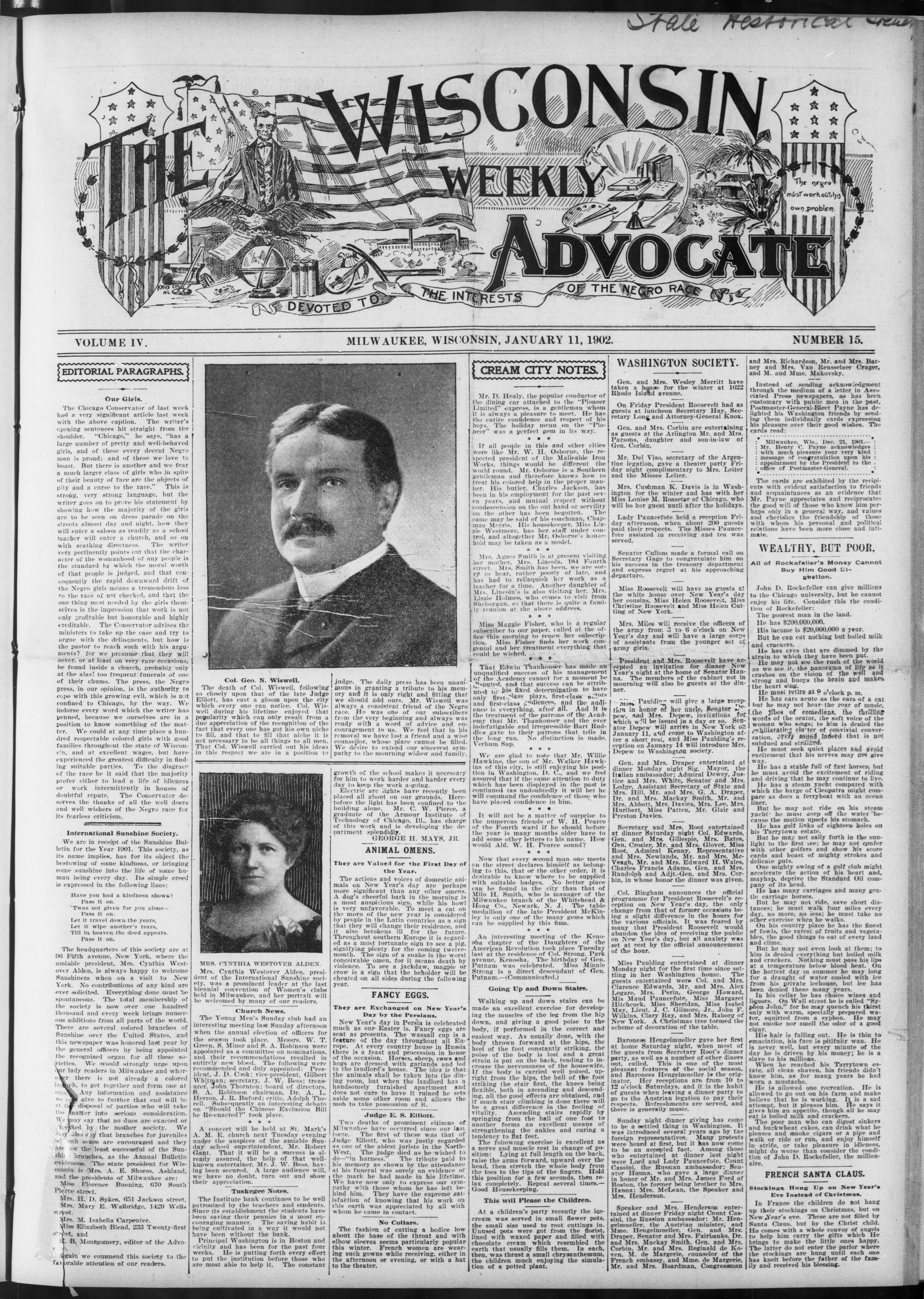
WISCONSIN
WEEKLY
ADVOCATE
DEVOTED TO THE INTERESTS OF THE NEGRO RACE
EDITORIAL PARAGRAPHS.
Our Girls.
The Chicago Conservator of last week had a very significant article last week with the above caption. The writer's opening sentences hit straight from the shoulder. "Chicago," he says, "has a large number of pretty and well-behaved girls, and of these every decent Negro man is proud; and of these we love to boast. But there is another and we fear a much larger class of girls who in spite of their beauty of face are the objects of pity and a curse to the race." This is strong, very strong language, but the writer goes on to prove his statement by showing how the majority of the girls are to be seen on dress parade on the streets almost day and night, how they will enter a saloon as readily as a school teacher will enter a church, and so on with scathing directness. The writer very pertinently points out that the character of the womanhood of any people is the standard by which the moral worth of that people is judged, and that consequently the rapid downward drift of the Negro girls means a tremendous loss to the race of not checked, and that the one thing most needed by the girls themselves is the impression that work is not only profitable but honorable and highly creditable. The Conservator advises the ministers to take up the case and try to argue with the delinquents, but how is the pastor to reach such with his arguments? for we presume that they will never, or at least on very rare occasions, be found inside a church, probably only at the alas! too frequent funerals of one of their chums. The press, the Negro press, in our opinion, is the authority to cope with this growing evil, which is not confined to Chicago, by the way. We indorse every word which the writer has penned, because we ourselves are in a position to know something of the matter. We could at any time place a hundred respectable colored girls with good families throughout the state of Wisconsin, and at excellent wages, but have experienced the greatest difficulty in finding suitable parties. To the disgrace of the race be it said that the majority prefer either to lead a life of idleness or work intermittently in houses of doubtful repute. The Conservator deserves the thanks of all the well doers and well wishers of the Negro race for its fearless criticism.
International Sunshine Society
We are in receipt of the Sunshine Bulletin for the Year 1901. This society, as its name implies, has for its object the bestowing of some kindness, or bringing some sunshine into the life of some human being every day. Its simple creed is expressed in the following lines:
Have you had a kindness shown?
The headquarters of this society are at 96 Fifth avenue, New York, where the amiable president, Mrs. Cynthia West-over Alden, is always happy to welcome Sunshiners when on a visit to New York. No contributions of any kind are ever solicited. Everything done must be spontaneous. The total membership of the society is now over one hundred thousand and every week brings numerous additions from all parts of the world. There are several colored branches of Sunshine over the United States, and this newspaper was honored last year by the general officers by being appointed the recognized organ for all these societies. We would strongly urge upon our lady readers in Milwaukee and wherever there is not already a colored branch, to get together and form one at once. Any information and assistance we can give to further that end will be at the disposal of parties who will take the matter into serious consideration. We may say that no dues are exacted or expected by the mother society. We may also say that branches for juveniles of both sexes are encouraged and they are not the least successful of the Sunshine branches, as the Annual Bulletin evidences. The state president for Wisconsin is Mrs. A. E. Shores, Ashland, and the presidents of Milwaukee are: Miss Florence Buening, 670 South
Mrs. H. D. Sykes, 651 Jackson street.
Mrs. Mary E. Walbridge, 1429 Wells street.
Mrs. M. Isabella Carpenter.
Miss Elizabeth Blend, 233 Twenty-first street, and
R. B. Montgomery, editor of the Advocate.
Again we commend this society to the favorable attention of our readers.
J
Col. Geo. N. Wiswell.
The death of Col. Wiswell, following so closely upon that of the late Judge Elliott, has cast a gloom upon the city which every one can notice. Col. Wiswell during his lifetime enjoyed that popularity which can only result from a due appreciation of the recognition of the fact that every one has got his own niche to fill, and that to fill that niche it is not necessary to be all things to all men. That Col. Wiswell carried out his ideas in this respect we are in a position to
M. H.
MRS. CYNTHIA WESTOVER ALDEN. Mrs. Cynthia Westover Alden, president of the International Sunshine society, was a prominent leader at the last biennial convention of Women's clubs held in Milwaukee, and her portrait will be welcomed by many of our readers.
Church News.
The Young Men's Sunday club had an interesting meeting last Sunday afternoon when the annual election of officers for the season took place. Messrs. W. T. Green, S. Minor and S. A. Robinson were appointed as a committee on nominations, and their recommendations resulted in entirely new blood. The following were recommended and duly appointed: President, J. D. Cook; vice-president, Gilbert Whitman; secretary, J. W. Bess; treasurer, John Thornton; board of directors, S. A. Robinson chairman, Dr. A. L. Herron, J. R. Buford; critic, Adolph Therell. Subsequently an interesting debate on "Should the Chinese Exclusion Bill be Re- enacted?" took place.
* * *
A concert will be held at St. Mark's A. M. E. church next Tuesday evening under the auspices of the amiable Sunday school superintendent, Mr. Robert Gant. That it will be a success is already assured, the help of that well-known entertainer, Mr. J. W. Bess, having been secured. A large audience will, we have no doubt, turn out and show their appreciation.
Tuskegee Notes.
The Institute bank continues to be well patronized by the teachers and students. Since its establishment the students have been saving their pennies in a most encouraging manner. The saving habit is being cultivated in a way it would not have been without the bank. Principal Washington is in Boston and vicinity and has been for the past four weeks. He is putting forth every effort to put the institution before those who are most able to help it. The constant
MILWAUKEE, WISCONSIN, JANUARY 11, 1902.
judge. The daily press has been unanimous in granting a tribute to his memory and it is only right and fitting that we should add ours. Mr. Wiswell was always a consistent friend of the Negro race. He was one of our subscribers from the very beginning and always was ready with a word of advice and encouragement to us. We feel that in his removal we have lost a friend and a wise counsellor, whose place cannot be filled. We desire to extend our sincerest sympathy to the mourning widow and family.
growth of the school makes it necessary for him to work harder and harder every day to keep the work a-going. Electric are lights have recently been placed all about on our grounds. Heretofore the light has been confined to the building alone. Mr. C. W. Pierce, a graduate of the Armour Institute of Technology of Chicago, Ill., has charge of this work and is developing the department splendidly.
GEORGE H. MAYS, JR.
ANIMAL OMENS.
They are Valued for the First Day of the Year.
The actions and voices of domestic animals on New Year's day are perhaps more significant than any other omens. A dog's cheerful bark in the morning is a most auspicious sign, while his howl is very unfavorable. To meet a cat on the morn of the new year is considered by people in the Latin countries as a sign that they will change their residence, and it also betokens ill for the future. Throughout southern Europe it is regarded as a most fortunate sign to see a pig, signifying plenty for the coming twelve-month. The sign of a snake is the worst conceivable omen, for it means death by violence. To see a jackdaw, magpie or crow is a sign that the beholder will be cheated on all sides during the following year.
FANCY EGGS.
They are Exchanged on New Year's Day by the Persianus
New Year's day in Persia is celebrated much as our Easter is. Fancy eggs are sent as presents. The wassail cup is a feature of the day throughout all Europe. At every country house in Russia there is a feast and procession in honor of the occasion. Horses, sheep, cows and hogs are dressed with garlands and led to the landlord's house. The idea is that the animals shall be taken into the dining room, but when the landlord has a handsomely furnished apartment and does not care to have it ruined he sets aside some other room and allows the mob to take possession of it.
Judge E. S. Elliott.
Two deaths of prominent citizens of Milwaukee have occurred since our last issue. The first of these was that of Judge Elliott, who was justly regarded as one of the ablest jurists in the North-West. The judge died as he wished to do—"in harness." The tribute paid to his memory as shown by the attendance at his funeral was surely an evidence of the mark he had made in his lifetime. We have now only to express our sympathy with those whom he has left behind him. They have the supreme satisfaction of knowing that his work on this earth was appreciated by all with whom he came in contact.
No Collars.
The fashion of cutting a bodice low about the base of the throat and with elbow sleeves seems particularly popular this winter. French women are wearing such gowns while receiving, either in the afternoon or evening, or with a hat to the theater.
CREAM CITY NOTES.
Mr. D. Healy, the popular conductor of the dining car attached to the "Pioneer Limited" express, is a gentleman whom it is always a pleasure to meet. He has the entire confidence and respect of his boys. The holiday menu on the "Pioneer" was a perfect gem in its way.
If all people in this and other cities were like Mr. W. H. Osborne, the respected president of the Malleable Iron Works, things would be different the world round. Mr. Osborne is a Southern gentleman and therefore knows how to treat his colored help in the proper manner. His butler, Charles Jackson, has been in his employment for the past seven years, and mutual respect without condescension on the ont hand or servility on the other has been begotten. The same may be said of his coachman, Chapman Morris. His housekeeper, Miss Lizzie Westmore, has her staff under control, and altogether Mr. Osborne's household may be taken as a model.
Mrs. Agnes Smith is at present visiting her mother, Mrs. Lincoln, 184 Fourth street. Mrs. Smith has been, we are sorry to hear, rather poorly of late, and has had to relinquish her work as a teacher for a time. Another daughter of Mrs. Lincoln's is also visiting her, Mrs. Lizzie Holmes, who comes to visit from Sheboygan, so that there is quite a family reunion at the above address.
丰 丰 丰
Miss Maggie Fisher, who is a regular subscriber to our paper, called at the office this morning to renew her subscription. Miss Fisher finds her work congenial and her treatment everything that could be wished.
审审审
That Edwin Thanhouser has made an unqualified success of his management of the Academy cannot for a moment be disputed, and that success can be attributed to his fixed determination to have only first-class plays, first-class actors and first-class audiences, and the audience is everything, after all. And it is the treatment of the patrons of the Academy that Mr. Thanhouser and the ever indefatigable and irrepressible Bart Ruddles gave to their patrons that tells in the long run. No distinction is made. Verbum Sap.
☆ ☆ ☆
We are glad to note that Mr. Willie Hawkins, the son of Mr. Walker Hawkins of this city, is still enjoying his position in Washington, D. C., and we feel assured that if the same attention to duty which has been displayed in the past is continued (as undoubtedly it will be) he will command the confidence of those who have placed confidence in him.
* * *
It will not be a matter of surprise to the numerous friends of W. H. Pearce of the Fourth ward if he should before the year is many months older have to add some other letters to his name. How would Ald. W. H. Pearce sound?
* * *
Now that every second man one meets on the street declares himself as belonging to this, that or the other order, it is desirable to know where to be supplied with suitable badges. No better place can be found in the city than that of Milo H. Smith, who is manager of the Milwaukee branch of the Whitehead & Hoag Co., Newark, N. J. The table medallion of the late President McKinley is only one of the many gems which can be supplied by this firm.
☆ ☆ ☆
An interesting meeting of the Kenosha chapter of the Daughters of the American Revolution took place Tuesday last at the residence of Col. Strong, Park avenue, Kenosha. The birthday of Gen. Putnam was celebrated. Miss Minnie Strong is a direct descendant of Gen. Putnam.—(Communicated.)
Going Up and Down Stairs.
Walking up and down stairs can be made an excellent exercise for developing the muscles of the leg from the hip down, and giving a good poise to the body, if performed in the correct and easiest way. As usually done, with the body thrown forward at the hips, the heel of the foot constantly striking, the poise of the body is lost and a great strain is put on the back, tending to increase the nervousness of the housewife. If the body is carried well poised, upright from the hips, the ball of the foot striking the stair first, the knees being flexible, both in ascending and descending, all the good effects are obtained, and if much stair climbing is done there will be a great difference in the feeling of vitality. Ascending stairs rapidly by springing from the ball of one foot to another forms an excellent means of strengthening the ankles and curing a tendency to flat feet.
The following exercise is excellent as a nerve and muscle rest in change of position: Lying at full length on the back, raise the arms forward, upward over the head, then stretch the whole body from the toes to the tips of the fingers. Hold this position for a few seconds, then relax completely. Repeat several times. Good Housekeeping.
This will Please the Children.
At a children's party recently the icecream was served in small flower pots, the small size used to root cuttings in. Unused pots were got from the florist, lined with waxed paper and filled with chocolate cream which resembled the earth that usually fills them. In each, then, was thrust a small chrysanthemum, the children much enjoying the simulation of a potted plant.
WASHINGTON SOCIETY.
WASHINGTON SOCIETY.
Gen. and Mrs. Wesley Merritt have taken a house for the winter at 1622 Rhode Island avenue.
On Friday President Roosevelt had as guests at luncheon Secretary Hay, Secretary Long and Attorney-General Knox.
Gen. and Mrs. Corbin are entertaining as guests at the Arlington Mr. and Mrs. Parsons, daughter and son-in-law of Gen. Corbin.
Mr. Del Viso, secretary of the Argentine legation, gave a theater party Friday night complimentary to Mrs. Leiter and the Misses Leiter.
Mrs. Cushman K. Davis is in Washington for the winter and has with her Miss Louise M. Rosseter of Chicago, who will be her guest until after the holidays.
Lady Pauncefote held a reception Friday afternoon, when about 200 guests paid their respects. The Misses Pauncefote assisted in receiving and tea was served.
Senator Cullom made a formal call on Secretary Gage to congratulate him on his success in the treasury department and express regret at his approaching departure.
Miss Roosevelt will have as guests at the white house over New Year's day her cousins, Miss Helen Roosevelt, Miss Christine Roosevelt and Miss Helen Cutting of New York.
Mrs. Miles will receive the officers of the army from 3 to 6 o'clock on New Year's day and will have a large corps of assistants from the younger set of army girls.
President and Mrs. Roosevelt have accepted an invitation for dinner New Year's night at the home of Senator Hanna. The members of the cabinet not in mourning will also be guests at the dinner.
Miss. Paulding will give a large reception in honor of her uncle, Senator Depew, and Mrs. Depew, invitations for which will be issued in a day or so. Senator Depew will arrive in New York on January 11, and come to Washington after a short rest, and Miss Paulding's reception on January 14 will introduce Mrs. Depew to Washington society.
Gen. and Mrs. Draper entertained at dinner Monday night Sig. Mayor, the Italian ambassador; Admiral Dewey, Justice and Mrs. White, Senator and Mrs. Lodge, Assistant Secretary of State and Mrs. Hill, Mr. and Mrs. G. A. Draper, Dr. and Mrs. Mackay Smith, Mr. and Mrs. Abbott, Mrs. Davies, Mrs. Lee, Mrs. Hurlbert, Miss Patten, Mr. Glair and Preston Davies.
Secretary and Mrs. Root entertained at dinner Saturday night Col. Edwards, Gen. and Mrs. Gillespie, Mrs. Bates, Gen. Crozier, Mr. and Mrs. Glover, Miss Root, Admiral Kenny, Representative and Mrs. Newlands, Mr. and Mrs. McVeagh, Mr. and Mrs. Edward H. Wales, Charles Francis Adams, Gen. and Mrs. Randolph and Adjt.-Gen. and Mrs. Corbin, in whose honor the dinner was given.
Col. Bingham announces the official programme for President Roosevelt's reception on New Year's day, the only change from that of former occasions being a slight difference in the hours for the various officials. It was feared by many that President Roosevelt would abandon the idea of receiving the public on New Year's day, but all anxiety was set at rest by the official announcement of the hour.
Miss Paulding entertained at dinner Monday night for the first time since settling in her Washington house. The guests entertained were Col. and Mrs. Clarence Edwards, Mr. and Mrs. Alex Legare, Mrs. Perin, George Howard, Mis Maud Pauncefote, Miss Margaret Hitchcock, Miss Sheridan, Miss Isabel May, Lieut. J. C. Gilmore, Jr., John F. Wilkins, Clary Ray, and Mrs. Raborg of New York. A Christmas tree formed the scheme of decoration of the table.
Baroness Hengelmueller gave her first at home Saturday night, when most of the guests from Secretary Root's dinner party, as well as a number of other diners out, called. This is one of the most pleasant features of the social season, and Baroness Hengelmueller is the originator. Her receptions are from 10 to 12 o'clock Saturdays, and it is the habit of guests when leaving a dinner party to go to the Austrian legation to pay their respects. Refreshments are served, and there is generally music.
Sunday night dinner giving has come to be a settled thing in Washington. It was introduced several years ago by the foreign representatives. Many protests were heard at first, but it has now come to be an accepted fact. Among those who entertained at dinner last night were Lord and Lady Pauncefote. Count Cassini, the Russian ambassador; Senator Hanna, who gave a large dinner in honor of Mr. and Mrs. James Ford of Boston, the former being brother to Mrs. Hanna; Mrs. McLean, the Speaker and Mrs. Henderson.
Speaker and Mrs. Henderson entertained at dinner Friday night Count Cassini, the Russian ambassador; Mr. Hengelmueller, the Austrian minister, and Mme. Hengelmueller, Gen. and Mrs. Draper, Senator and Mrs. Fairbanks, Dr. and Mrs. Mackay Smith, Gen. and Mrs. Corbin, Mr. and Mrs. Reginald de Koven, M. de Margerie, counselor of the French embassy, and Mme. de Margerie, Mr. and Mrs. Boardman, Congressman
and Mrs. Richardson, Mr. and Mrs. Barney and Mrs. Van Rensselaer Cruger, and M. and Mme. Makovsky.
Instead of sending acknowledgment through the medium of a letter in Associated Press newspapers, as has been customary with public men in the past, Postmaster-General-Elect Payne has delighted his Washington friends by sending them individually cards expressing his pleasure over their good wishes. The cards read:
: Milwaukee, Wis., Dec. 21, 1901.—
: Mr. Henry C. Payne acknowledges:
: with much pleasure your very kind
: message of congratulation upon his
: appointment by the President to the
: office of Postmaster-General.
The cards are exhibited by the recipients with evident satisfaction to friends and acquaintances as an evidence that Mr. Payne appreciates and reciprocates the good will of those who know him perhaps only in a general way, and values and cherishes the friendship of those with whom his personal and political relations have been more close and intimate.
WEALTHY, BUT POOR,
All of Rockefeller's Money Cannot Buy Him Good Digestlon.
John D. Rockefeller can give millions to the Chicago university, but he cannot enjoy his life. Consider this the condition of Rockefeller:
The poorest man in the land.
He has $200,000,000.
He has $200,000,000.
His income is $20,000,000 a year.
His income is $20,000,000 a year.
But he can eat nothing but boiled milk and crackers.
He has eyes that are dimmed by the strain to which they have been put.
He may not see the rush of the world as we see it, the panorama of life as it crashes on the vision of the well and strong and buoys the brain and makes the heart sing.
He must retire at 9 o'clock p. m.
He has ears acute as the ears of a cat but he may not hear the roar of music, the jibes of comedians, the thrilling words of the orator, the soft voice of the woman who sings; to him is denied the exhilarating clatter of convivial conversation, every sound indeed that is not subdued and stifled.
He must seek quiet places and avoid excitement that his nerves may not give way.
He has a stable full of fast horses, but he must avoid the excitement of riding and driving that he may continue to live.
He has a steam yacht compared with which the barge of Cleopatra might compare as does a ferryboat with an ocean liner.
But he may not ride on his steam yacht; he must keep off the water because the motion upsets his stomach.
He has golf links of eighteen holes on his Tarrytown estate.
But he may not sally forth in the sunlight to the first tee; he may not confer with other golfers and show his score cards and boast of mighty strokes and delicate puts.
One mighty swing of a golf club might accelerate the action of his heart and, mayhap, deprive the Standard Oil company of its head.
He has many carriages and many gentle carriage horses.
But he may not ride, save short distances; he must walk four miles every day, no more, no less; he must take no other exercise when he walks.
On his country place he has the finest of fowls, the rarest of fruits and vegetables, the good things to eat of every land and clime.
But he may not even look at them; to him is denied everything but boiled milk and crackers. Nothing must pass his lips at a temperature below blood heat. On the hottest day in summer he may long for a draught of water cooled with ice from his private icehouse, but ice has been denied these many years.
In his cellar he has choice wines and liquors. On Wall street he is called "Syphon John," for he may quench his thirst only with warm, specially prepared water, squirred from a syphon. He may not smoke nor smell the odor of a good cigar.
His hair is falling out. He is thin to emaciation, his face is pitifully wan. He is never well, but every minute of the day he is driven by his money; he is a slave to his millions.
When he reached his Tarrytown estate, all clean shaven, his friends didn't know him, as for many years he had worn a mustache.
He is allowed one recreation. He is allowed to go out on his farm and make believe that he is working. It is a sad attempt, but it pleases him. He says it gives him an appetite, though all he may eat is boiled milk and crackers.
The poor man who can digest sinkers and buckwheat cakes, can drink what he pleases and smoke cigars or a pipe and walk or ride or run, and enjoy himself in strife, or take pleasure in idleness, might do worse than consider the condition of John D. Rockefeller, the millionaire.
FRENCH SANTA CLAUS.
Stockings Hung Up on New Year's Eve Instead of Christmas.
In France the children do not hang up their stockings on Christmas, but on New Year's eve. These are not filled by Santa Claus, but by the Christ child. He comes with a whole convoy of angels to help him carry the gifts which He brings to make the little ones happy. The latter do not enter the parlor where the stockings are hung until each one has knelt before the father of the family and received his blessing.
COLLISION IN A TUNNEL
Fifteen Persons Perish by Railroad Accident in New York.
TRAINS MET IN SUBWAY
Norwalk Accommodation Stopped by Block Signal System Because Something Wrong Ahead.
New York, Jan. 8.—Two local trains bound for New York—one from South Norwalk, the other from White Plains—crashed together in the smoke-clouded Park avenue tunnel of the New York Central line early today. Seventeen persons were killed and forty injured. Of the latter twelve were seriously injured. The engineer and fireman of the White Plains local and a towerman were arrested. Dist.-Atty. Jerome visited the wreck and will personally direct an investigation.
Partial List of Victims.
H. FRANKLIN CROSBY, New Rochelle, OSCAR E. MEYEROWITZ, optician, New York city.
THEODORE FORGARDO, 30 years old.
New, Rochelle.
New Rochelle.
WILLIAM FISHER, 25 years old, New Rochelle.
GEORGE POTTER, 40 years old, New Rochelle.
MRS. A. F. HOWARD, New Rochelle.
WILLIAM HOWARD, New Rochelle.
E. C. HINSDALE, 35 years old, New Rochelle.
CHARLES B. MARS, custom house employee, New Rochelle.
ployer. New Rochelle.
GEORGE W. SIMRING, 25 years old,
New Rochelle.
F. WASHBURN, 55 years old, New
Rochelle.
Alfred Wadley, florist of New York city, fracture of both legs, shock and scalp wounds. Albert W. Adams, a carriage builder of New York city, left leg cut off below knee, George M. Carter, New York, leg fractured. George M. Fisher, 46 years old, East Port Chester, severely injured.
Mabel Newman, New Rochelle; contusions on body and hip fractured.
Richard Millineaux, New Rochelle; compound fracture of thigh. Thomas T. Murphy, New Rochelle; both legs broken and internal injuries, condition critical.
Winfield Schultze, New Rochelle; fractured legs and burns.
A. McRae, New Rochelle, leg fractured.
Henry Keene, general manager of the Siegel-Cooper company, this city, fractured ribs and internal injuries.
George Winter, New Rochelle, compound fracture left leg. The leg was amputated.
William Brooks, Erle, Pa., lacerated face and possible fracture of skull.
Shocked the Neighborhood.
The shock of the collision was plainly heard by people passing on Park avenue above the tunnel. Several of them ran to give the alarm. In ten minutes everybody at police and fire headquarters was at work organizing relief to be sent to the spot. A hurry call was sent to Bellevue, Flower, the Presbyterian and Roosevelt hospitals, and in ten minutes a dozen ambulances were hurrying with a corps of doctors.
When the rescuers reached the wreck smoke was pouring out of the entrance to the tunnel at Fifty-fifth street and great columns of smoke came out of the first ventilator a half block north. It was very dark in the tunnel, which was filled with smoke and steam. The work of rescue was, therefore, difficult. The locomotive of the White Plains local was hidden in the rear car of the South Norwalk train. The maimed and injured were calling from the wreck. Some, more badly injured than others, were being assisted by the more fortunate passengers. Prepartions were hurriedly made at the various hospitals to take care of the wounded as rapidly as they were brought to the railroad station. A passenger on the Harlem train said:
A Terrific Crash.
"Our train was held at the Harlem end of the tunnel for two minutes to allow the New Haven train to pass us. Then we proceeded. Suddenly there was a terrific crash and we were hurled from our seats. The shock was followed by the roar of escaping steam and the cries of the wounded.
"A score of men passengers got out of the windows and ran to the front of our train. The confusion and noise was awful. Our locomotive had plowed half way through the last New Haven car. I saw several women taken out of the first wrecked car."
Eugene Herold of Rochelle Park, one of the passengers on the Danbury train, gave this account of the accident:
"We were sitting quietly in the next to the last car and there were only one or two unoccupied seats. There was the usual morning crowd, the train consisting of five cars. There were several women in my car and also in the last car. We had been stalled at Fifty-seventh street for some time. Suddenly there came a terrific crash. The lights in the car went out. There was a roar of grinding steel and wood and a chorus of shieks. I looked back and saw the car behind telescoping over the rear of our car, and through that mixup plunged a roaring locomotive.
"I was thrown on my face by the jolt and I felt some blood splash over my forehead. Stifling smoke and steam seemed to rise all around, and looking back I could see mangled persons crawling about through the mist. Then suddenly the car took fire where the locomotive was.
Escape Through Car Windows.
"Our one idea was to escape. I found a friend of mine right in front of me. He cried, 'Open the windows, for God's sake.' I turned to the window and found the glass had been shattered by the collision. We climber out. I saw several persons almost covered with blood crawling about."
The response of the police and fire departments to the call was prompt and within an incredibly short time nearly 300 firemen, ambulance surgeons and trainmen were in the smoke and steam-filled tunnel, working desperately to get the bodies of the dead and wounded passengers from the wrecked trains. Above the scene of death on the driveway on both sides of the tunnel were long rows of ambulances, fire engines and hook and ladder companies.
In many instances the uninjured and those whose injuries were slight rendered splendid aid while others, bewildered by the shock and darkness, groped their way along the walls seeking an exit. The bodies of the dead and many of the wounded were heisted through the openings in the roof of the tunnel, placed in the waiting ambulances and rushed to the nearest hospitals. No attempt was made at identification. Conflicting reports from various institutions, aided by duplications from other places, caused the first account of the disaster to place the
number of killed and injured at an exaggerated figure.
Tunnel Two Miles Long.
The tunnel in which the wreck occurred extends from Firty-fifth street just above the Grand Central station and is about two miles long. It is under Park avenue and there is an airhole in each block. Complaints have been made for a long time, however, that its ventilation was insufficient and the New York Central has been considering plans for the use of electrical power in the subway so as to do away with the smoke and steam from locomotives.
J. H. Franklin, manager of the Harlem division of the New York Central, made the following statement: "We are investigating thoroughly, but we are first taking out the injured and having them cared for and until that is done the investigation cannot proceed.
"So far as can be learned the wrecked train was stopped by the block signal system, because of something wrong ahead. I don't know or have not yet found out what was the matter ahead. A flagman jumped off the train, taking a red lantern and a railroad torpedo. He put the torpedo on the track and waved his lantern to signal any train that might come up behind. Whether the engineer of the coming train saw the flagman, saw the lantern or heard the torpedo, if it went off, I don't know and the flagman says he does not know. I cannot now tell who was the flagman or engineer of the train."
Heartless Vandalism.
Almost a riot was caused at a police station by the arrest of a man accused by Coroner Scholler of attempting to rob the bodies of the dead as they lay in the station house. People had been admitted to the station to identify the bodies and the man is supposed to have drifted in with the crowd. When he was taken before the sergeant at the desk the friends and relatives of some of the dead were so incensed that they made several attempts to get at him, shouting, "He ought to be lynched." The man gave his name as John Maloney. Coroner Scholler said he saw Maloney going through the pockets of one of the dead persons' clothes. "You ought to be burned in oil," said the sergeant to Maloney. "You are the meanest criminal I ever saw. Take him away quick."
Maloney was taken to a cell followed by the threats of the crowd.
When nearly all of the dead and injured had been removed from the wreck, Father Smith of the Church of St. Vincent de Paul and Chaplain Walkly of Grace church, both chaplains of the fire department, crawled into the wrecked car, over the hot boiler of the demolished White Plains locomotive, and found two girls in the middle of the last coach. They were sisters named Scott, of New Rochelle. One sister lay on top of the other, the sister underneath held by wreckage which pinned down her body below the waist. One leg was crushed. The dead body of a man, which was also pinned fast by the wreckage, lay across the chest of the other sister and held her down.
Stimulants were administered to the girls by the chaplain, who remained with them until they were removed.
Suffered to Save Others.
Acting Battalion Chief Friel found in the wreck a man who gave his name as T. M. Murphy, and tried to move him. Murphy said his leg was held fast and asked Chief Friel to free it. The chief found that if he loosened the timbers that held Murphy's leg, he was liable to let down more wreckage on the bodies of the two girls. He told Murphy this and Murphy said: "All right, I'll wait, but please be as quick as you can." The chief made Murphy as comfortable as he could with a seat cushion, with his badly smashed leg he lay there till the bodies of the injured ones beside him were removed. J. H. Franklin made a verbal statement: this afternoon in which he said: "The engineer of the rear train, the White Plains local, so far as I have been able to learn, was responsible for the accident.
"The Norwalk local was due in the depot at 8:15 and the White Plains local at 8:17. The Norwalk local was stopped by the danger signal at Fifty-ninth street. The flagman got out with lantern and torpedoes and put the torpedoes on the rsil. The engineer of the incoming train failed to recognize the signal and made no response and the collision was the result."
Cars Reduced to Kindling Wood.
Peru, Ind., Jan. 8.—The Wabash castbound limited train narrowly escaped a bad wreck in a collision at Lagro, twenty miles east of here, early today. An extra freight westbound was making the siding and had nearly cleared the main track, when the limited, running fifty miles an hour, crashed into it, making kindling wood of the rear three cars and throwing the passenger engine into the ditch. One mail car was derailed, but the mail clerks escaped injury. Engineer John Brumbaugh and Fireman W. C. Humphrey stuck by their posts and were badly injured, but they will recover. No passengers were hurt beyond a severe shaking. The track is blocked, and trains are being run around by the Big Four and Erie tracks.
Salt Lake, Utah, Jan. 8.—A freight train on the Rio Grande Western road and a work train collided near Roy station, ten miles south of Ogden, in the thick fog this morning. Fireman Frank Cowell of Salt Lake was instantly killed.
The injured-James Wollwine, brakeman, fatal; J. C. McNickle, engineer, severe; J. C. Fraser, Clinton, Utah, slight.
WEDDEDIN WASHINGTON
Senator Foraker's Daughter Becomes Wife of Francis K. Walnwright of Philadelphia.
Washington, D. C., Jan. 8.—Miss Julia Foraker, youngest daughter of Senator and Mrs. Foraker, was married at her parents' residence here today to Francis King Wainwright of Philadelphia. The ceremony was performed by Rev. Dr. Mackay-Smith and was followed by a reception at which about 400 guests were present. The bride's wedding dress was of heavy white satin with yoke and sleeves of rose point. The veil of tulle was held by orange blossoms. The jewels worn were gifts—a crescent of diamonds from her father and a dog collar of pearls from the groom.
The bridal party and personal friends of the couple, twenty in all, sat at the table together for their wedding breakfast. Senatorial, diplomatic and social circles were largely represented in the guests attending the reception. The bride received a number of elegant gifts which made a glittering collection.
Mr. and Mrs. Wainwright left on the afternoon train for a honeymoon jaunt. Their future home will be at Bryn Mawr, but until their new house there is completed the couple will live in Philadelphia.
BRILLIANT METEOR.
Travels in Northeasterly Direction and Leaves Trail of Sulphur and Smoke Behind.
Sait Lake, Utah, Jan. S.—A special to the Tribune from Park City, Utah, says that a brilliant meteor was witnessed from that city at 7 o'clock yesterday morning. It was traveling in a northeasterly direction and seemed in close proximity to the earth. It left a trail of sulphur and smoke behind, which was distinctly visible.
MEANS HIGHER RATES.
Washington, D. C., Jan. 7.—Atty. Gen. Wallace B. Douglas of Minnesota filed today in the United States Supreme court the bill of complaint in the case of the state of Minnesota, complainant, against the Northern Securities company, defendant. It is a long document, about 10,000 words, covering thirty-two pages of printed matter. The bill first points out the direct interest the state has in the proposed consolidation. It still owns more than 3,000,000 acres of public lands valued at more than $15,000,000 and traversed in part by the lines of the Great Northern and Northern Pacific. If the merger is effected, these roads will cease to build spurs into these lands or compete for their business. The value of the lands will not increase as it has under the spur of competition and the state will lose in the taxable value of its property. The lands will not be opened for years and development will be arrested. It is next set up that the state expends more than $700,000 annually in the operation and maintenance of its educational, charitable and other public institutions; that this is mostly raised by direct taxation, that the amount which can be raised and the successful maintenance of these institutions for the benefit of its citizens depend largely upon the value of the real and personal property within the state, which in turn depends largely upon free railroad competition. It has been the settled policy of the state to encourage railroad building by grant of lands and in this way over 10,500,000 acres have been granted, nearly all of which has been granted to the Great Northern and Northern Pacific and their subsidiary companies.
Means Higher Rates.
The complaint alleges that the rates on the immense shipments of wheat and other merchandise over the lines of the two companies have been lower than they will be under any arrangement which contemplates unity of control. The bill then recites the charters and in corporations under which the Great Northern operates 4500 miles of road and cites the clause in its charter providing that its affairs are to be conducted by a board of directors which is to do all things necessary "and not inconsistent with the constitution and laws of the United States or the laws of this territory or this act."
It is further alleged that James J. Hill holds a controlling interest in the $125,-000,000 of capital stock. The history and charters of the Northern Pacific are similarly related, special attention being paid to the roads acquired and built within the state. By filing its articles of incorporation in Wisconsin with the Minnesota authorities, the Northern Pacific became subject to all the laws, regulations and provisions of Minnesota. The facts as to the present personnel of the directory, the insolvency of the old company and its reorganization in 1893, the purchase of the St. Paul & Duluth road in 1899 are recited at length. It is set up that the lines of these two systems are not only competitive lines between Minnesota and Puget Sound, and have so furnished for eleven years. They are also with one exception the only lines traversing northern Minnesota. A paragraph is devoted to the Burlington and the facts as to the terms on which its control was obtained by the two systems jointly, Charles E. Perkins, its former president and present director, being a director in the Northern Securities company. The certificate of incorporation of the latter filed in New Jersey November 13, 1901, is quoted in full.
Organized to Evade the Law.
Taking up the Northern Securities company, it is set forth that it was organized by James J. Hill, W. P. Clough, J. Pierpont Morgan and "other associates to the oratrix unknown" who at the time were continually in conference over means by which the laws of Minnesota might be successfully evaded or avoided, and that it was so organized solely for the purpose of effecting a consolidation of the Great Northern and Northern Pacific. The owners of a large majority of the stock of the two systems had agreed before hand to transfer to the new company 75 per cent. of the stock of the two systems on terms which are set forth in full and to retire the preferred stock of the Northern Pacific. In furtherance of the plan to evade the laws of Minnesota it was agreed that pending the delivery of the stock to the Northern Securities company it should all be turned over to James J. Hill or be under his control. The Northern Securities company, it is charged, does not intend to purchase this stock but simply to issue its own stock in exchange therefor. For these unlawful purposes the company is about to receive, unless enjoined therefrom, all the capital stock of the Great Northern and Northern Pacific. This, it is claimed, is part of a plan of Hill, Morgan and their associates, whereby the two systems are to be consolidated and placed under the direction of one man or board of directors through the defendant company, and thus bring about and perpetuate a monopoly in railway traffic in Minnesota and a complete consolidation of the two systems. One man or board will thus, it is alleged, be enabled to fix all rates on lines of the state, determine what trains shall be run, remove all competition, and prevent the building of lines into new country or into competitive territory. This agreement and the consummation thereof is claimed to be "in restraint of trade, against public policy and void."
Under its terms the directory of the Northern Securities company may change its own rules or may delegate all its authority to an executive committee. It is pointed out that Hill, the president, W. P. Clough, the vice-president, and E. T. Nichols, the treasurer and secretary of the company, were all at the date of its organization officers of the Great Northern and that a majority of its directors were also directors of the Northern Pacific.
Settled Policy of the State.
It has been the settled policy of the state to prohibit consolidation of parallel or competing lines, and the law of 1874, in which such prohibition is made, is quoted in full as well as the amplifying act of 1881 and the anti-trust law of 1899 prohibiting any combination in restraint of trade. It is set up that the Northern Securities company is a railroad corporation within the meaning of the Minnesota laws and that its design is to evade, escape and violate these laws in such a way as to cause the state "irreparable injury." It is not the owner of any other property, stock or securities and is engaged in no other business save that of management and control of the Great Northern and the Northern Pacific. Already, so it is alleged, James J. Hill, as president of the Northern Securities company, has dictated, changed and controlled the policy of the two constituent roads, and during December, 1901, it is alleged, the general managing officers of the Great Northern, acting under
his direction, took charge of and are now engaged in managing a large portion of the business of the Northern Pacific. It is alleged that it is a settled policy of New Jersey to allow the consolidation of only such railroads as are or can be connected to form continuous lines and not to permit the consolidation of parallel or competing lines.
Injunction Asked For.
The oratrix, claiming to have no other adequate remedy or relief, except as prayed for in equity, asks that the defendant be required to show cause why it should not be perpetually enjoined and restrained.
First—From voting at any meeting of the stockholders of the Great Northern and Northern Pacific the capital stock of these companies and from attending in any manner such meetings.
Second—From aiding, advising, interfering with, or in any way participating in the management of the two systems.
Third—From permitting any of its officers, agents or servants from acting as representative, director, officer or employee or exercising any control, management or direction over the same.
Fourth—From making any arrangements or combinations having for their object such joint control.
Fifth—From holding, owning or controlling any of the stock of either company, the defendant company being required to reassign or re-transfer all such stock to the person from whom it was received, taking in return its own stock issued in exchange therefor, and meanwhile to be enjoined in all respects in relation to said stock as hereinbefore prayed for.
Sixth—From receiving any more stock of the two companies, in case it shall appear that the defendant company has not yet acquired a controlling interest in either.
Seventh-The oratrix prays permission to amend the complaint if necessary and bring in other parties for the purpose of giving force and effect to any decree of the court, and asks the court to issue a subpoena against the defendant company and set a day for the hearing.
Besides Attorney General Douglass, M. D. Munn of St. Paul and George P. Wilson of Minneapolis are named of counsel.
BURIED IN MINE.
Many Workmen are Imprisoned in a Mine at Negaunee, Mich
Negaunee, Mich., Jan. 7.—[Special.]—A cave-in from the surface occurred shortly after noon today at the Negaunee mine. A number of miners, thought to be fifteen or more, are entombed in the lower level of the mine and from present indications they may never be taken out alive.
There are two shafts in the mine, but it is thought that all openings between them and the men are closed with the ground that ran down from the surface.
It is impossible at this time for the management to give the names of the men or authentic information relative to the condition of the drift in which they are entombed.
Attempt at Rescue.
A rescuing party has gone underground, but it will be some time before a report of the condition of affairs is received on the surface.
The Negaunee mine suffered a damaging cave-in from the surface last fall, when part of the mine buildings were destroyed. Since then the engine house, blacksmith shop and dry house have been moved to a new location. The cave today occurred in the same place as the former cave-in, though a smaller area of the surface went in.
Great excitement prevails as the news has reached the city and people are rushing to the scene.
Members of families of men employed in the mine are on hand and it is generally feared that men will never be taken out alive.
Mine is Unlucky.
The Negaunee mine is one of the most unlucky properties in the Lake Superior district. Much trouble has resulted in sinking and drifting from surplus water and quicksands.
It was at this mine that $1,000,000 was recently expended to sink a shaft to the ledge.
May Have Been Crushed to Death.
Ishpeming, Mich., Jan. 7.—[Special.]—News has been received here of a horrible mine accident at Negaunee, Mich., early this afternoon.
There was a cavein at one of the mines and fifteen or more men were buried alive. Frantic efforts are being made to rescue the imprisoned miners.
Immediately after the accident a large force of men was put to work to effect a rescue, if possible. It is hoped that the men were not crushed to death and that the rescuing party will be able to reach them before they are suffocated. The names of the men could not be ascertained. Details of the accident are very meager at this time.
RETURNED TO PEKIN.
Emperor and Empress Dowager of China Re-enter Capital After Enforced Exile.
Pekin, Jan. 7.—12:45 p. m.—A telephone message from Mia Chia Fu station, outside the city, says the special train bearing the Emperor and Empress Dowager is just arriving. Thousands of officials have assembled there to receive their majesties. The entire route to the entrance of the palace is lined with troops.
The imperial cortege entered the Forbidden City at 1:30 o'clock this afternoon. It was the most brilliant scene Pekin ever witnessed. The procession consisted of 1000 gorgeously attired noblemen mounted upon glittering caparisoned horses. The Emperor, the Empress Dowager, Prince Chun, the Empress and several princes were borne in yellow chairs, their escorts carrying hundreds of gay banners and silk umbrellas. The troops of Gen. Yuan Shi Kai, governor of Pe Chi Li, preceded the Emperor. The foreign community assembled on top the Chien gate.
The Emperor and Empress Dowager entered the temple in the gate and burned incense. The Dowager Empress upon emerging from the temple saw the foreigners peering down and bowed. A double row of soldiers, kneeling, lined the four-mile route.
The Chinese officials have requested the ministers of the powers to keep the legation guards within their quarters in order to prevent the possibility of a collision between the Chinese and foreign troops.
Dowager's First Railroad Ride.
Brussels, Jan. 7.—The director general of the Belgian railroad in China, who conveyed the Emperor and Dowager Empress' train from Cheng Ting Fu to Pao Ting Fu, telegraphs that he has been personally thanked by their majesties, who expressed themselves pleased and interested by their first experience in railroad travel.
Yellow Jacketa Awarded.
London, Jan. 7.—It is announced in a special dispatch from Pekin that an imperial edict has been issued conferring yellow jackets on Yuan Shi Kai, viceroy of Chi Li, and on Tsen Chun Hsuan, governor of Shan Si, who protected the flight of the Chinese court from Pekin. Both these officials are privileged to ride on horseback in the Forbidden city.
Young Pullman's Estate.
Redwood City, Cal., Jan. 7.—The will of the late George M. Pullman has been admitted to probate here. The petition to the court stated that the estate was valued at $500,000, but the evidence showed it to be worth only about $2000.
ROBBERS SECURED $5000
Watchmen Taken to Printing Office Where They Were Securely Round and Gagged.
St. Louis, Mo., Jan. 7.—Six masked men entered the National Stockyards bank, north of East St. Louis, Ill., last night and after capturing and gagging the night watchman and fireman at the plant and blowing open the vaults with dynamite, secured $5000 in coin and currency, with which they decamped early today. For nine hours, from 7 o'clock last night until 4 o'clock a. m., they were at work on the vaults without being interfered with. The entire East St. Louis police force, aided by the St. Louis police, are guarding all the avenues of escape, but as yet have obtained no clue to the whereabouts of the robbers, who, it is believed, escaped on horseback.
Lee Philpot, one of the watchmen, a rough rider friend of President Roosevelt and a member of the well-known Kentucky family of that name, was the first to meet with the robbers. He was standing near the Exchange building, in which the bank is located, when three men sprang out of a fence corner at him with revolvers in their hands. "We want you, Philpot," they said, and overpowered him before he could reach his revolver. They took him to the composing room of the Daily National Stock Yards Reporter, nearby, bound him hand and foot and gagged him with towels. While lying there three of the men came in. While he was lying on the floor Philpot heard the leader of the robber gang say, "Let's kill him." He was deterred from doing this, Philpot says, by the other robbers. Albert Estep, the other bank watchman, was caught on the steps of the Exchange building. The robber went up to Estep and addressed him by name. Estep was taken unawares and when a revolver was thrust into his face was not in shape for defense. He was forced to go to the composing room, where he also was bound and gagged.
Night Fireman L. W. Clark was taken in the steam plant of the Exchange building. He resisted and was badly beaten with a sandbag before subdued. He also was taken to the composing room and bound and gagged with his two companions.
About midnight one of the robbers was left to guard the three captives while the other five went to the bank which is located on the first floor of the Exchange building near the corner. With nitro glycerine the robbers blew open the steel doors of the vault. The doors are of double thickness of steel, but were shattered and the bank's books and papers blown into shreds.
Safe Doors Blown Off.
Inside the vault, a big safe was attacked and a charge of the explosive inserted which blew the doors off and scattered about $600 in gold and silver upon the floor. This money was left where it fell. They took all the currency and the other coin, amounting to about $5000, as nearly as the bank's officers can estimate. Five minutes after the robber guard left the composing room Estep, who had not been bound securely, worked loose and released Clark and Philpot.
This was about 4 o'clock. Estep then ran to the telephone and gave the alarm. President C. Gordon Knox of the Stockyards bank said that if the robbers had made their raid the night before they would have secured about $10,000 more than they got. The watchmen say that all the bandits appeared to be middle-aged men, none of them under 35 years of age. The leader, a man of about 40 or 45, was tall and slender, probably 6 feet 2 inches, with a sallow complexion and short brown mustache and black eyes. Like all the others, the leader wore a dark suit and a dark overcoat, with a soft black hat.
Philpot says that while he lay in the printing office he could plainly hear two men outside, whose voices he believes he has heard yarding cattle.
EXPLOSION KILLS TWO.
Disaster to Powder Gang In the Newhouse Tunnel at Idaho Springs, Col.
Idaho Springs, Col., Jan. 7.—As a result of a premature explosion of powder blasts in the Newhouse tunnel, two men are dead, another is fatally injured, and two others are in a serious condition. The dead are Ernest Wheeler and John Eckhard. The injured: A. C. B. Lawes, fatally; Harry Baird, ribs broken; Louis Phillips, hand crushed. The men were known as the powder gang. They were loading holes with powder under direction of Lawes, the foreman. Phillips was assisted by Baird in tamping holes on one side of the tunnel and Wheeler and Eckhard were tamping holes on the other side. Lawes was standing back about six feet, giving directions, when the explosion occurred. The cause has not been positively determined, but it is thought the accident was caused by the tamping of a shot.
Soldiers Injured in Wreck.
Chicago, Ill., Jan. 7.—A Rock Island special bearing 300 recruits bound for the Philippines from Columbus barracks, Ohio, was partially wrecked in the Twenty-Second street yards early today. Henry Lewis was crushed between cars and internally injured; taken to hospital; condition serious. C. C. Murphy was thrown out of window and clothing torn from body; escaped with slight bruises.
The other passengers were merely jolted, although a tourist car containing fifty soldiers lost its rear truck and was dragged half a block before the engine stopped, and the car was badly damaged. A sleeper occupied by eight officers and the wife of one of them was thrown to an adjacent track, but maintained its upright position. After several hours' delay the train was remade and the journey continued. The accident is said to have been due to the failure of a switch to work properly.
A Cad Promptly Called
An English firm of solicitors, who recently wrote to the president of the University of Idaho offering to purchase an LL. D. degree for a young client who was thinking of entering Parliament, received the following answer: "The principal whom you represent has disgraced his nationality, the bar and himself. I hope that when he attempts to enter Parliament he will learn that a cad's ambitions, unless carefully limited, are unrealizable.
The New Monument to Parnell.
Augustus St. Gaudens, the American sculptor, has been selected to make the heroic figure of Parnell for the monument to be erected in Dublin. The work must be completed in five years, and will cost from $40,000 to $50,000. Of this sum there has already been subscribed $30,000.
—The oldest secret trade process is the manufacture of Chinese vermilion red
CONGRESS.
House.
In the House, on the 7th, there was considerable business done in the short time the session lasted. As soon as adjournment was taken the friends of the Nicaragua canal bill began to line up votes for the measure, which was to come up in the House on the following day as a special order.
Representative Cooper of, Wisconsin, chairman of the House committee on insular affairs, on the 7th introduced a bill giving a complete form of civil government for the Philippines, to begin Januar 1, 1904, with a governor appointed by the President, a Legislature of two houses, and with two Philippine commissioners to represent the Filipino people at Washington. The debate on the isthmian canal bill in the House was opened in lively fashion by Mr. Hepburn. For two hours he held the floor, replying to a volley of questions concerning the recent offer of the Panama Canal company. Mr. Hepburn maintained that the alleged new offer of the Panama company was part of the plan of delay. Mr. Cooper incorporates in his bill substantially the provisions as to franchises, mining, and land regulations, homesteads, etc., in the Lodge bill in the Senate.
The debate on the Nicaragua canal bill in the House on the 8th developed sentiment in favor of giving consideration to the recent offer of the Panama company to sell its franchises and property for $40,000,000, this sentiment taking the form of advocating the Morris amendment to empower the President to select the latter route if the canal commission upon considering the company's offer recommends it and the required concessions can be obtained from Colombia. Of sixteen members who spoke, nine favored the Morris amendment. It was agreed that general debate should close at 2 o'clock on the 9th, after which the bill would be open to amendment under the five-minute rule. Chairman Hopkins of the committee on census presented the report favoring a permanent census bureau.
Senate.
The Senate met on the 7th, only to adjourn out of respect to the memory of Senator W. J. Sewell, whose death took place during the holiday recess.
The 15thmian canal question came to the front on the 7th, not only in the House, where the Hepburn bill was under consideration, but in the Senate wing of the capitol, where senators in the marble room discussed the various questions involved. During the Senate session Mr. Morgan offered and secured the adoption of a resolution which indicated his purpose to have the committee on interoceanic canals inquire into the relations alleged to exist between the transcontinental railroad companies of the United States and Canada and the Panama Canal company. Mr. Mason introduced several amendments to the Philippine tariff bill. One provides that Philippo exports or imports from or to the United States shall pay only 50 per cent. of the rate charged on articles coming from or exported to foreign countries. Another provision places American woods and articles manufactured from wood; meats, fish, dried fruit, grains, vegetables, and seeds and forage on the free list. Another amendment strikes out the provision requiring the payment of a tonnage tax on vessels coming into the United States from the Philippines.
During the consideration by the Senate on the 5th of private pension legislation some important statements were made by Mr. Gallinger, chairman of the committee on pensions, in respect to regulations adopted by the committee to govern it in consideration of private pension bills. He announced that none but absolutely meritorious cases should be presented to the Senate for its consideration, and that its closest scrutiny would be given by the committee to every bill introduced. He said that no pension exceeding $50 a month would be recommended by the committee for the widow of a general officer, and that pensions for the widows of other officers would be sealed down proportionately. At the conclusion of routine business bills on the calendar were considered and among those passed was one providing for the refund of $612,572 to the Republic of Mexico, fraudulently collected in the Well and La Abra claims.
—Charles Knock died suddenly from lockjaw caused by the opening of an old wound in his leg.
—Officer John J. O'Keefe of the South Chicago station was severely injured in stopping a runaway.
—Miss Fredericka Howe, a teacher in the McCosh public school for eight years, died at her residence.
—O. P. Anderson, 58 years old, fell down a flight of steps at his home and died from his injuries.
—George Bruno, aged 45. was run down and killed by a Pittsburg, Fort Wayne & Chicago train.
—John Johnson, foreman of the J. G. Barnett Paving company, was struck and probably fatally injured by a Panhandle train.
—Miss Sarah Wilkinson died at the Englewood Union hospital as a result of injuries received November 18 by being struck by a Chicago Junction engine.
—Walter Remus, the 3-year-old son of William Remus, Harlem, died of burns received when he fell into a tub of boiling water which his mother had placed on the floor.
—Eugene Saltzman, a "trusty" who escaped from the county jail on December 10 by walking out past the doorman among a crowd of visitors, was caught at Powers Lake, Wis.
—In lighting a Christmas candle which has 2-year-old sister Margaret held in her hand, 4-year-old William Newman, son of Henry Newman, set fire to the little girl's clothing. The baby died from the burns.
Theodore B. Thiele, chairman of the vigilance committee of the United German Catholic societies, has been signally honored by the Pope. He received a silver medal from his holiness in recognition of his services rendered in propagating the Catholic faith in America.
John Giroux, who was found shot in his room, died at the county hospital. Mystery still surrounds the shooting which resulted in Giroux's death. Shortly before he died he recovered consciousness, but refused to tell who shot him. It is thought he desired to shield someone.
Cultivate the Reading Habit.
Reading should form a considerable element in a young woman's recreation, for not only is it a pleasure while one is at it, but there is nothing that will educate one so quickly. One or two hours a day is none too much to spend with substantial literature—essays, history, poetry, political economy or historical romance—and the reading habit once formed is a joy forever; possessing it one need never know a lonely hour; one's books become one's friends, and from the hour or two spent in reading one unconciously acquires a studious disposition.
Reading an essay, for instance, you come across a name or a word that is either entirely unfamiliar or is remembered dimly; the name or word perhaps appears frequently, and you naturally wish to read understandingly; your only course to acquire your end is to spend a few moments with the encyclopedia or the dictionary. In those few moments the searcher is certainly richer in knowledge by more than the information she started out to find. Such reading can not help but be educational, and a self-search for information is a dozen times more beneficial than knowledge sought and gained without personal effort.
—Nome's population this winter is estimated at about 3000, which is 1500 less than last winter.
FREE. FREE. A $5.00 Harp-Zither or
$4.00 Harp-o-chord. Send no money, but sim-
ly send your address on a postal card. Also
send names of three friends in other town who
would like an Instrument Free.
FREE. Moline 111
TOGETHER.
Dedicated With Warmest Sympathy to the American People by Alfred Austin, Poet Laureate of England.
Who say we cherish far-off feud,
Still nurse the ancient grudges?
Show me the title of this brood
Of self-appointed judges;
Their name, their race, their nation, clan,
And we will teach them whether
We do not, as none others can,
Feel, think and work together!
Both speak the tongue that Milton spoke,
Shakespeare and Chatham wielded,
And Washington and all his folk
When their just claim was yielded.
In it both lisp, both learn, both pray,
Dirge death, and thus the tether
Grows tighter, tenderer, every day,
That binds the two together.
Both stock of the old Home, where blow Shamrock, and rose, and heather, And every year link arms and go Through its loved haunts together.
They swift would learn how strong the knot Blads brother unto brother.
How quickly they would change their tack And show the recreat feather.
Should Star-and-Stripe, and Union Jack,
But float mast-high together.
Now let us give one hearty grip.
As by true men is given,
And vow fraternal fellowship That never shall be given;
And with our peaceful flags unfurled,
Be fair or foul the weather,
Should need arise, face all the world And stand or fall together.
Keent, England. —The Independent.
The Surmises of Sadie Platt.
"Permit me," said Van Adam; "Lord Maurice Pryce and Mr. Dudley Renshaw." The men bowed simultaneously, and Miss Sadie Platt looked up. Her brain was rapid of action. She glanced from one man to the other, fixing upon her imagination the face and form of each—the one short of stature, sandy-haired, insignificant; the other tall, well-knit and keen-eyed, and swiftly, as she did all things, she made up her mind. She raised her head quite two inches and smiled. Her teeth were brilliant and her eyes of that hazel which catches and holds the light. Both men were swiftly conscious of her charm, but instinctively moved forward. She looked again at the two faces—reading the words behind the lips of each; then she, in her turn, moved, laying her hand quite naturally upon the tall man's arm.
"I don't want to dance a bit," she said, "and I rather want to see the palms. Will you be guide?"
What the tall man said neither he nor she ever wanted to remember. There are some seconds, like some hours, that blot away mere words. In a dreamy way she saw the sandy-haired person drift into the line of men, and the line itself dissolve dejectedly into the whirl of the room. She was conscious that the bright, intelligent eyes of her partner were watching her closely, and that she was alone with him in that curious and exhilarating solitude that belongs so markedly to a crowd.
They threaded the ballroom in silence. At the door he spoke.
"Are you always as summary as that?" he asked. "That poor little begar with the sandy hair—"
She interrupted him with a smile. "But he was one of so many." she objected. "And people of title don't feel these little things—their self-satisfaction is too thick." "Oh," he said, "indeed!" Then he looked away. Presently he smiled, but not quite as she had done. "I'd like to hear your views," he said; "I fancy they are rather quaint."
"It's my first time in Europe," she said, "and I'm not certain that I like being called quaint—it has a musty sound."
They both laughed as they crossed the hall, and a delightful thrill of novelty raced through the man. He felt that the staleness of life was after all a myth. There were waters still unfathomed—if one knew where to look.
The atmosphere of the palm house was very green, the greenness of forests and pools and moss. He drew her toward a low divan.
"No, musty is certainly the very furthest word," he said thoughtfully. "A stream at its starting, perhaps, or an ash tree in first leaf." He was in no way pootic, but the personality of the girl, her buoyancy and litheness woke in him something new.
She sat down and arranged her skirts. The slim point of her American shoe started a further run of thoughts.
"What on earth have I done?" he said
suddenly, "to deserse my luck?"
suddenly, "to deserve my luck."
Her head was bent. She glanced up at him, and there was a glow of daring and of expectation in her face.
"I wonder," she said slowly, "whether you are just as straight and steadfast as you look. I wonder—" She studied him attentively. "After all," she said, "nothing is worth while unless it's shared."
"Anything of yours would be more interesting than—well, than many things."
"It began with my cousin—with Edna Van Adam." She paused. "Edna always says that I must marry a title—for everybody's sake. Usually I just let Edna run along. But yesterday she told me that she'd found the man. Who do you think it was?"
He shook his head
She fanned herself slowly. "Lord Maurice Pryce," she said, and she laughed—a very low, amusing little laugh. He moved with a jerk, but she laid her hand upon his sleeve.
"Now you've made me lose my place," she said. "And I don't believe you see the joke a little bit."
"Well, I—" He leaned back. "Perhaps the joke hasn't come—for me."
"Oh, can't you see? Chance fixed it up in such a perfectly delicious way. I can picture it in my mind. Billie introducing you both. Edna watching us across the room. I taking just a minute to decide, then coming right away with you." Her color rose at the recollection.
He looked at her attentively. "And why was it me?" he said. He despised himself for the expectancy that ran through his words.
"Why!" Her eyes were entirely frank. "Why everybody in the United States has read your book. My mind quite jumped when I heard your name." He suddenly felt the air of the palm house growing close. "My name?" he said. He was uncertain how his voice would sound.
"Why, yes. I have cried nights over 'Beaten Tracks.' I know the name of Dudley Renshaw better than I know my own." She looked at him with candid hero-worship in her eyes.
He rose abruptly, walked a dozen steps, then wheeled about. His expression was a mingling of amusement, vexation and something else. He stopped in front of her, his hands clasped behind his back.
"Miss Platt," he said, "where did you learn to deduce? How did your selection come about?"
"Ya meen, how did I know that you were you? Oh, that was the simplest thing." I only needed one tiny glance. Wha! all the cleverness of 'Beaten Tracks' is just showing in your face. And there's nothing so fine as intellect on the earth."
He made a quick attempt to speak, but as quickly another inclination crossed his eyes. He dropped back into his place on the divan. "Miss Platt," he said. "suppose this nonentity—this Pryce—were to really tell you that he cared for you. Suppose that he were to say
all that your cousin would suggest, and say it within half an hour of meeting you, what would you infer?"
"That he was a fool," was her prompt reply.
He drew back. "Yet Paul Kainley in 'Beaten Tracks' makes love to the heroine in a railway carriage before they've even been introduced." His voice was very quiet, but there was a humorous twitch about his mouth.
"Oh, that was different," she said.
"That was a book."
"Some people say that an author puts much of himself into his work. Is that a libel, do you think?"
"Please, Mr. Renshaw," she said.
"don't. You're just probing for my lack of brain."
"Heaven forbid!" He drew nearer and touched her hand. "Miss Platt, you come from a more rapid land than ours. Perhaps you bring some of the rapidity with you, like the scent upon your clothes. I don't know, but you make me feel that I have no time to lose. You are the most charming girl in the world, and I think—somehow I think that already you like me just a bit. Am I wrong?"
"You're different from any man I've ever met," was all she said, but she did not withdraw her hand.
It was three minutes later, in response to the rustling of a skirt, that their fingers fell apart. A moment later Mrs. Van Adam strolled slowly past on the arm of the little sandy man.
"Sadie, you bad girl," she said, pausing as she passed, "Mr. Renshaw tells me that you've treated him abominably; that you haven't even given him a smile, though he waited sixteen minutes to be introduced."
Sadie glanced at the man beside her, at Mrs. Van Adam, at the sandy-haired individual, and her pride became suddenly like flat champagne. She opened and shut her fan twice; then very slowly she looked up. "I'm sorry," she said, with one of her bewildering smiles; "but I wanted to see the palms, and Lord Maurice is something of a botanist. Anyway, we've been studying the tree of knowledge for quite half an hour." Her eyes were serene, and there was not a tremor in her voice. One at least of the four felt his pulses leap in admiration of her pluck.
Mrs. Van Adam laughed. "Billie will be looking for me," she said. "Mr. Renshaw, shall we leave these people to botanize some?"
Renshaw bowed and they passed on.
For five minutes there was a silence that could be felt. Then Pryce rose.
"Shall I go?" he asked.
Sadie rose as well. "Yes," she said uncertainly; "at least—no." Then she suddenly looked up into his face. "To think that the man who wrote 'Beaten Tracks' is short and stumpy and has red hair —"
"And the other people?" he hazarded.
"The people who have titles and thick skins?"
For the first time her bright eyes drooped.
"I'll never make theories any more," she said. "Theories are horrid things."
"Till they are revised."
"And then?"
"Oh then."
But there are some things that need be written—because they are not said words.—Free Lance.
PHOTOGRAPHING A QUEEN.
Wilhelmina's Royal and Ordinary Smiles-Likeness was Spoiled.
A London photographer who has probably taken more photographs of Kings and Queens than any other man in the world, has been confiding to the public, under a discreet but not wholly blind incognito, his professional experiences with royalty.
"The Queen of Holland," he says, "is, with King Edward, one of the most charmingly easy sitters I ever took. She does not mind to what trouble she puts herself so long as she can please you and look, as her majesty once said to me, 'as a Queen should look.'
"Shortly before her marriage I was summoned to Amsterdam to take the young Queen. I was somewhat nervous at first in the royal presence and Queen Wilhelmina quickly noticed this.
"Now I want to look very nice indeed in this photograph,' said her majesty, smiling, 'and if you feel ill at ease I am sure you will not be able to do justice to yourself or to me."
"After that I soon lost all my nervousness. I thought her majesty looked rather too dignified and stately, so I said:
"Will your majesty please smile a little? I am sure the photograph will come out much better then."
"The Queen laughed and said: 'Certainly. But how ought I to smile? Like a Queen or like an ordinary mortal?'"
"The photograph proved to be a fine one and Queen Wilhelmina was delighted with it.
'Oh, you have indeed taken me nicely this time,' she said some time afterward to me as she examined the picture. 'Why, this photograph is far better than the other one you took of me. But then you were not to blame. I remember I had tight boots on at the time, and oh, how they pinched me! How can one look happy or cheerful with tight boots?"
G. Gould's Cow Bathed in Seltzer.
New York, Jan. 3.—After all, these facts, which some thoughtless people at Lakewood are laughing at only go to prove the deep affection Mr. and Mrs. Gould have for their children.
A little girl was born to Mrs. Gould last August on the yacht Sybarite. The baby was named Edith Kingdon, after her mother. Perhaps the name made her even dearer to her father. When mother and child returned to Georgian Court, Lakewood, the finest cow that money could buy was in the stables. This cow was put in the special care of a young groom, faithful, but not too intelligent. He was given to understand that the cow was to be the fountain of sustenance to the very small Miss Gould, and that, therefore, as far as he was concerned, the sun and moon revolved around that cow.
No cow ever received such care. A veterinary surgeon constantly visited her to make sure she continued in perfect health. The choicest food was bought for her, which the groom lifted and resisted to free it from impurity. Her coat shone like satin from constant curry-combing, carding and brushing. Her daily bath was sprinkled with nonodorous antiseptics; whoever milked her first washed his hands in antiseptics, and the pails that received her milk were carefully sterilized. In fact, the cow lived in an agreeable atmosphere of perfumed antiseptics.
Mr. and Mrs. Gould were away from Lakewood recently. During their absence there arrived a half carload of siphons of seitzer. The car was addressed simply, "Gould. Lakewood." Much mineral water is used at Georgian Court, but Mr. Gould had never before ordered seitzer in such bulk. As the cow was the most important creature on the place at the moment, someone mistakingly supposed the seitzer was for her, and it was sent to the stables. The cow's groom thought it a new-fangled antiseptic. He bathed her in seitzer; squirred it all over her. He made her drink seitzer from the nozzle of the siphons. Until Mr. and Mrs. Gould returned the cow was deluged with seitzer, externally and internally.
Then the groom said to Mr. Gould: "I've given the cow a good deal of the water you sent her, sir, but I don't think it agrees with her, sir." The cow is in fine health again. But she gets no more seltzer.
PLUNGEDINTOANAMBUSH
A Land Settlement Scheme-England Has Lost 24,000 Men Since War Began.
Pretoria, Jan. 6.—The Boers ambushed a party of the Scots Grays last Saturday near Bronkhorstspruit, about forty miles east of Pretoria, on the railroad. The British casualties were six men killed and ten wounded.
London, Jan. 6.—The total reduction of Great Britain's military force in South Africa from the beginning of the war to December, including deaths from disease and men reported missing, amounts to 24,299 men. Of this number 19,430 were actually killed or died. A total of 64,330 men were invalided home, the majority of whom recovered and rejoined their commands.
Bloemfontein, Jan. 6.—The government is purchasing 80,000 morgen of land in the Ficksburg district in connection with the land-settlement scheme. It has already bought 45,000 morgen in the Thaba N'Chu district. The idea is to split the lands into small holdings, and enable settlers to establish small communities and villages. The government is also buying large tracts of land for the same purpose in the conquered territory. Eighty farms have already been allotted, and there are numerous applications for others.
The Harrismith-Bethlehem railway, seventy miles long, will shortly be completed. For forty miles the line runs over breastworks that were constructed by the Boers before the war. With the Ladybrand-Thaba N'Chu line the Harrismith-Bethlehem road will tap the best agricultural district of the Orange River colony. Bloemfontein, Orange River Colony, Jan. 6.—Beresford's constabulary encountered a force of Boers January 1 in the central part of the Orange River colony, killed Field Cornet Pretorius and ten men and captured thirty-five burghers, including Field Cornets Leroux and Erasmus.
FAULT OF THE LAW.
Secretary Long Explains Apparent Injustice in Awards of Prize Money.
Washington, D. C., Jan. 6.—Secretary Long has addressed to Senator Knute Nelson of Minnesota a long letter defending the navy department against what is declared to be unfriendly criticism in connection with the distribution of prize money and bounty. The letter is called forth by one from the senator, asking for information on this point for the use of a Western newspaper.
The secretary declares the criticism that the department has discriminated in favor of Admiral Sampson and against Admiral Schley in the distribution of prize money and bounty is unjust, because the department has no control over this matter, the money being distributed from the treasury and all questions of law and fact relative to prize and bounty having been determined by the courts. The secretary calls attention to the laws touching prize and bounty as they existed at the beginning of the Spanish war, and says that, though advised by the attorney-general that it might make a distribution, the navy department preferred to place the matter in the court of claims. So far from displaying favoritism, the department adopted the most effective means in its power to secure a just determination by the courts of law of the rights of all concerned.
Touching the claim of Admiral Sampson for bounty at Santiago the secretary says that the distribution was made under a decree of the court of claims, which he cites, and from which no appeal was taken. He further points out that, under the prize laws, the commander-in-chief of the fleet is entitled to his "one-twentieth" of bounty by virtue of his position as commander-in-chief, whether he is personally present during the engagement or not. Says the secretary: "As commander-in-chief, Admiral Sampson would, therefore, under the law, have been entitled to this share of the bounty for the destruction of the Spanish ships at Santiago if he had been on the north shore of Cuba at the time. This was the law, for which the navy department is in no wise responsible."
On this point the secretary says the department itself was the first to realize the inequalities of this law and to make the recommendation which led to its repeal, so that "a rather amusing feature of the attacks made upon the navy department," as the secretary puts it, is that the administration is blamed more than two years after it had cured the evil. The secretary concludes his letter with an extract from the report of the auditor of the treasury for the navy department showing the status of the prize money and bounty cases, yet unsettled owing to the delays in the courts, and predicting a settlement within the year.
OUTCOME OF QUARREL.
OUTCOME OF QUARREL.
Woman's Body with Weight Around the Neck Taken from Chicago River. Chicago, Ill., Jan. 6.—A body said to be that of Carrie Larson, and which had a weight around its neck, was taken from the river here today. Louis Thoms, cook of the steamer Peerless, and Robert Keissig, who also worked on the boat, were placed under arrest following the discovery
The body was identified as that of Carrie Larson a girl, 22 years of age, whom Thoms is alleged to have secured from an employment agency New Year's day to assist him in the cook's galley. According ot Keissig's story, Thoms and the woman quarreled and the latter was knocked senseless. Keissig said the cook compelled him to assist in fastening a weight to the woman and in throwing her overboard. Thoms, the police say, denies the accusation.
Keissig said later that Thomas choked the woman to death and that in forcing him to assist in disposing of the body he used a knife which he threatened to use on him (Keissig). After throwing the body overboard Keissig said it was necessary to carry it a few yards over the ice to a spot where a hole had been cut through. The body, weighted with iron, was forced head foremost through this hole.
STRANGE DIVORCE TESTIMONY
Husband Did Not Regard Seventh-Day Adventist Teachings.
Kokomo, Ind., Jan. 6.—Gertrude Wilson has sued Arthur Wilson for divorce and $2000 alimony. The plaintiff is a daughter of a Seventh Day Adventist minister and the defendant a son of a county commissioner. The plaintiff says that the defendant compelled her to work on her Sunday (Saturday) and cook pork and other forbidden food. The argument and testimony is largely scriptural and for a court trial it is a unique affair.
TO STOP BLACKMAIL.
Sath Low, New Mayor of City of New York, Promises to Lend His Aid.
New York, Jan. 6.—Mayor Low sent his first message to the board of aldermen today. It was brief and the only subject treated of was blackmail in the civil administration in the stamping out of which, he said, he desired the cooperation of the people of the city. "If during the next two years," the message says, "any citizen or any employee of the city pays money illegitimate-
[Image of a man with a mustache and a suit].
ly either to avoid injury or inconvenience or to secure his rights, he will do it because he wants to, and not because he must. No one from the largest corporation to the poorest bootblack, need pay one dime for protection from harm, or to secure just treatment at the hands of the city government. No laborer or other employee need part with one cent of his salary to anyone, either in or out of the city government. Anyone asked to make an improper payment for any purpose has only to report the fact to the mayor to be sure of protection and redress. With the co-operation of the citizens and of the city employees the whole foul system can be broken up."
The determination of Mayor Low to put a stop to assessments by the police in return for protection from punishment for offenses of various kinds will work a moral revolution in the conduct of municipal affairs in this city.
INJUNCTION DENIED.
Move to Prevent Consolidation of Pullman and Wagner Car Companies Defeated.
Chicago, Ill., Jan. 6.—Judge Tuley in the circuit court today declined to issue the injunction against the Pullman Palace Car company, asked for by Truman A. Taylor, who sought to have that company restrained from purchasing the stock of the Wagner Sleeping Car company with 200,000 shares of Pullman stock.
Mr. Taylor's attempt to defeat the merger took the form of a petition seeking to enjoin the Pullman Palace Car company from giving to stockholders of the Wagner company 200,000 shares in the consolidated concern, these being valued at $20,000,000. His action was taken following the meeting of December 5, 1899, when the Pullman Palace Car company agreed to purchase the Wagner company's entire equipment and business, to change the name of the expanded corporation to the Pullman company and to increase the stock from $50,000,000 to $74,000,000. So many arguments were advanced by the petitioner that Judge Tuley felt the need of much time to properly consider the matter, and has devoted all possible attention to it during the past three years. His decision in almost every point is against Mr. Taylor.
Mr. Taylor alleged that the Pullman people had no right under the laws of the nation and the state to buy the Wagner company. He said the company was endeavoring to create a trust and monopoly in the sleeping car and parlor car business of the country and preparing to limit and reduce the operation and number of cars and to regulate prices. He further alleged that the Wagner company had not the right to dispose of its property under the laws of New York as it would thus disable itself from performing the duties for which it was organized
In regard to the "anti-trust" arguments made in the petition and enlarged upon by counsel Judge Tuley held that the transaction by which the two companies became one was practically analogous to the ordinary business transaction of one man buying out the business of another.
POOR LO MUST GO.
River.
Sault Ste. Marie, Mich., Jan. 6.—Ever since the treaty between the government and the Indians several years ago, in which the United States acquired all the rights and title to the land (with the exception of one or two islands) at the foot of the rapids, on which are built several shacks occupied by Indians, Lo has been allowed to dwell there on sufferance by the federal authorities. Now it has been decided that they must go. Orders have been issued that the premises must be vacated and the order will probably be carried into effect within the next few days. Mr. Clergue, who owns what is known as the "Shawana's" or "Chief's" island, will act in conjunction with the federal authorities and insist that the island must be vacated. The Rapids Indians, as they have been called since the intrusion of the white man, have for years eked out a precarious living by fishing in the rapids and acting as guides and boatmen for tourists who desired to make the trip over the falls. Time was when the fishing industry in the rapids was a source of great profit, and it was no uncommon thing for the Indians to fill their boats in a few hours and nearly all the lake craft passing this port were supplied by them.
JUDGE ARTHUR NOYES ILL.
May Die Before Decision in His Case is Rendered.
San Francisco, Cal., Jan. 6.—Judge Arthur Noyes, who was charged with using his position at Nome to oust rightful holders of mining claims and place them in the hands of his associates in federal office, and whose examination was concluded before United States Commissioner Heacock, is lying dangerously ill, and may die before a decision in his case is rendered. Last Monday Noyes, who was physically run down by the strain of his prosecution, was seized with a hemorrhage of the lungs. Doctors were called in and stopped the hemorrhages, but their patient has been so low that his death has been expected at any time.
SEARCHING FOR THE DEAD
At Least Five Perished in Accident at Negaunee, Mich.
TWELVE IMPRISONED.
They are Entombed in Mine and There is Little Chance of Effecting a Rescue.
Negaunee, Mich., Jan. 8.—[Special.]— The latest advice from the Negaunee mine is that additional pumps are working and the water is under control. Officials state that it may take a week or more to recover the bodies of all the victims. A complete list of the men entombed is not yet obtainable. Capt. Piper states that at least nine or ten have met their fate.
Negaunee, Mich., Jan. 8.—[Special.]— The situation is practically unchanged at the Negaunee mine, where several men are entombed. The rescuers accomplished nothing during the night, as it was impossible to get to the drift where the men are. The pumps in the old portion of the mine are disabled and the drift is rapidly filling with water.
Officials of the mine now say there are at least ten men and possibly twelve underground. The exact number cannot be ascertained until the ones who escaped report to the office.
The Known Dead.
The names of the known dead are as follows:
WILLIAM WILLIAMS, foreman, married.
JOHN SULLIVAN, pumpman, single.
JOHN PASCOE, miner, single.
JOHN PEARCE, miner, married.
JOHN PEARCE, miner, married.
JACOB HANALA, miner, single.
It is thought that five Finlanders and one Italian are also entombed in the drift.
Only one body has been recovered, although 200 men are working desperately in the hope of finding some of the men imprisoned under the mass of fallen ore still alive.
One Man Found Alive.
Hanala's body was found soon after the work of rescue commenced. An hour later Dominic Basso was rescued alive, and only slightly injured. Basso's story is as follows:
"We were sitting around the pump at the bottom of the shaft when, without any warning, thousands of tons of ore came down. I remembered no more until I heard the sound of picks and shovels in hands of rescuers and their shouts. I was in total darkness. What seemed ages to me were but minutes. When rescuers found me I was seventy-five feet from the place where I was sitting, and found myself in a drift. How I got there is a mystery, but can only be accounted for by the concussion of the wind."
Mine is Flooding.
General Manager T. F. Cole of the United States Steel corporation arrived in the city by special train this morning and he is now at the mine assisting other officials in formulating plans to recover the bodies. Men were at work all night putting in additional pumps, with the view of reducing the water in the drift where the men are entombed, and if possible to prevent the mine from flooding.
Dead Men Leave Families.
Williams and Pearce are the only ones reported dead that are married. The former came here with Capt. James Piper at the time he took charge of the mine. The family resided at Bessemer. He is survived by a widow and six children while Pearce by a widow and two children
REVIEW OF BOER WAR.
Operations In South Africa During 1901 Cost Both Sides Very Heavily.
London, Jan. S.—A published review of operations in South Africa during the past year, based upon official reports, gives an interesting comparison of Boer and British losses. The review says that the total reduction of the Boer forces in killed, wounded, taken prisoners and surrendered amounts to 18,320 men. Out of this toalt only 7993 rifles were secured. The captures of Boer ammunition amount to 2,800,000 cartridges. British columns are supposed to have taken all the Boer artillery, amounting to twenty-seven guns, exclusive of the two captured by Gen. Dewet at Zeefontein. The capture of Boer stock has been enormous, considering the great hauls made during the earlier years of the war. During the last year a total of 29,882 horses were captured, while of other stock, such as cattle, oxen and sheep, 366,821 head were captured.
The British casualties from actual fighting amount to only half of those sustained by the Boers—namely, 9113 men, of whom 1513 were taken prisoners and have since been released. During the last year 4090 men died of disease, fifteen officers and 342 men were accidentally killed, and 25,800 men were invalided home.
SEWS HIS LIPS WITH THREAD.
Inmate of Indiana Infirmary Objects to Food Prepared for Him.
Dublin, Ind., Jan. 8.—Jeremiah Peabody, an aged inmate of the Tipton county infirmary, objected to the food prepared for him, and to fix things so that he would not have to eat it he procured a needle and thread and succeeded in sewing his lips completely shut. He took sixteen stitches in them, using an ordinary needle and coarse, white thread. When his condition was discovered a physician was called and the stitches were taken out. Peabody offered no resistance to this, but seemed glad to be able to talk again. He is now subsisting on a light diet, and unless bloodpoisoning sets in will suffer no permanent injury from his exploit.
FIRE ON A LINER AT SEA.
Blaze on Steamer Minneapolis Causes
Severe Burns to Fireman.
New York, Jan. 8.—According to the passengers and some of the crew of the Atlantic transport liner Minneapolis, which arrived here from London yesterday, a fire occurred on the vessel when she was three days out at sea which threatened to spread to her coal bunkers. One of the firemen was badly burned while helping to put out the flames, but is said to be practically out of danger now. H. Reeves Smith, a passenger, said that the blaze was caused by the coal dust that had settled on the blades of one of the forced draught fans catching fire and spreading to one of the pits of coal in front of a furnace.
Zelaya Declared Elected.
Managua, Nicaragua, Jan. 8 (via Galveston.)—The presidential electoral vote was counted today in the presence of the Nacaragua Congress. Gen. Santos J. Zelaya was declared re-elected unanimously for a term of four years.
Carnegie Remits Rent.
London, Jan. S.—In the recent rent collections on the Skibo estate Andrew Carnegie remitted from 20 to 25 per cent. of the amounts due.
A Home Cure for "Nerves."
All American women are not nervous—that is a mistaken idea. It is necessary to admit, however, that many residents of cities in the United States overdo in the restless pursuit of pleasure or in the routine of work. Those who are troubled with what is called "American nerves" had better go to bed for a day or two, eat simple food for a few weeks, and after this little rest begin a course of exercise. Women can do a great deal in the early stages of nervous prostration by appealing to their will power. They should not allow themselves to worry over household cares. It is possible to make oneself calm. If you have too heavy burdens get rid of some of them. When you decide to be good to yourself, you will notice a wonderful improvement in your health. You must not take too many baths if you think the water weakens you. Try the salt rub. You can massage the body with damp sea salt or you can apply the salt dry by covering a Turkish towel that has been wrung out of water saturated with sea salt and then letting it dry. This towel will have the same effect as a flesh brush. Those suffering from nerves derive much benefit from massage. If a professional cannot be employed, have some one of the family rub them with almond oil or cocoa butter at night before going to bed. They will sleep after the pleasant treatment and will awaken next day to see that the world is brighter.—Philadelphia Telegraph.
Hanna's Cigar as an Indicator
Senator Hanna personally sees from 50 to 300 people a day when he is in his office in Cleveland, and he is said to have the faculty of seeming interested in the little affairs of the caller even when his great political and business interests are demanding his attention. He almost always has a cigar between his teeth, and one who knows him well says: "If the senator lets his cigar go out while you are presenting your case you can make up your mind that he is interested. If he pulls away at it in short, quick puffs, you are wasting your eloquence and breath, and if he turns to his desk to relight it or light another, you may conclude the interview is terminated."—Indianapolis News.
LATEST MARKET REPORTS
Milwaukee, Jan. 8, 1902.
DAIRY MARKETS.
MILWAUKEE—Eggs — Market steady; fresh, loss off, cases included, 23%c; fresh, cases returned, 23c; storage, No. 1 April, city stock, 18%19c; country storage, 15%16c; seconds, 9c. Receipts were 106 cases.
SHEBOYGAN FALLS—Only nine factories were represented on the call board today, and it was one of the tainest meetings in the history of the board. Only 175 boxes of cheese were offered, and all were sold as follows: One hundred and thirteen daisies at 107%c; 262 cases longhorns at 11c. Next meeting, Wednesday, January 22, at 2:30.
NEW YORK—Butter—Receipts. 6007
pkgs; firm; state dairy, 15@23c; creamery,
16@25c; June creamery, 15@22c; factory, 13
@15%c. Cheese—Receipts, 810 pkgs; firm;
state, full cream, large fall made, fancy,
10%@10%c; do small, 10%@10%c; late made,
best, large, 9%c; do small, 10%@10%c. Eggs—Receipts, 2055 pkgs; strong; state and
Pennsylvania, 33@34c; Western at mark,
27@33c; Southern at mark, 25@32c. Coffee—
Easy; No. 7 Rio, 6%c.
CHICAGO—Butter—Steady; creamerles,
15@24%c; dairyes, 14@20c. Cheese—Steady;
twins, 10@10%c; Young Americas, 10%@
11%c; daisies, 10%@11%c. Eggs—Firm;
loss off, cases returned, 25@28c. Dressed
poultry—Steady; turkeys, 8%@11%c; chick-
ens, 8@10c.
HOGS—Receipts, 11 cars; market 5c lower; light, 5.75@6.05; mixed and medium weights, 6.05@6.20; common to good packers, 5.80@6.15; choice heavy, 6.30@6.40. Pigs, 90 to 120 lbs, 4.75@5.25.
CATTLE — Receipts, 6 cars; firm; butchers' steers, medium to good, 1050 1300 lbs, 4.75@5.75; fair to medium, 950 to 1050, 3.75@4.25; heifers, common, 2.50@3.50; good, 4.00@5.00; cows, fair to good, 2.75@3.75; canners, 1.75@2.50; bulls, common, 2.50@3.00; choice, 3.25@4.00; feeders, 800 to 950 lbs, 3.00@3.50; stockers, 500 to 750 lbs, 2.50@3.00; veal calves, common to choice, 4.50@5.50; milkers and springers, no demand unless choice fancy at 30.00@40.00.
SHEEP—Receipts, 1 car; market steady, 2.50@3.00; bucks, 2.00@2.50; lambs, common to choice, 4.00@5.50.
Chicago receipts: Hogs, 45,000; cattle, 15,500; sheep, 18,000.
CHICAGO POTATO MARKET.
CHICAGO, Ill. Jan. 8.—[Special.]—Coyne
Bros. report: Receipts, 17 cars; market
weak; trading slow; rurals, 79@S1c; white,
76@78c; red, 74@76c; long and round white,
mixed, 76c; red and white, 74c.
MARKETS BY TELEGRAPH
MILWAUKEE—Flour—Steady. Wheat — Firmer. No. 1 Northern, on track, 81c; No. 2 Northern, on track, 80%c. Corn—Steady. No. 3 on track, 63%c. Oats—Firm; No. 2 white, on track, 49%c; No. 3 white, on track, 48%@49c. Barley—Quiet and steady; No. 2 on track, 64c; sample on track, 57@64%c. Rye—Steady; No. 1 on track, 67%c. Provisions—Firm; pork, 16.80; lard, 9.80. Flour market is steady; patents, 3.90@4.00; bakers', 2.90@3.00; rye, 3.20@3.30. Millstuffs are steady and quoted at 20.00 for bran, 21.00 for standard middlings, and 22.50 for Milwaukee flour middlings, in 190-lb sacks; reg dog, 23.00.
CHICAGO—Close—Wheat—January, 80c;
May, 841c; July, 832c; Corn—January,
631c; May, 671c; July, 661c; September,
651c; Oats—January, 461c; May, 461c@47c;
July, 411%@411c; September, 331c; Pork—
January, 16.821c; May, 17.271c; July, 17.25
Lard—January, 9.80; May, 9.921@9.95; July,
10.00; Ribs—January, 8.4712; May, 8.7712
8.80. Flax—Cash Northwest, 1.72; South-
west, 1.63; May, 1.73@1.75. Rye—January,
671c; May, 701c; July, 58c. Barley—Cash,
58@65c. Tlmothy—March, 6.60. Clover—
March, 10.15.
LIVERPOOL—Close—Wheat—Spot firm;
No. 2 red Western winter, 63d; No. 1
Northern spring, 63d; No. 1 California, 6s
6d; futures quiet; March, 6s41d; May, 6s
44d. Corn—Spot American mixed, new, no
stock; do old, steady, 5s41d; futures quiet;
February, 5s41d; March, 5s4d; May, 5s4d.
TOLEDO — Wheat — Cash, January and May, 91c, Corn—January, 65c; May, 68c
Oats—January, 481c; May, 481c; Rye—69c; No. 3, 671c; Clover seed—January, 6.10; March, 6.15; Timothy-2.95.
MINNEAPOLIS — Close — Wheat — Cash, 791c; May, 801c; July, 81@811c; on track.
No. 1 hard, 811c; No. 1 Northern, 791c; No. 2 Northern, 771@781c.
DULUTH — Close — Wheat — Cash No. 1 hard, 81c; No. 1 Northern, 78c; No. 2 Northern, 751c; No. 3 spring, 73c; to arrive. No. 1 hard, 81c; No. 1 Northern, 78c; May, 811c; Oats—471c; Rye—64c; Barley-
Malting, 49@58c; Corn—65c; Flax-To arrive, 1.691c; cash, 1.69; January, 1.69; May, 1.711c. Receipts of wheat, 38,223 bus; shipments, 1100 bus.
ST. LOUISE—Close—Wheat—Higher; No. 2 red cash, elevator, 901c; May, 901c; July, 821@83c; No. 2 hard, 83c. Corn—Lower.
No. 2 cash, 661c; May, 681@681c; July, 681c; Oats—Firm; No. 2 cash, 481c; May, 481c; July, 401c; No. 2 white, 50c. Lead-
Oil; sales, 3.871; Spelter—Firm; 4.20 bid.
LIVERPOOL—Lard—American refined in pails dull, 49s; prime Western in tierses, quiet, 49s. Bacon—Cumberland cut dull, 42s; short ribs, quiet, 46s; long clear middles, light, quiet, 45s; long clear middles, heavy, quiet, 44s6d. Shoulders—Square, tl to 13 lbs, dull, 40s. Tallow—Prime city, strong, 29s9d.
ST. LOUIS — Cattle — Receipts, 2809; steady; beef steers. 3.60@6.50; Texans, 3.40@5.30; stockers and feeders, 2.45@4.15; cows and helfers, 2.00@4.90. Hogs—Receipts, 7500, 5c lower; pigs, 5.90@6.15; packers, 6.00@6.25; butchers', 6.20@6.50. Sheep—Receipts, 1000, steady; sheep, 3.25@4.40; lambs, 4.40@5.85.
SOUTH OMAHA—Cattle—Receipts, 3100;
active and steady, 10c higher; beef steers,
4.00@6.60; Texans, 3.50@4.40; cows and
heifers, 2.80@4.80; stockers and feeders,
2.75@4.40. Hogs—Receipts, 9400, 5c lower;
heavy, 6.10@6.40; mixed, 5.90@6.20; pigs,
4.50@5.60. Sheep—Receipts, 800, active, 10c
higher; sheep, 2.50@5.00; lambs, 4.50@6.00.
KANSAS CITY—Cattle—Receipts, 7000;
beef steers, 4.50@6.35; Texans, 3.50@5.10;
cows and heifers, 2.50@5.25; stockers and
feeders, 3.50@4.50. Hogs—Receipts, 17,000;
5c lower; heavy, 6.40@6.50; packers, 6.10@
5.50; medium, 6.00@6.40; yorkers, 5.10@5.95;
pigs, 4.25@5.10. Sheep—Receipts, 2000; market
steady; sheep, 3.25@4.75; lambs, 5.00@
5.90.
_ WHEN IN KENOSHA
MATT GREENWALD
Who is age og Business.
E, KLINKERT'S RACINE KEG and
BOTTLED BEER.
Depot: No. 15 North Main Street.
Telephone 163.
KENOSHA - WISCONSIN
a Rn SKIN AEM
2a SHEE gee Ey
ROI idee a Be
SRE 8 ~ Seid
Se. N c= cy Yi
Bim orth : egh eg
a EEE A cccssremo ee
ge j
iesivet PATENT OFFICE =<
ke ED! BE) ae
BEFORE AFTER =
A Wonderful Face Bleach.
AND HAIR STRAIGHTENER.
vovh in @ box for $1, or three boxes f>r $2.
cusraoteed to do what we say and to be the
“best in the world.” One box ts all that is
require 1 if used as directed.
A P#iCH-LEIKE complexion obtained if used
as ‘directed. Will turn the skin of a black or
brown person four or five shades lighter, and
a malatto person perfectly white. In forty-
eight hours @ shade or two lighter will be no-
ticeable. It does not turn the skin in spots but
bleaches out white, the skin remaining beauti-
ful without continual use. Will remove
wrinkles freckles. dark spo's, pimples or bumps
or black heads, one the skin very soft and
smooth, Small pox pits, tan, liver spots re-
moved without harm to the skin. When you get
the color you wish, stop using the preparation,
THE HAIR STRAIGHTENER
that goes in every one dollar box is enough to
make anyone’s hair grow long and straight, and
keeps it from falling out. Highly perfumed
and makes the hair soft and easy to comb.
Many of our customers say one of our dollar
boxes is worth ten dollar:, yet we sell it for one
dollar a box.
‘Any person sending us one dollarin a letter
gt Post-Office money order, express, money or-
der or registered letter, we will send it through
the mail postage prepafd; or if you wantitsent
€_O. D,, it will come by express. 35c. extra.
In any case where it fails to do what we
claim, we will return the meney or send a box
free of charge. Packed so that no one will
kr-ow contents except receiver.
THOS. B. CRANE,
122 West Broad St.,
Ricumonp, Va.
L BY THE
PELE o<. Bere
ee S eas
gi if Rh
fae Bs =
aa -
= aa ‘
_—=* —
SJ A = (
CAML Ars: ! WA, a
TAKEN FROM LIFE.
BEFORE AND AFTER TREATMENT.
ORIGINAL
OZONIZED OX MARROW
[COPYRIGHTED.]
Will straighten oa ee and easily
40 that you ean doit yourself at. home no mat-
ter how kinky or curly it is. This wonderful
hair pomade has been made and sold many
reer perfect satisfaction to everybody.
It is the only safe renee. in the world that
straightens kinky hair as shown above. Nour-
ishes the scalp, cures dandruff, prevents fall-
ing, and makes the hair grow. Suid over forty
years. Warranted harmless. Testimoniais free
omirequost. It wae the first preparation ever
sold for straightening kinky hair. Beware of
imitations. Get the Original Ozonized Ox
Marrow as the Foes never fails to ae
the hair pliable and beautiful. A toilet necessk
ty for ladies and gentiémen. Elegantly Ee
fumed. Owing to its superior and lasting
quality, te is the ‘most economical. It is not
possible for anybody to produce a preparation
equal toit. Fulldirections with every bottle,
Only §O cents. Soid by dealers or we will ship
you express paid one bottle for 6§ cents or
three for $1.40. Send. postal-or express
money order, ae we do not send goods ©. 0. D.
Waite Four name. amd address plainly to
OZONIZED OX MAKREOW CO., 76
Wabash Ave., Chicago, Ill.
Abrbbbhhbbbbbibirbrbibhbhrbbbbet
P Don't Let
dl
i Your air:
5 » 4
i¢ all Out
, 7. s
é ; J
b Sample of
4 LUSTORONE
3 to every one
'
te
B Gan
| Se Se
me: ww
8 “ee =) :
ae
LLP act Seas)
irs cae ,
fe ‘
ie
Yasar ho
TIAN SR, Lg) weupy?
ea NA eee A
NENG. 78 a)
NS oa
a WY © < Bae
B SN ZaZe {
i \ ZS
is hertlieLUSNOWONES HE year ha Nae
Mf Varese plications of lauren Socsiigg bas
BY tonics: or Wy sickness, fevers and discase,our cele-
| Sener ians
Peete
ty re ae nee “Ee eee. oe
Cakes the bale to on
Sndi tere ploces, fete Ore pottaent Bele eat om
. greatest hair tonic on
pai earth. To prove the merits of this great remedy,
Sphere eae en et ete:
. - See
ctr ace, aire SAMPLE
FF APR, tat will prove is ows 4
A ues
; his el DOMINION:
tie M’E'G CO. |
i 2220 East
i Masshail St.
is ©6Richmond, Va.
SOLDIERS AT HOME.
THEY TELL SOME INTERESTING
ANECDOTES OF THE WAR.
How the Boys of Both Armies Whiled
Away Life in Camp—Foraging Ex-
periences, Tiresome Marches—Thril-
ling Scenes on the Battlefield.
know what a good all up and down the
backbone thrill is worth?”
“Where does the thrill come in?”
Maxwell, the colonel's partner, called
from his corner. The colonel chuckled,
then said very slowly, ‘Can you im-
agine how it feels to know yourself
within an inch of hanging?’
“Oh, there’s a story! Tell it,” Max-
well said, putting down his pen. The
colonel flung over to him the most un-
forgivable of the penwipers, then sat
down on. the edge of my desk, folded
his arms and began:
“Don't know that I ever told you I
fit for Cousin Sally Ann, as our com-
pany was used to express serving the
Confederacy. But I did. I was a dare-
devil, too, Would you think so to look
at me now?”
“Not much,”-we said in chorus. He
smiled and went on: “I belonged to
Mr. Forrest's ‘critter company.’ You
don’t know it, but that means that I
had a heap of chances to get myself
shot: -He was a-fighter from’ ’way
back, was Mr. Forrest. But that didn’t
feaze the boys who rode with him. It
was what they were there for. He
made things lively, I tell you, in the
country between the rivers—the Cum-
berland and Tennessee. North of the
Cumberland, after Donelson fell, it was
mighty hazardous for a graycoat to ven-
ture. The river could be forded only
in time of drought, and the strict gun-
boat patrol made swimming or sailing
across it about as dangerous as any-
thing could be. Still we wanted now
and then to get the news of our friends,
the enemy, over there, and one day I
volunteered to swim the river and bring
back word to my chief. ‘Go if yer mind
ter, Billy, but I sorter think you'll come
back dead,’ he said. But I went. Home
was across the river, you see, and a gir!
who—but never mind, I didn’t see her
that trip. sj
“Hardly had [ crossed when I ran
plump upon a former overseer, who
was, I knew, 2 Union man. He recog-
nized me at once, yet if I had been the
prodigal son his welcome could not
have been warmer. When I asked if
he meant to inform on me, he almost
cried. His feelings were so hurt, in-
deed, that I had to agree to stay all
night at his house and let him help me
next morning across the river, which
was the main lion in my homeward
path. ‘I wanter show ye Jessermine’s
drorin’s, too,’ he said. ‘Ye ain't fergot
Jessermine—she’s the little young un
yer ma used ter make much on, Grow-
ed up now, she is, an er scholler right.
Why, she paints cows an’ hawgs an’
sech like that natchful ye cain’t help
but know ’em.’
“I didn’t know ‘’em—not apart, I mean
—-until Jessermine herself differentiated
them for me. She was a big, fair girl,
wholesome as the day is long. It gave
me a heap of comfort to hear her whis-
per as we separated for the night:
‘Pap’s the oniy union man in this fam-
ily. I'd fight for the Confederacy every
day in the year if only I had not been
born a girl.’
“The speech was still more comfort-
ing when I got up in the morning and
found a whole division of bluecoats
stacking arms in the turnpike outside
the gate. They had made a night march
and meant to cross the river the next
day. I was trapped squarely and likely
within ten hours to dangle from a limb.
If my host did not betray me, my horse
in his stable, with a cavalry saddle and
holsters, most certainly would. Escape
was out of the question. They were
before and behind and all around, with
more coming in each half hour.
“Then every mother’s son of ‘em was
mighty mad with Forrest. He had
whipped ’em when he had no right to
do it and run when they ought to have
whipped him. There was, besides, a
sort of talk of retaliation. Altogether
I made up my mind that I had less than
six hours of life unless a miracle saved
me or Jessermine stood my friend.
“She did that, like the trump she was,
‘Don't you worry,’ she said, when she
brought me breakfast. ‘Eat hearty an’
rest all you ean, until I get them Yan-
kees all (ed, It's likely you may have
to ride all night without stoppin’, but
don’t you be uneasy whatever you do.’
“Will you believe it I trusted that girl
blindly—lay down and slept like a top
until she was back again. She had
her paint box and brushes, besides a
couple of raw onions. When she had
told me her plan for me, I ijaughed until
I cried.
“Carry it out? I shouldn't be here
if i had not. That afternoon about 2
o'clock a man rode wearily into camp,
His eyes were red and swollen and ran
water continually. He was broken out
all over with red, angry looking pus-
tules. “Take me to your general. I—L
surrender. I am Capt. Lillard of For-
rest's cavalry,’ he said in a weak voice.
‘I want to be sent to the hospital A«c
quite scot free. It was all of a mont
before Jessermine’s paint wore off.”—
Topeka Journal.
Pee eS ee Ne :
John Grimm, of Columbus, Ohio, had
a peculiar experience in the army. A
‘neighbor boy, when Grimm enlisted,
wished to go along. He was quite
young, and his mother would not listen
to his going. He insisted, and threat-
ened to run away where they would
not find him, when finally his mother
said if he would go with Mr. Grimm,
who could look after him as a father
might do, she would feel more like giv-
ing her consent. She was far from
satisfied to let him go, but it was finally
arranged that way, and John Grimm
and the boy marched away for a long
and desperate struggle. They had reach-
ed the enemy’s country—bad received
their baptism of fire, when the lad was
stricken with the dread smallpox. John
Grimm had never had the terrible dis-
ease, but the boy's fond mother had
made him promise in the presence of
his God that he would watch over and
stay. with him until he was returned to
her arms or until he went to the myst!-
cal biyouac, was in no condition to de-
sert, and he, with a quiet heroism much
too uncommon,’ asked the officer com-
manding if he might stay and watch
the boy. He at first refused when he
learned that Grimm had never been fll
from small-pox, but when Grimm told
him the story of the mother and the
pledge she wrung from him, the officer
thought it was best for him to. do.as-he
had promised. Grimm nursed the lad
through the illness, but before he was
quite well a band of rebels came along
and the nurse and the patient were pris-
oners. “I hope you won't separate the
boy and me,” said Grimm to the reb-
els, “he hasn’t got well yet.” “What is
the matter with him?’ asked the ene-
my. “Smail-pox,” was the quiet reply.
The rebels didn’t want those two Yanks
and away they went, and in a short
time Grimm and the boy were back in
the Union lines, As soon as he was
well the boy and his nurse went to the
front. They were within reach of the
enemy's guns and soon they would be
in the ranks fighting. Grimm stopped
to make a cup of coffee before going
into the line of battle, and his late pa-
tient lay on the ground awaiting the
preparation of the army meal. Grimm
heard a hiss in the air, an ugly explo-
| sion, and he realized that a shell from
the enemy was all too near them. He
looked about for the boy the mother
left in his charge. He lay headless
upon the ground. The shell had sev-
ered his head from the body complete-
ay
Kept a Bear.
The Union soldiers of the extreme
Northern and Middle States were often
amused and sometimes puzzled at the
Southern dialect. One such case hap-
pened to myself, which I have often re-
lated, but never before put in print.
After the defeat of the Confederate
army at Kenesaw Mountain and their
retreat toward Atlanta, the regiment
to which I belonged was assigned to
post duty at Marietta, Ga., for a short
time, until we could get our “cracker”
brigade into proper working order to
supply the advancing army, and as a
partial relief from the monotony of
camp life L engaged day board with a
Mrs. Reeves in the village of Henrietta.
Soon after being domiciled there I in-
quired where ler husband was. She
said he had gone with the Southern
army; then she went on to relate that
he had successfully resisted all appeals
to join the army. Even Goy. Brown
had coaxed him in person, all in vain;
so they took him along by force. Very
naturally I concluded he was a person
of great importance in that vicinity,
and inquired what business or oceupa-
tion Mr. Reeves was engaged in be-
fore his enforced absence.
| “He kep’ a bear.”
“Your husband was in the show busi-
ness?” I queried, by way of a feeler to
get at the facts.
She answered me with evident sur-
prise at my ignorance, and a rising in-
flection of the voice:
“No, sah! He kep’ a bear, sah!”
| “Yes, I understand; but really, mad-
am, I cannot understand why he kept
a bear if he was not in the show busi-
ness.”
“He kep’ a bear, sah; a bear where
he sold liquor, sah.”
| “Oh, yes, I see; your husband was
in the saloon business, as we Yankees
would say. Oh, yes, excuse me; I
didn’t exactly understand your state-
ment.”
Her pronunciation of the word bar
had entirely misled me as to her mean-
ing.
So She Had Learned.
“Marriage,” remarked the woman of
the world, “brings a man out.”
“I guess that’s right,” sighed the un-
sophisticated woman. “Since I’ve been
married my husband as been out
about five nights every week.”—Phila-
delphia Record.
Conditions Improving.
Easterner (on his vacation)—I believe
there is less of vice and crime among
the Indians out here than there used to
be. Is there not?
Comanche Pete—You're right, pard.
Th’ hain’t ez many injuns ez they used
to be.—Chicago Tribune.
pe eee
Different.
“Is your husband going to America
on the advice of his physician?”
“No; on the advice of his lawyer!”—
Lustige Welt. ¥
——_______
The biggest hedges in England are at
Hall Barn, Nottinghamshire. They are
of yew and box, and are thirty feet
high.
ie iaceenaisiene
The fellow who beats around the
bush is lookin’ for a chance to take to
the woods.
TEMPERANCE TOPICS
ei RD Roe
Tyee POSITIVELY STRAIGHTENS
ae —AtL— oe
Se ae . ca. ~
Sec Kinky, Knotty, Stubborn, bs
eeroRt uSwe . AFTER u3NO,
ag, HARTONA Harsh, Curly Hair. HARTORA
ej ——— 23
a HARTONA makes the hair grow long, straight, beautiful, soft,
i and glossy. Cures Dandruff, Ravtounsstchine, eseee and all :
#4 Scalp Diseases. Prevents Falling Out of the Hair and Prema-
g43 ture Baldness. HARTONA POSITIVELY STRAIGHTENS THE i
wa KINKIEST HAIR. Guaranteed harmless. Sent anywhere on §
‘= ee of oe and 50c. Ee box.
a ARTONA FACE BLEAC! So turn the skin of a
4@, black or dark person five or six shades lighter, and will turn the
ba skin of a mulatto person almost white. HARTONA FACE
aa; BLEACH removes Wrinkles, Dark rr Pimples, Freckles, Black-
qq beads, and all Blemishes of the Skin. Guaranteed absolutely
a ee iret Sent to any address on receipt of price—2ic. and 50c.
43] per bottle.
ve Hartona Remedies are absolutely guaranteed, nee fee money
Lg] is positively refunded if = are not perfectly satisfied. Write to
us, and we will send you free a book of testimonials of more than
ma one hundred people in your own State who heve used and are
“4 using Hertona Remedies.
3 Send us One Dollar and
ig SPECIAL GRAND OFFER. mention this paper, and
‘@& we will send you three large boxes of HARTONA HAIR GROWER
4 AND STRAIGHTENER, two large bottles of HARTONA FACE fy
‘i BLEACH, and one large box of HARTONA NO-SMELL, which
44] removes all disagreeable odors caused by Perspiration of the Feet,
‘gi Arm-Pits, &.
c Goods will be sent po sealed from observation. Write
‘24 your name and post-office and express office address very plainly.
" Money can be sent in Stamps or - Post-Office Money Order or
‘gq enclosed in ye, sear Letter or by Express.
‘zi Address all orders to—
TRADE-MARK. ‘TRADE-MARK.
og, HARTONA REMEDY CO. gate.
Si Re =
ee 909 E. Main Street, fe
aes gee
ear, RICHMOND, VIRGINIA. (hee
ae tae..S ea
“es = —— = ee
ey te? Eee 3)
ds; SRR AGENTS WANTED in Every Town and 1950 >
Ss SSS 45 City. Liberal Salary Paid See
ArTER ysiNe BEFORE USING
vanron, [rem
HOMES 4RE RUINED BY STRONG
DRINK.
Thousands of Lives, Characters and
Fortunes Are Annually Wrecked
Aleng the Gilded Pathway, Having
Ite Beginning in the Wine Room,
In a recently issued annual report of
che American National Temperauce So-
siety some interesting information is
ziven regarding the extent of probibi-
ion in the Southern. States.
In New York State there are 2.000
more saloons than in all the fifteen
States of the South. In the Southern
States there are 27,000,000 people, and
17,006,006 of them are living under ab-
solute prohibition. In Georgia there is
one saloon to every 1,830 people; in
New York there is one saloon to every
276 people. In Mississippi there is one
saloon to every 2,780 people: in New
Jersey there is one saloon to every 230
people.
There are 137 counties in Tennessee,
and 119 of them are under absolute pro-
aibition. In Kentucky, the land of fast
horses, beautiful women and old bour-
bon, there are 116 counties. and 76 of
them are under absolute prohibition.
Two-thirds of the population of the
South and four-fifths of the territory
have already abolished the liquor traf-
fic and it looks,as if the friends were
Jetermined to run it out of the whole
territory.
In the State of Tennessee there is a
‘aw which prohibits the opening of any
irinkshop within four miles of any
school or church outside of incorporated
towns. By this law four-fifths of the
territory of the State is under absolute
prohibition. Two years ago this law
was amended by extending the four-
mile limit to all towns of less than 2.000
nhabitants “hereafter incorporated,”
and provisions were made by which all
existing corporations of that size might
surrender their charters, with the con-
sent of the legislature, and re-incorpor-
ate, so as to get rid of the saloons. Since
the present legislature began its session
thirty-two towns have petitioned to be
allowed to exercise this privilege. Here-
tofore some whisky dealers have been
n the habit at every sesion of the legis-
lature to send to members donations of
whisky, so a bill was passed making it
a misdemeanor to sell or give away any
sort of intoxicating liquor inthe State
gapital.
—~GRE Alfred A. Grunitz
A = ta DEALER IN
ue Hest Sule & Smoked Meals
‘UCR 32 OF ALL KINDS.
“ene CFresh Fish and Oysters in Season
TEL. MAIN 6253. 502 WELLS ST. :
How Temperance Is Rewarded.
“Temperance,” cried a rescued drunkard,
“Saved me, body, soul, estate;”
Then he put a grateful nickel
On the big collection plate,
“Temperance,” said a wealthy merchant,
“Saves me thousands, year by year;
Here’s a dollar for your mission—
More I can’t afford, I fear.”
“Temperance,” smiled a happy matron,
-*Of my hut a palace made;
But—subscribe a nickel weekly?
Can't afford it, I’m afraid.”
“Leave a legacy to Temperance?”
Asked a patriot, doomed to die;
“Many a worthy cause needs money!”
So he passed poor Temperance by.
Men and women, you are bidding
‘Temperance flourish and advance;
Temperance will require more giving
Ere you give the cause a chance!
Misery’s vast plantations flourish,
Nursed by State and fenced by gold;
If yom want their roots upturning,
Buy the tools that we must hold!
Soberizing drunken people
Needs more help than prayer and
praise;
Spreading light "mong folks benighted
Costs much money—but it pays!
Every home has known drink’s shadow,
Every heart has felt its pain;
Then to buy the best of weapons,
Down must come the golden rain!
Best of eloquence ‘twill furnish,
Best of seed the field to sow;
Best of machinery for our working,
Best of strength to deal Truth’s blow.
Lightly sow, you'll reap but lightly,
Keep this mighty truth in sight;
Act, oh! act the generous giver.
Furnish means to win the fight.
—National Advocate.
| > S22 PE CN BE oO 1) Se
eee SEER WR Bh
\poame 2 aaa } eee as
23 ee ae j si88
aia —— ia | Bes
| alee ae es ind Gets Act eee.
eae + ae mag Fe. pee i
\eere aes ; ” = a “et Am
gee | C\e Ed i Se
es ae ha a 3 |
int Beet gies
‘i i earaigges | Skier ce, ae a
we JINION....
Laundry and News Co.
: No. 208 Sixth Street
GEO. W. SAYLES
ALL WORK CAREFULLY DONE...
Lowest Prices and Satisfaction Guarantecd.
Those wishing a First-Class Meal at Any
Hour are Cordially Invited to Call at the
519 Wells St., Milwaukee, Wis. Mrs. Lee Woodard, Prop.
PREIS
SUNDAY 5 O'CLOCK DINNER A SPECIALTY.
An Unhealthy Business.
Experience of recent years shows
that the mortality among those con-
nected with the supply of liquors is
enormous, Brewers, for example, die
about 50 per cent faster than the av-
erage man who works at a regular
calling. Brewers, contrary to the gen-
eral impression, die extensively from
alcoholism, while gout is an enemy
which makes itself sorely felt in this
occupation. Brewers are also more
than ordinarily subject to diabetes,
liver diseases and Bright’s disease.
The general mortaiity among saloon-
keepers is just twice as high as the
average, and saloon-keepers dle from
alcoholism just seven times as fast as
do the average of men of other occu-
pations, six and one-half times as fast
from disease of the liver, six times as
fast from gout and more than double
as fast from diseases of the urinary
system, from rheumatic fever, from
aiabetes and from suicide.—New York
Times.
PARTIES ~~
intending to visit Hot Springs,
Ark., this winter, should pa-
tronize the
RAMMELSBERG
BATH HOUSE,
MARK SARCENT, Manager.
21 BATHS $3.00
Drinking Men Not Wanted. ~
- More and more the great corporations
are discouraging the drinking habit
tion their employes. A man who is
‘known to bave the drink habit is find-
ing it harder every year to get employ-
‘ment from the railroads or the great
iron and steel mills. Indeed, the drink
habit is frowned upou and drinking
men—eyen those who drink only mod-
2rately—are not wanted.—-Savannah
News,
WOMAN LEFT HUSBAND.
Mysterious Disappearance of Mrs. Oliver Nelson.
TOOK BOY WITH HER.
St. Paul Woman was Last Seen at Eau Claire-Home Life was Happy.
Eau Claire, Wis., Jan. 8.—[Special.]—About six weeks ago Mrs. Oliver Nelson of St. Paul came to Eau Claire, bringing her two little boys to visit in this city, where the family formerly lived. She left one of the boys at his grandfather's house at Fall City, near here, and returned to Eau Claire with the other child. She was last seen taking a street car at Shawtown, in this city, and had the other boy with her. She has not been heard from since.
Her husband has a letter from her dated Eau Claire, saying he will never see her again and that she had planned her disappearance for three years. Nelson has searched in vain for his wife and child.
The family was always a happy one, there being no domestic trouble.
there being no domestic trouble. Nelson has just been called from St. Paul to his father's house at Fall City, where the boy, the missing wife left, is dangerously ill.
MYSTERIOUS DEATH OF SUPERIOR MAN.
F. A, Graham Found Dead on Railroad Track-No Marks of Violence on Body.
West Superior, Wis., Jan. S.—[Special.]—F. A. Graham, bookkeeper for the American Ship Building company and alderman from the Fifth ward, was found lying dead this morning on the railroad track on Connor's Point. There were no marks of violence on his body and the cause of death is not known. A post-mortem examination will be held. Graham complained of not feeling well the afternoon before and had left the office shortly after 4 o'clock and so far as known that was the last seen of him. Why he went towards Connor's Point is not known, as he lives in an entirely opposite direction. A note was found on the body written in pencil giving the names of friends and asking that they be communicated with if anything happened to him. Apparently it had been written but a few days before. Graham had a wife and family in Michigan and relatives in London, England.
SIX MEN INJURED.
A Serious and Peculiar Accident In the Mill Yard at Marinette
Marinette, Wis., Jan. 8.—[Special.]—A serious and peculiar accident occurred today in the Marinette Mill company's yards in which six men were more or less injured.
The injured are:
J. H. Scott, a lumber buyer of Depere, had one foot badly jammed and was seriously bruised and otherwise injured.
J. S. Chase, a Depere lumberman, sustained a bad scalp wound and was bruised and cut up.
Hans Nelson, a laboring man, was badly cut about the head and face and internally injured.
Pat Mason, August Bergfeldt and James Trudeau, a buyer for the American company of Pittsburg, were also injured, but not seriously.
The men were in several box cars on a sidetrack loading lumber, when a North-Western yard engine bumped into them with terrible force. The men were thrown from one end of the car to the other and lumber piled on them. They were rescued by other workmen.
Three of the cars were shoved into a swamp by the force of the collision.
The engineer claimed that the track was slippery and he was unable to control the locomotive.
ARRESTS ARE MADE.
burn Road.
Washburn, Wis., Jan. 8.—[Special.]—Sheriff L. H. Lien and a force of deputies yesterday arrested Manager O. F. Clark of the Washburn, Bayfield & Iron River railway and a train crew of thirty-five laborers for attempting to tear up the main line of that road. The railroad officials were acting under directions of Receiver A. C. Frost, who has an order from the United States circuit court to tear up the line.
The county is back of the movement to prevent tearing up the road, and District Attorney A. W. McLeod and Attorney H. P. Hayden of Eau Claire secured an order from Circuit Judge Parish commanding the sheriff to prevent the tearing up of the line.
The prisoners were brought here last evening and are being kept in a hotel by the sheriff. It is understood that the attempt made yesterday was for the purpose of bringing the matter to an issue and to establish which court's orders will govern, the federal or the state.
NORTH-WESTERN PAYS UP.
Manitowoc Property Owners Receive $20,000 from Railway Company.
Manitowoc, Wis., Jan. 8.—[Special.]—Attorney Edward M. Hyzer of the Chicago & North-Western Railway company arrived in the city this morning from Milwaukee with $20,000 cash in his possession. He was accompanied by A. J. Schmitz of Milwaukee, who saw to it that Mr. Hyzer was not waylaid on the way and the money taken from him. The $20,000 was taken to the offices of Attorneys Sedgwick, Sedgwick & Schmidt, from which it was distributed among the various owners of property on Franklin, Quay and Lake streets who had instituted proceedings against the railway company for the recovery of damages for the laying of a railway track on those streets through the city. This ends a bitter legal contest which has been in the courts for years.
TAKEN TO CUMBERLAND.
Alleged Forger Who Broke Jail at that Place is Closely Guarded. Cumberland, Wis., Jan. 8.—[Special.] —Sheriff Johnson returned from Milwaukee yesterday with Harry L. Wagner, the alleged forger who, it is claimed, buncoed merchants throughout the Northwest out of $8000 by cashing forged checks and who escaped from the county jail recently. Wagner states that his escape was effected through the assistance of an ex-inmate of the jail. The sheriff has put on a night watch and taken extraordinary precaution to prevent a second delivery.
EXAMINER KIDD WILL RECOVER.
Deputy G.D. Bartz Says the Danger Is Over and He Is Improving.
Madison, Wis., Jan. 8.—[Special.]—Deputy Bank Examiner G. D. Bartz returned today from a visit to Examiner E. I. Kidd, who is ill at his home in Prairie du Chien. He says Mr. Idd is now improving and the chances are all in favor of his recovery.
FISH DRAGS LAD THROUGH HOLE IN ICE
La Crosse Boy is Saved with Difficulty from Being Drowned.
La Crosse, Wis., Jan. 8.—[Special.]—The 11-year-old son of John Brabant was dragged through a hole in the ice, through which he was fishing. A big fish got on his hook and was too strong for the little fellow. The lad was rescued with difficulty.
WORK TO KEEP OUT INDUSTRIES.
La Crosse Manufacturers Charged with Trying to Stifle Competition Row in Board of Trade. La Crosse, Wis., Jan. 8.—[Special.] The La Crosse board of trade had a stormy meeting last night, the result of a charge that the older members, owners of factories here, have used the organization to keep out industries and stifle competition, instead of getting new factories to replace the lost sawmills. It is likely that the younger business men will take matters in their own hands.
HARRY T. JOHNSON WEDS AT LA CROSSE.
Well-Known Milwaukee Young Man is Married to Miss Jessie Norbeck.
La Crosse, Wis., Jan. 8.—[Special.]—Miss Jessie Norbeck of this city and Harry T. Johnson of Milwaukee, son of the cracker manufacturer, were married today at the cathedral by Rev. Bishop James Schwebach of the Roman Catholic church. The edifice was crowded with friends. Miss Norbeck is one of the leading society belles of the city. They left on the noon train for Chicago and Florida.
ILL HEALTH IS CAUSE OF SUICIDE.
Henry Scholl, Residing Near Beaver Dam, Hangs Himself in His Father's Barn.
Beaver Dam, Wis., Jan. 8.—[Special.]
—Henry Scholl, son of William Scholl,
a wealthy farmer in the town of Burnett,
committed suicide yesterday afternoon
by hanging. Scholl had just finished his
dinner and was supposed to be working
in the barn, where his body was found
by his father. Scholl was about 24
years of age and was well known in the
community. He had complained of ill-
health, and despondency is supposed to
have been the cause of the act. An inquest will be held Friday.
BAYFIELD ROAD IN THE SUPREME COURT.
Receiver Must Show Cause Why the Railway Should Not Remain Intact.
Washburn, Wis., Jan. 8.—[Special.]—An order has been received from the state Supreme court, returnable next Tuesday, compelling the receiver of the Washburn, Bayfield & Iron River railroad to show cause why the state should not proceed in the matter of compelling the road to remain intact. The action is brought in the name of the state of Wisconsin and of the attorney general. District Attorney McLeod says the thirty-five workmen arrested yesterday for attempting to tear up the track will be held for trial. All is quiet today.
LARGEST CRANBERRY MARSH IN COUNTRY.
It will be Opened Near Grand Rapids the Coming
Season.
Grand Rapids, Wis., Jan. S.—[Special!.]—J. K. P. Hiles and Frank Hiles of Dexterville, who own large property interests in the western part of Wood county, will open up a 300-acre cranberry marsh near City Point, the coming season, G. A. Kruschke of Berlin, the expert cranberry propagator, will clear the marsh, plant the vines and make it into one of the finest in Wisconsin. One hundred acre cultivated cranberry marshes are considered of large area and this 300-acre marsh of the Hiles company will be the largest cultivated cranberry marsh in the United States. It will be three years from date of planting until the vines yield an average crop.
WILL BE TAKEN TO HIGHEST COURTS.
Chicago Ice Companies will Fight State Tax Law to the Bitter End
Racine, Wis.. Jan. 8.—[Special.]— Judge Smieding in the municipal court today refused to grant Henry Rossmiller of Chicago, convicted of violating the state ice tax law, a new trial and sentenced him to pay a fine of $100 and costs or four months in the county jail. A stay of proceedings was granted, pending an appeal to the state Supreme court. If beaten on the appeal the matter will be taken to the United State Supreme court as it is held that the state law is unconstitutional and interferes with the interstate commerce law. Rossmiller is superintendent of the Knickerbocker Ice company of Chicago. Chicago concerns are serious affected by the law, which, if enforced, would cost them thousands of dollars a year.
STUDENTS ARE ROBBED.
Thieves Enter Room in Which They are Sleeping and Secure Money.
Madison, Wis., Jan. 8.—[Special.]—The room of L. M. Everts and G. R. Howitt, two university students, whose homes are at Pewaukee, was burglarized at their boarding house on West Mifflin street last night. Everts lost $30 in cash and a note for $500 and Howitt $18 in cash. The front door was unlocked, and during the night someone took their clothes from the room in which Everts and Howitt were sleeping into the hall and went through them. There is no clue to the thieves.
DEATH OF A. E. GIFFORD.
Well-Known Lumberman of Ashland Passes Away.
DUETO HEART FAILURE
Falls Dead as He Locks Door of His Room-Connected with O'Brien
Ashland, Wis., Jan. 7.—[Special.]—A. E. Gifford, one of the best-known lumbermen of the Northwest, died suddenly here early this morning in the Knight hotel of heart failure. Mr. Gifford came into the hotel about 2:30 o'clock and asked for a room. He was taken up to a room and bidding the porter good night closed the door. As soon as the door was closed the porter heard a heavy fall and fast heavy breathing in Mr. Gifford's room. The door was forced open and Mr. Gifford found dead. Dr. Hosmer was called and said that death was due to heart failure.
For many years Mr. Gifford was head man for the John O'Brien Lumber company, which has vast interests in this region. He leaves a wife and one son. The funeral services will be under the auspices of the B.*P. O. E. La Crosse, Wis., Jan. 7.—[Special.] Silas Boardman, one of the oldest lumbermen of this city, died here yesterday, aged 67 years. He was one of the first to enter into the logging business, when the industry opened on the Mississippi river.
BOARD IS SUSTAINED.
Supreme Court Defines Rights of the State Dental Ex-
Madison, Wis., Jan. 7.—[Special.] The right of the state board of dental examiners to refuse to license graduates of certain colleges without examination was fully sustained by the Supreme court today in the case of W. L. Coffey of Milwaukee against Dr. C. C. Chittenden and the other members of the board, to compel the issuance of a license to him. Mr. Coffey won the victory in the Milwaukee circuit court, but the Supreme court reverses this decision and remands the case with directions to dismiss the action.
Mr. Coffey is a graduate of the dental branch of the Wisconsin College of Physicians and Surgeons. When he applied for a license without examination the board made an investigation into the affairs of the college and after this refused to admit Mr. Coffey without examination. Mr. Coffey charged the board with malicious conspiracy.
The lower court found that the board had the right to make this investigation, but that it erred in the manner of making it.
Lower Court Erred.
In reversing the decision the Supreme court says:
"With the question of whether the trial court determined it correctly, upon the evidence before it, the question of the reputability of the Wisconsin college, we have no concern since as indicated the whole proceeding as a trial de novo was erroneous. The trial court should have viewed the decision of the board from their standpoint, not from its original investigation on the subject. We are unable to perceive that the board exceeded its discretionary power, or so failed to exercise such power as to be guilty of an abuse thereof."
Linden Must Stay in Prison.
The right of the state board of control to transfer prisoners sentenced to the state reformatory to the state prison was upheld by the Supreme court today in its decision of the habeas corpus case brought to secure the release from Waupun prison of George Linden, sent to the reformatory from Fond du Lac for burglary and transferred to the state prison as a matter of discipline.
The Supreme court today denied the writ and remanded Linden to the warden of the state prison to hold as before the writ was issued. In its decision, written by Justice Dodge, the court says:
"In the nature of things there must be disciplinary power exercised by those who execute the sentence of the courts, and certainly where those powers are declared by legislation in advance, the court's judgment must be deemed to be framed in contemplation thereof."
TAKES UP THE CASE.
Alternative Writ of Mandamus in New Richmond Relief Appropriation.
Madison, Wis., Jan. 7.—[Special.]—The Supreme court today granted the application of the city of New Richmond for an alternative writ of mandamus to compel State Treasurer Davidson to cancel the loan of $21,400 made by the state in 1899 to New Richmond, by reason of the distress from the big cyclone. The Legislature last winter passed an act which canceled the loan, but the state treasurer refused to make the transfer on the ground that the act was unconstitutional.
In granting the alternative writ the Supreme court merely takes jurisdiction of the case, the merit of which will be tried at a date not yet fixed. In granting the writ the court says: "The merits of the controversy are not at all considered, merely the propriety of this court assuming original jurisdiction. The policy obviously is that the liability of the state to a money claim shall be tried only by the Supreme court, that the commonwealth should not be subjected to the necessity of defending in local courts, nor to the burden of appeal from decisions adverse to it. In deference to that policy we deem it seemly and proper for this court to hold that a question of general and public interest is always involved in suits, the ultimate practical purpose of which is the recovery of public moneys from the state treasury, although that result may be sought by the machinery of coercing the individual action of state officers by one of our original writs."
CONVICTION IN ICE CASE
Appeal will be Taken if New Trial is Denied.
Racine, Wis., Jan. 7.—[Special.]—Henry Rossmiller of Chicago, superintendent of the Knickerbocker Ice company's plant and shipping station at Burlington, Wis., was found guilty today in the municipal court of violating the Wisconsin ice tax law. The jury was out five minutes. He shipped a carload of ice to Chicago without paying the tax of 10 cents a ton and without a state license. Application was made for a new trial. If this is denied the case will be taken to the Supreme court.
Manual Training School for La Crosse.
La Crosse, Wis., Jan. 7.—[Special.]—A La Crosse philanthropist who refuses to have his name made public has offered to donate to the board of education an amount necessary to establish a manual training school in this city, provided that the city support it.
BURLINGTON PROPERTY IS NOT DISTURBED.
The Perkins Heirs of Racine Lose Their Case in the Supreme Court.
Racine, Wis., Jan. 7.—[Special.]—The state Supreme court today handed down a decision affirming the findings of the lower court in the case of the heirs of the late Fred W. Perkins against thirty property owners of Burlington, involving real estate valued at $200,000 on which there are many houses and other buildings. The case was decided in favor of the property owners. The Perkins heirs claimed that the property owners did not have clear title to the land which originally belonged to their grandfather.
TO REMOVE OSHKOSH CHIEF OF POLICE.
Mayor Makes Request of Police and Fire Commissioners—Wants Civil Service Rules.
Oshkosh, Wis., Jan. 7.—[Special.]—Mayor Mulva took action last evening toward the removal of Chief of Police R. J. Weisbrod. The mayor asked the board of police and fire commissioners to remove the chief, alleging that he is physically unfit to discharge the duties of his office. He also asked that the chief of the police and fire departments be placed under civil service rules and be forced to take the examinations. Only one member of the board is in favor of removing Mr. Weisbrod.
GETS RICH OFF WISCONSIN LAND.
Kentucky Woman, Whose Husband Abandoned Property In This State. Sells for Good Price.
Cincinnati, O., Jan. 7.—[Special.]—A handsome offer was made to the mother-in-law of Charles E. Foote, the publisher of a trade journal, with offices in the Perin building, but who resides in Latonia, back of Covington, Ky. It was for the purchase of a 160-acre tract of land located in the copper district in Wisconsin. The offer is from the agent of the Rockefeller interests, who has been negotiating for nearly all the valuable copper property in that section of the country. It is $200,000 in cash, provided a warranty deed for the property can be given, or that the Rockefeller people be allowed to operate the property and pay to Mr. Foote's mother-in-law a royalty on the output from it. The offer came like a windfall to the owner of the land, who is seriously considering the advisability of selling. The lady who owns the land received it from her late husband, who bought it for farming purposes. However, the rigors of the winters there and the general unproductiveness of the land made him abandon it and come back to this section of the country. Shortly after that he died, leaving his wife the land. That was some fifteen years ago. She has since done nothing with the property. Much of the time recently she has spent with Mr. and Mrs. Foote at their Latonia home, where she is at present.
LA CROSSE LAWYERS FORM A FEE TRUST.
Members of the Legal Profession Have Been Cutting Rates Plan for Library.
La Crosse, Wis., Jan. 7.—[Special.]—The La Crosse County Bar association has decided to create a trust in fees, believing that the present prices for legal work are altogether too low. A committee has been appointed to draw up a fee bill containing a maximum and minimum rate for different kinds of work and the members will be expected to conform to it. It is charged that too much business is being secured by cutting prices these days. It is also stated that the charges for divorces, as an example, run from $15 to $50 and that people have gotten into the habit now when they want work done to go about getting bids and the cheapest man gets the work. By having a sliding scale, between the maximum and minimum price, the attorney will be allowed to exercise his discretion and at the same time the fraternity will not be running down prices. Foreclosure of mortgages also, it is charged, bring anywhere from $25 to $50 and the former price will not pay the actual expenses. The move is due to the untiring work of the younger attorneys.
The association has also voted to start a library such as is now maintained in many of the larger cities. The object is to have all the best law books purchased and placed in this library to do away with the necessity of paying out so much for private libraries. Judge Fruit has signified his intention of drawing on the county for the annual appropriation of $200 allwoed by the statute for this purpose. The association has had an offer from a local capitalist to erect a building to be rented exclusively to lawyers and to give a certain amount annually to a library fund, the library to be kept in some suitable room in the proposed building. A committee has been appointed to take all these propositions in tow.
Judge Benjamin F. Bryant, one of the pioneer attorneys of this city and prominent in the public life of La Crosse, was yesterday elected president of the La Crosse County Bar association, to fill the vacancy caused by the death of the association's former president, J. W. Losey.
NEARLY BLOWS UP JAIL.
Drunken Man Sets Up Giant Fire
crookers to Scare Off Demons.
La Crosse, Wis., Jan. 7.—[Special.]—The chase after several thousand little green devils with firecrackers in the police station last evening nearly resulted in the entire destruction of the building and the drunken man who was the main actor in the case. At about 7 o'clock the police were asked to take in tow a man who was attempting to shoot off skyrockets in the middle of the street to keep the goblins from obstructing traffic. He was hopelessly drunk and was taken to the station to sleep off the effects of the debauch. In some mysterious way he succeeded in smuggling into his cell a couple of giant crackers. The first that was known of it was a terrific report that aroused the night sergeant in a hurry and the officer found the woodwork in the cell about to burst into flame from the scattered burning portions of the cracker. In his mouth the man held another giant cracker which he said he was about to set off. The little green devils, the man said, did not like the smell of powder or the looks of the red paper on the firecrackers and he wished to drive them away. The man refused to give his name.
CAUSED BY CIGARETTES
Boys Smoke in Oil House and a Fire is Started.
Racine, Wis., Jan. 7.—Two boys, smoking cigarettes in the gasoline shed of the Leo A. Peil Grocery company, were the cause of setting the place afire and nearly causing a most destructive blaze. Barrels of gasoline were thrown from the shed into the street by the firemen and for a block the street was a river of fire. The loss was $500, fully insured.
PROMINENT PHYSICIANS USE AND ENDORSE PE-RU-NA.
C.B. CHAMBERLIN, M.D.
OF WASHINGTON, D.C.
C. B. Chamberlin, M. D., writes from 14th and P. Sts., Washington, D. C.: "Many cases have come under my observation, where Peruna has benefited and cured. Therefore, I cheerfully recommend it for catarrh and a general tonic."--C. B. CHAMBERLIN, M. D. Medical Examiner U. S. Treasury. throat, lungs and bronchial tubes, in fact, Dr. Llewellyn Jordan. Medical Ex- no matter where located.
aminer of U. S. Treasury Department, graduate of Columbia College, and who served three years at West Point, has the following to say of Peruna:
A. B.
"Allow me to express my gratitude to you for the benefit derived from your wonderful rem
wonderful remedy. One short month has brought forth a vast change and I now consider myself a well man after months of suffering. Fellow sufferers, Peruna will cure you." DR. LLEWELLYN JORDAN. Geo. C. Havener, M. D., of Anacostia, D. C., writes: The Peruna Medicine Co., Columbus, O.: Gentlemen--"In my practice I have had occasion to frequently prescribe your valuable medicine, and have found its use beneficial, especially in cases of catarrh." GEORGE C. HAVENER, M. D. Dr. L. S. Smith, of Williston, Fla., writes:
"I have found Peruna a most valuable remedy for chronic catarrh of the head,
Tubes for Birmingham.
A powerful London syndicate, it is stated, is to apply to Parliament next session for powers to construct a complete system of underground tubes for Birmingham. The name of Mr. Yerkes is mentioned in connection with the scheme. The money necessary for the undertaking is reported to have been guaranteed already, and Messrs. Milward & Co. of Birmingham have been instructed in the matter. Experts state that an effective system would cost at least £2,000,000. In a few weeks surveyors will be sent down to plan works and stations. The system proposed is on the same lines as the London "Twopenny Tube."—London Express.
CASTORIA For Infants and Children. The Kind You Have Always Bought
Bears the Signature of Charles H. Hatcher.
Parisians Buy Grewsome Relics.
On Saturday the jewels and trinkets which have played their parts in murders and other crimes were put up for auction at the State depot in the Rue des Ecoles. There was, as usual, a large attendance of fashionably dressed ladies. Although some of the objects were of trifling value, there was a brisk sale. It is the custom not to efface the stain of blood and other grewsome signs of criminal origin. A row of imitation pearls found on the neck of a woman murdered in the Rue Pierre Legrand fetched a high price.—Paris Messenger.
Mother Gray's Sweet Powders for Children.
Successfully used by Mother Gray, nurse in the Children's Home, in New York. Cure Feverishness, Bad Stomach, Teething Disorders, move and regulate the Bowels and Destroy Worms. Over 30,000 testimonials. At all druggists, 25c. Sample mailed FREE. Address Allen S. Olmstead, LeRoy, N. Y.
—Princeton university is soon to receive from Prof. D. Wilson a collection of Syriac manuscripts said to be the largest and most valuable ever made by a private individual. Many of the documents date from the reign of Emperor Constantine.
A CHRISTMAS DINNER THAT COULD NOT BE EATEN—BECAUSE OF INDIGESTION! This sorry tale would not have been told if the system had been regulated and the digestion perfected by using Nature's Remedy, Garfield Tea. This wonderful HERB medicine cures all forms of stomach, liver and bowel derangements; It cleanses the system and purifies the blood and brings GOOD HEALTH. It is good for young and old.
—Burmah's oil field yields 37,000,000 gallons of petroleum a year. Burmah buys from the United States and Russia about seventy-two million gallons.
FITS Permanently Cured. No fits or nervousness after first day's use of Dr. Kline's Great Nerve Restorer. Send for FREE $9.00 trial bottle and treatise. DR. R. H. KLINE, Ltd., 931 Arch St., Philadelphia, Pa.
—Quite 50 per cent. of the property of England is insured.
Mrs. Austin's Famous Pan Cake Flour will please you. Made by the Russ Company, South Bend, Ind.
The United States has a physician to every 637 persons.
"Few people realize that most sicknesses start from colds which develop into different affections and finally become chronic, settling often on the lungs and frequently causing serious trouble in the pelvic organs, while in women it develops into diseases peculiar to the sex. "From my experience with Peruna I have found it very efficacious to cure these diseases, and I recommend it."
Dr. Mary Smith, Winfield, Ind., writes: "A weak and sick woman must not expect to bear well children. For over 31 years my efforts have been spent among sick women especially, and among all the remedies I have used, none excel Peruna, and I believe that it is the best and safest medicine to give a woman suffering from ovarian trouble, inflammation, and profuse menstruation. "I would not be doing my duty as a physician did I not advise its use. I know by experience that Peruna cures sick women, and I therefore gladly indorse it." DR. MARY SMITH.
If you do not receive prompt and satisfactory results from the use of Peruna, write at once to Dr. Hartman, giving a full statement of your case, and he will be pleased to give you his valuable advice gratis.
Address Dr. Hartman, President of The Hartman Sanitarium, Columbus, O.
—London spends over one million pounds annually on funerals.
Capsicum Vaseline
Put Up in Collapsible Tubes.
A Substitute for and Superior to Mustard or any other plaster, and will not blister the most delicate skin. The pain allaying and curative qualities of this article are wonderful. It will stop the toothache at once, and relieve headache and sciatica.
We recommend it as the best and safest external counter-irritant known, also as an external remedy for pains in the chest and stomach and all rheumatic, neuralgic and gouty complaints.
A trial will prove what we claim for it, and it will be found to be invaluable in the household. Many people say "It is the best of all your preparations."
Price 15 cents. at all druggists, or other dealers, or by sending this amount to us in postage stamps we will send you a tube by mail. No article should be accepted by the public unless the same carries our label, as otherwise it is not genuine. CHEESEBROUGH MANUFACTURING CO., 17 State Street, New York City.
SALZER'S RAPE
gives Bick,
green food
at 25c
an ain
FARM
SEEDS
1,000,000 Customers
Proudest record of any seedman on earth,
and yet we are reaching out for more. We
desire, by July 1st, $00,000 more and hence
this unprecedented offer.
$10 WORTH FOR 10c
We will mail upon receipt of 10c in stamps
our great catalogue, worth $100.00 to any
wide awake farmer or gardener, to
gather with many Farm Seed samples,
locally, worth $10.00 to get a
start with, upon receipt of but
10c in stamps. 35 pkgs.
Earliest Vegetable
seeds, $1.00.
Please
send 10c
for above
and catalog
Catalog
alone, 5c.
Send at once.
CATARRH
ELY'S
CREAM BALM
CURES GOLD
IN HEAD
CATARRH
ROSE-GOLD
HAY-FEVER
DEARNESS
HEADACHE
ELY BROS.
NEW YORK
THEATRE MARKET
HAY FEVER
Gives Relief at once.
It cleanses, soothes and heals the diseased membrane. It cures Catarrch and drives away a Cold in the Head quickly.
It is absorbed. Heals an
is absorbed. Heals and Protects the Membrane.
Restores the Senses of Taste and Smell. Full size
50c.; Trial Size 10c.; at Druggists or by mail.
ELY BROTHERS. 56 Warren Street. New York.
CANDY CATHARINE
Cancarets
BEST FOR THE BOWELS MARK
20c. 25c. 50c.
Genuine stamped C. C. C. Never so bulk
Beware of the dealer who tries
"something just as good."
25 CTS.
PISO'S CURE FOR
CURES WHERE ALL ELSE FAILS.
Best Cough Syrup. Tastes Good.
in time. Sold by druggists.
CONSUMPTION
"A raconteur?" says the sage of the Boston Journal, in reply to a young inquirer. "A raconteur, my son, is a polite term for an unmitigated bore."
Just now, when gifts to those we love Have loosed the golden stopper, It gives me joy without alloy
She—Mr. Niblack is a very skillful
gfer isn't he?"
golfer, isn't he.
He—"I don't know about that, but he certainly is a very fluent golfer."—Philadelphia Press.
Mrs. von Blumer—"The minister preached the most touching sermon I ever heard."
Von Blumer—"How much did he raise?"—Judge.
Miss Trill—"I love to hear the birds sing."
Jack Downright (warmly)—"So do I. They never attempt a piece beyond their ability."—Tit-Bits.
Cleverton—"Since you have been calling on Miss Pinkerly, how have her father and mother treated you?"
Dasbaway—"Splendidly. I haven't even met them."—Judge.
"What was it that the Englishman saw in his nightmare that made him yell so fearfully?"
"It was either a Boer or a Fenian."—Cleveland Plain Dealer.
First Tramp—"Did he git anyt'ing in dat house?"
Second Tramp—"Naw! Dey wuz dat sort of folks dat believes dat charity begins in de woodshed."—Life.
Mrs. Smithers—"I can't get Willie to carry in the coal or do anything any more. I wonder where he is?
Mr. Smithers—"He's over to Jimson's, helping their boy carry in their coal."—Indianapolis Sun:
"You will. I suppose." said the proud father to his soldier son, "not hesitate to hare your breast before the ball?"
"Do you take me for a society queen, father?" inquired the young man, with some sarcasm.—Judge.
"Oh, we have fighting blood in our veins!" exclaimed the grizzled veteran proudly. "My father fought in the War of 1812; I fought in the Rebellion and my son John belongs to a college football team!"—Ohio State Journal.
"Mr. Meekton's wife said yesterday that she was never going to speak to him again," said the woman.
"You don't say so!" exclaimed her husband. "Is she angry, or trying to be considerate?"—Washington Star.
Mrs. A.—"I sent my daughter to a cooking school to fit her for marriage."
Mrs. B.—"Was the experiment a success?"
Mrs. A.—"No; the man she was engaged to found it out."—Judge.
Mr. Tightfist—"I'm always willing to help a deserving unfortunate. Here is 2 cents; now, don't spend it for drink." Tramp—"Certainly not. If I don't buy a ticket to Florida I'll surely purchase a set of winter flannels."—Chelsea Gazette.
Inquiring Philosopher—"To what do you attribute the increasing number of old maids in this section?" Astute Native—"I couldn't quite say, but seems to me as if it might be due to the increasin' number of old bachelors about here."—New York Weekly.
She—"And now a doctor claims that eating beans injures the eyesight."
He—"There! I always thought there must be some reason for the Bostonians wearing eyeglasses!"—Yonkers Statesman.
An Accommodating Chemist.—Chemist (to poor woman)—"You must take this medicine three times a day after meals."
Patient—"But, sir, I seldom gets meals these 'ard times." Chemist (passing on to the next customer)—"Then take it before them."—The King.
"Is it a high church?"
"I don't know. How do you tell?"
"Well, by the minister's vestments, for one thing."
"I guess it's a high church, all right. The minister's trousers came only to his knees the day I saw him."—Life.
Ruben Railfence—"Down ter the city, Sam, did ye find out anything 'bout what this here new journalism is that we read so much about?"
Samuel Sitanwhittle—"I ain't sure, but my opinion is that it's nothin' but them there bullytin boards."—Leslie's Weekly.
"Charley, dear," said young Mrs. Torkins, "don't you think you could find some race track where the horses are crooked?"
"Perhaps."
"Well, I wish you would. You know, every time you play a horse straight, it loses."—Washington Star.
She—"Do you think my husband is progressive?"
He—"I should say so! I saw him nodding in church today." "What's that got to do with his being progressive?"
"Why, he was moving a head, wasn't he?"—Yonkers Statesman.
Knox—"We went to see the Cadeleighs last night and had a most enjoyable time."
Cox—"The idea! Why, they usually fail dismally at entertaining people."
Knox—"Exactly. We enjoyed ourselves talking about them on the way home."—Philadelphia Press.
Nancy (trying to pick up some lost stitches in a stocking)—"Oh, dear! I can't do this!" "You must have patience, dear child. Don't you know Rome was not built in a day?" Nancy (indignantly)—"If God made heaven and earth in six days, I guess it dn't take him more than twenty minutes to make Rome."—Life.
Taddie—"Oh, papa! I was chasing our old rooster and he got mad and gave me a bushel of hurts on my hand." Daddie—"Why, Taddie, what an absurd thing to say—a bushel of hurts. I see just four little scratches on your wrist." Taddie—"Well, the old rooster gave me four pecks, and four pecks make a bushel!"—Express Gazette
Billson—"Only off for a day's shooting."
Jimson—"Great snakes! with that carload of freight?"
Billson—"Those boxes contain book• the latest and most complete compendiums of the game laws of the state. I don't want to shoot anything out of season."—New York Weekly.
India's output of coal, which has doubled in years, is now 6,118,000 tons pennum and she imports half as much n.
M.
GEORGE ROTHWELL (Young Corbett).
Denver, Col., Jan. 2.—According to the story of his Young Corbett is beginning to prepare for a rainy day commence to study medicine immediately after his next time as possible to this study. No less than six of the R practicing physicians of Colorado, and there are two city at present. Corbett always manifested a desire to he will be instructed by his uncle, Dr. William Rothwell, of Denver. Although money is coming to him in lump to make himself comfortable in his declining years by being living otherwise than by fighting.
In Gay New York.
Denver, Col., Jan. 2.—According to the story of his most intimate friends, Young Corbett is beginning to prepare for a rainy day. The youngster is to commence to study medicine immediately after his next fight, devoting as much time as possible to this study. No less than six of the Rothwell family are now practicing physicians of Colorado, and there are two studying medicine in this city at present. Corbett always manifested a desire to take up this study, and he will be instructed by his uncle, Dr. William Rothwell, a well-known physician of Denver. Although money is coming to him in lumps now, Corbett intends to make himself comfortable in his declining years by being able to make a good living otherwise than by fighting.
Mayor Van Wyck has rented a suite of offices at 149 Broadway, adjoining those of his brother, Augustus, and will begin the practice of law there. The mayor has not practiced law for twelve years.
William A. Brady received a telegram from Nashville, Tenn., informing him that his "Way Down East" properties had been destroyed in the burning of the Vendome theater in Nashville, where the company was to have played.
Ex-Gov. and Mrs. Levi P. Morton, who were at Tuxedo at the annual ball, will remain at the Park for the month of January. Col. and Mrs. John Jacob Astor are yet in town. They will not go to Tuxedo, where they had taken a cottage for a few days.
Mrs. Adam Tredwell Sackett's country home in Long Island Sound, known as "the Hummocks," was burned, at a loss of $100,000. The servants, who are taking care of the property, owe their lives to seven Irish terrier dogs that were in the house when the fire broke out.
Frank Jay Gould and his young bride, who was Miss Helen Margaret Kelly, daughter of the late Edward Kelly, arrived on the steamer Trinidad from Bermuda. Their arrival was as much of a surprise as their departure after the quiet wedding on Monday, December 2, had been a mystery.
Mr. and Mrs. Lucius K. Wilmerding are to give a St. Valentine's dinner on February 14 at their residence, 18 East Seventy-seventh street, for their daughter, Miss Caroline Wilmerding. Two other dinners are also to be given for her by them, on January 16 and 30, respectively.
Mrs. James A. D. Earl, known in the dramatic world as Hope Booth, filed a petition in bankruptcy in the United States district court. She places her liabilities at $57,260 and her assets at nothing. Thomas D. De Witt of this city is the principal creditor, his claim being $40,000.
The Duke of Newcastle has settled in Los Angeles, Cal., where he will remain a great part of the winter. Lord Algernon and Lady Gordon Lennox have returned from Tuxedo. They will go Wes in a short time. Poultney Bigelow is being entertained in Baltimore, where he is the guest of Walter Poultney.
Membershius in all the exchanges in New York, the produce exchange excepted, are showing advances in value. Seats on the consolidated exchange have changed hands recently at $1000, an advance of $200 or more over recent quotations, and $1100 is now bid. Coffee exchange seats are now quoted at $600, a gain of $100 over the recent figure. Seats on the stock exchange continue in demand, with $80,000 bid, but there are few offers to sell.
Paul Blouet, better known as Max O'Rell, the French lecturer and author, who was operated on Thursday in the hospital of the French Benevolent society, passed a good night. Dr. Maurice Stark, house surgeon, who is in charge of the case, said that it would be three days before it would be known whether all danger was over. He thought, though, that M. Blouet would be up and about in two or three weeks. It was reported that M. Blouet was suffering from appendicitis; the real trouble, the physician said, was the contraction of the large intestine. This, he said, was much less serious than appendicitis.
Those who know the game in New York are amused at Lord Rosslyn's attempt to break the bank at Monte Carlo. His system is said by gamblers to be as ancient as Noah. New York sporting men are constantly gunning for youths of the Lord Rosslyn type. They hunger for plungers with "sure things" against the bank. Rosslyn's system is what gamblers call simple "progression." With unlimited capital it is undoubtedly a winning scheme where there is no limit to the betting. But in the limit lies the rub. In first-class banks in this city the limit is usually $100. The progressive player bets $1, and doubles until he wins. His last bet before reaching the limit would be $64. Should he win it he would be only $1 winner. Then, win or lose, he begins once more with a bet of $1. Experienced sporting men in this city do not take any stock in Lord Rosslyn's "sure system."
When he became mayor Seth Low was free from financial interest in any institution which may during his mayoralty
have business with the city government. Living up to his expressed opposition to "commercialism in politics," the incoming mayor disposed of his holdings in institutions of a semi-public character. Through his confidential representative, W. H. Beebe, Mr. Low since the election disposed of nearly $500,000 of gilt-edged securities. Mr. Low has for many years held securities of some of the strongest banks and trust companies in the city, although he has not figured in recent years as a director of any of these institutions. The fact that he had disposed of these in order that he might be absolutely free in his course as mayor became known in the Wall street district, and Mr. Beebe, when questioned by a reporter, said it was true that these sales had been made.
A HOTEL IN PORTUGAL.
An Elaborate Dinner Served in Good Style for Forty-one Cents.
At the risk of being tedious I must mention in some detail one more of Portugal's hotels. This time I was tired after a long day's cycling from Busaco, which included a needless twenty miles off toward the mountains of Vizeu, due to two places in the district having borrowed their names from the same saint. I was tired, and in doubt if Santa Comba Dao could receive me for the night. I could not learn that there was any regular hotel in the place, and it was after some hesitation that I ventured to knock at the door of a little house festooned with flowers, in which. I was told, lived two maiden ladies who received or refused guests at their pleasure.
At first sight of me these gentle souls begged to be excused. They were not accustomed to foreigners, they said. But I was not to be rebuffed by a single refusal, and very soon their objections were overcome. In the most gracious way they then invited me to enter. I must give them a little time to prepare dinner; afterward, if I would make allowances for their rural simplicity and roughness. And so I went forth to see the lovely village by twilight, and lost my way in its alleys with living water brooks rushing through their midst, and singing women and children in its cottages.
In less than an hour I returned, and this is the menu these ladies set before me—the reader will, I hope, pardon more of such appetizing particulars for the sake of my argument: Hors d'oenvre, vermicelli soup, puchero, beefsteaks (with new peas in shell), trout, salad, chicken (with new potatoes), sweets and cheese, fruit and coffee, vin de pays (red and white). Every item of this meal was excellent; I feel no shame in the confession. The meal was served in a room transformed into a bower of flowers. Masses of carnations and roses filled one side of it, and on the other side a creeper with purple blossoms grew in the house and draped the door of my bedroom. When the ladies went to bed they put fresh wine, cognac and biscuits on the table for me; and in the morning they provided breakfast and blushed with pretty pride when I thanked them for their kindness. They asked me for the equivalent of 1s. 8d. and thanked me cordially when I paid it.—Chambers' Journe
TEETH IN WARFARE.
England's Experience in Africa Shows Need of Military Dentistry. After twenty-one months' fighting four dental surgeons have been sent to South Africa to attend to the teeth of the army. Thus does the war office put forth stupendous efforts to atone for past inentitude.
In an army of a quarter of a million men these four surgeons should be kept tolerably busy. No soldier who has campaigned six months in Africa will, if he be wise, neglect a chance of having his teeth examined. Each surgeon therefore will have a clientele of 62,500 officers and men. Assuming that on every day of the week, including Sundays, thirty men are treated by each dentist, the teeth of the army will have been overhauled and the work of filing, excavating and filling completed in something over sixty-nine months. It should console a man on active service suffering today from toothache in a precious molar, which he can ill-afford to lose, to know that he will not be troubled with the agonizing pain later than April, 1907.
In the unequal struggle between trek ox and biscuit on the one hand and mere human teeth on the other, not 5 per cent. of the men of my company came through scatheless. In many cases the damage was slight; in others, where the teeth were naturally weak and brittle, the mischief done was irreparable. Even with an average set, straining on an average biscuit, you never felt quite certain which would be the first to go—your teeth or your biscuit.—London Pall Mall Gazette.
The Distinctive Value
of Syrup of Figs is due to its pleasant form and perfect freedom from every objectionable quality or substance and to the fact that it acts gently and truly as a laxative, without in any way disturbing the natural functions. The requisite knowledge of what a laxative should be and of the best means for its production enable the California Fig Syrup Co. to supply the general demand for a laxative, simple and wholesome in its nature and truly beneficial in its effects; a laxative which acts pleasantly and leaves the internal organs in a naturally healthy condition and which does not weaken them.
To assist nature, when nature needs assistance, it is all important that the medicinal agents used should be of the best quality and of known value and Syrup of Figs possesses this great advantage over all other remedies, that it does not weaken the organs on which it acts and therefore it promotes a healthful condition of the bowels and assists one in forming regular habits. Among its many excellent qualities may be mentioned its perfect safety, in all cases requiring a laxative, even for the babe, or its mother, the maiden, or the wife, the invalid, or the robust man.
Syrup of Figs is well known to be a combination of the laxative principles of plants, which act most beneficially, with pleasant aromatic liquids and the juice of figs, agreeable and refreshing to the taste and acceptable to the system, when its gentle cleansing is desired. The quality of Syrup of Figs is due not only to the excellence of the combination, but also to the original method of manufacture which ensures perfect purity and uniformity of product and it is therefore all important, in buying, in order to get its beneficial effects, to note the full name of the Company—California Fig Syrup Co.—printed on the front of every package.
CALIFORNIA FIG SYRUP CO.
San Francisco, Cal.
Louisville, Ky.
New York, N. Y.
FOR SALE BY ALL LEADING DRUGGISTS.
PRICE FIFTY CENTS PER BOTTLE.
THREE MILLION TALK GAELIC.
Breton Furnishes More than a Third of Celtic-Speaking Race. An exact definition of "the Celtic fringe" will be welcomed. The number of people in Brittany and the British isles whose mother tongue is Celtic is 3,000,000, according to statistics quoted the other day by Prof. Magnus Maclean of Glasgow university. They are distributed thus: Gaelic, 252,000, chiefly in the Highlands of Scotland; Irish, 689,000, west of a line in Ireland from Dungarvan Bay to Lough Swilly; Manx, 3000; Welsh, 900,000; Breton, 1,300,000.
These fag-ends are a sadly dwindling minority of a once mighty race. Modern industrialism, says Prof. Maclean, is wooing the Celts away from their native strongholds, and the separate units get absorbed in the common national life and the common civilization.—New York Advertiser.
A Grateful Man.
Cox, Wis., Jan. 6.—With Kidney disease so bad that he could hardly walk across the room for pain, Frank M. Russell of this place was a man greatly to be pitied.
He tired out with the slightest exertion and in spite of all the doctors could do for him he was growing gradually worse. He had tried many medicines and treatments without benefit, but recently he read in a newspaper about Dodd's Kidney Pills and these helped him from the very first dose.
He took several boxes before he was completely cured, but now he is well and strong as ever he was and feels very grateful to Dodd's Kidney Pills for his restoration to good health.
Latest Novelties in Guest Cards
Novelty in menu and guest cards is a feature of English entertaining just now. Ingenuity is taxed to the utmost to provide original ideas for this detail of table decoration. A tiny floral spray of artificial flowers, as like as possible to those sprays seen in china painting, is now stuck through a slit in one corner of the guest card. The flowers may be of any sort, but must be many-petaled and they must be in bright colors. They are usually so big as to fairly cover the card of ordinary dimensions. Another notion calls for large, upstanding cards, with their left-hand corner cut out, window-wise, a la Punch and Judy. Sometimes they rest against the opening as forming part for an evening dress concocted with soft materials and gummed to the card with just a strip left free for the guest's name. This latter idea, we learn, first appeared when it became fashionable to caricature Kruger. The craze has not yet reached this country, neither menu nor guest cards being so common here as in England. Here, indeed, of the very plainest sort, they are regarded as unnecessary, savoring of the love of display characteristic of the new rich.—New York Sun.
$100 Reward. $100.
The readers of this paper will be pleased to learn that there is at least one dreaded disease that science has been able to cure in all its stages, and that is catarrh. Hall's Catarrh Cure is the only positive cure now known to the medical fraternity. Catarrh being a constitutional disease, requires a constitutional treatment. Hall's Catarrh Cure is taken internally, acting directly upon the blood and mucous surfaces of the system, thereby destroying the foundation of the disease, and giving the patient strength by building up the constitution and assisting nature in doing its work. The proprietors have so much faith in its curative powers that they offer One Hundred Dollars for any case that it fails to cure. Send for list of Testimonials.
Address, F. J. CHENEY & CO., Toledo, O.
Sold by Drummicks, 75c.
Hall's Family Pills are the best.
Richmond, Ind., will try the experiment of municipal electric lighting and now has under construction a $150,000 plant. It will probably be ready within three months.
It requires no experience to dye with PUTNAM FADELESS DYES. Simply boiling your goods in the dye is all that's necessary. Sold by druggists.
Bulgaria is shipping more than $1,-000,000 worth of eggs to Belgium annually. Italy for years had almost a monopoly of this trade.
The latest scheme to increase the amount of water evaporated by fuel in steam raising is to enrich the air used with oxygen.
Christmas Tree for Birds.
One of the most novel Christmas trees on record was that placed in position by Miss Bertha Converse, a teacher in the Harrison schools. Miss Converse is a great lover of birds and she decided to give the feathered tribe a Christmas treat. She purchased a fir tree about six feet in height and two dozen very small baskets. With the help of others Miss Converse placed the tree on the roof of the school building. The baskets were filled with seed, bread and cake crumbs. The sharp eye of a sparrow espied the contents of a basket and Miss Converse had barely left the roof before there was a perfect swarm of birds resting on the tree. The Christmas offering was left in position until the contents of the baskets had been devoured.
The Peruna Almanac.
The druggists have already been supplied with Peruna almanacs. There is sure to be a great demand for these almanacs on account of the articles on astrology which they contain. The subject of astrology is a very attractive one to most people. The articles on astrology in the Peruna almanac have been furnished by a very competent astrologist, and the mental characteristics of each sign is given, constituting almost a complete horoscope. A list of lucky and unlucky days for each month are given. There will be a great rush for these books. Ask your druggist for one early before they are all gone.
An Artistic Breadboard.
An ordinary wooden bread-cutting board may be rendered decidedly artistic by the application of poker work. Select a circular board and sketch a design in wheat sprays or wild roses around the edge, scattering a few petals on the board as if blown off. Burn the design in, polish and tone down with oil. Take care to choose a board of fine grain.
I have used Piso's Cure for Consumption with good results. It is all right.—John W. Henry, Box 642, Fostoria, Ohio, Oct. 4, 1901.
—One of the Buenos Ayres newspapers has a consultation room in which the poor can get medical aid and medicine free.
MRS. WINSLOW'S SOOTHING SYRUP for Children teething; softens the gums, reduces inflammation, allays pain, cures wind colic. 25 cents a bottle.
—The Dorking fowl is the only living bird which in its adult condition possesses a five-toed foot.
Do you use Mrs. Austin's Famous Pan Cake Flour? The Russ Company, makers, South Bend, Ind.
—Beets yield 12 to 13 per cent. of their weight in sugar.
TRADDE MARK.
A Disabled Man
is certainly not in it, and
Sprains and Bruises
disable, but this is where
St.Jacobs Oil
comes in for a prompt, sure cure.
It Conquers Pain
Price, 25c. and 50c.
SOLD BY ALL DEALERS IN MEDICINE.
A NOTED PHYSICIAN
Makes an Important Statement of Interest to All Women.
"DEAR MRS. PINKHAM:—The honest, intelligent physician is above the 'School.' Whatever is best in each case should be used, no matter to what school a physician belongs. I, as a matter of conscience, can only pre-
A.
DR. WANATA, of Lansing, Mich.
scribe the best, and as I know and have proven that there is nothing in Materia Medica which equals Lydia E. Pinkham's Vegetable Compound in severe cases of female disorders, I unhesitatingly prescribe it, and have never yet been sorry. I know of nothing better for ovarian troubles and for falling of the womb or ulcerations; it absolutely restores the affected parts to their normal condition quicker and better than anything else. I have known it to cure barrenness in women, who to-day are happy mothers of children, and while the medical profession looks down upon 'patents,' I have learned, instead, to look-up to the healing potion, by whatever name it be known. If my fellow physicians dared tell the truth, hundreds of them would voice my sentiments."—DR. WANATA, Lansing, Mich.
$5000 forfeit if above testimonial is not genuine. The record of Lydia E. Pinkham's Vegetable Compound cannot be equalled. Accept no substitute. Mrs. Pinkham advises sick women free. Address Lynn, Mass.
Bright's Disease
should not be trifled with. It originates in the failure of the kidneys to eliminate waste matter from the system.
RITMEIER'S FATHER JANSEN TEA—if taken in time, may save your life. It purifies the blood. Physicians endorse it. It is prepared from the original prescription of the late Father Jansen, of Greenfield, Wis. Price 25c per pkg., 5 pkgs. for $1, or sent on receipt of price, charges prepaid, by WM. RITMEIER REMEDY CO. Milwaukee, Wis.
M. N. U. No. 2, 1902
WHEN WRITING TO ADVERTISERS, please say you saw the Advertisement in this paper.
ASTHMA
POPHAM'S ASTHMA SPECIFIC
Gives relief in five minutes. Send for a FREE trial package. Sold by Druggists. One Box sent postpaid on receipt of $1.00. Six boxes $5.00. Address THOR, POPHAM, PHILL., PA.
Calmage's Sermon.
Tal
(Copyright Louis Kionsch, 1901.)
N this Dr. Talmage's first discourse for the new year he speaks words of encouragement to all the timid and doubting. The text is Exodus xii., "This month shall be unto you the beginning of months; it shall be the first month of the year to you."
The last month of the old year has passed out of sight, and the first month of the new year has arrived. The midnight gate last Wednesday opened, and January entered. She deserves a better name, for she is called after Janus, the heathen deity who, they supposed, presided over doors and so might be expected to preside at the opening of the year. This month was of old called the wolf month because, through the severity of its weather, the hungry wolves came down seeking food and devouring human life. In the missals of the middle ages January was represented as attired in white, suggestive of the snow, and blowing the fingers, as though suffering from the cold, and having a bundle of wood under the arm, suggestive of the warmth that must be kindled.
Yes, January is the open door of the year, and through that door will come what long processions, some of them bearing palm leaves and some myrtle, others with garlands of wheat and others with cypress and mistletoe. They are coming, and nothing can keep them back—the events of a twelvemonth. It will, I think, be one of the greatest years of all time. It will abound with blessing and disaster. National and international controversies of momentous import will be settled. Year of coronation and deathment, year that will settle Cuban and Porto Rican and Philippine and South African and Chinese destinies. The tamest year for many a decade past has dug its millions of graves and reared its millions of marriage altars.
We can expect greater events in this year than ever before, for the world's population has so vastly increased there are so many more than in any other year to laugh and weep and triumph and perish. The mightier wheels of mechanism have such wider sweep. The fires are kindled in furnaces not seven times but seventy times heated. The velocities whirling through the air and sailing the seas and tunneling the mountains will make unprecedented demonstration. Would to God that before the now opening year has closed the earth might cease to tremble with the last cannonade and the heavens cease to be lighted up with any more conflagration of homesteads and the foundries that make swords be turned into blacksmith shops for making plowshares.
Grasp Present Opportunities.
Grasp Present Opportunities.
The front door of a stupendous year has opened. Before many of you there will be twelve months of opportunity for making the world better or worse, happier or more miserable. Let us pray that it may be a year that will indicate the speedy redemption of the hemisphere. Would to God that this might be the year in which the three great instruments now chiefly used for secular purposes might be put to their mightiest use in the world's evangelization—the telegraph, the telephone, the phonograph! Electricity has such potent tongue, such strong arm, such swift wing, such lightning foot, that it occurs to me that it may be the angel that St. John saw and heard in apocalyptic vision when he started back and cried out, "I saw another angel flying in the midst of heaven having the everlasting gospel to preach unto them that dwell on the earth and to every nation and kindred and tongue and people." They were tongues of fire that sat on the heads of the disciples at the Pentecost, and why not the world called to God by tongue of electric fire? Prepare your batteries and make ready to put upon the wires the world wide message of "whosoever will."
Furthermore, this month of January has the greatest height and depth of cold. The rivers are bound in crystal chains. The fountains that made highest leap in the summer parks now toss not one jet, for every drop would be a frozen tear. The sleds craunch through the hard snow. Warmest attire the wardrobe can afford is put on that we may defend ourselves against the fury of the elements. Hardest of all the months for the poor, let it be the season of greatest generosity on the part of the prosperous. How much a scuttle of coal or a pair of shoes or a coat or a shawl may do in assuagement of suffering between the 1st of January and the 1st of February God only knows. Seated by our warm registers or wrapped in furs which make us independent of the cutting January blast, let us not forget the fireless hearth and the thin garments and the hacking cough and the rheumatic twinge of those who through destitution find life in winter an agony. Suppose each one of us take under charge one poverty stricken household or one disabled man or one invalided woman. On our way home from such a charity, though the wind may be howling and the night tempestuous, I should not wonder if we could hear a voice that was heard on Galilee and at the gates of Nain and by the pool of Bethesda saying, "Inasmuch as ye did it to them, ye did it to me."
Victories of the Frost.
Oh, the might of the cold! The arctic and antarctic invading the temperate zone! The victories of the frost—as when the Thames in 1205 became firm as any bridge and the inhabitants crossed and recrossed on the ice and booths and places of temporary amusement were built on the hardened surface; as when many years ago New York harbor was paved with ice so that the people passed on foot to the adjoining islands. But the full story of the cold will never be known. The lips which would have told it were frozen and the fingers that would have
written it were benumbed. Only here and there a fact appears. In 1691 the cold was so terrific that the wolves entered Vienna. In 1468 it was so cold that wine was cut with hatchets and distributed among the soldiers. In 1234 a whole forest was killed by the cold at Ravenna. In 763 the Black sea was frozen over. As we go further back the frosts are mightier, but as we come further down the frosts lessen. The worst severities have been halted, and the snows have lost their depths, and the thermometers announce less terrific falls of temperature, and the time will come when the year will be one long summer of foliage and bloom. While the world's moral condition will be reformed, the worst climates will be corrected. You could not have a millennium with a January blast possible.
Behold, also, as it is possible in no other month of the year, the wondrous anatomy of the trees in January, the leaves of the last year all gone and not so much as a bud of a new botanical wardrobe appearing, the trees standing with arms stretched toward heaven, one of the greatest evidences of the wisdom and the power of the Creator. The leaves appear only once and then die, but these great arms are stretched up toward heaven in silent prayer for scores of years, now mailed with ice, now robed in snow or bowing to the God of the tempests as he passes in the midnight hurricane. In July the trees stand glorifying the earth; in January they stand defying the winter. Under the same tree the child plays with his toy and, growing up to manhood, sits under it in sentimental or philosophic mood and, having passed on to old age, rests himself under its shade. In these January days the trees seem to say: "The leaves that rustled their music in the last summer are dead and gone, but the leaves that will adorn this uncovered brow and these bare arms shall have as much beauty and glory as their predecessors. Only wait.
The Increasing Daylight.
Behold also in this January month the increasing daylight. Last month the sun went down at 4:30, but in this month the days are getting longer. The sunrise and the sunset are farther apart. Sunlight instead of artificial light, and there is for our dear old battered earth growing light. "The dayspring from on high hath visited us." We shall have more light for the home, more light for the church, more light for the nation, more light for the world—light of intelligence, light of comfort, light of rescue, light of evangelization, light from the face of God, light from the throne. The day enlarges very little, and the reign of sunlight is not much increased, but do not despise the minute of increasing light each day of this January, and do not despise the fact that more light is coming for the church and the world, though it come slowly. As we are now in this season gradually going toward the longest day of next summer, so our world is moving forward toward the long day of emancipation and Christly dominion. It may now in the state and the church and the world be January cold, but we are on the way to July harvests and September orchards.
Do not read your almanac backward. Do not go out and ask the trees hung with icicles by January storm whether they will ever again blossom in May and leaf in June. We are moving toward the world's redemption. The frozen tears will melt, the river of gladness will resume its flow, the crocus will come up at the edge of the snowbank, the morning star will open the door for the day, and the armies of the world will "ground arms" all around the world. The January of frost will be abolished, and the balm and radiance of a divine atmosphere will fill the nations. If you do not see it and hear it for yourself, I think at the utmost your grandchildren will see and hear it. The heavens will take part in the conflict between righteousness and sin, and that will settle it, and settle it aright, and settle it forever.
The month of January has seen many of the most stupendous events in the world's history and a rocking of cradles and the digging of graves that have affected nations. In this month American independence was declared, followed by Lexington and Bunker Hill and Monmouth and Valley Forge and Yorktown. January saw the proclamation that abolished American slavery. Though at the time there were two mighty opinions and they were exactly opposed—those who liked the document and those who disliked it—there is but one opinion now, and if it were put to vote in all the States of the South, "Shall slavery be reinstated?" there would be an overwhelming vote of "No!" The pen with which the document was signed and the inkstand that contained the ink are relics as sacred and valuable as the original Declaration of Independence, with all its erasures and interlineations. The institution which for seventy or eighty years kept the nation in angry controversy has disappeared, and nothing is left to fight about. The North and the South to-day are in as complete accord as ever were flute and cornet in the same orchestra. The North has built its factories on the banks of the Chattahoochee and the Roanoke, and the South has sent many of its ablest attorneys into our northern court houses, its most skillful physicians into our sick rooms, its wisest bankers into our exchanges, its most consecrated ministers into our pulpits—all this the result of the proclamation of Jan. 1, 1863.
Birthdays of Great Men.
Furthermore, I notice that January has been honored with the nativity of some of the greatest among the nations. Edmund Burke was born this month, the marvel and glory of the legal world; Fenelon of the religious world, Benjamin Franklin of the philosophic world, William H. Prescott of the historic world, Sir John Moore of the military world, Robert Burns of the poetic world, Polycarp of the martyr world, Peter the Great of the kingly world, Chrysostom of the sacred rhetoric world, Daniel Webster of the statesman world.
In this month, at Hampton court, 1604, a new translation of the Holy Bible was ordered. There were Bibles of all kinds abroad, some of them translations from
Hebrew and Greek by incompetent men, and the church and the world cried out for a Bible translated by a group of the good and the learned. King James disliked the Bibles abroad and appointed a commission of fifty-four men, afterward reduced to forty-seven. Those men presented the world with a Bible that held mighty sway among the nations for more than 250 years, the revision of the Bible thirty years ago being founded on that revision, which began under King James of 1604. The old translation, made more than two and a half centuries ago, sustained the martyrs in the fire, illumined the homesteads of many generations, was the book that was read aloud at the embarkation of the forefathers from Delft Haven, cheered the weary voyagers on the Mayflower, comforted them in the wilds of America; was the book on which the first American Congress, as well as the last, took the oath and with which all the Presidents of the United States have solemnized their entrance into office, is the book that has advanced the world's civilization as no other influence ever could and which now lies on the table of more homes than any book that was ever printed since Johann Gutenberg borrowed money of Martin Brether and John Faust to complete the art of printing. What a January in the world's history—the January that gave the ages a book like that!
But January, like all the other months of the year, has had its sadnesses and its disasters. During this month died Linnaeus, the botanist of Sweden and the world, who called the roll of the flowers and shrubs and trees, putting them into companies and calling them by their names, his beautiful statue standing in a park of Stockholm, a rose in bronze held in his right hand. During this month expired Francis Bacon, and Garrick, and Gallilei, and Louis VI., and William Pitt, and Francis Jeffrey of the immortal pen, and Disraeli the first, and Edward Everett, and Bruce, and Catline. In this month died Peter the Great, the man of whom it was written: "He gave a polish to his people and was himself a savage. He taught them the art of warfare, of which he himself was ignorant. From the sight of a small boat on the river Moskwa he erected a powerful fleet, making himself an expert and active shipwright, sailor, pilot and commander. He changed the manners, customs and laws of the Russians and lives in their memory as the father of his country."
Preparing for the Future.
According to my text, "This month shall be unto you the beginning of months; it shall be the first month of the year to you." Through it make preparation for the other eleven months. What you are in January you will probably be in all the other months of the year. Prepare for them neither by apprehension nor too sanguine anticipation. Apprehension of misfortune will only deplete your body and gloom your soul and unfit you for any trouble that may come. On the other hand, if you expect too much, disappointment will be yours. Cultivate faith in God and the feeling that he will do for you that which is best, and you will be ready for either sunshine or shadow. The other eleven months of the year 1902 will not all be made up of gladness or of grief. The cup that is all made up of sweetness is insipid.
Between these just opened gates of the year and the closing of those gates there will be many times when you will want God. You will have questions to decide which will need supernatural impulse, Start right, and you will be apt to keep right.
Now that the train of months has started, let it pass, January followed by February, with its longer days, and March, with its fierce winds; and April, with its sudden showers; and May, with its blossoming orchards; and June, with its carnival of flowers; and July, with its harvests; and August, with its sweltering heats; and September, with its drifting leaves; and October, with its frosts; and November, with its Thanksgiving scenes; and December, with its Christian hilarities. March on, O battalion of the months, in the regiments of the years and the brigades of the centuries! March on and join the months and years and centuries already passed until all the rivers of time have emptied into the ocean of eternity, but none of all the host ought to render higher thanks to God or take larger comfort or make more magnificent resolve than this the first month of the new year.
Apostolic Work.—Diffuse the light, spread the truth, make the God man known to men. This is truly apostolic work, the duty of the priest and preacher. Another duty or work of the priesthood is that of mediator between God and man.—Rev. M. A. Fitzgerald, Roman Catholic, Brooklyn, N. Y.
The Righteous Ideal.—In the immortal struggle toward the righteous ideal, it is the prophet that beckons society upward. Every man may be a prophet for good. They who discern the ways of God and follow them are prophets. Vital human society is exercised in a mortal struggle toward righteousness.—Rev. C. C. Roop, Methodist, Rochester, N. Y.
Intellectual Development.—The intellectual development of woman is one of the greatest factors of modern times. It is not to her purer morals that woman owes her emancipation, for she is not more moral to-day than she was in the past; it is not to her religious devotion, for she was even more religious in the past; it is to her intellectual culture that she owes her progressive and positive development.—Prof. M. M. Mangasarian, Independent, Chicago, Ill.
Opening of Saloons on Sunday. I boldly affirm that if the Republican party advocates the opening of saloons on Sunday there will be a revolution in its ranks. If the law cannot be enforced as it is now it would be more difficult after the saloons were legally open for certain hours on Sunday. Why should saloons have special privileges? If we must have option, it should be submitted to the whole State, or at least to the whole city and not to the wards.—Rev. Dr. MacArthur, Baptist, New York City.
WE TRUST YOU AND SEND OUR GOODS TO YOU ON CREDIT.
OU can earn from $10.00 to $50.00 a week selling our great remedy. If you already have a position, you can make good money by working in your spare time. Now is the accepted time. Write before some one else gets the Agency, as we only want one Agent in a place. How many opportunities to make money have you lost? Here is a chance for every man or woman, boy or girl, to make money every day in the year. IRONAL, the great natural medicine, is a certain cure for all diseases of the Stomach, Liver, Kidneys, Bladder, Bowels, and Blood. It cures Headache, Backache, Cramps, Colic, Pains in the Shoulders, Arms, Breast, Back, Legs, and Lungs. Cures Rheumatism, Sore Throat, Dropsy, Kidney Diseases, Fevers of all kinds, Malaria, Gout, Lumbago, and all diseases of the human system which are not of an organic nature—such as Cancer and Consumption. It is especially curative in Asthma, Scrofula, Syphilis, Eczema, and all breaking-out diseases of the skin. Also cures all forms of diseases peculiar to women. It is Nature's own remedy. Non-poisonous, and no dose, no matter how large, can hurt any one. It is taken both internally and applied externally on Sores, Eruptions, &c. The price is 25c., mailed to any address on receipt of price. We want one Agent in every locality to sell this great remedy. It never fails to satisfy. If you want the Agency, send in your application quick, and we will send the goods promptly by express. Send no money; just fill out the coupon, and we will not only send you the goods, but we will also pay the express on this end. Now is not this fair? You can see that we are not frauds or fakirs, for we trust you with our goods. We will send you two dozen packages of IRONAL; these you sell for 25c. each, or $6.00 in all. You keep $3.00 and send us $3.00. After you have sold out, and remitted the money to us, you can get all the goods on credit from us that you want. Write your name and address plainly, so that we can read it. If the name is not plainly written it makes trouble and delays shipping the goods.
GENTLEMEN,I hereby apply for the Agency for IRONAL, the great natural remedy. Please send me at once by Express two dozen packages of IRONAL (24). These I agree to sell for 25c. each, or $6.00 in all. I will send you $3.00 and keep $3.00 for my trouble. The Ironal Co. is to pay the express charges. If I cannot sell the goods, I will return them.
If there is no Express Office in your town, state nearest town where there is one.
Address all communications to—
THE IRONAL CO., 106½ E. Clu
GENTLEMEN,—I here
Please send me at once by Express
25c. each, or $6.00 in all. I will send
pay the express charges. If I cann
My Name is___
The Name of the Street I live
My Post-Office is___
My State is___
If there is no Express Office in you
GEORGE HAYS Turning Mill and Box Factory
Rockers and all kinds of Restaurant Blocks, Extension Ladders, Tea Caddies, Boxes, Turning, Sawing, Mitchell Improved Washers, Trestels, Swinging Scaffolds. Repair Work PromptlyAttended to TELEPHONE MAIN 252. 228-230 Fifth St., Milwaukee, Wis.
Before Starting on Your Travels
CALL ON
Geo. Burroughs & Sons
MANUFACTURERS OF
PREMIUM TRUNKS
VALISES, SAMPLE CASES, Etc.
424 & 426 East Water St., Milwaukee.
WANTED--AGENTS
We want 100 agents in every city, town and hamlet in the U. S. for the Wisconsin Weekly Advocate. It will be devoted to the interest of the Negro race and will contain the news of their sayings and doings throughout the world.
50 Per Cent. Commission
WISCONSIN WEEKLY ADVOCATE MILWAUKEE, WIS. Pabst MaltExtract The Best Tonic Builds up both the body and nerves; brings refreshing sleep, insures a healthy
appetite, aids digestion and feeds blood, brain and bone It cannot fail to benefit in every case where more strength is required Once tried, you will never take a substitute. AT YOUR DRUGGIST
BEST MALT EXTRACT
The Best Tonic
MALT EXTRACT
HOPS
MALT EXTRACT
FARST BREWING CO.
MILWAUKEE, WI.
50 YEARS' EXPERIENCE
PATENTS
TRADE MARKS DESIGNS COPYRIGHTS & C.
Anyone sending a sketch and description may quickly ascertain our opinion free whether an invention is probably patentable. Communications strictly confidential. Handbook on Patents sent free. Oldest agency for securing patents.
Patents taken through Munn & Co. receive special notice, without charge, in the
Scientific American. A handsomely Illustrated weekly. Largest circulation of any scientific journal. Terms, $3 a year, four months, $1. Sold by all newsdealers. MUNN & Co. 361Broadway. New York Branch Office, 625 F St., Washington, D. C.
```markdown
```
to $50.00 a week selling our great remedy, good money by working in your spare time, we else gets the Agency, as we only want one of our money have you lost? Here is a chance for you in the year. IRONAL, the great natural herb, Liver, Kidneys, Bladder, Bowels, and Blood of the Shoulders, Arms, Breast, Back, Legs, and Diseases, Fevers of all kinds, Malaria, Gout, not of an organic nature—such as Cancer and Crofula, Syphilis, Eczema, and all breaking-ocular to women. It is Nature's own remedy, hurt any one. It is taken both internally and externally at 25c., mailed to any address on receipt of proof remedy. It never fails to satisfy. If you wish to send the goods promptly by express, Send you the goods, but we will also pay the cost that we are not frauds or fakirs, for we trust that of IRONAL; these you sell for 25c. each, or have sold out, and remitted the money to us. Write your name and address plainly, so it makes trouble and delays shipping the goods to—
THE IRONAL
106½ E. Clay St.
E. Clay St., Richmond, Va.:
I hereby apply for the Agency for IRONAL express two dozen packages of IRONAL (24). will send you $3.00 and keep $3.00 for my tax. I cannot sell the goods, I will return them.
At I live on is _____ The number
My County is _____
My nearest Express Office is _____
in your town, state nearest town where they
your great remedy. If you are your spare time. Now is the only want one Agent in all there is a chance for every man the great natural medicine Bowels, and Blood. It cure Back, Legs, and Lungs. Oils, Malaria, Gout, Lumbago, such as Cancer and Consum and all breaking-out diseases are's own remedy. Non-poison with internally and applied eats on receipt of price. We will satisfy. If you want the Agent express. Send no money you will also pay the express orairs, for we trust you with our bill for 25c. each, or $6.00 in all the money to us, you can get address plainly, so that we can shipping the goods.
IRONAL
06½ E. Clay St., RIC
Va.:
Agency for IRONAL, the great of IRONAL (24). These I up $3.00 for my trouble. This will return them.
The number of my County is
Express Office is
town where there is one.
106½ E. Clay St., RICHMOND, VA.
NELSONS
STRAIGHTINE
THE
LATEST DISCOVERY
FOR MAKING
KNOTTY, KINKY, CURLY HAIR STRAIGHT
BEFORE
AFTER
Nelson's Straightline Not on ishing out, removes dandruff, cures itching, irritation long and beautiful head of hair. It is used by people in all sections of this country. We from all injurious chemicals, and cannot in make the hair sticky or gummy, and will sell at all drug stores. Price, 25 cents your druggist does not keep it he will get it securely wrapped, on receipt of 30c. in stock.
NELSON MANUFACTURE
Agents can make big money. Write to: D. C. A.
highline Not only straighter ishing the roots, pures itching, irritating scald of hair. It is used and high in this country. We guarantee locals, and cannot injure the hair, gummy, and will not become Price, 25 cents a can (one keep it he will get it for you, or receipt of 30c. in stamps. Adds JESSON MANUFACTURING big money. Write for terms.
Nelson's Straightline Not only straightens the hair, but, by nourishing the roots, prevents it from falling out, removes dandruff, cures itching, irritating scalp diseases, and gives a long and beautiful head of hair. It is used and highly endorsed by the best people in all sections of this country. We guarantee Straightine to be free from all injurious chemicals, and cannot injure the hair. Straightine does not make the hair sticky or gummy, and will not become rancid. Straightine is sold at all drug stores. Price, 25 cents a can (one month's treatment). If your druggist does not keep it he will get it for you, or we will send it by mail, securely wrapped, on receipt of 30c. in stamps. Address,
NELSON MANUFACTURING CO., Richmond, Va.
D. C. ADAMS,
GROCER
And Jobber in Catsups, M all kinds of Coun TERMS CASH. Cor. T
Catsups, Mustard
Bands of Country Pr
Cor. Third an
Telep
New York Tailor
WELLS ST
(Bet. 3d and 4th Sts.)
And Jobber in Catsups, Mustards, Olives and all kinds of Country Produce.
The New York 322 WELLS (Bet. 3d and
The New York Tailoring Co.
322 WELLS STREET
Ladies' and Gents' Suits Made to Order. We also Clean, Press, Repair and Dye All kinds of Ladies' and Gents' Garments. Satisfaction Guaranteed. . . .
To Each Subs
To the Wisconsin Weekly will present a handsome of an elegantly gotten u President McKinley.
Subscriber
wisconsin Weekly Advocacy
at a handsome souven
ntly gotten up portrait
McKinley.
To Each Subscriber
To the Wisconsin Weekly Advocate the editor will present a handsome souvenir in the form of an elegantly gotten up portrait of the late President McKinley.
BayView Mission
ST. JOHN'S E. M. E. CHURCH
310 SUPERIOR STREET.
Rev. JOSEPH A. JACKSON, Pastor.
Services at 11 a. m. and
7:30 p. m. Sundays.
Wednesday and Friday Evenings,
at 8:30 p. m.
A. BAIRD, Cutter.
Do not ruin your hair by using dangerous and worthless preparations when you can get this rolliable remedy.
Not only straightens the hair, but, by nourishing the roots, prevents it from falling, irritating scalp diseases, and gives a it is used and highly endorsed by the best entry. We guarantee Straightine to be free cannot injure the hair. Straightine does not and will not become rancid. Straightine is 25 cents a can (one month's treatment). If will get it for you, or we will send it by mail, Oc. in stamps. Address,
MANUFACTURING CO., Richmond, Va.
By. Write for terms.
ups, Mustards, Olives and Country Produce.
or. Third and Wells Streets
Telephone Black 9343.
rk Tailoring Co.
LLS STREET
(3d and 4th Sts.)
Order.
and Dye
Milwaukee, Wis.
bscriber
Weekly Advocate the editor
andsome souvenir in the form
itten up portrait of the late
y.
TONEY THE ARTIST
FINE ART
Shining Parlor
2161 GRAND AVENUE
Opposite Flanner's Music Store
MAUKEE, WIS.