Wisconsin Weekly Advocate
Saturday, January 18, 1902
Milwaukee, Wisconsin
Page text (machine-generated)
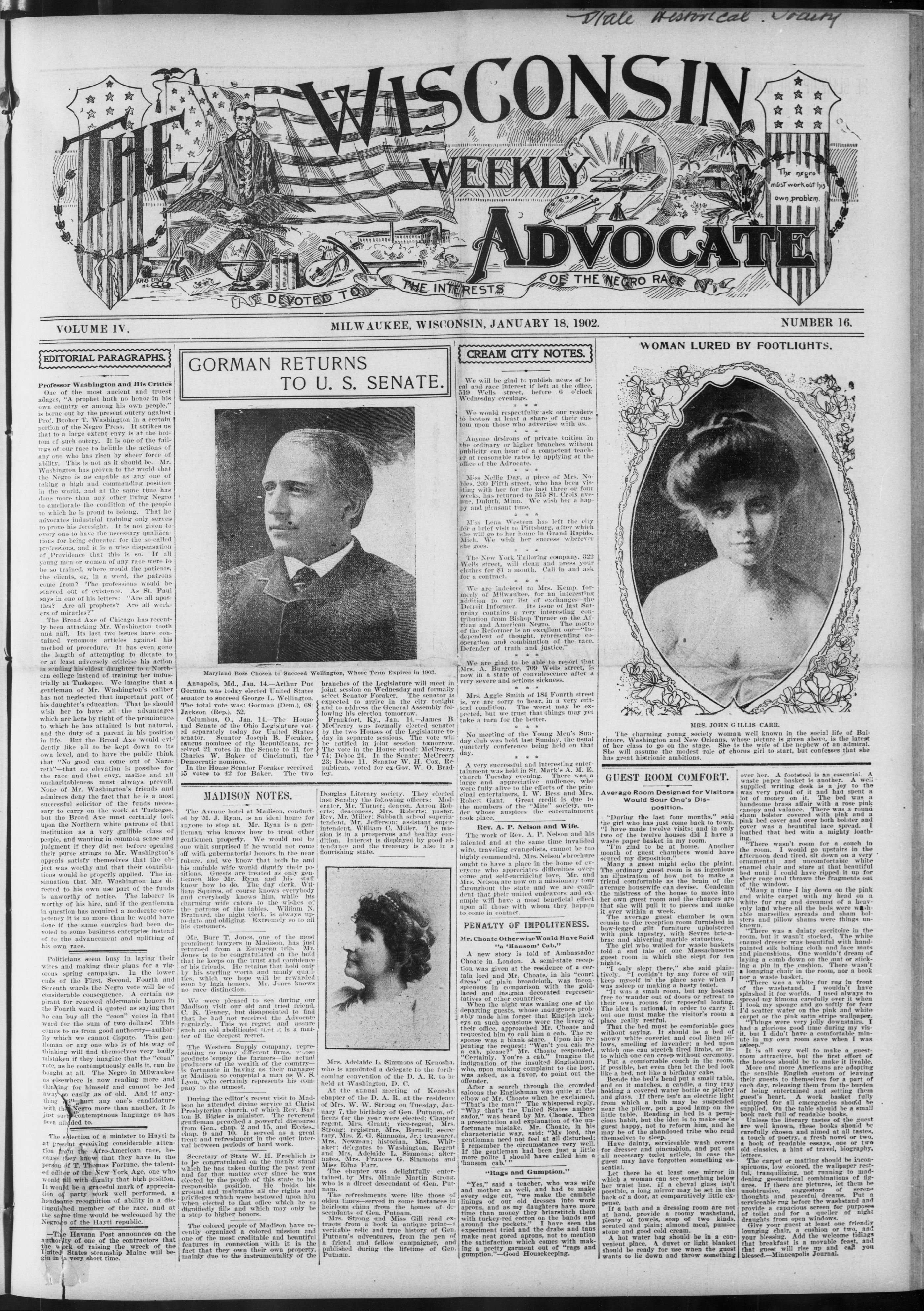
WISCONSIN
WEEKLY
ADVOCATE
DEVOTED TO THE INTERESTS OF THE NEGRO RACE
EDITORIAL PARAGRAPHS.
Professor Washington and His Critics One of the most ancient and truest adages, "A prophet hath no honor in his own country or among his own people," is borne out by the present outcry against Prof. Booker T. Washington in a certain portion of the Negro Press. It strikes us that to a large extent envy is at the bottom of such outcry. It is one of the failings of our race to belittle the actions of any one who has risen by sheer force of ability. This is not as it should be. Mr. Washington has proven to the world that the Negro is as capable as any one of taking a high and commanding position in the world, and at the same time has done more than any other living Negro to ameliorate the condition of the people to which he is proud to belong. That he advocates industrial training only serves to prove his foresight. It is not given to every one to have the necessary qualifications for being educated for the so-called professions, and it is a wise dispensation of Providence that this is so. If all young men or women of any race were to be so trained, where would the patients, the clients, or, in a word, the patrons come from? The professions would be starved out of existence. As St. Paul says in one of his letters: "Are all apostles? Are all prophets? Are all workers of miracles?"
The Broad Axe of Chicago has recently been attacking Mr. Washington tooth and nail. Its last two issues have contained venomous articles against his method of procedure. It has even gone the length of attempting to dictate to or at least adversely criticise his action in sending his eldest daughter to a Northern college instead of training her industrially at Tuskegee. We imagine that a gentleman of Mr. Washington's caliber has not neglected that important part of his daughter's education. That he should wish her to have all the advantages which are hers by right of the prominence to which he has attained is but natural, and the duty of a parent in his position in life. But the Broad Axe would evidently like all to be kept down to its own level, and to have the public think that "No good can come out of Nazareth"—that no elevation is possible for the race and that envy, malice and all uncharitableness must always prevail. None of Mr. Washington's friends and admirers deny the fact that he is a most successful solicitor of the funds necessary to carry on the work at Tuskegee, but the Broad Axe must certainly look upon the Northern white patrons of that institution as a very gullible class of people, and wanting in common sense and judgment if they did not before opening their purse strings to Mr. Washington's appeals satisfy themselves that the object was worthy and that their contributions would be properly applied. The insinuation that Mr. Washington has directed to his own use part of the funds is unworthy of notice. The laborer is worthy of his hire, and if the gentleman in question has acquired a moderate competency it is no more than he would have done if the same energies had been devoted to some business enterprise instead of to the advancement and uplifting of his own race.
Politicians seem busy in laying their wires and making their plans for a vigorous spring campaign. In the lower ends of the First, Second, Fourth and Seventh wards the Negro vote will be of considerable consequence. A certain aspirant for renewed aldermanic honors in the Fourth ward is quoted as saying that he can buy all the "coon" votes in that ward for the sum of two dollars! This comes to us from good authority—authority which we cannot dispute. This gentleman or any one who is of his way of thinking will find themselves very badly mistaken if they imagine that the "coon" vote, as he contemptuously calls it, can be bought at all. The Negro in Milwaukee as elsewhere is now reading more and thinking for himself and cannot be led away so easily as of old. And if anything will hurt any one's candidature with the Negro more than another, it is just such contemptuous language as has been alluded to.
The selection of a minister to Hayti is at present receiving considerable attention from the Afro-American race, because they know that they have in the person of T. Thomas Fortune, the talented editor of the New York Age, one who would fill with dignity that high position. It would be a graceful mark of appreciation of party work well performed, a handsome recognition of ability in a distinguished member of the race, and at the same time would be welcomed by the Negroes of the Hayti republic.
The Havana Post announces on the authority of one of the contractors that the work of raising the wreck of the United States steamship Maine will begin in a very short time.
GORMAN RETURNS TO U. S. SENATE.
M. H.
Maryland Boss Chosen to Succeed Wellington, Whose Term Expires in 1903.
Annapolis, Md., Jan. 14.—Arthur Pue Gorman was today elected United States senator to succeed George L. Wellington. The total vote was: Gorman (Dem.), 68; Jackson (Rep.), 52.
Columbus, O., Jan. 14.—The House and Senate of the Ohio Legislature voted separately today for United States senator. Senator Joseph B. Foraker, caucus nominee of the Republicans, received 21 votes in the Senate to 11 for Charles W. Baker of Cincinnati, the Democratic nominee.
In the House Senator Foraker received 65 votes to 42 for Baker. The two branches of the Legislature will meet joint session on Wednesday and for select Senator Foraker. The senator expected to arrive in the city to and to address the General Assembly allowing his election tomorrow.
Frankfort, Ky., Jan. 14.—James McCreary was formally elected by the two Houses of the Legislature day in separate sessions. The vote be ratified in joint session tonight. The vote in the House stood: McC 74; Deboe 24. In the Senate: McC 23; Deboe 11. Senator W. H. Cox publican, voted for ex-Gov. W. O. ley.
MADISON NOTES.
MADISON NOTES.
The Avenue hotel at Madison, conducted by M. J. Ryan, is an ideal home for anyone to stop at. Mr. Ryan is a gentleman who knows how to treat other gentlemen properly. We would not be one whit surprised if he would not come off with gubernatorial honors in the near future, and we know that both he and his amiable wife would dignify their positions. Guests are treated as only gentlemen like Mr. Ryan and his staff know how to do. The day clerk, William Squires, of course knows everybody and everybody knows him, while his charming wife caters to the wishes of the patrons of the tables. William N. Brainard, the night clerk, is always up-to-date and obliging. Extremely so to all his customers.
Mr. Burr T. Jones, one of the most prominent lawyers in Madison, has just returned from a European trip. Mr. Jones is to be congratulated on the hold that he keeps on the trust and confidence of his friends. He retains that hold only by his sterling worth and manly qualities, which we hope will be rewarded soon by high honors. Mr. Jones knows no race distinction.
We were pleased to see during our Madison visit our old and tried friend, C. K. Tenney, but disappointed to find that he had not received the Advocate regularly. This we regret and assure such an old abolitionist that it is a matter of the deepest regret.
The Western Supply company, representing so many different firms, whose products 'supply the farmers—the actual producers of the wealth of the country—is fortunate in having as their manager at Madison so congenial a man as W. S. Lyon, who certainly represents his company to the utmost.
During the editor's recent visit to Madison he attended divine service at Christ Presbyterian church, of which Rev. Barton B. Bigler is minister. The reverend gentleman preached a powerful discourse from Gen., chap. 2 and 15, and Eccles., chap. 9 and 10. It served as a great treat and refreshment in the quiet interval between periods of hard work.
Secretary of State W. H. Froehlich is to be congratulated on the manly stand which he has taken during the past year and for that matter ever since he was elected by the people of this state to his responsible position. He holds his ground and maintains all the rights and privileges which were bestowed upon him when elected to that office which he so dignifiedly fills and which may only be a step to higher honors.
The colored people of Madison have recently organized a colored mission and one of the most creditable and beautiful features in connection with it is the fact that they own their own property, mainly due to the instrumentality of the
MILWAUKEE, WISCONSIN, JANUARY 18, 1902.
branches of the Legislature will meet in joint session on Wednesday and formally select Senator Foraker. The senator is expected to arrive in the city tonight and to address the General Assembly following his election tomorrow.
Frankfort, Ky., Jan. 14.—James B. McCreary was formally elected senator by the two Houses of the Legislature today in separate sessions. The vote will be ratified in joint session tomorrow. The vote in the House stood: McCreary, 74; Deboe 24. In the Senate: McCreery 23; Deboe 11. Senator W. H. Cox, Republican, voted for ex-Gov. W. O. Bradley.
Douglas Literary society. They elected last Sunday the following officers: Moderater, Mr. Turner; deacon, Aaron Roberts; deaconess, Mrs. Roberts; pastor, Rev. Mr. Miller; Sabbath school superintendent, Mr. Jefferson; assistant superintendent, William C. Miller. The mission is in a prosperous and healthy condition. Interest is displayed by good attendance and the treasury is also in a flourishing state.
A.
Mrs. Adelaide L. Simmons of Kenosha, who is appointed a delegate to the forthcoming convention of the D. A. R. to be held at Washington, D. C.
At the annual meeting of Kenosha chapter of the D. A. R. at the residence of Mrs. W. W. Strong on Tuesday, January 7, the birthday of Gen. Putnam, officers for the year were elected: Chapter regent, Mrs. Grant; vice-regent, Mrs. Strong; registrar, Mrs. Burnell; secretary, Mrs. Z. G. Simmons, Jr.; treasurer, Mrs. Newman; historian, Mrs. Whitaker; delegates to Washington, Regent and Mrs. Adelaide L. Simmons; alternates, Mrs. Frances G. Simmons and Miss Edna Farr.
The chapter was delightfully entertained, by Mrs. Minnie Martin Strong, who is a direct descendant of Gen. Putnam.
The refreshments were like those of olden times—served in some instances in heirloom china from the homes of descendants of Gen. Putnam.
Mrs. Strong and Miss Gill read extracts from a book in antique print—a veritable relic and true history of Gen. Putnam's adventures, from the pen of a friend and fellow campaigner, and published during the lifetime of Gen. Putnam.
CREAM CITY NOTES.
We will be glad to publish news of local and race interest if left at the office, 519 Wells street, before 6 o'clock Wednesday evenings.
We would respectfully ask our readers to bestow at least a share of their custom upon those who advertise with us.
Anyone desirous of private tuition in the ordinary or higher branches without publicity can hear of a competent teacher at reasonable rates by applying at the office of the Advocate.
Miss Nellie Day, a piece of Mrs. Nobles, 209 Fifth street, who has been visiting with her for the last three or four weeks, has returned to 315 St. Croix avenue, Duluth, Minn. We wish her a happy and pleasant time.
Miss Lena Western has left the city for a brief visit to Pittsburg, after which she will go to her home in Grand Rapids, Mich. We wish her success wherever she goes.
The New York Tailoring company, 322 Wells street, will clean and press your clothes for $1 a month. Call in and ask for a contract.
We are indebted to Mrs. Kemp, formerly of Milwaukee, for an interesting addition to our list of exchanges—the Detroit Informer. Its issue of last Saturday contains a very interesting contribution from Bishop Turner on the African and American Negro. The motto of the Reformer is an excellent one—"Independent of thought, representing cooperation and combination of the race. Defender of truth and justice."
We are glad to be able to report that Mrs. A. Burgette, 709 Wells street, is now in a state of convalescence after a very severe and serious sickness.
Mrs. Aggie Smith of 184 Fourth street is, we are sorry to hear, in a very critical condition. The worst may be expected, but we trust that things may yet take a turn for the better.
No meeting of the Young Men's Sunday club was held last Sunday, the usual quarterly conference being held on that day.
A very successful and interesting entertainment was held in St. Mark's A. M. E. church Tuesday evening. There was a large and appreciative audience, who were fully alive to the efforts of the principal entertainers, I. W. Bess and Mrs. Robert Gant. Great credit is due to the members of the "Mite" society, under whose auspices the entertainment took place.
Boy, A. P. Nelson and Wife.
The work of Rev. A. P. Nelson and his talented and at the same time invalided wife, traveling evangelists, cannot be too highly commended. Mrs. Nelson's brochure ought to have a place in the home of everyone who appreciates difficulties overcome and self-sacrificing love. Mr. and Mrs. Nelson are now on a missionary tour throughout the state and we are confident that their united endeavors and example will have a most beneficial effect upon all those with whom they happen to come in contact.
PENALTY OF IMPOLITENESS.
Mr. Choate Otherwise Wonl Have Said "a 'Hansom' Cab." A new story is told of Ambassador Choate in London. A semi-state reception was given at the residence of a certain lord and Mr. Choate, in his "court dress" of plain broadcloth, was inconspicuous in comparison with the gold-laced and insignia decorated representatives of other countries.
When the night was waning one of the departing guests, whose inquience probably made him forget that English lackeys on such occasions wore the livery of their office, approached Mr. Choate and requested him to call him a cab. The response was a blank stare. Upon his repeating the request: "Won't you call me a cab, please?" Mr. Choate responded, "Certainly. You're a cab." Imagine the indignation of the insulted Englishman, who, upon making complaint to the host, was asked, as a favor, to point out the offender.
After a search through the crowded saloons the Englishman was quite at the elbow of Mr. Choate when he exclaimed, "That's the man!" The whispered reply, "Why that's the United States ambassador," was heard by Mr. Choate. Then a presentation and explanation of the unfortunate mistake. Mr. Choate, in his characteristic way, said: "My lord, the gentleman need not feel at all disturbed; I remember the circumstance very well. If the gentleman had been just a little more polite I should have called him a 'hansom cab.'"
"Rags and Gumption."
"Yes," said a teacher, who was wife and mother as well, and had to make every edge cut, "we make the cambric linings of our old dresses into work aprons, and as my daughters have more time than money they briarstitch them with turkey-red cotton on the bands and around the pockets." I have seen the experiment tried and the drabs and tans make neat gored aprons, not to mention the satisfaction which comes with making a pretty garment out of "rags and gumption."—Good Housekeeping.
M.
MRS. JOHN G ILLIS CARR.
The charming young society woman well known in the social life of Baltimore, Washington and New Orleans, whose picture is given above, is the latest of her class to go on the stage. She is the wife of the nephew of an admiral. She will assume the modest role of chorus girl to start, but confesses that she has great histrionic ambitions.
GUEST ROOM COMFORT.
Average Room Designed for Visitors Would Sour One's Disposition.
"During the last four months," said the girl who has just come back to town. "I have made twelve visits; and in only two of the twelve houses did I have a waste paper basket in my room.
"I'm glad to be at home. Another month of guest chambers would have secured my disposition."
Many a guest might echo the plaint. The ordinary guest room is as ingenious an illustration of how not to make a friend comfortable as the brain of the average housewife can devise. Condemn the mistress of the house to move into her own guest room and the chances are that she will pull it to pieces and make it over within a week.
The average guest chamber is own cousin to the reception room furnished in bow-legged gilt furniture upholstered with pink tapestry, with Sevres bric-a-brac and shivering marble statuettes. The girl who wailed for waste baskets told a sad tale of one Massachusetts guest room in which she slept for ten nights.
"I only slept there," she said plaintively. "I couldn't by any force of will keep myself in the place save when I was asleep or making a hasty toilet.
"It was a smalh room, but my hostess free to wander out of doors or retreat to their own rooms for reposeful loafing. The idea is rational, in order to carry it out one must make the visitor's room a place really restful.
That the bed must be comfortable goes without saying. It should be a bed of snowy white coverlet and cool linen pillows, smelling of lavender; a bed upon which one can stretch tired limbs, or into which one can creep without ceremony. Put a comfortable couch in the room, if possible, but even then let the bed look like a bed, not like a birthday cake. Beside the bed's head put a small table, and on it matches, a cauldle, a tiny tray holding a covered water bottle or pitcher and glass. If there isn't an electric light from which a bulb may be suspended near the pillow, put a good lamp on the little table. Reading in bed is a pernicious habit, but the idea is to make one's guest happy, not to reform him, and he may be of the abandoned tribe who read themselves to sleep.
Have dainty, serviceable wash covers for dresser and pincushion, and put out all necessary toilet article, in case the guest may have forgotten something essential.
Let there be at least one mirror in which a woman can see something below her waist line. If a cheval glass isn't possible, a long mirror may be set in the back of a door, at comparatively little expense.
If a bath and a dressing room are not at hand, provide a roomy washstand, pienty of towels, soap of two kinds, scented and plain; almond meal, pumice stone and good cold cream.
A hot water bag should be in a convenient place. A duvet or light blanket should be ready for use when the guest wants to lie down and throw something
over her. A footstool is an essential. A waste paper basket is another. A well supplied writing desk is a joy to the was very proud of it and had spent a lot of money on it. The bed was a handsome brass affair with a rose pink canopy and valance. There was a round sham bolster covered with pink and a pink bed cover and over both bolster and cover was a beautiful lace spread. I loathed that bed with a mighty loathing.
"There wasn't room for a couch in the room. I would go upstairs in the afternoon dead tired, sit down on a very ornamental and uncomfortable white enamel chair and stare at that beautiful bed until I could have ripped it up for sheer rage and thrown the fragments out of the window.
"Many a time I lay down on the pink and white carpet with my head on a white fur rug and dreamed of a heavenly land where all the beds were washable marseilles spreads and sham bolsters and pillow shams were things unknown.
"There was a dainty escritoire in the room, but it wasn't stocked. The white enamel dresser was beautiful with hand-painted silk bolting cloth and lace mats and pincushions. One wouldn't dream of laying a comb down on the mat or sticking a pin in the cushion. There wasn't lounging chair in the room, nor a book nor a waste basket.
"There was a white fur rug in front of the washstand. I wouldn't have splashed it for worlds. I used always to spread my kimona carefully over it when I took my sponge and go softly for fear I'd scatter water on the pink and white carpet or the pink satin stripe wallpaper."
"Things were very jolly downstairs. I had a glorious good time during my visit, but I didn't have a comfortable minute in my own room save when I was asleep."
It is all very well to make a guestroom attractive, but the first effort of the hostess should be to make it livable. More and more Americans are adopting the sensible English custom of leaving their guests to themselves for a part of each day, releasing them from the burden of being entertained and setting them guest's heart. A work basket fully equipped for all emergencies should be supplied. On the table should be a small book rack full of readable books.
Unless the literary tastes of the guest are well known, these books should be carefully chosen and aimed at all tastes, a touch of poetry, a fresh novel or two, a book of readable essays, one or two old classics, a hint of travel, biography, letters.
The carpet or matting should be inconspicuous, low colored, the wallpaper restful, tranquilizing, not running to maddening geometrical combinations of figures. If there are pictures, let them be unobtrusive, suggestors of serene thoughts and peaceful dreams. Put a serviceable rug before the washstand and provide a capacious screen for purposes of toilet and for a queller of night draughts from open windows.
Give your guest at least one friendly lounging chair, a cushion or two, and your blessing. Add the welcome tidings that breakfast is a movable feast, and that guest will rise up and call you blessed—Minneapolis Journal.
O heart of mine, we shouldn't
Worry so.
What we've missed of calm we couldn't
Have you know;
What we've met of stormy pain
And of sorrow's driving rain,
We can better meet again
If it blow.
We have erred in that dark hour
We have known,
When the tears fell with the shower
All alone.
Were not shine and shower blent,
As the gracious Master meant?
Let us temper our content
With His own.
For we know not every morrow
Can be sad;
So, forgetting all the sorrow
We have had.
Let us fold away our fears
And put by our foolish tears
And through all the coming years
Just be glad
James Whitcomb Riley in Evening Tele
graph.
The Overture to Tannhauser
It was a fete night at the Botanical gardens. Myriads of fairy light shone softly among the tender green of the leaves, and hung in graceful festoons across the avenues of trees. The sound of talk and laughter, and the soft fronrouf of silken skirts across the grass mingled with the strains of the Grenadier guards' inimitable band. The air was sweet with the scent of roses, and laden with the fragrance of a glorious summer night.
In one of the secluded nooks, secure from observation, a man and a woman sat in earnest conversation. The band began the overture to "Tannhauesr," and because they both loved it, because the music held for them many memories, they paused in their talk to listen. The man imprisoned his companion's hand, and held it silently. Under the shadow of her big black hat, her eyes, which were tender and luminous and misty, sought his face, and rested there in fullness of content. The charm of the music, its wonderful heights and depths, its marvelous insinuations of passion, temptation and sin, of renunciation and final purification, held their tongues in thrall.
"It is beautiful," said the girl, with a sigh, as the last notes died on the evening breeze. "And it holds so many old associations; so many memories of you are mingled with it, Geoffrey, and after tonight there will be an added memory—a sad, sweet, haunting, melancholy one."
The man leaned forward and took her other hand in his.
"We stand tonight," he said, "at the parting of the ways. The future looms before us dark and uncertain. There may be long silences, and many doubts and fears. Promise me, Lenore, that whenever and however you may hear it, the music shall flash a message from my heart to yours—a remembrance of tonight—of all that we have said and promised one another."
"Dear heart," she whispered softly, "I shall need no reminder. My thoughts will be always with you. But—I promise, Geoffrey."
And then they fell to talking once again as those talk who, loving one another, stand on the eve of parting—of all their hopes and plans and fears, and of the dim uncertain future.
The fashionable crowd surged unheeded around them; the stars shone out one by one, sparkling like jewels in the dark blue, cloudless sky, and the moon swung high in the heavens like a ball of golden fire. But for them at that moment the world he'd neither crowd, nor moon, nor stars, but only one another. Their horizon was bounded by each other's eyes.
It was the height of the season at Homburg, and the usual aristocratic cosmopolitan crowd were leisurely sipping their after-dinner coffee and liquers on the hotel terrace. Above the Taunus heights a "curled moon, like a little feather," was slowly climbing the sky; down in the Kurgarten the band was playing one of Strauss' dreamy waltzes. At the far end of the terrace, in a little secluded nook behind two immense palms, a girl sat, slowly fanning herself. She had made some trivial excuse to escape from her party, whose gay talk and merry laughter jarred upon her nerves. She wanted to escape observation to gain time for thought. In half an hour, or a quarter even, she knew that Mr. Charteris would discover her retreat—would press for a definite answer to the question he had asked her a month ago in town. And her answer was not ready.
Her mother's cool, dispassionate summing up of the situation recurred to her; she could almost hear her clear-cut, incisive, well-bred tones. And she was forced to admit that, much as she might dissent from it, her mother's view held truth and common sense.
It was so long since anything had been heard of the punitive expedition upon which that somewhat ineligible young man, Capt. Geoffrey Page, had been engaged.
It was practically beyond doubt that the rumors which spoke of betrayal and wholesale massacre were correct.
The authorities themselves had accepted that view. Mr. Charteris was an excellent parti, and a most agreeable man. A little difference in age, certainly, but that was a very trivial objection nowadays.
Lenore was, she feared, somewhat oblivious of the fact that she was already at the end of her third season.
And the maternal tongue, so much at home in the giving of such counsels (she had married four daughters successfully) had run glibly on, while Lenore vainly tried to beat down the sick despair that assailed her at her mother's words. But even in her heart hope was beginning to die at last. It had come to be a poor withered little plant, struggling for bare existence, for there was no sustenance, no nourishment, not anything for it to feed upon.
And slowly, too, her resistance to Mr. Charteris' suit was weakening. It seemed to her tonight that she must accept the inevitable—that the net was closing around her. If she must needs marry somebody—and of that she felt well assured—her mother had left her in no doubt on that point—well, then, Mr. Charteris was less objectionable than some others.
A man came out on the terrace and looked eagerly about him. His face fell at first, but lightened again when he caught sight of the solitary figure in the palm-shaded nook.
He threw away his cigar and was at her side in a second. It appeared to her that the psychological moment had arrived.
She essayed a smile of welcome, and made room for him beside her. The moon had climbed a little higher above the Taunus heights, and down in the Kurgarten the band was still playing one of Strauss' dreamy waltzes. He came to the point at once, and she listened silently, her fingers nervouslyasping and unclasping one another. She decided to accept him, and she waswaving herself for the moment whenshould pause. And then, quite suddenly, in the midstIr. Charteris' eloquent pleading ofcause, the first few bars of the overture to "Tannhauser" smote the eveningLenore started and sat up very straight
Ar. Charteris went on talking—he was not musical, neither was he observant—but his words fell on deaf ears, for Lemore was back once more in the shadow of the fairy-lit trees, her hand clasped in Geoffrey's, her eyes looking into his, his words—"There may be long silences
GEN FREDERICK FUNSTON.
San Francisco, Cal., Jan. 10.—Brig. Gen. Funston returned yesterday on the transport Warren on two months' sick leave, which may be extended, as Funston is still suffering from appendicitis, which kept him in hospital in Manila over three months. Another operation will be necessary. Gen. Funston was more interested in his baby than in telling of his exploits in the Philippines. His son and heir was born only three weeks ago, after he left Nagasaki, so he know nothing of this event till the boarding officer told him.
Gen. Funston's plans for his leave have not been made. He said that it largely lay with his wife. He was glad to hear
* * * but let the music flash a message from my heart to yours"—ringing in her ears.
To all else she was oblivious.
The terrace faded away like a dream, but the sound of Mr. Charteris' voice annoyed her vaguely. She put out her hand to enjoin silence.
* * * * * * *
To this day the capellmeister of the Kurgarten puzzles his brains as to the origin of a diamond pin which came to him anonymously, and the Bond street jeweler, who received the order from two supremely happy young people who strolled into his shop one autumn afternoon, also permitted himself to wonder slightly. But they have neither of them solved the mystery, and it does not appear likely that they ever will.—The Free Lance.
WITH FREMONT AND CARSON.
A Scout Talks of His Experience with Them.
Louis Pierce, who resides near Conklin, Mich., is one of the few men now living who were employed on the government survey through the West. Pierce crossed the great plains in 1844 with Gen. Fremont and Kit Carson, when the survey was made to the Willamette valley, in Oregon. The surveying party was in charge of Gen. Fremont and Carson, the greatest of all American scouts, went as guide. Pierce was then a strapping boy of 16 years. He was Carson's aide.
The country through which they passed was full of big game and Indians. Pierce attributes the expedition's freedom from attack to Carson's sagacity and his influence over the red men. Only once did they have a severe brush with them, and that was disastrous to the Indians. One day as Carson and Pierce were scouting in advance of the party and looking for a convenient camping ground, they were attacked by a party of Indians, armed with bows and arrows. The two made for a bunch of sage brush and shrubbery, and with this as a cover, they turned on the enemy. There were sixteen riderless ponies when the affair was ended
On the plains and in the foothills they found plenty of buffalo and antelope, and in the mountains grizzly bears were not uncommon. "I never killed one, though," said Pierce. "Them critters was out of my line. In the first place, I didn't carry lead enough so that I felt safe. A man can shoot into one of them pesky critters all day and still he'll fight."
Pierce says that the experience which made the strongest impression on him was the scarcity of water in parts of the country through which they traveled during the dry season. On one occasion they were without water for three days and had to carry bullets under their tongues to allay thirst. Toward evening of the third day, when hope was almost gone, they came to a little stream, and with what strength they had left hurried toward it. The water would probably have been the death of some of them at least had not Gen. Fremont, with drawn revolver, compelled them to cool off a little before drinking.
After returning from this trip the young scout wandered back to his old home in Ohio. A few years later he married, and in 1853 he moved to Michigan and settled in Chester township, Ottawa county, about twenty miles from Grand Rapids. He did a great deal of exploring and prospecting through the state, especially along the line of the proposed state road from Grand Rapids to Traverse City.
The old hunter still lives on the homestead in Ottawa county and has with him one son, who cultivates the 100-acre farm, which Pierce in his younger days hewed out of the forest. In spite of his 73 years he is still vigorous and last summer helped cultivate the farm. The old habits have not all deserted him yet, and during the hunting season he takes his place with some of the younger generation and makes every shot count, as he did when he journeyed across the great plains with Carson.—St. Louis Republic.
Celebrating Louisiana Purchase.
Proclamations declaring December 20 as "flag day" have been issued by Gov. Dockery of Missouri, Gov. Davis of Arkansas, Gov. Savage of Nebraska and other governors of states and territories in the Louisiana purchase territory. The people are requested to celebrate on that day the actual transfer to the United States of the title acquired from France to the Louisiana territory, by displaying the federal flag from all public and private buildings, and especially from their homes. New York Tribune.
Secret Trade Processes.
The two oldest secret trade processes now in existence are considered to be the manufacture of Chinese red, or vermilion, and that method of inlaying the hardest steel with gold and silver which seems to have been practiced at Damascus ages ago, and is known only to the Syrian smiths and their pupils even to this day.
To all else she was oblivious!
of her good health, and he wishes to take a trip to Kansas as soon as he is able to travel after undergoing another operation. If his health permits he will report for duty at the end of two months, and in that case does not know what the war department will do. He does not expect to be placed in command of the Department of California. The department to which he might be assigned would be either Colorado, Texas or Dakotas. When asked to give his impressions of the condition of the islands Gen. Funston said he couldn't do this as he had been three months in hospital. Besides he was familiar only with his own district.
SOME SCARCE STAMPS.
Henry J. Crocker Values One Hundred
at Nearly $20.0 0.
Stamp collecting is by most persons associated with schoolboys, but the considerable number of stamp dealers throughout the country are supported by adult collectors, many of whom have considerable means to devote to their hobby. Such a collector is Henry J. Crocker, the San Francisco capitalist. Mr. Crocker may be remembered by Eastern newspaper readers as having offered some years ago to buy all the wine grapes raised in California for seven years. Mr. Crocker is a man in middle life, and is kept busy looking after his numerous investments, but his chief diversion is the accumulation of rare postage stamps. For ten or a dozen years he has been known to stamp dealers throughout the world as a good customer for scarce items in their line. To a small selection of his philatelic treasures has been awarded the first prize offered by the Philatelic society of New York for the rarest group of 100 cancelled stamps shown by any collector at its December meeting in this city.
at its December meeting in this city.
Mr. Crocker values the exhibit of 100 stamps he sent here at $19,915. His rarest and consequently most valuable single stamp is the 20-cent label issued in 1845 by the St. Louis postoffice, before there were any regular United States stamps. For many years only four copies of this stamp were known to be in existence, but several years ago about twenty more came to light. Mr. Crocker considers his specimen worth $2500, but conservative dealers say this is too high an estimate. The 5-cent and 10-cent St. Louis stamps of the same series are valued at $250 and $200 respectively, and those valuations are nearer the market prices. The Brattleboro postmaster's little stamp, valued at $600, and the label bearing a facsimile of James M. Buchanan's signature as postmaster at Baltimore, are also scarce relics of the days when Uncle Sam had no stamps of his own.
The Hawaiian "missionary" stamps, so called because they were used almost exclusively by missionaries, whose presence in Hawaii started the use of stamps there, are among the rarest in the world. Another great rarity is the curious Moldavian type. An uncancelled copy of the 81 paras sold recently in London for $1100.
The vertical halves of the double 10-rappen Swiss stamp, issued by the Canton of Geneva in 1843, were sometimes used separately as 5-rappen values. The first stamps of the Reunion islands, French possessions in the Indian ocean off Madagascar, are on their original envelopes in Mr. Crocker's exhibit, a condition greatly increasing their value in the eyes of collectors.—New York Tribune
QUEER COMBINATION.
Peddler Whose Stock in Trade was Playing Cards and Bibles.
"Not long ago," remarked a traveling man, "I went up the picturesque Kentucky river on a little steamboat which runs from Louisville to Frankfort. By the way, there isn't a wilder or more beautiful stream in the whole country than that same Kentucky river. The boat passes through eight or ten government locks during the trip. On the boat I encountered a queer old customer—a long-bearded, grizzled Kentuckian, who was full of interesting reminiscences.
"Once on a time,' he said, 'I made a heap o' money up an' down this little o' river—a-peddlin'.
"What did you peddle?' I asked.
"Keards,' he answered, 'playin' keards an' Bibles."
"That was a queer stock in trade,' was my comment. 'How did you happen to have such a mixed lot as that?'
"I bought it at a auction down t' Loo'sville,' he explained. 'The auctioneer lumped 'em, so I had to take 'em. But I got rid of 'em—yes, siree—ev'ry one of 'em. People along this river is allus wild for playin' keards; I sold them playin' keards for $2 a pack. They went off rapid, ev'ry one of 'em—yes, siree; an' I didn't have nary Bible left on hand, nuther.'
"How much did you get for your Bibles?' I asked.
"Laws,' the reminiscent Kentuckian explained; 'them Bibles went off rapid, too; I give 'em away with th' keards.'"—Chicago Journal.
Stillman Appraised the Crowd
President Stillman of the National City bank was going up Broadway after the theater with a friend from the interior. As they went by the passing crowd of properly-gowned and groomed men and women the friend said to Mr. Stillman: "It's very attractive to watch the vast number of men one sees here who look so prosperous financially." "That's very true," replied Stillman. "They are just like a lot of enterprises we know of, they look finely prosperous, but there is a small per cent. of them that pay attractive dividends."—New York Times.
BIG ELEVATOR IS BURNED
OWNED BY MALT TRUST
Large Amount of Rolling Stock in the Panhandle Freightyards Endangered.
Chicago, Ill., Jan. 13.—A loss estimated at nearly $275,000 was caused by a fire that broke out at about 1:45 o'clock this morning in the plant of the G. F. Weil branch of the American Malting company. The property is situated at Fifty-second street and the Panhandle railroad tracks. The fire started in the elevator, a great structure of 150 feet high covering an area 300 by 200 feet and having a capacity of 300,000 bushels of grain. It was filled with barley almost to its capacity. The building was destroyed and its contents is almost a total loss. Just south of the malting company's plant are the Panhandle freight yards and at the outset of the fire there was serious menace to a vast amount of rolling stock.
The burning elevator sent a great glare aloft, in the light of which scores of men scurried back and forth in strenuous efforts to roll the Panhandle freight cars away from danger of igniting. In this way they were only partly successful, for several freight cars were destroyed. Adjoining the elevator was a sickle factory on the west, owned by J. Well. Great efforts were made to protect this plant, but it was somewhat damaged.
From the roof of this factory the firemen fought the flames in the elevator, but they worked at great disadvantage, owing to the great height of the building.
When the flames broke through the roof of the elevator large sheets of iron plates fell from the building and greatly added to the danger of the firemen.
The sheet-iron plates were redhot and there was sufficient blaze to throw them clear of the building, endangering the line of the men working near. The American Malting company bought the elevator with the J. Weil Malting plant at the time the trust was formed four years ago. The company owns several other plants in Chicago and many more at other points in the West and some in the East. It carries insurance on all its property and it is believed the loss will be fully recovered.
BLOCK SIGNAL FAILS.
Two Sections of Pan-Handle Passenger Come Together and Much Damage is Done.
Chicago, Ill., Jan. 13.—Halted by a block signal, which is supposed to insure reasonable safety in railroad operations, the first section of a Pan-Handle passenger train was run into by the second section yesterday afternoon at Fifty-fourth street and Western avenue. Two men were injured, one of them seriously, and the property damage was about $15,000. It was while the first train was awaiting the signal to move ahead that the second section crashed into it, having struck it so unexpectedly that the engineer and fireman of the telescoping train barely had time to escape.
SEVEN PERISH BY FIRE.
Owner of Building, Who Carried Heavy Insurance, is Placed Under Arrest.
Buffalo, N. Y., Jan. 13.—Henry Pearlstein, his wife and five children, ranging in age from $1\frac{1}{2}$ to 12 years, were burned to death early yesterday morning in a fire that destroyed a two-story frame building. Joseph Supowski, who owned the building, and Karl Bracki, his brother-in-law, have been arrested pending an investigation. Supowski carried an insurance of $9000 on the building and its contents.
KILLED 2; INJURED 8.
Misplaced Switch Caused a Serious Wreck on the Rock Island Railroad.
Chicago, Ill., Jan. 13.—A message to General Manager Hitt of the Rock Island road states that a passenger train ran into a construction train today, killing two and injuring eight. The collision occurred at O'Keen, Ok., the passenger train running into the work train on a siding. A misplaced switch is believed to have caused the wreck.
LEFT A CONFESSION.
Man Who Blew His Head Off Had Committed Murder in 1894.
Seattle, Wash, Jan. 13.—Schoolboys found a written confession purporting to have been written by the unknown man who on Friday blew his head off with dynamite, in which he confesses to having murdered H. O. Garrison, a Whidby Island rancher, in 1894. Garrison's body was found in a well in a mutilated condition nearly two years after the crime was committed. Walter Irving, the murdered man's farmhand, was convicted of the crime. He was sentenced to twenty years. The man who committed suicide assigns as a motive for the deed a guilty conscience.
RESURVEY MARYLAND LINE.
Boundary Between that State and Pennsylvania Re-established.
Hanover, Pa., Jan. 13.—The surveyors employed jointly by the states of Pennsylvania and Maryland to correct the boundary line as first established by Mason and Dixon, have proceeded with their work as far as Germany township, Adams county, Pennsylvania. They report that many of the stones are displaced. The surveyors found one used of a doorsill in a dwelling, another in a church, others down, and some at a considerable distance from the original places. All these stones will be secured and reset in their proper places.
ETRURIA HAS ROUGH VOYAGE.
Steamship Reaches New York with Port Deck Swept Away.
New York, Jan. 13.—The steamship Etruria of the Cunard line came to her dock showing many signs of the rough voyage she had coming across. Most of the forward rail of her promenade deck was gone, having been washed away by an immense wave which struck the ship at 3 o'clock Thursday morning.
Concealed in a Box
San Francisco, Cal., Jan. 13.—Frank Holt, the military prisoner who escaped from Alcatraz island on Saturday by concealing himself in a box which was brought to this city on the steamer McDowell, is again in custody. He got out of the box on the vessel, saluted the officer of the deck when he landed, obtained $2 from a stranger to whom he told his story, rented a room and was arrested the first time he ventured out.
DUE TO WHISKY AND CIGARETTES.
Downfall of Mrs. Rose Cox and Her Subsequent Suicide-Had Been in Milwaukee.
Muskegon, Mich., Jan. 14.—Mrs. Rose Cox, nee Reynolds, the young woman who hanged herself in a cell at the police station at Grand Rapids Sunday morning, had been released only a few days before from the jail in this city, where she had served a term for having been drunk and disorderly. Among her effects was found a letter dated at Milwaukee and signed "Max." With the suicide of Rose Cox ends a strange career and one from which many a sermon could be preached. In her younger days in this city as Rose Reynolds she was a woman of some beauty, of kindly disposition and charitable heart. She also possessed a good education and a bright mind. But she fell a victim to whisky and cigarettes.
Rose Cox had been lost to view until a few months ago, when she made her reappearance in this city from Milwaukee. A week after she had returned she was arrested for larceny. Mrs. Cox also achieved notoriety by being one of two claimants to an infant which she and the other claimant brought from Milwaukee. The mother of the deceased, Mrs. Helem, resides in Muskegon. Mrs. Cox was 27 years of age.
FOR SELF-GOVERNMENT.
Mr. Cooper Explains the Provisions of His Bill Relative to Philippine Islands.
Washington, D. C., Jan. 14.—Representative Cooper, chairman of the House committee on insular affairs and author of the bill establishing a civil government in the Philippines, today made a statement regarding this plan of self-government for the islands. He said: "It has been suggested in opposition to the provision in the House bill to establish a civil government in the Philippines to begin on January 1, 1904, that it is unwise to attempt to pass a law to take effect two years from now. But it is a mistake to say that the effect of such a law would be postponed for two years. On the contrary it would have an immediate effect upon the minds of the Filipino people, especially upon those of the educated and intelligent, and in the language of the commission would satisfy their desire for definite knowledge of the intention of Congress with respect to their convention."
Speaking of the difference between the public and state bill, Mr. Cooper said: "The chief difference between the two bills is as to the provision for the establishment of a civil government. The Senate bill simply continues in power the existing government. The bill which I introduced in the House goes farther than that and provides not only for the present and temporary government of the islands until January 1, 1904, but also carries a system of government to go into effect on and after that date, in accordance with the recommendations of the Philippines commission in its last report received about three weeks ago."
DEWET IS PURSUED.
Strong British Columns Trying to Surround and Capture the Boer Commander.
London, Jan. 14.—Perhaps the most important point in Lord Kitchener's weekly report dated Johannesburg, Monday, January 13, is the omission of all mention of Gen. Dewet, from which it is deduced that the British commander-in-chief is more than usually hopeful of effective results from his present effort to surround Dewet. Since the disaster at Zeefontein strong British columns have been persistently dogging Dewet's force, while armored trains have prevented him from crossing the railroad line and have forced him northward. Lord Kitchener is supplying Dewet's pursuers with relays and remounts.
Lord Kitchenor reports that since January 6 twenty Boers have been killed, nine wounded and twenty-three captured and that ninety-five have surrendered. Lord Kitchener in a dispatch from Johannesburg, dated Monday, January 13, reports the narrow escape of Gen. Botha from capture by Gen. Bruce Hamilton. Hearing of a concentration of Boers at Knapdar, Bruce Hamilton went to the spot, but only to find the Boers had been given the alarm and that 400 of them were trekking, three miles distant, with Gen. Botha in a Cape cart leading. Bruce Hamilton chased the Boers for seven miles until his horses gave in. He captured 32 Boers and quantities of ammunition and stock.
SHAFT CAUGHT COAT.
Robert Boulton Whirled to Death in His Sawmill at Wellsburg, Mich.
Sault Ste. Marie, Mich., Jan. 14.—Robert Boulton, a lumberman of this city, owning a sawmill at Wellsburg, met a horrible death today. He was walking through the mill --- his overcoat caught in a shaft. His body was whirled around and he was pounded to death, one leg being torn off.
CROKER PULLS OUT.
Lewis M. Nixon Now the Recognized Leader of Tammany Hall. New York, Jan. 14.—Richard Croker has resigned as chairman of the finance committee of Tammany hall, and Lewis M. Nixon, Croker's close personal friend, was appointed to succeed him. Mr. Nixon is therefore now the recognized leader of Tammany hall. "I am feeling first rate," said Croker in answer to a query. "I feel as if I had been relieved of a great loud. I see that some people think my retirement is a biuff. That is not true. I am out for good. I always want to see Tammany successful, but I will never come back to the leadership. Nixon is a good man and will get loyal support. I want younger men to have a chance."
SEES THROUGH RABBIT'S EYE.
Cornea from Belgian Hare Grafted to the Optic of William Strickell. Clinton, Ia., Jan. 14.—Dr. Paul Walter removed the cornea from the eyes of a Belgian hare and grafted it on the eye of William Strickell of Anamosa, who lost one eye and had the other badly injured in a mine explosion a number of years ago. A flimy growth completely covered the cornea, which was entirely removed, and that of the rabbit was substituted. In order to assure the success of the operation it was necessary to remove the cornea from the rabbit while it was alive and graft it as soon as possible.
Monument to Gen. Alger.
Munising, Mich., Jan. 14.—[Special.]—Leo M. Geismar, superintendent of the state experimental farm at Chatham, this (Alger) county, has launched a movement which has for its end the erection here of a monument to Gen. Alger, for whom the county is named. It is proposed to obtain the funds by popular subscription.
A JUBILEE OF WATERLOO.
Gallery God Almost Disconcerts Actor Manfield.
The cold dignity and stern reserve of Richard Mansfield has awed more than one person with whom he has come in contact, but it remained for a Philadelphia gallery god with a deep-toned voice to break down the barrier that separated him from the laughing side of life. Mansfield was playing "Napoleon Bonaparte" in the Chestnut Street Opera house, and had reached the touching incident in the scene of the evening before the Battle of Waterloo. With the soldiers sleeping around him, and the sentinel dozing, Napoleon folded his arms, bowed his head and started the usual soliloquy:
"Tomorrow is——"
Here he paused, but the gallery god in question was equal to the occasion.
in question was equal to the occasion. "Tomorrow is Friday!" came from the deep, sonorous throat, and in a thrilling scene, when one could hear a pin drop, the effect was startling. One instant, and then the audience, fully appreciating the humor of the situation, burst forth in unstinted laughter and applause. Even a suspicion of a smile lurked about the mouth of the cold Mansfield, for he readily realized that the irrepressible gallery god had come within an ace of making a jubilee of the battle of Waterloo.
LATEST MARKET REPORTS.
Milwaukee, Jan. 15, 1902.
EGG AND DAIRY PRODUCTS.
MILWAUKEE—Eggs—Market firm; fresh, loss off, cases included, 27@28c; fresh, cases returned, 26@27c; storage, No. 1 April city stock, 23@24c; country storage, 17@18c; seconds, 9c. Receipts were 138 cases.
Butter — Market steady; fancy prints, 24½c; fancy or extra creamy; per lb, 24c; firsts, 20@21c; seconds, 16@17c; dairy prints, 19c; extra fancy dairy, 18c; lines, 15@16c; packing stock, 12@12c; roll, 13@15c; whey, 8c; grease, 4@5c. The receipts today were 23.467 lbs against 7092 lbs yesterday. The demand for creamy has fallen off somewhat and the amount on hand has increased in consequence. Prices remain firm, however. Dairy butter of fine grades is scarce, but there is quite a lot of inferior dairy on hand, which goes slow.
Cheese—Steady. Receipts were 8070 lbs today against 3175 lbs yesterday. Full cream flats, new, colored, fancy, 11@11½c; good to choice, 10½@11c; Young Americas, new, 12@12½c; daisies, new, 11½@12½c; fancy brick new, 12@12½c; low grades, 10½@11½c; limburger, per lb. No. 1, 13@13½c; low grades, 9@11c; imported Swiss, 24c; Block Swiss, domestic, 14½@15c; choice loaf, 14½@15c. No. 2, 12½@13½c; Sapsago, 20c; farmers', 10@11c.
CHICAGO — Butter — Steady; creameries, 15@22½c; dairies, 14@20c. Cheese—Steady; twins, 10½@10½c; Young Americas, 10½@11½c; daisies, 10½@11½c. Eggs—Steady; loss off, cases returned, 29@20c. Dressed poultry—Steady; turkeys, 8½@11½c; chickens, 7@8½c.
SHEBOYGAN—On the board today the offerings were small. Daisies sold for 10½c; Young Americas for 11c, ¼c less than last week.
NEW YORK — Butter — Receipts, 2617
pkgs; steady; state dairy, 14@21½c; cream;
ery, 16@23½c; June creamery, 15@21c; factory,
13@15½c; Cheese—Receipts, 1911 pkgs;
firm; state, full cream, large fall made,
fancy, 10½@10½c; state, full cream, small
fall made, fancy, 11½@11½c; late made,
best, large, 9½c; late made, best, small, 10
@10½c. Eggs—Receipts, 250 pkgs; steady;
state and Pennsylvania, 33@34c; Western
at mark, 24@33c; Southern at mark, 26@32c.
Coffee—Easy; No. 1 Rio, 65¾c.
HOGS- Receipts, 11 cars; market 5@10c
higher; light, 5.75@6.00; mixed and medium
weights, 6.05@6.20; to good packers,
5.80@6.20; choice heavy, 6.30@6.40.
lugs, 90 to 120 lbs, 5.00@6.25.
CATTLE - Receipts, 4 cars; steady;
butchers' steers, medium to good, 1050 to
1300 lbs, 4.75@5.75; fair to medium, 950 to
1050, 3.75@4.25; heifers, common, 2.50@3.50;
good, 4.00@5.00; cows, fair to good, 2.70@
3.65; canners, 1.65@2.5; bulls, common,
2.50@3.00; choice, 3.25@4.00; feeders, 800 to
950 lbs, 3.00@3.50; stockers, 500 to 750 lbs,
2.50@3.00; veal calves, common to choice,
4.50@5.50; milkers and springers, no demand
unless choice fancy at 30.00@40.00.
SHEEP—Receipts, 1 ear; market steady:
2.50@3.50; bucks, 2.50@3.00; lambs, common
to choice, 4.00@5.50.
Chicago receipts: Hogs, 24,000; cattle,
22,000; sheep, 16,000.
CHICAGO POTATO MARKET
CHICAGO. Ill., Jan. 15.—[Special.]—
Coyne Brothers report: Receipts, 16 cars;
market still weaker, very little movement;
dusty rurals, 76@77c; long and round white,
70@72c; red, 72c; red and white mixed, 70c.
MARKETS BY TELEGRAPH.
MILWAUKEE—Flour—Steady. Wheat—Firmer; No. 1 Northern, on track, 78½¢; No. 2 Northern, on track, 77½¢; Corn—Dull; No. 3 on track, 61¢. Oats—Steady; No. 2 white, on track, 47½¢; No. 3 white, on track, 46½¢; Barley—Steady; No. 2 on track, 66¢; sample on track, 57@65¢. Rye—Dull; No. 1 on track, 64½¢. Provisions—Steady; pork, 16.90; lard, 9.60. Flour market is steady; patents, 4.00@ 4.05; bakers', 3.00@3.05; rye, 3.20@3.50. Millstffs are steady and quoted at 20.00 for bran, 21.00 for standard middlings and 22.50 for Milwaukee flour middlings, in 100 lb sacks; reg. dog, 23.90.
CHICAGO—Close — Wheat — January,
76%c; May, 80%c; July, 80%c; Corn—
January, 60%c; May, 63%c; July, 63%c;
September, 62%c; Oats—January, 44%c;
May, 44%c; July, 39%c; September, 33c;
Pork—January, 16.67%c; May, 17.07%c; July,
16.95; Lard—January, 9.45; May, 9.70; July,
9.72%@9.75. Ribs—January, 8.32%; May,
8.60%@8.62%. Flax—Cash N. W., 1.69; S. W.,
1.66; May, 1.71. Rye—January, 59%c; May,
62%c; July, 61%c. Barley—Cash, 58@65c.
Timothy—March, 6.60. Clover—March, 9.90
@10.60.
LIVERPOOL—Wheat—Firm; No. 2 red
Western winter, 62%d; No. 1 Northern
spring, 63d; No. 1 California, 66d; futures
quiet; March, 62%d; May, 63%d; Corn—
Spot steady; American mixed, new, 57d;
American mixed, old, 58d; futures steady;
February, 53%d; March, 53%d; May, 5
3%d.
TOLEDO—Wheat—Weak. lower; cash,
87%c; May, 87%c; July, 83c. Corn—Weak.
lower; January, 62c; May, 64%c. Oats—
January, 47c; May, 46%c; July, 41c. Clo-
rengo—January, 5.95; March, 6.90
KANSAS CITY — Close — Wheat—May,
79c; July, 78%c; cash No. 2 hard, 78@79c;
No. 2 red, 89@01c; No. 2 spring, 76@77%c;
Corn—January, 64%c; May, 65%c; cash No.
2 mixed, 63%@66c; No. 2 white, 68%@69%c.
Oats—No. 2 white, 48%@48%c.
MINNEAPOLIS — Close — Wheat—Cash,
75%c; May, 76%@76%c; July, 77%@77%c; on
track, No. 1 hard, 77%c; No. 1 Northern,
75%c; No. 2 Northern, 73%@74c.
ST. LOUIS—Close—Wheat—Lower: No. 2
red cash, elevator, 87c; May, 66%@87c; July,
80%c; No. 2 hard, 81@84c; Corn—Lower:
No. 2 cash, 62%c; May, 65%c; July, 65%c;
Oats—Lower: No. 2 cash, 47c; May, 46%c;
July, 39%c; No. 2 white, 49c; Lead—Dull:
3.87%@3.90; Spelter—Dull: 4.15%@4.17%c
DULUTH — Close — Wheat—Cash No. 1
hard, 78c; No. 1 Northern, 75c; No. 2 Northern,
72%c; No. 3 spring, 70c; to arrive, No.
1 hard, No. 1 Northern and May, 78c; July,
79c. Oats—45%@44%c; Rye—58%c; Barley
—Maltling, 49@58c; Corn—62%c; Flax—
Cash and January, 1.65; to arrive, 1.65%;
May, 1.67%; Receipts of wheat, 26.323 bus;
shipments, 1714 bus.
LIVERPOOL — Lard — American refined quiet, 48s3d; prime Western quiet, 48s. Bacon—Cumberland cut quiet, 39s6d; short ribs quiet, 45s; clear bellies quiet, 51s3d. Tallow—Prime city strong, 30s9d.
SOUTH OMAHA—Cattle—Recelpts, 2800; active, steady, 10c higher; beef steers, 4.00@6.80; Texans, 3.40@4.40; cows and helfers, 3.00@4.80; canners, 1.50@2.85; stockers and feeders, 2.80@4.60. Hogs—Recelpts, 8500; 5@10c higher; heavy, 6.25@6.50; mixed, 6.10@6.25; pigs, 4.50@5.80. Sheep—Recelpts, 3000; active, 10c higher; sheep, 2.75@5.10; lambs, 4.50@5.10.
kansas 4.50@6.15
KANSAS CITY—Cattle—Receipts, 6000;
steady; beef steers, 4.75@6.75; Texans, 3.75
@5.25; cows and helpers, 2.60@5.40; stockers
and feeders, 3.50@4.70. Hogs—Receipts, 13,
000; 5@10 higher; heavy, 6.60@6.70; packers,
6.25@6.55; medium, 6.10@6.50; yorkers,
5.35@6.10; pigs, 4.50@5.30. Sheep—Receipts,
2000; strong; sheep, 3.75@4.75; lambs, 5.00@
6.15.
6.15
ST. LOUIS—Cattle—Receipts, 2500; market steady; beef steers, 4.40@6.25; Texans, 3.25@5.20; stockers and feeders, 2.45@4.20; cows and heifers, 2.00@4.75. Hogs—Receipts, 7500; 5@10c lower; plugs, 6.00@6.15; packers, 6.10@6.35; butchers, 6.25@6.65. Sheep—Receipts, 1000; strong; sheep, 3.20@4.55; lambs, 4.50@6.10.
Printed in the Interests of the Negro Race,
MILWAUKEE, WIS.
Richard B. Montgomery.....
.....Editor and Proprietor
Telephone Black No. 244.
SUBSCRIPTION RATES.
One Year $2.00
Six Months 1.25
Three Months .75
Send money by Express Money Order. P. O.
Money Order or Registered Letter to the
Wisconsin Weekly Advocate.
One inch, single insertion..... 25c
One inch, per year..... $9.00
Business locals 5c per line each insertion.
Apply for rates to the Advocate.
TO CONTRIBUTORS:
All communications must be sent with the name and address of the sender as an evidence of good faith, but not necessarily for publication. No manuscript returned if not accepted, unless accompanied by stamps.
The Wisconsin Weekly Advocate company wishes to notify the public that all contracts and business transactions with this company must have the company stamp, otherwise they will be void. Neither will this company be responsible for paid subscriptions unless given to duly-accredited agents, who, on request, will give the company's receipt for same. Subscribers failing to receive their papers regularly will kindly notify the general office. Address all business communications to the general manager, 227 Wells street.
Mr. Richard B. Montgomery.
Hobson will find politics hotter than the breath of Santiago's morro.
The sugar question in Congress will not conduce to sweetness and peace of mind.
The announcement that Hope Booth, the actress, has debts, isn't any more surprising than the fact that she has no money to meet them.
In other words, Bob Fitzsimmons refuses to be talked out of retirement. He adheres to the dictum "Talk is talk; but money buys the land."
Having discovered that germs commit suicide, it is up to the doctors to find means to worry them into so doing, whenever they invade a patient.
Pastor Kloss of Webster Grove, Missouri, who wants woman to do the matrimonial proposing, should cultivate patience. There are leap years ahead.
An Elkhart, Indiana, girl who makes things fly about the room possesses a power that is common among women endowed with temper of the red-head quality.
The reports from South Africa leave no room for doubt as to Lord Kitchener's activity, but they also indicate that the Boers are decidedly aggressive. The wearing out process is proceeding quite rapidly.
It is the color rather than the number that is startling in the case of the six white men who are slated for the gallows in North Carolina on the last Friday of February.
The Pittsburg boarding house man who holds the asbes of an anarchist as security for a board bill can get even, "just a little bit," by using his debtor in lieu of bath brick.
The Memphis undertaker who has discovered a successful mummifying liquid would have made a fortune had he produced the stuff earlier,—say about the time of the Pharaohs.
The director of the St. Louis exposition will have his office in the car of a balloon, so that he can keep all his expenses in view, and always have the cash in hand safely above them.
The New York assemblyman who has introduced a bill making flirting on the street a misdemeanor ought to add a section requiring flirtatious men and women to wear blinders.
The first seal ever seen off the coast of New York was killed, of course. That is the way man welcomes venturesome members of the animal world and all beautiful specimens of life therein.
M. Santos-Dumont will participate in the airship contest at the St. Louis Exposition; but as invention is swift of foot when once started, he may find machines there that will run around his dirigible gas bag faster than he rounded Eiffel tower.
The Town of Franklin farmers who are scheming to irrigate their lands with the water running from the spouter that is now inundating their frozen fields will "strike it rich" if they adhere to the idea. In California a spouter of the same kind would be a fortune.
The St. Louis inventor who claims that the model for M. Santos-Dumont's dirigible airship was stolen from him, should stop his yapping, and try it again, in the magnificent field of effort that lies between the Frenchman's gas-bag and complete success.
Harvard college has picked up the canteen that the war department threw out of the army, and as a result the proprietors of hotels who were patronized when "bouts" with steins were held, are as discomfited as the keepers of "hog ranches" near the army posts are delighted.
There is delicate ferethought in the plan to permit New York city saloons to open on Sundays from 1 to 11 p. m. That will permit the saloonkeepers to go to church in the morning, give them an hour for dinner, and let them open for business at 1 o'clock sharp in the afternoon.
The successful holding of President Roosevelt's first New Year's reception in which over 8000 people shook his hand accentuates the feeling that the American people will not consent to the withdrawal of the executive from the public, dangerous though his commingling with it may be.
The London correspondents who are reporting that the German government is irritated by the Monroe doctrine must be hard of hearing; it is the Mormon doctrine that is causing apprehension in
the Kaiser's empire, owing to the number of the converts made by missionaries now at work there.
The dispatch from Dallas announcing that Cresceus has made a new record, by trotting a mile thirteen seconds faster than any horse has ever covered the same distance on the first day of the year, opens the way for the making of three hundred and sixty-four new records, including Sundays.
Minnesota's defeat of the Yale basket ball team doesn't alter the record made on Rendall field in November, although the Wisconsin boys were downed, the other night, by Yale. Football is another thing notwithstanding that basketball is a good imitation in some respects.
There is room for an inquiry in the case of the steamer Walla Walla, sunk with heavy loss of life, off Cape Mendocino, by collision with the French bark Max. If the lookout reported three times that the bark's lights were in sight, and that the steamer was in danger of collision, somebody ought to be punished for neglect. The denials of the lookout's testimony should at least be made in court, where their real weight can be ascertained.
The bottle which is reported to have drifted from Central Illinois to the Gulf of Mexico, and thence around the "horn," to the coast of California, must have rolled overland by rail; because the currents in the Gulf and along the South American coast are not favorable for bottles, southward bound.
According to Capt. Burrows, the behavior of Belgian officials in the Congo Free State is freer than should be permitted in any state. But feeding innocent niggers to cannibals is hardly worse than feeding them to the flames, and the latter has been done in regions far less remote than the head waters of the Con-
A Bloomington, Illinois, man is said to have accomplished the trick of making a vehicle that carries its own track,—laying it and taking it up as progress is made. His vehicle, an automobile, can make ten miles an hour,—if the roads are good. This shows that he must still provide for the carrying of ties and a roadbed.
THE STORY OF "OLD SHADY."
Facts Concerning a Song Often Sung by the Late G. N. Wiswell.
The fact that the late George N. Wiswell had so often sung "Old Shady" for so many of the Republican conventions of this state adds timely interest to the account given, as well as to the words, of the song as they appear in Col. Nicholas Smith's "Stories of Great National Songs." Col. Smith says:
"Perhaps the most fun-provoking song of the Civil war is 'Old Shady.' With a fine bass or baritone voice behind it, it is overrunning with laughter. To announce the piece at a war song concert, or at a public entertainment of any kind, is to create a flutter of pleasant anticipations and to signify to the auditors that merriment may have full swing.
"During the siege of Vicksburg, in May and June of 1863, a great many slaves had escaped within the Union lines. Some of them were hired by the officers in various departments of the army, and many others were given free transportation north. Among those serving as cooks was a slave, almost white, who was known by the name of 'Old Shady.' He was employed at the headquarters of Gen. McPherson during the siege, and was a fine specimen of simple, honest manhood. Gen. Sherman, in an article in the North American Review, says 'Old Shady was a poet in the rough. After supper, the officers at headquarters, including several generals, and Mrs. Grant and Mrs. Sherman, would assemble to hear him and his chorus of darkies sing. One of the songs became very popular, and was personal to the negro cook, entitled, 'Day of Jubilee,' but now better known as 'Old Shady,' which ran thus:
"Oh, yah, yah, darkies laugh wid me.
For de white folls say Ole Shady's free,
So don't you see dat de jubilee
Is a coming, coming—Hall, mighty day!
Chorus.
"Den away, den away, I can't stay here
no longer,
Den away, den away, for I am going home.
"Oh, mass' got scared and so did his lady,
Dis chile breaks for ole Uncle Aby:
Open de gates, out here's Ole Shady,
A-coming, a-coming—Hall, mighty day!
"Goodby, Mass' Jeff, goodby Mls'r Stephens,
"Seuse dis niggah fur takin' his leavin's,
'Spect purty soon you'll hear Uncle Abram's
Coming, coming—Hall, mighty day!
"Goodby, hard word, wid never any pay,
Ize a gwine up North where de good folks
Dat white wheat bread and a dollar a day Are coming, coming—Hail, mighty day!
"Oh, I've got a wife and I've got a baby, Linin' up yonder in Lower Canada, Won't dey laugh when dey see Ole Shady A coming, coming—Hall, mighty day!
"Gen. Sherman, speaking of 'Old Shady,' says: 'I do not believe that since the Prophet Jeremiah bade the Jews to sing with gladness for Jacob, and to shout among the chiefs of the nations, because of their deliverance from the house of bondage, any truer song of gladness ever ascended from the lips of man than at Vicksburg, where 'Old Shady' sang for us in a voice of pure melody this song of deliverance from the honds of slavery.'
"The general was a great admirer of the negro character, because, as a rule, the colored people were kind and respectful; and he quotes Henry Clay as saying that his colored boy, whose name is now forgotten, was 'the most accomplished gentleman in America.' Gen. Sherman then adds: 'What more beautiful sentiment than that of my acquaintance, "Old Shady": "Goodbye, Massa Jeff; goodby, Massa Stephens. 'Scuse dis niggah fur takin' his leavin's"—polite and gentle to the end. Burns never said anything better.'
"The name of 'Old Shady' was D. Blakely Durant, and after the war he got his 'wife and nice little baby out of lower Canady' and worked on an upper Mississippi steamboat. Gen. Sherman once met him on one of the river steamers, when he sang from the hurricane deck that good old song, which brought tears to the eyes of the passengers. I believe him now dead, but, living or dead, he has the love and respect of the old Army of the Tennessee which gave him freedom. 'Goodby, Massa Jeff; goodby, Massa Stephens,' was a beautiful expression of the faithful family servant: who yearned for freedom and 'a dollar a day.'
"Gen. Sherman's article for the Review was written in 1888, and Durant did not die until 1896. After working on the river boats for some time, he settled at North Forks, N. D., where he established a comfortable home, and where one of his daughters was graduated from the North Dakota State university."
Of the twenty tobacco factories in France three are in Paris.
SHORT, IMPRESSIVE TEMPERANCE SERMONS.
Dangers that Lurk in the Flowing Bowl-How Bright and Influential Men Have Been Dragged Down by the Demon Drink-Suppress the Traffic.
The industrial supremacy of the United States is attracting more attention abroad every month, and foreign editors and speakers, who a few years ago thought what this country was doing was of such little moment that it was rarely referred to in a serious manner, are now discussing the subject from every point of view and seeking to get at the causes. The enormous resources of the country, of course, give the United States a great lead, but it is the efficiency of labor that is starling the foreigners.
Among the causes that contribute to this is the greater sobriety of the American workingman. Col. Carroll D. Wright of the United States Labor Bureau has found that more than 75 per cent of those who employ skilled labor require total abstinence of their men, and that this is also demanded by at least 50 per cent of those who employ labor that is not skilled. The necessity for keeping the head clear and the hand steady has made a powerful impression upon our workingmen, and this impression, the men themselves declare, has been deepened since their children have learned in the public schools the effect upon the body of alcoholic drinks. The children talk at home about what they learn in the schools and the heads of the families listen and learn.
The American workingman, it has also been found, is more ambitious than those abroad. He has a desire to get on in the world and, his wages being higher than anywhere else, the incentive to save is great. Having a "stake in the country" in the shape of a house and lot, or a small farm, makes a powerful appeal to the American workingman. An English speaker, addressing an assembly in his own land, said not long ago: "America spends money in educating the brains of its people, while we have been lavish in poisoning them," the allusion being to the great quantity of liquor consumed by the English workingmen in comparison with those in this country.—Baltimore American.
Drinking by English Women
Drinking by English Women. There is a growing tendency among women to the indulgence of alcoholic beverages. Among the wealthier and higher classes the habit has become almost universal, and this pernicious example has rapidly extended through the various social substrata, for it is human nature to imitate the actions of those who are better favored. The exhausting effect of the demands of society upon its devotees creates a desire for a stimulant, and hence the everpresent and generous punch bowl is often the most popular feature of the social event. It adds a sparkle to the eye, color to the cheek, and a zest to the spirit of the maid and matron, a delightful feeling of bien aise, and its alluring seductiveness bids its partakers to return again and again. Among the less favored classes the causes that obtain among the wealthy operate necessarily to a smaller extent, but here other conditions act no less powerfully as causative agencies in the formation of the habit.
In England the habit of alcoholic indulgence among women of the lower classes is much greater than in America. Dr. Heywood Smith gives as reasons for alcoholism among women the increasing independence of women—a liberty which some of them interpret as license for self-indulgence in accordance with their inclinations. In the struggle for life which this independence engenders there is often the element of failure or overstrain, and women, too weak in many instances to bear the strain, resort to stimulants.—London Doctor.
Does Alcohol Warm the Body.
There are few ideas more tenaciously clung to than this—that a glass of spirits taken before going out on a cold night will warm the body and "keep out the cold," as it is said; but the truth is that instead of doing this it really cools it and lets the cold in by sending the blood, which contains the heat, from the internal organs to the skin, where it is exposed to the air, and rapidly cooled. For it must be understood that the flushing is not confined to the face, but extends over the entire surface of the skin, and hence the glow and feeling of warmth are due to congestion of the blood vessels of the skin, while the internal organs are deprived of their amount of natural blood and heat. This congestion of the skin also tends to induce perspiration, the evaporation of which chills the surface, thus increasing the liability to "take cold." That alcohol lowers the temperature of the body, instead of raising it, is now a thoroughly established fact in medical science.—J. Johnson, M. D., Edin., Honorary Surgeon to Bolton Infirmary.
This and That.
In Barrels and Bottles (a liquor organ) are the following items in separate columns:
"Wherever the liquor trade is sanctioned by law its followers will be found to be sticklers for the law."
"A Chicago Grand Jury finds the city has been cheated out of half a million dollars a year by dishonest officials allowing saloons and other business to run without license."
In Chicago the saloons are sanctioned by law!
WE TRUST YOU AND SEND OUR GOODS TO YOU ON CREDIT. We Pay all the Express Charges.
OU can earn from $10.00 to $50.00 a week selling our great remedy. If you already have a position, you can make good money by working in your spare time. Now is the accepted time. Write before some one else gets the Agency, as we only want one Agent in a place. How many opportunities to make money have you lost? Here is a chance for every man or woman, boy or girl, to make money every day in the year. IRONAL, the great natural medicine, is a certain cure for all diseases of the Stomach, Liver, Kidneys, Bladder, Bowels, and Blood. It cures Headache, Backache, Cramps, Colic, Pains in the Shoulders, Arms, Breast, Back, Legs, and Lungs. Cures Rheumatism, Sore Throat, Dropsy, Kidney Diseases, Fevers of all kinds, Malaria, Gout, Lumbago, and all diseases of the human system which are not of an organic nature—such as Cancer and Consumption. It is especially curative in Asthma, Scrofula, Syphilis, Eczema, and all breaking-out diseases of the skin. Also cures all forms of diseases peculiar to women. It is Nature's own remedy. Non-poisonous, and no dose, no matter how large, can hurt any one. It is taken both internally and applied externally on Sores, Eruptions, &c. The price is 25c., mailed to any address on receipt of price. We want one Agent in every locality to sell this great remedy. It never fails to satisfy. If you want the Agency, send in your application quick, and we will send the goods promptly by express. Send no money; just fill out the coupon, and we will not only send you the goods, but we will also pay the express on this end. Now is not this fair? You can see that we are not frauds or fakirs, for we trust you with our goods. We will send you two dozen packages of IRONAL; these you sell for 25c. each, or $6.00 in all. You keep $3.00 and send us $3.00. After you have sold out, and remitted the money to us, you can get all the goods on credit from us that you want. Write your name and address plainly, so that we can read it. If the name is not plainly written it makes trouble and delays shipping the goods.
GENTLEMEN,—I hereby apply for the Agency for IRONAL, the great natural remedy. Please send me at once by Express two dozen packages of IRONAL (24). These I agree to sell for 25c. each, or $6.00 in all. I will send you $3.00 and keep $3.00 for my trouble. The Ironal Co. is to pay the express charges. If I cannot sell the goods, I will return them.
If there is no Express Office in your town, state nearest town where there is one.
Rockers and all kinds of Restaurant Blocks, Extension Ladders, Tea Caddies, Boxes, Turning, Sawing, Mitchell Improved Washers, Trestels, Swinging Scaffolds. Repair Work PromptlyAttended to TELEPHONE MAIN 252
228-230 Fifth St., Milwaukee, Wis.
Before Starting on Your Travels
CALL ON
Geo. Burroughs & Sons
MANUFACTURERS OF
PREMIUM TRUNKS
VALISES, SAMPLE CASES, Etc.
WANTED--AGENTS
We want 100 agents in every city, town and hamlet in the U. S. for the Wisconsin Weekly Advocate. It will be devoted to the interest of the Negro race and will contain the news of their sayings and doings throughout the world.
50 Per Cent. Commission
ADDRESS
WISCONSIN WEEKLY ADVOCATE
MILWAUKEE, WIS.
WANTED--AGENTS
We want 100 agents in every city, town and hamlet in the U. S. for the Wisconsin Weekly Advocate. It will be devoted to the interest of the Negro race and will contain the news of their sayings and doings throughout the world.
50 Per Cent. Commission
ADDRESS
WISCONSIN WEEKLY ADVOCATE
MILWAUKEE, WIS.
WILLIAM T. GREEN
Lawyer
Notary Public
Rooms 17-18 Birchard Block.
105 GRAND AVENUE.
Telephone White 9214
MILWAUKEE.
TONEY THE ARTIST
FINE ART
Shining Parlor
216½ GRAND AVENUE
Opposite Flanner's Music Store
MILWAUKEE, WIS.
106 1/2 E. Clay St., RICHMOND, VA.
D. C. ADAMS,
And Jobber in Catsups, Mustards, Olives and all kinds of Country Produce.
The New York Tailoring Co.
To Each Subscriber
To the Wisconsin Weekly Advocate the editor will present a handsome souvenir in the form of an elegantly gotten up portrait of the late President McKinley.
519 Wells St., Milwaukee, Wis. Mrs. Lee Woodard, Prop. SUNDAY 5 O'CLOCK DINNER A SPECIALTY.
out, removes dandruff, cures itching, irritating scalp diseases, and gives long and beautiful head of hair. It is used and highly endorsed by the best people in all sections of this country. We guarantee Straightine to be free from all injurious chemicals, and cannot injure the hair. Straightine does not make the hair sticky or gummy, and will not become rancid. Straightine sold at all drug stores. Price, 25 cents a can (one month's treatment). your druggist does not keep it he will get it for you, or we will send it by mail securely wrapped, on receipt of 30c. in stamps. Address,
```markdown
```
to $50.00 a week selling our great remedy, good money by working in your spare time. We else gets the Agency, as we only want one money have you lost? Here is a chance for you in the year. IRONAL, the great natural, Liver, Kidneys, Bladder, Bowels, and Blood, the Shoulders, Arms, Breast, Back, Legs, and Diseases, Fevers of all kinds, Malaria, Gout, not of an organic nature—such as Cancer, Cropla, Syphilis, Eczema, and all breaking-gallium to women. It is Nature's own remedy, sort any one. It is taken both internally and 25c., mailed to any address on receipt of proof remedy. It never fails to satisfy. If you send the goods promptly by express. Send you the goods, but we will also pay the cost that we are not frauds or fakirs, for we trust us of IRONAL; these you sell for 25c. each, have sold out, and remitted the money to us. Write your name and address plainly, makes trouble and delays shipping the goods to—
THE IRONAL
106½ E. Clay St., Richmond, Va.:
I hereby apply for the Agency for IRONAL express two dozen packages of IRONAL (24) will send you $3.00 and keep $3.00 for my use. I cannot sell the goods, I will return them.
If I live on is_____ The number _____ My County is_____ My nearest Express Office is_____ in your town, state nearest town where the
D. C. A. GROC
And Jobber in Catsups, M. all kinds of Cour
TERMS CASH. Cor. T
A. BAIRD, Cutter.
The New York
322 WELLS
(Bet. 3d and 4
Ladies' and Gents' Suits Made to Order.
We also Clean, Press, Repair and Dye
All kinds of Ladies' and Gents' Garments.
Satisfaction Guaranteed. . . .
To Each Subs
To the Wisconsin Weekly
will present a handsome
ot an elegantly gotten u
President McKinley.
Those wishing a First
Hour are Cordially Inv
WOODARI
519 Wells St., Milwaukee, Wis.
SUNDAY 5 O'CLOCK DIN
NELSONS
STRAIGHTINE
THE
LATEST DISCOVERY
FOR MAKING
KNOTTY, KINNY, CURLY HAIR STRAIGHT
BEFORE AFTER
Nelson's Straightline
out, removes dandruff, cures itching, irritation long and beautiful head of hair. It is used by people in all sections of this country. We from all injurious chemicals, and cannot make the hair sticky or gummy, and will sell at all drug stores. Price, 25 cents, your druggist does not keep it he will get securely wrapped, on receipt of 30c. in st.
NELSON MANUFACTURE
Agents can make big money. Writ
Telephone Black 9343.
rk Tailoring Co.
LLS STREET
(5d and 4th Sts.)
Order.
and Dye
ments.
Milwaukee, Wis.
Subscriber
Weekly Advocate the editor
dsome souvenir in the form
ten up portrait of the late
First=Class Meal at Any
y Invited to Call at the
RD HOUSE
Wis. Mrs. Lee Woodard, Prop.
K DINNER A SPECIALTY.
THE MOST PERFECT
Hair Dressing
EVER DISCOVERED.
Guaranteed Perfectly Harmless.
ELEGANTLY PERFUMED.
Do not ruin your hair by using dangerous and worthless preparations when you can get this reliable remedy.
Not only straightens the hair, but, by nourishing the roots, prevents it from falling using, irritating scalp diseases, and gives a It is used and highly endorsed by the best entry. We guarantee Straightine to be free cannot injure the hair. Straightine does not and will not become rancid. Straightine is 25 cents a can (one month's treatment). It will get it for you, or we will send it by mail, loc. in stamps. Address,
Do You Wish to bea
You know Good Painters make from $5.00 to
$10.00 a day easy.
{ano explicit tbat even Boys can become Masters
of the trade.
PAINTING POINTERS
on Sign, House and Carriage Painting. Decora-
fing, Graining, Gilding, Silvering and Calsomin-
ing.” This Book will also teach you how to
CONTRACT FOR BUSINESS
on profitable basis. It will terch you all we
know after having spent @ life time in the busi-
ness, and will generally
SAVE YOU MONEY.
Mailed postpaid for enly 500.
VAL. SCHAZIER SIGN WORKS, Milwaukee, Wis.
a et eee St Tt ee
WHEN IN MADISON
Call at the ———.—m,
Avenue
Hotel eee
M, J. REGAN, Prop.
$2.00 Rate... eee
| ao Free ’Bus.
NORTHERN WISCONSIN RAIL-
ROAD LANDS
‘Are increasing in value from year to
year. Railroads are the great civilizers,
for they give the settler as well as the
manufacturer equal opportunity to work
in undeveloped fields, thereby rapidly set-
tling the country and bringing forth its
undiscovered riches, Northern Wiscon-
sin is rich in iron ore, clay, kaolin, marl,
timber and fine farm lands. It has made
many a settler independent and added to
the wealth of manufacturers who have
sought this territory. Opportunities have
not pet as there is still a generous
supply of land which can be obtained at
low figures and on easy terms.
THE WISCONSIN CENTRAL RY.
‘Was one of the first roads to penetrate
the vast Northern Wisconsin Wilderness
which stretches across the State from
east to west. It, also, has developed
from year to year and today offers the
best of transportation facilities, enabling
all to ship the products of that section to
any market in the world. Illustrated
pamphlets and maps which are interest-
ing as well as instructive can be obtained
by addressing W. H. KILLEN,
Land & Industria] Commissioner;
Geo. 'T. Jarvis, Gen. Mgr.; Burton John-
son, G. F. A., or Jas. C. Pond, G, P.
aa Colby & Abbot Building, Milwaukee,
1s.
50 YEARS’
EXPERIENCE
Trave Marks
Desicns
Copyricuts &c.
Anyone sending a sketch and “rege ion may
quickly ascertain our opinion free whether an
invention is probably patentable. Communica-
tions strictly confidential. Handbook on Patents
sent free. Oldest agency, for securing patents.
Patents taken through Munn & Co. receive
special nofice, without charge, in the
Scientific American.
A handsomels filustrated weekly. Largest cir-
culation of any scientific arent Terms, $3 a
year four months, $1. Sold byall newsdealers.
MUNN & Co,2¢12rosewa». New York
Branck Office, 625 F §t., Washington, D.C,
SCHNEIDER WOULDN'T STAY.
Fiaw Found in Preacher's Forecast of
Scences in the Beyond.
a ee ee
An old German was on his deathbed.
In his earlier years he had led a wild
life, but since the death of Schneider,
one of his boon companions, he had re
formed and given up his bad habits.
This Schneider in his day had been a
mighty drinker, famous for his capacity
and carouses.
The priest was ministering to the dy-
ing man, consoling him with visions. of
ihe paradise he would soon enter, teiling
bim that he would meet there his old
friends, and what a joy it would be to
see them all again. i
The dying man asked feebly: “Will
Schneider be there, your reverence?”
Thinking to give him_ pleasure, the
priest replied: ‘Yes, Schneider will be
there.””
“Ach,” said the other, “dot is very
bad! All dose dringings and endings and
ioe all over again; all dot beer und
whisky.”
“But there will be no drinking in
heaven,” said the priest.
“But you said Schneider would be
there.”*
“So he will.’ was the priest's reply.
“And there won't be no dringings, you
dink? Ach, you don’t know Schneider.”
Lippineott’s Magazine.
Otis Skinner Tired of Sword-Sticking
Parts.
Until this season Otis Skinner had
been identified for several years with
the sword-playing heroes of the romantic
drama, but if he carries out his present
wishes he will lay aside such roles for a
long while to come.
“I have had my share of them,” he
said, “and, though I like to see 2 good
romantic play, I confess that I have
wearied of them. With their ever-recur-
ring sword combats and ubiquitous he-
roes, they remind me somewhat of chick-
en livers served en brochette as the finale
curtain descends, leaving the hero sur-
veying the field of spirited acting with
from six to a dozen enemies spitted on
his sword. I don’t object to others doing
it, but I have had my full share of the
romantic, for a time at least, and I find
relief in studying the many phases of
Lanciotto’s character.”
For the future Mr. Skinner has several
vlays urler consideration, among them a
dramatization of Mrs, Catherwood's nov-
el, “Lazare.”—New York Times.
al Darky's Discretion.
‘ religibus old darky had his faith bad-
ly sheken}not long ago. He is sexton for
a wh'se efurch in a Fayette county town,
and fe ‘afternoon, as he was in front
sweepin , the pavement, a strong wind
nad tal { £ a picce of the cornice off
and tal .a few bricks out of the
wall, Ii faing that a good run was bet-
ter than, bad stand, the oid man sought
shelter ; the station house on the oppe-
site side the street.
Sever:)| minutes later a member of the
chureh Of which Unele Isham is sexton
came by, and. noticing him in his re-
treet, r@marked that he thought the sta-
on hojuse 4 strange place for a man
of faith} te seek shelter in a storm, when
a house} of worship, was near. |
“Dat'q so: but whut’s a man gwine ter
do when) de Lord begins to frow bricks at
im?”—¥ umphis Scimitar.
—~ oes L28int igs
i RE act ule R
UMOEY ee
eabe—t suppose you Wilt COMM: Sul
tide if | refuse you? He—That has been
my custom,
“Pa, what is a pre-glacial man?”
“Why. man before he bad to pay ice
bills, of course.”
“Miss White. I believe?’ “No, [am
Miss Green.” “Oh, pawden me! I’m
color bind, y'know.”
Church—What is the principal musi-
cal instrument in China—the lyre?
Gotham—No; I believe it is the loot.
“Let me but own the earth,” said the
financier, with characteristic bravado.
“and I care pot who writes the people's
songs!"
f Teacher—What is a synonym?
Bright Boy—It’s a word you use in
place of another one when you don't
know Low to spell the other one.
Grandpa's birthday: “Many happy
returns of the day, grandpa; and maui-
ma says if you give us each fifty cents
we wnustn't lose it."—Harlem Life.
“Mother is always telling me not to
bolt my food,” said a small boy, “and
how she has gone and bolted the cup-
board that bas got all the victuals.”
The Artist—And, then, have yougiven
sufficient attention to the technique?
Prospective Customer—Well—er—per-
taps not. I was thinking of the price!
Ocular Demonstration: “Mrs. Decol-
lete, over there, puts every cent her
husband makes on her back.” “He's
making very litle, then.”—Philadel-
phia Press.
Mr. Botts—I think, my dear, | have at
last found the key to success. Mrs.
Botts—Well, just as like as not you'll
not be able to find the keyhole.—Yon-
kers Statesman.
Prond of the Boy: Doctor—’Pears to
ine laik de boy dun got acute indere-
shun, Aunt Luey (smiling through her
tears)--Dat’s’ it, doctab! Dat boy, sick
er well, dun eb’ryt'ing cute.—Judge.
Prostrated: Virst Fly--Come quick.
mother! Sister has been drinking some
of that poison they tried to fool us
with, Second Fly—Oh! Where is she?
First Fly—She’s on the ceiling in a
dead faint.—Lite.
The Important Question: Mrs. Dash-
leigh—Do you believe it is possible. as
Mrs. Roosevelt says. for a woman to
dress on three hundred dollars a year?
Mrs. Kaflippe—It may be possible, but
what's the use.—Exchange.
Drain en the Empire: “If the war
coutinues.” groaned the British peer,
“we shall run out of metal.” “For mak-
ing guns for the men?” asked the
friend. “No: for making medals for
the officers.”—Chicago News.
Dr. A.—Why do you always make
such particular inquiries as to what
your patients eat? Does that assist you
in your diagnosis?) Dr. B.—Not much;
but it enables me to ascertain their so-
tial position and arrange my fees ac-
cordingly.—Tit-Bits.
‘The lesson had been about the prodi-
gal son, and the entire Sunday school
aad been properly impressed. The su-
perintendent asked: “Now. my little
friends, who stood by, objecting to this
proposed banquet to the prodigal?”
And a voice in a far corner auswered,
“The calf.”
Pure Accident: Flanagan—TIivins!
man, phwat’s the matther wid yer
face? Hanagan—Fasih, ‘twas an accl-
jent. Th' ould woman throwed a plate
at me. Flanagan—An d’ye call that an
accident? Hanagan—Av coorse! Didn't
she hit phat she aimed at?--Philadel-
phia Press.
“Rather.” he said, “do you think I
would be justified in getting married
on an income of $15 per week?” Papa—
Why, you young profligate, you never
earned a pemny in your life. Sou—No,
vut I can marry that han’some type-
writer girl that works for you.—Balti-
more World.
Ilis Mission: “It Is your aim, of
course,” said bis intimate friend, “to
make people think.” “No,” replied the
popular lecturer, In a burst of confi-
dence, “my business is to make people
think they think—or, rather, to make
them think I think they think.”—Chi-
cago Tribune.
“No.’ said the stubborn citizen, “I
never confess that 1 am in the wrong.”
“Why not?” “There is no use of it. If
1 man wkes a mistake in this life there
are thousands of people ready to take
hold and advertise it, without bis lift-
ing bis voice to swell the clamor.”—
Washington Star.
“You know, John, you promised me a
seal-skin wrap, and——” “And you
promised to keep my stockings darned
and you haven't done it.” “Well, you
don’t mean to say you'll break your
promise eu that account?” “Well, it’s
just like this: “You don’t give a daru
and I don’t give a wrap.”
City Magistrate—Of Course I don't
wish to Stand in the way of my daugh-
tarts hanpiness. Dut 1 know so little of
Straightens Kinky, Curly Hair
y TRADE MARK ($
{ e : . 7 ‘
: ——<AING OF ALL HAIR TON > —
Fe $ 2 git: ‘ RK % Se LZ
. » BEFORE. < é 2 AFTER.
| __ BE WARNED —
N order to protect the public from the numerous quack nostrums now on the market, which claim to straighten and cause the
hair to grow long, and which are nae put up bya lot of quacks, charlatans, and fakirs, who have no chemical skill, with the
sole idea to get your hard-earned cash and oe you nothing in return for your money but a dirty, ears mass of worthless
greases, which injure the hair and cause it to fall out, we have eee our trade-mark, granted to us by the Government
of the United States of America, on every box of OLONO, King of all Hair-Growers and Hair-Straighteners. This trade-mark con-
sists of two heads, as shown in this advertisement—one head showing short, curly hair, the other showing long, flowing hair. Any
preparation showing the heads with the hair done ee a coil, or showing features different from the faces shown in this advertise-
ment, isnot OZONO, Seeing our marked success wit the true hair-straightener, OZONO, King of all Hair-Growers, numerous firms
are now widely advertising spurious compounds, and trading on the reputation that we ‘have made for OZONO. Do not be fooled
by these flaring advertisements, which are all promises. Buy the genuine and only original King of all Hair Tonies, OLONO._ ‘Two
hundred and fifty thousand colored. pecple bought OZONO in the last twelve months. OZONO is sold in every State in the Union,
all over Europe, Asia, Africa, and South America, also in Cuba and the West Indies. Its fame has travelled around the world,
because it is a true Hair Tonic, that straightens without any outside assistance. Nohotironsare used; nothing but OZONO. It not
only straightens the hair, but produces a long, silky, beautiful, luxurious growth of soft, fine hair. To neglect your hair is more
than foolish, when you can increase its beauty by a few poe ae of OZONO. We can send OZONO to any place that you may
live in, no matter where you may live. The price of OZONO is 50c. a box, sent to any point on receipt of price. Four boxes isa
complete treatment. In order to introduce this great Hair Tonic, we will send fot on receipt of nea the following grand
aggregation: Four boxes of OZONO; one bottle of ELECTRICAL SKIN REFINER, which softens rough skin and brightens black
skin, making it severai shades lighter, worth 50. ; also one bottle of ELECTRICAL SKIN FOOD, Nature's cure for all skin diseases,
such as Pimples, Tan, Acne, Iteh, Eczema, and Boils. It also removes Wrinkles, and makes the skin soft and eet We willalso
include a one-pint package of ANTI-ODOR, which removes all smelis and odors arising from the human body, such as feet, arm- €
pits, &c.; also one bar of our PURLEY. SCALP SOAP, made expressly for the human sealp. This grand aggregaticn offer is made
to introduce honest goods. Cut out this coupon and mail to us, with $1.00, and we will send the goods the same day we receive the
money. If you send $3.00, we will send you four lots; if you send $2.00, we will send you three lots. If you have a friend who
wishes to take advantage of this lot, let them pin their name to this coupon, and the goods will be sent promptly. if this offer
is read by some one who does not own this newspaper, they can get the goods by simply sending $1.00 and mentioning the name of
the pore in which they saw our advertisement. Parties who desire one of our MAGNETIC COMBS, which aids materially in the
straightening process, can obtain same by sending 50c. extra. Remember, OZONO is guaranteed to straighten the hair—to
Straightening process, can obtain ane en” make it grow long, soft, and glossy; also to cure all
| PpneTaAe APUCMIPAL -
BOSTON CHEMICAL CO., 310 E. Broad St., Richmond, Va. ¥i
Enclosed find 1.00, for which please sené me the following goods, as by your offer:
Four targe boxes of Ozoro, worth...............------ $2 00
One large bottie of Electrical Skin Refiner........ 50
One large bottie of Electrical Skin Food........... 5°
One large pint package Auti-Odor, worth ..__...... 25
@ne large Pactare Purity Scalp Soap, worth.... 25
4 WO... ececee ese PESO
Wane a SM no Dd ea
Post-Office. Nearest Express Office
County. State a pate ag Ne
You Can Buy a
Fine Piano
for
$10.00
Cash and $1.50 Per Week
Mea
g aD
MILWAUKEE...
GAS STOVE CO.,
PERFECTION GAS RANGES
ose oe
SF PEACOCK & SON
Funcral Directors
EMBALMERS
+31 Broadway, MILWAUKEE, WIS
Whittelsey
e
Dry Goods se
(a=
Fond du Lac,
Wisconsin
Come to this wide-awake city!
Visit.our fine store! We were
here since 1856! Modern store
and selling goods of the most
reliable character. It will be
quite easy to find us as our
location is central.
Whittelsey
e
=} Dry Goods
Co=—
492 MAIN STREET
| Always ask for tickets
| via the
| THE SHORT LINE BETWEEN
‘Chicago,
| Indianapolis,
| Cincinnati,
| Louisville
Six trains daily between Chicago and
the Ohio river.
| For folders, rates, etc., call at any
| Monon ticket office or address
| : FRANK J. REED,
Gen’! Pass. Agent, Chicigo.
| S. B. JONES,
C. P. Agent, 232 Clark St., Chicrco.
make it grow long, soft, and giossy; 2iso To Cure Alt
itching, burning, humiliating seaip diseases. To
make the hair grow out again on bald spots, espe-
aenid around the temples, there isno Hair Tonic on
earth one-half so good. The Bosien Chemical Com-
eer holds a charter granted by the State of Vir-
ge ia. We also refer to the Metropolitan Bank of
ichmond, Va., and to the Southern Express Com-
yeny: Register your letters; it protects you. Ad-
ress your letters plainly to—
BOSTON CHEMICAL COMPANY,
310 East Broad Street, RICHMOND, VA.
=a
=e Alfred A. Grunitz
f > We ; DEALER IN
@: Sele & Sinoked Meals
UP ees at OF ALL KINDS.
sgrae-s = Fresh Fish and Oysters in Season
TEL. MAIN 6253.. 502 WELLS ST.
BRADFORD
JAMES B, BRAG:
422 BROADWAY
| Deo ee
€, Ba eins 5 SE
New Pianos from $150 up
1 Sell on Monthly Payments and —asy
Terms, and aiso Rent Pianos.
The Oidast Piano House in the Cily. Establishad 1872,
CALL AND CET MY PRICES BEFORE
YOU BUY ELSEWHERE.
i ee eee
Northwestern House
JOHN A. BRILL, - Proprietor.
Terms $1.00 Per Day.
NORTHWESTERN ~
STEPHENS’
Lo STRAT
DEATH OF A. W. PATTEN.
Multi-Millionaire of Appleton Passes Away.
A PIONEER PAPERMAN.
Mills in the Fox River Valley will Close Down in His
Appleton, Wis., Jan. 15.—[Special.]—A. W. Patten, the multi-millionaire papermaker, who has been ill at his home in this city during the past few months, died this morning shortly after 7 o'clock. His condition during the past few days has been extremely grave, and it was only due to the unusual vitality of the patient that the end lingered until this morning. The mills in the Fox River valley will shut down tomorrow as far as possible. Funeral announcements will be made later.
Mr. Patten was a pioneer paper mill man of the Fox river valley. He rose steadily and in a measure unwillingly out of obscurity to a fame that cast its reflection from coast to coast. Seen from the effect to cause, the towering greatness of the man readily appears. A. W. Patten was a native of Billerica, Mass., born October 27, 1827. His boyhood days were spent at Billerica, where his father was engaged as a retail merchant, doing business on a small scale and commensurate with his business was his returns. His education consisted of a simple grade school course, but as a lad he was possessed of vigorous natural abilities and what he may have lacked in literary education he amply made up for by close observation of men and affairs.
Having worked for his father and at miscellaneous occupations until he was nearly 30 years of age, and having accumulated a little money he turned his steps towards Wisconsin. He located at Neenah, where he remained during the first fifteen years of his Western residence, and conducted at first a small furniture manufacturing establishment, then a flour and grist mill and then launched in the papermaking business, and it was but a few years before he owned the largest papermill in the Fox River valley. Conducting this business at Neenah for a number of years, he finally sold his mill there and built a larger one at Appleton, where he had remained ever since.
At no time during his life did Mr. Patten entertain any ambition for great public honors or preferment. Neither his early training nor his course of life to this period was likely to suggest to his mind any probability that such ambition could be realized. His first ambition was to secure a competency. That acquired, his next ambition was to acquire a respectable fortune. He was a man of action more than study. He made no pretentions, did everything he undertook in a quiet, undemonstrative manner, and was faithful to all the obligations of life.
Mr. Patten is survived by a wife, two brothers, Aron Patten of Sommerville, Mass., and Lyman B. Patten of Appleton.
BADGER IN PRISON.
Oshkosh Soldier Appeals to the President of the United
Oshkosh, Wis., Jan. 15.—Lieut. Oscar F. Durfee, who, Washington dispatches relate, has appealed from the Cuban courts to the President of the United States, is a native of this city and his mother still lives here. He has one brother in this city, James E. Durfee. Thomas Durfee of Fond du Lac and Edward Durfee, living in Illinois, are also brothers. Lieut. Durfee is about 35 years of age, and during the war with Spain was second lieutenant of the United States volunteer engineers. He served as supervisor of a military railroad in the province of Puerto Princine.
He was arrested and convicted of embebzlement in a Cuban court and sentenced to eight years in prison upon testimony which was such as to cause his friends to interest Congressman J. H. Davidson and others in Congress to move for an official investigation of the matter. It is claimed that the accusation was trumped up against the young officer because he stood in the way of certain shady transactions of superior officers in a land deal.
TO SPEND $90,000 IN OSHKOSH.
Wisconsin Telephone Company Planning to Make Big Improvements—Erect an Exchange.
Oshkosh, Wis., Jan. 15.—[Special.]—In an interview this morning Manager A. C. Gallagher, local agent of the Wisconsin Telephone company, stated that he had received notice from the headquarters in Milwaukee to send in an estimate of the money needed in this city. Mr. Gallagher says that he thinks that the company will spend $90,000 in Oshkosh this year. He thinks that a two-story exchange building will be erected at a cost of $20,000 and that $70,000 will be expended in putting the system underground.
NEW RAILWAY FOR CHIPPEWA COUNTY.
A Branch of the Omaha Road will be Built to Little Falls.
Madison, Wis., Jan. 15.—[Special.]—The Eau Claire, Chippewa Falls & Northeastern Railway company, a branch of the Omaha road to connect that line with Little Falls, in Chippewa county, filed articles of organization with the secretary of state today. The road will be about 28 miles long, all in Chippewa county. The capital stock is $50,000 and the incorporators are W. A. Scott, James T. Clark, C. E. Woodman, A. A. Robinson, Pierce Butler and Thomas Wilson, all of St. Paul, and T. F. Frawley of Eau Claire.
SHOPS AT TREMPEALEAU
North-Western Railway will Establish a New Terminus in that City.
La Crosse, Wis., Jan. 15.—As the consumption of a long-contemplated plan, it is authoritatively stated that the North-Western road will in the near future establish a terminus at Trempealeau, and will remove its carshops from Winona to that city. Recently officials of the road visited Trempealeau to view a possible site for the proposed improvements.
Scofield Goes Driving.
Oconto, Wis., Jan. 15.—Former Gov. Scofield took a short drive about town yesterday. This is the first time he has been out since his illness.
THE CHURCH OF THE NATIONAL SCHOOL OF CHRISTIANITY
SALEM EVANGELICAL CHURCH
Photo by H. J. Buss.
Fond du Lac, Wis., Jan. 11.—[Special.]—The new Salem Evangelical church, which has recently been erected on the corner of Marr and Third streets, will be dedicated tomorrow, Bishop Thomas Bowman, D. D., of Chicago officiating. The ceremonies will be simple, in accordance with the ordinary customs of the church, but will be solemn and impressive and of a nature appropriate to the occasion. Bishop Bowman will preach in the morning and evening in German and in the afternoon in English. A number of the clergymen from outside the city will be in attendance at the services. Special music will be rendered at each service.
with neatly framed The floor of toward the pu good view of the all parts of the of the interior from the main folding doors, so that the entire necessary. The handsomely denations of the dividuals. The all convenience lerv and basem The church, of its size in
The new church, while not among the largest in the city, is a model of convenience and beauty. It is neatly constructed of red brick and is handsomely finished on the interior in natural pine
HANGS HIMSELF TO AVOID ARREST.
Farmer Near Plymouth Commits Suicide When He Hears Warrant Is Out for Arrest.
Plymouth, Wis., Jan. 15.—Richard Roehr, a farmer aged 50 years, living one and one-half miles east of here, hanged himself in his barn some time yesterday. He had some trouble with his wife, and a warrant was sworn out for his arrest. When Marshal Wirtz went to serve it, he found Roehr hanging in the barn. He was a member of the Modern Woodmen. A widow and four children survive.
FORMER PRESIDENT OF LAWRENCE DIES.
Dr. G. M. Steele Passes Away at Kenilworth, Ill.—Head of University for Fourteen Years. Appleton, Wis., Jan. 15.—[Special.]—Word was received in this city late yesterday afternoon announcing the death of Rev. Dr. G. M. Steele, which occurred yesterday morning at his late home in Kenilworth, Ill. Dr. Steele is well known in this state, having been president of Lawrence university for a period of fourteen years.
JUDGE J. E. COCHRAN WEDS STENOGRAPHER.
Wealthy Ashland Lumberman Surprises Friends by Marrying While Away on a Trip.
Ashland, Wis., Jan. 15.—Judge J. E. Cochran, head of the Keystone Lumber company of this city, returned from a trip through Canada, and told his friends that he had married his stenographer, Miss Mamie Mitchell a well-known young woman of this city. The ceremony was performed at Stevens, Canada, the bride's home. Miss Marv Cochran, daughter of Judge Cochran, was married last month to Prof. Overton of Springfield, Ill.
MERRILL WILL HAVE FAIR.
Lincoln County to Hold Annual Exhibition.
Merrill, Wis., Jan. 15.—[Special.]—Lincoln County Agricultural society elected the following officers for the ensuing year at its annual meeting: President, A. R. Fehland; first vice-president, Leslie Willett; second vice-president, Rudolph Schulze; third vice-president, J. W. Scott; treasurer, William Peterman; secretary, J. W. Bruce; directors, James Rieley, C. N. Johnson, J. Poser, A. H. Wright and F. A. Eagle. The meeting was well attended and much enthusiasm was manifested, it being unanimously decided to hold another fair in this city next fall on a larger scale than ever before. The dates cannot yet be determined, but an effort will be made to hold a circuit with Marshfield, Wausau, Stevens Point, Antigo and Rhinelander.
SAYS HE WAS LIBELED.
Eau Claire Lawyer Sues Editor of Stanley Paper. Ladysmith, Wis., Jan. 15.—[Special.]—Attorney W. C. Donovan of Eau Claire, who is one of the commission to effect a settlement between Gates and Chippewa counties, which commission is now in session here, has commenced an action against Editor Bridgeman of the Stanley Republican for $5000 damages for alleged libel. In its last issue the Stanley Republican contained an article which Mr. Donovan maintains libels him by insinuating that he is an interested person and that he will favor Gates county.
Will Apply Taberculin Test.
Menomonie, Wis., Jan. 15.—The state veterinarian will apply the tuberculin test to about 100 head of cattle in Dunn county this week. All animals having the disease in malignant form will be slaughtered.
with neatly frescoed walls and ceiling. The floor of the auditorium inclines toward the pulpit, so that an equally good view of the speaker is obtained in all parts of the house. A large portion of the interior of the church is set off from the main auditorium with large folding doors, which can be thrown open so that the entire floor can be used when necessary. The building contains several handsomely decorated windows, the donations of the societies and private individuals. The church is fitted up with all conveniences and has a spacious gallery and basement. The church, which is one of the finest of its size in the state, was obtained largely through the efforts of Rev. H. E. Erffimeyer, the pastor of the church, who has been an earnest and conscientious worker for the interests of his congregation.
WOMEN STEAL AT UNIVERSITY.
Thleves are Operating Successfully in the Girls' Dormitory at Lawrence.
Appleton, Wis., Jan. 15.—[Special.]—Long-fingered damsels are again active at Ormsbv hall, the women's dormitory of Lawrence university, and money to the extent of nearly $20 has been stolen from some of the rooms. In one of the rooms where about $10 was taken, the entire room was torn topsy turvy, the contents of the bureau drawers having been scattered about the floor and all the clothing having been thoroughly ransacked. It is less than a year ago when considerable trouble was experienced in an attempt to locate the guilty persons, who at that time managed to secure about $50 from the various rooms. Owing to the fact that so many new girls are occupying rooms in the hall this year the authorities are at loss to place even a suspicion as to the guilty person, but a systematic effort will be made and detection will result if the practice is repeated.
OCTOGENARIAN UNDER ARREST.
Aged Baraboo Man Cets Mad at Saloonkeeper and Throws Stick of Wood Through Window.
Baraboo, Wis.. Jan. 15.—[Special.]—Joseph Meyers is in the county jail, charged with throwing a stick of wood through the plate glass window in Fred Tobler's saloon. The prisoner is more than 80 years old, with white locks in keeping with his long life. It is said that Meyers went into the place for some refreshment and in making change a dispute arose as to the coin given in payment, and he asserted that he should have 25 cents more. Being refused the amount he went into the street brooding over the matter, and in a moment of anger hurled a stick of wood through the glass into the place. This is his first jail offense, but not having money to pay for his release is behind the bars.
BREWERY DESTROYED.
Plant at Mazomanle was Wiped Out by an Early Morn- ing Blaze.
Mazomanie, Wis., Jan. 15.—[Special.]
—The Mazomanie brewery was destroyed by fire at 2 o'clock this morning. The loss on building and stock will approximate $20,000, with about $10,000 insurance.
The cause of the fire is a mystery. The flames had gotten such a good start when the fire was discovered that the fire department was unable to do anything except prevent a spread to surrounding property.
The plant will be rebuilt at once.
BANQUET FOOTBALL PLAYERS.
Lawrence University Men Proud of Their Team.
Appleton, Wis., Jan. 15.—[Special.]—To show their appreciation for the excellent work done by the last season's football team, which with a full schedule of games, was not only victorious throughout the season but can boast of the fact that it was scored on but twice, the students of Lawrence university have arranged for an elaborate banquet to take place at the leading local hotel next Saturday evening. About fifty covers will be laid and seats will be sold to students only. A musical, and literary programme has been arranged for after the banquet and the affair is anticipated to be one of the greatest social events in college circles this term.
Fraud Charge Not Proven
Euroy, wis., Jan. 15.—[Special.]—O. S. Oleson, who was arrested at Blanchardville, Wis., for alleged fraud on C. A. Fuller of this city, was discharged after a jury trial here. The case awakened much interest in this vicinity.
VICTIM OF BAD ACCIDENT
Christian Weiner of Dusman Killed and Son Injured.
They Were Driving a Hay Rack When Train Crashed Into It.
Wankesha, Wis., Jan. 14.—[Special.]—A terrible accident occurred near Dousman this morning, which resulted in the death of one man and the probably fatal injury of another, besides the killing of two horses. The tragedy was the result of a passenger train on the Chicago & North-Western railroad running into a wagon containing the two men. The dead man is Christian Weiner, and the other is his son, George Weiner.
According to the story of a witness of the accident, the two men were riding on a hay rack and were carrying hay from a field near the railroad track to Dousman. Neither Mr. Weiner nor his son heard the whistle and a curve in the track hit the coming train from sight. As the wagon got to the crossing the passenger train which arrives at Dousman at about 9:45 o'clock shot around the curve at full speed. The horses at once became unmanageable and pranced backward and forward on the track. The engine struck the wagon between the horses and men, breaking the hay rack into a thousand pieces, killing the horses and throwing one of them a distance of twenty yards in the air. Mr. Weiner was sitting nearest the front, driving the team, and was struck by the front of the boiler, being crushed horribly and cast many feet away from the track. Sitting behind him was his son, George, and he was thrown to the track, and it is believed was run over. The lad's leg was broken, his arm crushed and broken in several places and his body terribly cut and bruised, although life was not extinct.
Christian Weiner was a prominent farmer residing about three miles west of Dousman, and was married and had a family. He was about 45 years of age. His son, who was nearly killed in the accident this morning, is only 18 years, of age and has been attending school at Dousman
NEITHER WILL GIVE IN.
Both the Union Men and the Paper Manufacturers are Determined to Win.
Menasha, Wis., Jan. 14.—[Special.]—The papermill strike is still on and there is little prospect that it will end for some time. The union men are determined not to give in until the short hour scale is adopted without the reduction of wages and the manufacturers say that they will not need the union men in a short time as they will bring in men from the outside to run the mills.
Everything is quiet here today. There has been no violence of any kind. There is strong and bitter feeling against the nonunion men at work in the mills and a few threats have been made against them. No violence has been offered and it is thought that there will be none. Policemen guard the mills at night, but their services have so far been unnecessary.
The Whiting, Menasha and Strange Paper companies had hoped to be able to resume operations this morning, but they were unable to get men to run the machines and the mills are still closed. The Winnebago company is operating one small machine. It has fifteen men, barely enough to keep the machine running. The company is trying to get men, but has failed and it is said that one of the fifteen will stop work tonight, having been induced to quit by the strikers. The Davis brothers are still at work doing what they can to keep their mill in partial operation.
What paper has been turned out by the machines since Saturday night cannot put in shape for the market, as no beaters can be employed. All of the companies are offering from 20 to 25 cents a day increase in wages for beaters. The tempting offer has attracted but few and the product of the mills is completely tied up. An official of the Gilbert Paper company, which has acceded to the request of the union, states that the output of the mills, since the reduction in time was granted, has not been in the least decreased and that he thought that the shorter hour plan was a good one and should be put in force by all of the mills.
Appleton, Wis., Jan. 14. By far the most important move in the paper mill strike situation with reference to the plans of the United Brotherhood of Paper Makers was revealed last night in the admissions of several members that measures are being perfected whereby the union label will be placed on every sheet and roll of paper manufactured in the mills which employ only organized labor. This move, in view of the averment that the brotherhood is associated with the International Typographical union, and has the sympathy of that union in the present strike, is expected to make it impossible for the mills employing nonunion labor to market their product. By this means the plants will be prevented from operating even if men are secured to take the places of the strikers.
DIES IN THE PHILIPPINES.
Marathon County Boy Gives His Life for His Country.
Wausau, Wis., Jan. 14.—[Special.]—Mr. and Mrs. August Bugs of the town of Hamburg, Marathon county, have just received notification of the death of their son, Carl, in the Philippines, November 17. last. He enlisted with Co. G, Third Wisconsin Volunteer infantry, at the outbreak of the Spanish-American war and served through the Porto Rican campaign. He then enlisted in the regular army and went to the Philippines. His parents were also notified that his remains would be sent home for burial.
WAGON WORKS AT DOWNING.
Company Organized and Large Plant will be Built. Downing, Wis., Jan. 14.—[Special.]—The Downing Wagon company was organized here today with a capital of $15,000. The company has purchased the patent rights of J. H. Gresom to a new and improved fifth wheel for wagons. This improvement does away with the necessity for front hounds and with the king bolt. The wagon has been severely tested and proven successful. It is the intention of the company to establish a large factory here in the near future.
OIL WAREHOUSE AT WAUSAU.
Standard Company to Use City as Distributing Point. Wausau, Wis., Jan. 14.—[Special.] The Standard Oil company has decided to erect in this city a large warehouse for its oils, and use this point as a distributor for all of central and northern Wisconsin.
SALZER'S New 20th Century OATS
TEST YIELD 300 BUS. PER ALRE
CLEAR
THE TRACK!
Here's the monarch—nothing
likelit on earth. Salzer's New 20th
Century Oat takes the cake. carries first
prizes as the biggest yielder everywhere. The fast
is, Salzer's oats are bred to produce. The U.S. Depart-
ment of agriculture claims that outof over 400 samples and
kinds tested, Salzer's were the best. How do you like that,
Mr. Farmer? Our new 20th Century Oat is bound to completely
revolutionize oat growing and we expect dozens of farmers to report
yields in 1802 running from 200 to 800 bushels per acre. Price is
dirt cheap. Be in the swim and buy this variety this spring to sell to
your neighbors the coming fall for seed. It will surely pay you.
Salzer's Marvel Wheat—42 bus. per Acre
The only spring wheat on earth that will yield a paying crop north, east, south,
and west and in every state in the Union. We also have the celebrated Macon-
roni wheat, yielding on our farms, 63 bushels per acre.
SPELTZ
The most marvelous cereal and hay food on earth, producing from 60 to 80 bushels
of grain and 4 tons of rich hay per acre.
VEGETABLE SEEDS
We are the largest growers and our stock of earliest Peas, Beans, Sweet corn and
all money making vegetables is enormous. Prices are very low. Onion seed 60
cents and up a pound. Catalogue tells.
For 10c—Worth $10
Our great catalogue contains full description of our Beardless Barley,
yielding 109 bushels; our Triple Income Corn, going 400 bushels;
our potatoes, yielding 600 bushels per acre; our grass and clover
mixtures, producing 6 tons of magnificent hay; our Pea
Oat, with its 8 tons of hay, and Teostute with 80 tons
of green fodder per acre. Salzer's great catalogue,
worth $100 to any wide swake gardener or
farmer, with 10 farm seed samples—worth
$10 to get a start—is mailed you on
receipt of 10c. postage.
JOHN A. SALZER SEED CO., LA CROSSE,
WISC.
WINCHESTER
"NEW RIVAL" FACTORY LOADED SHOTGUN SHELLS
outshoot all other black powder shells, because they are made
better and loaded by exact machinery with the standard brands of
powder, shot and wadding. Try them and you will be convinced.
ALL • REPUTABLE • DEALERS • KEEP • THEM
A Grand Report from His Majesty's Dockyard, Portsmouth, England, Where Upwards of 10,000 Men Are Constantly Employed. We have now further evidence of the intrinsic value of St. Jacobs Oil as a pain conqueror. Our readers will do well to follow the intelligent and highly interesting details as given in Mrs. Rabbets' own words:
"To the Proprietors, St. Jacobs Oil:
"Gentlemen—My husband, who is a shipwright in His Majesty's Dockyard, met with an accident to his ankle and leg, spraining both so badly that his leg turned black from his knee to his toes. The doctor said it would be months before he could put his foot to the ground, and it was doubtful whether he would ever get proper use of his leg again.
"A few days after the accident I had a book left at the door telling about St. Jacobs Oil, so I procured a bottle from our chemist, Mr. Arthur Creswell, 379 Commercial road. I began to use St. Jacobs Oil, and you may guess my surprise when in a week my husband could not only stand but could walk about, and in three weeks he was back at work, and everybody talking about his wonderful recovery. Seeing what St. Jacobs Oil could do gave me faith in your Vogeler's Curative Compound, which I determined to try on my little girl, who was suffering from a dreadful skin disease.
"She has taken two bottles of Vogeler's, and one would now hardly take her for the same child, her skin has got such a nice healthy color after the sallow look she has always had.
"I shall never cease to be thankful for the immense benefit we have derived from these two great remedies of yours.
"ELIZABETH S. RABBETS,
"93 Grafton Street, Mile End, Landport,
(A liberal free sample of Vogeler's Compound will be sent by addressing St. Jacobs Oil, Ltd., Baltimore.)
The above honest, straightforward statement of Mrs. Rabbets' evidence is stronger and far more convincing than pages of paid advertisements, which lack that convincing proof which Mrs. Rabbets' description of her own experience supplies. St. Jacobs Oil has a larger sale throughout the world than that of all other remedies for outward application combined.
Two-Glasses-a-Night Club.
Twelve months ago Rev. J. U. N. Bardsley, rector of Ulverston, near Barrow, started, amid much opposition and prejudice, a social club for workingmen. It was nicknamed the "Two Glasses-a-Night Club," because of a rule that no member should be supplied with more than two glasses of beer or stout each night. The experiment has been a great success. Takings for the year amounted to £145 3s 5d, and of this £92 11s 111d was paid for non-intoxicating liquors, food and other refreshments. Only £23 17s 8d was taken for intoxicating liquors. A gymnasium and three billiard tables have been provided, and there will soon be a bowling green.—Newcastle Chronicle.
An Important Discovery.
Detroit, Mich., Jan. 13.—A sensational statement is made by Mr. Benjamin Major whose homes at the corner of Jane and Hurlbut avenue, this city.
Mr. Major says that he has found a remedy which will positively cure all Kidney and Bladder troubles. He suffered for a long time with these diseases in the most painful form and during his illness experimented with a great many medicines without getting any relief. Finally he tried Dodd's Kidney Pills and to his great joy was cured completely.
The statement he makes seems to have ample confirmation in reports being published every day of wonderful cures by this remedy.
New York Wants No Fair.
A piece of real estate in Harlem, which was held at $900,000 at one time when it was thought possible the World's fair in celebration of the 400th anniversary of the first voyage of Christopher Columbus across the Atlantic would take place in Manhattan, was sold a few days ago for a large amount, but the price was far below the extravagant figures of nineteenth of a million. Are New Yorkers now sorry that no great exposition has been carried on here for more than forty years? Consider the experiences of Philadelphia, of Chicago, of Omaha and of Buffalo!—New York Tribune.
—Lake Nicaragua, through which the new canal will pass, is the only fresh water lake which holds a species of shark.
Do you use Mrs. Austin's Famous Pan Cake Flour? The Russ Company, makers, South Bend, Ind.
—The French army portable bakeries, which make bread from the grain, will be put on automobiles.
Failed to Do for Miss Mabelle L. LaMonte What Was Accomplished by Lydia E. Pinkham's Vegetable Compound.
"DEAR MRS. PINKHAM:—I was in an awful state for nearly three years with a complication of female troubles which three physicians called by different names, but the pains were all the same. I dreaded the time of my
R
MABELLE L. LAMONTE.
monthly periods for it meant a couple of days in bed in awful agony. I finally made up my mind that the good doctors were guessing; and hearing from different friends such good reports of Lydia E. Pinkham's Vegetable Compound, I tried that. I bless the day I did, for it was the dawning of a new life for me. I used five bottles before I was cured, but when they were taken I was a well woman once more. Your Compound is certainly wonderful. Several of my friends have used it since, and nothing but the best do I ever hear from its use." — Yours, MABELLE L. LAMONTE, 222 E. 31st St., Chicago, Ill.—$5000 forfelt if above testimonial is not genuine.
If Lydia E. Pinkham's Vegetable Compound could cure Miss LaMonte—why not you? Try it and see for yourself.
Mrs. Pinkham advises sick women free. Address, Lynn, Mass.
$3.00
W.L. DOUGLAS
SHOES $3.50
UNION MADE.
BEST
IN THE
WORLD.
THE WORLD'S GREATEST
SHOE MAKER.
W. L. Douglas makes and sells more men's $5.00 and $3.50 shoes than any other two man's in the world. W. L. Douglas $8.00 and $8.50 shoes placed side by side with $5.00 and $6.00 shoes of other makes, are found to be just as good. They will outwear two pairs of ordinary $8.00 and $10.00 shoes. Made of the best leather, including Patent Corona Kid, Corona Coil, and National Kangaroo. Fast Color Eyelocks and Always Black Hooks used. W. L. Douglas $4.00 "Gift Edge Line" cannot be equalled. Shoes by mail 25c. extra. Catnig free. W. L. Douglas, Brockton, Mass.
LEARN TO PAINT—Genuine Mexican Oil Portraits. Wonderful method FREE. You make money easy. We teach you in one Lesson. For particulars address, UNION CHEMICAL CO., Dept. L. OSTEMO, MICHIGAN
C. ROWLAND, Lanark, Ill., pays $5.00 a lu hel or Prm. Clover Seed. Mail him sample for inspecto.
RUSS
YALE
JEWALL COLUMBIA
HUNT PRINCETON
Three of the foremost of American college chess players are to compete with an equal number of the noted age chess players of Great Britain. They are Messrs. Russ of Yale, Sewall of Columbia, and Hunt of Princeton.
PRIVATE LANGFIELD.
When the men of the service left Valdez to build the military lines through the interior of Alaska, Langfield went with them.
He was undeniably plain, undersized and over-sensitive, and that was why he felt certain that Dolly could never love him. To be sure, he had had no intention of loving her, but when six feet two of well developed manhood in the person of Tom Perry came down from Circle City prospecting, Langfield found that intentions and love had very little to do with each other.
Tom and Dolly had known each other in the States, and Langfield watched with hopeless pain the renewal of their friendship. She had grown shy with him since Perry came, and there could be but one reason, he argued. He did not blame her; there was nothing in him to inspire a woman's love, and Tom—. So he packed his flute and his knapsack and left with scarcely a farewell.
The men were not fond of Langfield. He had a way of shrinking into himself that only Shivers, the camp mascot, a lauk mongrel Siwash with the stump of a tail understood.
Langfield seldom joined the campires. But when the fever broke out Langfield was the first to offer his services. He was not afraid of contagion, he told the sergeant, and anyway there was no one at home who needed him. After that he and Shivers took up their quarters in the hospital tent. The fever had its run, but only one, thanks to the nursing, was borne up the trail and laid away under the snow. Langfield planed a piece of spruce scawling and drove it in by the mound, but his hand was unsteady and his eyes were heavy and dull. The Top Sergeant, on his rounds the next morning, found him sitting up in his blankets. His face was swollen and discolored and he was talking excitedly to Shivers.
"You mustn't let Dolly get the fever," he said; "she's so little. Nor Tom—promise me you won't let Tom." He leaned over and looked into the dog's pleading eyes. Shivers whined and thrust his muzzle into his master's palm. "She couldn't help loving him," Langfield continued defensively. "You know she couldn't, yourself!" He fell back on the pillow and tossed restlessly for a moment. "It'll be cool up there under the snow," he began again, "and I won't be heavy to pack. And say—" he sat up, pulling the dog close to him, "maybe she'll forget—that my hair was—red."
The men were very tender to Langfield after that, and Shivers seldom left his bedside.
When, some weeks later, he became convalescent, he seemed smaller and slighter than ever, and his hair shone more vividly red against the pinched, white face. They carried him out into the sunshine, but his eyes wandered regretfully up to the snow.
In a month he was at his post again, doing the work of two men, with scarcely the strength of one.
He went down the mountain one night an hour behind time. The trail was slushy, and the early gray twilight lent a soft indistinctness everywhere. Suddenly he paused. From somewhere there came a faint cry, weak and indistinct, but undeniably human.
Langfield made a trumpet of his hands. "He-lo-!" he shouted, and strained his ears for the reply.
Some ten feet down the trail a glacier stream had gullied out the bank. Its icy, slate-colored waters fell almost perpendicularly over the rocks. Creeping to the slippery edge, he peered over and called again. A faint voice answered. A steep shelving path was just visible, and he clambered down to it, scratched and torn by the brambles at every step. A little further on a roll of blankets impeded his way, and he knew that somewhere in the ravine below he would find a prospector. The man proved to be a big fellow, but the light was too dim to see his face. The force of his fall had wedged one leg between the crevices of rock, and it took Langfield's entire strength to extricate him. He pressed his canteen to the stranger's lips and rubbed him vigorously.
"It's no use," said the man at last; "I can't make it!" and he sank limply on the bank.
The night wore on. Slowly the gray skirts of dawn swept across the eastern sky. The prospector could not see Langfield's face, but the slight, drooping shoulders seemed familiar. The pain was growing unbearable, and he groaned.
Langfield started. "Yes, yes," he answered absently, "I'd forgotten," and he jumped to his feet.
The morning light was flooding everything, and it fell full upon the two men as they looked into each other's eyes. Langfield drew in his breath with sudden sharpness. The other muttered an oath and leaned weakly back against the bank.
"Tom Perry!" ejaculated Langfield, taking a step toward him. "You!"
The lines on Langfield's face were tense and drawn, and he steadied himself with an effort. "Well," he said, at last, "it's three miles to camp, and we'd better be moving."
There were a few drops left in his canteen. He offered them to his companion, converted himself into a prop for the wounded side, and the slow, painful journey down the trail began.
Neither of them talked much. The mist hung midway on the mountain, and when they emerged from it the company's quarters lay on the ledge below. Already the camp was astir.
The two men upon the path paused,
exhausted. Langfield eased the sick man down and threw himself beside him. He had not eaten since the day before and was weak and giddy. The solitude was oppressive. Blue-faced glaciers smiled mockingly out of the ravines, a raven croaked from the alders, and the memory of Dolly seemed hovering in the light. For the first time Perry's helplessness tempted him. Why should this man have everything which he had been denied?
Langfield mechanically slipped his hand to the sheath in his belt, stole a sideways glance at his companion and saw that his eyes were closed. He drew out the knife and held it behind him. His breath came in short, convulsive gasps. Just then Perry gave a stifled moan. The sound brought Langfield to his senses. What was this he had intended to do? A fit of trembling seized him. He rose to his feet, though he reeled as he did so. There was a swift movement of his right arm, and something glanced in the night and fell far below them in the brush.
"No one needs me," he thought, "and Tom—"
"Come," he said aloud; "we must get you down for—your wife's sake."
The man did not reply at first. When he did his voice was a trifle husky.
"I have none," he said.
Langfield stared at him. "Why—Dolly—" he blurted out. She—" He began and stopped again, but Perry understood. "N—o," he replied with an effort; "she didn't want me." He turned his head and looked unseeingly across the valley. "There was someone else," he said. "Someone else?" Langfield stupidly repeated. "eYs." answered the other, "and it seems the fool couldn't understand!" There was a moment's silence. "She's waiting till the company's ordered back," he added, with a whimsical little smile.
Langfield drew his hand across his forehead. The snow, high up on the mountain, seemed a swimming sea of white; the little stream beside them roared like a cataract in his ears. Perry made an effort to rise, but fell back in a spasm of pain. "She loves—my God, man!" he cried vehemently, "are you an idiot? She loves—you!"—The Ladies' World.
A PERT MISS REBUKED.
Shoe Dealer, Forced to Talk Shop
Had His Revenge.
A New York man whose family wealth came from the shoe business, and whose name is still associated with it, happened to be one of a little supper party after the theater on a recent evening. The Sun relates what occurred: One of the other guests was a young woman who is described by her friends as "perky" and whose social ambitions are such that she resented the shoe man's presence, though his wealth is large and his manners good. She directed several shafts at him during the evening, which he apparently overlooked much to the amusement of the other guests. This annoyed her, and finally she said: "I frequently wear your shoes."
"Oh, yes," she continued, "and now that I think of it I wish you would have a pair of the kind I usually get sent to my house tomorrow. "Certainly," said the shoe man. "I know just what you wear, and to make sure of remembering I will just note it down: Miss So-and-So, one pair of walking shoes, size six, extra wide." The young woman drew her feet, which were large, well under her skirts and left the shoe man alone for the rest of the evening.
UNDERSERVED CREDIT.
How the Truth was Revealed by a Peculiar Circumstance. An amusing story is told by the Baptist Commonwealth of a bazaar held in a Western city. Among the features of the entertainment was a refreshment stall, to which charitable donors contributed supplies, in order that all the money taken in might represent clear profit. The lady in charge requested a gift for this purpose from Mr. Billings, a man who was both well known and wealthy, but not famous for liberal giving. To her surprise she received next day a note to the effect that he was sending her a sirloin of beef and two ox tongues.
The same morning the lady happened to go to her butcher, who also supplied the family of Mr. Billings with meat, and after giving him a large order for her stall, she asked if he himself would not like to give her something.
"I should, very much, ma'am," replied the butcher, "but yesterday I gave to Mr. Billings at his request, for this very purpose, a sirloin of beef and three ox tongues."
Deep C. of Course.
The jubilee of the submarine cable recalls a little story of Lord Kelvin, whose inventions, the mirror galvanometer and siphon recorder, made "submarine telegraphy commercially practicable."
At the time Prof. Thompson, as he was then, was engaged on his deep-sea soundings work, he was one day discovered by a visitor experimenting with a long coil of wire.
"What is that for?" inquired the visitor, pointing to the wire.
"Making sounds," replied the professor.
"Ah," said the guest jocularly, "what kind of note does it give off?"
"The deep C, of course," came the answer, like a shot, accompanied by the well-known twinkle in the professor's eye.
—London Express.
THE WONDERFUL CORK TREE
It Grows Another Bark When Strippe Good Again in Twelve Years.
It kills most trees to strip off their bark or even to girdle them with an axe or knife. This is not the case, however, with the cork tree, which, when deprived of its thick, soft bark, known in commerce as cork wood, proceeds to wrap itself in another covering. It is a slow process and requires ten to twelve years to complete it. Every year a layer of cork is formed around the tree and the whole of these annual layers, representing ten or twelve years' growth, forms the material for corks. We cannot grow corkwood ourselves and so large quantities are brought into the country. As manufactured cork is dutiable while corkwood is on the free list, most of the stoppers for our bottles come into the country in the form of corkwood and the corks are made here.
As it takes so long for the bark to be restored after it is stripped off, the cork is commercially valuable only once in ten or twelve years. We all know that cork is used for a variety of purposes, as in life preservers, covering for pipes in steam machines and so on; but about nine-tenths of all the corkwood sold is made into bottle stoppers. The cork tree grows only in the Mediterranean countries and in Portugal. The latter country is the largest source of supply, for its cork forests cover an area twice as great as that in Spain, a third greater than in Algeria and more than three times as large as in France. There is such a thing as overdoing the cork business. In the island of Sardinia, for example, the cork forests, formerly very extensive and beautiful, have been almost entirely destroyed.
Most of the corks that come to us in bottled French wine are from the forests of Algeria. In Italy the forests form large groups only in the central part of the peninsula. It is a curious fact that Portugal, which produces nearly twice as much cork as any other country, consumes comparatively little of it. Spain manufactures and exports a large quantity of cork wood products, but the production tends to decrease on account of wasteful methods of treating the forests. New York Sun.
Boll fingers were "Oiled."
The bell ringers of a certain church usually leave the question of "tips" to one of their number, and the matter could scarcely be left in better hands. If the visitor leaves the belfry as rich as he entered it, it is not because Jim—as we will call him—has not dropped a pretty significant hint. On one occasion a visitor fancied he heard a strange creaking which seemed to proceed from high up the tower. "It seems to me," he remarked, "that there's something up there wants oiling." "Nay, nay," said Jim. "Tain't up theer, it's doon here!"
"What d' you mean?" asked the visitor. "Well, ye see, sir," calmly explained Jim, 'that theer creaking allus comes on about lowance time. None of us has had a drink this mornin', an' if anything wants oilin' 'taint the rope—it's the men!" The men were promptly "oiled," too.—Cassell's Journal.
Not Leaden Missles.
A number of war worn, fever stricken convalescents were gathered round the fire retailing to each other their most thrilling experiences.
"The tightest corner I was ever in," said Sergt. Botts, "was when one evening, just at dusk, I came upon four or five of the enemy at close quarters; in fact, I was cleverly ambushed, and before I had realized my position they had opened fire. Single handed and weaponless, I had no chance of making a fight for it, so I took to my heels and bolted for all I was worth. Very soon a well aimed shot struck me in the shoulder, a minute more and I staggered with one in the back, another struck me in the neck, while a fourth"——
"Chuck it, Bill," interrupted a brother sergeant, "you were never pumured by bullets to that extent. I know, or"——
"Who said anything about bullets?" retorted the other. "I'm speaking or bein snowbailed on Hampstead Heath."—Tit-Bits
If the Hole Were Missed.
Gen. P. H. Collins, recently elected mayor of Boston, used to tell a story of the famous Hoosac tunnel and an Irish friend of his. The friend was not a close friend, but it happened that Gen. Collins and he were watching a train enter the big bore on the eastern end. The tracks lead straight to the rocky mouth of the tunnel, and when the tunnel is clear express trains used to enter it at high speed and disappear like a rabbit scuttling into his hole. A train came up and rushed into the tunnel, and Gen. Collins turned to his friend and said: "Quite a sight, isn't it? What do you think of it?" "Wonderful, General. But Oi can't help thinkin' what wud happen if th' train missed that hole."
Suicide's Portrait on Ten-Dollar Bill.
The portrait of a suicide is on the new $10 bill which is known as the "buffalo bill," because of a rampant bison pictured in the center of it. The suicide was Meriwether Lewis, the famous explorer. Lewis was also private secretary to President Jefferson, who afterward made his governor of Missouri territory. In a fit of melancholy—he was a man of moods—he killed himself, when only 35 years of age. His picture is on the "buffalo bill," and he is perhaps the only suicide who was ever honored by the government.—New York Commercial Advertiser.
WOMEN OF THE UNITED STATES
MISS·NELLIE
CROW
MISS·BEATRICE
BROWN
Catarrh is an old cold. Even the strongest and most robust are liable to colds during the winter months. A cold, if neglected, is almost certain to cause catarrh of the head, which rapidly spreads through the system, setting up catarrh of the throat, lungs, stomach or pelvic organs. What a host of winter ailments would be prevented by a preventive as well as a cure for colds.
MISS·NELLIE
CROW
Mrs. Geo. Kalb, Hot Springs, Ark., writes: "Systemic catarrh has troubled me for nine years. I read in the papers of the cures effected by the use of Peruna, and I decided to give it a trial. I had tried many good doctors but without avail. I took two bottles of Peruna and felt so much improved that I kept on taking it until I had used twelve bottles, and am now completely cured of the dread disease." Miss Nellie Crow, No. 1114 Edith place, Memphis, Tenn., writes:
"As I was cured from a chronic case of catarrh of the head, I am only too glad to recommend Peruna. I have had more or less catarrh ever since I can remember, and have tried numerous remedies and doctors' prescriptions, and while some things would help me for the time being, it is to Peruna that I owe a perfect cure. It was recommended to me by a friend who had been cured through its use, so I gave it a trial and it not only cured the catarrh but toned up the entire system."
What Prompted It.
A stoutly made little fellow of S, to his mother, who happened to be extremely thin:
"Oh, mother, I do believe you must be the very sweetest woman in the world!"
"Thanks, very much, Lawrence. But why so affectionate? What do you want?"
"I don't want anything. I only know you must be the very sweetest woman in the world."
"Really you are too flattering. Why this sudden outburst of affection?" "Well, you know, I've been thinking over the old saying, 'The nearer the bone the sweeter the meat.'"—Harry Furniss in the Strand.
FOUND AMERICANS BUYING LAND AT SASKATCHEWAN, WESTERN CANADA.
A Michigan Farmer Visits Saskatoon and Is Well Pleased.
Mr. S. K. Lent was a delegate sent from the farmers of Allegan County, Michigan, to Western Canada to report on the prospects for successful settlement. His report is as follows: I went from Winnipeg to Edmonton, thence east one hundred miles by wagon. I found the country in that vicinity a rich, black loam, varying from twelve inches to three feet deep; the crops are simply something enormous; wheat and oats by actual measurement often standing five feet in height. I have been a farmer for forty years, and consider myself a fair judge of the yield of grain, and I saw wheat that would yield 50 bushels per acre, and oats that would yield 100 bushels per acre; not one alone, but a good many. As for root crops and garden truck, in no country have I ever seen their equal for all kinds except corn and tomatoes; the nights being too cool for these to ripen well. As a stock country it has no equal. East of Edmonton, on the head waters of the Vermillion river, I saw hay meadows containing from 10 to 100 acres, the grass standing 4 feet high, and would often cut three to four tons to the acre. From Edmonton I passed through some fine locations, namely, Wetaskiwin, Lacombe and other points.
From Macleod I went to Regina, thence to Prince Albert, 247 miles north of the main line. For the first fifty miles is fine farming country, but the next hundred miles is more of a stock country. Then at Saskatoon, Rosthern and Duck Lake I found some very fine farming country, so good that I found a party of Americans from Minnesota buying land for themselves, one party buying twelve sections, and the other twenty sections of land for themselves, which they proposed to improve at once. I have traveled over twenty-three different States and territories in our Union, and never in my lifetime have I ever seen such magnificent crops and especially as fine a stock country.
Botanists of the New York department of agriculture have found seventy new varieties of flora in one mountain in St. Christopher, W. I.
How's This?
We offer One Hundred Dollars reward for any case of Catarrh that cannot be cured by Hall's Catarrh Cure.
F. J. CHENEY & CO., Toledo, O.
We the undersigned have known F. J. Cheney for the last 15 years, and believe him perfectly honorable in all business transactions and financially able to carry out any obligations made by their firm.
WEST & TRUAX, Wholesale Druggists, Toledo, O.
WALDING, KINNAN & MARVIN, Wholesale Druggists, Toledo, O.
Hall's Catarrh Cure is taken internally, acting directly upon the blood and mucous surfaces of the system. Testimonials sent free. Price 75c. per bottle. Sold by all Druggists.
Hall's Family Pills are the best.
—A large "co-ed" school is to be opened in Keswick, England. The American method is becoming popular with the British.
---
Peruna is such a remedy. If taken at the first symptom of catching cold it heals the catarrhal condition before it becomes established and makes impossible a spread of the disease. Should the cold be neglected and result in catarrh, Peruna will cure, but it will take much longer and will result in much unnecessary suffering.
A.
MISS LOU CETCHUM
Miss Lou Cetchum, No. 1155 Bass av., Memphis, Tenn., writes:—"PERUNA brought me relief and health, and I firmly believe in its efficacy. I had la gripe last winter and suffered for several weeks without obtaining relief
New Machine Gun for England.
Considerable interest is being caused in military circles on account of the invention of a now form of machine gun, which is said to be capable of firing bullets at the same rate as a Maxim, but with a range of 6000 yards. Such a weapon, if its performances are really equal to what is claimed for it, would revolutionize the whole science of artillery and, in fact, render the ordinary field gun nearly useless. The bullet is stated to be 5-inch caliber, and the cartridge is a very lengthy one.—London Mail.
Brooklyn, N. Y., Jan. 13. A very timely and practical suggestion comes from a physician of this city. He says: "Take Garfield Tea, the Herb Medicine. It is especially needed at this season, when the system is apt to be out of order from eating rich food. This wonderful remedy cleanses the system and regulates the liver, kidneys, stomach and bowels. It is simple, pure and effective, and is good for young and old."
—M. Barillies, a Paris municipal council, was convicted at Havre of applying an insulting expression to President Loubet at a public meeting, and was sentenced to six months' imprisonment.
We use Piso's Cure for Consumption in preference to any other cough medicine.
—Mrs. S. E. Borden, 442 P street, Washington, D. C., May 25, 1901.
Four per cent. of sailing vessels and 21/2 per cent. of steamships are lost in a year.
All goods are alike to PUTNAM FADELESS DYES, as they color all fibers at one boiling. Sold by druggists.
A shipyard at Ominato, Japan, still in operation, was established 1900 years ago.
MRS. WINSLOW'S SOOTHING SYRUP for Children teething: softens the gums, reduces inflammation, allays pain, cures wind colic. 25 cents a bottle.
It is estimated that 700,000 people in London live by crime.
Mrs. Austin's Famous Pan Cake Flour will please you. Made by the Russ Company, South Bend, Ind.
-Chicago prohibits the gathering of cigar butts.
Capsicum Vaseline
Put Up in Collapsible Tubes.
A Substitute for and Superior to Mustard or any other plaster, and will not blister the most delicate skin. The pain allaying and curative qualities of this article are wonderful. It will stop the toothache at once, and relieve headache and sciatica.
We recommend it as the best and safest external counter-irritant known, also as an external remedy for pains in the chest and stomach and all rheumatic, neuralgic and gouty complaints.
A trial will prove what we claim for it, and it will be found to be invaluable in the household. Many people say "It is the best of all your preparations."
Price 15 cents, at all druggists, or other dealers, or by sending this amount to us in postage stamps we will send you a tube by mail.
No article should be accepted by the public unless the same carries our label, as otherwise it is not genuine.
CHEESEBROUGH MANUFACTURING CO.,
12 State Street, New York City.
ELY'S LIQUID CREAM Balm is prepared for sufferers from nasal catarrh who use an atomizer in spraying the diseased membranes. All the healing and soothing properties of Cream Balm are retained in the new preparation. It does not dry up the secretions; price, including spraying tube 75c. At druggists or Ely Bros. 60 Warren St., N. Y., mail it.
ELY'S
CREAM BALM
CATADRIM
HOSE COLD
MAY-FEVER
BRAWED
BREAKER
SOCTS
THRILLER
ELY BROS.
NEW YORK
Get What You Ask For!
When you ask for Cascarets Candy Cathartic be sure you get them. Genuine tablets stamped C. C. C. Never sold in bulk. A substitutor is always a cheat and a fraud. Beware! All druggists, 10c.
Patented with SORE EYES DR. ISAAC THOMPSON'S EYE WATER
If you do not derive prompt and satisfactory results from the use of Peruna, write at once to Dr. Hartman, giving a full statement of your case, and he will be pleased to give you his valuable advice gratis.
Address Dr. Hartman, President of The Hartman Sanitarium, Columbus, O.
MISS BEATRICE
BROWN:
until I took PERUNA. Three bottles not only cured me completely, but it left my system in a fine condition, and I feel better than I have for years. You have a host of friends in Memphis.—Miss Lou Cetchum."
Miss Beatrice Brown, No. 596 Walnut st., Memphis, Tenn., writes:—"This fall I became very much run down, being overtaxed with social and domestic duties. I caught a hard cold, and, my system being in a weakened condition, I found it impossible to shake off the cold. I was advised by a neighbor to try PERUNA and bought a bottle, and am only sorry now that I did not know of it before, as it would have saved me so much suffering. I shall not be without it again, as it effected a speedy cure."
MILWAUKEE REFERENCE DIRECTORY.
Stocks, Bonds and Investment Securities.
ROGERS, C. C., Chamber of Commerce.
PEOPLE'S COMMISSION CO., 86 & 88 Mich st.
HADDEN-RODEE CO., THE, Chamber of Com.
Grain and Commission Merchants.
ROGERS, C. C., Chamber of Commerce.
BARTLETT & SON CO., L., Chamber of Com.
KRULL COMMISSION CO., ROB'T, Cham. of Q.
Hay, Grain and Feed Dealers.
KRULL COMMISSION CO., ROB'T, Cham. of Q.
Patent Attorney and Solicitor.
UNDERWOOD, H. G., 107 Wis. st. Tel. M. 502.
WHOLESALE.
Wines and Liquor Dealers.
KISSINGER CO., J. P., 278 East Water st.
Wholesale Grocers.
SMITH, THORNDIKE & BROWN CO.
Bicycles, Enameling and Sundries.
NAT. CYCLE SUPPLY & EN. CO., 153 W. W.
Printers' Supplies and Electrotypes.
GETDER & DREBERT CO., 91 Huron st.
Raw Furs.
MILWAUKEE PRODUCE CO., 120 W. Water.
Paper Dealers and Printers' Supplies.
DWIGHT BROS. PAPER CO., 341 Broadway.
Gas, Gasoline Engines and Power
Pumps.
LAUSON, C. P. & J., 103 West Water st.
MILWAUKEE MACHINERY CO., 290 E. Water.
Wholesale Saddlery and Harness.
DYER SADDLERY CO.
KIDNEY DISEASES are the most dangerous that attack the human body. If you have pains in the back, don't argue with them. You have kidney disease. Go immediately to the nearest drug store and purchase
RITMEIER'S ESSENCE
It w
expe
OF LIFE
It will cure you without
expense if doctor's bills,
or loss of time from
your business. It
does it work while
you do yours.
Any druggist will
supply you. Price 35c
per bottle, or sent,
charges prepaid, on
receipt of price by
WM. RITME ER
REMEDY CO.
MILWAUKEE, WIS.
THIS AD. ONLY APPEARS ONCE!
We have a great snap in Northeast Nebraska. 1,440 acres good clay land, good building, creek, 10 acres flat land in cultivation, some hay land, balance fenced in two pastures. Write for description mentioning this paper.
TRACY & DURLAND. Norfolk, Neb.
AGENTS WANTED.
WE WANT hustling men to represent us in the sale of our goods. For terms address THE HAWKS NURSERY CO., Milwaukee, Wis.
FREE. FREE. A $5.00 Harp-Zither or a $4.00 Harp-chord. Send no money, but simply send your address on a postal card. Also send names of three friends in other town who would like an Instrument Free.
W. C. THEDE. Molline, Ill.
SAY Send 10 or receive mailed, secret and useful money conveniently carried on person; asleep, awake, safe from thieves, fire, etc. Edwards, 30 Grant St., dept. 8, Cleveland, O.
10WA FARMS $4 PER CASH BALANCE CROP TIL FAID BUILDALL SIGNATURE
M. N. U. No. 3, 1902
WHEN WRITING TO ADVERTISERS please say you saw the Advertisement in this paper.
PISO'S CURE FOR
GURES WHERE ALL ELSE FAILS.
Best Cough Syrup. Tastes Good. Use in time. Sold by druggists.
CONSUMPTION
WHEN IN KENOSHA
MATT GREENWALD
E, KLINKERT’S RACINE KEG and
BOTTLED BEER.
Depot: No. 15 North Main Street.
Telephone 163.
KENOSHA = WISCONSIN
PROD He apres eae aia ge OCI
sia ohae ag BES
Bae Coa tar eo PRM
eee 2 ia
ee: eo
Ue ap TS
SIRES y
% 7 er fd RECISTERED, y =
GSS PATENT OFFICE \ xs
a RUS: pe) Sse
BEFORE “AFTER ~
A Wonderful Face Bleach.
AND HAIR STRAIGHTENER.
goth in a box for {flv oF three “boxes ifor $2
Vusranteed to do st we say and to be the
“beat in the world.” One box is all that iz
required if used a3 directed.
A WONDERFUL FACE BLEACH.
A PRACH-LIKE complexion obtained if used
os directed. Will turn the skin of a black or
brown person four or five shades lighter, and
@ mulatto person perfectly white. In forty-
eight hours a shade or two lighter will be no-
tceable, It does not turn the skin in spots but
bleaches out white, the skin remaining beauti-
ful without continual use. Will remove
errae ice Tete lea: arcane Doar es cenumpe
o: black heads, making theskin very soft and
smouth, Small pex pits, tan, liver spots re-
moved without harm tothe skin. When you get
the coior you wish, stop using the preparation.
THE HAIR STRAIGHTENER
thot goes in every one dollar box is enonzh to
make anyone's hair grow long and straight, and
keeps it from falling out. Highly perfumed
and makes the hair soft and easy to comb.
Many of our customers say one of our dollar
hoxes is worth ten dollar, yet we sell it for one
dollar a box.
Any person sending us one dollarin a letter
gt Fost-Offlee money order, express, money or-
der or registered letter, we will send it through
the mail postage prepaid; or if you wantit sent
€. 0. D., 1: will come by express, 35¢. extra.
In any case where it fails to do what we
claim, we will return the money or send 2 box
free of charge. Packed so that no one will
krow contents except receiver.
THOS. B. CRANE,
122 West Broad St.,
RicuMonp, Va.
panes BY THE
ce ES, {Cram
a i Nn
ao je
_ oS
ZA Mar USM Am
TAKEN PROM LIFE.
BRYORE AXD AFTER TREATMENT.
ORIGINAL
{corrRicuTEp.}
‘Will straighten ae hair, quickly and easily
fo that you can do it yourself at_home no mat-
ter how Sey, or curly it is. This wonderful
hair pomade has been made and sold many
years Biving perfect satisfaction to everybody.
It is the only safe preparation in the world that
straightens kinky hair as shown above. Nour-
ishes the scalp, cures dandruff, prevents fall-
ing, and makes the hair grow. Sold over forty
years. Warranted harmless, Testimoniais free
Omrequoat. It was ‘the first preparation ever
sold for sara gucening Binks air. Beware of
imitations. et the Original Ozonized Ox
Marrow as the Seouine, never fails to keep
the hair pliable and beautiful. A toilet necessi-
ty for ladies and gentlemen. Elegantly per-
fumed. Owing to its superior and lasting
qualisy, it is the most economical. It is not
Possible for anybody to produce a preparation
equal toit. Fulldirections with every bottle.
Only SO cents. Sold by dealers or we Will ship
you express paid ong’ bottle for 6G cents or
three for $1.40. Send postal or express
money order, as we do not send goods C. O. D.
Write Ze neme and address plainly to
y OZONIZED OX MAREOW CO., 76
y Wabash Ave., Chicago, El.
bth bbhabbbbbbbbobohoybpbobdbboe
fs a
b aon'l LF
7
ck { rh 4
} gull Out:
A Py we)
mi Sample of
f TORONE:
f LUSTORONE,
tS to every one
es
ae fee Bs.
B Sze SS
i ee =
ze Pg
Pe aI Wl
hs Be :
SA aaa b bi
Le Pie ev,
pa ee
AR a a i
(agi gin }
[RANE Nea ; ey
ONES cc 7
SA 3 wee
NOL Zag
a a og |
halt tosie, “LUSTORONE. Tf yor half has
been ssie, tra ad split cut by the roots bp
termed eppllcatioas of Ixjesoua"Go-calicd
tanks eclfysickecen fever end dlocascvour cole:
trated“ CUSTORONE = will prove & boon to
you Sere ar because it
produces an abundant and beautiful nh of
fof dnehair, As the ale grows it sofens and
beeomes straight. “ LUSTORONE " cures all
Sebictarten agers et nan on tal sees
Sau pareplocess” fis tie grettest hair toni? on
a Sean Seeeteaue mmasaran een emnan:
Soviet ee wea oe abeiees ee
Se ted addensYogehce th we to Bay Or
ire
oe DOMINION
&i& M’E'G CO. |
2220 East
Marshall St. ¥
Richmond, Va. E
gee =
v <falmape’s
(€.. 4Sermon.
ee, Fa SRR. og
i bee.
\ Ge : yap Tat: ee, “i
i eA coe poe A
a es Gea fi, | Pill ENS
AWS ae 1) oa =
iS eX J ha. (ES =
Se Oe gp nn a ee a ee
N this discourse Dr. Talmage urges
I thoughtfulness for others and shows
how a benignant spirit may be fos-
tered; text, I. Peter ii., 8, “Be courteous.”
In an age when bluntness has been
canonized es a virtue it may be useful
to extol one of the most beautiful of all
the royal family of graces—courtesy. It
is graciousness, deference to the wishes
of others, good manners, affability, will-
ingness to deny ourselves somewhat for
the advantage of others, urbanity. But
what is the use of my defining the gzace
of courtesy when we all know so Well
what it is?
Christian courtesy is born in the heart
by the power of the Holy Ghost, who has
transformed and illumined and glorified
one’s nature. Mark you, I am speaking
of the highest kind of courtesy, which is
Christian courtesy. Something like it—
ordinary politeness—may grow up with
us under the direction of intelligent and
watchful parentage, but I am not speak-
ing of that which is merely agreeable-
ness of conversation and behavior, All
that may be a matter of tutelage and fine
surrounding and show itself in lifting the
hat to passersby and in a graceful way
of asking about your health and sending
the right kind of acceptance wheu you
cau go and the right kind of regrets when
you cannot go and understanding all the
laws of preference at table and parlor
door, all of which is weil. I am speaking
of a principle of courtesy so implanted in
one’s nature that his suavity of conver-
sation and manner shall be the outburst
of what he feels for the happiness and
welfare of others, a principle that will
work in the next world as well as in this
j and will be as appropriate in the man-
ae of heayen as in earthly dwelling
places.
Undesirable People.
Now, you know as well as I do that
some of the most undesirable people have
been seeming incarnations of courtesy.
In our early American history there arose
a man of wonderful taieat, an impersona-
tion of all that can charm drawing rooms
and cultivated circles, Aged men who
knew him in their youth have told me
that he was the most irresistible man
they ever met, his voice silvery, his smile
bewitching, his glove immaculate, his eye
piercing, his high forehead wreathed in
curls, his attire a fascination. He be-
came Vice-President of the United States
and within one vote of being President.
Men threw away their fortunes to help
him in his political aspirations and to
forward him in a conspiracy to overthrow
the government of the United States, he
trying to do in America what Napoleon
at that very time was trying to do in
Europe—establish a throne for himself.
But he was immoral and corrupt. He
was the serpent that wound its way into
many 2 domestic paradise. He shot to
death one of the greatest of Americans—
Alexander Hamilton. The world found
out long before he left it that the offend-
er I speak of was an embodiment of dis-
soluteness and base ambition. He was
the best illustration that I know of of the
fact that a man may have the appearance
of courtesy while within he is all wrong.
Absalom, a Bible character, was a spec-
imen of a man of polish outside and of
rottenness inside, Beautiful, brilliant
and with such wealth of hair that when
it was cut in each December as a matter
of pride he had it weighed, and it weigh-
ed 200 shekels. He captured all who
eame near him. But, oh, what a heart
he had—full of treachery and unfilial
spirit and baseness! He was as bad as
he was alluring and charming.
I like what John Wesley said to a
man when their carriages met on the
road. The rufiian, knowing Mr. Wesley
and disliking him, did not turn out, but
kept the middie of the road. Mr. Wes-
ley cheerfully geve the man all the road,
himself riding into the ditch. As they
passed cach other the ruffian said, “I
never turn ont for fools,” and Mr. Wes-
ley said, “I always do.” I like the
reproof which a Chiaaman in San Fran-
cisco gave an American. The American
pushed him off the sidewalk until he fell
into the mud. The Chinaman on rising
began to brush off the inud and said to
the American: “You Christian; me heath-
en. Goodby.” A-stranger entered a
chureh in one of the cities and was al-
lowed to stand a long while, although
there was plenty of room. No one offered
aseat. The stranger after awhile said to
one of the brethren, “What church is
this?’ The answer was, “Christ's church,
sir.” ‘Is he in?” said the stranger. The
officer of the church understood what was
meant and gave him a seat. We want
more courtesy in the churches, more cour-
tesy in places of business, more courtesy
in our homes.
But heart courtesy must precede hand
and head and foot courtesy. ‘Cultivation
of it should begin in the father’s house.
You often notice that brothers and sisters
are often gruff and snappy and say things
and do things that they would not hav:
the outside world know about. Rough
things are sometimes said in households
which ought never to be said at all—teas.
ing and recrimination and fault finding
and harsh criticism, which will have thei:
echo thirty and forty and fifty years af
terward. We never get over our firs!
home, however many homes we maj
have afterward.
Cultivate Christian Grace,
Let us all cultivate this grace of Chris
tian courtesy by induiging in the habii
of praise instead of the habit of blame
There are evils in the world that we
must denounce, and there are men ant
women who ought to be chastised, bu’
never let us allow the opportunity of ap
plauding good deeds pass unimproved
‘The old theory was that you must neve!
praise people lest we make them vain
No danger of that. Before any of us ge!
through with life we will have enougl
mean and ignoble and depreciating an
| system of rewards as well as of punish-
ments.
, When you hear a good sermon, stop
after the benediction and teil the pastor,
though you never saw him before that
day. “Your sermon did me good.” When
a mechanic does a good piece of work.
tell him it is well done. When a phy-
sician brings you out of a perilous ill-
ness, stop him in the street and say,
“Doetor, you saved my life.” When you
hear of a business man in some heavy
stress of financial weather helping frailer
craft into the harbor, go into his count-
ing room and say, “I hear you have been
helping your fellow business man to out-
ride the tempest of a panic, and I came
in to thank you for the good advice you
gave and to let you know that all good
citizens -appreciate what you have been
doing.” Go down the street to-morrow
and thank somebody. There are hun-
dreds of people who never get thanked
at all. Plenty of severe criticism, plenty
of fault finding, plenty of misinterpreta-
tion, plenty of depreciation, but as to
gratitude—that is a market in which the
supply does not equal the demand.
In the cultivation of this habit of
Christian courtesy let us abstain from
joining in the work of defamation. The
more faults a man has of his own the
more willing is he to ascribe faults to
others.
Speak Well of One Another.
What a curse of cynics and pessimists
afflicts our time, afflicts all time! There
are those who praise no one until he is
dead. Now that he is clear under ground
and a heavy stone is on top of him there
is no possibility of his ever coming up
lagain as a rival. Some of the epitaphs
| on tombstones are so fulsome that on res-
| urrection day a man rising may, if he
reads the epitaph, for the moment think
he got into the wrong grave. Speak well
one of another, and if you find yourself
in cireles disposed to slander and abuse
be for the time as dumb as the sphinx
}which, though only a few yards away
‘from the overshadowing pyramid of
| Egypt, has not with its lips of stone
spoken one word in thousands of years.
There are two sides to every man’s
ginricer=a good side and an evil side.
The good see only the good and the evil
only the evil, and the probability is that
‘a medium opinion is the right opinion.
Most of the people whom I know are
doing about as well as they can under the
civermstanees. When I see people who
are worse than I am, I conclude that if
I had the same bad influences around me
all my life that they have had I would
probably have been worse than they now
Ee. The work of reform is the most im-
portant work, but many of the reformers,
dwelling on one evil, see nothing but evil,
jan they get so used to anathema they
forget the usefulness once in awhile of a
benediction. They get so accustomed to
excoriating public men that they do not
realize that never since John Hancock in
boldest chirography signed the Declara-
tion of Independence, ever since Colum-
bus picked up the floating land flowers
that showed him he was coming near
some new country, have there been so
many noble and splendid and Christian
men in high places in this country as
now. You could go into the President's
jeabinet or the United States Senate or
| the House of Representatives and find
plenty of men capable of holding an old-
fashioned Methodist prayer meeting,
plenty of Senators and Representatives
and cabinet officers to start the tune and
kneel with the penitents at the altar. In
all these places there are men who could,
without looking at the book, recite the
sublime words, as did Gladstone during
vacation at Hawarden, “I believe in God,
the Father Almighty, Maker of heaven
‘and earth, and in Jesus Christ,” and from
aie Senate and House of Representatives
and the presidential cabinet and from the
surrounding offices and committee rooms,
if they could hear, would come many
| voices responding, “Amen and amen!”
| “1f You Please.”
Christian courtesy I especially com-
mend to those who have subordinates.
Almost every person has some one under
jhim. How do you treat that clerk, that
‘servant, that assistant, that employe?
| Do you accost him in brusque terms and
}roughly command him to do that which
‘you might kindly ask him to do? ‘The
last words that the Duke of Wellington
uttered were, “If you please.” That con-
| queror in what was in some respects the
‘greatest battle ever fought in his last
hours, asked by his servant if he would
ltake some tea, replied, “If you please,”
his last words an expression of courtesy.
| Beautiful characteristic in any class. ‘The
lday laborers in Sweden, passing each
'other, take off their hats in reverence,
‘There is no excuse for boorishness in any
circle. As complete a gentleman as ever
lived was the man who was unhorsed on
ithe road to Damascus and beheaded on
ithe road to Ostia—Paul, the apostle.
What a mighty means of usefulness is
courtesy! The lack of it brings to many
a dead failure, while before those who
possess it in large quantity all the doors
of opportunity are open. You can tell
that urbanity does not come from study
of books of etiquette, although such books
have their use, but from a mind full of
thoughtfulness for others and a heart in
sympathy with the conditions of others.
If those conditions be prosperous, a glad-
ness for the success, or if the conditions
be depressing, a sorrow for the unfavora-
ble circumstances. Ah, this world needs
lighting. up! To those of us who are
prosperous it is no credit that we are
in a state of good cheer, but in the lives
of ninety-nine out of a hundred there is
a pathetic side, a taking off, a deficit, an
gat Ay Hae NS SERS 2 EE RE RSPR ES YE SES ES
his soldiers on foot by calling them fel-
low footmen. Rehoboam lost the ten
tribes through his discourtesy. More
thoughtfulness for others—let us all cul-
tivate it. That spirit was well illustrat-
ed when the Birkenhead was wrecked
on the rocks and all knew she must go
down. Many soldiers were on board. The
drum sounded, and the soldiers fell into
line. The women and children were got
off in the boats. Then the commander of
the ship said, “Let all those who can
swim strike out for the boats.” “No,”
| said Captain Wight of the Ninety-first
| Highlanders; “if you do that, you will
| sink the boats in which the women and
| children are.” The braye men kept to
| their post, and just as the ship was about
| to make its last plunge they fired a salute
jto those in the boats. What sinking of
| self in thoughtfulness for others!
| Many years ago two men entered the
largest locomotive workshops in Philadel-
phia. They were treated in a very indit-
ferent way and were allowed to depart
without any’ show of courtesy. They
went into other shops, and no especial
attention was given them. After awhile
the two men entered a smaller shop, and
the overseer took great pains in showing
them everything and how they wrought
and on what plan the shops were Tua.
‘The two visitors were agents of the Czar
of Russia, and those shops were trans-
ferred to St. Petersburg, and that polite
man that bestowed such attention was
called to build the locomotives for all the
railroads of Russia and had fortune af-
ter fortune roll in upon him. Courtesy
is a mighty force in temporal things as
well as in spiritual things.
The time must come when the world
will acknowledge international courtesy.
Now courtesy between nations is chiefly
made of rhetorical greeting, but as soon
as there is a difference of interest their
ministers plenipotentiary are called home,
and the guns of the forts are put in po-
sition, and the army and navy get ready.
Why not a courtesy between nations that
will defer to each other and surrender a
little rather than have prolonged acri-
mony, ending in great slaughter? Room
for all nations of the earth and all styles
of government. What the world wants
is less armament and more courtesy, less
of the spirit of destruction and more of
j me spirit of amity. ‘This century has
opened with too many armies in the field
and too many men-of-war on the ocean.
Before the century closes may the last
eayalry horse be hitched to the plow and
the last warship become a merchantman.
Divine Grace in the Heart.
If others lack courtesy, that is no rea-
son why you should lack it. Respond to
rudeness by utmost affability. Because
some one else is a boor is no reason why
you should be a boor, Burt how few show
urbanity when badly treated! Human
j nature says, “An eye for an eye, a tooth
for a tooth, retort for retort, slander
for slander, maltreatment for maltreat-
ment.” But there have been those you
and I have known who amid assault and
caricature and injustice have maintained
the loveliness of blossom week in spring-
time. Nothing but divine grace in the
heart can keep such equilibriam. That is
not human nature until it is transformed
by supernal influences. ‘Co put it on the
lowest ground you cannot afford to be re-
vengeful and malignant.
So I applaud Christian courtesy.
would put it upon the throne of every
heart in all the world. The beauty of it
is that you may extend it to others and
have just as much of it—yea, more of it
—left in your own heart and life. It is
like the miracle of the loaves and fishes,
which, by being divided, were multiplied
until twelve baskets were filled with the
remnants. It is like a torch, with which
fifty lamps may be lighted and yet the
torch remain as bright as before it lighted
the first lamp.
But this grace will not come to its cor-
onal until it reaches the heavenly sphere.
What a world that must be where seif-
ishness and jealousy and pride and acer-
bities of temper Lave never entered and
never will enter! What a realm to live
in forever! Ail worshiping the same God,
all saved by the same Christ, all experi-
encing the same emotions, all ascending
the same heights of love and exultation,
all celebrating the victories. Courtesy
there easy, because there will be no
faults to overlook, no apologies to make,
no mistakes to correct, no disagreeable-
ness to overcome, no wrongs to right. In
all the ages to come not a detraction or
a subterfuge. A perfect soul in a per-
fect heaven. In that realm world with-
out end it will never be necessary to re-
peat the words of my text words that
now need oft repetition “Be courteous.”
|. | ae a
ie ~ | : re Seite iy
| eee i te: Ee aoe
ie amie ee
fate: ee pe a rN F
en De age ' i
afl fg
coo LI INION....
Laundry and News Co.
No. 208 Sixth Street
GEO. VW. SAYLES
ALL WORK CAREFULLY DONE...
Lowest Prices and Satisfaction Guaranteed.
PARTIES =
_intending to visit Hot Springs,
Ark., this winter, should pa-
tronize the ©
RAMMELSBERG
BATH HOUSE,
MARK SARCENT, Manager.
21 BATHS $3.00
“Ray mi Th
aN p Ci ee
Gilmee ¥ 4 Gx eid
$ yy SW ~
You 2 Was |
Z| Bane ee
eee 7 Se yf,
A] Ob 4 iy nf tas Dutt
YF) PIA: ey eee
/) CR A <a
| NSE A ON.
i Hi hil 1
ALL CASES OF
by our newinvention. Only those born deaf are incursbte.
HEAD NOISES CEASE IMMEDIATELY.
F. A. WERMAN, OF BALTINORSE, SAYS:
Bartinonn, Md., March 30, z90r.
Gentlemen : — Being entirely cured of deafness, thanks to your treatment, I will now give you
a full history of my case, to be used at your discretion. i
About five years ago my right ear began to sing, and this kept on getting worse, ustil I lost
my hearing in this car entirely.
T underwent a treatment for catarrh, for three months, without any success, consulted a num-
ber of physicians, among others, the most cminent ear specialist of this city, who toid me thct
only an operation could help me, and even (het only temporarily, chat the head noises would
thei cease, but the hearing in the affected ear would be lost forever.
I then ‘saw your advertisement. accidenally ina New Vork paper, and ordered your treat-
ment. After I had used it ouly afew days according to your directions, the noisescéased, oud
to-day, after five weeks, my Learins in the diseased eae lias been entirely restored. I thank you
heartily and beg to remain Very trely yours,
F. A, WERMAN, 7398. Broadway, Baltimore, Md.
Our treatment does not interfere with your usual occupations,
Exanmination aud AM OND ata netinal
spinnin cod VOL) GAN CURE YOURSELF AT HOME “°° 25
INTERNATIGHAL AURAL CLINIC, 595 LA SALLE AVE.. GHIDAGD, IL,
Apc-iea.| RR a Dy See ene saan ~
BE orig oh
ts: ag Caney
ee 3 - > i 48
nee POSITIVELY STRAIGHTENS © Ws
(4 alt ep
Ce er ars Gree? eG
NOK Sy
CEN Kinky, Knotty, Stubborn, ay
se HARTONA Harsh, Curly Hair. WARTORA
CSS a Bie
Fe HARTONA makes the hair grow long, straight, beautiful, soft,
iH and glosey. Cures Dandruff, Baldness, Itching, Eczema, and ali ff,
#| f3calp Diseases. Prevents Falling Out of the Hair and Prema- tra,
ee ture Baldness. HARTONA POSITIVELY STRAIGHTENS THE #
gee KINKIEST MAIR. Guaranteed harmless. Sent anywhere on we
(4 receipt of eee and 50c. Ee box. Be
pa HART NA FACE BLEACH will gradually turn the skin of a oi
pea black or dark person five or six shades lighter, and will turn the #4
be ckin of a mulatto person almost white. HARTONA FACE ks
@a4 BLEACH removes Wrinkles, Dark hee Pimples, Freckles, Black- 23
a heads, and all Blemishes of the Skin. Guaranteed absolutely
Sq harmless. Sent to any address on receipt of price—25c. and 50c. BS
yaa per bottle. -
Lae Haritona Remedies are absolutely guaranteed, and Pees money [4
Ei is positively refunded if you are not perfectly satisfied. Write to Be
ff) us, and we will send you free a book of testimonials of more than
“4 one hundred people in your own State who have used and are &
va using Hartona, Remedies. be
9 te
‘| SPECIAL GRAND OFFER. Send us One Dollar and
ef MMOs mention this aeeba and
fe we will send ao three large boxes of HARTONA HAI OWER fe
aif AND STRAIGHTENER, two large bottles of HARTONA FACE
S@— BLEACH, and one large box of HARTONA NO-SMELL, whiqh §&
¢@ removes all disagreeable odors caused by Perspiration of the Feet, 9
'@@ Arm-Pits, &. 2
‘E Goods will be sent “sage sealed from observation. Write
‘S — mame and post-office and express office address very plainly. #7
a loney can be sent in Stamps or By. Post-Office Money Order for xy
‘gg enclosed in Repeaters Letter or by Express.
t Address all orders to— eg
TRADE-MARK. TRADE-Mbaak
jy HARTONA REMEDY CO. eats
‘Gazer. 909 E. Main Street, %
eee > x 3
Ces RICHMOND, VIRGINIA. Gage
>, +3 RS
Ty Bye ie rece re ‘ Ps 2
ye eee.
Nee (Agy AGENTS WANTED in Every Town and gf s &
SSS City. Liberal Salary Paid. Sie rl
TE
- SERMONETTES
OO9OSOOS$OOSOOO9SOOO
Vital Varieties—Many who are hos-
pitable toward Christianity as a re-
ligion and lend it the support of their
-yote as the very best religion there is
‘are not at rest upon asstable basis of
‘belief as to its vital varieties. * * *
On what, then, are we to build as our
deepest foundation stone? While wait
ing for light to let us see clearly what
is worthy of our confidence we hear
a call to come back to Christ.—Rev.
Dr. Withrow, Congregationalist, Bos-
ton, Mass.
Giving, a Form.—Giving may lose the
spirit and degenerate into a form, and
so lose point, purpose and power, be-
cause it demands a worthy object
bringing into action the heart that
sympathizes with the need of opportu-
nity for good, the head that discrimi-
nates in the placing, and the hand that
distributes the gift. We have need of
more appreciation of what our gifts
mean, of what responsibility their pos-
session imposes upon Us, and what re-
sources we may disclose in another.—
Rey. A. Heltman, Presbyterian, Den-
yer, Colo.
A New Idea.—This idea that Christ
has come to save the world; that his
mission is not to gather his elect out
of the world and then burn it up, but
to establish the kingdom of heaven
here, and that it is established by mak-
ing the law of love the regulative prin-
ciple of all the business of life, is prac-
tically a new idea. Many, here and
there, have tentatively held it, and
their faltering attempts to live by it
have produced what we have had of
the precious fruits of peace and good-
will among men.—Rev. Washington
Gladden, Methodist, Washington, D. C.