Wisconsin Weekly Advocate
Saturday, January 25, 1902
Milwaukee, Wisconsin
Page text (machine-generated)
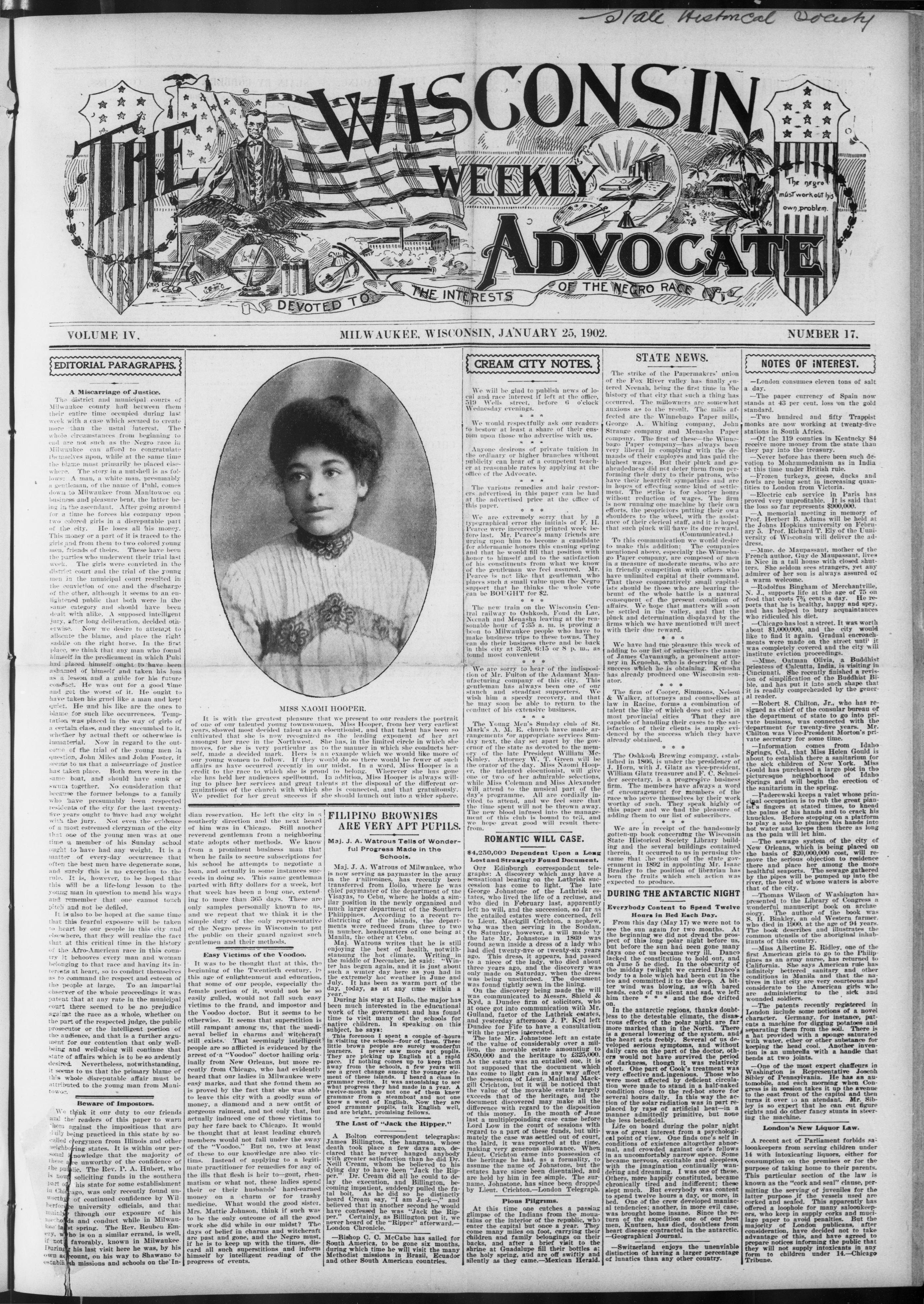
WISCONSIN
WEEKLY
ADVOCATE
DEVOTED TO THE INTERESTS OF THE NEGRO RACE
EDITORIAL PARAGRAPHS.
A Miscarriage of Justice.
The district and municipal courts of Milwaukee county had between them their entire time occupied during last week with a case which seemed to create more than the usual interest. The whole circumstances from beginning to end are not such as the Negro race in Milwaukee can afford to congratulate themselves upon, while at the same time the blame must primarily be placed elsewhere. The story in a nutshell is as follows: A man, a white man, presumably a gentleman, of the name of Puhl, comes down to Milwaukee from Manitowoc on business and pleasure bent, the latter being in the ascendant. After going around for a time he forces his company upon two colored girls in a disreputable part of the city. He loses all his money. This money or a part of it is traced to the girls and from them to two colored young men, friends of theirs. These have been the parties who underwent their trial last week. The girls were convicted in the district court and the trial of the young men in the municipal court resulted in the conviction of one and the discharge of the other, although it seems to an enlightened public that both were in the same category and should have been dealt with alike. A supposed intelligent jury, after long deliberation, decided otherwise. Now we desire to attempt to allocate the blame, and place the right saddle on the right horse. In the first place, we think that any man who found himself in the predicament in which Puhl had placed himself ought to have been ashamed of himself and taken his loss as a lesson and a guide for his future conduct. He was out for a good time and got the worst of it. He ought to have taken his gruel like a man and kept quiet. He and his like are the ones to blame for such like occurrences. Temptation was placed in the way of girls of a certain class, and they succumbed to it, whether by actual theft or otherwise is immaterial. Now in regard to the outcome of the trial of the young men in question, John Miles and John Foster, it seems to us that a miscarriage of justice has taken place. Both men were in the same boat, and should have sunk or swum together. No consideration that because the former belongs to a family who have presumably been respected residents of the city for the last twenty-five years ought to have had any weight with the jury. Not even the evidence of a most esteemed clergyman of the city that one of the young men was at one time a member of his Sunday school ought to have had any weight. It is a matter of everyday occurrence that often the best men have degenerate sons, and surely this is no exception to the rule. It is, however, to be hoped that this will be a life-long lesson to the young man in question to mend his ways and remember that one cannot touch pitch and not be defiled.
It is also to be hoped at the same time that this fearful exposure will be taken to heart by our people in this city and elsewhere, that they will realize the fact that at this critical time in the history of the Afro-American race in this country it behooves every man and woman belonging to that race and having its interests at heart, so to conduct themselves as to command the respect and esteem of the people at large. To an impartial observer of the whole proceedings it was patent that at any rate in the municipal court there seemed to be no prejudice against the race as a whole, whether on the part of the respected judge, the public prosecutor or the intelligent portion of the audience, and that is a further argument for our contention that only well-being and well-doing will continue that state of affairs which is to be so ardently desired. Nevertheless, notwithstanding, it seems to us that the primary blame of this whole disreputable affair must be attributed to the young man from Manitowoc.
Beware of Impostors
We think it our duty to our friends and the readers of this paper to warn them against the impositions that are daily being practiced in this state by so-called clergymen from Illinois and other neighbouring states. It is within our personal knowledge that the majority of these are unworthy of the confidence of the public. The Rev. P. A. Hubert, who is now soliciting funds in the southern part of his state for some establishment in Chicago, was only recently found unworthy of continued confidence by Wilberforce university officials, and that mainly through our exposure of his methods and conduct while in Milwaukee last spring. The Rev. Reuben Emery, who is on a similar errand, is well, if not, favorably, known in Milwaukee. During his last visit here he was, by his own account, on his way to Shawano to establish missions and schools on the In-
[Picture of a woman with a high collar and a wavy hairstyle, wearing a light-colored dress with a decorative pattern.]
MISS NAOMI HOOPER.
It is with the greatest pleasure that we present of one of our talented young townswomen. Miss He years, showed most decided talent as an elocutionist, cultivated that she is now recognized as the lead amongst her race in the Northwest. She has, in the moves, for she is very particular as to the manner self, made a decided mark. Hers is an example we our young women to follow. If they would do so the affairs as have occurred recently in our midst. In credit to the race to which she is proud to belong she has held her audiences spellbound. In addition, ing to place her services and great talents at the organizations of the church with which she is connected. We predict for her great success if she should lau
It is with the greatest pleasure that we present to our readers the portrait of one of our talented young townswomen. Miss Hooper, from her very earliest years, showed most decided talent as an elocutionist, and that talent has been so cultivated that she is now recognized as the leading exponent of her art amongst her race in the Northwest. She has, in the limited circle in which she moves, for she is very particular as to the manner in which she conducts herself, made a decided mark. Hers is an example which we would like more of our young women to follow. If they would do so there would be fewer of such affairs as have occurred recently in our midst. In a word, Miss Hooper is a credit to the race to which she is proud to belong. Wherever she has gone she has held her audiences spellbound. In addition, Miss Hooper is always willing to place her services and great talents at the disposal of the different organizations of the church with which she is connected, and that gratuitously. We predict for her great success if she should launch out into a wider sphere.
dian reservation. He left the city in a southerly direction and the next heard of him was in Chicago. Still another reverend gentleman from a neighboring state adopts other methods. We know from a prominent business man that when he fails to secure subscriptions for his school he attempts to negotiate a loan, and actually in some instances succeeds in doing so. This same gentleman parted with fifty dollars for a week, but that week has been a long one, extending to more than 365 days. These are only samples personally known to us, and we repeat that we think it is the simple duty of the only representative of the Negro press in Wisconsin to put the public on their guard against such gentlemen and their methods.
Easy Victims of the Voodoo
It was to be thought that at this, the beginning of the Twentieth century, in this age of enlightenment and education, that some of our people, especially the female portion of it, would not be so easily gulled, would not fall such easy victims to the fraud, and impostor and the Voodoo doctor. But it seems to be otherwise. It seems that superstition is still rampant among us, that the mediaeval belief in charms and witchcraft still exists. That seemingly intelligent people are so afflicted is evidenced by the arrest of a "Voodoo" doctor hailing originally from New Orleans, but more recently from Chicago, who had evidently heard that our ladies in Milwaukee were easy marks, and that she found them so is proved by the fact that she was able to leave this city with a goodly sum of money, a diamond and a new outfit of gorgeous raiment, and not only that, but actually induced one of those victims to pay her fare back to Chicago. It would be thought that at least leading church members would not fall under the sway of the "Voodoo." But no, two at least of these to our knowledge are also victims. Instead of applying to a legitimate practitioner for remedies for any of the ills that flesh is heir to—gout, rheumatism or what not, these ladies spend their or their husbands' hard-earned money on a charm or for trashy medicine. What would the good sister, Mrs. Mattie Johnson, think if such was to be the only outcome of all the good work she did while in our midst? The days of belief in charms and witchcraft are past and gone, and the Negro must, if he is to keep up with the times, discard all such superstitions and inform himself by intelligent reading of the progress of events.
---
MILWAUKEE, WISCONSIN, JANUARY 25, 1902.
at we present to our readers the portrait pen. Miss Hooper, from her very earliest elocutionist, and that talent has been so as the leading exponent of her art she has, in the limited circle in which she so the manner in which she conducts her example which we would like more of could do so there would be fewer of such or midst. In a word, Miss Hooper is a ad to belong. Wherever she has gone In addition, Miss Hooper is always will-lents at the disposal of the different orshe is connected, and that gratuitously she should launch out into a wider sphere.
FILIPINO BROWNIES ARE VERY APT PUPILS.
Maj. J. A. Watrous Tells of Wonderful Progress Made in the Schools.
Maj. J. A. Watrous of Milwaukee, who is now serving as paymaster in the army in the Philippines, has recently been transferred from Iloilo, where he was chief paymaster of the department of the Visayas, to Cebu, where he holds a similar position in the newly organized and much larger department of the Southern Philippines. According to a recent redistricting of the islands, the departments were reduced from three to two in number, headquarters of one being at Manila, the other at Cebu.
Maj. Watrous writes that he is still enjoying the best of health, notwithstanding the hot climate. Writing in the middle of December, he said: "Winter has begun again, and it is just about such a winter day here as you had in the extremely hot weather in June and July. It has been as warm part of the day, today, as at any time within a year."
During his stay at Iloilo, the major has been much interested in the educational work of the government and has found time to visit many of the schools for native children. In speaking on this subject, he says:
This forenoon I spent a couple of hours in visiting the schools—four of them. These little brown people are surely wonderful learners. I never saw more apt pupils. They are picking up English at a rapid pace. If nothing comes up to keep them away from the schools, a few years will see a great change among the younger element of these islands. I heard a class in grammar recite. It was astonishing to see what progress they had made in a year. A twelve-month ago not one of them knew grammar from a steamboat and not one knew a word of English. Now they are good grammar pupils, talk English well, and are bright, promising fellows.
The Last of "Jack the Ripper."
A Bolton correspondent telegraphs: James Billington, the hangman, whose death took place a few days ago, declared that he never hanged anybody with greater satisfaction than he did Dr. Neill Cream, whom he believed to his dying day to have been "Jack the Ripper." Dr. Cream did all he could to delay the execution, and Billington, becoming impatient, suddenly pulled the fatal bolt. As he did so he distinctly heard Cream say, "I am Jack—," and believed that in another second he would have confessed he was "Jack the Ripper." Certainly, as Billington put it, we never heard of the "Ripper" afterward. London Chronicle.
—Bishop C. C. McCabe has sailed for South America, to be gone six months, during which time he will visit the many Methodist missions in Brazil, Ecuador and other South American countries.
---
CREAM CITY NOTES.
---
We will be glad to publish news of local and race interest if left at the office, 519 Wells street, before 6 o'clock Wednesday evenings.
* * *
We would respectfully ask our readers to bestow at least a share of their custom upon those who advertise with us.
* * *
Anyone desirous of private tuition in the ordinary or higher branches without publicity can hear of a competent teacher at reasonable rates by applying at the office of the Advocate.
业 业 肃
The various remedies and hair restorers advertised in this paper can be had at the advertised price at the office of this paper.
\* \* \*
We are extremely sorry that by a typeographical error the initials of F. H. Pearce were incorrectly printed week before last. Mr. Pearce's many friends are urging upon him to become a candidate for aldermanic honors this ensuing spring and that he would fill that position with honor to himself and to the satisfaction of his constituents from what we know of the gentleman we feel assured. Mr. Pearce is not like that gentleman who places such a small value upon the Negro support that he thinks the whole vote can be BOUGHT for $2.
***
The new train on the Wisconsin Central railway to Oshkosh, Fond du Lac, Neenah and Menasha leaving at the reasonable hour of 7:35 a. m. is proving a boon to Milwaukee people who have to make business trips to these towns. They can do their business there and be back in this city at 3:20, 6:15 or 8 p. m., as found most convenient
We are sorry to hear of the indisposition of Mr. Fulton of the Adamant Manufacturing company of this city. This gentleman has always been one of our stanch and steadfast supporters. We wish him a speedy recovery, and that he may soon be able to return to the conduct of his extensive business.
业 六 必
The Young Men's Sunday club of St. Mark's A. M. E. church have made arrangements for appropriate services Sunday next, the day set apart by the governor of the state as devoted to the memory of the late President William McKinley. Attorney W. T. Green will be the orator of the day. Miss Naomi Hooper, the talented elocutionist, will give one or two of her admirable selections, while Miss Coleman and Miss Alexander will attend to the musical part of the day's programme. All are cordially invited to attend, and we feel sure that the time spent will not be thrown away. The new blood infused into the management of this club is bound to tell, and we hope great good will result therefrom.
ROMANTIC WILL CASE.
$4,250,000 Dependent Upon a Long
Lost and Strangely Found Document.
Our Edinburgh correspondent telegraphs: A discovery which may have a sensational bearing on the Lathrisk succession has come to light. The late George Johnstone of the Lathrisk estates, who lived the life of a recluse, and who died in February last, apparently left no will, and the succession, so far as the entailed estates were concerned, fell to Lieut. Mackgill Crichton, a nephew, who was then serving in the Soudan. On Saturday, however, a will made by the late Mr. Johnstone in 1869 was found sewn inside a dress of a lady who had died twenty-five or twenty-six years ago. This dress, it appears, had passed to a niece of the lady, who died about three years ago, and the discovery was only made on Saturday, when the dress was being unstitched. The document was found tightly sewn in the lining.
On the discovery being made the will was communicated to Messrs. Shield & Kyd, a Dundee firm of solicitors, who at once got into communication with Mr. Gulland, factor of the Lathrisk estates, and yesterday afternoon J. P. Kyd left Dundee for Fife to have a consultation with the parties interested.
The late Mr. Johnstone left an estate of the value of considerably over a million, the movable estate amounting to £850,000 and the heritage to £325,000. As the estate was an entailed one, it is not supposed that the document which has come to light can in any way affect the possession of Lieut. Maitland Mackgill Crichton, but it will be noticed that the value of the movable estate largely exceeds that of the heritage, and the document discovered may make all the difference with regard to the disposition of this money. In the month of June last a multiplepoinding case came before Lord Low in the court of sessions with regard to a part of these funds, but ultimately the case was settled out of court, the laird, it was reported at the time, making very generous allowance. When Lieut. Crichton came into possession of the heritage he had, as a formality, to assume the name of Johnstone, but the estates have since been disentailed, and are held by him in fee simple. The surname, Johnstone, has since been dropped by Lieut. Crichton.—London Telegraph.
Pious Pilgrims.
At this time one catches a passing glimpse of the Indians from the mountains or the interior of the republic, who enter the capital but once a year. They come many miles on foot, carrying their children and family belongings on their backs, and after a brief visit to the shrine at Guadalupe fill their bottles as the holy spring, and are off swiftly and silently as they came.—Mexican Herald.
STATE NEWS.
The strike of the Papermakers' union of the Fox River valley has finally entered Neenah, being the first time in the history of that city that such a thing has occurred. The millowners are somewhat anxious as to the result. The mills affected are the Winnebago Paper mills, George A. Whiting company, John Strange company and Menasha Paper company. The first of these—the Winnebago Paper company—has always been very liberal in complying with the demands of their employees and has paid the highest wages. But their pluck and goaheadedness did not deter them from performing their duty to their patrons, who have their heartfelt sympathies and are in hopes of effecting some kind of settlement. The strike is for shorter hours without reduction of wages. The firm is now running one machine by their own efforts, the proprietors putting their own shoulders to the wheel, with the assistance of their clerical staff, and it is hoped that such pluck will have its due reward.
To this communication we would desire to make this addition: The companies mentioned above, especially the Winnebago Paper company, are composed of men in a measure of moderate means, who are in friendly competition with others who have unlimited capital at their command. That these comparatively small capitalists should be those who are bearing the brunt of the whole battle is a natural consequent of the present condition of affairs. We hope that matters will soon be settled in the valley, and that the pluck and determination displayed by the firms which we have mentioned will meet with their due reward.
心
We have had the pleasure this week of adding to our list of subscribers the name of James Cavanaugh, a prominent attorney in Kenosha, who is deserving of the success which he is obtaining. Kenosha has already produced one Wisconsin senator.
The firm of Cooper, Simmons, Nelson & Walker, attorneys and counsellors at law in Racine, forms a combination of talent the like of which does not exist in most provincial cities. That they are capable of handling their cases to the satisfaction of their clients is amply evidenced by the success which they have already obtained.
* * *
The Oshkosh Brewing company, established in 1866, is under the presidency of J. Horn, with J. Glatz as vice-president, William Glatz treasurer and F. C. Schneider secretary, is a progressive business firm. The members have always a word of encouragement for members of the race who prove themselves by their work worthy of such. They speak highly of this paper and we had the pleasure of adding them to our list of subscribers.
* ☆ ☆
We are in receipt of the handsomely gotten-up book concerning the Wisconsin State Historical Society Library building and the several buildings contained therein. It occurred to us in perusing the same that the action of the state government in 1892 in appointing Mr. Isaac Bradley to the position of librarian has born the fruits which such action was expected to produce.
DURING THE ANTARCTIC NIGHT
Everybody Content to Spend Twelve Hours in Bed Each Day.
From this day (May 17) we were not to see the sun again for two months. At the beginning we did not dread the prospect of this long polar night before us, but before the sun had been gone many days one of us became very ill. Danco lacked the constitution to hold out, and on June 5 he died. In the obscurity of the midday twilight we carried Danco's body to a hole which had been cut in the ice and committed it to the deep. A bitter wind was blowing, as with bared heads, each of us silent and sad, we left him there * * * and the floe drifted on.
In the antarctic regions, thanks doubtless to the detestable climate, the disastrous effects of the polar night are far more marked than in the North. There is a general lowering of the system, and the heart acts feebly. Several of us developed serious symptoms, and without daily care on the part of the doctor, others would not have survived the period of darkness, though it was relatively short. One part of Cook's treatment was very effective and ingenious. Those who were most affected by deficient circulation were made to stand in a half-naked condition close to the red-hot stove for several hours daily. In this way the action of the solar radiation was in part replaced by rays of artificial heat—in a manner admittedly primitive, but none the less beneficial.
Life on board during the polar night was of great interest from a psychological point of view. One finds one's self in conditions of existence altogether abnormal, and crowded against one's fellows in an uncomfortably narrow space. Some became nervous, excitable and sleepless, with the imagination continually wandering and dreaming. I was one of these. Others, more happily constituted, became chronically tired and indifferent; these slept much. But everybody was content to spend twelve hours a day, or more, in bed. One of the crew developed maniacal tendencies; another, in more evil case, was brought home insane. Since the return of the expedition one of our best men, Knutzen, has died, doubtless from heart disease contracted in the antarctic. Geographical Journal.
—Switzerland enjoys the unenviable distinction of having a larger percentage of lunatics than any other country.
NUMBER 17.
NOTES OF INTEREST.
—London consumes eleven tons of salt a day.
—The paper currency of Spain now stands at 43 per cent. loss on the gold standard.
—Two hundred and fifty Trappist monks are now working at twenty-five stations in South Africa.
—Of the 119 counties in Kentucky 84 receive more money from the state than they pay into the treasury.
—Never before has there been such devotion to Mohammedanism as in India at this time under British rule.
—Frozen turkeys, geese, ducks and fowls are being sent in increasing quantities to London from Victoria.
—Electric cab service in Paris has proved very unprofitable. It is said that the loss so far represents $900,000.
—A memorial meeting in memory of Prof. Herbert B. Adams will be held at the Johns Hopkins university on February 5. Prof. Richard T. Ely of the Uuniversity of Wisconsin will deliver the address.
—Mme. de Maupassant, mother of the French author, Guy de Maupassant, lives in Nice in a tall house with closed shutters. She seldom sees strangers, yet any admirer of her son is always assured of a warm welcome.
—Rodolfus Bingham of Merchantville, N. J., supports life at the age of 75 on food that costs $7\frac{3}{4} cents a day. He reports that he is healthy, happy and spry, and has helped to bury acquaintances who ridiculed his diet.
—Chicago has lost a street. It was worth about $1,000,000, and the city would like to find it again. Gradual encroachments were made on the street until it was completely covered and the city will institute eviction proceedings.
—Mme. Oatman Olivia, a Buddhist priestess of Calcutta, India, is visiting in Cincinnati. She recently finished a revision of simplification of the Buddhist Bible, and has put it into such shape that it is readily comprehended by the general reader.
—Robert S. Chilton, Jr., who has resigned as chief of the consular bureau of the department of state to go into private business, was connected with the department for twenty-five years. Mr. Chilton was Vice-President Morton's private secretary for some time.
—Information comes from Idaho Springs, Col., that Miss Helen Gould is about to establish there a sanitarium for the sick children of New York. Miss Gould has purchased a large plot in the picturesque neighborhood of Idaho Springs and will begin the erection of the sanitarium in the spring.
Paderewski keeps a valet whose principal occupation is to rub the great pianists fingers at stated times, to knead the palms of his hands and to crack his knuckles. Before stepping on a platform to play a solo he plunges his hands into hot water and keeps them there as long as the pain will let him.
The sewage system of the city of New Orleans, which is being placed on the basis of $20,000,000 cost, will remove the serious objection to residence there and place her among the more healthful seaports. The sewage gathered by the pipes will be pumped up into the river, the level of whose waters is above that of the city.
Thomas Wilson of Washington has presented to the Library of Congress a wonderful manuscript book on archaeology. The author of the book was S. H. Binkley, an old Western farmer, who died in 1900, at the age of 94 years. The book describes and illustrates the common utensils of the aboriginal inhabitants of this country.
Miss Albertine E. Ridley, one of the first American girls to go to the Philippines as an army nurse, has returned to California. She says American rule has infinitely bettered sanitary and other conditions in Manila and that the natives in that city are very courteous and considerate to the American girls who are administering to the sick and wounded soldiers.
The patents recently registered in London include some notions of a novel character. Germany, for instance, patents a machine for digging potatoes and separating them from the soil. There is a hat provided with a sponge saturated with water, ether or other substance for keeping the head cool. Another invention is an umbrella with a handle that bends at two joints.
One of the most expert chaffeurs in Washington is Representative Joseph Sibley of Pennsylvania. He has an automobile, and each morning when Congress is in session takes it up the avenue to the east front of the capitol and then turns it over to an attendant. Mr. Sibley is so expert that he can cut figure eights and do other fancy stunts in steering the machine.
London's New Liquor Law.
A recent act of Parliament forbids saloonkeepers from serving children under 14 with intoxicating liquors, either for consumption on the premises or for the purpose of taking home to their parents. This particular section of the law is known as the "cork and seal" clause, permitting the serving of juveniles for the latter purpose if the vessels used are corked and sealed. This apparently has offered a loophole for many saloonkeepers, who keep in supply corks and mucilage paper to avoid penalties. But the majority of London publicans, after consideration, have decided not to take advantage of this, and have agreed to prepare notices informing the public that they will not supply intoxicants in any form to children under 14.—Chicago Tribune.
HIS SHORTAGE IS HEAVY.
Theo. Braemar Accumulates Large Fortune on Small Salary.
SPECULATED IN STOCKS.
Turns Over All His Property to Employers and Thereby Escapes Prosecution.
Cincinnati. O., Jan. 22.—It is alleged that Theodore Braemar, secretary and treasurer of the J. and F. Schroth Packing company of this city, is short in his accounts from $160,000 to $400,000, according to a story printed in all the local papers. Braemar and his wife have turned all their estate over to the Schroths and the shortage will be fully covered without prosecution. Until recently Braemar received $25 per week as bookkeeper. His salary never exceeded $40 per week and he had been with the firm twenty-five years. He has transferred one of the finest residences in the city and other valuable property and over $200,000 in stocks and bonds to his former employers. His employers always believed his statements about his fortunate speculations and investments and never examined his books. After the death of John Schroth over a year ago, his heirs instituted an investigation and recently have had detectives co-operating with their expert accountant. Expert Munster claims to have confronted Braemar with $160,000 of the shortage and he estimates that the shortage of over twenty years will aggregate $400,000. The firm does a business of over $3,000,000 annually, all passing through the hands of Braemar. It is claimed that Braemar did not enter cash collections from the wagons as well as other collections. Braemar and his family were noted entertainers and very prominent socially.
Braemar admitted today that he had transferred his property to the Schroths after he met their attorneys and the expert accountant last Saturday. It was then that he resigned and an attempt was made to keep the matter quiet. Among the chattels turned over by Braemar were $75,000 in Standard Oil stock. $15,000 in National bank stock. $13,000 in Cincinnati Gas stock. $8000 in school bonds and $50,000 in other good holdings with a bank balance of $18,000.
Statement of Attorney s.
Former United States District Attorney Harland Cleveland, representing Theodore Braemar, and Joseph W. O'Hara, representing the J. and F. Schroth Packing company, have been in consultation during the day. They declared that the published accounts were exaggerated and did the Schroths as well as Braemar injustice. They said the amount held in trust would more than cover the differences in settlement and that the discrepancies would not approximate any such figures as have been published.
The Times-Star today publishes the following interview with Theodore Braemar.
Braemar Tells His Story.
"I'll tell you the truth of the whole matter. The old man and I have been fighting for the past six months and I concluded to quit. I was about to say there had been some errors in the books and some time ago it was mutually agreed to have an expert go over them. Some more errors were found and as a precautionary measure and to indemnify the company, Harlan Cleveland and Joe O'Hara, the attorneys, were appointed trustees of my estate. I have turned over to these gentlemen purely as a business measure 100 shares of Standard Oil company stock which was worth about $60,000, and my holdings in Cincinnati Gas and Electric stock, amounting to about $12,000. That is all I have turned over to them."
"If a shortage is found in the books will you to be blame?"
wish you to be biased:
"Solely because I had charge of the books. I have no desire to shift any responsibility."
WILL GIVE A CANNON.
Emperor William to Offer a Gun to the German-Ameri-
Berlin, Jan. 22.—Prince Henry will take with him to the United States a bronze cannon as a present from the Kaiser to the Central Union of German-American veterans who fought in the war of 1866-1870. The cannon was captured from the French. It is destined for Philadelphia, where the prince probably will make a speech in presenting it to the veterans. It is announced that the prince will travel in civilian dress while in the United States. Philadelphia is the latest addition to the list of cities which he will visit. The prince will spend one day in each of the cities, except New York and Washington, where his stay will be longer. As soon as the imperial yacht Hohenzollern reaches New York she will be painted a fresh ivory color. Fearing that the color could not be obtained in New York, the paint is being taken over in the Hohenzollern.
Von Buelow Explains.
In the course of the debate in the Reichstag today on the estimates of the chancellor's department, the imperial chancellor, Count Von Buelow, referred to the relations between Germany and the United States. "I can only repeat," said the chancellor, "what I said three years ago in the Reichstag, and I believe the views I then set forth in detail will today meet with the concurrence of the house, namely, that we are filled with an earnest desire to maintain, on the basis of perfect reciprocity and mutual appreciation, the traditional good relations which have always existed between ourselves and the United States.
"The voyage of Prince Henry to America is an expression of these good relations, and I am convinced his reception will be in accord with the friendly feelings of the two great nations have for one another."
The chancellor's statement was greeted with prolonged cheers.
Not Afraid of Reds.
Berlin, Jan. 22.—Interviews were had with the best-informed authorities here in regard to the story from Chicago that the Anarchists there had seized upon the occasion of Prince Henry's visit to that city to make threats against royalty, and that the German consul at Chicago had informed the mayor that unless sufficient protection was given the prince's itinerary would be changed.
The officials who discussed the subject here said they believed the story was a fabrication designed to make the prince uneasy and possibly deter him from visiting Chicago. It is asserted officially that while the Anarchists are likely to use the occasion for making a demonstration, all necessary precautions will be taken by the American police and that the prince's visit to Chicago is settled. It is pointed out that Prince Henry would be the last man to shun a risk which the President must share.
Suicide of W. H. Hoffmeister.
St. Louis, Mo., Jan. 21.—William H. Hoffmeister of St. Louis, formerly supreme recorder of the Legion of Honor, committed suicide at the Planters' hotel yesterday by shooting himself with a revolver.
GERMANY IS ANNOYED.
Official Disclaimer of Any Intention to Interfere In Spanish-American War.
Berlin, Jan. 22.—Germany is deeply hurt by statements made at the British foreign office in London in reference to the attitude of England toward the United States during the Spanish-American war. The impression created was that the refusal of England to interfere operated to prevent certain other European nations from interfering. Although no names were mentioned by Lord Cranborne Germany takes the first opportunity to put in a disclaimer and to say that any attempt on the part of England to secure favor in the United States at the expense of Germany is in decidedly bad taste and poor politics just as Prince Henry is about to visit America on a friendly mission.
The foreign office here makes the following written statement:
The foreign office declares with all positiveness that Germany, neither before the outbreak of the Spanish-American war nor during its course, proposed intervention to other powers. Neither did Germany support such a proposition made by other powers. It is true that in several instances suggestions (anregungen) were made to the German government from another source, in the sense of intervention. But the German government without exception maintained a negative attitude toward such suggestions, and made known its negative standpoint whenever occasion offered. It must further be remarked that it was not from an Austrian source (nicht gerade von Oesterreichscher selte) that such suggestions reached the German government.
The interpellation in the British House of Commons to which Lord Cranborne replied is here considered to have been gotten up especially to give the opportunity of saying something in Parliament which might be taken as a basis for reviving stories adverse to Germany in the matter of German relations with the United States.
Reasons Moving Austria.
Vienna, Jan. 21.—Inquiries at the Austro-Hungarian foreign office confirm the essential points of the statement made by Lord Cranborne. The dynastic relations of Austria with Spain, the Queen Regent being an archduchess of Austria, led Austria before the declaration of war between Spain and the United States to begin a peace propaganda, which was carried on not only in England but throughout Europe. France was ready to second the efforts of Austria. Germany and Russia maintained a passive attitude.
Great Britain was at first disposed to sign the proposed note, but after a confidential report from Washington declined either to sign such a note or to take any further steps. Afterwards Austria and France made direct representations at Washington, but ceased their efforts after the declaration of war, from that time forth relying on the efforts of the Pope, who was backed by the tacit approval of all the powers.
PROTESTS TOO LATE.
Futile Effort of Senator Teller to Save the Life of Commandant Scheepers.
Washington, D. C., Jan. 22.—Senator Teller offered the following concurrent resolution which he asked to go over until tomorrow:
Whereas, it is announced that sentence of death has been passed upon Commandant Scheepers of the Orange Free State army, now a prisoner of war in the hands of the British forces in South Africa, and
Whereas, It is known that said Commandant Scheepers was captured while lying sick and wounded in a hospital, such capture being in violation of articles 1 and 5 of the Geneva convention and,
Whereas, his execution by the British authorities will lead to acts of retaliation and reprisal; therefore be it.
Resolved, by the Senate, the House of Representatives concurring, that the President request the government of Great Britain to set aside in the interest of humanity such sentence of death and accord to Commandant Scheepers the privileges and immunities guaranteed under the Geneva convention.
After reading press dispatches reciting the statements of fact in the resolution, Mr. Teller said: "I am told we can have by tomorrow official evidence that the statements in the resolution are correct. This is a case which certainly calls for the intervention of the United States or of some other government which has some feeling of humanity. War, wherever it is, should be conducted upon principles of humanity or at least, if not, we should enter our protest against it."
New York, Jan. 22.—It has just been discovered that through a cable error an Associated Press dispatch announced that the death sentence upon Commandant Scheepers of the Boer army had been confirmed by Gen. Kitchener and that he would be executed next Saturday. The fact is that he was executed on last Saturday, January 18.
CHASED BY HAMILTON.
British Commander is Hot on Trail of Boers Under Gen. Botha.
London, Jan. 22.—Lord Kitchener in a dispatch from Johannesburg, Transvaal colony, dated Tuesday, January 21, says Gen. Methuen overtook a Boer command near Boschpoort January 20 and after a running fight of eight miles captured all their wagons and cattle and twenty-four Boers. Gen. Bruce Hamilton made a night march against Gen. Botha, near Witbank, January 18, but the Boer commander had left the camp when the British reached the spot. The latter, however, captured twenty-seven prisoners.
New Whatcom, Wash., Jan. 22.—Rev. J. W. Barr, rector of Episcopal churches in this city and Fair Haven, has gone to South Africa to arrange the final details of a gigantic colonization scheme which the British government will shortly undertake there. It is the idea of the British government to induce a number of British born subjects now residing in the United States to emigrate to South Africa and, mingling with the Boers, eradicate the feeling of hatred which dwells in their breasts. To induce British subjects in this country to go into the Transvaal, the British will offer large grants of lands, cattle, farming utensils, etc.
ALL BACK IN JAIL.
Recapture of Prisoners Who Recently Escaped from United States Penitentiary.
Tacoma, Wash., Jan. 22.—A Ledger reporter just returned from McNeils island brings the news that every one of the eleven criminals who escaped from the United States penitentiary on McNeils island Sunday noon slept behind prison bars last night. The last four to be taken, James Moriarity, Mike William, Bruce Kenwright and J. P. Stewart, were captured at 11 o'clock last night near the Cross Roads, where the other prisoners were taken. The capture was effected without a shot being fired.
The men had a sack full of chickens and were evidently prepared to make a feast. The four men did not take their capture much to heart. Morlarity will lose a credit of twenty months on his sentence and Williams will forfeit two years and two months. All the officers are jubilant over the successful and exciting man hunt of the last three days and nights.
FIVE WARSHIPS ARE SUNK.
Naval Battle Now in Progress in Harbor of Panama.
FIGHTING IN EARNEST.
Revolutionary Fleet Trying to Force a Landing—Government Throwing Up Entrenchments.
Washington, D. C., Jan. 20.—The state department has received the following cablegram from Consul-General Gudger at Panama today:
"Fighting in bay. Governor killed. Excitement great."
The secretary of the navy has received the following cablegram from Capt. Mead, commander of the United States battleship Philadelphia, dated Panama today:
"The insurgent steamer Padilla attacked the Lautaro yesterday morning at close quarters. Crew has deserted her. Is now on fire and sinking."
New York, Jan. 20. The Panama Railway company today received a cablegram from Colon saying that three insurgents and two government vessels had been sunk in the naval engagement in Panama harbor. The cablegram came from Col. J. R. Shaler, general superintendent at Colon for the Panama Railway company.
Naval Battle in Progress.
Colon, Colombio, Jan. 20 (via Galveston, Tex.).—A naval battle, which began at 6 o'clock this morning, is in progress in the harbor of Panama. The revolutionary fleet consists of the Padila, Darian and Gaitan. They are trying to force a landing off Saoana.
The government ships are the Chilian line steamer Lautaro, the Pacific Steam Navigation company's steamer Chicuito and the Panama Canal company's steamer Boyaca. The first-named steamer was seized by Gen. Alban and the other two have been chartered by the Colombian government.
As this dispatch is sent three shots have passed over the Chicuito and she has answered with several shots. They fell close to the Padilla, which is seen to be retiring.
The guns at Las Bovedas also are firing at the rebel ships. The government forces are throwing up intrenchments. The United States cruiser Philadelphia is close to the scene of the fighting. Willemstad, Island of Curacao, Jan 20 (via Haytien cable).—Venezuelan advices received here today say the government forces had the best of the fighting at Maraicabo on Saturday last, although Col. Peralto, Col. Fuenmayer and fifty men were seriously wounded. The government troops are pursuing the revolutionists. Other advices say the revolution is slowly gaining ground in the state of Lara.
The revolutionists at Barcelona and Cumanasay they cannot understand Gen. Mato's plans. For a fortnight past 2500 men at or in the vicinity of those towns have been awaiting arms and ammunition in order to take the field against President Castro's forces. The financial situation in Venezuela is pronounced to be hopeless. The reply of the Venezuelan government to the request of the German government for a settlement of the claims of German citizens, arising from the late revolutions, will be submitted to the next Congress of Venezuela, which will meet in February.
CANAL COMMISSION MAKES ITS REPORT.
Unanimously in Favor of the Panama Route and for Buying French Concessions.
Washington, D. C., Jan. 20.—The President today transmitted to Congress a supplemental report of the isthmian canal commission on the proposition of the Panama Canal company to sell its property to the United States for $40,000. The commission unanimously reports that after considering the changed conditions that now exist and all the facts and circumstances upon which its present judgment must be based, the commission is of the opinion that the most practicable and feasible route for the isthmian canal, to be under the control, management and ownership of the United States is that known as the Panama canal route. The report is signed by all the members of the commission. It was accompanied by a letter of transmittal from the President to Congress.
BEET SUGAR PROTEST.
President Tells Michigan Men Something Must Be Done
Washington, D. C., Jan. 20.—A delegation of beet sugar manufacturers from Michigan, headed by W. L. Churchill, president of the Michigan Sugar Manufacturers' association and F. R. Hathaway, secretary, appeared before the President and protested against the proposed reduction of the duty on Cuban sugar. The delegation was escorted by Representative William Alden Smith of Michigan. They presented the President with a memorial which called his attention to the plank in the Republican platform of 1898, condemning the Democratic administration for not keeping faith with the sugar growers of the country and its redemption in the enactment of the Dingley law in July, 1897.
The President stated to the delegation that this country should do something for Cuba, whereupon Mr. Smith, on behalf of the delegation, urged that the beet sugar industry should not bear the brunt of this country's generosity. They were willing that something should be done, but did not want their industry destroyed.
BUILDINGS GO TO RUIN.
Business Blocks in Detroit Collapse
Without Known Cause—Loss
$200,000.
Detroit, Mich., Jan. 20.—Four buildings, each four stories high, in the heart of the wholesale district of Detroit, collapsed at 8:30 o'clock last night, without any apparent cause. All that now remains of them is a smoldering heap of ruins. The loss on stock is estimated at $152,500; on buildings, $50,500. The buildings joined each other at Jefferson avenue, and Shelby street.
Sunday night the wholesale district is practically deserted and the few men who were in the vicinity say the buildings seemed to fall into a heap without apparent cause, making a noise like the rumbling of distant thunder.
Experts from the Detroit Gas company's office made an examination of the ruins, but were unable to find evidences of a gas explosion. Had the wreck occurred during business hours the loss of life must have been appalling, as 200 persons were employed by the various firms. Furnaces in the buildings set the ruin on fire and the wooden work was burned.
BIG FIRE IS RAGING.
Seven Bodies Taken from the Ruins of a Lumber Camp at Davis, W. Va.
Wheeling, W. Va., Jan. 21.—The town of Shinnston, sixty miles down the state, is burning and from last accounts seems doomed. A big fire also is reported at the lumber camp at Davis, W. Va. Seven bodies are reported to have been taken from the ruins. Fairmount, W. Va., Jan. 21.—Seven men cremated in their beds and a town burning up are the results thus far of two fires today in distant parts of the state.
Details of both occurrences are meager. The fire at Shinnston started just before noon and telegraph and telephone connection has been cut off. The town is a thrixing settlement on the Monongahela division of the B. & O. railroad and is in the center of a big coal and lumber district. It is without fire protection and early reports say that within a few minutes after the fire started the citizens were obliged to abandon their efforts to check the flames and fled for their lives.
There have been no reports of casualties from Shinnston. The lumber camp holocaust occurred at Camp No. 5, operated by the Otter Creek Lumber company at 4 o'clock this morning. Details of the disaster are not yet obtainable, but it is known that seven men were burned to death and a number were injured in jumping from the building in which they were sleeping. The camp is thirteen miles off the West Virginia Central railroad. A rescue party left here this morning and is expected to return tonight. The fire started in the cookroom.
Pittsburg, Pa., Jan. 21.—The extensive plant of the J. H. Rumbaugh Brick company at Pitcairn, Pa., is burning and is threatened with destruction. The twelve large drying houses are on fire and it is feared the boilerhouse also will be destroyed.
As the plant has been closed down for a week the origin of the fire is a mystery. A number of tramps have been sleeping about the place and until the fire is extinguished it will not be known whether or not any of them were burned to death.
CHECK FOR A MILLION.
Mutual Life of New York Pays Insurance to Helrs of Frank H. Peavey.
New York, Jan. 21.—The following dispatch has been received here and is published in the morning papers:
"St. Paul, Jan. 19.—A check amounting to $1,000,000 has been received here for payment of the policy on the life of Frank H. Peavey, the late Minneapolis millionaire. It is said to be the largest check ever drawn in payment of a life insurance risk. This check was sent to the Peavey estate by the Mutual Life Insurance company of New York."
TAFT IS QUITE ILL.
Civil Governor of Phillppines Islands Arrives at San Francisco from Manila.
San Francisco, Cal., Jan. 21.—W. H. Taft, civil governor of the Philippine islands, who arrived here on the transport Grant, is quite ill, the Philippine climate and the arduous duties he has performed having told on his constitution. He feels that after a few days of rest in this city he will be strong enough to undergo the trip East and make his report to the secretary of war.
M'KINLEY MEMORIAL.
Cleveland, O., Jan. 21.—The request of Gov. George E. Nash of Ohio to the governors of all the states and territories to join with him in asking the people to properly observe the fifty-ninth anniversary of the birth of William McKinley, has met with immediate and hearty response. Nearly every governor has either issued a proclamation or semi-officially requested that there shall be memorial services on the Sunday preceding January 26, in all the churches, that contributions be there received, and that all people testify by their voluntary offerings their love and devotion to the dead President. In many states, notably Kansas, public schools will hold special exercises and give to the fund.
In any community where there is no local auxiliary of the McKinley National Memorial Association, contributions by business, fraternal or labor organizations, schools or churches, may be sent to the treasurer, Myron T. Herrick, Cleveland, O. The funds will be applied to the erection of a fitting memorial to William McKinley, over his last resting place at Canton, O. Judge William R. Day, ex-secretary of state, is president of the association.
SIX DIE IN AN EXPLOSION.
Disaster in a Colliery in Colorado Causes Many Fatalities.
Walsenburg, Col., Jan. 21.—A courier has just reached here from Pictou, a coal-mining camp, located three miles from Walsenburg, bringing the news that a terrible explosion occurred in one of the mines operated by the Colorado Fuel and Iron company, in which six men were instantly killed and ten men fatally wounded. The mine immediately caught fire and is now a furnace. Cleveland, O., Jan. 21.—Fifty sticks of dynamite exploded with terrific force near Bedford, a suburb, where a gang of men were making a new fill on the Cleveland & Pittsburg railroad, resulting in the serious injury of three men, one of whom will die.
FAMOUS VIOLINIST DEAD.
Camilla Urso Dies in New York Infirmary.
New York, Jan. 21.—Camilla Urso, who in private life was Mrs. Frederick Luere, for many years a violinist famous in Europe and America, died at the New York infirmary after a brief illness. She was a remarkable instance, almost in babyhood, of precocious musical genius. Her father, Salvator Urso, was a Sicilian, an organist of great merit. Her mother, Emillie Girouard, was a Portugese. Camilla was born in Nates, France, on June 13, 1842.
Shell for Scattering Oil.
A test of a cannon that throws a shell designed to scatter oil on boisterous waves was recently made in England. The shell is of wood and conical in shape. It contains two gallons of oil. At one end of the projectile is a vent. This is covered with paper, which is blown off as the shell leaves the piece, allowing the oil to escape.
—Grasshoppers are so great a plague at Hay, N. S. W., that they obscure all the street lamps at night, leaving the town in total darkness.
—Negotiations involving over four millions sterling are nearly concluded for the purchase of the entire tramway system of Vienna by the municipality.
—The women of Japan are now largely employed in telephone and postoffices, and they are said to be excellent book-keepers.
—Death from old age has increased in 10 years from 44.9 per 100,000 to 54.0.
SLAIN BY ROBBERS.
Diamond Merchant Gives Up His Life Rather than Lose His Gems.
Rochester, N. Y., Jan. 20.—Robbers who sought the thousands of dollars' worth of diamonds and other jewels and the large amount of money in his safe tortured aged Bela E. Brown with hot irons and beat the defenseless diamond merchant with a hammer till his lifeblood oozed out of the gashes they made in his head. Still the merchant defied the thieves. They tied his legs together, gagged him with a red neck scarf and dragged him to the door of his safe, but he refused to reveal the combination. Last evening Brown was found dead on the spot in his store where his murderers had left him. There were traces of a desperate struggle all about and blood spots and pools were upon everything. The safe, however, remained unopened and the contents were not reached by the robbers.
Robbers Leave No Clues.
Brown was 65 years old and one of the most prominent diamond merchants and manufacturers of jewelry in the city. Just when or exactly how he fought with his assailants and met his death wounds will probably remain a mystery. The robbers escaped without leaving any tangible clues to their identity. There is no doubt, however, of the fact of Brown's resistance. The position of the body, the location of the blood spots and the appearance of the hammer and the irons all speak plainly of the torture and the purpose of the robbers. Brown's right hand is covered with blood and bruises, showing how he had tried to ward off the blows of the hammer that were rained upon his head. He was unable to make any outcry owing to the tight gag in his mouth.
Seared Flesh with Hot Iron.
Near the hammer were found two stove pokers. These and the open stove door showed that the frons had been heated and various burns in Brown's clothing, together with patches of seared flesh on his body, told for what purpose. At the back of Brown's head was a hole extending into the brain and there were several gashes in the scalp, evidently made by the hammer found near the body. The hammer was smeared with blood and white hairs from the head of the victim. The murdered man's head was covered with blood and a pool of blood formed on top of a small chest of drawers over which the head lay. The murderers secured nothing of value except, perhaps, a diamond stud which Mr. Brown wore and which is missing.
EXTREME MEASURES.
Gen. Bell Determined to End the Insurrection in Batangas Province.
Washington. D. C., Jan. 20.—Having failed, after two years' strife, in subduing insurrection in Batangas province, which lies just south of Manila, and having satisfied himself that lenient treatment of the insurgents is productive of no good results, Gen. J. Franklin Bell, the military commander in that province, has determined on the enforcement of the war in the most vigorous and determined fashion, involving reconcentration in a modified form, the application of martial law in all directions and the unsparing pursuit and punishment of the natives who act as spies and traitors to the United States. The reconcentration order provides for the establishment of a zone around the garrisons, into which the friendly inhabitants are to be required to come under penalty of confiscation and destruction of their property. This is said to be necessary to prevent the collection of forced contributions from the inhabitants from the insurgents. The military officers are allowed to fix the price of necessaries of life and it is promised that the people may return as soon as peaceful conditions are established.
Gen. Bell shares in the general conviction that the insurrection continues because the greater part of the people, especially the wealthier ones, do not really want peace. He says it is regrettable that the innocent must suffer with the guilty, but the greatest good to the greatest number can best be brought about by putting a prompt end to the insurrection. Therefore he directs the application of General Order No. 100, in force during the Civil war in the United States, which practically regards an insurgent as a guerilla and outside the pale of civilized warfare and subject to the death penalty wherever such insurgent does not engage continuously in the war and observe all the rules of war. However, it is provided that there shall be no executions without the approval of a superior offi-
Woman General Captured.
Manila, Jan. 20.—An important capture was made in Laguna province. Luzon, when eight men of the Eighth infantry captured a woman insurgent general named Aqueda Kahabagan. She recently commanded an insurgent force of 800 men, 300 of whom carried rifles, while 500 were armed with bolos. For six years past she has been leading insurgent bands against the Spaniards and the Americans. She has freely disclosed the location of the insurgents and will make overtures to them for surrender. The rebel leaders in Batangas, who have strong influence with the peasants, are cunningly proclaiming that a civil war is in progress in the United States. They say that Washington is besieged, and that there has been a battle at Chicago, with heavy carnage. The Russian fleet visiting Manila is pictured as destroying the American navy at Cavite.
SCHLEY BRINGS DOWN DEER.
Returns to Savannah from a Successful Hunting Trip.
Savannah, Ga., Jan. 20.—Admiral Schley's hunting party returned yesterday afternoon from St. Catherine's island. The party secured a large bag of game. Admiral Schley is credited with having brought down one deer. It was his first deer and a member of the party said the admiral was more excited when he pulled the trigger than he was during the battle off Santiago. The weather during the hunt was superb. Admiral and Mrs. Schley will leave this city for Washington this afternoon. The admiral said that he had not authorized the statement sent out from Chicago that he would discuss his case before the Hamilton club of that city. Beyond this he refused to talk.
GOES 500 FEET UNDER ICE.
Skater Drops in Air Hole, Floats Long Way Over Dam and is Saved
Middetown, N. Y., Jan. 20.—Henry Dillon, 12 years old, skated into an air hole above the Philippsburg dam on the Wallkill near here Saturday. The current carried him under the ice for nearly 500 feet to the dam, over which he was carried by the rush of water, falling fifteen feet. There are many rocks below the dam, but young Dillon fell into a deep pool, out of which he floated into the swirf water below. His companions reached the dam just as the boy was carried over and rescued him unconscious. He was soon revived and shows no bad effects of his narrow escape.
CONGRESS.
The urgent deficiency appropriation bill was completed by the appropriation committee and reported to the House on the 18th. It carries $16,701,445, distributed among the different departments. The naval items include $4,000,000 for armor on ships now under construction. Among the more important items included in the bill are the following: Rebates to tobacco manufacturers as provided in the war revenue reduction act, $3,150,000; completion of public building at St. Paul, Minn., $100,000; completion of statue at Rocharanbeau, $15,000; establishment of permanent military, post at Manila, $500,000; military ordnance, $250,000; naval ordnance, $300,000; expenses of congressional party to funeral of President McKinley, $6200; rural free delivery, $518,000.
The time of the House of Representatives was occupied on the 20th in general debate on the urgent deficiency appropriation bill. An item carrying $500,000 for a military post at Manila precipitated a long debate, on which some of the ablest debaters on both sides of the House took part. When pressed for an explanation as to the reason for the proposed appropriation of $40,000 for the emergency fund for the state department, Mr. Cannon admitted that it was for the entertainment of Prince Henry of Prussia. The matter was the subject of considerable debate. Consideration of the bill had not been concluded when the House adjourned.
In the House on the 21st Mr. Kern (Dem., Ill.) attacked the proposition to pay the expenses of the American representatives at the English coronation. Mr. Gaines (Dem., Tenn.) and Mr. Green (Dem., Pa.) concluded the debate for the day on the urgency deficiency bill. They talked mainly on Philippine affairs. When the committee rose shortly after 5 o'clock, Mr. Cannon, chairman of the appropriations committee, asked unantmous consent that general debate on the bill be concluded at 1 p. m. on the following day. Mr. Richardson (Dem., Tenn.) objected.
Some of the old partisan fire was injected into the proceedings of the House on the 22d when the item in the urgent deficiency bill appropriating $500,000 for a military post at Manila, which the Democrats have been using as a text for speeches in opposition to the Philippine policy of the administration for the last three days, was reached. Mr. Cannon, in charge of the bill, confessed that the appropriation was subject to a point of order and it went out. In lieu thereof he offered an amendment to appropriate the same sum for "shelter and protection" of the officers and enlisted men. After some further remarks by Mr. Candler (Miss.) and Mr. Zenor (Pa.), Mr. Watson (Ind.) closed the general debate with an hour's speech in defense of the administration's Philippine policy. The House adjourned without having completed consideration of the bill.
Senate.
The Senate on the 17th for a brief time had under consideration the bill creating a department of commerce and the discussion tended to show that the measure will have to be amended in many particulars before it can receive the approval of the Senate. Serious objection were raised to the transfer to the proposed departure of several important bureaus now a part of other departments of the government. It was pointed out that if the bill as reported became a law, it would create the greatest department of the government and that the secretary of commerce would have more power even than the secretary of the treasury. Notice of several important amendments was given. The House concurrent resolution providing for McKinley memorial exercises by Congress in the hall of the House or Representatives on Thursday, February 27, was adopted. The Senate confirmed the nominations of J. R. A. Crossland, minister and consul-general to Liberia; and E. D. Coe, pension agent, Milwaukee.
The President on the 20th sent to Congress with a massage simply of transmittal the supplemental report of the Isthmian canal commission, in which it is unanimously recommended that the offer of the new Panama Canal company to sell all of its rights, property and unfinished work to the United States for $40,000,000 be accepted. In the executive session an effort was made to secure the confirmation of M. A. Otero as governor of New Mexico, but on objection from Senator Morgan, action was postponed. Mr. Frye reported the ship subsidy bill agreed upon by the committee on commerce. Mr. Vest (M.o.) gave notice of dissent on the part of the Democratic members of the committee and also of an intention to file a minority report. The bill providing for the establishment of a department of commerce then was called up by Mr. Nelson (Minn.), who replied to the criticisms which had been made of the bill. Mr. Quarles (Wls.) made an argument in support of placing the census office under the proposed department and gave notice that he would move a reconsideration of the vote by which Mr. Cockrell's amendment was adopte:
Senator Lodge, chairman of the committee on Philippines, called up the Philippines revenue bill in the Senate on the 21st and spoke on the measure. The decision of the Supreme court and the chaotic condition of affairs in the Philippines, he said, made it apparent that some definite action should be taken by Congress. He reviewed the work of the committee, explaining in detail why the tariff of the Taft commission had been adopted. Mr. Spooner (Rep., Wls.) and Mr. Foraker (Rep., O.) thought the removal of the export duties might defect trade, to our great injury. Mr. Lodge explained that, while the trade in the Philippines was increasing, indicating that the tariff in operation there was beneficial, the exports were decreasing. Mr. Bacon (Dem., Ga.) took the floor in opposition to the bill, but more particularly to denounce the violation of a statute by the secretary of war, when he ordered vessels not sailing under American register to engage in the coastwise trade of the Philippines.
In the Senate on the 22d Senator Teller offered a concurrent resolution directing the President to request the government of Great Britain to set aside in the interest of humanity the sentence of death passed upon Commandant Scheepers of the Orange Free state army, now a prisoner of war in the hands of the British army in South Africa. Mr. Teller asked that consideration of the resolution go over for a day.
Rivals Scotch Granite.
Donegal now threatens the supremacy of Scotland in the matter of granite Experts who have been paying extended visits of inspection in the neighborhood of Dungloe, in West Donegal, report immense formations of granite, which for variety of shade, durability and general beauty are said to rival the famous products of Aberdeen and Peterhead. The Dungloe granite, it is stated, embraces almost every variety of color and texture, the predominating shade being red and flesh-colored stones of medium and coarse grain. Of the familiar gray granite there is also a wonderful variety, comprising stones of all shades from the lightest to the darkest tones. Some of the finger grained rock has a light-warm tone from the intermixed buff-colored felspar. A still more beautiful variety of stone which is found in Dungloe is the very dark micaceous granite, closely resembling the handsome "Labrador," with which many London buildings are pillared. When it is remembered that one firm alone in America imports £19,000 worth of polished granite yearly from Aberdeen, and that the demand for the highest class stone in all shades is ever on the increase, there should be thriving times for West Donegal in the near future.—London Express.
Why Snow is White
Why is the snow white is a frequently asked. Because black would be dangerous, so would recow low. These are "warming-up" and they change the sun's rays says the Ladies' Home Journal. snow would soon melt again and a very poor protection. But white throws back the sunlight in just form in which it receive it, and the snow can be long on the ground. dirt on the snow, and its dark quickly makes it eat its way in ever the sun shines on it. After a storm once let the horses' feet the dirt of the road with the snow sleighing will be over.
—New York city is to have a ch theater, patterned after one in which pays good dividends.
LOVE'S SILENCES.
What silences we keep year after year,
With those who are most near to us and
dear;
We live beside other day by day.
We speak of myraid things, but seldom
any.
And sitting in the shadow they have left, Alone, with loneliness, and sore bereft. We think with vain regret of some kind word That once we might have said, and they have heard."
THE EMISSARY OF LOVE.
Little Mrs. Minturn was dusting the chairs on her piazza. She had a voluminous cheese-cloth duster, soft as wool from long use and frequent washing, and she swept it over and under and around the three chairs on the piazza with the same pains that she took with her parlor furniture itself. Every team that passed in the powdery road sent a cloud of dust over the piazza, but that did not disturb Mrs. Minturn. It was her custom to dust the chairs on the porch every morning, after sweeping and dusting her kitchen, and she never failed to do it, so long as her husband insisted on having the chairs stand there, which was, generally, from the first of April until the last of November. Even when the snow was driving over them, in the late fall, and the wild wind itself was dusting them as no softest and most searching dust-cloth could, Mrs. Minturn would come forth regularly to tip forward the porch chairs and sweep over and under and around them with her cheese-cloth. It was simply one of those services which she had learned to pay, religiously, at the altar of immaculate neatness—an altar before which she worshiped daily.
On this dry and tindery summer morning, when the whole landscape seemed blowing away in dust and haze, Mrs. Minturn went a step further than usual in her Partingtonian zeal. She dusted the pillars of the porch as high as she could reach, and then she stepped down, in an absent-minded way, and dusted the smooth bole of a maple tree that stood close to the house. It was while she was gravely flourishing her cheese-cloth around the trunk of the tree that she heard Adna Lewis panting in the distance. Adna was the village station agent, and whenever he came up the hill from the depot to "the street," his panting could be heard a long distance away. Adna was large-framed and fleshy and asthmatic. His breath was wholly inadequate to his body; and yet he seemed to regard the disparity with entire unconcern, never riding when he could walk, and always being in "such a pesky hurry," as he expressed it, that he must travel at the most rapid pace permitted him by nature.
He was laboring up-hill from the depot, this morning, with a telegram in his hand. The receipt of a telegram at Jericho was such a rare event that Adna always delivered the message himself, in addition to taking it off the wire—and this quite without regard to the extreme improbability of another message arriving in his absence. He would invariably lock his little ticket office and march up to "the street" as soon after receiving a telegram as his other duties would allow. And so the villagers used to wonder, with country people's vague dread of telegrams, who was to be the victim when they heard Adna Lewis panting up the hill in mid-morning or mid-afternoon.
Adna came straight up the street towards the Minturn house this morning, his shirt sleeves fluttering in the dry, hot wind. Mrs. Minturn stood watching him with a kind of helpless fascination, her dust cloth still resting in one hand against the tree.
"Wal—I swan!" exclaimed Adna, approaching. "Dustin' all outdoors—be ye?"
Little Miss Minturn's smile was forced as she nodded her head. It seemed to her no time to joke when a man was approaching with a telegram in his hand. "Comin' here, Adny?" she asked anxiously.
"Yep. Got a—telegram for the—schoolmaster. Bein' Sat'day. I—thought I'd find him to—his boardin' place."
"No," he ain't here today Adny," replied Mrs. Minturn, relieved to know that the telegram was not for her husband or herself "He's off fishin' up to Dodd's pond. Started 'fore daylight. Went all alone, too."
"Hum!" said Adna Lewis reflectively. "Dodd's pond, eh? That's a long ways off—upwards of twelve miles. Go with a team?"
"Yes."
"Say when he was comin' back?"
"Probably not till 9 or half-past tonight. Said he was goin' to drive back in the cool of the evenin'"
"Sho!" ejaculated Adna. "Now that's bad! You see, Mis' Minturn, I know what's in that telegram—of course. It says: 'Yours received. On my way home to Denver. Meet me Lapham Junction 2:30 today. Florence.' Now, that looks to me kind of urgent—don't it to you? 'Florence,' I take it. 's that gal they say has jilted him. Now something's happened that makes her ready to patch it up, per'aps, if Harris comes right to the scratch, duly prompt, humble, and so forth. And there he is twelve miles away in the woods to Dodd's pond, and the train leaves for Lapham Junction at 11:45. He won't be there. She'll be in an awful huff—and, prob'bly, that'll be an end o' the hull thing."
"Dear, dear, dear!" exclaimed Mrs. Minturn. Her face was full of motherly distress. "It's such a pity, Adny!" she cried. "Poor Harris!-and he's so broke up over it! You jest ought to see how he's lost flesh. Goes mopin' around and can't eat hardly a thing. Forgets what he was goin' to do the minute he sets out to do it. Won't set with us in the evenin'-sets in his room. He's took her picture out o' the frame on his table, and hid it away somewheres. Poor Harris-if he'd only b'en expectin' a telegram! There ain't no way we can git him to Lapham Junction today, is there, Adny?"
"Nop—not 's I see," replied the station agent gloomily. "The fastest hoss couldn't get to the pond and git him back by train time. And them hill roads are awful!"
"Adny!" exclaimed little Miss Minturn with sudden resolution, "I'm goin' to Lapham Junction myself!"
"What!" cried the station agent, incredulously. "You? You hain't b'en away from home for fifteen year!"
"I know it, Adny—I know it!" replied the little gray-haired woman. "I never set out on a train o' cars but once, and that was when the road was first built, and my husband wanted me to go with him and the other stockholders and their wives on the openin' excursion. I was shook up so then that I hain't well got over it yit, and I vowed I'd never ride on the cars again. But I don't care. Adny. I'm goin' now, sure! I'm a-goin' to do it for Harris' sake. Why, he's jest like one o' my own boys. Adny, the way I feel towards him. I'm a-going to see that gal and explain things. I'd know her, from her picture, in a minute. 'F I can set things right between Harris and her I'm a-goin' to do it. Poor boy! I jest wish she could see how it's wore on him. The only reason he went off fishin' today was to git away from folks and be alone where the' wouldn't nobody see him. He won't fish none, I warrant
Miss Faith Root
Photograph by
Aime Dupont?
Miss Edith Root, daughter of the secretary of war, is one of the most popular belles in Washington. Her mother not caring much for society, the chief responsibility of entertaining falls upon the shoulders of this beautiful young girl, who is winning more hearts every day by her gracious manner.
you! Why, the crazy-headed boy went off without diggin' a mite o' bait!"
Florence, and do you know anybody by the name of Harris Mills?" A book of blushing swift surprise fol
Adna Lewis chuckled softly. This was a situation that appealed to him.
"Git a ticket to Lapham Junction all ready for me, Adny," admonished Mrs. Minturn, folding her dustcloth and turning toward the house. "I wouldn't miss that train for anything! I'll jest set out some cold vittles for Hiram, and leave a note for him, and change my dress, and then I'll come right down to the deepo. Land! if I could only set things right for Harris, how pleased I'd be!"
An hour and a quarter before train time Mrs. Minturn hurried into the little Jericho station and bought her ticket for Lapham Junction. She wore her best Sunday dress and bonnet, and carried a little old-fashioned "reticule," covered with black beads. In this bag she had put a slender lunch, done up in brown paper, two extra handkerchiefs, a bottle of smelling salts, a bottle of painkiller, and a folded sheet of paper on which were written her name and address, with full directions for conveying her body home in case she should be killed.
She put her ticket into her purse, and her purse into the capacious pocket of her Sunday dress, and sat down, perfectly contented, to wait for the train. It did not concern her that she was an hour too early. The only thing that she had feared was that she might be a minute too late. The sweet, care-worn old face was placid and hopeful, as she sat looking out of the depot window at familiar fields and woods, which, somehow, she hardly recognized from this unwonted point of view. She was full of a great and prayerful desire to set matters right between the young principal of the village academy and this girl, whose picture had stood on his table ever since he came to board with the Minturns. In some way, there had been a falling out between them. She knew it the very day the unfortunate letter had come from Florence—she knew it from Harris' face. Then in a few days the postmaster knew it, because the letters between the lovers stopped. Then the whole village knew it; for what the country postmaster knows, everybody knows. Mrs. Minturn had gone into the pantry and cried when the picture of Florence disappeared from Harris' table. She did not look about for it in his room, as some women might have done, perhaps. But she knew perfectly well where it was, without looking. It was between the leaves of Harris' Bible, in his trunk.
At length the train for Lapham Junction arrived at Jericho depot, and Adna Lewis, in spite of his habitual whirlwind of "pesky hurry" at such a moment, found time to assit Mrs. Minturn aboard the dreaded cars and admonish the conductor to be sure and see that she got safely off at the Junction. The last thing Adna saw as the train moved slowly away was the pale but determined face of the little peacemaker, presed against the window, gazing back at her beloved home.
Florence Appleton had an hour to wait at Lapham Junction. The train from Jericho was due to arrive only twenty minutes before she must leave on the westbound express. If Harris came, there would be, perhaps, fifteen minutes for them to undo the terrible tangle which had come about in the course of correspondence, and which letters had only served to make inextricably worse. But what cannot love do in a minute, nay, in a second, with the help of propinquity and the meeting of young, eloquent eyes! It would all depend, thought Florence, upon other things than words, than argumentsi than explanations. It would depend upon the subtle messages that passed between their souls, when they stood once more face to face. For her own part, the throbbing of her heart told her that love would not have to knock long nor hard at its gates, if he came with the right look and word. Ah, this pain of estrangement! It had written itself unmistakably in the girl's fair young face also.
The train from Jericho pulled in at the Junction exactly on time. Florence had been pacing up and down the platform for ten minutes, listening and looking for it. Now her eyes devoured with eagerness every passenger who alighted, and her color came and went with alternate expectation and disappointment. Harris had not come! She saw the conductor helping the last passenger down the steps—a little, gray-haired woman, wearing an old-fashioned gown and bonnet, and carrying a black reticule in her hand. Tears of bitter disappointment and chagrin sprang to the girl's eyes, but she dashed them away, whirled on her heel, and was about to re-enter the station, when a light touch fell on her arm.
She turned, and, with the anguish and self-pity and suppressed tears still in them, her eyes met the soft, gentle, pleading, yet desperately earnest look of the old lady in the odd gown. Ah! if love had only come, looking into her eyes like that! How easily all had been righted.
"Excuse me," said the little, gray-haired woman, "but is your first name
Florence, and do you know anybody by the name of Harris Mills?"
A look of blushing, swift surprise, followed by one of reserve and almost resentment, leaped into the girl's blue eyes. How came this woman to know her secret? What did it all mean? Could Harris have sent her? Perhaps—and the blue eyes softened a little—perhaps he was sick?
"Yes," she answered, frankly, "my name is Florence Appleton. I know Mr. Mills, and was expecting him by this train. Has he sent any message by you?"
"No," replied Mrs. Minturn.
The girl drew herself up haughtily. "Why do you presume to address me then?" she demanded in a cold tone. "I have no idea who you are."
"He couldn't come," replied the emissary of Love quietly. "He was away for all day. He didn't get your telegram. So I come for him. He boards with me. I ain't rode on the cars for fifteen years, and I vowed I'd never ride on 'em again; but when I see that Harris couldn't git here noways. I come for him. I come to tell you that you're killin' him—jest killin' him, sure as the world, poor boy he hain't b'en himself sence he took your picture out o' the frame and hid it away somewheres. He's jest goin' the way that I've seen lots of 'em go, when they love the way he loves, and git jilted. They git paler and paler and thinner and thinner, and then they go into a decline and consumption or somethin' gits hold of 'em, and that's the last. You're killin' him jest the same way I've—"
"Stop! Don't say that!" cried the girl, clutching Mrs. Minturn's arm with a trembling hand. "Don't say that! You'll kill me if you do. You talk as if the suffering was all his. Don't you believe I have suffered too? Don't you think love sickness can kill a woman as well as a man? What right have you to accuse me of being any more to blame than he is? What right have you to say that I jilted him, when I—when I—"
The proud, sweet young face quivered: the little gray-gloved hands went up to hide it; the tense voice broke into shaken sobs. Little Mrs. Minturn said nothing, but slipped her arm gently about the girl's waist. The next instant Florence Appleton was sobbing on her shoulder. They two were alone on the station platform. All the other passengers had gone inside, and the train for Jericho had backed away and disappeared.
"There! there!" said Mrs. Minturn, at length, when she had let the girl ease her heart a little. "Harris loves you 'most to death, or I shouldn't have come, for his sake, to tell you so. It doesn't make any difference who's to blame, now that it's all right. I'm awful glad I come, Harris'll be so glad, when he gets home tonight!"
A shrill whistle woke the echoes of the hills around the lonely junction.
"Why! that must be my train!" cried the girl, lifting her head. "I must hurry—but stop! Take this to Harris, and tell him I will write to him on the train, this afternoon. He will get it tomorrow."
She unclasped a little pin from the collar of her dress, and handed it to Mrs. Minturn. It was a topaz in a dainty gold setting—and in the language of gems is for fidelity!
The hissing express train stopped for a moment and took a slight girlish figure on board. Then it thundered away again, with a fair face shining back at Love's emissary through a mist of happy tears.—New York Evening Post.
Humorous Coin Sold.
A coin of considerable interest to numismatists has just been sold in Germany. It is one of the few coins in the history of the world which can be accused of having a humorous side to it. In 1679 the Danes descended on the port of Hamburg, but their attack proved unsuccessful. The inhabitants of the town struck a medal to commemorate the occasion. The legend on the coin was as follows: "The King of Denmark has been to Hamburg. If thou wouldst know what he achieved look on the other side." It is needless to add that "the other side" is a blank.
Sand-Eaters in Missouri
St. Louis has a peculiar sect in the shape of a community of sand-eaters, composed of seventy-five men and women. The sand-eaters take every day a spoonful of sand. They believe that grit is necessary in every animal, and that many stomach troubles are due to the absence of grit in the stomach.
Floods of the Nile.
The floods of the Nile are so regular in their coming that for hundreds of years they have not varied ten days in the date of their arrival at a given point.
Sailors' Talismen.
In New England the sailors carry as a tailsman a bone taken from a living turtle, a pebble from a fishhawk's nest or a small bone from the head of a cod.
M'KINLEY MEMORIAL DAY.
PROCLAMATION BY GOV. LA FOLLETTE.
Madison, Wis., Jan. 18.—[Special.]—Gov. La Follette today issued a proclamation suggesting that Wednesday, January 29, the late President McKinley's birthday anniversary, be observed by the schools of the state as McKinley day, and that on the Sunday preceding memorial exercises be held in the churches of Wisconsin. The proclamation is as follows:
To the People of Wisconsin:
The McKinley National Memorial association, organized for the purpose of raising necessary funds and erecting a suitable monument at the grave of William McKinley, through its proper officers, has requested the governors of the several states of the Union to co-operate in the becoming work of affectionate remembrance. Through duly authorized committees in this state many citizens already have availed themselves of opportunity for individual contributions to this memorial fund.
Believing that the great majority of our people are in hearty sympathy with this undertaking and will welcome an occasion for more concerted action, and in harmony with the plan presented by the National Memorial association, I take the liberty of suggesting that Wednesday, January 29, the anniversary of the birthday of William McKinley, be observed in the schools of Wisconsin as "McKinley Day," with special appropriate exercises; also that on the Sunday preceding January 29, special memorial services be held in the churches throughout the state.
I further recommend that in connection with such exercises and services, opportunity be given for voluntary offerings to the memorial fund which those present shall be pleased to make. All moneys thus collected may be forwarded to the Hon. William R. Day, president of the McKinley National Memorial association, Canton O., or to W. A. Nowell, chairman of the committee for Wisconsin, Milwaukee.
mittee for Wisconsin, Milwaukee
[Signed]
PARDON A MURDERER
Application Made to Governor on Behalf of Frank Burris.
HAS SERVED 25 YEARS.
La Crosse County Man, in Fit of Jealousy, Killed a Man in 1876.
La Crosse, Wis., Jan. 21.—[Special.]—Papers in a petition for the pardon of Frank Burris, a "lifer" in the state prison at Waupun, are about ready to send to the governor. He has now served about twenty-five years for killing DeWitt Perry in the town of Wellington, not far south of here.
The crime, committed in 1876, was one of the most sensational in its facts of any of the many during those early times in this section. The whole trouble resulted from an idea that Burris got that DeWitt Perry was too intimate with his wife. It was on the 20th of November and Perry was stopping at the home of Mrs. A. Fuller, Glendale, Wis., where Mrs. Burris was also boarding. Perry left his boarding place early in the morning and Burris, who had been watching for him, took a short cut to a point on the road where he knew Perry would pass. When the latter came up Burris took deliberate aim and shot Perry in the back, the ball going through the body and coming out at the right breast. The body was then dragged over the frosty ground into the woods and concealed.
Burris was suspected and after arrest confessed, giving the particulars of the crime in detail. Romanzo Bunn, then circuit judge, now United States district judge, sentenced him to life imprisonment.
STRANGE ATTACK ON WATERTOWN WOMAN.
Assailants Chloroform Her and Then Discover They Have the Wrong Person.
Watertown, Wis., Jan. 21.—The police were notified of a daring attempt of assault upon a woman Saturday evening. Mrs. Bertha Waldersee was on her way home from the Northwestern university and when opposite the entrance to Washington park she was set upon by two men, who caught her by the throat and dragged her into the park. One of them took a bottle of chloroform from his jacket and began to administer it. Shortly before the woman became unconscious from fright and the effects of the drug she heard one of the men say: "This is not the woman we are after." They left without doing any further harm and did not rob her of a sum of money which she had on her person.
MOLDERS STRIKE AT CASE WORKS.
Caused by Foreman Being Discharged for Objecting to Cut in Men's Wages.
Racine, Wis., Jan. 21.—[Special.] Twenty-five molders employed at the Case plow works walked out this morning. John Fennell, who had been foreman for twenty-two years, was asked to resign by the company and a man from Indianapolis was to be put in charge. When the men heard of the change they immediately left. It is said that Mr. Fennell lost his place for objecting too strongly to a proposed cut in the men's wages.
IN ICY WATER FOR AN HOUR.
John Melzerek of La Crosse Narrowly Escapes Death While Skating.
La Crosse, Wis., Jan. 21.—[Special.]—John Melzerek of this city skated into an open space, was carried under the ice last night and narrowly escaped death. He finally caught a floating stump, to which he clung for an hour until rescued. The thin ice around him broke as fast as he attempted to get on it.
ELOPES WITH A CHILD.
Wisconsin Girl, Aged 13, Marries a Middle-Aged Man in New York. Binghampton, N. Y., Jan. 21.—A sensation has been caused in this section by the elopment of Maude Oatman, 13 years old, with Frank Quick, and the arrest of the child-bride at Ithaca, as a disorderly character, in order to nullify the union. The girl and her mother came to Tioga county from Wankesha county, Wis., her mother having been engaged in conducting a summer hotel at Mukwonago. The husband is 39.
OSHKOSH BOY INJURED.
Lad Run Down by a Train While Crossing Track.
Oshkosh, Wis., Jan. 21.—[Special.]—William Nenn, aged 10 years, son of Charles Nenn, was badly injured this morning by being run down by a Wisconsin Central train while driving across the track. The horse was killed. The boy will recover.
ROBERT M. LA FOLLETTE. Governor of Wisconsin.
NO STRIKE POSSIBLE.
Wisconsin Valley Papormakers are Satisfied with Treatment They Have Received.
Appleton, Wis., Jan. 21. [Special.]
A letter just received from a prominent paper manufacturer in the Wisconsin valley depicts the strike situation in that district as follows:
"The employees, that is, the tourworkers in the mills of the Nekoosa Paper company, the John Edwards Manufacturing company and the Centralia Pulp and Water Power company, situated at South Centralia, have all entered into contracts with the mill-owners not to become members of any union and to continue the old schedule of hours at an increase of pay
"At the Centralia Pulp and Water Power company this action was taken last week and at Nekoosa and Port Edwards today.
"Last evening the machine tenders at Port Edwards and Nekoosa met and pledged themselves not to join the union, and furthermore to have nothing to do with any walking delegate of the union and any representative of the union, who may call, will be told that their differences with the manufacturers have all been adjusted to the satisfaction of all concerned.
"Everything is quiet in these three mills and we do not anticipate any change in the situation."
No new developments are noted in the local situation this morning and nothing will be done until after the conference this afternoon with a committee of union men and John McNaughton of the Patten Paper company. It is intimated that no concessions will be made by this company regarding the hour schedule, but that a raise of 10 per cent. in the scale of wages will be offered.
THREE MEN NEARLY LOSE THEIR LIVES.
Fishermen are Carried Out Into Green Bay On a Cake of Ice.
Marinette, Wis., Jan. 21.—[Special.]—Ole Noe, a Peshtigo harbor fisherman, and two Oconto fishermen, names unknown, had a narrow escape from being carried out in Green bay on a cake of floating ice last night. They were at work trying to save several nets when the ice parted and they began floating out. Their cries were unheard for some time, but finally Jacob Wensing, another fisherman, heard them, comprehended the situation and put out after them. They were taken off the ice in a small boat and were nearly swamped before they reached the shore side of the ice.
MURDER IS CHARGED.
Deadwood, S. D., Jan. 21.—Edward Hardcastle, who is wanted by the authorities at Plattsville, Wis., for the murder of John Wellman, January 2, has been arrested by the police of Deadwood and is being held pending the arrival of the Wisconsin officers.
The crime for which Hardcastle is wanted was the outcome of a dispute over grain. Hardcastle is 22 years old and the son of a Baptist minister at Mineral Point, Wis. Wellman was about 35 years old. Hardcastle, it is claimed, fired three shots with his revolver, one of which struck Wellman in the leg and one in the abdomen.
KEBSTENS WIN SUIT.
Chilton Bankers are Successful in the Zech Litigation.
Green Bay, Wis., Jan. 21.—[Special.]
—Judge Hastings yesterday rendered a judgment in favor of the Kerstens in their case against the Zechs. This will be good news for the creditors of the German Exchange bank of Chilton, as the suit was brought in their behalf by Mr. Kersten, who owed the bank $365,000 at the time of the failure. The amount involved in this one suit is about $50,000. The judgment will run against personal property belonging to Mr. Zech, consisting of a stock of lumber, logs, farm implements, book accounts, etc.
ARRESTED IN NEW ORLEANS.
West Superior Man is Charged with Forgery.
New Orleans, La., Jan. 21.—Nathaniel A. Sheldon of West Superior, Wis., was yesterday arrested on the charge of forgery. The man was apprehended on the request from Sheriff Sommer of West Superior. Sheldon has been traveling under the name of J. S. Sloan and he is charged with having embezzled a lot of railroad tickets and also with forgery. When arrested at 333 Bayonne street he admitted his identity. Sheriff Sommer will send a deputy to take the prisoner back to Wisconsin.
EXPECT TO REACH OIL SOON.
Secretary of State Goes to Look Over Property in Kentucky. Madison, Wis., Jan. 21.—[Special.] Secretary of State Froehlich, who is president of the Badger Oil and Gas company, left this afternoon for the Kentucky oil fields to look over the company's property. A hole is down 400 feet on one of the company's tracts and it is expected to reach oil this week.
B. & O. Mileage Doubled.
In connection with the recent announcement about the consolidation of recently acquired properties with the main system it was stated recently at the office of the Baltimore & Ohio railroad that the total mileage of the system is now 4357.15, whereas at this time last year it was only 2600.97. The great growth is the result of uniting with the Baltimore & Ohio proper and the Baltimore & Ohio Southwestern and branches the Ohio River, the Pittsburg & Western, the Cleveland, Lorain & Wheeling and other purchases.—Baltimore Sun.
Would Save it for Company.
"You know what abominable table wine my venerable father-in-law-to-be sets out."
"Well, it was his birthday last Sunday, and I took around a bottle of the best ciaret I could buy and told Lucy to put it at his elbow. And what do you suppose the old fellow said?"
"Give it up."
"He said he guessed he'd save it until they had company to dinner."—Cleveland Plain Dealer.
Saw the Light, and Took It.
Parson Johnson—"Bredren an' sisters, it pains me to inform you dat de pusson who got converted at our las' meetin', who loudly proclaimed dat he had at last saw de light—it pains me to inform you dat he cum back de nex' night an' stole de chandelier an' converted it into cash at Slopinsky's pawnshop, an' has bin seein' de sights eber since. I will bespec'fully call upon you tonight for contributions, an' not conversions."—Judge.
LATEST MARKET REPORTS.
Milwaukee, Jan. 22, 1902.
Milwaukee, Jan. 22, 1902.
EGG AND DAIRY MARKETS
MILWAUKEE—Eggs — Market steady; fresh, loss off, cases included, 22@23c; fresh, cases returned, 21@22c; storage. No. 1 April, city stock, 18@19c; country storage, 16@17c; seconds, 9c. Receipts were 180 cases.
Butter — Market easier; fancy prints, 24!c; fancy or extra creamery, per lb, 24!c; firsts, 20@21c; seconds, 16@17c; dairy prints, 19c; extra fancy dairy, 18c; lines, 15@16c; packing stock, 12@12c; roll, 13@15c; whey, 8c; grease, 4@5c. The receipts today were 10,400 lbs against 9344 lbs yesterday. The receipts of both creamery and dairy are more liberal.
Cheese—Steady. Receipts were 8900 lbs today against 11,725 lbs yesterday. Full cream flats, new, colored, fancy, 11@11½c; good to choice, 10½@11c; Young Americas, new, 12@12½c; dalesles, new, 11@12½c; fancy brick new, 12@12½c; low grades, 10½@11½c; llimburger, per lb, No. 1, 13@13½c; low grades, 9@11c; imported Swiss, 24c; Block Swiss, domestic, 14½@15½c; choice loaf, 14½@15½c; No. 2, 12½@13½c; Sapsago, 20c; farmers', 10@11c.
NEW YORK—Butter—Receipts, 4362 pkgs; firm; state dairy, 14@21½c; cremery, 16@23½c; June cremery, 14@21lc; factory, 13@15½c. Cheese—Receipts, 1242 pkgs; firm; state, full cream, large fail made, fancy, 10½@10½c; do small, 11½@11½c; late made, best, large, 9½c; do small, 10½@10½c. Eggs—Receipts, 3593 pkgs; firm; state aud Pennsylvania, 30@31c; Western at mark, 30c; Southern at mark, 29c. Coffee—Firm; No. 7 Rio, 6½c.
CHICAGO—Butter — Steady; creamerles,
15%@23%; dairyes, 14%@20%. Cheese—Steady;
twins, 10%@10%; Young Americas, 10%@21;
daisies, 10%@10%@21%. Eggs—Steady; loss off,
cases returned, 23@24%. Dressed poultry—
Steady; turkeys, 9@12%; chickens, 9%@9.
HOGS—Receipts, 9 cars; market 5c lower; light, 7.55@5.90; mixed and medium weights, 5.95@6.10; common to good packers, 5.80@6.05; choice heavy, 6.20@6.30. Plgs, 90 to 120 lbs, 5.00@5.25.
CATTLE—Receipts, 3 cars; steady; butchers' steers, medium to good, 1050 to 1300 lbs, 4.75@5.75; fair to medium, 950 to 1050, 4.00@4.50; hefters, common, 2.75@3.50; good, 4.00@5.00; cows, fair to good, 3.00@3.75; canners, 1.75@2.50; bulls, common, 2.50@4.00; choice, 3.25@4.00; feeders, 800 to 950 lbs, 3.00@3.50; stockers, 500 to 750 lbs, 2.50@3.00; veal calves, common to choice, 5.00@6.25; milkers and springers, don't ship them unless fancy cows.
SHEEP—Receipts. 1 car; market firm;
2.50@3.50; bucks. 2.50@3.00; lambs, common
to choice. 4.00@5.75.
Chicago receipts: Hogs, 55,000; cattle, 19,600; sheep, 17,000.
CHICAGO POTATO MARKET
CHICAGO, Ill., Jan. 22.—[Special.]—Coyne brothers report: Receipts, 12 cars; fancy stock firmer; dusty rurals, 79@81c; long and round white, 72@74c; red, 72c; mixed red and white, 70c.
MARKETS BY TELEGRAPH.
MILWAUKEE—Flour—Steady. Wheat—
Weak; No. 1 Northern, on track, 77c; No. 2
Northern, on track, 76c. Corn—Easy; No.
3 on track, 60¼c. Oats—Flirm; No. 2 white,
on track, 47¼c; No. 3 white, on track, 47€
47¼c. Barley—Quiet; No. 2 on track, 64c;
sample on track, 57@64€; Rye—Dull; No.
1 on track, 64c. Provisions—Lower; pork,
16.45; lard, 9.42.
Flour market is steady; patents, 4.00@
4.05; bakers, 3.00@3.05; rye, 3.20@3.50.
4.05; bakers, 3.00@3.05; rye, 5.22@5.00
Millstuffs are steady and quoted at 20.00
ofr bran, 21.00 for standard middlings and
22.50 for Milwaukee flour middlings, in 100
lb sacks; reg. dog, 23.00
CHICAGO—Close—Wheat—January, 76%c;
May, 79%c; July, 79%c; Corn—January,
60%c; May, 64%c; July, 64@64%c; September,
63c; Oats—January, 45%c; May, 46%c;
July, 40%@40%c; September, 33%c; Pork—
January, 16.20; May, 16.55@16.57%c; July,
16.60; Lard—January, 9.30; May, 9.50; July,
9.60; Ribs—January, 8.30; May, 8.52%c; July,
8.65; Flax—Cash Northwest, 1.71%c; Southwest,
1.67; May, 1.72; Rye—January, 90c;
May, 63%c; July, 62%c; Barley—Cash, 59@
65c; Timothy—March, 6.50; Clover—March,
9.70@9.80.
MINNEAPOLIS — Close— Wheat—Cash,
75%c; May, 75%c; July, 77%@77%c; on
track, No 1 hard, 77%c; No 1 Northern,
75%c; No 2 Northern, 74%c
DULUTH—Close — Wheat — Cash hard,
77½c; No. 1 Northern, 74½c; No. 2 Northern,
72c; No. 3 spring, 70c; to arrive, No.
1 hard and May, 77½c; No. 1 Northern,
74½c; July, 78½c; Oats-46@45½c; Rye-
58c. Barley-49@58c. Corn-62c. Flax-
Cash, to arrive and January, 1.67½; May,
1.70. Receipts—Wheat, 46,826. Shipments
None.
KANSAS CITY—Wheat—May, 77½c; July,
76½c; cash No. 2 hard, 75@75½c; No. 2 red,
86½@87½c; No. 2 spring, 74@75c. Corn—
January, 64½c; May, 65½c; cash No. 2
mixed, 63½@65c; No. 2 white, 66@68c. Oats
—No. 2 white, 47½@48½c.
TOLEDO—Wheat—Fairly active, steady;
cash, 88½c; May, 87½c; July, 83c. Corn—
Dull; May, 65½c; July, 65½c. Oats—Quiet
steady; May, 47½c; July, 41½c. Clover
seed—Very dull; cash prime, 5.85; March,
5.90
ST. LOUISE—Close—Wheat—Higher; May, 87½c; July, 80½c% asked; No. 2 red cash, elevator, 88½c, nominal; No. 2 hard, 79½c; Corn—Higher; No. 2 cash, 63½c, nominal; May, 66½%@66½c asked; July, 66½c asked. Oats—Higher; No. 2 cash, 47½c, nominal; May, 48c bid; July, 40c asked; No. 2 white, 48½%@49c. Lead—Easy; 3.85%@3.87%. Spelter—Dull; 4.12%.
LIVERPOOL—Wheat—Spot No. 2 red, Western winter steady, 6s2d; No. 1 California firm, 6s6d; futures steady; March, 6s1½d; May, 6s2½d; Corn—Spot steady; American mixed, new, 5s7d; do old, 5s7½d; futures quiet; February, 5s4½d; March, 5s3½d; May, 5s3½d.
ST. LOUISE—Cattle—Receipts, 4000, steady for natives; beef steers, 3.25@6.25; Texans, 3.40@5.25; stockers and feeders, 2.50@4.10; cows and heifers, 2.00@4.75. Hogs—Receipts, 8000, 10@15c lower; pligs, 5.65@5.95; packers, 5.75@6.00; butchers', 6.10@6.45. Sheep—Receipts, 800, strong; sheep, 4.00@4.65; lambs, 5.00@6.25.
KANSAS CITY—Cattle—Receipts, 7000 steady; beef steers, 5.00@6.90; Texans, 3.75 @5.25; cows and helfers, 2.50@5.00; stockers and feeders, 3.50@4.75. Hogs—Receipts, 22,000, 5@10c lower; heavy, 6.35@6.50; packers, 6.10@6.35; medium, 6.00@6.30; yorkers, 5.25@6.35; plgs, 4.50@5.25. Sheep—Receipts, 2500, steady; sheep, 4.00@5.25; lambs, 5.50@6.00.
SOUTH OMAHA—Cattle—Receipts, 4400 steady; beef steers, 4.00@6.75; Texans, 3.50 @4.40; cows and helfers, 3.00@4.85; stockers and feeders, 2.75@4.60. Sheep—Receipts, 11,500, 10@15c lower; heavy, 6.10@6.34; mixed, 6.00@6.20; plgs, 4.25@5.50. Sheep—Receipts, 5200; steady; sheep, 2.50@5.25; lambs, 4.50@5.10.
—Dr. Mahaffy of Trinity college, Dublin, believes that about 800 languages are spoken throughout the world.
Printed in the Interests of the Negro Race,
MILWAUKEE, WIS.
Telephone Black No. 244.
Any part of the United States and Canada, postage paid.
One Year ..... $2.00
Six Months ..... 1.25
Three Months ..... 7.5
Send money by Express Money Order. P. O.
Money Order or Registered Letter to the
Wisconsin Weekly Advocate.
ADVERTISING RATES.
One inch, single insertion ..... 25c
One inch, per year ..... $9.00
Business locals 5c per line each insertion.
Apply for rates to the Advocate.
TO CONTRIBUTORS:
All communications must be sent with the name and address of the sender as an evidence of good faith, but not necessarily for publication. No manuscript returned if not accepted, unless accompanied by stamps.
The Wisconsin Weekly Advocate company wishes to notify the public that all contracts and business transactions with this company must have the company stamp, otherwise they will be void. Neither will this company be responsible for paid subscriptions unless given to duly-accredited agents, who, on request, will give the company's receipt for same. Subscribers failing to receive their papers regularly will kindly notify the general office. Address all business communications to the general manager, 519 Wells street.
Entered in the Postoffice at Milwankee as Second-class matter.
Red tape in the Chinese court means prolonged apron string.
The pulse of Argentina and Chili is again normal.
Little Gen. Frederick Funston is the Frederick the Great of Kansas.
No umpire has been able to quell the winter disturbance on the diamond.
Secretary Chamberlain seems to feel that he occupies a position on an impregnable kopje.
The engineers will have to work lively to get that canal dug between Central American outbreaks.
Phillips, the Chicago board of trade operator, isn't the only man who has been downed by rye.
Whenever the British capture Boer laager they get beef also, making it a case of eat and drink.
"Young Corbett" is already in the first stage of pugilistic decline: he has opened a drink store in New York.
Jeffries has at last crooked his elbow and addressed Fitzsimmons with the desired "What will you have?"
The year 1902 seems to have begun with a general slaughter of families by husbands insane with drink.
Herr Krupp is now the richest man in Germany, and therefore in position to "blow himself" with cannon or stein.
Young Mr. Schwab would be better engaged in founding free libraries than in trying to break the bank at Monte Carlo.
James Bryce bears out his reputation as a broad statesman by advocating the offering of terms of settlement to the Boers.
The "anonymous letters" war in the Chicago Woman's Club has been ended by the practical exoneration of the accused. What next?
"Fitz" is willing to try to win again, if the winner is permitted to "take all." He doesn't want to leave enough for salve for the loser.
If the Colorado experiment of raising henbane is successful, it would pay the miners of that state to crawl out and do their digging on the surface.
The news that some of the Boxers have entered Pekin is neither unexpected nor startling. In fact, there have been Boxers in the capital all the while.
Dr. Roberts' proposition is nearly as courageous as the willingness of Artemus Ward to sacrifice all of his wife's relations in the defense of his country.
The board of trustees for the Carnegie institute at Washington is the heaviest battery of big guns ever mounted for a similar enterprise in this country.
Mr. Gould's organization of a new mesenger service leaves the A. D. T. in the position of a servant whose "missus" has concluded to do her own housework.
The fact that London has receive peace rumors may foreshadow something from the Boers that runs contrary to thoughts of peace. It has been thus for upwards of a year.
While Gen. Frederick Funston's activities in the future may not consist in swimming streams, there is no doubt that he will continue to be very much "in the swim."
An idea regarding the digging of the isthmian canal that may strike the American boy is the fine chance of getting angleworms for fishing that will be going to waste.
Madison iceboats are exceedingly fractious this year, and are supplying the excitement that is generally absent during winters when legislators are at home behaving themselves.
"How would you like to be the iceman?" will take on a new meaning, if Sir Robert Ball's prediction of the return of the glacial period in these latitudes turns out to be correct.
The slowness of enlistments in Great Britain may compel the government to raise the pay of British soldier to something more like a proper recognition of the value of his services.
Young George M. Pullman, who recently died in California, willed property which he valued at $500,000. When the executors came to look over his affairs it was found that his whole property did not exceed $2000. The actress who mar-
ried him did not make much money out of her venture.
The statement that Dr. Calmette, of the Pasteur institute at Lille, has discovered a serum remedy for snake-bite strikes a blow at the leading industry of the great state of Kentucky.
The Indiana pauper who sewed up his mouth in order to insure starvation has suggested a new use for sewing machines, in cases where public officials are afflicted with the talking habit.
The St. Louis man who has planned a periodical with only lunatics for contributors may find that he has entered a field in which the competition is too great for new-comers to succeed.
The English uproar against the German Chancellor, in these days of poetrypolitics in England, might vent itself in a revival of the old lines—
Man wants but little Herr Buelow,
Nor wants that little long.
The duty of the legal authorities in regard to the New York Central tunnel smash-up is the same as in a case of murder—to find the man who was guilty of carelessness as to human life, and punish him.
The plan of sending the winning crew of the Poughkeepsie regatta to race for the Henley trophy would, if supplemented by a "chip in" to pay the expenses of the lucky ones, greatly increase popular interest in the annual race between the American college crews.
What Mr. Schwab won at Monte Carlo and Mr. Gates dropped at poker are things that may be entirely in the eyes of sensational reporters. But steel and wire magnates do sometimes play for high stakes.
The proposed trolley lines in the Orient will assist in eradicating the cholera, by taking the travel of the Meccan pilgrims who now go by the time-worn routes and drink the time-befouled waters of the roadside pools styled springs.
The growing power of the janitors of flats is illustrated by the fact that a French janitor who shot three of his tenants received only a three months' sentence. There is room for fear that eventually there may be hold-ups for tips.
In going upon the lecture platform during a year's leave of absence, Capt. Richmond P. Hobson of Merrimac-Santiago fame is taking the course that has landed many conspicuous objects of public interest on "the boards" of dime museums.
"Bob" Fitzsimmons' refereeing of the McGovern-Sullivan fight in Louisville, next month, may open the way to another fight between "Fitz" and Jeffries, and thus furnish more proof that the retirements of pugilists are like the farewell appearances of prima donnas.
A good opportunity for moralizing is missed because that ex-governor of South Carolina who has sunk so low that he was sent to prison in New York city the other day for stealing a coat is not the identical executive of the Palmetto state who originated the famous comment, "It's a long time between drinks."
The new order of Bees will not reject "has beens," even though the latter were at one time among the prohibited "professional prize fighters, saloonkeepers, decorators who paint their noses red, and agitators who bend their eibows at the bar while their wives bend their elbows at the wash tub." Presumably, every man who intends to be busy henceforward can ride the goat.
England and France have been getting along amicably as to Newfoundland, although the modus vivendi expired by limitation with December last. This is an indication that the two countries are not directly concerned in the troubles that resulted in the agreement. But Newfoundland is, and she wants the differences so settled that there will be no further need of truces; and her temper is such that something permanent will have to be arranged as to the fishery business.
Young Mr. Wetmore denies the story that his mother affronted King Edward VII. when the latter was Prince of Wales, and that the hereditary taint, so to speak, of royal displeasure adheres presumably to all the members of the house of Wetmore. In the latter case, of course, young Wetmore would be persona non grata at the English court, and sending him thither as one of the secretaries of the American deputation to the corporation might lead to international complications which would shake the world of etiquette.
The residents of Fort Atkinson who are organizing to protect game and fish on Lake Koshkonong are setting an example which should be emulated by dwellers on the banks of all Wisconsin lakes and rivers that are reputed to be sporting grounds. The seining of fish is not done by the dwellers in the cities, but by those who live near the lakes and streams and who can make a foray during a night and depart with their plunder before daybreak. The sportsman from the city generally goes out for recreation, not for fish, and he finds his sport in pulling in a few fighting bass, against which pleasure the hauling in of a wet and muddy seine is hard work. A great deal of the illegal hunting is also done by residents who imagine that the game laws are for visitors only.
Monadnock Must Stay at Manila.
The Monadnock is on the Asiatic station now. In the Spanish war the government wanted to get her over to the Philippines, and as monitors are made to fight and not to sail she had to be-towed over. Commander Cottman was the unlucky devil picked out for the job of towing her over. He was in command of the Brutus, improvised for war purposes into a ship out of a hulk. The proudest thing that could be said of the Brutus was that when tied to a wharf in still water she would float. But Cottman and the Brutus got the Monadnock over, and the Lord knows how they will get her back—New York Press.
Heavy Decline in Stock.
When Johns Hopkins left his great fortune in Baltimore & Ohio stocks for the university that bears his name the stock was worth almost $200 a share. It afterward fell to about $15.
Straightens Kinky, Curly Hair
OZONO
TRADE MARK
KING OF ALL HAIR TONICS.
50¢
BEFORE.
AFTER.
BE WARNED
IN order to protect the public from the numerous quack nostrums now on the market, which claim to straighten and cause the hair to grow long, and which are simply put up by a lot of quacks, charlatans, and fakirs, who have no chemical skill, with the sole idea to get your hard-earned cash and give you nothing in return for your money but a dirty, sticky mass of worthless greases, which injure the hair and cause it to fall out, we have placed our trade-mark, granted to us by the Government of the United States of America, on every box of OZONO, King of all Hair-Growers and Hair-Straighteners. This trade-mark consists of two heads, as shown in this advertisement—one head showing short, curly hair, the other showing long, flowing hair. Any preparation showing the heads with the hair done up in a coil, or showing features different from the faces shown in this advertisement, is not OZONO. Seeing our marked success with the true hair-straightener, OZONO, King of all Hair-Growers, numerous firms are now widely advertising spurious compounds, and trading on the reputation that we have made for OZONO. Do not be fooled by these flaring advertisements, which are all promises. Buy the genuine and only original King of all Hair Tonics, OZONO. Two hundred and fifty thousand colored people bought OZONO in the last twelve months. OZONO is sold in every State in the Union, all over Europe, Asia, Africa, and South America, also in Cuba and the West Indies. Its fame has travelled around the world, because it is a true Hair Tonic, that straightens without any outside assistance. No hot irons are used; nothing but OZONO. It not only straightens the hair, but produces a long, silky, beautiful, luxurious growth of soft, fine hair. To neglect your hair is more than foolish, when you can increase its beauty by a few applications of OZONO. We can send OZONO to any place that you may live in, no matter where you may live. The price of OZONO is 50c. a box, sent to any point on receipt of price. Four boxes is a complete treatment. In order to introduce this great Hair Tonic, we will send to you, on receipt of only $1.00, the following grand aggregation: Four boxes of OZONO; one bottle of ELECTRICAL SKIN REFINER, which softens rough skin and brightens black skin, making it several shades lighter, worth 50c.; also one bottle of ELECTRICAL SKIN FOOD, Nature's cure for all skin diseases, such as Pimples, Tan, Acne, Itch, Eczema, and Boils. It also removes Wrinkles, and makes the skin soft and pliant. We will also include a one-pint package of ANTI-ODOR, which removes all smells and odors arising from the human body, such as feet, armpits, &c.; also one bar of our PURITY SCALP SOAP, made expressly for the human scalp. This grand aggregation offer is made to introduce honest goods. Cut out this coupon and mail to us, with $1.00, and we will send the goods the same day we receive the money. If you send $3.00, we will send you four lots; if you send $2.00, we will send you three lots. If you have a friend who wishes to take advantage of this lot, let them pin their name to this coupon, and the goods will be sent promptly. If this offer is read by some one who does not own this newspaper, they can get the goods by simply sending $1.00 and mentioning the name of the paper in which they saw our advertisement. Parties who desire one of our MAGNETIC COMBS, which aids materially in the straightening process, can obtain same by sending 50c. extra. Remember, OZONO is guaranteed to straighten the hair—to
BOSTON CHEMICAL CO., 310 E. Broad St., Richmond, Va.
Enclosed find $1.00, for which please send me the following goods, as by your offer:
Four large boxes of Ozono, worth.....$2 00
One large bottle of Electrical Skin Refiner.....50
One large bottle of Electrical Skin Food.....50
One large pint package Anti-Odor, worth.....25
One large package Purity Scalp Soap, worth.....25
Total.....$3.50
Name___ House No.___ Street.___
Post-Office___ Nearest Express Office___
County___ State___
S.A. MONDSCHEIN PIANO CO. Corner Broadway and Mason St.
MILWAUKEE...
GAS STOVE CO.,
MANUFACTURERS OF
AND SPECIALTIES
Instantaneous Cleanable Star Burners,
Adjustable Needle Valve,
For Natural, Artificial or Gasoline Gas.
139 Burrell St., Milwaukee, Wis.
S. F. PEACOCK & SON
Funeral Directors
AND
EMBALMERS
131 Eroadway. MILWAUKEE, WIS.
---
Come to this wide-awake city! Visit our fine store! We were here since 1856! Modern store and selling goods of the most reliable character. It will be quite easy to find us as our location is central.
Whittelsey
Dry Goods
Co.
492 MAIN STREET
NORTH OR SOUTH
Always ask for tickets via the
Monon Route
THE SHORT LINE BETWEEN
Chicago,
Indianapolis,
Cincinnati,
Louisville Six trains daily between Chicago and the Ohio river. For folders, rates, etc., call at any
OZONO is guaranteed to straighten the hair—to make it grow long, soft, and glossy; also to cure all itching, burning, humiliating scalp diseases. To make the hair grow out again on bald spots, especially around the temples, there is no Hair Tonic on earth one-half so good. The Boston Chemical Company holds a charter granted by the State of Virginia. We also refer to the Metropolitan Bank of Richmond, Va., and to the Southern Express Company. Register your letters; it protects you. Address your letters plainly to— BOSTON CHEMICAL COMPANY, 310 East Broad Street, RICHMOND, VA.
---
Alfred A. Grun
DEALER IN
Fresh, Salted & Smoked
OF ALL KINDS.
Fresh Fish and Oysters in
MAIN 6253. 502 WELLS ST.
JES B. BRADFORD
422 BROADWAY
PIANOS
Pianos from $150 u
on Monthly Payments and
terms, and also Rent Pianos.
At Piano House in the City. Established I
AND GET MY PRICES BEF
YOU BUY ELSEWHERE.
JAMES B.
422 BRO
PIANO
New Pianos f
I Sell on Monthly
Terms, and also
The Oldest Piano House in
CALL AND GET M
YOU BUY E
PIANOS
I Sell on Monthly Payments and Easy Terms, and also Rent Pianos. The Oldest Piano House in the City. Established 1872.
CALL AND GET MY PRICES BEFORE YOU BUY ELSEWHERE.
Northwestern House
APPLETON, WIS.
JOHN A. BRILL, - Proprietor.
Terms $1.00 Per Day.
Accommodations the best in the State. When
TON, WIS.
L, - Proprietor.
000 Per Day.
best in the State. When
stop at the
HOTEL and RESTA
First-Class Accommod
Home Cooking a Speed
WESTERN
RED A. Grunitz
DEALER IN
Salted & Smoked Meats
OF ALL KINDS.
Fish and Oysters in Season
502 WELLS ST.
BRADFORD
BROADWAY
NOS
from $150 up
Payments and Easy
to Rent Pianos.
The City. Established 1872.
Y PRICES BEFORE
LSEWHERE.
While in city visit . . .
STEPHENS'
HOTEL and RESTAURANT
First-Class Accommodation:
Home Cooking a Specialty...
No. 2832 State St., CHICAGO,ILL.
KENOSHA - WISCONSIN
BLACK SKIN REMOVER.
REGISTERED
IN
PATENT OFFICE
U.S.
BEFORE AFTER
A Wonderful Face Bleach.
AND HAIR STRAIGHTENER.
both in a box for $1, or three boxes for $2. Guaranteed to do what we say and to be the "best in the world." One box is all that is required if used as directed.
A WONDERFUL FACE BLEACH.
A PEACH-LIKE complexion obtained if used as directed. Will turn the skin of a black or brown person four or five shades lighter, and a malatto person perfectly white. In forty-eight hours a shade or two lighter will be noticeable. It does not turn the skin in spots but bleaches out white, the skin remaining beautiful without continual use. Will remove wrinkles, freckles, dark spots, pimples or bumps or black heads, making the skin very soft and smooth. Small pox pits, tan, liver spots removed without harm to the skin. When you get the color you wish, stop using the preparation.
THE HAIR STRAIGHTENER
that goes in every one dollar box is enough to make anyone's hair grow long and straight, and keeps it from falling out. Highly perfumed and makes the hair soft and easy to comb. Many of our customers say one of our dollar boxes is worth ten dollars, yet we sell it for one dollar a box.
Any person sending us one dollar in a letter or Post-Office money order, express money order or registered letter, we will send it through the mail postage prepaid; or if you want it sent C. O. D., it will come by express, 35c. extra.
In any case where it fails to do what we claim, we will return the money or send a box free of charge. Packed so that no one will know contents except receiver.
THOS. B. CRANE,
122 West Broad St.,
RICHMOND, VA.
CURLY HAIR
MADE STRAIGHT
BY THE
TAKEN FROM LIFE.
BEFORE AND AFTER TREATMENT.
WONDERFUL DISCOVERY
ORIGINAL
OZONIZED OX MARROW
Will straighten your hair, quickly and easily so that you can do it yourself at home no matter how hair pomade has been made and sold many years giving perfect satisfaction to everybody. It is the only safe preparation in the world that straightens kinky hair as shown above. Nourishes the scalp, cures dandruff, prevents falling, and makes the hair grow. Sold over forty years. Warranted harmless. Testimonials free on request. It was the first preparation ever sold for straightening kinky hair. Beware of institutions of the originalized OX Maxwell as the genuine never fails to keep the hair pliable and beautiful. A toilet necessity for ladies and gentlemen. Elegantly perfumed. Owing to its superior and lasting quality it is the most economical. It is not possible for anybody to produce a preparation equal to it. Full directions with every bottle. Only 50 cents. Sold by dealers or we will ship you express paid one bottle for 65 cents or two, 140 cents. Express money order. We do not send goods. Write your name and address plainly to OZONIZED OX MARROW CO., 76 Wabash Ave., Chicago, Ill.
Don't Let Your Hair Fall Out
FREE
Sample of
LUSTORONE
to every one
When you can save it by the timely use of our great hair tonic, "LUSTORONE." If your hair has been scalded, burnt and split out by the roots by harmful applications of injurious so-called hair tinks, or by skiness, fever and disease, our celebrated, or LUSTORONE, will prove a boon to you. A Godsend to suffering humanity because it produces an abundant and beautiful growth of soft, fine hair. As the hair grows it softens and becomes straight. "LUSTORONE" cures all scalp diseases. Removes scurf and dandruff. Causes the hair to grow out again on bald spots and baly places. It to the greatest hair ticks on earth. To prove the merits of this great remedy, we will send to any one who will send us their name and address together with soc. to pay for mailing case and postage, a free SAMPLE that will prove its own worth. Write to
DOMINION
M'E'G CO.
2220 East
Marshall St.
Richmond, Va.
```markdown
```
TEMPERANCE TOPICS
HOMES ARE RUINED BY STRONG DRINK.
Thousands of Lives, Characters and Fortunes Are Annually Wrecked Along the Gilded Pathway, Having Its Beginning in the Wine Room
There's a corner shop not far from us,
A brilliant looking place;
Three entrances with swinging doors
Three busy roadways face.
This place is called "The Friend at
Hand,"
"Tis handy, that is true;
Whichever way you come around
A door is greeting you.
But doubting much about the "friend,"
I mentioned it one night
To grandpa, and he said, "Oh! yes,
The name may be all right
If, when you write it out, you spell
The 'Friend' without the R.
It reads at once 'The Fiend at Hand'—
So don't go near his bar."
Whene'er I hear drink called a friend
I'll think of grandpapa—
Anarchy and the Liquor Traffic. A huge audience was addressed on a recent Sunday by the Rev. Dr. Silas C. Swallow in the auditorium of the Harrisburg, Pa., Board of Trade. In the course of his address, which was a powerful arraignment of the liquor traffic, Dr. Swallow said:
"The greatest anarchist of the centuries is the legalized liquor traffic, and our Government has formed a 'covenant' with it, an 'agreement' with it. God's law says: 'Look not upon the wine when it is red, when it giveth its color to the cup, when it moveth itself aright,' that is, fermented, 'for at last it biteth like a seprent and stingeth like an adder.' God says: 'Wine is a mocker, strong drink is raging, and whosoever is deceived thereby is not wise.' God classes drunkards with thieves, and says they 'shall not inherit the kingdom of God.' God says: 'Woe unto him that giveth his neighbor drink, that putteth thy bottle to him and makest his drunk also.'
"Yes, woe unto you, distiller, brewer, hop and barley grower, bar and saloon owner or tender; woe unto you bondsman, license signer, judge who grants the license, lawyer who advocates it, legislator who authorizes it, governor who indorses it, and, last but not least, you, voter, who standing behind them all cast a ballot on election day that renders them your agents in the work of drunkard making."
What Is In a Glass of Beer.
A writer in a German newspaper, says "The Pharmaceutical Record," has had the temerity to jot down the ingredients which go to make up a glass of beer in Germany. The pharmacoeia of the beer barrel this scientific man sets forth in alphabetical order. We give the German nomenclature for fear of spoiling the brew. "It consists," says the writer, "of alcohol, althopfenol, aloe, belladonna, biercouleur, bilsenkraut, bitterklee, buchespane, caraghenmoos, coloquinten, enzian, fichtennoneln, gogel, gelatine, glycerine, haselnuszspane, housenblase, herbstzeitlose, hopfenaroma, hopfenbitersaure, Ignatiusbohne, ingwer, kamille, kartoffelzucker, kardobendistenkraut, kokelskorner, koriander, lakritzensaft, laugensalz, malzextract, mettallsalze, mohn, moussirpulver, natran, nieswurz, nux vomica, pikrinsaure, pottasche, quassia, reis salicysaure, schafgarbe, Spanischer, pfeffer, soda, strakezucker, starkemehl, strychnin, syrup, tannin, tausenguldenkraut, tischlerle!m, washholder, waldmeister, weidenschalen, wermuth, zuckercoulor etc."
Well, the Germans can put all these articles into a glass of beer, but they cannot put the beer into my stomach when it is brewed. To stand such a dose a man should have a stomach copper-bottomed and porcelain-lined. Down with the beer business!-Christian Work.
Slings and Stones.
Water is good outside or in, to slake the thirst or cleanse the skin. Strong drink is bad inside or out; it increases thirst and causes gout. Water's the drink-not ale or beer to make strong the body, and the brain quite clear. Water's the drink, God its giver; beer's a poison and destroys the liver.
Strong drink? Oh, never! It trips and fools and makes man a sinner.
As well add wood to fire to extinguish fire, as to drink alcohol to quench thirst.
From the smallest patch on earth you can see the stars; from the grog shop you can see the workhouse and the prison.
Health is the root of all good; strong drink is health's rooted evil.
The mills of Good grind slowly; the liquor traffic mangles horribly.
He who would rest enjoy must all his powers employ.
Delicious rest is the fruitage of toil; it is strength's sweet restorer.
Success, if attained at all, must be attained via the path of drudgery.
It is always a duty to enlighten conscience; it is never a duty to disobey it.
A good conscience is sometimes sold for money, but never bought with it.
An aimless life is commonly a nameless life.
A gift is power; to use it wisely is greater power.
Keep your head cool, your heart warm, conscience pure; these are life's riches.
HOUSEHOLD DEPARTMENT
Boil three eggs hard, cut in half lengthwise, remove the yolks and mash fine. Mix together in a saucepan the third of a teaspoonful each of dry mustard, salt and white pepper, a saltspoonful of curry powder, a few drops of onion juice, a teaspoonful of vinegar, two tablespoonfuls of egg well beaten, two teaspoonfuls of olive oil and a tablespoonful of rich cream. Put the ingredients together in the order in which they are named, beat well, set the bowl over the steam of the kettle and stir constantly until thick and creamy; remove and stir in the mashed egg yolks, a little at a time, and set on the ice to get very cold. To serve, fill the whites of eggs, dividing the mixture among them, put each half egg on two or three leaves of tender lettuce, with mayonnaise dressing around them.
Tomato Soup Served with Egg Balls. To make the soup, put into a saucepan one tablespoonful of butter and cook in it for five minutes a finely chopped onion, being careful not to brown it. Add one quart of stewed tomatoes, a quarter of a cupful of rolled crackers, a half bayleaf, a dozen whole peppers, a teaspoonful of salt, a tablespoonful of sugar and paprika and cook for twenty minutes. Then stir in a cupful of boiling water and strain the tomatoes through a sieve. For the balls, grate three hard-boiled eggs and mix them with a level tablespoonful of butter and the yolk of a raw egg. Season with a little nutmeg and salt and form into small balls. Roll them in flour and boil in salted water for five minutes. Place the balls in a soup tureen and pour the soup over them and serve at once.
Quince and Lemon Jam.
Peel, core and slice quinces, reserving the paring and cores for jelly. Put the quinces over the fire in just enough water to cover them, and stew until they are soft. The allowance of sugar should be the same for this as for the peach marmalade—three-quarters of a pound to every pound of the fruit. It will take a good while to reduce the quinces to the requisite softness, and they must be stirred and beaten often with a stout wooden spoon. When the fruit is well broken in pieces, add the sugar, and at the same time put in the juice of one large lemon for every two pounds of the fruit. Boil ten minutes after it has again come to the boil, and after the kettle has been removed from the fire add the chopped peel of one lemon for every five pounds of the conserve. This is a good and an unusual jam.
Beef a la Mode.
Cut three pounds of beef into square pieces and put it to soak in a marinade composed of three tablespoonfuls of vinegar, two cloves of garlic, six peppercorns and six cloves all finely pounded, a teaspoonful of salt, some powdered thyme, basil, marjoram and parsley. Allow it to macerate thus for two hours. In the meantime fry four onions cut in slices, and then in the same fat fry the pieces of meat. Add two tablespoonfuls of flour and stir until all assumes a bright brown color. Then cover with stock or water, boll up, and remove the first scum as it rises, add the marinade and gently simmer for three hours. Season nicely and serve either hot or cold. A dish of beetroot salad is a fitting accompaniment to this dish. It can also be prepared from salt meat if preferred.
Frozen Fruit Stand.
Peel and slice four very nice bananas; add a quarter of a pound of fresh, candied or glace cherries; those you can prepare yourself; remove the pulp from two good-sized, rather tart oranges; cut three green gages into bits and seed half a pound of white grapes; sprinkle over these half a cup of sugar and a wine glass of sherry, a liquor glass of maraschina and another of curacoa; let stand for half an hour, then toss the fruit lightly until mixed; turn into a salad bowl, place this in a covered ice cave and bury in ice and salt for several hours.
Tomato Soup.
Boil one can of tomatoes fifteen minutes with one bayleaf, one stalk celery, and half a small onion. Strain, and add one quart of stock, and bring again to boiling point. Season with salt, pepper and one tablespoon sugar. Just before serving stir in one-fourth teaspoon soda. If desired the soup may be thickened by stirring in one tablespoon flour rubbed smooth with one tablespoon butter before adding the soda.
Tomato Sauce Without Sugar. Cut into pieces two quarts of tomatoes and sprinkle them over with salt, and let them remain over night; then squeeze the juice from them, and boil a quarter of a pound of shallots, some whole pepper and bruised ginger. Boil the mixture slowly for half an hour, and strain it; pulp the tomatoes through a strainer, and add them to the liquid, and boil again slowly for half an hour.
In the Czar's kitchen at St. Petersburg not only are the walls and ceilings of black marble covered with valuable ornaments, but many of the kitchen pots and pans, which originally belonged to the Empress Catherine, are of solid gold.
FROM "HINDQUARTERS."
Where Trooper Tim Got His Orders for Dismounting.
No original claim is made in connection with this story, and it may have gone the rounds, but it was well told the other evening by a Detroit minister, who was engaged in a very earnest debate with an army colonel over the alleged arbitrary methods of those commanding the rank and file.
The colonel had warmly contended that there was every effort to be just, and that departures from equity were exceptional. "You have given this matter considerable attention, and I venture that you cannot give an instance of abused authority towards a private."
"Can't I?" and the dominie's eyes twinkled. "Did you ever hear of the case of poor Tim Murphy?"
"Tim enlisted in the cavalry service, though he had never bestrode a horse in his life. He was taken out for drill with other raw recruits under command of a sergeant. As luck would have it, Tim had one of the worse buckers in the United States army.
"Now, min,' said the sergeant in addressing them, 'no man is allowed to dismount without orders from a superior officer, moind that."
"Tim was no sooner in the saddle than he was propelled through a lengthy parabola, and came down so hard that he had barely enough breath to subsist upon.
"Murphy,' shouted the sergeant, as he discovered the offender spread on the ground. 'yez dismounted."
"I did, sor."
"Did yez have orthers?"
'From headquarters?' with a sneer.
'No, so: hoipquardthers.'
"'Take him to th' gardhouse.'"—Detroit Free Press.
Cullom Had Learned Lesson.
Senator Cullom made a call on President Roosevelt the other day and when he came out of the chief executive's room he was asked: "Did you suggest to the President any candidate for cabinet positions?" "I never offer advice to the President," replied Mr. Cullom, "regarding cabinet positions. I did that once and I will never do it again. When Grant was in the white house I thought I saw a chance to get an Illinois man in the cabinet, so I suggested his name to Grant and pointed out some of his good qualities. Grant arose from his table and, stepping up to me, placed his hands on my shoulders and looked me squarely in the face. Then he said seriously: 'Cullom, a President wants to be just as free from interference or advice when he selects a member of his cabinet as he does when he picks out his wife.' I would like to see an Illinois man in President Roosevelt's cabinet, but if he wants any information or advice from me he must ask for it, and he has failed to do so up to date."
Where Scientific Gardening is Taught.
Scientific gardening is taught in the national schools of Sweden and in the seminaries for the education of national school teachers. There is a school garden in nearly every rural school district in the kingdom. The garden is placed near the schoolhouse, and the children receive practical instruction in the cultivation of plants, berries, flowers, herbs and fruits, the management of hotbeds, greenhouses, etc.
The women of Japan are now largely employed in telephone and postoffices, and they are said to be excellent book-keepers.
NORTHERN WISCONSIN RAILROAD LANDS
Are increasing in value from year to year. Railroads are the great civilizers, for they give the settler as well as the manufacturer equal opportunity to work in undeveloped fields, thereby rapidly settling the country and bringing forth its undiscovered riches. Northern Wisconsin is rich in iron ore, clay, kaolin, marl, timber and fine farm lands. It has made many a settler independent and added to the wealth of manufacturers who have sought this territory. Opportunities have not passed, as there is still a generous supply of land which can be obtained at low figures and on easy terms.
THE WISCONSIN CENTRAL RY.
Was one of the first roads to penetrate the vast Northern Wisconsin Wilderness which stretches across the State from east to west. It, also, has developed from year to year and today offers the best of transportation facilities, enabling all to ship the products of that section to any market in the world. Illustrated pamphlets and maps which are interesting as well as instructive can be obtained by addressing W. H. KILLEN,
Land & Industrial Commissioner;
WISCONSIN CENTRAL RAILWAY.
WHEN IN MADISON
Call at the
Avenue
Hotel...
M. J. REGAN, Prop.
$2.00 Rate......
Free 'Bus.
50 YEARS' EXPERIENCE
PATENTS
TRADE MARKS
DESIGNS
COPYRIGHTS &C.
Anyone sending a sketch and description may quickly ascertain our opinion free whether an invention is probably patentable. Communications strictly confidential. Handbook on Patents sent free. Oldest agency for securing patents.
Patents taken through Munn & Co. receive special notice, without charge, in the
Scientific American. A handsomely illustrated weekly. Largest circulation of any scientific journal. Terms, $3 a year, four months, $L. Sold by all newsdealers. MUNN & Co. 361Broadway. New York Branch Office, 625 F St., Washington, D. C.
THE BAKERY
...ALL WORK CAREFULLY DONE... Lowest Prices and Satisfaction Guaranteed.
intending to visit Hot Springs Ark., this winter, should patronize the
ARE YOU DEAF?
Gentlemen: — Being entirely cured of deafness, thanks to your treatment, I will now give you a full history of my case, to be used at your discretion.
About five years ago my right ear began to sing, and this kept on getting worse, until I lost my hearing in this car entirely.
I underwent a treatment for catarrh, for three months, without any success, consulted a number of physicians, among others, the most eminent car specialist of this city, who told me that only an operation could help me, and even that only temporarily, that the head noises would then cease, but the hearing in the affected car would be lost forever.
I then saw your advertisement accidentally in a New York paper, and ordered your treatment. After I had used it only a few days according to your directions, the noises ceased, and to-day, after five weeks, my hearing in the diseased car has been entirely restored. I thank you heartily and beg to remain
F. A. WERMAN, 730 S. Broadway, Baltimore, Md.
Our treatment does not interfere with your usual occupation.
Examination and advice free.
YOU CAN CURE YOURSELF AT HOME at nominal cost.
INTERNATIONAL AURAL CLINIC, 596 LA SALLE AVE., CHICAGO, ILL.
Mention the Wisconsin Weekly Advocate when answering advertisements.
HARTONA makes the hair grow long, straight, beautiful, soft, and glossy. Cures Dandruff, Baldness, Itching, Eczema, and all Scalp Diseases. Prevents Falling Out of the Hair and Premature Baldness. HARTONA POSITIVELY STRAIGHTENS THE KINKIEST HAIR. Guaranteed harmless. Sent anywhere on receipt of price—25c. and 50c. per box.
HARTONA FACE BLEACH will gradually turn the skin of a black or dark person five or six shades lighter, and will turn the skin of a mulatto person almost white. HARTONA FACE BLEACH removes Wrinkles, Dark Spots, Pimples, Freckles, Blackheads, and all Blemishes of the Skin. Guaranteed absolutely harmless. Sent to any address on receipt of price—25c. and 50c. per bottle.
Hartona Remedies are absolutely guaranteed, and your money is positively refunded if you are not perfectly satisfied. Write to us, and we will send you free a book of testimonials of more than one hundred people in your own State who have used and are using Hartona Remedies.
SPECIAL GRAND OFFER. Send us One Dollar and mention this paper, and we will send you three large boxes of HARTONA HAIR GROWER AND STRAIGHTENER, two large bottles of HARTONA FACE BLEACH, and one large box of HARTONA NO-SMELL, which removes all disagreeable odors caused by Perspiration of the Feet, Arm-Pits, &c.
Goods will be sent securely sealed from observation. Write your name and post-office and express office address very plainly. Money can be sent in Stamps or by Post-Office Money Order or enclosed in Registered Letter or by Express.
BEFORE USING
HARTONA
HARTON and glossy. Scalp Disease nature Baldness KINKIEST H receipt of pre HARTON black or dark skin of a m BLEACH rem heads, and a harmless. Super bottle. Hartona is positively us, and we w one hundred using Hartona SPECI we will send AND STRA BLEACH, and removes all d Arm-Pits, &c Goods w your name a Money can be enclosed in H Address a
TRADE-MARK.
AFTER USING
HARTONA
andry and News
No. 208 Sixth Street
GEO. W. SAYLES
WORK CAREFULLY D
west Prices and Satisfaction Guarantee
RTIES
attending to visit HotSp
ark., this winter, shou
onize the
MMELSBERG
TH HOUSE,
MARK SARGENT, M
21 BATHS $3.0
ALL CASES OF
NESS OR HARD HE
ARE NOW CURABLE
for new invention. Only those born deaf are incur
NOISES CEASE IMMEDIAT
MARK SARGENT, Manager. 21 BATHS $3.00
F. A. WERMAN, OF BALTIMORE, SAYS:
being entirely cured of deafness, thanks to your treatment, in any case, to be used at your discretion. Years ago my right car began to sing, and this kept on getting ear entirely. Treatment for catarrh, for three months, without any success among others, the most eminent car specialist of this city could help me, and even that only temporarily, that the hearing in the affected car would be lost forever. Advertisement accidentally in a New York paper, and once used it only a few days according to your directions, the weeks, my hearing in the diseased car has been entirely restored to remain. Very truly yours.
F. A. WERMAN, 730 S. Broadway, N. Y.
Event does not interfere with your usual occasion.
YOU CAN CURE YOURSELF AT HOME
NATIONAL AURAL CLINIC, 596 LA SALLE AVE., CHICAGO
Wisconsin Weekly Advocate when answering ad
HARTONA makes the hair grow long, straight, beautiful. Cures Dandruff, Baldness, Itching, Eczema. Releases. Prevents Falling Out of the Hair and Dness. HARTONA POSITIVELY STRAIGHTEN HAIR. Guaranteed harmless. Sent any price—25c. and 50c. per box.
HARTONA FACE BLEACH will gradually turn the dark person five or six shades lighter, and will mulatto person almost white. HARTONA removes Wrinkles, Dark Spots, Pimples, Freckles and all Blemishes of the Skin. Guaranteed and Sent to any address on receipt of price—25c.
HARTONA Remedies are absolutely guaranteed, and you will refunded if you are not perfectly satisfied. We will send you free a book of testimonials of treated people in your own State who have used HARTONA Remedies.
SOCIAL GRAND OFFER. Send us One Dimention this paper and you three large boxes of HARTONA HAIR OR STRAIGHTENER, two large bottles of HARTONA and one large box of HARTONA NO-SMELT. All disagreeable odors caused by Perspiration of hair &c. will be sent securely sealed from observation and post-office and express office address ver. can be sent in Stamps or by Post-Office Money. Registered Letter or by Express.
All orders to—
HARTONA REMEDY CO.
909 E. Main Street,
RICHMOND, VIRGINIA.
---
...UNION...
HARTONA POSITIVELY STRAIGHTENS ALL Kinky, Knotty, Stubborn. Harsh, Curly Hair.
AGENTS WANTED in Every Town and City. Liberal Salary Paid.
AFTER USING
HARTONA
beautiful, soft,
azema, and all
and Prema-
LIGHTENS THE
anywhere on
on the skin of a
will turn the
ASTONA FACE
beckles, Black-
ed absolutely
-25c. and 50c.
and your money
need. Write to
of more than
used and are
the Dollar and
this paper, and
AIR GROWER
ASTONA FACE
MELL, which
in of the Feet,
ation. Write
very plainly.
money Order or
TRADE-MARK.
BEFORE USING
HARTONA
```markdown
```
NO SELECTION IS MADE.
Board of Regents Do Not Decide on University President.
ADAMS OUT FOR GOOD.
His Resignation Accepted with Regret —"Hush" Question at Ladies' Hall Settled.
Madison, Wis., Jan. 22.—[Special.]— No successor to Charles Kendall Adams, as president of the State university, was selected yesterday by the board of regents. The committee appointed to make nominations did not report and the subject was not mentioned at the meeting. The resignation of Mr. Adams was formally accepted. A letter from him was read at the board meeting, in which he said that he was convinced that the climate of California was better for the health of himself and Mrs. Adams than the climate of Wisconsin, and he urged the immediate acceptance of his resignation. The letter was as follows:
La Casa Loma, Redlands, Cal., Jan. 4, 1902. To the Honorable the Board of Regents of the University of Wisconsin, E. F. Riley, Secretary, Gentlemen: I have refrained from making formal acknowledgment and reply to your communication of October 11 in answer to my letter of resignation until I could form some impression in regard to the influence of the climate of California upon the health of my wife and myself. We have now been here a month, and the beneficial effects of our residence here are in no way doubtful. For the first time in two years my wife has been free from the troublesome aliment which so rapidly undermined her strength, and this fact alone is enough to make it unwise, and, I might say, impossible, to return to Wisconsin for a permanent residence.
More than this my own health, though very greatly improved, is not completely restored, and this fact would seem to reinforce reasons already sufficient for a final determination. I am obliged, therefore, to ask you at your coming meeting to accept the resignation which my health constrained me very reluctantly to offer on the 11th of October. It seems to me that the welfare of the university requires that you should no longer hesitate to consider the matter of a successor to the presidency. Thanking you most heartily for the considerate and generous manner in which you have treated the matter of my resignation, and hoping for you and the university every measure of happiness and prosperity, I am very truly yours.
C. K. ADAMS.
Following were the resolutions as passed:
Resolved, that this board accept with great regret the resignation of Charles Kendall Adams, president of the university, upon his communication recently transmitted, setting forth such action; and in officially parting with President Adams this board expresses again its sense of his great service to the university, in unifying and elevating the spirit of all its members, faculty, instructors and students, in increasing its usefulness and augmenting its repute throughout the country and in foreign lands; and tender to him and Mrs. Adams the personal congratulations of the members of this board that in the climate to which he has transferred his residence they have found relief from physical distress and their warm hopes that many and happy years lie before them.
In accepting the resignation the board passed a set of resolutions commending the work of Dr. Adams at the university and regretting that his health and that of his wife did not permit him to continue at the head of the institution.
The trouble over the "hash" question at Ladies' hall is settled. Dr. Alma J. Frisbie of the committee that has been investigating the complaints made about the food did not present a written report. She stated that the committee would have nothing to report to the board. The trouble had been settled and nothing more would be heard of it.
Acting President Birge reported to the board the resignation of Prof. Haskins, which was announced some time ago. The attempts of other universities to take Paul Reinsch and Prof. B. H. Meyer were reported, together with the fact that they had been induced to remain with the university. The board created a new position, that of assistant to Prof. Reinsch, in the economics department. Secretary Riley and the regents refused to say whether the chair had been filled. An increase of $100 a year was made in the salary of one of the professors, but which one Secretary Riley refused to state.
Mr. Birge made a statement to the board regarding the gambling evil among the students. He said that, while poker playing and other forms of gambling were indulged in by some of the students, he thought the evil was no more prevalent here than at other universities. Steps were being taken, however, to suppress the evil as much as possible.
HOTEL GUESTS HAVE A NARROW ESCAPE.
Central House at Pittsville is Totally Destroyed by Flames.
Pittsville, Wis., Jan. 22.—[Special.] Several of the guests at the Central house, the largest hotel in this city, narrowly escaped being burned to death early this morning. The hotel was totally destroyed by fire, which originated between the ceiling and the floor in the first story. Prompt action upon the part of the citizens saved the city hall, postoffice, drug store and G. A. Potter's department store from the flames, which for a time threatened the entire business portion with destruction.
The proprietor, W. McGlynn, had the guests warned and they rushed from their rooms clad only in their night clothes. They had barely time to climb out of the windows and make their way to the ground on the fire escapes before the whole structure was enveloped in dames. It is thought that everybody got out and that no one was caught in the burning building.
C. C. Packard lost $1300 in currency which was stored in his room. He had barely time to escape with his life and did not have time to get his money out of his trunk, where he had placed it for safekeeping.
The building and furniture was worth probably $3000 and was insured for half that amount.
BURGLARY AT LA CROSSE.
Break Into a Saloon but Fail to Enter
Dry Goods Store.
La Crosse, Wis., Jan. 22.—[Special.]—Burglars last night broke into the Star saloon, owned by P. Hefti, and made away with the loose cash in the money frawer, the amount being unknown. They also took a considerable quantity of cigars and liquors. Thieves tried to saw the back door of Frank Bailey's shoe store, but an iron bar defeated their plans and they fled.
Fox River Valley Doctors Elect.
Green Bay, Wis., Jan. 22—Dr. C. D. Boyd of Kaukauna was elected president of the Fox River Medical society at its annual meeting yesterday, Dr. D. W. Harrington of Oshosh first vice-president and Dr. Bertha V. Thompson of Oshkosh second vice-president. Dr. J. S. Reeve of Appleton was re-elected secretary and treasurer, while Dr. T. J. Redelings of Marinette will serve as sensor.
Y. M. C. A. BUILDING AT FOND DU LAC.
THE BOXING HOUSE
Fond du Lac, Wis., Jan. 18.—[Special.]—The proposed Y. M. C. A. building for this city, if erected, will be among the finest structures in Fond du Lac. The plans call for a building to be three stories in height together with an extensive basement. According to the perspective it will be a stone building. The arrangement of the various rooms and apartments in the plans is excellent, everything being prepared with a view toward making the building as convenient as possible. The first floor contains, besides the office, reading room and other apartments, a large gymnasium built with a running track overhead. The second floor contains several bedrooms and a spacious assembly room. On the third floor there are a number of bedrooms. The basement contains, besides the heating apparatus, a swimming tank, bowling alleys, baths and a bicycle room. The building is to be fitted with all modern conveniences.
TURNS DOWN DEMAND.
Patten Paper Company will Not Grant Concessions Asked by Its Men.
Appleton, Wis., Jan. 22.—[Special.] At the meeting of the special committee appointed by the local Brotherhood of Papermakers and the officials of the Patten Paper company, held in the latter's office yesterday afternoon, nothing was accomplished by representatives of the union and the company absolutely and positively refuses to make any of the concessions asked for by the union. John McNaughton, secretary and treasurer of the Patten company, was the only official present at the meeting, and besides briefly stating his reasons, principal of which was as he stated "that our mill is badly handicapped from a water power point of view, inasmuch as that we get simply the water which is not used by the other mills further up the river and the fact that the estate of the late A. W. Patten, president of the Patten Paper company, has not as yet been settled up and must first be probated before the present embarrassed position of the company can be climated," he had nothing further to offer to the members of the committee. The committee consisted of four representative members of the local union and William Hamilton, national organizer of the brotherhood, of Watertown, N. Y.
Must Overcome Obstinacy.
In an interview with William Hamilton after the conference with John McNaughton, he said: "I have not been in the city sufficiently long to absolutely familiarize myself with the true conditions of affairs, but as far as the conference of this afternoon is concerned, I am satisfied that the men have extreme obstinacy to overcome and that a hard fight is unquestionably before them. Nothing satisfactory to the union men could be accomplished with Mr. McNaughton and the policy for future activities cannot at this time be designated. The matter will in all probability rest until the various committee reports are read at the next regular meeting of the union, which will likely be effectual. I will remain in the valley during the remainder of the week, and while it is not my duty nor intention to dictate as to what shall be done, I will nevertheless give them the benefit of my experience in dealings of a similar nature and will, so far as possible, offer effectual suggestions."
Won't be Dictated To.
John McNaughton spoke concerning his action as follows: "I did not grant the demands of the union men for various and sundry reasons, principally, however, because we have always in the past dealt fairly and leniently with our employees and we do not see why at the present time we should condescend to be dictated to by them and run our business to suit our employees. I still maintain that I wish to run my own business. Again, the condition of the waterpower on Monday mornings is such as to cause a very great loss to our plant if we were to close operation at 6 o'clock Saturday evening and not resume until the next Monday morning."
The local union men are particularly aggravated over the fact that they deferred action out of courtesy until a meeting with the representatives of the union and the officials could have a meeting, and in the meantime John McNaughton prepared a petition and submitted the same to his employees before the conference was held. The men are particularly emphatic in their denunciation of this act, which they consider was taking advantage of the courtesy extended the Patten Paper company by postponing the walkout to a later date as was originally agreed to.
Agree Not to Strike.
The mill of the Patten Paper company was yesterday shut down for about one hour for the purpose of giving the employees an opportunity of hearing what their employers had to say regarding the pending strike and also to hear the proposition which the company had to make to the men providing they would remain at work and continue the time schedule as is at present maintained. After a lengthy rehearsal of the situation the men resumed their work and during the day they were approached individually by John McNaughton with a petition involving the proposition that if the men agree to remain at work at the time schedule now in vogue and disregard all calls and actions of the union, the company would raise the scale of wages on an average of 10 per cent. and arrange to give each man a vacation of at least two weeks each year, with no deduction of pay. Mr. McNaughton says that the majority of his employees have already signed the petition, many of them being union men. It is thought, however, that in case a strike should be ordered, the
It is estimated that the total cost of the proposed structure will be in the neighborhood of $50,000. The matter of raising this amount is in the hands of a committee consisting of some of the best-known business men in the city, and these will do all within their power to insure the success of the project. It is proposed to raise the money for the payment of the building through stock subscriptions.
Once erected, the building will be practically self-supporting. There will be thirty-five bedrooms on the second and third floors and these will be rented to young men coming to the city who have not sufficient means to rent more expensive quarters. This with the dues of the members will practically cover the cost of operating the building. There is nothing that the young men of the city would be more glad to welcome than the institution of a Y. M. C. A. in this city with good quarters, and the probability is that when the society is started it will have a large membership.
men who have signed this petition would readily repudiate their signatures and abide by the wishes of the union. It is not anticipated that any new developments will enter the situation before the meeting of the brotherhood in this city next Sunday afternoon. at which time the various committee reports will be read and definite action taken.
BIGGEST LUMBER
DEAL ON RECORD.
Hines Company of Chicago Pays $1,500,000 for Ludington and Witbeck's Season's Cuts.
Marinette, Wis., Jan. 22.—[Special.]—The Edward Hines Lumber company today purchased $80,000,000 feet of lumber to be manufactured on the Menominee during 1902. The purchase consists of the season's cuts of the N. Ludington company and the H. Witbeck company, and is the largest deal ever made on the river. The total consideration is over $1,500,000. The lumber will be shipped from here to the Chicago yard of the purchasing company.
RAILWAY BETWEEN WAUSAU AND MERRILL
Outside Capitalists are Interested and are Trying to Get Rights-of-Way.
Wausau, Wis., Jan. 22. [Special.] Several outside men of capital are negotiating with the people of the towns between this city and Merrill, with a view of securing a right-of-way for the construction of an electric railway. The matter has been carried on for some days and permission has been granted by the town of Corning, Lincoln county, and the men are now at work in the towns of Maine and Wausau, Marathon county. The proposition which has been submitted to the people, and which appears to meet with approval, is the granting of a strip of land fifteen feet wide on one side of the main traveled road between these two points in consideration of which these gentlemen propose to grade the wagon road to the same level as the railway.
MRS. MARY A. HUNT IS 100 YEARS OLD.
Beloit Woman Is Celebrating Her Centennial-Enjoys Good Health, Bodily and Mentally.
Beloit. Wis., Jan. 22.—[Special.]—Mrs. Mary A. Hunt is 100 years old today. Her mental faculties are undimmed and she is enjoying the blessing of good health and vigor.
Mrs. Hunt was born in Goshen, Conn., Jan. 22, 1802. She came from a long-lived family, her mother having died at the age of 97. Her maiden name was Wadhams, and Wadham college, which is one of the Oxford group in England, was founded by her ancestors. When Mrs. Hunt was 8 years of age she came with her parents to Mt. Morris, N. Y., which was then practically a wilderness. She obtained her education, however, in Litchfield, Conn. She was married in 1827 to Dr. Hiram Hunt, who died in 1853. In 1866 Mrs. Hunt accompanied the late Dr. Fayette Royce and his wife to Bay City, Mich., and in 1868 came with them to Beloit, where she has since lived. Dr. Royce was rector of the Episcopal church here for years.
Mrs. Hunt's birthday was celebrated with a family gathering in which three generations will take part. Among those to be present are Mrs. Royce and Mrs. Adams, daughters, and Miss Royce, granddaughter, Beloit; D. H. Hunt and J. H. Hunt, sons, and their wives and children, Chicago; George W. and Harry Hunt, grandsons, with their families. Chicago; Mrs. Julian Jones, Normal Park, Ill., and James L. Royce, Chicago.
ALLOWED TO GO TO WIFE.
Alleged Murderer Taken Home to Save Woman's Life.
Kenosha, Wis., Jan. 22.—Leslie M. Polhamus, who is in jail in this city charged with infanticide, was accorded a hitherto known privilege last night when he was allowed to leave his cell at the county jail and go to the home of his wife to spend the night. The man was constantly accompanied by an officer. The cause or this unusual procedure was the fact that his wife was in a very critical condition and it was thought that the presence of her husband was the only thing that would save her life.
The hearing of Polhamus, charged with murder, will be held January 29.
Ex-Senator John M. Thurston, of Omaha, Nebraska, is one of the most prominent and influential men in the country. He made the speech nominating President McKinley at the St. Louis convention, and was made permanent Chairman of this convention. He was also made Chairman of the convention that re-nominated President McKinley at Philadelphia. He was recently appointed by President McKinley Chairman of the St. Louis Exposition Commission. This prominent gentleman recently wrote the following letter to The Peruna Medicine Co., of Columbus, Ohio:
"I have used Peruna at various times during the past year or two with most satisfactory results.
"It entirely relieved me from an irritating cough—the result of excessive effort in the presidential campaign, and I am a firm believer in its efficacy for any such trouble."—Jno. M. Thurston. Catarrh has already become a national remedy as a catarrh cure has been grow-
More than one-half of the people are affected by it. It has become such a serious matter that it has passed the boundaries of the medical profession and become a national question. Senators are talking about it; Congressmen are discussing it.
They are not only considering the extent and chronic nature of the disease, but the possibility of finding a national remedy to meet this national calamity.
The catarrh remedy, Peruna, seems to be the main expectation in this direction.
Dr. Hartman, President of the Hartman Sanitarium, devised the remedy, Peruna, over forty years ago, and the
SALZER'S SEEDS
It is a fact that Salzer's Seeds are grown on more farms in America than any for this— SALZER'S SEEDS N
No matter how poor the soil or inoculum to produce. We are the largest growers of Vegeterating over 5,000 acres, and hence can make ed offer—
150 Kinds for 160,
20 kinds of rarest Iuscious Radish
12 magnificent earliest Melons
16 sorts glorious Tomatoes
25 peelerless Lettuce varieties
19 splashful Black vines
65 gorgeously beautiful Flower Seeds
above 150 sorts, which will furnish you bush cont Sowers and lots and lots of rare vegetable catalog telling all about the rarest kind of fruit earliest vegetables and farm seeds—all for
We mail 7 Hardy Everblooming Grapes
2 Hardy Plums, 2 Cherries, 2 Crabs
framed, hardy as oak—the 18 g
A
Have You a Color?
Everybody's love must be like Burns'
"Red, Red Rose," these days, if she
wants to be one of the bouquet of beauties in society's garden of girls. If she does not grow natural roses she must cultivate them, and there is more than one way how. Once on a time a Washington girl attained a rich bloom by sawing wood—an aristocratic young person she was too and married a mint of money.
Another dainty maid took to scrubbing, but fear for her hands necessitated her changing her stunt to sweeping—which is really splendid for bringing all sorts of Delsarte motions into play—to say nothing of the clean floors. These workers are in the sere and yellow leaf now, but they were buds in those days and their glowing cheeks were their fortune. The girls of the next generation were lank and sallow, with yearnings in all sorts of aesthetic directions, and they wore picture frocks, looked unutterable things at sunflowers, until all at once there was a revolution and the athletic girl came to the front. This sturdy type has had a jolly time, but the wheel is turning back a bit, and the fiat has gone forth that freckles and tan are healthy, but not becoming, and cheeks must blush again.
The Duchess of Marlborough has acquired lovely and delicate cheeks, though how she came by them, since they are not for sale, and she has been chronically pale, she has not so far seen proper to say. It is said, too, that the young Countess of Craven is trying industriously to achieve a color, and her friends are waiting to see how her efforts will turn out, as it is understood that she acknowledges to having a plan.
The Countess Castellane—if reports be true—went after hers according to the French fashion—just as she got her yellow hair—but there are dozens of ways of acquiring them—if only one knows how. New Orleans Picayune.
Nasal Catarrh quickly yields to treatment by Ely's Cream Balm, which is agreeably aromatic. It is received through the nostrils, cleanses and heals the whole surface over which it diffuses itself. Our plan is to give every one a chance to try the merit of Cream Balm for the cure of Catarrh, Hay Fever and Cold in the Head, by mailing for 10 cents a trial size to test its curative powers. We mail the 50-cent size also and the druggist keeps it. Test it and you are sure to continue the treatment. Relief is immediate and a cure follows. Ely Brothers, 56 Warren street, New York. A remedy for Nasal Catarrh which is drying or exciting to the diseased membrane should not be used.
A prominent Virginia apple grower, telling of the development of the industry in that state, declares that on an orchard of about eight acres one of his neighbors raised 300 trees, which last year yielded 1100 barrels of first-class merchantable fruit. They sold for $2.50 per barrel in the orchard, the buyers furnishing the barrels and defraying the expenses of packing. A 1000-tree orchard on an adjoining farm cleared $5800 one year and $0000 two years later. This is an average of $6 a tree, so that it will be readily seen that a good crop is a very lucrative investment—Atlanta Constitution.
---
BLINDNESS THE CAUSE OF SUICIDE.
Racine Man Becomes Despondent Over Loss of Sight and Son's Arrest.
Racine, Wis., Jan. 22.—[Special.]—Despondent over his blindness and the arrest of his eldest son on a charge of wife desertion, John Battalia, aged 58, committed suicide last night by taking a dose of Paris green. He leaves a wife and seven children.
He had only been blind a few months.
Three days ago he purchased Paris green, but his wife found the package and destroyed it. Yesterday he made his 7-year-old son accompany him to a drug store, where more poison was purchased. He then went to a saloon, purchased a bottle of whiskey and, pouring the poison into the bottle, drank it.
Battalia lived at South Milwaukee and Waukesha for several years before coming to Racine.
A. W. PATTEN'S WILL.
Wealthy Papermaker of Appleton Leaves All His Money to Relatives.
Appleton, Wis., Jan. 22. [Special.] The last will of the late A. W. Patten, the millionaire papermaker, who died at his home in this city recently, was filed in the probate court this morning and besides his immediate relatives there are no beneficiaries. The stipulations of the document are as follows:
Mrs. Elizabeth Patten, widow of the deceased, the homestead and its effects; Miss Emma Patten, granddaughter, $5,000; Miss Barbara McNaughton, granddaughter, $20,000; John McNaughton, son-in-law, $20,000. The rest and residue, including all properties, both real and personal, shall be divided in one-third shares between his son-in-law, John McNaughton, his grand-daughter, Miss Barbara McNaughton, and his wife, Mrs. Elizabeth Patten.
The inventory of the estate has not as yet been filed and the exact amount of same cannot yet be ascertained, but it is estimated between $1,000,000 and $2,000,000.
In explanation of the fact that Miss Emma Patten received but $5000, it can be said that less than ten years ago, she was the recipient of a gift of $100,000 from the deceased, which stock today is valued at about $150,000.
The date of the will is July 12, 1892, and appoints John McNaughton sole executor.
TWO COUNTIES AT WAR.
Officers of Cates and Chippewa Claim Right to Transcribe the Records.
Chippewa Falls, Wis., Jan. 22.—[Special.]—The Gates county board and the officers of Chippewa county will doubtless have a question to settle in court, unless a settlement is reached shortly. W. F. O'Connor, register of deeds for Gates county, arrived in the city yesterday and announced that he was ready to begin the work of transcribing the records of the counties. The announcement caused universal dissatisfaction among the Chippewa county officers, who were certain that the work of going over the old records and making copies for the new counties belonged to them, and as it amounts to considerable financially, they have refused to permit an outsider to do the work. The Gates county board, it seems, authorized the work done, while, it is claimed, the Chippewa county officers had the right to do the work and were waiting until the settlement commissioners had adjusted affairs. No action has been taken by either party thus far
INDIANS WILL FIGHT.
Will Not Part with Long Locks and Red Paint Without
La Crosse, Wis., Jan. 22.—[Special.]—The Indians encamped here state that the red men of the Northwest will resist with open bloody revolt, if necessary, the recent order of the interior department to cut off long hair and discontinuance wearing war paint and gaudy ornaments. They say at the Black River Falls agency there is the strongest sort of feeling against the order. They dispute the government's right to interfere with what they consider sacred rights, and although willing to wear "pale face" clothing, they want to be allowed to wear red paint, feather helmets and long hair. They want to hold death dances and carry medicine skins and wampum.
In Dakota and Montana, Cheyne Black Earth says the Blackfoot and Sioux tribes will shed blood more quickly than Wisconsin tribes, if Mr. Jones insists on the order.
FORGOT MARRIAGE LICENSE.
Madison Bridegroom Leaves License at Home and Wedding is Delayed.
Madison, Wis., Jan. 22.—Ernest F. Bunn, the well-known clerk of the Park hotel, had some trouble in getting married yesterday on account of forgetting his marriage license. After the bridal party had reached the residence of Father J. M. Naughtin and the ceremony was about to begin the priest called for the license. The groom searched his clothes for the desired document in vain and then recalled that he had left it in his desk at the hotel.
The priest insisted on having the license, and nothing remained for the groom to do but leave his bride, Miss Emma Foran, with the wedding party and go after the party. He sprang into a hack and hurried to the hotel, only to find when he arrived there that his desk was locked and his keys at the home of the bride, half a mile away. Mr. Bunn seized a hatchet, broke open the desk, grabbed the license and hurried back to his bride. The ceremony then proceeded without further interruption.
LEAVES ALL TO FAMILY.
Will of F. C. Shattuck of Neenah Admitted to Probate.
Oshkosh, Wis., Jan. 22.—The will of F. C. Shattuck of Neenah has been admitted to probate and the great estate goes almost intact to his widow and children. To his sister, Mrs. Francis A. Mattison of Rochester, N. Y., is left $5000, and to his nephew, Roy T. Brown of Salt Lake City, Utah, $2000. To Mrs. Trulie S. Brown, a sister, of Salt Lake City, is left $1000, and to a laundress and servant, for faithful service, he leaves $500. The rest of the property he leaves to the wife and the three children. Mr. Shattuck's estate is said to be close to $1,000,000.
WHISKY KILLS BOY.
Lad Drinks Liquor While Out with His Father.
West Superior, Wis., Jan. 22.—[Special.]—The 12-year-old son of Thomas Cashman died at Minong from alcoholic poisoning. His father was with him when the lad drank considerable whisky. He soon became unconscious and died.
UNITED STATES SENATOR THURSTON.
THE SENATE
INTERIOR OF UNITED STATES SENATE CHAMBER.
Our great catalogue, positively worth $100 to every wide awake gardener and farmer, is mailed to you upon receipt of 50. postage, or with above 150 nets for but 16s. postage.
Recognized as a Specific.
Money in Apples.
It stands to-day before the nation as a thoroughly tested, accurately scientific internal remedy for catarrh. There are practically no medicinal rivals in the field. Peruna is not a local application or temporary relief; it is a permanent cure. Peruna is a systemic remedy. It eradicates catarrh from the system. It cures catarrh wherever located. Its cures are radical and lasting. Therefore, Peruna is receiving the endorsement of the leading statesmen and history-makers of the day. Address the Peruna Medicine Co., Columbus, O., for a book of testimonials, containing letters from prominent men and women concerning Peruna.
THE BATTLE OF LIFE
requires a sound mind in a sound
body. If your health is not what
it should be, take
RITMEIER'S
California Wine Bitters
It is a permanent cure for
catarrh, sati-
rheum, faint-
ness, nervous
prostration
and other dis-
eases, caused
by impure
blood or defective
nutrition. Highly
recommended by
physicians. Any
druggist will supply
you. Price $1 per
bottle, six bottles for
$5, or sent, charges
prepaid, on receipt
of price by
WM. RITMEIER
REMEDY CO.
Milwaukee, Wis.
Capsicum Vaseline
Put Up in Collapsible Tubes.
A Substitute for and Superior to Mustard or any other plaster, and will not blister the most delicate skin. The pain allaying and curative qualities of this article are wonderful. It will stop the toothache at once, and relieve headache and sciatica.
We recommend it as the best and safest external counter-irritant known, also as an external remedy for pains in the chest and stomach and all rheumatic, neuralgic and gouty complaints.
A trial will prove what we claim for it, and it will be found to be invaluable in the household. Many people say "It is the best of all your preparations."
Price 10 cents. at all druggists, or other dealers, or by sending this amount to us in postage stamps we will send you a tube by mail.
No article should be accepted by the public unless the same carries our label, as otherwise it is not genuine.
WE WANT hustling men to represent us in the sale of our goods. For terms address THE HAWKS NURSERY CO., Milwaukee, Wis.
ARE YOU interested in Flowers? If not why (not! We want reliable parties to represent us and sell our flowers in your city—big profit, no trouble, address.
A. KLOKNER,
Herold Bldg., - - Milwaukee, Wis.
CANDY C. THIAM C.
Cascade
BEST FOR THE BOWER
All
Druggists.
10c. 25c. 50c.
Genuine stamped C. C. C. Never sold in bulk.
Beware of the dealer who tries to sell
“something just as good.”
PISO'S CURE FOR
CURES WHERE ALL ELSE FAIL
Best Cough Syrup. Tastes Good
in time. Sold by druggists.
CONSUMPTION
Never
Fail
WHAT SETTLERS IN SASKATCHE WAN VALLEY HAVE TO SAY.
Formerly from the United States. Rosthern, July 8, 1900. Frank Pedley, Esq., Superintendent of
Immigration
Sir-We, the undersigned, settlers in Saskatchewan, township 43, range 6, beg to submit the following letter. We came from Springfield, Bonhomme County, South Dakota, in the spring of 1899, and settled where we now reside. We had considerable crop last year we put in on new breaking, and it was very good, and this year, 1900, our crop is excellent. Our wheat will yield about twenty bushels to the acre, the oats and barley are also very good, and our potatoes and root crop all that could be desired. We consider this a fine country, and are glad we came, as our prospects could not be better. A poor man will get a start in this country much quicker than in Dakota.
We are yours respectfully,
John H. Schultz, H. A. Goshen, S. Gors, B. H. Dirks, C. D. Unry, P. Unry, A. Ratzlief, all from South Dakota, U. S. A.
Court Reverses Proverb.
"One of the most unique legal decisions ever rendered," said Senator Elkins to a Washington Post reporter as he discussed the present tendency of trusts and railroad combinations, "is credited to Judge Howe of Wisconsin, who was afterward postmaster general. In the course of an argument before him the lawyer repeated the phrase, 'Competition is the life of trade.' As soon as he uttered the words Judge Howe straightened himself and held out his hand for the attorney to desist talking for a moment. 'It is nothing of the kind,' he said. 'I hereby decide that competition is not the life of trade.' And," continued Senator Elkins, "his decision went into the law books."
Mr. Elkins agrees with Judge Howe. He thinks that unrestrained competition is disastrous.
These Are Plain Words.
Marshfield, Mo., Jan. 20.—Mr. J. F. King of this place makes the following statement:
"I have suffered untold agony for twenty years with Lame Back and Acute Kidney Disease, and in that time have never been two days together clear of misery, and for some of the time I could not walk a step or even sit up.
"Last spring, after trying many doctors and every remedy that could be thought of, I began a treatment of Dodd's Kidney Pills. The good results were almost immediate and for the last seven months I have seen more comfort and pleasure than I have for twenty years before.
"Any one with Kidney Disease or Lame Back that will not try Dodd's Kidney Pills deserves to suffer."
Busiest Eight Days in Congress
The great amount of work accomplished by the House of Representatives during the eight days of its present session is shown by a statement just prepared by Thomas H. McKee, the journal clerk of the House, who says the report occupied 175 pages of the journal. Each page contained 1700 words, or a total of 297,500 words which the journal clerks were required to record, being 234 words for every minute—a record unprecended in the history of Congress. The total number of bills introduced in the House was 7623, an excess of more than 2000 over any other previous session. Of these bills 2970 were referred to a single committee—that on invalid pensions. In the last Congress the total number of bills introduced in the House was 14,339 for the entire Congress.—Washington Star.
It Excited Constantinople.
Great excitement reigned all over Constantinople the other morning when it was noticed that the British embassy was flying from its flagstaff three ensigns, one above the other. All sorts of rumors sprang into circulation, ranging from declaration of peace in the Transvaal to the story that the embassy was being attacked and required help from the gunboats. Directly, however, the attention of the embassy officials was drawn to the fact by a host of eager inquirers, the flags were hauled down, and it was discovered that some zealous servant had thought they were damp and that this was the best way of drying them.—London Telegraph.
—Lake Baikal's greatest distinction is its size. It is the largest fresh water lake on the Asiatic or the European continent, being 400 miles long and from 16 to 65 miles in width.
Two hundred rifle clubs, with a membership of over 25,000, are now affiliated with the British National Rifle association.
For the real, good old Buckwheat flavor, buy Mrs. Austin's Buckwheat and don't forget the name.
Wireless telegraph stations are now being erected by the Japanese authorities on the Corean coast.
In Ohio one person in each 400 has been adjudged insane.
TRADE MARK.
St. Jacobs Oil
ESTABLISHED 50 YEARS
Received 12 Gold Medals from different International Expositions as being the most effective Pain Killer ever discovered
Cures Promptly All Bodily ACHES AND PAINS.
ACTS LIKE MAGIC
25c and 50c.
CONQUERS PAIN!
ASTHMA
POPHAM'S ASTHMA SPECIFIC
Gives relief in FIVE minutes. Send for a FREE trial package. Sold by Druggists. One Box sent postpaid on receipt of $1.00. Six boxes $5.00. Address THOS, POPHAM, PHILA., PA.
M. N. U. No. 4, 1902
WHEN WRITING TO ADVERTISERS please say you saw the Advertisement in this paper.
7
The well-known actress whose portrait is given above, and whose divorce from her wealthy Harvard husband created a sensation, has filed a petition of bankruptcy. Her liabilities are $57,260. She has over thirty-five creditors to satisfy.
The well-known actress whose portrait is given above, and whose divorce from her wealthy Harvard husband created a sensation, has filed a petition of bankruptcy. Her liabilities are $57,260. She has over thirty-five creditors to satisfy.
IN GAY NEW YORK.
Mr. and Mrs. Ogden Mills gave a dance for their daughters, the Misses Beatrice and Gladys Mills, at their residence, 2 East Sixty-ninth street, Thursday. It was the debut of their daughters, who are twins and are among the most notable belles of the season.
Virginia Harned will appear in "Iris" next season under Charles Frohman's management. A great many ambitious actresses have clamored to secure these rights, but Miss Harned, not alone by her qualification for the part, but by the period of purgatory through which she is passing this season in an uncongenial role, has fairly earned her right to represent Pinero's latest risque character in America.
The Henry B. Harris company, recently organized, will be the lessee of a new theater to be erected by George G. Heye. The site of the new playhouse, which has just been acquired by Mr. Heye, includes a plot 83.4x100.5 at 136 to 144 West Forty-fifth street, affording an entrance from the latter street. The price of the combined properties is reported at $250,000. The lease of the theater to the Harris company is for a term of twenty-one years.
Novel and simple is the scheme for designating streets which Peter J. Dowd is soon to present to the authorities. Instead of fancy lamp-post signs he would simply carve the names of the intersecting streets in the curb at the corner. Cut on the top of the curb in letters one and a half inches long and half an inch deep, he declares the names could be easily visible to every pedestrian, and would possess the further advantage of being proof against accidents and wear.
The Holland society held its seventeenth annual dinner at the Waldorf-Astoria Thursday night. The toasts were: "Dutch Influence in the Development of the Empire State," "New Amsterdam—New York," "Dutch Lawyers and Others from Philadelphia and Elsewhere," "Dutch Love Making." "Knickerbocker and Other Traits" and "The Dutch Preemption." A letter from President Kruger, through his secretary, was read, thanking the society for a copy of the society's year book, and also thanking the members for the material support voted Boer families. The trustees of the society were directed to expend $1000 to relieve the wants of the families of the Boers.
Mrs. William Astor, long a summer resident, will become a permanent resident of Newport, thus changing her official domicile from New York to that city. She has filed with the clerk of the Supreme court here a petition for a certificate of citizenship in the state of Rhode Island. The petition will come before Judge John T. Blodgett, sitting in the Supreme court here, and will be heard doubtless on deposition, and Mrs. Astor will be duly registered as a citizen of this state, with residence in Newport. The tax assessor of Newport will then make an assessment of her personal property, and after May 1 the city of Newport will receive the benefit of the large amount of tax on her personal estate which they are now paying into the treasury of Greater New York.
Miss Alice Morton's engagement to Winthrop Rutherfurd, which has been announced, is of interest, and the forerunner of a brilliant Easter wedding. It probably will be celebrated in Grace church, the scene of the marriage of Miss Edith L. Morton, another daughter of former Vice-President and Mrs. Levi P. Morton, with William Corcoran Eustis, in June. 1900. Miss Alice Morton has been sojourning at the Virginia Hot Springs of late and is now expected to return home immediately. She was one of the two bridesmaids of her sister, Miss Helen Morton, when her marriage with Comte Boson de Perigord was celebrated in London October 5, the other being Miss Mary Morton, a younger sister. The bride-elect is 21 years old, and her fiance, Mr. Rutherfurd, is just double her age. Mr. Rutherfurd, who is of the old New York family of his name, is a member of the Union, Knickerbocker, Racquet, Westminster Kennel, Meadow Brook and other clubs. His only sister, Mrs. Henry White, has lived for many years in London, where her husband is secretary of the American embassy.
Seventy-eight paintings, which formed the collection of the late Henry T. Cox of Brooklyn, were sold by Thomas E. Kirby of the American Art association at Mendelssohn hall Friday evening for $69.120. Many of the canvases were the
story pictures which find so many admirers among picture buyers and these brought good prices. One of the Daubignys, which always command a large interest, fetched the top price of the sale-$7050. It was "On the Banks of the Marne," and was bought by George Foster Peabody. Besides the Daubigny he purchased an exquisite Cazin. "Le Dernier Quartier," and this he followed by the purchase of a poetic landscape of Wyant's. Some of the best prices were: "Cows and Sheep," Van Marcke: C. S. Guthrie, $5800. "Landscape," Wyant; S. A. French, $1850. "A Bashi-Bazouk," Gerome; J. Opper, $1600. "Landscape and Sheep," Jacques; Joseph Metcalfe, $1500. "Toilet of Venus," Diaz; F. L. Loring, $1475. "A Beech Wood in Winter," Munthe; A. A. Anderson, $1950. "In Danger," Schreyer; C. S. Guthrie, $5100. "A Wallachian Team," Schreyer; C. S. Guthrie, $7000.
Another chapter in the story of Edward S. Stokes and Rose L. Barclay, a beautiful octooon, has come to light with the service of two writs of replevin for the recovery of two oil paintings that once decorated the famous cafe of the Hoffman house. The pictures, which disappeared from the Hoffman house, were replevined from the Manhattan storage warehouse, where they had been stored by "Ella Hathorne" last fall. "Ella Hathorne" is Rose L. Barclay, it is now learned, and the pictures, she asserts, were given her by Edward S. Stokes. Years ago, when the Hoffman house cafe was famous for its fine collection of pictures, three of the most notable of the collection were "Faust's Dream," "Love's Surprise" and "Eve." They were all by Bouguereau. When Edward S. Stokes died last fall the Hoffman House company awakened to the fact that the paintings were of great value and made strenuous efforts to find them. After much search it was learned two of the paintings, "Faust's Dream" and "Love's Surprise," were stored in the Manhattan warehouse. John P. Cadagan, president of the Hoffman House company, applied for writs of replevin. In his application he states that the pictures are worth $1000 each. This valuation is ridiculously low. Experts declare the paintings are worth fully $15,000 or $20,000 apiece.
Cross the Atlantic in Four Days
New York, Jan. 18.—To clip from twenty-four to thirty-six hours from the record time for crossing the Atlantic is the promise of the New York and European Steamship company, a new transatlantic steamship line which offers assurance of a speedy fulfillment of its pledge, says the Tribune. This company, which has already applied for pier privileges in this city and formulated the larger part of its plans, expects by the substitution of the turbine engine for that now in use, to secure a constant speed of thirty knots an hour in its boats. Such a speed will mean that passengers can be carried from this country to Europe in a little more than four days. The success that has attended the use of the turbine engine in Europe and especially the remarkable speed that has been secured thereby has naturally raised the question as to its adaptability for transatlantic steamers. In this city a strong company has been organized and plans have been pretty well completed for this new line. To cut off a day in the time of crossing the Atlantic will mean to bring enormous profits to the steamship company which succeeds in doing it. Fast mails, not only of this country but those which are beginning to pass through from Australia and the far East, will naturally fall to the steamship company that can handle them quickest. Delivered at Queenstown these mails could, according to the plans of the New York and European company, be carried in three days and seven hours, a reduction of two days from the present time. Of the importance and value of the turbine engine, Prof. R. H. Thurston recently spoke at length before the Society of Mechanical Engineers.
Broad Sign Posts in France.
Cyclists who contemplate touring in France will be pleased to learn that the road from Dieppe to Paris is now so completely provided with signposts that a foreign cyclist landing in Normandy without a map would not have the slightest difficulty in making his way to Paris if he followed the roadside directions. The entire route is divided into numbered sections, and at frequent intervals the cyclist is informed by signposts as to the turnings, inclines, distances, etc. All the great highways from Paris are to be treated in the same way.
Wireless Telegraphy.
There are now in Europe forty stations equipped for wireless telegraphy and five in America. About sixty vessels have put in the necessary apparatus.
THE CHILDREN ENJOY
Life out of doors and out of the games which they play and the enjoyment which they receive and the efforts which they make, comes the greater part of that healthful development which is so essential to their happiness when grown. When a laxative is needed the remedy which is given to them to cleanse and sweeten and strengthen the internal organs on which it acts, should be such as physicians would sanction, because its component parts are known to be wholesome and the remedy itself free from every objectionable quality. The one remedy which physicians and parents, well-informed, approve and recommend and which the little ones enjoy, because of its pleasant flavor, its gentle action and its beneficial effects, is Syrup of Figs—and for the same reason it is the only laxative which should be used by fathers and mothers.
Syrup of Figs is the only remedy which acts gently, pleasantly and naturally without gripping, irritating, or nauseating and which cleanses the system effectually, without producing that constipated habit which results from the use of the old-time cathartics and modern imitations, and against which the children should be so carefully guarded. If you would have them grow to manhood and womanhood, strong, healthy and happy, do not give them medicines, when medicines are not needed, and when nature needs assistance in the way of a laxative, give them only the simple, pleasant and gentle—Syrup of Figs.
Its quality is due not only to the excellence of the combination of the laxative principles of plants with pleasant aromatic syrups and juices, but also to our original method of manufacture and as you value the health of the little ones, do not accept any of the substitutes which unscrupulous dealers sometimes offer to increase their profits. The genuine article may be bought anywhere of all reliable druggists at fifty cents per bottle. Please
The Birth of a Melody.
F. S. Thomas, manager of the New Orleans University singers, tells the following incident regarding one of the most beautiful of negro melodies: "'Steal Away to Jesus' was originated in the sugar fields of Louisiana. It was used as a signal for religious meetings in the swamps by the slaves. When any of the old mother or father slaves, while toiling up and down the long rows of sugar cane, felt the impulse for religious communion, he or she would begin singing 'Steal Away to Jesus.' As the quaint and tender melody floated over the field another voice, perhaps a quarter of a mile away, would take it up, and gradually all the slaves, numbering between 300 and 400, would join in, until a mellow chorus, inexpressibly melodious, would float away on the magnolia-laden air. The singing would last long enough to assure the one who started it that every one had heard the signal for the meeting, which would surely take place in the heart of a swamp in the vicinity, where the worshipers would be secure from interruption."—New York Times.
Deafness Cannot Be Cured
by local applications, as they cannot reach the diseased portion of the ear. There is only one way to cure deafness, and that is by constitutional remedies. Deafness is caused by an inflamed condition of the mucous lining of the Eustachian Tube. When this tube is inflamed you have a rumbling sound or imperfect hearing, and when it is entirely closed, Deafness is the result, and unless the inflammation can be taken out and this tube restored to its normal condition, hearing will be destroyed forever; nine cases out of ten are caused by catarrh, which is nothing but an inflamed condition of the mucous surfaces.
We will give One Hundred Dollars for any case of Deafness (caused by catarrh) that cannot be cured by Hall's Catarrh Cure. Send for circulars, free.
F. J. CHENEY & CO., Toledo, O.
Sold by Druggists, 75c.
Hall's Family Pills are the best
Hall's Family Pills are the best.
Pittsburg a Successful Exception.
In the midst of exposition failures it seems that it is possible for Pittsburg to keep up a show that is profitable. It has an annual exposition, and when the members of the society by which it is conducted held their yearly meeting recently they received the good news that the profits of the last season were over $50,000. This is $10,000 in excess of the profits of the previous best season, which was 1900. This satisfactory result was obtained in spite of the competition of the Buffalo show, and the fact that the weather during the greater part of the season was anything but favorable. Pittsburg is not the largest city in the country, but in an enterprise of this kind it can put the big cities to the blush.—Phialdelphia Press.
Mother Gray's Sweet Powders for Children.
Successfully used by Mother Gray, nurse in the Children's Home, in New York. Cure Feverishness, Bad Stomach, Teething Disorders, move and regulate the Bowels and Destroy Worms. Over 30,000 testimonials. At all druggists, 25c. Sample mailed FREE. Address Allen S. Olmstead, LeRoy, N. Y.
Material for Soap-Making.
The great soap factories of France, the largest being at Marscilles, have been forced to seek cheaper vegetable oil than that from the cottonseed, because the demand for cotton oil by refiners who make it a foodstuff has advanced its price to a point at which it cannot profitably be made into soap.
Miles of Potatoes.
Everybody knows that the John A. Salzer Seed Co., La Crosse, Wis., are the largest seed potato growers in the world, so when their president. Henry A. Salzer, recently purchased 21,000 acres more of ideal potato land, all wondered what for. Well, it is for potatoes—miles and miles of potatoes.
Sweet Potatoes for London.
An experiment in marketing Jersey sweet potatoes in London is made by a New Jersey grower who has shipped three lots, one in sawdust, one in fancy wrappers and one loose in the barrels.
—A ton of lead is fired for every man killed in battle. Statistics of European wars show that from 3000 to 10,000 shots are fired for every person disabled.
—Shanghai is the first Chinese city to arrange for electric street railways.
—There are 4500 muscles in the body of a moth.
THE MUSICIAN
Rev. Marguerite St. Omer Briggs, 35 Mount Calm Street, Detroit, Michigan, Lecturer for the W. C. T. U., recommends Lydia E. Pinkham's Vegetable Compound.
"DEAR MRS. PINKHAM: My professional work has for the past twenty years brought me into hundreds of homes of sickness, and I have had plenty of opportunity to witness the sufferings of wives and mothers who from want, ignorance or carelessness, are slowly but surely being dragged to death, principally with female weakness and irregularities of the sex. I believe you will be pleased to know that Lydia E. Pinkham's Vegetable Compound has cured more women than any other agency that has come under my notice. Hundreds of women owe their life and health to you to-day, and, therefore, I can conscientiously advise sick women to try it."—MARGUERITE ST. OMER BRIGGS.
$5000 FORFEIT IF THE ABOVE LETTER IS NOT GENUINE.
When women are troubled with irregular or painful menstruation, weakness, leucorrhoea, displacement or ulceration of the womb, that bearing-down feeling, inflammation of the ovaries, backache, flatulence, general debility, indigestion, and nervous prostration, they should remember there is one tried and true remedy. Lydia E. Pinkham's Vegetable Compound at once removes such troubles.
No other medicine in the world has received such widespread and unqualified endorsement. No other medicine has such a record of cures of female troubles. Refuse to buy any other medicine.
Mrs. Pinkham invites all sick women to write her for advice. She has guided thousands to health. Address, Lynn, Mass.
The lightship at Diamond shoal is to have added to it an electrical apparatus which will throw a thirteen-inch beam of light to be visible thirty or forty miles.
Two bottles of Piso's Cure for Consumption cured me of a terrible cough. Fred Hermann, 209 Box avenue, Buffalo, N. Y., Sept. 24, 1901.
The Egyptian perfumes, according to ancient authorities, were mostly made in Egypt from materials imported from Arabia, Persia and Central Africa.
Sweat and fruit acids will not discolor goods dyed with PUTNAM FADELESS DYES. Sold by druggists.
Lotteries on horse racing are prohibited from the beginning of the year in Pretoria.
Mrs. Austin's Buckwheat has a worldwide reputation on account of its purity and genuine Buckwheat flavor. Don't forget the name.
—Boston, one of the richest cities in the country, has a municipal debt of $50,-600,000.
FITS Permanently Cured. No fits or nervousness after first day's use of Dr. Kline's Great Nerve Restorer. Send for FREE $2.00 trial bottle and treatie. DR. R. H. KLINE, Ltd., 931 Arch St., Philadelphia, Pa.
—France will spend $56,000 on repairs at the Palace of Versailles during this year.
MRS. WINSLOW'S SOOTHING SYRUP for Children teething; softens the gums, reduces inflammation, allays pain, cures wind colic. 25 cents a bottle.
—The sun gives 600,000 times as much light as the full moon.
There are about ninety deaths in Shakespeare's plays.
OUT THEY GO
We own 100,000 acres in eastern Morton and other North Dakota counties, where the greatest flood of landseekers are going. Rich, nutritious grasses, deep, black soil, pure water in springs, streams and wells; coal $1 per ton: 100-acre free homesteads adjoining, price, $4.50 to $7.50 per acre. We will sell in large or small tracts. Splendid for stock raising or general farming. We want reliable real estate men to form colonies. Go now, don't wait until spring.
"The Hustlers," WM. H. BROWN & CO., Devil's Lake, North Dakota, or 155 La Salle street, Chicago. (Mention this paper.)
FREE. FREE. A $5.00 Harp-Zither or a $4.00 Harp-o-chord. Send no money, but simply send your address on a postal card. Also send names of three friends in other town who would like an Instrument Free.
A Miser and His Gold Can't Part
Neither will your shirtwai and skirt if you use ANTI-SAG supporter; easy to fix and sure to please. Send 10c for one to SANDS & CO., 19 N. Kensington avenue, LaGrange, Ill.
FEMALE HELP WANTED.
YOUNG LADIES wanted any distance, copy letters home evenings and return to us. We pay $8 per thousand; send addressed envelope, particulars and copy. F. M. C., Dept. B, Box 1411, Philadelphia, Pa.
$20 A WEEK Straight salary and expenses to men with rig to introduce our Poultry Mixture in country; year's contract: weekly pay, Address, with stamp, Monarch Mfg. Co., Box 92 Springfield, IL.
WISCONSIN
MY NEW LIST LANGLADE COUNTY,
Wisconsin, lands just out; send for it; free
fare to buyers. WILL WEBSTER, 603 Security
bldg., Chicago.
0 ELE SRE Aine ee
0 eg BI EE EO
- tae Lee set eee: St ,.
8g oa > =F Sas 3 See ew eats
ee Aesere Fy Ly WJ os
aa oe t Pa,
7 A oh g Sj would know that it was a case of in-
Nie us A jveracity. Borrow! Why, we are borrow
; MS Ng GA ing all the time. We borrow from the
acer a G, #N.| Lord the sunlight that shows us ow
At : ch PPP? g|ay, the water that slakes our thirst
TAN Cong kg A | the food that refreshes us three times a
> ARR fs GPS ay, the pillow on which we slumber.
DANN (PaaS? | We vorvow gladness trom onr friends; w
oe — * | borrow all elevated surroundings. The
nee church borrows all its beauty from the
(Coprright, Louis Klopsch. 1902.) Christ who founded it. In our songs
Een a eee Ee rn tee Be ne eS oe”
y practical use of an occurrence in the
Orient which has seldom attracted
particular attention; text, II. Kings vi.
6, “The iron did swim.”
A theological seminary in the valley of
paime, near the river Jordan, had become
so popular in the time of Elisha, the
prophet, that more accommodations were
needed for the students. The class rooms
and the dormitories must be enlarged or
an entirely new building constructed.
What will they do? Will they send up
to Jerusalem and solicit contributions for
this undertaking? Will they send out
neon‘s to raise the money for a new the-
ological seminary? Having raised the
money, will they send for cedars of Leb-
anon and marble from the quarries where
Ahab got the stone for the pillars and
walls of his palace? No; the students
propose to build it themselves. They
were rugged boys, who had been brought
up in the eountry and who had never
been weakened by the luxuries of city
life. AN they ask is that Mlisha, their
professor and prophet, go along with
them {io the woods and boss the job. They
start for the work, Hiisha and his stu-
dents. Plenty of lumber in those regions
wong ihe Jordan. The sycamore is a
stout, strong tree and good for timber.
My. Gladstone asked me if I had seen
im Palestine any sycamore tree more
beautiful than the one we stood under
at Hawarden. I told him I had not.
The syeamores near the Jordan are
now attacked by Hlisha’s students, for
they must have lumber for the new the-
ological seminary. I suppose some of the
students made an awkward stroke, and
they were extemporized axmen. Stand
from under! Crash goes one of the trees
and another and’another. But something
now happens so wonderful that the ec-
enrrence will tax the credulity of the
ages, so wonderful that many still think
it never happened at all. One of the stu-
dents, not able to own an ax, had bor-
rowed one. You must remember that
while the ax of olden time was much like
eur modern ax, it differed in the fact
that instead of the helve or handle being
thrust inte a socket in the iron head
the head of the ax was fastened on the
handie by a leathern thong, and so it
might slip the helve. A student of the
seminary was swinging his ax against
one of those trees, and whether it was
at the moment he made his first stroke
and the chips flew or was afier he had
eut the tree from all sides so deep that
it was ready to fall we are not told, but
the ax head and the handle parted. Be-
ing near the riverside, the ax head drop-
ped into the river and sank to the mud-
dy bottom. Great was the student's dis-
may. It it had been his own ax, it would
have been bad encugh, but the ax did
not belong to him, He had no means
to buy another for the kind man who
had loaned it to him, but God helps the
helpless. and he generally helps through
some good and sympathetic soul, and in
this case it was Elisha, who was in the
woods and on-the river bank at the time.
He did not see the ax head fly off, and
so he asked the student where it drop-
ped. He was shown the place where it
went down into the river. Then Elisha
broke off a branch of a tree and threw
it into the water, and the ax head rose
from the depths of the river and floated
to the bank, so that the student had
just to stoop down and take up the re-
stored property. Now you see the mean-
ing of my text, “The iron did swim.”
The Iron Did Swim.
Suppose a hundred years ago some one
had told people that the time would
come when hundreds of thousands of tous
of iron would float oa the Atlantic and
Pacific—iron ships from-New York to
Sonthampton, from London to Calcutta,
from San Francisco to Cantona. The
man making such a prophecy would have
been sent to an asylum or carefully
watched as incompetent to go alone. We
have all in our day seen iron swim. Now,
if man ean make hundreds of tons of
metal float, I am disposed to think that
the Almighty could make an ax head
float,
“What,” says some one, “would be
the use of such a miracle?” Of vast, of
infinite, of eternal importance. Those
students were preparing for the ministry.
They had joined the theological seminary
to get all its advantages. They ueeded
to have their faith strengthened; they
needed to be persuaded that God can do
everything; they needed to learn that God
takes notice of little things; that there
is ne emergency of life where he is noi
willing to help. Standing on the banks
ef that Jordan, those students of that
dey of the recalled ax head had thei:
faith re-enforced, and nothing that they
had found out in the class rooms of that
Yearned institution had ever done more
in the way of fitting them for thei:
coming profession.
The Right to Borrow.
Furthermore, in that scene of the text
God sanctions borrowing and sets forth
the importance of returning. I do not
think there wouid have been any miracle
performed if the young man had owned
the ax that slipped the helve. The youay
man cried out in the hearing of the
prophet, “Alas, master, for it was bor.
rowed!” He had a right to borrow.
‘There are times when we have not oaly
n right to borrow, but it is a duty te
borrow. There are times when we ough!
to lend, for Christ in his sermon on the
mount declared, “From him that would
horrow of thee turn not thou away.” I
is right that one borrow the means of
getting an education, as the young stu
dent of my text borrowed the ax. It is
right to borrow means for the forward
sae af commercial ends. - Most of the vas'
would know that it was a case of in-
veracity. Borrow! Why, we are borrow-
ing ail the time. We borrow from the
Lord the sunlight that shows us our
way, the water that slakes our thirst,
the food that refreshes us three times a
dlay, the pillow on: which we slumber.
We borrow gladness from our friends; we
borrow all elevated surroundings. The
church berrews all its beauty from the
Christ who founded it. In our songs
and sermons we borrow from the raptures
of heaven.
We borrow time; we will borrow eter-
nity, and that constant borrowing im-
plies a return. For what we borrow
from God we must pay back in hearty
thanks and Christian service, in improve-
ment of ourselves and helpfulness for
others. For what we borrow in the shape
of protection from good government we
must pay back in patriotic devotion, For
what we borrow from our parents in
their good example and their hard work
wrought for us in our journey from cradle
to manhood or womanhood for all the
ages to come we ought to be paying back.
The halleluiahs of heaven will be re-
turned for crucifixion agony.
Haydon the painter said his ruin be-
gan the day he began to borrow money,
and he wrote in his diary, “Here began
‘debt and obligation, out of which I have
never been and never shall be extricated
as long as I live.’ Dr, Johnson said:
“Do not aceustom yourself to consider
debt only as an ineonvenience. You will
find it a calamity.” We have a right to
borrow for the absolute necessities, ex-
pecting to pay back again, but we ought
never to borrow for the luxuries. Ac-
cording to the “Laws of Amasis,” in
Egypt if a man died without paying that
which he had borrowed he was deprived
of all obsequies. If that law were in
yogue in our times, how many postponed
and impossible funerals!
Superiority of God.
Those students in the valley of palms
by the Jordan had a physieal strength
aud hardiheod that would help them in
their mental and spiritual achievements.
We who are toiling for the world’s bet-
terment need brawn as well as brain,
strong bodies as well as illumined minds
and consecrated souls. Many of those
who are now doing the best work in
chureh and state got muscle and power
of endurance from the fact that in early
life they were compelled to use ax or
plow or flai! or hammer, while many who
were brought up in the luxuries of life
give out before the battle is won. They
are keen and sharp of mind, but have no
physical endurance. They have the ax
head, but no handle. The body is the
handle of the soul,
Let all those who toil for their educa-
tion remember they are especially favor-
ed, and if things go against them and
the ax head should fly the helve that very
shinderment may some time turn out ad-
Yantageously, as the accident by the river
Jordan, which seemed to finish the young
student's eapacity to help build the new
‘seminary, resulted in a splendid demon-
stration of the powér of Elisha’s God to
help any one who helps himself. No ax
that was ever wielded has wrought so
well as that ax, the handle and head of
which parted.
— Notice, also, how God is superior to
pewery. law that he has made, even the
strongest law of nature, the law of gravi-
‘tation. The stick that Elisha threw into
| the Jordan floated, but the ax head sank.
By inexorable law it must go down into
| the depths of the Jordan, yet without so
much as a touch the hard, heavy metal
| sought the surface, There it is, the float-
ing ax head. What a rebuke to those
who reject miracles on the ground that
they are contrary to nature, as though
the law were stronger than the God who
made the law! Again and again in Bible
times was that law revoked! Witness
| the seene oa the banks of the same Jor-
| dan. where, in after time, the ax head
psank and rose. Elijah stood there, wear-
‘ing cape of sheepskin, when there was a
nights stir in the air and a flashing
}equipage descended. Elijah stepped into
it, and on wheels of fire, drawn by horses
of fire, he rose. Fifty men for three
days searched the mountains to see if
‘the body of Elijah had not been dropped
pees the rocks and picked at by birds
of prey, but the search was in ¥ain. The
‘law of gravitation had been defeated.
Wonders of Divine Power.
| There Christ stood by his disciples on
ihe Mount of Olives after his coming out
of the sepuleher. No ladders let down
| for his ascension, but his feet lift from
the hill, and he goes up until the curtain
jot cloud drops, and he is invisible. Law
pot gravitation again unharnessed. Enoch,
i Methuselah’s father, escaping death,
went up bodily and will have no need of
resurrection. So will all the good who
shall be still alive at the end of the
; world. They will not need wings. Every
jone of the millions of our planet who
loved and served the Lord, if then alive,
will “be caught up,” as the Bible says,
body as well as soul, the law of gravita-
tion paralyzed. God mightier than any
law he ever created. Oh, I like the mira-
cles because they show God indepen-
dent of everything.
Notice also the divine power in the
backwoods. Wonderful things were done
at the cities of Jericho and Jerusalem
and Babylon and Nineveh, and the great
cities of our time have seen the divine
power, but this miracle of my text was in
the backwoods, far away from the city,
in the lumber districts, where the stu
help you, whether at the time the forest
around you raves in the midaight hurri-
cane or you suffer from something quite
insignificant, like the loss of an ax head.
Take your Bible out under the trees, if
the weather will permit, and after you
have listened to the solo of a bird in the
tree tops or the long meter psalm of the
thunder, read those words of the Bible,
which must have been written out of
doors: “The trees of the Lord are full of
sap, the cedars of Lebanon which he
hath planted, where the birds make their
nests; as for the stork, the fir trees are
her house. The high hills are a refuge
for the wild goats and the rocks for the
conies. ‘Thou makest darkness, and it is
night, wherein all the beasts of the for-
est do creep forth. The young lions roar
after their prey and seek their meat from
God. The sun riseth, they gather them-
selveh together and lay them down in
their dens. Man goeth forth unto his
work and to his labor until the evening.
O Lord, how manifold are thy works! In
wisdom hast thou made them all, The
earth is full of thy riches.” How do
you like that sublime pastoral?
Overcome Evil.
My subject also reminds us of the im-
portance of keeping our chief implement
for work in good order. I think that
young theological student on the banks
of Jordan was to blame for not examin-
ing the ax before he lifted it that day
against a tree. He could in a moggent
have found out whether the heleheend
the head were firmly fastened. The gim-
ple fact was the ax was not in good or-
der or the strongest stroke that sent
the edge into the hard sycamore would
not have left the implement headless.
So God has given every one of us an
ax with which to hew. Let us keep it
in good order, having been sharpened |
by Bible study and strengthened by |
‘prayer. The reason we sometimes fall
in eur work is because we have a dull
ax or we do not know. how aright to
swing it. The head is not aright on the
handle. At the time we want the most,
skill for work and perfect equilibrium
we lose our head. We expend in useless
excitement the nervous energy that we
ought to have employed in direct,
straightforward work, Your ax may be
a pen or a type or a yardstick or a!
seales or a tongue which in legislative:
hall or business circles or Sabbath class!
or pulpit is to speak for God and right-
eousness, but the ax will not be worth
‘much until it has been sharpened on the
grindstone of affliction.
- Go right through the world, and go
right through all the past ages, and show
‘me one man or woman who has done
anything for the world worth speaking
of whose ax was not ground on the re-
volving wheel of mighty trouble. It was
not David, for he was dethroned and
hounded by unfilial Absalom. Surely it
was not Paul, for he was shipwrecked
and whipped with thirty-nine stripes from
rods of elmwood on his way to behead-
ment. Surely it was not Abraham Lis-
coln, called by every vile name that bu-
man and satanic turpitude could invent
and depicted by cartoonists with more
meanness than any other man ever suf-
fered, on the way to meet a bullet crash-
ing through his temples. |
God Does the Impossible.
I worship the God who can do the im-
possible. Here is a God who can lift the
soul that has been deepest down. Here
is a God who can raise a soul out of the
blackest depths of sin and wretchedness.
Here is a God who can make iron swim,
the God of Elisha, the God of the young
student that stood in ‘dismay on the banks
of the Jordan at the time of the lost ax
head. Lay hold of the Lord in a prayer
that will take no denial.
Alas, there are impossibles before thou-
sands of people—called to do work that
it is impossible for them to do, called to
bear burdens that it is impossible for
them to bear, called to endure suffering
that it is impossible for them to endure.
Read all the gospel promises, rally all
your faith, and, while you will always
be called to worship the God of hope,
to-day, with all the concentered energies
of my soul, I implore you to bow down
and worship the God who can turn the
impossibles into the possibles. It was no
trivial purpose, but for grand and glori-
ous uses I have spoken to you to-day of
the borrowed, the lost and the restored
cine dates a
D. Cc ADAMS,
GROCER |
And Jobber in Catsups, Mustards, Olives and
all kinds of Country Produce.
TERMS CASH. Cor. Third and Wells Streets
ee — ————————
A. BAIRD, Cutter. Telephone Black 9343.
The New York Tailoring Co.
B22 WELLS STREET
(Bet. 3d and 4th Sts.)
Ladies’ and Gents’ Suits Made to Order,
We soe Cran, Prone, Rovio Milwaukee, Wis.
Satisfaction Guaranteed. ....- ib
‘To Each Subscriber
To the Wisconsin Weekly Advocate the editor
will present a handsome souvenir in the form
ot an elegantly gotten up portrait of the late
President McKinley.
SERMONETTES
Education and Religion—For many
years the American people have been
building up a social order founded on
equality of opportunity for all. And
because they know that human society
ean never at any time be anything but
the product of human character and
culture, they have kept education and
religion at the heart of their plan, sub-
stituting good for evil whenever and
wherever possible—Rev. J. M. Pull-
man, Universalist, Worcester, Mass.
Spiritual Orbit—Man must keep re-
volving around himself and must re-
volve in the spiritual orbit that has
God for its eternal center. The Jews,
the Romans and the Indifferentists
made common cause against Christ, be-
cause his advent was prophetic of their
downfall. The new and the old orbits
clashed. The time came when the
world had too much of him. This time
he was crowded out on the hill of Cal-
vary, but on Easter day there came the
great restoration, and a new orbit was
established forever, and it has been
maintained from that time to the pres-
ent.—Rey. Dr. Geer, Episcopalian, New
York City.
Supremacy of Love.—Not by might
nor by power can the empire of Chris-
tianity be established; only by clear
witnessing to the supremacy of love.
But the time has come when there
must be no faltering in this testimony.
Hitherto, it has hardly dared to say
that love is king; the kingdoms of this
world. have been conceded to mam:
mon.* With the new century comes
the deepening conviction that the rule
of mammon can never bring order and
peace, and it begins to be credible that
the way of Christ is the way of life
for industry as well as for charity, fo1
nations as well as for men.—Rey
Washn. Gladden, Methodist, Washing
ton, D. C.
NELSO r . THE MOST PERFECT :
. ne ‘
= Cmey tien MARING ;
KIN R
yor Tig 3
a oe EVER DISCOVERED. ;
Re age 3 — ‘
g ihe eee \. ‘
eee 3 4y ty ~ ‘
ee tee ay) “Suaranleed Perfectly Harmless,
| NY ya i ELEGANTLY PERFUMED.
ata Ue os 4 '
43 Ke fj —
NE Ys oN Do not ruin your hair by using dangerous |
nage FS mer YY and worthless preparations when you can,
vf _ get this reliable remedy. @ @ 8 8 8
9, + . ‘
Not only straightens the hair, but, by nour-'
Neison $ Straightine ishing the Soote: ceva ‘it from "alling:
out, removes dandruff, cures itching, irritating scalp diseases, and gives a‘
long and beautiful head of hair. It is used and highly endorsed by the best’
pene in all sections of this country. We guarantee Straightine to be free:
‘rom all injurious chemicals, and cannot injure the hair. Straightine does not’
make the hair sticky or gummy, and will not become rancid. Straightine is,
® sold at all drug stores. Price, 25 cents a can (one month’s treatment). If
3 your druggist does not keep it he will get it for you, or we will send it by mail,
® securely wrapped, on receipt of 30c. in stamps. Address,
NELSON MANUFACTURING CO., Richmond; Va.
’7-Agents can make big money. Write for terms.
Disgrace is not in the punishment,
but in the crime.—Alferl.
& |
AND SEND OUR GOODS TO YOU ON CREDIT.
We Pay alli the Express Charges.
Ao no NA A A HEA
OU can earn from $10.00. to $50.00 a week selling our great remedy. If you already have a posi-
tion, you can make good money by working in your spare time. Now is the Soept time.
4 Write before some one else gets the Agency, as we only want one Agent in a place. Ow many
opportunities to make money have youldst} Here is a chance for every man or woman, boy or
girl, to make ssOney every ee § in the year. URONAL, the great natural medicine, is a certain cure
for all diseases of the Stomach, Liver, Kidneys, Bladder, Bowels, and Blood. It cures Headache, Back-
ache, Cramps, Colic, Pains in the Shoulders, oe Breast, Back, Legs, and Lungs. Cures Rheumatism,
Sore Throat, Dropsy, Kidney Diseases, Fevers of all kinds, Malaria, Gout, Lumbago, and all diseases of
the human system Which are not of an organic nature—such as Cancer and Consumption. It is ave
cially curative in Asthma, Serofula, Syphilis, Eezema, and all breaking-out diseases of the skin. Also _
cures all forms of diseases peculiar to women. Itis Nature’sown remedy. Non-poisonous, and no dose,
no matter how large, can hurt any one. It is taken both internally and applied externally on Sores, _
Eruptions, &e. The price is 25e., mailed to any address on Hoa Hy of price. We want one Agent in ©
every locality to sell this great remedy. Itneverfailstosatisfy. 1f you wantthe Agency, send in your |
application quick, and we will send the goods promptly by express. Send no money ; just fill out the
coupon, and we will not only send you erent we will also pay the express on this end. Now is
not this fair? You can see that we are not frauds or fakirs, for we trust you with our goods. We will
send you two dozen packages of DRONAB; these you sell for 25c. each, or $6.00 in all. You keep $3.00 |
and send us $3.00. After you have sold out, and remitted the money to us, you can get all the goods on |
eredit from us that you want. Write your name and address plainly, so that we can read it. If the |
name is not plainly written it makes trouble and delays shipping the goods.
Address all communications to— :
ee close oN ererean Garaow. |
1064 E. Clay St., RICHMOND, VA. |
THE IRONAL CO., 106} E. Clay St., Richmond, Va.: |
GENTLEMEN,—I hereby apply for the Agency for IRONAL, the great natural remedy.
Please send me at once by Express two dozen packages of IRONAL (24). These I agree to sell for
25c. each, or $6.00 in all. I willsend you $3.00 and keep $3.00 for my trouble. The Ironal Co. is to
pay the express charges. If I cannot sell the goods, I will return them. |
Oy I I i ee Se eet |
The Name of the Street / five om is___._.__________ The number of my house is_____
My Past O Tee 5a a Come ta
My State ie By nwarest Express Office ie
if there is no Express Office in your town, state nearest town where there is one.
J
* .
Turning Mill and
Box Factory
Rockers and all kinds of Restaurant
Blocks, Extension Ladders, Tea Cad-
dies, Boxes, Turning, Sawing, Mitchell
Improved Washers, Trestels, Swinging
Scaffolds, Repair Work PromptlyAtteaded to
TELEPHONE MAIN 252.
228-230 Fifth St., Milwaukee, Wis.
Before Starting on Your Travels
Ge0. Burroughs & Sons
PREMIUM TRUNKS
VALISES, SAMPLE CASES, Ete.
424 & 426 East Water St, Milwankes,
We want 100 agents in every
city, tewn and hamlet in the
U.S. for the Wisconsin Week-
ly Advocate. It will be do-
yoted to the interest of the
Negro race and will contain the
news of their sayings and
doings throughout the world.
50 Per Cent. Commission
—— ADDRESs———_
MILWAUKEE, Wis.
WANTED-- AGENTS
We want 100 agents in every
city, town and hamlet in the
U.S. for the Wisconsin Week-
ly Advocate. It will be do-
voted to the interest of the
Negro race and will contain the
news of their sayings and
doings throughout the world.
50 Per Cent. Commission
———ApprEss———_
MILWAUKEE, Wis. |
Those wishing a First-Class Meal at Any
Hour are Cordially Invited to Call at the
519 Wells St., Milwaukee, Wis. Mrs. Lee Woodard, Prop.
DRE
SUNDAY 5 O'CLOCK DINNER A SPECIALTY.
WILLIAM T. GREEN
! Lawyer
Notary Public
' Rooms 17-18 Birchard Block.
} 108 GRAND AVENUE.
Tolepiione White oo aaa
| MILWAUKEE, |
TONEY te" +
FINE ART
Shining Paslot
WO mdnewh