Wisconsin Weekly Advocate
Saturday, February 1, 1902
Milwaukee, Wisconsin
Page text (machine-generated)
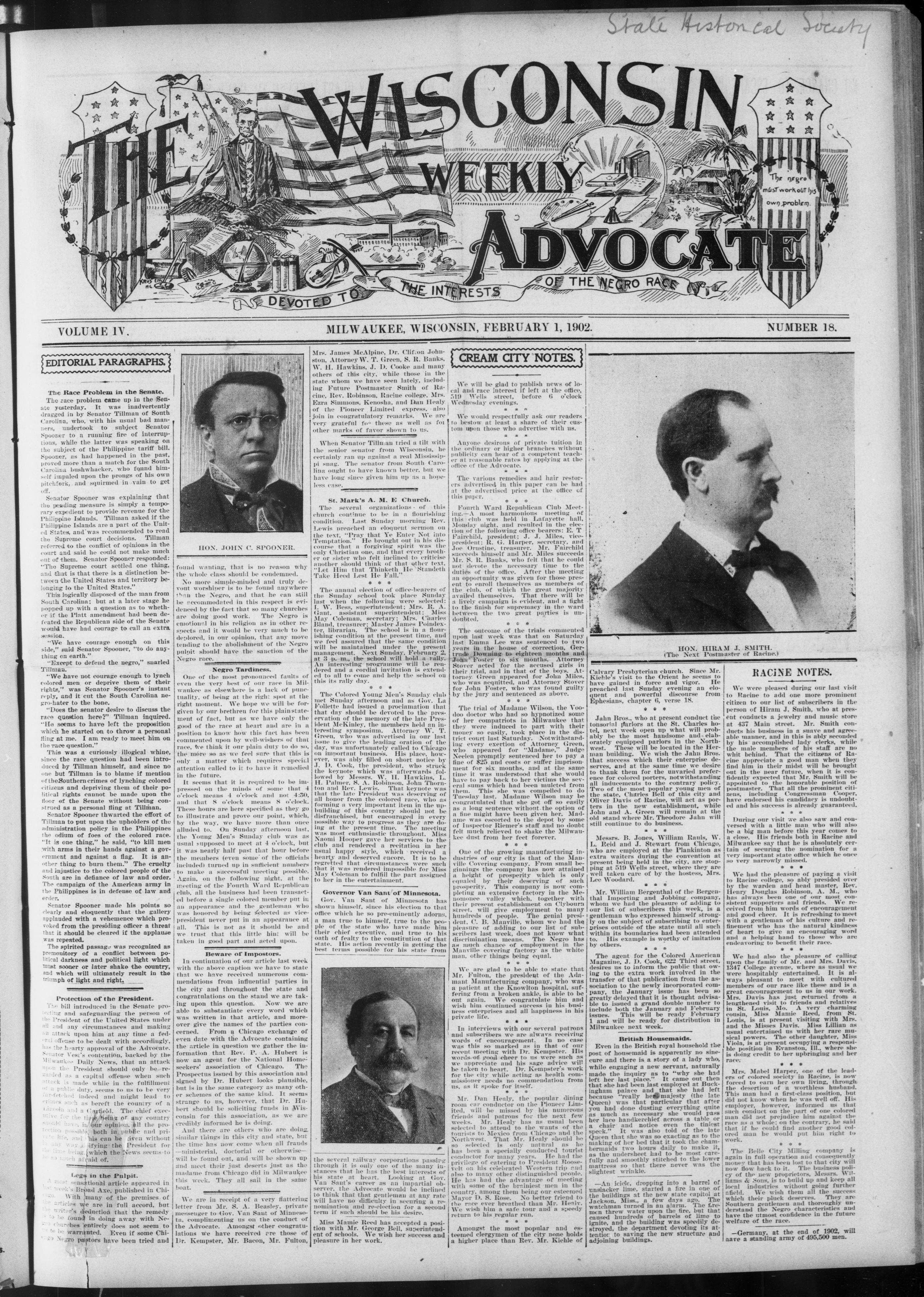
State Historical Society
WISCONSIN
WEEKLY
ADVOCATE
DEVOTED TO THE INTERESTS OF THE NEGRO RACE
EDITORIAL PARAGRAPHS.
The Race Problem in the Senate. The race problem came up in the Senate yesterday. It was inadvertently dragged in by Senator Tillman of South Carolina, who, with his usual bad manners, undertook to subject Senator Spooner to a running fire of interruptions, while the latter was speaking on the subject of the Philippine tariff bill. Spooner, as had happened in the past, proved more than a match for the South Carolina bushwhacker, who found himself impaled upon the prongs of his own pitchfork, and squirmed in vain to get off.
Senator Spooner was explaining that the reading measure is simply a temporary expedient to provide revenue for the Philippine Islands. Tillman asked if the Philippine Islands are a part of the United States, and was recommended to read the Supreme court decisions. Tillman referred to the conflict of opinions in the court and said he could not make much out of them. Senator Spooner responded: "The Supreme court settled one thing, and that is that there is a distinction between the United States and territory belonging to the United States."
This logically disposed of the man from South Carolina; but at a later stage he popped up with a question as to whether if the Platt amendment had been defeated the Republican side of the Senate would have had courage to call an extra session.
"We have courage enough on this side," said Senator Spooner, "to do anything on earth."
"Except to defend the negro," snarled Tillman.
"We have not courage enough to lynch colored men or deprive them of their rights," was Senator Spooner's instant reply, and it cut the South Carolina negro-hater to the bone.
"Does the senator desire to discuss the race question here?" Tillman inquired. "He seems to have left the proposition which he started on to throw a personal fling at me. I am ready to meet him on the race question." This was a curiously illogical whine, since the race question had been introduced by Tillman himself, and since no one but Tillman is to blame if mention of the Southern crimes of lynching colored citizens and depriving them of their political rights cannot be made upon the floor of the Senate without being construed as a personal fling at Tillman.
Senator Spooner thwarted the effort of Tillman to put upon the upholders of the administration policy in the Philippines the odium of foes of the colored race. "It is one thing," he said, "to kill men with arms in their hands against a government and against a flag. It is another thing to burn them." The cruelty and injustice to the colored people of the South are in defiance of law and order. The campaign of the American army in the Philippines is in defense of law and order.
Senator Spooner made his points so clearly and eloquently that the gallery applauded with a vehement which provoked from the presiding officer a threat that it should be cleared if the applause was repeated.
The spirited passage was recognized as premonitory of a conflict between political darkness and political light which must sooner or later shake the country, and which will ultimately result in the triumph of light and right.
Protection of the President.
The bill introduced in the Senate protecting and safeguarding the person of the President of the United States under all and any circumstances and making an attack upon him at any time a federal offense to be dealt with accordingly, has the hearty approval of the Advocate, Senator Vest's contention, backed by the Milwaukee Daily News, that an attack upon the President should only be regarded as a capital offense when such attack is made while in the fulfillment of a public duty, seems to us to be very far-fetched indeed and might lead to crimes such as bereft the country of a Lincoln and a Garfield. The chief executive for the time being of any country should have, in our opinion, all the protection possible both in public and private life, and this can be given without in any way aifying the President for the time being (which the News seems to be so much afraid of.
Legs in the Pulpit
A most sensational article appeared in last week's Broad Axe, published in Chicago. With many of the premises of the articles we are in full accord, but the writer's deduction that the remedy is to be found in doing away with Negro churches entirely does not seem to us to be warranted. Even if some Chicago Negro pastors have been tried and
J.
HON. JOHN C. SPOONER
found wanting, that is no reason why the whole class should be condemned. No more simple-minded and truly devout worshiper is to be found anywhere than the Negro, and that he can still be accommodated in this respect is evidenced by the fact that so many churches are doing good work. The Negro is emotional in his religion as in other respects and it would be very much to be deplored, in our opinion, that any move tending to the abolishment of the Negro pulpit should have the sanction of the Negro race.
Negro Tardiness.
One of the most pronounced faults of even the very best of our race in Milwaukee as elsewhere is a lack of punctuality, of being at the right spot at the right moment. We hope we will be forgiven by our brethren for this plain statement of fact, but as we have only the good of the race at heart and are in a position to know how this fact has been commented upon by well-wishers of that race, we think it our plain duty to do so, the more so as we feel sure that this is only a matter which requires special attention called to it to have it remedied in the future.
It seems that it is required to be impressed on the minds of some that 4 o'clock means 4 o'clock and not 4:30, and that 8 o'clock means 8 o'clock. These hours are here specified as they go to illustrate and prove our point, which, by the way, we have more than once alluded to. On Sunday afternoon last, the Young Men's Sunday club was as usual supposed to meet at 4 o'clock, but it was nearly half past that hour before the members (even some of the officials included) turned up in sufficient numbers to make a successful meeting possible. Again, on the following night, at the meeting of the Fourth Ward Republican club, all the business had been transacted before a single colored member put in an appearance and the gentleman who was honored by being selected as vice-president never put in an appearance at all. This is not as it should be and we trust that this little hint will be taken in good part and acted upon.
Beware of Impostors.
In continuation of our article last week with the above caption we have to state that we have received numerous commendations from influential parties in the city and throughout the state and congratulations on the stand we are taking upon this question. Now we are able to substantiate every word which was written in that article, and moreover give the names of the parties concerned. From a Chicago exchange of even date with the Advocate containing the article in question we gather the information that Rev. P. A. Hubert is now an agent for the National Home-seekers' association of Chicago. The Prospectus issued by this association and signed by Dr. Hubert looks plausible, but is in the same category as many other schemes of the same kind. It seems strange to us, however, that Dr. Hubert should be soliciting funds in Wisconsin for this association, as we are credibly informed he is doing.
And there are others who are doing similar things in this city and state, but the time has now come when all frauds ministerial, doctorial or otherwise will be found out, and will be shown up and meet their just deserts just as the madame from Chicago did in Milwaukee this week. They all sail in the same boat.
We are in receipt of a very flattering letter from Mr. S. A. Beasley, private messenger to Gov. Van Sant of Minnesota, complimenting us on the conduct of the Advocate. Amongst other congratulations we have received are those of Dr. Kempster, Mr. Bacon, Mr. Fulton,
Mrs. James McAlpine, Dr. Clifton Johnston, Attorney W. T. Green, S. R. Banks, W. H. Hawkins, J. D. Cooke and many others of this city, while those in the state whom we have seen lately, including Future Postmaster Smith of Racine, Rev. Robinson, Racine college, Mrs. Ezra Simmons, Kenosha, and Dan Healy of the Pioneer Limited express, also join in congratulatory remarks. We are very grateful for these as well as for other marks of favor shown to us.
When Senator Tillman tried a tilt with the senior senator from Wisconsin, he certainly ran up against a real Mississippi snag. The senator from South Carolina ought to have known better, but we have long since given him up as a hopeless case.
St. Mark's A. M. E. Church
The several organizations of this church continue to be in a flourishing condition. Last Sunday morning Rev. Lewis preached an eloquent sermon on the text, "Pray that Ye Enter Not into Temptation." He brought out in his discourse that a forgiving spirit was the only Christian one, and that every brother or sister who felt inclined to criticise another should think of that other text, "Let Him that Thinketh He Standeth Take Heed Lest He Fall."
* * *
The annual election of office-bearers of the Sunday school took place Sunday last when the following were selected: I. W. Bess, superintendent; Mrs. R. A. Gant, assistant superintendent; Miss May Coleman, secretary; Mrs. Charles Bland, treasurer; Master James Poindexter, librarian. The school is in a flourishing condition at the present time, and we feel assured that the same condition will be maintained under the present management. Next Sunday, February 2, at 3 p.m., the school will hold a rally. An interesting programme will be rendered and a cordial invitation is extended to all to come and help the school on this its rally day.
* * *
The Colored Young Men's Sunday club met Sunday afternoon and as Gov. La Follette had issued a proclamation that that day should be devoted to the preservation of the memory of the late President McKinley, the members held an interesting symposium. Attorney W. T. Green, who was advertised in our last issue to give the leading oration of the day, was unfortunately called to Chicago on important business. His place, however, was ably filled on short notice by J. D. Cook, the president, who struck the keynote which was afterwards followed by Messrs. W. H. Hawkins, L. H. Palmer, S. A. Robinson, John Thornton and Rev. Lewis. That keynote was that the late President was deserving of all honor from the colored race, who as forming a very important item in the upbuilding of this country should not be disfranchised, but encouraged in every possible way to progress as they are doing at the present time. The meeting was most enthusiastic throughout. Miss Naomi Hooper gave her services to the club and rendered a recitation in her usual happy style, which received a hearty and deserved encore. It is to be regretted that circumstances were such that it was rendered impossible for Miss May Coleman to fulfill the part assigned to her in the entertainment.
Governor Van Sant of Minnesota
Gov. Van Sant of Minnesota has shown himself, since his election to that office which he so pre-eminently adorns, a man true to himself, true to the people of the state who have made him their chief executive, and true to his oath of fealty to the constitution of that state. His action recently in getting the best terms possible for his state from
the several railway corporations passing through it is only one of the many instances that he has the best interests of his state at heart. Looking at Gov. Van Sant's career as an impartial observer, the Advocate would be inclined to think that that gentleman at any rate will have no difficulty in securing a renomination and re-election for a second term if such should be his desire.
Miss Mamie Reed has accepted a position with Mr. George Bell, superintendent of schools. We wish her success and pleasure in her work.
CREAM CITY NOTES.
We will be glad to publish news of local and race interest if left at the office, 519 Wells street, before 6 o'clock Wednesday evenings.
* * *
We would respectfully ask our readers to bestow at least a share of their custom upon those who advertise with us.
* * *
Anyone desirous of private tuition in the ordinary or higher branches without publicity can hear of a competent teacher at reasonable rates by applying at the office of the Advocate.
* * *
The various remedies and hair restorers advertised in this paper can be had at the advertised price at the office of this paper.
Fourth Ward Republican Club Meeting.—A most harmonious meeting of this club was held in Lafayette hall, Monday night, and resulted in the election of the following office bearers: E. T Fairchild, president; J. J. Miles, vicepresident; R. G. Harper, secretary, and Joe Orustine, treasurer. Mr. Fairchild succeeds himself and Mr. Miles succeeds Mr. S. R. Banks, who felt that he could not devote the necessary time to the duties of the office. After the meeting an opportunity was given for those present to enroll themselves as members of the club, of which the great majority availed themselves. That there will be a lively campaign is evident, and a fight to the finish for supremacy in the ward between the two great parties is undoubted.
* * *
The outcome of the trials commented upon last week was that on Saturday last Emma Lee was sentenced to two years in the house of correction, Gertrude Downing to eighteen months and John Foster to six months. Attorney Stover acted for the accused girls in their trial, and in that of the boys. Attorney Green appeared for John Miles, who was acquitted, and Attorney Stover for John Foster, who was found guilty by the jury and sentenced as above.
* * *
The trial of Madame Wilson, the Voodoo doctor who had so hypnotized some of her compatriots in Milwaukee that they were induced to part with their money so easily, took place in the district court last Saturday. Notwithstanding every exertion of Attorney Green, who appeared for "Madame," Judge Neelen promptly sentenced her to pay a fine of $25 and costs or suffer imprisonment for six months, and at the same time it was understood that she would have to pay back to her victims the several sums which had been mulcted from them. This she was compelled to do Tuesday last. Madame Wilson may be congratulated that she got off so easily as a long sentence without the option of a fine might have been given her. Madame was escorted to the depot by some of Inspector Riemer's staff and no doubt felt much relieved to shake the Milwaukee dust from her feet forever.
* * *
One of the growing manufacturing industries of our city is that of the Manville Covering company. From small beginnings the company has now attained a height of prosperity which is only equaled by their deserving of such prosperity. This company is now completing an extensive factory in the Menomonee valley which, together with their present establishment on Clybourn street, will give employment to many hundreds of people. The genial president, C. B. Manville, whom we had the pleasure of adding to our list of subscribers last week, does not know what discrimination means. The Negro has as much chance of employment in the Manville covering factory as the white man, other things being equal.
* * *
We are glad to be able to state that Mr. Fulton, the president of the Adamant Manufacturing company, who was a patient at the Knowlton hospital, suffering from a broken ankle, is able to be out again. We congratulate him and wish him continued success in his business enterprises and all happiness in his private life.
家 家 家
In interviews with our several patrons and subscribers we are always receiving words of encouragement. In no case was this so marked as in that of our recent meeting with Dr. Kempster. His words of good cheer to us were such as we appreciate and his sage advice will be taken to heart. Dr. Kempster's work for the city while acting as health commissioner needs no commendation from us, as it spoke for itself.
Mr. Dan Healy, the popular dining room car conductor on the Pioneer Limited, will be missed by his numerous friends and patrons for the next few weeks. Mr. Healy has as usual been selected to attend to the wants of the tourists to Mexico from Chicago and the Northwest. That Mr. Healy should be so selected is only natural as he has been a specially conducted tourist conductor for many years. He had the privilege of catering to President Roosevelt on his celebrated Western trip and also to many other distinguished people. He has had the advantage of meeting with some of the brainiest men in the country, among them being our esteemed Mayor D. S. Rose. No better friend to the race ever breathed than Mr. Healy. We wish him a safe tour and a speedy return to his regular run.
Amongst the most popular and esteemed clergymen of the city none holds a higher place than Rev. Mr. Kiehl of
HON. HIRAM J. SMITH. (The Next Postmaster of Racine.)
Calvary Presbyterian church. Since Mr. Kiehl's visit to the Orient he seems to have gained in force and vigor. He preached last Sunday evening an eloquent and powerful discourse from Ephesians, chapter 6, verse 18.
Jahn Bros., who at present conduct the tonsorial parlors at the St. Charles hotel, next week open up what will probably be the most handsome and elaborately equipped parlors in the Northwest. These will be located in the Herman building. We wish the Jahn Bros. that success which their enterprise deserves, and at the same time we desire to thank them for the unvaried preference for colored porters, notwithstanding all inducements to the contrary policy. Two of the most popular young men of the state, Charles Bell of this city and Oliver Davis of Racine, will act as porters in the new establishment, while John and A. Green will remain at the old stand where Mr. Theodore Jahn will still continue to do business.
Messrs. B. Jones, William Rauls, W. L. Reid and J. Stewart from Chicago, who are employed at the Plankinton as extra waiters during the convention at present being held in the city, are stopping at 519 Wells street, where they are well taken care of by the hostess, Mrs. Lee Woodard.
Mr. William Bergenthal of the Bergenthal Importing and Jobbing company, whom we had the pleasure of adding to our list of subscribers this week, is a gentleman who expressed himself strongly on the subject of subscribing to enterprises outside of the state until all such within its boundaries had been attended to. His example is worthy of imitation by others.
The agent for the Colored American Magazine, J. D. Cook, 622 Third street, desires us to inform the public that owing to the extra work involved in the transfer of that publication from the association to the newly incorporated company, the January issue has been so greatly delayed that it is thought advisable to issued a grand double number to include both the January and February issues. This will be ready February 1 and will be ready for distribution in Milwaukee next week.
British Housemaids.
Even in the British royal household the post of housemaid is apparently no sinecure and there is a story of a lady who, while engaging a new servant, naturally made the inquiry as to "why she had left her last place." It came out then that she had been last employed at Buckingham palace and that she had left because "really her majesty (the late Queen) was that particular that after you had done dusting everything quite as much as necessary she would pass her lace handkerchief across a table or a chair and notice even the tiniest speck." It was also told of the late Queen that she was so exacting as to the making of her bed that it took the chambermaids two hours daily to make it, as the undersheet had to be most carefully and smoothly stitched to the lower mattress so that there never was the slightest wrinkle.
—An icicle, dropping into a barrel of unslacker lime, started a fire in one of the buildings at the new state capitol at Jackson, Miss., a few days ago. The watchman turned in an alarm. The firemen threw water upon the fire, but that caused hundreds of barrels of lime to ignite, and the building was speedily destroyed, the department devoting its attention to saving the new structure and adjoining buildings.
☆ ☆ ☆
渝 渝 渝
* * *
金 芯 亦
1910
RACINE NOTES.
We were pleased during our last visit to Racine to add one more prominent citizen to our list of subscribers in the person of Hiram J. Smith, who at present conducts a jewelry and music store at 437 Main street. Mr. Smith conducts his business in a suave and agreeable manner, and in this is ably seconded by his accomplished lady clerks, while the male members of his staff are no whit behind. That the citizens of Racine appreciate a good man when they find him in their midst will be brought out in the near future, when it is confidently expected that Mr. Smith will be appointed to the honorable position of postmaster. That all the prominent citizens, including Congressman Cooper, have endorsed his candidacy is undoubted and his success is already guaranteed.
During our visit we also saw and conversed with a little man who will also be a big man before this year comes to a close. His friends both in Racine and Milwaukee say that he is absolutely certain of securing the nomination for a very important state office which he once so very narrowly missed.
We had the pleasure of paying a visit to Racine college, so ably presided over by the warden and head master, Rev. Henry Douglas Robinson, A. M., who has always been one of our most consistent supporters and friends. We received from him words of encouragement and good cheer. It is refreshing to meet with a gentleman of his culture and refinement who has the natural kindness of heart to give an encouraging word and a helping hand to those who are endeavoring to benefit their race.
We had also the pleasure of calling upon the family of Mr. and Mrs. Davis, 1347 College avenue, where as usual we were hospitably entertained. It is always pleasant to meet with cultured members of our race like these and is a great encouragement to us in our work. Mrs. Davis has just returned from a lengthened visit to friends and relatives in St. Louis, Mo. A very charming cousin, Miss Mamie Reed, from St. Louis, is at present visiting with Mrs. and the Misses Davis. Miss Lillian as usual entertained us with her rare musical powers. The other daughter, Miss Viola, is at present occupying a responsible position in Evanston, Ill., where she is doing credit to her upbringing and her race.
Mrs. Mabel Harper, one of the leaders of colored society in Racine, is now forced to earn her own living, through the desertion of a worthless husband. This man had a first-class position, but did not know when he was well off. His employer, however, informed us that such conduct on the part of one colored man did not prejudice him against the race as a whole; on the contrary, he said that if he could find another good colored man he would put him right to work.
The Belle City Milling company is again in full operation and consequently money that has been lost to that city will now flow back to it. The business policy of the new proprietors, Messrs. Williams & Sons, is to build up and keep all local industries without going further afield. We wish them all the success which their pluck deserves. They are Southern gentlemen and thoroughly understand the Negro characteristics and have the utmost confidence in the future welfare of the race.
-Germany, at the end of 1902, will have a standing army of 495,500 men.
have a strong relationship with
NUMBER 18.
☆ ☆ ☆
☆ ☆ ☆
☆ ☆ ☆
* * *
---
NO CHANCE TO ESCAPE.
Ten Persons Lose Their Lives by Fire in Boston Tenement.
Blaze Near Lindell Hotel, St. Louis in the Heart of the Business District.
Boston, Jan. 29.—Ten persons dead, three more probably fatally burned and three seriously hurt in jumping from windows and others more or less hurt was the result of a fire just before 2 o'clock this morning in an Italian tenement house on Fleet street, North End. Nine of the dead are adults, three of them women and the tenth is a child. The building was four stories in height. The fire was not seen until it was under headway, so that the sleeping inmates on the upper floor were cut off. Before the firemen got to the scene two women and one man were seen to throw themselves from windows of the third floor
After the firemen had succeeded in subduing the flames they began a search of the rooms and found ten bodies. The firemen and police officers labored hard in giving the unfortunates emergency treatment, but their efforts were in vain, for all had inhaled flame and smoke, and their bodies in most cases were blistered by the fierce heat which they had encountered.
St. Louis, Mo., Jan. 29.—The L. Bauman Jewelry company, wholesale jobbers, at 617 Washington avenue, adjoining the Lindell hotel to the west, was destroyed by fire which started at 10:10 last night. A general alarm was sent in and every engine in the city was on the scene, as the building is in the wholesale district.
The fire created a panic among the guests of the Lindell and there was a hurrying to get out of the hostlery. The flames, however, were confined to the building in which they originated.
Street car traffic on ten different lines was tied up during the progress of the fire. The department pulled hose to the roof of the Lindell and to the top of a six-story building on the south side of Washington avenue, doing effective work therefrom. The loss is estimated at $250,000, partially insured.
Rochester, N. Y., Jan. 29.—A four-story brick building occupied by the Rochester Machine & Screw company and the W. H. Hutchison & Co., carriage trimmings, and the Brighton Manufacturing company, has been totally destroyed by fire. Loss estimated at between $50,000 and $60,000, practically covered by insurance. Origin unknown. Nine firemen who were at work near the walls of the building when the roof suddenly fell in were buried under a mass of debris and all badly injured. Lieut. William Bone died a few minutes after his rescue from the mass of wreckage. Two others were taken out in a critical condition and may die.
NEW CANAL BILL.
Senator Spooner Offers Measure in Which Location Is Discretionary with President.
Washington, D. C., Jan. 29.—Just before the adjournment of the Senate yesterday Senator Spooner introduced a substitute for the Nicaragua canal bill. The new bill is a practical authorization to the President of the United States to choose between the Panama and the Nicaragua routes. The President is authorized to pay $40,000,000 for the Panama canal, "provided a satisfactory title can be obtained." He is then authorized to secure the necessary concessions from the republic of Colombia, these to include the perpetual control of a ten-mile strip of territory from the Caribbean sea to the Pacific ocean. A canal sufficient to accommodate the largest vessels is then to be constructed under the supervision of the secretary of war.
The bill also carries an alternative provision authorizing the President to proceed with the construction of the Nicaragua canal in case he fails to secure the necessary concessions from Colombia or a satisfactory title from the Panama Canal company. An immediate appropriation of $10,000,000 is made in either event. The limit of cost is fixed at $135,-000,000 in case the Panama route is chosen, while $180,000,000 is allowed in case the choice falls on the Nicaragua route.
JURYMAN WITH A JAG.
Criminal Trial at Boston Comes to Sudden and Sensational Termination.
Boston, Mass., Jan. 29.—The trial of George M. Foster and John W. Dickinson, charged with the misappropriation of the funds of the South Danvers National bank of Peabody, came to a sudden and sensational termination because of the drunkenness of a juryman. The jury, which has been listening to the evidence for more than three weeks, was told by Judge Lowell that the case was taken away from it.
Just prior to that declaration Juryman Michael J. Driscoll was placed under arrest by a deputy marshal. Judge Lowell told Driscoll that on two occasions he had been unable to perform his duties as a juror because of intoxication and had therefore shown contempt of court. Later in the day Driscoll was arraigned before Judge Lowell and was sentenced to two months in the house of correction.
The action of Judge Lowell gives the case a bad setback, as it necessitates another trial, and this cannot take place for a long time. A conservative estimate places the loss to the government of $1500 because of Driscoll's action.
RANSOM NOT PAID.
Hitch in Arrangement for Release of Miss Stone, the Captive Missionary.
Vienna, Jan. 29.—A telegram has been received here from Sofia saying that the brigands wish the liberation of Miss Stone, the captive American missionary, to take place upon Turkish territory, and that the Turkish government will not consent to this arrangement unless it be advised of the time and place of the passage of the brigands across the frontier. The Turkish government also requires that a neutral escort accompany the brigands.
Washington, D. C., Jan. 29.—A telegram in regard to the case of Miss Ellen M. Stone, the American missionary who is held captive by Bulgarian brigands, was received at the state department. The officials are exceedingly reticent concerning the contents of the dispatch, but it is understood that it tells of some new complication which has arisen to prevent the release of the missionary and her companion, Mme. Tsilka. The ransom money has not been delivered to the brigands by the agents sent to Bulgaria by the American minister to Constantinople.
BIG PAPERMILL AT WELLS, MICH.
Plans of the S. Stephenson Lumber Company—Has Much Pulpwood to Use.
Menominee, Mich., Jan. 28.—[Special.]
—The S. Stephenson Lumber company of Wells, Mich., is contemplating erecting a papermill at that place to cost $100, 000. It will also erect a pulpmill. The mills will utilize the splendid water power afforded by the Escanaba river.
The Stephenson company has a considerable amount of pulpwood on its lands adjacent to Escanaba and the Lake Superior railroad and it is proposed to convert the raw material into paper there, instead of shipping it to outside manufacturers.
BIG LOSS BY FIRE.
Immense Bathhouse at Mount Clemens, Mich., Practically Destroyed.
Mount Clemens, Mich., Jan. 28. Shortly after noon today the boiler in the Original bath-house exploded. Fire followed the explosion and spread with great rapidity to the hotels Savoy and Agnew, which adjoin the bath-house on either side. Both hotels and the bath-house are now burning and probably will be entirely destroyed. So far as known no one was hurt in the bath-house and all guests of the hotels escaped safely. Help has been summoned from Detroit. The Original bath-house was a two-story structure, but covers a large ground area. Fortunately neither hotel was crowded. The loss probably will be between $200,000 and $300,00.
Later—First reports of the fire were exaggerated. The Original bath-house is practically destroyed, but the fire has not yet reached either the hotel Avery or the Agnew. Both are in danger, however.
Detroit, Mich., Jan. 28.—Dispatches by telephone from Mt. Clemens are to the effect that the fire is now under control. The Original bath-house is destroyed and the loss is about $50,000. The fire did not spread to either the Hotel Avery or Agnew. It started from some unknown cause, not an explosion as at first reported
Big Fire in St. Paul.
St. Paul, Minn., Jan. 28.—Fire last night gutted the Davidson block, a five story brick structure at Fourth and Jackson streets, in the heart of the wholesale district. The damage done is estimated at $200,000, amply covered by insurance. The loss on the building, which is owned by the Northwestern Mutual Life Insurance company of Milwaukee, is placed at $75,000. Sternberg, Weil & Co., clothing manufacturers, occupied the three upper floors, and sustained a loss of $75,000.
Bay City, Mich., Jan. 28.—A fire in West Bay City last night destroyed the plant of the Crump Manufacturing company, including also 1,500,000 feet of oak lumber owned by Capt. James Davidson, and seven cars of logs owned by the Goldie Hoop company. The loss will amount to about $100,000.
Des Moines, Ia., Jan. 28.-Fire broke out in the town of Rippey at 1 o'clock this morning and destroyed the business portion of the place, entailing a loss of $50,000.
Firemen are Injured.
Brookfield, Mass., Jan. 28.—Seven firemen were caught under a falling wall in a fire which destroyed three frame business blocks about 4:30 o'clock this morning. Two or three are seriously injured. The loss is about $15,000.
ADMIRAL KIMBERLY DIES
Well-Known Naval Officer Passes Away-Was in Great Hurricane at Samoa.
Washington, D. C., Jan. 28.—Secretary Long has received a telegram announcing that Rear-Admiral Lewis A. Kimberly, U. S. N., retired, died at West Newton, Mass., this morning. Admiral Kimberly was selected for service on the Schley court of inquiry, but was compelled to decline on account of ill-health.
Lewis Ashfield Kimberly was born in 1830. He was appointed to Annapolis from Illinois in 1846. After graduation he was steadily advanced until he became rear-admiral in 1887. As executive officer of Admiral Farragut's flagship he participated in actions on Port Hudson, Grand Gulf, Warrington, Mobile Bay, etc. He commanded the force which captured the forts at Korea and was appointed commander-in-chief of the Pacific station. He was in the great Hurricane at Apia, Samoa, March 15 and 16, and was commendejd by the secretary of the navy for his conduct of affairs there. He was in 1892.
TWO ROBBERS HANGED.
Pay Death Penalty for Killing the Cashier of a Pennsylvania Bank.
Harrisburg, Pa., Jan. 28.—Weston Keiper and Henry Rowe were hanged at 10:40 this morning in the presence of 1000 persons. During the morning of March 13 last they visited the Halifax National bank of Halifax, this county, and with drawn revolvers demanded of Cashier Charles W. Ryan the cash in the vault. They quickly gathered into a catchel the loose money in the cash drawer, amounting to about $8000. While one of them was fastening the lid of the satchel he laid his revolver on the cashier's desk. Mr. Ryan seized the weapon and in the struggle was shot in the breast, dying several hours later.
MISS STONE FREE.
London, Jan. 28.—A dispatch received here late yesterday announces that Miss Ellen M. Stone, the American missionary, has been set free. She and Mme. Tsilka are now on their way under escort to Constantinople.
Used Pretty Girls for Advertisements.
There is a bicycle dealer in Pound, Wis., who has been very successful in selling wheels.
He says last spring in order to create a bicycle fever among the young men, he picked out the two best-looking young ladies of the town and furnished them with wheels to ride all summer, free of charge. As a result nearly every young man in the place has purchased a wheel and the girls do not know to this day why they were not charged with wheel rent.
—An icicle, dropping into a barrel of unslacker lime, started a fire in one of the buildings at the new state capitol at Jackson, Miss., a few days ago. The watchman turned in an alarm. The firemen threw water upon the fire, but that caused hundreds of barrels of lime to ignite, and the building was speedily destroyed, the department devoting its attention to saving the new structure and adjoining buildings.
-Sheng Taotai is about to establish a telephone service in Canton.
WORKMEN SPLASHED WITH MOLTEN METAL.
WORKMEN SPLASHED WITH MOLTEN METAL.
One was Killed and Four will Probably Die, as Result of Slip at Chicago Mill.
Chicago, Ill., Jan. 29.—In an accident known as a "slip" at the plant of the Illinois Steel company at South Chicago early today Mitchell Bronish was killed and four other workmen were so severely injured that they probably will die. It is supposed that molten iron at the top of the blast furnace No. 10 became chilled and clogged at the top. Then when the men opened the vent at the bottom to draw off the metal the whole mass fell down, forcing the seething metal out upon the workmen with a splash. The men were covered from head to foot with the white hot metal. Plackowich became crazed with pain, and wrapped in a sheet of flame ran screaming toward the lake. He was overtaken, however, and with the other injured men was carried to the company's hospital.
AMERICANS SUFFER BY REBEL TREACHERY
Soldiers Rendered Dellrious by Lack of Food-Discovered In Trees, Barking Like Dogs.
Manila, Jan. 29.—The ten men of Capt. Porter's force of marines, who had been given up as dead, arrived in camp yesterday in a most pitiable condition, delirious from privation and suffering. Several cannot recover.
These marines, however, were in little worse condition than the twenty-seven of the party who returned from their expedition into the interior of Samar a week ago. Details of the expedition's hardships show the treachery of the natives and the awful extremes to which the men were reduced.
For several days the entire party was without food. The natives who accompanied the marines claimed they were unable to distinguish the edible roots, which the marines did not believe. The anger of the marines against the natives is intense. None of the latter returned with the marines.
The marines suffered so acutely from starvation that they ate, raw, the flesh of two dogs.
When Capt. Porter and the first three of his men staggered into camp they were delirious, and difficulty was experienced in ascertaining the whereabouts of their companions.
Williams of the First infantry headed the relief expedition in the face of a torrential rainstorm which flooded the rivers. He succeeded in reaching the remaining ten men, who would otherwise have certainly perished. He found them all delirious. Two of the men were discovered in the branches of trees, barking like dogs. Some of the marines are so ill that they are not likely to recover.
KEEPS UP THE FIGHT.
Gov. Van Sant Replies to a Petition of Business Men of Minneapolis.
St. Paul, Minn., Jan. 29.—Gov. Van Sant today replied to the petition from Minneapolis business men who asked him to cease his fight on the so-called railroad merger. The governor calls attention to statutes of Minnesota forbidding the consolidation of railways or the acquirement by any railroad corporation of any stock, franchises, rights or property of any other railway corporation which owns or controls a parallel or competing line, and continues:
"The consolidation of the Northern Pacific and the Great Northern Railway companies through the organization of the Northern Securities company is clearly a violation of the provisions of the statutes of this state. I obligated myself when I was inaugurated as governor of the state to enforce the laws thereof. It is my bounden duty to prevent, if possible, the consolidation referred to because such consolidation is in violation of the clear and unmistakable provisions of the law.
"The sections above quoted have been upon the statute books for over a quarter of a century. Not only is the letter of the law but also the settled policy of this state against the consolidation of parallel and competing railroad lines. Competition in the matter of rates always has been and ever will be beneficial to the people, and no specious argument or statement from those desiring to do away with such competition is sufficient to meet plain facts derived from common experience.
"The question of whether the law is wise or unwise does not confront me. The law exists and has been violated. My duty is plain.
"I therefore, must respectfully decline to comply with the request contained in your petition and shall continue as vigorously as possible to vindicate the laws of our state."
KILLED AT CROSSING.
ightened Horses Dash Upon Tracks in Front of Express Train.
Chicago, Ill., Jan. 29.—Scared by escaping steam from the locomotive of a freight train, a team of horses returning from a funeral dashed on the Burnham avenue crossing of the Michigan Central railroad tracks at West Hammond, in front of an express train. Six persons were in the carriage attached. One was killed instantly, two died within a short time, and of the other three two are in a serious condition. The dead are:
ROLEK, Mrs. Julia, South Chicago; killed instantly.
SWICTAKE, South Chicago; died in St. Margaret's hospital.
The injured are:
RUJEK, Joseph; died in St. Margaret's hospital.
Pollock, John, driver and owner of carriage, South Chicago; cut about face and bruised.
Lesmeick, Joseph, South Chicago; head crushed; condition serious.
Bisner, John, South Chicago; head
Bisnet, John, South Chicago, head crushed, internally injured; expected to die. The three persons who were killed and Bisner, who is expected to die, were in the closed carriage and helpless. Pollock, the driver, and Lesmeick, were on the front seat of the carriage, and jumped before the vehicle was struck. Pollock escaped serious injury, but Lesmeick struck on his head and was severely injured.
FACTS NOT DISCLOSED.
Netherlands Premier Declines to Explain Note Sent to British Government.
The Hague, Jan.29.—In the first chamber of the states general today the premier, Dr. Kuyper, replying to a question on the subject confirmed the accuracy of A. J. Balfour's statement in the British House of Commons yesterday regarding the Dutch government's offer to help in bringing about peace in South Africa; but the premier added that he was prevented by courtesy from disclosing any details concerning the note so long as the British government had not published its contents, or until a reply to it was received.
The Boer delegates disclaim any knowledge of the contents of the Dutch note to Great Britain.
IT WAS A DEADLY BLAST.
Amount of Damage Done by Explosion in New York.
Murray Hill, New York Central Station, Hospital, and Other. Places Wrecked.
New York, Jan. 28.—Six persons were killed, 100 were injured and $1,000,000 damages was wrought in the explosion yesterday at the Park avenue shaft of the Rapid Transit tunnel, which is now under construction. At the mouth of the shaft were the temporary buildings that contained a great quantity of high explosives used by the contractors in making tunnel excavations. This mass of explosives blew up, hurling the buildings in every direction and causing the earth to tremble as though an earthquake were passing.
Tons of debris were thrown violently against the Murray Hill hotel, every window of which was shattered, and the building itself was rendered unsafe for occupancy. A big mass of wreckage shot through one of the windows and killed J. Roderick Robertson of Nelson B. C., a guest of the hotel. Vast quantities of broken timbers and iron beams were thrown against and into the Manhattan Eye and Ear hospital causing so much damage that the institution had to be abandoned. Windows were broken in business houses for blocks around. Outside of the Murray Hill hotel and the Manhattan hospital the Grand Union hotel and the Grand Central railroad station suffered the worst.
Many Persons Injured.
Every room in the front of the Murray Hill hotel was wrecked. The Grand Union hotel lost all of its windows and glass partitions and practically every front window in the Grand Central station was shattered. The great clocks on its front towers were blown from their cases.
Not more than 100 persons were in the main waiting room of the station. Four ticket sellers were injured. They stood in the pathway of the blast and were all cut about the head. The clerical force in the executive offices of the New York, New Haven & Hartford railroad, which occupied the floors above the first in the eastern wing of the depot, were thrown about by the shock.
The station tonight presents the appearance of a dismantled castle, with the big windows only ragged holes.
Murray Hill Hotel Abandoned.
The damage may exceed $1,000,000. The first estimate on the Murray Hill hotel placed the loss at $100,000, but later the hotel was abandoned as unsafe. If the building is condemned the loss on it alone will approach $1,000,000. The damage to the Grand Union was estimated at $40,000 and that to the Manhattan hospital at $25,000. The loss at the Grand Central station was entirely in glass, as was that of the 100 or more other buildings affected by the explosion.
The cause of the explosion and the quantity of explosives that blew up are not definitely known. Several causes have been advanced. One was that a fire started near the powder room and that Master Mechanic William Tubbs lost his life in a desperate attempt to quench it. Another was that a spark produced by a stray current of electricity set off the powder. A third placed the blaze upon a blast in the tunnel. Still another gave a gas explosion from electrical contact in the trolley conduit of the street railway.
The Dead and Injured.
The list of the dead follows:
ADAMS, CYRUS, cigar man at the Murray Hill hotel. CARR, JAMES, 32 years, waiter, employed at the Murray Hill hotel. HINE, LAWRENCE, 20 years, of Ansonia, Coun.
ROBERTSON, J. BRODERICK, of Nelson, B. C., a patron of the Murray Hill hotel.
THOMPSON, RALPH, assistant engineer.
TUBBS, THOMAS, master mechanic for Contractor Ira A. Shaler.
The seriously injured are:
Best, Miss, 18, Newport, R. I., Murray
Hill hotel: face and head cut.
Best, Mrs., 40, Newport, R. I., Murray Hill hotel; face and head cut. Bristol, William R., 35, Merliden, Conn., Murray Hill hotel; face and head cut. Bristol, Walter R., 50, Murray Hill hotel; concussion of brain; St. Vincent's hospital.
Bunting, Mrs. James E., Boston; face and hands cut.
Cummings, Mr., Troy, N. Y., hands, face and neck cut.
Chapin, George, Stanford, Conn.; cuts.
Gaines, Charles B., New York city; shoulder dislocated and many bruises.
Gilchrist, J. C., 45, Columbus, O., Murray
Hill hotel: face and head cut.
Juhde, Edward, 719 South Third street,
Philadelphia; cut above head.
Philadelphia: cut above head.
Lewis, E. M., Lima, O.; head and face cut
cut.
Nok, W. J., 31, New York city; severe
scrap wounds.
More, Mrs. Benjamin, 35, Madison, N.
J. Manhattan hospital; face and hands cut.
Ryan, Rev. Father, New England; head,
face and arms cut.
Scott, Mrs. H. C., 40, Kingston, N. Y.; face and head cut. Stanton, Jefferson, Bridgeport, Conn.
Stanton, Jefferson, Bridgeport, Conn.
shock and slight cuts on face.
Weiss, John. New York city: scalp wounds, concussion of brain and internal injuries. Immediately after the accident the subcontractor for the tunnel work at the point of the explosion, Maj. Ira A. Shaler, and several of his subordinates were arrested by order of District Attorney Jerome, who made a personal survey of the accident.
DOLE STORY DENIED.
The Governor of Hawaii Has Not Been Asked to Resign.
Washington, D. C., Jan. 28.—An authoritative denial has been issued from the white house to the story that Gov. Dole of Hawaii had been asked to resign, and that Col. Sam Parker, the prime minister of Queen Lil, would be his successor. The story created considerable excitement, and so many protests were received at the white house that it became necessary to issue a formal denial of the whole thing. It is now said that Gov. Dole has not been asked to resign, and that, in fact, the President has not been giving any close attention of late to the affairs of Hawaii. The story as to the rumored change is said to have originated with no less a person than Col. Sam Parker himself, and it is believed to have been a political dodge to unsettle things in Honolulu.
GETS AUSTRALIAN WEALTH.
Good Fortune of the City Engineer of St. Ignace, Mich.
St. Ignace, Mich., Jan. 28.—City Engineer Forristel has learned that he is one of the heirs to the $15,000,000 estate of a grand uncle who amassed a fortune in the gold fields of Australia. The mother of the St. Ignace man was a niece of the decedent, John McCormick, whose wealth was left to his nearest of kin, nieces and nephews, five in all.
REFUSE TO HAUL COAL.
REFUSE TO HAUL COAL.
Ban on Buildings and Hotels In Chicago that Use Gas for Fuel
Chicago, Ill., Jan. 28.—The severe weather which seemed to be moderating last night was again in evidence today, and at daylight the temperature was 4 degrees below zero.
At 10 o'clock the thermometer at Chicago was 1 below zero. Predictions are that there will be further moderations of the cold as the day advances, and that there will be no more zero weather with this cold wave.
Coal teamsters, today renewed their war on big downtown buildings. The Coal Teamsters' union decided that its members should cart no coal to buildings where gas is used during the summer months. At 8 o'clock 100 drivers were ordered to stop by officials of the union and promptly obeyed the order.
President Albert Young of the coal teamsters' union said: "We have already stopped hauling coal to the Old Colony building, the Monadnock, the Palmer house and the Auditorium. Our men are being called off other buildings as quickly as we can get to them and before night not a union teamster will be hauling coal to buildings that use gas for fuel during the summer.
"During the last cold snap our men were worked to death. Buildings that had formerly used fuel gas found out that coal was necessary, and our men had to work night and day, and at that were unable to meet the demand. Many of the regular coal burners were compelled to wait for coal and suffered greatly on account of our inability to supply the demand."
Rumor had it today that the refusal of the Teamsters' union to haul coal to buildings where gas is used was a clever move of the so-called Coal trust against the Gas trust. It was announced definitely that the coal combine was behind the teamsters and had pledged its support. Milton Booth, secretary of the local Teamsters' union, said: "We are not in the fight alone, but have the support of the coal men. We would have conducted the campaign alone had it been necessary, but with the aid of our employers we are in a much better position to conduct the fight and it will be a lively one."
After the teamsters' boycott against the skyscrapers had been in effect four hours, engineers, firemen and elevator conductors threatened to co-operate with the teamsters. By noon, however, a meeting of prominent coal dealers and propertyowners was held and a truce was declared until Friday. In the meantime union men hope to influence the consumers to burn coal the year round.
St. Paul, Minn., Jan. 28.—Owing to the intense cold much of the fire apparatus used in extinguishing last night's fire in the Davidson block was frozen where it stood, the flying spray and water covering everything with masses of solid ice. The department worked about the ruins all night and it was nearly noon today before they could chop the ice away sufficiently to permit the removal of the hook and ladders and the geyser which were most covered with ice. The mercury during the night reached 17 below zero, but some slight relief was promised by tonight. There was scarcely any wind stirring, which greatly reduced the possible suffering from the cold weather.
TWELVE PEOPLE HURT.
St. Paul Train Crashes Into an Electric Car and Trailer at a Chicago Crossing.
Chicago. Ill., Jan. 28.—Twelve persons were severely injured, one perhaps fatally, in a collision beteen a Kedzie and California avenue electric train of two cars and the Pioneer Limited train on the Chicago, Milwaukee & St. Paul railroad at the grade crossing in West Chicago avenue at 6:50 o'clock last evening. The police were unable to fix exactly the responsibility for the accident. The crossing is not guarded by a flagman. In a tower south and west of the network of tracks a gateman is supposed to raise or lower the gates. The conductor of the forward electric car was on the platform when the collision occurred instead of being in front with a red lantern.
The wreckage caught fire from the overturned street car stove, and only the prompt work of the rescuers saved the lives of those who were caught under the mass of broken woodwork and iron frame.
The names of the victims who it is believed will die are:
Charles Boyer, aged 21. a machInist; John Ocanscheck, aged 20; John Weber, motorman, aged 23.
The other victims are:
Launia Anderson, aged 16; Lena Anderson, aged 14; J. T. Fitzgerald, conductor; Olaf Jorgenson, aged 28; Henry L. Lentz, aged 18; Melyln J. Loveland; Charles Pedderson, aged 23; A. E. Post, conductor; John Smith, aged 53.
SYBIL SANDERSON TELLS WHY.
Religion Alone Caused Breaking of Her Engagement with Fitz-James.
Paris, Jan. 28.—Sybil Sanderson states that religious questions are alone responsible for the breaking of her engagement to Count de Fitz-James, because he is a Roman Catholic and a divorced man.
"When we became engaged in America," said Miss Sanderson, "I did not appreciate what a serious obstacle his divorce offered our union, but on my return to France this matter was discussed and I realized it was impossible that our marriage be celebrated by the Roman Catholic church, and that we could only be married civilly.
"In view of the religious ideas of the Fitz-James family and social connections, this would lead to an equivocal situation, unacceptable to both of us. We therefore mutually agreed to end our engagement and remain the best of friends.
MAY DIE FROM A SNOWBALL.
Indiana Boy Seriously Injured While
Blinging with His Components
Hammond, Ind., Jan. 28.—Alfred Lautmann, son of a wealthy merchant of this city and a promising violinist, lies unconscious in St. Margaret's hospital as the result of an injury which he sustained last Saturday while snowballing with his companions. Young Lautmann was struck in the abdomen with a snowball packed to the hardness of ice. To save his life the hospital staff decided on an operation, from which he may not recover.
WRECK ON N. Y. CENTRAL.
Limited Train Crashes Into Switch Engine—One Man Killed.
Syracuse, N. Y., Jan. 28.—The second section of New York Central limited eastbound passenger train struck a switch engine, standing on the track in front of the Oneida station. Both engines and much of the station were demolished. The engineer of the limited. Dorsey Welch of Albany, was killed. Fireman Cahill of Albany was injured. None of the passengers or train crew was injured.
Chicago Drummer Killed.
Wichita, Kas., Jan. 28.-Calvin A. Black, a Chicago traveling man, fell over a banister in a hotel stairway here yesterday and was killed. His home was in Somerville, Mass.
ANOTHER REMARKABLE CASE
Which the Doctors Failed to Curc or Undertsand.
Mrs. Nettleton graphically relates the particulars of her own case, which will doubtless be of interest to many of our lady readers:
"I had been an intense sufferer for many years from dyspepsia, liver and kidney troubles, when a little pamphlet was placed in my hands, and, although at that time I had been bed-ridden for more than six months, I determined, after reading some of the wonderful testimonials therein of cases similar to mine, which had been completely cured by the use of Vogeler's Curative Compound, to try some, especially as my doctors failed to even benefit me, I had almost given up all hope of ever being well again. It is marvelous that the very first dose of fifteen drops relieved me. It was not long before I was able to get up and about; three months from taking the first dose I was enjoying better health than I had been for fourteen years. I continued well until a few months back, when I was taken ill again, my troubles being dyspepsia and constipation. I had a doctor attending me for a month, but contort attending me for a month, continued to grow worse, when I bethought myself of my old medicine, Vogeler's Curative Compound, which I immediately sent for and took in place of the doctor's medicine; at that time I had not had a movement of the bowels for five days, but Vogeler's Curative Compound soon put me on my feet again; in fact, completely cured me a second time. I fully believe I should not have been alive to-day had it not been for Vogeler's Compound."
Mrs. Nettleton said: "I have recommended Vogeler's Curative Compound for indigestion and eczema, and in every case it has proved a cure, beyond doubt. Mr. Swinbank, our chemist, has sent me the names of no end of people who have been cured by Vogeler's Curative Compound. By the way, the proprietors have so much confidence in this great London physician's discovery that they will send a sample free to any person sending name and address and naming this paper." St. Jacobs Oil Co., 205 Clay street, Baltimore, Md.
Mrs. Nettleton is a confectioner, in the Brighton road, where she has been established many years, and is honored and respected by all classes. Her statements as regards Vogeler's Curative Compound may, therefore, be regarded as reliable evidence of its great value.
CAT WEARS DIAMONDS.
The Pampered Feline Pet of a Sun Francisco Woman.
A San Francisco cat wears a pair of diamond earrings and a gold necklace said to be worth $200, and seems to enjoy it. His mistress, Mrs. A. Bland, has often found him admiring himself and his jewels in the mirror. As may very naturally be expected, Beauty is not allowed as much liberty as the plain, unadorned cat without any diamond earrings or gold necklace to wear. Every morning he is carefully groomed and fed, after which he is decorated with his jewelry and watched. Much as he would dearly love to, he is never permitted to prowl about the lawn or back yard; but in order that he may have exercise and sunshine a neat little house has been made for him in a sunny corner of the yard, and there he is placed for several hours each day. He has his little bed, too, into which he is put to sleep like a child. His meals are served to him with more regularity than most people are accustomed to. He scorns the association of ordinary woodshed cats and takes delight in the society of his mistress.
Hawaii Watches Marconi.
Hawaii yearns for a cable to connect it with the mainland, so that communication with the world outside the island settlements may be had without waiting a week or more for the transmission. The cable project of Mackey was welcomed in Honolulu as a means to the desired end, but now the people over there are asking each other, if, after all, it will not be possible to establish a wireless telegraph system that can answer the same purpose as the proposed cable. If Marconi has flashed signals from St. John's to Cornwall, a distance of 1800 miles, why can he not do the same thing between Honolulu and San Francisco, only 300 miles further? This question is being seriously discussed in Honolulu, and already the people are speculating on the means that may be necessary to have the system inaugurated. — San Francisco Chronicle.
Life-Saying Corset.
The much-maligned corset is credited with having saved a woman's life in Missouri. She accidentally upset a tea kettle in such a way that the boiling water poured in a scalding stream over the upper portion of her body as she lay on the floor, where she had slipped and fallen. But the protection afforded by the encircling whalebones was so comparatively complete that instead of being fatally injured, as her friends at first feared, she escaped with painful burns. If the women in that locality continue to look upon the corset as among their main "stays" hereafter, it will be regarded, even by the men, as one of the delusions which the dear creatures are entitled to "clasp"—just as they have heretofore.
Brooklyn, N. Y., Jan. 27.—For many years Garfield Tea, the Herb Cure, has been earning a reputation that is rare—it is UNIVERSALLY praised! This remedy presents unusual attractions to those in search of health; it is made of HERBS that cure in Nature's way—by removing the cause of disease; it is PURE; it cleanses the system, purifies the blood and establishes a natural action of the digestive organs. It is equally good for young and old.
—The strongest animals exist entirely on vegetable food. It is the ferocity of the lion rather than his strength that makes him formidable. An elephant is a match for several lions, and is a vegetarian. The animals with most speed and endurance—the horse, the reindeer and the antelope—are all vegetarians.
ELY'S LIQUID CREAM BALM is prepared for sufferers from nasal catarrh who are used to an atomizer in spraying the diseased membranes. All the healing and soothing properties of Cream Balm are retained in the new preparation. It does not dry up the secretions. Price, including spraying tube, 75 cts. At drugists' or Ely Bros., 56 Warren street, New York, mail it.
Within a few months 7000 nickel-in-the-slot telephones have been added to Chicago's exchange.
For the real, good old Buckwheat flavor, buy Mrs. Austin's Buckwheat and don't forget the name.
In the last decade the world's product of beet sugar has been double that of cane sugar.
Out of every three persons struck by lightning two recover.
Salzer's Lightning Cabbage.
This is the earliest cabbage in the world and a regular gold mine to the market gardener
By the way, there is lots of money to be made on earliest cabbage, beets, peas, radishes, cucumbers and the like.
POMEGRANATE
like.
For 15c. and this Notice
the John A. Salzer Seed Co.
LaCrosse, Wisc., will send
you their mammoth catalog
lower and vegetable seeds.
catalog, 2c postage. G.N. U
A TOAST.
Ah, drink if ye will to a sweetheart true
And a wife of faith undaunted;
And drink in the praise of their fetching
ways,
To charms that have long been vaunted;
And drink to the eyes and drink to the lips,
Aye, drink, since drink ye must,
But when ye've done, drink everyone
To the girl the women trust.
Though a man's deceit be doubled;
And drink to the songs and drink to the sighs
Of earth and of heaven above;
But the proudest boast is to drink a toast
To the girl the women love.
Aye, drink to the lass who can praise the charms.
That would steal her love, could they
sake him:
And drink to the lass who will snub a man
When she has no right to please him;
And drink to her great, warm, honest soul,
Aye, drink to her kiss and curl.
For her heart's as true as the sky is blue
Who is true to another girl.
—Nora Elizabeth Barnhart.
A LETTER IN FRENCH.
Alicia was very unhappy. She was paying her yearly visit to her Aunt Eliza and her Uncle Thomas—really her great-aunt and her great-uncle—and this was the first time that it had not been a delight to her. It would really be better to go farther and say the first time that it had been a torture to her. In the first place, it was hard to have before her all the time a face that she had left behind, and that she had not wanted to leave behind; a boyish face with eager, dark eyes that only left her when she slipped away into sleep's forgetfulness at night, to greet her at her first awakening in the morning, saying silently: "Here I am, to go with you all through the day—for this is the strength of love." It was hard, and it fretted her. And in the second place it was hard when one was young and filled with long, sweet dreams of what life might be with this same face always beside her—to have to witness hourly the strange twist of Providence that let two old people live a long and happy life together only to land them in strife with each other at the threshold of the grave. For Aunt Eliza and Uncle Thomas, after a life of utmost devotion, had grown to be strangely and unaccountably at cross purposes in everything. And this discouraged Alicia.
Aunt Eliza and Uncle Thomas were very old. Aunt Eliza confided to Alicia the first night of her arrival, sitting on the piazza, with the moon shining down between the branches of the blue wistaria vine, that she was afraid that Uncle Thomas could not last much longer. And Uncle Thomas took occasion to tell the girl the next morning on the same piazza—only under the influence of the sun instead of the moon—that it made him very sad every time that he looked at her aunt; he might be called upon to give her up any moment.
Aunt Eliza came around the corner of the house presently. She had on a white morning gown and a shade hat with a wreath of dark red roses on it tied over her beautiful silvery hair. She walked as lightly as a young girl.
"I have had a terrible quarrel with John over the ferns," she said. "If it were not that he is such a good gardener and we have had him so long I would surely let him go—He is so dictatorial. Ah, well, I must remember that he is getting old." Uncle Thomas carefully put his glasses on his nose
"Eliza," he said, firmly, "come in out of the hot sun. Why don't you make up you mind that you, too, are getting old? Now, I began to accept old age twenty-five years ago."
"And I began to defy it," answered Aunt Eliza, shortly.
Uncle Thomas cast a pitying glance at her, which took in the red roses on the shade hat. She saw the direction of his eyes.
"I hate purple," she exclaimed defiantly. "You are thinking that I ought to wear it. But, no, Thomas, I never will—not if I live be a hundred. Purple and old age have no place in my heart. I may decide to be laid out in a pink shroud." Uncle Thomas looked very grim.
"It is not in one way that you are foolish," he said, sonorously, "but in every way. You sit out on the piazza at night in the moonlight—moonlight, until no one knows how late."
"And you never get any farther away from this house than this piazza, and then only when the sun is shining and you are wrapped up in a dressing gown."
Uncle Thomas rose to his feet. "You eat," he said in a loud voice. "You eat everything without regard to the time or the place or the food, for all the world as if you were 16. You may keep up for a while, Eliza, driving yourself this way, but I can see your real condition."
Aunt Eliza walked up to the edge of the piazza, and looked up into his face angrily. "I do not like hot water as a food," she said maliciously. "You—you look like Father Time, Thomas. Where is your scythe?"
Alicia arose and went upstairs to her room and wept. "Oh, dear, this is dreadful," she cried. "Will we talk that way to each other?" There is a sharp little rap at her door. "Come," she answered. Aunt Eliza walked in.
"Alicia," she said in decided tones, "I want you to promise me that you will never marry."
"Oh, dear," cried Alicia, with a fresh sob.
"I mean it," replied her aunt firmly.
"All that I have in the world will be yours, so you will have plenty to live on—and as for love, love is the most foolish thing in the world. Never let me hear of your being in love." Alicia's shoulders shook in her anguish, and she pressed her handkerchief to her eyes.
"You see how it is to live with a man when he gets old," said Aunt Eliza.
"What do you think of me, my child?"
"I think you are beautiful, dear Aunt Eliza," cried Alicia, in a burst of anger against her uncle. "You look thirty years younger than Uncle Thomas. Give me your handkerchief a minute—there, just a trifle too much pink on this cheek! How sweet and sensible people were when they powdered their hair and wore patches and rouge. And what beautiful gowns you have, Aunt Eliza."
"Yes, dear," answered Aunt Eliza, mollified. "And a nice waist, too, Alicia. That is because I always sit up very straight. I never let myself lean against anything. Always sit up straight and have a good time, and never have any sorrow at your heart that you cannot dance off at your heels. I used to be a great dancer. I never missed a ball. You must take all the pleasure in life that you can get, and never fall in love."
It was lunch time, and the three sat silently and politely at the table. Uncle Thomas drank his cup of hot water with an air of indifference, and Aunt Eliza helped herself the second time to some rich little cakes. Alicia ate listlessly the food before her, and wondered how she could endure another day of her visit. It seemed to her it might be her own life long years ahead, which was rising up to show itself.
Into this frozen, unhappy atmosphere there suddenly entered the sound of a bell—a jangle of a doorbell. The maid left the room, and when she came back she had a letter in her hand. "It is for you, Miss Alicia," she said, handing it to Alicia with an air of importance. "And it is a special delivery letter, too."
At sight of the writing, the color
"Dear me!" exclaimed Aunt Eliza. "A
1
Mrs. Jack Wilmerding, scion of the house of Vanderbilt, whose melancholy history is known all over the country, is declared to be giving fresh evidences of insanity. This beautiful society woman actress was sent to Bloomingdale asylum a few years ago by her relatives and afterwards managed to persuade the authorities that she was sane enough to be allowed abroad.
Mrs. Jack Wilmerding, scion of the house of Vanderbilt, whose melancholy history is known all over the country, is declared to be giving fresh evidences of insanity. This beautiful society woman actress was sent to Bloomingdale asylum a few years ago by her relatives and afterwards managed to persuade the authorities that she was sane enough to be allowed abroad.
special delivery! Open it, child, quick. I am afraid something is wrong at home."
"A special delivery letter," repeated Uncle Thomas. "Well, well! I hope nothing has happened."
Alicia took it up.
"It is nothing, I know," she said lamely. "At least, I think it is just from a friend."
"Well, it must be about something important," said Aunt Eliza, decisively.
Alicia tore it open and drew it from the envelope. She read the first few lines and she felt that her cheeks were burning.
GOLD NEAR·THE ARCTIC.
Important Discoveries on the Shore of the Sea of Okhotsk.
The Okhotsk sea fills a deep indentation in the coast of northeast Asia, north of Japan and the Amur province of Siberia. It has always been practically valueless, for little has been done ever to discover what resources of value it might possess. The eastern side of the sea is bounded by the Kamchatka peninsula, which is still only partly explored. Several years ago it was reported that
"‘Ma cherie,’ the letter ran, 'vous savez que je ne puis pas vous appeler autrement—’" "Well?" said Aunt Eliza, interrogatively.
"It is in French," she answered. "Just from a friend, you know."
from a friend, you know.
"In French," repeated Aunt Eliza, slowly. "Is your friend French?"
"Oh, no. He—he just likes to write in French." She handed the letter to Aunt Eliza suddenly. "You can read it if you like," she said tremulously.
Aunt Eliza held the letter before her and read aloud in smooth, even French:
"Ma cherie—Vous savez que je ne puis pas vous appeler autrement. Vous ne pouvez pas du tout vous imaginer tout ce qui passe par ma tete a votre sujet. Caque matin, avant d'etre rentre du pays des reves." Why it is a love letter in French." She turned to Uncle Thomas with a sudden deep pink flush on her cheeks and a faraway look in her eyes. "I had one once," she said, slowly.
Uncle Thomas' face changed suddenly. "So you had," he answered with equal slowness.
"A sweet, long love letter in French," repeated Aunt Eliza, "so that nobody around the house could possibly read it—because my mother had said that I was too young to have anything to do with love. But the man who loved me did not think so."
"You mean one of them," interrupted Uncle Thomas; "because, as I remember it, there were a good many of them."
"Well, then, the one I loved," corrected Aunt Eliza with a sweet smile. "So he wrote me in French, and I read that letter over and over and wore it around my neck tied to a ribbon until it fell apart. Do you remember, Thomas?"
Uncle Thomas' eyes met hers, and he reached across the table and clasped her hand. "I do, Eliza, and it seems as if it had only happened yesterday. You looked so beautiful at the ball the night before. You wore a white frock and your cheeks were as pink as the roses I gave you. It seemed to me the next day that I could not live if I did not communicate with you in some way."
Aunt Eliza rose to her feet impulsively. "Thomas," she said, with a sob, "we have been so happy together so long we cannot make it less beautiful now. How could I live without you?" Her voice broke and two shining tears fell on Alicia's letter and made a blur.
"Dear Aunt Eliza," said Alicia, hastily rising; "if you will give me my letter I will go out on the piazza and read it."
"Dear me," cried Aunt Eliza, flurriedly. "Haven't you had your letter yet? Run and read it. and I will write him and ask him to come up and spend a week with us here. Now go," and as the door closed after her two silvered heads came together.
And the letter readjusted life for Alicia as well.—New York Commercial Advertiser.
Less Midnight Feasting in Paris.
Christmas in Paris has chiefly been celebrated by copious "Revellons," and a fashionable way of seeing the old year out has been to bid it farewell over a well-loaded table, and to welcome 1902 with a toast at dessert. But these occasions only provided the two exceptions which prove the rule, that, to the grief of the old Parisian, Parisians no longer sup. The great days of midnight feeding are gone. The most celebrated restaurants are often but half filled at supper time. The fact is, that the Parisian dinner hour is getting later and later, and after rising from table at 10 it is hardly within the capacity of the average person to sit down to another meal at 12. Parisians accordingly can sup only when they make a night of it, and this, nowadays, is not a correct thing to do, except on very rare occasions, the Revellon, New Year's eve, and, perhaps, two or three more times in a twelvemonth. On other nights a cup of chocolate after the theater is all that is indulged in. Moreover, supper is always taken nowadays, but in the public room, the liveliness of the surroundings in the latter being considered part of the fun. "Cabinets particuliers" are more and more deserted, and their hideous upholstery grows musty with the undisturbed dust of years.—London Telegraph.
The gauchos of Argentina live entirely on roast beef, scarcely ever tasting vegetables or flour dishes.
GOLD NEAR·THE ARCTIC.
Important Discoveries on the Shore of the Sea of Okhotsk. The Okhotsk sea fills a deep indentation in the coast of northeast Asia, north of Japan and the Amur province of Siberia. It has always been practically valueless, for little has been done even to discover what resources of value it might possess. The eastern side of the sea is bounded by the Kamchatka peninsula, which is still only partly explored. Several years ago it was reported that the prospects for gold mining along the bleak east and west coasts of the Okhotsk sea were very promising. The Russian government, therefore, decided to investigate these reports and ascertain whether this new region was likely to prove of value to the empire.
An expedition sent out under the command of Mr. Bogdanowicz, has accordingly been engaged for three years in exploring the east and west shores of the sea of Okhotsk. The main surveys embrace the long stretch of Siberian coast between the mouth of the Amur river and the hamlet of Okhotsk and the entire western coast of the Kamchatka peninsula.
The results of these long researches have proved that gold exists in important quantities in many of the river valleys, particularly between the sea and the great Stanovoi range of mountains extending north and south on the Siberian mainland parallel with the west side of the sea of Okhotsk. Coarse and fine gold were discovered both along the larger streams and their small affluents. All the favorable reports as to the auriferous character of this region were fully confirmed.
The climatic conditions, although somewhat severe, present no obstacles to prospecting even in winter. The cold season is so long, however, that mining will be confined to about three months, which is a much shorter working period than among the mines of the Amur region in other parts of eastern Siberia. Miners, materials and supplies must be brought by sea, but they may be easily landed at several points along the coast. The leader of the expedition says that the gold prospects are worthy of development and will add to an important extent to the empire's resources in this precious metal.
New York, Jan. 23.—Because the glamor of the footlights was more to her than the position of teacher, even in a university faculty, Miss Jane Butt is a member of Otis Skinner's company, which is presenting "Francesca da Rimini" at the Victoria. And the way of her ascent to the stage is as remarkable as her choice of professions. When she joined Mr. Skinner's company her only baggage was a handbag, and the first her family knew of her determination to follow a histrionic career was when she wrote home for clothing, asking that it be sent to New York.
Miss Butt is a daughter of a prominent attorney in western Wisconsin. For three years she was an instructor in dramatic reading and elocution at the University of Wisconsin. When Mr. Skinner's company visited Madison, in September last, Miss Butt fell a victim of the stage fever, and she sought out Mr. Skinner and had an interview with him. He said he could not promise her a part in his company, but would gladly take her as one of the extra women. Miss Butt did not take the place then, however, deciding to stay with the university. When Mr. Skinner was playing in Chicago during the holidays Miss Butt again sought an interview. She accepted a small part and resigned her position and asked that her clothing be sent forward, as she had definitely decided that the stage was her field in life.
Miss Butt, who is handsome and young, was seen last night.
young, was seen last night. "I don't think there is anything sensational or remarkable in what I have done," she said. "I am simply very much in earnest and passionately fond of the drama, and I could not resist the opportunity to be under the direction of one whose ideals stand for the truest and best in the dramatic world."
Hawaii's Memorial Plans
Honolulu will have its memorial to McKinley in the form of a park or square, if the sentiment of the people who have been brought into consultation upon the matter weighs with the members of the executive committee, who have the final decision. The memorial feature proper would be in a great arch entrance, which would give the name to the park, and at the same time give enduring form to the monumental feature. hTe arch could be built of native lava rock, and upon its summit could be placed a bust of McKinley, or a niche could be placed in the face of the keystone which would afford a fitting point for the bust.-Honolulu Commercial Advertiser.
AN OFFER BY HOLLAND.
Netherlands Government Intervenes in Behalf of Boers.
TENDERS GOOD OFFICES.
Lord Lansdowne Replies to the Proposal in Message Couched in Friendly Terms.
London, Jan. 28.—The government of Holland has offered in the most friendly terms to help in bringing about peace in South Africa. In a communication to the British government, the Dutch government suggests that it might be permitted to act as a sort of diplomatic agent for the Boer delegates. The government, however, expressly disavows any attempt at intervention and does not mention any terms.
It was learned by a representative of the Associated Press that the British government infers that it would not have been approached until the Dutch authorities were convinced that the Boer delegates now in Europe were willing to accept the cardinal points of the British peace terms, so frequently announced in Parliament.
Lord Lansdowne, the foreign secretary, replied in friendly terms to the Netherlands' proposal, but instituted inquiries in order to ascertain the extent of the powers delegated to Mr. Kruger and the other Boer representatives in Europe to act in behalf of the burghers in the field. Great doubt is experienced at the foreign office here as to whether any negotiations carried on by the Boer delegates through the Dutch government or other channels will prove effectual.
If satisfactory guarantees in this respect can be secured, negotiations will be begun immediately. This doubt in regard to the authority of Mr. Kruger and others to speak for the fighting burghers is perceptible in the statement Mr. Balfour made in the House of Commons today as detailed above.
A supplementary army estimate of £5,000,000 was issued this afternoon, making the total expenditure for the army during the year £92,915,000.
London, Jan. 28.—Gen. Methuen's yeomanry got in trouble near Rietolei, yeomanry Transvaal, and lost eight men killed, five wounded and forty-one made prisoners. The latter have since been released. This was offset by Gen. Bruce-Hamilton's pursuit of the Boers in the vicinity of Ermelo, Transvaal colonly, resulting in the dispersal of a Boer laager at Nelspan. The Boer losses were two men killed, four wounded and ninety-four made prisoners, including Field Cornet Devilliers, Capt. de Jaeger and Lodwate de Jager, a former member of the First Volksraad. In addition Col. Plummer captured fifty-five Boers. Lord Kitchener reports that Field Cornet Bodes' command quarreled while discussing the question of surrender. Bodes and three of his followers surrendered. The other encounters already have been reported. The week's Boer losses were 31 men killed, 20 wounded, 322 made prisoners and 53 men who surrendered.
SHOT WIFE AND SELF.
Young Adventurer Puts Tragic End to His Wedded
Life.
Chicago, Ill., Jan. 28.—Dr. H. J. Ziegler, a young adventurer, formerly of Lancaster, Pa., shot his wife—a Chicago woman-yesterday afternoon in a room at the Wellington hotel, then sent a bullet through his own brain and died instantly. Mrs. Ziegler was removed to the Samaritan hospital, where the physicians last night predicted she would recover.
Behind the crime is a story of marriage against parental protests, clandestine meetings and correspondence, the existence of a former wife, Miss Harriet Baker, in Lancaster, and a haunting fear of serious consequences. These combined provide the explanation of the tragedy.
Lieut. Cudmore, in charge of the police detailed on the case, found a farewell note written by the man. It read:
"We decided to die. I lost my nerve to shoot, so my wife, Anna, will do it. Send my body home to 316 West King street, Lancaster, Pa. Goodby." The woman confirmed the contents of the note which showed that the husband lacked at first the determination to carry ou their plans. But she, too, failed, and eventually, she said, her husband shot her and then thinking that she was dead, turned the weapon upon himself.
OPPOSE ROYAL VISIT.
German Conservatives Dislike Prince Henry's Trip to the United States.
Berlin, Jan. 28.—Now that the first enthusiasm of press and public over the prospective visit of Prince Henry of Prussia has subsided somewhat it appears that the conservative elements of the fatherland are opposed to it. The conservative journals here have been singularly silent over the visit of Prince Henry, which the old aristocracy looks upon coldly. Those newspapers do not see how any special German object can be served thereby and fear in some vague way that a warm friendship between the United States and Germany will render more difficult the passage of the German tariff bill.
COMEDIAN GUS ROGERS, ILL.
Illinois Theater at Chicago Forced to Close Its Doors for One Night.
Chicago, Ill., Jan. 28.—Owing to the illness of Gus Rogers, the elder of the Rogers brothers, the Illinois theater was compelled to close its doors last night after the house was sold out to standing room. Mr. Rogers was stricken with indigestion after the close of Sunday night's performance, and it was not until curtain time last night that his physician decided that he could not appear with safety.
Mr. Rogers' sickness is only of temporary nature, and his doctor stated that he would positively be able to appear at tonight's performance.
ATTEMPTS MURDER IN COURT.
Dakota Girl Fires at Released Prisoner and Then Shoots Herself.
Geddes, S. D., Jan. 28.—A sensational attempt at murder and suicide occurred in the courthouse at Wheeler, S. D. Clyde Pattison had just been discharged in a case brought against him by Miss A. Seidler, the state having failed to prove his guilt. As the man turned to leave the room the girl drew a revolver and began firing. The first shot took effect in Pattison's back. Seeing her victim fall, the young woman turned the weapon against herself and inflicted a serious wound.
Asks Damages for Quarantine.
Seattle, Wash., Jan. 28.—J. J. Palmer, mine owner of Toronto, Canada, has sued a local steamship company for $5000 damages as a result of his being held on the ship in quarantine for twenty-one days.
CONGRESS.
The resolutions introduced by Mr. Clark (Mo.) in the House on the 23d, expressing the sympathy of the people of the United States to the Boers were along the lines of a similar expression prepared by Webster Davis of Kausas City. The urgent deficiency bill came in for further discussion under the five-minute rule. Amos J. Cummings, the "old soldier journalist" meber of New York, spoke on the provision of the bill which provides for a barracks for United States soldiers about six miles from Manila. Said he: "There is no politics in this provision. I would be a traitor to my revolutionary ancestry if I voted against bills which provide for the care of our soldiers."
The House on the 24th passed the urgent deficiency appropriation bill and devoted the remainder of the session to private pension legislation. The Republicans forced a record vote on the amendment to the deficiency bill to appropriate $500,000 for the "protection and shelter" of American soldiers in the Philippines and sixteen Democrats voted for it as follows: Cummings (N. Y.), McRae (Ark.), Taylor (Ala.), Snark (O.), Williams (Ill.), Zenor (Ind.), Miers (Ind.), Norton (O.), Kern (Ill.), Lindsay (N. Y.), McCullock (Ark.), Mahony (Ill.), Foster (Ill.), Fox (Miss.), Gordon (O.) and Crowley (Ill.). Mr. Richardson moved to recommit the bill, which was defeated 124 to 159. The House then adjourned until the 27th.
The House on the 27th adopted a resolution calling for documents relating to the old training ship Vermont, which was placed out of commisson last summer, and also passed a bill to provide for the compulsory attendance of witnesses before registers and receivers of the general land office. A bill to appropriate $100,000 for establishing homes for the teaching of articulate speech to deaf children was defeated. The House adjourned until the 29th.
The House on the 29th adjourned after being in session twenty-five minutes. Mr. Hopkins (Ind.) reported the permanent census bill and gave notice that he would call it up the next day. A request to make the oleomargarine bill a special order for the 3d prox. was objected to on the Democratic side. The bill for a permanent census bureau provides that the present bureau organization shall continue until July 1, 1902, when it shall be superseded by the permanent bureau, the personnel of which shall consist of a director at $5000, three statisticians at $2500 and twenty-two clerks at various salaries. All persons in the bureau at the date of passage of the act are placed under the civil service rules.
Senate.
Consideration of the bill to establish a department of commerce was taken up in the Senate on the 23d. Mr. Pettus (Dem., Ala.) opposed the transfer of the department. He declared that it always seemed to be the object in certain legislation to place labor under the control of capital. Mr. Hanna (Rep., O.) believed that this should be no independent bureau. Mr. Hanna emphatically denied that labor opposed the new bill. Mr. Quarles (Rep., Wis.) thought labor was unfortunate in its representatives on the floor. The framers of the bill wanted labor taken into the official family, while it seemed as if some senators believed a good enough position for it was in the tent on the outside. Mr. Spooner (Rep., Wis.) was among those who defended the bill, and disclaimed any political intent in any of its provisions. Senator Mason thought it an opportunity time to do Rear-Admiral Schley justice, and offered a resolution in the Senate to that end, it was not favorably received.
An animated and prolonged discussion was precipitated in the Senate on the 27th over the right of army officers to criticise utterances made in the Senate or elsewhere on the conduct of affairs in the Philippines. At times it became somewhat acrimonious, officers in the Philippines being taken sharply to task for statements attributed to them in dispatches from Manila. Rising to a question of privilege early in the session, Mr. Dubois (Idaho) had read a dispatch from Manila in which Gen. Wheaton was quoted as criticising some utterances of Prof. Schurman in a speech delivered in Boston. Mr. Dubois thought the President. in the circumstances, would be warranted in reprimanding Gen. Wheaton for his criticisms. The debate, thus precipitated, took a wide range. Mr. Lodge (Mass.), Mr. Spooner (Wis.) and others maintained that no newspaper utterance ought to be accepted as the basis of a reprimand of any officer unless it were supported by an investigation indicating the accuracy of the report. Senator Carmack submitted a minority report from the committee on the Philippine tariff bill.
A Phillipine storm was central in the Senate chamber on the 28th for nearly three hours, but was void of definite results. One of the sharpest colloquies of the session was between Senator Spooner of Wisconsin and Tillman of South Carolina. The race problem, involving the lynching of negroes, was interjected into the controversy and much feeling was manifested by both senators. When the discussion finally was ended for the day the chair felt called on seriously to admonish the senators that the rules of the body had not been observed, and after reading the rules which had been violated, he expressed the hope that in the future senators would have a care to observe it. Prior to the outbreak on the Philippines question, the Senate concluded the consideration of the bill establishing a department of commerce and passed it. The name of the new department was changed to that of the department of commerce and labor. Senator Quarles (Wis.) demanded a separate vote on the amendment by which the census bureau was stricken from the bill as a part of the new department. By a vote of 5 to 52 the census bureau was retained in the measure as one of the bureaues of the new department.
For an hour on the 29th during the debate of the Philippine tariff bill the Senate had under discussion the question whether a censorship of press dispatches exists in Manila. While no such turbulent scenes as on the preceding day were enacted, the debate for a time was very spirited. The secretary of war was quoted assaying that no press censorship now existed in the Philippines, and a letter from Gen. Greely, chief signal officer of the army, was presented by Mr. Beveridge (Ind.) making the statement officially that there was no censorship of press dispatches and that "the press is entirely free." It was contended by the opposition that a press censorship did exist in the Philippines, and that copies of every news dispatch filed with the cable company was filed with the military authorities. That, it was maintained, constituted a virtual censorship. Mr. Lodge said, regarding the Wheaton affair, that a careful examination of dispatches showed Gen. Wheaton had not criticised the Senate, but had confined his comment to the utterances of Dr. Schurman, whom he had a perfect right to criticise, in Mr. Lodge's opinion. As Mr. Cullom was about to move an executive session, Mr. Hoar suggested that the Senate now might have a "little discussion of the character of Mary. Queen of Scots," and amid laughter the Senate weat into executive session.
SPORTING ITEMS.
The announcement that the Killileas, Matt and Henry, had sold out their interest in the St. Louis American league club, had barely been made when the more startling announcement comes that the two brothers have purchased the controlling interest in the Boston club of the American league. The deal was contingent somewhat on the St. Louis proposition. Charles Somers, who owned the Boston club outright, retains a small block of stock, and will continue as president of the club. Jimmy Collins, who managed the team last season so successfully, will continue as manager and at an advanced salary.
The deal for the Boston club was commenced last July when Charles Somers became a little hard pressed for ready cash and wanted to raise some money. Henry Killilea then saw an opportunity to get possession of a splendid piece of property, and he lost no time in opening negotiations for the same. The understanding was that Mr. Somers was to be rehined as president of the club. The price paid for the property is in the neighborhood of $60,000, the first block of stock having been placed at $40,000. When Mr. Killilea was interviewed he admitted that the purchase of the club had been accomplished. "My brother Matt and myself have bought the Boston
club, that is a controlling interest, and will hold it. We preferred that property to the St. Louis plant. Mr. Somers will retain a share of stock and will continue as president of the club. James Collins will be our manager, as I consider him one of the greatest baseball men in the country."
A special from New York says: "It is not true," said Mr. Kiddle, attorney for A. G. Spalding, 'that the amended demurrer filed in the now celebrated baseball case was for purposes of delay. On the contrary, so far as I am concerned, I am ready that the litigation should be pressed to immediate trial.' The amendment recites that the court has no jurisdiction in the case because all parties are foreign to its authority and further alleges there are not enough facts related for cause of action. It also declares that the proper parties are not enjoined, implying that Brooklyn and the other Spalding clubs should have been made a party to the proceedings. The Spalding faction now maintains that the proceedings will quickly be thrown out of court when the case comes up for trial. The other parties to the suit are equally positive that their claim that A. G. Spalding was illegally elected president of the National league will be held and an immediate decision be rendered in their favor."
The printed record of that famous National league meeting in New York last December is to be given to the public after all. Robert Young, son of President Nick Young of the National league, said that all objections to the publication of the record would be removed and that the interesting volume, which is ready for distribution, will be given out soon.
Napoleon La Joie and George Davis have been pronounced the two best baseball players in America. There is little doubt about La Joie's right to such prominence, for ever since he entered the National league he has had the public by the ears. Davis is undoubtedly without a peer as a shortstop, but he cannot be classed with La Joie as a general all around player. Davis is a fine batsman and a fair base runner, but in all respects it would not be fair to say that he ranks higher than such men as John McGraw of Baltimore and James Collins of Boston. Davis, by the way, will be the captain of the Chicago American league team this year. La Joie is in a class by himself and will always be regarded as the greatest ball player of the Nineteenth century.
The Chicago White Stocking baseball team is complete now for the season of 1902. Manager Griffith signed the last necessary man last Tuesday—Sammy Strang, formerly of the Chicago and New York National league clubs. Strang will play at third base. The National league loses another good player.
* * *
Joe Percente has been promised a match with Danny Duane in Chicago either February 7 or 10. Duane is a pretty hard proposition, but Joe says he will take him on if he is a champion, as they all look alike to him. Joe claims he will have a good chance at straight rules, as he is not afraid to mix matters with Terry McGovern.
* * *
Kid Broad is planning another trip to England. Broad, when he crosses the Atlantic the next time, says that he will clinch a match in the right way and not trust to luck. He adds that the reason why his mill with Jack Roberts fell through was because there were no forfeits up.
LATEST MARKET REPORTS.
Milwaukee, Jan. 29, 1902.
EGG AND DAIRY PRODUCTS.
MILWAUKEE—Eggs—Market firm; fresh, loss off, cases included, 24@25c; fresh, cases returned, 23@24c; storage, No. 1 April, city stock, 19@21c; country storage, 17@18c; seconds, 9c. Receipts were 180 cases.
Butter—Market steady; fancy prints, 24½@25c; fancy or extra creamery, per lb, 24½@24½c; firsts, 21@22c; seconds, 17@18c; dairy prints, 19c; extra fancy dairy, 18c; lines, 14@15c; packing stock, 12@13c; roll, 13@14c; whey 8c; grease, 4@5c. The receipts today were 14,500 lbs, against 8000 lbs yesterday. The receipts of both creamery and dairy are more liberal.
Cheese—Steady. Receipts were 4500 lbs today, against 8400 lbs yesterday. Full cream flats, new, colored, fancy, 11@11c; good to choice, 10½@11c; Young Americas, new, 12½@12c; daisies, new, 11½@12c; fancy brick new, 12½@12c; low grades, 10½@11c; limburger, per lb, No. 1, 13@13c; low grades, 9@11c; imported Swiss, 24c; Block Swiss, domestic, 14½@15c; choice loaf, 14½@15c; No. 2, 12½@13½c; Sapsago, 20c; farmers, 10@11c
CHICAGO—Butter—Firm; creamies, 15
@24½c; dairies, 14@20c. Cheese—Steady;
twins, 10@10½c; Young Americas, 10@¼c
@10½c; Daisies, 10%c. Eggs—Firm; fresca,
24½c; Dressed Poultry—Firm; turkeys, 9@
12½c; chickens, 7½@9½c.
New York, Jan. 29.—Butter—Receipts,
5985 pkgs; firm; state dairy, 14@23c;
creamery, 16@25c; June creamery, 15@21c;
factory, 13@17c. Cheese—Receipts, 1247
pkgs, firm. State full cream, small, early-
made, fancy-colored, 11½@11½c; do white,
11¼@12c; large, early-made fancy, 10%c;
do white, 10%c. Eggs—Receipts, 5244 pkgs;
firm; state and Pennsylvania, 29@30c; West-
ern at mark, 29c; Southern at mark, 28c.
Coffee—Barely steady; No. 7 Rio, 5 13-16c.
HOGS—Receipts, 5 cars; market steady; light, 5.70@5.90; mixed and medium weights, 5.85@6.05; common to good packers, 5.75@6.00; choice heavy, 6.10@6.20. Pigs, 90 to 120 lbs, 5.00@5.25.
CATTLE—Receipts, 5 cars; strong; butchers' steers, medium to good, 1050 to 1300 lbs, 4.75@5.75; fair to medium, 950 to 1050, 4.00@4.50; heifers, common, 2.75@3.50; good, 4.00@5.00; cows, fair to good, 3.00@3.75; canners, 1.75@2.50; bulls, common, 2.50@3.00; choice, 3.25@4.60; feeders, 800 to 950 lbs, 3.00@3.50; stockers, 5.00 to 750 lbs, 2.50@3.00; veal calves, common to choice, 5.00@6.50; milkers and springers, 18.00@40.00.
SHEEP—Receipts, 1 car; market steady: 3.00@4.00; bucks, 2.75@3.25; lambs, common to choice, 4.25@5.75.
Chicago receipts: Hogs, 28,000; cattle, 18,000; sheep, 18,000.
CHICAGO, Ill., Jan. 29.—[Special.]—
Coyne Bros. report: Receipts, 14 cars;
weather still too cold to open cars; dusty
rurals, 80@82c; long and round white, 73@
75c; red, 73c; mixed red and white, 71c.
MARKETS BY TELEGRAPH.
MILWAUKEE—Flour—Steady. Wheat—Firmer, No. 1 Northern, on track, 76%; No. 2 Northern, on track, 75%c. Corn—Firmer, No. 3 on track, 58%c. Oats—Firm, No. 2 white on track, 45c; No. 3 white, on track, 43@44c. Barley—Steadier, No. 2, on track, 63c; sample, on track, 57@62c. Rye—Dull, No. 1, on track, 61c. Provisions—Lower: pork, 15.57; lard, 9.17. Flour market steady; patents, 3.75@3.85; bakers', 2.75@2.85; rye, 3.20@3.30. Millstuffs are steady and quoted at 19.00 for bran, 21.00 for standard middlings, and 22.00 for Milwaukee flour middlings, in 100-lbs sacks; regular dog, 23.00.
CHICAGO—Close—Wheat—January, 75%c
May, 75%c@79c; July, 78%c; Corn—January,
59%c; May, 62%c; July, 62½@62%c; September,
61%c; Oats—January, 42%c; May,
44%c; July, 38%c; September, 32%c; Pork—January, 15.70; May, 15.95; July, 16.05
Lard—January, 9.32%; May, 9.47%; July,
9.55; Ribs—January, 8.27%; May, 8.47%; July, 8.57%; Flax—Cash Northwestern, 1.72
Southwestern, 1.67; May, 1.73; Rye—January, 58%c; May, 61%c; July, 61%c; Barley—Cash, 57@62c; Timothy—March, 6.50
Clover—March, 9.60
MINNEAPOLIS—Close—Wheat — 3% Cash,
75%¹c; May, 75%²c; July, 76%³c. On track,
No. 1 hard, 77c; No. 1 Northern, 75%¹c; No.
2 Northern, 74%¹c.
KANSAS CITY—Close—Wheat—May,
76%¹c; July, 75%¹c; cash No. 2 hard, 76c;
No. 2 red, 57@88c; No. 2 spring, 74%¹f5c.
Corn-January, 61%¹c; May, 64c; cash No. 2
mixed, 61%¹@62c; No. 2 white, 65%¹@52c.
Oats-No. 2 white, 45%¹@46%¹c.
LIVERPOOL-Hams-Short cut steady,
48%6dL. Lard-American refined, in pails,
easy, 46%9dL: prime Western, in tierses,
quiet, 46%6dL. Bacon-Clear bellies quiet,
49%6dL. Shoulders-Square dull, 37s.
Send money by Express Money Order, P. O.
Money Order or Registered Letter to the
Wisconsin Weekly Advocate.
ADVERTISING RATES.
One inch, single insertion..... 25c
One inch, per year..... $9.00
Business locals 5c per line each insertion.
Apply for rates to the Advocate.
TO CONTRIBUTORS:
All communications must be sent with the name and address of the sender as an evidence of good faith, but not necessarily for publication. No manuscript returned if not accepted, unless accompanied by stamp.
The Wisconsin Weekly Advocate company wishes to notify the public that all contracts and business transactions with this company must have the company stamp, otherwise they will be void. Neither will this company be responsible for paid subscriptions unless given to duly-accredited agents, who, on request, will give the company's receipt for same. Subscribers failing to receive their papers regularly will kindly notify the general office. Address all business communications to the general manager, 519 Wells street.
Entered in the Postoffice at Milwaukee as Second-class matter.
Prince Henry must come to Milwaukee to get pretzels like those at home.
If Chicago is to entertain Prince Henry she will have a good incentive for cleaning up.
A diagram of the pursuits and sorties in South Africa would discount that of a football game.
America's representatives to the coronation of Edward VII. might wisely take along some smoked glasses.
Sharkey and Madden both escaped injury in the fake contest in Philadelphia, but pugilism received another black eye.
The Boers continue to make peace proposals by force of arms, despite the reports that they have resorted to diplomacy.
Klondike advices are to the effect that owners of claims on Good Pasture creek are picking up gold instead of mowing "long green."
Sharkey and Maher are to meet again, but if they fight as they did in Philadelphia timid friends need lose no sleep; nobody will get hurt.
Having exhausted their bluff, the Bulgarian brigands have decided to take what is offered, for Miss Stone's release. This is genuine business.
The remarkable thing about Pugilist Fitzsimmons' fall in a Brooklyn theater was that it didn't succeed an overpowering sensation on the jaw.
The Chicago aldermen's hold-up of permits sought by the projectors of eight skyscrapers is not surprising, in view of the amount of money involved.
If Prince Henry is a bluff "sea dog," he will meet one of his kind in Rear-Admiral Evans, who is to greet him with a squadron when he arrives off Sandy Hook.
The attack by wolves upon a farmer near La Crosse will give old-time wolfraisers an excuse for a howl for a reestablishment of the bounty for the scalps.
The American delegates to the convention of Bulgarian brigands hope by the judicious use of "pork" to secure a majority vote for the release of Miss Stone and Mrs. Tsilka.
The rumor that the faculty of the University of Wisconsin is to take a hand in the poker playing of the students should warn the youngsters to quit while they are on the right side of the game.
A Butte dispatch ascribes a decline in the number of buffalo in Yellowstone park to the rigors of winter. This may be true, as winter is the season when settlers find meat scarce at times.
Prince Henry will stay in America two weeks, but it is not likely that he will emulate other travelers who have lingered with us for similar periods, and write a book concerning America and Americans.
The reiteration of the assertion that the X-ray will cure cancer should inspire the medical fraternity to investigate the subject to the utmost. If the ray really cures in only a small percentage of the cases upon which it is tried, it will be a greater boon than ever to suffering humanity.
If the idea of the special committee of the Lake Carriers' Association can be adhered to, in regard to regulations for passing craft in the lower Detroit river, there will be fewer collisions; in fact, there would never be a collision anywhere if craft could keep five hundred feet apart.
The agreement of the Chicago packers and the railroads which have been doing their carrying trade, to stick to published rates, is like a promise to be good by a naughty boy caught in a mischievous act. The Interstate Commerce Commission evidently had the offending packers and railroads on the brink of trouble.
An interested relative's offer of $1,000,000 for a legitimate defense for Albert T. Patrick, charged with the murder of William M. Rice, a Texas millionaire, in New York city, is of course a bid for testimony. There are plenty of lawyers who could make a legitimate defense, but that wouldn't insure the safety of Patrick's neck.
The British government has called for Lids for the construction of ten torpedo boat destroyers with a maximum speed of twenty-five knots, but with strength enough to achieve that speed without risk to themselves or to their crews. The recent fatal buckling and foundering of the destroyers Cobra and Viper was due to lightness of construction, and the dis-
covery has placed many of the so-called destroyers in a new light,—as destroyers in a second sense.
So resentful is the attitude of the braves toward the order of Indian Commissioner Jones against the wearing of long locks, that it is predicted they will take to the warpath rather than yield obedience. It would be a novelty to see the noble red man fighting for his own hair. His historic practice has been to fight for that of his enemies.
CARE OF THE COMPLEXION.
Hints Regarding Woman's Most Cherished Possession. Woman's crowning glory may be her hair, but her most cherished possession is her complexion. She burns her "crowning glory" with curling irons, imprisons it in all sorts of curling devices and ill-treats it in numerous other ways; but her complexion receives most tenderest care—in fact, it is sometimes ruined by kindness.
Lovely woman is right in this direction (as she is in most others), for the complexion is to her what the background is to the picture.
A good complexion is indicative of a certain strength of character, for it means that its possessor is temperate in her diet and that she doesn't permit herself to be beguiled into keeping late hours—that is, not frequently—even by the most fascinating book or play.
Of course, we are all acquainted with a few women—usually very young ones—who do all sorts of foolish things, and still have good complexions, simply because they were born with them. Several years may elapse before the indiscretions practiced by these unappreciative mortals have any apparent results; but when the blemishes do make their appearance, it will probably take several more years to remove them.
This is particularly true of errors and irregularities in diet, which produce that worst enemy of the skin-indigestion. One must be afflicted in this way for quite a while before the entire system becomes poisoned; but when this does occur, and a rough, sallow skin is the result, a much longer time will be required to remedy the evil than that in which it was produced. The wise woman will be careful in her selection of food and will shun pastry, sweets and pickles as she would poison.
While external applications can do very little toward permanently improving the skin, they can do a great deal toward permanently injuring it, and cosmetics of all kinds are to be avoided. If there are occasions when one must use powder—and this column doesn't admit that there are-prepared chilk, which can be purchased by the quantity at any drug store, is about the least injurious and most refined article of the kind.
When one is particularly desirous of looking well in the evening and excellent and harmless method of producing a fresh, healthy color is to bathe the face for a few minutes (until it glows) in very hot water, completing the process with several dashes of cold water.
The relative merits of hot and cold water for the skin depend altogether upon what sort of a skin it is. White hot water will remove the undesirable appearance from an oily skin, vastly improving it, its use upon a naturally dry skin will produce a cracked appearance, anything but beautiful. It is better to leave extremes to the rash ones and use tepid water. The same is true of soaps, in the choice of which one cannot be too particular. Those composed largely of tar or sulphur are admirably suited to the skin which contains, naturally, a great deal of oil; upon a dry skin pure castile soap should be used.
When asked by his sister what to do for her complexion, a well-known physician told her, with true brotherly frankness—much to her disgust—to keep her face clean. This is a good prescription, and if everyone will thoroughly bathe her face every night in warm or tepid water, not omitting a liberal supply of soap, she will find it one of the best of cosmetics. To drink or not to drink tea and coffee has, so far as the complexion is concerned, always been a question of the greatest interest to the feminine mind. This, however, is a problem which can be solved only by individual experience. The writer knows one woman, blessed with a complexion that anyone might envy, who has used coffee all her life; another, who has touched neither of the beverages for ten years, is still sallow; a third, also the possessor of a good skin, uses both, but insists upon them being very weak.
A weekly steaming of the face is productive of good results in the way of perfect cleanliness; and a glass of cold water, taken regularly half an hour before breakfast, is an aid to beauty which must be tried to be appreciated.—Baltimore News.
AMERICAN RAILROADS.
Four States with More Mileage than the Whole Country in 1865. At the close of the Civil war there were 35,000 miles of railroad in the United States, of which 4200 were in Ohio, 3000 in Illinois, 2900 in Pennsylvania, 2700 in New York, 2100 in Indiana and 1400 in Georgia. There was at that time less than 50 miles of railroad each in Michigan and Oregon, less than 100 miles each in California and Arkansas, less than 50 miles in Kansas and less than 500 in Texas.
The present length of American railroads is 190,000 miles and four states have among them more railroad mileage than the whole country had at the close of the Civil war. These four states are Illinois, the railroad mileage if which is 10,800; Pennsylvania, with 10,200; Texas with 10,000 and Ohio with 8800 miles. Kansas has now a railroad mileage of 8800, 600 miles more than the state of New York. Oregon, from a very small beginning, has 1600, but falls behind other Pacific coast states in that respect, California having 5500 and Washington 3000.
Only two states of the Union have less than 500 miles of railroad, Delaware with 351 and Rhode Island with 225. Minnesota has 6500 and Wisconsin the same. Vermont and Nevada, the former a small state with a large population, the latter a large state with a small population, have less than 1000 miles of railroad each, and Oklahoma, with 750 miles, is far in advance of the District of Columbia, with only thirty. Railroad building in the United States has been somewhat suspended in very recent years, except as a means of extending existing lines or of building spurs or feeders to them. In the celerity and cheapening of railroad building the United States stands at the head of all countries. In 1901 4518 miles of railways were built.-New York Sun.
Wants Warm Hotel Bedclothing.
Congressman Charles F. Scott has received a demand from a Kansas woman for the passage of a law "to compel keepers of hotels or sleeping rooms to keep on each bed four quilts and one blanket, each quilt to contain not less than five pounds of cotton batting (not coarse hair), and to be covered with at least fourteen yards of cloth (seven yards on each side), two and one-third yards long and at least two yards wide; and the blanket to weigh at least two pounds; this covering to be kept on the beds from September 10 to May 1."—Kansas City Star
Straightens Kinky, Curly Hair
OZONO
TRADE MARK
KING OF ALL HAIR TONICS.
50£
BEFORE.
AFTER.
BE WARNED
IN order to protect the public from the numerous quack nostrums now on the market, which claim to straighten and cause the hair to grow long, and which are simply put up by a lot of quacks, charlatans, and fakirs, who have no chemical skill, with the sole idea to get your hard-earned cash and give you nothing in return for your money but a dirty, sticky mass of worthless greases, which injure the hair and cause it to fall out, we have placed our trade-mark, granted to us by the Government of the United States of America, on every box of OZONO, King of all Hair-Growers and Hair-Straighteners. This trade-mark consists of two heads, as shown in this advertisement—one head showing short, curly hair, the other showing long, flowing hair. Any preparation showing the heads with the hair done up in a coil, or showing features different from the faces shown in this advertisement, is not OZONO. Seeing our marked success with the true hair-straightener, OZONO, King of all Hair-Growers, numerous firms are now widely advertising spurious compounds, and trading on the reputation that we have made for OZONO. Do not be fooled by these flaring advertisements, which are all promises. Buy the genuine and only original King of all Hair Tonics, OZONO. Two hundred and fifty thousand colored people bought OZONO in the last twelve months. OZONO is sold in every State in the Union, all over Europe, Asia, Africa, and South America, also in Cuba and the West Indies. Its fame has travelled around the world, because it is a true Hair Tonic, that straightens without any outside assistance. No hot irons are used; nothing but OZONO. It not only straightens the hair, but produces a long, silky, beautiful, luxurious growth of soft, fine hair. To neglect your hair is more than foolish, when you can increase its beauty by a few applications of OZONO. We can send OZONO to any place that you may live in, no matter where you may live. The price of OZONO is 50c. a box, sent to any point on receipt of price. Four boxes is a complete treatment. In order to introduce this great Hair Tonic, we will send to you, on receipt of only $1.00, the following grand aggregation: Four boxes of OZONO; one bottle of ELECTRICAL SKIN REFINER, which softens rough skin and brightens black skin, making it several shades lighter, worth 50c.; also one bottle of ELECTRICAL SKIN FOOD, Nature's cure for all skin diseases, such as Pimples, Tan, Acne, Itch, Eczema, and Boils. It also removes Wrinkles, and makes the skin soft and pliant. We will also include a one-pint package of ANTI-ODOR, which removes all smells and odors arising from the human body, such as feet, arm-pits, &c.; also one bar of our PURITY SCALP SOAP, made expressly for the human scalp. This grand aggregation offer is made to introduce honest goods. Cut out this coupon and mail to us, with $1.00, and we will send the goods the same day we receive the money. If you send $3.00, we will send you four lots; if you send $2.00, we will send you three lots: If you have a friend who wishes to take advantage of this lot, let them pin their name to this coupon, and the goods will be sent promptly. If this offer is read by some one who does not own this newspaper, they can get the goods by simply sending $1.00 and mentioning the name of the paper in which they saw our advertisement. Parties who desire one of our MAGNETIC COMBS, which aids materially in the straightening process, can obtain same by sending 50c. extra. Remember, OZONO is guaranteed to straighten the hair—to
BOSTON CHEMICAL CO., 310 E. Broad St., Richmond, Va.
Enclosed find $1.00, for which please send me the following goods, as by your offer:
Four large boxes of Ozono, worth.....$2 00
One large bottle of Electrical Skin Refiner.....50
One large bottle of Electrical Skin Food.....50
One large pint package Anti-Odor, worth.....25
One large package Purity Scalp Soap, worth.....25
Total.....$3.50
Name_____ House No.___ Street.
Post-Office_____ Nearest Express Office_____
County_____ State_____
GEORGE HAYS Turning Mill and Box Factory
GEORGE HAYS Turning Mill and Box Factory
Rockers and all kinds of Restaurant Blocks, Extension Ladders, Tea Caddies, Boxes, Turning, Sawing, Mitchell Improved Washers, Trestels, Swinging Scaffolds. Repair Work PromptlyAttended to
228-230 Fifth St., Milwaukee, Wis.
WILLIAM T. GREEN
Lawyer
Notary Public
Rooms 17-18 Birchard Block.
105 GRAND AVENUE.
Telephone White 9214
MILWAUKEE.
Before Starting on Your Travels
CALL ON
Geo. Burroughs & Sons
MANUFACTURERS OF
PREMIUM TRUNKS
VALISES, SAMPLE CASES, Etc.
424 & 426 East Water St., Milwaukee.
S. F. PEACOCK & SON
Funeral Directors
AND
EMBALMERS
131 Broadway. MILWAUKEE, WiS
---
Whittelsey Dry Goods Co.
K
Fond du Lac Wisconsin
Come to this wide-awake city! Visit our fine store! We were here since 1856! Modern store and selling goods of the most reliable character. It will be quite easy to find us as our location is central.
Whittelsey
Dry Goods
Co.
492 MAIN STREET
NORTH OR SOUTH
Always ask for tickets via the Monon Route THE SHORT LINE BETWEEN Chicago, Indianapolis, Cincinnati, Louisville
Six trains daily between Chicago and the Ohio river.
For folders, rates, etc., call at any Monon ticket office or address
FRANK J. REED,
Gen'l Pass. Agent, Chicago.
S. B. JONES,
C. P. Agent, 232 Clark St., Chicago.
OZONO is guaranteed to straighten the hair—to make it grow long, soft, and glossy; also to cure all itching, burning, humiliating scalp diseases. To make the hair grow out again on bald spots, especially around the temples, there is no Hair Tonic on earth one-half so good. The Boston Chemical Company holds a charter granted by the State of Virginia. We also refer to the Metropolitan Bank of Richmond, Va., and to the Southern Express Company. Register your letters; it protects you. Address your letters plainly to—
BOSTON CHEMICAL COMPANY,
310 East Broad Street, RICHMOND, VA.
Alfred A. Grun
DEALER IN
Fresh, Salted & Smoked
OF ALL KINDS.
Fresh Fish and Oysters in
MAIN 6253. 502 WELLS ST.
ES B. BRADFORD
422 BROADWAY
PIANOS
Pianos from $150 u
in Monthly Payments and
arms, and also Rent Pianos.
Piano House in the City. Established 18
AND GET MY PRICES BEF
YOU BUY ELSEWHERE.
THE
ARTIST
E ART
r Parlor
While in city visit .....
STEPHEN
HOTEL and RESTA
JAMES B. BRADFORD
Music Store
MILWAUKEE, WIS. No. 2832 State St., CHI
```markdown
```
ed A. Grunitz
DEALER IN
Malted & Smoked Meat
OF ALL KINDS.
and Oysters in Seas
02 WELLS ST.
BRADFORD
BADWAY
10S
from $150 up
Payments and Easy
Rent Pianos.
City. Established 1872.
PRICES BEFORE
EWHERE.
file in city visit .....
STEPHENS'
HOTEL and RESTAURA
First-Class Accommodations Home Cooking a Specialty...
2832 State St., CHICAGO,
BLACK SKIN REMOVER.
REGISTERED
IN
PATENT OFFICE
U.S.
BEFORE AFTER
A Wonderful Face Bleach.
AND HAIR STRAIGHTENER
both in a box for $1, or three boxes for $2.
garanteed to do what we say and to be the
"best in the world." One box is all that is
required if used as directed.
A WONDERFUL FACE BLEACH.
A PEACH-LIKE complexion obtained if used as directed. Will turn the skin of a black or brown person four or five shades lighter, and a milato person perfectly white. In forty-eight hours a shade or two lighter will be noticeable. It does not turn the skin in spots but bleaches out white, the skin remaining beautiful without continual use. Will remove wrinkles, freckles, dark spots, pimples or bumps or black heads, making the skin very soft and smooth. Small pox pits, tan, liver spots removed without harm to the skin. When you get the color you wish, stop using the preparation.
THE HAIR STRAIGHTENER
that goes in every one dollar box is enough to make anyone's hair grow long and straight, and keeps it from falling out. Highly perfumed and makes the hair soft and easy to comb. Many of our customers say one of our dollar boxes is worth ten dollars; yet we sell it for one dollar a box.
Any person sending us one dollar in a letter or Post-Office money order, express money order or registered letter, we will send it through the mail postage prepaid; or if you want it sent C. O. D., it will come by express. 35c. extra.
In any case where it fails to do what we claim, we will return the money or send a box free of charge. Packed so that no one will know contents except receiver.
THOS. B. CRANE,
122 West Broad St.,
RICHMOND, VA.
CURLY HAIR
MADE STRAIGHT
BY THE
TAKEN FROM LIFE.
BEFORE AND AFTER TREATMENT.
WONDERFUL DISCOVERY
ORIGINAL
OZONIZED OX MARROW
[COPYRIGHTED.]
Will straighten your hair, quickly and easily so that you can do it yourself at home no matter how kinky or curly it is. This wonderful hair pomade then made and sold many years giving perfect satisfaction to everybody. It is the only safe preparation in the world that straightens kinky hair as shown above. Nourishes the scalp, cures dandruff, prevents falling, and makes the hair grow. Sold over forty years. Warranted harmless. Testimonials free on request. It was the first preparation ever sold for straightenment made, hand drawn, and imitated. Get the Original Ozonized Ox Marrow as the genuine never fails to keep the hair pliable and beautiful. A toilet necessity for ladies and gentlemen. Elegantly perfumed. Owing to its superior and lasting quality it is the most economical. It is not possible for anybody to produce a preparation over it. Full instructions with every bottle. Only 50 cents. Sold by dealers or we will shin you express paid one bottle for 65 cents or three for $1.40. Send postal or express money order, as we do not send goods C. O. D. Write your name and address plainly to OZONIZED OX MARROW CO., 76 Wabash Ave., Chicago, Ill.
Don't Let Your Hair Fall Out
FREE
Sample of
LUSTORONE
to every one
When you can save it by the timely use of our great hair oil, "LUSTORONE." If your hair has been treated with burn and split out by the roots by harm, fragrance, infusions of injurious so-called hair tonics, or by weakness, fevers and disease, our celebrated "LUSTORONE" will prove a boon to you. A good aid to suffering humanity because it produces a gentle and beautiful growth of soft fine hair. When the hair grows it softens and becomes smooth. When the LUSTORONE curts all scalp diseases. When the LUSTORONE stuff and clashuff. Causes the hair to out again on bald spots and bare places. And the greatest hair tonic on earth. To prove the merits of this great remedy, we will send to anyone who will send us their name and add them together with roc. to pay for mailing costs and postage. We will prove its own worth. Write to
DOMINION
M'E'G CO.
2220 East
Marshall St.
Richmond, Va.
SHORT TEMPERANCE SERMONS.
How an African king made a prohibition law and enforced it in his dominions is described by Dr. A. T. Pierson in the Missionary Review.
It appears that Sekhome, the chief of the Bamangwato, the father of Khama, had no faith in Christianity, and when Khama became a Christian, Sekhome tried to prevent his succeeding him. After some trouble, however, Khama did succeed and set about governing according to his Christian principles. He began to fight rum systematically. He called the white men together and told them his mind. They pleaded to be allowed to bring in small cases of brandy as medicine. He gave consent, but he must see no drunkenness. Of course the drunkenness came. Then there was a new summons for the white men, and this time they were forbidden even to bring in drink for their private table use. "Bring none! I will allow none! There's an end of it!" He had to resort to fines, threats, and even to banishment from the country; but he stood firm. When, after many provocations, the crisis came, and notwithstanding oft-repeated warnings, there was drunken violence and uproar, the good Khama wore a stern face, which always meant fixed purpose. He went and saw with his own eyes how his laws were trampled on, and then he said:
"You despise my laws because I am a black man. Well, if I am black, I am chief of my own country, and I rule here and shall maintain my laws. Go back to your own country. Take all that is yours, and go. If there is any other white man who does not like my laws, let him go, too. I am trying to lead my people to act according to the Word of God, which we have received from you white people, and you, white people, show them an example of wickedness such as we never knew. You know that some of my own brothers have learned to like the drink, and that I do not want them even to see it, that they may forget the habit; and yet you not only bring it and offer it to them, but try to tempt me with it. I make an end of it to-day. Go, leave my town, and never come back." The effect of such talk from an African chief was like a thunderclap—everybody was stunned. One man at last ventured to plead for exemption from the stern law of banishment on the ground that he had grown up in the country, and he and Khama were old friends. "Surely, for old friendship's sake you will pity me."
"Friendship!" said the indignant Khama, "you call yourself my friend, do you? You are the ringleader among those who insult and despise my laws." Then, with withering words of rebuke, he answered his plea for pity, by reminding him that there was a "pity" which he owed to his own people. His answer was worthy of Chief Justice Hale, who had used similar words, of the "mercy" due to his own country and which he would endanger if he was unduly merciful to criminals. Khama flamed with righteous anger, but he cleaned his town that day of the white man's drink-curse; and then he also forbade the use and sale and manufacture of native beer. At one time death seemed to threaten him if he carried on his holy crusade; but he only answered, "You may kill, but you cannot conquer me."
Influence Toward Morality.
Seved Ribbing, the famous professor of medicine at the Swedish University of Lund, makes these remarkable statements in concluding an address on one phase of the drink curse:
"How large a per cent of moral downfalls are caused through drink I am unable to say, but certainly it is not infrequent that you hear from many a questioned youth for an answer, 'I was somewhat under the influence of liquor.' Through drunkenness and in drunkenness one accustoms himself to conditions which, under ordinary circumstances, would be religiously shunned. In course of time the sense of shame is overcome, and silenced, and the evil habits are looked upon as an every-day necessity. The cases when a young man will in coldbloodedness and with a clear head and with decided intention throw himself into the arms of prostitution are very seldom in comparison with those that happen under the influence of liquor. An English army physician has shown figuratively that sickness in a troop is much less among the total abstainers than with the balance of the men."—Ram's Horn.
HOUSEHOLD TALKS
Home-Made Cough Candy.
An excellent cough candy is made of slippery elm, flaxseed and sugar. Soak a gill of whole flaxseed in half a pint of boiling water. In another dish put a cup of broken bits of slippery elm, and cover this also with boiling water. Let these stand for two hours. Then strain them both through a muslin cloth into a saucepan containing a pound and a half of granulated sugar. Extract all the liquor you can, stir the sugar until it is melted and then boil it until it turns to candy. Pour it out at once, when it reaches this point, on to greased papers. This is the old-fashioned rule. The candy is more palatable if the juice of two lemons is added to it after it has cooked for ten minutes.
To Clean Carpets.
From a drug trade journal is taken a receipt warranted to remove soil and spots from the most delicate carpets without injuring them. Make a suds with a good white soap and hot water, and add fullers' earth to this until the consistency of thin cream is secured. Have plenty of clean drying cloths, a small scrubbing-brush, a large sponge and a pail of fresh water. Put some of the cleaning mixture in a bowl and dip the brush in it; brush a small piece of the carpet with this; then wash with the sponge and cold water. Dry as much as possible with the sponge, and finally rub with dry cloths. Continue this till you are sure that all the carpet is clean; then let it dry.
Toast.
For toasting there should be bright red coals, but no flame; cut old bread into slices about half an inch thick, dry in a slow oven, or by holding high above the coals, moving the toaster from side to side gently, and turning often; when well dried, hold the bread near the coals and still moving it, toast a golden brown; if the bread is not dried first it is apt to be soggy in the middle and very indigestible; never pile the slices of toast on each other, as the steam rising from them is apt to make the toast soggy. All starchy foods should be thoroughly masticated and mixed with saliva, as the first process of digestion begins in the mouth.
Potato Salad.
Ingredients—Six medium-sized potatoes, one onion, one-fourth of a cupful of vinegar, half a cupful of salad oil, one-half teaspoonful of salt and one-quarter of a teaspoonful of white pepper. Wash the potatoes and boil them without peeling. As soon as they are done drain off the water, and peel them. When they are cold cut them into thin slices, and mix with the onion, which should be chopped fine. Pour the seasoning over the potatoes and mix well. Mayonnaise may be used for the dressing, instead of the oil and vinegar and gives the salad a delicate flavor.
Jellied Chicken.
Cover a small chicken with water, and boil until the meat slips from the bones and the water is reduced to half a pint. Pick off the meat in good-sized pieces, removing all fat and bones. Skim the fat from the liquor and add pepper and salt to taste, with one-half an ounce of gelatine. When this dissolves pour over the meat. The liquor should be seasoned highly, as the chicken absorbs much of the flavor. Put the mixture in a cool place in deep bowls to form.
Sifting the Flour.
Cake flour should always be sifted twice, first when it comes from the barrel and before it is measured, next when the baking powder or the soda has been added. If it is measured before the first sifting, you will surely get too much of it for your cake's welfare. On a damp day or when the flour seems at all clammy set it where it will dry without browning before you are ready to use it.
Baked Apples.
Wipe the apples, and cut a line round them about half an inch from the top; cut deep enough to pierce the skin only; put into an earthen dish with a little water in the bottom, and two teaspoonfuls of sugar to each apple; bake in a hot oven until the top piece of skin is wrinkled, and the apple is puffed out all around the line; baste with the sugar and water.
Broiled Herring.
Cut off the head and tail of the fish, and split it. Loosen the skin near the neck with a knife, and holding it firmly between the knife and finger, pull it off. Split the fish with a sharp knife and remove the backbone; then soak the pieces for half a minute in water that is nearly at the boiling point. Drain this off and broil the pieces over a glowing fire.
Bean and Tomato Soup.
Take one pint of boiled or a little less of mashed beans, one pint of stewed tomatoes, and rub together through a colander. Add salt, two tablespoonfuls of nut meal, one-half cupful of nicely steamed rice, and sufficient boiling water to make a soup of the proper consistency. Reheat and serve.
To Select a Ham.
Pierce through the thick part with a meat knife. If the blade draws out clean, the ham is a good one; but if the fatty substance sticks to it, another selection should be made. It should also have a sweet, rich smell.
Mrs. Potter's Big Salary for Wearing Tights.
London, Jan. 21.—Mrs. Brown Potter is to appear as the goddess Calypso in Stephen Phillipps' blank-verse classical play, "Uylsses," which Beerbohm Tree is about to produce in Her Majesty's theater. Mrs. Potter will then be seen for the first time in a full suit of tights, underneath an extremely scant and diaphanous covering suitable to a mythological beauty. Her part is a small one, but as she will occupy the stage about twenty-five minutes in the third scene, for that artistic service she will receive $300 salary. This week she organized two concerts near her country (Riverside) home at Maidenhead, by which the poor of that place largely benefited.
NORTHERN WISCONSIN RAILROAD LANDS
Are increasing in value from year to year. Railroads are the great civilizers, for they give the settler as well as the manufacturer equal opportunity to work in undeveloped fields, thereby rapidly settling the country and bringing forth its undiscovered riches. Northern Wisconsin is rich in iron ore, clay, kaolin, marl, timber and fine farm lands. It has made many a settler independent and added to the wealth of manufacturers who have sought this territory. Opportunities have not passed, as there is still a generous supply of land which can be obtained at low figures and on easy terms.
THE WISCONSIN CENTRAL BY.
Was one of the first roads to penetrate the vast Northern Wisconsin Wilderness which stretches across the State from east to west. It, also, has developed from year to year and today offers the best of transportation facilities, enabling all to ship the products of that section to any market in the world. Illustrated pamphlets and maps which are interesting as well as instructive can be obtained by addressing W. H. KILLEN.
WISCONSIN CENTRAL RAILWAY.
TICKET OFFICE, 400 EAST WATER ST. Tel. 624.
TO AND FROM
St. Paul, Minneapolis, Iron
Town, Ashland, Superior,
Duluth, Pacific Coast ...
Mars 8411, Chippewa Falls.
Eau Claire ...
Fond on Lac, Oshkosh, Neenah,
Menasha ...
LEAVE
*5:00 am
*8:45 pm
*5:00 am
+12:01 pm
*8:45 pm
*5:00 am
*7:33 am
+12:01 pm
*4:35 pm
*8:45 pm
ARRIVE
*7:15 am
*8:45 pm
*7:15 am
*13:20 pm
*8:00 pm
*7:15 am
+10:15 am
*13:20 pm
*6:15 pm
*8:00 pm
*Daily. Daily except Sunday.
E. F. POTTER, Gen'l Supt.
JAS, C. POXD, Gen'l Pass. Agt.
Milwaukee, Wis.
WHEN IN MADISON
Call at the
Avenue
Hotel...
M. J. REGAN, Prop.
$2.00 Rate .....
Free 'Bus.
Northwestern House
APPLETON, WIS.
JOHN A. BRILL, - Proprietor.
Terms $1.00 Per Day.
accommodations the best in the State. When in Appleton stop at the
NORTHWESTERN
MILWAUKEE...
GAS STOVE CO.,
MANUFACTURERS OF
PERFECTION
MADE IN THE USA
MADE BY J. H. HARRIS
JOHNSON & CO.
NEW YORK
PERFECTION GAS RANGES
AND SPECIALTIES Instantaneous Cleanable Star Burners, Adjustable Needle Valve, For Natural, Artificial or Gasoline Gas.
WANTED--AGENTS
We want 100 agents in every city, town and hamlet in the U. S. for the Wisconsin Weekly Advocate. It will be devoted to the interest of the Negro race and will contain the news of their sayings and doings throughout the world.
50 Per Cent. Commission
ADDRESS
WISCONSIN WEEKLY ADVOCATE
MILWAUKEE, WIS.
50 YEARS' EXPERIENCE
PATENTS
TRADE MARKS
DESIGNS
COPYRIGHTS &C.
Anyone sending a sketch and description may quickly ascertain our opinion free whether an invention is probably patentable. Communications strictly confidential. Handbook on Patents sent free. Oldest agency for securing patents.
Patents taken through Munn & Co. receive special notice, without charge, in the
Scientific American.
A handsomely Illustrated weekly. Largest circulation of any scientific journal. Terms, $3 a year four months, $1. Sold by all newsdealers.
MUNN & Co. 361Broadway. New York
Branch Office, 625 F St., Washington, D. C.
THE BAKERY
...ALL WORK CAREFULLY DONE.... Lowest Prices and Satisfaction Guaranteed.
PARTIES
intending to visit Hot Springs Ark., this winter, should patronize the
RAMMELSBERG BATH HOUSE.
Gentlemen: — Being entirely cured of deafness, thanks to your treatment, I will now give you a full history of my case, to be used at your discretion.
About five years ago my right car began to sing, and this kept on getting worse, until I lost my hearing in this car entirely.
I underwent a treatment for catarrh, for three months, without any success, consulted a number of physicians, among others, the most eminent car specialist of this city, who told me that only an operation could help me, and even that only temporarily, that the head noises would then cease, but the hearing in the affected ear would be lost forever.
I then saw your advertisement accidentally in a New York paper, and ordered your treatment. After I had used it only a few days according to your directions, the noises ceased, and to-day, after five weeks, my hearing in the diseased ear has been entirely restored. I thank you heartily and beg to remain
Very truly yours.
F. A. WERMAN, 750 S. Broadway, Baltimore, Md.
Our treatment does not interfere with your usual occupation.
Examination and YOU CAN CURE YOURSELF AT HOME at a nominal
Mention the Wisconsin Weekly Advocate when answering advertisements.
HARTONA makes the hair grow long, straight, beautiful, soft, and glossy. Cures Dandruff, Baldness, Itching, Eczema, and all Scalp Diseases. Prevents Falling Out of the Hair and Premature Baldness. HARTONA POSITIVELY STRAIGHTENS THE KINKIEST HAIR. Guaranteed harmless. Sent anywhere on receipt of price—25c. and 50c. per box.
HARTONA FACE BLEACH will gradually turn the skin of a black or dark person five or six shades lighter, and will turn the skin of a mulatto person almost white. HARTONA FACE BLEACH removes Wrinkles, Dark Spots, Pimples, Freckles, Blackheads, and all Blemishes of the Skin. Guaranteed absolutely harmless. Sent to any address on receipt of price—25c. and 50c. per bottle.
Hartona Remedies are absolutely guaranteed, and your money is positively refunded if you are not perfectly satisfied. Write to us, and we will send you free a book of testimonials of more than one hundred people in your own State who have used and are using Hartona Remedies.
SPECIAL GRAND OFFER. Send us One Dollar and mention this paper, and we will send you three large boxes of HARTONA HAIR GROWER AND STRAIGHTENER, two large bottles of HARTONA FACE BLEACH, and one large box of HARTONA NO-SMELL, which removes all disagreeable odors caused by Perspiration of the Feet, Arm-Pits, &c.
Goods will be sent securely sealed from observation. Write your name and post-office and express office address very plainly. Money can be sent in Stamps or by Post-Office Money Order or enclosed in Registered Letter or by Express.
BEFORE USING
HARTONA
HARTON and glossy. Scalp Disease nature Baldness KINKIEST H receipt of pre HARTON black or dark skin of a BLEACH rem heads, and harmless. S per bottle. Hartona is positively us, and we one hundred using Hartona SPECIAL we will send AND STRAIN BLEACH, and removes all d Arm-Pits, & Goods will your name at Money can be enclosed in H Address a TRADE-MARK.
A.
AFTER USING
HARTONA
MARK SARGENT, Manager. 21 BATHS $3.00
HARTONA POSITIVELY STRAIGHTENS ALL Kinky, Knotty, Stubborn. Harsh, Curly Hair.
NA makes the hair grow long, straight, bobbed, Cures Dandruff, Baldness, Itching, Eczema. Prevents Falling Out of the Hair. HARTONA POSITIVELY STRAIGHT HAIR. Guaranteed harmless. Sent a price—25c. and 50c. per box.
NA FACE BLEACH will gradually turn dark person five or six shades lighter, and stimulatto person almost white. HARTON moves Wrinkles, Dark Spots, Pimples, Freakall Blemishes of the Skin. Guaranteed sent to any address on receipt of price—
Remedies are absolutely guaranteed, and refunded if you are not perfectly satisfied. Will send you free a book of testimonials or people in your own State who have used NA Remedies.
REAL GRAND OFFER. Send us One mention this you three large boxes of HARTONA HAIGHTENER, two large bottles of HARTON and one large box of HARTONA NO-SMALL is agreeable odors caused by Perspiration.
Will be sent securely sealed from observance and post-office and express office address. Be sent in Stamps or by Post-Office More Registered Letter or by Express.
All orders to—
HARTONA REMEDY CO.
909 E. Main Street,
RICHMOND, VIRGINIA.
AGENTS WANTED in Every Town and City. Liberal Salary Paid.
ANY HEAD NOISES?
HEARING
ME
incurable.
HATELY.
YES:
At Md., March 30, 1904,
sent, I will now give you
noting worse, until I lost
success, consulted a num-
city, who told me that
at the head noises would
and ordered your treat-
the noises ceased, and
restored. I thank you
away, Baltimore, Md.
at occupation.
at a nominal
cost.
CHICAGO, ILL.
ing advertisements.
TRADE-MAR.
AFTER USING
beautiful, soft,
peczema, and all
air and Prema-
RIGHTENS THE
anywhere on
in the skin of a
and will turn the
BARTONA FACE
breckles, Black-
ed absolutely
—25c. and 50c.
and your money
fied. Write to
of more than
used and are
one Dollar and
this paper, and
AIR GROWER
BARTONA FACE
MELL, which
of the Feet,
ation. Write
very plainly.
Money Order or
TRADE-MARK.
BEFORE USING
HARTONA
BIG STORE 1S BURNED,
Manitowoc “is Visited by a Bad
Blaze.
DESTROYED BY FIRE.
8. A. Wood's Basiness eige is Gutted
and Ernst Waguer Co. Suf-
fers Heavy Loss.
Manitowoc, Wis., Jan. 28.—[Special.]
One of the worst fires that has ever
occurred in this city took place early this
morning. The firemen were kept busy
Gghting it and it was not until after sev-
eral hours’ struggle that the flames were
under control.
The large store building of S. A. Wood,
occupied in part by the Ernst Wagner
company’s department store, was burned
to the ground. ‘The loss on the building
is $30,000 and on the stock $30,000.
Both losses are partially covered by in-
surance,
‘The fire was discovered shortly after 5
o'clock. At that time it was found that
the entire interior of the building was
E flames. A general alarm was turned
in and within a few moments all of the
tire apparatus in the city was on the
scene and many streams were being
poured into the building. Bick
Nothing could save the building and
the firemen soon turned their attention
to confining the flames and preventing
them spreading to surrounding buildings.
At 10 o'clock this morning the fire was
under control and by noon it was so
that most of the firemen could teave.
The Wood building was a large three-
story brick structure on Franklin and
South Highth streets. Mr. Wood, who
is a wealthy capitalist, has not decided
whether or not he will rebuild.
It is though that the fire started by
a large Rochester lamp, which was left
burning in the building last night near
the water pipes to keep them from freez-
ing. The wind was Sewiig very brisk-
ly and the flames were fanned and spread
very rapidly before the firemen could re-
spond to the alarm.
The building just south, occupied by
the Luepk shoe store and by Miss Trost,
a dressmaker, caught fire and it was with
difficulty that it was saved from destruc-
tion. Both Miss Trost and Mr. Luepk
suffered rather heavy losses.
The Schuttee Brother's store and the
buildings across the street were scorched
and the plate glass windows cracked.
After the fire had been burning for
some time there was an explosion. It
is supposed that some gasoliue stored in
the basement blew up.
CLUE TO MURDERER.
Body Found in the Wilds of Mara-
thon County is Iden-
tified.
Wausau, Wis., Jan. 28.—[Special.]—
‘The man found murdered in the town of
Day, Marathon county, last September,
has at last been identified, and some
clues have been given the officers to
work upon. This man was found oa
September 2 by two Marshtield hunters
on the banks of the Hau Plaine river,
and was unrecognizable by the fact that
the corpse had lain so long that very lit-
tle flesh remained. The skull was lying
xome distance from the body, and was
crushed in by some blunt instrument.
‘The lower limbs were disconnected from
the trunk, and the vertebra unjointed
and seattered about. The pockets of
the man’s outer clothing were turned in-
side out, which accounts for the theory
that robbery was the motive for the
murder, The man’s underclothes had
been taken off, and these were later
found about a quarter of a mile from
where the body lay. With the clothes
were a number of photographs, bearing
the name of a photographer in Denmark,
and these were forwarded by the district
attorney to the Danish consul at Chieca-
go. The latter sent them to the pho-
tographer in Denmark, requesting infor-
mation, and the consul has just. given
the authorities here the infermation re-
ccived. The man’s name was Hans C.
Hansen and he left his native country
a little over a year ago. Coming to this
country he located at ‘Taopi, Mower
county, Minn., where there are still two
trunks which belonged to him, He went
to Minneapolis and then to Marshfield.
where he worked on one of the railroad
sections. While at = Marshfield he
chummed with a fellow named Peterson,
Peterson has since left Marshfield and
his whereabouts are now unknown,
though an interview with him is now
desired by the authorities, that some
fight may be shed on the movements of
Hansen prior to his murder. The mur-
derer had good time to make his escape,
for the man was killed in one of the
wildest patts of Marathon county, iu a
section seldom visited by anyone except
hunters, and was miles from a human
habitation.
INSURANCE LICENSES.
Companies are Making Returns to the
State Commissioner.
Madison, Wis., Jan. 28.—The fire in-
surance companies operating in Wiscon-
sin are beginning to pay their annual
tax to Commissioner Emil Giljohann and
get their licenses for the coming year.
'fhey have until the first of next mouth
to pay their taxes. For Wisconsin com-
panies the rate is 2 per cent. of the
gross premiums collected in the state;
for other companies the rate is the same
as the states in which they are incor-
porated charge Wisconsin companies,
‘The Milwaukee Mechanics’, which pays
a larger tax than any other fire com-
pany of Wisconsin, made return. Its tax
is $4232.76. The stock companies that
have already paid and been reliceused
are:
Northwestern National of Milwaukee, $3,-
420.48; Agricultural of Watertown, N. Y.,
$030.40; American Central of St. Louis,
$806.03, American of Newark, N. J.
$1790.30; Buffato Commercial of Buffalo,
$123.35; Buffalo German of Buffalo, $239.92:
Camden of Camden, N. J.. $41.60; Citizens’
of St. Louts, $680.46; Franklin of Philadel-
phia, $253.15; Germsn of Indianapolis,
$246:33; German of ae TiL., $1850.28;
Home of Baltimore, $163.40; Insurance Com-
pany of the State of Hlinols of Rockford.
3678.20; Northern of New York, $70.72;
North River of New York, $111.89; Phoenix
of Hartford, Conn.. $2123.40; Merchants of
Newark, N. J., $204.55.
Mutual companies that have paid thelr
taxes and been relicensed: Herman Farm-
ers’ of Herman, Wis.. $450.15: Farmers’ of
York, Pa.. $323.97: Millers’ of Alton. T.,
$54.82; Millers’ National of Chicago, $750.65;
Foreign companies that have paid thelr
taxes and been relicensed: Atlas Insurance
ef London, $384.19: Hamburg-Bremen of
Bremen, $836.05; Prussion National of Stet-
tin, $596.07. = .
The Stuyvesant of New York has been
Heensed to operate in Wisconsin.
JUDGE MADE A MISTAKE.
Gave Jury Instructions While Defend-
ant was Out of Room.
Cumberland, Wis., Jan. 28.—[Special.]
—William Hollinger of this place, who
was recently sentenced to sixty days’
imprisonment in the county jail at Bar-
ron, was granted a new trial Saturday
evening, on the ground that the judge
had given further instructions to the jury
after that body had retired and during
the absence of the defendant and his
counsel.
GEORGE W. STRUNG DIES
sia alleen
Prominent Citizen of Dodgeville
Passes Away—Life Long
Democrat.
Dodgeville. Wis., Jan. 29.—[Special.]
—George W. Strong died here last night
of pieumonia. He was 75 years old. On
a ie ae ee Ml
oe aa
we a0; NA
a
a :
December 29, 1900, Mr. and Mrs. Strong
celebrated their golden wedding.
Mr. Strong was born in Deerfield, Por-
tage county, O., in 1827. In 1847 he
came to this state, settling in Waupun.
He returned to Ohio the same, year, but
arriving there, decided to come once more
to Wisconsin. The following year he set-
tled at Dodgeville.
» Mr. Strong was a life-long Democrat
and held many important offices in Iowa
county. He was frequently a member
of the Democratic state conventions.
Edward Marsh, Black River Falls.
Black River Falls, Wis., Jan. 28.—
[Special.]—A dispatch from Viroqua an-
nounces the death of Edward Marsh of
this city last night. Mr. Marsh was
traveling for a Chicago grocery house and
his death is ee as caused by heart
trouble. He leaves a wife and four
small children in poor circumstances.
DOCTORS IN A TRUST.
5 JES
Wisconsin Physicians Talk of Or-
garizing in Order to Protect
Themselves.
La Crosse, Wis., Jan. 29.—[Special.]—
The physicians of the state in compliance
with the ideas advanced by Dr. Julius
Neer of Stoughton will shortly be called
upon to form a trust to use concerted in-
fluence on the next Legislature to have a
law passed compelling all parties bring-
ing malpractice suits to put up a large
bond so that if the case fails the physi-
cian may turn around and sue them oa
the bond.
This subject was brought up at the
meeting of the Central Wisconsin Medi-
cal society in this city today.
The doctors raised a great wail about
financially irresponsible parties suing
them any shyster lawyers were scored to
the queen's taste.
Some raised the objection that poor
people would thus be shat out from even
just suits.
As a part of the scheme the physicians
are agitating’ the formation of a society
to ‘furnish funds and lawyers to defend
such suits.
, a 7
KILLED BY WEDDING.
—_—-__—_.
Wife of Mayor of Appleton Suc-
cumbs to Heart Disease
In Chicago.
Appleton, Wis., Jan, 29.—[Special.]—-
Mrs. Helena Hammel, wife of David
Hammel, mayor of this city, fell dead
last evening in Chicago at the home of
Mr, and Mrs. C. Schram, where she was
to have attended the wedding of her sou
Walter F. Hammel gnd Miss Esther
Schram tomorrow evening.
Death resulted from heart disease, pre-
sumably caused by excitement attendant
upon the festivities preceding the muar-
riage.
The marriage, however, was _solem-
nized this morning and W. F. Hammel
and his bride will accompany the re-
mains of his mother to this city tonight.
Mrs. Hammel was 58 years of age and
leaves a husband and four children.
CONGREGATIONALISTS WIN.
Demurrer in Case Brought by Primi-
tive Methodists Sustained.
Dodgeville, Wis., Jan. 29.—[Special.]
—For the past two years there has been
a dispute concerning the ownership of a
church in this city. For years the Prim-
itive Methodists held their worship in it
and built the church building. About
two years ago a majority of the members
decided to connect themselves with the
Congregational body, and voted accord-
ingly, but the minority of the members
remained Primitive Methodists and in-
sisted that the church property was
theirs. The case has been in the courts
ever since and finally a demurrer was
filed by the Congregationalists and last
night Judge Clementson sustained the
demurrer, and now if the case is to be
continued it must be started anew.
PASSENGERS IN PERIL.
St. Paul Limited Train Nearly
Wrecked at Janesville.
Janesville, Wis., Jan. 29.—The St. Paul
limited train on the North-Western road
had a narrow escape from a bad accident
at this point last night. Just after
leaving the station and while on top of
a forty-foot embankment the axle to the
front driver on the right side of the en-
gine snapped off, and before the train,
which was going about six miles an hour,
could be stopped the rear driving axle
on the left side snapped off. The engine
ran off the rails and after going a short
distance over the ties came to a stop.
DOESN’T KILL WOLVES.
Dogs and Hogs Eat the Poisoned Meat
Instead.
Ashland, Wis., Jan. 29.—Many farm-
ers came te Ashland yesterday after-
noon and Seen wry to County Clerk
Yankee that their dogs and or had
been poisoned by eating poe meat
which, had been placed in the woods near
Marengo By Deputy Game Warden
Briggs for the purpose of killing wolves.
Six Postoffices Discontinued.
Washington, D. C., Jan. 29.—{Spe-
cial.]—Rural free delivery routes will be
established March 1 as follows: At
Arena, Iowa county, one route, with
John Harrop as carrier; at Montello,
Marquette county, one route, with John
S. Ennis as carrier; at New London,
Waupaca county, two additional routes,
with James Edmunister and Oscar Nock
as carriers. The Decree at Carmel,
Grover, yas. Jeddo, Nowell amd Roblin
are to be discontinued.
TO MAKE EMPLOYES
SAVE THEIR MONEY.
a ate ee
Appieton Woolen Mills Presents
Each Man with Bahk Book and De-
clares a Workmen's Dividend,
Appleto., wis., Jan. 29.—[Special,]—
‘The first annual profit-sharing of the Ap-
pleton woolen mills was paid to the em-
ployes yesterday and amounted to about
5 per cent. of the wages, earned during
the past year. In connection with this
a unique inducement to promote economy
and frugality was extended every em-
ploye. ‘This innoyation consisted of the
presentation by the company to every
employe, of a bankboox showing — the
amount deposited to their credit in the
First National bank, together with a
pledge from the company, agreeing that
the one showing the largest additional
deposit, proportionate to wages received
during the ensuing year, will, at the ex-
piration of such time, receive a cash
nrize of $25.
WANT CONSUMPTIVE
CAMPS ESTABLISHED.
Central Medical Society Members
at La Crosse Meeting Favor
Plan.
La Grosse, Wis., Jan, 29.—[ Special. ]—
The Central Medical society members
here yesterday agree, almost to a man,
that the establishment of state camps
for consumptives, as proposed by the
Wisconsin board of health, would be a
good thing. No action was taken upon
the question in meeting, but the mem-
bers discussed it among themselves in-
formally at different times. As set forth
by one of the members of the state board
who was in attendance the idea is to get
the Legislature to make an appropria-
tion to buy a plot of ene in the north-
ern woods among the ines Such a
plan was placed before them at the last
session, but not souted The Tubereu-
logis society of the United States is ag-
itfting the question throughout the a-
tion at the present time and some states
have such camps. New York in ee
ular has been very successful in the ex-
periment with not nearly so good facili-
ties as Wis¢onsin, with her perfect alti-
tude and great pine forests, where plen-
ty of fresh air and sunlight are to be
had. Boston is also to take up the mat-
ter soon, having already decided to estab-
lish such a camp.
According to the physicians here yes-
terday the greatest danger from conta-
gion is in the sputum carelessly expec-
torated by tuberculosis victims in our cit-
ies.
Dr. Suiter of the state board states
that the most approved plan for a camp
is to arrange tents in a circle with open-
‘air fire in the middle and a wall around,
each tent being a consumptive's home.
‘The doctor states that with plenty of
clothing and covering no danger of ex-
| posure need be feared in the coldest
weather, Simple food and plenty of
‘fresh air has been found to be a great
aid in battling with the disease.
TICE MN
| CAUSES INSANITY.
) ——_—_>-—_—_.
Prisoner at the Marinette County
Jail Loses His Mind After
Being Vaccinated.
Marinette, Wis., Jan. 29.—John Coller,
a prisoner in the county jail, was com-
mitted to the insane asylum. His insan-
ity is supposed to be due to vaccination.
Just before being committed he was vac-
cinated and the virus caused a slow fe-
ver which deranged his mind.
Madison, Wis., Jan. 29.—For the first
time since the quarantine was put in
force at Mrs. Wood's boarding house at
the corner of Lake and State streets,
the students rooming at that place have
been allowed to take up class work.
Most of them improved their time dur-
}ing the temporary vacation, and ull will
take the regular semester examinations.
-F. R. Hyland, junior law, who was the
victim of the smallpox, has entirely re-
covered.
| ARMORY AT APPLETON.
Co. G, Has Raised a Comsiderable
Sins of Money,
Appleton, Wis., Jan. 29.—[Special.]—
All the accounts in connection with the
military fair and entertainment given by
Co. G of this city at the armory during
Thanksgiving week have now been re-
ceived xnd audited, and shows that the
company made a net profit of $725 on
the fair. This sum, with the cash al-
ready on hand, makes nearly $1500 in
the company’s treasury for the new ar-
mory, besides property in the city yal-
ued at $3000. The new armory to be
erected at a cost of $15,000 will be’com-
menced early in the spring.
FOR A CITY PLANT.
Chippewa Falls May Make Its Own
Light.
Chippewa Falls, Wis., Jan. 29.—[Spe-
cial.]—The common council and the Chip-
pewa Falls Water Works and Lighting
company cannot arrive at an agreement
on the contract price for lighting the
streets of the city, and the conneil is
taking steps to either purchase the plant
or build a new one. Last night a special
committee reported that the company
would not light the city for less than
$75 per light and then only under a ten-
year contract. The council authorized
the committee to employ an expert elec-
trician to furnish estimates on the cost of
erecting a new lighting plant and system.
IN LAND OF BRIGANDS.
La Crosse Girl Near Where Miss
Stone wae Captured,
La Crosse, Wis., Jan. 20.—[ Special. ]—
John M,. Holley has received word from
his niece, Mrs. L. F. Ostrander, nee Miss
Royes, now en route to Samakoy, where
| Miss Ellen M. Stone, the American mis-
sionary, was captured by brigands, that
| she is almost at her journey’s end. She
is accompanied by her husband, who will
take charge of the Congregational church
school in that place.
TO CATCH TIMBER THIEVES.
Game Wardens will Protect State
Lands in Northern Wisconsin.
Ashland, Wis., Jan. 29.—[Special.J—
All the deputy game wardens of north
Wisconsin, James Oberholtzer of Eagle
River, A. Lavell of Shell Lake, James
Blackadder of West Superior, Charles
Klienstiber of Butternut, and George
Griggs of Ashland, conferred here today
with State Oil Inspector E. E. Mills.
They will watch and report all illegal
cutting of timber of state lands. Maps
have been furnished of all state lands in
northerm Wisconsin.
| BADGER COW’S RECORD.
Produces More Butter than Any Other
in the World. /
Lake Mills, Wis., Jan. 20—[Special.]
—Mercedes Julip’s Pietertje, No, 39,480,
a Jefferson county Holstein cow, recent-
a sold by W. R. Gates of Oakland to
‘the South Side Stock farm, St. Paul,
ae eine a. a ree by
producing nds of milk in 7 days
and 29 pounds Bir ounces of butter. The
average test of this cow is 4.02 per cent.
This animal was raised by Mr. Gates of
this county.
FORTY-FIVE BELOW
ZERV AT MERRILL.
———_——_
Coldest Day of Year In Lincoin
County City—Street Cars
Tied Up.
Merrill, Wis., Jan. 29.—The coldest
weather of the year prevailed here yes-
terday. The thermometer registered 45
degrees below zero. On Sunday and
Monday the street cars were unable to
run ou account of the blizzard.
MISS GOIT WEDS A
WAUPACA MAN.
Bride was Formerly Deaconess of
of a Milwaukee Methodist
Church.
La Porte, Ind., Jan. 29.—[Special.]—
The marriage of Henry Larson of Wau-
paca, Wis., and Miss Grace Blanche
Goit of this city, was celebrated here to-
day, Rev. Dr. Sitzer officiating. The
wedding was the culmination of a
pretty romance. Miss Goit went from
this city to Milwaukee to accept a call
as deaconess of a large Methodist
church. Rey. Larson beeame interested
in her work and an acquaintance ripened
into love, the weence of which was the
nupital event solemnized by both today.
The couple will make their home at
Waupaca, Wis.
HINSEY WILL SUE
x *
FOR HIS EXPENSES.
a IS
Will Try to Make Pythians Pay
Bills for His De-
fense.
La Crosse, Wis., Jan. 29.—[Special.]—
The Daily Press tonight prints an in-
terview with W. A. Hinsey, son of John
A. Hinsey of Milwaukee, just acquitted
of the charge of laxity in handling the
funds of the Endowment rank, Knights
of Pythias, in which he says his father
will ask the order to reimburse him for
the expenses incurred in defending him-
self. Mr. Hinsey, Sr., was charged with
a loss of from $300,000 to $500,000 of
the lodge funds. Five past chancellor
commanders of the Inner Domain lodge
have been hearing evidence since last
September, holding twenty-three meet-
ings, resulting in his being freed from
all blame. Mr. Hinsey, Jv., says his fa-
ther’s expenses were several thousand
dollars besides loss of time. A request
will be made to the order before suit is
brought.
2 : 7 7
STABS HIS SON-IN-LAW.
eS
Aged Whitehall! Farmer Goes for
Daughter’s Husband with
Hunting Knife.
La Crosse, Wis., Jan. 29.—-A special to
the Republican and Leader trom White-
hall, Wis., says:
Herman Bretene, a farmer aged 68
years, living in the town of Hale, stabbed
his son-in-law, Iver Skoin, with a hunting
knife as the culmination of a family row
and inflicted injuries which doctors say
will probably prove fatal.
After a quarrel the old man retreated
to his room, the son-in-law following,
breaking down the door. The cutting af-
fray followed.
BOARD LETS CONTRACTS.
Arranges for Supplies for State Insti-
tntions and Elects Prison Matron.
Madison, Wis., Jan, 29.--The state
board of control eleeted Mrs. Mary Eud-
son matren of the state prison at Wau-
pin to sueceed Miss Ella B. Grider, re-
signed. The salary is $500 a year. Mrs.
Hudson will assume her new position
April 1. Her hnsband is storekeeper at
the prison. Their former home was
Waupaca. The board let three eoutracts.
One was for an electric motor to drive
farm machinery at the Northern pospital
at Oshkosh, It is to cost $330, and is
to be furnished by Benson & Son of La
Crosse. The contract for equipping the
new administration building and dining-
hall at the Home for the Feeble Minded
at Chippewa Falls with electrical fix-
tures was awarded to the Milwaukee
Electric Railway sud Light company, its
bid of $422.50 being the lowest. The
contract for supplying the penal and
charitable institutions) with meat for
three months, beginning February 1,
went to Nelson Morris & Co. of Chi-
cago. The institutions use about $18,-
000 worth of meat each quarter.
TOO MUCH SOCIETY.
Marinette Pastor Gives His Congrega-
tion Severe Raking Over.
Marinette, Wis., Jan, 29.—[Special.]
—Rey. Anderson of the Presbyterian
church at Marinette created somewhat of
a_sensation by his sermon last Sunday.
His subject was “Finding Conscience,”
and he gave the members of his congre-
gation a complete “raking over” for the
mad rush being made after social diver-
sion in the city. The “painted face” and
the “perfumed hand” so often found in
the dance hall, and other characteristics,
were Treferred to in the most forcible
manner, and with marked effect. moving
some in the congregation to tears.
The card craze was referred to
and a warning given against over-
indulgence in the game. Mr. An-
derson said the extent. to which
some of the women in the city were car-
rying the craze was abonrinable and
ought to be checked. The women were
leaving their home duties and attending
eard parties at the rate of about six
a week.
MANIAC BADLY FROZEN.
Leaves Home in the Night and ie
Found in Snowbank.
Hortonyille, Wis., Jan, 29.—Michael J.
Steinel has been sent_to the northern
hospital for insane at Oshkosh, not only
in a demented condition but with hands,
feet and face badly frozen. Steinel lived
with his aged mother in the woods near
Hortonville. Last Saturday night he
left his bed and wandered away. He
was found some hours later burrowed in-
to a snowbank and had nearly perished
with the cold. He is now a. raving
maniac, and, if he recovers, will be ertp-
pled for life.
Missing Man Probably Dead.
La Crosse, Wis., Jan. 29.—Jack John-
son, until recently foreman of the con-
struction crews of the La Crosse Tele-
phone company. has disappeared, and
there is strong reason for believing that
he accidentally stepped into an airhole
while crossing the Mississippi at Trem-
pealeau and was drowned. He has been
missing from his home at Trempealeau
‘since Christmas.
Poultry Show at Oshkosh.
Oshkosh, Wis., Jan. 29.—The fifth an-
nual exposition and convevtion of the
Wisconsin State Poultry association
opened at Century rink. The exhibits
number 2000, One of the features of the
exposition is the menagerie of wild and
pet animals from the northern hospital
for the insane, ©
Can Use Beloit Street,
Beloit, Wis.. Jan. 29.—The Berlin ma-
chine works won the damage suit brought
by Christian Mickelson for the closing of
Third street. The company will at once
go on with the building of the $40,000
extension to its plant.
_ PLANT WRECKED.
ee
Gasoline Explodes at Baraboo and
Roof is Blown Off
Bullding.
| Baraboo, Wis. Jau. 28.—An explosion
‘at the gas works yesterday wrecked the
gas house of the Baraboo Gas and Hlec-
trie Light company. The roof was
raised from the building, big cracks were
made in the brick walls. and windows in
adjacent buildings were broken. The ex-
plosion as caused by escaping gasoline
used in the manufacture of gas, John
Block, employed in the building at the
time, was knocked over, but escaped un-
hurt. He was barely missed by the fall-
ing roof. The loss is about $1500. No
insurance.
GOVERNOR AT
” -oprp yp
FARMERS’ INSTITUTE.
Mr. La Follette Invited to Speak at
Oconomowoc—Cooking Schools
in Session.
Madison, Wis., Jan. 28.—George Me-
Kerrow of Sussex, state superintendent
lof farmers’ institutes, has invited Gov.
‘La Follette to make an address at the
eater institute to be held at Ocono-
‘mowoe March 18, 19 and 20. The gov-
ene: has promised to accept it his duties
are not Soo pressings at that time.
Mr. MeKerrow “has secured Prof.
‘Charles D. Woods, director of the ex-
peer station of Maine, and Prof. W.
H. Stevenson of the University of Ili-
nois, to make addresses at the “round-
up” institute.
_ The cooking schools that are to be held
in connection with eleven of the insti-
tutes began this week, the first two being
held at Fairchild and Marshfield. Others
are to be held at Baraboo, Wilton, Kau-
kauna, Cato, Boscobel, Potosi, Elkhorn,
Spring Green and Oconomowoc. Mrs.
Jennie A. Jamison of Neenah conducts
these schools. ao ce.
FORTY BELOW ZERO.
Fearful Weather Reported from the
Western Part of the
State.
Mondovi, Wis., Jan. 28.—[Special.]—
The cold is intense and there is much
suffering. The standard thermomet«
registered 40 below zero this morning.
Business is practically suspended.
La Crosse, Wis., Jan. 28.—The ex-
treme cold weather still has this city and
vicinity in its grasp. At 7 o'clock this
morning the government instrument reg-
istered 24 degrees beiow zero, being the
coldest of the year and which is several
degrees colder than during the unusual
cold spell in December. All trains are
somewhat delayed.
Plainfield, Wis,, Jan, 28—A snow-
storm reached this city Sunday, succeed-
ed by a rapid drop in the thermometer
to about 20 degrees below zero.
Fond du Lae, Wis., Jan, 28.—[Special.]
—'The cold snap was plainly in evidence
this morning, thermometers in different
parts of the city registering from 18 to
20 degrees below zero. Some persons re-
ported jit to have been even as low as
25 degrees below. Ax a result of the
cold weather nearly ail of the morning
trains passing through this city were de-
layed.
Butternut, Wis., Jan. 28.—[Special.}- -
Last night was the coldest of this sea-
son, thermometers registering 41 below
zero. The roads are badly drifted with
snow and traffic has been suspended.
There are many reports of frozen faces
and limbs.
Hammond, Wis... Jan. 28.—[Special.]
—The first real blizzard of the winter
struck here Saturday. About four inches
of snow fell and then the temperature
dropped several degrees. The wind has
drifted all the roads into well-nigh im-
passable condition. It is severely cold
today.
wor
CROSSE ON TRIAL.
Ingenious Prisoner at La Crosse is
Charged with Robbing a
Catholic Priest.
La Crosse, Wis., Jan. 28.—[Special.]—
George Crosse, accused vf breaking into
the house of Rev. Father Kaluzias, a
Catholie priest, was brought up for trial
today. On a former trial the jury dis-
agreed. Crosse is the man who some
months ago made a saw out of a piece
of steel from the sole of his shoe and
attempted a jail delivery at the county
prison. Later it is alleged he fathered
a conspiracy to brain the turnkey with
the iron leg of a bathtub, but the plan
was frustrated by discovery.
DISEASE AMONG SHEEP.
Over One Thousand Animals at Trevor
Have Scab.
Madison, Wis., Jan. 28.—Secretary
John M. True ef the Wisconsin Live-
stock Sanitary board received a letter
from Dr. D. E. Salmon, chief of the bu-
rean of snimal husbandry of the depart-
ment of agriculture, saying that his in-
spectors had found 1200 sheep at Trevor,
Kenosha county, suffering with “scab.”
Dr. E. D. Roberts of Janesville, state
veterinarian, was notified, and will take
immediate steps to quarantine the afflict-
ed animals until they have been dipped
in a curative solution of sulphur and to-
baceo er sulphur and lime. They are
sheep from the ranges in the West. and
are being fed at Trevor for the Chicago
market. s Rs ae
THINKS HE KILLED M’KINLEY.
Trempealeau Farmer Goes Insane and
Believes Himself an Asanasin.
La Crosse, Wis.. Jan. 28.—[Special.]—
Whitehall, Trempealeau county, had a
man hunt yesterday, the pursued being a
wealthy farmer who came to town and
suddenly became insane while unloading
a load of hay, which he had sold in the
town. Herman Koepke is his uname
and he is a wealthy and respected citi-
zen of the county. — His peculiar mania
is an idea that he killed President Me-
Kinley and that the people in turn wish
to kill him. He will be sent to an asy-
lnm or sanitarium.
WHISKY KILLS BOY.
Lad Takes a Hig Drink and Loses
Consciousness.
Cumberland, Wis., Jan. 28.—[Specia}.]
—Fred Cashman, a 17-year-old farmer
boy, died at Minong, north of here, Sat-
urday, under very peculiar circumstances.
He was sent to town after a jug of
whisky. Before starting for home he
took a drink of the liquor and wiren the
term arrived home he was found in the
bottom of the wagon box in an nn-
conscious condition, remaining in that
state until his death, which occurred a
few hours later. 3
BURNED BY GASOLINE.
Trainmen Badly Injured by Stove
Exploding.
New Richmond, Wis., Jan. 28.—Butt-
man and Colman, brakemen on the Oma-
ha freight train No. 67, while cooking
dinner on a Vgeesed stove in the caboose
were horribly burned _by an explosion.
They were taken to Clear Lake. Both
will recover.
A Guild of Women Binders,
The Guild of Women Binders
its worthy object the centraiizarinn a
the work done by women in the way of
artistic bookbinding. It was formed
about four years ago, the “Bindery” he.
ing at Hampstead and the piace of busi-
ness in the Charing Cross road. Oniv
yesterday 122 lots of books bound by
members of the guild fetched good prices
at Sotheby's. Five books, which wouid
have been included in these numbers, hag
been previously purchased by the Kinz,
Yesterday evening the annual dinacr
took place at the Criterion restavrant wn.
der the presidency of Mrs. Karslake.
About fifty women were present, with
just a sprinkune of men. Each’ guest
had a little illustrated souvenir detaiiinz
the work of the -uild, and written on
the lines of “The House That Jack
Built.” A postscript referring to the an-
nual dinner commences thus:
Now, once a year these damsels dine
From half-past seven till ey pest nine—
An annual feast of wit and wine.
—London Chronicie.
Is Diabetes Curable”?
Halo, Ind., Jan. 27.—In answer, Mrs.
L. C. Bowers of this place has this to
say:
“I had Kidney Trouble which, noz-
lected, finally ran into Diabetes: my
teeth all got loose and part of them
came out; I passed from one and a half
to two gallons of water in twenty-four
hours, and such q burning sensation at-
tended it that I could hardly bear it.
I lost forty pounds in flesh and was
very much discouraged.
“Two doctors treated me and I took
every Kidney Medicine I could hear of,
but got no relief whatever from any-
thing till I began to use Dodd’s Kidney
Pills.
“Seven boxes of this remedy drove
@way every symptom I have men-
tioned.”
Tortures of the Habara.
The married Druse women of Mt.
Lebanon, in Asia Minor, labor under a
distinct species of torture endured under
their peculiar head veil. It is attached
to a long horn or tambour, usually made
of metal. which is fastened to the head
by means of a cushion. These habaras
are of an infinite variety of colors, embel-
lished with tassels, bands of embroidery
and fringes. Underneath this again is
worn a face veil of coarse thick net so
heavily embroidered that one can scarec-
ly see or breathe through it. This is
fastened close to the face and the habara
drawn tightly over it. They are se muf-
fled in the folds of these clumsy stuffs
that the stranger has to look twice be-
fore he can decide whether they are ad-
vancing or _ retreating, and the poor
wretches suffer acutely under the weight
of their veils.
STATE OF OHIO, Crr¥ OF TOLEDO, |
Lucas County, —
Fran« J. CuENEY makes oath that he is the
—_s the firm of F. J.€HENEY&Co.,
doing business in the City of Tolede, County and
State aforesaid, and that said firm’ will pay the
sum of ONE HUNDRED DOLLARS for rach
and —. case of CATARRM that cannot be
cured by the use of HALL’s CATARRE CURE.
FRANK J. CHENEY.
Sworn to before me and subscribed in my pres-
ence, this 6th day of December, A. D. 1836.
max $ A. W. GLEASON,
{mae f Notary Pubic.
nis
Hail’s Catarrh Cure is taken internal!
airectiy on the blood and mucous surtaces of tio
system. ‘Send for testimonials, free.
. oh J. gag & CO., Toledo, 0.
. Hall's Pamiiy'Pills are the best.
—The roster of naval officers has Jost
during a year forty-four by resignation,
Se by retirement and forty-eight
by death.
Piso’s Cure for Denese always
ie tmmediate relief in all throat trou-
les.—F. E. Bierman, Leipsic, Ohio, Aug.
31,1901.
—After a two-years’ test of an anto-
wobile for i Som in Austria there was
a saving of $2915 over the conveyance
drawn by horses.
Mrs. Austin’s Buckwheat has a worki-
wide reputation om account of its purity
and genuine Buckwheat flavor. Don't for-
get the name.
—The sale of medicines of unknown
composition (patent medicines) is prehib-
ited in Turkey.
MRS, WINSLOW'S SOOTHING SYRUP for
Children teething; softens the gums, reduces in-
flammation, allays pain, cures wind colle. 25
eents a twottle.
—The average monthly salaries of men
teachers in Illinois is $61.69 and of wom-
em $53.51. Lae ae
Dyeing is as simple as washing when
you use PUTNAM FADELESS DYES.
—A full-grown elephant can carry
three tons on its back.
-
MRS, HULDA JAKEMAN
Wife of President Jakeman of
Elders of the Mormen Church,
Salt Lake City, Utah, Recom-
mends Lydia E. Pinkham’s
Vegetable a For Wo-
man’s Periodic Pains.
“Dear Mrs. PrxcHam:—Before I
knew of Lydia E. Pinkham’s Veg-
etable Compound I dreaded the
approach of the time for my menstrual
period, asit would mean a couple of
Vea
| ae SSP |
OS
days in bed with intense pain and suf-
forer I was under the physicians
care for overa year without any relief.
eee ee was id to Lydia
E. m’s Vegetable Qompound by
several of our Mormon women who
had been cured throufeh its use
I began its barman ise se and im-
proved gradually in heal h, and after
the use of six bottles my] heslth w5
completely restored, ‘and Hor over two
Ce Lhaye had neither age oF P&>
‘ou have a truly wonderfug{ remedy or
women. Very sincerely sours, MES.
Hota JAKEMAN, Salt Lake cits,Ui2.
$5000 forfeit if above testimonial\yis net 9%"
Just as surely as Mfrs. Jake
man was cured just so5' urely will
Lydia E. Pinkham’s ese”
Compound cure every wom)
suffering from any f of fe
male ills.
Mrs. Pinkham sick we
men free. Address, Mast
CASTORIA
For Infants and Children.
The Kind You Have Always Bought
Bears the Signature of
In Use For Over Thirty Years CASTORIA
THE CENTAUR COMPANY. NEW YORK CITY.
DO YOU SHOOT?
If you do you should send your name and address on a postal card for a WINCHESTER GUN CATALOGUE. IT'S FREE.
It illustrates and describes all the different Winchester Rifles, Shotguns and Ammunition, and contains much valuable information. Send at once to the Winchester Repeating Arms Co., New Haven, Conn.
"I have made a most thorough trial of Ayer's Cherry Pectoral and am prepared to say that for all diseases of the lungs it never disappoints."
Ayer's Cherry Pectoral won't cure rheumatism; we never said it would. It won't cure dyspepsia; we never claimed it. But it will cure coughs and colds of all kinds. We first said this sixty years ago; we've been saying it ever since. Three siren: 25c., 50c., $1. All druggists.
Consult your doctor. If he says take it, then do as he says. If he tells you not to take it, then don't take it. He knows. Leave it with him. We are willing. J. C. AYER CO., Lowell, Mass.
CLOVER
Largest growers of
Clover, Timothy and
Grasses. Our northern grown Clover,
for vigor, frost and drought resisting
properties, has justly become famous.
SUPERIOR CLOVER, bu. $5.90; 100 lbs. $9.80
La Crosse Prime Clover, bu. $5.60; 100 lbs. $9.20
Samples Clover, Timothy and Grasses and great
Catalog mailed you for 6c postage.
JOHN A. SALZER
SEED CO.
LA CROSSE, WIS.
Every farmer his own landlord, no incumbrances, his bank account increasing year by year, land value increasing, stock increasing, splendid climate, exo-lent schools and churches, low taxation, high prices
160 ACRE
FARMS IN
WESTERN
GANADA
FREE
Every farmer his own
laudlord, no incumbrances, his bank account
increasing year by year,
land value increasing,
stock increasing, splendid climate, excellent
schools and churches,
low taxation, high prices
for cattle and grain, low railway rates, and every possible comfort. This is the condition of the farmer in Western Canada, Province of Manitoba
and districts of Assiniboia, Saskatchewan and Alberta. Thousands of Americans are now settled there. Reduced rates on all railways for home-seekers and settlers. New districts are being opened up this year. The new 40-page Atlas of Western Canada sent free to all applicants. Apply to F. Pedley, Supt. of Immigration, Ottawa. Can. or to T. O. Currie, 1 New Insurance Building. Milwaukee, Wis., Agent for Government of Canada.
Educate Your Bowels.
Your bowels can be trained as well as your muscles or your brain. Cascarets Candy Cathartic train your bowels to do right. Genuine tablets stamped C. C. C. Never sold in bulk. All druggists, 10c.
WATCH CHARM FREE All farmers interested in good FANNING MILLS will receive a nice watch charm by sending 6c in stamps to Johnson & Field Mtg. Co., Racine, Wis.
A MUSTACHE MAKES A GREAT IMPRESSION. Why not grow one? Our method does it in three weeks; 25c. Circular for stamp: Cairo Co., Box 1089, Milwaukee, Wis.
—Down in Vladosta, Ga., recently, a hog was killed whose gross weight was 1260 pounds; his net weight was 955 pounds. Each ham weighed 102 pounds. This fat monster produced 510 pounds of lard, or nearly a tierce and a half—enough to last a small family about four years. Besides the lard, there was nearly a wagonload of sausage from this one pig, to say nothing of big dishpans or hogshead cheese, liver pudding and other products.
RED SEA PIRATES.
Flourishing Now as in the Good Old Days.
News from Aden tells that pirates, as in the "good old days of old," are troubling the coastwise shipping, and the stretch of Arabian water between Hodeida, Kunfadah, and up to Jeddah is not safe. There are three Turkish warships cruising along the Arabian coast, supposed to be doing special sea police duty, but piracy is still going on. To anyone who knows aught of the methods of Turkish men-o'-war commanders this will not be astonishing. The latest case reported is that of a sambook which left Hodeida for Kunfadah, loaded with piece goods and merchandise worth about $21,000 and $12,000 in cash. The crew numbered fourteen, and there were twelve passengers. While anchored for the night, according to custom, in a barren place near the coast not very far from Jaizan, the ship was, at midnight, boarded by two fishing boats, containing twelve negroes armed with large sticks. The negroes fell on crew and passengers, beating them unmercifully, and, having tied their hands and legs, took charge of the sambook and sailed all night.
The following morning they arrived at a small place on the coast, anchored and four of them, taking money, went on shore. They bought 60 rifles and 1200 cartridges, came back on board, and sailed again all day with their prisoners still tied up. After sunset they came to a place called Towail, on the same coast, which is their home. On anchoring, their friends crowded to the shore and joyfully helped them to discharge the loot. After taking out all the cargo, money, provisions and the crew's and passengers' clothes, they told them to clear away with their sambook, giving them only one day's provisions. The leader of this gang, named Ahmed Gobaish, is said to be a well-known pirate and highwayman. He is also the chief of the place. Next day the despoiled passengers arrived at Jeddah, and reported the matter to the authorities there.—Madras Times.
From Saskatchewan, Western Canada.
In a letter written from Prince Albert, Saskatchewan, one of the districts of Western Canada, by Henry Laughlin to Dr. C. T. Field, of Chase, Michigan, and which appeared in the Reed City (Michigan) Clarion, appeared the following:
"If any one should ask you how I like it up here, tell them I am perfectly well satisfied, for me it is just the place. I have as good a piece of land as ever laid out doors. Wouldn't exchange it for the whole of Lake County, or at least the township of Chase.
"Of course I have not been here very long, but as much of the country as I have seen, it cannot be beat anywhere. We had as good crops here last fall as I ever saw, and everything gets ripe in good shape. We had as good ripe potatoes as I ever ate in my life. There is no better place for stock on the continent than here. Horses and cattle will do as good running out all winter here as they do where they are fed all winter there. Have built me a residence and now all I want is a wife to keep house for me. I have some breaking already done on my place, but next summer I intend to have more done, and then I will be ready for business.
"We have had a very fine winter so far. It has not been much below zero, if any, excepting about a week in the middle of November. It has been quite cold the past day or two. We are in log shanties, and they are just muddied up on the outside, and nothing has frozen on the inside yet. There is no wind or rain, just nice steady weather all the time."
Apply to any agent of the Canadian Government.
Thirty-five thousand day school girls and 7000 young women attending the evening continuation classes of the London school board at 165 cookery centers have been taught how to make Christmas puddings and other seasonable dainties during the past session.
CONSERVATISM.
The automobile hashes by
As jaunty as knn be,
Old-fashioned ways is good enough
Fur Mary Jane an' me,
Fur I kin drive with jes' one hand,
An' Mary won't complain,
A hoss an' buggy fills the bill
Fur me an' Mary Jane.
They're buildin' wireless telegraphs
Fur use across the sea.
I don't believe they'll be much good
To Mary Jane an' me;
I'd rather whisper in her ear
A walkin' down the lane.
These new inventions ain't much use
To me an' Mary Jane.
Electric lights is bein' hung
From chandelier an' tree.
They don't fill any long-felt want
Fur Mary Jane an' me.
For, as we strolled in years gone by,
We like to stroll again.
The moonlight's plenty good enough
Fur me an' Mary Jane.
—Washington Star.
Humorous Items.
"How much do I owe you, doctor?"
"Eighty-nine dollars and nineteen cents; but if you have a relapse I'll give you a discount."—Judge.
Dyspepsia Specialist (irritably)—"But, madam, you must chew your food. What were your teeth given you for?" Female Patient (calmly)—"They weren't given to me—I bought 'em."—Tit-Bits.
Lady Visitor—"And was your husband good and kind to you during your long illness?" Parishioner—"Oh! yes, miss, 'e just was kind; 'e was more like a friend than a 'usband."—London Tattler.
One Objection.—"The worst feature of this submarine navy business," said the chronic objector, "is that it will be sure to lead to a revival of the tank drama after our next war."—Baltimore American.
As to Color.—Tess—"Here's our car." Jess—"No, that's a yellow one." "Well, that will take us there." "I know, but there'll be a red one along soon, and it's so much more becoming to me."—Philadelphia Press.
Mr. Manley—"Well, my dear, I've had my life insured for $5000."
Mrs. M.—"How very sensible of you! Now I shan't have to keep telling you to be so careful every place you go."—Philadelphia Bulletin.
She—"Do you think my husband is progressive?" He—"I should say so! I saw him nodding in church today." "What's that got to do with his being progressive?" "Why, he was moving a head, wasn't he?"—Yonkers Statesman.
The Widow—"I hope you will like them, my dear Dr. Blessem. I preserve them with my own hands." Dr. Blessem—"My dear lady, your kindness quite unmans me—er—all I can say is—er—may the Lord preserve you."—Brooklyn Life.
A French marquis, who was riding out one day, passed an old priest trotting along contentedly on a quiet donkey. "Hal ha!" exclaimed the marquis, "how goeth the ass, good father?" "On horseback, my son; on horseback," replied the priest.
Israel Zangwill, with especial reference to London, thus amends a well-known old nursery rhyme:
Little drops of water.
A trump the other day asked a woman in a Massachusetts hamlet for a meal, and in giving it to him the good woman explained that she had no milk for the tea. "Oh, mum," he gallantly replied, "you've gave me the milk of human kindness, and that's enough."
Some people swears off by slammin' a door en kickin' de cat.
Hit ez much ez some folks kin do ter keep deyse'f—much less de New Year resolution.—Atlanta Constitution.
"My dear," said the poet sternly, "I've just sold a love song, but—"
"But what?"
"Oh, nothing. I was just about to say that I wouldn't buy bacon or greens or self-rising flour with the money; but—you know best."—Atlanta Constitution.
He—"My dear, we have cause for congratulation. I have just received notice of an unexpected increase of $10 per month in my wages." She—"You dear, sweet, lovely old boy. How perfectly charming you are when under the influence of the X-raise."—Chicago Tribune.
First Tramp—"Did you hear about that new law fer teachin' the school children about the effects of liquor?" Second Tramp—"Yes. If they'd only provided fer the appointment of a terrible example fer each school, at a big salary, you and I might have struck a snap."—Town and Country.
"Does the new heater keep you warm?" asked the landlord.
"Warm's no name for it," answered the tenant. "Why, when we get through working to make it burn we're in such a sweat that the whole family has to retire to the yard to cool off."—Philadelphia Record.
Mr. Surplice—"Oh, Mrs. Dash! The church bazaar is not so bad; it brings the church people together."
Mrs. Dash—"Mr. Surplice, after you have been in this parish awhile longer you'll understand that for true peace and amity our church people need to be kept apart."—Puck.
Fast and Furious.—Backstop—"I'm glad to see that you are making a name for yourself as an author, old man." Scriblet (modestly)—"Yes. Honors are being heaped on me. Why. it was only yesterday that I learned that my latest book had been thrown out of the Boston library."—Bazar.
Overheard on an "L" Platform.—Irate and elderly female, who had waded through the filth to be found on the platforms, to the ticket chopper—"Is there anything to prevent spitting on this platform?" Ticket Chopper—"The Lord love you, no; spit wherever you want to."—New York Press.
Mrs. Hiram Offen—"And do you think you could do the cooking for the family with a little help from me?"
Applicant—"No. ma'am, I do not."
Mrs. Hiram Offen—"You don't."
Applicant—"No. ma'am; but Oi'm sure Oi cud do it widout anny help from you."—Philadelphia Press.
A Malicious Exposure.—Emeline—"How I should love to overhear the conversation of several highly intellectual men!"
Edgar—"Pooh! I've been with them. They always begin on books, but soon get to talking about something good to eat."—Detroit Free Press.
Doctor (finding patient emptying a bottle of wine)—"Here, here, my good man. this will never do. That's the cause of all the trouble.
Facetious Patient—"Well, then, fill your glass, doctor. Now we've found the
cause, the sooner we get rid of it the better."—Detroit Free Press.
Mr. Manhattan—"Heavens! Has that song, 'There's Only One Girl in This World for Me,' only just gotten popular out here in the suburbs?"
Mrs. Isolate (of Lonelyville, wearily)—"Oh, Ferdinand isn't humming the old version. He is singing, 'There Isn't One Cook in This World for Me.'"—Brooklyn Eagle.
"And haven't you got any more money?" asked the sweet young thing selling chances at the church fair.
"Yes, I've got a dollar," reluctantly admitted the unfortunate but truthful young man. "But I put it in the sole of my stocking before putting on my shoes, so as to have something to pay my carfare home."—Brooklyn Eagle.
Jenks—"It seems the old custom of making New Year's calls has died out altogether."
Borroughs—"Not altogether. I think Markley will surely make one on me."
Jenks—"That so?"
Borroughs—"Yes, a three-months' note I gave him will fall due on that day."—Catholic Standard and Times.
Her Point of View.—Mrs. Hiram Offen—"How long were you in your last place?"
Applicant—"Oi was there just a month, malam."
Mrs. Hiram Offen—"A month? What was the trouble?"
Applicant—"The trouble was, ma'am, that I was took sick, an' Oi couldn't get away anny sooner."—Philadelphia Press.
CHINESE SUICIDES.
How Imperial Officials Executed Sentence on Themselves.
A Chinese paper published in Pekin has obtained the following details relative to the deaths of the high officials Chauchchiau, Yung-nien and Prince Chwang, who committed suicide on command of the Emperor. It is impossible to give the full report, as the details of the actual suicides are given with true Chinese barbarity and unadorned lucidity. The whole account, however, bears the stamp of truth, and the statement of the Chinese court that the three officials had paid the penalty for their crimes, hitherto unproved, may hereby be considered as confirmed. The report runs:
Chauchuchian ate gold leaf, which is the distinguished method of taking one's life among well-to-do Chinese. Death is caused not by poisoning, as is generally assumed, but by asphyxia, as the thin gold leaves stick in the air passages. Hoping against hope, however, that the Empress would have mercy on him, he took too little, and as he still lived when the time prescribed had elapsed, he took opium and other means to effectuate his death. His religion forbade him to do this by injuring his body in any way.
Prince Chwang, who received the news of his sentence in Pu-Choo-fu, a large town in the southwest of Shansi, immediately hanged himself in a temple of the local mandarin, with whom he was living, in the presence of the imperial commissioner, Ko-pau-kwa. He used the white silk cord sent him by the Emperor, as a significant sign of the mitigated punishment.
Yung-nien, the president of the court of censors, was the most cowardly. He was in prison in Singan-fu, and continually upbraided Prince Ching "for leaving him in the lurch." He suffocated himself with earth before the imperial decree, so his death was kept hidden some days till the decree was published. Prince Tuan anticipated his banishment and on receiving the sentence at Ningsia, a town on the Mongolian frontier, whither he had fled, proceeded at once to Turkestan lest the allies might still demand his death.—London Globe.
The Sultan's Pleasant Ways.
The Khedive of Egypt, having gone on a visit to the Sultan, has telegraphed his "advisers" in Cairo that he proposes to spend the entire summer on the banks of the Bosphorus—an arrangement which is not pleasing to his guardians, the British, who had intended that he should make a tour of Europe. It will not do for the Khedive and his suzerain, the Sultan, to get "too thick." The Khedive's mother, widow of the Khedive Tewfik, is building a great palace on the shores of the Bosphorus, but it is not yet ready for occupancy, so the Khedive is the guest of the Sultan.
The Sultan asked the Khedive, with true Oriental politeness, to select any place he might fancy for a residence and it should be prepared for him. The Egyptian ruler chose a quiet little village on the Asiatic shore of the Bosphorus. Now it happened to be one of the few—the very few—places in the neighborhood of Constantinople in which the Sultan did not own property. But a courteous "irade" was sent to each of the tenants of two lovely houses, surrounded by a fine park, which had caught the eyes and fancy of the Khedive, and they were requested to clear out and let the viceroy of Egypt take their houses for himself and court. A present of $500 was also sent to the owners, and they departed from their homes, not to see the inside of them again until the Khedive shall return to Egypt. The tenants so unceremoniously evicted from their own houses grumbled a little, but as much grumbling affects the nerves of the Sultan, and when he gets neryous all sorts of unpleasant things are likely to happen, they soon ceased their complaints and tried to look happy.—New York Press.
Dog Meat Tastes Ltke Pork
"I always had an idea that dog meat tasted like mutton," said Luke Stover to the Iola (Kan.) Register, "but it tastes more like pork, the meat being constructed like mutton." The Kansas City Journal relates that Mr. Stover had been attending a dog-meat feast given by Joe Miller, the well-known cattleman, to the Ponca Indians down in the territory, and he had eaten enough of the dog to gratify his curiosity.
Some years ago Miller rode by an encampment of the Poncas when they were holding their annual dog-meat feast. A vacant place at the board had been left for Standing Buffalo, one of the best beloved of the chiefs, who had just died. When Miller rode up the head men invited him to take the place reserved for Standing Buffalo, and he did so out of a desire to maintain friendly relations with his redskin neighbors. At the conclusion of this feast Miller promised to give one on his own account, and in fulfillment of the promise the banquet attended by Mr. Stover was given at the cook shack on the Miller ranch. "Miller had bought a nice dog to fatten for the occasion," says the Iola Register, "and had him as plump as a partridge. The day before the feast Lute and Miller approached the house and the fat dog troted out, wagging his tail, and jumped up on Miller. Joe had already become attached to the dog and this was too much. He swore right then that the dog should not be killed, although bought and fattened for that purpose. He sent one of his men out and a strange, fat cur was secured, killed, dressed and cooked. The chiefs came and the big feed took place."
Combination Boat and Sleigh.
The postman who carries the mail across the door of Green bay, from Door county, Wis., to the Upper Peninsula of Michigan, has a very novel craft in which to make his trips. It is a rowboat fitted up with runners and equipped with sails. As long as the ice holds the boat moves on runners. When it gaves way the craft sinks into the water. In this way the condition of the ice makes no difference in the regular delivery of the mail.
WINTER IS HERE
Bringing With It Catarrhal Diseases of All Kinds---Pe-ru-na Cures.
A Singer's
Experience
MISS MAUD PALMER
Miss Maud Palmer, "The Willows," Cataraugi, Ont., is a singer of local note. She writes:
"I acknowledge with thanks the value of Peruna as a splendid remedy in case of a severe cold. Last winter I caught a cold and did not pay the proper attention to it until it got so bad that I could not attend to my regular work. My aunt advised me to try Peruna and I commenced taking it at once. Within three days I found great relief. In ten days I was not entirely well but my system was toned up, and I felt much stronger than I had before. We keep it on hand, and if any member of the family feels sick a dose or two of Peruna is all that is needed to cure."
Winter is half over. People are continuing to catch colds, and not a house but hears the winter cough. People are trying to get something to cure these troubles which are almost inevitable at this time of the year. It can safely be said that nine-tenths of the people in the United States have a cold some time during the winter. There is one remedy which will prevent colds and cough and cure them with certainty when contracted. This remedy is Peruna. Taken with regularity during the winter months, it will entirely prevent colds, coughs, la grippe, consumption, bronchitis or pneumonia. It will also cure without failure catarrh and recent cases
$3.00
W.L. DOUGLAS
SHOES $3.50
UNION MADE.
W.L. DOUGLAS
$3.50.
SHOES
ARE THE
BEST
IN THE
WORLD
FOR MEN
THE WORLD'S GREATEST SHOE MAKER
Sold by 68 Douglas Stores and the best shoe dealers everywhere. CAUTION! The genuine have W. L. Douglas' name and price stamped on bottom.
Notice increase of sales in table below:
1898 = 748,706 Pairs.
1899 = 898,152 Pairs.
1900 = 1,259,754 Pairs.
1901 = 1,566,720 Pairs.
Business More Than Doubled in Four Years.
THE REASONS:
W.L. Douglas makes and sells more men's $3.00 and $3.50 shoes than any other two man's in the world.
W.L. Douglas $3.00 and $8.50 shoes placed side by side with $5.00 and $6.00 shoes of other makes, are found to be just as good. They will outwear two pairs of ordinary $3.00 and $3.50 shoes.
Made of the best leathers, including Patent Corona Kid, Corona Colt, and National Kangaroo.
Fast Color Eyelids and Always Black Hooks used.
W.L. Douglas $4.00 "Glit Edge Line" cannot be equalled.
Shoes by mail 25c. extra. Catalog free.
W.L. Douglas, Brockton, Mass.
Capsicum Vaseline
Put Up in Collapsible Tubes.
A Substitute for and Superior to Mustard or any other plaster, and will not blister the most delicate skin. The pain allaying and curative qualities of this article are wonderful. It will stop the toothache at once, and relieve headache and sciatica.
We recommend it as the best and safest external counter-irritant known, also as an external remedy for pains in the chest and stomach and all rheumatic, neuralgic and gouty complaints.
A trial will prove what we claim for it, and it will be found to be invaluable in the household. Many people say "It is the best of all your preparations."
Price 15 cents. at all druggists, or other dealers, or by sending this amount to us in postage stamps we will send you a tube by mail.
No article should be accepted by the public unless the same carries our label, as otherwise it is not genuine. CHEESEBROUGH MANUFACTURING CO., 17 State Street, New York City.
OUT THEY GO
TO NORTH DAKOTA.
We own 100,000 acres in eastern Morton and other North Dakota counties, where the greatest flood of landseekers are going. Rich, nutritious grasses, deep, black soil, pure water in springs, streams and wells; coal $1 per ton: 100-acre free homesteads adjoining, price, $4.50 to $7.50 per acre. We will sell in large or small tracts. Splendid for stock raising or general farming. We want reliable real estate men to form colonies. Go now, don't wait until spring.
"The Hustlers," WM. H. BROWN & CO., Devil's Lake, North Dakota, or 155 La Salle street, Chicago. (Mention this paper.)
ELY'S
CREAM BALM
CATARRH
WITH COLOR
HAY-FOAM
BUSINESS
HEADCHE
90 CTS
ELY BROS
Druggists, 50 Cts.
Apply Balm into each nostril.
ELY BROS..56 Warren St., N.Y.
PIKES PEAK SOLE PRESERVER
Saves expense of half-solling, makes shoes, mittens wear twice as long; absolutely waterproof.
Moists, by mail. Stamps taken. Levering, 114 W. Rio Grande, Colorado Springs, Colorado.
M. N. U. No. 5, 1902
WHEN WRITING TO ADVERTISERS please say you saw the Advertisement in this paper.
If afflicted with SORE EYES Dr. ISAAC THOMPSONS EYE WATER
A
of consumption, and often in advanced stages.
Everybody should have the 64-page book on catarrh and winter diseases which is being sent free by The Peruna Medicine Co., of Columbus, Ohio.
If you do not derive prompt and satisfactory results from the use of Peruna, write at once to Dr. Hartman, giving a full statement of your case, and he will be pleased to give you his valuable advice gratis.
Peruna can be purchased at any first-class drug store at $1.00 per bottle.
Address Dr. Hartman, President of The Hartman Sanitarium, Columbus, Ohio.
SALZER'S SEEDS
Beardless Barley is prodigally prolific, yielding in 1901 for Mr. Wells, Orleans Co., New York, 100 bushels per acre. Does well everywhere. That pays.
20th Century Oats. The cut marvel, producing from 200 to 200 bus. per acre. Salzer's Oats are warranted to produce great yields. The U.S. Ag. Dept. calls them the very best! That pays.
Three Eared Corn. 200 to 200 bus. per acre, is extremely profitable at present,价 of corn. Salzer's seeds produce everywhere.
Marvel Wheat yielded in 30 States last year covered in wheat. We also have the celebrated MaccaroniWheat, which yielded on our farms 63 bus. per acre. That pays.
Speltz. Greatest cereal feed on earth—80 bus. grain and 4 tons magnificent hay per acre. That pays.
Vicoria Rape makes it possible we grow hogs, sheep and cattle at a cost of but 10 lb. Marvelously prolific, does well everywhere. That pays.
Bromus Inermis. Most wonderful grass of the century. Produces 6 tons of hay and lots and lots of pasturage besides per acre. Grows wherever soil is found. Salzer's seed is warranted. That pays.
$10.00 for 10c. We wish you to try our great farm seeds, benevolent offer to send, for farmed samples containing Thousand Healed Kale, Teasinate, Rape, Alfalfa, Speltz, etc. (fully worth $10,00 to get a start) together with our great catalog, for the postage.
SALZER'S MAGIC CRUSHED SHELLS. Best on earth. Sell at $1.65 per 200 lb. bag; $3.75 for 500 lbs.; $5.50 for 1,000 lbs.
GERMS OF DISEASE are ever on the alert for weak spots where they can carry on their deadly work. There is only one way to guard against them. Take
It cleanses the blood, increases your weight, gives you refreshing sleep and a healthful appetite. It will soon place you on the road to vigorous health of mind and body.
Price 35 cents a bottle at all drug- gists, or sent, charges prepaid, on receipt of price by
WM. RITMEIER
REMEDY CO.,
Milwaukee,
Wis.
SEND US FOUR NAMES
A
of heads of families, and 100
silver or stamped and we will send
you charges paid the Latest Novelty,
a beautiful Imported Japanese
Bamboo Easel, that retains
for 50c.
SCHREITER & SCHIMMEL CO.
313-315 Grand Ave. Milwaukee, Wis.
Furniture, Carpets, Draperies and
Wall Paper.
FEMALE HELP WANTED.
YOUNG LADIES wanted any distance, copy letters home evenings and return to us. We pay $8 per thousand; send addressed envelope, particulars and copy. F. M. C., Dept. B, Box 1411, Philadelphia, Pa.
S20 A WEEK Straight salary and expenses to men with rig to introduce our Poultry Mixture in country; year's contract; weekly pay, Address, with stamp, Monarch Mt. Co., Box 1092 Springfield, IL.
AGENTS WANTED.
WE WANT hustling men to represent us in the sale of our goods. For terms address THE HAWKS NURSERY CO., Milwaukee, Ws.
PISO'S CURE FOR
CURES WHERE ALL ELSE FAILS.
Best Cough Syrup. Tasteless Good. Use in time. Sold by druggists.
CONSUMPTION
---
Ta
(Copyright, Louis Klopsch, 1902.) ROM an unusual standpoint Dr. Talmage in this discourse looks at the duties and trials which belong to the different decades of human life; text, Psalms xc., 10, "The days of our years are threescore years and ten."
The seventieth milestone of life is here planted as at the end of the journey. A few go beyond it. Multitudes never reach it. The oldest person of modern times expired at 169 years. A Greek of the name of Stravaride lived to 132 years. An Englishman of the name of Thomas Parr lived 152 years. Before the time of Moses people lived 150 years, and if you go far enough back they lived 900 years. Well, that was necessary, because the story of the world must come down by tradition, and it needed long life safely to transmit the news of the past. If the generations had been short lived, the story would so often have changed lips that it might have got all astray. But after Moses began to write it down and parchment told it from century to century it was not necessary that people live so long in order to authenticate the events of the past. If in our time people lived only twenty-five years, that would not affect history, since it is put in print and is no longer dependent on tradition. Whatever your age, I will to-day directly address you, and I shall speak to those who are in the twenties, the thirties, the forties, the fifties, the sixties, and to those who are in the seventies and beyond.
First, then, I accost those of you who are in the twenties. You are full of expectation. You are ambitious—that is, if you amount to anything—for some kind of success, commercial or mechanical or professional or literary or agricultural or social or moral. If I find some one in the twenties without any sort of ambition, I feel like saying: "My friend, you have got on the wrong planet. This is not the world for you. You are going to be in the way. Have you made your choice of poorhouses? You will never be able to pay for your cradle. Who is going to settle for your board? There is a mistake about the fact that you were born at all."
Advice to the Twenties:
But, supposing you have ambition, let me say to all the twenties, expect everything through divine manipulation, and then you will get all you want and something better. Are you looking for wealth? Well, remember that God controls the money markets, the harvests, the droughts, the caterpillars, the locusts, the sunshine, the storm, the land, the sea, and you will get wealth. Perhaps not that which is stored up in the banks, in safe deposits, in United States securities, in houses and lands, but your clothing and board and shelter, and that is about all you can appropriate anyhow. You cost the Lord a great deal. To feed and clothe and shelter you for a lifetime requires a big sum of money, and if you get nothing more than the absolute necessities you get an enormous amount of supply. Expect as much as you will of any kind of success, if you expect it from the Lord you are safe. Depend on any other resource, and you may be badly chagrined, but depend on God and all will be well. It is a good thing in the crisis of life to have a man of large means back you up. It is a great thing to have a moneyed institution stand behind you in your undertaking. But it is a mightier thing to have the God of heaven and earth your coadjutor, and you may have him. Which way are you going to start? Oh, the twenties!
"Twenty" is a great word in the Bible. Joseph was sold for twenty pieces of silver; Samson judged Israel twenty years; Solomon gave Hiram twenty cities; the flying roll that Zechariah saw was twenty cubits; when the sailors of the ship on which Paul sailed sounded the Mediterranean sea, it was twenty fathoms. What mighty things have been done in the twenties! Romulus founded Rome when he was twenty; Keats finished life at twenty-five; Lafayette was a world renowned soldier at twenty-three; Oberlin accomplished his chief work at twenty-seven; Bonaparte was victor over Italy at twenty-six; Pitt was prime minister of England at twenty-two; Calvin had completed his immortal "Institutes" by the time he was twenty-six; Grotius was Attorney General at twenty-four. Some of the mightiest things for God and eternity have been done in the twenties. As long as you can put the figure 2 before the other figure that helps describe your age I have high hopes about you. Look out for that figure 2. Watch its continuance with as much earnestness as you ever watched anything that promised you salvation or threatened you demolition. What a critical time—the twenties! Whidle they continue you decide your occupation and the principles by which you will be guided; you make your most abiding friendships; you arrange your home life; you fix your habits. Lord God Almighty, for Jesus Christ's sake, have mercy on all the men and women in the twenties!
The Waiting Age.
Next I accost those in the thirties. You are at an age when you find what a tough thing it is to get recognized and established in your occupation or profession. Ten years ago you thought all that was necessary for success was to put on your shutter the sign of physician or dentist or attorney or broker or agent and you would have plenty of business. How many hours you sat and waited for business, and waited in vain, three persons only know—God, your wife and yourself. In commercial life you have not had the promotion and the increase in salary you anticipated, or the place you expected to occupy in the firm has not been vacated. The produce of the farm with which you expected to support yourself and those depending on you and to pay the interest on the mortgage has been far less than you anticipated, or the
almage's Sermon.
prices were down, or special expenses for sickness made drafts on your resources that you could not have expected. In some respects the hardest decade of life is the thirties, because the results are generally so far behind the anticipations. It is very rare indeed that a young man does as did the young man one Sunday night when he came to me and said, "I have been so marvelously prospered since I came to this country that I feel as a matter of gratitude that I ought to dedicate myself to God." Nine-tenths of the poetry of life has been knocked out of you since you came into the thirties. Men in the different professions and occupations saw that you were rising, and they must put an estoppel on you or you might somehow stand in the way. They think you must be suppressed. From thirty to forty is an especially hard time for young doctors, young lawyers, young merchants, young farmers, young mechanics, young ministers. The struggle of the thirties is for honest and helpful and remunerative recognition. But few old people know how to treat young people without patronizing them on the one hand or snubbing them on the other. Oh, the thirties! Joseph stood before Pharaoh at thirty; David was thirty years old when he began to reign; the height of Solomon's temple was thirty cubits; Christ entered upon his active ministry at thirty years of age; Judas sold him for thirty pieces of silver. Oh, the thirties! What a word suggestive of triumph or disaster!
Your decade is the one that will probably afford the greatest opportunity for victory because there is the greatest necessity for struggle. Read the world's history and know what are the thirties for good or bad. Alexander the Great closed his career at thirty-two; Frederick the Great made Europe tremble with his armies at thirty-five; Cortes conquered Mexico at thirty; Grant fought Shiloh and Donelson when thirty-eight; Raphael died at thirty-seven; Luther was the hero of the reformation at thirty-five; Sir Philip Sidney got through by thirty-two. The greatest deeds for God and against him were done within the thirties, and your greatest battles are now and between the time when you cease expressing your age by putting first a figure 2 and the time when you will cease expressing it by putting first a figure 3. As it is the greatest time of the struggle, I adjure you, in God's name and by God's grace, make it the greatest achievement. My prayer is for all those in the tremendous crisis of the thirties. The fact is that by the way you decide the present decade of your history you decide all the following decades.
The Decade of Discovery.
Next I accost the forties. Yours is the decade of discovery. I do not mean the discovery of the outside, but the discovery of yourself. No man knows himself until he is forty. He overestimates or underestimates himself. By that time he has learned what he can do or what he cannot do. He thought he had commercial genius enough to become a millionaire, but now he is satisfied to make a comfortable living. He thought he had rhetorical power that would bring him into the United States Senate; now he is content if he can successfully argue a common case before a petit jury. He thought he had medical skill that would make him a Mott or a Grosse or a Willard Parker or a Sims; now he finds his sphere is that of a family physician, prescribing for the ordinary ailments that afflict our race. He was sailing on in a fog and could not take a reckoning, but now it clears up enough to allow him to find out his real latitude and longitude. He has been climbing, but now he has got to the top of the hill, and he takes a long breath. He is half way through the journey at least, and he is in a position to look backward or forward. He has more good sense than he ever had. He knows human nature, for he has been chreated often enough to see the bad side of it, and he has met so many gracious and kindly and splendid souls he also knows the good side of it. Now, calm yourself. Thank God for the past and deliberately set your compass for another voyage. You have chased enough thistledown; you have blown enough soap bubbles; you have seen the unsatisfying nature of all earthly things. Open a new chapter with God and the world. This decade of the forties ought to eclipse all its predecessors in worship, in usefulness and in happiness.
The Reaping Age.
My sermon next accosts the fifties. How queer it looks when in writing your age you make the first of the two figures a 5. This is the decade which shows what the other decades have been. If a young man has sown wild oats and he has lived to this time, he reaps the harvest of it in the fifties, or if by necessity he was compelled to overtoil in honest directions he is called to settle up with exacting nature some time during the fifties. Many have it so hard in early life that they are octogenarians at fifty. Sciaticas and rheumatisms and neuralgias and vertigo and insomnias have their playground in the fifties. A man's hair begins to whiten and, although he may have worn spectacles before, now he asks the optician for No. 14 or No. 12 or No. 10. When he gets a cough and is almost cured, he hacks and clears his throat a good while afterward. O ye who are in the fifties, think of it! A half century of blessing to be thankful for and a half century subtracted from an existence which, in the most marked cases of longevity, hardly ever reaches a whole century. By this time you ought to be eminent for piety. You have been in so many battles you ought to be a brave soldier. You have made so many voyages you ought to be a good sailor. So long protected and blessed, you ought to have a soul full of doxology. In Bible times in Canaan every fifty years was by God's command a year of jubilee. The people did not work that year. If property had by misfortune gone out of one's possession, on the fiftieth year it came back to him. If he fooled it away, it was returned without a farthing to pay. If a man had been enslaved, he was in that year emancipated. A trumpet was sounded loud and clear and long, and it was the trumpet of jubilee. They shook hands, they laughed, they congratulated,
What a time it was, that fiftieth year! At Threescore.
My sermon next accosts the sixties. The beginning of that decade is more startling than any other. In his chronological journey the man rides rather smoothly over the figures 2 and 3 and 4 and 5, but the figure 6 gives him a big jolt. He says: "It cannot be that I am sixty. Let me examine the old family record. I guess they made a mistake. They got my name down wrong in the roll of births." But, no, the older brothers or sisters remember the time of his advent, and there is some relative a year older and another relative a year younger, and, sure enough, the fact is established beyond disputation. Sixty! Now your great danger is the temptation to fold up your faculties and quit. You will feel a tendency to reminiscence. If you do not look out, you will begin almost everything with the words, "When I was a boy." But you ought to make the sixties more memorable for God and the truth than the fifties or the forties or the thirties. You ought to do more during the next ten years than you did in any thirty years of your life because of all the experience you have had. You have committed enough mistakes in life to make you wise above your juniors. Now, under the accumulated light of your past experimenting, go to work for God as never before. When a man in the sixties folds up his energy and feels he has done enough, it is the devil of indolence to which he is surrendering, and God generally takes the man at his word and lets him die right away. His brain, that under the tension of hard work is active, now suddenly shrivels. Men, whether they retire from secular or religious work, generally retire to the grave. No well man has a right to retire. The world was made to work. There remaineth a rest for the people of God, but it is in a sphere beyond the reach of telescopes.
At the Harbor Mouth.
My subject next accosts those in the seventies and beyond. My word to them is congratulation. You have got nearly if not quite through. You have safely crossed the sea of life and are about to enter the harbor. You have fought at Gettysburg, and the war is over—here and there a skirmish with the remaining sin of your own heart and the sin of the world, but I guess you are about done. There may be some work for you yet on a small or large scale. Bismarck of Germany vigorous in the eighties. The prime minister of England strong at seventy-two. Haydn composing his oratorio, "The Creation," at seventy years of age. Isocrates doing some of his best work at seventy-four. Plato busy thinking for all succeeding centuries at eighty-one. Noah Webster, after making his world renowned dictionary, hard at work until eighty-five years old. Rev. Daniel Waldo praying in my pulpit at one hundred years of age. Humboldt producing the immortal "Cosmos" at seventy-six years. William Blake at seventy-seven learning Italian so as to read Dante in the original. Lord Cockburn at eighty-seven writing his best treatise. John Wesley stirring great audiences at eighty-five. William C. Bryant, without spectacles, reading in my house "Thanatopsis" at eighty-three years of age. Christian men and women in all departments serving God after becoming septuagenarians and octogenarians and nonagenarians prove that there are possibilities of work for the aged, but I think you who are passed the seventies are near being through.
How do you feel about it? You ought to be jubilant, because life is a tremendous struggle, and if you have got through respectably and usefully you ought to feel like people toward the close of a summer day seated on the rocks watching the sunset at Bar Harbor or Cape May or Lookout Mountain. I am glad to say that most old Christians are cheerful. The young have their troubles before them; the old have their troubles behind them. You have got about all out of this earth that there is in it. Be glad that you, an aged servant of God, are going to try another life and amid better surroundings. Stop looking back and look ahead. O ye in the seventies and the eighties and the nineties, your best days are yet to come, your grandest associations are yet to be formed, your best eyesight is yet to be kindled, your best hearing is yet to be awakened, your greatest speed is yet to be traveled, your gladdest song is yet to be sung. The most of your friends have gone over the border, and you are going to join them very soon. They are waiting for you; they are watching the golden shore to see you land; they are watching the shining gate to see you come through; they are standing by the throne to see you mount. What a glad hour when you drop the staff and take the scepter, when you quit the stiffened joints and become an immortal athlete! But hear, hear; a remark pertinent to all people, whether in the twenties, the thirties, the forties, the fifties, the sixties, the seventies or beyond.
The Need of All Ages.
What we all need is to take the supernatural into our lives. Do not let us depend on brain and muscle and nerve. We want a mighty supply of the supernatural. We want with us a divine force mightier than the waters and the tempests, and when the Lord took two steps on bestormed Galilee, putting one foot on the winds and the other on the waves, he proved himself mightier than hurricane and billow. We want with us a divine force greater than the fires, and when the Lord cooled Nebuchadnezzar's furnace until Shadrach, Meshach and Abednego did not even have to fan themselves he proved himself mightier than the fire. We want a divine force stronger than wild beast, and when the Lord made Daniel a lion tamer he proved himself stronger than the wrath of the jungles. There are so many diseases in the world we want with us a divine Physician capable of combating ailments, and our Lord when on earth showed what he could do with catalepsy and paralysis and ophthalmia and dementia. Oh, take this supernatural into all your lives!
The most of you will never reach the eighties or the seventies or the sixties or the fifties or the forties. He who passes into the forties has gone far beyond the average of human life. Amid the uncertainties take God through Jesus Christ as your present and eternal safety. The longest life is only a small fragment of the great eternity. We will all of us soon be there.
Eternity, how near it rolls!
Count the vast value of your souls.
Beware and count the awful cost
What they have gained whose souls are lost.
WE TRUST YOU
We Pay all the Express Charges.
OU can earn from $10.00 to $50.00 a week selling our great remedy. If you already have a position, you can make good money by working in your spare time. Now is the accepted time. Write before some one else gets the Agency, as we only want one Agent in a place. How many opportunities to make money have you lost? Here is a chance for every man or woman, boy or girl, to make money every day in the year. IRONAL, the great natural medicine, is a certain cure for all diseases of the Stomach, Liver, Kidneys, Bladder, Bowels, and Blood. It cures Headache, Backache, Cramps, Colic, Pains in the Shoulders, Arms, Breast, Back, Legs, and Lungs. Cures Rheumatism, Sore Throat, Dropsy, Kidney Diseases, Fevers of all kinds, Malaria, Gout, Lumbago, and all diseases of the human system which are not of an organic nature—such as Cancer and Consumption. It is especially curative in Asthma, Scrofula, Syphilis, Eczema, and all breaking-out diseases of the skin. Also cures all forms of diseases peculiar to women. It is Nature's own remedy. Non-poisonous, and no dose, no matter how large, can hurt any one. It is taken both internally and applied externally on Sores, Eruptions, &c. The price is 25c., mailed to any address on receipt of price. We want one Agent in every locality to sell this great remedy. It never fails to satisfy. If you want the Agency, send in your application quick, and we will send the goods promptly by express. Send no money; just fill out the coupon, and we will not only send you the goods, but we will also pay the express on this end. Now is not this fair? You can see that we are not frauds or fakirs, for we trust you with our goods. We will send you two dozen packages of IRONAL; these you sell for 25c. each, or $6.00 in all. You keep $3.00 and send us $3.00. After you have sold out, and remitted the money to us, you can get all the goods on credit from us that you want. Write your name and address plainly, so that we can read it. If the name is not plainly written it makes trouble and delays shipping the goods.
THE IRONAL CO., 106 $ \frac{1}{2} $ E. Clay St., Richmond, Va.:
GENTLEMEN,—I hereby apply for the Agency for IRONAL, the great natural remedy. Please send me at once by Express two dozen packages of IRONAL (24). These I agree to sell for 25c. each, or $6.00 in all. I will send you $3.00 and keep $3.00 for my trouble. The Ironal Co. is to pay the express charges. If I cannot sell the goods, I will return them.
Address all communications to—
THE IRONAL CO., 106½ E. Clay
GENTLEMEN,—I here
Please send me at once by Express
25c. each, or $6.00 in all. I will send
pay the express charges. If I cann
My Name is___
The Name of the Street I live
My Post-Office is___
My State is___
If there is no Express Office in you
IS CHEESE WHOLESOME?
Some that is Considered So No Educated Cheese Eater Would Touch.
What is the matter with cheese?
Simply this, that it has come to be an almost universal belief that coagulated casein and butter fat, which are its constituents, must be "cured." The "curing" process is chiefty accomplished by time. It is not considered fit to eat until it is old enough and rank enough—from the gradual process of decomposition—to be buried.
The average palate has been gradually educated to relish cheese after it has undergone butyric acid fermentation, and is, in fact, putrid. This is plain English and it flies in the face of the reigning authorities on gustatory standards. Certain brands of the stuff, as Roquefort, Limburger and several other varieties, sell at enormous prices simply because they represent the ideal degree of rankness—putridity.
This butyric fermentation has its proper bacillus, and in case of the special varieties present in Limburger and other delectable brands, the characteristic odor is vile enough and strong enough to bar all attempts at counterfeiting or substitution. The flavor comports with the smell, and either one would cause a respectable canine to drop his astonished tail and sneak out of the rankest soap factory or tanyard on the face of the earth.
Every normal stomach rebels at it, and every normal palate repudiates it at sight, taste or smell. Years ago, when all the small dairymen made a little cheese for their own use, if not for the market, they began to eat it before it was a fortnight old—ate it as freely as they did bread, and never thought of it being difficult of digestion. Nor was it. To put such compressed casein before a lover of Limburger would be to offer him an unpardonable insult. And yet, from a health standpoint, it is the only cheese that can be approved.
Of the semi-putrid, rank-smelling and acrid-tasting stuff now sold for cheese, many persons cannot partake with impunity: and those who do eat it are compelled to be very sparing in their indulgence, making it a relish or condiment rather than a food. This is because it belongs with embalmed "beef," moldy bread and "gangrenous game," for which palled palates either possess or profess a gusto.—Dietetic Magazine.
AND SUCH IS FAME.
Richard Harding Davis' Experience with a Dog Fancier.
They are telling an amusing story about Richard Harding Davis, who recently visited the city for the dog show, whate Mrs. Davis, who has long been interested in dogs, had entered some fine exhibits. Mr. Davis was in the smoking car on his trip down from Marion, Mass., where he lives, when he was accosted by an unafraid stranger of somewhat "sporty" appearance.
"Are you," said this gentleman, cheerfully seating himself by Mr. Davis' side, "are you Mr. ---?" naming a celebrated dog fancier.
"I am not," Mr. Davis replied. calmly enough, knowing that he had facts up his sleeve which might easily be made to annihilate this presumptuous individual. "I am Mr. Davis—Richard Harding Davis."
The sporting man drew back with an air of deference and awe. "Do you mean to say," he said, "that you are the husband of Mrs. Davis, the owner of Woodcote's Jumbo? I'm glad to know you. That's the finest bull"—but Mr. Davis had vanished.—New York Tribune.
Wants Warm Hotel Bedclothing.
Congressman Charles F. Scott has received a demand from a Kansas woman for the passage of a law "to compel keepers of hotels or sleeping rooms to keep on each bed four quilts and one blanket, each quilt to contain not less than five pounds of cotton batting (not coarse hair), and to be covered with at least fourteen yards of cloth (seven yards on each side), two and one-third yards long and at least two yards wide; and the blanket to weigh at least two pounds; this covering to be kept on the beds from September 10 to May 1."—Kansas City Star.
Love as an Anti-Fat.
Love as an anti-fat seems to have been very effective in the case of the Wisconsin woman who sued a man for $5000 damages because she lost thirty pounds of flesh when he married another woman. A fat woman with a fickle lover may be greatly benefited.—St. Louis Post-Dispatch.
The profit on a cocoanut tree is $1 a year.
THE IRONAL CO. 1061/2 E. Clay St., RICHMOND, VA.
D. Clay St., Richmond, Va.:
hereby apply for the Agency for IRONAL
press two dozen packages of IRONAL (24
send you $3.00 and keep $3.00 for my
cannot sell the goods, I will return them.
live on is_____ The num
_____ My County is_____
_____ My nearest Express Office is
your town, state nearest town where the
D. C. A
GROC
And Jobber in Catsups, in
all kinds of Coun
and, Va.:
Agency for IRONAL, the great natural remedy.
ages of IRONAL (24). These I agree to sell for
keep $3.00 for my trouble. The Ironal Co. is to
I will return them.
The number of my house is
My County is
Post Express Office is
rest town where there is one.
C. ADAMS,
GROCER
In Catsups, Mustards, Olives and
inds of Country Produce.
Cor. Third and Wells Streets
D. C. ADAMS,
And Jobber in Catsups, Mustards, Olives and all kinds of Country Produce.
New York Tailoring Co. WELLS STREET
The New York 322 WELLS
The New York Tailoring Co.
322 WELLS STREET (Bet. 3d and 4th Sts.)
Ladies' and Gents' Suits Made to Order. We also Clean, Press, Repair and Dye All kinds of Ladies' and Gents' Garments. Satisfaction Guaranteed. . . .
To Each Subs
To the Wisconsin Weekly will present a handsome of an elegantly gotten u President McKinley.
Those wishing a First Hour are Cordially In
WOODAR
519 Wells St., Milwaukee, Wis.
SUNDAY 5 O'CLOCK DIN
Subscriber
Wisconsin Weekly Advocate the editor sent a handsome souvenir in the form elegantly gotten up portrait of the late McKinley.
Being a First=Class Meal at Any Ordially Invited to Call at the ODARD HOUSE
Milwaukee, Wis. Mrs. Lee Woodard, Prop.
5 O'CLOCK DINNER A SPECIALTY.
THE MOST PERFECT
Hair Dressing
EVER DISCOVERED.
Guaranteed Perfectly Harmless,
ELEGANTLY PERFUMED.
To Each Subscriber
To the Wisconsin Weekly Advocate the editor will present a handsome souvenir in the form of an elegantly gotten up portrait of the late President McKinley.
Those wishing a First=Class Meal at Any Hour are Cordially Invited to Call at the
519 Wells St., Milwaukee, Wis. Mrs. Lee Woodard, Prop. SUNDAY 5 O'CLOCK DINNER A SPECIALTY.
Not only straightens the hair, but, by nourishing the roots, prevents it from falling off. It cures itching, irritating scalp diseases, and gives a smooth head of hair. It is used and highly endorsed by the best sales of this country. We guarantee Straightine to be free from chemicals, and cannot injure the hair. Straightine does not dry or gummy, and will not become rancid. Straightine is sold at prices. Price, 25 cents a can (one month's treatment). It is not keep it he will get it for you, or we will send it by mail, in receipt of 30c. in stamps. Address,
MELSON MANUFACTURING CO., Richmond, Va.
Make big money. Write for terms.
Nelson's Straightline Not owing out, removes dandruff, cures itching, in long and beautiful head of hair. It is a people in all sections of this country. From all injurious chemicals, and cannot make the hair sticky or gummy, and will sold at all drug stores. Price, 25 cent your druggist does not keep it he will get securely wrapped, on receipt of 30c. in s
NELSON MANUFA
Agents can make big money. Wr
out, removes dandruff, cures itching, irritating scalp diseases, and gives it long and beautiful head of hair. It is used and highly endorsed by the best people in all sections of this country. We guarantee Straightine to be free from all injurious chemicals, and cannot injure the hair. Straightine does not make the hair sticky or gummy, and will not become rancid. Straightine is sold at all drug stores. Price, 25 cents a can (one month's treatment). If your druggist does not keep it he will get it for you, or we will send it by mail, securely wrapped, on receipt of 30c. in stamps. Address,
NELSON MANUFACTURING CO., Richmond, Va.
Agents can make big money. Write for terms.
TERMS CASH.
A. BAIRD, Cutter.
NELSONS
STRAIGHTINE
THE
LATEST DISCOVERY
FOR MAKING
KNOTTY, KINNY, CURLY HAIR STRAIGHT
BEFORE
AFTER
Telephone Black 9343.
Milwaukee, Wis.
Do not ruin your hair by using dangerous and worthless preparations when you can get this reliable remedy.