Wisconsin Weekly Advocate
Saturday, February 8, 1902
Milwaukee, Wisconsin
Page text (machine-generated)
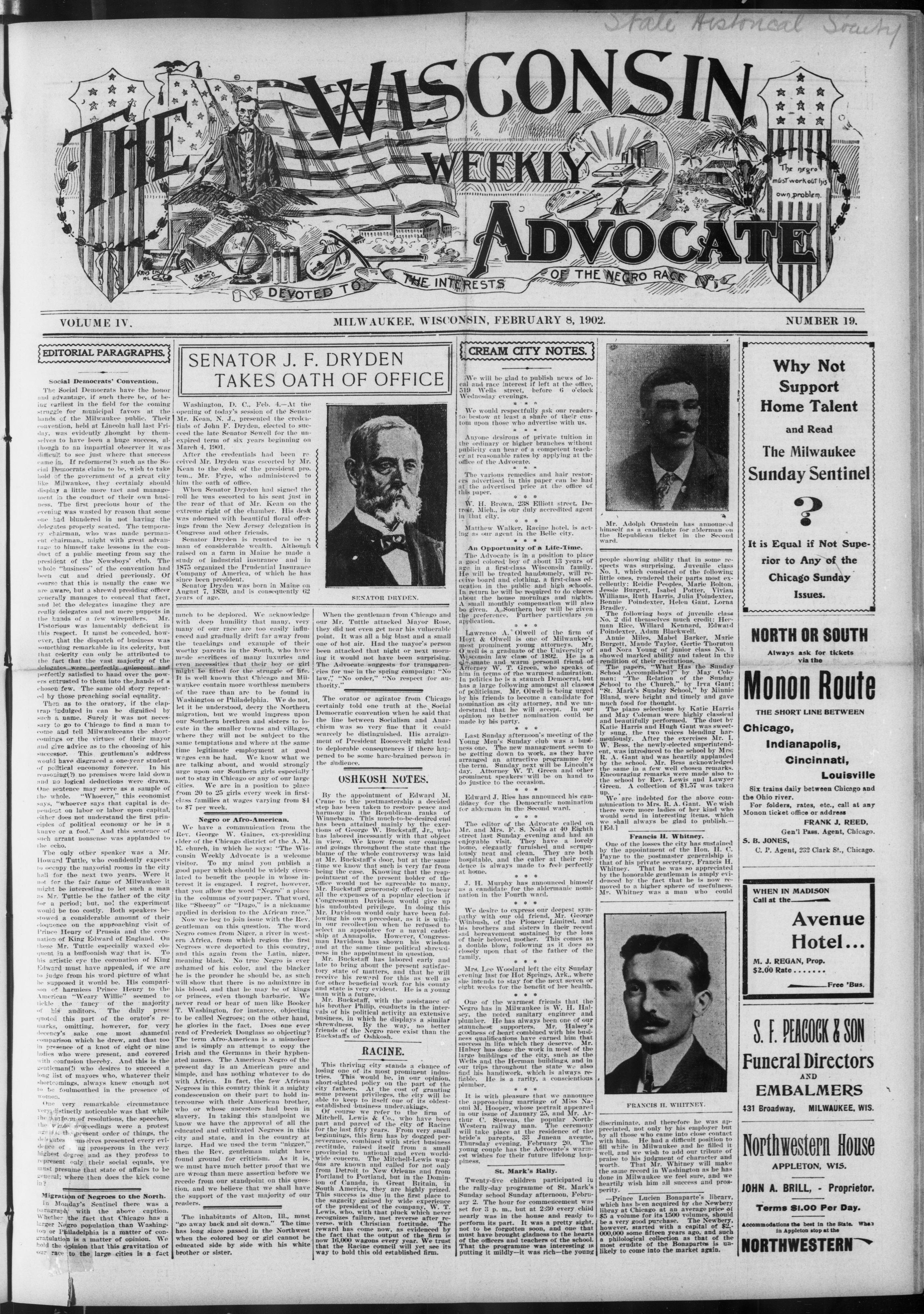
WISCONSIN
WEEKLY
ADVOCATE
DEVOTED TO THE INTERESTS OF THE NEGRO RACE
VOLUME IV.
EDITORIAL PARAGRAPHS.
Social Democrats' Convention.
The Social Democrats have the honor and advantage, if such there be, of being earliest in the field for the coming struggle for municipal favors at the hands of the Milwaukee public. Their convention, held at Lincoln hall last Friday, was evidently thought by themselves to have been a huge success, although to an impartial observer it was difficult to see just where that success came in. If reformers(?) such as the Social Democrats claim to be, wish to take hold of the government of a great city like Milwaukee, they certainly should display a little more tact and management in the conduct of their own business. The first precious hour of the evening was wasted by reason that some one had blundered in not having the delegates properly seated. The temporary chairman, who was made permanent chairman., might with great advantage to himself take lessons in the conduct of a public meeting from say the president of the Newsboys' club. The whole "business" of the convention had been cut and dried previously. Of course that this is usually the case we are aware, but a shrewd presiding officer generally manages to conceal that fact, and let the delegates imagine they are really delegates and not mere puppets in the hands of a few wirepullers. Mr. Pistorious was lamentably deficient in this respect. It must be conceded, however, that the dispatch of business was something remarkable in its celerity, but that celerity can only be attributed to the fact that the vast majority of the delegates were perfectly quiescent and perfectly satisfied to hand over the powers entrusted to them into the hands of a chosen few. The same old story repeated by those preaching social equality.
Then as to the oratory, if the clap-trap indulged in can be dignified by such a name. Surely it was not necessary to go to Chicago to find a man to come and tell Milwaukeeans the short-comings or the virtues of their mayor and give advice as to the choosing of his successor. This gentleman's address would have disgraced a one-year student of political enconomy forever. In his reasoning(?) no premises were laid down and no logical deductions were drawn. One sentence may serve as a sample of the whole. "Whoever," this economist says, "whoever says that capital is dependent on labor or labor upon capital, either does not understand the first principles of political economy or he is a knave or a fool." And this sentence of such arrant nonsense was applauded to the echo.
The only other speaker was a Mr. Howard Tuttle, who confidently expects to occupy the mayorial rooms in the city hall for the next two years. Were it not for the fair fame of Milwaukee it might be interesting to let such a man as Mr. Tuttle be the father of the city for a period; but, no! the experiment would be too costly. Both speakers bestowed a considerable amount of their eloquence on the approaching visit of Prince Henry of Prussia and the coronation of King Edward of England. On these Mr. Tuttle especially waxed eloquent in a buffoonish way that is. To his artistic eye the coronation of King Edward must have appealed, if we are to judge from his word picture of what he supposed it would be. His comparison of harmless Prince Henry to the American "Weary Willie" seemed to tickle the fancy of the majority of his auditors. The daily press quoted this part of the orator's remarks, omitting, however, for very decency's sake one most shameful comparison which he drew, and that too in presence of a knot of eight or nine ladies who were present, and covered with confusion thereby. And this is the gentleman(!) who desires to succeed a long list of mayors who, whatever their shortcomings, always knew enough not to be foulmouthed in the presence of women.
One very remarkable circumstance very distinctly noticeable was that while the platform of resolutions, the speeches, the whole proceedings were a protest against the present order of things, the delegates themselves presented every evidence of being prosperous in the very highest degree and as they profess to represent only their social equals, we must presume that state of affairs to be general; where then does the kick come in?
Migration of Nitrogen to the
Migration of Negroes to the North. In Monday's Sentinel there was a paragraph with the above caption. Whether the fact that Chicago has a larger Negro population than Washington or Philadelphia is a matter of congratulation is a matter of opinion. We hold the opinion that this gravitation of our race to the large cities is a fact
SENATOR J. F. DRYDEN TAKES OATH OF OFFICE
Washington, D. C., Feb. 4. At the opening of today's session of the Senate Mr. Kean, N. J., presented the credentials of John F. Dryden, elected to succeed the late Senator Sewell for the unexpired term of six years beginning on March 4, 1901. After the credentials had been received Mr. Dryden was escorted by Mr. Kean to the desk of the president pro tem., Mr. Frye, who administered to him the oath of office.
When Senator Dryden had signed the roll he was escorted to his seat just in the rear of that of Mr. Kean on the extreme right of the chamber. His desk was adorned with beautiful floral offerings from the New Jersey delegation in Congress and other friends. Senator Dryden is reputed to be a man of considerable wealth. Although raised on a farm in Maine he made a study of industrial insurance and in 1875 organized the Prudential Insurance Company of America, of which he has since been president. Senator Dryden was born in Maine on August 7, 1839, and is consequently 62 years of age.
much to be deplored. We acknowledge with deep humility that many, very many of our race are too easily influenced and gradually drift far away from the teachings and example of their worthy parents in the South, who have made sacrifices of many luxuries and even necessities that their boy or girl might be fitted for the struggle of life. It is well known that Chicago and Milwaukee contain more worthless members of the race than are to be found in Washington or Philadelphia. We do not, let it be understood, decry the Northern migration, but we would impress upon our Southern brethren and sisters to locate in the smaller towns and villages, where they will not be subject to the same temptations and where at the same time legitimate employment at good wages can be had. We know what we are talking about, and would strongly urge upon our Southern girls especially not to stay in Chicago or any of our large cities. We are in a position to place from 20 to 25 girls every week in first-class families at wages varying from $4 to $7 per week.
Negro or Afro-American.
We have a communication from the Rev. George W. Gaines, ex-presiding elder of the Chicago district of the A. M. E. church, in which he says: "The Wisconsin Weekly Advocate is a welcome visitor. To my mind you publish a good paper which should be widely circulated to benefit the people in whose interest it is engaged. I regret, however, that you allow the word "Negro" a place in the columns of your paper. That word, like "Sheeny" or "Dago," is a nickname applied in derision to the African race."
Now we beg to join issue with the Rev. gentleman on this question. The word Negro comes from Niger, a river in western Africa, from which region the first Negroes were deported to this country, and this again from the Latin, niger, meaning black. No true Negro is ever ashamed of his color, and the blacker he is the prouder he should be, as such will show that there is no admixture in his blood, and that he may be of kings or princes, even though barbaric. We never read or hear of men like Booker T. Washington, for instance, objecting to be called Negroes; on the other hand, he glories in the fact. Does one ever read of Frederick Douglass so objecting? The term Afro-American is a misnoiher and is simply an attempt to copy the Irish and the Germans in their hyphenated names. The American Negro of the present day is an American pure and simple, and has nothing whatever to do with Africa. In fact, the few African Negroes in this country think it a mighty condescension on their part to hold intercourse with their American brother, who or whose ancestors had been in slavery. In taking this standpoint we know we have the approval of all the educated and cultivated Negroes in this city and state, and in the country at large. Had we used the term "nigger," then the Rev. gentleman might have found ground for criticism. As it is, we must have much better proof that we are wrong than mere assertion before we recede from our standpoint on this question, and we believe that we shall have the support of the vast majority of our readers.
The inhabitants of Alton, Ill., must "go away back and sit down." The time has long since passed in the Northwest when the colored boy or girl cannot be educated side by side with his white brother or sister.
MILWAUKEE, WISCONSIN, FEBRUARY 8, 1902.
W. H.
SENATOR DRYDEN
When the gentleman from Chicago and our Mr. Tuttle attacked Mayor Rose, they did not even get near his vulnerable point. It was all a big blast and a small one of hot air. Had the mayor's person been attacked that night or next morning it would not have been surprising. The Advocate suggests for transparencies for use in the spring campaign: "No law," "No order," "No respect for authority."
The orator or agitator from Chicago certainly told one truth at the Social Democratic convention when he said that the line between Socialism and Anarchism was so very fine that it could scarcely be distinguished. His arraignment of President Roosevelt might lead to deplorable consequences if there happened to be some hare-brained person in the audience.
OSHKOSH NOTES.
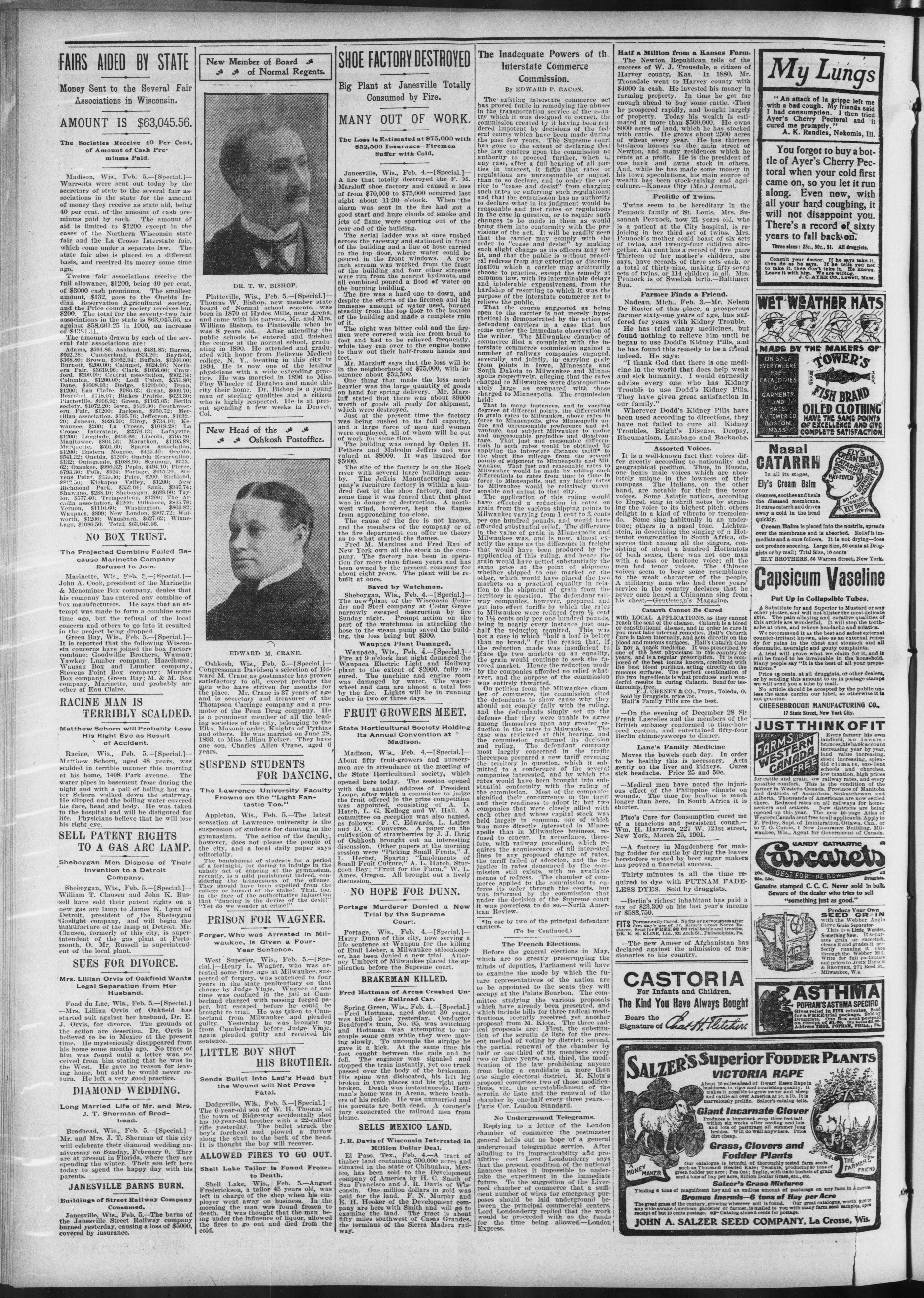
By the appointment of Edward M. Crane to the postmastership a decided step has been taken to restore peace and harmony in the Republican ranks of Winnebago. This much-to-be-desired end has been attained mainly by the exertions of George W. Buckstaff, Jr., who has labored incessantly with that object in view. We know from our comings and goings throughout the state that the blame of the whole controversy was laid at Mr. Buckstaff's door, but at the same time we know that such is very far from being the case. Knowing that the reappointment of the present holder of the office would not be agreeable to many, Mr. Buckstaff generously offered to bear all the expenses of a popular election if Congressman Davidson would give up his undoubted privilege. In doing this Mr. Davidson would only have been following his own precedent, as it is within our recollection when he refused to select an appointee for a naval cadetship at Annapolis. However, Congressman Davidson has shown his wisdom and at the same time political shrewdness in the appointment in question.
Mr. Buckstaff has labored early and late to bring about the present satisfactory state of matters, and that he will receive his reward for this as well as for other beneficial work for his county and state is very evident. He is a young man with a future.
Mr. Buckstaff, with the assistance of his brother Philip, conducts in the intervals of his political activity an extensive business, in which he displays a similar shrewdness. By the way, no better friends of the Negro race exist than the Buckstaffs of Oshkosh.
RACINE
This thriving city stands a chance of losing one of its most prominent industries. This would be, in our opinion, short-sighted policy on the part of the city fathers. At the cost of granting some present privileges, the city will be able to keep to itself one of its oldest-established business undertakings.
Of course we refer to the firm of Mitchell, Lewis & Co., who have been part and parcel of the city of Racine for the last fifty years. From very small beginnings, this firm has by dogged perseverance, combined with strict business rectitude, raised itself from a small provincial to national and even worldwide concern. The Mitchell-Lewis wagons are known and called for not only from Detroit to New Orleans and from Portland to Portland, but in the Dominion of Canada, in Great Britain, in South America, they are highly prized. This success is due in the first place to the sagacity gained by wide experience of the president of the company, W. T. Lewis, who, with that pluck which never recognizes failure, met reverse after reverse, with Christian fortitude. The reward has come now, as evidenced by the fact that the output of the firm is now 16,000 wagons every year. We trust that the Racine council will yet see its way to hold this old established firm.
CREAM CITY NOTES.
We will be glad to publish news of local and race interest if left at the office, 519 Wells street, before 6 o'clock Wednesday evenings.
* * * *
We would respectfully ask our readers to bestow at least a share of their custom upon those who advertise with us.
* * * *
Anyone desirous of private tuition in the ordinary or higher branches without publicity can hear of a competent teacher at reasonable rates by applying at the office of the Advocate.
* * * *
The various remedies and hair restorers advertised in this paper can be had at the advertised price at the office of this paper.
W. H. Brown, 238 Elliott street, Detroit, Mich., is our duly accredited agent in that city.
* * *
Matthew Walker, Racine hotel, is acting as our agent in the Belle city.
An Opportunity of a Life-Time.
An Opportunity of a Life-Time.
The Advocate is in a position to place a good colored boy of about 13 years of age in a first-class Wisconsin family. He will be treated handsomely, will receive board and clothing, a first-class education in the public and high schools. In return he will be required to do chores about the house mornings and nights. A small monthly compensation will also be given. A Southern boy will be given the preference. Further particulars on application.
Lawrence A. Olwell of the firm of Hoyt & Olwell is one of Milwaukee's most prominent young attorneys. Mr. Olwell is a graduate of the University of Wisconsin law class of 1892. He is a classmate and warm personal friend of Attorney W. T. Green, who speaks of him in terms of the warmest admiration. In politics he is a staunch Democrat, but has a large following amongst all classes of politicians. Mr. Olwell is being urged by his friends to become a candidate for nomination as city attorney, and we understand that he will accept. In our opinion no better nomination could be made by his party.
枣 枣 枣
Last Sunday afternoon's meeting of the Young Men's Sunday club was a business one. The new management seem to be getting down to work, as they have arranged an attractive programme for the term. Sunday next will be Lincoln's day. Attorney W. T. Green and other prominent speakers will be on hand to do justice to the occasion.
* * *
Edward J. Ries has announced his candidacy for the Democratic nomination for alderman in the Second ward.
* * *
The editor of the Advocate called on Mr. and Mrs. F. S. Nolls at 40 Eighth street last Sunday evening and had an enjoyable visit. They have a lovely home, elegantly furnished and scrupulously neat and clean. They are both hospitable, and the caller at their residence is always made to feel perfectly at home.
☆ ☆ ☆
J. H. Murphy has announced himself as a candidate for the aldermanic nomination in the Fourth ward.
* * *
We desire to express our deepest sympathy with our old friend, Mr. George Winbush, of the Pioneer Limited, and his brothers and sisters in their recent sad bereavement sustained by the loss of their beloved mother. This comes as a double blow, following as it does so closely upon that of the father of the family.
※ 牵 求
Mrs. Lee Woodard left the city Sunday evening last for Hot Springs, Ark., where she intends to stay for the next seven or eight weeks for the benefit of her health.
```markdown
```
One of the warmest friends that the Negro has in Milwaukee is W. H. Halsey, the noted sanitary engineer and plumber. He has always been one of our staunchest supporters. Mr. Halsey's goodness of heart combined with his business qualifications have earned him that success in life which they deserve. Mr. Halsey has done the work in most of the large buildings of the city, such as the Wells and the Herman buildings, and in our trips throughout the state we also find his handiwork, which is always reliable. He is a rarity, a conscientious plumber.
* * *
It is with pleasure that we announce the approaching marriage of Miss Naomi M. Hooper, whose portrait appeared in our issue of January 25, and Mr. Arthur C. Stevens, the popular NorthWestern railway man. The ceremony will take place at the residence of the bride's parents, 33 Juneau avenue, Thursday evening, February 20. The young couple has the Advocate's warmest wishes for their future lifelong happiness.
St. Mark's Rally.
Twenty-five children participated in the rally-day programme of St. Mark's Sunday school Sunday afternoon, February 2. The hour for commencement was set for 3 p. m., but at 2:30 every child nearly was in the house and ready to perform its part. It was a pretty sight, not to be forgotten soon, and one that must have brought gladness to the hearts of the officers and teachers of the school. That the programme was interesting is putting it mildly—it was rich—the young
KANLEY AND CO.
Mr. Adolph Ornstein has announced himself as a candidate for alderman on the Republican ticket in the Second ward.
people showing ability that in some respects was surprising. Juvenile class No. 1, which consisted of the following little ones, rendered their parts most excellently: Reidie Peoples, Marie Bolton, Jessie Burgett, Isabel Potter, Vivian Williams, Ruth Harris, Julia Poindexter, Bennie Poindexter, Helen Gant, Lorna Bradley.
The following boys of juvenile class No. 2 did themselves much credit: Herman Rice, Willard Kennard, Edward Poindexter, Adam Blackwell.
Annie Miles, Mabel Barker, Marie Burgett, Maude Taylor, Gertie Thornton and Nora Young of junior class No. 1 showed marked ability and talent in the rendition of their recitations.
The papers, "What Has the Sunday School Accomplished?" by May Coleman; "The Relation of the Sunday School to the Church," by Irva Gant; "St. Mark's Sunday School," by Minnie Bland, were bright and timely and gave much food for thought.
The piano selections by Katie Harris and May Coleman were highly classical and beautifully performed. The duet by Katie Harris and Hugh Gant was sweetly sung, the two voices blending harmoniously. After the exercises Mr. I. W. Bess, the newly-elected superintendent, was introduced to the school by Mrs. R. A. Gant and was heartily applauded by the school. Mr. Bess acknowledged the same in a few well chosen remarks. Encouraging remarks were made also to the school by Rev. Lewis and Lawyer Green. A collection of $1.57 was taken up.
We are indebted for the above communication to Mrs. R. A. Gant. We wish there were more ladies of her kind who would send in interesting items, which we shall always be glad to publish.— [Ed.]
Francis H. Whitney.
One of the losses the city has sustained by the appointment of the Hon. H. C. Payne to the postmaster generalship is that of his private secretary, Francis H. Whitney. That he was so appreciated by the honorable gentleman is amply evidenced by the fact that he is now removed to a higher sphere of usefulness. Mr. Whitney was a man who could
M. B.
FRANCIS H. WHITNEY
discriminate, and therefore he was appreciated, not only by his employer but by all those who came into close contact with him. He had a difficult position to fill while in Milwaukee and he filled it well, and we wish to add our tribute of praise to his judgment of character and worth. That Mr. Whitney will make the same record in Washington as he has done in Milwaukee we feel sure, and we heartily wish him all success and prosperity.
—Prince Lucien Bonaparte's library, which has been acquired by the Newbery library at Chicago at an average price of $5 a volume for its 1500 volumes, should be a very good purchase. The Newbery, however, started with a capital of $2,000,000 some fifteen years ago, and such a philological collection as that of the most erudite of the Bonaparte is unlikely to come into the market again.
NUMBER 19.
Why Not
Support
Home Talent
and Read
The Milwaukee
Sunday Sentinel
?
It is Equal if Not Superior to Any of the Chicago Sunday Issues.
NORTH OR SOUTH
Always ask for tickets via the
Monon Route
Indianapolis,
Cincinnati,
Louisville
Six trains daily between Chicago and
the Ohio river.
For folders, rates, etc., call at any
Monon ticket office or address
FRANK J. REED,
Gen'l Pass. Agent, Chicago.
S. B. JONES,
C. P. Agent, 232 Clark St., Chicago.
WHEN IN MADISON
Call at the
Avenue
Hotel...
M. J. REGAN, Prop.
$2.00 Rate .....
Free 'Bus.
S. F. PEACOCK & SON
Funeral Directors
AND
EMBALMERS
431 Broadway. MILWAUKEE, WIS.
Northwestern House
APPLETON, WIS.
JOHN A. BRILL, - Proprietor.
Terms $1.00 Per Day.
Accommodations the best in the State. When in Appleton stop at the
If you were Jan
And I were Joe,
And each played on
With key or bow,
We'd have a lot
Of fun, I know—
Ah, yet, I wot.
Oh, yes, I trow—
And raise a din
And make a blow
With violin
And pi-a-no,
And gather in
A pile of dough.
If you were Jan
And I were Joe,
And played upon
The key and bow.
—St. Louis Post-Dispatch.
THE CHILD TO THE FATHER.
Father, it's your love that safely guides me.
Always it's around me, night and day.
It shelters me, and soothes, but never
chides me.
Yet, father, there's a shadow in my way.
All the day, my father, I am playing Under trees where sunbeams dance and dart— But often just at night when I am praying I feel this awful hunger in my heart. Father, there is something—it has missed me—
I've cried myself to sleep with burning tears.
Today I saw a child and mother walking,
I caught a gentle shining in her eye,
And music in her voice when she was talking—
Oh, father, is it that that makes me cry?
Oh, never can I put my arms around her,
Or never cuddle closer in the night:
Mother, oh, my mother!—I've not found her—
I look for her and cry from dark to light!
—Robert Bridges, in Ladies' Home Journal.
THE SILENT ESCORT.
There was a shimmer of crimson light in the sky as he rode along. Sitting square and deep in the saddle, with an attitude that changed little as his horse's gait varied from lope to trot, from trot to walk, or from walk to lope, his eyes fixed straight ahead, the scout rode, absolutely alone.
Solitude and silence had been his portion so much that language was to him a curio—a rarity—a luxury. He seldom heard the sound of human voice, and when he did he listened deeply and answered deliberately, for his supply of speech was not great.
As he rode there came a scream from afar overhead—a shriek, a screech. But he did not look upward.
He knew the voice was the voice of a rifle ball, high in the air. Man and horse lay down and waited. Neither moved, but both watched.
On the brow of a little knoll, far away, he saw a bush wave too fast. It was far away, but he leveled his rifle and fired.
Then horse and man arose as if by mutual understanding, and, turning from the knoll, he rode, the report of the guns behind him merely urging him to hasten.
He was not afraid. He was not excited.
He did not expect to die; he did not expect to live.
Late that night he reached the post, delivered his orders, and turned to go. The captain stopped him.
"Meet anybody on the way over?" he asked.
The scout looked hard, as if digesting the query. Then he thought. At last he answered:
"Only some Indians."
"How many?"
"Was seven," said the scout. "Now six."
"On the warpath?" asked the captain. The scout looked troubled, as though bored by the questions.
"They fired—" was all he said.
They tired was all he said.
Now, then, the war was on in earnest. But the scout ever after avoided the captain as a man who talked too much.
In the grounds non-commissioned officers passed to and fro, bent on the duties of the day. New recruits were being drilled, singly and in squads. Now and again a stiff young lieutenant crossed to the officers' quarters, or bent on inspection, went through the form of examining quarters to see whether the dust had been properly brushed away and the floor duly swept. Presently a soldier entered, walked to where the scout lay, and said:
"Colonel wants you!"
The scout remained immovable for a few seconds. Then he turned to the messenger and looked him squarely in the eye. In a moment he recovered his speech.
That was all. Then he arose, deliberately dressed, drew on his long boots, buckled his belt with the ammunition and revolvers in place, and stalked to quarters. The orderly halted him at the door.
"Colonel wants me." he said.
Colonel wants me, he said.
He passed in. The colonel ignored the lack of a salute, for the keen-eyed man before him was not a soldier, but a civilian employee. Then he said:
"There is a woman here, the wife of Lieut. Pasper, who is wounded at the ferry. She wants to join her husband. You must guide her over."
The scout looked half terrified.
"Woman?" he asked. The question had a world of meaning, for the colonel knew of the hostiles on the road, the dangers of the trail itself, its double dangers for a woman. He nodded.
"Bad," said the scout.
"Can't be helped" said the colonel
Can't be helped, said the colonel. The scout stood still a moment. Then he turned and walked out. As he reached the parade ground he saw a woman before the officers' quarters. The sight revived his memory. In a few minutes he was back at the colonel's quarters, his horse saddled, his blankets rolled behind the cantle, the rifle slung by the horse's side, the riata coiled carefully over the saddle post. "Tell him I'm ready," he said gruffly to the orderly. The soldier turned in disgust. He was not used to unceremonious orders. But the scout was impenetrable. So the orderly went. When the scout was ordered in he saw a little woman wearing a short riding habit. He looked at her indifferently. The colonel spoke, saying he was the best scout at the post, and she might feel safe with him.
I feel it, she said. The scout broke silence. "Better not go." he said.
"Q. I must!" was her answer.
They rode away together. All the night long they rode, halting during the day. On the third morning, as the woman was about to lie down for a few hours' rest, the scout arose, as one who was about to deliver an oration.
"Only six mules," he said.
Fear of the hostiles had forsaken her, and they rode rapidly on, indifferent alike to the whistle of the bullets, the yell of the braves, and the efforts of small cavities of bucks to head them off. Closer and closer to the camp, and then, as the entry challenged, the scout turned and let the woman ride ahead.
He led the hostiles for a moment, Then looked around and saw the guard in forth and welcome the fainting wi. The dancing braves jarred on his sigh. He turned back to where the woman had entered the camp, and then followed her.
The officer of the guard almost hugged him. Men gathered about him. The captain clasped his hand. The wounded lieutenant, now almost well, wept.
The talk annoyed him.—Philadelphia Times
CALIFORNIA GIRL TO WED PRINCE.
Miss Abbie Campbell of San Jose announces her engagement to Prince David of Honolulu. Miss Campbell was born in Hawaii, where her father, the late James Campbell, made a large fortune.
A HERMIT'S PREDICTIONS
Earthquake Prophesies by St. Louis Man Coincide with a Hermit's Predictions Fifty Years Ago.
The prophecy and its partial fulfillment, in which the recent seismic disturbances were foretold by a mysterious man at St. Louis, call to mind the curious and thrilling prophecies of an old German hermit published originally in a Bavarian paper many years ago. I have forgotten where I first saw this article, but my attention was last called to it by a parishioner of Rev. J. Gilbert Blue, a Presbyterian clergyman at Waukesha, who incorporated it in a sermon he preached there some years ago.
People having friends in New York, California and Florida may feel inclined to "warn" them, if they "take stock" in the hermit's predictions and those of Mr. Dryer, who foretold the earthquake of last Friday. The prophecies of Mr. Dryer and of the old German curiously coincide as to the time and severity of the cataclysms foretold. In the German hermit's predictions he said that "When the Twentieth century opens great seismic disturbances will take place which will cause the submersion of New York city and the western half of the city of Havana. Cuba is to break in two, while Florida and lower California are to suffer total extinction. The shock of these earthquakes will raze buildings to the ground in almost every city on the continent. Millions of lives and billions of dollars' worth of property will be lost."
In the same article he foretold the Austrian-Russian and the Franco-Prussian wars, the death of Pope Pius and the Turco-Russian "debate at arms." He said that Germany would have three emperors in one year before the end of that century and indicated the death of two United States presidents by assassination. All these things have come to pass.
"There is to be a change in the economic conditions of almost every civilized nation. He foretells the growth of a democratic spirit in England which will result in a revolution that will overthrow the present form of government and make the country a republic. He says the last ruler of England will be the best the country ever had, and the first president of the new nation will be one of the royal family." Queen Victoria was by long odds the best ruler England ever had, and in one of his speeches the Prince of Wales said it was his desire to see England a republic.
According to the hermit, "Russia, France and Italy will form an alliance and will enter into war with Turkey, this war to be the outgrowth of Turkish persecution of Christian subjects. This triple alliance will conquer the domain of the sick man of the East. At the expiration of the war complications will arise which will plunge Italy and France into war with Russia. The result will be that the two countries will be gobbled up by the Northern power and will cease to exist as independent nations. While war is being waged between them the Pope will move the seat of Catholicism from Rome to some town in Southern Ireland. A rebellion will take place in the land of the shamrock, in which the country will become independent of England. Then a conflict will arise between the ultra-Catholics of the south of Ireland and the ultra-Protestants of the north, in which the Southrons will be the victors. A kingdom will be established, and it is predicted that the reign of the first potentate will become historic for its tyranny.
The prophet paints a dark future for the United States. He says, "At the close of the century (the Nineteenth) a feeling of unrest will seize the people. This feeling will be the outgrowth of unequal social and enconomic conditions. He predicts that the twenty-fifth President will be the last executive heard of the United States. During his administration the discontented masses will break into open rebellion, and the established form of government will be overthrown. The United States will be rent asunder and for a year or more anarchy will prevail. When order shall be brought out of choas, six republics will be formed, with capitals at the following cities: San Francisco, Denver, New Orleans, St. Louis, Washington and Boston."
The weak spot in these predictions lies in the detail—the prophet tells too much. Still, many may find "food for thought" in the prophecies already fulfilled and some satisfaction in speculating on other events foretold"and in "setting their house in order" in time for its demolition by the prophet's earthquake next Friday. HELEN L. GLENNY
Rome's Yellow Bread.
Rome is now full of a Christmas dainty called pangiallo (yellow bread), which to the foreigner is anathema, and to the native food for angels. Imagine what looks like rich plumpedud, cut into slices and
made of nuts, raisins, candied fruits and figs held together with glue—or at least something that sticks as hard. The first time I dined in an Italian house was Christmas, when I proved the truth of the saying, "Fools rush in where angels fear to tread." I noticed that my fellow-countrymen all refused the pangialle, but I took a piece, anticipating a great pleasure and gayly set my knife on it. I cannot say in it, as it slithered along the surface, making no more impression than on a stone. Not to be beaten, I picked it up with my fingers, as no fork could penetrate it, and put it in my mouth, only to have it rattle on my teeth! That was the last time that I attempted to taste this cake par excellence of the Romans, and I am now among those who look quietly on while other ingenues struggle with it. The miracle is that the Italians masticate it with great apparent ease, although they have it cut in the kitchen, but with what instrument I cannot say. Mililons are eaten at Christmas, giving rise to the conundrum: "What have Italians in common with the ostrich? Their digestive organs."—Pall Mall Gazette.
The Art of Eating.
A writer on matters of etiquette gives the following rules for the benefit of those who are uncertain of how to comport themselves properly at table:
At Breakfast—Do not leave your spoon in your teacup.
Cut the top off your egg instead of peeling it.
If you have bacon or fish, have a separate plate for your bread, or toast, and butter, but not when having only boiled eggs, which require very careful eating, by the by, as nothing looks so nasty as yolk of egg spilled all over the plate and egg-cup.
Do not dip your tea or coffee with a spoon.
Do not drain the cup.
At Luncheon and Dinner—Do not empty every drop of soup from your plate.
Do not drink your soup from the point of your spoon, but from the side.
Do not put salt and pepper on the side of your plate—in fact, in France it is bad form to ever take salt and pepper when dining out, as it is considered an insinuation that the cook has not flavored the food properly.
For fish do not use a dessert knife instead of the fish knife. If there be no fish knife, use a small crust of bread, but leave that piece of crust on your plate. Do not eat it afterward, as so many people do.
Do not be dainty and fringe your plate with bits of meat. Eat what you can and put any skin or bone on the edge of your plate in one little heap, which move down from the edge when you have finished.
Do not crumple up your table napkin. If you are only a guest for the day, do not fold it up, but if you are staying on and in a quiet household fold it up. If you are staying in a big house where everything is done "en grand prince," do not fold it up; just place it on the table when you leave, as in rich establishments there are clean napkins every day. After eating it is well before you drink to wipe your lips; otherwise you leave a smear mark on the glass. Do not gulp liquids and bolt food. Do not masticate or swallow audibly. Do not pile your plate with food or grasp your knife, fork or spoon as if it were a weapon of warfare. Do not crumble the bread by your side or drain your glass to the last drop.
On the other hand, do not be affected and act as if an appetite was a crime. drink as if you were a dicky bird and hold your knife, fork and spoon as if they were redhot needles.—Washington Star.
Four-Dollar Notes.
The new Dominion $4 note is getting a general castigation, and it would appear to deserve all the hard things that are being said about it. A serious practical objection is that it is so like the $1 bill in general features that annoying mistakes are often made. But even more resented is the fact that it contains a view of the United States Sault Ste. Marie canal instead of a view of the Canadian lock. Nothing could easily be more annoying than the advertisement of foreign industria lenterprise upon our note circulation. It is stated that some collectors have been given a premium for these bills, in the expectation that the issue would be limited, and it is to be hoped that their expectations may be justified.—Montreal Witness.
The Largest Gold Coin.
The largest gold coin now in circulation is the gold ingot or "loof" of Annam, a French colony in Eastern Asia. It is a flat round gold piece, and on it is written in Indian ink its value, which is about $325. The next sized coin to this valuable but exteremely awkward one is the "obang" of Japan, which is worth about $50, and next comes the "benda" of Ashantee, which represents a value of about $45.
WRECKED BY THE WIND.
MANY VESSELS ASHORE.
New York, Feb. 3.—The strong gale from the west-northwest which began early last evening continued all through the night and this morning. The maximum velocity of the wind was sixty-five miles an hour and at 9 a. m. today the local weather bureau instruments showed that at was blowing at the rate of fifty-six miles an hour. All the nearby marine stations reported the sea rough and from different points along the coast there came news of wrecks and of vessels ashore. The tugs John E. Berwind and E. S. Atwood, which were sent to the stranded steamer Cavour at Long Beach yesterday were unable to return to port and both sank about eleven miles east of the Sandy Hook lightship. The crews were rescued by the German steamer Barcelona. The tugs left the Cavour about 4 o'clock yesterday afternoon and within an hour both were in a sinking condition. The seas broke over the craft and washed away everything movable, the water gradually filling the holds until it was above the floor of the fire room and began to put out the fires. The Berwind's pilot house was smashed and the water flooded her fire room. About 5:30 the Barcelona was seen approaching and the tugs steered toward her to ask for assistance. She stopped and made a good lee so that the tugs were able to run alongside.
Rescued Just in Time.
A rope ladder was lowered and the men from the tugs scrambled on board. Fourteen men all told were saved, seven from each tug. Fifteen minutes after the rescue the Atwood went down and some time later the Berwind disappeared.
Fire Island reported a ship ashore at Point Lookout and a barge in distress near the Forge river lifesaving station. The barge was anchored about two miles off shore and was rolling badly. Those on shore could not tell whether there was anyone on board the barge. The name of the ship could not be seen from the Point Lookout station. Atlantic reported that an unknown four-masted schooner went ashore during the night on the brigantine shoals near where the Claverdale grounded yesterday.
Fire Island also reported that the beach five miles east of the Bellport lifesaving station was covered with wreckage and it was believed that a coal barge had been lost. The steamship Cavour, which stranded several days ago off Long Beach, L. I., weathered the gale well, and with the Kedge and lines which she has out held her position well. No effort will be made to pull her off till the weather has settled.
Storm Moves Northeastward.
The weather bureau at Washington today gave out the following regarding the weather conditions:
"The severe storm of Sunday in the middle Atlantic and northeast states has moved northeastward to the Canadian maritime provinces. High northwesterly winds and gales continued last night off the New England and along the lower lakes as well as throughout the interior of the middle Atlantic states. Snow or rain fell Sunday from Virginia northward to the lower lake region and thence eastward to New England. Snow continues this morning in Western New York.
The temperature has fallen from twenty to thirty degrees in the Ohio valley, the East gulf, South Atlantic and Middle states. In the Ohio valley zero temperatures prevail, while in the East gulf states they range from freezing at Jacksonville and New Orleans to 10 above in Tennessee and about 18 above in the eastern portion of the Middle Atlantic states. West of the Missouri there has been a marked rise in temperature in the last twenty-four hours, although it is still somewhat below the seasonal average.
May Go to Pieces.
Life savers of the Point Lookout station have been unable to get a line or a boat to the Schepp, owing to the heavy wind and high sea. The crew of the vessel can be seen on her deck. The sea is washing over the ship and she may go to pieces before the men aboard her can be rescued. Several bodies came ashore on Long Island and at Smith's Point and Ford's river and another near Patasquash. A barge was seen adrift near Shinnecock. The sea was running so high that it was not possible to send assistance.
Unknown Schooner Aground.
Philadelphia, Pa., Feb. 3.—Only one serious disaster to shipping had been reported to the Maritime exchange from the lifesaving stations between the Delaware breakwater and Barnegat up to 10 o'clock this morning. This was the grounding on Brigantine shoals near Atlantic City of an unknown four-masted schooner which went aground during the night near the big steamship Claverdale. Barnegat reports that an unknown five-masted schooner with all sails torn away except the jib, passed that station this morning bound north. Atlantic City, N. J., Feb. 3.—The schooner which went ashore on Brigantine shoal is the Edith L. Allen, from Brunswick, Ga., for New York, lumber laden.
Cargo Valued at $2,500,000.
There is no change in the position of the British steamship Claverdale, which stranded on Brigantine shoal in a dense fog yesterday morning. A high wind prevails and the wrecking tugs have not been able to render assistance to the distressed vessel. It is probable that it will be necessary to remove her cargo before she can be floated. The Claverdale was bound from China and Japan for New York with a cargo valued at $2,500,000, consisting of 4000 tons of tea and 3000 tons of general cargo. The crew of twenty-five men remains aboard. The stranded ship is visible from the board walk here and thousands of visitors are viewing the unusual spectacle of a great steamship lying almost out of the water. The Claverdale is almost a new vessel, having been built at Stockton, England, in 1890. She hails from London and is owned by E. Hazlehurst & Co. She is built of steel and is a modern cargo carrier, registering 3300 gross tons. Her length is 330 feet, beam 43 feet, draught 24 feet.
HUGE DRIFTS OF SNOW.
Blizzard in Central New York, Penn
sylvestria and Ohio.
New York, Feb. 3.—Dispatches from various points indicate that the heaviest snowstorm of the season is raging throughout central New York and in portions of Pennsylvania and Ohio. A high wind is piling the snow in huge drifts which block the country roads and fill the cuts on the different lines of railroad. All passenger trains on the leading lines are from four to seven hours late and the movement of freight has had to be abandoned. All traffic on the Chenango branch of the Lake Shore has been suspended. Street car traffic is blocked in many places. At several points interurban cars are stalled in
drifts between stations, the drifts reaching to the tops of the cars. Ebensburg, Pa., reports the country roads blocked with snowdrifts ten feet high. Between Meadville and Salamanca the drifts in railway cuts range from seven to ten feet in depth. Intense cold prevails in connection with the storm. Cleveland, O., reports a temperature of from 3 to 4 degrees below zero; Titusville, Pa., 5 below. Similar temperatures prevail at numerous other places.
Chicago, Ill., Feb. 3.—Chicago suffered severely from the cold wave today, the mercury at 7 o'clock being 5 below zero and at 11 o'clock 2 below. An inmate of the Old People's home was frozen to death and John B. Davis of Glenville, Ill., was taken to the hospital with his hands so badly frozen that amputation may be necessary. At the county hospital it was said that "Young Griffo," the pugilist, whose hands and feet were frozen last night, was in serious condition. The physicians could not state whether amputation would be necessary.
GALLOWS CHEATED.
Butler, Pa., Feb. 3.—Edward Biddle, to cheat the gallows, shot himself. His brother, John Biddle, attempted to commit suicide, but was killed by a bullet from the rifle of one of the pursuing officers when he, with his brother and Mrs. Kate Soffel, who aided in the escape from the Pittsburg jail, made their last stand on the road near here on Friday afternoon. These facts were set forth in the verdict of the coroner's jury. Mrs. Soffel, who was shot in the breast, is in a serious condition, but unless the symptoms of pneumonia develop she may survive her wound and the exposure.
Butler has been in a state of excitement over the case. Crowds clustered around the jail, striving to get a glimpse of the bodies of the two murderers, who died of their wounds Saturday night. The women especially have manifested great interest in the affair, and many refuse to believe the Biddles were guilty of the murders of Grocer Kahney and Detective Fitzgerald.
Refer to Killing in Sermons.
The battle with the fugitives was spoken of in every pulpit in the city yesterday. Rev. Father Daniel S. Walsh, who ministered to the Biddles, declared from the pulpit that they made full confession of their sins to him. He said that during their dying hours they protested their innocence of the murders charged against them. He said the men were shot down like dogs and that someone should be held responsible. Rev. Samuel Cronin Wett severely arraigned the woman and said her act was the worst criminal act thus far in the Twentieth century. Coroner John L. Jones excluded everyone except witnesses from the inquest. The officers who assisted in the capture and the physicians gave their testimony.
Bodies Riddled by Bullets.
The surgeons who performed the autopsy on the bodies of the brothers testified that from the wounds it was evident the Biddles tried to carry out their plan of killing themselves rather than be taken. Edward succeeded, but the self-inflicted wound in John's body was not fatal. His body was riddled by bullets. He was wounded nine times, but only one wound was necessarily fatal. Edward Biddle was wounded three times. One wound, through the lungs, was made by his own revolver, his breast being burned by powder.
The bodies will be taken to Pittsburg today. The dispute over the reward of $5000 has been settled, the Pittsburg detectives and the Butler policemen agreeing to divide the prize.
Public Views the Bodies.
At 6 o'clock last evening the bodies of the Biddles were removed from the jail to one of the hallways of the sheriff's dwelling, and the public was given an opportunity to gratify its morbid curiosity. A long line of people stood in front of the door, the snow stinging their faces, waiting their turn, and in the crowd were many women. Mrs. Soffel had a hemorrhage at the hospital, and her condition is not favorable. The doctors are not able to tell whether the hemorrhage was caused by the wound or is attributable to some other cause.
REMOVED TO PITTSBURG.
Bodies at the Morgue for Identification—Mrs. Soffel's Defense.
Pittsburg, Pa., Feb. 3.—The remains of Edward and John Biddie, the dead bandits, arrived at the Pittsburg & Western railroad station shortly after 11 o'clock this morning. When the train drew in there was a rough scramble to get to the platform of the depot, during which several were bruised by being crushed against the side of the stairway. The morgue wagon was waiting and the bodies were quickly driven to the morgue for identification. The bodies will be turned over to their brother, Harry Bidcle, who will see that they receive proper interment in the south side cemetery. The funeral will be conducted as privately as possible and Rev. Father Sweeney, the priest who rendered spiritual advice to the Biddles while they were in the Pittsburg jail, will conduct the services.
Dispatches from the Butler hospital this morning report Mrs. Soffel's condition unchanged. While it is believed she will get well, the danger is not passed, and on account of this uncertainty in her condition, nothing is being done in the way of preparations for her removal to Pittsburg. If she lives, in addition to answering to the charge of aiding prisoners to escape, she will be confronted by charges of furnishing the Biddles with firearms and aiding in the felonious assault upon the jail guards and the officers who effected the capture in Butler. Mrs. Soffel is already taking steps to defend herself and has written to a prominent Pittsburg attorney to engage his services. Her father is said to be quite well-to-do and as her parents are relenting she hopes to receive aid from them.
The prison board is satisfied Mrs. Sofel had assistance within the prison walls, and before the Biddle incident is finally closed it is probable there will be an almost entirely new force of attaches at the jail. The county authorities do not believe Ed Biddle's dying statement implicating Jennie Siebers in the Kahney murder, and it is not likely any action will be taken by them.
INGERSOLL'S MANTLE.
Kansas City Preacher to Organize Churches and Take Up Work of Great Agnostic.
Kansas City, Mo, Feb. 3.—Rev. J. E. Roberts, pastor of the Church of This World of this city, it is said, is to be the head of the Agnostic church and assume the mantle of Col. Robert G. Ingersoll, if the plans of the trustees of the organization here are successful. They have decided to expand the local church so that Agnostics all over the world will be included in its membership, and Dr. Roberts is to be sent to every part of the United States to organize churches.
Dr. Roberts, who was a close personal friend of Col. Ingersoll, has been at the head of the Church of This World in this city for the past five years.
WASHED ASHORE.
Long Island and the Jersey Coast Strewn with the Wreckage of Ships and Barges.
New York, Feb. 4.—The gale which has been raging along the Atlantic coast, from the Carolina Capes north, since Sunday morning, has strewn the coast with the wreckage of ships and barges. The greatest destruction and the greatest strength of the gale has been along Long Island and the Jersey coast.
How many vessels have been lost and how many persons drowned cannot be guessed. Every lifesaving station along the coast reports ships foundering at sea or driven ashore. The beaches are strewn with wreckage.
So far no great disaster has been reported. The big ocean liners have ridden out the storm without trouble.
The vessels lost or in trouble, so far as reported, are as follows:
L. Scheep, American merchantman, ashore near Long Beach, L. I.
Unknown ship, ashore near Fire Island.
Schooner Edith L. Allen, ashore near Atlantic City.
Steamer Drummond, ashore in Delaware bay.
Steamer Europe, ashore in Delaware bay. Tug John E. Berwynd, foundered near Sandy Hook; crew rescued.
Tug E. S. Atwood, foundered near Sandy
Hook; crew rescued.
Two barges, lost either by tug Cuba or tug Richmond; broken up on Long Island; bodies washed ashore.
Barge, ashore near Ford River Station. Schooner R. D. Bibber, ashore near Delaware breakwater.
Two barges, broken up on beach near Belleport.
Barge, riding in trouble off Shinnecock.
Crew Come Ashore.
The Oak island lifesaving station reports that two of the crew of the ship L. Schepp have come ashore and that the rest of the crew have been taken on board a wrecking tug which is standing by.
The steamer Cavour, aground off Long Beach, is reported to be resting easy and to have withstood the storm well. Another effort to get her off will be made today.
From Forge River it is reported that five masts have come ashore, two with white mastheads and three with black. These indicate that two barges have gone to pieces in that vicinity. No more bodies had been found up to 10 a.m.
The barge John Crittenden, which broke away from its tug, the I. G. Merritt, in Sunday's storm, has been found at Fire Island. No person aboard was lost or injured.
Another corpse has been picked up on the beach at Quogue, which has not been identified. Another mast has washed ashore at Quogue.
The cargo of the steamer Cavour is being discharged. The vessel is not leaking.
Wrecking Tugs at Work.
Atlantic City, N. J., Feb. 4.—The Brigantine Beach lifesaving station reports that the condition of the stranded British steamship Claverdale is unchanged today. Wrecking tugs are at work on her, but it is not believed they will be able to float her until most of the 70,000 tons of the cargo has been removed.
So far no damage has been inflicted on the Claverdale and, being a new boat, she may be able to stand the strain until her cargo is lightered.
The schooner Edith L. Allen of Bath, Me., which came ashore yesterday morning about 400 feet from where the Claverdale is stranded, is leaking one foot an hour and in bad condition. It is feared she will become a total wreck.
The theory is advanced by the lifesavers that the crew of the schooner were deceived by the lights on the stranded Claverdale, presuming the latter to be at anchor and thus beached their own vessel.
AIRSHIP BURNED.
English Inventor Had Devoted Twenty Years of Labor to Its Construction.
London, Feb. 4.—Fire at Denmead, Hampshire, has destroyed Buchanan's airship, which was built to rival the airship of M. Santos-Dumont. The fire broke out in the shed in which Buchanan's flyer was housed. Tramps charged with starting the blaze have been arrested.
This loss will be a serious setback for Thomas Buchanan, the English inventor, who recently completed the burned airship after devoting twenty years of thought and labor to its construction. In constructing his machine Mr. Buchanan endeavored as closely as possible to follow the outlines of a bird. The steering gear was an aluminum rudder, shaped like a fish fin. Gaso'line motors entered into the scheme of propulsion and the inventor planned to carry passengers inside the body of the machine instead of in an attached car. The inventor had not given a public demonstration of the working of his machine.
FATAL CARELESSNESS.
Premature Explosion of Nitroglycerin Causes Death-Utah Gas Plant Blown Up.
Washington, D. C., Feb. 4.—A premature explosion of nitroglycerin carelessly handled by an operative at the Cerberite Manufacturing company's plant at Ardwick, Md., nine miles from this city, early this morning, killed Richard J. Martin, the superintendent, and slightly injured two workmen. The building was slightly damaged, but eight tons of material of high explosive strength stored close to the scene of the accident were not disturbd.
Ogden, Utah, Feb. 4.—Pintsch gas plant blown up; many reported injured. Five persons are reported hurt, and Long Rogers, assistant chief of the Ogden fire department, is said to be fatally injured.
COMPANIES MUST PAY.
Useless to Insert Suicide Clause In Policies of Life In-
Columbus, O., Feb. 4.—By a decision in the Supreme court today in the case of the National Union vs. Dora Stoll of Cincinnati it appears almost futile for life insurance companies to put in a clause against suicide in their policies. Mrs. Stoll's husband held a policy containing specific stipulation that the policy should become void in case he should commit suicide within two years. He did commit suicide, but they were required to pay the policy.
DIED WHILE SHOVELING SNOW
Judge H. D. Campbell Stricken at Traverse City, Mich. Traverse City, Mich., Feb. 4.—[Special.]—Judge H. D. Campbell dropped deal this morning while clearing the snow from his walk in the dooryard. He was one of the oldest settlers of the city, was judge of probate of this county eighteen years and later was owner of the city waterworks and the electric light plant.
Depot: No. 15 North Main Street.
Telephone 163.
KENOSHA - WISCONSIN
BLACK SKIN REMOVER.
REGISTERED
IN
PATENT OFFICE
U.S.
BEFORE AFTER
A Wonderful Face Bleach.
AND HAIR STRAIGHTENER.
both in a box for $1, or three boxes for $2,
guaranteed to do what we say and to be the
"best in the world." One box is all that is
required if used as directed.
A WONDERFUL FACE BLEACH.
A PEACH-LIKE complexion obtained if used as directed. Will turn the skin of a black or brown person four or five shades lighter, and a mulatto person perfectly white. In forty-eight hours a shade or two lighter will be noticeable. It does not turn the skin in spots but bleaches out white, the skin remaining beautiful without continual use. Will remove wrinkles, freckles, dark spots, pimples or bumps or black heads, making the skin very soft and smooth. Small pox pits, tan, liver spots removed without harm to the skin. When you get the color you wish, stop using the preparation.
THE HAIR STRAIGHTENER
that goes in every one dollar box is enough to make anyone's hair grow long and straight, and keeps it from falling out. Highly perfumed and makes the hair soft and easy to comb. Many of our customers say one of our dollar boxes is worth ten dollars, yet we sell it for one dollar a box.
Any person sending us one dollar in a letter or Post-Office money order, express money order or registered letter, we will send it through the mail postage prepaid; or if you want it sent C. O. D., it will come by express, 35c, extra.
In any case where it fails to do what we claim, we will return the money or send a box free of charge. Packed so that no one will know contents except receiver.
THOS. B. CRANE,
122 West Broad St.,
RICHMOND, VA.
BY THE
TAKEN FROM LIFE.
[COPRIGHTED.]
Will straighten your hair, quickly and easily so that you can wear it. A chome no matter how kinky or curly it is. This wonderful hair pomade has been made and sold many years giving perfect satisfaction to everybody. It is the only safe preparation in the world that straightens kinky hair as shown above. Nourishes the scalp, cures dandruff, prevents fall and it makes hair very shiny. Warranted harmless, Testimonials free on request. It was the first preparation ever sold for straightening kinky hair. Beware of imitations. Get the Original Ozonized Ox Marrow as the genuine never fails to keep your hair straight. It is the only quality for ladies and gentlemen. Elegantly perfumed. Owing to its superior and lasting quality it is the most economical. It is not possible for anybody to produce a preparation equal to it. Full directions with every bottle. On 50 cents you will pay one bottle for 65 cents or three for $1.40. Send postal or express money order, as we do not send goods C. O. D. Write your name and address plainly to OZONIZED OX MARROW CO., 76 Wabash Ave., Chicago, Ill.
Don't Let Your Hair Fall Out
FREE
Sample of
LUSTORONE
to every one
When you can save it by the timely use of our great hair tonic, "LUSTORONE." If your hair has been scalded, burnt and split out by the roots by harmful applications of injurious so-called hair tonics, or by sickness, fevers and disease, our celebrated "LUSTORONE" will prove a boon to you. A Godsend to suffering humanity because it produces an abundant and beautiful growth of soft, fine hair. As the hair grows it softens and becomes straight. "LUSTORONE" cures all scalp diseases. Removes scurf and dandruff. Causes the hair to grow out again on bald spots and bare places. It is the greatest hair tonic on earth. To prove the value of this great remedy, we will send to any one who will send us their name and address together with soc. to pay for malling case and postage, a free SAMPLE that will prove its own worth. Write to
DOMINION M'E'G CO.
2220 East Marshall St.
Richmond, Va.
SUBSCRIPTION RATES
SUBSCRIPTION RATES.
Any part of the United States and Canada,
postage paid.
One Year ..... $2.00
Six Months ..... 1.25
Three Months ..... .75
Send money by Express Money Order. P. O.
Money Order or Registered Letter to the
Wisconsin Weekly Advocate.
ADVERTISING RATES.
One inch, single insertion..... 25c
One inch, per year..... $9.00
Business locals 5c per line each insertion.
Apply for rates to the Advocate.
TO CONTRIBUTORS:
All communications must be sent with the name and address of the sender as an evidence of good faith, but not necessarily for publication. No manuscript returned if not accepted, unless accompanied by stamps.
The Wisconsin Weekly Advocate company wishes to notify the public that all contracts and business transactions with this company must have the company stamp, otherwise they will be void. Neither will this company be responsible for paid subscriptions unless given to duly-accredited agents, who, on request, will give the company's receipt for same. Subscribers failing to receive their papers regularly will kindly notify the general office. Address all business communications to the general manager, 519 Wells street.
Entered in the Postoffice at Milwaukee as Second-class matter.
Hollands' difficulty may lie in finding a basis on the Boer side for reciprocal peace concessions.
The contractor who eloped with himself from Dowie's Zion may have tired of setting pearly gates.
Pekin dispatches report that the edicts of the Emperor continue to be tugged out by the maternal apron string.
The fault Miss Stone is most likely to allege against the hospitality of the Bulgarian mountaineers is that it is too insistent.
The Muncie, Indiana, man who claims to have solved the problem of perpetual motion while in a dream may be dreaming still.
In offering $2000 for a real ghost, Camille Flammarion has not placed himself within the zone of just criticism for recklessness.
Prince Henry's refusal of banquets in Germany before he starts will give Americans a monopoly of assaults upon his digestion.
According to Arthur J. Balfour, the Boers are making overtures for peace only by the mechanical process of discharging rifles.
Fitzsimmons seems to be bent on proving that a fall down the back stairs of a theater is more profitable than a fall in the squared circle.
It now devolves upon Mr. Parkhurst, who declared in a New York pulpit that all souls are not immortal, to pick the sheep from the goats.
It may be that Berlin's pouting is due to Wales' reservation of his kissing for his royal relatives; but he could not osculate by wholesale.
Hobson's inclination toward politics may be explained by the fact that if he retires from the navy he will get $3000 a year for doing nothing.
It transpires that Sybil Sanderson's engagement was broken in a collision between a divorce record and the laws of Count Fitz-James' church.
Vienna's adoption of the trolley for its street railways is late enough to be noticeable; but horse cars may still be seen on Chicago's business streets.
And now there is a long distance between Sig. Marconi and his best girl. He has had no difficulty in conquering long distances, up to the present time.
The traditional success of wooden nutmegs may be the inspiration of the Connecticut man who announces that he will try to capture the $200.00 airship prize at the St. Louis Exposition.
Mr. Schwab has surrendered enough of his native modesty to permit him to confess that he is cutting a wide swath in royal society and patting the crowned heads with affectionate tenderness.
The auctioned sails of the Shamrock, which were damaged in the shipyard fire, did not include the suit Sir Thomas had in store for use in the event of victory. That particular suit is too green to burn.
The plan which contemplates $4,000,000 worth of new public libraries in Mexico of course has Andrew Carnegie's generosity as a base. It is always easy to plan when somebody furnishes the money.
The Boston physician who claims to have discovered a nerve bracer that will prolong human life to 150 years, should explain why his elixir of life fails about the time it confirms a man in the belief that he is going to live forever.
The members of the naval examining board have discovered that Hobson's eyes are good enough to know a good thing when he sees it, and they will therefore recommend that the naval constructor be kept on the active list.
Maj. Simons' report that the level of Erie is falling steadily will incline the people of Buffalo, Cleveland, Toledo, and other ports, toward the proposition to build an international dam across the Niagara river, to improve navigation.
The expected has happened as a result of the wolf-poisoning policy in Northren Wisconsin, and the wolves have the laugh on the owners of valuable dogs and fat porkers whose four-footed property has gone the way of animals that can't digest poison.
The charge of the Vienna Politische Correspondence that Miss Stone is in cahoots with the Bulgarian brigands may be followed by a report that the
brigands are missionaries in disguise who have taken this sensational way of raising money for "the cause."
Pickles are $1.50 a barrel higher than a year ago, and still there is said to be danger of a pickle famine before next summer. The situation is a result of last summer's drought. Gourmands will find it difficult to keep cool as cucumbers in view of a prospect pickleless and painful.
The promoters of delay in the isthmian canal matter, who claim that the Nicaragua route is through the only earthquake and volcanic belt, ought to be convinced by the reports from St. Louis, Mexico City and "intermediate points" that the earthquake belt is a very broad affair.
From the manner in which a reporter at Pana, Ill., is chronicling the sneezing to death of a woman of his town, it might be inferred that he believes there is some consolation for the dying woman in the fact that during one hour of her agony she broke all records by sneezing 700 times.
It is announced that the next Shamrock will be built by the Thornycrofts, because the plating of the first Shamrock and her riveting were better than the same work in Shamrock II. This is interesting, as it contradicts the claims made during last summer's rumors that there was no weakness whatever in the hull of the challenger.
The United States Steel Corporation's plan of provisioning its lake steamers on the fly, as they pass through the Sault channels will give Sault Ste, Marie the first refrigerator ship of the commercial navy of the Great Lakes. But the "Soo" merchants would undoubtedly prefer to do business with the ships at "the old stand," and in the old way.
The National Retail Grocers' Convention's endorsement of the proposition to enact a pure food law is significant. The grocer knows that there is great need of honesty in the packing of food products and preparations. He knows in many cases that he is selling goods that are not "as advertised," but the failure of the people to cure the evils of adulteration leaves him with no alternative.
The death of Admiral Kimberly recalls the Samoan hurricane, during which the American ships of the now obsolete type were carried to destruction while their crews cheered the newtype Britisher which steamed into the teeth of the storm and escaped onto deep water. This occurrence is not very old; but the United States navy has been making rapid strides during the past decade.
Mrs. Patrick Campbell
a Bridge Whist Plunger.
New York, Jan. 30.—Mrs. Patrick Campbell, the English actress, is unusually lucky at bridge whist, and since she has been in this country has laid by a goodly sum as the profits from the game. She is outspoken about the game, and yesterday admitted that it had been a feature of the reception she gave at the theater Tuesday night when many prominent New Yorkers were entertained.
"In my apartments in the Majestic," she said, "many of the society people who had been entertained by me in the theater in the afternoon were entertained also at night after the performance at the theater. We played bridge whist and I won $2000.
"I always win at bridge whist, and since coming here I have won about $22,000 at the game. I cannot mention the names of the persons from whom I won the money, as they are high in society, and they would not like it."
People who know something of Mrs. Campbell and her ways said last night that it was not surprising that she had managed to win from her guests at the Majestic, as she was an extraordinary bridge whist player. Mrs. Campbell learned the game in England and is known there as one of the best English players.
After she came over, it is said, she did not stop playing bridge, but, on the contrary, played whenever she got a chance. It was added that she has won several tidy sums at the table. Mrs. Campbell does not object to talking about her winnings, either, although she steadfastly refused to tell the names of any of the people with whom she had played recently.
Women Should Dress for Dinner.
A man who has been working in the city all day likes to see his wife looking pretty and dainty when he comes home to dinner, and dressing for dinner is really economical rather than extravagant for anyone who is clever enough to remodel her own gowns. Summer frocks can nearly always be done up to look quite nice and fresh for home evening wear and will save one's new autumn and winter gowns in a quite wonderful manner, for a thin dress is always comfortable in the evening even in cold weather, for rooms are warm when the lamps are lighted and curtains drawn.
There are still many old-fashioned middle class people who seem to think that to change one's dress in the evening is indicative of extravagance or of moral deprivation, or both, an idea which has survived from the days when even wealthy middle class people dined in the middle of the day. People are wiser now and have learned that when they have to work hard all day it is better to dine late, especially as the vast majority of business men find the evening meal the only one they can enjoy at home and at leisure. A light silk will wash beautifully at home Do not rub any soap on it, but make a nice lather with soap and water that has been softened by boiling bran in it.-Daily Evening Telegraph.
Manhattan Full of Holes.
Manhattan island is like an enormous coal mine, with intricate galleries and apartments underground. A large group of curious subterranean rooms and passages is to be found at the foot of Broadway, extending out laterally to the east and west. An almost continuous line of them follows Broadway. Several of the banks and trust companies have offices fitted up below the crowded sidewalks, where rows of clerks work silently, unmindful of the rush and turmoil above their heads. In the safe deposit vaults built below the pavements of Broadway. Wall, Nassau and Broad streets are stored millions of dollars' worth of securities, over which the crowds hurry all day heedlessly.
A convincing alibi was recently furnished by a man in France. He was charged with the murder of a girl at Nice, and he brought conclusive evidence to show that he was at the time committing a burglary at a hotel.
TEMPERANCE TALKS.
THE RUM TRAFFIC SHOULD BE SUPPRESSED.
Dangers that Always Lurk in the Flowing Bowl-How Bright and Influential Men Have Been Dragged Down by the Demon Drink.
"How can you afford all these books?" asked a young man, calling upon a friend; "I can't seem to find spare change for even the leading magazines."
"Oh, that library is only my 'one cigar a day.'" was the reply.
"What do you mean?" inquired the visitor.
"Mean? Just this: When you advised me to indulge in an occasional cigar several years ago I had been reading about a young fellow who bought books with money which others would have burned in cigars, and I thought I would try to do the same. You may remember that I said I should allow myself one cigar a day?"
"Yes, I recall the conversation, but don't quite see the connection."
"Well, I never smoked, but I put by the price of a five-cent cigar every day; and, as the money accumulated, I bought books—the very books you see." "You don't mean to say that your books cost no more than that! Why, there is dollars' worth of them."
"Yes, I know there is. I had six years more of my apprenticeship to serve when you advised me 'to be a man.' I put by the money, which, at five cents a day, amounted to $18.25 a year, or $109.50 in six years. I keep those books by themselves as a result of my apprenticeship cigar money; and, if you'd done as I did, you would by this time have saved many more dollars than I have, and would have been better off in health and self-respect besides."—Facts.
Mr. McKinley and Temperance. When in San Francisco, a few months prior to his death, the late President McKinley attended a social and temperance league for young men. When introduced to the great crowd he said: "I wish I had fitting words with which to express the sentiments of my heart for this beautiful greeting. I am glad to know that you are associated for the purpose of temperance; that you are determined to lead sober and temperate lives. Soberness is essential to success in your lives. There is no temperance lesson more potent than a temperate life in the individual. May you, in your manhood, realize the blessings that are sure to come from keeping the pledge you have made in your youth. Our country needs temperate, patriotic, moral men. You have everything to live for. No other country affords such splendid opportunities for young men. Every door to success is open to you. There never was a time in all human history when the sober, industrious, moral and intelligent young man had such rewards awaiting him. Clean hands and clean hearts, with lots of industry, will win in private business and in public life. Thank God, there are no class distinctions in our country. The poor boy can rise to its highest honors as well as the richest."
A Juryman's Two Drinks.
When hard business sense and our courts of justice both combine to make even a moderate use of intoxicants inimical to the interests, it is time for our legislators to inquire and reflect on what may be the nature of this enemy to social order and justice. Business corporations long since have put the seal of condemnation upon the drink habit, but it remained for an Indiana judge to take the forward step in behalf of outraged justice. A trial was called in an Indiana court recently. The trial proceeded to a conclusion and the accused man was convicted by the jury of larceny. After the verdict had been brought in it was alleged by the prisoner's counsel that one of the jurors had indulged in drink just before the trial. On investigation it was found that the charge was true to the extent that one of the jurors had taken two drinks of whisky just before the trial began. The judge immediately ordered a new trial, claiming that the whisky obscured the juryman's faculties. Whenever the courts of justice universally shall have taken a similar stand, a long step will have been taken toward a righteous solution of the liquor problem.
The Candy of Satan.
The police of Jersey City recently made a raid on some candy shops, and seized some chocolate drops filled with rum, and one prominent candy and fruit dealer was arrested. It was noticed that the girls and boys who bought many of the chocolate drops before going to school would invariably be very dull and stupid in the class rooms. Investigation showed that the children were intoxicated. The dealers were given notice that they would be arrested if they attempted to sell any more of this kind of candy to children. The parents of the children who are addicted to the use of the drops are greatly alarmed over the developments. Many of the children have developed a strong appetite for drink.
At the bottom of the wonderful physical vitality of the Turkish race is the universal abstinence of the common people. They are the most abstemious race on the earth and the healthiest. The soldiers, peasants, merchants and members of the learned professions never touch alcohol, although the upper classes of Constantinople drink considerably.
The young man that longs to linger is apt to linger too long.
THE BAKERY
No. 208 Sixth Street GEO. W. SAYLES ...ALL WORK CAREFULLY DONE... Lowest Prices and Satisfaction Guaranteed.
intending to visit HotSprings Ark., this winter, should patronize the
RAMMELSBERG BATH HOUSE.
Gentlemen : — Being entirely cured of deafness, thanks to your treatment, I will now give you a full history of my case, to be used at your discretion. About five years ago my right car began to sing, and this kept on getting worse, until I lost my hearing in this terrible
my hearing in this ear entirely.
I underwent a treatment for catarrh, for three months, without any success, consulted a number of physicians, among others, the most eminent ear specialist of this city, who told me that only an operation could help me, and even that only temporarily, that the head noises would then cease, but the hearing in the affected ear would be lost forever.
I then saw your advertisement accidentally in a New York paper, and ordered your treatment. After I had used it only a few days according to your directions, the noises ceased, and to-day, after five weeks, my hearing in the diseased ear has been entirely restored. I thank you heartily and beg to remain.
F. A. WERMAN, 730 S. Broadway, Baltimore, Md.
Our treatment does not interfere with your usual occupation.
Examination and advice free.
YOU CAN CURE YOURSELF AT HOME at a nominal cost.
INTERNATIONAL AURAL CLINIC. 596 LA SALLE AVE.. CHICAGO, ILL.
Mention the Wisconsin Weekly Advocate when answering advertisements.
HARTONA makes the hair grow long, straight, beautiful, soft, and glossy. Cures Dandruff, Baldness, Itching, Eczema, and all Scalp Diseases. Prevents Falling Out of the Hair and Premature Baldness. HARTONA POSITIVELY STRAIGHTENS THE KINKIEST HAIR. Guaranteed harmless. Sent anywhere on receipt of price—25c. and 50c. per box.
HARTONA FACE BLEACH will gradually turn the skin of a black or dark person five or six shades lighter, and will turn the skin of a mulatto person almost white. HARTONA FACE BLEACH removes Wrinkles, Dark Spots, Pimples, Freckles, Blackheads, and all Blemishes of the Skin. Guaranteed absolutely harmless. Sent to any address on receipt of price—25c. and 50c. per bottle.
Hartona Remedies are absolutely guaranteed, and your money is positively refunded if you are not perfectly satisfied. Write to us, and we will send you free a book of testimonials of more than one hundred people in your own State who have used and are using Hartona Remedies.
SPECIAL GRAND OFFER. Send us One Dollar and mention this paper, and we will send you three large boxes of HARTONA HAIR GROWER AND STRAIGHTENER, two large bottles of HARTONA FACE BLEACH, and one large box of HARTONA NO-SMELL, which removes all disagreeable odors caused by Perspiration of the Feet, Arm-Pits, &c.
Goods will be sent securely sealed from observation. Write your name and post-office and express office address very plainly. Money can be sent in Stamps or by Post-Office Money Order or enclosed in Registered Letter or by Express.
EADE-MARK.
BEFORE USING
HARTONA
HARTON and glossy. Scalp Disease. Nature Baldness. KINKIEST H receipt of price. HARTON black or dark skin of a new BLEACH remen heads, and a harmless. So per bottle. Hartona is positively us, and we w one hundred using Hartona SPECIAL we will send AND STRAIN BLEACH, and removes all d Arm-Pits, &c Goods with your name and Money can be enclosed in B Address
TRADE-MARK.
AFTER USING
HARTONA
MARK SARGENT, Manager. 21 BATHS $3.00
A man is talking on the phone.
AFTER USING
HARTONA
beautiful, soft, zezema, and all and Prema- LIGHTENS THE anywhere on the skin of a will turn the AUTONA FACE beckles, Black- red absolutely -25c. and 50c. and your money need. Write to of more than used and are the Dollar and this paper, and AIR GROWER AUTONA FACE MELL, which of the Feet,ation. Write very plainly. Money Order or
TRADE-MARK.
BEFORE USING
HARTONA
almage's Sermon.
Have you appreciated the fact that on most of your tables are luxuries that do not come to all? Have you realized what varieties of flavor often touch your tongue and how the saccharin and the acid have been afforded your palate? What fruits, what nuts, what meats regale your appetite, while many would be glad to get the crusts and rinds and peelings that fall from your table. For the fine flavors and the luxurious viands you have enjoyed for a lifetime perhaps you have never expressed to God a word of thanksgiving. That is one of the ten strings that you ought to have thrummed in praise to God, but you have never yet put it in vibration.
Tal
N this discourse Dr. Talmage calls attention to causes of thanksgiving that are seldom recognized and shows how to cultivate a cheerful spirit; text, Psalms xxxiii., 2, "Sing unto him with a psaltery and an instrument of ten strings."
A musician as well as poet and conqueror and king was David, the author of my text. He first composed the sacred rhythm and then played it upon a harp, striking and plucking the strings with his fingers and thumbs. The harp is the oldest of musical instruments. Jubal invented it, and he was the seventh descendant from Adam. Its music was suggested by the twang of the bowstring. Homer refers to the harp in the "Iliad." It is the most consecrated of all instruments. The flute is more mellow, the bugle more martial, the cornet more incisive, the trumpet more resonant, the organ more mighty, but the harp has a tenderness and sweetness belonging to no other instrument that I know of. It enters into the richest symbolism of the Holy Scriptures. The captives in their sadness "hung their harps upon the willows." The raptures of heaven are represented under the figure of "harpers harping on their harps." We learn from coins and medals that in the Maccabean age the harp had only three strings. In other ages it had eight strings. David's harp had ten strings, and when his great soul was afire with the theme his sympathetic voice, accompanied by exquisite vibration of the chords, must have been overpowering.
In my text David calls upon the people to praise the Lord with an instrument of ten strings, like that which he was accustomed to finger. The simple fact is that the most of us, if we praise the Lord at all, play upon one string or two strings or three strings when we ought to take a harp fully chorded and with glad fingers sweep all the strings. Instead of being grateful for here and there a blessing we happen to think of, we ought to rehearse all our blessings so far as we can recall them and obey the injunction of my text to sing unto him with an instrument of ten strings.
Remember Daily Blessings.
Remember Daily Blessings.
Have you ever thanked God for delightsome food? What vast multitudes are a-hungered from day to day or are obliged to take food not toothsome or pleasant to the taste! What millions are in struggle for bread! A Confederate soldier went to the front, and his family were on the verge of starvation, but they were kept up by the faith of a child of that household, who, noticing that some supply was sure to come, exclaimed,
"Mother, I think God hears when we scrape the bottom of the barrel."
Have you thanked God for eyesight as originally given to you or, after it was dimmed by age, for the glass that brought the page of the book within the compass of the vision? Have you realized the privation those suffer to whom the day is as black as the night and who never see the face of father or mother or wife or child or friend? Through what painful surgery many have gone to get one glimpse of the light! The eyes so delicate and beautiful and useful that one of them is invaluable! And most of us have two of these wonders of divine mechanism. The man of millions of dollars who recently went blind from atrophy of optic nerve would have been willing to give all his millions and become a day laborer if he could have kept off the blindness that gradually crept over his vision.
You may have noticed how Christ's sympathies were stirred for the blind, Ophthalmia has always been prevalent in Palestine, the custom of sleeping on the housetops, exposed to the dew and the flying dust of the dry season, inviting this dreadful disorder. A large percentage of the inhabitants could not tell the difference between 12 o'clock at noon and 12 o'clock at night. We are told of six of Christ's miracles for the cure of these sightless ones, but I suppose they were only specimens of hundreds of restored visions. What a pitiful spectacle Saul of Tarsus, the mighty man, three days led about in physical as well as spiritual darkness, he who afterward made Felix tremble by his eloquence and awed the Athenian philosophers on Mars hill and was the only cool headed man in the Alexandria cornship that went to pieces on the rocks of Miletus, once the mighty persecutor of Saul, afterward the glorious angelist Paul, for three days not able to take a safe step without guidance!
T. Strings of Gratitude.
Have you ever given thanks for two eyes—media between the soul inside and the world outside, media that no one but the infinite God could create? The eye, the window of our immortal nature, the gate through which all colors march, the picture gallery of the soul! Without the eye this world is a big dungeon. I fear that many of us have never given one hearty expression of gratitude for treasure of sight, the loss of which is the greatest disaster possible unless it be the loss of the mind. Those wondrous seven muscles that turn the eye up or down, to right or left or around. No one but God could have created the retina. If we
have ever appreciated what God did when he gave us two eyes, it was when we saw others with obliterated vision. Alas, that only through the privation of others we came to a realization of our own blessing! If you had harp in hand and swept all the strings of gratitude, you would have struck this, which is one of the most dulcet of the ten strings.
Further, notice how many pass through life in silence because the ear refuses to do its office. They never hear music, vocal or instrumental. The thunder that rolls its full diapason through the heavens does not startle the prolonged silence. The air that has for us so many melodies has no sweet sound for them. They live in a quietude that will not be broken until heaven breaks in upon them with its harmonies. The bird voices of the springtime, the chatter of the children, the sublime chant of the sea, the solo of the cantatrice and the melody of the great worshiping assemblies mean nothing to them. Have we devoutly thanked God for these two wonders of our hearing, with which we can now put ourselves under the charm of sweet sound and also carry in our memories the infantile song with which our mothers put us to sleep, and the voices of the great prima donnas like Lind and Patti and Neilson, and the sound of instruments like the violin of the Swedish performer, or the cornet of Arbuckle, or the mightiest of all instruments, with the hand of Morgan on the keys and his foot on the pedal, or some Sabbath tune like "Coronation," in the acclaim of which you could hear the crowns of heaven coming down at the feet of Jesus? Many of us have never thanked God for this hearing apparatus of the soul. That is one of the ten strings of gratitude that we ought always to thrum after hearing the voice of a loved one or the last strain of an oratorio or the clang of a cathedral tower.
Further, there are many who never recognize how much God gives them when he gives them sleep. Insomnia is a calamity wider known in our land than in any other. By midlife vast multitudes have their nerves so overwrought that slumber has to be coaxed, and many are the victims of chloral and morphine. Sleeplessness is an American disorder. If it has not touched you and you can rest for seven or eight hours without waking—if for that length of time in every twenty-four hours you can be free of all care and wormiment and your nerves are retuned and your limbs escape from all fatigue and the rising sun finds you a new man, body, mind and soul—you have an advantage that ought to be put in prayer and song and congratulation. Sleep is a gratuity from him who never sleeps. Oh, the felicities of slumber! Let all who have this real benefaction celebrate it. That is one of the sweetest strings in all the instrument of ten strings.
Further, let us gratefully acknowledge the power of physical locomotion. To be able to go where we wish and all unaided—what a kindness! What multitudes have to call in the aid of cane and crutch and invalid's chair, and their whole life is a hinderment! How hard to get about with lack of strong and healthy and supple limbs! Congratulated ought you all to be if you have the usual physical endowment, and sympathized with ought all those to be who can neither walk nor climb nor enter upon any great activities. That is one of the thousands of reasons why I hate war with a complete hatred. It takes off with bullet or shell or surgeon's knife the capacity of men to achieve their own livelihood or do the work for which they would otherwise be fully qualified. Brave men, self-sacrificing men, for the rest of their life are put on the limits and strangely suffer in stormy weather from limbs amputated.
Give Thanks for Sound Limbs.
How much of the human family in every century has been cut up and shot to pieces and passed into mutilation! American manhood had hardly recovered from the lacerations of the war of the Revolution when it was called to be carved by the swords and stabbed with the bayonets and blackened with the gunpowder of 1812. Hardly recovered was our American manhood from that when the war with Mexico began its butchery. Hardly was American manhood recovered from that before the Civil War took hold of it and dug its grave trench through the North and its grave trench through the South. Hardly was our American manhood recovered from that when the Spanish war came, with its malaria and crowded hospitals. Thank God that now four of the greatest nations are allied in good understanding—the United States, England, Germany and Russia—and if they will do the right thing they can forever stop national and international strife and put an end to wholesale amputation. There are enough accidents in time of peace to keep the race mutilated more than it ever ought to be, and the human family needs all its arms and hands and feet to do the work that God calls it to do.
Further, celebrate on the instrument of ten strings our illumined nights. They spread their tents over us, and some of us hardly go out to look at them. During the nights other worlds come in sight. The author of my text chimed the silver bells in the tower of the midnight heavens, saying, "When I consider the heavens, the work of thy fingers; the moon and the stars, which thou hast ordained, what is man that thou art mindful of him?" We thank God for the day; we ought also to thank him for the night. Worlds on worlds in sight of the naked eye, but more worlds revealed by telescope. At least one night in his lifetime every man ought to go into astronomical observatory and see what has been done by the great World Builder. Thank God for lunar and stellar illumination!
Further, on the instrument of ten strings celebrate the possession of our reason. A severe stroke upon the head or a sudden calamity or any one of fifty kinds of accident might dethrone our reason and leave us worse off than the brute, for the brute has a substitute for reason in what is called instinct, but a man's brain stattered and he has neither mind nor instinct. The asylums for the insane, though all the time multiplying.
are not enough to shelter the demented. Through the cramming system employed in many of the schools of this country there are tens of thousands of children having their brain depleted. Philosophers at ten years of age, astronomers at eleven years of age, geologists at twelve years of age. They will be first on examination day, but last in all matters of useful and successful life. That man and that woman whose intellect goes safely through the storms of this life, in which so many have foundered, ought every day and every night employ one of the ten strings in gratitude for that particular mercy.
The Blessings of Friendship.
Another string of this instrument I now touch—friendships, deep and abiding, by which I refer to those people who, when good or bad motive may be ascribed to you, ascribe the good; those concerning whom you do not wonder which side they will take when you are under discussion; those who would more gladly serve you than serve themselves; those to whom you can tell everything without reserve; those who are first in your home by person or by telegram when you have trouble. Oh, what a blessing to have plenty of friends! Aye, if you have only one good friend, you are blessed in that glad possession. With one such friend you can defy the world. But he must be a tried friend. You cannot tell who are your real friends till disasters come. As long as you collect vast dividends and have health jocund and popularity unbounded you will have crowds of seeming friends, but let bankruptcy and invalidism and defamation come, and the number of your friends will be 95 per cent off. If you have been through some great crisis and you have one friend left, thank God and celebrate it on the sweetest harpstring.
"While all this is so," says some one, "there are so many things that others have which I have not." I reply, it is not what we get, but what we are, that decides our happiness. With the bare necessities of life many are unspeakably happy, while others with all the luxuries are impersonations of misery. Your heart right, all is right; your heart wrong, all is wrong.
The Gospel of Good Morals.
But we must tighten the cords of our harp and retune it while we celebrate gospel advantages. The highest style of civilization the world has ever seen is American civilization, and it is built out of the gospel of pardon and good morals. That gospel rocked our cradle, and it will epitaph our grave. It soothes our sorrows, brightens our hopes, inspires our courage, forgives our sins and saves our souls. It takes a man who is all wrong and makes him all right. What that gospel has done for you and me is a story that we can never fully tell. What it has done for the world and will yet do for the nations it will take the thousand years of the millennium to celebrate. The grandest churches are yet to be built. The mightiest anthems are yet to be hoisted. The greatest victories are yet to be gained. The most beautiful Madonnas are yet to be painted. The most triumphant processions are yet to march. Oh, what a world this will be when it rotates in its orbit a redeemed planet, girdled with spontaneous harvests and enriched by orchards whose fruits are speckless and redundant, and the last pain will have been banished and the last tear wept and the last groan uttered, and there shall be nothing to hurt or destroy in all God's holy mountain! All that and more will come to pass, for "the mouth of the Lord hath spoken it."
So far I have mentioned nine of the ten strings of the instrument of gratitude. I now come to the tenth and the last. I mention it last that it may be the more memorable—heavenly anticipation. By the grace of God we are going to move into a place so much better than this that on arriving we will wonder that we were for so many years so loath to make the transfer. After we have seen Christ face to face and rejoiced over our departed kindred there are some mighty spirits we will want to meet soon after we pass through the gates. We want to see and will see David, a mightier king in heaven than he ever was on earth, and we will talk with him about psalmody and get from him exactly what he meant when he talked about the instrument of ten strings. We will confront Moses, who will tell of the law giving on rocking Sinai and of his mysterious burial, with no one but God present. We will see Joshua, and he will tell us of the coming down of the walls of Jericho at the blast of the ram's horn and explain to us that miracle—how the sun and moon could stand still without demolition of the planetary system. We will see Ruth and have her tell of the harvest field of Boaz, in which she gleaned for afflicted Naomi. We will see Vashti and hear from her own lips the story of her banishment from the Persian palace by infamous Ahasuerus.
Now take down your harp of ten strings and sweep all the chords, making all of them tremble with a great gladness. I have mentioned just ten—delightsome food, eyesight, hearing, healthful sleep, power of physical locomotion, illumined nights, mental faculties in equipoise, friendships of life, gospel advantages and heavenly anticipations. Let us make less complaint and offer more thanks, render less dirge and more cantata. Take paper and pen and write down in long columns your blessings. I have recited only ten. To express all the mercies God has bestowed you would have to use at least three, and I think five, numerals, for surely they would run up into the hundreds and the thousands. "Oh, give thanks unto the Lord, for he is good, for his mercy endureth forever."
All things will work together for your good, and heaven is not far ahead. Wake up all the ten strings. Blessing and honor and glory and power be unto him that sitteth upon the throne and unto the Lamb forever. Amen!
A Boomerang.
Tess-I told Miss Sharpe what you said about her sewing circle-that you would not join because it was too full of stupid nobodies.
Jess-Did you? What did she say to that?
Tess-She said you were mistaken that there was always room for one more.-Philadelphia Press.
A Delicate Choice of Terms.
"I am told," said the friend, "that the manager you have left was paying you a fabulous salary?"
"No," answered Mr. Stormington Barnes; "not fabulous; imaginary."—Washington Star.
WE TRUST YOU AND SEND OUR GOODS TO YOU ON CREDIT.
We Pay all the Express Charges.
10.00 to $50.00 a week selling our great remedy to good money by working in your spare time. One else gets the Agency, as we only want one like money have you lost? Here is a chance for day in the year. IRONAL, the great natural beach, Liver, Kidneys, Bladder, Bowels, and Blood in the Shoulders, Arms, Breast, Back, Legs, and Key Diseases, Fevers of all kinds, Malaria, Gout are not of an organic nature—such as Cancer and Scrofula, Syphilis, Eczema, and all breaking-opecular to women. It is Nature's own remedy. Shurt any one. It is taken both internally and is 25c., mailed to any address on receipt of great remedy. It never fails to satisfy. If you will send the goods promptly by express. Sendly send you the goods, but we will also pay the money that we are not frauds or fakirs, for we trust theages of IRONAL; these you sell for 25c. each, you have sold out, and remitted the money to us. Grant. Write your name and address plainly, that it makes trouble and delays shipping the goods.
THE IRONAL
106½ E. Clay St.
5½ E. Clay St., Richmond, Va.:
N,—I hereby apply for the Agency for IRONAL. Express two dozen packages of IRONAL (24) I will send you $3.00 and keep $3.00 for my tax. If I cannot sell the goods, I will return them.
OU can earn from $10.00 to $50.00 a week selling our great remedy. If you already have a position, you can make good money by working in your spare time. Now is the accepted time. Write before some one else gets the Agency, as we only want one Agent in a place. How many opportunities to make money have you lost? Here is a chance for every man or woman, boy or girl, to make money every day in the year. IRONAL, the great natural medicine, is a certain cure for all diseases of the Stomach, Liver, Kidneys, Bladder, Bowels, and Blood. It cures Headache, Backache, Cramps, Colic, Pains in the Shoulders, Arms, Breast, Back, Legs, and Lungs. Cures Rheumatism, Sore Throat, Dropsy, Kidney Diseases, Fevers of all kinds, Malaria, Gout, Lumbago, and all diseases of the human system which are not of an organic nature—such as Cancer and Consumption. It is especially curative in Asthma, Scrofula, Syphilis, Eczema, and all breaking-out diseases of the skin. Also cures all forms of diseases peculiar to women. It is Nature's own remedy. Non-poisonous, and no dose, no matter how large, can hurt any one. It is taken both internally and applied externally on Sores, Eruptions, &c. The price is 25c., mailed to any address on receipt of price. We want one Agent in every locality to sell this great remedy. It never fails to satisfy. If you want the Agency, send in your application quick, and we will send the goods promptly by express. Send no money; just fill out the coupon, and we will not only send you the goods, but we will also pay the express on this end. Now is not this fair? You can see that we are not frauds or fakirs, for we trust you with our goods. We will send you two dozen packages of IRONAL; these you sell for 25c. each, or $6.00 in all. You keep $3.00 and send us $3.00. After you have sold out, and remitted the money to us, you can get all the goods on credit from us that you want. Write your name and address plainly, so that we can read it. If the name is not plainly written it makes trouble and delays shipping the goods.
THE IRONAL CO., 106½ E. Clay St.
GENTLEMEN,—I hereby appl
Please send me at once by Express two do
25c. each, or $6.00 in all. I will send you
pay the express charges. If I cannot sell
My Name is
GENTLEMEN,—I hereby apply for the Agency for IRONAL, the great natural remedy. Please send me at once by Express two dozen packages of IRONAL (24). These I agree to sell for 25c. each, or $6.00 in all. I will send you $3.00 and keep $3.00 for my trouble. The Ironal Co. is to pay the express charges. If I cannot sell the goods, I will return them.
The Name of the Street I live on is.
My Post-Office is
My State is
If there is no Express Office in your town
D. C. AD
GROCER
And Jobber in Catsups, Musta
all kinds of Country
TERMS CASH. Cor. Third a
ADAMS,
PROCER
Lips, Mustards, Olives and
Country Produce.
for. Third and Wells Streets
THE MOST PERFECT
Hair Dressing
EVER DISCOVERED.
Guaranteed Perfectly Harmless,
ELEGANTLY PERFUMED.
If there is no Express Office in your town, state nearest town where there is one.
And Jobber in Catsups, Mustards, Olives and all kinds of Country Produce.
Do not ruin your hair by using dangerous and worthless preparations when you can get this reliable remedy.
Nelson's Straightline Not only straight, ishing the root out, removes dandruff, cures itching, irritating long and beautiful head of hair. It is used and people in all sections of this country. We guarantee from all injurious chemicals, and cannot injure the make the hair sticky or gummy, and will not be sold at all drug stores. Price, 25 cents a can (or your druggist does not keep it he will get it for you securely wrapped, on receipt of 30c. in stamps. A
NELSON MANUFACTURING
Agents can make big money. Write for them.
Not only straightens the hair, but, by nourishing the roots, prevents it from falling inning, irritating scalp diseases, and gives a benefit. It is used and highly endorsed by the best country. We guarantee Straightine to be free, cannot injure the hair. Straightine does not and will not become rancid. Straightine is 25 cents a can (one month's treatment). If you will get it for you, or we will send it by mail, Oc. in stamps. Address,
MANUFACTURING CO., Richmond, Va.
By. Write for terms.
out, removes dandruff, cures itching, irritating scalp diseases, and gives a long and beautiful head of hair. It is used and highly endorsed by the best people in all sections of this country. We guarantee Straightine to be free from all injurious chemicals, and cannot injure the hair. Straightine does not make the hair sticky or gummy, and will not become rancid. Straightine is sold at all drug stores. Price, 25 cents a can (one month's treatment). If your druggist does not keep it he will get it for you, or we will send it by mail, securely wrapped, on receipt of 30c. in stamps. Address,
NELSON MANUFACTURING CO., Richmond, Va.
Agents can make big money. Write for terms.
rk Tailoring Co. LLS STREET
The New York Tai 322 WELLS ST
The New York Tailoring Co.
322 WELLS STREET (Bet. 3d and 4th Sts.)
Whittelsey Dry Goods Co. Fond du Lac, Wisconsin
GEORGE HAYS Turning Mill and Box Factory Whit Dry Co.=
Come to this wide-awake city! Visit our fine store! We were here since 1856! Modern store and selling goods of the most reliable character. It will be quite easy to find us as our location is central.
Geo. Burroughs & Sons MANUFACTURERS OF
Kea.
---
My Name is.
My State is
NELSONS
STRAIGHTINE
THE
LATEST DISCOVERY
FOR MAKING
KNOTTY, KINKY, CURLY HAIR STRAIGHT
BEFORE AFTER
A. BAIRD, Cutter.
Ladies' and Gents' Suits Made to Order. We also Clean, Press, Repair and Dye All kinds of Ladies' and Gents' Garments. Satisfaction Guaranteed. . . .
Rockers and all kinds of Restaurant Blocks, Extension Ladders, Tea Caddies, Boxes, Turning, Sawing, Mitchell Improved Washers, Trestels, Swinging Scaffolds. Repair Work PromptlyAttended to TELEPHONE MAIN 252.
228-230 Fifth St., Milwaukee, Wis.
Before Starting on Your Travels
CALL ON
PREMIUM TRUNKS VALISES, SAMPLE CASES, Etc. 424 & 426 East Water St., Milwaukee.
THE IRONAL CO. 1061/2 E. Clay St., RICHMOND, VA.
My nearest Express Office is:
Telephone Black 9343.
Milwaukee, Wis.
求
Whittelsey Dry Goods Co. 492 MAIN STREET
The number of my house is____
is____
Office is____
here there is one.
NORTHERN WISCONSIN RAIL ROAD LANDS
Are increasing in value from year to year. Railroads are the great civilizers, for they give the settler as well as the manufacturer equal opportunity to work in undeveloped fields, thereby rapidly settling the country and bringing forth its undiscovered riches. Northern Wisconsin is rich in iron ore, clay, kaolin, marl, timber and fine farm lands. It has made many a settler independent and added to the wealth of manufacturers who have sought this territory. Opportunities have not passed, as there is still a generous supply of land which can be obtained at low figures and on easy terms.
THE WISCONSIN CENTRAL RY.
Was one of the first roads to penetrate the vast Northern Wisconsin Wilderness which stretches across the State from east to west. It, also, has developed from year to year and today offers the best of transportation facilities, enabling all to ship the products of that section to any market in the world. Illustrated pamphlets and maps which are interesting as well as instructive can be obtained by addressing W. H. KILLEN,
WISCONSIN CENTRAL RAILWAY.
WILLIAM T. GREEN
Lawyer
Notary Public
Rooms 17-18 Birchard Block.
105 GRAND AVENUE.
Telephone White 9214
MILWAUKEE.
WANTED--AGENTS
We want 100 agents in every city, town and hamlet in the U. S. for the Wisconsin Weekly Advocate. It will be devoted to the interest of the Negro race and will contain the news of their sayings and doings throughout the world.
50 Per Cent. Commission
ADDRESS
WISCONSIN WEEKLY ADVOCATE
MILWAUKEE, WIS.
50 YEARS' EXPERIENCE
PATENTS
TRADE MARKS
DESIGNS
COPYRIGHTS &C.
Anyone sending a sketch and description may quickly ascertain our opinion free whether an invention is probably patentable. Communications strictly confidential. Handbook on Patents sent free. Oldest agency for securing patents.
Patents taken through Munn & Co. receive special notice, without charge, in the
Scientific American.
A handsomely illustrated weekly. Largest circulation of any scientific journal. Terms, $3 a year four months, $1. Sold by all newsdealers.
MUNN & Co. 361 Broadway. New York
Branch Office, 625 F St., Washington, D.C.
FAIRS AIDED BY STATE
Money Sent to the Several Fair Associations in Wisconsin.
The Societies Receive 40 Per Cent. of Amount of Cash Premiums Paid.
Madison, Wis., Feb. 5.—[Special.]—Warrants were sent out today by the secretary of state to the several fair associations in the state for the amount of money they receive as state aid, being 40 per cent. of the amount of cash premiums paid by each. The amount of aid is limited to $1200 except in the cases of the Northern Wisconsin state fair and the La Crosse Interstate fair, which come under a separate law. The state fair also is placed on a different basis, and received its money some time ago.
Twelve fair associations receive the full allowance, $1200, being 40 per cent. of $3000 cash premiums. The smallest amount, $132, goes to the Oneida Indian Reservation Agricultural society, and the Price county society receives but $200. The total for the seventy-two fair associations in the state is $63,045.56, as against $58,661.25 in 1900, an increase of $4384.31.
The amounts drawn by each of the several fair associations are:
Adams, $594.86; Ashland, $481.85; Barron, $602.28; Cumberland, $824.20; Bayfield, $308.80; Brown, $1062.94; Buffalo, $1200.00; Burnett, $200.00; Calumet, $624.96; Northern Fair, $3619.96; Clark, $1056.00; Crawford, $200.00; Central association, $902.34; Columbia, $1200.00; Lodl Union, $551.80; Dane, $1008.93; Dodge, $1200.00; Dunn, $1200; Eau Claire, $986.63; Grant, $609.70; Boscobel, $718.07; Blakes Prairie, $623.30; Platteville, $969.92; Green, $1165.05; Berlin society, $1072.20; Iowa, $819.30; Southwestern Fair, $1200; Jackson, $950.72; Merrillan association, $595.76; Jefferson, $1032.20; Juneau, $926.20; Elroy, $734.10; Kewaunee, $200; La Crosse, $1019.28; La Crosse Interstate, $2376.13; Lafayette, $1200; Langlade, $616.66; Lincoln, $795.20; Manitowoc, $864.56; Marathon, $1195.88; Marquette, $591.60; Sparta association, $1200; Eastern Monroe, $415.40; Ocento, $541.32; Oneida, $1200; Oneida Reservation, $132; Outagamie, $1088.90; Seymour, $575.62; Ozaukee, $900.32; Pepln, $494.10; Pierce, $793.30; Polk, $924; Portage, $415.20; Stevens Point, $939.30; Price, $200; Richland, $812.50; Kiekapoo Valley, $1200; New Richmond Park, $552.04; Sauk, $947.74; Shawano, $288.10; Sheboygan, $688.90; Taylor, $577.40; Trempealeau, $1200; The Arcadia association, $1200; Hillsboro, $845.78; Vernon, $1110.60; Washington, $803.82; Waupac, $899; New London, $007.72; Walworth, $1200; Waushara, $627.62; Winnebago, $1086.50; Total, $63.045.56.
NO BOX TRUST.
The Projected Combine Failed Because Marinette Company Refused to Join.
Marinette, Wis., Feb. 5.—[Special.]—John A. Cook, president of the Marinette & Menominee Box company, denies that his company has entered any combine of box manufacturers. He says that an attempt was made to form a combine some time ago, but the refusal of the local concern and others to go into it resulted in the project being dropped. Green Bay, Wis., Feb. 5.—[Special.]—It is reported that the following Wisconsin concerns have joined the box factory combine: Goodwillie Brothers, Wausau; Yawkey Lumber company, Hazelhurst; Wausau Box and Lumber company, Stevens Point Box company; Murphy Box company, Green Bay; M. & M. Box company, Marinette, and probably another at Fau Claire.
RACINE MAN IS TERRIBLY SCALDED.
RACINE MAN IS TERRIBLY SCALDED.
Matthew Schorn will Probably Lose His Right Eye as Result of Accident. Racine, Wis., Feb. 5. - [Special.] Matthew Schorn, aged 48 years, was scalded in terrible manner this morning at his home, 1408 Park avenue. The water pipes in basement froze during the night and with a pail of boiling hot water Schorn walked down the stairway. He slipped and the boiling water covered his face, head and body. He was taken to the hospital and will be disfigured for life. Physicians believe that he will lose his right eye.
SELL PATENT RIGHTS TO A GAS ARC LAMP.
Sheboygan Men Dispose of Their Invention to a Detroit Company.
Sheboygan, Wis., Feb. 5.—[Special.]—William T. Clausen and John K. Russell have sold their patent rights on a new gas are lamp to James K. Lynn of Detroit, president of the Sheboygan Gaslight company, and will begin the manufacture of the lamp at Detroit. Mr. Clausen, formerly of this city, is superintendent of the gas plant at Portsmouth, O. Mr. Russell is superintendent of the local plant.
SUES FOR DIVORCE.
Mrs. Lillian Orvis of Oakfield Wants Legal Separation from Her Husband.
Fond du Lac, Wis., Feb. 5.—[Special.]
—Mrs. Lillian Orvis of Oakfield has started suit against her husband, Dr. E. J. Orvis, for divorce. The grounds of the action are desertion. Dr. Orvis is believed to be in Mexico at the present time. He mysteriously disappeared from his home some months ago. No trace of him was found until a letter was received from him stating that he was in the West. He gave no reason for leaving home, but said he would never return. He left a very good practice.
DIAMOND WEDDING.
Long Married Life of Mr. and Mrs. J. T. Sherman of Brodhead.
Brodhead, Wis., Feb. 5.—[Special.]—Mr. and Mrs. J. T. Sherman of this city will celebrate their diamond wedding anniversary on Sunday, February 9. They are at present in Florida, where they are spending the winter. Their son left here today to spend the happy day with his parents.
JANESVILLE BARNS BURN.
Buildings of Street Railway Company Consumed.
Janesville, Wis., Feb. 5.--The barns of the Janesville Street Railway company burned yesterday, causing a loss of $5000, covered by insurance.
M.
DR. T. W. BISHOP.
Platteville, Wis., Feb. 5.—[Special.]—Thomas W. Bishop, new member state board of Normal school regents, was born in 1870 at Hydes Mills, near Arena, and came with his parents, Mr. and Mrs. William Bishop, to Platteville when he was 8 years old. After attending the public schools he entered and finished the course at the normal school, graduating in 1890. He attended and graduated with honor from Believue Medical college, N. Y., locating in this city in 1894. He is now one of the leading physicians with a wide extending practice. He was married in 1896 to Miss Floy Wheeler of Baraboo and made this city their home. Dr. Bishop is a young man of sterling qualities and a citizen who is highly respected. He is at present spending a few weeks in Denver, Cal.
New Head of the Oshkosh Postoffice.
M.
EDWARD M. CRANE.
Oshkosh, Wis., Feb. 5.—[Special.]—Congressman Davidson's selection of Edward M. Crane as postmaster has proven satisfactory to all, except perhaps the men who have striven for months for the place. Mr. Crane is 37 years of age and is secretary and treasurer of the Thompson Carriage company and a promoter of the Penn Drug company. He is a prominent member of all the leading societies of the city, belonging to the Elks, Masonic order, Knights of Pythias and others. He was married on June 28, 1893, to Miss Lillian Felker. They have one son. Charles Allen Crane, aged 6 years.
SUSPEND STUDENTS FOR DANCING.
The Lawrence University Faculty Frowns on the "Light Fantastic Toe."
Appleton, Wis., Feb. 5.—The latest sensation at Lawrence university is the suspension of students for dancing in the gymnasium. The action of the faculty, however, does not please the people of the city, and a local daily paper says editorially. The banishment of students for a period of a fortnight, for daring to indulge in the unholy act of dancing at the gymnasium, recently, is a mild punishment indeed, considering the heinousness of the offense. They should have been expelled from the college or burned at the stake! That, too, in the face of the authoritative injunction that "dancing is the device of the devil!" "Yet do we wonder at crime!"
PRISON FOR WAGNER.
Forger, Who was Arrested in Milwaukee, is Given a Four-Year Sentence.
West Superior, Wis., Feb. 5.—[Special.]—Henry L. Wagner, who was arrested some time ago at Milwaukee, suspected of forgery, was sentenced to four years in the state penitentiary on that charge by Judge Vinje. Wagner at one time was confined in the jail at Cumberland charged with passing forged paper, but escaped before he could be brought to trial. He was taken to Cumberland from Milwaukee and pleaded guilty. Yesterday he was brought up from Cumberland before Judge Vinje, again pleaded guilty and received his sentence.
LITTLE BOY SHOT HIS BROTHER.
Sends Bullet Into Lad's Head but the Wound will Not Prove Fatal.
Dodgeville, Wik., Feb. 5.—[Special.]—The 6-year-old son of W. H. Thomas of the town of Ridgeway accidentally shot his 10-year-old brother with a 22-caliber rifle yesterday. The bullet struck the boy's forehead and plowed a furrow along the skull to the back of the head. It is thought the boy will recover.
ALLOWED FIRES TO GO OUT.
Shell Lake Tailor is Found Frozen to Death.
Shell Lake, Wis., Feb. 5.—August Frederickson, a tailor 45 years old, was left in charge of the shop when his employer went away on business. In the morning the man was found frozen to death. It was thought that the man, being under the influence of liquor, allowed the fires to go out and died from the cold.
SHOE FACTORY DESTROYED
Big Plant at Janesville Totally Consumed by Fire.
MANY OUT OF WORK.
The Loss is Estimated at $75,000 with $52,500 Insurance-Firemen Suffer with Cold.
Janesville, Wis., Feb. 4.—[Special.]—A fire that totally destroyed the F. M. Marzluff shoe factory and caused a loss of from $70,000 to $75,000 occurred last night about 11:30 o'clock. When the alarm was sent in the fire had got a good start and huge clouds of smoke and jets of flame were spurting out of the rear end of the building.
The aerial ladder was at once rushed across the raceway and stationed in front of the building and a line of hose carried to the top floor, where water could be poured in the front windows. A two-inch stream was worked from the front of the building and four other streams were run from the nearest hydrants, and all combined poured a flood of water on the burning building.
The fire was a hard one to down, and despite the efforts of the firemen and the immense amount of water used, burned steadily from the top floor to the bottom of the building and made a complete ruin of it.
The night was bitter cold and the firemen were covered with ice from head to foot and had to be relieved frequently, while they ran over to the engine house to thaw out their half-frozen hands and feet.
Mr. Marzluff says that the loss will be in the neighborhood of $75,000, with insurance about $52,500.
One thing that made the loss much heavier was the large quantity of goods on hand for spring delivery. Mr. Marzluff stated that there was about $9000 worth of goods all ready for shipment, which were destroyed.
Just at the present time the factory was being rushed to its full capacity, and a large force of men and women were employed, all of whom will be out of work for some time.
The building was owned by Ogden H. Fethers and Malcolm Jeffris and was valued at $8000. It was insured for $5000.
The site of the factory is on the Rock river with several large buildings nearby. The Jeffris Manufacturing company's furniture factory is within a hundred feet of the shoe factory, and for some time it was feared that that plant was in danger of destruction. A northwest wind, however, kept the flames from approaching too close.
The cause of the fire is not known, and the members of the company or of the fire department can offer no theory as to what started the flames.
Fred M. Marzluss and Fred Rau of New York own all the stock in the company. The factory has been in operation for more than fifteen years and has been owned by the present company for about eight years. The plant will be rebuilt at once.
Saved by Watchman.
Sheboygan, Wis., Feb. 4.—[Special.]—The new plant of the Wisconsin Foundry and Steel company at Cedar Grove narrowly escaped destruction by fire Sunday night. Prompt action on the part of the watchman in attaching the hose to the steam pump saved the building, the loss being but $300.
Waupaca Plant Damaged.
Waupaca, Wis., Feb. 4.—[Special.] Fire at 9 o'clock last night damaged the Waupaca Electric Light and Railway plant to the extent of $2000, fully insured. The machine and engine room was damaged by water. The waterwheel and dam are almost a total loss by the fire. Lights will be in running order in two or three days.
FRUIT GROWERS MEET.
State Horticultural Society Holding Its Annual Convention at Madison.
Madison, Wis., Feb. 4.—[Special.]—About fifty fruit-growers and nurserymen are in attendance at the meeting of the State Horticultural society, which opened here today. The session opened with the annual address of President Loope, after which a committee to judge the fruit offered in the prize competition was appointed, consisting of A. L. Hatch, L. G. Kellogg and W. Hall. A committee on reception was also named, as follows: F. C. Edwards, L. Laiten and D. C. Converse. A paper on the cultivation of strawberries by J. J. Ihrig of Oshkosh brought out an interesting discussion. Other papers at the morning session were "Picking Small Fruits," J. L. Herbst, Sparta; "Implements of Small Fruit Culture," A. L. Hatch, Sturgeon Bay; "Fruit for the Farm," W. L. Ames, Oregon. All brought out a lively discussion.
NO HOPE FOR DUNN.
Portage Murderer Denied a New Trial by the Supreme Court.
Portage, Wis., Feb. 4.—[Special.]—Harry Dunn of this city, now serving a life sentence at Waupun for the killing of Emil Lieber, a Milwaukee saloonkeeper, has been denied a new trial. Attorney Umbreit of Milwaukee placed the application before the Supreme court.
BRAKEMAN KILLED.
Fred Hottman of Arena Crushed Under Railroad Car.
Spring Green, Wis., Feb. 4.—[Special.]
—Fred Hottman, aged about 30 years, was killed here yesterday. Conductor Bradford's train, No. 95, was switching and Hottman was attempting to uncouple some cars while they were moving slowly. To uncouple the airpipe he gave it a kick. At the same time his foot caught between the rails and he fell. The engineer was signaled and stopped the train instantly, yet one truck passed over the body of the brakeman. His spine was dislocated, his left leg broken in two places and his right arm broken. Death was instantaneous. Hottman's home was in Arena, where brothers of his reside. He was unmarried and his parents are both dead. A coroner's jury exonerated the railroad men from blame.
SELLS MEXICO LAND.
J. R. Davis of Wisconsin Interested in Million Dollar Deal.
El Paso, Tex., Feb. 4.—A tract of timber land containing 500,000 acres and situated in the state of Chihuahua, Mexico, has been sold to the Development company of America by H. C. Smith of San Francisco and J. R. Davis of Wisconsin. One million dollars in gold was paid for the land. F. N. Murphy and E. H. Hooker of the Development company are here with Smith and will go to examine the land. The tract is about fifty miles southwest of Casas Grandes, the terminus of the Sierra Madera railway.
The Inadequate Powers of the Interstate Commerce
By EDWARD P. BACON
The existing interstate commerce act has proved futile in remedying the abuses in the transportation service of the country which it was designed to correct, the commission created by it having been rendered impotent by decisions of the federal courts which have been made during the past few years. The Supreme court has gone to the extent of declaring that the law confers upon the commission no authority to proceed further, when in any case, after a full hearing of all parties in interest, it finds that rates or regulations are unreasonable or unjust, than to so declare, and to order the carrier to "cease and desist" from charging such rates or enforcing such regulations; and that the commission has no authority to declare what in its judgment would be reasonable and just rates or regulations in the case in question, or to require such changes to be made in them as would bring them into conformity with the provisions of the act. It will be readily seen that the carrier may comply with the order to "cease and desist" by making such slight change as its officers may see fit, and that the public is without practical redress from any extortion or discrimination which a carrier may arbitrarily choose to practice, except the remedy at common law, with its interminable delays and intolerable expensiveness, from the hardship of resorting to which it was the purpose of the interstate commerce act to relieve the public.
That the course suggested as being open to the carrier is not merely hypothetical is demonstrated by the action of defendant carriers in a case that has come under the immediate observation of the writer. The Milwaukee chamber of commerce filed a complaint with the interstate commerce commission against a number of railway companies engaged, severally and jointly, in carrying grain from points in Iowa, Minnesota and South Dakota to Milwaukee and Minneapolis respectively, alleging that the rates charged to Milwaukee were disproportionately large as compared with those charged to Minneapolis. The commission held:
That in many instances, and in varying degrees at different points, the differentials in grain rates to Milwaukee, above rates in force to Minneapolis, give Minneapolis undue and unreasonable preference and advantage, and subject Milwaukee to undue and unreasonable prejudice and disadvantage. That just and reasonable differentials in such rates would be obtained by applying the interstate distance tariff* to the short line mileage from the several points of shipment to Minneapolis and Milwaukee. That just and reasonable rates to Milwaukee would be made by adding such differentials to rates from time to time in force to Minneapolis, and any higher rates to Milwaukee would be relatively unreasonable and adjust to that city.
The application of this ruling would have effected a reduction in rates on grain from the various shipping points to Milwaukee varying from 1 cent to 3 cents per one hundred pounds, and would have afforded substantial relief. The difference in the value of grain in Minneapolis and Milwaukee was, and is now, almost exactly the same as the difference in freight that would have been produced by the application of this ruling, and hence the grain would have netted substantially the same price at the point of shipment whether shipped to one market or the other, which would have placed the two markets on a practical equality in relation to the shipment of grain from the territory in question. The defendant railway companies, however, prepared and put into effect tariffs by which the rates to Milwaukee were reduced from 1/2 cent to 1½ cents only per one hundred pounds, being in nearly every instance just one-half the reduction required. This was not a case in which "half a loaf is better than no bread," for the reason that, if the reduction made was insufficient to place the two markets on an equality, the grain would continue to seek the favored market. Hence the reduction made by the companies afforded no relief whatever, and the purpose of the commission was entirely thwarted.
On petition from the Milwaukee chamber of commerce, the commission cited the defendants to show cause why they should not comply fully with its ruling, and the defendants simply set up the defense that they were unable to agree among themselves upon any greater reduction in the rates to Milwaukee. The case was reviewed at this hearing, and the commission reaffirmed its decision and ruling. The defendant company most largely concerned in the traffic thereupon prepared a new tariff covering the territory in question, which it submitted to a conference of the several companies interested, and by which the rates would have been brought into substantial conformity with the ruling of the commission. Most of the companies signified their concurrence in the tariff and their readiness to adopt it; but two companies that were closely allied with each other and whose capital stock was held largely in common, one of which was more directly interested in Minneapolis than in Milwaukee business, refused to concur. In accordance, therefore, with railway procedure, which requires the acquiescence of all interested lines in any proposed change of rates, the tariff failed of adoption, and the injustice in rates denounced by the commission still exists, with no available means of redress. The chamber of commerce applied to the commission to enforce its order through the courts, but was informed by the commission that under the decision of the Supreme court it was powerless to do so.—North American Review.
*In use by two of the principal defendant carriers. (To be Continued.)
The French Elections.
Before the general elections in May, which are so greatly preoccupying the minds of deputies, Parliament will have to examine the mode by which the future representatives of the nation are to be appointed to the seats they will occupy at the Palais Bourbon. The committee studying the various proposals which have already been presented, and which include bills for three radical modifications, recently received yet another proposal from M. Klotz. The three radical proposals are: First, the substitution of the scrutin de liste for the present method of voting by district; second, the partial renewal of the chamber by half or one-third of its members every two or three years, and, third, the modification of the law prohibiting anyone from being a candidate in more than one single electoral district. M. Klotz's proposal comprises two of those modifications, viz., the re-establishment of the scrutin de liste and the renewal of the chamber by one-half every three years.—Paris Cor. London Standard.
No Underground Telegrams.
Replying to a letter of the London chamber of commerce the postmaster general holds out no hope of a general underground telegraphic service. After alluding to its impracticability and prohibitive cost Lord Londonderry says that the present condition of the national finances makes it impossible to undertake the experiment in the immediate future. To the suggestion of the Liverpool chamber of commerce that a sufficient number of wires for emergency purposes should be laid underground between the principal commercial centers, Lord Londonderry replied that the work would be proceeded with as the funds for the time being allowed—London Express.
SALZER'S Superior FODDER PLANTS
VICTORIA RAPE
About 10 miles ahead of Dwarf Essex Rape in bushiness, in vigor and nourishing quality. It makes it possible to grow swine and sheep and cattle all over America at 1c. a lb. It is marvelously prolific. Salzer's catalog tells.
Giant Incarnate Clover
Produces a luxuriant crop three feet tall within six weeks after seeding and lots and lots of pasturage all summer long besides. Will do well anywhere. Price dirt cheap.
Grass, Clovers and Fodder Plants
Our catalogue is brimful of thoroughly tested farm seeds such as Thousand Headed Kale; Teosinte, producing 80 tons of green fodder per acre; Pea Oat; Spelitz, with its 80 bushels of grain and 4 tons of hay per acre, Billion Dollar Grass, etc., etc.
Salzer's Grass Mixtures
Yielding 6 tons of magnificent hay and an endless amount of pasturage on any farm in America.
Bromus Inermis—6 tons of Hay per Acre
The great grass of the century, growing wherever soil is found. Our great catalogue, worth $100 to any wide awake American gardener or farmer, is mailed to you with many farm seed samples, upon receipt of but 10 cents postage. Catalog alone 5 cents for postage.
JOHN A. SALZER SEED COMPANY, La Crosse, Wis.
Half a Million from a Kansas Farm. The Newton Republican tells of the success of W. J. Trousdale, a citizen of Harvey county, Kas. In 1880, Mr. Trousdale went to Harvey county with $4000 in cash. He invested his money in farming property. In time he got far enough ahead to buy some cattle. Then he prospered rapidly, and bought largely of property. Today his wealth is estimated at more than $500,000. He owns 8000 acres of land, which he has stocked with cattle. He grows about 2500 acres of wheat every year. He has thirteen business houses on the main street of Newton, and many residences which he rents at a profit. He is the president of one bank and owns stock in others. And, while he has made some money in his town speculations, his main source of wealth has been stock-raising and agriculture.—Kansas City (Mo.) Journal.
Prolific of Twins.
Twins seem to be hereditary in the Pennock family of St. Louis. Mrs. Susannah Pennock, now 21 years old, who is a patient at the City hospital, is rejoicing in her third set of twins. Mrs. Pennock's mother could boast of six sets of twins, and twenty-four children altogether. An aunt has a record of five pairs Thirteen of her mother's children, she says, have records of three sets each, or a total of thirty-nine, making fifty-seven sets of twins, or 114 children in all. Mrs. Pennock is of Swedish birth.—Baltimore Sun.
Farmer Finds a Friend.
Nadeau, Mich., Feb. 3.—Mr. Nelson De Rosier of this place, a prosperous farmer sixty-one years of age, has suffered for years with Kidney Trouble. He has tried many medicines, but found nothing to relieve him until he began to use Dodd's Kidney Pills, and he has found this remedy to be a friend indeed. He says: "I thank God that there is one medicine in the world that does help weak and sick humanity. I would earnestly advise every one who has Kidney Trouble to use Dodd's Kidney Pills. They have given great satisfaction in our family."
Wherever Dodd's Kidney Pills have been used according to directions, they have not failed to cure all Kidney Troubles, Bright's Disease, Dropsy, Rheumatism, Lumbago and Backache.
Assorted Voices.
It is a well-known fact that voices differ greatly according to nationality and geographical position. Thus, in Russia, one hears male voices which are absolutely unique in the lowness of their compass. The Italians, on the other hand, are notable for their fine tenor voices. Some Asiatic nations, according to Engel, sing in shrill notes by straining the voice to its highest pitch; others delight in a kind of vibrato or tremolando. Some sing habitually in an undertone; others in a nasal tone. Lichtenstein, in describing the singing of a Hottentot congregation in South Africa, observes that among all the singers, consisting of about a hundred Hottentots of both sexes, there was not one man with a bass or baritone voice; all the men had tenor voices. The Chinese voices seem to bear some resemblance to the weak character of the people. A militaray man who had three years' service in the country declares that he never once heard a Chinaman sing from his chest.—Gentleman's Magazine.
Catarrh Cannot Be Cured
with LOCAL APPLICATIONS, as they cannot reach the seat of the disease. Catarrch is a blood or constitutional disease, and in order to cure it you must take internal remedies. Hall's Catarrch Cure is taken internally, and acts directly on the blood and mucous surfaces. Hall's Catarrch Cure is not a quack medicine. It was prescribed by one of the best physicians in this country for years, and is a regular prescription. It is composed of the best tonics known, combined with the best blood purifiers, acting directly on the mucous surfaces. The perfect combination of the two ingredients is what produces such wonderful results in curing Catarrch. Send for testimonials, free.
F. J. CHENEY & CO., Props, Toledo, O.
Sold by Druggists, price 75c.
Hall's Family Pills are the best.
—On the evening of December 28 Sir Frank Lascelles and the members of the British embassy conformed to time-honored custom, and entertained fifty-four Berlin chimneysweeps to dinner.
Lane's Family Medicine
Moves the bowels each day. In order to be healthy this is necessary. Acts gently on the liver and kidneys. Cures sick headache. Price 25 and 50c.
Medical men have noted the injurious effect of the Philippine climate on wounds. The time for healing is much longer than here. In South Africa it is shorter.
Piso's Cure for Consumption cured me of a tenacious and persistent cough. Wm. H. Harrison, 227 W. 121st street, New York, March 25, 1901.
A factory in Magdenberg for making fodder for cattle by drying the leaves heretofore wasted by beet sugar makers has proved a financial success.
Thirty minutes is all the time required to dye with PUTNAM FADELESS DYES. Sold by druggists.
—Berlin's richest inhabitant has paid a tax of $23,300 on his last year's income of $583,750.
FITS Permanently Cured. No fits or nervousness after first day's use of Dr. Kline's Great Nerve Restorer. Send for FREE $2.00 trial bottle and treaties. DR. R. H. KLINE, Ltd., 931 Arch St., Philadelphia, Pa.
The new Ameer of Afghanistan has declared against the admission of missionaries to his country.
CASTORIA For Infants and Children. The Kind You Have Always Bought
My Lungs
"An attack of la grippe left me with a bad cough. My friends said I had consumption. I then tried Ayer's Cherry Pectoral and it cured me promptly."
A. K. Randles, Nokomis, Ill.
You forgot to buy a bottle of Ayer's Cherry Pectoral when your cold first came on, so you let it run along. Even now, with all your hard coughing, it will not disappoint you. There's a record of sixty years to fall back on. Three sizes: 25c., 50c., $1. All drugstores.
Consult your doctor. If he says take it,
then do as he says. If he tells you not
to take it, then don't take it. He knows.
Leave it with him.
J. C. AYER & Loyell, Mass
WET WEATHER HATS
MADE BY THE MAKERS OF
ON SALF
EVERYWHERE
PRE
CATALOGUES
OF
GARMENTS
AND
HATS.
A.J.TOWER CO.
BOSTON,
MASS.
TOWER'S
TRADE
MARK
FISH BRAND
OILED CLOTHING
HAVE THE SAME POINTS
OF EXCELLENCE AND GIVE
COMPLETE SATISFACTION.
ELY'S
CREAM BALM
CURSES COLD
IN
CATARRH
ROSE-COLD
HEAD
HAY-FEVER
DELIGHTS
HEARACHE
90 D.CTS. HEARACHE
BOAR LAND
ELY BROS.
NEW YORK
In all its stages.
Ely's Cream Balm
cleanses, soothes and heals
the diseased membrane.
It cures catarrh and drives
away a cold in the head
quickly.
Cream Balm is placed into the nostrils, spreads
over the membrane and is absorbed. Relief is im-
mediate and a cure follows. It is not drying—does
not produce sneezing. Large Size, 50 cents at Drug-
gists or by mail; Trial Size, 10 cents
ELY BROTHERS, 56 Warren Street, New York.
Capsicum Vaseline
Put Up in Collapsible Tubes.
A Substitute for and Superior to Mustard or any other plaster, and will not blister the most delicate skin. The pain allaying and curative qualities of this article are wonderful. It will stop the toothache at once, and relieve headache and sciatica.
We recommend it as the best and safest external counter-irritant known, also as an external remedy for pains in the chest and stomach and all rheumatic, neuralgic and gouty complaints.
A trial will prove what we claim for it, and it will be found to be invaluable in the household. Many people say "It is the best of all your preparations."
Price 1g cents. at all druggists, or other dealers, or by sending this amount to us in postage stamps we will send you a tube by mail.
No article should be accepted by the public unless the same carries our label, as otherwise it is not genuine.
CHEESEBROUGH MANUFACTURING CO.
17 State Street, New York City.
JUSTTHINKOFIT
WESTERN
CANADA
Every farmer his own landlord, no incumbrances, his bank account increasing year by year, land value increasing, stocks increasing, splendid climate, exo-lent schools and churches, low taxation, high prices
for cattle and grain, low railway rates, and every possible comfort. This is the condition of the farmer in Western Canada, Province of Manitoba and districts of Assiniboia, Saskatchewan and Alberta. Thousands of Americans are now settled there. Reduced rates on all railways for home-seekers and settlers. New districts are being opened up this year. The new 40-page Atlas of Western Canada sent free to all applicants. Apply to F. Pedley, Supt. of Immigration, Ottawa. Can., or to T. O. Currie, 1 New Insurance Building, Milwaukee, Wis., Agent for Government of Canada.
CANDY CATHARTIC
Cancarets
BEST FOR THE BOWLERS
20c.
All
25c. 50c.
Druggists.
Genuine stamped C. C. C. Never sold in bulk.
Produce Your Own
SEED GRIN
with the Webber Angle
Sieve Grain Separator.
T
This is a Little Wonder,
Something New. It separates grain or succotash,
cleans it and grades it perfectly running it once
through the Webber Mill.
Write for full particulars
and prices to JOHN HINESCH
& BROTHER, 271 Reed St.,
Milwaukee, W.s.
ASTHMA
POPHAM'S ASTHMA SPECIFIC
Gives relief in FIVE minutes. Send
for a FREE trial package. Sold by
Druggists. One Box sent postpaid
on receipt of $L.00. Six boxes $5.00.
Address THOS, POPHAM, PHILL., FL.
WHEN YOU LOVE,
Yon get a folish feeling,
That comes gently ‘o'er you stealing,
Scmething that there’s no concealing,
Vhen you love.
‘All your letters start with “My dear.”
She’s the whole thing is your idea,
‘And bon-bons you have to buy “dear.”
When you love.
You work extra hard for money
And you “blow” it on your honey.
She smiles and thinks it funny—
When you love.
Life seems one delightful posey,
Days all bright and evenings rosy.
‘Ana you don't know when to “mosey,”
When you love.
You sit for hours and hold her
And you think it's simply pS rea
The biggest chump in all the land—
saee anes 708 are
But when for wo you have to rake
— for board, oe and Taskece,
‘en your “pipe” is out--you
Me ee catisee 2 ee
—Baltimore World,
IN GAY NEW YORK.
N. K. Ferris, as she is known in private
life, has been robbed of $7000 worth of
jewelry.
J. O'Donovan Rossa, editor of the
United Irishman, famous in connection
with the Irish nationalist movements, is
seriously ill at his home at Mariner's
Harbor, 8S. I, It was said at his home
that he is resting comfortably, but that
his condition is serious.
New York is to have a new hotel, cost-
ing $4,000,000. It is to cover an entire
block of ground and be eighteen stories
high, It will be the highest hotel in the
city. The site is valued at another $1,-
000,000. It _is the block bounded by
Broadway, Fifty-seventh street, Eighth
avenue and Fifty-eighth street. French
renaissance will be the style of architec-
ture.
The application of former Deputy Com-
missioner of Police William 8. Devery
to have the law abolishing the office of
chief of policé of New York city de-
clared unconstitutional was denied by
Justice Leventritt in the Supreme court
ou the grounds that, though he had some
doubt. as to the constitutionality of the
law, he held it legal in order that, the
appellate division may render a decision
as soon as possible.
J. Pierpont Morgan was_ nearly
mobbed the other morning at the Ham-
burg-American line pier in Hoboken by
n crowd of persons clamoring for tips.
Mrs. Morgan sailed on the Columbia for
Genoa, and Mr. Morgan was surrounded
by a crowd of telegraph messengers,
deck hands, stewards, and other em-
ployes, all anxious to do something for
the financier, and incidentally to separate
him from some of his coin. Not one was
rewarded, however.
Miss Pauline Chase, whose prettiness
and oe pajamas in “The Liberty
Belles” brought her fame, will marry
Alexander Dow, a millionaire. A pret-
tier girl than Miss Chase has not deco-
rated the stage hereabout for many a
day, aud in retirement into private life,
where, like other stage brides, she will
seek the seclusion which matrimony
grants, all admirers of that blithe little
play, “The Liberty Belles,” will say sin-
cerely, “We mourn our loss.”
., Society is gathering its traps to hie
itself to Southern climes. The last balls
and dances of the season, the last_bril-
liant display of jewels and gowns at the
opera, and the last receptions and formal
dinners, which take place within the next
ten days or more, will be a grand finale
to a@ yery prosperous winter season. Then
all the gay world will hasten to Palm
Beach, Aiken, Jacksonville, Augustine
and Jekyl island. The glorious brilian-
ey of the charity ball will mark the end.
Lady Constance MeKenzie, sister of
the Gountess Cromartie, arrived on the
Umbria. She is a niece of the Duke of
Sutberland, who is her guardian. She
Was accompanied on the voyage by het
cousia, Hugo Baring, and went to the
home -of Mrs. Charles Stuart Dodge,
who will chaperon the young woman dur-
ing her stay in America. Lady Con-
stance, although only 19, has traveled
much. She expects to make a tour of
the Western states before going back to
England.
The engagement of Miss May Van
Alen, daughter of J. J. Van Alen, to
Robert Reading Remington is an-
nounced. Miss Van Alen is now in Eu-
rope with her father and sister. The
wedding will probably take place at
Ree during the summer. The bride
is rich in her own right, having inherited
a fortune of several million dollars from
her mother, who was a daughter of Mrs.
William Astor. Mr. Remington is a
lawyer and member of the Calumet and
other clubs.
One af the bright wits of the Waldorf-
Asteria has found that there is some
oceult connection between painting and
railway ap eet ree colors and
watered stock. John W. Gates, whose
faverite toys are locomotives, was dis-
cussing a few pictures he picked up
while strolling earlier in the way up on
Fifth avenue. The purchase was a
mere bagatelle, costing only $100,000.
“The gem of the lot,” said the mag-
nate, “is ‘St. Paul in Prison,’” Where-
at a ben vivant exclaimed: “Do you
mean the common or preferred?”
A lot of sails and rigging belonging to
Sir Thomas Lipton’s yacht Shamrock II.
left from the fire at the yard of the
John N. Robins company, in Brooklyn,
a few weeks ago, was sold for $430.
There was a large crowd of speculators
on thand, but a whole lot was sold to
one man. The sails were made of the
finest canvas and linen, and one of the
sets is said to have cost $8000. It is
ba there are several thousand yards
of the cloth not injured by the fire, and
if mildew has not ruined it the’ pur-
chaser probably will make a large profit.
Though not yet announced by_ the
manager, it is a fact that Charles Froeh-
man has secured a dramatization of
“Torr Sawyer.” The play has been
made from Mr. Clemens’ book by Paul
Kester, the American dramatist, who
wrote “Mile. Mars,” which Mrs. Langtry
produce i the Traperial theater, Lon-
don. With the news regarding the
“Tom Sawyer” play comes the informa-
tion thu its sequel, “Huckleberry Finn,”
has been again dramatized—this time for
Jerome yee a version of “A Yan-
kee in the Court of Arthur’ has been
prepared for Dan Daly.
At the’ Waldorf-Astoria the other night
the annual charity bali in aid of the
Nursery’ and Child’s hospital brought to-
gether a representative gathering of New
York society. Since 1857 the charity
ball, ‘with a cessation during the years of
the Civil war, has held a place in the so-
cial doings of the winter, and has gained
® distinction all its own. It has been
considered the right se for daughters
to sace-ed their mothers in the manage-
oar the hospital and also of the ball,
anne tickets have always been
pul sold, the high standard through-
out all |these years has been maintained.
street and Broadway, is removed by the
proprietor within a week, the employes
of the bureau of encumbrances will tear
the structure down. This decision will
be used with =e vigor against uther
structures which encroach on public
property, it is said, especially asainst
the similar portico of the Metropole ho-
tel, on the southwest corner of Broad-
way and Forty-second street, and upon
the portico of the Theater Republic, ia
Forty-second street, south of Seventh
avenue. All other structures of a like
nature in all parts of the borough will
be proceeded against in like manner.
Cornelius Vanderbilt, who now lives
in 2 house on the southwest corner of
Fifth avenue and Forty-ninth strect,
leased from the Goelet estate, has bought
the residence opposite at G10 Fifth ave-
nue, on the northwest corner of Forty-
ninth street. The residence just ac-
quired, into which Mr. Vanderbilt will
move after making extensive alterations,
is a roomy four-story and basement
dwelling of the type common in neigh-
borkoods built up before the introduc-
tion of the American bssement house.
The property was bought at auction by
the Inte F. O. Matthiessen in 1900 for
$50,500. His estate sold it last year to
W. Nelson Cromwell, and the price then
reported was $80,000.
Frederick F. Ames is both a stock
broker and a nee Having made
a fortune in Wall street in ten years, he
now proposes to retire—with his fortune
still in his possession—and spend his days
in pursuit of healthful pleasure. As Mr.
Ames is just 40 years old. he expects to
have plenty of time to enjoy life in his
own way. “My advice to rich men,”
said Mr. Ames, “is to stop accumulating
dollars after they get a competence and
start in to enjoy the fruits of their in-
dustry. What is a fortune? Well, of
course, that’s hard to answer. A fortune
is that sum which will astisfy the rea-
sonable desires of a sane and_ healthy
man. Perhaps to some a million is a
fortune; to others less or more. Some
men will grub. grub, grub, although they
don’t know what to do with the millions
they already have. They are to be pitied.
Their money will pile up. They can't use
it. Their lives are shortened in the strug-
gle. They die, and then heirs go to law
fer the dross,”
People hurrying down Broadway early
the other morning, records the New
York Evening Post, saw a huge, white
figure rise slowly from the ground at the
base of Trinity church and ascending
some fifty feet, swing into one of the
niches beneath the clock. It was an im-
poste image of a man with a heavy
ard and bald bowed head. A book was
in his hand, a lamb at his feet. He was
conspicuous against the background ‘of
stones turned black and brown and
green with age, and all the morning the
approaching throngs lifted their eyes to
look. One, a little more curious or with
more time to spare, stepped inside the
gate and talked with the foreman who
was directing the placing. An enormous
plank box just opened was being pushed
on rollers under the derrick that rose
above the niches. A rope was made fast,
five men began to pull, and another
stone giant was lifted from the straw to
an erect position and slowly upward.
“Do you_know how much they weigh?”
“Sure. How could I gauge the tackle
else? They weigh three tons.” ‘Who
are they?” “Mattoo, Marx, Looke and
John.” “How did you know that?” “By
the invoices—sure—and the names on
their feet.” “Where did they come
from?” “They was quarried near Glas-
gow and cut in London.” “Who gave
them to the church?” “Well, now, you'll
have to ask them about that—it’s not on
the invoice.”
FRENCH BALL DECORATIONS.
Scheme to be Followed is that of the
Inavecaral Ball at Washington.
The decorations for the thirty-seventh
annual French ball, which will be held
at Madison Square garden next Tuesday,
will inciude, to a great extent, a repro-
duction of the last inaugural ball at
Washington, which was elaborately deco-
rated in shades of golds with a profuse
display of electric lights and floral effects.
The same decorator has been engaged by
the Cercle Francais de l'Harmonie, un-
der the auspices of which the annual
French ball of New York is conducted,
and he will transform the vast Madison
Sauare garden into a brilliant gold ball-
room.
The spaces between the trusses sup-
porting the roof will be entirely hidden
by a canopy of deep golden hue, studded
with thousands of electric lights; below
these will hang a score or more of im-
mense clusters of golden draperies in the
form of mammoth tulips.
A ballet of 300 women is rehearsing
many novel figures, and dances and mu-
sic will be furnished by a band and an
orchestra alternately, in all 100 musi-
cians.
‘The principal figures of the ballet wiil
be dedicated to the Wine Country of
France and the various vineyards. Sets
of from eight to a dozen women will rep-
resent various brands of champagnes and
other wines. :
One set of premier dancers, represent-
ing the Cercle Francais de I'Harmonie,
has a startling and original figure for
presentation. This is considered by Prot.
Dare, the ballet master, to be his great-
est conception.
“America's New Colonies Reel” will
have representatives of Porto Rico, Cu-
ba, Hawaii and the Philippines in charac-
teristic costumes. This reel will be led
by Uncle Sam and La Belle France, and
will be a grand finale to the ballet, in
which many of the masked guests will
MODEST PRINCE HENRY.
Admiral Evans Tells of His Experi-
ence at Kiel.
Cace ey me"
“I am glad,” said Admiral Evans the
other day, “that Prince Henry is com-
ing to this country. He is one of the
finest men I ever met. The American
ecole will like him, and he is sure to
ike America, he is so appreciative and
responsive. The prince is very handsome,
perfectly built, graceful and as quick and
agile as a sailor should be.”
“Did you know the prince before you
went to Kiel?’ the admiral was asked.
“No; that was the first time I met
him. I saw a great deal of him there.
Our duties brought us together. We
were constantly entertained at the pal-
ace and by the German officers, and I
grew to admire and like him. He is
every inch a sailor, no one is better u)
‘in his oe and he is a cultivated
and delightful gentieman.”
“Was there more formality observed
‘toward Prince Henry than toward ofli-
cers of similar rank?” queried the ad-
miral’s interlocutor.
“Not at all,” he replied. “The.prince
was a captain and did not fly the royal
standard at that time, his brother be-
ing there. On his ship he was invaria-
ly addressed as captain, on shore _as
Prince Henry. The celebration at Kiel
took place shortly before the prince was
made an admiral. He had twice refused
the honor, Saas on serving his full
time as captain, and I remember distinct-
ly that the Emperor said, referring to
his brother's promotion: aay will
have to become an admiral now; he has
twice refused, but if he does not accept
this time I shall retire him.’ ”—Charlotte
M. Conger in Leslie’s Weekly.
—There are 20,000 square miles:of ag-
ricultural land in Natal alone, which car-
ties a es of but one to the square
mile. The same paucity of farming pop-
pes prevails over the whole of South
frica.
: 4, 4 fA - re EET, pen o
TT Ade etc, Daphne BO
9 ot J ae eae ise sae gee ec rlee 5 Son Ty
233 SS pha Te ee
CC SES
# eee
(| THE CHILDREN ENJOY [>
a ede
E Ss > Life ont of doors and out of the games which they play and the enjoy- HSS S
Nga heh ment which they receive and the efforts which they make, comes the ti
ae a greater part of that healthful development which is so essential to their omic
get tJ happiness when grown. When a laxative is needed the remedy which is Te Ste,
Fe given to them to cleanse and sweeten and strengthen the internal organs ) ad
on which it acts, should be such as physicians would sanction, because its 4 gai
component parts are known to be wholesome and the remedy itself free from Myre
every objectionable quality. ‘The one remedy which physicians and parents, FG
well-informed, approve and recommend and which the little ones enjoy, ey ie
3 because of its pleasant flavor, its gentle action and its beneficial effects, is— APS,
Ren. Syrup of Figs—and for the same reason it is the only laxative which should Ve Ea
SK be used by fathers and mothers, ‘ EER Ss]
stats Syrup of Figs is the only remedy which acts gently, pleasantly and ana
pS naturally without griping, irritating, or nauseating and which cleanses the Fe
ra et system effectually, without producing that constipated habit which results ay PEPE
ee from the use of the old-time cathartics and modern imitations, and against ‘ = eh
Se ak a which the children should be so carefully guarded. If you would have them ft ei
ch &* 4 grow to manhood and womanhood, strong, healthy and happy, do not give Laer” Ae
Sheet them medicines, when medicines are not needed, and when nature needs Fa BD
eet Sn I assistance in the way of a laxative, give them only the simple, pleasant and > een f
oa gentle—Syrup of Figs. Y
RS Its quality is due not only to the excellence of the combination of the yy, F
‘gi laxative principles of plants with picasant aromatic syrups and juices, but FP
a also to our original method of manufacture and as you value the health of 3
mi) = a the little ones, do not accept any of the substitutes which unscrupulons deal- ee
A ce ers sometimes offer to increase their profits. The genuine article may be se ;
. bought anywhere of all reliable druggists at fifty cents per bottle. Please a A
Sic : to remember, the full name of the Company— fi’ 7
“eo oS CALIFORNIA FIG SYRUP CO.— is printed on) | 43)
aa5 My ss, oh. the front of every pack- Sey
Bry d Bat goto 5 age. In order to get its FZ
OSPR i (PPPs beneficial effects it is al- 4 f PLE cone,
rok a te fi Si, ways necessary to buy es a ee fee
ier ieee. okt en £ shy a. a agi
Sz. gE api Fisk ae the genuine only. a eS Bs ph =
Set, INN Loe f B80 Su ae mrt
Dye? tt Mee os ae se es be, so, PREP
"aan Si ae ae Se peers pa fit, " *
Saar | Ue ale Pabhs ee id RS ARS ee ea
Zag > vee cet Mau isp AS py gs 2 wm :
ng ? tid pee pT EGP if i yi eos ae ee:
x ew es Behe wet =
2 a nat. ee Hg. ele. y = Wed J
oN Re. pci. VR 4
i N meet Ee” See.
we a Ve a ee
Ave HEN Fn cm 2h ond SR b..
ES SAC conte co fiaewmamnihyn Go By 2
eee tele = * Pee Na eee
GREAT COLLECTION OF CACTI.
Specimens from All Over the World to
be Shown in Pittsburs- :
Superintendent Falconer of Schenley
park is busy arranging for the stocking
of the new cacti house which Henry
Phipps has offered to add to the conserv-
atory. According to Mr. Falconer it will
be more than twice as Jarge a8 any cacti
house in America, and he is making ev-
ery effort to place in it the most complete
exhibit of cacti in the world. The house
will be exactly similar to the other
wings, a curvilinear structure, 75 by 36
feet, built on a framework of iron with
& stone wall supporting the glasswork.
Tt will extend out on the west side of
the thirty-foot passage between the Vic-
toria house and the palm house, parallel
with the west wing, where the rose show
is located at Easter. It is hoped to have
the structure completed and filled by the
end of October and probably in time tor
the chrysanthemum show.
Supt. Faleoner_ now _has_ correspon-
‘dents in the West Indies, Florida,
“Northern and Southern California, Colo-
-rado, Nevada, Utan, Texas, Arizona,
New Mexico, ahd Mexico trying to ar-
Tange for the gathering and shipping of
‘the plants during the summer months.
‘Some one from this city may be sent
out to these countries with a view. to
studying the plants in their native wilds,
and to arrange for the collecting and
shigning:
e paiperioy of these plants is an un-
dertaking of great difficulty, as most of
the best specimens are found in the des-
ert and mountain regions, in many cases
almost inaccessible, and must be trans:
ported on the backs of .burros from 75
to 100 miles to reach a railroad.
In addition to plants known as strictly
cactus others of a succulent nature,
such as century plants, yuccas, bitter
aloes, and fleshy Euphorbias wil! be
placed in the cacti house. Trailing over
the stonework, next to the pathway, will
be the pene ice plant (mesembryan-
themum), so abundant in the California
gardens, but which comes from South
Africa. No benches will be in the house,
but it will be mounded and undulated in
a natural way and the beds elevated by
tufa stone. Cacti from the northern
climates will be placed at the colder end
of the house, while those from southern
countries will be in the warmer end, in
order to give them their natural climate
as nearly as possible.—Pittsburg Dis-
eae
Qasu-Rasu. « New Anesthetic.
A new local anesthetic obtained from
an Indian plant, called “gasu-basu,” has
recently been submitted to careful exam-
ination by some Hungarian dentists. The
anesthetic action of this substance was
discovered a_year ago by a dentist in
Flume, Dr. D. Dalma, who tried the ef-
fec: of gasu-basu in cases of painful pul-
pitis, and recommended it as a powerful
agent which might repiace arsenic in the
treatment of that condition. Dr, Dalma
also separated the active principle of the
plant, which proved to be an alkaloid,
and in his later experiments he used the
salt obtained by treating the alkaloid
with hydrochloric acid. This salt has
been named “nervocidine.” In weak so-
lutions (one-tenth or one-twenteith per
cent.) nervocidine produced a marked lo-
cal anesthesia of the cornea of warm-
blooded animals. Two drops of a one-
twentieth per cent. solution applied to
the human conjunctiva produced a burn-
ing sensation accompanied by lacryma-
tion and followed after twenty minutes
by anesthesia of the cornea lasting for
five hours. After seven hours the cornea
regained its normal condition. A one-
tenth per cent, solution of nervocidine
brushed over the mucous membrane of
the cheek caused local anesthesia of the
brushed surface and of the tongue, ac-
companied by loss of the sensation of
taste and the perception of touch, but
without loss of the perception of heat
and cold.—Lancet.
Many School Children Are Sickly.
Mother Gray's Sweet Powders for
Children, used by Mother Gray, a nurse
in Children’s Home, New York. break up
Colds in 24 hours, cure Feverishness,
Headache, Stomach Trouble, Teethin;
Disorders and Destroy Worms, At a
druggists’, 25c. Sample mailed FREE.
Address Allen S. Olmsted, Le Roy, N. Y.
—Ostrich farming is to be tried on the
Riviera if the birds can be acclimated.
An_ experimental farm will be started
with twenty ostriches, which have al-
ready arrived at Nice.
THE OLDEST MAN IN AMERICA
Tells How He Escaped the Terrors of Many
Winters by Using Pe-ru-na.
Mr. Brock’s A
Age is 114 Lie ‘ Ree
Years. hea Ue e.
ear: C rns See...
VEN ho Rg
w AA Wer en ee <3 oH
VA WY We SS
| eex\ ===N = Wy
WA _ ae YY.
7 See
Si EN
SS MDS 2 NEE \Y
MR. ISAAC BROCK, BURN IN BUNCOMBE CO., N. C., MARCH 1, 1788.
His age is 114 years, vouched for by authentic record. He says; ‘‘I attribute
my extreme old age to the use of Pe-ru-ma.’’
— >| son, which has been carried by him ever
Born before United S:ates was since. Mr. Brock is a dignitied old gen-
formed. tleman, showing few signs of decrepitude.
Saw 22 Presidents elected. His family Bible is still preserved, and it
Pe-ru-na has protected him shows that the date of his birth was writ-
from all sudden changes. ten 114 years ago.
Veteran of four wars. Surely a few words from this remark-
Shed a horse when 99 years able old gentleman, who has had 114
old. Fears of experience to draw trom, would
‘3 be interesting as weil as profitable. 4
Always congucred the grip with } | jeycthy biographical sketch is given of
Pe-ru-na. this remarkable old man in the Waco
Witness In a land suit at age of 2 | Times-Hevald. Dec. 4, 1898. A still more
110 years. pretentious biography of this, the oldest
Believes Pe-ru-na the greitest living man, illustrated with a double col-
renedy of the age for catarrhal umn_ portrait, was given the readers of
diseases. the Dallas Morning News, dated Dee. 11,
Sele Coe ae ea ten ee a eee
Teste BROCK, a citizen of McLennan
County, Texas, has lived for 114 years.
For many years he resided at Bosque
Falls, eighteen miles west of Waco, but
now lives with his son-in-law at Valley
Mills, Texas.
A short time ago, by request, Uncle
Isaac came to Waco and sat for his pie-
‘ture. In his hand he held a stick cut
from the grave of General Andrew Jack-
—_—_——
—California has almost a monopoly of
the cultivation of apricots in the United
States. ier ae
MRS. WINSLOW'S SOOTHING SYRUP for
Children teething; softens the gums, reduces In-
fiammation, allays pain, cures wind colle. 25
‘CaN RAMS Sc Ro
—The cotton crap of the United States
now almost equals in value its wheat
crop. “ eat gets Pn
If you tire of Buckwheat, try Mrs. Aus-
tin's’ famous Pancake Flour for a change
made from the great food cereals.
F —Drunkenness is said to be diminish-
ing in Italy.
son, which has been carried by him ever
since. Mr. Brock is a dignitied old gen-
tleman, showing few signs of decrepitude.
His family Bible is still preserved, and it
shows that the date of his birth was writ-
ten 114 years ago.
Surely a few words from this remark-
able old gentleman, who has had 114
years of experience to draw from, would
be interesting as weil as profitable. A
lengthy biographical sketch is given of
this remarkable old man in the Waco
Times-Herald, Dec. 4, 1808, A still more
pretentious biography of this, the oldest
living man, illustrated with a double col-
umn _ portrait, was given the readers of
‘the Dallas Morning News, dated Dee. LI,
1898, and also the Chicago Times-Herald
of same date. ‘This centenarian is an ar-
dent friend of Peruna, having used it
many years.
In speaking of his good health and ex-
treme old age, Mr. Brock says:
“After a man has lived in the world
as long as I have, he ought to have found
out a great many things by experience.
it think I have done so.
| “One of the things | have found out
NO MOR=Z DRINKING
KILLS APPETITE FOR LIQUOR
A_ home cure without patient's knowledge.
Endorsed by ieading temperauce people.
PROF. KOCH’S INTEMPEPANGE REMEDY
For sale everywhere. By mail $1.00.
The Koch Pharmaceutical Co, Berlin and N. Y.
THE A. S-IEGEL CO., Agts., Milwaukee, Wis.
ae pe eareite teeny eran
AGENTS WANTED.
WE WANT bustling men to represent as in tbe
sale of our goods, For terms address THE
HAWKS NURSERY CO., Milwaukee, Wis.
fo my entire satisfaction is the proper
remedy for ailments that are due direct-
Jy to the effects of the climate. For
114 years I have withstood the change-
able climate of tse United States.
“I have always been a very healthy
man, but of course subject to the little
affections which are due to sudden
changes in the climate and temperature.
During my long life I have known a
great many remedies for coughs, colds,
and diarrhoea.
_"I had always supposed these affec-
tions to be different diseases. For the
last ten or fifteen years I have been read-
ing Dr. Hartman’s writings. I have learn-
ed much from his books, one thing in
particular: that these affections are the
same and that they are properly called
catarrh.
“As for Dr. Hartman's remedy, Pe
ru-na, Ihave found it to be the best,
if not the only, reliable remedy for
these affections. It has been my stand-
by for many years, and I attribute my
good health and extreme old age to this
remedy.
“It exactly meets all my requirements.
It protects me from the evil effects of
sudden changes; it keeps me in good ap-
petite; it gives me strength; it keeps my
blood in good circulation; I have come
to rely upon it almost entirely for the
many little things for which I need med-
icine.
“I believe it to be valtable to old
people, although I have no doubt it is
just as good for the young. I should be
glad if my sincere testimony should be-
come the means of others using this rem-
edy, because I believe it to be the great-
est remedy of this age for catarrhal dis-
eases.
“When epidemics of la grippe first be-
gan to make their appearance in this
country I was a sufferer from this dis-
ease.
“I had several tong sieges with the
grip. At first i did not know that P2-
ru-na was a remedy for th's disease.
When 1 keard that la grippe was epidemic
catarrh, | tried Pe-ru-na for la grippe
and found it to be just the thiag.
“It has saved me several times from
a siege of the grip. I feel perfectly safe
from this terrible maiady so long as
have Peruna at hand. I hope that Dr.
Hartman may live to be as old as [I am,
to continue the good work of teaching
people the value of his great remedy,
Pernna.
Very truly yours,
spre Rocft
,
For a free book on catarrh, address The
Peruna Medicine Co., Columbus, O.
If you do not derive prompt and-satis-
factory results from the use of Peruna,
write at once to Dr. Hartman, giving a
full statement of your case, and he will
be pleased to give you his valuable ad-
viee gratis.
Address Dr. Hartman, President of
the Hartman Sanitarium, Columbus,
ay
indigettion, colic and all disorders ofthe
stomach, liver and kidneys aro
a Z speedily cured by
4 ,
yo: RITMEIER’S
‘= FATHER JANSEN
‘3 prepared from the original
prowciesios of the jate
father Jansen. Endorsed
by physicians.
Price 25e per package,
five packages for $L.0v atall
druggists, or sent, charges
prepaid, on receipt of price
, Wink
WM. RITMEIER
ry REMEDY
] 5 CO. MILWAUKEE, wis.
—— ——
i ee
f 50 Kinds for Ge. ¥
It isa foct that Salzer's veretable and fower
seeds are found in more gardens phe
p ‘and on incre farme than any other Qa
ip America. There is reason for this. -
Weown and operate over (000 acres for r
the production of our choice seeds. In AG
OF Secu Ge
5 oliow’ yA
SOG edented offer: Mi
For 36 Cents Postpaid & ii A
20 Kinds of rarest luscious radishes, WA
‘Af magolficent cartiest melons, 7
1] 16 sorts glorious tomatoes, Le
{ Ss A
33 splendid bert sorts, ou
G3 gorgevesly beautiful Newer seeds, “OHS
p fn all 180 kinds positively furnish net
bushels of ae Rowers on ti
Jots ‘and ote of choice vemstabien./ 9 ry
toed ‘our great catalogued J Fy
telling all about Teosinte and Pea e,
Oat and Bromus and Speltz, onion "
> teed at Ge. a ponnd, ete., all only vol
a CQy for 1Ge. in stamps,” Write to-day. GH
JOHN A. SALZER SEED CO.,
((( ) La Crosse, Wis. y
| of heads of families, and 100
silver or stamps and we will send
you charzes psid the Latest Nov-
: elty, a bexutiful Imported Jap-
anese Bamboo Easel, tbat retatis
; tor 50c,
SCHREITER & SCHIMMEL CO.
| 313-315 Grand Ave., Milwaukee, Wis.
Furniture, Carpets, Drapeiesand
. Wall Paper.
PIKES PEAK SOLE PRESERVER
Saves expense of half. Solin. makes shoes, ovit-
tens wear twice as long; ey waterproof.
S0cts. by mail Stemp= takev. levering, 114
W. Rio Grande, Colorado Springs, Colorade.
‘A WEEK Straight salary and ex-
$20 penses to men tn ree weneereenee
SerPoultry Mixture in country; year's con-
3 ‘Address, with stam
ct EGE, Calna lobe springaeld, Le
The Dr. Johnson Tea: Footy Evite s Conativatin,
Headache, Dyspepsia & Indlaestion; osk 70a
-orsend 2ac for pie. EF MStopiston, Wetertown, Wis.
LOAEARM S54 tik tank Maas
CASH BALANCE i CROP TIL FAIDSnacttace "Severn
BAN. Uc ccccneevseeneeeenenesmneremenenensvnees NO. 6, 1902
eet eee aceon ae
DB presse you = os
say Advertisement
‘fe this paper.
oe
| RS a aol ae
Gel GURES WHERE ALL ELSE FAIL: ;
ml Best Cough 8) n Good. Uso
le in time. Sold by gi aT
| CONSUMPTION Y
FARMS AND
There are thousands of barns scattered throughout the country, the roof space in which is but little, if at all, utilized, largely for the reason that the roof space is inaccessible. A barn was secrely seen in which this difficulty was solved by the insertion of a roof window similar to that shown in the cut. This gives a chance to unload hay into the loft from the outside, either by hand or by a hay fork, and whereas the loft before was dark and poorly ventilated, it is now light and airy. The style of window that is shown is much better than the pitched roof dormer window that is sometimes put upon roofs. The style shown admits of having a large square window in front especially useful if a hay fork is to be used.
The advantage of thus changing a barn is that the loft can be floored over and the hay and straw stored in the second story, utilizing the space clear
THE IMPROVED BARN.
to the ridge pole. This leaves the first floor clear for a silo and quarters for the stock, giving more room for the latter, and affording a warmer barn, since many buildings are kept cold almost wholly because of the big, empty space in the top-heated air always rising because lighter than cold air. With a window in each end of the barn above, and the new window in front, the loft will be as light as the first floor.
Care of Roots.
Not only those who expect to sell their surplus of potatoes and other roots, but those who intend to use the tubers for seed purposes, should be careful to guard against the cold weather. When it gets so cold that frost can be seen upon the inside of the cellar walls, it is too cold in the cellar for nearly all roots, but especially for potatoes and such others as may be intended for seed purposes. The Cooper system of cold storage places the proper temperature of potatoes in storage at 34 degrees, or two above the freezing point, while carrots may be kept at 33 degrees, onions and parsnips at 32 degrees, or just at freezing. We have seen onions kept well at a much lower temperature than that, but an essential requirement was that they should thaw out gradually, and without any exposure to sunlight or artificial heat. How onions so kept would have proved if they had been set to grow seed we do not know, as we never tested them. But it is said that the potato which has been in cold storage, and even not lower than 34 degrees, has been so chilled that it is unfit to use as a seed. Its vitality has been reduced, and while we have had sprouts come from potatoes that were partially frozen, the yield was not such as to lead us to advise any one to freeze their seed potatoes. We are also told that a long term of chilling at a temperature near the freezing point is worse for them than an actual quick freeze.—American Cultivator.
Building Up the Dairy Herd.
In breeding, only healthy or vigorous females should be used, and they should be in the prime of life—not too young nor too old. It is equally important that the male should be perfectly healthy and sound and free from all constitutional and hereditary diseases or imperfections. As
```markdown
```
A GOOD MILKER. a general rule the dairyman must rely upon the common stock of the country on the one hand and the thoroughbred bull on the other for the base of his operations. It is useless to talk about the exclusive introduction of pure thoroughbreds to meet the present wants of dairymen. The animals would be altogether too expensive, even if it were possible to find them. Again, it may be doubted whether any advantage would be gained in the mere production of milk over crossing of common stock with thoroughbreds. The grade animal as a milker may prove equal to or even better than the thoroughbred. The only course for the most of dairymen is to start with a good herd of native cows having good dairy types, use a thoroughbred bull and breed up to the qualities desired.—Kansas Farmer.
Soaking Corn for Hogs.
The West Virginia Experiment Station tested the value of soaking corn for hogs by dividing some cross-breed hogs into two lots, alike as to size, breed and sex. They used Western corn and for one it was ground into meal, mixed with water and fed as a mash. For the other lot corn was soaked in water until soft, the supply being kept up as needed. Both lots had all that they would eat up clean. The lot fed on soaked corn consumed 2.138 pounds of corn and gained 555
FARMERS pounds, or 385 pounds of corn for each one hundred pounds of gain. Those given meal used 410 pounds for each hundred pounds of gain, a saving of 25 pounds of corn, beside the cost of grinding, or for a gain of 550 pounds a saving of 139 pounds of grain.
Straw and Corn Fodder.
Straw and Corn Fodder. It is not many years ago that farmers in the Western States were burning their straw stacks to get them out of the way. There was apparently no market for it excepting at points where the cost of transportation was likely to exceed the price for which they could sell it. Now at nearly every market in the States the price of good straw is as high as that of No. 1 hay, and in some places it is higher. There were some who would not burn it, but put it in the yards for the farm animals to pick what they wished to of it, and to trample the rest into manure. After a few years it was found that the farms of these men increased in fertility and productiveness, and the practice of burning straw was nearly discontinued, even before the common use of the baling press made it profitable to ship it to Eastern markets. A change almost as great has taken place in the opinion of the value of corn fodder. It is but a very few years since the corn growers of the Western States cut no corn fodder, but after picking off ears, let the cattle and hogs in to pick and break down the fodder or what they would of it, and then it was a task in the spring to break down the rest so that it could be plowed under. Now it is nearly all being put through the shredder, and made so fine that any stock eats it, and it is thought as valuable as the average Western hay.—New England Homestead.
Cooking Food for Stock
There is but little doubt but that with potatoes or other starchy foods there is a gain in cooking them over feeding them raw, and among the starch foods we also include corn and wheat, and that gain has been estimated at from ten to twenty per cent. If not over ten per cent, it will scarcely pay to take the trouble of cooking unless it can be done without using extra fuel, or there are a large number to cook for. A gain of twenty per cent in feeding value would come nearer leaving a profit to pay for the labor, but that must depend greatly upon the amount of grain and the kinds, mixed with the potatoes. Fod beets, turnips and pumpkins, we do not think it pays to cook them, as they are too watery when boiled.—Exchange.
Pushing Young Pigs.
The best food for pushing pigs is milk mixed with shorts placed in a trough close to the pen, where the mother cannot get at it. The little pigs quickly learn it is for them, and as soon as they eat it up entirely add a little cornmeal with it, and when three months old I put as much oats ground fine as I have shorts and cornmeal. Then soak shelled corn and feed it for slops. Make the slop thick, just so it pours readily; put a little salt in it; it aids digestion and is relished more by the pigs. As a substitute for milk I use oil meal, old process, and soak slop for twelve hours. I can get more growth from this mode of feeding than anything I have tried yet. Pigs, when being pushed heavily, should have lots of exercise.—Exchange.
Variety of Stock.
Stock-raising should include all kinds for the reason that "mixed stock," including sheep, gives the farmer more advantages and permits of more economical use of food, says Wool Markets and Sheep. If the market should be low for cattle, good prices may prevail for sheep, swine or horses, and the farmer can more confidently expect to sustain less loss than when he depends upon one kind, as disease may not affect all should it appear. Food that some animals reject will also be utilized by others.
Where the Fault Lies.
Many a dollar is invested every year by men who wish to make poultry breeding a business. Some enter the market poultry line and others the line of the fancy, and the question is often asked. Why do not more of them make it a success? Is it the fault of the men or the business? That the business is not at fault is evident from the fact that so many men have been successful at it; so that the answer must be that the fault lies with the men.—Poultry Herald.
Hotbed Culture for Lettuce.
The hotbed culture of lettuce is not so much practiced on a commercial place as by private gardeners. The former uses forcing houses and the latter generally sashes heated with fermenting manure. The amount of manure used depends on the month the hotbed is made. Hotbeds made in December and operated the whole winter should havs about two feet of manure, and for those made in March fifteen inches are sufficient.
Indigestion in Horses.
Feed the animal regularly and not too much, and water before feeding; also mix four ounces sulphate of iron, four ounces nitrate of potassium and two ounces nux vomica. Divide into twenty-four doses and give one at night in small bran mash until all are taken.
Cattle Lice.
For cattle lice use chloro naphtholeum according to directions on package. It leaves no bad effects and frees your cattle from the lice.
Straightens Kinky, Curly Hair
OZONO
TRADE MARK
KING OF ALL HAIR TONICS.
50¢
BEFORE.
AFTER.
BE WARNED
IN order to protect the public from the numerous quack nostrums now on the market, which claim to straighten and cause the hair to grow long, and which are simply put up by a lot of quacks, charlatans, and fakirs, who have no chemical skill, with the sole idea to get your hard-earned cash and give you nothing in return for your money but a dirty, sticky mass of worthless greases, which injure the hair and cause it to fall out, we have placed our trade-mark, granted to us by the Government of the United States of America, on every box of OZONO, King of all Hair-Growers and Hair-Straighteners. This trade-mark consists of two heads, as shown in this advertisement—one head showing short, curly hair, the other showing long, flowing hair. Any preparation showing the heads with the hair done up in a coil, or showing features different from the faces shown in this advertisement, is not OZONO. Seeing our marked success with the true hair-straightener, OZONO, King of all Hair-Growers, numerous firms are now widely advertising spurious compounds, and trading on the reputation that we have made for OZONO. Do not be fooled by these flaring advertisements, which are all promises. Buy the genuine and only original King of all Hair Tonics, OZONO. Two hundred and fifty thousand colored people bought OZONO in the last twelve months. OZONO is sold in every State in the Union, all over Europe, Asia, Africa, and South America, also in Cuba and the West Indies. Its fame has travelled around the world, because it is a true Hair Tonic, that straightens without any outside assistance. No hot irons are used; nothing but OZONO. It not only straightens the hair, but produces a long, silky, beautiful, luxurious growth of soft, fine hair. To neglect your hair is more than foolish, when you can increase its beauty by a few applications of OZONO. We can send OZONO to any place that you may live in, no matter where you may live. The price of OZONO is 50c. a box, sent to any point on receipt of price. Four boxes is a complete treatment. In order to introduce this great Hair Tonic, we will send to you, on receipt of only $1.00, the following grand aggregation: Four boxes of OZONO; one bottle of ELECTRICAL SKIN REFINER, which softens rough skin and brightens black skin, making it several shades lighter, worth 50c.; also one bottle of ELECTRICAL SKIN FOOD, Nature's cure for all skin diseases, such as Pimples, Tan, Acne, Itch, Eczema, and Boils. It also removes Wrinkles, and makes the skin soft and pliant. We will also include a one-pint package of ANTI-ODOR, which removes all smells and odors arising from the human body, such as feet, arm-pits, &c.; also one bar of our PURITY SCALP SOAP, made expressly for the human scalp. This grand aggregation offer is made to introduce honest goods. Cut out this coupon and mail to us, with $1.00, and we will send the goods the same day we receive the money. If you send $3.00, we will send you four lots; if you send $2.00, we will send you three lots. If you have a friend who wishes to take advantage of this lot, let them pin their name to this coupon, and the goods will be sent promptly. If this offer is read by some one who does not own this newspaper, they can get the goods by simply sending $1.00 and mentioning the name of the paper in which they saw our advertisement. Parties who desire one of our MAGNETIC COMBS, which aids materially in the straightening process, can obtain same by sending 50c. extra. Remember, OZONO is guaranteed to straighten the hair—to the
Fine Wines, Liquors and Cigars always on hand
208 Fourth Street, MILWAUKEE.
Members of the Keystone Club
DOUGLAS MOORE, Pres. CHAS. JOHNSON, Vice-Pres. J. H. ELLIS, Treas.
SAM PATTERSON, Asst. Treas. WILL HARRIS, See'y. E. M. HAWKINS, Ass't. Sec'y.
H. C. COWAN. D. JOHNSON. H. KING. SAMUEL BANKS. WM. SMITH.
WM. BOLTON. H. CREETCHER.
To Each Subscriber
To the Wisconsin Weekly Advocate the editor will present a handsome souvenir in the form of an elegantly gotten up portrait of the late President McKinley.
Those wishing a First=Class Meal at Any Hour are Cordially Invited to Call at the
519 Weils St., Milwaukee, Wis. Mrs. Lee Woodard, Prop. SUNDAY 5 O'CLOCK DINNER A SPECIALTY.
OPEN
ALL DAY
AND
NIGHT
```markdown
```
D. MOORE, Proprietor J. H. ELLIS, Manager
OZONO is guaranteed to straighten the hair—to make it grow long, soft, and glossy; also to cure all itching, burning, humiliating scalp diseases. To make the hair grow out again on bald spots, especially around the temples, there is no Hair Tonic on earth one-half so good. The Boston Chemical Company holds a charter granted by the State of Virginia. We also refer to the Metropolitan Bank of Richmond, Va., and to the Southern Express Company. Register your letters; it protects you. Address your letters plainly to— BOSTON CHEMICAL COMPANY, 310 East Broad Street, RICHMOND, VA.
---
Alfred A. Grun
DEALER IN
Fresh, Salted & Smoked
OF ALL KINDS.
Fresh Fish and Oysters in
MAIN 6253. 502 WELLS ST.
ES B. BRADFORD
422 BROADWAY
PIANOS
Pianos from $150 u
in Monthly Payments and
arms, and also Rent Pianos.
Piano House in the City. Established 18
ND GET MY PRICES BEFORE
YOU BUY ELSEWHERE.
HENS'
RESTAURANT
accommodations
g a Specialty...
TONEY
FINE ART
Shining P
2164 GRAND AVE
Opposite Flanner's Music Store
JAMES B.
422 BRO
PIANO
New Pianos
I Sell on Monthly
Terms, and also
The Oldest Piano House in
CALL AND GET M
YOU BUY E
While in city visit . . .
STEPHENS'
HOTEL and RESTAURANT
First-Class Accommodations
Home Cooking a Specialty...
JAMES B. BRADFORD
422 BROADWAY
PIANOS
New Pianos from $150 up
I Sell on Monthly Payments and Easy
Terms, and also Rent Pianos.
The Oldest Piano House in the City. Established 1872.
CALL AND GET MY PRICES BEFORE
YOU BUY ELSEWHERE.
No. 2832 State St., CHICAGO, ILL.
---
BULL