Wisconsin Weekly Advocate
Saturday, February 15, 1902
Milwaukee, Wisconsin
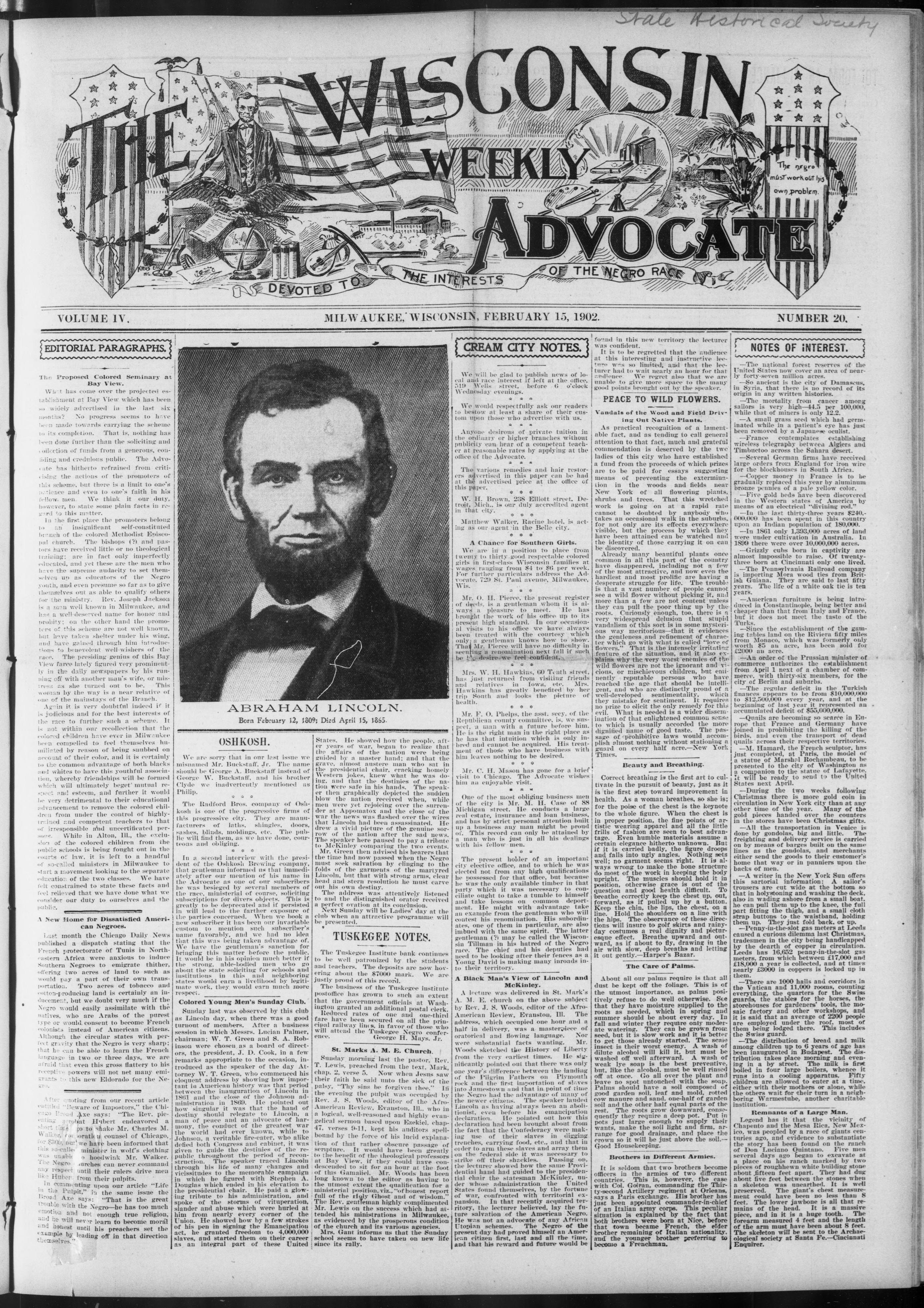
Page text (machine-generated)
WISCONSIN
WEEKLY
ADVOCATE
DEVOTED TO THE INTERESTS OF THE NEGRO RACE
VOLUME IV.
EDITORIAL PARAGRAPHS.
The Proposed Colored Seminary at Bay View.
What has come over the projected establishment at Bay View which has been so widely advertised in the last six months? No progress seems to have been made towards carrying the scheme to its completion. That is, nothing has been done further than the soliciting and collection of funds from a generous, considering and credulous public. The Advocate has hitherto refrained from criticising the actions of the promoters of this scheme, but there is a limit to one's patience and even to one's faith in his fellow men. We think it our duty, however, to state some plain facts in regard to this matter.
In the first place the promoters belong to an insignificant self-constituted branch of the colored Methodist Episcopal church. The bishops (?) and pastors have received little or no theological training; are in fact only imperfectly educated, and yet these are the men who have the supreme audacity to set themselves up as educators of the Negro youth, and even presume so far as to give themselves out as able to qualify others for the ministry. Rev. Joseph Jackson is a man well known in Milwaukee, and has a well-deserved name for honor and probity; on the other hand the promoters of this scheme are not well known, but have taken shelter under his wing, and have gained through him introductions to benevolent well-wishers of the race. The presiding genius of this Bay View farce lately figured very prominently in the daily newspapers by his running off with another man's wife, or mistress as she turned out to be. This woman by the way is a near relative of one of the mainstays of the Branch.
Again it is very doubtful indeed if it is judicious and for the best interests of the race to further such a scheme. It is not within our recollection that the colored children have ever in Milwaukee been compelled to feel themselves humiliated by reason of being snubbed on account of their color, and it is certainly to the common advantage of both blacks and whites to have this youthful association, whereby friendships will be formed which will ultimately beget mutual respect and esteem, and further it would be very detrimental to their educational advancement to remove the colored children from under the control of highly-trained and competent teachers to that of irresponsible and uncertificated persons. While in Alton, Ill., the exclusion of the colored children from the public schools is being fought out in the courts of law, it is left to a handful of so-called ministers in Milwaukee to start a movement looking to the separate education of the two classes. We have felt constrained to state these facts and feel relieved that we have done what we consider our duty to ourselves and the public.
A New Home for Dissatisfied American Negroes.
Last month the Chicago Daily News published a dispatch stating that the French protectorate of Tunis in North-eastern Africa were anxious to induce Southern Negroes to emigrate thither, offering two acres of land to such as would pay a part of their own transportation. Two acres of tobacco and cotton-producing land is certainly an inducement, but we doubt very much if the Negro would easily assimilate with the natives, who are Arabs of the purest type or would consent to become French colonists instead of American citizens. Although the circular states with perfect gravity that the Negro is very sharp; that he can be able to learn the French language in two or three days, we are afraid that even this gross flattery to his receptive powers will not net many emigrants to this new Eldorado for the Negro.
After quoting from our recent article entitled "Beware of Impostors," the Chicago Broad Axe says: "The Rev. piecating aerobat Hubert endeavored a short time to go to shake Mr. Charles M. Walker, corporation counsel of Chicago, for $300, but we have been informed that this so-called minister in wolf's clothing was unable o hoodwink Mr. Walker. The Negro churches can never command any respect until their rulers drive men like Hubert from their pulits.
In commenting upon our article "Life in the Palpit," in the same issue the Broad Axe says: "That is the great trouble with the Negro—he has too much emotion and not enough true religion, and he will never learn to become moral and honest until his preachers set the example by leading off in that direction themselves."
A. B.
ABRAHAM LINCOLN. Born February 12, 1809; Died April 15, 1865.
We are sorry that in our last issue we misnamed Mr. Buckstaff, Jr. The name should be George A. Buckstaff instead of George W. Buckstaff, and his brother Clyde we inadvertently mentioned as Philip.
The Radford Bros. company of Oshkosh is one of the progressive firms of this progressive city. They are manufacturers of laths, shingles, doors, sashes, blinds, moldings, etc. The public will find them, as we have done, courteous and obliging.
* * *
In a second interview with the president of the Oshkosh Brewing company, that gentleman informed us that immediately after our mention of his name in the Advocate as one of our subscribers he was besieged by several members of the race, ministerial of course, soliciting subscriptions for divers objects. This is greatly to be deprecated and if persisted in will lead to the farther exposure of the parties concerned. When we book a new subscriber it has been our invariable custom to mention such subscriber's name favorably, and we had no idea that this was being taken advantage of. We have the gentleman's sanction for bringing this matter before the public. It would be in his opinion much better if the strong, able-bodied men who go about the state soliciting for schools and institutions in this and neighboring states would earn a livelihood by legitimate work, they would earn much more respect.
Colored Young Men's Sunday Club.
Sunday last was observed by this club as Lincoln day, when there was a good turnout of members. After a business session in which Messrs. Lucian Palmer, chairman; W. T. Green and S. A. Robinson were chosen as a board of directors, the president, J. D. Cook, in a few remarks appropriate to the occasion, introduced as the speaker of the day Attorney W. T. Green, who commenced his eloquent address by showing how important in American history was that period between the inauguration of Lincoln in 1861 and the close of the Johnson administration in 1869. He pointed out how singular it was that the hand of destiny should relegate to Lincoln, a man of peace and an advocate of harmony, the conduct of the greatest war the world had ever known, while to Johnson, a veritable fire-eater, who alike defied both Congress and cabinet, it was given to guide the destinies of the republic throughout the period of reconstruction. The speaker traced Lincoln through his life of many changes and vicissitudes to the memorable campaign in which he figured with Stephen A. Douglas which ended in his elevation to the presidential chair. He paid a glowing tribute to his administration, and spoke of the storms of vituperation, slander and abuse which were hurled at him from nearly every corner of the Union. He showed how by a few strokes of his pen in signing the Emancipation act, he granted freedom to 4,000,000 slaves, and started them on their career as an integral part of these United
MILWAUKEE, WISCONSIN, FEBRUARY 15, 1902.
States. He showed how the people, after years of war, began to realize that the affairs of the nation were being guided by a master hand; and that the grave, almost austere man who sat in the presidential chair, cracking homely Western jokes, knew what he was doing, and that the destinies of the nation were safe in his hands. The speaker then graphically depicted the sudden blow the nation received when, while men were yet rejoicing over the surrender at Appomatox and the close of the war the news was flashed over the wires that Lincoln had been assassinated. He drew a vivid picture of the genuine sorrow of the nation after the sad news. The speaker here paused to pay a tribute to McKinley comparing the two events. Mr. Green then advised his hearers that the time had now passed when the Negro must seek salvation by clinging to the folds of the garments of the martyred Lincoln, but that with strong arms, clear head and stern resolution he must carve out his own destiny.
The address was attentively listened to and the distinguished orator received a perfect ovation at its conclusion. Next Sunday will be Ladies' day at the club when an attractive programme will be presented.
TUSKEGEE NOTES.
The Tuskegee Institute bank continues to be well patronized by the students and teachers. The deposits are now hovering about the $7000 mark. We are justly proud of this record.
The business of the Tuskegee institute postoffice has grown to such an extent that the government officials at Washington granted an additional postal clerk.
Reduced rates of one and one-third fare have been secured on all the principal railway lines, in favor of those who will attend the Tuskegee Negro conference.
George H. Mays, Jr.
St. Marks A. M. E. Church
Sunday morning last the pastor, Rev. T. Lewis, preached from the text, Mark, chap. 2, verse 5. Now when Jesus saw their faith he said unto the sick of the palsy, "Thy sins be forgiven thee." In the evening the pulpit was occupied by Rev. J. S. Woods, editor of the Afro-American Review, Evanston, Ill., who in a logical, well-reasoned and highly evangelical sermon based upon Ezekiel, chap. 47, verses 9-11, kept his auditors spellbound by the force of his lucid explanation of that rather obscure passage of scripture. It would have been greatly to the benefit of the theological professors at Bay View, if they could have condescended to sit for an hour at the foot of this Gamaliel. Mr. Woods has been long known to the editor as having to the utmost extent the qualification for a ministerial position, viz., "of honest report full of the Holy Ghost and of wisdom." The Rev. gentleman highly complimented Mr. Lewis on the success which had attended his ministrations in Milwaukee, as evidenced by the prosperous condition of the church and its various agencies.
Mrs. Gant informs us that the Sunday school seems to have taken on new life since its rally.
CREAM CITY NOTES.
We will be glad to publish news of local and race interest if left at the office, 519 Wells street, before 6 o'clock Wednesday evenings.
* * *
We would respectfully ask our readers to bestow at least a share of their custom upon those who advertise with us.
* * *
Anyone desirous of private tuition in the ordinary or higher branches without publicity can hear of a competent teacher at reasonable rates by applying at the office of the Advocate.
* * *
The various remedies and hair restorers advertised in this paper can be had at the advertised price at the office of this paper.
***
W. H. Brown, 238 Elliott street, Detroit, Mich., is our duly accredited agent in that city. * * *
Matthew Walker, Racine hotel, is acting as our agent in the Belle city.
* * *
A Chance for Southern Girls.
We are in a position to place from twenty to thirty good respectable colored girls in first-class Wisconsin families at wages ranging from $4 to $6 per week. For further particulars address the Advocate, 729 St. Paul avenue, Milwaukee, Wis.
立 准
Mr. O. H. Pierce, the present register of deeds, is a gentleman whom it is always a pleasure to meet. He has brought the work of his office up to its present high standard. In our occasional visits to his office we have always been treated with the courtesy which only a gentleman knows how to show. That Mr. Pierce will have no difficulty in securing a renomination next fall if such be his desire we feel confident.
Mrs. W. H. Hawkins, 60 Tenth street, has just returned from visiting friends and relatives in Iowa, etc. Mrs. Hawkins has greatly benefited by her trip South and looks the picture of health.
```markdown
```
Mr. F. O. Phelps, the asst. secy, of the Republican county committee, is, we suspect, a man with a future before him. He is the right man in the right place as he has that intuition which is only inbred and cannot be acquired. His treatment of those who have business with him leaves nothing to be desired.
* * *
Mr. C. H. Mason has gone for a brief visit to Chicago. The Advocate wishes him an enjoyable visit.
密穴
One of the most obliging business men of the city is Mr. M. H. Case of 88 Michigan street. He conducts a large real estate, insurance and loan business, and has by strict personal attention built up a business any man might be proud of. This record can only be attained by a man who is just in all his dealings with his fellow men.
* * *
The present holder of an important city elective office, and to which he was elected not from any high qualifications he possessed for that office, but because he was the only available timber in that party which it was necessary to conciliate ought to take a tumble to himself and take lessons on common deportment. He might with advantage take an example from the gentleman who will contest his renomination. His subordinates, one of them in particular, are also imbued with the same spirit. The latter gentleman (?) may be called the Wisconsin Tillman in his hatred of the Negro race. The chief and his deputies had need to be looking after their fences as a Young David is making many inroads into their territory.
A Black Man's View of Lincoln and McKinley.
A lecture was delivered in St. Mark's A. M. E. church on the above subject by Rev. J. S. Woods, editor of the Afro-American Review, Evanston, Ill. The address, which occupied one hour and a half in delivery, was a masterpiece of oratorical and flowing language. Nor were substantial facts wanting. Mr. Woods sketched the History of Liberty from the very earliest times. He significantly pointed out that there was only one year's difference between the landing of the Pilgrim Fathers on Plymouth rock and the first importation of slaves into Jamestown and that in point of time the Negro had the advantage of many of the newer citizens. The speaker lauded Lincoln as having always been an abolitionist, even before his emancipation declaration. He pointed out how this declaration had been brought about from the fact that the Confederacy were making use of their slaves in digging trenches, carrying food, etc., and that in order to arm these slaves and array them on the federal side it was necessary to strike off their shackles. Passing on, the lecturer showed how the same Providential hand had guided to the presidential chair the statesman McKinley, under whose administration the United States found themselves, by the fortune of war, confronted with territorial expansion. In that recently acquired territory, the lecturer believed, lay the future salvation of the American Negro. He was not an advocate of any African Utopian schemes. The Negro of the present day had proved himself an American citizen first, last and all the time, and that his reward and future would be
found in this new territory the lecturer was confident. It is to be regretted that the audience at this interesting and instructive lecture was so limited, and that the lecturer had to wait nearly an hour for that audience. We regret also that we are unable to give more space to the many good points brought out by the speaker.
PEACE TO WILD FLOWERS.
Vandals of the Wood and Field Driving Out Native Plants.
As practical recognition of a lamentable fact, and as tending to call general attention to that fact, much and grateful commendation is deserved by the two ladies of this city who have established a fund from the proceeds of which prizes are to be paid for essays suggesting means of preventing the extermination in the woods and fields near New York of all flowering plants, shrubs and trees. That this wretched work is going on at a rapid rate cannot be doubted by anybody who takes an occasional walk in the suburbs, for not only are its effects everywhere visible, but the process by which they have been attained can be watched and the identity of those carrying it on can be discovered.
Already many beautiful plants once common in all this part of the country have disappeared, including not a few of the most attractive, and now even the hardiest and most prolific are having a desperate struggle for life. The trouble is that a vast number of people cannot see a wild flower without picking it, and more than a few are not content unless they can pull the poor thing up by the roots. Curiously enough, too, there is a very widespread delusion that stupid vandalism of this sort is in some mysterious way meritorious—that it evidences the gentleness and refinement of character which go with what is called "love of flowers." That is the intensely irritating feature of the situation, and it also explains why the very worst enemies of the wild flowers are not the ignorant and vicious, or mischievous children, but eminently reputable persons who have reached the age that should be intelligent, and who are distinctly proud of a well-developed sentimentality, which they mistake for sentiment. It requires no prize to elicit the only remedy for this evil. What is needed is a wider dissemination of that enlightened common sense to which is usually accorded the more dignified name of good taste. The passage of prohibitive laws would accomplish almost nothing without stationing a guard on every half acre.—New York Times.
Beauty and Breathing
Correct breathing is the first art to cultivate in the pursuit of beauty, just as it is the first step toward improvement in health. As a woman breathes, so she is; for the poise of the chest is the keynote to the whole figure. When the chest is in proper position, the fine points of artistic wearing apparel and all the little frills of fashion are seen to best advantage. Even humble materials assume a certain elegance hitherto unknown. But if it is carried badly, the figure droops and falls into ugly angles. Nothing sets well; no garment seems right. It is always wrong to make the bone structure do most of the work in keeping the body upright. The muscles should hold it in position, otherwise grace is out of the question and good health difficult. To breathe correctly keep the chest up, out, forward, as if pulled up by a button. Keep the chin, the lips, the chest, on a line. Hold the shoulders on a line with the hips. The observance of these directions will insure to golf skirts and rainy-day costumes a real dignity and picturesque effect. Breathe upward and outward, as if about to fly, drawing in the air with slow, deep breaths and letting it out gently.—Harper's Bazar.
The Care of Palms.
About all our palms require is that all dust be kept off the foliage. This is of the utmost importance, as palms positively refuse to do well otherwise. See that they have moisture supplied to the roots as needed, which in spring and summer should be about every day. In fall and winter they require only moderate watering. They can be grown from seed, but it is slow work and it is better to get those already started. The scale insect is their worst enemy. A wash of dilute alcohol will kill it, but must be washed off well afterward. A wash of weak lye soap is the best preventive, but, like the alcohol, must be well rinsed off at once. Go all over the plant and leave no spot untouched with the soap. Palms should have a soil composed of good garden soil, leaf and mold, rotted cow manure and sand, one-half of garden soil and the other half equal parts of the rest. The roots grow downward, consequently they require a deep pot. Put in pots just large enough to supply their wants, make the soil light and firm, arrange for good drainage, and place the crown so it will be just above the soil. Good Housekeeping.
Brothers in Different Armies.
It is seldom that two brothers become officers in the armies of two different countries. This is, however, the case with Col. Goiran, commanding the Thirty-second Artillery regiment at Orleans, says a Paris exchange. His brother has just been appointed commander-in-chief of an Italian army corps. This peculiar situation is explained by the fact that both brothers were born at Nice, before that town became French, the elder brother remaining of Italian nationality, and the younger brother preferring to become a Frenchman.
NOTES OF INTEREST.
The national forest reserves of the United States now cover an area of nearly forty-seven million acres.
So ancient is the city of Damascus, in Syria, that there is no record of its origin in any written histories.
The mortality from cancer among sailors is very high-44.5 per 100,000, while that of miners is only 12.2.
—A small grass seed which had germinated while in a patient's eye has just been removed by a Japanese oculist.
—France contemplates establishing wireless telegraphy between Algiers and Timbuctoo across the Sahara desert.
—Several German firms have received large orders from England for iron wire for the blockhouses in South Africa.
—Copper money in France is to be gradually replaced this year by aluminum bronze pennies of a pale yellow color.
—Five gold beds have been discovered in the Western states of America by means of an electrical "divining rod."
—In the last thirty-three years $240,000,000 has been spent in this country upon an Indian population of 180,000.
—In 1861 only 1,393,000 acres of land were under cultivation in Australia. In 1899 there were over 10,000,000 acres.
—Grizzly cubs born in captivity are almost impossible to raise. Of twenty-three born at Cincinnati only one lived.
—The Pennsylvania Railroad company is importing Mora wood ties from British Guiana. They are said to last fifty years. The life of a white oak tie is ten years.
—American furniture is being introduced in Constantinople, being better and cheaper than that from Italy and France, but it does not meet the taste of the Turks.
—Since the establishment of the gaming tables land on the Riviera fifty miles from Monaco, which was formerly only worth $5 an acre, has been sold for £2000 an acre.
An order of the Prussian minister of commerce authorizes the establishment from April 1 next of a chamber of commerce, with thirty-six members, for the city of Berlin and suburbs.
The regular deficit in the Turkish finances appears to be from $10,000,000 to $12,500,000 every year, and at the beginning of last year it represented an accumulated deficit of $55,000,000.
Quails are becoming so scarce in Europe that France and Germany have joined in prohibiting the killing of the birds, and even the transport of dead quails across their respective territories.
M. Hamard, the French sculptor, has just completed, at Paris, the model of a statue of Marshal Rochambeau, to be presented to the city of Washington as a companion to the statue of Lafayette. It will be ready to send to the United States next April.
During the two weeks following Christmas there is more gold coin in circulation in New York city than at any other time of the year. Many of the gold pieces handed over the counters in the stores have been Christmas gifts. All the transportation in Venice is done by gondolas, big and little. The freighting and delivery service is carried on by means of barges built on the same lines as the gondolas, and merchants either send the goods to their customer's home that way or in panniers upon the backs of men.
A writer in the New York Sun offers this sartorial information: A sailor's trousers are cut wide at the bottom so that in holystoning and washing the deck, also in wading ashore from a small boat, he can pull them up to the knee, the full part fitting the thigh, and a small cloth strap buttons to the waistband, holding them up. They just fold back, or up.
Penny-in-the-slot gas meters at Leeds caused a curious dilemma last Christmas, tradesmen in the city being handicapped by the dearth of copper in circulation. Leeds has 16,652 penny-in-the-slot gas meters, from which between £17,000 and £18,000 a year is collected, and at times nearly £3000 in coppers is locked up in them.
There are 1000 hails and corridors in the Vatican and 11,000 rooms, counting everything, the quarters for the Swiss guards, the stables for the horses, the storehouses for gardeners' tools, the mosaic factory and other workshops, and it is said that an average of 2200 people are employed under the roof, most of them being lodged there. This includes the Swiss guard.
The distribution of bread and milk among children up to 6 years of age has been inaugurated in Budapest. The distribution takes place morning and evening in a by street. The milk is first boiled in four large boilers, whence it runs into a cooling apparatus. Fifty children are allowed to enter at a time, either with their mothers or alone, while the others wait for their turn in a neighboring Warmestube, another charitable institution.
Remnants of a Large Man.
Legend has it that the vicinity of Chapento and the Mesa Rica, New Mexico, was peopled by a race of giants centuries ago, and evidence to substantiate the story has been found on the ranch of Don Luciano Quintano. Five men several days ago began to excavate at a place on his ranch marked by two pieces of roughhewn white building stone about fifteen feet apart. They had dug about five feet between the stones when a skeleton was unearthed. It is well preserved. The giant's chest measurement could have been no less than 8 feet. The lower jawbone is all that remains of the head. It is a massive piece, and in it is a huge tooth. The forearm measured 4 feet and the length of the arm must have been about 8 feet. The skeleton will be sent to the Archaeological society at Santa Fe.—Cincinnati Enquirer.
TO FORM AN ALLIANCE.
Great Britain and Japan Agree to Preserve Chinese Empire.
PLEDGE JOINT FORCES.
Notice to Russia to Insist on Consumation of the Manchurian
London, Feb. 12.—The most important defensive and offensive agreement of recent years between nations has just been made public by the foreign office. Great Britain and Japan have formed an alliance which aims to preserve the integrity of the Chinese empire and of Corea. Though the articles of agreement do not state it in so many words, it is admitted by high officials that the alliance is a direct menace to Russia not to insist on the consummation of the Manchurian treaty.
Two of the articles imply the possibility that the allies may have to meet a double foe in the far East—Russia and France. In that case Britain and Japan agree to join arms, while in a conflict with a single enemy the noncombatant ally pledges to remain neutral and prevent other powers from joining in the hostilities.
The paper covers a dispatch sent by Lord Lansdowne, the secretary of state for foreign affairs, January 30 to the British minister at Tokio, Sir Claude M. MacDonald, and comprises a signed copy of the agreement.
In explanation the paper says the agreement may be regarded as an outcome of the events of the last two years. Throughout the "Boxer" troubles Great Britain and Japan had been in close and uninterrupted communication and actuated by similar views.
"We each desire," says Lord Lansdowne, "that the integrity and independence of the Chinese empire should be preserved and that there should be no disturbance of the territorial status quo, either in China or the adjoining regions."
RAILWAY ANSWERS.
Great Northern Denies that Its Business will be Merged in that of Another Company.
St. Paul, Minn., Feb. 12.—An answer has been served by the Great Northern railway on the attorneys for Milton L. Bouden and Sophia Barth Chapman in their action to prevent the Northern Securities company from securing the stock of the Great Northern railway.
The suit was brought in the district court of Hennepin county January 22 and transferred to the Ramsey county district court last Monday.
It is contended in the answer that the Great Northern railway system is now, as formerly, managed, operated and controlled by that company's officers and directors independently of other corporations and railway systems.
Regarding the relation of the Great Northern, Northern Pacific and Chicago, Burlington & Quincy railroads to each other, the defendants' answer is as follows: "They admit that the Northern Pacific and Great Northern systems were and are parallel and competing lines. They deny that the lines of the Chicago, Burlington & Quincy railroad system and the lines of the Great Northern or Northern Pacific company were or are parallel lines."
It is admitted that a corporation designated as the Northern Securities company was organized in November, for the purposes stated in its articles of incorporation only, and no others. The assertion in the complaint that the object of the Northern Securities company was the absolute withdrawal of the stock representing the controlling interests and vesting it in the Northern Securities with a view of perpetuating a combination of systems and placing the entire management and control in a central body, is denied in every detail and particular. The defendants admit that after the organization of the Northern Securities company an offer was made to purchase stock of the Great Northern company at $180 per share, and of the Northern Pacific company at $115 per share, and that it has purchased under those terms a majority of the latter company.
It is admitted that the Northern Pacific and Great Northern Railroad companies have at all times kept up and still keep up separate corporate organizations. The defendants say the corporations and managing boards are wholly independent of each other and that each of the companies, its affairs and systems of railroads have always been and are now managed, controlled and operated independently of the other said companies, its affairs and system.
GLORIFIED OUTLAWRY.
Judge Restrains Dramatic Production of "The James Boys in Missouri."
Kansas City, Mo., Feb. 12.—Judge Teasdale in the circuit court here today granted the application of Frank James for an injunction to stop the production of "The James Boys in Missouri," a drama depicting the James boys as train robbers and bank looters, and which has been playing at a local theater. James' petition alleges that the play was harmful to the youth of the country in that it glorified outlawry and made heroes out of outlaws, and said that it unjustly revived a reputation that he had been trying to live down for twenty years. The suit raised the question as to whether or not a private citizen could be portrayed on the stage without his consent, whether to his discredit or not.
Judge Teasdale instructs that James furnish a bond of $4000 to indemnify the theater people against loss in case the decision is overturned by a higher court, and until the bond is given the play will go on. It is believed James will produce the bond during the day. The piece has attracted big crowds here, the home of the James family.
THREATENED BY MOB.
Man Who Shot Two People Removed to Place of Safety.
New Orleans, La., Feb. 12.—Willis Cooper, who shot and killed William Perry and Mrs. Paraba Sussell at Amite City, La., was brought here hurriedly and lodged in the parish prison to escape lynching by an infuriated mob. While a carnival procession was in progress at Amite City, Cooper and Perry renewed a previous difficulty. Cooper drew his pistol and fired four shots not only killing Perry, but also Mrs. Paraba Russell, an aged lady who surrounded by her children and grandchildren were witnessing the parade. The killing of Mrs. Russell created intense indignation and the sheriff and his deputies had great difficulty in getting Cooper out of the reach of the excited crowd.
Jo Blackburn, Jr., Dies.
Frankfort, Ky., Feb. 12.—Jo Blackburn, Jr., son of United States Senator Jo C. S. Blackburn, died here this morning. He was about 30 years old and unmarried.
SAILS ON SATURDAY.
Prince Henry will Not Postpone His Visit to the United States
Berlin, Feb. 11.—Prince Henry of Prussia will sail for the United States on Saturday, as arranged. Even should President Roosevelt's son's illness result fatally before that time it is probable the prince will enter upon his journey, unless it should appear to be President Roosevelt's desire that his visit be deferred or omitted altogether.
The Associated Press bulletins telling of the condition of President Roosevelt's son have been sent to Prince Henry at the schloss. The prince manifested anxious interest in them, expressed his sorrow at young Roosevelt's illness and said he hoped he would recover.
It is understood both Emperor William and Prince Henry have sent personal messages to President Roosevelt. The first impulse of Prince Henry was to postpone his trip, or give it up altogether. He was advised, however, not to make this decision, but to bear in mind that his visit was not a personal one to President Roosevelt, but to the United States; that while a fatal ending to young Roosevelt's illness would limit the President's part in the hospitalities to a strictly official basis, the remainder of the programme might be carried out. To Secretary Hay and Dr. von Holleben, the German ambassador at Washington, will left the rearrangement of the programme of Prince Henry's visit if the illness of young Roosevelt makes such a change necessary.
Groton, Mass., Feb. 11.-Mr. Cortel you, secretary to the President, said today: "Nothing whatever has been heard here from official sources concerning any change in the plans of Prince Henry, and the launching of the Emperor's yacht probably will take place on the date already decided upon."
New York, Feb. 11.—Herman Ridder, who is in charge of the arrangements for the dinner to be given to the American press in honor of Prince Henry of Prussia at the Waldorf-Astoria on the evening of February 26, said today that both Archbishop Corrigan and Bishop Potter had been invited to attend and that while no reply had been received from Bishop Potter it was expected he would be present. Archbishop Corrigan accepted the invitation. Mr. Ridder added that as the dinner would occur in the Lenten season and as the Wednesday on which it will be held will be a fast day of obligation, Archbishop Corrigan has granted a dispensation to those Catholics who will be present to partake of meat. Mr. Ridder said it was estimated that 1100 persons would be present at the dinner.
SEIZE BRITISH SHIP.
Alaska Collector's Remedy for Pelagic Sealing Disapproved by Treasury Officials.
Seattle, Wash., Feb. 11.—Collector J. W. Ivey of Alaska has instructed his deputy at Unalaska to refuse port privileges to British vessels engaged in pelagic sealing, and in case of refusal to leave to call upon the United States marshal and the revenue marine for assistance. Washington, D. C., Feb. 11.—The treasury officials, when shown the dispatch from Seattle giving the text of a letter from Collector Ivey of Alaska to his deputy in Unalaska regarding the selling of supplies to Canadian vessels presumably engaged in pelagic sealing, said they had not received any information on the subject, but if the information was correct as to the collector's action it would not meet with the department's approval. Lieut. Jarvis is now on his way to Alaska to relieve Mr. Ivey as collector.
GAS COMPANY STUCK.
Assessed $5 per Day for Three Years for Turning Off Supply of New York Man.
New York, Feb. 11.—Because City Judge Bennett of Mount Vernon refused to pay a gas bill of $1.65, which he contended he had never contracted, the gas company turned off his supply three years ago. He brought suit and the gas company carried the case to the appellate division of the Supreme court, which has just handed down a decision affirming judgment for $4300 in favor of Judge Bennett for the inconvenience to which he had been put. The damages were assessed at the rate of $5 per day.
MILWAUKEEANS HAD CLAIM.
Attachment Against Electrical Works at Hartford, Conn.
New York, Feb. 11.—[Special.]—Deputy Sheriff Radley has received an attachment against the Eddy Electric Manufacturing company, makers of motors, of Windsor, Conn., for $1738 in favor of August P. Munning on an assigned claim of the Cutler-Hammer Manufacturing company of Milwaukee, Wis., for electric controlling devices.
Mr. Munning stated that he called at the factory on February 7 to collect the bill, and was informed by William R. C. Corson, the secretary, that the company intended to apply for a receiver at Hartford on the next day, February 8.
The company has an office in this city at 149 Broadway, but no information could be obtained there, as it was stated that the manager had gone to Hartford. The company has been in business since 1885, was originally incorporated with a capital stock of $10,000, but it has since been increased to $25,000 in 1894, and has a branch in Chicago.
TOKEN OF APPRECIATION.
Kaiser and Prince Made Honorary Members of New York Yacht Club. New York, Feb. 11. At the annual meeting of the Atlantic Yacht club which has just been held resolutions were adopted electing Kaiser William of Germany and his brother, Admiral Prince Henry of Prussia, honorary members of the club. The action was taken as a token of appreciation for the Kaiser's action in ordering an American yacht and his expressions of good will toward the United States.
Bee Hunting in Texas.
There are many professional "bee hunters" in the western and southwestern parts of Texas. Small caves and dark recesses formed by shelving rock abound along the tributaries of the Texas rivers. They are the natural hives of the wild bees and take the place of the hollow tree trunks of the forest regions of the northern country. These caves are used year after year by the bees, and in many instances have been found to be literally filled with honey.
A Tinpecanoe Monument.
A Tippecanoe monument will be erected in memory of Gen. William Henry Harrison's defeat of his savage adversary, Tecumseh, November 11, 1811, at the confluence of the Tippecanoe and Wabash rivers, in Indiana. Congress is to be asked to appropriate $50,000.
—Ely S. Cremiaux, for thirty-four years a policeman in Chicago, dropped dead while still in the city's service.
HONOR TO LINCOLN.
Birthday of the Martyr President Appropriately Observed In Many Places.
New York, Feb. 12.—All the exchanges, banks and other business places in the financial district, as well as the public offices and schools, were closed today in observance of Lincoln's birthday. This evening several banquets will be given at which speeches lauding the life and character of the Civil war President will be made. Boston, Mass., Feb. 12.—The anniversary of Lincoln's birth was observed here today by a liberal display of the national colors. The feature of the day will be the banquet of the Middlesex club this evening, at which several well-known men will speak, including John D. Long, secretary of the navy, and Congressman E. J. Hill of South Norwalk, Conn. The Boston Stock exchange was closed today.
Funeral Car Decorated.
Omaha, Neb., Feb. 12.—Lincoln's birthday was celebrated by the Union Pacific railroad by closing the entire headquarters for the day. President Lincoln's administration was especially identified with the building of the overland route and the day will be observed as much as possible over the system. The "Lincoln car," which stands dismantled at the old shops, was draped appropriately and the people were given an opportunity to view it. The last time the car was used was to carry the body of the martyred President from Washington to Springfield, the trip lasting from April 1 to May 3, 1865. The car was bought by the Union Pacific road and used as an official's car for some years. Later, however, it was retired and has since been kept for the memories with which it is surrounded.
At St. Louis.
St. Louis, Mo., Feb. 12.—The federal offices, all the local exchanges and some of the business houses closed today in commemoration of Lincoln's birthday. Patriotic exercises were held in the various schools, and different societies celebrated the event appropriately. The Illinois society of St. Louis will hold an informal reception and smoker. Addresses will be made by Lieut.-Gov. Northcote and Secretary of State Rose of Illinois and former Gov. Charles P. Johnson of Missouri. Frank P. Blair post No. 1 of the G. A. R. has arranged an elaborate campfire for this evening in honor of Lincoln.
At Chicago.
Chicago, Ill., Feb. 12.—Lincoln's birthday was observed here today by the closing of banks, municipal and county offices, the board of trade and the stock exchange. Appropriate exercises were held in the schools. Banquets will be given this evening by the Marquette, Lincoln and Standard clubs. At the Marquette club the speakers and their subjects will be: Lafayette Young, Iowa, "Abrahams Lincoln." Senator McLaurin, South Carolina, "Lincoln and His Relations to the South." Charles Emory Smith, Pennsylvania, "Lincoln and McKinley."
Curtis Guild, Boston, "Our Flag in the Tropics."
Philip P. Campbell. "The Responsive Powers of the Republic."
Gov. Yates will be the toastmaster at the Lincoln club.
At Columbus, O.
Columbus. O., Feb. 12.—Lincoln's birthday was not very generally observed in Columbus. The Senate adjourned over the day and the House suspended business at noon. Tonight the Jefferson-Jackson league will give a pro-Boer meeting with a Lincoln phase to it. Ex-Gov. Altgeld, Judge James P. Tarvin of Kentucky and ex-Congressman Timothy Tarsney will be the principal speakers. Ex-Congressman John J. Lentz will preside.
DIRECTORS ARE SUED.
Court Appoints Receiver for the Wrecked Detroit Savings Bank.
Detroit, Mich., Feb. 12.—Judge Donovan today appointed the Union Trust company of this city receiver for the wrecked City Savings bank. Judge Donovan fixed the bond of the company at $600,000. Prosecuting Attorney Hunt this morning began suit against the directors of the City Savings bank on behalf of Wayne county for $250,000. The county is one of the heaviest depositors in the wrecked institution. Cashier Henry Andrews of the City Savings bank is reported weaker today. His mind wanders and he has symptoms of recurrence of his heart trouble.
Sidney A. Witherbee today began suit in the circuit court against F. C. Andrews, former vice-president of the City Savings bank, whose overdrafts and over-certified checks caused the bank's suspension, to compel the return of certain securities including concession for a railroad in Mexico. Witherbee alleges that last September Andrews promised to loan him $100,000, but when he drew on him from Mexico for that amount the draft was not honored. Later he secured $50,000, but has since, so he alleges, been unable to secure the other $50,000 or the return of the collaterals for it.
Now he charges Andrews intends to turn over this collateral of Witherbee's to his own creditors.
GAGE ACCEPTS OFFER.
Will be President of United States. Trust Company of New York.
New York, Feb. 12.—Ex-Secretary of the Treasury Gage has accepted the presidency of the United States Trust company of New York, and will take up his duties in a few weeks. This information does not come from Mr. Gage, but may be relied upon as authentic. The former secretary accepted the New York offer with great reluctance, as he had almost made up his mind to go back to Chicago and accept the presidency of the Chicago Title and Trust company. It is understood that the United States Trust company made Mr. Gage an offer of such liberal nature that he found it impossible to decline.
PROF. PEARSON RESIGNS.
He is Refused Letter of Dismissal from Methodist Church.
Chicago, Ill., Feb. 12.—Prof. Charles W. Pearson, whose recent utterances against the infallibility of certain portions of the Bible occasioned wide comment in Methodist church circles, today resigned as professor of English literature at Northwestern university. Prof. Pearson also asked for a letter of dismissal from the Methodist Episcopal church, but the request was refused, as compliance would indicate that he was in good standing in the church.
TOLSTOI GROWS WEAKER
Count's Family are Assembled at the Bedside.
Yalta, Crimea, Feb. 12.—Count Tolstoi is continually growing weaker. His temperature is low and his pulse varies from 100 to 102. The pneumonia is not spreading and the improvement in his pulse and temperature has awakened hopes that he will rally.
All the members of the count's family are assembled at his bedside.
HOPE FOR RECOVERY.
Groton, Mass., Feb. 12.—"Young Theodore passed a very good night and his condition shows much improvement this morning."
This was the announcement made by Secretary Cortelyou at 8:30 o'clock this morning regarding the condition of the son of President Roosevelt, who has been ill with pneumonia for several days at the Groton school here. The night had been uneventful and except on one occasion, about 1:30 o'clock, no one had been seen moving about the sickroom. At this time one of the physicians was summoned to look at the boy, but he stayed only a few moments and after that all was quiet until daylight.
The statement made by Mr. Cortelyou was, as he said, "a general one," and would be supplemented by another soon after the morning examination by the physicians.
From expressions made by the school authorities and those most interested in the case, it is believed that the boy's condition, while not removed from the dangerous stage, has assumed a more favorable aspect.
For the first time within a week the weather changed this morning and although the sun was shining, there were signs of disagreeable weather.
President Roosevelt left the home of William A. Gardner, where he is staying, at 8 o'clock this morning and visited his sick son and his wife at the infirmary. In a short time he returned, accompanied by Mrs. Roosevelt, and they breakfasted at the Gardner house. Mrs. Roosevelt remained for an hour and then went back to the infirmary alone. She seemed to be more cheerful than at any time since her arrival and said: "My boy shows much improvement and rested well during the night."
The Morning Examination.
Secretary Cortelyou issued a statement at 11 o'clock saying that the morning examination by the physicians had confirmed the anticipatory statement he had made at 9 o'clock relative to the young invalid's condition. It was, Mr. Cortelyou said, very favorable, with slight improvement, and he added that the lad will probably have passed the danger point within the next forty-eight hours.
The temperature, pulse and respiration show improvement, but as this condition is always prevalent during the early morning hours it is expected that a change will occur later during the day. Secretary Cortelyou said that the boy has been delirious only once during his sickness and that was on Monday during a period of drowsiness. Mr. Cortelyou said also that the President would not leave Groton until his son had passed the danger point. He would not in any event be able to get away before late Thursday night or early on Friday. Communications from foreign governments, said the secretary, are all received at the state department, and the text of such messages will not be made public.
The only incident of the forenoon was the arrival of Rev. Dr. Parkhurst of New York. He said that he was on his way from Amherst to Clinton and stopped over to pay his respects to the President and inquire as to the condition of his son. In company with the President, Dr. Parkhurst walked about the school grounds for some minutes and was driven to Ayer at 10:30 o'clock. The physicians report the other two pneumonia patients, Howard Potter of New York and William Gammell of Providence, as improved. The crisis in Gammell's case has not yet been reached, but his condition is encouraging.
The special car in which the President came to Groton from Washington has been replaced by a large car, arranged to accommodate more people. While no definite arrangements have yet been made for the return of Mr. Roosevelt to Washington it is indicated that if the improvement in his boy's condition continues through today and tomorrow he may leave tomorrow night or early Friday morning.
President is Cheerful.
The afternoon reports from the sick chamber showed that the invalid's condition was practically unchanged from that reported early in the day. The pleurisy which yesterday developed in the right lung has not assumed a dangerous character. During the day the President found time to trausact quite a little business of official nature and later enjoyed a brisk walk with his wife. Both had an air of cheerfulness about them. The President planned, later in the day, to participate in a game of squash, on the courts attached to the Gardner house.
IMPERIAL YACHT HERE.
Hohenzollern Passes Sandy Lightship and is Enthusiastically Greeted.
New York, Feb. 12.—The German imperial vacht Hohenzollern passed inside the Sandy Hook lightship at 11:57 a. m., coming into port.
The arrival of the Hohenzollern at this port was a surprise as according to her itinerary when she sailed she was to touch at Bermuda. She left St. Thomas on Saturday last with Bermuda as her destination and it is surmised that she encountered heavy weather and found it advisable to change her course direct to New York.
The Hohenzollern was sighted by the marine observer at Atlantic highlands a few minutes before noon today. An hour later she passed in the narrows and as she steamed past Forts Wadsworth and Hamilton, the German naval ensign was displayed from the staff on her taffrail. Word of her arrival had been promptly sent to quarantine and when she came up the doctors were waiting to board and pass her. The delay was very slight and before half-past 1 o'clock the big yacht was heading up the harbor for Hoboken, where she will be docked and cleaned. The Hohenzollern was recognized by the shipping in the harbor and nearly all the passing vessels saluted either with a dip of the colors or a whistle.
The Kaiser's yacht is a bark-rigged, two-funnel man-of-war-like craft, with a ram bow. She shows no guns in sight, but carries two pieces for saluting purposes. At quarantine it was said by her officers that the question of their acceptance of any social courtesies prior to the arrival of the prince had not been considered by them, but they did not think it would be possible or proper to attend any function until Prince Henry arrives. The Hohenzollern docked at the piers of the North German Lloyd Steamship company at Hoboken and will be thoroughly overhauled and put in order.
Herman Ridder, who is in charge of the arrangements for the dinner to be given to the representatives of the American press in honor of Prince Henry on the evening of February 26, said today that he had received a telegram from Bishop Potter accepting the invitation to be present at the banquet and saying that he would be glad to say grace.
Death of Mrs. Bartel.
Menominee, Mich., Feb. 12.—[Special.]
—Mrs. Elizabeth Bartel, aged 73, died
last night. She was an old resident of
Menominee.
CONGRESS.
The House spent the day of the 6th on the legislative, executive and judicial appropriation bill. Very rapid progress was made, seventy-four of the 130 pages of the bill being disposed of before adjournment.
The House on the 7th passed the legislative, executive and judicial appropriation bill, the second of the regular supply bills. As passed it carries $25,171,969, which is $503,721 in excess of the current law. Only two amendments of importance were adopted. One provides for a commission to redistrict the legislative districts of Oklahoma, and the other, by Mr. Jenkins (Wis.), authorizes the President in his discretion to cover into the civil service the temporary clerical force employed on account of the war with Spain. There are about 1250 of these clerks still in the service. By the terms of the amendment the President must place all or none of them under the civil service. The judiciary committee reported favorably the bill for a national bureau of criminal identification in Washington as advocated by the police chiefs of the country.
Representative Lanham of Texas, Democratic member of the House judiciary committee, on the 5th presented a minority report on the bill for the protection of the President against assault and conspiracy. Routine matters took up the remainder of the session.
General debate on the oleo bill in the House closed on the 10th. It will be considered under the five-minute rule on the 11th and a vote will be taken late in the day. There appears to be no question that the so-called Gront bill will pass the House. Some amendments will be offered, and Chairman Wadsworth of the agricultural committee will present the minority measure as a substitute.
Opponents of the oleomargarine bill gained a temporary victory in the House on the 11th by securing an adjournment just as its advocates were preparing to have a vote taken on the measure and the various amendments. The move was made possible through a blunder on the part of Mr. Tawney, who was in charge of the bill. The day's proceedings were the most stormy of this session. There were many lively scenes, and the opponents of the bill had a great deal of sport with its advocates. They offered all sorts of amendments, among them being one to protect natural ice by taxing artificial ice; to protect pure sugar candy against the glucose made product; real sardines from imitation sardines, and even to tax the products of all trusts.
The House on the 12th passed the oleomargarine bill. There was no division on the final passage, the real strength having been made on a motion to recommit, which was defeated by a majority of 34. The provision to require the inspection and branding of renovated butter, which was adopted in the committee of the whole, was retained today on an yea and nay vote. As finally passed, the bill is somewhat modified from the form in which it was reported from the committee on agriculture. It makes oleomargarine or imitation butter or cheese transported into any state or territory for use, sale or consumption therein subject to the laws of such states or territories, notwithstanding that it may be introduced in original packages, and imposes a tax of 10 cents a pound on oleomargarine made in imitation of "butter of any shade of yellow." When not made in such imitation the tax is reduced to $1/4 of 1 cent per pound. The second section is intended to prevent dealers, hotel proprietors, restaurant and boarding-house keepers from coloring the uncolored article, by making any person who colors the product and then sells or furnishes it to others a manufacturer within the meaning of the act. Penalties for violation of the act are a fine of not less than $50 nor more than $500, and imprisonment for not less than thirty days nor more than six months.
Senate.
For four hours on the 6th the Senate had the Philippine tariff bill under discussion. The measure was completed, so far as the Philippine committee is concerned, all of the committee mendments being adopted. Several other amendments, however, will be offered, one or two being pending. The sedition laws in force in the Philippines sent to the Senate by the secretary of war in response to a resolution by Mr. Rawlins (Ustahi) were read in full by the clerk. Mr. Foraker (O.) then read from the revised statutes of the United States the laws of Congress relating to the crime of treason and similar offenses against the government, and said that the acts passed by the Philippine commission were almost identical in their language with the laws enacted by Congress in the days of the fathers of the republic, and that there was nothing unprecedented or unusual about them. Mr. Hear concluded the debate of the afternoon, and in the course of his remarks paid a brilliant tribute to Thomas Corwin, who, in the face of a hostile Senate, had uttered the sentiment which he had quoted earlier in the day.
The Philippine bill was taken up early in the Senate on the 7th. The session was notably quiet. Mr. Turner (Wash.) delivered a carefully prepared speech on the general Philippine question and had not concluded when the bill was laid aside for the day.
Throughout nearly the entire session of the Senate on the 10th the Philippine tariff bill was under consideration. Mr. Turner (Wash.) concluded his speech begun the preceding week on the legal and constitutional phases of the Philippine question. When Mr. Turner concluded, Mr. Teller (Col.) took the floor to deliver a speech on the pending measure, but had scarcely introduced his argument before he requested that he be allowed to continue his address the following day. The Senate then went into executive session.
Mr. Platt (Rep., Conn.), in the Senate on the 11th, defended the Philippine policy and endorsed those treason laws adopted there to which the senator from Colorado took exceptions. Mr. Hoar (Rep., Mass.), in denying certain statements of the senator from Connecticut, relative to the establishment of peace and schools in the islands, ridiculed the policies there. Mr. Platt (Conn.) replied rather sharply to Mr. Hoar, declaring impressively: "If our government is worthy of name, worthy of living, worthy of place in the present or future, it will put down rebellion whenever take up arms against it." Senator Teller (Col.), after having spoken two hours in opposition to the policy of the administration in the Philippines, announced that if there was no objection he would conclude his remarks the following day. Earlier in the session Senator Carmack (Dem.) of Tennessee offered a resolution declaring against the admission of the Philippine islands into the United States as a state or territory.
With the exception of a sharp clash between Mr. Lodge and Mr. Patterson over the matter of admission of representatives of the press to the investigation which the Philippines committee is conducting, the discussion of the Philippines tariff bill in the Senate on the 12th was quiet. A communication from the secretary of war transmitting a memorial of the Federal party of the Philippine islands in support of American rule in the islands, called from Mr. Patterson the statement that the Federal party had obtained its control in the Philippines by promising to the Filipinos that they would be admitted ultimately to statehood in the United States. Mr. Teller occupied the attention of the Senate during the greater part of the session.
Hotel Center of the World.
An idea of the abundance of hotel accommodations in New York may be had from the statement of the president of the Hotel Men's association there that New York has become the greatest hotel center in the world. It has more hotels than London, Paris and Berlin combined. There are twice as many hotels in New York today as there were a year ago, and they are being put up by the dozen, by the score, by the hundred, and they are reckoned the best investment there is going."
Fox in the Soapsuds.
During the run of the Warwickshire hounds a fox, hard pressed, dashed into a back kitchen at Nailey hall, the seat of the Marquis of Hertford, where a woman was at the time washing clothes. Seeking a place of concealment, the animal sprang upon the furnace, and then dived into the almost boiling soapsuds, from which, however, he was quickgly out again, and was then captured.—London Telegraph.
School for Lion Tamers.
A school for lion tamers is the latest educational novelty proposed in Paris. It is in the Jardin des Plantes.
"I had a bad cough for six weeks and could find no relief until I tried Ayer's Cherry Pectoral. Only one-fourth of the bottle cured me." L. Hawn, Newington, Ont.
Neglected colds always lead to something serious. They run into chronic bronchitis, pneumonia, asthma, or consumption. Don't wait, but take Ayer's Cherry Pectoral just as soon as your cough begins. A few doses will cure you then. Three sizes: 25c., 50c., $1. All druggists.
Consult your doctor. If he says take it, then do as he says. If he tells you not to take it, then don't take it. He knows. Leave it with him. We are willing. J. C. AYER CO., Lowell, Mass
EXCURSION ANNOUNCEMENT.
Mr. H. B. Smith, who is the Eastern representative of the Big Bend Land company of Spokane, Washington, was seen by a reporter at his office at the St. Charles hotel at Milwaukee, Wis. last evening.
Mr. Smith said that on account of the numerous inquiries and urgent requests received from farmers all over the state, who wish to visit that section as early as possible, he has decided to run the first of a series of excursions to the Big Bend country, Washington, within the next thirty days. On these excursions a lower rate of fare will be made land seekers than ever before offered. Railroad fare refunded from St. Paul to all purchasers of land of this company. These excursions will be personally conducted by Mr. Smith, who will accompany all excursions, which is assurance that no one will become homesick while en route.
Speaking of Washington, Mr. Smith said: "As an agricultural state it is without a superior. There are many reasons why the state of Washington is justly regarded as the coming agricultural state of the Union. Its fertile soil, its unexcelled climate, its good and abundant water, are all great attractions to home-seekers. This is especially true of the far-famed Big Bend country, where upwards of 50,000 acres of this highly-productive land, which is partly in improved farms, can still be had at comparatively low prices, at one-fourth cash, balance on time to suit, at low rate of interest.
Why, every farmer can have an orchard if he wishes. They have fresh flowers ten months of the year out there, and on account of the cool summer nights, the Hessian fly and the chinch bug and potato bug are unknown in that country. What do we do for a market for those tremendous wheat crops and other farm products raised in that country? At present we have a very good market. China and Japan furnish a market for the larger portion of the wheat raised in the Pacific coast states. And the prevailing price of grain in Washington is equal to that of Chicago and Minneapolis.
There was a time when all this grain had to come East, and with the high rates existing at that time the farmers had to sell their wheat at from 25 to 35 cents. But today the Oriental market takes all the wheat of Washington and Oregon.
And I believe that the time is not far distant when China and Japan will purchase the entire wheat surplus of the Western United States. Why should the farmer pay the prices asked for cut over, burned over and sandy lands of this state, which cost over $20 per acre to clear, when he can purchase Big Bend lands in eastern Washington, where the finest grain and fruit lands can be had at a much lower price—where there is no crop failure, good market, good prices, good schools and churches? For information regarding the Big Bend country, Lincoln county, in the state of Washington, write to Mr. H. B. Smith, at St. Charles hotel, Milwaukee, Wis., who will gladly furnish any information desired.
Less Swearing Over the 'Phone
"No, there isn't nearly so much swearing over the 'phone as there used to be," said a girl recently in the telephone exchange. "I've been at 'central' now for a good many years—more years than I like to think about sometimes—and I am in a position to speak with authority of this apparent change for the better in public morals. I don't think it is because men are less addicted to profanity, but because they are getting used to the 'phone and are more patient. It used to be that business men would brook no delay, and would not understand why they shouldn't be treated with the utmost consideration. Then they would swear. Now they are educated up to the thing, and are more inclined to be patient."—Kansas City Journal.
A Strong Statement.
Star, Wis., Feb. 10.—Mr. Samuel S. Hook, one of the most highly respected residents of this neighborhood, has given a very hearty recommendation to Dodd's Kidney Pills, a remedy recently introduced here. He says: "I have been a sufferer from Kidney Disease for some time and found nothing to help me till I began to use Dodd's Kidney Pills. They gave me almost immediate relief, and I am now well. I have recommended them to many friends and in every case with splendid results. "They are the very best pills for all kinds of allments, but especially for Kidney Complaints."
This is a very strong statement, and coming from a gentleman of Mr. Hook's standing and reputation, it has had a tremendous influence in Vernon County.
To secure additional holidays the students at eighteen Italian universities have resolved to come out on strike during the present month.
In memory of the late Miss Kate Greenaway it was proposed to endow a cot in one of the children's hospitals in London.
Mrs. Austin's Wheat Food pleases the whole family, from baby to grandfather. Makes a healthy, hearty breakfast that satisfies.
—A coming demand for an eight-hour day in mining is announced in the Central-Western coalfields.
—Nome's population this winter is estimated at about 3000, which is 1500 less than last winter.
Garfield Tea, the Herb Medicine, cures constipation and liver disorders.
—Tea consumed in England is subject to a duty of 12 cents a pound.
MY SHIP.
I stood marooned on a desert isle,
With my gaze o'er the white-capped sea,
And hope leaped up in my heart the while—
My ship—would it come to me?
My beautiful ship with its sails of snow,
Swanlike on the ocean's blue;
While ever I gazed where the sky hung low,
And ever my longing grew.
Long, long I watched in the burning sun;
And just at the close of day,
A glint of white where the fog banks run,
Flashed up like a whitecap spray—
Flashed into my sight on the low sky line;
Then out of the sea upreared
The black storm-cloud; and this ship of wine.
When lo! at the break of day,
There, dancing at anchor with sails at rest,
My ship in the harbor lay!
My beautiful ship! When the night was
black.
When the sky was the hue of lead,
O'er rock and reef, through the thundering
rack.
She sailed with a steady head!
Oh, faltering one! when the dark hour falls,
Deem not that all hope is past.
But hark for the sound of the Pilot's calls
For your ship will come in at last.
-Lowell O. Reese in San Francisco Bulletin.
A PENNY STAMP.
It was a letter my wife had given me to post earlier in the day. I had put it into my pocket with the best of intentions, explaining that I would get some stamps as I went along. And now I took that letter out of my pocket and looked at it. Where was I to buy a stamp at 11:30 p. m.?
True, there was a public house just opposite. I hate going into public houses; but it was so late, and I wasn't likely to meet anyone I knew, so I went in. I had always understood that public houses usually kept stamps for the convenience of careless correspondents. I ordered a little something, and then I said to the lady behind the bar that I supposed she could sell me a postage stamp. The lady said she was awfully sorry; she had just sold the last one.
I smiled drearily, and said it didn't matter. This was not true. That letter was addressed to a lady who should have received it that night. She was an exalted person whom my wife would not have ventured to disappoint for worlds. Ho! There was a newspaper shop, just putting up its shutters. I rushed in and asked for an evening paper and a postage stamp in the same breath. All the evening papers had gone, and the proprietor, evidently anxious to get to bed, was crowding me politely toward the door. I picked up a little pamphlet. It was marked "2d." I said I would have that instead, and I should consider it a favor if he would sell me a postage stamp.
"No postage stamps this time of night," said the proprietor abruptly. I stuffed the pamphlet into my pocket and fled. I never looked at it again till I reached home; but I have since thought that the news vender must have slightly doubted the condition of a customer who would accept in place of an evening newspaper a manual on the art of dancing jigs and reels, with two colored plates and several diagrams. A little further up the street there was a baker's shop. Its door was shut, but there was a light burning inside, and on the strength of that I knocked for admittance. An old lady let me in and then hurried behind the counter, where she stood with an inquiring stare, apparently under the impression that I had come to buy up the shop.
I apologized for the lateness of the hour and everything else I could think of, and then I meekly explained that I was in want of a postage stamp. The old lady hesitated. I caught up a long loaf of bread—the only one left—and I said I would have that. How much was it?
I forget what she said—twopence or threepence, with an odd farthing. I put the money down directly, and again submitted that I was urgently in need of a penny stamp.
The old lady was very sorry, but she didn't sell stamps at all. Had an idea a license or something of that kind had to be got from the government. Never had occasion to use stamps herself through, not knowing how to write. Perhaps if I inquired of the police—
I bade her good night hurriedly and turned to the door with my purchase under my arm, when she called me back. In spite of my protests she insisted on formally weighing the bread and pressing upon me a stale crust, which, she said, was necessary by iaw to make up for an apparent deficiency in the weight of the loaf. I had no words. I caught up the morsel of bread and plunged out into the night.
There I was in a back street off the Marylebone road with a loaf of bread and that extra crust under my arm, calculating that I had just twenty minutes to catch the last train to Kensington. I walked for about half a mile, dimly trying to estimate the consequences of posting that letter without a stamp as I went. All at once I came across a burly man standing at his shop door and smoking a pipe. He was a common, unpleasant looking person, but in my despair I felt I could cringe to anybody if there was a chance of getting out of my trouble. I walked up, and—yes, I did—touched my hat as I said: "I beg your pardon, but would you mind obliging me with a postage stamp?"
"Beggin' yourn' guv'nor," came the reply, "but I only keeps stamps for my customers."
I took him at that. It was a gleam of sunshine at last. I hinted meekly that I would like to become a customer. I had not the faintest idea of what he had to sell, but I thought I could perhaps buy a trifle that might come in handy at some time. So I followed him into the shop. He was a bird fancier, or something in that way. He informed me that he had had dealings with the King when he was the Prince of Wales; then bluffly inquired if I would prefer a singing canary or a leetle dorg. There was no help for it. I said I would have the canary. At the worst, I could let it go when I got outside. I hit upon a dingy little thing in a dingier cage and inquired the price.
"Five an' a tanner buys it, guv'nor, cage an' all," he said.
I bought it, cage and all, and then I referred to the postage stamp.
The dealer made a long search. He looked carefully behind the dog kennels, under the bird cages, on top of the rabbit hunched and inside the chicken coops. Then he came back and said mournfully that he was blessed if they'd got one left.
I drifted sadly away, and thought I would give up trying any more. I had the loaf o' bread still under one arm, and that infernal bird—cage and all—under the other. And still I had no prospect of a postage stamp.
A cab drove up, and the driver urged me to be driven somewhere. I said: "No, thanks; but—er—I say, cabby, have you got such a thing as a postage stamp about you? I'll—er—I'll give you this loaf of bread for it."
The cabman said—well no, it doesn't matter what he said, but he drove off saying it, and said it till he was fifty yards away, and then he stopped 'short' and said it all over again.
I arrived home that night by the last train, with a loaf of bread and a singing canary and a feeling of acute depression. Some days later my wife informed me that the letter she had given me to post
to the great lady had been delivered unstamped, with twopence to pay. I said I was not surprised to hear it.—PickMe-Up.
A MERRY CEREMONY.
Kisses Collected in Lieu of Taxes on Hock Tuesday.
The "hocking," which takes place in Hungerford on the Tuesday following the second Sunday after Easter, varies little from that practiced in olden days in many other parts of England. On the morning of Hock Tuesday, or Hockney day, two officers, named tithing or "tutti-men" (collectors of a penny tithe, and bearers of nosegays or "tutties," in west country parlance), parade the town, carrying each a staff ornamented with flowers, bedecked with ribbons, and surmounted with an orange. Their business is to call at every house and demand a poll-tax of one penny from each inmate over 14 years of age; in the case of the fair sex, a kiss may be asked for as an equivalent, and no refusal is taken! Usually a handsome sum is given by the master of the house as payment in full for himself and family, but cases have occurred where timid and unprotected (usually unmarried) ladies have been afraid to open their doors less the kiss should be demanded "without the option of a fine," and on such occasions the gallant tutti-men are said to have effected an irregular entrance, and taken ample toil for their extra trouble.
As the "tutti-men" are treated frequently on their rounds the town is kept in a ferment for the greater part of the day, hosts of holiday makers swelling the procession, while cakes and oranges are freely enjoyed by the swarms of excited children who follow close on the heels of the officers. Hocking proper has disappeared from the order of events, a circumstance to be regretted by all lovers of quaint customs. Formerly the men went through the town on Monday carrying a chair gaily decked with ribbons, or, more probably, it was kept concealed until some unwary woman ventured from her house, when she was caught, placed in the chair and "hocked," or lifted three times, after which, if unable or unwilling to pay the tax of money demanded, she was kissed by all the revelers. On the following day it was the privilege of the woman to "hock" the men, with the usual result of a large haul of money, with which a supper was provided. In most parts of England the celebration of hocktide has fallen entirely into disuse; even in Berkshire, as we have seen, the rougher element has been dropped, though the toll and its substitute, the garlands, and the supper, are still religiously maintained. London Globe.
THE COWBOY'S JOYOUS LIFE.
His Happiest Moment When a Train load of Tenderfeet is in Town.
There is joy in the hearts of the cowboys who are gathered for the winter in the little cow towns along the line of the Great Northern railway in northern Montana. The railway company has announced its indignation at the actions of the boys and they are gleeful in consequence. To stir up the wrath of a great railway corporation is a luxury not often given to the boys who punch cows.
The management of the railway takes exception to the habit the boys have formed of letting off revolvers with apparent recklessness during the passage of passenger trains through the town. It is an amusement dear to the soul of the cowboy. Just now he has more money than he has at any other time of the year, and also has more ammunition. The presence of a passenger train at the station, with its load of curious outlanders, moves him to show off his badness. He whoops and yells and fires his revolver until the train has pulled away, then he relapses into his everyday self, satisfied that he has scared the passengers to a frazzle. But Mr. Hill says this is reprehensible, and must stop. Will it stop? Well
After all, the boys do not do any great amount of damage. They enjoy their innocent little amusement of shooting holes in the sky and trying to impress the tenderfeet passengers. The boys have simply carried into manhood that very human juvenile desire to shaw off, and when they let out a fusilade of shots and a series of yells calculated to straighten out the kinks in a sleeping car porter's hair they are only trying to put some color and romance into their very unromantic and practical lives. The only harm is to the nerves of the passengers, but just think what a lot the experience gives the passengers to write about! What hurid letters can they send home of their adventures in the wild and woolly! What delicious thrills of excitement and terror can be felt in those few moments at the cow town depot! Why, it's a slice of real life drama, better than a bushel of Hamlin Garland's stories. It is an open question whether the passengers secretly do not like the thing, for all the protests they may make to the railway people. But it will be interesting to observe the attempts to stop the cowboys.—Anaconda Standard.
The World's Record in Wedding.
In these days of record-breaking there is still one record handed down to us from classic times which remains unbroken. It may be called the wedding record, and was established by command of the all-conquering Alexander of Macedon.
This largest and most remarkable wedding since the world began took place at Susa. When Alexander the Great had conquered Persia, wishing to unite victors and vanquished by the strongest ties possible, he decreed a wedding festival, Alexander married Statira, the daughter of Darius; 100 of his chief officers were united to ladies from the noblest Persian and Medean families, and 10,000 of his soldiers married 10,000 Asiatic women. In fact, 20,202 people were married at once.
Moreover, some marvelous caterer, whose name deserves to have been handed down to posterity, managed to get up a feast for all the brides and bridegrooms and for a vast multitude of guests besides.
They had the most splendid arrangements. On a plain near the city a vast pavilion was erected on pillars sixty feet high. It was hung and spread with the richest tissues, while the gold and precious stones which ornamented it would have made your eyes blink. Adjoining this building were 100 gorgeous chambers for the hundred bridegrooms, while for the remaining 10,000 an outer court was inclosed and hung with costly tapestry, and tables were spread outside for the multitude.
A separate seat was assigned each pair, and all were arranged in a semi-circle on either hand of the royal throne.
Each bridegroom had received a golden vessel for his libation, and when the last of these had been announced by trumpeters to the multitude without the brides entered the banquet hall and took their places.—London Express.
Georgie Sees Newcomer.
Little Georgie was taken by his aunt to see the newcomer, aged one day. He was duly and profoundly impressed with the specimen, and asked where the little brother came from. "God sent it," answered the aunt, reverently. The answer made a deep impression on little Georgie, for that afternoon he was seen out in the backyard gazing up into the deep blue sky and spreading his diminutive apron expectantly as he said: "Dear God, please throw me down one, too."—Troy Press.
LOSS OF EIGHT MILLIONS.
HUNDREDS HOMELESS.
Twenty-six Blocks of the City's Best Buildings Burned Over-Fierce Gale Prevailed.
Paterson, N. J., Feb. 10.—Twenty-six blocks of the city's best buildings in ruins, including practically every important public structure, five churches, scores of stores and office buildings, and 500 residences and apartment houses, with 1000 families homeless and property lost estimated at $8,000,000, are the results of a fire that started shortly before 1 o'clock yesterday morning in the carsheds of the trolley company on lower Broadway.
Conservative opinion inclined today to cut $2,000,000 from yesterday's estimate, and $8,000,000 will probably be accepted finally as the actual cost of the fire. It was stated here today that the insurance amounted to between $4,000,000 and $5,000,000. Dozens of firemen and the volunteers who labored with them were slightly injured by falling bricks and timber, burned by flying firebrands or temporarily overcome by smoke, but only a few of them needed either surgical or medical attention. The small casualty list is explained by the fact that the people had ample warning and time to abandon their homes before the flames came upon them.
A bread and coffee famine was averted by outside aid. A Newark bread company early this morning started wagons loaded with 3000 loaves of bread for free distribution in the stricken city. Wealthy residents of this city ordered large supplies of coffee and provisions from Passaic, Newark and New York. Two deaths were due to the calamity. One was that of an old woman who fell downstairs in her anxiety to view the fire. The other was a woman who had just become a mother and who died as the result of being removed from her home.
Great Silk Mills Escaped.
The fact that the great silk mills escaped is most important, as silk-making is the principal industry of the city. About half the population depends upon the silk trade and if their occupation had been taken away, the situation would have been appalling. Another important industry is that of locomotive building. The great Rogers works and the American Locomotive works give employment to thousands and these are running as usual today.
Just before daybreak the militia arrested in one haul eleven men caught looting a building. Cos. A, C and M of the Fifth regiment; Co. E of Passaic, and fifty deputy sheriffs were on guard all night. They had orders to club anyone who did not obey orders to move on.
Anarchist District Suffers.
The Anarchists who have made this city their headquarters mourn the loss of their favorite meeting place, the office of La Questione Sociale. The office of this newspaper was in Market street and it went down in the path of the flames. The home of Miss Ernestine Cravell, the young woman who attracted attention after the murder of King Humbert, by her inflammatory speeches in public meetings, was also burned.
The homes of many others of the Paterson Anarchists were destroyed, though Bartholdi's hall, which was the boarding house of Bresci, the assassin of King Humbert, was untouched by the fire. The houses near it on Straight and Market streets were all burned to the ground.
Sweeps Through Heart of City.
Fanned by a fierce northerly gale, the flames swept across the city, cutting a mile-long swath through the business center, despite all efforts of the local fire department and companies from all nearby towns. Not until late in the afternoon was the fire under control, and last night, in a score of places, it was burning fiercely.
Martial law is in force, with state troops, police and deputy sheriffs, guarding the streets. No one was allowed on the streets after 7 o'clock, and the same rule will be enforced for several days to come. Gov. Murphy has promised all aid possible.
Robbers at Work During Fire.
Considerable looting was reported while the fire was in progress, but the rigid enforcement of military rule is expected to prevent serious loss in this way.
An order by the mayor forbids the selling of liquor, but this was ignored and some disorder resulted.
Although 1000 families were driven from home, nearly all losing everything but the clothes they wore, there is little serious distress, as the residences burned are mostly homes of well-to-do people. Prompt measures for relief were taken, and many cities offered aid, but so far nothing has been asked from outside, the authorities being confident they can cope with the situation.
None of the more important manufacturing plants was lost in the fire, and this means that little idleness will result.
The Principal Losses.
An incomplete list compiled by a business man gives the following estimated losses:
City hall $450,000
First National bank 100,000
Second National bank 60,000
Paterson National bank 75,000
Hamilton club 150,000
Katz building 65,000
Garden theater 50,000
United States hotel 40,000
Public library 100,000
Quackenbush & Co., department store, building and contents. 500,000
First Baptist church, structure and furniture 75,000
Paterson high school, building and contents 35,000
Old city hall, used for police headquarters 15,000
Boston department store, Meyer
company
St. Mark's church, building and contents
St. Mary's parochial school
Park Avenue Baptist church, building and furnishings
St. Joseph's German Catholic church, buildings and furnishings.
St. Joseph's rectory and furnishings
National clothing store, Levy, Lachenbruck & Co., proprietors, building and stock
Paterson department store, D. Sonneborr, proprietor, building and stock
Marshall & Rail, clothiers, building and stock
Globe department store, D. Bohm, proprietor, building and stock
Stevenson building
Kent's drug store
Kinsella's drug store
Fuld's shoe store
Muzzy Brothers, hardware, build-
ing and contents .....
Douglas shoe store .....
Sunday Chronicle .....
Romain building .....
D. H. Wortendyke & Co., grocers .....
John Norwood, paints .....
Engine house No. 1 .....
Oberg's grocery, building and contents
Police patrol headquarters.....L. D. Michaelson, clothier, stock...Sorosis shoe store. stock.....Waldorf shoe store, stock.....Cogan & Tohouey, saloon.....J. Brett, saloon.....
Hugo Munzer, saloon and wholesale liquors, building and contents..... "Billy" Kane, saloon..... Dr. E. F. Dinner, residence and furniture..... John Mullin, furniture stock.
Furniture
John Mullis, furniture, stock
Bishop & Irwin, department store,
stock
J. A. Van Winekle & Co., hardware, building and contents Broadway, son stables and cars
Preparing to Rebuild.
With the embers still aglow in the business district, commercial Paterson planned resumption and restoration. All of the banks burned out opened for business in temporary quarters today. It was announced that their safes and vaults had proved strong enough to preserve the securities, moneys and records locked in them. Some of those whose business places and homes were destroyed were ruined financially and must give up, but the majority will be able to start afresh. Underwriters and adjusters representing insurance companies are hurrying here and negotiations for the adjustment of losses have been commenced.
The militiamen remained on guard today, and will be kept under arms and on duty as long as necessity for their services exists. Much valuable property is still exposed and the authorities are determined to prevent looting or disorder. Saloons that attempted to open after midnight were promptly closed and the sale of liquor was prohibited until after daylight.
BIG SHOPS BURN.
Water Pressure Insufficient to Stay Progress of Flames.
Springfield, O., Feb. 10.—The great East street shops built by William N. Whitely, the reaper king, at a cost of $2,000,000, were destroyed by fire today. The shops were occupied by the Springfield Foundry company, Progress Stove and Furnace company, Indianapolis Frog and Switch company, Kyle Art Glass company, Krell French Piano company, Miller Gas Engine company, Champion Chemical company and Owens Machine Tool company. The building was bought by Senator Fairbanks of Indiana ten years ago, following the failure of Whitely. The loss is over $1,000,000. Water pressure was insufficient and firemen were handicapped from the start.
A wind from the west was sweeping the fire back over the wings to the rear. At 10 o'clock the whole front of the building, which is five stories high, was ablaze. Half an hour later the walls began to tumble in. The heat was so intense that the firemen worked with the greatest difficulty. About 1000 men were employed by the different concerns located in the building. Losses are estimated as follows: Owen Machine Tool company, $60,000; Champion Chemical company, $30,000; Springfield Foundry company, $100,000; Progress Stove and Furnace company, $30,000; Indianapolis Frog and Switch company, $50,000; Miller Gas Engine company, $30,000; Green Manufacturing company, $5000; Krell French Piano company, $150,000.
The insurance is $130,000 on the contents, and for Senator Fairbanks on the building $110,000, a total of $240,000.
The Big Four railroad had three carloads of gasoline on the siding adjacent to the shops, but they were hauled away before the flames reached them.
The great East street shops were built nearly thirty-five years ago by Whitely, Fassler & Kelly, of which company William N. Whitely was the dominating factor. The shops at the time of their completion were the second largest in the world, being rivaled only by the great Krupp Gun works at Essen, Germany. The shops at one time had 2500 men on the payroll.
ELEVEN LODGERS PERISH.
Flames Cut Off Escape from Burning St. Louis Hotel.
St. Louis, Mo., Feb. 10.—Ten men and one woman were killed outright and a score were hurt in the flames that destroyed the Empire hotel yesterday morning. Most of the guests had been roused from sleep by loud cries of fire. Dressed only in their nightclothes, choking with bitter smoke and frantic with intense heat, they rushed pell-mell for their stairways, only to find them blocked by leaping flames and dense smoke.
Without considering for a single instant the peril of jumping or the zero weather, the occupants of the fast burning structure smashed window panes and leaped out to the pavement.
More than a dozen of those who jumped were badly injured. One was killed. Those who survived were forced to suffer doubly, for the night was one of the coldest of the winter, the walks were covered with snow and ice, a howling gale was blowing. The injured were forced to lie in the snow and the biting blasts until the firemen and policemen could gather up the moaning victims and carry them into nearby houses or to hospitals.
Several of the guests were unable to get to the windows and their bodies were found, charred almost or fully beyond recognition, in the ruins of the rooms they had occupied.
The Empire was a three-story structure at 2700 and 2702 Olive street. It was known as a lodging house and was occupied exclusively by men. The woman who was killed was a chambermaid.
Names of the Victims.
MORRIS YALL, senior member firm Yall,
Clark & Cowen, manufacturers of fine cut
glass; body burned to a crisp.
TOBE DAVIS, suffocated.
JOHN C. LUEDERS, father of Deputy
City Marshal Leo Lueders; skull fractured
in jumping from third-story window.
GEORGE THOMPSON, switchman Ter-
in jumping from third-story window.
in DHDLSON, switchman.
Terminal, yards: burped
minar yards; burned.
SARAH HARRIS, colored chambermaid; burned.
R. F. WOODLEY, employee Hamilton-Brown Shoe company; burned.
J. A. M'MULLEN, carpenter; burned.
S. T. COREY, telegraph operator, Merchants' Terminal association.
VANCE MARLIN, civil engineer, Indianapolis, Ind.; burned.
A. J. ALLEN, Sedalia, Mo., stone mason; burned.
UNKNOW MAN, died at City hospital from burns.
The more seriously injured:
Harry Cline, medical student, of Marion,
Ill.; hands badly burned and ankle sprained.
Walter Johnson, employee Hamilton-Browa
Shoe company; hands burned, both legs
broken and injured internally.
Henry Robinson, colored, night porter;
badly burned.
George Lane, medical student, of Rich Hill, Mo.; ankle sprained in jumping from second-story window.
Sturgeon, dental student; back sprained in jumping from second-story window.
Harry Thompson, medical student, Nashville, Ill.; ankle sprained in jumping from second story window.
second-story window J. J. Lally, manager Empire hotel; back badly sprained while escaping from building.
JOE LEITER VERY ILL.
Young Chicago Plunger in a Dangerous Condition.
New York. Feb. 10.—Joseph Leiter, who made a sensational corner in wheat in 1897 in Chicago, lies dangerously ill in his apartments at 22 West Thirty-third street, opposite the Waldorf.
A consultation of physicians was held yesterday. At its conclusion no hopes were held out, but the doctors said it would take two or three days to determine the result. Typhoid fever is feared.
STORY OF A ROBBER.
Crime of Which Mrs. Richardson was Acquitted and for Which Another Party is Indicted.
Council Bluffs, Ia., Feb. 11.—Converted by the preaching of Evangelist Felix, a man in this city has confessed to the police that on December 24, 1900, he witnessed the murder of Frank Richardson, the Savannah (Mo.) merchant, of which crime Mrs. Richardson has just been acquitted and for which another party is now under indictment. The police refuse to give the name of the man, They speak of him as Smith. Chief Albro claims to have a written statement signed by him and has notified the Missouri officials that Smith will go to Savannah to testify whenever he is wanted.
According to the confession Smith broke into the house to rob it. He spied a man and a woman in one of the rooms. After a while the outer door opened and Mr. Richardson entered. When he saw the couple Richardson exclaimed: "My God, has it come to this?" Then the woman's companion raised a pistol and fired. Richardson fell dead. The pistol was thrown under a bed. Smith escaped and, returning after a crowd gathered, found the man who had fired the shot among the spectators. Drawing him to one side, Smith accused him of the crime and was paid to leave the town, which he did the following morning, going to Council Bluffs.
Investigation shows a ticket was sold from Savannah to Council Bluffs on the morning following the murder. Smith has lived in Council Bluffs since his boyhood and formerly bore a shady reputation, but the police state that he has been leading and honest life for the past year.
CONGRESS ASKED FOR MORE MONEY.
To be Used in Instruction of Pupils in Agricultural and Mechanical Colleges.
Washington, D. C., Feb. 11.—[Special.]—Senator Quarles has laid before the Senate a petition of the Wisconsin agricultural convention recently held at Madison praying for the enactment of legislation to authorize the use of a portion of the proceeds of the sale of public lands to provide agricultural and mechanical colleges of the country with increased means for instruction in mining, road making, forestry and irrigation. Representative Otjen, who has been confined to his room for several days, was able to attend the session yesterday but did not remain at the capitol but about an hour, returning to his room. Representative Brown introduced a bill to pension John Moor at the rate of $30 per month.
$600 per member. Representative Miner has accepted an invitation to address the Union League club of Baltimore at its annual banquet next Wednesday. The Senate committee on public buildings has ordered a favorable report on Senator Quarles' bill appropriating $150,-000 for the erection of public buildings at Green Bay, Wis.
FOR A CIVIL ACTION.
Bill Introduced In the Minnesota Legislature Instructing the Attorney-General.
St. Paul, Minn., Feb. 11.—By request of the governor, Senator Knatvold, chairman of the finance committee of the Senate, today introduced a bill appropriating $25,000 to pay the expenses of the attorney-general in the merger suit. The bill was sent to the committee on finance.
The bill contains this provision:
"It is hereby made the duty of the attorney-general to institute a civil action, in the name of the state of Minnesota, in any court, wheresoever situated, to prevent a violation, or a continuation of the violation of any law of the state by any corporation organized under and pursuant to the laws of any state."
ICE-BOUND SCHOONER BURNED
Three-Masted Vessel Seen in Flames Six Miles Out from Shore.
Cape May, N. J., Feb. 11.—A threemasted schooner, the name of which has not been learned, was burned at sea last night. The fire, which was plainly visible from here, started about 5 o'clock and burned until after 9 o'clock.
The schooner came to a point about six miles off shore in a northeast direction from Cape May lighthouse during Saturday night and was caught in the icefields flowing out of Delaware bay. Crews from Cape May Point, Cold Spring and Turtle Gut Inlet were unable to go to the rescue, but it is believed that the men are in their small boats floating around in the ice, waiting for assistance.
CHANGE INAUGURAL DAY.
Favorable Report on Resolution Making April the Time.
Washington, D. C., Feb. 11.—Senator Hoar, from the Senate committee on privileges and elections, reported favorably the amendment to the constitution introduced by himself changing the day for the inauguration of the President of the United States from March 4 to the last Thursday in April. The resolution provides that the change shall take effect in 1905, and extends the term of President Roosevelt from March 4 to that date. The resolution also provides that hereafter the terms of senators and members of the House of Representatives shall begin on the last Thursday of April instead of March 4, as at present.
LEFT FORTUNE TO FATHER.
Daughter of Illinois Man Commits Suicide in China.
Danville, Ill., Feb. 11.—F. M. Zellers, a patient in the hospital at the National Military home here, has received a letter from the American consul at Tien Tsin, China, stating that his daughter, Margarate Zellers, had committed suicide there December 23 and that he held $10,000 in gold which she had left for her father.
PRISONERS WELL CARED FOR.
Stambaugh (Mich.) Marshal Takes Them Into His Family.
Iron River, Mich., Feb. 11.—[Special.] As a result of an official inspection of the various jails in the county it develops that the marshal at Stambaugh, a thriving mining village, keeps all the prisoners at his own home. The jail there is without heating facilities and is in bad condition generally.
George Tebeau is without doubt one of the nerviest men in baseball. He is a fighter when it comes to sticking up for his rights, and he is a baseball general on and off the field. George has decided to go into Louisville bag and baggage and place a club there in the American association. This decision is final and shuts off all possibility of Omaha getting into the circuit. The Omaha talk was created in order that Tebeau might have time to get his site for a park in Louisville. Everything has been concluded and Tebeau will be the only pebble in the Kentucky metropolis.
With the announcement that Tebeau has located permanently in Louisville comes the further announcement that a complete change takes place at Kansas City. A. L. Buell of Berlin, Wis., and Cornelius Corcoran of Milwaukee are to be in partnership with Dale Gear at Kansas City. The company has been formed and Gear will be elected president of the club, Mr. Buell being secretary and treasurer. Gear will have a half interest in the club. Tebeau has sold out his entire interests at Kansas City and also at Minneapolis, devoting his capital to Louisville.
This change will no doubt benefit the American association greatly, as it places a Kansas City man at the head of the club there. Gear being as popular as Jimmy Manning. It also places a fighting manager in Louisville and the fans there will have an awakening.
```markdown
```
It is difficult to understand just what the baseball magnates accomplished at the Buffalo meeting. They adopted amendments galore and had imaginary lines drawn to beat the band, but the fans will be at a loss to know just what the rules are now. It would have been better to either abolish the foul strike rule or embody it in the new set. This compromise affair amounts to very little.
A movement is now on foot at Wausau to organize a baseball team for 1902 to compete in the state league race. A large fund will be solicited among the business men sufficient in itself to pay the running expenses of the season. Wausau won second place in the Wisconsin State league last year, and the patrons of the game wish to see the same reorganized.
A special from Glendive, Mont., says Jerry McCarthy, a baseball player, was Tuesday given five years in the state penitentiary for the theft of nearly $15.000 worth of diamonds from the trunks of C. B. Claussen, a traveling salesman for a Minneapolis jewelry house. Jimmie Collins and Kid Nichols had a long talk in Boston and the old Boston favorite was offered a place with the American league team if he failed to win out in Kansas City. It is said that Jack Haskell will be on President Hickey's staff of umpires. * * *
In the swimming races at the Sportsmen's show, Chicago, Tuesday, J. Scott Leary of California beat Guy Daly of Chicago in the 200-yards race with ease. Brewer defeated the Canadians, Johnston and Lawless, in the 120-yards race. Time, 1:34 2-5.
Manager Crumley of Notre Dame says he will send a relay team and a half-miler to Washington February 22 to compete in the big meet to be held by Georgetown university.
* * *
Ho Yow, Chinese consul general at San Francisco, is making material additions to his stable of trotters now at the Vendome stock farm, near San Jose, Cal. His latest purchase is Much Better, 2:07, a pacer, which he bought from James W. Rea. Ho Yow is at present negotiating for the purchase of McKinney, for which he has offered $23,500, and Iran Alto. Rea's champion stallion, for which he is willing to pay $12,500. It is his plan to make other additions to his stable this spring and breed and train harness horses.
The managers of the St. Louis fair are corresponding with Walter Camp, the Yale athletic director, relative to his acting at the World's Fair next year.
LATEST MARKET REPORTS.
EGG AND DAIRY PRODUCTS.
MILWAUKEE—eggs—Market firm; fresh, loss off, cases included, 23½c; fresh, cases returned, 23c; storage, No. 1 April, city steck, 19@20c; country storage, 17@18c; seconds, 9c. Receipts were 135 cases.
Butter—Market firm; fancy prints, 27½c; fancy or extra creamery, per lb, 27c; firsts, 22@23c; second, 18@19c; dairy prints, 21@22c; extra fancy dairy, 19@20c; lines, 14@15c; packing stock, 12@13c; roll, 13@14c; whey, 8c; grease, 4@5c. The receipts today were 11,200 lbs against 10,814 lbs yesterday. The receipts of both creamery and dairy are light, especially on dairy. The demand is good. Fancy dairy will bring as high as 22c.
Cheese—Steady. Receipts were 1520 lbs today against 70 lbs yesterday. Full cream flats, new, colored, fancy, 11@11½c; good to choice, 10½@11c; Young Americas, new, 12@12½c; dales, new, 11@12½c; fancy brick new, 12@12½c; low grades, 10½@11½c; lhmburger, per lb, No. 1, 13@13½c; low grades, 9@11c; imported Swiss, 24c; Block Swiss, domestic, 14½@15c; choice leaf, 14½@15c; No. 2, 12½@13½c; Sapsago, 20c; farmers, 10@11c.
CHICAGO—Butter — Firm; creameries, 17@27½c; dairies, 16@23c; Cheese—Steady; cheddars, 9½@10½c; twins, 10½@10½c; dales, 10½c; Young Americas, 11@11½c; Eggs—Strong; at mark, cases included, 28½@29c. Dressed poultry—Steady; turkeys, 10@14½c; chickens, 8@10½c.
MILWAUKEE LIVESTOCK MARKET.
HOGS—Receipts, 27 cars; market slow; light, 5.75@6.90; mixed and medium weights, 5.85@6.10; common to good packers, 5.85@6.05; choice heavy, 6.20@6.35. Pigs, 90 to 120 lbs, 5.00@5.25.
CATTLE — Receipts, 16 cars; steady; butchers' steers, medium to good, 1050 to 1300 lbs, 4.75@5.75; fair to medium, 950 to 1050 lbs, 4.00@4.50; helfers, common, 2.75@3.50; good, 4.00@5.00; cows. fair to good, 3.25@4.00; canners, 1.75@2.50; bulls, common, 2.50@3.00; choice, 3.25@4.00; feeders, 800 to 950 lbs, 3.25@3.75; stockers, 500 to 750 lbs, 2.75@3.25; veal calves, common to choice, 5.00@6.50; milkers and springers, dull.
SHEEP—Receipts, 1 car; market steady; 3.00@4.50; bucks, 2.75@3.25; lambs, common to choice, 4.25@6.00.
Chicago receipts: Hogs, 43,000; cattle, 5000; sheep, 12,000.
MARKETS BY TELEGRAPH
LIVERPOOL—Closing Wheat—Spot No. 2
red Western winter, steady, 6s1½d; No. 1
Northern spring, steady, 6s1½d; No. 1 California firm, 6s3½d; futures quiet; March,
6s1½d; May, 6s1½d; Corn—Spot quiet;
American mixed new, 5s2½d; American mixed old, 5s4d; futures quiet; February nominal; March, 5s2½d; May, 5s2½d.
KANSAS CITY—Cattle—Recelpts, 5000;
shadel ower; beef steers, 4.85@6.50; Texans, 4.25@5.30; cows and helfers, 2.75@5.15;
stockers and feeders, 3.50@4.85. Hogs—Recelpts, 18,000, steady; heavy, 6.30@6.45;
packers, 6.20@6.40; medium, 6.00@6.35;
yorkers, 5.30@6.00; pligs, 4.50@5.30. Sheep—Recelpts, 3000, active. Sheep—4.00@5.00;
lambs, 5.50@6.25.
ST. LOUIS—Cattle—Recelpts, 3000, steady for natives; beef steers, 3.75@6.25; Texans, 3.20@5.40; stockers and feeders, 2.70@4.65;
cows and helfers, 2.25@5.00. Hogs—Recelpts, 7000, slow, 5c lower; pligs, 5.85@6.00;
packers, 5.95@6.10; butchers, 6.10@6.40. Sheep—Recelpts, 500, steady; sheep, 4.50@5.25; lambs, 5.25@6.75.
5.2.2 SOUTH OMAHA—Cattle—Receipts, 4800, slow and lower; beef steers, 4.00@6.50; Texans, 3.60@4.60; cows and heifers, 3.00@4.50; canners, 1.75@2.75; stockers and feeders, 2.75@4.60. Hogs—Receipts, 15,000, steady to shade lower; heavy, 6.10@6.30; mixed, 1.00@6.10; plogs, 4.50@5.50. Sheep—Receipts, 4000, steady to 10c higher; sheep, 3.00@6.00; lambs, 5.50@6.40.
Printed in the Interests of the Negro Race,
MILWAUKEE, WIS.
Telephone Black No. 244.
postage paid.
One Year ..... $2.00
Six Months ..... 1.25
Three Months ..... .75
Send money by Express Money Order, P. O.
Money Order or Registered Letter to the
Wisconsin Weekly Advocate.
ADVERTISING RATES
One inch, single insertion. 25c
One inch, per year. $9.00
Business locals 5c per line each insertion.
Apply for rates to the Advocate.
TO CONTRIBUTORS:
All communications must be sent with the
name and address of the sender as an evidence
of good faith, but not necessarily for
publication. No manuscript returned if not
accepted, unless accompanied by stamps.
The Wisconsin Weekly Advocate company wishes to notify the public that all contracts and business transactions with this company must have the company stamp, otherwise they will be void. Neither will this company be responsible for paid subscriptions unless given to duly-accredited agents, who, on request, will give the company's receipt for same. Subscribers failing to receive their papers regularly will kindly notify the general office. Address all business communications to the general manager, 729 St. Paul avenue.
Entered in the Postoffice at Milwaukee as Second-class matter.
It takes almost as much time to wind up a Waterbury fire as it does to wind a Waterbury watch.
Naturally, the German press resents the implication that Prince Henry is a real estate agent on a jollying excursion.
Waterbury's conflagration gives the February fire loss a big start, more than offsetting the comparative shortness of the month.
The ruins of the Keeley laboratory at Dwight, which has been destroyed by fire, are now presumably a fair field for gold mining.
Dr. Conan Doyle killed off Sherlock Holmes, but he has never taken a shot at the "discoverers" of Shakespeare-Bacon cyphers.
The predicted quaking was all in the head of the St. Louis prophet, who is now in a hospital where cracked heads receive special treatment.
If the press will now kindly permit the Biddles to stay under, weak-minded boys will be in less danger of falling victims to the allurements of notoriety.
The snow at Los Angeles is a novelty that is matched by the warm weather in parts of the country that have never been advertised as lands of winter sunshine.
Another commission of British manufacturers and economists is coming to the United States to renew the search for the bacillus of American genius and energy.
Marconi's discovery that it is the strength of the current that counts in space telegraphy makes the Niagara Falls generating plant a good central station.
A fire at Shooter's Island made things hot for the Kaiser's new schooner before the sleek craft could possibly have a chance to cut out hot work for aspiring competitors.
The relics of the ancient Sarmatians recently found on the banks of the Rosi river, in Russia, make that section for the time the most interesting Greece spot in the world.
In agreeing to scale down her share of the Chinese indemnity to actual cost and damages, Great Britain has joined the United States on the plane of humanity toward the fallen.
Noting how the American people are preparing to give Prince Henry a high time, the Crown Prince of Japan has developed a desire to take a little whirl of that kind himself.
It appears that Mr. Fitzsimmons has a price. It is reported that he will not break his determination to remain out of the prize ring short of 60 per cent. of the gate receipts, win or lose.
Grief has not always been an accompaniment of royal tears in China, where the Empress Dowager generally does her tearing with eyes that get none of their glitter from sympathetic moisture.
The edict of the Chinese Emperor against the ancient practice of binding the feet will give the American maker of shoes for women a chance to get a share of the mooted Oriental trade.
The story that a change in the course of the Japan current is making the climate of Alaska warmer extends Pat Donan's "banana belt" a long distance northwestward from North Dakota.
Chicago proposes to use her Coliseum for an experiment to show that the occupants of "somer" garten" can be kept cool by the ammonia process instead of by the old method of taking repeated doses of lager beer.
It cannot but be pleasing to the average American citizen to note the rush of foreign powers with evidence to prove that they were friendly to the United States during the recent disturbance over Cuba's troubles.
Jeffries and Fitzsimmons have at last come to terms in regard to a meeting in the prize ring, and now the doubting is all for the public, as to whether the agreement affects the actions of the fighters, behind the ropes.
No one thought of a cypher in the plays of Shakespeare till nearly 300 years after he was dead. Perhaps the sensation of the year 2200 will be the discovery of a cypher in the Dooley papers, which will prove that Mr. Hennessey was the son of a gun.
The London Daily Mail's groan over the development of the expensive wedding present fad, through the generosity of American millionaires in that respect.
is further proof that the money-makers on this side of the Atlantic are distancing their English competitors.
The Washington gossips say that Miss Alice Roosevelt is going to the coronation of King Edward with Whitelaw Reid's family. The gossips go so far as to assert that Miss Roosevelt is preparing her costume for the grand ceremony in Westminster abbey.
The fact should not be overlooked that although the Kaiser's new yacht is to be sailed to Germany she will not condescend to meet the elements in a jury rig. Her ability to go across in "full togs" is another recommendation of the American schooner as against the big one-masted racing machine.
The Vicksburg veterans whose excursion was delayed by the entanglement of an engine, a mule and a railroad bridge, had many experiences of this kind with the mules of war times, and the incident therefore awoke amusing reminiscences which redounded to the advantage of both mule and veteran.
The Dowieites have met with no success in trying to induce the farmers to abandon the raising of hogs and the eating of pork. With pork selling from 17 cents a pound at retail, as bacon, down to 10 cents a pound for bones which pass as spare ribs, the farmer might be willing to eat less pork himself; but to get away from such a market, never!
The Austrian inventor who is said to be constructing a submarine boat with which to make a trip under the ice to the North pole, undoubtedly believes with Sergt. Frederick, of the Greely expedition, that he will find etherial mildness around the axis of the earth; else he would hardly take the chances of a bump through the ice at his journey's end.
"Uncle George" Rea, the frontiersman who recently died, spent the major portion of his life in the backwoods without securing newspaper recognition, and then got into print by bringing forth evidence that the "yellow" reporters lied when they declared that President Roosevelt and a hunting party indulged in the shooting of trapped bears. This might be construed as evidence that "yellow" reporters are good for something, after
The Kenosha county farmers who are discussing the ambitious project of making the Desplaines river navigable by dredging should not overlook their opportunity to get in on the ground floor of Chicago's scheme to have the government do the dredging as a part of the canaling to connect the lakes with the Mississippi river. Their claim is as sound as that of the city which built the big open sewer that is being palmed upon the public as a ship canal.
The wail from a Chicago mechanic concerning the superannuation of workingmen of 45 years has some foundation in fact; but many men are through force of habit, and carelessness as to personal appearance, responsible for opinion in their cases that they are approaching the inefficiency of the "lean and slippered pantaloon." Such men are naturally booked for an early retirement that might have been avoided by a proper recognition of the adage that a man is as old as he looks.
The extent to which the use of the bicycle has declined in a few years is apparent in the action of one of the leading bicycle organizations of New York city, which has taken formal steps toward inducing a revival of the sport. The members of the club have pledged themselves to renew their interest in the wheel, and to revive it in others. Who would have predicted this state of things three years ago, when the bicycle factories were going at full swing and the average wheelman was trying his best to be financially able to exchange his old wheel for the new patterns each year, as they came from the manufacturers?
UNDER THE SNOW.
The White Covering Checks the Escape of Earth Warmth. What is going on there under the deep snow, wher everything seems so deathlike and still? Much is going on; the death is only aparent. In the first place, the snow is slowly drawing the frost out of the ground; or, more accurately, it is checking the escape of the great earth warmth, which rises toward the surface and expels the frost. The angle worm works upward with it, and the sap in the roots of the trees and grasses stirs a little. Then, here and there, there are warm jets of life that shoot and play beneath the cold, white expanse.
There are the field mice that now come out of their nests in the ground, or beneath the flat stones, and lead a free, active life under the snow. The snow is their friend. It keeps off the cold, and it shields their movements from the eyes of their enemies, the owls, the hawks and the foxes. They make little tunnels and roadways everywhere over the surface of the ground. They build winter houses under the great drifts. They found little mice colonies in places where they are never seen in summer. They can get at the roots of the grasses, or the various herbs and seeds they feed upon, as well as in the snowless seasons, and without exposure to their enemies.
In the woods the little shrew mouse and the white-footed mouse are more or less active in winter. They have their tunnels and runways also through and beneath the snow; but, unlike the meadow mouse, they often come to the surface, and run over the top of the snow. Their tracks look like long double stitching on a white coverlet. Another creature that is alive there beneath the snowbanks, though wrapped in a deep and long slumber, is the woodchuck, at the bottom of his burrow. He retired from the world probably in October, and gets along very well, without any favors from anybody, till April.—Philadelphia North American.
To Boycott Barber Colleges,
The students in a barbers' "college" at Omaha, Neb., struck the other day, and incidentally took a mean advantage of occupants of the chairs, left half shaved. There has been a belt of these so-called "colleges" extending across the continent, with one in each of the big cities. It is said that the Journeymen Barbers' International Union of America has been making war on the institutions and, according to a statement made by the president of the Omaha union, the strike at Omaha was the result of this movement. Springfield Republican.
The number of sheep in Australia today is given as about 87,000,000.
SHEAR
NONSENSE
Mother (drilling Teddy for his first party)—And now, darling, what is a greedy boy? Teddy-A boy who wants everything I want.
Caustic: Minnick-I sent some verses to that magazine, but I don't think the editor read them at all. Sinnick-Ah! they were accepted, were they?-Philadelphia Press.
"It is said that a November fog costs London $250,000 a day." "That's funny." "What's funny?" "That both the fog and the money should be mist."-Cleveland Plain Dealer.
"I am told," said the friend, "that the manager you have left was paying you a fabulous salary?" "No," answered Mr. Stormington Barnes; "not fabulous; imaginary."—Washington Star.
Mr. Marmaduke Jenkyns—Well, old boys will be old boys, Mrs. Jenkyns. Mrs. Marmaduke Jenkyns—Oh, no; no; you mean that old boys will keep on trying to be young boys.—Detroit Free Press.
Short Rations: Old Boarder—What's for breakfast? Hope not ham and eggs again. Waitress—No, sir, not ham and eggs this morning. Old Boarder—Thank the stars! What is it? Waitress—Only ham.—Tit-Bits.
The Bride—John, do you know anything about high balls? "Why, er-r, y-yes'm." "Then I wish you would cook several for my husband's dinner. I heard him tell a friend that he dearly loved them."—Life.
"Yes, I've got a little money put away," said the talkative speculator; "I've managed to get in on the ground floor once or twice." "Me, too," whispered the burglar, who sat next to him in the train; "shake!"—Philadelphia Press.
Mamma—For goodness sake, Elsie, why are you shouting in that disgraceful fashion? Why can't you be quiet like Willie? Elsie—He has to be quiet, the way we're playing. He's papa coming home late, and I'm you.—Philadelphia Press.
The Honest Newsboy.—Suspicious Customer—Has this paper got the news of the latest revolution in South America? Newsboy-I'll be honest with you, mister. It's got all 'ceptin' what's broke out in the last fifteen minutes.—Chicago Tribune.
"Why did you resign from your club?" he asked. "Oh, they were so absurdly particular," she replied. "How?" "Why, the chairman wouldn't let me talk just because some one else was talking—as if that made any difference."—Chicago Post.
Suspense: "Been hunting to-day?" "Yes," said the amateur, with the wild apprehensive look in his eye. "Have you shot anything?" "I don't know yet. I'm waiting for the rest of the party to get into camp, so that we can call the roll."—Washington Star.
Margaret—Matrimony is not all that it is cracked up to be. Edith—How can you say such things, Margaret? Why, there is Carrie Wintergreen. She was married only a year ago, and now she is divorced, with such lovely alimony!—Boston Transcript.
Her Explanation.—"Do you mean to say such a physical wreck as he is gave you that black eye?" asked the magistrate. "Sure, your honor, he wasn't a physical wreck till after he give me the black eye," replied the complaining wife.—Tit-Bits.
A father, 'earing an earthquake in the region of his home, sent his two boys to a distant friend until the peril should be over. A few weeks after the father received this letter from his friend: "Please take your boys home and send down the earthquake."
His Hope: "I hope," said the serious man, "that you haven't been betting on the races." "I hope so, too," said the young man with the red necktie and the restless eye; "I hope I will wake up tomorrow and find out that the whole thing was a wild dream. But there's no use hoping."—Washington Star.
Easy Indifference.—"Why did we arrive late and leave before the opera was over?" asked the youngest daughter; "it was very enjoyable." "Of course it was," answered Mrs. Cumrox, "but, my dear, we had to show people that we didn't care whether we got our money's worth or not."—Washington Star.
Her Taste for Charity.—"And so you are doing charity work in the slums, Mrs. Naggerson? It's so lovely of you to take an interest in those poor people." "Yes, I enjoy the work very much. Nearly all the women down there have domestic troubles that they tell me all about."—Chicago Record-Herald.
The Old Story.—The second course of the table d'hote was being served. "What is this leathery stuff?" demanded the corpulent diner. "That, sir, isillet of sole," replied the waiter. "Take it away," said the corpulent diner, "and see if you can't get me a nice, tender piece of the upper, with the buttons removed."—Tit-Bits.
He Had Been Imprisoned: "There is no doubt," said the student of law, "that many people have been imprisoned, although innocent of any crime." "I know that by sad experience." "You don't say so! Let's have the story." "There's no story to it. I merely had the bad luck to be drawn on several juries that were locked up over night." —Washington Star.
WE TRUST YOU AND SEND OUR GOODS TO YOU ON CREDIT.
```markdown
```
in $10.00 to $50.00 a week selling our great remedy, to make good money by working in your spare time, some one else gets the Agency, as we only want one, to make money have you lost? Here is a chance for every day in the year. IRONAL, the great natural automach, Liver, Kidneys, Bladder, Bowels, and Blood in the Shoulders, Arms, Breast, Back, Legs, and Kidney Diseases, Fevers of all kinds, Malaria, Gout, which are not of an organic nature—such as Cancer, Tema, Scrofula, Syphilis, Eczema, and all breaking-cases peculiar to women. It is Nature's own remedy, can hurt any one. It is taken both internally and价价 is 25c., mailed to any address on receipt of price is great remedy. It never fails to satisfy. If you want we will send the goods promptly by express. Send not only send you the goods, but we will also pay the price in see that we are not frauds or fakirs, for we trust in you have sold out, and remitted the money to you want. Write your name and address plainly, and written it makes trouble and delays shipping the goods.
THE IRONAL
106½ E. Clay St.
106½ E. Clay St., Richmond, Va.:
WE MEN,—I hereby apply for the Agency for IRONAL, made by Express two dozen packages of IRONAL (24) all. I will send you $3.00 and keep $3.00 for my tasks. If I cannot sell the goods, I will return them.
OU can earn from $10.00 to $50.00 a week selling our great remedy. If you already have a position, you can make good money by working in your spare time. Now is the accepted time. Write before some one else gets the Agency, as we only want one Agent in a place. How many opportunities to make money have you lost? Here is a chance for every man or woman, boy or girl, to make money every day in the year. IRONAL, the great natural medicine, is a certain cure for all diseases of the Stomach, Liver, Kidneys, Bladder, Bowels, and Blood. It cures Headache, Backache, Cramps, Colic, Pains in the Shoulders, Arms, Breast, Back, Legs, and Lungs. Cures Rheumatism, Sore Throat, Dropsy, Kidney Diseases, Fevers of all kinds, Malaria, Gout, Lumbago, and all diseases of the human system which are not of an organic nature—such as Cancer and Consumption. It is especially curative in Asthma, Serofula, Syphilis, Eczema, and all breaking-out diseases of the skin. Also cures all forms of diseases peculiar to women. It is Nature's own remedy. Non-poisonous, and no dose, no matter how large, can hurt any one. It is taken both internally and applied externally on Sores, Eruptions, &c. The price is 25c., mailed to any address on receipt of price. We want one Agent in every locality to sell this great remedy. It never fails to satisfy. If you want the Agency, send in your application quick, and we will send the goods promptly by express. Send no money; just fill out the coupon, and we will not only send you the goods, but we will also pay the express on this end. Now is not this fair? You can see that we are not frauds or fakirs, for we trust you with our goods. We will send you two dozen packages of IRONAL; these you sell for 25c. each, or $6.00 in all. You keep $3.00 and send us $3.00. After you have sold out, and remitted the money to us, you can get all the goods on credit from us that you want. Write your name and address plainly, so that we can read it. If the name is not plainly written it makes trouble and delays shipping the goods.
THE IRONAL CO., 106 1/2 E. Clay St.
GENTLEMEN,—I hereby ap-
Please send me at once by Express two d
25c. each, or $6.00 in all. I will send you
pay the express charges. If I cannot sel
My Name is
THE IRONAL CO., 106 $ \frac{1}{2} $ E. Clay St., Richmond, Va.:
GENTLEMEN,—I hereby apply for the Agency for IRONAL, the great natural remedy. Please send me at once by Express two dozen packages of IRONAL (24). These I agree to sell for 25c. each, or $ 6.00 in all. I will send you $ 3.00 and keep $ 3.00 for my trouble. The Ironal Co. is to pay the express charges. If I cannot sell the goods, I will return them.
The Name of the Street I live on is
My Post-Office is
My State is
If there is no Express Office in your town
D. C. AD
GROCER
And Jobber in Catsups, Musta
all kinds of Country
ADAMS,
PROCER
sups, Mustards, Olives and
of Country Produce.
If there is no Express Office in your town, state nearest town where there is one.
D. C. ADAMS,
And Jobber in Catsups, Mustards, Olives and all kinds of Country Produce.
Cor. Third and Wells Streets
THE MOST PERFECT
Hair Dressing
EVER DISCOVERED.
Guaranteed Perfectly Harmless.
ELEGANTLY PERFUMED.
Do not rain your hair by using dangerous and worthless preparations when you can get this reliable remedy.
Nelson's Straightline Not only straightening the roots out, removes dandruff, cures itching, irritating a long and beautiful head of hair. It is used and loved people in all sections of this country. We guarantee from all injurious chemicals, and cannot injure them, make the hair sticky or gummy, and will not be sold at all drug stores. Price, 25 cents a can (or your druggist does not keep it he will get it for you securely wrapped, on receipt of 30c. in stamps. A
NELSON MANUFACTURING
Agents can make big money. Write for them.
Not only straightens the hair, but, by nourishing the roots, prevents it from falling, itching, irritating scalp diseases, and gives a hair. It is used and highly endorsed by the best country. We guarantee Straightine to be free and cannot injure the hair. Straightine does not dry, and will not become rancid. Straightine is one, 25 cents a can (one month's treatment). If he will get it for you, or we will send it by mail, if 30c. in stamps. Address, MANUFACTURING CO., Richmond, Va. Money. Write for terms.
Nelson's Straightline Not only straightens the hair, but, by nourishing the roots, prevents it from falling out, removes dandruff, cures itching, irritating scalp diseases, and gives a long and beautiful head of hair. It is used and highly endorsed by the best people in all sections of this country. We guarantee Straightine to be free from all injurious chemicals, and cannot injure the hair. Straightine does not make the hair sticky or gummy, and will not become rancid. Straightine is sold at all drug stores. Price, 25 cents a can (one month's treatment). If your druggist does not keep it he will get it for you, or we will send it by mail, securely wrapped, on receipt of 30c. in stamps. Address,
NELSON MANUFACTURING CO., Richmond, Va.
Agents can make big money. Write for terms.
New York Tailoring Co. ELLS STREET
The New York Tai 322 WELLS ST
The New York Tailoring Co.
322 WELLS STREET (Bet. 3d and 4th Sts.)
Whittelsey Dry Goods Co.
GEORGE HAYS Turning Mill and Box Factory Whit Dry Co.=
Come to this wide-awake city! Visit our fine store! We were here since 1856! Modern store and selling goods of the most reliable character. It will be quite easy to find us as our location is central.
Geo. Burroughs & Sons MANUFACTURERS OF
.
---
My Name is
TERMS CASH.
NELSONS
STRAIGHTINE
THE
LATEST DISCOVERY
FOR MAKING
KNOTTY, KINKY, CURLY HAIR STRAIGHT
BEFORE
AFTER
A. BAIRD, Cutter.
Ladies' and Gents' Suits Made to Order. We also Clean, Press, Repair and Dye All kinds of Ladies' and Gents' Garments. Satisfaction Guaranteed. . . .
Rockers and all kinds of Restaurant Blocks, Extension Ladders, Tea Caddies, Boxes, Turning, Sawing, Mitchell Improved Washers, Trestels, Swinging Scaffolds. Repair Work PromptlyAttended to TELEPHONE MAIN 252. 228-230 Fifth St., Milwaukee, Wis.
Before Starting on Your Travels CALL ON
PREMIUM TRUNKS
424 & 426 East Water St., Milwaukee.
THE IRONAL CO.
106% E. Clay St., RICHMOND, VA.
My nearest Express Office is:
Telephone Black 9343.
Milwaukee, Wis.
∅
Fond du Lac Wisconsin
Whittelsey Dry Goods Co. 492 MAIN STREET
The number of my house is____
is____
Office is____
here there is one.
NORTHERN WISCONSIN RAILROAD LANDS
Are increasing in value from year to year. Railroads are the great civilizers, for they give the settler as well as the manufacturer equal opportunity to work in undeveloped fields, thereby rapidly settling the country and bringing forth its undiscovered riches. Northern Wisconsin is rich in iron ore, clay, kaolin, marl, timber and fine farm lands. It has made many a settler independent and added to the wealth of manufacturers who have sought this territory. Opportunities have not passed, as there is still a generous supply of land which can be obtained at low figures and on easy terms.
THE WISCONSIN CENTRAL RY.
Was one of the first roads to penetrate the vast Northern Wisconsin Wilderness which stretches across the State from east to west. It, also, has developed from year to year and today offers the best of transportation facilities, enabling all to ship the products of that section to any market in the world. Illustrated pamphlets and maps which are interesting as well as instructive can be obtained by addressing W. H. KILLEN,
Land & Industrial Commissioner;
WISCONSIN CENTRAL RAILWAY.
TICKET OFFICE, 400 EAST WATER ST. Tel. 624.
TO AND FROM LEAVE ARRIVE
St. Paul, Minneapolis, Irr
Towns, Ashland, Superior,
Duluth, Pacific Coast ... *5:00 am *7:15 am
*8:45 pm *8:00 pm
Marshfield, Chippewa Falls,
Eau Claire ... *5:00 am *7:15 am
*12:01 pm *3:30 pm
*8:45 pm *8:00 pm
Fond du Lac, Oshkosh, Nee-
nah, Menasha ... *5:00 am *7:15 am
*7:35 am *10:15 am
*12:01 pm *12:00 pm
*4:35 pm *6:15 pm
*8:45 pm *8:00 pm
*Daily. +Daily except Sunday.
E. F. POTTER, Gen'l Supt.
JAS. C. POND, Gen'l Pass. Agt.
Milwaukee, Wis.
WILLIAM T. GREEN
Lawyer
Notary Public
Rooms 17-18 Birchard Block.
105 GRAND AVENUE.
Telephone White 9214
MILWAUKEE.
---
WANTED--AGENTS
We want 100 agents in every city, town and hamlet in the U. S. for the Wisconsin Weekly Advocate. It will be devoted to the interest of the Negro race and will contain the news of their sayings and doings throughout the world.
50 Per Cent. Commission
ADDRESS
WISCONSIN WEEKLY ADVOCATE
MILWAUKEE, WIS.
50 YEARS'
EXPERIENCE
PATENTS
TRADE MARKS
DESIGN 5
COPYRIGHTS &C.
Anyone sending a sketch and description may
quickly ascertain our opinion free whettier an
invention is probably patentable. Communications
strictly confidential. Handbook on Patents
sent free. Oldest agency for securing patents.
Patents taken through Munn & Co. receive
special notice, without charge, in the
Scientific American.
A handsomely illustrated weekly. Largest circulation of any scientific journal. Terms, $3 a year four months, $1. Sold by all newsdealers.
MUNN & Co. 361 Broadway. New York
Branch Office, 625 F St., Washington, D. C.
BLACK SKIN REMOVER.
REGISTERED
IN
PATENT OFFICE
U.S.
BEFORE AFTER
A Wonderful Face Bleach,
AND HAIR STRAIGHTENER
both in a box for $1, or three boxes for $2,
guaranteed to do what we say and to be the
"best in the world." One box is all that is
required if used as directed.
A WONDERFUL FACE BLEACH.
A PEACH-LIKE complexion obtained if used as directed. Will turn the skin of a black or brown person four or five shades lighter, and a malatto person perfectly white. In forty-eight hours a shade or two lighter will be noticeable. It does not turn the skin in spots but bleaches out white, the skin remaining beautiful without continual use. Will remove wrinkles, freckles, dark spots, pimples or bumps or black heads, making the skin very soft and smooth. Small pox pits, tan, liver spots removed without harm to the skin. When you get the color you wish, stop using the preparation.
THE HAIR STRAIGHTENER
that goes in every one dollar box is enough to make anyone's hair grow long and straight, and keeps it from falling out. Highly perfumed and makes the hair soft and easy to comb. Many of our customers say one of our dollar boxes is worth ten dollars, yet we sell it for one dollar a box.
Any person sending us one dollar in a letter or Post-Office money order, express money order or registered letter, we will send it through the mail postage prepaid; or if you want it sent C. O. D., it will come by express, 35c. extra.
In any case where it fails to do what we claim, we will return the money or send a box free of charge. Packed so that no one will know contents except receiver.
THOS. B. CRANE,
122 West Broad St.,
RICHMOND, VA.
CURLY HAIR
MADE STRAIGHT
BY THE
TAKEN FROM LIFE.
BEFORE AND AFTER TREATMENT.
WONDERFUL DISCOVERY
ORIGINAL
OZONIZED OX MARROW
[COPYRIGHTED.]
Will straighten your hair, quickly and easily so that you can do it yourself at home no matter how kinky or curly it is. This wonderful hair pomade has been made and sold many years giving perfect satisfaction to everybody. It is also only preparation in the world that straightens kinky hair as shown above. Nourishes the scalp, cures dandruff, prevents falling, and makes the hair grow. Sold over forty years. Warranted harmless. Testimonials free on request. It was the first preparation ever sold for straightening kinky hair. Beware of imitation. Get the Original OX Marrow as the genuine never fails to keep the hair pliable and beautiful. Elegantly perfumed. Owing to its superior and lasting quality it is the most economical. It is not possible for anybody to produce a preparation equal to it. Full directions with every bottle. Only 60 cents. Sold by retailer; we will ship you express paid one bottle for 65 cents or three for $1.40. Send postal or express money order, as we do not send goods C. O. D. Write your name and address plainly to OZONIZED OX MARROW CO., 76 Wabash Ave., Chicago, Ill.
Don't Let Your Hair Fall Out
FREE
Sample of
LUSTORONE
to every one
When you can save it by the timely use of our great hair tonic, "LUSTORONE." If your hair has been scalded, burnt and split out by the roots by hairstyling applications of injunction and called hairstyling or new dresses, fevers and disease, our celebrated "LUSTORONE" will prove a boon to you. A good send to suffering humanity because it produces an abundant and beautiful growth of soft fine hair. As the hair grows it softens and becomes "straight." "LUSTORONE" cures all scalp and scars. Remove SAMPLER and dandruff. Causes the hair to grow out again on bald spots and barren places. It is the greatest hair tonic on earth. To prove the merits of this great remedy, we will send to any one who will send us their name and address together with toc. to pay for mailing case and postage. This will prove its own worth. Write to
DOMINION
M'E'G CO.
2220 East
Marshall St.
Richmond, Va.
AGRICULTURAL
A
Some one writes to the American Blacksmith to tell how he used a discarded bicycle to drive a grindstone. He removed the top brace of the frame and stapled the front to a stout post. The near support was constructed from 2 by 4 inch timber, and the frame braced below. The sprocket of the rear wheel was removed by cutting its spokes, and then mounted on the same shaft as the grindstone. To do this he filled the hole in the stone with a piece of wood, and bored a hole in the latter of the same size as that in the sprocket. Of course, his axle would then fit both. It appears that the chain he used was made up of two. One was not long enough. The axles were mounted with ball bearings, and the stone can be driven at lightning speed with little trouble.
While discussing this general subject, The Iron Trade Review says: "It is
```markdown
```
time the grindstone should be considered a machine tool, with good light; no meagre, miserly driblet of water, trickling from a toy pail, on its honest and homely face, but a steady stream that pours at the point of tool application. I have had it on very good authority that a grindstone should not run fast enough to spatter the water around the machine, but it is better to provide for the flying fluid another way and drive the machine full speed."
Adapt Fruit to the Locality:
Adapt Fruit to the Locality.
We notice in our reports of the fruit trade and the apple export trade that "Western" Ben Davis are usually specified as bringing the highest prices paid for that variety, while "Maine" Baldwins rank above Baldwins from any other section. Now Ben Davis are grown in Maine, and Baldwins in some of the Western sections, but they do not attain the highest degree of excellence in either case. We would advise Eastern farmers to stand by the old sorts that have done so well by them when they have been well cared for. The Baldwin, Rhode Island Greening, Snow, Jonathan, and Sutton's Beauty are always in demand, and grow well in all the Northeastern States. So for early fruit do the Red Astrachan and Gravenstein. In some soils King and Newtown Pippin thrive, but not in all, the latter doing better in the Middle States. They are all good enough for table use, sell well, and when sold the buyer has an appetite for more just like them. Let the Southern and lower Middle West have a monopoly of the Ben Davis, the Black Twig and the Arkansas Black if they wish. Let the Russian varieties go to the far North, where they cannot grow a decent apple, if there is such a place, and let some hundreds of other varieties go where the wood may serve as fuel, and then give more care to pruning, fertilizing, thinning and spraying what are left, and get more profit from less labor.—American Cultivator.
The Lightning Rod.
Hundreds of farmers have been swindled by the lightning rod agents, paying for the rods much more than a fair price, and in some cases giving notes for them when they thought that they were only signing a receipt for a certain amount of rod, which would be removed if they were not satisfied to keep it at the end of a certain time. But this does not disprove the efficacy of the rod to protect from lightning when it is properly put on and connected with the moisture of the earth. A lightning rod or a conductor should run from every wire fence about once in fifteen or twenty rods, going six or seven feet into the earth, as the electricity often follows the wires for a considerable distance, and when it leaves them may go several rods along the surface of the ground to reach man or beast.
Why the Creamery Pays.
In the days of our forefathers, when creameries were unknown, the milk was set in cold water or the cellar, and the cream allowed to rise. Most of the cream used on the farm to-day is obtained by this method. What causes the cream to rise is a difference in specific gravity or weight of it and the rest of the milk. In the cream separator centrifugal force is used instead of gravitation. The force applied in the separator bowl the manu-
facturing companies claim to be seven hundred times as great as the force of gravitation, and thus you see why the skim-milk from the separator contains a smaller percent of butter fat than the skim-milk from which the cream has been allowed to rise, and this is one reason why it is more profitable to patronize a creamery than to make the butter on the farm. Another thing to be considered is that the creamery man, being skilled in the art of making butter, is able to make a better article than as a rule is produced on the farm, and then he can ship it where it will command the highest price, while the farmer has to sell at local prices, which is usually several cents below creamery prices.
Ensilage or Roots.
The cost of growing corn, cutting it and putting it in the silo, has been variously reported at almost all figures from $1 to $3 per ton. We do not doubt but that it has been done for the smaller sum when the land has been made rich and well cultivated, and the most modern improvements were at hand to do the work, but we think a fair average would be nearer double that with the ordinary farmer, even in a favorable season. But there are not many who would like to grow roots for feeding to stock at that price. Certainly we know of none who would grow them to sell at that price, and few who would care to grow them at $4 per ton if they could grow other crops and find a ready cash market for them. As regards the value of them an average of the various roots show that the same amount of each fed with equal rations of hay and grain resulted a little in favor of the roots, but this was more than offset by the two facts that the roots cannot be kept in as good condition for late spring or summer feeding as can the ensilage, and that there is more apt to be a crop failure from drought or other causes with the roots than with the corn. The droughts of the past two years have led many to believe that having ensilage to feed in the summer when pastures are growing poorer is of almost as much importance, and some say more, than having it in the winter.—Massachusetts Ploughman.
Helps the Dehorner.
Clark Braly, in Hoard's dairyman, describes a tie for holding a cow's head at stanchion while dehorning.
When the cow's head is fast in stanchion, the rope is dropped over her neck, the loop is caught on the under side and the rope doubled, is put through loop and placed around the nose up far enough
TIE IN USE.
TIE IN USE.
to not shut off her breathing; then pull the rope back to a post at side of stanchion, take one turn around post. A man can hold the end and by placing his weight on rope hold the cow's head quite solid while her horns are removed. The rope is quickly removed by taking it off the nose and pulling.
Rye for Pigs.
In Germany they tested rye as food for pigs in comparison with barley. In some cases the pigs refused it altogether, and when given in large amounts it was not eaten readily. As a single ration it should not be continued long, and it ought in all cases to be soaked or carefully ground. It gave best results when fed with other feeding stuff that has a larger percentage of fibre, more protein and less of the carbohydrates. It is not a good concentrated food for young cattle or hogs.
Farming on a Big Scale.
In no locality has modern steam farming machinery been applied with such effectiveness as upon the grain ranches in southern California. On one ranch the engine used to draw the machinery is of 50-horse power, and has drive wheels eight feet high. It consumes 12 barrels of oil every day, and its operation requires the services of seven men. In plowing, 55 furrows aggregating 40 feet in width, are turned at one time.
Get Rid of Poor Cows.
If you have an unprofitable cow, the sooner you get rid of her the better. It is a losing business to feed a cow that will not pay for her keep.
Hints About Hogs.
It is better to try to prevent disease than it is to try to cure it.
To be successful in swine growing the hogs should be kept improving.
It is not necessary for a man to slop his overalls every time he does his hogs.
It is not necessary for a man to stop his overalls every time he does his hogs. These items are not written with hog pen, but by experienced gained through one. Corn is all right as a staple food for the hogs, where the trouble comes in is in making it the only food. Be careful about feeding new corn, as it is after the excessive feeding of this that cholera makes its appearance. Any number of farmers have made a success out of the hog business. What one man has done another man can do, if he be so inclined.
The early buyers secure the tops. They always get their pigs early and have them acquainted with their new homes long before breeding season opens.
Housekeeping at $4000 a Day.
The Queen of England's retinue of servants makes a staff which would appeal an American housekeeper.
The salaries aggregate $660,000 a year. Appended is a list of some of the functionaries, and what the cost of their services: Waxfitter, who arranges all the candles, $300 a year; a first and second lamplighter, $500 each per year; five table deckers, who set the royal table, $1460; chief butler, $2500 a year; chef, $3500 a year; four master cooks, each $1000 a year; clerk of the kitchen, $1500 a year; confectioners, $1500 and $1200 each; workers in the royal laundry, aggregate wages, $10,000 a year. Besides the amount that is paid for household labor, the tradespeople who supply the eatables receive on an average $860,000 a year.
Why Not
Support
Home Talent
and Read
The Milwaukee
Sunday Sentinel
?
It is Equal if Not Superior to Any of the Chicago Sunday Issues.
NORTH OR SOUTH
Always ask for tickets via the
Monon Route
THE SHORT LINE BETWEEN
Chicago,
Indianapolis,
Cincinnati,
Louisville
Six trains daily between Chicago and the Ohio river.
For folders, rates, etc., call at any Monon ticket office or address
FRANK J. REED,
Gen'l Pass. Agent, Chicago.
S. B. JONES,
C. P. Agent, 232 Clark St., Chicago.
MILWAUKEE...
GAS STOVE CO.,
MANUFACTURERS OF
PERFECTION
AND SPECIALTIES
Instantaneous Cleanable Star Burners,
Adjustable Needle Valve,
For Natural, Artificial or Gasoline Gas.
139 Burrell St., Milwaukee, Wis.
WHEN IN MADISON
Call at the
Avenue
Hotel...
M. J. REGAN, Prop.
$2.00 Rate . . . .
Free 'Bus.
S. F. PEACOCK & SON
Funeral Directors
AND
EMBALMERS
131 Broadway. MILWAUKEE, WIS.
Free 'Bus
THE FOOD STORE
intending to visit HotSprings Ark., this winter, should patronize the
Gentlemen: — Being entirely cured of deafness, thanks to your treatment, I will now give you a full history of my case, to be used at your discretion.
About five years ago my right ear began to sing, and this kept on getting worse, until I lost my hearing in this car entirely.
I underwent a treatment for catarrh, for three months, without any success, consulted a number of physicians, among others, the most eminent car specialist of this city, who told me that only an operation could help me, and even that only temporarily, that the head noises would then cease, but the hearing in the affected car would be lost forever.
I then saw your advertisement accidentally in a New York paper, and ordered your treatment. After I had used it only a few days according to your directions, the noises ceased, and to-day, after five weeks, my hearing in the diseased car has been entirely restored. I thank you heartily and beg to remain. Very truly yours.
Mention the Wisconsin Weekly Advocate when answering advertisements.
HARTONA makes the hair grow long, straight, beautiful, soft, and glossy. Cures Dandruff, Baldness, Itching, Eczema, and all Scalp Diseases. Prevents Falling Out of the Hair and Premature Baldness. HARTONA POSITIVELY STRAIGHTENS THE KINKIEST HAIR. Guaranteed harmless. Sent anywhere on receipt of price—25c. and 50c. per box.
HARTONA FACE BLEACH will gradually turn the skin of a black or dark person five or six shades lighter, and will turn the skin of a mulatto person almost white. HARTONA FACE BLEACH removes Wrinkles, Dark Spots, Pimples, Freckles, Blackheads, and all Blemishes of the Skin. Guaranteed absolutely harmless. Sent to any address on receipt of price—25c. and 50c. per bottle.
Hartona Remedies are absolutely guaranteed, and your money is positively refunded if you are not perfectly satisfied. Write to us, and we will send you free a book of testimonials of more than one hundred people in your own State who have used and are using Hartona Remedies.
SPECIAL GRAND OFFER. Send us One Dollar and mention this paper, and we will send you three large boxes of HARTONA HAIR GROWER AND STRAIGHTENER, two large bottles of HARTONA FACE BLEACH, and one large box of HARTONA NO-SMELL, which removes all disagreeable odors caused by Perspiration of the Feet, Arm-Pits, &c.
Goods will be sent securely sealed from observation. Write your name and post-office and express office address very plainly. Money can be sent in Stamps or by Post-Office Money Order or enclosed in Registered Letter or by Express.
BEFORE USING
HARTONA
HARTON and glossy. Scalp Disease ture Baldne KINKIEST H receipt of pr HARTON black or dark skin of a BLEACH rem heads, and harmless. S per bottle. Hartona is positively us, and we w one hundred using Hartona SPECI we will send AND STRA BLEACH, and removes all d Arm-Pits, & Goods w your name a Money can be enclosed in H Address
AFTER USING
HARTONA
MARK SARGENT, Manager. 21 BATHS $3.00
A man is talking to a woman.
ALL CASES OF
PRESS OR HARD Hair
ARE NOW CURABLE.
New invention. Only those born deaf are
NOISES CEASE IMMEDIATE.
A. A. WERMAN, OF BALTIMORE, SAYS,
BALTIMORE,
ing entirely cured of deafness, thanks to your treatment,
to be used at your discretion.
Go my right ear began to sing, and this kept on go
entirely.
Treatment for catarrh, for three months, without any su-
long others, the most eminent ear specialist of this
help me, and even that only temporarily, that
during in the affected car would be lost forever.
Advertisement accidentally in a New York paper, a
it only a few days according to your directions.
my hearing in the diseased car has been entirely
main. Very truly yours.
F. A. WERMAN, 730 S. Broadway
that does not interfere with your usual
YOU CAN CURE YOURSELF AT HOME.
NATIONAL AURAL CLINIC, 596 LA SALLE AVE., C
Wisconsin Weekly Advocate when answering
HARTONA
POSITIVELY STRAIGHTENS
—ALL—
Kinky, Knotty, Stubborn,
Harsh, Curly Hair.
A makes the hair grow long, straight, by
Cures Dandruff, Baldness, Itching, Lo-
ses. Prevents Falling Out of the Hair.
HARTONA POSITIVELY STRAIGHT
HAIR. Guaranteed harmless. Sent
price—25c. and 50c. per box.
A FACE BLEACH will gradually turn
sk person five or six shades lighter, and
mulatto person almost white. HART
moves Wrinkles, Dark Spots, Pimples, Fro
all Blemishes of the Skin. Guarantee
ent to any address on receipt of price—
Remedies are absolutely guaranteed, and
refunded if you are not perfectly satisfied.
Will send you free a book of testimonials
people in your own State who have
na Remedies.
AL GRAND OFFER. Send us On-
mention this
you three large boxes of HARTONA HA
IGHTENER, two large bottles of HART
and one large box of HARTONA NO-SM
agreeable odors caused by Perspiration.
will be sent securely sealed from observa-
tion post-office and express office address.
We sent in Stamps or by Post-Office Moss
registered Letter or by Express.
All orders to—
HARTONA REMEDY CO.
909 E. Main Street,
RICHMOND, VIRGINIA.
AGENTS WANTED in Every Town and City. Liberal Salary Paid.
AFTER USING
HARTONA
beautiful, soft,
azema, and all
and Prema-
LIGHTENS THE
anywhere on
the skin of a
will turn the
ATONA FACE
beckles, Black-
ed absolutely
-25c. and 50c.
and your money
used. Write to
of more than
used and are
the Dollar and
this paper, and
OUR GROWER
ATONA FACE
MELL, which
of the Feet,
ation. Write
very plainly.
money Order or
TRADE-MARK.
BEFORE USING
HARTONA
---
Marriage Arranged by Matrimonial Bureau Proves a Failure.
DID NOT LIVE HAPPILY.
Effort to Have Woman Placed in an Insane Asylum Falls Through.
Madison, Wis., Feb. 12.—[Special.]—A decree of divorce ended the wretchedness of a marriage arranged through a matrimonial bureau and both the man and the woman, principals in a pathetic case, are delighted at the separation.
About five years ago the wife of Fred G. Mielke, aged 50, a wealthy farmer of the town of Windsor, died, leaving a family of four children ranging in age from 6 to 14 years. Soon tiring of living singly, Mielke began casting around for another wife. He advertised for a wife in a matrimonial paper. A young woman of Hazelhurst, Miss., saw the advertisement and answered it.
The young woman came to Madison and became Mielke's wife. She soon regretted her hasty marriage, as her husband, she alleges, treated her cruelly. The husband says she had a terrible temper.
A few weeks ago Mielke decided to get rid of his wife. He got his father, F. W. Mielke, and two neighbors, Lewis Larson and Carl Olson, to petition the county court to order an examination to determine whether she was sane or not.
Before this order was made Mrs. Mielke came to Madison and consulted Attorney John Moran. She said that she was afraid that her husband was about to take steps to have her declared insane and committed to an asylum.
As soon as the order for the examination was made the attorney went to the judge and explained the case. Drs. Charles Sheldon and A. R. Law examined the woman yesterday and pronounced her perfectly sane. She and her husband then went to Attorney Moran's office and agreed that it would be impossible for them to live together any longer and that the best thing they could do was to get a divorce.
LIBRARY FOR SPARTA.
City is Offered $10,000 for Building Under the Usual Conditions.
Sparta, Wis., Feb. 12.—[Special.]—Mayor Stiles of this city received a letter today from Andrew Carnegie offering the city $10,000 for the erection of a public library, the city to pledge $1000 annually for its maintenance and furnish a site. The half-mill library tax will cover the $1000 annually and the citizens have already signed for enough to buy a site. The common council will meet this week and accept the gift.
BITTEN BY A MAN.
During Row a Brownsville Man Sinks His Teeth Into Enemy's Cheek.
La Crosse, Wis., Feb. 12.—[Special.]—The wound of John Mullen of Brownsville, bitten in the cheek by a man of that place, has been cauterized and will probably heal. It is alleged that James Colleran, during a dispute, jumped at Mullen and sank his teeth into the latter's cheek, tearing away a portion of the flesh. Mullen is in St. Francis hospital in this city for treatment. Blood poisoning is feared.
BIG LUMBER DEALS ATDULUTH
Indication of Extent to Which Stocks Have Been Sold Ahead. Duluth, Minn., Feb. 12.—Two heavy lumber deals have been reported, one being the sale of 20,000,000 feet by Biglow & Co. of Washburn, and the other upward of 20,000,000 feet by the Red Cliff Lumber company. The sale by the first mentioned concern was to Tonawanda parties, presumably White, Patrick & Co., and the other to Eastern parties whose names have not been announced. The Red Cliff company declined to furnish any details of the sale, but did not deny that one of importance had been effected.
Forty million feet of the prospective cut of two mills for 1902 is thus wiped out of the prospective available supply. A prominent lumber shipper said that many people would be surprised if they knew to what extent stocks have been sold ahead. Logging operations in the Duluth district are progressing famously. The weather this winter, on the whole, has been exceedingly favorable for such work. There has been enough cold weather to maintain ice roads and there has not been too much snow to impede the movements of men and teams in getting the timber out.
NEW RACINE COMPANY.
Will Furnish Light, Heat, Power and Hot Water.
Racine, Wis., Feb. 12.—[Special.]—Articles of incorporation were filed today by the Wisconsin Heat, Power and Light company. Martin Clancv. C. M. Dietrich, Jens Jensen and Peter B. Nelson are the incorporators and the capital is given as $25,000. It is said that the company is ready to spend $175,000 in building heating, light, power, hot water and light plants. A franchise will be asked of the council. The company will be a competitor of the Milwaukee Electric Railway and Light company.
MRS. WILLIAM RAMSEY DIES.
Well-Known Resident of Osceola
Osceola, Wis., Feb. 12.—[Special.]—Mrs. William Ramsey, who left in December with her daughter to spend the winter in Los Angeles, Cal., died last night of pneumonia, aged 80 years. Mrs. Ramsey has been a resident of this place fifty-one years. Her husband was the first chairman of the board of supervisors of Polk county. The remains will arrive here Sunday night.
Matthew Korzelius, Racine.
Racine, Wis., Feb. 12.—[Special.]—Matthew Korzelius, a prominent German resident of this city, died this morning, aged 74 years. Two weeks ago he was sent to the insane asylum at Oshkosh. He passed away in the institution. He leaves a wife and seven children.
Mrs. M. Blocki, Sheboygan.
Sheboygan, Wis., Feb. 12.—[Special.]
—Mrs. Margaret Blocki, mother of Dr.
Blocki, the local health officer, died this
morning, aged 60 years. She was very
well known here. A husband and four
children survive her.
Mrs. Hannah Hickey, Chilton.
Chilton, Wis., Feb. 12.—[Special.]
Mrs. Hannah Hickey, an aged resident
of this city, died here yesterday. She
was born in Ireland.
THE MUSEUM
Appleton, Wis., Feb. 11.—[Special.]— One of the most brilliant social functions in the history of Appleton society was the dedication of the new Appleton theater last night, the inaugural play being "Nathan Hale," with Howard Kyle in the title role. More than 1000 tickets at $10 apiece had been sold in Appleton, Neenah, Menasha, Oshkosh, Fond du Lac, Kaukauna and Green Bay. The seating for the initial night was done by lottery, and nearly three-tenths of the entire number of ticket holders were necessarily seated in the gallery. At a cost of more than $35,000 in money and a great many weeks of persistent and diligent solicitation on the part of the promoters, the new opera house now stands complete. There is nothing that could be added to lend con-
WANTS DIVORCE FROM WOMAN IN PRISON.
WANTS DIVORCE FROM WOMAN IN PRISON.
Sad Story of Mother Who Forsook Her Children and Eloped with Husband's Friend.
Manitowoc, Wis., Feb. 12.—[Special.]
--Julius Schanglies of Sheboygan, by his attorney, appeared in circuit court before Judge Kirwan yesterday afternoon and asked that a divorce be granted him.
The story revealed is one that is pathetic, dealing with the waywardness of a mother who forsook her home and children for her husband's friend and was thereby brought to the degradation of a prison cell at Waupun, where she is now confined. The couple were married in 1893, two children being the fruit of the marriage. The court took the matter under advisement.
A divorce was granted by Judge Kirwin yesterday afternoon to Minnie Terbanz of Sheboygan. She was married to Anton Terbanz in 1899, and alleged cruel and inhuman treatment on the part of her husband.
FUGITIVE FREEZES WHILE ESCAPING.
Little Runaway from Reform School Nearly Dies from Cold on a Locomotive.
La Crosse, Wis., Feb. 12.—[Special.] Without any shoes on and the night bitter cold Victor Hollander, a fugitive from the Red Wing reformatory, rode from that place to a point between Winona and here, when his piteous appeal attracted the attention of the engineer and he was taken into the cab and brought to this city for medical attention. The little fellow escaped from the Red Wing institution yesterday and jumped on a freight train on the Chicago, Milwaukee & St. Paul road bound for La Crosse. His feet began to freeze and to get relief the boy pulled off his shoes and set them on the engine pilot. The jolting of the train threw them off to the side of the road and pain finally compelled him to make his presence and identity known. When taken in both feet were badly frozen and his body numb with cold. Dr. Morrison, the county physician, says he will pull through without losing any portion of his body, but it was a close call.
WISCONSIN RAILWAY REPORTS
Business Done by Roads During the
Madison, Wis., Feb. 12.—[Special.]— The Wisconsin Western Railroad company filed its report with Railroad Commissioner Rice today. The line runs from Wauzeka to Lafarge, 51 3-10 miles. Its gross earnings were $55,396.15, on which it pays a tax of $256.50. The net earnings were $3952.81. Other roads filed reports as follows:
The Green Bay & Western—Cost of the road up to December 31, 1901, $10,100,000; total gross receipts, $522,927.55, for the state and $524,688.02 for the whole line; total net earnings, $50,971.25 for the state, and $61,751.72 for the whole line; dividends paid in the state, $93,000, and amount of rentals, $4716.72; operation of road, $350.-585.38 and taxes paid were $14,654.20. The total gross freight receipts were $390,754.78 for the state and $400,627 for the whole line; the gross passenger receipts were $97.-846.77 for the state and $98,574.72 for the whole line; the gross mall receipts were $19,811.30 for the state and $10,994.60 for the whole line. The total number of miles in the state is 225.
The Iola & Northern—Actual cost of the road December 31, 1901, was $71,400; total gross receipts for the year, $5914.77, and the total net earnings, $1033.08; operation of the road cost $4852.19 and the taxes amounted to $29.50. The gross freight receipts were $4523.68 and the gross passenger receipts $1143.74. The road is 4.70 miles long, all in Wisconsin.
The Kaukauna, Green Bay & Western—Total cost of the road, December 31, 1901, $1,072.950; total gross receipts for the year, $82,727.30, and net earnings, $18,048.20; total interest bearing indebtedness $408,000, and on the same $20,400 was paid. The cost of operation was $41,641.06, and the taxes were $2530.04. The gross freight receipts were $58,014.48; the gross passenger receipts, $20,492.46, and the gross mail receipts, $3020.14. The road is 36.70 miles in length, all in the state.
ICEQUAKE AT MENOMINEE.
The Shock is Distinctly Felt in that City.
Menominee, Mich., Feb. 12.—[Special.]
—An icequake was distinctly felt in this city yesterday afternoon about 5 o'clock. Chairs and desks in a number of offices were shaken and bric-a-brac tumbled off walls in the Stephenson hotel.
New Company at La Crosse.
La Crosse, Wis., Feb. 12.—[Special.]
The Kenney Horeshoe company is the name of a new company organized here with a capital of $10,000.
[venience to either patrons or artists.
venience to either patrons or artists. One of the distinctive features of the house is the stage, which is 40 by 70 feet and 70 feet in height, making it the largest stage in the state and second in size only to one in the city of Chicago. The house is equipped with a perfect electrical system, containing over 700 lights, every cluster of which is regulated from the one switchboard and has from two to five different lighting systems. The house has a seating capacity of about 1200 people and is arranged with ten exits. The artistic work, done by one of the largest decorating firms in Chicago, is superb; the color scheme throughout is red, old ivory and gold, and the ornamental decoration is in colonial and empire style, matching the red birchwood and the general furnishings in most perfect taste.
LA CROSSE FIREMEN ARE ON THE RACK.
Commissioners Investigating Blazes in Wholesale District Find that Captain was Careless.
La Crosse, Wis., Feb. 12.—[Special.]
—The police and fire commission investigation of the Friday night's wholesale district fire was continued today and it is understood that the captain of one of the stations is to be reprimanded or discharged for not stationing a man longer than twenty-five minutes after the fire was rung out. to see that it did not break out again. The second fire in the case did $5000 damage. The investigation of the charges that some of the men are keeping horses on city feed and appropriating brooms and other articles will next be taken up. The meetings are secret.
WAUSAU NEWSPAPER IS BURNED OUT.
A Fierce Fire Does Considerable Damage in the Pilot Block.
Wausau, Wis., Feb. 12.—[Special.] Fire was discovered this morning in the Pilot block. The flames originated from an unknown cause between the floor of the press room of the Pilot, which is on the second story, and the ceiling of the store below. Firemen had difficulty in fighting the fire on account of the density of the smoke and at first they could only work in the building but a few seconds at a time. The damage done financially has not been announced, but will amount to considerable. The upper rooms were occupied as a printing office by the Pilot while on the lower floor was the music store of E. M. James and the grocery store of F. M. Baerwald. All carried insurance.
NO FRANCHISE GRANTED.
End of a Fierce Legal Battle at Sturgeon Bay. Sturgeon Bay, Wis., Feb. 12.—[Special.]—After one of the hardest and most bitter legal contests ever fought in the circuit court of this county, W. H. Wheeler was defeated in his contention of having secured a legal franchise from the city council of this city, the jury having brought in a special verdict this morning after an all-night session, favorable to the anti-waterworks side. The case has occupied the court just one week. Whether Mr. Wheeler will carry the case to the Supreme court has not been determined. H. O. Fairchild of Green Bay represented the city and Attorney Jackson of Janesville appeared for Mr. Wheeler.
SEES HUSBAND DIE.
Mrs. John Howard of La Crosse Arrives Before Death Came. La Crosse, Wis., Feb. 12.—[Special.]—John Howard, the Chicago, Burlington & Quincy fireman who fell from his engine at Prairie du Chien, died last night and was brought home today. His wife arrived before death came.
ACTORS ARE STRANDED.
De Shetley Dramatic Company "Goes Broke" at Chippewa Falls. Chippewa Falls, Wis., Feb. 12.—[Special.]—The De Shetley Stock company, which came here from Wausau last week and played three nights, is stranded here. Poor patronage is the cause. The company is arranging to give a benefit concert here on Friday evening.
PIMPLE CAUSES BLINDNESS.
Girl Pricks it with a Pin and Loses Exe.
Menomonie, Wis., Feb. 12.—[Special.]
—Miss Jessie Kirscher had one of her eyes taken out and will probably lose the other. Some time ago she picked a pimple on her eyelid with a pin and inflammation set in.
Believe Dead Body was Robbed.
La Crosse, Wis., Feb. 12.—A startling development has come to light from the mystery surrounding the death of Mrs. Pike-Dicky, the Lansing, Ia., recluse who died a few weeks ago in a hovel, in the form of a belief by her relatives that her dead body and home was robbed—the former of jewelry which she was known to possess and the latter of a fortune she was said to have hidden away on the premises.
Wants Bloomer 'Phone System.
Bloomer, Wis., Feb. 12. -The Bloomer Telephone company has been offered $6000 for its system and exchange. The offer was made by a representative of a Chicago firm.
The Inadequate Powers of the Interstate Commerce Com-
The Inadequate Powers of the Interstate Commerce Com-
By EDWARD P. BACON.
A striking instance showing the necessity of the commission's being empowered to prescribe the necessary change to be made in rates to bring them into conformity with the provisions of the act, when existing rates are found, upon a full hearing of all parties in interest, to be unreasonable or unjust, arose in a case brought before the state railroad commissioner of Wisconsin about two years ago by the Wisconsin Cheesemakers' association, an association representing over 1700 cheese manufactories in that state. Although the case related to interstate traffic, the commissioner was desirous of affording such relief as he might be able to secure by the exercise of his influence. It represented a large interest, the production of cheese in the state of Wisconsin being one-fourth of the entire production of the United States. It was shown that the rates of freight on cheese from points in Wisconsin to Chicago were actually one-third greater than from points in the dairy region of the state of New York, the distance from the latter being nearly three times as great as from the former. The cheesemakers of Wisconsin were thus compelled to compete, in their natural home market, with the product of a distant Eastern state at a serious disadvantage in freight; and not only were coals "brought to Newcastle," but an embargo was placed upon shipments from the natural source of supply. To give the exact figures, the rates from points in Wisconsin, 210 to 220 miles distant from Chicago, were 40 cents per 100 pounds, and from points in New York, 550 to 580 miles distant from Chicago, 30 cents per 100 pounds. The commissioner held several interviews with the railway officials on the subject, and received encouragement to hope for a satisfactory adjustment of rates, but after months of delay he was formally notified that no change would be made. Presumably, the railway officials attempted to effect an "adjustment" by procuring an advance in the rates from New York, in which they were unsuccessful. The Cheesemakers' association was advised to make complaint to the interstate commerce commission, but in view of the limitations set upon the authority of the commission by the decision of the Supreme court, the association was discouraged from undertaking any further proceedings, and the injustice has continued to exist to the present time.
The authority which the amendments to the interstate commerce act, pending in the last Congress, were intended to confer, has been designedly misrepresented by railway officials and attorneys, and characterized as an "arbitrary power to fix rates." They have succeeded to a considerable extent in instilling this false idea into the public mind, and even into the minds of some of the editorial writers of the press, who have not taken pains to examine the bill and ascertain for themselves what its provisions were. There was nothing contained in it which could possibly be construed as conferring power upon the commission to fix rates primarily, nor to pass upon them in any way prior to their going into effect. The power to order changes in the rates when found to be unreasonable or unjust, which the bill proposed to confer upon the commission, could be exercised only after a full hearing of all parties in interest, and was restricted to such changes as might be necessary to bring the carrier complained of into conformity with the specific provisions of the interstate commerce act in the particular case under investigation.
A further change needed in the law to give it effectiveness is to make the decisions and rulings of the commission immediately operative, and to continue so until suspended or overruled by the courts on appeal by the carriers. This may seem at first thought to be objectionable on account of being contrary to ordinary legal procedure; but the relations between carriers and the public are totally different from those existing between parties to general commercial transactions, and special methods are essential for the maintenance of equity and justice in connection with them. Freight charges are paid to carriers mainly by persons or corporations who have no direct interest in them, and become a part of the cost of the merchandise or commodities dealt in by them. The consumer finally pays the freight in the price of the merchandise or commodities he uses, with an added amount representing the profit which has been charged by the several dealers through whose hands they have passed. Or, as in the case of agricultural products, the freight rate from the locality of production to the most available market is deducted from the value in that market to determine its local value, whether or not the particular product is actually the subject of transportation. Hence, any extortion that may be practiced in the collection of freight charges by the carrier does not usually work injury to the person or corporation that primarily pays the charges; and the consumer who actually bears the cost of the freight has no cause of action and is without redress. The carrier cannot give bonds to indemnify the sufferer, in case of resisting the decision of the commission and holding it in suspense during a long period of litigation, for the reason that the real sufferer is unknown. The ends of justice, therefore, can be subserved only by pursuing a summary course. The commission, consisting of men who have for the most part acquired experience and skill in matters pertaining to the cost and value of transportation service, and are, in fact, a body of experts in their department, who constitute an impartial tribunal for the fair and equitable adjustment of questions of this nature between carriers and the public, can certainly be regarded as capable of rendering judgment therein, after a full hearing of all parties in interest, that will stand the test of judicial examination. At all events, occasional errors would work but trifling hardship to the carrier if immediately operative, as compared with the continuous plundering of the public which is entailed by the prolonged litigation conducted by carriers in contesting the decisions and rulings of the commission, as the law now stands.—North American Review.
(To be Continued.)
Ballast in Business.
Many good qualities go to the insuring of a genuine success—a strong, hopeful heart, industry, patience, perseverance, a largeness of aim and view, tenacity of purpose, power to control the tongue, swift precision of mental sight, a clear view into the future, reticence concerning plans, the submission of the body to the will and, as a prime factor, that peculiar virtue which for want of a specific name, may be called "ballast." Ballast is really many virtues in nice proportion. It is to know ourselves, our position and the power we possess for any task to be done. It is the making for a desired point with the steadiness of a locomotive and as directly as the crow flies. If we accuse a person of wanting "ballast" we think of him blown about by every wind of circumstances and of wavering among a variety of ends. This is the great commercial sin. No one in the business world is held more cheaply than the man without ballast. He is like a ship leaving port with colors flying and not a pound of ballast in her hold.—Success.
-According to the school census, there are 90,000 persons in Montana under 21 years of age.
A woman seated at a desk, writing in a notebook, with a portrait of a woman in the background.
"DEAR MRS. PINKHAM: Your Vegetable Compound cured me of womb trouble from which I had been a great sufferer for nearly three years. During that time I was very irregular and would often have intense pain in the small of my back, and blinding headaches and severe cramps. For three months I used Lydia E. Pinkham's Vegetable Compound, and aches and pains are as a past memory, while health and happiness is my daily experience now. You certainly have one grateful friend in Emporia, and I have praised your Vegetable Compound to a large number of my friends. You have my permission to publish my testimonial in connection with my picture. Yours sincerely, Miss Marion Cunningham, Emporia, Kans."
When women are troubled with irregular, suppressed or painful menstruation, weakness, leucorrhoea, displacement or ulceration of the womb, that bearing-down feeling, inflammation of the ovaries, backache, bloating (or flatulence), general debility, indigestion, and nervous prostration, or are beset with such symptoms as dizziness, faintness, lassitude, excitability, irritability, nervousness, sleeplessness, melancholy, "allgone," and "want-to-be-left-alone" feelings, blues, and hopelessness, they should remember there is one tried and true remedy. Lydia E. Pinkham's Vegetable Compound at once removes such troubles. Refuse to buy any other medicine, for you need the best.
Mrs. Pinkham invites all sick women to write her for advice. She has guided thousands to health. Address, Lynn, Mass.
SALZER'S SEEDS
BROMUS INERMIS
The greatest grass of the century. We are the introducers and the only large growers of sammer seed in America. We are headquarters. Our dormant yields 6 tons of hay and lots and lots of pasturage besides per more. It will grow wherever soil is found. It is an agricultural wonder. Every farmer ought to plant it. It is a money maker. Try it for 1902.
Catalogue cells.
SPELTZ
The great cereal, producing from 60 to 80 bushels of grain and 4 tons of hay, as good as timothy, per acre. We are the introducers.
TRIPLE INCOME CORN
How would 250 bushels per acre suit you at the present prices of corn? Well, Salzer's corn sora will produce this for you in 1902. Catalogue cells.
Fodder Plants, Grasses and Clover
We have the largest array of fodder plants found in any catalogue in America. We have the finest varieties, the biggest yielders and surest croppers. Our Gaint Inearnate Clover produces a crop 3 ft. high in six rows after seedling. Our Red One Gaint Clover of any sort, our Toastlite is good for 60 tons of green fodder; our Thousand Headed Kale and Dwarf Victoria Rape make sheep and swine and cattle growing at 1c. a pound possible. We warrant our grass mixtures to furnish a luxuriant crop of hay on every soil where planted. (Over 2,000,000 pounds sold the past few years).
VEGETABLE SEEDS
We are the largest growers. Cheeses onion seed at but 600. and up a lb. We have a tremendous stock of find vegetable seeds, such as earlest peas, sweet corn, radishes, beans and many other money making vegetables. Our seeds are money makers, the kind the market gardener and farmer wants.
For 10c—Worth $10.
Our great catalog with a large number of rare farm seed samples is mailed to you upon receipt of but 10c. in stamps. These seeds are positively worth $10 to get a start.
JOHN A. SALZER SEED CO.,
La Crosse, Wis.
are used by the best shots in the country because they are so accurate uniform and reliable. All the world's championships and records have been won and made by Winchester shells. Shoot them and you'll shoot well. USED BY THE BEST SHOTS, SOLD EVERYWHERE
Among the memorials to President McKinley is a fine chime of bells set up in a church at Lincoln, Neb., at a cost of $6000. The largest of the bells weighs a ton and the smallest 125 pounds. Every hour these bells will peal out "Nearer, My God, to Thee." The sentiment which led to the choice can be fully appreciated, but it may be doubtful whether the tune is one which would endure such reiterated emphasis.—Springfield Republican.
Kemp's Balsam will stop the cough at once. Go to your druggist to-day and get a sample bottle free. Sold in 25 and 50-cent bottles. Go at once; delays are dangerous.
Poor Year for Peter's Pence.
It is announced from the Vatican that during 1901 only 2,300,000 lire had been contributed as Peter's Pence, which is the worst year since 1870. The United States is third in the list of contributors with 240,000 lire.
ELY'S LIQUID CREAM BALM is prepared for sufferers from nasal catarrh who use an atomizer in spraying the diseased membranes. All the healing and soothing properties of Cream Balm are retained in the new preparation. It does not dry up the secretions. Price, including spraying tube, 75 cents. At druggists or Ely Bros., 56 Warren street, New York, mail it.
There are 5,189,000 Hebrews in Russia, according to the latest census returns.
PUTNAM FADELESS DYES do not spot, streak or give your goods an unevenly dyed appearance.
—A million dollars a week is the cost of the United States army.
Garfield Headache Powders! 4 Powders are sold for 10c. 1 Powder cures a headache.
—New Zealand's nearest neighbor is Australia, 1200 miles away.
Garfield Tea cures constipation.
—London requires 600,000 oows to supply it with dairy produce.
The Tyrol, following the example of Norway, is trying to encourage the winter tourist business by offering better facilities for winter sports.
I can recommend Piso's Cure for Consumption for Asthma. It has given me great relief. W. L. Wood, Farmersburg, Ind., Sept. 8, 1901.
The federal census shows a preponderance of males equal to 1.2 per cent. of the total population.
MRS. WINSLOW'S SOOTHING SYRUP for Children teething; softens the gums, reduces inflammation, allays pain, cures wind colic. 25 cents a bottle.
The government of Finland has appointed its first female architect. Her name is B. Nyberg.
If you tire of Buckwheat, try Mrs. Austin's famous Pancake Flour for a change made from the great food cereals.
The two tunnels most needed in Europe now are for the Caucasus and the Pyrenees.
Garfield Headache Powders are especially adapted to the needs of nervous women.
Dogs may now be protected against distemper by vaccination.
Capsicum Vaseline
A Substitute for and Superior to Mustard or any other plaster, and will not blister the most delicate skin. The pain allaying and curative qualities of this article are wonderful. It will stop the toothache at once, and relieve headache and solitia.
rheumatic, neuralgic and gouty complaints.
A trial will prove what we claim for it, and is will be found to be invaluable in the household.
Many people say "It is the best of all your preparations."
Price 1g cents, at all druggists, or other dealers, or by sending this amount to us in postage stamps we will send you a tube by mail.
No article should be accepted by the public unless the same carries our label, as otherwise it is not genuine.
CHEESEBROUGH MANUFACTURING CO.
17 State Street, New York City.
THE KANSAS PEOPLE ARE IN LOVE WITH WESTERN CANADA.
They Say the Land There Is the Finest on Earth.
A great number of delegates have been influenced through the agency of Mr. J. S. Crawford, the Canadian Government representative at Kansas City, to visit Western Canada, and whether from Missouri or Kansas the story is always the same—they are pleased with the new country being opened up. Isaac H. Levagood writes from Didsbury, Alberta, as follows:
"I met three delegates from Kansas yesterday at Didsbury, and took them home with me and took them out in the afternoon and showed them some of the finest land that lays on top of God's green earth. They are more than pleased with this country. They stayed with me last night; this morning I took them to Didsbury, and they went on north. When they come back they are coming to my place and I am going to help them to run some lines and they are going to locate in sight of my house. There have been over 1,200 acres of land changed hands here in our neighborhood this spring. When I located here last fall I was the furthest back of any of the settlers; to-day I am in the center of the settlement. We have thirty-six children that are of school age in our district, and we will have our school district organized next month, when we will proceed to build our school house. The longer we stay here the better we like the country; that is the way with everybody here. They all seem to be satisfied and doing well. I have talked with a great many men here and they told me that they had less than $50 when they got here, and to-day they have got 160 acres of good land and five or six hundred dollars' worth of stock. Crops are looking fine here. I think this will be a good winter wheat country. One of my neighbors has a small piece and it looks fine.
More Bachelors than Maids.
The last census showed that there were in the whole country 5,427,767 bachelors, against 3,224,494 spinsters—an excess of 68 per cent. of bachelors over the unmarried women. There was not any state in the Union that did not have more bachelors than single women, even Massachusetts exhibiting a small fractional overplus of unattached males of marriageable age. To account for this situation of affairs it was explained that the mass of the population of each state being paired off by marriage evenly as between the sexes only a relatively small fraction of single persons old enough to marry was left over. In most states the male part of this fraction was much in excess of the female part. And it must also be remembered that women marry much younger than men.—Saturday Evening Post.
What a Woman Photographer Sees.
A woman photographer, who gives as much thought to each portrait she makes as any portrait painter, says that she has a peculiar feeling in peering through the camera of looking into the souls of the sitters. Some people are able to stand this, and she likes them better after they have been put to the test, while others she does not like as well. She sees what the untouched photograph often reveals, the true character of the sitter unsoftened by color and with all the lines exaggerated. The portrait painter frequently reveals characteristics in a portrait which the world has never suspected in the subject.—New York Times.
Prostrate with Rheumatic Fever Six Times Within Twenty Years.
This was the case of Mr. Eli Wiltshire, of Landsdown Terrace, Calne, Wis., who, during this time, suffered the most intense agony. He writes: "I heartily indorse the testimonials which you publish of St. Jacobs Oil as a pain killer, for I have been a sufferer from rheumatism and kindred complaints at different times during the last twenty years. I have been laid prostrate with rheumatic fever six times during that period. During all of these twenty years I have tried various advertised rheumatic remedies. None of them gave me any relief, but when I tried St. Jacobs Oil I found quite different results. It eased the pain immediately.
"I could give you several cases that have been cured by St. Jacobs Oil which have come under my notice; one of toothache, one of faceache, and one of sore throat. Bodily aches and pains all succumb to St. Jacobs Oil.
The Gummed Postage Stamp
The Gummed Postage Stamp. The inventor of the gummed postage stamp was a Scotsman, James Chalmers of Dundee, who, in 1834, suggested the adoption of the practical system of affixing adhesive squares of paper to envelopes. Chalmers was ridiculed, and, among others, medical men predicted that the constant licking of gum would be prejudicial to the health of the nation. It was not until 1841 that the plan received the serious attention of the postoffice authorities.
How's This?
We offer One Hundred Dollars Reward for any case of Catarrh that cannot be cured by Hall's Catarrh Cure.
F. J. CHENEY & CO., Props., Toledo, O.
We, the undersigned, have known F. J. Cheney for the last 15 years, and believe him perfectly honorable in all business transactions and financially able to carry out any obligation made by their firm.
West & Truax, Wholesale Druggists, Toledo, O.
Walding, Kinnan & Marvin, Wholesale Druggists, Toledo, Ohio
Hall's Catarrh Cure is taken internally, acting directly upon the blood and mucous surfaces of the system. Price 75c. per bottle. Sold by all Druggists. Testimonials free.
Chicago Skyscrapers.
A Chicago alderman, who has counted them, says there are three buildings and no more in his city that are seventeen or more stories in height. One of the three is the Masonic Temple. Of sixteen-story buildings there are in the city seven; of fifteen-story, three; of fourteen-story, six, and of thirteen-story, seven buildings. A renewed attempt is being made to prohibit the exceeding of the present limit of height in future building operations.
The increase in Germany's customs receipts from Kiao Chau last year was 28 per cent. The total sum, however, was only $70,000.
BUY THE ROSWELLE HAT
JUST THINK OF IT
Every farmer his own landlord, no incumbrances, his bank account increasing year by year, land value increasing, stock increasing, splendid climate, excellent schools and churches, low taxation, high prices possible comfort. This is the condition of the farmer in Western Canada, Province of Manitoba and districts of Assiniboia, Saskatchewan and Alberta. The thousands of Americans are now settled there. Reduced rates on all railways for home-seekers and settlers. New districts are being opened up each year. The new 40-page Atlas of Western Canada sent free to all applicants. Apply to F. Pedley, Saultup. of Immigration, Ottawa. Can., or to T. O. Currier, 1 New Insurance Building v. Milwaukee, Wis., Agent for Government of Canada.
HIGH HONORS FOR FAIR SINGLE
Mine
E BLAUVELT
Mme. Lillian Blauvelt, the famous concert singer, has just been the recipient of an honor, which some of the most prominent of the world's singers, including Patti, have tried for and failed to achieve. The medal of the Royal Order of St. Cecilia, never before conferred upon a woman, has been awarded to her. This decoration is the most coveted prize in the musical world. In more than three centuries but eight persons have won it, Mme. Blauvelt being the eighth. The above picture shows the medal and its fair winner.
Our Christmas Tea.—Unregenerate Youth—"Pass the seedy caike." Vicar's Daughter—"If?—If?—" Unregenerate Youth—"If 'e don't I'll shove 'im in the faice!"—Punch.
She—"He kissed me, and then he proposed." He—"Man's usual fate." She—"How?" He—"Lost on the coral reefs."—Philadelphia Record.
Ancient History.—Visitor—"Well, Joy, I am glad to see that you are not at all shy." Joy—"Oh, no; I am not shy now, thank you. But I was very shy when I was born!"—Punch.
Bill—"How long was your friend, the artist, working on that canvas?" Will—"Eight years. Took him six months to paint it and seven years and a half trying to sell it."—Tit-Bits.
"This makes the fifth time you've asked me for a dance. Why don't you dance with some of the other girls?" "Well, you see, I dance so badly I hate to ask them."—Detroit Free Press.
In the Steam-Heated Flat.—"John, I've just been to see the doctor, and he says I must stay in the warmest and most evenly heated room in the house." "Then get into the refrigerator at once."—Life.
On Their Wedding Trip.—Bride—"Darling, what caused you to pick out Milwaukee as the end of our bridal tour?" Groom—"It was the farthest place I could get a pass to."—Louisville Evening Post.
Learning Their Ways.—"Do you think she will ever be a great prima donna?" "Looks like it. Why, she has disappointed the public by failing to appear several times already."—Philadelphia Evening Bulletin.
Wife—"I am going down town this morning to try and match a piece of silk." Husband—"Very well, my dear; I'll tell the cook to save some dinner for you, and I'll put the children to bed myself."—Tit-Bits.
Great Luck.—First Guide—"I was out with a dude sportsman from the city today." Second Guide—"So? Did you have any luck?" First Guide—"Sure. Ain't I home again safe and sound?"—Philadelphia Press.
Looking Forward. — Philanthropist — "Have you any plans in view after your term expires, my good fellow?" Convict — "A few, mum. I've got de plans uv four country postoffices and six private residences." — Judge.
In the Gulf, Perhaps. — Mrs. Nobbish — "Yes, she summered at Newport, and now she's wintering in Florida." Mrs. Peppery — "You don't say? Now, if she should decide to spring in Florida, I wonder where she'd fall." — Philadelphia Press.
Bobbie — "Paw?"
Bobbie—"Paw?"
Father—"Don't bother me!"
Bobbie—"Ist wun kwestshun?"
Father—"Well?"
Bobbie—"Paw, is Buffalo Bill enny relashun ter Canal Bill?"—Ohio State Journal.
On the Ark.—"This is tough luck," said Ham, mournfully, as he leaned out over the side of the ark. "What's wrong now?" queried Shem. "Why, all this water to fish in," replied Ham, "and only two fishin' worms on board."—Ohio State Journal.
Teacher—"Some one has been throwing paper behind my back. James, do you know who it is?" James (who is the culprit himself)—"Yes, sir, but I hardly like to tell." Teacher—"A very honorable feeling. James, you may sit down."—Tit-Bits.
He—"Of course, dear, I'll be back from the club in time for the opera, but in case it should turn out to be impossible, I'll send you a note by a messenger." She—"That's not necessary; it just dropped out of your overcoat pocket."—Brooklyn Life.
One of the old-time darkies, on being asked how he was making out, replied in this fashion:
"Well, suh, times is mighty tight wid me, but I manages ter make a livin' by doin' a little plowin', a little votin', en a little baptizin'"—Atlanta Constitution.
A News Average.—Hustling Editor— "How many murders did the man commit?" Assistant—"One reporter says three, another says five and another says nine." Hustling Editor—"Three, five, nine, eh? Oh, well, we'll have to strike an average. Make it 359."—New York Weekly.
A country doctor was once riding over a wild stretch of down and asked the
lonely shepherd how he managed to get medical assistance for his wife in the isolated cottage where they lived.
Mrs. Figgit—"My husband is a very reckless man about the house."
Mrs. Dropin—"Too bad!"
Mrs. Figgit—"Yes; why, he even stepped on my Turkish rug yesterday. Just to think, I've had it seven years and it has never before been stepped on."—Boston Journal.
Young Husband—"Don't you think, darling, that it would spoil the curtains if I should smoke?"
Young Wife—"You are the best and most considerate husband that ever lived, dear; of course it would."
Young Husband—"Well, then, you'd better take them down."—Tit-Bits.
"Mamma, what would you do if that big vase in the parlor should get broken?" said Tommy.
"I should whip whoever broke it," said Mrs. Banks, gazing severely at her little son.
"Well, then, you'd better begin to get up your muscle," said Tommy, "coz papa's broke it."—TtBits.
Mrs. Astor's Social Crown Will Perish with Her.
New York, Feb. 8.—Mrs. William Astor is a unique character in society. She rules by virtue of custom and keeps her throne by the exercise of tact. Society has decided that she cannot have a successor when she passes away. The traditions will die with her as they did with Ward McAllister. Everyone has heard of Mrs. Astor. One hears of her magnificent jewels, of her splendid entertainments, of her beautiful house in New York, with its gorgeous ballroom; of her Newport home, of her house on the Hudson at Rhinecliff, of her superbly appointed apartments in Paris and of rooms in the most expensive hotel in Paris reserved for her from year to year.
Mrs. Astor is now nearly 75 years old. Her father left her quite a small fortune—$200,000—a mere drop in the bucket to her own private fortune of nearly $50,000,000—scarcely serving her for pin money. There are many women who spend much more money than Mrs. Astor. She lives very simply. She is not fond of ostentation of any kind. The only exception to her rule is jewelry, and she wears only diamonds. Mrs. Astor's personal expenses are not one-quarter of the Vanderbilts. Each winter she gives, commencing in December, four dinners.* These are called state banquets. There are always twenty-four guests. On January 6 each year she gives a ball. It marks the opening of the winter social season in New York. No one asked to it ever declines. Mrs. Astor is always on the go. No affair is ultra fashionable without the sanction of her presence. She is the leader, because it has been a tradition that a Mrs. Astor should be at the head of the social organization once known as the 400. When Ward McAllister divided the social world he put Mrs. Astor's name at the head of the list, and she has been the leader ever since. Society is now too large and too divided, and there are too many family feuds for the existence of a successor, so Mrs. Astor's crown will perish with her.
What Should a Man Tell His Wife?
We have no faith in the creed of those who say that between a man and his wife there should be no secrets. It would work great and unnecessary hardship in this world if men told their wives in detail of all the trials they endure in matters outside of the home, but where the stability of the income is involved, and the wife is disposed to imperil its permanence, he is twice a defaulter who steals to encourage her in her conceits of extravagance.—Harper's Weekly.
Altitude of Wood Growth.
The vine will not grow at a greater height than 2300 feet above the sea, nor the oak above 3350 feet. The fir, however, flourishes up to nearly 7000 feet.
Weight of American Pine.
American pine when green weighs forty-four pounds twelve ounces to the cubic foot. When seasoned its weight is reduced to thirty pounds eleven ounces.
Two Kinds of Women.
There are but two sorts of women in the world—those who take the strength out of a man, and those who put it back. From "Kim." by Rudyard Kipling.
Hanover, Germany, now has six football teams that play the Rugby game. They are trying to carry out the Kaiser's order not to use English sporting terms.
The U. S. Census Report of Catarrh.
Catarrh has already become a national curse. Its ravages extend from ocean to ocean. More than one-half of the people are affected by it. Catarrh is a systemic disease. Peruna is a systemic remedy. Peruna cures catarrh by removing the cause. Address The Peruna Medicine Co., Columbus, O., for free book.
Greatest fatality from catarrh
5 of 10 deaths from catarrh.
MRS. BELVA A. LOCKWOOD.
Mrs. Belva A. Lockwood, late candidate for the Presidency, writes: "I have used your Peruna and I find it an invaluable remedy for cold, catarrh and kindred diseases; also a good tonic for feeble and old people, or those run down and with nerves unstrung. I desire, also, to say that it has no evil effects." Mrs. Lockwood's residence is Washington. D. C.
Catarrh has already beco to ocean. More than one temic disease. Peruna is ing the cause. Address Th
Tinker's Dam.
It is only through ignorance or through wilful perversity that any profanity came to be attached to this expression. When a tinker wants to flood a given object with solder he surrounds it with a little wall of common clay or any sticky material he may have at hands, which he calls (or used to call) a dam, and as this so-called dam was made of such material as could be used only once and was regularly thrown away as soon as it had performed its transient duty, it naturally became a symbol of worthlessness in the popular mind.
His 10-Cent Sweetheart.
It was an Odessa youth, according to one of the Lafayette county papers, upon whom this advertisement made a deep impression: "Young man—Some woman dearly loves you. Would you know who she is? She would like to be your only sweetheart. Send 10 cents in stamps to Occult Diviner, address as below and learn her name." He sent the stamps and got his answer. What was it? "Mother!"—Kansas City Journal.
Lane's Family Medicine
Moves the bowels each day. In order to be healthy this is necessary. Acts gently on the liver and kidneys. Cures sick headache. Price 25 and 50c.
—The duration of an ordinary wink is four-tenths of a second.
Send to Garfield Tea Co., Brooklyn, N. Y., for samples of Garfield Tea and Headache Powders—two invaluable remedies.
—London's omnibuses are to be lighted by acetylene gas lamps.
Sold by 65
Douglas Stores,
and the best
shoe dealers
everywhere.
CAUTION!
The genuine
have W.L.
Douglas'
name and
price on
bottom
BEST
IN THE
WORLD.
$3.00
W.L. DOUGLAS
SHOES $3.50
UNION MADE.
Notice increase of sales in table below:
1898=248,706 Pairs.
1899=898,182 Pairs.
1900=1,259,754 Pairs.
1901=1,566,720 Pairs.
W. L. Douglas makes and sells more men's $3.00 and $3.50 shoes than any other two manu-
facturers in the world.
structurers in the world.
W. L. Douglas $3.00 and $3.50 shoes placed
side by side with $5.00 and $6.00 shoes of
other makes, are found to be just as good.
They will outwear two pairs of ordinary
$3.00 and $3.50 shoes.
Made of the best leather, Including Patent
Corona Kid, Corona Colt, and National Kangaroo.
Fast Color Eyellets and Always Black Hooks Used.
W. L. Douglas $4.00 "Gilt Edge Line"
cannot be equally at any price.
Shoes are available at Catalog free.
W. L. Douglas, Brockton, Mass.
Don't Accept a Substitute!
When you ask for Cascarets be sure you get the genuine Cascarets Candy Cathartic! Don't accept fraudulent substitutes, imitations or counterfeits! Genuine tablets stamped C. C. C. Never sold in bulk. All druggists, 10c.
NO MORE DRINKING
KILLS APPETITE FOR LIQUOR
A home cure without patient's knowledge.
Endorsed by leading temperance people.
PROF. KOCH'S INTEMPERANCE REMEDY
For sale everywhere. By mail $1.00.
The Koch Pharmaceutical Co., Berlin and N. Y.
THE A. SPIEGEL CO., Agts., Milwaukee, WI.
---
CONGRESSMAN CUMMINGS, OF NEW YORK CITY. Hon. Amos J. Cummings, of New York, says: "Peruna is good for catarrh. I have tried it and know it. It relieved me immensely on my trip to Cuba, and I always have a bottle in reserve. Since my return I have not suffered from catarrh, but if I do I shall use Peruna again. Meantime you might send me another bottle."
some a national curse. Its re half of the people are affect a systemic remedy. Peruna the Peruna Medicine Co., C
WET WEATHER-WISDOM!
THE ORIGINAL
TOWER'S
TRADE
MARK
FISH BRAND
OILED
CLOTHING
BLACK OR YELLOW
WILL KEEP YOU DRY
NOTHING ELSE WILL
TAKE NO SUBSTITUTES
CATALOGUES FREE
SHOWING FULL LINE OF GARMENTS AND HATS.
A.J.TOWER CO., BOSTON, MASS.
MILWAUKEE REFERENCE DIRECTORY.
Stocks, Bonds and Investment Securities.
ROGERS, C. C., Chamber of Commerce.
PEOPLE'S COMMISSION CO., 86 & 88 Mich st.
HADDEN-RODEE CO., THE, Chamber of Com.
Grain and Commission Merchants.
ROGERS, C. C., Chamber of Commerce.
BARTLETT & SON CO., L., Chamber of Com.
KRULL COMMISSION CO., ROB'T, Cham. of C.
Hay, Grain and Feed Dealers.
KRULL COMMISSION CO., ROB'T, Cham. of C.
Patent Attorney and Solicitor.
UNDERWOOD, H. G., 107 Wis. st. Tel. M. 502.
WHOLESALE.
Wines and Liquor Dealers.
KISSINGER CO., J. P., 278 East Water st.
Wholesale Grocers.
SMITH, THORNDIKE & BROWN CO.
Bicycles, Enameling and Sundries.
NAT. CYCLE SUPPLY & EN. CO., 153 W. W.
Printers' Supplies and Electrotypes.
GETHER & DREBERT CO., 91 Huron st.
Raw Furs.
MILWAUKEE PRODUCE CO., 120 W. Water.
Paper Dealers and Printers' Supplies.
DWIGHT BROS. PAPER CO., 341 Broadway.
Gas, Gasoline Engines and Power
Pumps-New and Second Hand.
Pumps—New and Second Hand.
LAUSON, C. P. & J., 103 West Water st.
MILWAUKEE MACHINERY CO., 290 E. Water.
H. MOOERS CO., Second and Sycamore sts.
Wholesale Saddlery and Harness.
DYER SADDLERY CO.
Scales, Gasoline and Gas Engines and
Windmills.
FAIRBANKS, MORSE & CO., 134 Sycamore st.
Steam, Hotwater Heating Contractors
H. MOOERS CO., Second and Sycamore sts.
Printers' Rollers and Inks.
Badger State Printers' Roller Co., 1219 Clybourn.
Attention Farmers and
Shop Men, Everybody
THE GREAT STRIKE OF 1902.
On and after Feb. 10, 1902, we will be ready to begin deliveries of our New Gasoline-Gas Engines and for the next 30 days as an introduction we will place one of our standard 5 horse-power engines in each locality—only one—at cost to manufacture; these are our regular $300 engines, guaranteed in every detail; we have the best engine for all purposes ever invented. First come, first served. Write at once.
THE FEDERAL MANUFACTURING CO.
432 Jefferson Street.——Milwaukee, Wis.
NOTICE TO THRESHERS
Buy a Self Feeder with Brains. The
Barker Self Feeder Feeds absolutely
uniform, no matter how much grain is
pitched on at a time. Sold on trial and
approval. Write for catalogue.
THE BARKER FEEDER CO.
57 University Bldg., Milwaukee, Wis.
Infected with
SORE EYES Dr ISAAGTHOMPSONS EYEWATER
---
GENERAL JOE WHEELER.
Major General Joseph Wheeler, commanding the cavalry forces in front of Santiago, and the author of "The Santiago Campaign," in speaking of the great catarrh remedy, Peruna, says: "I join with Senators Sullivan, Roach and McEnery in their good opinion of Peruna. It is recommended to me by those who have used it as an excellent tonic and particularly effective as a cure for catarrh."
ST. JOHN'S
WhiteLilyBALSAM
is the best remedy
for freckles,pimples,
tan, inflamed eyes,
sores. and all skin
diseases. It leaves
the skin firm, white
and healthy. It is
absolutely pure.
Price 25c per box,
or 5 boxes for $1, at
all druggists, or send
to
WM. RITMEIER
REMEDY CO.
MILWAUKEE, WIS.
We prepay charges
on all mail orders.
Make your HAYRACKS OR HAYFRAMES with Wenzelmann's Patent Brackets and Clamps. No holes to bore. Do it now in leisure time. Plans free. Inquire at your hardware store or address the manufacturers, WENZELMANN MFG. CO., Streator, Ill.
SEND US 10 CENTS (silver) and we'll send you "THE PEOPLE'S COMPANION MAGAZINE" 6 months on trial. It will please you. SEND TODAY. PEOPLE'E'S COMPANION. Dept. 25, Hathaway Bldg., Milwaukee, Wis.
$20 A WEEK Straight salary and expenses to men with rig to introduce our Poultry Mixture in country; year's contract; weekly pay. Address, with stamp, Monarch Mfg. Co., Box1592 Springfield, IL.
PATENTS 46-page book free, highest references. W. T. FITZGERALD & CO., Washington, D. C.
CALIFORNIA'S OIL BOOM.
NEW PLAN. No work. 10 per cent. quarterly dividends. Get out of the rut. Ask about it and you will never regret it. A straight legitimate business. Bank references. Real Estate Security. KRAUSE & STOWE. "1F" Rea bldg., San Jose, Cal.
SELF THREADING SEWING MACHINE NEEDLE. Give name of your machine, send 27 cents and we will mail you sample package of assorted needles. NATIONAL AUTOMATIC NEEDLE CO., 150 Nassau street, New York city.
BIG MONEY for agents selling the Climax Nest Egg, the greatest poultry invention ever known; farmers and poultrymen buying fast; kills all lice, mites and vermin; last forever; territory going fast; write at once for terms and secure your county. J. W. VAN ARSDALE, 106 Lake av., Grand Rapids, Mich.
OUR CERRODANIE CAPSULES cure Rheumatism and Neuralgia. They cure and remove the cause, that is all. Booklets on Rheumatism, its cause and cure, free. Cure by mail, $1.00. Reference, Rev. J. C. Orr, Ashley, Ill. Agents wanted. The Cerrodanie Co., Decatur, Ill.
ABSOLUTELY new patented article handled by leading houses here. Thousands sold; never been seen outside of New York. If you mean business, send stamp for sample and terms. THE GORDEW CO., Dept. W, Central Bank building, New York.
INTELLIGENT MAN OR WOMAN in every town as our representative; collections and deliveries; good pay, permanent with advancement. Address Suite 12, Marston block, Madison, Wis.
AGENTS WANTED—Men or women, to sell a new device to doctors, dentists and lawyers in every town in the United States. BELL BOY MANUFACTURING CO., St. Louis, Mo.
WANTED—Men to learn the barber trade; only two months required. Can earn scholarship, board and tools. Write today, MOLER BARBER COLLEGE, Chicago, Ill.
12 SECOND-HAND SAFES cheap and full line of Cary safes and vaults, HIBBARD & RICHARDSON, 471 Milwaukee street, Milwaukee, Wis.
The Dr. Johnson Tea Great stomach, liver & kidney remedy, CURES Constipation, Headache, Dyspepsia & Indigestion; ask your druggist or send 25c for pix. E. M. Stapleton, Watertown, Wis.
$20 EARNED WEEKLY DISTRIBUTING
circulars; Inclose 2c stamp. RELDING
DISTRIBUTING AGENCY, Belding, Mich.
M. N. U..... No. 7, 1902
WHEN WRITING TO ADVERTISERS
please say you saw the Advertisement
in this paper.
PISO'S CURE FOR
GURES WHERE ALL ELSE FAILS
Best Cough Syrup. Tastes Good. Use
in time. Sold by drugstores.
CONSUMPTION
THE LIQUOR TRAFFIC
SHORT, IMPRESSIVE TEMPERANCE SERMONS.
Dangers that Lurk in the Flowing Bowl-How Bright and Influential Men Have Been Dragged Down by the Demon Drink-Suppress the Traffic.
During the war, hundreds of soldiers were encamped on the Corcoran farm. During the summer Mr. Lincoln, having to be near Washington, lived in a cottage close to the Soldiers' Home. Tad was gloriously happy. He was a special favorite with the boys in camp. He astonished his father one day by requesting an order to the Secretary of War for "a rubber blanket, a tent, and a good-sized drum," as he had "joined Company D, who were waiting orders in camp on the hill, just in sight." He could beat the "revielle," shout orders with officers, drill with the companies, and rush into "double quick" till the camp was in a roar! His clear young voice would sing out. "Fall in Company D; fall in lively," and just at sunset when fashionable folk were driving through the grounds, Tad could be seen sitting on the south veranda of the home, visiting with the old men, and drumming with all his might. His mother used to say to visitors, "Who would think his father is President."
Tad went by the name of "Corporal Tad," and the soldiers declared "they had rather be rushed double quick by that young officer than to eat a good dinner."
"Uncle Peter" was Tad's delight. Merry, jolly, full of good stories and fun, he told how "he fit in the Mexican war," and lost his leg, and how he saw wonderful visions sometimes, and prophecies. Peter walked with a crutch, and suffered much pain on rainy days, exciting greater love in Tad's kind young heart. Peter loved whisky. He was often "treated," and often used up his allowance to buy liquor. It seemed his only fault.
One beautiful summer day Mr. Lincoln had just driven out from weary work in the White House. Tad met him on the hill, and together they walked slowly up the road, hand in hand, Tad chattering in close companionship, as everybody remembers them. Never was there such a tender father. Suddenly some one called: "Corporal Tad, please step here a minute."
Dropping his father's hand, the little fellow ran across the green to a tent, where a soldier hurriedly said: "Oh, Master Tad, Uncle Peter begs to see you; he's in the guardhouse, and he's sober to-day, but last night he was tearing drunk. Some city fellows were out and treated."
Mr. Lincoln sat down on the cottage porch, and waited for his little son.
"Father, father," shouted Tad, as he ran. "Uncle Peter is in that old guardhouse, and it's a shame, and I must get him out to-day. Poor old Peter. He is not to blame; wicked, shameful men gave him whisky—and—"
"Old Peter drunk and in the guardhouse again? I am sorry."
"But, father, you can get him right out. I told 'em you would."
"I have no right, my son, to interfere with an officer's duty."
Tad climbed up on the seat, put both arms around his father's neck and sobbed: "What is the use of being a good man like you, father, and a President, and then not being kind to an old, poor soldier like Peter?"
That night Mr. Lincoln and the Secretary of War sat together talking of their work. Mr. Lincoln's sad eyes looked across the city at the capitol, the long bridge, and the Potomac.
"Stanton, it seems as though the suffering of this war would kill me; even that little son of mine makes me weak as a child. Always demanding pardons, or help for somebody! Look at him now, sitting close to old Peter, just out of the guardhouse for the twentieth time! The boy sobbed and pleaded for his old friend, and I had 'to get him out.' Peter will swear never to touch another drop, never! Tad will tell me in ecstasy Peter has reformed!"
And Peter did reform! "I cannot go back on Abraham Lincoln, nor on my Corporal Tad," he said. "God bless 'em forever!" A month later Peter was very ill. Day by day Tad watched by his little white cot. Mrs. Lincoln often went to see him, and no royal subject received more tender care than old Peter. When he died Tad covered the casket with flowers, and put in Peter's old, wrinkled hands beautiful roses from his own piazza. Mrs. Lincoln sent a fine linen shirt for his burial, and devoted Tad, with his small fingers, tied around his old friend's neck his own white silk necktie.
To-day there is a splendid temperance society of the soldiers at "The Home." One of the oldest men told this little story of 1862 not long ago, in memory of little Tad, Abraham Lincoln's idolized boy. Who knows but Tad sowed a seed for temperance in the long ago! —Temperance Banner.
Combine to Fight the Foe.
In a recent plea that Protestants and Catholics might join hands in Christian unity against the saloon, Archbishop Keane merely urges a principle of modern warfare. Just as in going into battle all the regimental flags are sent to the rear and only the Stars and Stripes stay at the front, so should the denominations put their differences in the rear, and present a solid front in the battle for temperance.
Number of Morphine Fiends.
Number of Morphine Fiends. It has been estimated, says the Union Signal, that in one of our largest American cities there are sixty thousand abject slaves of the morphine habit.
HOUSEHOLD
DEPARTMENT
Helpful Hints.
When an invalid's room needs sweeping, the best way is to wipe up the carpet rapidly with coarse towels wrung out of cold water. This disposes of the dirt without annoying the patient either by dust or noise, and is the method employed by trained nurses. An authority on dieting denounces the use of cold boiled potatoes in any way, stating that they cannot be digested. They are, he says, especially hurtful to children. Suet should be used to grease cake-tins instead of butter.
Too much acid in mayonnaise dressing, whether vinegar or lemon juice, injures, if it does not actually destroy, the flavor of the oil.
A blending of two or more flavors is usually more pleasing in gelatine jelly than a single decided one.
A good way to scour water bottles is to tear a newspaper into small bits, and nearly, or quite, fill the bottle. Then pour in warm soapsuds, add a little ammonia and shake well. Rinse thoroughly before using the bottle again.
Sage tea, or any other beverage made of herbs, should be made in an earthen vessel, and never in tin, as it will turn black, unless immediately emptied out, and it may do so even then.
"Don'tts" for Young Housekeepers.
Don't put butter in your refrigerator with the wrappings on.
Don't use butter for frying purposes. It decomposes and is unwholesome.
Don't keep custards in the cellar in an open vessel. They are liable to become poisonous.
Don't pour boiling water over china packed in a pan. It will crack by the sudden contraction and expansion.
Don't moisten your food with the idea of saving your teeth. It spoils the teeth and you will soon lose them.
Don't use steel knives for cutting fish, oysters, sweetbreads or brains. The steel blackens and gives an unpleasant flavor.
Don't scrub your refrigerator with warm water. When necessary sponge it out quickly with two ounces of formaldehyde in two quarts of cold water.
Don't put tablecloths and napkins that are fruit-stained into hot soapsuds; it sets or fixes the stains. Remove the stains first with dilute oxalic acid, washing quickly in clear water.—Ladies' Home Journal.
Cauliflower, Parisian Style.
Boil a good-sized cauliflower until tender, chop it coarsely and press it hard in a mould or bowl, so that it will keep its form when turned out; put the shape thus made upon a dish that will stand the heat and pour over it a tomato sauce. Make this by cooking together a tablespoonful of butter and flour in a saucepan and pouring upon them a pint of strained tomato juice, in which half an onion has been stewed; stir until smooth and thicken still more by the addition of three or four tablespoonfuls of cracker dust; salt to taste, turn the sauce over the moulded cauliflower; set in the oven for about ten minutes, and serve in the dish in which it is cooked.
Tomato and Macaroni Soup.
Break half a dozen sticks of macaroni into small pieces, and drop into boiling water. Cook for an hour, or until perfectly tender. Rub two quarts of stewed or canned tomatoes through a colander, to remove all seeds and fragments. When the macaroni is done, drain thoroughly, cut each piece into tiny rings, and add it to the strained tomatoes, season with salt, and boil for a few moments. If the tomato is quite thin, the soup should be slightly thickened with a little flour before adding the macaroni.
Salt Mackerel Creamed.
Soak the fish over night, wipe dry the next morning and broil on a buttered gridiron. Lay it on a hot dish and make the following sauce: One cup of hot milk thickened with two teaspoonfuls of cornstarch rubbed smooth in two teaspoonfuls of butter; add salt, chopped parsley and a pinch of pepper; let it stand a few minutes, then add one egg well beaten; pour over the fish and serve.
Ham Omelet.
Beat six eggs separately. Take one cupful of sweet milk, into one-fourth of which stir a tablespoonful of flour. When the milk boils stir in the paste, add a little salt and one tablespoonful of butter, and let cool. Take two tablespoonfuls of minced ham, a little chopped parsley and thyme, and stir with the yellows, then add the well-beaten whites. Have a well-greased skillet, and bake in a quick oven.
Milk Toast.
Toast as many slices of bread as are required; butter carefully, and stand in the oven to keep hot. Take two tablespoonfuls of flour and two of butter and stir them in a saucepan until the flour is cooked; add a pinch of salt and half a pint of hot milk, gradually stirring all the time. Let it boll up and pour over the toasted bread.
Ginger Snaps.
Boil two teacupfuls of molasses for three minutes and add to it one teacupful of butter, one teaspoonful baking powder mixed with flour sufficient to work into a smooth batter, and add a tablespoonful of ground ginger. Work in the flour as soft as possible—the softer the better.
Straightens Kinky, Curly Hair
OZONO
TRADE MARK
KING OF ALL HAIR TONICS.
50¢
BEFORE.
AFTER.
BE WARNED
BOSTON CHEMICAL CO., 310 E. Broad St., Richmond, Va.
Enclosed find $1.00, for which please send me the following goods, as by your offer:
Four large boxes of Ozono, worth.....$2 00
One large bottle of Electrical Skin Refiner.....50
One large bottle of Electrical Skin Food.....50
One large pint package Anti-Odor, worth.....25
One large package Purity Scalp Soap, worth.....25
Total.....$3.50
Name_____ House No._____ Street.
Post-Office_____ Nearest Express Office_____
County_____ State_____
Fine Wines, Liquors and Cigars always on hand
208 Fourth Street, MILWAUKEE.
Members of the Keystone Club
DOUGLAS MOORE, Pres. CHAS. JOHNSON, Vice-Pres. J. H. ELLIS, Treas.
SAM PATTERSON, Asst. Treas. WILL HARRIS, See'y. E. M. HAWKINS, Ass't. See'y.
H. C. COWAN. D. JOHNSON. H. KING. SAMUEL BANKS. WM. SMITH.
WM. BOLTON. H. CREETCHER.
To Each Subscriber
To the Wisconsin Weekly Advocate the editor will present a handsome souvenir in the form of an elegantly gotten up portrait of the late President McKinley.
Those wishing a First=Class Meal at Any Hour are Cordially Invited to Call at the
519 Weils St., Milwaukee, Wis. Mrs. Lee Woodard, Prop. SUNDAY 5 O'CLOCK DINNER A SPECIALTY.
OPEN ALL DAY AND NIGHT
---
D. MOORE, Proprietor J. H. ELLIS, Manager
OZONO is guaranteed to strengthen make it grow long, soft, and glossy; also to cure all itching, burning, humiliating scalp diseases. To make the hair grow out again on bald spots, especially around the temples, there is no Hair Tonic on earth one-half so good. The Boston Chemical Company holds a charter granted by the State of Virginia. We also refer to the Metropolitan Bank of Richmond, Va., and to the Southern Express Company. Register your letters; it protects you. Address your letters plainly to— BOSTON CHEMICAL COMPANY, 310 East Broad Street, RICHMOND, VA.
TEL. MAIN 6253. 502 WELLS ST.
PIANOS
I Sell on Monthly Payments and Easy Terms, and also Rent Pianos. The Oldest Piano House in the City. Established 1872.
CALL AND GET MY PRICES BEFORE YOU BUY ELSEWHERE.
BULL