Wisconsin Weekly Advocate
Saturday, February 22, 1902
Milwaukee, Wisconsin
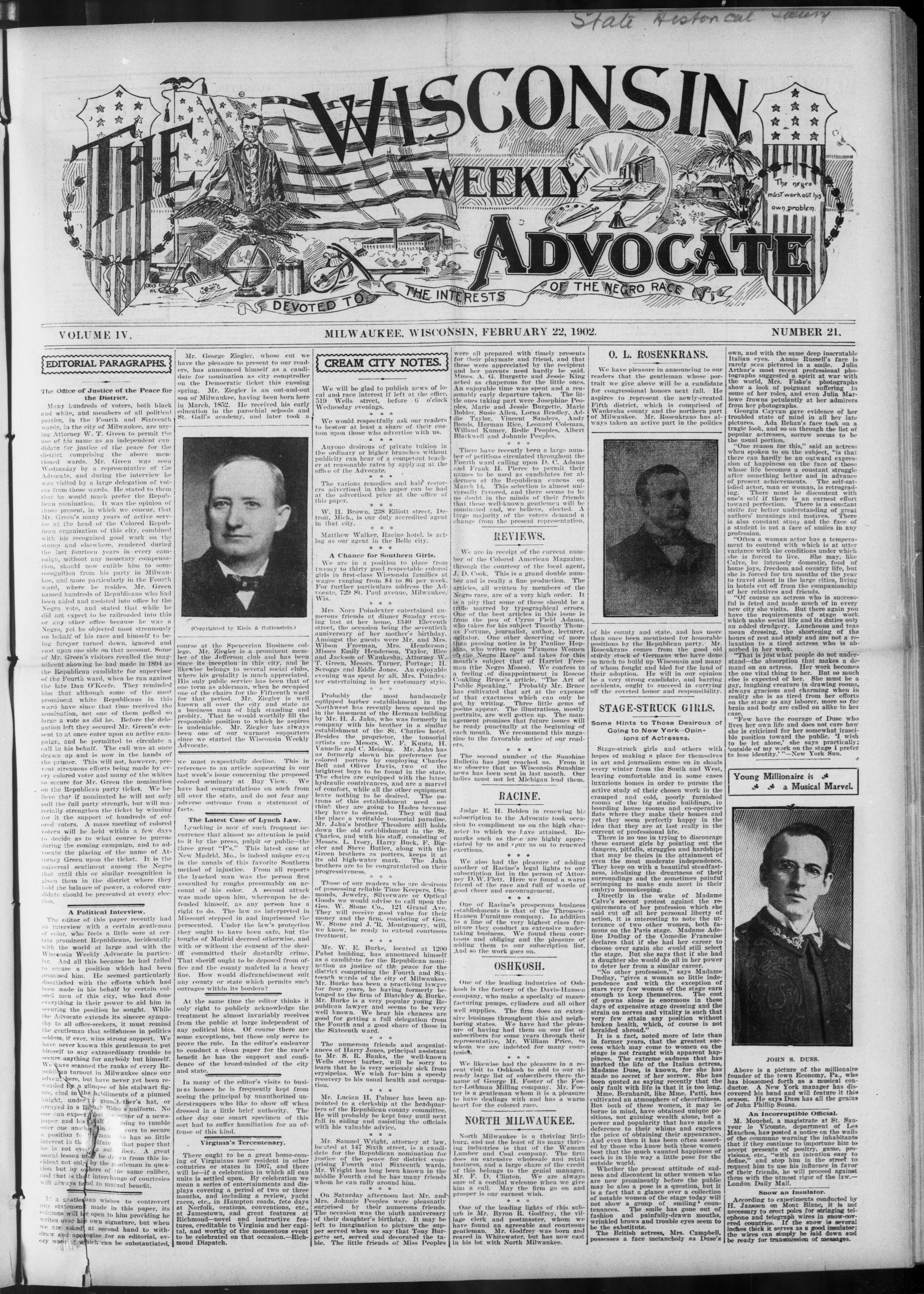
Page text (machine-generated)
WISCONSIN
WEEKLY
Advocate
DEVOTED TO THE INTERESTS OF THE NEGRO RACE
EDITORIAL PARAGRAPHS.
The Office of Justice of the Peace for the District.
Many hundreds of voters, both black and white, and members of all political parties, in the Fourth and Sixteenth wards, in the city of Milwaukee, are urging Attorney W. T. Green to permit the use of his name as an independent candidate for justice of the peace for the district comprising the above mentioned wards. Mr. Green was seen Wednesday by a representative of the Advocate, and during the interview he was visited by a large delegation of voters from these wards. He stated to them that he would much prefer the Republican nomination. It was the opinion of those present, in which we concur, that Mr. Green's many years of active service at the head of the Colored Republican organization of this city, combined with his recognized good work on the stump and elsewhere, rendered during the last fourteen years in every campaign, without any monetary compensation, should now entitle him to some recognition from his party in Milwaukee, and more particularly in the Fourth ward, where he resides. Mr. Green named hundreds of Republicans who had been aided and assisted into office by the Negro vote, and stated that while he did not expect to be railroaded into this or any other office because he was a Negro, yet he objected most strenuously on behalf of his race and himself to being forever turned down, ignored and cast upon one side on that account. Some of Mr. Green's visitors recalled the magnificent showing he had made in 1894 as the Republican candidate for supervisor of the Fourth ward, when he ran against the late Dan O'Keefe. They reminded him that although some of the most prominent white Republicans in this ward have since that time received the nomination, not one of them polled so large a vote as did he. Before the delegation left they secured Mr. Green's consent to at once enter upon an active campaign, and be permitted to circulate a call in his behalf. The call was at once drawn up and is now in the hands of the printer. This will not, however, prevent strenuous efforts being made by every colored voter and many of the whites to secure for Mr. Green the nomination on the Republican party ticket. We believe that if nominated he will not only pull the full party strength, but will materially strengthen the ticket by winning for it the support of hundreds of colored voters. A mass meeting of colored voters will be held within a few days to decide as to what course to pursue during the coming campaign, and to advocate the placing of the name of Attorney Green upon the ticket. It is the universal sentiment among the Negro that until this or similar recognition is given them in the district where they hold the balance of power, a colored candidate should be presented at every elec-
A Political Interview.
The editor of this paper recently had an interview with a certain gentleman of color, who feels a little sore at certain prominent Republicans, incidentally with the world at large and with the Wisconsin Weekly Advocate in particular. And all this because he had failed to secure a position which had been promised him. He seemed particularly dissatisfied with the efforts which had been made in his behalf by certain colored men of this city, who had done everything in their power to aid him in securing the position he sought. While the Advocate extends its sincere sympathy to all office-seekers, it must remind the gentleman that selfishness in politics seldom, if ever, wins strong support. We have never known this gentleman to put himself to any extraordinary trouble to secure anything for anybody but himself. We have scanned the ranks of every Republican turnout in Milwaukee since our advent here, but have never yet been rewarded by a glimpse of his stalwart figure, clad in the habiliments of a plumed knight, under a grandt ther's hat, or arrayed in a Rough Rider's uniform. No one can expect that the editor of a newspaper and his staff is going to tumble over one another.
If a gentleman wishes to controvert any statement made in this paper, its columns will be open to him providing he writes over his own signature, but when we are asked at second hand to withdraw and apologize for an editorial, every word of which can be substantiated.
Mr. George Ziegler, whose cut we have the pleasure to present to our readers, has announced himself as a candidate for nomination as city comptroller on the Democratic ticket this ensuing spring. Mr. Ziegler is an out-and-out son of Milwaukee, having been born here in March, 1852. He received his early education in the parochial schools and St. Gall's academy, and later took a
[Name]
(Copyrighted by Klein & Gattenstein.)
course at the Spencerian Business college. Mr. Ziegler is a prominent member of the Jefferson club and has been since its inception in this city, and he likewise belongs to several social clubs, where his geniality is much appreciated. His only public service has been that of one term as alderman, when he occupied one of the chairs for the Fifteenth ward for that period. Mr. Ziegler is well known all over the city and state as a business man of high standing and probity. That he would worthily fill the responsible position to which he aspires is undeniable. Mr. Ziegler has always been one of our warmest supporters since we started the Wisconsin Weekly Advocate.
we must respectfully decline. This in reference to an article appearing in our last week's issue concerning the proposed colored seminary at Bay View. We have had congratulations on such from all over the state, and do not fear any adverse outcome from a statement of facts.
The Latest Case of Juvenile Law
Lynching is now of such frequent occurrence that almost no attention is paid to it by the press, pulpit or public—the three great "P's." This latest case at New Madrid, Mo., is indeed unique even in the annals of this favorite Southern method of injustice. From all reports the lynched man was the person first assaulted by roughs presumably on account of his color. A second attack was made upon him, whereupon he defended himself, as any person has a right to do. The law as interpreted in Missouri stepped in and imprisoned the persecuted. Under the law's protection they ought to have been safe, but the toughs of Madrid decreed otherwise, and with or without the consent of the sheriff committed their dastardly crime. That sheriff ought to be deposed from office and the county mulcted in a heavy fine. How would disfranchisement suit any county or state which permits such outrages within its borders?
At the same time the editor thinks it only right to publicly acknowledge the treatment he almost invariably receives from the public at large independent of any political bias. Of course there are some exceptions, but these only serve to prove the rule. In the editor's endeavor to conduct a clean paper for the race's benefit he has the support and confidence of the broad-minded of the city and state.
In many of the editor's visits to business houses he is frequently kept from seeing the principal by unauthorized understrappers who like to show off when dressed in a little brief authority. The other day one smart specimen of this sort had to suffer humiliation for an offense of this kind.
Virginia's Tercentenary.
There ought to be a great home-coming of Virginians now resident in other countries or states in 1907, and there will be—if a celebration in which all can unite is settled upon. By celebration we mean a series of entertainments and displays covering a period of two or three months, and including a review, yacht races, etc., in Hampton roads, fete days at Norfolk, orations, conventions, etc., at Jamestown, and great features at Richmond—novel and instructive features, creditable to Virginia and her capital, and worthy of the momentous event to be celebrated on that occasion.—Richmond Dispatch.
CREAM CITY NOTES.
We will be glad to publish news of local and race interest if left at the office, 519 Wells street, before 6 o'clock Wednesday evenings.
* * *
We would respectfully ask our readers to bestow at least a share of their custom upon those who advertise with us.
* * *
Anyone desirous of private tuition in the ordinary or higher branches without publicity can hear of a competent teacher at reasonable rates by applying at the office of the Advocate.
* * *
The various remedies and hair restorers advertised in this paper can be had at the advertised price at the office of this paper.
W. H. Brown, 238 Elliott street. Detroit, Mich., is our duly accredited agent in that city.
* * *
Matthew Walker, Racine hotel, is acting as our agent in the Belle city.
A Chance for Southern Girls
We are in a position to place from twenty to thirty good respectable colored girls in first-class Wisconsin families at wages ranging from $4 to $6 per week. For further particulars address the Advocate, 729 St. Paul avenue, Milwaukee, Wis.
```markdown
```
Mrs. Nora Poindexter entertained numerous friends at dinner Sunday evening last at her home, 1340 Eleventh street, the occasion being the seventieth anniversary of her mother's birthday. Amongst the guests were Mr. and Mrs. Wilson Freeman, Mrs. Henderson; Misses Emily Henderson, Taylor, Rice and Jackson of Waukesha, Attorney W. T. Green, Messrs. Turner, Portage; H. Scroggs and Eddie Jones. An enjoyable evening was spent by all, Mrs. Poindexter entertaining in her customary style.
Probably the most handsomely equipped barber establishment in the Northwest has recently been opened up in the basement of the Herman building by Mr. H. J. Jahn, who was formerly in company with his brother in a similar establishment of the St. Charles hotel. Besides the proprietor, the tonsorial artists are Messrs. W. F. Kuntz, H. Vanzelie and C. Meising. Mr. Jahn has as formerly shown his preference for colored porters by employing Charles Bell and Oliver Davis, two of the brightest boys to be found in the state. The chairs are equipped with the latest hydraulic contrivances, and are a marvel of comfort, while all the other equipment leave nothing to be desired. The patrons of this establishment need not think: they are going to Hades because they have to descend. They will find the place a veritable tonsorial paradise. Mr. Jahn's brother Theodore still holds down the old establishment in the St. Charles, and with his staff, consisting of Messrs. L. Ivory, Harry Buck, F. Bigeler and Steve Butler, along with the Green brothers as porters, keeps it at its old high-water mark. The Jahn brothers are to be congratulated on their progressiveness.
Those of our readers who are desirous of possessing reliable Time Keepers, Diamonds, Jewelry, Silverware or Optical Goods we would advise to call upon the Geo. W. Stone Co., 121 Grand Ave. They will receive good value for their money and the firm, consisting of Geo. W. Stone and J. R. Montgomery, will, we know, be ready to extend courteous treatment.
Mr. W. E. Burke, located at 1200 Pabst building, has announced himself as a candidate for the Republican nomination as justice of the peace for the district comprising the Fourth and Sixteenth wards of the city of Milwaukee. Mr. Burke has been a practicing lawyer for four years, he having formerly belonged to the firm of Blatchley & Burke. Mr. Burke is a very popular young Republican lawyer and seems to be very well known. We hear his chances are good for getting a full delegation from the Fourth and a good share of those in the Sixteenth ward.
The numerous friends and acquaintances of Harry Jones, principal assistant to Mr. S. R. Banks, the well-known Wells street barber, will be sorry to learn that he is very seriously sick from erysipelas. We wish for him a speedy recovery to his usual health and occupation.
```markdown
```
Mr. Lucian H. Palmer has been appointed to a clerkship at the headquarters of the Republican county committee. He will probably be kept busy until next fall in aiding and assisting the officials with his valuable advice.
☆ ☆ ☆
Mr. Samuel Wright, attorney at law, located at 147 Sixth street, is a candidate for the Republican nomination for justice of the peace for district comprising Fourth and Sixteenth wards. Mr. Wright has long been known in the middle Fourth and he has many friends whom he can rally around him.
On Saturday afternoon last Mr. and Mrs. Johnnie Peoples were pleasantly surprised by their numerous friends. The occasion was the ninth anniversary of their daughter's birthday. It may be left to imagination to picture the supper served when we say that Tony Burgette set, served and decorated the table. The little friends of Miss Peoples
were all prepared with timely presents for their playmate and friend, and that these were appreciated by the recipient and her parents need hardly be said. Mines. A. G. Burgette and Jessie King acted as chaperons for the little ones. An enjoyable time was spent and a reasonably early departure taken. The little ones taking part were Josephine Peoples, Marie and Jessie Burgette, Marie Bolder, Susie Allen, Lorna Bradley, Addie Taylor, Vincent Sanders, Andy Bonds, Herman Rice, Leonard Coleman, Willand Kumer, Redie Peoples, Albert Blackwell and Johnnie Peoples.
☆ ☆ ☆
There have recently been a large number of petitions circulated throughout the Fourth ward calling upon D. C. Adams and Frank H. Pierce to permit their names to be used as candidates for aldermen at the Republican caucus on March 14. This selection is almost universally favored, and there seems to be no doubt in the minds of their friends that these well-known gentlemen will be nominated and, we believe, elected. A large majority of the voters demand a change from the present representation.
REVIEWS.
We are in receipt of the current number of the Colored American Magazine, through the courtesy of the local agent, J. D. Cook. This is a grand double number and is really a fine production. The articles, all written by members of the Negro race, are of a very high order. It is a pity that some of these should be a trifle marred by typographical errors. One of the best articles in this issue is from the pen of Cyrus Field Adams, who takes for his subject Timothy Thomas Fortune, journalist, author, lecturer, agitator. One other deserving of more than passing notice is by Pauline Hopkins, who writes upon "Famous Women on the Negro Race" and takes for this month's subject that of Harriet Freeman (the Negro Moses). We confess to a feeling of disappointment in Roscoe Conkling Bruce's article, "The Art of Public Speaking." Probably Mr. Bruce has cultivated that art at the expense of that exactness which can only be got by writing. Three little gems of poems appear. The illustrations, mostly portraits, are well gotten up. The management promises that future issues will be ready punctually at the beginning of each month. We recommend this magazine to the favorable notice of our readers.
☆ ☆ ☆
The second number of the Sunshine Bulletin has just reached us. From it we observe that no Wisconsin Sunshine news has been sent in last month. Our ladies must not let Michigan lead them.
RACINE.
Judge E. H. Belden in renewing his subscription to the Advocate took occasion to compliment us on the high character to which we have attained. Remarks such as these are highly appreciated by us and spur us on to renewed exertions.
* * *
We also had the pleasure of adding another of Racine's legal lights to our subscription list in the person of Attorney D.W.Flett. Here we found a warm friend of the race and full of words of good cheer and encouragement.
杂 艰
One of Racine's prosperous business establishments is that of the Thronen-Hansen Furniture company. In addition to a line of the very highest class furniture they conduct an extensive undertaking business. We found them courteous and obliging and the pleasure of adding them to our subscription list. And so the work goes on.
OSHKOSH.
One of the leading industries of Oshkosh is the factory of the Davis-Hansen company, who make a specialty of manufacturing pumps, cylinders and all other well supplies. The firm does an extensive business throughout this and neighboring states. We have had the pleasure of having had them on our list of subscribers for some years through their representative, Mr. William Price, to whom we are indebted for many courtesies.
We likewise had the pleasure in a recent visit to Oshkosh to add to our already large list of subscribers there the name of George H. Foster of the Foster-Lothman Milling company. Mr. Foster is a gentleman whom it is a pleasure to have dealings with and has a warm heart for the colored race.
NORTH MILWAUKEE.
North Milwaukee is a thriving little burg, and not the least of its many thriving industries is that of the Wausau Lumber and Coal company. The firm does an extensive wholesale and retail business, and a large share of the credit of this belongs to the genial manager. Mr. F. D. Clinton. We are always sure of a cordial welcome when we give him a call. May the firm go on and prosper is our earnest wish.
One of the leading lights of this suburb is Mr. Byron R. Godfrey, the village clerk and postmaster, whom we have found an agreeable and courteous gentleman. Mr. Godfrey was born and reared in Whitewater, but has now cast in his lot with North Milwaukee.
O. L. ROSENKRANS.
We have pleasure in announcing to our readers that the gentleman whose portrait we give above will be a candidate for congressional honors next fall. He aspires to represent the newly-created Fifth district, which is comprised of Waukesha county and the northern part of Milwaukee. Mr. Rosenkrans has always taken an active part in the politics
M.
of his county and state, and has more than once been mentioned for honorable positions by the Republican party.' Mr. Rosenkrans comes from the good old sturdy stock of Germans who have done so much to build up Wisconsin and many of whom fought and bled for the land of their adoption. He will in our opinion be a very strong candidate, and barring accidents, ought to succeed in carrying off the coveted honor and responsibility.
STAGE-STRUCK G1RLS.
Some Hints to Those Desirous of Going to New York-Opinions of Actresses. Stage-struck girls and others with hopes of making a place for themselves in art and journalism come on in shoals every winter from the South and West, leaving comfortable and in some cases luxurious homes in order to pursue the active study of their chosen work in the cramped and cold, poorly furnished rooms of the big studio buildings, in boarding house rooms and co-operative flats where they make their homes and yet they seem perfectly happy in the idea that they are at last really in the current of professional life.
There is no use in trying to discourage these earnest girls by pointing out the dangers, pitfalls, struggles and hardships that may be theirs in the attainment of even the most moderate independence. They keep on with a beautiful steadfastness, idealizing the dreariness of their surroundings and the sometimes painful scrimping to make ends meet in their embryo housekeeping.
Directly in the wake of Madame Calve's recent protest against the requirements of her profession which she said cut off all her personal liberty of action, it is interesting to note the utterance of two other women, both famous on the Paris stage. Madame Adeline Dudlay of the Comedie Francaise declares that if she had her career to choose over again she would still select the stage. But she says that if she had a daughter she would do all in her power to deter her from a similar career.
"No other profession," says Madame Dudlay, "gives a woman so little independence and with the exception of stars very few women of the stage earn enough to keep themselves. The cost of gowns alone is enormous in these days of expensive stage dressing and the strain on nerves and vitality is such that very few attain any position without broken health, which, of course is not heralded abroad."
It is a fact, noted more of late than in former years, that the greatest success which may come to women on the stage is not fraught with apparent happiness. The extreme sadness that has marked the life of the Italian actress, Madame Duse, is known, for she has made no secret of her sorrow. She has been quoted as saying recently that the only fault with life is that it is too long.
Mme. Bernhardt, like Mme. Patti, has cultivated an atmosphere of cheerfulness. But both of these women, it may be borne in mind, have obtained unique positions, not gaining wealth alone, but a power and popularity that have made a deference to their whims and caprices the price of obtaining their appearance. And even then it has been often asserted by those who know both these women best that the much vaunted happiness of each is in this way a little pose for the outside world.
Whether the present attitude of sadness and discontent in other women who are now prominently before the public may be also a pose is a question, but it is a fact that a glance over a collection of notable women of the stage today will not show a group of smiling' countenances. The smile has gone out of fashion and painfully-drawn mouths, wrinkled brows and trouble eyes seem to be the substitute.
The British actress, Mrs. Campbell, possesses a face melancholy as Duse's
NUMBER 21.
own, and with the same deep inscrutable Italian eyes. Annie Russell's face is rarely seen pictured in a smile. Julia Arthur's most recent professional photographs suggested a spirit at war with the world, Mrs. Fiske's photographs show a look of poignant suffering in some of her roles, and even Julia Marlowe frowns petulantly at her admirers from her photographs. Georgia Cayyan gave evidence of her troubled state of mind in all her late pictures. Ada Rehan's face took on a tragic look, and so on through the list of popular actresses, sorrow seems to be the usual portion.
"One reason for this," said an actress when spoken to on the subject, "is that there can hardly be an outward expression of happiness on the face of those whose life becomes a constant struggle after something better and in advance of present achievements. The self-satisfied actor, man or woman, is retrograding. There must be discontent with one's self if there is an earnest effort toward perfection. There is a constant strife for better understanding of great authors' meanings and motives. There is also constant study and the face of a student is not a face of smiles in any profession.
"Often a woman actor has a temperament to contend with which is at utter variance with the conditions under which she is forced to live. She may, like Calve, be intensely domestic, fond of home joys, freedom and country life, but she is forced for ten months of the year to travel about in the large cities, living in hotels cut off from the companionship of her relatives and friends.
"Of course an actress who is successful is feted and made much of in every new city she visits. But there again you have the requirements of stage work which make social life and its duties only an added drudgery. Luncheons and teas mean dressing, the shortening of the hours of rest and study and are not a relaxation to a tired actress who is absorbed in her work.
"That is just what people do not understand—the absorption that makes a demand on an actress. Her work becomes the one vital thing to her. But so much else is expected of her. She must be a gay, laughing creature in drawing rooms, always gracious and charming when in reality she is as tired from her efforts on the stage as any laborer, more so for brain and body are called on alike in her case.
"Few have the courage of Duse who lives her own life and does not care how she is criticized for her somewhat irascible position toward the public. 'I wish to be let alone,' she says practically; 'outside of my work on the stage I prefer to lose identity.'"—New York Sun.
PETER H.
JOHN S. DUSS. Above is a picture of the millionaire founder of the town Economy, Pa., who has blossomed forth as a musical conductor. A New York manager has discovered his band and will feature it this season. He says Duss has all the genius of John Phillip Sousa.
An Incorruptible Official.
M. Mouchel, a magistrate at St. Sauveur le Vicomte, department of Les Manches, has posted a notice on the walls of the commune warning the inhabitants that if they continue to importune him to accept presents of poultry, game, provisions, etc., "with an intention easy to define," and stop him in the street to request him to use his influence in favor of their friends, he will proceed against them with the utmost rigor of the law.—London Daily Mail.
Snow an Insulator.
According to experiments conducted by H. Janssen on Mont Blanc, it is not necessary to erect poles for stringing telephone and telegraph wires in snow-covered countries. If the snow is several inches thick it serves as a good insulator; the wires can simply be laid down and be ready for transmission of messages.
REV. TSILKA IN CUSTODY.
Accused of Complicity in Kidnapping of Miss Stone.
Anxious to Get Rid of His Wife and at Same Time Secure Part of the Ramsom.
Paris, Feb. 19.—Le Temps publishes a statement to the effect that Miss Ellen M. Stone has been released and that Rev. M. Tsilka, husband of Miss Stone's companion in captivity, has been arrested by the Turkish authorities on suspicion of having been the prime mover in the kidnapping of Miss Stone.
The news which comes in the form of a dispatch from a special correspondent in Constantinople states that M. Tsilka has been suspected of being in partnership with the Macedonian committee and that he was anxious to get rid of his wife and secure a part of the ransom for Miss Stone at the same time. It is further stated that M. Tsilka has been in communication with the brigands during the past months and that he has been the agent who has given the brigands notification of the plans of the authori-
M.
MISS ELLEN M. STONE. ties. This has been all the easier for the reason that as husband of Mme. Tsilka he has been consulted with reference to all the proceedings which have gone forward in the matter.
Miss Stone in Good Health.
Le Temps dispatch further states that Miss Stone is now safely under the care of the dragoman of the American legation, and that the only reason she has not yet sent any notification to her friends is because an arrangement was entered into with the brigands to the effect that the release should not generally be made known until they had time to make good their escape. Miss Stone is said to be in good health and in no way injured by her captivity since September 3, 1901.
In connection with the arrest of Mr. Tsilka it is interesting to note the circumstances under which the present Mt. and Mme. Tsilka first met. They met and were married in America and Mme. Tsilka has always been known as a woman of marked determination
Attended the Moody School.
Miss Stephenora, having been converted in childhood to the Christian faith and refusing to marry the man her parents chose for her, escaped and went to America, where she was educated at the Northfield seminar. Dwight L. Moody becoming interested in her welfare, made her teacher in his school and according to her wish gave to her the education necessary to be a trained nurse, which she in time became. While engaged in her professional duties she met M. Tsilka, a Macedonian, who was preparing for work as a medical missionary, and the similarity of the lifework of the two drew them together. Soon after the completion of their training they were married and went to Bulgaria, where they speedily entered upon missionary work.
Mme. Tsilka and Miss Stone were captured by the brigands on September 3 and since that time negotiations continually have been in progress for their release, ending by the payment of $72, 000 ransom.
Not Yet Released.
Washington, D. C., Feb. 19. The state department's advices concerning Miss Stone indicate that the Paris publication to the effect that she had been set at liberty is to say the least premature. It is gathered, however, from the reports of the United States diplomatic agents that the woman is likely to be released very soon and that the delay is explained by the requirement of the brigands that they be given ample opportunity to ensure their own safety.
DUE TO BROKEN RAIL.
Train is Wrecked Near Columbus, O.—Engineer is Instantly Killed,
Columbus, O., Feb. 19.—A broken rail wrecked a train on the Columbus. Sandusky & Hocking railroad at 3:20 this morning. William Smith of Grogan, engineer, was instantly killed. The injured:
Frank Winteringer of Grogon, fireman, had both legs broken and body scalded.
F. S. Sweet, engineer of Columbus, both ankles scalded and back injured.
J. F. Dickson of Lewis Center, right leg and side badly bruised and head cut.
Henry Tipton, brakeman, shoulder dislocated.
John Kincaid, conductor, is also crashed. The train consisted of two locomotives and thirty-two gondola cars, and left this city about 3 o'clock. It was making the grade at Shepards, a suburb of Columbus, when the accident occurred. One engine was exploded and the wreckage blockades the track. The injured were taken to Protestant hospital.
PARLIAMENTARY TRICK.
How Anti-Pass Bill was Killed in Iowa Legislature.
Des Moines, Ia., Feb. 19.—By a clever parliamentary move the Hughes anti-pass bill was killed in the lower house of the Legislature today without a vote on the measure itself becoming necessary. An amendment to include ministers of the gospel among those prohibited from accepting passes was offered. The motion to lay on the table was carried and it was discovered afterwards that this had the effect of killing the measure itself.
MR. CLEVELAND NOT HURT.
Alarming Report that He Had Beer Shot Proves Untrue. Norfolk, Va., Feb. 19.—Great excite ment was caused by the report that ex President Grover Cleveland had beer shot while hunting ducks on the Virginia marshes. Investigation proved the report was without foundation.
M'AULIFFE PICKED UP WITH SKULL BROKEN.
Death of Witness Whose Testimony Sent New York Wardman to Sing Sing.
New York, Feb. 18.—James McAuliffe, the principal witness in the trial of Wardman Glennon and whose testimony was thought to have been largely responsible for Glennon's conviction and sentence to Sing Sing, is dead.
McAuliffe's death, according to the diagnosis of the hospital surgeons, was due to a compound fracture of the base of the skull and a fracture of the nose. The man was unconscious when picked up in Sixth avenue and did not regain consciousness before he died.
McAuliffe lived at 146 West Thirty-third street. He made a complaint against Glennon for the wardman's failure to suppress an alleged disorderly house next door to his own home. McAuliffe went to the home of his sister at 141 West Sixtieth street Saturday evening and remained until 7:30 o'clock, having arranged to return on the following day. Sunday morning a policeman found him lying on the sidewalk in Sixth avenue. He was carried to a hospital, where he has just died without having recovered consciousness.
APPEAL TO CONGRESS.
Miss Anthony and Mrs. Catt Plead for Privilege to Exercise Elective Franchise.
Washington, D. C., Feb. 18.—Delegations representing the Woman's Suffrage association now in session here appeared before committees of Congress today in advocacy of their plea that women be allowed to exercise the right of suffrage. In the Senate they appeared before the committee on woman suffrage. The meeting was presided over by Senator Bacon of Georgia, who practically turned the control of the hearing over to Miss Susan B. Anthony, who made the first address of the day. She began by calling attention to the fact that for thirty-four years or seventeen Congresses the ladies have been coming to Congress with their pleas, but she said that only on one occasion had their proposed amendment to the constitution been awarded the honor of being taken up in the Senate for discussion. She therefore made an appeal to be heard by the Senate, expressing the conviction that the women of the country are as much entitled to be heard as are the Filipinos, the Porto Ricans and the Hawaiians. She also said that the 600 women who had been sent to the Philippines to teach were quite as well qualified to exercise the rights of citizenship as are the men who go to these islands for the baser purpose of making money. On the House side the delegation appeared before the judiciary committee. Mrs. Carrie C. Catt, president of the association, explained to the committee that she desired particularly that the foreign delegates should describe to the committee the progress of the woman suffrage movement in other parts of the world. The speakers today were Miss Vida Goldstein of Australia, Mrs. Ewald of Sweden, Mrs. Freedland of Russia, Mrs. Felwick Miller of England, Isabelle Campbell of Wyoming, Miss Theodosia Ammons of Colorado, Mrs. Lapish of Utah, Mrs. Weaver of Idaho and Mrs. Catt.
Miss Goldstein, the first speaker, told of the struggle and success of the woman suffrage movement in different portions of Australia, and explained the political status of women there as well as the great benefits that had followed the granting of suffrage. "The women of Australia," she said, "do not forget their homes or their babies and they do not raid the public offices." She concluded her appeal to the committee with this sentence: Australia trusts her women surely American can trust hers."
Mrs. Freedland explained that in a country like Russia there was, of course, little suffrage, but what there was, was shared equally by men and women. In a country where political laws were the least liberal those laws were the most liberal to the civil capacities of woman. Mrs. Ewald of Sweden, where woman suffrage was older than any other country on earth, and Mrs. Drewson of Norway, where women paying taxes on an income the equivalent of $100 a year enjoy suffrage, told of the suffrage privileges enjoyed by women in their country. In Sweden women enjoyed the ballot before men.
Miss Campbell, who is the daughter of the first governor of Wyoming, the executive who signed the woman suffrage law, declared that every governor of Wyoming had testified that woman suffrage had worked well.
Miss Ammons of Colorado declared that every woman elected to office in Colorado had reflected credit upon her sex.
WHEN PRINCE HENRY COMES
All Suspicious Characters are to be Run Out of Washington.
Washington, D. C., Feb. 18.—The police department of the city of Washington has taken extraordinary measures to insure the bodily safety of Prince Henry and his staff on the occasion of his visit to the capitol. In substance the plan contemplates a considerable augmentation of the Washington detective force and such police measures as will cause the detention or expulsion from the city of all suspicious and questionable characters, beginning now and carrying these measures forward until the prince has left Washington.
SNOW TOO DEEP FOR LOGGERS
Worcester Company, Near Munising Lays Off Men Till April.
Munising, Mich., Feb. 18.—[Special.]
The snow is so deep in this section of the peninsula that operations in the woods are greatly hampered. For the past two weeks snow has fallen almost steadily until now there are nearly five feet on the ground. The Worcester company, conducting extensive cedar camps has laid off half of its force until the first of April and will probably soon have to do the same with the rest. The depth of snow in Alger county is unprecedented.
New Name for Cheap Lawyers.
An anti-snitch campaign is going on in Kansas City. A "snitch," according to one of the papers, "is a cheap lawyer, very frequently a young lawyer, a man of small practice and precarious income, who is excessively active in drumming up trade. His specialty is the individuals who have suffered a supposed or real injury, and his method is to induce such individuals to bring damage suits, or to threaten suits, with the object of extracting money."
Cow Had an Artificial Tail.
Those Atchison people ought never to go abroad into the big hustling world save when accompanied by a guardian. "Recently," says the Atchison Globe, "Ely Cromwell purchased a number of fancy Polled Angus cattle at the Chicago fair. He discovered yesterday that a cow for which he paid $200 had an artificial tail; it had been glued on, temporarily, to make her sell better."—Kansas City Journal.
LIBERALS DEMAND GENEROUS TREATMENT
Resolutions Adopted Condemning British Policy Towards Boers In South Africa.
London, Feb. 19.—At the annual meeting of the general committee of the National Liberal Federation held at Leicester today, after considerable dissent and an animated debate a resolution was passed condemning the policy of insisting on the unconditional surrender of the Boers in South Africa, affirming that the future contentment and security of South Africa could only be secured by regular peace on broad, generous lines; welcoming the impetus Lord Rosebery has given to this policy and calling on all Liberal members of the House of Commons to support the Liberal leader, Sir Henry Campbell-Bannerman in his advocacy of this policy.
WORK OF PACIFICATION.
Civil Government Established In Thirty-five Provinces of Luzon Situation in Samar.
Washington, D. C., Feb. 19.—Gov. Taft stated to the Senate committee on the Philippines that he has received a cable message from Commissioner Wright, who is acting as governor of the Philippines in his absence, stating that the province of Nueva Vizcaya in the northern part of Luzon had just been organized and given a civil form of government. There are now about thirty-five organized provinces. Nueva Vizcaya has been pacified for some time, but about 60,000 of its 75,000 population are Igorotes. Gov. Taft said he did not know what form of government had been given the province, but that he supposed that under the circumstances it would be of a paternal nature.
Gov. Taft said that the recent massacre of troops in Samar had a startling effect upon the army and created suspicion and fear of treachery in other sections. The governor did not think, however, such apprehension justified, and said he felt as safe in Manila as in Washington. Civilians seldom carry arms there.
ONE LIFE WAS LOST.
Abner Case Probably Burned in Battle Creek Fire-Number of Destitute Millionaires.
Battle Creek, Mich., Feb. 19.—One death is recorded as a result of the fire which destroyed the Kellogg sanitarium buildings. The missing man is Abner Case, aged 83 years, of Bath, N. Y. Mrs. Case, who was with him in the sanitarium at the time of the fire and who escaped, states that she thought she saw a nurse nefping him out, and, thinking that he was in good hands, made good her escape. His remains have not yet been recovered. Ira D. Sankey, the famous singing evangelist, was in the main building, but escaped in his night clothing, as did most of the others. Few got away with even their street clothes and there are a number of destitute millionaires in the city today. Many guests have large losses of personal property to record.
Both hospital and main building were burned to the ground, hardly a bit of wall standing. The sanitarium was valued at $400,000 and is fully covered by insurance. The loss will probably reach $500,000, including losses of furniture and instruments.
STEEL TRUST SCHEME.
Plan to Convert $510,173,778 of Preferred Stock Into 5 Per Cent. Bonds.
New York, Feb. 19.—George W. Perkins, chairman of the finance committee of the United States Steel corporation, says that there is now under consideration a plan to convert part, if not all of the preferred stock of the corporation into a 5 per cent. bond. Mr. Perkins said he thought such action would be for the best interests of the stockholders. According to the report issued early this month, the steel corporation has a bonded debt of $303,450,000. These bonds bear interest at the rate of 5 per cent., the same rate that is mentioned in connection with the proposed preferred stock conversion.
The amount of preferred stock issued is $510,173,778 on which 7 per cent. dividends are paid.
PURSUED BY RHODES
Americans Round Up Large Band of Insurgents In Batangas Province.
Manila, Feb. 19.—What is believed to have been the largest existing band of insurgents in Batangas province surrendered yesterday to Lieut. Charles D. Rhodes of the Sixth cavalry at Banan. Maj. Amoranto, 2 captains, 6 lieutenants and 98 Filipino soldiers gave themselves up, and also surrendered 5 revolvers, 66 rifles and 2000 rounds of ammunition. Rhodes had been hunting the insurgents from place to place for three weeks and continually destroying their supplies. They were virtually starved into surrender. The skeletons of five soldiers of the Thirty-ninth infantry, killed in November, 1900, have been recovered. They will be shipped to the United States.
CURIOUS SUIT FOR DAMAGES.
Lover Lost His Fiancee Through a Telegraph Company's Blunder.
Louisville, Ky., Feb. 19.—Nineteen hundred and ninety-nine dollars is the damage Clarence Manvel thinks he has suffered through losing his allianceed wife. He has sued the Western Union Telegraph company for that amount and his petition sets forth that he was engaged to Miss Maggie Bryant, a charming Jeffersonville girl. On January 26, 1901, he sent her a telegram reading "Come to 633 Third street at once." He dated it Louisville, but when Miss Bryant received it the message was dated Nashville. Thinking her lover was dying, she hastened at once to Nashville, only to find that he was in Louisville. Manvel says that when he tried to explain he was told that it was "a cruel hoax" and the engagement was broken forthwith.
ISLAND DISAPPEARING
Famous Pleasure Resort Slowly Sinking Into the Pacific.
Berkeley, Cal., Feb. 19.—Prof. William E. Ritter of the University of California has made the discovery that Santa Catalina island, the famous pleasure resort, is slowly sinking into the Pacific ocean. While dredging for marine animals on the coast of the island he found positive evidence in rocks and shellfish that the island beach had once extended three quarters of a mile from the present low tide limit. He estimates that the island is now 270 feet lower than it was formerly. This movement is apparently going on now, while the mainland coast opposite Catalina is slowly rising.
VERDICT OF THE PRESIDENT
Question of Command Ignored, that Matter Having Been Settled by President McKinley.
Washington, D. C., Feb. 18.—President Roosevelt's review of the Schley case has been sent to the printer, and copies will be given to the press this week, probably on Wednesday. The review consists of about 2500 words, or about two printed-page columns of a newspaper.
While care has been taken to prevent the premature publication in the press of the President's comments, their substance is known to a number of public men, to whom Mr. Roosevelt has read or outlined them. The main points covered in the President's review are Admiral Schley's treatment of Lieut.-Commander Hodgson and the famous loop of the Brooklyn. The question of command, on which Schley made the principal object of his appeal, is disposed of briefly. Mr. Roosevelt regards this question as having been settled by President McKinley nominating Admiral Sampson to the Senate for advancement over Schley, and as to the contention that Schley directed the movements of the American ships in the battle with Cervera's fleet, he decides that no order from that officer to the vessels had any effect whatever on the fight.
Admiral Schley's treatment of Lieut. Commander Hodgson is regarded by the President as lacking in honor and fairness.
Unfair to Hodgson.
Admiral Schley caused to be published in a newspaper a letter from Hodgson denying that any such colloquy ever occurred on the Brooklyn between Schley and himself during the fight, the colloquy as printed indicating that Schley was timid about approaching the enemy's ships, and that in his haste to avoid them he was reckless of the danger of collision with the Texas. It was subsequently shown that Admiral Schley had suppressed an accompanying letter from Hodgson explaining that there was a colloquy substantially as alleged, and that his denial intended to apply only to the literal accuracy of its published version. At the court of inquiry it was developed that Admiral Schley ignored Hodgson's importunities to put him straight by printing the accompanying letter. Mr. Roosevelt regards this treatment of Hodgson by Schley as anything except the conduct of an officer and a gentleman, and scores Schley for it.
Condemnation for the Loop.
In the loop the President finds cause for condemnation of Admiral Schley. He expresses the belief that Schley acted courageously in the battle up to the point that he gave the order for the loop. Then, Mr. Roosevelt holds, Schley lost nerve, faltered and turned away from the Spanish ships when he should have gone toward them or in the direction they were taking.
President Roosevelt took up the duty put upon him by Schley's appeal with the intention of doing full justice to all sides of the controversy and settle the question without an excuse for further agitation.
The President emphasizes the fact that the battle was a fight of the captains, acting in accordance with the general orders of the commander-in-chief. He dwells with special emphasis on the work of the Iowa, the Indiana, the Texas, the Oregon and the Gloucester in causing the destruction of the Spanish fleet. He gives the Iowa credit for extraordinary efficiency by the destructive effect of her four-inch guns, and he holds that the battle was really won before the Colon escaped to the westward through the break in the battle line left by the Brooklyn's loop.
Glory for the Captains.
The general effect of the decision will be to give glory to the captains who participated in the fight, but it will not reverse the decision of President McKinley that Sampson was in command.
The President does not question the judgment of the court of inquiry on the retrograde movement and the disobedience of orders. He makes clear that the judgment of the court was unanimous. Dewey, Benham and Ramsay concurring in all these conclusions of Schley. From President Roosevelt's view of the case Schley should have been relieved and court-martialed after the retrograde movement and his disobedience of orders, but he will not say this in his decision because it would be a criticism on the judgment of President McKinley, who did not do so.
PACKERS AT WAR.
Price of Dressed Beef is Cut but the Consumer Derives No Benefit from It
Chicago, Ill., Feb. 18.—Big packing houses in the stockyards are at war, and as a result the price of dressed beef in the Chicago market has been cut over 25 per cent. Instead of receiving from 9 to 10 cents the packers are getting from $ \frac{6}{2} $ to 7 cents for the best dressed beef, and the market man is reaping all the benefit, for the retail price has not been reduced one cent. The general public is paying the high prices of last fall for steaks and roasts, and the householder will be the last to feel the result of the cut. It is believed, however, that the war may be of long duration and will result in low prices to everyone.
The trouble is over the entrance of two new firms into the Chicago beef market. For a long time Armour & Co., Swift & Co. and Nelson Morris & Co. have had a monopoly of the local territory and they divided it up between themselves and held prices up according to their treaty of peace. A big slaughter house has just been erected by the Schwarzschild & Sulzberger company at the stockyards, and they have been joined by the Anglo-American Provision company, which formerly handled hog products, but little dressed beef in Chicago.
The established firms were quick to resent the intrusion into their territory, and began to meet the competition by cutting prices. The newcomers followed suit, determined to get business at any price, and the price of fresh beef finally has gone below the cost to the packers as it hangs in their cooling rooms.
E. S. ISHAM DEAD.
Prominent Chicago Lawyer Passes Away in New York.
Chicago, Ill., Feb. 18.—Word was received here of the death in New York city on Sunday of Edward S. Isham, senior member of Isham, Lincoln & Beale, and one of Chicago's most eminent lawyers. Heart failure was the cause. Robert T. Lincoln, former minister to England, and a member of the law firm, left for New York last night. The funeral will be held at Manchester, Vt.
CONGRESS.
The House on the 13th unanimously adopted a resolution proposing an amendment to the constitution of the United States for the election of senators by direct popular vote. Two bills of general importance were passed by the House, the remainder of the time being devoted to minor business. One was a Senate bill to provide for the payment of the claims of Confederate officers and soldiers whose horses, sidearms and baggage were taken from them by Union soldiers contrary to the terms of the surrender of Lee and Johnston's armies. The amount to be paid under the bill was limited to $50,000. The other bill was to confer on the Spanish claims commission authority to send for persons and papes and to punish for contempt.
The monotony of a private pension day of the House was enlivened on the 14th by a sensational speech from Mr. Wheeler (Ky.) in denunciation of what he denominated "funkeyism" to foreign countries. He took the recent statements emanating from continental cabinets regarding the attitude of Great Britain during the Spanish war as a text for a wholesale attack upon the trend of our recent diplomacy. He severely scored Secretary Hay and declared that if Lord Pauncefote had sought, as was alleged, to circumvent us during the war of 1898, the sooner he was shipped across the seas, the better. He also criticised the President for his reported intention to send his daughter to the coronation of King Edward and protested against the official reception of Prince Henry. His speech aroused the House to a high pitch of excitement and elicited from Mr. Boutell (Ill.) a spirited defense of Secretary Hay, whom he eulogized in high terms. Several other members on the Republican side took a hand and later in the afternoon Mr. Grosvenor (O.) took Mr. Wheeler to task for his "inopportune protest."
The unexpected happened in the House on the 17th when the bill to repeal the war revenue taxes was passed unanimously without a word of debate. This action was the outcome of a challenge thrown down by Mr. Richardson (Tenn.), the minority leader, after the adoption of a stricter party vote of a special order for the consideration of the bill which permitted debate upon it until the following day, but cut off all opportunity to offer amendments except such as had been agreed upon by the ways and means committee. The reason for the presentation of the rule, Mr. Richardson declared, was because it was necessary to gag two Republican members of the ways and means committee, a number of the Republicans on the floor and all the Democrats of the House. Mr. Babcock (Wis.) one of the Republican members of the ways and means committee, read a statement of his resolution for favoring the adoption of the rule. It was to the effect that after consultation he and his colleagues did not consider it wise to jeopardise the passage of the repeal bill by complicating matters, and he gave notice that at the first opportunity he would press for the consideration of his bill to amend the steel schedule.
The speech of Mr. Wheeler (Ky.) in the House, when he bitterly assailed Secretary Hay and Lord Pauncefote, and criticised the official preparations for the reception of Prince Henry, had a sequel in the House on the 18th during the debate on the Indian appropriation bill. Mr. Gillet (Mass.), in a half hour speech declared that the intemperance of Mr. Wheeler's language carried its own condemnation. Nevertheless he (Gillett) grievously deplored such an affront to a foreign country. Mr. Robinson (Dem, Ind.), amid Republican applause, declared that the Democratic party could not be held responsible for Mr. Wheeler's statements. Mr. Wheeler replied to Mr. Gillet. He disclaimed any idea that he had spoken for any one except himself, though he believed that many people believed as he did. Mr. Burleson (Tex.) then made a speech on the subject of trusts.
Again on the 19th the general debate in the House on the Indian appropriation bill was devoted almost entirely to extraneous topics. As on the day before, the issue raised by Mr. Wheeler (Ky.) a few days ago came in for considerable attention and was the feature of the session. Mr. Bromwell (Rep., O.), Mr. Kern (Dem., Ill.) and Mr. Fieming (Dem., Ga.) added their views to the literature on the subject, but it was Mr. Boutell (Rep., Ill.) who entertained the House most.
Senate.
While no definite agreement has been reached, a vote on the Philippine tariff bill in the Senate seems to be in sight. It appeared, judging from a decision of the subject in the session on the 13th, that the vote might be had the following week. Mr. Teller (Col.) concluded his speech. He urged strongly that the Filipinos be given the fullest possible measure of self-government, the United States simply maintaining a protectorate over the islands. Mr. Mitchell (Or.) delivered a carefully prepared speech in support of his amendment to reduce the tariff duties upon Philippine products coming into this country to 50 per cent. of the Dingley rates. A bill to regulate the practice in the United States courts as to appeals and writs of error was passed.
The bill creating a permanent census office, taken up at the instance of Senator Quarles (Wls.), was under consideration in the Senate on the 14th for a time, but was not disposed of finally. Mr. Allison, chairman of the committee on appropriations, made an argument against the committee amendment increasing the salary of the director of the census from $5000 to $7500 per annum. Mr. Quarles made a vigorous defense of the amendment, and in response to an inquiry by Mr. Hawley said he did not think Congress ought to impose such a humiliation upon the director of the census as Congress imposed upon its members—the acceptance of a salary entirely inadequate to the services performed. Mr. Allison moved to make the director's salary $6000 instead of $7500; rejected, 15 to 32. The committee amendment was adopted. After the passage of a large number of private pension bills, the Senate eulogized the life and character of the late Representation Brosius of Pennsylvania.
During the entire session of the 15th the Senate had under consideration the bill establishing a permanent census office. It was not completed, but an agreement was reported to take it up again immediately after the executive session that is to be held on the 17th for the consideration of the Danish treaty. The great contest of the day, of course, was over the transfer of the classified service of the employes of the census office who are to be retained in the permanent establishment. It involved the entire civil service question, and the debate covered much of the ground that heretofore has been gone over in congressional debates.
After an extended debate the Senate on the 17th passed Senator Quarles' bill establishing a permanent census office. The discussion related principally to the collection and publication by the director of the census of statistics respecting the production of cotton. In a little more than an hour's time, the Senate disposed of the treaty with Denmark ceding to the United States for a consideration of $5,000,000 the islands of St. Thomas, St. John and St. Croix, composing the group of the Antilles known as the Danish West Indies and lying just east of Porto Rico, and thus, so far as this country is concerned, consummated a transaction which has been under consideration intermittently since the administration of President Lincoln.
It was agreed by the Senate on the 18th that a final vote on the Philippine tariff bill and the pending amendments should be taken at 4 p. m. on the 24th. The only stipulation by the minority was that the last day's debate should be devoted to speeches not exceeding fifteen minutes in duration. Senator Wellington of Maryland spoke in opposition to the pending bill. Mr. Stewart (Nev.) afterward addressed the Senate in support of the administration's Philippine policy.
The Senate continued the consideration of the Philippine tariff bill on the 19th, the principal speeches being made by Mr. Burrows (Mich.) for the bill and Mr. Money (Miss.) against it, although Mr. Mitchell (Or.), Mr. Foraker (O.), Mr. Mallory (Fla.) and Mr. Tillman (S. C.) all took more or less part in the general debate on the subject.
A Unique Alphabet.
E. K. Lambert, a woodsman residing at Elam, Wash., will have a unique curiosity at the St. Louis exposition. It will be a collection of the English alphabet, formed from the actual growth shapes he could find in the woods. It comprises roots and limbs of various kinds of trees, each letter being a substantial and accurate reproduction.
The Banana Trade.
Last year sixty ocean-going steamers were engaged exclusively in the banana trade.
"I had a very severe sickness that took off all my hair. I purchased a bottle of Ayer's Hair Vigor and it brought all my hair back again."
One thing is certain.— Ayer's Hair Vigor makes the hair grow. This is because it is a hair food. It feeds the hair and the hair grows, that's all there is to it. It stops falling of the hair, too, and always restores color to gray hair.
If your druggist cannot supply you, send us one dollar and we will express you a bottle. Be sure and give the name of your nearest express office. Address. J. C. AYER CO., Lowell, Mass.
TEXAS STATESMAN PROMUL GATES ASTONISHING FACTS.
Tells Almost Incredible Tales of the Petroleum Yield of Texas that is More Valuable "Than a Dozen Klondikes and Crip- ples Crooks."
So says ex-Senator James Stephen Hogg of Texas, and at present one of the oil kings of Beaumont. "Spindletop" is the greatest phenomenon that was ever discovered in the world, far exceeding the wealth of a dozen Klondikes and several dozen Cripple Creeks. For instance, we have eighty-five gushers down there. By "we" I mean the people of Beaumont. None of these wells will produce less than 40,000 barrels each day. Many of them will spurt 70,000, and some shoot out of the ground 200,000 barrels a day. On an average the wells down there give a daily output of 5,950,000 barrels, or a yearly supply of over 20,000,000. At 20 cents a barrel this would make an annual yield of over $4,000,000,000, or more than double all the money in the United States and England.
The Sam Houston Oil company has got an oil well down to oil rock on Spindletop, and have been guaranteed an 80,000 barrel gusher. Those desiring to invest in a sure enterprise will find it advantageous to investigate this proposition.
They own property in Texas as follows: Spindletop Heights, Chambers, Polk and Brazoria counties and Sour Lake district, in all 1230 acres, and 80 acres in the McKittrick district, Kern county; also 200 acres in Shasta county and three placer and four quartz claims in Cow Creek district, Shasta county, Cal.
Price and terms of treasury stock, 121 cents per share, installment plan; 10 per cent. discount for cash. Par value, $1 per share, fully paid and non-assessable. Prices advance to 20 cents per share without notice.
Reference, Jeffries, Deaborn & Co. bankers, Chicago, Ill. Important.—Make all checks, money orders, etc., payable to Colburn & Peck, fiscal agents. Address all communications to Sam Houston Oil Company, suite 705, Pabst Bldg., Milwaukee, Wis.
Homes on Holland Canals.
Holland owes much of its unique charm and the Dutch race many of its distinctive qualities to the gaily painted and happily peopled homes that float serenely through the landscapes of the Netherlands. Nearly every Dutch "tjalk" or barge is not only a conveyance for merchandise, but also its owner's dwelling place; not merely a temporary habitation as a sea-going ship is to her captain and crew, but an abiding home. The raised poop, upon which the owner stands grasping the tiller and watching the sail or directing the labors of his family at the tow rope, is the roof of the house. It is also the garden by virtue of its row of pots containing flowering plants and bulbs. Here, when the day's voyage is ended, and the house moored for the night, the good man smokes his biggest pipe and drinks his schnapps; the women sit and sew; the children safely inclosed by the poop rail and a little toy gate, play their stolid games, and the canary and the siskin from their gilded cages pour forth rival evensongs.—Manchester Guardian.
The Famous Ramos Mines Changed Hands-Milwaukee Men in Control.
We are informed that the famous Silver-Copper mines at Ramos, Mexico, which have been a continuous producer and from which many millions of dollars have been mined, got into the control of the Mexican Mining & Milling company, which is composed of Milwaukee and Chicago business men. During the last two and a half years the mines produced and shipped Mex. $788,310.26 of ore. A car shipped last week averaged Mex. $178 per ton. The company will sell a small amount of treasury stock at 50 cents per share (capital $1,000,000, par value of shares $1.) The president of the company is Joseph Bach of Abel & Bach Co., Milwaukee. Prospectus will be mailed upon request. Drafts for stock and inquiries should be addressed to L. Kreielsheimer, treasurer, 501 Herman bldg., Milwaukee. The company wants a few reliable representatives.
Titanium the Wonderful.
The properties of the metal titanium are many and various. It gives hardness and toughness to steel and a fine luster to silver, while, added to carbon used for arc lamps, it increases the brilliancy of the light. Titanium is also added to the fertilizers used on tobacco plantations, and it is said to improve the flavor of the leaf. The oxide increases the brilliancy of incandescent gas tiles; its strong affinity for nitrogen uses a cheap means of separating nia direct from the atmosphere with carbon it yields a enough to scratch diamor Siftings.
Now early cucumbers is one of the vegetable, so also earliest raisest reference tomatoes, beets, etc.
DISTRUST.
I.
It is not the mountain, it is not the land;
And it is not the deep, wide sea;
And not the stretch of the desert sand
Can separate you and me,
Sweetheart,
Can separate you and me.
II.
Hands may clasp and tighten and hold,
And heart be pressed to heart.
Yet only shadows the arms enfold,
If souls have grown apart,
Sweetheart,
If souls have grown apart.
III.
Nor yet the gallop of racing horse
Can make the distance wide.
And not the steam or electric force
Can banish us side from side,
Sweetheart,
Can banish us side from side.
IV.
But the cruel thought, the harsh distrust,
The word that biteth sore.
Each from each apart could thrust
So far we could mee no more,
Sweetheart,
In this world never more.
--Blanche Nevin in the Independent.
100 DON'TS FOR NURSES.
The doctor had made his last visit for the night and the nurse was left alone with her patient—a typhoid fever patient, muscular and raving. It was a private "contagious" ward; a room that was always like a ship's deck, stripped for action, with its metal bed of white enamel, its metal table and its gray green wall, decorated only with "colored supplement" prints because these could be changed frequently and burned easily. It was a room of a dim light and a tempered shadow—one of those bare hospital rooms where you feel that the flame of life, though it burns low, burns without a flicker, being protected and watched in its feebleness with no sentiment of love, but with the skilled care and the cool eye of unimpassioned science.
The nurse sat at the bedside, her hands folded in her lap, like a nun at meditation. There was something nun-like in her face, in her placidity beside such suffering, in the almost melancholy sweetness of the face of a woman who had looked many times on death, alone at midnight, and who had lived for a long year now in the constant companionship of pain.
But, indeed, the expression belied her. She was watching her patient for the signs of a hemorrhage, listening intently to his breathing, with the sub-conscious alertness of the engineer who will sit musing with an eye on the steam guage and an ear strained for the slightest change of note in the regular swing and cadence of the machinery. The poor fellow in the bed tossed and muttered fretfully. She soothed him with her voice—with a murmur of "Yes, yes. Go to sleep, then. Go to sleep," as if she were talking to a child. There was no sign of nervousness or anxiety about her. Only once, when she rose to take his pulse, she stood a moment to smooth down the stiff gingham of her uniform with a slow palm in an endeavor to loosen the starch in it so that it would not rustle. The patient was making a dry clucking in his mouth. She took a piece of ice from a bowl among the medicine bottle and glasses on the table and put it under his tongue. He sighed a breath of grateful weakness.
She stood looking down at him, smiling with a motherly pity. His eyes were closed.
He had been as self-willed in his illness as a spoiled child. He had been almost convalescent when, against all warning—while the day nurse was chatting with the doctor outside the door—he had staggered from his bed to a basket of fruit on the table and eaten two peaches before he was seen. The result was a relapse into a far more critical condition than he had been at first. Here he law now, struggling feebly against death itself. She wondered whether he had a sister who was fond of him—or a sweetheart?—who had been sending him these baskets of fruit.
He was breathing regularly in a fitful doze. She returned to her chair and leaned forward to look at him with her chin in her hand.
Although she was not aware of it he had changed for her; from being a "case" he had become a human being with a claim of interest on her, and she frowned at his muttering of pain. Poor fellow! Life must have been so full for him of interests, activities, promises, achievements. To have it all end this way, futilely! He had given the college cry once in a delirium and struggled panting through a football game. And once he had been standing on the platform of debate. And another time he had been writing on an examination in law. And still another time she thought that she heard him speak Jim's name in the jumble of delirious mutterings.
Jim was to have been a lawyer. Poor Jim! Her eyes filled at that old, tear-stained memory of Jim and her father drowned together in that horrible accident on the Delaware. Well, she at least had not been a burden on her mother's small income, and soon—as soon as she was graduated from the hospital—she would be not only self-supporting but an aid to the others. * * * There were two long years of ward work before her yet. She bit her lip.
The untiring run and babble of his delirium had been growing louder. She went to him again to calm him with the sound of her voice, and he looked up at her with a smile that seemed almost rational. It was only momentary; he called her "Auntie," and began a childish prattle.
"I'm not seepy," he said. "I don't want to go to bed, Auntie," and tried to raise his head from the pillow.
She took her cue from him. "Yes you are," she cooed. "Go seepy-bye. Auntie'll tuck you in." She arranged his blankets about his shoulders, patting and smoothing them down.
"Night-night," he said contentedly. "Kiss me night-night."
She touched his forehead with her finger tips.
"Kiss me," he demanded. "Kiss me a night-night," and struggled to free his arm from the covering.
"Ssh," she said, and bent down to him. The linen screen at the foot of the bed, hid her from anyone who might pass in the hall. She touched her lips to his forehead. "Night-night," she whispered.
He looked at her with a childish smile
cutting his lips. It hardened slowly into
arsed mouth of perplexity. "Hello
can," he said, "Where——." He
his eyes on a frown.
still blushing hotly when his bathing showed her that he had a quiet slumber.
II.
I know, but itting in his armchair taking now that I hat a window that looked out my wife, she ling white of melting snows for liquor."—I had just left him at his doc.
"My dear," he was waiting for the reband, "you hich he might have recognized imskin sacque yod of his physical weakness had How can you protested, "wid affection in him as an irri-But, my gra ionable for in light-footed. Record. ed a feeble "Ah-ha! Did you the doctor said?"
Highblower id he say?" She arranged his ried a poet, n ease the strain on a weak third a railr was grateful for that and his shone in his smile. Dimpleton
Dimpleton be humored, the doctor said; most fortune my own was in everything." "Oh, the fi'?" she said, avoiding his eyes.
A
Sinnirud, champion five-mile skater of the world, sometimes known as "The Terrible Swede," on account of his prodigious speed on the ice, announces his readiness to meet all comers in defense of his title. Here is Sinnirud's latest picture.
"You certainly had your own way about the fruit."
He laughed now at the folly that had kept him a happy prisoner in the hospital for the past nine weeks. "That fruit!" he said; "that was the most delicious—the most—— Do you know, Nurse Blakeley, I thought those peaches would kill me, but I was dying for something to eat—and I just took them." She did not reply. "A man's a fool when he has a fever, isn't he?" he added with apologetic seriousness.
"Only then?" she retorted with obstinate flinching.
SERVANTS AS WIVES.
Many Conspicuous European Personalities Have Married Their Maids.
The young man in society who caused his family great pain and anger the other day by marrying his servant girl can plead the example of many celebrated men as an extenuation or a justification of his act. There was William Cobbett the great writer, and the "liberator of the English press," as he is frequently
She was busying herself about the room. He was watching her every movement with an eye of invalid tenderness. "Oh, I say," he protested, "you don't make any allowance for a fellow being ill!" She affected a professional cheerfulness in the matter.
"Oh, you're well on your way to health," she said. "We'll soon have you back to your friends—"
"Nurse," he said, "you're the best friend I ever had—or want to have." Her cloistered loneliness rose on her in a surge of bitterness.
"Wait till you've been away from here about a month. One feels very dependent and—and affectionate when one is ill. It soon wears off."
"That's the way you always talk," he said, moodily. Then, brightening: "I'll report you to the doctor. You're not humoring me."
She did not answer. She smiled, having warded off the danger which his milder manner had warned her of. She seated herself in a chair and took up a book which she had put down on the table when his visitors had entered.
"What's that?" he demanded peevishly.
"What are you reading?"
"Don'ts," she answered, laconically.
"Don'ts?"
“‘One Hundred Don’ts for Nurses,’” she read from the cover. “Things we are not to do.”
“Well, don't worry. Your sins have been all of omission. It's the things you haven't done——” She smiled serenely at the page.
“You might read it out, at least,” he said.
“Let me see.” She turned the pages. “I thing that is probably included in the prohibitions: Don't let others know the secrets of the profession.”
He clutched the arms of the chair. “You're teasing me. Let me read that book or I'll get up.”
She laughed and passed it to him. He began to read: 'Don't sit in a rocking chair and rock while resting.' 'Don't injure the furniture in any way and be careful of all fancy decorations.' He looked about him. "The wreckage has been appalling in this palatial apartment." He read again. "Well, great Eli!" he cried, and looked up at her. "Why, it was you!" "What was?" "Come here, please."
She went to him. He pointed with a thin finger to an accusing "Don't kiss your patinet." She flushed under her dainty Swiss cap.
"Not even delirious patients?" he inquired. She turned her back on him from the window. "Not even those who have an illumination of reason?" he persisted. She could find nothing to say. "Do you know," he said, "I've been puzzling over it ever since. It was just before I fell asleep and woke up to my senses again. At first I thought it was my aunt who brought me up, and then suddenly I thought it was an old chum of mine at college. You look very like him. Why, your names are the same. Was Jim Blakely a relative of yours? He was drowned—"
She turned on him with a cry of "Jim—Jim was my—my dearest brother." "Good Lord," he gasped, and tried to rise. He sank back weakly in his chair and sat there staring at her. "What a chump I am," he said at last. "So you're little Marjorie." He remembered Jim's picture of her in his den. "How proud he was of you." The thought of her position there can to him in a shameful contrast. "What a brute I've been," he said, "and what an angel you've been here. To let you visit on me hand and foot like that. What a brute. Jim's sister."
Her back was to him. She stood looking out of the window. Her hand was within his reach, and he took it. "Do you think," he said, "being Jim's chun, you could—" He touched his lips to the palm of her hand—"forgive me? Could you?" It was his old teasing tone with a new note of seriousness in it.
She tried to free her fingers. "Take care now," he warned, "the doctor said I was to be humored."
She laughed, and that weakened her defenses. He caught her other hand. "You're a brick, Marjorie," he said.
"Let me go," she said, sobbing. "I— I want to wipe my eyes, you silly."
Her tone was itself a surrender. He lay back and smiled with content into her wet eyes.-New York Commercial Advertiser.
Doctor's First Patient.
"During my absence," says a Rochester physician to the Post-Express "Table Talker." "my two boys got into my consulting room, where they began to play at being 'doctors.' Presently one of them unlocked the door and disclosed a skeleton. 'Pooh! What are you 'fraid of?' he asked. 'It's nothing but an old skellington.' 'W-wh-where did it come from?' asked the other, with chattering teeth. 'Oh, I don't know. Papa's had it a long time. I expect it was his first patient.'"
SERVANTS AS WIVES.
Many Conspicuous European Personages Have Married Their Maids.
The young man in society who caused his family great pain and anger the other day by marrying his servant girl can plead the example of many celebrated men as an extenuation or a justification of his act. There was William Cobbett, the great writer, and the "liberator of the English press," as he is frequently called. He was only 21 years of age when, walking out in the streets of Halifax, Nova Scotia, one morning, he chanced to see a buxom servant girl busily engaged in washing the family linen. The girl, though only 13 years of age, was pretty, so Cobbett spoke to her, learned her name, and the same evening called upon her parents and said he would like to marry their daughter.
This is probably the origin of the expression, "This is so sudden!" which blushing maidens have made use of ever since. The parents of the girl informed the young man that they had no objection to him as a son-in-law, but that he would have to wait until their daughter was of a marriageable age. Accordingly, Cobbett gave the girl all the money he had, which amounted to £140, and she went to England and became a servant in the family of a clergyman. Five years later Cobbett returned to England and married her.
The late Sir Henry Parkes, premier of New South Wales, is another example. One night, when dining at a friend's house, he was struck by the appearance of a servant girl who waited at the table, and persuaded his host to allow her to enter his employ. This she did, and for a short time held the position of cook in Sir Henry's household. Then his love for her overcame all conventionalities, and he made her Lady Parkes. Sir Gervaise Clifton, whose history of Jamaica is one of the finest books of its kind in existence, married no fewer than seven times, and each time selected his lady from among his domestic servants. The seventh Lady Clifton outlived her lord, but the other six he buried in a family mansolemn which cost £50,000.
Thomas Day, the author of the famous book, "Sanford and Merton," selected two girls, one from a poorhouse and one from a foundling asylum, and took them into his house as servants. He proposed to both of them in turn. One rejected his suit. The other promised to marry him, but withdrew her promise on account of his eccentricities. Day, however, admired the girl's courage, and settled a dowry of £500 upon her, at the same time deciding to remain a bachelor. But more illustrious than all these examples is that of Peter the Great. One day the founder of the Russian empire, the great and terrible Peter, was dining at the house of Prince Menchikoff. He noticed one of the serving maids particularly, and, though she was not handsome, she caught the fancy of Peter.
Her name, the prince told the Czar, was Martha. She had been a servant in the house of a Lutheran minister of Marienburg, and when that city was captured by the troops of Russia she had been taken prisoner by Gen. Bauer, who had passed her over to the prince, whose serf she was.
The count politely made a present of her to the Czar, who eventually married her, renamed her Catherine, and she reigned after him as Catherine L., Empress of all the Russias.—London Express
ORANGES GROW WILD.
Fruit of Excellent Quality on Uncultivated Trees in Porto Rico. In a letter just received by Joseph Mesmer, from his son, Louis S. Mesmer, who is in Porto Rico on business connected with the United States geological survey, some interesting information is given concerning the growth of citrus fruits on that island and the effect it may have upon the orange industry in California. Writing under date of January 26, from Arecibo, Mr. Mesmer says:
"The real competition between the island and the states, from an industrial standpoint, will be in citrus fruit culture. Think of orange trees growing wild over sections of the country so rugged and rough that it is at the peril of a man's life that travel is done, and where trails must be cut through the dense growth of vegetation; where orange trees five years old, bearing over 200 fine oranges, each equal in quality, flavor and color to our Valencia lates, are growing wild.
"What may we expect when these trees are advanced under improved methods of practical horticulturalists together with cheap transportation and only five days from New York? Labor costs here $2.40 per week, the laborer providing his own board and lodging. Oranges are carried on horseback and in a basket because there are no wagon roads at present. Nice oranges are sold here, eight for 1 cent. Selected trees, $3 per thousand. People here say that they can make money at $12½ cents per box.
"It is high time for our citrus fruit producers to investigate before it is too late. The more I ponder on why we should take to ourselves this mass of semi-barbarous people the more gruesome does it picture itself to me."—Los Angeles (Cal.) Herald.
Female Labor in France
Over one-third of the manufactured goods which are made in France are the products of female labor.
MANY PATIENTS IN PERIL.
Four Hundred Inmates of Sanitarium Driven Out by Fire.
Battle Creek, Mich., Feb. 18.—The Kellogg, or Seventh Day Adventist sanitarium, which was located on a hill at the highest point in the city, was destroyed by fire early today. The property loss is estimated at from $300,000 to $400,000. So far as can be learned there was no loss of life among the 400 people in the sanitarium, although one or two are said to be missing and it is possible that their bodies may be in the ruins. However, those missing may be in one of the houses or hotels, which have taken in the homeless patients. Mrs. H. C. McDaniels of Eldorado, Ark., is the only person known to be seriously injured. She jumped or fell from the fire escape at the third story and sustained a broken leg.
The fire started in the bathroom of the sanitarium building probably about the furnace. A still alarm was turned in, but the first company of firemen called could not cope with the flames, which ran up the elevator shaft to the roof.
Got Beyond Control.
A general call was sent in, but the fire was then beyond control. The water pressure was low and this added to the handicap of the firemen. In two hours the building was in ruins and the hospital was nearly destroyed. It is almost miraculous that the 400 sleeping inmates escaped with their lives. Watchmen darted through the corridors awakening them when the fire was discovered. Few of them had time to gather together any clothing and escaped in their nightclothes.
The corridors soon filled with smoke and about half of the patients were compelled to make their way down the fire escape. Mrs. H. C. McDaniels, who was injured, was on the fifth floor. She was awakened by the cry of fire and rushed to the fire escape on the fourth floor. She got down safely as far as the third story, when she either jumped or fell, she hardly knows which. She is resting easily and is in no danger. Mrs. Gillingham of Atlantic City, N. J., describing her escape, said:
Awakened by Nurses.
"I was in my room on the fifth floor when the nurse rushed to the door, crying fire. The electric lights were going then, but they soon went out and we were in darkness but for the flames which rushed from the tower above our heads. My aged husband was on the floor beneath me and had to go down the fire escape as did I. He was guided by a nurse and escaped safely. Scores of people were on the escape coming from all parts of the building, and it is a wonder that none of them was killed." Fireman Henry Lucas and Arthur Robinson and Assistant Chief Webb were slightly hurt by a fall from a ladder. The management of the sanitarium is positive that no lives were lost, as each room was visited three times by a nurse before the building was abandoned. The buildings will be rebuilt immediately.
The total insurance on the sanitarium is $148,500. In addition to the loss on the building and its contents, the loss on the personal property of patients is heavy. Nearly all lost their wearing apparel and many lost valuable jewelry.
Fierce Blaze in Louisville Mill.
Louisville, Ky., Feb. 18.—Fire which broke out at 7:15 o'clock this morning completely destroyed the plant of the Louisville Bolt & Iron company at Second and L streets in this city, causing a loss of $100,000. The flames started in the leading room of the mills. A pipe carrying crude oil to the furnaces exploded and the oil coming in contact with molten metal at once began to blaze fiercely. By the time the engines arrived the fire had gained such headway that it could not be checked, and the entire plant, covering two and one-half acres, was burned, the firemen being handicapped by frozen water plugs and an insufficient supply of water.
The plant was one of the largest of its kind south of the Ohio river and was originally organized several years ago in Anderson, Ind., by Louisville capitalists under the name of the Anderson Bolt & Iron company. Later it was removed to this city and its name changed. The company was capitalized at $150,000. The loss is covered by insurance and the plant will be rebuilt at once.
SHOOT AT RIOTERS.
Clash Between Troops and Strikers In Principal Square of
Barcelona.
Barcelona, Feb. 18.—The long-expected clash between the troops and the host of unemployed in this city occurred. After a stormy mass meeting in the open air, in which 40,000 strikers participated, mobs indulged in rioting all over the city. The troops fired on a multitude in the principal square with fatal effect. It is estimated that ten were killed and sixty-five wounded. The mob attempted to sack the market buildings and stopped all street traffic. The factories and shops in the city have been closed. Groups of women bearing banners are taking a prominent part in the disturbances. Several battalions of troops are clearing the streets.
In the chamber Gen. Castellanos taxed the government with lack of energy in dealing with the Barcelona rioters. Replying, Senor Gonzalez, minister of the interior, said that the prefect of Barcelona was not able to send a police commissary to each of the seventy-two simultaneous strikers' meetings in that city. After further explanations Senator Gonzalez introduced a bill asking the Chamber to authorize the suspension of constitutional guaranties in the province of Barcelona.
Stores are Pillaged.
The city of Barcelona is in control of the troops, but isolated bands of strikers are still doing considerable damage. Rioters today attacked a prison van and attempted to release a number of strikers who had been made prisoners. A striker fired on the guard, who in return shot and killed the man who fired on him. A large lumberyard has been burned by incendiaries and several stores have been pillaged. The captain general of Barcelona has summoned a meeting of the proprietors of the metal works at which he will recommend granting the strikers' demand for nine hours' work per day.
SENSATION IN PARLIAMENT.
American Visitor 7 Feet 7 Inches High Introduced. London, Feb. 18.—A sensation was caused in Parliament by the appearance of an American visitor from Georgia named J. F. Skinner, who stands 7 feet 7 inches in height. Sir Howard Vincent, M. P., escorted the giant through both houses.
A MISUNDERSTANDING.
Conversation Carried on Under Diffi culties.
A duet in a noisy street car.
"Yes, she came yesterday morning."
Rattle, bump, bang!
"How nice! I knew you were expecting her. How long do you think she'll stay?"
Bang, rattle, bump!
"Why, I hope she'll stay right along indefinitely."
"She must be a dear. They are often so different, you know. I must call on her."
"Call on her? You wouldn't try to coax her away from me, would you?"
Bangity, rattlety, bumpity.
"Take her away from you! Why, I've got one myself."
"The idea! Or course, you could have two."
"Two! Aren't you talking about your husband's mother?"
"No; I'm talking about my new hired girl!"
Rattle, bump, bang.—Cleveland* Plain Dealer.
A Curious Story.
A curious story about the royal tour reaches us from Portsmouth. When the Ophir, with the Duke and Duchess of Cornwall on board, was nearing St. Helena, the signal was made to the attendant cruisers. St. George and Juno, as it was desirable to reach port before nightfall, "Can you steam another knot?" and the Juno replied, "Yes; four if you please." This answer was regarded as impertinent, and when the vessels reached Portsmouth, as a mild form of punishment the Juno was ordered to lie up the harbor, while the more respectful St. George came alongside the dockyard. And the Juno is lying at her moorings still.—London Chronicle.
LATEST MARKET REPORTS.
Milwaukee, Feb. 19, 1902.
EGG AND DAIRY PRODUCTS.
MILWAUKEE—Eggs—Market firm; fresh, loss off, cases included, 30½% of 81c; fresh, cases returned, 30% of 30½c; seconds, 18% of 20c. Receipts were 142 cases.
Buttei—Market firm; fancy prints, 20½c; fancy or extra creamery, per lb, 29c; firsts, 24% of 62c; seconds, 19% of 20c; dairy prints, 21% of 22c; extra fancy dairy, 20% of 21c; lines, 17% of 18c; packing stock, 15% of 16c; roll, 16% of 17c; whey, 9c; grease, 4% of 5c. The receipts today were 16,545 lbs against 16,412 lbs yesterday. The receipts of both creamery and dairy are light, especially on dairy. The demand is good. Fancy dairy will bring as high as 22c. Another advance is expected at Elgin today.
Cheese—Steady. Receipts were 2650 lbs today against 3000 lbs yesterday. Full cream flats, new, colored, fancy, 11@11½c; good to choice, 10½@11c; Young Americas, new, 12@12½c; daisies, new. 11½@12½c; fancy brick new, 12@12½c; low grades, 10½@11½c; limburger, per lb. No. 1, 13@13½c; low grades, 9@11c; imported Swiss, 24c; Block Swiss, domestic, 14½@15c; choice leaf, 14½@15c; No. 2, 12½@13½c; Sapsago, 20c; farmers, 10@11c.
NEW YORK—Butter — Receipts, 7326 pkgs; firm; state dairy, 20@28c; state creamery, 22@30c; June creamery, 17@25c; renovated, 15½@23½c; factory, 15@21c. Cheese—Receipts, 2580 pkgs; firm; state full cream, small, early made, fancy colored, 12c; state full cream, small early made, fancy white, 12c; large early made, colored, 10½@11c; large early made, white, 10½@11c. Eggs—Receipts, 2707 pkgs, quiet and easier; state and Pennsylvania, 35c; Western, at mark, 35c; Southern, at mark, 36½c. Coffee—Dull: No. 7 Rio, 5¾c.
CHICAGO—Butter—Firm; creameries, 18
@29c; dairies, 17@23c. Cheese—Steady;
cheddars, 10@10¼c; twins, 10½c; datises,
10¾@11c; Young Americas, 11½@12c. Eggs—
Strong and scaree; at mark, cases included,
34c. Dressed poultry—Steady; turkeys,
10@14c; chickens, 8@10c.
MILWAUKEE LIVESTOCK MARKET
HOGS—Receipts, 5 cars; market 5c higher; light, 5.50@7.55; mixed and medium weights, 5.75@6.00; common to good packers, 5.70@5.95; choice heavy, 6.10@6.20; Pigs, 90 to 120 lbs, 5.00@5.25.
CATTLE — Receipts, 3 cars; strong; butchers' steers, medium to good, 1050 to 1500 lbs, 4.75@5.75; fair to medium, 950 to 1050 lbs, 4.00@4.50; heifers, con.on, 2.75@3.50; good, 4.00@5.00; cows, fair to good, 3.25@4.00; canners, 1.75@2.50; bulls, command, 2.50@3.00; choice, 3.25@4.00; feeders, 800 to 950 lbs, 3.25@3.75; stockers, 500 to 750 lbs, 2.75@3.25; veal calves, common to choice, 5.00@6.25; milkers and springers, dull, 18.00@40.00.
SHEEP—Receipts, 1 car; market steady
3.00@4.50; bucks, 2.75@3.25; lambs, common
*to choice,* 4.25@6.00.
Chicago receipts: Hogs. 40,000; cattle, 18,000; sheep, 20,000.
CHICAGO POTATO MARKET
CHICAGO, Ill.; Feb. 19.—[Special.]—Coyne Bros. report: Receipts, 13 cars; better demand and firmer feeling; fancy rurals, 75c; long and round white, 70@71c; red, 68c; mixed red and white, 65c.
MARKETS BY TELEGRAPH.
MILWAUKEE—Flour—Steady. Wheat —
Weak; No. 1 Northern, on track, 77c; No.
2 Northern, on track, 76c. Oats—Lower;
No. 2 white, on track, 45c; No. 3 white, on
track, 44@44%c. Corn—Lower; No. 3 on
track, 59c. Rye—Lower; No. 1 on track,
69c. Barley—Lower; No. 2 on track, 63c;
sample on track, 57@63c. Provisions—
Easy; pork 15.6; lard 9.27.
Flour market steady; patients; 3.75@3.85;
bakers; 2.75@2.85; rxp; 3.20@3.30.
bakers', 2.75@2.85; rye, 3.20@3.30.
Millstillss are steady and quoted at 18.00
for bran, 18.00 for standard middlings, and
19.00 for Milwaukee flour middlings in 100-
lb sacks; red dog, 20.00.
CHICAGO — Close — Wheat—February,
75%c; May, 278%@78%c; July, 78%@78%c;
September, 77%c; Corn—February, 59c;
May, 61%c; July, 61%c; December, 48c.
Oats—February, 42%c; May, 43%c; July,
36%c; September, 31%c; Pork—February,
15.51%c; May, 15.77%; July, 15.87%; Lard—
February, 9.20; May, 9.40@9.42%; July,
9.52%c; September, 9.62%; Ribs—February,
8.35; May, 8.45; July, 8.52%@8.55; Septi-
ber, 8.62%; Flax—Cash N. W, 1.72%; S.
W, 1.67%; May, 1.72%@1.74. Rye—Feb-
ruary, 58%; May, 59%; July, 59%c; Barley
—Cash, 58%@4c; Timothy—March, 6.50.
Clover—March, 9.25.
KANSAS CITY—Close — Wheat—May,
75%c; July, 74%c; cash No. 2 hard, 75%
75%c; No. 2 red, 85%c; No. 2 spring, 74c.
Corn—May, 61%c; September, 59%c; cash
No. 2 mixed, 60%@61c; No. 2 white, 65@
66c. Oats—No. 2 white, 46%@47c.
MINNEAPOLIS - Close -Wheat - Cash,
74%c. May, 74%c. July, 76%c. on track,
No. 1 hard, 76%c. No. 1 Northern, 74%c.
No. 2 Northern, 73%c@73%c.
DULUTH - Close -Wheat - Cash No. 1
hard, 77%c. No. 1 Northern, 74%c. No. 2
Northern, 72%c. No. 3 spring, 70%c. to arrive.
No. 1 hard, 77%c. No. 1 Northern,
74%c. May, 76%c. July, 77%c. Manitoba.
No. 1 Northern cash, 72%c. May, 75%c. No.
2 Northern, 60%c. Rye-39c. Barley-49@
58c. Corn-60%c. Flax-Cash, 1.71; to arrive.
1.71; May, 1.74. Receipts of wheat,
71.179 bus; shipments, none.
ST. LOUISE-Close-Wheat-Steady: No. 2
red cash, elevator, 84%c. May, 83%@84c.
July, 78@78%c. No. 2 hard, 76@80c. Coin-
Easier: No. 2 cash, 60%c. May, 61%c. July,
62%@62%c. Oats-Easier: No. 2 cash, 45c.
May, 44%c. July, 36%c. No. 2 white, 47%@
48c. Lead-Steady: 4.05. Spelter-Lower,
9.92%
KANSAS CITY—Cattle — Recelpts, 4000, steady to 10c higher; beef steers, 6.00@6.35; Texans, 4.25@5.65; cows and helfers, 2.75@5.25; stockers and feeders, 3.00@4.90. Hogs—Recelpts, 15,000, active, steady to 5c higher; heavy, 6.20@6.30; packers, 5.90@6.25; medium, 5.90@6.25; yorkers, 5.35@6.00; plugs, 4.50@5.30. Sheep—Recelpts, 2500; strong; sheep, 4.50@5.75; lambs, 6.25@6.60.
ST. LOUIS—Cattle—Recelpts, 2500; market steady; beef steers, 3.25@6.35; Texans, 3.20@5.75; stockers and feeders, 2.60@4.70; cows and helfers, 2.00@5.50. Hogs—Recelpts, 6500; steady; pigs, 5.70@5.90; packers, 5.85@5.90; butchers, 6.10@6.35. Sheep—Recelpts, 1000; steady; sheep, 4.50@5.50; lambs, 5.75@6.75
SOUTH OMAHA—Cattle—Receipts, 3200; active, shade stronger; beef steers, 4.00@ 6.60; Texans, 3.60@4.60; cows and heifers, 3.00@5.60; canners, 1.50@2.80; stockers and feeders, 2.75@4.60. Hogs—Receipts, 11,500, strong to 5c higher; heavy, 5.90@6.15, mixed, 5.75@5.90; pigs, 4.25@5.35. Sheep—Receipts, 1500, active, steady; sheep, 2.75@ 6.00; lambs, 5.25@6.50.
—The thirty-four biggest estates in Britain average 183,000 acres apiece.
BAD STORM IN THE EAST.
Moves North Through New York and New England.
Many Atlantic Liners are Due to Arrive at New York-No Disasters Reported.
New York, Feb. 17.—The worst snowstorm that has come to New York in three years began late last night and the weather department at Washington predicted that it would continue during the next twenty-four or thirty-six hours. Traffic was generally tied up and business men who started for their respective offices at the usual time were from one to three hours late. The storm an hour after it started had all the marks of the blizzard of fifteen years ago. It was accompanied by a howling gale out of the north, and, according to the weather bureau report, covered an area from along the New England coast to the interior of New York state.
The Brooklyn residents and the commuters suffered the worst. Dozens of lines operated by the Brooklyn Rapid Transit company were completely tied up for hours. The "L" roads of Brooklyn were taxed far beyond their carrying capacity. In New York and the Bronx surface railroad traffic was delayed. There were frequent blockades on every line. In some parts of the city during the early hours cars, almost butting into each other, stretched for a mile or more and waited five or ten minutes before they could resume their creeping journeys. Sweepers were kept going up and down the various lines, but the snowfall was almost too much for them, because of the heavy wind.
The "L" roads did fairly well under the circumstances. One-third of the schedule time was the average lost by each train on all the lines. During the rush hours every car was packed to its utmost capacity. Only short riders had the temerity to board the surface cars.
Traffic Paralyzed.
The horse cars were the worst impeded. For hours traffic on these lines was completely paralyzed.
The New York Central, Pennsylvania, Jersey Central, Erie, Delaware, Lackawanna & Western and New York, New Haven & Hartford railroads suffered delays. All ferry travel was off schedule.
At 1 o'clock eight inches of snow had fallen and at that time there was no sign of the storm's abatement. The wind grew stronger and it was difficult to keep the snow from drifting in the streets. The telegraph companies reported that their business was only slightly delayed. There was no sleet to contend with, and except for the wind the telegraph lines had little to bother them.
Highlands, Sandy Hook and Quarantine observing stations reported a northerly gale blowing. Two steamers which had arrived during the night were anchored off the Quarantine station, being the Pinners Point from Dundee and Olinda from Cuban ports. No other shipping was in sight. Coasting craft probably found shelter in good time or are keeping well off shore to escape damage from the storm. As the wind is off shore, wrecks will not be so likely to occur on the Long island and New Jersey coasts as during the last gale. Many passenger liners are due, among them being the North German Lloyd steamer Kaiserin Maria Theresa and Anchor liner Karamania, both from Mediterranean ports; the Atlantic transport liner Manitou, from London; the Anchor liner California and Italian liner Isela di Levanzo, both from Mediterranean ports, and Red D line steamer Philadelphia, from Venezuela and Porto Rico. Probably some of the steamers due have arrived outside Sandy Hook bar and anchored till the weather clears.
The floating ice, driven by the gale, is packed in on the Staten island shore, making navigation very difficult. The Staten island ferryboats are making the trips without any attempt to observe schedules.
Increasing in Fury.
Washington, D. C., Feb. 17.—The severe storm which started on the Florida coast Friday night and raged along the coast in a northward direction, is now central off the coast of New Jersey. According to the weather bureau reports based on telegraphic advices sent at 8 o'clock this morning the storm area extends from southern New York close to this section of the country. The storm is increasing in fury as it moves north through New York state and the New England states, and in its wake during the next twenty-four or thirty-six hours, according to the bureau predictions, will be heavy snow falls already setting in in the southern part of New York. The storm is expected to pass off beyond the St. Lawrence valley. At Boston the wind had attained a velocity of forty-four miles an hour this morning.
Railroad Trains Delayed.
New Haven, Conn., Feb. 17.—A snowstorm, approaching the proportions of a blizzard, began in Connecticut early this morning. The weather bureau reports it to be the edge of a disturbance which was central out at sea. At 8 o'clock the wind was from the north, blowing thirty-five miles an hour. Railroad trains were delayed by the drifting snow, and street cars were stalled in many places.
Ships Remain in Port.
Lewes, Del., Feb. 17.—The snowstorm is seriously interfering with shipping on the Delaware. It is impossible to tell whether any vessels have passed in the capes since midnight as the eye cannot reach more than fifty yards from the shore. Of the vessels anchored in the breakwater not one has ventured to move since the severe storm began during the night.
Snow Drifts Badly.
Philadelphia, Pa., Feb. 17.—The heaviest snowstorm of the season began here at midnight and still prevailed at 9 o'clock this morning with no indication of ceasing. A high wind prevailed and the snow has drifted badly, interfering with trolley and steam railroad traffic.
On the New Jersey Coast.
Cape May, N. J., Feb. 17.—A heavy snowstorm is raging on the southern New Jersey coast. The wind is blowing from the northwest and the snow is now ten inches deep.
PEARL IN OYSTER STEW.
Police Sergeant Fishes Out Perfect Gem, for Which He Refuses $100. Chicago, Ill., Feb. 17.—While stirring a spoon in an oyster stew in an effort to find the oysters, Sergt. Walter J. Donovan of Hyde Park station fished out a pearl for which he has since refused $100.
The pearl was found adhering to a bivalve of peculiar shape, which attracted Donovan's attention. It was said to be of a translucent white, with a perfect luster.
The offer of $100 for the gem is said to have been from a jewelry house which is preparing a tiara to be worn at Prince Henry's ball in this city.
Printed in the Interests of the Negro Race,
MILWAUKEE, WIS.
Telephone Black No. 244.
SUBSCRIPTION RATES.
Any part of the United States and Canada,
postage paid.
One Year ..... $2.00
Six Months ..... 1.25
Three Months ..... .75
Send money by Express Money Order, P. O.
Money Order or Registered Letter to the
Wisconsin Weekly Advocate.
ADVERTISING RATES.
One inch, single insertion ..... 25c
One inch, per year ..... $9.00
Business locals 5c per line each insertion.
Apply for rates to the Advocate.
TO CONTRIBUTORS:
All communications must be sent with the name and address of the sender as an evidence of good faith, but not necessarily for publication. No manuscript returned if not accepted, unless accompanied by stamps.
The Wisconsin Weekly Advocate company wishes to notify the public that all contracts and business transactions with this company must have the company stamp, otherwise they will be void. Neither will this company be responsible for paid subscriptions unless given to duly-accredited agents, who, on request, will give the company's receipt for same. Subscribers failing to receive their papers regularly will kindly notify the general office. Address all business communications to the general manager, 729 St. Paul avenue.
Entered in the Postoffice at Milwaukee as Second-class matter.
Railroad accidents and fatal fires are bunched for first place among the happenings of the young year.
It can be said of the clergymen of Salt Lake who have combined to fight polygamy, that they are right in the ring.
The Brooklyn physician who offers his body for vivisection may want to discover how a politician feels when he is "all cut up."
Oklahoma's application for statehood is entitled to be heard. The territory has a population in the neighborhood of 450,000.
The Austrian who is walking down the Danube on a pair of water shoes, might find a big sale for his aquatic footwear in the flood sections of the Mississippi valley.
Paderewski must have accidentally evoked a strain of the nightmare in the nocturne which set a Vassar student into hysterics during the Poughkeepsie concert.
The cancer germ having been discovered (again), it is the duty of the medical profession to find ways and means for killing it without at the same time killing the patient.
Dooley will probably bear the annoyance and inconvenience incident to the failure of his publishers with the calmness characteristic of the Archey Road school of philosophy.
Chicago sniffs fresh danger of explosions; but unless she sniffs something more than the "gas" of gossips, she need have no fear that the lightning of fate is to strike twice in one spot.
Russia does not have to keep a strong grip on Manchuria at the present time. She is absorbing the province by natural process so surely that it will soon be entirely Russian, "whether or no."
The rumored meat contract scandals in connection with the commissary of the British army prove only that the business of making a little on the side is not confined to any particular climate.
The rain which compelled Santos-Du mont to abandon his trip from Monte Carlo proved that the Frenchman's dirigible gas bag lacks the chief requisite of a good ship on encountering water.
As it is clearly apparent that Jeffries and Fitzsimmons are after the cold cash rather than pugilistic honors, their friends should advise them to stop quarreling and get down to matching pennies.
Although inventive genius has as yet produced no thirst thermometer, the Salvation Army has entered upon the stupendous task of compiling a directory of New York who "wet their whistles" to excess.
The executive committee of the Brewers' Association of Indiana, Ohio and Kentucky having decided that beer will not go up, the liquid will presumably continue to go down in the conventional manner.
The friend of Admiral Schley who selected a piano as an appropriate gift for him was probably familiar with the old witticism derived from the circumstance that pianos are "square," "upright" and "grand."
The Pittsburg engineer who confessed that he went to sleep at his post and did not awaken until his train struck a stock train and killed a man, is frank enough to warrant forgiveness and a transfer to the police force.
The woman trapeze performer who broke her neck by a fall at Newport News contributed her life toward maintaining the attractiveness of performances for people who like to see human life placed at risk for a fee. As usual after a big fire, the insurance companies are revising the estimates and lowering the figures. Values that were are always inflated during the excitement incident to a conflagration. Patterson's loss is heavy enough to bear at $6,000,000.
A prominent member of the Jackson Park Yacht Club, Chicago, has been expelled for saying that the regatta committee of last year couldn't tell the difference between a cat boat and a sloop. The culprit may have been right as to the regatta, but he blundered in rigging the committee.
New York's board of railroad commissioners could not avoid censuring the New York Central Railroad for the recent fatal tunnel collision. The railroad company will have a big bill of damages to meet, and in consequence it will in-
---
augurate safer rules for the operation of the tunnel line. Communication was successfully maintained between the steamer Philadelphia and shore operators, over a stretch of 150 miles of ocean, and a new record for space telegraphy established. Gradually the distance will be increased until the ocean is successfully spanned by the electric currents.
The discovery by the steamer Lucania of a derelict, off Sandy Hook, shows that the recent storm caused more damage than is indicated by the wrecks strewn upon the coast. This floating obstruction to navigation may supplement the work of the storm by shipwreck and loss of life consequent upon collision.
The Hoosier weather clerks will have to be more careful in the future. Prof. Baldwin, an aeronaut, announces that the next time there is a drought in Indiana he will explode 1000 dynamite bombs high enough to entirely disarrange the summer programme in Cloudland.
The recommendation of a committee of the New Jersey Legislature that the state expend $50,000 to carry on investigations looking to the extermination of the mosquito is probably based upon the opinion that with her reputation for "skeeters," New Jersey ought to take the lead in organized warfare upon the insects.
The year 1902 has started out with no strong promise of a diminution in the rate of loss by fires. The fire-loss during January in the United States and Canada reached the heavy total of $15,032,800, compared with $16,574,950 in January, 1901, and $11,755,300 in January, 1900. The fire-loss in this country resembles a good man, because "it's hard to keep a good man down."
Lincoln's birthday will never pass without reverent remembrance of his goodness by the American people. To make the day a legal holiday, as is sometimes proposed, would not enhance his fame. Legal holidays as a rule are wrested from their original purpose by the thoughtless. To millions of young Americans Thanksgiving Day is now chiefly associated with football.
Sir Thomas Lipton's promise to bring his new Shamrock to Chicago in 1904 would, if fulfilled, enable our neighboring yachtsmen to see how fast a yacht drawing over twenty feet of water can sail over bottom that it closer than that to the surface. It is safe to say that Sir Thomas will keep the second clause of his promise and build a yacht especially for his Chicago trip-one suitable for Chicago waters.
Aud now another royal personage is preparing to visit the United States, the beautiful and accomplished Dowager Queen Margherita of Italy, widow of the murdered Humbert. She will travel strictly incognito, it is said, under the name of Countess Stupinigi. The first Italian who visited this continent was Christopher Columbus. Queen Margherita will find that it is a beautiful land which her famous countryman discovered, and that it has undergone a remarkable development since his time.
The statement from Boston that Mr. Lawson's big scow yacht Independence was "broken up" so cleverly last summer that her pieces can be taken from the numbered piles under cover and put together again without great cost, suggests a new way of placing racing machines into winter quarters. It may lead inventors to the successful planning of portable yachts, in which event challengers for the America cup could bring their craft over as junk, in the holds of tramp steamers.
Statistics indicating the immensity of the railway interests of the United States have been compiled by Prof. Samuel M'C. Lindsay, of the University of Pennsylvania, for the United States Industrial Commission. In his work at the university, Prof. Lindsay has given the subject of railway employees much study. He estimates that they number about 1,000,000 in this country, and that probably 5,000,000 persons are dependent on their earnings. One-third of the 1,000,000 employees are engaged directly in the operating of trains. Over a quarter of a million are needed to keep the tracks in repair, and another quarter of a million are required in shops and elsewhere to maintain the plant. What may be termed the mechanism of the American railway system is directed by less than 10,000 officers having 30,000 clerks.
WHEN THE SNOW FALLS.
Drift Forms as Observed in the Adirondacks in Winter.
On a good drift-making day the snow comes, not in the star-shaped flakes that look so pretty when portrayed on a page of the dictionary, but in small pellets. These pellets are in shape like tiny white footballs, usually, and they come rolling and tumbling down-wind as if they had been "kicked for fair" by the halfback gods of the gale! And yet while they roll and tumble and bound they find lodging places, and as the idler gazes he sees them pile up in a wall on the crest of the road cut. Higher and higher grows the pile, forming at first a vertical wall, but before this has risen three inches it is seen to overhang the gulch.
Though round and easily rolled, these pellets in some way fit in each other as bricks would, until the overhang is perhaps a fifth as great as the elevation of the wall, and then, marvelous and impossible as it would seem to the unaccustomed observer, a lip forms on the crest of the wall and soon it begins to droop and hand down. Wider and longer it grows, farther and farther it droops, until its snake is precisely like the lip formed on a huge wave when it breaks on a shoal-water beach. Lips that are 10 feet wide and hang down 3 feet, clear of all, though but 6 or 8 inches thick where they join the chin of the wall, are not uncommon. By what magic is it that these frozen, oblong pellets that go bounding as footballs form into such a shape as that? Of course, if the storm continues a time usually comes when the lips break off because of their growing weight. And then no new lip forms to replace the lost one. The snow merely drops over into the lee of the wall and gradually fills the cutting.—Scribner's Magazine.
—Husbands in Luneburg, Prussia, must be home at 11 o'clock at night or pay a fine of about $2.50, half of which goes to the complainant, who is usually the wife.
Straightens Kinky, Curly Hair
OZONO
TRADE MARK
KING OF ALL HAIR TONICS.
50¢
BEFORE.
AFTER.
IN order to protect the public from the numerous quack nostrums now on the market, which claim to straighten and cause the hair to grow long, and which are simply put up by a lot of quacks, charlatans, and fakirs, who have no chemical skill, with the sole idea to get your hard-earned cash and give you nothing in return for your money but a dirty, sticky mass of worthless greases, which injure the hair and cause it to fall out, we have placed our trade-mark, granted to us by the Government of the United States of America, on every box of OZONO, King of all Hair-Growers and Hair-Straighteners. This trade-mark consists of two heads, as shown in this advertisement—one head showing short, curly hair, the other showing long, flowing hair. Any preparation showing the heads with the hair done up in a coil, or showing features different from the faces shown in this advertisement, is not OZONO. Seeing our marked success with the true hair-straightener, OZONO, King of all Hair-Growers, numerous firms are now widely advertising spurious compounds, and trading on the reputation that we have made for OZONO. Do not be fooled by these flaring advertisements, which are all promises. Buy the genuine and only original King of all Hair Tonics, OZONO. Two hundred and fifty thousand colored people bought OZONO in the last twelve months. OZONO is sold in every State in the Union, all over Europe, Asia, Africa, and South America, also in Cuba and the West Indies. Its fame has travelled around the world, because it is a true Hair Tonic, that straightens without any outside assistance. No hot irons are used; nothing but OZONO. It not only straightens the hair, but produces a long, silky, beautiful, luxurious growth of soft, fine hair. To neglect your hair is more than foolish, when you can increase its beauty by a few applications of OZONO. We can send OZONO to any place that you may live in, no matter where you may live. The price of OZONO is 50c. a box, sent to any point on receipt of price. Four boxes is a complete treatment. In order to introduce this great Hair Tonic, we will send to you, on receipt of only $1.00, the following grand aggregation: Four boxes of OZONO; one bottle of ELECTRICAL SKIN REFINER, which softens rough skin and brightens black skin, making it several shades lighter, worth 50c.; also one bottle of ELECTRICAL SKIN FOOD, Nature's cure for all skin diseases, such as Pimples, Tan, Acne, Itch, Eczema, and Boils. It also removes Wrinkles, and makes the skin soft and pliant. We will also include a one-pint package of ANTI-ODOR, which removes all smells and odors arising from the human body, such as feet, arm-pits, &c.; also one bar of our PURITY SCALP SOAP, made expressly for the human scalp. This grand aggregation offer is made to introduce honest goods. Cut out this coupon and mail to us, with $1.00, and we will send the goods the same day we receive the money. If you send $3.00, we will send you four lots; if you send $2.00, we will send you three lots. If you have a friend who wishes to take advantage of this lot, let them pin their name to this coupon, and the goods will be sent promptly. If this offer is read by some one who does not own this newspaper, they can get the goods by simply sending $1.00 and mentioning the name of the paper in which they saw our advertisement. Parties who desire one of our MAGNETIC COMBS, which aids materially in the straightening process, can obtain same by sending 50c. extra. Remember, OZONO is guaranteed to straighten the hair—to
JAMES B.
422 BR
PIAN
New Pianos
I Sell on Monthly
Terms, and al
The Oldest Piano House in
CALL AND GET M
YOU BUY E
While in city visit . . .
STEPHENS'
HOTEL and RESTAURANT
PIANOS
I Sell on Monthly Payments and Easy Terms, and also Rent Pianos. The Oldest Piano House in the City. Established 1872.
CALL AND GET MY PRICES BEFORE YOU BUY ELSEWHERE.
First-Class Accommodations Home Cooking a Specialty...
No. 2832 State St., CHICAGO, ILL.
OZONO is guaranteed to straighten the hair. make it grow long, soft, and glossy; also to cure all itching, burning, humiliating scalp diseases. To make the hair grow out again on bald spots, especially around the temples, there is no Hair Tonic on earth one-half so good. The Boston Chemical Company holds a charter granted by the State of Virginia. We also refer to the Metropolitan Bank of Richmond, Va., and to the Southern Express Company. Register your letters; it protects you. Address your letters plainly to— BOSTON CHEMICAL COMPANY, 310 East Broad Street, RICHMOND, VA.
Telephone Black 685-5. D. MOORE, Pro
J. H. ELLIS, M
The Keystone
Hotel Club
ne Wines, Liquors and Cigars always on hand
208 Fourth Street, MILWAUKEE.
```markdown
```
Fine Wines,
Men
DOUGLAS MOORE,
SAM PATTERSON, Asst.
H. C. COWAN. D. J.
Fine Wines, Liquors and Cigars always on hand
208 Fourth Street, MILWAUKEE.
Members of the Keystone Club
DOUGLAS MOORE, Pres. CHAS. JOHNSON, Vice-Pres. J. H. ELLIS, Treas.
PATTERSON, Asst. Treas. WILL HARRIS, See'y. E. M. HAWKINS, Ass't.
H. C. COWAN. D. JOHNSON. H. KING. SAMUEL BANKS. WM. SMITH.
WM. BOLTON. H. CREETCHER.
DOUGLAS MOORE, Pres. CHAS. JOHNSON, Vice-Pres. J. H. ELLIS, Treas. SAM PATTERSON, Asst. Treas. WILL HARRIS, Sec'y. E. M. HAWKINS, Ass't. Sec'y H. C. COWAN. D. JOHNSON. H. KING. SAMUEL BANKS. WM. SMITH. WM. BOLTON. H. CREETCHER.
Each Subscriber
To the Wi will preser
To the Wisconsin Weekly Advocate the edi will present a handsome souvenir in the fo it an elegantly gotten up portrait of the
To the Wisconsin Weekly Advocate the editor will present a handsome souvenir in the form of an elegantly gotten up portrait of the late President McKinley.
OPEN ALL DAY AND NIGHT
and Read
The Milwaukee
Sunday Sentinel
?
It is Equal if Not Superior to Any of the Chicago Sunday
Issues.
WHEN IN KENOSHA
CALL ON
MATT GREENWALD
Who is 'Up-to-Date in His Business.
AGENT FOR
E. KLINKERT'S RACINE KEG and
BOTTLED BEER.
Depot: No. 15 North Main Street.
Telephone 163.
Issues.
KENOSHA - WISCONSIN WONDERFUL DISCOVERY Curly Hair Made Straight By
TAKEN FROM LIFE:
BEFORE AND AFTER TREATMENT.
ORIGINAL
OZONIZED OX MARROW
(Copyrighted.)
This wonderful hair pomade is the only or preparation in the world that makes kinky or curly hair straight as shown above. It nourishes the scalp and prevents the hair from falling out or breaking off, cures dandruff and makes the hair grow long and silky. Sold over forty years and used by thousands, Warranted harmless. Testimonials free on request. It was the first preparation ever sold for straightening kinky hair. Our General Ounized Ox Marrow as the genuine never fails to keep the hair straight, soft and beautiful. A toilet necessity for ladies, gentlemen and children. Elegantly perfumed. The great advantage of this wonderful pomade is that by its use you can straighten your own hair at home. Giving to its superior and lasting qualities it is the best and most economical. It is not possible for anybody to produce a preparation equal to only 50 cents. Sold by drummers and dealers or send us 50 cents for one bottle or $1.40 for three bottles. We pay all express charges. Send postal or express money order. Write your name and address plainly to
OZONIZED OX MARROW CO.,
76 Wabash Avenue, Chicago, Illinois.
Don't Let Your Hair Fall Out
FREE
Sample of
LUSTORONE
to every one
Rumors tend to sinter hardness because if their son, the hair as the hair grows it softens and light. "LUSTORONE" cures all hair. Removes scurf and dandruff. Air to grow out again on bald spots. Nature rests in the merits of this great remedy, there ex- tending to any one who will send us their address together with roc. to pay for it.
During age a free SAMPLE that will prove its own worth. Write to been cirrant of date forrant, whaffable gceedingl. campaign, treat a DOMINION M'E'G CO. 2220 East Marshall St. Richmond, Va.
LAST WEEK BANKRUPT SALE
This sale will positively close Saturday, Feb. 22. From Monday, Feb. 24 until Friday, Feb. 28, the store will be closed for putting up our new fixtures and renovating. Saturday, March 1,
with a full line of the finest Jewelry, Watches, Clocks and Silverware, at regular prices. Don't miss this sale and buy this week.
HER HAPPY MEMORY.
Nellie Grant Sartoris' Recollections of Her Reception at the British Court.
Washington, D. C., Feb. 12.—Mrs. Nellie Grant Sartoris sympathizes with Miss Alice Roosevelt in her proposed visit to London. Mrs. Sartoris was the first daughter of an American President to be presented at St. James. One of the happiest memories of her life is the season which she spent in London. She was then a girl just the age that Miss Roosevelt will be at the time of her visit—18 years.
Mrs. Sartoris enters into the spirit of Miss Roosevelt's visit and follows all the details with the keenest appreciation.
Perhaps the sorrows of later years have cast a halo around that season which she spent in London when a girl. Speaking of it to a friend the other day she said:
"I do not think it possible for anyone to be as happy as I was then. It may be that we have a fuller capacity for happiness when we are 18. Probably Miss Roosevelt is better prepared for the gorgeous pageantry of royalty than I was. In my day the functions at the white house, the receptions and teas differed little from similar occurrences in any other household in the land.
"Going to court was like entering wonderland. At least, it appeared so to me. I can recall everything as vividly as though it were yesterday.
"I remember London as a great, smoky town, very noisy and bewildering after the quiet repose of Washington. Most of all I recall the motherly kindness of the venerable Queen, the courtly politeness of her attendants and the enthusiastic admiration which was everywhere expressed for the soldierly qualities and the kindly characteristics of my beloved father.
Train Engrossed Her Whole Mind.
"No words can adequately express my intense admiration of my court gown. I put it on again and again and practiced for hours how to manage it and how to make a graceful exit with it.
"This was my first trailing gown, and it was as momentous an occasion as can be imagined. It is no easy task for a novice to courtesy and manage such a train."
"I remember I had a pretty little speech prepared, but from the time that I passed within the great drawing room doors until after my exit my whole soul was concentrated on my gown, and it was only afterward that I appreciated the kindliness of the Queen or the beauty of the scene. I forgot my little speech and could only respond with murmurs to the gentle remarks of Queen Victoria."
Mrs. Sartoris remembers going to the balls and the parties and dinners and the awe with which she looked upon the bejeweled courtiers and the peeresses of Great Britain.
Mrs. Sartoris went to London in the spring of 1874 with Mr. and Mrs. Hugh McCullough. Mr. McCullough was the secretary of the treasury during the second term of President Lincoln and under Andrew Johnson. The trip abroad was not made for the purpose of presenting Miss Grant at court. The presentation was rather incidental in the tour which the President had arranged for his son Fred and his daughter Nellie, under the care of his old friends.
When it was announced that Miss Grant would go abroad, Sir Edward Thornton, the British minister at Washington, extended an invitation, in the name of Queen Victoria, to the drawing room, to be held during Miss Grant's stay. After her arrival in London and her presentation she was invited by Queen Victoria to dine and spend the night at Windsor castle.
A Night at Windsor Castle.
The Queen sent her lady-in-waiting and Miss Grant proceeded to this old castle in royal equipage. The simple American girl was rather overpowered by the solemn grandeur and stateliness of Windsor. The season that year was unusually brilliant, and after the honors conferred by Queen Victoria, London society, notwithstanding the fact that it wasted little love on Gen. Grant or anything American in those days, immediately began to fete the attractive girl. She spent six weeks in London, each day a round of pleasure. At that time a dinner party was the event of a season, and two in a week were considered the wildest extravagance. As Mrs. Sartoris expresses it, Miss Roosevelt can now go to five or six entertainments each day, so that London can present little novelty in this direction. In the early '70s dinner parties, teas and receptions were rare events.
From London Miss Grant's party made a tour of the continent, and was presented at the court of the great William I., grandfather of the present Kaiser, and was also presented at Vienna. It was on the return trip that Nellie Grant met Algernon Sartoris. When she next went to London it was as his wife and with the status of an English citizen, and here reception was far different. As the wife of a commoner, she never again figured at court.
Novel Use for Old Magazines.
A novel way of saving the special magazine articles in which she is interested has been found by a woman who considers it a waste of money to have such periodicals abound. When the other members of the family have finished reading the magazine, she removes the wire or cord that holds the leaves to gether and takes out the articles she wishes to preserve. These are then sorted into envelopes marked "history," "verse," "fiction," etc. When she has collected enough articles to form a thousand-page book on any subject she numbers the pages over, writes out an index and sends the books to be bound. In this way she has collected several volumes on subjects of special interest.—Philadelphia Inquirer.
Profligate Wage-Earners.
Not 10 per cent. of the large wage-carners in the English cutlery trade save a farthing, declares the lord mayor of Sheffield.
NELLIE GRANT SARTORIS.
First Daughter of an American Presid
M.
First Daughter of an American President to be Presented at the English Court.
NOTES OF INTEREST.
motor-car race in which the cars are to run backward is being organized in Belgium.
-In captivity, the fad of the famous Apache chief, Geronimo, is the culture of watermelons.
The material used in the great wall of China would build 160 such structures as the pyramid of Cheops.
When Tammany vacated, four men and a foreman were discovered assigned to the care of one horse.
Japan now possesses the heaviest and finest battleship afloat, the Mikasa, of 15,200 tons displacement.
—Some of the caterpillars found in the vicinity of the Darling river, Australia, are over six inches in length.
—About 16,000,000 pounds of macaroni, valued at $800,000, is annually sent from Italy to the United States.
—The Chicago drainage trustees have been given the right to increase their bonded indebtedness to $20,000,000.
—Los Angeles claims to have a more complete street railroad system than any other city of its size in the country.
—Of every three persons in Berlin, one has a savings bank account, or, more accurately, ten of every twenty-seven.
—There are 244 counties in Texas. New York has 81, Pennsylvania 67 and Massachusetts 14—a total of 142 only.
—The Emperor of China and the Viceroy of India between them govern more than half the population of the world.
—Five yards in four years is the rate at which the water pouring over the falls of Niagara wears away the rock beneath.
—Our wheat crop in 1901 was nearly 450,000,000 bushels in excess of the crop of Russia, which is our nearest competitor.
—Silk is the strongest of all vegetable or animal threads. It is three times as strong as a flaxen thread of the same size.
—It is said that never before has there been such devotion to Mohammedanism as in India at this time under British rule.
—The Prussian prayer book enjoins that the whole of the service, including the sermon, shall not last above one hour.
—Russian experts believe that opium might be produced successfully in the Caucasus and many regions of southern Russia.
—The canopy of Mohammed's tomb at Mecca is made of the heaviest variety of black silk manufactured especially for this purpose.
—The Grand Opera house in Paris holds a record for any one building in the way of locks and keys. Its total is now 6742 of each.
—It is estimated that by taking one foot depth from Niagara Falls, power might be obtained to the value of $1,500,000 a day.
—The roster of the naval officers has lost during the year forty-four by resignation, forty-seven by retirement and forty-eight by death.
—An Illinois inventor is urging the substitution of printed slides for the brakeman's voice in the announcement of stations in moving trains.
—The ancient Mexicans had a species of whistle which produced at least three tones. It had two finger holes and a mouthpiece on the side.
—The Texas penitentiary board has decided to buy a 25,000-acre plantation and place all of the state convicts at work raising sugar beets.
—By the census of 1900 only two states had more foreign-born than native-born male residents of voting age—Minnesota and South Dakota.
—London is still obliged to import polyglot clerks for her mercantile houses, as the English too seldom take the trouble to learn foreign languages.
—Paris consumed 1,750,000 pounds of snails last winter. The best came from the Burgundy vineyards and were sold for from 8 to 9 francs a thousand.
—In some parts of Siberia a large part of the crops in good years rot in the field, because there are no means of transport or facilities for storage.
—In 1877 there were high schools for 3626 German pupils in Hungary. Today all these schools have ceased to exist.
—Chicago, as recently redistricted, is made up of thirty-five wards. Philadelphia has forty-one. New York has sixty-six.
—The Greeks, after exercising, always anointed their bodies with perfumed oil sometimes performing this anointing three or four times a day.
Smokeless powder when blown into tissue at close quarters causes less pain
nt to be Presented at the English Court.
and suppuration than black powder, and the grains are more easily removed. A shoe firm in Toledo, O., has traced to the depredations of mice losses in greenbacks and other paper money which have amounted to $20,000 in four years. Only eight states do not now require examination: by a state board of those who wish to practice medicine. They are Arkansas, Colorado, Kentucky, Michigan, Nebraska, Nevada, South Dakota and Tennessee.
NORTH OR SOUTH
NORTH OR SOUTH
Always ask for tickets via the Monon Route THE SHORT LINE BETWEEN
Indianapolis, Cincinnati,
Six trains daily between Chicago and the Ohio river.
For folders, rates, etc., call at any Monon ticket office or address
FRANK J. REED,
Gen'l Pass. Agent, Chicago.
S. B. JONES,
C. P. Agent, 232 Clark St., Chicago.
MILWAUKEE...
GAS STOVE CO.,
MANUFACTURERS OF
PERFECTION
MACHINE FOR PERFECTION
MACHINE FOR PERFECTION
PERFECTION GAS RANGES
AND SPECIALTIES
Instantaneous Cleanable Star Burners,
Adjustable Needle Valve,
For Natural, Artificial or Gasoline Gas.
139 Burrell St., Milwaukee, Wis.
WHEN IN MADISON Call at the
M. J. REGAN, Prop.
$2.00 Rate . . . . .
Free 'Bus.
S. F. PEACOCK & SON
Funeral Directors
AND
EMBALMERS
131 Broadway. MILWAUKEE, WIS.
---
Louisville
Avenue Hotel...
Free 'Bus
THE BAR
...ALL WORK CAREFULLY DONE... Lowest Prices and Satisfaction Guaranteed.
intending to visit Hot Springs Ark., this winter, should patronize the
About five years ago my right ear began to sing, and this kept on getting worse, until I lost my hearing in this ear carefully.
my hearing in this car centre.
I underwent a treatment for catarrh, for three months, without any success, consulted a number of others, brought others, the most treatment ear specialist of this city, who told me that only an operation could help me, and even that only temporarily, that the head noises would then cease, but the hearing in the affected ear would be lost forever.
I then saw your advertisement accident ally in a New York paper, and ordered your treatment. After I had used it only a few days according to your directions, the noises ceased, and to-day, after five weeks, my hearing in the diseased ear has been entirely restored. I thank you heartily and beg to remain.
Very truly yours.
Examination and advice free. YOU CAN CURE YOURSELF AT HOME at a nominal cost. INTERNATIONAL AURAL CLINIC, 596 LA SALLE AVE., CHICAGO, ILL. Mention the Wisconsin Weekly Advocate when answering advertisements.
HARTONA makes the hair grow long, streight, beautiful, soft, and glossy. Cures Dandruff, Baldness, Itching, Eczema, and all Scalp Diseases. Prevents Falling Out of the Hair and Premature Baldness. HARTONA POSITIVELY STRAIGHTENS THE KINKIEST HAIR. Guaranteed harmless. Sent anywhere on receipt of price—25c. and 50c. per box.
HARTONA FACE BLEACH will gradually turn the skin of a black or dark person five or six shades lighter, and will turn the skin of a mulatto person almost white. HARTONA FACE BLEACH removes Wrinkles, Dark Spots, Pimples, Freckles, Blackheads, and all Blemishes of the Skin. Guaranteed absolutely harmless. Sent to any address on receipt of price—25c. and 50c. per bottle.
Hartona. Remedies are absolutely guaranteed, and your money is positively refunded if you are not perfectly satisfied. Write to us, and we will send you free a book of testimonials of more than one hundred people in your own State who have used and are using Hartona. Remedies.
we will send you three large boxes of HARTONA HAIR GROWER AND STRAIGHTENER, two large bottles of HARTONA FACE BLEACH, and one large box of HARTONA NO-SMELL, which removes all disagreeable odors caused by Perspiration of the Feet, Arm-Pits, &c.
Goods will be sent securely sealed from observation. Write your name and post-office and express office address very plainly. Money can be sent in Stamps or by Post-Office Money Order or enclosed in Registered Letter or by Express.
BEFORE USING
HARTONA
HARTON and glossy. Scalp Disease Nature Baldness KINKIEST Receipt of proof HARTON black or dark skin of a BLEACH rem heads, and harmless. Super bottle. Hartona is positively us, and we w one hundred using Hartona SPECIAL we will send AND STRAIN BLEACH, and removes all d Arm-Pits, & Goods with your name and Money can be enclosed in B Address a TRADE-MARK.
```markdown
```
AFTER USING
HARTONA
MARK SARGENT, Manager. 21 BATHS $3.00
A man is talking to a woman.
ALL CASES OF
PRESS OR HARD Hair
ARE NOW CURABLE
new invention. Only those born deaf are
NOISES CEASE IMMED.
F. A. WERMAN, OF BALTIMORE, SAL
BALTIMORE
eng entirely cured of deafness, thanks to your treaty,
use, to be used at your discretion.
ago my right ear began to sing, and this kept on go
er entirely.
patment for catarrh, for three months, without any
strong others, the mostinent ear specialist of the
could help me, and even that only temporarily, the
hearing in the affected ear would be lost forever.
advertisement accident ally in a New York paper,
used it only a few days according to your direction.
kys, my hearing in the diseased ear has been entire
main.
Very truly yours.
F. A. WERMAN, 730 S. Broad
ment does not interfere with your usual
YOU CAN CURE YOURSELF AT HOME
NATAL AURAL CLINIC, 596 LA SALLE AVE.,
Wisconsin Weekly Advocate when answering
HARTONA
POSITIVELY STRAIGHTENS
—ALL—
Kinky, Knotty, Stubborn,
Harsh, Curly Hair.
A makes the hair grow long, streight, by
Cures Dandruff, Baldness, Itching, Eczes.
Prevents Falling Out of the Hair.
HARTONA POSITIVELY STRAIGHTENS
HAIR. Guaranteed harmless. Sent
price—25¢. and 50¢. per box.
A FACE BLEACH will gradually turn
sk person five or six shades lighter, and
mulatto person almost white. HART
moves Wrinkles, Dark Spots, Pimples, Fri
all Blemishes of the Skin. Guaranteed
ent to any address on receipt of price.
Remedies are absolutely guaranteed, and
refunded if you are not perfectly satisfied.
will send you free a book of testimonials,
people in your own State who have
aia Remedies.
AL GRAND OFFER. Send us On
mention tha
you three large boxes of HARTONA HA
IGHTENER, two large bottles of HART
and one large box of HARTONA NO-SM
agreeable odors caused by Perspiration.
will be sent securely sealed from observa
and post-office and express office address,
be sent in Stamps or by Post-Office Moe
registered Letter or by Express.
All orders to—
HARTONA REMEDY CO.
909 E. Main Street,
RICHMOND, VIRGINIA
AGENTS WANTED in Every Town and City. Liberal Salary Paid.
A.
MARTONA
beautiful, soft,
azema, and all
and Prema-
LIGHTENS THE
anywhere on
on the skin of a
will turn the
MARTONA FACE
beckles, Black-
ed absolutely
-25c. and 50c.
and your money
used. Write to
of more than
used and are
the Dollar and
his paper, and
OUR GROWER
MARTONA FACE
MELL, which
of the Feet,
station. Write
very plainly.
money Order or
TRADE-MARK.
BEFORE USING
HARTONA
---
MAN DRAGGED FOR MILES.
Horrible Death of Herman Grubber Near Chippewa Falls.
His Dead Body Not Found Until Train Had Been Running Some Time.
Chippewa Falls, Wis., Feb. 19.—[Special.]—Herman Grubber met a horrible death yesterday morning near Curtis. He was caught under a Wisconsin Central passenger train and dragged two miles before he was discovered. When the train stopped his body was discovered caught under the engine. It was horribly mutilated and mangled and he was dead when found. Grubber was 41 years of age and is survived by his wife, who resides in this city.
How the accident happened is not known, as the first the train crew knew of the fact that the man's body was caught under the engine was when the train stopped two miles from Curtis. Grubber was known to have been in Curtis and it is thought that while he was standing beside the track to let the train pass he slipped and fell under it.
WILL REORGANIZE.
Consolidated Land Company of Superior Gets Control of Its Property at Court Sale.
West Superior, Wis., Feb. 19.—[Special.]—The reorganization managers of the Consolidated Land company yesterday secured property of the company at the public auction, held according to the decree of the Supreme court at the door of the courthouse, for the sum of $200,000. The sale was conducted by the receivers of the company, Solon Perrin and Henry S. Buttler. The property was bid in by Horatio Turnbull, representative of Talbert Taylor & Co. of New York, the company which has had charge of the reorganization of the land company. The land was sold in two parcels, $100,000 being paid for each. The one bid of the New York firm was the only one received. The land thus sold includes the best property in the east end of the city. The reorganization of the company will now be undertaken and it is expected that within a short time its affairs will be placed on a sound financial basis.
ACCIDENTALLY SHOT.
Lucius Hart of Racine is Killed While Searching for Health in California.
Racine, Wis., Feb. 19.—[Special.]—A telegram was received here this morning stating that Lucius Hart, son of Sands Hart, president of the Racine Woolen Mill company, had accidentally shot himself at Calistoga, Cal., where he was spending the winter for his health. The telegram does not give any of the details of the shooting. Young Hart died a few hours after he received his wound. Lucius Hart was 22 years of age. Last July he went West for his health. Reports received since then indicated that he was regaining his health and his parents decided to go to California the latter part of this week and bring their son back. The body will be brought here for burial. The young man's family is terribly shocked by his sudden death and his mother is prostrated with grief.
HAYSTACK IS STOLEN.
The Thief Came in a Wagon and Took All of the Hay.
Portage, Wis., Feb. 19.—[Special.]—Some thief stole a haystack recently from Dan Haskins, who resides near Pardeeville. Last summer Haskins purchased some standing marsh hay and cut and stacked it for winter use. Having an opportunity to sell the hay at a good figure a day or two since he drove to the marsh to draw a load and was surprised to find not a spear of the hay remaining. Wagon tracks running from the site of the stack to the main road told the story.
JOS. KIRKPATRICK, SR., DEAD.
Wealthy Mine Manager on the Marquette Range.
Negaunee, Mich., Feb. 19.—Joseph Kirkpatrick, Sr., one of the oldest mine managers in the Lake Superior iron district, died suddenly yesterday at his home at Palmer, a mining village near here. Mr. Kirkpatrick came to the upper peninsula from Pittsburg in the late 60s and for a time was interested in a furnace at Escanaba. In 1875 he moved to the Cascade range, near this city, and has since looked after the interests of the Pittsburg & Lake Superior Iron company. Mr. Kirkpatrick was considered one of the wealthiest men in Marquette county. He took an active interest in the affairs of the Presbyterian church in the upper peninsula. Deceased was 82 years of age. He is survived by quite a large family, nearly all of the sons having achieved prominence in mining or lumbering circles.
Rev. George C. Needham.
Philadelphia, Pa., Feb. 19.—Rev. George C. Needham, evangelist, and author of several religious works, died suddenly at Narberth of neuralgia of the heart. The decedent held meetings in Milwaukee and other parts of Wisconsin, where he aroused great religious spirit and interest.
Edward Freise, Jefferson.
Jefferson, Wis., Feb. 19.—[Special.]— Edward Freise, one of the best-known traveling salesmen in the Northwest, died here late last evening, aged 60 years. He is survived by a widow and child. He represented the Steel-Wedeles company of Chicago for twenty-five years.
C. M. Balcom, Rosendale.
Rosendale, Wis., Feb. 19.—[Special.]—Chauncey M. Balcom died suddenly yesterday. He was born in Warren county, N. Y., June 14, 1818, and came to this place in 1845, where he has since resided.
Aged Lake Winnebago Fisherman.
Oshkosh, Wis., Feb. 19.—[Special.]—Louis Malchow, one of the oldest fishermen on Lake Winnebago, died yesterday of pneumonia. He was 75 years of age.
F. B. Scott, Tomah.
Madison, was. Feb. 19.—[Special.]—State Oil Inspector E. E. Mills received word of the death of one of his deputies. F. B. Scott of romah. Mr. Scott was appointed only a week ago.
John Padon, Mineral Point. Mineral Point, Wis., Feb. 17.—[Special.]—John Padon died at his home in this city, aged 40. A wife and five children survive him.
FUNERAL TRUST IS FORMED AT LA CROSSE.
FUNERAL TRUST IS FORMED AT LA CROSSE.
Llverymen Organize a Combine and it is More Expensive to Die than Formerly.
La Crosse, Wis., Feb. 19.—[Special.]—The liverymen of the city are at last at peace. The end of the long drawn out funeral rate war has come in the shape of a trust on funeral equipment prices, with a further arrangement to declare dividends at the end of each month thus equalizing all former causes of dissatisfaction.
The battle on funeral equipment has gone on for several years past. The beginning was born of the alleged fact that the undertakers of the city were partial to a few of the liverymen, practically shutting out the others. During that time hearses and carriages have been furnished to the public by the warring liverymen at $1 a carriage, the regular price being $3 each.
The arrangement now is such that all business in the funeral line is reported to the secretary of the association, a local liveryman whose name is not made public, at the end of each day. Then at the end of each month there is a settling up. The profits are divided in proportion to an adopted schedule based on the business done. This places the profits beyond the reach of the undertakers and removes the incentive for throwing business to any particular liveryman. The combine has raised the rates 300 per cent, so that it is not as cheap to die now as formerly. On weddings and social functions there was not so much of a distinction as the choice of liverymen was always made by the parties themselves.
THREE GENERATIONS OF TAX DODGERS.
Big Job Before County Supervisors of Assessment-People Don't Mean to be Dishonest.
Madison, Wis., Feb. 19.—[Special.]—Assistant Tax Commissioners Curtis and Haugen gave the county supervisors of assessments some instructive pointers on their duties at the meeting today, which was fully attended, Mr. Curtis explaining in detail the requirements of the tax laws. In the discussion which followed Thomas J. Cleary, county supervisor for Grant county, urged his fellow officers to follow the law, and not spend time discussing its possible faults. "We have behind us," he said, "three generations of perjurers. There is truth in the statement that the poor man pays the tax." Mr. Cleary believed most of the tax-dodgers meant to be honest and were willing to be fairly assessed, providing their neighbors were also.
"Give them a chance to be honest," continued he, "and it will be comparatively easy to share the reasons. The coming year will see a new era in taxation in Wisconsin."
In his address yesterday afternoon State Tax Commissionetr Gilson said that city councils spend too much money and are too anxious to raise the debt limit
CONDEMN VIVISECTION.
Animals are Said to be Cut Up Alive In La Crosse High
La Crosse, Wis., Feb. 19.—[Special.]
—The humane society and the board of education have locked horns on the question of vivisection by high school physiology classes, in a way that has engendered bitter feeling. Last night a member of the humane society arose in meeting and scorched the school authorities for allowing great boxes full of cats and dogs to be chloroformed and cut up before dead, and then keeping them four weeks in salt brine, until the last muscle is dissected.
The board, headed by Supt. Bud and Principal Hemmenway, donned war paint this morning and denied that any animal was ever cut up alive and say that dissection has been practically discontinued. The society members say that neighbors' cats and dogs continue to disappear just the same. The board will take official action.
VICTIMS ARE WORSE.
Two Wounded Stepsons of J. G. Holmes of Appleton are Not So Well Today.
Appleton. Wis., Feb. 19.—[Special.]—The condition of George Walters, who was shot Saturday evening by his stepfather, John G. Holmes, is slightly worse today than yesterday, he having passed a particularly bad night last night. He is still too weak to permit of an operation for the removal of the bullet. One side and a leg are paralyzed, which seems to indicate that the bullet has affected the spine or sciatic nerve, and this condition is likely to continue until the bullet is removed. The condition of Henry Walters, the 11-year-old lad, who was wounded near the eye, is not so favorable today, and his physicians again fear that the eye will have to be removed. Several days will elapse before this point can be finally determined.
FALL INTO RAVINE.
People Returning Home from Church at La Crosse Narrowly Escape Death.
La Crosse, Wis., Feb. 19.—[Special.]
—Last night while E. Roosler was driving a sleigh load of neighbors home from church services the horses ran away, dashing over a steep twenty-foot embankment.
The sleigh and occupants were hurled to the bottom of a ravine below. The sofe snow is all that saved their lives.
All of the people were badly shaken up and some sustained painful bruises. The sleigh was smashed. The horses escaped unhurt.
COL. AND MRS. CLARK REJOICE.
Prominent People of Lancaster Married Fifty Years.
Lancaster, Wis., Feb. 19.—Col. and Mrs. John G. Clark, probably the best-known couple in Lancaster, are celebrating their golden wedding today at their home in this city. John G. Clark was born July 31, 1825, in Morgan county, Ill., and Mrs. Clark, whose maiden name was Minerva Pepper, was born in Mineral Point, Wis., March 7, 1832. Mrs. Clark is said to be the oldest resident of Lancaster.
From 1849 to 1853 Mr. Clark was engaged in the government survey of Wisconsin, Minnesota, Iowa and Missouri. He was appointed deputy clerk of the circuit court here in 1853. He was elected clerk of the circuit court in 1854 and held that office three terms. In 1860 he was elected to the state Legislature and in 1861 was admitted to the bar. In 1861 he was appointed commissary general by the governor and was first lieutenant and quartermaster in the Fifth Wisconsin infantry until 1863. In 1865 he was commissioned colonel of the Fiftieth Wisconsin infantry and was mustered out in 1866. Col. Clark was sent with his regiment to Missouri, Minnesota and the Dakotas. President Harrison appointed him advocate justice of the Supreme court of Oklahoma territory.
JURY SAYS KILLING WAS JUSTIFIABLE.
JURY SAYS KILLING WAS JUSTIFIABLE.
Hiram Hall of Millston will Not be Tried for Shooting Parker.
Black River Falls, Wis., Feb. 19.—[Special.]—The coroner's jury in the Parker case returned a verdict last night of justifiable homicide. Thus practically disposing of the case against Hiram Hall of Millston. No prosecution will follow unless other facts come to light, which is not probable.
DIES WHILE PLAYING GAME OF CROQUET.
E. J. Backford of Juda Stricken with Heart Disease-Prominent Democrat.
Brodhead, Wis., Feb. 19.—[Special.]—E. J. Backford of Juda, eight miles west of here, dropped dead late yesterday afternoon. He was a prominent Democrat and was postmaster of Juda during Cleveland's second term. He is survived by his wife and four children. Mr. Backford was an expert checker and croquet player and he was engaged in playing the latter game with a neighbor when he was stricken with heart disease and died. He was 78 years old.
UNEARTHING PLOT TO ROB POSTOFFICE.
Important Discoveries Made In Regard to the Burglary at Reedsville.
Manitowoc, Wis., Feb. 19.—[Special.]
The investigation being conducted by Postoffice Inspector Ralph Bird has developed the fact that the postoffice burglary at Reedsville, this county, was committed by professional crooks. It is said the names of the crooks are already known, but are withheld at this time. It is expected that the investigation now in progress will reveal the entire plot and lead to the speedy arrest of the guilty parties.
NEARLY ASPHYXIATED IN OSHKOSH HOTEL
Girl Turns on Gas Stove Thinking It Is the Steam Radiator.
Oshkosh, Wis., Feb. 19.—[Special.]—Annie Hoffman of Menasha narrowly escaped asphyxiation yesterday at the Oshkosh house. She came here from Menasha and took a room in which there was a gas stove, which she mistook for a steam radiator and turned on the gas. The servants smelled the escaping gas and the door of her room was burst open and she was found unconscious, apparently dying. Physicians were called and the girl was soon conscious again. A transom over the door which was partly open saved her life.
FORCED TO ABANDON TWO OIL WELLS."
The Drills Fall to the Bottom of the Shafts and Plug Up the
Green Bay, Wis., Feb. 19.—[Special.]
The second well being drilled northeast of here has been abandoned owing to the fact that the tools used in sinking the shaft became broken and plugged up the opening. Another shaft was closed some time ago and there are $1500 worth of tools buried in the wells.
In August, P. Gleason of this city was awarded a contract to sink a well, eighteen miles from here, between Schoemaker's Point and Little Sturgeon. The property was owned by the Calumet Land and Oil company. After some time the rod of the drill broke and the drill fell to the bottom of the shaft, a distance of 700 feet. In falling the attachment was bent and all attempts to raise the drill proved futile. Two months were spent in fishing for the drill, but at last it was found necessary to abandon it and the well. Another shaft will, however, be sunk a few feet from the abandoned well. Some time ago a company of Green Bay men sank a shaft. The drill dropped to the bottom and the well had to be abandoned.
R. O. HUNT ARRESTED.
Charged with Stealing Twelve Pages from Records of Oconto County.
Oconto, Wis., Feb. 19.—[Special.]—Robert O. Hunt, ex-assemblyman from Marinette county, was arrested last night and brought here on the charge of mutilating and destroying certain pages of volume 15 of the Oconto county records. He was lodged in jail and appeared before Judge Jones this morning and was released on bail of $1000. He is to appear February 28 at 8 a. m. About December 23 last, it is alleged, twelve pages of volume 15 of the Oconto records were discovered missing. The records involved the title to a large amount of land reputed to belong to the Peshtigo company of Peshtigo. Frank Gregory and M. Leahy of Marinette signed a bail bond for Mr. Hunt's appearance.
Marinette, Wis., Feb. 19.—[Special.]—Former Assemblyman R. O. Hunt of this city, who was arrested in Oconto today, charged with mutilating the records of Oconto county by tearing out twelve pages of volume 15 in the register of deeds' office for the purpose of defrauding the Peshtigo Lumber company out of $50,000 worth of lands, will be defended by Attorney John M. Olin of Madison and Attorney W. B. Quinlan of this city. Attorney D. G. Classon will assist the Oconto prosecutor.
Mr. Hunt returned here today and states that the prosecution is prompted by the Peshtigo Lumber company to affect its claim to the $50,000 worth of land.
A number of prominent Milwaukee men will be involved in the case.
MANUFACTURERS ORGANIZE.
Papermill Owners Form an Association at Appleton.
Appleton, Wis., Feb. 19.—The Northwestern Paper and Pulp Manufacturers' association is the name of a co-operative syndicate, launched here yesterday. The promoters and members are all Wisconsin papermill owners and the object of the association is said to be for mutual benefit and the adjustment of difficulties which affect the Western paper trade generally. There were present at the meeting the following charter members: Thomas Nash, Nekoosa; F. Garrison, Port Edwards; E. T. Harmon, Grand Rapids; August Spies, Marinette; George Whiting and W. L. Davis, Neenah; Charles Stribley and O. Thilmany, Kaukauna; C. A. Babcock and H. M. Ballou, Menasha; E. A. Edmonds, Wausau, and J. S. Van Nortwick, John McNaughton, Peter McNaughton and A. W. Priest, Appleton.
The Inadequate Powers of the Interstate Commerce Com-
Under the proposed amendments to the interstate commerce act which were before the last Congress, the rights of the carriers were fully protected by the provision that the carrier might, within thirty days from the service of an order of the commission, begin proceedings in a circuit court of the United States to have such order and the findings on which it is based reviewed, and that the court might, if upon an inspection of the record it plainly appeared that the order proceeded upon some error of law, or was unjust and unreasonable on the facts, suspend the operation of the order during the pendency of the proceedings in review, or until further order of the court; and that if, upon hearing, the court should be of opinion that the order of the commission was not a lawful, just and reasonable one, it should vacate the order. Either party was to have permission to appeal from the circuit court to the Supreme court.
Some confusion has arisen in the public mind on account of the tendency to regard the interstate commerce commission as a quasi-judicial body, owing to the fact, probably, that its proceedings are conducted in judicial form. The functions of the commission are purely administrative, corresponding to those of a department of the government, such as, for example, the treasury department, which makes its rulings after a full hearing of all parties in interest, as to disputed points relating to the imposing and collecting of customs duties, which rulings become immediatively operative and so remain until set aside by the courts.
As the law now stands, it is wholly optional with the carrier whether or not he shall observe the decisions and rulings of the commission; and, as a matter of fact, during the past few years they have been generally disregarded. At a hearing before the interstate commerce committee of the Senate on the Cullom bill, in April, 1900, in reply to a question put by a member of the committee, the attorney of one of the more important railway companies of the country stated that the company which he represented had never complied with an order of the commission without contesting its validity in the courts. In case of non-observance of any order of the commission, it can be enforced only by the commission, or the person or company injured, applying to a circuit court of the United States for a writ of injunction or other proper process enjoining obedience thereto, and either party may appeal the case to the Supreme court. Through the ingenuity of railway attorneys in devising means of delaying and obstructing proceedings, the determination of such cases is often delayed for years, numerous cases having been kept in the courts for periods varying from five to seven years.
There is no element in the economic world that is so pervasive as the cost of transportation. It constitutes an integral part of the cost of every article of food and clothing used by every man, woman and child, and of all materials that enter into the construction and furnishing of a habitation for man, and the heating and lighting of such habitation; and, in fact, of everything that is employed for the sustenance and comfort and gratification of man. To the man who ultimately meets it in the price of what he consumes, it comes as mysteriously as the wind which "bloweth where it listeth, and none can tell whence it cometh and whither it goeth." It is collected as silently and as unconsciously to the actual payer as the customs duties of the government, the levying of which is the subject of deliberate and sharply contested legislation, over which the entire country is thrown into a paroxysm every few years. But the levying of freight charges, which for railway traffic alone aggregate annually five times as much as the customs duties, is left wholly to the irresponsible and self-interested action of railway officials, without any practical governmental supervision, and with no restraint whatever except that imposed by the natural law which determines "what the traffic will bear." The figures furnished by the statistical bureau of the treasury department of the United States show that the import duties collected during the three years from 1898 to 1900, inclusive, aggregated $581,001,542, and the freight earnings of the railroads of the country for the same period, according to the reports of the interstate commerce commission, aggregated $2,843,038,287. — North American Review.
(To be Continued.)
Chicago News.
—Martin Jensen, a plasterer, committed suicide by hanging himself. Jensen was 45 years old.
—George Reemer, aged 33, was struck by a North-Western train and will die. His skull was fractured.
—Charles Lehman was seriously injured in a collision between his team and a Baltimore & Ohio freight train.
—Martha Woodsorg, aged 38, was struck by a train at a crossing and had her right arm fractured. Her left side was also injured.
—John Witkoski, a bricklayer, fell three stories from a scaffold. His neck was broken by the fall. He died on the way to the hospital.
—George W. Mathews died at his home of Bright's disease. He was 75 years old and had been long engaged in the custom tailoring business in Chicago.
—His neck impaled upon a projecting iron upon which he had fallen from the second story, James Maher, a window washer, met almost instant death in front of a building on Dearborn street. The victim was removed, but died in a few minutes before a physician arrived. He was 35 years old.
—James H. Dole, one of Chicago's oldest citizens, died at his house after an illness of two weeks. From the time he came to Chicago, fifty-five years ago, he was continuously active in business and at the same time was interested in most of the public and private enterprises that have been founded to further the education and culture of the city. Mr. Dole was born in 1824.
Geography of Ireland.
Geologists and geographers will be glad to learn that they may soon expect the publication of a new map of Iceland, on which Mr. Thoroddsen, whose labors in his native island are so well known, has been engaged for twenty years. It is on a scale of 1-600,000, or about twenty English miles to the inch, and thus affords at a glance an excellent picture of the general physical structure and geological characters of the country. But it is also replete with details which are expressed in symbols that take up little space and are readily intelligible. The map, of which we have seen a proof copy, is excellently engraved and printed in colors at Copenhagen, and will be issued under the auspices of the Carlsberg fund. The title and table of signs and colors are in English.—Nature
—Ely S. Cremiaux, for thirty-four years a policeman in Chicago, dropped dead while still in the city's service.
900 DROPS
CASTORIA
A Vegetable Preparation for Assimilating the Food and Regulating the Stomachs and Bowels of
INFANTS & CHILDREN
Promotes Digestion, Cheerfulness and Rest. Contains neither Opium, Morphine nor Mineral. NOT NARCOTIC.
Recipe of Old Dr. SAMUEL PITCHER
Pumpkin Seed-
Aix. Senna
Rochelle Salts-
Anise Seed.
Peppermint-
Bit Carbamate Salts.
Worm Seed-
Clarified Sugar
Wintergreen Flavor.
A perfect Remedy for Constipation, Sour Stomach, Diarrhoea Worms, Convulsions, Feverishness and LOSS OF SLEEP.
Fac Simile Signature of
Cha H. Hitchner
NEW YORK.
At 6 months old
35 Doses - 35 CENTS
EXACT COPY OF WRAPPER.
CASTORIA
For Infants and Children.
The Kind You Have Always Bought
Bears the Signature of
Cha H. Hitchner.
For 0
Thirty Yeant
CASTOR
THE CENTAUR COMPANY, NEW YORK, ILL.
$100 Reward, $100.
The readers of this paper will be pleased to learn that there is at least one dreaded disease that science has been able to cure in all its stages, and that is Catarrch. Hall's Catarrch Cure is the only positive cure known to the medical fraternity. Catarrch being a constitutional disease, requires a constitutional treatment. Hall's Catarrch Cure is taken internally, acting directly on the blood and mucous surfaces of the system, thereby destroying the foundation of the disease, and giving the patient strength by building up the constitution and assisting nature in doing its work. The proprietors have so much faith in its curative powers that they offer One Hundred Dollars for any case that it fails to cure. Send for list of testimonials.
Address, F. J. CHENEY & CO., Toledo, O. Sold by Drugists, 75c. Hall's Family Pills are the best.
Blankets Distributed in Australia.
Blankets Distributed in Australia. As showing the paternal attitude adopted by the government of Queensland toward the aboriginal inhabitants the report of Dr. Roth states that when the cold weather comes on blankets are distributed. Last year about 6000 were given away by the government authorities at 52 stations. In order to prevent these blankets finding their way into the hands of whites—in exchange for drink and food—a special pattern is used. When the day of distribution comes the blacks foregather from all quarters and receive their blankets with much joy, as they provide themselves with no clothing and their houses are only rude attempts at shelter from the winds.
CONVINCE YOURSELF that Ely's Cream Balm deserves all that has been said of it as a means of quick relief and final cure in obstinate cases of nasal catarrh and hay fever. A trial size costs but ten cents. Full size, 50 cents. Sold by druggists or mailed by Ely Bros., 56 Warren street, New York.
Messrs. Ely Bros.—Please send me one bottle of Cream Balm, family size. I think it is the best medicine for catarrh in the world. Mt. Olive, Ark.
J. M. SCHOLTZ.
Messrs. Ely Bros.—I have been afflicted with catarrh for twenty years. It made me so weak I thought I had consumption. I got one bottle of Ely's Cream Balm and in three days the discharge stopped. It is the best medicine I have used for catarrh.
FRANK E. KINDLESPIRE.
Proberta, Cal.
A Corkscrew Steeple.
The steeple of the parish church at Chesterfield, Eng., is often called the "corkscrew" steeple, for it has got quite a big twist. This is due to the action of the sun on the wooden and iron materials.
Many School Children Are Sickly.
Mother Gray's Sweet Powders for Children, used by Mother Gray, a nurse in Children's Home, New York, break up Colds in 24 hours, cure Feverishness, Headache, Stomach Trouble, Teething Disorders and Destroy Worms. At all druggists', 25c. Sample mailed FREE. Address Allen S. Olmsted, Le Roy, N. Y.
Pneumatic Postal Tubes.
Pneumatic postal tubes make slow progress in this country. In London there are eighty-one pneumatic tubes for the dispatch of postal packets, and their aggregate length is thirty-four miles.
Coughing Leads to Consumption.
Kemp's Balsam will stop the cough at once. Go to your druggist to-day and get a sample bottle free. Sold in 25 and 50-cent bottles. Go at once; delays are dangerous.
The material of the Buffalo exposition which was recently sold to a wrecking company for $132,000, cost over $8,000,000.
Have used Piso's Cure for Consumption nearly two years, and find nothing to compare with it.—Mrs. Morgan, Berkeley, Cal., Sept. 2, 1901.
In the royal theater at Berlin the price of a parquet seat is $1.25. At the royal opera it is $1.50.
PUTNAM FADELESS DYE produces the fastest and brightest colors of any known dye stuff.
Insurance tables show that in Germany only one person in 10,000 reaches the age of 100 years.
MRS. WINSLOW'S SOOTHING SYRUP for Children reething; softens the gums, reduces inflammation, allays pain, cures wind colic. 25 cents a bottle.
Bombay, with an average temperature of 80.3, is the hottest of the world's large cities.
FITS Permanently Cured. No fits or nervousness after first day's use of Dr. Kline's Great Nerve Restorer. Send for FREE $2.00 trial bottle and treatise. DR. K. H. KLINE, Ltd., 931 Arch St., Philadelphia, Pa.
Thomas A. Edison has taken out nearly 800 patents on his various inventions.
If you tire of Buekwheat, try Mrs. Austin's famous Pancake Flour for a change made from the great food cereals.
There are 3546 millionaires in the United States.
KIDNEY TROUBLES.
Mrs. Louise M. Gibson Says That This Fatal Disease is Easily Cured by Lydia E. Pinkham's Vegetable Compound. "DEAR MRS. PINKHAM:—I felt very discouraged two years ago, I had suffered so long with kidney troubles and other complications, and had taken so much medicine without relief that I began to think there was no hope for me. Life looked so good to me, but what is life without health? I wanted to be well.
M.
MRS. LOUISE M. GIBSON.
"Lydia E. Pinkham's Vegetable Compound cured me and made me well, and that is why I gladly write you this, and gladly thank you; six bottles was all I took, together with your Pills. My headache and backache and kidney trouble went, never to return; the burning sensation I had left altogether; my general health was so improved I felt as young and light and happy as at twenty."
—MRS. LOUISE GIBSON, 4813 Langley Ave., Chicago, Ill.—$5000 forfeit if above testimonial is not genuine.
If you feel that there is anything at all unusual or puzzling about your case, or if you wish confidential advice of the most experienced, write to Mrs. Pinkham, Lynn, Mass., and you will be advised free of charge. Lydia E. Pinkham's Vegetable Compound has cured and is curing thousands of cases of female trouble.
GREEN RAPE costs 25 cents! per TON!
Greatest, Cheapest Food on Earth for Sheep, Swine, Cattle; etc.
Will be worth $100 to you to read what Salzer's catalog says about rape.
Billion Dollar Grass
will positively make you rich; 12 tons of hay and lots of pasture per acre, so also Bromus, Peaot, Spelta (400 bu. cern, 250 bu. oats per acre), etc., etc.
Forthis Notice and 10c. we mail big catalog and 10 Farm Seed Novelties, fully worth $10 to get a start.
For 16c. we mail 150 kinds of Flower and Vegetable Seeds and catalog.
JOHN A. SALZER SEED CO., LA CROSSE, WIS.
CANDY CATHARTIC
Cascarets
BEST FOR THE BOWELS
10c.
85c. 50c.
Druggists.
Genuine stamped C. C. C. Never sold in bulk Beware of the dealer who tries to sell "something just as good."
For sale everywhere. By mail $1.00.
The Koch Pharmaceutical Co., Berlin and N. Y.
THE A. SPIEGEL CO., Agts., Milwaukee, Wis.
ASTHMA
POPHAM'S ASTHMA SPECIFIC
Gives relief in FIVE minutes. Send
for a FREE trial package. Sold by
Druggists. One Box sent postpaid
on receipt of $1.00. Six boxes $5.00.
Address THOS, POPHAM, PHILA., PA.
The Dr. Johnson Tea
Great stomach, liver & kidney
remedy. CURES Constipation,
Headache, Dyspepsia & Indigestion; ask your druggist
or send 250 for pkg. E. M. Stapleton, Watertown, Win.
10 WA FARMS $4.50
CASH BALANCE CROP TIL PAID SHOULDALL SIGN CITIZEN
"BONE LIBRARY."
A Complete Collection of Skeletons or Animals Known to Science.
The Wistar institute of the University of Pennsylvania is now in possession of a "Bone Library," which is said to be the only one of its kind in existence. The bones which make up this peculiar library include the skeletons of almost every animal known to science. Dr Jayne, who is at the head of the Wistar institute, has adopted an entirely new method of classifying and aranging these bones. Instead of mounting the complete skeleton, as is commonly done, the skeleton is disarticulated and the bones are catalogued and placed in separate trays, following the order of cataloguing the books in the University library.
By this means it is made possible to study every bone in its proper class. The collection is so complete that the evolution of any particular animal can be studied through many generations. In the same way it is possible to trace out the relationship to some allied animal. Dr. Jayne and his assistants are continually adding to the bone collection. One of the latest additions is that of the skeletons of three European apes, said to be the only ones in America. The apes were natives of southern Spain, having been taken over there from Algiers at a very early date. They have been carefully protected by the Spanish government, and for this reason none of them have ever before found their way to any American museum.
Tired Eyes.
People speak about their eyes being tired, meaning that the retina, or seeing portion of the eye, is fatigued, but such is not the case, as the retina hardly ever gets tired. The fatigue is in the inner and outer muscle attached to the eyeball and the muscles of accommodation which surround the lens of the eye. When a near object is to be looked at this muscle relaxes and allows the lens to thicken, increasing its refractive power. The inner and outer muscles are used in covering the eye on the object to be looked at, the inner one being especially used when a near object is looked at. It is in the three muscles mentioned that the fatigue is felt, and relief is secured temporarily by closing the eyes or gazing at far-distant objects. The usual indication of strain is a redness of the rim of the eyelid, betokening a congested state of the inner surface, accompanied by some pain. Sometimes this weariness indicates the need of glasses rightly adapted to the person, and in other cases the true remedy is to massage the eye and its surroundings, so far as may be, with the hand in cold water.—Family Doctor.
He Clinched It.
Erie, Kan., Feb. 17.—In July of 1900, W. H. Ketchum of this place was suddenly seized with a violent pain in his back. He says he supposed it was a "stitch" and would soon pass away, but it lasted five months and caused him great soreness, so that he was barely able to keep out of bed. He became alarmed and consulted a doctor which only increased his anxiety and did him no good.
A friend who had some experience advised him to use Dodd's Kidney Pills. Mr. Ketchum began with six pills a day and in a week was well and the soreness all gone. However, this did not satisfy him, for he says:
"I thought I would clinch the cure with another box, and I did. I have had no recurrence of the trouble since and as this is over a year ago I am thoroughly convinced that Dodd's Kidney Pills have completely cured me."
The Going-to-Theater Face.
Will someone please explain the "going-to-theater face" of the average New Yorker? The question is suggested by a long experience in lobbies while the auditors are passing into the houses for the evening performances. The writer stood for nearly an hour engaged in the seemingly hopeless task of discovering "the cheerful theater-goer." But in they poured, men and women, each and every one with firm set jaw, gloomy brow and the look of despair. Perhaps it is because the long distances traveled on crowded cars and the thought of an equally uncomfortable home-going makes a night at the theater seem just a bit like work to the residents of this narrow isle.—New York Commercial Advertiser.
Highest Navigable River.
The highest of all navigable rivers is the Tsang-Po, which flows for nearly 1600 miles at an elevation of from 11,-000 to 14,000 feet.
Mrs. Austin's Wheat Food pleases the whole family, from baby to grandfather. Makes a healthy, hearty breakfast that satisfies.
—The 2000 Mormons in Germany. are total abstainers from alcohol, coffee, tea and worldly amusements.
HERE THIS IS IT
Know by the sign
TRADE MARK.
St. Jacobs Oil
CURES
Rheumatism
Neuralgia, Sciatica,
Lumbago, Sprains,
Bruises, Soreness,
Stiffness.
CONQUERS PAIN!
SEPARING MEN
KNOW THE VALUE OF
TOWER'S
TRADE MARK
FISH BRAND
OILED CLOTHING
IT WILL
KEEP YOU DRY
IN THE
WETTEST WEATHER
LOOK FOR ABOVE TRADE MARK
ON SALE EVERYWHERE
CATALOGUES FREE
FULL LINE OF GARMENTS AND HATS.
TOWER CO. BOSTON, MASS.
PATERSON'S ENERGETIC MAYOR.
PATTERSON'S ENERGY MAYOR.
Mayor Hinchcliffe of Paterson has earned an enviable reputation throughout the country by the heroism and energy he displayed throughout the recent big conflagration. He is of course the leading spirit in the work of restoring the destroyed town.
Tea-Table Salad.
When de devil calls on some folks dey feels in duty boun' ter put on dey bes' cloze en return de visit.—Atlanta Constitution.
Teacher—"What is 'don't' the abbreviation of?"
Small New England Boy—"Doughnut."—Judge.
Winks—"Newlywed wants to be right up to date." Blinks—"What is he after?"
"An automobile baby carriage."—New York Herald.
Briggs—"Did you have any trouble making love to that Boston girl?"
Griggs—"Not after I had broken the ice."—Town Topics.
Says a Georgia philosopher: "It is a pity we are all more successful at digging bait than we are at catching fish?"—Atlanta Constitution.
Cassidy—"Why don't ye ate yer dinner?" Casey—"Shure, this is Froiday, an' Oi'm wonderin'." Cassidy—"What are ye wonderin'?" Casey—"Is turtle soup fish whin it's made out o' veal?"—Philadelphia Press.
Mark Twain tells a story of a man who received a telegram telling him that his mother-in-law had died, and asking: "Shall we embalm, bury, or cremate her?" Twain says he wired back: "Yes, and if these fail, try dissection."
Not a Great Drawback.—Friend— "There's an amateur dramatic organization in your village, isn't there?" Suburbanite—"Yes, but I usually manage to find an excuse for not attending their performances."—Brooklyn Life.
Monahan—"Poor Clancy!" Donegan—"Why, man alive! 't is great luck he's in." "Phwat! D'ye call it luck to have wan o' yer legs cut off?" "Av coarse. It'll only cost him half as much now for shoes and pants."—Philadelphia Record.
Church—"I see the New Yorkers are losing many of their old traditions."
Gotham—"Yes; but they are hanging on to one thing."
"What's that?"
"The straps in the street cars."—Yonkers Statesman.
Towne—"Yes, their marriage was secret, and it never would have been discovered but for one thing."
Browne—"What was that?"
Towne—"They couldn't keep the divorce proceedings from becoming public."—Philadelphia Press.
The Widow—"I hope you will like them, my dear Dr. Blessem. I preserve them with my own hands."
Dr. Blessem—"My dear lady, your kindness quite unmans me—er—all I can say is—er—may the Lord preserve you."
—Brooklyn Life.
Obliging.—"Do you think you had better eat another piece of pie?" asked the neighbor lady, who had already given little Bobbie one piece for running an errand. "Yes, ma'am," replied Bobbie, promptly, "I will if you wish me to."—Ohio State Journal.
Fond Mother—"Oh, I am so glad you came in! I don't know what on earth ails the baby."
Caller—"Shall I run for the doctor?"
Fond Mother—"No, for an interpreter. His French nurse left suddenly today, and nobody can understand what he says."—The Wave.
Friend (over the wine after dinner)—"Your wife is certainly a brilliantly handsome woman. I should think you would be jealous of her." His Host (confidentially)—"To tell you the truth, Seymour, I am. I never invite anybody here that a sane woman could possibly take the least fancy to."—Tit-Bits.
"Dear me," said the British belle, "I wonder if those horrid Yankee papers are daring to insinuate that we have large feet?" "Why, dear?" asked her friend.
"Oh, I was just reading one that said: 'The American shoe has invaded England, and the British ladies are wearing large numbers.'"—Philadelphia Record.
Pat—"I've just 'eard that my woife's very ill, sorr, and I think I'd better be going home."
Employer (doubting him)—"Why, Pat, I met a man today who told me your wife was well."
Pat (anxious to score)—"Sure, then, I've got no woife at all, sorr. So we must both be liars!"—London Punch.
Punch has a picture of the rector's daughter calling on Mrs. Barker and gently chiding her: "My father feels it very much, Mrs. Barker, that you should leave the church every Sunday just before the sermon. Don't you think you might try and stay in future?"
Mrs. Barker—"I dursn't do it, miss. I do snore that dreadful when I'm asleep."
In describing his early struggles to es-
tablish a practice, the doctor had just said:
"I used to sit in my office day after day waiting for patients. In fact, I used to sit like 'Patience on a Menument.'"
"And now," remarked his associate, I suppose you are accustomed to have monuments sit on your patients."—New York Times.
"If a ship," began the comedian with the rose-tinted beard, "is 100 feet long and 40 feet wide, and its masts are 100 feet high and the bo'sun is bow-legged, what does the canstan weigh?"
"It weighs the anchor!" hoarsely shouted the audience, as it grabbed the benches to prevent itself rising en masse and doing violence to the thespians.—Baltimore American.
"Wasn't it funny, mamma," said the debutante, "at the Smart's dinner the other night all the electric lights went out, and the women didn't want the butler to put them up again!"
"How do you know the women didn't, my child?"
"Because they were all crying, 'Don't!' and 'Stop!' And the men didn't say a word."—Town Topics.
"Please, sir," began the beggar, "would you give a poor man a dime? I can't get work at my trade and—"
"Why," stormed the prosperous-looking pedestrian, I just gave you a dime at the other corner! What is your trade, anyway?"
"I know you gave me that dime, sir," said the beggar, "but you see, I am a retoucher by profession." — Baltimore American.
"Pop, I always thought our minister was a truthful man."
"What makes you think he's not?" "Why, today, a lot of us boys were snowballing him, and he turned around and said:
"Here, you boys want to stop that." "Well, did you?" "Well, we did stop; but you bet we didn't want to."—Yonkers Statesman.
DISCOURAGES TREATING.
The Rebate Check Induces Solitary Tinnling.
There is one drinking place on Curtis street which is making a distinct effort to discourage treating by placing the nontreating customer on the same financial basis as the one who treats. You go into the place and order a glass of whisky. If you plank down a quarter by way of payment the barkeeper will give you back 10 cents and a nice little celluloid check on which is inscribed the figures "2½." If you ask the meaning of this check the man behind the bar will tell you smilingly that it is a rebate check which is good for 2½ cents the next time you purchase a 15-cent drink.
"We sell our whisky at the rate of two drinks for a quarter," he explains, "and we do not believe in charging the man who treats himself any more than the one who treats his neighbor. Does it pay? Yes, indeed, it does. We have added an entirely new line of customers to our regular patrons by the device, which has received warm commendation. The treating habit has many bad features, more than those on the other side of the bar know anything about. And, as we are trying to do an honest business in a legitimate way, we do not propose to discriminate between the customer who drinks what he wants to and does not drink simply because he is invited to, and who is prevented by a false sense of honor from refusing."—Denver Times.
The Age of Luxury.
Milady's gowns and wraps and lingerie and gloves and handkerchiefs are fit for any queen, and every daughter is a princess in wealth and apparel and comforts. In amusement there is no limit to luxury. Millions and hundreds of millions are annually spent at the theater, on yachting, golf, football, receptions, dinners, teas and balls. We have our pianos, our photographs, our automobiles, our bicycles and our carriages for adult, baby and doll. We have our sealskins and furs, our silks and satins and fine linen, our feathers and boas, our velvets and laces, our paintings and roses, our hand-painted ware and ornaments, our diamonds and rubies and pearls, our watches and clocks, our sweets and perfumes, and so on ad infinitum.
We spend over a billion a year in drink, outside of tea and coffee; we spend over half a billion in tobacco, and a quarter of a billion in confectionery, fruit and flowers. It is estimated that our present annual bill for luxuries exceeds ten billions of dollars. And only half a century ago our fathers would have been amazed at even the thought of such expenditures, and would have termed it folly.—Leslie's Weekly.
No Poison for Grasshoppers.
The Nebraska state game warden has forbidden the farmers to fight the grass-hoppers with poison, saying that the loss of birds and game is too costly a price to pay for the destruction of comparatively few insects.
BEAUTIFUL WOMEN WHO ENDORSE PERUNA.
MISS MATTIE
DOUGLASS
MISS LENORE
ALLEN.
Miss Lenore Allen, 407 Dowell street, San Francisco, Cal., writes:
Miss Lenore Allen, 407 Dowell street, San Francisco, Cal., writes:
"I consider Peruna an infallible remedy for catarrhal diseases. For several years I have been troubled with influenza, especially during our rainy season. I used to catch cold so easily that I was afraid to be out when the weather was the least bit inclement, or in the evening air. But since I have used Peruna I have nothing whatever the matter with me.
"I am in perfect health, and find that Peruna acts as a tonic, and seems to throw all sickness and disease out of the body. I go anywhere now and in all kinds of weather, seem to have an iron constitution and enjoy life because I enjoy perfect health." LENORE ALLEN.
ave., Memphis, Penn., writes:
"From my early womanhood I have been troubled with occasional headaches. I took different powders and drugs, at times getting temporary relief. One of my friends advised me to try Peruna, which I did. I soon found that my general health improved, and my entire system was toned up.
"I felt a buoyancy of body and lightness of mind I had not known before and my headaches have completely disappeared, and I have enjoyed perfect health for over a year. I gladly indorse Peruna." MATTIE DOUGLASS.
Women from all parts of the United States and Canada are testifying daily to the virtue of Peruna. Only a few of these letters can ever be published. Write
ARE OWNERS OF A FINE MINE
Alta Property in Colorado Shows a Vast Ore Deposit.
There was an air of quiet elation prevalent yesterday in the offices of the Alta Mines company, in the Germania building, because of the constantly improving tenor of the reports received daily from Resident Manager Albert C. Koch, who has made his home in Telluride, Colo., within easy touch of the big Alta mine.
The company's principal stockholders, says the Milwaukee Sunday Sentinel, are almost all citizens of Milwaukee, and the list includes such well-known names as those of former Mayor John C. Koch, who is vice-president of the John Pritzlaff Hardware company; Albert C. Blatz, president of the Blatz Brewing company; Postmaster Ellicott R. Stillman, Congressman Theobald Otjen, E. A. Wadhams, B. A. Kipp, John P. Murphy, John Graf and many other representative citizens.
The mine has for a long time been known as a steady producer, but since the recent active operation of the reduction mill it has been possible to concentrate fifty tons of ore daily, and Manager Koch's reports exhibit a sharp increase in values as the work of clearing out the mill dirt in the drifts and crosscuts progresses. It is estimated that about 120,000 tons of ore have been rendered available for milling by the work already completed on the different levels, and a fair valuation of this output is said to be not less than $2,400,000, though many experts claim it will run to higher figures.
Secretary Charles Buehner said yesterday that the mine's daily shipments promised soon to reach $1000. There is a general feeling among those acquainted with the facts that Milwaukee investors have in this case uncovered a genuine bonanza. Upon receipt of a request by postal card or otherwise, Messrs. Win. J. Morgan and Finck, the financial agents of the Alta Mines company, Pabst building, Milwaukee, will forward a prospectus and other interesting literature to anyone, free of all expense.
Books More than 400 Years Old.
In the huge vault under the building of the General library of the University of Pennsylvania is deposited one of the finest specimens of incunabula in this country. To this the recently acquired Hough collection of rare and ancient prints has just been added. Among the most ancient and valuable of those which have just been acquired is a "Rodericus Sanctius," a black letter specimen in Latin which was printed in the monastery of Boeminster by the monk Elie de Lauffen in 1472. Another ancient work is a quarto volume, published in Nuremberg in 1483, and one printed at Davenport in 1487, entitled "Sancto Gemiano." There is also a "Rufus Festus," a first edition of the famous Venice Press, which was published in 1488. Copies of "Thomas Aquinus," 1489; "Verus Sanitatus," 1491, and a copy of "Rico de Mirondola," of 1498, are also among this unique collection.
Earthen Reservoirs for Oil.
Earthen reservoirs are rapidly taking the place of ordinary oil tanks at Beaumont, Tex. Two companies have recently undertaken to establish reservoirs each to hold about 200,000 gallons. The soil is of such a nature that earthen reservoirs can be used to excellent advantage, and they are much cheaper than anything else.
English Church Statistics.
Recent statistics show that the Church of England provides in England and Wales about 7,000,000 sittings in places of worship, against over 8,000,000 provided by the Nonconformists. The church communicants are said to number 1,975,629, as against 1,945,932 in Nonconformist congregations.
The population of Germany increased by 7.8 per cent. in the years 1895 to 1900—the highest rate on record in that country.
for a book of testimonials of the cures Peruna has made.
Peruna Makes Clean, Healthy Mucous Membranes — Catarrhal Diseases Disappear Permanently.
The mucous membrane is to the inside of the body what the skin is to the outside of the body. It lines every organ duct and cavity. Catarrhal inflammation attacking one part is liable to spread to other parts. A neglected cold or slight catarrh is often the cause of lingering and dangerous catarrh.
The Bread and Butter State.
Minnesota is called the "Bread and Butter state," and rightly, too, for last year her mills turned out 26,620,500 barrels of flour and churned over 60,000,000 pounds of butter.
Lane's Family Medicine
Moves the bowels each day. In order to be healthy this is necessary. Acts gently on the liver and kidneys. Cures sick headache. Price 25 and 50c.
—In Alabama wage-earners constitute 2.9 per cent. of the population.
Roswelle Hats Always Right. Capsicum Vaseline
Put Up in Collapsible Tubes.
A Substitute for and Superior to Mustard or any other plaster, and will not blister the most delicate skin. The pain allaying and curative qualities of this article are wonderful. It will stop the toothache at once, and relieve headache and sciatica.
We recommend it as the best and safest external counter-irritant known, also as an external remedy for pains in the chest and stomach and all rheumatic, neuralgic and gouty complaints.
A trial will prove what we claim for it, and it will be found to be invaluable in the household. Many people say "It is the best of all your preparations."
Price 15 cents. at all druggists, or other dealers, or by sending this amount to us in postage stamps we will send you a tube by mail.
No article should be accepted by the public unless the same carries our label, as otherwise it is not genuine. CHEESEBROUGH MANUFACTURING CO. 17 State Street, New York City.
JUSTTHINKOFIT
Every farmer his own landlord, no incumbrances, his bank account increasing year by year, land value increasing, stock increasing, splendid climate, ex-lent schools and churches, low taxation, high prices
160 ACRE
FARMS IN
WESTERN
CANADA
FREE
Every farmer his own landlord, no incumbrances, his bank account increasing year by year, land value increasing, stock increasing, splendid climate, excellent schools and churches, low taxation, high prices for cattle and grain, low railway rates, and every possible comfort. This is the condition of the farmer in Western Canada, Province of Manitoba and districts of Assiniboia, Saskatchewan and Alberta. Thousands of Americans are now settled there. Reduced rates on all railways for home-seekers and settlers. New districts are being opened up this year. The new 40-page Atlas of Western Canada sent free to all applicants. Apply to F. Pedley, Supt. of Immigration, Ottawa. Can. or to T. O. Currie, 1 New Insurance Building, Milwaukee, Wis., Agent for Government of Canada.
A cure found at last. SEPTICIDE kills the cancer germs, and is curing the most malignant cases. Write us for testimonials. To prove our claim we will send a FREE bottle to any cancer sufferer who will send us a full description of their case.
SEPTICIDE MFG. CO.
423 GRAND AVE. . . . MILWAUKEE, WIS.
CHAS. R. DAVIS Sentinel Bidg., Milwaukee, Wis. Send Full Particulars
PENSION JOHN W. MORRIS,
Washington, D.C.
Successfully Prosecutes Claims.
Late Principal Examiner U.S. Pension Bureau.
3 yrs in civil war. 15 adjudicating claims, atty since
WANTED Two salesmen in each state, $50 and
expenses, permanent position. PEN-
ICKS TOBACCO WORKS CO., Penicks, Va.
AGENTS WANTED BY U. S. Health and Accid-
ent Co., Saginaw, Mich. ($200,000 capital.)
Liberal contracts. References required.
Women are naturally more susceptible to inclemencies of the weather than men. With them a cold is often the starting point of some severe pelvic derangement, causing much pain and suffering.
Every woman needs a remedy upon which she can rely to keep her system fortified against the trying weather of winter and early spring. If Peruna is taken at the first symptom of a cold it will cure it before it develops into some annoying catarrhal derangement.
If you do not derive prompt and satisfactory results from the use of Peruna, write at once to Dr. Hartman, giving a full statement of your case and he will be pleased to give you his valuable advice gratis.
Address Dr. Hartman, President of The Hartman Sanitarium, Columbus, O.
CLOVER
Largest growers of
Clover, Timothy and
Grasses. Our northern grown Clover,
for vigor, frost and drouth resisting
properties, has justly become famous.
SUPERIOR CLOVER, bu. $5.90; 100 lbs. $9.80
La Crosse Prime Clover, bu. $5.60; 100 lbs. $9.20
Samples Clover, Timothy and Grasses and great
Catalog mailed you for 6c postage.
JOHN A. SALZER
SEED CO.
LA CROSSE, WIS.
with Wenzelmann's Patent Brackets and Clamps.
No holes to bore. Do it now in leisure time.
Plans free. Inquire at your hardware store or
ask the manufacturers, WENZELMANN MFG.
CO., Dept. 16, Streator, Ill., for free Memorandum Book.
FREE COCA-VITA nature's aid. A vegetable
rheumatism, neuralgia, headache, indigestion, ca-
tarrh of head or stomach, female weakness and
all curable diseases of the lungs, kidneys and
liver. Price 50 cents for single box, 3 boxes,
$1.00. Send 10 cents to pay postage and recy-
cate a 50-cent box on trial. Sold only by SANATORIUM MEDICINE CO., Mountyville, Ohio.
CALIFORNIA'S OIL BOOM.
NEW PLAN. No work. 10 per cent. quarterly dividends. Get out of the rut. Ask about it and you will never regret it. A straight legitimate business. Bank references. Real Estate Security. KRAUSE & STOWE, "1F" Rea bldg., San Jose, Cal.
STEADY EMPLOYMENT in your own locality at satisfactory wages to you. If you are doing some work that is not congenial or if unemployed and you wish to have a means of honorable employment, address us at P. O. Box No. 740, Milwaukee, Wis.
WISCONSIN MIDWIFE'S COLLEGE.
Will open its next term on March 15, 1902. Women who wish to learn the science of midwifery thoroughly should communicate at once with Mary Klaes, the instructor, at 318 Cherry street, Milwaukee, Wis.
SELF THREADING SEWING MACHINE NEEDLE.
Give name of your machine, send 27 cents and we will mail you sample package of assorted needles. NATIONAL AUTOMATIC NEEDLE CO., 150 Nassau street, New York city. AGENTS WANTED.
Gold Mine SHARES 3 CENTS. Driving tunnel will cut 25 mines. Magnificent opportunity. Stock will rapidly advance. References, reports, mineral free. L. F. BUTLER, Sec'y, 907-17, Denver, Col.
GALL STONES Your billious colle is the result; no indigestion about it; your physician cannot cure you; only one remedy known on earth. BRAZILIAN REMEDY CO., BOX 2828, BOSTON, MASS.
YOUNG MEN with natural talent for drawing to learn newspaper illustrating from famous artists by mail; free lesson circular. SCHOOL OF CARICATURE, 185, 85 World blag., New York.
WANTED-Active agent accustomed to a large salary, who would be willing to work for $60 per week at start. Address INTERNATIONAL, 44 Murray street, New York.
PATENTS 46-page book free. highest reference. W. T. FITZGERALD & CO., Washington, D. C.
FLORIDA For Homes, Fruits, Vegetables and Stock send for sample copy of the SUB-TROPIC, Palatka, Fla.
MARRIAGE PAPER containing hundreds of "Personal" advertisements of marriageable people, many rich, mailed free. J. W. GUNELS, Toledo, Ohio.
PORTRAITS frames, art goods. All work guaranteed good and cheap. Catalogue free. KURZ ART CO., Chicago, Ill.
HANDSOME LADY worth $50,000 would marry and financially aid honest home-loving husband. AMERICAN, 78 LaSalle Street, Chicago.
M. N. U. No. 8, 1902
WHEN WRITING TO ADVERTISERS please say you saw the Advertisement in this paper.
PISO'S CURE FOR
CURES WHERE ALL USE FAILS
Best Cough Syrup. Tastes Good. Use
in time. Sold by druggists.
CONSUMPTION
Talmage's Sermon.
TAL
N this discourse Dr. Talmage advises us to do our best in the spheres where we are placed and not wait to serve God in resounding position; text, I. Corinthians x., 31, "Whether, therefore, ye eat or drink or whatsoever ye do, do all to the glory of God."
When the apostle in this text sets forth the idea that so common an action as the taking of food and drink is to be conducted to the glory of God, he proclaims the importance of religion in the ordinary affairs of our life. In all ages of the world there has been a tendency to set apart certain days, places and occasions for worship, and to think those were the chief realms in which religion was to act. Now, holy days and holy places have their importance. They give opportunity for special performance of Christian duty and for regaling of the religious appetite, but they cannot take the place of continuous exercise of faith and prayer. In other words, a man cannot be so much of a Christian on Sunday that he can afford to be a worldling all the rest of the week. If a steamer put out for Southampton and go one day in that direction and the other six days in other directions, how long before the steamer will get to Southampton? It will never get there. And, though a man may seem to be voyaging heavenward during the holy Sabbath day, if during the following six days of the week he is going toward the devil how long will it take him to reach the peaceful harbor of heaven? You cannot eat so much at the Sabbath banquet that you can afford religious abstinence the other six days. The genuine Christian life is not spasmodic; does not go by fits and starts. I propose to plead for an everyday religion.
In the first place we want to bring the religion of Christ into our conversation. We ought every day to be talking religion. I have noticed that men just in proportion as their Christian experience is shallow talk about funerals and graveyards and tombstones and deathbeds. The real, genuine Christian man talks chiefly about this life and the great eternity beyond and not so much about the insignificant pass between these two residences. And yet how few circles there are where the religion of Jesus Christ is welcome. Go into a circle even of Christian people, where they are full of joy and hilarity, and talk about Christ or heaven and everything is immediately silenced. As on a summer day when the forests are full of life, chatter, chirrup and carol—a mighty chorus of bird harmony, every tree branch an orchestra—if a hawk appear in the sky, every voice stops and the forests are still. Just so I have seen a lively religious circle silenced on the appearance of anything like religious conversation. No one had anything to say save perhaps some old patriarch in the corner of the room, who really thanks that something ought to be said under the circumstances; so he puts one foot over the other and heaves a long sigh and says, "Oh, yes; that's so, that's so."
It Makes the Heart Glad.
It Makes the Heart Glad.
My friends, the religion of Jesus Christ is something to talk about with a glad heart. It is brighter than the waters; it is more cheerful than the sunshine. Do not go around groaning about your religion when you ought to be singing it or talking it in cheerful tones of voice. How often it is that we find men whose lives are utterly inconsistent who attempt to talk religion and always make a failure of it! My friends, we must live religion or we cannot talk it. If a man is eranky and cross and uncongenial and hard in his dealings and then begins to talk about Christ and heaven, everybody is repelled by it. Yet I have heard such men say in whining tones, "We are miserable sinners," "The Lord bless you," "The Lord have mercy on you," their conversation interlarded with such expressions, which mean nothing but canting, and canting is the worst form of hypocrisy. If we have really felt the religion of Christ in our hearts, let us talk it, and talk it with an illuminated countenance, remembering that when two Christian people talk God gives special attention and writes down what they say; Malachi iii., 16, "Then they that feared the Lord spake often one to another, and the Lord hearkened and heard it, and a book of remembrance was written."
Again, I remark, we must bring the religion of Christ into our employments. "Oh," you say, "that is very well if a man handle large sums of money or if he have an extensive traffic, but in the humble work in life that I am called to the sphere is too small for the action of such grand, heavenly principles." Who told you so? Do you not know that God watches the faded leaf on the brook's surface as certainly as he does the path of a blazing sun? And the moss that ereeps up the side of the rock makes as much impression upon God's mind as the waving tops of Oregon pine and Lebanon cedar, and the alder, crackling under the cow's hoof, sounds as loud in God's ear as the snap of a world's confagration. When you have anything to do in life, however humble it may seem to be, God is always there to help you to do it.
Putting Religion Into Practice.
There are those prominent in the churches who seem to be on public occasions very devout who do not put the principles of Christ's religion into practice. They are the most inexorable of creditors. They are the most grasping of dealers. They are known as sharpers on the street. They fleece every sheep they can catch. A country merchant comes in to buy spring or fall goods, and he gets into the store of one of these professed Christian men who have really no grace in their hearts, and he is completely swindled. He is so overcome that he cannot get out of town during the week. He stays in town over Sunday,
goes into some church to get Christian consolation, when what is his amazement to find that the very man who hands him the poor box in the church is the one who relieved him of his money! But never mind; the deacon has his black coat on now. He looks solemn and goes home, talking about "the blessed sermon." If the wheat in the churches should be put into a hopper, the first turn of the crank would make the chaff fly, I tell you. Some of these men are great sticklers for gospel preaching. They say: "You stand there in bands and surplice and gown and preach—preach like an angel—and we will stand out here and attend to business. Don't mix things. Don't get business and religion in the same bucket. You attend to your matters, and we will attend to ours." They do not know that God sees every cheat they have practiced in the last six years; that he can look through the iron wall of their fireproof safe; that he has counted every dishonest dollar they have in their pocket, and that a day of judgment will come. These inconsistent Christian men will sit on the Sabbath night in the house of God singing at the close of the service "Rock of ages cleft for me," and then when the benediction is pronounced shut the pew door and say as they go out: "Goodby, religion. I'll be back next Sunday." The Sabbath day is worthless if it last only twenty-four hours.
The Work Nearest at Hand.
There are many Christians who say: "We are willing to serve God, but we do not want to do it in these spheres about which we are talking, and it seems so insipid and monotonous. If we had some great occasion, if we had lived in the time of Luther, if we had been Paul's traveling companion, if we could serve God on a great scale, we would do it, but we can't in this everyday life." I admit that a great deal of the romance and knight errantry of life have disappeared before the advance of this practical age. The ancient temples of Rouen have been changed into storehouses and smithies. The residences of poets and princes have been turned into brokers' shops. The classic mansion of Ashland has been cut up into walking sticks. The groves where the poets said the gods dwelt have been carted out for firewood. The muses that we used to read about have disappeared before the immigrant's ax and the trapper's gun, and the man who is waiting for a life bewitched with wonders will never find it. There is, however, a field of endurance and great achievement, but it is in everyday life. There are Alps to scale, there are Hellesponts to swim, there are fires to brave, but they are all around us now. This is the hardest kind of martyrdom to bear.
Do not think that any work God gives you to do in the world is on too small a scale for you to do. The whole universe is not ashamed to take care of one little flower. Plato had a fable which I have now nearly forgotten, but it ran something like this: He said spirits of the other world came back to this world to find a body and find a sphere of work. One spirit came and took the body of a king and did his work; another spirit came and took the body of a poet and did his work; after awhile Ulysses came, and he said: "Why, all the fine bodies are taken, and all the grand work is taken. There is nothing left for me." And some one replied, "Ah, the best one has been left for you." Ulysses said, "What's that?" And the reply was, "The body of a common man, doing a common work and for a common reward." A good fable for the world and just as good a fable for the church. Whether we eat or drink or whatsoever we do, let us do it to the glory of God.
Religion of Everyday Life.
Again, we need to bring the religion of Christ into our commonest trials. For severe losses, for bereavement, for trouble that shocks like an earthquake and that blasts like a storm, we prescribe religious consolation; but, business man, for the small annoyances of last week how much of the grace of God did you apply? "Oh," you say, "these trials are too small for such application." My brother, they are shaping your character, they are souring your temper, they are wearing out your patience and they are making you less and less of a man. You know that a large fortune may be spent in small change, and a vast amount of moral character may go away in small depletions. It is the little troubles of life that are having more effect upon you than the great ones. A swarm of locusts will kill a grainfield sooner than the incursion of three or four cattle. You say, "Since I lost my child, since I lost my property, I have been a different man." But you do not recognize the architecture of little annoyances that are hewing, digging, cutting, shaping, splitting and interjoining your moral qualities. Rats may sink a ship. One lucifer match may send destruction through a block of storehouses.
And there is an intimate connection between trifles and immensities, between nothings and everythings. Now, be careful to let none of those annoyances go through your soul unarraigned. Compel them to administer to your spiritual wealth.
Revenue of Spiritual Strength.
Our national government did not think it belittling to put a tax on pins and a tax on buckles and a tax on shoes. The individual taxes do not amount to much, but in the aggregate to millions and millions of dollars. And I would have you, O Christian man, put a high tariff on every annoyance and vexation that comes through your soul. This might not amount to much in single cases, but in the aggregate it would be a great revenue of spiritual strength and satisfaction. A bee can suck honey even out of a nettle, and if you have the grace of God in your heart you can get sweetness out of that which would otherwise irritate and annoy. The only way to get prepared for the great troubles of life is to conquer these small troubles. And I have to tell you, O Christian men, if you cannot apply the principles of Christ's religion on a small scale you will never be able to apply them on a large scale.
Again, we must bring the religion of Christ into our commonest blessings. When the autumn comes and the har-
vests are in and the governors make proclamations, we assemble in churches and we are very thankful. But every day ought to be a thanksgiving day. We do not recognize the common mercies of life. We have to see a blind man led by his dog before we begin to bethink ourselves of what a grand thing it is to have undimmed eyesight. We have to see some wounded man hobbling on his crutch or with his empty coat sleeve pinned up before we learn to think what a grand thing God did for us when he gave us healthy use of our limbs. We are so stupid that nothing but the misfortunes of others can rouse us up to our blessings. As the ox grazes in the pasture up to its eye in clover, yet never thinking who makes the clover, and as the bird picks up the worm from the furrow, not knowing that it is God who makes everything, from the animalcule in the sod to the seraph on the throne, so we go on eating, drinking and enjoying, but never thanking, or seldom thanking, or, if thanking at all, with only half a heart.
Who thanks God for the water that gushes up in the well, and that foams in the cascade, and that laughs over the rocks, and that patters in the showers, and that claps its hands in the sea? Who thanks God for the air, the fountain of life, the bridge of sunbeams, the path of sound, the great fan on a hot summer's day? Who thanks God for this wonderful physical organism, this sweep of the vision, this chime of harmony struck into the ear, this soft tread of a myriad delights over the nervous tissue, this rolling of the crimson tide through artery and vein, this drumming of the heart on our march to immortality? We take all these things as a matter of course.
God's Common Blessings.
But suppose God should withdraw these common blessings! Your body would become an inquisition of torture, the cloud would refuse rain, every green thing would crumple up, and the earth would crack open under your feet. The air would cease its healthful circulation, pestilence would swoop, and every house would become a place of skulls. Streams would first swim with vermin and then dry up, and thirst and hunger and anguish and despair would lift their scepters. Oh, compare such a life as that with the life you live with your families! Is it not time that, with every word of our lips and with every action of our life we began to acknowledge these everyday mercies? "Whether ye eat or drink or whatsoever ye do, do all to the glory of God." Do I address a man or a woman who has not rendered to God one single offering of thanks?
Can it be, my brother, that you have been fed by the good hand of God all these days, that you have had clothing and shelter and all the beneficent surroundings, and yet have never offered your heart to God? Oh, let a sense of the divine goodness shown you in everyday blessings melt your heart, and if you have never before uttered one earnest note of thanksgiving let this be the day which shall hear your song! What I say to one I say to all. Take this practical religion I have recommended into your everyday life. Make every day a Sabbath and every meal a sacrament and every room you enter a holy of holies. We all have work to do; let us be willing to do it. We all have sorrows to bear; let us cheerfully bear them.
SERMONETTES
---
A Pattern.—The right of Jesus Christ to be the pattern for your life is a right of experience.—Rev. Dr. Boynton, Detroit, Michigan.
Life and Blood.—Certain enterprises thrive and grow at the expense of life and blood. No business has a right to live in this land that lives at such fearful expense to others. We have no right to put a stumbling-block in our brother's path.—Rev. S. B. Moore, Atlanta, Ga.
Eloquence of the Cross.-The eloquence of the cross alone should command our pre-eminent love. When any one trifles with the claims of life, they must remember that they are dealing with one that has been dead for 2,000 years, but one who is here to-day, and who will come again to judge the world. Such a one will not be satisfied with a hesitating or procrastinating affection and obedience. Jesus Christ is first-first in everything. No matter where we look-no matter what we see or hear-Christ is first, and should have pre-eminence in our lives.-Rev. Dr. J. R. Stevenson, Presbyterian, New York City.
The Master Question.—The problem of "eternal" life creates the master question of the New Testament: More than forty times it is alluded to. What kind of life is it? "Eternal" does not refer to duration; the revisers do not translate it by everlasting. It is an ethical word; it refers not to time, but to character—it is a quality of soul and mind. This quality of character is the result of true living here and now. Through righteousness, godliness, faith, love, meekness, patience, we lay hold on eternal life. Those who are rich in good works, ready to give, quick to sympathize, lay hold on eternal life.—Rev. A. Billkovsky, Universalist, Baltimore, Md.
Living.—We love to live. If we think about it, it is a strange thing, that what we call living. Nothing that is offered in lieu of conscious personal continuance after death quite avails. It is sweet to believe we become merged in him from whom we emanated, the body returning to dust as it was, the spirit returning to God, who gave it. Even if we personally cease at death, yet our influence while alive will still go on, and we shall be immortal in the lives of those who come after. To-day men are writing the doctrine of immortality with an interrogation point. It is doubtless the case that much disturbance of mind is due more to imagining what science may have discovered. There might appear to be some danger that unless there is more to the soul than there is to some souls, when the body collapses the soul will go down with it.—Rev. Dr. Parkhurst, Presbyterian, New York City.
WE TRUST YOU AND SEND OUR GOODS TO YOU ON CREDIT.
We Pay all the Express Charges.
from $10.00 to $50.00 a week can make good money by wishing some one else gets the Atties to make money have you every day in the year. In the Stomach, Liver, Kidney, Lic, Pains in the Shoulders, Apsy, Kidney Diseases, Fever in which are not of an organ. Asthma, Scrofula, Syphilis, diseases peculiar to women. Large, can hurt any one. It The price is 25c., mailed to sell this great remedy. It nec, and we will send the goods will not only send you the go you can see that we are not free frozen packages of IRONAL; After you have sold out, a what you want. Write your written it makes trouble a
at $10.00 to $50.00 a week selling our great remedy, to make good money by working in your spare time. Some one else gets the Agency, as we only want one to make money have you lost? Here is a chance for every day in the year. IRONAL, the great natural stomach, Liver, Kidneys, Bladder, Bowels, and Blood in the Shoulders, Arms, Breast, Back, Legs, and Kidney Diseases, Fevers of all kinds, Malaria, Gout, which are not of an organic nature—such as Cancer andema, Scrofula, Syphilis, Eczema, and all breaking-oneses peculiar to women. It is Nature's own remedy. It can hurt any one. It is taken both internally and价价 is 25c., mailed to any address on receipt of price great remedy. It never fails to satisfy. If you want we will send the goods promptly by express. Send it only send you the goods, but we will also pay the price if we see that we are not frauds or fakirs, for we trust you to package of IRONAL; these you sell for 25c. each, or if you have sold out, and remitted the money to us you want. Write your name and address plainly, written it makes trouble and delays shipping the goods, applications to—
THE IRONAL
106½ E. Clay
106½ E. Clay St., Richmond, Va.:
MEN,—I hereby apply for the Agency for IRONAL by Express two dozen packages of IRONAL (24). I will send you $3.00 and keep $3.00 for my trips. If I cannot sell the goods, I will return them.
Street I live on is _____ The numb_____ My County is _____
OU can earn from $10.00 to $50.00 a week selling our great remedy. If you already have a position, you can make good money by working in your spare time. Now is the accepted time. Write before some one else gets the Agency, as we only want one Agent in a place. How many opportunities to make money have you lost? Here is a chance for every man or woman, boy or girl, to make money every day in the year. IRONAL, the great natural medicine, is a certain cure for all diseases of the Stomach, Liver, Kidneys, Bladder, Bowels, and Blood. It cures Headache, Baekache, Cramps, Colic, Pains in the Shoulders, Arms, Breast, Back, Legs, and Lungs. Cures Rheumatism, Sore Throat, Dropsy, Kidney Diseases, Fevers of all kinds, Malaria, Gout, Lumbago, and all diseases of the human system which are not of an organic nature—such as Cancer and Consumption. It is especially curative in Asthma, Scrofula, Syphilis, Eczema, and all breaking-out diseases of the skin. Also cures all forms of diseases peculiar to women. It is Nature's own remedy. Non-poisonous, and no dose, no matter how large, can hurt any one. It is taken both internally and applied externally on Sores, Eruptions, &c. The price is 25c., mailed to any address on receipt of price. We want one Agent in every locality to sell this great remedy. It never fails to satisfy. If you want the Agency, send in your application quick, and we will send the goods promptly by express. Send no money; just fill out the coupon, and we will not only send you the goods, but we will also pay the express on this end. Now is not this fair? You can see that we are not frauds or fakirs, for we trust you with our goods. We will send you two dozen packages of IRONAL; these you sell for 25c. each, or $6.00 in all. You keep $3.00 and send us $3.00. After you have sold out, and remitted the money to us, you can get all the goods on credit from us that you want. Write your name and address plainly, so that we can read it. If the name is not plainly written it makes trouble and delays shipping the goods.
THE IRONAL CO., 106 1/2 E. C.
GENTLEMEN,—I here
Please send me at once by Express
25c. each, or $6.00 in all. I will send
pay the express charges. If I can
CO., 106½ E. Clay St., B.
ENTLEMEN,—I hereby apply
at once by Express two dozers
10 in all. I will send you $3.2
charges. If I cannot sell th
of the Street I live on is
express Office in your town, st
users please mention Wisconsin
THE IRONAL CO., $106\frac{1}{4}$ E. Clay St., Richmond, Va. :
GENTLEMEN, I hereby apply for the Agency for IRONAL, the great natural remedy. Please send me at once by Express two dozen packages of IRONAL (24). These I agree to sell for 25c. each, or $6.00 in all. I will send you $3.00 and keep $3.00 for my trouble. The Ironal Co. is to pay the express charges. If I cannot sell the goods, I will return them.
The Name of the Street I live
My Post-Office is
My State is
If there is no Express Office in you
When writing to advertisers please mention
D. C. A
Office in your town, state nearest town where there lease mention Wisconsin Weekly Advocate. ADAMS,
If there is no Express Office in your town, state nearest town where there is one.
When writing to advertisers please mention Wisconsin Weekly Advocate.
D. C. ADAMS,
GROCER And Jobber in Catsups, Mustard all kinds of Country Pr TERMS CASH. Cor. Third an
Catsups, Mustardds of Country Pr
sups, Mustards, Olives and of Country Produce.
And Jobber in Catsups, Mustards, Olives and all kinds of Country Produce.
Cor. Third and Wells Streets
THE DISCOVERY
MAKING
STRAIGHT
THE MOST
Hair D
EVER DI
Guaranteed Pe
ELEGANTL
THE MOST PERFECT
Hair Dressing
EVER DISCOVERED.
Guaranteed Perfectly Harmless,
ELEGANTLY PERFUMED.
NELSONS
STRAIGHTINE
THE
LATEST DISCOVERY
FOR MAKING
KNOTTY, KINKY, CURLY HAIR STRAIGHT
BEFORE AFTER
Do not rain your hair by using dangerous and worthless preparations when you can get this reliable remedy.
Nelson's Straightline Not only ishing the out, removes dandruff, cures itching, irrit long and beautiful head of hair. It is used people in all sections of this country. We from all injurious chemicals, and cannot inj make the hair sticky or gummy, and will m sold at all drug stores. Price, 25 cents a your druggist does not keep it he will get it securely wrapped, on receipt of 30c. in stan
NELSON MANUFACT
Agents can make big money. Writer
nightline Not only straighten ishing the roots, pictures itching, irritating scald of hair. It is used and high in this country. We guarantee scals, and cannot injure the hair, gummy, and will not become Price, 25 cents a can (one keep it he will get it for you, on receipt of 30c. in stamps. AddRESS MANUFACTURING big money. Write for terms
Not only straightens the hair, but, by nourishing the roots, prevents it from falling, scratching, irritating scalp diseases, and gives a hair. It is used and highly endorsed by the best country. We guarantee Straightine to be free and cannot injure the hair. Straightine does not dry, and will not become rancid. Straightine is 25 cents a can (one month's treatment). If he will get it for you, or we will send it by mail, of 30c. in stamps. Address, MANUFACTURING CO., Richmond, Va. Money. Write for terms.
Nelson's Straightine Not only straightens the hair, but, by nourishing the roots, prevents it from falling out, removes dandruff, cures itching, irritating scalp diseases, and gives a long and beautiful head of hair. It is used and highly endorsed by the best people in all sections of this country. We guarantee Straightine to be free from all injurious chemicals, and cannot injure the hair. Straightine does not make the hair sticky or gummy, and will not become rancid. Straightine is sold at all drug stores. Price, 25 cents a can (one month's treatment). If your druggist does not keep it he will get it for you, or we will send it by mail, securely wrapped, on receipt of 30c. in stamps. Address,
NELSON MANUFACTURING CO., Richmond, Va. Agents can make big money. Write for terms.
York Tailor WELLS ST
New York Tailoring Co. ELLS STREET
The New York T 322 WELLS
The New York Tailoring Co.
322 WELLS STREET (Bet. 3d and 4th Sts.)
Ladies' and Gents' Suits Made to Order. We also Clean, Press, Repair and Dye All kinds of Ladies' and Gents' Garments. Satisfaction Guaranteed. . . . Milwaukee
Whittelsey Dry Goods Co. Fond du Lac, Wisconsin
GEORGE HAYS Turning Mill and Box Factory
Rockers and all kinds of Restaurant Blocks, Extension Ladders, Tea Caddies, Boxes, Turning, Sawing, Mitchell Improved Washers, Trestels, Swinging Scaffolds. Repair Work PromptlyAttended to TELEPHONE MAIN 252. 228-230 Fifth St., Milwaukee, Wis.
Before Starting on Your Travels
CALL ON
Geo. Burroughs & Sons
MANUFACTURERS OF
PREMIUM TRUNKS
VALISES, SAMPLE CASES, Etc.
424 & 426 East Water St., Milwaukee.
---
---
My Name is:
A. BAIRD, Cutter.
```markdown
```
Telephone Black 9343.
Milwaukee, Wis.
Come to this wide-awake city! Visit our fine store! We were here since 1856! Modern store and selling goods of the most reliable character. It will be quite easy to find us as our location is central.
Whittelsey Dry Goods Co. 492 MAIN STREET
106 $ \frac{1}{2} $ E. Clay St., RICHMOND, VA.
My County is
My nearest Express Office is
The number of my house is____
is____
Office is____
nere there is one.
NORTHERN WISCONSIN RAILROAD LANDS
Are increasing in value from year to year. Railroads are the great civilizers, for they give the settler as well as the manufacturer equal opportunity to work in undeveloped fields, thereby rapidly settling the country and bringing forth its undiscovered riches. Northern Wisconsin is rich in iron ore, clay, kaolin, marl, timber and fine farm lands. It has made many a settler independent and added to the wealth of manufacturers who have sought this territory. Opportunities have not passed, as there is still a generous supply of land which can be obtained at low figures and on easy terms.
THE WISCONSIN CENTRAL RY.
Was one of the first roads to penetrate the vast Northern Wisconsin Wilderness which stretches across the State from east to west. It, also, has developed from year to year and today offers the best of transportation facilities, enabling all to ship the products of that section to any market in the world. Illustrated pamphlets and maps which are interesting as well as instructive can be obtained by addressing W. H. KILLEN, Lighthouse Industrial Commissioner.
WISCONSIN CENTRAL RAILWAY.
TICKET OFFICE, 400 EAST WATER ST. Tel. 624.
TO AND FROM LEAVE ARRIVE
St. Paul, Minneapolis, Iron
Town, Ashland, Superior,
Duluth, Pacific Coast ... *5:00 am *7:15 am
... *8:45 pm *5:00 pm
... *5:00 am *7:15 am
Marshall Hill, Chippewa Falls
Eau Claire ... *12:01 pm *13:20 pm
... *8:45 pm *8:00 pm
... *5:00 am *7:15 am
Pond on Lac, Oshkosh, Neenah,
Menasha ... *7:35 am *10:15 am
... *12:01 pm *13:20 pm
... *4:35 pm *6:15 pm
... *8:45 pm *8:00 pm
*Daily. *Daily except Sunday.
E. F. POTTER, Gen'l Supt.
JAS. C. POND, Gen'l Pass. Agt.
Milwaukee, Wis.
WILLIAM T. GREEN
Lawyer
Notary Public
Rooms 17-18 Birchard Block.
105 GRAND AVENUE.
Telephone White 9214
MILWAUKEE.
WANTED--AGENTS
We want 100 agents in every city, town and hamlet in the U. S. for the Wisconsin Weekly Advocate. It will be devoted to the interest of the Negro race and will contain the news of their sayings and doings throughout the world.
50 Per Cent. Commission
ADDRESS
WISCONSIN WEEKLY ADVOCATE
MILWAUKEE, WIS.
50 YEAR
EXPERIENCE
DATENT