Wisconsin Weekly Advocate
Thursday, February 27, 1902
Milwaukee, Wisconsin
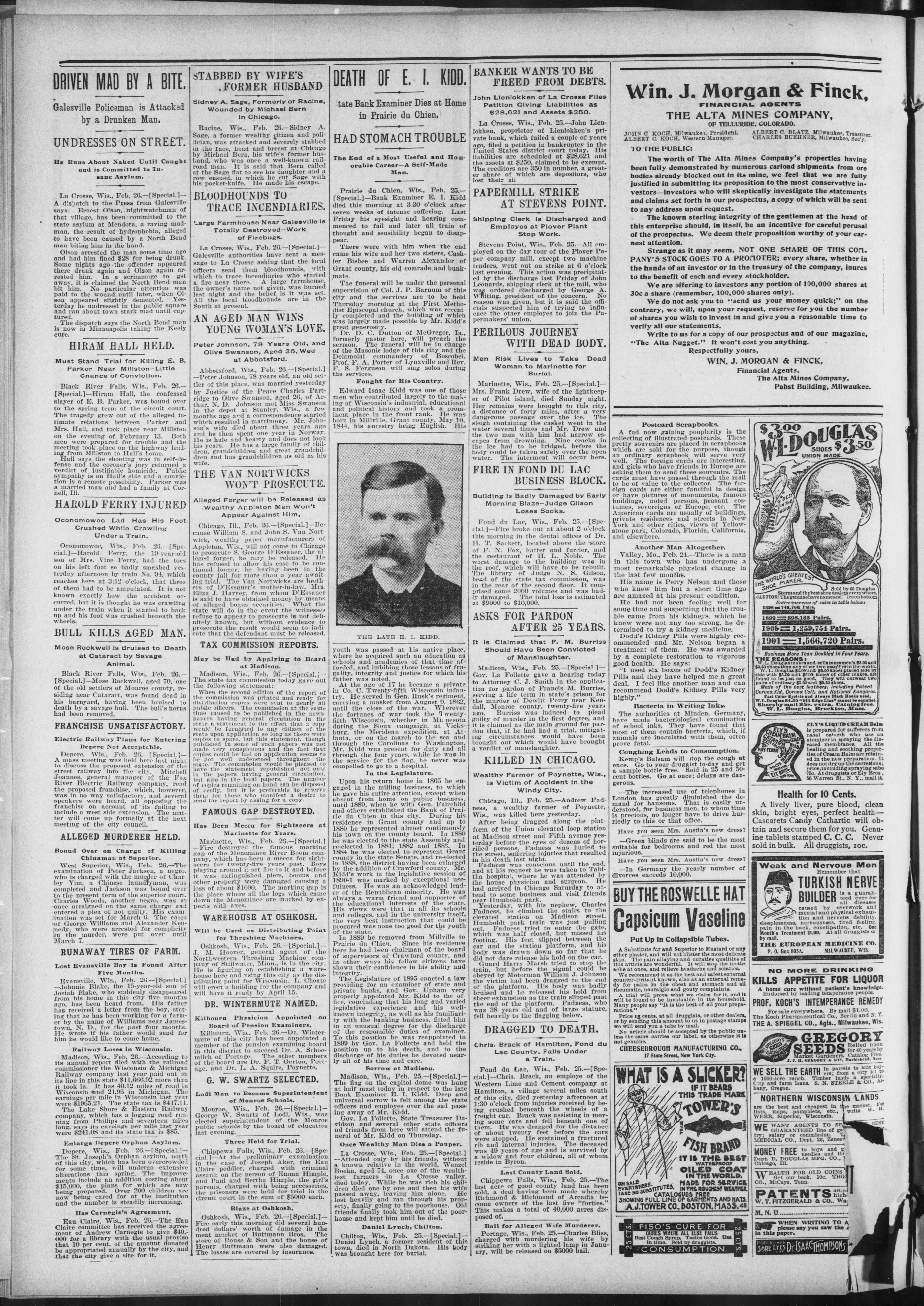
Page text (machine-generated)
WISCONSIN
WEEKLY
ADVOCATE
DEVOTED TO THE INTERESTS OF THE NEGRO RACE
EDITORIAL PARAGRAPHS.
The House of Representatives and the Crumpacker Resolution.
We are in receipt of the Cleveland Gazette of the 22d inst. and observe from it that the editor has addressed an open letter to Congressman S. E. Payne of New York state, whom he mainly charges with the defeat or indefinite postponement of that resolution. The Crumpacker resolution sought to have carried into effect that section of the Fourteenth amendment of the United States Constitution which requires the reduction of the congressional representation of any state adopting disfranchisement, in proportion to the disfranchised citizens therein who are not convicted of any crime.
The editor of the Gazette does not mince matters, but sounds a timely note of warning. In his introduction he goes straight to his point. He says: "The intelligent Afro-American of the North, Republicans, where votes are cast and counted, will be either retained in the party or driven from it in proportion to the manner in which the matter of disfranchisement is handled by the present Republican Congress. They have been watching the matter more closely, and have been agitating it greater for a year past than any other class of American citizens for reasons obvious. Hundreds have already gone from the Republican party. Thousands will go in the event of your present Congress' failure to do its duty as provided for in the Fourteenth amendment to the federal constitution. This sectinon, if I read it correctly, contains a mandatory provision for the decrease of representation of any or all states adopting disfranchisement acts or amendments to their constitution."
The above is only a part of the editor's open letter and is pregnant with meaning at the present time. He proposes to bring the matter before the National Afro-American council, and through it to the loyal Afro-American Republican voters in the North, and we are glad to give publicity before hand to his views. As he says: "There are those of us life-long, active and aggressive Republicans who place loyalty to race first and govern ourselves accordingly."
Tillman a Disgrace to the Senate
Tillman a Disgrace to the Senate.
Some months ago the Milwaukee Free Press published an interview held with a colored gentleman of this city, in which that gentleman designated Senator Tillman as the mountebank of the United States Senate. The recent disgraceful brawl between Senators McLaurin and Tillman justifies that opinion and shows more conclusively than anything else in his career the disgraceful and brutal disposition of this senatorial rowdy. No other man, no other member of the United States Senate, would have been guilty of like conduct. But a man who will dare to go out upon the rostrum and abuse Northern hospitality and freedom of speech as did Tillman in the last presidential campaign—and since—will do anything that is low and despicable. "We will have to kill a thousand niggers before we can wipe out the indignity placed upon the white man of the South by Roosevelt's act in inviting Booker T. Washington to his table." Sounds more like the utterance of a bar-room loafer than a dignified senator of the United States.
When the citizens of Milwaukee, La Crosse and Marinette cheered these and like sentiments uttered by this unwashed rebel, they were carried away by the excitement of the moment and did not realize that their acts were being advertised as an endorsement of Tillmanism in all its shamefaced nakedness. If these two men, McLaurin and Tillman, were Negroes the entire press of the nation would be calling them black savages and demanding not only their immediate and permanent expulsion but that they also should be fined and imprisoned. But it seems to make anyone difference in the world in these United States as to whether a man who commits such offenses be white or black is to be hoped that South Wells rehabilitate herself by taking for Freeduffoon by the nape of the taking him into well-deserved Rumption.
nature se terest in things that lead to the deghere exbur race in the eyes of the s what may be termed the Duringnent. There is plenty of been cir work at fair wages for all rant of ting to do their part and earn date for wring. We have no patience raint, whring. We have no patience affable g members of the race who ceedinglynty livelihood by displaying campaign ted musical abilities round treat a cs. They not only degrade
nd prostitute such abilities.
but have the unmitigated meanness to take, in some instances, their womenkind along with them to assist in the programme. This matter is one of supreme moment and we draw attention to it so that the public will understand that such conduct has not the approval of the right-thinking members of the race. Now we are having applications daily from all parts of the state for good, reliable colored female help, but it seems that some of our girls prefer to throw themselves away rather than accept a position in families where they will be treated with all due regard. Of course there are many exceptions, noble and notable exceptions, but in too many instances such seems to be the sad fact.
We hear that a certain south side Pole is anxious to accept nomination either as city treasurer or that of comptroller. Now, we feel confident he will get neither. We know of a gentleman who is a sure winner for the latter nomination, and he is a man whose word can be depended upon. If a candidate for office belies his word before nomination or election what can be expected from him after gaining the height of his ambition? We were warned by an ex-alderman of the Eleventh ward against having any dealings with this gentleman, and sager advice that acute politician never gave. More will be heard of this when the proper time comes.
Congratulations are being heaped upon us by our many friends on the manner in which we conduct our paper—the clean manner. Special praise is awarded us that we have taken the stand against the saloon element having any share whatever in the representation of the city's municipal affairs. The stand we take is this: A higher class of men than mere saloonkeepers (although there are some very good men among them) is needed to guide the civic ship at the present as at all other times.
White Shirtwaists in Sheer Materials.
One of these stylish model gowns has a chic little coat of heavy ecru lace, graduating from just above the waist line in front to a postilion back.
The high-grade silk and wool grenadines in black take high rank for handsome appearance. The open work stripe effects which are so stunning made up on a white silk foundation, are especially beautiful.
A Frenchy idea in sash drapery is carried out with good effect on a white net gown, seen in a Broadway shop. The wide ends are of light blue silk, reaching almost to the foot of the gown, and instead of sweeping plainly down its length the streamers are caught at intervals in a two-inch tuck, slightly gathered across the width, and a deeper tuck finishes the ends.
One of the shops has on exhibition several fetching summer gowns in foulard. The colors are soft grays, tans, the everpopular dark blue, and a pretty red, with black or white flower designs, and with each gown is a parasol of material to match. The idea of complete harmony is pretty, and one which may be carried out at a comparatively moderate expense.
Novel and pretty is the net sash drapery on a gown of black lace over white. The two long ends of net, which are very wide, are each caught at the waist line with a large white seed pearl button set in the center of a small rosette; then half way down the length of the skirt the pieces of net are gathered together into a width of about six inches, sweeping out again in graceful folds to the foot of the skirt.
White shirtwaists in the sheer materials are seen once in a while with the pleats stitched in black. An attractive model of dotted Swiss muslin seen in the shops has several very narrow pleats in the back effectively finished this way. Black and white embroidery trim cuffs and collar, and a smart idea is the band of embroidery in front from neck to waist line, the pattern showing a black ground done in white. The waist fastens just to one side and where the embroidery is joined on the Swiss also is embroidered in large outline flowers in black.
Narrow black and white stripe silk is introduced as a trimming on many of the smart wool gowns in color and black. One street gown of black cloth has a piping of this black and white on the collar and cuffs, and there is a natty little pocket outlined with it.
Another idea is to lay the silk on in narrow fancy bands. A gown of mixed green cloth has the flounce, which, by the way, is in double box pleats all round, caught on to the upper skirt with a sort of zigzag band of this pretty silk, which is then edged with a fine black cord. On the coat is a repetition of the silk trimming, and the effect is fresh and dainty.—New York Mail and Express.
Many Switzerlands in One.
The vast ranges of the Canadian Rockies are, in the opinion of Whymper, "appalling in their immensity; for there are fifty or sixty Switzerlands rolled into one."
A Brilliant Social Function.
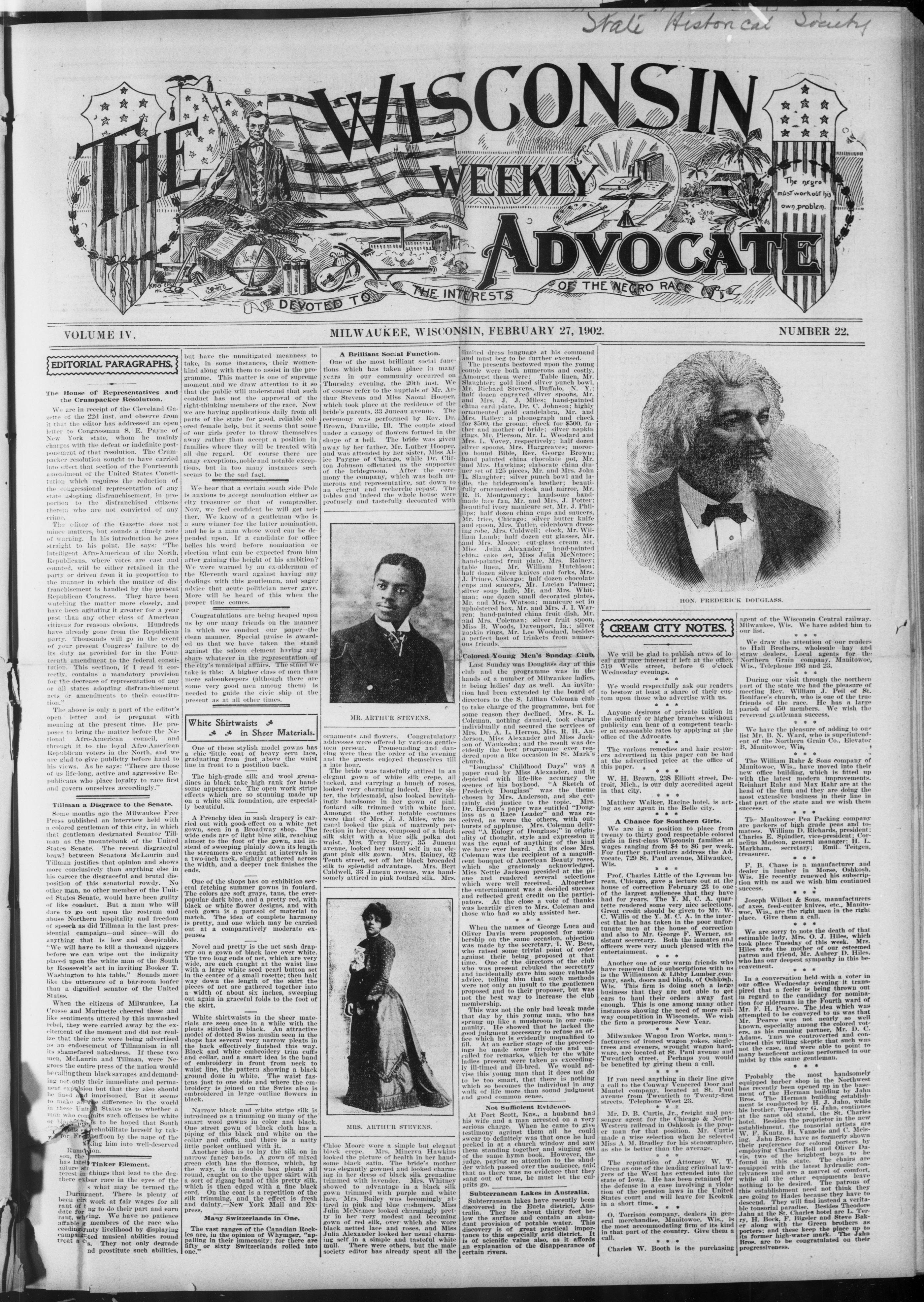
One of the most brilliant social functions which has taken place in many years in our community occurred on Thursday evening, the 20th inst. We of course refer to the nuptials of Mr. Arthur Stevens and Miss Naomi Hooper, which took place at the residence of the bride's parents, 33 Juneau avenue. The ceremony was performed by Rev. Dr. Brown, Danville, Ill. The couple stood under a canopy of flowers formed in the shape of a bell. The bride was given away by her father, Mr. Luther Hooper, and was attended by her sister, Miss Alice Paygne of Chicago, while Dr. Clifton Johnson officiated as the supporter of the bridegroom. After the ceremony the company, which was both numerous and representative, sat down to an elegant and recherche repast. The tables and indeed the whole house were profusely and tastefully decorated with
THE LEGEND OF THE WORLD
MR. ARTHUR STEVENS
ornaments and flowers. Congratulatory addresses were offered by various gentlemen present. Promenading and dancing were then the order of the evening and the guests enjoyed themselves till a late hour.
The bride was tastefully attired in an elegant gown of white silk crepe, all tucked, and carrying a bunch of roses, looked very charming indeed. Her sister, the bridesmaid, also looked bewitchedly handsome in her gown of pink-foulard silk trimmed with white lace. Amongst the other notable costumes were that of Mrs. J. J. Miles, who as usual looked the pink of matronly perfection in her dress, composed of a black silk skirt with a blue silk polka dot waist. Mrs. Terry Berry, 35 Juneau avenue, looked her usual self in an elegant pink silk gown. Mrs. Rainey, 62 Tenth street, set off her black brocaded silk to splendid advantage. Mrs. Bert Caldwell, 33 Juneau avenue, was handsomely attired in pink foulard silk. Mrs.
THE WOMAN WHO WAS THE LADY OF THE WORLD
MRS. ARTHUR STEVENS.
Chloe Moore wore a simple but elegant black crepe. Mrs. Minerva Hawkins looked the picture of health in her handsome black satin. The bride's mother was elegantly gowned and looked charming in her dress of black silk grenadine trimmed with lavender. Mrs. Whitney showed to advantage in a black silk gown trimmed with purple and white lace. Mrs. Bailey was becomingly attired in pink and blue cashmere. Miss Julia McNamee looked charmingly pretty in her very modest and becoming gown of red silk, over which she wore black netted lace and roses, and Miss Julia Alexander looked her usual charming self in a simple and tasteful white mull. There were others, but the male society editor has already spent all the
limited dress language at his command and must beg to be further excused. The presents bestowed upon the young couple were both numerous and costly. Amongst them were: Table linen, Mr. Slaughter; gold lined silver punch bowl, Mr. Richard Stevens, Buffalo, N. Y.; half dozen engraved silver spoons, Mr. and Mrs. J. J. Miles; hand-painted china card plate, Dr. C. Johnson; highly ornamented gold candelabra, Mr. and Mrs. Bailey; a phonograph and check for $500, the groom; check for $500, father and mother of bride; silver napkin rings, Mr. Pierson, Mr. L. Woodard and Mrs. L. Vovey, respectively; half dozen silver spoons, Mrs. Hargreaves; moroco bound Bible, Rev. George Brown; hand painted china chocolate pot, Mr. and Mrs. Hawkins; elaborate china dinner set of 125 pieces, Mr. and Mrs. John L. Slaughter; silver punch bowl and laddle, the bridegroom's brother; beautifully ornamented clock and mirror, Mr. R. B. Montgomery; handsome hand-made lace fan, Mr. and Mrs. J. Potter; beautiful ivory manicure set, Mr. J. Phillips; half dozen china cups and saucers, Mr. Price, Chicago; silver butter knife and spoon, Mrs. Tatler, eiderdown dressing robe, Mrs. Caldwell; clock, Mr. William Lamb; half dozen cut glasses, Mr. and Mrs. Moore; cut-glass cream set, Miss Julia Alexander; hand-painted china cake set, Miss Julia McNamee; hand-painted fruit plate, Mrs. Rainey; table linen, Mr. William Hutchison; half dozen silver knives and forks, Mrs. J. Prince, Chicago; half dozen chocolate cups and saucers, Mr. Lucian Palmer; silver soup ladle, Mr. and Mrs. Whitman; one dozen small decorated plates, Mr. and Mrs. Watson; manicure set in upholstered box, Mr. and Mrs. J. I. Warren; hand-painted china fruit dish, Mr. and Mrs. Coleman; silver fruit spoon, Miss B. Woods, Davenport, Ia.; silver napkin rings, Mr. Lee Woodard, besides a perfect host of trinkets from numerous friends.
Colored Young Men's Sunday Club.
Last Sunday was Douglass day at this club and the programme was in the hands of a number of Milwaukee ladies, it being ladies' day as well. An invitation had been extended by the board of directors to the S. Lillian Coleman club to take charge of the programme, but for some reason they declined. Mrs. S. L. Coleman, nothing daunted, took charge individually and secured the services of Mrs. Dr. A. L. Herron, Mrs. R. H. Anderson, Miss Alexander and Miss Jackson of Waukesha; and the result was decidedly the best programme ever rendered upon a like occasion in St. Mark's church
"Douglass' Childhood Days" was a paper read by Miss Alexander, and it depicted with life-like accuracy the scenes of his boyhood. "A Sketch of Frederick Douglass" was the theme chosen by Mrs. Anderson, and she certainly did justice to the topic. Mrs. Dr. Herron's paper was entitled "Douglass as a Race Leader" and was received, as were the others, with outbursts of applause. Mrs. Coleman delivered "A Eulogy of Douglass;" in originality of thought, style and expression it was the equal of anything of the kind we have ever heard. At its close Mrs. Coleman was the recipient of a magnificent bouquet of American Beauty roses, which she graciously acknowledged. Miss Nettie Jackson presided at the piano and rendered several selections which were well received. Altogether the entertainment was a decided success and reflected great credit on the participants. At the close a vote of thanks was heartily given to Mrs. Coleman and those who had so ably assisted her.
* * *
When the names of George Luca and Oliver Davis were proposed for membership on the same occasion, objection was made by the secretary, I. W. Bess, who raised some trivial point of order against their being proposed at that time. One of the directors of the club who was present rebuked the secretary and incidentally gave him some valuable advice, telling him that such methods were not only an insult to the gentlemen proposed and to their proposer, but was not the best way to increase the club membership.
This was not the only bad break made that day by this young man, who has sprung up like a mushroom in our community. He showed that he lacked the good judgment necessary to refuse an office which he is evidently unqualified to fill. At an earlier stage of the proceedings he made some frivolous and uncalled for remarks, which by the white ladies present were taken as exceedingly ill-timed and ill-bred. We would advise this young man that it does not do to be too smart, that there is nothing which so becomes the individual in any walk of life more than sound judgment and good common sense.
Not Sufficient Evidence.
At Fort Scott, Kas., a husband had his wife and a man arrested on a very serious charge. When he came to give testimony against them all he could swear to definitely was that once he had peeked in at a church window and saw them standing together and singing out of the same hymn book. However, the judge, paying no attention to the shudder which passed over the audience, said that as there was no evidence that they sang out of tune, he must let the culprits go.
Subterranean Lakes in Australia
Subterranean Lakes in Australia. Subterranean lakes have recently been discovered in the Eucla district, Australia. They lie about thirty feet below the surface and contain an abundant provision of potable water. This discovery is of great practical importance to this especially arid district. It is of scientific value also, as it affords an explanation of the disappearance of certain rivers.
JACKSON
HON. FREDERICK DOUGLASS.
CREAM CITY NOTES.
We will be glad to publish news of local and race interest if left at the office, 519 Wells street, before 6 o'clock Wednesday evenings.
* * * *
We would respectfully ask our readers to bestow at least a share of their custom upon those who advertise with us.
* * * *
Anyone desirous of private tuition in the ordinary or higher branches without publicity can hear of a competent teacher at reasonable rates by applying at the office of the Advocate.
* * * *
The various remedies and hair restorers advertised in this paper can be had at the advertised price at the office of this paper.
W. H. Brown, 238 Elliott street, Detroit, Mich., is our duly accredited agent in that city.
* * *
Matthew Walker, Racine hotel, is acting as our agent in the Belle city.
A Chance for Southern Girls.
We are in a position to place from twenty to thirty good respectable colored girls in first-class Wisconsin families at wages ranging from $4 to $6 per week. For further particulars address the Advocate, 729 St. Paul avenue, Milwaukee, Wis.
Prof. Charles Little of the Lyceum bureau, Chicago, gave a lecture out at the house of correction February 23 to one of the largest audiences that they have had for years. The Y. M. C. A. quartette rendered some very nice selections. Great credit should be given to Mr. W. C. Willis of the Y. M. C. A. in the interest that he has taken in the poor unfortunate men at the house of correction and also to Mr. George F. Werner, assistant secretary. Both the inmates and officers were very much pleased with the entertainment.
Another one of our warm friends who have renewed their subscriptions with us is the Williamson & Libby Lumber company, sash, doors and blinds, of Oshkosh. Wis. This firm is doing such a large business that they are not able to get cars to haul their orders away fast enough. This is one among many other instances showing the need of more railway competition in Wisconsin. We wish the firm a prosperous New Year.
* * *
Milwaukee Wagon Iron Works, manufacturers of ironed wagon yokes, single trees and eveners, wrought wagon hardware, are located at St. Paul avenue and Twentieth street. Perhaps you would be benefited by giving them a call.
If you need anything in their line give a call to the Conway Veneered Door and Mantel company, located at St. Paul avenue from Twentieth to Twenty-first streets. Telephone West 23.
Mr. D. B. Curtis, Jr., freight and passenger agent for the Chicago & North-Western railroad in Oshkosh is the proper man for that position. Mr. Curtis made a wise selection when he selected Miss A. M. Bradley for his stenographer, as she is better than the average.
The reputation of Attorney W. T. Green as one of the leading criminal lawyers of the West has extended into the state of Iowa. He has been retained for the defense in a case involving a violation of the pension laws in the United States court and will leave for Keokuk in a short time.
O. Torrison company, dealers in general merchandise, Manitowoc, Wis., is the most accommodating firm of its kind in that part of the country. Give them a call.
Charles W. Booth is the purchasing
☆ ☆ ☆
☆ ☆ ☆
☆ ☆ ☆
```markdown
```
血 肃
***
* * *
☆ ☆ ☆
agent of the Wisconsin Central railway. Milwaukee, Wis. We have added him to our list.
* * *
We draw the attention of our readers to Hall Brothers, wholesale hay and straw dealers. Local agents for the Northern Grain company, Manitowoc, Wis., Telephone 193 and 23.
* * *
During our visit through the northern part of the state we had the pleasure of meeting Rev. William J. Peil of St. Boniface's church, who is one of the true friends of the race. He has a large parish of 450 members. We wish the reverend gentleman success.
We have the pleasure of adding to our list Mr. B. N. Ward, who is superintendent of the Northern Grain Co., Elevator B, Manitowoc, Wis.
The William Rahr & Sons company of Manitowoc, Wis., have moved into their new office building, which is fitted up with the latest modern improvements. Reinhart Rahr and Max Rahr are at the head of the firm and they are doing the most extensive business in their line in that part of the state and we wish them success.
The Manitowoc Pea Packing company are packers of high grade peas and tomatoes. William D. Richards, president; Charles E. Spindler, vice-president; Cornelius Madson, general manager; H. L. Markham, secretary; Emil Teitgen, treasurer.
F. B. Chase is a manufacturer and dealer in lumber in Morse, Oshkosh, Wis. He recently renewed his subscription with us and we wish him continued success.
* * *
Joseph Willott & Sons, manufacturers of axes, feed-cutter knives, etc., Manitowoc, Wis., are the right men in the right place. Give them a call.
* * *
We are sorry to note the death of that estimable lady, Mrs. O. J. Hiles, which took place Tuesday of this week. Mrs. Hiles was the mother of our esteemed patron and friend, Mr. Aubrey D. Hiles, who has our deepest sympathy in this bere-
In a conversation held with a voter in our office Wednesday evening it transpired that a feeler is being thrown out in regard to the candidacy for nomination for alderman in the Fourth ward of Mr. F. H. Pearce. The idea which was attempted to be conveyed to us was that Mr. Pearce was not nearly so well known, especially among the colored voters, as his running partner, Mr. D. C. Adams. This we controverted and convinced this willing skeptic that such was not the case, and were able to point to many beneficent actions performed in our midst by this same gentleman.
Probably the most handsomely equipped barber shop in the Northwest has recently been opened up in the basement of the Herman building by Jahn Bros. The Herman building establishment is conducted by H. J. Jahn, while his brother, Theodore G. Jahn, continues at the same old stand, the St. Charles hotel. Besides the proprietor in the new establishment, the tonsorial artists are W. F. Kuntz, H. Vanzelie and C. Meising. Jahn Bros. have as formerly shown their preference for colored porters by employing Charles Bell and Oliver Davis, two of the brightest boys to be found in this state. The chairs are equipped with the latest hydraulic contrivances and are a marvel of comfort, while all the other equipments leave nothing to be desired. The patrons of this establishment need not think they are going to Hades because they have to descend. They will find instead a veritable tonsorial paradise. Besides Theodore Jahn at the St. Charles hotel are L. Terry, H. Bock, F. Bigeler and Steve Baker along with the Green brothers as porters; and these keep the place up to its former high-water mark. The Jahn Bros. are to be congratulated on their progressiveness.
---
NUMBER 22.
杂 杂 杂
* * *
* * *
* * *
***
```markdown
```
* * *
***
* * *
GIVEN FREEDOM OF CITY.
Royal Visitor Makes a Happy Speech in Response-Dinner at Metro
New York, Feb. 26. The freedom of the city of New York was presented to Prince Henry yesterday afternoon, the ceremony taking place at the city hall. The prince made the vide from the Battery in an open carriage, making good his statement that if the people of New York wanted to see him he wanted to see the people. The heavy rain that was falling did not seem to bother his royal highness in the least. Arriving at the city hall the prince and the mayor hobnobbed and chatted together like old friends. Just after the two had shaken hands the mayor said:
"Your royal highness, I welcome you to the city." Then turning towards Mr. Schurz, the mayor continued: "Let me present to you Mr. Schurz of the citizens' committee, and may I also present Gen. Sickles, a hero of Gettysburg."
The prince shook hands with Mr. Schurz, and then, turning to Gen. Sickles, looked at him straight in the eye, then reached out his hand, "My pleasure."
Gen. Sickles, standing erect and supported by his crutches, shook the prince's hand warmly.
A few minutes later the prince was escorted to the aldermanic chamber.
Presents Engrossed Resolutions.
The mayor, taking from the casket the engrossed resolutions, which had been tied with white satin ribbon, said:
Your Royal Highness: In receiving the welcome of the city of New York you are receiving the greetings of one of the oldest centers of civilization upon this continent. The freedom of the city which is now to be conferred upon you has not been often granted in all our history. If it be now in fact but a form of words, it is a form that signifies high regard and genuine friendship for him upon whom it is bestowed.
Our ancient city in the course of the years has become the metropolis of America. It is not a capital like the great cities of Europe, for it is not the seat of government, either of the state of New York or of the United States. But it is, in a real sense, one of the most important cities of the nation's life, for here are to be found many of the men who give shape to the financial, the commercial, and the industrial progress of the nation. Here, also, it may fairly be claimed, is one of the most influential centers of education, music, literature, art and science. To all of these claims to eminence on the part of our city our fellow-citizens of German birth and descent have contributed their part in full measure. It is therefore a pleasure to all our people to welcome here one who so worthily represents their fatherland.
We welcome your royal highness heartily for your own sake, and we welcome you equally as the representative of your imperial brother, the Emperor of Germany. We hope that your visit will do much to cement the friendship always existing between Germany and the United States, between the country of Steuben and De Kalb and the country of Washington. By the authority of the board of aldermen of the city, I now have the honor to confer upon your Royal Highness the freedom of the city of New York.
Prince Replies to Mayor.
The prince took the ribbon tied parchment from the mayor, and said in English that had only the faintest trace of a German accent:
Mr. Mayor: I am so grateful for the kind reception I find here in the house as well as for the kind words you express on this occasion. I am fully aware of the fact that it is an exception that a member, certainly of my family, should have been made or offered the freedom of the city of New York. I may add that I am proud of it. It is the first city which so many of the old world going over to the new world meet and see. It is a city which has been an asylum for many of my countrymen. It is, I am aware, a center of commerce.
I was deeply touched by the reception which I found on the day of my arrival, as well as when I drove up to the city hall. All of you know perfectly well that I am not here on my own behalf, but that I am here on behalf of his majesty, the German Emperor, my beloved brother and sovereign.
I am sorry I cannot repay you for all the kindness I have found here, but I think I am quite safe in saying that I may offer you the friendship of his majesty, the Emperor of Germany, and I agree with you. Mr. Mayor, if I may say it, that I have not come here to create a friendship, but to carry on the old friendship which has existed between our two nations and which I hope may remain the same in the future. I wish to thank you once more and conclude with my heartfelt thanks for the kindness and for your offering me the freedom of the city of New York. I wish to add that I wish for the city of New York everything which is good for the future and every possible good wish for your city.
Mayor Low Host at Dinner.
At 6:17 o'clock the prince, his suite, and Rear-Admiral Evans drove to the Metropolitan club, where they were the guests at dinner of the mayor, with the presidential delegates and a number of citizens. There were no formal speeches. The toasts were:
"To the President of the United States" (music, "Star Spangled Banner").
"To the Emperor of Germany" (music, German national hymn).
"To His Royal Highness, Prince Henry of Prussia" (music, German naval hymn).
Attends Opera Performance.
The day closed with the gala performance at the Metropolitan Opera house. The prince did not arrive at the opera until 9:30 o'clock, and the first act of "Lohengrin," with which the programme was opened, was nearly finished when he reached his box. The royal visitor was enthusiastically received by the large audience present, and he bowed his acknowledgments repeatedly.
Lunch on Hohenzollern.
Following the launching yesterday a lunch was served on the Hohenzollern. The prince addressed the President as follows:
Mr. Roosevelt, you are here on board as a guest of his majesty, the German Emperor, and I really believe that it is the first time that a President of the United States of America has ever been on board one of his majesty's ships. Please God, it will not be the last time. I wish to thank you heartily for the reception I have had, from the first day I landed up to this moment, and it is my sincere and certain impression that there is a strong feeling of personal friendship arising between us. May it extend to the benefit of our two great nations. I propose three cheers for Mr. Roosevelt.
The President arose directly to answer saying:
I wish to express my hearty thanks for the kind words your royal highness has expressed on my behalf, and I wish you to understand that it is no empty compliment when I say that your royal highness has already won a genuine place in our affections and good will. I highly appreciate the fact that his majesty, the German Emperor has sent you to the American people, and I thank you personally that you have taken a step which eventually must knit closer together the two great nations, whose friendship means so much for the future welfare of the entire world. To express, finally, a personal wish of my own, I look forward with great pleasure to the day on which I shall be your guest in your capacity as admiral on board one of your battleships.
The Hamburg marine observatory offers three prizes to inventors of any country for the best instruments to measure wind pressure.
COLLIDED HEAD-ON.
Passenger and Wrecking Train Come Together While Rounding a Curve.
Auburn, N. Y., Feb. 25.—Five men were killed and two fatally injured in a wreck early today on the Auburn branch of the New York Central, two and one-half miles west of Aurelius. A passenger train and a wrecking train collided head on while rounding a curve at full speed.
The dead:
JOHN HAZEMEN of Rochester, engineer of the passenger train.
man.
ENGINEER DURAND of Syracuse, crew
man, stocking train.
ENGINEER DURAND of Syracuse, crew of the wrecking train.
FIREMAN SCHMUCK of Syracuse, of the wrecking train.
The injured:
Trainman E. H. Renner of Rochester.
Ran Into Landslide.
York, Pa., Feb. 25.—Two men were killed and one dangerously wounded in a freight wreck on the Columbia & Port Deposit railroad a short distance south of McCall's ferry about 11 o'clock last night.
The dead:
ENGINEER A. T. HATCH.
FIREMAN PAUL WILHELM.
Henry Wolf, a brakeman, was dangerously injured. The men are all residents of Columbia.
The wreck was caused by the train running into a landslide. About twenty-five cars were reduced to splinters in the wreck.
A SERIES OF TRAGEDIES.
SchoolTeacher Slain,Wife Murderer Arrested, and Sulcide of Philadelphia Youth.
Decatur, Ill., Feb. 25.—Fletcher Barnett, a school teacher, today entered a schoolhouse one mile from Camargo and without warning shot and instantly killed Miss Eva Wiseman, the teacher in charge. He then jumped into a well and was drowned. Barnett had been a suitor for the girl's hand. All were highly connected. New York, Feb. 25.—Joseph Wolfrid Blondin, who was accused of the murder of his wife near Boston, Mass., last June by cutting off her head, was arrested at police headquarters, New York, today. Philadelphia, Pa., Feb. 25.—Edgar A. Janney, aged 28 years, shot himself through the right temple at his home in Lansdowne, a suburb of this city, last night, dying instantly. Young Janney had been melancholy for some time.
Vancouver, B. C., Feb. 25.—While her companion, Jack Kirk, was asleep, Lulu Watts, a variety actress of Nome, attacked him in a fit of jealousy and severed his head from his body with a razor.
New York, Feb. 25.—Henry Kress of Union Hill, N. J., was beaten with a svphon and is now in a hospital with a fractured skull, because he maligned the Hohenzollern, and Prince Henry in particular, in the presence of a German bartender. The latter was arrested.
TARIFF BILL PASSED.
Goes Through Senate on a Strict Party Vote-Hoar with Republicans.
Washington. D. C., Feb. 25.—The Philippine tariff revenue bill was passed by the Senate by a vote of 46 ayes to 26 noes. It was a strict party vote, Mr. Hoar (Rep., Mass.) also voting in the affirmative. The final vote was taken after rejecting all pending amendments, with the exception of one introduced by Mr. Hoar. This provided that no conviction for treason in the Philippines could be had without the testimony of two witnesses of the overt act, and that members of the family could not testify against each other. This amendment was agreed to by a vote of 38 ayes to 34 noes.
The Teller amendment, providing for Philippine independence, was rejected by a vote of 37 to 22. Messrs. Mason (Rep., Ill.) and Hoar (Rep., Mass.) voted in the affirmative. All other amendments went down on party lines.
POLICEMAN'S SUICIDE.
Member of Calumet & Hecla Mining Company's Force in Copper Country.
Calumet, Mich., Feb. 25.—[Special.]—Richard Underwood, a prominent member of the Calumet & Hecla Mining company police force, was found dead in bed last evening with a revolver clenched in his hand. There was a bullet wound in his left temple and it is supposed to have been a case of suicide, though no motive for the deed is known.
FROM HOSPITAL TO JAIL.
Preparation for the Trial of Mrs. Soffel at Pittsburg.
Butler, Pa., Feb. 25.—Mrs. Kate Soffel, wife of the Pittsburg jail warden, and who assisted in the escape of the Biddle brothers and was wounded during the battle when they were recaptured, was removed from the Butler hospital this morning and taken to Pittsburg by County Detective Robison. She had fully recovered from her wounds. Three charges have been made against her, one alleging the crime of aiding in the escape of the murderers and two alleging felonious assault and battery.
Austrian Emperor's Gift
Besemer, Mich., Feb. 25.—Emperor Francis Joseph of Austria has sent a life-sized portrait of himself to Attorney J. J. Patek of Ironwood in appreciation of conspicuous services in the Austrian army. The portrait is handsomeily framed, surmounted by the crown of Austria in solid gold. The gift came direct from his majesty.
Jeweler's Dummy Clocks Wrong.
A paragraph has been going the rounds of the press that the dummy clocks used by jewelers and other dealers in timepieces as advertisements always indicate the hour of 8:18 to commemorate the precise moment when President Lincoln was assassinated. Lincoln did not arrive at Ford's theater on the fatal evening until 9 o'clock and Booth did not shoot him until after 10. His death occurred at 7:30 the next morning.—New York Press.
Lew Wallace's Den.
Gen. Lew Wallace has a luxurious and ideal author's "den." It is erected on his lawn, and at a cost which most people would consider quite a fortune. In shape it resembles an Oriental mosque, and the interior is one large room, handsomely furnished and decorated, and on the walls hangs a portrait of the Sultan of Thurkey, painted by the general himself.
—The tent in which the Dowager Empress of China travels is made of yellow silk, copiously embroidered in silver and gold, with great dragons and blazing suns.
KING NOT ASSASSINATED
Rumor that Alexander of Servia Had been Slain Authoritatively Denied.
Berlin. Feb. 26.—An uncredited rumor was in circulation on the boerse here today that the King of Servia had been assassinated.
[Name]
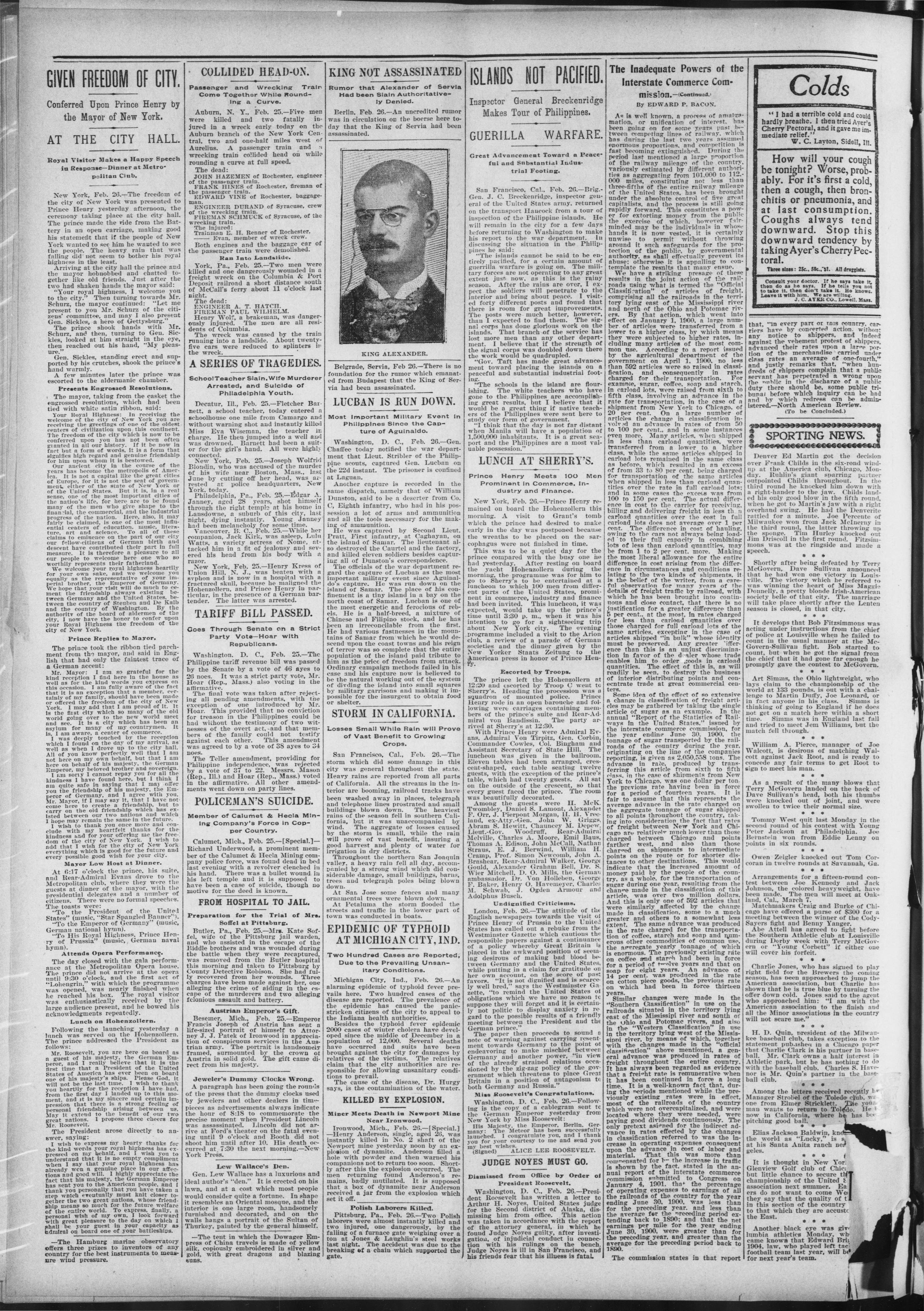
KING ALEXANDER.
Belgrade, Servia, Feb 26.—There is no foundation for the rumor which emanated from Budapest that the King of Servia had been assassinated.
LUCBAN IS RUN DOWN.
Most Important Military Event in Philippines Since the Capture of Aguinaldo.
Washington, D. C., Feb. 26.—Gen. Chaffee today notified the war department that Lieut. Stribler of the Philippine scouts, captured Gen. Lucban on the 22d instant. The prisoner is confined at Laguan.
Another capture is recorded in the same dispatch, namely that of William Dunston, said to be a deserter from Co. C, Eighth infantry, who had in his possession a lot of arms and ammunition and all the tools necessary for the making of ammunition.
He was captured by Second Lieut. Pratt, First infantry, at Caghayan, on the island of Samar. The lieutenant also destroyed the Caurtel and the factory, and killed eleven soldiers besides capturing all of Dunston's correspondence.
The officials of the war department regard the capture of Lucban as the most important military event since Aguinaldo's capture. He was run down on the island of Samar. The place of his confinement is a tiny island in a bay on the north coast of Samar. Lucban is one of the most energetic and ferocious of rebels. He is a half-breed, a mixture of Chinese and Filipino stock, and he has been an irreconcilable from the first. He had various fastnesses in the mountains of Samar from which he would descend upon the coast towns and his reign of terror was so complete that the entire population of the island paid tribute to him as the price of freedom from attack. Ordinary campaign methods failed in his case and his capture now is believed to be the natural working out of the system of dividing the island into small squares by military garrisons and making it impossible for the insurgent to obtain food or shelter.
STORM IN CALIFORNIA.
Losses Small While Rain will Prove of Vast Benefit to Growing Crops
San Francisco, Cal., Feb. 26.—The storm which did some damage in this city was general throughout the state. Heavy rains are reported from all parts of California. All the streams in the interior are booming, railroad tracks have been washed away in places, telegraph and telephone lines prostrated and small buildings blown down. The heaviest rains of the season fell in southern California, but it was unaccompanied by wind. The aggregate of losses caused by the storm is small, while the rain will prove of vast benefit, insuring a good harvest and plenty of water for irrigation in dry districts.
Throughout the northern San Joaquin valley, a heavy rain fell all day, accompanied by a strong wind which did considerable damage, small buildings, barns, trees and telegraph poles being blown down. At San Jose some fences and many ornamental trees were blown down. At Petaluma the storm flooded the streets and traffic in the lower part of town was conducted in boats.
EPIDEMIC OF TYPHOID AT MICHIGAN CITY, IND.
Two Hundred Cases are Reported. Due to the Prevailing Unsanitary Conditions.
Michigan City, Ind., Feb. 26.—An alarming epidemic of typhoid fever prevails here. Two hundred cases of the disease are reported. The prevalence of the epidemic has caused the panic-stricken citizens of the city to appeal to the Indiana health authorities.
Besides the typhoid fever epidemic 2000 cases of winter cholera have developed since the middle of December in a population of 12,000. Several deaths have occurred and suits have been brought against the city for damages by relatives of the victims. The relatives claim that the city authorities are responsible for allowing unsanitary conditions to prevail.
The cause of the disease, Dr. Hurgy says, is the contamination of the water.
KILLED BY EXPLOSION.
Miner Meets Death in Newport Mine Near Ironwood.
Ironwood, Mich., Feb. 26.—[Special.]—Henry Anderson, single, aged 26, was instantly killed in No. 2 shaft of the Newport mine yesterday noon by an explosion of dynamite. Anderson filled a hole with powder and then warned his companions not to return too soon. Shortly after this the explosion occurred. The men returning found Anderson's remains, badly mutilated. It is supposed that a box of dynamite near Anderson received a jar from the explosion which set it off.
Polish Laborers Killed.
Pittsburg, Pa., Feb. 26.—Two Polish laborers were almost instantly killed and two injured, one dangerously, by the falling of a furnace gate weighing over a ton at Jones & Laughlin's steel works last night. The accident was due to the breaking of a chain which supported the gate.
ISLANDS NOT PACIFIED.
Inspector General Breckenridge Makes Tour of Philippines.
Great Advancement Toward a Peaceful and Substantial Industrial Footing.
San Francisco, Cal., Feb. 26.—Brig. Gen. J. C. Breckenridge, inspector general of the United States army, returned on the transport Hancock from a tour of inspection of the Philippine islands. He will remain in the city for a few days before returning to Washington to make his report to the war department. In discussing the situation in the Philippines he said:
"The islands cannot be said to be entirely pacified, for a certain amount of guerrilla warfare is going on. The military forces are not operating to any great extent just now, as this is the rainy season. After the rains are over, I expect the soldiers will penetrate to the interior and bring about peace. I visited forty different posts and found that there is room for great improvements. The posts were much better, however, than I expected to find them. The signal corps has done glorious work on the islands. That branch of the service has lost more men than any other department. I believe that if the strength of the signal corps was doubled down there the work would be quadrupled.
"Gov. Taft has made great advancement toward placing the islands on a peaceful and substantial industrial footing.
"The schools in the island are flourishing. The white teachers who have gone to the Philippines are accomplishing great results, but I believe that it would be a great thing if native teachers of the Philippines were sent here to study our form of government.
"I think that the day is not far distant when Manila will have a population of 1,500,000 inhabitants. It is a great seaport and the Philippines are a most valuable possession."
LUNCH AT SHERRY'S.
Prince Henry Meets 100 Men Prominent in Commerce, Industry and Finance.
New York, Feb. 26.—Prince Henry remained on board the Hohenzollern this morning. A visit to Grant's tomb which the prince had desired to make early in the day was postponed because the wreaths to be placed on the sarcophagus were not finished in time.
This was to be a quiet day for the prince compared with the busy one he had yesterday. After resting on board the yacht Hohenzollern during the morning, the programme was for him to go to Sherry's to be entertained at a luncheon to which 100 men from different parts of the United States, prominent in commerce, industry and finance had been invited. This luncheon, it was expected, would take up the prince's time until 3:30 p. m., when it was his intention to go for a sightseeing trip about New York city. The evening programme included a visit to the Arion club, a review of a parade of German societies and the dinner given by the New Yorker Staats Zeitung to the American press in honor of Prince Henry.
Escorted by Troops.
The prince left the Hohenzollern at 12:20 and escorted by Troop C went to Sherry's. Heading the procession was a squadron of mounted police. Prince Henry rode in an open barouche and following were carriages containing members of the prince's suite and Rear-Admiral von Bandissin. The party arrived at Sherry's at 12:30.
With Prince Henry were Admiral Evans, Admiral Von Tirpitz, Gen. Corbin, Commander Cowles, Col. Bingham and Assistant Secretary of State Hill. The luncheon was given in the ballroom. Eleven tables had been arranged, crescent-shaped, each table seating twelve guests, with the exception of the prince's table, which had twenty guests. All sat on the outside of the crescent, so that every guest faced the prince. The room was beautifully decorated.
Among the guests were H. McK. Twombley, Daniel S. Lamont, Alexander F. Orr, J. Pierpont Morgan, H. H. Vreeland, ex-Atty.-Gen. John W. Griggs, Abram S. Hewitt, Chauncey M. Depew, Lieut.-Gov. Woodruff, Rear-Admiral Melville, Charles A. Moore, Emil Baus, Thomas A. Edison, John McCall, Nathan Straus, E. J. Berwind, William H. Cramp, Prof. Simon Newcomb, John A. Brashear, Rear-Admiral Walker, George Gould, Alexander Graham Bell, Dr. S. Wier Mitchell, D. O. Mills, the German ambassador, Dr. Von Holleben, George F. Baker, Henry O. Havemeyer, Charles M. Schwab, J. Ogden Armour and Adolphus Busch.
Undignified Criticisms.
London, Feb. 26.—The attitude of the English newspapers towards the visit of Prince Henry of Prussia to the United States has called out a rebuke from the Westminster Gazette which cautions the responsible papers against a continuance of a policy whereby Great Britain is placed in the awkward position of seeming desirous of making bad blood between Germany and the United States, while putting in a claim for gratitude on her own account, on the score of past favors. "It is not dignified and is scarcely well bred," says the Westminster Gazette, "to remind the United States of obligations which we have no reason to suppose they will forget and it is certainly not politic to display anxiety in regard to the possible results of a friendly meeting between the President and the German prince."
The paper then proceeds to sound a note of warning against carrying resentment towards Germany to the point of endeavoring to make mischief between Germany and another power, "in view of the already strained relations occasioned by the zig-zag policy of the government which threatens to place Great Britain in a position of antagonism to both Germany and Russia."
Miss Roosevelt's Congratulations.
Washington, D. C., Feb. 26.—Following is the copy of a cablegram sent to the German Emperor yesterday from New York by Miss Roosevelt:
His Majesty, the Emperor, Berlin, Germany: The Meteor has been successfully launched. I congratulate you, and I thank you for your courtesy to me and send you my best wishes.
(Signed) ALICE LEE ROOSEVELT.
JUDGE NOYES MUST GO.
Dismissed from Office by Order of President Roosevelt.
Washington, D. C., Feb. 26.—President Roosevelt has written a letter to Arthur H. Noyes, United States judge for the Second district of Alaska, dismissing him from office. This action was taken in accordance with the report of the attorney general, in which he found Judge Noyes guilty, after investigation, of injudicial conduct in connection with his rulings on the bench. Judge Noyes is ill in San Francisco, and his friends fear that his illness is fatal.
The Inadequate Powers of the Interstate Commerce Com-
mission.—(Continued.) By EDWARD P. BACON.
As is well known, a process of amalgamation, or unification of interest, has been going on for some years past between competing lines of railway, which has during the last two years assumed enormous proportions, and competition is fast becoming extinguished. During the period last mentioned a large proportion of the railway mileage of the country, variously estimated by different authorities as aggregating from 101,000 to 112,000 miles, constituting not less than three-fifths of the entire railway mileage of the United States, has been brought under the absolute control of five great capitalists, and the process is still going rapidly forward. This constitutes a power for extorting money from the public the exercise of which, however fair-minded may be the individuals in whose hands it is now vested, it is certainly unwise to permit without throwing around it such safeguards for the protection of the public, by governmental authority, as shall effectually prevent its abuse; otherwise it is appalling to contemplate the results that many ensue.
Some idea of the effect of so extensive a change in classification of freight articles may be gathered by taking the single article of sugar as an example. In the annual "Report of the Statistics of Railways in the United States," issued by the interstate commerce commission, for the year ending June 30, 1900, the tonnage of sugar transported by the railroads of the country during the year, originating on the line of the companies reporting, is given as 2,050,558 tons. The advance in rate, produced by transferring this article from sixth to fifth class, in the case of shipments from New York to Chicago, was one dollar per tonne the previous rate having been in force for a period of fourteen years. It is fair to assume that this represents the average advance in the rate charged on the aggregate tonnage of sugar shipped to all points throughout the country, taking into consideration the fact that rates of freight between New York and Chicago are relatively much lower than those charged between Chicago and points farther west, and also those charged on shipments to intermediate points on the route or for shorter distances to other destinations. This would indicate that the increased amount of money paid by the people of the country, as a whole, for the transportation of sugar during one year, resulting from the change made in the classification of this article, was over two million dollars. And this is only one of 592 articles that were similarly affected by the change made in classification, some to a much greater and others to a somewhat less extent. The same advance was produced in the rate charged for the transportation of coffee, starch and soap and numerous other commodities of common use, the aggregate yearly tonnage of which is enormous. The previously existing rate on coffee and starch had been in force for a period of twelve years and that on soap for eight years. An advance of 14 per cent. was produced in the rate on cotton piece goods, the previous rate on which had been in force thirteen years.
Similar changes were made in the "Southern Classification" in use on the railroads situated in the territory lying east of the Mississippi river and south of the Ohio and Potomac rivers, and also in the "Western Classification" in use in the territory lying west of the Mississippi river, by means of which, together with the changes made in the "official classification" above mentioned, a general advance was produced in rates of freight throughout the entire country. It has always been regarded as evidence that a freight rate is remunerative when it has been continued in force a long time. It is a well-known fact that, during the periods mentioned while the previously existing rates were in effect, most of the railroads of the country which were not overcapitalized, and were located where they were needed, were paying good dividends continuously. The only pretext assigned for the indirect advance in rates effected by the changes in classification referred to was the increase in operating expenses consequent upon the advance in cost of labor and material. That this was more than compensated for by the increase in traffic is shown by the fact, stated in the annual report of the interstate commerce commission submitted to Congress on January 4, 1901, that the percentage of operating expenses to earnings of all the railroads of the country for the year ending June 30, 1900, was less than for the preceding year, and less than the average for the preceding period extending back to 1890; and that the net earnings per mile for the year ending June 30, 1900, were greater than for the preceding year, and greater than the average for the preceding period back to 1890.
The commission states in that report
"I had a terrible cold and could hardly breathe. I then tried Aver's Cherry Pectoral, and it gave me immediate relief." W. C. Lavton, Sidell, Ill.
How will your cough be tonight? Worse, probably. For it's first a cold, then a cough, then bronchitis or pneumonia, and at last consumption. Coughs always tend downward. Stop this downward tendency by taking Ayer's Cherry Pectoral. Three sizes: 25c., 50c., $1. All druggists.
Consult your doctor. If he says take it, then do as he says. If he tells you not to take it, then don't take it. He knows. Leave it with him. We are willing. J. C. AYER CO., Lowell. Mass.
that, "in every part or this country, carriers have by concerted action, without any notice to shippers, and indeed against the vehement protest of shippers, advanced their rates upon a large portion of the merchandise carried under class rates an average of one-fourth," and justly remarks that, "when hundreds of shippers complain that a public servant has perpetrated a wrong upon the public in the discharge of a public duty there should be, some public tribunal before which inquiry can be had and by which redress can be administered.—North American Review.
(To be Concluded.)
SPORTING NEWS.
Denver Ed Martin got the decision over Frank Childs in the six-rond wind-up at the America club, Chicago, Monday. Ruhlin's giant sparring partner outpointed Childs throughout. In the third round he knocked him down with a right-hander to the jaw. Childs landed his only good blow in the fifth round, when he got to Martin's jaw with a right overhand swing. He had the Denverite rattled for a minute. Joe Percente of Milwaukee won from Jack McInerny in the third round, the latter throwing up the sponge. Tim Hurley knocked out Jim Driscoll in the first round. Fitzsimmons was at the ringside and made a speech.
* * *
Shortly after being defeated by Terry McGovern, Dave Sullivan announced that he had won one victory in Louisville. The victory which he referred to was winning the heart of Miss Maggie Donnelly, a pretty blonde Irish-American society belle of that city. The marriage will take place shortly after the Lenten season is closed, in that city.
* * *
It develops that Bob Fitzsimmons was acting under instructions from the chief of police at Louisville when he failed to count in the usual manner at the McGovern-Sullivan fight. Bob started to count, but when he got the signal from the chief that it had gone far enough he promptly gave the contest to McGovern.
Art Simms, the Ohio lightweight, who lays claim to the championship of the world at 133 pounds, is out with a challenge to Martin Duffy, Joe Leonard, or in fact anyone in his class. Simms is thinking of going to England if he does not get on a match within a short time. Simms was in England last fall and tried to meet Jem Williams, but the match fell through.
* * *
William A. Pierce, manager of Joe Walcott, is desirous of matching Walcott against Jack Root, and is ready to concede any fair terms to get Root to sign to meet his man.
求求求
As a result of the many blows that Terry McGovern landed on the back of Dave Sullivan's head, both his thumbs were knocked out of joint, and were swollen to twice their normal size.
* * *
Tommy West quit last Monday in the second round of his contest with Young Peter Jackson at Philadelphia. Joe Bernstein won from Eddie Lenny on points in six rounds.
* * *
Owen Zeigler knocked out Tom Corcoran in twelve rounds at Savannah, Ga.
* * *
Arrangements for a fifteen-round contest between Joe Kennedy and Jack Johnson, the colored heavyweight, have been made. The men will meet at Oakland, Cal. March 7.
Matchmakers Craig and Burke of Chicago have offered a purse of $300 for a meeting between the winner of the Cody-Sayers fight and Benny Yanger. Abe Attell has agreed to fight before the Southern Athletic club at Louisville during Derby week with Terry McGovern or "Young Corbett" if either one will cover his forfeit.
* * *
Charlie Jones, who has signed to play right field for the Brewers the coming season, has been approached to jump the American association, but Charlie has shown that he is true blue by turning the offer down cold. Jones said to the agent who approached him: "I am with the American association to the finish and all the Minor associations in the country will not scare me."
```markdown
```
H. D. Quin, president of the Milwaukee baseball club, takes exception to the statement published in a Chicago paper that Charlie Clark is his partner in baseball. Mr. Clark owns a half interest in Athletic park, but he has nothing to do with the baseball club. Charles S. Havenor is Mr. Quin's partner in the baseball club.
***
Among the letters received recently by Manager Strobel of the Toledo club, was one from Elmer Stricklett. The young man wants to return to Toledo. He is now in California, where he has been pitching good ball.
Elias Jackson Baldwin, kno the world as "Lucky," is s at his Santa Anita ranch ne geles.
It is thought in New York Glenview Golf club of Chicago, but little chance to secure the championship of the United States association next summer. Ears do not want to come West they say that the quality of the in this section of the country to that which they are accustomed the East.
Another black eye was give lumbia athletics Monday, who came known that Edward Brig 1904, law, who played left tack football team last year, will be for next year's team.
THE DOUBTING HEART.
Where are the swallows fled?
Frozen and dead
Perchance upon some bleak, stormy shore,
O, doubting heart!
Far over the purple seas
They wait in sunny ease.
The balmy southern breeze.
To bring them to their home once more.
Why must the flowers die?
Prisoned they lie
In the cold tomb, heedless of tears or rain.
O, doubting heart!
They only sleep below
The soft white ermine snow,
While winter winds shall blow.
To breathe and smile upon you soon again.
The sun has hid its rays
These many days;
Will dreary hours never leave the earth?
O, doubting heart!
The stormy clouds on high,
Neill the same sunny sky
That soon, for spring is nigh.
Shall wake the summer into golden mirth.
Fair hope is dead, and light
Is quenched in night;
What sound can bleak the silence of despair?
O, doubting heart!
The sky is overcast,
Yet stars shall rise at last.
Brighter for darkness past.
And angels' silver voices stir the air.
—Adelalde Anne Proctor.
MADELEINE'S LOVE.
Perhaps I ought not to tell this story, for it redounds little to the credit of man's sex. However, it is a good story all the same, so here it is:
The events occurred at Mme. Roussolin's country house, near La Rochebillere, in a wild, densely wooded country where hunting is the chief amusement of the inhabitants. The house is one of the best I know, and Mme. Rousselin had added to its attractions by taking her young niece, Madeleine, who had just lost her parents, to live with her. Madeleine had no fortune, but she was divinely pretty. She had those sofe mild eyes that go straight to your heart, and the most charming and indescribable air of delicacy, refinement and affectionateness. She was, indeed, by far too tempting a morsel to put under the very claws, so to speak, of that scoundrel, Louis, Mme. Rousselin's son, who had developed from an incorrigible spoiled child into a man of rough manners and violent emotions, as a result of his life in the woods and his constant association with boors. Although he was far too stupid to appreciate Madeleine as she deserved, he was yet strongly attracted by her beauty.
The girl's frank contempt and dislike made him furious, and before long he became jealous as well. For though Madeleine had no feeling but aversion for her blackguard of a cousin, she did not extend that sentiment to men in general. Certainly not to one man in particular, Edmond Renaud.
Edmond was a handsome youth and fully capable of appreciating Madeleine's character as well as her beauty. So, when he came to her home after completing his legal studies in Paris, he fell in love with her at once. At church he never took his eyes off her face, and on week days he haunted the vicinity of the Rousselin house, in the hope of getting a stolen glimpse of her beautiful features. He was very happy in this unavowed love, the more so that Madeleine's conscious look, blushes and air of embarrassment plainly told him that his feeling was returned.
He was emboldened to make a formal proposition of marriage. This was promptly rejected by Mme. Rousselin, and Edmond's parents also had objections to offer on account of Madeleine's lack of fortune. Mme. Rousselin gave her niece's youth as the ground of her refusal, but in reality she was obeying the suggestion of her son, whom Madeleine's obvious attachment to his rival had made more furious than ever. And now the story becomes dramatic. Edmond remained in the country during half of the winter, his love only increased by obstacles, until he was forced to choose between two plans submitted to him by his father. He must either return to Paris or accept a colonial post which was offered to him. At all events, he must leave the spot, and forthwith.
Madeleine, on her return from church one Sunday, found a note in her muff. There were only a few passionate lines, in which Edmond assured her of his love and begged for a meeting in which she could tell him whether it was returned or not. If she loved him, he would wait for her; if not, he would expatriate himself, efface himself forever. But he must have an answer, if only a word. He would steal into her garden that evening, conceal himself behind the big snowman which the gardener's sons had erected, and there wait patiently for her—for hours, if necessary. If she did not come at all, it would mean "no," and he would go.
He carried out his programme, but the snow-man did not conceal him from the sharp eyes of a servant, who reported the matter to Louis Rousselin.
"Hiding, you say?" Louis asked. "Yes, sir, behind the snow-man, like his shadow, opposite the house, which he is watching as if expecting someone. At first I thought he was a thief, but on coming nearer I recognized him. What shall I do?" "Nothing. You may go."
"Ah! my fine fellow," Louis said to himself, "so you come and put yourself in my hands, do you?" Rousselin was on very good terms with himself that evening. A successful boar hunt and an excellent luncheon had conspired to make him much more animated than usual. There was a wicked light in his eyes, the reflection of a diabolical thought that had crossed his brain. He went up stairs, musing. At the first landing he stopped and stood watching the door of Madeline's room. He suspected that she knew who was hiding behind the snow-man. Assuming a careless air, and whistling, he approached a collection of weapons hanging on the wall, and took down a gun. He was trying the lock when Madeleine appeared. "Beastly weather for a walk, Madeleine," he said.
Madeleine stopped in confusion. After a long conflict with herself her tender compassion for Edmond, combined with the fear of losing him for ever, had decided her to go to the rendezvous, and now she found herself confronted by her detested cousin.
"You had better take a wrap, if you must go." sneered Louis: "overshoes, too, would not be amiss for a tramp in the snow."
"What makes you think I am going out?"
"The bright gleam in your pretty eyes, the rich color of your cheeks, and the violent beating of your heart—I can almost hear it. But you will be very foolish to run the risk of taking cold in the off-chance of finding a lover out there in the cave. It is too cold a night for Wells's son would be chilled. You won't for Frike my word for it."
r, who was getting a good enjoyment out of his cousin's emo- it and mortification, threw the window which overlooked the has later garden. niture stol s nobody," he said, "absolute- terest in -except the snow-man. He there exh e with you, is he? What a target he would make, with the During the window falling on him, been circthing else black!"
rant of tled with his gun, slyly watch-date for enjoying the look of terror that raint, whad Madeleine's face,
affable gellow has been an eyesore too
ceedingly added. "I think I will put a campaignough him. Bet you I hit him
treat a ced at the first shot!"
do not shoot, I beg of you."
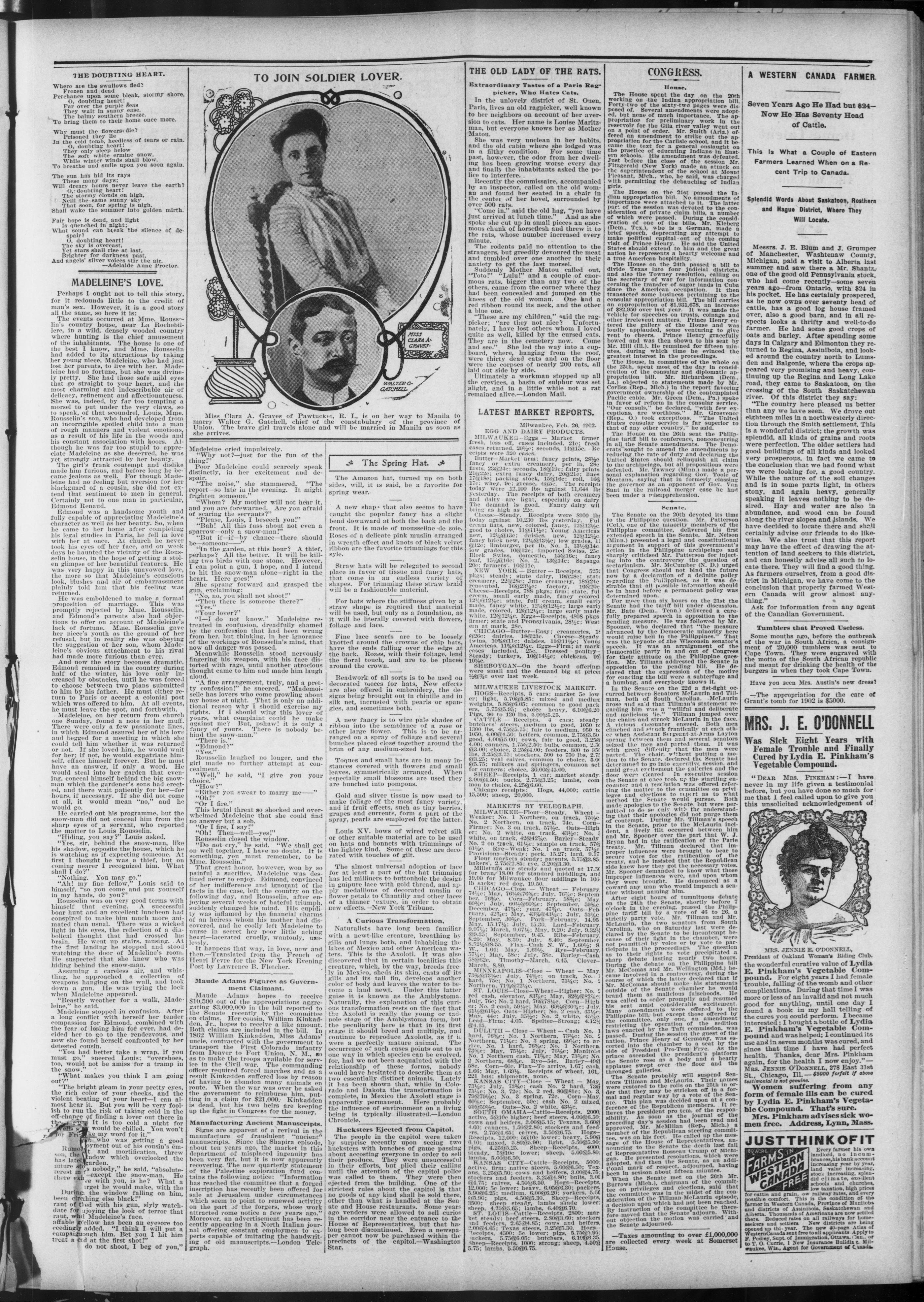
TO JOIN SOLDIER LOVER.
MISS CLARA A. GRAVES
WALTER G. CATCHELL.
Miss Clara A. Graves of Pawtucket, R. I., is on her way to Manila to marry Walter G. Gatchell, chief of the constabulary of the province of Union. The brave girl travels alone and will be married in Manila as soon as she arrives.
Madeleine cried impulsively.
"Why not?—just for the fun of the thing!"
Poor Madeleine could scarcely speak distinctly, in her excitement and despair.
"The noise," she stammered. "The report—so late in the evening. It might frighten someone."
"Whom? My mother will not hear it, and you are forewarned. Are you afraid of scaring the servants?"
"Please, Louis, I beseech you!"
"Bah! All this fuss about not even a sparrow—only a snow-man!"
"But if—if—by chance—there should be—someone—"
"In the garden, at this hour? A thief, perhaps? All the better. It will be killing two birds with one stone. However, I can point a gun, I hope, and I intend to hit the snow-man alone—right in the heart. Here goes!"
She sprang forward and grasped the gun, exclaiming:
"No, no, you shall not shoot!"
"Then there is someone there?"
"Yes."
"Your lover?"
"I—I do not know." Madeleine retreated in confusion, dreadfully shamed by the confession that had been wrung from her, but thinking, in her ignorance of the workings of Rousselin's mind, that now all danger was passed.
Meanwhile Rousselin stood nervously fingering his weapon, with his face distorted with rage, until another atrocious thought came to him and made him laugh aloud.
"A fine arrangement, truly, and a pretty confession!" he sneered. "Mademoiselle has lovers who come prowling about my house at night. That is only an additional reason why I should exercise my rights. If I should wing this lover of yours, what complaint could he make against me? But, pshaw! it is only a fancy of yours. There is nobody behind the snow-man."
"There is."
"Edmond?"
"Yes."
Rousselin laughed no longer, and the girl made no further attempt at concealment.
"Well," he said, "I give you your choice."
"How?"
"Either you swear to marry me—"
"Oh!"
"Or I fire."
This brutal threat so shocked and overwhelmed Madeleine that she could find no answer but a sob.
"Or I fire, I say!"
"Oh! Then—well—yes!"
Rousselin closed the window.
"Do not cry," he said. "We shall get on well together, I have no doubt. It is something, you must remember, to be Mme. Rousselin."
That great honor, however, won by so painful a sacrifice, Madeleine was destined never to enjoy. Edmond, convinced of her indifference and ignorant of the facts in the case, left the country on the following day, and Rousselin, after enjoying several weeks of hateful triumph, suddenly changed his mind. His cupidity was inflamed by the financial charms of an heiress whom his mother had discovered, and he coolly left Madeleine to nurse in secret her poor little aching heart—lacerated cruelly, wantonly, uselessly.
It happens that way, in love, new and then.—Translated from the French of Henri Fevre for the New York Evening Post by Lawrence B. Fletcher.
Maude Adams Figures as Government Claimant.
Maude Adams hopes to receive $10,500 out of the appropriations aggregating $3,000,000 in the bill reported to the Senate recently by the committee on claims. Her cousin, William Kinkadden, Jr., hopes to receive a like amount. Both claims are included in the bill. In 1862 William Kinkadden, Miss Adams' uncle, contracted with the government to transport the First Colorado infantry from Denver to Fort Union, N. M., so as to make the troops available for service in the Civil war. The commanding officer required forced marches and as a result Kinkadden suffered loss by reason of having to abandon many animals en route. When the war was over he asked the government to reimburse him, putting in a claim for $21,000. Kinkadden is dead, but his two heirs are keeping up the fight in Congress for the money.
Manufacturing Ancient Many
Manufacturing Ancient Manuscripts. Signs are apparent of a revival in the manufacture of fraudulent "ancient" manuscripts. Since the Shapira episode, about ten years ago, the market in this department of misplaced ingenuity has been very flat, but it is now apparently recovering. The new quarterly statement of the Palestine exploration fund contains the following notice: "Information has reached the committee that a forged inscription has recently been offered for sale at Jerusalem under circumstances which seem to point to renewed activity on the part of the forgers, whose work attracted some notice a few years ago." Moreover, an advertisement has been recently appearing in a North Italian journal offering constant employmen to experts capable of imitating the handwriting of old manuscripts.—London Telegraph.
The Spring Hat.
The Amazon hat, turned up on both sides, will, it is said, be a favorite for spring wear.
A new shap that also seems to have caught the popular fancy has a slight bend downward at both the back and the front. It is made of mousseiine de soie. Roses of a delicate pink muslin arranged in wreath effect and knots of black velvet ribbon are the favorite trimmings for this style.
Straw hats will be relegated to second place in favor of tissue and fancy hats, that come in an endless variety of shapes. For trimming these straw braid will be a fashionable material.
For hats where the stiffness given by a straw shape is required that material will be used, but only as a foundation, as it will be literally covered with flowers, foliage and lace.
Fine lace scarfs are to be loosely knotted around the crowns of chip hats, have the ends falling over the edge at the back. Roses, with their foliage, lend the floral touch, and are to be placed around the crown.
Beadwork of all sorts is to be used on decorated pieces for hats. New effects are also offered in embroidery, the designs being brought out in chinille and in silk net, incrusted with pearls or spangles, and sometimes both.
A new fancy is to wire pale shades of ribbon into the semblance of a rose or other large flower. This is to be arranged on a spray of foliage and several bunches placed close together around the brim of any medium-sized hat.
Toques and small hats are in many instances covered with flowers and small leaves, symmetrically arranged. When especially small blossoms are used they are bunched into pompons.
Gold and silver tissue is now used to make foliage of the most fancy variety, and if fruit effects, such as tiny berries, grapes and currents, form a part of the spray, pearls are employed for the latter.
Louis XV. bows of wired velvet silk or other suitable material are to be used on hats and bonnets with trimmings of the lighter kind. Some of these are decorated with touches of gilt.
The almost universal adoption of lace for at least a part of the hat trimming has led milliners to buttonhole the design in guipure lace with gold thread, and apply medallions of decorated muslin or flower petals to Chantilly and other laces of a thinner 'exture, in order to obtain new effects.—New York Tribune.
A Curious Transformation.
Naturalists have long been familiar with a newt-like creature, breathing by gills and lungs both, and inhabiting the lakes of Mexico and other American waters. This is the Axolotl. It was also discovered that in certain localities this creature, which, by the way, breeds freely in Mexico, sheds its skin, casts off its gills and its tail fin, develops another color of body and leaves the water to become a land newt. Under this latter guise it is known as the Amblystoma. Naturally, the explanation of this curious transformation rests on the fact that the Axolotl is really the young or tadpole stage of the Amblystoma form, but the peculiarity here is that in its first stage it should breed and multiply, and continue to reproduce Axolotls, as if it were a perfectly mature animal. The occurrence of such cases points out to us one way in which species can be evolved, for, had we not been acquainted with the relationship of these forms, nobody would have hesitated to describe them as two essentially distinct animals. Lately it has been shown that, while in Colorado and Dakota the transformation is complete, in Mexico the Axolotl stage is apparently permanent. Here probably the influence of environment on a living being is typically illustrated.—London Chronicle.
Hucksters Ejected from Capitol
The people in the capitol were taken by surprise recently upon seeing two hucksters with bunches of game passing about accosting everyone in order to sell their produce. They were unsuccessful in their efforts, but plied their calling until the attention of the capitol police was called to them. They were then ejected from the building. One of the strictest rules about the capitol is that no goods of any kind shall be sold there, other than what is handled at the Senate and House restaurants. Some years ago vendors were allowed to sell curios in the corridor near the entrance to the House of Representatives, but that has long been discontinued. Even a newspaper cannot now be purchased within the precincts of the capitol.—Washington Star.
THE OLD LADY OF THE RATS.
Extraordinary Tastes of a Paris Rag-picker, Who Hates Cats.
In the unlovely district of St. Ouen, Paris, lives an old ragpicker, well known to her neighbors on account of her aversion to cats. Her name is Louise Maritzman, but everyone knows her as Mother Matou.
She was very unclean in her habits, and the old cabin where she lodged was in a filthy condition. For some time past, however, the odor from her dwelling has been growing worse every day and finally the inhabitants asked the police to interfere.
Recently the commissaire, accompanied by an inspector, called on the old woman and found her seated in a chair in the center of her hovel, surrounded by over 500 rats.
"Come in," said the old hag, "you have just arrived at lunch time." And as she spoke she cut up in small pieces an enormous chunk of horseflesh and threw it to the rats, whose number increased every minute.
The rodents paid no attention to the strangers, but greedily devoured the meat and tumbled over one another in their anxiety to get the last morsel.
Suddenly Mother Matou called out, "Toto!" "Lulu!" and a couple of enormous rats, bigger than any two of the others, came from the corner where they had been concealed and jumped on the knees of the old woman. One had a red ribbon round its neck, and the other a blue one.
"These are my children," said the rappicker; "are they not nice? Unfortunately, I have lost others whom I loved quite as well, killed by the cursed cats. They are in the cemetery now. Come and see." She led the way into a cupboard, where, hanging from the roof, were thirty dead cats and on the floor were the corpses of nearly 200 rats, all laid out side by side. Ultimately a workman stopped up all the crevices, a basin of sulphur was set alight, and in a little while not a rat remained alive.—London Mail.
LATEST MARKET REPORTS.
Milwaukee, Feb. 26, 1902.
RAMBLY, KENNETH
EGG AND DAIRY PRODUCTS.
MILWAUKED—Eggs — Market firmer fresh, loss off, eggs included. 21c; fresh cases returned. 20½c; seconds, 14@15c. Receipts were 320 cases.
Butter—Market nmr; fancy prints, 28½c fancy or extra creamery, per lb, 28c firsts, 23@24c; seconds, 18@19c; fairy prints 21@22c; extra fancy dairy, 20@21c; lines 17@18c; packing stock, 15@16c; roll, 16@17c; whey, 9c; grease, 4@5c. The receipts today were 12,100 lbs against 11,644 lbs yesterday. The receipts of both creamery and dairy are light, especially on dairy. The demand is good. Fancy dairy will bring as hirth as 22c.
Cheese—Steady. Receipts were 8900 lbs today against 10,230 lbs yesterday. Full cream hats, new, colored, fancy, 12@12½c; good to choice, 11@11½c; Young Americas, new, 12½@13c; daisies, new, 12½@12½c fancy brick new, 12½@13½c; low grades, 11 @12c; limburger, per lb. No. 1, 12½@14c low grades, 10@12c; imported Swiss, 25c Bloek Swiss, domestic, 15@16c; fancy loaf, 15½@16c; No. 2, 13@14c; Sapsago 20c; farmers', 10@11c.
NEW YORK — Butter — Receipts, 525 pkgs; steady; state dairy, 19@28c; state creamery, 22@28c; June creamery, 18@24c renovated, 16@23½c; factory, 16@20c Cheese—Receipts, 788 pkgs; firm; state, full cream, small early made, fancy colored 12½@12½c; state, full cream, small early made, fancy white, 12½@12½c; large early made, colored, 12@12½c; large early made white, 12@12½c. Eggs—Receipts, 4808 pkgs firmer; state and Pennsylvania, 28½c; West etn at mark, 28c.
CHICAGO-Butter-Easy; creameries, 18
@26c; dairies, 18@23c. Cheese-Steady
twins, 10%@11c; daisies, 11@11½c; Young
Americas, 11½@12½c. Eggs-Firm; at mark
cases included, 25c. Dressed poultry-
Steady; turkeys, 10@14½c; chickens, 9@
10½c.
SHEBOYGAN-On the board offerings
were small and the demand big at prices
½@¾c over last week.
MILWAUKEE LIVESTOCK MARKET.
HOGS-Receipts, 5 cars; market 5c lower;
light, 5.70@5.85; mixed and medium
weights, 5.85@6.05; common to good pack
ers, 5.75@5.95; choice heavy, 6.10@6.20
Pigs, 90 to 120 lbs, 5.00@5.25.
CATTLE — Receipts, 4 cars: steady butchers' steers, medium to good, 1050 to 1300 lbs, 4.75@5.75; fair to medium, 950 to 1050, 4.00@4.50; heifers, common, 2.75@3.50 good, 4.00@5.00; cows, fair to good, 3.25@4.00; canners, 1.75@2.50; bulls, common, 2.50@3.00; choice, 3.25@4.00; feeders, 800 to 950 lbs, 3.25@3.75; stockers, 500 to 750 lbs, 2.75@3.25; veal calves, common to choice, 5.00@5.75; milkers and springers, common for canners; choice, 30.00@45.00.
SHEEP—Receipts, 1 car: market steady 3.00@4.50; bucks, 2.75@3.25; lambs, common to choice, 4.25@6.00.
Chicago receipts: Hogs, 44,000; cattle
15.500; sheep, 20.000.
MARKETS BY TELEGRAPH
MARKETS BY TELEGRAPH.
MILWAUKEE—Flour—Steady. Wheat — Weaker; No. 1 Northern, on track, 75½c; No. 2 Northern, on track, 74c; Corn—Firmer; No. 3 on track, 57½c; Oats—Hlgher; No. 2 white, on track, 43½c; No. 3 white, on track, 42@24c; Barley—Steady No. 2 on track, 61½c; sample on track, 57@ 61½c; Rye—Weak; No. 1 on track, 57½c Provisions—Steady; pork, 15.27; lard, 9.17 Flour markets steady; patents, 3.75@3.85 bakers', 2.75@2.85; rye, 3.20@3.30.
Millstuffs are steady and quoted at 17.50 for bran, 18.00 for standard middlings, and 10.00 for Milwaukee flour middlings in 100 lb sacks; red dog, 19.50.
CHICAGO—Close — Wheat — February
74½c; May, 76½c; July, 76½c; September,
76½c; Corn—February, 58½c; May,
60½c; July, 60½@60½c; September, 59½c;
December, 47½c; year, 47½c; Oats—February,
42½c; May, 43½@43½c; July, 35½c;
September, 30½c; Pork—February, 14.95
May, 15.17½; July, 15.30. Lard—February
9.07½; March, 9.07½; May, 9.20; July, 9.32½
@9.35; September, 9.45. Ribs—February
8.20; May, 8.30; July, 8.40; September
8.52½@8.55. Flax—Cash N. W., 1.60½; S
W., 1.64; May, 1.69½. Rye—February
57½c; May, 58c; July, 58c. Barley—Cash
58@62c. Timothy—March, 6.45. Clover—March,
8.80.
MINNEAPOLIS—Close — Wheat — May
73½@73½c; July, 74½c; on track, No. 1
hard, 75c; No. 1 Northern, 73½c; No. 2
Northern, 71½@72½c.
ST. LOUIS—Close—Wheat—Higher; No. 2 red cash, elevator, 837¢; May, 823¢@82¢; July, 76c; No. 2 hard, 768¢@78¢; Corn—Higher; No. 2 cash, 59¢; May, 693¢@60¢; July, 613¢@61¢; Oats—Higher; No. 2 cash, 433¢; May, 44c; July, 35¢; No. 2 white, 45¢; Lead—Firm; 4.05; Spelter—Strong; 4.12¢@4.15.
DULUTH — Close — Wheat — Cash No. 1 hard, 76¢; No. 1 Northern, 73¢; No. 2 Northern, 71¢; No. 3 spring, 69¢; to arrive, No. 1 hard, 76¢; No. 1 Northern, 73¢; May, 75¢; July, 76¢; Manitoba No. 1 Northern cash, 71¢; May, 73¢; No. 2 Northern, 68¢; Rye-54c; Barley-49¢58c; Corn-60c; Flax—To arrive, 1.67; cash, 1.66; May, 1.69¢; Receipts of wheat, 161, 221 bus; shipments, none.
KANSAS CITY—Close — Wheat — May, 73¢; July, 73¢; cash No. 2 hard, 73¢; No. 3, 72c; No. 2 red, 808¢@81c; No. 3, 79@79¢; No. 3 spring, 72c; Corn—May, 60¢; September, 59¢; cash No. 2 mixed, 59@59¢; Oats—No. 2 white, 43¢.
SOUTH OMAHA—Cattle—Receipts, 2000
active, 5@10c higher; beef steers, 4.00@6.50;
cows and heifers, 3.00@5.15; Texans, 3.60@
4.60; canners, 1.50@2.80; stockers and feeders,
2.75@4.65; calves, 3.50@6.75. Hogs—
Receipts, 12.000; 5@10c lower; heavy, 5.90@
6.10; mixed, 5.80@5.90; light, 5.50@5.90;
pigs, 4.25@5.25. Sheep—Receipts, 4000
steady, 5@10c lower; sheep, 5.00@5.80;
lambs, 5.00@6.50.
KANSAS CITY—Cattle—Receipts, 5000
active, firm; native steers, 5.00@6.50; Texans,
3.25@5.50; cows and heifers, 3.00@4.75;
stockers and feeders, 3.25@4.80; bulls, 3.00@
4.75; calves, 4.50@6.50. Hogs—Receipts,
12.000; 5c lower; heavy, 6.05@6.30; packers,
5.90@6.25; medium, 6.00@6.20; yorkers, 5.50@
5.90; pigs, 4.50@5.30. Sheep—Receipts,
3500; sheep steady, lambs shade lower;
sheep, 4.75@5.65; lambs, 6.40@6.70.
ST. LOUIS—Cattle—Recipients, 2800; market steady; beef steers, 2.80@3.60; stockers and feeders, 2.65@4.85; cows and heifers, 2.00@4.65; Texas steers, 3.25@5.30. Hogs—Recipients, 4500; 5c lower; pigs, 5.75@5.95; stockers, 5.75@6.05; butchers, 6.10@8.25. Sheep—Recipients, 1000; strong; sheep, 4.50@5.75; lambs, 5.50@6.75.
CONGRESS.
House.
The House spent the day on the 20th working on the Indian appropriation bill. Forty-two of the sixty-two pages were disposed of. Several amendments were adopted, but none of much importance. The appropriation for preliminary work in the reservoir for the Gila river valley went out on a point of order. Mr. Smith (Arlz.) offered an amendment to strike out the appropriation for the Carlisle school, and it became the text for a general onslaught on the practice of educating Indians in Eastern schools. His amendment was defeated. Just before the close of the session Mr. Fitzgerald (New York) made an attack on the superintendent of the school at Mount Pleasant, Mich., who, he said, was charged with permitting the debauching of Indian girls.
The House on the 21st passed the Indian appropriation bill. No amendments of importance were attached to it. The latter part of the session was devoted to the consideration of private claim bills, a number of which were passed. During the consideration of one of the bills, Mr. Kleberg (Dem., Tcx.), who is a German, made a brief speech, deprecating any attempt to make political capital out of the coming visit of Prince Henry. He said the United States should extend to him and the great nation he represents a hearty welcome and a true American hospitality.
The House on the 24th passed a bill to divide Texas into four judicial districts, and also the Towney resolution, calling on the secretary of war for information concerning the transfer of sugar lands in Cuba since the American occupation. It then transacted some business pertaining to the consular appropriation bill. The bill carries an appropriation of $1,931,678, an increase of $82,950 over last year. It was made the vehicle for speeches on trusts, coinage and other irrelevant matters. Prince Henry entered the gallery of the House and was loudly applauded, some venturing to give vent to cheers. Prince Henry gracefully bowed and was then shown to his seat by Mr. Hill (Ill.). He remained for fifteen minutes, during which time he evinced the greatest interest in the proceedings.
The House, in committee of the whole on the 25th, spent most of the day in consideration of the consular and diplomatic appropriation bill. Mr. Richardson (Dem., La.) objected to statements made by Mr. Corliss (Rep., Mich.) in the report favoring government ownership of the contemplated Pacific cable. Mr. Green (Dem., Pa.) spoke in favor of reform in the consular service. "Our consuls," he declared, "with few exceptions, are worthless." Mr. Grosvenor (Rep., O.) took exceptions. "The United States consular service is far superior to that of any other country," he said.
The House on the 26th sent the Philippine tariff bill to conference, nonconcurring in all the Senate amendments. The Democrats sought to amend the amendments by reducing the rate of duty and declaring the United States should relinquish all claim to the archipelago, but all propositions were defeated. Mr. Tawney (Minn.) made a personal explanation regarding Gov. Toole of Montana, saying that in formerly classing the governor as an opponent of Gov. Van Sant in the railroad merger case he had been under a misapprehension.
Senate.
The Senate on the 20th devoted its time to the Philippine question. Mr. Patterson (Col.), one of the minority members of the Philippine committee, delivered his first extended speech in the Senate. Mr. Nelson (Minn.) presented a legal and constitutional argument in support of this government's action in the Philippine archipelago and sharply criticised Mr. Patterson for injecting into the controversy the question of sectarianism. Mr. McCumber (N. D.) urged that Congress should not blind the future now by a declaration of a definite policy regarding the Philippines, as it was desirable that all possible information should be in hand before a permanent policy was determined upon.
For more than six hours on the 21st the Senate had the tariff bill under discussion. Mr. Bate (Dem., Tenn.) delivered a carefully prepared speech in opposition to the pending measure. He was followed by Mr. Spooner, who declared that "the measure advanced by the Democratic minority here would raise hell in the Philippines." That was the keynote of the Wisconsin senator's speech. It was an arraignment of the Democratic party in and out of Congress for their attitude on the Philippine question. Mr. Tillman addressed the Senate in opposition to the pending bill. He declared that the expression of the motive for enacting the bill were a subterfuge and a humbug, and everybody knows it.
In the Senate on the 22d a fist-fight occurred between Senators McLaurin and Tillman, both of South Carolina. McLaurin arose and said that Tillman's statement regarding him was a "willful and deliberate and malicious lie." Tillman jumped over the chairs and struck McLaurin in the face. A vicious encounter ensued. Both men clinched and struck frantically at each other when Assistant Sergeant-at-Arms Layton sprang between them and several senators selzed the men and parted them. It was with great difficulty that the men were parted. The chair, without putting a motion to the Senate, declared the Senate had determined to go into executive session, and amid great excitement the galleries and the floor were cleared. In executive session the Senate at once took up the startling encounter and a resolution was offered referring the matter to the committee on privileges and elections to report as to what method the Senate would pursue. Both made apologies to the Senate, but were permitted to do so only with the understanding that their apologies did not purge them of contempt. During Mr. Tillman's speech in the Senate, prior to the McLaurin incident, a lively tilt occurred between him and Mr. Spooner over the part that W. J. Bryan had in the ratification of the Parle treaty. Mr. Tillman declared that improper influences were brought to bear to secure votes for the ratification of the treaty, and he insisted that the Republican side knew how they got the necessary votes. Mr. Spooner demanded to know what those improper influences were, and upon whom they were brought. He denounced as a coward any man who would impeach a senator without naming him.
After eight hours of tumultuous debate on the 24th the Senate, shortly before 7 o'clock in the evening, passed the Philippine tariff bill by a vote of 46 to 26, a strictly party vote. Mr. Tillman and Mr. McLaurin, the two senators from South Carolina, who on Saturday last were declared by the Senate to be incontempt because of their fight in the chamber, were not permitted by voice or by vote to participate in the proceedings. The question as to their rights to vote precipitated a sharp debate lasting nearly two hours. During the debate on the Philippine bill Mr. McComas and Mr. Wellington (Md.) became involved in a controversy, during the course of which the latter declared that if Mr. McComas should make his statements outside of the Senate chamber he would brand them as malicious falsehoods. He was called to order promptly and resumed his seat amid considerable excitement. Many amendments were offered to the Philippine bill, but except those offered by the committee, only one, an amendment restricting the operation of the sedition laws enacted by the Taft commission, was passed. During the session the guest of the nation, Prince Henry of Germany, was escorted into the chamber to a seat by the side of President Pro-Tem Frye. As the prince ascended the president's platform the Senate rose as a body and a hearty applause swept over the floor and the thronged galleries.
The Senate probably will suspend Senators Tillman and McLaurin. Their names were restored to the rolls on the 25th in order that they may be stricken off in a formal and regular way by a vote of the Senate. This plan was decided upon at a conference of the Republican members. It relieves the president pro tem, of the responsibility. As soon as the journal of the preceding day's session had been read and approved, Mr. McMillan (Rep., Mich.) a member of the Republican steering committee, was on his feet. He called up the message of the House of Representatives, announcing to the Senate the death last fall of Representative Rosseau Crump of Michigan. He presented resolutions, which were adopted, and then the Senate, as an additional mark of respect, adjourned, having been in session about fifteen minutes.
When the Senate met on the 26th Mr. Burrows (Mich.), chairman of the committee on privileges and elections, said that the committee was in the midst of the consideration of the Tillman-McLaurin episode, a decision upon which had not been reached. By instruction of the committee he therefore moved that the Senate adjourn. Without objection the motion was carried and the Senate adjourned.
—Taxes amounting to over £1,000,000 are collected every week at Somerset House.
This Is What a Couple of Eastern Farmers Learned When on a Recent Trip to Canada.
Messrs. J. E. Blum and J. Grumper of Manchester, Washtenaw County, Michigan, paid a visit to Alberta last summer and saw there a Mr. Shantz, one of the good old Pennsylvania stock, who had come recently—some seven years ago—from Ontario, with $24 in his pocket. He has certainly prospered, as he now owns over seventy head of cattle, has a good log house framed over, also a good barn, and in all respects looks a thrifty and well-to-do farmer. He had some good crops of oats and barley. After spending some days in Calgary and Edmonton they returned to Regina, Assiniboia, and looked around the country north to Lumsden and Balgonie, where the crops appeared very promising and heavy, continuing up the Regina and Long Lake road, they came to Saskatoon, on the crossing of the South Saskatchewan river. Of this district they say:
"The country here pleased us better than any we have seen. We drove out eighteen miles in a northwesterly direction through the Smith settlement. This is a wonderful district; the growth was splendid, all kinds of grains and roots were perfection. The older settlers had good buildings of all kinds and looked very prosperous, in fact we came to the conclusion that we had found what we were looking for, a good country. While the nature of the soil changes and is in some parts light, in others stony, and again heavy, generally speaking it leaves nothing to be desired. Hay and water are also in abundance, and wood can be found along the river slopes and islands. We have decided to locate there and shall certainly advise our friends to do likewise. We also trust that this report may have the effect of drawing the attention of land seekers to this district, and can honestly advise all such to locate there. They will find a good thing. As farmers ourselves, from a good district in Michigan, we have come to the conclusion that properly farmed Western Canada will grow almost anything."
Ask for information from any agent of the Canadian Government.
Tumblers that Proved Useless.
Some months ago, before the outbreak of the war in South Africa, a consignment of 20,000 tumblers was sent to Cape Town. They were engraved with the motto of the South African republic and meant for drinking the health of the burgers in when they took Cape Town.
Have you seen Mrs. Austin's new dress?
The appropriation for the care of Grant's tomb for 1902 is $5000.
MRS. J. E. O'DONNELL
Was Sick Eight Years with Female Trouble and Finally Cured by Lydia E. Pinkham's Vegetable Compound.
"DEAR MRS. PINKHAM:—I have never in my life given a testimonial before, but you have done so much for me that I feel called upon to give you this unsolicited acknowledgement of
[Illustration of a woman with a curly hairstyle, wearing a dress with a bow at the neck, set against an ornate decorative frame.]]
President of Oakland Woman's Riding Club. the wonderful curative value of Lydia E. Pinkham's Vegetable Compound. For eight years I had female trouble, falling of the womb and other complications. During that time I was more or less of an invalid and not much good for anything, until one day I found a book in my hall telling of the cures you could perform. I became interested; I bought a bottle of Lydia E. Pinkham's Vegetable Compound and was helped; I continued its use and in seven months was cured, and since that time I have had perfect health. Thanks, dear Mrs. Pinkham again, for the health I now enjoy." — MRS. JENNIE O'DONNELL, 278 East 31st St., Chicago, Ill. — $5000 forfelt if above testimonial is not genuine.
Women suffering from any form of female ills can be cured by Lydia E. Pinkham's Vegetable Compound. That's sure. Mrs. Pinkham advises sick women free. Address, Lynn, Mass.
JUSTTHINKOFIT
Every farmer his own landlord, no incumbrances, his bank account increasing year by year, land value increasing, stock: increasing, splendid climate, excellent schools and churches, low taxation, high prices
60 ACRE IN
FARMS IN
WESTERN
CANADA
FREE
Every farmer his own
landlord, no incum-
brances, his bank account
increasing year by year,
land value increasing,
stock increasing, splen-
did climate, exo-lent
schools and churches,
low taxation, high prices
for cattle and grain, ow railway rates, and every
possible comfort. This is the condition of the
farmer in Western Canada, Province of Manitoba
and districts of Assiniboia, Saskatchewan and
Alberta. Thousands of Americans are now settled
there. Reduced rates on all railways for home-
seekers and settlers. New districts are being
opened up thi. year. The new 40-page Atlas of
Western Canada sent free to all applicants. Apply to
F. Pedley, Supt. of Immigration, Ottawa, Can. or
to T. O. Currie, 1 New Insurance Buildi t. Milwaukee, Wis. Agent for Government of Canada.
The Milwaukee Sunday Sentinel
?
It is Equal if Not Superior to Any of the Chicago Sunday Issues.
WHEN IN KENOSHA
CALL ON
MATT GREENWALD
Who is Up-to-Date in His Business.
AGENT FOR
E. KLINKERT'S RACINE KEG and BOTTLED BEER.
Depot: No. 15 North Main Street.
Telephone 163.
KENOSHA - WISCONSIN
WONDERFUL
DISCOVERY
Curly Hair Made Straight By
```markdown
```
TAKEN FROM LIFE:
BEFORE AND AFTER TREATMENT.
ORIGINAL
OZONIZED OX MARROW
(Copyrighted.)
This wonderful hair pomade is the only safe preparation in the world that makes kinky or curly hair straight as shown above. It nourishes the scalp and prevents the hair from falling out or breaking off, cures dandruff and makes the hair grow long and silky. Sold over forty years and used by thousands. Warranted harmless. Testimonials free on request. It was the first preparation ever sold straightening hair. Bargain imitator. Get the Original Ozonized Ox Marrow as the genuine never falls to keep the hair straight, soft and beautiful. A toilet necessity for ladies, gentlemen and children. Elegantly perfumed. The great advantage of this wonderful pomade is that by its use you can straighten your own hair at home. Owing to its superior and lasting effect, it is not possible for anybody to produce a preparation equal to it. Full directions with every bottle. Only 50 cents. Sold by druggists and dealers or send us 50 cents for one bottle or $1.40 for three bottles. We pay all express charges. Send postal or express money order. Write your name and address plainly to
OZONIZED OX MARROW CO.,
76 Wabash Avenue, Chicago, Illinois.
Don't Let Your Hair Fall Out
FREE
Sample of
LUSTORONE
to every one
When you can save it by the timely use of our great hair tonic, "LUSTORONE." If your hair has been scalded, burnt and split out by the roots by harmful applications of injurious so-called hair tonics, or by sickness, fevers and disease, our celebrated "LUSTORONE" will prove a boon to you. A Godsend to suffering humanity because it produces an abundant and beautiful growth of soft, fine hair. As the hair grows it softens and becomes straight. "LUSTORONE" cures all scalp diseases. Removes scurf and dandruff. Causes the hair to grow out again on bald spots and bare places. It is the greatest hair tonic on earth. To prove the merits of this great remedy, we will send to any one who will send us their name and address together with roc. to pay for mailing case and postage, a free SAMPLE that will prove its own worth. Write to
DOMINION
M'F'G CO.
2220 East Marshall St.
Richmond, Va.
---
One Year ..... $2.00
Six Months ..... 1.25
Three Months ..... 75
Send money by Express Money Order, P. O.
Money Order or Registered Letter to the
Wisconsin Weekly Advocate.
One inch, single insertion..... 25c
One inch, per year..... $9.00
Business locals 5c per line each insertion.
Apply for rates to the Advocate.
TO CONTRIBUTORS:
All communications must be sent with the name and address of the sender as an evidence of good faith, but not necessarily for publication. No manuscript returned if not accepted, unless accompanied by stamps.
The Wisconsin Weekly Advocate company wishes to notify the public that all contracts and business transactions with this company must have the company stamp, otherwise they will be void. Neither will this company be responsible for paid subscriptions unless given to duly-accredited agents, who, on request, will give the company's receipt for same. Subseribers failing to receive their papers regularly will kindly notify the general office. Address all business communications to the general manager, 729 St. Paul avenue.
Entered in the Postoffice at Milwaukee as Second-class matter.
The "L" trains are not above getting together disastrously, like the ordinary trains which run on the level or dip into tunnels.
Spain's ability to manage her home affairs does not appear to have been improved by her release from the necessity of maintaining law and order in distant colonies.
Two fresh wars in Kentucky bear witness that shooting the shoots is still the popular sport on the "dark and bloody ground."
Hatless "hiking" may be an old fad at Groton, but the age of the fad has no influence on its results when practiced in midwinter.
It can be said of the proposed improved clock enterprise for Milwaukee, that grandfather's clock has certainly had a long inning.
Marinette's discoveries of natural gas will surprise geologists, who have never advised boring through sawdust for the natural fuel and illuminant.
Jan Kubelik lost only the buttons of his raiment during his scuffle with admiring hysterical women, but Paderewski lost a $1000 watch and chain.
Jeffries and Fitzsimmons have agreed as to their percentages of the swag, win or lose, and now they are both ready to work the combined percentages out of the public.
There is no sympathy for the robbers who "held up" a gambling institution at Clinton, Iowa, and stripped the keepers and the habitues; but in this regard they are no worse off than their victims.
The ransom for Miss Stone has been paid, and the United States is experiencing something akin to the feelings which moved Americans during the times when the Tripolitan pirates were in the ransom business.
The only strange thing in connection with the pranks of the Princeton students, at Trenton, is that they used yellow instead of red paint; yellow is generally considered the distinct property of the reporters of certain newspapers.
A heavy purchase of Mexican timber lands by Menominee capitalists suggests a longer range of view by those who are in the lumber business than that enjoyed by optimists who imagine that the pine of Wisconsin and Michigan can never be exhausted.
The friction which has resulted in the issuance of an order discontinuing the light on Liberty's torch, in New York harbor, should be corrected, and the light replaced. A moral obligation to keep the light burning was assumed when the gift was accepted.
The battleship Illinois achieved only 15½ knots an hour on her trial trip, but this did not deprive her of the proud right of being heralded as the "queen of the navy." Every new ship is so announced after her trial, without regard for speed or behavior.
Thieves have never been respecters of persons, creeds or sanctuaries, and the theft of the jewels from the altar of the Tiffany chapel in the Cathedral of St. John the Divine, on Cathedral Heights, New York, is what might have been expected were the cathedral unguarded. When it is necessary in some cases to put the remains of the dead in steel cages, and imbed the cages in blocks of cement, there is no safety for valuable jewels which enrich the altars of cathedrals.
Andrew Carnegie has addressed to Henry B. Herbert, chairman of the Canal Association of Greater New York, a letter in which he says that all the recent railway consolidations operate against New York City in her fight to retain her commercial supremacy. He says that at the present time New York state is not progressing so rapidly as the state of Pennsylvania, and that the hope of New York lies in developing her manufacturing facilities through the Erie Canal.
Beard Over Ten Feet Long
One of the notabilities in the town of Montlucon, in the department of Allier, France, is a man named Coulon, aged 76, whose beard measures 10 feet 10½ inches, and his mustache is over a yard and a half long.
He spends every Sunday dressing his beard, and when he exhibits his luxurious growth the inhabitants of the town come out to see him go by.—London Mail.
—Berlin's Black Book, the criminal record kept by the police; now consists of thirty-seven volumes, containing 21,000 photographs of criminals of all classes.
APPLETON—Joseph Chenevert's saloon was visited by burglars who secured over £20 in cash and some goods.
APPLETON—Willard Griffin crushed one of his arms in the calendars at the Wisconsin Tissue Paper company's mill.
STEVENS POINT—C. W. Karner, assistant cashier of the First National bank, has resigned and will go to Oregon about May 1.
OSHKOSH—Mrs. Betsy Hasbrouck, the oldest person in this city and county, celebrated the 102d anniversary of her birth February 21.
LA CROSSE—H. C. Hansen of Oshkosh met the La Crosse board of trade with a proposition to head a stock company to erect a pump factory in this city.
MARINETTE—John Davis, a woodsman employed at Cedar River, was hit on the back of the neck by a falling tree. He is paralyzed from the neck down.
MOSINEE—Old lumbermen estimate that the sawmills in this locality will not run over two years more. Twenty-five years ago this was one of the finest timber sections in the state.
KENOSHA—Peter Pirsch of the firm of Pirsch & Weier has invented a patent extension fire ladder which is said to be an improvement on others. It is in two parts and is readily adjusted.
WEST SALEM—The old settlers of the town of Hamilton held their annual reunion and danquet in the town hall here Saturday. Toasts were responded to by a number of well-known citizens.
OSHKOSH—Mayor Mulva has affixed his signature to the resolution adopted by the common council granting to the Union National bank three feet of High street upon which to erect the new six-story steel bank building.
GREEN BAY—The Cigarmakers' union of this city has organized a movement for the sale of more homemade union cigars. Each member will induce dealers to handle more city-made union goods. There are twelve factories here.
OSHKOSH-At the Oshkosh Normal school oratorical contest, Miss Charlotte Ray of Waupun won first honors; Richard Gunderson, Oconomowoc, second, and Joseph P. Goebel of Dotyville, third. Miss Ray will represent the Normal school at West Superior in the state contest on March 14.
MARINETTE-The town officials of Wausaukee are planning to build a system of waterworks. A new high school and a fire department are among the other improvements contemplated. The library, given to the town by H. P. Bird, is almost completed.
RACINE-Walter Wilson, while playing polo on the street, with other boys, was run down by a horse and buggy in charge of an unknown woman. He was picked up unconscious. Physicians found that he had sustained serious injuries about the spine and may not live.
GRAND RAPIDS—Henry Bates, a 16-year-old boy, employed by the Grand Rapids Pulp and Paper company, was drawn into one of the paper machines by his clothing catching in the machinery, and terribly crushed and mangled. He will probably die.
TWO RIVERS—A solution of the right of way dispute between the North-Western railroad company and the interurban line over the right of way at the entrance of this city, where the electric line crosses the railway tracks, appears to be at hand. It is stated that the electric line and the North-Western company have joined hands and will together build a bridge for both companies.
OSHKOSH—J. M. Bray, Leander Choate, Thomas Wall, Harry Wall and Thomas Daly of this city and several business men of Clintonville. Wis., have made an application to the United States comptroller of currency for permission to start a new national bank at Clintonville, with a capital stock of $25,000. The institution will be known as the First National Bank of Clintonville.
MADISON—Railroad Commissioner Graham L. Rice has received the report of the Hazelhurst & South Eastern Railway company for the year ending December 31, 1901. The cost of construction up to that date was $108,634.91. The total gross receipts for the year were $21,001.41, and there was a deficit of $12,244.75. The gross freight receipts were $28,171.99, and the gross passenger receipts $772.10. The cost of operation was $33,236.16, and the taxes $100. The road is seventeen miles long, all in the state.
President Roosevelt's Views on Woman's Suffrage.
Roosevelt is the first President of the United States since Abraham Lincoln who had expressed himself publicly in favor of woman suffrage before attaining the presidency. Cleveland proved himself favorable to it by actions rather than words, as he signed bills giving women partial suffrage in New York when he was governor of that state. Hayes favored it in his quiet way, and helped the senior editor of the Woman's Journal to get a woman's right resolution through the national Republican convention of 1872. Garfield recognized its growing importance. He said, "Laugh as we may, put it aside as a jest if we will, keep it out of Congress or political campaigns, still the woman question is rising on our horizon larger than the size of a man's hand, and some solution ere long that question must find." Some other presidents were believed to be more or less friendly to it, but Roosevelt and Lincoln have been the only ones to put themselves conspicuously on record.
Where Animals Get Drunk.
It is a well-known fact that the fruit of the umganu tree of South Africa yields a strong intoxicating drink for the natives. A traveler says elephants are also fond of it, and often become quite tipsy, staggering about, playing antics, screaming so as to be heard for miles and having tremendous fights.
PERFECTION
PERFECTION GAS RANGES
AND SPECIALTIES
Instantaneous Cleanable Star Burners,
Adjustable Needle Valve,
For Natural, Artificial or Gasoline Gas.
139 Burrell St., Milwaukee, Wis.
SATURDAY, MARCH 1st, with an Elegant Line of Jewelry, Watches, Clocks and Silverware. 20,000 PRINCE HENRY BADGES, the Finest that Can be Made, will be Given Away, Absolutely Free, to Every Person Visiting Our Store.
Rish, Curly Hair.
HARTONA
The hair grow long, straight, beautiful, soft, druff, Baldness, Itching, Eczema, and all its Falling Out of the Hair and Prema-ONA POSITIVELY STRAIGHTENS THE guaranteed harmless. Sent anywhere on 150c. per box.
BEACH will gradually turn the skin of a face or six shades lighter, and will turn the person almost white. HARTONA FACE Tiles, Dark Spots, Pimples, Freckles, Black-les of the Skin. Guaranteed absolutely address on receipt of price—25c. and 50c.
The absolutely guaranteed, and your money you are not perfectly satisfied. Write to free a book of testimonials of more than your own State who have used and are.
D OFFER. Send us One Dollar and mention this paper, and large boxes of HARTONA HAIR GROWER two large bottles of HARTONA FACE box of HARTONA NO-SMELL, which odors caused by Perspiration of the Feet,
securely sealed from observation. Write face and express office address very plainly. Camps or by Post-Office Money Order or letter or by Express.
HARTONA makes the hair grow and glossy. Cures Dandruff, Baldy Scalp Diseases. Prevents Falling in nature Baldness. HARTONA POSIT KINKIEST HAIR. Guaranteed H receipt of price—25c. and 50c. per bottle.
HARTONA FACE BLEACH will black or dark person five or six shin skin of a mulatto person almost BLEACH removes Wrinkles, Dark Scalp heads, and all Blemishes of the hairless. Sent to any address one per bottle.
Hartona Remedies are absolutely is positively refunded if you are not us, and we will send you free a book one hundred people in your own using Hartona Remedies.
SPECIAL GRAND OFFER
we will send you three large boxes of AND STRAIGHTENER, two large BLEACH, and one large box of H removes all disagreeable odors cause Arm-Pits, &c.
Goods will be sent securely seal your name and post-office and express Money can be sent in Stamps or be enclosed in Registered Letter or by Address all orders to—
HARTONA makes the hair grow long, straight, beautiful, soft, and glossy. Cures Dandruff, Baldness, Itching, Eczema, and all Scalp Diseases. Prevents Falling Out of the Hair and Premature Baldness. HARTONA POSITIVELY STRAIGHTENS THE KINKIEST HAIR. Guaranteed harmless. Sent anywhere on receipt of price—25c. and 50c. per box.
HARTONA FACE BLEACH will gradually turn the skin of a black or dark person five or six shades lighter, and will turn the skin of a mulatto person almost white. HARTONA FACE BLEACH removes Wrinkles, Dark Spots, Pimples, Freckles, Blackheads, and all Blemishes of the Skin. Guaranteed absolutely harmless. Sent to any address on receipt of price—25c. and 50c. per bottle.
Hartona Remedies are absolutely guaranteed, and your money is positively refunded if you are not perfectly satisfied. Write to us, and we will send you free a book of testimonials of more than one hundred people in your own State who have used and are using Hartona Remedies.
SPECIAL GRAND OFFER. Send us One Dollar and mention this paper, and we will send you three large boxes of HARTONA HAIR GROWER AND STRAIGHTENER, two large bottles of HARTONA FACE BLEACH, and one large box of HARTONA NO-SMELL, which removes all disagreeable odors caused by Perspiration of the Feet, Arm-Pits, &c.
Goods will be sent securely sealed from observation. Write your name and post-office and express office address very plainly. Money can be sent in Stamps or by Post-Office Money Order or enclosed in Registered Letter or by Express.
AGENTS WANTED in Every Town and City. Liberal Salary Paid.
HARTONA D. C. A
ADAMS,
And Jobber in Catsups, all kinds of Coun
in Catsups, Mustards, kinds of Country Produce
sups, Mustards, Olives and of Country Produce.
And Jobber in Catsups, Mustards, Olives and all kinds of Country Produce.
Cor. Third and Wells Streets
---
---
atter. Telephone Black 9343. New York Tailoring Co. 2 WELLS STREET
New York Tailoring Co. ELLS STREET
The New York 322 WELLS
The New York Tailoring Co.
322 WELLS STREET (Bet. 3d and 4th Sts.)
Ladies' and Gents' Suits Made to Order. We also Clean, Press, Repair and Dye All kinds of Ladies' and Gents' Garments. Satisfaction Guaranteed. . . .
---
NELSONS
STRAIGHTINE
THE
LATEST DISCOVERY
FOR MAKING
KNOTTY, KINKY, CURLY HAIR STRAIGHT
BEFORE
AFTER
Hair Dressing
EVER DISCOVERED.
Guaranteed Perfectly Harmless,
ELEGANTLY PERFUMED.
Nelson's Straightline Not owing ishing out, removes dandruff, cures itching, in long and beautiful head of hair. It is used people in all sections of this country. From all injurious chemicals, and cannot make the hair sticky or gummy, and will sold at all drug stores. Price, 25 cent your druggist does not keep it he will get securely wrapped, on receipt of 30c. in st
NELSON MANUFA
Agents can make big money. Writ
Straightline Not only straightens the ishing the roots, preven druff, cures itching, irritating scalp disuil head of hair. It is used and highly empictions of this country. We guarantee Straits chemicals, and cannot injure the hair. Sticky or gummy, and will not become rancid stores. Price, 25 cents a can (one month does not keep it he will get it for you, or we wil, on receipt of 30c. in stamps. Address,
Not only straightens the hair, but, by nourishing the roots, prevents it from falling, itching, irritating scalp diseases, and gives a hair. It is used and highly endorsed by the best country. We guarantee Straightine to be free and cannot injure the hair. Straightine does not any, and will not become rancid. Straightine is twice, 25 cents a can (one month's treatment). If he will get it for you, or we will send it by mail, of 30c. in stamps. Address,
MANUFACTURING CO., Richmond, Va.
Money. Write for terms.
Nelson's Straightine Not only straightens the hair, but, by nourishing the roots, prevents it from falling out, removes dandruff, cures itching, irritating scalp diseases, and gives a long and beautiful head of hair. It is used and highly endorsed by the best people in all sections of this country. We guarantee Straightine to be free from all injurious chemicals, and cannot injure the hair. Straightine does not make the hair sticky or gummy, and will not become rancid. Straightine is sold at all drug stores. Price, 25 cents a can (one month's treatment). If your druggist does not keep it he will get it for you, or we will send it by mail, securely wrapped, on receipt of 30c. in stamps. Address,
NELSON MANUFACTURING CO., Richmond, Va.
Agents can make big money. Write for terms.
BEFORE USING
HARTONA
AFTER USING
TERMS CASH.
A. BAIRD, Cutter.
Telephone Black 9343.
Milwaukee, Wis.
THE MOST PERFECT
Do not ruin your hair by using dangerous and worthless preparations when you can get this reliable remedy.
AFTER USING
TRADE-MARK.
BEFORE USING
HARTONA
Come to this wide-awake city! Visit our fine store! We were here since 1856! Modern store and selling goods of the most reliable character. It will be quite easy to find us as our location is central.
Whittelsey
Dry Goods
Co.
492 MAIN STREET
NORTH OR SOUTH
Always ask for tickets
via the
Monon Route THE SHORT LINE BETWEEN Chicago, Indianapolis, Cincinnati,
Louisville
Six trains daily between Chicago and the Ohio river.
For folders, rates, etc., call at any Monon ticket office or address
FRANK J. REED,
Gen'l Pass. Agent, Chicago.
S. B. JONES,
C. P. Agent, 232 Clark St., Chicago.
WHEN IN MADISON
Call at the
Avenue Hotel...
M. J. REGAN, Prop.
$2.00 Rate .....
Free 'Bus.
Before Starting on Your Travels
CALL ON
Geo. Burroughs & Sons
MANUFACTURERS OF
PREMIUM TRUNKS
VALISES, SAMPLE CASES, Etc.
424 & 426 East Water St., Milwaukee.
GEORGE HAYS Turning Mill and Box Factory Rockers and all kinds of Restaurant Blocks, Extension Ladders, Tea Caddies, Boxes, Turning, Sawing, Mitchell
Tal
(Copyright, Louis Klopsch, 1902.) HIS discourse of Dr. Talmage is full of inspiring thoughts for those
THIS discourse of Dr. Talmage is full of inspiring thoughts for those who find life a struggle and shows that we have many celestial sympathizers; texts, Hebrews xii., 1, "Seeing we also are compassed about with so great a cloud of witnesses;" I. Corinthians xv., 32, "I have fought with beasts at Ephesus."
Crossing the Alps by the Mont Genis pass or through the Mont Genis tunnel, you are in a few hours set down at Verona, Italy, and in a few minutes begin examining one of the grandest ruins of the world, the Amphitheater. The whole building sweeps around you in a circle. You stand in the arena where the combat was once fought or the race run, and on all sides the seats rise, tier above tier, until you count forty elevations, or galleries, as I shall see fit to call them, in which sat the senators, the kings and the 25,000 excited spectators. At the sides of the arena and under the galleries are the cages in which the lions and tigers are kept without food until, frenzied with hunger and thirst, they are let out upon some poor victim, who, with his sword and alone, is condemned to meet them. I think that Paul himself once stood in such a place and that it was not only figuratively, but literally, that he had "fought with beasts at Ephesus."
The gala day has come. From all the world the people are pouring into Verona, Men, women and children, orators and senators, great men and small, thousands upon thousands come, until the first gallery is full, and the second, the third, the fourth, the fifth—all the way up to the twentieth, all the way up to the thirtieth, all the way up to the fortieth. Every place is filled. Immensity of audience sweeping the great circle. Silence. The time for the contest has come. A Roman official leads forth the victim into the arena. Let him get his sword with firm grip into his right hand. The 25,000 sit breathlessly watching. I hear the door at the side of the arena creak open. Out plunges the half-starved lion, his tongue atirst for blood, and with a roar that brings all the galleries to their feet he rushes against the sword of the compatant. Do you know how strong a stroke a man will strike when his life depends upon the first thrust of his blade? The wild beast, lame and bleeding, slinks back toward the side of the arena; then rallying his wasted strength he comes up with fiercer eye and more terrible roar than ever, only to be driven back with a fatal wound, while the combatant comes in with stroke after stroke until the monster is dead at his feet, and the 25,000 clap their hands and utter a shout that makes the city tremble.
Sometimes the audience came to see a race; sometimes to see gladiators fight each other, until the people, compassionate for the fallen, turned their thumbs up as an appeal that the vanquished be spared, and sometimes the combat was with wild beasts.
All Have Lions to Fight.
To one of the Roman amphitheatrical audiences of 100,000 people Paul refers when he says, "We are compassed about with so great a cloud of witnesses." The direct reference in the last passage is made to a race; but elsewhere having discussed that, I take now Paul's favorite idea of the Christian life as a combat.
The fact is that every Christian man has a lion to fight. Yours is a bad temper. The gates of the arena have been opened, and this tiger has come out to destroy your soul. It has lacerated you with many a wound. You have been thrown by it time and again, but in the strength of God you have arisen to drive it back. I verily believe you will conquer. I think that the temptation is getting weaker and weaker. You have given it so many wounds that the prospect is that it will die, and you shall be victor, through Christ. Courage, brother! Do not let the sands of the arena drink the blood of your soul!
Your lion is the passion for strong drink. You may have contended against it for twenty years; but it is strong of body and thirsty of tongue. You have tried to fight it back with broken bottle or empty wine flask. Nay, that is not the weapon: With one horrible roar he will seize thee by the throat and rend thee limb from limb. Take this weapon, sharp and keen—reach up and get it from God's armory—the sword of the Spirit. With that thou mayest drive him back and conquer!"
But why specify when every man and woman has a lion to fight? If there be one here who has no besetting sin, let him speak out, for him have I offended. If you have not fought the lion, it is because you have let the lion eat you up. This very moment the contest goes on. The Trajan celebration, where 10,000 gladiators fought and 11,000 wild beasts were slain, was not so terrific a struggle as that which at this moment goes on in many a soul. The combat was for the life of the body; this is for the life of the soul. That was with wild beasts from the jungle; this is with the roaring lion of hell.
Before I get through I will show you that I went in an arena, around which Wells silleries above each other, all for Friar eyes and all the sympathet the ages, and at every vicum there comes down the thunson, the cause of a great multitude that has latee number. "Being compassed terest in too great a cloud of witnesses." there exhirst elevation of the ancient
er, on the day of a celebrar During Liberius or Augustus or the been circug. So in the great arena of rant of th at watch our struggles and date for th divine gallery, as I shall call raut, who King, one Jesus. On his head affable ge cedeying crowns. The Roman emperor campaign by cold-blooded conquests, treat a cong hath come to his place by hearts healed and the tears
wiped away and the souls redeemed. The Roman emperor sat, with folded arms, indifferent as to whether the swordsman or the lion beat, but our King's sympathies are all with us—nay, unheard of condescension! I see him come down from the gallery into the arena to help us in the fight, shouting until all up and down his voice is heard: "Fear not! I will help thee! I will strengthen thee by the right hand of my power!"
They gave to the men in the arena in the olden time food to thicken their blood, so that it would flow slowly and that for a longer time the people might gloat over the scene. But our King has no pleasure in our wounds, for we are bone of his bone, flesh of his flesh, blood of his blood.
In all the anguish of our heart
The Man of Sorrows bore a part.
Once in the ancient amphitheater a lion with one paw caught the combatant's sword and with his other paw caught his shield. The man took his knife from his girdle and slew the beast. The king, sitting in the gallery, said: "That was not fair. The lion must be slain by a sword." Other lions were turned out, and the poor victim fell. You cry, "Shame! shame!" at such meanness. But the King in this case is our brother, and he will see that we have fair play. He will forbid the rushing out of more lions than we can meet. He will not suffer us to be tempted above that we are able. Thank God! The King is in the gallery! His eyes are on us. His heart is with us. His hand will deliver us. "Blessed are they who put their trust in him."
The Angels in the Gallery.
I look again, and I see the angelic gallery. There they are—the angel that swung the sword at the gate of Eden, the same that Ezekiel saw upholding the throne of God, and from which I look away, for the splendor is insufferable. Here are the guardian angels. That one watched a patriarch; this one protected a child; that one has been pulling a soul out of temptation! All these are messengers of light! Those drove the Spanish armada on the rocks. This turned Sennacherib's living host into a heap of 185,000 corpses. Those yonder chanted the Christmas carol over Bethlehem until the chant awoke the shepherds. These at creation stood in the balcony of heaven and serenaded the newborn world wrapped in swaddling clothes of light. And there, holier and mightier than all, is Michael, the archangel. To command an earthly host gives dignity, but this one is leader of the 20,000 chariots of God and of the ten thousand times ten thousand angels. I think God gives command to the archangel, and the archangel to the seraphim, and the seraphim to the cherubim, until all the lower orders of heaven hear the command and go forth on the high behest.
Now, bring on your lions! Who can fear? All the spectators in the angelic gallery are our friends. "He shall give his angels charge over thee, to keep thee in all thy ways. They shall bear thee up in their hands lest thou dash thy foot against a stone. Thou shalt tread upon the lion and adder; the young lion and the dragon shalt thou trample under foot."
Though the arena be crowded with temptations, we shall, with the angelic help, strike them down in the name of our God and leap on their fallen carcasses! O bending throng of bright angelic faces and swift wings and lightning foot, I hail you to-day from the dust and struggle of the arena!
I look again, and I see the gallery of the prophets and apostles. Who are those mighty ones up yonder? Hosea and Jeremiah and Daniel and Isaiah and Paul and Peter and John and James. There sits Noah, waiting for all the world to come into the ark, and Moses, waiting till the last Red Sea shall divide, and Jeremiah, waiting for the Jews to return, and John of the apocalypse, waiting for the swearing of the angel that time shall be no longer. Glorious spirits! Ye were howled at, ye were stoned, ye were spit upon! They have been in this fight themselves, and they are all with us. Daniel knows all about lions. Paul fought with beasts at Ephesus.
Help from the Prophets.
In the ancient amphitheater the people got so excited that they would shout from the galleries to men in the arena: "At it again!" "Forward!" "One more stroke!" "Look out!" "Fall back!" "Huzza! Huzza!" So in that gallery, prophetic and apostolic, they cannot keep their peace. Daniel cries out, "Thy God will deliver thee from the mouth of the lions!" David exclaims, "He will not suffer thy foot to be moved!" Isaiah calls out: "Fear not! I am with thee! Be not dismayed!" Paul exclaims, "Victory through our Lord Jesus Christ!" That throng of prophets and apostles cannot keep still. They make the welkin ring with shouting and hallelujahs.
I look again, and I see the gallery of the martyrs. Who is that? Hugh Latimer, sure enough! He would not apologize for the truth he preached, and so he died, the night before swinging from the bedpost in perfect glee at the thought of emancipation. Who is that army of 6,066? They are the Theban legion who died for the faith. Here is a larger host in magnificent array, 884,000, who perished for Christ in the persecutions of Diocletian. Yonder is a family group, Felicitas of Rome and her children. While they were dying for the faith she stood encouraging them. One son was whipped to death by thorns; another was flung from a rock; another was beheaded. At last the mother became a martyr. There they are together, a family group in heaven! Yonder is John Bradford, who said in the fire, "We shall have a merry supper with the Lord to-night!" Yonder is Henry Voes, who exclaimed as he died, "If I had ten heads, they should all fall off for Christ!" The great throng of the martyrs! They had hot lead poured down their throats; horses were fastened to their hands and other horses to their feet, and thus they were pulled apart; they had their tongues pulled out by redhot pinchers; they were sewed up in the skins of animals and then thrown to the dogs; they were daubed with combustibles and set on fire! If all the martyrs' stakes that have been kindled could be set at proper distances, they would make the
midnight all the world over bright as noonday! And now they sit yonder in the martyrs' gallery. For them the fires of persecution have gone out; the swords are sheathed and the mob hushed. Now they watch us with an all observing sympathy. They know all the pain, all the hardship, all the anguish, all the injustice, all the privation. They cannot keep still. They cry: "Courage! The fire will not consume; the floods cannot drown; the lions cannot devour. Courage down there in the arena!"
Some Eminent Spectators.
What? Are they all looking? This hour we answer back the salutation they give and cry, "Hail, sons and daughters of the fire!"
I look again, and I see another gallery—that of eminent Christians. What strikes me strangely is the mixing in companionship of those who on earth could not agree. There is Albert Barnes and around him the presbytery who tried him for heterodoxy! Yonder are Lyman Beecher and the church court that denounced him! Stranger than all, there are John Calvin and James Arminius! Who would have thought that they would sit so lovingly together? There are George Whitefield and the ministers who would not let him come into their pulpits because they thought him a fanatic. There are the sweet singers Toplady, Montgomery, Charles Wesley, Isaac Watts and Mrs. Sigourney. If heaven had had no music before they went up, they would have started the singing. And there the band of missionaries—David Abeel, talking of China redeemed; and John Scudder, of India saved; and David Brainer, of the aborigines evangelized; and Mrs. Adoniram Judson, whose prayers for Burma took heaven by violence! All these Christians are looking into the arena. Our struggle is nothing to theirs! Do we in Christ's cause suffer from the cold? They walked Greenland's icy mountains. Do we suffer from the heat? They swoltered in tropics. Do we get fatigued? They fainted, with none to care for them but cannibals. Are we persecuted? They were anathematized.
I look again, and I see the gallery of our departed. Many of those in the other galleries we have heard of, but these we knew. Oh, how familiar their faces! They sat at our tables, and we walked to the house of God in company. Have they forgotten us? Those fathers and mothers started us on the road of life. Are they careless as to what becomes of us? And those children—do they look with stolid indifference as to whether we win or lose this battle of life? They remember the day they left us. They remember the agony of the last farewell. Though years in heaven, they know our faces. They remember our sorrows. They speak our names. They watch this fight for heaven. Nay, I see them rise up and lean over and wave before us their recognition and encouragement. That gallery is not full. They are keeping places for us. After we have slain the lion they expect the King to call us, saying, "Come up higher!" Between the hot struggles in the arena I wipe the sweat from my brow and stand on tiptoe, reaching up my right hand to clasp theirs in rapturous handshaking, while their voices come ringing down from the gallery, crying, "Be thou faithful unto death, and you shall have a crown!"
The Gaze of the Universe.
But here I pause, overwhelmed with the majesty and the joy of the scene! Gallery of the King! Gallery of angels! Gallery of prophets and apostles! Gallery of martyrs! Gallery of saints! Gallery of friends and kindred! O majestic circles of light and love! Throngs, throngs, throngs! How shall we stand the gaze of the universe? Myriads of eyes beaming on us! Myriads of hearts beating in sympathy for us! How shall we ever dare to sin again? How shall we ever become discouraged again? How shall we ever feel lonely again? With God for us and angels for us and prophets and apostles for us and the great souls of the ages for us and our glorified kindred for us—shall we give up the fight and die? No, Son of God, who didst die to save us! No, ye angels, whose wings are spread forth to shelter us! No, ye prophets and apostles, whose warnings startle us! No, ye loved ones, whose arms are outstretched to receive us! No; we will never surrender!
My hearers, shall we die in the arena or rise to join our friends in the gallery? Through Christ we may come off more than conquerors. A soldier dying in the hospital rose up in bed the last moment and cried, "Here, here!" His attendants put him back on his pillow and asked him why he shouted "Here!" "Oh, I heard the roll call of heaven, and I was only answering to my name!" I wonder whether after this battle of this life is over our names will be called in the muster roll of the pardoned and glorified and, with the joy of heaven breaking upon our souls, shall cry, "Here, here!"
Moderate Drinkers.—It is not the drunkard who is doing the most harm; it is the "moderate drinkers," to be numbered by hundreds of thousands.—Rev. R. H. Hanigan, R. C., Philadelphia, Pa.
Christ Is God.—If Christ is God that fact is so tremendous that those who think otherwise can not, except in some wide sense, be Christians at all.—Rev. J. F. Hanselman, R. C., Washington, D. C.
Mental Reform.—Mental reform is more essential than the government of the body. A man may use tobacco and be a man; but let a person speak ill of his neighbor, and all the manhood goes out of him.—Rev. F. E. Mason, Spiritualist, Brooklyn, N. Y.
Judaism Not Dead.—The Christian says that Judaism became a memory and ended as a religion when Christ was born. Judaism is not dead. It is not a memory. It is founded on truth. It brings a memory of Palestine transposed into messages to the whole world. The non-Jew loves better the orthodox Jew than the reformed Jew. The orthodox Jew concedes what the Christian insists upon. The Christian approves the whining humility with which the orthodox Jew admits that he is an exile sojourning here on his way to Palestine.—Rabbi Hirsch, Hebrew, Chicago, Ill.
WE TRUST YOU AND SEND OUR GOODS TO YOU ON CREDIT.
YOU can earn from $10.00 to $50.00 a week selling our great remedy. If you already have a position, you can make good money by working in your spare time. Now is the accepted time. Write before some one else gets the Agency, as we only want one Agent in a place. How many opportunities to make money have you lost? Here is a chance for every man or woman, boy or girl, to make money every day in the year. IRONAL, the great natural medicine, is a certain cure for all diseases of the Stomach, Liver, Kidneys, Bladder, Bowels, and Blood. It cures Headache, Backache, Cramps, Colic, Pains in the Shoulders, Arms, Breast, Back, Legs, and Lungs. Cures Rheumatism, Sore Throat, Dropsy, Kidney Diseases, Fevers of all kinds, Malaria, Gout, Lumbago, and all diseases of the human system which are not of an organic nature—such as Cancer and Consumption. It is especially curative in Asthma, Scrofula, Syphilis, Eczema, and all breaking-out diseases of the skin. Also cures all forms of diseases peculiar to women. It is Nature's own remedy. Non-poisonous, and no dose, no matter how large, can hurt any one. It is taken both internally and applied externally on Sores, Eruptions, &c. The price is 25c., mailed to any address on receipt of price. We want one Agent in every locality to sell this great remedy. It never fails to satisfy. If you want the Agency, send in your application quick, and we will send the goods promptly by express. Send no money; just fill out the coupon, and we will not only send you the goods, but we will also pay the express on this end. Now is not this fair? You can see that we are not frauds or fakirs, for we trust you with our goods. We will send you two dozen packages of IRONAL; these you sell for 25c. each, or $6.00 in all. You keep $3.00 and send us $3.00. After you have sold out, and remitted the money to us, you can get all the goods on credit from us that you want. Write your name and address plainly, so that we can read it. If the name is not plainly written it makes trouble and delays shipping the goods.
THE IRONAL CO., 106 $ \frac{1}{2} $ E. Clay St., Richmond, Va.:
GENTLEMEN, I hereby apply for the Agency for IRONAL, the great natural remedy. Please send me at once by Express two dozen packages of IRONAL (24). These I agree to sell for 25c. each, or $6.00 in all. I will send you $3.00 and keep $3.00 for my trouble. The Ironal Co. is to pay the express charges. If I cannot sell the goods, I will return them.
If there is no Express Office in your town, state nearest town where there is one.
Address all communications to-
THE IRONAL CO., 106½ E. C.
GENTLEMEN,—I here
Please send me at once by Express
25c. each, or $6.00 in all. I will send
pay the express charges. If I can
My Name is___
The Name of the Street I live
My Post-Office is___
My State is___
If there is no Express Office in you
NORTHERN WISCONSIN RAIL- ROAD LANDS
Are increasing in value from year to year. Railroads are the great civilizers, for they give the settler as well as the manufacturer equal opportunity to work in undeveloped fields, thereby rapidly settling the country and bringing forth its undiscovered riches. Northern Wisconsin is rich in iron ore, clay, kaolin, marl, timber and fine farm lands. It has made many a settler independent and added to the wealth of manufacturers who have sought this territory. Opportunities have not passed, as there is still a generous supply of land which can be obtained at low figures and on easy terms.
THE WISCONSIN CENTRAL RY.
Was one of the first roads to penetrate the vast Northern Wisconsin Wilderness which stretches across the State from east to west. It, also, has developed from year to year and today offers the best of transportation facilities, enabling all to ship the products of that section to any market in the world. Illustrated pamphlets and maps which are interesting as well as instructive can be obtained by addressing W. H. KILLEN.
WISCONSIN CENTRAL RAILWAY.
TICKET OFFICE, 400 EAST WATER ST. Tel. 624.
TO AND FROM LEAVE ARRIVE
St. Paul, Minneapolis, Iron Towns, Ashland, Superior, Duluth, Pacific Coast
*5:00 am *7:15 am
*8:45 pm *8:00 pm
Marshfield, Chippewa Falls, Eau Claire
*5:00 am *7:15 am
+12:01 pm +3:20 pm
*8:45 pm *8:00 pm
*5:00 am *7:15 am
Fond du Lac, Oshkosh, Neenah, Menasha
*7:35 am +10:15 am
+12:01 pm +3:20 pm
+4:35 pm *6:15 pm
*8:45 pm *8:00 pm
*Daily. +Daily except Sunday.
E. F. POTTER, Gen'l Supt.
JAS. C. POND, Gen'l Pass. Agt.
Milwaukee, Wis.
WILLIAM T. GREEN
Lawyer
Notary Public
Rooms 17-18 Birchard Block.
105 GRAND AVENUE.
Telephone White 9214
MILWAUKEE.
WANTED--AGENTS
We want 100 agents in every city, town and hamlet in the U. S. for the Wisconsin Weekly Advocate. It will be devoted to the interest of the Negro race and will contain the news of their sayings and doings throughout the world.
WISCONSIN WEEKLY ADVOCATE
MILWAUKEE, WIS.
50 YEARS'
EXPERIENCE
PATENTS
TRADE MARKS
DESIGNS
Anyone sending a sketch and description may quickly ascertain our opinion free whether an invention is probably patentable. Communications strictly confidential. Handbook on Patents sent free. Oldest agency for securing patents. Patents taken through Munn & Co. receive special notice, without charge, in the Scientific American. A handsomely illustrated weekly. Largest circulation of any scientific journal. Terms, $3 a year four months, $L Sold by all newsdealers. MUNN & Co. 361 Broadway. New York Branch Office, 625 F St., Washington, D. C.
```markdown
```
to $50.00 a week selling our great remedy. If you already have a positive money by working in your spare time. Now is the accepted time, we else gets the Agency, as we only want one Agent in a place. How many of money have you lost? Here is a chance for every man or woman, boy or girl in the year. IRONAL, the great natural medicine, is a certain cure for Liver, Kidneys, Bladder, Bowels, and Blood. It cures Headache, Back, the Shoulders, Arms, Breast, Back, Legs, and Lungs. Cures Rheumatism, Diseases, Fevers of all kinds, Malaria, Gout, Lumbago, and all diseases of not of an organic nature—such as Cancer and Consumption. It is especi-folula, Syphilis, Eczema, and all breaking-out diseases of the skin. Also useful to women. It is Nature's own remedy. Non-poisonous, and no dose, hurt any one. It is taken both internally and applied externally on Sores, 25c., mailed to any address on receipt of price. We want one Agent in it remedy. It never fails to satisfy. If you want the Agency, send in your mail send the goods promptly by express. Send no money; just fill out the send you the goods, but we will also pay the express on this end. Now is what we are not frauds or fakirs, for we trust you with our goods. We will send of IRONAL; these you sell for 25c. each, or $6.00 in all. You keep $3.00 have sold out, and remitted the money to us, you can get all the goods on it. Write your name and address plainly, so that we can read it. If the makes trouble and delays shipping the goods.
ans to—
THE IRONAL CO.,
E. Clay St., Richmond, Va.:
-I hereby apply for the Agency for IRONAL, the great natural remedy. Express two dozen packages of IRONAL (24). These I agree to sell for will send you $3.00 and keep $3.00 for my trouble. The Ironal Co. is to I cannot sell the goods, I will return them.
It live on is____ The number of my house is____
____ My County is____
____ My nearest Express Office is____
...UNION...
Laundry and News C
No. 208 Sixth Street
GEO. W. SAYLES
...ALL WORK CAREFULLY DON
Lowest Prices and Satisfaction Guaranteed.
PARTIES
intending to visit Hot Spring
Ark., this winter, should
tronize the
RAMMELSBERG
BATH HOUSE,
MARK SARGENT, Manag
21 BATHS $3.00
THE BAKERY
PARTIES
intending to visit HotSprings Ark., this winter, should patronize the
MARK SARGENT, Manager. 21 BATHS $3.00
A man is talking to a woman.
ALL CASES OF
DEAFNESS OR HARD HEARING
ARE NOW CURABLE
by our new invention. Only those born deaf are incurable.
HEAD NOISES CEASE IMMEDIATELY.
F. A. WERMAN, OF BALTIMORE, SAYS:
Gentlemen: — Being entirely cured of deafness, thanks to your treatment, I will now give a full history of my case, to be used at your discretion.
About five years ago my right ear began to sing, and this kept on getting worse, until my hearing in this ear entirely.
I underwent a treatment for catarrh, for three months, without any success, consulted a ber of physicians, among others, the most eminent ear specialist of this city, who told me only an operation could help me, and even that only temporarily, that the head noises then cease, but the hearing in the affected ear would be lost forever.
I then saw your advertisement accidentally in a New York paper, and ordered your ment. After I had used it only a few days according to your directions, the noises ceased to-day, after five weeks, my hearing in the diseased ear has been entirely restored. I than heartily and beg to remain
Very truly yours.
F. A. WERMAN, 720 S. Broadway, Baltimore, M
Gentlemen: — Being entirely cured of deafness, thanks to your treatment, I will now give you a full history of my case, to be used at your discretion. About five years ago my right ear began to sing, and this kept on getting worse, until I lost my hearing.
my hearing in this car entirely.
I underwent a treatment for catarrh, for three months, without any success, consulted a number of physicians, among others, the most eminent ear specialist of this city, who told me that only an operation could help me, and even that only temporarily, that the head noises would then cease, but the hearing in the affected ear would be lost forever.
I then saw your advertisement accidentally in a New York paper, and ordered your treatment. After I had used it only a few days according to your directions, the noises ceased, and to-day, after five weeks, my hearing in the diseased ear has been entirely restored. I thank you heartily and beg to remain
Very truly yours,
F. A. WERMAN, 739 S. Broadway, Baltimore, Md.
Our treatment does not interfere with your usual occupation.
Examination and advice free.
YOU CAN CURE YOURSELF AT HOME at a nominal cost.
INTERNATIONAL AURAL CLINIC, 596 LA SALLE AVE., CHICAGO, ILL.
Mention the Wisconsin Weekly Advocate when answering advertisements.
DRIVEN MAD BY A BITE.
Galesville Policeman is Attacked
by a Drunken Man.
UNDRESSES’ON STREET.
He Runs About Nattea Uutit See
La Crosse, Wis., Feb, 26.—[Special.]—
A disyatch to the Press from Galesville
says: Ernest Olson,.nightwatchman of
that village, has been-committed to the
state asylum at Mendota, a raving mad-
man, the result of hydrophobia, alleged
to have been caused by a North Bend
man biting him in the hand.
Olson arrested the man some time ago
and had him fined $28 for being drunk.
Some nights ago the offender appeared
there drunk again and Olson again ar-
rested him. In a scrimmage to get
away, it is claimed the North Bend man
bit him. No particular attention was
paid to the wound until later, when Ol-
son appeared slightly demented. Yes-
terday he undressed in the public square
and ran about town stark mad until cap-
tured.
The dispatch says the North Bend man
is now in Minneapolis taking the Keely
eure.
HIRAM HALL HELD.
Be eae
Must Stand Trial for Killing E. B.
Parker Near Millston—Little
Cnance of Conviction.
Black River Falls, Wis., Feb. 26.—
{Special.]—Hiram Hall, the confessed
slayer of E. B. Parker, wes bound over
to the spring term of the circuit court.
The tragedy grew out of the alleged in-
timate relations between Parker and
Mrs. Hall, and took place near Millston
on the evening of February 13. Both
men were prepared for trouble and the
meeting took place on the highway lead-
ing from Millston to Hall's home.
Hall says the shooting was in self-de-
fense and the coroner's jury returned a
verdict of justifiable homicide, Public
sympathy is on Hall's side and.a convie-
tion is a remote possibility. Parker was
a married man and had a family at Cor-
nell, Ii. | aaa
air > INTIT
HAROLD FERRY INJURED
eS s
Oconomowoc Lad Has His Foot
Crushed While Crawling
Undera Train.
Oconomowoc, Wis., Feb. 25—[Spe-
cial.]J—Harold Ferry, the 19-year-old
son of Mrs. Vine Ferry, had the toes
on his left foot so badly smashed yes-
terd2y afternoon by train No. 94, which
reaches here at 3:12 o’clock, that three
of them had to be amputated. It is not
known exactly how the accident oc-
curred, but it is thought he was crawling
under the train when it started to back
up and his foot was crushed beneath the
wheels.
BULL KILLS AGED MAN.
eres a
Mose Rockwell is Bruised to Death
at Cataract by Savage
Animal.
Black River Falls, Wis., Feb. 26.—
{Special.]—Mose Rockwell, aged 70, one
of the old settlers of Monroe county, re-
siding near Cataract, was found dead in
his barnyard, having been bruised to
death by a savage bull. The bull's horns
had been removed.
FRANCHISE UNSATISFACTORY.
Electric Railway Plans for Entering
Depere Not Acceptable,
Depere, Wis., Feb. 26.—[Special.]J—
A mass meeting was held here last night
to discuss the proposed extension of the
street railway into the city. Mitchell
Joannes, general manager ‘of the Fox
River Blectric Railway company, read
the proposed franchise, which, however,
was in no way satisfactory, and several
speakers were heard, all opposing the
franchise on account of ‘its failing to
include a west side extension. The mat-
ter will come up formally at the next
meeting of the city council.
ALLEGED MURDERER HELD.
Bound Over on Charge of Killing
Chinaman at Superior.
West Superior, Wis., Feb. 26.--The
examination of Peter Jackson, a negro.
who is charged with the tes of Char-
ley Yim, a Chinese laundfyman, was
completed and Jackson was bound over
to the present term of the superior court.
Charles Woods, another negro, was at
‘onee arraigned on the same charge and
entered a plea of not guilty, His exam-
ination was_set for March 6. The cases
of George Willfams and Alexander Ken-
medy, who were arrested for complicity
in the murder, were put over until
March 7.
RUNAWAY TIRES OF FARM.
Lost Evansville Boy is Found After
Five Months.
Byansyille, Wis., Feb. 26.—[Special.]
—Johnnie Blake, the 15-year-old son of
Josiah Blake, who suddenly disappeared
from his home in this city five months
ago, has been heard from. His father
has received a letter from the boy, stat-
ing that he has been working for a farm-
er by the name of Williams near James-
town, N. D., for the past four months.
He wrote if his father would send for
him he would like to come home.
Railway Loses in Wisconsin.
Madison, Wis., Feb. 26.—According to
its annual report filed with the railroad
commissioner the Wisconsin & Michigan
Railway company last year paid out on
its line in this state $11,666.92 more than
it took in. It has 40.12 miles of road in
Wisconsin @nd_ 21.95 in Michigan. The
earnings per mile in Wisconsin last year
were $1965.21. The state tax is $417.11.
The Lake Shore & Eastern Railway
company, which has a logging road run-
ning from Phillips and seventeen miles
jong, says its earnings per mile last year
were $241.08 and its state tax is $385.
Enlarge Vepere Orphan Asylum.
Depere, Wis., Feb. 26.—[Special,]—
The St. Joseph's Orphan asylum, north
of this city, which has been overcrowded
for some time, will undergo extensive
alterations this spring. The improve-
ments include an addition costing about
$15,000, the plans for which are now
being prepared. Over 200 children are
now being cared for at the institution
and the number is steadily increasing.
Has Carnegie’s Agreement.
Eau Claire, Wis., Feb. 26.—The Hau
Claire committee has received the agree-
ment of Andrew beige: to give $10.
000 for a library with the eel Ore
that 10 per cent. of the amount donated
be appropriated annually by the city, and
that the city give a site for it.
STABBED BY WIFE'S
FORMER HUSBAND
Sehnert
Sidney A. Sage, Formerly of Racine,
Wounded by Michael Bern
In Chicago.
Racine, Wis. Feb. 26.—Sidney A.
Sage, a former wealthy gitizen and poli-
tician, was attacked and severely stabbed
in the face, head and breast at Chicago
by Michael Bern, his wife’s former hus-
band, who was once a well-known rail-
road man. It is said that Bern called
at the Sage flat to see his daughter and a
row ensued, in which he cut Sage with
his pocket-knife. He made his escape.
BLUODHOUNDS TO
TRACE INCENDIARIES.
Sega es
Large Farmhouse Near Galesville is
Totally Destroyed—Work
of Firebugs.
La Crosse; Wis., Feb. 26.—[Special.]—
Galesville authorities have sent a mes-
sage to La Crosse asking that the local
officers send them bloodhounds, with
which to trace incendiaries who started
a fire near there. A large farmhouse,
the owner's name not given, was burned
last night and the belief is it was set.
All the local bloodhounds are in the
South at present.
AN AGED MAN WINS
TON o7 fe
YUUNG WOMAN’S LOVE.
te
Peter Johnson, 78 Years Old, and
Olive Swanson, Aged 26, Wed
at Abbotsford.
Abbotsford, Wis., Feb. 26.—[Speciat.]
—Peter Johnson, 78 years old, an old set-
tler of this place, was married yesterday
by Justice of the Peace Charles Part-
ridge to Olive Swanson, aged 26, of Ar-
thur, N. D. Johnson met Miss Swanson
in the depot at Stanley, Wis., a few
months ago ard a correspondence started
which resulted in matrimony. Mr. John-
son’s wife died about three years ago
nnd he then spent one year in Norway.
He is hale and hearty and does not look
his years. He has a large family of chil-
dren, grandchildren and great grandchil-
dren and has grandchildren as old as his
wife.
THE VAN NORTWICKS
WON'T PROSECUTE.
ee ne
Alleged Forger will be Released as
Weaithy Appieton Men Won’t
Appear Against Him,
Chicago, Tl., Feb, 26.—[Special.]—Be-
cause William S. and John 8. Van Nort-
wick, wealthy paper manufacturers of
Appleton, Wis., will not come to Chicago
to prosecute S. George D’Essauer, the al-
leged forger, he may be released. He
has refused to allow his case to be con-
tinued longer, he having been in the
county jail for more than a year await-
ing trial, The Van Nortwicks are broth-
ers of D’Essauer's mother-in-law, Mrs.
Eliza J. Harvey, from whom D’Essauer
is said to have obtained money by means
of alleged bogus securities. What the
state will do in the event the witnesses
refuse to appear to prosecute is not defi-
nitely known, but without evidence to
prosecute the result would seem to indi-
cate that the defendant must be released.
TAX COMMISSION REPORTS.
May be Had by Applying to Board
at Madison.
Madison, Wis., Feb. 26.—[Special. |--
The state tax commission today gave out
the following statement:
When the second edition of the report of
the commission was printed and ready for
distribution copies were sent to nearly ail
public officers. The commission at the same
time caused to de published in the news-
papers having general circulation in the
state a statement to the effect that a copy
weule. be furnished to any citizen of the
state upon application so long as there were
copies to spare, but this statement, though
published In some of such papers was not
made very conspicuous and the fact that
coples could be had on application seems to
be not well understood throughout the
state. The commission would be pleased to
have the statement republished not only
in the papers having general circulation,
but aiso In the local papers. The number
of copies remaining on hand can be disposed
of exsily, but it is preferable to reserve
then: for those who manifest a desire to
read the report by asking for a copy.
FAMOUS GAP DESTROYED.
Has Been Mecca for Sightecers at
Marinette for Years.
Marinette, Wis., Feb. 26.—[Special.]
—Fire destroyed the famous’ marking
gap of the Menominee River Boom com-
pany, which has been a mecea for sight-
seers for twenty-five years past. Boys
playing around it set fire to it and before
it was extinguished piers, booms and
other property were damaged causing a
loss of about $1000, The marking ap is
the place where all the logs which came
down the Menominee are marked by ex-
perts with axes.
WAREHOUSE AT OSHKOSH.
Will be Used as Distributing Point
for Threshing Machines.
Oshkosh, Wis., Feb. 26.—[Special.]—
J. M. Hoover, general agent of the
Northwestern Threshing Machine com-
pany of Stillwater, Minn., is in the city.
He is figuring on establishing a ware-
honse here and using this city as the dis-
tributing point for Wisconsin. L. Choate
will erect a building for the company and
will have it ready by April 15.
DR. WINTERMUTE NAMED.
Kilbourn Physician Appointed on
Roard of Pension Examiners,
Kilbourn, Wis., Feb. 26.—Dr. Winter-
mute of this city has been appointed a
member of the pension examining board
in this district to succeed Dr. A. Schoe-
mileh of Portage. The other members
of the board are Dr. F. T. Gerton, Port-
age, and Dr. L. A. Squire, Poynette.
G. W. SWARTZ SELECTED.
Lodi Man to Become Superintendent
of Monroe Schools, is
Monroe, Wis., Feb. pete
George W. Swartz of Lodi, Wis., was
elected superintendent of the Monroe
public schools by the board of education
last evening.
Three Held for Trial.
Chippewa Falls, Wis., Feb. 26.—[Spe-
cial.]—At the preliminary examination
in the ease of Joseph Aker, the Eau
Claire peddler, charged with criminal
assault on the person of Emma Himple,
and Paul and Bertha Himple, the girl’s
parents, charged with being accessories,
the prisoners were held for trial in the
cireuit court in the sum of $5000 each.
BRiaze at Oshkosh.
Oshkosh, Wis., Feb. 26.—[Special.]—
Fire early this morning did several hun-
dred dollars’ worth of damage in the
meat mzrket of Kuttmann Bros. The
store of Rouse & Son and the house of
Henry Buttmann were also damaged.
The losses are covered by insurance.
DEATH OF E. 1. KIDD.
‘tate Bank Examiner Dies at Home
in Prairie du Chien.
HAD STOMACH TROUBLE
The End of a Most Usefnl and Hon-
orable ce Seif-Made
Prairie du Chien, Wis., Feb. 25.—
[Special.]—Bauk Examiner B. I. Kidd
died this morning at 3:30 o'clock after
seven weeks of intense suffering. Last
Friday his eyesight and hearing com-
menced to fail and later all train of
thought and seusibility began to disap-
pear.
There were with him when the end
came his wife and her two sisters, Casb-
ier Bisbee and Warren Alexander of
Grant county, his old comrade.and bunk-
mate.
The funeral will be under the personal
supervision of Col. J. P. Barnum of this
eity and the services are to be held
Thursday morning at the First Metho-
list Episeopal church, which was recent-
iy completed and the ee which
was largely made possible by Mr. Kidd’s
great generosity.
Dr. D. C. Dutton of McGregor, Ia.,
formerly pastor here, will preach the
sermon. Phe funeral will be in es
of the Masonic lodge of this city and the
Delamolai commandery of Boscobel.
Prof. F. A. Porter of Lynxville and Rey.
F. 8. Ferguson will sing solos during
the services.
Fought for His Country.
Edward Isaac Kidd was one of those
men who contributed largely to the mak-
ing of Wisconsin's industrial, educational
and political history and took a prom-
inent place in the front rank. He was
born in Millville, Grant county, May 10,
1844, his ancestry being English. His
£ | <<
a we
eo a o
THE LATE E. 1. KIDD.
youth was passed at his native place,
where he acquired such an education as
schools and academies of that time af-
forded, and imbibing those lessons of fra-
gality, integrity and justice for which his:
father was noted,
At the age of 17 he became a private
in Co. C, Twenty-fifth Wisconsin infan-
try. He served in Gen. Rusk’s regiment,
carrying a musket from August 9, 1862,
until the close of the war. Wherever
the fortunes of war took the I wenty-
fifth Wisconsin, whether in Minesota
during the Sioux campaign, at Vicks-
burg, the Meridean expedition. at At-
lanta, or on the march to the sea and
through the Carolinas to Washington,
Mr. Kidd was present for duty and all
through the four years, while he was in
the service for the flag, he never was
compelled to go to a hospital.
In the Legislature.
Upon his return home in 1865 he en-
gaged in the milling business, to whieh
he gave his entire attention, except when
absent from home on public business,
until 1889, when he with Gen. Fairchild
and others established the Bank of Prai-
rie du Chien in this city. During his
residence in Grant county and up to
1880 he represented almost continuously
his town on the county board. In 1880
he was elected to the state Assembly and
re-elected in 1881, 1882 and 1883. In
1884 he was elected to represent Grant
county in the state Senate, and re-elected
in 1888, the district having been snlaceet
by the addition of Crawford county. Mr.
Kidd’s work in the legislative session of
1890-1 was marked by exceptional use-
fulness. He was an acknowledged lead-
er of the Republican minority. He was
always a warm friend and supporter of
the educational interests of the state.
His views were that in all its schools
and colleges, and in the university itself.
the very best instruction that could be
procured was none too good for the youth
of the state.
In 1889 he removed from Millville to
Prairie du Chien, Since his residence
here he had teen chairman of the board
of supervisors of Crawford county, and
in other ways his fellow citizens have
shown their confidence in his ability and
integrity.
The Legislature of 1895 enacted a law
providing for an examiner of state and
private banks, and Gov. Upham very
properly appointed Mr. Kidd to the of-
fice. concluding that his long and varied
legislative experience and _ his _well-
known integrity, as well as his familiari-
ty with the banking business, fitted him
in an unusual degree for the discharge
of the responsible duties of examiner.
To this position he was reappointed in
1899 by Gov. La Follette and held the
position up to his death, and to the
discharge of his duties he devoted near-
ly all of his time and care.
Sorrow at Madison.
Madison, Wis., Feb. 25.—[Special.]—
The flag on the capitol dome was hung
at half mast today in respect to the late
Bank Examiner E. I. Kidd. Deep and
uniyersal sorrow is felt among the state
officers and employes over the sad pass-
ing away of Mr. Kidd.
Gov. La Follette, State Treasurer Da-
vidson and several other state officers
nd friends from here will attend the fu-
neral of Mr. Kidd on Thursday.
Once Wealthy Man Dies a Pauper,
La Crosse, Wis., Feb. 25.—[Special.]
--Attended only by his friends, without
a known relative in the world, Wenzel
Boehn, aged 74, once one of the wealth-
jest farmers -in La Crosse valley,
died today. While he was rich his chil-
dren died one by one and then his wife
passed away, leaving him alone. He
lost heavily and ran through his prop-
erty, finally going to the poorhouse. Old
friends finally took him out of the poor-
house and kept him until he died.
Daniel Lynch, Chilton,
Chilton, Wis., Feb. 25.— [Special J—
Daniel Lynch, a former resident of this
town, died in North Dakota. His body
\ was brought here for burial.
BANKER WANTS TO BE
FREED FROM DEBTS.
boi Sa eee
John Ltenlokken of La Crosse Files
Petition Giving Liabilities as
$28,621 and Assets $250.
La Crosse, Wis., Feb. 25.—John Lien-
lokken, proprietor of Lienlokken’s pri-
yate bank, which failed a couple of years
ago, filed a petition in bankruptcy in the
United States district court today. His
liabilities are scheduled at $28,621 and
the assets at $250, claimed to be exempt.
The creditors are 350 in number, a great-
er share of which are depositors, who
lost their alt
PAPERMILL STRIKE
AT STEVENS POINT.
——>+_—_.
Shipping Clerk is Discharged and
Employes at Plover Plant
Stop Work.
Stevens Point, Wis., Feb. 25.—All em-
ployed on the day tour of the Plover Pa-
per company mill, except two machine
tenders, went out on strike at 6 o'clock
last evening. This action was precipitat-
ed by the discharge last Friday of John
Leonards, shipping clerk at the mill, who
Be ordered discharged by George A.
Whiting, president of. the concern. No
reason was given, but it is said the offi-
cials suspected him of trying to influ-
ence the other employes to join the Pa-
permakers’ union.
r
PERILOUS JOURNEY
mn
WITH DEAD BODY.
cee tele at ae
Men Risk Lives to Take Dead
Woman to Marinette for
Burtei.
Marinette, Wis., Feb. 25.—-[Special.]—
Mrs. Frank Drew, wife of the lightkeep-
er of Pilot island, died Sunday night.
Her remains were brought to this city,
a distance of forty miles, after a very
dangerous passage over the ice. The
sleigh containing the casket went in the
water several times and Mr. Drew and
the two men with him had narrow es-
capes from drowning. Nine cracks in
the ice had to be bridged, before the
body could be taken safely over the open
water. The interment will occur here.
FIRE IN FOND DU LAC
BUSINESS BLOCK.
Building is Badly Damaged by Early
Morning Blaze—Judge Gilson
Loses Sooks.
Fond du Lac, Wis. Feb. 25.—[Spe-
cial.]—Fire broke out at about 2 o'clock
this morning in the dental offices of Dr.
H. T. Sackett, located above the ‘store
of F. N. Fox, hatter and furrier, and
the restaurant of H. L. Noble. The
worst damage to the building was in
the roof, which will have to be rebuilt.
‘Phe library of Judge N. S. Gilson,
heed of the state tax commission, was
in the rear of the second floor. It com-
prised some 2000 volumes and was bad-
ly damaged. _ The total loss is estimated
at $9000 to $10,000.
AFTER 25 YEARS.
Lieceaciucenapepeoeescay
It is Claimed that F. M. Burriss
Should Haye Been Convicted
of Manslaughter.
Madison, Wis., Feb. 25.—[Special.]—
Goy. La Follette gave a hearing today
to Attorney C. J. Smith in the applica-
tion for pardon of Francis M. Burriss,
serving a life term in state’s prison for
the murder of Dewitt Perry near Ken-
dall, Monroe county, twenty-five years
ago. Burriss was induced to plead
guilty of murder in the first degree, and
it is claimed as the main ground for par-
don that, if he had had a trial, mitigat-
ing circumstances would have been
brought out which would have brought
a yerdict of manslaughter.
KILLED IN CHICAGO.
a ees
Wealthy Farmer of Poynette, Wis.,
is Victim of Accident in the
Windy City.
Chi¢ago, Ill., Feb. 25.—Andrew Fad-
ness, a wealthy farmer of Poynette,
Wis., was killed here yesterday.
After being dragged along the plat-
form of the Union elevated loop station
at Madison street and Fifth avenue yes-
terday before the eyes of dozens of hor-
rified persons, Fadness was hurled to
the street, suffering injuries that resulted
in his death last night.
Fadness was conscious until the end,
and at his request he was taken to Tabi-
tha hospital, where he was attended by
the house pre and surgeon, He
had arrived in Chicago Saturday to at-
tend to some business and visit friends
near Humboldt park.
Yesterday, with his nephew, Charles
Fadness, he climbed the stairs to the
elevated station on Madison street.
Humboldt park train was just pulling
out. Fadness tried to enter the gate,
which was half closed, but missed his
footing. His feet a et between the
car and the station platform, and his
body was drawn down so far that he
did not dare release his hold on the car.
Guard Harry Marsh tried to stop the
train, but before the signal could be
obeyed by Motorman William J. Johnson
the victim had been dragged to the end
of the platform. His body was badly
bruised and he released his hold from
sheer exhaustion as the train slipped past
the end of the eae Fadness, who
was 38 years old and of large stature,
fell heavily to the flagging below.
DRAGGED TO DEATH.
Chris. Brack of Hamilton, Fond du
Lac County, Falls Under
a Train.
Fond du Lac, Wis., Feb. 25.—[Spe-
cial.]—Chris. Brack, an employe of the
Western Lime and Cement company at
Hamilton, a village several miles south
of this city, died yesterday afternoon at
1:30 o'clock from injuries received by be-
ing crushed beneath the wheels of a
freight car. Brack was aeton in mov-
ing some cars and fell beneath one of
them. He was dragged for the distance
of about twenty feet before the cars
were stopped. He sustained a fractured
rib and internal injuries. The deceased
was 49 years of age and is survived by
a widow and four children, all of whom
reside in Byron.
Last County Land Sold,
Chippewa Falls, Wis., Feb. 25.—The
last acre of good county land has been
sold, a deal having been made whereby
Richmond & Richmond of Arcadia be-
come owners of the last five “forties.”
This makes a total of 40,000 acres dis-
nosed of.
Bail for Alleged Wife Murderer.
Portage, Wis., Feb. 25.—Charles Bliss,
charged with murdering his wife by
striking her with a lighted Bee. in Janu-
ary, will be released on $5000 bail.
e e
Win. J. Morgan & Finck,
FINANCIAL AGENTS
THE ALTA MINES COMPANY,
OF TELLURIDE, COLORADO.
JRE EOGH.Miyanterstasager CHARLES BUEENER, Milwasted sug
TO THE PUBLIC:
The worth of The Alta Mines Company’s properties having
been fully demonstrated by numerous carload shipments from ore
bodies already blocked out in its mine, we feel that we are fully
justified in submitting its proposition to the most conservative in-
vestors—investors who will skeptically investigate the statements
and claims set forth in our prospectus, a copy of which will be sent
to any address upon request.
The known sterling integrity of the gentlemen at the head of
this enterprise should, in itself, be an incentive for careful perusal
of the prospectus. We deem their proposition worthy of your ear-
nest attention.
Strange as it may seem, NOT ONE SHARE OF THIS Con.
PANY’S STOCK GOES TO A PROSIOTER; every share, whether in
the hands of an investor or in the treasury of the company, inures
to the benefit of each and every stockholder,
We are offering to investors any portion of 100,000 shares at
30c a share (remember, 100,000 shares only).
We do not ask you to ‘‘send us your money quick;” on the
contrary, we will, upon your request, reserve for you the number
of shares you wish to invest in and give you a reasonable time to
verify all our statements.
Write to us for a copy of our prospectus and of our magazine,
“The Alta Nugget.’’ It won’t cost you anything. -
Respectfully yours,
WIN, J. MORGAN & FINCK,
Financial Agents,
The Alta Mines Company,
Pabst Building, Milwaukee.
Postcard Scrapbooks.
A fad now gaining pouplarity is the
collecting of illustrated posteards. These
pretty souvenirs are placed in scrapbooks
which are sold for the purpose, though
an ordinary scrapbook will serve very
well. The foreign cards are interesting,
and girls who have friends in Europe are
asking them to send these souvenirs. The
cards must have passed through the mail
to be of value to the collector. The for-
eign cards are either fanciful in design
or have pictures of monuments, famous
buildings, noted persons, peasant cos-
tumes, sovereigns of Europe, ete, The
American cards are usually of buildings,
pirate residences and streets in New
York and other cities, views of Yellow-
stone park, Colorado, Florida, California,
and elsewhere,
Another Man Altogether.
Valley, Mo., Feb. 24.—There is a man
in this town who has undergone a
most remarkable physical change in
the last few months.
His name is Perry Nelson and those
who knew him but a short time ago
are amazed at his present condition.
He had not been feeling well for
some time and suspecting that the trou-
ble came from his kidneys, which he
knew were not any too strong. he de-
termined to try a kidney medicine,
Dodd’s Kidney Pills were highly rec-
ommended and Mr. Nelson began a
treatment of them. He was awarded
by a complete restoration to vigorous
good health. He says:
“I used six boxes of Dodd’s Kidney
Pills and they have helped me a great
deal. I feel like another man and can
recommend Dodd’s Kidney Pills very
highly.”
Bacteria in Writing Inks.
The authorities at Minden, Germany,
have made bacteriological examination
of school inks. They have found that
most of them contain bacteria, which, if
animals are inoculated with them, often
nrovge fatal.
Coughing Leads to Consumption.
Kemp's Balsam will stop the cough at
once. Go to your druggist to-day and get
a sample bottle free. Sold in 26 and 50-
cent bottles. Go at once; delays are dan-
gerous. rs
—The increased use of telephones in
London has greatly diminished the de-
mand for hansoms. That is easily un-
derstood, for business men, to whom time
is precioas, no longer have to drive hur-
riedly to this or that office.
eee aaa
Have you seen Mrs. Austin’s new dress?
—Green blinds are said to be the most
suitable for bedrooms and red the most
injurious.
Have you seen Mrs. Austin’s new dress?
—In Germany the yearly number of
divorces exceeds 10,000.
———————
—————
. .
A
Hs
Put Up in Collapsible Tubes.
A Substitute for and Superior to Mustard or any
other plaster, and will not blister the most delicate
skin, ‘The pain allaying and curative qualities of
this article are wonderful. | It will stop the tooth-
ache at once, and relieve headache and sciatica.
We recommend it as the best and safest external
counter-irritant known, also as an external reme~
dy for pains in tne chest and stomach sud all
rheumatic, neuralgic and gouty complaints.
A trial will prove what we claim for it, and it
will be found to be invaluable in the household,
Many people say “It is the best of all your prepa-
tations.”
Price 1g cents, at all druggists, or other dealers,
or by sending this amount to us in postage stamps
we will send you a tube by mail.
No article should be accepted by the public un=
less the same carries our label, as otherwise it is
not genuine.
CHEESEBROUGH MANUFACTURING CO.
17 State Street, New York City.
WHAT IS A SLICKER?
ue pa : jf IF IT BEARS
Keg) Yi THIS TRADE MARK
KIVA SOWER'S
(igen
VW Y) ISH wes
V/// (TS THE BEST
‘ CUR Weer
*ATOWER to BOSTON MASS
S3°° UGLAS
es $e55O,
UNION MADE.
Si
7H IHL BNW]
SEU TNG/ be i NV
BE ort em oe. hes
xy (in ; Sep: :
STA is
fis 3 a
fs / | tee
Wed Bape ete
bese es henry
PN EE ENS Ste Ae ag
(Ber os GREAT bet
Sno Sold by 6s Douglas
Storesand the best shoe dealersevery where.
CAUTION! Thegenuinehavenameand iceon bottom,
Notice increase o&f sales in table below:
( 1896 == 748,706 Pairs.
Eos
|| 1399 =—=s08.182 Pairs.
i906 2,259,754 Pairs.
| 1901 == 1,566,720 Pairs.
2 a |
| wane More vee Doubled in Four Years. ||
SONS +
[Speirtecn ae pumeraa ne
aids with go'bo asd $0500 shoes of other makes: are
found to be juss as good, ‘They will outwear two}|
pairs of ordinary $3.00 and $8.50 shoes.
| Made a the best leathers, including Patent
‘Corona Kid, Corona Colt, and National Kangaroo. !
{| _ Fast Color Byelets and Always Biack Hooks used.
"ibsesby mall eee. cttra, Catntosiree: |
\SOSit I. Bougins, Brockton, Muss.
ELY’S LIQUID CREAM Balm
Sf is prepared for sufferers from
FEA nasal cafarrh who use an
RAp GereGAOW atomizer in spraying the dis-
x eyed eased membrancs: All the
ie EEG ier ot Greain Baim are retain
r 3 ed in the new preparation. It
does not dry up the secretions;
“ price inctuding spraying ibe
See FOS.
POM Warren Ste NY mail ie
(oS eR eed Sech anaeeaeelesiaen
Health for {0 Cents.
A lively liver, pure blood, clean
skin, bright eyes, perfect health—
Cascarets Candy Cathartic will ob-
tain and secure them for you. Genu-
ine tablets stamped C,C.C. Never
soldin bulk. All druggists, roc.
Weak and Nervous Men
\ Remember that
BUILDER is a guaran-
teed cure for
a by all ——
ee
Se. Canale tate aauiuty.
sleeplessness, nervousness, tired feeling,
pain in the back, constipation, etc. One
ee Treatment $1.00, At all druggists or
y mail.
THE EUROPEAN MEDICINE CO.
P. 0. Box 805A. MILWAUKEE, WIS.
EER ELE NY TL
NO MORE DRINKING
KILLS APPETITE FOR LIQUOR
A home cure without patient's knowledge.
‘Endorsed by leading temperance people.
PROF, KOCH’S INTEMPERANGE REMEDY
For sale everywhere. By mail $1.00. A,
The Koch Pharmaceutical Co., Berlin and N. Y.
THE A. SPIEGEL CO., Agts., Milwaukee, Wis.
a» GREGOR ¥
24 SEEDS #3"
ibe farket Gardeners. Catalog Free-
= J. 4. H. GREGORY & 50%, Marblehend, Naev
WE SELL THE EARTH 24?%icu a city io: ©
a 1000-acre ranch. Timber lands a special's
City and farm loans. 8. N. STEELE & UO. 4
bany, Oregon.
NORTHERN WISCONS|N LANDS
are the best and cheapest in the market. 'iF
lists, maps, pamphlets, ete. } write Ww.
WEBB, Superior, Wisconsin. Bt Be
WE WANT AGENTS TO BEST
GUARANTEED line of go :
try; salary or commission. ‘I
MEDICAL CO., Dept. 26, Zanes
MONEY FREE $2.d0%° ena ei
Dept. D, DOUGLAS MFG. CO., }
‘Chicago, IIL
yy saure FOR OLD COINS. |
Get our book. 10c. =
CO., MeCays, Tenn.
6-pd
PATENTSi:i::
W.T. FITZGERALD & CO., Wa:
eee EN WRITING TO A
please say you saw the 4
in this paper. ps
Ea,
BUCHESS OF MARLBOROUGH IN HER CORONATION ROBE
The Duchess of Marlborough, nee Vanderbilt, has given orders for the making of her coronation robe according to the latest plans of the Duke of Norfolk. Her coronet, a handsome affair in solid gold, is also being made.
The Bird—“Mamma, do society people ever go to heaven?” The Mamma—“They don't have to, Elizabeth, darling! It is not expected of them.”—Town Topics.
Sympathetic.—Daggs—“I'd have you know, sir, that my ancestors were blue-blooded.” Diggs—“Too bad; why didn't they take something for it?”—Ohio State Journal.
“I wonder why they call them 'blue laws'?”
“Well, they were intended to keep people from painting the town red.”—Town and Country.
Photographer—"Now I want you to look as if you were not having your picture taken." Customer—"Then you'd better give me back the deposit I made in advance."—Life.
Not a Real Exchange.—"Did you see those two women exchange looks?" "Y-yes; but, somehow, that dark one in red is still the better looking."—Philadelphia Evening Bulletin.
For a Rainy Day.—He—"I don't see why a woman shouldn't lay something by for a rainy day as well as a man." She—"Why, they do. I have a lovely rainy-day skirt."—Philadelphia Evening Bulletin.
"You say O'Hannagan leaves the Orphan's Home a large legacy?" "Bedad, it's purty large."
"Twelve children an' a goat, begorra." —Tit-Bits.
Gratitude.—Mrs. Tunner—"My dear professor, I cannot thank you enough for this absorbing course of lectures. While hearing you speak, I have actually been able to entirely forget my sick baby." —Brooklyn Life.
Farmer—"So you've had some experience, have you?"
ew Man—"Yes, sir."
Farmer—"Well, what side of a cow do you sif on ter milk?"
New Man—"The outside."
Struckoyle—"Darn it, Sarah, I feel like a fool in the presence of that new English butler you hired."
Mrs. Struckoyle—"Don't worry, Henry; his face will never show that he knows how you feel."—Brooklyn Life.
True Enough.—Cassidy—"Man ye're drunk." Casey—"Tis a lie ye're spakin', Cassidy. Ye'd not dare to say that to me iv Oi was sober." Cacidy—"Iv ye wuz sober ye'd hov sinse enough to know ye wuz drunk."—Philadelphia Press.
Claribel—"I wonder what that creature meant!" Lizzie—"What creature?" Claribel—"Why, Tentworth, of course. When I told him everybody said I was improving in my singing, he said he was delighted to hear it. The idea!"—Boston Transcript.
Casey—"Phwat did ye stop workin' fur the butcher fur?"
Cassidy—"Shure, an' Oi hadn't Oi'd be frozen stiff this minute. Sez Oi to him. 'There's a good dale of mate lift over.' 'Thin,' says he 'go you, an' lay in some ice.'"—Philadelphia Press.
"I think Jack tried to kiss Clara last night. I heard her say, 'Oh, please don't!'
"No, I don't think he was trying to kiss her."
But you don't know Jack."
"No, but I do know Clara."
Poor Man.—Henpeck—"Oh, mercy! I left my evening paper in the car."
Nayby "Well, that's not much loss."
"I Wells said I paid a cent for it, and for Friday haven't the paper to show all I think I spent the cent Rumour Philadelphia Press.
son, the she said to her invalid husnature store haven't forgotten that seal-terest in you promised me, have you?" there exhibit think of such things," he death so near to me?"
During mourning."—Philadelphia been circu rant of th date for e. "My first daughter mar rant, who my second an artist, and my affable geo bad magnate." ceedingly "And which couple is the
campaign "And which couple is the
treat a coe?"
treat a const two of them. They are
supported by the husband of the third."
—Life.
She doesn't like paying bills at all,
She's a very wise saver of pence.
But it isn't so hard to pay them, she says,
Phil Brick—“What's the difference between an honest and dishonest politician?”
Phil Ossifer—“One is in politics for the good he can do his fellow citizens, while the other is in politics for any amount he can do his fellow citizens.”—Ohio State Journal.
“If I stand on my head the blood all rushes to my head, doesn't it?” No one ventured to contradict him. “Now,” he continued, triumphantly, “when I stand on my feet, why doesn't the blood all rush to my feet?” “Because,” replied Hostetter McGinnis, “your feet are not empty.”—Household Words.
Inexperienced and Anxious Young Mistress—"The new housemaid, Maria, is a Roman Catholic; but I hope you will not allow any religious controversy in the servants' hall." Cook (with much dignity)—"You needn't have any fear, my lady. In really 'igh-class families religion is never mentioned'"—Punch.
"Mamma," said 6-year-old Alice, "why does God rest on Sunday now the same as he used to?"
"And why not? Sunday is always Sunday."
"Yes, but He should not be so tired now. He used to make worlds, and now He only makes children."—New York Times.
Explained.—"It seems to me," said the young housewife, "there's entirely too much water in the milk you serve." "It won't occur again, ma'am," said the foxy milkman. "You see, the farmer's man has been giving the cows too much salt and it made 'em very thirsty. The farmer's got a new man now."—Philadelphia Press.
Teacher—"If you face the north, directly behind you will be south, on your right hand will be east and on your left hand west." Seeing a lack of attention on the part of Bobby, and wishing to catch him: "What is on your left hand, Bobby?" Bobby (in deep confusion)—"Please, it' some tar, an' it won't come off."—Tit-Bits.
Hard Luck—"I don't see why you're always croaking about your hard luck," said the optimistic clerk. "You're getting $10 a week and—"
"No, I ain't," replied the pessimistic one, "for I had it raised lately."
"And I suppose you consider that unlucky."
"Sure. They made it $13."—Philadelphia Press.
CONGRESS' CLOCK-TICKS.
Discoveries Concerning House of Representatives's Timepiece. A curious fact concerning the clock in the hall of the House of Representatives came to light during the summer. The cleaners tackled this clock, supposing it to be of some ordinary hard wood and cast iron, bedded under varnish. It looked ordinary enough, anyhow.
The cleaners scratched and jabbed and scrubbed till nearly an inch thick of varnish had been removed, when it was found that the clock is incased in bronze. Beautiful bronze, too. About the face is a wealth of fruit, oak leaves and acorns. The chief beauty of the clock, however, is the eagle standing with spread wings on the top of the case, and the bronze figure of an American Indian and a hunter, which support it on each side. These are real works of art, standing about three feet high, the Indian in war bonnet and scalp shirt, leans upon his bow, and the hunter is in buckskin suit, with his gun in his hand, while both seem looking down on the House below.
There is no record whatever of the purchase of the clock, but it was in its place when the hall was first occupied as the House of Representatives, so the "oldest inhabitant" says. The clock has been "gold leafed" instead of varnished, and the bronze figures are all restored to their original state, and the whole now presents a pleasing appearance.—Washington Star.
—Representative Kimball has introduced a bill in the Massachusetts House to license cats. Those unlicensed are to be killed.
ALABASTINE
DO YOU WANT A FORTUNE?
If So Act at Once-Invest Some of Your Savings in Sam Huston Oil Stock. It will surely pay you. You can never become rich working for others, so do not let this opportunity pass. The drills are going through the oil rock. And we are nearing the oil. We have been guaranteed an 80,000 barrel gusher. And prices advance to 15 cents per share March 15. Those desiring to invest in a sure enterprise will find it advantageous to investigate our proposition. Oil Properties
Our Holdings. Oil Properties.
We own property in Texas as follows: Spindle-top Heights, Chambers, Polk and Brazonia counties and Sour Lake district, amounting to 1230 acres, and 80 acres in the McKittrick oil district, Kern county; also 200 acres in Shasta county, California, and three placer and four quartz claims of 20 acres each in the Cow Creek district, Shasta county, California. Prices and terms of the treasury stock: 12½c per share, installment plan; 10 per cent, discount for cash; par value, $1.00 per share. Fully paid, non-assessable. IMPORTANT—Make all checks, money orders, etc., payable to Colburn & Peck, Fiscal Agents. Write for prospectus. Address all communications to Sam Houston Oil Co., suite 705, Pabst building.
EXERCISE YOUR MEMORY.
It Never Fails but Simply Becomes Languid from Non-Use.
Memory does not "fail" (except in loss of all the faculties); it simply gets weak and languid for want of use—just as the physical organs do. People often say "My memory is failing" when it is really as good as ever, if they would give it a chance. A word, a date, a name, an incident, comes up, or rather fails to come up when you want it. These seems to be no possible way of remembering it. You make two or three efforts, give up, and say: "There's no use; it's gone from me!" Nonsense!—it hasn't! It is there just as much as it ever was; only there are a lot of things over it. Keep at work, bring your will to bear upon it; try and try and try, and after a while you can get it.
And better, you will find that the exercise required in remembering it will help you next time, and that a little toil and determination put together will accomplish wonders in the whole range of the faculties. Look over your memory, see where you are most deficient, and exercise it in that respect. You can do it at any old time; while you are walking, riding, resting after a day's work, or listening perforce to a dull speaker. Don't let a few failures discourage you; the long corridors of recollection, lined upon both sides with valuable material, will be open for you because of your importunity, if you use it.—Everywhere.
BEFORE HE TOOK VOGELER'S
He Could Not Touch His Wife's Dinners, and They Were "Fit for a King."
So writes our esteemed friend, Mr. Frank Chambers, of 9 Bennett street, Chiswick. "For over two years I suffered agonies from indigestion, and became reduced to a mere shadow of my stalwart self. I would return home from my business feeling so faint that I could hardly drag one leg after the other; my dear wife did all she possibly could to tempt me with dainty dishes, and as I entered the house I sniffed and thought: 'Oh, how good; I know I can eat that!' But, alas! no sooner had I eaten a few mouthfuls, I felt sick; severe pains shot through my chest and shoulder blades, my eyes swam and everything seemed black, and I became alternately hot and cold, and got up from such a dainty dinner heartily sick of living, and feeling I was a sore trial to everybody. I may mention that I was also very much troubled with a scaly skin, and often boils. But one evening I noticed my wife seemed more cheerful than usual. I questioned her and found she had been reading a pamphlet which spoke of men afflicted just as I was, and who had been cured by Vogeler's Compound. Said she: 'What gives me more faith in it is that it is made from the formula of an eminent physician now in active practice in the West End of London, England, so I am sure it is no quack thing.' 'All right, dear, let's have a bottle,' said I. After taking the contents of the first bottle, I felt very much better, and determined to give this remedy a fair trial, and I can positively assure you that a few bottles have made a new man of me. I can sleep well, eat anything, and thoroughly enjoy life. I have told several friends who were suffering the same as myself, and they all wish me to say that they are like new men. I sincerely bless the great physician who gave you the formula of Vogeler's Curative Compound, and also yourselves for making its virtues known to a suffering public."
The St. Jacobs Oil Co., Baltimore, will send a sample of Vogeler's Compound free to any one.
Medicine Bottles as Gods.
A lady missionary in Burmah gives the following account of how she was the innocent cause of the worship of medicine bottles having been instituted. In one of her tours she came upon a village where cholera was raging. Having with her a quantity of pain killer, she went from house to house administering the remedy to those attacked, and left a number of bottles to be used after she had gone. Returning to the village some months subsequently, she was met by the head man of the community, who cheered and delighted her by this intelligence: "Teacher, we have come over to your side; the medicine did us so much good that we have accepted your god." Overjoyed at this news, she was conducted to the house of her informant, who, opening a room, showed her the pain-killer bottles solemnly arranged in a row upon the shelf, and before them the whole company immediately prostrated themselves in worship.—Stray Stories.
Have you seen Mrs. Austin's new dress?
American Gentleman Wants Chaperon We know the paid chaperon who undertook to point the American maiden straight for the Queen's drawing room and a titled husband. Now the American man requires a chaperon if this advertisement, which has been appearing in a morning paper is genuine: "An American gentleman visiting London, whose tastes tend to theaters and frivolities rather than to archaeology, botany, etc., desires entree to congenial (Bohemian) society; liberal terms." He seems to know what he wants, and he does not want either Kew gardens or the British museum.—London Chronicle.
Alabastine, the only durable wall coating, takes the place of scaling kalsomines, wall paper and paint for walls. It can be used on plaster, brick, wood or canvas.
ELEPHANT FEET GOOD EATING.
Housewives Instructed the Preparation of This Delicacy.
Prof. N. Hill Nesbitt tells his French classes and their friends all about South Africa in a lecture. Elephants' feet, he says, is a very dainty viand from the South African point of view, and is not half bad from any point of view. He would like to see the delicacy become popular and this is the way to prepare it:
"First catch your elephant. Then you cut off his feet, wrap them in a covering of earth and leaves and put them in an underground oven; that is, an oven hollowed out of the ground. The feet of the elephant are considered a great delicacy when prepared properly and I regard them as excellent eating myself. I have eaten them on many occasions in South Africa. They are far superior to pigs' feet. I have heard that the rhinoceros, foot is also a great dainty, but my experience did not extend that far. The elephants are captured in a very ingenious manner.
"It is known by the natives that the animals always return to a particular tree at night to rest. The animals lean against the trees half standing and half reclining. The natives cut the trees half or three-quarters through, enough so that the elephants' weight will cause them to fall to the ground when they lean against the trees. The natives are waiting in ambush and the elephant is soon tied fast and the rest is easy"—Kansas City Journal.
WHAT KILLS DOCTORS.
They Die Just a Little Faster than Their Patients.
According to the statistics accumulated by the actuaries of the American insurance companies, physicians die, upon an average, just a little faster than their patients. Only three causes of death show a lower proportion in this occupation than is the case in the average occupation: Phthisis, diseases of the respiratory system and accident.
On the other hand, mortality from diseases of the liver, of the circulatory and urinary systems, as well as from suicide, appears to be greatly in excess. From gout and diabetes, physicians suffer about three times as heavily as the average in men of other occupations.
Among doctors and members of the legal and clerical professions diseases of the heart are the most frequent of all causes of death.—New York Medical Journal.
STATE OF OHIO, CITY OF TOLEDO, ss.
LUCAS COUNTY.
FRANK J. CHENEY makes oath that he is the senior partner of the firm of F. J. CHENEY & Co., doing business in the City of Toledo, County and State aforesaid, and that said firm will pay the sum of ONE HUNDRED DOLLARS for each and every case of Catarrh that cannot be cured by the use of HALL'S CATARRH CURE.
FRANK J. CHENEY.
Sworn to before me and subscribed in my presence, this 6th day of December, A. D. 1886.
SEAL
A. W. GLEASON,
Notary Public.
Hall's Catarrh Cure is taken internally, and acts directly on the blood and mucous surfaces of the system. Send for testimonials, free.
F. J. CHENEY & CO., Toledo, O.
Sold by Druggists, 75c.
Hall's Family Plls are the best.
Natives Keep Valuable Secret.
The Antaimoro, one of the oldest tribes of Madagascar, possess the secret of making, from the pulp of a native shrub, a very beautiful and enduring kind of paper, resembling parchment. Each family possesses a few sheets of this paper, on which its chronicles and traditions are recorded, and the same paper is used for transcribing the laws of Mohammedanism. The paper is said to have been invented in the middle of the Ninth century by a Mohammedan shipwrecked on the coast, who desired to transcribe his torn and water-soaked copy of the Koran in an enduring form. The Antaimoro will only make the paper for sale when some pressing necessity arises. - Youth's Companion.
Have you seen Mrs. Austin's new dress?
Aristocrats as Milkmen.
The milk trade attracts aristocrats. Lord Rayleigh is a milkman and owns one of the finest businesses in the home counties. Every morning special trains loaded with cans of milk from his dairy leave the station at Hatfield Peverel for London. He owns a herd of over a thousand cows. The late Lord Vernon had a large dairy farm at Sudbury Hall, near Derby, and carried on an extensive business. The late Lord Hampden started and maintained a large establishment of this sort at Glynde, which was known as the "Creameries," and proved highly successful. Not long ago a Mr. Dormer, nephew of Lord Dormer, is said to have joined the milk trade.—London Express.
Lane's Family Medicine
Moves the bowels each day. In order to be healthy this is necessary. Acts gently on the liver and kidneys. Cures sick headache. Price 25 and 50c.
Colombia, with only 4,000,000 inhabitants, is twice the size of Germany. It has only 605 kilometers of railway, and apart from the rivers, all communication with the interior is carried on with mules.
Brooklyn, N. Y., Feb. 24th. The activity at the laboratory of the Garfield Tea Co. is further evidence of the popularity of their preparations; over THREE MILLION FAMILIES used the Garfield Remedies last year! This vast public approval speaks well for the remedies. They are: Garfield Tea, Garfield Headache Powders, Garfield Tea Syrup, Garfield Relief Plasters, Garfield Belladonna Plasters, Garfield Digestive Tablets and Garfield Cold Cure.
The plan of destroying hail clouds by exploding bombs among them was suggested nearly one hundred years ago by Prof. Parrot of Riga.
We refund 10c for every package of PUTNAM FADELESS DYE that fails to give-satisfaction. Monroe Drug Co., Unionville, Mo. Sold by druggists.
Poppy cultivation is driving out wheat growing around Foochow, in China. Opium producing pays very much better.
Piso's Cure for Consumption promptly relieves my little 5-year-old sister of croup.-Miss L. A. Pearce, 23 Pilling street, Brooklyn, N. Y., Oct. 2, 1901.
Neither the port nor the town of Boulogne possesses a single steam fire engine.
MRS. WINSLOW'S SOOTHING SYRUP for Children teething; soften the gums, reduces inflammation, allays pain, cures wind colic. 25 cents a bottle.
The Angora cat has become a fashionable fad in Chicago.
Have you seen Mrs. Austin's new dress?
Alabastine can be used over paint or paper; paint or paper can be used over Alabastine. Buy only in five pound packages, properly labeled; take no substitute.
GOVERNOR OF OREGON
Uses Pe-ru-na in His Family For Colds and Grip.
Pe-ru-na is known from the Atlantic to the Pacific. Letters of congratulation and commendation testifying to the merits of Pe-ru-na as a catarrh remedy are pouring in from every State in the Union. Dr. Hartman is receiving hundreds of such letters daily. All classes write these letters, from the highest to the lowest. The outdoor laborer, the indoor artisan, the clerk, the editor, the statesman, the preacher—all agree that Pe-ru-na is the catarrh remedy of the age. The stage and rostrum, recognizing catarrh as their greatest enemy, are especially enthusiastic in their praise and testimony.
Any man who wishes perfect health must be entirely free from catarrh. Catarrh is well-nigh universal; almost omnipresent. Pe-ru-na is the only absolute safeguard known. A cold is the beginning of catarrh. To prevent colds, to cure colds, is to cheat catarrh out of its victims. Pe-ru-na not only cures catarrh, but prevents. Every household should be supplied with this great remedy for coughs, colds and so forth.
The Governor of Oregon is an ardent admirer of Pe-ru-na. He keeps it con-
SALZER'S New 20th Test Yield 500
CLASS
THE TIME
Here's the most likely on earth. Salzer Century Out takes prizes as the biggest yield is, Salzer's cats are bred to ment of Agriculture claims the kinds tested. Salzer's were the Mr. Farmer? Our new 20th Century revolutionize eat growing and we yield in 1800 running from 200 to dirt clean. In the warm and hot your neighbors the coming fall for seed.
Salzer's Marvel Wheat
The only spring wheat on earth that we and west and in every state in the Union wheat, yielding on our farms, G3 fur.
SPEED
The most marvelous cereal and hay food of grain and 4 tons of rich hay per acre.
VEGETABLES
We are the largest growers and our stock all money making vegetables is enormous cents and up a pound. Catalogue tells us for 10c—Our great catalogue contains fall yielding 109 bushels; our Triple our potatoes, yielding 600 bushels, mixtures, producing 6 tons Out, with its 8 tons of hay of green fodder per acre. worth $100 to any farmer, with 10 farm $10 to get a start—receipt of 10
JOHN A SALZER SHELL
29 YEAR
We are the largest vehicles and harping to consumers in business in WE HAVE but ship any guaranteeing out nothing but nothing of harness. Our cost of mate one profit. O shows complies as sells for $35.00 to $50.00 more.
No. 717 Surrey. Price, $75.00. As good as sells for $35.00 to $50.00 more.
PRATT CARRIAGE & HARNEY
WINCH
CARTRIDGES IN
from .22 to .50 loaded with eit always give entire satisfaction. modern manner, by exact mach THEY SHOOT WHERE YOU HOW
NEW 20th CENTURY
YIELD 300 BUS. PER ACRE.
CLEAR
THE TRACK!
Here's the monarch—nothing
like it on earth. Salzer's New 20th
Century Out takes the cake, carries first
as the biggest yielder everywhere. The fact
of our cats are bred to produce. The U.S. Depart-
riment agriculture claims that out of over 400 samples we
Salzer's were the best. How do you like the
Our new 20th Century Oat is bound to compa-
nt at growing and we expect dozens of farmers to
running from 200 to 800 bushels per acre,
on the swim and buy this variety this spring.
It is coming fall for seed. It will surely pay you.
Marvel Wheat—42 bus. per
heat on earth that will yield a paying crop north,
very state in the Uolon. We also have the celebr-
ion on our farms, G3 bushels per acre.
SPELTZ
Cereal and hay food on earth, producing from 60
rich hay per acre.
VEGETABLE SEEDS
flowers and our stock of earliest Peas, Beans, Sw
vegetables is enormous. Prices are very low. Our
catalogue tells.
For 10c—Worth $10
Sage contains full description of our Beardless
bushels; our Triple Income Corn, going 400 bus-
yielding 800 bushels per acre; our grass and clu-
producing 6 tons of magnificent hay; our P
its 8 tons of hay, and Teosinte with 80 tons
todder per acre. Salzer's great catalogue,
$100 to any wide swake gardener or
mer, with 10 farm seed samples,—worth
$10 to get a start—is mailed you on
receipt of 100. postage.
SALZER SEED CO.,
29 YEARS SELLING
SALZER'S New 20th Century OATS
TEST YIELD 500 BUS. PER ACRE
CLEAR
THE TRACK!
Here's the monarch—nothing
like it on earth. Salzer's New 20th
Century Out takes the cake, carries first
prizes as the biggest yield everywhere. The fast
is Salzer's oats are bred to produce. The U.S. Depart-
ment of Agriculture claims that out of over 400 samples and
kinds tested, Salzer's were the best. How do you like that.
Mr. Farmer? Our new 20th Century Oat is bound to completely
revolutionize eat growing and we expect dozens of farmers to report
yields in 1902 running from 200 to 800 bushels per acre. Price is
dirt cheap. Be in the swim and buy this variety this spring to sell to
your neighbors the coming fall for seed. It will surely pay you.
Salzer's Marvel Wheat—42 bus. per Acre
The only spring wheat on earth that will yield a paying crop north, east, south,
and west and in every state in the Union. We also have the celebrated Macco-
ronl wheat, yielding on our farms, G3 bushels per acre.
SPELTZ
The most marvelous cereal and hay food on earth, producing from 60 to 80 bushels
of grain and 4 tons of rich hay per acre.
VEGETABLE SEEDS
We are the largest growers and our stock of earliest Peas, Beans, Sweet corn and
all money making vegetables is enormous. Prices are very low. Onion seed 60
cents and up a pound. Catalogue tells.
For 10c—Worth $10
Our great catalogue contains full description of our Beardless Barley,
yielding 109 bushels; our Triple Income Corn, going 400 bushels;
our potatoes, yielding 800 bushels per acre; our grass and clover
mixtures, producing 6 tons of magnificent hay; our Pea
Oat, with its 8 tons of hay, and Teosinte with 83 tons,
of green fodder per acre. Salzer's great catalogue,
worth $100 us. say, wild swale gardener or
farmer, with 10 farm seed samples—worth
$10 to get a start—is mailed you on
receipt of 10c. postage.
JOHN A. SALZER SEED CO., LA CROSSE,
WISC.
We are the largest manufacturers of vehicles and harness in the world selling to consumers, and we have been doing business in this way for 29 years.
WE HAVE NO AGENTS but ship anywhere for examination and mounting safe delivery. You are out nothing if not satisfied. We make 195 styles of vehicles and 65 styles of harness. Our prices represent the cost of material and making, plus one profit. Our large free catalogue shows complete line. Sand for it.
HARNESS COMPANY
CHEST
TRES IN ALL CASES
included with either Black or Smoky
satisfaction. They are made a
exact machinery operated by
BE YOU HOLD ♥ ALWAYS
ORIENTAL ASTROLOGY REVEALS YOUR LIFE
Success in love, marriage, business, etc. Descriptive photo of who you should marry. Satisfaction or money refunded. Send birth date with 10c for typewritten Horoscope, including copy of my book on Astrology. PROF. POSTEL, No. 56, Lansdowne, Pa.
SELF THREADING SEWING MACHINE NEEDLE.
Give name of your machine, send 27 cents and we will mail you sample package of assorted needles. NATIONAL AUTOMATIC NEEDLE CO., 150 Nassau street, New York city. AGENTS WANTED.
WISCONSIN MIDWIFE'S COLLEGE.
Will open its next term on March 15, 1902. Women who wish to learn the science of midwifery thoroughly should communicate at once with Mary Klines, the instructor, at 318 Cherry street, Milwaukee, Wis.
Gold Mine SHARES 3 CENTS. Driving tunnel will cut 25 mines. Magnificent opportunity. Stock will rapidly advance. References, mineral free. L. F. BUTLER, Sec'y, 907-17, Denver, Col.
MARRIAGE PAPER containing hundreds of "Personal" advertisements of marriageable people, many rich, mailed free. J. W. GUN NELS, Toledo, Ohio.
$3.00 per day made at home; no canvassing. HOPE CO., 4102 St. Lawrence ave., Chicago.
TIN
Many alliments, particularly throat and lung troubles, are attributable to unsanitary wall coverings. Alabastine has indorsement of physicians and sanitarians.
```markdown
```
inually in the house. In a recent letter to Dr. Hartman he says:
STATE OF OREGON,
EXECUTIVE DEPARTMENT,
SALEM, May, 0 1898.
The Pe-ru-na Medicine Co., Columbus, O.:
Dear Sirs—I have had occasion to use your Pe-ru-na medicine in my family for colds, and it proved to be an excellent remedy. I have not had occasion to use it for other ailments.
Yours very truly, W. M. Lord. It will be noticed that the Governor says he has not had occasion to use Peru-na for other ailments. The reason for this is, most other ailments begin with a cold. Using Pe-ru-na to promptly cure colds, he protects his family against other ailments. This is exactly what every other family in the United States should do. Keep Pe-ru-na in the house. Use it for coughs, colds, la gripe, and other climatic affections of winter, and there will be no other ailments in the house. Such families should provide themselves with a copy of Dr. Hartman's free book, entitled "Winter Catarrh." Address Dr. Hartman, Columbus, Ohio.
20th Century OATS
BUS. PER ACRE
DEAR
RACK!
Search—nothing
Acer's New 20th
the cake, carries first
under everywhere. The fact
produce. The U.S. Depart-
ment out of over 400 samples and
the best. How do you like that.
Aury Oat is bound to completely
expect dozens of farmers to report
800 bushels per acre. Price is
pay this variety this spring to sell to
and it will surely pay you.
at-42 bus. per Acre
yield a paying crop north, east, south,
n. We also have the celebrated Macca-
bushels per acre.
ALTZ
on earth, producing from 60 to 80 bushels
SEEDS
of earliest Peas, Beans, Sweet corn and
s. Prices are very low. Onion seed 60
North $10
Description of our Beardless Barley,
Income Corn, going 400 bushels;
per acre; our grass and clover
of magnificent hay; our Pea
and Teosinte with 80 tons.
Salzer's great catalogue,
to make gardens or
suced samples—worth
is mailed you on
no. postage.
SEED CO., LA CROSSE,
WISC.
ERS SELLING DIRECT.
ESTER
ALL CALIBERS
other Black or Smokeless Powder
They are made and loaded in a
inery operated by skilled experts.
OLD ♥ ALWAYS ASK FOR THEM
SURE CATARRH CURE.
This remedy will positively cure any case of catarrh in two months; is simple and easy to use. No money wanted in advance; simply deposit $5, the price of my complete treatment, with some bank, which will be returned to you in case you are not cured, or to convince you that I am no fraud, I will send 50c or $1 packages of my treatment until you are cured. No money refunded except on $5 packages. Enclose 2c postage for particulars. Address, J. B. ROHERTS, 3813 Russell Ave., St. Louis, Mo.
BUY A FEW SHARES of the salmon cannery stock and you will have dividends that no other enterprise can equal. This is the most prosperous, safest and surest investment in the world. Do not delay while stock is 15 cents, for the next advance will surely tind it going at 25 cents. Address, for particulars, INTERSTATE FISHERIES COMPANY, 302-303 Pacific block, Seattle, Wash.
FARM LANDS from $5 to $10 per acre in Douglas county, Wisconsin. Good agricultural and dairy lands near cities of 100,000 inhabitants. We also handle Superior city property. Correspondence solicited. AGEN COMPANY, West Superior, Wisconsin.
MAN cleared $1182, lady $920 last six months introducing Holladay's Marvel Waterproof Shoe Polish, self-shining, russet or black. Why not you? Demonstrated samples free. HOLLADAY & CO., Room 144, 188 Monroe st., Chicago, sole manufacturers.
Alabastine packages have full directions. Anyone can brush it on, Ask paint dealer for tint card. "Alabastine Era" free. Alabastine Co., Grand Rapids, Mich.
```markdown
```
No. 233 Wagon has rubber covered steps and 1/4 inch Kelly rubber tires. Price, $67.00. As good as sells for $40.00 to $50.00 more.
FARMERS CORNER
A subscriber sends to the Tribune Farmer a description of a gate which he constructed several years ago on a farm where he then lived. Its great merit is that it never sags. For gateposts he used 8x8 timber, set fully twelve feet apart. With the idea of letting a load of hay through, the cap piece ought to be fully twelve feet above the ground, and may be advantageously cut out by 6x8 stuff. The posts should be set in stone or cement, so as to be proof against the action of the frost. A sill or threshold is also provided. This should measure 6x8 or 8x8, and consist of oak or chestnut. The better the timber for the rest of this frame the longer it will last.
The full length upright of each gate
GATE CANNOT SAG.
is made from 4x4 hardwood scantling. The upper ends are rounded, and inserted in holes bored in the lower side of (but not entirely through) the cap piece. The pins of the lower ends should be of metal. Pieces of sawmill plate, in which holes have been punched, should be fastened to the sill for these pins to play in. Thus the pins will be kept from wearing the wood. A similar plate should be placed where the gates meet, to accommodate the vertical bolt on one of them. The other gate should have a latch.
The slats and braces may be made from stuff 11/4 inches thick and four inches wide. They are attached to each other and to the uprights with bolts. The short braces are on the opposite side of the slats from the long ones, so that the same bolt may go through both where they overlap. When finished, the frame and gates should be well painted. It will be seen that these gates can be used singly or together, and that they swing in either direction. It is always a convenience to have a gate swing away from you, no matter from which side you approach.
How to Tie a Grain Bag.
Not all farmers know how to tie a grain bag when filled so that the cord will not slip. The cord used should be strong, and for the ordinary bag about eighteen inches long. It should then be doubled and both ends passed through the loop, as shown in the cut, after slipping the doubled cord around the bag. Pull the cord closely around the
TIE FOR A GRAIN BAG.
reck of the bag and draw the ends in opposite directions, then tie in a firm bowknot.
A Good Location Necessary.
A Good Location Necessary. The first thing required in starting in the poultry business is a location. This ought to be near a good market, but cannot always be—that is, without paying too high for it. All extra expense should be curtailed in this business, as the income comes in small amounts. After a location is settled upon a free range is a necessity. That gives the needed exercise, and prevents an accumulation of lice. The next thing is an adaptability to the business. If one cannot be content with small earnings, and cannot save them as they come in, he should not undertake the business. The poultry should be breeds that lay in winter, when eggs are high, if one breeds fowls for the eggs. This branch of the business I like best. I prefer it to raising poultry for the meat, though the latter may be more profitable in some localities.—Mrs. L. W. Osborne, in Poultry Farmer.
Curing Cheese.
Curing is one of the important processes of cheese manufacture. The cheeses should be placed in a room which can be kept at a uniform temperature fo 65 to 70 degrees. They should be turned at least once a day and thoroughly rubbed with the hand. Some advise removing the cloth as soon as the cheeses are put on the shelves, while others suggest leaving it on until ready for shipment. While new it is a good practice to turn the cheeses twice a day.
Treatment of Staggers.
Staggers is a species of brain fever, and there is no known cure for it. If the brain is badly affected, the animal will die, but in mild cases the horse will recover if properly cared for. If moldy corn is being fed, stop its use,
DOUGLAS MOORE, Pres. CHAS. JOHNSON, Vice-Pres. J. H. ELLIS, Treas. SAM PATTERSON, Asst. Treas. WILL HARRIS, See'y. E. M. HAWKINS, Asst.' See'y. H. C. COWAN. D. JOHNSON. H. KING. SAMUEL BANKS. WM. SMITH. WM. BOLTON. H. CREETCHER.
To Each Subscriber
Those wishing a First=Class Meal at Any Hour are Cordially Invited to Call at the
519 Weils St., Milwaukee, Wis. Mrs. Lee Woodard, Prop. SUNDAY 5 O'CLOCK DINNER A SPECIALTY.
then put the horse in a large box stall, with plenty of bedding and feed mainly bran mashes. Be careful in handling horses with staggers, for they are often in a fierce frenzy and likely to do one injury. Iodide of potash is sometimes used with good effect, dissolving one dram in water and given daily for three days.
Seeding with Clover.
When clover is sown early in the spring on the crop of wheat or other winter grain it may cost nothing but the price of the seed, which is not much, whether ten or fifteen pounds is used to the acre, and the labor of sowing. Yet we would prefer to increase its cost by going over the wheat with a light or smoothing harrow before sowing the clover seed. This will benefit wheat or rye if done at the right time, when the ground is not wet enough to cause the harrow to sink too deep and uproot the plants. This makes a good seed bed for the clover, and in a day or two after the first rain the little plants will be sending their roots down into the soil. Yet they will not make growth enough to injure the grain before it ripens, and when that is taken off the clover will be better looking and more valuable than the weeds that would be likely to take possession if the clover was not there. It will grow then through the fall and into winter, and in the spring it may be plowed under to enrich the soil, or if the catch is a good one, and it makes a good crop, it may be cut twice for hay and then add more fertility to the soil if plowed under in the fall or next spring than if the first growth was plowed under. Clover likes a mineral fertilizer, even if it is as cheap a one as sulphate of lime or land plaster, and also likes the phosphates and potash, but many supply these sufficiently in the fertilizer used for the grain crop. American Cultivator.
For Puse Cistern Water.
Mr. J. F. Grimes writes the Iowa Homestead: "I notice some inquiry in your columns about cisterns, and I thought I would like to give a description of mine for the benefit of your readers who may wish to build one. The cistern itself is constructed very much the same as all cisterns except that one side of the bottom is depressed and made so it is easily cleaned out with a flat-bottom shovel. For an outlet I put in four-inch glazed tiles cemented at the joints, letting them extend to the lowest
WORM AP
CONDUCTOR
Settling
Basin
4 IN. TILE
part of the bottom of the cistern, the first one resting on two bricks, and when there is any overflow it will carry out with it any sediment that should happen to be in the cistern. Wire strainers and a settling basin will keep out a great deal of the sediment. That the clearest water may be always pumped out of the cistern, I tied a jug to the end of a piece of rubber hose, the jug being corked tight answers as a float and keeps the end of the hose always under water just a little way."
Winter Orchard Work
In nearly all fruit sections hundreds of trees are destroyed each year by borers, and while the work of destroying them can best be done in the fall, it will pay to use all diligence during the winter to trap those that were missed in the fall hunt. Take a pail of soft tar, a scraper—an old caseknife, fairly sharp, will answer—and a few wires of different lengths and sizes. Get down to the surface of the ground and examine the trunk of the tree, carefully scraping away loose bark and prodding suspicious spots with the wire. If holes are found, run the wire in as far as possible, then swab the place with the tar. In going over the orchard in this manner one will often find ravages of field vermin, especially among the young trees, and when such is the case the tree can be protected and saved. One of the most successful fruit growers in the country considers it necessary that his men make weekly trips through the orchards to ascertain, as he puts it, "if the trees need anything."
OPEN ALL DAY AND NIGHT
Pig Pen Pointers.
Many times pigs die from overfeeding the sow the first week after farrowing. Start business with a good boar. Good blood is requisite, and so is good care. Sometimes when two sows farrow at the same time, one with a large litter and the other with a small one, the pigs can be devided equally between the mothers, though this should not be attempted after the pigs are three days old. The first thing in profitable pig raising is to grow the frame, then put flesh on it. You cannot successfully do both at the same time.
Pure bred swine are all right, but don't treat them as you would scrub stock. High bred animals are very susceptible to surroundings and care. The farmer who is not willing to give time and attention to valuable stock would better stick to the scrubs. But any animal requires rational treatment for profitable results. A writer has well said that it is simply impossible to put feed enough into a pig in cold weather to make him comfortable without keeping him in a warm pen with plenty of bedding. Farmer.
Straightens Kinky, Curly Hair
OZONO
TRADE MARK
KING OF ALL HAIR TONICS.
50¢
BEFORE.
AFTER.
BE WARNED
IN order to protect the public from the numerous quack nostrums now on the market, which claim to straighten and cause the hair to grow long, and which are simply put up by a lot of quacks, charlatans, and fakirs, who have no chemical skill, with the sole idea to get your hard-earned cash and give you nothing in return for your money but a dirty, sticky mass of worthless greases, which injure the hair and cause it to fall out, we have placed our trade-mark, granted to us by the Government of the United States of America, on every box of OZONO, King of all Hair-Growers and Hair-Straighteners. This trade-mark consists of two heads, as shown in this advertisement—one head showing short, curly hair, the other showing long, flowing hair. Any preparation showing the heads with the hair done up in a coil, or showing features different from the faces shown in this advertisement, is not OZONO. Seeing our marked success with the true hair-straightener, OZONO, King of all Hair-Growers, numerous firms are now widely advertising spurious compounds, and trading on the reputation that we have made for OZONO. Do not be fooled by these flaring advertisements, which are all promises. Buy the genuine and only original King of all Hair Tonics, OZONO. Two hundred and fifty thousand colored people bought OZONO in the last twelve months. OZONO is sold in every State in the Union, all over Europe, Asia, Africa, and South America, also in Cuba and the West Indies. Its fame has travelled around the world, because it is a true Hair Tonic, that straightens without any outside assistance. No hot irons are used; nothing but OZONO. It not only straightens the hair, but produces a long, silky, beautiful, luxurious growth of soft, fine hair. To neglect your hair is more than foolish, when you can increase its beauty by a few applications of OZONO. We can send OZONO to any place that you may live in, no matter where you may live. The price of OZONO is 50c. a box, sent to any point on receipt of price. Four boxes is a complete treatment. In order to introduce this great Hair Tonic, we will send to you, on receipt of only $1.00, the following grand aggregation: Four boxes of OZONO; one bottle of ELECTRICAL SKIN REFINER, which softens rough skin and brightens black skin, making it several shades lighter, worth 50c.; also one bottle of ELECTRICAL SKIN FOOD, Nature's cure for all skin diseases, such as Pimples, Tan, Acne, Itch, Eczema, and Boils. It also removes Wrinkles, and makes the skin soft and pliant. We will also include a one-pint package of ANTI-ODOR, which removes all smells and odors arising from the human body, such as feet, arm-pits, &c.; also one bar of our PURITY SCALP SOAP, made expressly for the human scalp. This grand aggregation offer is made to introduce honest goods. Cut out this coupon and mail to us, with $1.00, and we will send the goods the same day we receive the money. If you send $3.00, we will send you four lots; if you send $2.00, we will send you three lots. If you have a friend who wishes to take advantage of this lot, let them pin their name to this coupon, and the goods will be sent promptly. If this offer is read by some one who does not own this newspaper, they can get the goods by simply sending $1.00 and mentioning the name of the paper in which they saw our advertisement. Parties who desire one of our MAGNETIC COMBS, which aids materially in the straightening process, can obtain same by sending 50c. extra. Remember, OZONO is guaranteed to straighten the hair—to
Fine Wines, Liquors and Cigars always on hand 208 Fourth Street, MILWAUKEE. Members of the Keystone Club
To the Wisconsin Weekly Advocate the editor will present a handsome souvenir in the form of an elegantly gotten up portrait of the late President McKinley.
OZONO is guaranteed to straighten the hair—to make it grow long, soft, and glossy; also to cure all itching, burning, humiliating scalp diseases. To make the hair grow out again on bald spots, especially around the temples, there is no Hair Tonic on earth one-half so good. The Boston Chemical Company holds a charter granted by the State of Virginia. We also refer to the Metropolitan Bank of Richmond, Va., and to the Southern Express Company. Register your letters; it protects you. Address your letters plainly to—
BOSTON CHEMICAL COMPANY,
310 East Broad Street, RICHMOND, VA.
Sell on Monthly Payments and Easy Terms, and also Rent Pianos.
The Oldest Piano House in the City. Established 1872. CALL AND GET MY PRICES BEFORE YOU BUY ELSEWHERE.
---
Bison