Wisconsin Weekly Advocate
Thursday, March 6, 1902
Milwaukee, Wisconsin
Page text (machine-generated)
State Historical Society
WISCONSIN
WEEKLY
ADVOCATE
DEVOTED TO THE INTERESTS OF THE NEGRO RACE
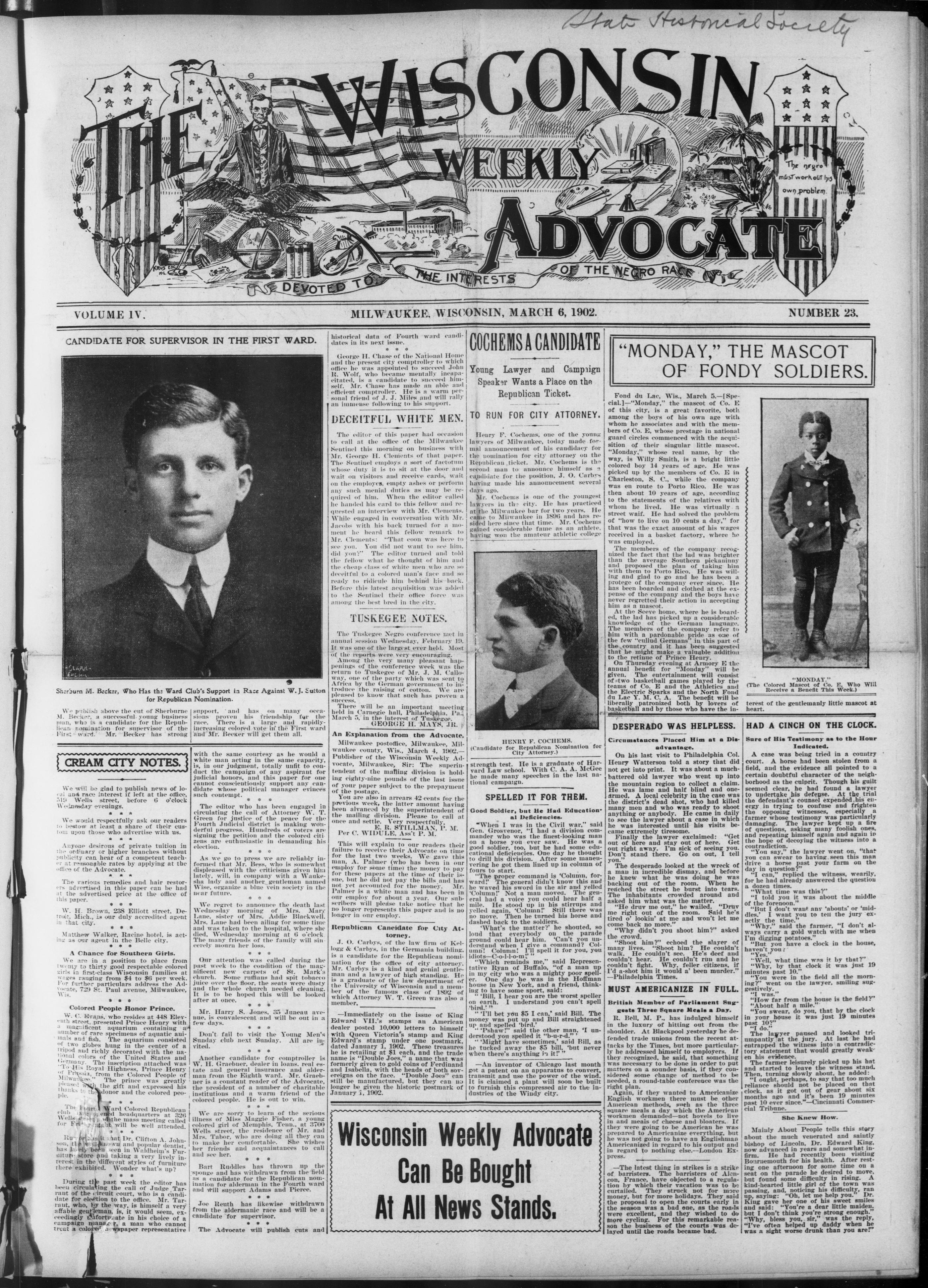
CANDIDATE FOR SUPERVISOR IN THE FIRST WARD.
CLARK
E. E. JIML.
Sherburn M. Becker, Who Has the Ward Club's Support in Race Against W.J. Sutton for Republican Nomination.
VOLUME IV.
CANDIDATE FOR SUPERVI
Sherburn M. Becker, Who Has the Ward C
for Republica
We publish above the cut of Sherburne M. Becker, a successful young business man, who is a candidate for the Republican nomination for supervisor of the First ward. Mr. Becker has strong
CREAM CITY NOTES.
We will be glad to publish news of local and race interest if left at the office, 519 Wells street, before 6 o'clock Wednesday evenings.
☆ ☆ ☆
We would respectfully ask our readers to bestow at least a share of their custom upon those who advertise with us.
★ ★ ★
Anyone desirous of private tuition in the ordinary or higher branches without publicity can hear of a competent teacher at reasonable rates by applying at the office of the Advocate.
****
The various remedies and hair restorers advertised in this paper can be had at the advertised price at the office of this paper.
* * *
W. H. Brown, 238 Elliott street, Detroit, Mich., is our duly accredited agent in that city.
* * *
Matthew Walker, Racine hotel, is acting as our agent in the Belle city.
A Chance for Southern Girls
We are in a position to place from twenty to thirty good respectable colored girls in first-class Wisconsin families at wages ranging from $4 to $6 per week. For further particulars address the Advocate, 729 St. Paul avenue, Milwaukee, Wis.
---
Colored People Honor Prince.
W. C. Evans, who resides at 448 Eleventh street, presented Prince Henry with a magnificent aquarium containing a number of rare specimens of aquatic animals and fish. The aquarium consisted of two globes hung in the center of a tripod and richly decorated with the national colors of the United States and Germany. The inscription attached was "To His Royal Highness, Prince Henry of Prussia, from the Colored People of Milwaukee." The prince was greatly pleased with the gift and expressed his thanks to the donor and the colored people.
* * *
The Fourth Ward Colored Republican club has opened headquarters at 326 Wells street, the mass meeting called for Friday night will be well attended.
Ruver has it that Dr. Clifton A. Johnson, the well-known and popular dentist, has lazily been seen in Waldheim's Furniture store and taking a very lively interest in the different styles of furniture there exhibited. Wonder what's up?
* * *
During the past week the editor has been circulating the call of Judge Tarrant of the circuit court, who is a candidate for election to the office. Mr. Tarrant, who, by the way, is himself a very affable gentleman, is, it would seem, exceedingly fortunate in his choice of a campaign manager, a man who cannot treat a colored newspaper representative
support, and has on many occasions proven his friendship for the race. There is a large and rapidly increasing colored vote in the First ward and Mr. Becker will get them all.
with the same courtesy as he would a white man acting in the same capacity, is, in our judgment, totally unfit to conduct the campaign of any aspirant for judicial honors, and this paper for one cannot conscientiously support any candidate whose political manager evinces such contempt.
* * *
The editor who has been engaged in circulating the call of Attorney W. T. Green for justice of the peace for the Fourth Judicial district is making wonderful progress. Hundreds of voters are signing the petition and the colored citizens are enthusiastic in demanding his election.
※ ※ ※
As we go to press we are reliably informed that Mr. Bess, who is somewhat displeased with the criticisms given him lately, will, in company with a Waukesha lady and another gentleman named Wise, organize a blue vein society in the near future.
* * *
We regret to announce the death last Wednesday morning of Mrs. Mary Lane, sister of Mrs. Addie Blackwell Mrs. Lane had been ailing for some time and was taken to the hospital, where she died, Wednesday morning at 6 o'clock The many friends of the family will sincerely mourn her loss.
* * *
Our attention was called during the past week to the condition of the magnificent new carpets of St. Mark's church. Some ruffians had spit tobacco juice over the floor, the seats were dusty and the whole church needed cleaning. It is to be hoped this will be looked after at once.
Mr. Harry S. Jones, 35 Juneau avenue, is convalescent and will be out in a few days.
Don't fail to visit the Young Men's Sunday club next Sunday. All are invited.
* * *
Another candidate for comptroller is W. H. Graebner, dealer in loans, real estate and general insurance and alderman from the Eighth ward. Mr. Graebner is a constant reader of the Advocate, the president of a number of charitable institutions and a warm friend of the colored people. He is out to win.
* * *
We are sorry to learn of the serious illness of Miss Maggie Fisher, a young colored girl of Memphis, Tenn., at 3700 Wells street, the residence of Mr. and Mrs. Tabor, who are doing all they can to make her comfortable. She wishes her friends and acquaintances to call and see her.
Bart Ruddles has thrown up the sponge and has withdrawn from the field as a candidate for the Republican nomination for alderman in the Fourth ward and will support Adams and Pierce.
* * *
Joe Reuth has likewise withdrawn from the aldermanic race and will be a candidate for supervisor.
* * *
The Advocate will publish cuts and
Wisconsin Weekly Advocate Can Be Bought At All News Stands.
historical data of Fourth ward candidates in its next issue.
* * *
George H. Chase of the National Home and the present city comptroller to which office he was appointed to succeed John R. Wolf, who became mentally incapacitated, is a candidate to succeed himself. Mr. Chase has made an able and efficient comptroller. He is a warm personal friend of J. J. Miles and will rally an immense following to his support.
DECEITFUL WHITE MEN.
The editor of this paper had occasion to call at the office of the Milwaukee Sentinel this morning on business with Mr. George H. Clements of that paper. The Sentinel employs a sort of factotum whose duty it is to sit at the door and wait on visitors and receive cards, wait on the employees, empty ashes or perform any such menial duties as may be required of him. When the editor called he handed his card to this fellow and requested an interview with Mr. Clements. While engaged in conversation with Mr. Jacobs with his back turned for a moment he heard this fellow remark to Mr. Clements: "That coon was here to see you. You did not want to see him, did you?" The editor turned and told the fellow what he thought of him and the cheap class of white men who are so deceitful to a colored man's face and so ready to ridicule him behind his back. Before this latest acquisition was added to the Sentinel their office force was among the best bred in the city.
TUSKEGEE NOTES.
The Tuskegee Negro conference met in annual session Wednesday, February 19. It was one of the largest ever held. Most of the reports were very encouraging. Among the very many pleasant happenings of the conference week was the return to Tuskegee of Mr. J. M. Calloway, one of the party which was sent to Africa by the German government to introduce the raising of cotton. We are pleased to know that such has proven a success. There will be an important meeting held in Carnegie hall, Philadelphia, Pa. March 5, in the interest of Tuskegee. GEORGE H. MAYS, JR.
An Explanation from the Advocate
Milwaukee postoffice, Milwaukee, Milwaukee county, Wis., March 4, 1902. Publisher of the Wisconsin Weekly Advocate, Milwaukee, Sir: The superintendent of the mailling division is holding eighty-nine pounds of the last issue of your paper subject to the prepayment of the postage. You are also in arrears 42 cents for the previous week, the latter amount having been advanced by the superintendent of the mailing division. Please to call at once and settle. Very respectfully,
E. R. STILLMAN, P. M.
Per C. WIDULE, Ass't P. M.
This will explain to our readers their failure to receive their Advocate on time for the last two weeks. We gave this man, A. Palmer (who has been in our employ for some time) the money to pay for these papers at the time of their issue, but he did not pay the bills and has not yet accounted for the money. Mr. Palmer is a white man and has been in our employ for about a year. Our subscribers will please take notice that he no longer represents this paper and is no longer in our employ.
Republican Caneidate for City Attorney.
J. O. Carbys, of the law firm of Kellogg & Carbys, in the Germania building, is a candidate for the Republican nomination for the office of city attorney. Mr. Carbys is a kind and genial gentleman and a lawyer of high standing. He is a graduate of the law department of the University of Wisconsin and a member of the famous class of 1892 of which Attorney W. T. Green was also a member.
Immediately on the issue of King Edward VII.'s stamps an American dealer posted 10,000 letters to himself with Queen Victoria's stamp and King Edward's stamp under one postmark, dated January 1, 1902. These treasures he is retailing at $1 each, and the trade name is "Double Joes," a name that was formerly given to gold coins of Ferdinand and Isabella, with the heads of both sovereigns on the face. "Double Joes" can still be manufactured, but they can no longer be given the historic postmark of January 1, 1902.
COCHEMS A CANDIDATE
Young Lawyer and Campaign Speaker Wants a Place on the Republican Ticket.
TO RUN FOR CITY ATTORNEY.
Henry F. Cochems, one of the young lawyers of Milwaukee, today made formal announcement of his candidacy for the nomination for city attorney on the Republican ticket. Mr. Cochems is the second man to announce himself as a candidate for the position, J. O. Carbys having made his announcement several days ago. Mr. Cochems is one of the youngest lawyers in the city. He has practiced at the Milwaukee bar for two years. He came to Milwaukee in 1896 and has resided here since that time. Mr. Cochems gained considerable fame as an athlete, having won the amateur athletic college
M. B.
HENRY F. COCHEMS. (Candidate for Republican Nomination for City Attorney.) strength test. He is a graduate of Harvard Law school. With C. A. A. McGee he made many speeches in the last national campaign.
SPELLED IT FOR THEM.
Good Soldier, but He Had Education al Deficiencies.
"When I was in the Civil war," said Gen. Grosvenor, "I had a division commander who was the finest-looking man on a horse you ever saw. He was a good soldier, too, but he had some educational deficiencies. One day he thought to drill his division. After some maneuvering he got them lined up in column of fours to start.
"The proper command is 'Column, forward.' The general didn't know this and he waved his sword in the air and yelled 'Column!' Not a man moved. The general had a voice you could hear half a mile. He stood up in his stirrups and yelled again, 'Column!' Still there was no move. Then he turned his horse and dashed back to the soldiers.
'What's the matter?' he shouted, so loud that everybody on the parade ground could hear him. 'Can't you understand when I give a command? Column! Column! I'll spell it for you, you idiots—C-o-l-l-o-m.'" "Which reminds me," said Representative Ryan of Buffalo, "of a man up in my city who was a mighty poor speller. One day he was in the Hoffman house in New York, and a friend, thinking to have some sport, said: 'Bell, I hear you are the worst speller on earth. I understand you can't spell 'bird.'" "I'll bet you $5 I can,' said Bill. The money was put up and Bill straightened up and spelled 'bird.'
"Pshaw!" said the other man. 'I understood you spelled it "b-u-r-d."
"Might have sometimes," said Bill, as he tucked away the $5 bill, "but never when there's anything in it!".
An inventor of Chicago last month got a patent on an apparatus to convert, transmit and use the power of the wind. It is claimed a plant will soon be built to furnish this compressed air to the industries of the Windy city.
"MONDAY," THE MASCOT OF FONDY SOLDIERS.
Fond du Lac, Wis., March 5.—[Special.]—"Monday," the mascot of Co. E of this city, is a great favorite, both among the boys of his own age with whom he associates and with the members of Co. E, whose prestage in national guard circles commenced with the acquisition of their singular little mascot.
"Monday," whose real name, by the way, is Willy Smith, is a bright little colored boy 14 years of age. He was picked up by the members of Co. E in Charleston, S. C., while the company was en route to Porto Rico. He was then about 10 years of age, according to the statements of the relatives with whom he lived. He was virtually a street waif. He had solved the problem of "how to live on 10 cents a day," for that was the exact amount of his wages received in a basket factory, where he was employed.
The members of the company recognized the fact that the lad was brighter than the average Southern pickaninny and proposed the plan of taking him with them to Porto Rico. He was willing and glad to go and he has been a protege of the company ever since. He has been boarded and clothed at the expense of the company and the boys have never regretted their action in accepting him as a mascot. At the Seee home, where he is boarded, the lad has picked up a considerable knowledge of the German language. The members of the company refer to him with a pardonable pride as one of the few "cullud Germans" in this part of the country and it has been suggested that he might make a valuable addition to the retinue of Prince Henry.
On Thursday evening at Armory E the annual benefit for "Monday" will be given. The entertainment will consist of two basketball games played by the teams of Co. E and the Athletics and the Electric Sparks and the North Fond du Lac Y. M. C. A. The benefit will be liberally patronized both by lovers of basketball and by those who have the in-
DESPERADO WAS HELPLESS.
Circumstances Placed Him at a Disadvantage.
On his last visit to Philadelphia Col. Henry Watterson told a story that did not get into print. It was about a muchbattered old lawyer who went up into the mountain region to collect a claim. He was lame and half blind and onearmed. A local celebrity in the case was the district's dead shot, who had killed many men and who was ready to shoot anything or anybody. He came in daily to see the lawyer about a case in which he was interested until his visits became extremely tiresome.
Finally the lawyer exclaimed: "Get out of here and stay out of here. Get out right away. I'm sick of seeing you. Don't stand there. Go on out, I tell you."
The desperado looked at the wreck of a man in incredible dismay, and before he knew what he was doing he was backing out of the room. When he reached the street he burst into tears. The inhabitants crowded around and asked him what was the matter.
"He druv me out," he wailed. "Druv me right out of the room. Said he's tired o' lookin' at me and won't let me come back no more."
"Why didn't you shoot him?" asked the crowd.
"Shoot him?" echoed the slayer of many lives. "Shoot him? He couldn't walk. He couldn't see. He's deef and couldn't hear. He couldn't run and he couldn't fight. Why, feller citizens, if I'd a-shot him it would a' been murder."
—Philadelphia Times.
MUST AMERICANIZE IN FULL
British Member of Parliament Sug-
R. Bell, M. P., has indulged himself in the luxury of hitting out from the shoulder. At Blackpool yesterday he defended trade unions from the recent attacks by the Times, but more particularly he addressed himself to employers. If they recognized, he said, that something was necessary to be done in order to put matters on a sounder basis, if they considered some change of method to be needed, a round-table conference was the right plan.
Again, if they wanted to Americanize English workmen there must be other American methods, such as the three square meals a day which the American workmen demanded—not hovels to live in and meals of cheese and bloaters. If they were going to be American he was prepared to Americanize everything, but he was not going to have an Englishman Americanized in regard to his output and in regard to nothing else.—London Express.
The latest thing in strikes is a strike of barristers. The barristers of Alcon, France, have objected to a regulation by which their vacation was to be curtailed. They struck not for more money, but for more holidays. They said the proposal to open the courts early in the season was a bad one, as the roads were excellent, and they wished to do more cycling. For this remarkable reason the business of the courts was delayed until the roads became bad.
NUMBER 23.
THE BLAKE
"MONDAY." (The Colored Mascot of Co. E. Who Will Receive a Benefit This Week.)
"MONDAY."
(The Colored Mascot of Co. E. Who Will
Receive a Benefit This Week.)
terest of the gentlemanly little mascot at
heart.
HAD A CINCH ON THE CLOCK.
Sure of His Testimony as to the Hour Indicated.
A case was being tried in a country court. A horse had been stolen from a field, and the evidence all pointed to a certain doubtful character of the neighborhood as the culprit. Though his guilt seemed clear, he had found a lawyer to undertake his defense. At the trial the defendant's counsel expended his energy in trying to confuse and frighten the opposing witnesses, especially a farmer whose testimony was particularly damaging. The lawyer kept up a fire of questions, asking many foolish ones, and repeating himself again and again in the hope of decoying the witness into a contradiction.
"You say," the lawyer went on, "that you can swear to having seen this man drive a horse past your farm on the day in question?"
"I can," replied the witness, wearily, for he had already answered the question a dozen times.
"What time was this?"
What time was this?
"I told you it was about the middle of the forenoon."
"But I don't want any 'abouts' or 'middles.' I want you to tell the jury exactly the time."
"Why," said the farmer, "I don't always carry a gold watch with me when I'm digging potatoes."
"But you have a clock in the house, haven't you:
"Yes."
"Well, what time was it by that?"
"Why, by that clock it was just 19 minutes past 10."
"You were in the field all the morning? went on the lawyer, smiling suggestively.
"I was."
"How far from the house is the field?"
"About half a mile."
"You swear, do you, that by the clock in your house it was just 19 minutes past 10?"
"I do."
The lawyer paused and looked triumphantly at the jury. At last he had entrapped the witness into a contradictory statement that would greatly weaken his evidence.
The farmer leisurely picked up his hat and started to leave the witness stand. Then, turning slowly about, he added: "I ought, perhaps, to say that too much reliance should not be placed on that clock, as it got out of gear about six months ago and it's been 19 minutes past 10 ever since."—Cincinnati Commercial Tribune.
She Knew How
Mainly About People tells this story about the much venerated and saintly bishop of Lincoln, Dr. Edward King, now advanced in years and somewhat infirm. He had recently been visiting Bournemouth for his health. After resting one afternoon for some time on a seat on the parade he desired to move, but found some difficulty in rising. A kind-hearted little girl of the town was passing, and, noticing his difficulty, ran up, saying: "Oh, let me help you." Dr. King gave her one of his sweet smiles and said: "You're a dear little maiden, but I don't think you're strong enough." "Why, bless you, sir," was the reply, "I've often helped up daddy when he was a sight worse drunk than you are!"
PLAN A SUMMER SCHOOL.
Many Fine Lecturers wiil Speak
at tho State University.
‘COLLEGE MEN COMING
Prof, O’Shea Has Arranged a Pro-
gramme of Noted Educators—
Open to the Whole State.
Madison, Wis., March 5.—[Special.J—
The citizens and teachers of Madison
and of the state at large are to have an
unusual opportunity this summer to lis-
ten to distinguished lecturers upon edu-
cational subjects. In addition to the
members of the regular faculty of the
university eight ef the most eminent edu-
cators of the country are to lecture here.
Prof. O’Shea, who has had the matter
particularly in charge, has spared no
pains to f up the most attractive pro-
gramme he could for the summer ses-
sion.
First among the lecturers is G. Stan-
aA Hall, Ph. D., LL. D., president of
Ciark university. During the last dozen
years he has devoted himself almost
wholly to the study of childhood and
youth. He is known everywhere as the
father of the “child study movement.”
At the recent great educational conven-
tion at Chicago, President Hall took a
prominent part, and was spoken of by
everyone as the most suggestive and in-
spiring educator in the country. He is
an exceedingly attractive speaker. He
will be at Madison for three weeks and
deliver a lecture each day. e
Other distinguished university presi-
dents who have achieved a_reputation
for the discussion of educational ques-
tions will be present at the university
this summer. President E. Benjamin
Andrews, D. D., LL. D., chancellor of the
University of Nebraska, will deliver
three lectures. Chancellor Andrews has
delivered addresses in Madison hereto-
fore, and has greatly pleased students
and citizens. He was formerly president
of Brown university, and later eee
tendent cf schools in Chicago. ’resi-
dent Charles F. Thwing, D. D., LL. D.,
of Western Reserve university at Cleve-
land, is another popular speaker and wri-
ter upon educational subjects, who will
deliver addresses during the summer ses-
sion. President Thwing is a graduate
of Harvard and was for a time minister
in Minneapolis. _It is expected that
Nicholas Macey Butler, the newly-elect-
ed president of Columbia university, will
deliver a couple of addresses. To many
he is the ideal type of college president.
He served as president of the recent
meeting of American universities in Chi-
cago.
Columbia university has a great col-
lege devoted exclusively to the teaching
of pedagogy. At the head of this is
James E. Russell, Ph. D., widely known
as an author and lecturer, and he will
deliver four addresses during the sum-
mer session. He will give special atten-
tion to school administration. New York
is the center of the educational activity
in our country. There are’ several great
institutions that are devoted to the train-
ing of teachers, and the experimental
study of education. One is connected
with the University of the City of New
York, at the head of which is Edward
R. Shaw, Ph. D. He will deliver four
addresses in the summer session. He
will present the results of modern studies
on certain phases of childhood and youth.
It is generally believed that the most
scholarly city superintendent in the coun-
try is Thomas M. Balliet. Ph. D., of
Springfield, Mass. It is a difficult matter
to secure him for a lecture, for the rea-
son that all the time he ean give to the
people outside of his own city is usually
mortgaged for two or three years ahead,
but he has consented to spend a few days
in Madison. He will attempt to show
what educational theory the development
of modern science has given education,
and how these can be worked out prac-
tically in the training of childhood and
youth.
New England has produced no more
popular and effective exponent of educa-
tional doctrines than A. E. Winship,
Litt. D., editor of the New England
Journal of Edueation. He treats educa-
tion from historical and literary stand-
points. A Canadian educator who is
widely known in our courtry is James L.
Hughes, A. M., Toronto. Like the oth-
ers who will appear _at the summer ses-
sion, he is a most effective lecturer. He
has force and enthusiasm which does not
fail to make a deep impression upon his
“ET
AGED PEOPLE
ARE ASPHYXIATED.
gee
Three Persons are Overcome by
Escaping Coai Gas at
Oconomowoc,
Oconomowoc, Wis., March 5.—-[Sp»
cial. ]|—Late this afternoon three persons
were found dead in the house of Thomas
Laughlin in this city. They are:
LAUGHLIN, THOMAS, aged 92 years.
LAUGHLIN. MRS., wife of “Thomas
Laughlin, aged 70.
MDERMOTT, MARGARET, aged 7
years.
Death was cased by coal gas which
escaped from the stove in the room oc-
cupied by Mr. and Mrs. Laughlin. Mrs.
McDermott, who boarded with them,
slept in the adjoining room. The door
connecting the rooms had been left open
and she died as she was sleeping in bed.
ee bodies were discovered by a neigh-
por.
Mrs. McDermott is an aunt of John
Dougherty of this city. She was very
wealthy. The Laughlins were reputed
to be rich, but lived in a little cottage in
a miserly manner.
21 >
SUICIDE ENDS SPREE.
pia eas
Herman Martin’s Wife Starts Di-
vorce Suit and He Takes a
Dose of Poison.
Wausau, Wis., March 5.—[Special.]—
Herman Martin who lives a few miles
from this city, has made an attempt to
end his life which will probably be suc-
cessful, for he is now at the point of
death. He is a hard drinker and had
been on a spree for several days, the
culmination of which ended in his taking
a dose of Paris green. He is a married
man and the father of seven children,
and has a divorce shit pending in the
circuit court, which was instituted by
his wife, who alleges non-support.
When discovered after taking the poison
he was lying in a hay mow, but as it
was thought he was on one of his sprees
no attention was paid to him unt! he
was beyond hope of recovery.
fa
CHAMPION COW-MILKER.
ao
Swedisn Cheesemaker of Dodge-
ville Claims to Hold the
State Record.
Dodgeville, Wis., March 5.—[Special.]
—Frederick Intermill, a Swede cheesv-
maker of this place, claims the cham-
ionship of Wisconsin for milkiug cows.
Upon a bet of $25 he milked forty aver-
age cows in two hours, a record which
he thinks has. never been equaled in the
state.
DANGER IS NOW OVER.
Flood Conditions In New York and
Pennsylvania Rapidly Im-
proving.
New York, March 4.—Flood conditions
in the East are reported rapidly improy
ing, although affairs in the Wyoming val-
ley and northeastern Pennsylvania gen-
erally, and along the Hudson, near Al-
bany, are still in bad shape. Dispatches
from Wilkesbarre, Pa., show that more
than a score of lives were lost and §$5,-
000,000 worth of property was destroyed
in northeastern Pennsylvania. The dan-
<= is over, but the full extent of the
mage is yet to be seen. Dighteen thou-
sand homeless persons in the Wyoming
valley are anxiously watching the back-
ward course of the waters.
The water has receded in Paterson,
N. J., so that the danger there practical-
ly is over, but there were many daring
rescues of persons who had stayed in the
flooded houses.
So many mills were damaged that 10.,-
000 operatives are thrown out of work
for an indefinite time.
In Passaic six men are reported to
have been carried down with a bridge
which was washed away. The current
was so swift that it was impossible to
rescue them. .
Cities and towns in_aimost all sections
of New York and in New England states
suffered heavy damage to proves, and
delayed trains were reported.
Not for many years have mails reach-
ing New York been so delayed as in the
three and a half days.
NEW MOVE STARTED.
a
Bill to Dissolve Corporate Exist-
ence of Northern Securities
Company.
Trenton, N. J., March 4.—Senator
Gebhardt (Dem.) of Hunterdon intro-
duced a bill in the Senate today to re-
peal and dissolve the charter and cor-
porate existence of the Northern Securi-
ties company. The bill has a long pre-
amble in which it is stated among other
things that the company was organized
to enable the Northern Pacific Railroad
company and the Great Northern Rail-
way company to violate the laws of sev-
eral states and interfere with their rev-
enues and also to destroy the competi-
tion in passenger and freight rates that
existed between these railroads. The
preamble goes on to say that the or-
ganization has aroused great public in-
dignation and that the governor of Min-
nesota has already instituted suit to pre-
yent the consummation of the illegal and
injurious purposes sought to be accom-
plished by the formation of the Securi-
ties company. ‘The bill was referred to
the committee on cornorations.
LOST HER PROPELLER.
eee eae
Cunard Liner Etruria Is Sighted
Four Hundred Miles West
of Fayal.
London, March 4.—The British steam-
er Ottawa, from Philadelphia for Lor-
don, has arrived at Fayal, Azore islands,
and reports having sighted the Cunard
line steamer Etruria in tow of the Brit-
ish steamer William Cliff 400 miles west
of Fayal. The Etruria had lost ber
propeller.
Another report says the Etruria_was
picked ay when 500 miles from Fayal
west-northwest of that point. All were
well on board the Cunarder, which, ac-
cording to this report, had her propeller
shaft broken. She was otherwise unin-
jured.
Previous to the receipt of the news
that the Etruria had been sighted in
tow the insurance on the Cunard liner
at Lloyds today was about 4 guineas per
cent. Little business was done at that
rate. i
UPPER PENINSULA EDITORS.
J. H. Wilson of Lake Linden is Chosen
President.
Escanaba, Mich., March 4.—[Special.]
The meeting of the Lake Superior Press
associstion which concluded with a
banquet at the Ludington hotel last night
was the most successful business — ses+
sion of the organization ever held, there
being twenty-four representatives of
leading upper peninsula journals in at-
tendance. It was decided to have the
summer meeting at Honghton. The
officers elected were:
President, J. H. Wilson, Lake Linden,
Times; _ vice-president, Thos. Cot
Crystal Falls, Diamond Drill; secretary-
treasurer, F. L. Baldwin, Munising, Re-
publican; executive committee, Ethan
W. Kibby, Sault Ste. Marie; P. O’Brien,
Iron River; J. D. West, Peninsula Ree-
ord, Ishpeming: L. A. Gates, Escanaba,
Iron Port; F. W. Woesner, Stephenson.
Evening Paper at Marquette.
Marquette, Mich., March 4.—It is an-
nounced that this city is to have an-
other daily newspaper at an early date.
The names of the promoters are not
made known, but it is understood the
enterprise represents an investment of
$20,000. The newcomer will be an eyen-
ing publication.
Mascagni’s Watch Mania.
Sig. Mascagni, the composer of “Caval-
leria Rusticana,” has a positive mania
for watches, of which he is said always
to carry three in his pockets. One is
of gold, with his monogram in diamonds;
another is of silver, and the third, which
is of huge proportions, is of nickel.—Lon-
don Telegraph.
Home for lron Mountain Guard.
Iron Mountain, Mich., March 4.—
Co. L., Thirty-third regiment, M. Ni
G., stationed here, is to have a new home.
Capitalists will build an armory and sell
it to the company on easy terms. The
building will cos: about $5000.
Victim of Hot Water Treatment. _
Escanaba, Mich., March 4.—For years.
Andrew Berquish, a farmer of this coun-
ty, has been in the habit of eating aad
drinking food while it was intensely hot.
Sunday he died from the effects of tak-
ing a drink of boiling - water. :
The Joke on Nebraska. ]
_ Wolf breeding seems to be a profitable
employment in Nebraska, In that coun-
try he who kills a wolf receives a+boun-
ty from the government for his pains, so
the farmers have taken to breeding
wolves, which they subsequently slaugh-
ter, and receive payment at the usual
rate per head. It is said that the ex-
periment is most profitable and pays far
better than breeding pigs. At any rate
it is a more ingenious method of keep-
ing the wolf from the door.—London
Globe.
—Iceland is about to obtain home rule.
King Christian of Denmark has called
for an extraordinary meeting of the Al-
thing next summer to consider a reform
of the constitution, A plan to be sub-
mitted is the appointment ef a minister
for Iceland, who shall be acquainted with
Icelandic and shall reside at Reikjavik
instead of Copenhagen.
—Sixty-two jurymen_were called to-
gether at Leicester (England) borough
quarter sessions the other day, although
there was only one prisoner for trial. |
—Germany has imported as much as
$10,000.000 worth of apples in one year
and $2,500,000 worth of pears.
Whistling for Health.
Whistling as a health exercise is now
advocated by German and Swedish pro-
fessors of physical training. They say
that great benefit results from a cou-
scientions practice of the simple art.
But they require a systematic and con-
stant effort on the part of the beneti-
ciary. Drill schools have been formed
where one of the chief exercises consists
in lying flat, back downward, on a table
and simply breathing and expelling ‘air
from the lungs with regularity and vig-
or. Dumbbells and Indian clubs have
been discarded by the advanced health
culturists in those institutions. As a
method of prolonging life and strength-
ening the human frame against sickness
whistling is said to be beyond compare.
Development of chest and neck muscles
is one of the special advantages claimed
for the exercise. Long, deep brezthing
is an essential for a good whistler, as it
is not permissible to draw in the breeth
except during the intervals of the sound
production. Besides the good that ac-
crues to the performer's general health
there is an advantage in knowing how to
whistle well. It is recognized as a cer-
tain form of musical art, and as such is
capable of giving pleasure to the listen-
er.—Cincinnati Enquirer.
Bottle Cleaner.
A bottle-cleaning machine is one-of the
latest Iabor-saving devices. Bottles are
run backward and forward automatical-
ly in a “bath” of chemical solution.
which cleanses them of dregs, labels and
tinfoil. They are automatically placed
on a dryer, and afterward delivered to
a part of the apparatus called the con-
yeyor. They are then ready for a dip
‘into clean water. One man can at-
tend to the machine, which cleans from
23,000 to 30,000 nottles a day.
LATEST MARKET REPORTS.
Milwaukee, March 5, 1902.
ECaQ AND DAIRY PRODUCTS.
a 1 ene. | a ene eae Se ee
MILWAUKEE—Eges — Market lower;
fresh, loss off, cases included, 20c; fresh,
cases returned, 19%¢c; seconds, 14@lic. Re-
ceipts were 700 cases.
Butter—Market steady; fancy prnts, 2744c;
fancy een ee See aee Bal Ib, a
firsts, ;.seconds, 17@18e; dairy prints,
2le; extra fancy dairy, 19@20c; lines,
15@18e; packing stock, 14@15c; roll, 15
16c; whey, 9c; grease, 4@5c. The et
today were 8900 Ibs aganst 6125 Ibs
yesterday. The receipts of creamery are
increasing and also the demand.
Cheese—Steady. Receipts were 9050 Ths
today against 11,325 Ibs Festenday- Fuil
cream flats, new, colored, faney, 12@12%c;
good to choice, 11@11%4c; Young Americas,
new, 124%@13c; daisies, new, 12@12i%e;
fancy brick new, 124%@13'%c: low grades, 11
@i2c; limburger, a ib, No. 1, 13%4@14c;
low grades, 10@12c; imported Swiss, 25c;
Block Swiss, domestic, 15@16c; fancy
loaf, 15%46@16c; No. 2, 13@14e; Sapsago,
20c: farmers’. 10@11¢.
NEW YORK — Butter — ye 7222
pkgs; steady; state dairy, 20@26c; state
cleamery, 22@28e: creamery held 18@24%6c;
renovated, 16@23\4e: factory, 16@2Ic.
Cheese—Receipts, 1304 pkgs; strong;- state,
full cream, small early made, aa, col-
ored, Raph: state, full crea small
early made, fancy white, 124%@12%c; full
cream, large fall made, faney colored, 11%
@11%c; full cream, large fall made, fancy
white, 114@11%c. Eggs—Receipts, 6503
pikes: unsettled; state and Pennsylvania,
ic; Western at mark, 28e; Southern at
mark, 274@28c. Coffee—Nominal;* No. 7
Rio, 5%e.
CHICAGO — Butter—Steady; creameries,
18@26%4c; dairies, 18@23e. Cheese—Steady;
twins, 10%@11\%c: daisies, see:
Young Americas, 12@12%c. Eggs—Weak:
at mark, cases included, 21@21\%c. Dressed
poultry—-Firm; turkeys, 11@15e; chickens, 9
a@il\%e.
MILWAUKEE LIVESTOCK MARKET.
HOGS—Receipts. 7 cars; market 5@16c
eee light, 300 25.90; mixed Se
weighte. 5.1 .10; common to ck-
ers, 80g. choice heavy, GASAS,30.
rae 90 to 120 Ibs, 5.00@5.25.
‘ATTLE — Receipts, 1 car; steady;
butchers’ steers, medium to good. 1050 to
1300 Ibs, Eg ale fair to medium, 950 to
1050, 4.25@5.™%; heifers, common, = or
good, 4.00@5.00; cows, fair to good, 3.25@
4.50; canners, 2.00@2.50; bulls, common, 2.75
@3.25; cholce, 3.50@4.25; feeders, 800 to 950
Tbs, 3.50@4.00; stockers. 500 to 750 Ibs. 3.00
.50; veal calves, common to choice, 4.75
5.75; milkers and springers, common sell
for canners; choice, '30.00045.00.
shes ee clos — steady,
ae ; bucks, 2.75@3.25; lambs, common
to ct oice, = 75. ‘ 36,000: ett
leago receipts: logs, 3 ; eattle,
21,000; sheep, 18,000.
CHICAGO POTATO MARKET.
CHICAGO, March 5.—[Special.J—Coyne
Brothers report: Receipts, 15 cars; mar-
ket continues firm; fancy rurals, 82c; long
and round white 71@73c; red, Tle; mixed
red and white, 70c.
MARKETS BY TELEGRAPH.
AMLWAURLE—Fiour—steady, Wheat —
Firmer; No. 1 Northern, on track, 76c; No.
2 Northern, on track, 75c. Corn—Steady:
No. 3 on track, 59¢. Oats—Slow; No 2
white, on track, 44%4¢; No. 3 white, on
track, 43%@44e. ’ Barley—Steady; No. 2 on
track, 62i4c; sample on track, 57@62\4c. Rye
—Steady; No. 1 on track, 59¢. Provisions—
Lower; pork, 15.20; lard, 9.32.
Flour markets steady; patents, 3.80@3.90;
bakers’, 2.90@3.00; rye, '3.20@3.30.
Millstuffs are steady’ and quoted at 17.50
for bran, 18.00 for standard middlings, and
19.00 for Mliwaukee flour middlings in 100-
IW sacks; red dog, 19.50.
CHICAGO — Close—Wheat—Mareh, 7414¢;
May, T6%c; July, 76%c; September, 76isc.
Corn—March, 60c; May, 61%@62c; July, 614
Qol%e; September, SiGe; December, 48i.c.
-Oats—March, 43¢;) May, AeGHc: July,
| B54K05 September, — 30%c. Pork—Mareh,
14.40; May, 15.10: July. 15.30., Lard— Maren,
9.1214; May, 9.27%; July, 9.40; Septemher,
9.50. Ribs—March, 8.17%; May, 8.2734
July, 8.40; September, 8.52%. Fiax—Cash
‘Northwest, 1.71; Southwest, 1.66; May, 1.71.
Rye—March, 56%c; May, '58e; "July, 58e.
Barley—Cash, 58@62%4c. Timothy—March,
6.50.” Clover~March, 8.80.
"ST. LOUIS—Close-Wheat—Higher; No. 2
red cash, elevator, 8444c; May, &3\c; July,
TOUGTORe: No. 2 hard, T6wa70e, Corn
Higher; No. 2 cash, 61e May, 2c; July, 61%
Gc; No. 2, 62c.’ Oats—No. 2’ cash,’ 4c;
May,” 44c; July, 30ci No. 2 white, “si
464e. Lend—Dull; "4.05." Spelter—Dall;
KANSAS CITY — Close — Wheat — May,
73%e: July, 73%4c; cash No. 3 hard, 72%c;
No. 2 red, Sic: No. 2 spring, 714a72\e.
Corn—May, 6i%e3 September,” 5814; cash
No, 2 mixed, Gic: No. 2 white, 64%.’ Oats
—No. 2 white, 45c.
ieee ee eo a - Firm, higher; cash,
cs ay, cy uly, <. Corn—
March, 60¢;' May, Saye: Jair Ge. Oats—
March, 441c: May, fics July, 36%e. Clo-
Fer seed—Dull, strong; March, 5.60; April,
5.55.
| DULUTH—Close — Wheat — Cash No. 1
‘hard, 76%: No. 1 Northern, 73%e; No. 2
‘Northern, Tic: No. 3 spring, '69c; to arrive,
No. 1 hard, 76%c: No. 1 Northern, 73%4¢:
May, 75c; July, 764c; Manitoba No. 1 North:
ern, cash, 7144c; May, 73\4¢c; No. 2 Northern,
68iéc. Oats—42e. Rye—Sie. “Ratley—49@
8c. Corn—6le. Flax—To ‘arrive, 1.6814;
-eash, 1.68; May, 1.71. Receipts—Wheat,
160,813; shipments, 1000.
MINNEAPOLIS — Close — Wheat —May,
‘73%e; July, 74%4@74%c; on track, No. i
hard, 75%; No. 1 Northern, 73%c; No. 2
Northern, 71%@72%e.
KANSAS CITY—Cattle—Recelpts, 5500;
barely steady; beef steers, 6.20@6.40: Tex:
ans, 4.50@5.75; cows and heifers, 3.00@5.00;
stockers and feeders, 3.00@5.25: bulls, 3.25
@A4.40; calves, 4.50@6.50. — Hogs—Receipts,
10.000; Se lower: heavy, 6.35@0.50; packers.
§.90@§.40; medium, 5.80@6.25: light, 540@
6.20; “yorkers, 5.60@6.05; pigs, 4.50@5.25.
‘Sheep—Receipts, 2000: firmer; sheep, 5.00@
5.60: lambs. 6.20@6.50.
&T. LOUIS—Cattle—Recetpts, 3000: mar-
ket, Steady; beef steers, 3.G0@N6.75: stockers
and feeders, 2.85@4.85; cows and heifers,
2.2505.35; Texas steers. 3.25@5.00. Hogs—
Receipts, 7000: market i0¢ lower: pigs, 5.75
GS-90; Packers, 5.0000.25; butchers, 6.154
4214. Sheep—Receipts, 700; strong: sheep,
Sooas.50; lambs. 5.00645. gu
SOUTH OMAHA—Cattle—Receipts, 2800:
active, steady; beef steers, “4.0008 50 cows
and heifers. 3.25@5.25: cauners, 2.00@3.00;
soceers a =. as ore. co
t7.00; bu! . THGA.6O. —Receipts, i,
500; aioe lowers heavy, “£00@8.00: mised,
5.65@6.05: Hebt. 5.6006.05: pigs, 4.50@5.50:
buik of saies, 5.90@6.05. Sheep—Receipts.
4800; steady: lambs lower; sheep, 5.00@5.69;
lambs, 5.23@6.40.
;
JAIL RATHER THAN
PAY FINE OF §1.
——_————_
Rich Kenosha Woman Takes Ten’
Days Sentence in Preference
to Paying Small Fine.
Kenosha, Wis., March 5.—Rather than
pay a fine of $1 Mrs. Meyers, supposed
to be worth $30,000, went to jail-for ten
days. She is 70 years of age. | Mrs.
Meyers and her son were found guilty of
assaulting a tenant.
BRIDE AND GROOM
GREETED BY CROWDS.
+.
Frank Falter of Eagle Takes His
Wife to His Grandfather's
Home.
Eagle, Wis., Mareh 5.—[Special.]—-A
large crowd greeted Frank Falter and
his bride, formerly Blanche L. Young of
Battle Creek, Mich., on their arrival
here late yesterday afternoon. They re-
ceived callers at the Diamond hotel par-
lor and then drove to the residence of
Joseph Falter, Sr., their future home.
A wave of the hand by Landlord Tuohy
of Eagle Lake hotel silenced the young
couple in relation to the first cee in
the Chieago police station and subse-
quent marriage.
ql 7 APR 7
TOUR OF GLEE CLUB.
Wisconsin University Faculty will
Permit Organization to Give
Concarts Around State.
Madison, Wis., March 5.—[Special.]—
The University Glee club will eniiver
the people of a dozen or more cities of
the state with college songs again this
pee, Yor five years past the faculty
as “sat down” on the Glee club trips,
the reason therefor being that the club
of "96 had too gay a time, traveling
about the state in two private cars, with
colored waiters who were kept busy.
Although they had good houses at the
concerts, the club that year returned
with a deficit of about $400. Thereupon
the faculty decided against allowing any
more trips by the club, and this rule has
been enforced, though last year a short
rae to Milwaukee was permitted.
his year, however, assurances are
given that there will be no renetition of
former offenses, and it is said the fac-
ulty has decided to allow the trip. Defi-
nite plans are not yet made, but as out-
lined they are for a two weeks’ trip, be-
ginning With a coneert at Baraboo March
26 and winding up with a concert at
“Madison April 11. The cities to be vis-
ited, in order, are: Baraboo, Sparta, La
Crosse, Winona, Eau Claire, Superior,
Rhinelander. _ Marinette, Green Bay,
Oshkosa, Fond du Lac, Milwaukee and
Madison.
__ The membership of the glee and man-
dolin clubs is as follows:
Glee Club—Firs- tenors: John V. Bren-
nen; Tomah; John F. Graber, Appleton:
Rudolph E. Bolte, Davenport, la.; Frederick
Arnold, Eau Claire. Second tenors: Philip
L. Spooner, Madison; Harry J. Murrish, Ma-
zomanie; Andrew J. Fisk, Helena, Mont.
First bass: Stuart E. Washburn, Racine;
Harry M. Hobbins, Madison; Charles H.
Griffin, Leaf River, Ill; M. B. Nichols, West
Superior, Second bass: Lehman P. Rosen-
heimer, Kewaskum: William A. Hamilton,
Marinette; Raymond T. Conger, Elgin, Il.
Mandolin Club—First_ mandolin: Robert
T. Smith, Baltimore, Md., leader; George
Gove, Madison; Ernest A. Montz, Yankton,
8. D.; Arthur B. Uihlein, Milwaukee;
Charles M. Bigelow, Milwaukee; Frederic
C. Baxter, Mansfield, O. Second mandolin:
James W. MeCrossen, Wausau; Sydney
Law, La Crosse; Otto A. Soell, La Crosse;
Joho D. Bromell, Philadelphia. Guitars:
Edward Wray, Janesville; Samuel E, El-
more, Milwaukee; Osmund M. Jorstae, La
Crosse, manager; Alfred Rhodes, Gales-
ville; ‘George. F. Markham, Milwaukee;
Samuel E. Andrews, Hindsboro, Ill. Flute:
G, F. Bigelow, Jr., Milwaukee. Violin: L.
W. Parks, Watertown.
THEY FOUGHT TO
PROTECT THEMSELVES.
Deputy Sheriff Koneczki of Manito-
woc and His Son are Acquitted
on Charge of Assault.
Manitowoc, Wis., Mareh 5.—[Special.]
—The case of the state of Wisconsin
against Deputy Sheriff Sylvester [Ko-
neczki and his son John, which arose out
of a misunderstanding in the congrega-
tion of the loca! Polish Catholie church,
was decided by Judge Schenian shortly
before 6 o'clock yesterday, both defend-
ants being discharged. The complaining
witness was Patrolman Peter Zarnik,
who claiming that the defendants had
brutally assaulted and beaten him on the
night of Washington’s birthday. Trou-
ble had been brewing for some time and
matters were carried to the extent of
threateniug the priest's life. The priest
called Deputy Sheriff Koneczki from his
work to protect him. While Koneczki
was doing his duty Officer Zarnik came
into the church yard and ordered him
out. He refused to go and a fight en-
sued. The testimony developed that
Koneczki had acted entirely in self-de-
fense, -
The difficulty existing in the congrega-
tion of the Society Ansha Palia Sadek of
the local Hebrew church has resulted in
a division ef the congregation. One of
the factions has reorganized und decided
to build a church. The necessary funds
were at once raised aud the building for-
anerly used as a schoolhouse by the First
Norwegian Lutheran church has been
purchased and will be rebuilt. A site cn
the south side has been secured.
MAY CLASH AT PEPIN.
s—earipaeciate
Minnesota Game Wardens will Try
to Prevent Wisconsin People
from Breaking Laws.
St. Paul, Minn., March 5.—Executive
Agent Fullerton of the state fish com-
mission is going to act against the meu
doing illegal fishing on Lake Pepin with
some twenty-five armed deputy wardens
at his back. He*has received an opin-
ion from Attorney-General~ Hicks ot
Madison to the effect that_Minnesota
wardens have jurisdiction on Lake Pepin
clesr to the Wisconsin shore. This
opinion corroborates that of Attorney-
General Douglass of Minnesota. Mr.
Fullerton has received a letter from a
deputy sheriff residing on the Wisconsin
shore of ihe lake to the effect that Mr.
Fullerton and his men will he’ arrested
on sight if they interfere with Wiscon-
sin residents fishing on the Wisconsin
side of the lake.
MAKES CONCESSION.
Tho Combined Locks Paper Com-
pany is Willing to Give Its Men
Sundays Off.
Kaukauna, Wis., March 5.—John Van
Nortwick, president of the Combined
Locks Paper company, has offered to
close his mills from Saturday at mid-
night till Monday at noon, thus giving
his employes all that is asked im their
request, and more. as it entirely elimi-
nates all chances of having to do Sunday
work as the men proposed to do in their
request in case of necessity. The ex-
tra work, such as putting on wires or
making repairs, can by the aceeptance
of this proposal be done Monday fore-
noons.
BEAUTIFUL CHILDREN
Made Weill and Strong by Pe-ru-na.
aw O11
Ze.
Y 3 . e)
Ge Ss
ee ; Pe
Naar RNS
i AE \ wu
lA Ate Waal
ill
y fo) |
AS NG
tn SAA J
; ee : XN
N= — S/R
NIH fr
A 4 | — LE: eect
: \ fe F F: : Ze VS
ep 3 SS
ied Biy N
‘eae ) 3)
By ao fe) |
Wi NF RA HESTER
x A) ay ge
: t
A Doctor’s Little Daughter
Cured of Grip by Pe-ru-na.
Dr. R. Robbins, Physician and Surgeon
of Muskogee, Indian Ter., writes:
“T have been a practicing physician for
a good many years and was always slow
to take hold of patent medicines, but
this winter my little girl and myself were
taken with the grip. I was so bad 1
was not able to sit up. I sent for a doc-
tor, but he did me no good.
“Finally I sent and got a bottle of
Peruna and commenced to take it. 1
took two bottles and my cough was gone
and my lungs loosened up and my head
became clear. My little girl took the
same way.
“It looked as though she would die,
she was so sick. I gave her medicine,
but it seemed to do her little good, so
I sent and got one more bottle of Pe-
runa and commenced to give it to her.
it was only a short time until she was
getting along all right, so I give your
medicine, Peruna, the praise for what
it did for me and my dear little daugh-
ter.’’—Dr. R. Robbins.
_—_—
Functions of Rubber Tree Milk.
No definite function has heretofore
been ascribed to the milk of the rubber
tree, from which rubber is produced. It
has no nutritive value to the tree and it
does not assist the growth in any wuy
that has been ascertained. What, then,
was nature’s object in providing the
latrex, or milk, of tropical trees? A rub-
ber expert has recently suggested that it
is probably intended to protect tropical
trees from the ravages of destructive in-
sects. This seems a plausible theory, as
almost all tropical trees have some such
milk, which is unpalatable to insect de-
vourers. Soft, rapidly-growing trees
have particularly large quantities of it.—
Philadelphia Record.
EARLIEST RUSSIAN MILLET.
Will you be short of hay? If so plant a
plenty ‘of this prodigally prolific millet.
5 to 8 Tons of Rich May, Per Acre.
Price, 50 Ibs. $1.90; 100 Ibs. 88.00 Lees Freight,
John A. Salzer Seed Co., La Crosse, Wis. C
—Merchants and parents at Ravens-
wood, a Chicago suburb, have united to
repress the comic valentine. None will
de sold this season.
—There are 5000 persons engaged in
the fishing industry in the Hawaiian is-
ands.
We are never without a bottle of Piso’s
Cure for Consumption in our house.—
Mrs. E. M. Swayze, Wakita, Okla., April
17, 1901.
—One per cent. of the entire popula-
tion of the country is enrolled on the list
of fourth-class postmasters.
FITS Eectday's ie ot rs klinote Groat Nerve Woe.
storer. Send for F REE @2.00 trial bottie and treatise.
DE. K.-H. KLINE, Ltd., 981 Arch St., Philadelphia, Pa,
—American clocks are to be found in
the most remote hamlets in Siam.
PUTNAM FADELESS DYES do not
stain the hands or spot the kettle.
—Paper twine stockings at 3 cents a
pair are the latest thing in hosiery.
MRS. WINSLOW'S SOOTHING SYRUP for
Children. teething; softens the gums, reduces in-
Hernation, allays pain, cures wind colic. 25
cents a bottle.
—Spanish war veterans at Honolulu
have organized Camp Roosevelt.
Do you like Mrs. Austin's new dress?
—Honolulu consumes half a ton of
eandy each day.
Mrs, Schafer, 436 Pope Ave., St. Louis,
Mo., writes: -
“In the early part of last year 1 wrote
to you for advice for my daughter Alice,
four years of age.
“She has been a puny, sickly, ailing
child since ber birth. She had ‘conyu,
sions and catarrhal fevers. I was always
doctoring until we commenced to use
Pernna. She grew strong and well,
Peruna is a wonderful tonic; the best
medicine 1 have ever used.”—Mrs.
Schafer.
Mrs, C. E. Long, the mother of little
Mina Long, writes from Atwood, Colo.,
as follows:
“We can never thank you enough for
the change you have made in our little
e’s health. Before she began tak-
tng your Peruma she suffered every-
thiag in the way of coughs, eolds and
croup, but now she has takea not quite a
bottle of a and strong as she
has ever been in life. She has not had
the croup once since she began takin,
Peruana, and when she has a little cold
afew doses of Peruna fixes her out al
CG.
os Ss |
Be he
Ye Ald bs
Wa eee. If
rangement of the bowels. She was a
mere skeleton and we did not think she
would ever get well. After giving her
Jess than one botile of Peruna she was
sound and well. Now she has a good
appeti‘e and is a picture of health.’’
| Mrs. Heard also writes in regard to her
‘son, Carl:
“‘My son’s ears had been affected
since he was a baby only a few montks
old. The last year I thought he had
almost lost his hearing and had a local
Physician treating him for about six
weeks. Finally I began giving him your
remedy, and after he had taken two
botties he was entirely cured. I cannot
praise Peruna enough.’’—Mrs. G. W.
Heard.
If you do not receive prompt and satis-
factory results from the use of Peruna,
write at once to Dr. Hartman, giving a
full statement of your case, and he will
be pleased to give you his valuable ad-
vice gratis.
Address Dr. Hartman, President of
The Hartman Sanitarium, Columbus, O.
yr ry Every farmer his own
landlord, no incum-
i brances, his bank account
fA 1 increasing year by year,
S ‘D. land value increasing,
e Al FA stock increasing, splen-
A [Ag did climate, exellent
C as schools and ‘churches,
low taxation, high prices
for cattle and grain, iow railway rates, and every
possible comfort. This is the condition of the
farmer in Western Canada, Province of Manitoba
and districts of Assiniboia, Saskatchewan and
Alberta. ‘Thousands of Americans are now settled
there. Reduced rates on ail railways for home-
seckers and settlers New districts are being
gpened up thi» year. The new 40-page Atlas of
esternCanads sent free toall applicants. Apply to
F. Pediey, Supt. of Immigration, Ottawa. (ian.. ot
to T. O. Currie, 1 New Insurance Buildiay, Mil-
waukee, Wis., Agent for Government of ¢ inads,
NO MORE DRINKING
A home cure without patient’s knowledge.
Endorsed by leading temperance people.
"
PROF. KOCH’S INTEMPERANCE REMEDY
Forsale everywhere. By mail $1.00.
‘The Koch Pharmaceutical Go., Berlin and N. ¥.
THE A. SPIEGEL CO., Agts., Milwaukee, Wis.
af ASTHMA
EER oN
\ieeeaes s—~ POPHAM'S ASTHMA SPECIFIC
ee fer: rice Pist padkeu. Bold
3 haa] ta. One Box sent postpsid|
s SS $3 Feceint of 61.00, Six eee |
psc YR eS
By using Whisson’s Improved Pig Forceps you
can save more sows and pigs than with any other
find?" Ragresn THE, WHISSON FORCEP CO.
60 Main Street, Le Mars, lowa.
MLN. Cisscctntasnieaniescseasiesenneeeaee oe 40,1902
based bance cece ca
Be EN, WRITING TO ADVERTISERS
please say you saw the Advertisemecat
in this paper.
46-page book fi
PATENTS nites scorers:
W.T. FITZGERALD & CO., Washing:on, D.C:
FOR SALE Prevsniadivis hon!
® joining counties. C. J. Troworidg’ ansas City,Mo
IOWA FARM S84 Fe xt MS
CROP Til PAIDseeace
HARBOR SUNSET.
Beyond the bar the sun has set And there the wind may chants its runes. All mystical and sad at sea.
That crown the westering hills is seen The young moon's golden barge afloat Like some adventurous fairy boat, With one white star to pilot her
With one white star to protect
Through seas of pearl and lucent green.
Afar, the islets still and dim,
That gem the harbor's burnished zone,
Hold yet the twilight that must soon
Fall over sea and reef and dune,
As from some goblet's crystal rim
A misty purple wine is blown.
-L. M. Montgomery in Ainslee's Magazine.
AN ENGAGEMENT.
I'll whisper you all if you promise not to tell. Jack is a particular friend of mine. When I learned that he had dropped into a serious engagement between yesterday and tomorrow. I followed him at once to the country house to which I had been invited also. I got into the drawing room at a moment when Miss Minnesota was entering it by an opposite door. I don't think her beautiful, but she has the kind of looks that affect people with agreeable surprise, just as wit does. At dinner I never once perceived a look exchanged between her and Jack, who was sitting beside me. All the other people seemed concerned about them and delighted with them; only they two appeared oblivious of each other. About I o'clock a. m., when Jack and I were left alone, the last of the smokers in the smoking room, I said:
"My boy, I came down here expressly to congratulate you."
"Sudden death!" said Jack.
"Is that a joke?" I asked.
"Not quite." He hung his head and looked pitiable. "What under heaven do you mean, you young duffer?" I said.
"Just this. I don't want to be married; I never wanted to be married, and I am going to be married."
"Then you don't——"
"I like her well enough. I admire her up to a point, but there's half a dozen girls I'm ten times more spoony about, and I don't want to marry them."
"Then how did it all come about? "Oh, I don't know, so how can I tell you! I was informed that she had accepted me, and I hadn't the cheek to say that I had never asked her. When I didn't say it at first I couldn't say it afterward. How she was got into believing that I made a proposal I'm sure I can't imagine. She's a reticent creature. We have exchanged no confidences, yet here we are, booked."
"Why don't you break it off?"
Why don't you break it on:
"impossible," he said: "my honor is pledged. And besides," he added, sheepish, "she's dreadfully in love with me."
"Are you sure you are not in love with her?"
"I like her a good deal. I'd be in love with her if I hadn't got to marry her."
"She's as young as you."
"But she's twice as sensible, and so awfully rich. People are always talking to me of her gold mines."
We smoked a while in silence, and I said at last: "Would you really like to have this matter ended—say, if the breaking off were to come from the lady?"
"Humph!" I said. "Will you allow em to try if I can manage it?" The next day I transferred my particular attention from Jack to the lady who was known among her friends as Minnesota. I had to approach her with great cunning, for she was a shy, reticent creature; clear, shining eyes under a broad brow, which seemed capable of saying a great deal more than her tongue and yet maintained also a certain reserve; a child of prairies, mines, rocky mountains.
I had ascertained Jack's state of feeling; my efforts were now directed toward discovering hers, which was not half so easy. I began by praising Jack, and she remained unmoved. For two or three days I devoted myself to her as much as was seemly, and her reserve began to thaw and her silence to melt away. At last I progressed so far as to tell her what an awfully lucky fellow I believed my friend to be.
"Of course I know he thinks it himself," she said bluntly, "but it does puzzle me to understand how he could fall in love with me so terribly in twenty-four hours."
"Half the time would be enough," I said gallantly. "And you?" I ventured, "if I may dare to ask—how long?"
"They hurried me too much. They ought not to have told him I consented before I had had time to think it out."
"But if they had given you time, what then?"
"I shouldn't have accepted him."
"You are not happy in the engagement? Why not break it off?"
Her eyes flashed. An altogether different Minnesota sat before me. For a moment the light of liberty was in her eyes. It was but as the lightning from heaven, there and gone.
"I couldn't hurt him," she said. "He loves me too much. And I couldn't ruin him, for he wants the mines. I don't want anything, and it doesn't matter what becomes of me."
The quiet despair in her manner, rising to a touch of desperation, surprised and alarmed me.
"I can imagine Jack a very ardent lover," I said carefully.
"They say he feels it too much to put it into words, and I suppose he does. Some who put it into words don't feel it much."
Then she suddenly colored all over her face, as if conscious of having made some involuntary admission.
"If you will allow me to advise I would say, think of your own happiness and let other matters take their course."
"I can't. It's not my way; I never could treat another person badly."
She stood up and moved away with an air of determination that reminded me that she was the daughter of an independent race.
"I know what you've been doing," said Jack, with the air of a martyr. "I told you from the beginning that she would not give it up."
"I suppose it must go on then." I said, "but if anyone deserves a piece of wedding cake it is your humble servant." There was nothing to be done now but to watch the play played out. The wedding was to take place from the house where we were staying, for Minnesota had no nearer relative. The days slid past, and as the fateful hour drew near the young pair maintained their attitude of aloofness toward each other. I watched her narrowly, and believed I observed that her face had grown much paler than it used to be, and that her eyes looked dark and strained, as if with lying awake at night and pondering difficult problems. One morning—it was the day before the wedding—I was sitting on a garden seat reading a review of my new book when she came across the lawn and sat quietly down at the other end of the bench.
At that moment a servant came across the grass with the white square of a letter distinct on a little silver tray which glistened in the sun. Even from a distance the sight of that letter affected Minnesota strangely. She rose up and stood expectant, her face red as a rose one mometet and white as a mooncloud the next. Her eyes were very wide open as she toot her letter mechanically and opened it. She could only have read a few lines when she dropped on the seat
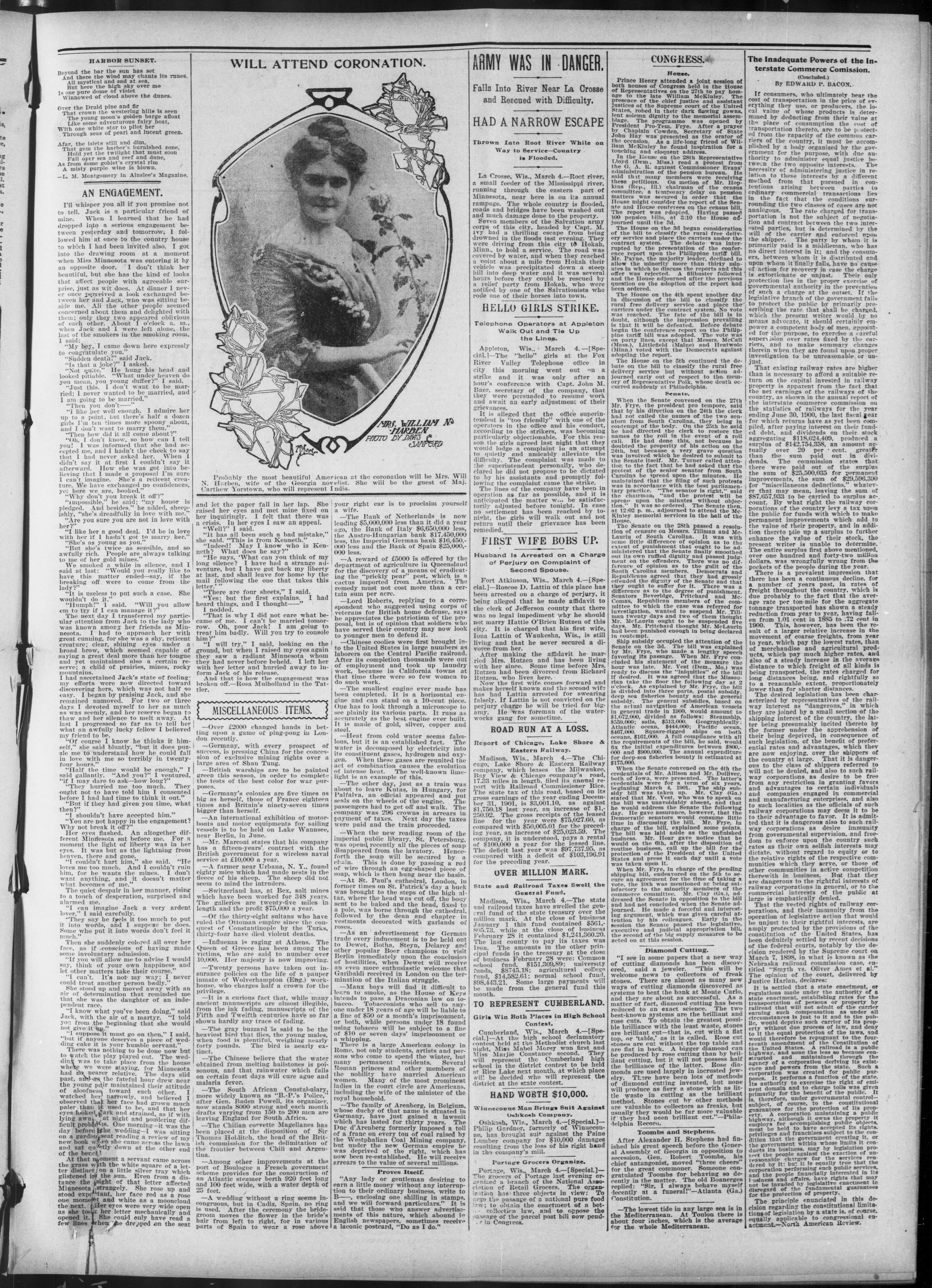
WILL ATTEND CORONATION.
MRS. WILLIAM N.
HARBEN
PHOTO BY DAWS
SANFORD
and let the paper fall in her lap. She raised her eyes and met mine fixed on her inquiringly. I felt that there was a crisis. In her eyes I saw an appeal.
"Well?" I said.
"It has all been such a bad mistake," she said. "This is from Kenneth."
"Indeed! May I know who is Kenneth? What does he say?"
"He says, 'What can you think of my long silence? I have had a strange adventure, but I have got back my liberty at last, and shall leave for home by the mail following the one that takes this letter.'"
"There are four sheets," I said.
your right ear is to proclaim yourself a wife.
—The Bank of Netherlands is now lending $5,000,000 less than it did a year ago, the Bank of Italy $6,650,000 less, the Austro-Hungarian bank $17,450,000 less, the Imperial German bank $16,450,000 less and the Bank of Spain $25,000,000 less.
—A reward of £5000 is offered by the department of agriculture in Queensland for the discovery of a means of eradicating the "prickly pear" pest, which is a cactus imported from America. The remedy must not cost more than a certain sum per acre.
"Yes: but the first explains. I had heard things, and I thought—"
I nodded.
"That is why I did not care what became of me. I can't be married tomorrow. Oh, poor Jack! I am going to treat him badly. Will you try to console him?"
"I will try," I said, looking on the ground, but when I raised my eyes again they saw a radiant Minnesota whom they had never before beheld. I left her with her letter and hurried away to inform Jack of his release.
And that is how the engagement was broken off.—Rosa Mulholland in the Tattler.
MISCELLANEOUS ITEMS.
Over £2000 changed hands in betting upon a game of ping-pong in London recently.
Germany, with every prospect of success, is pressing China for the concession of exclusive mining rights over a large area of Shan Tung.
British warships are to be painted green this season, in order to complete the tests of the best color for war purposes.
Germany's colonies are five times as big as herself, those of France eighteen times and Britain's ninety-seven times bigger than herself.
An international exhibition of motorboats and motor equipments for sailing vessels is to be held on Lake Wannsee, near Berlin, in June.
Mr. Marconi states that his company has a fifteen-years' contract with the British government for a wireless naval service at £10,000 a year.
A farmer near Urbana, N. Y., found eighty mice which had made nests in the fleece of his sheep. The sheep did not seem to mind the intruders.
Switzerland has, at Bex, salt mines which have been worked for 348 years. The galleries are twenty-five miles in length and the profit $75,000 a year.
Of the thirty-eight sultans who have ruled the Ottoman empire since the conquest of Constantinople by the Turks, thirty-four have died violent deaths.
Influenza is raging at Athens. The Queen of Greece has been among the victims, who are said to number over 10,000. Her majesty is now improving.
Twenty persons have taken out insurance policies on the life of a pauper inmate of Wolverhampton (Eng.) workhouse, who charges half a crown for the privilege.
It is a curious fact that, while many ancient manuscripts are almost illegible, from the ink fading, manuscripts of the Fifth and Twelfth centuries have so far shown hardly any trace of fading.
The gray buzzard is said to be the heaviest bird that flies, the young males, when food is plentiful, weighing nearly forty pounds. The bird is nearly extinct.
The Chinese believe that the water obtained from melting hailstones is poisonous, and that rainwater which falls on certain feast days will cure ague and malaria fever.
The South African Constabulary, more widely known as "B.-P.'s Police, after Gen. Baden Powell, its organizer, now stands 8000 strong and each month drafts varying from 150 to 200 men are leaving England for South Africa.
The Chilian corvette Magellanes has been placed at the disposition of Sir Thomas Holditch, the head of the British commission for the delimitation of the frontier between Chili and Argentina.
Among other improvements at the port of Boulogne a French government scheme provides for the construction of an Atlantic steamer berth 920 feet long and 100 feet wide, with a water depth of 25 feet.
—A wedding without a ring seems incongruous, but in Cadiz, Spain, no ring is used. After the ceremony the bridegroom moves the flower in the bride's hair from left to right, for in various parts of Spain to wear a rose above
your right ear is to proclaim yourself a wife.
—The Bank of Netherlands is now lending $5,000,000 less than it did a year ago, the Bank of Italy $6,650,000 less, the Austro-Hungarian bank $17,450,000 less, the Imperial German bank $16,450,-000 less and the Bank of Spain $25,000,-000 less.
—A reward of £5000 is offered by the department of agriculture in Queensland for the discovery of a means of eradicating the "prickly pear" pest, which is a cactus imported from America. The remedy must not cost more than a certain sum per acre.
—Lord Roberts, replying to a correspondent who suggested using corps of veterans for British home defense, says he appreciates the patriotism of the proposal, but is of opinion that soldiers who have served their country may now look to younger men to defend it.
—Chinese coolies were first brought into the United States in large numbers as laborers on the Central Pacific railroad. After its completion thousands were out of employment and took up laundry work, because in California towns at that time there were so few women to do such work.
The smallest engine ever made has been completed. It is a horizontal engine and can stand on a 10-cent piece. One has to look through a microscope to see plainly its various parts. It runs as accurately as the best engine ever built. It is made of gold, silver, copper and steel.
Heat from cold water seems fabulous, but it is an established fact. The water is decomposed by electricity into its constituent gases, hydrogen and oxygen. When these gases are reunited the act of combination causes the evolution of intense heat. The well-known lime-light is an example of this.
The other day, just as a train was about to leave Kutas, in Hungary, for Palfalva, an official appeared and put seals on the wheels of the engine. The passengers had to get off and walk. The company was 296 crowns in arrears in payment of taxes. Next day the taxes were paid and the train proceeded.
When the new reading room of the imperial public library, St. Petersburg, was open recently all the pieces of soap disappeared from the lavatory. Henceforth the soap will be secured by a chain. This is done by passing a rod of wire through an egg-shaped piece of soap, which is then hung near the basin.
At St. Paul's cathedral, London, in former times on St. Patrick's day a buck was brought to the steps of the high altar, where the head was cut off, the body sent to be baked and the head, fixed to a pole, was borne through the cathedral, followed by the dean and chapter in vestments decorated with garlands of roses.
As an advertisement for German trade every inducement is to be held out to Dewet, Botha, Steyn, Delarey and other popular Boer champions to visit Berlin immediately upon the conclusion of hostilities, when Dewet will receive an even more enthusiastic welcome that Garibaldi received in London on the termination of the Italian struggle.
Manx boys will find it difficult to learn to smoke, as the House of Keys intends to pass a Draconian law on tobacco. Tobacconists who sell to anyone under 18 years of age will be liable to a fine of $50 or a month's imprisonment, or both, while persons under 18 found using tobacco will be subject to a fine of $10 or seven days' imprisonment or a whipping.
There is a large American colony in Rome, not only students, artists and persons who come to spend the winter, but many permanent residents. Several Roman princes and other members of the nobility have married American women. Many of the most prominent ladies in the court circle are Americans, including the wife of the minister of the royal household.
The family of Arenberg, in Belgium, whose duchy of that name is situated in Germany, have just gained a lawsuit which has lasted for thirty years. The Duc d'Arenberg formerly imposed a toll of a franc on every ton of coal raised by the Westphalian Coal Mining company, but under the new German empire he was deprived of the right, which has now been re-established. He will receive arrears to the value of several millions.
Proves Itself.
"Any lady or gentleman desiring to earn a little money without any interruption to their ordinary business, write to B—, enclosing one shilling in stamps, and we will forward particulars." It is said that those who answer advertisements of this nature, which abound in English newspapers, sometimes receive a laconic postcard. "Do as I do."
ARMY WAS IN DANGER.
Falls Into River Near La Crosse and Rescued with Difficulty.
HAD A NARROW ESCAPE
La Crosse, Wis., March 4.—Roct river, a small feeder of the Mississippi river, running through the eastern part of Minnesota, near here is on its annual rampage. The whole country is flooded, roads and bridges have been washed out and much damage done to the property. Seven members of the Salvation army corps of this city, headed by Capt. M. Ivy had a thrilling escape from being drowned in the floods last evening. They were driving from this city to Hokah, Minn., to hold a service. The road was covered by water, and when they reached a point about a mile from Hokah their vehicle was precipitated down a steep hill into deep water and it was several hours before they could be rescued by a relief party from Hokah, who were notified by one of the Salvationists who rode one of their horses into town.
HELLO GIRLS STRIKE.
Telephone Operators at Appleton Walk Out and Tie Up the Lines.
Appleton, Wis.. March 4.—[Special.]—The "hello" girls at the Fox River Valley Telephone office in city this morning went out on a strike and it was only after an hour's conference with Capt. John M. Baer, secretary of the company, that they were persuaded to resume work and await an early adjustment of their grievances.
It is alleged that the office superintendent is "too friendly" with one of the operators in the office and his conduct, according to the strikers, was becoming particularly objectionable. For this reason the girls agreed last night that they would lodge a complaint in an attempt to quietly and amicably alleviate the difficulty. The complaint was made to the superintendent personally, who declared he did not propose to be dictated to by his assistants and promptly following the complaint came the strike.
The lines of the company have been in operation as far as possible, and it is anticipated the matter will be satisfactorily adjusted before tonight. In case no settlement has been reached by tonight, the girls will walk out and not return until their grievance has been remedied.
FIRST WIFE BOBS UP.
Husband Is Arrested on a Charge of Perjury on Complaint of Second Spouse.
Fort Atkinson, Wis., March 4.—[Special.]—Roscoe D. Latin of this place has been arrested on a charge of perjury, it being alleged that he made affidavit to the clerk of Jefferson county that there was no legal impediment why he should not marry Hattie O'Brien Rutzen of this city. It is charged that his first wife, Iona Lattin of Waukesha, Wis., is still living and that he never secured a divorce from her. After making the affidavit he married Mrs. Rutzen and has been living with her since. Some time before Mrs. Rutzen had been divorced from Richard Rutzen who lives here.
Now the first wife comes forward and makes herself known and the second wife has had Lattin arrested for swearing falsely. If Lattin is not convicted on the perjury charge he will be tried for bigamy. He was foreman of the waterworks gang for sometime.
ROAD RUN AT A LOSS.
Report of Chicago, Lake Shore & Eastern Railway.
Madison, Wis., March 4.—The Chicago, Lake Shore & Eastern Railway company, which leases the Milwaukee, Bay View & Chicago company's road, 17.33 miles in length, filed its annual report with Railroad Commissioner Rice. The state tax of this road, based on its gross earnings of the year ending December 31, 1901, is $3,001.10, as against $1,750.18 last year, an increase of $1,250.92. The gross receipts of the leased line for the year were $75,027.60, as compared with $50,005.01 for the preceding year, an increase of $25,023.59. The company, it is understood, pays a rental of $100,000 a year for the leased line. The deficit last year was $97,737.95, as compared with a deficit of $103,196.91 for the preceding year.
OVER MILLION MARK.
State and Railroad Taxes Swell the General Fund.
Madison, Wis., March 4.—The state and railroad taxes have swelled the general fund of the state treasury over the million mark. At the close of business January 1 this fund contained $561, 805.73, while at the close of business February 28 it contained $1,241,360.20. The last county to pay its taxes was Iron. The amounts in the other principal funds in the treasury at the close of business February 28 were: Common school fund. $151,309.89; university funds. $8745.18; agricultural college fund. $14,582.61; normal school fund. $98,443.21. Some large payments will be made from the general fund this month.
TO REPRESENT CUMBERLAND.
Girls Win Both Places in High School Contest.
Cumberland, Wis., March 4.—[Special.]—At the high school declamatory contest held at the Methodist church last night, Miss Mabel Morey won first and Miss Marjie Constance second. They will represent the Cumberland high school in the district contest to be held at Rice Lake next month, at which place will be decided who will represent the district at the state contest.
HAND WORTH $10,000.
Winneconne Man Brings Suit Against Oshkosh Company.
Osikhosh, Wis., March 4.—[Special.]—Philip Gardner, formerly of Winneconne, has brought suit against the Paine Lumber company for $10,000 damages resulting from the loss of his right hand in the company's mill.
Portage Grocers Organize.
Portage, Wis., March 4.—[Special.]— The grocers of Portage last evening organized a branch of the National Association of Retail Grocers. The organization has three objects in view: To urge the passage of a national pure food law; to obtain the enactment of a bet-collection law, and to oppose the passage of the parcel post bill now pend- in Congress.
CONGRESS.
Prince Henry attended a joint session of both houses of Congress held in the House of Representatives on the 27th to pay homage to the late William McKinley. The presence of the chief justice and assistant justices of the Supreme court of the United States, robed in their dark flowing gowns, lent solemn dignity to the memorial assemblage. The programme was opened by President Pro-Tem. Frye. After a prayer by Chaplain Cowden, Secretary of State John Hay was presented as the orator of the occasion. As a life-long friend of William McKinley he found inspiration for a touching and eloquent address.
In the House on the 28th Representative Lloyd (Dem., Miss.) read a protest from the G. A. R. against Commissioner Evans' administration of the pension bureau. He said that many members were receiving these petitions. On motion of Mr. Hopkins (Rep., Ill.) chairman of the census committee, a temporary delay on pension matters was secured in order that the House might consider the report of the Senate and House conferees on the census bill. The report was adopted. Having passed 100 pension bills, at 3:10 the House adjourned until the 3d.
The House on the 3d began consideration of the bill to classify the rural free delivery service and place the carriers under the contract system. The debate was interrupted by the presentation of the conference report upon the Philippine tariff bill. Mr. Payne, the majority leader, declined to allow the minority more than thirty minutes in which to discuss the reports and this offer was rejected. A filibuster followed and the House adjourned after the previous question on the adoption of the report had been ordered.
The House on the 4th spent another day in discussion of the bill to classify the rural free delivery service and place the carriers under the contract system. No vote was reached. The fate of the bill is in doubt, although the impression prevailing is that it will be defeated. Before debate began the conference report on the Philippine tariff bill was adopted. The vote was on party lines, except that Messrs. McCall (Mass.), Littlefield (Maine) and Heatwole (Minn.) voted with the Democrats against adopting the report.
The House on the 5th continued the debate on the bill to classify the rural free delivery service but without action adjourned early out of respect to the memory of Representative Polk, whose death occurred suddenly at Philadelphia.
Senate.
When the Senate convened on the 27th Mr. Frye, the president pro tempore, said that by his direction on the 24th the clerk had not called the names of the two senators from South Carolina, they being in contempt of the body. On the 25th he said he had directed the clerk to restore the names to the roll in the event of a roll call. He had done this, not because he doubted the property of his action on the 24th, but because a very grave question was involved which he desired to submit to the Senate itself. Mr. Turner called attention to the fact that he had asked that the protest of the senior senator from South Carolina be spread upon the minutes. He maintained that the filing of such protests was in accordance with the best parliamentary practice. "The senator is right," said the chairman, "and the protest will be spread upon the minutes without objection." It was so ordered. The Senate then, at 12:02 p. m., adjourned to attend the McKinley memorial services in the hall of the House.
The Senate on the 28th passed a resolution of censure on Messrs. Tillman and McLaurin of South Carolina. It was with some little difference of opinion as to the extent of punishment that ought to be administered that the Senate finally smoothed out its own ruffled dignity and passed judgment on the offenders. There was no difference of opinion as to the gulft of the South Carolina members. Democrats and Republicans agreed that they had grossly offended the dignity of the Senate and that they ought to suffer for it. There was a difference as to the degree of punishment. Senators Beveridge, Pritchard and McComas, Republican members of the committee to which the case was referred for investigation, wanted to suspend Mr. Tillman twenty days and two of them thought Mr. McLaurin ought to be suspended five days. Mr. Pritchard thought Mr. McLaurin had been punished enough in being declared in contempt.
Ship subsidy occupied the attention of the Senate on the 3d. The bill was explained by Mr. Frye, who made a lengthy speech favoring its passage. When Mr. Frye concluded his statement of the measure the hour was late. Mr. Vest (Dem., Mo.) was ready to discuss the "inquiries" of the bill if desired. It was agreed that the Missouriian take the floor the following day at 2 o'clock. As explained by Mr. Frye, the bill is divided into three parts, postal subsidy, deep sea fisheries bounty and the general subsidy. The general subsidies, based on the actual navigation of American vessels in general trade in 1900, would amount to $1,672,000, divided as follows: Steamship, $559,000; sails, $513,000. Geographically: Atlantic ocean, $444,000; Pacific ocean, $467,000. Square-rigged ships on both oceans, $161,000. A full compliance with all the requirements of the bill, he said, would fix the initial expenditures between $800,-000 and $900,000. The annual expenditure for deep-sea fisheries bounty is estimated at $175,000.
When the Senate convened on the 4th the credentials of Mr. Allison and Mr. Dolliver, both of Iowa, were presented. The latter's credentials were for a term of six years, beginning March 4, 1901. The ship subsidy bill was taken up. Mr. Clay (Ga.) stated that Mr. Vest, who was to speak on the bill was unavoidably absent, and that he would address the Senate the following day. He gave assurance, however, that the Democratic senators would consume little time in discussing the bill. Mr. Frye, in charge of the bill, explained some points. The bill was laid aside as the unfinished business. Mr. Hoar gave notice that he would on the 6th, after the disposition of routine business, call up the bill for the protection of the President of the United States and press it each day until a vote was taken upon it.
When Mr. Frye, in charge of the pending shipping bill, endeavored on the 5th to secure an agreement for the time of taking a vote, the 10th was mentioned as being satisfactory to the minority members of the commerce committee. Mr. Clay (Ga.), addressed the Senate in opposition to the bill and had not concluded when the Senate adjourned. He made a forceful and interesting argument, which was given careful attention by his colleagues. Early in the session the Senate passed the legislative, executive and judicial appropriation bill, the second of the big supply measures to be acted on at this session.
Diamond Cutting.
"I see in some papers that a new way of cutting diamonds has been discovered, said a jeweler. "This will be welcome news to collectors of freak stones. There are almost as many new ways of cutting diamonds discovered as systems to beat the bank at Monte Carlo, and they are about as successful. As a matter of fact, diamond cutting has been reduced to an exact science. The two best-known systems are the brilliant and rose cuts. To obtain the greatest possible brilliance with the least waste, stones are brilliant cut—that is, cut with a flat top, or 'table,' as it is called. Rose cut stones are cut without the top table and are flat in back. A bigger diamond can be produced by rose cutting than by brilliant cutting, but it will not possess half the brilliance of the latter. Rose diamonds are used largely in incrusted jewelry. There have been lots of methods of diamond cutting invented, but none will produce as fiery a stone with as little waste in cutting as the brilliant method. Stones cut by other methods are valuable to collectors as freaks, but usually they would be far more valuable if they had been brilliant cut."—Philadelphia Recor
Toombs and Stephens.
After Alexander H. Stephens had finished his great speech before the General Assembly of Georgia in opposition to secession, Gen. Robert Toombs, his chief antagonist, moved "three cheers" for the great commoner. Someone congratulated Toombs for behaving so decently in the matter. The old Boanerges replied: "Sir, I always behave myself decently at a funeral!"—Atlanta (Ga.) Constitution.
—The lowest tide in any large sea is in the Mediterranean. At Toulon there is about four inches, which is the average for the whole Mediterranean.
The Inadequate Powers of the Interstate Commerce Comission. (Concluded.) By EDWARD P. BACON.
If consumers, who ultimately bear the cost of transportation in the price of everything they use, or producers, the local value of whose products is determined by deducting from their value at the place of consumption the cost of transportation thereto, are to be protected from the rapacity of the common carriers of the country, it must be accomplished by a body organized by the government for the purpose, with due authority to administer equal justice between the two opposite interests. The necessity of administering justice in relation to these interests by a different method from that pursued in contentions arising between parties to ordinary commercial transactions lies in the fact that the conditions surrounding the two classes of cases are not analogous. The rate charged for transportation is not the subject of negotiation and contract between the two interested parties, but is determined by the will of the carrier and enforced upon the shipper. The party by whom it is primarily paid is a middleman, who has no direct interest in it; and the consumers, between whom it is distributed and upon whom it finally falls, have no cause of action for recovery in case the charge is extortionate or unjust. Their only protection lies in the proper exercise of governmental authority in the prevention of such a charge at the outset. If the legislative branch of the government fails to protect the public by primarily prescribing the rate that shall be charged, which the present writer would by no means advocate, it should certainly empower a competent body of men, appointed for the purpose, to exercise a careful supervision over rates fixed by the carriers, and to make summary changes therein when they are found upon proper investigation to be unreasonable or unjust.
That existing railway rates are higher than is necessary to afford a suitable return on the capital invested in railway property is apparent from the fact that the net earnings of the railways of the country, as shown in the annual report of the interstate commerce commission on the statistics of railways for the year ending June 30, 1900, the last fiscal year for which returns have as yet been compiled, after paying interest on their funded debt, and dividends on their stock aggregating $118,624,409, produced a surplus of $142,754,358, an amount actually over 20 per cent. greater than the sum paid out in dividends. The commission states that there were paid out of the surplus the sum of $25,500,035 for permanent improvements, the sum of $29,596,390 for "miscellaneous deductions," whatever that may mean, leaving the sum of $87,657,933 to be carried to surplus account. By what right the railway corporations of the country levy a tax upon the public for funds with which to make permanent improvements which add to the value of their property, and in addition thereto pile up a surplus to further enhance the value of their stock, the present writer is unable to determine. The entire surplus first above mentioned, over one hundred and forty-two million dollars, was wrongfully wrung from the pockets of the people during the year.
There is a prevalent impression that there has been a continuous decline, for a number of years past, in rates of freight throughout the country, which is due probably to the fact that the average rate per ton-mile for the aggregate tonnage transported has shown a steady reduction from year to year, having fallen from 1.01 cent in 1885 to 72 cent in 1900. This, however, has been the result of a larger relative increase in the movement of coarse freights, from year to year, which pay the lowest rates, than of merchandise and agricultural products, which pay much higher rates, and also of a steady increase in the average distance to which freight of all kinds is being transported, the rates charged for long distances being, and rightfully so to a reasonable extent, proportionately lower than for shorter distances.
The desired legislation has been characterized by representatives of the railway interest as "dangerous," in which they are joined by a small section of the shipping interest of the country, the latter being presumably incited thereto by the former under the apprehension of their being deprived, in consequence of such legislation, of the benefit of preferential rates and advantages, which they are now enjoying, over the shippers of the country at large. That it is dangerous to the class of shippers referred to will not be denied, and also to such railway corporations as desire to be free from any restriction in granting favors and advantages to certain individuals and companies engaged in commercial and manufacturing enterprises, and also to such localities as the officials of such railway corporations may deem it to be to their advantage to favor. It is admitted that it is dangerous also to such railway corporations as desire immunity from governmental supervision, and freedom to enforce upon the country such rates as their own selfish interests may dictate, without regard to equity or to the relative rights of the respective communities which they serve, or those of other communities in active competition therewith in business. But that they are dangerous to the rightful interests of railway corporations in general, or to the commercial interests of the public at large is emphatically denied.
That the vested rights of railway corporations, and their immunity from the operation of legislative action that would be unjust to their rightful interests, are amply protected by the provisions of the constitution of the United States, has been definitely settled by recent decisions of the federal courts, notably by the decision rendered by the Supreme court on March 7, 1898, in what is known as the Nebraska railroad commission case, entitled "Smyth vs. Oliver Ames et al." The opinion of the court, delivered by Justice Harlan, declares:
It is settled that a state enactment, or regulations made under the authority of a state enactment, establishing rates for the transportation of persons or property by railroad that will not admit of the carrier earning such compensation as under all circumstances is just to it and to the public, would deprive such carrier of its property without due process of law, and deny it the equal protection of the laws, and would therefore be repugnant to the fourteenth amendment of the Constitution of the United States. A railroad is a public highway, and none the less so because constructed and maintained through the agency of a corporation deriving its existence and powers from the state. Such corporation was created for public purposes. It performs a function of the state. Its authority to exercise the right of eminent domain and to charge tolls was given primarily for the benefit of the public. It is, therefore, under governmental control—subject, of course, to the constitutional guarantees for the protection of its property. A corporation maintaining a public highway, although it owns the property it employs for accomplishing public objects, must be held to have accepted its rights, privileges and franchises subject to the condition that the government creating it, or the government within whose limits it conducts its business, may by legislation protect the people against the exaction of unreasonable charges for the services rendered by it: but it is equally true that the corporation performing such public services, and the people financially interested in its business and affairs, have rights that may not be invaded by legislative enactment in disregard of the fundamental guarantees for the protection of property.
The principle enunciated in this decision regarding the constitutional limitations of legislation by a state is, of course, equally applicable to congressional enactment-North American Review.
GEORGE HAYS Turning Mill and Box Factory
Rockers and all kinds of Restaurant Blocks, Extension Ladders, Tea Caddies, Boxes, Turning, Sawing, Mitchell Improved Washers, Trestels, Swinging Scaffolds. Repair Work PromptlyAttended to TELEPHONE MAIN 252. 228-230 Fifth St., Milwaukee, Wis.
Before Starting on Your Travels CALL ON Geo. Burroughs & Sons MANUFACTURERS OF PREMIUM TRUNKS
424 & 426 East Water St., Milwaukee.
WHEN IN KENOSHA
CALL ON
MATT GREENWALD
Who is Up-to-Date in His Business.
AGENT FOR
E. KLINKERT'S RACINE KEG and
BOTTLED BEER.
Depot: No. 15 North Main Street.
Telephone 163.
KENOSHA - WISCONSIN
S. F. PEACOCK & SON
Funeral Directors
AND
EMBALMERS
431 Broadway. MILW4UKFE. WIS
NORTH OR SOUTH
Always ask for tickets via the Monon Route THE SHORT LINE BETWEEN
Indianapolis, Cincinnati,
Six trains daily between Chicago and the Ohio river.
For folders, rates, etc., call at any Monon ticket office or address
FRANK J. REED,
Gen'l Pass. Agent, Chicago.
S. B. JONES,
C. P. Agent, 232 Clark St., Chicago.
Don't Let Your Hair Fall Out
FREE
Sample of
LUSTORONE
to every one
When you can save it by the timely use of our great hair tonic, "LUSTORONE." If your hair has been scalded, burnt and split out by the roots by harmful applications of injurious no-called hair tonics, or by sickness, fevers and disease, our celebrated "LUSTORONE" will prove to you. A Godsend to suffering humanity because it produces an abundant and beautiful growth of soft, fine hair. As the hair grows it softens and becomes straight. "LUSTORONE" cures all scalp diseases. Removes scurf and dandruff. Causes the hair to grow out again on bald spots and bare places. It is the greatest hair tonic on earth. To prove the merits of this great remedy, we will send to any one who will send us their name and address together with roc. to pay for mailing case and postage. A sample that will prove its own worth. Write to
DOMINION
M'E'G CO.
2220 East
Marshall St.
Richmond, Va.
---
Printed in the Interests of the Negro Race,
MILWAUKEE, WIS.
Telephone Black No. 244.
SUBSCRIPTION RATES.
Any part of the United States and Canada,
postage paid.
postage paid.
One Year ..... $2.00
Six Months ..... 1.25
Three Months ..... 7.5
Send money by Express Money Order, P. O.
Money Order or Registered Letter to the
Wisconsin Weekly Advocate.
ADVERTISING RATES.
One inch, single insertion ..... 25c
One inch, per year ..... $9.00
Business locals 5c per line each insertion.
Apply for rates to the Advocate.
TO CONTRIBUTORS:
All communications must be sent with the
name and address of the sender as an evidence
of good faith, but not necessarily for
publication. No manuscript returned if not
accepted, unless accompanied by stamps.
The Wisconsin Weekly Advocate company wishes to notify the public that all contracts and business transactions with this company must have the company stamp, otherwise they will be void. Neither will this company be responsible for paid subscriptions unless given to duly-accredited agents, who, on request, will give the company's receipt for same. Subscribers failing to receive their papers regularly will kindly notify the general office. Address all business communications to the general manager, 729 St. Paul avenue.
Entered in the Postoffice at Milwaukee as Second-class matter.
Marconi, for the present, has the first and last words with Atlantic travelers.
The contention seems to be that Fitzsimmons is a better fighter than referee.
If the price of beer goes up the retailers will simply give more foam for a nickel.
Nobody seems to have objected to the dashing of wine on the prow of the Emperor's new yacht.
Jeffries and Fitzsimmons were a great deal longer over their preliminaries than were Tillman and McLaurin.
Prince Henry is receiving plenty of evidence that our princes of commerce are in the habit of doing things in royal style.
Now that Miss Stone has been released, dealings other than financial ought to be conducted vigorously with the Macedonian brigands.
The Quaker evangelist who is drawing showers of eggs in Iowa would certainly send the price of "hen fruit" kiting if he were to continue to face demonstrative Hawkeye audiences.
Prince Henry is now every American's guest, and it is to be hoped that he will step aboard the steamer for his return voyage in as good health and spirits as he is at the beginning of his tour.
Even the most democratic of the sniffers at kings is probably aglow with enthusiasm over the prospect that Phil King will return to coach the Wisconsin University football team next fall.
When the brigands swore Miss Stone to secrecy as to their identity they revealed a knowledge concerning a certain tradition that implies talkativeness on the part of the Macedonian fair sex also.
The lower house of the New Jersey Legislature has voted the sum of $10,000 to begin a war of extermination against the mosquito that has made the state famous. This may be called sanitary ingratitude.
As evidence of Prince Henry's genial character it is cited that when he was taking a romp with his children just before his departure, he slid down hill "on his stomach," on one of their sleds. The Prince was probably giving his stomach a farewell also, as he will be lucky if he has a stomach for anything when he gets back.
When Prince Henry crosses into Canada,—if his programme is changed so as to make it provide for a run through the Dominion,—he will find that although the entire continent is enveloped by one atmosphere, there is a decided change at the boundary line which cannot but suggest the lack of something fundamental, on the other side.
When professionalism was established in base ball by the payment of salaries, with its consequent bidding and trading for men, a great many lovers of the game lost their interest in it; and now that professionalism has involved the management and injected financial scheming into the business, the "fans" are likely to feel that they are being "worked" by speculators. There is a vast amount of room for reform in base ball circles.
How Big the Biggest Black Bass Was
A well-known correspondent on piscatorial lore writes to the Commercial-Tribune that the twelve-pound big-mouth black bass which was sent to J. S. Peebles from Florida, is not the largest ever exhibited, as published, as it is minus one and one-half pound of equaling the one at the Cuvier club museum. The twelve-pounder is far from being the peer of the heavier fish. That has a statuesque pose, a graceful symmetry, an expression of fierce defiance, and a look of animation as if in life, and, withal, a thing of bold beauty. In connection with this he states that, according to figures vouchered for at the Smithsonian institution, the big-mouth black bass has been taken as high as twenty-five pounds, and the small-mouth as high as ten pounds. The figures for the latter fish, to all devotees of the reel and rod, seem amazingly large, but, then, one hesitates to doubt his federal uncle.—Cincinnati Commercial Tribune.
Threw Away Platinum.
In all the placer-mining districts of British Columbia and the Yukon territory large amounts of platinum and kindred metals have been thrown away by miners who did not know the value of the product. With the present price of platinum it would pay prospectors to be on the lookout for it. Platinum is not found in ledges, so far as is known, excepting one place in the world, but in black sand containing a large percentage of magnetic-iron ore and a varying quantity of gold.
The round the world cruise of the Duke and Duchess of York cost the British government $540,000.
HOUSEHOLD DEPARTMENT
A woman hates worse than anything else the cleansing of the bread pan or bowl after having made up a "batch" of bread. Unless absolutely necessary to put the bowl away at once, fill it with cold water and let it stand for an hour. By that time all the hard particles will have become softened and fallen to the bottom of the bowl. The practice of putting the bowl and molding board away unwashed, in the flour bin, as so many do, is most reprehensible. The tiny particles wil work off into the next lot of dough and ferment in the raising, and often spoil a whole baking of bread, while the baker is wondering what possesses the stuff. Absolute cleanliness should always be observed, in attending to bread, cake or pastry cooking, to obtain the best results.
Butter Pats.
One of the daintiest ways of making up the little individual butter pats for the table is in corrugated rolls. The butter paddles are kept in ice water until thoroughly chilled. Then a piece of butter about the size of a hickory nut is taken up on one, is patted down with the other until about an eighth of an inch thick, then dexterously lifted at one end and rolled over, forming the dainty, crumpled roll. These are tossed in a jar of ice water as fast as made, emerging therefrom crisp and fresh. If the family is large, and it is desirable to keep a supply of the butter balls ahead, they may be kept for two or three days at a time by changing the water daily and taking care that the supply of ice is not exhausted.
Ice-Cream Candy.
Ingredients: Two medium-sized cups of granulated sugar, half a cupful of hot water, one teaspoonful of vanilla extract and half a cupful of chopped figs. Stir the sugar into the hot water, put it on the stove and watch until the mixture boils, then let it boil rapidly for three minutes. Remove from the fire, add the vanilla, and beat for several minutes, or until it is creamy. Rub the pieces of fig in powdered sugar, shaking off the surplus, and whip these into the cream. Form into balls and put on waxed or greased paper to cool. These will be less sticky to handle if rolled in powdered sugar before they have thoroughly hardened.
Graham Pudding.
Two cups of graham flour, one cup of milk, one cup of Porto Rico molasses, one cup of raisins stoned and slightly chopped, one egg, one even teaspoonful of soda, one teaspoonful of ground cinnamon, one-half teaspoonful of cloves, a little nutmeg, if liked, and a small pinch of salt. Flour the raisins with a little white flour, mix all the ingredients thoroughly together, butter a mold and steam three hours. Serve with a sauce. If there should be any of the pudding left over, it can be used by cutting in slices half an inch thick, each piece dipped in milk, in which an egg has been stirred, fried brown in a little butter, and served hot with a sauce.
Orange Pudding.
Take the yolks of three eggs, one tablespoonful of cornflour, one breakfast-cupful of powdered white sugar, one pint of milk; make into a custard by allowing it to come to the boil to thicken. Peel and slice the oranges and put the slices into a pudding dish, with sugar sprinkled over each layer. While the custard is quite hot, pour it over the oranges; make a whip of the whites of three eggs and two tablespoonfuls of sugar, place on the top, and brown very delicately in the oven.
Currie Rice Croquettes.
Put three-quarters of a cup of milk in a saucepan with butter the size of an egg, let it come to a boil, and stir into it one large cup and a half of rice that has been boiled in salted water twenty minutes. Add a slightly heaping teaspoonful of curry powder, a few drops of onion juice and salt to taste. When it comes to a boil add a beaten egg to it, stir a minute and remove from the fire. Turn it out, let it cool, and then form into cylinders and fry as usual.
Candied Almonds and English Walnuts Boil one cup of granulated sugar, one-eighth a teaspoonful of cream of tartar, and three-fourths a cup of water over a very fire fire. Do not stir after boiling has begun. Remove from the fire as soon as there is a suspicion of a faint yellow tinge to the syrup. Take the shelled nuts (the almonds should have been previously blanched) on the point of a large needle or fine skewer and dip them in the syrup, then drop on to oiled paper.
Creamed Oysters.
One pint of milk; when boiling add two tablespoonfuls of cornstarch, salt and pepper, and one tablespoonful of butter. Take fine powdered crumbs and scatter over the bottom of a well-buttered dish. Put a layer of oysters, then of cream, next crumbs, the oysters, cream, and so on, having crumbs on top. Brown, or rather cook, as for escalloped oysters. It is a change from the latter dish.
Celery Creamed.
Cut the tender white parts of a stalk of celery into inch lengths and stew until tender in salted water. Drain off at least half the water, and add one on one and a half cups of rich milk and a lump of butter. Thicken slightly with cornstarch dissolved in cold milk Serve on tiny slices of toast.
WILL NOT WEAR BUTTON.
Peculiar Customs of Members of the Amish Church.
A peculiar set of people whose customs resemble the German Mennonites and the Dunkards, are scattered all over central and northern Iowa, and are known as the "hook and eye" Dutch, on account of the aversion they have to wearing any kind of buttons on their clothing. Their church is called the Amish and they consider it unholy and worldly to wear any kind of buttons on their clothing. Coat, vest and trousers are kept in place by the ordinary hook and eye. The children grow up and are taught to do as do their eiders, and for generations this peculiar custom has been kept by them.
The government of the elders is unquestioned, and as implicitly obeyed as would be the commands of an army officer. Their marriages are arranged to "even up" financial matters to some extent. Too much land or too much money is not allowed to marry into one family, and thus give one family the ascendency over another in the colony.
Among the most peculiar rites of these people is the ceremony of "foot washing," which takes place as it did in the olden time. This ceremony usually takes place at the annual love feast, which is generally held in one of the big red farm barns. At these gatherings each member greets the other with a kiss, each sex confining its osculations to itself. The foot washing is also confined to the sexes, one of a group of men or women washing and drying the feet of his or her neighbor in turn. When the rite is over all rise and again kiss. Then follow communion and preaching. These sermons are delivered by plowmen selected for this task by the year, and they are obliged to give much attention and study to the task.
Coat Tails and Box-Pleats Herald Spring Fashion.
The box-plaat is going to have it all its own way this spring. It is to appear on everything but hats—even on parasols. The spring jacket is to have tiny box-plaats set close together all around, back and front. The spring walking skirt is to have box-plaats at the foot of the skirt—very narrow box-plaats, almost like flat tucks, but bona fide box-plaats, nevertheless—and the shirtwaist gown or "tub-gown" of the coming spring and summer have a decided note of novelty, the bodices being made with five box-plaats in front and the skirt with three box-plaats in front. The back of bodice and skirt is box-pleaed or gathered.
Box-pleats and coats (with and without basques, but in almost every instance with tails) may be set down as the two salient features of spring frocks and costumes. A dinner gown which shows these two characteristics is exhibited at a smart conturieres. It is of white cloth. The skirt has a wide box-pleat in front and smaller ones at either side of the wide one. The back is set in pleats. These box-pleats are not continued down the length of the skirt, be it understood, but permit the material to flow out until at the foot the skirt is very voluminous. The bodice of this gown is low-necked and short-sleeved, a tiny basque finishes the coat, which is of white cloth, embroidered with white chenille flowers. A waistcoat of pale blue velvet is fastened with paste buttons and the decolletage is finished with a tiny ruche of stiffened cream lace. The elbow sleeves of the chenille-embroidered white cloth have frills of lace, headed by twists of pale blue velvet, held by paste buttons.—New York Commercial Advertiser.
Ping-pong has taken Berlin by storm. One band of players has already opened a luxuriously appointed clubroom fitted with twelve tables, and a Berlin ping-pong championship tournament is being arranged.
Northwestern House
APPLETON, WIS.
JOHN A. BRILL, - Proprietor.
Terms $1.00 Per Day.
NORTHWESTERN
WHEN IN MADISON
Call at the
Avenue
Hotel...
M. J. REGAN, Prop.
$2.00 Rate......
Free 'Bus.
Free 'Bus.
WONDERFUL
DISCOVERY
Curly Hair Made Straight By
TAKEN FROM LIFE:
OZONIZED OX MARROW
(Copyrighted.)
This wonderful hair pomade is the only safe preparation in the world that makes kinky or curly hair straight as shown above. It nourishes the scalp and prevents the falling out or breaking off, over dandruff and makes the hair hairy and silky. Sold over forty years and issued by thousands. Warranted mannequin. Testimonials free on request. It was the first preparation ever sold for straightening kinky hair. Beware of imitations. Get the Original Ozonized Ox Marrow as the genuine never fails to keep the hair straight, soft and beautiful. A toilet necessity for ladies, gentlemen and children. Elegantly perfumed. The great advantage of this wonderful pomade is that by its use you can straighten your own hair and to its superior and lasting qualities it is the best and most economical. It is not possible for a body to produce a preparation equal to it. Full directions with every bottle. Only 50 cents. Sold by druggists and dealers or send us 50 cents for one bottle or $1.40 for three bottles. We pay all express charges. Send postal or express money order. Write your name and address plainly to
OZONIZED OX MARROW CO.,
76 Wabash Avenue, Chicago, Illinois.
And Jobber in Catsups, Mustards, Olives and all kinds of Country Produce.
New York Tailoring 12 WELLS STREET
The New York 322 WELLS
The New York Tailoring Co.
322 WELLS STREET (Bet. 3d and 4th Sts.)
Ladies' and Gents' Suits Made to Order. We also Clean, Press, Repair and Dye All kinds of Ladies' and Gents' Garments. Satisfaction Guaranteed. . . .
HARTONA
POSITIVELY STRAIGHTENS
—ALL—
Kinky, Knotty, Stubborn.
Harsh, Curly Hair.
HA makes the hair grow long, straight, be
Cures Dandruff, Baldness, Itching, Eczema.
Prevents Falling Out of the Hair.
HARTONA POSITIVELY STRAIGHTENS HAIR. Guaranteed harmless. Sent a
price—25c. and 50c. per box.
HA FACE BLEACH will gradually turn a
dark person five or six shades lighter, and
simulatto person almost white. HARTONA
moves Wrinkles, Dark Spots, Pimples, Free
all Blemishes of the Skin. Guaranteed
sent to any address on receipt of price—
Remedies are absolutely guaranteed, and
refunded if you are not perfectly satisfied.
Will send you free a book of testimonials or
people in your own State who have tu
na Remedies.
AL GRAND OFFER. Send us One
mention this
you three large boxes of HARTONA HAIR
RIGHTENER, two large bottles of HART
and one large box of HARTONA NO-SM
is agreeable odors caused by Perspiration.
will be sent securely sealed from observa-
tion and post-office and express office address
be sent in Stamps or by Post-Office Mon-
registered Letter or by Express.
all orders to—
HARTONA REMEDY CO.
HARTONA makes the hair grow and glossy. Cures Dandruff, Bald Scalp Diseases. Prevents Falling ture Baldness. HARTONA POSIT KINKIEST HAIR. Guaranteed receipt of price—25c. and 50c. per b
HARTONA FACE BLEACH will black or dark person five or six sh skin of a mulatto person alme BLEACH removes Wrinkles, Dark heads, and all Blemishes of the harmless. Sent to any address or per bottle.
Hartona Remedies are absolute is positively refunded if you are me us, and we will send you free a book one hundred people in your own using Hartona Remedies.
SPECIAL GRAND OFFICE
we will send you three large boxes AND STRAIGHTENER, two large BLEACH, and one large box of I removes all disagreeable odors cause Arm-Pits, &c.
Goods will be sent securely se your name and post-office and exp Money can be sent in Stamps or enclosed in Registered Letter or by Address all orders to—
HARTONA makes the hair grow long, straight, beautiful, soft, and glossy. Cures Dandruff, Baldness, Itching, Eczema, and all Scalp Diseases. Prevents Falling Out of the Hair and Premature Baldness. HARTONA POSITIVELY STRAIGHTENS THE KINKIEST HAIR. Guaranteed harmless. Sent anywhere on receipt of price—25c. and 50c. per box.
HARTONA FACE BLEACH will gradually turn the skin of a black or dark person five or six shades lighter, and will turn the skin of a mulatto person almost white. HARTONA FACE BLEACH removes Wrinkles, Dark Spots, Pimples, Freckles, Blackheads, and all Blemishes of the Skin. Guaranteed absolutely harmless. Sent to any address on receipt of price—25c. and 50c. per bottle.
Hartona Remedies are absolutely guaranteed, and your money is positively refunded if you are not perfectly satisfied. Write to us, and we will send you free a book of testimonials of more than one hundred people in your own State who have used and are using Hartona Remedies.
SPECIAL GRAND OFFER. Send us One Dollar and mention this paper, and we will send you three large boxes of HARTONA HAIR GROWER AND STRAIGHTENER, two large bottles of HARTONA FACE BLEACH, and one large box of HARTONA NO-SMELL, which removes all disagreeable odors caused by Perspiration of the Feet, Arm-Pits, &c.
Goods will be sent securely sealed from observation. Write your name and post-office and express office address very plainly. Money can be sent in Stamps or by Post-Office Money Order or enclosed in Registered Letter or by Express.
909 E. Main Street, RICHMOND, VIRGINIA.
AGENTS WANTED in Every Town and City. Liberal Salary Paid.
THE MOST PE
Hair Dress
THE LATEST DISCOVERY FOR MAKING HAIR STRAIGHT
NELSONS STRAIGHTINE THE LATEST DISCOVERY FOR MAKING
BEFORE AFTER
Nelson's Straightine Not on ishing out, removes dandruff, cures itching, ir long and beautiful head of hair. It is u people in all sections of this country. W from all injurious chemicals, and cannot i make the hair sticky or gummy, and will sold at all drug stores. Price, 25 cent your druggist does not keep it he will get securely wrapped, on receipt of 30c. in st
NELSON MANUFA
Agents can make big money. W
MILWAUKEE...
GAS STOVE CO.,
MANUFACTURERS OF
Straightline Not only straightens the hair, it ruff, cures itching, irritating scalp disease, and head of hair. It is used and highly endorsed of this country. We guarantee Straight chemicals, and cannot injure the hair. Straighty or gummy, and will not become rancid. Stores. Price, 25 cents a can (one month) is not keep it he will get it for you, or we will on receipt of 30c. in stamps. Address, NELSON MANUFACTURING CO., Bake big money. Write for terms.
Nelson's Straightine Not only straightens the hair, but, by nourishing the roots, prevents it from falling out, removes dandruff, cures itching, irritating scalp diseases, and gives a long and beautiful head of hair. It is used and highly endorsed by the best people in all sections of this country. We guarantee Straightine to be free from all injurious chemicals, and cannot injure the hair. Straightine does not make the hair sticky or gummy, and will not become rancid. Straightine is sold at all drug stores. Price, 25 cents a can (one month's treatment). If your druggist does not keep it he will get it for you, or we will send it by mail, securely wrapped, on receipt of 30c. in stamps. Address,
PERFECTION
PERFECTION GAS RANGES
AND SPECIALTIES
Instantaneous Cleanable Star Burners,
Adjustable Needle Valve.
For Natural, Artificial or Gasoline Gas.
139 Burrell St., Milwaukee, Wis.
In consequence of the severe weather in France droves of wild boars have begun ravaging the fields around Tarbes, and the inhabitants are organizing boar hunts in self-defense. Up to the present nearly fifty of the animals have been killed.
---
TERMS CASH.
A. BAIRD, Cutter.
BEFORE USING
HARTONA
TRADE-MARK.
AFTER USING
HARTONA
Telephone Black 9343. York Tailoring Co. LLS STREET
Milwaukee, Wis. TRADE-MAR.
hair grow long, straight, beautiful, soft, stiff, Baldness, Itching, Eczema, and all Falling Out of the Hair and Prema- POSITIVELY STRAIGHTENS THE unteed harmless. Sent anywhere on dc. per box.
ACH will gradually turn the skin of a for six shades lighter, and will turn the skin almost white. HARTONA FACE Dark Spots, Pimples, Freckles, Black of the Skin. Guaranteed absolutely address on receipt of price—25c. and 50c.
absolutely guaranteed, and your money you are not perfectly satisfied. Write to see a book of testimonials of more than your own State who have used and are OFFER. Send us One Dollar and mention this paper, and the boxes of HARTONA HAIR GROWER two large bottles of HARTONA FACE box of HARTONA NO-SMELL, which causes by Perspiration of the Feet, purely sealed from observation. Write and express office address very plainly. Emps or by Post-Office Money Order or or by Express.
THE MOST PERFECT
Hair Dressing
EVER DISCOVERED.
Guaranteed Perfectly Harmless,
ELEGANTLY PERFUMED.
Do not ruin your hair by using dangerous and worthless preparations when you can get this reliable remedy.
Not only straightens the hair, but, by nourishing the roots, prevents it from falling in, irritating scalp diseases, and gives a it is used and highly endorsed by the best entry. We guarantee Straightine to be free cannot injure the hair. Straightine does not and will not become rancid. Straightine is 25 cents a can (one month's treatment). It will get it for you, or we will send it by mail, Dc. in stamps. Address, MANUFACTURING CO., Richmond, Va. y. Write for terms.
Whittelsey Dry Goods Co.
Fond du Lac, Wisconsin
Come to this wide-awake city! Visit our fine store! We were here since 1856! Modern store and selling goods of the most reliable character. It will be quite easy to find us as our location is central. Whittelsey Dry Goods Co.
492 MAIN STREET
TRADE-MAR.
AFTER USING
HARTONA
TRADE-MARK.
BEFORE USING
HARTONA
Protecting Stable Windows.
To ventilate a stable without exposing the animals to direct drafts of air, take three half-inch boards and arrange them at the bottom and slides of a window. These side boards will cut off any side drafts and enable one to leave the window open a considerable space. Then take another half-inch board and hinge it to the top of the window casing inside, after boring a number of holes in it. When the wind is blowing strongly, drop this shutter, after sliding the window to one side far enough to admit what air is desired. In the strongest blows a small amount of
```markdown
```
PROTECTION FOR STABLE WINDOWS. air only will be forced into the stable. but always enough to give the animals a supply of pure air.-Indianapolis News.
Soil Culture in Fruit-Growing.
Soil Culture in Fruit-Growing. A few years ago there were few farmers who had any faith in the efforts of skilled experimenters to induce them to conserve the moisture in the soil by a system of shallow cultivation during the summer. One by one they tried the plan, many of them in desperation during a season of drought, until now thousands have proved its great value. Fruit growers are becoming interested in the question and realize that with fruits that absorb immense quantities of water from the soil it is absolutely necessary that everything possible be done to keep in the soil for the use of the tree during the summer all that is possible of the water that falls during the fall, winter and spring. Nothing will accomplish this better than the system of surface culture during the summer. Then if this plan is followed by a cover crop during the winter to be turned under in the spring, the trees have every incentive to thrive, provided, of course, the soil is properly fertilized.
A Humane Stanchion.
The old-fashioned, rigid stanchion, consisting of two uprights, keeps an animal from moving backward or for-
ward, but it also confines the head so closely that very little movement of this is possible, while the fact that the stanchion has no "give" in any direction causes a good many bumps upon the animal's horns, ears and shoulders when it is getting up or lying down. It is possible to make use of a stanchion, however, and yet have it admit of considerable movement of the animal's head, while still confining its forward or back-
A
ward movements to very small limits. The cut shows the construction. The upright post turns freely at the base and at the top. Two iron L pieces hold the swinging upright at the bottom, as shown, while a swinging iron clamp at the top holds it when shut. With such a stanchion the cow can move back and forth but little, but can move the head about from side to side with great freedom, while the swing of the stanchion causes it to "give" a little when the cow is lying down or getting up.—Tribune-Farmer.
Cotton-Seed Meal as a Fertilizer. The plan of using cotton seed in various forms as a fertilizer is not a desirable practice. It is generally admitted that we may add to the soil's fertility by the direct application of several crops, the legumes, for example, but in very many cases these crops could be made to answer a double purpose. This is the case with cotton seed meal. If fed to the stock in small quantities together with roughage of almost any kind, it will be beneficial to the animals and still lose none of its manurial value. All sorts of plans may be tried in soil fertilization, but the fact still remains that the best results are obtained, all things considered, when stock is used in connection with farming. That many dairy farms do not pay is admitted, but, on the other hand, there are few farms that are profitable if stock is not kept on them. Regular farming is meant, not truck raising. Further, and this has been
demonstrated time and again, there is no farm used for general work that would not be more profitable if more stock was added up to the number that could be supported from the farm.
Horse for the Farmer.
Speaking on the most useful horse for the farmer before the West Virginia Live Stock Breeders' Association, C. E. Lewis said in part: The heavy horse has a signal advantage in some farm operations. In plowing or operating a manure spreader or hauling the crops to the barn or to market the heavy horse is just what is wanted, but in harrowing he does not have an advantage proportionate to his size. For drawing a mowing machine the lighter horse is better. Hitch a heavy horse to the shovel plow or cultivator and start him up and down the cornfield, with scarcely room between the three-foot rows for him to put his ponderous feet, walking on two rows at once and breaking down more corn in each than a little horse could in one, and you will quickly decide that he was not made for that kind of work. Besides, to carry 1,000 pounds of surplus, useless horseflesh over the soft ground of the cornfield takes a great deal of energy, and that energy has to be supplied by an extra amount of feed. Then through the long winter months of idleness it requires a great deal of grain to keep the heavy horse's huge body in repair.
Heat in Bee Culture.
While it is possible to do many things with artificial heat, all attempts to hasten activity on the part of the bees by artificial heat have proved failures more, have been fatal to the colony. Prominence is given this now in view of several items going the round of the press advising the packing of hives in stable manure to furnish the artificial heat. In experiments brood rearing was hastened, it is true, and more bees hatched, but they were weak, and succumbed to the weather when they left the hives, and many of the honey gatherers started out earlier owing to the artificial heat, and never returned. The hives should, of course, be packed with some material so that the bees will not suffer during the winter, but all attempts to force them to gather honey before settled weather will result in disaster.
Three-Horse Evener.
To make a good three-horse evener take two pieces of hickory or red elm, or any tough wood one inch thick, six inches wide and thirty-eight inches long, for the main pieces, and a hook with an eye large enough for the center bolt to pass through. Then get two
THREE-HORSE EVENER.
sticks one inch thick, three inches wide and eighteen inches long and a single-tree eighteen inches long. A single-tree with an iron pulley will answer for the middle horse. A short twisted link chain should pass from the two ends of the eveners over the pulley. The illustration shows the manner of construction better than can be described. Iowa Homestead.
Feeding Skim Milk.
There is no doubt that skim milk will bring the greatest returns when fed to laying hens, provided one can get twenty cents or more a dozen for winter eggs, and if one has but few hogs and many hens the latter should have the skim milk by all means. On the other hand, it may be fed to hogs with profit, and if fed with corn meal will easily be worth twenty cents a hundredweight. The trouble is that not one feeder in a hundred feeds skim milk properly. It usually goes into the trough at any time when convenient, and is often mixed with other slop that is not so clean, and it is made to take the place of grain to some extent.
Pigs in Winter:
Pigs in winter take a great deal of care, and one of the greatest cares is to keep them in a dry, warm place. They must be fed different feed from what they get in summer time. They do not require the same amount of feed in summer as in winter. Pastures in summer furnish very much of their feed.
Care of Stock.
Feed and management have much to do with the health as well as thriftiness of stock. Young and growing animals require feed which will make bone and muscle rather than fat. Bedding liberally with some dry material will add greatly to the comfort of the animals during the winter.—Kansas Farmer.
Sore Throat in Calves
Put one ounce turpentine in a pail of boiling water, and hold this under the animal's head for twenty minutes; repeat three times a day; also give a teaspoonful of the compound syrup of squills at a dose three times a day in a tablespoonful of common syrup.
Cowpox.
If a cow has sore teats and the sores look like cowpox, wash the teats clean with soap and warm water after each milking. Where dry, apply iodine ointment of one-eighth strength. Experimentation is being conducted in Pennsylvania in the growing of Havana filler tobacco.
Straightens Kinky, Curly Hair
OZONO
TRADE MARK
KING OF ALL HAIR TONICS.
50£
BEFORE.
AFTER.
such as Pimples, Tan, Acne, Itch, Eczema, and Boils. It also removes wrinkles, and makes the skin soft and pliable. include a one-pint package of ANTI-ODOR, which removes all smells and odors arising from the human body, such as feet, arm pits, &c.; also one bar of our PURITY SCALP SOAP, made expressly for the human scalp. This grand aggregation offer is made to introduce honest goods. Cut out this coupon and mail to us, with $1.00, and we will send the goods the same day we receive the money. If you send $3.00, we will send you four lots; if you send $2.00, we will send you three lots. If you have a friend who wishes to take advantage of this lot, let them pin their name to this coupon, and the goods will be sent promptly. If this offer is read by some one who does not own this newspaper, they can get the goods by simply sending $1.00 and mentioning the name of the paper in which they saw our advertisement. Parties who desire one of our MAGNETIC COMBS, which aids materially in the straightening process, can obtain same by sending 50c. extra. Remember, OZONO is guaranteed to straighten the hair—to
When writing to advertisers please mention Wisconsin Weekly Advocate
PIANOS
I Sell on Monthly Payments and Easy Terms, and also Rent Pianos.
The Oldest Piano House in the City. Established 1872.
CALL AND GET MY PRICES BEFORE YOU BUY ELSEWHERE.
B
BE WARNED
First-Class Accommodations Home Cooking a Specialty...
No. 2832 State St., CHICAGO, ILL.
OZONO is guaranteed to straighten the hair. make it grow long, soft, and glossy; also to cure all itching, burning, humiliating scalp diseases. To make the hair grow out again on bald spots, especially around the temples, there is no Hair Tonic on earth one-half so good. The Boston Chemical Company holds a charter granted by the State of Virginia. We also refer to the Metropolitan Bank of Richmond, Va., and to the Southern Express Company. Register your letters; it protects you. Address your letters plainly to— BOSTON CHEMICAL COMPANY, 310 East Broad Street, RICHMOND, VA.
Telephone Black 685-5. D. MOORE, Pr
J. H. ELLIS, M
The Keyston
Hotel Club
Vines, Liquors and Cigars always on hand
208 Fourth Street, MILWAUKEE.
Fine Wines, Liquors and Cigars always on hand
208 Fourth Street, MILWAUKEE.
Members of the Keystone Club
DOUGLAS MOORE, Pres. CHAS. JOHNSON, Vice-Pres. J. H. ELLIS, Treas.
PATTERSON, Asst. Treas. WILL HARRIS, Sec'y. E. M. HAWKINS, Ass't.
H. C. COWAN. D. JOHNSON. H. KING. SAMUEL BANKS. WM. SMITH
WM. BOLTON. H. CREETCHER
DOUGLAS MOORE, Pres. CHAS. JOHNSON, Vice-Pres. J. H. ELLIS, Treas. SAM PATTERSON, Asst. Treas. WILL HARRIS, Sec'y. E. M. HAWKINS, Ass't. Sec'y H. C. COWAN. D. JOHNSON. H. KING. SAMUEL BANKS. WM. SMITH. WM. BOLTON. H. CREETCHER.
To Each Subscriber
To the Wisconsin Weekly Advocate the editor will present a handsome souvenir in the form of an elegantly gotten up portrait of the late President McKinley.
Those wishing a First=Class Meal at Any Hour are Cordially Invited to Call at the
519 Wells St., Milwaukee, Wis. Mrs. Lee Woodard, Prop. SUNDAY 5 O'CLOCK DINNER A SPECIALTY.
OPEN ALL DAY AND NIGHT
```markdown
```
GIVEN A ROYAL WELCOME.
Prince Henry and Party Enthusiastically Received in Milwaukee.
Carriage Drive About the City was Through Lanes of People, Who Cheered Heartily.
Milwaukee, Wis., March 5.—[Special.]
—Prince Henry of Prussia was given a welcome in Milwaukee Tuesday afternoon which has been equaled nowhere in the United States. It was a welcome as hearty and sincere as it is possible for a multitude to give. With the mass of people composed principally of German-Americans and Americans who, by long association with the former subjects of the Kaiser, have learned to respect and esteem the German-American, it is not a cause for wonder that the reception tendered the prince in this city was so genuine and spontaneous.
Arrival of the Royal Train.
The royal train rolled into the Union depot on time, almost to the second, preceded by a pilot engine and one coach. Slowly the huge engine passed the east gate, from which extended long lines of soldiers, and when the rear platform of the last car reached the carpeted path leading to the prince's carriage, the train came to a stop. The privileged few who were inside of the gate were in breathless expectancy. Presently Admiral Robley D. Evans appeared on the rear platform, but he was not recognized by the crowd. There was no demonstration.
Consul Wever of Chicago, attired in full uniform, stepped out upon the platform and met Mayor Rose and a few members of the reception committee. Mayor Rose stepped into the rear coach and met the prince and a few members of the party. Two or three minutes elapsed before the prince appeared, and when the crowd saw him a half-embarrassed cheer was given. Prince Henry, in acknowledgment, saluted, merely touching his cap. In a moment he stood on the carpet, and with a genial smile overspreading his countenance he walked briskly to his carriage. He was accompanied by Mayor Rose and Rear-Admiral Evans and in a moment the three were seated.
Showed Signs of Fatigue.
The prince showed signs of fatigue. His face was slightly drawn and his movements were mechanical. He gave a glance toward Third street as soon as he had been seated and a look of pleasure came over his face as he observed the long lines of soldiers wearing the uniform of the German army. Col. Max Hotttelet, in command of the troops, stepped up to the royal carriage at this juncture, saluted the prince and gave him a report of the strength of the troops. There were 76 officers and 1339 noncommissioned officers and men. The price arose and received a handsomely bound report from Adjt. Gustaf Guenther of Chilton.
In the meantime the members of the prince's suite, each attired in the brilliant regalia of the officers of the German army, had alighted from the royal train. Visiting newspaper men followed, armed with cameras, and for a few moments after the arrival of the train the click of the camera shutters was heard on all sides.
As soon as the prince, Admiral Evans and Mayor Rose were comfortably seated the signal was given to start and the landau, drawn by four horses, rolled away amid the cheering of thousands, the crowds being held back by the double lines of soldiers, the cavalrymen of Troop A and the police. From the housetops and from every available point of vantage came the cheers. A billboard which screens the large vacant lot formerly occupied by the old St. Gall's church was crowded with ambitious sightseers perched along the edge in almost impossible numbers.
The Ride About the City.
As rapidly as possible the members of the prince's party and those who had been selected to accompany the prince in carriages in the drive about the city, were seated and for a space of an hour the royal party was driven between solid lines of humanity seething like a turbulent body of water. The horses were urged at a good trot over the entire route, and even at a long distance from the center of the city the crowds were assembled in solid lines. Policemen were stationed at intervals over the entire line of march. Excellent order was maintained throughout the ride and the prince must have been impressed with the sincerity of the reception he was accorded.
When the carriages returned to the business districts, en route to the Exposition building, the prince was driven through narrow avenues hardly wide enough for his carriage to pass. The crush of people was so great that the police were unable to keep them back to the sidewalk lines. They surged into the roadway and at times the passage of the line of carriages was like the flowing of a river between solid banks. The carriage containing the prince was well guarded by troopers stationed on either side to prevent anyone from approaching the vehicle. No effort was made by the members of the crowd to pass the soldiers, and from the time Prince Henry arrived in the city until his departure nothing transpired to give alarm to the bodyguard of soldiers and secret service men who accompanied his royal highness.
Prince Henry Became Chilled.
While waiting at the Plankinton hotel for the fire run after the exercises at the Exposition building, Prince Henry became chilled, and at 7 o'clock it was decided that it would be dangerous to permit him to remain longer. Accordingly he was driven to the Hotel Pfister, where he witnessed the inspiring run from a fourth-story window. The crowds which had struggled and fought to get a place near the reviewing stand in front of the Plankinton hotel were disappointed. The police had been sorely tried in their efforts to keep the crowds back, and it was the delay caused by the crowds that conspired to upset the plans of the reception committee in regard to the fire run. As soon as the prince reached the Hotel Pfister, the bomb which was the signal for the fire run to start was fired and the soul-stirring exhibition of Milwaukee's fire fighting strength in action began. The fire run was equal, if not better, than any exhibition heretofore given by the department.
So far as could be learned, the determination of the prince to leave the Plankinton hotel before the fire run was not because he was angry; simply because he was cold. The delay of nearly half an hour necessitated a wait in a cold room on the second floor, and acting on the advice of Col. Bingham, the prince left the hotel.
CITY'S FORMALWELCOME.
Thousands of People Attend Exercises at the Exposition.
When Prince Henry returns to the Fatherland and has leisure to reflect upon his kaleidoscopic succession of entertainments and sightseeing in America, his public reception at the Exposition building last evening may form one of his most interesting reminiscences. This
public reception on the part of cheering thousands of his own blood, as well as on the part of native Americans, was sandwiched in between the royal guest's spin through lanes of people lining the city streets in the drive about the city, and the drive through the beautiful archway of electric lights spanning Grand avenue and Wisconsin street and the banquet at the Pfister in the evening.
The Prince was on Time.
The prince's carriage arrived at the east side of the Exposition building promptly on time, 5 o'clock, and the prince, escorted by Mayor Rose, Admiral Robley D. Evans, and Chief Sergeant-at-Arms Benjamin H. Dally, entered the building at the State street entrance and wound their way in to the platform. Here, while awaiting the other members of the party, the prince stood with uncovered head and surveyed the vast assemblage which had come to see and do him honor. In front of him sat probably 8000 people, flanked on the sides by hundreds standing; behind him arose the massed singing societies of the city, together with some invited guests; at his feet and on the table beside the throne-like chair reserved for his use glowed the pink and white of soft azaleas and the rich red of American Beauties. Flags and national colors were everywhere.
Cheers for the Guest.
When the cheering and the band music had blended together for a time and the occupants of the carriages had arrived, the prince laid aside his loose, dark-blue cloak to sit down. The sight of his athletic figure clothed in its dress uniform—shirt front, tie and generous golden epaulets at the blue-clad shoulders—started the people's enthusiasm anew and the national air, which had been sung to the accompaniment of the band, was again struck up. At its conclusion the prince sat down. His chair was in the middle of the stage and well in front, so that all might see him. At his left sat his official escort, Admiral Evans and Ambassador von Holleben; while across the roses and the speaker's table sat Mayor Rose and Gov. La Follette. The platform was crowded with others of the prince's retinue, escort and local committeemen.
During the succession of welcoming speeches that constituted the official programme of welcome, Prince Henry sat, a most interested spectator. He personally thanked Chairman John Johnston and Emil Court, the latter speaking in German, for their words of kindness and hospitality.
Welcomed by Mayor and Governor.
The welcoming speech by Mayor Rose in behalf of the city, and by Gov. La Follette for the state, together with the address of P. V. Deuster in German, were interspersed with songs, of which the prince said he never tired. Applause also frequently punctuated the remarks. At the close of the exercises his royal highness again was assisted into his cloak, a way was made off the stage toward the State street entrance, and the entire party left the building amid three cheers proposed by Mayor Rose and continued indiscriminately by the crowd.
As the prince descended the small steps leading down from the stage he was cheered by the people assembled there and he touched his military cap according to his custom of recognition. As the other German officers filed down they, too, were greeted with enthusiasm, the more brilliant the uniform the more noticeable the applause. Seated again in his carriage at 6 o'clock. Prince Henry was driven to the Plankinton house, followed by the others of the visiting party. The arrival and departure of the party had been watched at the Exposition building by a huge mass of people who had been unable to get into the building.
SPEECHES AT EXPOSITION.
Prince Welcome Formally by State and City Representatives.
In his address to the prince, Mayor Rose pointed out that while Americans asserted the right to govern themselves by republican forms, they conceded the right to others to subject their allegiance to regal dominion and made no criticism of the choice. He alluded to the marvelous growth and development of American cities and American industries and said that all along the pathway of progress was lined with tombstones marking the graves of thousands of Germans. Continuing, he said:
In every department of our country's growth you will find the imprint of the German character. In science, literature and art, in agriculture, commerce and manufacture, in the professions and in every pursuit that has contributed to our advancement, the citizen of German birth has played a part and played it well. Conservative yet enterprising, diffident yet courageous, liberal yet law abiding and order loving, he has been the balance wheel to Yankee impetuosity. In the history of
our wars his name will be found always in honorable mention and patriotism and loyalty are ever living springs in his nature as fathomless as they are pure. The mayor referred to the fact that more than half of Milwaukee's population is composed of Germans or of persons of German extraction and the evidences of their handiwork were everywhere to be seen. In closing he said:
Your visit will awaken many old memories. Many an old German mother and many an old German sire will bedew their pillows this night with the tears that will flow from the recollections of their childhood's happy days in the dear old Fatherland. They were yours then and they are ours now, and their children are of the bone and sinew of our sturdy citizenship. As the representative of a great nation we seek to accord to you the honor that is due to your exalted station; as a gentleman of eminent standing, we open our arms and hearts to you, and as man and royal prince we bid you heartfelt welcome and only regret that your stay in our beautiful city cannot be of longer duration.
Gov. La Follette's Tribute.
Gov. La Follette paid a glowing tribute to the Germans in his address. Their industry, thrift, prudence and unyielding perseverance, he said, underlie much of the material development of the country. No race of men had more greatly enriched the artistic life of the world. Loyalty for his country was inherent in the German. Had they not been imbued with the spirit of patriotism for generations, the governor declared, they would not have rallied to sustain this government as they did in its darkest hour. Concluding he said:
Your visit will bring into still closer relationship two mighty nations. They are bound together in ties of blood. They are copartners of progress in the arts, in science and philosophy, and are great enough in power and enlightened advancement to preserve the peace of the world.
John Johnston's Welcome.
Chairman John Johnston's address was one of welcome. Alluding to Prince Henry he said:
We welcome him personally, we welcome him as the representative of his illustrious brother, the German Emperor, and especially do we welcome him as the bearer of a message of peace from his great nation to ours—yea, a message of more than peace—a message of friendship, good will and esteem.
In concluding Mr. Johnston said such visits could not fail to hasten the time when that unity which individuals have shown in this country may be manifested by the nations.
P. V. Deuster's Address.
Former Congressman Deuster delivered the welcome of the German population. "We Germans," he said, "take pride in greeting so distinguished a representative of our fatherland, as we take pride in presenting to him Columbia, our ardently espoused bride." He spoke of memories of the fatherland and said that the coming of the prince had carried the Germans back to their native heath. "And when," Mr. Deuster said in closing, "your royal highness shall again have returned home, may our dear old fatherland not fail to hear you bear glad witness to the fact that we can never forget of what stock we are."
Speech of Emil Court.
In behalf of the German veterans, Emil Court welcomed the prince with a soldierly greeting. He spoke of the forming of the German Veterans' association and stated its object to be "to cherish the memories of the land of our birth, ever dear to us, and to review the scenes when we wore the uniform of the King." He spoke of the virtues of the German soldiers and said that as soldiers and members of the army and navy of Germany they would never forget the schoolings of the fatherland. It was ever their wish that the most friendly relations should continue to exist between Germany and America.
BANQUET WAS BRILLIANT.
Gorgeous Uniforms of Officers Were Admired by Guests.
Like nearly all other portions of the programme for the entertainment of Prince Henry while he was in Milwaukee, the banquet at the Hotel Pfister was a success and everything passed off smoothly and according to the programme. The hotel was a center of interest on Tuesday evening and the streets about it were crowded with people. The general public was not admitted to the building, however, and the lobby and halls were not crowded. The guests arrived in good season and were seated in the large dining room before the entrance of the prince's party. As these gentlemen entered the orchestra played and all the guests stood up. Considerable time elapsed before Prince Henry walked into the room. Then everyone stood up again and remained standing until the conclusion of the invocation by Rev. John'Bading, the vete-
ian pastor of St. John's Lutheran
church.
Mayor Proposed the Toasts.
The toasts to the President of the United States, the Emperor of Germany, and his royal highness, Prince Henry of Prussia, were proposed by Mayor Rose. There were cheers after each toast and the applause was especially marked after the toast to the guest of the evening. Mayor Rose made a few brief remarks in presenting the album of views of the city of Milwaukee. The short speech of the prince was warmly applauded, especially the remarks about Milwaukee women. Prince Henry read his speech from notes. He spoke the English language with only a slight foreign accent. Possibly he was somewhat taken aback at the enthusiasm of those in the room when they sang "For he's a jolly good fellow" and
Hoch soll er leben,
Hoch soll er leben,
Dreimal hoch.
However, he accepted the expression of good will with grace and smiled pleasantly at the enthusiasm of the room full of people. Some of the patriotic music played by the band was cheered and the crowd sang a couple of national airs when the band played them. There was an absence of constraint, both as to those who sat near the prince and those who were remote from the center of interest. The decorations of the dining hall were superb and the service was first class. Miniature American and German flags were placed in one of the dishes served. The little packets of cigars which were passed were adorned with red, white and black ribbons.
After the Prince Left.
After the prince left, the guests remained in the banquet hall for an hour. Mayor Rose was given an ovation upon his return to the room after he had conducted the prince to his train. The mayor related how he had insisted that the prince drive with him to the court of honor—a part of the programme which had been omitted earlier in the day—and how the prince willingly complied, saying that he was subject to the mayor's orders. Mr. Rose said that the prince expressed himself as greatly pleased with his entertainment in Milwaukee. The music during the banquet attracted attention, especially a Prince Henry march by Charles Hambitzer, written for the occasion and introducing "Die Wacht am Rhein."
In the lobby of the hotel, after it was all over, a number of the gentlemen who had managed the arrangements for the whole entertainment of Prince Henry discussed the affair and congratulated themselves over its happy termination. Not only was the whole programme well carried out except as to one detail, but the prince was safely out of town without accident or unhappy incident. One of the government secret service men assured a clerk at the Pfister that the police arrangements in Milwaukee were splendid. Members of the traveling party said that Milwaukee's reception compared favorably with any Prince Henry had received during his American tour.
Met a Few Society Ladies.
While he was at the Hotel Pfister Prince Henry met a few ladies of Milwaukee society. The members of the executive committee which had charge of the arrangements managed to permit their wives to see the prince for a short time. These receptions occurred immediately before and after the prince entered the banquet hall. Prince Henry appeared at the banquet in his naval uniform. Other members of the party wore their uniforms and decorations, giving a color to the scene which is infrequent at banquets held in Milwaukee and which was looked upon with considerable interest by the plain civilians in regulation evening dress.
The handsome menu cards gotten up for the occasion were greatly prized by the guests and were in demand. Many of the guests carried away parts of the floral decorations as souvenirs to present to the ladies of their families at home.
An attempt was made to select a new toastmaster after the departure of the royal party and to proceed to conduct the affair with formality, but this failed.
Prince Henry's Speech.
Prince Henry's speech at the banquet was as follows:
Mr. Mayor and Gentlemen: I will occupy your attention for but a few moments, as I am a trifle hoarse, having lost something in this country, namely, my voice, which I hope, however, to regain.
It is a pleasure to me to thank you for the hearty welcome you have offered me in this lovely, handsome and sympathetic city of yours, the principal city of Wisconsin, and famous for its thrift and industry.
I have heard it acknowledged by you, as well as by others, that the development of Milwaukee is due largely to the German element among your citizens, a statement which fills my heart with pride and gladness, inasmuch as I look upon this German element as being one of the strongest ties between Germany and the United States.
I doubt not that those of German descent will in the future as in the past be a credit to that country which they proudly call their home.
The merits of the city of Milwaukee are known; its industrial products are recorded: not so, however, with one point which I could not help noticing in passing through the crowded streets of the city today—in brief, the charming, handsome, sweet and pretty faces belonging to the ever fair sex which are abundant in this city.
Allow me to drink to the health and prosperity of the lovely city of Milwaukee.
BRILLIANT NIGHT SCENE.
Central Part of the City Illuminated Streets Densely Crowded.
Milwaukee was never more radiantly beautiful than on Tuesday evening on the occasion of the visit of Prince Henry. And amid all the glare of lights and the show of bunting there was nothing in the city that looked finer in its resplendent refulgence than did the new Grand avenue bridge. From the government building to the new public library the street was one blaze of glorious lighting, flanked by the red, white and blue of the national emblem and occasionally the black, white and red of the imperial emblem of Germany.
Some of the business houses along the route supplemented the work of the reception committee and the city by putting up bunting and vari-colored lights, the German newspaper publishers in particular displaying their homage to the fatherland by the placing of great numbers of lights in effective designs on their buildings. The prevailing form for the street lights was that of an arch over the street, Grand avenue bridge being arched by the supports of the trolley wires, which are quite ornamental in themselves. Besides the lights in the arches, the straight tops of the supports were covered with lights, and at each end of the bridge on the pillars were large round designs, which when lighted gave the effect of being huge balls. Both German and American flags were hung among the lights. Above the reviewing stand in front of the Plankinton house, occupied by the prince during the fire run, was a huge star, in the center of which was a design representing the coat-of-arms of the German royal house. The crush of people along the street especially set apart as the court of honor was one of the largest ever seen in the city. Ropes had been stretched by the police all along the streets for the entire distance of the fire run. In the main the lines thus established were respected by the crowd, but crushes at certain points seemed unavoidable, particularly in the stretch from the Grand avenue bridge to a point nearly a block west of the Plankinton house. The
people seemed determined to get as close to the prince as possible. In the crush in this neighborhood the police had several times to extract ladies who had fainted. During the time of the fire run, and for about a half hour prior to it, all the street cars which cross Grand avenue and Wisconsin thoroughfare and Wisconsin street were held back so as not to interfere with the crowds or the run. Regular and reserve cars were in readiness to move the crowds homeward at the conclusion of the fire run, but it was a long time before there was a perceptible dimunition in the mass of people congested in the down-town district.
FIRE RUN WAS A SUCCESS.
Department Covered the Mile in Less than Four Minutes.
The exhibition run of the Milwaukee fire department was a success, even if the prince did not see it from a point of vantage. Chief Foley rode at the head and Assistant Chiefs Meminger and Clancy were in command of divisions. Good speed was made and there was no accident. The course was from the Washington monument, down Grand avenue and up Wisconsin street to the Hotel Pfister, and the mile was covered in a fraction under four minutes. The apparatus was spick and span and fully manned, and the flames coming from the engine stacks gave the whole a wierd illumination. The companies, and their captains, which took part, were:
Engine Co. No. 1—Thomas King.
Engine Co. No. 2—John Wolf.
Engine Co. No. 3—William Coerper.
Engine Co. No. 4—Patrick J. Linehan.
Engine Co. No. 8—Gottlob Schlinsock.
Engine Co. No. 9—William Bender.
Engine Co. No. 10—William Pettengill.
Engine Co. No. 14—William Trotter.
Engine Co. No. 20—James Gunning.
Engine Co. No. 21—Jacob Dill.
Truck Co. No. 1—Andrew White.
Truck Co. No. 2—Peter Lancaster.
Truck Co. No. 4—Charles Schunck.
Truck Co. No. 5—James O'Donnell.
Truck Co. No. 7—George Chase.
Truck Co. No. 8—Edward Janssen.
SPEEDING EASTWARD.
Prince Henry Makes Very Few Stops and Says He is Too Hoarse to Make Speeches. Cleveland, O., March 5.—Prince Henry retired last night quite fatigued after a day that had many demands upon him, and slept through until late this morning. His train which left Milwaukee at 10:10 o'clock last night was transferred at Chicago shortly after midnight to the tracks of the Lake Shore & Michigan Southern and left at once for Cleveland, Buffalo and Ningara.
The people of Toledo were anxious to greet the prince and nearly 2000 of them were at the depot at 6:20 o'clock when the special came in and stopped. They had a band and two big bouquets and were all ready to extend the hospitable hand. They had telegraphed to the prince asking for a chance to meet him, but the telegram had miscarried and the prince was sleeping unconscious of the reception. The band awakened him, but it was too late then to get up. The bouquets were thrown aboard and later in the morning the trainmen presented them to the prince. There was another crowd at Sandusky, but the prince had gotten asleep again and did not come out.
Some Apprehension.
There has been some apprehension aboard the train about a possible delay in New York on account of the floods and it has been practically decided that if the train cannot be put through on the routes mapped for it without extended delay it will be transferred to one of the Southern lines.
Acting Mayor Beacom appeared at the side of Prince Henry's car, and was invited to enter. Mr. Beacom informed Prince Henry that Cleveland was made up largely of German-Americans, all of whom had been enthusiastically in favor of giving him a reception.
Prince Henry expressed his gratitude for the kind words and said he regretted that a longer stop had not been arranged.
Meets a Former Valet.
At this juncture, a former valet to Prince Henry on a German warship appeared at the rear of the car. He gave his name as Peter Karpp of this city and informed the secret service detectives that he hail served directly under the royal prince for a long time on a German man of war. "Send him in," said Prince Henry, when informed of the man's presence. The prince recognized him immediately and there was an enthusiastic handshaking. Prince Henry stepped out upon the car platform and there were repeated calls for a speech, but he remarked that he was too hoarse to talk.
Erie, Pa., March 5.—The special train on which Prince Henry and his party are touring arrived here at 11:30 o'clock. A stop of five minutes was made during which a crowd gathered about the car Columbia and greeted the prince with a cheer. He appeared with Admiral Evans and saluted the crowd.
Buffalo, N. Y., March 5.—Prince Henry's special arrived here at 2:45 and left at 3 o'clock for Niagara Falls. About 2000 people were in the station and several thousand more were unable to gain admittance.
Mayor Knight entered the car of the prince and a few minutes later Prince Henry appeared on the platform and saluted the crowd. The Orpheus society and the Seventy-fourth Regiment band sang and played respectively a number of popular German airs.
Prince Henry arrived at Niagara Falls at 3:45 p. m.
Complete the Schedule.
Rochester, N. Y., March 5.—District Passenger Agent J. C. Kalbfeisch, of the New York Central here, said this noon that advices from the railroad officials in Buffalo assured him that the prince's special train would arrive as per schedule. He said that the delays caused by high water would in no way affect the prince's trip across the state.
RAID IS SUPPRESSED.
Abortive Attempt to Start Revolution in Servla—Alavantics Killed and Adherents Arrested.
Belgrade, Servia, March 5.—An extraordinary attempt to start a revolution was made this morning at the frontier town of Shabats, by a raid under the leadership of Alavantics, a relative of Prince Karageorwevich, the pretender to the Servian throne. The only result was that Alavantics was killed and his adherents were arrested.
Alavantics with a handful of followers arrived at Shabats, from Mitrowicz, wearing the uniform of a general in the Servian army and called to the frontier guard to follow him. The latter, not suspecting that anything was wrong, accompanied the supposed general to the town hall, where Alavantics ordered the men of the fire department to join him. This motley procession proceeded to the gendarmerie barracks, where Alavantics paraded the gendarmes. Two of the latter, however, whose suspicions were aroused, escaped and apprised their commander, Capt. Nikolics. The latter, when he arrived on the scene called on Alavantics to produce some document as authority for his actions, whereupon the would-be revolutionists' leader fired a revolver at Capt. Nikolics and slightly wounded him. Nikolics promptly shot and killed Alavantics, whose followers were then arrested.
Many School Children Are Shooted
Many School Children Are Sickly.
Mother Gray's Sweet Powders for Children, successfully used by Mother Gray, a nurse in Children's Home, New York, break up Colds in 24 hours, cure Feverishness, Headache, Stomach Troubles, Teething Disorders and Destroy Worms. Ten thousand testimonials. THEY NEVER FAIL. At all druggists', 25c. Sample mailed FREE. Address ALLEN S. OLMSTED, Le Roy, New York.
—Last year 26,000 new houses were built in London. Probably they are now filled by 130,000 people, the population of a large borough. This is the way London grows every year.
Camp's Curative Tablets
an unfailing remedy for indigestion and its attending troubles. If your druggist doesn't have it, send direct, with price, 25c, 50c, $1.00 sizes to J. H. Camp Curative Powder and Tablet Co., Milwaukee, Wis.
—The lands reclaimed by irrigation in California, Colorado and other Western states aggregate 6,500,000 acres.
Do you like Mrs. Austin's new dress?
—Women of all classes in South America take a keen interest in politics.
CASTORIA For Infants and Children. The Kind You Have Always Bought
ROGERS, C. C., Chamber of Commerce.
PEOPLE'S COMMISSION CO., 86 & 88 Mich st.
HADDEN-RODEE CO., THE, Chamber of Com.
Grain and Commission Merchants.
ROGERS, C. C., Chamber of Commerce.
BARTLETT & SON CO., L., Chamber of Com.
KRULL COMMISSION CO., ROB'T, Cham. of C.
Hay, Grain and Feed Dealers.
KRULL COMMISSION CO., ROB'T, Cham. of C.
Patent Attorney and Solicitor.
UNDERWOOD, H. G., 107 Wis. st. Tel. M. 502.
Architects.
EVANS & MARSHALL, 82 Wisconsin street.
Business College.
Cream City Business College, E. W. & Wis. sts.
WHOLESALE.
Wines and Liquor Dealers.
KISSINGER CO., J. P., 278 East Water st.
Wholesale Grocers.
SMITH, THORNDIKE & BROWN CO.
Bicycles, Enameling and Sundries.
NAT. CYCLE SUPPLY & EN. CO., 155 W. W.
Printers' Supplies and Electrotypes.
GETHER & DREBERT CO., 91 Huron st.
Paper Boxes, Folding, Suit, Confectionery, Medicine Boxes.
MOLITOR, M., 118-120-122-124 Huron st.
SCHULZE & CO., A. GEO.
Paper Dealers and Printers' Supplies. DWIGHT BROS. PAPER CO., 341 Broadway. Gas, Gasoline Engines and Power Pumps, New and Second Hand.
Pumps—New and Second Hand.
LAUSON, C. P. & J., 103 West Water st.
MILWAUKEE MACHINERY CO., 200 E. Water.
H. MOOERS CO., Second and Sycamore sts.
Wholesale Saddlery and Harness.
DYER SADDLERY CO.
Scales, Gasoline and Gas Engines and
Windmills.
FAIRBANKS, MORSE & CO., 134 Sycamore st.
Steam, Hötwater Heating Contractors
H. MOOERS CO., Second and Sycamore sts.
AM. FOUNDRY & FURNACE CO., Schools only.
Printers' Rollers and Inks.
Badger State Printers' Roller Co., 1219 Clybourn.
Capsicum Vaseline
Put Up in Collapsible Tubes.
A Substitute for and Superior to Mustard or any other plaster, and will not blister the most delicate skin. The pain allaying and curative qualities of this article are wonderful. It will stop the toothache at once, and relieve headache and sciatica.
We recommend it as the best and safest external counter-irritant known, also as an external remedy for pains in the chest and stomach and all rheumatic, neuralgic and gouty complaints.
A trial will prove what we claim for it, and it will be found to be invaluable in the household. Many people say "It is the best of all your preparations."
Price 15 cents. at all druggists, or other dealers, or by sending this amount to us in postage stamps we will send you a tube by mail.
No article should be accepted by the public unless the same carries our label, as otherwise it is not genuine.
CHEESEBROUGH MANUFACTURING CO.
17 State Street, New York City.
KEEP YOUR SADDLE DRY!
THE ORIGINAL
TOWER'S
TRADE
MARK
FISH BRAND
POMMEL
SLICKER
BLACK OR YELLOW
PROTECTS BOTH
RIDER AND SADDLE
IN THE
HARDEST STORM
ON SALE EVERYWHERE.
BEWARE OF IMITATIONS.
LOOK FOR ABOVE TRADE MARK.
CATALOGUES FREE
SHOWING FULL LINE OF GARMENTS AND HATS.
SHOWING FULL LINE OF GARMENTS AND HATS.
A.J.TOWER CO., BOSTON, MASS. 39
THE CLEANSING AND HEALING CURE FOR
CATARRH
is Ely's Cream Balm
Easy and pleasant to use. Contains no injurious drug.
It is quickly absorbed.
Gives Relief at once.
It Opens and Cleanses
CATARRH
ELY'S CREAM BALM
CATARRH
ROSE COLD
HAY-FEVER
DEANESS
HEAD
ELY EROS.
NEW YORK
Ely's Cream Balm Easy and pleasant to use. Contains no injurious drug.
COLD IN HEAD
the Nasal Passages.
Allays Inflammation.
Heals and Protects the Membrane. Restores the
Senses of Taste and Smell. Large Size, 50 cents;
Trial Size, 10 cents, at Druggists or by mail.
ELY BROTHERS, 56 Warren Street, New York.
CANDY CATRARTIC
Candarets
BEST FOR THE BOWELS
10c.
All
25c, 50c.
Druggists.
Genuine stamped C. C. C. Never sold In bulk.
Beware of the dealer who tries to sell
"something just as good."
25 CTS
PISO'S CURE FOR
CURES WHERE ALL ELSE FAILS
Best Cough Syrup. Tastes Good. Use
in time. Sold by druggists.
CONSUMPTION
"My wife had a deep-seated cough for three years. I purchased two bottles of Ayer's Cherry Pectoral, large size, and it cured her completely."
J. H. Burge, Macon, Col.
Probably you know of cough medicines that relieve little coughs, all coughs, except deep ones! The medicine that has been curing the worst of deep coughs for sixty years is Ayer's Cherry Pectoral. Three sizes: 25c., 50c., $1. All drugelsts.
Consult your doctor. If he says take it,
then do as he says. If he tells you not
to take it, then don't take it. He knows.
Leave it with him. We are willing.
J. C. AYER CO., Lowell, Mass.
SHOT DOWN THE DANISH FLAG
The Story of an American Marksman Whose Aim was Prophetic. In view of the purchase of the islands, pardon me for recalling an incident of twenty odd years ago that nearly caused serious international complications. An American marksman, paying a visit to Charlotte Amalia, amused the governor by an exhibition of skill with the rifle. Sitting on the veranda of the government house, he said he could cut with a bullet the signal halyards on the flagstaff of the fort, and lower the Dutch standard to the ground. As the lines were almost invisible in the distance the governor wass willing to bet that he could not do it. The shot rang out and the flag fell.
Presently a horseman dashed up, informing the governor that someone had fired on the flag. There was great excitement. The governor, none too popular, it seems, with the military, ruined his political future by admitting that the affair was a joke, in which he connived. Report being sent to Copenhagen, highly colored, of course, by the commandant, his excellency was summarily removed. New York Press.
Do you like Mrs. Austin's new dress?
Sleep in Their Clothes
"It would surprise you to know that a heavy per cent. of the persons who travel on sleeping cars make no effort to disrobe before retiring," said a conductor who runs between New Orleans and Chicago. "They simply roll in with boots, spurs and all. They do not seem to know that a berth on a sleeping car is not different from a bed in a private home except in size. Some of them will pull off their coats and collars. Some of them will slip their shoes from their feet. There are many, of course, who are used to traveling and who go in for a good night's sleep.
"With women it is different. You can never catch a woman so indifferent to comfort and cleanliness in this respect. She will pull her shoes off every time."—New Orleans Times-Democrat.
Beware of Ointments for Catarrh that Contain Mercury,
as mercury will surely destroy the sense of smell and completely derange the whole system when entering it through the mucous surfaces. Such articles should never be used except on prescriptions from reputable physicians, as the damage they will do is tenfold to the good you can possibly derive from them. Hall's Catarrh Cure, manufactured by F. J. Cheney & Co., Toledo.O., contains no mercury, and is taken internally, acting directly upon the blood and mucous surfaces of the system. In buying Hall's Catarrh Cure be sure you get the genuine. It is taken internally, and made in Toledo, Ohio, by F. J. Cheney & Co. Testimonials free.
Sold by Druggists, price 75c. per bottle. Hall's Family Pills are the best.
Eminent Boat Crew.
Sir Albert de Rutzen, who is now chief police magistrate of London, rowed in the Cambridge crew against Oxford in 1849. In the same boat was Waddington of Trinity, who became prime minister of France, and in the Oxford boat was the late Lord Justice Chitty.
Coughing Leads to Consumption.
Kemp's Balsam will stop the cough at once. Go to your druggist to-day and get a sample bottle free. Sold in 25 and 50-cent bottles. Go at once; delays are dangerous.
—The trade of all South America is not equal to that we have with Canada.
—Thirty-two million tons of water roll over the cliff at Niagara every hour.
Do you like Mrs. Austin's new dress?
—Five presidents of the United States have been of Scotch-Irish descent.
Roswelle Hats Always Right.
SALZER'S SEEDS
Beardless Barley is prodigally prolific, yielding in full or Mr. Welry, Orleans Co., New York, 109 bushels per acre. Does well everywhere. That pays.
20th Century Oats. The oats which produce from 200 to 800 bus. per acre. Salzer's Oats are warranted to produce great yields. The U. S. Ag. Dept. calls them the very best! That pays.
Three Eared Corn. 200 to 250 bus. per acre, is extremely profitable at present prices of corn. Salzer's seeds produce everywhere.
Marvel Wheat yielded in 80 States last year over 40 bus. per acre. We also have the cooperated Macdonald renl Wheat, which yielded on our farms 63 bus. per acre. That pays.
Speltz.
Greatest cereal food on earth—80 bus. grain and 4 tons magnificent hay per acre. That pays.
Victoria Rape makes it possible to grow hogs, sheep and cattle at a cost of but 1 a lb. Marvelously prolific, does well everywhere. That pays.
Bromus inermis.
Most wonderful grass of the eating plant produces 6 tons of hay and lots and lots of pasturage besides per acre. Grows wherever soil is found. Salker's seed is warranted. That pays.
$10.00 for 10c. We wish you to try our great farm seeds, honee offer to send 10 farm seed samples, containing Thousand Headed Kale, Teosinte, Kape, Alfalfa, Spinacia, fella wort, $10.00 to get a start) together with our great catalog, for 100 postage.
SALZER'S MAGIC CRUSHED SHELLS. Best on earth. Sell at $1.35 per 200 lb. bag; $3.75 for 500 lbs.; $5.56 for 1,000 lbs.
John A Salzer Seed Co. CROSSE WIS.
The Dr. Johnson Tea Great stomach, liver & kidney remedy, CURES Constipation, Headache, Dyspepsia & Indigestion; ask your druggist or send 25c for pkg. E. M. Stapleton, Watertown, W.
---
Papa, what is a diplomatist?
"Any man, my son, whose wife respects him."—Life.
There are 150 persons killed and 8000 injured by traffic accidents on the streets of London each year.
Wigg—"What a beautiful nose she has." Wagg—"Yes, that's her scenter of attraction."—Philadelphia Record.
So many persons are operated upon every day that it is becoming quite a distinction to go to the grave all in one piece.—Atchison Globe.
One on Him.—Husband—"How long is it since I've been to church?" Wife—"Do you mean to say you've forgotten our wedding day?"—Brooklyn Life.
"They say she has been very successful in her married life."
"Yes. It has been nothing but a succession of honeymoons."—Detroit Free Press.
Crush.—"There was a crush at the wedding, I suppose?" "Crush? Why, the ushers had to form a flying wedge in order to get the bridal party to the altar!"—Life.
Marriage Not a Failure.—Old Friend—"Was your daughter's marriage a success?" Hostess—"Oh, a great success. She's traveling in Europe on the alimony."—New York Weekly.
Tommy—"Pop, what is a scale of prices?"
Tommy's Pop—"A scale of prices, my son, is usually about twice as much as the scale of weighing."—Philadelphia Record.
The Two-Legged Kind.—First Politician—"They want to introduce voting machines down in my ward." Second Politician—"We've had them walking around in our ward for years."—Baltimore American.
In the Year 2050.—Young Man—"Are you a soldier?" Old Man—"Yes, sir; I have fought fifty years in the South African war and my father and grandfather both spent their lives helping to lick the Boors."—Ohio State Journal.
OUR NEW ISLANDS
A native of distant St. Croix
Hailed a ship with the cry, "Ship ahoix!
Has U. Sam bought this isle?"
The reply: "I should smile."
Set that natice to dancing with joix.
—Philadelphia Press.
"I wish I could hit on some scheme," said the merchant, "to make people stop in front of my store as they pass, if only for a moment. I think it would help business." "I've got it," put in his friend. "Put up a sign 'Look out for paint,' and I'll bet my salary against a penny cruller 99 men out of 100 will stop to see if it's dry."—Baltimore News.
Judge Craig Biddle was escorting a visitor to Philadelphia over the city, and as they passed the penitentiary the visitor inquired blandly:
"Judge, is that a new distillery?"
"Not exactly," answered the judge, "but it is a rectifying plant."—Philadelphia Times.
"Well," answered the fond father, "you'll have to drop in later in the day. The market quotations on brass are not out yet."—Baltimore American.
A Yorkshire vicar was teaching his band of hope to sing "Little Drops of Water." The children, however, were dull and stolid, and at last the despairing vicar exclaimed:
"Now, children, try again. 'Little drops of water,' and do pray put a little 'spirit' in it."—Household Words.
Jinks—"See here, old boy! You ought to do something to reduce your flesh. You are becoming fearfully stout."
Minks—"Say, Jinks, you are about the fortieth friend who has made that offensive remark today, and I'm getting tired of it. It worries me."
Jinks—"That's all right. Worry reduces flesh."—New York Weekly.
"What's the matter, little boy?" inquired the kind lady, stopping before a sobbing urchin on the street.
"I—I got a boil on my neck," whimpered the boy.
pered the boy.
"Yes, but just think how many boils Job had."
"I know, but think uv th' pashence he had, too!" replied the boy.—Ohio State Journal.
Ice Will Stay Up.—Housekeeper—"Ice will be very cheap next summer, won't it?" Iceman—"Well, I don't know, mum. You see, we've got a good deal of dear ice left over from the year before, and we'll have to sell that first, because it might spoil, you know, and I'm afraid by the time the old stock is gone the cheap ice will all be melted.—New York Weekly.
Sunday School Teacher—"Now, children, you have all heard of the bad little boys that cut the tails off of the pretty kitties. Can any of you tell me a little verse from the Bible which tells about cutting off cats' tails?"
Little Girl in the Rear (after profound thought)—"Yeth, ma'am, I can: 'What Dod hath joined let no man put athunder,'"—New York Times.
Honored by Prince Henry.
The gala performance at the Metropolitan Opera house, New York, during which Prince Henry of Prussia bestowed his royal favor upon those whom he wished particularly to honor, was an occasion of triumphs and disappointments that has stirred society to the center and which may result in a reorganization of the 400.
The most signal triumph, it is agreed, was scored by Mrs. Cornelius Vanderbilt, wife of the eldest son of the reigning house of Vanderbilt, who was virtually disowned by his father. Prince Henry's recognition of Mrs. Cornelius Vanderbilt was most pointed. In the box with Mrs. Vanderbilt sat Mrs. Clarence Mackay, Alfonso De Navarro, Guy Lovell, Cornelius Vanderbilt and Clarence Mackay, Mrs. Vanderbilt's handsome face flushed with gratification as she presented the prince to her guests.
Prince Henry has given Mrs. Cornelius Vanderbilt another special mark of favor in accepting an invitation to dine at her home before his return to Germany. This will be the only unofficial invitation the prince will accept during his visit.
The only other person similarly honored by Prince Henry was Mrs. Grover Cleveland, to whom he sent a special request for an introduction.
Where Kipling is Staying.
Rudyard Kipling is at present with his family at Woolsack cottage, a charming little retreat in a corner of Cecil Rhodes' estate at Rondesbosch, near Cape Town. This miniature dwelling place was built by Mr. Rhodes some years ago as a sort of hermitage when he wished, as he often does, to be quite away from all human society. On the occasion of Rudyard Kipling's first visit to the Cape, some few years ago, says Today, he was much struck with the beauties of this spot, and Mr. Rhodes at
once offered to place it at his disposal whenever he desired to occupy it, with the result that the poet has been there three times since. As his friends are aware, Mr. Kipling is by no means of a robust constitution, and he finds the dry, bracing air of the lower slopes of Table mountain, on which Woolsack cottage stands, of great benefit to him. It was in this spot, by the way, that much of the now famous "Kim" was written. London Leader.
IN GAY NEW YORK.
It cost New York city $300,000 to remove the snow deposited by the recent storm. There are still big heaps of snow and ice on many streets.
An immense $2,000,000 hotel has been planned for the north side of Thirty-fourth street, between Seventh and Eighth avenues, to meet the demand expected to follow completion of the Pennsylvania railroad tunnel terminals.
Ignace Paderewski has distributed $1150 among the members of the chorus at the Metropolitan Opera house and the ballet dancers who took part in his opera, "Manru." Every chorister got $10 and the ballet dancers $5 each. He has invited the orchestra to be his guests at a banquet.
Louis C. Behman of the theatrical firm of Hyde & Behman, managers of a variety house in Brooklyn, lessees of the Herald Square theater and other theaters throughout the East, died at his home in Brooklyn on the 26th. His death was sudden, although he had been ill for a long time.
Miss Cornelia Roosevelt Scovel, a daughter of Edward Scovel, the operatic tenor, made her first public appearance as a singer on Friday at the Waldorf-Astoria. Miss Scovel is a first cousin to President Roosevelt. She was nervous despite the warm welcome given her. She has a voice of agreeable quality, well trained.
The Municipal Art league will select a sign to be placed on street corners so that out-of-town people can find their way in New York. About 9000 signs will be put up at a cost of $40,000. High art, of course, comes high. Some of the signs are to be three-sided, so that passengers need not get out of passing cars to read them. Other signs will be white lettering on black, and will be put up on street corners.
Among the passengers on the Oceanic was Sir Philip Burne-Jones, the famous English artist, who came to see America and paint pictures. He brought two of his most famous works, "The Vampire" and "The Shadow of the Saint," both of which will be exhibited in this country. The former has been immortalized by Rudyard Kipling, a cousin of the artist, in the poem of the same title.
Mrs. Henry H. Rogers, wife of the Standard Oil capitalist, will give a $200,-000 home for the child wards of the Church of the Messiah. Mr. Rogers bought the Lewis G. Morris homestead and seven acres of ground in the block bounded by One Hundred and Seventy-sixth and One Hundred and Seventy-seventh streets and Andrews and Montgomery avenues to further his wife's philanthropic plan.
Liebler & Co. have in preparation an elaborate production of Sheridan Knowles' "The Hunchback," in which Miss Viola Allen is to appear on a spring tour. The play will begin the second week of her engagement at the Grand Opera house, Chicago, on April 28. Eben Plympton has been engaged to play Master Walter. The tour which will follow will include New York, Boston, Philadelphia and other leading Eastern cities.
Coney island is going to be pure, sweet and moral this season, if the Law and Order league plans are carried into rigid effect. That body has posted in conspicuous places on the island the following notices, printed in glaring blue letters: "Notice! Beware! Grafters, fakirs, gamblers, short-change men, knockout-drop dealers, piano shops and women shows save your rent money by keeping away from Coney island. No more protection or gang rule. The island is going to be clean."
What golf is to an enthusiast has ping-pong become as an indoor game. Both men and women here have taken up the English game, until now not to know ping-pong is to be socially lost to the world, and after dinner hundreds of little racquets are in use every evening. Among the smart set ping-pong has many supporters. Mrs. John Jacob Astor is said to be the champion player in New York, and Mrs. Sturtevant Fish also plays a good game. Mrs. Ogden Mills and Mrs. Hermann Oelrichs are enthusiasts.
MAKING NEW ORLEANS CLEAN.
Twelve Millions Being Spent on Wonderful System of Drainage. In the face of remarkable engineering difficulties a plan has at last been devised for draining New Orleans, now dependent on a series of gutters and oldfashioned paddle-wheel pumps, which with every rainstorm leave the city a foot or two under water. No such elaborate system of sewers will exist anywhere in the United States when the plan is carried into effect. It involves an outlay of $12,500,000.
New Orleans is built on a plain which is eighteen feet below the level of the Mississippi river at high water. The amount of drainage is greater than that of any other city. To deal with it lateral canals parallel with the Mississippi will have to be dug in the lowest part of the city. These canals and the main canal will be in reality tunnels under the city streets. The streets will be supported on steel arches and brick and steel concrete walls. A central powerhouse with the enormous capacity of 10,500-horsepower will operate the system, pumping the drainage into the Bayou Brenvenue, an arm of the gulf below the city. Besides this central power-house there will be three subsidiary stations, which will lift the water from one to another canal, and so on to the end. When the operation is completed, as it is expected to be in three years' time, one of the most unsanitary cities in the United States will be a model of sanitation, but at a tremendous cost.—New York Sun.
English as She is Spoke.
One of the latest games, bilo, is thus explained by the Granta: "First you buy a bicycle, that's where the bi comes in; then you get a polo stick, and that is the -lo part of it." Presently a rival university will further corrupt the word into "billers," and then where are the philologists? On the same system we have heard mixed hockey, in which men and women play, called "mixers," a corruption, perhaps, of the portmanteau mixey.—London Globe.
—All British military convicts who have been sentenced to penal servitude for sleeping at their posts have had their sentences commuted to lighter ones; these military offenses are now being met by lighter sentences.
WOMAN'S GENTLE NATURE CALLS FOR GENTLE TREATMENT
Delicately formed and gently reared, women will find, in all the seasons of their lives, as maids or wives or mothers, that the one simple, wholesome remedy which acts gently and pleasantly and naturally, and which may be used with truly beneficial effects, under any conditions, when the system needs a laxative—is Syrup of Figs. It is well known to be a simple combination of the laxative and carminative principles of plants with pleasant, aromatic liquids, which are agreeable and refreshing to the taste and acceptable to the system when its gentle cleansing is desired.
Many of the ills from which women suffer are of a transient nature and do not come from any organic trouble and it is pleasant to know that they yield so promptly to the beneficial effects of Syrup of Figs, but when anything more than a laxative is needed it is best to consult the family physician and to avoid the old-time cathartics and loudly advertised nostrums of the present day. When one needs only to remove the strain, the torpor, the congestion, or similar ills, which attend upon a constipated condition of the system, use the true and gentle remedy—Syrup of Figs—and enjoy freedom from the depression, the aches and pains, colds and headaches, which are due to inactivity of the bowels.
Only those who buy the genuine Syrup of Figs can hope to get its beneficial effects and as a guarantee of the excellence of the remedy the full name of the company—California Fig Syrup Co.—is printed on the front of every package and without it any preparation offered as Syrup of Figs is fraudulent and should be declined. To those who know the quality of this excellent laxative, the offer of any substitute, when Syrup of Figs is called for, is always resented by a transfer of patronage to some first-class drug establishment, where they do not recommend, nor sell false brands, nor imitation remedies. The genuine article may be bought of all reliable druggists everywhere at 50 cents per bottle.
REFUSED TO BE DISMISSED.
Wanted to Horsewhip Treasury Department.
While Secretary Shaw in the cabinet meeting was discussing the question of how to get rid of worthless employees, says the Washington correspondent of the Chicago Tribune, a woman walked about from one door to another of the treasury department with a horsewhip in her hand vainly seeking admission to the building. Every doorkeeper had received instructions to keep her out because she had refused to be dismissed and threatened to horsewhip the man who certified to her unfitness for retention. She had demoralized the whole office force in the room in which she worked before her dismissal was ordered, and afterwards she terrorized everybody in the department. The woman is determined either to get her place back or horsewhip somebody or perhaps do both, and to those who know what determination and perishency on the part of a government office holder in Washington can no, it is not altogether certain that she will not succeed in both attempts.
A Ranchman's Experience.
Lea, S. D., March 3.—Wm. H. Neelen, a ranchman, whose headquarters are here, says:
"I have been afflicted with Kidney Trouble for several years. I had a very severe pain in the small of my back, so bad that I could scarcely sit in the saddle.
"I also had a frequent desire to urinate when riding and the pain and annoyance I endured was very great.
"I tried many medicines without getting any better till at last I was told to try Dodd's Kidney Pills.
"I have used in all six boxes of this medicine and can say that they have done me more good than anything else I ever used.
"I have had more relief and comfort since using Dodd's Kidney Pills than I had for years before."
Stevenson's Personality.
The charm was real, whether it was studied or not, and it is hard to see what disgrace is involved in that charge of stage play. Yet some on finding art in an unexpected place will call it humbug, and their pleasure is spoiled. They want elaborate artistic effects, but the man that they come from must be as simple and wholesome and plain as a bowl of oatmeal. Stevenson's personality, as it is called, was probably his masterpiece. There is no hero in his books to compare with the hero of his letters. Why should not romance begin at home? He had virtues and graces of his own. He borrowed others. He arranged them all with a nice dramatic sense for the profit and pleasure of his readers. And they will in the long run be no less pleased for knowing that he most devoutly meant to please them.—Bookman.
Salzer's Lightning Cabbage.
This is the earliest cabbage in the world and a regular gold mine to the market gardener and farmer. By the way, there is lots of money to be made on earliest cabbage, beets, peas, radishes, cucumbers and the like.
BEET
For 16c. and this Notice the John A. Salzer Seed Co., LaCrosse, Wis., will send you their mammoth catalog flower and vegetable seeds. catalog, 2c postage. C.N. U.
and 150 kinds of flower and vegetable seeds. Market gardeners' catalog, 2c postage. C. N. U.
There are 10,000 men engaged in fishing in the great lakes, and the total capital invested is $6,600,000. The number of vessels engaged is 208, and of small boats 3300.
Do you like Mrs. Austin's new dress?
Nearly 10 per cent. of all children learn to walk by the time they have reached their tenth month.
Lane's Family Medicine
Moves the bowels each day. In order to be healthy this is necessary. Acts gently on the liver and kidneys. Cures sick headache. Price 25 and 50c.
—Paris sends news of a probable pearl famine.
Do you like Mrs. Austin's new dress?
—Chicago is waging war on sidewalk stands.
THE WOMEN'S LIBRARY
Mrs. L. A. Harris, a Prominent Member of a Chicago Woman's Political Club, tells how Ovarian Troubles may be Cured without a Surgical Operation. She says:
"Doctors have a perfect craze for operations. The minute there is any trouble, nothing but an operation will do them; one hundred dollars and costs, and included in the costs are pain, and agony, and often death.
"I suffered for eight years with ovarian troubles; spent hundreds of dollars for relief, until two doctors agreed that an operation was my only chance of life. My sister had been using Lydia E. Pinkham's Vegetable Compound for her troubles, and been cured, and she strongly urged me to let the doctors go and try the Compound. I did so as a last resort; used it faithfully with the Sanative Wash for five months, and was rejoiced to find that my troubles were over and my health restored. If women would only try Lydia E. Pinkham's Vegetable Compound first, fewer surgical operations would occur."—Mrs. L. A. HARRIS, 278 East 31st St., Chicago, Ill.
When women are troubled with irregular, suppressed or painful menstruation, weakness, leucorrhoea, displacement or ulceration of the womb, that bearing-down feeling, inflammation of the ovaries, backache, bloating (or flatulence), general debility, indigestion, and nervous prostration, or are beset with such symptoms as dizziness, faintness, lassitude, excitability, irritability, nervousness, sleeplessness, melancholy, "all-gone" and "want-to-be-left-alone" feelings, blues, and hopelessness, they should remember there is one tried and true remedy. Lydia E. Pinkham's Vegetable Compound at once removes such troubles.
TRAINING SCHOOL FOR NURSES.
TRAINING SCHOOL FOR NURSES.
The Milwaukee County Hospital Training School for Nurses (Incorporated) offers superior advantages for the training of women between the ages of 23 and 35 years who desire to become practical trained nurses; diplomas given on completion of course; no tuition or board expenses, all furnished free by the school. For announcements, application blanks, etc., address E. C. Grosskopf, M. D., Superintendent, Milwaukee County Hospital, Wauwatosa, Wis.
CANCER! NO KNIFE.
NO PLASTER.
NO PAIN.
A cure found at last. SEPTICIDE kills the cancer germs, and is curing the most malignant cases. Write us for testimonials. To prove our claim we will send a FREE bottle to any cancer sufferer who will send us a full description of their case.
SEPTICIDE MFG. CO.,
423 GRAND AVE. MILWAUKEE, WIS.
GREGORY
Seeds Sold under
Three war-
rants. Send for free catalogue.
J. J. H. GREGORY & SON, Marblehead, Mass.
SOUTH DAKOTA FARMS.
Good land, plenty grass and water, 5 to 10 dollars per acre. Fine improved farms, 15 to 25 dollars per acre. GRACE HARKER, Mitchell, S D.
NORTHERN WISCONSIN LANDS
are the best and cheapest in the market. For lists, maps, pamphlets, etc., write W. H. WEBB, Superior, Wisconsin.
A MODERN POULTRY FARM for sale cheap; good buildings; on electric car line; 228 ft. lake frontage. Address EDW. B. LAKOMETZ-KI, 851 Lapham street, Milwaukee, Wis.
$20 EARNED WEEKLY DISTRIBUTING circulars; inclose 2c stamp, BELDING DISTRIBUTING AGENCY, Belding, Mich.
$3.00 per day, made home, mailing circulars. Address HOPE CO., 4102 St. Lawrence avenue, Chicago.
BUY A FEW SHARES of the salmon cannery stock and you will have dividends that no other enterprise can equal. This is the most prosperous, safest and surest investment in the world. Do not delay while stock is 15 cents, for the next advance will surely find it going at 25 cents. Address, for particulars, INTERSTATE FISHERIES COMPANY, 302-303 Pacific block, Seattle, Wash.
FARM LANDS from $5 to $10 per acre in Douglas county, Wisconsin. Good agricultural and dairy lands near cities of 100,000 inhabitants. We also handle Superior city property. Correspondence solicited. AGEN COMPANY, West Superior, Wisconsin.
STEADY EMPLOYMENT in your own locality at satisfactory wages to you. If you are doing some work that is not congenial or if unemployed and you wish to have a means of honorable employment, address us at P. O. Box No. 740, Milwaukee, Wis.
SELF THREADING SEWING MACHINE NEEDLE.
Give name of your machine, send 27 cents and
we will mail you sample package of assorted
needles. NATIONAL AUTOMATIC NEEDLE
CO., 150 Nassau street, New York city.
AGENTS WANTED.
WISCONSIN MIDWIFE'S COLLEGE.
Will open its next term on March 15, 1902.
Women who wish to learn the science of midwifery thoroughly should communicate at once with Mary Klaes, the instructor, at 318 Cherry street, Milwaukee, Wis.
FOR SALE—The county rights to manufacture
and sell Doolan's Patent Hay and Feed
Saver. 37,500 sold in Chicago within 2 years.
GARDEN CITY WIRE AND IRON WORKS,
Larrabee and Elm streets, Chicago.
WE SELL THE EARTH in parcels to suit buyers; from a city lot to a 1000-acre ranch. Timber lands a specialty. City and farm loans. S. N. STEELE & CO., Albany, Oregon.
WEALTH FOR OLD COINS AND STAMPS.
Get our book. 10c. THOS. M. PORTER
CO., McCays, Tenn.
MONEY FREE to boys and girls selling our
needles and thimbles. Address
Dept. D, DOUGLAS MFG. CO., Lawndale P. O.,
Chicago, Ill.
Calmage's Sermon.
TAL
FAMILIAR illustration from the barnyard is employed in this discourse by Dr. Talmage to show the comfort and protection that heaven affords to all trusting souls. The text is Matthew xxii., 37. "Even as a hen gathereth her chickens under her wings, and ye would not."
Jerusalem was in sight as Christ came to the crest of Mount Olivet, a height of 700 feet. The splendors of the religious capital of the whole earth irradiated the landscape. There is the temple. Yonder is the king's palace. Spread out before his eyes are the pomp, the wealth, the wickedness and the coming destruction of Jerusalem, and he bursts into tears at the thought of the obduracy of a place that he would gladly have saved and apostrophizes, saying, "O Jerusalem, Jerusalem, how often would I have gathered thy children together, even as a hen gathereth her chickens under her wings, and ye would not!"
Why did Christ select hen and chickens as a simile? Next to the appositeness of the comparison, I think it was to help all public teachers in the matter of illustration to get down off their stilts and use comparisons that all can understand. The plainest bird on earth is the barnyard fowl. Its only adornments are the red comb in its headdress and the wattles under the throat. It has no grandeur of genealogy. All we know is that its ancestors came from India, some of them from a height of 4,000 feet on the sides of the Himalayas. It has no pretension of nest like the eagle's eyrie. It has no luster of plumage like the goldfinch. Possessing anatomy that allows flight, yet about the last thing it wants to do is to fly, and in retreat uses foot almost as much as wing. Musicians have written out in musical scale the song of lark and robin redbreast and nightingale, yet the hen of my text hath nothing that could be taken for a song, but only cluck and cackle. Yet Christ in the text uttered while looking upon doomed Jerusalem declares that what he had wished for that city was like what the hen does for her chickens.
Christ's Simple Teachings.
Christ's Simple Teachings. Christ was thus simple in his teachings, and yet how hard it is for us who are Sunday school instructors and editors and preachers and reformers and those who would gain the ears of audiences to attain that heavenly and divine art of simplicity! We have to run a course of literary disorders as children a course of physical disorders. We come out of school and college loaded down with Greek mythologies and out of the theological seminary weighed down with what the learned fathers said, and we fly with wings of eagles and flamingoes and albatrosses, and it takes a good while before we can come down to Christ's similitudes, the candle under the bushel, the salt that has lost its savor, the net thrown into the sea, the spittle on the eyes of the blind man and the hen and chickens.
There is not much poetry about this winged creature of God mentioned in my text, but she is more practical and more motherly and more suggestive of good things than many that fly higher and wear brighter colors. She is not a prima donna of the skies nor a strut of beauty in the aisle of the forest. She does not cut a circle under the sun like the Rocky Mountain eagle, but stays at home to look after family affairs. She does not swoop like the condor of the cordilleras to transport a rabbit from the valley to the top of the crags, but just scratches for a living.
I am in warm sympathy with the unpretentious old fashioned hen because, like most of us, she has to scratch for a living. She knows at the start the lesson which most people of good sense are slow to learn—that the gaining of a livelihood implies work and that successes do not lie on the surface, but are to be upturned by positive and continuous effort. The reasons that society and the church and the world are so full of failures, so full of loafers, so full of dead-beats is because people are not wise enough to take the lesson which any hen would teach them that if they would find for themselves and for those dependent upon them anything worth having they must scratch for it. Solomon said, "Go to the ant, thou sluggard." I say, Go to the hen, thou sluggard. In the Old Testament God compares himself to an eagle stirring up her nest, and in the New Testament the Holy Spirit is compared to a descending dove, but Christ in a sermon that began with cutting sarcasm for hypocrites and ends with the paroxysm of pathos in the text compares himself to a hen.
Hawks of Tempation.
One day in the country we saw sudden consternation in the behavior of old Dominick. Why the hen should be so disturbed we could not understand. We looked about to see if a neighbor's dog were invading the farm. We looked up to see if a stormcloud were hovering. We could see nothing on the ground that could terrorize, and we could see nothing in the air to ruffle the feathers of the hen, but the loud, wild, affrighted cluck which brought all her brood at full run under her feathers made us look again around and above us, when we saw that high up and far away there was a rapacious bird wheeling round and round and down and down, and, not seeing us as we stood in the shadow, it came nearer and lower until we saw its beak was curved from base to tip and it had two flames of fire for eyes and it was a hawk. But all the chickens were under old Dominick's wings, and either the bird of prey caught a glimpse of us or, not able to find the brood huddled under wing, darted back into the clouds. So Christ calls with great earnestness to all the young. Why, what is the matter? It is bright sunlight, and there can be no danger. Health is theirs. A good home is theirs.
Plenty of food is theirs. Prospect of long life is theirs. But Christ continues to call, calls with more emphasis and urges haste and says not a second ought to be lost. Oh, do tell us what is the matter. Ah, now I see; there are hawks of temptation in the air, there are vultures wheeling for their prey, there are beaks of death ready to plunge, there are claws of allurement ready to clutch. Now I see the peril. Now I understand the urgency. Now I see the only safety. Would that Christ might this day take our sons and daughters into his shelter "as a hen gathereth her chickens under her wing."
Protect the Young.
Fathers, mothers, older brothers and sisters and Sabbath school teachers, be quick and earnest and prayerful and importunate and get the chickens under wing. May the Sabbath schools of America and Great Britain within the next three months sweep all their scholars into the kingdom. Whom they have now under charge is uncertain. Concerning that scrawny, puny child that lay in the cradle many years ago, the father dead, many remarked. "What a mercy if the Lord would take the child!" And the mother really thought so, too. But what a good thing that God spared that child, for it became world renowned in Christian literature and one of God's most illustrious servants—John Todd. Remember, your children will remain children only a little while. What you do for them as children you must do quickly or never at all. "Why have you never written a book?" said some one to a talented woman. She replied: "I am writing two and have been engaged on one work ten years and on the other five years—my two children. They are my life work." When the house of John Wesley's father burned and they got the eight children out, John Wesley the last before the roof fell in, the father said: "Let us kneel down and thank God. The children are all saved. Let the rest of the place go." My hearers, if we secure the present and everlasting welfare of our children, most other things belonging to us are of but little comparative importance. Alexander the Great allowed his soldiers to take their families with them to war, and he accounted for the bravery of his men by the fact that many of them were born in camp and were used to warlike scenes from the start. Would God that all the children of our day might be born into the army of the Lord!
The Mercy of God.
But we all need the protecting wing. If you had known when you entered upon manhood or womanhood what was ahead of you, would you have dared to undertake life? How much you have been through! With most life has been a disappointment. They tell me so. They have not attained that which they expected to attain. They have not had the physical and mental vigor they expected or they have met with rebuffs which they did not anticipate. You are not at forty or fifty or sixty or seventy or eighty years of age where you thought you would be. I do not know any one except myself to whom life has been a happy surprise. I never expected anything, and so when anything came in the shape of human favor or comfortable position or widening field of work it was to me a surprise. I was told in the theological seminary by some of my fellow students that I never would get anybody to hear me preach unless I changed my style, so that when I found that some people did come to hear me it was a happy surprise. But most people, according to their own statement, have found life a disappointment. Indeed, we all need shelter from its tempests.
About 3 o'clock on a hot August afternoon you have heard a rumble that you first took for a wagon crossing a bridge, but afterward there was a louder rumbling, and you said, "Why, that is thunder!" And, sure enough, the clouds were being convoked for a full diapason. A whole park of artillery went rolling down the heavens, and the blinds of the windows in the sky were closed. But the sounds above were not more certain than the sounds beneath. The cattle came to the bars and moaned for them to be let down that they might come home to shelter, and the fowl, whether dark Brahma or Hamburg or Leghorn or Dominick, began to call to its young, "Cluck, cluck, cluck!" and take them under the wagon house or shed and had them all hid under the soft feathers by the time that the first plash of rain struck the roof. So there are sudden tempests for our souls, and, oh, how dark it gets, and threatening clouds of bankruptcy or sickness or persecution or bereavement gather and thicken and blacken, and some run for shelter, and others run to friendly advisers, and they fail to help, and others fly nowhere simply because they know not where to go, and they perish in the blast, but others hear a divine call saying, "Come, for all things are now ready." "The spirit and the bride say come."
Need of Warmth.
The wings of my text suggest warmth, and that is what most folks want. The fact is that this is a cold world whether you take it literally or figuratively. We have a big fireplace called the sun, and it has a very hot fire, and the stokers keep the coals well stirred up, but much of the year we cannot get near enough to this fireplace to get warmed. The world's extremities are cold all the time. Forget not that it is colder at the south pole than at the north pole and that the arctic is not so destructive as the antarctic. Once in a while the arctic will let explorers come back, but the antarctic hardly ever. When at the south pole a ship sails in, the door of ice is almost sure to be shut against its return. So life to many millions of people at the south and many millions of people at the north is a prolonged shiver. But when I say that this is a cold world I chiefly mean figuratively. If you want to know what is the meaning of the ordinary term of receiving the "cold shoulder," get out of money and try to borrow. The conversation may have been almost tropical for luxuriance of thought and speech, but suggest your necessities and see the thermometer drop to 50 degrees below zero, and in that which till a moment before had been a warm room. Take what is an unpopular position on some public
question and see your friends fly as chaff before a windmill. As far as myself is concerned, I have no word of complaint, but I look off day by day and see communities freezing out men and women of whom the world is not worthy. Now it takes after one and now after another. It becomes popular to depreciate and defame and execrate and lie about some people. This is the best world I ever got into, but it is the meanest world that some people ever got into. The worst thing that ever happened to them was their cradle, and the best thing that will ever happen to them will be their grave. Christ says to those sick and frosted and disgusted and frozen of the world: "Come in out of the March winds of the world's criticism, come in out of the sleet of the world's assault, come in out of a world that does not understand you and does not want to understand you. I will comfort, and I will soothe, and I will be your warmth, 'as a hen gathereth her chickens under her wing.'" Oh, the warm heart of God is ready for all those to whom the world has given the cold shoulder.
Christ Takes the Storm.
But notice that some one must take the storm for the chickens. Ah, the hen takes the storm. I have watched her under the pelting rain. I have seen her in the pinching frosts. Almost frozen to death or almost strangled in the waters, and what a fight she makes for the young under wing if a dog or a hawk or a man come too near! And so the brooding Christ takes the storm for us. What flood of anguish and tears that did not dash upon his holy soul? What beak of torture did not pierce his vitals? What barking Cerberus of hell was not let out upon him from the kennels? Yes, the hen takes the storm for the chickens, and Christ takes the storm for us. Once the tempest rose so suddenly then could not get with her young back from the new ground to the barn, and there she is under the fence half dead. And now the rain turns to snow, and it is an awful night, and in the morning the whiteness about the gills and the beak down in the mud show that the mother is dead, and the young ones come out and cannot understand why the mother does not scratch for them something to eat, and they walk over her wing and call with their tiny voices, but there is no answering cluck. She took the storm for others and perished. Poor thing! Self-sacrificing even unto death! And does it not make you think of him who endured all for us? So the wings under which we come for spiritual safety are blood spattered wings, are night shadowed wings, are tempest torn wings. In the Isle of Wight I saw the grave of Princess Elizabeth, who died while a prisoner at Carisbrook castle, her finger on an open Bible and pointing to the words, "Come unto me all ye that labor and are heavy laden, and I will give you rest." Oh, come under the wings!
But now the summer day is almost past, and the shadows of the house and barn and wagon shed have lengthened. The farmer, with scythe or hoe on shoulder, is returning from the fields. The oxen are unyoked. The horses are crunching the oats at the full bin. The air is bewitched of honeysuckle and wild brier. The milkman, pail in hand, is approaching the barnyard. The fowls, keeping early hours, are collecting their young. "Cluck!" "Cluck!" "Cluck!" And soon all the eyes of that feathered nursery are closed. The bachelors of the winged tribe have ascended to their perch, but the hens, in a motherhood divinely appointed, take all the risk of a slumber on the ground, and all night long the wings will stay outspread, and the little ones will not utter a sound. Thus at sundown, lovingly, safely, completely, the hen broods her young. So, if we are the Lord's, the evening of our life will come. The heats of the day will have passed. There will be shadows, and we cannot see as far. The work of life will be about ended. The hawks of temptation that hovered in the sky will have gone to the woods and folded their wings. Sweet silences will come. The air will be redolent with the breath of whole arbors of promises sweeter than jasmine or evening primrose. The air may be a little chill, but Christ will call us, and we will know the voice and heed the call, and we will come under the wings for the night, the strong wings, the soft wings, the warm wings, and without fear and in full sense of safety, and then we will rest from sundown to sunrise, "as a hen gathereth her chickens under her wing."
SERMONETTES
Conscience.—The education of conscience is a scientific task, as is the education of the hand. We can not violate our obligations, we can not disregard the call of conscience.—Rev. M. B. Pratt, Methodist, Akron, Ohio.
Three Temples Sanctified.—There are three temples which have been sanctified by the presence of God our Savior—the temple of nature, the temple of Solomon and the living temple of the soul. Christ our Redeemer sanctified the temple of nature when he descended and became manifest to the world.—Cardinal Gibbons, R. C., Baltimore, Md.
One Eternal.—There is only one eternal, there is only one immortal—that is God. That is the supreme fact upon which we have to lean back for infinite support. God only has in him the power of an irrepressible and inextinguishable life. Everything else is derivative. Soul cannot stand alone, except it be God's soul. Do not forget that. Man is wonderful, a mystery thrilling and inexplicable, his ways past finding out, his nature absolutely insoluble, a being so marvelous that we could easily worship him if there were no God to worship; deeper rooted, it may be, but rooted in God; in such a way drawing upon him that could we conceive of God as ceasing, that cessation would drag after it obliteration everlasting, and universal. So that man as man, considered in his separateness, is not inherently eternal, is not inherently immortal. If there is in him at any time anything that deserves to be called eternal it is because there is at that time something which the one only eternal has mysteriously possessed him of.—Rev. Dr. Parkhurst, Presbyterian New York City.
WE TRUST YOU
OU can earn from $10.00 to $50.00 a week selling our great remedy. If you already have a position, you can make good money by working in your spare time. Now is the accepted time. Write before some one else gets the Agency, as we only want one Agent in a place. How many
opportunities to make money have you lost? Here is a chance for every man or woman, boy or girl, to make money every day in the year. IRONAL, the great natural medicine, is a certain cure for all diseases of the Stomach, Liver, Kidneys, Bladder, Bowels, and Blood. It cures Headache, Backache, Cramps, Colic, Pains in the Shoulders, Arms, Breast, Back, Legs, and Lungs. Cures Rheumatism, Sore Throat, Dropsy, Kidney Diseases, Fevers of all kinds, Malaria, Gout, Lumbago, and all diseases of the human system which are not of an organic nature—such as Cancer and Consumption. It is especially curative in Asthma, Scrofula, Syphilis, Eczema, and all breaking-out diseases of the skin. Also cures all forms of diseases peculiar to women. It is Nature's own remedy. Non-poisonous, and no dose, no matter how large, can hurt any one. It is taken both internally and applied externally on Sores, Eruptions, &c. The price is 25c., mailed to any address on receipt of price. We want one Agent in every locality to sell this great remedy. It never fails to satisfy. If you want the Agency, send in your application quick, and we will send the goods promptly by express. Send no money; just fill out the coupon, and we will not only send you the goods, but we will also pay the express on this end. Now is not this fair? You can see that we are not frauds or fakirs, for we trust you with our goods. We will send you two dozen packages of IRONAL; these you sell for 25c. each, or $6.00 in all. You keep $3.00 and send us $3.00. After you have sold out, and remitted the money to us, you can get all the goods on credit from us that you want. Write your name and address plainly, so that we can read it. If the name is not plainly written it makes trouble and delays shipping the goods.
THE IRONAL CO., 106 $ \frac{1}{2} $ E. Clay St., Richmond, Va.:
GENTLEMEN, I hereby apply for the Agency for IRONAL, the great natural remedy. Please send me at once by Express two dozen packages of IRONAL (24). These I agree to sell for 25c. each, or $6.00 in all. I will send you $3.00 and keep $3.00 for my trouble. The Ironal Co. is to pay the express charges. If I cannot sell the goods, I will return them.
When writing to advertisers please mention Wisconsin Weekly Advocate.
Address all communications to—
THE IRONAL CO., 106½ E. Claire
GENTLEMEN,—I here
Please send me at once by Express
25c. each, or $6.00 in all. I will send
pay the express charges. If I cann
My Name is___
The Name of the Street I live
My Post-Office is___
My State is___
If there is no Express Office in your
When writing to advertisers please mention
NORTHERN WISCONSIN RAIL-ROAD LANDS
Are increasing in value from year to year. Railroads are the great civilizers, for they give the settler as well as the manufacturer equal opportunity to work in undeveloped fields, thereby rapidly settling the country and bringing forth its undiscovered riches. Northern Wisconsin is rich in iron ore, clay, kaolin, marl, timber and fine farm lands. It has made many a settler independent and added to the wealth of manufacturers who have sought this territory. Opportunities have not passed, as there is still a generous supply of land which can be obtained at low figures and on easy terms.
THE WISCONSIN CENTRAL RY.
Was one of the first roads to penetrate the vast Northern Wisconsin Wilderness which stretches across the State from east to west. It, also, has developed from year to year and today offers the best of transportation facilities, enabling all to ship the products of that section to any market in the world. Illustrated pamphlets and maps which are interesting as well as instructive can be obtained by addressing W. H. KILLEN, Land & Industrial Commissioner:
WISCONSIN CENTRAL RAILWAY.
TICKET OFFICE, 400 EAST WATER ST. Tel. 624.
TO AND FROM LEAVE ARRIVE
St. Paul, Minneapolis, Iron
Towns, Ashland, Superior,
Duluth Pacific Coast ... *5:00 am *7:15 am
*8:45 pm *8:00 pm
... *5:00 am *7:15 am
Marshfield, Chippewa Falls,
Eau Claire ... +12:01 pm *7:15 am
*8:45 pm *8:00 pm
*5:00 am *7:15 am
Fond du Lac, Oshkosh, Neenah,
Menasha ... *7:35 am +10:15 am
+12:01 pm *13:20 pm
*4:35 pm *6:15 pm
*8:45 pm *8:00 pm
*Daily. †Daily except Sunday.
E. F. POTTER, Gen'l Supt.
JAS. C. POND, Gen'l Pass. Agt.
Milwaukee, Wis.
WILLIAM T. GREEN
Lawyer
Notary Public
Rooms 17-18 Birchard Block.
105 GRAND AVENUE.
Telephone White 9214
MILWAUKEE.
WANTED--AGENTS
We want 100 agents in every city, town and hamlet in the U. S. for the Wisconsin Weekly Advocate. It will be devoted to the interest of the Negro race and will contain the news of their sayings and doings throughout the world.
WISCONSIN WEEKLY ADVOCATE
MILWAUKEE, WIS.
50 YEARS'
EXPERIENCE
PATENTS
TRADE MARKS
DESIGNS
Anyone sending a sketch and description may quickly ascertain our opinion free whether an invention is probably patentable. Communications strictly confidential. Handbook on Patents sent free. Oldest agency for securing patents. Patents taken through Munn & Co. receive special notice, without charge, in the
Scientific American.
A handsomely illustrated weekly. Largest circulation of any scientific journal. Terms, $3 a year four months, $1 Sold by all newsdealers.
MUNN & Co. 361Broadway. New York
Branch Office, 625 F St., Washington, D. C.
106 1/2 E. Clay St., RICHMOND, VA.
THE BAKERY
PARTIES
intending to visit Hot Springs Ark., this winter, should patronize the
RAMMELSBERG BATH HOUSE,
MARK SARGENT, Manager. 21 BATHS $3.00
A man talking on a phone to a woman.
Gentlemen: — Being entirely cured of deafness, thanks to your treatment, I will now give you a full history of my case, to be used at your discretion.
About five years ago my right ear began to sing, and this kept on getting worse, until I lost my hearing in this car entirely.
I underwent a treatment for catarrh, for three months, without any success, consulted a number of physicians, among others, the most eminent ear specialist of this city, who told me that only an operation could help me, and even that only temporarily, that the head noises would then cease, but the hearing in the affected ear would be lost forever.
I then saw your advertisement acciden ally in a New York paper, and ordered your treatment. After I had used it only a few days according to your directions, the noises ceased, and to-day, after five weeks, my hearing in the diseased ear has been entirely restored. I thank you heartily and beg to remain Very truly yours.
F. A. WERMAN, 730 S. Broadway, Baltimore, Md.
Our treatment does not interfere with your usual occupation.
Examination and advice free.
YOU CAN CURE YOURSELF AT HOME at a nominal cost.
INTERNATIONAL AURAL CLINIC, 596 LA SALLE AVE., CHICAGO, ILL.
Mention the Wisconsin Weekly Advocate when answering advertisements.