Wisconsin Weekly Advocate
Thursday, March 13, 1902
Milwaukee, Wisconsin
Page text (machine-generated)
State Historical Society
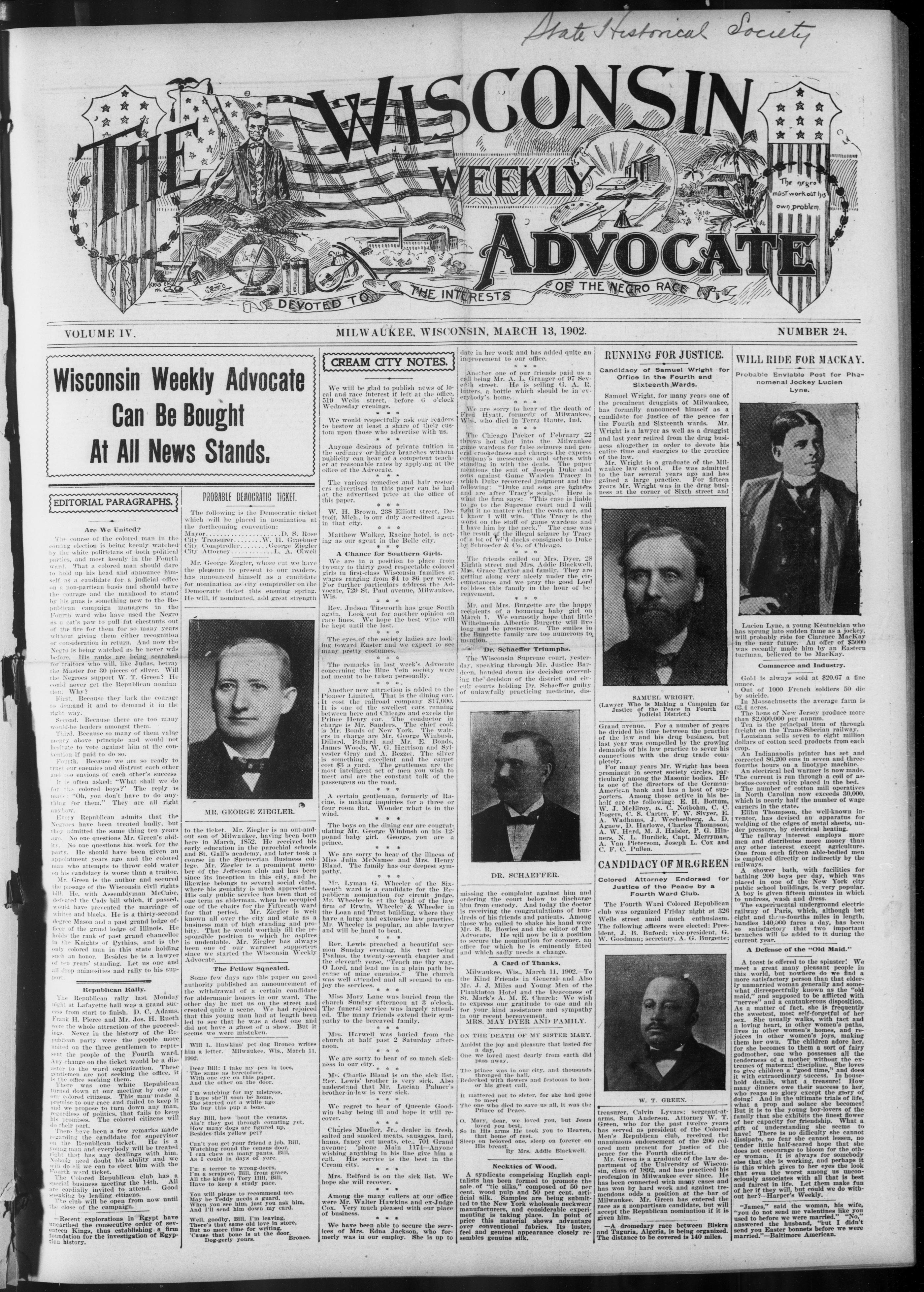
WISCONSIN
WEEKLY
ADVOCATE
DEVOTED TO THE INTERESTS OF THE NEGRO RACE
Wisconsin Weekly Advocate Can Be Bought At All News Stands.
VOLUME IV.
Wisconsin We Can Be At All New
EDITORIAL PARAGRAPHS.
Are We United?
The course of the colored man in the coming election is being keenly watched by the white politicians of both political parties, and most keenly in the Fourth ward. That a colored man should dare to hold up his head and announce himself as a candidate for a judicial office on a non-partisan basis and should have the courage and the manhood to stand by his guns is something new to the Republican campaign managers in the Fourth ward who have used the Negro as a cat's paw to pull fat chestnuts out of the fire for them for so many years without giving them either recognition or consideration in return. And now the Negro is being watched as he never was before. His ranks are being searched for traitors who will, like Judas, betray the Master for 30 pieces of silver. Will the Negroes support W. T. Green? He could never get the Republican nomination. Why?
First. Because they lack the courage to demand it and to demand it in the right way.
Second. Because there are too many would-be leaders amongst them.
Third. Because so many of them value money above principle and would not hesitate to vote against him at the convention if paid to do so.
Fourth. Because we are so ready to trust our enemies and distrust each other and too envious of each other's success.
It is often asked: "What shall we do for the colored boys?" The reply is made: "Oh, you don't have to do anything for them." They are all right anyhow.
Every Republican admits that the Negroes have been treated badly, but they admitted the same thing ten years ago. No one questions Mr. Green's ability. No one questions his work for the party. He should have been given an appointment years ago and the colored man who attempts to throw cold water on his candidacy is worse than a traitor.
Mr. Green is the author and secured the passage of the Wisconsin civil rights bill. He, with Assemblyman McCabe, defeated the Cady bill which, if passed, would have prevented the marriage of whites and blacks. He is a thirty-second degree Mason and a past grand lodge officer of the grand lodge of Illinois. He holds the rank of past grand chancellor in the Knights of Pythias, and is the only colored man in this state holding such an honor. Besides he is a lawyer of ten years' standing. Let us one and all drop animosities and rally to his sup
Republican Rally.
The Republican rally last Monday night at Lafayette hall was a grand success from start to finish. D. C. Adams, Frank H. Pierce and Mr. Jos. H. Rueth were the whole attraction of the proceedings. Never in the history of the Republican party were the people more united on the three gentlemen to represent the people of the Fourth ward. Any change on the ticket would be a disaster to the ward organization. These gentlemen are not seeking the office, it is the office seeking them
There was one white Republican turned down at our meeting by one of our colored citizens. This man made a promise to our race and failed to keep it and we propose to turn down any man, regardless of politics, that fails to keep his promises. The colored citizens will do their part.
There have been a few remarks made regarding the candidate for supervisor on the Republican ticket. He is a young man and everybody will be treated right that has any dealings with him. Nobody need doubt his ability and we will do all we can to elect him with the Fourth ward ticket.
The Colored Republican club has a special business meeting the 14th. All are cordially invited to attend. Good speaking by leading citizens.
The club will be open from now until the close of the campaign.
Recent explorations in Egypt have unearthed the consecutive order of seventeen Kings, thus establishing a firm foundation for the investigation of Egyptian history.
PROBABLE DEMOGRATIC TICKET.
The following is the Democratic ticket which will be placed in nomination at the forthcoming convention:
Mayor.....D. S. Rose
City Treasurer.....W. H. Graebner
City Comptroller.....George Ziegler
City Attorney.....L. A. Olwell
Mr. George Ziegler, whose cut we have the pleasure to present to our readers, has announced himself as a candidate for nomination as city comptroller on the Democratic ticket this ensuing spring. He will, if nominated, add great strength
M. J.
MR. GEORGE ZIEGLER.
to the ticket. Mr. Ziegler is an out-and-out son of Milwaukee, having been born here in March, 1852. He received his early education in the parochial schools and St. Gall's academy, and later took a course in the Spencerian Business college. Mr. Ziegler is a prominent member of the Jefferson club and has been since its inception in this city, and he likewise belongs to several social clubs, where his geniality is much appreciated. His only public service has been that of one term as alderman, when he occupied one of the chairs for the Fifteenth ward for that period. Mr. Ziegler is well known all over the city and state as a business man of high standing and probity. That he would worthily fill the responsible position to which he aspires is undeniable. Mr. Ziegler has always been one of our warmest supporters since we started the Wisconsin Weekly Advocate.
The Fellow Squealed.
Some few days ago this paper on good authority published an announcement of the withdrawal of a certain candidate for aldermanic honors in our ward. The other day he met us on the street and created quite a scene. We had rejoiced that this young man had at length been led to see that he was a dead one and did not have a ghost of a show. But it seems we were mistaken.
Will L. Hawkins' pet dog Bronco writes him a letter. Milwaukee, Wis., March 11, 1902.
Dear Bill: I take my pen in toes,
The same as heretofore,
With one eye on this paper,
And the other on the door.
I'm watching for my mistress,
I hope she'll soon be home.
She started out a while ago
To buy this pup a bone.
Say Bill, how 'bout the census,
Ain't they got through counting yet,
How many dogs are figured up,
Besides this yellow pet?
Can't you get your friend a job, Bill,
Watching round the census door,
I can chew as many pants, Bill,
As I could in days of yore.
I'm a terror to wrong-doers,
I'm a scrapper, Bill, from grace,
All the kids on Tory Hill, Bill,
Have to keep a study pace.
You will please to recommend me,
May be Teddy needs a guard,
When you see him, just you ask him,
And I'll send him down my card.
Well, goodby, Bill, I'm leaving,
There's that same old love in store,
But no more time for writing,
'Cause that bone is at the door.
Dog-gerly yours. Bronco.
CREAM CITY NOTES.
We will be glad to publish news of local and race interest if left at the office, 519 Wells street, before 6 o'clock Wednesday evenings.
* * *
We would respectfully ask our readers to bestow at least a share of their custom upon those who advertise with us.
* * *
Anyone desirous of private tuition in the ordinary or higher branches without publicity can hear of a competent teacher at reasonable rates by applying at the office of the Advocate.
* * *
The various remedies and hair restorers advertised in this paper can be had at the advertised price at the office of this paper.
W. H. Brown, 238 Elliott street, Detroit, Mich.. is our duly accredited agent in that city.
* * *
Matthew Walker, Racine hotel, is acting as our agent in the Belle city.
A Chance for Southern Girls.
We are in a position to place from twenty to thirty good respectable colored girls in first-class Wisconsin families at wages ranging from $4 to $6 per week. For further particulars address the Advocate, 729 St. Paul avenue, Milwaukee, Wis.
2 2
Rev. Judson Titsworth has gone South again. Look out for another opinion on race lines. We hope the best wine will be kept until the last.
* * *
The eyes of the society ladies are looking toward Easter and we expect to see many pretty costumes.
* * *
The remarks in last week's Advocate concerning the Blue Vein society were not meant to be taken personally.
* * * .
Another new attraction is added to the Pioneer Limited. That is the dining car. It cost the railroad company $17,000. It is one of the swellest cars running between here and Chicago and excels the Prince Henry car. The conductor in charge is Mr. Sanders. The chief cook is Mr. Bonds of New York. The waiters in charge are Mr. George Winbush, Dillard, Ballard and Mr. E. Bonds, James Woods, W. G. Harrison and Sylvester Gray and A. Bezzet. The silver is something excellent and the carpet cost $3 a yard. The gentlemen are the most intelligent set of men you wish to meet and are the constant talk of the passengers on the road.
* * *
A certain gentleman, formerly of Racine, is making inquiries for a three or four room flat. Wonder what is in the wind.
* * *
The boys on the dining car are congratulating Mr. George Winbush on his 12-pound baby girl. George, you are a prince.
* * *
We are sorry to hear of the illness of Miss Julia McNamee and Mrs. Henry Bland. The family has our deepest sympathy.
* * *
Mr. Lyman G. Wheeler of the Sixteenth ward is a candidate for the Republican nomination for circuit judge. Mr. Wheeler is at the head of the law firm of Erwin, Wheeler & Wheeler in the Loan and Trust building, where they have a large and extensive law practice. Mr. Wheeler is popular, an able lawyer and will be hard to beat.
宏宏宏
Rev. Lewis preached a beautiful sermon Sunday evening, his text being Psalms, the twenty-seventh chapter and the eleventh verse, "Teach me thy way, O Lord, and lead me in a plain path because of mine enemies." The church was well attended and all seemed to enjoy the services.
* * *
Miss Mary Lane was buried from the church Sunday afternoon at 3 o'clock. The funeral service was largely attended. The many friends extend their sympathy to the bereaved family.
* * *
Mrs. Harwell was buried from the church at half past 2 Saturday afternoon.
* * *
We are sorry to hear of so much sickness in our city.
Mr. Charlie Bland is on the sick list. Rev. Lewis' brother is very sick. Also understand that Mr. Lucian Palmer's brother-in-law is very sick.
We regret to hear of Queenie Goodwin baby being ill and hope it will recover.
Charles Mueller, Jr., dealer in fresh, salted and smoked meats, sausages, lard, hams, fancy cut meats, etc., 701 Grand avenue; 'phone Main 1174—Anyone wishing anything in his line give him a call. His service is the best in the Cream city.
Mrs. Relford is on the sick list. We hope she will recover.
Among the many callers at our office were Mr. Walter Hawkins and ex-Judge Cox. Very much pleased with our place of business.
We have been able to secure the services of Mrs. Edna Jackson, who formerly was in our employ. She is up to
date in her work and has added quite an improvement to our office.
Another one of our friends paid us a call being Mr. A. L. Granger of 97 Seventh street. He is selling G. A. R. bitters, a bottle which should be in everybody's home.
We are sorry to hear of the death of Fred Hyatt, formerly of Milwaukee, Wis., who died in Terra Haute, Ind.
宏 宏 宏
The Chicago Packer of February 22 throws hot shot into the Milwaukee game wardens for false seizures and general crookedness and charges the express company's messengers and others with standing in with the deals. The paper mentions the suit of Joseph Duke and sons against Game Warden Tracey in which Duke recovered judgment and the following: "Duke and sons are fighters and are after Tracy's scalp." Here is what the firm says: "This case is liable to go to the Supreme court and I will fight it no matter what the costs are, and I know I will win. This Tracy is the worst on the staff of game wardens and I have him by the neck." The case was the result of the illegal seizure by Tracy of a lot of wild ducks consigned to Duke by Schroeder & Co. of Chicago.
☆ ☆ ☆
The friends called on Mrs. Dyer, 28 Eighth street and Mrs. Addie Blackwell, Mrs. Grace Taylor and family. They are getting along very nicely under the circumstances and we pray the good Lord to bless this family in the hour of bereavement.
Mr. and Mrs. Burgette are the happy recipients of a bouncing baby girl on March 1. We earnestly hope that little Wilhelmenia Albertie Burgette will live long and be prosperous. The smiles in the Burgette family are too numerous to mention.
Dr. Schaeffer Triumphs.
The Wisconsin Supreme court, yesterday, speaking through Mr. Justice Bardeen, handed down its decision overruling the decision of the district and circuit courts holding Dr. Schaeffer guilty of unlawfully practicing medicine, dis
C.
DR. SCHAEFFER.
missing the complaint against him and ordering the court below to discharge him from custody. And today the doctor is receiving the congratulations of hundreds of his friends and patients. Among those who called to shake his hand were Mr. S. R. Bowles and the editor of the Advocate. He will now be in a position to secure the nomination for coroner, an office for which he is eminently fitted and which sadly needs a change.
A Card of Thanks.
Milwaukee, Wis., March 11, 1902.—To the Kind Friends in General and Also Mr. J. J. Miles and Young Men of the Plankinton Hotel and the Deaconess of St. Mark's A. M. E. Church: We wish to express our gratitude to one and all for your kind assistance and sympathy in our recent bereavement. MRS. MAY DYER AND FAMILY. ON THE DEATH OF MY SISTER MARY.
a day,
One we loved most dearly from earth did pass away.
The prince was in our city, and thousands thronged the hall.
Redecked with flowers and festoons to honor his great call.
It mattered not to sister, for she had gone to meet
The one who died to save us all, it was the Prince of Peace.
O. Mary, dear, we loved you, but Jesus loved you best.
So in His arms He took you to Heaven, that home of rest.
Neckties of Wood.
A syndicate comprising English capitalists has been formed to promote the sale of "tie silks," composed of 50 per cent. wood pulp and 50 per cent. artificial silk. Samples are being submitted to the New York wholesale neckwear manufacturers, and considerable experimenting is taking place. In point of price this material shows advantage over conventional fabrics. Its luster, feel and general appearance closely resembles genuine silk.
RUNNING FOR JUSTICE.
Candidacy of Samuel Wright for Office in the Fourth and Sixteenth Wards.
Samuel Wright, for many years one of the prominent druggists of Milwaukee, has formally announced himself as a candidate for justice of the peace for the Fourth and Sixteenth wards. Mr. Wright is a lawyer as well as a druggist and last year retired from the drug business altogether in order to devote his entire time and energies to the practice of the law.
Mr. Wright is a graduate of the Milwaukee law school. He was admitted to the bar several years ago and has gained a large practice. For fifteen years Mr. Wright was in the drug business at the corner of Sixth street and
6
Grand avenue. For a number of years he divided his time between the practice of the law and his drug business, but last year was compelled by the growing demands of his law practice to sever his connections with the drug trade completely.
For many years Mr. Wright has been prominent in secret society circles, particularly among the Masonic bodies. He is one of the directors of the German-American bank and has a host of supporters. Among those active in his behalf are the following: E. H. Bottum, W. J. McElroy, K. C. Notbohm, C. C. Rogers, C. S. Carter, F. W. Sivyer, E. A. Wadhams, J. Wechselberg, A. D. Agnew, D. Harlowe, Charles Thompson, A. W. Hard, M. J. Haisler, P. G. Hinners, N. L. Burdick, Capt. Merryman, A. Van Pietersom, Joseph L. Cox and C. F. C. Pullen.
CANDIDACY OF MR.GREEN
Colored Attorney Endorsed for Justice of the Peace by a Fourth Ward Club. The Fourth Ward Colored Republican club was organized Friday night at 326 Wells street amid much enthusiasm. The following officers were elected: President, J. B. Buford: vice-president, G. W. Goodman; secretary, A. G. Burgette;
[Name]
treasurer, Calvin Lyvars; sergeant-at-arms, Sam Anderson. Attorney W. T. Green, who for the past twelve years has served as president of the Colored Men's Republican club, received the unanimous endorsement of the 200 colored men present for justice of the peace for the Fourth district. Mr. Green is a graduate of the law department of the University of Wisconsin, class of 1892, and has practiced his profession in Milwaukee ever since. He has been connected with many cases and has won by hard work and against tremendous odds a position at the bar of Milwaukee. Mr. Green has entered the race as a nonpartisan candidate, but will accept the Republican nomination if it is given him.
A dromedary race between Biskra and Taguria, Algeria, is being organized. The distance to be covered is 140 miles.
WILL RIDE FOR MACKAY.
Probable Enviable Post for Phanomenal Jockey Lucien Lyne.
THE BROOKLYN PRESS
Lucien Lyne, a young Kentuckian who has sprung into sudden fame as a jockey, will probably ride for Clarence MacKay in the near future. An offer of $5000 was recently made him by an Eastern turfman, believed to be MacKay.
Commerce and Industry.
Gold is always sold at $20.67 a fine ounce.
Out of 1000 French soldiers 50 die by suicide. In Massachusetts the average farm is 63.4 acres.
The hens of New Jersey produce more than $2,000,000 per annum. Tea is the principal item of through freight on the Trans-Siberian railway. Louisiana sells seven to eight million dollars of cotton seed products from each crop. An Indianapolis printer has set and corrected 86,200 ems in seven and three-fourths hours on a linotype machine. An electrical bed warmer is now made. The current is run through a coil of asbestos-covered wire placed in the bed. The number of cotton mill operatives in North Carolina now exceeds 30,000, which is nearly half the number of wage earners in the state. Elihu Thompson, the well-known inventor, has devised an apparatus for welding of the edges of metal sheets, under pressure, by electrical heating.
The railway interest employs more men and distributes more money than any other interest except agriculture. One from each fifteen able-bodied men is employed directly or indirectly by the railways. A shower bath, with facilities for bathing 200 boys per day, which was placed in one of the New York city public school buildings, is very popular. A boy is given fifteen minutes in which to undress, wash and dress. The experimental underground electric railway of Paris, which, although but eight and three-fourths miles in length, handles 140,000 fares a day, has been so satisfactory that two important branches will be added to it during the current year.
A. Defense of the "Old Maid."
A toast is offered to the spinster! We meet a great many pleasant people in this world, but nowhere do we find a more satisfactory person than that elderly unmarried woman generally and somewhat disrespectfully known as the "old maid," and supposed to be afflicted with "nerves" and a cantankerous disposition. As a matter of fact, she is frequently the sweetest, most self-forgetful of her sex. She usually walks, with tact and a loving heart, in other women's paths, lives in other women's homes, and rejoices in other women's joys, making them her own. The children adore her, for she becomes to them a sort of fairy godmother, one who possesses all the tenderness of a mother without the extremes of maternal discipline. She loves to give children a "good time," and does it with extraordinary success. In household details, what a treasure! How many dinners owe their success to her, who reaps no glory except the glory of doing! And in the ultimate trials of life, what a prop and solace she becomes! But it is to the young boy-lovers of the family that she exhibits the finest flower of her capacity for friendship. What a gift of understanding she seems to have! There is no difficulty she cannot dissipate, no fear she cannot lessen, no tender little half-scared hope that she does not encourage to bloom for the other woman. It is always for somebody else that she is working, and perhaps it is this which gives to her eyes the look that even the worst among us unconsciously associates with all that is best and fairest in life. Let them make fun of her if they will, but could we do without her?—Harper's Weekly.
"James," said the woman, his wife, "you do not send me valentines like you used to before we were married." "No," answered the husband, "but I didn't send you Easter bonnets before we were married."—Baltimore American.
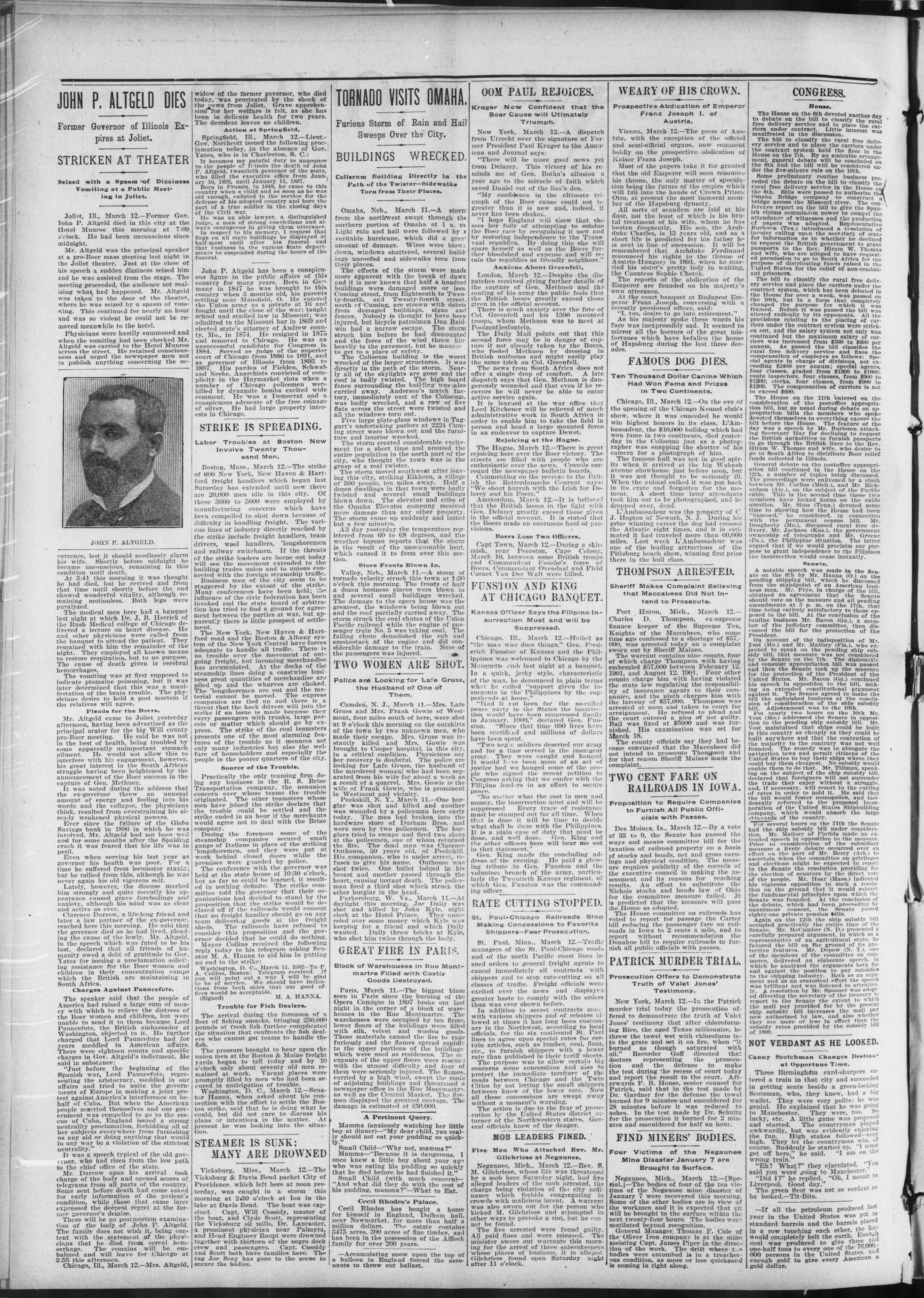
JOHN P. ALTGELD DIES
STRICKEN AT THEATER
Seized with a Spasm of Dizziness Vomiting at a Public Meeting in Joliet.
Joliet, Ill., March 12.—Former Gov. John P. Altgeld died in this city at the Hotel Munroe this morning at 7:09 o'clock. He had been unconscious since midnight.
Mr. Altgeld was the principal speaker at a pro-Boer mass meeting last night in the Joliet theater. Just at the close of his speech a sudden dizziness seized him and he was assisted from the stage. The meeting proceeded, the audience not realizing what had happened. Mr. Altgeld was taken to the door of the theater, where he was seized by a spasm of vomiting. This continued for nearly an hour and was so violent he could not be removed meanwhile to the hotel.
Physicians were hastily summoned and when the vomiting had been checked Mr. Altgeld was carried to the Hotel Munroe across the street. He retained consciousness and urged the newspaper men not to publish anything concerning the oc-
M.
currence, lest it should needlessly alarm his wife. Shortly before midnight he became unconscious, remaining in this condition until death. At 3:41 this morning it was thought he had died, but he revived and from that time until shortly before the end showed wonderful vitality, although remaining motionless. Both legs were paralyzed.
The medical men here had a banquet last night at which Dr. J. B. Herrick of the Rush Medical college of Chicago delivered a lecture on heart disease. He and other physicians were called from the banquet to attend the patient. They remained with him the remainder of the night. They employed all known means to restore respiration, but to no purpose. The cause of death given is cerebral hemorrhages. The vomiting was at first supposed to indicate ptomaine poisoning, but it was later determined that this was a manifestation of the brain trouble. The physicians desire to hold a post mortem if the relatives will agree.
Pleads for the Boers.
Mr. Altgeld came to Joliet yesterday afternoon, having been advertised as the principal orator for the big Will county pro-Boer meeting. He said he was not in the best of health, being troubled by some apparently unimportant stomach ailment. He would not allow this to interfere with his engagement, however, his great interest in the South African struggle having been heightened by the announcement of the Boer success in the capture of Gen. Methuen. It was noted during the address that the ex-governor threw an unusual amount of energy and feeling into his words and the collapse, the physicians think, resulted from overstraining his already weakened physical powers.
Ever since the failure of the Globe Savings bank in 1896 in which he was involved, Mr. Altgeld had not been well and for some months after the Spalding crash it was feared that his life was in peril. Even when serving his last year as governor his health was poor. For a time he suffered from locomotor ataxia; but he rallied from this, although he was never again his old vigorous self. Lately, however, the disease marked him strongly and quite recently his appearance caused grave forebodings and anxiety, although his mind was as clear and active as ever.
Clarence Darrow, a life-long friend and later a law partner of the ex-governor, reached here this morning. He said that the governor died as he had lived, pleading the cause of the lowly. Mr. Altgeld, in the speech which was fated to be his last, declared that all friends of humanity owed a debt of gratitude to Gov. Yates for issuing a proclamation soliciting assistance for the Boer women and children in their concentration camps which the British are maintaining in South Africa.
Charges Against Pauncefote.
The speaker said that the people of America had raised a large sum of money with which to relieve the distress of the Boer women and children, but were unable to send it to them because Lord Pauncefote, the British ambassador at Washington, objected to it. He further charged that Lord Pauncefote had for years meddled in American affairs. There were eighteen counts and specific charges in Gov. Altgeld's indictment. He said in substance:
"Just before the beginning of the Spanish war, Lord Pauncefote, representing the aristocracy, meddled in our affairs and tried to unite the governments of Europe in making a joint protest against America's interference on behalf of Cuba. But when the American people asserted themselves and our government was compelled to go to the rescue of Cuba, England issued a strong neutrality proclamation, forbidding all of her subjects everywhere from furnishing us any aid or doing anything that would in any way be a violation of the strictest neutrality."
It was a speech typical of the old governor, who had risen from the low path to the chief office of the state.
Mr. Darrow upon his arrival took charge of the body and opened scores of telegrams from all parts of the country. Some sent before death had come asked for early information of the patient's condition, while those that came later expressed the deepest regret at the former governor's demise. There will be no postmortem examination of the body of John P. Altgeld. The family does not wish it, being content with the statement of the physicians that he died from cereal hemorrhage. The remains will be embalmed and will leave for Chicago at 3:55 this afternoon. Chicago, Ill., March 12.—Mrs. Altgeld,
widow of the former governor, who died today, was prostrated by the shock of the news from Joliet. Grave apprehension for her welfare is felt, as she has been in delicate health for two years. The decedent leaves no children.
Action at Springfield.
Springfield, Ill., March 12.—Lieut-Gov. Northcott issued the following proclamation today, in the absence of Gov. Yates, who is in Charleston, S. C.: It becomes my painful duty to announce to the people of Illinois the death of John P. Altgeld, twentiethe governor of the state, who filled the executive office from January 10, 1893, until January 11, 1897. Born in Prussia, in 1848, he came to this country when a child and as soon as he was old enough, enlisted in the service for the defense of his adopted country and bore the part of a true soldier in the closing days of the Civil war. He was an able lawyer, a distinguished judge, a man of strong convictions and always courageous in giving them utterance. In respect to his memory, I request that flags on all state buildings be displayed at half-mast until after his funeral and that business in the various state departments be suspended during the hours of the funeral.
John P. Altgeld has been a conspicuous figure in the public affairs of this country for many years. Born in Germany in 1847 he was brought to this country when 3 months old, his parents settling near Mansfield, O. He entered the Union army as a private at 16 and fought until the close of the war; taught school and studied law in Missouri; was admitted to the Missouri bar in 1869 and elected state's attorney of Andrew county, Mo., in 1874. He resigned in 1875 and removed to Chicago. He was an unsuccessful candidate for Congress in 1884. Served as judge of the superior court of Chicago from 1886 to 1891, and as governor of Illinois from 1893 to 1897. His pardon of Fielden, Swab and Neebe, Anarchists convicted of complicity in the Haymarket riots when a number of Chicago policemen were killed by dynamite bombs excited wide comment. He was a Democrat and a conspicuous advocate of the free coinage of silver. He had large property interests in Chicago.
STRIKE IS SPREADING.
Labor Troubles at Boston Now Involve Twenty Thousand Men.
Boston, Mass., March 12.—The strike of 600 New York, New Haven & Hartford freight handlers which began last Saturday has extended until now there are 20,000 men idle in this city. Of these 3000 to 5000 were employed by manufacturing concerns which have been compelled to shut down because of difficulty in handling freight. The various lines of industry directly reached by the strike include freight handlers, team drivers, wool handlers, 'longshoremen and railway switchmen. If the threats of the strike leaders are borne out today will see the movement extended to the building trades union and to unions connected with the foreign steamship traffic.
Business men of the city seem to be staggered by the extent of the strike. Many conferences have been held; the influence of the civic federation has been invoked and the state board of arbitration has tried to find a ground for agreement between the parties at war, but apparently there is little prospect of settlement.
The New York, New Haven & Hartford road and the Boston & Albany system of the New York Central have forces adequate to handle all traffic. There is no trouble over the movement of outgoing freight, but incoming merchandise has accumulated. At the docks of the steamship lines doing a coastwise business great quantities of merchandise are piled up and the wharves are choked. The 'longshoremen are out and the material cannot be moved. The express companies are tied up and there is a threat that the hack drivers will join the strike if an issue is made because they carry passengers with trunks, large parcels or matter which should go by express. The strike of the coal teamsters presents one of the most alarming features of the trouble as it menaces not only many industries but also the welfare of householders and especially the people in the poorer quarters of the city.
Source of the Trouble.
Practically the only teaming firm doing any business is the R. S. Brine Transportation company, the nonunion concern over whose teams the trouble originated. The other teamsters whose men have joined the strike declare that the trouble could be settled and the strike ended in an hour if the merchants would agree not to deal with the Brine company.
During the forenoon some of the steamship companies secured small gangs of Italians in place of the striking longshoremen, and they were put at work behind closed doors while the premises were guarded by police. The conference with the governor was held at the state house at 10:30 o'clock, but as far as could be learned, it resulted in nothing definite. The strike committee told the governor that their organizations had decided to stand by the proposition that the strike would be declared off if the railroads would consent that no freight handler should go on any team delivering goods at the freight sheds. The railroads have refused to consider this proposition and the governor decided that he could do nothing.
Mayor Collins received the following reply today to his telegram asking Senator M. A. Hanna to aid him in putting an end to the strike:
Washington, D. C., March 11, 1902-To P. A. Collins, Boston: Telegram received. 16 you will point out a way I will be glad to be of service. We should have indications from both sides that our good offices would be acceptable. M. A. HANNA.
Trouble for Fish Dealers.
The arrival during the forenoon of a fleet of fishing smacks, bringing 250,000 pounds of fresh fish further complicated the situation that confronts the fish dealers who cannot get teams to handle the fish.
The pressure brought to bear upon the union men at the Boston & Maine freight yards began to tell today and by 10 o'clock only about seventy old men remained at work. Vacant places were promptly filled by men who had been secured in anticipation of trouble.
Washington, D. C., March 12.—Senator Hanna, when asked about his connection with the effort to settle the Boston strike, said that he is doing what he could, but did not care to discuss his plans or intentions in the matter. At present he was looking into the situation.
STEAMER IS SUNK;
MANY ARE DROWNED
Vicksburg, Miss., March 12.—The Vicksburg & Davis Bend packet City of Providence, which left here at noon yesterday, was caught in a storm this morning at 2:30 o'clock at Ion in the lake at Davis Bend. The boat was capsized. Capt. Will Cossidy, master of the boat, and Clyde Scott, representing the Vicksburg oil mills, Dr. Lancaster, a prominent physician near Palmyra, and Head Engineer Roupt were drowned together with thirteen of the negro deck crew and passengers. Capt. Cossidy and Scott both have families here. The tug Joe Seay has gone to the scene to secure the bodies.
TORNADO VISITS OMAHA.
Coliseum Building Directly in the Path of the Twister-Sidewalks Torn from Their Places.
Omaha, Neb., March 11.—A storm from the northwest swept through the northern portion of Omaha at 1 a. m. Light rain and hail were followed by a veritable hurricane, which did a great amount of damage. Wires were blown down, windows shattered, several buildings unroofed and sidewalks torn from their places.
The effects of the storm were made more apparent with the break of dawn and it is now known that half a hundred buildings were damaged more or less. Cuming street, from Eighteenth to Twenty-fourth, and Twenty-fourth street, north of Cuming, are strewn with debris from damaged buildings, signs and fences. Nobody is thought to have been injured, but bicycle patrolman Dan Baldwin had a narrow escape. The storm struck him before he had dismounted and the force of the wind threw him heavily to the pavement, but he manage to get to a place of safety.
The Coliseum building is the worst wrecked of the larger structures. It was directly in the path of the storm. Nearly all of the skylights are gone and the roof is badly twisted. The high board fence surrounding the building was also carried away. Anderson's match factory, immediately east of the Coliseum, was badly wrecked, and a row of five flats across the street were twisted and all the windows torn out.
Five large plate-glass windows in Taggart's undertaking parlors at 2224 Cuming street were blown out and the furniture and interior wrecked.
The storm created considerable excitement for a short time and aroused the entire population in the north part of the city, who thought the town was in the grasp of a real twister.
The storm moved southwest after leaving this city, striking Elkhorn, a village of 500 people, ten miles away. Half a dozen dwellings in that town were badly twisted and several small buildings blown down. The elevator and cribs of the Omaha Elevator company received more damage than any other property. The storm came up suddenly and lasted but a few minutes. All day yesterday the temperature registered from 60 to 68 degrees, and the weather bureau reports that the storm is the result of the unseasonable heat, which caused it to form over this section.
Store Fronts Blown In.
Valley, Neb., March 11.—A storm of tornado velocity struck this town at 1:30 o'clock this morning. The fronts of half a dozen business places were blown in and several small buildings wrecked. The damage to the opera house was the greatest, the windows being blown out and the roof partially carried away. The storm struck the coal chutes of the Union Pacific railroad while the engine of passenger train No. 5 was taking coal. The falling chute demolished the cab and smokestack of the engine and did considerable damage to the train. None of the passengers was injured.
TWO WOMEN ARE SHOT.
Police are Looking for Lafe Gruss, the Husband of One of Them
Camden, N. J., March 11.—Mrs. Lafe Gruss and Mrs. Frank Gowie of Westmont, four miles south of here, were shot at 9 o'clock this morning on the outskirts of the town by two unknown men, who made their escape. Mrs. Gruss was instantly killed and Mrs. Gowie was brought to Cooper hospital, in this city, in a critical condition. Physicians say her recovery is doubtful. The police are looking for Lafe Gruss, the husband of the murdered woman who had been separated from his wife for about a week as a result of a quarrel. Mrs. Gowie is the wife of Frank Gowie, who is prominent in Westmont and vicinity.
Peekskill, N. Y., March 11.—One burglar was shot and killed and another was wounded by a policeman here early today. The men had broken into the hardware store of Durham Bros. and were seen by two policemen. The burglar tried to escape and fired two shots at the policemen, one of whom returned the fire. The dead man was Clarence Outhouse, 30 years old, of Peekskill. His companion, who is under arrest, refuses to give his name. Outhouse was shot twice. One bullet lodged in his breast and another passed through the heart, causing instant death. The policeman fired a third shot which struck the other burglar in the hand.
Parkersburg, W. Va., March 11.—At daylight this morning, Joe Daily was shot and killed by John Kyle, night clerk at the Hotel Prince. They quarreled over some money which Kyle was keeping for a friend and which Daily wanted. Daily threw bricks at Kyle, who shot him twice through the body.
GREAT FIRE IN PARIS.
Block of Warehouses in Rue Montmartre Filled with Costly Goods Destroyed.
Paris, March 11.—The biggest blaze seen in Paris since the burning of the Opera Comique in 1897 broke out last night in the corner of a block of warehouses in the Rue Montmartre. The warehouses were occupied by ten firms, lower floors of the buildings were filled with silk, velvet and woolen goods. Those materials caused the fire to rage furiously and the flames spread rapidly to the upper portions of the buildings which were used as residences. The occupants of the upper floors were rescued with the utmost difficulty and four of them were seriously injured. The flames, carried by a high wind, swept the roofs of adjoining buildings and threatened a newspaper office in the Rue Montmartre as well as the Central Market. The firemen displayed the greatest courage. The damage is estimated at £50,000.
A Pertinent Query.
Mamma (anxiously watching her little boy at dinner)—"My dear child, you really should not eat your pudding so quickly."
Small Child—"Why not, mamma?"
Mamma—"Because it is dangerous. I once knew a little boy about your age who was eating his pudding so quickly that he died before he had finished it."
Small Child (with much concern)—"And what did they do with the rest of his pudding, mamma?"—What to Eat.
Cecil Rhodes's Palace
Cecil Rhodes has bought a home for himself in England, Dalham hall, near Newmarket, for more than half a million dollars. The estate contains 3475 acres, 300 acres of fine timber, and has been in the possession of the Affleck family for over 200 years.
—Accumulating snow upon the top of a balloon in England forced the aeronauts to throw out ballast.
OOM PAUL REJOICES.
Kruger Now Confident that the
New York, March 12.—A dispatch from Utrecht over the signature of Former President Paul Kruger to the American and Journal says:
"There will be more good news yet from Delarey. This victory of his reminds me of Gen. Botha's allusion a year ago to the miracle of faith which saved Daniel out of the lion's den.
"My confidence in the ultimate triumph of the Boer cause could not be greater than it is now and, indeed, it never has been shaken."
"I hope England will show that she sees her folly of attempting to subdue the Boer race by recognizing it now and by restoring independence to the Transvaal republics. By doing this she will spare herself as well as the Boers further bloodshed and expense and will retain the republics as friendly neighbors."
Anxious About Greenfell.
London, March 12.—Despite the dispatches received giving further details of the capture of Gen. Methuen and the routing of his army the public feels that the British losses greatly exceed those given in the official account.
There is much anxiety over the fate of Col. Greenfell and his 1300 mounted troops, whom Methuen was to meet at Pooizontjesfontein.
The Daily Mail points out that this second force may be in danger of capture if not already taken by the Boers, who fooled Methuen by dressing in British uniforms and might easily play the same trick on Col. Greenfell.
The news from South Africa does not offer a single drop of comfort. A late dispatch says that Gen. Methuen is dangerously wounded and that even if he recovers he will never be able to enter active service again.
It is learned at the war office that Lord Kitchener will be relieved of much administrative work in South Africa in order to enable him to take the field in person and head a large mounted force in an endeavor to capture Dewet.
Rejoicing at the Hague.
The Hague, March 12.—There is great rejoicing here over the Boer victory. The streets are filled with people who are enthusiastic over the news. Crowds surround the newspaper bulletin boards.
Commenting on the reverse to the British the Rotterdamche Courant says: "We shout hurrache with the Irish for Delarey and his Boers."
Amsterdam, March 12.—It is believed that the British losses in the fight with Gen. Delarey greatly exceed those given in the official account. It is stated that the Boers made an enormous haul of provisions.
Boers Lose Two Officers.
Capt Town, March 12.—During a skirmish, near Peerston, Cape Colony, March 10, between some British troops and Commandant Foushe's force of Boers, Commandant Ovendaal and Field Cornet Van Der Walt were killed.
FUNSTON AND KING AT CHICAGO BANQUET.
Kansas Officer Says the Fillpino Insurrection Must and will be Suppressed.
Chicago, Ill., March 12.—Hailed as "the man who does things," Gen. Frederick Funston of Kansas and the Philippines was welcomed to Chicago by the Marquette club last night at a banquet. In a quick, jerky style, characteristic of the man, he denounced in plain terms what he called "support given the insurgents in the Philippines by the copperheads at home."
"Had it not been for the so-called peace party in the States the insurrection would have been suppressed finally in January, 1900," declared Gen. Funston.
"Since that time 600 lives have been sacrificed and millions of dollars have been spent."
"Two negic soldiers deserted our army and for a time served in the insurgent army. They were caught and hanged. It would have been more of an act of justice had we hanged some of the people who signed the recent petition to Congress asking that we confer with the Filipino leaders in an effort to secure peace.
"No matter what the cost in men and money, the insurrection must and will be suppressed. Every trace of resistance must be stamped out for all time. When that is done it will be time to decide what shall be done with the Philippines. It is a plain case of duty that must be done, and well done. Gen. King and the other officers here will bear me out in that statement."
Gen. King made the concluding address of the evening. He paid a glowing tribute to Gen. Funston and the volunteer branch of the army, particularly the Twentieth Kansas regiment, of which Gen. Funston was the commanding officer.
RATE CUTTING STOPPED.
St. Paul-Chicago Railroads Stop Making Concessions to Favorite Shippers-Fear Prosecution.
St. Paul, Minn., March 12.—Traffic managers of the St. Paul-Chicago roads, and of the north Pacific coast lines issued orders to general freight agents to cancel immediately all contracts with shippers and to stop rate-cutting on all classes of traffic. Freight officials were excited over the news and displayed greater haste to comply with the orders than was ever shown before.
In addition to secret contracts made with various shippers and of rebates allowed at times it has long been customary in the Northwest, according to local officials, for the six eastbound St. Paul lines to agree upon special rates for certain articles, such as lumber, coal, flour, etc., to furnish shippers with a lower rate than published in their tariff sheets.
The purpose was to allow certain big concerns some concessions and also to protect the immediate territory of the roads between Chicago and the Twin Cities by not letting the small shippers between know of the lower rate. Now all these concessions are swept away without a moment's warning. The action is due to the fear of prosecution by the United States district attorney of the Northwestern states. General officials knew of the danger.
MOB LEADERS FINED.
Five Men Who Attacked Rev. Mr.
Gilchrise at Negaunee.
Negaunee, Mich., March 12.—Rev. S. M. Gilchriese, whose life was threatened by a mob here Saturday night, had five alleged leaders of the mob arrested, the charge being violation of the city ordinance which forbids congregating in crowds with malicious intent. A warrant was also sworn out for the person who kicked M. Gilchriese and attempted in other ways to provoke a riot, but he cannot be found.
The five arrested were found guilty. All paid fines and were released. The minister swore out warrants this morning for the arrest of three saloonkeepers whose places of business, it is alleged. Gilchriese found open Saturday night after 11 o'clock.
WEARY OF HIS CROWN.
Prospective Abdication of Emperor Franz Joseph I. of Austria.
Vienna, March 12.—The press of Austria, with the exception of the official and semi-official organs, now comment boldly on the prospective abdication of Kaiser Franz Joseph.
Most of the papers take it for granted that the old Emperor will soon renounce his throne, the only matter of speculation being the future of the empire which will fall into the hands of Crown Prince Otto, at present the most immoral member of the Hampsburg dynasty.
All sorts of scandals are laid at his door, not the least of which is his brutal treatment of his wife, whom he has beaten frequently. His son, the Archduke Charles, is 13 years old, and as a short life is predicted for his father he is next in line of succession. It will be remembered that Archduke Ferdinand renounced his rights to the throne of Austria-Hungary in 1891, when he married his sister's pretty lady in waiting, the Countess Sophie Chotek.
The reports of the abdication of the Emperor are founded on his majesty's own utterance.
At the court banquet at Budapest Emperor Franz Joseph, conversing with a recently pensioned officer, said:
"I too, desire to go into retirement." As his majesty spoke these words his face was inexpressibly sad. It seemed to mirror all the horrors of the great misfortunes which have befallen the house of Hapsburg during the last three decades.
FAMOUS DOG DIES.
Ten Thousand Dollar Canine Which Had Won Fame and Prizes in Two Continents.
Chicago, Ill., March 12.—On the eve of the opening of the Chicago Kennel club's show, where it was conceded he would win highest honors in its class, L'Ambassadeur, the $10,000 bulldog which had won fame in two continents, died yesterday in the Coliseum just as a photographer was snapping the shutter of his camera for a photograph of him.
The famous bull was not in good spirits when it arrived at the big Wabash avenue showhouse just before noon, but it was not thought to be seriously ill. When the animal sulked it was put back in its crate and forgotten for the moment. A short time later attendants took him out to be photographed, and he dropped over, dead.
L'Ambassadeur was the property of C. J. Hopton of Newark, N. J. During his prize winning career the dog had crossed the Atlantic eight times, and it is estimated it had traveled more than 60,000 miles. Last week L'Ambassadeur was one of the leading attractions of the Pittsburg bench show, winning first prize there in the bull class.
THOMPSON ARRESTED.
Sheriff Makes Complaint Believing that Maccabees Did Not Intend to Prosecute. Port Huron, Mich., March 12. Charles D. Thompson, ex-supreme finance keeper of the Supreme Ten, Knights of the Maccabees, who some time ago confessed to a shortage of $57,000, was arrested today on a complaint sworn out by Sheriff Maines.
The warrant contains nine counts, four of which charge Thompson with having embezzled $57,000 between February 12, 1901, and August 12, 1901. Four other counts charge him with having violated the state law regulating the responsibility of insurance agents to their companies, and the ninth charges him with the larceny of $57,000. Thompson was arrested at noon and taken to court for arraignment. He refused to plead and the court entered a plea of not guilty. Bail was fixed at $5000 and was furnished. His examination was set for March 18.
The county officials say they had become convinced that the Maccabees did not intend to prosecute Thompson and for that reason Sheriff Maines made the complaint.
TWO CENT FARE ON RAILROADS IN IOWA.
Proposition to Require Companies to Furnish All Public Officials with Passes.
Des Moines, Ia., March 12.—By a vote of 33 to 9, the Senate has passed the ways and means committee bill for the taxation of railroad property on a basis of stocks and bonds, net and gross earnings and physical condition. The measure requires publicity of the records of the executive council in making the assessment and its reasons for reaching results. An effort to substitute the Nichols stocks and bonds law of Ohio for the committee measure failed. It is predicted that the measure will pass the House as adopted. The House committee on railroads has voted to report for passage the Carter bill reducing the passenger fare on railroads in Iowa to 2 cents a mile, and to report without recommendation the Donahue bill to require railroads to furnish all public officials with passes.
PATRICK MURDER TRIAL.
Prosecution Offers to Demonstrate Truth of Valet Jones' Testimony.
New York, March 12.—In the Patrick murder trial today the prosecution offered to demonstrate the truth of Valet Jones' testimony that after chloroforming Rice, the aged Texas millionaire, he threw the towel wet with chloroform into the grate and set it on fire, when "it burned as though saturated with oil." Recorder Goff directed that doctors representing the prosecution and the defense to make the test during the recess of court today and report the result to the court. Afterwards F. B. House, senior counsel for Patrick, said that in the test made by Dr. Gardner for the defense the towel burned for 9 minutes and smouldered for 28 minutes before it was reduced to ashes. In the test made by Dr. Schultz for the prosecution it burned for 2 minutes and smouldered for half an hour.
FIND MINERS' BODIES.
Four Victims of the Negaunee Mine Disaster January 7 are Brought to Surface.
Negaunee, Mich.. March 12.—[Special.]—The bodies of four of the ten victims of the Negaunee mine disaster of January 7 were recovered this morning. Some of the other bodies are in view of the workmen and it is expected that all will be brought to the surface within the next twenty-four hours. The bodies were mutilated beyond recognition.
General Manager, Thomas F. Cole of the Oliver Iron company is at the mine assisting Capt. James Piper in the direction of the work. The drift where the bodies were entombed is in a treacherous condition, as more or less quicksand is coming in right along.
House.
The House on the 6th devoted another day to debate on the bill to classify the rural free delivery service and to place the carriers under contract. Little interest was manifested in the discussion.
The bill to classify the rural free delivery service and to place the carriers under the contract system held the floor in the House on the 7th. By an amicable arrangement, general debate will be concluded on the 8th and the bill will be considered under the five-minute rule on the 10th.
Some preliminary routine business preceded the debate on the bill to classify the rural free delivery service in the House on the 8th. Bills were passed to authorize the Omaha Bridge company to construct a bridge across the Missouri river. The conference report on the bill to give the Spanish claims commission power to compel the attendance of witnesses and the production of papers was adopted. Representative Burleson (Tex.) introduced a resolution of inquiry calling upon the secretary of state for information as to whether he declined to request the British government to grant passports to the Rev. Hiram W. Thomas and wife, who are alleged to have requested permission to go to South Africa for the purpose of distributing funds raised in the United States for the relief of non-combatant prisoners.
The bill to classify the rural free delivery service and place the carriers under the contract system, which has been debated in the House for over a week, was passed on the 10th, but in a form that completely changed the purpose for which it was framed. Before it was passed the bill was altered radically by its opponents. All the provisions relating to the placing of carriers under the contract system were stricken out, and the salary system not only was continued but the maximum salary of carriers was increased from $500 to $600 per annum. As passed the bill classifies the rural free delivery service and fixes the compensation of employees as follows: Special agents in charge of divisions, not exceeding $2400 per annum; special agents, four classes, graded from $1300 to $1600; route inspectors, four classes, from $900 to $1200; clerks, four classes, from $900 to $1200. The compensation of carriers is not to exceed $600.
The House on the 11th entered on the consideration of the postoffice appropriation bill, but as usual during debate on appropriation bills the members who spoke devoted themselves to everything except the bill before the House. The feature of the day was a speech by Mr. Burleson attacking Secretary Hay for declining to request the British authorities to furnish passports to go through the British lines to the Rev. Hiram W. Thomas and wife, who desire to go to South Africa to distribute Boer relief funds collected in Illinois.
General debate on the postoffice appropriation bill continued in the House on the 12th, a number of topics being discussed. The proceedings were enlivened by a clash between Mr. Corliss (Mich.), and Mr. Richardson (Ala.), on the subject of the Pacific cable. This is the second time these two members have locked horns on the cable question. Mr. Sims (Tenn.) devoted some time to showing how the House had been "buncoed," he considered, in connection with the permanent census bill. Mr. Dougherty (Mo.), discussed rural free delivery, Mr. Jackson (Kas.), the government ownership of telegraphs and Mr. Greene (Pa.), the Philippine situation. The latter argued that if we would proclaim our purpose to grant independence to the Filipinos the insurrection would cease instantly.
Senate.
A notable speech was made in the Senate on the 6th by Mr. Hanna (O.) on the pending shipping bill, which he discussed from the standpoint of an American business man. Mr. Frye, in charge of the bill, obtained an agreement that the Senate should vote on the measure and all pending amendments at 3 p. m. on the 17th, that time being entirely satisfactory to those opposed to the bill. At the conclusion of the routine business Mr. Bacon (Ga.), a member of the judiciary committee, then discussed the bill for the protection of the President.
On account of the indisposition of Mr. Yest (Mo.) and Mr. Mallory (Fla.), who expected to speak on the pending ship subsidy bill, that measure was not considered by the Senate on the 7th. The diplomatic and consular appropriation bill was passed and then the Senate took up the measure for the protection of the President of the United States. Mr. Bacon (Ga.) continued his speech in opposition to the bill, making an extended constitutional argument against it. The Senate agreed to make the bill the unfinished business at the conclusion of consideration of the ship subsidy bill. Adjournment was to the 10th.
For nearly two hours on the 10th Mr. Vest (Mo.) addressed the Senate in opposition to the pending ship subsidy bill. Mr. Vest maintained that ships could be built in this country as cheaply as they could be built anywhere and that the contention of the majority to the contrary was not well founded. The remedy was to abrogate the navigation laws and permit citizens of the United States to buy their ships where they could buy them cheapest. No subsidy would enable them to do that. Mr. Tillman, speaking on the subject of the ship subsidy bill, declared that foreigners will not surrender the trade they enjoy without a struggle, and, if necessary, will resort to the cutting of rates in order to hold it. He said that the bill would foster monopolies, and incidentally referred to the proposed incorporation of the United States Shipbuilding company, which would absorb the large shipyards of the country.
For several hours on the 11th the Senate had the ship subsidy bill under consideration. Mr. Mallory of Florida made an extended speech in opposition to the measure. Prior to consideration of the subsidiary measure a lively debate occurred over an effort on the part of Mr. Berry (Ark.) to ascertain when the committee on privileges and elections might be expected to report to the Senate the resolution providing for the election of senators by the direct vote of the people. Mr. Hoar (Mass.) indicated his vigorous opposition to such a resolution on the ground that it would subvert the fundamental principles upon which the Senate was founded. At the conclusion of the debate, which had been proceeding by unanimous consent, the Senate passed eighty-one private pension bills.
Again on the 12th the ship subsidy bill occupied practically the entire time of the Senate. Mr. McCumber (N. D.) presented a carefully prepared argument, in which as a representative of an agricultural state, he favored the bill on the ground of its protective features. Mr. Depew (N. Y.), one of the members of the committee on commerce, delivered an elaborate speech, in which he analyzed the arguments both for and against the position to pay subsidies to the shipping industry. Both as an argument and as an oratorical effort the speech was brilliant and was listened to attentively. A resolution by Mr. Spooner was adopted directing the secretary of the treasury to report to the Senate the extent to which the mail pay provided for by the present ship subsidy bill increases the mail pay now authorized by law, and also whether they are more or less in effect than the subsidy rates provided by the subsidy bill of 1899
NOT VERDANT AS HE LOOKED.
Canny Scotchman Changes Destination at Opportune Time.
Three Birmingham card-sharpers entered a train in that city and succeeded in getting seats beside a green-looking Scotsman, who, they knew, had a big wallet. They were very polite; he was genial. He explained that he was going to Manchester. They were, too. So lucky, etc. A little game was proposed and started. The countryman played awkwardly, but was evidently enjoying the fun. High stakes followed—very high. They let the countryman win, of course. Suddenly he started up. "I must get off here," he said. "I am on the wrong train."
"Eh? What?" they ejaculated. "You said you were going to Manchester."
"Did I?" he replied. "Oh, I meant to Liverpool. Good day."
The green Scot was not so verdant as he looked.—Tit-Bits.
—If all the petroleum produced last year in the United States was put in standard barrels and the barrels placed in a row touching each other, the line would completely belt the earth. Enough coal was produced to give three and one-half tons to every one of the 75,000,000 persons in the United States, and enough gold to give every American a gold dollar.
A SYRIAN NIGHT.
The night hung over Hebron all her stars, Miraculous processional of flame.
The jackets held wild orgy 'mong the hills. From slope to slope their cries shrill echoing:
Until we yearned for the sweet peace that fills.
The home-land valleys on the eyes of Spring.
About us we could mark the olives stlr.
As the wind rose in frosty puffs and jets;
And far below, from out the purple blur.
We say uprear the great mosque's minarets.
The bones of Isaac and of Joseph lay;
And broidered cloths of silver and of gold
Were heaped and draped o'er Abraham's
crumbled clay.
Strange, ah, how strange this shifting life
and death!
Ne'er was the thought more deeply on us borne
Than where these patriarchs once drew vital breath.
Loved as we love, and mourned as now we mourn.
Others will come as we, and see, and pass,
And vainly strive to pierce beyond the bars:
- Clinton Scollard in Smart Set.
TRIBULATIONS OF JACQUES
As Jacques put the horse to the cart his master said:
"Vatin will give you 60 francs for the calf. understand. Take care you don't lose them."
"No fear of that," replied Jacques confidently, as he tied the calf fast and started on his three leagues' journey from Etricourt for St. Quentin. Arrived at the city he went straight to the butcher Vatin, delivered the calf and received the stipulated 60 francs, as well as a liberal potion of brandy. As he drove away he noticed that the clock indicated a quarter to 9, and said to himself that he would easily get back to the farm by dinner time. He drove slowly along the street, peering into the shop windows. One which bore the sign, "Vinsse Soeurs, Modistes," attracted him so strongly that he drew up to the curb and halted to feast his eyes on the marvels displayed in the window. There were hats and bonnets of wonderful complexity and riotous colors, and ribbons of rich velvet and glittering satin.
What especially aroused his admiration was a big straw hat, patriotically adorned with blue-botties, daisies and poppies and broad green ribbons. He dismounted and stood before the window, with his eyes and mouth wide open. Some day, he thought, he might be able to buy such a hat for Clementine. His mouth expanded into a broad smile as he conjured up the picture of her pretty face framed in this work of art, and thought how pleased she would be to receive such a gift from him. Clementine and he were employed on the same farm, and, if not yet declared lovers, were in a fair way of becoming such. His revery was rudely interrupted by the pressure of a heavy hand on his shoulder. He turned and saw his old comrade, Zephyrin, and several other people, men and women, who had stopped and were laughing at his astonishment.
"I didn't know you with that thing on," said Jacques, pointing to the other's high hat. Then his eyes wandered over the company. The men wore high hats and frock coats or dress coats of various vintages; the women had on silk dresses and shawls embroidered with flowers.
One girl was dressed entirely in white and wore a wreath of orange blossoms and a voluminous veil.
"A wedding party?" said Jacques.
"Yes, and I am the bridegroom," responded Zephyrin with a laugh. "Come with us. We are going to luncheon." Jacques declined, saying that he must be home by noon. Zephyrin insisted.
"But I can't go like this," said Jacques, pointing to his rough blouse and great shoes. Then the bridegroom became angry. But still Jacques shook his head. Then the bride, a plump and vivacious little woman, told her husband that he ought not to insist as the gentleman evidently did not find the society to his liking. This decided Jacques and he accepted the invitation. The bridal procession resumed its march, Jacques following with his cart. On the way Zephyrin told his mother-in-law why he had insisted on Jacques joining them. "The cart will be handy if any of us get tired." The bridegroom's happy idea was received with approval by all.
The stars were shining. It was midnight. No sound was heard in the deserted street except the noisy rattling of the cart over the stones. Jacques steered a devious course out of the city. He muttered incoherent words, the most frequent of which were: "The calf!" Then he felt his leather purse and swore. Only 20 of the 60 francs remained. He was quite sure, for he had counted the money several times by the light of his lantern. It was an easy sum to count, for the purse contained just one 20-frauc piece.
This is how it came about. After luncheon he had been for going home. A few hours late, what was that? He could explain it and the master was good-humored. But taking a whole day off was a very different matter. He must go home. His companions urged him to stay, the ladies employed their most seductive arts, and finally the bridegroom brought forward a very plausible argument. The party was going out to Estrees on the Etricourt road. To accompany it to that point would not delay, Jacques greatly and then he could go on his way. Jacques yielded. At Estrees they found a village festival in progress. The wine had circulated freely at luncheon and on the way out, so that Jacques was in no humor to refuse to dance a quadrille. After the quadrille came a polka, which a lady of his party begged him to dance with her. Then he danced a waltz and then more waltzes and more polkas. Dancing is thirsty work, and after each dance the thirst was allayed—partially. Jacques forgot all about going home and spent the whole day at Estrees. He also spent, very soon, what little money he had of his own, and then he began on his master's. The money went rapidly. At sunset the wedding party packed itself into the cart and returned to the city, laughing and singing. Jacques drew a long sigh as he passed the milliner's shop and saw the gorgeous bonnet again. Yielding to a sudden impulse, he stopped the horse, handed the reins to the bridegroom and rushed into the shop. When he came out he had a big paper parcel in his hands and 20 francs less in his purse. He stood his companion's raillery with good humor, but at dinner, which was the next event on the programme, he drank recklessly to drown his remorse. When the party broke up his companions had to help him into the cart.
Hence, as has been said, he found himself driving homeward at midnight in a very cloudy frame of mind. As he drove on the weather became cloudy, too. The stars vanished, the wind blew and presently the rain fell in torrents. Jacques had become slightly sobered and thoroughly wretched. Every few minutes he started at what seemed the plaintive cry of the calf lying bound behind him as in the morning. He turned and saw only the flamboyant hat. Then he thought of his almost empty purse and trembled at his master's wrath. With
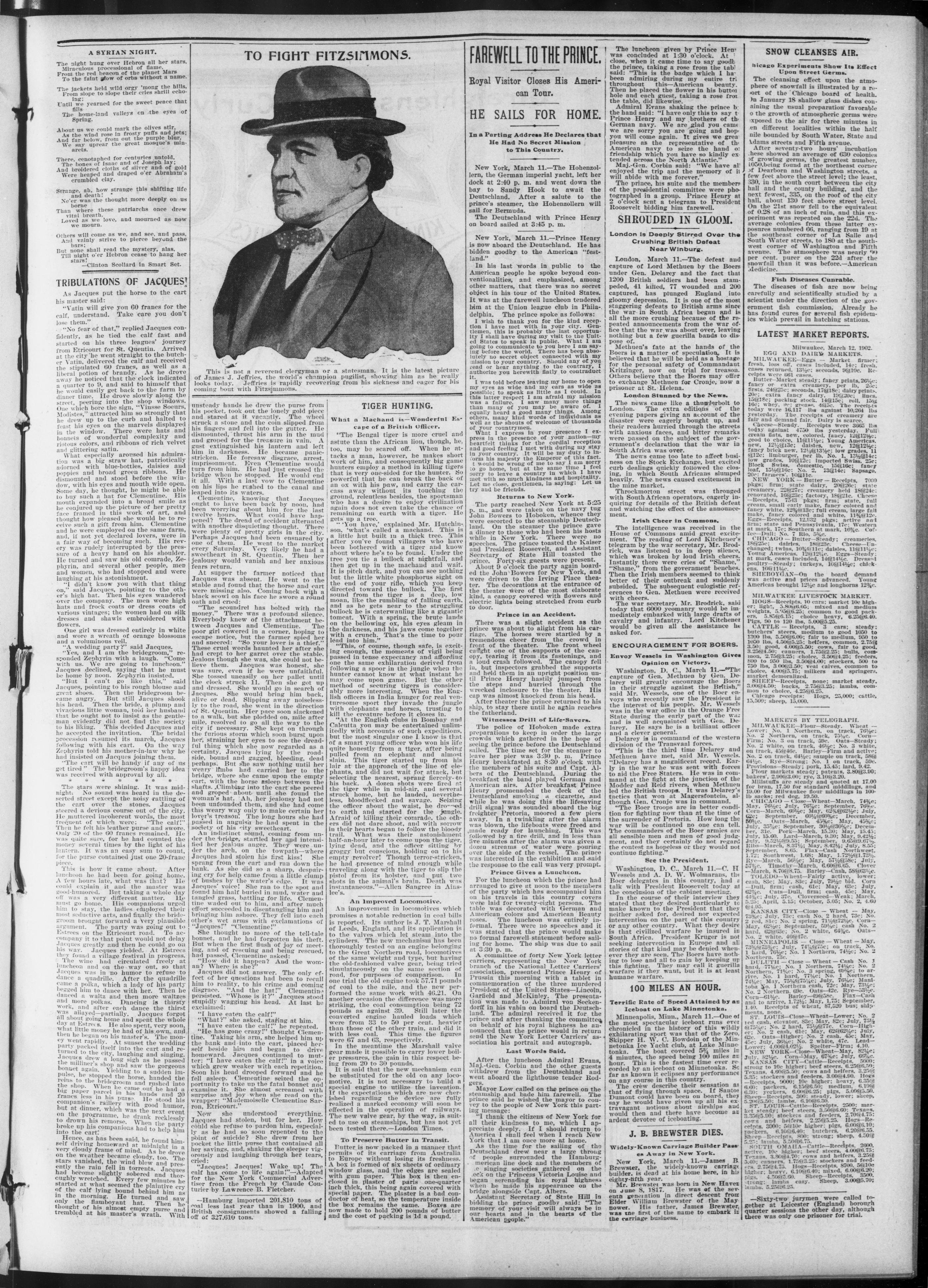
TO FIGHT FITZSIMMONS.
This is not a reverend clergyman of James J. Jeffries, the world's champ looks today. Jeffries is rapidly recovering coming bout with Fitzsimmons.
VINCENT MAYOR
unsteady hands he drew the purse from his pocket, took out the lonely gold piece and stared at it vacantly. The wheel struck a stone and the coin slipped from his fingers and fell into the gutter. He dismounted, thrust his arm in the mud and groped for the treasure in vain. A gust extinguished his lantern and left him in darkness. He became panic-stricken. He foresaw disgrace, arrest, imprisonment. Even Clementine would turn from him. He had just crossed the bridge when he stopped. He would end it all. With a last vow to Clementine on his lips he rushed to the canal and leaped into its waters.
TIGER HUNTING.
What a Machand is—Wonderful Escape of a British Officer.
"The Bengal tiger is more cruel and astute than the African lion, though, he too, may be scared off. When he attacks a man, however, he makes short work of him, and consequently big game hunters employ a method in killing tiger that is very one-sided for the hunter. S powerful that he can break the back of an ox with his paw, and carry the carcass away without its touching the
Clementine, knowing that Jacques ought to have been back by noon, had been worrying about him for the last twelve hours. What could have happened? The dread of accident alternated with another disquieting thought. There were plenty of pretty girls in the city. Perhaps Jacques had been ensnared by one of them. He went to the market every Saturday. Very likely he had a sweetheart in St. Quentin. Then her jealousy would vanish and her anxious fears return.
At supper the farmer noticed that Jacques was absent. He went to the stable and found that the horse and cart were missing also. Coming back with a black scowl on his face he swore a round oath and cried:
"The scoundrel has bolted with the money." There was a profound silence. Everybody knew of the attachment between Jacques and Clementine. The poor girl cowered in a corner, hoping to escape notice, but the farmer spied her and sneered: "So your lover is a thief." These cruel words haunted her after she had crept to her garret over the stable. Jealous though she was, she could not believe them. Jacques was honest, she was sure, even if he were unfaithful. She tossed uneasily on her pallet until the clock struck 11. Then she got up and dressed. She would go in search of Jacques. She would bring him back, alive or dead. Slipping away noiselessly to the road, she went in the direction of St. Quentin. Her pace soon slackened to a walk, but she plodded on, mile after mile, resolved to go all the way to the city if necessary. She kept on through the furious storm which soon burst upon her, straining her eyes to see the dreadful thing which she now regarded as a certainty. Jacques lying by the roadside, bound and gagged, bleeding, dead perhaps. But she saw nothing until her weary limbs had carried her to the bridge, where she came upon the empty cart, with the horse asleep between the shafts. Climbing into the cart she peered and groped about until she found the woman's hat. Ah, her jealousy had not been unfounded them, and she had come this weary way only to make certain her lover's treason. The long hours she had passed in anguish he had spent in the society of his city sweetheart.
An indistinct sound, coming from under the bridge, startled her and intensified her jealous anger. They were under the arch, on the towpath—where Jacques had stolen his first kiss! She sprang from the cart and ran down the bank. As she did so a sharp, despairing cry for help came from a little clump of bushes by the water's edge. It was Jacques' voice! She ran to the spot and found him half buried in mud, water and tangled grass, battling for life. Clementine waded out to him, and after much effort succeeded in disentangling him and bringing him ashore. They fell into each other's wet arms with exclamations of "Jacques!" "Clementine!"
She thought no more of the tell-tale bonnet, and he had forgotten his theft. But when the first flush of joy of meeting, and of rescuing and being rescued, had passed, Clementine asked:
"How did it happen? And the woman? Where is she?"
Jacques did not answer. The only effect of her questions had been to recall him to reality, to his crime and coming disgrace. "And the hat!" Clementine persisted. "Whose is it?" Jacques stood stupidly wagging his head. At last he exclaimed:
"I have eaten the calf!"
"What?" she asked, staring at him.
"I have eaten the skull!"
"I have eaten the calf!" he repeated. "He has gone crazy!" thought Clementine. Taking his arm, she helped him up the bank and into the cart, placed herself beside him and began to drive homeward. Jacques continued to mutter: "I have eaten the calf!" in a voice which grew weaker with each repetition. Soon his head drooped forward and he fell asleep. Clementine seized the opportunity to take up the fatal bonnet and examine it. She almost screamed with surprise and joy when she read on the wrapper: "Mademoiselle Clementine Saron. Etricourt."
New she understood everything. Jacques had stolen, but for her. How could she refuse to pardon him, especially as he had so soon repented to the point of suicide? She drew from her pocket the little purse that contained all her savings, and, shaking the sleeper vigorously and laughing through her tears, cried:
"Jacques! Jacques! Wake up! The calf has come to life again!"-Adapted for the New York Commercial Advertiser from the French by Claude Couturier by Lawrence B. Fletcher.
-Hamburg imported 201,810 tons of coal less last year than in 1900, and British consignments showed a falling off of 327,610 tons.
1.
or a statesman. It is the latest picture
ion pugilist, showing him as he really
ring from his sickness and eager for his
TIGER HUNTING.
What a Machand is—Wonderful Escape of a British Officer.
"The Bengal tiger is more cruel and astute than the African lion, though, he, too, may be scared off. When he attacks a man, however, he makes short work of him, and consequently big game hunters employ a method in killing tigers that is very one-sided for the hunter. So powerful that he can break the back of an ox with his paw, and carry the carcass away without its touching the ground, relentless besides, the sportsman who has a desire to enjoy civilization again does not even take the chance of remaining on earth with a tiger. He gets up a tree.
"You have," explained Mr. Hutchinson, 'what's called a machand. This is a little hut built in a thick tree. This after you've found villagers who have been bothered with a tiger and know about where he's to be found. Under the tree you tie a bullock at nightfall, and then get up in the machand and wait. It is pitch dark, and you can see nothing but the little white phosphorus sight on the end of your rifle, which you keep directed toward the bullock. The first sound from the tiger is a deep, low moan, like the rumbling of falling earth, and as he gets near to the struggling bullock he is caterwailing like a gigantic tomcat. With a spring, the brute lands on the bellowing ox, his eyes gleam in the darkness, and his jaws come together with a crunch. That's the time to pour lead into him."
"This, of course, though safe, is exciting enough, the moments of vigil being passed in tense expectancy and affording one the same exhilaration derived from following a spoor in the jungle when the hunter cannot know at what instant he may come upon game. But the other method of securing tigers is considerably more interesting. When the English officers in India hunger for real venturesome sport they invade the jungle with elephants and horses, trusting to kill the creature before it closes in.
"At the English clubs in Bombay and Calcutta you may be entertained unlimitedly with accounts of such expeditions, but the most singular one I know is that of a smart young officer who won his life quite honestly from a tiger, after being pulled from an elephant and almost slain. This tiger started up from his hair at the approach of the line of elephants, and did not wait for attack, but selecting the nearest, sprang fiercely to his back. A dozen shots were fired at the tiger while in mid-air, and several struck home, but he landed, nevertheless, bloodflecked and savage. Seizing the officer about the waist, he drowned to earth and started for the jungle. Afraid of killing their comrade, the others did not dare shoot, and with sorrow in their hearts began to follow the bloody trail. What was their astonishment half-an-hour later to come upon the tiger, lying dead, and the officer sitting by groggy but conscious, holding on to his empty revolver! Though terror-stricken, he had presence of mind enough while traveling along with the tiger to slip the pistol from its holster, and put two shots in the animal's brain. Death was instantaneous."—Allen Sangree in Ainslee's.
An Improved Locomotive
An improvement in locomotives which promises a notable reduction in coal bills is reported. Its author is J. T. Marshall of Leeds, England, and its application is to the valves which let steam into the cylinders. The new mechanism has been thoroughly tested on an engine belonging to the Great Northern road, locomotives of the same weight and type, but having the old-fashioned valve gear, being tried simulaneously on the same section of road, for purposes of comparison. In one trial the old engine took 57.71 pounds of coal to the mile, and the new performed the same work with 46.21. On another occasion the difference was more striking, the coal consumption being 72 pounds as against 39. Still later the converted engine hauled loads which were from 33 to 50 per cent, heavier than those of the other train, and did it with less coal. This time the figures were 67 and 63, respectively.
In the meantime the Marshall valve gear made it possible to carry lower boiler pressures, the gain in this respect being from 20 to 30 pounds. It is said that the new mechanism can be substituted for the old on any locomotive. It is not necessary to build a special engine to utilize the invention. If the expectations which are new cherished regarding the device are fully realized a marked economy will soon be effected in the operation of railways. The new valve gear, by the way, is suited to use on steamships, but has not yet been tested there.—London Times.
To Preserve Butter in Transit.
Butter is now packed in a manner that permits of its carriage from Australia to Europe without losing its freshness. A box is formed of six sheets of ordinary window glass, and the edges are sealed with gum paper. This box is then enclosed in plaster of paris one-quarter inch thick, this being again covered with special paper. The plaster is a bad conductor of heat, so the temperature inside the box remains the same. Boxes are now made to hold 200 pounds of butter and the cost of packing is 1d a pound.
---
FAREWELL TO THE PRINCE.
HE SAILS FOR HOME.
In a Parting Address He Declares that He Had No Secret Mission to This Country.
New York, March 11.—The Hohenzollern, the German imperial yacht, left her dock at 2:40 p. m. and went down the bay to Sandy Hook to await the Deutschland. After a salute to the prince's steamer, the Hohenzollern will sail for Bermuda.
The Deutschland with Prince Henry on board sailed at 3:45 p. m.
New York, March 11.—Prince Henry is now aboard the Deutschland. He has bidden goodby to the American "festland."
In his last words in public to the American people he spoke beyond conventionalities, and emphasized, among other matters, that there was no secret object in his tour of the United States. It was at the farewell luncheon tendered him at the Union league club in Philadelphia. The prince spoke as follows:
I wish to thank you for the kind reception I have met with in your city. Gentlemen, this is probably the last opportunity I shall have during my visit to the United States to speak in public. What I am going to communicate to you here I am saying before the world. There has been absolutely no secret object connected with my mission to your country. Should any of you read or hear anything to the contrary, I authorize you herewith flatly to contraduct it.
I was told before leaving my home to open my eyes as wide and my cars as wide as possible; to speak as little as I could. In this latter respect I am afraid my mission was a failure. I saw many more things than many of you may be aware of. I equally heard a good many things. Among others, many kind words of individuals as well as the shouts of welcome of thousands of your countrymen. What I express in your presence I express in the presence of your nation—my heartfelt thinks for the cordial reception and good feeling I met with during my stay in your country. It will be my duty to inform his majesty the Emperor of this fact.
it would be wrong of me to say I am sorry to go home, but at the same time I feel sorry to leave a country in which I have met with so much kindness and hospitality. Let me close, gentlemen, in saying: Let us try and be friends.
Returns to New York.
The party reached New York at 5:25 p. m., and were taken on the navy tug John Bowers to Hoboken, whence they were escorted to the steamship Deutschland. On the steamer the prince gave a dinner to those who had been his hosts while in New York. There were no speeches. The prince toasted the Kaiser and President Roosevelt, and Assistant Secretary of State Hill toasted the prince. Forty-six guests were present. About 9 o'clock the party again boarded the John Bowers for New York, and were driven to the Irving Place theater. The decorations at the entrance of the theater were of the most elaborate kind, a canopy covered with flowers and electric lights being stretched from curb to door.
Prince in an Accident.
There was a slight accident as the prince was about to alight from his carriage. The horses were startled by a tremendous cheer from the crowd in front of the theater. The front wheel caught one of the supports of the canopy, tearing it from its fastenings, and a loud crash followed. The canopy fell in, but inspectors grabbed the supports and held them in an upright position until Prince Henry hastily jumped from the steps and hurried through the wrecked enclosure to the theater. His cap was almost knocked from his head. After theater the prince returned to his ship to stay there until he again woohes
After theater the prince returned to his ship, to stay there until he again reaches the fatherland.
Witnesses Drill of Life-Savers.
The police of Hoboken made extra preparations to keep in order the large crowds which gathered in the hope of seeing the prince before the Deutschland sailed. The time set for the steamer to leave her pier was 3:30 p. m. Prince Henry breakfasted at 8:30 o'clock with the members of his suite and Capt. Albers of the Deutschland. During the breakfast the band played German and American airs. After breakfast Prince Henry promenaded the deck of the Deutschland smoking a cigarette, and while he was doing this the lifesaving drill signal was sounded aboard the big freighter Pretoria, moored a few piers away. In a twinkling after the alarm was blown, the lifeboats were freed and made ready for launch. This was followed by a fire drill, and in less than five minutes after the alarm was given a dozen streams of water were pouring over the side of the vessel. The prince was interested in the exhibition and said the response to the call was very prompt.
Prince Gives a Luncheon.
For the luncheon which the prince had arranged to give at noon to the members of the party which has accompanied him on his travels in this country covers were laid for twenty-eight persons. The table was decorated with German and American colors and American Beauty roses. The luncheon was entirely informal. There were no speeches and it was stated that the prince would make no formal farewell statement before sailing for home. The ship was due to sail at 3:30 p. m.
A committee of forty New York letter carriers, representing the New York branch of the National Letter Carriers' association, presented Prince Henry of Prussia this morning with a tablet in commemoration of the three murdered President of the United States—Lincoln, Garfield and McKinley. The presentation was made to Admiral von Seckendorff in his vabin on board the Deutschland. The admiral received it for the prince and after thanking the committee on behalf of his royal highness he announced that the prince would in return send the New York Letter Carriers' association his portrait and autograph.
Last Words Said.
After the luncheon Admiral Evans, Maj.Jen. Gen. Corbin and the other guests withdrew from the Deutschland and went aboard the lighthouse tender Rodgers.
Mayor Low called on the prince on the steamship and bade him farewell. The prince said he wished the mayor to convey to the people of New York this parting message:
"I thank the citizens of New York for all their kindness to me, which I appreciate deeply. If I should return to America I shall feel when I reach New York that I am once more at home.
As the time for the sailing of the Deutschland drew near a large throng of people surrounded the Hamburg- merican line dock and the members of the singing societies gathered on the deck on the Princess Victoria Louise and began serenading his royal highness when he made his appearance on the bridge alongside Capt. Albers. Assistant Secretary of State Hill in bidding the prince goodbye said: "The memory of your visit will always be in our hearts and in the hearts of the American people."
The luncheon given by Prince Henry was concluded at 1:30 o'clock. At close, when it came time to say goodbye the prince, taking a rose from the table said: "This is the badge which I have been admiring during my entire trip throughout this—American beauty. Then he placed the flower in his button hole and each guest, taking a rose from the table, did likewise.
Admiral Evans shaking the prince by the hand said: "I have only this to say to Prince Henry and my brothers of the German navy. We are glad you came we are sorry you are going and hope you will come again. It gives we great pleasure as the representative of the American navy to seize the hand of friendship which you have so kindly extended across the North Atlantic."
Maj.-Gen. Corbin said: "We have all enjoyed the trip and the memory of it will abide with me forever." The prince, his suite and the members of the presidential committee were photographed in a group. Prince Henry at 2 o'clock sent a telegram to President Roosevelt bidding him farewell.
SHROUDED IN GLOOM.
London is Deeply Stirred Over the Crushing British Defeat Near Winburg.
London, March 11.—The defeat and capture of Lord Methuen by the Boers under Gen. Delarey and the fact that 1200 British soldiers had been stamped, 41 killed, 77 wounded and 200 captured, has plunged England into gloomy depression. It is one of the most staggering defeats to British arms since the war in South Africa began and is all the more crushing because of the repeated announcements from the war office that the war was about over, leaving nothing but a few guerilla bands to dispose of.
Methuen's fate at the hands of the Boers is a matter of speculation. It is believed that he will be held as a hostage for the personal safety of Commandant Kritzinger, now on trial for treason. Others believe that the Boers may offer to exchange Methuen for Cronje, now a prisoner at St. Helena.
London Stunned by the News.
The news came like a thunderbolt to London. The extra editions of the evening papers giving an account of the disaster were eagerly bought up, and their readers hurried through the streets with anxious faces, and bitter remarks were passed on the subject of the government's declaration that the war in South Africa was over.
The news came too late to affect business on the Stock Exchange, but excited curb dealings quickly followed the closing, in which South Africans slumped heavily. The news caused excitement in the mine market.
Throckmorton street was thronged with South African operators, eagerly inquiring for details of the British defeat and watching the effect of the announcement.
Irish Cheer in Commons.
The intelligence was received in the House of Commons amid great excitement. The reading of Lord Kitchener's telegram by the war secretary, Mr. Brodrick, was listened to in deep silence, which was broken by loud Irish cheers, Instantly there were cries of "Shame," "Shame," from the government benches. Then the Irish members seemed to think better of their outbreak and suddenly subsided. The subsequent eulogistic references to Gen. Methuen were received with cheers. The war secretary, Mr. Brodrick, said today that 6000 yeomanry would be immediately embarked with large drafts of cavalry and infantry. Lord Kitchener would be given all the assistance he asked for.
ENCOURAGEMENT FOR BOERS.
Envoy Wessels in Washington Gives
Oprion on Victory.
Washington, D. C., March 11. "The capture of Gen. Methuen by Gen. Delarey will greatly encourage the Boers in their struggle against the British," said Mr. Wessels, one of the Boer envoys who recently saw the President in the interest of his people. Mr. Wessels was in the war office in the Orange Free State during the early part of the war and is well acquainted with Gen. Delarey. He says he is a brilliant officer and a clever general. Delarey is in command of the western division of the Transvaal forces.
"This is the third time Delarey and Methuen have met, said Mr. Wessels. "Delarey has a magnificent record. Early in the war he was sent with forces to aid the Free Staters. He was in command at the fight at the junction of the Modder and Reid rivers, when Methuen led the British troops. It was Delarey's tactics that won at Magersfontein, although Gen. Cronje was in command. "The Boer troops are in better condition for fighting now than at the time of the surrender of Pretoria. How long the war will be continued no one can tell. The commanders of the Boer armies are all sensible men and men of good judgment, and they certainly do not regard the contest as hopeless or they would not continue fighting."
See the President.
Washington, D. C., March 11.-C. H. Wessels and A. D. W. Wolmarans, the Boer delegates in this country, had a talk with President Roosevelt today at the conclusion of the cabinet meeting. In the course of their interview they stated that they desired particularly to make known to the President that they neither asked for, desired nor expected intervention on the part of this country or any other country. What they desire is that civilized warfare be insured in South Africa. President Kruger is not seeking intervention in Europe and all stories of that kind may be denied whenever they are seen. The Boers have nothing to lose and all to gain by keeping up this fighting. They may call it guerilla warfare if they want, but it is at least humane warfare.
100 MILES AN HOUR.
Terrific Rate of Speed Attained by an Iceboat on Lake Minnetonka.
Minneapolis, Minn., March 11.—One of the most spectacular iceboat runs ever chronicled in the history of this wildly exhilarating sport was that of the Zero, Skipper H. W. C. Bowdoin of the Minnetonka Ice Yacht club, at Lake Minnetonka. The boat covered $5\frac{3}{4}$ miles in 4 minutes, the speed being 100 miles an hour. This is the fastest time ever recorded by an iceboat on Minnetonka. So far as known it eclipses any performance on any course in this country.
The crew describe their sensation as that of flying through space. If Santos Dumont could have been on board, they say he would have given up all his extravagant notions about airships and would then and there have become an ardent devotee of iceboating.
J. B. BREWSTER DIES.
Widely-Known Carriage Builder Passes Away in New York.
New York, March 11.—James B. Brewster, the widely-known carriage builder, is dead at his home here, in his eighty-fifth year.
Mr. Brewster was born in New Haven on June 8, 1817. He was of the seventh generation in direct descent from Elder William Brewster of the Maynower. His father, James Brewster, was the first of the name to embark in the carriage business.
SNOW CLEANSES AIR.
chicago Experiments Show Its Effect Upon Street Germs.
The cleansing effect upon the atmosphere of snowfall is illustrated by a report of the Chicago board of health. On January 18 shallow glass dishes containing the usual preparation favorable to the growth of atmospheric germs were exposed to the air for three minutes in ten different localities within the half mile bounded by South Water, State and Adams streets and Fifth avenue.
After seventy-two hours' incubation these showed an average of 630 colonies of growing germs, the greatest number, 1050, being found at the northeast corner of Dearborn and Washington streets, a few feet above the street level; the least, 330, in the south court between the city hall and the county building, and the next fewest, 335, on the roof of the city hall, about 130 feet above street level. On the 21st snow fell to the equivalent of 0.28 of an inch of rain, and this experiment was repeated on the 22d. The average colonies from these latter exposures numbered 66, ranging from 19 at the southeast corner of La Salle and South Water streets, to 180 at the southwest corner of Washington and Fifth avenue. The atmosphere was nearly 90 per cent. purer on the 22d after the snowfall than it was before.—American Medicine.
Fish Diseases Cuprable
The diseases of fish are now being carefully and scientifically studied by a scientist under the direction of the government fish commission. Already he has found cures for several fish epidemics which prevail in hatching stations.
LATEST MARKET REPORTS
Milwaukee, March 12, 1902.
ECC. AND. BAIRN. MARKETS.
EGG AND DAIRY MARKETS.
MILWAUKEE—Eggs — Market firmer; fresh, loss off, cases included, 14c; fresh, cases returned, 13½c; seconds, 9@10c. Receipts were 661 cases.
Butter-Market steady; fancy prints, 26½c; fancy or extra creamy, per lb, 25c; firsts, 24@25c; seconds, 17@18c; dairy prints, 20c; extra fancy dairy, 19@20c; lines, 15@18c; packing stock, 14@15c; roll, 15@16c; whey, 4c; grease, 4@5c. The receipts today were 16,117 lbs against 10,264 lbs yesterday. The receipts of creamy are fair and demand fair. Dairy is scarce.
Cheese—Steady. Receipts were 3865 lbs today against 4750 lbs yesterday. Full cream flats, new, colored, fancy, 12@12½c; good to choice, 11@11½c; Young Americas, new, 12½@13c; daistes, new, 12@12½c; fancy brick new, 12@13½c; low grades, 11@12c; limburger, per lb. No. 1, 13@14c; low grades, 10@12c; imported Swiss, 25c; Block Swiss, domestic, 15@16c; fancy loaf, 15½@16c; No. 2, 13@14c; Sapsago, 20c; farmers', 10@11c.
NEW YORK—Butter—Receipts, 7000 pkgs; firm; state dairy, 20@26c; state creamery, 22@27c; creamery held 18@24c; renovated, 12@23c; factory, 18@21c. Cheese—Receipts, 7543 pkgs; firm; state, full cream, small early make, fancy colored and fancy white, 12%@13c; full cream, large fall make, fancy colored and white, 11%@12c. Eggs—Receipts, 12,932 pkgs; active and firm; state and Pennsylvania, 17c; Western at mark, 17c; Southern at mark, 16%c. Coffee—Dull. No. 7 Rio, 5%c.
CHICAGO—Butter—Steady; creameries, 18@25c; dairies, 18@23c. Cheese—Unchanged; twins, 10%@11c; daisies, 11@11c; Young Americas, 12@1214c. Eggs—Steady; at mark, cases included, 14@1414c. Dressed poultry—Steady; turkeys, 10@1414c; chickens, 10@114c.
SHEBOYGAN—On the board demand was active and prices advanced. Young Americas brought 12%c and longhorns 12%c.
MILWAUKEE LIVESTOCK MARKET.
MILWAUKEE LIVESTOCK MARKET.
HOGS—Receipts, 10 cars; inmarket 10c higher; light, 5.80@6.05; mixed and medium weights, 5.95@6.25; common to good packers, 5.85@6.15; choice heavy, 6.25@6.40. Pigs, 90 to 120 lbs, 5.00@5.15.
CATTLE — Receipts, 3 cars; steady; butchers' steers, medium to good 1050 to 1300 lbs, 5.50@6.00; fair to medium, 950 to 1050 lbs, 4.50@5.25; helfers, common, 2.75@ 3.50; good, 4.00@5.50; cows, fair to good, 3.25@4.50; canners, 1.75@2.25; bulls, common, 2.75@3.25; choice, 3.50@4.25; feeders, 800 to 950 lbs, 3.50@4.00; stockers, 500 to 750 lbs, 3.00@3.50; veal calves, common to choice, 4.00@5.75; milkers and springers, market demoralized.
Chicago receipts: Hogs, 25,000; cattle, 15,500; sheep, 15,000.
MARKETS BY TELEGRAPH
MILWAUKEE—Fleur-Steady. Wheat --Lower; No. 1 Northern, on track, 76½¢; No. 2 Northern, on track, 75½¢; Corn--Firm; No. 3 on track, 59c; Oats--Steady; No. 2 white, on track, 46½¢; No. 3 white, on track, 45@46c. Barley-Firm and active; No. 2 on track, 64½¢; sample on track, 58@64½¢. Rye--Strong; No. 1 on track, 59c. Provisions-Steady; pork, 15.45; lard, 9.42. Flour markets steady; patents, 3.80@3.90; bakers', 2.90@3.00; rye, 3.10@3.20. Millstuffs are steady and quoted at 17.00 for bran, 17.50 for standard middlings, and 19.00 for Milwaukee flour middlings in 100lb sacks; red dog, 19.50.
CHICAGO — Close—Wheat—March, 74%c;
May, 76%c; July, 76%c; September, 76%c;
Corn—March, 60%c; May, 62%@62%c; July,
62%c; September, 60%@60%c; December,
50%c. Oats—March, 45%c; May, 45%c;
July, 35%c; September, 30%@30%c; December,
31%c. Pork—March, 15.30; May, 15.45;
July, 15.60. Lard—March, 9.30; May, 9.42%c;
July, 9.52%@9.55; September, 9.65@9.67%c;
Ribs—March, 8.37%c; May, 8.42%c; July, 8.55;
September, 8.65. Flax—Cash Northwest,
1.72. Southwest, 1.68; May, 1.72%@1.73%c;
Rye—March, 56%c; May, 57%@58%c; July,
57%c. Timothy—March, 6.60@6.65. Clover—
March, 8.70@8.75. Barley—Cash, 58%@33%c.
TOLEDO—Wheat—Fairly active, lower;
cash, 83c; May, 83c; July, 79%c bid. Corn—
Dull, firm; cash, 61c; May, 63c; July,
62%c. Cats—Dull, firm; cash, 45c; May,
44%c; July, 37c. Clovered—Weak; March,
5.25. April, 5.15; October, 5.05; No. 2, 4.60
@4.95.
KANSAS CITY—Close — Wheat — May,
73%c; July, 73c; cash No. 2 hard, 73c; No.
2 red, 81c; No. 2 spring, 71%@72%c; Corn-
May, 62%c; September, 59%c; cash No. 2
hard, 62@63c; No. 2 white, 64%c; Oats—
No. 2 white, 46@47c.
MINNEAPOLIS — Close — Wheat — May,
73%@73%c; July, 74%@75c; on track, No.
1 hard, 76%c; No. 1 Northern, 74%c; No. 2
Northern, 73c.
DULUTH — Close — Wheat — Cash No. 1
hard, 77%c; No. 1 Northern, 74%c; No. 2
Northern, 71%c; No. 3 spring, 69%c; to
arrive, No. 1 hard, 77%c; No. 1 Northern,
74%c; May, 75%@75%c; July, 76%c; Manitoba
No. 1 Northern cash, 72; May, 73%c;
No. 2 Northern, 69c; Oats—42c; Rye—53%c;
Corn—61%c; Barley—49@58c; Flax—Cash
and to arrive, 1.72%c; May, 1.75; September,
1.40. Receipts of wheat, 87,520 bus; ship-
pments none.
ST. LOUIS—Close-Wheat-Lower. No. 2
1ed cash, elevator, 83c; May, 82c; July, 75c;
@75%c; No. 2 hard, 75%@77c. Corn-Higher.
No. 2 cash, 61c; May, 62@62%c; July,
62c. Oats-Higher. No. 2 cash, 45c; May,
45c; July, 36%c; No. 2 white, 47c. Lead-
Lower. 4.00@4.02%c. Spelter-Firm; 4.10.
NEW YORK—Close-Wheat-May, 82%c;
July, 82%c. Corn-May, 67%c; July, 65%c.
KANSAS CITY—Cattle-Receipts, 5000;
strong to 10c higher; beef steers, 6.25@6.50;
Texans, 4.60@5.50; cows and heifers, 3.25@
5.35; stockers and feeders, 3.00@4.90. Hogs
-Receipts, 9000; 10c higher; heavy, 6.35@
6.00; packers, 6.15@6.50; medium, 6.10@
6.30; yorkers, 6.00@6.25; plgs, 5.00@5.50.
Sheep-Receipts, 300; steady, lower, sheep,
5.20@5.15; lambs, 6.10@6.30.
ST. LOUIS—Cattle-Receipts, 2500; market
steet; beef steers, 3.50@6.60; Texans,
3.35@5.30; stockers and feeders, 2.70@4.75;
cows and heifers, 2.25@5.25. Hogs-Receipts,
3000; 5@10c higher; plgs, 6.00@6.10;
packers, 6.10@6.40; butchers, 6.20@6.55.
Sheep-Receipts, 800; strong; sheep, 4.50@
2.50; lambs, 5.10@6.75.
SOUTH OMAHA—Cattle—Recelpts, 2000,
active, 10c higher; beef steers, 4.00@6.75;
Texans, 3.80@4.70; cows and heifers, 3.25@
5.40; canners, 1.75@3.25; stockers and feeders,
2.75@4.75. Hogs—Recelpts, 5700, 5@10c
higher, heavy, 6.10@6.40; mixed, 6.00@6.20;
pigs, 4.50@5.60. Sheep—Recelpts, 3500,
strong; lambs easy. Sheep, 3.00@5.70;
lambs, 5.25@6.25.
—Sixty-two jugmen were called to
together at Leicester (England) borough
quarter sessions the other day, although
there was only one prisoner for trial.
The Wisconsin Weekly Advocate
MILWAUKEE, WIS.
SUBSCRIPTION RATES
Any part of the United States and Canada, postage paid.
postage paid.
One Year ..... $2.00
Six Months ..... 1.25
Three Months ..... .75
Send money by Express Money Order, P. O.
Money Order or Registered Letter to the
Wisconsin Weekly Advocate.
ADVERTISING RATES.
One inch, single insertion..... 25c
One inch, per year..... $0.00
Business locals 5c per line each insertion.
Apply for rates to the Advocate.
TO CONTRIBUTORS:
All communications must be sent with the name and address of the sender as an evidence of good faith, but not necessarily for publication. No manuscript returned if not accepted, unless accompanied by stamps.
The Wisconsin Weekly Advocate company wishes to notify the public that all contracts and business transactions with this company must have the company stamp, otherwise they will be void. Neither will this company be responsible for paid subscriptions unless given to duly-accredited agents, who, on request, will give the company's receipt for same. Subscribers falling to receive their papers regularly will kindly notify the general office. Address all business communications to the general manager, 729 St. Paul avenue.
Entered in the Postoffice at Milwaukee as Second-class matter.
There seems to be something worth fighting for in Arabia, after all.
The Western rivers also are rising to give emphatic notice that spring is here.
Compulsory irrigation is now an experience among farmers who cultivate bottom lands in the South.
The Prince's short walk in Chicago enabled him to see that although the city's head is in the skies her feet are in the mud.
The attempt in New Jersey to take away the charter of the Northern Securities Company is like the historic attack by Brutus.
When M. Santos-Dumont visits New York he can take a flyer without unpacking his gas bag, by consulting certain Wall street experts.
It is only stolen kisses that are rated at $5000 each in Sauk county. The mutual consent variety are so common that they are never quoted.
The finding of $8000 in gold in a tin can in a saloon at Tamaroa, Illinois, will not give the growler a standing either as a fire-proof or a burglar-proof safe.
Are the foreign women at Pekin winning the Chinese Dowager Empress and her apron-string attachment, or are the latter buncoing the fair foreigners?
Vancouver's efforts to secure the Jeffries-Fitzsimmons fight might lead the metropolis of Cape Nome to try to drag pugilism a little nearer the north pole.
Boston's hotel fire was unaccompanied by loss of life, but its lesson is the same as that of the Park Avenue Hotel fire in New York. Watchfulness must not be relaxed.
Mayor Jones of Toledo, who refused to sign an address of welcome from his city to Prince Henry, has simply lifted himself several numbers on the list of political freaks.
The Boers who used dead cattle for breastworks were very careless as to a product that has a high standing, in the estimation of those who are responsible for the market quotations.
The Prince's rushing movements through the country have entailed a great deal of anxiety and hard work upon thousands of ambitious professional and amateur snap-shot artists.
There are plenty of human bipeds who are willing to scratch gravel, if the feeding place can be found where the chickens from Fifield swallowed the gold nuggets that were taken from their crops at Chicago.
The Honolulu judge who declared unconstitutional the law fixing a low license for home-brewed beer and a high license for the foreign product, has a particular regard for justice, and possibly also a discriminating taste.
The revelation that Prince Henry is heavily insured and that some of the leading rulers carry similar policies, may cause some people to wonder why they never saw the advertising "literature" of the Crowned Heads Assassination Insurance Company.
J. P. Morgan's early departure for Europe may presage another merging of steamship and other properties. Mr. Morgan has done so much business of that kind that he can now hardly cause surprise by anything he may do in the immediate future.
The state board of agriculture is wise in standing against the proposed sale of a twenty-five acre strip of the fair grounds in Milwaukee. The state fair is a growing institution, and in the course of a comparatively few years every acre of the present park will be needed.
Sir Thomas Lipton has at last reached the conclusion that the Colombia is better than his latest Shamrock; but he is willing to let somebody make further tests, while he is building another challenger. There is therefore a prospect that the Shamrock may be raced in American waters during the coming season, and yachtsmen generally are pleased.
The instant death of a young man at Duluth, while using a telephone, was probably due to a stray current let in by a crossing of wires. The incident is one that suggests the need of close inspection of the wires in cities, to prevent such accidents. It ought to be possible in this age of invention to avoid the dangers incident to crossed wires, if the crossing of wires cannot be altogether avoided.
SHORT, IMPRESSIVE TEMPERANCE SERMONS.
Dangers that Lurk in the Flowing Bowl—How Bright and Influential Men Have Been Dragged Down by the Demon Drink—Suppress the Traffic.
The thought that there should ever be an inspiration to those who are battling for the right and the wrong, in all the ages of the past, the right was eventually victorious. It is not true that right is always on the scaffold and wrong upon the throne. We have many illustrations drawn from the world's history to demonstrate the truthfulness of this statement.
In the great struggle in which we are now engaged, inaugurated nearly one hundred years ago by our fathers and mothers, against the liquor traffic, they found at the outset these forces arrayed against them-appetite, avarice, superstition, ignorance, the church (with few exceptions), wealth, political power, and the demagogues. But with these tremendous obstacles arrayed against them, these noble men and women, with a heroism that has never been excelled, with self-sacrifice and devotion that challenge the admiration of the world, with a long list of martyrs that have fallen at the hands of the assassin and the mob, have gone through a campaign of nearly one hundred years, and these have been their achievements: They have reversed public opinion entirely as to the beneficial effect of strong drink for the man. Outside of the trade, the traffic has no defenders to speak of. Those who oppose us now oppose only our methods, while they claim even to excel us in devotion to the reform. We have made the medical world acknowledge their mistake as to their views on the great medicinal properties of alcohol, many of the most eminent of their profession denying any virtue whatever to alcohol as a medicine, while its friends claim now in a few cases only that its use is advisable, and they are preparing to rapidly surrender their whole position.
These are the forces that are now generating public sentiment to greater or less extent against the liquor traffic in this country: The churches, the Sunday schools, the Young People's Unions, the Good Templars, the Woman's Christian Temperance Union, and the Probibition party—the party that has never defended the license system, has never equivocated, has never compromised and after twenty-five years in storm and battle, amid derision, scorn and misrepresentation, trusting in the same God who in all lands and in all ages has given victory to those who stand for the right, still looks forward with confidence and faith to the coming of that bright morning when the church bells shall ring out all over the land proclaiming the glad news of the victory of this party over the relic of barbarism and sin, the legalized liquor traffic.—Col. John Sobieski.
Evil of Cigarettes.
At a mass meeting of the Parents' League of Kokomo, Ind., unanimous action was taken against the cigarette habit, and the school authorities, supported by the league, will wage a crusade against the evil, which is growing on the boys. Professor Ogg, superintendent of the schools, made a report to the board of education showing that out of 1,300 boys in the city schools, 400 were addicted to the cigarette habit, and were in consequence two years behind in their studies. Says Professor Ogg: "These various reports include nearly 1,300 boys, from the first grade through the high school. Over one-third of these admit they do smoke or have smoked.
"Those who belong to the class of smokers average one year older than those who do not smoke. Taking those who are habitual smokers, the difference in age is two years, making them two years behind the non-users in their studies. But there are other losses besides those of progress. In the teachers' reports are annotation marks of 'no self-control,' 'poor,' 'inattentive,' 'untrustworthy,' 'lazy,' 'very dull,' 'no concentration,' 'vacant stare,' etc."
Continuing, Professor Ogg says: "We now propose to invoke the law. The law is adequate if enforced. From this date teachers will report whatever will aid in enforcing the law. We will contest for the salvation of the boys and tobacco dealers selling to the boys under sixteen will be promptly dealt with from this date."
Spread of Temperance Education. Twenty years ago Mrs. Mary H. Hunt made a "temperance education map" of the United States. She was urging then, as she has been ever since, the necessity of giving to the public school children some scientific knowledge of alcohol and its effects. The whole of her first map was black, and beneath it this explanatory line: "States in black have no temperance education laws." No State, it was obvious, then had such a law. The other day Mrs. Hunt summoned a few friends to her home in Dorchester, Mass., and in their presence removed the last patch of black from her map. The Governor of Georgia had signed the temperance education bill, and at last the whole of the United States, from Canada to the Rio Grande and from sea to sea, is white. There is not a single State in which the effect of alcohol is not taught in the schools. Youth's Companion.
Don't groan over the wickedness of this world, but mend your own.
Straightens Kinky, Curly Hair
OZONO
TRADE MARK
KING OF ALL HAIR TONICS.
50¢
BEFORE.
AFTER.
IN order to protect the public from the numerous quack nostrums now on the market, which claim to straighten and cause the hair to grow long, and which are simply put up by a lot of quacks, charlatans, and fakirs, who have no chemical skill, with the sole idea to get your hard-earned cash and give you nothing in return for your money but a dirty, sticky mass of worthless greases, which injure the hair and cause it to fall out, we have placed our trade-mark, granted to us by the Government of the United States of America, on every box of OZONO, King of all Hair-Growers and Hair-Straighteners. This trade-mark consists of two heads, as shown in this advertisement—one head showing short, curly hair, the other showing long, flowing hair. Any preparation showing the heads with the hair done up in a coil, or showing features different from the faces shown in this advertisement, is not OZONO. Seeing our marked success with the true hair-straightener, OZONO, King of all Hair-Growers, numerous firms are now widely advertising spurious compounds, and trading on the reputation that we have made for OZONO. Do not be fooled by these flaring advertisements, which are all promises. Buy the genuine and only original King of all Hair Tonics, OZONO. Two hundred and fifty thousand colored people bought OZONO in the last twelve months. OZONO is sold in every State in the Union, all over Europe, Asia, Africa, and South America, also in Cuba and the West Indies. Its fame has travelled around the world, because it is a true Hair Tonic, that straightens without any outside assistance. No hot irons are used; nothing but OZONO. It not only straightens the hair, but produces a long, silky, beautiful, luxurious growth of soft, fine hair. To neglect your hair is more than foolish, when you can increase its beauty by a few applications of OZONO. We can send OZONO to any place that you may live in, no matter where you may live. The price of OZONO is 50c. a box, sent to any point on receipt of price. Four boxes is a complete treatment. In order to introduce this great Hair Tonic, we will send to you, on receipt of only $1.00, the following grand aggregation: Four boxes of OZONO; one bottle of ELECTRICAL SKIN REFINER, which softens rough skin and brightens black skin, making it several shades lighter, worth 50c.; also one bottle of ELECTRICAL SKIN FOOD, Nature's cure for all skin diseases, such as Pimples, Tan, Acne, Itch, Eczema, and Boils. It also removes Wrinkles, and makes the skin soft and pliant. We will also include a one-pint package of ANTI-ODOR, which removes all smells and odors arising from the human body, such as feet, arm-pits, &c.; also one bar of our PURITY SCALP SOAP, made expressly for the human scalp. This grand aggregation offer is made to introduce honest goods. Cut out this coupon and mail to us, with $1.00, and we will send the goods the same day we receive the money. If you send $3.00, we will send you four lots; if you send $2.00, we will send you three lots. If you have a friend who wishes to take advantage of this lot, let them pin their name to this coupon, and the goods will be sent promptly. If this offer is read by some one who does not own this newspaper, they can get the goods by simply sending $1.00 and mentioning the name of the paper in which they saw our advertisement. Parties who desire one of our MAGNETIC COMBS, which aids materially in the straightening process, can obtain same by sending 50c. extra. Remember, OZONO is guaranteed to straighten the hair—to
When writing to advertisers please mention Wisconsin Weekly Advocate.
Fine Wines, Liquors and Cigars always on hand
208 Fourth Street, MILWAUKEE.
Members of the Keystone Club
DOUGLAS MOORE, Pres. CHAS. JOHNSON, Vice-Pres. J. H. ELLIS, Treas.
SAM PATTERSON, Asst. Treas. WILL HARRIS, Sec'y. E. M. HAWKINS, Ass't. Sec'y
H. C. COWAN. D. JOHNSON. H. KING. SAMUEL BANKS. WM. SMITH.
WM. BOLTON. H. CREETCHER.
To Each Subscriber
To the Wisconsin Weekly Advocate the editor will present a handsome souvenir in the form of an elegantly gotten up portrait of the late President McKinley.
519 Weils St., Milwaukee, Wis. Mrs. Lee Woodard, Prop. SUNDAY 5 O'CLOCK DINNER A SPÉCIALTY.
OPEN ALL DAY AND NIGHT
```markdown
```
OZONO is guaranteed to straighten the hair—to make it grow long, soft, and glossy; also to cure all itching, burning, humiliating scalp diseases. To make the hair grow out again on bald spots, especially around the temples, there is no Hair Tonic on earth one-half so good. The Boston Chemical Company holds a charter granted by the State of Virginia. We also refer to the Metropolitan Bank of Richmond, Va., and to the Southern Express Company. Register your letters; it protects you. Address your letters plainly to—
BOSTON CHEMICAL COMPANY,
310 East Broad Street, RICHMOND, VA.
Alfred A. Grun
DEALER IN
Fresh, Salted & Smoked
OF ALL KINDS.
Fresh Fish and Oysters in
MAIN 6253. 502 WELLS ST.
ES B. BRADFORD
422 BROADWAY
PIANOS
Pianos from $150 u
n Monthly Payments and
erms, and also Rent Pianos.
Piano House in the City. Established 18
ND GET MY PRICES BEF
YOU BUY ELSEWHERE.
THE
ARTIST
ART
Parlor
While in city visit . . .
STEPHEN
HOTEL and RESTA
I Sell on Monthly Payments and Easy Terms, and also Rent Pianos. The Oldest Piano House in the City. Established 1872.
CALL AND GET MY PRICES BEFORE YOU BUY ELSEWHERE.
---
Bison
Fred A. Grunitz
DEALER IN
Salted & Smoked Meats
OF ALL KINDS.
Fish and Oysters in Season
502 WELLS ST.
BRADFORD
BADWAY
NOS
from $150 up
Payments and Easy
so Rent Pianos.
The City. Established 1872.
Y PRICES BEFORE
LSEWHERE.
While in city visit . . .
STEPHENS'
HOTEL and RESTAURANT
First-Class Accommodations Home Cooking a Specialty...
No. 2832 State St., CHICAGO, ILL.
Tal
ROM the letter to the Hebrews Dr. Talmage takes a text and illustrated how all offenders may be emancipated; text, Hebrews viii., 12, "Their sins and their iniquities will I remember no more."
The national flower of the Egyptians is the heliotrope, of the Assyrians is the water lily, of the Hindoos is the marigold, of the Chinese is the chrysanthemum. We have no national flower, but there is hardly any flower more suggestive to many of us than the forgetmenot. We all like to be remembered, and one of our misfortunes is that there are so many things we cannot remember. Mnemonics, or the art of assisting memory, is an important art. It was first suggested by Simonides of Ceos 500 years before Christ. Persons who had but little power to recall events or put facts and names and dates in proper processes have through this art had their memory re-enforced to an almost incredible extent. A good memory is an invaluable possession. By all means cultivate it. I had an aged friend who, detained all night at a miserable depot in waiting for a rail train fast in the snowbanks, entertained a group of some ten or fifteen clergymen, likewise detained on their way home from a meeting of presbytery, by first with a piece of chalk drawing out on the black and sooty walls of the depot the characters of Walter Scott's "Marmion" and then reciting from memory the whole of that poem of some eighty pages in fine print. My old friend, through great age, lost his memory, and when I asked him if this story of the railroad depot was true he said, "I do not remember now, but it was just like me. Let me see," said he to me, "Have I ever seen you before?" "Yes," I said; "you were my guest last night, and I was with you an hour ago." What an awful contrast in that man between the greatest memory I ever knew and no memory at all!
The Art of Forgetting.
But right along with this art of recollection, which I cannot to highly eulogize, is one quite as important, and yet I never heard it applauded. I mean the art of forgetting. There is a splendid faculty in that direction that we all need to cultivate. We might through that process be ten times happier and more useful than we now are. We have been told that forgetfulness is a weakness and ought to be avoided by all possible means. So far from a weakness, my text ascribes it to God. It is the very top of omnipotence that God is able to obliterate a part of his own memory. If we repent of sin and rightly seek the divine forgiveness, the record of the misbehavior is not only crossed off the books, but God actually lets it pass out of memory. "Their sins and their iniquities will I remember no more." To remember no more is to forget, and you cannot make anything else out of it. God's power of forgetting is so great that if two men appeal to him and the one man, after a life all right, gets the sins of his heart pardoned and the other man, after a life of abomination, gets pardoned God remembers no more against one than against the other. The entire past of both the moralist, with his imperfections, and the profligate, with his debaucheries, is as much obliterated in the one case as in the other. Forgotten forever and forever. "Their sins and their iniquities will I remember no more."
This sublime attribute of forgetfulness on the part of God you and I need, in our finite way, to imitate. You will do well to cast out of your recollections all wrongs done you. During the course of one's life he is sure to be misrepresented, to be lied about, to be injured. There are those who keep these things fresh by frequent rehearsal. If things have appeared in print, they keep them in their scrapbook, for they cut these precious paragraphs out of newspapers or books and at leisure times look them over, or they have them tied up in bundles or thrust in pigeonholes, and they frequently regale themselves and their friends by an inspection of these flings, these sarcasms, these falsehoods, these cruelties. Have no such scrapbook. Keep nothing in your possession that is disagreeable. Tear up the falsehoods and the slanders and the hypercriticisms.
How to Be Happy.
Imitate the Lord in my text and forget, actually forget, sublimely forget. There is no happiness for you in any other plan or procedure. You see all around you in the church and out of the church dispositions acerb, malign, cynical, pessimistic. Do you know how these men and women got that disposition? It was by the embalmment of things pantherine and viperous. They have spent much of their time in calling the roll of all the rats that have nibbled at their reputation. Their soul is a cage of vultures. Everything in them is sour or imbittered. The milk of human kindness has been curdled. They do not believe in anybody or anything. If they see two people whispering, they think it is about themselves. If they see two people laughing, they think it is about themselves. Where there is one sweet pippin in their orchard there are fifty crabapples. They have never been able to forget. They do not want to forget. They never will forget. Their wretchedness is supreme, for no one can be happy if he carries perpetually in mind, the mean things that have been done him. On the other hand, you can find here and there a man or woman (for there are not many of them) whose disposition is genial and summery. Why? Have they always been treated well? Oh, no. Hard things have been said against them. They have been charged with officiousness, and their generosities have been set down to a desire for display, and they have many a time been the subject of tittle tattle, and they have had enough small assaults like gnats and enough great attacks like lions
to have made them perpetually miserable if they would have consented to be miserable. But they have had enough divine philosophy to cast off the annoyances, and they have kept themselves in the sunlight of God's favor and have realized that these oppositions and hindrances are a part of a mighty discipline by which they are to be prepared for usefulness and heaven. The secret of it all is they have, by the help of the Eternal God, learned how to forget.
Canceling Your Debts.
Another practical thought: When our faults are repented of let them go out of mind. If God forgets them, we have a right to forget them. Having once repented of our infelicities and misdemeanors, there is no need of our repenting them again. Suppose I owe you a large sum of money, and you are persuaded I am incapacitated to pay and you give me acquittal from that obligation. You say: "I cancel that debt. All is right now. Start again." And the next day I come in and say: "You know about that big debt I owe you. I have come in to get you to let me off. I feel so bad about it I cannot rest. Do let me off." You reply with a little impatience: "I did let you off. Don't bother yourself and bother me with any more of that discussion." The following day I come in and say: "My dear sir, about that debt—I can never get over the fact that I owe you that money. It is something that weighs on my mind like a millstone. Do forgive me that debt." This time you clear lose your patience and say: "You are a nuisance. What do you mean by this reiteration of that affair? I am almost sorry I forgave you that debt. Do you doubt my veracity or do you not understand the plain language in which I told you that debt was canceled?" Well, my friends, there are many Christians guilty of worse folly than that. While it is right that they repent of new sins and of recent sins, what is the use of bothering yourself and insulting God by asking him to forgive sins that long ago were forgiven? God has forgotten them. Why do you not forget them? No; you drag the load on with you, and 365 times a year, if you pray every day, you ask God to recall occurrences which he has not only forgiven, but forgotten.
Quit this folly. I do not ask you less to realize the turpitude of sin, but I ask you to a higher faith in the promise of God and the full deliverance of his mercy. He does not give a receipt for part payment or so much received on account, but receipt in full, God having for Christ's sake decreed "your sins and your iniquities will I remember no more." As far as possible let the disagreeables of life drop. We have enough things in the present, and there will be enough in the future, to disturb us without running a special train into the great Goneby to fetch us as special freight things left behind.
Allow Others to Forget.
Not only forget your pardoned transgressions, but allow others to forget them. The chief stock on hand of some people is to recount in prayer meetings and pulpits what big soundrels they once were. They not only will not forget their forgiven deficits, but they seem to be determined that the church and the world shall not forget them. If you want to declare that you have been the chief of sinners and extol the grace that could save such a wretch as you were, do so, but do not go into particulars. Do not tell how many times you got drunk or to what bad places you went or how many free rides you had in the prison van before you were converted. Lump it, brother; give it to us in bulk. If you have any scars got in honorable warfare, show them, but if you have scars got in ignoble warfare do not display them. I know you will quote the Bible reference to the horrible pit from which you were digged. Yes, be thankful for that rescue, but do not make displays of the mud of that horrible pit or splash it over other people. Sometimes I have felt in Christian meetings discomfited and unfit for Christian service because I had done none of those things which seemed to be, in the estimation of many, necessary for Christian usefulness, for I never swore a word or ever got drunk or went to compromising places or was guilty of assault and battery or ever uttered a slanderous word or ever did any one a hurt, although I knew my heart was sinful enough, and I said to myself, "There is no use of my trying to do any good, for I never went through those depraved experiences." But afterward I saw consolation in the thought that no one gained any ordination by the laying on of the hands of dissoluteness and infamy.
And though an ordinary moral life, ending in a Christian life, may not be as dramatic a story to tell about, let us be grateful to God rather than worry about it if we have never plunged into outward abominations. It may be appropriate in a meeting of reformed drunkards or reformed debauchees to quote for those not reformed how desperate and nasty you once were, but do not drive a scavenger's cart into assemblages of people the most of whom have always been decent and respectable. But I have been sometimes in great evangelical meetings where people went into particulars about the sins that they once committed, so much so that I felt like putting my hand on my pocketbook or calling for the police lest these reformed men might fall from grace and go at their old business of theft or drunkenness or cutthroatery. If your sins have been forgiven and your life purified, forget the waywardness of the past, and allow others to forget it.
A Sin-Forgetting God.
But what I most want in the light of this text to impress is that we have a sin forgetting God. Suppose that on the last day—called the last day because the sun will never again rise upon our earth, the earth itself being flung into fiery demolition—supposing that on that last day a group of infernal spirits should somehow get near enough the gate of heaven and challenge our entrance and say: "How canst thou, the just Lord, let those souls into the realm of supernal gladness? Why, they said a great many things they never ought to have said, and they did a great many things they ought never to
have done. Sinners are they—sinners all"
And suppose God should deign to answer. He might say: "Yes, but did not my only Son die for their ransom? Did he not pay the price? Not one drop of blood was retained in his arteries; not one nerve of his that was not wrung in torture. He took in his own body and soul all the suffering that those sinners deserve. They pleaded that sacrifice; they took the full pardon that I promised to all who, through my Son, earnestly applied for it, and it passed out of my mind that they were offenders. I forgot all about it. Yes, I forgot all about it. 'Their sins and their iniquities do I remember no more.'" A sin forgetting God! That is clear beyond and far above a sin pardoning God. How often we hear it said, "I can forgive, but I cannot forget." That is equal to saying, "I verbally admit it is all right, but I will keep the old grudge good." There is something in the demeanor that seems to say: "I would not do you harm. Indeed I wish you well, but that unfortunate affair can never pass out of my mind." There may no hard words pass between them, but until death breaks in the same coolness remains. But God lets our pardoned offenses go into oblivion. He never throws them up to us again. He feels as kindly toward us as though we had been spotless and positively angelic all along.
A Lost Sheep Found.
Many years ago a family consisting of the husband and wife and little girl of two years lived far out in a cabin on a western prairie. The husband took a few cattle to market. Before he started his little child asked him to buy for her a doll, and he promised. He could after the sale of the cattle purchase household necessities and certainly would not forget the doll he had promised. In the village to which he went he sold the cattle and obtained the groceries for his household and the doll for his little darling. He started home along the dismal road at nightfall. As he went along on horseback a thunderstorm broke, and in the most lonely part of the road and in the heaviest part of the storm he heard a child's cry. Robbers had been known to do some bad work along that road, and it was known that this herdsman had money with him, the price of the cattle sold. The herdsman first thought it was a strategem to have him halt and be depoiled of his treasures, but the child's cry became more keen and rending, and so he dismounted and felt around in the darkness and all in vain until he thought of a hollow that he remembered near the road where the child might be, and for that he started and, sure enough, found a little one fagged out and drenched of the storm and almost dead. He wrapped it up as well as he could and mounted his horse and resumed his journey home. Coming in sight of his cabin, he saw it all lighted up and supposed his wife had kindled all these lights so as to guide her husband through the darkness. But no. The house was full of excitement, and the neighbors were gathered and stood around the wife of the house, who was insensible as from some great calamity. On inquiry the returned husband found that the little child of that cabin was gone. She had wandered out to meet her father and get the present he had promised, and the child was lost. Then the father unrolled from the blanket the child he had found in the fields, and, lo, it was his own child, and the lost one of the prairie home, and the cabin quaked with the shout over the lost one found! How suggestive of the fact that once we were lost in the open fields or among the mountain crags, God's wandering children, and he found us, dying in the tempest and wrapped us in the mantle of his love and fetched us home, gladness and congratulation bidding us welcome.
The commander of all the hosts of heaven turned aside from his glorious and victorious march through the centuries of heaven and said, "I will go and recover that lost world and that race of whom Adam was the progenitor, and let all who will accompany me." And through the night they came, but I do not see that the angelic escort came any farther than the clouds, but their most illustrious leader came all the way down, and by the time his errand is done our little world, our wandering and lost world, our world fleecy with the light, will be found in the bosom of the Great Shepherd, and then all heaven will take up the cantata and sing, "The lost sheep found!" "Their sins and their iniquities will I remember no more."
SERMONETTES
There is a noble forgetfulness—that which does not remember injuries.—Simmons.
Worship.—It is the feeling of love for the whole sum of things. The feeling that fits itself to ancient prayers and words of praise spoken by tongues that have long been but dust or ashes. The feeling that breaks forth in song or poetry in praise of the beauty of the world or the goodness of God. It is the sense that leads to self-sacrifice, the wish to give up all to God that his divine purposes may be fulfilled. No perfect image of God is needed for real and true worship.—Rev. Dr. Utter, Unitarian, Denver, Colo.
Free Ourselves.—We can no more free ourselves from sin than we can forgive ourselves. The direct action of God upon the mind cannot be denied by the devout believer. Its recognition is not superstition, but faith. If there is declared that there is at its heart a very great mystery, we can only answer that our Lord admits the fact, and neither do we deny it, but remember nature has its secrets, as well as grace. What we do not know is very much greater than all that we do know. We who are confused by the problem of how a soul is born cannot explain how a great thought is born, from whence comes it, what is its genesis—these things we cannot understand. But "why should it be with thee a thing impossible that God should raise the dead?" What we know of the origin of all life renders it only more reasonable to expect that when begotten in the soul the process will not be wholly comprehensible.—Rev. Dr. G. C. Lorimer, Baptist, New York City.
WE TRUST YOU AND SEND OUR GOODS TO YOU ON CREDIT.
YOU can earn from $10.00 to $50.00 a week selling our great remedy. If you already have a position, you can make good money by working in your spare time. Now is the accepted time. Write before some one else gets the Agency, as we only want one Agent in a place. How many opportunities to make money have you lost? Here is a chance for every man or woman, boy or girl, to make money every day in the year. IRONAL, the great natural medicine, is a certain cure for all diseases of the Stomach, Liver, Kidneys, Bladder, Bowels, and Blood. It cures Headache, Backache, Cramps, Colic, Pains in the Shoulders, Arms, Breast, Back, Legs, and Lungs. Cures Rheumatism, Sore Throat, Dropsy, Kidney Diseases, Fevers of all kinds, Malaria, Gout, Lumbago, and all diseases of the human system which are not of an organic nature—such as Cancer and Consumption. It is especially curative in Asthma, Scrofula, Syphilis, Eczema, and all breaking-out diseases of the skin. Also cures all forms of diseases peculiar to women. It is Nature's own remedy. Non-poisonous, and no dose, no matter how large, can hurt any one. It is taken both internally and applied externally on Sores, Eruptions, &c. The price is 25c., mailed to any address on receipt of price. We want one Agent in every locality to sell this great remedy. It never fails to satisfy. If you want the Agency, send in your application quick, and we will send the goods promptly by express. Send no money; just fill out the coupon, and we will not only send you the goods, but we will also pay the express on this end. Now is not this fair? You can see that we are not frauds or fakirs, for we trust you with our goods. We will send you two dozen packages of IRONAL; these you sell for 25c. each, or $6.00 in all. You keep $3.00 and send us $3.00. After you have sold out, and remitted the money to us, you can get all the goods on credit from us that you want. Write your name and address plainly, so that we can read it. If the name is not plainly written it makes trouble and delays shipping the goods.
GENTLEMEN,—I hereby apply for the Agency for IRONAL, the great natural remedy. Please send me at once by Express two dozen packages of IRONAL (24). These I agree to sell for 25c. each, or $6.00 in all. I will send you $3.00 and keep $3.00 for my trouble. The Ironal Co. is to pay the express charges. If I cannot sell the goods, I will return them.
If there is no Express Office in your town, state nearest town where there is one.
THE BAKERY
GEO. W. SAYLES ...ALL WORK CAREFULLY DONE... Lowest Prices and Satisfaction Guaranteed.
PARTIES
intending to visit HotSprings Ark., this winter, should patronize the
MARK SARGENT, Manager. 21 BATHS $3.00
ARE YOU DEAF? ANY HEAD NOISES?
Gentlemen: — Being entirely cured of deafness, thanks to your treatment, I will now give you a full history of my case, to be used at your discretion.
About five years ago my right car began to sing, and this kept on getting worse, until I lost my hearing in this car entirely.
I underwent a treatment for catarrh, for three months, without any success, consulted a number of physicians, among others, the most eminent car specialist of this city, who told me that only an operation could help me, and even that only temporarily, that the head noises would then cease, but the hearing in the affected car would be lost forever.
I then saw your advertisement accidentally in a New York paper, and ordered your treatment. After I had used it only a few days according to your directions, the noises ceased, and to-day, after five weeks, my hearing in the diseased ear has been entirely restored. I thank you heartily and beg to remain. Very truly yours.
Mention the Wisconsin Weekly Advocate when answering advertisements.
Address all communications to
```markdown
```
20 to $50.00 a week selling our great remedy, good money by working in your spare time. We also gets the Agency, as we only want one money have you lost? Here is a chance for you in the year. IRONAL, the great nature, in Liver, Kidneys, Bladder, Bowels, and Bloody the Shoulders, Arms, Breast, Back, Legs, and Diseases, Fevers of all kinds, Malaria, Gout, not of an organic nature—such as Cancer, Crofula, Syphilis, Eczema, and all breaking,acular to women. It is Nature's own remedy, but any one. It is taken both internally and 25c., mailed to any address on receipt of pt remedy. It never fails to satisfy. If you send the goods promptly by express. Send you the goods, but we will also pay the that we are not frauds or fakirs, for we trust us of IRONAL; these you sell for 25c. each, have sold out, and remitted the money to you. Write your name and address plainly, and makes trouble and delays shipping the goods to—
ing our great remedy. If you already have a position in your spare time. Now is the accepted time. But we only want one Agent in a place. How many times here is a chance for every man or woman, boy or girl, the great natural medicine, is a certain cure for her, Bowels, and Blood. It cures Headache, Back-neck, Back, Legs, and Lungs. Cures Rheumatism, Minds, Malaria, Gout, Lumbago, and all diseases of life—such as Cancer and Consumption. It is especially, and all breaking-out diseases of the skin. Also nature's own remedy. Non-poisonous, and no dose, it both internally and applied externally on Sores, dress on receipt of price. We want one Agent in order to satisfy. If you want the Agency, send in your order by express. Send no money; just fill out the form we will also pay the express on this end. Now is fakirs, for we trust you with our goods. We will sell for 25c. each, or $6.00 in all. You keep $3.00 instead the money to us, you can get all the goods on hand address plainly, so that we can read it. If the days shipping the goods.
106½ E. Clay St., RICHMOND, VA.
E. Clay St., Richmond, Va. :
Agency for IRONAL, the great natural remedy. ages of IRONAL (24). These I agree to sell for keep $3.00 for my trouble. The Ironal Co. is to I will return them.
My County is_____
Post Express Office is_____
rest town where there is one.
Lawyer
Notary Public
Rooms 17-18 Birchard Block.
105 GRAND AVENUE.
Telephone White 9214
MILWAUKEE.
---
The number of my house is.
NORTHERN WISCONSIN RAILROAD LANDS
Are increasing in value from year to year. Railroads are the great civilizers, for they give the settler as well as the manufacturer equal opportunity to work in undeveloped fields, thereby rapidly settling the country and bringing forth its undiscovered riches. Northern Wisconsin is rich in iron ore, clay, kaolin, mail, timber and fine farm lands. It has made many a settler independent and added to the wealth of manufacturers who have sought this territory. Opportunities have not passed, as there is still a generous supply of land which can be obtained at low figures and on easy terms.
THE WISCONSIN CENTRAL RY.
Was one of the first roads to penetrate the vast Northern Wisconsin Wilderness which stretches across the State from east to west. It, also, has developed from year to year and today offers the best of transportation facilities, enabling all to ship the products of that section to any market in the world. Illustrated pamphlets and maps which are interesting as well as instructive can be obtained by addressing W.H. KILLEN.
WISCONSIN CENTRAL RAILWAY.
TICKET OFFICE, 400 EAST WATER ST. Tel. 624.
TO AND FROT LEAVE ARRIVE
St. Pant, Minneapolis, Iron
Town, Ashland, Superior,
Duluth, Pacific Coast ... *5:00 am *7:15 am
*8:45 pm *7:15 am
*12:01 pm *7:15 am
*8:45 pm *8:00 pm
*5:00 am *7:15 am
*7:35 am *10:15 am
*12:01 pm *13:20 pm
*4:35 pm *6:15 pm
*8:45 pm *8:00 pm
Fond du Lac, Oshkosh, Nee-
nah, Menasha ... *7:35 am *10:15 am
*12:01 pm *13:20 pm
*4:35 pm *6:15 pm
*8:45 pm *8:00 pm
*Daily. *Daily except Sunday.
E. F. POTTER, Gen'l Supt.
JAS. C. POND, Gen'l Pass. Agt.
Milwaukee, Wils.
WILLIAM T. GREEN
WANTED--AGENTS
We want 100 agents in every city, town and hamlet in the U. S. for the Wisconsin Weekly Advocate. It will be devoted to the interest of the Negro race and will contain the news of their sayings and doings throughout the world.
WISCONSIN WEEKLY ADVOCATE
MILWAUKEE, WIS.
50 YEARS'
EXPERIENCE
PATENTS
TRADE MARKS
DESIGNS
COPYRIGHTS & C.
Anyone sending a sketch and description may quickly ascertain our opinion free whether an invention is probably patentable. Communications strictly confidential. Handbook on Patents sent free. Oldest agency for securing patents. Patents taken through Munn & Co. receive special notice, without charge, in the Scientific American.
A handsomely illustrated weekly. Largest circulation of any scientific journal. Terms, $3 a year, four months, $1. Sold by all newdealers.
MUNN & Co. 361 Broadway. New York Branch Office, 625 F St., Washington, D.C.
ROBBERS HOLD UP WOMAN
Two Masked Men Enter a Store at Appleton.
THREATENED TO SHOOT
Evidently Acquainted with Place as They Came on Night She Always Has Lots of Cash.
Appleton, Wis., March 12.—[Special.]
—Two masked men entered the grocery store conducted by Mrs. Theresa Eckhardt and demanded her money. One of the robbers immediately produced a revolver and under threat of being killed the frightened woman handed out the money till, in which there was about $20 in change. The two bandits evidently knew that there was more money in the place, and, threatening to shoot unless it was forthcoming. The old lady handed them a bag filled with silver and paper money, the amount of which she does not know.
Just as the men were about to leave, William Schuleter, a hermit, who is a relative of Mrs. Eckhardt, entered the store from the rear door. He was promptly threatened by the men and what small amount of money he had on his person he was compelled to hand over. The two marauders drove up to the store in a top buggy at about 7:30 o'clock in the evening and as soon as they had gotten all the money they supposed was in the place, they returned to their rig and drove towards Kaukanna.
One of the men whose face was partially covered with a handkerchief is supposed to have been the person who came into the store in the afternoon and purchased some tobacco and evidently laying plans for the holdup. The robbers are evidently men who are well acquainted with the place, as they came on the night which Mrs. Eckhardt always has several hundred dollars on hand in order to cash checks of her customers who are employed in a local sulphite mill, who receive their money by pay checks on this date.
The local police are working on a clue and it is thought likely that the bandits will be captured.
ESTATE IS DIVIDED.
Wife and Children of Late Frederick Mockler of Baraboo Agree Upon Settlement.
Baraboo, Wis., March 12.—[Special.]— When Judge Siebecker opened the March term of the circuit court it was announced that the matter of the last will and testament of the late Frederick Mockler had been settled. The case came about as the result of Anna M. Delcourt of Milwaukee marrying Mr. Mockler at Denzer, much against the wishes of several of his sons and daughters. At the time of the marriage he was about 80 years old and the bride was nearly 46. Soon after the wedding the old gentleman hung himself with a halter while his wife was in Milwaukee, and it was then discovered that he had given his wife all of his property. The sons and daughters contested the will, and the matter has been in the courts in one form or another for nearly two years. It is understood that all share in the remaining portion of the property after expenses are paid.
Two divorces were granted, as follows: Annie Conway vs. Martin Conway; Minna Schmidt vs. Herman Schmidt.
BELOIT STRIKE ENDS.
Molders at the Plant of Fairbanks. Morse & Co. Go Back to Work.
Beloit, Wis., March 12.—[Special.]— The molders at the plant of Fairbanks, Morse & Co., who walked out ten days ago, have returned to work. The basis of the settlement is secret. Several hundred men were affected. The strike was the result of the discharge of one of the strikers.
PETER HANSEN DEAD.
Well Known as an Amateur Actor at Racine.
Racine, Wis., March 12.—[Special.]—Peter Hansen died yesterday after a long illness. Mr. Hansen was an amateur actor of more than ordinary ability and he took active part in scores of plays produced mainly on the stage at Dania hall. In November, 1898, he celebrated at Dania hall his twenty-fifth anniversary as an actor, his first appearance occurring in the fall of 1873 at the old Belle City hall. His last appearance was in the role of the Jolly Miller in a three-act comedy entitled "The Traveling Student," a character he much admired and which brought out his best histrionic points. Of late years he kept a tavern. He was born in Denmark in 1840 and emigrated to America in 1863.
Richard Griffith, Formerly of Beloit
Beloit, Wis., March 12.—[Special.]
Richard Griffith, the pioneer wagonmaker who has just died in England at the age of 82, located in Rockton, three miles from Beloit, sixty-four years ago. Later he came here and twenty-five years ago moved with his family to England. Mr. Griffith's factory was on the site of the St. Paul elevator in Beloit. He leaves a fortune of $300,000, which goes to three daughters.
Steven Cutler, Fond du Lac.
Fond du Lac, Wis., Mch. 12.—[Special.]
Steven Cutler, aged 82 years, died yesterday morning at his home on Seymour street. Mr. Cutler has resided in Fond du Lac for the past fifty-four years and previous to his residence in this city lived at Waukesha. He is survived by a widow and five children.
Body of Wm. Jacks Cremated.
Beloit, Wis., March 12.—[Special.]— The body of William Jacks, a pioneer of this place, who died recently at San Francisco, has been cremated, and the urn containing the ashes will be sent here for burial. Other Deaths in the State. Utica—Mrs. Ann O. Lowe, 56. La Crosse—S. H. Warren, well-known railway man.
NEW LONDON WATERWORKS.
People will Decide Question at the Spring Election. New London, Wis., March 12.—[Special.]—The city council at a special meeting last night decided to submit the question as to whether New London should have waterworks or not to a vote of the people at the spring election. April 1. Municipal ownership of lighting plant will be considered later.
FINDS PARENTS DYING.
Oshkosh Newspaper Man Saves Their Lives with Difficulty. Oshkosh, Wis., March 12.—When William Keating, a newspaper man employed by the Times, a morning paper, went home at 2:30 a.m., he found his parents, Mr. and Mrs. John Keating, overcome by coal gas. It was with difficulty that they were revived.
WOMAN BURNED TO DEATH IN HER HOME.
Miss Bankson Victim of Fire at Ishpeming-Others in Family Injured.
Ishpeming, Mich., March 12.—[Special.]—A lamp exploded last night between 11 and 12 o'clock at the home of Mrs. Marie Bankson, in this city. Her daughter, aged 38 years, was burned to death and the mother and three sons were more or less seriously injured, though all will recover. The blaze was extinguished without the aid of the fire department and before much damage was done to the house.
REMAINS ON HIS FEET THREE WEEKS.
Peshtigo Man Refuses to Sit or Lie Down—Has Not Slept.
Marinette, Wis., March 12.—[Special.]
—Charles Schmidt, a well-known resident of Peshtigo, was committed to the insane asylum here today. He has a peculiar hallucination against sitting or lying down and has been standing on his feet almost steadily for three weeks past, refusing to sleep or sit down. He could be forced into a chair, but would remain seated for only a moment or two. His affliction is due to insomnia.
BETWEEN SHAWANO AND GREEN BAY.
Plans for an Interurban Electric Railway are Being Made-To be Built at Once.
Green Bay, Wis., March 12.—[Special.]—A committee of three men from Shawano are here today in the interests of the proposed Shawano & Green Bay Interurban Electric Railway company, recently incorporated with $100,000 capital. The proposed line would pass through the villages of Bonduel, Angelica, Pulaski, Kunesh and Duck Creek on its way between this city and Shawano. All of the rights of way and franchises, except here and in the town of Howard, have been secured. The committee will go before the local council and ask that a franchise to operate cars on the west side and the right to build a depot be granted. It is thought that Howard township will grant a franchise this week. The road will cost $400,000 and it is hoped to have it in operation by December 1 next. It will carry both freight and passengers.
BEER TRUST IS A GO.
BEER TRUST IS A GO.
Brewery Combine at La Crosse will Have a Capacity of a Million and a Quarter,
La Crosse, Wis., March 12.—[Special.]
—It is given out in brewery circles today that the brewery trust, with a capacity of a million and a quarter, which was supposed to have fallen through, is to be revived, and the dissatisfied members of the old combination will not be asked to join.
The former combination was formed and a site secured for a monster brewery which one of the firms, supposed to have been the C. & J. Michel company, withdrew and the plan fell through. The objection alleged is that they feared a combination would jeopardize the business future of their sons, who might be squeezed out, but by continuing as at present they will fall heirs to the present business.
The new plan is to remodel the present old breweries and convert two of them into modern ale breweries.
The reason of the combine as given out is that the present plants are not up to date and it is cheaper to consolidate than to make individual improvements.
BARGAINED FOR HIS LIFE.
Racine Man Robbed Before He is Rescued from Drowning.
Racine, Wis., March 12.—Forced to give up his valuables or drown is an experience William Horlick, Jr., recently met with on a foreign shore. Mr. Horlick is a son of a millionaire manufacturer of this city. He is one of 800 tourists making a trip on the steamer Celtic to the Orient. The Celtic was first refused admission upon reaching the Dardanelles, because the Sultan did not want so many foreigners in the city. But the exciting episode came when the ship reached Malta. There was a heavy sea on, and it was impossible to land except in boats and going through the breakers. The boat that Mr. Horlick and six others were in capsized, throwing them into the sea, and all narrowly escaped drowning. Malta boatmen grabbed and held them above water, but refused to lift Mr. Horlick and others from the water unless they gave up all their valuables. The victims and Mr. Horlick submitted to the robbery gracefully.
WOMEN ELECT OFFICERS.
Madison Auxiliary of the Brotherhood of Locomotive Engineers. Madison, Wis., March 12.—Large delegations of members of the Women's auxiliary of the Brotherhood of Locomotive Engineers of America from neighboring cities were guests of the Monona division here. The occasion was the annual inspection and election of officers of the Madison branch. Mrs. W. A. Murdock of Chicago, the grand president of the international organization, was the inspecting officer, and she was assisted by Mrs. J. H. Reighart of Milwaukee, the grand sentinel. The new officers of the lodge were elected as follows: President, Mrs. James Mills; vice-president, Mrs. Henry Johnson; secretary, Mrs. E. Wilson; treasurer, Mrs. Frank Lamphere; chaplain, Mrs. John Harrington; guide, Mrs. J. Lyons; musician, Mrs. Frank Rodger.
KAUKAUNA MUST PAY.
Supreme Court Decides in Favor of Electric Light Company. Kaukauna, Wis., March 12.—[Special.] The Kaukauna Electric Light company has won its case against the city of Kaukauna, which entitles it to something over $6000—its bills for electric lighting of the city for two years and interest added. The suit was brought against the company for violation of contract in not burying its wires, in refusing to give bonds required, and not painting the poles on the streets, as ordered by the council. The case was decided for the city in circuit court, but the decision has just been reversed in the Supreme court.
KAUKAUNA WANTS RAILWAY.
Anxious to Get Either Central or Milwaukee to Touch City. Kaukauna, Wis., March 12.—[Special.] The Business Men's association last evening appointed a committee to ask the Wisconsin Central or the Milwaukee railroad to build a line to tap Kaukauna, thus giving them better traffic facilities into this city. Another committee was named to secure for Kaukauna a cold storage plant.
WERE LOST ON GREEN BAY.
Two Lads Forced to Spend a Night on the Ice.
BOYS' NARROW ESCAPE
Carlisle Ramage and Clyde Stephenson of Sturgeon Bay Nearly Died from Exhaustion.
Sturgeon Bay, Wis., March 11.—[Special.]—Carlisle Ramage and Clyde Stephenson, the two boys lost on Green bay, turned up safe and sound last evening. When the found they were lost in the fog they sailed back and forth on their sleigh in hopes of finding land, but to no avail. Night came on and fearing they would run into the water they furled their sail and sat down on their sleigh, where they spent the long, damp and cold night, only keeping from being overcome by occasionally moving about. When morning came they were surprised to find they were off Peshtigo point.
They went to a farmer, but were refused food. A fisherman gave them breakfast about 10 o'clock, the first food they had in twenty-four hours. They then set said for Mominee and reached there in time to return by stage to their homes here, with their relatives who had gone in search of them.
STATE RAILWAY TAX.
An Increase of $114,485.06 Over Last Year-Total Assessment is $1,712,036.33.
Madison, Wis., March 11.—The state will this year receive about $1,712,036.33 in taxes from railroads, which is $114.485.06 more than it received last year. All of the roads except the Northwestern Coal Railway company, which has a short line at Superior, have filed their annual reports with Railroad Commissioner Graham L. Rice. A comparison of the taxes paid by the different companies this year and last (with the tax of the Northwestern Coal company estimated at $1000 this year) is as follows:
Abbottsf'd & N. E.
Ahnapee & West.
Brown-Robbins R.
R. Co.
Big Falls Ry. Co.
Bayfield Harbor & G. W., operated by Bayfield Transfer ..... 105.00 105.00
49.30 49.30
C., M. & St. P. ..... 511,198.42 541,446.83
C. & N.-W. ..... 540,402.33 564,865.01
C., St. P. M. & O. ..... 158,667.71 174,349.17
C., B. & Q. ..... 56,141.43 64,172.79
C., L. S. & E. ..... 1,750.18 3,001.10
C. & L. S. ..... 15.00 15.00
C., M. & N., operated by Illinois Central ..... 456.55 456.55
Chip. River & M. ..... 165.00 178.75
Drummond & S.W. ..... 108.60 108.60
D., S. S. & Atl'tic ..... 11,002.02 10,894.37
D., S. W. T. Co. ..... 16,128.64 24,022.47
Dunbar & Wausaukee ..... 102.92 116.27
E. Ry. Co. of Minn ..... 25,977.68 30,278.14
Fairchild & N. E. ..... 165.00 165.00
Green Bay & West ..... 13,763.20 15,687.83
H., N. & Superior. ..... 242.84 225.58
Hazelhurst & S.E. ..... 85.00 85.09
Holmes & Son Ry ..... 185.00 210.00
Iola & Northern. ..... 23.50 23.50
Glenwood & N.-E. ..... 75.00 70.75
Kewaunee, Green Bay & Western. ..... 2,436.16 2,481.82
Lake Shore & Eastern, operated by John R. Davls Lumber Co ..... 60.00 85.00
Lake Superior Terminal & Transfer Ry. Co. ..... Mattoon Ry. Co. ..... Marshfield & S.-E. Mailinette, Tomahawk & Western Minnesota & Wis. Minneapolis, St. Paul & Ashland. M., St. P. & S. Ste. Marie ..... Northern Pacific Northwestern Coal Ry. Co. ..... Oshkosh Transportation Co., operated by C. & N.-W. ..... Rice Lake, Dallas & Menomonie ..... St. Paul & Duluth West Range ..... Winona Bridge Ry. Co. .....
Wis. & Mich..... 218.99 417.11
Whitco'b & Morris ..... 30.00 30.00
Wisconsin Central ..... 177,461.52 190,227.39
Wisconsin Western
(successor
to
Kickapoo V. & N ..... 256.50 256.50
Chippewa Valley &
Northern ..... 35.00 35.00
Total.....$1,597,586.57 $1,712,036.33
*Estimated
BUY OREGON TIMBER LAND.
La Crosse Capitalists are Interested in a Big Deal. La Crosse, Wis.. March 11.—[Special.] A party of La Crosse capitalists, headed by Henry A. Salzer and Horace McKinley, have just closed a deal for the purchase of 110,000 acres of timber in Oregon. The estimate fixed upon by the parties to the transaction places the stumpage on the property at half a billion feet. A mill will be erected on the Wellimatic river, running through the land, making three mills in that vicinity owned by La Crosse parties. These are the same parties who recently bought huge tracts near Marinette.
FREIGHT TRAINS WRECKED.
Smash-Ups Near Madison and at Ellis Junction.
Madison, Wis., March 11.—[Special.]
—Freight train No. 74, bound south on the North-Western road, was wrecked at Syene, four miles south of Madison, late yesterday afternoon. No one was hourt. One of the cars in the middle of the train left the track, carrying eight others with it. Six cars were demolished.
Pound, Wis., March 11.—[Special.]
—A freight train on the branch run into the rear end of another freight which was standing on the track at Ellis Junction. Two cars were wrecked and the handcar house was badly smashed. The engineer and fireman jumped and escaped injuries. No one was hurt.
POTATOES BRING BIG PRICES.
Farmers Near Plainfield are Making Fortunes Out of Their Crops. Plainfield, Wis., March 11.—[Special.] The potato market is daily advancing here and farmers who were lucky in having any potatoes are getting a fancy price. The Early Ohio variety sold at $1.15 per bushel yesterday, which is an unusually high price. Farmers are feeling jubilant and some of them are making a small fortune out of their potato crop.
WON'T HUBT CREDITORS
Kersten Says His Suit Against Zechs May Help Them.
Chilton, Wis., March 11.—[Special.]—Theodore Kersten announced today that his suit against the Zechs would not affect the creditors of the German Exchange bank in any way except to benefit them.
ASKS PARDON FOR MAN SHE CONVICTED.
ASKS PARDON FOR MAN SHE CONVICTED.
Wife Wants Husband Who Abandoned Her and His Family Set Free.
Madison, Wis., March 11.—[Special.]
—Gov. La Follette gave a hearing to Attorney E. Q. Nye today in the application for pardon of Terrance McBennett of Milwaukee, sent to the house of correction November 26 last for nine months for abandoning his family. His wife wants him back and petitions for the pardon.
STATE RESERVATION FOR CONSUMPTIVES.
Dr. Roberts of Janesville Has a Plan Whereby Invalids May Work Out Own Cure.
Madison, Wis., March 11.—Dr. W. P. Roberts, who had a controversy with the state board of health regarding using babies to test Koch's tuberculosis theory and was turned down, has planned the organization of health parks for invalids in this state. He approached a number of philanthropic people on this question and as a result an association was organized yesterday afternoon under the state laws. The object of this association is to establish health parks in this state and assist invalids, especially those suffering from weak lungs, to avail themselves of an opportunity to save their lives by their own industry.
TRANCE ENDS IN WOMAN'S DEATH.
The Case of Mrs. Emil Paula of Mari nette Puzzles Physicians-Claim She is Still Alive.
Marinette, Wis., March 11.—[Special.]
—Mrs. Emil Paula, a well-known resident of Marinette, died this morning after lying for three days in a trance. Last Saturday morning respiration apparently ceased and relatives at her bedside could detect no heart beat and she was pronounced dead. Her body remained warm and doctors who were called discovered just the slightest heart flutter, and ever since it was a question whether she was alive or not. This morning physicians pronounced her dead and preparations are being made for the funeral. The neighbors are quite wrought up over the occurrence, and some of them are protesting against burial, claiming that she is still alive.
Several Stores are Burned Out and the Town Has a Very Close Call.
Fox Lake, Wis., March 11.—[Special.]
—Fire early this morning destroyed the general store and warehouse of J. E. Tarrant, residence of Mrs. N. W. Tarrant, blacksmith shop of P. A. Bauer and machinery emporium of C. S. Porter. The fire is supposed to have caught from telephone wires in Tarrant's store. The department by hard work saved Philipson & Schlitzberg's furniture store. The contents of the Tarrant residence was saved, as was part of the stock in the Porter and Bauer places, but almost the entire contents of Tarrant's store, including a new carload of flour just in, were destroyed. Considerable damage was done to furniture in removing it and the building was damaged somewhat.
A lull in the wind and hard work by the department saved the rest of the block, which for a time seemed fated to be lost.
The loss on the Tarrant store and stock is fully $6500, with only $2000 insurance; loss on Mrs. Tarrant's residence is $1200, with insurance of $400; loss on Bauer building about $1200 and contents $1000, with $1000 insurance; Porter's loss is about $1000 and his insurance is unknown; loss on furniture stock and building is about $500. The plate glass in Grube & Koenig's store, across the street, and in the Geiger building was destroyed by heat.
CUTS HIS WINDPIPE.
Mukwonago Man Says that and Reverses Caused His Attempt at Suicide.
Burlington, Wis., March 11.—[Special.]—E. J. Hall of Mukwonago attempted to commit suicide in this city at 7 o'clock last evening by cutting his throat with a pocketknife. He was picked up on the street and taken to the residence of Drs. G. E. and F. F. Newell, where it was found the windpipe was cut in two. The doctors sewed it up and Hall was able to talk this morning and will recover. He is about 40 years old and was well-to-do at one time. He gives drink and reverses as the cause for attempting to end his life.
BIG CREAMERY DEAL.
Graslie Company of Hammond Sells Out to A. A. Gower.
Hammond, Wis., March 11.—[Special.]—One of the largest business deals ever consummated in this locality took place this morning, when the Graslie Creamery company sold its three creameries to A. A. Gower of Alma Center, Wis., for a consideration of $10,000. The transfer includes its main butter factory at this place, a complete creamery at Dahl, six miles northeast of this village, and a skimming station at Pleasant Valley, a few miles south of here. The Graslie Creamery company will not go out of business in Hammond, but will continue to sell cream separators and also go into the farm implement business.
BANK MAY PAY TAX.
Judge Siebecker Decides in Favor of Sun Prairie.
Sun Prairie, Wis., March 11.—Judge Siebecker in the circuit court rendered judgment for the village of Sun Prairie in the action brought by the Farmers and Merchants' bank of this city, a private institution. The village made an assessment on the capital stock of the bank, $25,000. The bank objected on the ground that the assessment was not legal in the case of a private bank. The board of review held that the assessment was legal and Judge Siebecker's decision sustains the board.
CONDUCTOR ROUTS HOLD-UPS.
Four Men Try to Take Possession of Interurban Car. Kenosha, Wis., March 11.—Conductor Peter Sorrensen of the Milwaukee Interurban railway put four men, who attempted to hold up the car, to flight. He beat two of them severely.
RICHARD CONNELL DYING.
Well-Known Business Man of Hayton on His Death Bed. Hayton, Wis., March 11.—[Special.]—Richard Connell, a well-known business man of this place, is dying.
SALZER'S New 20th Century OATS
TEST YIELD 300 BUS. PER ACRE
CLEAR
THE TRACK!
Here's the monarch—nothing
likelt on earth. Salzer's New 20th
Century Oat takes the cake, carries first
prizes as the biggest yielder everywhere. The fast
is, Salzer's oats are bred to produce. The U.S. Depart-
ment of Agriculture claims that out of over 400 samples and
kinds tested, Salzer's were the best. How do you like that,
Mr. Farmer? Our new 20th Century Oat is bound to completely
revolutionize oat growing and we expect dozens of farmers to report
yields in 1002 running from 200 to 300 bushels per acre. Price is
dftt cheap. Be in the swim and buy this variety this spring to sell to
your neighbors the coming fall for seed. It will surely pay you.
Salzer's Marvel Wheat—42 bus. per Acre
The only spring wheat on earth that will yield a paying crop north, east, south,
and west and in every state in the Union. We also have the celebrated Macon-
ronl wheat, yielding on our farms, 63 bushels per acre.
SPELTZ
The most marvelous cereal and hay food on earth, producing from 60 to 80 bushels
of grain and 4 tons of rich hay per acre.
VEGETABLE SEEDS
We are the largest growers and our stock of earliest Peas, Beans, Sweet corn and
all money making vegetables is enormous. Prices are very low. Onion seed 60
cents and up a pound. Catalogue tells.
For 10c—Worth $10
Our great catalogue contains full description of our Beardless Barley,
yielding 109 bushels; our Triple Income Corn, going 400 bushels;
our potatoes, yielding 600 bushels per acre; our grass and clover
mixtures, producing 6 tons of magnificent hay; our Paa
Oat, with its 8 tons of hay, and Tassinate with 80 tons
of green fodder per acre. Salzer's great catalogue,
worth $100 to any wide swake gardener or
farmer, with 10 farm seed samples,—worth
$10 to get a start—is mailed you on
receipt of 10c. postage.
JOHN A. SALZER SEED CO., LA CROSSE,
WISC.
"NEW RIVAL" FACTORY LOADED SHOTGUN SHELLS outshoot all other black powder shells, because they are made better and loaded by exact machinery with the standard brands of powder, shot and wadding. Try them and you will be convinced. ALL REPUTABLE DEALERS KEEP THEM
Muscular Soreness.
As the result of over-exertion and exposure to heat and cold, or from whatever cause, may be treated successfully by the timely application of St. Jacobs Oil. A thorough rubbing is necessary. The Oil should be applied vigorously, for at least twenty minutes, two or three times daily, when all pain, soreness, stiffness will be removed. It will also strengthen and harden the muscles. Football players, gymnasts and all athletes will find St. Jacobs Oil superior to any other remedy for outward application, for the reason that its action is more rapid and its effect permanent. Thousands of people all over the world use and recommend St. Jacobs Oil for muscular soreness. A twenty-five-cent bottle is quite sufficient to prove its efficacy. In cases where muscular soreness is complicated with any disease which requires an alternative, Vogeler's Curative Compound should be taken. Prepared by the St. Jacobs Oil Co., Baltimore, Md., who will send a sample free.
Returned His Burial Money
Rev. R. A. MacFadden of Chelsea, who was one of the speakers at the Phillips Andover alumni dinner, told of an interesting experience while traveling in far-off Cairo. He said he was taken ill, and it was supposed he was going to die. His traveling companions contributed $62 to pay his burial expenses, and as it was said there was no hope for his recovery, they left him and continued on their journey. "But I recovered," said Mr. MacFadden, "and when I finally got home I had to go around and return the money that had been collected for my burial. It was a unique sensation."—Boston Journal.
1,213 Bus. Onions Per Acre.
Salzer's New Method of onion culture makes it possible to grow 1,200 and more bus. per acre.
onion culture makes and more bus. per acre. There is no vegetable that pays better. The Salzers annually distribute nearly one eighth of a million lbs. of onion seed, selling same at 60c. and up per lb.
```markdown
```
For 16c. and this Notice
John A. Salzer Seed
Co., LaCrosse, Wis.,
will mail you their mammoth catalog, together
with 150 kinds of flower and vegetable seeds.
Market gardeners' list, 2c postage. C. N. U.
—The Santa Fe has what is claimed to
be the largest locomotive ever constructe-
d. It hauls sixty-one freight cars on
a stretch in California, where one-third
that number is considered enough for
an ordinary engine.
Mrs. Austin's new dress is fine as Silk.
—The promoters of the American skyscraper in the Strand, London, having
been refused a 999-year lease by the city,
have decided to build a structure upon
English plans instead on a 99-year lease.
How's This?
We offer One Hundred Dollars Reward for any case of Catarrh that cannot be cured by Hall's Catarrh Cure.
F. J. CHENEY & CO., Props., Toledo, O.
We the undersigned have known F. J. Cheney for the last 15 years, and believe him perfectly honorable in all business transactions and financially able to carry out any obligation made by their firm.
WEST & TRUAX. Wholesale Druggists, Toledo, O. WALDING, KINNAN & MARVIN. Wholesale Druggists, Toledo, O. Hall's Catarrh Cure is taken internally, acting directly upon the blood and mucous surfaces of the system. Price 75c. per bottle. Sold by all Druggists. Testimonials free.
Hall's Family Pills are the best.
—No kissing ever occurs in Japan except between husband and wife, not even between a mother and child.
Mrs. Austin's new dress is fine as Silk.
—Opium is produced in seven countries —India, Turkey, Persia, Algiers, North America, Australia and China.
Coughing Leads to Consumption.
Kemp's Balsam will stop the cough at once. Go to your druggist to-day and get a sample bottle free. Sold in 25 and 50-cent bottles. Go at once; delays are dangerous.
—The Germans of Chicago—490,000 in number—outnumber every other nationality, even the Americans, by 2000.
ELY'S LIQUID CREAM BALM is prepared for sufferers from nasal catarrh who use an atomizer in spraying the diseased membranes. All the healing and soothing properties of Cream Balm are retained in the new preparation. It does not dry up the secretions. Price, including spraying tube, 75 cents. At druggists or Ely Bros., 56 Warren street, New York, mail it.
—Nobody knows why a horse arises from the earth on its forelegs first, and a cow on its hind legs.
Mrs. Austin's new dress is fine as Silk.
—Exports to Japan have grown from $3,000,000 in 1892 to $18,000,000.
TO MOTHERS
Mrs. J. H. Haskins, of Chicago, Ill., President Chicago Arcade Club, Addresses Comforting Words to Women Regarding Childbirth.
"DEAR MRS. PINKHAM:—Mothers need not dread childbearing after they know the value of Lydia E. Pinkham's Vegetable Compound. While I loved children I dreaded the ordeal, for it left me weak and sick
A.
MRS. J. H. HASKINS.
for months after, and at the time I thought death was a welcome relief; but before my last child was born a good neighbor advised Lydia E.Pinkham's Vegetable Compound, and I used that, together with your Pills and Sanative Wash for four months before the child's birth;—it brought me wonderful relief. I hardly had an ache or pain, and when the child was ten days old I left my bed strong in health. Every spring and fall I nowtake a bottle of Lydia E.Pinkham's Vegetable Compound and find it keeps me in continual excellent health."—MRS. J. H. HASKINS, 3248 Indiana Ave., Chicago, Ill. — $5000 forfeit if above testimonial is not genuine.
Care and careful counsel is what the expectant and would-be mother needs, and this counsel she can secure without cost by writing to Mrs. Pinkham at Lynn, Mass.
Ease, Durability, Simplicity
with
G&J TIRE
Accidents are rare, pleasure is increased by their superior elasticity, and you can mend them with your hands—no tools required. Our automobile tires are just as safe, satisfactory and reliable. G & J TIRE COMPANY, Indianapolis, Ind.
JUSTTHINKOFIT
Every farmer his own landlord, no incumbrances, his bank account increasing year by year, land value increasing, stocks increasing, splendid climate, exo-lent schools and churches, low taxation, high prices
160 ACRE
FARMS IN
WESTERN
CANADA
FREE
Every farmer his own landlord, no incumbrances, his bank account increasing year by year, land value increasing, stock increasing, splendid climate, exo-lent schools and churches, low taxation, high prices for cattle and grain, low railway rates, and every possible comfort. This is the condition of the farmer in Western Canada, Province of Manitoba and districts of Assinibio, Saskatchewan and Alberta. Thousands of Americans are now settled there. Reduced rates on all railways for home-seekers and settlers. New districts are being opened up this year. The new 40-page Atlas of Western Canada sent free to all applicants. Apply to F. Pedley, Supt. of Immigration, Ottawa. (Can. or to T. O. Currie, 1 New Insurance Building, Milwaukee, Wis., Agent for Government of Canada.
SOUTH DAKOTA farm and stock land. Buy before advance in spring. Black rich soil; good farming and best country for stock, known. Winters short, mild, little snow. M. W. COYKENDALL, Wessington, So. Dakota.
The Dr. Johnson Tea Great stomach, liver & kidney remedy, CURES Constipation, Headache, Dyspepsia & Indigestion; ask your druggist or send 25c for pkg. E. M. Stapleton, Wartetown, Wis.
. .
Turning Mill and
Box Factory
Rockers and all kinds of Restaurant
Blocks, Extension Ladders, Tea Cad-
dies, Boxes, Turning, Sawing, Mitchell
Improved Washers, Trestels, Swinging
Scaffolds. Repair Work PromptlyAtteaded to
TELEPHONE MAIN 252.
228-230 Fifth St., Milwaukee, Wis.
‘Before Starting on Your Travels
Geo. Burroughs & Sons
PREMIUM TRUNKS
VALISES, SAMPLE CASES, Etc.
424 & 426 Bast Water St., Milwankes,
WHEN IN KENOSHA
MATT GREENWALD
Who pce ae bee Business.
_ E. KLINKERT'S RACINE KEG and
BOTTLED BEER.
Depot: No. 15 North Main Street.
Telephone 163.
KENOSHA - WISCONSIN
3 F PEACOCK Oth
Funeral Directors
EMBALMERS
431 Broadway. MiILW4uXTE wis
§
NORTH OR SOUTH
Always ask for tickcis
via the
THE SHORT LINE BETWEEN
Chicago,
Indianapolis,
Cincinnati,
Louisville
Six trains daily between Chicego and
the Ohio river.
For folders, rates, etc., call at any
Monon ticket office or address
FRANK J, REED,
Gen’l Pass. Agent, Chicago.
5. B. JONES,
C. P, Agent, 252 Clark St., Chicago.
Your dain
ei
r ;
Sample of
LUSTORONE(|
to every one’ :
ae g
eg i Lg bai I
i Z fi
RY iY oe ZB wey
” ZS
When you can save it by the timely use of our great
Sete eae
ee eee oo eaeee
tye ata rer an doce ci
yeu Fgorgyr ihe Ncmgpce 9 omer escape
com ees
Sora sate tuefonaNE, cea
‘Causes the haic to ‘out again on bald spots
and bare places. Ris the gecttest hair tonic on
Sst met og cee ene,
fname and address together with 2c. to pay for
mailing, case, and pos >
Be ates oaubie
ee
DOMINION’
M’E’G CO. @e.
2220 Eest 2
‘Marshall St. P|
Richmond, Va.
yi Eg ye eis
ct 4 EY BS 1 II ae es BS
<feeCUMEMUTRA
RiNrcorr ih
BUX © 1A 3 i SN fet
Paw A Pee as Re Po NWT EIN
mB Hae StL ce ~ ye ao Hell My Bie she .
Des = eee — TS
OP wos? oy | world can be made in it, the best prod
th . g% 2 - ee 4g | ucts secured and the stable smells anc
itp pete ah. es gh pastes wholly eliminated.
tag W amiorcg hy” etary eeponae— Sa
BN eigen ets aed | Farmers at College.
1) Se ee Re | A number of agricultural colleges re
} oes He Ras 5 et. _ | port that many of the students takin;
we se N : é {| the short winter course are men whi
cE = ’. ca +.
4, ey {are operating farms, many of then
Se EPR Baw men who own the farms they work
“BEES Sa This indicates that farmers are begin
ae ning to realize that they must keep uj
Cate for Pasture Fence. Ci ee Res at bead nd le a
It is always desirable to have some
sort of a gate in the pasture field fence,
but it is not always easy to build one
that is at once stock-proof and easy to
operate when necessary. The arrange-
ment as shown in the illustration is not
in reality a gate, but a passageway, So
placed. that the stock cannot get
through, but through which a persou
may readily pass. No explanation of
the plan is needed, for it is plainly
shown by the illustration. This fence
may be arranged so as to provide a
double gate by hinging the open portion
stes- pe Se:
aer =z BR OP, ~.
i é > ¥ "
Oe...
Ey So Cl
I eS a
ont > iro
SSS ee
=< <4 Ss
H &
tS —— ,
\ ih wey Pf
coed,» - — = FB in, fin
ao) ee “ ee
STOCK PROOF PASSAGEWAY.
in the foreground so that when closed
the post will come in snugly against
the fence post, and be held in place by
a wire loop dropped over both posts;
then the gate in the background should
also be placed on hinges, so that when
closed it will lap over against the fence
about two feet, and be held in place by
a staple and hook. *
Dehorning Cows and Calves.
There has always been more or less
argument over the question of dehorn-
ing, and while it may be admitted that
the process is painful, and, in the ease
of an adult animal, causes a shock to
the nervous system, it is not at all like-
ly that the young calf suffers more
than momentary pain, and the process
certainly does not injure the animal in
any way. The process of preventing
the growth of the horns on the young
calf is to take the animal when it is
three or four weeks old, and after lo-
eating the embryo horn with the finger,
rub the spot for a minute or two, or
until it gets quite red, with a stick of
caustic potash, which may be bought
at any drug store. The potash should
be moistened slightly, but not enough
so that it will run, for it will take off
the hair wherever it touches it. Wrap
the end held in the hand with a cloth,
to prevent burning the hand. The
work is quickly done, and if thoroughly
done, the horns will not grow. It is
generally considered that the age
named—about a month—is nearer the
tight time than earlier, and the work
should never be attempted with potash
after the calf is six or eight weeks old
or after the button has assumed much
yjrominence.
A Promising Plum.
Many plum growers are disappointed
that no varieties of hybrid plums are
on the market this year that originated
the grounds of
Luther Burbank,
of California,
that prince of hy-
bridizers. There
is, however, a va-
riety that is ex-
tremely promis.
ing, a seedling—
as yet unnamed—
from Colden one
eee od es ee eee
Ss Luther Burbank,
Mey of California,
ai PLT that prince of hy-
be bridizers. There
me) is, however, a va-
Sa: aes riety that is ex-
ik “eet = tremely promis-
y wie + ing, a seedling—
» as yet unnamed—
NEW: PLUM, from Golden, one
ofthe best of the hybrid plums. It is
said that Mr. Burbank is experiment-
ing with crosses which will produce
rarfeties suited for the far North. Two,
at least, of the hybrids from this
source, the Golden and the Wickson,
have proved valuable in any section
where the plum can be grown success-
fully, and if this list can be extended,
plum growing will again become one
of the profitable branches of fruit cul-
ture.
Why a Horse Eats Often.
The horse can conveniently eat for
twenty hours out of the twenty-four.
A horse which is in good health has a
good appetite at all times and is able
to stand plenty of work and fs rarely
on the sick list. To be a good feeder,
especially on a journey, is a great rec-
ommendation in the opinion of every
good judge of horseflesh. The reason
of a horse being such a constant eater
is that its stomach is really small in
proportion to the size of its body, and
therefore it requires feeding often, not
less than four times a day, two of
which should be early in the morning
and at night, while hay should in the
stall be always within its reach.—Lon-
don Tit-Bits.
Gacttane Quer Matias,
As soon as the stables are cleaned
sprinkle a quart of dust behind each
tow, then add the absorbent, and if
the owner will prevent the wet places
tbout the stable and attend to keeping
che bedding dry there is no reason why
che stable should not be so sanitary
chat the finest and best milk in the
world can be made in it, the best prod-
ucts secured and the stable smells and
tastes wholly eliminated.
A number of agricultural colleges re-
port that many of the students taking
the short winter course are men who
are operating farms, many of them
men who own the farms they work.
This indicates that farmers are begin-
ning to realize that they must keep up
with the modern methods. It is frank-
ly admitted that some of the more ad-
vanced methods in some lines cannot
be adapted to all cases, but there is not
a farmer in the country but who weuld
give considerable if he hadsome know!-
edge of agricultural chemistry. Fur-
ther, it is hardly probable that any in-
telligent man could attend one of the
colleges for this short course and not
learn enough on general lines to pay
him well for the expense. One of the
best fruit growers in New York State,
a man who has made a comfortable
sum for his work during the last dozen
years, is taking the short course at
Cornell College. He agreed that he
knew considerable about fruit growing,
but said that he was not so strong on
agricultural chemistry as he should be
and wanted more knowledge in this di-
rection that he might know better now
to use commercial fertilizers. He fig-
ured that he would be reimbursed for
his expense in a single purchase of fer-
tilizer, for the knowledge gained would
enable him to buy more intelligently.
Sintes Timtter: Matrinmca:
Cream for churning must at all times
be kept above the freezing point or
there is difficulty getting the butter.
For small churnings, where the milk
is kept in pans, the method of a New
York State prize butter maker is a good
one to follow. Have a few extra pans
and in each put a half pint of boiling
water; then strain the milk into this
pan, and so on with the other pans.
These pans of milk should have the
cream remoted in ten or twelve hours
and when a churning is ready set the
quantity over a boiler of hot water and
stir it occasionally. Keep it over the
hot water Wtil it tests 75 or 80 degrees
by the thermometer. One of the other
troubles in winter butter making comes
from trying to churn the product of
cows that are near calving, and this is
particularly hard to overcome, indeed,
unless a decided change can be made
in the feed given the animal it will be
useless to expect anything but trouble
in churning. An increase in the bran
portion of the ration and the addition
of some green food will likely improve
the consistency of the milk.
Two Farm Conveniences,
A handy way to carry swill is to take
an old walking cultivator, take the
beams off and fasten a couple of hooks
—T on the tongue near
(Kaa the rear end, and
Ley take a small barrel
CT eID and bore a couple
SC Sy of holes in its rim
oe JIN =~ in which to hook
on the hooks. Fas-
SWILL CARRIER.’ ten the barrel and
CD
“KXCNZ-
SWILL CARRIER. ten the barrel, and
one can either push or pull to where it
is wanted,
A very handy fodder cutter and corn
topper can be made by using a light,
stuut bench or cutting box. Take two
old plow lays and
have them sharp-
ened and made to
act on the same
principle as a pair
of shears. One can
be fastened to the
have them sharp = Bi
ened and made to pS my
act on the same i \ df
principle as a pair U = |
of shears. One can Si Fs ie
be fastened to the TOPPER CUTTER.
lever and one to the bench or box. The
illustration shows only one plow lay,
and it is possible to do fairly good work
with one lay.
Cow Peas for the Orchard.
While the usual plan of intelligent or-
chardists Is the best under normal con-
ditions—that of the shallow cultivation
between the trees during the summer—
there are times and certain conditions
where the cowpeas would be of the
greatest value. Take, for example; soll
badly run down; here cowpeas, sown
late in May or early in June, would be
more valuable to the soil than summer
cultivation, for they would add. much-
needed nitrogen to it and conserve the
moisture in the soil quite as well as the
summer cultivation. Then, if the tops
were cut in the fall, early, the stubble
and roots turned under and the ground
sown to a cover crop, the result would
be seen the following season. It is true
that it might be necessary to cut the
cowpeas green, in order to get in the
cover crop early enough, but even then
the growth during the hot weather will
have done the soil an immense amount
of good.
Spreading Manure in Winter.
The Agricultural Department reports
that its experiments with fodder beets
followed by wheat in plowing under
manure as soon as spread, or spreading
it over the surface of the ground and
letting it lie two months during the
winter, the former method proved a
saver of plant food. We never doubted
that it would be so on certain soils, and
do not feel sure that it would prove so
on all. But we think the lesser labor
of drawing out in winter, and the gain
by having so much work done before
the spring planting begins, more than
equals the loss where the winter ma-
nure is not washed away by spring
thaws or rains.
WHO Is HE?
>
Wall Street Curious Concerning
Peter Power the Young
*~. Financier.
Who is behind Peter Power is’ the
question that is agitating Wall street.
The youthful-looking man, whose .pic-
ture appears above, is daringly fighting
ce S
A
oes
OS SEE RRS
gies ae
| te
: = ee Hs
s, ? i
J. P. Morgan by bringing suits against
the Northern Securities company. The
financial world refuses to believe that he
ean be working on his own initiative.
Age of Earth and Man,
The question of the antiquity of the
earth and man has caused no end of
discussion among scientists. The geolo-
gists have figured themselves into a dis-
reputable state. They have gone on add-
ing ciphers to their estimates until they
have caused all other scientists to revolt.
‘They are themselves abashed when they
contemplate the results of their own en-
thusiasm. The anthropologists, who
have made a study of the characteristics
of the human race on scientific lines,
haye been more moderate in their calcu-
lations, but they can come to no agree-
ment. ‘The most modest admit that
man existed and had reached a complex
social condition at least seventy centuries
ago.
There are scientific reasons for assum-
ing that it required thousands of years
for the race to achieve the social condi-
tions which are revealed by the lettered
tablets of 5000 B. C. The ruins of an
extensive system of waterworks afford
presumptive evidence that, there was
a hustiing business community at Baby-
lon, for people who do not hustle cannot
pay plumbers’ bills. The tablets prove
the use of a printing press and of a_re-
volving cylinder with raised type.—Bal-
tinete Sous.
Too Previous.—The Subject (after the
sitting)—“I hadn't sat for a picture he-
fore in ten years, don't you know, and
I’m deuced glad the worst is over.” The
Photographer (innocently enongh)—“But
you haven’t seen the negative yet!?-—
Puck.
| APPLETON, WIS.
JOHN A. BRILL, - Proprietor.
Terms $1.00 Per Day.
accommodations the best in the State. Whe
s » iu Appleton stop at the
NORTHWESTERN ~
WHEN IN MADISON
Call at the —————
Avenue
Hotel...
M. J. REGAN, Prop. -
$2.00 Rate....00+
aa——— Free "Bus.
SKKKNKKKNKNAN HNN HNN NNN
%
Z %
% %
¥% %
Z %
Z %
%
%
% Curly Hair Made Straight By%
% ee _
5 a ¥
% i \
aa , — ¥
B = 3
4 = y =F 2
4, ae === Z
2 ae == 4
4 Saag <= Z
¥ =) as %
4 ASE LMdan J
¥, TAKEN FROM LIFE: 4
¥ BEFORE AND AFTER TREATMENT. * ‘
¥; ORIGINAL :
¥0ZONIZED OX MARROW
° (Copyrighted.)
%_ This wonderful hair pomade is the only safe
Y proparation in the world that makes Kinky or
J Surly bair straight as shown above. It nour.
{Shes the scalp and prevents the hair from
¥ tailing out or breaking off, cures dandruff and
4, Toakes the hair grow long and silky. Sold over
¥ torty ears and used by thgueands. ‘Warranted
¥ barunless. Testimonials free on request. -It
Yrwas tho first preparation, ever sold for
Tiralghtening kinky hair. | Beware of imisa-
Yrions. Get the driginal Ozonized Ox
4; Srarrow asthe gentine never fails to xsee Y
% the hair straight, soft and beautiful. 4 tollet
4 for ea, eqntiemen ‘and children.
% EI pert ipo great savantags of
F wis ful pomade is that by its use you
Y San straighten your own hair at, Home. Swing
Yroirs snporior, nd lasting qualities iets ine
G fee en ai seeps aualsg
ui
f fo uialvoctions with overy bottle. ‘Only 50
Y opnts, Sold by a ‘and dealers or send
J cis GG oonts for one ‘of 81-40 for three
ee money, en. Fite your
¢ lOZONIZED OX MARROW CO.
4 fabash Avenue, Chicago, Illinois.
D. C. ADAMS,
‘ GROCER
And Jobber in Catsups, Mustards, Olives and
| ali kinds of Country Produce.
TERMS CASH. Cor. Third and Wells iiiacee
A. BAIRD, Cutter. Telephone Black 9343,
The New York Tailoring Co.
S22 WELLS STREET
(Bet. 3d and 4th Sts.)
Ladies’ and Gents’ Suits Made to Order, 3
Viasat Milwanikee, Wis.
Satisfaction Guaranteed. .... Sod
BNE LPI
fn HARTO NA a
ey Pi +
Seay: POSITIVELY STRAIGHTENS ee Be
re.” ip ——ALL— Q Sm
BPRS SP ae ars > TS
Bethe ee 2 o z
scm” Kinky, Knotty, Stubborn, Ss
DEroacvaine ° « aoean
sary HARTONA Harsh, Curly Hair. HARTONA
raat : ie
oH _HARTONA makes the hair grow long, straight, beautiful, soft, p F
yy and glossy. Cures Dandruff, Baldness, Itching, Eczema, and all fi
vq Scalp Diseases. Prevents Falling Out of the Hair and Prema- Be
Si ture Baldness. HARTONA POSITIVELY STRAIGHTENS THE iy
# KINKIESF HAIR. Guaranteed harmless. Sent anywhere on Bw
us) re Sone Pack and 50c. oe box. - Ean:
: ARTONA FACE BLEAC! “at geaaiey turn the skin of 2 Ry
#4, black or dark person five or six shades lighter, and will turn the Be
4% skin of @ mulatto person almost white. HARTONA FACE fm
fi] BLEACH removes Wrinkles, Dark epee Pimples, Freckles, Black- #
“ai heads, and all Blemishes of the Skin. Guaranteed absolutely § Y
1) eieersy Sent to any address on receipt of price—25c. and 50c. BA
fay per bottle. .
rR - Hartona Remedies are absolutely guaranteed, ee tga
i] is positively refunded if you are not perfectly satisfied. Write to A
Se us, and we will send yon free a book of testimonials of more than ff
Gal. one hundred people in your own State who have used and are 39
oq using Hartona Remedies. a
ea Send us One Dollar and (i
a SPECIAL GRAND OFFER. mention this PERS and vs
4) wo will send you three large boxes of HARTONA HAIR GROWER [3%
ee AND STRAIGHTENER, two large bottles of HARTONA FACE %%
“@ BLEACH, and one large box of HARTONA NO-SMELL, which fy
Sa removes all disagreeable odors caused by Perspiration of the Feet, Read
\¥4 Arm-Pits, &c. is
e Goods will be sent securely sealed from observation. Write es
<a your ni :e and post-office and express office address very plainly. #@
Sei Money can be sent in Stamps or uy Post-Office Money Order or [Be
‘fg enclosed in Registered Letter or by Express. ett)
‘s Address all orders to— et
TRADE-MARK. HARTONA REMEDY CO TRADE-MARK.
Sass : ees
eeey.a) 909 E. Main Street, fee
SUS Ge we Bass ©
a’ <2 RICHMOND, VIRGINIA. Gee
a PAH
$e ie oo awe
ay eRe € Pea
f hs, SO AGENTS WANTED in Every Town and ey ae,
LSS SSH a City. Liberal Salary Paid. . Sais c Joa
a
HARTONA aor
ne ee
ONS tas CONN THT MK
NELS G Fi THE MOST PERFECT ;
HE
\TEST DISCOVERY 2 se 3
Cory HAR MAKING
INKY, }
Lh ain in
ee FS EVER DISCOVERED.
5 Nying =~ gauss :
Yh ey 4» Py) ~
See ey) — Guaranteed Perfectly Harmless,
HIN sy ae yi ELEGANTLY PERFUMED. 3
Ne 7 ON
! J si my) aoe $
SS se Do not ruin your hair by using dangerous
ean VIS ee yO and worthless preparations when you can
a A get this reliable remedy. @ @ YY © be:
9 Not only straightens the hair, but, b; nour- 2
Neison $ Siraightine ishing the Pega Sap it act falling’?
out, removes dandruff, cures itching, irritating scalp diseases, and gives ag
long and beautiful head of hair. It is used and highly endorsed by the best g
pee in all sections of this country. We guarantee Straightine to be free
rom all injurious chemicals, and cannot injure the hair. Straightine does not
make the hair sticky or gummy, and will not become rancid, Straightine is 3
sold at all drug stores. Price, 25 cents a can (one month’s treatment). If
your druggist does not keep it he will get it for you, or we will send it by mail,
securely wrapped, on receipt of 30c. in stamps. Address,
NELSON MANUFACTURING CO., Richmond; Va. |
4a-Agents can make big money. Write for terms.
Whittelsey |
e
Dry Goods de:
Co
Fond du Lac,
Wisconsin
Come to this wide-awake city!
Visit our fine store! We were
here since 1856! Modern store
and selling goods of the most
reliable character. It will be
quite easy to find us as our
location is central.
Whittelsey
e :
Bh Des Goods
492 MAIN STREET
MILWAUKEE...
GAS STOVE CO.,
PERFECTION GAS RANGES
139 Burrell St., Milwaukee, Wis,
Cecil Rhodes's Palace.
Cecil Rhodes has bought a home
for himself in England, Dalham hall,
near Newmarket. for more than half a
million dollars. ‘The estate contains
3475 acres, 300 acres of fine timber, and
has been in the a of the Affleck
family for’over years.