Wisconsin Weekly Advocate
Thursday, March 27, 1902
Milwaukee, Wisconsin
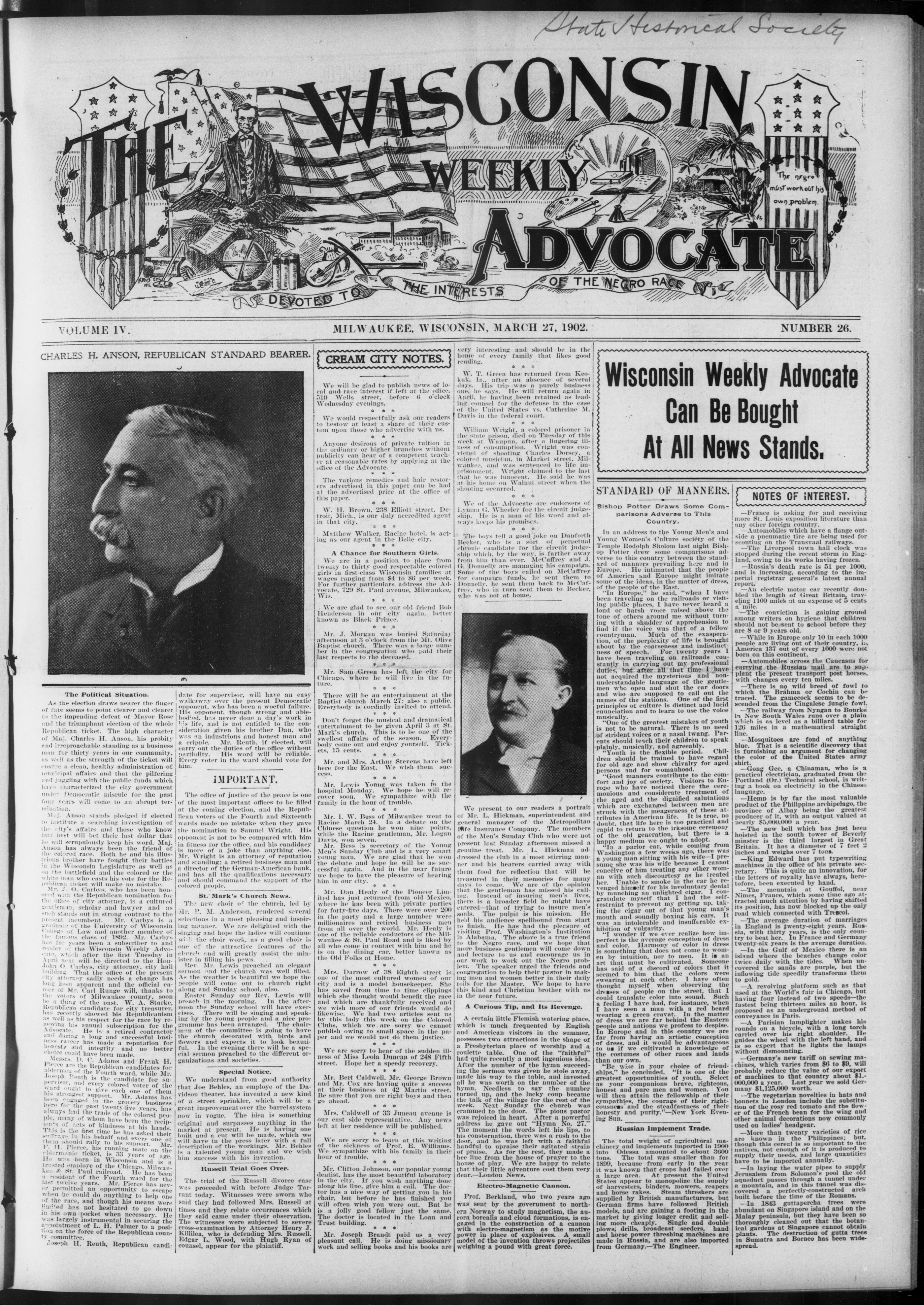
Page text (machine-generated)
State Historical Society
WISCONSIN
WEEKLY
ADVOCATE
DEVOTED TO THE INTERESTS OF THE NEGRO RACE
CHARLES H. ANSON, REPUBLICAN STANDARD BEARER.
VOLUME IV.
CHARLES H. ANSON, REPUB
The Political Situation.
As the election draws nearer the finger of fate seems to point clearer and clearer to the impending defeat of Mayor Rose and the triumphant election of the whole Republican ticket. The high character of Maj. Charles H. Anson, his probity and irreproachable standing as a business man for thirty years in our community, as well as the strength of the ticket will ensure a clean, healthy administration of municipal affairs and that the pilfering and juggling with the public funds which have characterized the city government under Democratic misrule for the past four years will come to an abrupt termination.
Maj. Anson stands pledged if elected to institute a searching investigation of the city's affairs and those who know him best will bet their last dollar that he will scrupulously keep his word. Maj. Anson has always been the friend of the colored race. Both he and his illustrious brother have fought their battles in the Wisconsin Legislature as well as on the battlefield and the colored or the white man who casts his vote for the Republican ticket will make no mistake.
Mr. J. O. Carbys, who has been honored with the Republican nomination for the office of city attorney, is a cultured gentleman, scholar and lawyer and as such stands out in strong contrast to the present incumbent. Mr. Carbys is a graduate of the University of Wisconsin College of Law and another member of the famous class of 1892. Mr. Carbys has for years been a subscriber to and reader of the Wisconsin Weekly Advocate, which after the first Tuesday in April next will be directed to the HonJohn O. Carbys, city attorney, city hall building. That the office of the present city attorney sadly needs a change has long been apparent and the official career of Mr. Carl Runge will, thanks to the voters of Milwaukee county, soon be a thing of the past. W. A. Starke, Republican candidate for city treasurer, has recently showed his Republicanism as well as his respect for the race by renewing his annual subscription for the Advocate. He is a retired contractor and during a long and successful business career has made a reputation for honesty and integrity and no better choice could have been made.
Messrs. D. C. Adams and Frank H. Pierce are the Republican candidates for aldermen of the Fourth ward, while Mr. Joseph Peath is the candidate for supervisor, and every colored voter of the ward ought to give each one of them his strongest support. Mr. Adams has been engaged in the grocery business here for the past twenty-five years, has always had the trade of the colored people, many of whom have been the recipients of acts of kindness at his hands. This is the first time he has asked their suffrage in his behalf and every one of them should rally to his support. Mr. F. H. Pierce, his running mate on the aldermanic ticket, is 33 years of age. He was born in Wisconsin and is a trusted employee of the Chicago, Milwaukee & St. Paul railroad. He has been a resident of the Fourth ward for the last twelve years. Mr. Pierce has never permitted an opportunity to escape when he could do anything to help one of the race, and though his means were limited has not hesitated to go down in his own pocket when necessary. He was largely instrumental in securing the appointment of L. H. Palmer to a position on the force of the Republican county committee.
Joseph H. Reuth, Republican candi-
date for supervisor, will have an easy walkaway over the present Democratic opponent, who has been a woeful failure. His opponent, though strong and able-bodied, has never done a day's work in his life, and is not entitled to the consideration given his brother Dan, who was an industrious and honest man and a cripple. Mr. Reuth, if elected, will carry out the duties of the office without partiality. His word will be reliable. Every voter in the ward should vote for him.
IMPORTANT.
The office of justice of the peace is one of the most important offices to be filled at the coming election, and the Republican voters of the Fourth and Sixteenth wards made no mistake when they gave the nomination to Samuel Wright. His opponent is not to be compared with him in fitness for the office, and his candidacy is more of a joke than anything else. Mr. Wright is an attorney of reputation and standing; a retired business man and a director of the German-American bank, and has all the qualifications necessary and should command the support of the colored people.
St. Mark's Church News.
The new choir of the church, led by Mr. P. M. Anderson, rendered several selections in a most pleasing and inspiring manner. We are delighted with the singing and hope the ladies will continue with the choir work, as a good choir is one of the attractive features of the church and will greatly assist the minister in filling his pews. Rev. Mr. Lewis preached an elegant sermon and the church was well filled. As the weather is beautiful we hope the people will come out to church right along and Sunday school, also.
Easter Sunday our Rev. Lewis will preach in the morning. In the afternoon the Sunday school will have exercises. There will be singing and speaking by the young people and a nice programme has been arranged. The chairman of the committee is going to have the church decorated with birds and flowers and expects it to look beautiful. In the evening there will be a special sermon preached to the different organizations and societies.
Special Notice
We understand from good authority that Joe Behles, an employee of the Davidson theater, has invented a new kind of a street sprinkler, which will be a great improvement over the barrel system now in vogue. The idea is something original and surpasses anything in the market at present. He is having one built and a cut will be made, which we will have in the press later with a full description of the workings. Mr. Behles is a talented young man and we wish him success with his invention.
Russell Trial Goes Over
The trial of the Russell divorce case was proceeded with before Judge Tarrant today. Witnesses were sworn who said they had followed Mrs. Russell at times and they relate occurrences which they said came under their observation. The witnesses were subjected to severe cross-examination by Attorney Henry J. Killilea, who is defending Mrs. Russell, Edgar L. Wood, with Hugh Ryan of counsel, appear for the plaintiff.
MILWAUKEE, WISCONSIN, MARCH 27, 1902.
CREAM CITY NOTES.
We will be glad to publish news of local and race interest if left at the office, 519 Wells street, before 6 o'clock Wednesday evenings.
* * *
We would respectfully ask our readers to bestow at least a share of their custom upon those who advertise with us.
* * *
Anyone desirous of private tuition in the ordinary or higher branches without publicity can hear of a competent teacher at reasonable rates by applying at the office of the Advocate.
☆ ☆ ☆
The various remedies and hair restorers advertised in this paper can be had at the advertised price at the office of this paper.
* * *
W. H. Brown, 238 Elliott street, Detroit, Mich., is our duly accredited agent in that city.
* * *
Matthew Walker, Racine hotel, is acting as our agent in the Belle city.
A Chance for Southern Girls.
We are in a position to place from twenty to thirty good respectable colored girls in first-class Wisconsin families at wages ranging from $4 to $6 per week. For further particulars address the Advocate, 729 St. Paul avenue, Milwaukee, Wis.
```markdown
```
We are glad to see our old friend Bob Henderson in our city again, better known as Black Prince.
* * *
Mr. J. Morgan was buried Saturday afternoon at 3 o'clock from the Mt. Olive Baptist church. There was a large number in the congregation who paid their last respects to the deceased.
* * *
Mr. Sam Green has left the city for Chicago, where he will live in the future.
* * *
There will be an entertainment at the Baptist church March 27; also a public. Everybody is cordially invited to attend.
* * *
Don't forget the musical and dramatic entertainment to be given April 3 at St. Mark's church. This is to be one of the swellest affairs of the season. Everybody come out and enjoy yourself. Tickets, 15 cents.
* * *
Mr. and Mrs. Arthur Stevens have left here for the East. We wish them success.
Mr. Lewis Young was taken to the hospital Monday. We hope he will recover soon. We sympathize with the family in the hour of trouble.
* * *
Mr. I. W. Bess of Milwaukee went to Racine March 24. In a debate on the Chinese question he won nine points, while the Racine gentleman, Mr. Logan Davis, won seven. Mr. Bess is secretary of the Young Men's Sunday Club and is a very smart young man. We are glad that he won the debate and hope he will be as successful again. And in the near future we hope to have the pleasure of hearing him in our city.
Mr. Dan Healy of the Pioneer Limited has just returned from old Mexico, where he has been with private parties for forty-five days. There were over 200 in the party and a large number were millionaires and retired business men from all over the world. Mr. Healy is one of the reliable conductors of the Milwaukee & St. Paul Road and is liked by all who come in contact with him and he is on the dining car, better known as the Old Folks at Home.
* * *
Mrs. Darrow of 38 Eighth street is one of the most cultured women of our city and is a model housekeeper. She has saved from time to time clippings which she thought would benefit the race and which are thankfully received and we wish more of our friends would do likewise. We had two articles sent us by this lady this week on the Colored Clubs, which we are sorry we cannot publish owing to small space in the paper and we would not do them justice.
* * *
We are sorry to hear of the sudden illness of Miss Leola Duncan of 248 Fifth street. Hope her a speedy recovery.
* * *
Mr. Bert Caldwell, Mr. George Brown and Mr. Cox are having quite a success at their business at 42 Martin street. Be sure that you are right boys and then go ahead.
** **
Mrs. Caldwell of 33 Juneau avenue is our east side representative. Any news left at her residence will be published.
* * *
We are sorry to learn at this writing of the sickness of Prof. E. Williams. We sympathize with his family in their hour of trouble.
Mr. Clifton Johnson, our popular young dentist, has the most beautiful laboratory in the city. If you wish anything done along his line, give him a call. The doctor has a nice way of getting you in his chair, but before he has finished you will often wish you were out. But he is a jolly good fellow just the same. The doctor is located in the Loan and Trust building.
Mr. Joseph Brandt paid us a very pleasant call. He is doing missionary work and selling books and his books are
very interesting and should be in the home of every family that likes good reading.
* * *
W. T. Green has returned from Keokuk, Ia., after an absence of several days. His trip was a purely business one, he says. He will return again in April, he having been retained as leading counsel for the defense in the case of the United States vs. Catherine M. Davis in the federal court.
* * *
William Wright, a colored prisoner in the state prison, died on Tuesday of this week at Waupun, after a lingering illness of consumption. Wright was convicted of shooting Charles Dorsey, a colored musician, in Market street, Milwaukee, and was sentenced to life imprisonment. Wright claimed to the last that he was innocent. He said he was at his home on Walnut street when the shooting occurred.
* * *
We of the Advocate are endorsers of Lyman G. Wheeler for the circuit judgeship. He is a man of his word and always keeps his promises.
The boys tell a good joke on Danforth Becker, who is a sort of perpetual chronic candidate for the circuit judgship which, by the way, is farther away from him than ever. McCaffrey and J. G. Donnelly are managing his campaign. Some of the boys called on McCaffrey for campaign funds, he sent them to Donnelly, he sent them back to McCaffrey, who in turn sent them to Becker, who was not at home.
[Name]
We present to our readers a portrait of Mr. L. Hickman, superintendent and general manager of the Metropolitan Life Insurance Company. The members of the Men's Sunday Club who were not present last Sunday afternoon missed a genuine treat. Mr. L. Hickman addressed the club in a most stirring manner and his hearers carried away with them food for reflection that will be treasured in their memories for many days to come. We are of the opinion that the gentleman has missed his calling. Instead of insuring men's lives, there is a broader field he might have entered—that of trying to insure men's souls. The pulpit is his mission. He held his audience spellbound from start to finish. He has had the pleasure of visiting Prof. Washington's Institution in Alabama. The above is a true friend to the Negro race, and we hope that more business gentlemen will come down and lecture to us and encourage us in our work to work out the Negro problem. The speaker urged the friends and congregation to help their pastor in making men and women better in their daily toils for the Master. We hope to have this kind and Christian brother with us in the near future.
A Curious Tip, and Its Revenge.
A certain little Flemish watering place, which is much frequented by English and American visitors in the summer, possesses two attractions in the shape of a Presbyterian place of worship and a roulette table. One of the "faithful" had quite recently a most ingenious idea. After the number of the hymn succeeding the sermon was given he stole away, made his way to the table, and invested all he was worth on the number of the hymn. Needless to say the number turned up, and the lucky coup became the talk of the village for the rest of the week. Next Sunday the church was crammed to the door. The pious pastor was rejoiced in heart. After a powerful address he gave out "Hymn No. 27." The moment the words left his lips, to his consternation, there was a rush to the door, and he was left with a faithful handful to upraise their agitated strain of praise. As for the rest, they made a bee line from the house of prayer to the house of play. We are happy to relate that their little adventure cost them very dear.—London News.
Electro-Magnetic Cannon.
Prof. Berkland, who two years ago was sent by the government to northern Norway to study magnetism, the aurora borealis and cloud formations, is engaged in the construction of a cannon with electro-magnetism as the motive power in place of explosives. A small model of the invention throws projectiles weighing a pound with great force.
Wisconsin Weekly Advocate Can Be Bought At All News Stands.
STANDARD OF MANNERS.
Bishop Potter Draws Some Comparisons Adverse to This
In an address to the Young Men's and Young Women's Culture society of the Temple Rodolph Sholom last night Bishop Potter drew some comparisons adverse to this country between the standard of manners prevailing here and in Europe. He intimated that the people of America and Europe might imitate some of the ideas, in the matter of dress, of the people of the East.
"In Europe," he said, "when I have been traveling on the railroads or visiting public places, I have never heard a loud or harsh voice raised above the tone of others around me without turning with a shudder of apprehension to find if the voice was that of a fellow countryman. Much of the exasperation, of the perplexity of life is brought about by the coarseness and indistinctness of speech. For twenty years I have been traveling on railroads constantly in carrying out my professional duties, but after all that time I have not acquired the mysterious and non-understandable language of the gentlemen who open and shut the car doors and who are supposed to call out the names of the stations. One of the first principles of culture is distinct and lucid enunciation and to learn to use the voice musically.
"One of the greatest mistakes of youth is not to be natural. There is no need of strident voices or a nasal twang. Parents should teach their children to speak plainly, musically, and agreeably.
"Youth is the flexible period. Children should be trained to have regard for old age and show chivalry for aged persons and for womanhood.
"Good manners contribute to the comfort and joy of society. Visitors to Europe who have noticed there the ceremonious and considerate treatment of the aged and the dignified salutations which are exchanged between men are struck with the meagerness of these attributes in American life. It is true, no doubt, that life here is too practical and rapid to return to the irksome ceremony of the old generation, but there is a happy medium we ought to adopt.
"In a parlor car, while coming from Washington a few weeks ago, there was a young man sitting with his wife—I presume she was his wife because I cannot conceive of him treating any other woman with such discourtesy as he treated her. Unable to smoke in the car he revenged himself for his involuntary denial by munching an unlighted cigar. I congratulate myself that I had the self-restraint to prevent my getting up, taking the cigar out of that young man's mouth and soundly boxing his ears. It was an intolerable and insufferable exhibition of vulgarity.
"I wonder if we ever realize how imperfect is the average conception of dress and color. Harmony of color in dress is something that does not come to women by intuition, nor to men. It is an art that must be cultivated. Someone has said of a discord of colors that it seemed to him that the colors were swearing at each other. I have often thought myself when observing the dresses of people on the street, that I could translate color into sound. Such a feeling I have had, for instance, when I have seen a man with a red beard wearing a green cravat. In the matter of dress we are far behind the Eastern people and nations we profess to despise. In Europe and in this country we are far from having an artistic conception of dress, and it would be advantageous to us if we cultivated a knowledge of the costumes of other races and lands than our own.
"Be wise in your choice of friendships," he concluded. "It is one of the greatest opportunities of youth. Select as your companions brave, righteous, honest and pure men and women. You will then attain the fellowship of their sympathies, the courage of their righteousness and the steadfastness of their honesty and purity."—New York Evening Sun.
Russian Implement Trade.
The total weight of agricultural machinery and implements imported in 1900 into Odessa amounted to about 3600 tons. The total was smaller than for 1899, because from early in the year it was known that crops had failed over a large area. At present the United States appear to monopolize the supply of harvesters, binders, mowers, reapers and horse rakes. Steam threshers are supplied by British manufacturers, but German firms have followed British models, and are gaining a footing in the market by giving longer credit and selling more cheaply. Single and double plows, drills, broadcast seeders, hand and horse power threshing machines are made in Russia, and are also imported from Germany.-The Engineer.
NUMBER 26.
eekly Advocate Bought ws Stands.
NOTES OF INTEREST.
—France is asking for and receiving more St. Louis exposition literature than any other foreign country.
—Automobiles which have a flange outside a pneumatic tire are being used for scouting on the Transvaal railways.
—The Liverpool town hall clock was stopped during the recent storm in England, owing to its works having frozen.
—Russia's death rate is 51 per 1000, and is increasing, according to the imperial registrar general's latest annual report.
—An electric motor car recently doubled the length of Great Britain, traveling 1100 miles at an expense of 5 cents a mile.
—The conviction is gaining ground among writers on hygiene that children should not be sent to school before they are 8 or 9 years old.
-While in Europe only 10 in each 1000 people are living out of their country, it America 137 out of every 1000 were not born on this continent.
-Automobiles across the Caucasus for carrying the Russian mail are to supplant the present transport post horses, with changes every ten miles.
-There is no wild breed of fowl to which the Brahma or Cochin can be traced. The gamecock seems to be descended from the Cingalese jungle fowl.
-The railway from Nyngan to Bourke in New South Wales runs over a plain which is as level as a billiard table for 126 miles in a mathematical straight line.
-Mosquitoes are fond of anything blue. That is a scientific discovery that is furnishing an argument for changing the color of the United States army shirt.
—Gong Gee, a Chinaman, who is a practical electrician, graduated from the Portland (Or.) Technical school, is writing a book on electricity in the Chinese language.
—Hemp is by far the most valuable product of the Philippine archipelago, the province of Albay being the greatest producer of it, with an output valued at nearly $5,000,000 a year.
—The new bell which has just been hoisted in the south tower of Beverly minster is the third largest in Great Britain. It has a diameter of 7 feet 2 inches and weighs over 7 tons.
—King Edward has put typewriting machines in the office of his private secretary. This is quite an innovation, for the letters of royalty have always, heretofore, been executed by hand.
The mountain at Gouffol, near Nimes, France, which some time ago attracted much attention by having shifted its position, has now blocked up the only road which connected with Trescol.
The average duration of marriages in England is twenty-eight years. Russia, with thirty years, is the only country to beat her. In France and Germany twenty-six years is the average duration.
In the Gulf of Mexico there is an island where the beaches change color twice daily with the tides. When uncovered the sands are purple, but the inflowing tide speedily transforms them to gold.
A revolving platform such as that used at the World's fair in Chicago, but having four instead of two speeds—the fastest being thirteen miles an hour, is proposed as an underground method of conveyance in Paris.
—A Parisian lamplighter makes his rounds on a bicycle, with a long torch carried over his right shoulder. He guides the wheel with the left hand, and is so expert that he lights the lamps without dismounting.
—Germany's new tariff on sewing machines, which varies from $6 to $9, will probably reduce the value of our export of machines to that country about $1,000,000 a year. Last year we sold Germany $1,125,000 worth.
—The vegetarian novelties in hats and bonnets in London include the substitution of the rosy red tomato and the flower of the French bean for the wing and other animal decorations now commonly used on ladies' headgear.
—More than twenty varieties of rice are known in the Philippines; but, though this cereal is so important to the natives, not enough of it is produced to supply their needs, and large quantities have to be imported annually.
—In laying the water pipes to supply Jerusalem from Solomon's pool the old aqueduct passes through a tunnel under a mountain, and in this tunnel was discovered a perfectly-constructed arch built before the time of the Romans.
—In 1843 guttapercha trees were abundant on Singapore island and on the Malay peninsula, but they have been so thoroughly cleaned out that the botanical gardens at Singapore cannot obtain plants. The destruction of gutta trees in Sumatra and Borneo has been widespread.
---
CECIL RHODES IS DEAD.
MAN OF GREAT RICHES.
Held Responsible for Jameson K. and Instigated the War Against the Boers.
Cape Town, March 26.—Cecil Rhodes is dead.
Mr. Rhodes died peacefully at 5:57 p.m. He slept again during the afternoon, but his breathing became more difficult and his strength perceptibly diminished until he passed away.
Completely Broken Down.
London, March 26.—The death of Cecil Rhodes came as no great surprise to those few who saw anything of him during his last visit to London during the winter. Whether it was due to his experiences during the long siege of Kimberly or the accumulated anxieties regarding the war in South Africa, there is no doubt he was almost completely broken down within the last two years. Even his appearance changed. His finely-chiseled face had become bloated, and his huge frame filled out until walking was most difficult. He was frequently attacked with severe heart troubles, but he never exhibited the stoicism which marked his extraordinary career, nor allowed his bodily ailments to interfere with his business. Up to the last Mr. Rhodes kept a firm grip on all those vast South African interests created and controlled by him. Except that he was more irritable and more dictatorial there was no outward change in his method of handling men, millions and empires. Toward the social side of life, however, he soured. Once his days' work at the offices of the British Chartered South Africa Company was over he shut himself up in an unfrequented London hotel, where he utterly denied himself to all except half a dozen favored intimates. Dr. Jameson was his constant companion. They could be seen in the park in the morning taking solitary rides on horses, never going faster than a walk.
Became Very Irascible.
With increasing irascibility, he grew more and more restless as the end drew near. He was never contented to stay long in one place. His closing days devolved into an unceasing, purposeless quest of change of scene. During his recent trip to Egypt this was particularly noticeable. He rushed from place to place, as if with the only object of upsetting his own plans. Then he suddenly returned to England.
Financially, Mr. Rhodes' death is not likely to have any very far-reaching results, as all his enterprises were systematized so thoroughly as not to need the master mind so necessary to their inception
Owing to the very great success of the De Beers mines, the British Chartered South Africa Company and other great South African ventures, Rhodes' fortune had been steadily accumulating. He lost money over the war, but what inroads that made must have been trifling compared with the many millions he possessed.
THE DIAMOND KING.
Cecil Rhodes Supreme in South African Affairs.
Cecil Rhodes was born in Hertfordshire, England, July 5, 1853; his father was the rector of a little town. While at Oriel College, Oxford, his health broke down and he sailed for South Africa to recuperate. The dry air of the veldt restored it, and he finished his course at Oxford. This done, he returned to the diamond fields in South Africa and gradually amassed wealth. A giant physically and intellectually, he soon developed into a leader and organizer. In 1880 he headed the De Beers Company, which owned the most profitable diamond mines of Kimberley. His ambition then was to consolidate all of the leading diamond companies into a trust, that would control the output of diamonds and corner the market. His project was realized in 1889, and the same year he organized the British South African Company, to promote trade in Rhodesia (a district having an area of about 750,000 square miles). One object of this company was to increase the sphere of British influence in Africa, and an imperialist fund was set apart for this purpose. Rhodesia turned out to be an unpromising country, and many English stockholders were sorely disappointed over their unprofitable venture.
For a while Rhodes figured in Cape politics. In 1895 he resigned as prime minister of Cape Colony, when charged with complicity in the Jameson raid. Although his share in this ill-starred enterprise was not quite proved, he undoubtedly would have approved it if it had succeeded. During the long siege of Kimberley Col. Kekewich found Rhodes an elephant on his hands. In 1900 he returned to the Cape and became a factor in politics.
Cecil Rhodes was by many looked upon as the man who was chiefly responsible for the war in South Africa. More than any other man he shaped the policy of the British government in respect to the Boer republics. Chamberlain, Milner and other politicians were but tools in his hands, accomplishing his ends. He was the head of the De Beers Company, which monopolizes the diamond industry in South Africa and practically runs the diamond market in the whole world. This group of capitalists wanted the Transvaal to "pass under the British flag," so that they could get complete control of the gold fields of the Witwatersrand. Not satisfied with the enormous profits of diamond mining in Kimberley, ten million dollars yearly, they desired to exploit the diamond fields of the Orange Free State. Rhodes played his cards, as the critics say, so as to bring on a war from which he hoped to gain advantage, for the paramountcy of the British flag in South Africa means that the Transvaal shall be more completely under capitalistic rule.
USE OF ELECTRICITY IN MINES.
More Desirable than Steam Power for Many Purposes.
Houghton, Mich., March 26.—[Special.]—Much interest is manifested at the results attained at the mines where electrical machinery has been given a trial. From achievements thus far it can be said that electrical machinery is the most desirable for several purposes and has come to stay. Where a limited amount of power is required electrical energy does the work at a much lessened cost owing to the great saving in fuel. The new underground electrical tram road in the Quincy mine is a success, and will be used to a much greater extent, especially when long trains are required.
The Calumet & Hecla Company took the lead in investigating the advantages of electricity as a motive power. The company is now successfully operating electrical pumps in the mine, while at the South Hecla branch they are used exclusively. It is also proposed to operate the machinery in the new addition to the Hecla mill at Lake Linden by electricity. The new power house will contain 21,000 kilowat generators, to be driven by two 1500 horse power engines.
CUBA FREE ON MAY 20.
Date Fixed for the Inauguration of President of the New Republic.
Washington, D. C., March 25.—The birthday of a republic was decided upon at the white house last night. At dinner, President Roosevelt, on behalf of the United States, and Senor Estrada Palma, the President-elect of Cuba, agreed upon May 20 as the date for the inauguration of President Palma and the Cuban republic.
The withdrawal of the American army will begin at once from that time, and there will be left on the island only a small force of American soldiers, barely sufficient to do ordinary police work.
President Roosevelt will at once announce this decision to Congress in the form of a special message. In this message he will announce the agreement upon May 20, three weeks later than had been intended originally. He will suggest that Congress acquiesce in his action in some way, and he may also suggest the sending of some special representative from this governmetn to be present at the creation of the new republic.
The special message will also ask for emergency legislation giving him authority to establish a legation at Havana and to appoint a diplomatic representative with the rank of a fully-equipped envoy extraordinary and minister plenipotentiary. This action is particularly necessary because the Platt amendment must be put in the form of a treaty, and subsequent to that, if the pending reciprocity legislation goes through, as is now practically certain, a special treaty for a close commercial relation with the United States must be negotiated in advance of all treaties with other nations.
No other countries will recognize the independence of Cuba until the United States has done so, and our minister will be the first to present his credentials at the President's palace in Havana. This is necessary because the great nations assume that a protectorate exists in Cuba until the United States ends it by sending a diplomatic representative there, which will be notice to the world that the United States acknowledges the independence of Cuba.
TO PRISON 99 YEARS.
Extraordinary Sentence Imposed Upon J. C. Hunter by a Montana Jury.
Phillipsburg, Mont., March 25.—J. C. Hunter has been sentenced to ninety-nine years in the penitentiary in accordance with the verdict of the jury which found him guilty of murder in the second degree in killing his son-in-law, Walbridge.
Alexandria, Minn., March 25.—Magnus Johnson, aged 62, a bachelor living alone, was murdered by persons unknown late yesterday afternoon. There is no clue to the murderers.
La Junta, Col., March 25.—Mrs. Henrietta Miller of Los Angeles, Cal., 67 years old, was criminally assaulted here about midnight, and is said to be in a critical condition. W. H. Wallace, a Pullman car porter, has been arrested on suspicion.
Wellington, Kas., March 25.—A detective named Ferguson, who has been working on the murder case of Montgomery, the Santa Fe railroad detective, has been missing for several days and is believed to have been foully dealt with at the hands of the gang that killed Montgomery. Montgomery was killed at his home last fall in Winfield while prosecuting a case for the railroad. Winnipeg, Man., March 25.—Solomon Galician, the convicted murderer, was sentenced to hang on May 27. He said the witnesses against him had told the truth, but he pleaded for his life so that he might see how his children progressed.
London, March 25.—Alfred Reynolds the man charged with forging an endorsement of a check for £222, was again remanded at Bow street police court, today. Counsel for the prosecution said Reynolds was guilty of an attempt to defraud the King. The secretary of his majesty's privy purse, Walter Matthew Gibson, testified to drawing and posting the check, which was in payment of the King's harness bill. The payees deposed that the check did not reach them and that the endorsement was now theirs.
CENSURE THE SPEAKER.
should Have Called Chamberlain to Order for Offensive Language.
London, March 25.—John Redmond, the leader of the Irish Nationalists, gave notice in the House of Commons today of a motion, equivalent to a vote of censure on the speaker, William Court Gully, for not having made the colonial secretary, Joseph Chamberlain, withdraw his remark, "the honorable gentleman is a good judge of traitors," addressed to John Dillon (Irish Nationalist) in the House March 20, which led to Mr. Dillon retorting that Mr. Chamberlain was "a damned liar."
WAUKEGAN SUFFERS FIRELOSS
Actor Starts Blaze in Opera House While Using Gasoline.
Waukegan, Ill., March 25.—Fire in the Opera House block last evening threatened the south part of the business center, but after two hours was got under control after burning out the upper part of the structure, causing from $15,000 to $20,000 loss. The "Runaway Match" Company had its outfit in the theater for a performance and claims a damage of $2000. The fire was started by an actor cleaning clothes with gasoline.
ENTIRE OUTFIT SMASHED.
Man, Wagon and Team Scattered to the Four Winds
Bowling Green, O., March 25.—The Welker magazine of the Hercules Torpedo Company exploded last night, instantly killing Shooter Robert Durand of Bradner and scattering him, his wagon and team to the winds. The magazine and wagon contained 1818 quarts of the explosive, and when it let go the houses in Welker and Cynget shook as if by an earthquake. As nothing is left of the outfit, no one will ever know what caused the catastrophe.
Mysterious Machine Excites Manila. Gov. Schroeder of Guam has two candidates for the garrote, and an instrument is now being constructed in Manila to do the work. The parties who will suffer death by strangulation are natives, but beyond this little is known of the cases. When interrogated in regard to the matter Col. Wood laughed incredulously and said there could be no truth in the story. Nevertheless, a certain machine shop near the water front is now constructing the machine, and when completed it will be shipped to Gov. Schroeder at Guam.—Manila American.
Negroes Who Speak Irish.
The Irish language is spoken in the Bahamas among the mixed descendants of the Hibernian patriots banished long ago by Cromwell to the West Indies. One can occasionally hear negro sailors in the east end of London who cannot speak a word of English talking Irish to the old Irish apple women who gather around the docks.
HANNA IS HOPEFUL.
Senator Sees Nothing in the Miners' Troubles that Cannot be Amicably Adjusted.
New York, March 26.—The industrial department of the National Civic Federation met here today to hear the plea of the United Mine Workers for assistance in adjusting their differences with the mine operators. The meeting was held behind closed doors. Some of the members of the industrial commission expressed doubt as to the propriety of intervention by their organization at this time. They seemed to think that there was still opportunity for direct negotiation between the miners and mine operators. They were disposed, however, to hear the request of the mine workers and to offer any assistance that was possible. Before the conference began John Mitchell said there were 140,000 miners who wanted better pay and a yearly contract covering the terms of their work with the mine owners. He said that the granting of their demand for a contract would mean their recognition as organized labor. He would not say that the United Mine Workers intended to demand an eight-hour day.
Senator Hanna expressed the hope that there would be peace and that he saw nothing in the situation that could not be adjusted.
Try to Avert a Strike.
The conference adjourned at 1 p. m. and Senator Hanna made the following statement: "Although we have been together for two hours and a half, I really have not much to say. We have talked with the representatives of the miners and got at merely what their desires are. We don't anticipate trouble and the best of spirit was manifested here today. So as to get further information and if possible get into communication with the other side—the operators—a subcommittee of three was appointed which will report back to the industrial department of the National Civic Federation tomorrow morning at 10:30 o'clock. The committee is composed of myself, former Minister Straus and Mr. Duncan, the general secretary of the Granite Cutters' National Union. We will discuss things this afternoon and hope that by tomorrow we will be able to report progress from the other side of the question."
Asked if he cared to name the operators that are to be communicated with, Senator Hanna said that he could not go into detail at the present time because the federation had not decided to take up President Mitchell's appeal. President Mitchell declined to discuss the situation, saying that at the conference Senator Hanna had been chosen to give out the information to the public. He said, however, that he hoped that an understanding would be reached whereby the threatened strike would be averted.
Des Moines, Ia., March 26.—The indications are that every miner in Iowa will walk out at midnight March 31. At the joint conference of the miners and operators this morning the operators formally announced that they will not agree to employ shot firers, nor will they agree to the uniform day wage scale demanded. President Peese in behalf of the mine workers asked the operators if they would abritrate their differences. The operators flatly refused.
Brewery Lockout.
Cincinnati, O., March 26.—President Samuel Gompers of the American Federation of Labor is today hearing evidence here concerning the brewery lockout of Cincinnati, Covington and Newport. The United Brewery Workmen have charged the local brotherhoods of engineers and firemen with conspiracy to wreck their organization because the latter have refused to amalgamate with the other workmen about the breweries and persist in making their own contracts with the proprietors without co-operating with other brewery workmen. During recess Miss Geralda Malone of San Francisco, Miss Ruby Payne of New York and Miss Sallie Fisher of Salt Lake City made application to President Gompers for a union of chorus girls.
NEGRO IS STRUNG UP.
Swift Justice Measured Out by Infuriated Citizens of La Junta, Col.
La Junta, Col., March 26.—Washington H. Wallace, negro porter on a Santa Fe train, accused of brutally attacking Mrs. Henrietta H. Miller, an aged white woman, was taken from Sheriff Farr and his deputies last night, brought back to La Junta by the mob, hanged, and his body riddled with bullets.
Sheriff Farr, knowing the plans of the mob to hang the negro, endeavored to escape with his prisoner to Pueblo. Pursuit was at once taken up by a mob of cowboys and citizens, and telegrams were sent to Fowler and other towns between here and Pueblo warning the people that the sheriff might pass through with his prisoner
At Fowler, sixteen miles west of La Junta, a mob was organized. The mob made a quick rush when the sheriff's posse hove in sight, overpowered the guards, and captured Wallace.
Hanged at La Junta.
The mob at once started on horseback to La Junta and grew in size as those who had been in pursuit of the sheriff joined it. The crowd rode into La Junta at a gallop, and the people flocked from all parts of the town and from the surrounding ranches to see the lynching. Mrs. Miller had identified Wallace as the man who attacked her. No questions were asked of the negro after the mob reached town. He was strung up without ceremony and his body was shot to pieces by the crowd.
Story of the Crime
Mrs. Miller, a gray-haired woman, aged 67 years, was going from Los Angeles, Cal., to Denver to visit relatives, After leaving the Chicago limited train here Mrs. Miller asked the porter whom she met on the station platform where the Denver sleeper was. The main offered to conduct her to the car. After going with him a considerable distance Mrs. Miller became suspicious and started to return to the station. She was then knocked down by a blow on the head, and, after a struggle with her assailant, was choked into insensibility. When she regained consciousness an hour later she crawled back to the station and gave an account of the attack and a description of her assailant.
Wallace Identified by Victim.
Washington H. Wallace, a porter on a car which runs between Denver and this city, stopping here on each run from 9:45 at night until noon the following day, was arrested in the car of which he had charge. He was identified by Mrs. Miller.
Bloodhounds were brought from Canyon City and trailed the man who accompanied Mrs. Miller through the yards to the car in which Wallace was found.
Eight similar attacks have occurred here in the last few months and it is believed all were committed by the one man. Mrs. Miller's condition is critical.
Lynching in North Carolina.
Washington, N. C., March 26.—The body of James Walker, the negro who poisoned the whole family of Dr. David T. Tayloe of the state board of medical examiners, was found dangling from a limb of a gum tree on the Greenville road, just outside of the town limits of Washington.
GEN. DELAREY ESCAPED.
About 135 Boers with Ordnance and Supplies are Captured.
BRITISH MAKE A HAUL.
Lord Balfour and Gen. Buller Having Hot Controversy Over the Latter's Record.
London, March 26.—Incomplete reports of the result of the combined movement of British columns against Gen. Delarey have enabled Lord Kitchener to announce the capture of about 100 prisoners, three 15-pounders, two pompoms and quantities of stock, wagons, etc. Gen. Delarey appears to have successfully evaded Lord Kitchener's cordon at the offset.
In a dispatch dated Pretoria at noon yesterday, Lord Kitchener says: "At dusk on the evening of March 23, the combined movement against Delarey was undertaken by columns of mounted men without guns or impediments of any sort. The columns started from Commando drift on the Vaal river and traveled rapidly all night and at dawn, March 24, occupied positions along the line from Commando drift to the Lichtenburg blockhouse line. The troops moved rapidly eastward, keeping a continuous line with the object of driving the enemy against the blockhouses or forcing an action. The result has not yet been fully reported. Kekwich's column, after the commencement of the action, captured three 15-pounders, 2 pompoms, 9 prisoners and 100 mules, carts and wagons. Gen. W. Kitchener's column, captured 89 prisoners, 45 carts and wagons and 1000 cattle. There are a few more prisoners on the blockhouse line. The troops covered eighty miles in twenty-four hours. Rochfort's and Rawlinson's columns have not reported their results."
Lord Kitchener, in a later message, says: "All the reports are now in. The total number of prisoners is 135."
Buller's Record Whitewashed.
London, March 26.—An acrimonious correspondence between A. J. Balfour and Gen. Buller has been published. Mr. Balfour contends that Gen. Buller was in chief command at the battle of Spion Kop, while the general denies this assertion. To his contention Mr. Balfour adds: "There is no reason why all the Spion Kop dispatches should not be published." To this Gen. Buller rejoins that he hopes the dispatches will be published without manipulation.
Mr. Balfour then replied to Gen. Buller, protesting against the latter's insinulation and declared that the only manipulation which had been exercised with regard to Gen. Buller's dispatches was the excision of a single sentence criticising Sir Charles Warren, whilst the omissions from Lord Roberts' dispatches relating to operations in Natal were made, said Mr. Balfour, "solely for the purpose of, if possible, sparing your feelings and maintaining your military reputation."
BIG DAMAGES ASKED.
Suits Against New York Central Growing Out of the Park Avenue Tunnel Disaster. New York, March 26.—Six new suits for damages, aggregating $950,000, for the loss of lives of New Rochelle residents who were killed in the Park Avenue tunnel collision and for injuries received by wreck victims, have been begun against the New York Central Railroad Company in the supreme court at White Plains.
The largest suit for damages is brought by Walter C. Coffin of 68 Lafayette street, New Rochelle, who sues for $500,000 for injuries received by his son, Everett Coffin. Everett, who is 15 years old, is still in Flower hospital, and it is claimed will be a cripple for life. With the other suits for injuries and deaths previously filed, the total demand for damages amounts to nearly $1,800,000.
DEATH OF DIPLOMAT.
Second Secretary of Mexican Embassy Expires on Street in Washington City.
Washington, D. C., March 26. Enrique Santibanez, second secretary of the Mexican embassy in this city, dropped dead on the street here this afternoon. He was a consumptive and his health had been very poor of late. Senor Santibanez had been stationed at the embassy in Washington for about sixteen years, having come to this city with Former Minister Senor Romero.
FATAL MISUNDERSTANDING.
Shopkeeper Shot Sweetheart Think-
ing She Had Taken Box of Money.
London, March 26.—A most pathetic tragedy caused by an unhappy misunderstanding was revealed at the coroner's court at Colwyn Bay. On Monday a young man named David Richards missed a small box of money belonging to the shop of which he was manager. He asked his sweetheart, Lillian Keay, who was the only one who saw him put the box of money away, to restore it, thinking she had taken it.
She denied any knowledge of the box. He thereupon shot her dead, turned the revolver upon himself and killed himself, too. During the inquest on the two bodies Richards' employer rushed into the court holding up the missing box which had been the cause of the tragedy.
It had been found near the place where the unhappy murderer and suicide said he had put it.
NOTED SOLDIER DEAD.
Served with Kosush in 1848 and was Captured by Russians.
Chicago, Ill., March 26.—Col. Joseph A. Lubliner is dead at Sterling, Ill. In 1848 he served on the staff of Kossuth, with the rank of colonel; was taken prisoner by the Russians and sentenced to twenty-five years service in the Russian army, being for some time stationed at Moscow and afterward detailed as imperial guard to Czar Nicholas. Aided by friends and disguised as a peasant, he escaped to Brussels, and afterward to Hamburg and Liverpool. At the latter place he rejoined Gen. Kossuth and came with him to America. In 1852 he went to California, and served for two years as a member of the pioneer guards and as captain of the vigilance committee which restored law and order. In 1856 he located in Sterling, where he had since resided.
SAILOR BROKE HIS NECK.
Made Misstep Whie Descending Ladder on Battleship Oregon.
Seattle, Wash., March 26.—Frank Huntley, a veteran of Santiago and a member of the crew of the battleship Oregon, was almost instantly killed while escorting a couple of lady visitors through the ship. When leading the way down a narrow ladder way below decks, Huntley misstepped and fell over, landing on his back and breaking his neck.
CONGRESS
Slow progress was made on the river and harbor bill in the House on the 20th, only thirty pages being disposed of, leaving fifty pages still to be considered. The river and harbor committee succeeded again in defeating every amendment offered, though none was of general importance. An appropriation of $6,000,000 to improve the harbor at Havana, Cuba, was suggested by Representative Robertson of Louisiana, but was ruled out on a point of order. Mr. Bellamy of North Carolina during the debate took occasion to denounce the Crumpacker proposition to investigate Southern laws as designed to stir up sectional strife. He appealed to the conservative Republicans to defeat the resolution.
The river and harbor bill was passed by the House on the 21st without division. Mr. Sulzer (N. Y.) attempted to force a record vote, but only three members, Messrs. Smith (Ia.), Fitzgerald (N. Y.) and Cochran (Mo.), supported him. Several minor committee amendments were adopted, one authorizing the Michigan Power company, with certain restrictions, to take water from the St. Mary's river for use in its power canal. During the debate H. C. Smith (Mich.) complained that the $20,000,-000 charged to Michigan in the bill benefited the commerce of Chicago, Duluth, Buffalo and Cleveland, and not a single port in Michigan. Adjournment followed final action.
Consideration of the contested election case of Moss vs. Rhea from the Third Kentucky district, occupied most of the day in the House on the 22d. The committee on elections divided on party lines, the majority sustaining the view that Mr. Moss had been elected and the minority that Mr. Rhea, the Democrat, was entitled to retain his seat. In the face of the returns Mr. Rhea had 156 plurality. According to the contention of the majority certain votes rejected under the Goebel election law would transform this plurality for Rhea into a plurality for Moss of 71. The House will vote on the contest on the 25th. Before taking up this case the unanimous report of the committee in the case of Spears vs. Burnett from the Seventh Alabama district, confirming the title of the sitting member to his seat, was adopted. Several bills of minor importance were passed at the opening of the session, including one to authorize the secretary of war to loan tents for the use of the Knights of Pythias encampment to be held at San Francisco.
Mr. Boreing (Ky.) injected an attack on the Goebel election law into the continued discussion of the Moss-Rhea contested election case from the Third Kentucky district, in the House on the 24th, but Mr. Rhea declined to be drawn into an extended debate on an issue not directly involved in the case. A vote is to be taken on the 25th. The Senate amendments to the bill to repeal the war revenue taxes were nonconcurred in, and Messrs. Payne (N. Y.), Dalzell (Pa.) and Richardson (Tenn.) were appointed conferees. A similar course was taken with reference to the legislative, executive and judicial appropriation bill, and Messrs. Bingham (Pa.), Hemenway (Ind.) and Livingston (Ga.) were appointed conferees.
The House on the 25th, by a majority of ten, unseated Mr. Rhea (Rv.). a Democrat, and seated in his place J. McKenzie Moss, formerly a Democrat, but who, according to his brief, is in accord with the Republican party on the dominant issues. The Republican majority in the House is 43. The conclusion of the debate on the case was rather spirited, Mr. Rhea making an eloquent defense of his right to the seat. The House, he said, was asked to vote that "the state of Kenutcky had set its seal upon a lie." Mr. Rhea made a severe arraignment of Mr. Moss, charging that, although he now called himself a Republican, that two weeks before the election he had registered as a Democrat and had pledged himself if elected to go into the Democratic caucus.
General debate on the military appropriation bill was concluded in the House on the 26th and consideration of the bill under the five-minute rule began. During the debate Mr. Burleson (Tex.) renewed his attack on Secretary Hay on account of the allegations regarding the Boer relief funds subscribed in Illinois. Mr. Hitt (Ill.), chairman of the foreign affairs committee, replied briefly. As far as the charge of "evasion" on the part of the secretary of state was concerned, he said, the secretary's frank letter completely disposed of that. Mr. Patterson (Tenn.) criticised the general conditions in the Philippines and charged that a state of slavery existed there which should be remedied at once. Mr. Kern (Ill.) spoke in defense of the army canteen. At the beginning of the session the Burleson resolution calling on the President for information relative to the application of Gen. Miles to go to the Philippines was adopted without debate.
Senate.
The day in the Senate on the 20th was devoted to consideration of the bill to protect the President. An agreement was reached to vote on the measure and amendments at 4 o'clock p. m. on the 21st. Three substitutes are pending. Mr. Aldrich, chairman of the committee on finance, reported the bill to repeal war revenue taxes, and gave notice that he would call up the measure for consideration today. An executive session preceded adjournment.
Passage of the bill to protect the President by a vote of 52 to 15, and of the war revenue repeal bill, without division, occupied practically all of the session on the 21st. A bill appropriating $125,000 for a marine hospital at Buffalo, N. Y., was also passed. On motion of Mr. Proctor, chairman of the committee on agriculture, the oleomargarine bill was made the unfinished business. After an executive session adjournment until the 24th was taken.
Consideration of the oleomargarine bill was begun in the Senate on the 24th. The measure places a tax of 10 cents a pound on oleomargarine colored in imitation of butter and reduces the present tax of 2 cents a pound on oleomargarine to one-quarter of 1 cent a pound in its uncolored form. Mr. Proctor, chairman of the committee on agriculture, made the opening statement in support of the measure. He concluded with the observation that the pending bill was "a measure to protect an honest product against a fraud." A few bills of minor importance were passed before the oleomargarine bill was taken up. Among these was one authorizing the establishment of a lifesaving station at Eagle Harbor, on Kweenaw Point, Mich. The river and harbor bill was received from the House and referred to the committee on commerce. Chairman Frye gave notice that hearings on the bill would be given to senators for four days, beginning on the 25th, and that there would be no further hearings. Messrs. Cullom, Warren and Teller were named as conferees on the legislative, executive and judicial appropriation bill, and Messrs. Aldrich, Allison and Vest as those on the war revenue reduction bill. The customary executive session preceded adjournment.
A sharp attack on the pending oleomargarine bill was made In the Senate on the 25th by Mr. Money (Miss.). He denounced the measure as "unconstitutional, immoral, dishonest and unjust." He said it was a proposition to tax out of existence one industry for the benefit of another and was "protection gone mad." In response to an inquiry by Mr. Quarles (Wls.) Mr. Money said that while the bill was unconstitutional, it might never be declared so by the courts because the courts might not go behind the text of the law to inquire into legislative intent. "In other words," suggested Mr. Spooner (Wls.) "the bill is unconstitutional in the Senate, but will not be unconstitutional before the supreme court of the United States." Mr. Hansborough (N. D.), a majority member of the committee on agriculture, speaking in support of the bill, denied that there was any attempt in the measure to destroy the oleomargarine industry.
Continuation of the debate on the oleomargarine bill occupied the session of the Senate on the 26th. Messrs. Dolliver, Hansbrough, Hoar and Lodge spoke in support of the measure and Mr. Stewart against it. A brief executive session preceded adjournment.
The Glove-Cutting Art.
The cutters of the great glove houses at Brussels and in France earn even higher wages than the cutters of the most fashionable tailors of London and New York. So difficult is the art of cutting gloves that most of the principal cutters are known to the trade by name and by fame, and the peculiar knives which they use in the business are so highly prized that they are handed down from generation to generation as heirlooms.
"A man has just dropped dead in the ready-made clothing department," said a new clerk in the big department store, running up excitedly to the floor walker. "Have him taken to the cemetery lot department with the undertaker annex, fourteenth floor, front," he replied briskly.—Harper's Bazar.
Old Joe, the Night Watchman.
(From the Pall Mall Gazette, London.)
How often on returning home late on a dreary winter's night has our sympathy gone out to the poor old night watchman as he sat huddled up over his cage fire, overlooking the excavations which our City Council in their wisdom, or otherwise, allow the different water companies to make so frequently in our congested streets. In all weathers, and under all climatic conditions, the poor old night watchman is obliged to keep watch over the companies' property, and to see that the red lights are kept burning. What a life, to be sure; what privations and hardships; no wonder they have aches and pains, which nothing but St. Jacobs Oil can alleviate.
"Old Joe" is in the employ of the Lambeth Water Works. He has been a night watchman for many years, in the course of which he has undergone many experiences. What with wet and cold, he contracted rheumatism and sciatica, which fairly doubled him up, and it began to look a serious matter for old Joe; it looked extremely doubtful if he would much longer be able to perform his duties, on which his good wife and himself depended for a livelihood; but as it happened a passer-by, who had for some nights noticed Old Joe's painful condition, presented him with a bottle of St. Jacobs Oil, and told him to use it. Old Joe followed the advice given; he crawled home the next morning and bade his wife rub his aching back with the St. Jacobs Oil "a gentleman gave him," and undoubtedly his wife did rub, for when Old Joe went on duty at night he met his friend and benefactor, to whom he remarked: "Them Oils you gave me, Guv'nor, did give me a doing, they was like pins and needles for a time, but look at me now," and Old Joe began to run and jump like a young colt. All pain, stiffness and soreness had gone, he had been telling everybody he met what St. Jacobs Oil had done for him. Old Joe says now he has but one ambition in life, and that is to always to be able to keep a bottle of St. Jacobs Oil by him, for he says there is nothing like it in the world.
St. Jacobs Oil serves the rich and the poor, high and low, the same way. It has conquered pain for fifty years, and it will do the same to the end of time. Simple facts like the above tell an honest tale with which nothing on earth can compete.
Where English Clubs Differ.
A point which strikes American visitors to London about our English clubs is the social aspect of them and the almost complete absence of the business side. At the Manhattan or the Knickerbocker, on the other hand, the business side prevails. The majority of members do not drop in merely to read the papers, hear the latest story and play billiards or bridge, as over here. They go in most cases to meet a man about "a deal," to talk over the business of the day and discuss the business of the morrow, or to read up the finances of the papers. The result is that when an American becomes a member of an English club he hardly ever uses it because its ways do not appeal to him. He would say that there was nothing going on.-The Tatler.
An Old Secret Revealed
The secret of the strength and power of the Turkish people is said to be due to the use of herbs contained in Turkish Nerve Builder, a guaranteed cure for weak, nervous and overworked men. Cures nervous debility, sleeplessness, tired feeling, pain in the back, constipation, etc. One month's treatment, $1.00 by mail. Write for particulars. The European Med. Co., Milwaukee, Wis.
Forest Work in Hawaii.
About fifteen years ago the Hawaiian government undertook forest work, and very soon the hills back of Honolulu were clothed with a dense and luxuriant growth of eucalyptus of several varieties, the Australian wattle and other trees of that character. These trees have already exercised a noticeable influence in conserving rainfall and rendering the climate in the vicinity more agreeable.
Electric Sea-Coast Lights.
Electricity has increased the power of seacoast lights to that of 3,000,000 candles. The mineral oil lamp of the "Doty system," which was in almost universal use previous to the introduction of electricity, did not exceed 54,000 candles in the strength of its illumination.
You Can Get Allen's Foot-Ease FREE.
The latest theory in connection with drowning is that no water enters the lungs, and that heat, properly applied, with artificial respiration, will resuscitate persons who have been under water an hour. This feat has been accomplished by the doctor who advances the theory.
EARLIEST RUSSIAN MILLET
Will you be short of hay? If so plant a plenty of this prodigally prolific millet. 5 to 8 Tons of Rich Hay Per Acre. Price, 50 lbs. $1.30; 100 lbs. $8.00 Less Freight. John A. Salzer Seed Co., La Crosse, Wisc. C
A Magnificent Gyroscope.
The new flying machine of M. Henri Villard of Paris is a magnified gyroscope—the revolving toy popular some years ago. The wheel is 22 feet in diameter, and the power is from a gasoline motor.
Lane's Family Medicine
Moves the bowels each day. In order to be healthy this is necessary. Acts gently on the liver and kidneys. Cures sick headache. Price 25 and 50c.
—Russian villages and country houses are mostly built of wood and stone, brick houses being almost unknown.
—There are in Germany about 1500 mines or shafts in operation, which give employment to 40,917 miners.
—The goats of Naples go upstairs into tenement houses to be milked, sometimes to the sixth or seventh stories.
These crispy mornings Mrs. Austin's Pan Cake Flour tastes delicious. Ready in a moment. Buy from your grocer.
—The national debt of France is $6,000,000,000.
G&J
These have always been favorably known for their speed, durability and simplicity. Is it wise to experiment with other
BICYCLE TIRES
when you know that G & J tires are the best?
Send for Catalog.
G Q. J TIRE-CO., Indianapolis, Ind.
Also makers of G & J TIRES for Motor Bicycles, Carvages and Automobiles.
IN SCHOOL DAYS.
Still sits the schoolhouse by the road,
A ragged beggar sunning;
Around it still the sumachs grow.
And blackberry vines are running.
Within, the master's desk is seen
Deep-scarred by raps official;
The warping floor, the battered seats,
The jack-knife's carved initial;
The charcoal frescoes on its wall;
Its door's worn sill, betraying
The feet that, creeping slow to school,
Went storming out to playing!
Long years ago a winter sun
Shone over it at setting;
Lit up its western window panes,
And low eaves' icy fretting.
It touched the tangled golden curls
And brown eyes full of grieving
Of one who still her steps delayed
When all the school were leaving.
For near her stood the little boy
Her childish favor singled;
His cap pulled low upon a face
Where pride and shame were mingled.
Pushing with restless feet the snow
To right and left, he lingered—
As restlessly her tiny hands
The blue-checked apton fingered.
He saw her lift her eyes; he felt
The soft hand's light caressing.
And heard the tremble of her voice,
As if a fault confessing.
"I'm sorry that I spelt the word;
I hate to go above you,
"Because"—the brown eyes lower fell—
"Because, you see, I love you!"
Still memory to a gray-halired man
That sweet child-face is showing,
Dear girl! the grasses on her grave
Have forty years been growing!
He lives to learn. In life's hard school.
How few who pass above him
Lament their triumph and his loss.
Like her—because they love him.
—john G. Whittler.
THE YELLOW LILY.
It makes no difference what happens, a man should keep to his own race and breed. I said it then and I preach it now with a moral to clinch the tale.
No, it could not have been prevented, for we were not wise men, and Dennis had a will of iron for all of his treating life like a jest—until it happened. It the beginning he treated "it" as a jest, too.
We were a number of young men living in a lodging house on the downward slant of Nob hill in 'Frisco. Our place was the dividing line between the "Nobs" and the other kind. Straggling over the bay slope of the hill was Chinatown. We knew more of that then we did of the ascending grade. Up there the gold kings had built their palaces. 'Frisco was unveeneered in those times. Men were near to nature in the rough and were in too much of a money-getting passion to hide the savage under a coat of polish.
The year when it happened does not concern you. It is not so long ago but that I remember, and it is not so recent but that most have forgotten.
As I said, we were a party of young fellows living under one roof, expecting every hour to strike it rich, and not wearing away with worry when we failed in our expectations. Dennis Burke—yes, that was his name—was taken into the fold like a lamb. We called him Dennis before he had been in the house a day. He was that kind of a man. He came in the evening when the clan had gathered and we were loafing in our rooms talking over affairs of no importance. Not a door was closed between us. There was not a woman in the place except the landlady, and she knew better than to venture on our floor when the youths of her household were disporting. There were only six of us future millionaires, but we had life enough and made noise for sixty.
There was John Whitely, he's coined his million; and Bob—but the rest of the crew does not matter; it is Dennis Burke's story I'm telling.
You'd think from the name that he was an Irishman. Well, he was, and he had all the best traits of his nation. He was a big-limbed six-footer with a voice like a pipe organ. I can hear him booming "Annie Laurie" now. He could throw out notes from that grand chest of his that made the rafters shiver. I told you his voice was like a pipe organ, and when he put the soft taps on you thought of home and mother.
He fell into our ways at once and exchanged neckties like a gentleman. We did that for the sake of variety. We were not lucky enough to own more than one apiece at a time, owing to a prevailing and universal stringency in the money market. Dennis would have been equally free in exchanging clothes, only his size prevented—though we were none of us pigmies.
We all liked Dennis, and when he got the madness on him we petted him like a sick baby. He had brain sickness and we couldn't get him cured. His room was on the Chinatown side, and from his window he could see into a ramshackle house set in the middle of the block. They built houses that way in 'Frisco; a row on the street and another frrow behind. You got to the rear ones through an alley.
The first I saw of Dennis' bad symptoms was when he called me one day to come and see his flower of the Orient. He was standing at his window looking down and smiling at the house set in the middle of the block. It was a woman smile. I looked and smiled, too, for I was young then. Yes, the woman was there sitting on a balcony decked with gaudy paper lanterns and queer plants in ugly Chinese pots. She was a Chinese woman. She may have been 16 or 17 years old, but at that age her kind are women. She knew Dennis was watching her; you could tell it by the way she held her head. Heathen or Christian, women can see those things without looking.
In the beginning it was only fun for Dennis, but he took chances when he played with the wily Celestials. Presently he commenced to rave over the strange beauty of Orientals. I could never find any beauty in Chinese women myself, with their straight, black hair stiffened into wooden coils, their painted lips and their yellow skins. Old ivory, Dennis said, was the tint of their complexions—but he was mad.
We joked him about his Yellow Lily—until he showed temper. Then we realized that his attack was serious. He used to sit at night in his dark room with the window open, singing in that pipe organ voice of his with the soft stops on. Sometimes he would get an answer, and sometimes not. When he did it came through the dismal fog in thin, little tones, chanting heathen. It sounded like a nasal croon to me. I suppose to Dennis it was the song of a siren.
I don't know when he was ever with the Chinawoman. It must have been difficult to reach her, but when a man is bent on making a fool of himself his opportunities are astonishing. There were days when Dennis scarcely left his room. He stayed there alone playing Robinson Crusoe. Again, he would seem to pull himself together and do nothing but work—heavens, how that man did work when he was trying to regain his reason!
The Chinks who owned the girl discovered what was going on. You cannot fool a Chinaman; they are not Confucians for nothing. I felt sorry for Dennis, though I thought him the prince of idiots. He would stand looking down at the Yellow Lily with an expression on his face as if he was worshiping the Deity. Several times it happened that while they were talking with their eyes
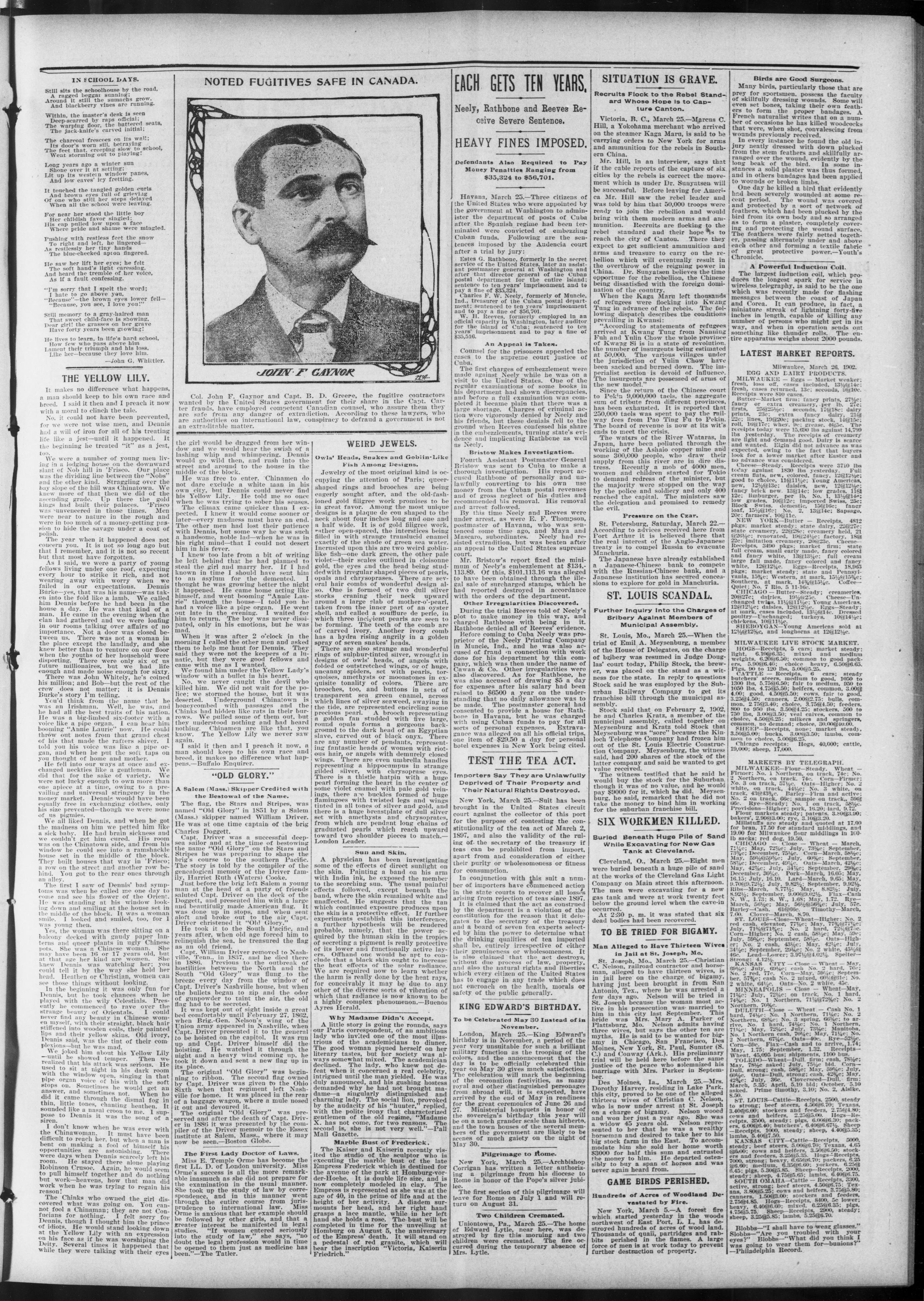
JOHN F. GAYNOR
Col. John F. Gaynor and Capt. B. D. Greere, the fugitive contractors wanted by the United States government for their share in the Capt. Carter frauds, have employed competent Canadian counsel, who assure them they are safe from any danger of extradiction. According to these lawyers, who are authorities on international law, conspiracy to defraud a government is not an extraditable matter.
the girl would be dragged from her window and we would hear the swish of a lashing whip and whimpering. Dennis would go wild then, and rush into the street and around to the house in the middle of the block.
He was free to enter. Chinamen do not dare exclude a white man in his own city, but Dennis could never find his Yellow Lily. He told me so once when he was trying to sober his senses.
WEIRD JEWELS.
Owls' Heads, Snakes and Goblin-Like Fish Among Designs.
Jewelry of the most original kind isOccupying the attention of Paris; queer shaped rings and brooches are being eagerly sought after, and the old-fashioned gold filigree work promises to be
The climax came quicker than I expected. I knew it would come sooner or later—every madness must have an end. The other men had lost their patience with Dennis, but some way he was such a handsome, noble lad—when he was in his right mind—that I could not desert him in his fever.
I knew too late from a bit of writing he left behind that he had planned to steal the girl and marry her. If I had known in time I should have sent him to an asylum for the demented. I thought he was growing better the night it happened. He came home acting like himself, and went booming "Annie Laurie" through the house—I told you he had a voice like a pipe organ. He went out late in the evening. I waited for him to return. The boy was never dissipated, only in his emotions, but he was mad.
When it was after 2 o'clock in the morning I called the other men and asked them to help me hunt for Dennis. They said they were not the keepers of a lunatic, but they were good fellows and came with me as I wanted.
We found him under the Yellow Lady's window with a bullet in his heart. No, we never caught the devil who killed him. We did not wait for the police; we stormed the house, but it was deserted. Underground Chinatown is honeycombed with passages and the Chinks had hidden like rats in their burrows. We pulled some of them out, but they understood nothing and had heard nothing. Chinamen are like that, you know. The Yellow Lily we never saw again.
I said it then and I preach it now, a man should keep to his own race and breed, it makes no difference what happens.—Buffalo Enquirer.
"OLD GLORY."
A Salem (Mass.) Skipper Credited with the Bestowal of the Name.
The flag, the Stars and Stripes, was named "Old Glory" in 1851 by a Salem (Mass.) skipper named William Driver. He was at one time captain of the brig Charles Doggett.
Capt. Driver was a successful deepsea sailor and at the time of bestowing the name "Old Glory" on the Stars and Stripes he was preparing to shape the brig's course to the southern Pacific.
The story is told by the compiler of the genealogical memoir of the Driver family, Harriet Ruth (Waters) Cooke.
Just before the brig left Salem a young man at the head of a party of friends saluted Capt. Driver on the deck of the Doggett, and presented him with a large and beautifully made American flag. It was done up in stops, and when sent aloft and broke out to the air Capt. Driver christened it "Old Glory."
He took it to the South Pacific, and years after, when old age forced him to relinquish the sea, he treasured the flag as an old friend.
Capt. William Driver removed to Nashville, Tenn., in 1837, and he died there in 1886. Previous to the outbreak of hostilities between the North and the South "Old Glory" was flung to the breeze every day from the window of Capt. Driver's Nashville house, but when the bullets began to zip and the odor of gunpowder to taint the air, the old flag had to be secreted.
It was kept out of sight inside a great bed comfortably until February 27, 1862, when Brig.-Gen. Nelson's wing of the Union army appeared in Nashville, when Capt. Driver presented it to the general to be hoisted on the capitol. It was run up and Capt. Driver himself did the hoisting. He watched it through the night and a heavy wind coming up, he took it down and sent a new flag up in its place.
The original "Old Glory" was beginning to ribbon. The second flag owned by Capt. Driver was given to the Ohio Sixth when that regiment left Nashville for home. It was placed in the rear of a baggage wagon, where a mule nosed it out and devoured it.
The original "Old Glory" was preserved and after the death of Capt. Driver in 1886 it was presented by the compiler of the Driver memoir to the Essex institute at Salem, Mass., where it may now be seen.-Boston Globe.
The First Lady Doctor of Laws.
Miss E. Temple Orme has become the first LL. D. of London university. Miss Orme's success is all the more remarkable inasmuch as she did not prepare for the examination in the usual manner. She took up the study of law by correspondence, and in this manner went through the entire course from jurisprudence to international law. Miss Orme is anxious that her example should be followed by other girls, and that a greater interest be manifested in legal studies. "If women entered seriously into the study of law," she says, "no doubt the legal profession would in time be opened to them just as medicine has been."—The Tatler.
WEIRD JEWELS.
Owls' Heads, Snakes and Gobiin-Like Fish Among Designs.
Jewelry of the most original kind is occupying the attention of Paris; queer-shaped rings and brooches are being eagerly sought after, and the old-fashioned gold filigree work promises to be in great favor. Among the most unique designs is a plaque de con shaped to the neck about four inches long and one and a half wide. It is of gold filigree work, rather open-spaced, the interstices being filled in with strange translucid enamel exactly of the shade of green sea water. Incrusted upon this are two weird goblin-like fish—one dark green, the other pale violet—their scales outlined in cloisonne gold, the eyes and the head being studded with irregular shaped pieces of pearls, opals and chrysoprases. There are several hair combs of wonderful design also. One is formed of two dull silver storks craning their neck upward around a large slab of mother-o'-pearl, taken from the inner part of an oyster shell, and called a soufflure de perle, in which three incipient pearls are seen to be forming. The teeth of the comb are of carved ivory. Another ivory comb has a hydra rising angrily in a golden spray of seven snakes' heads.
There are also strange and wonderful rings of sulphur-tinted silver, wrought in designs of owls' heads, of angels with folded or outstretched wings, or of huge, uncanny spiders, set with pearls, torquoises, amethysts or moonstones in exquisite tonality of colors. There are brooches, too, and buttons in sets of transparent sea green enamel, across which lines of silver seaweed, swaying in the tide, are represented encircling some precious pearl. A brooch representing a golden fan studded with five large, round opals forms a gorgeous background to the dark head of an Egyptian slave, carved out of black onyx. There are any number of pendants, representing fantastic heads of women with riotous hair, or angels with demurely closed wings. There are even umbrella handles representing a hippocampus in strange gilded silver, with chrysoprase eyes. There is a thistle hatpin with a huge pearl forming the heart in the center of some violet enamel with pale gold veinings, there are buckles formed of huge flamingoes with twisted legs and wings tinted in all tones of silver and gold, and there is a huge breastplate of dull silver set with amethysts and chrysoprates, from which are pendant long chains of graduated pearls which reach upward toward two shoulder pieces to match.—London Leader.
Sun and Skin.
A physician has been investigating some of the effects of direct sunlight on the skin. Painting a band on his arm with India ink, he exposed the member to the scorching sun. The usual painful effects followed, except beneath the band, where the skin remained white and unaffected. He suggests that the tan which continued exposure produces upon the skin is a protective effect. If further experiments establish this interference, a further hypothesis will be rendered probable, namely, that the power acquired by the human skin in the tropics of secreting a pigment is really protective of its lower and functionally active layers. Offhand one would be apt to conclude that a black skin ought to increase the heat effects of the solar radiance. We are required now to learn whether the harm is really done by the heat rays, for conceivably it may be due to any other of the diverse sorts of vibration of which that radiance is now known to be a highly complex phenomenon.—Buenos Ayres Herald.
Why Madame Didn't Accept
A little story is going the rounds, says our Paris correspondent, of an ambitious lady who invited one of the most illustrious of the academicians to dinner. The good woman piqued herself on her literary tastes, but her society was always somewhat mixed. The academician declined. The lady, who knew not defeat when it concerned a real celebrity, intrigued until the man yielded. He was duly announced, and his gushing hostess demanded why he had not brought madame—a singularly distinguished and charming lady. The social lion, provoked by the audacity of his "hunter," replied, with the polite irony that characterized gentlemen of the old regime, "Madame X. has not come, for two reasons. The second is, she is not very well."—Pall Mall Gazette.
Marble Bust of Frederick.
The Kaiser and Kaiserin recently visited the studio of the sculptor who is executing the marble bust of the late Empress Frederick which is destined for the avenue of the park at Homburg-vorder-Hoehe. It is double life size, and is now completely modeled in clay. The Empress is represented as she was at the age of 40, in the prime of life and at the height of her activity. A diadem surmounts her head, and her right hand grasps a lace mantle, while in her left hand she holds a rose. The bust will be completed in time for the unveiling at Homburg on August 5, the anniversary of the Empress' death. It will stand on a pedestal of red granite, which will bear the inscription "Victoria, Kaiserin Friedrich."
EACH GETS TEN YEARS.
Neely, Rathbone and Reeves Receive Severe Sentence.
Defendants Also Required to Pay Money Penalties Ranging from $35,324 to $56,701.
Havana, March 25.—Three citizens of the United States who were appointed by the government at Washington to administer the department of posts of Cuba after the Spanish regime had been terminated were convicted of embezzling Cuban funds. Following are the sentences imposed by the Audencia court after a trial by jury:
Estes G. Rathbone, formerly in the secret service of the United States, later an assistant postmaster general at Washington and after that director general of the Cuban postal department for the entire island; sentence to ten years' imprisonment and to pay a fine of $35,324.
Charles F. W. Neely, formerly of Muncie, Ind., treasurer of the Cuban postal department; sentenced to ten years' imprisonment and to pay a fine of $56,701.
W. H. Reeves, formerly employed in an official capacity in Washington, later auditor for the island of Cuba; sentenced to ten years' imprisonment and to pay a fine of $35,516.
An Appeal is Taken.
Counsel for the prisoners appealed the cases to the supreme court justice of Cuba. The first charges of embezzlement were made against Neely while he was on a visit to the United States. One of the regular examinations or some books in his department had shown discrepancies, and before a full examination was completed it became plain that there was a large shortage. Charges of criminal action were vigorously denied by Neely and his friends, but these denials fell to the ground when Reeves confessed his share in the embezzlements, turning state's evidence and implicating Rathbone as well as Neely.
Bristow Makes Investigation.
Fourth Assistant Postmaster General Bristow was sent to Cuba to make a thorough investigation. His report accused Rathbone of personally and unlawfully converting to his own use money from the Cuban postal revenues and of gross neglect of his duties and recommended his removal. His removal and arrest followed.
By this time Neely and Reeves were under arrest, as were E. F. Thompson, postmaster of Havana, who was sentenced some time ago, and Maya and Mascaro, subordinates. Neely had resisted extradition, but was beaten after an appeal to the United States supreme court.
Mr. Bristow's report fixed the minimum of Neely's embezzlement at $134.113.89. Of this, $101.113.16 was alleged to have been obtained through the illegal sale of surcharged stamps, which he had reported destroyed in accordance with the orders of the department.
Other Irregularities Discovered.
During the trial Reeves told of Neely's plot to make money in this way, and charged Rathbone with being in it. Rathbone denied all of Reeves' evidence.
Rathbone denied all of Reeves' evidence. Before coming to Cuba Neely was proprietor of the Neely Printing Company in Muncie, Ind., and he was also accused of fraud in connection with work done for his department by this company, which was then under the name of Cawan & Co. Other irregularities were also discovered. As for Rathbone, he was also accused of drawing $5 a day for expenses after his salary had been raised to $6500 a year on the understanding that no daily allowance was to be made. The postmaster general had consented to provide a house for Rathbone in Havana, but he was charged with using Cuban funds to pay for all sorts of personal expenses. Extravagance was alleged on all his official trips, one item of $29.50 a day for personal hotel expenses in New York being cited.
TEST THE TEA ACT.
Importers Say They are Unlawfully Deprived of Their Property and Their Natural Rights Destroyed. New York, March 25.—Suit has been brought in the United States circuit court against the collector of this port for the purpose of contesting the constitutionality of the tea act of March 2, 1897, and also the validity of the ruling of the secretary of the treasury if teas can be prohibited from import, apart from and consideration of either their purity or wholesomeness or fitness for consumption.
In conjunction with this suit a number of importers have commenced action in the state courts to recover all losses arising from rejection of teas since 1897. It is claimed that the act as construed by the department is a violation of the constitution for the reason that it delegates to the secretary of the treasury and a board of seven tea experts selected by him the power to determine what the drinking qualities of tea imported shall be, entirely irrespective of either their genuineness or wholesomeness. It is also claimed that the act destroys, without due process of law, property, and also the natural rights and liberties which every citizen of the United States has to engage in any trade which does not encroach on the health, morals or safety of the public generally.
KING EDWARD'S BIRTHDAY.
To be Celebrated May 30 Instead of in November.
London, March 25.—King Edward's birthday is in November, a period of the year very unsuitable for such a brilliant military function as the trooping of the colors, and the announcement that the day is to be officially celebrated this year on May 30 gives much satisfaction. The celebration will mark the beginning of the coronation festivities, as many royal and other distinguished personages from abroad will, it is expected, have arrived by the end of May in readiness for the great ceremonies of June 26 and 27. Ministerial banquets in honor of the sovereign's birthday this year will be on a much grander scale than hitherto, and the town houses of the several members of the government are likely to be scenes of much gaiety on the night of May 30.
Pilgrimage to Rome.
New York, March 25.—Archbishop Corrigan has written a letter authorizing a pilgrimage from his diocese to Rome in honor of the Pope's silver jubilee. The first section of this pilgrimage will leave for Rome on July 1 and will return on August 31.
Two Children Cremated.
Uniontown, Pa., March 25.—The home of Edward Lytle, near here, was destroyed by fire this morning and two children were cremated. The fire occurred during the temporary absence of Mrs. Lytle.
SITUATION IS GRAVE.
SITUATION IS GRAVE.
Recruits Flock to the Rebel Standard Whose Hope is to Capture Canton.
Victoria, B. C., March 25.—Marcus C. Hill, a Yokohama merchant who arrived on the steamer Kaga Maru, is said to be carrying orders to New York for arms and ammunition for the rebels in Southern China.
Mr. Hill, in an interview, says that if the cable reports of the capture of six cities by the rebels is correct the movement which is under Dr. Sunyatsen will be successful. Before leaving for America Mr. Hill saw the rebel leader and was told by him that 50,000 troops were ready to join the rebellion and would bring with them modern arms and ammunition. Recruits are flocking to the rebel standard and their hope is to reach the city of Canton. There they expect to get sufficient ammunition and arms and treasure to carry on the rebellion which will eventually result in the overthrow of the reigning power in China. Dr. Sunyatsen believes the time opportune for the rebellion, the Chinese being dissatisfied with the foreign domination of the country.
When the Kaga Maru left thousands of refugees were flocking into Kwang Tung in advance of the rebels. The following dispatch describes the conditions prevailing in Kwansi:
"According to statements of refugees arrived at Kwang Tung from Nanning Fuh and Yulin Chow the whole province of Kwang Si is in a state of revolution. the number of insurgents being estimated at 50,000. The various villages under the jurisdiction of Yulin Chow have been sacked and burned down. The imperialist section is devoid of influence. The insurgents are possessed of arms of the new model."
Since the return of the Chinese court to Pekin 9,000,000 taels, the aggregate sum of tribute from different provinces, has been exhausted. It is reported that 250,000 taels was spent to pay the railway fees from Pao Ting Fu to Pekin. The board of revenue is now at its wit's ends to meet the crisis.
The waters of the River Wataras, in Japan, have polluted through the working of the Ashaio copper mine and some 300,000 people, who draw their supply from this river are in dire distress. Recently a mob of 4000 men, women and children started for Tokio to demand redress of the minister, but the majority were stopped on the way by the police and soldiery and only 400 reached the capital. The ministers saw the delegation and promised to remedy the evil.
Pressure on the Czar.
St. Petersburg, Saturday, March 22. According to advices received here from Port Arthur it is believed there that the real interest of the Anglo-Japanese treaty is to compel Russia to evacuate Manchuria. The Japanese have already established a Japanese-Chinese bank to compete with the Russian-Chinese bank, and a Japanese institution has secured concessions to explore for gold in Manchuria.
ST. LOUIS SCANDAL.
Further Inquiry Into the Charges of Bribery Against Members of Municipal Assembly.
St. Louis, Mo., March 25.—When the trial of Emil A. Meysenburg, a member of the House of Delegates, on the charge of bribery was resumed in Judge Douglas' court today, Philip Stock, the brewer, was placed on the stand as a witness for the state. In reply to questions Stock said he was employed by the Suburban Railway Company to get its franchise bill through the municipal assembly.
Stock said that on February 2, 1902, he and Charles Kratz, a member of the municipal assembly, called together on Meysenburg and Kratz told Stock that Meysenburg was "sore" because the Kinloch Telephone Company had frozen him out of the St. Louis Electric Construction Company. Meysenburg, the witness said, had 200 shares of the stock of the latter company and said he wanted to get value received. The witness testified that he said he would buy the stock for the Suburban, though it was of no value, and he would pay $9000 for it, which he did. Meysenburg, he said, remarked that he did not take the money to bind him in working for the suburban franchise bill.
SIX WORKMEN KILLED.
Buried Beneath Huge Pile of Sand While Excavating for New Gas Tank at Cleveland.
Cleveland, O., March 25.—Eight men were buried beneath a huge pile of sand at the works of the Cleveland Gas Light Company on Main street this afternoon. The men were excavating for a new gas tank and were at work twenty feet below the ground level when the cave-in occurred.
At 2:30 p. m. it was stated that six dead bodies had been recovered.
TO BE TRIED FOR BIGAMY.
Man Alleged to Have Thirteen Wives in Jail at St. Joseph, Mo.
St. Joseph, Mo., March 25.—Christian C. Nelson, railroad contractor and horseman, alleged to have thirteen wives, is in jail here on the charge of bigamy, having just been brought in from San Antonio, Tex., where he was arrested a few days ago. Nelson will be tried in St. Joseph because the woman most active in his prosecution was married to him in this city last September. This bride was Mrs. Mary A. Parker of Plattsburg, Mo. Nelson admits having three wives, but says the other ten are myths. He is said to be wanted for bigamy in Chicago, San Francisco, Des Moines, New York, St. Paul, Sumter (S. C.) and Conway (Ark.). His preliminary trial will be held here before the same justice of the peace who solemnized his marriage with Mrs. Parker in September.
Des Moines, Ia., March 25.—Mrs. Dorothy Harvey, residing in Lake Park, this city, proved to be one of the alleged thirteen wives of Christian C. Nelson, who is now under arrest at St. Joseph on a charge of bigamy. Nelson wooed and won her just a year ago. She was a widow 45 years old. Nelson represented to her that he was a wealthy horseman and desired to take her to his big stock farm in the East. To accommodate him she sold her home worth $3000 for half this sum and entrusted the money to him. He departed ostensibly to buy a span of horses and was never again heard from.
GAME BIRDS PERISHED.
Hundreds of Acres of Woodland Devastated by Fire.
New York, March 5.—A forest fire which started yesterday in the woods northwest of East Port, L. I., has destroyed hundreds of acres of wood land. Thousands of quail, partridges and rabbits perished in the flames. A large force of men is at work today to prevent further destruction of property.
Birds are Good Surgeons.
Many birds, particularly those that are prey for sportsmen, possess the faculty of skillfully dressing wounds. Some will even set bones, taking their own feathers to form the proper bandages. A French naturalist writes that on a number of occasions he has killed woodcocks that were, when shot, convalescing from wounds previously received.
In every instance he found the old injury neatly dressed with down plucked from the stem feathers and skillfully arranged over the wound, evidently by the long beak of the bird. In some instances a solid plaster was thus formed, and in others bandages had been applied to wounds or broken limbs.
One day he killed a bird that evidently had been severely wounded at some recent period. The wound was covered and protected by a sort of network of feathers, which had been plucked by the bird from its own body and so arranged as to form a plaster, completely covering and protecting the wound surface. The feathers were fairly netted together, passing alternately under and above each other and forming a textile fabric of great protective power.—Youth's Chronicle.
A Powerful Induction Coil.
The largest induction coil, which produces the longest spark for service in wireless telegraphy, is said to be the one which was recently made for flashing messages between the coast of Japan and Corea. It can produce, in fact, a miniature streak of lightning forty-five inches in length, capable of killing any number of persons who might get in its way, and when in operation sends out something like thunder rolls. The entire apparatus weighs about 2000 pounds.
LATEST MARKET REPORTS.
Miliwaukee, March 26, 1902.
ND. FAIRY. PRODUCTS.
EGG AND DAIRY PRODUCTS.
MILWAUKEE — Eggs — Market weaker; fresh, loss off, cases included, 13½¼ at 14c; fresh, cases returned, 13c; seconds, 9½¹0c. Receipts were S10 cases.
Butter—Market firm; fancy prints, 27½¹c; fancy or extra creamery, per lb. 27c; firsts, 25½¹³c; seconds, 17½¹8c; dairy prints, 23c; extra fancy dairy, 21¹³c; lines, 19½²0c; packing stock, 14½¹5c; roll, 16½¹7c; whee, 9¹c; grease, 4½¹6c. The receipts today were 15,690 lbs against 14,790 lbs yesterday. The receipts of creamery are light and demand good. Dairy is scarce and wanted. Elgin did not advance as was expected, owing to the fact that buyers look for a lower market after Easter and no advance was considered.
Cheese—Steady. Receipts were 3710 lbs today against 1830 lbs yesterday. Full cream flats, new, colored, fancy, 12@12½c; good to choice, 11@11½c; Young Americas, new, 12½@13c; dales, new, 12½@12½c; fancy brick new, 13@14c; low grades, 11@12c; limburger, per lb, No. 1, 13@14c; low grades, 10@12c; imported Swiss, 25c; Block Swiss, domestic, 15@16c; fancy loaf, 15½@16c; No. 2, 13@14c; Sapsago, 20c; farmers' 10@11c.
NEW YORK—Butter — Receipts, 4812 pkgs; market steady; state dairy, 22@27c; state creamery, 22@28c; creamery held, 21@26½c; renovated, 19@24½c; factory, 18@22c; imitation creamery, 20@23c. Cheese—Receipts, 3490 pkgs; market firm; state full cream, small early made, fancy colored and fancy white, 13@13½c; full cream large fall made, fancy colored and fancy white, 12@12½c. Eggs—Receipts, 18,965 pkgs; market steady; state and Pennsylvania, 15½c; Western, at mark, 15½@15½c; Southern, at mark, 14½@15½c. Coffee—Oui: 7 No. 2 Bio 5 11-16c.
CHICAGO — Butter—Steady; creameries,
20@27c; dailies, 19@25c; Cheese—Unchanged twins, 11%@11%c; Young Americas,
12@12%c; daisies, 12@12%c; Eggs—Steady;
at mark, cases included, 13%@14c. Dressed poultry—Unchanged; turkeys, 10@14%c;
chickens, 10@11%c.
SHEBOYGAN—Young Americas sold at
12%@12%c, and longhorns at 12@12%c.
MILWAUKEE LIVE STOCK MARKET.
HOGS—Receipts, 5 cars; market steady;
light, 6.10@6.35; mixed and medium
weights, 6.20@6.50; common to good packers,
5.90@6.40; choice heavy, 6.50@6.65.
Pigs, 90 to 120 lbs, 5.00@5.25.
CATTLE — Receipts, 6 cars; steady butchers' steers, medium to good, 1050 to 1300 lbs, 5.75@6.50; fair to medium, 950 to 1050 lbs, 4.75@5.50; heifers, common, 3.00@4.00; good, 4.50@5.50; cows, fair to good, 3.25@4.50; canners, 2.00@2.75; bulls, common, 2.75@3.40; choice, 3.75@4.50; feeders, 800 to 950 lbs, 3.50@4.25; stockers, 500 to 750 lbs, 3.00@3.50; veal calves, common to choice, 4.50@6.25; milkers and springers, common, no demand; choice, 30.00@40.00.
SHEEP—Receipts, none; market steady, 3.50@5.00; bucks, 3.00@3.50; lambs, common to choice, 5.00@6.25.
Chicago receipts: Hogs, 40,000; cattle, 19,000; sheep, 17,000.
MARKETS BY TELEGRAPH
MILWAUKEE—Flour—Steady. Wheat.—Firmer; No. 1 Northern, on track, 74e; No. 2 Northern, on track, 74e. Corn—Firmer; No. 3 on track, 571⁴⁰. Oats—Higher; No. 2 white, on track, 441⁴⁰; No. 3 white, on track, 43@431⁴⁰. Barley—Firm and active; No. 2 on track, 66c; sample on track, 59@66c. Rye—Steady; No. 1 on track, 581⁴⁰. Provisions—Higher; pork, 16.20; lard, 9.72. Flour markets steady; patents, 3.80@3.90; bakers, 2.90@3.00; rye, 3.10@3.20. Millstuffs are steady and quoted at 17.00 for bran, 17.50 for standard middlings, and 19.00 for Milwaukee flour middlings in 100lb sacks; red dog, 19.50.
CHICAGO — Close — Wheat — March,
71%c; May, 72%c; July, 73%c; September,
73%c; December, 75%c; Corn—March, 58%c;
May, 59%c@59%c; July, 60%c; September,
58%c; December, 49%c. Oats—March, 42%c;
May, 42%c; July, 34%c; September, 29%c;
December, 30%c. Pork—March, 16.05; May,
16.15; July, 16.10. Lard—March, 9.65; May,
9.70%@9.72%; July, 9.82%; September, 9.92%;
Ribs—March, 8.77%; May, 8.82%; July,
8.92%; September, 9.00%@9.02%. Flax—Cash
N. W, 1.73; S. W, 1.68; May, 1.72. Rye—
March, 56%c; May, 56%c@56%c; July, 57c;
Barley—Cash, 61@66c Timothy—March,
7.00. Clover—March, 8.70.
ST. LOUIS—Close—Wheat—Higher. No. 2
red cash, elevator, 77%c; May, 77%@77%c;
July, 71%@71%c; No. 2 hard, 72%@72%c;
Corn—Higher. No. 2 cash, 58%c; May, 59%;
July, 59%c; September, 58%c. Oats—Higher.
No. 2 cash, 43%c; May, 42%c; July,
34%c; September, 29%c; No. 2 white, 45%@46c.
Lead—Lower; 3.97%@4.02%c. Spelter—
Strong; 4.12%c.
KANSAS CITY — Close — Wheat — May,
89%c; July, 69%c; cash No. 2 hard, 70c;
No. 2 red, 77c; Corn—May, 59%c; September,
57%c; cash No. 2 mixed, 60%@31c; No. 2
white, 64%c; Oats—No. 2 white, 45c.
MINNEAPOLIS — Close — Wheat—May,
71%c; July, 72%c; on track, No. 1 hard,
74%c; No. 1 Northern, 71%@72%c; No. 2
Northern, 76%c.
DULUTH—Close — Wheat — Cash No. 1
hard, 74%c; No. 1 Northern, 71%c; No. 2
Northern, 88%c; No. 3 spring, 60%c; to arrive,
No. 1 hard, 74%c; No. 1 Northern,
71%c; May, 72%c; July, 73%c; Manitoba,
No. 1 Northern cash, 70%c; May, 71%c; No. 2
Northern, 67%c; Oats—40c. Rye—52%c;
Corn—59c. Flax—Cash and to arrive, 1.74;
May, 1.75; September, 1.32. Receipts—
Wheat 45,005 bus; shipments 1100 bus.
TOLEDO—Wheat—Dull, firn; cash, 78½c;
May, 78½c asked; July, 75½c bld. Corn—Dull, strong; cash, 58½c; May, 59½c; July, 60½c. Oats—Dull, strong; cash, 42½c; May, 42½c; July, 36c. Cloverseed—Dull, firm; March, 5.35; April, 5.10 bld; October, 5.10 asked. Prime timothy, 3.10; No. 2, Alsike, 8.50.
ST. LOUIS—Cattle—Recelpts, 2500, steady to strong; beef steers, 4.50@6.70; Texans, 3.40@6.00; stockers and feeders, 2.75@4.80; cews and heifers, 2.25@5.00. Hogs—Recelpts, 3500, steady; plgs, 6.00@6.30; packers, 6.00@6.40; butchers, 6.40@6.67½. Sheep—Recelpts, 1000, steady; sheep, 4.40@5.35; lambs, 5.40@7.50.
KANSAS CITY—Cattle—Recelpts, 5000
steady; beef steers, 5.00@6.70; Texans, 4.65
@6.00; cows and helfers, 3.50@6.50; stock-
ers and feeders, 3.25@5.35. Hogs—Recelpts,
7000, strong; heavy, 6.65@6.70; packers, 6.25
@6.60; medium, 6.35@6.60; yorkers, 6.25@
6.45; pigs, 5.30@5.30. Sheep—Recelpts, 2000,
steady; sheep, 4.75@5.65; lambs, 6.40@6.75.
SOUTH OMAHA—Cattle—Recelpts, 3300
active, strong; beef steers, 4.50@6.75; Tex-
ans, 3.80@5.25; cows and helfers, 3.75@5.80;
canners, 1.50@3.00; stockers and feeders,
2.75@4.85. Hogs—Recelpts, 8400, 5c lower;
heavy, 6.40@6.60; mixed, 6.25@6.35; plugs,
4.75@5.75. Sheep—Recelpts, 2900, steady;
sheep, 3.25@5.85; lambs, 5.25@6.70.
Blobbs—"I shall have to wear glasses."
Slobbs—"Are you troubled with your
eyes?" Blobbs—"What did you think I
was going to wear them for—bunions?"
Philadelphia Record.
Turning Mill and
Box Factory
Rockers and al! kinds of Restaurant
Blocks, Extension Ladders, Tea Cad-
‘dies, Boxes, Turning, Sawing, Mitchell
Improved Washers, Trestels, Swinging
‘Scaffolds. Repair Work PromptlyAttended to
TELEPHONE MAIN 252,
228-230 Fifth St., Milwaukee, Wis.
Before Starting on Your Travels
Ge0. Burroughs & Sons
PREMIUM TRUNKS
VALISES, SAMPLE CASES, Etc.
404 & 426 East Water St, Milwankea,
WHEN IN KENOSHA
MATT GREENWALD
Who is ete tae me Business
E, KLINKERT’S RACINE KEG and
BOTTLED BEER.
Depot: No. 15 North Main Street.
Telephone 163.
KENOSHA - WISCONSIN
SF PEACOCK & SON
Funeral Directors
EMBALMERS
Always ask for tickets
via the
THE SHORT LINE BETWEEN
Chicago,
; indianapolis,
Cincinnati,
Louisville
Six trains daily between Chicago and
the Ohio river.
For folders, rates, etc., call at any
Monon ticket office or address
FRANK J. REED,
Gen’! Pass. Agent, Chicago.
S. B. JONES,
C. P. Agent, 232 Clark St., Chicago.
tLe
mon C Let
’
. v.
Yourdair,
“
" ’ el
gall Out
ba} {
FREE
ae omelet {
'LUSTORONE}
i ‘to every one”
Z Ss
a gee a? ee)
in a ‘y Paes y
WAG y i 2p ea p
. ns
Misnelie SUGSroone pees eal os
a
| Sitea EUSPOROME eit prove's bess 6
| Betaeean Saeteaet seit gee
Causes the hair to: out. on bald
tee, se SauPLE ge
Fai
DOMINION”
M’E'G CO. @e-
2220East >
Masshall St. x
Richmond, Va.
Printed in tra Interests of the Negro Race,
MILWAUKEE, WIS.
ee
Telephone Black No. 244.
SUBSCRIPTION RATES.
Any part of the United States and Canada,
postage paid.
One Year .......0ceeeeeeeeeeeeseee ees $2.00
Bix Months .......-.0-ccereseceesees LZ
Three Months .........--2-+eeeseeees 00D
Send money by Express Money Order, P. O.
Money Order or Registered Letter to the
Wisconsin Weekly Advocate.
ADVERTISING RATES.
One inch, single insertion.......-...+-. 25¢
One inch, pe FONE. , ono eecevave sss 99-00
Business locals 5¢ per line each Insertion.
Apply for rates to the Adyocate.
TO CONTRIBUTORS:
~l Se psrrtmecon must be sent with the
name aW@ address of the sender as an evi-
dence of good faith, but not necessarily for
publication. No manuscript returned if not
accepted, unless accompanied by stamps.
The Wisconsin Weekly Advocate company
wishes to notify the public that all contracts
and business transactions with this com-
pany must have the company stamp. other-
wise they will be void. Neither will this
company be responsible for paid subscrip-
tions unless given to duly-accredited agents,
who, on request, will give the company’s re-
ceipt for same. Subseribers ae to re-
ceive their papers poenlnry, wil) kindly noti-
fy the gener office. Address all business
communications to the general manager,
729 St. Paul avenue.
Entered in the Postoffice at Milwaukee as
Second-class matter.
——————
| The students of St. Petersburg seem
to be having a police ‘‘rush.””
——_—_—_-
Lord Francis Hope has given his
name a peculiar significance to his cred-
itors by going into bankruptcy.
—_—_—_——_
The jealous antics of Paderwski and
KXubelik furnish the only diversion from
things serious siuce the departure of
Prince Henry.
—_—_—_—_—_
There is something sweetly suggestive
for the “spring poet” in the establish-
ment of mills to manufacture paper
from sorghum cane.
The man who risked his life by travel-
ing as freight in a potato bag from Kan-
sas City to Chicago, should be given
“the sack” by all those who value com-
cain enentae
Prince Henry is satisfied from his own
experiences in America in dressing for
numerous functions, that a trip such as
he made qualifies a royal guest as light-
ning change artist.
The duel at Purdy Station, Ne-
vada, was proof conclusive that when
two Western men fight a duel at eight
feet, with Winchester rifles, the under-
taker has a double job.
The story of wholesale murder ai
Beaumont, Texas, recalls the famous
Bender family’s methods of entertaining
unsuspecting travelers. The oil rush in
Texas has evidently contaminated the
population of the gusher section.
Gen. William Sooy Smith’s prediction
that many steel syscrapers will rust and
fall into serap heaps presupposes a will-
ingness on the part of owners to look on
supinely while nature is thus ruining
The foreign gossip concerning Sir
Thomas Lipton anf Miss Fay ought to
be of particular interest to Milwaukee
ans who were recently captivated by a
combination of antics and pseudo psy-
chology. But it happens to be another
Fay.
The cruel blackmailers who are trying
to “work” Alexander R. Peacock, a
Pittsburg multi-millionaire, should be run
to cover and when captured subjected to
punishment so s-:vere that others of their
kidney will be deterred from the des-
picable business.
—___-
In confining his gifts to men, Prince
Henry accentuated his declaration that
America is full of beautiful women. He
could not possibly provide gifts enough
to go around, if he tried to pay tribute in
that way to the charming hospitality of
the women he met during his tour.
Athletics are supposed to strengthen
the lungs; but the death of the “Terriic
Swede" from congestion of those organs
should warn ambitious wheelmen that
the lungs were not intended to with-
stand boiler pressure such as is imposed
during long-distance bicycle racing.
——————SS
Aspiring naval powers which imagine
that they can keep “in it” with Great
Britain, in a race for naval supremacy,
will be interested in the announcement
that the British admiralty has just or-
dered at private shipyards two battle-
ships, five first-class cruisers and two
third-class cruisers.
The fact that the old Lincoln farm in
Spencer county, Indiana, is to be sold
for taxes should arouse nothing more
than sympathy for the owner who is
to thus lose it. Some good patriot will
secure the land, and perhaps work it as
did the Lincolns, for the support of him-
self and the honor of the country.
A young woman of Miller City, Ohio,
yas paid with her life for the reckless-
ness of teking a “headache powder” that
was thrown into a carriage in which ske
was riding. A few more incidents of
‘this kind will destroy the business of
those who exploit the sale of medicines
by distributing samples of the same in-
discriminately.
R. T. Crane of Chicago, who has gone
to the trouble of collecting a symposium
of opinions on the value of college educa-
tion in business, has obtained none bet-
ter than his own, which begins with this
proposition: “Ihe whole world is a col-
lege, and one who wishes to obtaia
knowledge will find plenty of opportuni-
ties for doing so.””
In attempting to try an officer) of the
Marine Corps before an army court mar-
tial, the authorities at Manila exhibited
something like the ignorance which ocea-
sionally crops out as to the character of
the marine. He is quite often spoken of
as a sailor, when he is simply a soldier
for ship service, described in Kipling’s
ballads as “soldier and sailor, too.”
ee
The disappearance of the Stein family
from York, Pennsylvania, recalls the de-
pletion of other families of steins by sou-
venir hunters, who by the failure of the
man who conducted a banquet in New
York tor Prince Henry, on account of
she disappearance of the silver in the
pockets of souvenir-crazy guests, have
placed their hobby in the same class with
netit larceny
There is no connection between Amer-
ica’s welcome to Prince Henry and the
rush of German immigrants which has
compelled the North-German Lloyd
Steamship Company to charter extra
ships. The immigrants were pouring in
before the Kaiser thought of sending his
brother on a tour of amity, and America
was offering them superior opportunities
to establish themselves in free hontes,
A famous London boat builder is to
furnish a new shell for the crew of the
University of Wisconsin,—a gift from
Capt. Fred Pabst; and the University
boys will furnish the “beef.” The latter
element of the combination is more jm-
portant than skill in the designing of
shells, as the limitations of the latter are
narrow and shallow, and have been so
thoroughly exploited, that there is scarce-
ly any room for further improvement,
—_—_—_—_
The uncontrollable Manitowoc artesian
well is like the gusher that was recently
opened in the Town of Lake, Milwaukee
county. The possibility of tapping un-
derground currents of water in Wiscon-
sin is worthy of consideration in connee-
tion with irrigation enterprises. Wiscon-
sin land is fruitful under natural mois-
tening by occasional rains; but it would
be more fruitful if it could be systemat-
ically irrigated with water from artesian
wells.
MAKING CAR WHEELS STRONG.
Severe Tests to Which They are Sub-
jectel in Manufacture.
Some remarkable tests on car wheels
have just been made at the foundries of
the New York car wheel works at Black
Rock. The company is filling an order
for a special quality of wheels to be used
under 100,000-pound capacity cars now
being built for the Pennsylvania railroad
by the Pressed Steel Car company. The
requirements for wheels for such work
are very severe, and railroad engineers
have regarded that proposition as one of
the most difficult to be faced in modern
railroading. All the railroad papers have
recently been filled with discussions on
the subject.
The load to be carried by each wheel
in such cars exceeas eight tons, more
than double the load in ordinary pend ice
The New York car wheel works have
made a specialty for some years of
chilled wheels for special service, and
the sroetens made in the manufacture
has en demonstrated by tests. The
specccecens and test requirements of
the Master Car Builders’ association re-
quire wheels to stand ten blows of a
weight of 140 pounds falling twelve feet,
the wheel being placed horizontally, sup-
ported at three points on the flange.
Some railways also require the wheels
to stand the thermal test, which consists
of casting a band of molten iron, a4
inches thick by 4 inches wide, aroun
the wheel tested. The test demonstrates
the ability of the wheel to withstand ex-
cessisve heating from brake service. The
road's inspector selects three wheels from
each lot of 100 offered, and if any one
fails to meet the test requiremevts the
lot is rejected. It can be seen that the
tests are severe, even in regular practice.
—Buffalo Express.
RACINE—Guilbert & Rugh, architects,
Northwestern House
APPLETON, WIS.
JOHN A. BRILL, - Proprietor.
Terms $1.00 Per Day.
toe ek pie pao ee
NORTHWESTERN ~
EEE
WHEN IN MADISON |
Call at the —___=_ |
| Aven ue
| Hotel eee |
M, J. REGAN, Prop. |
$2.00 Rate... 006
feee—___ Free ’Bus.
SSS SSESSE SS SESS SSS
%
%
%
%
% \ y
%
¥% Curly Hair Made Straight By
% ’
% (eae ns Cire
& Se {G
/ a Be y=
i = =
4 {= ot: —,
4 ae ==
40 Sas A
% _———= =
% Sy SF
% a an
4 ADA. Midas
ae ‘TAKEN FROM LIFE:
4 BEFORE AND AFTER TREATMENT.
ORIGINAL
%
¥OZONIZED OX MARROW
Be (Copyrighted.)
¥% This wonderful hair pomade is theonly safe
% proparation in the world that makes kiuky or
A curly hair straight as shown above. It nour-
ishes the scalp and prevents the hair from
Y talling out or breaking off, cures dandruff. and
Y makes the hair grow long and sliky. Sold over
¥; forty years and used by thousands. Warranted
¥ barmicse. Testimonfals free ou request. It
% cesightontug kinky hair. Beware of imitae
Den rere, ecto
as nuine never fai 201
fhe hair straight, Soft and beautiful. & ser
O iserraiy estas, thaeren tates
¥ this wonderful pomade is that by its use you
¥ can straighten your own hair at home. Owing
toltssuperior and lasting qualities itis the
% best and most economical. ‘It is not possible
J for anybody to produce a preparation equal tg
Fit." Fulldirections with every bottle. Only 50
Zcents, Sold by druggists and dealers or send
Giese Wear Wh eecenaaee ea
f postal or exvress order. Write your
% Dame and address piainiy to
S OZONIZED OX MARROW CO.,
%76 Wabash Avenue, Chicago, Illinois.
f
4 |
Yr | eee nena
—— ee
AND SEND OUR GOODS TO YOU ON CREDIT.
We Pay all the Express Charges.
EAA TL NE RAAT BAY
OU can earn from $10.00 to $50.00 a week selling our great remedy. If you already have a posi-
tion, you can make good money by working in your spare time. Now is the sonapies time.
Write before some one else gets the Agency, as we only want one Agent in a place. ow many
opportunities to make money have you lost? Here is a chance for every man or woman, boy or;
girl, to make snOnEy every day in the year. IRONAL, the great natural medicine, is a certain cure
for all diseases of the Bicmach. Liver, Kidneys, Bladder, Bowels, and Blood. It cures Headache, Back-
ache, Cramps, Colic, Pains in the Shoulders, Arms, Breast, Back, Legs, and Lungs. Cures Rheumatism,
Sore Throat, Dropsy, Kidney Diseases, Fevers of all kinds, Malaria, Gout, Lumbago, and all diseases of
the human system Which are not of an organic nature—such as Cancer and Consumption. It is eaues
cially curative in Asthma, Scrofula, Syphilis, Eezema, and all laeee 9 age diseases of the skin. Also
cures all forms of diseases peculiar to women. It is Nature’s own remedy. Non-poisonous, and no dose,
no matter how large, can hurt any one. It is taken both internally and applied externally on Sores.
Eruptions, &. The price is 25c., mailed to any address on pecun of price. We want one Agent in
every locality to sell this great remedy. It never failstosatisfy. lf you want the Agency, send in your
application quick, and we will send the goods promptly by express. Send no money ; just fill out the
coupon, and we will not only send you the goods, but we will also pay the express on this end. Now is
not this fair? You ean see that we are not frauds or fakirs, for we trust you with our goods. We will
send you two dozen pechaee of IRONAL; these you sell for 25c. each, or $6.00 in all. You keep $3.00
and send us $3.00. After you have sold out, and remitted the money to us, you can get all the goods on
credit from us that you want. Write your name and address plainly, so that we can read it. If the
name is not plainly written it makes trouble and delays shipping the goods.
Address all communications to— oO co
fo eck ole IN olan “9
10614 E. Clay St., RICHMOND, VA.
THE IRONAL CO., 106} E. Clay St., Richmond, Va. :
GENTLEMEN,—I hereby apply for the Agency for IRONAL, the great natural remedy.
Please send me at once by Express two dozen packages of IRONAL (24). These I agree to sell for |
2c. each, or $6.00 in all. I willsend you $3.00 and keep $3.00 for my trouble. The Irona! Co. is to |
pay the express charges. If I cannot sell the goods, I will return them. j
i
I OO OI ee pe prea Sesser noone nicer cintescalesieasntsonialione Ht
The Name of the Street / five on is__._...________ The number of my house is_____ | |
Wy Post-Olion tenn i Coming a i
My State ie. Mp nearest Express Ofroe ia
If there is no Express Office in your town, state nearest town where there is one. }
j
3 mm
NORTHERN WISCONSIN RAIL-
ROAD LANDS
Are increasing in value from year to
year. Railroads are the great civilizers,
for they: give the settler as well as the
manufacturer equal opportunity to work
in undeveloped fields, thereby rapidly set-
tling the country and bringing forth its
undiscovered riches. Northern Wiscon-
sin is rich in iron ore, clay, kaolin, marl,
timber and fine farm lands. It has made
many a settler independent and added to
the wealth of manufacturers who have
sought this territory. Opportunities have
not passed, as there is still a generous
supply of land which can be obtained at
low figures and on easy terms.
THE WISCONSIN CENTRAL RY.
Was one of the first roads to penetrate
the vast Northern Wisconsin Wilderness
which stretches across the State from
east to west. It, also, has developed
from year to year and today offers the
best of transportation facilities, enabling
all to ship the products of that section to
any market in the world. Illustrated
pamphlets and maps which are interest-
ing as well as instructive can be obtained
by addressing W. H. KILUEN,
Land & Industrial Commissioner;
WISCONSIN CENTRAL RAILWAY,
TICKET OFFICE, 400 EAST WATER ST. Tel. 624,
To axp Fnot pesees (/eenires
&t, Paul,. Minneapolis, Iron (| °5:00am) *7:15 am
Towns, Ashland, Stentor. § +8149 pin] *8:00 pm
Duluth. Pacific Coast ...... Mya rae tetas
Marshfich |. Chippewa Falls, §|+19; +38
Fc fees rasa) 3 he
{ *5:00 am) *7:15 am.
Fond “in Lac. Oshkosh, Nee | |, *7:35am/t10:15 am
bab, eee ee 112:01 pin| +3:20pm
+4:35 pm!) *6:15 pm
*8:45 pm) 98:00 pin
Daily. *Daily except Sunday.
| EF. POTTER, Gen’'l Supt.
JAS. C. POND, Gen’l Pass. Agt.
Milwaukee, Wis.
ma | aR A
“oe ae i 5 Og
img ee eet CB bi eit
Re? ae ae tol se Se i oo z
| d er
ooo alee a ey *
el aT aS ”
\ i a , pm oF Oe 2 Sete | SS
Cf i a
| OS od cl te Heater ng aes. ee =
ane oe ee Loy Me ere i
| nas e Bes aC eR 2 een |
ee JINION....
Laundry and News Co.
No. 208 Sixth Street
GEO. VV: SAYLES
ALL WORK CAREFULLY DONE...
Lowest Prices and Satisfaction Guaranteed.
PARTIES ~~
intending to visit Hot Springs,
Ark., this winter, should pa-
tronize the
RAMMELSBERCG
BATH HOUSE,
MARK SARCENT, Manager.
21 BATHS $3.00
WILLIAM T. GREEN
Lawyer
Notary Public
Rooms 17-18 Birchard Block.
103 GRAND AVENUE.
Telephone White 9214 ———_—_
MILWAUKEE.
We want 100 agents in every
city, town and hamlet in the
U.S. for the Wisconsin Week-
ly Advocate. It will be do-
voted to the interest of the
Negro race and will contain the
news of their sayings and
doings throughout the world.
50 Per Cent. Commission
———- ADDREss———
MILWAUKEE, Wis.
“PG ANY
AN . See <4
a pet, oe ‘ i »
fey . > i,
Say ee) 2G Biyil
ty Srey es aL BF 4
5 k PX RATA l :
Billi ea
' UAW 1
ALL CASES OF
| ARE NOW CURABLE
by-cur new invention. Only those born deaf are inenzable.
HEAD NOISES CEASE IMMEDIATELY.
F. A. WERMAN, OF BALTIMORE, SAYS:
BALTrIMoRe, Md., March 30, 16%
Gentlemen : — Being entirely cured of deafness, thanks to your treatment, I will now give 7
a full history of my case, to be used at your discretion. E ale
"About five ra ‘ago my right ear began to sing, and this kept 6n getting worse, until T
my hearing in this ear entirely. E
T underwent a treatment for catarrh, for three months, without any succees, consulted 9 97
ber of physicians, among others, the most eminent ear specialist of this city, who told me tl!
only an operation could help me, and even that only temporarily, that the head noises woo!
then cease, but the hearing in the affected ear would be lost forever, ae
I then ‘saw yo ‘advertisement. accidenvaliy ina New York paper, and ordered your tres!"
ment. After I had used it only afew days according to your directions. the noises ceased. 2"
today, after five weeks, my hearing in the diseased ear has been entirely restored. 1 thank 574
heartily and beg to remain Very truly yours, a
FX WERMAN, 7308. Broadway, Baltimore, Md.
Our treatment does not interfere with your usual occupation.
Examination and ata nomine
samme nee’? YOU GAN CURE YOURSELF AT HOME “** cox.
INTERNATIONAL AURAL CLINIC, 596 LA SALLE AVE., CHICAGG, ILL.
Mention the Wisconsin Weekly Advocate when answering advertisements
50 YEARS? .
EXPERIENCE
Trave Marks
Desicns
Copyvricuts &c.
Anyone sending a sketch and deseription may
quickly ascertain our opinion free whether an
invention is probably patentable. “Communica,
tions strictly confidential. Handbook on Patents
ee. ney for securing
“Parents taken through Munn & ‘co. receive
special notice, without charge, in the
Scientific American,
A handsomely filustrated weekly. Largest cir-
culation of any scientific journal, ‘Terms. $3 a
year four months, $1. Sold by ali newsdealers.
MUNN & Co0,2¢*2-os0=. New York
‘Branck Office, 625 F St., Washington, D.C,
PETER PAWIN3KL
sees ee — — ee
oe a ee ——
a ae aa =
a a hl” *
ee Se
i ee ae
ae fe ee
a = aa
Pia Pe He
A gs a eae
io a a
tiie-teseesessecteigsssiogsrsae steczessiertese sti dl
Veter Pawinski, nominee for comp-
troller, is 45 years old and a native of
Excin, province of Posen, Poland, When
10 years old he came to this country and
direct to Milwaukee with his parents and
received his education in St. Stanislaus’
and St. Gall’s Catholic schools and in
Marquette College. In 1892 he was ap-
pointed by the common council as schoo!
commissioner for the Twelfth ward and
served for four years. ‘The same year
rer TS
CHANCE FOR COLORISTS.
Opportunities for Women with an Eye
to Effects in Drens Gooue.
Verplanck Birney, the artist, made a
suggestion the other day which may give
some woman just the idea for making
money that she is looking for.
“The great trouble with many wom-
en's gowns,” be said, “is that they can
never tell, when they buy the goods, how
it is going to look when made up. Cloth
of any sort when lying on the counter in
piece and when cut and fitted over the
figure looks entirely different. Vhe
woman who dresses Well counts probably
un entire half of her costumes as utter
failures. Onc hears her complain con-
tinually that she is so disappointed in a
certain gown, It looks so differest from
what she expected. This is not because
the woman nec ssarily lacks judgment
about dress. It is simply that she does
not possess the foresigut or imagination
to picture the guvods as it will look in
in another form; which, indeed, is a
thing often impossible to de.
“Phe case becomes more difficult when
one attempts to combine colors in a
gown, The proper proportioning of the
colors is a most important consideration
here, and one which many overlook en-
lirely. Two cloths may look beantiful
together when lying side by side on the
counter, and may not set each other off
in the least when put together in a gown.
This is because they have been com-
bined badly. Often, too, an entire gown
is made unbecoming simpiy by placing
the wrong color next the face. “Or the
figure is destroyed by placiug the wrong
color around the waist.
“Moreover, is is a fact that most wom-
en haye no idea of what looks best cu
them. Some think they do, and for them
there is littke hepe, There are others,
however, who recognize their defect and
who complain constantly that there are
so few shades they can wear. That they
so seldom find anything really becoming
to them. Often this is merely because
they never think of the shades they could
wear to best advantage. A woman with
light hair, particularly when it has a red
tinge, will cling -to different shades of
dark blue for her street gowns. She im-
agines that blue is ‘her color.” Some-
times it is the very one she should avoid.
It sets off any defect in her coloring by
sharp contrast, whereas many tints in
tans and light browns would harmonize
with these and tend to soften them.
“Now all these facts should open a
broad field to a woman artist. I say a
woman, for women are in general mueh
better colorists than men. And a color-
ist is what is needed here. A woman
with a good eye for color values and ef-
fects could build up quite a business,
simply telling other women what theic
best colors are, showing them how cloths
will look when made up, and demonstrat-
ing how an unbecoming piece of goods
may be made up to suit one by adding a
touch of another color.
“Ido not mean that this artist shall be
«x dressmaker, or even a designer of
xowns. There are plenty in both these
fields. She is to be simply a colorist, and
2 good onc. In her studio she shonld
have mirrors in all positions, so that her
patrons could see themselves in every
light and from every side. Here women
could send the goods which they pro-
hosed to have made up. The artist could
drape it over their figures, and give them
2 good idea of how it will gpeeet on
them. She could explain to them why
xoods figured in certain ways made then
fook too stout or too tall, and what coi-
ors should be avoided for the same rea-
son. She could show them how to make
an unbecoming gown attractive by wear-
ing another color around the neck. She
could suggest what trimming would look
well with any cloth, or when these hava
been chosen, might Suggest how it should
‘e used to set the gown off to best ad-
vantage,
, Lhe woman of moderate means would
find one interview with such an artist
invaluable. In it she could learn all the
shades she could wear and how to wear
them. For instance, white is very be-
coming to some women when worn as a
collar, and is just the reverse when worn
above the face in a hat. These are
things which it is not safe to leave to the
dressmaker. for good dressmakers are
not necessarily good colorists.”
Intelligence cf Animais,
Elephants are among the most severe-
ly drilled of animals; their intelligence
does not haye free play in consequence.
But all English trainers agree that there
is a great difference in capacity between
them, and that some will learn and re-
member a lesson far more quickly than
others. Cats haye very “level” brains
and are too self-center and self-con-
tained, as a rule, to show the distinc-
tions which exist between them. Theiz
strongest instinct is toward a kind of
domestic comfort not exactly shared
with human beings, but enjoyed in their
company, to which the cat perfectly
adapts — itself. Yet there are misas-
thropie cats which make no secret of
he was a delegate to the national Demo-
eratic Convention which nominated Gro-
ver Cleveland. In. 1894 he was elected
alderman of the ‘Twelfth ward and re-
elected in 1896. Two years ago he was
a candidate for city treasurer and was
defeated in the couvention by one vote.
Mr. Pawinski is a director of the Koxci-
usko Monument Association and of the
Koseinsko Guard Association, and is
identitied with various other Polish or-
gunizations.
their dislike and contempt for mankina
in general, only come into the house un-
der protest and would prefer to sleep iu
a coal cellar to taking their nap in good
society. These are the exceptions it:
the cat world, but every one has met
with them. Birds are usually regarded
as possessing brains in “classes,” not as
individuals, the origin of the belief being
probably the fact that birds of one spe-
cies usually build exactly the same kind
of nest. The generalization is not cor-
rect. The same species may have brains
of all capacities—London Spectator.
France's National Library.
The great National library of Paris,
with its huge collection of books and
manuscripts, is to have a new public
reading reom for 300 students. This
plan appears to be somewhat too frugal.
Scholars from all over the world flock
to the French capital, and the govern-
ment of our sister Tepebee is aceus-
tomed to be generous. Vhy not provide
for at least twice as many seekers of
sweetness and light?—New York Trib-
une.
Ce ee eG, et eee ee ee ee eee oe
REED BROS. & LENN ON BARGAINS
eS
Every nook and corner of our store has some feature of interest to all economical
buyers,—we strive to have what you want—have it the best to be procured and have it
at the very lowest price.
Here area few items just to start your thinker.
Business in this department hasn’t only been buzzing—but it has been and is
Aumming—and no wonder, for the styles are simply just right—and the prices remark-
ably reasonable—among other special things for Thursday's sale we will sell at
Stylish dress and ready-to-wear $5 Hats— Buys a 75¢ bunch of 6 or 12 roses ora
3 trimmed with flowers, ribbons, foliage, lace 25¢ rose wreath or a bunch of fine foliage—
and ornaments—very special. none worth less than 75c.
@GF" Don’t Miss Seeing Those $8.50 and $15.00 Suit Specials:
Easter Hosiery Special
Ladies’ Black 35¢ Lisle Thread Hose, Ladies’ 35c Black Cotton Hose, with
sti : maco split soles or all black, double soles
. Se page ? naa ) 5c¢ and high spliced heels.
eee ee ee ee ee ‘A PAIR These are all actual 35¢ and 50c values
Lisle Thread Hose, pretty new patterns, and go back to regular prices Friday.
@@8 For 50c You Can Buy a Splendid Straight Front Corset.
Easter Gloves Easter Underwear
69 —At this price we will sell a regular $1.00 10 each for regular 15c and 19c pretty Sleeve-
C 2-clasp Kid Glove, nice soft finish, come in Cc less Rib Vests, nice quality, prettily trim-
all the Easter shadings of castor, grays, modes etc., | med, silk taped, correct sizes—make nice corset
also white and Black. covers.
Gab” Biggest Thing Yet—Those $8.50 and $15.00 Suit Specials. &
: 2
Easter Ribbons and Bows Easter Belts
d Ext S h for a beautifull ted lot of
15¢ cee isin hand 4 ancheniae | AQ, Sts crt” Bein, very tte tinge and cote!
C soft finish Taffeta and Louisine Ribbons. Sek APAPEN
eye 2 5 soe. slopee' sud apy: waists teeteuk
new & an =
Easter Veilings c=
. P h for
d for all pretty new effects in Sprin 2 a
19° me *| 25¢ peiy 3% Belt Brooches
Qa Make No Mistake—See Those $8.50 and $15.00 Suits.
English Diagonals # &*
~~ gt ‘or the Tailor-Made.
/. English diagonal suiting is one of the
‘new cotton materials which will appeal
| to the tailor-made girl. It comes in tan.
various shades of blue, brown and alse
biack, and is of sufficiently heavy tex-
ture to make up well into the severely
plain tailored suits which are liked by
some for general warm weather wear.
Sunbonnets for little girls are already
dispiayed. They are the usual poke
shape and some of the daintiest are
made of pink or blue dimity. A pretty
trimming is two narrow ruffles edge!
with Valenciennes lace. which also fin-
iskes the ends of the long strings.
‘A handsome dress for a child is of fine
white pique embroidered in white. The
skirt is made with double box pleats
going entirely around, and on each up-
per pleat there is a spray of flowers Th
raised embroidery, the design extending
well up the skirt. The waist is finished
with a bias ruffle, scalloped and button-
holed around the edges, and just over
one shoulder is more of the embroidery
repeating the design on the skirt.
Patent leather hats are seen now and
then in rather attractive designs. One
of the low, broad shapes has the crown
and upper brim of patent leather, with a
facing of white kid. The only trim-
ming is 2 narrow band of light blue vel-
yet, which ends in a flat double bow
in the center of the front, while blue
velvet is also used as a binding. Pheas-
ant’s wings, fastened flat, show on either
side of the brim underneath.
Sewing the wings flat to the straw is
ene of the ideas of the season in hat
trimming which is carried out with good
| effect. Especially smart is a large hat
| of white straw trimmed with small blacl
; wings on the brim, and two crossings 01
| black velvet over the crown. The unde
i brim is finished with a succession of
| black wings, sewed diagonally across
| the wings secured firmly and following
| the curve of the straw. On the uppei
\side of the brim are five of the wing:
| fastened on the left side.
A neck chain, rather prettier thar
some, is a string of fine coral beads, lon;
| enough to go twice around, and at eithe!
| end the chain is finished with a full tas
| sel of the beads dangling from an orna
| mental head of dull gold.
| Washable linen jewel pockets, witl
two chamois compartments, are rathet
an improvement over the ail-chamoi:
| pockets which women like to have whei
traveling. The linen pockets are of :
generous size, some in various pretty
colors and are bound with silk, but, bes'
of all, are easily cleansed, in which the;
are supetior to those of chamois.
| Pongee, one of the favorite silks of th
seasen, is used as a covering for seme o!
the new parasols. The lining is usuali;
n bright-colored silk, and sometime:
there are insects of lace, one separat:
piece on each gore. One design has the
Ince in a petal-like effects, the petal raises
'and standing out from the lace founda
| tion—New York Mail and Express.
Mosquito Pest in Utah.
A swarm of mosquitoes has descended
upon Salina, and is making all manner of
trouble for the inhabitants. The phe-
nomenon is a remarkable one, for mos-
quitoes have never been heard of in win-
ter in this part of the country, and these
mosquitoes are as large as wasps. The
mosquitoes arrived when the suow was
deep upon the ground. They came in a
cloud, like grasshoppers, and settled ev-
erywhere. The appearance of a living
being is a signal for them to swarm to
the attack in myriads. They are so large
and fierce that they can be fought off
with difficulty. People have been forced
io remain indoors as much as possible.
and women, and even some men, have
taken to wearing veils when they appear
on the streets. The weather has been
away below freezing point, but this does
not seem to have any effect on them,
except to make them a little more raven-
ous. They have even invaded dwellings,
attacking everybody there. Local natur-
alists say they are different from ordin-
ary mosquitoes, but they are at_a loss
to classify them accurately —Denver
News.
Kindness Did More than Blows.
Broalway cars and vehicles were
blocked in a jam. The old horse wouldn't
move. His driver stood alternately star-
ing at him in despair and beating him
with a heavy whip. But neither blows
nor words would move him; he laid back
his ears and stood stock still. A crowd
gathered, watched and commented.
“Build a fire under him,” suggested
one.
“Stick a pin in him,” advised another.
Again the driver laid on the whip more
heavily than before. Bat it was no go.
Just then a man stepped out of the
crowd.
“Let me have a try,” he said.
He walked up to the old horse and laid
his hand on his head.
“Come, old boy, buckle down to it,”
and he patted him gently. The horse
| turned his old head and looked at the
stranger.
“Come,” he continued, “have xnothe
try, buckle down to it,” and he strokec
his neck.
The old horse understood at last. His
limbs gave a quiver and the truck move¢
ahead.—New Vork Tribune.
Mandolin Steeves for Summer Girl.
‘The Dressmakers’ Protective associa-
tion has held its annuai session in New
York city. The association has a mem-
bership of 5000, and the objects of the
organization are to hold exhibitions aud
meetings every spring and fall, at which
lectures will be given and advance styles
illustrated by Paris gowns from — the
greatest dressmakers in the worl, show-
ing the latest ideas in the design and
use of materials. Most important of the
changes in styles announced is the pass-
ing of the flounce and the de-
cree that the box-plaited skirt — is
to be the only one of the sea-
sun. ‘fhe chief feature of the waists
of 1902, is was declared, will be the
long shoulder line and thé suppression
of the collar. The very smartest frocks
will be made with just a bit of lace or
chiffon around the throat. Another noyv-
elty is the “mandolin” sleeve, which is
small at the top and blouses from the
elbow, the puff greatly suggesting the
instrument from which it takes its name.
Central Slept While House Burned
That Manila did not suffer the most
disastrous fire in its history the othe:
morning is due to the fact that there
was no wind and also to the heroic work
of the metropolitan police and the fire de-
partment. When the fire was discovered
at about 2:30 in the morning, the tele-
phone employes were, as usual, asleep.
Consequently the alarm was delayed
about twenty minutes, which resulted 1
a total loss of the building. when it
might have been saved with only a few
thousand dollars’ loss.—Manila Ameri-
can.
a ee ee a CS heh ee
D. Cc. ADAMS
| $s
| GROCER
And Jobber in Catsups, Mustards, Olives and
| ali kinds of Country Produce.
TERMS CASH. Cor. Third and Wells Streets
SS
A. BAIRD, Cutter. Telephone Black 9343.
The New York Tailoring Co.
3822 WELLS.STREET
(Bet. 3d and 4th Sts.)
oo s
eae
[ae at
Rag pk 2
See POSITIVELY STRAIGHTENS eS
gen ag e —ALL— in SRE
ON E be >= tw
A £> Kinky, Knotty, Stubborn, “Gtsss
EErORE USING . a
sg BARFONA Harsh, Curly Hair. HARTORA
rs
ou HARTONA makes the hair grow long, straight, beautiful, soft,
vu; 2nd glossy. Cures Dandruff, Baldness, Itching, Eczema, and ali
3S fScalp Diseases. Prevents Falling Out of the Hair and Prema-
$4 ture Baldness. MARTONA POSITIVELY STRAIGHTENS THE
gq] KINKIESY HAIR. Guaranteed harmless. Sent anywhere on
aa) Soe eee aa and 50e. on box.
ery ARTONA FACE BLEACH will gradually turn the skin of a
$a black or dark person five or six shades lighter, and will turn the
“wt ckin of a mulatto person almost white. HARTONA FACE
fat BLEACH removes Wrinkles, Dark Spo, Pimples, Freckles, Black-
ea heads, and all Blemishes of the Skin. Guaranteed absolutely
tj harmless. Sent to any address on receipt of price—25e. and 5c.
aa per boitle. “
ey Hartona Remedies are absolutely guaranteed, Sel ye money
i is positively refunded if you are not perfectly satisfied. Write to
'4¥ us, and we will send you free a book of testimonials of more than
a one hundred people in your own State who have used and are
Sq using Hartona Remedies.
nl SPECIAL GRAND OFFER. Send_us One Dollar end
ae TMVMM—MaMVM@M@¢=¢§¢=——— mention this Papo and
ee we will send aan three large boxes of HARTONA HAIR GROWER
4 AND STRAIGHTENER, two large bottles of HARTONA FACE
t@ BLEACH, and one large box of HARTONA NO-SMELL, which
#4 removes all disagreeable odors caused by Perspiration of the Feet,
‘$8 Arm-Pits, &c.
iY Goods will be sent oe sealed from observation. Write
‘4 your name and post-office and express office address very plainly.
eB Money can be sent in Stamps or Pe. Post-Office Money Order or
‘8 ~enclosed in Registered Letter or by Express.
‘= Address all orders to—
TRADE-MARK. HARTONA REMEDY C0 TRADE-MANK.
‘eee 909 E. Main Street, [es
Stn hea os
a RICHMOND, VIRGINIA. Zee
2 ey J <A A +h
ay ebe2 ¢ ES
| Be AQ scants warren in Every Town ana QUE 2
WSs City. Liberal Salary Paid. Se ge
SS Rte
—, LS
HARTONA eT
;
NEL 6 5 THE MOST PERFECT 3
HE
‘so LATEST DISCOVERY 2 ;
FOR MAKING
gare Cty ae Stay Hair Dressing
Ki eee es EVER DISCOVERED.
Janie Lippy = = ——
Wee es \ t { les
ee toe a) ‘uaranted Perfectly Hariess,
| aceasta ELEGANTLY PERFUMED.
eee ee:
9 Fe BOE ba
SWS SY LER eo SEN Do not ruin your hair by using daagerces
page 7 met DP and worthless preparations when you can
. = i get this reliable remedy. @ #2
Neisor’s Straightine Not only straightens the hair, but, by nour-
ishing the roots, prevents it from falling
out, removes dandruff, cures itching, irritating scalp diseases, and gives u
long and beautiful head of hair. It is used and highly endorsed by the best
Pee in all sections of this country. We guarantee Straightine to be irce
rom all injurious chemicals, and cannot injure the hair. Straightine does not
make the hair sticky or gummy, and will not become rancid, Straightine is
sold at all drug stores. Price, 25 cents a can (one month’s treatment). If
your druggist does not keep it he will get it for you, or we will send it by zuail,
securely wrapped, on receipt of 30c. in stamps. Address,
NELSON MANUFACTURING CO., Richmond, V2.
4a-Agents can make big money. Write for terms.
= fie ams
MILWAUKEE...
GAS STOVE CO.,
PERFECTION GAS RANGES
139 Burrell St. wilwaukee, Wig
The Railway Interest.
The railway interest employs more
men and distributes more money than
any other interest except agriculture.
One from each fifteen able-bodied men is
7 directly or indirectly by the
railways.
Whittelsey
&
Dry Goods le
(6
Fond du Lac,
Wisconsin
Come to this wide-awake city!
Visit our fine store! We were
here since 1856! Modern store
and selling goods of the most
reliable character. It will be
quite easy to find us as our
location is central.
Whittelsey
e
Sh Dry Goods
OS
492 MAIN STREET
BOY RELEASES PRISONERS
Lad Adopted by Sheriff's Wife Abuses Her Confidence.
Woman Took Pity on Youth When He was About to be Taken to State School.
Marinette, Wis., March 26.—[Special.]
About six months ago Mrs. Murphy, wife of Sheriff Murphy, adopted a youngster by the name of Sidney Goan. He was a former inmate of the state school at Sparta and was picked up here at the request of the school authorities, who came after him. The little fellow cried so when he was about to be taken back that Mrs. Murphy out of pity took him into her own family. Last night Sidney disappeared and with him went two of the inmates of the county jail, and it has since been learned that they were released from the cage by the missing youngster. He had to some extent gained the confidence of the family and knew where the jail keys were kept. During the night he secured the keys and opened the cage. He then unlocked the door leading to the basement, and in this way the prisoners escaped. They were two tramps serving thirty-day sentences, and the delivery on that account is not a serious one. Sheriff Murphy has hopes of recapturing them, nevertheless.
MEN NOT ALLOWED TO SEE PERFORMANCE.
Wausau Society Ladies Object to Appearing Before Them in Male Attire.
Wausau, Wis., March 26.—[Special.]—The male portion of Wausau's "four hundred" was prohibited from attending the dramatic entertainment given by the Ladies' Literary Club of this city Saturday night. The club gave Shakespeare's "As You Like It" and the performance was for "women only." The reason for the exclusiveness of the entertainment was that all of the parts were played by members of the fair sex, who objected to appearing in male attire before their friends of the sterner sex. It is reported that the young women looked unusually attractive and that the performance was splendid.
MUCH TIMBER STOLEN.
Marinette Firms Find Heavy Losses of Cedar Lumber Due to Organized Thieves.
Marinette, Wis., March 26.—[Special.] For the last two years the Menominee River Boom Company has been missing cedar timber which was put in the upper streams, but which never reached the mills here. It has been ascertained that a systematic method of stealing the lumber has been carried on. Ties, posts and poles were pulled out of the river, hauled away and sold. Steps have been taken to apprehend the guilty parties. The losses are divided between the various Marinette and Menominee cedar companies and may amount to over $10,000.
NEW ELECTRICAL COMPANY.
Corporation at La Crosse to Build Railways and Telenohouse Lines.
Railways and Telephone Lines.
La Crosse, Wis., March 26.—The Northern Electrical Construction Company has been organized in La Crosse for the purpose of financing companies and constructing electric light plants, power plants, telephone exchanges and street and interurban electric railroads in all parts of Wisconsin, Minnesota, Iowa and the Dakotas. The capitalization is $100,000. The officers are: C. A. Sterling, vice president; M. J. Berger, secretary and treasurer; G. L. Saunders, engineer; W. D. Burford, general manager. The president will be named later.
PORTAGE TAX LOWERED.
Special Commission Lowers the City's Assessment $206,370.
Portage, Wis., March 26.—The special tax commission appointed by Judge R. G. Siebecker of the circuit court on January 13 to review the assessment of Columbia county has reached a conclusion and the assessment of Portage is lowered $206,370. The assessment of the city of Columbia is increased $71,005, and that of Lodi is increased $11,894.
STABBED IN THE SPINE.
Man Wounded During an Election Quarrel Becomes Paralyzed. Kewaunee, Wis., March 26.—William Kuepe of Pierceton was stabbed in the back of the neck during an election quarrel at Ellisville. The knife entered the spine, causing paralysis.
Their Rig Broke Down.
Wausaukee, Wis., March 26.—The two young couple who it was feared had become lost in the forests returned yesterday, after spending a night at a farmer's house near Athelstane, twelve miles west of here. The reason for their delay in returning to town was that one of the horses became unmanageable and smashed the buggy and the young people were obliged to put up at a farmer's until the rig was put in condition for the return trip.
Body Found in River.
Janesville, Wis., March 26.—The body of Henry Cody, who disappeared on the evening of December 11, was found yesterday at the base of the dam at Monterey, in the south end of the city. No marks of violence were visible, and it is generally supposed he fell in the river. He leaves a family. Cody was about 65 years of age.
Insane Man Cleans City.
Marinette, Wis., March 26.—John Vanderhausen, whose home is at Depere, for a week past has been sweeping sidewalks and piling wood in Pembine. But Saturday night he became violent and officers chased him ten miles through the woods before they could capture him.
Gives Island to La Crosse.
La Crosse, Wis., March 26.—Ex-Mayor A. W. Pettibone has purchased the remainder of Barron's island, opposite this city, which, with portion purchased last summer, he will donate to the city for park purposes.
In the Consular Service.
Madison, Wis., March 26.—Ernst C. Meyer, who graduated from the university last year, has been appointed to a clerkship in the consular service at Chemnitz, Germany.
Expert Floriculture.
The florist has grown independent of seasons. You have only to name a date on which you want a certain blossom and he will have it ready for you. The art of retarding flowers was always curious, and now it has widened into very large dimensions.
CITY ALMOST DESTROYED.
Nisconsin Town Narrowly Escapes Being Wiped Out by Fire.
lizes Started in Two Parts of Business Section of City Nearly Result Disastrously.
Platteville, Wis., March 25.—[Special.]—What is believed to have been a bold and desperate attempt to destroy the city of Platteville was frustrated early this morning by the fire department and a number of the citizens, who turned in and fought against the flames. Two fires were discovered at about the same time in different parts of the town, and both were undoubtedly of incendiary origin. At about the time that the fires were discovered men were seen running away from where the blazes originated and later a farmer saw three men running away from the city on the Lancaster road. The sheriff is in pursuit of the men and thinks that he will have little difficulty in capturing them.
The first fire was discovered in the feed store of Taylor Brothers on East Main street. The store was entirely destroyed, causing a loss of $3500, with $2300 insurance. The Columbia hotel next door was scorched and the residence of Frank Wood on the other side was slightly damaged.
A moment after the department had responded to the alarm from the Taylor store a blaze was discovered in the lumber yard of Meyer & Metcalf, which is back of the state normal school, William Maah's saloon and Schroder's bakery. The fire had been set among some kindling and shavings soaked in kerosene. Had not the fire in the lumber yard been discovered just after it had been started nothing could have saved the city from destruction, as a hard wind was blowing.
Early in the evening it is said that several merchants received letters of warning telling them that in a short time they would not be doing business in Platteville. These clues are being followed up.
The guests in the Columbia hotel were badly frightened and many of them rushed out into the street dressed only in their night clothes. Some carried their clothes and others dragged their trunks after them. The department soon had the blaze in the Taylor store under control and the guests returned to the hotel.
This afternoon John Hutchcroft was arrested on a charge of stealing a horse from Charles Dickinson of Lancaster. Hutchcroft was last evening released from jail at Lancaster, where he had served a ten-day sentence for disorderly conduct on complaint of William Maass, a saloon keeper of this city. It is claimed that Hutchcroft stated that he would put the saloon keeper out of business. The authorities will hold Hutchcroft on the horse stealing charge pending an inquiry as to his whereabouts at the time of the fires. It is claimed that upon his release from jail last night he went to the barn of Mr. Dickinson and took the horse and wagon and drove to his home in this city. He sent the horse back early this morning by his son.
SWEPT INTO CANAL.
William Kluge is Drowned in the Government Lock at Kaukauna.
Kaukauna, Wis., March 25.—[Special.]—William Kluge, 21 years of age, employed at Union Bag and Paper Company's mill, was drowned yesterday afternoon in the government canal.
Kluge, with a number of his fellow workmen, was engaged at the headgates of the Green Bay & Mississippi Canal Company's water power canal in removing the needles, when he was swept from his position on the top of one of the gates into the swift running water beneath, and sunk almost immediately. His body was recovered two hours afterwards.
It seems the deceased must have had some premonition of impending danger, as he told his friends at Charles Droeger's, where he boarded, that morning when leaving for work, that he would leave his gold watch and a fine ring with them, as "something might happen."
His parents, two brothers and three sisters survive, all of them, except one brother at Orange, Tex., residing at Pierz and Little Falls, Minn.
A pathetic appeal from his mother, who was dangerously sick, asking him to come home, as she was nearly crazed with grief at his absence, was lately received by him. A telegram was sent to his former home at Pierz, Minn., telling of the tragedy.
STOCK-JUDGING MEDALS.
Awards are Made to the Agricultural Students at the State University.
Madison, Wis., March 25.—The stockjudging medals for students in the university agricultural college have been awarded. These medals are given through the liberality of Wisconsin citizens interested in the improvement of live stock. The awards follow: Hammersiy gold medal, value $100, for greatest proficiency in judging fat stock, A. J. Meyer, Milwaukee.
J. Meyer, Milwaukee.
Hoard's Dairyman medal, value $10, for greatest proficiency in judging dairy cows,
B. R. Rvall, Augusta, Wis.
B. R. Ryan, Augusta, WI.
Briggs silver medal, value $10, for greatest proficiency in judging horses, W. McLean, Johnstown.
Leah, Johnston.
McKerrow silver medal, value $10, for greatest proficiency in judging sheep, E."D. May, Berlin.
Jones silver medal, value $10, for greatest proficiency in judging hogs, M. J. Fairbanks, Herman, N. Y.
Gillett silver medal, value $10, for the second-year student showing greatest proficiency in judging Holstein cattle, O. C. Rhodes of Galesville.
Scribner silver medal, value $10, for second-year student showing greatest proficiency in judging Jersey cattle, B. R. Ryall, Augusta.
Hill silver medal, value $10, for greatest proficiency in judging Guernsey cattle, W. E. Brussewitz, Juneau.
McLay silver medal, value $10, for greatest degree of proficiency in judging Clydesdale horses. D. L. Cowgill of Dollestown.
Warren silver medal, value $10, for greatest degree of proficiency in judging carriage horses. D. Dixon, Cuba, Wis.
NEGRO MURDERER DIES.
William Wright Maintained that He was Innocent Up to Time of His Death.
Waupun, Wis., March 25.—William Wright, a colored prisoner in the state prison, died yesterday after a lingering illness of consumption. Wright was convicted of shooting Charles Dorsey, a colored musician, in Market street, Milwaukee, and was sentenced to life imprisonment. Wright claimed to the last that he was innocent. He said he was at his home on Walnut street when the shooting occurred.
THE CHURCH OF THE NATIONAL SCHOOL OF CHRISTIAN WORSHIP
Medford, Wis., March 22.—[Special]—Tne new Holy Rosary church has been completed and will be dedicated in May. It is a very handsome structure.
THREE BROTHERS WED ON SAME DAY.
Jacob, Charles and Henry Hockers of Depere will Marry on April 15.
Depere, Wis., March 25.—[Special.]—The unusual occurrence of three brothers marrying on the same day is announced to take place here on Tuesday, April 15. Jacob, Charles and Henry Hockers, all engaged in the brick business, will be wedded, the first to a young lady of Wrightstown, the other to a young lady of Ashland, and the third to a Depere maiden.
FOUR YOUNG PEOPLE HAVE DISAPPEARED.
Go for a Drive on Sunday Afternoon and Fall to Return—Wausaukee Excited.
Marinette, Wis., March 25.—Considerable excitement has been raised in Wausaukee by the failure on the part of four well-known young people of that place to return from a drive on which they started Sunday afternoon. The names of the young people are Harry Sheety. Myrtle Martin, Leslie Cady and Mary Sheety. They are all about 19 years of age. Searching parties are scouring the country.
NOT SO BAD TO HIT A WOMAN AS A MAN.
Madison Judge Takes Vigorous Exception to Strange Plea of Wife Beater.
Madison, Wis., March 25.—[Special.]
—Charles Burnham, who after beating his wife last week cut his own throat but failed to kill himself, was sent to jail for four months without fine today.
The charge was wife-beating and the only defense offered by his attorney was that it was not so serious an offense to hit a woman as it was to strike a man. Judge Donovan took vigorous exception to this and in passing sentence said that a man who would hit a woman was a brute and deserved to be tied to a post and given a dose of his own medicine.
BOTH SENT TO PRISON.
Men Arrested in Milwaukee Plead Guilty to Burglarizing a Saloon at Racine.
Racine, Wis., March 25.—[Special.]— In the municipal court this morning Charles Cline and Thomas White pleaded guilty to a charge of burglarizing the saloon of Patrick Devine, Sunday evening, and were sentenced to two years each in Waupun prison. The men were arrested in Milwaukee.
WISCONSIN KAOLIN.
Beds Near Glenwood Have Beer Leased by Chicago Men Who will Carry on Experiments.
Glenwood, Wis., March 25.—[Special.]—The great kaolin beds owned by Harry J. Baldwin and situated on the Glenwood & Northeastern branch of the Wisconsin Central Railroad, have been leased to a syndicate of Chicago capitalists. The deposit is scattered over an area of about 400 acres and promises to be one of the largest in the United States. The operations the coming season will be largely experimental with a view to determine the exact extent of the deposits. The company, which has at its head W. S. and W. E. Clow of J. B. Clow & Sons, the largest manufacturers of sanitary pottery in the world, have ordered the necessary machinery and work will begin about April 1.
TAKES ALL THE BLAME.
Tramp Goes to Prison So that His Companions May be Spared Punishment.
Stevens Point, Wis.. March 25.—[Special.]—John Gentry, a tramp, today pleaded guilty to stealing a watch at Junction City and was sentenced by Judge Webb to two years in state prison. Three other tramps were also implicated, but Gentry shouldered the crime.
Ed Wolf, a well-known local character, was given six months in jail for stealing $75 from a saloon till.
---
FORMER SHERIFF OF RACINE IS DEAD.
Aaron French, Wealthy Manufacturer of Pittsburg, Pa., Dies—A Prominent Mason,
Pittsburg, Pa., March 25.—[Special.]—Aaron French, founder of the A. French Spring Company, died at his home, 6826 Penn avenue, after a long illness of paralysis. He was born in 1823 at Wadsworth, O. In 1860 he was a resident of Racine, Wis., and in 1862 he was elected sheriff of Racine county. Before Mr. French's term as sheriff expired he moved to Pittsburg. He became a Mason while in Racine, Wis., becoming a member of Racine lodge No. 18. At the time of his death deceased was past master of St. John's lodge of Pittsburg and was past high priest of the chapter in Wisconsin.
Miss Edna Collins, Rio.
Rio, Wis., March 25.—[Special.]—Miss Edna Collins, 21 years of age, daughter of John Collins, died this morning of diphtheria after a week's illness. She was one of the most popular young ladies of the town and held the position of assistant in the postoffice for about two years.
Mrs. I. Doran, Depere.
Depere, Wis., March 25.—[Special.]—Mrs. J. Doran, aged 75, died yesterday at her home in this city, having returned two days ago from Milwaukee, where she spent the winter. Five children survive her, two sons, Dan and Thomas, residing in Milwaukee. A daughter, Mrs. J. C. Thurston of Chicago, died a month ago. The funeral will be held from St. Francis' church tomorrow.
J. A. Hoyman, Depere.
Depere. Wis., March 25.—[Special.]—John A. Hoyman, aged 86, died yesterday morning. He was an early settler of Outagamie county, moving from Sagole to Depere six years ago. Seven children survive.
Patrick Joyce, Rockland.
Askeaton, Wis., March 25.—[Special.]
—Patrick Joyce, a well-known farmer of the town of Rockland, is dead, aged 72. Mr. Joyce was one of the early pioneers of Brown county and father of W. M. Joyce, a well-known attorney of Manitowoc.
Byron Mason, Neenah.
Neenah, Wis., March 25.—[Special.]
—Byron Mason, a veteran of the Civil war, died at his home in this city at the age of 70 years. He was born in England. A widow and eleven children survive.
CAUGHT UNDER ENGINE.
Frame Had to be Raised with a Crane Before La Crosse Man Could be Released. La Crosse, Wis., March 25.—[Special.] A huge locomotive frame being moved from under an engine at the Chicago, Burlington & Quincy shops today, fell, knocking several workmen down and pinning Foreman J. A. Jensen to the floor. The ton and a half of frame had to be removed with a crane before he was released. He was terribly bruised and has several bones broken. He will live.
MINOR FEELS SAFE.
His Supporters Claim that He Has Outagamie, Brown and Door Counties.
Marinette, Wis., March 25.—[Special.]—The supporters of Edward S. Minor, who is a candidate for the congressional nomination in this district, claim that he has the counties of Outagamie, Brown and Door solid, which would give him a majority of one in the convention.
HINES HOLDS RECORD.
Largest Owner of White Pine in the United States—Closed $3,000,000 Deal.
Marinette, Wis., March 25.--[Special.]
The big deal of the Edward Hines Lumber Company of Chicago for the sawmill and standing timber, 300,000,000 feet of white pine, of the Bigelow Lumber Company of Washburn, was closed Saturday and the Hines Company is now in possession. The consideration was over $3,000,000. The Hines Company now is the largest owner of white pine in the United States.
AN INNOCENT OFFENDER.
Erroneously Advised by His Attorney and is Arrested.
Wardens Make Many Arrests in All Parts of the State-Much Illegal Hunting.
Madison, Wis., March 24.—[Special.]
—Erroneous advice from an attorney led Solomon Swenson of Avery, Polk county, into trouble for violation of the fish and game laws. Deputy Game Warden J. W. Stone arrested Swenson two or three days ago for netting fish on a stream which ran through his premises. Swenson admitted the act, but exhibited a letter from an attorney of St. Croix Falls advising him that he had the right to take fish with a net or in any manner on his own land. In view of this Swenson was let off with a warning. Five gill nets which he had been using were destroyed.
The deputy wardens are having busy times these days. In Eau Claire county Deputies Wait and Knudsen chased two duck hunters, who finally rowed their boat to the shore of the lake and took to the woods. Their boat was seized and burned.
Deputies F. E. Storrs and G. L. Miller arrested four men from McGregor, Ia., who were shooting ducks at Bagley. Wis. Each gave bail in the sum of $100 for their appearance at Prairie du Chien. Deputy Henry Schultz of La Crosse arrested two men from Minnesota, Frank Rushki and Frank Bruski, who were shooting ducks in Trempealeau county, and seized their guns. Both were found guilty and paid fines of $25. Henry Cress was arrested at Ashland by Deputy George Briggs for having pike in his possession in the closed season. Cress was arrested a short time ago for having underweight whitefish. A green deer hide shipped from Humbird, Clark county, to Oshkosh, was seized at the latter place by Deputy Knudsen.
STRIKE IS AVERTED.
Kimberly & Clark Paper Company Adopts the Short Hour Time Schedule.
Appleton, Wis., March 24.—[Special.] At a conference between the Kimberly & Clark Paper Company and a committee of the local Brotherhood of Paper Makers held in the office of the former this morning, the union men were informed that the short-hour schedule, which is now in vogue and which, according to the agreement of three months ago, was to expire on April 5, would be indefinitely extended by this company and that the present hour schedule would continue unchanged until further notice. It has also been announced by Mr. Kimberly that a short-hour schedule is being arranged for the employees at the mill owned by the company at Niagara. This action is entirely voluntary on the part of the company, no demands ever having been made at this mill by the employees.
The delegation of union men who called upon Mr. Kimberly this morning went simply to ascertain the possible action of the company after April 5, and in case they decided to return to old hour schedule, the men stood ready to abide by their agreement and return to work according to the wishes of their employers. This action by the Kimberly-Clark Company practically obviates the possibility of a general strike throughout the state, which has been anticipated to take place some time during next month.
DIDN'T KNOW HOW TO SWIM AND IS DROWNED
Wausau Man Tips Over in Wisconsin River-His Companion Reaches Shore in Safety.
Wausau, Wis., March 24.—[Special.]
—Leo Rhyme was drowned in the Wisconsin river about ten miles south of this city at 8 o'clock this morning. He was working at Garner Bros.' mill, and in company with F. Gardner was engaged in bringing a load of blacksmith tools across the river when the boat became unmanageable in the swift current and capsized. Gardner swam ashore, but Rhyme, being unable to swim, was drowned. He was 25 years old and leaves a wife and one child.
TEACHER HAS RIGHT TO WHIP PUPILS.
TEACHER HAS RIGHT TO WHIP PUPILS.
The Principle of Corporal Punishment is Upheld in Court at Dunbar.
Marinette, Wis., March 24.—[Special.]
The principle of corporal punishment in the public school was upheld in the trial of Frank Kennedy, a teacher, at Dunbar Saturday. He was charged with assault and battery for whipping George Roseotte, 14 years old. The school board supported Kennedy and although the boy had black and blue marks as a result of the whipping Kennedy was acquitted.
SHOOTS HIS MOTHER.
As Usual Lad Did Not Know Gun was Loaded—Wound Not Serious.
La Crosse, Wis., March 24.—[Special.]
—Mrs. Edward Koehler was accidentally shot by her 14-year-old son. He was playing with a gun which he did not know was loaded. The bullet entered her leg and the wound is not dangerous.
TO INCORPORATE VILLAGES.
Campbellsport and New Cassel will Vote on the Question.
Campbellsport, Wis., March 24.—[Special.]—Another attempt is being made to incorporate the village of Campbellsport. A former attempt to do the same thing was made about a year ago and was voted down by a narrow majority. This little more territory is being taken into the proposed incorporation, and now a meeting has been held in the village of New Cassel for the purpose of getting that village into the limits of the new incorporation, so as to make it all one village. By a vote of 47 to 6 it was decided in New Cassel to knock for admission, but the question of which name to use, whether of Campbellsport or New Cassel, seems to be a bone of contention.
Darlington Hotel Changes Hands.
Darlington, Wis., March 24.—The Darlington house, owned and managed for twenty years by Joseph Procter, changes hands next week, Thomas Ryan of Blanchard, Wis., having bought the property Mr. Procter and his wife will remain in Darlington.
I Coughed "I had a most stubborn cough for many years. It deprived me of sleep and I grew very thin. I then tried Ayer's Cherry Pectoral, and was quickly cured."
R. N. Mann, Fall Mills, Tenn.
Sixty years of cures and such testimony as the above have taught us what Ayer's Cherry Pectoral will do.
We know it's the greatest cough remedy ever made. And you will say so, too, after you try it. There's cure in every drop.
Three sizes: 25c., 50c., $1. All druggists.
Consult your doctor. If he says take it,
then do as he says. If he tells you not
to take it, then don't take it. He knows.
Leave it with him. We are willing.
J. C. AYER CO. Lowell, Mass.
Rheumatism Of which any suffering reader can have A TRIAL BOX FREE!
Rheumatism has yielded to a new and simple remedy of which a trial box is offered free to all who suffer. Scarcely a grown person has escaped its twinges and thousands have been so deformed and misshapen that they hardly look like their former selves. If you are such a sufferer, send your name and address to John A. Smith, Milwaukee, Wis., and by return mail you will receive a trial box of Gloria Tonic free. This is the most wonderful remedy ever discovered and has enabled many a person to abandon crutch and cane.
Rev. C. Sund of Harrisville, Wis., testifies that Gloria Tonic cured two members of his congregation, one who had suffered 18, the other 25 years. Rev. W. Hartman of Farmersville, Ill., writes: "Five boxes of Gloria Tonic cured Mr. A. Kulow, a member of my congregation, who had suffered day and night."—Mr. E. S. Kendrick, P. O. Box 13, North Chatham, Mass., after using liniments for 18 years, writes: "I am convinced that it will cure any case." Mr. B. H. Marshall, Plain City, Ohio, writes: "I am 76 years old and had it not been for Gloria Tonic I would be no more among the living." Mrs. Mary E. Thomas of No. 9 School Street, Nantucket, Mass., writes: "From my childhood on I have suffered from rheumatism, have been cured through Gloria Tonic at the age of 83 years." Mr. N. J. McMaster, Box 13, Plain City, Ohio, writes: Gloria Tonic cured me after prominent physicians of Columbus, Ohio, called me incurable."
Gloria Tonic in Point Pleasant, W. V., cured Mr. R. A. Barnet, 77 years old, after suffering 15 years.—In Menominee, Mich., it has been used with excellent results by Hon. Martin Van den Berg, Justice of the Peace.—In Porth, Miss., it cured Mr. J. C. Chapman, after suffering 30 years.—In Odessa, Mo., it cured Mrs. Marlon Mitchel, who had suffered 12 years.—In Elmherrt, Ill., it cured Mrs. Nicolina Brumond, age 80 years.—In Otis, Ind., it cured Mr. Christian Krantz, after suffering 22 years.—In Gift, Tenn., it cured Mr. L. Nelson, a merchant, after suffering 20 years.—In Bolton, N. Y., it cured Mr. Jos. Putney, 83 years old.—In Durand, Wis., it cured Mrs. Nellie Brees, after suffering 20 years.—In Manila, Minn., it cured Mrs. Minna F. Peans, after suffering 14 years.—In Craig, M. (P. O. Box 134) it cured Mr. John N. Kruser, 76 years old, after suffering 15 years.—These are a few of the many thousand testimonials of recent date. Every delay in the adoption of Gloria Tonic is an injustice to yourself.
No matter what your form of rheumatism is—acute, chronic, muscular, inflammatory, sciatic, gout or lumbago, write me today cure, and by return mail you will receive the box and also the most elaborate book ever gotten up on the subject of rheumatism called "Rheumatism its Causes and Cure" absolutely free. It is illustrated with numerous stippled drawings from actual life and treats every form known to science. It will tell you all about your case. You get the trial box of Gloria Tonic and this wonderful book at the same time both free. So let me hear from you at once and soon you will be cured.
SALZERS SEEDS
Beardless Barley
is prodigally prolific, yielding in 1901 for Mr. Wells, Orleans Co., New York, 100 bushels per acre. Does well everywhere. That pays.
20th Century Oats.
The oat marvel, producing from 200 to 800 bus. per acre. Salzer's Oats are warranted to produce great yields. The U.S. A.g. Dept. cattle them the very best! That pays.
Three Eared Corn.
200 to 500 bus. per acre. A extremely profitable at present prices of corn. Salzer's seeds produce everywhere.
Marvel Wheat
yielded in 200 States last year over 40 bus. per acre. We also have the celebrated Macceron Wheat, which yielded on our farms 63 bus. per acre. That pays.
Speitz.
Greatest cereal food on earth—80 bus. grain and 4 tons magnificent hay per acre. That pays.
Victoria Rape
makes it possible to grow hogs, sheep and cattle at a cost of but 1 a lb. Marvel cattle grape does well everywhere. That pays.
Bromus Inermis.
Most wonderful grass of the century. Produces stems of hay and lots and lots of pasture besides per acre. Grows wherever soil is found. Salzer's seed is warranted. That pays.
$10.00 for 10c.
We wish you to try our great farm seeds, hence offer to send 10 farm seed samples containing Thousand Heated Kale, Teotinto, Rape, Alfalfa, Spelta, Corn, with $10.00 (savings) together with our great catalog, for 100 postage.
SALZER'S MAGIC CRUSHED SHELLS.
Beat sell at $1.85 per 200 lb. bag; $3.75 for 500 lbs.; $5.50 for 1,000 lbs.
John A. Salzer seed Co.
25 CTS. PISO'S CURE FOR
CURES WHERE ALL ELSE FAILS
Best Cough Syrup. Tastes Good. Use
in time. Sold by druggists.
CONSUMPTION
WHERE DOCTORS FAIL
ToCure Woman's Ills, Lydia E. Pinkham's Vegetable Compound Succeeds. Mrs. Pauline Judson Writes:
"DEAR MRS. PINKHAM:—Soon after my marriage two years ago I found myself in constant pain. The doctor said my womb was turned, and this caused the pain with considerable inflammation. He prescribed for me for
A.
MRS. PAULINE JUDSON,
Secretary of Schermerhern Golf Club,
Brooklyn, New York.
four months, when my husband became impatient because I grew worse instead of better, and in speaking to the dru-gist he advised him to get Lydia E. Pinkham's Vegetable Compound and Sanative Wash. How I wish I had taken that at first; it would have saved me weeks of suffering. It took three long months to restore me, but it is a happy relief, and we are both most grateful to you. Your Compound has brought joy to our home and health to me."—MRS. PAULINE JUDSON,
47 Hoyt Street, Brooklyn, N. Y.—$5000 forfelt if above testimonial is not genuine.
It would seem by this statement that women would save time and much sickness if they would get Lydia E. Pinkham's Vegetable Compound at once, and also write to Mrs. Pinkham at Lynn, Mass., for special advice. It is free and always helps.
Sold by 63
Douglas Stores,
and the best
shoe dealers
everywhere.
CAUTION:
The genuine
have W.L.
Douglas'
name and
price on
bottom
BEST
IN THE
WORLD.
$3.00
W.L. DOUGLAS
SHOES $3.50
UNION MADE.
Notice increase of sales in table below:
1898 = 1,469,700 Pairs.
1899 = 898,182 Pairs.
1900 = 1,259,754 Pairs.
1901 = 1,566,720 Pairs.
Business More Than Doubled in Four Years.
THE REASONS?
W. L. Douglas makes and sells more men's $3.00 and $3.50 shoes than any other two manufacturers in the world.
W. L. Douglas $3.00 and $3.50 shoes placed side by side with $5.00 and $6.00 shoes of other makes, are found to be just as good. They will outwear two pairs of ordinary $3.00 and $3.50 shoes.
Made of the best leathers, Including Patent Corona Kid, Corona Colt, and National Kangaroo. Fast Color Eyelocks and Always Black Hooks Used.
W. L. Douglas $4.00 "Gilt Edge Line" cannot be equalled at any price.
Shoes by mail 25c. extra. Catalogfree.
Hecht & Zummach's
... Reliable ...
Mixed Paints
Paint Talk What good clothes are to the man, good paint is to the house. A building's value is enhanced when it is coated with Hecht & Zummach's Reliable Paint. This paint looks better, lasts longer and gives more complete satisfaction in every respect than any other.
Perfect Color Blending. These are the three graces of Reliable P int. It not only looks best, but is the best protection to a building.
Ask your dealer for Hecht
& Zummach's Reliable
Mixed Paint—take no other
Milwaukee, Wisconsin.
THE BEST
WATERPROOF CLOTHING
IN THE WORLD
BEARS THIS TRADE MARK
TOWER'S
FISH BRAND
MADE IN BLACK OR YELLOW
TAKE NO SUBSTITUTES
ON SALE EVERYWHERE
CATALOGUES FREE
SHOWING FULL LINE OF
GARMENTS AND HATS
A.J.TOWER CO.,BOSTON,MASS.
WANTED Ladies or men to do writing at home; $20 per month; prompt pay; send stamped envelope for particulars. MISS FAN-NIE WRIGHT, Tignall, Ga.
Habited with SORE EYES Dr ISAAC THOMPSON'S EYEWATER
Easter lilies in white paper trimmed with silver are among the daintiest of the simple boxes.
Chocolate eggs come in many sizes, and some of them open in the center to show a small sugar rabbit on the inside.
A South African ox cart, two wheeled and with a top—the genuine Cape cart—has a monkey driver and a big egg in the back.
There are large silver eggs tied with fancy-colored ribbons and eggs of different sizes are covered with gayly-pictured paper. Some of these open in half and have a couple of handles like a gripsack. White satin eggs painted and with photographps are not new, but are always good.
Small rabbits draw a cart upon which there are pretty green nests large enough to contain an ordinary-sized egg. Another rabbit has one of these nests strapped to his back. Little chickens also draw these green nests and burros of different sizes draw carts on prepared roadways, each cart containing a big egg.
Rabbits do not monopolize the Easter market. There are birds of more kinds and description than have been seen before, and they are beautifully lifelike. Handsome pigeons with blue-green, iridescent necks are exquisite. There are ducks and chickens of all kinds, and in all sizes, chanticleers in realistic designs, and many of these are of downy materials upon the outside, and this in the ducks and chickens is particularly attractive.
In eggs, too, there are all styles and sizes. Figures and animals are combined with these. The popular "coon" songs of the day have brought about a new style, and colored folk are represented in big white eggshells for no particular reason, but with a certain effect. There are white clowns in various styles of comic dress in eggshells. "B'rer Rabbit," cats, elephants and chickens all seem to be breaking through eggs, carrying the shells on their backs.
These rabbit bonbon boxes range in all sizes from the very smallest, and the animals represented are in all positions from those which sit upon their haunches to those on all four feet in the act of running. There are rabbits coming out of eggs, and there are rabbits in shoes, rabbits dressed in up-to-date tailor garments, and one little furry rabbit is supposed to open his mouth when wound up and eat a carrot which is placed before him. His internal machinery will not always work.
But never was there such preparation made for Easter in the way of bonbon receptacles as this. There are bunnies in all shapes, sizes and materials. Petty, furry, gray bunnies stand on their hind legs and in their forepaws hold a quantity of carrots, which contrast delightfully with their gray coats. There are big white rabbits and smooth-coated and rather more elegant-looking animals in the plaster composition of which these things are usually made. These wear bows of ribbon around their necks; big bows of sash ribbon, rosettes of narrow ribbons, and ribbons of all widths and colors are used.—New York Times.
Dress Trimmings for the Season.
In colors there are pompons of large silk petals, centered with a straw cabochon of a corresponding shade.
Undulated black velvet ribbon is one of the novelty dress trimmings this season. A half-inch width is perhaps the most effective as a garniture for thin summer frocks.
An unusually pretty shirtwaist of lavender lawn has an applique of white ivy leaves on either side of the front, extending from the waist line to the shoulders. Otherwise the waist is perfectly plain.
Hats of the extreme styles suitable for calling and afternoon wear are draped around with a scarf of lace, the scarf very wide and long enough to reach to the waist line in soft folds falling from the back of the brim.
Pompons of net closely pleated and edged with narrow lace are among the novelties at the millinery counter. Many of these are all black, but the prettiest have a center of white net toned down with a black lace edging.
Handmade waists of the sheerest lawn, lavishly trimmed with lace and embroidery, are sometimes seen without the regulation round collar, the neck being finished with Valenciennes or other soft laces. Waists like these will of course be most appreciated during the extremely hot weather.
Stocks and ties of silk gingham are serviceable and pretty, as well as inexpensive. The lower half of the stock is in fine tucks, which extend high enough to meet a pointed turn-over collar of the gingham, then stock and tie are finished with a narrow binding of white Japanese silk.
Black silk coats for children have the approval of fashion. Some of them are perfectly plain, with large pearl or steel buttons, but more often there is a collar in white or light blue to relieve any undue somberness. The popular silks for these little coats are taffeta and lightweight peau de soie, moire being sometimes introduced as a trimming.
Piccadilly belts are seen in renewed variety of colors. One shop has a lot of these belts, and for wearing with cotton shirtwaists they are especially desirable. They are of crocheted linen in one color, or white and a color, are bound with silk and do not shrink in washing. Some of these belts have narrow buckles of gun metal; others are of gilt.
A stylish long coat of black taffeta for a girl of 8 or 10 years is made with deep inverted pleats caught down to below the knee, where they spring out with becoming fullness. The sleeves are slashed from elbow to wrist, the puff being of white moire strapped with black velvet. There is a deep shawl collar of taffeta relieved with a shield and round standing collar of white moire, also strapped with black velvet.
Wrist bags in morocco leather are among the goods now selling at a bargain. The colors are red, brown, dark green and black, and each bag is finished with a handle of small gilded links.—New York Mail and Express.
Argentine Journalism.
Editing a paper is a nice thing. If we publish jokes, people will say we are rattle-brained; if we don't, we are an old fossil. If we publish original matter they say we do not give enough selections; if we give selections, they say we are too lazy to write. If we don't go to church we are heathen; if we do, we are a hypocrite. If we remain in the office, we ought to get out and hustle for locals; if we go out we are not attending to our business. If we wear old clothes they laugh at us; if we wear good clothes they say we have a pull.—Buenos Ayres Herald.
ALABASTINE
CUSTOMER MADE A MISTAKE.
Never Tell One Dressmaker that Another Sent You to Her.
A young woman wished to have a gown made in a hurry and went to the dressmaker whom she usually patronized. There she was informed that not an extra bit of sewing could be undertaken before the end of March. "But there is a good dressmaker around the corner. I would suggest that you try her." The advice was taken and the young woman called on modiste No. 2, saying: "Mme. Blank sent me to you, as she can't do the work before the end of March."
"Mme. Blank? I never heard of her," said the couturiere, in icy tones. "What right has she to suppose that I am any less busy than she is? Tell her with my compliments that I could not think of undertaking any more commissions until the end of April. Good morning."
The would-be customer hunted up a third dressmaker, but was careful to avoid arousing any more professional jealousy.—Baltimore News.
A Very Strong Letter.
La Farge, Wis.—Wm. T. Payne of this place has written a rather startling letter to the papers. He says:
"I was in great pain across my back for four weeks, and was taking medicine from a doctor all the time, but it did not do me any good.
"I bought a box of Dodd's Kidney Pills, and had not taken more than four or five doses before I noticed that they were doing me good.
"They helped me right along, and I kept on using them till I had used four boxes, when the pain left me altogether. One box of Dodd's Kidney Pills has done me more good than five dollars' worth of doctor's medicine.
"This remedy has certainly worked wonders in my case, and I feel it my duty to give it the credit due."
England's New Shilling.
The new shilling will be issued from the mint today. Without foreknowledge it might not be recognized as such.
In shape and size it resembles the old shilling, but the design is one which does not encourage the belief that it is a legitimate coin of the realm.
On one face is the King's head, and on the other, magnificently poising on the top of the royal crown, is the presentment of the British lion, with the inscription, "Fid: Def: In: Imp: One Shilling." Round the King's head is the inscription, "Edwardus VII. Dei Gra: Britt: Omn: Rex."
Three cabmen who were offered some of the new shillings issued in advance last night absolutely declined to accept them as legal tender, two of them remarking that they did not want any jubilee medals.—London Mail.
Every Drinking Man and Woman Is in great danger of contracting the Disease of Inebriety, and everyone suffers more or less from the ill-effects of alcohol, which slowly poisons the system. It is the plain duty of every such man or woman to be speedily cured, or prevent the threatened Disease, at once. To do this, or to escape from all suffering and remorse of the after-effects of over-indulgence, write today to the Wellington Home Treatment Co., P. O. Box 689, Milwaukee, Wis., for full facts of its Great Home Cure, and Specific for a spree. Write for interesting booklet by one who was "through the mill."
The Emperor as an Advertisement. The building of the Emperor's yacht Meteor gave impetus to the firm of Townsend & Downey which it might not otherwise have acquired in ten years of the ordinary routine of shipbuilding. Shooters Island shipyard is now owned by a stock company, having a capital of $3,500,000, and the capacity of the plant is to be trebled. Its 13 acres have been increased to 42, and its marine railway, now capable of accommodating a vessel 375 feet long, is to be extended so as to enable the company to construct the larger size of transatlantic liners and battleships. So much for a prince's visit and an Emperor's prestige.—New York Press.
There is more catarrh in this section of the country than all other diseases put together, and until the last few years was supposed to be incurable. For a great many years doctors pronounced it a local disease, and prescribed local remedies, and by constantly falling to cure with local treatment, pronounced it incurable. Science has proven catarrh to be a constitutional disease, and therefore requires constitutional treatment. Hall's Catarrh Cure, manufactured by F. J. Cheney & Co., Toledo, Ohio, is the only constitutional cure on the market. It is taken internally in doses from 10 drops to a teaspoonful. It acts directly on the blood and mucous surfaces of the system. They offer one hundred dollars for any case it fails to cure. Send for circulars and testimonials. Address.
F. J. CHENEY & CO., Toledo, O.
Sold by F. J. CHENEY & CO.
Hall's Family Ellis is the best
Coronation Clubs in London.
It is a sign of the times to find that coronation clubs are being instituted in the busiest of London districts. The cue has been taken up by clothiers and linendrapers of the poorer parts. By entering at once, and punctually paying sixpence or so a week, either a man or woman can ensure new garments for wear on the eventful day of the approaching ceremonial. Some one or two have a provisional rule to the effect that should a member desire to withdraw from the club they are at liberty to do so, and have the privilege of securing goods to the amount they have already subscribed, but no cash will be returned.—The Tatler.
Brooklyn, N. Y., March 26th.—The Garfield Headache Powders are Successful. Why? Because THEY CURE A HEADACHE! They act quickly and surely; they never harm or in any way derange the system; they are not cathartic; they ARE genuinely good. You will be glad to try them; send to Garfield Tea Co., Brooklyn, N. Y., for sample Powders; carry them always with you—an envelope fits the pocket.
Within the last five years the consumption of absinthe has doubled in Paris. The amount now drunk in a year is 8,000,000 bottles.
Official figures show that 16,173 British subjects were residing in Germany when the last census of that country was taken.
—New York has lost a large share of its flour export business to Newport News.
I cannot praise Piso's Cure enough for the wonders it has worked in curing me.
—R. H. Seidel, 2206 Olive street, St. Louis, Mo., April 15, 1901.
—Swimming and lifesaving is a part of the course in New Zealand's public schools.
Alabastine, the only durable wall coating, takes the place of scaling kalsomines, wall paper and paint for walls. It can be used on plaster, brick, wood or canvas.
FLAVORING MEAT.
The Famous Roast Beef of Old England is Deteriorating.
England would not be England without its famous roast beef. Patriotic Britons are still under the delusion that by paying the price they can obtain the genuine article, "as good as ever it was, sir." This is another of the pleasant fictions which the faithful journalist is obliged to shatter. As a matter of fact, the distinctive flavor which won the admiration of King James has been slowly lost owing to modern methods of fattening cattle.
Tenderness and juicy quality undoubtedly have been gained by modern breeders owing to their scientific feeding of oxen, but the original "beefy" flavor, which took about three years to become perfect, is gradually being replaced by quite unpleasant flavors.
For instance, and the British Farmers' association is the authority, consulted by one writer, Devonshire beef has a distinctly "turnippy" taste, due to the roots and turnips upon which the beasts are fed.
In spring beef this flavor is most noticeable, for it is during the winter months, when pasturage is scarce, that the animals have to be fed on roots. If, for one month only, just before slaughtering, the cattle were fed on hay, this objection would be removed, but our cattle breeders are in such a hurry to send the animals to the market that this month cannot be spared when the demand for English beef is great and pressing.
Oilcake is another artificial food that affects the flavor. The taste of the oil is most unpleasantly perceptible when the food is used to any great extent. But it fattens very rapidly, so farmers use it. Six weeks only is necessary to get an ox into market condition on oilcake. What, then, is the finest beef for table? The answer will come as a shock. It is, according to an expert, the American who "succeeds again."
American beef, bred from the finest English stock, has many advantages over the home-grown animals. The pasturage in America is ideal. Sunshine is abundant, and sunshine has a great effect in the way of improving the flavor of beef. The most exposed portions of the animal, such as that from which the sirloin is taken, are always the best.
American beef comes over in chilled, not frozen, chambers. If the "ice gets into the meat" the flesh becomes tasteless, but a cold chamber, the temperature of which does not fall below freezing point, arrests decomposition without
CIGARS IN VAULTS LIKE WINE.
Cuban Tobacco Growers Say that is Only Way to Keep Them. Capt. Charles A. Hess, who is bettered in tobacco raising in Cuba and is an expert on cigars, was talking with a crowd of friends over a pousse cafe in a Broadway restaurant the other evening, when he took the cigar from his lips and said:
"Now, that was once a good cigar, but it has been ruined by the way it has been kept. You see how dry the wrapper is? Its aroma has been ruined. The only place I know of in New York where cigars are kept right is at the Waldorf-Astoria. Away down in the second cellar of the hotel, underneath everything, are vaulted rooms, the floors of which are brick, and underneath the brick is a layer of five inches of sand. These vaults are kept exactly the same. Imported and domestic cigars are not kept in the same vault, for whenever they are kept together the aroma of one permeates that of the other. Of course, no one is ever allowed to carry a lighted cigar into these storerooms, and every other precaution is taken to prevent anything from injuring that delicate, peculiar 'second' aroma which good cigars should have, and which they lose so easily.
"When a cigar is properly kept," he added, "it grows better with age. It ripens, becomes more fragrant—just as does old wine—but bad keeping makes the value of a cigar lessen with its age. "I would like to be turned loose in those Waldo:f cigar cellars," concluded the captain. "The value of the goods stored there ordinarily is over $300,000."—New York Commercial.
Cost of a British General Election.
Parliamentary life is an expensive hobby, for the general election of 1900, according to a return just issued, cost the candidates as much as £777,429 0s 1d. There were 1103 candidates for 670 vacancies, so that each man's bill averaged rather more than £700. The reward for this outlay was a total of 3,519,345 votes. The cost of a parliamentary vote, therefore, may be reckoned as averaging 4s4d.-London Mail.
Salzer's Lightning Cabbage
This is the earliest cabbage in the world and a regular gold mine to the market gardener and farmer.
By the way, there is lots of money to be made on earliest cabbage, beets, peas, radishes, cucumbers and the like.
M
For 16c. and this Notice
the John A. Salzer Seed Co.
LaCrosse, Wis., will send
you their mammoth catalog
flower and vegetable seeds.
catalog %s postage. C.N.H.
and 150 kinds of flower and vegetable seeds. Market gardeners' catalog, 20 postage. C.N.U.
—Some of the out-and-out New York chappies have taken to wearing the monocle, which at present is in greater favor than ever among London dandies. Eastern opticians notice an appreciable increase in the demand for single glasses.
Coughing Leads to Consumption.
Kemp's Balsam will stop the cough at once. Go to your druggist to-day and get a sample bottle free. Sold in 25 and 50-cent bottles. Go at once; delays are dangerous.
—T. L. Carter, one of Mosby's men, has his name on the monument in honor of dead Confederates at Front Royal. He is now postmaster at Orange Court House. Va.
PUTNAM FADELESS DYES are fast to sunlight, washing and rubbing.
—The population of Canada increased 10½ per cent. in the decade from 1891 to 1901.
MRS. WINSLOW'S SOOTHING SYRUP for Children teething; softens the gums, reduces inflammation, allays pain, cures wind colic. 25 cents a bottle.
Three-fourths of the people of Cuba depend for a livelihood upon the sugar crop.
Buy THE ROSWELLE HAT. Style, quality and finish always correct. Take no other.
France now has 4,288,037 acres of vineyards.
For something good, try Mrs. Austin's Famous Pan Cake Flour, ready in a jiffy. Your grocer has it on hand.
The earth's population doubles every 260 years.
Alabastine can be used over paint or paper; paint or paper can be used over Alabastine. Buy only in five pound packages, properly labeled; take no substitute.
Policemen Praise Pe-ru-na.
As a Reliable Specific for the Ills Incident to the Vicissitudes of Their Occupation.
ASST
SUPERINTDT
Hon. John E. Ptacek
Ass't. Supt Police
CHICAGO ILL
John E. Ptacek, Assistant Superintendent of Police of Chicago, Ill., writes: "I used Peruna for a very severe case of nasal catarrh, and am glad to inform you that it I accomplished a complete cure. I have no hesitancy in recommending it to others."
DO YOU SHOOT? If you do you should send your name and address on a postal card for a WINCHESTER
GUN CATALOGUE. IT'S FREE. It illustrates and describes all the different Winchester Rifles, Shotguns and Ammunition, and contains much valuable information. Send at once to the Winchester Repeating Arms Co., New Haven, Conn.
Officer A. C. Swanson writes from 607 Harrison street, Council Bluffs, Iowa, as follows:
"As my duties compelled me to be out in all kinds of weather I contracted severe cold from time to time, which settled in my kidneys, causing severe pains and trouble in the pelvic organs.
PRIEST
"I am now like a new man, am in splendid health and give all praise to Peruna." A. C. SWANSON.
Michael O'Halleran, Lieutenant Sergeant of the Summerdale Station Police Department, writes from 1993 W. Monroe street, Chicago, Ill.:
"Several of the officers of our station have good reason to praise Peruna. Several times when they spent hours in the rain and came in
WESTERN
CANADA
Every farmer his own landlord, no incumbrances, his bank account increasing year by year, land value increasing, stocks increasing, splendid climate, excellent schools and churches, low taxation, high prices
for cattle and grain, ow railway rates, and every possible comfort. This is the condition of the farmer in Western Canada, Province of Manitoba and districts of Assiniboia, Saskatchewan and Alberta. Thousands of Americans are now settled there. Reduced rates on all railways for home-seekers and settlers. New districts are being opened up this year. The new 40-page Atlas of Western Canada sent free to all applicants. Apply to F. Pedley, Supt. of Immigration, Ottawa. (Can. or to T. O. Currie, 1 New Insurance Buildin y. Milwaukee, Wis., Agent for Government of Canada.
ELY'S CREAM BALM
Cures CATARRH.
It is placed into the nostril, spreads over the membrane and is absorbed. Relief is immediate. It is not drying, does not produce sneezing.
Druggists, 50 cts. or by mail.
ELY BROS.
58 Warren St. N.Y.
ELY'S CREAM BALM
Cures CATARRH.
It is placed into the nostril, spreads over the membrane and is absorbed. Relief is immediate. It is not drying, does not produce sneezing.
Druggists, 50 cts. or by mail.
ELY BROS., 53 Warren St., N.Y.
Twentieth Century Medicine
Cascarets Candy Cathartic are as far ahead of ancient pill poisons and liquid physic as the electric light of the tallow candle. Genuine stamped C.C.C. Never sold in bulk. All druggists. 10c.
Many allments, particularly throat and lung troubles, are attributable to unsanitary wall coverings. Alabastine has indorsement of physicians and sanitarians.
JOHN E. PTACEK.
drenched, a severe cold has followed which it seemed impossible to throw off until one of them tried Peruna.
them tried Peruina,
and found the finest
remedy for a cold
that a man would
want.
A. B.
"Since then we have used it for colds, catarrh, influenza and other complaintsfollowing in the wake of inclement weather, and we all feel well
pleased with Peruna." MICHAEL O'HALLERAN. If you do not derive prompt and satisfactory results from the use of Peruna write at once to Dr. Hartman, giving a full statement of your case, and he will be pleased to give you his valuable advice gratis. Address Dr. Hartman, President of the Hartman Sanitarium, Columbus, Ohio.
name and address on a postal card for a
IESTER
IT'S FREE.
ferent Winchester Rifles, Shotguns and
quable information. Send at once to the
New Haven, Conn.
WATER DOCTOR
WILL TEST URINE FREE
PETER H.
Send small bottle of your morning urine. I will make analysis and forward opinion of case free. If tired of being experimented upon by physicians who guess at your disease, consult a water doctor. Interesting 68-page book free. Mailing case for urine furnished on receipt of 2c-atamp. Dr. C. D. Shafer, 173 Garfield Place, Cincinnati, O.
TRAINING SCHOOL FOR NURSES
The Milwaukee County Hospital Training School for Nurses (Incorporated) offers superior advantages for the training of women between the ages of 23 and 35 years who desire to become graduate trained nurses; diplomas given on completion of course; monthly cash allowance and no tuition or board expenses, all furnished free by the school. For announcements, application blanks, etc., address E. C. Grosskopf, M. D., Superintendent, Milwaukee County Hospital, Wauwatosa, Wis.
ONLY
SOUR
PEPSIN
CUM!
CURES Headache and Indigestion.
Hardena gums: sweetens the breath.
Induced by leading physicians. Local
AGENTS WANTED. Good side line.
Address INTERNATIONAL SUPPLY CO., 92 La Salle St., Chicago, IL.
M. N. U.....NO. 13, 1902
WHEN WRITING TO ADVERTISERS
please say you saw the Advertisement
in this paper.
WANTED: Managing agent in each county.
Big profit. No experience necessary.
Write today. Enclose stamp. MARINETTE
SPECIALTY MFG. CO., Marinette, Wis.
ASTONISHING $1 FORTUNE Mall 12c and
birthday for
text reading. OSMAN, 169 West 23rd st., New
York.
BOOK OF 100 POPULAR TOASTS—Something
new. Ten cents. HUB SUPPLY CO.
Box 367 F, Columbus, Ohio.
INE Alabastine packages have full directions. Anyone can brush it on. Ask paint dealer for tint card. "Alabastine Era" free. Alabastine Co., Grand Rapids, Mich.
---
THEY TELL SOME INTERESTING ANECDOTES OF THE WAR.
How the Boys of Both Armies Whiled Away Life in Camp-Foraging Experiences, Tiresome Marches-Thrilling Scenes on the Battlefield.
N a big old-fashioned Southern mansion in Southampton County, Va., live two old women. They are sisters. The elder, Miss Judith Thomas, is 90 years old. The younger, Miss Anne, is, perhaps, 80. They are the closest surviving blood relatives of General George H. Thomas, the "Rock of Chickamauga," but ever since Thomas cast in his lot with the union in 1861 they have declared that "we have no brother. He died the day after Virginia seceded."
The two stately old Virginia ladies are still unreconstructed rebels. From the moment when their famous brother refused to go into the Confederate army they have refused to allow his name to be spoken in their presence, and, although General Thomas lived for five years after the close of the war, they never communicated with him or consented to receive a communication from him.
They are living still on the memories of the days before the war. The old Thomas plantation is still in their possession, and the rentals paid by the tenants who work it enable them to live in comfort. Only a few months ago they deposited among the treasures of a historical society in Richmond, Va., the magnificent sword which was
THE MASTER
presented to their brother by the County of Southampton after he had returned from his splendid service in the Mexican war. People who go to call on the Misses Thomas come away from the old master-house full of admiration for the sweet and stately courtesy of the ladies, but saddened by the pathos of their lives.
In the winter of 1860 George H. Thomas was a Major in a regiment of the regular army stationed in Texas. Robert E. Lee was its Colonel. Almost all its officers were Virginians. Thomas himself was a Virginian of the Virginians, but he seems never to have faltered in his allegiance to the Union. When Virginia seceded from the Union, Lee and all the other officers of the regiment, with but one exception, resigned and threw in their lot with the Confederacy. Thomas, who happened to be in New York at the time, on leave of absence, wrote to his sisters in Virginia that he felt it his duty to stand by the old flag, whatever happened. To them his action was black treason and treachery. They wrote and asked him if he could mean that he would take up arms against his old comrades and invade the soil of his native State. He answered, and finally the sisters sent him a final message, expressing their conviction that he was worse than a traitor. Then he wrote and asked them to forward to his address the sword which had been given him by his native county after his return from the Mexican war.
The reply which was sent in answer to this letter is said to have been a most scathing piece of sarcasm. The two women acknowledged in formal style the receipt of a letter from Major Thomas. They went on to say that they had once had a brother, but that he had proved himself a traitor and was now dead; that his sword was the only memento which they had of their brave and loyal brother, and that they therefore wished to keep it as a token of his bravery and fidelity in life.
Major Thomas, as he was then, sent no reply to this letter, and from that day the brother and the sisters were never in communication with each other.
As the war went on and Thomas rapidly became prominent as one of the great leaders of the Union armies, the neighbors of the Misses Thomas used to wonder at the news which came telling of the skill and daring of their old associate and friend, but they soon learned not to mention the subject in the presence of the sisters. Sometimes when a stranger, who did not know the situation, would speak of the great Federal General to his sisters Miss Judith would reply, with freezing dignity, that there must be a mistake; that they had no brother; that their brave brother had died when Virginia seceded from the Union on April 17, 1861. Persistently and consistently they kept up the pathetic fiction that the great soldier who was winning
splendid victories for the cause of the Union was no relation of theirs. Many times and in many ways they were put to the test, but always their devotion to the Confederacy proved stronger than their affection for their brother.
Immediately after the close of the war, while Virginia was still a military district, some Federal officers stationed at Petersburg heard that the two maiden sisters of General Thomas were living nearby, and that they were in destitute circumstances as a result of the ravages of war. One of the officers in question had been a classmate of General Thomas at West Point, and had been on terms of intimate personal friendship with him. He determined to relieve the necessities of the Misses Thomas, and had an army wagon loaded with supplies, which he accompanied to the Thomas mansion. The old ladies received the Federal officers on the veranda of their home with stately courtesy but icy coldness. One of the officers explained that he was an old-time friend of General Thomas and that he was delighted to be of some slight service to his sisters.
The reply of Miss Judith was that she had no brother. The officer explained and insisted, but the women were immovable. They had no brother. Then an attempt was made to force them to accept the provisions which had been brought over from the military headquarters. As a matter of fact, the Thomas pantry was empty. There was practically nothing to eat in the house or on the plantation, but Virginia pride was too strong to yield even under these circumstances. Miss Thomas thanked the Federal officer for his kindness, but assured him that she and her sister were not in need of anything and must decline to accept the offered supplies.
On another occasion an even more pathetic incident is recorded. A Confederate soldier, who came from Southampton County and who knew both General Thomas and his sisters, surrendered with Johnston in North Carolina. He found it impossible to get transportation home, but finally got a ride to a point in Tennessee, near where General Thomas' command was stationed. He determined to seek out the General, and, on the ground of old acquaintance and neighborly affection, ask him to furnish transportation back to Southampton. After some difficulty the ragged Confederate succeeded in getting word to General Thomas that a man from Southampton County wanted to see him. He was immediately ushered into the General's tent and was provided with transportation to his home. On arriving at Southampton the Confederate naturally thought that the Misses Thomas would be glad to hear from their distinguished brother, to whom he felt himself under a debt of gratitude. He went at once to the plantation, wearing his old gray uniform, and was received as a guest of honor by the old ladies. But when he attempted to speak of General Thomas he was told that they had no brother and that they must refuse to hear the name of General Thomas mentioned in their presence.
The feeling of his sisters was shared by most Virginians, and General Thomas never felt that he had a State he could call his own until he was practically adopted by Tennessee. After he had won the battle of Nashville, which was substantially the end of the rebellion in that quarter, he was made a Major General in the United States army, received the thanks of Congress and of the Legislature of Tennessee, and was presented with a gold medal by the latter body on the first anniversary of the battle.
In 1869 General Thomas was sent to San Francisco to assume command of the military district of the Pacific. He died there early in 1870, and his remains were taken to Troy, N. Y., where they were buried. He left no child to keep his name alive.
Not even after the war had closed would those stern old women, living
A
all alone in the great house which was his birthplace as well as their own, recognize or receive a communication from their famous brother. For them he had died in 1861, and when he was actually borne to his grave nine years later, it did not add to the grief which they felt so long. Even now, more than thirty years after the great soldier, whom the "boys" of the Army of the Cumberland lovingly called "Pap" Thomas, was laid to rest, the two old women cling to the memory of the young Lieutenant who fought so bravely in the war with Mexico and refuse to admit that any brother of theirs ever reached the rank of a general officer.—Chicago Tribune.
Straightens Kinky, Curly Hair
OZONO
TRADE MARK
KING OF ALL HAIR TONICS.
50¢
BEFORE.
AFTER.
BE WARNED
When writing to advertisers please mention Wisconsin Weekly Advocate.
Fresh Fish and Oysters in Season
B. BRADFORD
BROADWAY
PIANOS
mos from $150 up
monthly Payments and easy
and also Rent Pianos.
House in the City. Established 1872.
SET MY PRICES BEFORE
BUY ELSEWHERE.
While in city visit . . .
STEPHENS'
HOTEL and RESTAURANT
TEL. MAIN 6253.
JAMES B.
422 BR
PIAN
New Pianos f
I Sell on Monthly
Terms, and als
The Oldest Piano House in
CALL AND GET M
YOU BUY E
TONEY THE ARTIST
FINE ART
Shining Parlor
PIANOS
I Sell on Monthly Payments and Easy Terms, and also Rent Pianos.
The Oldest Piano House in the City. Established 1872.
CALL AND GET MY PRICES BEFORE YOU BUY ELSEWHERE.
2161 GRAND AVENUE
Opposite Flanner's Music Store
MILWAUKEE, WIS.
---
Bison
First-Class Accommodations Home Cooking a Specialty...
No.2832 State St., CHICAGO, ILL.
OZONO is guaranteed to straighten the hair. make it grow long, soft, and glossy; also to cure all itching, burning, humiliating scalp diseases. To make the hair grow out again on bald spots, especially around the temples, there is no Hair Tonic on earth one-half so good. The Boston Chemical Company holds a charter granted by the State of Virginia. We also refer to the Metropolitan Bank of Richmond, Va., and to the Southern Express Company. Register your letters; it protects you. Address your letters plainly to—
Telephone Black 685-5. D. MOORE, Pro
J. H. ELLIS, M
The Keyston
Hotel Club
Vines, Liquors and Cigars always on hand
208 Fourth Street, MILWAUKEE.
Fine Wines, Liquors and Cigars always on hand
208 Fourth Street, MILWAUKEE.
Members of the Keystone Club
DOUGLAS MOORE, Pres. CHAS. JOHNSON, Vice-Pres. J. H. ELLIS, Treas.
PATTERSON, Asst. Treas. WILL HARRIS, Sec'y. E. M. HAWKINS, Ass't.
H. C. COWAN. D. JOHNSON. H. KING. SAMUEL BANKS. WM. SMITH
WM. BOLTON. H. GREETCHER
DOUGLAS MOORE, Pres. CHAS. JOHNSON, Vice-Pres. J. H. ELLIS, Treas.
SAM PATTERSON, Asst. Treas. WILL HARRIS, See'y. E. M. HAWKINS, Asst't. See'y.
H. C. COWAN. D. JOHNSON. H. KING. SAMUEL BANKS. WM. SMITH.
WM. BOLTON. H. CREETCHER.
To Each Subscriber
To the Wisconsin Weekly Advocate the editor will present a handsome souvenir in the form of an elegantly gotten up portrait of the late President McKinley.
Those wishing a First=Class Meal at Any Hour are Cordially Invited to Call at the
519 Weils St., Milwaukee, Wis. Mrs. Lee Woodard, Prop. SUNDAY 5 O'CLOCK DINNER A SPECIALTY.
OPEN ALL DAY AND NIGHT
威威威威威威威
BOSTON CHEMICAL COMPANY,
310 East Broad Street, RICHMOND, VA.