Wisconsin Weekly Advocate
Thursday, April 17, 1902
Milwaukee, Wisconsin
Page text (machine-generated)
State Historical Society
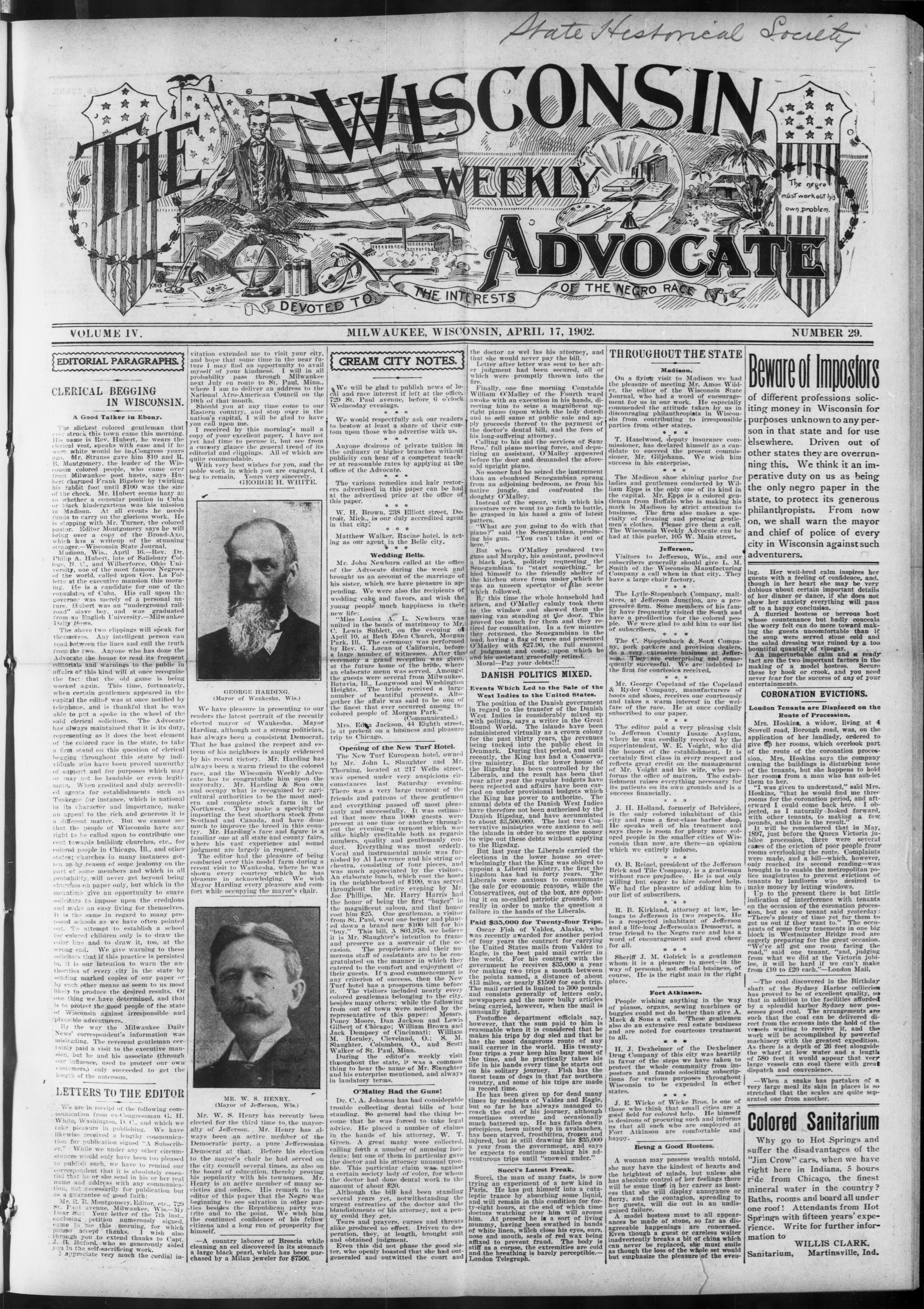
WISCONSIN
WEEKLY
ADVOCATE
DEVOTED TO THE INTERESTS OF THE NEGRO RACE
EDITORIAL PARAGRAPHS.
CLERICAL BEGGING IN WISCONSIN.
CLERICAL BEGGING IN WISCONSIN.
A Good Talker in Ebony.
The slickest colored gentleman that ever struck this town came this morning. His name is Rev. Hubert, he wears the clerical vest, speaks with ease and if he were white would be in Congress years ago. Mr. Strauss gave him $10 and R. B. Montgomery, the leader of the Wisconsin colored people, who came over from Milwaukee post haste, says Hubert charmed Frank Bigelow by twirling his rabbit foot until $100 was the size of the check. Mr. Hubert seems hazy as to whether a consular position in Cuba or black kindergartens was his mission in Madison. At all events he needs funds to carry on the glorious work. He is stopping with Mr. Turner, the colored pastor. Editor Montgomery says he will bring over a copy of the Broad-Axe, which has a writeup of the stunning stranger—Wisconsin State Journal.
Madison, Wis., April 16.—Rev. Dr. Philip A. Hubert, late of Salisbury College, N. C., and Wilberforce, Ohio University, one of the most famous Negroes of the world, called upon Gov. La Follette at the executive mansion this morning. He is a candidate for one of the consulates of Cuba. His call upon the governor was merely of a personal nature. Hubert was an "underground railroad" slave boy, and was graduated from an English University.—Milwaukee Daily News.
The above two clippings will speak for themselves. Any intelligent person can read between the lines and cull the truth from the two. Anyone who has done the Advocate the honor to read its frequent editorials and warnings to the public in affairs of this kind will at once recognize the fact that the old game is being worked again. This time, fortunately, when certain gentlemen appeared in the capital the editor was at once notified by telephone, and is thankful that he was able to put a spoke in the wheel of the said clerical solicitors. The Advocate has always maintained that it is its duty, representing as it does the best element of the colored race in the state, to take a firm stand on this question of clerical begging throughout this state by individuals who have been proved unworthy of support and for purposes which may or may not be laudable or even legitimate. When credited and duly accredited agents for establishments such as Tuskegee for instance, which is national in its character and importance, make an appeal to the rich and generous it is a different matter. But we cannot see that the people of Wisconsin have any right to be called upon to contribute one cent towards building churches, etc., for colored people in Chicago, Ill., and other states; churches in many instances gotten up by reason of some jealousy on the part of some members and which in all probability, will never get beyond being churches on paper only, but which in the meantime give an opportunity to suave solicitors to impose upon the credulous and make an easy living for themselves. It is the same in regard to many proposed schools as we have often pointed out. To attempt to establish a school for colored children only is to draw the color line and to draw it, too, at the wrong end. We give warning to these solicitors that if this practice is persisted in, it is our intention to warn the authorities of every city in the state by sending marked copies of our paper or by such other means as seem to us most likely to produce the desired results. Of one thing we have determined, and that is to protect the good people of the state of Wisconsin against irresponsible and plausible adventurers.
By the way Milwaukee Daily News' correspondent's information was misleading. The reverend gentleman certainly paid a visit to the executive mansion, but he and his associate (through our influence, used to protect our own customers.) only succeeded to get the length of the anteroom.
LETTERS TO THE EDITOR
We are in receipt of the following communication from ex-Congressman G. H. White, Washington, D. C., and which we take pleasure in publishing. We have likewise received a lengthy communication for publication signed "A Subscriber." While we under any other circumstances would only have been too pleased to publish such, we have to remind our correspondent that it is absolutely essential that he or she send in his or her real name and address with any communication, not necessarily for publication but as a guarantee of good faith:
Mr. R. B. Montgomery, Editor, etc., 729
St. Paul avenue, Milwaukee, Wis.—My
Dear Sir: Your letter of the 7th inst.,
enclosing petition numerously signed,
came to me this morning, for which
please accept thanks. I wish also
through you to extend thanks to Capt.
J. B. Buford, who so generously aided
you in the self-sacrificing work.
I appreciate very much the cordial in-
vitation extended me to visit your city, and hope that some time in the near future I may find an opportunity to avail myself of your kindness. I will in all probability pass through Milwaukee next July en route to St. Paul, Minn., where I am to deliver an address to the National Afro-American Council on the 10th of that month. Should you at any time come to our Eastern country, and stop over in the nation's capital, I will be glad to have you call upon me. I received by this morning's mail a copy of your excellent paper. I have not yet had time to peruse it, but see from a cursory glance the general trend of its editorial and clippings. All of which are quite commendable.
With very best wishes for you, and the noble work in which you are engaged, I beg to remain. Yours very sincerely. GEORGE H. WHITE
[Picture of a man with a long white beard and a dark suit, facing the camera. The background is plain and light-colored.]]
GEORGE HARDING.
(Mavor of Waukesha, Wis.)
We have pleasure in presenting to our readers the latest portrait of the recently elected mayor of Waukesha. Mayor Harding, although not a strong politician, has always been a consistent Democrat. That he has gained the respect and esteem of his neighbors is amply evidenced by his recent victory. Mr. Harding has always been a warm friend to the colored race, and the Wisconsin Weekly Advocate has to congratulate him upon the mayoralty. Mr. Harding & Son own and occupy what is recognized by agricultural authorities to be the most modern and complete stock farm in the Northwest. They make a specialty of importing the best shorthorn stock from Scotland and Canada, and have done much to improve the breed in this country. Mr. Harding's face and figure is a familiar one at all state and county fairs, where his vast experience and sound judgment are largely in request.
The editor had the pleasure of being conducted over this model farm during a recent visit to Waukesha, where he was shown every courtesy which he has pleasure in acknowledging. We wish Mayor Harding every pleasure and comfort while occupying the mayor's chair.
M. B.
MR. W. S. HENRY,
(Mayor of Jefferson, Wis.)
Mr. W. S. Henry has recently been elected for the third time to the mayoralty of Jefferson. Mr. Henry has always been an active member of the Democratic party, a pure Jeffersonian Democrat at that. Before his election to the mayor's chair he had served on the city council several times, as also on the board of education, thereby proving his popularity with his townsmen. Mr. Henry is an active member of many societies and orders. His remark to the editor of this paper that the Negro was beginning to see salvation in other parties besides the Republican party was trite and to the point. We wish him the continued confidence of his fellow citizens and a long run of prosperity for himself.
A country laborer of Brescia while cleaning an eel discovered in its stomach a large black pearl, which has been purchased by a Milan jeweler for $7500.
MILWAUKEE, WISCONSIN, APRIL 17, 1902.
CREAM CITY NOTES.
We will be glad to publish news of local and race interest if left at the office, 729 St. Paul avenue, before 6 o'clock Wednesday evenings.
We would respectfully ask our readers to bestow at least a share of their custom upon those who advertise with us.
Anyone desirous of private tuition in the ordinary or higher branches without publicity can hear of a competent teacher at reasonable rates by applying at the office of the Advocate.
☆ ☆ ☆
The various remedies and hair restorers advertised in this paper can be had at the advertised price at the office of this paper.
* * *
W. H. Brown, 238 Elliott street, Detroit, Mich., is our duly accredited agent in that city.
* * *
Matthew Walker, Racine hotel, is acting as our agent in the Belle city.
Wedding Bells
Mr. John Newburn called at the office of the Advocate during the week and brought us an account of the marriage of his sister, which we have pleasure in appending. We were also the recipients of wedding cake and favors, and wish the young people much happiness in their new life:
"Miss Louisa A. L. Newburn was united in the bonds of matrimony to Mr. C. Lewis Sublett, on the evening of April 10, at Beth Eden Church, Morgan Park, Ill. The ceremony was performed by Rev. G. Lucan of California, before a large number of witnesses. After the ceremony a grand reception was given at the future home of the bride, where an elaborate menu was served. Amongst the guests were several from Milwaukee, Batavia, Ill., Longwood and Washington Heights. The bride received a large number of beautiful presents. Altogether the affair was said to be one of the finest that ever occurred among the colored people of Morgan Park."
(Communicated.)
Mrs. Edg a Jackson, 44 Eighth street, is at present on a business and pleasure trip to Chicago.
Opening of the New Turf Hotel.
The New Turf European hotel, owned by Mr. John L. Slaughter and Mr. Thorning, located at 217 Wells street, was opened under very auspicious circumstances last Saturday evening. There was a very large turnout of the friends and patrons of these gentlemen and everything passed off most pleasantly and successfully. It was estimated that more than 1000 guests were present at one time or another throughout the evening—a turnout which was alike highly creditable both as regards numbers, quality and gentlemanly conduct. Everything was most orderly. Vocal and instrumental music was furnished by Al Lawrence and his string orchestra, consisting of four pieces, and was much appreciated by the visitors. An elaborate lunch, which cost the hosts in the neighborhood of $100, was served throughout the entire evening by Mr. Joe Phillips. Mr. Harry Harris had the honor of being the first "buyer" in the magnificent saloon, and that honor cost him $25. One gentleman, a visitor from St. Paul, went one better and planted down a brand new $100 bill for his "buy." This bill, A 801,978, we believe it is Mr. Slaughter's intention to frame and preserve as a souvenir of the occasion. The proprietors and their numerous staff of assistants are to be congratulated on the manner in which they catered to the comfort and enjoyment of their guests. If a good commencement is any criterion of success, then the New Turf hotel has a prosperous time before it. The visitors included nearly every colored gentleman belonging to the city, besides many others; while the following from out of town were noticed by the representative of this paper: Messrs. Poney Moore, Dan Jackson and Lewis Gilbert of Chicago; William Brown and Jack Dempsey of Cincinnati; William M. Hornley, Cleveland, O.; S. M. Slaughter, Columbus, O., and Scott Walker of St. Paul, Minn.
During the editor's weekly visit throughout the state, it was a common thing to hear the name of Mr. Slaughter and his enterprise mentioned, and always in laudatory terms.
O'Malley Had the Guns!
Dr. C. A. Johnson has had considerable trouble collecting dental bills of long standing. So general had the thing become that he was forced to take legal advice. He placed a number of claims in the hands of his attorney, W. T. Green. A great many were collected, calling forth a number of amusing incidents; but one of them in particular gave the doctor and his attorney unusual trouble. This particular claim was against a certain society lady of color, for whom the doctor had done dental work to the amount of about $20. Although the bill had been standing several years yet, notwithstanding the urgent entreaties of the doctor and the blandishments of his attorney, not a penny could they get.
Tears and prayers, curses and threats alike produced no effect. Driven to desperation, they, at length, brought suit and obtained judgment. Even this did not phase the good sister, who openly boasted that she had outgeneraled and outwitted the court and
the doctor as wel las his attorney, and that she would never pay the bill.
Letter after letter was sent to her after judgment had been secured, all of which were promptly thrown into the fire.
Finally, one fine morning Constable William O'Malley of the Fourth ward awoke with an execution in his hands, directing him to seize a magnificent upright piano (upon which the lady dotted) and to sell same at public sale and apply proceeds thereof to the payment of the doctor's dental bill, and the fees of his long-suffering attorney.
Calling to his aid the services of Saur Bros,' full piano moving force, and deputizing an assistant, O'Malley appeared before the door and demanded the aforesaid upright piano
No sooner had he seized the instrument than an ebonhued Senegambian sprang from an adjoining bedroom, as from his native jungle, and confronted the doughty O'Malley.
Instead of the spear, with which his ancestors were wont to go forth to battle, he grasped in his hand a gun of latest pattern.
"What are you going to do with that piano?" said the Senegambian, producing his gun. "You can't take it out of here."
But when O'Malley produced two guns and Murphy, his assistant, produced a black jack, politely requesting the Senegambian to "start something," he hied himself to the friendly shelter of the kitchen stove from under which he was an unseen spectator of the scene which followed.
By this time the whole household had arisen, and O'Malley calmly took them to the window and showed them the moving van standing at the door. This proved too much for them and they retired for consultation. In a few minutes they returned, the Senegambian in the lead, having a flag of truce and presented O'Malley with $27.90, the full amount of judgment and costs; upon which he and his assistant gracefully retired. Moral—Pay your debts!!!
DANISH POLITICS MIXED.
Events Which Led to the Sale of the West Indies to the United States.
The position of the Danish government in regard to the transfer of the Danish West Indies is considerably mixed up with politics, says a writer in the Great Round World. The islands have been administered virtually as a crown colony for the past thirty years, the revenues being tucked into the public chest in Denmark. During that period, and until recently, the King has had a Conservative ministry. But the lower house of the Rigsdag has been controlled by the Liberals, and the result has been that year after year the regular budgets have been rejected and affairs have been carried on under provisional budgets which the King has power to authorize. The annual debts of the Danish West Indies have therefore not been authorized by the Danish Rigsdag, and have accumulated to about $3,500,000. The last two Conservative ministries were anxious to sell the islands in order to secure the money to wipe out these debts without applying to the Rigsdag.
But last year the Liberals carried the elections in the lower house so overwhelmingly that the King was obliged to appoint a Liberal ministry, the first the kingdom has had in forty years. The Liberals were anxious to consummate the sale for economic reasons, while the Conservatives, out of the box, are opposing it on so-called patriotic grounds, but really in order to make the question a failure in the hands of the Liberals.
Paid $35,000 for Twenty-four Trips.
Paid $35,000 for Twenty-four Trips. Oscar Fish of Valdez, Alaska, who was recently awarded for another period of four years the contract for carrying the United States mails from Valdez to Eagle, is the best paid mail carrier in the world. For his contract with the government he receives $35,000 a year for making two trips a month between the points named, a distance of about 413 miles, or nearly $1500 for each trip. The mail carried is limited to 300 pounds and consists generally of letters only, newspapers and the more bulky articles being carried, however, when the mail is unusually light.
Postoffice department officials say, however, that the sum paid to him is reasonable when it is considered that he makes his trips by dog sled and that he has the most dangerous route of any mail carrier in the world. His twenty-four trips a year keep him busy most of the time, and he practically takes his life in his hands every time he starts out on his solitary journey. Fish has the finest team of dogs in that far northern country, and some of his trips are made in record time.
He has been given up for dead many times by residents of Valdez and Eagle, but so far he has always managed to reach the end of his journey, although sometimes overdue and occasionally much battered up. He has fallen down precipices, been mixed up in avalanches, has been starved, frostbitten, frozen and injured, but is still drawing his $35,000 a year from the government, and says he expects to continue making his adventurous trips until "snowed under."
Succi's Latest Freak.
Succi, the man of many fasts, is now trying an experiment of a new kind in Paris. He has put himself into a cataleptic trance by absorbing some liquid, and will remain in this condition for forty-eight hours, at the end of which time doctors watching over him will arouse him. At present he is a sort of living mummy, having been swathed in bands of white linen, which close his eyes, ears, nose and mouth, seals of red wax being affixed to prevent fraud. The body is stiff as a corpse, the extremities are cold and the breathing is barely perceptible.—London Telegraph.
THROUGHOUT THE STATE
THROUGHOUT THE STATE
Madison.
On a flying visit to Madison we had the pleasure of meeting Mr. Amos Wilder, the editor of the Wisconsin State Journal, who had a word of encouragement for us in our work. He especially commended the attitude taken by us in discouraging philanthropists in Wisconsin from contributing to irresponsible parties from other states.
```markdown
```
T. Hazelwood, deputy insurance commissioner, has declared himself as a candidate to succeed the present commissioner, Mr. Giljohann. We wish him success in his enterprise.
南心
The Madison shoe shining parlor for ladies and gentlemen conducted by William Epps is the only one of its kind in the capital. Mr. Epps is a colored gentleman from Buffalo who is making his mark in Madison by strict attention to business. The firm also makes a specialty of cleaning and pressing gentlemen's clothes. Please give them a call. The Wisconsin Weekly Advocate can be had at this parlor, 105 W. Main street.
Jefferson.
Visitors to Jefferson, Wis., and our subscribers generally should give L. M. Smith of the Wisconsin Manufacturing Company a call when in that city. They have a large chair factory.
* * *
The Lytle-Stopenbach Company, maltsters, at Jefferson Junction, are a progressive firm. Some members of his family have frequently visited the South and have a predilection for the colored people. We were glad to add him to our list of subscribers.
* * *
The C. Stoppenbach & Sons Company, pork packers and provision dealers, do a very extensive business at Jefferson. They are enterprising and consequently successful. We are indebted to the firm for courtesies received.
* * *
Mr. George Copeland of the Copeland & Ryder Company, manufacturers of boots and shoes, receives one courteously and takes a warm interest in the welfare of the race. He at once cordially subscribed to our paper.
***
The editor paid a very pleasing visit to Jefferson County Insane Asylum, where he was cordially received by the superintendent, W. E. Voight, who did the honors of the establishment. It is certainly first class in every respect and reflects great credit on the management of Mr. Voight and his wife, who performs the office of matron. The establishment raises everything necessary for its patients on its own grounds and is a success financially.
全 全 全
J. H. Holland, formerly of Belvidere, is the only colored inhabitant of this city and runs a first-class barber shop. He speaks well of his treatment and says there is room for plenty more colored people in the smaller cities of Wisconsin than now, are there—an opinion which we entirely indorse.
空 空 空
O. B. Reinel, president of the Jefferson Brick and Tile Company, is a gentleman without race prejudice. He is not only willing but eager to hire colored help. We had the pleasure of adding him to our list of subscribers.
```markdown
```
R. B. Kirkland, attorney at law, belongs to Jefferson in two respects. He is a respected inhabitant of Jefferson and a life-long Jeffersonian Democrat, a true friend to the Negro race and has a word of encouragement and good cheer for all.
宏宏宏
Sheriff J. M. Golrick is a gentleman whom it is a pleasure to meet—in the way of personal, not official business, of course. He is the right man in the right place.
Fort Atkinson.
People wishing anything in the way of pianos, organs, sewing machines or buggies could not do better than give A. Mack & Sons a call. These gentlemen also do an extensive real estate business and are noted for courteous treatment to all.
会 会 会
H. J. Dexheimer of the Dexheimer Drug Company of this city was heartily in favor of the steps we have taken to protect the whole community from impostors and frauds solociting subscriptions for various purposes throughout Wisconsin to be expended in other states
☆ ☆ ☆
J. E. Wicke of Wicke Bros. is one of those who think that small cities are a good field for colored help. He himself is desirous of procuring such and informs us that all such who are employed at Fort Atkinson are comfortable and happy.
Being a Good Hostess.
A woman may possess wealth untold, she may have the kindest of hearts and the brightest of minds, but unless she has absolute control of her feelings there will be some time in her career as hostess that she will display annoyance or flurry, and the contagion, spreading to her guests, will die out in an undisguised failure.
A model hostess must to all appearances be made of stone, so far as disagreeable happenings are concerned. Even though a guest or careless waiter inadvertently breaks a bit of china which never be replaced, she must smile as though the loss of the whole set would but emphasize the pleasure of the even-
NUMBER 29.
Beware of Impostors
of different professions soliciting money in Wisconsin for purposes unknown to any person in that state and for use elsewhere. Driven out of other states they are overrunning this. We think it an imperative duty on us as being the only negro paper in the state, to protect its generous philanthropists. From now on, we shall warn the mayor and chief of police of every city in Wisconsin against such adventurers
ing. Her well-bred calm inspires her guests with a feeling of confidence, and, though in her heart she may be very dubious about certain important details of her dinner or dance, if she does not show her anxiety everything will pass off to a happy conclusion.
A flurried hostess or nervous host whose countenance but badly conceals the worry felt can do more toward making the guests uncomfortable than if the soup were served stone cold and the salad dressing was ruined by a too bountiful quantity of vinegar.
An imperturbable calm and a ready tact are the two important factors in the making of a model hostess. Secure these by hook or crook, and you need never fear for the success of any of your entertainments.
CORONATION EVICTIONS.
London Tenants are Displaced on the Route of Procession.
Mrs. Hoskins, a widow, living at 4 Scovell road, Borough road, was, on the application of her landlady, ordered to give up her rooms, which overlook part of the route of the coronation procession. Mrs. Hoskins says the company owning the buildings is disturbing none of the tenants, but she happens to hold her rooms from a man who has sub-let them to her.
"I was given to understand," said Mrs. Hoskins, "that he would find me three rooms for the coronation period, and afterward I could come back here. I objected, as I naturally looked forward, with other tenants, to making a few pounds, and this is the result." It will be remembered that in May, 1897, just before the Queen Victoria jubilee procession, there were several cases of the eviction of poor people from rooms overlooking the route. Complaints were made, and a bill—which, however, only reached its second reading—was brought in to enable the metropolitan police magistrates to prevent evictions of tenants by landlords who desired to make money by letting windows.
Up to the present there is but little indication of interference with tenants on the occasion of the coronation procession, but as one tenant said yesterday: "There's plenty of time yet for them to get us out if they want to." The occupants of some forty tenements in one big block in Westminster Bridge road are eagerly preparing for the great occasion. "We've all got one room facing the road," said one tenant, "and, judging from what we did at the Victoria jubilee, it will be hard if we can't make from £10 to £20 each."—London Mail.
The coal discovered in the Birthday shaft of the Sydney Harbor collieries has proved to be of excellent quality, so that in addition to the facilities afforded by a splendid harbor Sydney now possesses good coal. The arrangements are such that the coal can be delivered direct from the screens into the hold of the vessels waiting to receive it, and the work will be accomplished by powerful machinery with the greatest expedition. As there is a depth of 26 feet alongside the wharf at low water and a length of 580 feet it would appear that very large vessels can coal there with great dispatch and convenience.
When a snake has partaken of a very large meal its skin in places is so stretched that the scales are quite separated one from another.
Colored Sanitarium
Colored Sanitarium
Why go to Hot Springs and suffer the disadvantages of the "Jim Crow" cars, when we have right here in Indiana, 5 hours ride from Chicago, the finest mineral water in the country? Baths, rooms and board all under one roof! Attendants from Hot Springs with fifteen years' experience. Write for further information to WILLIS CLARK, Sanitarium, Martinsville, Ind.
SOLDIERS ARE AMBUSHED.
Courier Arrives at Canton with News of Terrible Encounter.
Two Thousand Imperialist Soldiers Caught in Narrow Defile by the Rebels.
Hong Kong, April 16.—A courier who arrived at Canton yesterday reported that over 2000 imperialist soldiers sent by Marshal Su against the rebels, were ambushed in a narrow defile and all were killed or captured.
Hundreds of Rebels Slain.
Victoria, B. C., April 16.—The situation in South China, where the revolution is assuming large proportions, is most serious. Hundreds of the rebels have been killed in battle, but they continue to fight with fanatical disregard for their losses. A disturbance resembling the recent Boxer uprising is in progress in Kwang-Si, and it is alleged by the Japanese Times that the trouble is being fomented by the French with a view of giving France and Russia an opportunity to step in. In Honan the tax receipts have culminated in another riot, the natives committing atrocities.
A battle occurred between the rebels and the government forces under Gen. Yuh Kwon on March 18, and although the imperial officer reports that his force killed a thousand rebels with a loss of eighty of his own men, the rebels continue to advance. The rebels came to within a short distance of the imperial forces' masked battery, which opened fire. Hundreds of the rebels were killed, but they finally captured the guns and the government troops fled. The commander of the French Eastern squadron offered to send 500 bluejackets to the assistance of the Chinese troops, but the viceroy of Kwang-Si declined, it is said, on orders from Pekin.
Shocking Outrages Committed.
In the tax riots in Nang Kang and Tung Po districts of Honan, shocking outrages have been committed. A church at Pi Yang was besieged and captured and fifteen of the converts were thrown into the flames and burned. Five others and an Italian priest were murdered.
In Chi-Li, Kan Su and far Northern Mongolia there have been similar uprisings. Seven hundred rioters were killed in a battle with government forces.
The Chinese who threw stones at the carriage of the wife of the Italian minister at Pekin have been executed. The rebellion in Jesod has given Russia an excuse to dispatch troops to that district. Five hundred Russians were sent from Kangchow to the scene of the rebellion without request from the Pekin government.
Prince Ching is in disfavor with the court for having advised a discontinuance of the imperial visits to the tombs of their ancestry. M. Pavloff, the Russian minister, caused telegraph lines to be constructed in Korea and the Korean officials caused them to be torn down, as the lines were constructed without permission and in face of protest.
Situation Alarming.
The situation in the rebellious districts of Southern China is increasingly alarming. The viceroy of Canton has telegraphed to Pekin, urging the immediate forwarding of reinforcements. Lack of news from Gen. Ma and Marshal Su is taken to indicate that the rebels have surrounded the imperial troops and cut off communication with them.
Russians Fight Chinese.
St. Petersburg, April 16.—An official dispatch received here from Port Arthur, dated April 12, announces that serious fighting has occurred in the vicinity of the boundary of the provinces of Mukden and Kiran, Manchuria, between Russian frontier guards and Chinese robbers who had been raiding railroad stations. The Russians surrounded 800 Chinese at Kiang Tung Tai and only 30 of them escaped. The Russian losses were very small.
FIND CORPSE ERECT.
Neighbors Discover Woman's Body Standing, Wedged Between Wali and Bed.
Chicago, Ill., April 16.—Dead in a standing posture in a narrow space between the foot of her bed and the wall, her head upon her bosom as though asleep, Catherine Doerr, wife of John Doerr, a wealthy retired contractor, was found yesterday in her bedroom on the second floor of her home, 3739 Wentworth avenue.
Her body was rigid when discovered and it is thought she had been dead for several hours. To gain entrance to the room it was necessary to procure a ladder and climb to the second floor.
Mrs. Doerr was found wedged between the bed and the wall. So tightly was the body jammed into the narrow space that it was found impossible to remove it without taking the bed to pieces.
This fact is regarded by the police as the most puzzling in the whole case. They questioned the members of the household and many of the neighbors and secured evidence which they will present to the coroner's jury. Mrs. Doerr was 44 years old and Mr. Doerr is 72 years of age. According to the neighbors quarrels were frequent between the husband and wife.
MILLIONS IN PERIL.
Government Silver Bullion Stored on Wall Street, New York, Threatened.
New York, April 16.—Thirty-one million dollars in silver bullion in the assay office at 30 Wall street has been in danger of being melted by a fire which burned in one of the basements for two hours. None but the employes knew of the fire and they finally overcame it without assistance.
Next door to the assay office is the subtreasury, where the government usually has from $100,000,000 to $200,000,000 stored. In some way fire in the silver smelting room was communicated to a barrel of lard mixture used in the smelting process. There were twenty-three barrels of this inflammable mixture in the room and like a flash they were enveloped in a sheet of flame so intense in heat that it was feared the great treasure in a vault of the room would be melted. There was no time to close the steel doors of the vault, and the flames from the barrels were so close that it was impossible for anyone to approach near enough to shut them.
Fifty employees in the basement, thoroughly drilled for such an emergency, were quickly at work, despite the dense smoke. All windows and scuttles were colsed to prevent giving the alarm to the public, and when, after two hours' work, the last vestige of the fire had disappeared, windows opening at the rear were used to carry out the smoke.
Issue Has Been Ten Times Ove Subscribed.
London, April 16.—There was a tremendous rush to subscribe to the new loan of £32,000,000 today. At the Bank of England it was estimated this evening that the loan had been ten times over subscribed. The lists will probably close tomorrow. London, April 16.—It was said today that J. Pierpont Morgan, the Barings and the Rothschilds have secured an aggregate of £16,000,000 of the new British loan of £32,000,000. The remaining £16,000,000 will be offered to the public.
Official confirmation of the above was forthcoming this afternoon in the Bank of England giving notice that half the loan had been privately subscribed for and offering the other half for public subscription at 93% with interest at 2% per cent. The subscription list will be closed on or before April 21.
New York, April 16.—It was announced today in Wall street that J. P. Morgan & Co. and Baring, MaGoun & Co. of New York, Drexel & Co. of Philadelphia and Kidder, Peabody & Co. of Boston had been authorized to forward application for allotments to the issue of £32,000,000 British consols, of which £16,000,000 have already been placed. The price of issue was fixed by the British treasury at 93%.
LAY DOWN ARMS.
gents.
Washington, D. C., April 16. The war department has received a cablegram from Gen. Chaffee dated Manila today, in which he says:
Unconditional surrender of Malvar today to Brig.-Gen. J. Franklin Bell. Organized armed resistance to the United States is terminated in the department of the North Philippines.
The following cablegram from Gen. Chaffee, dated at Manila yesterday, was made public at the war department today:
With reference to my telegram of 23d ultimolt, reporting attacking by Moros, reconnoissance under Forsyth, March 15, a soldier of the Twenty-seventh regiment, United States infantry, was murdered by Moros in the vicinity of Parang-Parang, March 30 two soldiers of the Twenty-seventh regiment, United States infantry, having one gun, were approached with semblance of friendship by six Moros near Malabang. The rifle was selzed, one soldier killed, and the other severely injured, but they escaped. The murder was without provocation or justification in any way. The murderers are known and a demand has been made for their surrender. Thus far the Dattos have refused to deliver them. I have been at Malabanga and tried to confer with them. I waited three days, but the Dattos failed to come or acknowledge the receipt of my request for a conference.
An expedition of 1200 men under Col Frank D. Baldwin, both cavalry and artillery is being formed to leave for Lake Laro about April 27, to arrest the murderers and punish the Dattos. Every care is to be taken not to bring on a general war with the Moros about the lake.
It is absolutely important that our authority is respected by these people and that the sovereignty of the United States is fully acknowledged. I have addressed a letter to this effect to the Dattos, at the same time informing them of the friendly disposition of our government, and that the purpose was to punish only these giving offense; that the government claims the right to explore the country between Illana and Illmar bay, and that my purpose is to do so now and at any other time. To accomplish this object it will be necessary to retain Battallion Seventeen two months longer. My belief at the present time is that a large majority of the Dattos will not support these implicated murders.
Parang-Parang is an anchorage in Polloc harbor, on the west coast of the mainland of Mindanao. Malabang lies about twenty miles north on the coast and is connected by a military cable. Lake Lano (Lanao) is situated about twenty-five miles northeast of Malabang in the interior.
POISON IN HIS WINE.
StartNng Development Regarding the Death of Colorado Representative.
Denver, Col., April 16.—Startling developments have come to light regarding the death of Representative Albert Gabrin, who died at his home in this city early on the evening of January 8 from what was then supposed to be acute gastritis, superinduced by fermented wine used in making a mixed drink, which he and other members of his family consumed at a family reunion on New Year's day.
Shortly after his death Dr. Wilder performed an autopsy, removing the stomach and portions of other intestinal organs. These, with samples of the wine used in the punch, were turned over to Dr. Hillkowitz, who made chemical analyses. He says he found large quantities of arsenic in the wine and traces of the poison in the internal organs, especially in the stomach. The chemical analyses showed there were three and one-half grains of arsenic to a tumblerful of wine. Such an amount could never be ascribed to any accidental impurity in the wine, says the chemist's report.
The death of Mr. Gabrin is to be investigated by the Woodmen, of which society he was a member in good standing at the time of his death. He carried a large life insurance policy. The payment of the policy has been stopped pending the result of the investigation. Miss Agnes Gabrin, sister of the deceased, and his father, Herman Gabrin, both of whom drank wine at the reunion, were very ill and have been since that time. The condition of the young woman last night was serious. Dr. Albers, the physician attending them, says they are suffering from acetate or arsenic poisoning—over three months after the fatal dose was drunk.
MRS. VILAS IS SHOT.
Widow of Henry Vilas of Madison Struck by Stray
Bullet.
Pasadena, Cal., April 16.—Mrs. Henry Vilas of Pittsburg, Pa., who is here visiting with her mother, Mrs. Ford, also of Pittsburg, was badly wounded yesterday by being hit in the neck by a stray bullet, which is supposed to have been fired by someone who was out hunting.
Mrs. Vilas is the wife of the late Henry Vilas of Madison, Wis., the son of ex-Senator William F. Vilas of Wisconsin. Mrs. Vilas was out driving in a carriage with her mother when she was struck by the bullet. The coachman was immediately told of the accident and after a fast drive of two miles a doctor was found. Mrs. Vilas was reported as getting along nicely today.
The police have arrested a boy named Ellis who admitted that he had shot at a gopher at about the time of the accident.
HEAR FROM THE BOERS.
British Government Gets Advices from South Africa.
Session of Ministers is Extremely Brief-Hamilton Captures 145 Burghers.
London, April 16.—The British cabinet held another meeting today for the purpose of considering a communication from the Boer representatives who are now at Pretoria and a message from Lord Milner, the British high commissioner in South Africa. The session was extremely brief.
After the cabinet meeting, Lord Salisbury, the premier, had an audience with King Edward at Buckingham palace, and stayed to lunch with his majesty. The latter afterwards weut to Sandringham.
Attitude of Boers.
Later it was asserted that the communication from Lord Milner, considered at the cabinet meeting, contained the first clear statement of the attitude of the Poer leaders, who hitherto had not agreed on the peace terms they would accept. *
The St. James Gazetts predicts an early public announcement of the peace negotiations.
The paper says there is little doubt that if the British and Boers arrive at an understanding on the main points of the proposals peace will ensue, the banishment proclamation will be withdrawn and minor points, like restocking the farms, will be referred to a board composed of British and Boer representatives.
Markete Advancing.
All the grain and flour markets of the United Kingdom further advanced prices today. The price of flour was raised another shilling per sack.
In the Yarmouth grain market the price of red wheat advanced as much as 2 shillings per quarter.
An important meeting of London and Liverpool importers of feeding stuffs, held here this afternoon, resolved to make strong representations to the chancellor of the exchequer, Sir Michael Hicks-Beach, in favor of the admission of wheat offals free of duty, and favoring the admission of feeding meals and the offals of other grains than wheat on payment of a duty of 3 pence per hundredweight instead of the proposed 5 pence per hundredweight.
Hitch in Peace Terms.
The Daily Mail says there is a serious hitch in connection with the peace proposals. The cabinet considered a strong request from the Boers at Pretoria for an armistice during the negotiations and decided to absolutely refuse to grant it. Nevertheless, it is not expected that the Boers will withdraw from the conference on this account. There are more serious matters, however, threatening to prove an obstacle, perhaps a deadlock, to the negotiations. These are the question of amnesty and the withdrawal of the banishment proclamation. The Boers ask for complete amnesty for all burghers and rebels in the field and the withdrawal of the proclamation, and there is reason to believe that they will not yield on these points.
Great Britain declines to grant the requests, and the situation does not inspire the confidence that was lately felt The Mail says it learns that the Boers have already agreed to a general surrender and the loss of their independence.
Hamilton Takes 145 Boers.
The following dispatch, dated Pretoria, April 15, has been received at the war office from Lord Kitchener: "Bruce Hamilton's columns arrived at the Standerton line last night, having taken 145 Boers, including killed and wounded, during the movement from the Middelburg line."
ITALIANS BUILD FORT.
Entrench Themselves in Hills Near Trinidad, Col., and Defy Officers of the Law.
Trinidad, Col., April 16.—In the hills near this city three Italians, who are wanted by the local officers on charges of assault to kill and selling liquor without a license, have erected a fort in which they have taken refuge from the law. They are heavily armed with rifles and revolvers.
Two of the men recently held at bay with drawn revolvers fifty men employed in a quarry, while they assaulted and beat the foreman of the quarry, John Lamm, who had discharged them for drunkenness. The third, Joseph Mott, was arrested last week and placed in jail here on a charge of selling liquor without a license. He was released on bond furnished by a local saloonkeeper, but failed to be present when his case was called in court. The police say they believe Mott is the leader of an organized gang. The men in the fort are being kept in food, it is believed, by the members of the gang who are not under the eyes of the law.
A posse will be organized today and sent out to take the trio. It is thought the Italians will not surrender without a bloody fight.
MOTHER AND LITTLE ONES BURN TO DEATH.
Mrs. King of Wallin, Mich, and Two Daughters Meet Sad Fate.
Frankfort, Mich., April 16.—Mrs. Wallace E. King and her two children were burned to death at their home in Wallin, a village fifteen miles from here, early today. The fire, which started from some unknown cause, destroyed one store and two houses. The financial loss is $8000.
NEW ELECTRIC RAILWAYS.
In Southern Wisconsin and Northern Illinois.
Chicago, Ill., April 16.—The end of the year 1902 will see all of the important cities of Northern Illinois connected by electric railways, representing a cost of $3,000,000. The Rock River Valley Electric railway will extend from Rock Falls to Rockford, fifty miles, passing through Sterling and Dixon. Another line is planned from Dixon to Dekalb and from Dekalb to Sycamore. Plans are under way to build an electric road from Rockford to Janesville, Wis. The entire system will cover several hundred miles.
BREAKS A SPEED RECORD.
Burlington Travels at the Rate of 98.6 Miles an Hour. Omaha, Neb., April 16.—The Burlington road yesterday made public details of a record-breaking run of fourteen and eight-tenths miles, from Eckley to Wray, Col., made on March 24. The distance was covered at a rate of 98.6 miles an hour.
Brussels is Filled with Soldiers and Police.
CHARGE ON MOB WITH SWORDS.
Brussels, April 15.—In consequence of the disorders the pupils of several communal schools have been dismissed and the premises utilized as barracks for the troops.
All the factories and mines at Morlanwelz, Valare and Mabille have been closed.
Socialist disturbances occurred last night at Namur. A mob stoned the police, who charged with drawn swords. Subsequently a force of gendarmes scattered the rioters.
The strike is steadily extending in both this city and its suburbs, especially at Molenbeek, where a number of large factories have stopped work. The military and police have adopted more stringent measures to preserve order.
The burgomaster has refused the Socialists' request to be allowed to follow their own devices in burying the Socialists killed during Saturday's riots. Orders have been issued for the procession to be held at 6 o'clock in the morning without bands or funeral emblems. Otherwise the interment must be carried out at night.
It is estimated that the strikers in the Charleroi district now number 50,000. There are frequent parades there, but the town is generally peaceful, in accordance with the advice of the strike leaders.
Balfour Says No Results Have Been Reached in Peace Conference.
WILL TELL WHEN NEWS COMES.
London, April 15.—The government leader, A. J. Balfour, replying to a question in the House of Commons today, announced that the ministers had no information to impart on the subject of the South African peace negotiations, nor under the circumstances could any information be imparted at the present stage of the negotiations. The government, Mr. Balfour added, would immediately inform Parliament of the fact when they had any news to communicate.
ELEVEN MEN KILLED.
Big Gun on Board British Battleship Mars Bursts.
BODIES ARE BLOWN TO ATOMS
Queenstown, April 15.—Gunner Lieut. H. S. Bourne, Lieut. Miller and nine bluejackets were instanetly killed yesterday afternoon by the bursting of a 12-inch gun on board the British first-class battleship Mars, during gun practice off Berehaven. In addition several men were injured by the explosion. The breech of the gun blew out after it had twice missed fire. The bodies of the two men who were sighting the gun were scattered to pieces and blown overboard. The injured seamen were brought ashore here today.
A MINISTER SHOT.
Head of the Interior Department of Russian Government is Murdered.
St. Petersburg, April 15.—The minister of the interior, M. Sipiaguine, was shot at and fatally wounded, at 1 o'clock this afternoon in the lobby of the ministerial offices by a man who held a pistol close to the minister's person. The wounded man died at 2 p. m.
The assassin of M. Sipiaguine is a student, who gained access to the building disguised in the uniform of an alde de camp. He met the minister on the main staircase and emptied a revolver into his body at close range. The assassin was immediately arrested.
BOYCOTT HAS NO EFFECT.
Stock Receipts are Up to the Average at Kansas City.
Kansas City, Mo., April 15.—The boycott started by the Kansas City Live Stock Commission Men, who last week urged their customers to ship to other markets, had no appreciable effect on the receipts here today, except possibly in the case of sheep. Today's arrivals of cattle amounted to 5000 head against 6400 last week, while the receipts of hogs were 7000 against 6000 on last Tuesday. But 500 sheep were received today, compared with 4200 a week ago. However, the receipts of sheep generally are variable and may not indicate anything. It is said that the members of the Stock Yards Company are today considering the question of beginning injunction proceedings against the commission men to force them to call off the boycott.
NIC. MORRISSEY, MILLIONAIRE
Combination Which May Result from Copper Finds in Canada. Munising, Mich., April 15.—[Special.]—News reaches here from the Soo that Nic Morrissey, who left here some months ago, is in a fair way to become a millionaire. He recently obtained control of a tract of 640 acres of land in Gladstone township, in the Algoma district of Canada. Ore that assays from 25 to 60 per cent. copper has now been found in paying quantities and experts who have examined the deposits declare the tract to be one of the most valuable mining properties in the dominion.
Could Hardly Wait.
A constituent of one of the Virginia congressmen took his first trip to Florida a short time ago. One day the congressman received a glowing letter from the constituent telling of his experiences. "I am down here in Florida," he wrote, "and I am having a great time. At the hotel they gave me the finest room you ever saw, and just off it is a bath room that is simply great. It has a shiny white tub and silver-plated trimmings, and it looks so fine I can hardly wait until Saturday night."
—Tierra del Fuego is full of minerals, among which is no small proportion of gold. That there is to be a boom in mining down in that part of the world there is no doubt. When the discoveries shall be made which will accomplish this result no one can predict, but there are in movement operations which at any time may result in such discoveries as will attract attention.
The 22 shipyards in Germany employ 60,000 men.
THE WORK OF CONGRESS.
THE WORK OF CONGRESS.
Proceedings in the House.
Aside from the debate on the Cuban reciprocity bill little was done in the House on the 10th. Resolutions were passed calling upon the secretary of state for information regarding the alleged removal by Canadian officials of landmarks along the Alaskan border, and calling upon him for the report of the governor of Louisiana and all other correspondence relating to the establishment of a British base of supplies near Louisiana and the shipment of horses and mules for the use of the British army in South Africa.
In the House on the 10th the speaker announced the appointment of the following committee to attend the funeral at Arlington cemetery, Washington, of Gen. Rosecrans: Mr. Hepburn (Ia.), Mr. Grosvenor (O.), Mr. Loud (Cal.), Mr. Steele (Ind.), Mr. Lessler (N. Y.), Mr. Elliott (S. C.), Mr. Clark (Mo.), Mr. Cummings (N. Y.) and Mr. Clayton (Ala.). The postoffice appropriation bill was sent to conference. Messrs. Loud, Smith (Ill.) and Swanson (Va.) were appointed conferees. The rest of the day was devoted to consideration of the Cuban reciprocity bill.
The calendar was entirely cleared of private pension bills in the House on the 12th, all of those reported being passed, 177 in all, and including that giving $5000 a year to Mrs. McKinley. Bills were also passed providing for an additional circuit judge in the second judicial circuit of New York and for the creation of the petrified forest national park in Arizona.
Interest in the Cuban reciprocity debate seemed to be waning, judged by the attendance on the floor of the House on the 14th, but the earnestness of the speeches on both sides of the question increased rather than decreased in intensity. That the Republican opponents of the bill are determined to prolong the struggle as much as possible was made manifest by their refusal to allow speeches to be printed in the record. The speakers were Messrs. McCall (Mass.) and Brantley (Ga.) for the measure and Messrs. Robertson (La.) and Stevens (Minn.) against it. Mr. Robinson (Ind.) opposed Cuban annexation on the ground that it would threaten the welfare of the American wage-earner. The conference report on the postoffice appropriation bill was adopted after some criticism of the pneumatic tube provision.
An unsuccessful effort was made again by Mr. Payne, in the House on the 15th, to secure an agreement to limit the general debate on the Cuban reciprocity bill. When the House adjourned there remained thirty-five members who desire to speak. The debate during the day was without particular interest. The speakers were Messrs. Swanson (Va.) and White (Ky.) for the bill, and Messrs. S. W. Smith (Mich.), Dayten (W. Va.), Burgess (Texas), Meyer (La.), and Sutherland (Utah), against it. Skirmish No. 2 in the Cuban reciprocity fight came in the House on the 16th and the opposition was again defeated. The skirmish resulted in fixing 3 p. m. on the 18th as the hour for closing debate and opening the final struggle.
Proceedings in the Senate.
An effort was made in the Senate on the 10th to obtain an agreement for a vote on the Chinese exclusion bill, but it was unsuccessful. The indications are that the vote will be taken on the 15th. The measure was under discussion during the entire session, except for about an hour, in which time the postoffice appropriation bill was considered and passed. Three speeches were made against the Chinese bill in its present form. Mr. Dillingham concluding his remarks and Mr. Stewart and Mr. Hoan stating their objections to the bill. An amendment was agreed to eliminating section 56 of the bill and substituting a provision that nothing in the act should be construed to prevent any foreign exhibitor from any country from bringing to the United States such assistants as might be necessary to enable him to make an exhibition at any fair or exposition authorized by the government. Mr. Depew spoke briefly against the adoption of the resolution providing for the election of senators by popular vote. In effect he served notice on those states which had limited their suffrage that if the resolution was enacted a demand would be made on them to accord all their citizenus the right to vote or suffer a loss of representatives in Congress.
Some remarks which Mr. Depew made on the 10th concerning the proposed amendment to the Constitution providing for the election of senators by popular vote, in the course of which he adverted to Southern election methods, precipitated a lively three hours' debate in the Senate on the 11th. When the Chinese exclusion bill was taken up an agreement was reached that voting upon it should begin on the 16th at 1 o'clock. Mr. Teller of Colorado supported the measure in a brief speech, maintaining that it was necessary and that it was not in contravention of treaty obligations with Chlaa. Senator Hawley presented a protest from the American Federation of Labor, the International Seamen's Union and the California Chinese exclusion committee against the substitute for the pending bill suggested by Senator Platt (Conn.). The Senate then went into executive session, and at 4:45 p. m. adjourned.
Continuation of the debate on the Chinese exclusion bill occupied most of the day in the Senate on the 12th. The conference report on the postoffice appropriation bill was agreed to, and a bill authorizing the Quincy Railroad Bridge Company to rebuild the draw span of its bridge across the Mississippi river at Quincy, IL., was passed. An executive session preceded adjournment. The Chinese exclusion bill occupied the day in the Senate on the 14th. Senators Foraker and McLaurin (S. C.) making extended speeches in opposition to it. Mr. Foraker contended that the measure was violative of the treaty with China and was calculated to prevent America's commercial expansion in the far East. While strongly supporting the policy of the government to exclude Chinese laborers, he maintained, this could best be accepted by an extension of the present law. Mr. McLaurin held that the drastic provisions of the pending bill would cut off America's cotton trade with China and thus wreck the cotton industry of the South. Mr. Teller briefly responded to Mr. Foraker, urging that the right to abrogate treaties was fully recognized. Mr. Lodge gave notice of an amendment striking out the much-discussed clause prohibiting the employment of Chinese sailors on American ships.
The Chinese exclusion bill occupied most of the day in the Senate on the 15th. The House bill legalizing the manual of surveying instructions of the general land office was passed. The additional urgent deficiency appropriation bill was passed with a minor amendment. The usual executive session preceded adjournment. The Senate on the 16th devoted the day to consideration and final passage of Chinese exclusion bill, with several amendments. Mr. Lodge secured an agreement making the Philippine civil government bill the unfinished business. After a brief executive session the Senate adjourned at 6 o'clock.
The Largest Sailing Ship
The American builders of many masters will have to bestir themselves if they wish to retain pre-eminence in the size of their ships. The five-master now being built for Messrs. F. Laeisz of Hamburg will, when completed, be the largest sailing ship afloat. She will be named the Preussen, her designed displacement being 12,000 tons and registered tonnage 8000. This German-built vessel exceeds in tonnage any of the American five-masters, and even exceeds the seven-masted steel schooner now under construction at the yards of the Fore River Ship and Engine Company at Quincy, Mass., described in our last issue, and which has a displacement of 10,000 tons. Our German friends are finding the Yankee schooner idea a good thing, and the big schooner will no doubt soon become a much more important factor in German shipping than it is at present. London Shipping World.
Has Not Slept in Bed for Many Years.
For thirty long years, says a Muncie (Ind.) dispatch, Frand Dorin, an aged man, who says his home is every place, has not lain in a bed, nor has his head touched a pillow—all because of a vow which he made thirty years ago, when his pretty young wife died. Dorin travels over the country in a spring wagon, and makes a living by selling and trading horses. At night he pitches a tent and sleeps on the hard ground. He says he has slept on the ground for so long that it would be impossible for him to sleep in a house.
The French government has asked two officials to investigate the benefits and detriments of the trusts.
TELEPHONE WORM TURNS.
Maddemed User Sues to Recover Damages for Lost Time.
Everyone who uses a telephone will watch eagerly for the outcome of a suit brought by a business men of Whatcom, Wash., to recover damages from the local telephone company for breach of contract in failing to give "prompt and effective service," as made and provided in the agreement. Through inattention of employes the merchant has been compelled to spend minutes at various times in reaching important customers, and sometimes he has been unable even to get a reply to a call for "central." In this manner much of his working time has been wasted and some of his best custom alienated.
Millions of telephone users will appreciate the poor Westerner's complaint. They know the daily indignities that have been put upon them. They have spent half an hour getting a number, only to be cut off as the conversation began. They have felt the burning passion, they know the murderous thought that has crept into the brain of the thirteenth unsuccessful attempt to raise "central," and they remember the fierce resentment bred of a five-minute ring in the receiver which they have held patiently to a waiting ear. They have gone away vowing the direct vengeance, physical and immediate, upon the whole telephone system and its directors, after which they have gradually reduced their elaborate and melicious schemes of reprisal to an action at law. Then they have thought better of it, and finally subsided, muttering but submissive.
So it always has been. The telephone victim is patient and long-suffering. If this one actually goes into court and wins his fight he will be applauded by an enormous multitude, none of whom has had the courage to do what he has done. Those who have lost billions of hours and an incalculable amount of good temper may feel repaid to know that they can have redress, substantial and pecuniary, in addition to the license to shout themselves into an apoplectic stroke which they now enjoy.—New York Press.
How to Get Reliable Information on Stock Propositions.
It is said that Frank T. Terry, the Milwaukee investment broker, has correspondents in nearly all the important mining districts of the West, who keep him informed of present and prospective values. He is already interested in the new camp of Thunder Mountain, Idaho, has secured the sale of a block of stock in a safe dividend-paying mine in Oregon, can sell the listed stocks of Colorado Springs and Salt Lake at the regular commission (the cost to dealer being the same as if he were on the floor of the exchange), and has finally accepted the agency of a Nome mine proposition that has met his views as to minimum risk and maximum profit: If any information is wanted on mining or other stocks a postal card to his office is all that is required.
Cotton a Money Standard
Hugues Le Roux, a French writer and traveler, who has recently returned from Abyssinia, where he was commissioned by the French government to study economic questions, asserts that American cottons have secured such a hold upon the empire as to actually constitute a monetary standard. A piece thirty yards long, the average price of which is $2. is a token by which Abyssinian coffee is purchased in the regions of production.
Coughing Leads to Consumption.
Kemp's Balsam will stop the cough at once. Go to your druggist to-day and get a sample bottle free. Sold in 25 and 50-cent bottles. Go at once; delays are dangerous.
—Great excitement has been caused at Lawton, Oklahoma, by the unearthing by miners in the Wichita mountains of an eighty-five pound nugget, 83 per cent. pure gold. It was found in Devils Canyon, the scene of one of the ancient mines of the Spaniards, where many crucibles have been unearthed recently.
The value of the coal mined in Japan is almost equal to that of all other minerals combined. It varies from the hardest anthracite to peat, but the quality is usually inferior to that of American coal. Modern machinery and methods have been introduced in the operation of many mines.
F. Mayer Boot & Shoe Co. also make Ladies' fine shoes that are up to date in every particular. See their ad. Now is the time to put in your supply for the summer and if you will buy Mayer's shoes you will get the best and be right in it for style.
In order that a rainbow may be produced the sun must not be more than 12 degrees above the horizon.
CHANGE OF LIFE.
Some Sensible Advice to Women by Mrs. E. Sailer.
"DEAR MRS. PINKHAM:—When I passed through what is known as 'change of life,' I had two years' suffering,—sudden heat, and as quick chills would pass over me; my appetite was variable and I never could tell for
[Illustration of a man with curly hair, wearing a high collar and a hat.]
a day at a time how I would feel the next day. Five bottles of Lydia E. Pinkham's Vegetable Compound changed all that, my days became days of health, and I have enjoyed every day since now six years.
"We have used considerable of your Vegetable Compound in our charitable work, as we find that to restore a poor mother to health so she can support herself and those dependent upon her, if such there be, is truer charity than to give other aid. You have my hearty endorsement, for you have proven yourself a true friend to suffering women."—Mrs. E. SAILER, 756½ Hill St., Los Angeles, Cal.—$5000 forfelt if above testimonial, not guarantee.
No other person can give such helpful advice to women who are sick as can Mrs. Pinkham, for no other has had such great experience—her address is Lynn, Mass., and her advice free—if you are sick write her—you are foolish if you don't.
ANGORA GOAT FARM.
Stocked with Animals Which Belonged to the Sultan of Turkey.
The United States government has become very much interested in the raising of choice Angora goats. Sixteen miles below Washington, in Maryland, the government is conducting experiments with the Angora goat, at the largest farm of the kind in the country. Fifty-one choice animals were recently shipped to former Secretary of the Navy William C. Whitney's stock farm, near Boston, and 1500 goats were sent to another big ranch at Oakland, Md.
The farm at which governmental experiments are being conducted with a view to discovering the possibilities of the Angora goat as a destroyer of brush and weeds, is located near Cedarville, and comprises 1600 acres in Prince George and Charles counties.
First Goats Imported.
The goats on the big farm near Washington are the descendants of the first ever imported into this country. The first brought here were presented to Dr. James B. Davis of Columbia, S. C., by the Sultan of Turkey, in 1849, as a reward for the American's services in connection with experiments in cotton culture in the Ottoman empire. The original animals came from Asia Minor, and were the best that could be obtained. From these animals a large portion of those now in the United States has been the product.
At the time the gift of the Sultan to Dr. Davis was made, however, it was thought that the goats were of the Cashmere breed, and many mistakes resulted in consequence. The goats were exhibited throughout the country at fairs, and attracted even at that early date the serious consideration of breeders.
Helps a Farm Cleaner.
The value of the animal for its wool product of mohair is now engaging the thought of the manufacturers, while the government is chiefly interested in the goat by virtue of the fact that he is the best known agent in the world for cleansing the brush off land which would be in cultivation but for the fact that it is covered with undergrowth. For some time past nearly 2500 goats have been housed on the farm at Cedarville, and the change which they have wrought in the appearance of the land there during their brief stay has been marvelous.
In discussing the possibilities of the goat in this direction, Mr. Thompson, who has recently written a book upon the subject, said that the one plant established near Washington, in which he is interested, would be the means of reclaiming all the abandoned farms in Maryland, Virginia and the Carolinas within the next few years.
Digestions of an Ostrich.
"An Angora goat has the digestive capabilities of the ostrich," said Mr. Thompson. "He eats anything, and is glad to get it, while the fondness which he manifests for a tangled thicket of overgrown brush would put to shame the proverbial Billy goat on the city dump. A short time ago I paid a visit to the goat farm near here to see what the busy little animal had been doing. I found a most remarkable change in the place. Brush had been actually eaten off the face of the earth, and the farm looked like the picture of a Dutch home-stead in Holland.
"The goats are protected there at night under three hundred feet of shed, while during the day they range the place, usually on tours in search of food. All of the unsightly brush customarily met with on the average farm is absent. It has been eaten by the goats. Along the fences and in the bottoms, where undergrowth grows most thickly, open visas and clearings have taken the place of the former masses of weeds and bushes.
Money in Their Wool.
"The government is interested in the breeding of the Angora goat for one reason—because of its value as a destroyer of brush; but, always alert to put money in the pockets of Americans when this country can raise just as well as not what other countries have been supplying, Uncle Sam is about to enter seriously into the field, and to urge the raising of goats for their mohair."
"The goats which have heretofore been confined almost wholly to the West and Southwest are being shipped to every part of the country," said Mr. Salmon, "and many reports of their good work in exterminating brush have reached the bureau. The bureau receives thousands of letters of inquiry concerning the goat. It is estimated that there are about 400,000 Angora goats in the country, and that the annual production of mohair in the United States is over more than a million pounds.
"As for mohair, there is no other material so beautiful, or so capable of excellent use in manufacturing. I once knew of a pair of socks made of this hair which were worn for six years, and which didn't wear out then. Oh, of course, yes, the socks were often washed. All the plush used for railroad car seats is made of mohair, and most of it is now imported. I foresee the day when we shall in this country raise all the mohair that we require. The greater part of it now comes from Turkey and Asia Minor, the natural home of the Angora goat."
More Goats Come Over.
In April W. C. Bailey of California succeeded in importing four goats, notwithstanding the prohibition of exportation from Turkey. With the exception of a few which have been brought into the United States in this manner most of the goats here are the descendants, of the first gift of the Sultan. Mr. Thompson declares that the goats in this country are practically as pure as those in Asia Minor, where the breeders, with mistaken zeal, crossed the Angora breed with the common Kurd goat, and so cheapened the entire industry. In the United States, as in Turkey, he adds, the Angoras are of uncertain purity.
About 1500 goats are now on the farm here, and this number will be retained during the winter. In April and May, the "kidding" season, approximately 1000 kids are looked for. Among the prize Angoras coming from this same stock is "Columbia Pasha," recently sold to Mrs. C. M. Armer of Kingston, N. M., for $1050.—Washington Times.
Boston's Famous Bag
A correspondent of the New York Sun, writing from Boston, says that almost every Boston man carries a green cloth bag. The cloth bag carried by the ordinary Boston man, however, is not green, but black or dark blue. The green bag is regarded, even in Boston, as the bag of the lawyer. A bag constructed on lines similar to those of the lawyer's bag, but made of black broadcloth, is carried by other professional Boston men, including some authors, though the approved color of the literary man is dark blue. A cloth bag with a very wide mouth, closed by two strips of whale-bone and provided with cloth-covored straps as handles, was invented by the late Dr. James Freeman Clarke, and is known as the Clarke bag. It is affected by certain authors and clergymen. The bag carried by Boston men is used as a receptacle for all sorts of articles, varying from books and rejected manuscripts to legs of mutton and codfish.
-Russia's death rate is 51 per 1000, and is increasing, according to the imperial register general's latest annual report.
"KING OF THE AIR" VISITS NEW YORK.
SANTOS DUMONT
M. Sainte-Damont, the rich coffee grower of Brazil, who at the age of 28 has won from the Parisians the title of "King of the Air," is in New York city. He has come to this country at the invitation of the St. Louis exhibition commissioners to arrange for the aerial races that are down as a part of the exhibition's programme. He will remain in New York for a week or ten days and then go to St. Louis. M. Santos sails for Europe in three weeks, going to London to arrange for the coronation week airship prize contests.
He brought with him on the Deutschland the shaft and motor of his airship, the seventh and largest airship that he has built. The next of the aerial craft, which is of the same type as that which M. Santos circled the Eiffel tower in Paris and sailed out over the Mediterranean at the Rivière, is coming on the French line steamer La Champagne which is due next Sunday.
Du Barry Neck Ruff is Uncommonly Pretty.
An attractive neckruff called the Du Barry is developed in white ribbon combined with ribbon of the same width in black or color. The ruff is composed of a series of bows in two colors attached to a ribbon foundation, ends of the ribbon in color being tied in small single loop bows. For evening wear these pretty neck pieces come in delicate shades of pink, with white, blue and also yellow and white.
Ostrich feather boas, broad rather than round, and with the ends in four strands of the feathers, are seen in various colors. Most attractive are these boas in white, flecked through with black, and in still others the black and white is divided evenly.
To afford variety in the matter of neckwear there are stylish collarettes, shaped somewhat like a fichu. Chiffon is employed effectively for a collarette of this kind, one in light blue being composed of bias tucking, wide over the shoulders and shaped toward the front. A border of Irish crochet at the neck and quilling of white point d'esprit on the long ends in front afford a pretty contrast to the delicate blue of the chiffon.
Imported table covers in heavy white cotton are curious-looking affairs printed in designs of blue trees in a scroll-border of blue. Designs in brighter colors show various animals in miniature, among them a brick colored fox taking a walk among brick colored trees.
An odd and pretty hat for a young girl has a wide rim of white Leghorn, the crown being of green rose stems woven over a wire frame in an open work effect. The upper edge of the crown is then twined around with a wreath of small pink roses, which contrasted well with the green. A large bow of light blue liberty satin ribbon decks the hat at one side of the front, while a smaller bow of black velvet ribbon nestles against the crown on the opposite side.
For a little girl of 3 or so serviceable and pretty hats and bonnets are made of wide embroidery edging, usually white and of a fine quality. A smart flare hat has the embroidery laid in narrow pleats, it being gathered into the center of the crown, where the fullness is secured by a pearl ornament, the pleats then flaring wide toward the edges. A large bow of blue satin ribbon finishes the flare of the brim in front.
A stunning ruche for evening wear is in two shades of rose pink liberty satin ribbon, about seven inches wide. The neck piece is composed of large ribbon roses caught here and there between the soft folds of ribbon which forms the foundation. The ribbons in front fall below the waist line, and these are also adorned with roses of ribbon, in a pretty cluster near the center of each streamer.
Besides the pearl bead hair nets for evening, there are attractive nets in jet and imitation precious stones. One of these in a fine square mesh has a flat jet bead in each corner of the mesh. Another net is composed of fine gilded wires crossed in squares and studded all over with rhinestones, the entire piece about three inches square. Others of these picturesque hair ornaments are round and some oval in shape.
Bonnets of pleated embroidery are also seen, these having a foundation of silk in a delicate shade, light blue or pink.
The linen batiste embroideries this season are varied more than ever in design. An effective pattern seen in one of the shops is in large cut-out bowknots, having double ends, the whole being fully eight inches across. The pattern of this, as in many other of the season's designs in batiste edging, is worked half in black and half in white, in an effect to make it an especially attractive trimming for a smart gown of linen batiste.—New York Mail and Express.
"If a sufficient prize is offered," said the young aeronaut, "I will contest for it with my airship during my present stay here. I do not care to mention any sum. I have conducted my experiments thus far alone and at my own expense. It cost me in France 20,000 francs merely to build the shed for the airship, and here I suppose it will cost still more. The airship I am bringing over is 160 feet over all, and is capable of carrying two or three persons.
"I regard the navigation of the air for commercial purposes as a certainty within a comparatively few years," he said.
M. Santos has as a traveling companion Emmanuel Aim of Paris, secretary of the French Aero Club. He declared $1000 worth of airship material to the customs officials and was told that there would be no duty on the property, provided it was his intention to take it out of the country within six months.
A RIVER OF LAND.
Astonishing Amount of Land that Flows Down the Mississippi.
"That capacity of the Mississippi for filling up canals and old channels is something awful. Government engineers have found that the amount of solid matter annually carried past Vicksburg in suspension is enough to make a block of earth 300 feet high and a mile square. Fifty feet off the top of this is spread around on the valley between here and the sea, and the rest goes out into the Gulf of Mexico, to build up more continent.
"Think what that means. Instead of a river of water, this is a river of land. It would make a solid stream of earth 5 feet deep and 9 feet wide, flowing night and day as fast as a man can walk—four miles an hour—all sliding down off the northern half of the country toward the sea. Year in, year out, that endless line of earth goes on. It would take a force of more than 50,000 men, working in eight-hour shifts, to throw the dirt into the stream, supposing the river bed were rigid and an inexhaustible supply of dirt on the bank. It would make 25,000,000 wagon loads every year. But here—what are the use of such figures? Below Vicksburg—and above it, too, to an extent—we have the earth itself to speak for it. Except for the occasional fragments of the line of bluffs along the eastern edge below here—which bob up at Fort Adams, at Natchez, at Grand Gulf, at Baton Rouge, at Port Hudson—there is nothing about the level of the high-water river except the artificial levees. These are in places miles back—great earthern banks, sometimes 30 feet high or more, sodded and free from trees, which protect the wonderfully fertile region behind them. And all this level country which the river overflows and fertilizes is constantly increased by this river of dirt which the Mississippi brings down from the inner region, gathered all the way from the Rockies to the Alleghenies. Sometimes the river starts to eat away this land that it has made. In a single summer, if it will, it eats away half a mile of it out of some bend. It cuts it out sometimes an acre at a bite, and takes with it forests, houses, levees and all else. The river is not a uniformly moving stream. One side or the middle moves swiftly, the other parts are still or sluggish. Sometimes even these run upstream. The swift part is the channel current, and runs in the deepest sections. It makes crossings whenever driven off shore by a promontory. These crossings are dumping places for the surplus earth the river has picked up in the bend it is eating."—John Swain in Ainslee's.
Farming by Steam.
California is making greater progress than any other state in steam power farming. On one of the big ranches the engine used to draw the machinery is of fifty-horse power and has driving wheels eight feet high. It consumes twelve barrels of oil every day, and its operation requires the services of seven men. In plowing, fifty-five furrows are turned over at one time, covering a breadth of forty feet. Eight horses are needed to keep the machine supplied with water and fuel. The best record made so far in plowing is seventy-five acres in four hours and forty-five minutes. The field was five miles around, giving the great engine a straightaway course, with few turns, in making the record. In operating the plow to the best advantage, a water station is maintained at one corner of the field, from which the engine is supplied as needed. The average capacity of the machine is the plowing of 110 acres per day. It is also used for harvesting, and last year 6000 acres were harvested with it. At this rate farming is liable to become largely a matter of tending the engine.—Pittsburg Post.
A Toothbrush Plant.
A toothbrush plant grows in Jamaica. By cutting a piece of the stem and fraying the ends the natives make a toothbrush, and a dentifrice with it is produced by drying and pulverizing the dead stems.
Experiments with petroleum for fuel are being made by the Norwegian navy. Of the refined oil imported annually into Norway $963,000 worth comes from America and $99,000 from Russia.
BRITISH TAX ON BREAD.
War Makes Necessary. Revival of Duties on Grain and Flour.
WITHDRAW MINISTRY.
Deficit Placed at Fifty-eight Million Pounda in Budget State
FIGURES FROM BRITISH BUDGET.
Cost of war to date..... $825,170,000
Cost of war 1902-3..... 227,250,000
National debt..... 3,739,030,000
Increase in national debt..... 290,000,000
Expenditures last year..... 873,045,000
Deficit to be met..... 226,620,000
New bond issue..... 160,000,000
London, April 15.—Great Britain, groaning under the financial burdens of the Boer war, will be forced to submit to a bread tax. In explaining the budget to the House of Commons Sir Michael Hicks-Beach, chancellor of the exchequer, announced that the ministry had agreed to the reimposition of the ancient duties on flour and meal. Continuing, he said it had been decided to impose a duty of 5 pence per hundred-weight on flour and three pence per hundredweight on wheat and grain.
The chancellor denied that the registration duties on wheat and flour violated the principles of free trade, or would increase the cost of food. He thought the duties had been recklessly abandoned and declared their remission did not reduce the price of food.
Almost before the announcement had been completed in the House of Commons the streets were ringing with the newsboys' cries of "Tax on Bread." It caused great excitement. The bulletin boards before all newspapers were besieged by crowds of intensely interested citizens.
Angry criticisms of the ministry's action are heard on every side. It is feared that the bread tax will cause the overturning of the Salisbury ministry.
The military and police have been warned to be prepared to suppress rioting.
Great Britain, staggering under the great outlays caused by the war, has been obliged at last to practically abrogate her traditional free trade policy in order to meet expenses.
This virtual resurrection of the old corn laws in a mild form of tax will affect the United States more than any other country.
The total yield of the flour and mill duties is estimated at £2,650,000.
The total deficit is placed at £58,000,000 by Sir Michael Hicks-Bench.
On the Stock Exchange.
The budget proposals presented to the House of Commons yesterday were received fairly well on the stock exchange today, where the various departments developed no particular feature, with the exception of a drop in consols on selling preparatory to the issue of the new loan which operators generally seem to consider will take the form of a fresh issue of consols. Operators on the exchange continued to be hopeful as to the outcome of the peace conference at Pretoria. The British cabinet met at noon today. Among other business considered was the reply of the Boer leaders to the government's communication mentioned by A. J. Balfour, the government leader in the House of Commons yesterday.
Liverpool Advances Corn.
The Northwestern Association of Millers at a numerously-attended meeting, held in the Liverpool corn exchange today, decided to advance the price of flour by a shilling a sack, and to add the new duty of 5 pence per hundredweight on all flour which should have been delivered before today.
There was a heavy slump in sugar at Liverpool today. Prices fell 9 pence to a shilling early in the day, with the prospect of a further decline in consequence of there being no alternative in the sugar duty. Speculators had heavily stocked themselves with sugar in anticipation of a possible increase in the price.
New York, April 15.—The news that the British chancellor of the exchequer had announced an import duty for war expenses of 6 cents a hundredweight on grain and 10 cents a hundredweight on flour was received on the floor of the produce exchange half an hour before the closing this afternoon and had its effect. Wheat fell off $ \frac{1}{4} $ cent to 78 $ \frac{3}{4} $ cents a bushel, and there was a half-cent drop in corn.
Members of the produce exchange, however, and the biggest grain exporters in this city said that the British war tax would make no difference in the amount of grain exports from the United States to Great Britain, and the effect on the price was only for the moment.
The tax is so small that the additional cost of a loaf of bread will be almost negligible; so there will be no decrease in the demand.
Great Britain consumes 220,000,000 bushels of wheat every year and can raise for herself only 50,000,000. More than half of the rest is sent to England from this country. This country furnishes practically all of the flour imported by Great Britain, about 70 per cent. of the corn and about 55 per cent. of the wheat.
EXPECT BLOODY FIGHT
Armed Men will Try and Wipe Out Famous Tennessee Outlaws.
Bristol, Tenn., April 15.—A telephone message from Gate City, Va., says: A large force of heavily-armed men is on the trail of the Wright and Templeton gang of outlaws for the purpose of driving them to their mountain stronghold, and a bloody battle is expected when the forces meet.
RAPID SHAFT-SINKING.
No. 7 at Ashland Mine Now Down to Depth of 550 Feet.
Ironwood, Mich., April 15.—[Special.]
—Something never before equaled in shaft-making in the Lake Superior region is the record being achieved at the Ashland mine, near this city. Ground was broken on September 23 last for No. 7 shaft, which is now down to a depth of about 550 feet and has been timbered from the surface, twelve men, divided into eight-hour shifts of rour men each doing all the work. At the close of March the shaft was down an even 500 feet; 160 days had been worked, and the daily sinking averaged 3.1 feet. The shaft will be put down to the thirteenth level. Its dimensions, outside of timbers, is 12 x18 feet, and the angle is 60 degrees.
QUEEN IS NOT SO WELL
London, April 16.—A special dispatch from Amsterdam says: Queen Wilhelmina's condition is growing more serious.
This afternoon's official bulletin from The Hague, however, declares that though the fever continues the general condition of the Queen is satisfactory. Amsterdam, April 16.—The official newspaper here this morning published the following bulletin: "Queen Wilhelmina has been indisposed for some days. Her majesty keeps to her bed and experiences a feeling of, general lassitude. There is an increase in her temperature." The Hannelsblad says Queen Wilhelmina is suffering from more than a passing indisposition and adds that there was another consultation today between the attending physicians and Prof. Roosentein, the pathologist of London University.
WILL END TORTURES.
President Starts Investigation of Army Scandals in the Philippines.
Washington, D. C., April 16.—President Roosevelt and Secretary Root have taken hold of the army scandals in the Philippines with a vigor and directness of purpose which cannot fail to punish the offenders of the past and prevent a repetition of similar offenses in the future.
The President has caused to be sent to Gen. Chaffee a detailed cable dispatch, much of which he undoubtedly dictated himself, in which direct orders are given to have Brig.-Gen. Jacob H. Smith court-martialed at once if there appears to be any foundation for the statement made by Maj. Waller, that Gen. Smith had ordered an indiscriminate butchery of natives.
The President is perfectly willing to act on newspaper reports. He is not willing to wait for slow-going official papers, but has taken the matter into his own hands and has ordered a searching investigation. This will include not only Gen. Smith, but court-martial proceedings will be at once begun against Lieut. Conger, Maj. Glenn and Assistant Surgeon Lyon, who are alleged to be responsible for the administration of the form of torture known as the "water cure" to the Presidente of the town of Igbarras, in Iloilo.
Secretary Root yesterday afternoon made public the correspondence between himself and Senator Lodge, chairman of the committee on Philippines, which contains a cable dispatch to Gen. Chaffee peremptorily commanding that officer to place Brig.-Gen. Jacob H. Smith on trial before a court martial if the press reports about Maj. Waller's testimony that Gen. Smith ordered him to shoot prisoners and to kill and burn were accurate. The secretary quotes from Waller's testimony Gen. Smith's alleged language in reply to Waller's question as to where he would draw the line, "to kill everything over ten." Then the secretary orders: "If such testimony was given and the facts can be established place Gen. Smith on trial by court martial."
MUCH ALARM FELT.
Brussels, April 16.—Prince Albert, son of the Count of Flanders and heir presumptive to the throne of Belgium, is a major in the Grenadier guards, at present held in readiness for emergencies: The prince declined a proposition to be replaced temporarily as major of the Grenadiers. He said: "If my men are called to a post of danger, it will be my duty to lead them." King Leopold congratulated the prince on his decision
The cabinet ministers at a meeting held here at noon, today discussed the situation growing out of the popular demand for a revision of the constitution and measures of increased stringency in both the city and suburbs were taken in anticipation of today's debate in the chamber of representatives on the proposals looking to a revision of the constitution. Brussels, April 16.—The number of strikers in the chief industrial centers are estimated as follows: At Charleroi 50,000, in the central district 27,000, at Borinage 25,000, at Liege 30,000 and at Verviers 8000.
Dispatches from Liege announce that 2000 striking miners and steel workers at Soeraiing had a conflict with the troops there. The soldiers charged and the strikers retaliated with a fusilade of stones. Some of the rioters finally sought refuge in three taverns which were wrecked. Later in the day further large accessions to the ranks of the strikers at Charleroi brought the total in that district to 60,000.
SAVINGS DEPOSITORS GIVEN PREFERENCE.
Detroit Judge Decides Against Commercial Part of Wrecked Banks of that City.
Detroit, Mich., April 16.—The Wayne county court handed down a decision holding that the savings depositors of the wrecked City Savings Bank must be preferred over the commercial depositors in the distribution of the money to be realized from the sale of the bank's real estate investments.
The court holds that the proofs show that the real estate loans amounting to $986,262.66 were made from the savings department, that the interest was turned into the savings department and that the failure of the bank was virtually a failure of the commercial side of the bank by overdrafts and mismanagement.
FOUR RAILWAYS TIED UP FOR AN HOUR
Fire In Warehouse of the Adams Express Company Does Much Damage.
Chicago, Ill., April 16.—Fire badly damaged the warehouse of the Adams Express Company, Madison and Canal streets, today, and delayed traffic in the yards of the Pennsylvania, Fort Wayne, Burlington and St. Paul roads for over an hour. Sparks from an engine ignited the platform near the warehouse and the flames spread into the yards switch tower and to the building used as freight office for the Pennsylvania lines. Many freight and express bills of that road were destroyed and delay in auditing will be occasioned. The damage is about $25,000, fully covered by insurance.
MISER'S EXPERIENCE.
Thought He was Getting Free Advice but Found He was Not.
There is much amusement in Dresden parliamentary circles over a little joke which was played on one of the oldest members. The gentleman in question, although somewhat miserly, is very popular. Recently he injured his finger, and, not caring to consult a doctor, sought the advice of a brother member, an M. D., who told him what to do.
On the following day, however, the old gentleman received a bill for 10 shillings from the doctor for medical attendance. In his preplexity he confided in another colleague, a lawyer this time, who pointed out his liability, and advised him to pay the bill.
The aged member's astonishment can best be imagined when he received later the lawyer's claim for 10 shillings for "advice given." He indignantly complained to a third member of this unbrotherly treatment, but this third gentleman, entering into the joke, brought the matter before the committee which decides personal differences of the members.
Here the case turned against the accuser, and he was impeached for "refusing to acknowledge justified claims," and gravely sentenced to—buy a case of champagne. The expensive finger is now quite well.—London Express.
Demurrer in His Own Case.
Senator Bailey of Texas, who is now regarded as one of the best constitutional lawyers of the Senate, once had to contend with a circuit judge in Texas who was great for technicalities. Senator Bailey had put his case in, and then surprised the judge by asking to be allowed to file a decurrer.
"Why do you want to file a demurrer in your own case?" testily inquired the judge.
"To find out what you think of the case," answered the senator.
"All right," replied the judge, "the demurrer is sustained."
LATEST MARKET REPORTS.
Milwaukee, April 16, 1902.
AND DAIRY PRODUCTS
EGG AND DAIRY PRODUCTS.
MILWAUKEE—Eggs — Market firmer; fresh, loss off, cases included, 14½¢; fresh, cases returned, 14¢; seconds, 9@10¢. Receipts were 604 cases.
Butter—Market firm; fancy prints, 30½¢@21¢; fancy or extra creamery, per lb, 30¢; nests, 28@29¢; seconds, 40½¢; dairy prints, 28¢; extra fancy dairy, 26¢@27¢; lines, 20@22¢; packing stock, 18@20¢; roll, 19@21¢; whey, 9¢; grease, 46½¢. The receipts today were 20,550 lbs against 14,500 lbs yesterday. The receipts of creamery are light and demand heavy. Dairy is scarce and wanted.
NEW YORK — Butter — Receipts, 5585
pkgs; market steady; state dairy, 27@32;
state creamery, 28@33c; renovated, 24@30;
factory, 24@29c; imitation creamery, 26@
30c. Cheese—Receipts, 1461 pkgs; market
firm; state, full cream, small early make,
fancy colored and white, 13@13½c; full
cream, large fall make, fancy colored and
white, 12@12½c. Eggs—Receipts, 13,973
pkgs; market strong; state and Pennsylvania, 16½@17c; Western at mark, 16½@
17c; Southern at mark, 15½@16½c. Coffee — Quiet and steady; No. 7 Rio, 5½c.
PLYMOUTH — Twenty-one factorles offered 935 boxes cheese, all but 12 of which
sold as follows: 101 longhorns at 12½c;
6 longhorns, 13c; 441 daisies, 13c; 95 daisies,
13½c; 35 twins, 13½c; 14 twins, 13½c; 32
twins, 13½c; 99 Americas, 12½c; 100 Americas, 13c.
SHEBOYGAN—Daisies sold for 12½@
12½c, Young Americas for 12c and long-
horns for 12¾c.
CHICAGO—Butter—Firm; creameries, 24
@30c; dairies, 24@27c; Eggs—Firmer; at mark, cases included, 15¼c. Cheese—Unchanged; twins, 12c; daisles, 12½c; Young Americas, 13c. Live poultry—Steady; chickens, 10@11½c; turkeys, 10@12½c.
MILWAUKEE LIVE STOCK MARKET.
HOGS—Receipts, 7 cars; market slow; light, 6.70@6.95; mixed and medium weights, 6.85@7.15; common to good packers, 6.60@7.00; selected fancy, 7.10@7.25. Pigs, 90 to 120 lbs, 5.50@6.00.
CATTLE—Receipts, 4 cars; steady; butchers' steers, medium to good 1050 to 1300 lbs, 5.75@6.50; fair to medium, 950 to 1050 lbs, 4.75@5.50; helfers, common, 3.00@4.00; good, 4.50@5.50; cows, fair to good, 3.25@4.50; canners, 1.75@2.50; bulls, common 2.75@3.40; choice, 3.75@4.50; feeders, 800 to 950 lbs, 3.75@4.50; stockers, 50 to 750 lbs, 3.25@3.75; veal calves, common to choice, 4.00@5.00. Milkers—Don't ship any but choice heavy cows, which sell for 40.00@50.00.
SILEEP-Receipts, none; market steady, 3.50@5.50; bucks, 3.00@3.50; lambs, common to choice, 5.50@6.50.
Chicago receipts: Hogs, 30,000; cattle, 19,000; sheep, 16,000.
MARKETS BY TELEGRAPH
MILWAUKEE—Flour—Steady. Whent — Higher; No. 1 Northern, on track, 75%c; No. 2 Northern, on track, 75c. Corn—Steady; No. 3 on track, 60%c. Oats—Steady; No. 2 white, on track, 45%c; No. 3 white, on track, 43%@44%c. Barley—Firmer; No. 2 on track, 68%c; sample on track, 60%@68%c. Rye—Dull; No. 1 on track, 58c. Provisions—Pork, 16.95; lard, 9.77. Flour markets steady; patents, 3.80@3.90; bakers', 2.30@3.00; rye, 3.00@3.10. Millstuffs are steady and quoted at 15.00 @15.25 for bran, 15.00@15.50 for standard middlings and 17.00@17.25 for Milwaukee flour middlings in 100-lb sacks; red dog, 18.50. CHICAGO—Close — Wheat — April, 73c; May, 73%c; July, 74%@74%c; September, 73%c; December, 75c. Corn—April, 61%c; May, 61%c; July, 62%c; September, 61%c; December, 48%c. Oats—April, 42%c; May, 43c; July, 35%c, new, 37c; September, 30%c; now, 23%c; December, 32c new, 23%c; Pork
-April, 16.77½; May, 16.77½; July, 16.95;
September, 17.00. Lard-April, 9.70; May,
9.70; July, 9.80; September, 9.90. Rlbs-
-April, 9.15; May, 9.15; July, 9.27½@9.30;
September, 9.35@9.37½. Flax-Cash, 1.78;
S. W., 1.65½; May, 1.67; September, 1.38;
Rye-May, 55½c; July, 56½c. Barley-
Cash, 63½c8c. Timothy-April, 6.85. Clover-April, 7.90.
DULUTH -- Close -- Wheat -- Cash No. 1
hard, 76½c; No. 1 Northern, 73½c; No. 2
Northern, 70½c; No. 3 spring, 68½c; to arrive,
No. 1 hard, 76½; No. 1 Northern,
70½c; May, 73½c; July, 73½@73½c; Manitoba No. 1 Northern cash and May, 72½c;
No. 2 Northern, 69c. Oats-43½c. Rye-
55c. Corn-61c. Flax-Cash and to arrive,
1.76½c; May, 1.77; September, 1.37; October,
1.32. Receipts of wheat, 17,553 bus;
shipments, 174,628 bus.
MINNEAPOLIS -- Close -- Wheat -- 72½
72½c; July, 73½@73½c; on track. No. 1
hard, 75½c; No. 1 Northern, 73½@73½c;
No. 2 Northern, 71½@72½c.
KANASS CITY — Close — Wheat — May,
60%; July, 69%; cash No. 2 hard, 72%;
No. 2 red, 79@80c. Corn—May, 63%@63%;
September, 60%@60%; cash No. 2 mixed,
66%; No. 2 white, 66%;
TOLEDO-Wheat — Fairly active but
weak; cash, 80%;c, May, 80%;c, July, 76%;
Corn—Dull, easer; cash, 61c; May, 62%;c,
July, 62%;c Oats—Dull, firm; cash, 43%;c,
May, 43;c July, 36%;c Cloverseed—Firm;
cash, 4.97%; April, 4.97½; October, 5.05; No.
ST. LOUIS—Close — Wheat — Lower.
No. 2 red cash elevator, 79%; May, 79%; July, 72%; No. 2 hard, 74%@76%c. Corn—Lower. No. 2 cash, 63%; May, 63%; July, 62%; September, 61%c. Oats—Lower. No. 2 cash, 44%; May, 43; July, 35; September, 30%c. No. 2 white, 46%c. Lead—Steady, 3.97%@4.00. Spelter—Lower, 4.15.
ST. LOUIS—Cattle—Receplts, 2500; market steady; beef steers, 4.50@7.00. Texans, 3.60@6.30; stockers and feeders, 2.70@5.50; cows and helfers, 2.25@6.00. Hogs—Receplts, 4500; 5c lower; plgs, 6.75@7.00; packers, 6.90@7.15; butchers, 7.00@7.30. Sheep—Receplts, 1200; firm; sheep, 5.00@5.75. lambs, 5.75@8.50.
KANSAS CITY—Cattle—Recelpts, 5000;
steady; beef steers, 5.50@7.15; Texans, 5.00
@6.20; cows and heifers, 3.50@6.50; stockers
and feeders, 3.50@4.90. Hogs—Recelpts,
11,000; steady to 5c lower; heavy, 7.10
@7.30; packers, 6.90@7.25; medium, 7.00@7.25;
yorkers, 6.90@7.00; pligs, 6.00@6.60. Sheep—
Recelpts, 3000; sheep, 5.00@5.75; lambs, 6.40
@6.90.
SOUTH OMAHA—Cattle—Recelpts, 4000;
slow to 10c lower; beef steers, 4.75@6.90;
Texans, 4.25@5.50; cows and heifers, 3.75@
1.00; canners, 1.75@3.50; stockers and feeders,
3.00@5.40. Hogs—Recelpts, 8100; slow,
lower; heavy, 6.90@7.10; mixed, 6.80@
1.90; pligs, 5.50@6.40. Sheep—Recelpts, 3500;
steady; sheep, 3.00@6.00; lambs, 5.50@6.75.
GEORGE HAYS Turning Mill and Box Factory
Rockers and all kinds of Restaurant Blocks, Extension Ladders, Tea Caddies, Boxes, Turning, Sawing, Mitchell Improved Washer, Trestels, Swinging Scaffolds. Repair Work PromptlyAttended to TELEPHONE MAIN 252.
228-230 Fifth St., Milwaukee, Wis.
Before Starting on Your Travels
CALL ON
Geo. Burroughs & Sons
MANUFACTURERS OF PREMIUM TRUNKS VALISES, SAMPLE CASES, Etc. 424 & 426 East Water St., Milwaukee.
WHEN IN KENOSHA
CALL ON
MATT GREENWALD
Who is Up-to-Date in His Business.
AGENT FOR
E. KLINKERT'S RACINE KEG and
BOTTLED BEER.
Depot: No. 15 North Main Street.
Telephone 163.
KENOSHA - WISCONSIN
S. F. PEACOCK & SON
Funeral Directors
AND
EMBALMERS
431 Broadway. MILWAUKEE, WIS.
NORTH OR SOUTH
Always ask for tickets via the Monon Route THE SHORT LINE BETWEEN
Chicago,
Indianapolis,
Cincinnati,
Louisville
Six trains daily between Chicago and the Ohio river.
For folders, rates, etc., call at any Monon ticket office or address
FRANK J. REED,
Gen'l Pass. Agent, Chicago.
S. B. JONES,
C. P. Agent, 232 Clark St., Chicago.
Don't Let Your Hair Fall Out FREE
Sample of LUSTORONE to every one
When you can save it by the timely use of our great hair tonic, "LUSTORONE." If your hair has been scalded, burnt and split out by the roots by harmful applications of injurious so-called hair tonics, or by saline forers and disease, our celebrated "LUSTORONE" will prove a boon to you. A Godsend to suffering humanity because it produces an abundant and beautiful growth of soft, fine hair. As the hair grows it softens and becomes straight. "LUSTORONE" cures all scalp diseases. Removes scurf and dandruff. Causes the hair to grow out again on bald spots and bare places. It is the greatest hair tonic on earth. To prove the merits of this great remedy, we will send to any one who will send us their name and address together with noc. to pay for mailing case and postage. A SAMPLE that will prove its own worth. Write to
DOMINION M'E'G CO.
2220 East Marshall St.
Richmond, Va.
---
Printed in the Interests of the Negro Race,
MILWAUKEE, WIS.
Telephone Black No. 244.
One Year ..... $2.00
Six Months ..... 1.25
Three Months ..... .75
Send money by Express Money Order, P. O.
Money Order or Registered Letter to the
Wisconsin Weekly Advocate.
ADVERTISING RATES.
One inch, single insertion..... 25c
One inch, per year..... $9.00
Business locals 5c per line each insertion.
Apply for rates to the Advocate.
TO CONTRIBUTORS:
All communications must be sent with the name and address of the sender as an evidence of good faith, but not necessarily for publication. No manuscript returned if not accepted, unless accompanied by stamps.
The Wisconsin Weekly Advocate company wishes to notify the public that all contracts and business transactions with this company must have the company stamp, otherwise they will be void. Neither will this company be responsible for paid subscriptions unless given to duly-accredited agents, who, on request, will give the company's receipt for same. Subscribers failing to receive their papers regularly will kindly notify the general office. Address all business communications to the general manager, 729 St. Paul avenue.
Entered in the Postoffice at Milwaukee as Second-class matter.
Colombia has crushed the rebels, and the way is now clear for another revolution.
The best is good enough for J. Pierpont Morgan. He denies the rumor that he intends to make his residence abroad.
Instead of finding ice, with disastrous results, some of the first lake steamers out are bumping into the land.
The St. Louis aldermen who have been "holding up" applicants for franchises are attracting unusual attention. That is because they have been found out.
All doubt as to whether Jeffries and Fitzsimmons would fight has been dispelled by their warfare over prospective purses and gate receipts.
The farmers near Kaukauna who bought groceries from bunco sharps didn't suspect that anybody could be out so early for spring "greens."
Marconi has sold his American right to disturb the atmosphere for a cool $6,500,000, and a good many noisy politicians would like to follow suit.
The lecturer in whose baggage the New York customs inspectors found forty-three pieces of jewelry may have in his repertory a talk on barbaric splendors.
The Battle Creek embalming fluid which makes the bodies of the dead hard enough to take a polish gives fresh point to the slang phrase relating to one's "finish."
With two brewers building rival theaters in New York, it might be inferred by some uninformed people that in the future the drama is to be advanced by beer power.
There are members of the theatrical profession who will learn with dismay that 5222 miles of main track were last year added to the railway mileage of the United States.
The plan to rush Lane, the Philadelphia murderer, to the gallows in record time is justified by the facts. He has fully prepared himself, by his dastardly act, to go by the hemp route.
The American steamer which almost received a Venezuelan shot had an experience that is common with those who happen to be about when shooting is in progress. That is probably all.
The butter interest seems to be desirous of so framing the oleo bill that butter men will be permitted to do everything that the measure prohibits the oleo manufacturers from doing.
Are there apron strings in the Chinese army as well as on the Chinese throne? Ma and Su were the generals who led the imperial troops that defeated the rebels at Kong-Chuen.
Legal claims for the murdered millionaire Rice's money will now be filed, Patrick's illegal claim having been made in a way that shut out all similar effort, and will also shut him out by electricity.
Notwithstanding the enormous alleged volume of the mule export trade at New Orleans, the supply of kickers in this great and glorious country continues large enough to satisfy any possible demand.
Farmers in this section are hoping for warm rains, while the farmers in other sections are carrying their movables above the reach of high water. Something has gone wrong with the meteorological distribution.
Having created popular opinion that the Boers are "rattled" and ready to lay down their arms, the war correspondents in South Africa have things in shape for another startling Boer victory.
Poultney Bigelow will convince people that he is losing his head if he continues to insinuate that the German-Americans aspire to assist Emperor William to found a German state on the North American continent.
The fact that no American yachts are entered for the Kiel regatta may be due to a desire on this side to give the new Meteor more chance for first place. But the Kaiser would like to have a "try" with the best affloat.
Gen. Schofield differs with Gen. Miles as to the proposed army staff. He yesterday argued in favor of the War Department bill as a measure in the interest of economy and efficiency. Probably Miles himself is the cause of the movement to give the President an opportunity to have a general at the head of the army during his term who is in harmony with the administration.
TEMPERANCE TOPICS
HOMES ARE RUINED BY STRONG DRINK.
Thousands of Lives, Characters and Fortunes Are Annually Wrecked Along the Gilded Pathway, Having Its Beginning in the Wine Room.
One of the strongest proofs of the value of temperance to a State is shown in the analysis of the census returns of Massachusetts, U. S. A. In the 19 cities where license has prevailed during the last 10 years the average gain in population has been .266 per cent, as against 14 no-license cities with an average gain of .447 per cent, the respective gain for five years being .108 to .159 per cent. Seventy per cent of the 202 cities and towns which have increased in population during the past decade have been no-license places, 77 per cent of the 244 places showing a gain in five years have been no-license cities and towns.
It is interesting to note that of the 10 places showing the largest gain in 10 years, 9 voted out the saloon nearly every year, and that of the 10 places having the greatest gains for five years, 8 were no-license. The towns of Winthrop and Everett enjoy the distinction of having made the greatest proportionate gain in the 10 years, and they are as free from the saloon as any town in the State. The largest increase has been in suburban and trolley car towns, but the same tendency is observed in the way of seeking for homes in places where the saloon is unpopular and where the public policy is for its absolute banishment.
When the people grasp with intelligence the fact that wealth, health and happiness wait upon the suppression of the liquor traffic, they will be near its actual realization.
The Drunkard's Raggit Wean.
A wee bit raggit laddie gangs wan'rin through the street,
Wadin' 'mang the snaw wi' his wee hackit feet,
Shiverin' i' the cauld blast, greetin' wi' the pain;
Wha's the puir wee callan? He's the Drunkard's raggit wean.
He stans at ilka door, an' he keeks wi' wistfil' e'e.
To see the crowd aroun' the fire a' laughin' loud wi' glee,
But he daurna venture ben, though his heart be e'er sae fain,
For he maunna play wi' ither bairns, the drunkard's raggit wean.
Oh, see the wee bit bairnie, his heart is unco fou.
The sleet is blawin' cauld, and he's drunkit through and through.
He's speerin' for his mither, an' he wun'ers whaur she's gane.
But oh! his mither she forgets her puir wee raggit wean.
He kens nae faither's love, an' he kens nae mither's care.
To soothe his wee bit sorrows, or kame his tautit hair.
To kiss him when he waukens, or smooth his bed at e'en.
An' oh! he fears his faither's face, the drunkard's raggit wean.
Oh, pity the wee laddie, sae guileless an' sae young.
The oath that lea's the faither's lip 'll settle on his tongue;
An' sinfu' words his mither speaks his infant lips 'll stain.
For oh! there's nane to guide the bairn, the drunkard's raggit wean.
Then surely we might try an' turn that sinfu' mither's heart.
An' try to get his faither to act a faither's part.
An' mak' them lea' the drunkard's cup, an' never taste again,
An' cherish wi' a parent's care, their puir wee raggit wean.
Church Must Be Aroused.
Says Rev. Dr. Dunn, secretary of the National Temperance Society:
"The church must be aroused. No effectual check will ever be imposed on intemperance, no effectual prohibition will ever be made of the liquor traffic, no effectual resistance of the drinking usages of society will be realized, till the church of Christ feels her responsibility as a grand, practical temperance society."
Dr. Dunn is right in this statement. It is a marvel that such a vice as is intemperance, and such a crime against society as is the drink traffic should receive so little attention. So long as the church maintains its present attitude, making the impression of indifference as it does to-day, the temperance reform will make slow progress. Would that the church could see her responsibility and the mighty power it is possible for her to exert in the removal of this terrible curse.—Northwestern Mail.
Away with Alcohol.
The accident insurance department of the Austrian government last summer published and distributed one hundred thousand copies of a pamphlet entitled "Away with Alcohol." This pamphlet contains the statement that "in Munich every sixteenth man dies of beer-heart. And this does not include the number whose lives are shortened by other injuries from the use of beer, to the vessel-walls, the liver, and other organs." A Bavarian, the eminent authority in the department of hygiene, Prof. Max von Pettenkofer, has repeatedly declared that "the use of beer not only fails to diminish the use of schnapps, but that the alcohol swallowed in beer produces the same drunkenness and a variety of beer diseases in the bargain."
In all matters of money, prepare always for the worst and hope for the best.—From "A Duet," by A. Conan Doyle.
WE TRUST YOU AND SEND OUR GOODS TO YOU ON CREDIT.
YOU can earn from $10.00 to $50.00 a week selling our great remedy. If you already have a position, you can make good money by working in your spare time. Now is the accepted time. Write before some one else gets the Agency, as we only want one Agent in a place. How many opportunities to make money have you lost? Here is a chance for every man or woman, boy or girl, to make money every day in the year. IRONAL, the great natural medicine, is a certain cure for all diseases of the Stomach, Liver, Kidneys, Bladder, Bowels, and Blood. It cures Headache, Backache, Cramps, Colic, Pains in the Shoulders, Arms, Breast, Back, Legs, and Lungs. Cures Rheumatism, Sore Throat, Dropsy, Kidney Diseases, Fevers of all kinds, Malaria, Gout, Lumbago, and all diseases of the human system which are not of an organic nature—such as Cancer and Consumption. It is especially curative in Asthma, Scrofula, Syphilis, Eczema, and all breaking-out diseases of the skin. Also cures all forms of diseases peculiar to women. It is Nature's own remedy. Non-poisonous, and no dose no matter how large, can hurt any one. It is taken both internally and applied externally on Sores, Eruptions, &c. The price is 25c., mailed to any address on receipt of price. We want one Agent in every locality to sell this great remedy. It never fails to satisfy. If you want the Agency, send in your application quick, and we will send the goods promptly by express. Send no money; just fill out the coupon, and we will not only send you the goods, but we will also pay the express on this end. Now is not this fair? You can see that we are not frauds or fakirs, for we trust you with our goods. We will send you two dozen packages of IRONAL; these you sell for 25c. each, or $6.00 in all. You keep $3.00 and send us $3.00. After you have sold out, and remitted the money to us, you can get all the goods on credit from us that you want. Write your name and address plainly, so that we can read it. If the name is not plainly written it makes trouble and delays shipping the goods.
GENTLEMEN,I hereby apply for the Agency for IRONAL, the great natural remedy. Please send me at once by Express two dozen packages of IRONAL (24). These I agree to sell for 25c. each, or $6.00 in all. I will send you $3.00 and keep $3.00 for my trouble. The Ironal Co. is to pay the express charges. If I cannot sell the goods, I will return them.
If there is no Express Office in your town, state nearest town where there is one.
Address all communications to
THE IRONAL CO., 106½ E. Clay St., Richland
GENTLEMEN,—I hereby apply for please send me at once by Express two dozen parcels each, or $6.00 in all. I will send you $3.00 and pay the express charges. If I cannot sell the goods
My Name is
The Name of the Street I live on is
My Post-Office is
My State is
My new there is no Express Office in your town, state n
writing to advertisers please mention Wisconsin
...UNION...
Laundry and New
No. 208 Sixth Street
GEO. W. SAYL
WORK CAREFULLY
Lowest Prices and Satisfaction Guarantee
ARTIES
intending to visit Hotel Ark., this winter, shitronize the
HAMMELSBERG BATH HOUSE,
MARK SARGENT,
21 BATHS $3
THE IRONAL CO., $ 1 0 6 \frac {1}{2} $ E. Clay St., Richmond, Va. :
THE BAKERY
GEO. W. SAYLES
PARTIES
intending to visit Hot Springs Ark., this winter, should patronize the
MARK SARGENT, Manager. 21 BATHS $3.00
A man whispers to a woman.
ALL CASES OF
FNESS OR HARD H
ARE NOW CURABLE
by our new invention. Only those born deaf are
DEAD NOISES CEASE IMMED
F. A. WERMAN, OF BALTIMORE, SAN
BALTIMORE
en: — Being entirely cured of deafness, thanks to your treat-
y of my case, to be used at your discretion.
Five years ago my right ear began to sing, and this kept on p
in this ear entirely.
went a treatment for catarrh, for three months, without any
visitors, among others, the most eminent ear specialist of ther
ication could help me, and even that only temporarily, th
but the hearing in the affected ear would be lost forever.
Gentlemen: — Being entirely cured of deafness, thanks to your treatment, I will now give you a full history of my case, to be used at your discretion.
About five years ago my right ear began to sing, and this kept on getting worse, until I lost
my hearing in this ear entirely.
I underwent a treatment for catarrh, for three months, without any success, consulted a number of physicians, among others, the most eminent ear specialist of this city, who told me that only an operation could help me, and even that only temporarily, that the head noises would then cease, but the hearing in the affected ear would be lost forever.
I then saw your advertisement accidentally in a New York paper, and ordered your treatment. After I had used it only a few days according to your directions, the noises ceased, and to-day, after five weeks, my hearing in the diseased ear has been entirely restored. I thank you heartily and beg to remain Very truly yours.
F. A. WERMAN, 750 S. Broadway, Baltimore, Md.
Our treatment does not interfere with your usual occupation.
Examination and advice free. YOU CAN CURE YOURSELF AT HOME at a nominal cost.
INTERNATIONAL AURAL CLINIC, 596 LA SALLE AVE., CHICAGO, ILL.
Mention the Wisconsin Weekly Advocate when answering advertisements.
THE IRONAL CO.
106½ E. Clay St., RICHMOND, VA.
NORTHERN WISCONSIN RAILROAD LANDS
Are increasing in value from year to year. Railroads are the great civilizers, for they give the settler as well as the manufacturer equal opportunity to work in undeveloped fields, thereby rapidly settling the country and bringing forth its undiscovered riches. Northern Wisconsin is rich in iron ore, clay, kaolin, marl, timber and fine farm lands. It has made many a settler independent and added to the wealth of manufacturers who have sought this territory. Opportunities have not passed, as there is still a generous supply of land which can be obtained at low figures and on easy terms.
THE WISCONSIN CENTRAL RY.
Was one of the first roads to penetrate the vast Northern Wisconsin Wilderness which stretches across the State from east to west. It, also, has developed from year to year and today offers the best of transportation facilities, enabling all to ship the products of that section to any market in the world. Illustrated pamphlets and maps which are interesting as well as instructive can be obtained by addressing W. H. KILLEN,
WISCONSIN CENTRAL RAILWAY.
TICKET OFFICE, 400 EAST WATER ST. 161.624.
TO AND FROM LEAVE ARRIVE
St. Paul, Minneapolis, Iron
Towns, Ashland, Superior,
Duluth, Pacific Coast *5:00 am *7:15 am
*8:45 pm *8:00 pm
*5:00 am *7:15 am
Marshfield, Chippewa Falls.
Eau Claire *12:01 pm *13:20 pm
*8:45 pm *8:00 pm
*5:00 am *7:15 am
Fond du Lac, Oshkosh, Neenah,
Menasha *7:35 am *10:15 am
*12:01 pm *13:20 pm
*4:35 pm *6:15 pm
*8:45 pm *8:00 pm
*Daily. *Daily except Sunday.
E. F. POTTER, Gen'l Supt.
JAS. C. POND, Gen'l Pass. Agt.
Milwaukee, Wis.
WILLIAM T. GREEN
Lawyer
Notary Public
Rooms 17-18 Birchard Block.
105 GRAND AVENUE.
Telephone White 9214
MILWAUKEE.
WANTED--AGENTS
We want 100 agents in every city, town and hamlet in the U. S. for the Wisconsin Weekly Advocate. It will be devoted to the interest of the Negro race and will contain the news of their sayings and doings throughout the world.
WISCONSIN WEEKLY ADVOCATE
MILWAUKEE, WIS.
50 YEARS'
EXPERIENCE
PATENTS
TRADE MARKS
DESIGNS
Anyone sending a sketch and description may quickly ascertain our opinion free whether an invention is probably patentable. Communications strictly confidential. Handbook on Patents sent free. Oldest agency for securing patents. Patents taken through Munn & Co. receive special notice without charge, in the
CHAPTER IN THE CAREER OR JOHN P. ALTGELD.
His Trials and Hardships as a Farm Laborer in Missouri-His Early Love Suit Spurned and the Pathetic Result.
In the spring of 1873 the late John P. Altgeld, then 26, was working on a railroad grading contract in Southeastern Kansas. He had drifted west from his Ohio home in the effort to better his condition, but opportunities were scarce and money was still scarcer with him. To live he had to work, and day labor was the only thing that he could find to do. While employed on the railway job, he was taken ill with a fever. He was taken to the rudely constructed temporary hospital maintained by the contractors, and there he lay for some weeks while the fever ran its course. When he was discharged as cured and essayed to take up his work again he found that he was unable to do the labor expected of him. He had to abandon the job, and penniless, weak and emaciated, he started to walk to the State capital, where he hoped to obtain occupation more suitable to his condition.
Cared for by a Farmer.
When three miles east of Topeka he stopped at a farmhouse and asked the farmer to give him some light work suitable to his condition, asking in return only board and lodging for a short time. The farmer liked his appearance and modesty, and, being a kindly disposed man, took Altgeld in. In the
Williamson
JOHN P. ALTGELD.
fortnight he remained there he recuperated with wonderful rapidity. Hunger and the severity of the fever had weakened him both physically and mentally, and the interest of the farmer and his neighbors led them to debate the advisability of sending Mr. Altgeld into the city and procuring his admission to one of the city hospitals for treatment. Young Altgeld hotly opposed the wishes of his new friends on this point, and, fearing they would send him away without his consent, resolved to go away himself. He quit the farmhouse late one night, and some weeks later appeared on the streets of St. Joseph, Mo. He had tramped the entire distance. His clothes were in tatters, and in place of shoes he had his feet bound up in rags, his shoes having given out on the tramp. Thus attired he started out to get a situation.
From place to place Mr. Altgeld went in search of employment, and man after man heard his hard-luck story without offering him any encouragement. After putting in a week at this discouraging work young Altgeld arrived at the conclusion that he must move further on. Again he started on the tramp, and finally, in Andrew county, he obtained work on the farm of Henry Mueller, who gave him his lodgings for his labor. He chopped wood all the first morning of his stay, and at noon sat down to rest and told of his troubles and travels. Mueller became interested, and was shrewd enough to discover that there was metal of worth in the young fellow's make-up. His sympathy was aroused, and he made him a member of his family circle. For $10 a month wages Altgeld worked for two years, during which his strength returned and his recovery was complete.
He bent his energies constantly toward the acquirement of means to the study of law. He tried for a certificate to teach a district school, but found that he had not knowledge enough to pass the required examination. Farmer Mueller and David Rea, afterward a member of Congress, fixed it so Altgeld got a certificate, and he also got a school that paid him $25 per month.
Judge Rea loaned young Altgeld law books and after the day's work he would sit down at night to store his mind with the knowledge that was to arm him for battle with the world. In a few months he became so tremendously earnest that Rea took him into his office, where Altgeld read law for some time.
From that period the determined German student worked with the star of success glimmering as a faint possibility in the distance of the future. He went into politics and soon had his name up for prosecuting attorney on the Democratic ticket in a strong Republican county. A hard fight was before him, but he won through sheer persistence, and the admiration which he excited in the minds of the farmers, who, to this day, refer to him as "Pete Altgeld."
His Love Suit Rejected.
About this time there entered, for the first time, as far as is known, the element of romance into Mr. Altgeld's life. One day, while in Savannah, Mo., he met Miss Anna Rohrer, daughter of George Rohrer, the President of the State Bank of Savannah, and one of the wealthiest men of the town. To
the young lawyer the girl appeared the incarnation of his ideals, the realization of his dreams of womanhood, and it seemed that a rosy world of bright possibilities had suddenly been disclosed to him. With characteristic decision he set to work to win her. His suit did not prosper, however, and the girl's father at last gave him to understand that his visits to their home must cease.
This was a hard blow, not only to the affections but to the pride of Altgeld, and for the first time in his life he found himself face to face with an obstacle which he could not surmount. Never did he lose sight of his intent, and later, when the situation became less strained, he visited Miss Rohrer again. He made a formal proposal of marriage, but was refused by the young woman, in obedience to the wishes of her father.
He at once made an effort to get away from Savannah, although he had served but six months of his two years' term as prosecuting attorney of Andrew County. He made arrangements to that end, and soon sold his law library for $100 and the prosecuting attorney of Andrew County left for Chicago, where he practiced law and where his subsequent career is familiar history.
Miss Rohrer, who was one of the brightest as well as prettiest girls in Andrew County, in the meantime married the man of her father's choice,the cashier of Rohrer's bank. He lived recklessly, and finally died, leaving the wife poverty-stricken and with five children. A few years ago she appealed to Mr. Altgeld to send her and the children to some friends in Syracuse, N. Y., and he responded. She is dead now, and Mr. Altgeld later made a contribution for the support of her children.
HAD THE WRONG MAN.
How a Representative Was Mistaken for a Chiropodist.
William Richardson is a representative from the State of Alabama and receives his mail at the capitol. Another William Richardson is a colored gentleman of large dimensions who is an attendant in the luxurious bathrooms located in the basement of the house end of the capitol for the benefit of members. The latter William Richardson is incidentally also a chiropodist, or, as he terms himself, "a corn doctor."
A few days ago a letter was placed in the box of Representative William Richardson at the house postoffice, which, on being opened, Mr. Richardson found to be from a young woman clerk employed in the treasury department. The letter simply ordered Mr. Richardson to call on the writer "at once." Mr. Richardson ransacked his memory to ascertain whether he had an acquaintance with the writer, but concluded that he had not, and the letter was carefully deposited in his official waste basket.
About three days later another mandatory missive came to him from the young lady. This time the request for a call was still more urgent and still unexplained. Representative Richardson dictated a brief missive to the young lady, calling her attention to the fact that he did not know her and knew no reason why he should call upon her. By return mail he received a very humble and apologetic note. The young lady was having trouble with her corns, says the Washington Star, and wished to add another link in the chain of the colored William Richardson's reputation as a successful chiropodist.
HOW TO JUDGE A DIAMOND
Common Sense and Good Eyesight the Only Requisites.
"No," said the dealer, "you don't need to be an expert in order to tell a good diamond from a poor one. You need only to have common sense and good eyes and a magnifying glass. First you examine the diamond's table. The table is the surface, and it should be perfectly flat and perfectly octagonal. Then examine the circumference, and if that is round the gem is at least, you may be sure, well cut. Now, for flaws you look into the diamond, using the glass here, for the reason that a flaw imperceptible to the naked eye will often lower a gem's value 50 or 60 per cent.
"Flaws in diamonds resemble those little feathery marks in ice that we so often see, though scratches on the surface are also flaws. If none are to be found you study next the color, remembering that the steel blue, because it is the most brilliant, is the most desirable and costly hue and that the white comes next. Yellowish or off-color stones are practically worthless, but a perfect violet or amber or rose diamond brings a fancy price.
"Study finally the depth and weight and if the depth is good you won't be cheated if you pay $150 or $160 a carat for your stone. Before the South African war," concluded the dealer, according to the Philadelphia Record, "you'd only have paid $100, but $150, thanks to this war and the diamond trust and to the heavier customs duties, is now the market price."
Majority Names.
In the latest issue of a London directory the Smiths head the poll with a large majority. They are responsible for about 1,500 entries, Jones comes second with 960, then follow Brown with 700 and Robinson with a bare 350.
Trees for Westminster Abbey.
Officials of Westminster Abbey charge fees aggregating over $2,000 when a memorial is placed in the abbey.
When we see a boy reading a novel in the middle of the day, and smoking a cigarette, somehow we don't like him.
Straightens Kinky, Curly Hair
OZONO
TRADE MARK
KING OF ALL HAIR TONICS.
50¢
BEFORE.
AFTER.
BE WARNED
In order to protect the public from the numerous quack nostrums now on the market, which claim to straighten and cause the hair to grow long, and which are simply put up by a lot of quacks, charlatans, and fakirs, who have no chemical skill, with the sole idea to get your hard-earned cash and give you nothing in return for your money but a dirty, sticky mass of worthless greases, which injure the hair and cause it to fall out, we have placed our trade-mark, granted to us by the Government of the United States of America, on every box of OZONO, King of all Hair-Growers and Hair-Straighteners. This trade-mark consists of two heads, as shown in this advertisement—one head showing short, curly hair, the other showing long, flowing hair. Any preparation showing the heads with the hair done up in a coil, or showing features different from the faces shown in this advertisement, is not OZONO. Seeing our marked success with the true hair-straightener, OZONO, King of all Hair-Growers, numerous firms are now widely advertising spurious compounds, and trading on the reputation that we have made for OZONO. Do not be fooled by these flaring advertisements, which are all promises. Buy the genuine and only original King of all Hair Tonics, OZONO. Two hundred and fifty thousand colored people bought OZONO in the last twelve months. OZONO is sold in every State in the Union, all over Europe, Asia, Africa, and South America, also in Cuba and the West Indies. Its fame has travelled around the world, because it is a true Hair Tonic, that straightens without any outside assistance. No hot irons are used; nothing but OZONO. It not only straightens the hair, but produces a long, silky, beautiful, luxurious growth of soft, fine hair. To neglect your hair is more than foolish, when you can increase its beauty by a few applications of OZONO. We can send OZONO to any place that you may live in, no matter where you may live. The price of OZONO is 50¢. a box, sent to any point on receipt of price. Four boxes is a complete treatment. In order to introduce this great Hair Tonic, we will send to you, on receipt of only $1.00, the following grand aggregation: Four boxes of OZONO; one bottle of ELECTRICAL SKIN REFINER, which softens rough skin and brightens black skin, making it several shades lighter, worth 50¢.; also one bottle of ELECTRICAL SKIN FOOD, Nature's cure for all skin diseases, such as Pimples, Tan, Acne, Itch, Eczema, and Boils. It also removes Wrinkles, and makes the skin soft and pliant. We will also include a one-pint package of ANTI-ODOR, which removes all smells and odors arising from the human body, such as feet, arm-pits, &c.; also one bar of our PURITY SCALP SOAP, made expressly for the human scalp. This grand aggregation offer is made to introduce honest goods. Cut out this coupon and mail to us, with $1.00, and we will send the goods the same day we receive the money. If you send $3.00, we will send you four lots; if you send $2.00, we will send you three lots. If you have a friend who wishes to take advantage of this lot, let them pin their name to this coupon, and the goods will be sent promptly. If this offer is read by some one who does not own this newspaper, they can get the goods by simply sending $1.00 and mentioning the name of the paper in which they saw our advertisement. Parties who desire one of our MAGNETIC COMBS, which aids materially in the straightening process, can obtain same by sending 50¢. extra. Remember, OZONO is guaranteed to straighten the hair—to make it grow long, soft, and glossy; also to cure all itching, burning, humiliating scalp diseases. To make the hair grow out again on bald spots, especially around the temples, there is no Hair Tonic on earth one-half so good. The Boston Chemical Company holds a charter granted by the State of Virginia. We also refer to the Metropolitan Bank of Richmond, Va., and to the Southern Express Company. Register your letters; it protects you. Address your letters plainly to—
BOSTON CHEMICAL CO., 310 E. Broad St., Richmond, Va.
Enclosed and $1.00, for which please send me the following goods, as by your offer:
Four large boxes of Ozono, worth $2.00
One large bottle of Electrical Skin Refiner 50
One large bottle of Electrical Skin Food 50
One large pint package Anti-Odor, worth 25
One large package Purity Scalp Soap, worth 25
Total $3.50
Name House No. Street.
Post-Office Nearest Express Office
County State.
When writing to advertisers please n. ention Wisconsin Weekly Advocate.
To Each Subscriber
To the Wisconsin Weekly Advocate the editor will present a handsome souvenir in the form of an elegantly gotten up portrait of the late President McKinley.
519 Wells St., Milwaukee, Wis. Mrs. Lee Woodard, Prop. SUNDAY 5 O'CLOCK DINNER A SPECIALTY.
WHEN IN MADISON
Call at the
Avenue
Hotel...
M. J. REGAN, Prop.
$2.00 Rate . . .
Free 'Bus.
Many years ago an old fisherman settled on a small island in the Missouri river opposite the Armour plant in Kansas City, and in 1894 the river changed its course, making the island, which had been valueless, a part of the mainland. Since that time the question of the ownership of the land, now worth $200,000, has been in the courts, which have just decided that the property belongs to the fisherman by settlers' rights.
APPLETON, WIS.
JOHN A. BRILL, - Proprietor.
Terms $1.00 Per Day.
Accommodations the best in the State. Who in Appleton stop at the
NORTHWESTERN
-It is reported that a novel and ingenious apparatus for rendering first aid to the injured in street accidents is being tested in Paris. It resembles a pillar letter box, and contains a small medicine chest, a folding stretcher and a telephone communicating with the nearest ambulance station. Access to these can be obtained by breaking a glass panel. It is apparently an adaptation of the penny-in-the-slot principle.
I Sell on Monthly Payments and Easy Terms, and also Rent Pianos.
The Oldest Piano House in the City. Established 1872.
CALL AND GET MY PRICES BEFORE YOU BUY ELSEWHERE.
BULL
First-Class Accommodations Home Cooking a Specialty...
No. 2832 State St., CHICAGO, ILL.
Fire in Big Mills at Appleton Threatens to Spread.
CHECK BLAZE IN TIME.
Fox River Knitting and Andrew Lind
Companies Suffer $50,-
000 Loss.
Appleton, Wis., April 15.—[Special.] Fire at an early hour this morning completely destroyed the mills of the Fox River Knitting Company and the boatbuilding establishment of the Andrew Lind Company. The entire loss will aggregate about $50,000, which amount is nearly covered by insurance.
The blaze, which at one time threatened to spread to the Fox River paper mills and other manufacturing establishments on the water power, was first discovered in the basement of the Lind Company's plant. Owing to the mills being located at an inconvenient point on the river where the fire could be fought from but one side, the conflagration was under headway before the department reached there, and only the firemen's most efficient work kept it from reaching the neighboring plants.
Wausau Sawmill Burns.
Wausau, Wis., April 15.—[Special.]—Glaesel's sawmill, situated just east of this city, burned last night, the loss being $2000. The mill was entirely enveloped in flames when discovered and the fire was beyond control. Efforts were directed to lumber piles in the yard which were saved without much damage. The cause of the fire is unknown, but is supposed to have been caused by sparks from the boiler.
Rib Lake Theater Burns.
Rib Lake, Wis., April 15.—[Special.] At 3:40 o'clock this morning fire broke out in Bonneville's Opera house and destroyed it. The theater when completed would have been one of the best in Northern Wisconsin. One-half of the first floor was used for a saloon. The loss is $8000 with no insurance. Hardly anything was saved.
JOSS IS INDICTED.
Well-Known Wisconsin Ball Player Charged with Receiving Money Under False Pretenses.
Toledo, O., April 15.—[Special.]—An indictment, charging Adrian (Addie) Joss of Juneau, Wis., with obtaining money under false pretenses, has been returned by the grand jury now in session in this city. Joss, who was the star pitcher on the Toledo Western Association team last year, signed a contract with Manager Charles Strobel for this season, receiving $150 advance money. This spring Manager Armour of Cleveland went to Juneau, Wis., and induced Joss to jump to the American League. Joss returned $100 of the money that he had received from Strobel. It is alleged that he put the balance in his pocket. A warrant for his arrest has been placed in possession of the sheriff and as soon as Joss shows up in the state he will be arrested and brought to Toledo. He will be prosecuted and if found guilty will go to the penitentiary, as the amount alleged to have been taken by him makes the offense a felony.
GOVERNOR SEES STONE.
Mr. La Follette Goes to Watertown to Call on Ill Lieutenant Executive.
Watertown, Wis., April 15.—[Special.]
—Lieut.-Gov. Jesse Stone passed a very restless night, but he was reported a trifle better this morning. The attending physicians state that he is holding his own now. Gov. Robert La Follette arrived here this morning and called at Mr. Stone's house. He refused to make any statement as to the condition of Mr. Stone. The governor departed for Madison shortly before noon.
Madison, Wis., April 15.—[Special.]
Gov. La Follette went to Watertown this morning to visit Lieut.-Gov. Stone, whose serious illness is causing apprehension.
INDIAN FATALLY SHOT.
Wilson Skenadore of Oneida Reservation Wounded While Entering Neighbor's House. Green Bay, Wis., April 15.—Wilson Skenadore, an Indian, was shot at the Oneida reservation last night while trying to enter the house of a neighbor. Someone shot from inside, the ball entering the left breast. The wound is thought to be fatal.
PIONEER BREWER DIES.
Frederick Defengaber of Barre Mills Dead—Mr. Van Steenwyk's Funeral. La Crosse, Wis., April 15.—[Special.] —Frederick Defengaber, who established the first brewery in this county, is dead. The brewery is a small concern located near his home at Barre Mills. He was 75 years old. The funeral of G. Van Steenwyk was held today from Christ Episcopal Church. Rev. Moller officiated, assisted by Rev. W. P. TenBroeck of Faribault, Minn, formerly rector here.
Mrs. Hannah Goodwin, Mazomanie. Prairie du Chien, Wis., April 15. [Special.]—Mrs. Hannah Goodwin, mother of Dan Goodwin, one of the best-known conductors on the Prairie du Chien division of the Milwaukee road, died at her home in Mazomanie at the age of 81 years and was brought here for burial yesterday.
FOR KAUKAUNA LIBRARY.
Women's Club Comes to Rescue, When Council Fails to Provide.
Kaukauna, Wis., April 15.—[Special.]
—The Woman's Club of this city has just come nobly to the front in support of the public library of Kaukauna.
At their last regular meeting they voted to appropriate $75 from the treasury towards the library fund.
The common council failed to make their usual appropriation and so the ladies have come valiantly to the rescue. They are also purchasing quite an addition to the library outfit of adjustable shelving. Altogether the Woman's Club is proving itself a very effective factor in matters pertaining to the betterment of the city.
The women have in hand the important project of improving the city in various ways. This is soon to be inaugurated here by a mass meeting to be called at the opera house, which will be addressed by Mrs. Arthur Neville of Green Bay. former president of the State Federation of Woman's Clubs. The date of this important gathering will soon be announced.
'VARSITY REGENTS' QUARTERLY MEETING.
Only One Change Made in the Old Faculty at Madison.
Madison, Wis., April 16.—[Special:] The quarterly meeting of the board of university regents was held here yesterday, routine business taking most of the time. Acting President Birge submitted his usual report of the condition of affairs at the university. Upon his recommendation the present force of instructors were re-engaged for the next year, the only change being made was the appointment of Prof. D. C. Munro to the vacancy in the history department caused by the resignation of Prof. Charles Haskins. The three new regents, Dr. A. J. Puls and Attorney J. M. Pereles of Milwaukee and Judge M. C. Mead of Plymouth, were assigned their duties. The question of a new president for the university did not come up, but it was reported that a successor to C. K. Adams will be appointed before June.
Ripon, Wis., April 16.—[Special.]—The teachers' committee of the college board of trustees held a business meeting yesterday. The trustees from abroad were D. D. Sutherland of Fond du Lac, D. Davies of Oshkosh and G. Farr of Chicago.
PLANS SUMMER SCHOOLS.
Supt. McKerrow Intends to Hold Meetings in Northern Wisconsin.
Madison, Wis., April 16.—[Special.] Supt. George McKerrow of the agricultural department of the University of Wisconsin has made the following announcement in regard to summer institutes in Northern Wisconsin: We are planning to hold summer institutes in Northern Wisconsin in June, at points in the state that are too far north to make winter meetings advisable.
If your town has a hall that can be furnished free, in which to hold a one-day meeting, and your farmers and business men wish an institute to be held sometime during June, write to this office for a blank petition.
Only ten or twelve of these meetings can be held and we already have a number of petitions on file. If you wish a meeting for your town, write at once, as the earliest applications will receive the most favorable consideration.
TAX PAMPHLET ISSUED.
State Commission Gets Out a Book of Instructions to the
Madison, Wis., April 16.—The state tax commission has issued its annual pamphlet of instructions to assessors. It is sixty-nine pages in length, forty more than last year. All matters of assessment are fully explained and the laws concerning assessment are given and are also fully explained. This book should prove of great value to assessors as everything is detailed and fully explained. The pamphlets will be sent to all assessors as soon as possible. Every county will be supplied with the books. Private citizens who are interested in the assessing work can also secure one upon application.
REMOVES TO GERMANY.
President Thilimany of Kaukauna Mill Resigns His Office and Retires.
Kaukauna, Wis., April 16.—President Oscar Thilmany of the Thilmany Pulp and Paper mills, who has resigned his position at the head of the company, has decided to move his family to Europe next month. His resignation will take effect May 1, when Mr. Wertheimer will take his place. Mr. Thilmany has been connected with the paper mills here for twenty years. He is having a beautiful residence erected on the Rhine at Bonn, Prussia, where he will reside in the future with his family.
SEES HER CHILD BURN.
Appleton, Wis., April 16.—Wrapped in flames from head to foot and writhing upon the ground in agony, Mamie, the 2-year-old daughter of Mr. and Mrs. Nicholas Klein, was burned yesterday afternoon until unrecognizable. Death relieved her two hours later. In an attempt to save the life of her child the mother terribly burned her hands and risked her life. The little tot had been playing with her sisters and little friends about a bonfire. In some way unknown her clothes caught fire.
TWO RIVERS EX-MAYOR DEAD.
Bernard Wilkins Died Last Night After Protracted Illness.
Two Rivers, Wis., April 16.—[Special.]—Ex-Mayor Bernard Wilkins died last night after a protracted illness. The deceased was one of the oldest settlers here and was quite prominent in public affairs. He was 71 years of age and is survived by a wife and two sons.
C. J. Curtis, Lonville.
Portage, Wis., April 16.—[Special.]—Charles J. Curtis, a pioneer of Louville, this county, died suddenly Monday evening, aged 80 years. He leaves a wife and three children.
Mrs. Frank Hill, Kilbourn.
Portage, Wis., April April 16.—[Special.]—Mrs. Frank Hill died at Kilbourn, aged 60 years.
ELKS' PLANS FAVORED.
State Organization to be Formed at Ashland Next Week. Ashland, Wis., April 16.—The plan to form a state organization of the B. P. E. Elks, which originated with the Ashland lodge, has met with unqualified approval from lodges all over the state, and the preliminary convention to be held in this city April 22, 23 and 24 for the purpose of perfecting such organization bids fair to be the most important gathering of Elks ever held in the state aside from the national meeting held last year in Milwaukee.
NEW STUNTS BY MINISTERS.
Rival Evangelists Trying to Attract People to Meetings.
Appleton, Wis., April 16.—Rival evangelists who are holding meetings here are doing everything to draw crowds. Rev. E. F. Miller has announced that he will sing original songs to his audiences hereafter. Rev. E. F. Biederwolf yesterday gave an exhibition of tumbling in the Alexander gymnasium and he is now in favor with the young people here. Both pastors have engaged press agents and every step they make will be chronicled in the papers.
Mauston Man Gets Commission.
Madison, Wis., April 16.—[Special.]—A commission has been issued to Edward Hagemeister as second lieutenant of Co. D., Third regiment, Mauston.
MAN PURSUED BY A MOB.
Italian Laborer Wounds Edw.
Francis at Racine.
STABBED IN THE BACK.
Angry Workmen Pursue Would-be Murderer—Caught Once, but Escapes.
Racine, Wis., April 14.—[Special.]—A mob of 115 workmen is scouring the woods north of this city in search of Frank Provenzano, an Italian laborer, whose home is in Milwaukee, who stabbed Edward Francis, foreman in the annealing room of the Belle City Malleable Iron Company, at 10:30 o'clock this morning, and if the would-be murderer is found before the authorities can reach the scene it is feared the Italian will be lynched by the infuriated mob.
Provenzano, who has been employee only four days at the foundry as a laborer, was notified by Francis this morning that his services were no longer required. He was told to go to the office to get his pay envelope. When he reached the office and was given his pay, he said he would get even with Francis for discharging him. Nothing was thought of the remark at the time. From the office he went back to the annealing room. When he reached this room Francis had his back turned to the door and did not see the Italian enter the room. The latter crept up behind Francis and, drawing his knife, stabbed Francis in the back, the blade entering clean to the hilt.
No one noticed anything wrong until Francis sank to the floor with a groan. After stabbing Francis, Provenzano made his escape from the building and made for the woods just north of the plant. When the men who were working in the factory learned of the stabbing they formed a posse and started out in pursuit of the Italian, threatening him with lynching should he be found before the police got hold of him. A rope was quickly found and taken along for the hanging. When it was seen that Francis was badly wounded he was removed to the St. Luke's Hospital, where it was stated that his condition was quite serious and it is feared that the injuries will prove fatal.
The physicians who examined Edward Francis state that the knife entered the left side of the back, below the ribs. He is resting easily this afternoon. Although the blade did not strike any vital organ it is feared that blood poisoning will set in and that the injuries will prove fatal. Howard Fristo, the nonunion molder who on Friday afternoon shot August Reiman, was taken before Court Commissioner Upchurch today, charged with assault with intent to murder. The case was continued until next Tuesday, the bail being fixed at $1500.
Provenzano was captured at 1:30 o'clock this afternoon about four miles northwest of the city by one of the employees of the Belle City Iron Works. When the man grappled with the Italian the latter drew a revolver and a knife and succeeded in making his escape again. The man who had found the would-be assassin returned towards the city, when he found that the fugitive was heavily armed, and a posse was immediately formed and pursuit given. It was learned late this afternoon that the Italian came to Racine from Milwaukee about two weeks ago. A search of his home revealed the fact that his wife had also disappeared, and it is thought Provenzano went directly to his home after the stabbing at the iron works.
G. VAN STEENWYK DIES.
La Crosse, Wis., April 14.—[Special.]
—G. Van Steenwyk, Sr., one of the best known capitalists of the Northwest, died at his home here yesterday morning. His family, consisting of a wife, G. Van Steenwyk, Jr., and Miss May Van Steenwyk, were at his bedside when death came. His death was due to advanced age, hastened by an accident to his hip some days ago. During life he had held many state positions.
Rev. J. H. Ritchey, Portage.
Portage, Wis., April 14.—[Special.]—John Hamilton Ritchey, D. D., pastor of the First Presbyterian Church of Portage, died late Saturday afternoon from pneumonia. He was attacked by the disease Tuesday last, Thursday he rallied but soon grew worse, and it soon became apparent that there was no hope for his recovery. Dr. Ritchey had been in charge of the Presbyterian congregation here since 1886. Previous to this time, for a period of five years from 1869 to 1874, he had served in the same capacity. He was vice president of the board of trustees of Milwaukee-Downer College and a member of the building committee. He leaves a wife and four children.
Sparta, Wis., April 14.—[Special.]— Mrs. James A. Harvey, aged 82 years, one of Sparta's oldest residents, died of heart failure.
Mrs. Frank Hill, Kilbourn.
Kilbourn, Wis., April 14.—[Special.]— Mrs. Frank Hill, aged 60 years, died Saturday at the family home.
WATER FLOODS MINE.
Trouble About Employment of Physician for Miners at Florence, Wis. Florence, Wis., April 14.—[Special.] Because of differences regarding a change in physicians under contract to attend employes of the Florence mine, the miners walked out in a body this morning. The fires were drawn from the boilers, and with no steam to keep the pumps in the shaft at work the mine is rapidly filling with water.
Following the custom of the Lake Superior mining district, Dr. William V. Hausherrh had for some time been attending the employes of the Florence mine, a monthly fee being deducted from the wages. Felix Vogel, representing the Florence Iron River Company, concluded to make a change in physicians, notwithstanding that all the miners, with one exception, signed a petition to have the old doctor retained. The appointment of Dr. Chambers to succeed Dr. Hausherrh was announced April 1. This morning the employees held a meeting and asked Mr. Vogel for the reasons for the change in physicians, Mr. Vogel is alleged to have declined to treat with the men, and in the course of the proceedings to have drawn two revolvers. For this latter offense a warrant has been issued for Mr. Vogel's arrest.
Whitewater, Wis., April 14.—[Special.]—The I. O. O. F. lodge of this city will celebrate its fiftieth anniversary on Saturday, April 26. A number of the prond lodge officers will be here.
WOMAN SMOKES AND SETS SELF ON FIRE.
Mrs. Jones of Chippewa Falls, Aged 87 Years, Dies of Her Burns.
Chippewa Falls, Wis., April 15.—[Special.]—Mrs. Jones, aged 87 years, was so badly burned last evening that she died, this morning. She was smoking a pipe, when her dress caught fire from the ashes. Being almost helpless from old age, she was unable to extinguish the flames.
FIGHT DUEL WITH BUTCHER KNIVES.
Two Employees of the Union League Club at Chicago Slash and Cut Each Other.
Chicago, Ill., April 15.—A savage duel with eighteen-inch butcher knives, which will probably be followed by two deaths, took place in the kitchen of the Union League Club last night. The principals were Emil Colton, butcher, and Jules Kuntz, chef. They cut and slashed furiously until both fell from loss of blood. The combat lasted fully ten minutes. Colton had been discharged from the club and the trouble arose through his having accused Kuntz with being responsible for his dismissal.
MILWAUKEEAN TO BUY SUMMER RESORT.
Thomas Swoboda May Purchase Hotel Located Between Manitowoc and Two Rivers.
Manitowoc, Wis., April 15.—[Special.]
Negotiations are now under way for the purchase of the halfway house, located between Two Rivers and this city and the transformation of the same into an elegant, up-to-date summer resort. Thomas Swoboda of Milwaukee, who just recently leased the Pabst building cafe, has been in the city looking over the property with a view of purchasing the same. Charles R. Davis of Milwaukee is the present owner of the property. As soon as the electric railway between this city and Two Rivers begins to run there will be a demand for a summer resort along the route, for the entertainment and comfort of travelers.
CAPT. JACKSON TRIED BY COURT-MARTIAL.
Proceedings Against Third Regiment Official are Commenced at Neillsville.
Neillsville, Wis., April 15.—[Special.]
The courtmartial of O. C. Jackson, captain of Co. A, Third regiment, Wisconsin National Guard, commenced here at 2 p. m. today. The judge advocate is Col. W. S. Hartwell of Chippewa Falls. The court is made up of Col. George Graham, Tomah; R. A. Richards, Tomah; Maj. Ballard, Eau Claire; Capt. John Turner, Mauston; R. B. McCoy, Capt. G. F. Beahm, Mauston; Capt. J. C. Britt, Tomah, and Capt. John Turner, Mauston. The charge against Capt. Jackson is the misappropriation of company funds to the amount of about $320. Capt. Jackson's many friends hope that he will be able to clear himself of these charges. Attorney F. T. Tinker of this place is retained by Capt. Jackson as his attorney.
GREEN BAY RESIDENTS STILL FEAR MAD DOGS
Another Case of Hydrophobia Is Looked For-All Canines are Ordered Muzzled.
Green, Bay, Wis., April 15.—[Special.]
The mad dog scare continues in this city, and while no signs of serious results have appeared since the death of the Guschlanchski boy at Pine Grove near this city, those who have been attacked by dogs which are supposed to have been mad at the time, are watching developments with great anxiety. John Kapp, an employee at Smith Brothers' store, was bitten by a dog about two weeks ago and yesterday was examined by Dr. R. E. Minahan and by his advice departed immediately for Chicago to be treated for the dread disease, hydrophobia. It is thought that the treatment will be in time to save him from serious results. Rev. Abel, pastor of the Maravian Church, of which Mr. Kapp is a member, accompanied him to Chicago and will remain with him several days. Mayor J. H. Taylor yesterday issued a notice to the public asking them to have all dogs which are at large muzzled or to shut them up within the confines of their own premises.
PAPER STRIKE STILL ON.
The Mills at Brokaw Continue Idle the Men Refusing to Return.
Wausau, Wis., April 15.—[Special.] The strike situation at the Brokaw paper mills remains about the same, neither the employers or strikers granting any concessions. It was reported that a sufficient number of new men would be on hand Monday morning to start the two machines that are now lying idle, but they failed to materialize. Some of the nonunion laborers have been kept at work since the strike was first inaugurated, but no paper has been turned out because there was no skilled labor to operate the machines. A deputy sheriff has been kept on the grounds continually, but no trouble has existed, in fact the strike is notable for the good feeling that has existed between striker and employer.
WILL SUE GAME WARDEN
La Crosse, Wis., April 15.—[Special.] —Mathias Sievert of this city declares his intention of suing Game Warden Henry C. Schultz for nets and fishing tackle captured and retained by the latter. Seivert was arrested some time ago for illegal fishing, but Judge Brindley discharged him on account of insufficient evidence. Now he wants his paraphenalia back and it has been disposed of. His case will test the new order sent out to game wardens to seize all nets, guns and tackle suspected of being used for illegal purposes.
TO BE NEAR HER LOVER.
Wealthy Chicago Girl Becomes a Servant at Racine.
Racine, Wis., April 15.-Lillie Smith, a pretty Chicago girl who disappeared from that city several months ago, was found by her mother in this city today. She was engaged as a servant girl. It developed that when she left home she followed a young Racine man whom she loved. She was taken home last night. Her parents are wealthy.
"TIRED ALL THE TIME."
Women in the Springtime Need a Tonic. Spring Fever is Spring Catarrh. Peruna Cures Catarrh.
Lena Hilton
A Beautiful Club Woman's Recovery.
Los Angeles, Cal..
539 S. Olive street,
May 5, 1901.
Gentlemen:—"I suffered with pain in my right side for over eight years. Doctors said my liver was affected. My complexion was dark and yellow, I had a bad taste in my mouth, and was tired all the time. I took a great deal of medicine, but nothing seemed to do me any good. I read in the paper of Peruna, and decided to give it a trial. I felt better before the first bottle was gone, and after taking three bottles I was cured, and I have enjoyed perfect health since." LENA HILTON. Miss Lena Hilton is President of the Wednesday Whist Club of Los Angeles.
Gentlemen:—"I suffered with pain in my Doctors said my liver was affected. My had a bad taste in my mouth, and was tide of medicine, but nothing seemed to do my Peruna, and decided to give it a trial. I gone, and after taking three bottles I was health since."
Miss Lena Hilton is President of the W
As a spring medicine Peruna is a never failing remedy. It cleanses the blood through digestion, and gives tone to the whole system by increasing the nutritive value of the food. "Spring fever," as it is sometimes called, which produces a tired out, sleepy feeling, and inability to do much mental or physical work, is the result of a sluggish digestion.
The great popularity that Peruna has is due to the fact that in all such cases it at once corrects digestive derangements and enriches the blood by purifying this very important source of that vital fluid.
Mrs. J. E. Finn, 82 High street, Buffalo, N. Y., writes:
"A few years ago I had to give up social life entirely, as my health was completely broken down. The doctor advised
YOUR GRA NDFATHER WORE
TOWER'S
TRADE MARK
FISH BRAND
WATERPROOF
OILED CLOTHING
When you buy garments bearing the above trademark you have the result of more than half a century of experience backed by our guarantee.
SOLD BY REPRESENTATIVE TRADE EVERYWHERE
A. J. TOWER CO. BOSTON.MASS. 54
EVERY DRINKING MAN
who uses intoxicating liquors to excess, owes it to himself, all loved ones and his community to secure prompt release from such bond age, which
quickly becomes a permanent disease. The habit is easily cured by the Great Wellington Home Treatment at home. It has cured thousands. Write today for important booklet, by one who was cured 7 years ago after suffering 15 years. A great specific, also, for ill-effects on sprees. Write NOW, in full confidence to The Wellington Co., P. O. Box 689, Milwaukee, Wis.
NO MORE DRINKING
KILLS APPETITE FOR LIQUOR
A home cure without patient's knowledge. Enforsed by leading temperance people.
PROF. KOCH'S INTEMPERANCE REMEDY
For sale everywhere. By mail $1.00.
The Koch Pharmaceutical Co., Berlin and N. Y.
THE A. SPIEGEL CO., Agts., Milwaukee, Wis.
CANDY CATHARTIC
Cascarets
BEST FOR THE BOWELS
10c. AM
85c. 50c. DRAGGISTA
Genuine stamped C. C. C. Never sold in bulk.
Beware of the dealer who tries to sell
"something just as good."
PENSION JOHN W. MORRIS,
Washington, D.C.
Successfully Prosecutes Claims.
Late Principal Examiner U.S. Pension Bureau.
Jyza in civil war, 15 adjudicating claims, atty since
---
a complete change and rest for a year. As this was out of the question for a time, I began to look around for other means of restoring my health. "I had often heard of Peruna as an excellent tonic, so I bought a bottle to see what it would do for me, and it certainly took hold of my system and rejuvenated it, and in less than two months I was in perfect health, and now when I feel worn out or tired a dose or two of Peruna is all that I need."
MRS. J. E. FINN.
If you do not derive prompt and satisfactory results from the use of Peruna, write at once to Dr. Hartman, giving a full statement of your case, and he will be pleased to give you his valuable advice gratis.
Address Dr. Hartman, President of The Hartman Sanitarium, Columbus, O.
Hecht & Zummach's
... Reliable...
Mixed Paints
$100 for $1.00
For every $1.00 worth of
Hecht & Zummach's Reliable Mixed Paint you put
on your house you increase its value that much.
Pure White Lead.
Pure Linseed Oil.
Perfect Color Blending.
Are the Three Graces of
Hecht & Zummach's Reliable Mixed Paints. It lasts longer and looks better than any other. Ask your dealer for it. Take no other.
Hecht & Zummach
Milwaukee, Wisconsin.
AN OPPORTUNITY IS OFFERED
To a gentleman of integrity in your section to represent a large Banking and Brokerage firm doing business in NEW YORK CITY. To the right party we will pay a liberal salary or commission. Address
T. S. MEYER & CO.,
52 BOAODWAY, NEW YORK CITY.
ASTONISHING $1 FORTUNE Mall 12c and birthday for test reading. OSMAN, 169 West 23rd st., New York.
M. N. U.....NO. 16, 1902
WHEN WRITING TO ADVERTISERS please say you saw the Advertisement in this paper.
PISO'S CURE FOR
CURES WHERE ALL ELSE FAILS
Best Cough Syrup. Tastes Good. Use in time. Sold by druggists.
CONSUMPTION
A WISCONSIN PAPER ON WEST ERN CANADA.
Saskatoon, Saskatchewan, One of the Faxed Districts.
The following, clipped from the correspondence columns of the Eau Claire (Wisconsin) Leader, is but one of many letters of a similar character that might be published concerning Western Canada, the land of No. 1 hard wheat and the best cattle on the continent. It is a simple matter to reach the lands spoken of, the Canadian Government having agencies established at St. Paul and Duluth, Minnesota; Grafton, North Dakota; Watertown, South Dakota; Omaha, Nebraska; Kansas City, Missouri; Des Moines, Iowa; Wausau and Milwaukee, Wisconsin; Chicago, Illinois; Indianapolls, Indiana; Sault Ste. Marie and Detroit, Michigan; Toledo and Columbus, Ohio, and by writing to or calling upon any of these agents at these points full information can be secured. This is a great opportunity to secure a home free of cost, or if you desire to purchase lands, they can be bought now at prices much lower than will exist in a few months. But read what the correspondent referred to has to say of one particular district: To the Editor of the Leader:
"The rush of the land seekers will be to the prairie provinces of the Dominion of Canada. The allurements of a soil that yields 40 bushels of wheat to the acre are too great to be resisted and an immense migration from this country may be confidently predicted. People here laughed at first at the idea of any one leaving the United States for Canada, but the Dominion authorities knew they had a good thing and they stuck to it. Their officials evidently knew the value of printer's ink. They spared no expense in letting the people of this country know that these lands were there and that they were exactly as represented. They did more. They sent out specimens of the crops raised and samples of the grain. We have had them here at four consecutive street fairs presided over by one of their ablest immigration officers. This gentleman spared no pains. He explained the value of the lands and the richness of the soil from morning to night to all comers.
"All this told in the long run. Several went up from here to spy out the land and, like Caleb, the son of Jepunneh, and Joshua, the son of Nun, brought back a good report and now some ten families will leave here in a few weeks for Saskatoon to settle upon farms there, and others are preparing to follow. Of course many will appear shocked at the idea of any one leaving the Stars and Stripes for the Union Jack, but patriotism is but a nomenclature after all, and our experience has been that in nine hundred and ninety-nine cases out of a thousand, a man is the most patriotic where he can make the most money and do the most harm to those whom he hates."
-Iron can be drawn into thinner wire than any other metal except gold.
"THE ALTA HAS THE ORE."
"THE ALTA HAS THE ORE."
[From an interview with Mr. John C. Koch, president of The Alta Mines Co.]
"The Alta mil is now operating most of its machinery and as soon as the operation of the present plant has been brought to the limit of its capacity, it will output a great deal more ore than has been the case during the three or four months preceding.
"A very gratifying feature of the present conditions is that experience has enabled the operators at the mill to increase continually, and in the aggregate largely, the savings from the mill dirt which is being treated. We are now saving seventy-eight per cent, of the ore values. The maximum under the most favorable conditions, in mills equipped with all modern devices, with ore capable of the easiest reduction, is about eighty-seven or eighty-eight per cent. As an illustration of the increased returns to the company under the operations of the mill as at present working, the value of some of our concentrates has risen from about $30 a ton to $40 a ton, and it is my belief that the latter figure will, after a while, be pretty well maintained so long as the ores have about their present assay values. The enormous benefit to the stockholders of such a marked increase is palpable. Even at the present rate of output it will amount to nearly $40,000 a year over the returns obtained two months ago from the same output.
"Although the Alta is milling a good deal of ore, and although it is shipping upwards of half a car of smelting ore daily, it is not robbing its own till. The work of development progresses not only equally with the work of removing the ore in stope, but with a more than compensating activity. For every ton of ore it has taken to the mill, approximately a ton and a half has been opened up in the mine. It is as if a man drawing daily checks on his bank account was, nevertheless, depositing for every one hundred dollars he took out, one hundred and fifty dollars to add to his account. This, of itself, is one of the strongest considerations which should make the Alta stock valuable.
"The Alta mine has the ore, it has the water supply in more than ample volume, the effectiveness of its milling operations is improving every month, there is no present fear of wage contentions, its facilities for shipment are unsurpassed, the adjacent claims which it possesses hold out every prospect of proving enormously valuable in the future, its own holdings of adequate timber claims are more than the demands of the mine would exhaust in years and the quality of its ore shows continual betterment.
"These things constitute a mine—the Alta is a mine, and those interested in it are assured beyond any doubt, or any question that their investment is secure.
"As for myself, who am largely interested financially in this enterprise, I am entirely' satisfied."
We don't care to try to add anything to what Mr. Koch has said in the above interview. It would be mere repetition. His summary of the merits of the Alta mine is thorough.
If you would make an investment in a stock which is SURE to earn TWENTY PER CENT. DIVIDENDS, and probably will do much better within six months, buy some shares in The Alta Mines Company, now at 30 a share.
Address all inquiries and subscriptions to the undersigned, but make your checks, drafts, or money orders payable to the order of Albert C. Blatz, Treasurer.
Every farmer his own landlord, no incumbrances, his bank account increasing year by year, land value increasing, stock increasing, splendid climate, excellent schools and churches, low taxation, high prices
160 ACRE
FARMS IN
WESTERN
CANADA
FREE
Every farmer his own landlord, no incumbrances, his bank account increasing year by year, land value increasing, stock increasing, splendid climate, excellent schools and churches, low taxation, high prices for cattle and grain, low railway rates, and every possible comfort. This is the condition of the farmer in Western Canada, Province of Manitoba and districts of Assiniboia, Saskatchewan and Alberta. Thousands of Americans are now settled there. Reduced rates on all railways for home-seekers and setNera. New districts are being opened up this year. The new 40-page Atlas of Western Canada sent free to all applicants. Apply to F. Pedley, Supt. of Immigration, Ottawa. (Can. or to T. O. Currie, 1 New Insurance Building, Milwaukee, Wis., Agent for Government of Canada
THE KIRRI CABY
How cables are being strung on big bridge.
Lord Kelvin, the famous British scientist who is coming to this country on a visit, is particularly anxious to see the big New York East River bridge which is now being built. It is one of the engineering marvels of the century.
IN GAY NEW YORK.
Eighty-one paintings of the Blakeslee collection, sold at auction in New York city, brought $83,720.
William Marconi sailed for England on the Majestic. He said he was going home for rest and that he would remain in England about two months.
Owing to vigorous opposition from various quarters, plans of a prominent theatrical manager to produce a translation of the "Passion Play" in New York city have been abandoned.
Mrs. Marion Roosevelt, wife of Robert Roosevelt and an aunt of President Roosevelt, died suddenly at Atlantic City of cerebral paralysis. Mrs. Roosevelt was stricken last evening and did not regain consciousness.
The proprietor of a meat market at Manhattan avenue and One Hundred and Second street has closed his shop and put this sign in the window: "This market will be reopened when the price of meat goes down."
Rev. Dr. W. A. Crawford-Frost of Baltimore, who made a disturbance at the dinner to Andrew Carnegie by the American Society of Authors, was discharged from Bellevue hospital in the care of Rev. Edward B. Niver of Baltimore, who took him back to that city.
William C. Whitney gave an elaborate luncheon at his residence, 871 Fifth avenue, for Lord and Lady Minto. The floral decorations were on a magnificent scale, and quantities of crimson ramblers, rhododendrums, wisteria and other spring flowers were placed about in pots.
Master Emerson MacMillan Stewart, grandson of Emerson MacMillan, the millionaire banker, made his debut at a musical given by Edward Brigham at the MacMillan residence, 320 Riverside drive. He is only 7 years old. He played as a violin solo Hermann's "Petit Berceuse."
Prof. Alexander Agassiz and his son, Maximilian Agassix, who have been investigating the coral reefs of the Maldive islands, in the Indian ocean, arrived on the Deutschland. Prof. Agassiz will remain in America all summer, after which he will resume his investigations in other parts of the world.
William C. Horn, head of the well-known fancy goods and stationery firm of W. C. Horn, Brother & Co., died in his fifty-seventh year, after a short illness. Mr. Horn was probably the best-known man in the business, having been at the head of Koch Sons & Co. and the present firm for more than twenty-five years.
A. L. Erlanger of the theatrical managerial firm of Klaw & Erlanger has returned from England, where he went to superintend the production of "Ben Hur" at Drury Lane theater. He and Mr. Klaw will bring "Blue Beard," the successor to "The Sleeping Beauty and the Beast" at Drury Lane, to America next season.
Among the arrivals on the Deutschland was Walter Gay, the American artist. Mr. Gay has maintained a studio in Paris for the last twenty-seven years, and several of his paintings adorn the walls of the Luxembourg, the Metropolitan Museum of Art and various other galleries. Mr. Gay comes over to get some suitable backgrounds for some pictures he has in mind.
Oscar A. Schaeffer, secretary and treasurer of the W. H. Baker Chocolate and Cocoa Company, committed suicide by shooting yesterday at the offices of the company on Wall street. Schaeffer was 28 years old and married. He began work for the company in 1900. Mr. Baker declared he knew of no reason for the suicide. Schaeffer's father-in-law also professed ignorance of a motive.
The annual banquet given on the anniversary of the birth of Gen. U. S. Grant by the Grant Monument Association will be held at the Waldorf-Astoria hotel Saturday evening, April 26. The speakers will be Senator J. C. Burrows of Michigan, Representative J. E. Watson of Indiana, Representative Champ Clark of Missouri and Gen. Thomas H. Hubbard of New York. Gen. G. M. Dodge will preside.
Twenty-eight Russian coach horses imported last week have been sold under the hammer at the American Horse Exchange here for $34,000, an average of $1243. Twenty of the lot were registered Orloff horses, raised in the neighborhood of Moscow, and all were of that breed. It was the first large importation of Russian carriage horses ever sold in New York and great interest was manifested by both amateur and professional horsemen.
The management of the Herald Square theater is having manufactured a unique souvenir to be presented to the feminine friends of Miss Lulu Glaser, the Pitts-
burg prima donna, on the occasion of the 100th performance of "Dolly Varden," which will take place Monday evening, May 5. In the opera Miss.Glaser makes her entrance in a sedan chair, and the souvenir is a silver sedan chair about 4 inches high, an exact miniature of the real article, ornamented and containing a bottle of perfume.
Although the Roebling Company, which has the contract for the cable work on the new East river bridge, is putting in the wires at the rate of about forty tons per day, it is pretty certain that it will not be able to complete its work on April 26. At this rate it will take fifty days more, and every day after April 26 means a penalty for overtime of $1000 a day if Commissioner Lindenthal holds the Roeblings to the letter of their contract. "For a contractor to pay a fine of $34,000 is by no means a pleasant feature of a great work," said one of the engineers.
East siders have been dragged into the ping pong craze as well as the more aristocratic west siders, but they call it "pink ponk." And they play it with cards, too, and heavy pool balls. In one place the game was played with a pink pack of cards. Most of those who played persisted in calling it pink stuss, or pink faro. In another place pink dice were used. The announcement that District Attorney Jerome had put a ping pong table in his new Ghetto quarters caused a ping-pong wave to go all over the district. "If Jerome stands for it then the game is all right," is the unanimous verdict of the east side.
Shad in the markets, red-gilled and silver-scaled, showing that they were caught this side of Hatteras, are beginning to be plentiful in the market. But the supply is not what one would expect in April, and prices are at present away above the poor man's purse. "Three weeks behindhand," said an old fisherman. "I'll tell you what it is, when you come to weather prognosticating the shad beats the groundhog all hollow. They say the groundhog stood for an early spring, but the wily fish knew better, and until he begins to tear holes in Hudson river seines you need not look for any warm weather to speak of."
The proudest passenger to walk down the gang plank of the Deutschland when she made her dock was Herbert Cummings, a young mulatto, who was sent over on the same steamer by a local florist to decorate the cabin of Prince Henry on his return voyage from this country. The lad was detailed to attend to the floral decorations on board Emperor William's yacht Hohenzollern while she was in port, and the prince liked him so well that he asked that he be sent to Bremen when he sailed on the Deutschland. At the end of the voyage Prince Henry presented him with a handsome gold watch and chain, and gave him an autograph letter of recommendation.
James D. Leary, the New York contractor, died from heart disease at the Hoffman house. He was 65 years old. He was born in Canada and went to New York city with his parents when a boy. His first big undertaking was the drainage and filling of the Harlem flats. The piles which were used in this work were towed in a form of a cigar-shaped raft from Nova Scotia. The first raft, containing 1,000,000 feet of lumber, went to pieces in a storm. Mr. Leary constructed the speedway along the Harlem river. He erected a number of large buildings and built many of the modern piers of the North and East rivers for the department of the docks. He also was identified with other improvements in the harbor.
It is surprising what one can find in the way of conveniences in the model skyscraper. In a large office building in lower Broadway there are, among other things, a news stand, tobacco counter, cafe, restaurant (with no music at lunch), drug shop, press bureau, physicians, stenographers, barber (with his modern associates, the chiropodist and the manicurist), dentist, laundry agent, cable, telegraph, telephone, automobile, information, theater agent, obituary bureau and notary public. You can take an elevator to a man who will draw a will or one who will arange a funeral without going from under your own roof; you may liquidate a corporation or buy a locomotive. There are ten elevators in a bewildering row which announce their coming by electric signals, some going thirteen floors at a jump. Having all this so near is what spoils the New Yorker for any other city in the world—unless he is trying to get away from it.
Wherein Vermont Can't Compete.
"Real New Vermont Maple Sugar" has already made its appearance in places outside of Vermont. Of course we here are slow or we would have it, but that seems hardly possible with real sugar weather some weeks off. It is strange how, as soon as the snow has melted elsewhere, the dealers take out their left-over stock of maple sugar and melting it up with a little brown sugar announce that they have "real new Vermont maple sugar" on sale, when the only thing new about it is the brown sugar—Barry Telegram.
IMPURE BAKING POWDER SEIZED.
The New York Board of Health Find it Contains Alum and Rock, Declare it Dangerous to Health and Dump it Into the River. The New York papers report that the Health Department of that city has seized as dangerous to health nearly two tons of cheap mixture sold for baking powder, and dumped them into the offal scow to be destroyed. More of the powder was found in a Sixth avenue department store. The report of the analysis of the Health Department stated that it was "an alum baking powder" containing alum and pulverized rock.
The different health authorities seem to have different ways of repressing the sale of bad baking powders. In England they have prosecuted the grocers under the general law and broken up the traffic. In Missouri the sale of alum baking powder is actually prohibited by law. In New York they seize the unwholesome stuff and cast it into the river, without any discussion. The latter way is certainly effective. The alum baking powders are usually offered at a low price, ten to twenty cents a pound, or with some prize, as a temptation to the housewife.
Consumers can protect themselves by buying only high-grade baking powder of established name and reputation. Do not be tempted by the grocer to take something else as "just as good" or "our own brand." for the trial show that the grocer himself is often deceived by unscrupulous makers and is selling an alum powder without knowing it.
There are several good powders on the market; let the housekeeper insist on having what she knows is right, and not be induced to risk the life of the family for an imaginary saving of a few cents.
Fast French Express Train.
French express trains and their rate of speed have been somewhat prominently before the public for some time, and there were a good many comparisons with England in this connection. Little was said at the time of the "Sud express," which runs daily between Paris and the Spanish frontier and which accomplishes a very meritorious performance. This train is one more example of the progress that has been made in France of recent years with regard to rapid railway traveling. Its inclusive rate of speed of fifty miles an hour equals that of the fastest Scotch expresses, while its intermediary speeds show a higher average than those presented by any British long distance express, or even by America's "Empire State" express.—Paris Messenger.
Many Want to Rule London Police.
Among the candidates for the office of chief commissioner of the city police are one major general of the army, 7 colonels of the army, 3 majors and 5 captains. The latter all occupy somewhat analogous posts in the provinces, but the other officers are military men pure and simple. There is also one baronet and one knight among the applicants, which goes to show that, although the emoluments of the office are much greater, the post is not so attractive to those bearing titles as that of city marshal, for which recently a couple of peers of the realm sought appointment. The police committee will select five from the numerous applicants, and from these the court of common council is to choose Sir Henry Smith's successor.—Newcastle (England) Chronicle.
A Nasty Practice.
A nasty practice is what the Chicago Inter Ocean calls the pasting of repeated layers of wall paper, one upon another, thus covering up the filth and germs of disease that may be propagated in the very absorbent and decaying mass of flour paste, paper, animal glue, colors, etc.
They give opinions of eminent health officers and sanitarians, urging that such practice should be stopped by legal enactment, and also take occasion to say that these sanitarians recommend Alabastine as a durable, pure and sanitary coating for walls.
The Inter Ocean says: "This is a very important question, and, as it costs nothing to avoid this danger, why take any chances?"
How much of the alarming spread of smallpox and other diseases may be due to unsanitary wall coverings?
A curious strike is in progress at Rokewood, near Ballarat, Victoria, where in consequence of the refusal of the local publicans to reduce the price of beer from 6 pence to 4 pence per pint, each resident has signed a pledge to do without beer until Melbourne prices are charged.
Recognized as a Specific
Nasal Catarrh quickly yields to treatment by Ely's Cream Balm, which is agreeably aromatic. It is received through the nostrils, cleanses and heals the whole surface over which it diffuses itself. Our plan is to give every one a chance to try the merit of Cream Balm for the cure of Catarrh, Hay Fever and Cold in the Head, by mailing for 10 cents a trial size to test its curative powers. We mail the 50-cent size also and the druggist keeps it. Test it and you are sure to continue the treatment. Relief is immediate and a cure follows. Ely Brothers, 56 Warren street, New York.
A remedy for Nasal Catarrh which is drying or exciting to the diseased membrane should not be used.
The National Industrial Association of Great Britain, whose purposes correspond to those of the committee of the Civic Federation in this country, with the advancement of trade added, is growing rapidly. The organization appoints courts, of arbitrators, adherence to whose decision is binding upon members.
Deafness Cannot Be Cured
by local applications, as they cannot reach the diseased portion of the ear. There is only one way to cure deafness, and that is by constitutional remedies. Deafness is caused by an inflamed condition of the mucous lining of the Eustachian Tube. When this tube is inflamed you have a rumbling sound or imperfect hearing, and when it is entirely closed, Deafness is the result, and unless the inflammation can be taken out and this tube restored to its normal condition, hearing will be destroyed forever; nine cases out of ten are caused by catarrh, which is nothing but an inflamed condition of the mucous surfaces.
We will give One Hundred Dollars for any case of Deafness (caused by catarrh) that cannot be cured by Hall's Catarrh Cure. Send for circulars, free.
F. J. CHENEY & CO., Toledo, O.
Sold by Druggists, 75c.
Hall's Family Pills are the best.
That the slave trade is still being carried on at Muscat was shown recently when Portuguese gunboats captured slave dhows and set free 700 slaves.
Lord Kitchener has cabled to England for 600 clerks for the Army Service corps in South Africa, but there is difficulty in obtaining them.
Two bottles of Piso's Cure for Consumption cured me of a terrible cough. Fred Hermann, 209, Box avenue, Buffalo, N. Y., Sept. 24, 1901.
The roar of the lion can be heard farther than the sound of any other living creature.
The city of Evansville, Ind., proposes to construct and operate a telephone system of its own at an initial cost of $250,- 000. The franchise of the existing company will expire in July next, and there were four bidders for the privilege, but the city will not consider any offers.
Sweat and fruit acids will not discolor goods dyed with PUTNAM FADELESS DYES. Sold by druggists.
France has 16,000 physicians; their incomes average but $600 a year.
MRS. WINSLOW'S SOOTHING SYRUP for Children teething; softens the gums, reduces inflammation, allays pain, cures wind colic. 25 cents a bottle.
A first-class ocean steamer requires the services of about 120 firemen.
Buy THE ROSWELLE HAT. Style, quality and finish always correct. Take no other.
—There were forty-two evictions in Ireland in the last quarter of 1901.
If you have neither the means nor the time to investigate the mining and other stock propositions that are offered, wrle
FRANK T. TERRY, Investment Broker
Through membership he can buy and sell on several exchanges. He has been in the business many years, deals in everything from conservative bonds to the best paying mining stocks, has facilities for investigating propositions, turns down the majority of those offered, and in some cases has made 1000 percent for customers. He has now accepted the agency for a company of Waukesha county men who have prospected and acquired some rich claims near Nome and are going up this season with full equipment to work them. At present the stock can be had for 6c a share. Write him for details. He considers this the best thing of the kind on the market.
TURKISH NERVE BUILDER.
For Weak and Nervous Men
is a guaranteed cure for all diseases caused by overwork, mental and physical exhaustion, nervous debility, sleeplessness, nervousness, tired feeling, pain in back and constipation, etc.
One month's trial treatment for $c.
EUROPEAN MEDICINE CO., Milwaukee, Wis.
Rheumatism Cured
Trial Box Free. Also book telling all about your case. Address JOHN A. SMITH, 77 German a Bld. Milwaukee, Wis.
TRAINING SCHOOL FOR NURSES
The Milwaukee County Hospital Training School for Nurses (Incorporated) offers superior advantages for the training of women between the ages of 25 and 65 who desire to become graduate trained nurses; diplomas given on completion of course; monthly cash allowance and no tuition or board expenses, all furnished free by the school. For announcements, application blanks, etc., address E. C. Grosskopf, M. D., Superintendent, Milwaukee County Hospital, Wauwatosa, Wis.
Mayer's
LADIES'SHOES
Embrace every feature of
style, grace, beauty and
durability—They wear well,
look well.
PRICE from $2.00 up. ASK
YOUR DEALER FOR OUR
SHOES.
F. MAYER BOOT
& SHOE CO.
MILWAUKEE, WIS.
MILWAUKEE
F.MAYER
B.A.S.CO
CUSTOM MADE
PEARL-DECKED CHURCHES.
Rare Treasures Bay of Panama Yielded to the Spaniards.
When the stranger arrives at Seville and Toledo and the guides conduct him to the cathedrals of those old cities, he is struck with their magnificence and the abundance of the pearls which are their finest decorations. These pearls came from the Bay of Panama, and date from the epoch when the Spaniards, at the zenith of their glory, made the conquest of America. These Panama pearls rival the most beautiful pearls of the Orient. Quite recently, in the spring of 1899, a lad of 15 years found an oyster containing a pearl which was sold at Paris for 50,000 francs. For his portion he received 20,000 francs.
A considerable quantity of pearls procured at Panama are sent to New York, where they do not lack purchasers. One consignment exceeded in value 750,000 francs. The island pearls are thus denominated on account of the archipelago in which the oyster fisheries are carried on. It is opposite the Bay of Panama. The archipelago is composed of sixteen islets, in which are thirty to forty small villages of negroes and Indians. The soil is fertile, but the principal occupation is that at the fisheries. The largest isle, called Rey, alone embraces half of the population. San Miguel is the chief place of the fisheries, and there there is a very fine church. The inhabitants are nearly all blacks. They are descended from the negro population, from whom the Spaniards learned the advantage they could derive from the island riches. In certain of the islands there must have been diamond beds. Some fine rough diamonds were formerly procured.
There are two systems for carrying on pearl fishing in the Bay of Panama. In certain spots, where the yield is the most aboundant, it is necessary to pay the government a high tax. At other points the tax is small, but a percentage on the pearls discovered is added to it. Generally, these pearls are rather small. They usually bring from five to fifty francs each. Those which reach 150 to 300 francs are already much less in number. Jewelers' Circular Weekly.
A Catch in His Back.
Palmer, Oregon, April 14.—W. J. Uppendahl of this place has had a great deal of trouble recently with his back. Every time he went to do the least bit of lifting he used to have what he called "a catch" in his back. He says: "It did not have to be very hard work to give me such a severe pain that I could not move. "I suffered quite a long time before I heard of Dodd's Kidney Pills. I used four boxes and now I can work as hard as any one and my back is as stout and strong as it ever was. "My wife used some of the pills, too, and she thinks there is nothing that beats them.
"I can positively recommend Dodd's Kidney Pills to anyone who has a pain in his back, for I know they will cure it."
Lightning statistics in the United States last year showed that nine-sixteenth of the persons struck recovered. Less than one-fourth were struck in open ground.
Will you be short of hay? If so plant a plenty of this prodigally prolific millet. 5 to 8 Tons of Rich Hay Per Acre. Price, 50 Ibs. $1.90; 100 Ibs. $8.60 Less Freight. John A. Salzer Seed Co., La Crosse, Wis. C
—During President Loubet's visit to St. Petersburg the new Russian loan to be floated in France, amounting to $90,000,000, will be arranged.
Lane's Family Medicine
Moves the bowels each day. In order to be healthy this is necessary. Acts gently on the liver and kidneys. Cures sick headache. Price 25 and 50c.
—It is expected to have the widening of the Strand completed in time for the coronation.
FITS Permanently Cured. No fits or nervousness after first day's use of Dr. Kline's Great Nerve Restorer. Send for FREE $2.00 trial bottle and treatise. DR. R. M. KLINE, Ltd., 981 Arch St., Philadelphia, Pa.
—The amount of French capital invested in China exceeds $100,000,000.
The Best Insurance
Vogeler's Curative Compound furnishes the best insurance at a very small cost. The cures which it has made of blood, nerve, skin, liver and kidney diseases, are most marvellous. It insures protection against the development of those every day ailments, which are a menace to life and happiness.
A few doses of Vogeler's, when dyspepsia, constipation, headache, or nervousness appear, will insure good health.
A free sample bottle will be sent on application to the proprietors of St. Jacobs Oil, Ltd., Baltimore, Md.
Sold by all druggists.
PROVIDENCE ROAD.
I have used St. Jacobs Oil for several years for lumbago and sprains and find it the greatest pain reliever before the public, I had a severe sprain on my right ankle which I received last week, and by using half a bottle of St. Jacobs Oil it is thoroughly cured. It acts like magic. All my friends in Gorleston, through it having cured me, are using it when occasions require, and say it is worth its weight in gold. JAMES SMITH.
Half-Sick "I first used Ayer's Sarsaparilla in the fall of 1848. Since then I have taken it every spring as a blood-purifying and nerve-strengthening medicine."
S. T. Jones, Wichita, Kans.
If you feel run down, are easily tired, if your nerves are weak and your blood is thin, then begin to take the good old standard family medicine, Ayer's Sarsaparilla.
It's a regular nerve lifter, a perfect blood builder.
Ask your doctor what he thinks of Ayer's Sarsaparilla. He knows all about this grand old family medicine. Follow his advice and we will be satisfied. J. C. AYER Co., Lowell, Mass.
ALABASTINE
The Only Durable Wall Coating
Wall Paper is unsanitary. Kalsomines are temporary, rot, rub off and scale. ALABASTINE is a pure, permanent and artistic wall coating, ready for the brush by mixing in cold water. For sale by paint dealers. BUY IN PACKAGES AND BEWARE OF WORTHLESS IMITATIONS.
ALABASTINE CO., Grand Rapids, Mich.
For Weak and Nervous Men
is a guaranteed cure for all diseases caused by overwork, mental and physical exhaustion, nervous debility, sleeplessness, nervousness, tired feeling, pain in back and constipation, etc.
One month's trial treatment for $6.
EUROPEAN MEDICINE CO., Milwaukee, Wis.
SHEAR
NONSENSE
Customer—This steak is the toughest thing I've ever had here, waiter. Waiter (confidentially)—Then you ain't tried our roast chicken, sir.—Tit-Bits.
The Old Lady (in a railway carriage)—I object to smoking! The Navvy—Quite right, mum. It's a bad habit for ladies o' your time o' life.—Tit-Bits.
Natural Enuogh: "Doesn't the soprano's voice sound metallic to you?" "Yes; but then, you know, there's money in it."—Philadelphia Evening Bulletin.
Mrs. Stubbs—But, John, how do you know that Welsh rarebit is going to disagree with you? Mr. Stubbs (sadly)—I—I have inside information.—Chicago News.
St. Peter—Well, sir, what have you to say about yourself? The New-comer—I regret to report— St. Peter—Why, it's Kitchener! Come right in, General.—Coast Seamen's Journal.
Appropriate: Shopper—But aren't these hose rather loud? Clerk—Yes, sir; they are intended only for persons whose feet are in the habit of going to sleep.—Chicago Daily News.
Visitor to the Prison—I suppose this life of yours in here is a continual torture? Convict—Oh, no, not so bad as that. We don't have visitors every day, you know.—Boston Transcript.
Just the Trouble: Newspaper Artist—Officer, this is outrageous! You know I was only sketching that parade. Policeman—Thot's what Oi'm arristin' yez fer, young feller—fer drawin' a crowd.—Judge.
"Is he really such an expert stenographer?" "Expertness is no name for it. Why, just for practice he actually took down a church sewing circle discussion without missing a word."--Chicago Post.
That Black Eye: Friend—Hullo, Moike! Phwat's th' matther wid yer eye? Mike—Sure, it's in mourning. Friend—Who fer? Mike—Hooligan. 'Twas he that hit me, and his funeral is to-morrer.—Judge.
His Style: Shopman—What style of hat do you wish, sir? Cholly—Ah! I am not particular about the style; something to suit my head, don't ye know. Shopman—Step this way and look at our soft felts.—Tit-Bits.
Little Pitman (at the pantomime)—Aa's come all the way frae Dor'm, and cannot see a happorth o' the stage. Big Woman—Hoots! Ye little foaks is aalis growlin'. Just keep your eye on me, and laugh when Aa laugh.—Tit-Bits.
Philosarcastically Speaking: Little Elmer (who has an inquiring mind—Papa, where do those pessimists that we are always reading about live? Professor Broadhead—On an island of egotism, in the midst of a sea of woe. Smart Set.
Good News: Stage Manager—Mr. Heavy, you will take the part of Alonzo. Mr. Heavy-I have never seen this play. Do you think I can please the audience in that part? Stage Manager —Immensely. You die in the first act. Tit-Bits.
A Phenomenon of Sleep: He had come on her dozing in a hammock, and when she woke up she accused him of stealing a kiss. "Well," he said, "I will admit that the temptation was too strong to be resisted. I did steal one little kiss." "One!" she exclaimed, indignantly; "I counted eight before I woke up."—Household Words.
"Yes," said the old doctor, "you should try to have your own carriage, by all means. Because when you want to get to a patient quickly——" "Oh," interrupted the young M. D., "I don't think any patient who sent for me would be likely to die before I reached him." "No; but he might recover before you got there."—Philadelphia Press.
Rev. Goodley—Do you think you observe the Sabbath as you should? Jiggaby—Well, I usually spend the day quietly at home. Rev. Goodley—Ah! but do you never go to church? Jiggaby—No. However, we have stainedglass windows in our library, and they afford a sort of church effect while I read my Sunday paper.—Philadelphia Record.
Mrs. Strongmind—As the editor of a great newspaper and a leader of public opinion, I hope you take some interest in the subject of the emancipation of woman. Great Editor (with enthusiasm)—Indeed, I do, madam. I have just this moment finished a two-column article filled with anathemas against tight lacing and heavy skirts.—New York Weekly.
First American—Have a good time abroad? Second American—Fine. I traveled incog. Went where I pleased, and escaped the vulgar curiosity of the gaping crowd. First American—Eh? How did you travel? Second American—Incognito, I said. I didn't let 'em know I was a rich American. Just pretended I wasn't anybody but an ordinary. English lord.—New York Weekly.
A Great Success: The Medical Expert—I'm sure your baby shows what our modern methods will do. Did you follow my directions? Mother—Oh, yes. First I skimmed the milk and added two parts of hygienic water and two parts of your celebrated modifier. Then I carefully sterilized the whole. The Medical Expert—And then? Mother—I threw it out of the window and gave the baby the cream—Life.
Reed Bros. & Lennon Grand Ave. & Third St.
TRUE VALUES AT TRUE BARGAIN PRICES. Here are only a few of the Exceptional Offerings:
$9.50 for regular $12.50 and $15.00 Eton, Double-Breasted and Corded Blouse Effect Suits-made of all-wool Basket Cloths, Venetians and other materials-and are in all the new spring colorings-next week the price will be $12.50 and $15.
for Women's $7.75 Jackets in Gibson Blouse—tight-fitting, fly or buttoned front jackets, satin or silk lined, in all new cloths, the proper tailored garment for spring.
for Women's $6.00 Separate Dress Skirts in light gray, Oxford, blue and black cheviot, Venetian and broadcloth—trimmed with moire, taffeta, plain tailored or fancy tucked flare flounces.
Exceptional Bargains in Dress Goods and Silks
Exceptional Bargains in Dress Goods and Silks
a yard for choice novelty Dress Goods mixtures, beautiful plaids, shepherd checks, wool waistings, Henrietta, Egyptian crepe, etc., 0c and 75c values.
a yard for new French Voiles, for drop skirts, etc., 52-inch ladies' cloth, wool cheviot, pebble crepes, albatross, light and dark colorings.
a yard for two-toned whipcords, French coverts, suiting cheviots, melton skirtings, hairline skirtings, new waistings, etc., 85c and $1.00
97c a yard for wool crash suitin
tian, broad cloth, French vo
ites, imported mistrals,
homespuns, not one yard worth less tha
All Remnants of A
Special Millinery B
Trimmed Ready-to-Wear Hats in Tur
and Ping Pong shapes, hand-made, stra
and chiffon faced hats. $2.50 values.
Sale price.....
Trimmed Hats. We have trimmed a sp
and hand-made straw shapes with flowe
laces, ribbons, foliage and ornaments, t
bill up to $4.50 and $5.00 each, this week
Trimmed Hats at $4.75. Our assortm
are exceptional values. Large black
black and colors, handsomely trimmed
and tailored street hats. This week
at the special price.
Dress Hat Shapes. Large black Neap
Braids and all straw combinations of co
and black and white. Sale price....
97c a yard for wool crash suiting, French Venetian, broad cloth, French voile, mohair granites, imported mistrals, vicuna suitings, homespuns, not one yard worth less than $1.25.
Trimmed Ready-to-Wear Hats in Turbans, Roll Sailors and Ping Pong shapes, hand-made, straw and chiffon faced hats. $2.50 values. Sale price.....$1.50
Trimmed Hats. We have trimmed a special lot of Chiffon and hand-made straw shapes with flowers. laces, ribbons, foliage and ornaments, that bill up to $4.50 and $5.00 each, this week....$2.98
Trimmed Hats at $4.75. Our assortments at this price are exceptional values. Large black Straw Chiffon in black and colors, handsomely trimmed and tailored street hats. This week at the special price.....$4.75
Dress Hat Shapes. Large black Neapolitan Braids and all straw combinations of colors and black and white. Sale price.....69c
Depew's Fight Against the Blues.
Senator Chauncey M. Depew, the natural humorist, is a victim of the blues. He declares he has had to fight against melancholia all his life. In answer to an interviewer he said: "I never knew a man who, by temperament and heredity, seemed marked equally with myself for a victim of melancholy. "My family history and associations," continued Mr. Depew, his gravity tempered with cheerfulness, "predestined me from boyhood to suffer horribly from the blues. Oh, if anyone in the world has cause to know the meaning of that affliction it is I.
"All my life I have fought against it. Realizing my own danger, I have made it a practice to pursue gayety on every possible occasion and to avoid sadness as I would the foul fiend. I seek the society of those who are light-hearted and shun that of the woe-begone. I frequent gay scenes as much as possible and stay away from mournful ones. When I go to the theater it is to see something happy and laughable. I have no use for tragedy. There is enough tragedy in life—I dare not be reminded of it. And by following these principles from early life I have succeeded tolerably well in escaping what would otherwise have been my bane—the 'blues.'"
A remarkable cure of a wound of the heart was related by Dr. Fontan of Toulon before the Academy of Medicine. A young soldier received a knife stab which penetrated the left ventricle of the heart. The wound was stitched up, and after a few days pleurisy and phlebitis of the right leg supervened, but this condition passed away and the man is now cured.
WONDERFUL DISCOVERY Curly Hair Made Straight By
TAKEN FROM LEE:
OZONIZED OX MARROW
This wonderful hair pomade is the only safe preparation in the world that makes kiky or curly hair straight as shown above. Like itishes the scalp and prevents the hair from falling out or breaking off, cures dandruff and makes the hair grow long and silky. Sold over forty years and used by thousands. Warranted harmless. Testimonial free on request. It was the best promotion over sold for straightening kiky hair. Beware of imitation.
Get the Original Ozonized Ox Marrow as the genuine never fails to keep the hair straight, soft and beautiful. A toilet necessity for ladies, gentlemen and children. Elegantly perfumed. The great advantage of this wonderful pomade is that by its use you can straighten your own hair at home. Owing to its superior and lasting qualities it is the best and most economical. It is not possible for anybody to produce a preparation equal to it. Full directions with every bottle. Only 50 cents. Sold by drummists and dealers or send us 50 cents for one bottle or $1.40 for three bottles. We pay all express charges. Send postal or express money order. Write your name and address plainly to
OZONIZED OX MARROW CO.,
76 Wabash Avenue, Chicago, Illinois.
French Vene-
le, mohair gran-
vicuna suitings,
on $1.25.
New Foulards and Fancy
Black Surahs, Black Guar
India Silke, Natural Pongee
$1.25 values—choice yard t
sale.
Silks and Dress Good
Margains
bans, Roll Sailors
$1.50
special lot of Chiffon
rs.
hat $2.98
Corset
25c Fo
Co
$4.75 Made of light coutil through waist line, c 69c in sizes 18 to 30.
M
M
This fine Steel Range, worth $25.00, only..
GEO.W. D
Furniture, Carpets
228 West Wat
CASH OR EASY P
GEO.W. DEWEY Furniture, Carpets and Stoves 228 West Water Street CASH OR EASY PAYMENTS.
SAWDUST FUEL BRIQUETTES.
Great Demand for the Combustible Material in Germany.
Sawdust in cake form appears to have been used as fuel in Germany with rather promising results. United States Consul A. L. Frankenthal, writing a short time ago from Berne, Switzerland, says that the sawdust cakes are octagon shaped, 6½ inches long, 3½ inches wide and ¾ inch thick, weighing about half a pound each. In the district surrounding the factory where these cakes were made the schools were heated by them, the combustion leaving very little ash and proceeding without a large flame. No binding ingredient is said to be used, the sawdust being simply dried and pressed into the desired briquette shape, and owing thus to the absence or tarry or oily substances there is no smoke in burning.
---
Plain Black and Colored Satins for linings or trimmings, quality that retails as a leader at 50c a yard. Special in this sale..... 39c
Moire Silks, in black and white, plain colored Taffetas and Japanese Silks, great variety. Sale price this week..... 48c
New Foulards and Fancy Waist Silks, Plain Poplins, Black Surahs, Black Guaranteed Taffeta, Water Proof India Silks, Natural Pongee, regular $1.00 and $1.25 values—choice yard this sale..... 68c
25c For a 50c Bargain Corset. Newest Shape Made of light coutil with supporting straps through waist line, come in white and drab, in sizes 18 to 30.
Fancy Waist Silks, Plain Poplins, Guaranteed Taffeta, Water Proof Pongee, regular $1.00 and yard this 68c Foods—Half Price Set Special For a 50c Bargain Corset.
outil with supporting straps ne, come in white and drab,
OLEC
Fancy Rockers at $1.75 Worth $2.75.
```markdown
```
Parlor Furniture at about 1/2 what other stores ask. Why? Because we make it ourselves.
DEWEY
pets and Stoves
Water Street
Y PAYMENTS.
The weight of such a briquette indicates the heavy pressure under which it takes its shape, and the edges look like polished oak; in fact, it is heavier than a piece of hardwood of the same size. The demand created by the popularity of the fuel exceeded the supply of sawdust obtainable in the vicinity of the factory, and shiploads were, therefore, procured from Sweden and carloads from distant manufactories. Sawdust, which previously could be had for the asking, demanded a market price as soon as it became known that a certain factory could make use of it. Even then it was profitable to manufacture the briquettes; but, unfortunately, the factory was destroyed by fire and operations came to a standstill. Making sawdust briquettes of this kind would, therefore, seem to be worth inquiring into further.—Cassier's Magazine.
---
And Jobber in Catsups, Mustards, Olives and all kinds of Country Produce.
The New York 322 WELLS
New York Tailori 22 WELLS STREET
The New York Tailoring Co.
322 WELLS STREET
(Bet. 3d and 4th Sts.)
Ladies' and Gents' Suits Made to Order.
We also Clean, Press, Repair and Dye
All kinds of Ladies' and Gents' Garments.
Satisfaction Guaranteed. . .
Milwaukee
TRADE-MARK.
HARTONA POSITIVELY STRAIGHTENS ALL Kinky, Knotty, Stubborn. Harsh, Curly Hair.
HARTONA makes the hair grow and glossy. Cures Dandruff, Baldness, Scalp Diseases. Prevents Falling. ture Baldness. HARTONA POSIT KINKIEST HAIR. Guaranteed h receipt of price—25c. and 50c. per b.
HARTONA FACE BLEACH will black or dark person five or six shi skin of a mulatto person almost BLEACH removes Wrinkles, Dark S heads, and all Blemishes of the harmless. Sent to any address one per bottle.
Hartona Remedies are absolutely is positively refunded if you are not us, and we will send you free a book one hundred people in your own using Hartona Remedies.
SPECIAL GRAND OFFER
we will send you three large boxes AND STRAIGHTENER, two large BLEACH, and one large box of H removes all disagreeable odors cause Arm-Pits, &c.
Goods will be sent securely sea your name and post-office and exp Money can be sent in Stamps or be enclosed in Registered Letter or by Address all orders to—
A makes the hair grow long, straight, bob, or Cures Dandruff, Baldness, Itching, Eczema. Prevents Falling Out of the Hair. HARTONA POSITIVELY STRAIGHT HAIR. Guaranteed harmless. Sent a price—25c. and 50c. per box.
A FACE BLEACH will gradually turn a dark person five or six shades lighter, and stimulatto person almost white. HARTON moves Wrinkles, Dark Spots, Pimples, From all Blemishes of the Skin. Guaranteed sent to any address on receipt of price—
Remedies are absolutely guaranteed, and are refunded if you are not perfectly satisfied. Will send you free a book of testimonials to all people in your own State who have HARTONA Remedies.
AL GRAND OFFER. Send us One mention this you three large boxes of HARTONA HAIR GHTENER, two large bottles of HARTON and one large box of HARTONA NO-SMALL disagreeable odors caused by Perspiration.
Will be sent securely sealed from observance and post-office and express office address. Be sent in Stamps or by Post-Office More Registered Letter or by Express.
HARTONA REMEDY CO.
909 E. Main Street,
RICHMOND, VIRGINIA.
HARTONA makes the hair grow long, straight, beautiful, soft, and glossy. Cures Dandruff, Baldness, Itching, Eczema, and all Scalp Diseases. Prevents Falling Out of the Hair and Premature Baldness. HARTONA POSITIVELY STRAIGHTENS THE KINKIEST HAIR. Guaranteed harmless. Sent anywhere on receipt of price—25c. and 50c. per box.
HARTONA FACE BLEACH will gradually turn the skin of a black or dark person five or six shades lighter, and will turn the skin of a mulatto person almost white. HARTONA FACE BLEACH removes Wrinkles, Dark Spots, Pimples, Freckles, Blackheads, and all Blemishes of the Skin. Guaranteed absolutely harmless. Sent to any address on receipt of price—25c. and 50c. per bottle.
Hartona Remedies are absolutely guaranteed, and your money is positively refunded if you are not perfectly satisfied. Write to us, and we will send you free a book of testimonials of more than one hundred people in your own State who have used and are using Hartona Remedies.
SPECIAL GRAND OFFER. Send us One Dollar and mention this paper, and we will send you three large boxes of HARTONA HAIR GROWER AND STRAIGHTENER, two large bottles of HARTONA FACE BLEACH, and one large box of HARTONA NO-SMELL, which removes all disagreeable odors caused by Perspiration of the Feet, Arm-Pits, &c.
Goods will be sent securely sealed from observation. Write your name and post-office and express office address very plainly. Money can be sent in Stamps or by Post-Office Money Order or enclosed in Registered Letter or by Express.
AGENTS WANTED in Every Town and City. Liberal Salary Paid.
NELSONS STRAIGHTINE
THE LATEST DISCOVERY FOR MAKING
KNOTTY, KINKY, CURLY HAIR STRAIGHT
BEFORE AFTER
Nelson's Straightline Not on ishing out, removes dandruff, cures itching, irritating long and beautiful head of hair. It is used by people in all sections of this country. We from all injurious chemicals, and cannot make the hair sticky or gummy, and will sell at all drug stores. Price, 25 cents your druggist does not keep it he will get securely wrapped, on receipt of 30c. in store.
NELSON MANUFACTORS
Agents can make big money. Writers
MILWAUKEE...
GAS STOVE CO.,
MANUFACTURERS OF
Straightline Not only straightens the
hair, it ruffs, cures itching, irritating scalp dis-
scaled head of hair. It is used and highly en-
troduced of this country. We guarantee Stra-
tress chemicals, and cannot injure the hair. Str
icky or gummy, and will not become rancid
stores. Price, 25 cents a can (one month
does not keep it he will get it for you, or we w
on receipt of 30c. in stamps. Address,
NELSON MANUFACTURING CO.,
make big money. Write for terms.
EE...
OVE CO.,
TURERS OF
Whittels
Dry Goo
Nelson's Straightine Not only straightens the hair, but, by nourishing the roots, prevents it from falling out, removes dandruff, cures itching, irritating scalp diseases, and gives a long and beautiful head of hair. It is used and highly endorsed by the best people in all sections of this country. We guarantee Straightine to be free from all injurious chemicals, and cannot injure the hair. Straightine does not make the hair sticky or gummy, and will not become rancid. Straightine is sold at all drug stores. Price, 25 cents a can (one month's treatment). If your druggist does not keep it he will get it for you, or we will send it by mail, securely wrapped, on receipt of 30c. in stamps. Address,
NELSON MANUFACTURING CO., Richmond, Va
PERFECTION
PERFECTION GAS RANGES
AND SPECIALTIES
Instantaneous Cleanable Star Burners,
Adjustable Needle Valve,
For Natural, Artificial or Gasoline Gas.
139 Burrell St., Milwaukee, Wis.
—In one of the streets of Pekin some Chinese recently threw a stone at Baroness Romani-Avezzana, wife of the secretary of the Italian legation. The Dowager Empress has now issued an edict sternly admonishing her subjects against insulting foreigners.
---
---
TERMS CASH.
A. BAIRD, Cutter.
BEFORE USING
HARTONA
AFTER USING.
Telephone Black 9343. rk Tailoring Co. LLS STREET
Milwaukee, Wis.
hair grow long, straight, beautiful, soft, H, Baldness, Itching, Eczema, and all Falling Out of the Hair and Prema-POSITIVELY STRAIGHTENS THE Hairteed harmless. Sent anywhere on c.c. per box.
ACH will gradually turn the skin of a hair six shades lighter, and will turn the skin almost white. HARTONA FACE Dark Spots, Pimples, Freckles, Black-of the Skin. Guaranteed absolutely address on receipt of price—25c. and 50c.
absolutely guaranteed, and your money you are not perfectly satisfied. Write to a book of testimonials of more than your own State who have used and are OFFER. Send us One Dollar and mention this paper, and the boxes of HARTONA HAIR GROWER to large bottles of HARTONA FACE box of HARTONA NO-SMELL, which causes by Perspiration of the Feet, merely sealed from observation. Write and express office address very plainly. Copies or by Post-Office Money Order or mail or by Express.
THE MOST PERFECT Hair Dressing EVER DISCOVERED,
Guaranteed Perfectly Harmless,
ELEGANTLY PERFUMED.
Do not ruin your hair by using dangerous
and worthless preparations when you can
get this reliable remedy.
Not only straightens the hair, but, by nourishing the roots, prevents it from falling, irritating scalp diseases, and gives a it is used and highly endorsed by the best country. We guarantee Straightine to be free cannot injure the hair. Straightine does not and will not become rancid. Straightine is 25 cents a can (one month's treatment). If will get it for you, or we will send it by mail, 0c. in stamps. Address, MANUFACTURING CO., Richmond; Va. y. Write for terms.
Fond du Lac, Wisconsin
Come to this wide-awake city! Visit our fine store! We were here since 1856! Modern store and selling goods of the most reliable character. It will be quite easy to find us as our location is central.
Whittelsey Dry Goods Co. 492 MAIN STREET
TRADE-MAR.
AFTER USING
HARTONA
TRADE-MARK.
BEFORE USING