Wisconsin Weekly Advocate
Thursday, April 24, 1902
Milwaukee, Wisconsin
Page text (machine-generated)
State Historical Society
WISCONSIN
WEEKLY
ADVOCATE
DEVOTED TO THE INTERESTS OF THE NEGRO RACE
[Name]
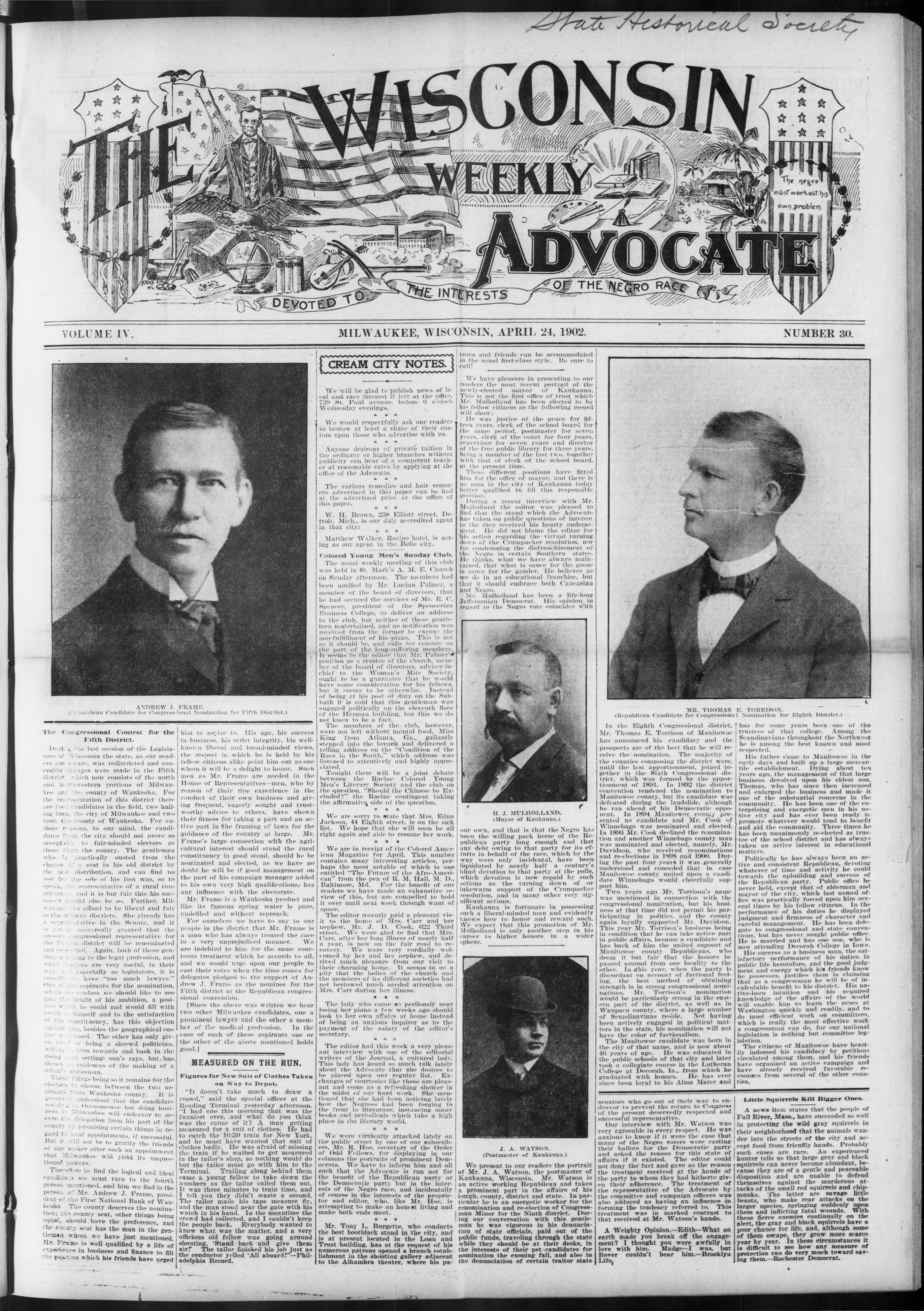
ANDREW J. FRAME.
(Republican Candidate for Congressional Nomination for Fifth District.)
VOLUME IV.
ANDREW J.
(Republican Candidate for Congress
The Congressional Contest for the Fifth District.
During the last session of the Legislature of Wisconsin the state, as our readers are aware, was redistricted and considerable changes were made in the Fifth district, which now consists of the north and northwestern portions of Milwaukee and the county of Waukesha. For the representation of this district there are four candidates in the field, two hailing from the city of Milwaukee and two from the county of Waukesha. For various reasons, to our mind, the candidates from the city should not prove so acceptable to fair-minded electors as those from the county. The gentleman who is practically ousted from the chance of a seat in his old district by the new distribution, and can find no rest for the sole of his foot was, so to speak, the representative of a rural constituency, and it is but fair this his successor should also be so. Further, Milwaukee can afford to be liberal and fair to the country districts. She already has a representative in the Senate, and it is almost universally granted that the preset congressional representative for the Fourth district will be renominated and re-elected. Again, both of these gentlemen belong to the legal profession, and while lawyers are very useful, in their way, and especially as legislators, it is possible to have "too much lawyer." One of the aspirants for the nomination, when we confess we should like to see gain the height of his ambition, a position which he could and would fill with credit to himself and to the satisfaction of the constituency, has this objection against him, besides the geographical one just mentioned. The other has only given proof of being a shrewd politician, willing to turn towards and bask in the rising (and setting) sun's rays, but has shown no evidences of the making of a reliable statesman.
These things being so it remains for the electors to choose between the two aspirants from Waukesha county. It is generally understood that the candidate residing in Oconomowoc but doing business in Milwaukee will endeavor to secure the delegation from his part of the county by promising certain things in regard to local appointments, if successful. But it will not be to gratify the friends of any seeker after such an appointment that Milwaukee will yield its unquestioned powers.
Therefore to find the logical and ideal candidate we must turn to the fourth person mentioned, and him we find in the person of Mr. Andrew J. Frame, president of the First National Bank of Waukesha. The county deserves the nomination; the county seat, other things being equal, should have the preference, and the county seat has the man in the gentleman whom we have just mentioned. Mr. Frame is well qualified by a life of experience in business and finance to fill the position which his friends have urged
```markdown
```
him to aspire to. His age, his success in business, his strict integrity, his well-known liberal and broad-minded views, the respect in which he is held by his fellow citizens alike point him out as one whom it will be a delight to honor. Such men as Mr. Frame are needed in the House of Representatives—men, who by reason of their ripe experience in the conduct of their own business and giving frequent, eagerly sought and trustworthy advice to others, have shown their fitness for taking a part and an active part in the framing of laws for the guidance of the country at large. Mr. Frame's large connection with the agricultural interest should stand the rural constituency in good stead, should he be nominated and elected, as we have no doubt he will be if good management on the part of his campaign manager added to his own very high qualifications, has any influence with the electorate.
Mr. Frame is a Waukesha product and like its famous spring water is pure, undefiled and without repreach. For ourselves we have to say to our people in the district that Mr. Frame is a man who has always treated the race in a very unprejudiced manner. We are indebted to him for the same courteous treatment which he accords to all, and we would urge upon our people to cast their votes when the time comes for delegates pledged to the support of Andrew J. Frame as the nominee for the Fifth district at the Republican congressional convention.
[Since the above was written we hear two other Milwaukee candidates, one a prominent lawyer and the other a member of the medical profession. In the case of each of these aspirants one or the other of the above mentioned holds good.]
MEASURED ON THE RUN
Figures for New Suit of Clothes Taken on Way to Depot.
"It doesn't take much to draw a crowd," said the special officer at the Reading Terminal yesterday afternoon. "I had one this morning that was the funniest ever, and what do you think was the cause of it? A man getting measured for a suit of clothes. He had to catch the 10:30 train for New York, and he must have wanted that suit of clothes badly. He was afraid of missing the train if he waited to get measured in the tailor's shop, so nothing would do but the tailor must go with him to the Terminal. Trailing along behind them came a young fellow to take down the numbers as the tailor called them out. It was three minutes to train time, and I tell you they didn't waste a second. The tailor made his tape measure fly, and the man stood near the gate with his watch in his hand. In the meantime the crowd had collected, and I couldn't keep the people back. Everybody wanted to know what was the matter, and a very officious old fellow was going around shouting, 'Stand back and give them air!' The tailor finished his job just as the conductor yelled 'All aboard!"—Philadelphia Record.
MILWAUKEE, WISCONSIN, APRIL 24, 1902.
CREAM CITY NOTES.
---
We will be glad to publish news of local and race interest if left at the office. 729 St. Paul avenue, before 6 o'clock Wednesday evenings.
☆ ☆ ☆
We would respectfully ask our readers to bestow at least a share of their custom upon those who advertise with us.
Anyone desirous of private tuition in the ordinary or higher branches without publicity can hear of a competent teacher at reasonable rates by applying at the office of the Advocate.
The various remedies and hair restorers advertised in this paper can be had at the advertised price at the office of this paper.
W. H. Brown, 238 Elliott street, Detroit. Mich., is our duly accredited agent in that city.
Matthew Walker. Racine hotel, is acting as our agent in the Belle city.
Colored Young Men's Sunday Club. The usual weekly meeting of this club was held in St. Mark's A. M. E. Church on Sunday afternoon. The members had been notified by Mr. Lucian Palmer, a member of the board of directors, that he had secured the services of Mr. R. C. Spencer, president of the Spencerian Business College, to deliver an address to the club, but neither of these gentlemen materialized, and no notification was received from the former to excuse the non-fulfillment of his plans. This is not as it should be, and calls for censure on the part of the long-suffering members. It seems to the editor that Mr. Palmer's position as a trustee of the church, member of the board of directors, adviser-in-chief to the Woman's Mite Society, ought to be a guarantee that he would have some consideration for his fellows, but it seems to be otherwise. Instead of being at his post of duty on the Sabbath it is said that this gentleman was engaged politically on the eleventh floor of the Herman building, but this we do not know to be a fact.
The members of the club, however, were not left without mental food. Miss King from Atlanta, Ga., gallantly stepped into the breach and delivered a telling address on the "Condition of the Race in the South," which address was listened to attentively and highly appreciated.
Tonight there will be a joint debate between the Racine Colored Young Men's Literary Society and the club on the question, "Should the Chinese be Excluded?" the Racine contingent taking the affirmative side of the question.
* * *
We are sorry to state that Mrs. Edna Jackson, 44 Eighth street, is on the sick list. We hope that she will soon be all right again and able to resume her work.
净 净 净
We are in receipt of the Colored American Magazine for April. This number contains many interesting articles, perhaps the most notable of which is one entitled "The Future of the Afro-American" from the pen of R. M. Hall, M. D., Baltimore, Md. For the benefit of our readers we have made an exhaustive review of this, but are compelled to hold it over until next week through want of space.
The editor recently paid a pleasant visit to the home of Mrs. Carr and her nephew, Mr. J. D. Cook, 622 Third street. We were glad to find that Mrs. Carr, after her long illness of nearly half a year, is now on the fair road to recovery. We were very cordially welcomed by her and her nephew, and derived much pleasure from our visit to their charming home. It seems to us a pity that the ladies of the church and the members of its different societies had not bestowed much needed attention on Mrs. Carr during her illness.
* * *
The lady who came so perilously near losing her piano a few weeks ago should look to her own affairs at home instead of being an anxious inquirer as to the payment of the salary of the editor's secretary.
```markdown
```
The editor had this week a very pleasant interview with one of the editorial writers of the Journal, a cultured lady. This lady has heard so much talk lately about the Advocate that she desires to be placed upon our regular list. Exchanges of courtesies like these are pleasant and come as a refreshing shower in the midst of our hard work. She mentioned that she had been noticing lately how the Negroes had been forging to the front in literature, instancing many books and periodicals which take a high place in the literary world.
* * *
We were virulently attacked lately on the public street by one of our subscribers, Mr. R. Hoe, secretary of the Order of Odd Fellows, for displaying in our columns the portraits of prominent Democrats. We have to inform him and all such that the Advocate is run not for the benefit of the Republican party or the Democratic party but in the interests of the Negro race, and incidentally of course in the interests of the proprietor and editor, who, like Mr. Hoe, is attempting to make an honest living and make both ends meet.
* * *
Mr. Tony L. Burgette, who conducts the best bootblack stand in the city, and is at present located in the Loan and Trust building, has at the request of his numerous patrons opened a branch establishment in the shooting gallery adjacent to the Alhambra theater, where his pa-
trons and friends can be accommodated in the usual first-class style. Be sure to call!
We have pleasure in presenting to our readers the most recent portrait of the newly-elected mayor of Kaukauna. This is not the first office of trust which Mr. Mulholland has been elected to by his fellow citizens as the following record will show:
He was justice of the peace for fifteen years, clerk of the school board for the same period, postmaster for seven years, clerk of the court for four years, supervisor for seven years and director of the free public library for three years, being a member of the last two, together with that of clerk of the school board, at the present time.
These different positions have fitted him for the office of mayor, and there is no man in the city of Kaukauna today better qualified to fill this responsible position. During a recent interview with Mr. Muhlholland the editor was pleased to find that the stand which the Advocate has taken on public questions of interest to the race received his hearty endorsement. He did not blame the editor for his action regarding the virtual turning down of the Crumpacker resolution, nor for condemning the disfranchisement of the Negro in certain Southern states. He thinks, what we have always maintained, that what is sauce for the goose is sauce for the gander. He believes as we do in an educational franchise, but that it should embrace both Caucasian and Negro.
Mr. Mulholland has been a life-long Jeffersonian Democrat. His opinion in regard to the Negro vote coincides with
M. B.
H. J. MULHOLLAND. (Mayor of Kaukauna.) our own, and that is that the Negro has been the willing pack horse of the Republican party long enough and that any debt owing to that party for its efforts in behalf of the race, which by the way were only incidental, have been liquidated by nearly half a century's blind devotion to that party at the polls, which devotion is now repaid by such actions as the turning down of or lukewarm support of the Crumpacker resolution, and in many other very significant actions.
Kaukauna is fortunate in possessing such a liberal-minded man and evidently knows how to honor and reward such. We expect that this promotion of Mr. Mulholland is only another step in his career to higher honors in a wider sphere.
JOHN B. HARRIS
J. A. WATSON.
(Postmaster of Kaukauna.)
We present to our readers the portrait of Mr. J. A. Watson, the postmaster of Kaukauna, Wisconsin. Mr. Watson is an active working Republican and takes a prominent part in the affairs of his burgh, county, district and state. In particular he is an energetic worker for the renomination and re-election of Congressman Minor for the Ninth district. During our conversation with this gentleman he was vigorous in his denunciation of state officials, paid out of the public funds, traveling through the state while they should be at their desks, in the interests of their pet candidates for nomination the ensuing fall, and also in the denunciation of certain traitor state
[Name]
MR. THOMAS E. TORRISON.
(Republican Candidate for Congressional Nomination for Eighth District.)
In the Eighth Congressional district, Mr. Thomas E. Torrison of Manitowoc has announced his candidacy and the prospects are of the best that he will receive the nomination. The majority of the counties composing the district were, until the last apportionment, joined together in the Sixth Congressional district, which was formed by the apportionment of 1891. In 1892 the district convention tendered the nomination to Manitowoc county, but its candidate was defeated during the landslide, although he ran ahead of his Democratic opponent. In 1894 Manitowoc county presented no candidate and Mr. Cook of Winnebago was nominated and elected. In 1896 Mr. Cook declined the renomination and another Winnebago county man was nominated and elected, namely, Mr. Davidson, who received renominations and re-elections in 1898 and 1900. During the past four years it was generally understood and conceded that in case Manitowoc county united upon a candidate Winnebago would cheerfully support him.
Two years ago Mr. Torrison's name was mentioned in connection with the congressional nomination, but his business at that time did not permit his participating in politics, and the county again loyally supported Mr. Davidson. This year Mr. Torrison's business being in condition that he can take active part in public affairs, became a candidate and has back of him the united support of Manitowoc county Republicans, who deem it but fair that the honors be passed around from one locality to the other. In this year, when the party is discordant on account of factional feeling, the best method of obtaining strength is in strong congressional nominations. Mr. Torrison's nomination would be particularly strong in the eastern part of the district, as well as in Waupaca county, where a large number of Scandinavians reside. Not having been actively engaged in political matters in the state, his nomination will not have the color of factionalism.
The Manitowoc candidate was born in the city of that name, and is now about 46 years of age. He was educated in the public schools of that city and later took a collegiate course in the Lutheran College at Decorah, Ia., from which he graduated with honors. He has ever since been loyal to his Alma Mater and
senators who go out of their way to endeavor to prevent the return to Congress of the present deservedly respected and successful representative. Our interview with Mr. Watson was very agreeable in every respect. He was anxious to know if it were the case that many of the Negro voters were casting their ballots for the Democratic party and asked the reason for this state of affairs if it existed. The editor could not deny the fact and gave as the reason the treatment received at the hands of the party to whom they had hitherto given their adherence. The treatment of the representative of the Advocate by the committee and campaign officers was also adduced as having an influence in forming the tendency referred to. This treatment was in marked contrast to that received at Mr. Watson's hands.
A Weighty Opinion.—Edith—What on earth made you break off the engagement? I thought you were awfully in love with him. Madge—I was, but Rover couldn't bear him.—Brooklyn Life.
NUMBER 30.
E. TORRISON.
1 Nomination for Eighth District.)
has for some years been one of the trustees of that college. Among the Scandinavians throughout the Northwest he is among the best known and most respected. His father came to Manitowoc in the early days and built up a large mercantile establishment. Dying about ten years ago, the management of that large business devolved upon his eldest son, Thomas, who has since then increased and enlarged the business and made it one of the substantial concerns in the community. He has been one of the enterprising and energetic men in his native city and has ever been ready to promote whatever would tend to benefit and aid the community. Three times he has been unanimously re-elected as trustee of the school district and has always taken an active interest in educational matters.
Politically he has always been an active and consistent Republican, devoting whatever of time and activity he could towards the upbuilding and success of the Republican party. Public office he never held, except that of alderman and mayor of the city, which last named office was practically forced upon him several times by his fellow citizens. In the performance of his duties he displayed judgment and firmness of character and careful management. He has been delegate to congressional and state conventions, but has never sought public office. He is married and has one son, who is now attending Decorah College in Iowa.
His success as a business man, the satisfactory performance of his duties in public life heretofore, and the good judgment and energy which his friends know he possesses, justifies them in claiming that as a congressman he will be of incalculable benefit to his district. His native-born intuition and his acquired knowledge of the affairs of the world will enable him to learn the ropes at Washington quickly and readily, and to do most efficient work on committees, which is really the most effective work a congressman can do, for our national legislation is nothing but committee legislation.
The citizens of Manitowoc have heartily indorsed his candidacy by petitions circulated among them, and his friends have organized an active campaign and have already received favorable responses from several of the other counties.
Little Squirrels Kill Bigger Ones.
A news item states that the people of Fall River, Mass., have succeeded so well in protecting the wild gray squirrels in their neighborhood that the animals wander into the streets of the city and accept food from friendly hands. Probably such cases are rare. An experienced hunter tells us that large gray and black squirrels can never become abundant, because they are of a gentle and peaceable disposition and are unable to defend themselves against the murderous attacks of the small red squirrels and chipmunks. The latter are savage little beasts, who make rear attacks on the larger species, springing suddenly upon them and inflicting fatal wounds. With these fierce enemies continually on the alert, the gray and black squirrels have a poor chance for life, and, although some of them escape, they grow more scarce year by year. In these circumstances it is difficult to see how any measure of protection can do very much toward saving them.-Rochester Democrat.
.
MAY USE HIS DISCRETION.
Policy Regarding Campaign in Island of Mindanao.
CHAFFEE IN COMMAND.
Correspondence in Regard to Murder of American Soldiers by the Moros Made Public.
Washington, D. C., April 23.—The war department today made public the telegraphic cable correspondence which has taken place up to date respecting the Moro outbreak in Mindanao. The important feature of the correspondence is the closing chapter, showing that Gen. Davis' exposition is not arbitrarily stopped, but that Gen. Chaffee is allowed to exercise his discretion. It is believed that the presence of Gov. Taft in Washington is the explanation of the President's order that Gen. Chaffee shall confer with the acting head of the Philippine commission before adopting hostile tactics.
President Anxious for Peace.
The correspondence begins with the cablegram given out last week dated Manila, April 15, in which Gen. Chaffee recites the killing of the first American soldier near Maligaban and the sending of an expedition under Baldwin to arrest the murderers. In answer to this the following dispatch was sent to Gen. Chaffee:
Expedition ordered under Baldwin will not leave coast until you hear from here. This will not, however, interfere with complete separation. (Signed) CORBIN.
On April 22 the following cablegram was sent to Gen. Chaffee:
was sent to General
The President is anxious that no expedition be made against Moros until all efforts by negotiations have been exhausted. To this end he desires that you confer freely with the acting civil governor. In the event the force has to be sent he directs that it go under the immediate command of Gen. Davis. The President will give you all support, but desires exercise of great care and prudence. If possible, avoid by all honorable means general war.
(Signed)
CORBIN.
This was followed by another dispatch:
With reference to previous cables on subject it has been suggested to President that possibly surrender of the Moros murderers might be effected by instrumentality friendly Dattos. President desires this considered in conference with Wright and to have assurance every honorable peaceful remedy has been exhausted.
(CORBIN.)
Chaffee's Last Appeal.
Gen. Chaffee responded to the last cablegram by the dispatch given out at the white house last night and published this morning, stating that to withdraw all the American forces would ruin our prestige; to withdraw part of the forces would be dangerous.
To this statement the following response was made today:
Your cable of yesterday has been submitted by acting secretary of war to the President, who directs that you keep in mind the President's orders, but, of course, do nothing that will impair our prestige or in any way imperil the army. If after the expiration of the time named in your proclamation and after all possible diplomatic and friendly methods have been exhausted, your demand for the Moro murderers has not been made, you will act upon the lines that your judgment will best serve to bring about peace and order in the island of Mindanao.
West Point Gets $5,500,000.
By a vote of 75 to 72 the House yesterday rejected claims attached to the omnibus claims bill by the Senate aggregating $1,800,000. The Military Academy appropriation bill, amounting to $5,500,000, was passed. The London dock bill came up but was not disposed of. The Senate amendments to the river and harbor bills could not be agreed upon and they were sent to conference.
Fish for Wisconsin
Wisconsin fishermen will be interested to know that Congressman Esch has arranged for a consignment of 100,000 brook trout to be placed in streams named by the fish commission.
Postmasterships Cause Worry.
Members who are candidates for renomination are worried because they will have to decide several important postmasterships within the near future and they fear their appointments may affect their charces for renomination. Representative Cooper has recommended the reappointment of A. E. Barnes at Delar
£60,000 for a Husband.
Postmaster General Payne yesterday issued an order denying the use of the mails to Lizzie Coffee of Burnips Corners, Mich., who advertised herself extensively throughout the country as being anxious to marry and also stating that she had about $60,000, which she wished to spend on some good husband.
Washington Notes.
The President today sent to the Senate the nomination of Rear Admiral Henry C. Taylor as chief of the bureau of navigation.
The President today appointed Benjamin F. Barnes of New Jersey assistant secretary, to succeed O. L. Pruden, deceased. He was educated in part in the Chicago high schools.
Representative Davidson is carefully studying the claims of several Indian tribes in Wisconsin. Several of the tribes were not properly provided for.
The President granted a pardon to Robinson Kemp, who in 1886 was sentenced by the United States circuit for the Western district or Arkansas to be hanged for a murder committed in the Indian territory. In April, 1886, the sentence was commuted by President Cleveland to imprisonment for life. Kemp has been imprisoned for more than sixteen years. He is a full-blooded Chickasaw Indian and upward of 80 years of age. Senator Platt of New York saw the President today and later said that Judge Alfred C. Coxe of the Northern district of New York would be nominated as judge of the newly created federal circuit court. Capt. Charles E. Clark has declined the appointment of special naval representative at the coronation of King Edward and the President has named Rear
DEUTSCHLAND DISABLED
Great Steamer Breaks Her Rudder South of the Scilly Islands.
Plymouth, Eng., April 23.—The Hamburg-American line steamer Deutschland, which left New York April 17 for Plymouth, Cherbourg and Hamburg, has been sighted eighteen miles south of the Scilly islands, with her rudder broken. The Deutschland is expected to reach Plymouth at about 5 p. m. today. A fresh wind is blowing from the westward.
The Deutschland passed the Lizard at 4:10 p. m. She signaled, "Lost rudder Tuesday, 400 miles westward of Bishop rock. Steering well with engines."
Fire Wipes Town Off Map.
Alpena, Mich., April 23.—The village of South Rogers, on the Detroit & Mackinaw road, thirty miles north of Alpena, was wiped off the map by fire at midnight last night. The loss is complete and there is no insurance.
FIGHT AMERICANS.
Two Engagements Take Place on the Island cf Mindanao.
Manila, April 22.—Two engagements have been fought between the American troops and the Moros of the island of Mindanao during the last twenty-four hours. Moore, of the Twenty-seventh infantry, while out with a small party hunting for water, was fired upon at long range. Lieut.-Col. Frank D. Baldwin, with a battalion of troops and a mountain gun, went to the assistance of Moore's party and drove off the Moros, who lost seven men. The firing was at 1100 yards range.
The Moro villages were flying red flags, meaning that they intended to fight to the uttermost. Later, Sultan Pualo and a force of natives attempted to reoccupy the ground gained by the Americans, but the Moros were forcibly dispersed. By orders from Washington the court martial ordered to try Gen. Jacob H. Smith, who was in command of the United States troops on the island of Samar on the charge of conduct prejudicial to good order and discipline, has been dissolved. The members of the court which will try Gen. Smith will be named at Washington. Datto (Chief) Ganasi has sent a delegation to the American commander tendering the absolute submission of the men under his control.
Brig.-Gen. Davis, in command at Zamboanga, island of Mindanao, has acknowledged the receipt from Washington of instructions to withdraw his troops from Mindanao, and he urges that owing to the present state of affairs, the withdrawal of the troops will result in the absolute loss of American prestige among the Moros in Mindanao. His orders, however, are explicit. Col. Baldwin and his forces are beyond the reach of the telegraphic instructions from Washington.
Washington, D. C., April 22.—Although no statement is yet obtainable as to the reasons for dissolving the Smith court-martial, it is understood that the President is desirous that he himself should review the proceedings of the court-martial instead of having this reviewed at Manila, as would have been the case had Gen. Chaffee convened the court.
INCREASES POWERS.
Important Army Bill Introduced in Senate by Mr. Hawley.
Washington, D. C., April 22.—Senator Hawley, chairman of the Senate committee on military affairs, today introduced a bill to "increase the efficiency of the army." The most important section of the bill is as follows:
Subject to the command of the President and general direction of the secretary of war, the lieutenant general shall exercise general command over the military forces of the United States; shall issue "army orders" and direct inspections of the troops; shall be charged with the instruction, training, discipline and distribution of the army, with the preparation and maintenance of detailed plans for the mobilization of the military forces, with the preparation and maintenance of schemes of offensive and defensive operations and with collecting and compiling military information. It will be his duty to see that the army is at all times suitably and amply supplied and equipped and that the munitions of war are of the best material and of suitable character. He will recommend suitable persons for promotions and for military honors and rewards. He will be assisted in his duties by and his orders will be conveyed and executed through the agency of the general officers holding commands and the general staff of the army.
The above provision is intended to give the commanding general a legal status, which at present he has not, and is understood to be in the interest of Gen. Miles.
Other portions of the bill relate to details of the administration of the affairs of the army. One of these provisions authorizes the President to direct that the funds appropriated for the quartermasters, subsistence or pay departments may be placed to the credit of the disbursing officers of either of these departments.
BIG FIRE IN LONDON.
Conflagration In the Barbican District Causes a Loss of $10,000,000.
London, April 22.—The damage done by the fire last night in the Barbican district of the city is roughly estimated at £2,000,000. Fire started in the Barbican, formerly a watch tower, in Clerkenwell, shortly after 11 o'clock last night. The flames crossed the narrow street, setting fire to a row of buildings 150 feet long. The guests of the Manchester hotel, adjacent to the Aldersgate street station, hurriedly left the building. Altogether three large warehouses on the south side of Australian avenue, two on the north side, and buildings on both sides of New Zealand avenue were burned. Twenty firms and shops were burned out. Two firemen were injured.
TWINS PERISH IN FIRE.
Parents Did Not Know Children Were in Barn Which Was Burned.
Des Moines, Ia., April 22.—The 3-year-old twin children of M. Shields, residing at Bear Grove, Dallas county, were found in debris resulting from a fire that consumed a barn last evening. Until the charred remains of the children were accidentally discovered they had not been missed. The fire originated in a pile of rubbish and communicated to the barn. Unknown to the parents, the children were playing inside the building and no effort was made to rescue them.
SIX BURNED TO DEATH.
Father, Mother, Three Children and Hired Man Perish.
Hull, Que., April 22.-The house of Thomas Hill of this place caught fire, and Hill, his wife and three children and a hired man were burned to death.
Convincing Evidence.
It used to be that the Republican party was the home of the aristocrat and that it had no room for the great common people. But now its doors are invitingly open to the plebeian, the proletariat, the unaristocratic. Leastwise we suppose so from the fact that at the Concordia Republican banquet one of the guests cut his face while trying to eat sherbet out of the shell of an orange with a table knife.—Kansas City Journal.
Upon the graves of the dead in the Turkish cemeteries little vessels of water are placed for the benefit of birds, and some of the marble tombs have basins chiseled out for the same purpose, the superstition being that birds carry messages about the living to the dead, and, like everybody else in Turkey, are suspected of being spiteful unless something is done to curry their favor.
THE WORK OF CONGRESS.
THE WORK OF CONGRESS.
Proceedings in the House.
The opponents of the Cuban reciprocity bill occupied most of the day in the House on the 17th, the feature being a vigorous speech by Mr. Cushman (Hep., Wash.) against the measure. Mr. De Armond (Mo.) delivered a forcible speech in favor of tariff reduction on trust articles. The other speakers were Messrs. Pierce (Tenn.). Douglass (N. Y.) and Lacey (Ja.) for the bill and Messrs. Jenkins (Wis.), Gaines (W. Va.), Warner (Ill.), Gardner (Mich.), Jones (Wash.) and Loud (Cal.) against it. Mr. Loud declared that directly and indirectly Cuba already had cost the United States $1,000,000,000.
The House on the 18th devoted the day to consideration and passage of the Cuban reciprocity bill, after adopting an amendment removing the differential on sugar. The voting was the culmination of a long struggle which began almost with the opening of this session of Congress and after two weeks of continuous debate, during which much bitterness was aroused. The bill finally was passed by a majority of 247 to 52. An analysis of the vote shows that 124 Republicans and 123 Democrats voted for the amended bill, and 42 Republicans and 10 Democrats against it. Mr. Grosvenor (O.) was one of those who voted against the bill.
The fortification appropriation bill, which carries $6,562,455, was passed by the House on the 19th and the conference report on the legislative appropriation bill agreed to. The former was amended so as to allow the purchase of the exclusive rights to use the high explosive thorite. A bill providing for two additional associate justices in Oklahoma was also passed.
Consideration of the military academy appropriation bill was begun in the House on the 21st. In addition to the regular items it contains provisions for extensive improvement of the grounds and buildings at West Point. These improvements are to cost $6,500,000, of which a little over $3,000,000 is appropriated in the bill. Mr. Cannon, chairman of the committee on appropriations, characterized the proposed expenditures as "the rankest kind of rank extravagance." Twenty-four of the thirty pages of the bill were completed. During the general debate Mr. Gillett (Ky.) preplated a discussion on the race question. Mr. Gaines (Tenn.) asked if the governor of Massachusetts, when he went to the Nashville exposition, declined to take with him a member of his staff who was a negro. "If he did," replied Mr. Gillett (Mass.), "it was because he did not want to wound the sensibilities of the people of Nashville." Mr. Gillett explained that in New England they could understand the prejudices in the South against the negro and against negro domination, but the people of his section insisted that social ostracism should not be visited on those who did not share these prejudices. He objected to making unpardonable the crime of color. Mr. Patterson (Tenn.) said he blushed for the honor of Massachusetts when he heard a defense made of social equality of the negro and white man.
By a vote of 75 to 72 in the House on the 22d, it was decided to reject claims attached to the omnibus claims bill by the Senate aggregating $2,800,000. On the heels of that action nonconcurrence was voted in the whole Senate amendment (the various items having been ruled to constitute a single amendment) and the bill was sent to conference. On the rejected claims $800,000 belong to the French spoliation class, while the rest are miscellaneous. The military academy appropriation bill was passed after the limit of cost of the improvements at West Point had been reduced from $6,500,000 to $5,500,000, and the amount of the appropriation in the bill from $3,000,000 to $2,000,000. The London dock charge bill was called up, but was not disposed of. Speaking to a pro forma amendment to the military academy bill, Mr. Feely (Ill.) discussed briefly the question of the violation of the neutrality law in connection with the snipment of mules and horses to South Africa. The Senate amendments to the river and harbor bill were disagreed to, and the bill was sent to conference, with Messrs. Burton (O.), Reeves (Ill.) and Lester (Ga.) as confeeers.
Consideration of the Senate amendments to the oleomargarine bill was begun in the House on the 23d, a special rule for this purpose being adopted by a vote of 152 to 70. By the ruling of the chair the question of further amendment of the Senate propositions was confined within very narrow limits. Slow progress was made. The opponents of the measure, who sought to modify the Senate amendments in various particulars, were outvoted on every proposition submitted. As an indication of what would happen, in his opinion, when the bill went into effect, Mr. Cowherd (Mo.) said that immediately after the passage of the oleomargarine bill by the Senate the price of butter went up 4 cents in New York and 8 cents in Chicago. Mr. Wadsworth (N. Y.), chairman of the agricultural committee, offered an amendment changing the section providing that oleomargarine free from artificial coloration, which is taxable at one-fourth of a cent per pound, so as to provide that "colored butter shall not be construed, as coloration." The amendment was lost, 51 to 88. After completing five of the fourteen pages the House adjourned.
Proceedings in the Senate.
The day in the Senate on the 17th was mainly occupied by a speech by Mr. Morgan on the Nicaragua canal bill. The resolutions offered by Mr. Culberson (Tex.) directing the secretary of war to send to the Senate a statement of money paid by the United States on account of the Philippine commission and a statement of the amount of money expended for sending troops to the Philippines and for their maintenance were agreed to. The Senate Chinese exclusion bill was substituted for the one passed by the House in order to facilitate consideration of the measure. The Senate then at 4:50 went into executive session, and at 4:55 adjourned.
Consideration was begun in the Senate on the 18th of the bill temporarily to provide a form of government for the Phillipine islands. The measure was read and the committee amendments were agreed to tentatively, but no action on the bill was taken. Mr. Rawlins offered a substitute for certain sections of the measure relating to the method of government of the islands, the operation of the courts, and extending to the Philippines the land laws of the United States. Mr. Rawlins also offered, on behalf of the minority, a substitute for the entire measure, granting, on the condition of the restoration of peace in the archipelago, independence to the Filipinos, and providing for the formation of a constitutional government in the Philippines. Mr. Carmack offered two amendments, one providing that no person or corporation shall hold persons in slavery in the islands or shall employ persons held in slavery, under penalty of a fine of not less than $10,000, and the other declaring that the United States regards with extreme disfavor the admission of the Philippine Islands as a state of this Union. Fifty-five private pension bills were, passed, as were also bills to ratify an agreement with the Red Lake and Pembina bands of Indians of the Red Lake reservation, Minn., and appropriating $1,000,000 to carry the agreement into effect. The conference report upon the legislative, executive and judicial appropriation bill was agreed to.
The conference asked for by the House on the Chinese exclusion bill was agreed to by the Senate on the 19th, and Messrs. Platt (Conn.), Dillingham (Vt.) and Clay were named as the Senate conferences. Bills were passed granting permission for the erection of a monument or statue in Washington in honor of the late Benjamin F. Stephenson, founder of the G. A. R.; to construe the dependent pension act of 1800 so as to include all persons who served ninety days during the Clyll war and who were honorably discharged, but excluding those of the First, Second, Third, Fourth, Fifth and Sixth United States Volunteer Infantry, who had prior service in the Confederate army or navy; to place Lieut.-Col. and Brevet Maj-Gen. Alexander Stewart Webb on the retired list of the army; to increase the pensions of soldiers and sailors who have lost limbs in the service, and fifty-eight private pension bills, including one increasing the pension of the widow of Gen. Ludlow to $50 a month. The House bill providing for reciprocal relations with Cuba was referred to the committee on relations with Cuba. Mr. Gamble then called up the resolution expressive of the sorrow of the Senate at the death of Senator Kyle of South Dakota, and he and Messrs. Cockrell, Cullom, Morgan, Forager, Nelson and Kitttredge paid fitting tribute to his memory.
Without a word of discussion of the merits of the measure, the river and harbor bill, carrying in appropriations about $70,000,000, was passed by the Senate on the 21st. So thoroughly had the bill been considered by the commerce committee that every senator was content that it should pass as reported. As no senator was prepared to begin debate on the Philippine government bill the measure, after a few minutes of informal discussion, went over until the following day. Mr. Teller said to Mr. Lodge, in charge of the bill, that some time
during the debate he wanted some senator to explain what the status of the Filipinos would be after the passage of the measure. Mr. Lodge replied that they would be citizens of the Philippine islands, precisely as it was provided by law that the inhabitants of Porto Rico were citizens of Porto Rico. Mr. Teller said the cases were not analogous. Mr. Lodge said it was declared distinctly that the Filipinos were citizens of the Philippine Islands, where upon Mr. Bacon insisted that the inhabitants of any country must be of necessity either the citizens or subjects of a sovereignty. He said the United States had not the courage to declare that the Filipinos were subjects, and asserted that to call them citizens of the Philippines meant absolutely nothing.
time for a spring cleaning of the Senate chamber. The resolution went over under the rules. A bill was passed providing for the entry into this country free of duty of a replica of a bronze statue of Rochembeau, to be erected in Washington. During consideration of a bill providing for a union railroad station in Washington, Mr. Patterson made an attack upon the measure on the ground that it was a gift of a great amount of money to railroad corporations. Mr. Gallinger pointed out that the government and the District of Columbia paid no part of the station or railroad yard construction, but simply paid for the street improvements and for the construction of a plaza made necessary by the location of the new station.
In the Senate on the 23d Mr. Rawlins continued his speech opposing the Philippine temporary government bill. He discussed at length the testimony presented to the committee on the Philippines and the reports made by officials to the war department. He presented many cases of torture of Filipinos, of the burning of towns and of the incarceration of Filipinos, saying it was a war without mercy, unilicized and without excuse. He had not concluded his speech when at 4:33 p. m. the Senate adjourned. During the early part of the session the bill providing for a union railroad station in Washington was under consideration, but no action was taken. Mr. Hoar became involved in a wordy discussion with Mr. Tillman, who charged the Massachusetts senator had been discounted to him, at which he was surprised because the senator was always a stickler for good order, senatorial dignity and decorum, and should set a high example that senators might imitate. Messrs. McMillan, Elkins and Berry were appointed conferees on the river and harbor bill and Messrs. Warren, Mason and Teller conferees on the omnibus claims bill.
BIT OF A FAMOUS APPLE TREE.
It was the First Planted in Western New York and a Woman Raised It.
Mrs. Sophronia Phelps of Kuckville, Orleans county, N. Y., celebrated her ninety-third birthday the other day. The event was marked by an old-fashioned reception.
"Mistress Phelps," as her old friends and relatives call her to this day, as that was the way she was addressed three-quarters of a century ago, sat in a curiously carved chair which is more than 125 years old and an heirloom. But the relic which interested the guests most was a cane belonging to Col. Miles of Kuckville, made from the wood of the first apple tree planted in Western New York. This cane is handsomely carved and beautifully polished.
It was related at the birthday party by Mistress Phelps that this first apple tree was planted by a Mrs. Dunham who sowed the apple seed herself and cared for the tender shoot until it was set out near the Dunham homestead in the eastern part of what is now Erie county. Mrs. Dunham came when a girl from New York city. The family stopped at Albany and slowly worked their way along the Mohawk, westward through the wilderness. They stayed for a while at or near the salt springs of Syracuse and there, according to tradition, somebody gave them a handful of apple seeds. From one of these seeds came the first apple tree planted in Western New York, the advance guard of the innumerable orchard that crowd the most famous apple growing region in the world.
Condemned in Missouri and Condiscared in New York.
Judge Clarke of St. Louis has convicted and fined heavily a number of grocers for selling baking powders containing alum. The week before the Health Department of New York seized a quantity of stuff being sold for baking powder which they found was made from alum mixed with ground rock, and dumped it into the river. The health authorities are thus taking effective means to prevent the introduction into our markets of injurious substitutes in place of wholesome baking powders.
As alum costs only 2 cents a pound, there is a great temptation for those manufacturers who make substitutes and imitation goods to use it. Alum baking powders can be detected by the health authorities by chemical analysis, but the ordinary housekeeper, whose assistance in protecting the health of the people is important, cannot make a chemical examination. She may easily know the alum powders, however, from the fact that they are sold at from ten to twenty cents for a pound can, or that some prize—like a spoon, or glass, or piece of crockery, or woodenware—is given with the powder as an inducement.
As the people continue to realize the importance of this subject and consumers insist on having baking powder of established name and character, and as the health authorities continue their vigorous crusades, the alum danger will, it is hoped, finally be driven from our homes.
Another Sort of Father. Now.
The Howell torpedo is one of the scientific results of Rear Admiral J. A. Howell's inventive work. On account of his success along this line he has been referred to as the "father of the modern torpedo."
So wedded was he to the science of warfare that it was a general belief that he would never marry, and when he led a bride to the altar it was a surprise to the entire navy.
Several years later a fellow officer visited Admiral Howell, and saw children of the distinguished sailor playing about the house.
"It's like a dream," said the visitor. "You're a lucky man, admiral," he added; "but tell me, how did you ever come to think about getting married?"
"Oh," replied Admiral Howell, glancing affectionately at his children at play. "I got tired of being referred to merely as the father of the modern torpedo."—Philadelphia Saturday Evening Post.
As Quick as Winking.
How fast does one wink? Thanks to the scientific investigations of a German photographer, this important question is settled. The whole operation lasts about four-tenths of a second. The downward movement of the eyelid occupies from seventy-five to ninety thousandths of a second. At the end of the descent a lid rests for a period which varied with different persons from fifteen to seventeen hundredths and the ascending movement took seventeen hundrdths. "As quick as winking," therefore, means about four-tenths of a second.--Pearson's Weekly.
Parts of a Locomotive.
There are 5416 parts in a modern locomotive, and these have to be put together as accurately as the parts of a watch. The part which has to stand most wear and tear is the crank-piece, which is estimated to be good for 60,000 miles only, as a general rule. The driving wheels are usually given a life of about 67,000 miles; so an old engine has worn out a number of crank-pieces and several pairs of driving wheels in the course of its career.
POLICE FIRE ON MOB.
Rioters Break Into Dyeing Plant and Drive Out Men by Scald ing Them with Steam,
Paterson, N. J., April 23. Because of the rioting last evening which followed the strike of dyers' helpers at several silk dyeing works here, the entire police force is on duty this morning in an anticipation of a renewal of the disturbances.
The strikers held a meeting at Riverside this morning and after it was over a large body of men marched to Hawthorne, which is just outside the limits of the city. Here are located the works of the American Silk Dyeing and Finishing Company. This plant was the objective point of the mob and they made an immediate attack on the works. As the plant is outside the city limits, there was no police guard. The rioters charged into the mill and drove out all the men at work. They turned on the steam and directed it against the fleeing workmen, a number of whom were badly scalded.
George Arnold, a member of the firm, was in his office when the mob entered the works. He started to see what the trouble was, when he was attacked on all sides and badly beaten before some workmen rescued him from the mob.
Shortly after noon there was a clash between the crowd of men and the police at Emil Geering's dye house. As the employees of the dye house left the establishment for their luncheon, the crowd made a charge on the building and tried to force a way through the main entrance. The police on guard drove back the men with their clubs, but they charged again and this time the attacking party fought so desperately that the police were compelled to shoot. At this the mob broke and fled. During the fight two policemen were badly injured on the head by stones. The police intended to fire over the heads of the strikers, but it is said one of the mob was wounded. At the same time that the attack was made on Geering's dye house there was a riotous demonstration at the dye works of Knipscher & Maas. Here there was a hard fight between a large body of men and the detail of police. The police had to send for reinforcements and when these arrived the rioters were dispersed. No shots were fired at this affray.
The strike of the helpers has been looked upon all along with great disfavor by the dyers, who refused to aid them in any way in their struggle against the owners of the plant. Good wages have been paid and the dyers felt that the strike was unjust and that the demands made were unreasonable.
GOING OVER REPORTS.
Iron, Steel and Tin Workers' Convention Awalts Action by the Committees.
Wheeling, W. Va., April 23.—The Amalgamated Association of Iron, Steel and Tin Workers is getting on well with its work. The last official report, that of the three trustees, has been made and today and tomorrow the convention will have little or nothing to do, while the committees are wrestling with the reports.
Removal of Headquarters.
The committee on good of the order has an interesting fight in a proposition to remove the general headquarters from Pittsburg. The Western lodges favor removing the offices from that city to any point further west. The Second district delegates want the offices located at Wheeling, as the association is stronger in this section than it is in Pittsburg. Columbus and Youngstown, O., are claimants. The division of the opposition to Pittsburg may result in the retention of the headquarters at that place. Another proposition the committee on the good of the order is considering is the plea of the National Stogie Makers for the recognition of their league, independent of the cigarmakers. The committee on constitution and general laws has several laws to be considered, most of which are of interest only to associate members.
Will Keep Politics Out.
An effort is being made to secure the repeal of the law prohibiting discussion of the political or economic topics. The Socialists are back of this and their claim is that instead of assuming a nonpartisan attitude the association should take an active position in political economy. It is not likely this proposition will meet with favor.
Shaffer'a Chances Better.
It is probable President Shaffer's report will receive the endorsement of the committee to which it was referred. Shaffer's chances of succeeding himself have increased largely since his report was submitted Monday, but the opposition to him is strong and there are intimations of a bombshell being exploded on the floor of the convention that will cause a reaction against him.
URGES JUSTICE FOR BOER
John Hays Hammond, American Engineer, Speaks Frankly to Britons.
London, April 23.—"I must advise you not to pay too much attention to the extravagant expressions of friendship of certain well meaning but discredited class called in America, 'Anglomaniacs.'" These words were the keynote of a speech made by John Hays Hammond, the American engineer, last night at a dinner given in honor of Mr. Hammond's return to England.
Mr. Hammond explained to his audience the depth of and reason for American sympathy with the Boers, and he impressed his hearers with Great Britain's total lack of effort to counteract the pro-Boer sentiment in the United States.
Such a statement coming from one who in the same speech referred to his imprisonment at Pretoria on account of his anti-Boer tendencies produced a rather striking effect.
A casualty list made public last night shows that the fighting in South Africa has not ceased. Last Sunday two British officers were killed near Ficksburg in the southeastern part of the Orange River colony. One of the officers killed was Capt. Sir Thomas Fowler, the only son of the late lord mayor of London.
Four men were killed and three officers and fourteen men were wounded in an engagement which took place in the eastern part of the Transvaal. These losses were also sustained last Sunday.
VEGETARIANS FOR A WEEK.
Ithacan Start Endless Chain to Fight Beef Trust. Ithaca, N. Y., April 23.—A movement to destroy the beef trust by means of an endless chain of letters has been started in this city. The main feature of the movement is to ask persons to abstain from eating meat for one week. It is calculated that every person in the United States can be reached before the designated time for the fasting to begin.
Fifteen men agreed to write four letters each to four friends, with the request that each of these write four more letters, and so on. Each person receiving these letters will be asked to refrain from eating meat for one week beginning May 15.
"For two years I suffered terribly from dyspepsia, with great depression, and was always feeling poorly. I then tried Ayer's Sarsaparilla, and in one week I was a new man."—John McDonald, Philadelphia, Pa.
Don't forget that it's "Ayer's" Sarsaparilla that will make you strong and hopeful. Don't waste your time and money by trying some other kind. Use the old, tested, tried, and true Ayer's Sarsaparilla. $1.00 a bottle. All druggists.
Ask your doctor what he thinks of Ayer's Sarsaparilla. He knows all about this grand old family medicine. Follow his advice and we will be satisfied. J. C. Ayer Co., Lowell, Mass.
MILWAUKEE REFERENCE DIRECTORY.
Stocks, Bonds and Investment Securities.
ROGERS. C. C., Chamber of Commerce.
PEOPLE'S COMMISSION CO., 86 & 88 Mich st.
HADDEN-RODEE CO., THE, Chamber of Com.
Grain and Commission Merchants.
ROGERS. C. C., Chamber of Commerce.
BARTLETT & SON CO., L., Chamber of Com.
KRULL COMMISSION CO., ROB'T, Cham. of C.
Hay, Grain and Feed Dealers.
KRULL COMMISSION CO., ROB'T, Cham. of C.
Patent Attorney and Solicitor.
UNDERWOOD, H. G., 107 Wis. st. Tel. M. 502.
Architects.
EVANS & MARSHALL, 82 Wisconsin street.
Business College.
Cream City Business College, E. W. & Wis. sts.
WHOLESALE.
Wines and Liquor Dealers.
KISSINGER CO., J. P., 278 East Water st.
Wholesale Grocers.
SMITH, THORNDIKE & BROWN CO.
Bicycles, Enameling and Sundries.
NAT. CYCLE SUPPLY & EN. CO., 155 W. W.
Printers' Supplies and Electrotypes.
GETHER & DREBERT CO., 91 Huron st.
Paper Boxes, Folding, Suit, Confectionery, Medicine Boxes.
MOLITOR, M., 118-120-122-124 Huron st.
SCHULZE & CO., A. GEO.
Gas, Gasoline Engines and Power
Pumps—New and Second Hand.
Pumps-New and Second Hand.
LAUSON, C, P. & J., 103 West Water st.
MILWAUKEE MACHINERY CO., 290 E. Water.
H. MOOERS CO., Second and Sycamore sts.
Wholesale Saddlery and Harness,
DYER SADDLERY CO.
Scales, Gasoline and Gas Engines and Windmills.
FAIRBANKS, MORSE & CO., 134 Sycamore st.
Steam, Hotwater Heating Contractors
H. MOOERS CO., Second and Sycamore sts.
AM. FOUNDRY & FURNACE CO., Schools only.
Printers' Rollers and Inks.
Badger State Printers' Roller Co., 1219 Clybourn.
Boilers.
MIL. BOILER CO., 220 Oregon street.
$3.00
W.L.DOUGLAS
SHOES $3.50
UNION MADE.
VIL
DAMMER
THE WORLD'S
GREATEST SHOEMAKER
Sold by 63 Douglas Stores in American cities, and the best retail shoe dealers everywhere.
Caution! The genuine have W. L. Douglas' name and price stamped on the bottom.
Notice increase of sales in table below:
1898 = 748,706 Pairs.
1899 = 398,182 Pairs.
1900 = 1,259,754 Pairs.
1901 = 1,566,720 Pairs.
Business More Than Doubled in Four Years.
THE REASONS:
W.I. Douglas makes and sells more men's $0.00
and $5.50 shoes than any other two manufacturers.
W.I. Douglas $0.00 and $5.50 shoes placed side by
side with $5.00 and $6.00 shoes of other makes are
found to be just as good. They will outwear two
$5.50 shoes.
pairs of ordinary $300 mailer.
Made the best mothers, including Patent
Coronel Rene Cott and National Kangaroo.
Color Eyellets and Always Hooks Used.
W.L. Douglas 34 "H Gl Edge Line" cannot be equalled.
Shoes by mail, 25 cts. extra. Catalog
free. W.L. DOUGLAS, Brockton, Mass.
WET WEATHER COMFORT
There is no satisfaction keener than being dry and comfortable when out in the hardest storm.
YOU ARE SURE OF THIS IF YOU WEAR
TOWER'S
FISH BRAND
SLICKERS
MADE IN BLACK OR YELLOW
AND BACKED BY OUR GUARANTEE.
A J. TOWER CO., BOSTON, MASS.
ASK YOUR DEALER
If he will not supply you
send for our free catalogue or garments and hats.
NO MORE DRINKING
KILLS APPETITE FOR LIQUOR
A home cure without patient's knowledge.
Endorsed by leading temperance people.
PROF. KOCH'S INTEMPERANCE REMEDY
For sale everywhere. By mail $1.00.
The Koch Pharmaceutical Co., Berlin and N. Y.
THE A. SPIEGEL CO., Agts., Milwaukee, Wis.
10WA FARMS $4 PER
CASH BALANCE CROP TIL PAID
MULHALL Since CITY A
25 CTS
PISO'S CURE FOR
CURES WHERE ALL ELSE FAILS
Best Cough Syrup. Tastes Good. Use
in time. Sold by druggists.
CONSUMPTION
---
LOOKIN' BACK
Wathers o' Moyle an' the white gulls flying
Since I was near ye what have I seen?
Deep great seas, an' a sthrong wind sigh in'
Night an' day where the waves are green.
Struth na Moille, the wind goes sigin'
Over a waste o' wathers green.
Slemish an' Trostan. dark wi' heather.
High are the Rockies, alry-blue;
Sure ye have snows in the winter weather.
Here they're livin' the long year through.
Snows are fair in the summer weather.
Och, an' the shadows between are blue!
Lone Glen Dun an' the wild glen flowers.
Little ye know if the prairie is sweet.
Roses for miles, an' redder than ours.
Spring here undher the horses' feet.
Ay, an' the black-eyed gold sunflowers—
Not as the glen flowers small an' sweet.
Antrim hills an' the wet rain fallin'
Whiles ye are neater than snow-tops
keen:
Dreams o' the night an' a night-wind call.
THE COWARD.
The land surveyor, Glyeb Gavrilovich Sunirnov, arrived at the station Gnilushka. There was still a distance of about thirty or forty versts to the farmhouse, whither he had been called to survey the land. (If the driver is not drunk and the horses are not battered jades, the distance would be even less than thirty versts, otherwise it would make fully fifty versts.)
"Would you please tell me where I can find posthorses around here?" the surveyor inquired of the station gendarme.
"What kind? Posthorses? You can't find even a dog on this road within a hundred versts, it is certainly out of the question to look for posthorses. But which way are you going?"
"I am bound for Dyevkino, the estate of Gen. Khokhotov."
"Well!" yawned the gendarme, "go a little distance away from this station, there are sometimes peasants in that yard who take strangers."
The surveyor heaved a sigh and walked away from the station. There, after long quests, talks and hesitations, he found a strong, morose-looking and pock-marked peasant, dressed in a torn, coarse gray coat and bast shoes.
"The devil knows what a horrible wagon this is!" the surveyor frowned, getting into the wagon. "It's hard to tell which is the hind part, and which the front."
"What's there to tell? Where the horse's tail is, that is the front, and where your honor is sitting—that is the hind part."
The little horse was young, but lean, with legs set wide apart and with bitten ears. When the driver lifted himself a little and lashed the horse with a whip she only nodded her head, but when he gave vent to a few oaths and lashed her once more the wagon began to squeak and shake as though with fever. After the third blow the wagon rocked, and only after the fourth the wagon stirred from its place.
"Are we going to ride all the way like this?" asked the surveyor, feeling the horrible bumping of the wagon, and wondering at the capability of the Russian drivers to combine a slow, turtle-like pace with a jolting that turns the soul inside out.
"We'll get there all right," the driver consoled him. "The horse is young and brisk. Just give her time to start at full speed, and you'll not be able to hold her back. Go ahead—you cursed thing!"
It was twilight when the wagon left the station. On the right of the surveyor a dark, frozen plain stretched without an end. If one were to go that way, it seemed, he would surely land at the world's end. On the horizon, where the plain disappeared, and blended with the sky, the cold autumn sun was drowsily setting. On the left side of the road hillocks rose in the darkening air; they were either last year's haystacks or a village. The surveyor could see nothing in front of him, for there his view was obstructed by the broad, clumsy back of the driver. It was quiet and cold.
"What a dull place this is!" thought the surveyor, trying to cover his ears with the collar of his overcoat. "And the driver is not reliable, either. Just see, how broad-shouldered he is! Such a child of nature can drive a man's soul out with a single touch of the finger! And his face is rather beastly, suspicious." "Eh, dear," asked the surveyor, "what is your name?"
"My name? Klim."
"Well, Klim, how is it around this neighborhood? Dangerous? Have people been robbed here?"
"No, thank God. Who is going to rob here?"
"It's good that there are no robbers around here. But for any event I've taken along three revolvers," quoth the surveyor, untruthfully. "And it's pretty dangerous, you know, to fool with a revolver. One man can hold his own against ten robbers."
It became dark. The wagon suddenly creaked, squeaked, began to shake, and, as though unwillingly turned to the left
"Listen," he addressed himself to the driver. "So you say it is not dangerous here? What a pity—I love to fight with robbers. Judging from appearances, I am thin, sickly, but I have the strength of a bull. One day I was attacked by three robbers. What do you think was the result? I deal one such a blow that—that, you understand, he fell dead on the spot, and the other two were sent to Siberia, to the galleys. And I really don't know where I get so much strength. I take a strong fellow, like yourself, with one hand, and—and I crush him."
Klim turned around, glanced at the surveyor, his face began to quiver and he lashed the horse.
"Yes, my dear boy." went on the surveyor. "Heaven forbid anybody to start with me. Aside from the fact that the robber would remain without arms and legs, he would also be brought before the court of justice. I know all the judges and police captains. I am an important government official. I am here, but the authorities know where I am * * * they are watching that no harm should befall me. There are sergeants and policemen stationed behind each and every bush on the road. Hold on!" suddenly cried the surveyor. "Where are you driving now?"
"Why, can't you see? It's the forest." "Indeed, the forest," thought the surveyor. "And I became frightened. But I must not show my agitation. He has already noticed that I am afraid. Why is he looking around at me so frequently? He is surely plotting something. Before, he was driving slowly, step by step, while now—see how he is rushing!"
"Listen, Klim, why do you drive the horse so fast?"
"I am not driving her. She's running of her own free will. * * If she starts to run at full speed you can't stop her under any circumstances. * * * And she herself is not glad that she has such legs."
"You lie, my dear boy! I see that you lie! Only I advise you not to drive so
fast. * * * Slow down your horse a little. * * * Do you hear? Slow her down!"
"What for?"
"Because—because four friends of mine are to come after me from the station. It is necessary that they should overtake us. They promised to catch up with me in this forest. It'll be more jolly to ride together with them. They're a strong, well-built lot—each of them has a pistol. Why are you forever turning round and moving as though on needles? eh? I, my boy, I — There's nothing to look at on me—there's nothing interesting about me—except the revolvers, perhaps. I'll take them out, if you like, and I'll show them to you—if you like."
The surveyor made as if he were searching his pockets, and at this moment something happened which the surveyor could never expect in his cowardice. Klim suddenly tumbled out of the wagon and on all fours rushed away toward the thicket.
"Help!" he cried. "Help! Take, devil, the horse and wagon, but don't kill me! Help!" Hurried footsteps, dying away in the distance, were heard, and the rustling of dry branches—and all became silent. The surveyor, who had not anticipated such a turn of affairs, first of all stopped the horse, then seated himself in the wagon comfortably, and began to think.
"He ran away. He got frightened, the fool. Well, but what am I to do now? It is impossible for me to go ahead alone, because I do not know the way; and then, people may think that I stole the horse from him. What is to be done?
"Klim! Klim!"
"Klim!" replied the echo.
The thought that he would have to pass all night in the dark forest, out in the cold, and hear nothing but the howl of the wolves, the echo and the neighing of the lean mare—this thought sent chills and shivers down the back of the surveyor.
"Kimushka!" he cried. "Dearest! where are you, Kimushka?"
The surveyor cried thus for two hours, and only after he had become hoarse and reconciled to the thought of passing the night in the woods the faint breeze wafted to him some one's moan.
"Klim! Is that you, dearest? Let us go ahead!"
"You'll kill me!"
"I was only joking, dearest! By the saints, I was only joking! I have no revolvers! I lied to you out of fright! Do me a favor, come! I'm freezing!"
Klim evidently considered that by this time a real robber would have disappeared' with the horse and wagon; he came out of the thicket and walked up to his passenger irresolutely.
"Well, you fool, why were you frightened? I—I was joking—and you became frightened. Sit down!"
"Be it so, sir," muttered Klim, getting into the wagon. "If I had known it: before I would not have taken you even for hundred rubles. I nearly died for fright."
Klim lashed the horse. The wagon began to shake. Klim lashed the horse once more, and the wagon rocked. After the fourth blow, when the wagon had strated, the surveyor covered his ears with his collar and fell to meditation. The road and Klim seemed dangerous no longer.—Translated from the Russian of Anton Chekhov, for the New York Commercial Advertiser, by Herman Bernstein.
"ANDY" BURT AS A COLONEL.
Anecdotes of the Officer the President Has Made a Brigadier-General.
Col. "Andy" Burt, who was selected by the President to be a brigadier general, is one of the most democratic officers in the army. Col. Burt believes in the officer associating with his men, and has more than once astonished his fellow officers by his familiarity with the men in the ranks.
When Col. Burt was at Fort Miyssoula he organized a baseball team, composed of officers and men. In the first game a big strapping Irishman was on the coaching line. Col. Burt sent a hot liner to short. He was a little slow in getting off and the coach proceeded to hustle him roughly, yelling as he did so:
"Why don't you run, you damned coyote; do you suppose we're running this game by military tactics?"
On one occasion, as Col. Burt was entering Chicago, he met a corporal on the train and without disclosing his identity asked the corporal how long he had been in the service, where he served, whom he had served under, how he liked the army, where he came from, whether his officers treated him all right, if he got enough to eat and if he had ever been in a fight. The corporal replied to each of these questions, and followed with similar inquiries of the colonel.
"Oh, I'm a colonel," was the response. The corporal looked him over and remarked: "Oh, what yer giving me? You can't stuff me; you don't look like any colonel."
"But I am," insisted Col. Burt.
"You can't prove it," said the corporal. Col. Burt replied that if the corporal would meet him in the presence of his company commander he would porduce evidence as to his identity. This was agreed to, and not until the company commander identified Col. Burt would the corporal believe that his companion on the trip was an officer of the army.—New York Sun.
Mica Veils for Mortoristes.
Many and various attempts have been made in Paris to improve the ordinary motor goggles, which are in the present form a hideous necessity. Some such kind of protection for the eyes will always have to be worn for automobilists. But ladies in particular would be glad if some new apparatus, equally effective, but less unsightly, were invented. Two well-known artists have already essayed their skill in this direction, with, however, only moderate success. One contrived paper fans, or screens, in the style of masks, with designs of exquisitely drawn heads; but the specimens shown, while greatly admired, were voted impractical, at least for automobilism. The faces—portraits of Sarah Bernhardt, Rejane, Yvette Guilbert among others—were works of art. But ladies soon tired of holding up these screens to their eyes during a drive of any duration, and, moreover, when the pace was fast, the rush of wind blew the dust in behind the paper guards. The other artist referred to devised beaten silver masks, to be attached over the face, and representing the countenances of Greek goddesses—Artemis and Pallas Athene, for instance. But this invention, like the former, proved as impractical as it was artistically carried out. The weight of the silver masks was found to be unbearable for any length of time. Now a milliner seems to have succeeded where artists have failed. He has invented a voluminous veil of mica, which is perfectly transparent and absolutely dust and air proof. It is tied over the hat, like the ordinary article of net or gauze, for it is wonderfully flexible. While ladies say that the mica veil answers its purpose, its appearance, when, for instance, it sparkles and shimmers fantastically in the sunshine, is not at all unbecoming.—London Telegraph.
The Library of Congress ranks sixth among the libraries of the world in its present contents. France has the largest, England next, then comes Russia, and Germany follows with her libraries in Munich. Berlin and Strasburg, the last named holding almost equal rank with ours in Washington.
ME AND SHAKESPEARE.
Why can't I write as Shakespeare wrote
Some lofty thought that thrills,
In lines the world will always quote,
The same as it does Bill's?
I've bought a new gold pen or two,
Some purple, perfumed ink.
And now all that I have to do
Is just to try to think.
"Ay, there's the rub," as William says,
For though I write all day.
It, somehow, does not sound like his,
So all the critics say.
Though lofty thoughts I try to speak,
In everyone there is
Some hint that it is most too weak
To go along with his.
But I'd not care to leave my fame
And so it is a joy to feel.
The while 1 build each line.
No one will ever care to steal
A single thought of mine.
MAN WITH THE RAKE.
Bowed with the weight of centuries
I stand, like Markham's hero.
I feel my spirits sadly freeze;
They're dropping down to zero.
Although of flowers I choose to sing
My wife I'll never pardon.
My springtime thoughts have taken wing
I've got to dig the garden.
I love to write of jocund morn.
But scorn to meet the charmer.
I'm just a wonder in the corn
While I'm a paper farmer.
Now in the dirty soil I poke
With shovel most ungainly—
A woman cannot take a joke—
Or sees it all too plainly.
A farmer bold!—it makes me sick!
A miserable take-off!
I spread the fertilizer—thick—
A nasty kind of rake-off.
"My brow is wet with honest sweat."
My back is nearly breaking.
But for the little wife, you bet.
The job I would be "shaking."
No man should sing of jovous spring;
Of it he'll get enough, sir.
A strenuous life he'll get when wife
Is there to call his bluff, sir.
—Puttsburg Press.
HUMOROUS ITEMS.
Progressing Rapidly.—"Hullo, Bifkins! How is your Anti-Slang Society getting along?" "Fine as silk, old slobs!"—Baltimore News.
Familiarity, Etc.—"I'm so glad to see you. And how did you enjoy your visit to the South?" "Oh, not very much! There wasn't a soul where I was staying except intimate friends."—Brooklyn Life.
A Weighty Opinion.—Edith—What on earth made you break off the engagement? I thought you were awfully in love with him. Madge—I was, but Rover couldn't bear him.—Brooklyn Life.
Logical.—Lady (to woman whose husband has just been sent to jail for wifebeating)—Why, do you think your husband will miss you? Woman—He'll miss me because he can't beat me.—Judge.
A Favorite.—She—I hope our dear good pastor will be able to refute these heresy charges. He—I guess he's all right! I understand the deacons are betting three to one on an acquittal.—Town and Country.
Young Husband—I'm just about dead putting down this carpet.
Wife—The carpet is not heavy.
"No, but I have to work in such a cramped position."
"Nonsense. Just imagine you are on your bicycle."—New York Weekly.
She—What does a game of ping-pong cost?
He—Well, the last game I know anything about cost me $4 for plate glass, $2 for gas globes and the friendship of a sweet girl I chanced to hit in the eye.—Yonkers Statesman.
"Katie McCoy, have you had any experience as a cook?" "No, sir." "What did you do at the last place?" "Oi was oculist av th' kitchen." "Oculist of the kitchen? What in the world did you do?" "Oi removed th' oyes from th' potatoes, sor." —Philadelphia Record.
Weary Willie—What makes you look so worried?
Meandering Mike—I just told a man I was sick and he said he'd come back in a minute and treat me; now I don't know whether he's a bartender or a doctor.—Chelsea Gazette.
Breakers Ahead.—Auntie (anxiously)—Do you think you have had the proper training for a poor man's wife? Sweet Girl—Yes, indeed. Papa hasn't given me any spending money worth mentioning for years. I always get things charged.—New York Weekly.
McJigger—I understand "hippopotamus" means "river horse." I wonder if there's any Latin name for "sea dog," for instance.
Thingumbob—Maybe that's what "alligator" means. An alligator looks like a sort of submarine dachshund.
The Boy—It's about fifteen minutes' walk from here.
Mr. Homeseeker—Fifteen minutes! The advertisement says five!
The Boy—Well, you kin believe me or you kin believe the advertisement, mister; but I ain't tryin' to sell you a place!—Tit-Bits.
"Then," said Longbean, concluding a very "fishy" story, "the capture of both the panthers was easy. How do you suppose I caught them?"
"I suppose in the same way that liars are usually caught."
"Er—how's that?"
"By their tales."—Philadelphia Press.
"Br'er Williams say, des 'fo' he took en die, dat he wuz gwine ter glory in a cheervoot er fire."
"S'pose he happen ter de misfortune er burnin' up on de road?"
"Well, he 'lowed he'd take dem chances, kaze if he did ketch fire a-gwine he'd fool hell, anyhow."—Atlanta Constitution.
"I've got the greatest idea you ever heard of for a strenuous play," declares the young author.
"What are you going to dramatize—the cook book?" we ask, with fine sarcasm.
"Dramatize nothing!" he retorts. "This is to be purely and entirely and amazingly original. The heroine is to be a mother-in-law and the hero a baseball umpire."—Judge.
The Professional Executor
Here comes a gentleman who writes himself down in the city directory as a "professional executor." He tells me he has made as much as $200,000 a year at the business. His character is above reproach, naturally. For twenty-five years he was one of the linchpins of high society, then became reduced and had to work. His plan is to approach an old acquaintance who may or may not be putting his house in order and diplomatically suggest an executorship. One good will a year to handle is as much as he cares for—New York Press.
YOUNG GIRL IS POISONED.
Murder at Wanaque, N. J., Rivals Famous Bosschieter Case. WAS GIVEN A DRUG. Marietta Odell Goes Cycling, Drinks Beer with Man She Meets and Later Disc
Paterson, N. J., April 22.—That Marietta Odell, a beautiful mill girl of Wanaque, N. J., was murdered the authorities of Pasaic county are convinced. The case is similar to the Jennie Bosschieter murder.
The last person seen with Marietta was her sweetheart, Charles Finner, who, while not engaged to marry her, has been her constant companion for months. Finner worked in a powder mill at Wanaque, while the girl was employed in the Giannetti silk mill in Pompton Lakes. She was an enthusiastic bicyclist. Before she died the girl told Dr. Shippey that after she left Finner she met a stranger who offered her a glass of beer in a road house.
"At the first swallow," she said, "I noticed a curious taste. I told my companion the drink seemed queer, and he, too, tasted it and returned it to me, saying it was all right. I drank the rest of it and became deathly ill. What happened after that is a daze to me. I have not the slightest idea who the man was. I never saw him around here before." Dr. Shippey is confident the girl was poisoned. An autopsy will be made.
Ottumwa, Ia., April 22.—At Oskaloosa, thirty miles northwest of this city. Saturday night, Rev. O. A. Johnson and Ed Murray, one of his congregation, indulged in an impromptu duel in the street. As a result both are under arrest. The preacher is wounded in three places, but none of the wounds is is considered serious. The men quarreled over a land deal
Denude and Rob a Woman.
Brazil, Ind., April 22.—As Mrs. James Baxter, wife of the proprietor of the Decker hotel, stepped into a side street last night she was seized by three men and carried 200 yards to an ailey, where the men cut off her clothing to secure a purse containing $400 she had concealed in her skirt pocket. After robbing her they gagged and released her.
Normal School Professor Stabbed.
Emporia, Kan., April 22.—Prof.
Charles S. Huey, assistant in the department of physical training of Kansas state normal school, was stabbed in the right breast and the upper portion of his jawbone was crushed by young negroes. Both wounds are serious. Huey had driven the negroes from the fence of the park where a baseball game was in progress. The negroes began to throw stones over the fence into the crowd: The professor went outside to stop their disorderly conduct and was attacked.
Cattlemen in Fatal Fight
Vinita, I. T., April 22.—In a fight between cattlemen west of Collinsville, in the Cherokee nation, William Phillips was killed instantly and William Mayfield, Jess Skidmore and Lige Johnson were fatally wounded. The fight was the result of an old feud. Quincy, Ill., April 22.—At Plymouth, forty miles northeast of Quincy, Aldo Cox, aged 13, has been instantly killed by Clark Huddleston, aged 20. The accident happened while Huddleston was showing how cowboys twirl a revolver in fancy shooting. The coroner's jury exonerated Huddleston.
Accused of Wife-Murder.
Cleveland, O., April 22.—Mrs. Sarah Lynch, 57 years old, living at 603 Tod street, was found dead in the rear of her home early today and her husband, Martin Lynch, 60 years old, is under arrest, charged with her murder. The woman was shot through the temple. Lynch, when taken into custody, was covered with blood and in a drunken condition. Lynch declares that he found his wife dead when he returned from work.
QUEEN MUCH BETTER.
Physicians Announce that Wilhelmina's Condition Shows Improvement.
NOTE FALL IN HER TEMPERATURE.
The Hague, April 22.—After a consultation, lasting three-quarters of an hour, between Prof. Rosenstein and other physicians the following bulletin was issued this afternoon:
There is a slight improvement in the Queen's condition, manifested by the fall in her temperature since morning. Her majesty's consciousness is maintained without interruption. The Queen's general condition is satisfactory.
The above bulletin caused the greatest satisfaction here and elsewhere in Holland.
The Hague, April 22.—Dispatches from Castle Loo announce that the condition of Queen Wilhelmina, according to her physicians, continues to be satisfactory.
This morning's news from Castle Loo leads to the impression that a favorable turn has occurred in the Queen's illness, which renders it possible that the affairs of state will soon resume their normal course. The rumors of the intention of the government to take steps looking to the establishment of a regency will, therefore, probably not materialize. Prof. Rosenstein, the patheologist of Lyden University, had a further consultation today with her majesty's physicians.
ESTIMATED THAT 70 PERISHED IN FIRE.
ESTIMATED THAT 70 PERISHED IN FIRE.
Underwriters will Investigate the
Cairo, Ill., April 22.—Nothing further has developed as to the disaster of Sunday. The underwriters are here and will go up to the wreck today. No more bodies have been discovered. Practically nothing has been done to search the wreck for bodies. The total number on board at the time of the fire, passengers and crew, from all reliable statistics given from memory by officers was 145, and it is known that 75 were saved. This would leave 70 to be unaccounted for. The corrected list of the lost given is 50, and there must be in the wreck on the river twenty people. It is not yet determined whether or not there will be an effort soon of raising the bodies.
Confederate Veterans Meet.
Dallas, Tex., April 22.—With the music of many bands and cheers from thousands of throats the twelfth annual reunion and meeting of the United Confederate Veterans began today at the auditorium at the fair grounds. It was estimated in the morning that 75,000 visitors were in the city, while information from the railroads was that by night this number would be swelled 125,000 at least.
FAVORS SALE OF ISLES.
Danish Parliament Adopts Report on Treaty with United States.
PURCHASE OF THE WEST INDIES.
Copenhagen, April 23.—The landsthing by 34 to 30 votes today adopted the majority report on the treaty providing for the sale of the Danish West Indies to the United States. The treaty now goes back to the folkething.
WILL INVESTIGATE.
Congress to Determine Cause of the Increase in Price of Food.
Washington, D. C., April 23.—Representative Richardson of Tennessee introduced the following resolution today:
Whereas, there has been recently an increase in the price of mutton, veal and pork which is abnormal and due largely, if not altogether, to trusts and other combinations alleged to be unlawful in their organization; therefore be it
Resolved, that the ways and means committee be instructed to investigate the question of the recent increase in the price of these articles and determine the cause thereof, and if practicable offer some explanation that will afford relief against the evil complained of.
Representative McDermott of New Jersey today introduced a bill abolishing all duties on meat and poultry imported from foreign countries.
Act Against Beef Trust.
New York, April 23.—The board of aldermen of this city adopted a resolution today reciting that the increase in the price of meat is working a great hardship among the toiling masses of the city. The resolution declares that the board "strongly condemns the inhuman action of the combination known as the 'beef trust' in increasing the price of meat and demands the intervention of the federal authorities and stop the lawful conspiracy to private gain on a food which is a necessity for the working classes of this city." It was ordered that a copy of the resolution be sent the President of the United States.
Packers Corner Hen.
Chicago, Ill., April 23.—Three great firms practically have complete control of the poultry market. Through the ownership of two-thirds of all the poultry in the country they are said to be able to fix at will the prices for broilers, roasters, the poor grades of chickens that go under the trade name of "fowl," and for turkeys. The firms having control are: Armour & Co., Swift & Co., Priebe & Semiter of Bushnell, Ill.
All over the Western states, in Omaha, Kansas City, St. Joseph, Chicago, and in hosts of small towns these firms have cold storage plants. The South Water street estimate is that they have 500,000 cases of poultry of about 100 pounds each in cold storage.
Their profit has already been immense. Fancy dressed chickens have sold as high as $11 \frac{1}{2}$ cents, against $8 \frac{1}{2}$ cents a year ago at this time.
The price yesterday was down to 10% and 11 cents, but an advance is expected. Turkeys are now 5 to 6 cents higher than a year ago and are expected to go 4 cents higher, possibly to 20 cents a pound.
VOTES FOOD TAX.
The Hicks-Beach Budget Proposal Adopted by the House of Commons.
London, April 23.--The House of Commons last night adopted the budget fixing an import tariff on wheat, corn, flour and meal by a vote of 283 to 197.
In a debate on the grain tax Sir Michael Hicks-Beach, the chancellor of the exchequer, announced that coarse meal for stock feeding would pay only 3 pence per hundredweight instead of 5 pence. The farmers had been greatly disturbed by the fear that a heavy tax on this "offal" would offset any protective advantage which they would gain by the grain duty. The chancellor expressed his belief that the advance in the price of bread, which has been a half penny to 1 penny a loaf higher throughout the United Kingdom since the budget announcement, would recede as soon as the trade had adjusted itself to the new conditions.
DIED FOR MONEY.
Peter Pavinski and His Son of Chicago are Shot by Burglars. Chicago, Ill., April 23.—Peters Fafinski was instantly shot to death and his 19-year-old son Julius probably mortally wounded while resisting two robbers who attempted to loot the cash drawer in Fafinski's grocery, 49 Bradley street. early today.
Several hours after the shooting Thomas Glynn, with a bullet wound in his arm, gave himself up to the police. He said that he and a man named R. Smith had tried to hold up the proprietor of the store and his son and that a revolver duel followed, in which he was shot. He said he knew one man was killed in the affray, but he was in doubt as to whether he or Smith did the killing.
IMPROVEMENT NOTED IN QUEEN'S CONDITION.
Favorable Temperature Continues and the Feeling of Illness Has Lessened.
The Hague, April 23.—The following bulletin was issued this morning from Castle Loo:
Queen Wilhelmina had a quiet morning. This morning a favorable temperature continues and the feeling of illness has lessened. The patient is taking sufficient nourishment.
The afternoon bulletin issued from Castle Loo announced that her majesty's condition, during the day, continued satisfactory.
KEEPS UP LUETGERT SEARCH.
Lawyer Harmon Thinks Mary Robbins the Sausage Maker's Wife.
Chicago, Ill., April 23.—Lawrence Harmon, one of the attorneys for Adolph L. Luetgert in the second trial for murder, is still convinced that Mary Robbins, the lunatic, who is confined at the Alma Mott home in Austin, is the woman for whose murder the Lake View sausage maker was convicted. He bases his belief on the same points on which an investigation was made several days ago. He is particularly impressed with evidence of identification which, he says, will be furnished by an examination of a set of false teeth in the mouth of Mary Robbins. Carl Klein of 398 Wells street made a plate for Mrs. Luetgert and Mr. Harmon will take him to the Mott home in the hope that he can identify the teeth as those he made for Mrs. Luetgert in 1896.
A HERO OF PEACE.
How Admiral Kempff Won Nation's Gratitude at Taku.
In a sketch of Admiral Kempff, who is about to return to this country after long foreign service, W. E. Griffis asks in the Outlook: "Is the moral grandeur of a fighter, who for his country's sake refuses to fight, less than that of him who sinks an enemy's fleet?" Dr. Griffis explains and comments as follows:
"A hero and patriot, who stood true to all our noblest traditions in the hour of temptation, when the highest judicial poise and practical wisdom were necessary, is Rear Admiral Louis Kempff, a veteran of forty years' service. In command of the American naval forces in China on the night of June 16, 1900, he refused, because it was un-American, to join the Russian, British, German, French, Italian, Austrian and Japanese allies in bombarding the Taku forts. Such an act wantonly declared war on China. It was not with the American a question of size or armament, for he had the Newark and the Monocacy, and of the thirty-six ships in the combined fleet only eight small ships could and did operate. It was upon Kempff's wise and patriotic action that President McKinley and Secretary Hay could and did base their diplomatic action, the wisdom and propriety of which, amply vindicated before the world, have given the United States a leading position in China."
Not Naming a Cigar.
Now, necessarily, when the new girl baby arrived there was much discussion among the members of the family as to what her name should be.
"We will call her 'Geraldina,'" said the fond mother.
"Why not call her 'Esmeralda?' asked the first grandmother. "I saw that name in a story once, and always wanted to try it on a baby."
"Oh," murmured the second grandmother, "that would never do. Let us call her 'Fanchon,'"
"But don't you think 'Eltessa' is a pretty name? And so odd, too!" put in one of the aunts.
"Excuse me, ladies," ventured the poor father, who sat near by, "but you seem to forget that we are trying to find a name for a human being, and not for a 5-cent cigar."—Baltimore American.
LATEST MARKET REPORTS.
Milwaukee, April 23, 1902.
EGG AND DAIRY PRODUCTS.
MILWAUKEE—Eggs—Market firm; fresh, loss off, cases included, 15c; fresh, cases returned, 141c; seconds, 9@10c. Receipts were 699 cases.
Butter—Market firm; fancy prints, 271@28c; fancy or extra creamery, per lb, 27c; firsts, 25@26c; seconds, 24@25c; dairy prints, 26c; extra fancy dairy, 24@25c; lines, 19@22c; packing stock, 18@20c; roll, 19@21c; whey, 9c; grease, 4@5c. The receipts today were 24,045 lbs against 12,143 lbs Saturday. The receipts of creamery are light and demand heavy. Dairy is scarce and wanted.
Cheese—Steady. Receipts were 5829 lbs today against 650 lbs yesterday. Full cream flats, fancy, 12@13c; good to choice, 11@11½c; Young Americas, 12½@13c; daisies, 12½@1½c; fancy brick, 14½@14½c; low grades, 11@12c; limburger, per lb. No. 1, 14@14c; now grades, 10@12c; imported Swiss, 25c; Block Swiss, domestie, 15@16c; fancy loaf, 15½@14c. No. 2, 13@14c; Sapsago, 20c; farmers', 10@11c.
NEW YORK—Butter—Receipts, 5784 pkgs; market steady; state dairy, 24@27c; state creamery, 24½@27½c; renovated, 22@26c; factory, 22½@25c; imitation creamery, 24½@27½c. Cheese—Receipts, 8651 pkgs; market firm; state full cream small, early make, fancy colored and white, 13@13½c; full cream, large fall make, fancy colored and white, 12@12½c. Eggs—Receipts, 20,383 pkgs; market easier; state and Pennsylvania, 17@17½c; Western at mark, 17@17½c; Southern at mark, 16@16½c. Coffee—Quiet and steady: No. 7 Rio, 5 7-16c.
CHICAGO-Butter-Easy; creameries, 25
@26%; dalries, 24@28c. Cheese-Firm;
twins, 12%c; daisies, 12%@13c; Young
Americans, 13c. Eggs-Steady; at mark,
cases included, 15%@16c. Live poultry-
Easy; chickens, 10@10%; turkeys, 12%@12c.
SHEBOYGAN—There was an increase of 2c in prices of daisies, which sold for 14¼@14½c, Young Americas at 13½c and longhorns at 12½c.
PLYMOUTH—Twenty-one factories offered 638 boxes of cheese, all of which sold as follows; 32 longhorns, 13½c; 42 do, 13½c; 46 daisies, 14½c; 127 do, 14½c; 13 twins, 14½c; 35 do, 14½c; 129 Young Americas, 13½c; 77 do, 13½c.
MILWAUKEE LIVE STOCK MARKET.
HOGS—Receipts. 10 cars; market slow; light, 6.50@6.75; mixed and medium weights, 6.70@6.95; common to good packers, 6.60@6.85; selected heavy, 7.05@7.10. Pigs, 90 to 120 lbs, 5.50@6.00.
CATTLE — Receipts, 2 cars; firm; butchers' steers, medium to good, 1050 to 1300 lbs, 5.75@6.50; fair to medium, 950 to 1050 lbs, 4.75@5.50; heifers, common, 3.00@4.00; good, 4.50@5.50; cows, fair to good, 3.25@4.50; canners, 1.75@2.50; bulls, common, 2.75@3.40; choice, 3.75@4.50; feeders, 800 to 950 lbs, 3.75@4.50; stockers, 500 to 750 lbs, 3.25@3.75; veal calves, light, 4.00@4.25; choice, 4.50@5.00. Milkers—Don't ship any but choice heavy cows, which sell for 40.00@50.00.
SHEEP—Receipts, none; market steady, 3.50@5.50; bucks, 3.00@3.50; lambs, common to choice, 5.50@6.50.
Chicago receipts: Hogs, 26,000; cattle, 15,000; sheep, 10,000.
MARKETS BY TELEGRAPH
MILWAUKEE—Flour—Steady. Wheat --- Higher and brisk; No. 1 Northern, on track, 77½¢; No. 2 Northern, on track, 77¢. Corn--- Higher; No. 3 on track, 63¢. Oats--- Higher; No. 2 white, on track, 47½¢; No. 3 white, on track, 46@49¢¢. Barley---Firmer; No. 2 on track, 70½¢; sample on track, 60@70½¢. Rye---Dull; No. 1 on track, 59½¢. Provisions---Steady; pork, 16.72; lard, 9.82.
Flour markets steady; patents. 3.80@3.90;
bakers. 2.90@3.00; rve. 3.90@3.10.
Millstuffs are steady and quoted at 15.00
@15.25 for bran, 15.00@15.50 for standard
middlings and 17.00@17.25 for Milwaukee
flour middlings in 100-lb sacks; red dog,
18.50.
ST. LOUISE—Close—Wheat—Higher; No. 2
red cash, elevator, 81%c; May, 81%c; July,
77%c; No. 2 hard, 78%@79c; Corn—Higher;
No. 2 cash, 65%c; May, 65%c; July, 65%c;
September, 64c; Oats—Higher; No. 2 cash,
45c; May, 44%c; July, 36c; September,
32%c; No. 2 white, 46%@46%c.
KANSAS CITY—Close—Wheat—May,
74%c; July, 75c; cash No. 2 hard, 75%c;
No. 2 red, 80c. Corn—May, 65%@66c; September,
63%c; cash No. 2 mixed, 67c; No. 2
white, 68c. Oats—No. 2 white, 46c. Rye—
No. 2, 59c.
DULUTH—Close—Wheat—Cash No. 1
hard, 79%c; No. 1 Northern, 76%c; No. 2
Northern, 74%c; No. 3 spring, 72%c; to arrive,
No. 1 hard, 79%c; No. 1 Northern and
May, 76%c; July, 77%c; Manitoba, No. 1
Northern cash, 75%c; May, 75%c; No. 1
Northern, 73%c. Lead quiet, 3.97%@4.00;
sputter dull, 4.15.
MINNEAPOLIS — Close — Wheat — May,
75%c; July, 77%c; on track. No. 1 hard,
79%c; No. 1 Northern, 76%c; No. 2 Northern,
75%c.
TOLEDO—Wheat—Active, strong and
higher; cash, 85%c; May, 85c; July, 80%c;
September, 80%c. Corn—Active, strong;
cash, 63%c; May, 64%c; July, 65%c. Oats—
Active, strong; cash, 45%c; May, 43c; July,
38c. Clover seed—Active, strong; cash,
5.22%c; April, 5.22%c; October, 5.40; No. 2,
4.00@4.70.
ST. LOUIS—Cattle—Recelpts, 3500; steady
to strong; beef steers, 4.00@6.90; Texans,
4.65@6.25; stockers and feeders, 2.50@4.75;
cows and heifers, 2.25@6.25. Hogs—Recelpts, 4000; steady; pigs, 6.75@6.90; packers,
6.80@7.00; butchers', 6.90@7.15. Sheep—Recelpts, 3000; strong; sheep, 4.65@5.80;
lambs, 5.90@8.50.
KANSAS CITY-Cattle-Receipts, 6000; shade higher; beef steers, 5.50@6.85; Tex-ans, 5.00@6.00; cows and heifers, 3.50@6.40; stockers and feeders, 3.50@5.40. Hogs-Receipts, 7000; steady; heavy, 7.10@7.20; packers, 6.90@7.15; medium, 7.00@7.10; yorkers, 6.85@6.95; plugs, 5.90@6.50. Sheep-Receipts, 1000; strong to 10c higher; sheep, 5.00@5.80; lambs, 6.40@6.90.
SOUTH OMAHA-Cattle-Receipts, 2700; active, strong; beef steers, 5.00@7.00; Tex-ans, 4.50@5.50; cows and heifers, 4.00@6.00; canners, 1.75@3.50; stockers and feeders, 3.00@5.25. Hogs-Receipts, 7200; weak to 5c lower; heavy, 6.85@7.05; mixed, 6.80@6.90; plugs, 5.30@6.50. Sheep-Receipts, 500; active, stronger; sheep, 3.00@6.00; lambs, 5.50@6.90.
postage paid.
One Year ..... $2.00
Six Months ..... 1.25
Three Months ..... 7.5
Send money by Express Money Order, P. O.
Money Order or Registered Letter to the
Wisconsin Weekly Advocate.
ADVERTISING RATES.
One inch, single insertion.....25¢
One inch, per year.....$9.00
Business locals 5¢ per line each insertion.
Apply for rates to the Advocate.
TO CONTRIBUTORS:
All communications must be sent with the name and address of the sender as an evidence of good faith, but not necessarily for publication. No manuscript returned if not accepted, unless accompanied by stamps.
The Wisconsin Weekly Advocate company wishes to notify the public that all contracts and business transactions with this company must have the company stamp, otherwise they will be void. Neither will this company be responsible for paid subscriptions unless given to duly-accredited agents, who, on request, will give the company's receipt for same. Subscribers failing to receive their papers regularly will kindly notify the general office. Address all business communications to the general manager, 729 St. Paul avenue.
Entered in the Postoffice at Milwaukee as Second-class matter.
Beware of Impostors
of different professions soliciting money in Wisconsin for purposes unknown to any person in that state and for use elsewhere. Driven out of other states they are overrunning this. We think it an imperative duty on us as being the only negro paper in the state, to protect its generous philanthropists. From now on, we shall warn the mayor and chief of police of every city in Wisconsin against such adventurers.
LETTER TO THE EDITOR.
Louisville, Ky., April 21, 1902.—Editor of the Wisconsin Advocate, Milwaukee, Wis.—Dear Sir: We have just read in the Montgomery (Alabama) Advertiser a criticism on your circular letter being sent out and yet at the same time it published the circular, which gave a lie to its connection. I write you this little letter to commend you for your very worthy object. I have been convinced for some years that the Negro in the North and South holds the key to the shackles that bound their brethren in the South; should the Negro voter of the North and West forget political preferment and money and say to the Republican party: "Unless some relief is offered our struggling brethren in the South we will knife the party at the next election," and stand to it, relief would come. Without the Negro vote in a number of states the party could not exist. Were the Irish, "dagoes" or any other nationality situated as we are and their brethren in the West situated as you are, there would be such an uprising that any political party would be glad to furnish relief to save themselves from the onslaught at the polls. We pray the Lord may give you great strength to rally the people in behalf of our oppressed brethren.
L. G. JORDAN.
Secretary of Foreign Mission Board of the National Baptist Convention.
P. S.—Put our Mission Herald on your exchange list.
WHEN ALL SIGNS FAILED.
Uncle Zebedee Woolslayer's Recent Misfortunes.
"I dunno why it is," said Uncle Zebedee Woolslayer, "but dis chile ben might misfortunate lately; yis, ma'am."
"What's happened to yo'?" asked Aunty Ethalinda Clingstone.
"Well, yistiddy I los' a two-bit piece outen maw pocket, an' unly de day befo' I mos' cut off maw li'l finger wid me knife."
"O, de' me. Yo' mus' be hoodooed sure."
"Das what I t'ink, but I cayn't t'ink ob anybody hoodooin' me."
"P'raps yo' has walked under a laddah, Unc' Zebedee?" she suggested.
"No, chile. It's mighty keerful 'bout walkin' under laddahs."
"P'raps yo' saw de new moon ober yo' lef' shouldah, Unc' Zebedee."
The old man shook his head.
"P'raps a black cat cross yo' path in de night time," aunty went on.
"No, chile. I look out fer black cats, an' if I sees one I tuhns 'round mighty quick befoah I goes on."
"Praps yo' don't carry de lef' hind foot ob a graveyard rabbit roun' no mo'."
"Yes. I do, honey—I ain't nebber neglected no such precautions, aunty."
"Den," said Aunty Ethalinda, "dere mus' be some signs dat we don't know or dat we've disremembered, fo' yo' has certainly been as keerful as yo' could be. I cayn't imagine how yo' could be so misfortunate."—Detroit Free Press.
—Druidical remains, several "plague stones," erected about 1450 A. D., 50 old market crosses and 40 stocks or their remains, are among the ancient monuments now to be found in the West Riding of Yorkshire, England.
Colored Sanitarium
Colored Sanitarium
Why go to Hot Springs and suffer the disadvantages of the "Jim Crow" cars, when we have right here in Indiana, 5 hours ride from Chicago, the finest mineral water in the country? Baths, rooms and board all under one roof! Attendants from Hot Springs with fifteen years' experience. Write for further information to
WILLIS CLARK Sanitarium. Martinsville, Ind.
THROUGHOUT THE STATE
Appleton.
Mrs. J. M. Ellmore, S61 College avenue, gave a dinner Sunday last in honor of her husband's birthday. She received from 1 until 9. The rooms were very tastefully decorated and everyone spent a pleasant afternoon and evening. The dinner was gotten up in a style which no one can accomplish but the hostess, and was done ample justice to by all. Amongst the guests were Mr. and Mrs. Thomas, Neenah; Mrs. Edna Jackson and Mr. R. B. Montgomery, Milwaukee; Mrs. Capt. Hide and Miss Harper, Appleton. Music and singing were inulged in. The host seemed to enjoy himself seeing others do so and felt youre again. He was the recipient of many valuable presents.
Mr. Ellmore is a member of the race who by indomitable perseverance, sterling worth and business sagacity, has won for himself an honored place in the business world of Appleton. To the editor he has proved himself time and time again a friend indeed, both in times of sunshine and rain. He sticks to a comrade and a race man like glue. He is not one of those fair-weather friends only. His natural sagacity induces him always to hear both sides of a story before deciding. When that decision is made he is like adamant. Long may Mr. Ellmore and his worthy helpmeet flourish, and live to enjoy the fruits of their well-earned competency. Let others of the race take an example from him and go into business and succeed.
***
The editor, who was the guest of Mr. Ellmore over Sunday, attended the Methodist Episcopal Church Sunday morning, along with his host. The sermon preached by the Rev. Mr. Harker was both interesting and instructive. The music rendered by Miss Rounden of Menasha was of a high order and duly appreciated. The singing, led by Mr. Miller, was also well rendered.
* * *
We were sorry to learn of the sickness of Capt. Hide and wish him a speedy recovery.
* * *
One of our subscribers in this city, a Christian gentleman, was rather surprised at our writing up of a famous colored saloon recently. He for a time could not see that such a thing is done in the way of business, just the same as he sells his hardware to all comers. Besides, the place in question is conducted by a member of the race. We are glad to say we were able to convince our brother and departed with a renewed subscription.
The Fountain Lumber Company of the city does an extensive business in their special line. The editor had a pleasant visit with the manager, Mr. William Fountain, whom he found to be a true friend of the race and a sympathizer with us in our endeavor for its advancement. Mr. Fountain has a well balanced mind and refuses to take in all stories and gossip, but prefers to judge for himself. We are indebted to him for his courtesy.
Kaukauna.
During a pleasant visit to this thriving burg we had the pleasure of meeting and adding to our list of subscribers a true gentleman in the person of J. W. Jansen, secretary and treasurer of the Kaukauna Lumber and Manufacturing Company. This gentleman, like many others whom we meet in the course of our canvassing the state, had been imposed upon by fake newspaper men some years ago and induced to subscribe for a newspaper which was never received. Notwithstanding this, Mr. Jansen did not think it right to turn down all colored enterprises for the sake of some wrong doers amongst them, as there are in all races, and cheerfully subscribed and wished us good cheer.
* * *
We also had the pleasure of adding to our list the name of J. M. Delbridge, manager of the Kaukauna Fiber Company, who is always willing to help along a good thing.
***
During our visit to Kaukauna we visited the south side of the city and had interesting interview with the editor and publisher of the Kaukauna Times, Mr. C. E. Raught, who is also postmaster for that portion of the city. In him we found a man who was not afraid to express his views. Like many of the rest of us, he used to be a great admirer of the Power who at present sits upon the throne, but cannot imagine how this Power has in such a short time managed to alienate so many of his best friends. That there must be something radically wrong before such a state of matters can exist the editor of the Times thinks with us is patent to all. Whether this is to be attributed to the Power or his indiscreet and self-seeking followers is a matter of question.
***
We ran across a medical gentleman in the person of a certain Dr. Tanner. Whether he is the celebrated Tanner of fasting fame or a relation we do not know, but he evidently does not take particular attention to his inner man if good nature and a happy disposition can be taken as any criterion. He belongs to the same class of people as Senator Pitchfork Tillman. He ought to have on his door and grounds the sign: "Negroes—Hands Off." Fortunately Dr. Tanner is an exception—a curiosity in fact.
METEOR A GRAND YACHT
Skipper Parker Says it will Take a Very Good Boat to Beat Her. "The Meteor is a grand yacht and it will take a very good boat to beat her," is the opinion of Skipper Ben Parker of
6
the Kaiser's new American built yacht. Here is the latest picture of the famous Yankee skipper who will conduct all the races of the Emperor's new yacht.
Straightens Kinky, Curly Hair
OZONO
TRADE MARK
KING OF ALL HAIR TONICS.
50£
BEFORE.
AFTER.
BE WARNED
IN order to protect the public from the numerous quack nostrums now on the market, which claim to straighten and cause the hair to grow long, and which are simply put up by a lot of quacks, charlatans, and fakirs, who have no chemical skill, with the sole idea to get your hard-earned cash and give you nothing in return for your money but a dirty, sticky mass of worthless greases, which injure the hair and cause it to fall out, we have placed our trade-mark, granted to us by the Government of the United States of America, on every box of OZONO, King of all Hair-Growers and Hair-Straighteners. This trade-mark consists of two heads, as shown in this advertisement—one head showing short, curly hair, the other showing long, flowing hair. Any preparation showing the heads with the hair done up in a coil, or showing features different from the faces shown in this advertisement, is not OZONO. Seeing our marked success with the true hair-straightener, OZONO, King of all Hair-Growers, numerous firms are now widely advertising spurious compounds, and trading on the reputation that we have made for OZONO. Do not be fooled by these flaring advertisements, which are all promises. Buy the genuine and only original King of all Hair Tonics, OZONO. Two hundred and fifty thousand colored people bought OZONO in the last twelve months. OZONO is sold in every State in the Union, all over Europe, Asia, Africa, and South America, also in Cuba and the West Indies. Its fame has travelled around the world, because it is a true Hair Tonic, that straightens without any outside assistance. No hot irons are used; nothing but OZONO. It not only straightens the hair, but produces a long, silky, beautiful, luxurious growth of soft, fine hair. To neglect your hair is more than foolish, when you can increase its beauty by a few applications of OZONO. We can send OZONO to any place that you may live in, no matter where you may live. The price of OZONO is 50c. a box, sent to any point on receipt of price. Four boxes is a complete treatment. In order to introduce this great Hair Tonic, we will send to you, on receipt of only $1.00, the following grand aggregation: Four boxes of OZONO; one bottle of ELECTRICAL SKIN REFINER, which softens rough skin and brightens black skin, making it several shades lighter, worth 50c.; also one bottle of ELECTRICAL SKIN FOOD, Nature's cure for all skin diseases, such as Pimples, Tan, Acne, Itch, Eczema, and Boils. It also removes Wrinkles, and makes the skin soft and pliant. We will also include a one-pint package of ANTI-ODOR, which removes all smells and odors arising from the human body, such as feet, arm-pits, &c.; also one bar of our PURITY SCALP SOAP, made expressly for the human scalp. This grand aggregation offer is made to introduce honest goods. Cut out this coupon and mail to us, with $1.00, and we will send the goods the same day we receive the money. If you send $3.00, we will send you four lots; if you send $2.00, we will send you three lots. If you have a friend who wishes to take advantage of this lot, let them pin their name to this coupon, and the goods will be sent promptly. If this offer is read by some one who does not own this newspaper, they can get the goods by simply sending $1.00 and mentioning the name of the paper in which they saw our advertisement. Parties who desire one of our MAGNETIC COMBS, which aids materially in the straightening process, can obtain same by sending 50c. extra. Remember, OZONO is guaranteed to straighten the hair—to
BOSTON CHEMICAL CO., 310 E. Broad St., Richmond, Va.
Enclosed find $1.00, for which please send me the following goods, as by your offer:
Four large boxes of Ozono, worth..... $2 00
One large bottle of Electrical Skin Refiner..... 50
One large bottle of Electrical Skin Food..... 50
One large pint package Anti-Odor, worth..... 25
One large package Purity Scalp Soap, worth..... 25
Total..... $3.50
Name___ House No.___ Street.
Post-Office___ Nearest Express Office___
County___ State___
When writing to advertisers please mention Wisconsin Weekly Advocate.
To Each Subscriber
To the Wisconsin Weekly Advocate the editor will present a handsome souvenir in the form of an elegantly gotten up portrait of the late President McKinley.
Those wishing a First=Class Meal at Any Hour are Cordially Invited to Call at the WOODARD HOUSE
519 Weils St., Milwaukee, Wis. Mrs. Lee Woodard, Prop. SUNDAY 5 O'CLOCK DINNER A SPECIALTY.
WHEN IN MADISON
Call at the
Avenue
Hotel...
M. J. REGAN, Prop.
$2.00 Rate .....
Free 'Bus.
Father (who has caught Patrick stealing)—I thought you knew better than to commit a theft. You know how the law punishes people for small offenses?
Patrick—"How about you, father, when you stole mother's heart? You never got punished for that.
Father—I got a very severe punishment, my son, I got penal servitude for life, and am doing it now.—Tit-Bits.
Accommodations the best in the State. When in Appleton stop at the
NORTHWESTERN
A little colloquy between two darkey baggage smashers at the station just as the train was leaving Summerville, N.C., amused a Northern tourist. One was struggling with a trunk which seemed to be pretty heavy. "I feels kinder mean dis mawning," said he as he gave the big trunk a hitch. "Yo' shuhly can't feel any meaner dan yo' is," tenderly replied his associate.
OZONO is guaranteed to straighten the hair—to make it grow long, soft, and glossy; also to cure all itching, burning, humiliating scalp diseases. To make the hair grow out again on bald spots, especially around the temples, there is no Hair Tonic on earth one-half so good. The Boston Chemical Company holds a charter granted by the State of Virginia. We also refer to the Metropolitan Bank of Richmond, Va., and to the Southern Express Company. Register your letters; it protects you. Address your letters plainly to—
BOSTON CHEMICAL COMPANY.
310 East Broad Street, RICHMOND, VA.
Alfred A. Grun
DEALER IN
Fresh, Salted & Smoked
OF ALL KINDS.
Fresh Fish and Oysters in
MAIN 6253. 502 WELLS ST.
ES B. BRADFORD
422 BROADWAY
PIANOS
Pianos from $150 u
in Monthly Payments and
arms, and also Rent Pianos.
Piano House in the City. Established 18
AND GET MY PRICES BEFORE
YOU BUY ELSEWHERE.
Y THE ARTIST
E ART
Parlor
While in city visit . . .
STEPHEN
HOTEL and RESTA
TEL. MAIN 6253. 502 WELLS ST.
PIANOS
Sell on Monthly Payments and Easy Terms, and also Rent Pianos.
The Oldest Piano House in the City. Established 1872.
CALL AND GET MY PRICES BEFORE YOU BUY ELSEWHERE.
---
---
TEL. MAI
Fred A. Grunitz
DEALER IN
Salted & Smoked Meats
OF ALL KINDS.
Fish and Oysters in Season
502 WELLS ST.
BRADFORD
BADWAY
NOS
from $150 up
Payments and Easy
to Rent Pianos.
The City. Established 1872.
Y PRICES BEFORE
.SEWHERE.
While in city visit . . .
STEPHENS'
HOTEL and RESTAURANT
First-Class Accommodations Home Cooking a Specialty...
No. 2832 State St., CHICAGO, ILL.
Reed Bros.& Lennon Grand Ave. & Third St.
GEO.W. DEWEY Furniture, Carpets and Stoves 228 West Water Street CASH OR EASY PAYMENTS.
In endless variety—exclusive styles to be found only at Reed Bros. & Lennon—made of sheer India Linen and Fancy Swisses—lace and embroidery trimmed—French tucks and hemstitched—with new stock collar and cuffs—Prices ranging from $5.00 way down to..... 50c
Special lot of new colored shirt waists on sale tomorrow at..... 50c
Millinery Special
Ready-to-wear street and shirtwaist hats—made of fine straw braid—trimmed with quills, wings and breasts—the regular $5 hats—Wednesday only..... $3.50
Corsets and Muslin Underw'r
Corset Extra----50 doz. fine French Batiste in white, pink and blue straight front, full gored and steel filled----Wednesday's sale.....48c
Corset Covers----made of fine Berkley cambric with V shape neck hemstitched and embroidery trimmed, 35c value. Wednesday only.....21c
Muslin Gowns—made of soft finished muslin with embroidery yoke, in bishop and Mother Hubbard styles, cut full, excellent value at 50c. Wednesday special..... 39c
White Skirts—made of extra soft finished muslin with a 12-inch deep lawn and embroidery flounce and an extra dust ruffle—lengths from 36 to 44, worth $1.50. Wednesday's sale..... 98c
---
M
M
$20.00
GEO.W. D
Furniture, Carpets
228 West Water
CASH OR EASY PA
CHOICE BIT FROM HIS "PEN." "Prett
Ex-Senator Evarts Thought Slice of Ham Would Answer
While Dr. Seward Webb was traveling in the Far West his friends in Vermont had him in mind for the nomination for governor. It was while he was courting his wife (a daughter of William H. Vanderbilt) that Dr. Webb began his annual visits to the Green Mountain state. To be near her he paid a call upon the late William M. Evarts, says the Philadelphia Press, who owned a fine farm in Vermont.
Mr. Webb arrived at the ex-senator's house about noon on a very hot day. Luncheon was just served in the dining room, the table placed almost underneath a large old-fashioned fireplace. Among other things on the board was a coid ham, stuck all over with spices, which Mr. Evarts proceeded to carve.
"Doctor," he asked, "did you ever hear of the —— Magazine?"
"Oh, yes," replied Dr. Webb. "I believe it is something new they have just started over in Brooklyn."
"Well, doctor," continued Mr. Evarts, "that magazine has written me to send them something choice from my pen. I guess I'll send them a slice of this ham."
Greatest Suit Sale of the Season
Greatest Suit Sale of the Season
In Our Ready-to-Wear Department on Second Floor We have made some radical reductions in this section to crowd the department again this week, and still another reason—we want to reduce this stock before the first of May to the lowest possible point and will add new bargains each day continuing the sale on those
$7.50,$9.50 and $10.00
New Grenadine and Etamine Suits
Just received, Silk-lined throughout in black, blue, gray and tan, exclusive styles in the very latest creations—too beautiful to undertake to describe. They must be seen to be appreciated—at
$30.00, $35.00, $40.00 worth 1/3 more
New Jackets in tans, brown and black—New Capes in silk and cloth, colors black, tan and brown—New separate Skirts, for dress or walking, exclusive styles in latest designs, at
$2.75, $3.50, $4.98 up to $25.00
Percales--Remnants-2 to 10-yard lengths, all choice patterns and colorings and regular 12½c qualities. Choice per yard..... 6c
Corded Percales-36 inches wide, patterns especially adapted to waist and wrapper making, sold everywhere at 15c a yard. Choice per yard..... 9c
New Zephyr Ginghams, in all the new spring colorings, suitable for waists and children's dresses, cheap at 10c a yard, Wednesday only..... 7½c
Irish Dimities and Dotted Swisses
—the new fine grades—also New
Shirtwaist Fabrics—all the latest
productions and new-
est patterns.
Choice.....15c
Chambrays with Silk Dot—The new
wash fabrics for shirtwaists and
dresses -- usually
sold at 25c.
Choice.....18c
ROCKING CHAIR
Fancy Rockers at $1.75 Worth $2.75.
C
Parlor Furniture at about 1/2 what other stores ask. Why? Because we make it ourselves.
DEWEY
pets and Stoves
Water Street
Y PAYMENTS.
"Pretty Miss Huntington" the Belle of Newport.
Miss Edith Marie Huntington, niece of the late Collis P. Huntington, has made her debut in society and will go to Newport this season with her family. She is known as "the pretty Miss Huntington" to distinguish her from her Cousin Clara and other cousins who inherited more of her uncle's millions.
Nature, perhaps to make up for the loss of the Huntington millions, has been very good to Miss Edith Huntington and has given her charms enough to grace all the Huntington millions or to make her independent of them. She is one of the prettiest girls in society. She plays, sings, speaks French and dances gracefully; her manners have the intangible reserve of good breeding; she rides well, swims well, plays golf and tennis, dresses with good taste and adorns her clothes instead of displaying them. She is, in short, a charming young gentlewoman, who finds society delightful, and will be found delightful by society. Her special forte is music and she has an exceedingly sweet voice that is being cultivated by Michelena.
—The domestic fowl is not mentioned in the Old Testament.
---
Laces Extra Special
Lace Galoons—a big lot of sample pieces from a New York Lace importer—the greatest values ever offered in black, white and Arabian shades. Not a yard in the lot but cost much more money. Wednesday, a yard.....10c
the lot but cost much more money. Wednesdoy, a yard.....10c Venise Galoons, in the correct Paris Ecru and Arabian shades also black silk escurial and white Irish Laces—the biggest lace values in Milwaukee, a yard.....25c
High-Class Venise and Irish Lace Galoons in new ecru shades and white—also wide black escurial in exquisite designs—values to 75c a yard Wednesday, 48c
WILL VISIT THE CZAR.
Political Developments Expected to Result in the Meeting of President Loubet and Nicholas of Russia. The French Chamber of Deputies and Senate has voted 500,000 francs to defray the expenses of President Loubet's
P
coming visit to Czar Nicholas of Russia. Important political developments are expected as a result of the trip. Strength of the Philosopher.
"You do not have time to get much fun out of life, do you, poor child?" said a friend to a young business woman. "Perhaps not," was the sunny rejoinder. "But I try to put some fun into it." A philosophic view of the situation which might be adopted by everyone with advantage. There is no use thinking what we would like to have or to do; for the majority of people fate has settled all that. They cannot change their position in life, however much they may desire to do so, but everyone with good health and courage can bring cheer and a certain amount of enjoyment into his existence. Besides, the world loves a smiling face, and bestows its good gifts with far more willingness upon the laughing philosopher than upon one who goes about with a melancholy countenance, brooding over his troubles. Even great misfortunes cannot permanently submerge a buoyant nature. It is bound to rise through the dark waves of trouble, and rejoice once more at the blue sky and sunshine. It does not mend matters to repine over our untoward fate.
"What does a seaman do if mast and rudder are carried away?" says Henry Esmond. "He ships a jury mast and steers as best he can with an oar," and then he goes on to say when his "dear lady found that her great ship had gone down, she began as best she might after she had rallied from the effects of her loss to put out small ventures of happiness and hope for little gains and returns, like a merchant on 'change having lost his thousands embarks a few guineas on the next ship." One of the great capitalists of England, who received a baronetcy from the Queen on account of his important services in a commercial way, failed in business at 50 so badly that his creditors clamored for his arrest, and it was after this apparent Waterloo that he won prestige and fortune, all going to show that one should never lose heart.—New York Tribune.
---
1000 pieces pretty Finishing Braids, in white and colors, worth 10c and 8c apiece, Wednesday only.....5c
Kid Curlers, in 4, 5, 6 and 7-inch lengths-best quality, and sell for 7c to 12c a dozen, all sizes; Wednesday only.....5c
Warner's Coraline Feather Bone, 10c a yard kind, all colors; Wednesday only.....4c
Shirtwaist Buttons, beautiful line of these much wanted articles, in small flat and ball pearls and enameled and the large Gibson sty es; special assortment of 15c, 20c and 25c kinds, $12^{1}$ c
Wednesday only.....
Toilet Sundries—
Hind's Honey and Almond 39c
Cream, Wednesday.....
Sheffield's Cream Dentrifice,
Wednesday.....17c
Dr. Graves' Tooth Powder,
Wednesday.....15c
Witch Hazel, large bottles,
Wednesday.....9c
Talcum Powder,
Wednesday.....10c
Malvina Cream,
Wednesday.....33c
Cuticura Soap,
Wednesday.....19c
Rubber Dressing Combs, 10c and
15c kinds, Wednesday.....8c
Underwear Extras—
Union Suits—regular 50c kinds, low neck, sleeveless, and high neck with short sleeves, Wednesday 39c only.....
Fine Jersey Rib Union Suits—low neck, sleeveless, silk taped, lace trimmed, umbrella drawer 50c style.....
Lace trimmed fine Cotton Sleeveless Vests
Silk crochet finish Lisle Sleeveless Vests
Lace trimmed Lisle Sleeveless Vests.....
Lace trimmed Lisle Short Sleeve Vests....
Perrin's Kid Gloves
Women's 2-clasp French Kid Gloves in new spring shades of tan, modes, grays, brown,white and black, values to $1.50 a pair; Wed. a pair..... $1.00.
LAWYER'S FIRST CASE.
Two lawyers, two years past their bar examinations, were sitting in an uptown club last evening. This is the story that one of them told:
My first case was even more interesting than yours. A college chum of mine asked me to collect a bad debt of $50 for him. It was a three months overdue note. I was at once filled with my own importance, and ten minutes after having been asked to make the collection I started on its way a very polite letter to the debtor asking him to square up a little account. A week went by, then two weeks, and I received no response. I wrote a second and a third letter, the last note practically ordering the debtor to call on me. The last letter contained a pretty broad threat that I would at once bring proceedings against him if he wouldn't settle.
Next day a broad-shouldered 6-footer threw open my door with a vicious jerk—he was a foot taller than I—and sat down with force enough to shake the room. Because of his physical strength I thought he would be easy to handle mentally. I argued the matter of the $50 with him for nearly an hour; he remained as mute as a post.
When I had almost lost my patience he rose to go. His silence so exasperated me that I hustled to the door and barred the way. At this he turned and nodded to someone whom he had brought with him, and whom I had scarcely noticed.
Then he said sharply, "I wish to pass out."
I, losing my head entirely, replied,
"Not until you express yourself in some way regarding the sum due my client."
Whereupon he eyed me coldly for fully a minute, and then drawled:
"If you pay me $250 now, on the spot, I will waive my right to sue you for false imprisonment."
It was a clear case against me. He had a witness with him. I would have given $1000 to have kept the dreadful fluke out of the mouths of my friends. We compromised by my paying him $200 and my settling with my own client.
WONDERFUL DISCOVERY Curly Hair Made Straight By
TAKEN FROM LIFE:
BEFORE AND AFTER TREATMENT.
ORIGINAL
OZONIZED OX MARROW
(Copyrighted.)
This wonderful hair pomade is the only safe preparation in the world that makes kinky or curly hair straight as shown above. It nourishes the scalp and prevents the hair from falling out or breaking off, cures dandruff and makes the hair grow long and silky. Sold over forty years and used by thousands. Warranted harmless. Testimonials free on request. It was the first preparation ever sold for straightening kinky hair. Beware of imitations. Get the Original Ozonized Ox Marrow as the genuine never falls to keep the hair straight, soft and beautiful. A toilet necessity for ladies, gentlemen and children. Elegantly perfumed. The great advantage of this wonderful pomade is that by its use you can straighten your own hair at home. Owing to its superior and lasting qualities it is best and most economical. Also no possible harm or problem with preparation equal to it. Full direction with every bottle. Only 50 cents. Sold by drugstores and dealers or send us 50 cents for one bottle or $1.40 for three bottles. We pay all express charges. Send postal or express money order. Write your name and address plainly to
OZONIZED OX MARKOW CO.,
76 Wabash Avenue, Chicago, Illinois.
And Jobber in Catsups, Mustards, Olives and all kinds of Country Produce.
Cor. Third and Wells Streets
The New York 322 WELLS
New York Tailor 2 WELLS STREET
New York Tailoring Co. ELLS STREET
The New York Tailoring Co.
322 WELLS STREET (Bet. 3d and 4th Sts.)
Ladies' and Gents' Suits Made to Order. We also Clean, Press, Repair and Dye All kinds of Ladies' and Gents' Garments. Satisfaction Guaranteed. . . .
HARTONA POSITIVELY STRAIGHTENS ALL Kinky, Knotty, Stubborn. Harsh, Curly Hair.
HARTONA makes the hair grow and glossy. Cures Dandruff, Baldness, Scalp Diseases. Prevents Falling in Nature Baldness. HARTONA POSITIVE KINKIEST HAIR. Guaranteed by receipt of price—25c. and 50c. per bottle.
HARTONA FACE BLEACH will black or dark person five or six shades of a mulatto person almost BLEACH removes Wrinkles, Dark Scalp heads, and all Blemishes of the hairless. Sent to any address one per bottle.
Hartona Remedies are absolutely is positively refunded if you are not us, and we will send you free a book one hundred people in your own using Hartona Remedies.
SPECIAL GRAND OFFER
we will send you three large boxes AND STRAIGHTENER, two large BLEACH, and one large box of H removes all disagreeable odors cause Arm-Pits, &c.
Goods will be sent securely sealt your name and post-office and expire Money can be sent in Stamps or be enclosed in Registered Letter or by Address all orders to—
A makes the hair grow long, straight, be
Cures Dandruff, Baldness, Itching, Eczema. Prevents Falling Out of the Hair.
HARTONA POSITIVELY STRAIGHT HAIR. Guaranteed harmless. Sent a price—25c. and 50c. per box.
A FACE BLEACH will gradually turn the dark person five or six shades lighter, and emulatto person almost white. HARTON moves Wrinkles, Dark Spots, Pimples, Free all Blemishes of the Skin. Guaranteed sent to any address on receipt of price—
Remedies are absolutely guaranteed, and refunded if you are not perfectly satisfied. Will send you free a book of testimonials of people in your own State who have used HARTONA Remedies.
AL GRAND OFFER. Send us One mention this you three large boxes of HARTONA HAIGHTENER, two large bottles of HARTON and one large box of HARTONA NO-SMALL disagreeable odors caused by Perspiration.
Will be sent securely sealed from observance and post-office and express office address. Be sent in Stamps or by Post-Office More Registered Letter or by Express.
All orders to—
HARTONA REMEDY CO.
909 E. Main Street,
RICHMOND, VIRGINIA
the hair grow long, straight, beautiful, soft, bruff, Baldness, Itching, Eczema, and all its Falling Out of the Hair and Prema-TONA POSITIVELY STRAIGHTENS THE guaranteed harmless. Sent anywhere on 50c. per box.
LEACH will gradually turn the skin of a five or six shades lighter, and will turn the person almost white. HARTONA FACELES, Dark Spots, Pimples, Freckles, Blackness of the Skin. Guaranteed absolutely address on receipt of price—25c. and 50c.
are absolutely guaranteed, and your money you are not perfectly satisfied. Write to free a book of testimonials of more than your own State who have used and are.
ND OFFER. Send us One Dollar and mention this paper, and large boxes of HARTONA HAIR GROWER two large bottles of HARTONA FACE the box of HARTONA NO-SMELL, which odors caused by Perspiration of the Feet,
securely sealed from observation. Write price and express office address very plainly. Stamps or by Post-Office Money Order or better or by Express.
HARTONA makes the hair grow long, straight, beautiful, soft, and glossy. Cures Dandruff, Baldness, Itching, Eczema, and all Scalp Diseases. Prevents Falling Out of the Hair and Premature Baldness. HARTONA POSITIVELY STRAIGHTENS THE KINKIEST HAIR. Guaranteed harmless. Sent anywhere on receipt of price—25c. and 50c. per box.
HARTONA FACE BLEACH will gradually turn the skin of a black or dark person five or six shades lighter, and will turn the skin of a mulatto person almost white. HARTONA FACE BLEACH removes Wrinkles, Dark Spots, Pimples, Freckles, Blackheads, and all Blemishes of the Skin. Guaranteed absolutely harmless. Sent to any address on receipt of price—25c. and 50c. per bottle.
Hartona Remedies are absolutely guaranteed, and your money is positively refunded if you are not perfectly satisfied. Write to us, and we will send you free a book of testimonials of more than one hundred people in your own State who have used and are using Hartona Remedies.
SPECIAL GRAND OFFER. Send us One Dollar and mention this paper, and we will send you three large boxes of HARTONA HAIR GROWER AND STRAIGHTENER, two large bottles of HARTONA FACE BLEACH, and one large box of HARTONA NO-SMELL, which removes all disagreeable odors caused by Perspiration of the Feet, Arm-Pits, &c.
Goods will be sent securely sealed from observation. Write your name and post-office and express office address very plainly. Money can be sent in Stamps or by Post-Office Money Order or enclosed in Registered Letter or by Express.
AGENTS WANTED in Every Town and City. Liberal Salary Paid.
THE MOST PERFECT Hair Dressing
NELSONS
STRAIGHTINE
THE
LATEST DISCOVERY
FOR MAKING
KNOTTY. KINKY. CURLY HAIR STRAIGHT
BEFORE
AFTER
Guaranteed Perfectly Harmless. ELEGANTLY PERFUMED.
Nelson's Straightline Not on
out, removes dandruff, cures itching, ir-
long and beautiful head of hair. It is u
people in all sections of this country. W
from all injurious chemicals, and cannot i
make the hair sticky or gummy, and will
sold at all drug stores. Price, 25 cents,
your druggist does not keep it he will get
securely wrapped, on receipt of 30c. in st
NELSON MANUFA
Agents can make big money. Wri
MILWAUKEE...
GAS STOVE CO.,
MANUFACTURERS OF
Not only straightens the hair, itishing the roots, prevents druff, cures itching, irritating scalp disease,ful head of hair. It is used and highly eno- nitions of this country. We guarantee Straigh chemicals, and cannot injure the hair. Strucky or gummy, and will not become rancid stores. Price, 25 cents a can (one month) does not keep it he will get it for you, or we will, on receipt of 30c. in stamps. Address, NELSON MANUFACTURING CO., make big money. Write for terms.
EE...
OVE CO.,
TURERS OF
Whittelse
Dry Good
Not only straightens the hair, but, by nourishing the roots, prevents it from falling, itching, irritating scalp diseases, and gives a hair. It is used and highly endorsed by the best country. We guarantee Straightine to be free and cannot injure the hair. Straightine does not dry, and will not become rancid. Straightine is twice, 25 cents a can (one month's treatment). If he will get it for you, or we will send it by mail, of 30c. in stamps. Address,
MANUFACTURING CO., Richmond, Va.
Money. Write for terms.
Whittelsey Dry Goods Co.
Fond du Lac, Wisconsin
Nelson's Straightline Not only straightens the hair, but, by nourishing the roots, prevents it from falling out, removes dandruff, cures itching, irritating scalp diseases, and gives a long and beautiful head of hair. It is used and highly endorsed by the best people in all sections of this country. We guarantee Straightline to be free from all injurious chemicals, and cannot injure the hair. Straightline does not make the hair sticky or gummy, and will not become rancid. Straightline is sold at all drug stores. Price, 25 cents a can (one month's treatment). If your druggist does not keep it he will get it for you, or we will send it by mail, securely wrapped, on receipt of 30c. in stamps. Address,
NELSON MANUFACTURING CO., Richmond, Va.
Agents can make big money. Write for terms.
PERFECTION GAS RANGES
AND SPECIALTIES
Instantaneous Cleanable Star Burners,
Adjustable Needle Valve.
For Natural, Artificial or Gasoline Gas.
139 Burrell St., Milwaukee, Wis.
Milkman-You're up unusually early this morning. Johnny.
Johnny (without looking up from his dime novel)—Yeh. Mom sent me to bed last night just as Pretty Pete was about to rescue the lovely maiden.—Philadelphia Press.
---
---
---
TERMS CASH.
A. BAIRD, Cutter.
MADE-MARK. I
BEFORE USING
MARKS.
AFTER USING
MARTONA
Telephone Black: 9343
Milwaukee, Wis.
EVER DISCOVERED.
Do not ruin your hair by using dangerous and worthless preparations when you can get this reliable remedy.
Come to this wide-awake city! Visit our fine store! We were here since 1856! Modern store and selling goods of the most reliable character. It will be quite easy to find us as our location is central.
Whittelsey Dry Goods Co. 492 MAIN STREET
TRADE-MARK
AFTER USING
TRADE-MARK.
BEFORE USING
HARTONA
Storm Sweeps Over State Causing Great Devastation.
BLIZZARD IN NORTH.
Both Dakotas are Buried Under Snow and Railway Traffic is Rendered Impossible.
Milwaukee, Wis., April 23.—[Special.]—Dispatches from all sections of the Northwest indicate that the heated wave that has afflicted that section for the past two days has been broken. In North and South Dakota heavy snowstorms are prevailing and railroad traffic has been generally tied up. In Minnesota the temperature has taken a sudden drop, rain is reported in various parts of the state, and the indications are that the Dakota blizzard will sweep through it. At Duluth a gale has been blowing for days, and it is reported there that the big steamer Frank Peavey has gone down on Lake Superior, although the report is without confirmation. Various places in Wisconsin were yesterday the scenes of violent windstorms, which, in some cases, attained the proportions of a tornado, and resulted in much damage to property, and in one case in loss of life. Rain fell at many points. At Granite City, Ill., a hurricane struck the tent in which the Republican convention was being held, and a panic ensued, in which 800 lives were imperiled. At Rockford, Ill., a tornado did $10,000 worth of damage in the city, although no lives were lost. The hot wave appears to have shifted to the eastern and central tier of states, and in New York it was so hot that a man was prostrated, while in Ohio almost record temperatures for the time of year were reported.
Great Damage in Waukesha County. A terrific tornado did much damage in Waukesha county yesterday afternoon. One man was killed, buildings were blown down and the flood of rain which accompanied the wind was destructive at Hebron. Philip Reed, aged 35 years, a tenant of William Patterson, was caught under the falling timbers of the Patterson barn at Hebron, when it was blown down and was instantly killed. The barn of Adam Raymond was completely wrecked. Cattle and horses were killed and valuable machinery was destroyed.
Blows the Tombstones Down.
The high wind blowing all day increased to a tornado at 2 o'clock and barns and farm buildings were blown down in a line reaching across the county. At Johnson's Creek the wind struck a cemetery and blew all the tombstones from their settings, some of them being carried hundreds of feet away from the grounds. A class of school children, who had taken refuge near a barn, narrowly escaped death. The building was demolished by the wind, trees were uprooted, and many buildings in the village unroofed. Mary Pertisch was caught near her home and blown violently against a fence that was rods away from where the gale struck her. She is so severely injured that her recovery is doubtful.
At Waukesha, Jefferson and Woodland the damage reported is of the same nature—many barns wrecked.
Boy Killed at New Richmond.
At Cumberland the heavy rains put out a forest fire which threatened to do great damage. At New Richmond Arthur Roetger, 14 years old, was struck by lightning while eating lunch in a schoolhouse and instantly killed.
At La Crosse there was a terrific wind and rain storm in the afternoon. The wind reached a velocity of thirty-five miles an hour, and some damage was caused in various parts of the city by it.
The storm extended as far west as La Crosse and across the state to Oshkosh.
Blizzard in Northern Wisconsin. This morning's specials show indications of a blizzard in the northern part of the state. West Superior was the worst to be affected by the snow, and a little later similar reports came in from other cities.
HE SHOOTS A DOCTOR.
Attorney Charles Gaffney Tries to Murder Dr. C. O. Hanson
Neenah, Wis., April 23.—[Special.]—Charles Gaffney, a well-known lawyer of this city, walked into the office of Dr. C. O. Hansen last evening and, drawing a revolver, fired three shots at the doctor. Two of the bullets took effect, one in the arm and the second in the breast above the heart. Dr. Hansen grappled with Gaffney and secured possession of the revolver. Gaffney ran away and was arrested later at his home. The two men have had considerable trouble of late and Gaffney had threatened to shoot Hansen several times. Gaffney was divorced recently and his wife, it is said, has been seen in the company of Dr. Hansen frequently and this caused the trouble between the two men. It is not thought that Dr. Hansen's wounds will prove fatal.
LA CROSSE PARSONAGE DESTROYED BY FIRE.
Young Girl, Neice of the Dean, Has Narrow Escape from Be- ing Suffocated.
La Crosse, Wis., April 23.—[Special.]
—The St. Mary's parsonage, the home of Rev. Dean William White, was destroyed by fire today. His niece, Mamie White, was overcome by gas and smoke and only rescued by firemen plunging through the flames. She lost a $250 diamond ring. Rev. Father McDonough of Clairmont, Minn., lost $100 worth of clothing. Services were being held in the church next door when the fire broke out.
NORMALS TO EXPAND.
Regents Decide to Add Manual Training, Domestic Science and Agriculture to Courses. Madison, Wis., April 23.—[Special.]— The expansion of the state normal schools to include a full course in manual training, domestic science and elements of agriculture, is one of the most important matters which came up for consideration at the adjourned semi-annual meeting of the state board of regents today. The committee of inspection which visited the several institutions and consulted the presidents on the subject is preparing its report. The board has not enough money for the full work, and it is probable that the installation of one course in each class at each of one or more institutions is all that can be done.
The presidents of the schools are also in session, considering a revision of the course of study growing out of the Oshkosh institute a year ago.
Board of Control Finds Price of Beet Advanced.
MEAT BIDS ARE VERY HIGH.
Madison, Wis., April 23.—[Special.]—The fine Italian hand of the beef trust hit the state today and the result will be an increase of several thousand dollars in supplying meats for the state charitable and penal institutions. Bids for this meat were opened by the state board of control this morning and showed a raise all along the line of from 33 to over 100 per cent. for different varieties of meats. The present contract for prime native steers, which expires April 30, was let at $6.21 per hundred pounds, while the lowest bid submitted today is $0.23. This is the largest item in the meat list and is an increase of 33 per cent. For livers the price is more than doubled, advancing from $2 to $4.11 per hundred. The contract has not yet been awarded. The board has the option of letting it for one or three months.
DR. W. C. ARONS ARRESTED AGAIN.
Bonesetter is Charged with Obtaining Money Under False
West Superior, Wis., April 23.—[Special.]—Dr. William C. Arons, the bone-setter, was arrested again this morning on the charge of obtaining money under false pretenses. Arons was released the other day after an examination on a similar charge against him. This time the complaint is sworn to by Lena Juberg, who says that on February 10 she paid him $110 on his representations that he was possessed of extraordinary power and could cure her of curvature of the spine without the use of instruments of any kind. The cure has not been accomplished.
Dr. Arons was up in court this morning and pleaded not guilty. He will have an examination on May 1. Bail was fixed at $250 cash, which he furnished. There are other complaints against the bonesetter and District Attorney Cronnart says that he will prosecute him to the end.
OFFICERS ARE CHOSEN.
Northern Press Association Continued Its Meeting at Menomonie with Discussions.
Menomonie, Wis., April 23.—[Special.]
--The Northern Wisconsin Press Association took up the discussion of topics of interest to the craft this morning and a discussion as to what methods were best for obtaining a circulation, was opened by F. F. Morgan of this city and was participated in generally. Resolutions of memorial for the late Mrs. Ward L. Swift of Rhinelander were passed by a rising vote. The banquet tendered the association last night by the Menomonie Advancement Association was one of the most pleasurable affairs in the history of the association. The usual resolutions were presented and the following officers were elected this morning:
President, Ed. L. Peet of Grantsburg.
Vice president, E. I. Bowers of Rice Lake and George A. Markham of Independence.
Secretary, F. E. Andrews of Bloomer.
Treasurer, George N. Cooper of Black
Executive committee, J. E. Jones of Washburn, A. C. Chase of Colfax, John Chapple of Ashland. The meeting has been the most successful one in the history of the association.
FRANCKENBERG SELLS HIS PAPER.
West Bend Editor will Become the Cashier in New State Bank.
West Bend, Wis., April 23.—[Special.]
Arthur Franckenberg has sold his paper, the West Bend Democrat, to Theodore E. Guth and John F. Huber. The latter will act as managing editor.
The Bank of West Bend, owned by E. Franckenberg & Son, has been transformed into a state bank. The capital stock has been increased to $25,000. At the first meeting of the stockholders the following were elected as board of directors: Ernst Franckenberg, Arthur Franckenberg and Henry A. Otten. The following officers were elected: Ernst Franckenberg, president; Arthur Franckenberg, cashier; Henry A. Otten, assistant cashier. The new corporation will commence business on May 1, 1902.
PIONEER PHYSICIAN OF JUNEAU COUNTY.
Dr. F. A. Canfield Expires at His Home at Necedah at Ripe Old Age.
Necedah, Wis., April 23.—[Special.]—Dr. F. Antes Canfield, Necedah's pioneer doctor and until now the oldest living physician of Juneau county, died at 2 o'clock yesterday, aged 71 years. He was a native of Pennsylvania and located in Necedah in 1857, residing here and practicing his profession ever since. He was a life-long Democrat and served as president of the village board and was a delegate to the Democratic national convention in 1884 which nominated Cleveland for President. He has a large circle of friends and acquaintances throughout the state. Funeral will be held Friday afternoon at Necedah at 2 o'clock.
SHOOTS IN SELF DEFENSE
Oshkosh, Wis., April 23.—[Special.]—C. H. Gaffney, who was arrested this morning for attempting to kill Dr. Hansen at Neenah last evening, when seen this morning spoke as follows concerning the occurrence:
"Yes, I shot Dr. Hansen, but I did it in self-defense. I went up to see him last night and rapped at his door. He came and opened it and immediately struck me with a billy. You can see where he struck me on the head."
Gaffney also denied that he had ever had any trouble with Hansen before.
LIVES WITH HOLE IN THE HEAD
Albert Henry, an Indian, Badly Injured by Fall.
La Crosse, Wis., April 23.—[Special.]
Though a hole as big as a half dollar, through which his brain was visible, is crushed in his skull, Albert Henry, an Indian coming from New Albion, Ia., lies at the St. Francis' Hospital and physicians say he will recover. Henry, who was drunk, fell from the railroad bridge and in spite of the terrible nature of the accident arose and walked to a doctor. The authorities will investigate the matter and the parties guilty of selling liquor to the Indians will be prosecuted.
RICH FIND OF COPPER.
R. Ferguson Makes a Discovery Near West Superior, Wis.
SPECIMENS ARE GOOD.
Mining People are Investigating New Find-Outcome Anxiously Awaited by Miners.
West Superior, Wis., April 22.—[Special.]—The report of the copper strike in Polk county by R. Ferguson, an old mining prospector and explorer of this city, has caused great interest in copper circles again and several Superior copper mining people went down to the find in Polk county yesterday to look over the situation there and to investigate the find made by Mr. Ferguson which is reported as being an extremely rich one.
Mr. Ferguson's discovery is near Clam Falls in 37-16 and the specimens that he brought home and is exhibiting go far toward proving his claims that the strike is an exceedingly rich one and that it will be one of the best copper locations anywhere in the Lake Superior Copper regions. He has been working there for some time and the rock that he has unearthed in considerable quantities is quartz and epidote of the free milling variety with a great percentage of virgin copper in it.
While things are continuing very quiet in the new copper fields of Western Lake Superior district, there is something doing all of the time and the outlook is for a busy time that is not far away. The Chippewa mine main shaft is now down to a depth of about 400 feet with work temporarily suspended while an expert goes through the mine in the interest of Eastern capitalists who are figuring on investing in copper property in this part of the country. There is over 2000 feet of cross cutting and drifting in the property at the 200-foot level and further work of this kind will be done at the 400-foot level while the shaft will be pushed down to a depth of about 600 feet. There is a stock pile of over 50,000 tons of copper rock, some of it also containing gold, silver and nickel, all of the four being found in sufficient quantities to pay to take them all out of the rock.
TROUBLE IN CHURCH.
May Result In the Closing of Grace Episcopal Chnrch at Appleton.
Appleton, Wis., April 22.—[Special.]—Dissension among the members of the Grace Episcopal Church, the most fashionable congregation in this city, threatens the utter disruption and possible closing of that institution. The trouble had its inception in the recent circulation by the rector, Rev. William Dafter, of a letter in which he reminded each member of the congregation that his salary for the past year had not as yet been paid, nor had a number of other incidental expenses in connection with the running of the church been settled. Promptly upon the receipt of this letter, a meeting of the vestrymen was called and resolutions were drawn up asking Rev. Dafter to tender his resignation. This he did, but as yet no action has been taken by the congregation.
The vestrymen of the church are among the wealthiest and leading citizens of this city. Evan Edwards, a prominent business man and a member of the vestry, has tendered his resignation from the church and has caused the publication of the following statement giving reasons therefor:
Reverend and Dear Sir: I hereby tender my resignation as vestryman of Grace Church, also as a delegate to the diocesan council, to be held in Fond du Lac, June, 1902. My reasons for sald resignation, the acceptance of which I insist upon, are as follows:
That the recent action of the vestrymen and wardens in so important a matter as the passing of resolutions asking for the resignation of our rector, was irregular and inconsistent with my conception of fairness and justice.
That because the wardens and vestrymen who voted for the adoption of the aforesaid resolutions were elected to their office by a total male vote of but two (2), neither of the voters being communicants of the church in good standing. It is my opinion that neither they nor their said action were representative of the members or sentiments of Grace Church congregation. Such action as the passing of the aforesaid resolutions, according to my belief, necessitates a representative vestry. Hence said action, taken under such condition, was irregular and savors of conspiracy. That it is my belief that the aforesaid resolutions were passed in the heat of passion, consequently I denounce their passage as unjust, cruel, and not in accord with the teachings and laws of Christianity and the canons of the church.
That, because the only reason given by the wardens and vestrymen for passing said resolutions are that the rector, in his Easter pastoral letter, told the congregation of his church in plain, straightforward manner what I know to be only the plain truth; and because they resented this, I denounce these wardens and vestrymen as homeopathists. They desire the truth in small deses and well coated sweets.
For thirty-four years, save for a short period when I had my residence in a neighboring city, I have served as member of Grace Church in various capacities. After so long as association, many members of the vestry being almost lifetime friends, it is but natural I should deeply regret that, induced solely by the reasons given herewith, I feel compelled to sever my relations with Grace Church.
With the request that you bring this communication to the attention of the vestrymen and wardens at your earliest convenience, and with the earnest prayer that you and the parish may enjoy every divine blessing, I am, yours respectfully.
EVAN EDWARDS.
It has long been known that ill feeling existed in the congregation and towards the pastor, and the matter which is now reaching a climax is being watched with interest throughout the state and especially in the Fond du Lac diocese, which includes all of the churches in the Fox river valley.
FAIRBANKS WILL SPEAK.
Has Been Engaged to Deliver Commencement Speech at Beloit.
Beloit, Wis., April 22.—For the first time in the history of Beloit College there will probably be no student speakers on commencement day. Senator W. C. Fairbanks of Indiana has been invited to deliver the address for this year. The eight honor students in the senior class in the order of their standing in scholarship are: Hamilton Bradshaw, Dekalb, Ill.; Leland Sargent Woodruff, Lake Benton, Minn.; Herbert Ashley Whitlock, Chicago; Alexander F. Beaubien, Dekalb, Ill.; Grace Perry, Edgerton, Wis.; Iva Butlin, Beloit; Edith Ethel Cowgill, Rochester, Ind.; Florence Peck, Polo, Ill.
HEALER DOWIE AT ZION.
Holds Mass Meeting—Cures are to be Effected.
Kenosha, Wis., April 22.—[Special.]—This was a great day at John Alexander Dowie's Zion, south of here, as the divine healing was supposed to have begun today. Hundreds of disciples attended the big mass meeting which was held at Shiloh's tabernacle today. It had been announced that people would be cured of all their ailments through prayer, but up to noon today no miraculous cures had been reported.
GREAT VICTORY FOR PAPERMAKERS' UNION.
The Thilmany Company of Kaukauna Adopts the Short Hour Schedule.
Appleton, Wis., April 22.—[Special.]—With the concessions made this morning by the Thilmany Paper Company of Kaukauna, by the provisions of which the union men who have been out on a strike during the past two weeks have gained their point, another victory has been won by the union and the strike in the Fox river valley is now practically ended. The entire force of union men returned to work this morning under the agreement that during the first two weeks they be paid time and a half for Saturday nights and Sunday and after May 3, the plant be closed on Saturday at 6 o'clock and not resume until 7 o'clock Monday morning. The plant will be operated on Saturday nights during the next two weeks in order to catch up in work and turn out rush orders now on hand as the production of the mill since the inauguration of the strike has been less than a half of its capacity. The mill is now in full operation.
GREEN BAY WANTS NEW RAILWAY.
Committee was Appointed to Confer with Oshkosh Committee to Further Scheme.
Green Bay, Wis., April 22.—[Special.]
—At a meeting of the prominent business men of this city held last evening the plan of the Illinois Central railway extending its line from Madison through the Fox River valley to this city was discussed and steps were taken to further the scheme. A committee was appointed which is to confer with the Oshkosh board of trade in regard to the matter, T. J. McGrath was elected chairman of the committee and M. J. McCormick secretary. The meeting will be held at Oshkosh on Thursday. Business men in this city as well as in all of the cities along the route realize that the establishment of the line would prove a great benefit and everything possible is being done to secure the new system.
LABOR SUPPLY AND DEMAND IS EQUAL
Records of the Free Employment Bureaus at Milwaukee and Superior. Madison, Wis., April 22.—[Special.]— The labor supply and demand in Wisconsin run about equal, according to the records of the free employment bureaus at Milwaukee and Superior, established July 1, 1901, under act of the last Legislature. In a total of over 6000 each of applications for employment and applications for help filed with the bureaus during the forty-one weeks of their existence, ending April 19, there were 6189 applications for employment and 6117 applications for help. The positions filled numbered 5149, there being 1040 applications for employment and 968 applications for help unfilled.
Last week there were three more applications for help than for employment, the former numbering 136 and the latter 133. There were 126 positions filled. Seven applications for employment and 10 applications for help were not filled.
MARRIES RICH WIDOW.
Fred Badger, Deputy Register of Deeds at Oshkosh, United to Mrs. L. A. Libbey.
Oshkosh, Wis., April 22.—[Special.]—Fred Badger, deputy register of deeds of Winnebago county, and Mrs. Laura A. Libbey were married at 1 o'clock this afternoon at the home of Mrs. Libbey on Algome street. Rev. E. H. Smith officiating. Mrs. Libbey was the widow of P. L. Libbey, one of the pioneer lumbermen of this section. She is quite wealthy, having been left over $100,000. Mr. Badger is quite popular in the city. Both parties are well beyond the middle age.
FRISTOE ON TRIAL.
Nonunion Molder Charged with Attempted Murder Has Preliminary Hearing. Racine, Wis., April 22.—[Special.]—The preliminary hearing of Howard Fristoe, the nonunion molder of the Case Plow works who is charged with attempting to kill August Reimau, a union molder, was held today before Court Commissioner Upchurch. It was expected that Fristoe would waive the preliminary hearing, but his attorneys decided to hear the testimony at the preliminary hearing.
MEMORIAL DAY EXERCISES.
Woman's Relief Corps Secretary Issues Orders for State Members.
Madison, Wis., April 22.—Isabelle Reed, department secretary of the Woman's Relief Corps, has issued orders to Wisconsin posts, appealing for a more perfect observance of Memorial day this year. The orders in part read as follows:
In compliance with the request of the national president for the department presidents to designate some day on which the graves of our deceased members of the Woman's Relief Corps may be appropriately decorated, I recommend that corps decide on some day during the first week of June in which to pay tribute of love and respect to all departed members of the corps of this department, who have done what they could to perpetuate the principles for which we are banded together.
The following alides are appointed:
Ophelia Jones, No. 37, Washington. D. C.; Mary J. Chambers, No. 119, Whitehall, Wis.; Alice Bobn, No. 116, Shell Lake; Susan Richardson, No. 67, Rockbridge, Wis.; Mary E. Hamilton, No. 71, Richland Center; Sarah E. Calvin, No. 47, Lancaster; Amanda Wheeler, No. 35, Fond du Lac; Diana Higley, No. 44, Whitewater; Helen Withrow, No. 108, La Crosse; Fredwicka Hagman, No. 140, Reeseville; Sarah Smith, No. 45, Pittsville; Mary R. Carlton, No. 102, Waupaca.
BIG SALE OF TOBACCO IS MADE
Janesville Firm Consumulates Deal with an Eastern Concern.
Janesville, Wis., April 22.—Another big sale of Wisconsin tobacco, involving about $125,000, has just been consummated, the purchasers being the consolidated firms of Kerbs, Wertheim & Schiffer, and Hirschorn & Mack, cigar manufacturers of New York. The purchase amounts to about 4000 cases. The deal was managed by William Brill and A. Hirschorn, assisted by Clarence Shannon, state agent of the companies.
Will Make Trip on Wagon.
Marinette, Wis., April 22.-Mrs. Isaac Stephenson will leave Wednesday for California. At Visalia she will meet Mrs. Fred Carney, Sr., and Mrs. W. W. Squires. The three will make a trip through the famous Yosemite valley by waron, taking several weeks for the trip.
M
Mrs. Sophie Binns, President Young People's Christian Temperance Union, Fruitvale, Bal., Cured of Congestion and Inflammation of the Ovaries by Lydia E. Pinkham's Vegetable Compound.
"DEAR MRS. PINKHAM:—Eighteen months ago I was a pretty sick woman. I had felt for some months that I gradually grew weaker, but finally I had such severe pains I could hardly stand it. I had taken cold during menstruation and this developed into congestion of the ovaries and inflammation, and I could not bear to walk or stand on my feet. The doctor recommended an operation which I would not hear of. One of my friends advised me to try Lydia E. Pinkham's Vegetable Compound, so I gave it a trial. Can you imagine my feeling when within two months I felt considerably better, my general health was improved, and my pains had entirely disappeared. I kept taking it six weeks more and am now enjoying the best of health, thanks to you. Yours truly, Mrs. SOPHIE BINNS."
When women are troubled with irregular, suppressed or painful menstruation, weakness, leucorrhoea, displacement or ulceration of the womb, that bearing-down feeling, inflammation of the ovaries, backache, bloating (or flatulence), general debility, indigestion, and nervous prostration, or are beset with such symptoms as dizziness, faintness, lassitude, excitability, irritability, nervousness, sleeplessness, melancholy, "allgone" and "want-to-be-left-alone" feelings, blues, and hopelessness, they should remember there is one tried and true remedy. Lydia E. Pinkham's Vegetable Compound at once removes such troubles. Refuse to buy any other medicine, for you need the best.
Get in on the Ground Floor
A new company is being formed to operate a very rich Silver and Lead mine in Mexico under a very favorable plan. We have secured a six months' working bond on same at $50,000, with the right to sell all ores and products during the life of said bond, provided we take the property at the end of the six months' period, at which time we have to pay one-half the purchase price, or $25,000. We have another six months in which to determine whether we want to make the final payment. We have had this property examined by the very best experts obtainable, and they pronounce it a BONANZA MINE. We have also had our men working the property for two months before we would take the bond referred to, and the development shows up wonderfully. We have taken out very high grade ore, running as high as $500 per ton in Silver, besides being rich in Lead and showing good Gold values. The opinion of all of the experts is that the mine should more than pay for itself in a year. Our plan is to sell fifty shares of one thousand dollars each on the following plan, $50.00 cash, and $50.00 each month for five consecutive months. This will provide a fund of $15,000, for the working of the mine for six months. If at the end of six months we find it to our interest to purchase, each stockholder will be obliged to put up $500.00 per share to make the first payment of $25,000, and if at the end of a year we cannot pay ourselves back all monies previously advanced, or any part thereof, by the proceeds of the mine, each shareholder will put up his or her proportionate amount towards making the final payment. Under this plan we can easily determine during the six months' period if we want to purchase. If we lose at all, it is a very small amount ($300.00), especially on a mining deal, but WE WON'T LOSE. On the contrary, we will have one of the best mines in Mexico, and one that will make everyone connected with it VERY COMFORTABLE.
Does this interest you? If so, send $50.00 for each share you wish to subscribe for, to the undersigned. WE HAVE NO PROSPECTUS, but have told the whole story here. Books are now open for subscriptions, but as we anticipate an OVER-SUBSCRIPTION, we reserve the right to return any subscription we may elect. This is an unusually rare opportunity. Where can you find another like it? Subscribers, address
A. S. WITHERBEE, Secretary,
Milwaukee. Wisconsin.
WINCH
CARTRIDGES IN
from .22 to .50 loaded with either
always give entire satisfaction.
modern manner, by exact machi
THEY SHOOT WHERE YOU HOP
CARTRIDGES IN ALL CALIBERS from .22 to .50 loaded with either Black or Smokeless Powder always give entire satisfaction. They are made and loaded in a modern manner, by exact machinery operated by skilled experts. THEY SHOOT WHERE YOU HOLD ALWAYS ASK FOR THEM
Matrimonial Casualties of the War.
The South African war has occasioned an enormous number of marriages. Officers married hurriedly before they went out; some have espoused the fair enemy out there; many have succumbed to the charms of the plucky young military nurses; great numbers invalided home have been promptly wedded by their patriotic and grateful contemporaries.—Ladies' Field.
You Can Get Allen's Foot-Ease FREE.
Write to-day to Allen S. Olmsted, Le Roy, N. Y., for a FREE sample of Allen's Foot-Ease, a powder to shake into your shoes. It cures tired, sweating, damp, swollen, aching feet. It makes new or tight shoes easy. A certain cure for Corns and Bunlons. All druggists and shoe stores sell it. 25c
Stockings were unknown in Bible times Literature first mentioned them as having been worn in Italy about the year 1100.
Coughing Leads to Consumption.
Kemp's Balsam will stop the cough at once. Go to your druggist to-day and get a sample bottle free. Sold in 25 and 50-cent bottles. Go at once; delays are dangerous.
Thirty directors of the chief British railways have seats in the House of Lords and forty-nine in the House of Commons.
Piso's Cure for Consumption always gives immediate relief in all throat troubles.—F. E. Bierman, Leipsic, Ohio, Aug. 31,1901.
Several cabmen are to be run as candidates at the forthcoming parliamentary elections in Belgium by the men's trade union at Brussels.
MRS. WINSLOW'S SOOTHING SYRUP for Children teething; softens the gums, reduces inflammation, allays pain, cures wind colic. 25 cents a bottle.
London's first library for the blind has been opened at Stepney.
Dyeing is as simple as washing when you use PUTNAM FADELESS DYES.
A German inventor is now spinning yarn from peat.
Buy THE ROSWELLE HAT. Style, quality and finish always correct. Take no other.
Scientists says that fish feel little pain.
---
ESTER
ALL CALIBERS
er Black or Smokeless Powder
They are made and loaded in a
mery operated by skilled experts.
D ALWAYS ASK FOR THEM
"It won't
rub off"
The Only Durable Wall Coating
Wall Paper is unsanitary. Kalsoimines are temporary, rot, rub off and scale. ALABASTINE is a pure, permanent and artistic wall coating, ready for the brush by mixing in cold water. For sale by paint dealers everywhere.
Buy in packages and beware of worthless imitations.
ALABASTINE COMPANY,
Grand Rapids, Mich.
Druggists, 50 Cts.
Apply Balm into each nostril.
ELY BROS., 56 Warren St., N.Y.
The "C" with a tail is the trademark of Cascarets Candy Cathartic. Look for it on the light blue enameled metal box! Each tablet stamped C. C. C. Never sold in bulk. All druggists, 1oc.
ELY'S
CREAM BALM
CREAM ARRH
WASH COLL
MAY-FEEN
BRAINSTRESS
BRAINCH
SO CHE
THE TREAT
ELY BROS
YORK
‘A Paris Industry Threatened.
Very many of the Parisian ragpickers
will be thrown out of employment by the
contemplated scheme of the municipal
council for the collection of the city rub-
bish. The chiffonniers, who number
about 75,000 and have # corporation of
their own, may be depended upon to fight
for their interests, and not to succumb
tamely to innovations. In 1832, when
the cholera raged in Paris, a number of
the newly-invented dust carts, intended
to clear the streets of rubbish quickly,
‘were promptly smashed by the ragpick-
ers. On that occasion the authorities
yielded to their violence and relegated
the proposed reforms to some future pe-
riod. The chiffonniers are now taking
steps to have their cause pleaded before
the city fathers.
A Postmaster's Discovery.
Lancaster, N, Y., April 21.—Mr. John
Remers, postmaster of this village, was
taken with Diabetes four years ago.
For two years he doctored with local
physicians as well as several specialists
from Buffalo, but got no better. In-
deed he was gradually growing worse.
He stopped taking the doctors’ medi-
cine and commenced a treatment of
Dodd’s Kidney Pills. He used in all
about ten boxes and is as strong and
well to-day as ever he was. ‘
He attributes his recovery to nothing
but Dodd’s Kidney Pills and says:
“If I could only talk five minutes to
every one who has Diabetes I am sure
I could convince them that they needn't
suffer a moment longer when Dodd's
Kidney Pills are on sale in every drug
store.
“I will cheerfully answer any letters
from sick men or women, as I think
every Diabetes sufferer should be told
of Dodd’s Kidney Pills, the remedy
that saved my life.”
Frogs’ Eggs for the Complexion.
Two yonee girls of Berlin found their
eyesight failing, and their parents sent
tiem to a doctor, where they had to un-
dergo a cure lasting for some weeks.
Questioned by their parents as to what
they had been doing to bring their eyes
to such a condition the girls confessed
that they had washed their faces in
water mixed with frogs’ eggs in order
to secure a delicate complexion.—London
Express.
More Factories Needed
What the Western towns need is more
manufacturing industries, s
Take Unionville, Mo., for example.
‘fen years ago it was an ordinary coun-
try town: to-day it is the best town in
North Missouri, because in this town is
located the Putnam Fadeless Dye Com-
pany’s factory, which annually manufac-
tures three million packages of Putnam
Fadeless Dyes.
‘This not only gives employment to a
large number of men, women and chil-
dren, but it makes the postoffice the best
paying office in North Missouri. he
mail from this firm alone runs from 500
to 7,000 letters per day.
It also largely increases the express,
telegraph, and railroad business, besides
indirectly benefiting every business in
town.
—The Irish members of the House of
Commons have decided not to participate
in the coronation ceremonies.
STATE OF ORIO, CiTY OF TOLEDO, t 8.
Lucas County, 1
FRANK J. CHENEY makes oath that he js the
conor ae the firm of F. J. CHENEY &Co.,
doing business in the City of Toledo, County and
State aforesaid, and that said firm Se the
sum of ONE HUNDRED DOLLARS for each
and oer case of CATARRH that cannot be
cured by the use of HALL’s CATARRH CURE.
FRANK J. CHENEY.
Sworn to before me and subscribed in my pres-
ence, this 6th day of December, A. D. 1886.
\ A. W. GLEASON
{ema { Notary Public.
Hail’s Catarrh Cure is taken internally and acts
directly on the blood and mucous surfaces of the
system. Send for testimonials, free.
ear-so1a = J. ee & CO., Toledo, O.
Hall's Family Pills are the best.
—Japan has given a Frankfurt man an
order for five machines for printing and
perforating postage stamps.
Lost His
Rheumatism
By the use of a bottle of
St. Jacobs Oil.
SERGEANT JEREMIAH MAHER, of Ard-
cath, Royal Irish Constabulary, says: “ My
friend, Mr. Thomas Hand, has been a great
sufferer from rheumatism in the back and
joints for the last four years, during which
time he has employed many different
methods of treatment, but obtained no relief
whatever, and for the last two years has
been unable to walk without a stick, and
sometimes two sticks, and was in great pain
constantly. I induced him to procure a
bottle of St. Jacobs Oil, which he applied
with the most astonishing and marvellous
effects. Before he had finished using the
contents of the first bottle he could walk
readily without the aid of a stick, and after
a few applications froin the second bottle he
was free from pain, and kas been ever since;
and although fifty years of age and a farmer,
he can walk sade work without experiencing
any pain or difficulty whatever.”
Vocernr's Curative Compounn, the great remedy
which makes people well ; it is made from the formuta
of an eminent London physician. Send to St. Jacobs
Oil, Ltd., Baltimore, Md.. for a free sample bottle.
(eases var eRe
\\ ee ee
Gee 4] IS
MX rs or ine ey
NRE Mii ae
Qe
Ease, Durability, Simplicity
with
Accidents are rare, pleasure is increased by
their superior elasticity, and you can mend
them with your hands—no tools required,
| Our automobile tires ere just as safe, satis.
"factory and reliable,
G & J TIRE COMPANY, indianapolis, Ind.
CLEAR $65.00 sar Sueusc HEE. Matters Hat,
guard. The ONLY device ever invented that’s
warranted to keep mice out of organs. Ketall
price $3.75. To agents, ead
for. Addrese Matthews Plaso Go Cann Se
DIN, Ui seccoscccce sa scnecinrnce eNO. 17,9962
Oe EN TING TO ADVERTISERS
pp please you saw the Advertisement
cog be ai
aac aso ala lian
KAISER OPPOSES MARCONI MONOPCLY.
ag Gee LS
Ee Oe
: preg og
i Ze Es bie, Ge AVY : Bigs pies
eee ANNE
g Z ge fe x We ee
: g eee LLANE EEE
: OE ZAR ee
Z Z i AEA eee
i LWW Ape Za
2 OV
: CE SM A AE Mie eae
ee 2 AA Ge
We, Gi, iG N Zee
Fe io Ried see ee ee g \ fi LZ
Cen, a (ie ae = WE:
Z Bee eZ
Bee Z oe Cs Saati Srey Zz Zs
ee oN ee Py
ea ee
fe
OLD GERMAN WARSHIP USED AS SLABY WIRELESS STATION.
Emperor William of Germany is determined to defeat Sig. Marconi’s plans
to obtain a monopoly on. wireless telegraphy. The announcement made by
Marconi that his receiving stations will not takes messages from vessels
equipped with rival systems has caused the German naval department, to de-
cide upon a most aggressive course of action in which jt is striving to interest
the other powers. The above half-tone is made from a photograph of a Ger-
man vessel equipped as a Slaby Areo wireless station.
nn
CULTU : longer needs connection. When the plan
CULTURE OF VANILLA. begins to beag, all but ten pods must b
eae clipped off. Some growers leave twenty
Mrs. Lydia Ely Tells How This| but that is too great a number for th
Aristocratic Plant is Grown plant to sustain. These pods, which it
: nieanioe: form are much like a bean pod, are fron
Mrs. Lydia Ely, who spent a day in
Milwaukee on her way from Mexico to
her home in Kilbourn, Wis., told some
interesting things about the cultivation
of vanilla, in which she is engaged on
the isthmus of Tehauntepec, where she
has a vanilla plantation.
“It is not an enterprise which lends
itself to large proportions,” said Mrs.
Ely, “for the reason that there are prob-
ably not twenty acres in one spot that
are favorable for its culture. It requires
a damp, warm, humid atmosphere, but
not wet ground. Spots like these are
seattered, and for this reason there can
never be great vanilla plantations, as
there are immense coffee and sugar plan-
tations. It must be raised where nature
has made the conditions favorable for it,
and there only. But it is immensely
profitable, once the plants are started.
_ Mexico Proances Good Oranges,
“I stand alone in this venture,” con-
tinued Mrs. Ely. “I am tired of taking
‘care of other people's propositions, and
I have concluded that the only way to
succeed is to take my own burdens upon
amy own shoulders, and my own burdens
only, und go ahead. This I have done,
and I am going to make a success of it.
The cultivation of vanilla must be gone
into after careful study. {[t needs a com-
bination of scientific knowledge and com-
mon-sense. It requires less money than
the cultivation of oranges, though for
anyone with considerable capital, that is
a most charming and profitable branch of
horticulture in Mexico. Beyond the frost
line, there is no danger of crops being
ruined in that way. The fruit is very
fine, and the trees bear prolifically. I
have seen one orange tree bearing 10,000
oranges at one time.
At Ceopilloloya on Cuatzcoalcos River.
“My plantation is near Caopilloloya, on
the Coatzcoalcos river, and not far from
the pictufesque little village of Minne-
titlan, which used to be a mahogany
port, in the days before the mahogany
trees were all cut down. ‘There are
still evidences of those days to be seen, in
houses which are finished entirely in ma-
hogany, not _a stick of other timber be-
ing used. There is an American colony
there. Many of them live in the palm
houses, with their palm-thatched, steep
roofs. Not a nail is used in these
houses, The beams are of bamboo and
the bahooka vine is used to bind them
together. These vines are very tough
and will last for years, until they are
eaten through by the comaheny a_spe-
cies of ant which flourishes there. I ex-
pect upon my return, and I want to go
back just as soon as possible, to have
one of these palm houses built upon my
place.
“Many erroneous ideas prevail regard-
ing vanilla,” continued Mrs. Ely. “Peo-
ple speak of it as a bean, but there is
no bean about it, though it does grow in
pods. But when the pods open there are
no beans inside, simply a mass of tivy
spores, fine as the pollen of a flower.
Then again, it is not generally known
that vanilla is an orchid, living entirely
upon the air. It is not a parasite, for
a parasite sinks its roots down into the
tree that supports it and draws its nour-
ishment from the unelaborated sap of
the tree, but this is not the case with the
vanilla plant. It is an epiphyte, not a
parasite. It is started first from slips
or cuttings, perhaps two feet long, which
are thrust a little way into the earth,
simply to give them support. These cut-
tings are always placed beside a tree, two
slips to a tree. The slips are bound
to the tree, and the leaves of the vanilla,
beautiful, thick, waxy leaves, will press
flat against the bark. Soon the slip
will begin to put forth innumerable
aerial roots, and these roots clasp closely
about the trunk of the tree, but do net
fasten themselves into the bark. “They
derive no nourishment from the tree,
which is simply a support, but are nour- |
ished wholly from the air. Neyerthe-
less, they must have the support of a
living tree, and there are certain kindly
species, with a soft bark, which are best
for the purpose. Some growers have
planted their vanilla slips beside iron |
posts, but they will never flourish.
Wait Five Years for Results.
“It takes five years for the vines to
come into bearing, that is, to any extent.
A few blossoms may appear sooner, and |
some pods develop, but not in oor quan-
tity. The blossoms are beautiful, white |
and not unlike our cultivated .honey-
suckle in form. Their fragrance is de-
lightful. They have to be artificially fer-
tilized, and this is done now by means
of a stick. It is believed, however, that
it may be done by wild bees, which
abound in the forests. “After the Vine
has gotten well started, it may be sev-
ered from the ground. with which it po
longer needs connection. When the plant
begins to bear, all but ten pods must be
clipped off. Some growers leave twenty.
bet that is too great a number for the
plant to sustain. These pods, which in
form are much like a bean pod, are from
six to eight inches long, but when they
are picked they are of the brightest liv-
ing green, and absolutely without fra-
grance. Then the curing process begins,
the knowledge of which is contined_to
but few persons, comparatively. The
pods are thoroughly dried, and as they
dry, the fragrance develops the most de-
lightful scent you can imagine, and the
pod becomes as black and shining as jet.
When the proper stage is reached, if
yon open a pod, you will find it filled
with millions of the finest spores, like-
wise black.
“When the curing process, which lasts
from four to six weeks, is completed,
the peds are put into the market and
sold to the makers of extracts. New
York, Londov, Paris and Holland are
the greatest markets; in fact, wherever
chocolate is manufactured, and vanilla
likewise forms the basis for many ex-
tracts and perfumes.
“The greatest watchfulness 1s required
during the curing season, and each work-
man must be made responsible for a.cer-
tain number of pods, for they are prone
to theft, and -a peon could carry off in
his pockets several pounds of pods. As
they are worth from $12 to $15 a pound,
the loss would be considerable. About
100 pounds to the acre is considered a
fair crop.
Yorests Full of Orchids,
“The isthmus of Tehauntepec seems to
be particularly adapted to the cultivation
of vanilla, for it is the natural home of
orchids. The most beautiful orchids in
the world grow there. The forests are
full of the beautiful, wonderful things,
with their strange forms and marvelous
coloring, and it is to this family that the
vanilla belongs, an aristocrat among
plants. The plant itself is so beautiful,
the flowers so exquisite, the fragrance so
delightful, that the cultivation of it is
nothing but pleasure. Of course one
must be prepared to wait five years be-
fore returns begin to come, but when
they do some the demand is great and the
market is sure, The plants, once started,
live thirty years. I am exceedingly in-
terested in my venture, and want to re-
turn to the scene of my labors as soon
as possible.”
Mrs. Ely had with her a number of
beautiful little water-color sketches she
had done in Mexico, portraying charac-
teristic bits of scenery along the San
Juan river, on which she made a four
days’ trip in a canoe, when the water
was too low to admit of steamer travel.
—Evening Wisconsin.
Washington Had No French Baton.
Apropos of congressional action in in-
viting the descendants of Count Rocham-
beau to witness the unveiling of the
Rochambeau statue an old, old story has
been revived that when Rochambeau
came to this country to command the
French allies during the Revolution, he
brought with him a commission for Gen.
Washington as field marshal of France.
so that there might be no question of his
authority to give orders to the French
commander. “It is a pleasant tradition.
but a tradition only,” said Senator
Lodge. “When I was engaged in writing
the life of Washington I searched dili-
gently for confirmation of the story, but
without suecess. In fact, the evidence
showed that Rochambeau came to this
country with instructions to recognize
Washington as the commander-in-chief
of the continental army and to obey his
orders. George Washington never wus
» field marshal of France.”—Washingtor
Post.
Old-Time Boiler Making.
It is not necessary to look back more
than a few years to recall the time when
a steam boiler was made of almost “any
old stuff,” riveted up somehow, anyhow,
so long as the rivets were spaced with ap-
parent regularity and had good big heads
on them. The chipping and caulking
made the thin sheets look about an eighth
of an inch thicker than they actually
were, and the fittings and mountings of
cast iren were so lavish in materia] that
the buyer felt he was getting a good deal
for his money. No one could see inside
on the seams, even if it had occurred to
him to look there and discover the mis-
chief wrought by drift-pins urged by
heavy flogging hammers upon recalci-
trant rivet holes that simply would not
let the rivets im, or find the liners and
“dutchmen” that filled gaps where the
plates would not come together; but all
these defects existed in cheap boilers,
made to sell.—Engineering Magazine.
—As early as 1612 the French borne to
advertise in a paper called the Petites
Affiches, and ten years later the. first
bona-fide attempt at printing a newspa-
per was made in London. Among ,the
very earliest. mercantile advertisements
to appear in England was one advertising
the sale of tea. It appeared in the Mer
eurius Politicus.
elle i Nga
“ Pe-rusna is All You Claim for It.”
e Cre :
} QS! Ltner
e xR NA >
i ZA
eee nas =
rea oll = a a
iAP cea me - = [= -———— E
AAS SS
SSG NOWRA cana
T! Se SS" SDF WILBER
= RO NEW) YORE.“
Congressman D. F. Wilber, of Oneonta, N. 2., writes: oa
The Peruna Medicine Co., Columbus, O.:
Gentlemen---*‘ Persuaded by a friend I have tried your remedy and I have
almost fully recovered after the use of a few bottles. I am fully convinced
that Peruna is ail you claim for it, and I cheerfully recommend your medicine
to all who are afflicted With catarrhal trouble.’’---DAVID F. WILBER. Y
HAVANA _AaSRenuiQee
FILLER Pe
<) PSS FOR
You cant buy a Cigar of better
quality for 10 cents each.
Perunaa Preventive and Cnre for Colds
Mr. C. F, Given, Sussex. N. B,. Viee-
President of “The Past-time Boating
Club.” writes:
“Whenever the cold weather sets in |
hove for years past been very sure to
catch a severe cold which was hard to
throw off, and which would leave after-
effects on my constitution the most of
the winter.
“Last winter I was advised to try
Peruna, and within five days the cold
was broken up and in five days more I
was a well man. I recommended it to
several of my friends and all speak the
highest praise for it. There is nothis
like Peruna for catarrhal afflictions. "th
is well nigh infallible as a cure, and I
gladly endorse it.’’---C. F. Given.
Gave New Life and Strength.
Mr. Edward Laws, Crown Point, Ind.,
writes the following:
“I must tell you what a grand help
Teruna has been to me. For over two
years I suffered with catarrh of the
lungs and throat, and although I doc-
tored for it, nothing brought me relief
unti! I tried Peruna. One bottle helped
me greatly, and three more effected a
complete cure, while at the same time it
gave such new life and strength to my
whole body that I feel like a new man
and ten years younger.
“I hope that my testimonial may in-
Ellen Terry's American Dog Held Up
When Miss Ellen Terry was in Min-
nexpolis last winter she bought a roly-
poly puppy three months old that looked
so astonishingly like a young bear that
she named him Bruin, He was a cross
between a Spitz and an Esquimaux dog,
and looked like a ball of white fur, with
pointed ears and tail and a sharp nose.
According to a new English law Bruin
has to stay in quarantine for three
months on the other side, a matter of
great hardship to him and to his fond
mistress.—New York Press.
Get in on the Ground Floor.
A. S. Witherbee of Milwaukee, whose
ad appears elsewhere in this paper, has
just returned from Mexico. ‘The re-
markable suecess that has attended his
other investments in that country leads
his many friends to look with great fa-
vor upon his new company.
—The Broom-makers’ union issues a
round million of labels each month for
union-made brooms.
duce others who are similarly afflicted
to try Peruna.”—Edward Laws.
A Prominent Singer Saved from Loss
of Voice.
Mr. Julian Weisslitz, 176 Seneca street,
Buffalo, N. Y.. is corresponding secre-
tary of The Sangerlust. of New York; is
the leading second bass of the Sanger-
lust. the aareert German singing society
of New York, and also the oldest.
In 1899 The Sangeriust celebrated its
fiftieth anniversary witb a large celebra-
tion in New York City. The following
is his testimony:
“About two years ago I caught a
severe cold while traveling and which
settled into catarrh of the bronchial
tubes, and so affected my voice that 1
was obliged to cancel my engagements.
In distress, I was advised to try Pernna,
and although I had never used a patent
medicine before, I sent for a bottle,
“Words but illy describe my surprise to
find that within a few days 1 was greatly
relieved, and within three weeks I was
entirely recovered. I am never without
it now, and take an occasional dose when
1 feel run down.—Julian Weisslitz.”
If you do not derive prompt and satis-
factory results from the use of Feruna,
write at once to Dr. Hartman, giving a
ful] statement of your case, and he will
he pleased to give you his valuable ad-
vice gratis.
Address Dr. Hartman, President of
The Hartman Sanitariam, Columbus, O.
—Considerable excitement has been
caused in French official circles by the
action of the Japanese government in re-
calling all their officers at present in
France. ee
EARLIEST RUSSIAN. MILLET.
will ru be short of hay? If so plant a
plenty of this prodigally prolifie miilet.
5 to 8 Tons of Rich May Per Acre.
Price, BO Ibs. 1.90; 100 Ibs. $8.00 Less Freight.
ohn A. Salzer Seed Co.. La Crosse, Wis. C
—Nicaragua’s latest. purchase for her
navy is the obsolete German war vessel
Arminius, which, being twenty years old,
was about to be broken up at Hamburg.
Lane's Family Medicine
Moves the bowels each day. In order
to be healthy this is necessary. Acts
gently on the liver und kidneys. Cures
sick headache. Price 25 and 50c.
—London bridge, when widened, will
be lighted from the center, and not from
the sides,
A Cure for
Rhewmatisni
1 aneeoet
A TRIAL |
BOX FREE!
Rheumatism has yielded to a new and
simple remedy of which a trial box Is of-
fered free to all who suffer. Scarcely a-
grawn person has escaped its twinges and
thousands have been so deformed and mis-
shapen that they bardly look like thelr
former selves. If you are such a sufferer,
send your name and address to John A.
Smith, Milwaukee, Wis., and by return mail
re will receive a trial box of Gloria Tonie*
ree. This is the most wonderful remedy
ever discovered and has cnabled many &
Person to abandon crutch and cane.
Rev. C. Sund of Harrisville, Wis., test!-
‘fies that Gloria Tonic cured two members
of his congregation, one who had suffered
18, the other 25 years. Rev. W. Hartman
of Farmersville, Hl, writes: “Five boxes
of Gloria Tonie cured Mr. A. Kuiow, a mem
ber of my congregation, who had suffered
day and night."—Mr. E. 8. Kendrick, P. 0.
Box 13, North Chatham, Mass.. after using
liniments for 18 years, writes: “Iam con-
vinced that it will cure any case.” Mr. B.
H. Marshall, Plain City, Ohio, writes: “I
an 76 years old and had it not been for
Gloria Tonic T would be no more among
the living.” Mrs. Mary E. Thomas of No.
9 School Street. Nantucket. Mass., writes:
“From my childhood on I have suffered
from rheumatism, have been cured Se
Gloria Tonie at the age of 83 years.” Ir.
N. J. MeMaster, Box 13, Plain City, Ohio,
writes: Gloria Tonic cured me after promi-
nent physicians of Columbus, Ohio, callea
me. incurable.”
Gleria Tonic in Point Pleasant, W. Va.,
cured Mr. R. A. Barnet. 77 years old, after
seffering 15 years.—In Menominee, Mich., It
has been nsed with excellent results “by
Hen. Martin Van den Berg, Justice of the
Peace.—In Porth, Miss.. it cured Mr. J. C.
Chapman, after suffering 30 years.—In Oder-
sa. Mo.. it cured Mrs. Marion Mitchel. who
had stffered 12 years.—In Elmberst. IL, It
cured Mrs. Nicolina Brumond. age 80 years.
—In Otis, Ind, it cured Mr. Christian
Krantz. after suffering 22 years.—In Gift,
Tenn., it cored Mr. L. Nelson. a merchant,
after suffering 20 years.—In Bolton, N. Y.,
it cured Mr. Jos. Putney. 83 years old.—In
Durand, Wis., it cured Mrs. Nellie Brees,
after suffering 20 years.—In Manila, Minn.,
it cured Mrs. Minna F. Peans, after suffer
Ing 14 years.—Iz: Craig, Mo., (P.O. Box 154)
it cured Mr. John N. Kruser, 76 years old,
after suffering 15 years.—These are a few
of the many thousand testimonials of recent
date. Every delay In the adoption of Gloria
| Tenic Is an injustice to yourself.
No matter what your form of rheuma-
tism is—acute, chronic, muscular, inflawnma-
tory, sciatic, gout or lumbago.—write mo
today snre, ‘and by return mail you will
receive the box and also the most elaborate
hook ever gottes up on the subject of rhen-
| matism called “Rheumatism Its Causes and
Cure” absolutely free, It is illustrated with
numerous stippled drawings from actual
life and treats every torm known to science.
It will tell you all about your case. You
get the trial box of Gloria Tonic and this
wonderful hook at the same time both free.
So let me hear from you at once and soon
you wil be cared.
Address
JOHN A. SMITH,
74 Germania Bidg.,Miiwaukee,Wis.
oy j Every farmer his own
5 ee tandiond, no incum=
R R brances,his bank accoant
A TE increasing year by year,
S$ p. land value increasing,
gE fi FA stecs increasing, splen-
fi fAg ‘lid climate, exo-llent
G Fe schools and "churches,
low taxation, high prices
for cattle und grain, «ow railway rates, and every
fossible comfort. This Is tbe condition of the
jer in Western Canada, Province of Manitoba
and districts of Assiniboia, Saskatchewan and
Alberta. ‘Thousands of Americans are now settled
there. Reduced rates on all railways for home-
seekers and setters. New districts are bein;
opened up thir year. The new 40-page Atlas of
WeaternCanads sent free toni! applicanis. Apply to
F. Pediey, Supt. of Immicration, Ottawa. Can. oF
to T. O. Currie, 1 New Insurance Buildix y, Mil-
waukee, Wis., Agent for Government of ( inada.
To a gentleman of integrity in your section to
representa large Banking and ‘Brokerage B70
doing business in NEW YORK CITY. To the
right party we will pay @ lberal salary or com-
mission. Address
‘T. 8 MEYER & CO.,
82 BROADWAY, NEW YORK CIty.
LADIES This notice with 10¢ brings 25e sample
Female necessity--offer 30 days only.
Mrs. Moore, 104 Monticello av., Jersey City, N. J.
GEORGE HAYS Turning Mill and Box Factory
Rockers and all kinds of Restaurant Blocks, Extension Ladders, Tea Caddies, Boxes, Turning, Sawing, Mitchell Improved Washers, Trestels, Swinging Scaffolds. Repair Work PromptlyAttended to TELEPHONE MAIN 252. 228-230 Fifth St., Milwaukee, Wis.
Before Starting on Your Travels
CALL ON
Geo. Burroughs & Sons
MANUFACTURERS OF
PREMIUM TRUNKS
VALISES, SAMPLE CASES, Etc.
424 & 426 East Water St., Milwaukee.
WHEN IN KENOSHA
CALL ON
MATT GREENWALD
Who is Up-to-Date in His Business.
AGENT FOR
E. KLINKERT'S RACINE KEG and
BOTTLED BEER.
Depot: No. 15 North Main Street.
Telephone 163.
KENOSHA - WISCONSIN
S. F. PEACOCK & SON
Funeral Directors AND EMBALMERS 431 Broadway. MILWAUKEE, WS
NORTH OR SOUTH
Always ask for tickets via the Monon Route THE SHORT LINE BETWEEN Chicago, Indianapolis, Cincinnati,
Louisville
Six-trains daily between Chicago and the Ohio river.
For folders, rates, etc., call at any Monon ticket office or address
FRANK J. REED,
Gen'l Pass. Agent, Chicago.
S. B. JONES,
C. P. Agent, 232 Clark St., Chicago.
Don't Let Your Hair Fall Out
FREE
Sample of
LUSTORONE
to every one
When you can save it by the timely use of our great hair tonic, "LUSTORONE." If your hair has been scalded, burnt and split out by the roots by harmful applications of injurious so-called hair tonics, or by sickness, fevers and disease, our celebrated "LUSTORONE" will prove a boon to you. A Godsend to suffering humanity because it produces an abundant and beautiful growth of soft, fine hair. As the hair grows it softens and becomes straight. "LUSTORONE" cures all scalp diseases. Removes scurf and dandruff. Causes the hair to grow out again on bald spots and bare places. It is the greatest hair tonic on earth. To prove this wonder of this great remedy, we will send to any one who will send us their name and address together with noc. to pay for mailing case and postage, a free SAMPLE that will prove its own worth. Write to
DOMINION
M'F'G CO.
2220 East
Marshall St.
Richmond, Va.
---
THE PO
"The fruit of the righteous is a tree of life!—and he that winthn souls is wise."—Proverbs 11:30.
I am confident that the gospel is the power of God unto salvation as it ever has been, and if fewer souls are being saved than in former days it must be in a lack of or an unwise application. The soul's need is just as great. God's love and mercy are just as boundless. We admit a difficulty, a dearth, spiritual deserts, a deadly chill, paralysis, coma, anaesthesia. At the same time there are inexpressible yearnings in the hearts of God's ministry for a spiritual awakening. What is the difficulty and what the remedy?
May it not be possible that the pastors themselves have been diverted from their most important work? Have we not likewise been in a disturbed state of mind unfavorable to large results in soul winning? The last quarter of a century has been one in which the battle of theological polemics has raged fiercely. No thoughtful pastor has been an idle spectator. Some, fancying they saw grave defects in the old views, and receiving visions of larger truth, have challenged the traditions of the elders, spurned the faith of the fathers and denied the authority of the scriptures. Others have felt called upon to defend the ancient faith, to bulwark the Bible, and with troubled faces and throbbing hearts have entered the pulpit to contend for the faith rather than to dispense the gospel. Neither the bold challenger of God's word nor its doughty defender is quite ready for evangelistic work. It needs a quiet assurance, a faith which is neither disturbed nor assailed, a single and singular purpose, a profound peace to do well the work of an evangelist.
During the march of creation thousands of beautiful crystals have been formed, though no crystal was formed while the great molten sea was surging beneath the mighty forces of nature, but when the liquid mass ceased to throb and universal calm spread over the chaotic world, then by the laws of affinity and deposition the emerald, the ruby, the sapphire, the topaz were formed in their matrices, where they have slept for ages—brilliant records of earth's first peaceful morning, eternal poems of the voiceless rocks. Seasons of theological contention are not productive of the fairest gems of Christianity. If, however, the storm which has raged about our Bible has cleared the atmosphere, if we have clearer visions of God and the Christ, if we have more correct views of the norm, the essence of the Holy Scriptures, if we have more accurately conceived the relations between God and man, perhaps we may be at the gray dawn of a peaceful day when all that is best in Christianity shall take beautiful form and we shall win many priceless souls to our Lord.
It may be that we have become too deeply merged in the world. I should be slow to suggest that God's ministers were not consecrated to his work. Each heart knows its own consecration or lack of it. We should not be conformed to the world, but I can see where there is great danger of such conformity. When the pastor is, in fact, if not in name, the comptroller of the treasury, when he is the head of the executive committee, the building committee, the pew committee and a dozen others; when he has to give a lift to every enterprise of a temporal and semi-worldly nature it is no wonder that the tenderness and sweetness of his life is somewhat obscured. Add to this the fact that the leading members into whose presence and homes he most naturally comes, are interested in all sorts of things save the prayer meeting, and persist in talking business, social or political matters rather than religious, it is no wonder that the pastor yields somewhat to the pressure and becomes a bit worldly. He is a rare man to withstand all this.
He loses power, not because he is cowardly and dare not speak the truth, not because he is worldly and wants to fleece the sheep instead of feeding them, but because he has unconsciously absorbed the elements about him, and his delicate spiritual fiber has been benumbed by the atmosphere he has breathed. It is a case of like people like priest, and the priest has gradually fallen into the very condition which we so deeply deplore. The winner of souls must be in the world, but not of it. Exhale forever the fragrance of heaven, but not inhale the poison of earth—always healing wounded hearts yet himself never wounded—forever carrying men's burdens and permitting weak mortals to lean on him yet himself leaning on none but "the everlasting arms;" ever probing the secret chambers of hearts, throwing in the light which shall chase doubt away, yet never admitting doubt to his own soul; mingling with the sinful and depraved, yet himself free from its contagion and as pure as the Alpine snows. Who is sufficient for these things? How shall mortal man breathe, handle, minister to that which is poisonous and not be contaminated? Only by the power of him who keeps the tiny drop of liquid enclosed in a crystal and yet in nowise a part of it. He will keep us in the world breathing blessings upon it, yet not a part of its stain and death.
CHURCHES NOT FOR CLUB USE.
An ignorant faith is better than a religion without any faith at all in it. The living church is the church of faith. Witness the power of the primitive church led by illiterate apostles for the most part. They had not oratory nor music, no such inducements as are offered today.
I read the papers and learn what the minister is advised to do to attract people. Have your smoking room, your reading circle; your stereopticon if you like, but to see the churches turned into clubs
makes my heart ache. These are not the magnets to draw peop'e who need to be reached. The high church movement in England is growing, and why? Not because of its ritual, its procession, its candles, its music, but because its clergy believe in a living God. Dwight L. Moody, a man without critical education and murdering the King's English, drew throngs because he believed in the forgiveness of sin and the fatherhood of God.
Men come to church, not for theology but for religion. You come to your breakfast, not to study a page out of the cook book but to eat food. There never was so great a time for the minister as to-day. The country and the world never needed prophets and priests as now. The country is advancing in material prosperity. Will the church and the ministry keep pace? Are we to make the spirit of faith, hope and love as rich as our material wealth?
There is no room in America for the preacher who dares not speak the truth or for the unconsecrated preacher who looks for the easy place and the big salary, but there is room and need for the man who is consecrated to the work of interpreting God to man and man to God, and who has the courage of his convictions, and who dares to speak the truth and nothing else.
CONSOLATION IN SECOND CUP.
By Rev. Joseph B. Abbett
My cup runneth over.—Psalm xxiii., 5. It is a very sad commentary that so often the reverses of life—especially that greatest of all sorrows, the loss of loved ones—drive from rather than draw toward God. Many have actually been spiritually wrecked from such a visitation and forever afterward there is manifest a sad and bitter complaint, and an accompanying distrust of God, the Father of all. It is always pitiable to see one thus blighted; and all the more so when the larger view discloses the defectiveness of their attitude.
Quite different was the effect of God's dealings upon Job of old, who very defiantly and optimistically exclaimed, "Though He slay me, yet will I trust Him." Like spirited was Paul, when he declared that "neither height nor depth nor length nor breadth * * * shall be able to separate me from the love of God." Such voices are rare to-day, and the sentiment therein expressed seems almost foreign to the present, though it cannot be denied that there are souls in this age as large in faith as any of Bible record. When it is faithfully comprehended that sorrow, even of the deepest character, has its accompanying joy, then will the ultimate effect be Godward. When we remember that each must drink his cup of sorrow—even to the last bitter drop—the light will begin to come. How often do we pray as Christ did. "Father, remove this cup from me." But what avail is that prayer? Naught. We must drink the potion. But we must remember that God holds another cup—the after-cup—to our lips, filled with sweet water of life. And that destroys the effect of sorrow's cup.
You know that when we were children we always rebelled when the bitter medicine was presented to us. We sometimes fought, but to no avail. The nasty stuff would go down, and even while the wrinkled and pinched features indicated revulsion mother held a cup of sweet water to our lips and sometimes added a preserve. The medicine was soon forgotten, however bitter it may have been.
So with the cup of life's sorrows. Our tears drop into it and make it doubly bitter. We faint, we fail. What! Has God forsaken us? No, no! For the after-cup is thrust to our lips—the cup of His grace and consolation. How rich! How sweet! And in its liquid sweetness all sorrow is drowned. We have forgotten the bitter cup, for the comfort of the after-cup is surprising.
GOING THROUGH THE MOTIONS.
Some of the most fruitful Sunday school work anywhere done I have seen done in log cabin settlements. Now, with our luxuriously appointed churches, chapel and Sunday school rooms, well-filled libraries, "lesson helps" without number and fine vocal and instrumental music, why are such meager spiritual results so much debated and deplored?
More than a place to work in, tools to work with and materials to work up, is the workman himself. The place may be a poor one, the tools scanty and rude, the materials unpromising, yet a workman whose heart is thoroughly in his work may have more to show for it in the end than another, although in every respect better equipped, but who having no clear and earnest aim is satisfied with simply going through the prescribed motions.
Said a Sunday school teacher to me once, "I believe that all the girls in my class are now Christians—all but one and she is very thoughtful and, I think, near conversion. I have been working for this all the year past. Besides the school hour I have had the girls at my home once every week for prayer and personal instruction."
The most devoted and conscientious teachers are the ones who most fully realize and who most dread the danger of professionalism in their work—the danger, in other words, of being satisfied with simply going through the motions. So much easier is formalism than spiritual fidelity, that with those not thus heartily and prayerfully devoted to their work the mistake most likely to be made is that of devising and organizing some new motions to be gone through with.
Practical Temperament. — Every church has a class of people who stand for the practical temperament. These are the well-doers. We want to know the truth that makes us intelligent; we want deep feelings, that makes us sympathetic and brotherly; we want beautiful worship, that makes us orderly and refined; but, oh, we want life. The needs that count, the service that stays. Thought must become act; feeling must make that act tender and fill it with life.—Rev. N. D. Hillia, Congregationalist, Brooklyn, N. Y.
WE TRUST YOU AND SEND OUR GOODS TO YOU ON CREDIT. We Pay all the Express Charges.
OU can earn from $10.00 to $50.00 a week selling our great remedy. If you already have a position, you can make good money by working in your spare time. Now is the accepted time. Write before some one else gets the Agency, as we only want one Agent in a place. How many opportunities to make money have you lost? Here is a chance for every man or woman, boy or girl, to make money every day in the year. IRONAL, the great natural medicine, is a certain cure for all diseases of the Stomach, Liver, Kidneys, Bladder, Bowels, and Blood. It cures Headache, Backache, Cramps, Colic, Pains in the Shoulders, Arms, Breast, Back, Legs, and Lungs. Cures Rheumatism, Sore Throat, Dropsy, Kidney Diseases, Fevers of all kinds, Malaria, Gout, Lumbago, and all diseases of the human system which are not of an organic nature—such as Cancer and Consumption. It is especially curative in Asthma, Scrofula, Syphilis, Eczema, and all breaking-out diseases of the skin. Also cures all forms of diseases peculiar to women. It is Nature's own remedy. Non-poisonous, and no dose, no matter how large, can hurt any one. It is taken both internally and applied externally on Sores, Eruptions, &c. The price is 25c., mailed to any address on receipt of price. We want one Agent in every locality to sell this great remedy. It never fails to satisfy. If you want the Agency, send in your application quick, and we will send the goods promptly by express. Send no money; just fill out the coupon, and we will not only send you the goods, but we will also pay the express on this end. Now is not this fair? You can see that we are not frauds or fakirs, for we trust, you with our goods. We will send you two dozen packages of IRONAL; these you sell for 25c. each, or $6.00 in all. You keep $3.00 and send us $3.00. After you have sold out, and remitted the money to us, you can get all the goods on credit from us that you want. Write your name and address plainly, so that we can read it. If the name is not plainly written it makes trouble and delays shipping the goods.
GENTLEMEN,I hereby apply for the Agency for IRONAL, the great natural remedy. Please send me at once by Express two dozen packages of IRONAL (24). These I agree to sell for 25c. each, or $6.00 in all. I will send you $3.00 and keep $3.00 for my trouble. The Ironal Co. is to pay the express charges. If I cannot sell the goods, I will return them.
If there is no Express Office in your town, state nearest town where there is one.
Address all communications to—
THE IRONAL CO., 106½ E. Claire
GENTLEMEN,—I here
Please send me at once by Express
25c. each, or $6.00 in all. I will send
pay the express charges. If I cannot
My Name is___
The Name of the Street I live
My Post-Office is___
My State is___
If there is no Express Office in your
NORTHERN WISCONSIN RAILROAD LANDS
Are increasing in value from year to year. Railroads are the great civilizers, for they give the settler as well as the manufacturer equal opportunity to work in undeveloped fields, thereby rapidly settling the country and bringing forth its undiscovered riches. Northern Wisconsin is rich in iron ore, clay, kaolin, marl, timber and fine farm lands. It has made many a settler independent and added to the wealth of manufacturers who have sought this territory. Opportunities have not passed, as there is still a generous supply of land which can be obtained at low figures and on easy terms.
THE WISCONSIN CENTRAL RY.
Was one of the first roads to penetrate the vast Northern Wisconsin Wilderness which stretches across the State from east to west. It, also, has developed from year to year and today offers the best of transportation facilities, enabling all to ship the products of that section to any market in the world. Illustrated pamphlets and maps which are interesting as well as instructive can be obtained by addressing W. H. KILLEN,
WISCONSIN CENTRAL RAILWAY.
TICKET OFFICE, 400 EAST WATER ST. Tel. 624.
TO AND FROM LEAVE ARRIVE
St. Paul, Minneapolis, Iron Towns, Ashland, Superior, Duluth, Pacific Coast ... *5:00 am *7:15 am
Marshfield, Chippewa Falls, Kan Claire ... *8:45 pm *8:00 pm
Fond du Lac, Oshkosh, Neenah, Menasha ... *5:00 am *7:15 am
+12:01 pm +3:20 pm
+8:45 pm +8:00 pm
*5:00 am *7:15 am
*7:35 am +10:15 am
+12:01 pm +3:20 pm
+4:35 pm +6:15 pm
*8:45 pm *8:00 pm
*Daily. +Daily except Sunday.
E. F. POTTER, Gen'l Supt.
JAS. C. POND, Gen'l Pass. Agt.
Milwaukee, Wis.
WILLIAM T. GREEN
Lawyer
Notary Public
Rooms 17-18 Birchard Block.
105 GRAND AVENUE.
Telephone White 9214
MILWAUKEE.
WANTED--AGENTS
We want 100 agents in every city, town and hamlet in the U. S. for the Wisconsin Weekly Advocate. It will be devoted to the interest of the Negro race and will contain the news of their sayings and doings throughout the world.
50 Per Cent. Commission
ADDRESS
WISCONSIN WEEKLY ADVOCATE
MILWAUKEE, WIS.
50 YEARS' EXPERIENCE
PATENTS
TRADE MARKS
DESIGNS
COPYRIGHTS &C.
Anyone sending a sketch and description may quickly ascertain our opinion free whether an invention is probably patentable. Communications strictly confidential. Handbook on Patents sent free. Oldest agency for securing patents. Patents taken through Munn & Co. receive special notice, without charge, in the
Scientific American.
A handsomely illustrated weekly. Largest circulation of any scientific journal. Terms, $3 a year, four months, $1. Sold by all newadecalers.
MUNN & Co. 301Broadway. New York
Branch Office, 825 F St., Washington, D. C.
```markdown
```
20 to $50.00 a week selling our great remedy
good money by working in your spare time,
we else gets the Agency, as we only want one
money have you lost? Here is a chance for
any in the year. IRONAL, the great nature
Liver, Kidneys, Bladder, Bowels, and Bloss
the Shoulders, Arms, Breast, Back, Legs, and
Diseases, Fevers of all kinds, Malaria, Gou
not of an organic nature—such as Cancer,
Crofula, Syphilis, Eczema, and all breaking-
sular to women. It is Nature's own remedy
art any one. It is taken both internally and
25c., mailed to any address on receipt of p
rem remedy. It never fails to satisfy. If you
do send the goods promptly by express. Sen
send you the goods, but we will also pay the
that we are not frauds or fakirs, for we trust
s of IRONAL; these you sell for 25c. each,
have sold out, and remitted the money to us.
Write your name and address plainly,
makes trouble and delays shipping the goods
to—
THE IRONAL
106½ E. Clay
E. Clay St., Richmond, Va.:
I hereby apply for the Agency for IRONAL.
Express two dozen packages of IRONAL (24)
will send you $3.00 and keep $3.00 for my t
I cannot sell the goods, I will return them.
I live on is _____ The num
My County is _____
telling our great remedy. If you already have
ing in your spare time. Now is the accept-
ity, as we only want one Agent in a place. I
? Here is a chance for every man or woman.
IRONAL, the great natural medicine, is a cer-
tainer, Bowels, and Blood. It cures Headache,
Breast, Back, Legs, and Lungs. Cures Rheu-
all kinds, Malaria, Gout, Lumbago, and all of
nature—such as Cancer and Consumption.
ama, and all breaking-out diseases of the skin.
Nature's own remedy. Non-poisonous, and
ken both internally and applied externally.
address on receipt of price. We want one
mills to satisfy. If you want the Agency, ser-
ply by express. Send no money; just fife
but we will also pay the express on this end.
or fakirs, for we trust, you with our goods.
you sell for 25c. each, or $6.00 in all. You
unmitted the money to us, you can get all the
and address plainly, so that we can read
clays shipping the goods.
THE IRONAL CO.
106½ E. Clay St., RICHMOND
Mond, Va.:
The Agency for IRONAL, the great natural
ages of IRONAL (24). These I agree to
I will keep $3.00 for my trouble. The Ironal
mills, I will return them.
106½ E. Clay St., RICHMOND, VA.
My nearest Express Office is
...UNIC
Laundry and
No. 208 Sixth
GEO. W. S
...ALL WORK CAR
Lowest Prices and Satis
PARTIES
intending to w
Ark., this win
tronize the
RAMMELS
BATH HOU
MARK SAR
21 BA
UNION...
dry and News
No. 208 Sixth Street
E.O. W. SAYLES
WORK CAREFULLY D
t Prices and Satisfaction Guarantee
TIES
ending to visit HotS
k., this winter, shou
ize the
MELSBERG
H HOUSE,
MARK SARGENT, M
21 BATHS $3.0
THE BAKERY
Laundry and News Co.
No. 208 Sixth Street
GEO. W. SAYLES
...ALL WORK CAREFULLY DONE...
Lowest Prices and Satisfaction Guaranteed.
intending to visit HotSprings Ark., this winter, should patronize the
MARK SARGENT, Manager. 21 BATHS $3.00
A man is whispering to a woman.
ALL CASES
DEAFNESS OR H
ARE NOW
by our new invention. Only the
HEAD NOISES CEAS
F. A. WERMAN, OF B
Gentlemen: — Being entirely cured of deafness,
a full history of my case, to be used at your discretion.
About five years ago my right ear began to sim
my hearing in this ear entirely.
I underwent a treatment for catarrh, for three
ber of physicians, among others, the most eminent
only an operation could help me, and even that
then cease, but the hearing in the affected ear would
I then saw your advertisement acciden ally im
ment. After I had used it only a few days accord
to-day, after five weeks, my hearing in the disease
heartily and beg to remain
Very truly yours
ALL CASES. OF
PRESS OR HARD HEAT
ARE NOW CURABLE
new invention. Only those born deaf are incur-
NOISES CEASE IMMEDIATI-
A. WERMAN, OF BALTIMORE, SAYS:
entirely cured of deafness, thanks to your treatment,
to be used at your discretion.
go my right ear began to sing, and this kept on getting
entirely.
ment for catarrh, for three months, without any succe-
ing others, the most eninent ear specialist of this cit-
did help me, and even that only temporarily, that the
ring in the affected ear would be lost forever.
vertisement acciden ally in a New York paper, and
it only a few days according to your directions, thou-
my hearing in the diseased ear has been entirely resi-
tain
Very truly yours,
Gentlemen: — Being entirely cured of deafness, thanks to your treatment, I will now give you a full history of my case, to be used at your discretion.
About five years ago my right ear began to sing, and this kept on getting worse, until I lost my hearing in this ear entirely.
I underwent a treatment for catarrh, for three months, without any success, consulted a number of physicians, among others, the most eminent ear specialist of this city, who told me that only an operation could help me, and even that only temporarily, that the head noises would then cease, but the hearing in the affected ear would be lost forever.
I then saw your advertisement accident ally in a New York paper, and ordered your treatment. After I had used it only a few days according to your directions, the noises ceased, and to-day, after five weeks, my hearing in the diseased ear has been entirely restored. I thank you heartily and beg to remain Very truly yours,
F. A. WERMAN, 730 S. Broadway, Baltimore, Md.
Our treatment does not interfere with your usual occupation.
Examination and advice free.
YOU CAN CURE YOURSELF AT HOME at a nominal cost.
INTERNATIONAL AURAL CLINIC, 596 LA SALLE AVE., CHICAGO, ILL.
Mention the Wisconsin Weekly Advocate when answering advertisements.
The number of my house is: