Wisconsin Weekly Advocate
Thursday, May 8, 1902
Milwaukee, Wisconsin
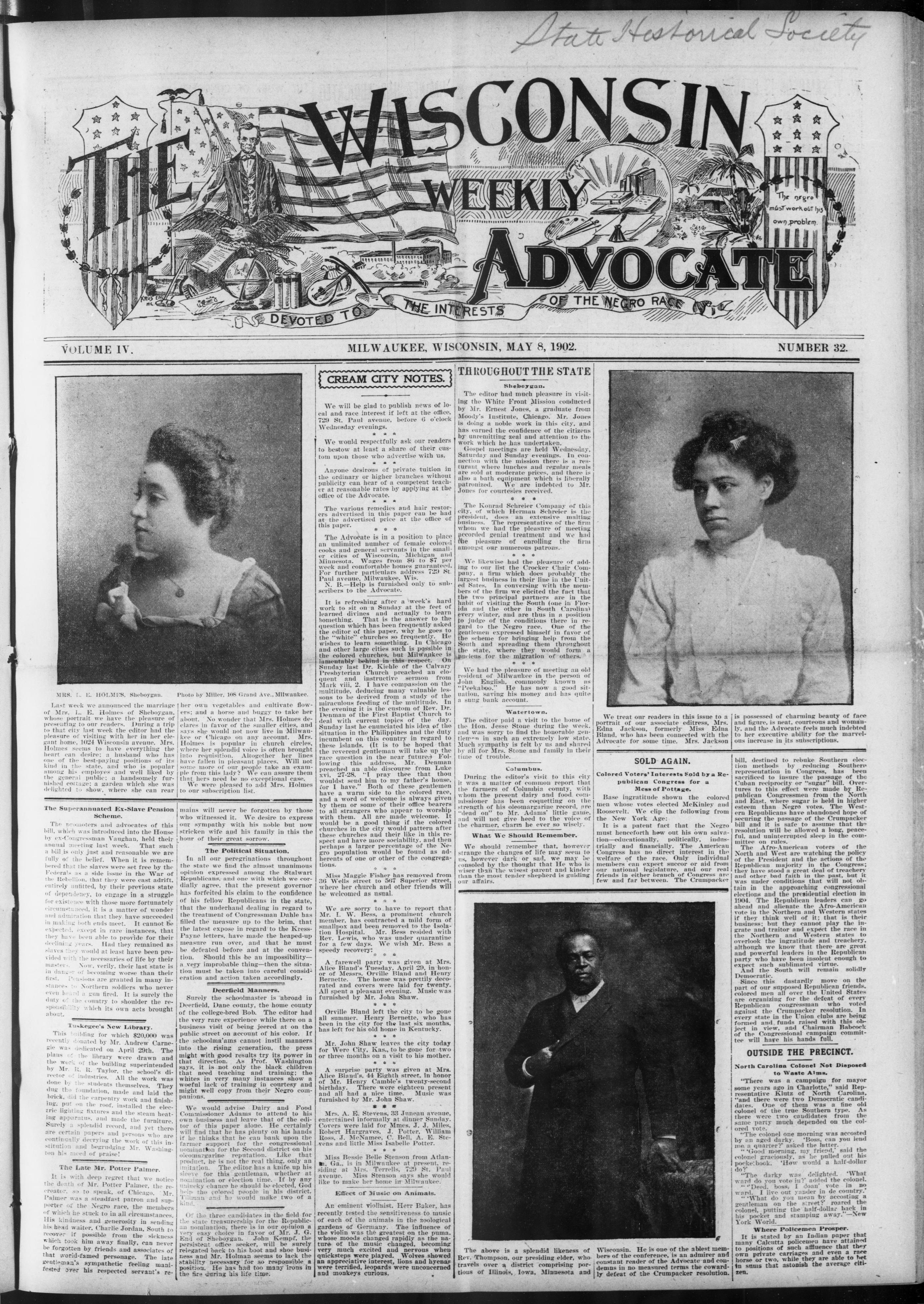
Page text (machine-generated)
State Historical Society
WISCONSIN
WEEKLY
ADVOCATE
DEVOTED TO THE INTERESTS OF THE NEGRO RACE
[Picture of a woman with a headband, wearing a dark dress with a necklace. She is looking slightly to the right of the frame.]
VOLUME IV.
[Image of a woman with a serene expression, wearing a dark dress with a bow at the neck.]
MRS. L. E. HOLMES, Sheboygan.
Last week we announced the marriage of Mrs. L. E. Holmes of Sheboygan, whose portrait we have the pleasure of presenting to our readers. During a trip to that city last week the editor had the pleasure of visiting with her in her elegant home, 1024 Wisconsin avenue. Mrs. Holmes seems to have everything the heart can desire; a husband who has one of the best-paying positions of its kind in the state, and who is popular among his employees and well liked by the general public; a handsomely furnished cottage; a garden which she was delighted to show, where she can rear
The Superannuated Ex-Slave Pension Scheme.
The promoters and advocates of this bill, which was introduced into the House by ex-Congressman Vaughan, held their annual meeting last week. That such a bill is only just and reasonable we are fully of the belief. When it is remembered that the slaves were set free by the Federals as a side issue in the War of the Rebellion, that they were cast adrift, entirely unfitted, by their previous state of dependency, to engage in a struggle for existence with those more fortunately circumstanced, it is a matter of wonder and admiration that they have succeeded in making both ends meet. It cannot be expected, except in rare instances, that they have been able to provide for their declining years. Had they remained as slaves they would at least have been provided with the necessaries of life by their masters. Now, verily, their last state is in danger of becoming worse than their first. Pensions are granted in many instances to Northern soldiers who never even heard a gun fired. It is surely the duty of the country to shoulder the responsibility which its own acts brought about.
Tuskegee's New Library
This building for which $20,000 was recently donated by Mr. Andrew Carnegie was dedicated on April 29th. The plans of the library were drawn and the work of the building superintended by Mr. R. R. Taylor, the school's director of industries. All the work was done by the students themselves. They dug the foundation, made and laid the brick, did the carpentry work and finishing, put on the roof, installed the electric lighting fixtures and the steam heating apparatus, and made the furniture. Surely a splendid record, and yet there are certain papers and persons who are continually decrying the work of this institution and begrudging Mr. Washington his meed of praise!
The Late Mr. Potter Palmer
It is with deep regret that we notice the death of Mr. Potter Palmer, the recreator, so to speak, of Chicago. Mr. Palmer was a steadfast patron and supporter of the Negro race, the members of which he stuck to in all circumstances. His kindness and generosity in sending his head waiter, Charlie Jordan, South to recover if possible from the sickness which took him away finally, can never be forgotten by friends and associates of that world-famed personage. The late gentleman's sympathetic feeling manifested over his respected servant's re
her own vegetables and cultivate flowers; and a horse and buggy to take her about. No wonder that Mrs. Holmes declares in favor of the smaller cities, and says she would not now live in Milwaukee or Chicago on any account. Mrs. Holmes is popular in church circles, where her splendid voice is often brought into requisition. Altogether her lines have fallen in pleasant places. Will not some more of our people take an example from this lady? We can assure them that hers need be no exceptional case.
We were pleased to add Mrs. Holmes to our subscription list.
mains will never be forgotten by those who witnessed it. We desire to express our sympathy with his noble but now stricken wife and his family in this the hour of their great sorrow.
The Political Situation
In all our peregrinations throughout the state we find the almost unanimous opinion expressed among the Stalwart Republicans, and one with which we cordially agree, that the present governor has forfeited his claim to the confidence of his fellow Republicans in the state, that the underhand dealing in regard to the treatment of Congressman Dahle has filled the measure up to the brim, that the latest expose in regard to the Kress-Payne letters, have made the heaped-up measure run over, and that he must be defeated before and at the convention. Should this be an impossibility—a very improbable thing—then the situation must be taken into careful consideration and action taken accordingly.
Deerfield Manners.
Surely the schoolmaster is abroad in Deerfield, Dane county, the home county of the college-bred Bob. The editor had the very rare experience while there on a business visit of being jeered at on the public street on account of his color. If the schoolma'am cannot instil manners into the rising generation, the press might with good results try its power in that direction. As Prof. Washington says, it is not only the black children that need teaching and training; the whites in very many instances show a woeful lack of training in courtesy and might well copy from their Negro companions.
We would advise Dairy and Food Commissioner Adams to attend to his own business and leave that of the editor of this paper alone. He certainly will find that he has plenty on his hands if he thinks that he can bank upon the farmer support for the congressional nomination for the Second district on his oleomargarine reputation. Like that product, he is not the real thing, only an imitation. The editor has a knife up his sleeve for this gentleman, whether at nomination or election time. If by any unlucky chance he should be elected, God help the colored people in his district. Tillman and he would make two of a kind.
Of the three candidates in the field for the state treasurership for the Republic an nomination, there is in our opinion a very easy choice in favor of Mr. J. G. End of Sheboygan. John Kempf, the persistent office seeker, will be surely relegated back to his boot and shoe business and Mr. Holman seems to lack the stability necessary for so responsible a position. He has had too many irons in the fire during his life time.
CREAM CITY NOTES.
---
We will be glad to publish news of local and race interest if left at the office, 729 St. Paul avenue, before 6 o'clock Wednesday evenings.
* * *
We would respectfully ask our readers to bestow at least a share of their custom upon those who advertise with us.
* * *
Anyone desirous of private tuition in the ordinary or higher branches without publicity can hear of a competent teacher at reasonable rates by applying at the office of the Advocate.
* * *
The various remedies and hair restorers advertised in this paper can be had at the advertised price at the office of this paper.
The Advocate is in a position to place an unlimited number of female colored cooks and general servants in the smaller cities of Wisconsin, Michigan and Minnesota. Wages from $6 to $7 per week and comfortable homes guaranteed. For further particulars address 729 St Paul avenue, Milwaukee, Wis. N. B.—Help is furnished only to subscribers to the Advocate.
It is refreshing after a week's hard work to sit on a Sunday at the feet of learned divines and actually to learn something. That is the answer to the question which has been frequently asked the editor of this paper, why he goes to the "white" churches so frequently. He wishes to learn something. In Chicago and other large cities such is possible in the colored churches, but Milwankee is lamentably behind in this respect. On Sunday last Dr. Kiehle of the Calvary Presbyterian Church preached an eloquent and instructive sermon from Mark viii, 2. I have compassion on the multitude, deducing many valuable lessons to be derived from a study of the miraculous feeding of the multitude. In the evening it is the custom of Rev. Dr. Denman of the First Baptist Church to deal with current topics of the day. Sunday last he enunciated his idea of the situation in the Philippines and the duty incumbent on this country in regard to these islands. (It is to be hoped that the reverend gentleman will take up the race question in the near future.) Following this address, Mr. Denman preached an able discourse from Luke xvi, 27-28. "I pray thee that thou wouldst send him to my father's house, for I have." Both of these gentlemen have a warm side to the colored race, and a word of welcome is always given by them or some of their office bearers to all strangers who appear to worship with them. All are made welcome. It would be a good thing if the colored churches in the city would pattern after these churches and their like in this respect and have more sociability, and then perhaps a larger percentage of the Negro population would be found as adherents of one or other of the congregations.
Miss Maggie Fisher has removed from 36 Wells street to 567 Superior street, where her church and other friends will be welcomed as usual.
☆ ☆ ☆
We are sorry to have to report that Mr. I. W. Bess, a prominent church member, has contracted a mild form of smallpox and been removed to the Isolation Hospital. Mr. Bess resided with Rev. Lewis, who was under quarantine for a few days. We wish Mr. Bess a speedy recovery:
A farewell party was given at Mrs. Alice Bland's Tuesday, April 29, in honor of Messrs. Orville Bland and Henry Bernette. The house was prettily decorated and covers were laid for twenty. All spent a pleasant evening. Music was furnished by Mr. John Shaw.
```markdown
```
Orville Bland left the city to be gone all summer. Henry Bernette, who has been in the city for the last six months, has left for his old home in Kentucky.
* * *
Mr. John Shaw leaves the city today for Were City, Kas., to be gone for two or three months on a visit to his mother.
* * *
A surprise party was given at Mrs. Alice Bland's, 44 Eighth street, in honor of Mr. Henry Camble's twenty-second birthday. There were eighteen present and all had a nice time. Music was furnished by Mr. John Shaw.
宓 崇 寮
Mrs. A. E. Stevens, 33 Juneau avenue, entertained informally at dinner Sunday. Covers were laid for Mmes. J. J. Miles, Robert Hargraves, J. Potter, William Ross, J. McNamee, C. Bell, A. E. Stevens and little Miss Isabelle Potter.
* * *
Miss Bessie Belle Stenson from Atlanta, Ga., is in Milwaukee at present, residing at Mrs. Terrells, 729 St. Paul avenue. Miss Stenson says she would like to make her home in Milwaukee.
Effect of Music on Animals.
An eminent violinist. Herr Baker, has recently tested the sensitiveness to music of each of the animals in the zoological gardens of Germany. The influence of the violin was the greatest on the puma, whose moods changed rapidly as the nature of the music changed, becoming very much excited and nervous when quicksteps were played. Wolves showed an appreciative interest, lions and hyenas were terrified, leopards were unconcerned and monkeys curious.
[Portrait of a man in formal attire, standing with a hand on his hip.]
THROUGHOUT THE STATE
Sheboygan.
The editor had much pleasure in visiting the White Front Mission conducted by Mr. Ernest Jones, a graduate from Moody's Institute, Chicago. Mr. Jones is doing a noble work in this city, and has earned the confidence of the citizens by unremitting zeal and attention to the work which he has undertaken.
Gospel meetings are held Wednesday, Saturday and Sunday evenings. In connection with the mission there is a restaurant where lunches and regular meals are sold at moderate prices, and there is also a bath equipment which is liberally patronized. We are indebted to Mr. Jones for courtesies received.
※ ※ ※
The Konrad Schreier Company of this city, of which Herman Schreier is the president, does an extensive malting business. The representative of the firm whom we had the pleasure of meeting accorded genial treatment and we had the pleasure of enrolling the firm amongst our numerous patrons.
***
We likewise had the pleasure of adding to our list the Crocker Chair Company, a firm which does probably the largest business in their line in the United Sates. In conversing with the members of the firm we elicited the fact that the two principal partners are in the habit of visiting the South (one in Florida and the other in South Carolina) every winter, and are thus in a position to judge of the conditions there in regard to the Negro race. One of the gentlemen expressed himself in favor of the scheme for bringing help from the South and spreading them throughout the state, where they would form a nucleus for the migration of others.
***
We had the pleasure of meeting an old resident of Milwaukee in the person of John English, commonly known as "Peekaboo." He has now a good situation, saving his money and has quite a snug bank account.
Watertown.
The editor paid a visit to the home of the Hon. Jesse Stone during the week, and was sorry to find the honorable gentlemen in such an extremely low state. Much sympathy is felt by us and shared by all for Mrs. Stone and family in their time of trouble.
Columbus.
During the editor's visit to this city it was a matter of common report that the farmers of Columbia county, with whom the present dairy and food commissioner has been coquetting on the strength of his oleomargarine record, are "dead on" to Mr. Adams' little game, and will not give heed to the voice of the charmer, charm he ever so wisely.
What We Should Remember.
We should remember that, however strange the changes of life may seem to us, however dark or sad, we may be consoled by the thought that He who is wiser than the wisest parent and kinder than the most tender shepherd is guiding our affairs.
1
The above is a splendid likeness of Rev. Thompson, our presiding elder, who travels over a district comprising portions of Illinois, Iowa, Minnesota and
Mary E.
We treat our readers in this issue to a portrait of our associate editress, Mrs. Edna Jackson, formerly Miss Edna Bland, who has been connected with the Advocate for some time. Mrs. Jackson
SOLD AGAIN.
Colored Voters' Interests Sold by a Republican Congress for a Mess of Pottage.
Base ingratitude shown the colored men whose votes elected McKinley and Roosevelt. We clip the following from the New York Age:
It is a patent fact that the Negro must henceforth how out his own salvation—educationally, politically, industrially and financially. The American Congress has no direct interest in the welfare of the race. Only individual members can expect succor or aid from our national legislature, and our real friends in either branch of Congress are few and far between. The Crumpacker
The image provided is too blurry to accurately recognize any text. It appears to be a grayscale photograph of a person, but no discernible details can be made out.
Wisconsin. He is one of the ablest members of the conference, is an admirer and constant reader of the Advocate and condemns in no measured terms the cowardly defeat of the Crumpacker resolution.
NUMBER 32.
6
is possessed of charming beauty of face and figure, is neat, courteous and womanly, and the Advocate feels much indebted to her executive ability for the marvelous increase in its subscriptions.
bill, destined to rebuke Southern election methods by reducing Southern representation in Congress, has been sacrificed to insure the passage of the Cuban reciprocity or "sugar" bill. Overtures to this effect were made by Republican Congressmen from the North and East, where sugar is held in higher esteem than Negro votes. The Western Republicans have abandoned hope of securing the passage of the Crumpacker bill and it is safe to assume that the resolution will be allowed a long, peaceful, and uninterrupted sleep in the committee on rules.
The Afro-American voters of the North and West are watching the policy of the President and the actions of the Republican majority in the Congress; they have stood a great deal of treachery and other bad faith in the past, but it was under conditions that will not obtain in the approaching congressional elections and the presidential election in 1904. The Republican leaders can go ahead and alienate the Afro-American vote in the Northern and Western states if they think well of it; that is their business; but they cannot play the ingrate and traitor and expect the race in the Northern and Western states to overlook the ingratitude and treachery, although we know that there are great and powerful leaders in the Republican party who have been insolent enough to expect such sublimated virtue.
And the South will remain solidly Democratic
Since this dastardly move on the part of our supposed Republican friends, colored men all over the United States are organizing for the defeat of every Republican congressman who voted against the Crumpacker resolution. In every state in the Union clubs are being formed and funds raised with this object in view, and Chairman Babcock of the Congressional campaign committee will have his hands full.
OUTSIDE THE PRECINCT.
North Carolina Colonel Not Disposed to Waste Alms.
"There was a campaign for mayor some years ago in Charlotte," said Representative Klutz of North Carolina, "and there were two Democratic candidates. One of them was a fine old colonel of the true Southern type. As there were two candidates from the same party much depended on the colored vote.
"The colonel one morning was accosted by an aged darky. 'Boss, can you lend me a quarter?' asked the latter.
"Good morning, my friend,' said the colonel graciously, as he pulled out his pocketbook. 'How would a half-dollar do?'
"The darky was delighted. 'What ward do you vote in?' added the colonel. "Deed, boss. I doan' vote in no ward. I live out yander in de country." "What do you mean by accosting a gentleman on the street?" roared the colonel, putting the half-dollar back in his pocket and stamping away."—New York World.
Where Policemen Prosper.
It is stated by an Indian paper that many Calcutta policemen have attained to positions of such affluence that they own private carriages and even a race horse or two, while they are able to bet in sums that astonish the average citizen.
W. T. SAMPSON IS DEAD.
Succumbs to Cerebral Hemorrhage and Paralysis of Brain.
Long and Honorable Career Which Had Its Culmination in the Victory at Santiago.
Washington, D. C., May 7.—Rear Admiral William T. Sampson died at his residence in this city at 5 o'clock yesterday afternoon. Severe cerebral hemorrhage was the immediate cause of death. Mrs. Sampson, although seriously ill herself, from nervous strain, was with the admiral at the end, as were also one of his married daughters, Mrs. Cluverins, the admiral's two sons, Ralph and Harold, and Dr. Dixon, the attending physician.
The funeral services probably will take place Thursday from the Church of the Covenant. The remains will be interred at the admiral's childhood home, Palmyra, N. Y. Government honors will be accorded the officer who so lately commanded the American squadron in the Cuban-Porto Rico campaign.
He Suffered Much.
For years the admiral had not been a strong man. He suffered from a weak stomach and incessant application to his naval studies. He was an exceedingly well read officer on naval affairs, and a close student in technical naval problems. He gave himself to these matters with a freedom that necessarily involved sacrifice of strength. When taken from the rank of captain and placed in charge of the American fleet blockading Cuba and subsequently
M.
engaging in the bombardment of Matanzas, Cienfuegos, San Juan and the battle of Santiago, the admiral came under a mental and physical stress such as few men are called upon to bear. Living in a semi-tropical climate, constantly on duty, occupied in wearing chases and always preparing for the final battle which was inevitable between his fleet and that of Spain, Admiral Sampson, while never complaining, suffered intensely. As one said who saw him on his first return to New York from the campaign, "he appeared to have aged a century." Subsequently attached to the effects of this strain came the natural chagrin at not having been an active factor in the destruction of Cervera's fleet and the unfortunate controversy which arose between him and Rear Admiral Schley.
Of Humble Birth.
No home of luxury or refinement had the 17-year-old lad who one morning left his father and mother in the town of Palmyra, N. Y., to enter the Naval Academy at Aannapolis. From the time he was 8 years old, with a few months here and there at the public school, young Sampson went round the county with his father, splitting wood, carrying water, helping a farmer now and again with his crops and trudging from place to place to help keep the family from want. But the boy's love of study was fed by nightly communion with a few books that he packed everywhere with him. When Congressman Morgan of New York sought a lad from his home town who would do honor to his selection the principal of the public school advised him to try young Sampson.
This was his humbie beginning. He passed his entrance examination with flying colors, and three years later, at the beginning of the Civil War, was graduated at the head of his class. In this same class was young Lieut. Winfield Scott Schley.
Courage at Charleston.
In forty-two years of service under the flag there was only one occasion, and that at the very beginning of his career, when Admiral Sampson was ever placed in position to display the great personal courage which all his fellow officers knew he possessed
Only at the beginning and at the end of his naval career was he destined to be a participant in battle with an enemy of his country. The first time was when a young man of 25 years he stood on the deck of the ironclad Patapsco in Charleston harbor surrounded by other vessels of the blockading squadron slowly making his way in to the forts. The Patapsco struck a submarine mine and was blown to pieces, the young lieutenant and twenty-five of his men having a miraculous escape from death. The other occasion was when toward the close of the battle of Santiago his flagship, the New York, bore down on the conflict, too late, through a cruel freak of fortune, to enable him to have any practical part in that memorable conflict.
Advance in Rank.
His service in foreign waters as lieutenant, lieutenant commander and finally as commander, was varied but uneventful. He was the first captain of the ironclad San Francisco and of the battleship Iowa, which latter post he left in 1893 to become chief of the bureau of naval ordinance. For four years he was head of this department, devoting his whole time to the betterment of the service and greatly improving the standard of knowledge of the abstract questions handled by this bureau.
In 1898, when the United States was stirred from one end to the other by the destruction of the Maine, President McKinley, always a warm admirer of Sampson and his qualities of calmness, perseverance and courage, made him president of the board of inquiry of the disaster, and he amply justified the trust imposed in him. On the retirement of Admiral Sicard from command of the North Atlantic squadron Sampson was given his place.
A few weeks later, when it was known that war with Spain was inevitable, the whole country waited eagerly to see what man the President would select for the responsible post of admiral in chief of the navy. Naval officers never doubted on whom this selection would
fall, and when it was finally announced that the honor had been bestowed on the taciturn, slim, round-shouldered captain he was estimated in every quarter well worthy of the post and able to fill it with dignity and honor.
Praise for Vigilance.
Though he was not destined to reap the reward, in the public mind, of this great naval battle, even his enemies have borne tribute to his ceaseless vigilance, his labor of preparation and the magnificent condition into which he had brought both crews and ships of his fleet in contemplation of that conflict.
Admiral Sampson leaves a widow, four daughters and two young sons. Mrs. Sampson is the admiral's second wife, and the two sons have been born since their marriage in 1885. The four daughters, by the admiral's first marriage, are Misses Nannie and Olive Sampson. Mrs. Roy C. Smith and Mrs. R. S. Jackson, both the latter now wives of lieutenants in the navy.
FREE FROM FEVER.
Wilhelmina.
The Hague, May 7.—The 2 p. m. bulletin from Castle Loo announced that the condition of her majesty was "satisfactory up to the present."
The Hague, May 7.—Queen Wilhelmina's physicians issued this morning the following bulletin from Castle Loo: Last night there was a very slight increase in the temperature of her majesty, but she had a good night, and this morning there is a complete absence of fever and the patient's general condition is satisfactory.
The Hague, May 7.—The continued hopeful tenor of the medical bulletins from Castle Loo is dissipating the acute anxiety of the Queen's surroundings. The prince consort left the palace today for the first time since Sunday.
Grows Worse Toward Midnight.
The Queen mother and the prince consort remain continually at her majesty's bedside. Dr. Rosenstein very carefully dictates whatever news concerning Queen Wilhelmina's condition is issued from the palace, and he declines to say anything further concerning his patient. It is understood that although the official bulletins represent the Queen's temperature as normal it invariably rises towards midnight and that never for a moment since last Saturday has there been a cessation of anxiety.
Scandals Work of Valet.
It has just transpired that the scandals circulated last winter in regard to the disagreements between Queen Wilhelmina and Prince Henry were originated by one of the prince's valets in revenge for his summary dismissal. This explanation has given the greatest possible satisfaction to the people. The royal entourage at the palace at Het Loo affirms that the prince has been most devoted to his wife, especially during her present illness.
May Dissolve Wilhelmina's Marriage
New York, May 7.—There is a clause in the Dutch constitution which is particularly interesting just now, cables the London correspondent of the Tribune. It provides that if the Queen has a son, her majesty shall abdicate in his favor when he reaches his eighteenth birthday; if, on the other hand, no child is born within five years the Dutch Parliament has the power to dissolve the marriage.
O'OKIEP RELIEVED.
Town in Western Cape Colony Has Been Besieged Since April 4.
London, May 7.—The town of O'Okiep, Western Cape Colony, which had been besieged since April 4 by a Transvaal force under Commandant Smuts, has been relieved by a British force under Col. Cooper. The garrison was in good health and only a few of the troops were wounded. The Boers retired south. Lord Kitchener, in reporting, the relief of O'Okiep, adds that the Concordia district in about the same part of Cape Colony, is clear of Boers.
Peace is Near.
London, May 7. The wife of Gen. Lucas Meyer, the commander of the Orange Free State forces, who is in this country, received a cable message from her husband yesterday saying peace in South Africa was probable.
British Won't Give In.
London, May 7.—Lord Salisbury, during his speech today, at the annual grand habitation of the Primrose League here, said the government had not receded an iota from its previous peace terms to the Boers.
Many Boers Captured.
London, May 7.—Further advices received here today from South Africa announced that 208 Boers had been captured and that ten burghers were killed in the neighborhood of Lindley, Orange River colony, yesterday.
SENSATIONAL CHARGES.
Philip Gardner Alleges that Doctor Secured Receipts for Money Through Fraud. Oshkosh, Wis., May 7.—Sensational charges have been brought against the Paine Lumber Company and Dr. Barnett, in the $10,000 damage suit instituted by Philip Gardner, for the loss of his arm while in the employ of the company. The case has been taken out of Judge Burnell's court on an affidavit of prejudice. It appears that Gardner signed a receipt for $75 in full payment for all damages, but he now claims that the receipt was obtained through misrepresentation on the part of Dr. Barnett and the defendants.
P ALMA'S STEAMER ASHORE.
Man Who Piloted Ill-Fated Spanish Warship Responsible.
New York, May 7.—The steamer Julia, which has just arrived with President-elect Palma, ran ashore in the channel, says a Cienfuegos (Cuba) dispatch to the World. Castillo, the pilot, who was responsible for the accident, is the same man who piloted the Spanish warship Oquendo when she sailed out of Santiago harbor for battle with the American fleet. For three hours the Julia remained fast. Then a flotilla of decorated tugs and steamers came down the bay to her assistance and the rising tide floated her
ST. PAUL ELECTS MAYOR.
Robert A. Smith Goes in for the Fifth Time.
St. Paul, Minn., May 7.—Robert A. Smith was elected mayor of St. Paul yesterday for the fifth time. He defeated his Republican opponent, F. B. Doran, by a plurality estimated at not less than 2500.
Alger to Lay Corner Stone.
Munising, Mich., May 7.—[Special.]—Ex-Secretary of War Gen. Russell A. Alger, after whom this county was named, writes from Detroit accepting an invitation to lay the corner stone of the new court house, the construction of which has just been started here. The ceremony will probably occur on Wednesday, May 21, and will be observed as a holiday throughout the county.
New York Stock Exchange Has Gotten Back to Its Normal Condition.
New York, May 6.—There was much evidence in Wall street this morning of the disturbed conditions of yesterday. There was a very general conviction that the worst was known of the results of the collapses of the Webb Meyer exchange houses which suspended yesterday.
Interest was manifested in the progress of affairs of the suspended houses, which were not much cleaned up by yesterday's meager statements and admissions. It was reported this morning that the repurchase had been accomplished of the block of Rutland preferred stock, said to have been sold by Dr. W. Seward Webb to Alfred L. Meyer, which J. W. Davis & Co offered yesterday to take at 108, the price supposed to have been paid by Mr. Meyer. This sale is expected to supply resources toward the satisfaction of claims against the unharrassed interests.
A Feeling of Relief.
The tone of the stock market in the opening dealings made apparent a feeling of relief, shown by advancing prices on a demand for stocks well distributed through all departments of the list. Rutland preferred was weak on small dealings, declining four points, rallying $3 \frac{1}{2}$ and receding again $2 \frac{1}{2}$.
At the offices of Lockwood, Hurd & Co. the assignee, Edward T. Perine, is in charge today and is pushing an investigation of the condition of affairs but is not prepared to make a statement. Some hopes of a resumption by the firm are based upon the ability of their clients in the dealings in the affected group of stocks to protect the firm on its transactions in those stocks. Dr. Seward Webb made no public statement on the situation up to 11 o'clock today.
Petition in Bankruptcy.
A petition in voluntary bankruptcy was filed today in the United States district court against Offenbach & Moore, the stock brokers who suspended yesterday. The petition was filed by Epstein Bros., representing claims for $4500. The petition alleges that the firm has been insolvent for the last four months and has made certain creditors preferred. The appointment of a receiver is requested.
BRET HARTE DEAD.
Famous American Author, Who Wrote Stories of "the Glorious Climate of California."
London, May 6.—F. Bret Harte, the American author, died here last night. He was born at Albany, N. Y., August 25, 1839.
Mr. Harte died suddenly at the Red house, Camberly, near Aldershot, from hemorrhage, caused by an affection of the throat.
Mr. Harte had been living quietly in England for years. Most of his time was spent in the country and when in London he was almost equally secluded, having few visitors to his rooms at Lancaster Gate and only going to the houses of a limited number of very intimate friends.
Several months ago when a false report of his death was circulated in America a representative of the Associated Press called at his rooms. Mr. Harte then appeared to be perfectly well. He laughed heartily and quoted Mark Twain's old saying about the report being greatly exaggerated.
"Except for a little cold," said Mr. Harte, "I have no ailments or complaints. While I am getting to be a pretty old man—pointing to his snow-white hair—"there is life in the old dog yet," and thereupon he lit a cigar so large that it would have done credit to any of his Poker Flat friends. He was hoping, he also said, to do more work, but he confessed he was growing lazy.
Mr. Harte had been suffering from swelled tonsils since December last, but he did not consider the attack to be serious. A week ago he went to visit friends at Camberly and was present at lunch, as usual, yesterday. He suddenly became ill in the afternoon, went to bed and died in a few hours. His end was peaceful.
Francis Bret Harte, the author, was born at Albany, N. Y., August 25, 1839. When still a young man he went to the mining regions of California. Later-on he engaged in newspaper work, and from 1864 to 1867 he was secretary of the branch mint at San Francisco. From 1870 to 1878 he was editor of the Overland Monthly in New York. For the next two years he was consul at Grefeld, Germany, and from 1880 to 1885 he was consul at Glasgow, Scotland. Since then he has resided in London, where he wrote many well-known books.
His most famous tales were the Col. Starbottle series, the stories of the Roaring camp "Three Partners," and "Two Men of Sand Bar." His poem, "The Heathen Chinee," won him world-wide fame. Mr. Harte wrote several plays, the most successful being "Sue."
New Collector of New York Port Says They Must Not be Rude.
New York, May 6.—Collector of Customs Stranahan, in an address to the entire force of customs inspectors, who assembled at the Barge office to meet him, has told the inspectors that transatlantic voyagers must, in future, be treated with more consideration. The collector reminded the men who meet steamships and search the baggage on piers that they are servants of the public and urged them to perform their duties in such manner as to merit public approval.
CALLS FOR BANK REPORTS.
Comproller of Currency Wants to
Know National Bankal Certifi
Know National Banks' Conditions. Washington, D. C., May 6.—The comptroller of the currency has issued a call for the condition of national banks at the close of business Wednesday, April 30. 1902.
The Lady Diplomat.
We have grown accustomed to lady doctors, lady dentists, lady barbers and lady advocates, but we never expected to hear of the lady diplomat. She has arrived, however. M. Delcasse recently appointed Mlle. Jeanne de Villeneuve secretary to the French consulate general in New York. This is believed to be the first time a woman has received an appointment in the diplomatic service.
To Create Cattle Ranges. Immense areas of cattle range have been destroyed by too much crowding and by sheep. Sheep in large bunches nip the grass so close and so cut its sod with their hoofs that it dies. The railways of the Northwest have combined to find the grass most suitable for stock, and to this end will divide 30,000 acres of land into thirty subdivisions, each of which will be planted with a different kind of grass.
The naval outlay of four European powers is now $367,500,000 per annum
JIMINEZ HAS ABDICATED
Relinquishes His Claims to Presidency of Republic.
Insurrectionists Sack Town and Kill Thirteen People—Women Forced to Flee.
Washington, D. C., May 7.—Cable advices received here state that Jiminez, President of the Dominican republic, has signed a relinquishment of his claims to the presidency and on his part Horatio Vasquez, the late vice president, has granted amnesty to the adherents of the late government and assumed the presidential office.
Senor Don Foo Leonte Vasquez, the charge of the Dominican republic, has received cable advices from home announcing the success of the revolution. It is probable that he will now become a resident minister here. Naturally the charge is desirous that the United States shall recognize at once the new government. This is a matter, however, that is by custom left to the United States minister resident, but it is not doubted that Mr. Powell will, as he has heretofore done, soon put himself in communication with the de facto government.
Killed by Rebels.
New York, May 7.—Members of the crew of the British brigantine Alice, Capt. Innes, which has just arrived from the West Indies, report that while the brigantine lay about eighty-five yards from the shore at Barabon, on the southwest coast of San Domingo, a force of revolutionists entered the town and began discharging rifles. Inhabitants of the port ran shrieking from their homes along the beach.
"The revolutionists first sacked the principal saloon in the town," said one of the crew.
"They broke all the windows and drank all the bottled liquor. They then rolled barrels of rum into the street and what they could not drink they turned into the gutters.
"Next they attacked the jail and took out all the prisoners they wanted. The freed convicts joined the insurrectionists. In the attack, eleven guards and one prisoner were killed. Two civilians were killed in the woods which thickly skirt the town at the base of the mountains.
"The women, and children who fled along the beach sought the protection of Capt. Innes, who brought off as many as the gig would hold. A sloop brought off the rest of the refugees.
"The refugees, 100 in number, remained about three days. Meantime 100 government soldiers had appeared and were driven to retreat by the revolutionists, who then disappeared.
Surrender of Capito'.
Monte Christi, San Domingo, May 7. Further confirmation was received here today of the surrender of San Domingo, capital of Santo Domingo, Friday last to the revolutionary forces commanded by Vice President Vasquez. The provisional government established there will retain power until new elections have been held.
Peace is completely re-established in the southern part of Santo Domingo. Advices from Puerto Plata on the north coast announce that the crew of the Dominican war vessel at that port has sided with the insurgents and yesterday conveyed to the governor, Gen. Deschamps, an order to surrender.
An agreement providing for a suspension of hostilities at Puerto Plata was signed in the day, so as to permit the drawing up of the conditions on which the port will capitulate to the revolutionists.
When San Domingo city surrendered to Vice President Vasquez, President Jiminez sought refuge in the French consulate there.
GREAT REBELLION IN CHINESE EMPIRE.
Revolutionary Leader Kills Family to Prevent Their Being Punished—Battle Expected.
Pekin, May 7.—Bishop Favier, the French vicar apostolic in China, has received information to the effect that 10,000 armed rebels with several cannon are participating in the revolt at Cheng Ting Fu, Chi Li province. It is considered doubtful if Yuan Shi Kai, the governor of Chi Li, has sent a sufficient force to cope with the rebellion. The bulk of the government forces, with ten gatling guns, are due to arrive at the scene of the disturbances today. The leader of the uprising is a military mandarin, who killed his family before raising the flag of revolt, so as to prevent their punishment in the event of his failure.
PRESIDENT WILL SIGN OLEO BILL.
Mr. Roosevelt will Give the Measure His Approval in Near
Washington, D. C., May 7. All doubt of the President's intention with respect to the signing of the oleomargarine bill was removed today when it was announced that he would give it his approval either today or tomorrow.
Rev. Timothy McGuire of Chicago Found Dead in Parish House. Chicago, May 7.—Rev. Timothy McGuire, pastor of St. Kevin's Roman Catholic Church, this city, was found dead in a bath tub at the Parish house of his church today. Death had been caused by drowning.
WRECKED IN FOG.
Two Killed and Seven Injured in a Train Collision Near Topeka, Kas.
Topeka, Kas., May 7.--During the heavy fog this morning at 3.10 o'clock an castbound extra freight on the Union Pacific ran into freight No. 14 at a crossing in North Topeka, causing a bad wreck and killing two men and injuring seven others. The dead: Al McCandless, stockman, Natoma, Kas.; unidentified stockman, from Luray, Kas.
Earthonakcs Start Volcano.
St. Thomas, D. W. I., May 7.—Advices from the island of Saint Vincent, British West Indies, announce that for some days earthquakes have been experienced in the neighborhood of the Soufriere crater, which has been smoking and rumbling. The people are leaving for places of safety.
THE WORK OF CONGRESS.
Proceedings in the House.
Most of the day in the House on the 1st was given to the District of Columbia ap propriation bill, which was not completed. Mr. Shattuck (Ohio) spoke on industrial conditions, and Mr. Gaines (Tenn.) in criticism of conditions in the Philippines. A bill was passed providing that third and fourth class mail matter without sufficient postage shall not be remailed to the sender.
The amendment providing the machinery for the enforcement of the personal tax law of the District of Columbia, passed in 1878, was placed on the district appropriation bill as a rider and the bill was passed by the House on the 2d. The bill to provide diplomatic and consular officers for the Republic of Cuba also was passed. In debating the amendment to the District bill, Mr. Bellamy (N. C.) said Washington was becoming the Mecca for tax dodgers. He said millions of dollars' worth of property outside of Washington escaped taxation because the owner claimed residence in Washington. The Cuban bill carries the following salaries: Ten thousand dollars for a minister, $2000 for a first and $1500 for a second secretary of legation, $5000 for consul general at Havana and $3000 each for the consulates at Clienfuegos and Santiago. The bill to provide for the issue of passports to the residents of the insular possessions of the United States was made a special order after the disposal of the omnibus territorial bill. The bill to amend the bankruptcy law was called up, but not acted upon.
The House on the 3d adjourned in respect to the memory of Congressman Amos J. Cummings of New York.
An urgency resolution making additional appropriation of $10,000 for the expenses incident to the dedication of the statue of Marshal de Rochambeau was adopted by the House on the 5th. Mr. Jones (Va.) announced the death of Representative Otey and offered the customary resolution of regret. The speaker appointed a committee to attend the funeral. The House then adjourned as a further mark of respect.
The House adjourned shortly after convening on the 6th out of respect to the memory of Congressman Salmon of New Jersey.
Consideration was begun in the House on the 7th of the bill to enable the people of Oklahoma, Arizona and New Mexico to form constitutions and state governments and be admitted into the Union on an equal footing with the original states. Mr. McRae (Ark.), while favoring the admission of the three territories, gave notice of an amendment to consolidate Oklahoma and Indian Territory and admit them as a single state. The conference report on the Indian appropriation bill was adopted, after a vigorous but unsuccessful fight, led by Mr. Little (Ark.), was made on the Senate amendment to open up the Uintah Indian reservation in Utah. Many of the most profitable leases in the reservation had been consolidated, he said, into one company, in whose directory men high in administration circles were until recently interested. They had, he said, since resigned. Mr. Little declared that the whole proposition was a venal one. Mr. Sutherland (Utah) defended the mining companies, whose rights, he insisted, should be recognized. The Senate amendments to the sundry civil appropriation bill were nonconcurred in, and it was sent to conference, with Messrs. Cannon, Hemenway and McRae as the House conferences.
Proceedings in the Senate.
Discussion of the Philippine question again occupied most of the day in the Senate on the 1st. Aguinaldo was the special subject of discussion. As soon as the Philippine government bill was taken up Mr. Carmack continued his remarks. He said he could see no good reason for the majority's refusal to summon Aguinaldo, Mabina and other Filipinos to appear as witnesses before the committee. Gen. Funston had said that Aguinaldo had confessed to him that he (Aguinaldo) had had Luna assassinated because Luna was becoming too popular. Gov. Taft had testified that Gen. Funston had said Aguinaldo had Luna killed lest Luna should kill him. Both the Rosebud reservation bill and the sundry civil appropriation bill received consideration, but not final action. A bill appropriating $5000 for a lighthouse keeper's dwelling at Ecorse Range light station, Detroit river, Mich., was passed. The usual executive session preceded adjournment.
Debate on the Philippine bill continued to occupy most of the session of the Senate on the 2d. The conference report on the Indian appropriation bill was agreed to. The Rosebud Indian reservation bill and the sundry civil bill were again considered, but not completed. The amendment of Mr. Platt (Conn.) to the Rosebud bill striking out the provision providing for free homes on the lands to homestead settlers was rejected, 19 to 38. When the sundry civil bill amendment providing an appropriation of $2,500,000 to begin the construction of a memorial bridge across the Potomac river to connect the Arlington cemetery was reached Mr. Allison explained in answer to an inquiry that it was not intended to begin the construction of the bridge until the plans had been approved by Congress. The amendment was then agreed to. An amendment was agreed to appropriating $100,000 for the construction of a revenue cutter of the first class for service in Hawaiian waters, the total cost not to exceed $200,000. The Senate then went into executive session and at 5:20 p. m. adjourned.
An attack on the character of Gov. Taft was made in the Senate on the 3d. He had many defenders, who replied with considerable vigor to his assailants. The Rawlins resolution calling Maj. Gardener to appear before the Senate committee on the Philippines as a witness was under consideration. The Democrats were especially severe in criticisms and quickly disclosed a purpose to bring Gov. Taft into the controversy, Messrs. Culberson and Patterson charging him with lack of candor in his testimony concerning the Gardener report and with an attempt to suppress that document. There were frequent outbursts of temper, and senators were called to order in an effort to stem the heated debate. Mr. Lodge called Mr. Rawlins to order when he was uttering charges of obstruction against the Republicans, and the sedate Mr. Pettus of Alabama came heroically to the rescue when an encounter seemed imminent between Mr. Foraker of Ohio and Mr. Patterson of Colorado. Mr. Spooner (Wis.) said the observations of Mr. Rawlins were quite characteristic of the action of the Democrats in the course of this debate. He had read carefully the telegram from Gen. Chaffee, and had discovered nothing indicating a bias on his part. Mr. Spooner denied that the officers constituting the board of inquiry were those who had served in the province of when Maj. Gardener was governor. Without acting on the Gardener resolution the Senate adjourned out of respect to the memory of Congressman Amos J. Cummings. The secretary of war sent to the Senate a letter explaining the difficulty encountered in separating army accounts so as to give the expenditures in the Philippines.
Most of the day in the Senate on the 5th was taken up by Senator Lodge with a speech on the Phillipine civil government bill. The sundry civil appropriation bill was passed with amendments, providing for the dedication of the St. Louis exposition on April 30, 1903, and that the exposition shall be opened to visitors not later than May 1, 1904; appropriating $25,000 for the commissioner of labor to collect statistics of marriage and divorce; constituting the secretary of the treasury, the postmaster general and the secretary of the interior a commission to select a site in Washington city for a hall of records, the limit of cost of the site being $500,000 and that for the building being $500,000; appropriating $165,000 for repairs to the white house in lieu of the $48,900 heretofore provided and appropriating 50,000 more for a temporary office building to be used while the repairs to the white house are in progress. The bill for the purchase of the Rosebud Indian reservation was passed with an amendment eliminating the commutation clause and providing that settlers, in order to make good their titles to the land, shall live on it for five years. The bill changing the terms of the circuit courts of the United States within the first circuit was also passed. The Senate then adjourned in respect to the memory of Congressman Otey.
The Philippine question, on the 6th, again occupied the Senate for the entire day. Mr. Beveridge of Indiana precipitated a hot debate, which raged with varying force for four hours. He charged the opposition with presenting only one side of the Philippine question in their speeches. While he admitted that some outrages had been committed by American soldiers in the archipelago, it was true, too, that unparalleled kindness had been shown by the American troops to Filipino prisoners and Filipino wounded. Mr. Carmack and Mr. Rawlins warmly resented any imputation of unfairness. A House joint resolution making an additional appropriation of $10,000 for the dedication of the statue of Marshal de Rochambeau in Washington was passed, as was a bill to apportion the term of office of senators elected at the first
general election in the territory of Hawaii. Ninety private pension bills were also approved.
The Philippine government bill again had a practical monopoly of the time in the Senate on the 7th. The bill making appropriations for the diplomatic and consumer service of the United States in the Republic of Cuba, fixing the salary of the minister at $12,000, was passed. Mr. Culberson inquired whether the secretary of war had responded to his resolution concerning the orders of Gen. Bell and Gen. Smith. When informed that no response had been received, he offered a resolution directing the secretary of war to send to the Senate copies of all orders, instructions, letters and cables relating to recognition in the Philippines, and also copies of all orders, instructions, letters and cablegrams relating to the order of Brig. Gen. Smith to Maj. Waller. Mr. Lodge said that, as a resolution of which the above was an am-
plification had been passed only five days ago, he would ask that the resolution go over, and it was so ordered. The customary executive session preceded adjournment.
LATEST MARKET REPORTS.
Milwaukee, May 7, 1902.
EGG AND DAIRY PRODUCTS.
MILWAUKEE—Eggs — Market easier;
fresh, loss off, cases included, 14½c; fresh,
cases returned, 14c; seconds, 9@10c. Receipts were 626 cases.
Butter-Market firm; fancy prints.. 22½¢; fancy or extra creamery, per lb, 22¢; firsts, 20¢; seconds, 17@18¢; dairy prints, 20½¢; extra fancy dairy, 20¢; lines, 16@17¢; packing stock, 15@16¢; waxy, 9¢; grease, 4@5¢. The receipts today were 20,725 lbs against 13,429 lbs yesterday. The receipts of creamery increasing and demand good. Dairy is scarce and good stock is wanted. Cheese-Steady. Receipts were 2900 lbs today against 2760 lbs yesterday. Full cream flats, fancy, 13@13½¢; good to choice, 11½@12½¢; Young Americas, 12½@13¢; dalsles, 12½@13¢; fancy brick, 14¢; low grades, 11@12¢; limburger, per lb, No. 1, 14¢; low grades, 10@12¢; imported Swiss, 25¢; Block Swiss, domestic, 15@16¢; fancy loaf, 15½@16¢; No. 2, 13@14¢; Sapsago, 20¢; farmers', 10@11¢.
CHICAGO—Butter—Strong; creameries, 18
@23c; dairies, 18@21c; Cheese—Steady;
twins, 12½@12¾c; daisies, 13c; Young
Americas, 13@13¾c; Eggs—Steady; at
mark, cases included. 14¾c; Live poultry—
Steady; turkeys, 10@12¾c; Chickens, 11c
SHEBOYGAN—Daisies brought 13½@
13¾c; longhorns, 13½@13¾c; Young
Americas, 12½@13c, and twins, 12c
PLYMOUTH—Twenty-four factories
offered 1500 boxes cheese, all of which sold
as follows: Four longhorns, 12¾c; 11 do;
13c; 37 do. 13¾c; 561 daisies, 12¾c; 250
do, 12¾c; 185 do, 12¾c; 296 twins, 12¾c;
11 Young Americas, 12¾c; 196 do, 13c.
MILWAUKEE LIVE STOCK MARKET.
HOGS—Receipts, 10 cars; market 5c lower; light, 6.00@6.80; mixed and medium weights, 6.75@7.00; common to good packers, 6.65@6.90; selected heavy, 7.05@7.15. Pigs, 90 to 120 lbs, 5.50@6.25.
CATTLE — Receipts, 3 cars; steady; butchers' steers, medium to good, 1050 to 1300 lbs, 5.75@6.50; falr to medium, 950 to 1050 lbs, 5.00@5.50; heflers, common, 3.00@4.00; good, 4.50@5.50; cows, falr to good, 3.25@4.50; canners, 1.75@2.40; bulls, common, 2.75@3.40; choice, 3.75@5.00; feeders, 800 to 950 lbs, 3.75@4.50; stockers, 500 to 750 lbs, 3.25@3.75; veal calves, light, 4.00@4.50; choice, 4.75@5.50. Milkers—Don't ship any but choice heavy cows, which sell for 40.00@50.00.
SHEEP—Receipts, none; steady; shorn, 3.50@5.00; bucks, 3.00@3.50; lambs, 4.50@5.75; spring lambs, 6.00@8.00.
Chicago receipts: Hogs, 30,000; cattle, 11,000; sheep, 13,000.
MARKETS BY TELEGRAPH
MILWAUKEE—Flour—Steady. Wheat—
Weaker; No. 1 Northern, on track, 77c; No.
2 Northern, on track, 76c. Corn—Firm:
No. 3 on track, 61c. Oats—Firm: No. 2
white, on track, 44½c; No. 3 white, on
track, 43½@44c. Barley—Firm: No. 2 on
track, 71c; sample on track, 60@71c. Rye—
Steady; No. 1 on track, 59c. Provisions—
Steady; pork. 16.85; lard. 10.10.
Flour markets steady; patents; 3.90@4.00; bakers; 2.90@3.00; rye; 3.05@3.15.
bakers, 2.50@3.00; rye, 3.05@3.15.
Millstuffs are steady and quoted at 16.00
for bran, 16.50@17.00 for standard middlings and 19.00 for Milwaukee flour middlings in 100-lb sacks; red dog, 21.00.
DULUTH—Close — Wheat — Cash No. 1
hard, 78%c; No. 1 Northern, 75%c; No. 2
Northern, 73%c; No. 3 spring, 71%c; to
arrive, No. 1 hard, 78%c; No. 1 Northern,
May, 75%c; July, 75%@75%c; September,
72%c. Manitoba No. 1 Northern, cash and
May, 74%c; No. 2 Northern, 71%c. Oats—
Cash, 42%c; September, 29%c. Flax—Cash,
to arrive and May, 1.75; September, 1.47%c,
October, 1.44. Receipts—Wheat, 14.105.
Shipments, 95.017.
ST. LOUIS—Close—Wheat — Lower; No.
2 red, cash elevator, 81c; track, 81@82%c;
May, 77c; July, 72c; September, 72%c; No. 2
hard, 76@78c. Corn—Lower; No. 2 cash,
61c; track, 64c; May, 59%c; July, 60%c;
September, 58%@58%c. Oats—Lower; No.
2 cash, 43%c; track, 44%@44%c; May, 41%c;
July, 32%c; September, 27%c; No. 2 white,
45%@45%c. Lead—Quiet, 3.97%@4.00. Speller
quiet, 4.12%c.
TOLEDO—Wheat—Fairly active, weak, cash. 83%; May, 88%; July, 76%; September, 76%; Corn—Dull, weak, cash, 60%; May, 60%; July, 61%; September, 60%; Oats—Dull, ensler, cash, 42%; May, 42%; July, 34%; September, 29%; Clover seed—Dull, ensler, cash, 5.05; October, 5.10; No. 2, 4.52%@4.62%; No. 2 timothy, 3.15.
KANSAS CITY—Close — Wheat — May, 71%@71%; July, 71%@71%; cash No. 2 hard, 73%; No. 3, 71%@72%; No. 2 red, 79%; Corn—May, 61%@61%; September, 65%; cash No. 2 mixed, 63%@63%; No. 2 white, 65%@65%; No. 3, 64%@64%; Oats—No. 2 white, 45%@45%; MINNEAPOLIS—Close — Wheat, 74%; July, 74%; September, 71%; on track, No. 1 hard, 76%; No. 1 Northern, 74%@75%; No. 2 Northern, 73%@74%.
NEW YORK—Close—Wheat—May, 79%%
July, 78%c, Corn—May, 65%c; July, 65%c
ST. LOUIS—Cattle—Receipts, 800; active
steady; beef steers, 4.00@6.80; stockers and
feeders, 2.75@4.75; cows and heifers, 2.25
@6.55; Texans, 2.55@6.00. Hogs—Receipts,
4000; 10@15c lower; pigs, 6.50@7.5; pack-
ers, 6.80@8.95; butchers, 6.90@7.20. Sheep—
Receipts, 1000; steady; sheep, 5.25@6.00
lambs, 5.00@7.00.
KANSAS CITY—Cattle—Receipts, 4000
best beef strong to 10c higher, common
about steady; beef steers, 4.90@7.10; Tex-
ans, 2.55@6.00; native cows and heifers
2.25@6.75; stockers and feeders, 2.60@5.55
bulls, 3.15@5.65; calves, 3.00@6.00. Hogs—
Receipts, 8000; 5@10c lower; heavy, 7.10@
7.25; packers, 6.90@7.20; medium, 6.70@7.00
light, 6.50@7.00; yorkers, 6.90@7.00; pligs,
5.90@6.75. Sheep—Receipts, 2000; steady
tough; sheep, 4.40@5.90; lambs, 5.40@7.00
SOUTH OMAHA-Cattle-Receipts 2000
active, 5@10c higher; native steers, 5.00@
6.90; cows and heifers, 3.75@4.85; Western
steers, 4.75@5.75; Texas steers, 4.50@5.50
canners, 1.75@3.25; stockers and feeders
3.00@5.25; calves, 3.00@6.00; bulls, stags
etc., 2.75@5.60. Hogs-Receipts 11.00@, 5a
10c lower; heavy, 7.00@7.15; mitred, 6.80@
7.00; light, 6.60@7.00; mpg, 5.50@6.50; bulk
of sales, 6.90@7.00. Sheep-Receipts 2200
steady; sheep, 5.50@6.10; lambs, 5.50@7.00.
A Soldier's Narrow Escape.
Watts Flats, N. Y., May 5.—George Manhart of this place, a hale and hearty old soldier of 80 years of age, tells a thrilling story of a narrow escape from death:
"Four years ago," he says, "the doctors who were attending me during a serious illness called my wife aside and told her that I could not live two weeks, as I had Bright's Disease, which meant certain death.
"As a last resort we thought we would try Dodd's Kidney Pills, and accordingly sent to Mr. Clark's drug store and got a box.
"This remedy worked wonders in my case. I noticed the improvement at once and discharged the doctor.
"I kept on improving until every symptom of illness had gone and I was strong and well.
"I feel like a boy and to-day I am chopping wood as well at eighty as at twenty. Dodd's Kidney Pills did it."
For the purpose of being arrested and making a test case of the Sunday law in New York, the baseball team of the Catholic Protectory started a game on the grounds of the institution. Two of the players were locked up.
THE GLADNESS OF £1 FING.
When spring, with blossom-haunted lanes
With sudden gusts of rippling rains,
Come dancing down the glad young year,
liow soon my heart forgot its fear!
And when I heard the lyric note
That floated from the robin’s throat,
ifow socn the sad song in my breast
Sought a deep silence, a deep rest.
,
Now who had dreamed the April rain
Contd cleanse a heart of ail its pain?
‘And who had thought one little bird
Could hush a soul's discordant wore?
Charles Hanson Towne in Woman's Home
Companion.
_———
eT og eT ali et in a ee
my father’s, and we were all very fond
of him. When I came home from vacation
I spent a good deal of time in his house,
bat my visits had nothing to do with
Julia, his daughter, all gossip to the con-
trary notwithstanding. To be sure, her
presence added life to our little gather-
ings, for, indeed, she was a_ vivacious.
welledueaced girl, bat my heart belonged
to another representative of her sex. [
was really interested in the old man. He
talked most certainty on almost any
ropic under the sun, and he had an easy-
goiug sort of humor which was irre-
sistible. *
That he had a son I learned from Ju-
lia, who was as communicative and gush-
ing as she was gay.
“You, know I haye a brother some-
where.” she once said to me. “First
promise on your word of honor that you
von't tell father I told you. But no, I
won't tell you anything. You shouldn’t
have let me blab that mueh either.”
~Look -hete, Fraeulein Hartmann,” I
said, seriously, “if the matter is really
xu secret you had better think twice be-
fore you go on.”
“That's all right, I am so full of it I
must speak about it to somebody. All [
want you to do is to pledge your word
of a_gentleman that it will go no far-
ther.
1 only shrugeed my shoulders, but this
must have been interpreted by Julia as
» sacred oath of discretion, for she im-
mediately preceeded to tell me the story.
“[ never saw him,” she began. “He
was born six or seven years before I
came into the world, when our parents
ced in Cologne. When he was 2 years
oll the landlady of the house in which
they lived took a liking to him. ‘A lik-
ing’ is no word for it, “She was all
wrapped up in the boy. You see, she
was childless and a crahky, nervous crea;
ture: everybody called her ‘crazy loon,’
aud some people said she was actually
eut of her mind half the time. | Her
husband soon died and she sold all her
property and went to America, where
she had a sister and two brothers. At
that time my father did not know she
was going away. He found it out when
it was too late. You see, she was so
fond of my brother that my parents had
to let her take him to her house some-
times. They hated to do it, and my
mother had a foreboding that it would
lead to trouble, but the widow would
beg them so hard they could not refuse
her. Well. the long of it is the crazy
woman stole the boy, and before my pa-
rents knew where she was she landed in
America with him. She wrote us ail
abont it as soon as she arrived at her
sister's:and begged us to let her keep the
child, promising to bring him up_ well
and to make him her sole heir. | My fa-
ther wrote to some friends in America,
bat nothing came of it. When she found
out that he was bent on getting back the
child she stopped writing altogether and
father's friends could not find her, La-
ter on my parents heard from her from
Anstralia. Again she assured them that
Vietor was well taken care of, but there
was no address in her letter and that
was the last they heard of him—the last
until yesterday. By the way, Victor was
his real name, but she changed it to hide
his identity.”
“Didn't your father try to get the
child?" T asked.
“Or course he did,” she answered, test-
fly. “But all this happened a few years
befere I came into the world, so how am
I to know what he did _and what he did
not in those days? All I do kmow is that
he did not leave a stone unturned, but
that’s not what I wish to tell you.
You're inquisitive as a woman, and I am
sorry I have told you so much.”
I must confess my curiosity got the bet-
ter of my sense of dignity. I begged her
to go om.
“Well.” she said. with patronizing
amile. “I any not going to torture you.
My fipther received a letter from ‘him
yesterday. He would not tell me what
Vietor said, nor where he was, except
that he expected to be there in a month
or tw. When I begged father to let me
see the letter, he said I talked too much,
aml that he would wait until Victor ac-
tually arrived and he made sure it was
net a dream.
It was no dream, At least at the time
I wa’s introduced to the man who said he
was Victor we had not the slightest sus-
picion that he was somebody else, and
that the real Victor—but then, I am
afraid I have fallen into Julia’s habit
of “blabbing.”
He was a well-built fellow of 29, with
nuilish hair and regular features. He
certainly bore some resemblanee to Herr
Hartmann, aml my old friend was in
the seventh heaven. He was both an
Australian and an American, having
spent his childhood in both countries by
turns: but he spoke good German, and
lis present residence was in an, English
town in the West Indies, where he was
established in business, as he said.
One afternoon, in the course of a walk
{ took with Herr Hartmann, my friend
said_to me:
“You must be curious to know the
stery of my son.” And after going over
the events with which I had been made
familiar by Julia he went on: “The rest
of it is very simple. That crazy wom-
an told her velatives a lie; she passed
my sou for her own, He grew up
that way. Only vecentiy—a year or two
aso—he lesrned the trath by mere
chance. Ele came across an old neighbor
vf omrs. who told him that the woman
he thought his mother was childless and
releted the cireumstances of her disap-
pearenee, He investigated the matter,
: ad from: a thousand details he eame
fo the conelusion that it was all true.
Then it wes he wrote to me. It was all
yp strenge, and T was as slow to be-
rig thet he wes my boy as he was to
Coren titt I was his father, but a
(orrespondence, of which my daughter
Shows nothing, established the truth be-
opad 4 doubt, That's all there is to it.”
wat teams F Hoiond that his Aned
humor which usually aon “ arr
talk wes absent from. hi mosnied his
faatied to nent (from, his | voleesmaae
worried, ‘as if instead of Mae were
joved at the great event he lostd oe
sive, wistful, heavy-hearted.
One evening Julia said to me:
“My brother must be in trouble. I
know nothing about business matters, .
course, but I feel that his sftaire ace
out of shape and that he is a poor man
ie tne baetel eek wdi.. Oe
You ean talk business with pana, You
could work the conversation round to my
brother's affairs and ask him-whether he
was well off, for instance. I tried the
trick, but made a mess of it.”
I had to promise her. When I made
an attempt to redeem my pledge 1 ex-
perienced the same sensation which Ju-
lia had described to me. There wag
something forbidding in Herr Hart-
mann's manner when the conversation
turned on Victor. He became morose
and he smoked more than he talked.
Meanwhile the newcomer behaved to-
ward Jnlia in a way which-seemed to
me rather siugular, He was bashful in
her presence and lavished attentions up-
ou her which somehow did not impress
me as the usual manifestations of an or-
dinary attachment between brother and
sister. I confess it piqued my curiosity
and I watched the two with increasing
interest. Julia received these attentions
as a matter of course. With all her ed-
ucation and cleverness she was no philos-
opher of human relations. She was the
most~credulous girl you ever saw, and
asked no qnestions,
Finally my old friend lost all patience.
He was dying to relieve his heart of its
burden. |
“I must speak to you. You are the
only man I can be perfectiy frank with.
Tam unhappy. This man who calls him-
self my son. is an impostor, I cannot
prove it, but I am sure of it all the
same. Something told me so from the
very beginning. At first I was too over-
come to mind the inner yoice, but the
young man's demeanor makes my. sus-
picion stronger every day. There is
something in his manner, his voice, in
everything he says er does which keeps
buzzing in my ear that I am being made
a fool of. If he’ were my son I would
experience that instinctive feeling which
every parent must feel for his child. My
heart is cold. It never was otherwise.
It was my brain which accepted the
logic of all the evidence contained in that
correspondence between him and me.
My heart has all along refused to be-
lieve it. Why, man, can’t you see he is
after some of my money? It seems yvul-
gar to speak of these things, but he never
talks to me in a free easy manner, and
he always seems to be beating about the
bush, as if he left a great deal unsaid o7
wanted to ask a favor and was too bash-
ful to unbosom himself to me.”
“But if he is an impostor, it ought
not to be so difficult to find him out,” 1
remarked. “By a clever system of ex.
amination and cross-examination it ought
to be easy ‘to trip him up.”
“T have tried to draw him out; T have
examined him as closely as possible on
his antecedents, but he answers my ques-
tions in monosyllables and he is so eare-
ful of every word he utters that my ef-
forts are all of no avail—except, indeed,
in so'far as his replies to my queries in-
tensify my conviction—my moral convie-
tion, do you understand ?—that the man
is not my son, No, no, no! He is not
my son!” My friend pounded the table
with his fist, and, getting up from his
seat. he fell to pacing the floor with
great vehemence.
A few days later the young man called
on me. It was his first visit at ou
house and I could see by his manner
that he came on a rather important busi-
ness. When we found ourselves alone in
my room he said without looking at me:
“I wish to come straight to the point.
Have you time to listen?” I said: “Yes,”
and he went on: “I know you are a man
of honor. I wish to confide in you a
matter which has been weighing on my
mind almost since [ set foot on the soil
of this town. , Well, I wish to say that
my name is not Victor Hartmann, and
that I am not your friend’s son. Yes, I
am an impostor, but if you think I am
a°knave you wrong.me. I am an un-
fortunate fellow, weak and capable of
evime perhaps, but E have a heart an¢
a conscience and know how to hate my:
self for being bad. I am tired of this
comedy and have made up my mind to
disappear from this town, Tell your
friend his son is dead. I knew him, He
looked somewhat like me. He died twa
years ago in Honduras. When I found
myself stranded the evil spirit came
over me. I thought I would impersonate
my chum (by that time I had learned
who his father was), and get some. mon-
ey out of it.
“Twas mistaken. I have made a boteh
of it. I have been wretched and awkward
from the start. That gave it all away.
Well—Julia is the cause of it. [would give
twenty years of my life to undo it all,
so as to be able to sue for her hand,
but, of course, that’s out of the question.
I am going away. -Tell Julia I am_ ne
knave at heart, at least. “And if T have
acted like one, tell her my punishment is
severe enough.” :
Before 1 could say a word he whis:
pered: bs
“Remember, I have told you all, this
because I think you a gentleman. Good:
by, and don’t interfere with my going
Goodby, sir.”
When my friend discovered the truth
he was angry with me for not having
handed the wretch over to the police, but
he was gone.—Adapted from the German
for the New York Commercial Adver
tiaas”
MIGHT CLIMB IF SHE WISHED.
The Boston Lady and the Conductor
of the Street Car.
They are telling a story in Washing:
ton about the new secretary of — the
navy. -Mr. Moody was riding on one
of the Boston surface cars, and was
standing on the platform on the side
next the gate that protected passengers
from cars coming on the other track.
“A lady—a Boston lady—came to the
door of the car, and, as it stopped, start-
ed to move toward the gate, which was
hidden from her by the men’ standing
before it.
“Other side, please, lady,” said the
conductor. He was ignored as oniy a
born and bred Bostonian can ignore a
man. The lady took another step toward
the gate. «
“You must get off the other side,”
said the conductor.
“I wish to get off on this side,” came
the answer, in tones that congealed the
official inte momentary silence. Before
he could either explain or expostulate,
Mr. Moody came to his assistance.
“Stand to one side, gentlemen,” he
remarked, quietly. “The lady wants to
climb over the gate-—New York Times.
London Concerts Advertisements.
A writer in a new magazine denounces
the folly of concert giving. During the
London season about eighty concerts a
week are given. “I believe,” he says,
“the population of London is about 6,-
000,000. After deducting from this fig-
ure the number who cannot afford to go
to concerts, the babies in arms, the luna-
ties agd criminals, and those who have
not the brains to understand concerts—
professional footballers, county court
judges, army men, government officials—
what is the size of the constituency to
whieh the concert given can appeal?”
The writer concludes that concerts are
given by piano manufacturers who want
advertisement and astute musical agents
who trade on the vanity of the inexperi-
enced performers.—Paris Messenger.
ee
Depew Distributes His Speeches.”
Senator Depew is seeing that his con-
stituents are well supplied with copies
of the speech ou the oleomargarine bil!
in which he defended the American: girl
against the charges made by Senator
Bailey that she occasionally uses too
much pain and powder. The senator has
had 100,000 copies of the speech sent
out through the state of New York. In
‘addition, 50,000 copies of Depew’s speech
on the ship subsidy bill have been -dis-
fributed in New York—Washington
‘imes. S 5a!
MERGER ANSWER IS FILED.
Northern Securities Company Says
it Has Not Violated Law.
DENIED TO BE ILLEGAL.
Sherman Act Alleged Not to Apply
to Commerce with Foreign
Nations.
——-—_—
St. Paul, Minn., May 6.—The answer
of the Northern Securities Company to
the suit brought by Attorney General
Knox to enjoin the so-called merger of
the Northern Pacific and Great Northern
Railroad Companies was filed in the
United States circuit court late yesterday
afternoon.
The answer makes a broad denial of
the charge that the Northern Securities
Company’s organization is in violation
of the anti-trust law. This denial is
vased on three allegations, as follows:
1. The anti-trust act was Doty intanae?
to prevent or defeat an enterprise in aid of
‘A great co.apetitive interstate and inter-
national commerce merely becifuse such
enterprise may carry with it the possibility
of incidentai restraint upon some commerce,
tritting both as respects territory ands vol-
ume.
2. Nor_was the act intended to limit the
‘power of the sevetal states to create cor-
porations, define thelr purposes, fix the
amount of thelr capital and determine who
may buy, own, and sell their stock.
Would be Unconstitutional,
3. Otherwise construed, the act would be
rnconsiitutional, because—
The power to regulate commerce with
reign nations and among the states does
not give Congress the power to Foulate any
of the matters above mentioned in respect
to corporations created by the states; and
because—
Persons may not be deprived of their
property, without due process of law, by
taking from them the right to sell it as their
interest may suggest. -
Does Not Own Either Road,
The answernaturally denies the charge of
conspiracy. It also declares that the North-
‘ern Securities Company does not own a
controlling interest in either the Northern
Paciiic or the Great Northern Company.
‘This assertion is something In the nature
of a surprise, as it has been popularly sup-
posed that the securities company held a
controlling Interest In both roads, Instead.
‘jie answer alleges that those who are in
terested In the organization of the securi-
ries company did not own within $26,000,000
‘of a majority of the Great Northern shares
and little more than one-quarter of the
“Northern Pacific shares.
Cannot Vote the Stock.
‘This part of the answer also states that
ihe securities company bas acquired by
‘traasfer on the Great Northern books about
ive-twelfths of the total of such stock,
which has not been transferred and as to
Se hich it has xt present no’ yoting power,
pand has paid on account of Great Northern
and Northera Pacific shares purchased over
$40,000,000 in cash; that many stockholders
have not and may not sell shares, and that
neither company by any act or suggestion
has solicited shareholders to sell to the se-
‘rites company,
Burlington Purchase Necessary.
‘The purchase of the Chicago, Burlington,
& Quincy Railroad is defended by_ the
sparsely Settled or unsettled nature of the
country through which the Great Northern’
lines run: the abundance of raw materials
to he hauled at a low mileage rate: the
great timber wealth in the Pacific North-
west, and the necessity of a return load for
the ¢ars taking this timber to the prairie
states; the development of trade with Bast-
eru Asia as a means of securing such re-
turn loads and the establishment of a con-
necting steamship line for that purpose.
International Commerce Planned.
The answer then advances a new defense
of the merger. It is declared “in the inter-
state and international commerce which the
Great Northern Company has built up it
competes both In this country and on the
ocean with the other transcontinental lines,
including the Canadian Pacific, and at the
Oriental ports it competes for the commerce
of the world. Its rates are aud must be
made in competition with the rates of
ocean-carsiers “and by way of the Suez
canal.
It is said that both roads were placed at
a disadvantage with other transcontinental
railroads, as well as with European com-
petitors. by the want of sufficient direct
connection with the territory offering the
best markets for the products of the coun-
try along their lines and with the places of
production and great centers of distribution
from which thelr traffic must be supplied,
The lines of the Burlington, better than |
those of any other company, fulfilled the |
requirements of both roads ‘in respect of |
markets for eastbound and freight for west-
bound traffic.
Not in Restraint of Trade.
It is further stated that the securities
company was not formed for the purpose of
restraining trade or lessening competition
between the two railroad companies, nor
would such results follow its organization,
for In point of fact since the securities com-
pany was formed both lines have volun-
tarily so reduced rates as to decrease thelr
caruings by upwards of $1,000,000 annually.
It is claimed that for all interstate com
merce the rates are fixed by joint tariffs
with connecting lines. and stated further
that “dn respect to all such trattic neither
of the defendant companies has ever had,
or can have, any independent rate-making
power or control of traffic or rates.”
Cannot Fix the Rates.
It ls maintained that the sale and transfer
of property. whether shares of stock or
otherwise, has never been and cannot be
‘adjudged ‘a violation of the so-called anti-
trust act. The securities company is not a
rallroad company and has no power to oper-
ate railways or control rates or restrain
traffic. The answer continues:
“In cemmon with the general public they
were aware that during the eleven years
‘since the passage of that act In many in-
stances the stock of a competing railway
company has been acquired by Its competi-
tor, or the shareholders thereof; sueh ac-
quisition Including many of the principal
railways doing business throughout , the
country.
This has been done without objection by
any branch of the government of the Unit-
ed States and has invariably proven bene-
ficial to the railway companies concerned
and to the pnblic, and those making sales
of stock to this defendant had no reason to
believe that such sales were open to any
legal objection or question whatever.
Charge of Conspiracy Denied.
The Purpose of the organization is re-
viewed briefly and the answer continues:
All acts done in aire to the organization
of this defendant and in the conduct of its
business have been expressly authorized by
law, and have had no effect whatever to
restrain trade or commerce among the sev-
eral states or with foreign nations.
if these lawful transactions should here-
after have any effect to restrain trade or
commerce among the several states or with
foreign nations (which is bereby denied)
that effeet would be merely indirect, rte-
mote, incidental, and collateral.
Individual Auswers Filed.
Individual answers are also filed by James
J. Hill, J. Plerpont Morgan, Daniel 8.
Individual answers are also filed by James
J. Hill, J. Pierpont Morgan, Daniel 8.
Lamont and others, in which it is further
stated: ¥
That the securities company as now ex-
isting Is necessary as a defensive measure
against attempts of rival interests to gain
control or direction of one ot both defend-
ant rallway companies and defeat the enter-
prise they had undertaken or establishing 2
jarge international and interstate com-
merce. ‘ ‘
EARTHQUAKE IN FRANCE.
Violent Shocks Reported in the Bor-
deayx Kegion.
Paris, May 6.—Violent earthquake
shocks which oceurred at 3 o'clock this
morning are reported from tordeaux,
Bayonee, Pau and other places iu the
same region. They lasted fifteen — sec-
onds. The reports do not mention an;
damage.
WEST BEND COUPLE
WEDS IN MICHIGAN.
—
Otto F. Stege and Miss Annie Bil-
lig are Married at
Muskegon. $
Muskegon, Mich., May 6.—[Special.]—
Otto F. Stege, a prominent West Bend
(Wis.) hotelkeeper, and Miss Annie Bil-
lig of West Bend were married here
today by Justice John McArr. Stege is
aged 32 and has been twice married be-
fore.
SHEBOYGAN MAN
DIES OF BROKEN BACK.
Struck by Bucket Last September
Fred. Grams Lives for
Eight Months.
Sheboygan, Wis., May 6.—[Special.]—
Frederick Grams, whose back was brok-
en last September by being struck by a
falling bucket at one of the docks-of the
C. Reiss Coal .Co., died yesterday. He
was unable to move since the accident.
He leaves a wife and one child. His
age was 35 years and he was a member
of the Second Regiment band.
MANITOWOC HAS
PLENTY OF MONEY.
ae
Council Issues $25,000 In Bonds
and the Mayor will Now
Sign Orders.
Manitowoc, Wis., May 6.—[Special.]—
The common council at its meeting last
night voted $25,000 improvement bonds,
thus relieving the city’s financial em-
barrassment, the city having been with-
out funds for over three months.
There being no money in the treasury
Mayor Rahr refused to sign orders, .and
consequently all the members of the
various departments and all city em-
ployes and creditors have been obliged
for three months to go without pay.
Mayor Rahr will begin to sign orders
on the city today.
LOCOMOTIVE IS
| HURLED INTO RIVER.
—_——
Landslide Near Menomonie Strikes
| a Milwaukee Train—One Pas-
senger is Injured.
Menomonie, Wis., May 6.—[Special.j
The mixed train running on the Chica-
0, Milwaukee & St., Paul railroad be-
tween Wabasha and this city met with
a severe accident last evening. While
rounding a sharp curve about three and
a half miles south of this city a land
slide occurred, hurling the engine and
tender into the Red Cedar river. S. B.
MeKahan, a passenger, was injured, but
not dangerously. The engineer and fire-
man saved themselves by jumping.
OV RE RN oN
SKELETON IS FOUND.
Servant Makes Gruesome Discovery
In Attic of Clifford’s Residence
at Stevens Point.
Stevens Point, Wis., May 6.—Local so-
ciety received a severe shock when the
announcement was made yesterday that
a skeleton of a child had been found
under the floor of the attic chamber in
the palatial residence of Johu W. Clit-
ford on Clark street.
The discovery was made by a servant
in Me. Clifford's family while rummag-
ing iv the attie incident to spring house-
cleaning. Through a crack in the floor
she saw a mysterious-lookivg, box. The
cover was easily removed, and there, ex-
posed to view, was the mummified corpse
of a very young infant. It was wrapped
in a piece of woman's © underclothing.
After being shown to several persons it
was secretly buried.
Those who saw it say it had the ap-
pearance of having been hidden away
six or seven years. The residence where
the body was found is one of the finest
in the city, and hus always been oceu-
pied by prominent people. Three years
ago it was nes by its present own-
er, John W. Clifford, a leading stock-
holder in the Clifford & Fox Lumber
Company.
‘ x TPE
CORLISS RIOTERS HELD.
Two Italian Laborers are Bour.-
Over on Serious Charge
r at Racine.
Corliss, Wis., May 6.—[Special.]—
Frank Perin and Joseph Berstoosk, the
two laborers who were arrested at Cor-
liss, were taken befdre Court Commis-
sioner Upciurch, where they were held
for trial. Terin was charged with as-
sault to do great bodily harm, \while
Berstoosk was charged with assault with
intent to murder. Both boys are about
18 years of age and have been in this
country only a year. A, W. Bianchard,
son-in-law of Mr. Brown of the Brown-
Corliss Engine Company, who was
stabbed by Perin, was attempting to
shield his sister from abuse when he was
attacked. He was stabbed in the shiul-
der, but the injury will not prove serious.
Corliss, Wis., May 6.—The disturbance
of Sunday has been thoroughly quelled
and quiet has again been restored. The
Italians, with the exception of the two
arrested, went to work this morning
along the line of the Milwaukee road,
and no further trouble is looked for.
ee ee eae eee
% : 7
BIDS FOR CUAL SUPPLY.
State Board of Control Receives
Prices for State Institutions
for Next Year.
Madison, Wis., May 6.—{Special.]—
Bids for next year’s coal supply for the
state charitable and penal institutions
were opened ‘by the state board of con-
trol today, The total contract amouuts
to about. $30,000. On Eastern coal prices
averaged $1 a ton higher than last year,
but for Illinois coal prices are about the
same, with some reduction in freight
rates. This will probably mean a larger
purchase of Western coal. The contract
will not be awarded until tonight. About
thirty bids were submitted.
OBITUARY MENTION.
Mrs. Sarah Rossell, Neenab,
Neenah, Wis., May 6.—[Special.]—
Mrs. Sarah Doty Rosseel, widow of Rev.
Joseph Rosseel, who was pastor of the
Virst Presbyterian Church of Neenah
from 1854 to 1861, died at Towanda, Pa.
She was a niece of James Doty, former
governor of Wisconsin.
Mrs. D. G. Jones, Dodgeville,
Dodgeville, Wis., May fevia: ar ncae:
Mrs. Capt. D. G. Jones died at her home
‘in this city oa Sunday evening from |
“pneumonia. She was about 70 years of
age and was the owner of a large general
| store here. |
Rollin Hemenway, Star Prairie, _
Star Prairie, Wis., May 6.—{Special.]
--Rollin Hemeway, a wealthy pioneer of
St. Creix county, is dead after a long
illness,
Byrom Cassody, Janesville.
Janesville, Wis., May 6.—[Special.j—
Byron Cassody, 78 years of age, a resi-
dent of Rock county for fifty-two years,
passed away Monday.
CORRIGAN IS NO MORE,
Archbishop of New York Passes
Away at His Home.
DIED VERY SUDDENLY.
New York, May 6.—Archbishop Corri
gan died at 11:20 o'clock last night.
Archbishop Corrigan’s death, so far as
the public was concerned, was unexpect-
ed. Although he was reported to have
had a relapse Sunday night, his physi-
cians gave out reassuring statements yes-
terday.
The archibshop did not regain his
strength as rapidly as his doctors wished
and it was undoubtedly his weakness
which caused death after the crisis of the
pneumonia had passed. The archbishop
was not strong physically, and though
his physicians tided him over the. dis-
ease his constitution was hot strong
enough for him to recuperate. ”
To such an extent went the belief that
the archbishop was better that none of
the attending physicians was in the
house when the end came. Father Cur-
ley, who was the archbishop’s secretary,
sat with him most of the nr chat-
ting: now and then when the archbishop
wished-to converse. Others of the house-
hold were present as well, and not one
of them had any apprehension that the
reverend prelate was not on the path to
strength and health.
But soon after 10:30 o'clock they were
disheartened by a decided change in the
patient. There was no evidence of pain,
but the archibishop, without a struggle,
seemed to sink into a deep coma, just as
it he were falling into sleep. There was
no indication that he was in pain, but,
inasmuch as before this time he bad
been in high spirts, considering his ail-
ment, all who were at the bedside be-
came alarmed.
At once a messenger was sent to Dr.
Keyes, who was one of the physicians
in attendance, and the members of the
arehbishop’s household were summoned.
So, too, were his brothers, who were
near at hand. They are Father George
Corrigan, who is in charge of a church
in Newark, N. J., and Dr. Corrigan, who
is a practicing physician in Florida, and
who had come to this city when the arch-
bishop’s condition first became serious.
Three minutes-after the.end came Dr.
Keyes reached the house. He was
amazed to learn that death came so
swiftly, and after an examination he
said it was due to heart failure, to exces-
sive weakness and a failure to rally from
the ravages of pueumonia. He said also
that there was an obvious tendency to
fatty degeneration of the heart.
Rome, May 6:-The Pope was greatly
distressed when informed of the death of
Archbishop Corrigan of New*York. Hts
holiness had been a constant inquirer for
news throughout the archbishop’s illness,
sending daily to the American College
for information regarding the sick prel-
ate’s conditions
BOERS ARE BEATEN.
The O’Oklep, Western Cape Colony,
Relief Column Occupies
Steinkopf,
Cape Town, May 6.—The O’Okiep.
Western Cape Colony, relief column has
occupied Steinkopf. to the north of
O’Okiep ,which was strongly held by the
Boers after fighting April 27 and April
28. The British iost six men killed and
had eight wounded. The Boer losses arc
said to have been heavy. The Boers
asked for British medical assistance.
London, May 6.—Lord_ Kitchener's
weekly report, dated from Pretoria, yes-
terday, shows that the peace movement
is not allowed to interfere with mili-
tary operations, except so far as to per-
mit of unrestrained meetings between
the leaders and their various com-
mandoes. The week's Boer casualties
were ten men killed and 122 made pris-
oners.
Gen, Bruce Hamilton's columns cap-
tured eighty-seven men on the Heilbron,
Orange River colony line. Col. Colen-
brander has resumed operations in the
northern part of the Transvaal against
Commandant Beyers whose forces have
been considerably reduced and Gen. Ian
Hamilton has cleared a large area west
of Klerksdorp, Southwestern Transvaal.
set acters naa aioe
MUST PUMP OIL NOW.
The Gushers at Beaumont, Tex.,
Quit Flowing Immediately Aft-
er an Earthquake.
Houston, Tex., May 6.—The gushers
of Beaumont oil field have quit gushing.
The demise came some days ago, aud
just following, if not- simultaneously
with, the Central American earthquake.
Since the Lueas gusher was struck,
more than a year ago, over 500 spouters
have been brought in. Those last devel-
oped appeared to possess the remarkable
quality of the first, and so far as noted
there was no diminution in force or out-
put.
The settling down of the field has come
much more suddenly than most conserva-
tive oil men expected.
The effeet on oil stock was marked,
there being a great slump in a number
of companies. The public failed to un-
derstand the reason why, as the facts
were withheld. ¥
The future of the field is still regarded
as bright, as oil exists in abundance, but
the ‘artificial means must be counted
upon to remove it, iustead of natural
forces.
HEAVY FIRE LOSS.
Village of New Milford, Conns, Is
Nearly Wiped Out by
Confiagration.
Danbury, Conn., May 6.—Between
$500,000 and $600,000 is the latest esti-
mate of the loss by the fire which de-
stroyed the business section of New Mil-
ford, sixteen miles north of here, last
night. Nearly fifty buildings, including
most of the stores in the place, two
banks and three hotels were burned. The
fire was under control at 4 o'clock this
morning, but is still burning in, many
places.
150 PERSONS ARE
BURNED TO DEATH.
Flow of Lava from Volcano De-
stroys Big Factory
Bulidings.
St. Thomas, D. W. I., May 6.—The
flow of laya from the volcano on Mont
Pelee, island of eee ep which began
Saturday, has completely destroyed the
Guerin factories situated about two miles
from St. Pierre, the principal te of
eee is peverted L bes:
sons have eqppeaced. a great pauic
prevails at St. Pierre.
Tired Out
“*T was ve! orly and could
hardly get about the house. I was
tired out all the time. Then I tried
Ayer’s Sarsaparilla, and it only
took two bottles to make me feel
perfectly well.””— Mrs. N.S. Swin-
ney, Princeton, Mo.
Tired when you go to
bed, tired when you get
up, tired all the time.
hy P Your biood is im-
ol that’s the reason.
ou are living on the
border line of nerve ex-
haustion. Take Ayer’s
Sarsaparilla and be
quickly cured. ta ,ettie
Sarssparilla. He knows all about this grand
old family medicine. Follow his advice and
We will be satisfied.
J.C. Arzn Co., Lowell, Mass.
$< i QUGIAS
I: $4250
° D ‘SHOES ope
UNION_MADE.
(=) S$ ; x
4 = Bry 6
ex, 4397 F—. 2) Se”
i= I) of fe al = ea
are. BVA
f YO ca 1) FN
al SS ak. aM)
# Y Sh ANSP
B ess ¥\ fied 3
EAS. Dr s/§
i a NAS ORE °
t pisHoet>
i B} Sold by 63 Douglas Stores in
Rgetesseneay American cities. and the best
4 ¥ i retail shoe dealers everywhere.
H Caution! The genuine have
S. 4 W. L. bouglas’ name and price
Taped onthe bottom.
Jotice increase &f sales in table below:
1898 — 765.706 Pairs.
LS
1399 — 895.132 Pairs.
Ee
1900 = ee Pairs.
1901 = 1,566,720 Pairs.
Business More Than Doubled in Four Years.
ee Ree OMS cc and acits more men's $.00
ani $i iahoes than any othertwo manulacturers,
WwW. Dons ias $3.09 anfl $2.10 shoes placed side by
side with $6.00 and $4.00 shoes of other makes are
fornd to be justas good. They with outwear two:
pairs of ordinary $200 anid $3.00 shoes.
Made of the best lenthers, including Putert
Corona Kid, Corona Colt and National Kangaroo.
Fast Color Eyelets aad Always Diack Hooks Used.
WL. Dougias $4-~Gi't Edge Line!’ cannot be equalled.
Shoes by mail, 25,cts.extra. Catalog
free. W. L. DOBGLAR, Brockton, Mass.
‘
Hecht & Zummacts
«2 Reliablé=2 5"
° ©
F Mixed Paints:
It Lasts Longer and Looky Better
°
Paint Talk
Do you ever stop to consider what
a big improvement a little paint will
make in the looks of your house?
Give it a coat of Hecht G Zum-
mach’s Reliable Mixed Paint and
see. It will surprire you, and the
expense will be very small.
Pure White Lead.
Pure Linseed Oil.
Perfect Color Blending.
Are the Three Graces of
Hecht & Zummach’s Relia-
ble Mixed Paints. Ask your
dealer for it and take no other.
: Milwaukee, Wisconsin.
ta elie alinttl
Good enough
for anybody!
Aut Havana FILLER
SS AG.
uaa
EF https
Boog OS
ee re
Vee
SNS GZ G2
NN Ge G
SS Ge Bh
Nea
FLORODORA'BANDS are
of same value as tags from
“STAR: “HORSE SHOE.
“SPEARHEAD: STANDARD NAVY.
‘OLD PEACH & HONEY”
and J.T.” Tobacco.
GEORGE HAYS Turning Mill and Box Factory
Rockers and all kinds of Restaurant Blocks, Extension Ladders, Tea Caddies, Boxes, Turning, Sawing, Mitchell Improved Washers, Trestels, Swinging Scaffolds. Repair Work PromptlyAttended to TELEPHONE MAIN 252. 228-230 Fifth St., Milwaukee, Wis.
Before Starting on Your Travels CALL ON
Geo. Burroughs & Sons
MANUFACTURERS OF
PREMIUM TRUNKS
VALISES, SAMPLE CASES, Etc.
424 & 426 East Water St., Milwaukee.
WHEN IN KENOSHA
CALL ON
MATT GREENWALD
Who is Up-to-Date in His Business.
AGENT FOR
E. KLINKERT'S RACINE KEG and
BOTTLED BEER.
Depot: No. 15 North Main Street.
Telephone 163.
KENOSHA - WISCONSIN
S. F. PEACOCK & SON
Funeral Directors
AND
EMBALMERS
431 Broadway, MILWAUKEE, WIS.
NORTH OR SOUTH
Always ask for tickets
via the
Monon Route
THE SHORT LINE BETWEEN
Chicago,
Indianapolis,
Cincinnati,
Louisville
Six trains daily between Chicago and the Ohio river.
For folders, rates, etc., call at any Monon ticket office or address
FRANK J. REED,
Gen'l Pass. Agent, Chicago.
S. B. JONES,
C. P. Agent, 232 Clark St., Chicago.
Don't Let Your Hair Fall Out
FREE
Sample of
LUSTORONE
to every one
When you can save it by the timely use of our great hair tonic, "LUSTORONE." If your hair has been scalded, burnt and split out by the roots by harmful applications of injurious so-called hair tonics, or by sickness, fevers and disease, our celebrated "LUSTORONE" will prove a boon to you. A Godsend to suffering humanity because it produces and abounds with beautiful growth of soft, fine hair. As the hair grows it softens and becomes straight. "LUSTORONE" cures all scalp diseases. Removes scurf and dandruff. Causes the hair to grow out again on bald spots and bare places. It is the greatest hair tonic on earth. To prove the merits of this great remedy, we will send to a one will send us their name and address together with roc, to pay for mailing case and postage, a free SAMPLE that will prove its own worth. Write to
DOMINION
M'F'G CO.
2220 East
Marshall St.
Richmond, Va.
```markdown
```
Any part of the United States and Canada, postage paid.
postage paid.
One Year ..... $2.00
Six Months ..... 1.25
Three Months ..... .75
Send money by Express Money Order, P. O.
Money Order or Registered Letter to the
Wisconsin Weekly Advocate.
ADVERTISING RATES.
One inch, single insertion..... 25c
One inch, per year..... $9.00
Business locals 5c per line each insertion.
Apply for rates to the Advocate.
TO CONTRIBUTORS:
All communications must be sent with the name and address of the sender as an evidence of good faith, but not necessarily for publication. No manuscript returned if not accepted, unless accompanied by stamps.
The Wisconsin Weekly Advocate company wishes to notify the public that all contracts and business transactions with this company must have the company stamp, otherwise they will be void. Neither will this company be responsible for paid subscriptions unless given to duly-accredited agents, who, on request, will give the company's receipt for same. Subscribers failing to receive their papers regularly will kindly notify the general office. Address all business communications to the general manager, 729 St. Paul avenue.
Entered in the Postoffice at Milwaukee as Second-class matter.
REVIEW.
The Negro race has produced many men eminent in different walks of life. In literature many are making their mark. Paul Lawrence Dunbar, for instance, as an author both in prose and poetry has taken a distinguished place. But it has been left to the Rev. James D. Corrothers to cut the first sod in a new field by graphically depicting the humorous side of the Negro character, portraying in inimitable language to those fortunate enough to read his book, the Negro's aptness at repartee, and putting into permanent form some of the quaint Folk-Lore of his race. This he has accomplished in his recently published book entitled "The Black Cat Club." As he says in his preface, he has neither apologized for the Negro's
188
shortcomings nor exaggerated them. There is not a dry sentence in the whole book. While bristling with good naturel fun, it is at the same time full of matter which, if taken to heart, will tend to the benefit of the race. Take for instance the president and poet of the Black Cat Club's advice to his eight fellow members. "It do no good foh to abuse de Southern white folks; an' to tell 'em whut God's goin' to do to 'em ef dey don't stop lynchin' de niggahs. Dat only makes 'em mad. De thaing foh to do is to be a genamun an' get yo' pocket full o' check books, fust—mo'gages an' cash." The foibles and idiosyncrasies of the race are hit off to perfection, and yet with such a pawky humor that not even the most supersensitive can take offense. One of the members of the club on rising to speak begins: "Dis being ma fuss appearance, ah natch'ly feels somewhat imbarrassed." "Fine 'im fi' dollahs. Mr. President," exclaimed Saskatchewan Jones; "idee uv a dahky feelin' imbarrassed." The manner in which the politician claiming to be a "wiah pullah," works the Chicago aldermanic candidate shows that the author "knows the ropes" perfectly. It is impossible in a brief review to do justice to the rare merits of the work. It must be read and read to be appreciated. Every chapter contains humorous or sentimental examples of Sandy Jenkins, the president's poetical genius. "De Cahvin," a razor duel, being an example of the former, and "'Way in de woods an' nobody dah" of the latter. The book is handsomely gotten up and quaintly illustrated in Silhouette. It is bound to have a large circulation. It is published by Funk, Wagnalls & Co., New York at the net price of one dollar.
The Rev. James B. Corrothers, the author of the book which is here reviewed, is a member of the race of whom we are all proud. He distinguished himself at a very early age, and attracted the notice of Miss Frances Willard, who took a deep interest in him. He graduated from the Northwestern University after taking a full course of divinity. After filling some minor charges he is now pastor of one of the largest congregations in Jersey City. New Jersey. We would like to see some more works from his pen.
Quakeress Lauds Her Father's Marriage in Verse.
Dr. Edward Hicks Magill, for many years president of Swartmore College, the Quaker institution, and Mrs. Sarah E. Gardner of New York city, widower of 71 and widow of 66, took each other as husband and wife before witnesses recently in accordance with the custom of the Society of Friends at the residence of the bride, 128 West Forty-third street.
All of the guests and the committee assembled in the large parlor when the hour arrived, and sat down with the couple to be united. After all had sat for about five minutes the couple arose, and Dr. Magill then repeated the usual declaration of the Quakers:
"In the presence of God I take Sarah Gardner to be my wife until separated by death."
Mrs. Gardner said the same thing, which concluded all there was of the actual marriage ceremony. In this case it was supplemented, however, by a prayer and by a poem written by Mrs. Kinney, a married daughter of Dr. Magill, and read by his niece, Miss Elizabeth Sutton. One stanza was: September's rose than June's is often finer, Richer the color of October's wood, And love, in age, is tenderer, diviner, The sacred mystery clearer understood.
Although both are Quakers they were not averse to flowers and the house was filled with them. Mrs. Andrew White, wife of the United States ambassador to Germany and Dr. Magill's eldest daughter, sent a beautiful present.
Dr. and Mrs, Magill sailed for Naples on the Hohenzollern for a four months' European trip, during part of which time they will be guests at the American'embassy in Berlin.
On his return Dr. Magill will resume his duties as professor emeritus of the French language and literature at Swartmore, of which institution he was president for nineteen years.
THE PO
By Rev. J. O'B. Lowry, D. D.
And now abideth faith, hope, love,
these three—I. Corinthians xiii., 13.
The law of demand and supply runs through the whole of life. Necessity suggests supply. At every point in man's life faith is needed—to account for the commencement and continuance of his existence and to meet its conditions and requirements. The doctrine of evolution belongs not so much to physics as to metaphysics; an uncertain "philosophy," as Bavinck puts it. Physics must deal with "the finite" alone; beyond that physical science changes to sheer speculation. Once over the line, it of necessity ceases to be scientific in its bald sense. Apart from revelation, the derivation of life is an affair of guesswork.
Unsatisfactory at every point in the theory, or guess, that particles jostled themselves together so as to form living beings. Science concedes that no form of life is known which did not spring from prior life. The theory or guess that living particles were shaken down in "planetary dust" belongs to the realm of fiction; or, at best, to poetry and philosophy. The descent of man from a created Adam is quite as reasonable as the descent or ascent of men from protoplasm common to the ape. Man's development falls naturally within the lines of the old scriptural theory, which allows a place for God and moral righteousness; for man and sin; for reward and punishment. So also with regard to the duration of man's life, his immortal destiny.
These are the things with which faith deals. If God in Christ (revealed by the word and spirit) is a necessity—and he is that, because of sin—then "faith must abide," as Paul expresses it. An extremely important part of our thinking must be over the line of physical science always. In point of fact we live "the life that now is" chiefly by faith. The marriage relation, friendship, business partnership and enterprises rest upon faith—however much they may be hedged about with the devices of knowledge.
From the first step of the child to the last step into the cold waters of what we call death, man walks by faith. Our sole choice is as to the quality of that faith that is, its intelligence and reasonableness. It must be adequate to the demands of life. It clamors for a sufficient remedy to meet a condition, not a theory; to make moral health catching instead of moral disease; to give sight, for peering through the mist of death to the light of life beyond; in short, to find him who brought life and immortality to light in the Gospel. Faith is immortal till its work is done. Its work is never done; therefore, faith is deathless.
How is it in regard to hope? That is faith plus desire. Those desires which are right most are self-evidencing. The hungry desire food; the blind, sight; the deaf, hearing; the weak, strength; the sick, health. The morally blind, when aroused to their condition, desire moral sight; the morally weak desire moral strength. Hope begins with infancy and holds through our earthly life. Hopes become fruition in heaven, and yet, in a very real sense, there, too, hope itself will abide.
The lonely child hopes for the return of its mother; the struggling boy hopes for the success of manhood; the mature man hopes for cumulative power to achieve; the old man hopes for rest and peace. All along the way the star of hope is shining. Very many hopes may be deferred indefinitely; many may never be realized at all, but man remains a hoping animal. His heart may grow sick by reason of "hope deferred," but, by a law of splendid inconsistency, he hopes on undismayed. At one time it was very dark for Moses, but he hoped for a brighter day, and made the fate of his people his fate—choosing to suffer hardship with the people of God rather than to feast at a royal table. David suffered a frightful eclipse, but he hoped in God, as the strength of his countenance. Paul cried, "How shall I be delivered from this body of death? And his subconscious hope replied, "Through Jesus Christ, my Lord, thank God!"
A crust of bread with hope feeds more richly than a feast with despair. The sower sings through his sowing; the sailor sings through the storm; the soldier sings through the battle; the saint sings through the dark valley, because hope shines upon the way. Hope, like faith, is immortal till its work is done. That work is never finished; therefore, hope is deathless.
Love is life's key of gold. If we are ever to be admitted to its inner temple, its holiest place, this must be the key. Life's finest essence eludes everything else. The mother's presence gives brightness to the eye of the child. Her absence brings sorrow to its heart. Prof. Fisk says that the receding image of the mother on the eye frightens the child, who is not yet familiar with the law of sight. Losing the image, it thinks that it is losing its mother.
The youth is more independent, but his love is just as real. The man, if a true man, never emancipates himself from the glorious thraldom. A day comes, however, when another chamber opens to his love, and, instead of diminishing, it increases its power. He joins heart and hand with a wife, who pours the rich gifts of her soul into the cup of his life, and makes it overflow. That also we call love. A boy or girl leads them laughing through life's garden; and we call that love. Sometimes the daisies are removed to provide a sleeping place for the silent frame of the little one—and there seems nothing left but love. The farther door of the tomb swings open, and the little one beckons to faith and hope; and they bid love be of good cheer. Taking them at their word, love takes up the journey once again, and listens with a hunger, surpassing all other hunger, to the words of the Master. "Their angels do always look upon the face of my father in heaven."
It is said that man makes the house and woman makes the home. It were bet-
ter to say, the hand makes the house and the heart makes the home. Love lays her hand on individuals and groups them into families; she lays her hand on families and groups them into communities; on communities and groups them into nations. The sword may force the conjunction, but there will be no union without love. With it, the family can stand squarely and firmly on its feet. With it, the nation can face and bless the world.
Now, seek the highest object for the exercise of this affection. Beyond man, beyond woman, beyond angel, beyond cherubim and seraphim, find—God; Father, Son, Spirit; not an arbitrary division, but love's threefold Lord and King—in essence and affection One. He meets all of love's necessities. "God so loved the world that he gave his only begotten Son that whosoever believeth in him should not perish, but have everlasting life." Listen again: "We love him because he first loved us" and he gave himself for us. The richest, noblest love is, therefore, born of God. He loved us and with his love we love him back again.
There is the source. It is very high above the earth, thank God, and keeps clean like the firmament. It is very high, and therefore it has pressure for every story in the house of the soul. It is very high, and therefore brings health and refreshing from the fountain of life. Love, like faith and hope, is immortal till its work is done. Its work is never completed; therefore, love is deathless. Nevt to the triune God, these triune treasures—faith, hope and love—draw mightiest, and make heaven most real.
"MEN WHO HAVE NO WORK."
By Dr. George Mathieson.
"Sit ye here while I go and pray yonder."—Matt. 26:36.
It is a hard thing to be kept in the background at a time of crisis. In the garden of Gethsemane eight of the eleven disciples were left to do nothing. Jesus went to the front to pray; Peter, James and John went to the middle to watch; the rest sat down in the rear to wait. Methinks that party in the rear must have murmured. They were in the garden, but that was all; they had no share in the cultivation of its flowers. It was a time of crisis, a time of storm and stress, and yet they were not suffered to work. You and I have often felt that experience, that disappointment. There has arisen, mayhap, a great opportunity for Christian service. Some are sent to the front; some are sent to the middle; but we are made to lie down in the rear. Perhaps sickness has come; perhaps poverty has come; perhaps obloquy has come; in any case, we are hindered and we feel sore. We do not see why we should be excluded from a part in the Christian life.
Thinkest thou that the garden of the Lord has only a place for those who walk and for those who stand? Nay, it has a spot consecrated to those who are compelled to sit. There are three voices in a verb—active, passive and neuter. So there are three voices in Christ's verb "to live." There are the active, wrestling souls who go to the front and struggle till the breaking of the day. There are the passive, watching souls, who stand in the middle and report to others the progress of the fight. But there are also the neuter souls, those who can neither fight nor be spectators of the fight, but have simply to lie down. When that experience comes to thee remember thou art not stunted. Remember it is Christ that says: "Sit ye here. Thy spot in the garden has been consecrated. It has a special name. It is not 'the place of wrestling,' nor 'the place of watching,' but 'the place of waiting.'" There are lives that come into the world neither to do great work nor to bear great burdens, but simply to be; they are the neuter verbs; they are the flowers of the garden which have had no active mission. They have wreathed no chaplet; they have graced no table; they have escaped the eye of Peter and James and John. But they have gladdened the sight of Jesus. By their mere perfume, by their mere beauty, they have brought Him joy; by the very preservation of their loveliness in the valley they have lifted the Master's heart. Thou needst not murmur shouldst thou be one of these flowers.
TRUTH NOT TO BE CONCEALED.
By Roy Lester Turner
By Rev, Leander Turney. "It shall be more tolerable for the land of Sodom in the day of judgment than for Thee." No man can preach the gospel and prophesy only smooth things any more than a man can teach scientific truth and leave out all the painful and dreadful things in nature. In any just view of nature, it must all be taken into account; and in any just view of the providence of God, everything must be taken into account.
There are things in the moral realm that are dreadful to contemplate, but denial no more alters the case than the false confidence of the consumptive saves his life. And to politely ignore these things, as some preachers seek to do, is infidelity to the highest obligation one man can have to another.
Guilt is greater in greater light—that is one of the lessons of the text. There is no sin until there is law, and with the knowledge of the law comes the obligation to obey it, and the guilt of disobedience. This standard of judgment governs men in all their relations to each other. We do not judge children by the same standards as adults, or Christians as we do savages. "To him that knoweth to do good, and doeth it not, to him it is sin."
We find that there is a deliberate and voluntary setting of the will against truth and duty in every known violation of law; a drawing of the blinds against the light of truth; and this means that the man who is guilty, becomes with the coming in of light not only relatively, but actually, a worse man. There is a commonly experienced difficulty in winning adults to Christ in our older communities, and the reason is that they have been hardened against the truth by long resistance of it.
The doom of impenitence hinted in the text is too terrible for imagination, more intolerable than that of Sodom. Life is a profoundly serious thing in the New Testament presentation of it.
WEALS AT ALL HOURS.
CENTRAL
CHAS. McCULLEY
Dealer in Imported
CENTRAL HOUSE
CHAS. McCULLEY, Manager.
Dealer in Imported and Domestic
Wines, Liquors and Cigars
MANITOWOC, WIS.
Cor. Eighth and Commercial Sts. 'Phone 111.
...UNIC
Laundry and
No. 208 Sixt
GEO. W. S
...ALL WORK CAR
Lowest Prices and Satis
...UNION...
dry and New
No. 208 Sixth Street
E.O. W. SAYL
WORK CAREFULLY
t Prices and Satisfaction Guar
UNION....
and News Co.
208 Sixth Street
W. SAYLES
CAREFULLY DONE...
and Satisfaction Guaranteed.
THE CAFE
The New York 322 WELLS (Bet. 3d and
New York Tailor 12 WELLS STRE (Bet. 3d and 4th Sts.)
York Tailoring Co. WELLS STREET Bet. 3d and 4th Sts.)
The New York Tailoring Co.
The New York Tailoring Co.
322 WELLS STREET (Bet. 3d and 4th Sts.)
Ladies' and Gents' Suits Made to Order. We also Clean, Press, Repair and Dye All kinds of Ladies' and Gents' Garments. Satisfaction Guaranteed. . . .
ADAMS,
GROCER
utsups, Mustards, Olives and
of Country Produce.
Cor. Third and Wells Streets
D. C. A
GROC
And Jobber in Catsups, M
all kinds of Cour
TERMS CASH. Cor. T
C. ADAM
GROCER
in Catsups, Mustards,
kinds of Country Prod
Cor. Third and W
D. C. ADAMS,
And Jobber in Catsups, Mustards, Olives and all kinds of Country Produce.
A man is talking to a woman.
ALL CASES
DEAFNESS OR H
ARE NOW O
by our new invention. Only the
HEAD NOISES CEAS
F. A. WERMAN, OF BAY
Gentlemen: — Being entirely cured of deafness, to a full history of my case, to be used at your discretion. About five years ago my right car began to sim my hearing in this car entirely.
I underwent a treatment for catarrh, for three number of physicians, among others, the most eminent only an operation could help me, and even that then cease, but the hearing in the affected car would I then saw your advertisement accidentally im- ment. After I had used it only a few days accord- to-day, after five weeks, my hearing in the diseased heartily and beg to remain
Very truly yours
F. A. W
Our treatment does not interfere.
Examination and advice free.
YOU CAN CURE YOU!
INTERNATIONAL AURAL CLINIC, 590
Mention the Wisconsin Weekly Advoc
ALL CASES OF
PRESS OR HARD H
ARE NOW CURABLE
new invention. Only those born deaf are
NOISES CEASE IMMED
A. WERMAN, OF BALTIMORE, SAL
BALTIMORE
entirely cured of deafness, thanks to your treat-
me, to be used at your discretion.
go my right ear began to sing, and this kept on me
entirely.
iment for catarrh, for three months, without any
long others, the most eminent ear specialist of the
child help me, and even that only temporarily, the
ring in the affected ear would be lost forever.
advertisement accidentally in a New York paper,
and it only a few days according to your direction,
my hearing in the diseased ear has been entire
main.
Very truly yours,
F. A. WERMAN, 730 S. Broa
that does not interfere with your usu
YOU CAN CURE YOURSELF AT HOS
NAL AURAL CLINIC, 596 LA SALLE AVE.
Wisconsin Weekly Advocate when answer
FOR HARD HEARING
NOW CURABLE
On. Only those born deaf are incurable.
IS CEASE IMMEDIATELY.
MAN, OF BALTIMORE, SAYS:
BALTIMORE, Md., March 30, 1901.
Need of deafness, thanks to your treatment, I will now give you
at your discretion.
Ear began to sing, and this kept on getting worse, until I lost
earrh, for three months, without any success, consulted a num-
the most eminent ear specialist of this city, who told me that
and even that only temporarily, that the head noises would
affected ear would be lost forever.
accidentally in a New York paper, and ordered your treat-
new days according to your directions, the noises ceased, and
in the diseased ear has been entirely restored. I thank you
very truly yours.
F. A. WERMAN, 730 S. Broadway, Baltimore, Md.
Not interfere with your usual occupation.
CURE YOURSELF AT HOME
at a nominal
cost.
R. CLINIC, 596 LA SALLE AVE., CHICAGO, ILL.
Weekly Advocate when answering advertisements.
THE MOST PERFECT
Hair Dressing
EVER DISCOVERED.
Guaranteed Perfectly Harmless,
ELEGANTLY PERFUMED.
Gentlemen : - Being entirely cured of deafness, thanks to your treatment, I will now give you a full history of my case, to be used at your discretion. About five years ago my right ear began to sing, and this kept on getting worse, until I lost
About five years ago my right ear began to sing, and this kept on getting worse, until I lost my hearing in this car entirely.
my hearing in this car entirely.
I underwent a treatment for catarrh, for three months, without any success, consulted a number of physicians, among others, the most eminent car specialist of this city, who told me that only an operation could help me, and even that only temporarily, that the head noises would then cease, but the hearing in the affected ear would be lost forever.
I then saw your advertisement accidentally in a New York paper, and ordered your treatment. After I had used it only a few days according to your directions, the noises ceased, and to-day, after five weeks, my hearing in the diseased ear has been entirely restored. I thank you heartily and beg to remain Very truly yours. F. A. WERMAN, 730 S. Broadway, Baltimore, Md.
Our treatment does not interfere with your usual occupation. Examination and advice free. YOU CAN CURE YOURSELF AT HOME at a nominal cost. INTERNATIONAL AURAL CLINIC. 596 LA SALLE AVE., CHICAGO, ILL.
Mention the Wisconsin Weekly Advocate when answering advertisements.
NELSONS
STRAIGHTINE
THE
LATEST DISCOVERY
FOR MAKING
KNOTTY, KINKY, CURLY HAIR STRAIGHT
BEFORE
AFTER
Nelson's Straightline Not only isishing out, removes dandruff, cures itching, in long and beautiful head of hair. It is used people in all sections of this country. From all injurious chemicals, and cannot make the hair sticky or gummy, and will sold at all drug stores. Price, 25 cents your druggist does not keep it he will get securely wrapped, on receipt of 30c. in store.
NELSON MANUFACTURE
Agents can make big money. Writ
Straightline Not only straightens the hair, shing the roots, prevents druff, cures itching, irritating scalp and painful head of hair. It is used and highly recommended of this country. We guarantee Strikes chemicals, and cannot injure the hair. Strikes or gummy, and will not become rare stores. Price, 25 cents a can (one more does not keep it he will get it for you, or we will, on receipt of 30c. in stamps. Address, NELSON MANUFACTURING CO. make big money. Write for terms.
Not only straightens the hair, but, by nourishing the roots, prevents it from falling itching, irritating scalp diseases, and gives a good hair. It is used and highly endorsed by the best country. We guarantee Straightine to be free from, and cannot injure the hair. Straightine does not tummy, and will not become rancid. Straightine is Price, 25 cents a can (one month's treatment). If it he will get it for you, or we will send it by mail, out of 30c. in stamps. Address,
MANUFACTURING CO., Richmond, Va.
money. Write for terms.
Nelson's Straightine Not only straightens the hair, but, by nourishing the roots, prevents it from falling out, removes dandruff, cures itching, irritating scalp diseases, and gives a long and beautiful head of hair. It is used and highly endorsed by the best people in all sections of this country. We guarantee Straightine to be free from all injurious chemicals, and cannot injure the hair. Straightine does not make the hair sticky or gummy, and will not become rancid. Straightine is sold at all drug stores. Price, 25 cents a can (one month's treatment). If your druggist does not keep it he will get it for you, or we will send it by mail, securely wrapped, on receipt of 30c. in stamps. Address,
Agents can make big money. Write for terms.
A. BAIRD, Cutter.
BEST ACCOMMODATIONS FOR THE TRAVELING PUBLIC All Visitors to Manitowoc Should Call at
Telephone Black 9343.
Milwaukee, Wis.
Do not rain your hair by using dangerous and worthless preparations when you can get this reliable remedy.
Beware of Impostors
of different professions soliciting money in Wisconsin for purposes unknown to any person in that state and for use elsewhere. Driven out of other states they are overrunning this. We think it an imperative duty on us as being the only negro paper in the state, to protect its generous philanthropists. From now on, we shall warn the mayor and chief of police of every city in Wisconsin against such adventurers.
NORTHERN WISCONSIN RAILROAD LANDS
Are increasing in value from year to year. Railroads are the great civilizers, for they give the settler as well as the manufacturer equal opportunity to work in undeveloped fields, thereby rapidly settling the country and bringing forth its undiscovered riches. Northern Wisconsin is rich in iron ore, clay, kaolin, marl, timber and fine farm lands. It has made many a settler independent and added to the wealth of manufacturers who have sought this territory. Opportunities have not passed, as there is still a generous supply of land which can be obtained at low figures and on easy terms.
THE WISCONSIN CENTRAL RY.
Was one of the first roads to penetrate the vast Northern Wisconsin Wilderness which stretches across the State from east to west. It, also, has developed from year to year and today offers the best of transportation facilities, enabling all to ship the products of that section to any market in the world. Illustrated pamphlets and maps which are interesting as well as instructive can be obtained by addressing W. H. KILLEN,
Land & Industrial Commissioner;
TICKET OFFICE, 400 EAST WATER ST. Tel. 624.
TO AND FROM LEAVE ARRIVE
St. Paul, Minneapolis, Iron
Towns, Ashland, Superior,
Duluth, Pacific Coast *5:00 am *7:15 am
... *8:45 pm *9:00 pm
... *5:00 am *7:15 am
Marshfield, Chippewa Falls.
Eau Claire *12:01 pm *3:20 pm
... *8:45 pm *8:00 pm
... *5:00 am *7:15 am
Fond on Lac, Oshkosh, Neenah,
Menasha *7:35 am *10:15 am
... *12:01 pm *3:20 pm
... *4:35 pm *6:15 pm
... *8:45 pm *8:00 pm
*Daily. +Daily except Sunday.
E. F. POTTER, Gen'l Supt.
JAS. C. POND, Gen'l Pass. Agt.
Milwaukee, Wis.
Northwestern House
APPLETON, WIS.
JOHN A. BRILL, - Proprietor.
Terms $1.00 Per Day.
Accommodations the best in the State. When in Appleton stop at the NORTHWESTERN
FOOD FOR SPECULATION.
Lawyer Could Have a Problem if He Wouldn't Take a Case.
A lawyer received a call from a new client, a man bent upon recovering a sum of money advanced upon a note and not repaid.
"Who is the client?" asked the lawyer.
"Oh, she's a relative of mine."
"How nearly related?"
"Very nearly." But, my dear sir," persisted the lawyer, "you must be more explicit."
"Well, she may be my mother-in-law." "May be? Then you are likely to marry her daughter?" "I've already married the daughter." "Then of course the defendant is your mother-in-law." "Perhaps you'd better hear the whole story," returned the client. "You see, a year ago we lived together, my son and I. Across the way lived the Widow Foster and her daughter Mary. I married Mary, and my son married the widow. Now perhaps you can tell me whether my son's wife is my mother-in-law or my daughter-in-law." The lawyer did not answer. The problem was unfamiliar. He was not ready. "I-I don't think I can take your case," he said. "It presents too many complications."
"Very well," returned the man, taking his hat, despondently. "But there's one thing I forgot. Since our double wedding a child has been born to each of us. What relation are those two children to each other?"
ICE AS A REND ROCK.
An Old Expedient Employed by a Thrifty Scot.
At Aberdeen recently a Scotch foreman of a quarry gang utilized the forces of nature in a most ingenious manner. It was a Saturday afternoon, and a large block of granite had been drilled ready for splitting when the men knocked off work. The foreman must have been a near relation of that historic Scot who, in speaking of the expenses of living in London, declared that he had not been in that city two hours,' "when bang went sixpence" for he grieved inwardly at the cost of the explosive which would be required to rend the great stone on Monday morning.
Then a bright idea struck him. It was a cold afternoon and was evidently going to freeze hard that night. The foreman poured water into all the drill holes and went away. It did freeze that night, Sunday and Sunday night, and when the workmen came to the quarries on Monday morning there was the mass of granite split open neatly and completely. The expansion of the water in freezing had done the job, and done it well, and without cost for labor or explosives. An idea of the immense force exerted by the freezing water in the drill holes may be gained from the statement that the rock thus split open measured 12 feet by 5 feet and weighed six tons.
When Children First Walk.
Nearly 10 per cent. of all children in this country learn to walk by the time they have reached their tenth month.
PLACE OF PRAYER IN POLITICS. By Rev. J. P. Brushingham, D. D.
It is a gratifying assurance that the Almighty does not answer all prayer in the form in which it is offered. Two opposing armies meet in conflict, either at the polls or on the battlefield. Sincerely prayerful hearts upon both sides ask for victory. Even omnipotence cannot
DR. BRUSHINGHAM.
answer all these prayers—except in the reflex power for good which all prayer has upon honest petitioners to the throne of heaven. The real object and benefit of prayer is not to change the mind of God toward the world, so much as to change the mind of the world toward God. "The fervent, effectual prayer of the righteous man availeth much," but the righteous man must be careful lest he offer a selfish prayer for his side to win. Perhaps his side may not be altogether God's side.
The only legitimate prayer in politics is this: "Thy will be done," or, "May heaven bless the nation and guide those who are in authority." To pray for the election of one prominent candidate and the defeat of another, both of whom are confessedly upright men, is a piece of impertinence repugnant to fine Christian sensibility. There is just about as much sense in some suggestions of "prayer in politics" as there was in Prof. Tyndall's materialistic prayer test some years ago—viz.: Let there be two sick wards in a hospital, and let prayer be offered for one ward, while the other ward is omitted at the hour of devotions. Would it make any difference in the recovery of the patients in either ward? All such tests are but perversions of prayer from its high purpose.
It has been said often: "Vote as you pray." Why not reverse the prayer: "Pray as you vote." In other words, both pray and vote your best convictions. I have always prayed in the spirit of the Lord's prayer: "Thy kingdom come." I would not be understood as advocating an agnostic position upon prayer and politics. Napoleon believed God favored the strongest battalions and heaviest artillery in war, yet who will not say that the Boer patriots have not been inspired to persevering heroism by their deep religiousness. Who will say that prayer did not help such men as Gen. Lee and "Stonewall" Jackson defend the "lost cause" with a mistaken but heroic zeal?
To be sure, political contests are definitely decided by votes and not by prayer. Yet when men have faith enough and zeal enough to pray for a cause they will the more earnestly work for its triumphant issue.
OUR GOVERNMENT'S FOUNDATION.
By Non. Chauncey M. Depew. The foundation stone of our government—the constitution of the United States, that great charter of rights and liberties, has alone survived the revolutions which have overturned or radically changed every othernent since it was adopted.
The foundation stone of our government—the constitution of the United States, that great charter of rights and liberties, has alone survived the revolutions which have overturned or radically changed every other government since it was adopted.
And yet while time has brought changes to our sister nations of the world; has overturned dynasties; changed kingdoms to republics; wrested from the hands of monarchs the power that was theirs; witnessed the rise and fall of nations, this great foundation of our laws and liberties remains as it came to us from its framers except as to the amendments necessitated by the Civil War.
Wise and far-sighted as were its authors, they never dreamed that in it
A PROLIFIC WRITER
Frank R. Stockton the Author of Many Popular Tales of Fiction. Frank R. Stockton, who died at his residence in Washington recently, was one of the best known of American
writers as he was also one of the most prolific. For more than forty years he had been writing tales, the last one coming from the press but a month before his death. The volumes he issued number more than the contents of many home libra-
A. B.
wide range of subjects. Francis Richard Stockton was born in Philadelphia sixty-eight years ago and early started on a journalistic career. He gave up reportorial work shortly and began to write stories for the magazines. He met with success as a writer of fantastic tales for children, but it was not until 1879, when he wrote "Rudder Grange," that he jumped into a prominent place in literature. In 1884 his most popular story, "The Lady or the Tiger," appeared and was well received by the whole civilized world. Probably no book of late years has caused so much comment as this aggravating enigma. For a long time the author was pestered with inquiries as to the true answer to the question with which the story ended.
"I don't know myself which it was," he responded to one of these inquisitions; "I never knew whether it was the lady or the tiger. Honestly, I would like to know myself."
It was told that an enterprising magazine offered him $10,000 for a brief sketch by way of sequel that would reveal the true end to the famous tale, but Stockton was true to his story and declined the offer.
Mr. Stockton usually dictated his books to his wife, who acted as his amanuensis, and the flow of his words was rapid. The last chapters of a
```markdown
```
were the powers which would carry and sustain the republic through foreign wars and domestic strife, and be as perfectly equal to the government and wants of a continent and islands on the other side of the globe and peoples alien in race and civilization, as it was for the young and sparsely settled States of the Atlantic for whom it was created. Its deathless spirit has marched with the years and kept pace with progress in the advancement of human rights, the assimilation of millions from foreign lands, the growth of great cities, the mutations of intelligence and the changes in laws and customs necessitated by steam and electricity. To some it has been a Fetich, and to others a Frankenstein. But, unlike Shelley's masterpiece, it is endowed with a soul, and has been the source of blessing instead of a curse.
NEWSPAPERS WHAT WE MAKE THEM. By Ex-Speaker T. B. Reed.
Nobody can fail to notice the tremendous growth of newspapers, not only in numbers, but in size. To-day the journals of the cities are no longer resumes of the day, all of which are to be read and pondered, but they have become encyclopedias of what has happened all
Nobody can fail to notice the tremendous growth of newspapers, not only in numbers, but in size. To-day the journals of the cities are no longer resumes of the day, all of which are to be read and pondered, but they have become encyclopedias of what has happened all over the world. They are getting to be read only in headlines, except those items which concern each particular reader. What the end will be no man can tell.
Newspapers are what they are by virtue of a power greater than themselves. They are much more the product of the readers than of the editors and publishers. A great man once gave me a discourse at least an hour long about the follies and shortcomings of newspapers, all of which I recognized, but when he had finished I said to him: "Don't you see that newspapers are what their readers make them, and hence all you have said is an indictment against the human race, to which you and I belong?" He was silent a moment and then said, "I am afraid you are right."
Of course it is every man's duty to aspire to the loftiest models before his eye, but he as truly does the Lord's work who lifts a mortal from the pit to the surface of the earth as he who raises him from the earth to the skies. Newspapers, in season and out of season, do both.
BRING THE BUSINESS CARES HOME.
By Mrs. Roger A. Pryor. If a man has married a woman in whose intelligence and affection he has confidence it should prove the greatest help to him to seek her advice and counsel in the thousand and one difficult matters which arise in course of the business day.
If a man has married a woman in whose intelligence and affection he has confidence it should prove the greatest help to him to seek her advice and counsel in the thousand and one difficult matters which arise in the course of the business day.
Her point of view would aid him immeasurably in everything that does not involve the sacred confidences of other people. The lawyer cannot proclaim the secrets of his office, nor the physician betray the weaknesses of his patients, nor the clergyman the sorrows of those who seek his prayers and advice. But in everything outside of these departments a
book he frequently dictated first, after he had mapped out the tale in his mind. He lived for many years in New York and Washington. He also spent considerable time in Florida and the Virginias. The picture of Mr. Stockton reproduced above was taken several years ago, but represents him as he is best known to the reading public.
KEEPING OUT THE MOTHS
Case Where an Ounce of Prevention Is Worth a Pound of Cure.
When the habits of moths are understood they can be more effectually prevented. The moth millers make their appearance in early spring. They are torpid during the day, but are very active in the evening. During May and June they deposit their eggs in dark places. When a moth miller has laid its quota of eggs it dies. The eggs are very small and are hatched in about two weeks.
The young worm begins its destructive work at once and continues until cold weather. It is torpid and harmless during the winter. In late winter it changes into a chrysalis and later into a winged moth. If these winged moths are not allowed to enter the house to deposit their eggs there will be no trouble with moths. The window and door screens should be placed in the windows and doors early in the season and a close watch kept for the moth miller.
Moths always work in the dark. Furs and woolen clothing have a special attraction for them; and a soiled garment or a dirty spot on a garment will attract them; hence every garment should be clean when it is put away for the summer. Furs and all woolen clothing that are not needed during the summer should be hung out in the open air and gently beaten and well brushed and then wrapped in newspapers with plenty of camphor gum. Newspapers are good for wrapping about clothing because the printer's ink is offensive to the moths. When wrapped put in a cedar chest; if a cedar chest is not obtainable use an ordinary box and
woman ought to be a true helpmeet to her husband. She should be able to lift in a thousand ways the burdens which daily bear him to the earth, and none of these things could she do unless he is willing to assist her with his confidence as well as to give her his affection.
It perhaps may not be a nice thing to say, and I dislike to make the statement, but it is a fact that while it is right and just that a man should unburden himself and seek the counsel of his wife, the minute a woman occupies her evenings in recounting and bewailing the manifold and trivial vexations which have occurred in the domestic regime during the day, the result is absolutely and inevitably fatal to the happiness of the home.
The home is distinctly the woman's province, and she should rule in it as does a general his forces or a man his office. But never, as she desires to keep her husband's love and affection, should she be tempted, as some women have been to their everlasting mortification and sorrow, to lay her domestic worries at her husband's feet. Again I say that, apart from those things a man should keep sacred, there is no true marriage unless a man confides in a woman and lets her help him to bear the trials and tribulations which crowd a business man's life.
Such a union only is ideal when the husband and wife share the mutual responsibilities; and only in this complete relationship can the latter attain the grandeur of the true woman.
BANK ACCOUNT'S MORAL VALUE.
A man without a bank account, or the equivalent, is like a ship without a rudder; he is at the mercy of every caprice of fortune, and his mind is in a constant state of unrest with regard to the future.
A man without a bank account, or the equivalent, is like a ship without a rudder; he is at the mercy of every caprice of fortune, and his mind is in a constant state of unrest with regard to the future.
A man who desires nowadays to feel secure, like the house founded upon a rock must be the rock himself. He must be able to feel that whatever turn events may take, he is, at least to some extent, independent, if only for a short time.
Prosperity engenders a large circle of friends-adversity scatters the collection. True, there are exceptional cases in which the friend in need comes along; but the majority of acquaintances cannot be depended on to extend help of a tangible order. The man without a bank account soon finds that out when slight reverses come upon him. He has no nest egg and therefore no self-confidence.
The man who lives his life with a view to the future, who lays up for a rainy day at least some little trifle, the man who is careful and thrifty, has no inward misgivings when clouds gather on the horizon. He feels a certain confidence in himself; a sense of security which enables him to face his destiny, whatever it may be. He runs no risk of being suddenly reduced to penury; he at least has time to look around if fickle fortune should play fast and loose with him.
Every man should save something, however little, out of every dollar. The man who can always keep even one cent out of every dollar he earns is learning the lesson that alone can lead to permanent success. The great men in history have been the thrifty men, not those who always had their salary mortgaged. To be economical does not mean to be close-fisted. It is a duty one owes to oneself. And what a moral effect this has upon a man! How it braces him up to continue the struggle! And the very self-confidence that has been generated in him by his sense of independence proves his best weapon for the fight. Independence raises a man in his own estimation, and we are generally esteemed by our neighbors at our own figure.
An old adage runs: "A boy's best friend is his mother." Well, a man's best friend is his bank account.
paste thick paper around the edges. Woolen garments that require washing should be washed and packed away in the same manner. It is a good plan to write on the box the names of the different garments placed inside. When the carpets are taken up in the spring the floor should be washed to remove the dust; then washed in water to which turpentine has been added in the proportion of a tablespoonful to each quart of water; care being taken not to neglect the cracks and places where heavy pieces of furniture are placed. When dry sprinkle ground black pepper along the base boards. What to Eat.
To Reserve Railway Seats
The Western Railway of France is about to try a device by which passengers may retain their seats in a railway carriage without resort to the expedient of placing luggage on the seat claimed. Over each place in a compartment is placed a disc, and as each is occupied a number is placed on the disc and a counterfoil is handed to the passenger by the guard. By a recent judicial decision no passenger can claim a seat by placing objects upon it.
Record in Clothes-Making
Record in Clothes-Making.
Thomas Kitson, of the Stroudsburg mills, in Pennsylvania, had six sheep sheared at 6:30 o'clock in the morning. The wool was then sorted, scoured, dried, carded, spun, woven into cloth and the cloth was given to the tailors and made up into a suit of clothes which were given to Mr. Kitson at 12:34 o'clock, or six hours and four minutes from the time of shearing. The best previous record was about eight hours.
A King's Royal Stable.
The King of Italy possesses some of the most valuable horses in the world. In his stables are 200 horses, and the double row of stalls forms a regular street. Each animal has its name painted in large white letters above its manger. One of the most valued of all is the horse which was formerly ridden by the late King Humbert.
HARTONA POSITIVELY STRAIGHTENS ALL Kinky, Knotty, Stubborn. Harsh, Curly Hair.
HARTONA makes the hair g
and glossy. Cures Dandruff, B
Scalp Diseases. Prevents Falli
ture Baldness. HARTONA POUR
KINKIEST HAIR. Guaranteed
receipt of price—25c. and 50c. per
HARTONA FACE BLEACH,
black or dark person five or six
skin of a mulatto person all
BLEACH removes Wrinkles, Dark
heads, and all Blemishes of the
harmless. Sent to any address
per bottle.
Hartona Remedies are absolu
is positively refunded if you are
us, and we will send you free a b
one hundred people in your ove
using Hartona Remedies.
SPECIAL GRAND OFF
we will send you three large box
AND STRAIGHTENER, two large
BLEACH, and one large box o
removes all disagreeable odors ca
Arm-Pits, &c.
Goods will be sent securely
your name and post-office and o
Money can be sent in Stamps o
enclosed in Registered Letter or
Address all orders to—
HARTONA makes the hair grow long, straight, beautiful, soft, and glossy. Cures Dandruff, Baldness, Itching, Eczema, and all Scalp Diseases. Prevents Falling Out of the Hair and Premature Baldness. HARTONA POSITIVELY STRAIGHTENS THE KINKIEST HAIR. Guaranteed harmless. Sent anywhere on receipt of price—25c. and 50c. per box.
HARTONA FACE BLEACH will gradually turn the skin of a black or dark person five or six shades lighter, and will turn the skin of a mulatto person almost white. HARTONA FACE BLEACH removes Wrinkles, Dark Spots, Pimples, Freckles, Blackheads, and all Blemishes of the Skin. Guaranteed absolutely harmless. Sent to any address on receipt of price—25c. and 50c. per bottle.
Hartona Remedies are absolutely guaranteed, and your money is positively refunded if you are not perfectly satisfied. Write to us, and we will send you free a book of testimonials of more than one hundred people in your own State who have used and are using Hartona Remedies.
SPECIAL GRAND OFFER. Send us One Dollar and mention this paper, and we will send you three large boxes of HARTONA HAIR GROWER AND STRAIGHTENER, two large bottles of HARTONA FACE BLEACH, and one large box of HARTONA NO-SMELL, which removes all disagreeable odors caused by Perspiration of the Feet, Arm-Pits, &c.
Goods will be sent securely sealed from observation. Write your name and post-office and express office address very plainly. Money can be sent in Stamps or by Post-Office Money Order or enclosed in Registered Letter or by Express.
AGENTS WANTED in Every Town and City. Liberal Salary Paid.
WONDERFUL DISCOVERY Curly Hair Made Straight By
TAKEN FROM LIFE:
BEFORE AND AFTER TREATMENT.
ORIGINAL
OZONIZED OX MARROW
(Copyrighted.)
This wonderful hair pomade is the only safe preparation in the world that makes kinky or curly hair straight as shown above. It nourishes the scalp and prevents the hair from falling out or breaking off, cures dandruff and makes the hair grow long and silky. Sold over forty years and used by thousands. Warranted harmless. Testimonials free on request. It was the first invention for tightening kinky hair. Beware of imitations. Get the Original Ozonized Ox Marrow as the genuine never fails to keep the hair straight, soft and beautiful. A toilet necessity for ladies, gentlemen and children. Elegantly perfumed. The great advantage of this wonderful pomade is that by its use you can straighten your own hair at home. Owing to its superior and lasting qualities it is the best and most economical. It is not possible for anybody to produce separation equal to the quality with every bottle. Only 50 cents. Sold by druggists and dealers or send us 50 cents for one bottle or $1.40 for three bottles. We pay all express charges. Send postal or express money order. Write your name and address plainly to
OZONIZED OX MARROW CO.,
76 Wabash Avenue, Chicago, Illinois.
WILLIAM T. GREEN
Lawyer
Notary Public
Rooms 17-18 Birchard Block.
105 GRAND AVENUE.
Telephone White 9214 MILWAUKEE.
WANTED--AGENTS
We want 100 agents in every city, town and hamlet in the U. S. for the Wisconsin Weekly Advocate. It will be devoted to the interest of the Negro race and will contain the news of their sayings and doings throughout the world.
WISCONSIN WEEKLY ADVOCATE
MILWAUKEE, WIS.
50 YEARS'
EXPERIENCE
PATENTS
TRADE MARKS
DESIGNS
Anyone sending a sketch and description may quickly ascertain our opinion free whether an invention is probably patentable because it is strictly individual. Handbook on Patents saves time. Oldestency for securing patents. Patents taken through Munn & Co. receive special notice, without charge, in the Scientific American. A handsomely illustrated weekly. Largest circulation of any scientific journal. Terms, $3 a year four months, $1. Sold by all newdealers. MUNN & Co. 361 Broadway. New York Branch Office. 825 F. St. Washington D. C.
Brantley Office, 321 Del, Washington, DC 20001
BEFORE USING
AFTER USING
HARTONA
arrow long, straight, beautiful, soft, baldness, Itching, Eczema, and all being Out of the Hair and Prema- SITIVELY STRAIGHTENS THE harmless. Sent anywhere on your box.
will gradually turn the skin of a dark shades lighter, and will turn the most white. HARTONA FACE Park Spots, Pimples, Freckles, Black-the Skin. Guaranteed absolutely on receipt of price—25c. and 50c.
utely guaranteed, and your money are not perfectly satisfied. Write to book of testimonials of more thanown State who have used and are
FER. Send us One Dollar and mention this paper, and copies of HARTONA HAIR GROWER large bottles of HARTONA FACE of HARTONA NO-SMELL, which caused by Perspiration of the Feet,
sealed from observation. Write express office address very plainly. or by Post-Office Money Order or by Express.
Whittelsey Dry Goods Co.
Fond du Lac, Wisconsin
Come to this wide-awake city! Visit our fine store! We were here since 1856! Modern store and selling goods of the most reliable character. It will be quite easy to find us as our location is central.
Whittelsey Dry Goods Co. 492 MAIN STREET
MILWAUKEE...
GAS STOVE CO.,
MANUFACTURERS OF
PERFECTION GAS RANGES
AND SPECIALTIES
Instantaneous Cleanable Star Burners.
Adjustable Needle Valve.
For Natural, Artificial or Gasoline Gas.
139 Burrell St., Milwaukee, Wis.
WHEN IN MADISON Call at the
M. J. REGAN, Prop.
$2.00 Rate .....
Free 'Bus.
Colored Sanitarium
Why go to Hot Springs and suffer the disadvantages of the "Jim Crow" cars, when we have right here in Indiana, 5 hours ride from Chicago, the finest mineral water in the country? Baths, rooms and board all under one roof! Attendants from Hot Springs with fifteen years' experience. Write for further information to WILLIS CLARK, Sanitarium. Martinsville, Ind.
---
VIRGUE MARIE
AFTER USING
TRADE-MARK.
BEFORE USING
HARTONA
Avenue Hotel...
VERY GOOD FOR WHEAT
Prospects for Grain Considered More Favorable This Year. STATE CROP CONDITION. April Weather Retarded Vegetation Acreage of Spring Wheat Slightly Increased.
Madison, Wis., May 7.—[Special.]—Good prospects for spring wheat, and a fair condition for winter grain, with a considerable increase in the percentage of spring wheat sown this year, are shown by the report of Secretary J. M. True of the state board of agriculture. The report is based on careful reports received from correspondents, practical farmers, in all sections of the state, up to May 1, and is as follows: The weather during the month of April, while not at any time severely cold, was uniformly cool and backward, and notable for unusually high, dry winds; the rainfall being extremely light. As a result of these unfavorable conditions, the apparent earliness of the season at the commencement of the month was soon lost.
Vegetation was slow in coming forward, grain lying a long time the ground before germinating, and in some sections seeding was much impaired by rotting and freezing.
Winter grain lost a few points during the month, and meadows made little gain. Pastures were uniformly short and bare, and in many parts of the state shortage of hay caused farmers to turn out sheep and cattle to still further retard the growth of grass.
Farmers were, with good reason, becoming apprehensive of another season of drought; but during the last part of the month light showers were quite general over the state, and at the time of writing this report, indications of heavier rains are hopeful.
One object of the inquiries of correspondents upon which this report is based was to ascertain the evident increase or decrease of acreage of the crops already sown, as well as that of tame meadows and pastures. Our reports show that the acreage of spring wheat has been slightly increased, being $101\frac{1}{4}$ per cent. of last year's area. They also show that the acreage of spring rye in the state is inconsiderable, and that the crop has little importance. The barley acreage is shown to be 98 per cent., while oats advance to $105\frac{1}{4}$ per cent. Many acres of tame meadow, especially those of clover, have been rendered unprofitable by winter killing, and will be plowed up—the remaining acreage being estimated at 92 per cent.; while for the same reasons, the percentage of tame pastures falls to 97. The spring sown grain crops, May 1, are almost without exception reported by correspondents as being in good condition, and growing rapidly; winter grain as fair, and clover meadows as poor.
We find that 70 per cent. of the growing wheat in the state is spring sown.
Alfalfa has been tried in but few counties, but the reports of trials made are generally favorable, and further and more extensive trials will be made. Oats are being quite extensively treated for the prevention of smut, in accordance with the formula sent out from our agricultural experiment station. Soil conditions are favorable for the present requirements of crops, but to sustain these conditions, frequent rains will be required during the coming month.
Fruit trees of all kinds, are in excellent condition, and will blossom heavily.
Farm stock goes upon grass in unusually thin flesh, and butchers' stock must remain scarce and high priced for some time, while dairy cows are not in form to produce the best results.
Washington, D.C., May 7.—The government crop report has the following to say of conditions in Wisconsin:
Copious and well distributed rains in all parts of the state; winter wheat and rye unfaking rapid growth; meadows and pastures starting nicely; stock generally on pastures in central and southern counties; oats, spring wheat, and barley coming up well; preparations for corn well under way; soil in excellent condition.
CELEBRATE GOLDEN WEDDING.
Mr. and Mrs. Ryan of Baraboo Have Been Married Fifty Years.
Baraboo, Wis., May 7.—Mr. and Mrs. C. E. Ryan celebrated their fiftieth wedding anniversary yesterday with a family reunion. It was decided some time ago to celebrate the event in fitting style, but owing to the death of their son-in-law, Judge Huntington of Green Bay, the affair was very quiet. Mr. Ryan is one of the oldest residents of this city, having conducted a jewelry store in the same place for forty-seven years. Those present from out of town were Mrs. J. H. Huntington, Green Bay; Mr. and Mrs. A. L. Haman, St. Paul; John B. Alexander and daughter Julia of Oswego, N. Y., and Mrs. Jessie Ryan of Reedsburg.
VETERAN KILLED BY TRAIN.
Was Asleep on the Milwaukee Road's Track When Run Over.
Minocqua, Wis., May 6.—[Special.]—Albert Potter, an old soldier, was struck by a north bound Milwaukee freight train yesterday afternoon one mile north of Minocqua. The remains were picked up and brought to this place and were buried here today. There was nothing but a few papers to identify him by, consisting of a statement for board from the Cataba House of Cataba, Wis., and an application for a pension made out at Menominee, Mich. He wore a grand army badge.
MAY REMOVE TO APPLETON.
Elgin Company Receives Liberal Offer to Transfer Plant.
Elgin, Ill., May 7.—[Special.]—The Tuttle Press Company has received an excellent offer to remove its plant to Appleton, Wis., and states that it will do so in about three months. It uses a considerable portion of the output of the Wisconsin Tissue Paper Company, and the move will effect a saving in freight rates. The Elgin concern now employs eighteen persons. Its chief output consists of paper napkins, freight bills and soap wrappers.
RAINS CAUSE JOY.
Lumbermen in Northern Wisconsin are Rejoicing Over Downpour. Glidden, Wis., May 7.—[Special.]—Woodsmen and millmen here are rejoicing at the rainfall which has been in progress during the day. The east fork of the Chippewa river has been unusually low this spring, making it impossible to drive logs. The Rogers & Emmons Lumber Company have their entire winter's cut up the stream and their mill is closed down until they can drive their timber.
AGREAGE IN SUGAR BEETS.
Janesville Business Men's Club Takes Action to Secure Land.
Janesville, May 7.—The Business Men's Club took up the beet sugar question last evening, and it was decided to spend some money in securing about twenty-five farmers to take up the raising of sugar beets. Walter Helma has been given charge of the soliciting for acreage. A large factory has been promised for this city in case the neigh boring farmers will raise the necessary beets.
OIL FOUND IN WELL NEAR APPLETON.
Farmer Noticed Change In Water and Had It Examined by Chemist.
Appleton, Wis., May 7.—[Special.]—John Kearn, a farmer living a short distance from this city, has for the past few weeks been noticing oil in the water which he drew from his well. Yesterday he decided to satisfy himself as to the possibility of there being an oil well on his farm and he forthwith canned a few bottles of the mixture and brought it to the chemical laboratory of Lawrence university. Prof. C. W. Treat carried out the examination of the water and pronounced it impure kerosene. Mr. Kearn proposes to make further investigation, and if satisfactory results are obtained he will bore for a well. The drilled well which he now has is about seventy feet deep. It passes through one strata of shell rock and extends several feet into another stratum. The water was yesterday so polluted with the oily mixture that the horses and cattle on his farm refused to drink it.
CHANGES IN FACULTY.
Board of Regents Announce Make Up of Wisconsin University Teaching Force.
BELOIT STRIKE CONTINUES.
Carpenters Issue Statement Charging Contractors with Breaking Faith.
Beloit, Wis., May 7.—[Special.]—The Carpenters' Union has made a statement in regard to the strike, in which it charges the Contractors' Association with breaking faith. One contractor, J. A. Ledell, has signed the agreement with the men and all of his employees are back at work. There are about 300 carpenters in this city and only about half of that number have returned to work.
The sheet metal workers at a meeting last evening passed a resolution of sympathy for the striking carpenters.
The machinists at the Fairbanks-Morse Iron Works have asked for an increase of 10 per cent. About 1200 men are employed at the plant.
COUNCIL ELECTS JUSTICES.
Wausau Finds Itself with Two Sets of Officers
Wausau, Wis., May 7.—[Special.]—According to the new charter of the city two justices of the peace were elected at the last municipal election, but it was recently discovered that according to law the justices elected a year ago still retained their office. The mistake was rectified at last night's meeting of the common council by the hold-over justices resigning and new ones being elected by the council. This mistake had not been noted by politicians of either party previous to election and is accounted for only by the public not having a full knowledge of the workings of the general charter law, portions of which have been adopted by the city.
OSHKOSH MERCHANT INSANE.
Imagines He is Rich and Wires Children to Share Wealth.
Oshkosh, Wis., May 7. — Herman Peek, a local cigar dealer, was committed to the Northern Hospital last evening. Mr. Peek's mind has been affected for some time. On Sunday he ordered messages be sent to his two children, one of whom is a soldier in the Philippines and the other who is a teacher at Florence, Wis., asking them to come home immediately as he was immensely rich. Yesterday morning he drew all his money out of the bank, and when the bank officials tried to pursuade him to put it back he became violent.
INCREASE PRICE OF BEER.
Manitowoc Brewery Notifies Customers of Intended Raise. Manitowoc, Wis., May 7.—The Manitowoc County Brewers' Association, at a meeting held several days ago, passed a resolution in the form of a circular letter notifying their customers that it is very probable that the price of beer will be increased, notwithstanding that the revenue is to be taken off. Their reasons are that the increase in the cost of labor and brewing material will probably make this step necessary.
MARRIED SIXTY YEARS.
Waupaca Couple Celebrates Anniversary—Ten Children Present.
Waupaca, Wis., May 7.—Mr. and Mrs. John F. Yorkson of this city celebrated their sixtieth marriage anniversary here last evening. The couple was married in Denmark in 1842. They came to Canada in 1863 and the following year arrived at Waupaca, where they have resided ever since. All the children, ten in number, were present, together with sixty-four grandchildren and twenty-eight great-grandchildren.
KILLED IN PHILIPPINES.
Oshkosk Boy Meets Death at Hands of the Moros.
Oshkosh, Wis., May 7.—Mrs. Keller, the widowed mother of Charles Keller of this city, has received word from the Philippines that her son was killed by the Moros on March 15, while he was out skirmishing. Keller was eating a lunch when he was fired upon and killed.
Prairie du Chien, Wis., May 7.—John Peacock has purchased a white thirty-three-grain pearl of a clam fisherman for $600. Edward T. Martner purchased a gem nearly the same size, color and luster from another fisherman at the same time for the same price.
TO APPEAL WILL CASE.
Sensational Suit will be Tried Again at La Crosse.
THE CHURCH MAY LOSE.
Mrs. Mary Ann Parker, a Recluse Miser, Left Her Estate to Baptist Society.
La Grosse, Wis., May 7.—[Special.]— The suit to annul the will of Mary Ann Parker, the recluse miser who died here in poverty although she had thousands at her command, will be taken up in the circuit court this week. It comes up on appeal, the county court having refused to find that the old lady was not of sound mind and that undue influence was used.
The contestants are Cecelia Savage and Edwin Holt of Brooklyn, a niece and nephew respectively of the testator. They charge that Thomas Shimmin, a prominent business man and pillar of the Baptist Church, with fraud and undue influence in seeing to it that he was remembered in the will, and that some sort of undue influence was exerted on the eccentric Mrs. Parker to get her to leave a nice sum to the Baptist Church and other like institutions. The evidence at the trial was very sensational and promises to be more so on the appeal, as the attorneys for the contestants state that they have dug up a great deal more testimony going to show that the old lady was not of sound mind.
Among other things brought out on the trial was the testimony of a neighbor, who swore that he had at different times seen Mr. Shimmin holding Mrs. Parker on his lap and at other times washing her feet. Mr. Shimmin contends that all he did for Mrs. Parker was out of charity for a friendless old lady. Mrs. Parker some time ago gave the Baptist Church a fine parsonage, which the contestants will attempt to get back if the will is finally overthrown.
The further sensational charge is made that the money did not belong to Mrs. Parker, but to her sister, the mother of the contestants, and that the deceased was too insane to make a will anyway.
MILL AT PARK FALLS.
Flambeau Paper Company will Erect New Plant-Milwaukee Capital Interested.
Appleton, Wis., May 7.—[Special.] Plans and specifications are now being completed for the new paper mill to be erected by the Flambeau Paper Company at Park Falls, and work on the new structure will be commenced immediately. The mill will be designed for two machines, but for the first year there will be but one in operation. The beater room and engine room for a new mill were erected about a year ago and these two buildings will be used in connection with the new plant. E. A. D. Reynolds, formerly manager of the Fox River Paper Company in this city, has accepted the position as manager of the new mill, and Charles Bolton will act as superintendent. The plant is expected to be in operation by September 1. The Flambeau Paper Company is composed principally of Milwaukee capital, Edward Sherry being one of the leading stockholders.
DROUGHT IS EXPECTED.
Mill Men in Fox River Valley Preparing for Lack of Water. Appleton, Wis., May 7.—[Special.]—The mill men along the Fox River valley have during the past two months been limited to 25 per cent. of the flow of water over the Menasha dam, but it is anticipated that the constant rains during the past week will materially raise the level of the lake and the flow of water will be increased to about 50 per cent. within the next week. A continuation of the steady rains during the next few weeks will alleviate the danger of the local water power being of practically no avail during the coming summer. Some of the paper mills are already putting in new engines in preparation for the expected drought.
ASKS MONEY TO TESTIFY.
*Witness in the Gonette Murder Case Demands $15,500 Expenses.*
Rhinelander, Wis., May 7.—The case of the state against John Gonette, charged with murder, was brought before Circuit Judge Silverthorne yesterday. Owing to the absence of the state's main witnesses, William Blanchard and George Dill, a motion for a continuance was argued on behalf of the state and the case was set for June 16. The main witness, who saw the shooting, George Dill, asked for $13,500 expenses to testify. The state refused to furnish this amount.
MISSING BOYS LOCATED.
Neenah Lads Let Parents Believe They Have Been Drowned.
Neenah, Wis., May 7.—Ben Dietz, Robert Wohld and Will Haiefe, who went out on Lake Winnebago last Friday and have not been seen since, were located at Winneconne yesterday. All day on Monday searching parties were out on the lake looking for the boys, as it was supposed they had drowned. A telephone message from Winneconne at noon said that they were at that place. Their reason for leaving home is supposed to have been a prank.
APPLETON GOLDEN WEDDING
Mr. and Mrs. Cavanaugh Celebrate
Fifthi Marriage Anniversaries
Appleton, Wis., May 7.—[Special.]—Mr. and Mrs. Nicholas Cavanaugh, of this city, are today celebrating their golden wedding anniversary. The aged couple have been residents of this city for the past forty-six years, coming here from Northampton, Mass., in 1855. Mr. and Mrs. Cavanaugh were born in Tipperary county, Ireland, and both sailed to this country in the same ship, though single at the time. Both parties are still in perfect possession of all their faculties and bid fair to see a number more wedding anniversaries.
APPLETON BOY LOSES EYE.
Stick Thrown by Companion Causes the Serious Injury.
Appleton, Wis., May 7.—[Special.] While playing with a number of boys near his home in this city yesterday, Hugh Miller was struck in the eye with a small stick thrown by one of his comrades, and as a result will lose the sight of one eye. The stick struck the eye squarely in the middle of the pupil, rupturing the iris in two places.
Prairie du Chien Bonded.
Prairie du Chien, Wis., May 7.—[Special.]—The special election for bonding the city in the sum of $27,000 for waterworks resulted in a majority of 72 votes for the proposition. Only about one-half of the vote of the city was polled.
FOND DU LACHAS BAD FIRE.
One of the Leading Blocks is Destroyed.
LOSS REACHES $15,000.
Building was Occupied by Jewelry and Millinery Stores-Recent Prophesies Cause Talk.
Fond du Lac, Wis., May 6.—[Special.]
—A fire which destroyed between $10,000 and $15,000 worth of property broke out early this morning in the block situated at 479 Main street and occupied by the A. Huelsman jewelry store, the Sales millinery store, the office of Dr. F. M. Baker and the lodge rooms of the Fond du Lac council No. 515 of the National Union. The fire started at about 1:30 o'clock and had gained considerable headway before it was discovered, and when the members of the department arrived they were unable to cope with the flames. The building, which is owned by Mrs. A. Kuenne, wife of the jeweler who formerly occupied it, was damaged to the extent of more than $5000. It is four stories in height and has a store front. The lodge rooms were entirely wrecked, and the furniture in the office of Dr. Baker, including two expensive X-ray machines, was almost totally destroyed. The damage to the Sales millinery stock and to the jewelry stock and pianos in the Huelsman store is very heavy. The insurance on the Huelsman stock amounts to $3000 and Miss Sales carries $1000. Nearly all of those who suffered from the fire carry insurance, but none had a sufficient amount to cover the damage. Mr. Huelsman was fortunate in that his most valuable stock was protected from the fire by being locked in the safe.
The insurance on the building is reported to be $4000. Dr. Baker carried insurance to the amount of $1000.
BRAGG WILL ACCEPT.
Little General's Friends Believe He will Take Havana Position.
Fond du Lac, Wis., May 6.—[Special.]
—Gen. E. S. Bragg received his first intimations of his appointment as consul general to Havana through the newspaper reports which reached him yesterday afternoon. He does not recognize these reports as official, however, and refuses to state whether or not he will accept the appointment. It is thought, however, that when the appointment is offered him officially he will accept.
The general stated yesterday that he received word from a friend in Washington a short time ago that the President had decided to recognize him, if he could find a suitable appointment. Gen. Bragg expects to be called into conference with the President before the appointment is officially made. He takes a decided stand with regard to Cubau matters and is against any move toward annexation by coercion. He belives that the island should remain independent as long as it wishes to be so, and that it would be a violation of faith to take any step toward annexation until the Cubans desire it.
The general believes that the climate would be beneficial to his health and that the location, so near the United States, would be a desirable one. He states that if the report is correct he will probably be called to Washington in the course of a few days to confer with the President with regard to his appointment.
Gen. Bragg has a distinguished war record, is a gold Democrat and served for several years in Congress. He attracted considerable attention in 1888 by a speech at the Democratic national convention, when in seconding the nomination of Grover Cleveland to the Presidency, he said: "We love him for the enemies he has made."
Washington, D. C., May 6.—The appointment of Gen. E. S. Bragg of Fond du Lac as consul general to Havana has been decided upon by the President.
The salary is $5000, but the fees will probably bring the income up to $10,000 or $12,000 a year. Gen. Bragg wrote to Senator Spooner several weeks ago, saying he would like to be governor of St. Thomas, the Danish island. Mr. Spooner replied that this place would probably go to another. Gen. Bragg then said he would like to be consul general at Havana. Senator Spooner mentioned the matter to the President and the appointment was soon decided upon.
ACTIVITY IN COPPER.
Eastern Capitalists Have Experts at Work Near Superior on Reported Discoveries.
West Superior, Wis., May 6.—[Special.]—The greatest activity ever seen in the matter of developing the new copper regions of the Western Lake Superior district, as it is called, has sprung up within the last few days and there is now a movement on that promises to do much toward resulting in the final development of the resources of this district in the mineral way.
Eastern capitalists, such as Thomas Lawson, the copper king of Boston, are having examinations made with a view of developing some of the properties on the three mineral ranges of this region. Lawson has an expert at work on the Chippewa property on the Douglas range. Upon the report of this expert depends the interesting of Lawson permanently in the movement to develop the resources.
More Eastern capitalists are investigating the Minong range. The men that are behind the examinations here are among the best known in the entire mineral or financial world and the names are being withheld for the reason that publicity would probably cause a stampede and queer the whole thing. The expert was put to work on the Weyerhauser syndicate's proposition yesterday and the Eastern people have a contract already drawn and signed to the effect that if his report is favorable they will go ahead with the development. The Mudge syndicate has put another crew of experienced miners at work on its property on the mining range and has a shaft down 175 feet from which depth it has begun cross cutting for the purpose of getting at the lode.
BLOW TWO SAFES.
Wis.
Pound, Wis., May 6.—[Special.]—About 2:30 o'clock in the morning residents of Lena, a small village located ten miles south of here, were aroused by the noise of an explosion which on investigation proved to be the work of burglars at the safe in C. D. Gidney's store. A short time later the postoffice safe was found to be also blown open.
The thieves secured $91.60 in stamps, $21.40 in cash from the postoffice safe and about $8 in small change from Mr. Gidney's store.
Yours for Health
Lydia C. Pinkham
How Truly the Great Fame of Lydia E. Pinkham's Vegetable Compound Justifies Her Original Signature.
the worst forms of Female Complaints, all Ovation and Ulceration, Falling and Displacement, frequent Spinal Weakness, and is peculiarly a Life.
Types of Backache and Leucorrhoea than any ever known. It is almost infallible in such peels tumors from the Uterus in an early stage as any tendency to cancerous humors.
Or Painful Menstruation, Weakness of the uting, Flooding, Nervous Prostration, Head-kelly yields to it.
Gain pain, weight, and backache, instantly reared by its use. Under all circumstances it laws that govern the female system, and is as
that Bearing-down Feeling, extreme lassi- "want-to-be-left-alone" feeling, excitability,izziness, Faintness, sleeplessness, flatulency, and backache. These are sure indications some derangement of the Uterus, which this
and Backache of either sex the Vegetable medicine in the world has received such qualified endorsement. No other medicine of female troubles.
Refuse to accept anything else are re-sand times, for they get what they want. Refuse all substitutes.
LOW CUT WALKING SHOES
Will be the fad this summer.
Full line of Oxford as well as with rubber on the side instep, that cannot be sur- one. Price ranges from
ASK YOUR DEALER FOR OUR sale that the trade mark is very sole.
BAYER BOOT & SHOE CO., MILWAUKEE, WIS.
CHESTER
HISTORY LOADED SHOTGUN SHELLS
Pack powder shells, because they are made exact machinery with the standard brands of building. Try them and you will be convinced.
DEALERS KEEP THEM
It will entirely cure the worst forms of Female Complaints, all Ovarian troubles, Inflammation and Ulceration, Falling and Displacement of the Womb, and consequent Spinal Weakness, and is peculiarly adapted to the Change of Life.
It has cured more cases of Backache and Leucorrhoea than any other remedy the world has ever known. It is almost infallible in such cases. It dissolves and expels tumors from the Uterus in an early stage of development, and checks any tendency to cancerous humors.
Irregular, Suppressed or Painful Menstruation, Weakness of the Stomach, Indigestion, Bloating, Flooding, Nervous Prostration, Headache, General Debility quickly yields to it.
Womb troubles, causing pain, weight, and backache, instantly relieved and permanently cured by its use. Under all circumstances it acts in harmony with the laws that govern the female system, and is as harmless as water.
It quickly removes that Bearing-down Feeling, extreme lassitude, "don't care" and "want-to-be-left-alone" feeling, excitability, irritability, nervousness, Dizziness, Faintness, sleeplessness, flatulency, melancholy or the "blues," and backache. These are sure indications of Female Weakness, or some derangement of the Uterus, which this medicine always cures.
Kidney Complaints and Backache of either sex the Vegetable Compound always cures.
No other female medicine in the world has received such widespread and unqualified endorsement. No other medicine has such a record of cures of female troubles.
Those women who refuse to accept anything else are rewarded a hundred thousand times, for they get what they want—a cure. Sold by Druggists everywhere. Refuse all substitutes.
MAYERS LOW CUT WALKING SHOES
will be the fad this summer.
We make a full line of Oxford as well as low cut shoes with rubber on the side and over the instep, that cannot be surpassed by anyone. Price ranges from $1.75 up. ASK YOUR DEALER FOR OUR SHOES, and see that the trade mark is stamped on every sole.
F. MAYER BOOT & SHOE CO.,
MILWAUKEE, WIS.
WINCHESTER
“NEW RIVAL” FACTORY LOADED SHOTGUN SHELLS
outshoot all other black powder shells, because they are made better and loaded by exact machinery with the standard brands of powder, shot and wadding. Try them and you will be convinced.
ALL REPUTABLE DEALERS KEEP THEM
ALABASTINE IT WON'T RUB OFF.
---
Marquis and the Fire Extinguisher. Apropos of the Marquis of Anglesey, whose famous pantomime has at last ceased, there is a story told of his father. Upon one occasion he ordered a large number of fire extinguishers. The butler having arranged them all over the place told him there were a dozen left over. "Put them in my coffin," said the marquis, sadly; "I shall need them."
How's This?
We offer One Hundred Dollars Reward for any case of Catarrh that cannot be cured by Hall's Catarrh Cure.
F. J. CHENEY & CO., Props., Toledo, O.
We, the undersigned, have known F. J. Cheney for the last 15 years, and believe him perfectly honorable in all business transactions and financially able to carry out any obligation made by their firm.
West & Truax, Wholesale Druggists, Toledo, O.
Walding, Kinnan & Marvin, Wholesale Druggists, Toledo, Ohio.
Hall's Catarrh Cure is taken internally, acting directly upon the blood and mucous surfaces of the system. Price 75c. per bottle. Sold by all Druggists. Testimonials free.
Hall's Family Pills are the best.
Record for Procrastination
A Bohemian couple holds the record for procrastination. Franz Rosner, 100 years of age, was married on his deathbed to Anna Renner, aged 93 years, at Oberpolitz. The groom died two days later. The two had been in love for seventy-five years, but had kept putting off the wedding day.
Many School Children Are Sickly.
Mother Gray's Sweet Powders for Children, successfully used by Mother Gray, a nurse in Children's Home, New York, break up Colds in 24 hours, cure Feverishness, Headache, Stomach Troubles, Teething Disorders and Destroy Worms. Ten thousand testimonials. THEY NEVER FAIL. At all druggists'. 25c. Sample mailed FREE. Address ALLEN S, OLMSTED. Le Roy, New York.
Excavations now being made in the Forum at Rome resulted in the discovery of a tomb supposed to date from an epoch anterior to the time generally assigned for the foundation of the city.
ELY'S LIQUID CREAM BALM is prepared for sufferers from nasal catarrh who are used to an atomizer in spraying the diseased membranes. All the healing and soothing properties of Cream Balm are retained in the new preparation. It does not dry up the secretions. Price, including spraying tube, 75 cts. At drugists' or Ely Bros., 56 Warren street, New York, mail it.
During the year 1901 thirty-six asteroids were discovered, all but one of them at Heidelberg by photography. The asteroid group is now known to have 475 members.
-In some New Zealand towns there are more women voters than men.
The Doctor. "One large of paper is bad enough:
Wall Paper is unsanitary. Kalamines are temporary, rot, rub and scale. ALABASTINE is pure, permanent and artistic wall coating, ready for the brush by mixing in cold water. For sale by paint dealers everywhere. Buy in packages and beware of worthless items. Available at Baldie's Mich
TO INVESTORS
Owing to the demand for the stock and an offer for one of the claims of The Nome Buck Creek and Gold Run Mining Co., they decided to raise the price from 6c to 10c May 1st, but we have secured an extension to May 10th at the old price. For details ask
F. T. TERRY
F. T. TERRY
INVESTMENT BROKER 82 Michigan Street, - Milwaukee WELLS BUILDING ABOUT MAY 5th.
If you have Rheumatism, Gott, Lumbago, Sciatica, etc., when doctors fail to cure you, you write to me, and I will send you free of cost, a package of the most wonderful remedy which cured me and hundreds of others, among them cases of 30 years' standing. It is a simple remedy, and will cure you without detention from work. Address: JOHN A. SMITH, 81 Germania Blidge, Milwaukee, WIs.
CURED HIMSELF OF RHEUMATISM.
CURED HIMSELF OF RHEUMATISM.
John A. Smith Distributes Free Samples of a Specific for This Disease.
John A. Smith of Milwaukee can sympathize with rheumatic sufferers, because he was himself tortured by this disease for years. He made a thorough study of his own case and of the causes of the disease, following this with the experimental use of remedies suggested by the knowledge thus gained. Ultimately he found a combination of herbs which completely rid his system of every trace of rheumatism, and, though years have elapsed, he is still perfectly free from any symptom of the old ailment. Neighbors and friends to whom Mr. Smith gave the remedy were cured with equal thoroughness and permanence and "Gloria Tonic." as Mr. Smith named the discovery, began to be in demand. Since that time many thousands have by its use been relieved of the terrible affliction of rheumatism. Mr. Smith has 75,000 sample packages of this remedy, which he desires to distribute, free of charge, among rheumatic sufferers. He therefore authorizes the announcement that any reader of this paper may obtain a free trial package of "Gloria Tonic" by addressing John A. Smith, No. 80 Germania building, Milwaukee, Wis.
THE MAIMED MACHINISTS.
Searched Five Years for a Whole Man to a Planing Machine.
It would appear that one of the most dangerous of peaceful occupations is the seemingly innocuous one of attendant of a joiner's planing machine. At a hearing in a prosecution under the factory act at Halifax recently, a factory inspector told the court that when he took office he made it a point to try to discover an attendant of such a machine who had all his fingers. It was five years before he came across such a man. All the attendants of joiners' planing machines whom he had seen in the meantime had one or more fingers missing, which they had lost in the performance of their work. And that, notwithstanding the fact that the men engaged in such work are aware of the danger and are careful.
Milwaukee's New and Progressive Millinery House.
Blumenfeld, Locher & Brown Co., the new and progressive wholesale millinery house of Milwaukee, now located at 368 and 370 Broadway, has met with such great success that they found their quarters not large enough for their growing trade and have leased the large building, 372 and 374 Broadway, in addition, which will give them more than double the space occupied by them at present and with these increased facilities will enable them to be still more in line to serve the trade. The firm lays claim of being the best trimmed hat house in the West and guarantees correct styles and lowest prices in all departments. If you are not already a customer, send them a trial order. Wholesale only.
Editor Who Made a Mistake.
A Southern Kansas editor innocently contradicted a report that a young woman in his county was about to throw up her job as school teacher in order to get married. "She is not that kind of a girl," said the editor, intending to convey the idea that she would not break a contract. But the girl saw it in a different light and wrote to him hotly. "I don't know," she said, "as it is any of your business, but I give you to understand that I am not the kind of a girl you say. I can get married if I want to."—Kansas City Journal.
—The Suffolk (England) farmers are waging ruthless war on sparrows. Since the formation of a club at Wickham Market for the extermination of this pest over 8500 birds have bitten the dust.
—It is estimated that over 8000 miles of new railroads will be built this year, and that $500,000,000 will be spent in constructing new lines and improving old ones.
She Would Not be Without It Now.
She Would Not be Without It Now.
Neither would thousands of others. We refer to Vogeler's Curative Compound; it does so much good and seems to reach every form of stomach trouble, that people have found that it is the one true specific. And what are stomach troubles? The easiest answer is that three-quarters of all the diseases and ailments which affect us proceed from one form or another of stomach trouble. Indigestion is one of the worst and most prevalent forms, but Vogeler's Curative Compound cures indigestion. Here is one instance:
Mr. W. Bowell, of 34, Priory Street, Winchester, Col., writes: "I wish to state that my wife has been taking Vogeler's Curative Compound for a long time, and it is the only thing that has done her any real good for indigestion, in fact nothing would induce her to be without a bottle now."
When we stop to seriously consider the fact, that this great remedy is made from the formula of one of the most eminent living London physicians, it is no wonder that people who have happily experienced the benefit to be derived from its use, will not now be without it at any cost.
St. Jacob's Oil, Ltd., Baltimore, Md., will send you a free sample bottle. Write them.
JUSTTHINKOFIT
WESTERN CANADA
Every farmer his own landlord, no incumbrances, his bank account increasing year by year, land value increasing, stocks increasing, splendid climate, excellent schools and churches, low taxation, high prices
for cattle and grain, low railway rates, and every possible comfort. This is the condition of the farmer in Western Canada, Province of Manitoba and districts of Assimibio, Saskatchewan and Alberta. Thousands of Americans are now settled there. Reduced rates on all railways for home-seekers and settlers. New districts are being opened up this year. The new 40-page Atlas of Western Canada sent free to all applicants. Apply to F. Pedley, Supt. of Immigration, Ottawa. Can. or to T. O. Currie, 1 New Insurance Buildit. Milwaukee, Wis., Agent for Government of Canada.
SAFETY SECURITY
MARTIN W. SHERMAN & CO.
HATHAWAY BLDG.
MILWAUKEE, WIS.
Real Estate, Loans and Bonds
Stocks and Conservative Investments
WEST ALLIS Properties a Specialty
Send for Maps, and our SPECIAL
OFFER to Purchasers of Lots.
$3,500,000 invested in factories. 800 men employed. We solicit your correspondence
CURE OF CONSUMPTION.
Two Remarkable Cures Where Only Fresh Air and Nourishment Were Applied.
[From the New York Sun of March 2, 1902.]
To the Editor of the Sun—Sir: The great interest taken in the late discovery by the scientists that consumption is curable by the pure air process, has suggested to me that I might possibly bring hope and encouragement to those suffering from that much dreaded disease, by giving the outlines of a layman's discoveries and experiences in that direction.
Forty odd years ago—in 1857 to be exact—I was employed in a railroad office in Kalamazoo, Mich. With me was a boy of 16, who had previously been with me for three years in an office in Jersey City.
He was naturally exceptionally gifted and very devoted to his office duties. I was ten years his senior and had become greatly attached to him. In the year mentioned he caught a severe cold, that rapidly developed into quick consumption. His mother was not living and he remained with me; he had the best doctors we could find, the disease seemed slightly checked at times, but the terrible coughing and blood raising continued, his strength dwindled away, until one day the doctor announced he could not possibly live over two weeks. From that time I devoted myself principally to him. I had ideas of my own and I felt justified in using them when the doctors gave him up. I believed in fresh air, nourishing food, and counter irritation. I bathed him every night and morning, with each bath I rubbed—with a towel—his breast and back, covering the lungs until tiny blood drops oozed through the skin; my rule was to rub until these drops followed the sweep of the towel in minute streaks of blood.
In his sleep he would get on his left side; that would start him coughing, and irritated his lungs without waking him. I slept with him, waking at the first cough, several times each night, and turned him over without disturbing his sleep. The doctor—a man of the highest reputation—kept up an interest in the case; he continually warned me to not sleep with the patient, said I could not possibly escape death from the same disease; he finally ordered me to stop it. As the boy would surely die if someone didn't turn him over, and as I had practically taken charge, and he was slowly gaining, I took the chances, and continued acting according to my own judgment. The doctor gave good advice as to diet, which we followed. A little after the time the doctor had set for the patient to die, I had him helped into an easy carriage with me, and with a slow-walking horse, kept him out of doors as long as he seemed to enjoy it. We overdid it a few times at first, but soon learned when to turn back. From the carriage we graduated to the backs of two gentle, easy cantering horses, and later, from those, to two of the hardest kind of trotters. I rode with him whenever I could leave my business; his rule was, two hours on horseback every day in the year, no matter what the weather might be. We thought nothing of being drenched in a sudden downpour of rain miles from town, but rode rapidly to our rooms, where quick undressing, thorough rubbing down and dry clothing prevented our ever catching cold. He rode in midsummer heat, and when the thermometer was 12 below zero, with equal certainty of receiving no harm. He kept a record of the miles ridden until they exceeded 10,000. There were many minor details of exercise, diet, etc., but the two great objects I kept in view were outdoor air and counter irritation.
In the spring of 1861, we separated, he was practically cured, but there was a deep saucer-shaped depression where the left lung had been. The doctor told us, the patient owed his life to me, and need not give him any of the credit. I was afterward told he had a report of the case in some medical journal.
Today that boy resides in New York city, a millionaire railroad president.
city, a millionaire railroad president.
On my return from the Civil War, I became connected with the Western Union Telegraph Company in New York city, where a young kinsman 25 years old was employed. In the fall of 1865 he caught a severe cold which ran at once into quick consumption. So rapid was its progress and I saw so little of him for two or three months, that I was astounded when his physician told me he hadn't over six weeks to live; said the salt air was too strong for him, that if he was in the dry air of the Western plains he might possibly live a while longer. I said I would take him out of the salt air at once. He said any attempt at moving him would kill him before I could get him out of it. I went to the patient, told him what the doctor said, and proposed that instead of giving up to die we would have a hand-to-hand fight with death, and that I was sure we would win. He was thin and weak from bleeding at the lungs, and the same terrific night sweats as the first patient had, and could only get out of bed by being helped; he said he had given up some time before, but didn't tell me, because I was so busy, and he didn't want to worry me; that I might do as I pleased, as he would as soon die being moved as to die six weeks later. I returned to the doctor, told him the patient had consented to be moved, and I was going to move him. He forbade my doing it; when he found I was inflexible, he urged me to postpone it a week, and he would try and get a little strength in him for the ordeal. I refused any delay; he then declined any further responsibility or connection with the case, to which I gladly assented. The time came when he gave me full credit for having saved the patient.
I felt I had four weeks more leeway than in the former case but lost no time; in two hours I had everything ready to break camp. Next morning the patient was dressed, lifted into my arms in a carriage, driven to the Hudson River railroad station, there carried into a coach, and left lying on a pillow in my lap. He lay so quiet that at times I had to look close to be sure he was breathing. My idea was, to get him above the Hudson river highlands, as the nearest point nearly free from salt air, and there wait strength to go further. Near Peekskill, he opened his eyes and asked for more air, I had the window slightly raised. I feared asking for air meant difficulty in breathing; presently, he asked to be lifted into an upright position in the seat and leaned his head upon my shoulder, then he asked for more air and I had the window fully opened. It was the latter part of March, the air was mild, and presently a touch of color stole into his cheeks; he breathed deeper and easier, opened his eyes and took some notice of things. I had by telegraph secured—well up the hill at Fishkill—accommodations with a fine outlook. A carriage was waiting, and we soon had him in bed. I slept in the same room in a separate bed, as I could wake at the least disturbance in his. I kept a window opened day and night, but kept him out of all draughts. At the end of the six weeks, when the doctor was going to have him dead, I had him twice a day bundled up, leaning on me, and walking for ten minutes on the open porch. We had dispensed with doctors altogether since leaving the city. We carried out the bathing, the counter irritation, dieting, all our regular treatment and dispensed with drugs; about the nearest approach to medicine was ale and malt extract. We only used those for a short time; I didn't see as they did any good. In about two months, when he could walk a mile, rest, and return, we went to a
hunter and lumberman's old fashioned wooden house on the mountains of the Beaverkill river in Delaware county, New York. Here they had a fireplace nearly six feet across for big wood fires that made the air indoors almost as pure as that outside. It was 1200 feet above the sea, and the effect on the patient was startling in the rapidity of his improvement. Instead of two hours horseback riding each day, we remained out doors pretty much all day in pleasant weather, wading brooks, trout fishing, hunting and occasionally remained out all night, building a fire in the woods and sleeping alongside it on a pile of hemlock boughs. The lumbermen and hunters had a saying, "you can't catch cold sleeping in the woods if you sleep on hemlock boughs."
Consumption was in his family, and I could scarcely believe what my eyes saw: our life was totally different in most respects from the first case and a great improvement on it. This patient in a few months had reached a point it took the others years to attain. Afraid to return to the city, we remained on the Beaverkill three years, then struck for the great plains of the Red River of the North. We reached there ahead of the railroads and built our camp on the Sioux reservation, on the Dakota side of the river; the country was alive with game; we became intimately acquainted with the Indians, and soon were welcome comrades. When we visited and hunted with them, they put up a tepee for our use. One family—special friends of ours
—consisted of the father, mother and five stalwart sons, all splendid specimens of physical manhood. On an unlucky day the government built a square timber house for them—result, in some four or five years all were dead from consumption except the old buck. An Indian agent of twenty years' service said he didn't believe an Indian knew what a cold was until he changed his tepee for a house. This family had never before had a cold, and had no idea what kind of illness it was that was killing them. Our camp was 1000 feet above the sea. The patient became more and more robust; we spent many nights on the prairie, our only shelter the buffalo robe each had to roll up in while sleeping the soundest and most refreshing sleep, and in the morning having to break the ice along the lake shore to get our canoe to open water where the ducks and geese were. We thought nothing of going all day with feet wet by the icy water. The fascinations of the city still haunted us; three times we returned to New York, hoping to be able to remain, each time—within six weeks—my friend would begin to cough and complain of the air until we saw his only safety was flight. I think this is the great mistake many consumptives make, viz.: Leaving the climate and surroundings where they find a cure to return to where they fell ill.
My friend today weighs 170 pounds, and can follow a moose or deer all day. Once a year he ventures East for a few weeks, but always heeds the warning he is sure to receive and hastens back. Once we ventured on a four months' trip across the ocean; there we learned just the elevation that best suited his lungs. Going up and down Vesuvius, we found that anything above 2500 feet oppressed him, that at 1500 to 1800 feet the conditions for breathing seemed perfect. One winter we slipped down to New Orleans to see what a Southern air would do; at the end of two weeks his lungs troubled him so much I became alarmed. We didn't wait for morning, but took a midnight train; next day on top of Lookout mountain, 2200 feet above the sea level, he found prompt relief. Forced to remain away from the city, he entered still more thoroughly into the hunting life, until he wondered how he ever could have preferred a city to the glorious freedom and health to be found only in the primeval forest or on the plains. Chateaubriand—after living many months among the remote Canadian Indians—wrote: "No man knows the meaning of the word freedom until he has lived among the original savages before they have been contaminated by contact with the whites." He wrote the truth. Finally settlers began pouring into the valley, game became scarce, the patient sought a refuge near Lake Itasca among the pine forests around the head waters of the Mississippi, there, 1500 feet above the sea, he has a permanent camp on one of the thousands of beautiful lakes that abound in Northern Minnesota, where he spends several months each year, surrounded by game and the finest fishing. He declares the wealth of all the Rockefellers would be no inducement for him to remain in the city, even if he could be assured good health.
I have given only an outline of our successful fights against two sentences of death, to magnificent health.
I doubt if money can procure the ceaseless vigilance, unlimited patience, the constant encouragement of the patient, the tender and sympathetic treatment, and the ferocious will necessary to overcome all obstacles and keep the patient constantly on the up grade.
I believe only a devoted and congenial friend can fill the bill. For a longer or shorter time, the patient must not be expected to remember what to do, or how to do; expect little help from him until well advanced toward recovery.
I have little faith in sanitariums for consumptives; the daily observation of, and contact with, other patients must be more or less depressing. I kept mine interested and busy out doors, and as far as possible from any but the healthy and cheerful.
I believe one climate will agree with one and not with another; it doesn't take long to find the right climate, seashore or mountain top, north or south. I also believe consumption is a far less dangerous disease than many others we think lightly of. The doctors now seem to be feeling their way slowly, along the right path. If a layman could snatch two patients from death's clutches, they may reach the same point some day.
Perhaps I ought to speak more modestly for one who has no scientific training, but my justification is—if the doctors told the truth—I have cured and saved two desperate cases of consumption the doctors had given up, and for which they were honest enough to give me all the credit.
This letter can't injure those doctors, for we buried them all long years ago; if it results in creating hope, and pointing the way to recovered health for one sufferer, I will be well paid.
DE WILMOT SMITH.
St. Paul, Minn., Feb. 25.
German Artificial Clay
Artificial play, according to German papers, is receiving increased attention abroad. This ceramic novelty, which is used for the manufacture of artificial stone, tiles, gutters, etc., is composed of sand, chalk, cement, liquid gine and petroleum. The substances are mixed in certain quantities and a clay-like mass results, which can be formed at pleasure and acquires an excellent degree of hardness by being subjected to heat. This artificial clay can be employed in a variety of structures; tiles of different forms and sizes are made of it. They have a perfectly even surface and sharp edges, are fireproof and resist the influences of the weather; they furthermore absorb no moisture. The clay is also used for the manufacture of artificial stone in all colors. Tests with this clay have been made at the laboratory of the technical experimental station at Charlottenburg, and the results have been pronounced very favorable. As the substances are easily mixed without the aid of machinery the smallest builder can use the process and so obtain structural decorations at a low price.—Baltimore Sun.
---
WHALE SINKS A SHIP.
Harpooner Tells a Graphic Story of the Leviathan's Attack on the Kathleen
Adrift in an open boat 1000 miles from land and watching their stanch ship not far away sink under the fierce ramming of an enraged whale was the harrowing experience of eight members of the crew of the whaling bark Kathleen of New Bedford. They were rescued and landed in New York on the steamer Madiana from the West Indies. Manuel Viero, a mulatto, was the captain of the boat's crew. His companions are from Cape Cod. Viero told their story thus:
"We had been cruising all season off the coast of Brazil without any luck. About noon on March 17 the lookout sang out: 'There she blows!' and we were up smack into a school of whales. Four boats wre lowered. We killed three whales and had one alongside before dark. Two more were being towed to the bark when the lookout saw another spout and the skipper told me to go after him.
"The men laid down their work and we soon came up with the fellow we were after. He was an old bull and there was all of eighty barrels under his hide. We came up softly and I drove the iron into his hump up to the shank. I saw it quiver and gave the order to 'spring the oars hard'
"The old brute 'sounded,' but didn't go down deep. He came up right beside the boat, thrashing and hitting about with his tail. He seemed to sight the bark, for he started for her like a black streak.
"The line spun out of the tub hole smoking. The old 'buster' was mad with rage and pain. To save ourselves I took a boat spade and cut the line. The whale shot ahead straight for the bark.
"He rammed her like a locomotive engine, striking her just abaft midships and staving in her sides. He drew back and gave her a couple more wallops with his tail, then turned and went booming away, spouting clear and strong. The Kathleen filled and sank in about twenty minutes.
"We were 1000 miles east of Barbados, the nearest land. The boat had a cask of water and a box of biscuits, and we fitted her up with a jury rig and started for Barbados.
"On the eleventh day we made the little island of Dominica, in the West Indies, and were taken care of."
The other members of the crew, thirty persons in all, including one woman, were picked up and landed at Pernambuco.
Australian Black Trackers.
Some little interest has been aroused by the scheme for sending Australian black trackers to South Africa for the purpose of tracking down fugitive Boers, and the usual wild statements are being reiterated about the marvelous powers of the aborigines in this connection. One writer, posing as something of an authority, relates how the black trackers "worried the notorious Kelly gang by their unceasing tracking and kept them ever reckening until, exhausted and nerve shattered, the murderous band was destroyed at Glenrowan." The fact is that the blacks employed in the Kelly hunt failed at every point. The gang swooped down on Glenrowan "from nowhere"—the police had not the remotest idea of the pushrangers' movements or whereabouts, and they would not have stopped them on that famous occasion if the outlaws had not got drunk while waiting in the public house at Glenrowan all night for the arrival of the specie train they were planning to capture.—London Chronicle.
I can recommend Piso's Cure for Consumption for Asthma. It has given me great relief.—W. L. Wood, Farmersburg, Ind., Sept. 8, 1901.
—England is mystified over an epidemic of suicide which prevailed during the Easter holidays.
PUTNAM FADELESS DYES do not spot, streak or give your goods an unevenly dyed appearance.
—Argentina has ordered two ironclads superior in strength to those recently ordered by Chili in England.
MRS. WINSLOW'S SOOTHING SYRUP for Children teething; softens the gums, reduces inflammation, allays pain, cures wind colic. 23 cents a bottle.
-There are 51 women to every 49 men in Switzerland.
Health will come with the tion of right-living, with all the games which refresh and also advantageous to have tary conditions. To assist medicinal agents used shown which acts most beneficially the California Fig Syrup C. With a proper underst acter and yield promptly to the heart, and if one would stipated condition of the s pains, the colds and headache any organic trouble it is w remember that the most per the beneficial effects of Sy cents per bottle.
The excellence of Syrup combination and also from uniformity of product essen from the youngest to the m share alike in its beneficial known value, but it possess and pleasantly without dis jectionable quality or subs genuine and the full name package.
will come with all the
living, with all the
which refresh and the
geous to have known.
To assist nat-
rents used should
most beneficially a
via Fig Syrup Co.
proper understand
held promptly to the
and if one would re-
duction of the syste-
holds and headaches
trouble it is well
that the most perme-
al effects of Syrup
battle.
Eligence of Syrup or
and also from the
of product essenti-
lugest to the most
in its beneficial effi-
cacy, but it possesses
only without distur-
quality or substance
the full name of t
HEALTH AND ALL ITS BLESSINGS
Health will come with all its blessings to those who know the way, and it is mainly a question of right-living, with all the term implies, but the efforts which strengthen the system, the games which refresh and the foods which nourish are important, each in a way, while it is also advantageous to have knowledge of the best methods of promoting freedom from unsanitary conditions. To assist nature, when nature needs assistance, it is all important that the medicinal agents used should be of the best quality and of known value, and the one remedy which acts most beneficially and pleasantly, as a laxative, is—Syrup of Figs—manufactured by the California. Fig Syrup Co.
With a proper understanding of the fact that many physical ills are of a transient character and yield promptly to the gentle action of Syrup of Figs, gladness and comfort come to the heart, and if one would remove the torpor and strain and congestion attendant upon a constipated condition of the system, take Syrup of Figs and enjoy freedom from the aches and pains, the colds and headaches and the depression due to inactivity of the bowels. In case of any organic trouble it is well to consult a competent physician, but when a laxative is required remember that the most permanently gratifying results will follow personal cooperation with the beneficial effects of Syrup of Figs. It is for sale by all reliable druggists. Price fifty cents per bottle.
The excellence of Syrup of Figs comes from the beneficial effects of the plants used in the combination and also from the method of manufacture which ensures that perfect purity and uniformity of product essential in a perfect family laxative. All the members of the family from the youngest to the most advanced in years may use it whenever a laxative is needed and share alike in its beneficial effects. We do not claim that Syrup of Figs is the only remedy of known value, but it possesses this great advantage over all other laxatives that it acts gently and pleasantly without disturbing natural functions, in any way, as it is free from every objectionable quality or substance. To get its beneficial effects it is always necessary to buy the genuine and the full name of the Co.—California Fig Syrup Co.—is printed on the front of every package.
CALIFORNIA FIG SYRUP CO.
Louisville, Ky.
.
PE-RU-NA CURES CATARRH OF KIDNEYS EVERY TIME
Major T. H. Mars
PERUNA CURES CATARRN OF THE KIDNEYS
DRUG STORE
DRUG STORE
DANGEROUS KIDNEY DISEASES CURED
Pe-ru-na Creating a National Sensation in the Cure of Chronic Ailments of the Kidneys.
of kidney trouble. Peruna should be taken. This remedy strikes at once the very root of the disease. It at once relieves the catarral kidneys of the stagnant blood, preventing
the escape of serum from the blood. Peruna stimulates the kidneys to excrete from the blood the accumulating poison, and thus prevents the convulsions which are sure to follow if the poisons are allowed to remain. It gives great vigor to the heart's action and digestive system, both of which are apt to fail rapidly in this disease. Peruna cures catarrh of the kidneys simply because it cures catarrh wherever located. If you do not derive prompt and satisfactory results from the use of Peruna, write at once to Dr. Hartman, giving a full statement of your case and he will be pleased to give you his valuable advice gratis. Address Dr. Hartman, President of The Hartman Sanitarium, Columbus, Ohio.
"All About the Famous"
FLATHE D VALLEY, MONTANA.
HAIRINE GROWS HAIR Cures dandruff, stops falling hair, $1 post paid. Trial treatment, 10c silver. We will ship $1.00 worth for 50c to agents. A money maker. All readers write for free booklet. Address HAIRINE MFG. CO., Dept. 4, Waterbury, Conn.
NO MORE DRINKING
KILLS APPETITE FOR LIQUOR
A home cure without patient's knowledge.
Endorsed by leading temperance people.
PROF. KOCH'S INTEMPERANCE REMEDY
M. N. U. NO. 19. 1902
WHEN WRITING TO ADVERTISERS please say you saw the Advertisement in this paper.
STAMPS 100, all different, only 4c.; 20 Paris Exposition Stamps, 10c. Postage, 2c. Agents wanted. 50 per cent. com. Toledo Stamp Co., Toledo, O.
the way, and it is made which strengthens important, each in a way promoting freedom in place, it is all importa- known value, and the Syrup of Figs—many local ills are of a tra- tors, gladness and com- congestion attendant joy freedom from the activity of the bowels, but when a laxative follow personal coop- reliable druggists.
effects of the plants ensures that perfect All the members of whenever a laxative in cup of Figs is the only other laxatives that it way, as it is free from it is always necesa- is printed on the fr
YRVP
way, and it is mainly a question which strengthen the system, and each in a way, while it is giving freedom from unsanitity is all important that the value, and the one remedy up of Figs—manufactured by cells are of a transient charm, madness and comfort come to restion attendant upon a con- freedom from the aches and pity of the bowels. In case of when a laxative is required personal cooperation with suitable druggists. Price fifty acts of the plants used in the fires that perfect purity and the members of the family over a laxative is needed and of Figs is the only remedy of laxatives that it acts gently as it is free from every ob- always necessary to buy the printed on the front of every
RVP
---
New York, N. Y.
1.
Major T. H. Mars, of the First Wisconsin Cavalry regiment, writes from 1425 Dunning street, Chicago, Ill., the following letter:
"For years I suffered with catarrh of the kidneys contracted in the army. Medicine did not help me any until a comrade who had been helped by Peruna advised me to try it. I bought some at once, and soon found blessed relief. I kept taking it four months, and am now well and strong and feel better than I have done for the past twenty years, thanks to Peruna."--- T. H. Mars.
Mr. John Vance, of Hartford City, Ind., says: "My kidney trouble is much better. I have improved so much that everybody wants to know what medicine I am using. I recommend Peruna to everybody and some have commenced to use it. The folks all say that if Dr. Hartman's medicine cures me it must be great."—John Vance.
Mr. J. Brake, of Petrolea, Ontario, Canada, writes: "Four years ago I had a severe attack of Bright's disease, which brought me so low the doctor said nothing more could be done for me. I began to take Peruna and Manalin, and in three months I was a well man, and have continued so ever since."---J. Brake.
Write C.E. SHOEMAKER & CO., dealers in Farm, Ranch, City, Saw timber and Timber Lands.
For sale everywhere. By mail $1.00.
The Koch Pharmaceutical Co., Berlin and N. Y.
THE A. SPIEGEL CO., Agts., Milwaukee, Wis.
PISO'S CURE FOR
CURES WHERE ALL ELSE FAILS
Best Cough Syrup. Tastes Good. Use
in time. Sold by druggists.
CONSUMPTION
SURE MONEY!
We now have ready our explana ory letter relating to
PROFITABLE INVESTMENTS. A reliabl e guide
for successful gains. Write and get one FREE!
THEODORE S. MEYER & CO.,
Bankers and Brokers. 52 Wall Street, New York.
10WA FARMS$4 PER ACRE
CASH BALANCE CROP TIL PAID MULCHALL SHOUCH CITRAL
Furnished with
SORE EYES
Dr ISAAG THOMPSON'S EYE WATER
AGRICULTURAL
No one will question the value of tile for drainage pipes. In laying head end of tile, it is a mistake to dump in a few pieces of broken tile and mud dug from the slough bed with the idea of packing to make nearly waterproof. Many have done that in this section and the water,
Slough Bed
WELL-MADE TILE INLET.
failing to run off, a complaint is made that tiling does not pay. I have known men to dig up whole ditches of tile and replace with larger ones, when a little work in the right way would have brought things out all right. A correctly built tile inlet and outlet are absolutely essential for success in drainage. Where soil is of a mucky nature, the illustration shows a good plan of filling in around the inlet. This plan, however, is not necessary where soil is mossy. About four or five feet of tile should be covered with coarse gravel to within six or eight inches of the surface, so the plow will not strike the stone. This will let the water off freely, yet keep the soil in good shape. A large stone should be placed at end of tile.
The outlet should also be kept clean of roots and bars of netting so placed that the vermin may be kept out. If this is done and the tile properly laid,
DURABLE TILE OUTLET.
water will have easy going and the farmer will go his way rejoicing instead of "cussing" the tile which he thought was too small.-Fred Ristrim, in Farm and Home.
Good Farm Gate.
A heavy gate that is opened a number of times daily is apt to sag in a short time if not well braced. An excellent way of overcoming this fault is shown in the illustration. The posts are longer than those ordinarily used, and are set a foot deeper in the ground than fence posts generally. Heavy flat stones are placed about the bottom of the post, to which the gate is hung, and these stones are braced on either side by stout oak stakes. These stakes are driven so that the tops are just below the surface of the ground. Three strong hinges are used to hang the gate and a strong rod of iron is fastened to the upright of the gate and to the top bar. This helps greatly in keeping the gate from warping or "racking" out at the joints. The latch fastening, though simple, is effective. A slot is cut through the front upright of the gate
HANDY FARM GATE.
and the tongue of the latch run through it. A slot is mortised in the post, as shown in the illustration, and the tongue run in, which gives a secure fastening. The latch or tongue is hung from the bar of the gate by means of two pieces of hard, smooth wood, bolted together, with the tongue between the lower ends. The bolt which runs through the bar of the gate is loose enough to permit the tongue to be pushed backward and forward when the gate is to be opened and closed.
Cabbage Hard on Soil.
Those who attempt to grow cabbage on a large scale should bear in mind that the crop uses up large quantities of plant food and is especially hard on the potash in the soil. This being the case it is necessary to fertilize heavily for cabbage, and especially using potash. Muriate of potash is the best to use and the least expensive. Of course other fertilizers should also be used. A good plan is to use the stable product,
supplementing it with muriate of potash, and also to use heavy applications of lime which releases the plant food in the soil.
Principles of Pruning.
While the proper pruning of trees will not, by any means, insure their fruitfulness, it will have more to do with it than even experienced orchardists think. It is a lamentable fact that not one man in ten knows how to properly prune a fruiting tree; it is also to be regretted that more fruit growers do not better understand that proper pruning largely means yearly pruning and not a general slaughter of the limbs and twigs every three or four years. This general practice simply means urging the tree to make a heavy growth of wood which is not needed. In pruning, the experienced orchardist cuts but slightly the strong limbs, but wields his knife and shears vigorously on the light branches and twigs growing on the inside and on the underside of the tree. This is the general rule and most growers of experience practice it with all fruit trees, although in recent years expert fruit growers seem inclined to take out the stronger wood on peach trees, although this plan is mainly to get the tree headed low; still the peach often requires different treatment from other orchard trees which may best be determined by experiments with different plans, for while general principles may be laid down it is not possible to cover in such directions local conditions.
Crows and Corn.
My experience is that one cannot keep crows from cornfields any easier or more surely than by stringing up twine about the fields, occasionally adding a crossline. From my earliest recollection this was our practice, and we suffered very little from crows; while our neighbors, who depended on scarecrows, guns, tinware or corn soaked in tar, came out much worse. We always saved the twine from year to year, as it has to come down with the first cultivation, and it is still strong. As to watching a field with a shotgun, it sometimes needs grit that would go through a South African war, especially if a colony of crows get it "in" for a field. A neighbor two years ago opened such a campaign, and had to shoot eighteen crows, fairly finishing the entire flock, before what was left of the field was saved. It is safe to say that the crop was a good many bushels cut down by what was taken, even then. I believe in crows, as they live on insects and mice from preference; but they must live or die, and if preferred food is not plentiful, they will do crops harm. Better, then, adopt a harmless way of driving them from cornfields.—Correspondence Country Gentleman.
A Sheep Record.
A Missouri sheep grower has made a record which he thinks stands near the top, if it is not ahead of all others. Last spring his forty-three Shropshire ewes dropped eighty-five lambs, among which were seven sets of triplets, twenty-eight sets of twins and eight single lambs. He lost six by death, and killed two for his personal use. The remaining seventy-seven lambs were let to run on wheat and other pasture last fall, and later were given about twenty bushels of corn to put them in marketable condition. When sold they averaged 103 pounds each, and were reported "fat as butter," selling at $6.25, the highest price in a year or more at Kansas City. An income of about $500 beside the wool from forty-three ewes makes it look as if well-bred Shropshire were a good kind of sheep to invest in.—American Cultivator.
Grow Alfalfa.
Considerable has been said in this department in favor of alfalfa and the prediction is now made that in less than five years the farm where more or less alfalfa is not grown will be an exception to the general rule. The only possible objection that can be urged against alfalfa is that it cannot be cut for hay the first season after sowing the seed. This is a silly objection, for certainly one can afford to miss this cutting if thereby they establish a permanent meadow that may be cut, after the first year, several times during the season. It has been demonstrated that the feeding value of alfalfa is very great, one authority claiming that in a feeding test 96 pounds of alfalfa gave the same returns as 100 pounds of wheat bran.
Keeping Butter.
Good butter will keep sweet for many weeks when it is placed in a crock after being made into rolls wrapped in strong cheesecloth or old muslin and then covered with a brine strong enough to bear up an egg. Saltpeter and sugar may be added to advantage while the brine is still hot in the proportion of a teaspoonful of the former and a tablespoonful of the latter to every four quarts. The brine must, however, not be poured upon the butter until it is entirely cold.
Salt the Cows Regularly.
Sometimes for different reasons butter after it comes will not gather readily. Neglecting to salt the cows regularly will sometimes produce this effect. Keeping the milk or cream until it is too old is a very common cause. Sometimes too much wheat or barley chop as a feed will be the cause.
Straightens Kinky, Curly Hair
OZONO
TRADE MARK
KING OF ALL HAIR TONICS.
50¢
BEFORE.
AFTER.
BE WARNED
When writing to advertisers please mention Wisconsin Weekly Advocate.
PIANOS
I Sell on Monthly Payments and Easy Terms, and also Rent Pianos.
The Oldest Piano House in the City. Established 1872.
CALL AND GET MY PRICES BEFORE YOU BUY ELSEWHERE.
```markdown
```
TEL. MAIN 6253
JAMES B.
422 BRO
PIAN
New Pianos
I Sell on Monthly
Terms, and als
The Oldest Piano House in
CALL AND GET M
YOU BUY E
TONEY THE ARTIST
FINE ART
Shining Parlor
216 1/2 GRAND AVENUE
Opposite Flanner's Music Store
MILWAUKEE, WIS.
First-Class Accommodations Home Cooking a Specialty...
No.2832 State St., CHICAGO, ILL.
OZONO is guaranteed to straighten the hair to make it grow long, soft, and glossy; also to cure all itching, burning, humiliating scalp diseases. To make the hair grow out again on bald spots, especially around the temples, there is no Hair Tonic on earth one-half so good. The Boston Chemical Company holds a charter granted by the State of Virginia. We also refer to the Metropolitan Bank of Richmond, Va., and to the Southern Express Company. Register your letters; it protects you. Address your letters plainly to—
BOSTON CHEMICAL COMPANY,
310 East Broad Street, RICHMOND, VA.
To Each Subscriber
To the Wisconsin Weekly Advocate the editor will present a handsome souvenir in the form of an elegantly gotten up portrait of the late President McKinley.
Those wishing a First=Class Meal at Any Hour are Cordially Invited to Call at the
519 Weils St., Milwaukee, Wis. Mrs. Lee Woodard, Prop. SUNDAY 5 O'CLOCK DINNER A SPECIALTY.
PARTIES
intending to visit Hot Springs Ark., this winter, should patronize the
MARK SARGENT, Manager. 21 BATHS $3.00