Wisconsin Weekly Advocate
Thursday, May 15, 1902
Milwaukee, Wisconsin
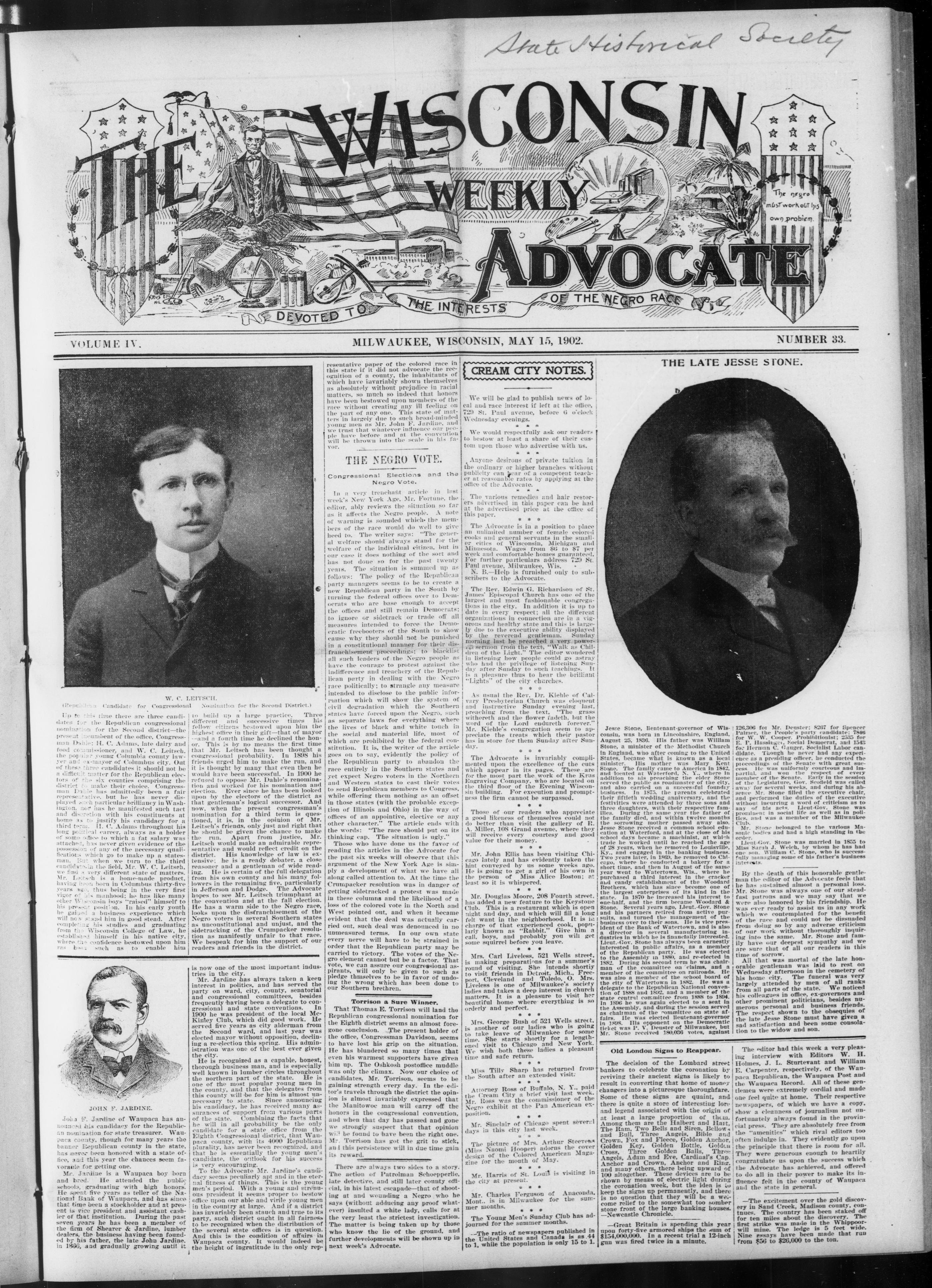
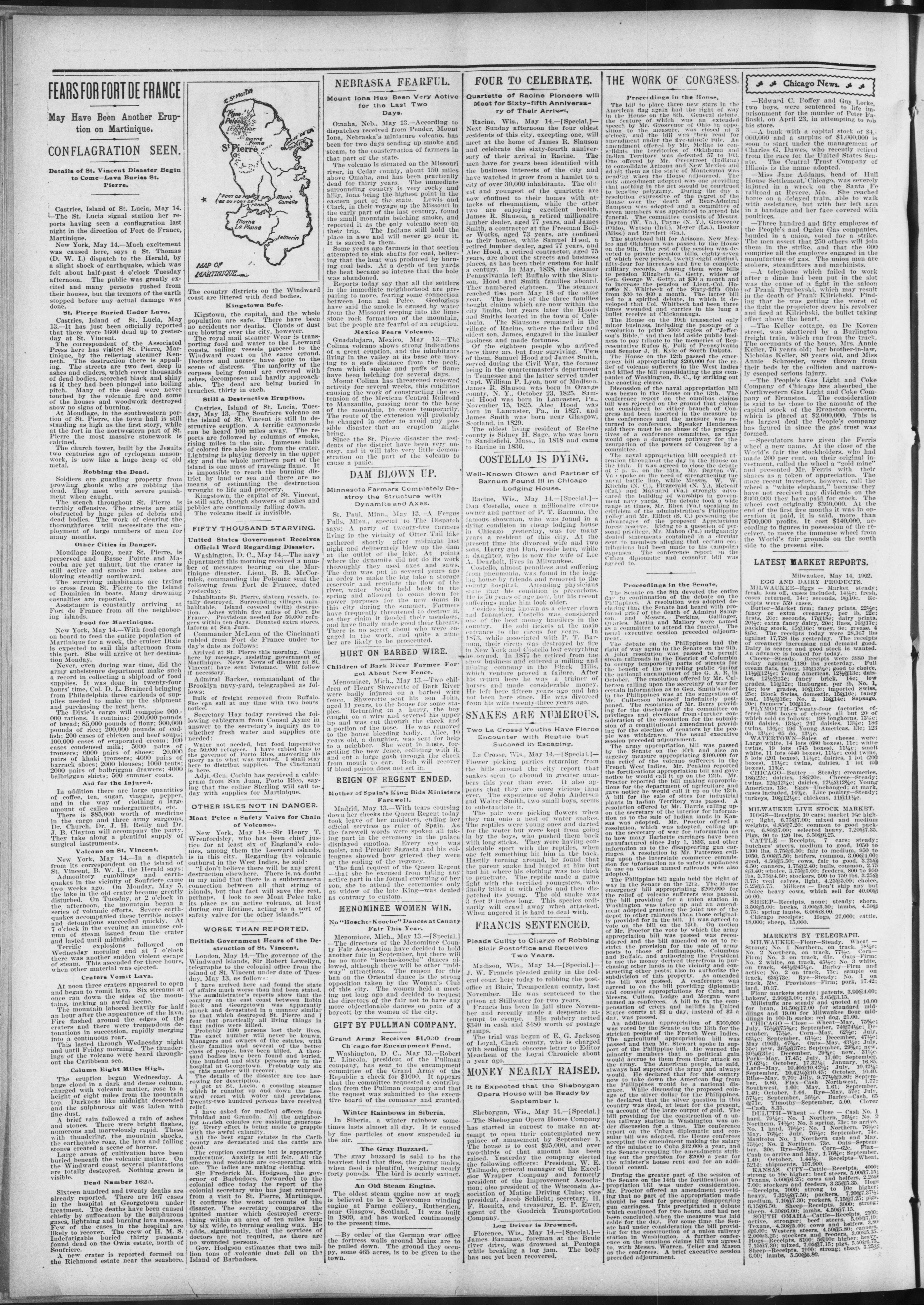
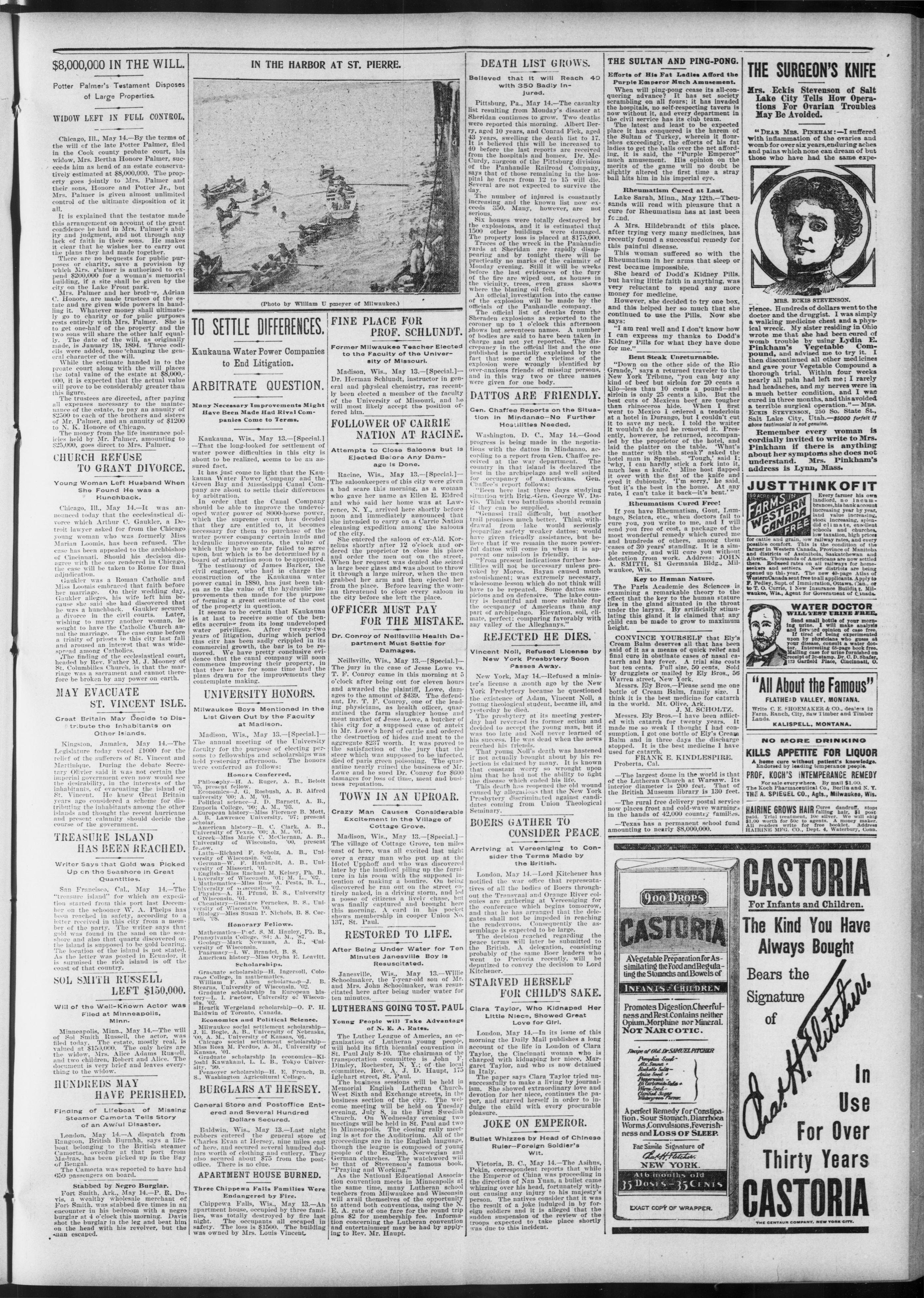
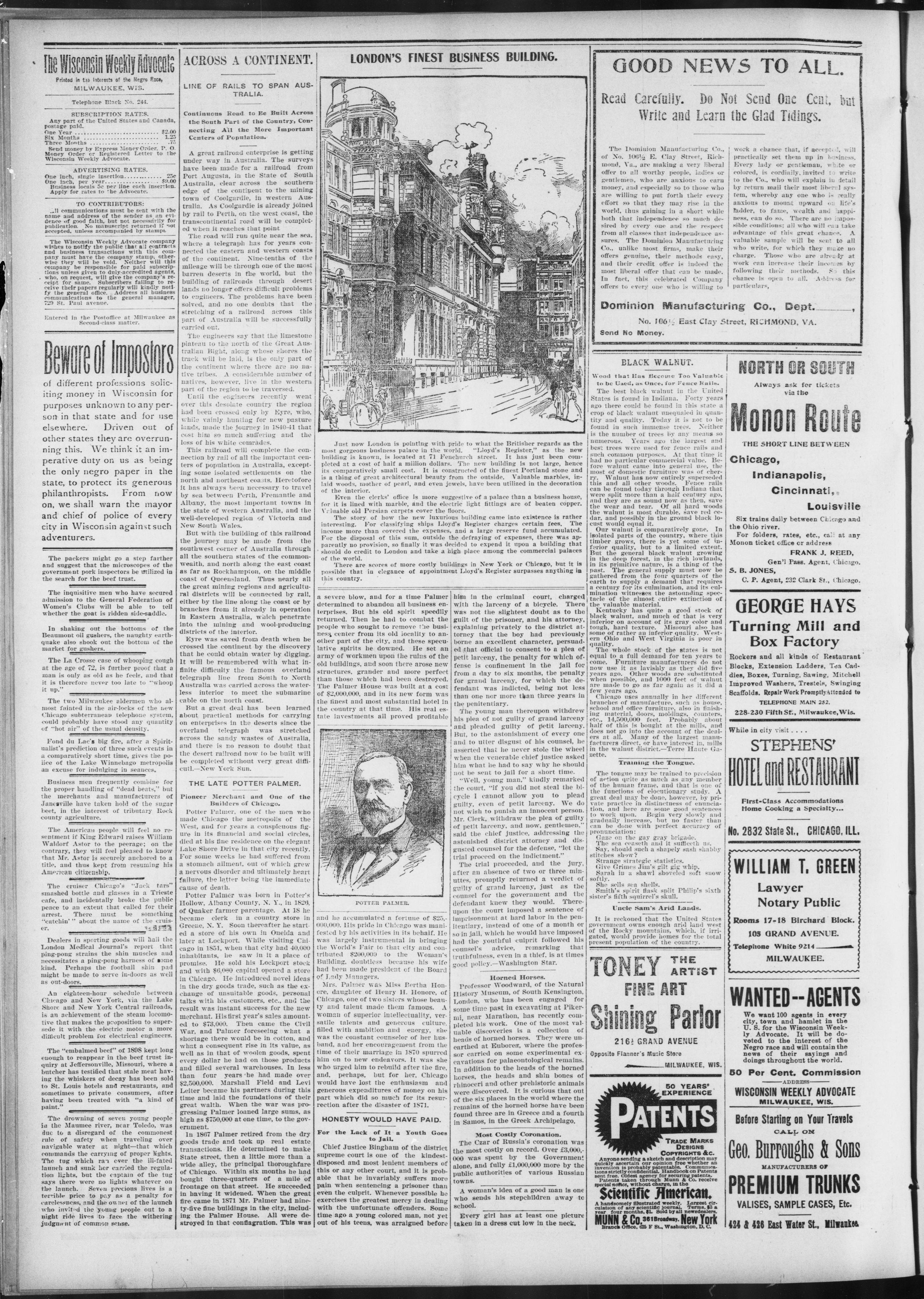
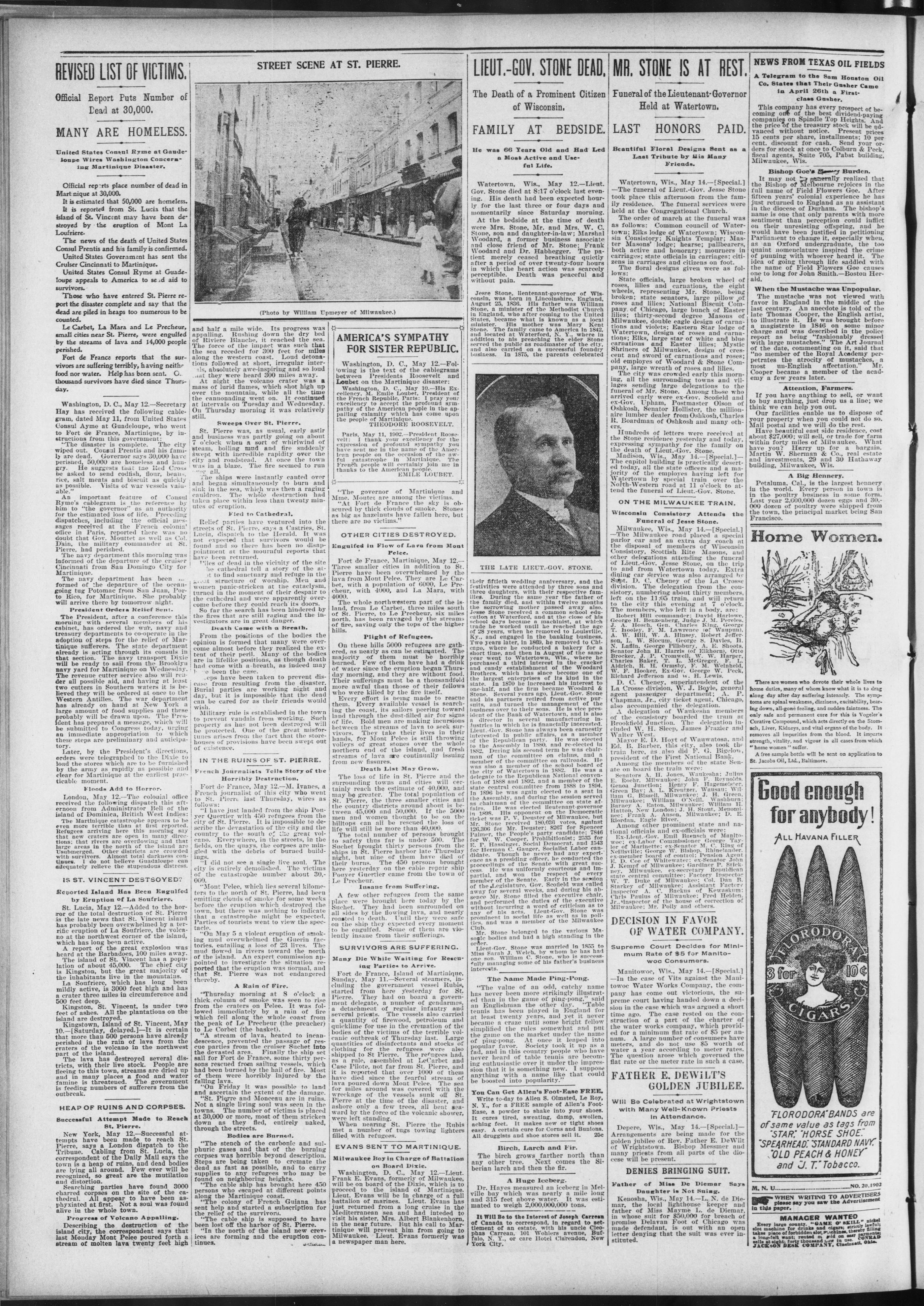

Page text (machine-generated)
State Historical Society
WISCONSIN
WEEKLY
ADVOCATE
DEVOTED TO THE INTERESTS OF THE NEGRO RACE
[Name not provided]
(Republican Candidate for Congressional Nomination for the Second District.)
VOLUME IV.
W. C.
(Republican Candidate for Congression
Up to this time there are three candidates for the Republican congressional nomination for the Second district—the present incumbent of the office, Congressman Doble; H. C. Adams, late dairy and food commissioner, and W. C. Leitsch, the popular young Columbia county lawyer and ex-mayor of Columbus city. Out of these three candidates it should not be a difficult matter for the Republican electors of the six counties comprising the district to make their choice. Congressman Doble has admittedly been a fair representative, but he has never displayed such particular brilliancy in Washington, nor has he manifested such tact and discretion with his constituents at home as to justify his candidacy for a third term. H. C. Adams throughout his long political career, always as a holder of some office to which a fat salary was attached, has never given evidence of the possession of any of the necessary qualifications which go to make up a statesman. But when we turn to the third candidate in the field, Mr. W. C. Leitsch, we find a very different state of matters. Mr. Leitsch is a home-made product, having been born in Columbus thirty-five years ago, thus being in the very first vigor of his manhood; he has like many other Wisconsin boys "raised" himself to his present position. In his early youth he gained a business experience which will now stand him in good stead. After completing his studies and graduating from the Wisconsin College of Law, he established himself in his native city, where the confidence bestowed upon him has been such as to enable him
J. B. H.
JOHN F. JARDINE.
John F. Jardine of Waupaca has announced his candidacy for the Republican nomination for state treasurer. Waupaca county, though for many years the banner Republican county in the state, has never been honored with a state office, and this year the chances seem favorable for getting one.
Mr. Jardine is a Waupaca boy born and bred. He attended the public schools, graduating with high honors. He spent five years as teller of the National Bank of Waupaca, and has since that time been a stockholder and at present is vice president and assistant cashier of that institution. During the past seven years he has been a member of the firm of Shearer & Jardine, lumber dealers, the business having been founded by his father, the late John Jardine, in 1866, and gradually growing until it
no build up a large practice. Three different and successive times his fellow citizens bestowed upon him the highest office in their gift—that of mayor—and a fourth time he declined the honor. This is by no means the first time that Mr. Leitsch has been thought a congressional probability. In 1898 his friends urged him to make the run, and it is thought by many that even then he would have been successful. In 1900 he refused to oppose Mr. Dahle's renomination and worked for his nomination and election. Ever since he has been looked upon by the electors of the district as that gentleman's logical successor. And now, when the present congressman's nomination for a third term is questioned, it is, in the opinion of Mr. Leitsch's friends, only just and right that he should be given the chance to make the run. Apart from justice, Mr. Leitsch would make an admirable representative and would reflect credit on the district. His knowledge of law is extensive; he is a ready debater, a close reasoner and a gentleman of wide reading. He is certain of the full delegation from his own county and his many followers in the remaining five, particularly in Jefferson and Dodge. The Advocate hopes to see Mr. Leitsch triumphant at the convention and at the fall election. He has a warm side to the Negro race, looks upon the disfranchisement of the Negro voters in several Southern states as unconstitutional and unjust, and the sidetracking of the Crumpacker resolution as manifestly unfair to that race. We bespeak for him the support of our readers and friends in the district.
is now one of the most important industries in the city.
Mr. Jardine has always taken a keen interest in politics, and has served the party on ward, city, county, senatorial and congressional committees, besides frequently having been a delegate to congressional and state conventions. In 1900 he was president of the local McKinley Club, which did good work. He served five years as city alderman from the Second ward, and last year was elected mayor without opposition, declining a re-election this spring. His administration was one of the best ever given the city.
He is recognized as a capable, honest, thorough business man, and is especially well known in lumber circles throughout the northern part of the state. He is one of the most popular young men in the county, and that the delegates from this county will be for him is almost unnecessary to state. Since announcing his candidacy, he has received many assurances of support from various parts of the state. Combining the facts that he will in all probability be the only candidate for a state office from the Eighth Congressional district, that Waupaca county, with its 4000 Republican plurality, has never been recognized, and that he is essentially the young men's candidate, the outlook for his success is very encouraging.
To the Advocate Mr. Jardine's candidacy seems peculiarly apt and in the eternal fitness of things. This is the young men's period. With a young and strenuous president it seems proper to bestow office upon our able and virile young men in the country at large. And if a district has invariably been stance and true to its party, such district ought in all fairness to be recognized when the distribution of the several state offices is in question. And this is the condition of affairs in Waupaca county. It would indeed be the height of ingratitude in the only rep-
MILWAUKEE, WISCONSIN, MAY 15, 1902.
resentative paper of the colored race in this state if it did not advocate the recognition of a county, the inhabitants of which have invariably shown themselves as absolutely without prejudice in racial matters, so much so indeed that honors have been bestowed upon members of the race without creating any ill feeling on the part of any one. This state of matters in largely due to such broad-minded young men as Mr. John F. Jardine, and we trust that whatever influence our people have before and at the convention will be thrown into the scale in his favor.
THE NEGRO VOTE.
Congressional Elections and the Negro Vote.
In a very trenchant article in last week's New York Age, Mr. Fortune, the editor, ably reviews the situation so far as it affects the Negro people. A note of warning is sounded which the members of the race would do well to give heed to. The writer says: "The general welfare should always stand for the welfare of the individual citizen, but in our case it does nothing of the sort and has not done so for the past twenty years. The situation is summed up as follows: The policy of the Republican party managers seems to be to create a new Republican party in the South by turning the federal offices over to Democrats who are base enough to accept the offices and still remain Democrats; to ignore or sidetrack or trade off all measures intended to force the Democratic freebooters of the South to show cause why they should not be punished in a constitutional manner for their disfranchisement proceedings; to blacklist all such leaders of the Negro people as have the courage to protest against the indifference and treachery of the Republican party in dealing with the Negro race politically; to strangle any measure intended to disclose to the public information which will show the system of civil degradation which the Southern states have forced upon the Negro, such as separate laws for everything where the lives of black and white touch in the social and material life, most of which are prohibited by the federal constitution. It is, the writer of the article goes on to say, evidently the policy of the Republican party to abandon the race entirely in the Southern states and yet expect Negro voters in the Northern and Western states to cast their votes to send Republican members to Congress, while offering them nothing as an offset in those states (with the probable exception of Illinois and Ohio) in the way of offices of an appointive, elective or any other character." The article ends with the words: "The race should put on its thinking cap. The situation is ugly."
Those who have done us the favor of reading the articles in the Advocate for the past six weeks will observe that this argument of the New York Age is simply a development of what we have all along called attention to. At the time the Crumpacker resolution was in danger of getting sidetracked a protest was made in these columns and the likelihood of a loss of the colored vote in the North and West pointed out, and when it became evident that the deal was actually carried out, such deal was denounced in no unmeasured terms. In our own state every nerve will have to be strained in order that the Republican party may be carried to victory. The votes of the Negro element cannot but be a factor. That vote, we can assure our congressional aspirants, will only be given to such as pledge themselves to be in favor of undoing the wrong which has been done to our Southern brethren.
Torrison a Sure Winner
That Thomas E. Torrison will land the Republican congressional nomination for the Eighth district seems an almost foregone conclusion. The present holder of the office, Congressman Davidson, seems to have lost his grip on the situation. He has blundered so many times that even his warmest supporters have given him up. The Oshkosh postoffice muddle was only the climax. Now our choice of candidates, Mr. Torrison, seems to be gaining strength every day. In the editor's travels through the district the opinion is almost invariably expressed that the Manitowoc man will carry off the honors in the congressional convention, and when that day has passed and gone we strongly suspect that that opinion will be found to have been the right one. Mr. Torrison has got the grit to stick, and this persistence will in due time gain its reward.
There are always two sides to a story. The action of Patrolman Schoepperlie, late detective, and still later county official, in his latest escapade—that of shooting at and wounding a Negro who he says (without adducing any proof whatever) insulted a white lady, calls for at the very least the strictest investigation. The matter is being taken up by those who know the lie of the ground, and further developments will be shown up in next week's Advocate.
CREAM CITY NOTES.
---
We will be glad to publish news of local and race interest if left at the office. 729 St. Paul avenue, before G o'clock Wednesday evenings.
We would respectfully ask our readers to bestow at least a share of their custom upon those who advertise with us.
Anyone desirous of private tuition in the ordinary or higher branches without publicity can bear of a competent teacher at reasonable rates by applying at the office of the Advocate.
The various remedies and hair restorers advertised in this paper can be had at the advertised price at the office of this paper.
The Advocate is in a position to place an unlimited number of female colored cooks and general servants in the smaller cities of Wisconsin, Michigan and Minnesota. Wages from $6 to $7 per week and comfortable homes guaranteed. For further particulars address 729 St. Paul avenue, Milwaukee, Wis. N. B.—Help is furnished only to subscribers to the Advocate.
The Rev. Edwin G. Richardson of St. James' Episcopal Church has one of the largest and most fashionable congregations in the city. In addition it is up to date in every respect; all the different organizations in connection are in a vigorous and healthy state and this is largely due to the executive ability displayed by the reverend gentleman. Sunday morning last he preached a very powerful sermon from the text, "Walk as Children of the Light." The editor wondered in listening how people could go astray who had the privilege of listening Sunday after Sunday to such teachings. It is a pleasure thus to hear the brilliant "Lights" of the city churches.
* *
As usual the Rev. Dr. Kiehle of Calvary Presbyterian Church was eloquent and instructive Sunday evening last, preaching from the text, "The grass withereth and the flower fadeth, but the word of the Lord endureth forever." Mr. Kiehle's congregation seem to appreciate the treats which their pastor has in store for them Sunday after Sunday.
※ ※ ※
The Advocate is invariably complimented upon the excellence of the cuts which appear in its pages. These are for the most part the work of the Krus Engraving Company, who are located on the third floor of the Evening Wisconsin building. For execution and promptness the firm cannot be surpassed.
***
Those of our readers who appreciate a good likeness of themselves could not do better than visit the gallery of R. A. Miller, 108 Grand avenue, where they will receive every courtesy and good value for their money.
☆ ☆ ☆
Mr. John Ellis has been visiting Chicago lately and has evidently taken the hint conveyed by us some weeks ago. He is going to get a girl of his own in the person of Miss Alice Boston; at least so it is whispered.
* * *
Mr. Douglas Moore, 208 Fourth street, has added a new feature to the Keystone Club. This is a restaurant which is open night and day, and which will fill a long felt want in the neighborhood. It is in charge of that experienced cook, popularly known as "Rabbit." Give him a call, boys, and probably you will get some squirrel before you leave.
赤 焦 牵
Mrs. Carl Liveless, 521 Wells street, is making preparations for a summer's round of visiting. She intends shortly to visit friends in Detroit, Mich., Freeport, Cleveland and Toledo, O. Mrs. Liveless is one of Milwaukee's society ladies and takes a deep interest in church matters. It is a pleasure to visit her beautiful home where everything is so orderly and perfect.
***
Mrs. George Bush of 521 Wells street is another of our ladies who is going to take leave of Milwankee for some time. She starts shortly for a lengthened visit to Chicago and New York. We wish both these ladies a pleasant time and safe return.
☆ ☆ ☆
Miss Tilly Sharp has returned from the South after an extended visit:
* * *
Attorney Ross of Buffalo, N. Y., paid the Cream City a brief visit last week. Mr. Ross was the commissioner of the Negro exhibit at the Pan American exposition.
☆ ☆ ☆
Mr. Sinclair of Chicago spent several days in this city last week.
空空空
The picture of Mrs. Arthur Steevens (Miss Naomi Hooper) adorns the cover design of the Colored American Magazine for the month of May.
Mr. Harris of St. Louis is visiting in the city at present.
Mr. Charles Ferguson of Anaconda, Mont., is in Milwaukee for the summer months.
The Young Men's Sunday Club has adjourned for the summer months.
--The ratio of newspapers published in the United States and Canada is as.44 to 1, while the population is only 15 to 1.
D
Jesse Stone, lieutenant-governor of Wisconsin, was born in Lincolnshire, England, August 25, 1836. His father was William Stone, a minister of the Methodist Church in England, who after coming to the United States, became what is known as a local minister. His mother was Mary Kent Stone. The family came to America in 1842 and located at Waterford, N. Y., where in addition to his preaching the elder Stone served the public as roadmaster of the city, and also carried on a successful foundry business. In 1875, the parents celebrated their fiftieth wedding anniversary, and the festivities were attended by three sons and three daughters, with their respective families. During the same year the father of the family died, and within twelve months the sorrowing mother passed away also. Jesse Stone received a common school education at Waterford, and at the close of his school days became a machinist, at which trade he worked until he reached the age of 28 years, when he removed to Louisville, Ky., and engaged in the banking business. Two years later, in 1860, he removed to Chicago, where he conducted a bakery for a short time, and then in August of the year went to Watertown. Wis., where he purchased a third interest in the cracker and candy establishment of the Woodard Brothers, which has since become one of the largest enterprises of its kind in the state. In 1870 he increased his interest to one-half, and the firm became Woodard & Stone. Several years ago, Lleut-Gov. Stone and his partners retired from active pursuits, and turned the management of the business over to their sons. He is vice president of the Bank of Watertown, and is also a director in several manufacturing industries in which he is financially interested. Lleut-Gov. Stone has always been earnestly interested in public affairs, as a member of the Republican party. He was elected to the Assembly in 1880, and re-elected in 1882. During his second term he was chairman of the committee on claims, and a member of the committee on railroads. He was also a member of the school board of the city of Watertown in 1882. He was a delegate to the Republican National convention of 1888 and 1892, and a member of the state central committee from 1888 to 1894. In 1896 he was again elected to a seat in the Assembly, and during the session served as chairman of the committee on state affairs. He was elected lieutenant-governor in 1898. His opponent on the Democratic ticket was P. V. Deuster of Milwaukee, but Mr. Stone received 180,036 votes, against
Old London Signs to Reappear
The decision of the Lombard street bankers to celebrate the coronation by reviving their ancient signs is likely to result in converting that home of money changers into a picturesque thoroughfare. Some of these signs are quaint, and there is quite a store of interesting lore and legend associated with the origin of at least a large proportion of them. Among them are the Halbert and Hart, The Ram, Two Bells and Siren, Bellows and Bull, Three Angels, Bible and Crown, Fox and Fleece, Golden Anchor, Golden Key, Golden Bottle, Golden Cross, Three Golden Balls, Three Angels, Adam and Eve, Ecardinal's Cap, Anchor and Crown, Anchor and Ring, and many others, there being upward of 100 altogether. These devices are to be shown by means of electric light during the coronation week, but the idea is to keep the signs up permanently, and there is no question that they will be a welcome relief to the somewhat too somber stone front of the large banking houses.—Newcastle Chronicle.
Great Britain is spending this year upon forty-five armored ships the sum of $154,000,000. In a recent trial a 12-inch gun was fired twice in a minute.
NUMBER 33.
ESSE STONE.
126,306 for Mr. Deuster; 8267 for Spencer Palmer, the People's party candidate; 7846 for W. W. Cooper, Prohibitionist; 2535 for E. P. Hassinger, Social Democrat, and 1543 for Herman C. Gauger, Socialist Labor candidate. Though he never had any experience as a presiding officer, he conducted the proceedings of the Senate with great success. He was uniformly courteous and impartial, and won the respect of every member of the Senate. Early in the session of the Legislature, Gov. Scofield was called away for several weeks, and during his absence Mr. Stone filled the executive chair, and performed the duties of the executive without incurring a word of criticism as to any of his acts. Lieut-Gov. Stone was prominent in social life as well as in politics, and was a member of the Milwaukee Club.
Mr. Stone belonged to the various Masonic bodies and had a high standing in the order.
Lient-Gov. Stone was married in 1855 to Miss Sarah J. Welch, by whom he has had one son. William C. Stone, who is successfully managing some of his father's business interests.
By the death of this honorable gentleman the editor of the Advocate feels that he has sustained almost a personal loss. Mr. Stone was always one of our steadfast patrons and we may say that we were also honored by his friendship. He was ever ready to assist us in any work which we contemplated for the benefit of the race and could not be dissuaded from doing so by any adverse criticism of our work without thoroughly inquiring into the same. Mr. Stone and family have our deepest sympathy and we are sure that of all our readers in this time of sorrow.
All that was mortal of the late honorable gentleman was laid to rest on Wednesday afternoon in the cemetery of his home city. The funeral was very largely attended by men of all ranks from all parts of the state. We noticed his colleagues in office, ex-governors and other prominent politicians, besides numerous personal and business friends. The respect shown to the obsequies of the late Jesse Stone must have given a sad satisfaction and been some consolation to the widow and son.
The editor had this week a very pleasing interview with Editors W. H. Holmes, J. L. Sturtevant and William E. Carpenter, respectively, of the Waupaca Republican, the Waupaca Post and the Waupaca Record. All of these gentlemen were extremely cordial and made one feel quite at home. Their respective newspapers, of which we have a copy, show a cleanness of journalism not unfortunately always found in the provincial press. They are absolutely free from the "amenities" which rival editors too often indulge in. They evidently go upon the principle that there is room for all. They were generous enough to heartily congratulate us upon the success which the Advocate has achieved, and offered to do all in their power to make its influence felt in the county of Waupaca and the state in general.
The excitement over the gold discovery in Sand Creek, Madison county, continues. The country has been staked off for ten miles about the discovery. The first strike was made in the Whippoorwill mine. The ledge is 5 feet wide. Nine assays have been made that run from $56 to $26,000 to the ton.
FEARS FOR FORT DE FRANCE
May Have Been Another Eruption on Martinique.
Details of St. Vincent Disaster Begin to Come-Lava Buries St.
Castries, Island of St. Lucia, May 14. The St. Lucia signal station her reports having seen a conflagration last night in the direction of Fort de France, Martinique. New York, May 14. Much excitement was caused here, says a St. Thomas (D. W. I.) dispatch to the Herald, by a slight shock of earthquake, which was felt about half-past 4 o'clock Tuesday afternoon. The public was greatly excited and many persons rushed from their houses, but the tremors of the earth stopped before any actual damage was done.
St. Pierre Buried Under Lava.
Castries, Island of St. Lucia, May 13.—It has just been officially reported that there were 1600 dead up to yesterday at St. Vincent. The correspondent of the Associated Press here has visited St. Pierre, Martinique, by the relieving steamer Kenneth. The destruction there is appalling. The streets are two feet deep in ashes and cinders, which cover thousands of dead bodies, scorched black and shiny as if they had been plunged into boiling pitch. Many of the dead were never touched by the volcanic fire and some of the houses and woodwork destroyed show no signs of burning. At Moulage, in the southwestern portion of St. Pierre, the town hall is still standing as high as the first story, while at the fort in the nortwestern part of St. Pierre the most massive stonework is calcined.
The church tower, built by the Jesuits two centuries ago of cyclopean masonwork, is now like a huge heap of old metal.
Robbing the Dead.
Soldiers are guarding property from prowling ghouls who are robbing the dead. They meet with severe punishment when caught. The stench throughout St. Pierre is terribly offensive. The streets are still obstructed by huge piles of debris and dead bodies. The work of clearing the thoroughfares will necessitate the employment of large numbers of men for many months.
Other Cities in Danger.
Moudlage Rouge, near St. Pierre, is preserved and Basse Pointe and Macouba are yet unhurt, but the crater is still active and smoke and ashes are blowing steadily northward. The surviving inhabitants are trying to cross from St. Pierre to the Island of Dominica in boats. Many drowning casualties are reported. Assistance is constantly arriving at Fort de France from all the neighboring islands.
kood for Martinique.
New York, May 14.—With food enough on board to feed the entire population of Martinique for a week, the cruiser Dixie is expected to sail this afternoon from this port. She will arrive at her destination Monday. Never, even during war time, did the army subsistence department make such a record in collecting a shipload of food supplies. It was done in twenty-four hours' time, Col. D. L. Brainerd bringing from Philadelphia three carloads of supplies needed to make up the shipment and purchasing the rest here.
The Dixie's cargo will comprise 900- 000 rations. It contains: 200,000 pounds of bread; 85,000 pounds of flour; 900,000 pounds of rice; 200,000 pounds of codfish; 200 cases of chicken and beef soups; 100,000 cases of evaporated cream; 100 cases condensed milk; 5000 pairs of trousers; 6000 pairs of shoes; 20,000 pairs of khaki trousers; 4000 pairs of barrack shoes; 2000 blouses; 1000 tents; 2000 pairs of balbriggan drawers; 4000 balbriggan shirts; 500 summer coats.
Aid for the Injured.
In addition there are large quantities of coffee, tea, sugar, vinegar, pepper, and in the way of clothing a large amount of calico undergarments, etc. There is $85,000 worth of medicine in the cargo and three army surgeons, Dr. Church, Dr. J. H. Reilly and Dr. J. B. Clayton will accompany the party. They take along a plentiful supply of surgical instruments.
Volcano on St. Vincent.
New York, May 14. In a dispatch from its correspondent on the island of St. Vincent, B. W. I., the Herald says: Admonitory rumblings and earthquakes in the vicinity of Soufriere came two weeks ago. On Monday, May 5, the lake in the old crater became greatly disturbed. On Tuesday, at 2 o'clock in the afternoon, the mountain began a series of volcanic efforts. Severe earthquakes accompanied these terrible noises and detonations succeeded quickly. At 7 o'clock in the evening an immense column of steam issued from the crater and lasted until midnight. Terrific explosions followed on Wednesday morning and at 7 o'clock there was another sudden violent escape of steam. This ascended for three hours, when other material was ejected.
Craters Vomit Lava.
At noon three craters appeared to open and began to vomit lava. Six streams at once ran down the sides of the mountains, making an awful scene.
The mountain labored heavily for half an hour after the appearance of the lava. Fire flashed around the edges of the craters and there were tremendous detonations in succession, rapidly merging into a continuous roar. This lasted through Wednesday night and until Friday morning. The thunderings of the volcano were heard throughout the Caribbean sea.
Column Eight Miles High.
The eruption began Wednesday. A huge cloud in a dark and dense column, charged with volcanic matter, rose to a height of eight miles from the mountain top. Darkness like midnight descended and the sulphurous air was laden with fine dust.
A brief rain followed a rain of ashes and stones. There were bright flashes, numerous and marvelously rapid. These with thundering, the mountain shocks, the earthquake roar, the lava and falling stones created a scene of horror.
Large areas of cultivation have been buried beneath the volcanic matter. On the Windward coast several plantations are totally destroyed. Nothing green is visible.
Dead Number 1620.
Sixteen hundred and twenty deaths are already reported. There are 167 cases in the hospital at Georgetown under treatment. The deaths have been caused chiefly by suffocation by the sulphurous gases, lightning and burning lava masses. Few of the cases in the hospital are likely to recover. The crew of H. M. S. Indefatigable buried thirty peasants found dead on the Owia estate, north of Soufriere. A new crater is reported formed on the Richmond estate near the seashore.
C. S. Martin
Migne
Pole
Le Precheur
morne
Pume
MARVE DE
TRINITE
S. Pierre
PORT DE FRANCE
BE DU PORT DE
FRAME
Marne
Gamelle
Morne
La Plaine
Lemarin
MAP OF
MARTINIQUE
The country districts on the Windward coast are littered with dead bodies.
Kingstown Safe.
Kigstown, the capital, and the whole population are safe. There have been no accidents nor deaths. Clouds of dust are blowing over the city, however. The royal mail steamer Wear is transporting food and water to the Leeward coasts, sailing vessels proceed to the Windward coast on the same errand. Doctors and nurses have gone to the scene of distress. The majority of the corpses being found are covered with ashes, decomposed and hardly approachable. The dead are being buried in trenches thirty in each.
Still a Destructive Eruption.
Castries, Island of St. Lucia, Tuesday, May 13.—The Soufriere volcano on the island of St. Vincent is still in destructive eruption. A terrific cannonade can be heard 100 miles away. The reports are followed by columns of smoke, rising miles in the air. Immense balls of colored fire also issue from the crater. Lightning is playing fiercely in the upper sky and the whole northern part of the island is one mass of traveling flame. It is impossible to reach the burning district by land or sea and there are no means of estimating the destruction wrought to life and property. Kingstown, the capital of St. Vincent, is still safe, though showers of ashes and pebbles are continually falling down. The release itself is invisible.
The volcano itself is invisible
FIFTY THOUSAND STARVING.
United States Government Receives Official Word Regarding Disaster.
Washington, D. C., May 14.—The navy department this morning received a number of messages bearing on the Martinique disaster. Lieut. B. B. McCormick, commanding the Potomac sent the following from Fort de France, dated yesterday:
Inhabitants St. Pierre, sixteen vessels, totally destroyed. Surrounding villages uninhabitable. Island covered (with) destruction. Ashes within five miles of Fort De France. Provisions needed for 50,000 refugees within ten days. Donated extra stores. Inform at San Juan.
Commander McLean of the Cincinnati cabled from Fort de France under today's date as follows:
Arrived at St. Pierre this morning. Came here by message, assisting government of Martinique. News News of disaster at St. Vincent; have sent Potomac. Will follow if necessary.
Admiral Barker, commandant of the Brooklyn navy-yard, telegraphed as follows:
Bulk of freight removed from Buffalo. She can sail at any time with two hours' notice.
Secretary Hay today received the following cablegram from Consul Ayme in answer to the secretary's inquiry as to whether fresh water and supplies are needed:
Water not needed, but food imperative for 50,000 refugees. I have cabled this to the governor of Porto Rico, answering his query as to what was wanted. I shall stay here to distribut supplies. The Cincinnati is here.
Adjt.-Gen. Corbin has received a cablegram from San Juan, Porto Rico, saying that the collier Sterling will sail today with supplies for Martinique.
OTHER ISLES NOT IN DANGER.
Mont Pelee a Safety Valve for Chain of Volcano.
New York, May 14.—Sir Henry T. Wrenfordsley, who has been chief justice for at least six of England's colonies, among them the Leeward islands, is in this city. Regarding the volcanic outburst in the West Indies, he said: "I don't believe there will be any great destruction elsewhere. There is no doubt in my mind that there is a subterranean connection between all that string of islands, but that fact will save the rest, perhaps. I look to see Mont Pelee take its place as an active volcano, at least during our lifetime, acting as a sort of safety valve for the other islands."
WORSE THAN REPORTED.
British Government Hears of the Destruction of St. Vincent.
London, May 14.—The governor of the Windward islands, Sir Robert Lewellyn, telegraphs to the colonial office from the island of St. Vincent under date of Tuesday, May 13, as follows:
I have arrived here and found the state of affairs much worse than had been stated. The administrator's reports show that the country on the east coast between Robin Rock and Georgetown was apparently struck and devastated in a manner similar to that which destroyed St. Pierre and I fear that practically all living things in that radius were killed.
Probably 1600 persons lost their lives. The exact number will never be known. Managers and owners of the estates, with their families and several of the better class of people, have been killed. A thousand bodies have been found and buried. One hundred and sixty persons are in the hospital at Georgetown. Probably only six on this number will recover.
The details of the disaster are too harrowing for description.
I got at St. Lucia, a coasting steamer which is running up and down the Leeward coast with water and provisions. Twenty-two hundred persons have received relief.
I have asked for medical officers from Trinidad and Granada. All the neighboring British colonies are assisting generously. Every effort is being made to grapple with the awful calamity.
All the best sugar estates in the Carib county are devastated and the cattle are dead.
The eruption continues but is apparently moderating. Anxiety is still felt. All the officers and residents are co-operating with me. The ladies are making clothing.
Sir Frederick M. Hodgson, the governor of Barbadoes, forwarded to the colonial office today the report of the colonial secretary who has just returned from a visit to St. Pierre, Martinique. It confirms the worst accounts of the disaster. The secretary compares the ignited matter which destroyed everything within an area of ten miles long by six wide, to burning sealing wax. He adds, significantly, that the services of doctors are not required, as there are no wounded persons.
Gov. Hodgson estimates that two million tons of volcanic dust fell on the Island of Barbadoes.
NEBRASKA FEARFUL.
Mount Iona Has Been Very Active for the Last Two Days.
Omaha, Neb., May 13.—According to dispatches received from Pender, Mount Iona, Nebraska's miniature volcano, has been for two days sending up smoke and steam, to the consternation of farmers in that part of the state.
The volcano is situated on the Missouri river, in Cedar county, about 150 miles above Omaha, and has been practically dead for thirty years. The immediate surrounding country is very rocky and hilly, Iona being the highest point in the eastern part of the state. Lewis and Clark, in their voyage up the Missouri in the early part of the last century, found the small mountain belching smoke, and reported it as the only volcano seen on their trip. The Indians still hold the place in awe and will never go near it. It is sacred to them.
Some years ago farmers in that section attempted to sink shafts for coal, believing that the heat was produced by burning coal beds. At a depth of ten yards the heat became so intense that the hole was abandoned. Reports today say that all the settlers in the immediate neighborhood are preparing to move, fearing some connection between Iona and Pelee. Geologists have said the smoke is caused by water from the Missouri seeping into the limestone rock formation of the mountain, but the people are fearful of an eruption.
Mexico Fears Volcano.
Guadalajara, Mexico, May 13.—The Colima volcano shows strong indications of a great eruption, and the inhabitants living in the valley at its base are moving to a safe distance from the peak, from which smoke and puffs of flame have been belching for several days.
Mount Colima has threatened renewed activity for several weeks, this condition causing the work of constructing the extension of the Mexican Central Railroad to Manzanillo, passing near to the base of the mountain, to cease temporarily. The route of the extension will probably be changed in order to avoid any possible disaster that an eruption might bring.
Since the St. Pierre disaster the residents of the district have been very uneasy, and it will take very little demonstration on the part of the volcano to cause a panic.
DAM BLOWN UP.
Minnesota Farmers Completely Destroy the Structure with Dynamite and Axes.
St. Paul, Minn., May 13.—A Fergus Falls, Minn., special to The Dispatch says: A party of twenty-five farmers living in the vicinity of Otter Tail lake gathered shortly after midnight last night and deliberately blew up the dam at the outlet of the lake. At points where the dynamite did not do its work thoroughly they used axes and saws. The dam was put in several years ago in order to make the big lake a storage reservoir and regulate the flow of the river, water being held back in the spring and allowed to come down for power purposes for the new dams in this city during the summer. Farmers have frequently threatened to destroy it, as they claim it flooded their meadows, and have finally made good their threats. There is no secret about who were engaged in the work, and quite a number are likely to be prosecuted.
HURT ON BARBED WIRE.
Children of Bark River Farmer Forget About New Fence.
Menominee, Mich., May 13.—Two children of Henry Shwerette of Bark River were badly injured on a barbed wire fence. Shwerette sent his son John, aged 11 years, to the house for some staples. Returning in a hurry, the boy caught on a wire and severed his upper lip and was cut through the cheek and a portion of the nose. He was removed to the house bleeding badly. Alice, 10 years old, a daughter, was sent for help to a neighbor. She went in haste, forgetting the new fence, colliding with it, and cut a large gash through the cheek from mouth to ear. Both will recover if blood poison does not set in.
REIGN OF REGENT ENDED.
Mother of Spain's King Bids Ministers Farewell.
Madrid, May 13.—With tears coursing down her cheeks the Queen Regent today took leave of her ministers, ending her official services as ruler of Spain. As the farewell words were spoken all taking part in the ceremony in the palace displayed emotion. Every eye was moist, and Premier Sagasta and his colleagues showed how grieved they were at the ending of the regency.
The final request of the Queen Regent—that she be excused from taking any active part in the formal crowning of her son, she to attend the ceremonies only as widow of the late King—was denied as contrary to custom.
MENOMINEE WOMEN WIN.
No "Hoeche-Kooche" Dances at County Fair This Year.
Menominee, Mich., May 13.—[Special.]
—The directors of the Menominee County Fair Association have decided to hold another fair in September, but there will be no more "hooche-kooche" dances allowed, although there will be other "midway" attractions. The reason for this ban on the Oriental dance is the strong opposition taken by the Woman's Club of this city. The women held a meeting not long ago and decided to request the directors of the fair not to have any more objectionable dances on pain of a boycott by the women of the city.
GIFT BY PULLMAN COMPANY.
Grand Army Receives $1,000 from Chicago for Encampment Fund. Washington, D. C., May 13.—Robert T. Lincoln, president of the Pullman company, has sent to the encampment committee of the Grand Army of the Republic a check for $1000. It appears that the committee requested a contribution from the Pullman company and that the request was submitted to the executive board of the company and granted.
Winter Rainbows in Siberia.
In Siberia, a winter rainbow sometimes lasts almost all day. It is caused by fine particles of snow suspended in the air.
The Gray Buzzard.
The gray buzzard is said to be the heaviest bird that flies, the young males, when food is plentiful, weighing nearly forty pounds. The bird is nearly extinct.
An Old Steam Engine.
The oldest steam engine now at work is believed to be a Newcomen winding engine at Farme colliery, Rutherglen, near Glasgow, Scotland. It was built in 1809, and has worked continuously to the present time.
By order of the German war office the fortress walls around Mainz are to be pulled down. The ground they occupy, some 465 acres, is to be given to the town.
FOUR TO CELEBRATE.
Quartette of Racine Ploneers will Meet for Sixty-fifth Anniversary of Their Arrival.
Racine, Wis., May 14.—[Special.]—Next Sunday afternoon the four oldest residents of this city, excepting one, will meet at the home of James R. Slauson and celebrate the sixty-fourth anniversary of their arrival in Racine. The men have for years been identified with the business interests of the city and have watched it grow from a hamlet to a city of over 30,000 inhabitants. The oldest and youngest of the quartette are now confined to their homes with attacks of rheumatism, while the other two are enjoying excellent health. James R. Slauson, a retired millionaire lumber dealer, aged 77 years, and James Smith, a contractor at the Freeman Boiler Works, aged 73 years, are confined to their homes, while Samuel Hood, a retired lumber dealer, aged 77 years, and Alec Hood, a retired contractor, aged 75 years, are about the streets and business places, as has been their custom for half a century. In May, 1838, the steamer Pennsylvania left Buffalo with the Slauson, Hood and Smith families aboard. They numbered eighteen. The steamer reached this port May 18 of the same year. The heads of the three families bought claims which are now within the city limits, but years later the Hoods and Smiths located in the town of Caledonia. The Slausons remained in the village of Racine, where the father and oldest son, James, engaged in the lumber business and made fortunes.
Of the eighteen people who arrived here there are but four surviving. Two of them, Samuel Hood and James Smith, served during the Civil War, the former being in the quartermaster's department in Tennessee and the latter served under Capt. William P. Lyon, now of Madison. James R. Slauson was born in Orange county, N. Y., October 23, 1825. Samuel Hood was born in Lancaster, Pa., November 15, 1825. Alec Hood was born in Lancaster, Pa., in 1827, and James Smith was born near Glasgow, Scotland, in 1829.
The oldest living resident of Racine county is Sidney H. Sage, who was born in Sandisfield. Mass., in 1818 and came to Racine in 1836.
COSTELLO IS DYING.
Well-Known Clown and Partner of Barnum Found Ill in Chicago Lodging House.
Racine, Wis., May 14.—[Special.]—Dan Costello, once a millionaire circus owner and partner of P. T. Barnum, the famous showman, who was found in a dying condition in cheap lodging house in Chicago yesterday, was for many years a resident of this city. At the present time his divorced wife and two sons, Harry and Dan, reside here, while a daughter, who is now the wife of Lee A. Dearholt, lives in Milwaukee. Costello, almost penniless and suffering from pneumonia, was found in the lodging house by friends and removed to the county hospital. Attending physicians state that his condition is precarious. He is 70 years of age now, but his recent sufferings make him look older.
Fesides being known as a clever clown and funmaker, Costello was considered one of the best money handlers in the country. He sold tickets at the main entrance to the circus for years. In 1873, while associated with P. T. Barnum, their circus was destroyed by fire in New York and Costello lost everything he owned. In 1877 he retired from the snow business and entered a milling and mining company in the Black Hills, which venture proved a failure. After his return here he was a trainer of horses and made considerable money. He left here fifteen years ago and has not been here since. He was divorced from his wife twenty-three years ago.
SNAKES ARE NUMEROUS.
Two La Crosse Youths Have Fierce Encounter with Reptile but Succeed in Escaping.
La Crosse, Wis., May 14.—[Special.] Flower picking parties returning from the hills around the city report that snakes seem to abound in greater numbers this year than ever. It also appears that they are more vicious than ever. The experience of John Anderson and Walter Smith, two small boys, seems to substantiate it.
The pair were picking flowers when they ran onto a nest of water snakes. The reptiles were young ones and darted for the water but were kept from going in by the boys, who pushed them back with long sticks. They were having considerable sport with the reptiles, when one felt something hit him in the back. Hastily turning around, he found that the parent snake had lunged at him but had hit where his clothing was too thick to penetrate. The reptile made a game fight with the terrified youngsters, who finally killed it with clubs and then dispatched its young. The old snake was 3 feet 9 inches long. This species ordinarily will crawl away when attacked. When angered it is hard to deal with.
FRANCIS SENTENCED.
Pleads Gullty to Charge of Robbing Blair Postoffice and Receives Two Years.
Madison, Wis., May 14.—[Special.]—J. W. Francis pleaded guilty in the federal court here today to robbing the postoffice at Blair, Trempealeau county, last November. He was sentenced to the prison at Stillwater for two years. Francis has been in jail since November and recently made a desperate attempt to escape. His robbery netted $340 in cash and $480 worth of postage stamps. The trial was begun of E. G. Jackson of Loyal, Clark county, who is charged with sending an obscene letter to Editor Meachem of the Loyal Chronicle about a year ago.
MONEY NEARLY RAISED.
It is Expected that the Sheboygan Opera House will be Ready by September 1.
Sheboygan, Wis., May 14.—[Special.]
The Sheboygan Opera House Company has started in earnest to make an attempt to open their contemplated new palace of amusement by September 1. The house is to cost $25,000, and over two-thirds of that amount has been raised. Yesterday the company elected the following officers: President, W. E. Tailmode, general manager of the Excelsior Wrapper Company and formerly president of the Improvement Association; also president of the Wisconsin Association of Matine Driving Clubs; vice president, Jacob Schlicht; secretary, H. F. Roenitz, and treasurer, E. P. Ewer, agent of the Goodrich Transportation Company.
Low Driver in Drowned.
Florence, Wis., May 14.—[Special.] James Bannane, foreman at the Brule river drive, was drowned at Pentoga while breaking a log jam. The body has not yet been recovered.
THE WORK OF CONGRESS.
THE WORK OF CONGRESS.
Proceedings in the House.
The bill to place three new stars in the American flag again had the right of way in the House on the 8th. General debate, the feature of which was an extended speech by Mr. Grosvenor of Ohio in opposition to the measure, was closed at 3 o'clock, and the bill was then read for amendment under the five-minute rule. An amendment offered by Mr. McRae to consolidate the territories of Oklahoma and Indian Territory was defeated 57 to 103. One offered by Mr. Overstreet (Indiana) to consolidate Arizona and New Mexico and admit them as the state of Montezuma was pending when the House adjourned. The only amendment adopted was one providing that nothing in the act should be construed to legalize polygamy. During the day a resolution expressive of the regret of the House over the death of Rear-Admiral Sampson was adopted and a committee of seven members was appointed to attend his funeral. The committee consists of Messrs. Dayton (W. Va.), Payne (N. Y.), Grosvenor (Ohio), Watson (Ind.), Meyer (La.), Hooker (Miss.) and Partlett (Ga.).
The statehood bill for Arizona, New Mexico and Oklahoma was passed by the House on the 9th. The rest of the session was devoted to private pension bills, eighty-seven of which were passed, twenty-eight original, fifty-four for increases and five to complete military records. Among them were bills to pension Elizabeth G. Getty, widow of Gen. George W. Getty, at $30 a month and to increase the pension of Lieut.-Col. Horafo N. Whitbeck of the Sixty-fifth Ohio from $30 to $60 a month. The latter bill led to a spirited debate, in which it developed that Col. Whitbeck had been three times wounded and carries in his lung a bullet receive at Chickamauga.
The House on the 10th transacted only minor business, including the passage of a resolution to print 5000 caplies of "Jefferson's Bible," and then laid aside public business to pay tribute to the memories of Representative Rufus K. Polk of Pennsylvania and Senator J. H. Kyle of South Dakota.
The House on the 12th passed the emergency bill appropriating $200,000 for the relief of volcano sufferers in the West Indies and killed the bill consolidating the gas companies of Washington, D. C., by striking out the enacting clause.
Discussion of the naval appropriation bill was begun in the House on the 13th. The conference report on the omnibus claims bill was rejected on the ground that claims not considered by either branch of Congress had been inserted in the measure by the conferences and the measure was returned to conference. Speaker Henderson said there must be no abuse of the prerogatives of a conference committee, as that would open a dangerous pathway for the usurpation of the powers of Congress by a committee.
The naval appropriation bill occupied attention throughout the day in the House on the 14th. It was agreed to close the debate at 1 p. m. on the 15th. Mr. Dayton (W. Va.) spoke on the need of strengthening the naval battle line, while Messrs. W. W. Kitchin (N. C.), Fitzgerald (N. Y.), Metcalf (Cal.) and Maynard (Va.) strongly advocated the building of warships in government navy yards. The debate took a wide range at times. Mr. Rhea (Va.) speaking in criticism of the administration's Philippine policy and Mr. Elliott (S. C.) presenting the advantages of the proposed Appalachian forest reserve. Rising to a question of personal privilege, Mr. Mahon (Pa.) indigently denied statements contained in a circular sent to members alleging that certain contributions had been made to his campaign expenses. The conference report on the Cuban diplomatic and consular bill was agreed to.
Proceedings in the Senate.
The Senate on the 8th devoted the entire day to continuation of the debate on the Philippines. A resolution was adopted declaring that the Senate had heard with profound grief of the death of Admiral Sampson, and Messrs. Perkins, Gallinger, Quarles, Martin and Mallory were named as a committee to attend the funeral. The usual executive session preceded adjournment.
The debate on the Phillippines had the right of way again in the Senate on the 9th. A joint resolution was passed to permit steam railroads in the District of Columbia to occupy temporarily parts of streets for the benefit of the traveling public during the national encampment of the G. A. R. in October. The resolution offered by Mr. Culberson calling upon the secretary of war for certain information as to Gen. Smith's order in the Philippines was at the suggestion of Mr. Culberson himself indefinitely postponed. The resolution of Mr. Berry providing for the discharge of the committee on privileges and elections from further consideration of the resolution for the submission of a constitutional amendment providing for the election of senators by the people was withdrawn. The usual executive session preceded adjournment.
The army appropriation bill was passed by the Senate on the 10th and also an urgency measure appropriating $100,000 for the relief of the volcano sufferers in the French West Indies. Mr. Penkins reported the fortifications appropriation bill and gave notice he would call it up on the 12th. Mr. Proctor reported the bill making appropriations for the department of agriculture and gave notice he would call it up on the 13th. A bill for the sale of sites for industrial plants in Indian Territory was passed. A resolution offered by Mr. Harris calling up on the secretary of the interior for information as to the sale of Indian lands in Kansas was adopted. Mr. Proctor offered a resolution, which was adopted, calling upon the secretary of war for information as to how many Barbette carriages have been manufactured since July 1, 1893, and other information as to the disappearing gun carriages. A resolution by Mr. Patterson calling upon the interstate commerce commission for information as to safety appliances in use on various named railroads was also adopted.
The Philippine bill again held the right of way in the Senate on the 12th. The House emergency bill appropriating $200,000 for the relief of volcano sufferers was passed. The bill providing for a union station in Washington was taken up and an amendment adopted granting the joint use of the depot to other railroads than those originally provided for in the bill. It was agreed to vote on the bill on the 15th. On motion of Mr. Proctor the vote by which the army appropriation bill was passed was reconsidered and the bill amended so as to restrict the provision for the sale of army posts to those of Indianapolis, Columbus and Buffalo, and authorizing the President to use the money derived therefrom in purchasing other lands in the vicinity and constructing other posts; also to authorize the subdivision of this property. As amended the bill was passed. A conference was agreed to on the bill providing diplomatic and consular appropriations for Cuba, and Messrs. Cullom, Lodge and Morgan were named as conferees. A bill to fix the compensation of criers and bailiffs in United States courts at $3 a day, instead of $2 a day was passed.
An additional appropriation of $300,000 was voted by the Senate on the 13th for the stricken people of the French West Indies. The agricultural appropriation bill was passed and then Mr. Stewart spoke in support of the Philippine bill. He warned the minority members that no political gain would accrue to them from their attack on the army. The American people, he said, always had supported the army and always would. He declared that for this country now to take down the American flag from the Philippines would be a national disgrace. While discussing the proposed coinage of the silver dollar for the Philippines, he declared that the silver question in this country was dead, at least for the present, on account of the large output of gold. The bill providing for the construction of a union railway station in Washington was under discussion for a time. The conference report on the Cuban diplomatic and consular bill was adopted, the House conferences accepting the amendment making the salary of the minister to Cuba $12,000 a year, and the Senate accepting the amendments striking out the provision for $2000 a year for the minister's house rent and for an additional consul.
During the greater part of the session of the Senate on the 14th the fortifications appropriation bill was under consideration. Mr. Proctor offered an amendment providing that no part of the appropriation made should be used for procuring disappearing gun carriages. This precipitated a debate which continued for two hours, and had not been concluded, when the measure was laid aside for the day. For some time the Senate had under consideration the bill providing for the construction of a union railway station in Washington. A further conference on the omnibus claims bill was agreed to, with Messrs. Warren, Teller and Mason as the conferees. A brief executive session preceded adjournment.
—Edward C. Roffey and Guy Locke, two boys, were sentenced to life imprisonment for the murder of Peter Fafnski, on April 23, in attempting to rob his store.
—A bank with a capital stock of $4,000,000 and a surplus of $1,000,000 is soon to start under the management of Charles G. Dawes, who recently retired from the race for the United States Senate. The Central Trust Company of Illinois is the name adopted.
—Miss Jane Addams, head of Hull House Settlement, Chicago, was severely injured in a wreck on the Santa Fe railroad at Revere, Mo. She reached home on a delayed train, able to walk with assistance, but with her left arm in a bandage and her face covered with poultices.
Three hundred and fifty employees of the People's and Ogden Gas companies, banded in a union, voted for a strike. The men assert that 250 others will join them in the strike, and that the 600 comprise all the employees engaged in the manufacture of gas. The union men are stokers, steamfitters and machinists.
A telephone which failed to work after a dime had been put in the slot was the cause of a fight in the saloon of Frank Przybeyski, which may result in the death of Frank Kilrichski. Finding that he was getting the worst of the fight the proprietor drew his revolver and fired at Kilrichski, the bullet taking effect above the heart.
The Keller cottage, on De Koven street, was shattered by a Burlington freight train, which ran from the track. The occupants of the house, Mrs. Annie Keller, 76 years old; her brother-in-law, Nicholas Keller, 80 years old, and Miss Annie Schroeder, were thrown from their beds by the collision and narrowly escaped serious injury.
The People's Gas Light and Coke Company of Chicago has absorbed the Northwestern Gas Light and Coke Company of Evanston. The consideration is said to be close to the amount of the capital stock of the Evanston concern, which is placed at $2,000,000. This is the largest deal the People's company has figured in since the gas trust was formed.
Speculators have given the Ferris wheel a new name. At the close of the World's fair the stockholders, who had made 200 per cent, on their original investment, called the wheel a "gold mine" and presented Mr. Ferris with their shares as a token of appreciation. The more recent investors, however, call the wheel a "white elephant," because they have not received any dividends on the $600,000 they have paid for stock. The wheel cost originally $360,000. At the end of the first five months it was in operation it paid, it is said, more than $700,000 profits. It cost $140,000, according to figures in possession of the receiver, to move the immense wheel from the World's fair grounds on the south side to the present site.
LATEST MARKET REPORTS.
EGG AND DAIRY PRODUCTS.
MILWAUKEE—Eggs — Market steady; fresh, loss off, cases included, 14½c; fresh, cases returned, 14c; seconds, 9@10c. Receipts were 550 cases.
Butter—Market firm; fancy prints, 22½c; fancy or extra creamy, per lb, 22c; firsts, 20c; seconds, 17@18c; dairy prints, 20½c; extra fancy dairy, 20c; lines, 16@17c; packing stock, 15@16c; wney, 9c; grease, 4@5c. The receipts today were 28,367 lbs against 17,728 lbs yesterday. The receipts of creamy increasing and demand good. Dairy is scarce and good stock is wanted. An advance is looked for today.
Cheese—Steady. Receipts were 3880 lbs today against 1180 lbs yesterday. Full cream flats, fancy, 13@13½c; good to choice, 11½@12½c; Young Americus, 12½@13c; daisies, 12½@13c; fancy brick, 14c; low grades, 11@12c; limburger, per lb, No. 1, 14c; low grades, 10@12c; imported Swiss, 25c; Block Swiss, domestic, 15@16c; fancy loaf, 15½@16c; No. 2, 13@14c; Sapsago, 20c; farmers, 10@11c
PLYMOUTH—Twenty-four factories offered 1696 boxes of cheese, all but 20 of which sold as follows: 198 longhorns, 13½c; 661 daisies, 13½c; 247 daisies, 13½c; 186 twins, 13½c; 196 Young Americas, 13c; 123 do, 13½c; 65 do, 13½c.
WATERTOWN—Sales of cheese were; Large white, 14 lots (680 boxes), 11c; white twins, 19 lots (745 boxes), 11½c; small white, 11 lots (440 boxes), 11½c; cold twins, 5 lots (201 boxes), 11½c; dairies, 1 lot (200 boxes), 11½c; twins, dairies, 1 lot (90 boxes), 11½c.
CHICAGO—Butter — Steady; creameries, 18@22c; dairies, 18@20c. Cheese—Steady; twins, 12@12½c; dairies, 12@12½c; Young Americas, 13c. Eggs—Unchanged; at mark, cases included, 14½c. Live poultry—Steady; turkeys, 10@12½c; chickens, 11@11½c.
MILWAUKEE LIVE STOCK MARKET.
HOGS—Receipts, 10 cars; market 10c higher; light, 6.75@7.00; mixed and medium weights, 6.85@7.20; common to good packers, 6.80@7.00; selected heavy, 7.20@7.35. Pigs, 90 to 120 lbs, 5.50@6.25.
CATTLE — Receipts, 7 cars; steady; butchers' steers, medium to good, 1050 to 1300 lbs, 5.75@6.50; fair to medium, 950 to 1050, 5.00@5.50; helfers, common, 3.00@4.00; good, 4.50@5.50; cows, fair to good, 3.25@4.50; canners, 1.75@2.40; bulls, common, 2.75@3.40; choice, 3.75@5.00; feeders, 800 to 950 lbs, 3.75@4.50; stockers, 500 to 750 lbs, 3.25@3.75; veal calves, light, 4.25@5.00; choice, 5.25@5.75. Milkers — Don't ship any but choice heavy cows, which sell for 40.00@50.00
Chicago receipts: Hogs, 27,000; cattle, 18,000; sheep, 15,000.
MARKETS BY TELEGRAPH
MILWAUKEE—Flour—Steady. Wheat—
Strong; No. 1 Northern, on track, 78½c;
No. 2 Northern, on track, 77½c. Corn—
Firm; No. 3 on track, 63c. Oats—Firm;
No. 2 white, on track, 45½c; No. 3 white,
on track, 44½@45½c. Barley—Firm and
active; No. 2 on track, 73c; sample on
track, 63@73c. Rye—Steady; No. 1 on
track, 59c. Provisions—Firm; pork, 17.42;
lard, 10.37.
Flour markets steady; patents. 3.30@4.00;
bakers', 2.90@3.00; rye, 3.05@3.15.
Millstuffs are steady and quoted at 16.00
for bran, 16.50@17.00 for standard middlings and 19.00 for Milwaukee flour middlings in 100 lb sacks; red dog, 21.00.
CHICAGO — Close — Wheat—May, 75%c
July, 75%2@75%c; September, 74%24c; December, 75%c; Corn—May, 62%c; July, 63%c; September, 61%c; December, 47%c; May (1903), 47%c; Oats—May, 43%c; July, 35c; new, 36%2@37c; September, 29%c; new, 30%2@31c; December, 29%c; new, 31%c; Pork—May, 17.45; July, 17.60; September, 17.62%; October, 17.32%; January, 16.85; Lard—May, 10.40@10.42%; July, 10.42%; September, 10.42%@10.45; October, 10.40; Rlbs—May, 9.70; July, 9.77%2@9.80; September, 9.80. Flax—Cash Northwest, 1.77; Southwest, 1.60; May, 1.61; September, 1.49; October, 1.44. Rye—May, 51c; July, 57%2c; September, 56%c; Barley—Cash, 65 @71c. Timothy—September, 5.00. Clover—Cash, 8.35
DULUTH—Wheat — Close — Cash No. 1
hard. 79%c; No. 1 Northern. 76%c; No. 2
Northern. 74%c; No. 3 spring, 73c; to arrive.
No. 1 hard. 79%c; No. 1 Northern. 76%c;
May. 76%c; July. 76%c; September. 74c;
Manitoba No. 1 Northern cash and May.
75%c; No. 2 Northern. 73c; Oats—September.
30c; Rye—56%c; Corn—62c. Flax—
Cash to arrive and May. 1.76%c; September.
1.49; October. 1.44%c; Receipts—Wheat,
5214; shipments. 197.900.
KANSAS CITY—Cattle—Receipts. 4000;
strong to 10c higher; beef steers. 5.00@7.15;
Texans. 5.00@6.25; cows and heifers. 2.25@
7.00; stockers and feeders. 3.35@5.35. Hogs
—Receipts, 7000; strong to 10c higher;
heavy. 7.32%@7.50; packers. 7.20@7.37%;
medium. 7.10@7.30; yelks. 7.15@7.25; pigs.
6.15@6.50. Sheep—Receipts. 3000; strong;
6.60@6.00; lepms. 4.50@7.15.
sheep, 4.30@6.00, lambs, 4.00@6.00
SOUTH OMAHA—Cattle—Recelpts, 2300;
active, stronger; beef steers, 5.00@7.10;
Texans, 4.30@5.40; cows and halfers, 3.80@6.00; Western steers, 4.50@5.80; canners,
2.00@3.25; stockers and feeders, 3.00@5.25;
Hogs—Recelpts, 8100; 5@10 higher; heavy,
7.15@7.30; mixed, 7.05@7.15; plgs, 5.50@6.75;
Sheep—Recelpts, 1900; strong; sheep, 3.25@6.00;
lambs, 5.50@6.80.
$8,000,000 IN THE WILL.
Potter Palmer's Testament Disposes of Large Properties.
WIDOW LEFT IN FULL CONTROL.
Chicago, Ill., May 14.—By the terms of the will of the late Potter Palmer, filed in the Cook county probate court, his widow, Mrs. Bertha Honore Palmer, succeeds him as head of an estate conservatively estimated at $8,000,000. The property goes jointly to Mrs. Palmer and their sons, Honore and Potter Jr., but Mrs. Palmer is given almost unlimited control of the ultimate disposition of it all.
It is explained that the testator made this arrangement on account of the great confidence he had in Mrs. Palmer's ability and judgment, and not through any lack of faith in their sons. He makes it clear that he wishes her to carry out the plans they had made together.
There are no bequests for public purposes or charity, save a provision by which Mrs. Palmer is authorized to expend $200,000 for a woman's memorial building, if a site shall be given by the city on the Lake Front park.
Mrs. Palmer and her brother, Adrian C. Honore, are made trustees of the estate and are given wide powers in handling it. Whatever money shall ultimately go to charity or for public purposes rests entirely with Mrs. Palmer. She is to get one-half of the property and the two sons will share the other half equally. The date of the will, as originally made, is January 18, 1894. Three codiels were added, none changing the general character of the will.
While the estimate handed in to the proate court along with the will places the total value of the estate at $8,000,-000, it is expected that the actual value will prove to be considerably greater than this figure. The trustees are directed, after paying all expenses necessary to the maintenance of the estate, to pay an annuity of $2500 to each of the brothers and sisters of Mr. Palmer, and an annuity of $1200 to N. K. Honore of Chicago. The money from the life insurance policies held by Mr. Palmer, amounting to $25,000, goes direct to Mrs. Palmer.
CHURCH REFUSE TO GRANT DIVORCE.
Young Woman Left Husband When She Found He was a Hunchback.
Chicago, Ill., May 14.—It was announced today that the ecclesiastical divorce which Arthur C. Gaukler, a Detroit lawyer asked for from the Chicago young woman who was formerly Miss Marian Loomis, has been refused. The case has been appealed to the archbishop of Cincinnati. Should his decision disagree with the one rendered in Chicago, the case will be taken to Rome for final adjudication.
Gaukler was a Roman Catholic and Miss Loomis embraced that faith before her marriage. On their wedding day, Gaukler alleges, his wife left him because she said she had discovered that he was a hunchback. Gaukler secured a divorce in the civil courts. Later, wishing to marry another woman, he sought to have the Catholic Church annul the marriage. The case came before a trinity of priests in this city last fall and aroused an interest that was widespread among Catholics. The finding of the ecclesiastical court, headed by Rev. Father M. J. Mooney of St. Columbilles Church, is that the marriage was a sacrament and cannot therefore be broken by any power on earth.
Great Britain May Decide to Distribute the Inhabitants on Other Islands. Kingston, Jamaica, May 14.—The Legislature today voted £1000 for the relief of the sufferers of St. Vincent and Martinique. During the debate Secretary Olivier said it was not certain the imperial government even now would see the desirability, in the interests of the inhabitants, of evacuating the island of St. Vincent. He knew Great Britain years ago considered a scheme for distributing the inhabitants among the other islands and thought the recent hurricane and present calamity should decide the course of the government.
TREASURE ISLAND HAS BEEN REACHED.
Writer Says that Gold was Picked Up on the Seashore in Great Quantities.
San Francisco, Cal., May 14.—The "treasure island" for which an expedition started from this port last December on the schooner W. A. Phelps has been reached in safety, according to a letter received in this city from a member of the party. The writer says that gold was found in the sand on the seashore and also that quartz discovered on the island is supposed to be gold bearing. The location of the island is not stated. As the letter was posted in Ecuador, it is surmised the rich island is off the coast of that country.
Will of the Well-Known Actor was Filed at Minneapolis, Minn.
Minneapolis, Minn., May 14.—The will of Sol Smith Russell, the actor, was filed today. The estate, mostly real, is valued at $150,000. The only heirs are the widow, Mrs. Alice Adams Russell, and two children, Robert and Alice. The document is very brief and leaves everything to the widow.
HUNDREDS MAY HAVE PERISHED.
Finding of Lifeboat of Missing Steamer Camorta Tells Story of an Awful Disaster.
London, May 14.—A dispatch from Rangoon, British Burmah, says a lifeboat belonging to the British steamer Camorta, overdue at that port from Madras, has been picked up in the Bay of Bengal.
The Camorta was reported to have had 650 passengers on board.
Stabbed by Negro Burglar.
Fort Smith, Ark., May 14.—P. R. Davis, a wealthy wholesale merchant of Fort Smith, was stabbed five times in an encounter in his bedroom with a negro burglar at 4 o'clock this morning. Davis shot the burglar in the leg and beat him on the head with his revolver, but the man escaped.
IN THE HARBOR AT ST. PIERRE.
THE RIVER IS A BIG BOW. THE RIVER IS A BIG BOW.
THE RIVER
(Photo by Wllllam U pmeyer of Milwaukee.)
TO SETTLE DIFFERENCES.
Kaukauna Water Power Companies to End Litigation.
ARBITRATE QUESTION.
Many Necessary Improvements Might Have Been Made Had Rival Companies Come to Terms.
Kaukauna, Wis., May 13.—[Special.]
That the long-looked for settlement of water power difficulties in this city is about to be realized, seems to be an assured fact.
It has just come to light that the Kaukauna Water Power Company and the Green Bay and Mississippi Canal Company are about to settle their differences by arbitration.
In order that the Canal Company should be able to improve the undeveloped water power of 8000-horse power, which the supreme court has decided that they are entitled to, it becomes necessary for them to purchase of the water power company certain lands and hydraulic improvements, the value of which they have so far failed to agree upon, but which is to be determined by a board of arbitration soon to be appointed.
The testimony of James Barker, the civil engineer, who had in charge the construction of the Kaukauna water power canal in 1880, has just been taken as to the value of the hydraulic improvements then made for the purpose of forming a great estimate of the cost of the property in question.
It seems to be certain that Kaukauna is at last to receive some of the benefits accruing from its long undeveloped water privileges. After twenty-two years of litigation, during which period this city has been sadly crippled in its commercial growth, the bar is to be removed. We have pretty conclusive evidence that the canal company will soon commence improving their property, in that they have for some time had the plans drawn for the improvements they contemplate making.
UNIVERSITY HONORS.
Milwaukee Boys Mentioned in the List Given Out by the Faculty at Madison. Madison, Wis., May 13.—[Special.] The annual meeting of the University faculty for the purpose of electing persons to fellowships and scholarships was held yesterday afternoon. The honors were conferred as follows:
Honors Conferred.
Philoso$ \textcircled{*} $phy—H. A. Ruger, A. B., Beloit '95, present fellow. Economics—J. G. Rosbush, A. B. Alfred
Economics—J. G. Rosbush, A. B. Alfred university '00; A. M. '01.
university '00; A. M. '01.
Political science. J. D. Barnett, A. B.,
N. K. Barnett, M. '02.
Emporia College, '00; A. M., '93.
European history—Miss Florence B. Mott,
A. B. Lawrence University, '97; present
scholar.
American history—R. C. Clark, A. B.,
University of Texas, '00; A. M., '01.
Greek—Miss Marie C. McClernan, A. B.,
University of Wisconsin, '00; present
fe.ow.
Latin—Richard F. Scholz, A. B., University
of Wisconsin, '02.
German—W. F. Hanhardt, A. B., University
of Missouri, '01.
English—Miss Rachael M. Kelsey, Ph. B.,
University of Wisconsin, '01; M. L., '02.
Mathematics—Miss Rose A. Pesta, B. L.,
University of Wisconsin, '02.
Physics—A. H. Pfund, B. S., University
of Wisconsin, '01.
Chemistry-Gustave Fernckes, B. S., University of Wisconsin, '00.
versity of Wisconsin. 00. Biology-Miss Susan P. Nichols, B. S. Cornell. 28.
Honorary Fellows.
Mathematics—P. of. S. M. Hauley. Ph. B., Pennsylvania College, '84; A. M., '87. Geology—Mark Newman, A. B., University of Wisconsin.
Pharmacy-I. W. Brandel, B. S.
Pharmacy—I. W. Brandel, B. S.
American history—Miss Orpha E. Leavitt.
Scholarships.
Graduate scholarship—H. Ingersoll, Colorado College, in mathematics.
raao College, in hiatus matriculates.
William F. Allen scholarsap—J. B.
C.
William F. Allen scholarship—J. B. Stearns, University of Wisconsin. '02.
Graduate scholarship in European history—L. I. Paetow, University of Wisconsin. '02.
Henrik Wergeland scholarship—O. P. H. Baldwin of Toronto, Canada.
Economics and Political Science.
Milwaukee social settlement scholarship— J. E. Bogle, A. B., University of Nebraska, '00. A. M., University of Kansas, '01.
'00, A. M., University of Kansas, '01.
Chicago social settlement scholarship—Miss Rosa M. Perdue, A. M., University of Kansas, '01.
Graduate scholarship in economics—Kijoshl Kawakami, L. L. B., Tokyo University, '99.
Pennoyer scholarship—H. E. French, B. S., Washington Agricultural College.
BURGLARS AT HERSEY.
General Store and Postoffice Entered and Several Hundred Dollars Secured.
Baldwin, Wis., May 13.—Last night robbers entered the general store of Charles Evan at Hersey, nine miles east of here, and secured several hundred dollars worth of clothing and cutlery. They also secured about $75 from the post-office. There is no clue.
APARTMENT HOUSE BURNED.
Three Chippewa Falls Families Were Endangered by Fire.
Chippewa Falls, Wis., May 13.—An apartment house, occupied by three families, was totally destroyed by fire last night. The occupants all escaped in safety. The loss is $1500. The building was owned by Mrs. Louis Vincent.
The image shows a serene seascape with a ship anchored in the foreground, surrounded by calm waters and a distant shoreline. The sky is overcast, and the overall mood is peaceful and tranquil.
FINE PLACE FOR PROF. SCHLUNDT.
FINE PLACE FOR PROF. SCHLUNDT.
Former Milwaukee Teacher Elected
Madison, Wis., May 13.—[Special.] Dr. Herman Schlundt, instructor in general and physical chemistry, ras recently been elected a member of the faculty of the University of Missouri, and he will most likely accept the position offered him.
FOLLOWER OF CARRIE NATION AT RACINE.
Attempts to Close Saloons but Is Elected Before Any Dam-
Racine, Wis., May 13.—[Special.]—The saloonkeepers of this city were given a bad scare this morning, as a woman who gave her name as Ellen E. Eldred and who said her home was at Lawrence, N. Y., arrived here shortly before noon and immediately announced that she intended to carry on a Carrie Nation cleansing expedition among the saloons of the city.
She entered the saloon of ex-Ald. Korzelius shortly after 12 o'clock and ordered the proprietor to close his place and order the men out on the street. When her request was denied she seized a large beer glass and was about to throw it through a large mirror, when the men grabbed her arm and then ejected her from the place. Before leaving the woman threatened to close every saloon in the city before she left the place.
OFFICER MUST PAY FOR THE MISTAKE.
Dr. Conroy of Neillisville Health Department Must Settle for Damages.
Neillsville, Wis., May 13.—[Special.]— The jury in the case of Jesse Lowe vs. T. F. Conroy came in this morning at 5 o'clock after being out for eleven hours and awarded the plaintiff, Lowe, damages to the amount of $439. The defendant, Dr. T. F. Conroy, one of the leading physicians, as health officer, quarantined the farm slaughter house and meat market of Jesse Lowe, a butcher of this city for a supposed case of antex in Mr. Lowe's herd of cattle and ordered the destruction of hides and meat to the aggregate $237 worth. It was proved to the satisfaction of the jury that the steer which was supposed to be infected, died of paris green poisoning. The quarantine nearly ruined the business of Mr. Lowe and he sued Dr. Conroy for $600 damages for loss of time, meat and business reputation.
TOWN IN AN UPROAR.
Crazy Man Causes Considerable Excitement in the Village of Cottage Grove.
Madison, Wis., May 13.—[Special.]—The village of Cottage Grove, ten miles east of here, was all excited last night over a crazy man who put up at the Hotel Upphoff and who was discovered later by the landlord piling up the furniture in his room with the supposed intention of making a bonfire. On being discovered he ran out on the street entirely naked, in a driving storm, and led a posse of citizens a lively chase, but was finally captured and brought here this morning. A card in his pocket shows membership in cooper Union No. 137, St. Paul.
RESTORED TO LIFE.
After Being Under Water for Ten Minutes Janesville Boy is Resuscitated.
Janesville, Wis., May 13.--Willie Schoolmaker, the 7-year-old son of Mr. and Mrs. John Schoolmaker, was resuscitated here after being under water for ten minutes.
LUTHERANS GOING TO ST. PAUL
Young People will Take Advantage of N. E. A. Rates.
The Luther League of America, an organization of Lutheran young people, will hold its fifth biennial convention in St. Paul July 8-10. The chairman of the transportation committee is John F. Dimley, Rochester, N. Y.; of the local committee, Rev. A. J. D. Haupt, 175 Iglehart street, St. Paul.
The business sessions will be held in Memorial English Lutheran Church, West Sixth and Exchange streets, in the business section of the city. The welcome meeting will be held on Tuesday evening, July 8, in the First Swedish Church. On Wednesday evening two meetings will be held in St. Paul and two in Minneapolis. The closing rally meeting is set for the Auditorium. All of the proceedings are in the English language, though the league is composed of young people of the English, Norwegian and German churches. The watchword will be that of Stevenson's famous book, "Praying and Working."
As the National Educational Association convention meets in Minneapolis at the same time, many Lutheran school teachers from Milwaukee and Wisconsin will avail themselves of the opportunity to attend both conventions, using the N. E. A. rate of one fare for the round trip plus $2 for membership fee. Information concerning the Lutheran convention and entertainment may be had by applying to Rev. Mr. Haupt.
DEATH LIST GROWS.
Belleved that It will Reach 40 with 350 Badly Injured.
Pittsburg, Pa., May 14.—The casualty list resulting from Monday's disaster at Sheridan continues to grow. Two deaths were reported this morning. Albert Berry, aged 10 years, and Conrad Fick, aged 43 years, swelling the death list to 17. It is believed this will be increased to 40 before the last reports are received from the hospitals and homes. Dr. McCurdy, surgeon of the Pittsburg division of the Panhandle Railroad Company, says that of those remaining in the hospital he fears from 12 to 15 will die. Several are not expected to survive the day.
The number of injured is constantly increasing and the known list now exceeds 350. Many, however, are not serious. Six houses were totally destroyed by the explosions, and it is estimated that 1500 other buildings were damaged. The property loss is placed at $175,000. Traces of the wreck in the Panhandle vards at Sheridan are rapidly disappearing and by tonight there will be practically no marks of the calamity of Monday evening. Still it will be weeks before the last evidences of the fury of the fire are wiped out, as houses in the vicinity, trees, even grass shows where the blazing oil fell. An official investigation into the cause of the explosion will be made by the officials of the Panhandle company
The official list of deaths from the Sheraden explosions as reported to the coroner up to 1 o'clock this afternoon shows but seventeen names. A number of bodies are said to have been taken in charge and not yet reported. The discrepancy in the official list and the one published is partially explained by the fact that some of the victims of the explosion were wrongly identified by over-anxious friends of missing persons, and in this way two or three names were given for one body.
DATTOS ARE FRIENDLY.
Gen. Chaffee Reports on the Situation in Mindanao-No Further Hostilities Needed.
Washington, D. C., May 14.—Good progress is being made in the negotiations with the dattos in Mindanao, according to a report from Gen. Chaffee received at the war department. The country in that island is declared the best in the archipelago and well suited for occupancy of Americans. Gen. Chaffee's report follows:
"Been here last three days studying situation with Brig.-Gen. George W. Davis. Think two battalions should remain if they can be supplied.
"Genassi trail difficult, but another trail promises much better. Think withdrawal from lake would seriously jeopardize safety weaker dattos; would have given friendly assistance, but believe that if we remain the more powerful dattos will come in when it is apparent our mission is friendly.
"From present indications further hostilities will not be necessary unless provoked by Moros. Bayan caused much astonishment; was extremely necessary, wholesome lesson which do not think will have to be repeated. Some dattos suspicious and on defensive. The lake country is beautiful and more suitable for the occupancy of Americans than any part of archipelago. Elevation, soil, climate, perfect; comparing favorably with any valley of the Alleghanys."
REJECTED HE DIES.
Vincent Noil, Refused License by New York Presbytery Soon Passes Away.
New York, May 14.—Refused a minister's license a month ago by the New York Presbytery because he questioned the existence of Adam, Vincent Noll, a young theological student, became ill, and yesterday he died.
The presbytery at its meeting yesterday had reversed its former action and decided to accept the young man, but it was too late and Noll never learned of his success. He was dead when the news reached his friends.
That young Noll's death was hastened if not actually brought about by his rejection is claimed by many. It is known that constant worry so wrought upon him that he had not the ability to fight the disease which ended his life.
This death has reopened the old wound caused by allegations that the New York Presbytery discriminated against candidates coming from Union Theological Seminary.
Arriving at Vereeniging to Consider the Terms Made by the British.
London, May 14.—Lord Kitchener has notified the war office that representatives of all the bodies of Boers throughout the Transvaal and Orange River colonies are gathering at Vereeniging for the conference which begins tomorrow, and that he has arranged that the delegates shall not be impeded in reaching the rendezvous. Consequently the assemblage is expected to be large.
The decision reached regarding the peace terms will later be submitted to the British. A delegation, consisting probably of the same Boer leaders who went to Pretoria recently, will be deputized to convey the decision to Lord Kitchener.
STARVED HERSELF FOR CHILD'S SAKE.
Clara Taylor, Who Kidnaped Her Little Niece, Showed Great Love for Girl.
London, May 14.—In its issue of this morning the Daily Mail publishes a long account of the life in London of Clara Taylor, the Cincinnati woman who is charged with kidnapping her niece, Margaret Taylor, and who is now detained in Italy.
The paper says Clara Taylor tried unsuccessfully to make a living by journalism. She showed extraordinary love and devotion for her niece, continues the paper, and starved herself in order to indulge the child with every procurable pleasure.
JOKE ON EMPEROR.
Wit.
Victoria, B. C., May 14.—The Asihus, Pekin, correspondent reports that while the Emperor of China was proceeding in the direction of Nan Yuan, a bullet came whizzing over his head, fortunately without causing any injury to his majesty's person. The natives consider that it was the result of a joke indulged in by foreign soldiers and it is alleged that the sudden suspension of the review of the troops expected to take place shortly was due to this incident.
THE SULTAN AND PING-PONG.
Efforts of His Fat Ladies Afford the Purple Emperor Much Amusement. When will ping-pong cease its all-conquering advance? It has set society scrambling on all fours; it has invaded the hospitals, no self-respecting tavern is now without it, and every department in the civil service has its club team. The latest and least to be expected place it has conquered is the harem of the Sultan of Turkey, wherein it flourishes exceedingly, the efforts of his fat ladies to get the balls over the net affording, it is said, the "Purple Emperor" much amusement. His opinion on the merits of the game will no doubt be slightly altered the first time a stray ball hits him in his imperial eye.
Rheumatism Cured at Last
Lake Sarah, Minn., May 12th.—Thousands will read with pleasure that a cure for Rheumatism has at last been found.
A Mrs. Hildebrandt of this place, after trying very many medicines, has recently found a successful remedy for this painful disease.
This woman suffered so with the Rheumatism in her arms that sleep or rest became impossible.
She heard of Dodd's Kidney Pills, but having little faith in anything, was very reluctant to spend any more money for medicine.
However, she decided to try one box, and this helped her so much that she continued to use the Pills. Now she says:
"I am real well and I don't know how I can express my thanks to Dodd's Kidney Pills for what they have done for me."
Bent Steak Unreturnable.
"Down on the other side of the Rio Grande," says a returned traveler to the New York Tribune, "you can buy any kind of beef but sirloin for 20 cents a kilo—less than 10 cents a pound—and sirloin is only 25 cents a kilo. But the best cuts of Mexican beef are tougher than rhinoceros hide. When I first went to Mexico I ordered a tenderloin at a hotel in Durango, but I couldn't cut it to save my neck. I told the waiter it wouldn't do and he removed it. Presently, however, he returned, accompanied by the proprietor of the hotel, and laid the platter on the table. 'What's the matter with the steak?' asked the hotel man in Spanish. 'Tough,' said I; 'why, I can hardly stick a fork into it, much less a knife.' Mine host flapped it over with the flat of the knife and eyed it dubiously. 'I'm sorry,' he said, 'but it's the best in the house. At any rate, I can't take it back—it's bent.'"
Rhenmatism Cured Free!
If you have Rheumatism, Gout, Lumbago, Sciatca, etc., when doctors fail to cure you, you write to me, and I will send you free of cost, a package of the most wonderful remedy which cured me and hundreds of others, among them cases of 30 years' standing. It is a simple remedy, and will cure you without detention from work. Address: JOHN A. SMITH, 81 Germania Bldg., Milwaukee, Wis.
Key to Human Nature.
The Paris Academie des Sciences is examining a remarkable theory to the effect that the key to the human stature lies in the gland situated in the throat under the larynx. By artificially stimulating this gland it is claimed that any child can be made to grow to maximum height.
CONVINCE YOURSELF that Ely's Cream Balm deserves all that has been said of it as a means of quick relief and final cure in obstinate cases of nasal catarrh and hay fever. A trial size costs but ten cents. Full size, 50 cents. Sold by druggists or mailed by Ely Bros., 56 Warren street, New York.
Messrs. Ely Bros.—Please send me one bottle of Cream Balm, family size. I think it is the best medicine for catarrh in the world. Mt. Olive, Ark.
Messrs. Ely Bros.—I have been afflicted with catarrh for twenty years. It made me so weak I thought I had consumption. I got one bottle of Ely's Cream Balm and in three days the discharge stopped. It is the best medicine I have used for catarrh.
FRANK E. KINDLESPIRE.
Proberta, Cal.
—The largest dome in the world is that of the Lutheran Church at Warsaw. Its interior diameter is 200 feet. That of the British Museum library is 130 feet.
—The rural free delivery postal service now places frost and cold-wave warnings in the hands of 42,000 country families.
—Texas has a permanent school fund amounting to nearly $8,000,000.
THE SURGEON'S KNIFE
Mrs. Eckis Stevenson of Salt Lake City Tells How Operations For Ovarian Troubles May Be Avoided.
"DEAR MRS. PINKHAM:—I suffered with inflammation of the ovaries and womb for over six years, enduring aches and pains which none can dream of but those who have had the same expe-
O
MRS. ECKIS STEVENSON. rience. Hundreds of dollars went to the doctor and the druggist. I was simply a walking medicine chest and a physical wreck. My sister residing in Ohio wrote me that she had been cured of womb trouble by using Lydia E. Pinkham's Vegetable Compound, and advised me to try it. I then discontinued all other medicines and gave your Vegetable Compound a thorough trial. Within four weeks nearly all pain had left me; I rarely had headaches, and my nerves were in a much better condition, and I was cured in three months, and this avoided a terrible surgical operation."—Mrs. ECKIS STEVENSON, 250 So. State St., Salt Lake City, Utah.—$5000 forfeit if above testimonial is not genuine.
Remember every woman is cordially invited to write to Mrs. Pinkham if there is anything about her symptoms she does not understand. Mrs. Pinkham's address is Lynn, Mass.
JUSTTHINKOFIT
Every farmer his own landlord, no incumbrances, his bank account increasing year by year, laud value increasing, stock increasing, splendid climate, exo-lent schools and churches, low taxation, high prices
FARMS IN WESTERN CANADA FREE
Every farmer his own landlord, no incumbrances, his bank account increasing year by year, land value increasing, stock increasing, splendid climate, excellent schools and churches, low taxation, high prices for cattle and grain, low railway rates, and every possible comfort. This is the condition of the farmer in Western Canada, Province of Manitoba and districts of Assiniboia, Saskatchewan and Alberta. Thousands of Americans are now settled there. Reduced rates on all railways for home-seekers and settlers. New districts are being opened up this year. The new 40-page Atlas of Western Canada sent free to all applicants. Apply to F. Pedley, Supt. of Immigration, Ottawa. Can. or to T. O. Currie, 1 New Insurance Building, Milwaukee, Wis., Agent for Government of Canada.
A. H.
Send small bottle of your morning urine. I will make analysis and forward opinion of case free. If tired of being experimented upon by physicians who guess at your disease, consult a water doctor. Interesting 68-page book free. Mailing case for urine furnished on receipt of 2c-stamp. Dr. C. D. Shafer, 173 Garfield Place, Cincinnati, O.
"All About the Famous"
FLATHEAD VALLEY, MONTANA.
Write C. E. SHOEMAKER & CO., dealers in Farm, Ranch, City, Saw Timber and Timber Lands.
KALISPELL, MONTANA.
NO MORE DRINKING
Endorsed by leading temperance people. PROF. KOCH'S INTEMPERANCE REMEDY
For sale everywhere. By mail $1.00. The Koch Pharmaceutical Co., Berlin and N. Y. THE A. SPIEGEL CO., Agts., Milwaukee, Wis.
HAIRINE GROWS HAIR Cures dandruff, stops falling hair, $1 postpaid. Trial treatment, 10c silver. We will ship $1.00 worth for 50c to agents. A money maker. All readers write for free booklet. Address HAIRINE MFG. CO., Dept. 4, Waterbury, Conn.
CASTORIA
For Infants and Children.
The Kind You Have
Always Bought
Bears the
Signature
of
Chat. H. Hitchur.
In
Use
For Over
Thirty Years
CASTORIA
The Wisconsin Weekly Advocate
Printed in the Interests of the Negro Race, MILWAUKEE, WI.
SUBSCRIPTION RATES
Any part of the United States and Canada,
postage paid.
One Year ..... $2.00
Six Months ..... 1.25
Three Months ..... .73
Send money by Express Money Order, P. O.
Money Order or Registered Letter to the
Wisconsin Weekly Advocate.
ADVERTISING RATES.
One inch, single insertion..... 25c
One inch, per year..... $9.00
Business locals 5c per line each insertion.
Apply for rates to the Advocate.
TO CONTRIBUTORS:
All communications must be sent with the name and address of the sender as an evidence of good faith, but not necessarily for publication. No manuscript returned if not accepted, unless accompanied by stamps.
The Wisconsin Weekly Advocate company wishes to notify the public that all contracts and business transactions with this company must have the company stamp, otherwise they will be void. Neither will this company be responsible for paid subscriptions unless given to duly-accredited agents, who, on request, will give the company's receipt for same. Subscribers failing to receive their papers regularly will kindly notify the general office. Address all business communications to the general manager, 729 St. Paul avenue.
Entered in the Postoffice at Milwaukee as Second-class matter.
Beware of Impostors
of different professions soliciting money in Wisconsin for purposes unknown to any person in that state and for use elsewhere. Driven out of other states they are overrunning this. We think it an imperative duty on us as being the only negro paper in the state, to protect its generous philanthropists. From now on, we shall warn the mayor and chief of police of every city in Wisconsin against such adventurers.
The packers might go a step farther and suggest that the microscopes of the government pork inspectors be utilized in the search for the beef trust.
The inquisitive men who have secured admission to the General Federation of Women's Clubs will be able to tell whether the goat is ridden side-saddle.
In shaking out the bottoms of the Beaumont oil gushers, the naughty earthquake also shook out the bottom of the market for gushers.
The La Crosse case of whooping cough at the age of 72, is further proof that a man is only as old as he feels, and that it is therefore never too late to "whoop it up."
The two Milwaukee aldermen who almost fainted in the air-locks of the new Chicago subterranean telephone system, could probably have stood any quantity of "hot air" of the usual density.
Fond du Lac's big fire, after a Spiritualist's prediction of three such events in a comparatively short time, gives the police of the Lake Winnebago metropolis an excuse for indulging in seances,
Business men frequently combine for the proper handling of "dead beats," but the merchants and manufacturers of Janesville have taken hold of the sugar beet, in the interest of tributary Rock county agriculture.
The American people will feel no resentment if King Edward raises William Waldorf Astor to the peerage; on the contrary, they will feel pleased to know that Mr. Astor is securely anchored to a title, and thus kept from resuming his American citizenship.
The cruiser Chicago's "Jack tars" smashed bottle and glasses in a Trieste cafe, and incidentally broke the public peace to an extent that called for their arrest. There must be something "catchin'" about the name of the cruiser.
Dealers in sporting goods will hail the London Medical Journal's report that ping-pong strains the shin muscles and necessitates a ping-pong harness of some kind. Perhaps the football shin pad might be made to serve in-doors as well as out-doors.
An eighteen-hour schedule between Chicago and New York, via the Lake Shore and New York Central railroads, is an achievement of the steam locomotive that makes the proposition to supersede it with the electric motor a more difficult problem for electrical engineers.
The "embalmed beef" of 1898 kept long enough to reappear in the beef trust inquiry at Jeffersonville, Missouri, where a butcher has testified that stale meat having the whiskers of decay has been sold to St. Louis hotels and restaurants, and sometimes to private consumers, after having been treated with "a kind of paint."
The drowning of seven young people in the Maumee river, near Toledo, was due to a disregard of the commonest rule of safety when traveling over navigable water at night—that which commands the carrying of proper lights. The tug which ran over the ill-fated launch and sunk her carried the regulation lights, but the captain of the tug says there were no lights whatever on the launch. Seven precious lives is a terrible price to pay as a penalty for carelessness, and the owner of the launch who invited the young people out to a night ride lives to face the withering judgment of common sense.
ACROSS A CONTINENT.
LINE OF RAILS TO SPAN AUSTRALIA.
Continuous Road to Be Built Across the South Part of the Country, Connecting All the More Important Centers of Population.
A great railroad enterprise is getting under way in Australia. The surveys have been made for a railroad from Port Augusta, in the State of South Australia, clear across the southern edge of the continent to the mining town of Coolgardie, in western Australia. As Coolgardie is already joined by rail to Perth, on the west coast, the transcontinental road will be completed when it reaches that point
The road will run quite near the sea, where a telegraph has for years connected the eastern and western coasts of the continent. Nine-tenths of the mileage will be through one of the most barren deserts in the world, but the building of railroads through desert lands no longer offers difficult problems to engineers. The problems have been solved, and no one doubts that the stretching of a railroad across this part of Australia will be successfully carried out.
The engineers say that the limestone plateau to the north of the Great Australian Bight, along whose shores the track will be laid, is the only part of the continent where there are no native tribes. A considerable number of natives, however, live in the western part of the region to be traversed. Until the engineers recently went over this desolate country the region had been crossed only by Eyre, who, while vainly hunting for new pasture lands, made the journey in 1840-41 that cost him so much suffering and the loss of his white comrades.
This railroad will complete the connection by rail of all the important centers of population in Australia, excepting some isolated settlements on the north and northeast coasts. Heretofore it has always been necessary to travel by sea between Perth, Fremantle and Albany, the most important towns in the state of western Australia, and the well-developed region of Victoria and New South Wales.
But with the building of this railroad the journey may be made from the southwest corner of Australia through all the southern states of the commonwealth, and north along the east coast as far as Rockhampton, on the middle coast of Queensland. Thus nearly all the great mining regions and agricultural districts will be connected by rail, either by the line along the coast or by branches from it already in operation in Eastern Australia, which penetrate into the mining and wool-producing districts of the interior.
Eyre was saved from death when he crossed the continent by the discovery that he could obtain water by digging. It will be remembered with what infinite difficulty the famous overland telegraph line from South to North Australia was carried across the waterless interior to meet the submarine cable on the north coast.
But a great deal has been learned about practical methods for carrying on enterprises in the deserts since the overland telegraph was stretched across the sandy wastes of Australia, and there is no reason to doubt that the desert railroad now to be built will be completed without very great difficult. New York Sun.
THE LATE POTTER PALMER.
Pioneer Merchant and One of the Builders of Chicago.
Potter Palmer, one of the men who made Chicago the metropolis of the West, and for years a conspicuous figure in its financial and social circles, died at his fine residence on the elegant Lake Shore Drive in that city recently. For some weeks he had suffered from a stomach ailment, out of which grew a nervous disorder and ultimately heart failure, the latter being the immediate cause of death.
Potter Palmer was born in Potter's Hollow, Albany County, N. Y., in 1826, of Quaker farmer parentage. At 18 he became clerk in a country store in Greene, N. Y. Soon thereafter he started a store of his own in Oneida and later at Lockport. While visiting Chicago in 1851, when that city had 40,000 inhabitants, he saw in it a place of promise. He sold his Lockport stock and with $6,000 capital opened a store in Chicago. He introduced novel ideas in the dry goods trade, such as the exchange of unsuitable goods, personal talks with his customers, etc., and the result was instant success for the new merchant. His first year's sales amounted to $73,000. Then came the Civil War, and Palmer foreseeing what a shortage there would be in cotton, and what a consequent rise in its value, as well as in that of woolen goods, spent every dollar he had on those products and filled several warehouses. In less than four years he had made over $2,500,000. Marshall Field and Levi Leiter became his partners during this time and laid the foundations of their great wealth. When the war was progressing Palmer loaned large sums, as high as $750,000 at one time, to the government.
In 1867 Palmer retired from the dry goods trade and took up real estate transactions. He determined to make State street, then a little more than a wide alley, the principal thoroughfare of Chicago. Within six months he had bought three-quarters of a mile of frontage on that street. He succeeded in having it widened. When the great fire came in 1871 Mr. Palmer had ninety-five fine buildings in the city, including the Palmer House. All were destroyed in that conflagration. This was
THE STREETS OF LONDON
Just now London is pointing with pride to what the Britisher regards as the most gorgeous business palace in the world. "Lloyd's Register," as the new building is known, is located at 71 Fenchurch street. It has just been completed at a cost of half a million dollars. The new building is not large, hence its comparatively small cost. It is constructed of the finest Portland stone and is a thing of great architectural beauty from the outside. Valuable marbles, inlaid woods, mother of pearl, and even jewels, have been utilized in the decoration of the interior.
Even the clerks' office is more suggestive of a palace than a business house, for it is lined with marble, and the electric light fittings are of beaten copper. Valuable old Persian carpets cover the floors.
The story of how the new luxurious building came into existence is rather interesting. For classifying ships Lloyd's Register charges certain fees. The income more than covered the expenses, and a large reserve fund accumulated. For the disposal of this sum, outside the defraying of expenses, there was apparently no provision, so finally it was decided to expend it upon a building that should do credit to London and take a high place among the commercial palaces of the world.
There are scores of more costly buildings in New York or Chicago, but it is possible that in elegance of appointment Lloyd's Register surpasses anything in this country.
a severe blow, and for a time Palmer determined to abandon all business enterprises. But his old spirit speedily returned. Then he had to combat the people who sought to remove the business center from its old locality to another part of the city, and these speculative spirits he downed. He set an army of workmen upon the ruins of the old buildings, and soon there arose new structures, grander and more perfect than those which had been destroyed. The Palmer House was built at a cost of $2,000,000, and in its new form was the finest and most substantial hotel in the country at that time. His real estate investments all proved profitable
[Portrait of a man in a suit with a bow tie.]
and he accumulated a fortune of $25, 000,000. His pride in Chicago was manifested by his activities in its behalf. He was largely instrumental in bringing the World's Fair to that city and contributed $200,000 to the Woman's Building, doubtless because his wife had been made president of the Board of Lady Managers.
Mrs. Palmer was Miss Bertha Honore, daughter of Henry H. Honore, of Chicago, one of two sisters whose beauty and talent made them famous. A woman of superior intellectuality, versatile talents and generous culture, filled with ambition and energy, she was the constant counselor of her husband, and her encouragement from the time of their marriage in 1870 spurred him on to new endeavors. It was she who urged him to rebuild after the fire, and, perhaps, but for her, Chicago would have lost the enthusiasm and generous expenditures of money on his part which did so much for its resurrection after the disaster of 1871.
HONESTYWOULD HAVE PAID.
For the Lack of It a Youth Goes to Jail. Chief Justice Bingham of the district supreme court is one of the kindest-disposed and most lenient members of this or any other court, and it is probable that he invariably suffers more pain when sentencing a prisoner than even the culprit. Whenever possible he exercises the greatest mercy in dealing with the unfortunate offenders. Some time ago a young colored man, not yet out of his teens, was arraigned before
him in the criminal court, charged with the larceny of a bicycle. There was not the slightest doubt as to the guilt of the prisoner, and his attorney, explaining privately to the district attorney that the boy had previously borne an excellent character, persuaded that official to consent to a plea of petit larceny, the penalty for which offense is confinement in the jail for from a day to six months, the penalty for grand larceny, for which the defendant was indicted, being not less than one nor more than three years in the penitentiary.
The young man thereupon withdrew his plea of not guilty of grand larceny and pleaded guilty of petit larceny. But, to the astonishment of every one and to utter disgust of his counsel, he asserted that he never stole the wheel when the venerable chief justice asked him what he had to say why he should not be sent to jail for a short time.
"Well, young man," kindly remarked the court, "if you did not steal the bicycle I cannot allow you to plead guilty, even of petit larceny. We do not wish to punish an innocent person. Mr. Clerk, withdraw the plea of guilty of petit larceny, and now, gentlemen," said the chief justice, addressing the astonished district attorney and disgusted counsel for the defense, "let the trial proceed on the indictment."
The trial proceeded, and the jury, after an absence of two or three minutes, promptly returned a verdict of guilty of grand larceny, just as the counsel for the government and the defendant knew they would. Thereupon the court imposed a sentence of imprisonment at hard labor in the penitentiary, instead of one of a month or so in jail, which he would have imposed had the youthful culprit followed his counsel's advice, remarking that truthfulness, even in a thief, is at times good policy.—Washington Star.
Horned Horses.
Professor Woodward, of the Natural History Museum, of South Kensington, London, who has been engaged for some time past in excavating at Pikermi, near Marathon, has recently completed his work. One of the most valuable discoveries is a collection of heads of horned horses. They were unearthed at Euborear, where the professor carried on some experimental excavations for palaeontological remains. In addition to the heads of the horned horses, the heads and shin bones of rhinoceri and other prehistoric animals were discovered. It is curious that out of the six places in the world where the remains of the horned horse have been found three are in Greece and a fourth in Samos, in the Greek Archipelago.
Most Costly Coronation.
The Czar of Russia's coronation was the most costly on record. Over £3,000,-000 was spent by the Government alone, and fully £1,000,000 more by the public authorities of various Russian towns.
A woman's idea of a good man is one who sends his stepchildren away to school.
Every girl has at least one picture taken in a dress cut low in the neck.
GOOD NEWS TO ALL.
Read Carefully. Do Not Send One Cent, but Write and Learn the Glad Tidings.
No. 106% East Clay Street, RICHMOND, VA.
The Dominion Manufacturing Co., of No. 1061/2 E. Clay Street, Richmond, Va., are making a very liberal offer to all worthy people, ladies or gentlemen, who are anxious to earn money, and especially so to those who are willing to put forth their every effort so that they may rise in the world, thus gaining in a short while both that independence so much desired by every one and the respect from all classes that independence assures. The Dominion Manufacturing Co., unlike most firms, make their offers genuine, their methods easy, and their credit offer is indeed the most liberal offer that can be made. In fact, this celebrated Company offers to every one who is willing to
Dominion Manufactu
No. 106½ East Clay S
Send No Money.
BLACK WALNUT.
Wood that Has Become Too Valuable to be Used, as Once, for Fence Rails.
The best black walnut in the United States is found in Indiana. Forty years ago there could be found in this state a crop of black walnut unequaled in quantity and quality. Today it is not to be found in such immense trees. Neither is the number of trees by any means so numerous. Years ago the largest and best trees were used for fence rails and such common purposes. At that time it had no particular commercial value. Before walnut came into general use, the most of domestic furniture was of cherry. Walnut has now entirely superseded this and all other woods. Fence rails can be found today through Indiana that were split more than a half century ago, and they are as sound now as then, save the wear and tear. Of all hard woods the walnut is most durable, save red cedar, and possibly in the ground black locust would equal it.
Our walnut is comparatively gone. In isolated parts of the country, where this timber grows, there is yet some of inferior quality, but to a limited extent. But the general black walnut growing in the deep forest, in the rich lowlands, in its primitive nature, is a thing of the past. The general supply must now be gathered from the four quarters of the earth to supply a demand that requires a century for its culmination, and its culmination witnesses the astounding spectacle of the almost entire extinction of the valuable material. Kentucky has quite a good stock of black walnut, and much of that is very inferior on account of its gray color and tough, hard texture. Missouri also has some of rather an inferior quality. Western Ohio and West Virginia is poor in quality.
The whole stock of the states is not equal to a full demand for ten years to come. Furniture manufacturers do not now use it as lavishly as they did five years ago. Other woods are substituted when possible, and 1000 feet of walnut are made to go as far again as it did a few years ago.
Chicago uses annually in her different branches of manufacture, such as house, school and office furniture, also in finishing material, doors, moldings, counters, etc., 14,500,000 feet. Probably about half of this is bought at the mills, and does not go into the account of the dealers at all. Many of the largest manufacturers direct, or have interest in, mills in the walnut district.—Terre Haute Garette
Training the Tongue.
The tongue may be trained to precision of action quite as much as any member of the human frame, and that is one of the functions of elocutionary study. A great deal may be done, however, by private practice in distinctness of enunciation, and here are some good sentences to work upon. Begin very slowly and gradually increase, but no faster than can be done with perfect accuracy of pronunciation:
Gaze on the gay gray brigade.
The sea ceaseth and it suffeeth us.
Say, should such a shapely sash shabby stitches show?
She sells sea shells. Smith's spirit flask split Philip's sixth sister's fifth squirrel's skull.
Uncle Sam's Arid Lands
It is reckoned that the United States government owns enough arid land west of the Rocky mountains, which, if irrigated, would provide homes for the total present population of the country.
TONEY THE ARTIST
FINE ART
Shining Parlor
2161 GRAND AVENUE
Opposite Flanner's Music Store
MILWAUKEE, WIS.
50 YEARS' EXPERIENCE
PATENTS
TRADE MARKS
DESIGNS
COPYRIGHTS &C.
Anyone sending a sketch and description may quickly ascertain our opinion free whether an invention is probably patentable. Communications strictly confidential. Handbook on Patents sent free. Oldest agency for securing patents.
Patents taken through Munn & Co. receive special notice, without charge, in the
Scientific American.
A handsomely illustrated weekly. Largest circulation of any scientific journal. Terms, $3 a year, four months, $1. Sold by all newsdealers.
MUNN & Co. 361Broadway. New York
Branch Office, 625 F St., Washington, D. C.
work a chance that, if accepted, will practically set them up in business. Every lady or gentleman, white or colored, is cordially, invited to write to the Co., who will explain in detail by return mail their most liberal system, whereby any one who is really anxious to mount upward on life's ladder, to fame, wealth and happiness, can do so. There are no impossible conditions; all who will can take advantage of this great chance. A valuable sample will be sent to all who write, for which they make no charge. Those who are already at work can increase their incomes by following their methods. So this chance is open to all. Address for particulars,
ing Co., Dept.____,
street, RICHMOND, VA.
NORTH OR SOUTH
Always ask for tickets
via the
Monon Route
THE SHORT LINE BETWEEN
Chicago,
Indianapolis,
Cincinnati,
Louisville
Six trains daily between Chicago and the Ohio river.
For folders, rates, etc., call at any Monon ticket office or address
FRANK J. REED,
Gen'l Pass. Agent, Chicago.
S. B. JONES,
C. P. Agent, 232 Clark St., Chicago.
GEORGE HAYS Turning Mill and Box Factory
Rockers and all kinds of Restaurant Blocks, Extension Ladders, Tea Caddies, Boxes, Turning, Sawing, Mitchell Improved Washers, Trestels, Swinging Scaffolds. Repair Work PromptlyAttended to TELEPHONE MAIN 252. 228-230 Fifth St., Milwaukee, Wis.
While in city visit .... STEPHENS' HOTEL and RESTAURANT
First-Class Accommodations Home Cooking a Specialty...
No. 2832 State St., CHICAGO, ILL.
WILLIAM T. GREEN
Lawyer
Notary Public
Rooms 17-18 Birchard Block.
105 GRAND AVENUE.
Telephone White 9214
MILWAUKEE.
WANTED--AGENTS
We want 100 agents in every city, town and hamlet in the U. S. for the Wisconsin Weekly Advocate. It will be devoted to the interest of the Negro race and will contain the news of their sayings and doings throughout the world.
WISCONSIN WEEKLY ADVOCATE MILWAUKEE, WIS. Before Starting on Your Travels CALL ON
Geo. Burroughs & Sons
MANUFACTURERS OF
PREMIUM TRUNKS
VALISES, SAMPLE CASES, Etc.
424 & 426 East Water St., Milwaukee.
FARM AND GARDEN Growing Egg Plants.
In sections where one is reasonably close to the large city markets there is money made in growing egg plants when one is willing to give them the rich soil and careful culture they require. Of course, this plant cannot be raised in the far North, except by starting the seeds early in the greenhouse or hot-bed and practically growing them in a cold frame, so that they may be protected during the cool part of the summer, for the plants are quite tender. One of the best of the few varieties is the New York Improved, shown in the illustration. It is larger than the old Early Long Purple, hence more de-
A POPULAR EGG PLANT.
sirable in many cases for market, although the last-named sort would be best for sections where the growing season is short. The hot-bed foundation should be rich in fertilizing material. When the plants show two true leaves-not seed leaves-they may be transplanted.
The Incubator.
There is still much prejudice against the use of incubators, but, as a rule, it exists only with those who have had no experience only with the machines first manufactured, and which, of course, were faulty. When it is considered that it would require the services of seven hens to hatch 100 chicks, or rather to cover 100 eggs, it is plain to see that the food for these seven hens would cost more than the oil to run the incubator, while the time required for caring for the hens is much greater than caring for the incubator.
For the beginner the smaller incubators are to be preferred, and they should be handled strictly according to the instructions that come with the machines until the operator learns from experience what changes to make. If one intends to go into the poultry business to make it pay, an incubator and brooder are absolutely essential. As suggested, buy a machine of small capacity, not to exceed 100-egg capacity, but see that it is of a reliable make. This machine will answer all purposes the first year, and the next season one will be sufficiently experienced to operate on a larger scale.
Baruxard Turustile.
If the stock kept in the barnyard is not of small stature, like pigs and sheep, the turnstile shown in the illustration is one of the best arrangements to place at the entrance. Horses and cows will not be able to get through the passage thus protected, and it enables the persons who have to care for the stock to enter the barnyard without having to set down anything they may be carrying to open a gate. The turnstile is easily constructed, the main essential being to have the post strong and set firmly into the ground. In the plan shown in the cut the cross pieces are set on an iron pin, so that they revolve readily. The turnstile would be stronger if arranged so that a circular hole was cut out of the cross pieces to fit over the end of the post, which could be trimmed down to three
TURNSTILE FOR THE BARNYARD.
inches in diameter, an iron pin being run through the top after the cross pieces were placed in position so there would be no danger of them working off the post.
The Farmer's Wife.
The work of the farmer has been greatly changed during the past twenty years by improved machinery. By means of these improvements the farmer can conduct his operations with far less expenditure of labor, but how is it with the farmer's wife? Has she been assisted in like manner or has her work been lightened by improved machinery or inventions? I know something about the work of a farmer's wife, having been born and brought up on a farm. My opinion has always been that if there was one person upon the farm more seriously overworked than another it was the farmer's wife. While the farmer's work closes at a reasonable hour in the afternoon, the farmer's wife is kept busy until 8, 9 or 10 o'clock daily, and often she was the first one up in the morning. What are the inventions I will ask that have been made to help the farmer's wife in the kitchen work, or in her house work of all kinds? I cannot think of any improvement. She
makes her bread, pies, cookies and often her soft soap in the old-fashioned, laborious way. The potatoes are mashed or baked, the meat fried, broiled, baked or boiled just as they were one hundred years ago. The work of the wash-day is pretty much as it used to be on the farm. In cities there is a fountain of water flowing in every room in the house, and stationary stone wash tubs with a faucet in each for hot and cold water, with pipes for drawing off water at the base of each stationary tub, which greatly lessens the work on wash day; but such devices are not known in the country, or are hardly possible there. The farmer's kitchen and pantry should have every possible convenience for the housewife, so that she may take as few steps as possible. Wood or coal should be placed convenient to her hand. No woman should be compelled to go down cellar and carry up heavy hods of coal, or armsful of wood, and yet I know many women who not only have to do this but who cut their own wood as well. No woman should be obliged to lift pails of water or boilers or tubs of water on wash day. The man who allows his wife to do such lifting is helping to shorten her life and helping to dig her grave.—Green's Fruit Grower.
The Onion and Its Culture.
Onions, it is hardly necessary to state, may be grown from seeds or sets. If seeds are used, they may be sown
in the open ground where the bulbs are to mature, or they may be sown in greenhouses or hotbeds and the young plantlets transplanted to the rows in the open ground. In sowing
```markdown
```
PRIZE ONION.
out of doors seeds should be put in as early as possible in shallow drills three to three and a half feet apart and covered with a half inch of fine moist earth. They need to be very carefully weeded at first. Cheaper, better and earlier onions can be grown by transplanting the plants from greenhouses or hotbeds, where the seeds are sown very early. When the plantlets are as large as a lead pencil, they are set four inches apart in rows three feet asunder, and cultivation is immediately begun with the wheel hoe. In growing from sets the planting is made in much the same way. Multiplier or potato onions are similarly managed. Prize Taker is a popular variety of onion.
Anchoring a Corner Post.
A correspondent of Iowa Homestead writes: "I have observed many methods of anchoring a corner post for a wire fence, but have not seen a device like the one I have in use. The plan shown in the sketch is the best I have seen. The brace should be a piece of
4x4 about twelve feet long, brace "d" taking place about three feet from the lower end, which is let into the post a little. Brace "d" rests on the top of post "c" at its upper end, which should lean at an angle of about fifty degrees. Brace "d" is placed square upon brace "b" and the top of "d" is spiked to the post. The strain of the wires pulling on post "a" will have a tendency to pull the post over and upward, which will cause the short brace to pull downward on the long brace which will hold the corner post in the ground."
Farm Notes.
When buying an animal in order to improve the live stock nothing will be gained in so doing unless the animal is much superior to the stock that is to be improved.
The soil should be cleaned around the trunks of trees. Piles of rubbish, dead grass, stones or other accumulations afford harboring places for insects. Washing the trees with strong seapsuds and giving them thick coats of whitewash not only add to the appearance of an orchard, but also benefit the trees. It may be done several times during the year.
The cutworm often destroys whole fields of corn, compelling replanting, which makes the crop late and less able to stand dry weather. The corn land should be plowed deep and left rough, so as to permit the frost to enter. When cutworms are exposed to alternate thawing and freezing weather many will be destroyed, though cold without dampness may not injure them.
The location of bee hives during summer is important. Bees do not work contentedly in a hive that is exposed to the sun. During midday, when the temperature of the atmosphere is high, work within the hive, such as comb-building, must be suspended, as the heat is then too great for comfort, especially as the bodies of the little workers also give off considerable warmth.
Plow the garden location deep and work it well with the harrow until the ground is very fine. One-half the labor will be saved if this is done, as the laying off of the rows and the covering of the seed can only be done well when the ground is fine. For a small garden there is no tool so serviceable as a steel hand rake, as it can be used not only for making the soil fine, but also for destroying young weeds.
I WILL SET YOU UP IN BUSINESS
I WANT you to write to me and send me your name and address on a postal card. I am in a position to put you in the way of making more money in one day than you can make in one month at the ordinary vocations of life. I don't care how well you may be doing or how good the job is that you already hold. I know when you get my reply to your postal card that you will give up everything and work for me. If you will only do as I shall tell you, and follow the instructions that I shall give you, you will be your own "Boss," and sit at your own desk in your own office. This is no fake, but a true and honest chance that I offer to every man or woman, black or white. I make no discrimination as to color, race, or condition. If you are willing to work, I am willing to help you on to independence. This is the chance of your lifetime. Do not delay; send me your name and address today, and I will send you a valuable present free. Write to—
1700 Lucas Avenue.
MES B. BRADLE
422 BROADWAY
PIANOS
New Pianos from $15
All on Monthly Payments and
Terms, and also Rent Pian
Oldest Piano House in the City. Establ
L AND GET MY PRICES
YOU BUY ELSEWHERE
Each Subscriber
To the Wisconsin Weekly Advocate
will present a handsome souvenir i
t an elegantly gotten up portrait o
president McKinley.
e wishing a First=Class M
are Cordially Invited to O
WOODARD HO
Is St., Milwaukee, Wis. Mrs. Lee
SUNDAY 5 O'CLOCK DINNER A SPE
ARK.
HARTONA
POSITIVELY STRAIGHTENS
ALL
---
JAMES B. BRADFORD
422 BROADWAY
PIANOS
New Pianos from $150 up
I Sell on Monthly Payments and Easy
Terms, and also Rent Pianos.
The Oldest Piano House in the City. Established 1872.
CALL AND GET MY PRICES BEFORE
YOU BUY ELSEWHERE.
To Each Subscriber
To the Wisconsin Weekly Advocate the editor will present a handsome souvenir in the form of an elegantly gotten up portrait of the late President McKinley.
Those wishing a First=Class Meal at Any Hour are Cordially Invited to Call at the
519 Wells St., Milwaukee, Wis. Mrs. Lee Woodard, Prop. SUNDAY 5 O'CLOCK DINNER A SPECIALTY.
HARTONA makes the hair grow long, straight, and glossy. Cures Dandruff, Baldness, Itching, Fri Diseases. Prevents Falling Out of the Hair. Baldness. HARTONA POSITIVELY STRAINEST HAIR. Guaranteed harmless. Sents 15% of price—25c. and 50c. per box. HARTONA FACE BLEACH will gradually turn or dark person five or six shades lighter, and of a mulatto person almost white. HAIR CH removes Wrinkles, Dark Spots, Pimples, Fri and all Blemishes of the Skin. Guaranteed. Sent to any address on receipt of price.
HARTONA makes the hair grow long, straight, beautiful, soft, and glossy. Cures Dandruff, Baldness, Itching, Eczema, and all Scalp Diseases. Prevents Falling Out of the Hair and Premature Baldness. HARTONA POSITIVELY STRAIGHTENS THE KINKIEST HAIR. Guaranteed harmless. Sent anywhere on receipt of price—25c. and 50c. per box.
HARTONA FACE BLEACH will gradually turn the skin of a black or dark person five or six shades lighter, and will turn the skin of a mulatto person almost white. HARTONA FACE BLEACH removes Wrinkles, Dark Spots, Pimples, Freckles, Blackheads, and all Blemishes of the Skin. Guaranteed absolutely harmless. Sent to any address on receipt of price—25c. and 50c. per bottle.
Hartona Remedies are absolutely guaranteed, and your money is positively refunded if you are not perfectly satisfied. Write to us, and we will send you free a book of testimonials of more than one hundred people in your own State who have used and are using Hartona Remedies.
SPECIAL GRAND OFFER. Send us One Dollar and mention this paper, and we will send you three large boxes of HARTONA HAIR GROWER AND STRAIGHTENER, two large bottles of HARTONA FACE BLEACH, and one large box of HARTONA NO-SMELL, which removes all disagreeable odors caused by Perspiration of the Feet, Arm-Pits, &c.
Goods will be sent securely sealed from observation. Write your name and post-office and express office address very plainly. Money can be sent in Stamps or by Post-Office Money Order or enclosed in Registered Letter or by Express.
JAM
New
I Sell o
The Oldest
CALL A
To Ea
To th
will p
ot an
Presid
Those w
Hour are
WO
519 Wells St.
SUND
ADE-MARK. I
BEFORE USING
HARTONA
HARTON and glossy. Scalp Disease Nature Baldne KINKIEST H receipt of pre HARTON black or dark skin of a BLEACH rem heads, and harmless. Super bottle. Harton is positively us, and we w one hundred using Harton SPECIAL we will send AND STRA BLEACH, and removes all d Arm-Pits, & Goods w your name a Money can be enclosed in H Address
AFTER USING
HARTONA
---
My Conditions are so Slight that They Come Within the Reach of All.
Kinky, Knotty, Stubborn. Harsh, Curly Hair.
TRADE- MAN'S.
AFTER USING
HARTONA
beautiful, soft, zema, and all and Prema- LIGHTENS THE anywhere on the skin of a will turn the ATONA FACE beckles, Black- and absolutely -25c. and 50c. and your money used. Write to of more than used and are the Dollar and its paper, and AIR GROWER ATONA FACE MELL, which of the Feet, action. Write every plainly. Money Order or
TRADE-MARK.
BEFORE USING
EARTHONA
Proclamation
Know All Men by these Presents---- Greeting:
Whereas Storms, Tornadoes, Droughts, Floods, and divers evils have devastated the country, and whereas money is scarce and bread is dear, and whereas we desire to show our appreciation for the patronage so bountifully bestowed upon us by the noble readers of this great paper; therefore, be it known to all who shall read this Proclamation that, until further notice, we shall send to all who shall send us their name and address on a postal card a full size package of OZONO, free of all charges, and not one cent to pay for this great King of all Hair Tonics, which removes the curl from the hair and gives it length, lustre, and beauty, thus enabling any one to arrange the hair in any desired style or fashion. And whereas we send you this OZONO, King of all Hair Tonics and Hair Straighteners, to prove its superior merits, now be it known that we send no sample, but a full size package free. Therefore, write your name and address plainly, so that you may receive the OZONO without delay, and send your letter quickly, as this great chance will not last forever. Address—
SEAL BOSTON CHEMICAL COMPANY Manufacturing Chemists, 310 E. BROAD STREET, RICHMOND, VA.
Bison
intending to visit HotSprings Ark., this winter, should patronize the
REVISED LIST OF VICTIMS.
Official Report Puts Number of Dead at 30,000.
MANY ARE HOMELESS.
United States Consul Ryme at Gaude Jonpe Wires Washington Concerning Martinique Disaster.
Official reports place number of dead in Martinique at 30,000. It is estimated that 50,000 are homeless. It is reported from St. Lucia that the island of St. Vincent may have been destroyed by the eruption of Mont La Loufriere. The news of the death of United States Consul Prentis and his family is confirmed. United States Government has sent the Crulser Cincinnati to Martinique. United States Consul Ryme at Guadeloupe appeals to America to send aid to survivors.
Those who have entered St. Pierre report the disaster complete and say that the dead are piled in heaps too numerous to be counted.
Le Carbet, La Mara and Le Precheur, small cities near St. Pierre, were engulfed by the streams of lava and 14,000 people perished.
Fort de France reports that the survivors are suffering terribly, having neither food nor water. Help has been sent. O. thousand survivors have died since Thursday.
Washington, D. C., May 12.—Secretary Hay has received the following cablegram, dated May 11, from United States Consul Ayme at Guadeloupe, who went to Fort de France, Martinique, by instructions from this government: "The disaster is complete. The city wiped out. Consul Prentis and his family are dead. Governor says 30,000 have perished, 50,000 are homeless and hungry. He suggests that the Red Cross be asked to send codfish, flour, beans, rice, salt meats and biscuit as quickly as possible. Visits of war vessels valuable."
An important feature of Consul Ryme's cablegram is the reference by him to "the governor" as an authority for the estimated loss of life. Preceding dispatches, including the official messages received at the French colonial office in Paris, reported there was no doubt that Gov. Mouttet as well as Col. Dain, the military commander at St. Pierre, had perished.
The navy department this morning was informed of the departure of the cruiser Cincinnati from San Domingo City for Martinique.
The navy department has been formed of the departure of the ocean-going tug Potomac from San Juan, Porto Rico, for Martinique. She probably will arrive there by tomorrow night.
President Ordea Relief Sent:
The President, after a conference this morning with several members of his cabinet, has ordered the war, navy and treasury departments to co-operate in the adoption of steps for the relief of Martinique sufferers. The state department already is acting through its consuls in that section. The navy transport Dixie will be ready to sail from the Brooklyn navy yard for Martinique on Wednesday. The revenue cutter service also will render all possible aid, and having at least two cutters in Southern waters it is believed they will be ordered at once to the Western Antilles. The war department has already on hand at New York a large amount of food supplies and these probably will be drawn upon. The President has prepared a message, which will be submitted to Congress today, urging an immediate appropriation to which these steps are preliminary and anticipatory.
Later, by the President's directions, orders were telegraphed to the Dixie to load the stores which are to be furnished by the army as rapidly as possible and clear for Martinique at the earliest practicable moment.
Floods Add to Horror:
London, May 12.—The colonial office received the following dispatch this afternoon from Administrator Bell of the island of Dominica, British West Indies: The Martnlique catastrophe appears to be even more terrible than at first reported. Refugees arriving here this morning say that new craters are open in many directions; that rivers are overflowing and that large areas in the north of the island are Usubmerged. Other districts are crowded with survivors. Almost total darkness continues. I do not believe Guadaloupe can adequately relieve the stupendous distress.
IS ST. VINCENT DESTSOYED?
Reported Island Has Been Engulfed by Fragment of La Soufrière.
St. Lucia, May 12.—Added to the horror of the total destruction of St. Pierre is the late news that St. Vincent island has probably been overwhelmed by a terrific eruption of La Soufriere, the volcano at the northwest corner of the island, which has long been active. A report of the great explosion was heard at the Barbadoes, 100 miles away. The island of St. Vincent has a population of about 45,000. The chief city is Kingston, but the great majority of the inhabitants live in the mountains. La Soufriere, which has long been mildly active, is 3000 feet high and has a crater three miles in circumference and 500 feet deep. Kingston, St. Vincent, is under two feet of ashes. All the plantations on the island are destroyed.
Kingstown, Island of St. Vincent, May 10.—[Saturday, delayed.]—It is certain that more than 500 persons have already perished in the rain of lava from the craters of the volcano in the northwest part of the island. The lava has destroyed several districts, with their live stock. People are fleeing to this town, streams are dried up and in many places a food and water famine is threatened. The government is feeding numbers of sufferers from the outbreak.
HEAP OF RUINS AND CORPSES.
Successful Attempt Made to Reach St. Pierre.
New York, May 12.—Successful attempts have been made to reach St. Pierre, says a London dispatch to the Tribune. Cabling from St. Lucia, the correspondent of the Daily Mall says the town is a heap of ruins, and dead bodies are lying all around. Few ever will be recognized, so great are the mutilation and distortion. Searching parties have found 3000 charred corpses on the site of the cathedral. All appear to have been asphyxiated at first. Not a soul was found alive in the whole town. Progress of Volcano Appalling.
Describing the destruction of the island city, the correspondent says that last Monday Mont Pelee poured forth a stream of molten lava twenty feet high
THE STREET
and half a mile wide. Its progress was appalling. Rushing down the dry bed of Rivière Blanche, it reached the sea. The force of the impact was such that the sea receded for 300 feet for miles along the western coast. Loud detonations followed at short, irregular intervals, absolutely awe-inspiring and so loud that they were heard 300 miles away. At night the volcano crater was a mass of lurid flames, which shot high up over the mountain, while all the time the cannonading went on. It continued at intervals on Tuesday and Wednesday. On Thursday morning it was relatively still.
AMERICA'S SISTER
Washington, D. Owing is the text between President Loubet on the Man
Washington, D. O cellency, M. Emile the French Republic excellency to accept pathy of the American palling calamity w
Sweeps Over St. Pierre.
St. Pierre was, as usual, early astir and business was partly going on about 7 o'clock when a sort of whirlwind of steam, boiling mud and fire suddenly swept with incredible rapidity over the city and roadstead. At once the town was in a blaze. The fire seemed to run over all.
The ships were instantly canted over and began simultaneously to burn and sink in the sea, which was then a raging cauldron. The whole destruction had taken place within less than twenty minutes of eruption.
Fied to Cathedral.
Relief parties have ventured into the streets of St. Pierre, says a Castries, St. Lucia, dispatch to the Herald. It was not expected that survivors would be found and so there has been no disappointment at the mournful reports that have been returned.
Files of dead in the vicinity of the site be cathedral tell a story of the atto to find sanctuary and refuge in the great structure of worship. Men and women panic-stricken at the cataclysm, turned in the moment of their despair to the cathedral and were apparently overcome before they could reach its doors. So far the search has been hindered by the fires that are still raging and the investigators are in great danger.
Death Came with a Breath.
From the positions of the bodies the opinion is formed that many were overcome almost before they realized the extent of their peril. Many of the bodies are in lifelike positions, as though death had come with a breath, as indeed may have been the case.
Eps have been taken to prevent disease from resulting from the disaster. Burial parties are working night and day, but it is impossible that the dead can be cared for as their friends would wish.
Military rule is established in the town to prevent vandals from working. Such property as has not been destroyed will be protected. One of the great misfortunes arises from the fact that the storehouses of provisions have been swept out of existence.
IN THE BUINS OF ST. PIERRE.
French Journalists Tells Story of the Horribly Destruction.
Fort de France, May 12.—M. Ivanes, a French journalist of this city who went to St. Pierre last Thursday, wires as follows:
"I have just landed from the ship Pouyer Quertier with 450 refugees from the city of St. Pierre. It is impossible to describe the devastation of the city and the country to the south of the great volcano. Everywhere, in the streets, in the fields, on the quays, the corpses are mingled with the debris of burned buildings.
"I did not see a single live soul. The city is entirely demolished. The victims of the catastrophe number about 30,-000
"Mont Pelee, which lies several kilometers to the north of St. Pierre, had been emitting clouds of smoke for some weeks before the eruption which destroyed the town, but there was nothing to indicate that a catastrophe might be expected. Parties of tourists went to view the spectacle. "On May 5 a violent eruption of smoking mud overwhelmed the Guerin factories, entailing a loss of 23 lives. The mud flowed in rivers toward the north of the island. An expert commission appointed to investigate the situation reported that the eruption was normal, and that St. Pierre was not endangered thereby.
A Rain of Fire.
"Thursday morning at 8 o'clock a thick column of smoke was seen to rise from the craters on Pelee. It was followed immediately by a rain of fire which fell along the whole coast from the peak of Le Precheur (the preacher) to Le Corbet (the basket).
"A stream of lava, heated to incandescence, prevented the passage of rescue parties from the cruiser Suchet into the devastated area. Finally the ship set sail for Fort de France, some thirty persons rescued from sailing vessels, which had been burned by the hail of fire. Most of them were horribly injured by the falling lava.
"On Friday it was possible to land and ascertain the extent of the damage. "St. Pigre and Monceau are in ruins. Not a single living soul was seen in the towns. The number of victims is placed at 30,000 or more, most of them stricken down as they fled, entirely naked, through the streets.
Bodies are Burned.
"The stench of the carbonic and sulphuric gases and that of the burning corpses was horrible beyond description. Steps are being taken to cremate the dead as fast as possible, and to carry supplies to any refugees who may be found on neighboring heights.
"The cable ship has brought here 450 persons who escaped at different points along the Martinique coast.
"The colony of French Guiana has sent help and started a subscription for the relief of the survivors."
"The cable ship is supposed to have been lost off the harbor of St. Pierre.
The cable ship is supposed to have been lost off the harbor of St. Pierre. "In the north of the island new crevices are forming and the eruption continues.
AMERICA'S SYMPATHY FOR SISTER REPUBLIC.
AMERICA'S SYMPATHY FOR SISTER REPUBLIC.
Washington, D. C., May 12.—Following is the text of the cablegrams between Presidents Roosevelt and Loubet on the Martinique disaster:
Washington, D. C., May 10.—His Excellency, M. Emile Loubet, President of the French Republic, Paris: I pray your excellency to accept the profound sympathy of the American people in the appalling calamity which has come upon the people of Martinique.
THEODORE ROOSEVELT.
Paris, May 11, 1902.—President Roosevelt: I thank your excellency for the expression of profound sympathy you have sent me in the name of the American people on the occasion of the awful catastrophe in Martinique. The French people will certainly join me in thanks to the American people.
"The governor of Martinique and Mme. Mouter are among the victims. "At Fort de France the sky is obscured by thick clouds of smoke. Stones as big as hazelnuts have fallen here, but there are no victims."
OTHER CITIES DESTROYED.
Engulfed in Flow of Lava from Mont Poles
Fort de France, Martinique, May 12. Three smaller cities in addition to St. Pierre have been overwhelmed by the lava from Mont Pelee. They are Le Carbet, with a population of 6000, Le Precheur, with 4000, and La Mara, with 4000. The whole northwestern part of the island, from Le Carbet, three miles south of St. Pierre, to Le Precheur, six miles north, has been ravaged by the streams of fire, saving only the tops of the higher hills.
Plight of Refugees.
On these hills 5000 refugees are gathered, as nearly as can be estimated. The majority of them must be horribly burned. Few of them have had a drink of water since the eruption began Thursday morning, and they are without food. Their sufferings must be a thousandfold more awful than those of their fellows who were killed by the fire itself. Every effort is being made to rescue them. Every available vessel is searching the coast, its sailors peering toward land through the dust-filled air for signs of life. Bold men are making incursions between the streams of lava to seek survivors. They take their lives in their hands, for Mont Pelce is still throwing volleys of great stones over the whole northern end of the island, and fresh streams of lava are continually issuing from new fissures.
Death List May Grow.
The loss of life in St. Pierre and the surrounding towns and cities will certainly reach the estimate of 40,000, and may be greater. The total population of St. Pierre, the three smaller cities and the country districts around about is between 45,000 and 50,000. If the 5000 men and women thought to be on the hilltops can all be rescued the loss of life will still be more than 40,000. The total number of persons brought to safety thus far is under 500. The Suchet brought thirty persons from the ships in St. Pierre harbor late Thursday night, but nine of them have died of their burns. The 450 persons brought here yesterday on the cabie repair ship Pouyer Guertier came from the town of Le Precheur.
Insane from Suffering.
A few other refugees from the same place were brought here today by the Suchet. They had been surrounded on all sides by the flowing lava, and nearly roasted to death. Until they were safe on the ship they expected every moment to be engulfed. Some of them are violently insane from their sufferings.
SURVIVORS ARE SUFFERING.
Many Die While Waiting for Rescuing Parties to Arrive.
Fort de France, Island of Martinique, Sunday, May 11.—Several steamers, including the government vessel Rubis, started from here yesterday for St. Pierre. They had on board a government delegate, a number of gendarmes, a detachment of regular infantry and several priests. The vessels also carried a quantity of firewood, petroleum and quicklime for use in the cremation of the bodies of the victims of the terrible volcanic outbreak of Thursday last. Large quantities of disinfectants and stocks of clothing for the refugees were also shipped to St Pierre. The refugees had, as a rule, assembled at LeCarbet and Case Pilote, not far from St. Pierre, and it is reported that over 1000 of them have died since the fearful stream of lava poured down Mont Pelee. The sea for miles around was covered with the wreckage of the vessels sunk off St. Pierre at the time of the disaster, and ashore only a few trees, all bent seaward by the force of the volcanic shower, were left standing.
When nearing St. Pierre the Rubis met a number of tugs towing lighters filled with refugees.
EVANS SENT TO MARTINIQUE.
Milwaukee Boy in Charge of Battalion on Board Dixie
Washington, D. C., May 12.—Lieut. Frank E. Evans, formerly of Milwaukee, will be on board of the Dixie, which is to proceed to the island of Martinique. Lieut. Evans will be in charge of a full battalion of marines. Lieut. Evans has just returned from a long cruise in the Mediterranean sea and had inteded to visit his sister, Mrs. Albert Blankenhorn, in the near future. But his call to Martinique will prevent him from going to Milwaukee. Lieut. Evans formerly was a newspaper man here.
EMILE LOUBET.
LIEUT.-GOV. STONE DEAD
The Death of a Prominent Citizen of Wisconsin.
He was 66 Years Old and Had Led a Most Active and Useful Life
Watertown, Wis., May 12.—Lieut. Gov. Stone died at 8:17 o'clock last evening. His death had been expected hourly for the last three or four days and momentarily since Saturday morning. At the bedside at the time of death were Mrs. Stone, Mr. and Mrs. W. C. Stone, son and daughter-in-law; Marshal Woodard, a former business associate and close friend of Mr. Stone; Frank Woodard and Dr. Habhegger. The patient merely ceased breathing quietly after a period of over twenty-four hours in which the heart action was scarcely perceptible. Death was peaceful and without pain.
Jesse Stone, lienttenant-governor of Wisconsin, was born in Lincolnshire, England, August 25, 1836. His father was William Stone, a minister of the Methodist Church in England, who after coming to the United States, became what is known as a local minister. His mother was Mary Kent Stone. The family came to America in 1842, and located at Waterford, N. Y., where in addition to his preaching the elder Stone served the public as roadmaster of the city, and also carried on a successful foundry business. In 1875, the parents celebrated
[Picture of a man with a mustache and a suit].
THE LATE LIEUT.-GOV. STONE.
their fiftleth wedding anniversary, and the festivities were attended by three sons and three daughters, with their respective families. During the same year the father of the family died, and within twelve months the sorrowing mother passed away also. Jesse Stone received a common school education at Waterford, and at the close of his school days became a machinist, at which trade he worked until he reached the age of 28 years, when he removed to Louisville, Ky., and engaged in the banking business. Two years later, in 1869, he removed to Chicago, where he conducted a bakery for a short time, and then in August of the same year went to Watertown, Wis., where he purchased a third interest in the cracker and candy establishment of the Woodard Brothers, which has since become one of the largest enterprises of its kind in the state. In 1870 he increased his interest to one-half, and the firm became Woodard and Stone. Several years ago, Lieut.-Gov. Stone and his partners retired from active pursuits, and turned the management of the business over to their sons. He is vice president of the Bank of Watertown, and is also
a director in several manufacturing industries in which he is financially interested. Lieut.-Gov. Stone has always been earnestly interested in public affairs, as a member of the Republican party. He was elected to the Assembly in 1880, and re-elected in 1882. During his second term he was chairman of the committee on claims, and a member of the committee on railroads. He was also a member of the school board of the city of Watertown in 1882. He was a delegate to the Republican National convention of 1888 and 1892, and a member of the state central committee from 1888 to 1894. In 1896 he was again elected to a seat in the Assembly, and during the session served as chairman of the committee on state affairs. He was elected lieutenant-governor in 1898. His opponent on the Democratic ticket was P. V. Deuster of Milwaukee, but Mr. Stone received 180,036 votes, against 126,306 for Mr. Deuster; 8267 for Spencer Palmer, the People's party candidate: 7846 for W. W. Cooper, Prohibitionist; 2535 for E. P. Hassinger, Social Democrat, and 1543 for Herman C. Gauger, Socialist Labor candidate. Though he never had any experience as a presiding officer, he conducted the proceedings of the Senate with great success. He was uniformly courteous and impartial, and won the respect of every member of the Senate. Early in the session of the Legislature, Gov. Scofield was called away for several weeks, and during his absence Mr. Stone filled the executive chair, and performed the duties of the executive without incurring a word of criticism as to any of his acts. Lieut-Gov. Stone was prominent in social life as well as in politics, and was a member of the Milwaukee
Mr. Stone belonged to the various Masonic bodies and had a high standing in the order. Lieut-Gov. Stone was married in 1855 to Miss Sarah J. Welch, by whom he has had one son. William C. Stone, who is successfully managing some of his father's business interests.
The Name Made Ping-Pong
"The value of an odd, catchy name has never been more strikingly illustrated than in the game of ping-pong," said an Englishman the other day. "Table tennis has been played in England for at least twenty years, and yet it never became a craze until some bright fellow simplified the rules somewhat and put the game on the market under the name of ping-pong. At once it leaped into popular favor. Society took it up as a fad, and in this country people who have never heard of table tennis are becoming enthusiastic over it under the impression that it is something new. I suppose anything with a name like that could be boosted into popularity."
You Can Get Allen's Foot-Ease FREE.
Write to-day to Allen S. Olmsted, Le Roy,
N. Y., for a FREE sample of Allen's Foot-
Ease, a powder to shake into your shoes.
It cures tired, sweating, damp, swollen,
aching feet. It makes new or tight shoes
easy. A certain cure for Corns and Bunlons.
All druggists and shoe stores sell it. 25c
Birch, Larch and Fir.
The birch grows farther north than any other tree. Next comes the Siberian larch and then the fir.
A Huge Iceberg
Dr. Hayes measured an iceberg in Melville bay which was nearly a mile long and 315 feet above water. It was estimated to weigh 2,000,000,000 tons.
It Will Be to the Interest of Joseph Carrean of Canada to correspond, in regard to settlement of an estate, with his uncle Cleophas Carrean, 101 Wohlers avenue, Buffalo, N. Y., or care Hotel Clarendon, New York Cty.
MR. STONE IS AT REST.
Funeral of the Lieutenant-Governor Held at Watertown.
Beautiful Floral Designs Sent as a Last Tribute by His Many Friends.
Watertown, Wis., May 14.—[Special.]
—The funeral of Lieut.-Gov. Jesse Stone took place this afternoon from the family residence. The funeral services were held at the Congregational Church.
The order of march at the funeral was as follows: Common council of Watertown; Elks lodge of Watertown; Wisconsin Consistory; Knights Templar; Master Masons' lodge; hearse; pallbearers, both active and honorary; mourners in carriages; state officials in carriages; citizens in carriages and citizens on foot.
The floral designs given were as follows:
State officials, large broken wheel of roses, lilies and carnations, the eight wheels, representing Mr. Stone, being broken; state senators, large pillow of roses and lilies; National Biscuit Company of Chicago, large bunch of Easter lilies; thirty-second degree Masons of Milwaukee, double eagle design of carnations and violets; Eastern Star lodge of Watertown, design of roses and carnations; Elks, large star of white and blue carnations and Easter lilies; Mystic Shriners of Milwaukee, design of crescent and sword of carnations and roses; old employees of Woodard & Stone Company, large wreath of roses and lilies.
The city was crowded early this morning, all the surrounding towns and villages sending large delegations to the funeral of Mr. Stone. Among those who arrived early were ex-Gov. Scofield and ex-Gov. Upham, Postmaster Olson of Oshkosh, Senator Hollister, the millionaire lumber dealer from Oshkosh, Charles R. Boardman of Oshkosh and many others.
Hundreds of letters were received at the Stone residence yesterday and today, expressing sympathy for the family on the death of Lieut.-Gov. Stone.
Madison, Wis., May 14.—[Special.]—The capitol building is practically deserted today, all the state officers and a majority of the employees having left for Watertown by special train over the North-Western road at 11 o'clock to attend the funeral of Lieut.-Gov. Stone.
ON THE MILWAUKEE TRAIN.
Wisconsin Consistory Attends the
Funeral of Jesse Stone.
Milwaukee, Wis., May 14.—[Special.]
—The Milwaukee road placed a special parlor car and an extra day coach at the disposal of members of Wisconsin Consistory, Scottish Rite Masons, and other delegations attending the funeral of Lieut.-Gov. Jesse Stone, on the trip to and from Watertown today. Extra dining car service was also arranged by Supt. D. C. Cheney of the La Crosse division. The delegation from the consistory, numbering about thirty members, left on the 11:05 train, and will return to the city this evening at 7 o'clock. The members, who left in a body, are:
Robert Hill commander: David Harlowe, George H. Benzenberg, Judge J. M. Pereles, J. A. Hosch, Gen. Charles King, George T. Hooley, F. M. Lawrence (of Waupun), A. W. Hill, W. A. Hinsey, Robert Jefferson, L. W. Slocum, George S. Davies, H. N. Laflin, George Pillsbury, A. E. Shoots, Senator John H. Harris (of Elkhorn), Otto Brocker, J. P. Cromwell, W. W. Harper, Charles Baker, T. L. McGreger, F. L. Aldrich, R. H. Ormsby, F. M. Welnheld, W. F. Hooker, Ex-Gov. George W. Peck, Richard Jefferson and w. H. Lewis.
D. C. Cheney, superintendent of the La Crosse division, W. J. Boyle, general agent passenger department; A. P. Chapman, Jr., city ticket agent, Chicago, also accompanied the delegation.
A delegation of Waukesha members of the consistory boarded the train at Brookfield Junction. The delegation included W. H. Sleep, James Frazier and Walter West.
Mayor E. D. Hoyt of Wauwatosa, and Ed. B. Barber, this city, also took the train here, as also did F. G. Bigelow, president of the First National Bank. Among the members of the state Senate on board the train were: Senators A. H. Jones, Waukesha; Julius E. Roehr, Milwaukee; John F. Reynolds, Genoa Junction; Henry F. Hagemelster, Green Bay; A. L. Kreutzer, Wausau; William G. Bissell, Milwaukee; J. H. Green, Milwaukee; William O'Neill, Washburn; Barney A. Eaton, Milwaukee; William H. Hatton, New London; J. H. Stout, Menominee; Frank A. Anson, Milwaukee; D. E. Riordan, Eagle River. Among other prominent state and national officials and ex-officials were:
tional officers.
Ex-Lleut.-Gov. Emil Baensch of Manitowoc; ex-Labor Commissioner George Taylor of Marnette; ex-Senator M. C. Ring of Neillsville; George W. Bishop, Rhinelander, ex-member board of control; Pension Agent E. D. Coe of Whitewater; ex-Senator John J. Kempf of Milwaukee; Gardiner P. Stifkey, Milwaukee, ex-secretary Republic state central committee; Factory Inspector W. T. Duke of Milwaukee; Col. Dan R. Starkey of Milwaukee; Assistant Factory Inspector A. C. Backus of Kewaskum; Chris Paulus of Milwaukee; Fred Helden, Jr..inspector of the house of correction of Milwaukee; Mr. Polly and others.
DECISION IN FAVOR OF WATER COMPANY.
Supreme Court Decides for Minimum Rate of $5 for Manitowoc Consumers.
Manitowoc, Wis., May 14.—[Special.]
—In the case of Vits against the Manitowoc Water Works Company, the company has come out victorious, the supreme court having handed down a decision in the case which was argued a short time ago. The case rested on the construction of a part of the charter of the water works company, which provided for a minimum flat rate of $5 per annum. A large number of consumers have meters, and do not use $5 worth of water a year according to meter rates. The question arose which governed the flat rate or the meter rate in such a case.
FATHER E. DEWILT'S GOLDEN JUBILEE.
Will Be Celebrated at Wrightstown with Many Well-Known Priests in Attendance.
Depere, Wis., May 14.—[Special.]—Arrangements are being made for the golden jubilee of Rev. Father E. DeWilt of Wrightstown. Bishop Messmer and many priests from all parts of the diocese will be present.
DENIES BRINGING SUIT.
Father of Miss De Diemar Says Daughter is Not Suing. Kenosha, Wis., May 14.—L. N. de Diemar, the local lighthouse keeper and father of Miss Mayme L. de Diemar, in whose suit for $50,000 for breach of promise Delavan Foot of Chicago was made defendant, is out with an open letter denying that the suit was ever instituted.
NEWS FROM TEXAS OIL FIELDS
A Telegram to the Sam Houston Oil Co. States that Their Gusher Came in April 26th a First
This company has every prospect of becoming one of the best dividend-paying companies on Spindle Top Heights. And the price of the treasury stock will be advanced without notice. Present prices 15 cents per share, installments; 10 per cent, discount for cash. Send your orders for stock at once to Colburn & Peck, fiscal agents, Suite 705, Pabst building, Milwaukee, Wis.
Bishop Goe's Burden
It may not generally realized that the Bishop of Melbourne rejoices in the full name of Field Flowers Goe. After fifteen years' colonial experience he has just returned to England as an assistant in the diocese of Durham. The bishop's name is one that only parents with more sentiment than perception could inflict on their unresisting offspring, and he would have been justified in petitioning Parliament to change it, especially when, as an Oxford undergraduate, the too quaint nomenclature inspired the crime of punning with whoever heard it. The idea of going through life saddled with the name of Field Flowers Goe causes one to long for John Smith.—Boston Herald
When the Mustache was Unpopular:
The mustache was not viewed with favor in England in the middle of the last century. An anecdote is told of the late Thomas Cooper, the English artist, to illustrate it. He was brought before a magistrate in 1846 on some minor charge and was described in the police report as being "fashionably dressed with large mustaches." The Art Journal of the date, commenting on it, said that "no member of the Royal Academy perpetrates the atrocity of mustaches, a most un-English affectation." Mr. Cooper became a member of the academy a few years later.
Attention Farmers.
If you have anything to sell, or want to buy anything, just drop us a line; we think we can help you out.
Our facilities enable us to dispose of your property when you could not do so. Mail postal and we will do the rest.
Have beautiful east side residence, cost about $27,000; will sell, or trade for farm within forty miles of Milwaukee. What have you? Harry up for a bargain. Martin W. Sherman & Co., real estate and investments, 29 and 30 Hathaway building, Milwaukee, Wis.
A Big Hennery.
Petaluma, Cal., is the largest hennery in the world. Every person in town is in the poultry business in some form. Last year 2,600,000 dozen eggs and 30,000 dozen of poultry were shipped from the town, the principal market being San Francisco.
Home Women.
P
There are women who devote their whole lives to home duties, many of whom know what it is to drag along day after day suffering intensely. The symptoms are spinal weakness, dizziness, excitability, bearing down, all-gone feeling, and sudden faintness. The only safe and permanent cure for this is Vogeler's Curative Compound, which acts directly on the Stomach, Liver, Kidneys, and vital organs of the body. It removes all impurities from the blood. It imparts strength, vitality, and vigour in all cases from which "home women" suffer.
A free sample bottle will be sent on application to St. Jacobs Oil, Ltd., Baltimore.
Good enough
for anybody!
ALL HAVANA FILLER
FLORODORAY
3 for 10¢
CIGARS
"FLORODORA"BANDS are of same value as tags from "STAR," "HORSE SHOE." "SPEARHEAD." STANDARD NAVY. "OLD PEACH & HONEY" and J. T."Tobacco.
M. N. U. NO. 20.1902
WHEN WRITING TO ADVERTISERS please say you saw the Advertisement in this paper.
MANAGER WANTED
Every large county, "GAME O' SKILL" nickel slot machine for drinks and cigars; strictly lawful; takes place of forbidden slot machines, thereby filling a long-felt demand; rented on sold on easy payments; sells eight; forty thousand low in use. CONRAD JACKSON GENK COMPANY, Cline麻nett, Ohio.
---
HUMOURS
Complete External and Internal Treatment
Cuticura
MILLIONS USE CUTICURA SOAP
MILLIONS USE CUTICURA SOAP
Assisted by CUTICURA OINTMENT, for preserving, purifying, and beautifying the skin, for cleansing the scalp of crusts, scales, and dandruff, and the stopping of falling hair, for softening, whitening, and soothing red, rough, and sore hands, for baby rashes, itchings, and chafings, and for all the purposes of the toilet, bath, and nursery. Millions of Women use CUTICURA SOAP in the form of baths for annoying irritations, inflammations, and excoriations, for too free or offensive perspiration, in the form of washes for ulcerative weaknesses, and for many sanative, antiseptic purposes which readily suggest themselves to women and mothers. No other medicated soap is to be compared with CUTICURA for preserving, purifying, and beautifying the skin, scalp, hair, and hands. No other foreign or domestic toilet soap, however expensive, is to be compared with it for all the purposes of the toilet, bath, and nursery. Thus it combines in ONE SOAP at ONE PRICE, the BEST skin and complexion soap, and the BEST toilet and baby soap in the world.
COMPLETE EXTERNAL AND INTERNAL TREATMENT FOR EVERY HUMOUR.
rashes, itchings, and irritations, with loss of hair, when all else fails. Sold throughout the world. British Depot: 27-28, Charterhouse Sq., London. French Depot: 5 Rue de la Palix, Paris. POTTER DRUG AND CHEM. CORP., Sole Props., Boston, U.S.A. All about the Skin," free.
CUTICURA RESOLVENT PILLS (Chocolate Coated) are a new, tasteless, odourless, economical substitute for the celebrated liquid CUTICURA RESOLVENT, as well as for all other blood purifiers and humour cures. Each pill is equivalent to one teaspoonful of liquid RESOLVENT. Put up in screw-cap pocket vials, containing the same number of doses as a 50c. bottle of liquid RESOLVENT, price 25c. CUTICURA PILLS are alterative, antiseptic, tonic, and digestive, and beyond question the purest, sweetest, most successful and economical blood and skin purifiers, humour cures, and tonic-digestives vet compounded.
"My hair came out by the handful, and the gray hairs began to creep in. I tried Ayer's Hair Vigor, and it stopped the hair from coming out and restored the color." Mrs. M. D. Gray, No. Salem, Mass.
There's a pleasure in offering such a preparation as Ayer's Hair Vigor. It gives to all who use it such satisfaction. The hair becomes thicker, longer, softer, and more glossy. And you feel so secure in using such an old and reliable preparation. $1.00 a bottle. All druggists.
If your druggist cannot supply you, send us one dollar and we will express you a bottle. Be sure and give the name of your nearest express office. Address, J.C.AYER CO., Lowell, Mass.
PENSION JOHN W. MORRIS Washington, D.C.
Successfully Prosecutes Claims.
Late Principal Examiner U.S. Pension Bureau.
3 yrs in civil war. 15 adjudicating claims, atty since
ALABAST
NOT A KALSOMINE
"Faugh! Use your nasty decaying kalso-
mine? No, sir! ALABASTINE is what I
asked for and what I want."
ALABASTINE COMPANY.
HUMO
Complete Ex
Internal T
Citic
```markdown
```
MILLIONS USE
Assisted by CUTICURA OINTMENT, for
ing the skin, for cleansing the scalp of
stopping of falling hair, for softening,
and sore hands, for baby rashes, itc
purposes of the toilet, bath, and nursery.
SOAP in the form of baths for annoyi
coriations, for too free or offensive pe
ulcerative weaknesses, and for many
readily suggest themselves to women
soap is to be compared with CUTIC
beautifying the skin, scalp, hair, and l
toilet soap, however expensive, is to be
of the toilet, bath, and nursery. The
PRICE, the BEST skin and complexion
soap in the world.
COMPLETE EXTERNAL AND INTERNAL
Cuticura
Consisting of CUTICURA
scales, and soften the e
to instantly allay itch
and heal; and CUTICUR
THE SET $1. the blood. A SINGLE disfiguring, itching, but rashes, itchings, and irritations, with loss of hair world. British Depot: 27-28, Charterhouse Square. Potter Drug and Chem. Corp., Sole Free.
CUTICURA RESOLVENT PILLS (Chocolate Coat substitute for the celebrated liquid CUTICURA RES and humour cures. Each pill is equivalent to one screw-cap pocket vials, containing the same RESOLVENT, price 25c. CUTICURA PILLS are alteration question the purest, sweetest, most successful and cures, and tonic-digestives yet compounded.
TO STRICKEN INDIA.
Benzozone will be Tested on Cholera and Intestinal Diseases.
By an expedition to the disease stricken parts of India, the effectiveness of benzozone is to be tested. Profs. Victor Vaughan and Frederick Novy of the medical department of the University of Michigan will leave for Asia as soon as they can possibly get away from their university duties. Last winter Prof. Novy startled the scientific world by announcing the discovery of "benzozone," an organic peroxide, believed to possess absolute antiseptic powers in the intestinal tract, which, if that supposition was true, would be not only a cure, but a total preventive of such diseases as typhoid fever, cholera, dysentery, and all other diseases the seat of which is the intestines. The specific object of the coming trip to India is to investigate tropical dysentery, but the effect of benzozone will be tried on other diseases.
The Dog's Place in the Home.
A dog has its place in the home but that place is not to terrify our friends and visitors when they try to approach our house, nor to make them uncomfortable after they enter it, says the Ladies' Home Journal. We are unfair to a dog when we allow it to make a nuisance of itself to those who have no special interest in its welfare. The best place for a dog is generally where there are no people other than the family. There is something wrong about a dog or the license it is allowed in a home when it arouses in a guest or friend those feelings which our instincts permit us to suffer but not express.
The hide and leather trust is earning $150,000 a month.
A Durable Wall Coating
Forms a pure and permanent coating and does not require to be taken off to renew from time to time. Is a dry powder, ready for use by mixing with cold water.
TO THOSE BUILDING
We are experts in the treatment of walls. Write and see how helpful we can be, at no cost to you, in getting beautiful and healthful homes.
Grand Rapids, Mich.
OURS
External and
Treatment
cura
THE SET $1.
Consisting of CUTICURA SOAP to cleanse the skin of crusts and scales, and soften the thickened cuticle; CUTICURA OINTMENT to instantly allay itching, irritation, and inflammation, and soothe and heal; and CUTICURA RESOLVENT PILLS, to cool and cleanse the blood, and expel humour germs. A SINGLE SET is often sufficient to cure the most torturing, disfiguring skin, scalp, and blood humours, eczemas, rashes, itchings, and irritations, with loss of hair, when the best physicians, and all other remedies fail.
CUTICURA SOAP for preserving, purifying, and beautify- of crusts, scales, and dandruff, and the ing, whitening, and soothing red, rough, itchings, and chasings, and for all the nursery. Millions of Women use CUTICURA byying irritations, inflammations, and ex- perspiration, in the form of washes for any sanative, antiseptic purposes which women and mothers. No other medicated CUTICURA for preserving, purifying, and hands. No other foreign or domestic
CONCERNING THE BEEF TRUST.
Shall we meat beyond the river,
Where the surges cease to roil?
Not unless the Beef Trust robbers
Charges consider'bly less toll.
We shall meat, but we shall miss you,
There will be one vacant chair,
Just because the Beef Trust's prices
Won't permit you to be there.
Meat us by moonlight alone,
Was wont to be our speech
Before the Beef Trust's prices
Put meat beyond our reach.
Shall we meat
To part no more?
Not unless the dear, dear Beef Trust
Makes its prices somewhat lower.
When shall we three meat again?
Oh, do not ask us that.
We know it will not be until
The Beef Trust price falls flat.
In the Sweet By and By
We shall meat on that beautiful shore,
If the Beef Trust will only decide
That its prices shall be a bit lower.
The lights were low, the feast was done.
They said goodby in pain;
They knew the Beef Trust price was such
They could not meat again.
-W. J. Lampton in New York Herald.
MAY NEVER RETURN.
Vale Calve Says that Our Climate is Injuring Her
A
Bitterly weeping she turns away, speeding Europeward and vowing that this is an eternal farewell, the reason she gives being that our strenuous climate injures her nightingale voice.
DEALS IN APPLE TREE TIMBER.
Pennsylvania Farmer Makes Valuable Lumber of Orchards. At last the apple tree when it no longer is of value as a bearer of fruit has been rescued from the farmer's kitchen stove. Until recently when an apple tree outlived its usefulness it was thought fit only for kindling wood, but it remained for a Lehigh county farmer to find a new field of usefulness for it.
The farmer in question is Charles Lichtenwalner, who lives near Macungie. Besides tilling one of the most fertile farms in Lehigh county, Mr. Lichtenwalner engages in the business of buying up old apple trees on an extensive scale. Many trees which are cut down either to make place for others or because they are dying of what is known as San Jose scale, are bought by Mr. Lichtenwalner, sawed into lumber, and shipped to a firm in Philadelphia, where the wood is converted into saw handles. Mr. Lichtenwalner has secured this territory, and almost every day he makes trips into the rural districts to buy all the apple wood in sight.
The Press correspondent on Thursday visited Mr. Lichtenwalner at his home. He spoke freely of his unique business and said:
"I first visited every farmer and landowner within a radius of five miles and got many promises of wood, and since then I received all the wood and a good deal more than was promised. I expect to ship about 50,000 to 60,000 feet of the lumber to Philadelphia this winter. I have already shipped a carload and expect to send another carload every two weeks this winter.
"The only conditions are that the wood must be green and sound and free from spikes or other hard substances. Limbs which are eight inches in thickness at the thin end can be used.
Mr. Lichtenwalner pays $15 a thousand feet for the trees or limbs if delivered at a sawmill at Vera Cruz. He pays for the sawing."
Since Mr. Lichtenwalner has started in the business he has bought the wood of thousands of trees. Apple orchards have been the most numerous in Lehigh county and since Mr. Lichtenwalner has embarked in his new trade many a farmer is hundreds of dollars richer than he would have been if he had to consign his old apple trees to the kindling wood pile.
So rapidly has Lichtenwalner's business grown that he has opened a branch at Freemansburg, Northampton county. He says that thus far the profits have been encouraging, and that he expects to add a neat competency to his earthly possessions, which, by the way, are already large, as he is regarded as one of the wealthiest farmers in the vicinity of Macungie.
The San Jose scale has been spreading at an alarming extent among the apple trees of Lehigh county, and since farmers have learned of Mr. Lichtenwalner's offer they cut down their trees when the first symptoms of the disease manifest themselves.
Manufacturers of tools assert that the wood of apple trees is the most substantial of all wood for handles, a fact which was discovered only at a comparatively recent day. Theretofore apple wood was considered useful principally in the manufacture of planes.—Philadelphia Press.
"Just Opened for Defense."
At the funeral of a lawyer of state reputation, who lived and practiced in a town not far from Philadelphia and who was known among his friends there-abouts as an unbeliever, an eminent gentleman from Philadelphia reached the house after the minister had begun the sermon. Not knowing how far the services had progressed, he accosted a well-known Quaker of the town, who was a friend of the deceased and who was noted for his great sense of humor, and, leaning over his shoulder, asked in a whisper:
"What part of the services have they reached?"
To which the Quaker, without a smile, replied:
"Just opened for the defense."—Philadelphia Times.
An Insurance Problem.
The manager of a life insurance company received a letter from the holder of a policy for $20,000, stating that his physician advised him that an immediate operation for appendicitis was necessary, involving, with hospital expenses, an expenditure of $800, which the writer had no means of paying. The letter proceeded: "I am sensible that I owe it to you.
who have so large a pecuniary interest in my life, to give you the option to pay the cost of this operation to save my life, that I may continue to pay you the yearly premiums on my policy ( believe that I am otherwise strong and healthy), or in the alternative to pay the $20,000 to my beneficiaries within a few weeks." The manager is at a loss to know whether or not, from a business standpoint, the company should pay the cost of operating.
"LET IT GO AT THAT."
Chauncey Depew Pressed Trump for an Answer—and Got It.
I cannot resist here telling a story concerning Chauncey Depew. It is too good to be original, but the senator must be in it, just as Lincoln was in all the stories of a past period. A trump met the senator and asked him, in that easy, velvet-tongued way:
"Would you kindly assist a——," etc. Chauncey, of course, is an easy mark, and, as he fanned himself after extracting the quarter, the trump inquired:
"And who may i say was so kind-hearted?"
"Oh, never mind. That's all right."
"But in after years, when I recall those whose tender hearts——"
"Never mind, my good fellow!"
"Then I cannot accept it, sir. I must let my friends know——"
"Well, tell 'em it was Grover Cleveland, and let it go at that."
The tramp put the quarter back in his pocket leisurely and shook his head.
"Now, my good fellow," said the senator, "may I ask your name?"
"A gentleman in distress is loath to a confess."
"Yes, but if I have your name I may be able to help you."
be able to help you. "No, my pride will not permit."
"But allow me to know whom I have had the pleasure of meeting in this happy way." "Oh, well, tell 'em it was Chauncey Depew, and let it go at that."
Chaucey fanned himself and let it go Joe Mitchell Chapple in the National.
ASSESSED FOR HIS JOKE.
Pharmacist Got Even for "Farm Assistant" Conundrum. State Senator Henry Marshall, from the borough beyond the big bridge, labored hard for an entire day recently, and finally evolved this conundrum: What is the difference between a druggist and a farm laborer? One is a pharmacist, the other is a farm assist-ant.
A gentleman on whom the conundrum was inflicted called at an uptown drug store Tuesday evening, and in a moment of hilarity propounded the question to the apothecary to whom he intrusted a prescription to be filled. After a slight mental struggle the apothecary "gave it up," and when told the answer laughed, as in duty bound, most heartily. A few minutes later the prescription was filled and the price thereof announced as 95 cents.
"Thanks," said the gentleman, "I can understand the 5 cents, but what is the 90 cents for?"
"Oh!" blandly replied the druggist, "that is the difference between the pharmacist and the farm assistant."—New York Times.
A Spinster's Consolation
Here are a few of the consolations of one woman who has discovered how to be happy though single, culled from Harper's Bazar: I am no longer young.
But in that respect I am no worse off than my contemporaries, both married and single, men and women.
I see my hair is turning gray.
But it is an inoffensive, standing color that goes with anything not like pea green.
I cannot take the twenty-mile walks I used to enjoy.
But I can cover the same distance easily on my bicycle, and by the time I am too old for that exertion, automobiles will be cheaper.
I have not the same interest in life as married folks.
But neither have I the same worries and responsibilities.
I despise the self-satisfied pity of those who think no one ever asked me to marry.
But any fool can get married. It means in most cases merely a lowering of ideals. I am not a brilliant success at anything. But nobody wants me to be. All I am asked for is sympathy in the success of others. I feel that I have missed the best in life.
But I have escaped the worst.
I have not money enough to travel fast nor far.
But I am, therefore, obliged to stay long enough in a place thoroughly to assimilate it, and I know how to live as economically in one land as in another.
I am a lone lorn woman to be globetrotting.
But I am not half so desolate as an old bachelor, for I can make a place seem like home even if I am only a week in it.
I have no house of my own.
But am spared the servant worry.
I am of no account in society, being a person who cannot entertain, and need not to be entertained.
But I need not enter the treadmill of social obligations to which my married sister is fettered.
I have not the constant, daily, loving sympathy of a husband.
But my husband might have been a very ordinary man, who could not in the least sympathize with my finer tastes or higher aspirations, whereas the minds of the masters in literature, art and music are not barred against old maids.
I am first with nobody; it will be a crowning grief to nobody when my death occurs.
Then it will not be hard to die.
Value of Honey as a Food
Starch and sugar, when eaten, undergo a digestive change before they are assimilated. In honey this change has been made to a considerable extent by the bees. It is easy of assimilation, and concentrated, and furnishes the same element of nutrition as sugar and starch—imparts warmth and energy. As a medicine, honey has great value and many uses. It is excellent in most lung and throat affections, and is often used with great benefit in place of cod liver oil. Occasionally there is a person with whom it does not agree, but most people can learn to use it with beneficial results. Children, who have more natural appetites, generally prefer it to butter. Honey is a laxative and sedative, and in diseases of the bladder and kidneys it is an excellent remedy, says Dr. Holbrook in Health. It has much the same effect as wine or stimulants, without their injurious effects, and is unequaled in mead and harvest drinks. As an external application it is irritating when clear, and soothing when diluted. In many places it is much appreciated as a remedy for croup and colds. In preserving fruit, the formic acid it contains makes a better preservative than sugar syrup, and it is also used in cooking and confectionery. In early times, it is said, Palestine flowed with milk and honey, but we have far more today than the people of any age ever had. Honey does not injure the teeth as candies do.
WORTH A KING'S RANSOM.
Saved From
The Maelstrom
of
Catarrh
How Peruna
Saves
Lives
Maelstrom of Catarrh
MILWAUKEE
F. MAYER B. & S. CO.
CUSTOM MADE
Mayer's
SHOES
SHOULD BE WORN BY EVERYBODY
because they are made on good fitting lasts and patterns that are up-to-date.
We employ only skilled workmen and use the best material in everything we make.
Mayer's shoes give satisfaction where others fail.
ASK YOUR DEALER FOR OUR SHOES and see that the trade mark is stamped on every sole.
F. MAYER BOOT & SHOE CO.,
MILWAUKEE, WIS.
MRS. COL. E. J. GRESHAM, Treasurer Daughters of the Confederacy, and President Herndon Village Improvement Society, writes the following letter from Herndon, Fairfax County, Virginia:
Herndon, Va.
The Peruna Medicine Co., Columbus, O.: Gentlemen—"I cannot speak too highly of the value of Peruna. I believe that I owe my life to its wonderful
MILW
F.MAYER
CUSTOM
SHOULD BE WOR
because they are made o
terns that are up-to-date.
We employ only sk
best material in everyth
Mayer's shoes give s
ASK YOUR DEALE
see that the trade mark
F. MAY
Lightning on the Safety Ropes. It has been the custom lately to fasten wire ropes and chains at perilous places on the Alps to assist climbers. Some of these are to be seen on the upper tower of the Matterhorn, where the climbing is most dangerous. But last summer's experiences have indicated an unforeseen peril arising in unsettled weather from the wires and chains themselves. A number of tourists were severely shocked and stunned by charges of electricity passing through the safety guards, which act as lightning conductors. Anyone who has been on the Matterhorn can easily understand how a shock of that kind, experienced at certain points, might without being severe enough in itself to produce fatal effects, cause a terrible disaster.
$100 Reward. $100.
The readers of this paper will be pleased to learn that there is at least one dreaded disease that science has been able to cure in all its stages, and that is Catarrh. Hall's Catarrh Cure is the only positive cure known to the medical fraternity. Catarrh being a constitutional disease, requires a constitutional treatment. Hall's Catarrh Cure is taken internally, acting directly on the blood and mucous surfaces of the system, thereby destroying the foundation of the disease, and giving the patient strength by building up the constitution and assisting nature in doing its work. The proprietors have so much faith in its curative powers that they offer One Hundred Dollars for any case that it fails to cure. Send for list of testimonials.
Address. F. J. CHENEY & CO., Toledo, O.
Sold by Druggists, 75c.
Hall's Family Pills are the best.
—In nearly every street in Japanese cities is a public oven where for a small fee housewives may have their dinners and suppers cooked for them.
Have used Piso's Cure for Consumption nearly two years, and find nothing to compare with it.—Mrs. Morgan, Berkeley, Cal., Sept. 2, 1901.
—Brick kilns in France are fired with petroleum, 100 pounds of oil being required for each metric ton (2204) pounds of brick.
MRS. WINSLOW'S SOOTHING SYRUP for Children teething; softens the gums, reduces inflammation, allays pain, cures wind colic. 20 cents a bottle.
—Foreign vessels get more than $200,-000,000 a year for carrying American goods.
FITS Permanently Cured. No fits or nervousness after first day's use of Dr. Kline's Great Nerve Remover. Send for FREE $2.00 trial bottles and treaties. DR. K. H. KLINL, Ltd., 561 Arch St., Philadelphia, Pa.
Agrarian crimes of violence are fewer in Ireland now than at any time since 1879.
merits. I suffered with catarrh of the head and lungs in its worst form, until the doctors fairly gave me up, and I despaired of ever getting well again.
"I noticed your advertisement and the splendid testimonials given by people who had been cured by Peruna, and determined to try a bottle. I felt but little better, but used a second and a third bottle and kept on improving slowly.
"It took six bottles to cure me, but they were worth a king's ransom to me. I talk Peruna to all my friends and am a true believer in its worth." ---Mrs. Col. E. J. Gresham.
Thousands of women owe their lives to Peruna. Tens of thousands owe their health to Peruna. Hundreds of thousands are praising Peruna in every State in the Union. We have on file a great multitude of letters, with written permission for use in public print, which can never be used for want of space.
Address The Peruna Medicine Co., Columbus, O., for a book written especially for women, instructively illustrated, entitled "Health and Beauty." Sent free to women.
MILWAUKEE
B.&.S.CO.
DOM MADE
Yer's
SHOES
BURN BY EVERYBODY
on good fitting lasts and pat-
illed workmen and use the
thing we make.
satisfaction where others fail.
ER FOR OUR SHOES and
is stamped on every sole.
ER BOOT & SHOE CO.,
MILWAUKEE, WIS.
Hecht & Zummach's
... Reliable...
Mixed Paints
It Lasts Longer and Looks Better
Paint Talk
Do you ever stop to consider, what a big improvement a little paint will make in the looks of your house? Give it a coat of Hecht & Zummach's Reliable Mixed Paint and see. It will surprise you, and the expense will be very small.
Pure White Lead.
Pure Linseed Oil.
Perfect Color Blending.
Are the Three Graces of Hecht & Zummach's Reliable Mixed Paints. Ask your dealer for it and take no other.
Hecht & Zummach
Milwaukee, Wisconsin.
ALTA MINES STOCK
GOES 5c HIGHER
AFTER MAY 15, 1902
The Price Then Will be 35c
The Price Now is 30c
Why Not Subscribe Now?
WRITE TO US ABOUT IT
WIN. J. MORGAN & FINCK
FINANCIAL AGENTS
PABST BLDG., MILWAUKEE, WI5.
PISO'S CURE FOR
CURES WHERE ALL ELSE FAILS
Best Cough Syrup, Tastes Good. Use
in time. Sold by druggists.
CONSUMPTION
---
NORTHERN WISCONSIN RAIL ROAD LANDS
NORTHERN WISCONSIN RAIL ROAD LANDS
Are increasing in value from year to year. Railroads are the great civilizers, for they give the settler as well as the manufacturer equal opportunity to work in undeveloped fields, thereby rapidly settling the country and bringing forth its undiscovered riches. Northern Wisconsin is rich in iron ore, clay, kaolin, marl, timber and fine farm lands. It has made many a settler independent and added to the wealth of manufacturers who have sought this territory. Opportunities have not passed, as there is still a generous supply of land which can be obtained at low figures and on easy terms.
THE WISCONSIN CENTRAL RY.
Was one of the first roads to penetrate the vast Northern Wisconsin Wilderness which stretches across the State from east to west. It, also, has developed from year to year and today offers the best of transportation facilities, enabling all to ship the products of that section to any market in the world. Illustrated pamphlets and maps which are interesting as well as instructive can be obtained by addressing W. H. KILLEN, Land & Industrial Commissioner:
WISCONSIN CENTRAL RAILWAY,
TICKET OFFICE, 409 EAST WATER ST. Tel. 624.
TO AND FROM LEAVE ARRIVE
St. Paul, Minneapolis, from Town, Ashland, Superior, Duluth, Pacific Coast ... *5:00 am *7:15 am
Marshfield, Chippewa Falls, Eau Claire ... *8:45 am *8:00 am
Marshfield, Chippewa Falls, Eau Claire ... *5:00 am *7:15 am
†12:01 pm *3:20 am
*8:45 am *8:00 am
*5:00 am *7:15 am
*8:55 am *10:15 am
†12:01 pm *3:20 am
*4:35 pm *6:15 am
*8:45 pm *8:00 pm
*Daily. *Daily except Sunday.
E. F. POTTER, Gen'l Supt.
JAS. C. POND, Gen'l Pass. Agt.
Milwaukee, Wis.
WONDERFUL DISCOVERY Curly Hair Made Straight By
TAKEN FROM LIFE:
BEFORE AND AFTER TREATMENT.
ORIGINAL
OZONIZED OX MARROW
(Copyrighted.)
This wonderful hair pomade is the only safe preparation in the world that makes kinky or curly hair straight as shown above. It nourishes the scalp and prevents the hair from falling out or breaking off, cures dandruff and makes the hair grow long and silky. Sold over forty years and used by thousands of Warmers on warmness or no request. It was the first preparation ever sold for straightening kinky hair. Beware of imitations. Get the Original Ozonized Ox Marrow as the genuine never fails to keep the hair straight, soft and beautiful. A toilet necessity for ladies, gentlemen and children. elegantly perfumed. The great advantage of this wonderful pomade is that it can straighten down hair at home. Owing its superior and lasting qualities it is the best and most economical. It is not possible for anybody to produce a preparation equal to it. Full directions with every bottle. Only 50 cents. Sold by druggists and dealers or send us 50 cents for one bottle or $1.40 for three bottles. We pay all express charges. Send postal or express money order. Write your name and address plainly to
7 OZONIZED OX MARROW CO. 76 Wabash Avenue, Chicago, Illinois.
MILWAUKEE... GAS STOVE CO.,
EXPIRITION
INCUBATION
MISSING THE WATER
FOR THE WATER
FOR THE WATER
AND SPECIALTIES
Instantaneous Cleanable Star Burners,
Adjustable Needle Valve,
For Natural, Artificial or Gasoline Gas.
139 Burrell St., Milwaukee, Wis.
WHEN IN MADISON
Call at the
Avenue
Hotel...
M. J. REGAN, Prop.
$2.00 Rate . . .
Free 'Bus.
Northwestern House
APPLETON, WIS.
JOHN A. BRILL, - Proprietor.
Terms $1.00 Per Day.
Accommodations the best in the State. When in Appleton stop at the
NORTHWESTERN
S. F. PEACOCK & SON
Funeral Directors
AND
EMBALMERS
431 Broadway. MILWAUKEE, WIS.
---
THE PO
Train up a child in the way he should go and when he is old he will not depart from it.—Prov. xxii., 6.
I believe that every child ought to be trained to think, and to feel, and to become conscious of the fact, that he is vitality related to God. This world is thrilling, pulsing, throbbing with divine life, divine power, divine meaning; and as we grow older and think more deeply, more and more do we see God everywhere.
I look upon the stars shining, but I can not stop with the star. It is the life, the power, the mystery, the wonder of God, that looks down at me from the night sky. I look upon the majesty of the ocean. It is not merely the movement of certain drops of water, or collections of drops, that I see. This rhythmical motion, this majesty, this mystery, this moaning, laughing sea, is just one outshining of the infinite and eternal life of God. I look into human history. I do not regard it any longer simply as an aimless struggle and conflict of political forces, ambitions, hopes and fears of these or those men or this or that ruler. It is the power, the life, the breath of God, that I see and feel everywhere—humanity uplifted and led on by the inspiration of this power. So when I look into a human face—the face of a friend or a loved one—I do not stop with the eyes, the brain, the soul of that friend. All this friendship, tenderness, beauty, love, are simply utterances, words, outshinings of the divine.
And so I woukld have every child taught, first, to believe that he stands ever, in the light or in the dark, in pleasure or in pain, in hope or in fear, in struggle with right and wrong, in the immediate presence of God—that he is dealing first hand with God. There is no explaining any phrase or form of this universal life if he be left out.
Then I would have the child's conscience trained in the light of this one great, overmastering conviction—that in the law of this God is the law of his life: that he is not free in the sense of being at liberty to do according as he wills; that he is free only to know and to obey.
Then I would have the heart touched. It is one of the most important things in the world that the child's sensitive nature should be roused so as to respond in love and tenderness and worship; that he should feel the motive force of love and of life, so that he should not only see what ought to be done, but be moved, impelled, to do it; and to feel that in this movement, these impulses, he is being played upon by the very hand of God himself. And I would have this sense of worship trained, so that as he looks upon the mystery, the wonder, the glory, the beauty, of the world, his thoughts, his heart, his feeling, will kneel, as it were, at the very foot of the throne which is the spring and source of all this that calls out the admiration of his soul.
This is what I mean by religious education, religious training. It is something else than teaching the head merely; it is bringing into life, into active movement, the real religious nature so that it shall be the mainspring and motive power of noble thought and feeling and living. This is first. Under whatever religious name, under the inspiration of whatever sacred literature, under the guidance of whatever religious teacher, under whatever theology, in whatever church, or in no church if the religious nature be alive and the man live in close relation to God, this is the first great thing to be attained.
Now let me say a few personal words concerning the theater of this kind of religious training. Where does the child get it as a matter of fact? We organize a Sunday school; but what can we hope to do with our children one hour a week, if all the influences during the rest of the week are either indifferent or adverse? The larger part of the religious education of every child is that which he receives unconsciously and which is perhaps bestowed unconsciously. How is it about our homes, and the religious influences there? The home atmosphere must be favorable to the development of the religious nature in a child. It is of more importance than any direct influence that we can bring to bear on his nature. Suppose, if a caller comes in, that the way she happens to be dressed, the kind of house she has, how much money she may possess, are made the prominent things in discussing her afterward. This cannot fail to give the child the impression that external matters are really the great things of this world. The character, the culture, the tenderness of the caller, her benevolence, her willingness to help—these things, if the parents were asked, they would say were greater; but the impression thoughtlessly made is that they are not of chief importance.
Then the books the children read, the companions with whom they associate, things that touch the child morning, noon and night, every day in the year, color, shape, control, his life. These are the things that are making or marring his religious development more than the direct efforts to counteract them that can be made by the Sunday school teacher or than can be made by the parents themselves. For, curious as the contradiction is, there are large numbers of parents who instruct their children, so far as words go, in one way, and impress them, so far as their influence and life go, another way. Their precepts are right; the atmosphere with which they surround the child is wrong.
Turn for a moment to the matter of church attendance. I am always glad when I see children at church. Suppose they do go to sleep, I believe that the influence of this habit of being in church of feeling that they are part of it, that it is expected they will come-is more important than anything else you can give in the way of religious training. If I could have my way and it became a matter of choice between the Sunday school and the church, I would abolish
the Sunday school. But that is not practical. The children expect the Sunday school, they wish for it. But I do think it is a calamity when children are taught that the Sunday school is theirs and the church is not. What is the result of it? In large numbers of cases when they have outgrown the Sunday school, as they think, and have cultivated no taste for the church, they are all abroad, having no religious devotion.
It is not necessary that the child should have clear intellectual conceptions as to what is going on in the church. It is the atmosphere, the impression, the habit. If a child should go to church every Sunday (after it is no longer an annoyance to its parents or those around it) and should sleep every Sunday for the first years and then only gradually wake up, get a snatch of a sentence and wonder what it meant; hear a name or a word that starts a train of thought, listen to a strain of music and be lifted by it and sent off into a dream of what the high things of the spirit might stand for, note an air of reverence, of consecration, and feel that these people are here for something, because they believe in something, stand for something, wish to achieve something for humanity; get a sense of that esprit de corps to be found in every earnest congregation—I believe that just these things would be of unspeakable importance in the religious development and culture of that child.
The principal thing, after all, is that you should bring the children with whom you come in contact close to a warm heart; that you should surround them with an atmosphere of devotion. Teach them a sense of duty; make them feel that life is noble, true, holy, high; that there is something grand to live for and that they may become a part of this great effort of humanity to lift up the world.
This matter of religious education, then, is just this: It is believing in God; it is loving and reverencing all truth, all sacrifice, all noble action; it is devotion to that which is best; it has power in it to dignify and redeem human life. If I had my choice whether my boy should become rich, successful as a politician or a statesman, a leader in society, a leader in the law or distinguished as a scientist, an artist or a musician, and be, not in a bad sense, but in the common sense, irreligious; or whether his whole religious nature should be properly trained, kindled into life, made active, supreme, controlling, I would choose this religious development above everything else. For it means duty, it means love, it means trust, it means peace, it means hope, it means linking the life with God, so that one shall feel that he is a part of the great movement of the divine life through the ages. It means redemption from everything selfish, petty, mean, small. It means that we shall be at last one note in that song of universal triumph that shall signalize the deliverance of mankind from all sorrow and all wrong.
FAMILY THE SOCIAL UNIT.
By Rev. Frank Crane, D. D. The family is the divine model of our right relationship with men and the lack of family feeling has been the cause of all the wars of history and of men arraying themselves in classes, tribes, nations, etc., with barriers between them. Christianity has to make all men see the fellowship we have with the Father. There will never be any permanent human institutions until they are established on the family model, and family motives are recognized. The present forms of government are therefore doomed to pass as have former forms of government.
The history of the socialists and communists is founded upon this truth; the only trouble with them is that they insist upon imposing a form of the human family upon society before that society has the spirit of the family. Christianity is at work upon creating a family spirit; when that is made the form will take care of itself. Social troubles are due to the lack of family spirit. The crime of the rich is not that they have wealth, but that their wealth separates them from common men. What we call liberty has destroyed the family feeling in classes.
Machinery has broken up the family relation of the master and the apprentice. Democracy has separated the family which included the lord and the vassal. Universal suffrage has scattered the family which included the master and the slave. While liberty has many blessings, it must develop some altruistic feeling that shall remedy these evils.
The only motive of the world's work now is money. We are in the midst of a competitive system. This must pass away. We must somehow learn not to work against each other but for each other, that there shall be a permanent system of human society.
Meanwhile, while all these ideals are working themselves out, the family is here as the type of the Father. This one tall, white angel is a remnant of paradise. In conclusion, we see that the ultimate basis for all human fellowship is found not in paper constitutions, nor in schemes of reformers, but in the instincts which are in the bosoms of men.
OLD AGE AND EMPLOYMENT.
By Rex. W. M. Bac
The final test of Christianity must be found in its relation to that life which puts man at one with himself, brings him into harmony with those laws that condition his life and give him a sense of communion and fellowship with the life of the universe. That the Founder of Christianity claimed this for it no one will question. It was not long ago that Chicago daily papers told of the dismay of the employed over the discharge of the middle-aged and aged that younger men might fill their places. To my mind the reason for this state of affairs rests in the fact that these men have failed to understand and follow the Christian law of life.
Through fear of any kind the powers of body and mind are kept from following the law of life, which is growth. Then there are those who have never known real life, whose energies have been dissipated in all sorts of follies, and these cannot expect other than that their usefulness should cease early. There is no age in life. It is continuous.
HOMES ARE RUINED BY STRONG DRINK.
Thousands of Lives, Characters and Fortunes Are Annually Wrecked Along the Gilded Pathway, Having Its Beginning in the Wine Room.
Twas a dangerous cliff, as they freely confessed,
Though to walk near its crest was so pleasant;
But over its terrible edge there had slipped
A duke and full many a peasant;
So the people said something would have to be done.
But their projects did not at all tally.
Some said, "Put a fence round the edge of the cliff;"
Some, "An ambulance down in the valley."
But the cry for the ambulance carried the day,
For it spread through the neighboring city;
A fence may be useful or not, it is true,
But each heart became brimful of pity
For those who slipped over that dangerous cliff;
And the dwellers in highway and alley
Gave pounds or gave pence, not to put up a fence.
"And if folks even slip and are dropping,
It isn't the slipping that hurts them so much
As the shock down below—when they're stopping."
So day after day as these mishaps occurred.
Quick forth would these rescuers sally,
To pick up the victims who fell off the cliff
With their ambulance down in the valley.
Then an old sage remarked: "It's a marvel to me
That people give far more attention
To repairing results than to stopping the cause,
When they'd much better aim at prevention.
Let us stop at its source all this mischief," cried he.
"Come, neighbors and friends, let us rally;
If the cliff we will fence we might al- most dispense
With the ambulance down in the valley."
"Oh, he's a fanatic," the others rejoined;
"Dispense with the ambulance? Never!
He'd dispense with all charities, too, if he could;
No, no! we'll support them forever!
Aren't we picking folks up just as fast as they fall?
And shall this man dictate to us? Shall he?
Why should people of sense stop to put up a fence
While their ambulance works in the valley?"
But a sensible few, who are practical,
Will not bear with such nonsense much longer;
They believe that prevention is better than cure,
And their party will soon be the stronger.
Encourage them, then, with your purse, voice and pen,
And (while other philanthropists dally)
They will scorn all pretence and put a stout fence
On the cliff that hangs over the valley.
Better guide well the young than reclaim them when old,
For the voice of true wisdom is calling:
"To rescue the fallen is good, but 'tis best
To prevent other people from falling."
Better close up the source of temptation and crime
Than deliver from dungeon or galley;
Better put a strong fence round the top of the cliff.
Than an ambulance down in the valley.
--Joseph Malins.
Why Start at All?
Young men, keep off that path. It leads only one way. You may walk just so far, stop and come back. But why start at all? Human success is becoming more and more a matter of clear thought. Keep your clearness of thought. Keep your force, your vital energy, to build up success. Pity the man who drinks-he needs pity. But set him a good example.
Remember this:
A drink of whisky never did any good for a man that sleep will not do. And whisky, while it seems to rest you, hurts you. Sleep builds up your brain.
Look at the man rolling out of a gin mill in the morning; compare him with the fresh man going to his work after natural sleep. Compare their eyes, their gait, their speech, their mental alertness.
The difference between two such men is the difference between sleep and whisky.
Take sleep for your stimulant.
Take good thoughts and the companionship of good, sober men and women for your excitement. Leave whisky to others. Emperor William on Drink.
Emperor William of Germany is actively promoting a movement to transfer the control of the drink traffic from private individuals to companies and corporations, which will derive no pecuniary benefit from the sale of intoxicating liquor. The movement is organized under the leadership of Baron von Diergardt. It is philanthropic. The aim is to take away the motive for pressing the sale of intoxicants. Baron von Diergardt thinks that drinking would diminish if dealers did not solicit their customers to drink. The Emperor wrote to the Baron that all efforts having for their object the diminution of the use of alcohol and the education of the public in the moral and economic evils attendant on its use will have his entire approval.
A. B.
CENTRAL CHAS. McCULLEY Dealer in Imported a
CENTRAL HOUSE
CHAS. McCULLEY, Manager.
Dealer in Imported and Domestic
Wines, Liquors and Cigars
MANITOWOC, WIS.
Cor. Eighth and Commercial Sts.
'Phone 111.
...UNION...
dry and New
No. 208 Sixth Street
E.O. W. SAYLE
WORK CAREFULLY
t Prices and Satisfaction Guara
UNION...
y and News Co.
208 Sixth Street
W. SAYLES
CAREFULLY DONE...
and Satisfaction Guaranteed.
...UNIC
Laundry and
No. 208 Sixt
GEO. W. S
...ALL WORK CAR
Lowest Prices and Satis
THE BANK
GEO. W. SAYLES
New York Tailor 2 WELLS STREET
York Tailoring Co. VELLS STREET
The New York 322 WELLS
The New York Tailoring Co.
(Bet. 3d and 4th Sts.)
Ladies' and Gents' Suits Made to Order. We also Clean, Press, Repair and Dye All kinds of Ladies' and Gents' Garments. Satisfaction Guaranteed. . . .
ADAMS,
GROCER
utsups, Mustards, Olives and
of Country Produce.
Cor. Third and Wells Streets
D. C. A
GROC
And Jobber in Catsups, all kinds of Coun
TERMS CASH. Cor. T
C. ADAM
GROCER
in Catsups, Mustards,
kinds of Country Prod
Cor. Third and W
D. C. ADAMS,
And Jobber in Catsups, Mustards, Olives and all kinds of Country Produce.
A man whispers to a woman.
ALL CASES
DEAFNESS OR H
ARE NOW
by our new invention. Only the
HEAD NOISES CEAS
F. A. WERMAN, OF B.
Gentlemen: — Being entirely cured of deafness,
a full history of my case, to be used at your discretion.
About five years ago my right ear began to sit
my hearing in this ear entirely.
I underwent a treatment for catarrh, for three
number of physicians, among others, the most eminent
only an operation could help me, and even that
then cease, but the hearing in the affected ear woke.
I then saw your advertisement accidentally in
ment. After I had used it only a few days accord
to-day, after five weeks, my hearing in the disease
heartily and beg to remain
Very truly yours
F. A. V.
Our treatment does not interfere.
Examination and
advice free.
YOU CAN CURE YOU
INTERNATIONAL AURAL CLINIC, 59
Mention the Wisconsin Weekly Adv
ALL CASES OF
PRESS OR HARD H
HARE NOW CURABLE
new invention. Only those born deaf are
NOISES CEASE IMMED
A. WERMAN, OF BALTIMORE, SAN
BALTIMORE
entirely cured of deafness, thanks to your treat-
e, to be used at your discretion.
Go my right ear began to sing, and this kept on
entirely.
iment for catarrh, for three months, without any
long others, the most eminent car specialist of the
told help me, and even that only temporarily, the
tiring in the affected car would be lost forever.
advertisement accidentally in a New York paper,
and it only a few days according to your direction,
my hearing in the diseased car has been entire
moin. Very truly yours.
ALL CASES OF
FOR HARD HEARING
NOW CURABLE
on. Only those born deaf are incurable.
IS CEASE IMMEDIATELY.
MAN, OF BALTIMORE, SAYS:
BALTIMORE, Md., March 30, 1901.
fried of deafness, thanks to your treatment, I will now give you
d at your discretion.
It car began to sing, and this kept on getting worse, until I lost
atarrh, for three months, without any success, consulted a num-
the most eminent car specialist of this city, who told me that
, and even that only temporarily, that the head noises would
affected car would be lost forever.
It accidentally in a New York paper, and ordered your treat-
few days according to your directions, the noises ceased, and
ing in the diseased car has been entirely restored. I thank you
Very truly yours.
DEAFNESS OR HARD HEARING ARE NOW CURABLE by our new invention. Only those born deaf are incurable. HEAD NOISES CEASE IMMEDIATELY.
Gentlemen : — Being entirely cured of deafness, thanks to your treatment, I will now give you a full history of my case, to be used at your discretion.
About five years ago my right ear began to sing, and this kept on getting worse, until I lost
About five years ago my right ear began to sing, and this kept on getting worse, until I lost my hearing in this ear entirely.
my hearing in this car entirely.
I underwent a treatment for catarrh, for three months, without any success, consulted a number of doctors, and others, the most eminent car specialist of this city, who told me that only an operation could help me, and even that only temporarily, that the head noises would then cease, but the hearing in the affected car would be lost forever.
I then saw your advertisement accidentally in a New York paper, and ordered your treatment. After I had used it only a few days according to your directions, the noises ceased, and to-day, after five weeks, my hearing in the diseased car has been entirely restored. I thank you heartily and beg to remain Very truly yours.
F. A. WERMAN, 730 S. Broadway, Baltimore, Md.
Our treatment does not interfere with your usual occupation.
Examination and advice free.
YOU CAN CURE YOURSELF AT HOME at a nominal cost.
INTERNATIONAL. AURAL. CLINIC, 596 LA SALLE AVE., CHICAGO, ILL.
Mention the Wisconsin Weekly Advocate when answering advertisements.
not interfere with your usual occupation.
I CURE YOURSELF AT HOME at a nominal cost.
A. CLINIC, 596 LA SALLE AVE., CHICAGO, ILL.
Weekly Advocate when answering advertisements.
THE MOST PERFECT
Hair Dressing
EVER DISCOVERED.
Guaranteed Perfectly Harmless.
ELEGANTLY PERFUMED.
Mention the Wisconsin Weekly Advocate when answering advertisements.
NELSONS
STRAIGHTINE
TRAD MARK
THE LATEST DISCOVERY
FOR MAKING
KNOTTY, KINKY, CURLY HAIR STRAIGHT
BEFORE
AFTER
Nelson's Straightline Not only ishing out, removes dandruff, cures itching, in long and beautiful head of hair. It is people in all sections of this country. from all injurious chemicals, and cannot make the hair sticky or gummy, and will sold at all drug stores. Price, 25 cents your druggist does not keep it he will get securely wrapped, on receipt of 30c. in a
NELSON MANUFACTURE
Agents can make big money. W
Not only straightens the hair, ishing the roots, prevents druff, cures itching, irritating scalp and scalp head of hair. It is used and highly recommended of this country. We guarantee St. John's chemicals, and cannot injure the hair. Slicky or gummy, and will not become rainy stores. Price, 25 cents a can (one more does not keep it he will get it for you, or we will, on receipt of 30c. in stamps. Address, NELSON MANUFACTURING CO. make big money. Write for terms.
Not only straightens the hair, but, by nourishing the roots, prevents it from falling over itching, irritating scalp diseases, and gives a fresh hair. It is used and highly endorsed by the best this country. We guarantee Straightine to be free from itching, and cannot injure the hair. Straightine does not tummy, and will not become rancid. Straightine is Price, 25 cents a can (one month's treatment). If you tip it he will get it for you, or we will send it by mail, opt of 30c. in stamps. Address, IN MANUFACTURING CO., Richmond, Va. In money. Write for terms.
Not only straightens the hair, but, by not out, removes dandruff, cures itching, irritating scalp diseases, and gives a long and beautiful head of hair. It is used and highly endorsed by the best people in all sections of this country. We guarantee Straightine to be free from all injurious chemicals, and cannot injure the hair. Straightine does not make the hair sticky or gummy, and will not become rancid. Straightine is sold at all drug stores. Price, 25 cents a can (one month's treatment). If your druggist does not keep it he will get it for you, or we will send it by mail, securely wrapped, on receipt of 30c. in stamps. Address,
NELSON MANUFACTURING CO., Richmond, Va.
Agents can make big money. Write for terms.
MEALS AT ALL HOURS.
A. BAIRD. Cutter.
BEST ACCOMMODATIONS FOR THE TRAVELING PUBLIC All Visitors to Manitowoc Should Call at
Telephone Black 9343.
Milwaukee, Wis.
F. A. VERMAN, 730 S. Broadway, Baltimore, Md.
Do not rain your hair by using dangerous and worthless preparations when you can get this reliable remedy.
ANY HEAD NOISES?