Wisconsin Weekly Advocate
Thursday, May 29, 1902
Milwaukee, Wisconsin

Page text (machine-generated)
State Historical Society
WISCONSIN
WEEKLY
The negro must work out his own problem.
ADVOCATE
DEVOTED TO THE INTERESTS OF THE NEGRO RACE
[Name not provided]
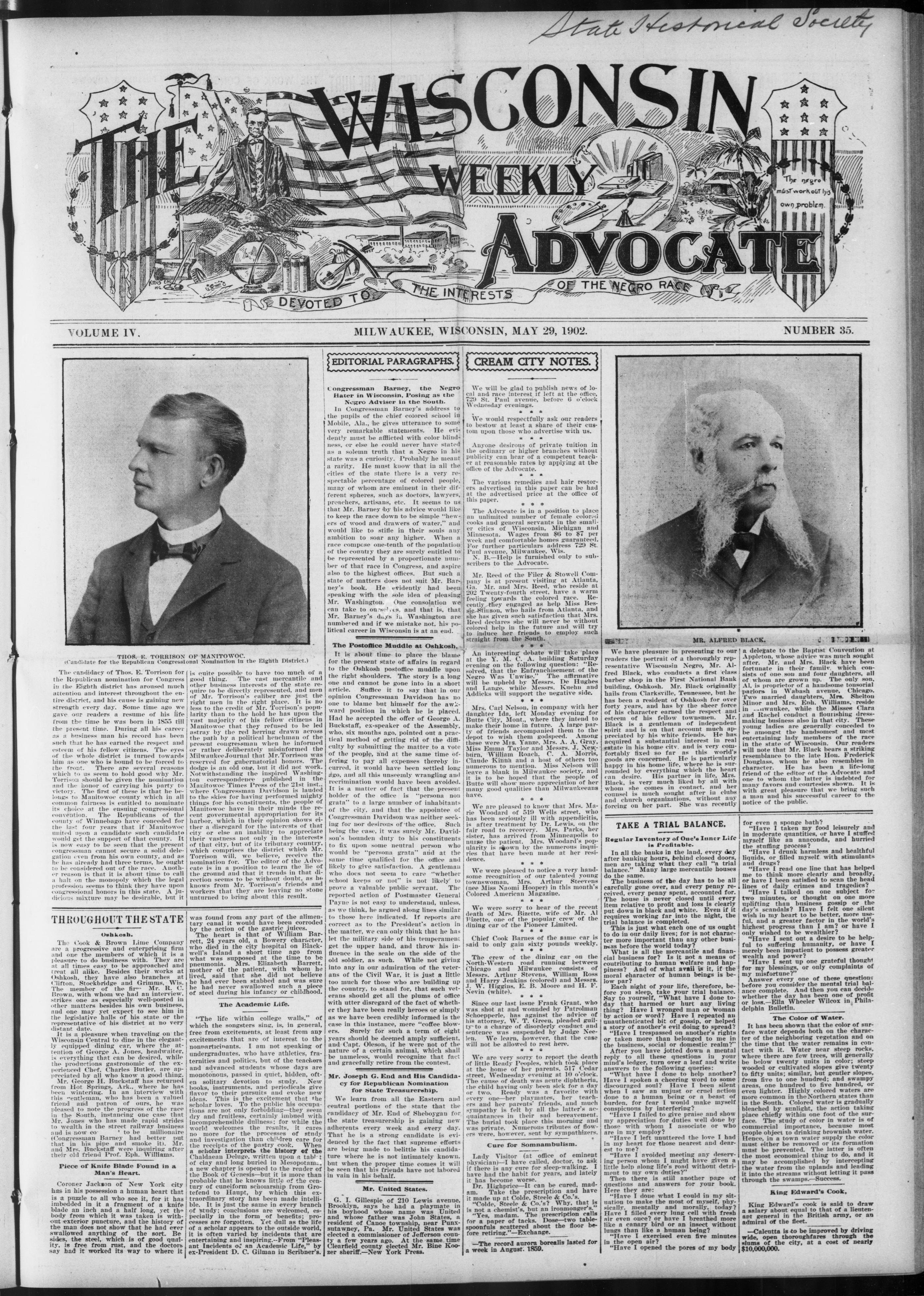
THOS. E. TORRISON OF MANITOWOC. (Candidate for the Republican Congressional Nomination in the Eighth District.)
VOLUME IV.
THOS. E. TORRISON
(Candidate for the Republican Congress)
The candidacy of Thos. E. Torrison for the Republican nomination for Congress in the Eighth district has aroused much attention and interest throughout the entire district, and his cause is gaining new strength every day. Some time ago we gave our readers a resume of his life from the time he was born in 1855 till the present time. During all his career as a business man his record has been such that he has earned the respect and esteem of his fellow citizens. The eyes of the whole district is turned towards him as one who is bound to be forced to the front. There are several reasons which to us seem to hold good why Mr. Torrison should be given the nomination and the honor of carrying his party to victory. The first of these is that he belongs to Manitowoc county which in all common fairness is entitled to nominate its choice at the ensuing congressional convention. The Republicans of the county of Winnebago have conceded for the last four years that if Manitowoc united upon a candidate such candidate would get the support of that county. It is now easy to be seen that the present congressman cannot secure a solid delegation even from his own county, and as he has already had three terms, he ought to be considered out of the race. Another reason is that it is about time to call a halt on the monopoly which the legal profession seems to think they have upon congressional honors in this state. A judicious mixture may be desirable, but it
THROUGHOUT THE STATE
THROUGHOUT THE STATE
Oshkosh.
The Cook & Brown Lime Company are a progressive and enterprising firm and one the members of which it is a pleasure to do business with. They are at all times easy to be approached and treat all alike. Besides their works at Oshkosh, they have also branches at Clifton, Stockbridge and Grimm, Wis. The member of the firm Mr. R. C. Brown, with whom we had an interview, strikes one as especially well-posted in other matters besides his own business, and one may yet expect to see him in the legislative halls of his state or the representative of his district at no very distant date.
It is a pleasure when traveling on the Wisconsin Central to dine in the elegantly equipped dining car, where the attention of George A. Jones, headwaiter, is everything that can be desired, while the productions gastronomic of the experienced Chef, Charles Butler, are appreciated by all who know a good thing. Mr. George H. Buckstaff has returned from Hot Springs, Ark., where he has been wintering. In an interview with this gentleman, who has been a valued friend and patron of ours, he was pleased to note the progress of the race in the South, instancing one case that Mr. Jones has made rapid strides to wealth in the street railway business and is now co to be millionaire (Congressman Barney had better put that in his pipe and smoke it). Mr. and Mrs. Buckstaff were inquiring after their old friend Prof. Eph. Williams.
Piece of Knife Blade Found in a Man's Heart.
Coroner Jackson of New York city has in his possession a human heart that is a puzzle to all who see it, for it has imbedded in it a fragment of a knife blade an inch and a half long, yet the body from which it was taken is without exterior puncture, and the history of the man does not show that he had ever swallowed anything of the sort. Besides, the steel, which is of good quality, is free from rust, and the doctors say had it worked its way to where it
is quite possible to have too much of a good thing. The vast mercantile and other business interests of the state require to be directly represented, and men of Mr. Torrison's caliber are just the right men in the right place. It is no less to the credit of Mr. Torrison's popularity than to the hold he has upon the vast majority of his fellow citizens in Manitowoc that they refused to be led astray by the red herring drawn across the path by a political henchman of the present congressman when he informed or rather deliberately misinformed the Milwaukee Journal that Mr. Torrison was reserved for gubernatorial honors. The dodge is an old one, but it did not work. Notwithstanding the inspired Washington correspondence published in the Manitowoc Times Press of the 21st inst., where Congressman Davidson is lauded to the skies for having performed mighty things for his constituents, the people of Manitowoc have in their minds the recent governmental appropriation for its harbor, which in their opinion shows either a disregard for the interests of that city or else an inability to appreciate their vastness not only in the interests of that city, but of its tributary country, which comprises the district which Mr. Torrison will, we believe, receive the nomination for. The editor of the Advocate is in a position to learn the lie of the ground and that it trends in that direction seems to be without doubt, as he knows from Mr. Torrison's friends and workers that they are leaving no stone unturned to bring about this result.
was found from any part of the alimentary canal it would have been corroded by the action of the gastric juices. The heart is that of William Barrett, 24 years old, a Bowyery character, who died in the city hospital on Blackwell's Island a short time ago from what was supposed at the time to be pneumonia. Mrs. Elizabeth Barrett, mother of the patient, with whom he lived, said that she did not believe he had ever been stabbed and was sure he had never swallowed such a piece of steel during his infancy or childhood.
The Academic Life.
"The life within college walls," of which the songsters sing, is, in general, free from excitement, at least from any excitements that are of interest to the nonparticipants. I am not speaking of undergraduates, who have athletics, fraternities and politics, but of the teachers and advanced students whose days are monotonous, passed in quiet, hidden, often solitary devotion to study. New books, instruments, and periodicals give flavor to their pursuits and evoke new ideas. This is the excitement that the scholar loves. To the public his occupations are not only forbidding—they seem dry and fruitless, certainly imbued with incomprehensible dullness; for while the world welcomes the results, it cares no more for the processes of study and investigation than children care for the receipts of the pastry cook. When a scholar interprets the history of the Chaldaean Deluge, written upon a tablet of clay and long buried in Mesopotamia, a new chapter is opened to the reader of the Book of Genesis—but it is more than probable that he knows little of the century of cuneiform scholarship from Grotefend to Haupt, by which this extraordinary story has been made intelligible. It is just the same in every branch of study; conclusions are welcomed, especially in the form of benefits; processes are forgotten. Yet dull as the life of a scholar appears to the outside world, it is often varied by incidents that are entertaining and inspiring.--From "Pleasant Incidents of an Academic Life," by ex-President D. C. Gilman in Scribner's.
EDITORIAL PARAGRAPHS.
---
Congressman Barney, the Negro Hater in Wisconsin, Posing as the Negro Adviser in the South.
Negro Adviser in the South.
In Congressman Barney's address to the pupils of the chief colored school in Mobile, Ala., he gives utterance to some very remarkable statements. He evidently must be afflicted with color blindness, or else he could never have stated as a solemn truth that a Negro in his state was a curiosity. Probably he meant a rarity. He must know that in all the cities of the state there is a very respectable percentage of colored people, many of whom are eminent in their different spheres, such as doctors, lawyers, preachers, artisans, etc. It seems to us that Mr. Barney by his advice would like to keep the race down to be simple "hewers of wood and drawers of water," and would like to stifle in their souls any ambition to soar any higher. When a race compose one-tenth of the population of the country they are surely entitled to be represented by a proportionate number of that race in Congress, and aspire also to the highest offices. But such a state of matters does not suit Mr. Barney's book. He evidently had been speaking with the sole idea of pleasing Mr. Washington. One consolation we can take to ourselves, and that is, that Mr. Barney's days in Washington are numbered and if we mistake not, his political career in Wisconsin is at an end.
The Postoffice Muddle at Oshkosh.
The Postoffice Muddle at Oshkosh.
It is about time to place the blame for the present state of affairs in regard to the Oshkosh postoffice muddle upon the right shoulders. The story is a long one and cannot be gone into in a short article. Suffice it to say that in our opinion Congressman Davidson has no one to blame but himself for the awkward position in which he is placed. Had he accepted the offer of George A. Buckstaff, ex-speaker of the Assembly, who, six months ago, pointed out a practical method of getting rid of the difficulty by submitting the matter to a vote of the people, and at the same time offering to pay all expenses thereby incurred, it would have been settled long ago, and all this unseemly wrangling and recrimination would have been avoided. It is a matter of fact that the present holder of the office is "persona non grata" to a large number of inhabitants of the city, and that the appointee of Congressman Davidson was neither seeking for nor desirous of the office. Such being the case, it was surely Mr. Davidson's bounden duty to his constituents to fix upon some neutral person who would be "persona grata" and at the same time qualified for the office and likely to give satisfaction. A gentleman who does not seem to care "whether school keeps or not" is not likely to prove a valuable public servant. The reported action of Postmaster General Payne is not easy to understand, unless, as we think, he argued along lines similar to those here indicated. If reports are correct as to the President's action in the matter, we can only think that he has let the military side of his temperament get the upper hand, and throw his influence in the scale on the side of the old soldier, as such. While not giving into any in our admiration of the veterans of the Civil War, it is just a little too much for those who are building up the country, to stand for, that such veterans should get all the plums of office with utter disregard of the fact of whether they have been really heroes or simply as we have been credibly informed is the case in this instance, mere "coffee blowers. Surely for such a term of eight years should be deemed amply sufficient, and Capt. Oleson, if he were not of the nature of a certain animal, which shall be nanneless, would recognize that fact and gracefully retire from the contest.
Mr. Joseph G. End and His Candidacy for Republican Nomination for State Treasurership
We learn from all the Eastern and central portions of the state that the candidacy of Mr. End of Sheboygan for the state treasurership is gaining new adherents every week and every day. That he is a strong candidate is evidenced by the fact that supreme efforts are being made to belittle his candidature where he is not intimately known, but when the proper time comes it will be seen that his friends have not labored in vain in his behalf.
Mr. United States.
G. I. Gillespie of 210 Lewis avenue, Brooklyn, says he had a playmate in his boyhood whose name was United and whose father was John States, a resident of Canoe township, near Punx-sutawney, Pa. Mr. United States was elected a commissioner of Jefferson county a few years ago. At the same time Clearfield county elected Mr. Bine Koozer sheriff—New York Press.
CREAM CITY NOTES.
---
We will be glad to publish news of local and race interest if left at the office, 729 St. Paul avenue, before 6 o'clock Wednesday evenings.
We would respectfully ask our readers to bestow at least a share of their custom upon those who advertise with us.
Anyone desirous of private tuition in the ordinary or higher branches without publicity can hear of a competent teacher at reasonable rates by applying at the office of the Advocate.
The various remedies and hair restorers advertised in this paper can be had at the advertised price at the office of this paper.
The Advocate is in a position to place an unlimited number of female colored cooks and general servants in the smaller cities of Wisconsin, Michigan and Minnesota. Wages from $6 to $7 per week and comfortable homes guaranteed. For further particulars address 729 St. Paul avenue, Milwaukee, Wis. N. B.—Help is furnished only to subscribers to the Advocate.
Mr. Reed of the Filer & Stowell Company is at present visiting at Atlanta, Ga. Mr. and Mrs. Reed, who reside at 202 Twenty-fourth street, have a warm feeling towards the colored race. Recently they engaged as help Miss Bessie Stinson, who hails from Atlanta, and she has given such satisfaction that Mrs. Reed declares she will never be without colored help in the future and will try to induce her friends to employ such straight from the South.
* * *
An interesting debate will take place at the Y. M. C. A. building Saturday evening on the following question: "Resolved, that the Enfranchisement of the Negro Was Unwise." The affirmative will be upheld by Messrs. De Hughes and Lange, while Messrs. Kuehn and Addicks will support the negative side.
* * *
Mrs. Carl Nelson, in company with her daughter Ida, left Monday evening for Butte City, Mont., where they intend to make their home in future. A large party of friends accompanied them to the depot to wish them godspeed. Among these were Mrs. Yanze, Mrs. A. A. Gray, Miss Emma Taylor and Messrs. J. Newburn, William Roach, C. A. Morris, Claude Kinna and a host of others too numerous to mention. Miss Nelson will leave a blank in Milwaukee society, and it is to be hoped that the people of Butte will show more appreciation of her many good qualities than Milwaukeeans have.
* * *
We are pleased to know that Mrs. Marie Woodard of 519 Wells street, who has been seriously ill with appendicitis, is after treatment by Dr. Lewis, on the fair road to recovery. Mrs. Parks, her sister, has arrived from Minneapolis to nurse the patient. Mrs. Woodard's popularity is shown by the numerous inquiries that have been made at her residence.
幸 必 幸
We were pleased to notice a very handsome recognition of our talented young townswoman, Mrs. Arthur Steevens (nee Miss Naomi Hooper) in this month's Colored American Magazine.
```markdown
```
We were sorry to hear of the recent death of Mrs. Bizette, wife of Mr. Al Fizette, one of the popular crew of the dining car of the Pioneer Limited.
* * *
Chief Cook Barnes of the same car is said to only gain sixty pounds weekly. * * * *
The crew of the dining car on the North-Western road running between Chicago and Milwaukee consists of Messrs. Arthur Stevens, William Ross and Harry Jenkins (colored) and Messrs. J. W. Higgins, E. B. Moore and H. F. Nevin (white).
☆ ☆ ☆
Since our last issue Frank Grant, who was shot at and wounded by Patrolman Schoepperle, has against the advice of his attorney, W. T. Green, pleaded guilty to a charge of disorderly conduct and sentence was suspended by Judge Neelen. We learn, however, that the case will not be allowed to rest here.
您 您
We are very sorry to report the death of little Ready Peoples, which took place at the home of her parents, 517 Cedar street, Wednesday evening at 10 o'clock. The cause of death was acute diphtheria, the child having only been sick for a day or two. Ready was a favorite with every one—her playmates, her teachers and her parents' friends, and much sympathy is felt by all the latter's acquaintances in their sad bereavement. The burial took place this morning and was private. Numerous tributes of flowers were, however, sent by sympathizers.
Cure for Somnambulism.
Lady Visitor (at office of eminent physician)—I have called, doctor, to ask if there is any cure for sleep-walking. I have had the habit for years, and lately it has become worse.
Dr. Highprice—It can be cured, madam. Take the prescription and have it made up at Colde, Steele & Co.'s.
"Colde, Steele & Co.'s? Why, that is is not a chemist's, but an ironmonger's."
"Yes, madam. The prescription calls for a paper of tacks. Dose—two table-spoonfuls scattered about the floor before retiring."—Exchange.
—The record aurora borealis lasted for a week in August. 1859.
[Portrait of a man with a long white beard and a dark suit, looking slightly to the right. The background is a plain, light color.]]
We have pleasure in presenting to our readers the portrait of a thoroughly representative Wisconsin Negro, Mr. Alfred Black, who conducts a first class barber shop in the First National Bank building, Oshkosh. Mr. Black originally hails from Clarksville, Tennessee, but he has been a resident of Oshkosh for over forty years, and has by the sheer force of his character earned the respect and esteem of his fellow townsmen. Mr. Black is a gentleman of independent spirit and is on that account much appreciated by his white friends. He has acquired a substantial interest in real estate in his home city, and is very comfortably fixed so far as this world's goods are concerned. He is particularly happy in his home life, where he is surrounded by everything which the heart can desire. His partner in life, Mrs. Black, is very much liked by all with whom she comes in contact, and her counsel is much sought after in clubs and church organizations, without any forcing on her part. She was recently
TAKE A TRIAL BALANCE.
Regular Inventory of One's Inner Life is Profitable. In all the banks in the land, every day after banking hours, behind closed doors, men are taking what they call "a trial balance." Many large mercantile houses do the same.
The business of the day has to be all carefully gone over, and every penny received, every penny spent, accounted for. The house is never closed until every item relative to profit and loss is clearly put down in black and white. Even if it requires working far into the night, the trial balance is completed.
This is just what each one of us ought to do in our daily lives; for is not character more important than any other business before the world today?
What is all the mercantile and financial business for? Is it not a means of contributing to human welfare and happiness? And of what avail is it, if the moral character of human beings is below par?
Each night of your life, therefore, before you sleep, take your trial balance. Say to yourself, "What have I done today that harmed or hurt any living thing? Have I wronged man or woman by action or word? Have I repeated an unauthenticated bit of gossip, or helped a story of another's evil doing to spread?
"Have I trespassed on another's rights or taken more than belonged to me in the business, social or domestic realm?"
After you have jotted down a mental reply to all these questions in your mind's ledger, turn over a leaf and write answers to the following queries:
"What have I done to help another? Have I spoken a cheering word to some discouraged soul? Have I been silent when I saw an unjust or cruel action done to a human being or a beast of burden, for fear I would make myself conspicuous by interfering?
"Have I failed to give praise and show my appreciation for duties well done by those with whom I associate or who are in my employ?
"Have I left unuttered the love I had in my heart for those nearest and dearest to me?
"Have I avoided meeting any deserving person whom I might have given a little help along life's road without detriment to my own duties?"
Then there is still another page of questions and answers for your book. Here they are:
"Have I done what I could in my situation to make the most of myself, physically, mentally and morally, today?
Have I filled every lung cell with fresh air even once? or have I breathed more like a canary bird or an insect without lungs than like a human being?
"Have I exercised even five minutes in the open air?
"Have I opened the pores of my body
NUMBER 35.
BLACK.
a delegate to the Baptist Convention at Appleton, whose advice was much sought after. Mr. and Mrs. Black have been fortunate in their family, which consists of one son and four daughters, all of whom are grown up. The only son, Al, is proprietor of a handsome tonsorial parlors in Wabash avenue, Chicago. Two married daughters, Mrs. Shelton Minor and Mrs. Eph. Williams, reside in Waukee, while the Misses Clara and Rachel conduct a flourishing dressmaking business also in that city. These young ladies are generally conceded to be amongst the handsomest and most entertaining lady members of the race in the state of Wisconsin. Our readers will note that Mr. Black bears a striking resemblance to the late Hon. Frederick Douglass, whom he also resembles in character. He has been a life-long friend of the editor of the Advocate and one to whom the latter is indebted for many favors and courtesies shown. It is with great pleasure that we bring such a man and his successful career to the notice of the public.
for even a sponge bath?
for even a sponge bath:
"Have I taken my food leisurely and in moderate quantities, or have I stuffed myself like an anaconda, and hurried the stuffing process?
"Have I drunk harmless and healthful liquids, or filled myself with stimulants and drugs?
"Have I read one line that has helped me to think more clearly and broadly, or have I been satisfied to scan the head lines of daily crimes and tragedies?
"Have I talked on one subject for two minutes, or thought on one more uplifting than business gossip or the day's scandals? Have I felt one silent wish in my heart to be better, more useful, and a greater factor in the world's highest progress than I am? or have I only wished to be wealthier?
"Have I sent out a desire to be helpful to suffering humanity, or have I merely been impatient to possess greater wealth and power?
"Have I sent up one grateful thought for my blessings, or only complaints of my misfortune?"
Answer every one of these questions before you consider the mental trial balance complete. And then you can decide whether the day has been one of profit or loss.—Ella Wheeler Wilcox in Philadelphia Bulletin.
The Color of Water.
It has been shown that the color of surface water depends both on the character of the neighboring vegetation and on the time that the water remains in contact with it. Water near steep rocks, where there are few trees, will generally be below twenty units in color; steep wooded or cultivated slopes give twenty to fifty units; similar, but gentler slopes, from five to one hundred; and swampy areas, one hundred to five hundred, or even lighter. Highly colored waters are more common in the Northern states than in the South. Colored water is gradually bleached by sunlight, the action taking place chiefly within one foot of the surface. The study of color in water is of commercial importance, because most people object to drinking brownish water. Hence, in a town water supply the color must either be removed or its formation must be prevented. The latter is often the most economical thing to do, and it may be accomplished by intercepting the water from the uplands and leading it into the streams without letting it pass through the swamps.—Success.
King Edward's Cook,
King Edward's cook is said to draw a salary about equal to that of a lieutenant general in the British army, or an admiral of the fleet.
—Calcutta is to be improved by driving wide, open thoroughfares through the slums of the city, at a cost of nearly $10,000,000.
TWO MEN BRAVE DEATH.
Correspondents Make a Perilous Journey to Morne Rouge.
Party Narrowly Escapes the Fury of the Eruption—Noted Explorers are Missing.
Fort de France, Martinique, May 28. —Mont Pelee, from which there was another violent eruption on Monday, was quiet again Tuesday night, but the inhabitants of the island are in a terrified state. The volcano is puzzling all the scientists, some of whom say the mountain has thus far made only a beginning. Morne Rouge was saved from destruction last night only by a miracle, says a priest who was there.
Priest Saves Lives.
Two correspondents, believing the volcano had for a time at least subsided, planned an expedition to the mountain for the purpose of securing photographs. Several natives were employed as guides. After a wearying march which took most of Monday, Morne Rouge was reached about 7:30 o'clock in the evening. The correspondents were welcomed by a kindly disposed priest who gave such information as was in his possession. He insisted upon a pause being made for refreshments and in his humble home food was prepared. It was this generous courtesy of the priest that saved the expedition from destruction. The original plan was that the visit should be made to the crater as soon as possible and a quick return be made to Fort de France to avoid all danger.
Refused to Desert Post.
While the evening meal was being prepared the priest pointed out the work of ruin that had been accomplished. He said he had refused to leave his post, though he was not at all certain Morne Rouge would not be swept from existence as was St. Pierre. It was while he was talking that the explosion came. From their homes the inhabitants of the village ran in a panic. Some did not wait to see what was happening, but hurried over the mountains in the direction of Fort de France. Scores went into the church and fell upon their knees, but by far the greater number ran without daring to look behind. The display of lightning was terrific and awe-inspiring.
When the start was made on the return trip to Fort de France the guides and servants were gone. The correspondents had to find their way across the hills as best they could. Behind, Mont Pelee continued to belch fire, ashes, smoke and mud. The detonations were of sufficient strength to make the ground tremble. It seemed to the weary travelers as if the mountain tops swayed above their heads.
Encounter Deadly Snakes.
To add to the horror of the situation they encountered every now and then afer de lance, deadliest of all snakes. Scattered specimens of these serpents, of which thousands have been killed by the eruptions, were seen amid the glare from the volcano and the flashes of lightning gliding over the rocks and hurrying away, as if they, too, had learned that their mountain home was no longer a safe place.
On all sides were natives praying and cursing in turn. Many, exhausted, fell by the way and were unable to continue.
From Morne Rouge to Fort de France, by the devious path that was traveled, was almost forty miles. That distance was covered before dawn Tuesday morning.
Later arrivals reported that Morne Rouge had not been destroyed, as the force of the explosion was exerted in the direction of the sea.
American Explorers Lost
Robert T. Hill of the United States geological survey, who left here for Mont Pelee Monday afternoon, has not yet returned, nor has he been heard from. He planned to try the crater from Morne Rouge. George Kennan, the noted explorer, has been absent in the north five days and has not been heard from.
FORT DE FRANCE UNHARMED.
Cinders and Scoria from Volcano De Not Touch City.
Paris, May 28.—The governor of Martinique, M. L'Huerre, cabled from Fort de France under date of today, May 28, confirming the Associated Press dispatches announcing that a fresh eruption of Mont Pelee occurred during the evening of Monday, May 26, causing a great panic at Fort de France. The cinders and scoria, however, the governor added, did not touch the town, falling entirely on the north of the island. Calm is now restored at Fort de France. The governor abandoned his proposed visit to the devastated places on the island, owing to the torrential rainfall and rough sea. Several craters, the governor further reported, were vomiting thick smoke.
Another eruption of Mont Pelee occurred as the French cruiser Tage passed St. Pierre recently, resulting in a sudden flow of mud from the bed of the river Blanche.
The governor concludes that his latest visit to St. Pierre confirms the previous reports that the southern portion of that town was apparently destroyed by an inexplicable phenomenon, resembling a frightful hurricane which swept from north to south. The fall of scoria formed a layer a foot deep. The northern part of the town is buried under a bed of mud. It is impossible to adequately describe the desolation at St. Pierre.
TRAIN IN DITCH.
The Great Northern's Coast Flyer is Wrecked Just West of Grand Forks, S. D.
St. Paul, Minn., May 28.—[Special.]—The westbound Great Northern coast flyer was wrecked this morning just west of Grand Forks, N. D. The entire train was smashed and lies in the ditch. Several injured, but none killed outright.
The escapes seem miraculous. One man was thrown bodily through the car door, and is unhurt save for a few bruises. Two men were pitched through windows and had their clothing torn to shreds, but have only a few slight cuts on their persons. The fact that more persons were not hurt is explained by the fact that the engine kept the track and got out of the way, while the coupling between the cars broke. Each coach swung around failed to telescope. The mail car was thrown fifty feet clear of the track.
Des Moines, Ia., May 28.-The east-bound Rocky Mountain limited, the Rock Island's fastest train, due here at 9 o'clock this morning, was wrecked near Avoca, while running' at a high rate of speed. It is estimated to have been traveling between seventy and eighty miles an hour when the tender left the track and tore up the ties for a distance of nearly a mile before the speed could be reduced. No passengers were seriously injured.
A FATAL CLASS WAR.
Battle Between Freshmen and Sophomores at Vermont University Ends in Death.
Plattsburg, N. Y., May 27.—The class war at the University of Vermont in Burlington reached a climax when Nelson Pease Bond of Burlington, a member of class '05, met death here last evening by drowning while attempting to escape from Harry Percival and George Ross, members of the sophomore class of the same college.
The freshmen had arranged to have their annual banquet at the Cumberland House, and Bond, with four others of the freshmen, came over on the morning boat from Burlington to make final arrangements.
Bond left his companions at 5 o'clock in the afternoon for a stroll, and, it is alleged, was set upon by two sophomores who had followed him, presumably for the purpose of kidnapping him and keeping him from the banquet. He fled before his pursuers until he reached Wilcox's dock, an out-of-the-way place on the north lake front. The pursuers claim he jumped into the lake in an effort to escape by swimming. They endeavored to rescue him by a boat, but could find no oars.
After swimming about fifty feet Bond threw up his arms and without a word sank in about eight feet of water. Bond was 19 years of age and one of the most popular of his class. He was a powerful swimmer, and probably was carried down by the weight of his clothes. The sophomores who were his captors may be held for manslaughter by Coroner McMasters, who is investigating the case.
Eight others of the class of '05 were captured by the sophomores and held in a box car until a late hour without knowing the fate of their classmate.
FIST FIGHT ENDS METHODIST MEETING
Son of Bishop Attacks Editor for Supposed Insult to His Mother
Dallas, Tex., May 27.—A physical encounter was an almost instantaneous sequel to the adjournment of the general conference of the Methodist Episcopal Church South. The last words of the benediction had scarcely been pronounced when Lessler Hoss of Nashville, Tenn., made a violent assault on Rev. James Cannon, Jr., of Blackstone, Va. Mr. Hoss struck Dr. Cannon several blows in the face with his fist. Dr. Cannon defended himself as best he could, which was not well, as the attack was unexpected. Mr. Hoss is a son of E. E. Hoss, the newly ordained bishop. Dr. Cannon is editor of the Southern Methodist Record of Blackstone
Young Hoss claims to have been prompted to the attack because of the uncomplimentary criticism in the Record of his mother in connection with the new Order of Deaconesses.
NEGRO HUNG FOR TRIPLE MURDER.
Killed Woman and Two Children Because He was Accused
Philadelphia, Pa., May 27.—William Harmon Lane, colored, was hanged at 10:08 o'clock this morning.
The crime for which Lane today paid the death penalty was particularly atrocious. On the morning of April 1 he shot and killed Ella Jarden, by whom he was employed as a servant, and her two daughters, Madeline, aged 12, and Eloise, aged 7 years. Lane had stolen money from his employer, and, fearing the consequences of his theft, he deliberately shot the woman and her younger daughter in an upper room of their home, and then called the elder child from the street where she had been playing and shot and killed her.
GREAT PAINTER AND AUTHOR DIE.
Benjamin Constant, Noted French Artist, and Henri Greville
Paris, May 27.—Jean Joseph Benjamin Constant, the painter, is dead. He was born in Paris in 1845. Henri Greville (Alice Marie Celeste Durando, the French authoress, is dead.
SAVES HER SON FROM ROPE.
Mother Beaceches Mob of Lynchcera and Her Boy is Taken to Jail.
Marion, Ind., May 27.—The prayers of a mother saved from the vengeance of a mob her son, Willie Francis, colored, who had a rope around his neck with one end thrown over a tree. Francis returned home yesterday and found two white men talking to his sister. He ordered them to leave, but they objected. He then procured a revolver and fired two shots at them, causing them to retreat. Richard Criswell, a white man, who lived near, hastened to the scene of the shooting and was shot through the hand by Francis. Sarah Francis, mother of the young negro, attempted to take the revolver from him and was shot in the left thigh during the struggle. A mob was formed to lynch him. The mother, suffering and bleeding from the wound inflicted by her son, came to his rescue and by her prayers induced the mob not to hang him. Francis was taken to jail and when arraigned in court pleaded guilty to the charge of attempt to murder. He was taken to prison to prevent further trouble.
JEALOUS YOUTH SHOOTS THREE
His Sweetheart Dead, Rival and Himself Dying.
Kansas City, Mo., May 27.—Frank Robinson, aged 20 years, shot and killed his sweetheart, Gertie Rawling, aged 16 years, shot and fatally wounded his rival, Albert H. Ferguson, aged 19 years, and shot and fatally injured himself in an apartment house in this city.
Free Doctors Under German Law.
Under an insurance law enacted in Germany several years ago 30,000,000 people receive in return for a nominal sum free medical attendance. The theory was that suffering humanity would receive cheap and effective relief from its bodily ills, but in practice there are many drawbacks. The doctors hired by the state hold that they are expected to do too much for the pay they get. In Munich they get only about $78 per annum. In order to keep down expenses the doctors are inclined to impress upon the patients that nothing is the trouble with them.
Babylonian Clay Slabs.
Of the 400 inscribed clay slabs found in the ruins of Babylon by the expedition sent out by the German Oriental Society but two have yet been deciphered—one explaining the Babylonian cuniform characters and the other containing the litany chanted by the singers of the Temple of Esagila on the return of the god Marduk to his sanctuary.
—John Owen, an alleged "masher," was fined $100 by Justice Kersten in the Chicago avenue police court. He was arrested in Lincoln park.
—W. H. Willis, a barber, was poisoned by strychnine believed to have been placed in his coffee. His wife has been arrested on suspicion. He is at the county hospital and may die.
—The police pension fund is to get 75 per cent. of dog license receipts. The police will hunt unlicensed dogs and increase last year's receipts of $85,000. Number of dogs placed at 200,000.
—Mrs. Kate Mills Boyd, a social reformer, who attracted considerable attention last year by a crusade to enforce the early-closing law against saloons, has begun suit for divorce from William L. Boyd, alleging desertion.
The strike of the teamsters menaces the city with a meat famine. All supplies from the stockyards are stopped, and attempts to smuggle out beef have proved failures. Butchers threaten to close their shops to aid the strikers, and if the trouble be not settled in a few days hotels and restaurants will find their ice boxes empty. A decree was entered in Judge Tuley's court granting Mrs. Abbey Perkins Cheney a decree of divorce from her husband, John Vance Cheney, librarian at the Newberry library. The decree is drawn up in the usual way and sets forth that the court has found that John Vance Cheney is guilty of desertion, as charged in the bill.
—Fred Littleton, alias Johnson, convicted counterfeiter, en route to the federal prison in Milwaukee, escaped from United States Deputy Marshal Cass while the latter was purchasing tickets in the Union depot. Littleton was hand-cuffed to two other prisoners, and it was while Cass' back was turned that he slipped his hand from the iron band and ran from the depot.
—Crazed by burning oil which had fallen on her dress from a gasoline stove on which she was preparing supper last night. Miss Josephine Pixka ran into her bedroom and seized $200 in bills which lay secreted between the mattresses. Her screams attracted John Novak, who extinguished the flames, only after she had been fatally burned. The bills, which represented the savings of herself and brother for several years, were burned. The girl died two hours later.
LATEST MARKET REPORTS.
Milwaukee, May 28, 1902.
EGG AND DAIRY PRODUCTS.
MILWAUKEE—Eggs—Market firm; fresh,
loss off, cases included, 14½c; fresh, cases
returned, 14c; seconds, 9@10c. Receipts
were 417 cases. The demand is good.
Butter—Market firm; fancy prints, 22½c;
fancy or extra creamy, per lb, 22c;
firsts, 20c; seconds, 17@18c; dairy prints,
18½@19c; extra fancy dairy, 18c; lines, 15@
16c; roll, 15@16c; packing stock, 14@15c;
whey, 9c; grease, 4@5c. The receipts today
were 45,248 lbs against 8045 lbs yesterday.
The receipts of creamy are quite heavy
and accumulating. Dairy is also coming in
and sells readily. Merchants now
look for a continued firm market, owing to
the fact that large amounts are going into
storage, being of extra fine quality.
Cheese—Steady. Receipts were 15,125 lbs today against 3300 lbs yesterday. Full cream flats, fancy, 13@13½c; good to choice, 11½@12½c; Young Americas, 12½@13c; daisies, 12½@12½c; fancy brick, 14c; low grades, 11@12c; limburger, per lb, No. 1, 14c; low grades, 10@12c; imported Swiss, 25c; Block Swiss, domestic, 15@16c; fancy loaf, 15½@16c; No. 2, 13@14c; Sapsago, 20c; farmers, 10@11c.
CHICAGO—Butter-Firm; creameries, 18@22c; dairies, 17@19c. Cheese—Weak; twins, 10@10½c; daisies, 11c; Young Americas, 11c. Eggs—Firm; at mark, cases included, 15@15½c. Live poultry—Firm; turkeys, 10@12½c; chickens, 12c.
MILWAUKEE LIVE STOCK MARKET.
HOGS—Receipts, 27 cars; market steady, light, 6.60@1.80; mixed and medium weights, 6.75@7.00; common to good packers, 6.60@6.90; selected heavy, 7.05@7.10. Pigs, 90 to 120 lbs, 5.50@6.25.
CATTLE — Receipts, 3 cars; lower; butchers' steers, medium to good, 1050 to 1300 lbs, 5.75@6.50; fair to medium, 950 to 1050 lbs, 5.00@5.50; heels common, 3.00@4.00; good, 4.50@5.50; cows, fair to good, 3.25@4.50; canners, 2.00@2.75; bulls, common, 2.75@3.40; choice, 3.75@5.00; feeders, 800 to 950 lbs, 3.75@4.50; stockers, 500 to 750 lbs, 3.25@3.75; veal calves, llight, 5.25@5.75; choice, 6.00@6.50. Milkers—Don't ship any but choice heavy cows, which sell for 35.00@45.00.
SHEEP—Receipts, 3 cars; steady; shorn, 3.00@4.50; bucks, 3.00@3.50; lambs, 4.50@5.00; spring lambs, 5.50@7.00.
MARKETS BY TELEGRAPH
MILWAUKEE—Flour—Steady. Wheat —Easier; No. 1 Northern, on track, 77½c; No. 2 Northern, on track, 77c. Corn—Firm; No. 3 on track, 64c. Oats—Steady; No. 2 white, on track, 45½c; No. 3 white, on track, 44½@45½c. Barley—Easy; No. 2 on track, 72c; sample on track, 63@72½c. Rye—Steady; No. 1 on track, 59½c. Provisions—Steady; pork, 17.10; lard, 10.17. Flour markets steady; patients, 3.90@4.00; bakers', 2.90@3.00; rye, 3.05@3.15. Millstuffs are steady and quoted at 16.00 for bran, 17.00 for standard middlings and 19.00@19.25 for Milwaukee flour middlings in 100-lb sacks; red dog, 21.00.
CHICAGO—Close — Wheat — May, 73½¢@
74½¢; July, 72½¢@72½¢; September, 71½¢@
71½¢; Corn—May, 62½¢; July, 62½¢@63¢;
September, 60½¢@60½¢; December, 45½¢; May
(1903), 49¢; Oats—May, 44¢; July, 35½¢@35½¢;
new, 37½¢@37½¢; September, 28½¢; new
30½¢; December, 29¢; new 31¢. Pork—May,
17.05; July, 17.07½¢; September, 17.17½¢;
17.20; January, 16.37½¢; Lard—May, 10.12½¢;
September, 10.17½¢@10.20; July, 10.15¢
10.17½¢; October, 10.12½¢; January, 9.50;
Ribs—May, 9.70; July, 9.62½¢; September,
9.65. Flax—Cash N. W., 1.77; S. W., 1.59;
September, 1.48; October, 1.44. Rye—May,
57½¢; July, 57½¢; September, 55c. Barley—
Cash, 68½72c. Timothy—September, 4.60.
Clover—Cash, 8.35.
TOLEDO—Wheat active, lower; cash, 83c; May, 83c; July, 75%c; September, 74%c; Corn—Active, weak and lower; cash, 64%c; May, 63c; July, 63c; September, 60%c; December, 45%c. Oats—Active, easier; cash, 45c; May, 45c; July, 36c; September, 29%c; new July, 38c; new September, 31%c. Cloverseed—Dull, strong; cash, 5.12%c; October, 5.17%c.
KANSAS CITY—Close — Wheat — May, 70%c; July, 88%c; cash No. 2 hard, 72%c; No. 2 red, 74@74%c; No. 2 spring, 72%c; Corn—May, 64c; July, 60%c; September, 64%@64c; No. 2 cash mixed, 65@65%c; No. 2 white, 60%c; Oats—No. 2 white, 45c.
DULUTH—Close — Wheat — Cash No. 1 hard, 77c; No. 1 Northern, 74c; No. 2 Northern, 72c; No. 3 spring, 70%c; to arrive, No. 1 hard, 77c; No. 1 Northern, 74c; May, 73%c; July, 74c; September, 71%c; Manitoba, No. 1 Northern, cash and May, 73c; No. 2 Northern, 70%c; Oats—Cash, 44%c; September, 29%c; Rye—50%c. Flax—Cash and May, 1.75 to arrive, 1.60; September, 1.48; October, 1.44. Receipts—Wheat, 6331. Shipments, 17.851.
ST. LOUISE—Close — Wheat—Lower; No. 2 red elevator, 78c; May, 77c; July, 70%c; September, 70%@70%c; No. 2 hard, 75%@77c; Corn—Lower; No. 2 cash, 62%c; May, 62%c; July, 62%c; September, 58c. Oats—Lower; No. 2 cash, 41%c; May, 42c; July, 32%c; September, 28@28%c; No. 2 white, 45%c. Lead—Firm, 3.95@3.97½. Spelter—Higher, strong, 4.55.
SOUTH OMAHA—Cattle—Receipels, 2600; market steady to lower; beef steers, 5.50@7.50; Texans, 4.50@5.75; cows and heifers, 3.80@6.25; canners, 1.75@3.25; stockers and feeders, 3.00@5.40. Hogs—Receipels, 11,200; market strong to 5c higher; heavy, 7.05@7.20; mixed, 6.35@7.05; pigs, 5.75@6.50. Sheep—Receipels, 3000; market steady; sheep, 3.25@6.20; lambs, 5.75@7.15.
KANSAS CITY—Cattle—Receipts, 4000; market steady; beef steers, 4.75@7.50; Texans, 3.25@6.75; cows and heifers, 2.00@6.55; stockers and feeders, 3.50@5.55. Hogs—Receipts, 12.00; market steady; heavy, 7.15@7.30; packers, 7.10@7.20; medium, 6.95@7.10; yorkers, 6.95@7.05; pigs, 6.30@6.70. Sheep—Receipts, 4000; market firm; sheep, 4.30@6.20; lambs, 5.40@7.50. ST. LOUIS—Cattle—Receipts, 3500; market steady to easy; beef steers, 4.00@7.50; Texans, 3.50@6.30; stockers and feeders, 3.25@5.60; cows and heifers, 2.25@6.00. Hogs—Receipts, 500; steady; pigs, 6.60@6.85; packers, 6.80@7.00; butchers, 6.90@7.20. Sheep—Receipts, 2000; market slow; sheep, 4.40@5.50; lambs, 5.00@7.00.
Rochambeau Procession was Passing at the Time of the Accident.
New York, May 28.—One man was killed and 100 injured, while watching the Rochambeau parade, by the collapse of a temporary sidewalk at the northwest corner of Fifth avenue and Eighteenth street.
Of the injured four are so badly hurt that it is feared they will die.
Killed:
COOLIDGE, ELVIN L., circulation manager New York Commercial.
The injured:
Essing, George, scalp wound and shock.
Kelly, J. J., detective sergeant; scalp wound and shock.
McManus, M. J., patrolman; three ribs broken and contusions. Werner, Charles; contusions and internal injuries.
Platform Breaks in Middle.
The accident happened while thousands lined Fifth avenue watching the parade in honor of the French mission that was officially welcomed to the city yesterday. With a crash the structure gave way, engulfing all who stood on it, and in an instant the enthusiastic, cheering crowd was panic stricken. In a moment the line of parade was broken. The Twenty-second Regiment was passing at the time, and the soldiers broke ranks and ran to the aid of the police on the scene, who were unable to handle the crowd. The Red Cross corps was called into action, and the work of rescue was begun. The platform broke in the middle, and it was those who stood at this part who were most seriously injured.
The two sides acted as a chute, and those who had stood farthest from the middle were hurled down on those who had fallen directly. At this point the excavation is seventeen feet deep.
Immediate Aid Rendered.
The police hurried in calls for ambulances. Five responded from Bellevue, two from the New York Hospital, and two from St. Vincent's. Down in the excavation men who were not seriously injured fought with wounded victims and women to scramble out, and on every side were blood-covered, bruised men, women and children. Police reserves were called from surrounding stations, and soon restored some sort of order. Within half an hour after the ambulances arrived more than twenty-five, persons had injuries dressed and were able to go home, while a number were sent to the New York and St. Vincent's hospitals.
Warning Given Too Late.
Not more than ten minutes before the sidewalk collapsed Peter Schultz, a Brooklyn contractor, went to the police sergeant in charge of the reserves on the scene and said he felt certain the structure was not safe.
When he had been told this he ordered five policemen to clear the structure of the crowd, and the bluecoats were in the act of doing so when the crash came. More than a hundred persons had been driven off, however.
James Lawton, the foreman in charge of the work on the new building, was arrested by order of Police Capt. Foody of the West Twentieth station, who was on the scene, and was locked up in the West Thirtieth Street station. At the station house he said he had notified the police that the crowd that stood on the temporary sidewalk was too heavy for the structure's strength.
SARGENT SAYS GENERAL STRIKE WILL BE CALLED.
Head of Brotherhood of Locomotive Firemen Claims that All Coal Miners will Go Out. St. Louis, Mo., May 28.—Frank P. Sargent, head of the Brotherhood of Locomotive Firemen, member of the National labor arbitration committee, of which Senator Hanna is chairman, and recently appointed commissioner of immigration, stated today that a general sympathy strike of all the soft coal miners in the United States would probably be ordered
"The anthracite miners," continued Mr. Sargent, "asked very little and were willing to make concessions, but the attitude of the operators from the start was such that I did not hesitate to suggest the strike to John Mitchell, president of the United Mine Workers of America. I do not see at this time any hope of a compromise.
"The coal barons believe they are masters of the situation, while the workingmen are equally confident of their strength and their chances of success."
NEGROES TRY TO LYNCH MURDERER.
Mob Wants to Hang Colored Man Who Killed and Aged
Louisville, Ky., May 28.—Archie James, a negro 65 years old, was murdered by John Black, a young negro, during a quarrel. Black was arrested and while the policeman was waiting for a patrol wagon to arrive a crowd of negroes attempted to get the prisoner in order to lynch him. The police succeeded in dispersing the mob.
WILL PROSECUTE WITNESS O'BRIEN.
He is Charged with Testifying Falsely Before the Senate Philippine Committee.
Washington, D. C., May 28.—Senator Lodge, chairman of the Senate committee on the Philippines, stated today that the witness O'Brien whose testimony before that committee reflected severely upon Capt. McDonald and other army officers, will be prosecuted by the proper officers on the charge of perjury.
BRIDE SHOT AT ALTAR.
Assassin Fires Through Church Window at Close of Wedding Ceremony.
Kokomo, Ind., May 28.—A wedding party was thrown into a panic here last night by an attempt to kill the bride. The couple, Julius Kellermeir of Indianapolis and Miss Bertha Kahl of this place, had just been pronounced husband and wife by the minister when a bullet crashed through the window and struck the bride's head, inflicting a serious wound. The assassin has not been apprehended. It is thought he was a rejected suitor.
THE WORK OF CONGRESS.
THE WORK OF CONGRESS.
Discussion of the immigration bill was resumed in the House on the 22d. Almost the entire day was taken up with the amendment offered by Mr. Underwood (Ala.) requiring an educational test for immigrants to this country. It was finally adopted, as were amendments exempting citizens of Cuba, as in the case of Canada and Mexico, from the payment of the $1.50 tax; including within the tax provision passengers coming to the United States "by any railway or any other mode of transportation from foreign contiguous territory to the United States;" extending the exclusion provision to those allens who have been within one year from the date of the application for admission to the United States deported as being under offers, solicitations, promises or agreements to perform labor or service of some kind therein, and providing that the provisions of law applicable to contract labor shall not be held to exclude professional actors, artists, lecturers, singers, ministers of any religious denomination, professors for colleges or seminaries, persons belonging to any recognized learned profession or persons employed strictly as personal or domestic servants. The bill was then laid aside until next week. The Senate amendments to the omnibus public building bill were disagreed to and the bill went to conference.
The day in the House on the 23d was devoted to private pension bills and to a few other minor measures. Mr. Loud (Cal.) criticised the special pension legislation as a disgrace and drew emphatic responses from Messrs. Sulloway (N. H.), Sulzer (N. Y.) and Miers (Ind.). In all 105 private pension bills were passed. A bill was also passed appropriating $15,000 to establish storm-warning stations at South Manitou islands, Lake Michigan. Adjournment was to the 26th.
The day in the House on the 26th was chiefly devoted to business connected with the District of Columbia, especially the bill amending the district code. Sixty private pension bills were passed, and the conference reports on the agricultural appropriation bill and urgent deficiency bills were agreed to. An agreement was reached that when the House adjourns on the 29th it be until the 2d prox. in order to allow members to participate in the Decoration day exercises.
The House on the 27th passed the Shattuc immigration bill and the bill to amend the District of Columbia code. A special rule was presented to make the bill for coining subsidiary silver a continuing order until disposed of.
The day in the House on the 28th was spent debating the bill to increase the subsidiary coinage by coining the silver bullion in the treasury and to recoin standard silver dollars as the public necessities may require. The limit of subsidiary coinage is now $100,000,000. The bill increases this to an indefinite amount, in the discretion of the secretary of the treasury. The measure aroused the opposition of the Democrats, who claimed it was only a step in the direction of the complete striking down of the silver dollar. The debate drifted into a general discussion of the silver question. Little interest was shown and Mr. Cochran twice made the point that no quorum was present. Mr. Newlands (Ncv.) finally offered an amendment to make subsidiary silver a legal tender. This was pending when the House adjourned.
Proceedings in the Senate.
Senator Hoar pleaded the cause of the Filipino people in the Senate on the 22d. He begged the government to pause in what he called its mad career of imperialism, of conquest, of substitution of the doctrine of force for that of kindness and justice. He appealed to the people of the greatest of republics to return to their earlier ideals. In vivid words he contrasted the policy which the United States has pursued in Cuba with that it has followed in the Philippines. "From one we have just come with honor, from the other we have come with nothing of honor." Six hundred millions of treasure and nearly 10,000 lives—the flower of our youth—have we sacrificed in the Philippines, he declared, and for what? To gain the undying hatred of the Filipino people. The army in the main is just and humane, he said, but the responsibility was not upon the soldiers; it rested upon those who declared and maintained the policy of subjugation. Where a superior race attempts the conquest of an inferior race cruelty, atrocity, degradation of both will inevitably follow. Mr. Teller spoke briefly on the Philippine government bill and discussed at length the action of Congress in establishing a republic in Cuba.
A temperate and carefully prepared speech on the Philippine bill was delivered by Mr. Dubois in the Senate on the 23d. He confined himself almost entirely to a discussion of the commercial and industrial aspects of the question, his purpose being to show that it would be a disadvantage to the people of this country to retain the islands. An earnest and forcible reply was made by Mr. Beveridge, who contended that the development of China's resources would be of advantage in trade and commerce to the United States, as the industrial development of other nations had been. An extra appropriation bill, carrying $180,000 and chiefly for the navy and interior departments, was passed, as was one providing for the appointment of James W. Long on the retired list of the army as a captain of infantry. Considerable debate was had on the attitude of the House in refusing to accept the Senate amendments to the army appropriation bill relating to the construction of barracks and quarters at established military posts, but no action for a conference was had.
Mr. Patterson of Colorado, one of the minority members of the Philippine committee, occupied the floor of the Senate most of the day on the 26th in a discussion of the Philippine question. He quoted from the utterances of his newspaper, the Denver News, to show that it consistently had advocated the independence of the Filipinos since December, 1898. He said the editorials quoted by Mr. Foraker some days ago had been written prior to that time. He discusseed the whole Philippine question, and several lively colloquies occurred during the speech. Mr. Foraker and Mr. Hoar had a brief debate over President McKinley's proclamation to the Filipinos. Mr. Hoar asked Mr. Foraker to read the sentence in President McKinley's proclamation which had been eliminated by Gen. Otis lest it should bring on war. He said Gen. Otis had assumed extraordinary authority to himself to suppress a part of the proclamation, and to substitute a statement that would indicate to the Filipinos that they were to be granted a full measure of liberty. Senator Hoar introduced the following resolution: "That the President be required to inform the Senate whether there be any law or regulation in force in the Philippine Islands which will prevent any native of those islands who may so desire, who is not under arrest and against whom no charges of any offense against the United States is pending, from coming to the United States and stating his views or desires as to the interests of his people to the President or either house of Congress." The conference report on the fortifications appropriation bill was agreed to without debate, and sixty-two private pension bills were passed. The usual executive session preceded adjournment.
A fruitless effort was made in the Senate on the 27th to secure an agreement on a time for a vote on the Philippine bill. The discussion indicated that some day next week eventually would be agreed upon, but no time was fixed. For several hours Mr. Patterson discussed the Philippine question. He urged that the Fillipinos be granted their independence, and drew an eloquent word picture of the turning over to the Filipinos by the United States of the islands when they had established a government. Early in the session a committee was appointed by the Senate to confer with a like committee of the House about the disagreement which has arisen between the two houses as to the army appropriation bill. A resolution offered by Mr. Hoar, requesting the President to inform the Senate whether there be any law which would prevent any Filipino not under arrest from coming to the United States and stating his views or desires as to his country to the President or to either branch of Congress, was adopted.
The Philippine question again monopolized most of the session of the Senate on the 28th. The conference report on the omnibus public building bill was agreed to. A joint resolution was passed providing for the printing of 20,000 copies of the proceedings of the unveiling of the statue of the Count de Rochambeau. A bill was passed providing for the occupancy by the G. A. R. of the new public printing building during the national encampment in October. The usual executive session preceded adjournment.
Christy Matthewson, New York's crack pitcher, has asked for his release from the Giants because of an interview with Manager Fogel, which appears in a Cincinnati paper. Fogel says in his interview that Matthewson is not doing good work.
POISONED ARROWS.
The Sumpitan of Borneo, the Most Deadly of All Savage Weapons.
Most remarkable, and perhaps most deadly of all savage weapons, is the sumpitan of Borneo. It is extraordinary that the Dyaks, barbarous and uncultured as they are, should have anticipated the idea of our rifle and bayonet it is not known how many centuries before the secret of gunpowder was discovered. Their gun is a blow-pipe of hard, light wood, some eight or ten feet in length and about an inch in diameter; and their bayonet is a kind of broad, sharp-edged and pointed spearhead. This is bound to the head of the blow-gun by means of strong rattan or brass wire, and it is so arranged that it does not interfere with the flight of the darts.
This, at first glance, is a deadly weapon at close quarters in the hands of a dashing warrior like the Dyak; but it is even more effective at a distance, for the little arrows made from the spicules of the sago palm are tipped with the poison of the upas tree. The arrows are so small that they inflict only a puncture like that of a pin prick; but, by virtue of the poison, many a man has died five minutes after being hit. This fact, coupled with the marvelous delicacy of construction and consequent accuracy of the sumptian in the hands of the experienced Dyak marksman, makes it a most formidable weapon.
In the attack led by Johnson in 1859 against the Dyaks of the interior, he lost upwards of thirty men under the fatal fire of these weapons, and not one of them showed any wound more dangerous looking than a mere pin prick of the skin. The advantage that this weapon has even over the rifle is that in the dense foliage a Dyak marksman may lie concealed and pick off his enemy without betraying his whereabouts either by the sound of a report, by flash, or smoke. Altogether it requires an intrepid soldier to face the silent and deadly sumpitan. Warfare by poisoned missiles is nowhere so perfect as in Borneo, and various savage races do what they can in the art. The fans use a small poisoned arrow, which they discharge with a cross-bow, but, though the poison is very deadly, it is neither so carefully made nor capable of such arruacy of aim as the sumpitan arrow of the Dyaks.
Indeed, it is so blunt that it frequently hits without penetrating the skin. The savage tribes of Guiana also use poison known as wourali on their arrows, which are not only multi-barbed with the tail of the stinging ray, but have cunningly detachable points. The Maoris of New Zealand, and many Polynesian tribes, having no poison which they can use for the purpose, adopt the next best thing, and tip their spears and darts with hardwood from the trunk of the ponga, or tree fern, the beauty of this wood, from the savage warrior's point of view, being that it is of a highly irritant nature, and sets up festering wounds very quickly.—New York Evening Post.
CASTORIA
For Infants and Children.
The Kind You Have Always Bought
Bears the
Signature of
Charles H. Fletcher.
At Charenton lives a lady who on April 30, 1894, was left a widow. Her grief for her dear depatred was so strong and it has continued unabated to such an extent that every year, when the anniversary of her husband's death comes round, she attempts to commit suicide. Seven times had she done so and seven times had she been prevented from carrying out her object. Yesterday she lit her chafing dish for the eighth time and again the neighbors rushed into the room in time to prevent the rash act. When restored to consciousness the woman exclaimed, "My darling, you won't lose anything by waiting. Wait until next year."—Paris Messenger.
Beware of Ointments for Catarrh that
Contain Mercury.
as mercury will surely destroy the sense of smell and completely derange the whole system when entering it through the mucous surfaces. Such articles should never be used except on prescriptions from reputable physicians, as the damage they will do is tenfold to the good you can possibly derive from them. Hall's Catarrh Cure, manufactured by F. J. Cheney & Co., Toledo, O., contains no mercury, and is taken internally, acting directly upon the blood and mucous surfaces of the system. In buying Hall's Catarrh Cure be sure you get the genuine. It is taken internally, and made in Toledo, Ohio, by F. J. Cheney & Co. Testimonials free.
Sold by Druggists, price 75c. per bottle. Hall's Family Pills are the best.
Train a Mile Long.
A train one mile in length sounds like a record. But that is what was recently hauled over the Thunder Bay and Wabigoon section of the Canadian Pacific railway. It comprised 105 cars. Situate next to the engine was a testing car. The train was sent over the road to ascertain exactly the tonnage that could be handled on the various grades between the lake and leveler sections of the prairie. With this knowledge gained, plans will be prepared to lower the grades where necessary, and generally improve the road to allow of the haulage of the maximum tonnage both directions. A portion of the $2,000,000 appropriated for the improvement of that section will be applied to this work.
—Someone has circulated that it would take a typist 3700 years of working time to write "Dear Sir" and "Yours truly" to all the letters in a year.
We are never without a bottle of Piso's Cure for Consumption in our house.—Mrs. E. M. Swayze, Wakita, Ohio, April 17, 1901.
—Brazil has a coast line of nearly 5000 miles, with fifty-two seaports.
St. Jacobs Oil and Vogeler's Curative Compound Cured Him.
"I have been a great sufferer from Rheumatism for many years. I was laid up with Rheumatic Fever for nine weeks in 1894, and again for sixteen (16) weeks in 1896. I tried many medicines I saw advertised and others I was recommended; finally I was induced to take Vogeler's Curative Compound, which did me more good than all other medicines. In fact, I feel quite a different man since I have been taking the Compound. All my neighbors and friends are quite surprised to see me about and looking so well. I can only say that Vogeler's Curative Compound taken internally and by using St. Jacobs Oil outwardly acted like magic in my case. I had been taking medicines for years without obtaining benefit, but Vogeler's has practically cured me. I have recommended Vogeler's Curative Compound to a lot of my acquaintances, and they tell me that it has worked wonders.
"Wishing you every success in the sale of your Vogeler's Curative Compound and St. Jacobs Oil, I remain, gentlemen,
"Your obedient servant,
"GEORGE CLARKE, Gardener,
"23 Beechcroft Road, Surre."
Send to St. Jacobs Oil, Ltd., Baltimore, for a free sample of Vogeler's Compound.
TO A PORTRAIT.
A_pensive photograph
Watches me from the shelf—
Ghost of old love, and half
Ghost of myself!
How the dear, waiting eyes
Watch me aad love me yet—
Sad home of memories,
Her waiting eyes!
Ghost of old loye, wronged ghost,
Ketnrn; thongh all the pain
Of all once loved, long losi,
Come back agatn.
Forget not, but forgive!
Alas, too late, I c1y.
We abe two ghosts that had their chance
to live,
And lost it, she and I.
—Arthur .Symons.
aaa aEnEnRERIn
AT THE LAWN FAIR.
i A dah cee rp gael lie ERMet he yearn operat on ae dl
val, a handsome blonde Northerner. The
whole week had gone wrong. On Mon-
day she had declined to go boating, be-
cause she was going out for a ride—
with his rival, On Tuesday she had
refused him a walk, pleading a previous
engagement — with his rival. On
Wednesday she was tired from the night
before, and would not go rowing with
him. That evening she had worn a
bunch of daisies which he had seen his
rival plucking. Then, childishly enough,
he had avoided her for two days, and
then for the next two days she seemed
to avoid him; and so things had gone
trom bad to worse.
There seemed, now, a studied coldness
between them, The last and worst
stroke of all was when he saw his riyal
wearing the scarf pin he himself had
given her. He had reasoned it all out
logically, and found that he had no rea-
son to feel hurt, since he had no claim
whatever upon her; but his heart re-
fused logic utterly.
He walked away and sat under a tree
with his back to the direction in which
she had gone. In a few moments, how-
ever, he heard her merry laugh, and saw
her again by the light of the low swung
Japanese lanterns. The soft light fell
prettily over her white gown, which was
sheer and cloudy—‘floaty,” as Shilton
called it. He saw his rival take her
hand and lead her into a few steps of the
iinuet.
“Would it not be fine to dance out
here on the grass?’ he heard her say.
And then he saw them take position
for a two-step.
“You must whistle the ‘Directory,’ ”
she said.
“I can’t think of it,” answered his vi-
val, still keeping his position.
“Then we can’t dance,” she laughed
again. “I will only dance it to the *Di-
rectory.’ ”
Shilton clenched his hands and walked
back and forth in the deep shadows of
the tree. It was not long before he was
besieged by energetic ladies and enthu-
siastic girls asking him to buy any num-
ber of nameless little trinkets, for it was
the evening of the yearly Summer Mis-
sion fair of the Hot Springs, held on
the hotel lawn.
One pretty girl begged him to have
his picture taken by flashlight. “Only,”
she said laughing, “you must stop frown-
ing so blackly, or the flashlight will be
of no use.”
When she was gone he frowned twice
as blackly. Then others came, asking
him to take chances for bed quilts, em-
broideries, paintings, lamps, and other
things which he hated. Someone else
pleaded with him to give a dollar to have
his silhouette cut, and he gave $2 not
to have it cut. At last a pretty girl of
15 came to him and said:
“Mr. Shilton, you must have your for-
tune told. You must find out if she
loves you. You know it is worth a quar-
ter. Come now, isn’t it?”
Shilton, being perfectly aware that it
was worth the whole world to him, did
not deny her statement, but stood frown-
ing.
“Ah, do come!” she pleaded. “Mrs.
Parker Averill is our fortune-teller,
There! I really ought not to have told
you! It is a secret. She is disguised,
you know, and wears a veil and all, so
that no one knows her. But she does
tell the most wonderful things!”
It seemed so utterly foolish to have
his fortune told, Besides, he knew Mrs.
Averill by sight only. | Not knowing
him, she would have to make up a lot of
impossible things about his being in love
and marrying, and all the rest of the
unlikely rubbish these people usually tell.
Nevertheless, the pretty little fortune
agent urged, and he followed her.
The tent was the conventional gipsy
booth, with a caldron, which, in consid-
eration of the August’ night, had only a
mock fire under it. , The sides of the tent
were hung with skins, andehere and
there, peering out uncomfortably from
unsuspected places, were great Japanese
spiders and toads. It was quite dark,
too, save for the wierd light of a red
lantern at the entrance. With her back
. to this, and closely enveloped in a long
cloak, ‘sat the fortune teller, her face
concealed by a Spanish veil, fastened un-
der a fantastic headdress.
“The very_best of Inck to you!” said
the girl of 15, as she left him in charge
of the gipsy.
Rather doggedly and feeling very like
a schoolboy, he sat down on the little
low seat before the fortune teller.
“Palm or cards?” said the gipsy,
Cra her cloak more closely about
ner,
“Oh, the infallible cards, by all
means,” said Shilton, a little sneeringly.
She bade him shuffle and cut the pack.
Then she spread them out one by one
before her on a board covered with deer-
skin.
“Now, let me see, you are not entirely
blonde. TI think I shall run_you through
as the Jack of Hearts. Where is the
Jack of Hearts? Ah, yes! Very fortu-
nate!” she began mysteriously. ‘Wealth,
health, and advantage cards together.
Much travel. You have traveled a great
deal, have you not?”
He nodded his head. 3
“Pessimistically inclined. Yes, at one
time you were very pessimistic, shortly
after the death of some one dear to
you.” «
He had once lost a sister, and after-
wards almost gone to the dogs. But
Mrs. Averill could not know that; it was
a mere coinciaence. He looked up sharp-
ly at the gipsy, but she continued:
“Yes, your nature 1s a little unfortu-
nate, a little unhappy. Lately—no—yes,
lately you have loved. There is a
blonde man, and the jealousy card, the
three of clubs, is between you and the
blonde man. She is a_ brunette.
Spades. Clubs. Ah, misfortune comes
to you through jealousy. It is that un-
fortunate nature of yours again,” ‘she
said, solemnly, putting_her finger on.a
black card. near the Jack of Hearts.
“The. card of imagination near to it.
You have imagined! And yet she—the
brunette—you have no warrant for_ it.
Only light cards surround her. You
have misjudged her.”
“How do you mean?” he was startled
into see r :
“See!” she said, laying her finger on
the hated Jack of Diamonds, which
stood for his rival.» “You have no cause
for jealousy. There are no love cards be-
tween them. She does not love him.”
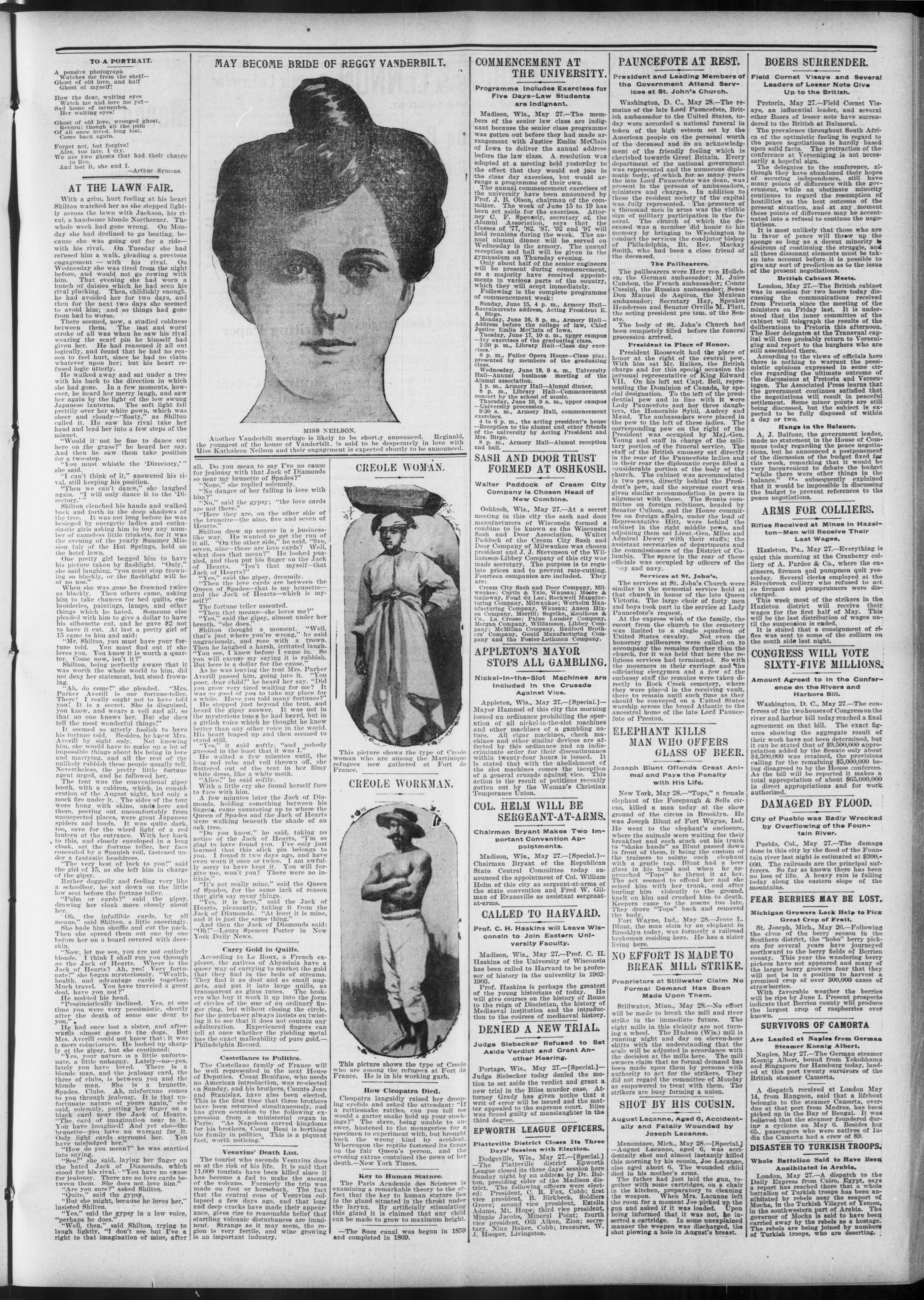
MAY BECOME BRIDE OF REGGY VANDERBILT.
ee
.
4
: Sd ee >
(ee ES b>
Fe gis PRET: PAE EE
ai a ak ae oF eas Pe a
3% ees ‘8 Jas ek, a:
. ee Re can pe F ® place eae
e aS Ra eae eit
Re Oe ae! 0 ee
es rltri—“i—i~s~*s*~—™—OSOO aorta
re 4
oe
ae Uc le
Be a
{ i Peet
SOS e pear oe bs
\ ee a ie,
LF ae an 2 ae.
ia = =e — ‘
— oo fF
i Cs oe : Ce
oe. oat oo
a ee t”t—g
Rw : a : Se
v lr
ee : ro
vey Sa Rees a
ee ees
re : ee
ur
oN ae 4
ee a.
Ss —
Oi ESI SSS
MISS NEILSON,
‘Another Vanderbilt marriage is likely to be shorty announced. Reginald,
the youngest of the house of Vanderbilt. is said to be desperately in love with
Uiss Kathaleen Neilson and their engagement is expected shortly to be announced.
all. Do you mean to say I’ve no cause
for jealousy with that Jack of Diamonds
so near my brunette of Spades?”
“None,” she replied solemnly.
“No danger of her falling in love with
him?”
“No,” said the gypsy; “the love cards
are not there.”
“Here they are, on the other side of
the brunette—the nine, five and seven of
Hearts.” y
Shilton drew up nearer in a business-
like way. He wanted to get the run of
it all. “On the other side,” he said. “five,
seven, nine—those are love cards? Well,
what does that mean?” He looked puz-
aled, and then put his finger on the Jack
of Hearts. “Isn't that myself—that
Jack of Hearts?”
“Yes,” snid the gipsy, dreamily.
“Then the love cards are between the
Queen of Spades—that is my brunette—
and the Jack of Hearts—which is my-
self?”
The fortune teller assented.
“Then that means—she loves me?”
“Yes,” said the gipsy, almost under her
breath, “she does.”
Shilton thought a moment. “Well,
that’s just where you’re wrong,” he said
ungraciously, and rose with a frown.
Then he laughed a harsh, irritated laugh.
“You see, I knew before I came in. So
you will excuse my saying it is rubbish.
But here is a dollar for the cause.”
As he was leaving the tent Mrs. Parker
Averill passed him, going into it. “You
poor, dear child!” he heard her say. “Did
you grow very tired waiting for me? It
Was So good of you to take my place for
awhile. Have you told many fortunes?”
He stopped just beyond the tent, and
heard the gipsy answer. It was not in
the mysterious tones he had heard, but in
a girlish voice which he thought he knew
better than any other voice in the world.
His heart leaped up and then seemed to
stand still.
“Yes.” it said softly, “and _ nobody
guessed in the least that it was I.”
He waited a few minutes until, the
long red robe and veil thrown off, she
fluttered out of the tent in her filmy
white dress, like a white moth.
“Alice!” he said softly.
With a little cry she found herself face
to face with him.
A few minutes later the Jack of Dia-
monds, holding something between his
fingers, came sauntering up to where the
Queen of Spades and the Jack of Hearts
were walking beneath the shade of an
oak tree.
“Do you know,” he said, taking no
notice of the Jack of Hearts, “I’m so
glad to have found you. I've only just
learned that this stick pin belongs to
you. I found it two days ago, and have
even worn it once or twice. T am awful-
ly sorry to have kept it. You will for-
Gas me, won't you? There were no in-
itials.”
“It's not really mine,” said the Queen
of Spades, for the same lack of reason
that girls say many things.
“Yes, it is hers,” said the Jack of
Hearts, pleasantly, taking it from the
Jack of Diamonds. “At least it is mine,
and it is just the same thing.”
And then the Jack of Diamonds said:
“Oh!"—Laura Spencer Porter in New
York Daily News.
Carry Gold in Quills.
According to. Le Roux, a French ex-
plorer, the natives of Abyssinia have a
queer way of carrying to market the gold
that they find in the beds of streams.
They find it as dust and as small nug-
gets, and put it into large quills, as
transparent as glass tubes. The brok-
ers who buy it work it up into the form
of circles of the size of an ordinary fin-
ger ring, but without closing the circle,
for the purchaser always insists on twist-
ing it to see that it does not contain any
adulteration. Experienced fingers can
tell at once whether the yielding metal
has the exact malleability of pure gold.—
Philadelphia Record.
Ghiian ith Gee nia
The Castellane family of France will
be well represented in the next House
ot Deputies. Count Boniface, who needs
no American introduction, was re-elected
on Sunday, and his brothers, Counts Jean
and Stanislas, have also been elected.
This is the first time that three brothers
have been returned simultaneously, and
has given occasion to the following ex-
pression from a ministerial organ in
Paris: “As Napoleon carved kingdoms
for his brothers, Count Boni is berthing
his family in polities. This is a piquant
fact, worth noticing.”
Vesuvius’ Death List.
The tourist who ascends Vesuvius does
so at the risk of his life. It is said that
11,600 tourists have been killed since it
has become a fad to make the ascent
of the volcano. Formerly the trip was
made on foot or horseback. The fact
that the central cone of Vesuvius col-
lapsed a few days ago, and that long
and deep cracks have made their appear-
ance, gives rise to reasonable belief that
startling voleanic disturbances are immi-
nent. Strange as it may seem, the re-
gion is very fertile, and wine growing
is an important industry.
CREOLE WOMAN.
ae ,
f : ae sie a
foe Poe re
i : N Pi se. See bats me
| eee ee :
fo
* AN . Gg
eS < G
This picture shows the type of Creole
woman who are among the Martinique
refugees now gathered at Fort de
France.
CREOLE WORKMAN.
Y Cm
/ “a >
/
| |
ae. “ :
: _ % 2 {
| was :
"1B
This picture shows the type of Creole
Who are among the refugees at Fort de
France. He is in his working garb.
How Cleopatra Died.
Cleopatra languidiy raised her droop-
ing eyelids and asked the attendant: “If
a rattlesnake rattles, can you tell me
would a garter snake hold up your stock-
ings?’ The slave, being unable to au-
swer, hastened to the menageries for
specimen to experiment with, but brought
back the wrong kind by _ accident.
Whereupon the reptile fastened its fanes
on the fair Queen's person, and the
evening extras contained the news of her
death.—New. York Times.
Key to Human Stature.
The Paris Academie des Sciences is
examining a remarkable theory to the ef-
fect that the key to human stature lies
in the gland situated in the throat under
the larynx. By artificially stimulating
this gland it is claimed that any child
can be made to grow to maximum height.
—The Suez canal was begun in 1859
ard completed in 1869.
COMMENCEMENT AT
THE UNIVERSITY.
Programme Includes Exercises for
Five Days—Law Students
are Indignant.
Madison, Wis. May 27.—The mem-
bers of the senior law class are indig-
nant because the senior class programm»
was gotten out before they had made ar-
rangement with Justice Emlin McClain
of Iowa to deliver the annual address
before the law class. A resolution was
adopted at a meeting held yesterday to
the effect that they would not join iu
the class day exercises, but would ar-
Tange a programme of their own.
The annual commencement exercises of
the university have been announced by
Prof. J. B. Olson, chairman of the com-
mittee. The week of June 15 to 19 has
been set aside for the exercises. Attor-
ney C. F. Spensely, secretary of the
Alumni Association, Lo that_ the
classes of '77, 82. ’S7, 92 and '97 will
hold reunions during the week. The an-
nual alumni dinner will be served on
Wednesday in the armory. The annual
reception and ball will be given in the
gymnasium on Thursday evening.
Only about half of the senior engineers
will be present during commencement,
as a majority have received appoint-
ments in various parts of the country,
which they will acept immediately.
Following is the complete programme
of commencement week:
Sunday, June 15, 4 p. m., Armory Hall—
Baccalaureate address, Acting President E.
. Birge,
Monday, June 16, 8 p. m., Armory Hall—
Address before the college of law, Chief
Justice Emlin McClain of Iowa.
Tuesday, June 17, 10 a. m., upper campus
—Ivy exercises of the Ee class.
Beis) p. m., Library Hall—Class day exer-
3 p. m., Fuller _— House—Class play,
Presented by members of the graduating
class,
Wednesday, June 18, 9 a. m., University
Hall—Annual_ business meeting of the
Alumni assoclation.
1p. m., Armory Hall—Alumni dinner,
8 p. m., Library Hall—Commencement
concert by the school of music.
Thursday, June 19, 9 a. m., upper campus
—University procession.
9:30 a. m., Armory Hall, commencement
exerelses,
4 to 6 p. m., the ay president's house
~—Reception to the alumni and other friends
of the university by Acting President and
Mrs. Birge.
8 p. m., Armory Hall—Alumnl reception
end hall
SASH AND DOOR TRUST
FORMED AT OSHKOSH.
iecentpeinasins
Walter Paddock of Cream City
Company Is Chosen Head of
New Combine.
Oshkosh, Wis., May 27.—At a secret
meeting in this city the sash and door
manufacturers of Wisconsin formed a
combine to be known as the Wisconsin
Sash and Door Association. Walter
Paddock of the Cream City Sash and
Door Company of Milwaukee was chosen
president and J. J. Stevenson of the Wil-
liamson-Libbey Company of this city was
made secretary. The purpose is to regu-
late prices and to prevent rate-cutting.
Fourteen companies are included. They
are:
Cream City Sash and Door Company, MIl-
waukee; Curtis & Yale, Wausau; Moore &
Galloway, Fond du Lac; Rockwell Manufac-
turing Company, Milwaukee; Werheim Man-
ufacturing Soe Wausau; Anson Hix-
on Company, Merrill; Segelke,, Koulbous &
Co., La Crosse; Paine Lumber Company,
Morgan Company, Williamson, Libbey Com-
pany; McMillan Company, Radford Broth-
crs’ Company, Gould Manufacturing Com-
pany one Foster-Lothman Company.
APPLETON’S MAYOR
= >
STOPS ALL GAMBLING.
—————_
Nickel-In-the-Slot Machines are
Included tn the Crusade
Against Vice.
Appleton, Wis., May 27.—[Special.J—
Mayor Hammel of this city this morning
issued’an ordinance prohibiting the oper-
ation of all nickel-in-the-slot machines
and other machines of a gambling na-
ture. All cigar machines, check ma-
chines and other similar devices are at-
fected by this ordinance and an indis-
criminate order for their discontinuance
within twenty-four hours is issued. It
is stated that with the abolishment of
the slot machines comes the inception
of a general crusade against vice. This
action is the result of petitions recently
gotten out by the Woman's Christian
‘Temperance Union,
COL. HELM WILL BE
SERGEANT-AT-ARMS,
Chairman Bryant Makes Two Im-
portant Convention Ap-
pointments.
Madison, Wis., May 27.—[Special.]—
Chairman Bryant of the Republican
State Central Committee today an-
nounced the appointment of Col. William
Helm of this city as sergeant-at-arms of
the state convention and Fred W. Gil-
man of Evansville as assistant sergeant-
at-arms.
CALLED TO HARVARD.
eee eget,
Prof. C. H. Haskins will Leave Wis-
consin to Join Eastern Uni-
versity Faculty.
Madison, Wis., May 27.—Prof. C. H.
Haskins of the University of Wisconsin
has been called to Harvard to be profes-
sor ot history in the university in 1902-
Prof, Haskins is perhaps the greatest
of the young historians of today. He
will give courses on the history of Rome
to the reign of Diocletian, the history of
Mediaeval institution and the introduc-
tion to the courses of mediaeval history.
DENIED A NEW TRIAL.
een naee
Judge Slebecker Refused to Set
Aside Verdict and Grant An-
other Hearing.
Portage, Wis., May 27.—[Special.]J—
Judge Siebecker today denied the mo-
tion to set aside the verdict and grant a
new trial in the Bliss murder case. At-
torney Grady has given notice that a
writ of error will be issued and the mat-
ter appealed to the supreme court. Bliss
was found guilty of manslaughter in the
third degree.
EPWORTH LEAGUE OFFICERS.
Platteville District Closes ite Three
Dara’ Session with Election.
Dodgeville, Wis., May oe th
—The Platteville district Pwo!
League closed its three days’ session here
Sunday night by an address by Dr. Bol-
ton, presiding elder of the Madison dis-
trict. The sollowise On were elect-
ed: President, C. R. Fox, Cobb; first
vice president, B. Birkbeck, Soldiers
Grove; second vice president, Estella
Adams, Mt. Hope; third vice president,
Minnie Jacobs, Mineral Point; fourth
yice president, Olli Aiken, Zion; secre-
sary. Nina Baker, Cobb; treasurer, W.
J. Hooper, Livingston.
PAUNCEFOTE AT REST,
President and Leading Members of
the Government Attend Serv- |
lces at St. John’s Church. ;
Washington, D. C., May 28.—The re-
mains of the late Lord Pauncefote, Brit-
ish ambassador to the United States, to-
day were accorded a national funeral in
token of the high esteem set by the
American people on the personal worth
of the deceased and as an acknowledg-
ment of the friendly feeling which is
cherished towards Great Britain. Every
department of the national government
was represented and the numerous diplo-
matic body, ofwhich for so many. years
the late Lord Pauncefote was dean, was
present in the es of ambassadors,
ministers and charges. In addition to
these the resident society of the capital
was fully represented. - The presence of
a thousand men in arms was the visible
sign of pullitery pastrination in the fu-
neral. The church of which the de-
ceased was a member ‘did hondér to his
memory by bringing to Washington to
conduct the services the coadjutor bishop
of Betmegec ns) Rt. Rey. Mackay
Smith, who had been a close friend of
the deceased.
The Pallbearers,
The pallbearers were Herr von Holleb-
en; the German ambassador; M. Jules
Cambon, the French ambassador; Comte
Cassini, the Russian ambassador; Senor
Don Manuel de Aspiroz, the Mexican
ambassador; Secretary sate Speaker
Henderson and Senator Orville M. Platt,
the acting president pro tem. of the Sen-
ate.
The body of St. John’s Church had
been compietely filled before the funeral
procession arrived.
President in Place of Honor.
President Roosevelt had the place of
honor at the right of the central pew.
With him sat Mr. Raikes, the British
charge and for this speci oceasion the
personal representative of King Edward
VII. On his left sat Capt. Bell, repre-
senting the Dominion of Canada, by spe-
cial designation. To the teft of the prest-
dential pew and in line with it were
Lady Pauncefote and her three daugh-
ters, the Honorable Sybil, Audrey and
Maud. The ambassadors were placed in
the pew to the left of these ladies. The
ere e, pew on the right of the
President was occupied by Maj.-Gen.
Young and staff in charge of the mili-
tary portion of the funeral service. The
staff of the British empassy sat directly
in the rear of the Pauncefote ladies and
in their rear the diplomatic corps filled a
considerable portion of the near of the
church. The cabinet was accommodated
in two pews, directly behind the Presi-
dent's pew, and the supreme court was
given similar accommodation in pews in
alignment with these. The Senate com-
mittee on foreign relations, headed by
Senator Cullom, and the House commit-
tee on foreign affairs, under the lead of
Representative Hitt, were behind the
cabinet in the right middle pews, and
adjoining them sat Lieut.-Gen. Miles and
Admiral Dewey with their staffs; the
assistant secretaries of departments and
the commissioners of the District of Co-
lumbia. The epace in the rear of these
officials was occupied by officers of the
“ny and navy.
Services at St. John’s,
The services at St. John’s Church were
similar to the memorial service held at
that church in honor of the late Queen
Victoria. The large choir of forty men
and boys took part in the service at Lady
Pauncefote’s request.
At the express wish of the family, the
escort from the church to the cemetery
was limited to a single squadron of
United States cavalry. Not even the
honorary pallbearers were calied on to
accompany the remains further than the
chureh, for it was held that here the re-
ligious services had terminated. So with
the mourners in their carriage and ‘the
officiating clergymen and a few of the
embassy staff the remains were taken di-
rectly to Rock Creek cemetery, where
they were placed in the receiving vault,
there to remain until such time as they
should be conveyed on a United States
warship across the broad Atlantic to the
ancestral home of the late Lord Paunce-
fote of Preston.
ELEPHANT KILLS
MAN WHO OFFERS
GLASS OF BEER.
Joseph Blunt Offends Great Ani-
mal and Pays the Penalty
with His Life.
New York, May 28.—“Tops,” = female
elephant of the Forepaugh & Sells cir-
cus, killed a man today at the show
ground of the circus in Brooklyn. He
was Joseph Blunt of Fort Wayne, Ind.
He went to the elephant’s enclosure,
where the animals were waiting for their
breakfast and each stuck out his trunk
to “shake hands” as Blunt passed dowa
in front of them, it being the custom of
the trainers to salute each clephant
with a gentle tap. Blunt had a beer
glass in his hand and when he ap-
pronched “Tops” he thrust it at her.
The act seemed to offend her aud she
seized him with her trunk, and after
hurling him violently to the ground,
knelt on him and crushed him to death.
Keepers came to the reseve too late,
They drove “Tops” back and removed
the body,
Fort Wayne, Ind., May 28.—Jesse L.
Blunt, the man slain by an elephant .in
Brooklyn today, was formerly a railroad
brakeman residing here. He has a sister
living here.
¥ y
NO EFFORT JS MADE TO
BREAK MILL STRIKE.
Proprietors at Stillwater Claim No
Formal Demand Has Been
Made Upon Them.
Stillwater, Minn., May 28.--No effort
will be made to break the mill and river
strike in the immediate future. The
eight mills in this vicinity are not turn-
ing a wheel. The Hudson (Wis.) mill is
running night and day on eleven-hour
shifts with the understanding that the
scale will be adjusted in accordance with
the decision at the mills here. The mill
owners claim that no formal demand has
been made upon them by persons with
authority to act for the strikers. They
did not regard the committee of Monday
as empowered to treat with them. The
strikers are busy forming a union.
SHOT BY HIS COUSIN.
August Lacanne, Aged 6, Accident-
ally and Fatally Wounded by
Joseph Lacanne.
Menominee, Mich., May 28.—[Special.J
—August Lacanne, aged 6, was acci-
dentally shot and almost instantly killed
this morning by his cousin, Joe Lacanne,
also aged about 6. The wounded child
died in his mother’s arms.
‘The father had just laid the gun, to-
gether with some cartridges, on a chair
in the kitchen, Pee, to cleaning
the weapon. en Mrs. Lacanne left
the room for a moment Joe picked » the
gun and asked if it was loaded. Upon
being informed that it was not, he in-
serted a cartridge. In some unexplained
manner the weapon was discharged, the
shot plowing a hole in August’s breast.
BOERS SURRENDER.
Field Cornet Visaye and Several
Leaders of Lesser Note Give
Up to the British.
Pretoria, May 27.—Field Cornet Vis-
aye, an influential leader, and several
other Boers of lesser note have ‘surren-
dered to the British at Balmoral.
The prevalence throughout South Afri-
ea of the optimistic feeling in regard to
‘the peace negotiations is hardly based
upon solid facts. The protraction of the
conference at Vereeniging is not neces-
. sarily a hopeful sign.
The delegates to the conference, al-
though they have abandoned their hopes
of securing independence, still have
‘many points of difference with the gov-
ernment, while an obstinate minority
continues to regard the resumption of
hostilities as the best outcome of the
present situation, and at any .moment
these points of difference may be accent-
uated into a refusal to continue the nego-
tiations.
It is most unlikely that those who are
in favor of peace will threw up the
sponge so long as a decent minority i
desirous of continuing the struggle, and
all these dissonant elements must be tak-
en into account before.it is possible to
give any sort of prediction as to the issue
of the present negotiations.
British Cabinet Meets.
London, May 27.—The British cabinet
was in session for two hours today dis-
ne the communications received
from Pretoria since the meeting of the
ministers on Friday last. It is under-
stood that the inner committee of the
cabinet will oe the results of the
deliberations to Pretoria this afternoon.
The Boer delegates at the Transvaal cap-
ital will.then probably return to Vereeni-
sing and ee to the burghers who are
still assembled there.
According to the views of officials here
there is nothing to warrant the pessi-
mistic opinions expressed in some cir-
cles regarding the ultimate outcome of
the discussions at Pretoria and Vereen-
ingen. The Associated Press learns that
the government continues satisfied that
the negotiations will result in peaceful
settlement. Some minor points are still
being discussed, but the subject is ex-
pected to be fully disposed of within
a day or two.
Hangs in the Balance.
A, J. Balfour, the government leader,
made no statement in the House of Com-
mons node: regarding the peace negotia-
tions, but he announced a Cy es
of the discussion of the budget fixed for
this week, remarking that it would be
very inconvenient to debate the budget
“while there were other things in the
balance.” *To gubscaeently explained
that it would be impossible in discussing
the budget to prevent references to the
peace negotiations. Mee
ARMS FOR COLLIERS.
ATRIOS ESTES Sa
Rifles Received at Mines In Hazel-
ton—Men will Receive Their
Last Wages,
Hazleton, Pa., May 27.—Eversthing is
quiet this morning at the Cranberry col-
liery of A. Pardee & Co., where the en-
gineers, firemen and pumpmen quit yes-
terday. Several clerks employed at the
Silverbrook colliery who refused to act
as firemen and pumprunners were dis~
charged.
This week most of the strikers in the
Hazleton district will receive their
wages for the first half of May. This
will be the last distribution of wages un-
til the suspension is ended.
It is stated that a consignment of ri-
fles was sent to some of the colliers on
the south side last night.
CONGRESS WILL VOTE
SIXTY-FIVE MILLIONS.
_———
Amount Agreed to in the Confer-
ence on the Rivers and
Harbors Bill.
Washington, D. C., May 27.—The con-
ferees of the twohousesof Congresson the
river and harbor bill today reached a final
agreement on that bill. The exact fig-
ures showing the aggregate result of
their work have not been determined, but
it can be stated that of $9,500,000 appro-
priation added by the Senate only about
54,500,000 was retained, the provisions
calling for the remaining $5,000,000 be-
ing disagreed to by the House conferees.
As the bill will be reported it makes a
total appropriation of about $65,000,000
in direct appropriations and for work
authorized.
DAMAGED BY FLOOD.
es
City of Pueblo was Badiy Wrecked
by Overflowing of the Foun-
tain River.
Pueblo, Col., May 27.—The damage
done in this city by the flood of the Foun-
tain river last night is estimated at $300,-
000. The railroads are the principal suf-
ferers. So far as known there has been
no loss of life. A heavy rain is falling
today along the eastern slope of the
mountains.
FEAR BERRIES MAY BE LOST.
Michigan Growers Lack Help to Pick
Great Crop of Frnit.
St. Joseph, Mich., May 26.—Following
the close of the berry season in the
Southern district, the “hobo” berry pick-
ers for several years have journeyed
northward to the berry fields of Berrien
county. This year the wandering berry
pickers have not appeared and many of
the larger berry growers fear that they
will not be in a position to harvest a
promised crop of over 300,000 cases of
strawberries.
With favorable weather the berries
will be ripe = June 1. Peseta reas
indicate that Berrien county wlil produce
the largest crop of raspberries ever
known.
SURVIVORS OF CAMORTA
Are Landed at Naples from German
Steamer Koenig Albert.
Naples, May 27.—The German steamer
Boos Albert, bound from Yokohhama
and Singapore for Hamburg today, land-
ed at this port twenty survivors of the
British steamer Camorta.
A dispatch received at London May
14, from Rangoon, said that a lifeboat
belongin to the steamer Camorta, over<
due at that port from Madras, has been
—- up in the Bay of Bengal. It was
lieved that the steamer foundered dur-
ing a cyclone on May 6. Besides her
635L panecten who were natives of In-
dia the Camorta had a crew of 89.
DISASTER TO TURKISH TROOPS.
Whole Battalion Said to Have Been
Annibilated in Arabia,
London, May 27.—A dispatch to the
Daily Express from Cairo, Egypt, says
a report has reached there that a whole
battalion of Turkish troops has been an-
nihilated aa rebels near the nee of
Mocha, in the Turkish Vilayet of Yemen,
in the southwestern ms of Arabia. Tha
governor of Mocha is said to have bee
Th as Paes Soned by" jumbers
ie are mI
of Turkish troops, who are deserting. }
The Wisconsin Weekly Advocate Printed in the Interests of the Negro Race, MILWAUKEE, WIS.
Telephone Black No. 244.
SUBSCRIPTION RATES
Any part of the United States and Canada,
postage paid.
One Year ..... $2.00
Six Months ..... 1.25
Three Months ..... .75
Send money by Express Money Order, P. O.
Money Order or Registered Letter to the
Wisconsin Weekly Advocate.
ADVERTISING RATES
TO CONTRIBUTORS:
All communications must be sent with the name and address of the sender as an evidence of good faith, but not necessarily for publication. No manuscript returned if not accepted, unless accompanied by stamps.
The Wisconsin Weekly Advocate company wishes to notify the public that all contracts and business transactions with this company must have the company stamp, otherwise they will be void. Neither will this company be responsible for paid subscriptions unless given to duly-accredited agents, who, on request, will give the company's receipt for same. Subscribers failing to receive their papers regularly will kindly notify the general office. Address all business communications to the general manager, 729 St. Paul avenue.
Entered in the Postoffice at Milwaukee as Second-class matter.
Alfonso of Spain makes an early start in the majesty business.
Mrs. Carrie Nation has at last smashed her way into a Topeka jail.
The Anarchists to the young King of Spain. "After you, my dear Alfonso!"
No volcano has a record good enough to place it above suspicion at the present time.
The rains have done some damage. They would have done more, however, if they had not come.
If Whitelaw Reid's court suit is in form, he won't bother much whether his credentials are or not.
The kodak trust will take a snap shot at the remnant of things which the other trusts have been compelled to leave outside of their corrals.
Jeffries and Fitzsimmons have signed articles of agreement, and will fight in July. In the meantime they will continue to talk in the interest of the gate receipts.
It's hard to calculate just what's coming next. You may go into your cellar to be safe in case of a tornado, and, like the Cincinnati man, you may be drowned by a cloudburst.
Cornell University's profit of $13,000,-000 on an investment of $250,000 in Wisconsin lands, thirty-four years ago, is evidence that Wisconsin soil can produce big fortunes as well as big crops.
If the Kaiser comes to Milwaukee he will take the same risk of strabismus that was experienced by Prince Henry and Rear Admiral Evans in the presence of the pretty women of Milwaukee.
The birds, beasts and reptiles which disappeared from the vicinity of St. Pierre and Pelee prior to the eruption, owe their escape to a superior understanding of the language of nature.
Grand juries operate conscientiously, sometimes. One in Toledo, Ohio, yesterday brought in indictments for bribery against a number of city officials and an agent of an electric railway and light company.
Uncle Sam now has a good opportunity to break off negotiations for the Danish islands, which like all projections from the sea in the West Indies have fallen below par since the eruption on Martinique.
The French engineer who after an examination declares that Mont Pelee will hereafter be harmlessly turbulent should not be disturbed if the remaining people of Martinique doubt the integrity of his judgment. Burnt children dread fire.
The spring rains have filled the watercourses that have been dry for a long time, and also raised the levels of lakes and ponds. Altogether, the farmers of this section of Wisconsin have reason to feel satisfied with the outlook for the season.
The scientists who told the people of St. Pierre that there was nothing to fear from Pelee were not the first of their kind to make a wrong diagnosis; and besides, they chipped in their lives toward the general penalty of over-confidence in the integrity of the volcano.
The snow storm in Wyoming is regarded as an excellent thing for the cattle ranchers. The snow melted at once, and the grass in the valleys of Wyoming was never richer and more luxuriant than it is today, and its vast herds of cattle are sure of a bounteous sustenance for months to come.
When Chief Signal Officer Moore has perfected his device for reducing the temperature of apartments in hot weather, he might try his hand at a simple means of heating buildings in winter without fuel. The man who releases the public from the thralldom of the coal trust will earn a statue.
Turkey is undoubtedly deeply in debt; but there need be little fear that the Sultan will violate the perpetual garnishee on $15,000,000 of his annual revenues, for foreign creditors, because the role of a bone of international contention is not a happy one. In other words, he would rather be poor than spanked.
To those who were involved in its serpentine folds, the Texas tornado was as appalling as was the Martinique eruption to the victims thereof; and nobody in the "tornado belt" can be accused of recklessness in setting up his habitation under the very shadow of trouble, as the tornado is a vagrant aerial monster that springs up suddenly out of fair skies.
TO STOP LYNCHINGS
Resolution is Introduced in the Senate Asking for an Investigation.
TO FIND REMEDY FOR THEM
Spooner's Cuban Bill Compromise Provides Duty Can be Remitted When President Desires.
WILL SATISFY BEET-SUGAR MEN.
Washington, D. C., May 26.—Soon after the Senate convened today, Mr. Gallinger (N. H.) offered a resolution providing that the judiciary committee of the Senate should make an investigation into the subject of lynchings in the United States with a view of ascertaining whether there is any remedy for them. Mr. Gallinger said he introduced the resolution in full view of the fact that he might be charged with precipitating a sectional controversy, but nothing was further from his thoughts.
Not Confined to the South.
He said lynchings were not confined to the South. Horrible cases had occurred in the North, and white men as well as black had been the victims. Throughout the country intense interest was manifested in the subject. He thought it imperative that the judiciary committee should take some action upon the subject. During the past ten years 2658 lynchings had occurred in the United States. Of these 121 had occurred in the South and 14 in the North, the remainder in other parts of the country. If the strong arm of the law could reach out to prevent such occurrences he deemed it desirable that it do so. He had read the Associated Press account of the burning of a negro in Texas a few days ago. He said history did not furnish a more fiendish instance of mob wrath and Fox's Book of Martyrs was tame in comparison.
Disgrace to American Manhood.
The whole wretched business, he said, was a disgrace to American manhood and in the light of which the alleged atrocities in the Philippines paled into insignificance. The Spanish inquisition did not furnish a case exceeding that one in inhumanity. He apprehended that it would be said that the federal government was powerless and that the states had exclusive jurisdiction. If so the American people did not desire to know it. Public sentiment should be aroused to prevent such inhuman atrocities.
Texas Senator Excited.
had read an account of a lynching in had read an account of a lynching in Kansas, saying that he wanted it shown that the crime of lynching was confined to no state or section. He said he hoped the New Hampshire senator would not single out his state when he wanted to bring such cases before the Senate. After remarks by Mr. Hoar upon the constitutional feature of the case the resolution went over.
Misrepresented by Censor.
The Philippines bill was then taken and Mr. Patterson (Col.) made a speech in opposition to it. Mr. Patterson declared that after the capture of Manila "a censored press, deliberately guided by the powers in Washington, had misrepresented the situation in the Philippine Islands."
* Spooner's Cuban Compromise.
Senator Spooner's compromise proposition on Cuban reciprocity, which has found favor with many Republican senators, has not yet been committed to writing. It is known that it provides for a 20 per cent. reduction, but it is understood that the principal feature of the scheme is a provision that whenever the President shall find that any other persons than the Cuban producers are getting the benefit of the reduction, he can order remissions of duty. No person directly interested in the sugar refining industry in this country can get the benefit of the reduction. The President is to be authorized to make investigations to determien whether any such persons are getting the benefit of the duty.
This compromise is expected to deprive the beet-sugar men of one of their strongest grounds for opposing the bill, which was that not the Cubans, but the sugar trust, will get the benefit of the reduction. It is said to be satisfactory to some of the beet-sugar senators, but whether it will be to all of them remains to be seen. From the beet-sugar standpoint it deprives the advocates of reciprocity of one of their strongest reasons for supporting the bill, for the beet-sugar men claim that it is the desire to benefit the sugar trust which inspires a great many pretended advocates of Cuban reciprocity.
The Spooner amendment will do away with the Morris amendment, by which the differential on refined sugar was taken off, and to that extent it will injure the sugar trust. It will also have the effect of splitting the Democrats, for while the Democratic senators would unanimously support the bill as it came from the House, with the Morris amendment in it, there are many of them who would not consent to vote for such a bill as that proposed by Mr. Spooner.
Did Not Violate Women.
Capt. MacDonald, formerly of the Twenty-sixth Volunteer infantry, one of the officers accused in Corp. O'Brien's testimony was before the Philippine committee of the Senate today. He denied all of the allegations made by O'Brien and said O'Brien was on duty elsewhere at the times he claimed to have been present. McDonald said that American officers had not violated a Spanish woman or other women to his knowledge.
Miss Andrews Reappointed.
Representative Cooper has filed a recommendation for the reappointment of Elenora Andrews as postmistress at Evansville and Thomas W. Morfield as postmaster at Elkhorn. Miss Andrews was appointed by President McKinley four years ago and at the time the President requested that she be retained in office as long as he continued in office. Her record to date has been satisfactory and this caused Representative Cooper to again recommend her.
Gen. Bragg Files Bond.
Washington, D. C., May 26.—Gen. Edward S. Bragg of Fond du Lac, Wis., the new consul general to Havana, Cuba, filed his bond today.
McCorm ck Get* Ambassadorship.
The President today nominated Robert S. McCormack of Illinois to be ambassador to Austria-Hungary.
Washington Notes.
The coneference report on the agricultural appropriation bill was agreed to in the House this morning. The conference report on the deficiency bill also was agreed to. —Lieut. Catanescu, a Roumanian officer, recently rode from Bucharest to Fokshani and back, a distance of 400 miles, in four days.
REED BROS. & LENNON
GRAND AVE. AND THIRD ST.
Record Breaking in the Suit R
Women's Walking Skirts in black and oxford—a special assortment of skirts, qualities that tailors could not produce for double the money—Thurs.... $3.89
Record Breaking Bargains in the Suit Room
Suit Bargain—Women's tailormade in light gray, oxford, browns, in fact all new spring shades, made in latest styles and trimmed regular $12.00 and $15.00 Suits at $8.25 Free Art Embroider
Free Art Embroidery Lessons—Second Floor.
Another Lot of... New Wash Goods
5,000 yds. Stripe Novelties, choice figured and stripe effects, plenty of black and white and choice colorings, 10c quality— Thursday..... $ \frac{1}{2} $ C
4,000 yds. Percales, in dots, stripes, checks and figured effects, in blue, red, black and white, etc., the 10c kind—Thursday.... 5C
Just Arrived—a large lot of new St. Gaul Swisses and Mercerized Grenadines bought at less than $ \frac{1}{3} $ of regular wholesale price—these goods were sold in the early part of the season at 85c and $1—we have them in black and white, pink, tans, light blue, malze, linen effects and white, with colored stripes, etc.—We put them on sale Thursday at..... 45c
Call for Meeting of National Afro-American Council, at St. Paul, Minn., July 9, 10 and 11, 1902. To the Members of the National Afro-American Council Delegates from Local Councils and Affiliated Organizations, such as Churches, Colleges, Benevolent Societies, Newspapers and Other Race Organizations: Greeting-The fifth annual session of the National Afro-American Council will be held in the state house, at St. Paul, Minn., July 9, 10 and 11, 1902.
It is our earnest desire that every church, college, benevolent society and other race organization shall be represented. It is greatly desired that this annual meeting shall be the largest and most potent for good of any which the council has ever held. The condition of the race's affairs makes this consummation mandatory. Our main reason for meeting at St. Paul, Minn., is to create more enthusiasm in the work of the council in the West. We have just received notice from our chief counsel at Washington, D. C., A. A. Birney, Esq., who informs us that although subject to many delays and complications, arising from local and legal
J.
CYRUS FIELD ADAMS. General Secretary National Afro-American League.
causes, the Louisiana test case is now in a fair way to reach final adjudication. There is urgent need for more money to carry on this legal contest, which we hope will be cheerfully contributed by the race. The many stirring questions of race interest which claim immediate attention should inspire every Afro-American church, college, benevolent society and other race organizations to send representatives accompanied by the annual tax of $5 to this great national gathering. We have every reason to believe that the meeting will be largely attended.
BASIS OF MEMBERSHIP.
(Article III. of Constitution.)
Section 1. The Afro-American Council shall be composed of, members as follows:
1st. All persons who hold life membership.
2d. Council delegates, representing duly accredited local councils.
3d. Affiliated delegates, representing organizations of similar plans and purposes co-operating with Afro-American Council.
Sec. 2. Every local Afro-American council shall be entitled to representation in the national council by delegates elected on a basis of one delegate to every fifty (50) members, said delegates to qualify upon presentation of credentials and payment of 10 cents for each member so represented. Provided, however, that any local council having less than fifty (50) members shall be entitled to one vote, upon presentation of credentials and payment of the annual tax of $5.
Sec. 3. Religious and secular organizations which have for their aim and work the mental and moral elevation of the race, and which desire to co-operate with the national council, may be represented by affiliated delegates, not more than two delegates to each organization. Said delegates shall have the right to vote upon payment of $5 for each delegate.
Sec. 4. Editors of Afro-American newspapers and principals of academic schools and colleges may be admitted to membership in the national council and be entitled to a vote upon presentation
---
ing Bargains
New White Waists--We are showing extremely beautiful styles, made of fine imported lawns, trimmed with allover embroidery and rows of embroidery and fancy tucking, front and back, new French sleeve and collar-Thursday at $1.25, 98c, 89c and ..... 50c
An endless variety of Women's Hot Weather Skirts, in linen, pique, duck and poplins, newest shapes, plain and trimmed-at $10.00, $2.98, $2.50, $1.50 down 98c
Dress Goods Bargains
10,000 yards 36-inch English Cashmeres, Granite Cloths and Tricot Waistings, etc., all this season's choicest colorings—regular 25c and 35c values—Thursday we say.....19c
36-inch Wool Voiles, soft and clingy, to make over silk skirts, choice assortment of new spring colorings—considered cheap at 65c— Thursday, a yard.....35c
50-inch Etamines, Mistrals,Voiles, etc., the much wanted fabrics for dressy wear, $1.00 and $1.25 kinds for one day—Thursday, a yard.....69c
Those wishing a First
Hour are Cordially I
WOODAR
519 Wells St., Milwaukee, Wis.
SUNDAY 5 O'CLOCK D
Those wishing a First=Class Meal at Any Hour are Cordially Invited to Call at the WOODARD HOUSE
519 Wells St., Milwaukee, Wis. Mrs. Lee Woodard, Prop. SUNDAY 5 O'CLOCK DINNER A SPECIALTY.
of credentials and payment of the annual tax of $5.
HALF FARE RATES ON RAILROADS.
Delegates can secure half rates by purchasing tickets to the National Educational Association which meets at Minneapolis (street car fare from Minneapolis to St. Paul is only 10 cents), July 7 to 11.
The following extract from letter from Mr. Erwin Shepard, secretary of the N. E. A., gives the necessary information:
E. A. gives the necessary information: The rate which has been made by all railroad lines in the United States for our association is one fare for the round trip, plus $2 membership fee in N. E. A. This membership fee is included in the purchase price of the ticket and is represented by a special membership coupon attached, to be exchanged at the registration office in Minneapolis for membership certificate. The certificate will bear a coupon entitling the holder to a volume of the proceedings of the Minneapolis convention sent by express prepaid in case request for the copy is made to this office before September 1. The N. E. A. has no objection to the members of the National Afro-American Council using railroad rate which has been granted to this association. It will be necessary for all railway tickets to be presented to be validated at the Minneapolis office of the general agent.
ESPECIAL CAUTION
Be careful to buy tickets to the National Educational Association at Minneapolis. Tickets will be on sale at all coupon railroad ticket offices in the United States three days before July 7. Let all the organizations above named elect their delegates as soon as possible and send their names to Cyrus Field Adams, secretary, 934 S. Street N. W., Washington, D. C. The citizens of St. Paul are preparing to entertain the council in first-class style and the trip promises to be a delightful one. (Signed) ALEXANDER WALTERS.
President.
T. THOMAS FORTUNE,
Chairman Executive Committee.
CYRUS FIELD ADAMS,
General Secretary.
WILKINS NO SPELLBINDER.
Story of the Owner of the Washington Post.
Beriah Wilkins, owner of the Washington Post, was formerly a representative in Congress from Ohio. He tells with great glee a story about his first campaign. When he was nominated he had never made a public speech. Soon after the convention a delegation came to him from a small town in his district and asked him to come out to a ratification meeting. Wilkins said he would, but cautioned the delegation against asking him to speak. They said that would be all right, as they had provided two professional spellbinders. All Wilkins would have to do, they said, would be to shake hands and kiss the babies.
Wilkins went, was met by a brass band and escorted to the hall. Then, to his utter dismay, he found that the spellbinders had not arrived. The chairman insisted that Wilkins must say something. He stood up, was introduced and said everything he could think of. After he had been talking what seemed to him two hours but in reality was not more than fifteen minutes he gave out entirely and sat down. There was a dense silence. Not a person in the hall applauded. Then the chairman arose and said: "If there is anybody in the hall that can make a speech we will be glad to hear him."—New York World.
Dolls Hair.
The hair on the heads of most of hundreds of thousands of dolls is made from the hair of the Angora goat. This product is controlled by an English syndicate, and after the hair is prepared it is sent to Munich and made into wigs by girls.
Women's and Children's Summer Underwear
At 10c Children's Sleeveless Vests, lisle or cotton-Women's Sleeveless or Short Sleeve Vests, silk taped, nicely finished.
At 25c Women's well-made, nicely finished, prettily trimmed Lisle Thread and Cotton Vests, sleeveless, short sleeves and long sleeves; also Lace Trimmed Umbrella Drawers.
At 48c Women's Perfect-fitting Union Suits, sleeveless, short sleeves or long sleeves, tight knee, lace trimmed umbrella drawers styles.
At 15c—A lot of regular 25c Knee Length Knit Drawers, perfect in every respect.
At 21c—An assorted lot of regular 25c and 35c Plain Black, Black Open Lace Work, Black Drop Stitch and Fancy Novelty Stockings.
Belts
At 19c—A splendid lot of regular 25c Tucked Belts, made of fine mercerized sateen, with gilt or oxidized buckles—very special.
Writing Paper
At 10c -A box of 24 sheets and 24 envelopes-fine highly finished writing paper, which usually sells at 15c a box.
Summer Corset Special
Made of fine tucked lawn, medium length, well stayed, two side steels and double clasp front, neatly trimmed with lace and ribbons, value 48c 75c, Thursday at..... New Etamine Summer Corsets, 39c all colors—special.....
st=Class Meal at Any
invited to Call at the
D HOUSE
Mrs. Lee Woodard, Prop.
DINNER A SPECIALTY.
Beware of Impostors
of different professions soliciting money in Wisconsin for purposes unknown to any person in that state and for use elsewhere. Driven out of other states they are overrunning this. We think it an imperative duty on us as being the only negro paper in the state, to protect its generous philanthropists. From now on, we shall warn the mayor and chief of police of every city in Wisconsin against such adventurers.
THE EGYPTIAN LOTUS.
Grows Perfectly When Planted in Rich Mud.
Roots may be obtained from any florist. The seed will readily germinate if a hole is filled or drilled through the hard shell that moisture may penetrate the kernel, otherwise they will lie dormant almost indefinitely. It is perfectly hardy and comes to perfection when planted in shallow water with rich mud and full exposure to the sun—simply naturalized in the save environments that suit our native water lily. Artificial ponds or cement basins are often made for the accommodation of this and other water lilies. Such tanks should be two to four feet deep, and of any size and outline desired. Twelve by twenty feet is a nice size for the amateur. It is best to plant the lilies in boxes, say three feet square and one foot deep, filled with good rich soil and sunk in the tank.
The lotus submits gracefully to cultivation in tubs. Ordinary half-barrels will do for tubs. Fill them two-thirds full of rich garden soil, in which plant the roots (I prefer roots to seed), then fill tubs full of water and set in a warm, sunny place. In winter remove the tubs with their contents to a cellar. A beautiful aquatic garden may be had by arranging several tubs of lotus and nymphaea into a mound or circle and filling the spaces between them with ferns, arrowheads and other moisture-loving plants.—Home and Flowers.
Jarring His Memory.
A married lady living out at Lakeside has been having the greatest difficulty of late in inducing her husband to remember to order certain things for the household while down town. Every day there was something forgotten, and the meals were growing more scanty as a result. A few days ago she handed her husband a letter as he made a run for his car, saying that it was not be opened until the afternoon. He remembered it just as he finished his luncheon that day, and, opening it, read: "I am forced to tell you something that I know will trouble you, but have thought of it for some time. I feel that it is my duty to do so. My mother has been taken into the secret, and she, too, John, declares that it is best that you should know. I cannot keep this to myself any longer."
Hubbie's face grew ashen and his hair was taking an upright position when he turned over the page and read:
"We have not a pound of butter in the house. Send me some this afternoon."
The request was complied with.—Duluth News-Tribune.
Always ask for tickets
via the
Monon Route
THE SHORT LINE BETWEEN
Chicago,
Indianapolis,
Cincinnati,
Louisville
Six trains daily between Chicago and the Ohio river.
For folders, rates, etc., call at any Monon ticket office or address
FRANK J. REED,
Gen'l Pass. Agent, Chicago.
S. B. JONES,
C. P. Agent, 232 Clark St., Chicago.
GEORGE HAYS
Turning Mill and
Box Factory
Rockers and all kinds of Restaurant
Blocks, Extension Ladders, Tea Caddies, Boxes, Turning, Sawing, Mitchell
Improved Washers, Trestels, Swinging
Scaffolds. Repair Work PromptlyAttended to
TELEPHONE MAIN 252
228-230 Fifth St., Milwaukee, Wis.
While in city visit . . .
STEPHENS'
HOTEL and RESTAURANT
First-Class Accommodations
Home Cooking a Specialty...
No. 2832 State St., CHICAGO, ILL.
WILLIAM T. GREEN
Lawyer
Notary Public
Rooms 17-18 Birchard Block.
105 GRAND AVENUE.
Telephone White 9214
MILWAUKEE.
WANTED--AGENTS
We want 100 agents in every city, town and hamlet in the U. S. for the Wisconsin Weekly Advocate. It will be devoted to the interest of the Negro race and will contain the news of their sayings and doings throughout the world.
50 Per Cent. Commission
ADDRESS
WISCONSIN WEEKLY ADVOCATE
MILWAUKEE, WIS.
Before Starting on Your Travels
CALL ON
Geo. Burroughs & Sons
MANUFACTURERS OF
PREMIUM TRUNKS
VALISES, SAMPLE CASES, Etc.
424 & 426 East Water St., Milwaukee.
TONEY THE ARTIST
FINE ART
Shining Parlor
2164 GRAND AVENUE
Opposite Flanner's Music Store
MILWAUKEE, WIS.
50 YEARS' EXPERIENCE
PATENTS
TRADE MARKS
DESIGNS
COPYRIGHTS & C.
Anyone sending a sketch and description may quickly ascertain our opinion free whether an invention is probably patentable. Communications strictly confidential. Handbook on Patents sent free. Oldest agency for securing patents.
Patents taken through Munn & Co. receive special notice, without charge, in the
Scientific American.
A handsomely illustrated weekly. Largest circulation of any scientific journal. Terms, $3 a year, four months, $L. Sold by all newsdealers.
MUNN & Co. 361Broadway. New York
Branch Office, 625 F St., Washington, D. C.
FARMS AND
Milking by Machinery.
One of the greatest and most laborious tasks on the farm is milking. Many persons have addressed themselves to the problem of performing this work by mechanical means, but thus far no machine for the purpose has come generally into use. A late device is exhibited in the accompanying cut from the Scientific American. It comprises a can provided with an air-pump by which the air in the can may be exhausted to a certain degree of rarefication, as indicated by the vacuum-gauge at the top of the can. A flexible tube is connected at one end with the can and at the other end with the udder of the cow by means of four teat
MILK
A MILKING MACHINE.
cups. As soon as a sufficient portion of the air has been exhausted from the can the teats are placed in the cups and the stop cocks opened, which causes the teats to be drawn inward, making an air-tight joint. The suction then draws the milk through the hose into the can. A pneumatic ring in each cup prevents injury to the cow and an outer adjustable cylinder prevents the teat from being drawn in too far. The lower portion of each cup is glass, which permits the operator to watch the proper working of the device. The pump and gauge are arranged to be easily applied to any milk-can.
Wire Fence Stretcher.
A correspondent of the Iowa Home-
stead writes:
"To make a fence stretcher take a
wagon wheel for a frame, nail your
2x8's far enough apart to admit wagon
hub in between,
as shown in the
illustration, on
both sides. Now
bore holes
through the 2x8's
one inch from the
front edge large
enough to pass
FENCE STRETCHER."
FENCE STRETCHER.
through a piece of tumbling rod. Put your wheel through uprights and slip the bolt through and place the frame in line with corner post, sink your wheel until the hub will be in line with the center of patent fence and so the wheel will revolve. Clamp on the fence, pass log chain around spoke back to clamp and hook ends together. Put a brace from the top of corner post to top of frame. When ready to stretch use your wheel as lever and pull downward and have a piece of 2x4 ready to lock the wheel, which will be placed in between the frame and top of spoke. It will be found equal to a four-ton stretcher."
Good White Leghorn.
The White Leghorn pullet shown in the cut has scored 95 and 96 at various poultry shows and is owned by a Pennsylvania man. Rural New - Yorker prints the picture as a good likeness of a business Leghorn and quotes the owner as follows: "White Leghorns are among the best of poultry for broilers, as they grow fast and mature ear. WHITE LEGHORN.
WHITE LEGHORN.
ly and have white, tender meat. As for eggs, they are acknowledged by all to be the heaviest layers of any breed of chickens known. They lay large, white eggs and lots of them, and with a little care in cold weather can be made to produce a large quautity of high-priced eggs."
Don't Waste Corn Fodder.
Don't Waste Corn Fodder.
In view of the fact that the annual crop of corn will yield some 60,000,000 to 80,000,000 tons of corn stover, all of which may be utilized, the American farmer can, if he is thrifty, save one-third of the feeding value of his crop. From this the farmer will learn the lesson that he cannot afford to waste one hill of his corn fodder. It should all be cut and shredded and fed the next summer to save his pastures for the dry fall weather which so often impairs them. With a barn or shed full of shredded fodder the stock can be kept growing all the time and will be in good condition for the feed lot or to enter the next winter.
Exercise Wisdom.
Every breed has individualities peculiar to itself. These show themselves in ability to assimilate food, susceptibility to changes of climate and weather and general surroundings. He is a wise man who recognizes this fact and pursues his investigations steadily until he arrives at a conclusion as to the breed most nearly
suited to his conditions and then sticks doggedly to his conclusions regardless of men who have other pet notions of their own.
Raising a Balanced Ration.
It is now generally understood that the great need in the ration of cows is protein and because it is expensive when one has to buy grain containing it, the cows do not have the grains to make the balanced ration.
Of late years experimenters have urged farmers to grow the crops that would give the balanced ration and have shown that it may be obtained by the growing of what are known as forage crops so that one becomes practically independent of cotton seed meal and other concentrated feed. Cow pea hay and silage will take the place of bran largely, in the ration, but a far better combination to grow is alfalfa, although with silage, cow peas and corn meal one may meet the need for protein until the time when alfalfa is fit to cut.
The soy bean should also have a place on every farm where it can be grown to advantage. It is of the same nature as the cow pea but on some farms gives better results hence should have a space in that experiment plot referred to some weeks since. This question of growing the feed that may be given to the stock to the best advantage is one that should have the attention of every farmer and dairyman.
Poultry Pointers.
Never feed the poultry near the dwelling or throw out scraps of any kind to attract them near the house.
One of the secrets of success with poultry is not to keep any unprofitable birds; sell them as soon as possible.
As long as a really good hen is not too old to lay eggs, she is not too old to keep.
Forty hens can no more eat from one plant than forty people. Broadcast the grain and provide long troughs for feeding soft food.
Buckwheat straw is very good for scratching material.
The roosts should be low, especially for the heavy breeds.
Keep the lice off your fowls and they will keep healthy. Feed plenty of meat scraps if you want to get lots of eggs.
Keep plenty of fresh water where your fowls can get it.
A pale yolk is not an indication of poor qaulity in an egg. Beware of drafts at night and you will prevent much sickness.
If you can secure milk to mix with you mash it will be profitable.
Suggestion for Apple Growers. Any apple grower within reasonable distance of a large city will find it profitable to sort his fruit carefully and make up small packages of the finest. It makes little difference in what form the package is, although it should, so far as possible, conform to the shapes familiar in the city where the fruit is to be sold. Small baskets holding a half peck of fine fruit will bring the grower much more money than half again the quantity carelessly selected and packed in an ordinary basket. The second grade of fruit, or rather the best grade after the finest specimens are taken out, may be put up in larger packages for market. By the use of the selected fruit and the small package the high-class trade is reached and the grower puts into his pocket the profit that usually gets into the pocket of the middleman.
Cabbage Growing.
Cabbages always do best on a freshly turned sod and should be set before the land has had time to dry after plowing. The secret of success in getting a large yield of cabbage is to start with rich land and put in all the manure obtainable. Clean out the hogyard for this purpose.—Exchange.
To Secure Good Calves.
Warm, sweet milk, fed in clean buckets, with access to cornmeal or Kaffir corn meal, bright hay, fresh, clean water, salt, plenty of sunlight, shelter and bedding in cold weather, shade in summer and regularity and kindness in treatment will usually insure good, thrifty calves that will gain from a pound and a half to two pounds daily. Kansas Experiment Station.
Keep Poultry Houses Dry.
A prime requisite is to keep the poultry house dry. As fresh air leads in this direction, it goes without saying that plenty of fresh air should be circulating all the time. If the houses are dry, that dreaded disease, roup, is not apt to get a foothold. The houses should be thoroughly aired every day, rain, hail or shine.
Dainty Sandwiches.
The chef of one of the best cuisines makes ham sandwiches in the following way, which is particularly recommended for the summer picnic hamper. Finely minced ham, butter and dry mustard are put together in the proportion of a heaping tablespoonful of mustard to a cupful of the ham; warm the mixture, then press in a clean bread-pan, and, when cold, slice very thin and put between wafer slices of bread. This obviates the necessity of buttering the bread, and the pressed form of the ham and seasoning gives a much neater appearance to the sandwich, particularly for picnic packing.
The largest volcano is Etna. Its base is ninety miles in circumference and the mountain is 11,000 feet high.
I WILL SET YOU UP IN BUSINESS
My Conditions are so Slight that They Come Within the Reach of All.
I WANT you to write to me and send me your name and address on a postal card. I am in a position to put you in the way of making more money in one day than you can make in one month at the ordinary vocations of life. I don't care how well you may be doing or how good the job is that you already hold. I know when you get my reply to your postal card that you will give up everything and work for me. If you will only do as I shall tell you, and follow the instructions that I shall give you, you will be your own "Boss," and sit at your own desk in your own office. This is no fake, but a true and honest chance that I offer to every man or woman, black or white. I make no discrimination as to color, race, or condition. If you are willing to work, I am willing to help you on to independence. This is the chance of your lifetime. Do not delay; send me your name and address today, and I will send you a valuable present free. Write to—
ELEGANT NEW
TONSORIAL PARLORS,
Second to None in the World.
Visitors to the city and those who appreciate
Cleanliness, Elegance and Comfort should
patronize
Slaughter's Turf Hotel Tonsorial Parlors,
217 Wells Street, Milwaukee.
Hot and Cold Baths in Connection. Franklin A. Hackley, Mgr.
```markdown
```
A
Proclamation
To the Readers of this Great Paper, The Wisconsin Advocate
Know All Men by these Presents---- Greeting:
Whereas Storms, Tornadoes, Droughts, Floods, and divers evils have devastated the country, and whereas money is scarce and bread is dear, and whereas we desire to show our appreciation for the patronage so bountifully bestowed upon us by the noble readers of this great paper; therefore, be it known to all who shall read this Proclamation that, until further notice, we shall send to all who shall send us their name and address on a postal card a full size package of OZONO, free of all charges, and not one cent to pay for this great King of all Hair Tonics, which removes the curl from the hair and gives it length, lustre, and beauty, thus enabling any one to arrange the hair in any desired style or fashion. And whereas we send you this OZONO, King of all Hair Tonics and Hair Straighteners, to prove its superior merits, now be it known that we send no sample, but a full size package free. Therefore, write your name and address plainly, so that you may receive the OZONO without delay, and send your letter quickly, as this great chance will not last forever. Address—
SEAL BOSTON CHEMICAL COMPANY Manufacturing Chemists, 310 E. BROAD STREET, RICHMOND, VA.
D NEWS TO
fully. Do Not Send One
te and Learn the Glad Tid
Read Carefully. Do Not Send One Cent, but Write and Learn the Glad Tidings.
The Dominion Manufacturing Co., of No. 1061/2 E. Clay Street, Richmond, Va., are making a very liberal offer to all worthy people, ladies or gentlemen, who are anxious to earn money, and especially so to those who are willing to put forth their every effort so that they may rise in the world, thus gaining in a short while both that independence so much desired by every one and the respect from all classes that independence assures. The Dominion Manufacturing Co., unlike most firms, make their offers genuine, their methods easy, and their credit offer is indeed the most liberal offer that can be made. In fact, this celebrated Company offers to every one who is willing to
Dominion Manufacture
No. 106½ East Clay S
Send No Money.
To Each Subs
To the Wisconsin We
will present a handso
ot an elegantly gotten
President McKinley.
Manufacturing Co., D
106½ East Clay Street, RICHMOND
ley.
Ch Subscriber
The Wisconsin Weekly Advocate to
present a handsome souvenir in
eleganly gotten up portrait of
ment McKinley.
HARTONA
POSITIVELY STRAIGHTENS
—ALL—
Dominion Manufacturing Co., Dept. No. 1061/2 East Clay Street, RICHMOND, VA. Send No Money.
To Each Subscriber
To Each Subscriber
To the Wisconsin Weekly Advocate the editor will present a handsome souvenir in the form of an elegantly gotten up portrait of the late President McKinley.
Kinky, Knotty, Stubborn. Harsh, Curly Hair.
HARTONA makes the hair gel and glossy. Cures Dandruff, Bald Scalp Diseases. Prevents Falliure Baldness. HARTONA POUR KINKIEST HAIR. Guaranteed receipt of price—25c. and 50c. per HARTONA FACE BLEACH in black or dark person five or six skin of a mulatto person all BLEACH removes Wrinkles, Dark heads, and all Blemishes of the harmless. Sent to any address per bottle. Hartona Remedies are absolu is positively refunded if you are us, and we will send you free a b one hundred people in your own using Hartona Remedies.
SPECIAL GRAND OFF
we will send you three large box AND STRAIGHTENER, two large BLEACH, and one large box of removes all disagreeable odors can Arm-Pits, &c.
Goods will be sent securely your name and post-office and e Money can be sent in Stamps or enclosed in Registered Letter or Address all orders to—
A makes the hair grow long, straight, by Cures Dandruff, Baldness, Itching, Eczema. Prevents Falling Out of the Hair. HARTONA POSITIVELY STRAIGHT HAIR. Guaranteed harmless. Sent price—25c. and 50c. per box.
A FACE BLEACH will gradually turn black person five or six shades lighter, and mulatto person almost white. HART moves Wrinkles, Dark Spots, Pimples, Fruitall Blemishes of the Skin. Guaranteed sent to any address on receipt of price.
Remedies are absolutely guaranteed, and refunded if you are not perfectly satisfied. Will send you free a book of testimonials, or people in your own State who have had aa Remedies.
AL GRAND OFFER. Send us One mention that you three large boxes of HARTONA HAIGHTENER, two large bottles of HART and one large box of HARTONA NO-SMALL agreeable odors caused by Perspiration.
Will be sent securely sealed from observers and post-office and express office address. Be sent in Stamps or by Post-Office Mail registered Letter or by Express.
All orders to—
HARTONA REMEDY CO.
909 E. Main Street,
RICHMOND, VIRGINIA
HARTONA makes the hair grow long, straight, beautiful, soft, and glossy. Cures Dandruff, Baldness, Itching, Eczema, and all Scalp Diseases. Prevents Falling Out of the Hair and Premature Baldness. HARTONA POSITIVELY STRAIGHTENS THE KINKIEST HAIR. Guaranteed harmless. Sent anywhere on receipt of price—25c. and 50c. per box.
HARTONA FACE BLEACH will gradually turn the skin of a black or dark person five or six shades lighter, and will turn the skin of a mulatto person almost white. HARTONA FACE BLEACH removes Wrinkles, Dark Spots, Pimples, Freckles, Blackheads, and all Blemishes of the Skin. Guaranteed absolutely harmless. Sent to any address on receipt of price—25c. and 50c. per bottle.
Hartona. Remedies are absolutely guaranteed, and your money is positively refunded if you are not perfectly satisfied. Write to us, and we will send you free a book of testimonials of more than one hundred people in your own State who have used and are using Hartona Remedies.
SPECIAL GRAND OFFER. Send us One Dollar and mention this paper, and we will send you three large boxes of HARTONA HAIR GROWER AND STRAIGHTENER, two large bottles of HARTONA FACE BLEACH, and one large box of HARTONA NO-SMELL, which removes all disagreeable odors caused by Perspiration of the Feet, Arm-Pits, &c.
Goods will be sent securely sealed from observation. Write your name and post-office and express office address very plainly. Money can be sent in Stamps or by Post-Office Money Order or enclosed in Registered Letter or by Express.
AGENTS WANTED in Every Town and City. Liberal Salary Paid.
MARTONA
BEFORE USING
MARTONA
AFTER USING
ST. LOUIS, MO.
VS TO ALL.
Not Send One Cent, but the Glad Tidings.
work a chance that, if accepted, will practically set them up in business. Every lady or gentleman, white or colored, is cordially invited to write to the Co., who will explain in detail by return mail their most liberal system, whereby any one who is really anxious to mount upward on life's ladder, to fame, wealth and happiness, can do so. There are no impossible conditions; all who will can take advantage of this great chance. A valuable sample will be sent to all who write, for which they make no charge. Those who are already at work can increase their incomes by following their methods. So this chance is open to all. Address for particulars,
ing Co., Dept.____,
reet, RICHMOND, VA.
criber
kly Advocate the editor
me souvenir in the form
up portrait of the late
TRADE-MAR.
how long, straight, beautiful, soft, mildness, Itching, Eczema, and all ing Out of the Hair and Prema- TIVELY STRAIGHTENS THE harmless. Sent anywhere on box.
will gradually turn the skin of a shades lighter, and will turn the most white. HARTONA FACE Spots, Pimples, Freckles, Black- e Skin. Guaranteed absolutely on receipt of price—25c. and 50c.
eely guaranteed, and your money not perfectly satisfied. Write to book of testimonials of more than in State who have used and are
ER. Send us One Dollar and mention this paper, and of HARTONA HAIR GROWER the bottles of HARTONA FACE HARTONA NO-SMELL, which used by Perspiration of the Feet,
sealed from observation. Write express office address very plainly. by Post-Office Money Order or by Express.
---
AFTER USING
HARTONA
TRADE-MARK.
BEFORE USING
HARTONA
GIVES UP HIS POSITION.
C. C. McClaughry, Warden of State Prison, Resigns.
Claims He Has Not Received Proper Support from the Board of Control.
Madison, Wis., May 28.—[Special.]— Warden C. C. McClaughry of the state prison at Waupun has tendered his resignation to the state board of control and it has been unanimously accepted. The prison has been put in charge of A. G. Nelson of Waupaca, a member of the board, who will act as warden until the position is filled.
McClaughry's Reasons.
Warden McClaughry's reasons for resigning are given in the following written resignation, which is dated at Waupun and which he filed with the board:
Waupun, Wis., May 26, 1902—State Board of, Control, Madison, Wis.-Gentlemen: After nearly three years of painstaking and patient effort to give to the state of Wisconsin a creditable prison service I hereby resign the office of warden of the Wisconsin state prison, to which your honorable board appointed me in May, 1890, and in so doing respectfully decline the reappointment for the coming year so kindly assured me by three members of your board at a recent meeting here.
I would ask that my resignation be accepted to take effect at once.
My reasons for taking this step are as follows:
1. The spirit of exultation, approaching insubordination, has been aroused in certain under officers and convicts by the successful termination, through the peremptory discharge of my recent deputy, of a secret campaign waged against him, and incidentally against me, by the said officers and convicts, alided by malicious and meddlesome persons in this community, including officers and guards discharged for cause.
2. The publication of reports apparently emanating from Madison containing the assertion that my deputy had been discharged by the board for cruel and inhuman treatment of prisoners, which reports have been allowed to stand before the public and blacken my reputation as well as his, and in the manner of their publication allow no opportunity of refutation.
3. The recent action by your board in its order of April 16, taking from me the power to even nominate my deputy, abridging and emasculating my authority in the eyes of officers and convicts, and producing a condition which no prison warden who has any reputation for ability in this work as a profession would accept for any consideration in dollars and cents. It has long been a vital principle in proper prison service that the deputy warden, or assistant superintendent, should be in perfect harmony with the warden or superintendent, should faithfully and loyally serve and represent him, should he his appointee, and should be so recognized by every officer and convict over whom it is his duty to exercise control. He should not owe his position to those he is expected to command nor retain his office at their pleasure. A deputy concerning whom the feeling exists, either with himself or with others, that he is independent of the warden's authority, or that the acquisition or retention of his place has been the result of machinations against or resistance to the warden, is practically powerless or useless in obtaining for the warden proper respect and subordination among keepers, guards and convicts.
The keeping up of desirable efficiency in a prison force is one of the most serious problems which a warden or superintendent is called upon to face and the loyal and thorough aid of his deputy is an absolute necessity. On the deputy devolves a share of the duty of investigation of the personal habits and associations of guards and keepers and sometimes the detection of vices and crimes, the correction of errors and lapses in duty, and all this with the risk of incurring the enmity of those affected, especially if the duty is faithfully and thoroughly done and with the best interests of the service at heart. If, instead of rendering such service, a deputy should, because of his independence of the warden or his fear of becoming unpopular with those under him who "have friends at court," endeavor to build up a following by screening subordinates guilty of such misdemeanors, errors and lapses, the presence of the most capable warden would be of little avail in obtaining good service, for all would then be arrayed against him.
Evidences that my standing has been lowered in the eyes of officers and convicts are not wanting, and I am regarded as having suffered a defeat. Therefore with some regret for the necessities which compel the step, I hereby sever my connection with the service of the state of Wisconsin and ask that you relieve me at once from a situation which only becomes more humiliating and galling every day. Very respectfully, C. C. M'CLAUGHR, Warden.
A Man of Much Experience.
Mr. McClaughry is 39 years old. He is a son of Maj. R. W. McClaughry, a noted warden, who is now in charge of the big United States penitentiary at Leavenworth, Kas. McClaughry, Sr., was warden of the Illinois state prison at Joliet from 1874 to 1888, and of the Pennsylvania industrial reformatory at Huntington, Pa., from 1888 to 1891, when he was appointed chief of police of Chicago, a position he held during the World's fair and until September, 1893. From Chicago he went to the Illinois state reformatory at Pontiac, where he remained until 1897, when he was induced to again go back to Joliet, where he remained until 1899, since which time he has been at the Leavenworth prison.
From this it will be seen that Warden McClaughry, Jr., has been raised in prison work. He spent his boyhood in the Joliet prison, and later went to school at Galesburg, Ill., graduating from Knox College there in 1885. He learned the machinist and engineering trade, and from 1889 to 1892 served as chief engineer of Joliet prison. In 1892 he accepted the position of deputy superintendent of the Alleghany county workhouse, a prison with from 700 to 800 inmates, at Claremont, Pa.
After serving in that position fifteen months Mr. McClaughry accepted the office of deputy warden of the Chicago house of correction, an institution with from 900 to 1300 inmates, and 10,000 commitments annually. He held this place from January 18, 1894, till Harrison's election as mayor in August of 1897, when he resigned and went as deputy warden to the Indiana state prison at Michigan City. He threw up the latter position July 1, 1899, to accept the wardenship of the Wisconsin prison. Mr. McClaughry is married.
ARE EXPERT MARKSMEN.
Members of Neenah Company Expect to Win Prizes.
Neenah, Wis., May 28.—Officers of Co. I of this city expect the range recently secured in copartnership with Co. G of Appleton midway of Menasha and that city will be in readiness within a week. When the range is completed target practice will be indulged in weekly until the annual encampment. Regimental officers are expecting much of the local company and every effort is being made not to have them disappointed.
BODY BADLY MANGLED.
Fred Wahlsturm of Wilson Killed While Boarding Train.
Hammond, Wis., May 28.—[Special.]
—While attempting to board the west-bound midnight freight train at Knapp last night Fred Wahlstrum of Wilson, Wis., was killed. He was about 18 years old and with others was in the habit of stealing rides from Wilson to Knapp and return. The body was badly mangled.
HABITAT
ARCHITECTURE
Madison, Wis., May 26.—[Special.] The above is a picture of the First Baptist church of this city. The building has just been completed and was dedicated yesterday morning. The original building was struck by lightning last summer, being completely destroyed. It has been rebuilt on practically the same plan as it formerly was.
The exterior is of light brick with stone trimmings and stone foundation. The auditorium is 52x60 feet, seating from 350 to 400 people. There is a large lecture and Sunday school room to the right of the auditorium connected with it by three large perpendicular sliding doors. The building is to be up to date so far as modern conveniences are concerned, among other provisions being a bicycle room with direct entrance from West Dayton street. There are a pastor's study and the usual parlors, with
STATE BOARD OF CONTROL ELECTS.
STATE BOARD OF CONTROL ELECTS.
Few Changes in the Management of State Charitable and Penal Institutions.
Madison, Wis., May 28.—[Special.]—The state board of control this morning elected the heads and officers of the charitable and penal institutions with the exception of the state prison. The only changes are at the state hospital at Mendota, where Philip Cramer of Baraboo succeeds Louis Lusk of Antigo as steward and the election of Bertha Thompson as third assistant physician at the Northern Hospital at Oshkosh. The resignation of W. J. Thomas as assistant superintendent of the Green Bay reformatory, was accepted to take effect June 1. His successor has not been chosen.
The heads of the several institutions are elected are:
WILL FORM NEW FRATERNITY.
Chapter of Sigma Nu to be Organized at Madison.
Madison, Wis., May 28.—This evening the installation of the Wisconsin chapter of the Sigma Nu fraternity will take place. Sigma Nu is a new fraternity, having been organized at the Virginia Military Academy in 1869. It has forty-five chapters, most of them in the Southern colleges and universities. The Wisconsin chapter has secured a house that was formerly occupied by the Phi Gamma Delta fraternity. Robert B. Holt, instructor in French in the university, has been the prime mover in securing the charter for Wisconsin. The charter members are as follows:
memoirs
Otto B. Dahle, Mt. Horeb; S. E. Washburn, Racine; I. O. Hubbard, Westfield; C. A. Urner, New York City; Albert G. Hinn, Fennimore; Julius H. Warner, Windsor; R. M. Trump, Milwaukee; Chauncey W. Welton, Madison; Ralph G. Plumb, Manitowoc; Hubert D. Buchanan, Rio; Nicholas M. Schantz, Hartford; W. O. Hotchkliss, Eau Claire; D. C. Washburn, Racine; C. D. Willison, Fennimore.
WILL SLEEP UNTIL HE DIES.
Kaukauna Druggist Has Hemorrhage of the Brain and Cannot Be Arised.
of the Brain and Cannot be Aroused.
Kaukauna, Wis., May 28.—[Special.]
—Edward Mayer, a druggist, has now lain about ninety hours in a comatose condition. He can be partially aroused, but again goes to sleep at once. Every physician in Kaukauna has been called in consultation, also Qrs. Levings and Earls of Milwaukee and Minahan of Green Bay. Their united opinions all point to the same cause, which is thought to be hemorrhage of the brain, and that his chances are slight for recovery. His brothers, J. G. Mayers of Dennison, Ia., and Con Mayer of Hudson, Wis., arrived here yesterday. Mr. Mayer has been a close student and was studying for an eye and ear specialist when stricken.
THREE BRAKEMEN HURT.
Trio of Railway Employes Injured in Racine Yards.
Racine, Wis., May 28.—James Dougherty, employed as brakeman on the Milwaukee road, met with a serious accident here yesterday. Both of his legs were badly crushed by being caught between two cars. It is feared his injuries will prove fatal. William Meyers, a brakeman on the North-Western road, was struck by a switch engine and his face was badly lacerated. Frank Robilliard, also employed as a brakeman on the Milwaukee road, was struck by a switch while hanging on a freight car and was badly injured.
BOY SHOT WHILE HUNTING.
Bullet Entered Above Knee and Passed Down Into Foot.
Dunbarton, Wis., May 28.—[Special.]
—The 15-year-old son of Peter Peterson,
residing three miles southwest of here,
accidentally shot himself yesterday with a 22-caliber rifle. The bullet entered his
leg below the knee and passing down
lodged in the bottom of his foot. After
being wounded he walked about a mile
homeward and then became exhausted.
'Varsity Regiment Inspected.
Madison, Ws., May 28. The annual inspection of the university regiment was conducted on the lower campus this morning by Capt. John J. Bradley of the Fourteenth United States infantry. The drill and maneuvers were watched by a large number of students from the edge of the campus and the portico of the state historical library.
---
open fireplaces, kitchen, dressing rooms and other offices. The ceiling and roof above the auditorium are supported by four large trusses intersecting each other, only the central portion and tie beams exposed, this is relieved by ornamental bracing. A large organ chamber and choir gallery are provided behind the pulpit platform, opening into the auditorium with large semi-circular arch springing from full Ionic entablature supported by pilaster columns. The baptistry is below the choir gallery, with uninterrupted view from all parts of the auditorium. The audience room is wholly finished in white oak, quarter sawn for the platform surroundings. The seats are arranged in amphitheater style with inclined floor.
H. A. Betts, the well-known Milwaukee architect, drew the plans for the new church.
MADISON TO ERECT Y. M. C. A. BUILDING.
Twenty Thousand Dollars Has Be Subscribed of Which Students Donated $4000.
Madison, Wis., May 28.—A large mass meeting was held at the University of Wisconsin gymnasium last evening for the purpose of arousing interest in the proposed project of building a large club house and Y. M. C. A. building. That the student body is in favor of the plan can be judged by the fact that over 1000 gathered and in less than ten minutes the sum of $4092 had been subscribed. This in connection with the $16,000 subscribed by Milwaukee business men will almost be sufficient to begin work on the building. The large donors from Milwaukee are: Charles F. Pfister, $5000; E. P. Bacon, $2500; Lindsay Brothers, $2500; Fred Vogel, Jr. $1000.
It is planned to erect a $75,000 structure and subscriptions are being asked for in all parts of the state. Chief Justice J. B. Cassoday was the presiding officer at the meeting last evening.
A STEAMER SINKS.
Zalus Davis, While Being Towed Up Mississippi River Dives to the Bottom.
La Crosse, Wis., May 28.—[Special.]
—The steamer Zalus Davis, bow boat for the steamer Chauncey Lamb, sunk near Bad Axe, eighteen miles below here last night while being towed up the river by the latter boat. Three men who were asleep on the boat were rescued with great difficulty. The boat was tied to the other steamer with her fires banked and was coming up river at the average rate of speed when suddenly without warning it took a dive to the bottom.
LITIGATIONS TO CEASE.
Committee from City of Kaukauna Confers with Canal Company. Kaukauna, Wis., May 28.—[Special.] The Kaukauna Business Mens' Association's committee appointed some time since to hold a conference with the Green Bay & Mississippi Canal Company met the members of the company at Hotel Brothers yesterday afternoon. On the part of the company J. S. Van Nortwick, president; John M. Baer, manager, and David Reese, secretary and treasurer, were present, and for the city of Kaukauna Peter Reuter, Charles E. Raught, Frank F. Becker and James I. Tower.
The committee received much valuable information in regard to the intentions of the company, but could not learn of any definite time when litigations were likely to cease and water power improvements commence.
GOVERNOR NAMES DELEGATES
Wisconsin Representatives to American Congress of Tuberculosis.
Madison, Wis., May 28.—[Special.]—Delegates from Wisconsin to the American Congress of Tuberculosis, to be held in New York city June 2 to 4, were appointed by Gov. La Follette today as follows:
Drs. J. R. Currans, Two Rivers, Wls.; J. V. Stevens, Jefferson; C. W. Rodecker, Wonewoc; A. U. Jorris, La Croose; M. S. Hosmer, Ashland; W. T. Sarles, Sparta; F. A. Forsbeck, Milwaukee; L. R. Head, Madison; E. Copeland, Milwaukee; L. E. Spencer, Wausau; W. F. Whyte, Watertown; A. C. Kellogg, Portage; Solon Marks, Milwaukee; J. F. Pritchard, Manitowoc; J. T. Reeve, Appleton; N. J. White, Wauwatosa.
POISONED BY BERRIES.
One Dies in Convulsions, While Other is Seriously Ill.
Wausau, Wis., May 28.—[Special.]—Martha, the 3-year-old daughter of Mr. and Mrs. Fred Henzel, living in the northern part of the city, died today as a result of eating a poisonous wild berry. The parents went away yesterday, leaving two small children at home alone, and during their absence the little ones wandered out into the woods and found a species of berry, of which they ate freely. Upon their return home they were seized with convulsions and were found writhing on the floor in agony shortly afterwards by their parents.
TRIO HAD NABROW ESCAPE.
Heavy Weight Falls on Three Men at Appleton.
Appleton, Wis., May 28.—W. B. Murphy, Dan O'Connell and M. C. Beneteau narrowly escaped being killed at the Riverside Fiber Company's plant yesterday afternoon while putting in a digester. A two-ton weight that was being used dropped eight feet on O'Connell and Beneteau, who were in the digester, pinning them in a small cavity. Neither was badly hurt.
MAYOR IS ASSAULTED.
Mr. Boschert Has Exciting Experience While Acting as President of the Street Railway.
La.Crosse, Wis., May 27.—[Special.] Mayor Joseph Boschert, who is president of the La Crosse & Eastern Electric Railway Company, was attacked by a dozen women last evening while on a south side street where surveyors are at work laying out the proposed road. Property owners on that street sent remonstrations to the council against allowing the road on that thoroughfare, on the grounds that the Burlington road already has two tracks which, with the electric road, would occupy the entire street.
Mr. Boschert was not injured seriously, as fists were the only weapons displayed. The surveyors kept on with their work, but the mayor left, after which disturbance quieted.
PAVILION DAMAGED.
Building of Bethesda Spring Park at Waukesha is Almost Destroyed by Fire.
Waukesha, Wis., May 27.—[Special.]
—Shortly after 9 o'clock last evening fire broke out in the pleasure pavilion at Bethesda Spring park and before it could be gotten under control damage had been done to the amount of nearly $2000. The blaze started from the heating apparatus which was being tested during the day and in which a small fire had been left in preparation for heating the water for cleaning purposes tomorrow. The boiler is situated in the north wing and when the fire department arrived on the scene this was wrapped in a mass of flames and no part of it could be saved. The streams were directed at the junction of the wing and the main part of the structure and the firemen prevented the conflagration from proceeding more than a few feet past this point. They had considerable trouble with the excessive smoke and several of the men had narrow escapes from being overcome by it. The fire was gotten under control by 10 o'clock, but it was nearly two hours after this before it was deemed safe to leave the building and reel up the hose.
The structure which was so nearly destroyed is a wooden building about seventy-five feet long, half of that distance in width and has two wings. It was originally erected as the bottling works of the Bethesda Spring Company, but when the new plant was built about twelve years ago, it was moved from the old site 200 feet east of its present location, and substantial additions and improvements were made on it, including the construction of a tower, four stories in height. The west end of the building is devoted, in the summer time, to bathing, and attendants are in charge of medicated baths. This portion of the structure was not badly injured. In the wing which was destroyed was the candy stand, pool and billiard room, restaurant, boiler room and band stand. The value of the entire building is estimated at about $5500 and the loss will be covered by the insurance. Senator A. M. Jones, president of the Bethesda company, and his son, A. W. Jones, who is the secretary, stated last night that as soon as an adjustment of the loss could be made by the representatives of the insurance company, work on the reconstruction of the building would be commenced immediately in order to have it ready early in the summer resort season.
There was very little furniture in the building and the benches, boats and other things stored there during the winter had been removed but a few days ago, so there was little loss outside of the structure itself. Some very fine shade trees near it were badly scorched by the tremendous heat, and the beautiful park lawn will have to be fixed up again on account of the trampling of the great crowd attracted by the fire.
LEVEL GREATLY RAISED
Lake Winnebago is Higher and Fox River is Overflowing Its
Appleton, Wis., May 27.—[Special.]—Owing to the recent copious rains in this vicinity the level in Lake Winnebago has been materially raised and the Fox river at this point has seldom been as high as is at present the case. An immense new tail race is being built along the water power in this city and the water Sunday raised to a level above the cofferdam which was constructed for the purpose of keeping out the flow of the river from the excavation. The tail race is now filled with over fifty feet of water and work had to be abandoned and cannot be resumed for a period of at least three weeks.
The mill men along the water power are now using the full first flow for power purposes and the prospects are that no steam power will need to be used during the coming season. A considerable amount of water is being let through the sluice gates and locks which cannot be used for power purposes.
MANY NEW RURAL ROUTES.
Are to be Established in Outagamie County in Near Future.
Appleton, Wis., May 27.—[Special.]—A letter was today received by Postmaster Barteau from Henry C. Payne, postmaster general, announcing that the new rural mail system for Outagamie county had been decided upon and that an inspector would arrive within the next few days to look over and lay out the additional routes. Dane county is the only county in the state where the new system has been secured, and even there it is not yet complete. There are at present fourteen rural routes emanating from this city and after the new system has been inaugurated there will be at least fourteen additional ones. It is intended that a mile route will be established on every road in the county and that no farmer will need to go over one-half mile to procure his mail. Those living away from a mail route will be permitted to have a mail box on one of the routes convenient to his farm, where his mail will be delivered daily.
MILWAUKEEAN CAUSES ALARM
Displayed Big Revolver-Drove Racine Residents Into Their Homes.
Racine, Wis., May 27.—A man giving the name of Dr. Wylie and residence as Milwaukee, caused much alarm among south sides residents yesterday. He would enter yards carrying a dog under one arm and a 44-caliber Colt's revolver a foot and a half long under the other. People fearing that he intended to kill the dog in their yards protested, when he ordered them to their homes at the point of the revolver. The police were notified, but were unable to find Wylie.
HEADACHE, BACKACHE, DIZZINESS
(PE-RU-NA CURES PELVIC CATARRH.)
---
1
"I am perfectly well," says Mrs. Martin, of Brooklyn. "Pe-ru-na cured me."
Mrs. Anna Martin, 47 Hoyt street, Brooklyn, N. Y., writes:
"Peruna did so much for me that I feel it my duty to recommend it to others who may be similarly afflicted. About a year ago my health was completely broken down, had backache, dizziness and irregularities, and life seemed dark indeed. We had used Peruna in our home as a tonic and for colds and catarrh, and I decided to try it for my trouble. In less than three months I became regular, my pains had entirely disappeared, and I am now perfectly well."—Mrs. Anna Martin.
Miss Marie Johnson, 11 Columbia, East, Detroit, Mich., is Worthy Vice-Templar in Hope Lodge, No. 6, Independent Order of Good Templars. Miss Johnson, as so many other women also have done, found in Peruna a specific for a severe case of female weakness. She writes:
"I want to do what I can to let the whole world know what a grand medicine Peruna is. For eleven years I suffered with female troubles and complications arising therefrom. Doctors failed to cure me, and I despaired of being helped. Peruna cured me in three short months. I can hardly believe it myself, but it is a blessed fact. I am perfectly well now, and have not had an ache or pain for months. I want my suffering sisters to know what Peruna has done for me."—Miss Marie Johnson.
Miss Ruth Emerson, 72 Sycamore st., Buffalo, N. Y., writes: "I suffered for two years with irregular and painful menstruation, and Peruna cured me within six weeks. I cannot tell you how grateful I feel. Any agency which brings health and strength to the af-
Prevented by Shampoo and light dressings of emollient skin cures. Stops falling hair, removes dandruff, soothes irritated stimulates the hair follicle with energy and nourishes hair grow upon a sweet scalp when all else fails.
MILLIONS USE
Assisted by CUTICURA OINTMENT, for ing the skin, for cleansing the scalp or stopping of falling hair, for softening, and sore hands, for baby rashes, itching poses of the toilet, bath, and nursery. Soap in the form of baths for anne excoriations, for too free or offensive ulcerative weaknesses, and for many a gest themselves to women and mothers. Emollient properties derived from CUTICURA purest of cleansing ingredients, and the No other medicated soap is to be comp and beautifying the skin, scalp, hair, domestic toilet soap, however expensive purposes of the toilet, bath, and nurses. ONE PRICE, the BEST skin and comp baby soap in the world.
Complete External and Internal
Cuticura The Set SI
Consisting of CUTICURA and scales, and softeners (50c.), to instantly soothe and heal; and and cleanse the blood the most torturing, scalp, and blood humours, rashes, itchings, and fails. Sold throughout the world. British Depot: 5 Rue de la Paix, Paris. POTTER D
CUTICURA RESOLVENT PILLS (Chocolate Coat substitute for the celebrated liquid CUTICURA Rake and humour cures. Put up in screw-cap pock CURA PILLS are alterative, antiseptic, tonic, and d best, most successful and economical blood and sh yet compounded.
ALLINING HAIR
Baby Shampoos of CUTICURA, and dressings of CUTICURA, for skin cures. This treatment, big hair, removes crusts, soothes irritated, itching, the hair follicles, supplies dry and nourishment, and makes a sweet, wholesome all else fails.
USE CUTICURA
CUTICURA OINTMENT, for preserving, purifying, cleansing the scalp of crusts, scales, and dry hair, for softening, whitening, and soothing baby rashes, itchings, and chafings, and bath, and nursery. Millions of Women of baths for annoying irritations, inflicted free or offensive perspiration, in the face, lesions, and for many antiseptic purposes when women and mothers. CUTICURA SOAP contains derived from CUTICURA, the great skin ingredients, and the most refreshing oil soap is to be compared with it for present skin, scalp, hair, and hands. No oil, however expensive, is to be compared with toilet, bath, and nursery. Thus it combines best skin and complexion soap, and the world.
NATURAL and INTERNAL TREATMENT for EVERY
Consisting of CUTICURA SOAP (25c.), to cleansse and scales, and soften the thickened cuticle; CUTICURA (50c.), to instantly allay itching, inflammation, soothe and heal; and CUTICURA RESOLVENT to cleanse the blood. A SINGLE SET is often the most torturing, disgirling, itching, burns, rashes, itchings, and irritations, with loss of the world. British Depot: 27-28, Charterhouse Salix, Paris. POTTER DRUG AND CHEM. CORP., SUTT PILLS (Chocolate Coated) are a new, tasteless, coated liquid CUTICURA RESOLVENT, as well as for all about up in sore-cap pocket vials, containing 60 doses, antiseptic, tonic, and digestive, and beyond questioned economical blood and skin purifiers, humour cures,
FALLING HAIR
Prevented by Shampoos of CUTICURA SOAP and light dressings of CUTICURA, purest of emollient skin cures. This treatment at once stops falling hair, removes crusts, scales, and dandruff, soothes irritated, itching surfaces, stimulates the hair follicles, supplies the roots with energy and nourishment, and makes the hair grow upon a sweet, wholesome, healthy scalp when all else fails.
MILLIONS USE CUTICURA SOAP
Assisted by CUTICURA OINTMENT, for preserving, purifying, and beautifying the skin, for cleansing the scalp of crusts, scales, and dandruff, and the stopping of falling hair, for softening, whitening, and soothing red, rough, and sore hands, for baby rashes, itchings, and chafings, and for all the purposes of the toilet, bath, and nursery. Millions of Women use CUTICURA SOAP in the form of baths for annoying irritations, inflammations, and excoriations, for too free or offensive perspiration, in the form of washes for ulcerative weaknesses, and for many antiseptic purposes which readily suggest themselves to women and mothers. CUTICURA SOAP combines delicate emollient properties derived from CUTICURA, the great skin cure, with the purest of cleansing ingredients, and the most refreshing of flower odours. No other medicated soap is to be compared with it for preserving, purifying, and beautifying the skin, scalp, hair, and hands. No other foreign or domestic toilet soap, however expensive, is to be compared with it for all the purposes of the toilet, bath, and nursery. Thus it combines, in ONE SOAP at ONE PRICE, the BEST skin and complexion soap, and the BEST toilet and baby soap in the world.
CUTICURA RESOLVENT PILLS (Chocolate Coated) are a new, tasteless, odourless, economical substitute for the celebrated liquid CUTICURA RESOLVENT, as well as for all other blood purifiers and humour cures. Put up in screw-cap pocket vials, containing 60 doses, price, 25c. CUTICURA PILLS are alternative, antiseptic, tonic, and digestive, and beyond question the purest, sweetest, most successful and economical blood and skin purifiers, humour cures, and tonic-digestives yet compounded.
HAMLINS WIZARD OIL FOR SORE FEET ALL DRUGGISTS SELL IT
M. N. U.....NO. 22.
WHEN WRITING TO ADVERTISER please say you saw the Advertiser in this paper.
---
MRS. ANNA MARTIN.
flicted is always a welcome friend, and to-day the market is so filled with useless and injurious medicines that it is a pleasure to know of so reliable a remedy as you place before the public."—Miss Ruth Emerson.
It is no longer a question as to whether Peruna can be relied on to cure all such cases. During the many years in which Peruna has been put to test in all forms and stages of acute and chronic catarrh no one year has put this remedy to greater test than the past year.
Peruna is the acknowledged catarrh remedy of the age. Dr. Hartman, the compounder of Peruna, has written a book on the phases of catarrh peculiar to women, entitled, "Health and Beauty." It will be sent free to any address by The Peruna Medicine Co., Columbus, O.
If you do not derive prompt and satisfactory results from the use of Peruna write at once to Dr. Hartman, giving a full statement of your case, and he will be pleased to give you his valuable advice gratis.
Address Dr. Hartman, President of The Hartman Sanitarium, Columbus, O.
s of CUTICURA SOAP
CUTICURA, purest of
This treatment at once
moves crusts, scales, and
ated, itching surfaces,
articles, supplies the roots
achment, and makes the
set, wholesome, healthy
CUTICURA SOAP
for preserving, purifying, and beautify-
of crusts, scales, and dandruff, and the
whitening, and soothing red, rough,
ings, and chafings, and for all the pur-
Millions of Women use CUTICURA
dying irritations, inflammations, and
perspiration, in the form of washes for
antiseptic purposes which readily sug-
s. CUTICURA SOAP combines delicate
CUTICURA, the great skin cure, with the
most refreshing of flower odours.
Shared with it for preserving, purifying,
or hands. No other foreign or
use, is to be compared with it for all the
very. Thus it combines, in ONE SOAP at
lexion soap, and the BEST toilet and
Treatment for Every Humour,
CUTICURA SOAP (25c.), to cleanse the skin of crusts
in the thickened cuticle; CUTICURA OINTMENT
day itching, inflammation, and irritation, and
GUTICURA RESOLVENT PILLS (25c.), to cool
and. A SINGLE SET is often sufficient to cure
disfiguring, itching, burning, and scaly skin,
and irritations, with loss of hair, when all else
not: 27-28, Charterhouse Sq., London. French
BUG AND CHEM. CORP., Sole Propa., Boston.
(ed) are a new, tasteless, odourless, economical
RESOLVENT, as well as for all other blood purifiers
set vials, containing 60 doses, prince, 25c. CUTI-
digestive, and beyond question the purest, sweet-
in purifiers, humour cures, and tonic-digestives
WHEN WRITING TO ADVERTISERS please say you saw the Advertisement in this paper.
RUAD LANUS
‘Are increasing in value from year to
year. Railroads are the great civilizers,
for they give the settler as well as the
manufacturer ore opportunity to work
fm undeveloped fields, thereby rapidly set-
So country and bringing forth its
ered riches. Northern Wiscon-
gin is rich in iron ore, clay, kaolin, marl,
timber and fine farm lands. It has made
many a settler independent and added to
the wealth of manufacturers who have
sought this territory. Opportunities have
not pares as there is still a generous
supply of land which can be obtained at
Jew figures and on easy terms.
THE WISCONSIN CENTRAL RY.
‘Was one of the first roads to penetrate
the vast Northern Wisconsin Wilderness
which stretches across the State from
east to west. It, also, has developed
from year to year and today offers the
best of transportation facilities, enabling
ll to ship the products of that section to
any market in the world. Illustrated
pamphlets and maps which are interest-
ing as well as instructive can bb obtained
by addressing W. H. KILUEN,
Land & Industrial Commissioner;
:
WISCONSIN CENTRAL RAILWAY,
TICKET OFFICE, 499 EAST WATER ST. Tel. 624,
To axo Froa LEAVE | ARKIVE
Bt. Pant, Minneapolis, Iron *5:00.am) 7:15am
‘Towns, Ashland, Superior | 4:45pm] *8:00pm
Duluth. Pacific Coxst f olan SPHERE
faranfht. Chippewas Fatis. §l435:61 pin] $9.20
Milmn Clute srortrererssceoee | las ben| Seco pew
(1s 90 wn) 7:15 am
Fons n Tac, OshKosh, Nee- °7:35am|t10:15 am
math, ere fagcon pin} $3:20 pm
| tds pml 8:00pm
“Dally. *ialy except Sunday. SSS
E. F. POTTER, Gen'l Supt.
; JAS. C. POND, Gen‘l Pass. Agt.
Milwaukee, Wis.
eels pa or tana
y V %
%
%
Curly Hair Made Straight By%
(EEE. Ben %
oe i. & : a =
= i — ¥
<a |) ¥
i = %
= sy =34l
5 Ss i}
ES =,
= i, %
Vz SL ae har %
TAKEN FROM LIFE: %
BEFORE AND APTER TREATMENT. 4
ORIGINAL 3
OZONIZED OX MARROW¥
¥
(Copyrighted.) %
‘This wonderful hair pomade is theonly safe ¥
proparation in tho world that makes kinky or
curly hair straight as shown above. It nour-
ishes the scalp'and prevents tho bair from §
falling out or breaking off, cures dandruff and %
makes the hair grow long and silky. Sold over 3
forty years and used by thousands. Warranted ¥
harmless. ‘Testimonials free on request. It &
was the first. preparation ever sold for
straightening kinky hair. Beware of imita-
tions. Get the Sriginal Ozonized Ox
Marrow asthe genuine never fails to keep Y
the hair srraight, soft and beautiful. A toilet
pecceetsy for Peal gentlemen and children.
Blegantiy perfum The, i advantage of
this wonderful pomade is that by its uso’ rou ¥%
can straighten your own hair at home, Owing
tolte superior and lasting qualities itis the %
dest and most economical. It is not possible
for anybody to produce a preparation equalto ¥
it. Full directions with every bottle. Only 50 %
conta, Bold by Graggists and dealers or send
us 5 cents for one. ‘Or $1.40 for three ¥
bottles.""We pay ail express cliarges. tend
postal orexpress money order. Write your %
hame and agdress plainiy to %
1 OZONIZED OX MARROW CO.,
76 Wabash Avenue, Chicago, linois. ¥
RRR RR NS
MILWAUKEE...
GAS STOVE CO.,
MANUFACTURERS OF
ae
et
a
PERFECTION GAS RANGES
AND SPECIALTIES
Instantancous Cleanable Star Burners,
Adjustable Needle Valve,
For Natural, Artificial or Gasoline G:s.
139 Burrell St., Milwaukee, Wis
WHEN IN MADISON
Call at the —_——=
Avenue
Hotel...
M. J. REGAN, Prop.
$2.00 Rate....2--
aa Free ’Bus.
Northwestern House
JOHN A. BRILL, - Proprietor.
Terms $1.00 Por Day.
OF. DEAGOGK & SO
Funeral Directors
EMBALMERS
431 Broadway, MILWAUKEE, WIS
1 inlay ae
lia ;
er rs
WAM. j
! ff hk faa Pe
ASA SE ic WP
1 ea” Nea UA
my ay Me ihe .
Eyes Wd, | heel cal
Hl eg \ TN A oo Pe Se
1 le 1 Vell! HNN | he is simply an infinite force, divested
het Zea: 0° hp KK emotion, incaable of love, and india
c yee \ ASI 1S Jont to the necessities of his creatur
Wipe «/'/') if RA then what are some of the necessary d:
ta nema SY trines which such a creed involves?
= 7 Think of what such a creed invols
pal in the matter of service. Where is t
nie) inspiration for unselfish effort if God
CREED OF “DON’T CARE.” | blotted out of the ‘universe as baditfere
D OF “DONT CARE.” p.|toits:progress? No doubt, in- human
I will punish the men that are settled
on their lees, that say in their heart, The
Lord will not do good, neither will he do
evil.—Zephaniah, 1:12.
There are, two distinct types of the
“don’t care” spirit, radicaily opposed.
There is the “don’t care” of unswerv-
ing conviction, and there is the “don’t
care” of no conviction at all,
‘The first type incarnates itself in the
mora! reformer, in the great leader who
creates "2 new epoch of progress and
gives new tongue to the voice of truth,
Such surely was Luther. It was a snb-
lime defiance of consequences that throb-
bed in the memorable words of Wornts,
when, before the assembled powers of
chureh and state, Luther flung down the
gauntlet of truth and exclaimed: “Here
stand I, so help me God; I cannot other-
wise.”
Such was the spirit of Washington, in
the dark days of the revolutionary strus-
gle, when he was teaching the young re-
public that declaring independence was
one thing and fighting for it quite an-
other. It was the same dauntless disre-
gard of personal interest that gripped
men’s courage and rallied their fleeting
hoves,
But very different is the other type of
the “don't-eare” spirit. This marks the
man of no particular beliefs. It is the
note of chronic indifference toward the
larger interests of life. For such a man
opinion masquerades in the garments of
conviction, so that, though he may ‘ave
opinions on everything under heaven,
conviction he has on none, His days are
passed in the slumberous routine of a
stagnant conscience. Life for him is a
loafing place in the suburbs of listless re-
spectability. The busy movements of the
‘larger life. the call to reform, the appeal
for honesty in the interest of good citi-
zenship, the urgency of unsolved prob-
lems in moral and social conditions, alike
fail to arouse the man who has pinned
his life to the sleepy creed of “don't
care.”
Such is the type of character outlined
in a few telling strokes by the prophet.
Our text is a vivid piece of. satirical por-
traiture. It sets forth the character or
the creed of the “don't-care” spirit, as it
finds too frequent expression in multi-
tudes of men and women to-day. You
notice the figure under which the prophet
pictures this type of soul, those who are
“settled upon their lees.” The image is
taken from the wine vat during the pro-
cess of fermentation. When the juice
had been strained from the fruit, it was
usual to let it lie upon the pulp or lees
for a brief period, the object being to
give added strength and body to the
wines But the difficulty was to keep the
juice from settling on the lees, the result
being that the wine became harsh and
rancid in taste and smell. Bad wine was
that which had been allowed to settle on
its lees instead of being poured off into
fresh vessels.
So in Hebrew thought, to “settle upon
one’s lees” became a proverb in describ-
ing the character of a man, who, through
laziness or indifference, had become stag-
nant in purpose and muddy in thought.
Naturally, by inheritance or endowment,
the wine of such a character may be rich
and generous, but through the processes
of ignoble ease and intellectual torpor it
has become rancid and useless. It is in-
capable of adding to the good things of
life.
It is an exaggeration to say that we
touch here a type of character peculiarly
common in modern life? To settle on
one’s lees is of necessity the peril of a
luxurious and pleasure-seeking age. It
is peculiarly the danger of these days
through which we are passing. ‘The
greatest menace to American life to-day
springs not from the fermenting eorrup-
tion of socialism or anarchy, but from
the torpid indifference of selfish respec-
tability. “The great causes of God and
humanity,” says a modern writer, “are
not defeated by the hot assaults of the
devil, but by the slow, crushing, glacier-
like mass of indifferent nobodies.” God’s
causes are never destroyed by being
blown up, but by being sat upon. It is
this apathetic temper that is the real cita-
del which every great reform movement
must in the last event capture to attain
permanent victory. It is the inert citi-
zenship settled down upon the lees of its
selfish pleasure, that is the real problem
of clean government, and not the fer-
menting masses of population in the
seething tenement districts.
Here, I repeat, is the vital menace to
American life. How are you to awake
to a practical sense of publie duty and
Christian citizenship the sleepy multi-
tudes who by every selfish act of life
subscribe to the creed of “don’t care.”
It is the arousing of this well-to-do, self-
satisfied, eminently respectable but crim-
inally indifferent body of the “don’t care”
constituency that demands the coming
of a new prophet of reform,
Look now at the religious side of this
kind of man. He is not an atheist. He
is not only respectable, in a sense at
least he can claim to be religious, He
has his spiritual as well as his social
ereed. And that religious creed the
prophet describes thus: “They say in
their hearts, ‘fhe Lord will not do good,
neither will he do evil.’” The god such
men worship is the idol of their own in-
difference. The Deity for them is an ab-
sent landlord in his universe. Having
created the world, he is careless of its
interests and indifferent to its destiny.
“Why should the Omnipotent being trou-
ble himself with the petty interests of a
world that is like a mote in the sunshine
of eternity?’ So in effect, or as the pro-
phet puts it, “in their hearts,” multi-
tudes of men are speaking to-day. They
lieneetna thet thaw slarife Gad tw denv-
he is simply an infinite force, divested of
emotion, incaable of love, and indiite™
ent to the necessities of his creatures,
then what are some of the necessary doc-
trines which such a creed involves?
Think of what such a creed involves
in the matter of service. Where is the
inspiration for unselfish effort if God be
blotted out of the universe as indifferent
‘to‘its:progress? No doubt in humanity
itself, in the call which comes to the nn-
selfish heart from the crying needs of the
age around us, there is a spur to noble
effort, But, after all, the men who most
profoundly have brought the mightiest
effort to the service of the world have
be en thoseyin whose hearts the presence
‘of God has been an abiding and funda-
‘mental fact. It is because God is not
indifferent. because through human effort
he sends the electric thrill of his own
power, that the truest service finds its
inspiration.
And then what shall we say of such a
creed in the hour of sorrow? If God
does not care, is there anything more
awful in its loneliness to the bumar
heart than the thought that the great
Ruler of the universe is indifferent to
the sorrows which break our heurts?
Who of us at such a moment has not
known the peace, deep as the soundless
sea, that comes frota the consciousnes:
that God does care for us and that love
is the hand which dispenses our deepest
sorrow?
Now, what is the result of such a
ereed in our thought? This really is the
message of the propbet. He speaks
words to the men of Jerusalem in his
time who were nursing their lives in
selfish indifference on such a creed in
order to warn them of its fatal issues.
“Behold,” he says, “it shall come to pass,
saith the Lord, that I will search Jeru-
salem with candles and punish the men
that say in their hearts, “The Lord will
not do good, neither will he do eyvil.’”
God is not indifferent, and upon those
who east such a charge upon his infinite
love he pronounces the judgment of
doom, Is it not thus that we are to ex-
plain the judgments, the catastrophes,
the sorrows that from time to time
sweep over national and individual tite?
What is the meaning of such events, in-
explicable as they often appear, but the
declaration of God himself that he is in
his world to control its destiny?
These dark events which suddenly
thrust themselves across the sunlit path
of our prosperous ease call us to recog-
nize anew the divine presence which
works through all our lives. It is in such
hours of national gloom or personal grief
that the soul realizes the hollowness of
any creed but that which enshrines God
as the father of his children, on whom
we may at all times cast our care, “For
he careth for us.”
TIGHTEN THE BUCKLES.
By Rev. Theodore L. Curler. |
It is related that a cavalry officer, with
a small number of followers, was pur-
sued by an enemy who were in large
force. He discovered that his saddle-
girth was becoming loose; his comrades
were urging him on to greater speed;
but he dismounted, tightened the loose
buckle, and then rode on, amid the shouts
of his companions. The broken buckle
would have cost him his safety—perhaps
his life. His wise delay insured his safe-
ty, and sent him out of the reach of his
pursuing enemies,
This incident suggests several spiritual
lessons. A very obvious one is that the
Christian who is in such haste to rush
off to his business in the morning that
he does not spare any time for his Bible
or for prayer, is quite likely to “ride
for a fall” before sundown. One of the
most eminent Christian merchants of New
York told me that he never met his fam-
ily at the breakfast table until he had
had a refreshing interview with his God
over his Bible and on his knees. His
family worship afterwards was not only
a tightening the buckle himself, but was
a gracious means of safety to his house-
hold. One of the greatest dangers in
‘these days is that too many children are
growing up—even in nominally Christian
families—with sadly lax sentiments in
many vital directions, They have loose
views about God’s day and God’s Book,
and very loose practices as to attendance
upon God’s worship. They start out in
life with a broken buckle, and when the
stress of temptation comes, they are
easily thrown to the ground. Fathers
and mothers owe to their children as well
as to themselves the duty of tightening
the saddle girth.
Not only do many families suffer from
laxity in parental government, and godly
parental training, but I fear that some
congregations suffer from laxity in the
teachings of their ministers. No church
is very likely to rise higher than its own
pulpit. If the shepherd of the flock holds
loose doctrines; if he is so “liberal” that
he gives away, or throws away, vital
truths; if he lets down too many bars
that the Bible wisely puts up, then it is
no wonder that the flock wanders off into
the ways of worldliness. There is no
danger in these days of excessive strict-
ness, or of “puritanical” prineiples or
practices. The danger is just from the
opposite direction. Would it not be a
wise thing if some pastors, who see that
their churches are being overtaken and
demoralized by worldly temptations,
should call a halt, and tighten their
buckles? .
The incident at the head of this brief
article has a very close application to the
maintenance of a vigorous, happy and
useful Christian life. The very word “re-
ligion” is derived from a Latin word that
signifies “to bind fast.” True religion
means the being bound fast to the Lord
Jesus Christ in constant dependence on
him and obedience to him. It is the
very opposite of loose thinking and loose
living. How to keep up a healthy spir-
itual life is the daily problem with every
Christian. The parable of the buckle
gives a hint. True piety is never self-
sustaining. We only can “do all things
through Christ that strengtheneth us.”
Without him nothing; with him every-
thing. Therefore it is that our Bible
exhorts us with prodigious emphasis to
“pray without ceasing.” When we re-
lax in this vitally important duty, the
enemies will soon overtake us, and over-
match us, and leave us in the dust, Breth-
ren and sisters, tighten the prayer-
buckle,
MEALS AT ALL HOURS. BEST ACCOMMODATIONS FOR THE TRAVELING PuBLic.
ae All Visitors to Manitowoc Should Catt at
Pe
‘24 ») CENTRAL HOUSE
me oe eee CHAS. McCULLEY, Manager.
x - Ns a Dealer in Imported and Domestic
v :
Wines, Liquors and Cigars
Cor. Eighth and Commerciat Sts. MANITOWOC, Wis.
ie aa!
Apart from the large part that the
egg plays in cookery, it has several
other used. For instance, in the case
of a burnt hand, a little white of egg
applied at once to the burn so as to
form a skim over it and thus to ex-
clude the air will prove a valuable
remedy. Again, the white of egg
beaten to a stiff froth with two table-
spoonfuls of rose-water will be found
to make an excellent and soothing lo-
tion for inflamed eyelids. Apply it
with a soft rag, leave it till it gets
dry, renew it and apply again. More-
over, the skin of a boiled egg, when
moistened, will prove an efficient poul-
tice for a boil. Eggshells crushel in
water are useful for cleaning decant-
ers, and whites of eggs beaten up with
soda make a good renovator for gilt
picture-frames—tirst remove all dust
from the frames, then rub them over
with a soft brush dipped in the egg
and soda mixture.
na eae a a 3 — * ‘ ee
ee ee bs en te <a # Sa
fae E ee 4 : Si
Aa Oe 2 ee ea
Phi Y iB biod geek 2) ee S.
ANS s ie Pe] Eo pe ee a 2
ET): sak ea a ae = aa. 3
Pere a hea 7 abies,
all ry me) eis
PP area 4 Mt oer ee sages
eed” ety me Fete ed gee =
| “inf te oe ee |
‘ . beim Ae ae EM 7
Pes i Renee Mooweier- et aaa
[Tee PO ae ie
Deviled Chicken.
LI NION....
Laundry and News Co.
No. 208 Sixth Street
GEO. W. SAYLES
ALL WORK CAREFULLY DONE...
Bess Lowest Prices and Satisfaction Guaranteed.
Pick, singe and clean a plump young
chicken, Wash thoroughly. Rub over
it one teaspoon salt, dot thickly with
small pieces cf butter, and place in a
hot oven breast side up. Baste fre-
quently. Put the giblets in a saucepan
with enough cold water to cover, one
teaspoon salt and one small onion, boil
until perfectly tender, and chop fine.
As soon as the chicken is done remove
it to a hot dish, skim the fat from the
gravy, add one-half cup of hot water,
and thicken. Turn the giblets into the
gravy and cook a few moments; then
pour- over the chicken and serve. Gar-
nish with parsley.
A. BAIRD, Cutter. Telephone Black 9343.
The New York Tailoring Co.
S22 WELLS STREET
(Bet. 3d and 4th Sts.)
Ladies’ and Gents’ Suits Made to Order, :
Wines dinteresicce Grete Milwaukee, Wis.
Satisfaction Guaranteed. . .. -
oO eS ee Se ae
Where there are children in the house
it is almost inevitable that there will be
stains upon the tablecloth, but these
may be removed if taken in hand at
once, though it requires two people to
work the remedy. The portion of the
tablecloth that is spotted should be
placed over a slop basin or jug and
stretched tightly across it, and held
down at the sides. While one person
is doing this a second must take a jug
of boiling water and pour it into the
basin or jug through the tablecloth.
The force of the water will as a rule
be effectual im entirely removing the
stain.
D. Cc. ADAMS,
QROCER :
And Jobber in Catsups, Mustards, Olives and
all kinds of Country Produce.
TERMS CASH. Cor. Third and Wells Streets
How to Make “Diamonds.""
Into one quart of sifted bread flow
rub two tablespoonfuls of butter, one.
half of a teaspoonful of salt, one tea
spoonful of sugar and twe teaspoonfuls
of baking powder. Beat one egg, adc
one cupful of milk and stir into the dry
mixture, adding enough more milk «
mixto a soft dough. Turn out on a flour
ed board, knead for a moment, then
roll out not quite an inch thick. Cw
into two-inch strips, then into dia
monds. Place an inch apart on greased
pans, brush each with milk and bak:
in a hot oven.
Devonshire Cake.
Z . es ; %
R : 5 i. Se .
A . Saye o
ee ° - .
Zig ? Cs
ZW 5 ts
By 4:5 itieg)
IMP N Ga ~N ?
f (SS ~
8 , mails t
ALL CASES OF
by our newinvention. Only those born deaf are incurable.
HEAD NOISES CEASE IMMEDIATELY.
F. A. WERMAN, OF BALTIMORE, SAYS:
BAttrMore, Md., March 30, 90%.
Gentlemen : — Being entirely cured of deafness, thanks to your treatment, I will now give yor
a full history of my case, to be used at your discretion.
‘About five years ago my right ear began to sing, and this kept on getting worse, untit I lost
my hearing in this ear entirely.
i underwent a treatment for catarrh, for three months, without any success, consulted a num-
ber of physicians, among others, the most eminent ear specialist of this city, who told me that
only an operation could help nie, and even that only temporarily, that the head noises would
then cease, but the hearing in the affected ear would be lost forever.
I then saw your advertisement accidemally in a New York paper, and ordered your treat-
ment. After I had used it only afew days according to your directions, the noisesceased. and
to-day, after five weeks, my hearing in the diseased ear has been entirely restored. Ithenk you
heartily and beg to remain Very truly yours, *
¥. A, WERMAN, 7308S. Broadway, Baltimore, Md.
Our treatment does not interfere with your usual occupation.
EBramination and ata nominal
suirece™* YOU GAN CURE YOURSELF AT HOME *** cece:
INTERNATIGNAL AURAL CLINIC, 596 LA SALLE AVE., CHICAGO, ILL.
Mention the Wisconsin Weekly Advoeate when answering advertisements.
Take one pound of lump srgar, put
it to a pint of water, let it boil till
quite dissolved and ready to candy;
then add two pounds of apples pared
and sliced, and the peel of a lemon, if
liked. Boil all together till quite stiff;
then put it into a mold, and when cold
it will turn out. Serve with whipped
cream, and, if liked, a few almonds
blanched, split, and stuck in the cake.
These cakes will keep for several
weeks.
Orange Pudding.
Pare and slice four large oranges,
lay in a dish and sprinkle with one cup-
ful sugar, then take the yolks of three
eggs, one-half cupful sugar, two table-
spoonfuls cornstarch and one quart
boiling milk; boil till it thickens, and
let cool a little before pouring over the
oranges; beat the whites of the eggs to
a stiff froth with one-half cupful sugar;
spread over the pudding and brown.
May be eaten warm or cold.
Lady Locks.
Cut puff or other rich pastry rolled
into a thin sheet into strips about
three-fourths an inch wide. Wind this
round and round upon lady lock sticks.
keeping the space between the paste
quite narrow. Dispose on a biking
sheet, and bake in a moderate oven. Re-
move the pastry from the sticks and fill
the hollow centers with heavy cream,
sweetened and fiavored before whip-
ping.
NELS G 7 THE MOST PERFECT
He
Eee =
FOR MAKING
nC Hair Dressing:
anor - na Median
Pe oe we EVER DISCOVERED.
re earay as mee
See eh) —Gvaranteed Perfectly Harmless
H as ne : = a i ; ELEGANTLY PERFUMED.
IK aaa Nac
{ gE Ih) —
SS x ae Se Y \ Do not ruin your hair by using dangerous ;
Cea OES eee!) and worthless preparations when you can
ek e ao get this reliable remedy. @ @ @ © Y YS
wes SP ai fi Not only straightens the hair, but, by nour-$
NCIS » aiPaiga line ishing the ath, prevents it from falling
% out, removes dandruff, cures itching, irritating scalp diseases, and gives ¢
¥ long and beautiful head of hair. It is used and highly endorsed by the best
+ peo in ali sections of this couniry, We guarantee Straightine to be free
$ rom all injurious chemicals, and cannot injure the hair. Straightine does not
make the hair sticky or gummy, and will not become rancid. Straightine 7
sold at all drug stores. Price, 25 cents a can (one month’s treatment). I
your druggist does not keep it he will get it for you, or we will send it by wail,
securely wrapped, on receipt of 30c. in stamps. Address,
NELSON MANUFACTURING CO., Richmond, V2-
a Agents can make big money. Write for terms.
Potato Puffs.
Two cupfuls of mashed potatoes, two
tablespoonfuls of melted butter; stir
these, with a seasoning of salt, to a
light, fine creamy consistency; beat
two eggs separately, and add with six
tablespoonfuls of cream; beat all to-
gether well and lightly; pile in an irreg-
ular, jagged form in a dish; bake in a
quick oven till nicely colored.
Prune Pudding.
Cook one pound prunes till quite ten-
der. Remove stones and pick into tiny
pieces. Dissolve two-thirds cup powder-
ed sugar and two tablespoons gelatine
in one cup cold water and stir into the
prunes. Add the whites of four eggs
beaten to a froth. Bake twenty minutes
and serve with cream.
The Pastry-Board,
If your pastry-board is a bad color,
try scrubbing it with salt. This helps
to whiten the wood, If there are
grease-marks on it, make a paste of
French chalk and water, spread on
the spots, and leayre till dry; then wash
in the ordinary way.