Wisconsin Weekly Advocate
Thursday, June 5, 1902
Milwaukee, Wisconsin
Page text (machine-generated)
State Historical Society
WISCONSIN
WEEKLY
ADVOCATE
DEVOTED TO THE INTERESTS OF THE NEGRO RACE
P.
VOLUME IV.
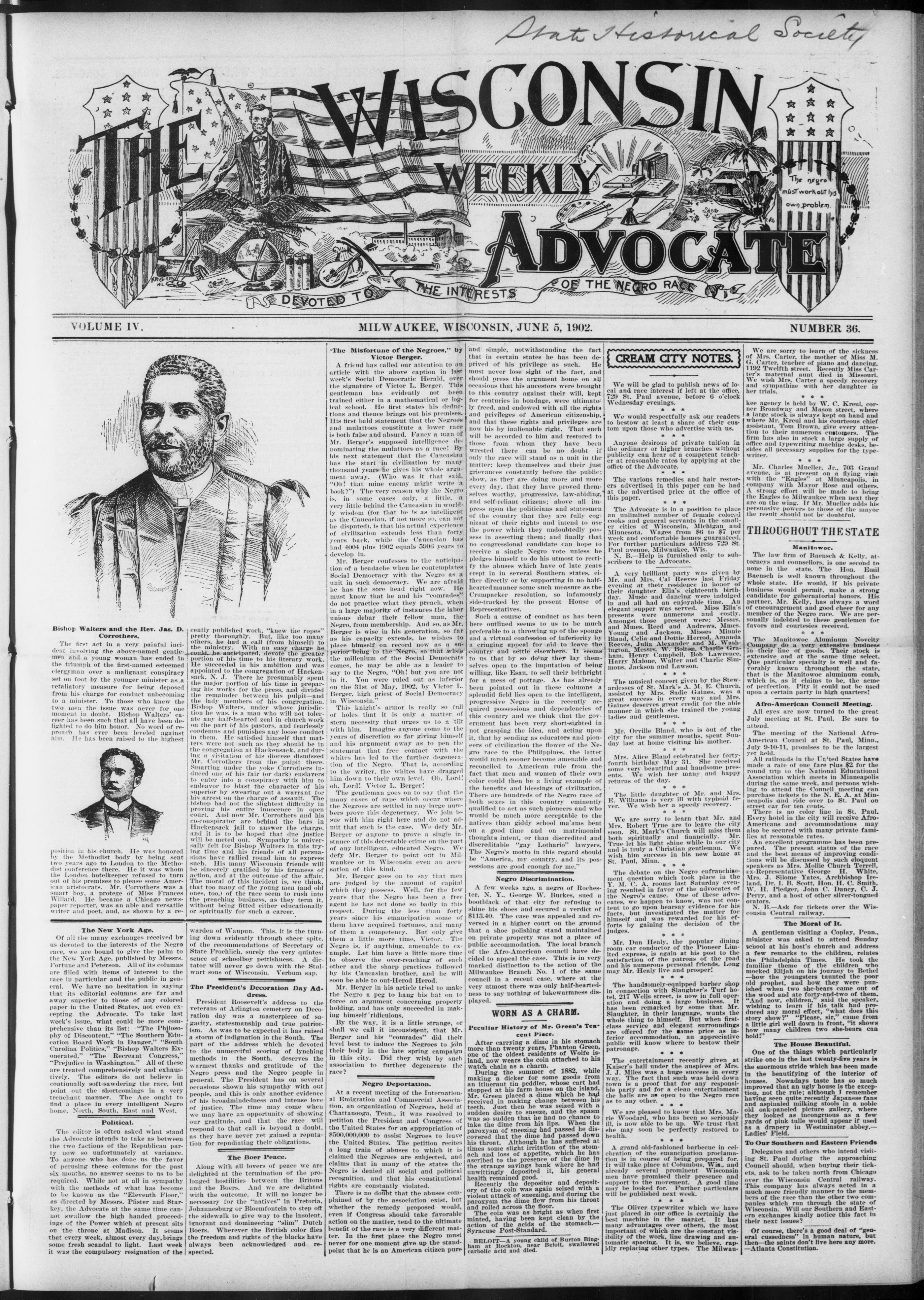
[Illustration of a man in a clerical robe].
Bishop Walters and the Rev. Jas. D. Corrothers.
The first act in a very painful incident involving the above-named gentlemen and a young woman has ended in the triumph of the first-named esteemed clergyman over a malignant conspiracy set on foot by the younger minister as a retaliatory measure for being deposed from his charge for conduct unbecoming to a minister. To those who knew the two men the issue was never for one moment in doubt. Bishop Walters' career has been such that all have been delighted to do him honor. No word of reproach has ever been leveled against him. He has been raised to the highest
432
position in his church. He was honored by the Methodist body by being sent two years ago to London to the Methodist conference there. He it was whom the London hotelkeeper refused to turn out of his premises to please some American aristocrats. Mr. Corrothers was a smart boy, a protege of Miss Frances Willard. He became a Chicago newspaper reporter, was an able and versatile writer and poet, and, as shown by a re-
position in his church. He was honored by the Methodist body by being sent two years ago to London to the Methodist conference there. He it was whom the London hotelkeeper refused to turn out of his premises to please some American aristocrats. Mr. Corrothers was a smart boy, a protege of Miss Frances Willard. He became a Chicago newspaper reporter, was an able and versatile writer and poet, and, as shown by a re-
The New York Age.
Of all the many exchanges received by us devoted to the interests of the Negro race, we are bound to give the palm to the New York Age, published by Messrs. Fortune and Peterson. All of its columns are filled with items of interest to the race in particular and the public in general. We have no hesitation in saying that its editorial columns are far and away superior to those of any colored paper in the United States, not even excepting the Advocate. To take last week's issue, what could be more comprehensive than its list: "The Philosophy of Discontent," "The Southern Education Board Work in Danger," "South Carolina Politics," "Bishop Walters Exonerated," "The Recreant Congress," "Prejudice in Washington." All of these are treated comprehensively and exhaustively. The editors do not believe in continually soft-sawdering the race, but point out the shortcomings in a very trenchant manner. The Age ought to find a place in every intelligent Negro home, North, South, East and West.
Political.
The editor is often asked what stand the Advocate intends to take as between the two factions of the Republican party now so unfortunately at variance. To anyone who has done us the favor of perusing these columns for the past six months, no answer seems to us to be required. While not at all in sympathy with the methods of what has become to be known as the "Eleventh Floor," as directed by Messrs. Pfister and Starkey, the Advocate at the same time cannot swallow the high handed proceedings of the Power which at present sits on the throne at Madison. It seems that every week, almost every day, brings some fresh scandal to light. Last week it was the compulsory resignation of the
---
cently published work, "knew the ropes" pretty thoroughly. But, like too many others, he had a call (from himself) to the ministry. With an easy charge he could, he anticipated, devote the greater portion of his time to his literary work. He succeeded in his ambition and was appointed to the congregation of Hackensack, N. J. There he presumably spent the major portion of his time in preparing his works for the press, and divided the remainder between his pulpit—and the lady members of his congregation. Bishop Walters, under whose jurisdiction he was, is a man who will not tolerate any half-hearted zeal in church work on the part of his pastors, and fearlessly condemns and punishes any loose conduct in them. He satisfied himself that matters were not such as they should be in the congregation at Hackensack, and during a visitation of his diocese dismissed Mr. Corrothers from the pulpit there. Smarting under the yoke Carrothers induced one of his fair (or dark) enslavers to enter into a conspiracy with him to endeavor to blast the character of his superior by swearing out a warrant for his arrest on the charge of assault. The bishop had not the slightest difficulty in proving his entire innocence in open court. And now Mr. Corrothers and his co-conspirator are behind the bars in Hackensack jail to answer the charge, and it is to be hoped that due justice will be meted out. Sympathy is universally felt for Bishop Walters in this trying time and his friends of all persuasions have rallied round him to express such. His many Wisconsin friends will be sincerely gratified by his firmness of action, and at the outcome of the affair. The moral of this incident is, we think, that too many of the young men (and old ones, too,) of the race seem to rush into the preaching business, as they term it, without being fitted either educationally or spiritually for such a career.
warden of Waupun. This, it is the turning down evidently through sheer spite, of the recommendations of Secretary of State Froehlich, surely the very quintessence of schoolboy pettishness. A dictator will never go down with the Stalwart sons of Wisconsin. Verbum sap.
The President's Decoration Day Address.
President Roosevelt's address to the veterans at Arlington cemetery on Decoration day was a masterpiece of sagacity, statesmanship and true patriotism. As was to be expected it has raised a storm of indignation in the South. The part of the address which he devoted to the unmerciful scoring of lynching methods in the South, deserves the warmest thanks and gratitude of the Negro press and the Negro people in general. The President has on several occasions shown his sympathy with out people, and this is only another evidence of his broadmindedness and intense love of justice. The time may come when we may have an opportunity of showing our gratitude, and that the race will respond to that call is beyond a doubt, as they have never yet gained a reputation for repudiating their obligations.
The Boer Peace.
Along with all lovers of peace we are delighted at the termination of the prolonged hostilities between the Britons and the Boers. And we are delighted with the outcome. It will no longer be necessary for the "natives" in Pretoria, Johannesburg or Bloemfontein to step off the sidewalk to give way to the insolent, ignorant and domineering "slim" Dutch Boers. Wherever the British color flies the freedom and rights of the blacks have always been acknowledged and respected.
MILWAUKEE, WISCONSIN, JUNE 5, 1902.
'The Misfortune of the Negroes," by Victor Berger.
A friend has called our attention to an article with the above caption in last week's Social Democratic Herald, over the signature of Victor L. Berger. This gentleman has evidently not been trained either in a mathematical or logical school. He first states his deductions and thence brings out his premises. His first bald statement that the Negroes and mulattoes constitute a lower race is both false and absurd. Fancy a man of Mr. Berger's supposed intelligence denominating the mulattoes as a race! By his next statement that the Caucasian has the start in civilization by many thousand years he gives his whole argument away. (Who was it that said, "Oh! that mine enemy might write a book?") The very reason why the Negro is, in some cases only, a little, a very little behind the Caucasian in worldly wisdom (for that he is as intelligent as the Caucasian, if not more so, can not be disputed), is that his actual experience of civilization extends less than forty years back, while the Caucasian has had 4004 plus 1902 equals 5906 years to develop in.
Mr. Berger confesses to the anticipation of a headache when he contemplates Social Democracy with the Negro as a unit in such democracy. We are afraid he has the sore head right now. He must know that he and his "comrades" do not practice what they preach, when in a large majority of instances the labor unions debar their fellow man, the Negro, from membership. And so, as Mr. Berger is wise in his generation, so far as his capacity extends, he wishes to place himself on record now as a superior being to the Negro, so that when the millenium of the Social Democrats comes, he may be able as a leader to say to the Negro, "Oh! but you are not in it. You were ruled out as inferior on the 31st of May, 1902, by Victor L. Berger, high priest of Social Democracy in Wisconsin."
This knight's armor is really so full of holes that it is only a matter of stern necessity that urges us to a tilt with him. Imagine anyone come to the years of discretion so far giving himself and his argument away as to pen the statement that free contact with the whites has led to the further degeneration of the Negro. That is, according to the writer, the whites have dragged him down to their own level. Oh, Lord! oh, Lord! Victor L. Berger!
The gentleman goes on to say that the many cases of rape which occur where the Negroes are settled in any large numbers prove this degeneracy. We join issue with him right here and do not admit that such is the case. We defy Mr. Berger or anyone to prove a single instance of this detestable crime on the part of any intelligent, educated Negro. We defy Mr. Berger to point out in Milwaukee or in Wisconsin even an accusation of this kind.
Mr. Berger goes on to say that men are judged by the amount of capital which they possess. Well, for the few years that the Negro has been a free agent he has not done so badly in this respect. During the less than forty years since his emancipation some of them have acquired fortunes, and many of them a competency. But only give them a little more time, Victor. The Negro is, if anything, amenable to example. Let him have a little more time to observe the over-reaching of each other and the sharp practices followed by his Caucasian brother, and he will soon be able to out-Herod Herod.
Mr. Berger in his article tried to make the Negro a peg to hang his hat on to force an argument concerning property holding, and has only succeeded in making himself ridiculous. By the way, it is a little strange, or shall we call it inconsistent, that Mr. Berger and his "comrades" did their level best to induce the Negroes to join their body in the late spring campaign in this city. Did they wish by such association to further degenerate the race?
Negro Deportation.
At a recent meeting of the International Emigration and Commercial Association, an organization of Negroes, held at Chattanooga, Tenn., it was resolved to petition the President and Congress of the United States for an appropriation of $500,000,000 to assist Negroes to leave the United States. The petition recites a long train of abuses to which it is claimed the Negroes are subjected, and claims that in many of the states the Negro is denied all social and political recognition, and that his constitutional rights are constantly violated.
There is no doubt that the abuses complained of by the association exist, but whether the remedy proposed would, even if Congress should take favorable action on the matter, tend to the ultimate benefit of the race is a very different matter. In the first place the Negro must never for one moment give up the standpoint that he is an American citizen pure
and simple, notwithstanding the fact that in certain states he has been deprived of his privilege as such. He must never lose sight of the fact, and should press the argument home on all occasions that his ancestors were brought to this country against their will, kept for centuries in bondage, were ultimately freed, and endowed with all the rights and privileges of American citizenship, and that these rights and privileges are now his by inalienable right. That such will be accorded to him and restored to those from whom they have been wrested there can be no doubt if only the race will stand as a unit in the matter; keep themselves and their just grievances constantly before the public; show, as they are doing more and more every day, that they have proved themselves worthy, progressive, law-abiding, and self-reliant citizens; above all impress upon the politicians and statesmen of the country that they are fully cognizant of their rights and intend to use the power which they undoubtedly possess in asserting them; and finally that no congressional candidate can hope to receive a single Negro vote unless he pledges himself to do his utmost to rectify the abuses which have of late years crept in in several Southern states, either directly or by supporting in no half-hearted manner some such measure as the Crumpacker resolution, so infamously side-tracked by the present House of Representatives.
Such a course of conduct as has been here outlined seems to us to be much preferable to a throwing up of the sponge and a virtual confession of inferiority by a cringing appeal for aid to leave the country and settle elsewhere. It seems to us that by so doing they lay themselves open to the imputation of being willing, like Esau, to sell their brithright for a mess of pottage. As has already been pointed out in these columns a splendid field lies open to the intelligent, progressive Negro in the recently acquired possessions and dependencies of this country and we think that the government has been very short-sighted in not grasping the idea, and acting upon it, that by sending as educators and pioneers of civilization the flower of the Negro race to the Philippines, the latter would much sooner become amenable and reconciled to American rule from the fact that men and women of their own color could then be a living example of the benefits and blessings of civilization. There are hundreds of the Negro race of both sexes in this country eminently qualified to act as such pioneers and who would be much more acceptable to the natives than giddy school ma'ams bent on a good time and on matrimonial thoughts intent, or than discredited and discreditable "gay Lothario" lawyers. The Negro's motto in this regard should be "America, my country, and its possessions are good enough for me."
Negro Discrimination
A few weeks ago, a negro of Rochester, N. Y., George W. Burkes, sued a bootblack of that city for refusing to shine his shoes and secured a verdict of $113.40. The case was appealed and reversed in a higher court on the ground that a shoe polishing stand maintained on private property was not a place of public accommodation. The local branch of the Afro-American council have decided to appeal the case. This is in very marked distinction to the action of the Milwaukee Branch No. 1 of the same council in a recent case, where at the very utmost there was only half-heartedness to say nothing of lukewarmness displayed.
WORN AS A CHARM.
Peculiar History of Mr. Green's Tentent Piece. After carrying a dime in his stomach more than twenty years, Phanton Green, one of the oldest residents of Wolfe island, now wears the coin attached to his watch chain as a charm.
During the summer of 1882, while making a dicker for some goods from an itinerant tin peddler, whose cart had stopped at his farm house on the island, Mr. Green placed a dime which he had received in making change between his teeth. Just then he was seized with a sudden desire to sneeze, and the spasm was so sudden that he had no chance to take the dime from his lips. When the paroxysm of sneezing had passed he discovered that the dime had passed down his throat. Although he has suffered at times some slight irritation of the stomach and loss of appetite, which he has ascribed to the presence of the dime in the strange savings bank where he had unwittingly deposited it, his general health remained good.
Recently the depositor and depository of the coin was again seized with a violent attack of sneezing, and during the paroxysm the dime flew from his throat and rolled across the floor.
The coin was as bright as when first minted, having been kept clean by the action of the acids of the stomach.—Syracuse Post-Standard.
BELOIT—A young child of Burton Bingham at Rockton, near Beloit, swallowed carbolic acid and dled.
CREAM CITY NOTES.
We will be glad to publish news of local and race interest if left at the office, 729 St. Paul avenue, before 6 o'clock Wednesday evenings.
☆ ☆ ☆
We would respectfully ask our readers to bestow at least a share of their custom upon those who advertise with us.
☆ ☆ ☆
Anyone desirous of private tuition in the ordinary or higher branches without publicity can hear of a competent teacher at reasonable rates by applying at the office of the Advocate.
☆ ☆ ☆
The various remedies and hair restorers advertised in this paper can be had at the advertised price at the office of this paper.
* * *
The Advocate is in a position to place an unlimited number of female color-cooks and general servants in the smaller cities of Wisconsin, Michigan and Minnesota. Wages from $6 to $7 per week and comfortable homes guaranteed. For further particulars address 729 St. Paul avenue, Milwaukee, Wis.
N. B.—Help is furnished only to subscribers to the Advocate.
A very brilliant party was given by Mr. and Mrs. Cal Reeves last Friday evening at their residence in honor of their daughter Ella's eighteenth birthday. Music and dancing were indulged in and all had an enjoyable time. An elegant supper was served. Miss Ella's presents were numerous and costly. Amongst those present were: Messrs. and Mmes. Reed and Andrews, Mmes. Young and Jackson. Misses Minnie Bland, Celia and Dottie Herrod, Amanda Reeves, Julia Alexander and M. Washington, Messrs. W. Bolton, Charlie Graham, Henry Campbell, Bob Lawrence, Harry Malone, Walter and Charlie Simmons, Jackson and Lawson.
```markdown
```
The musical concert given by the Stewardesses of St. Mark's A. M. E. Church, assisted by Mrs. Sadie Gaines, was a great success in every way and Mrs. Gaines deserves great credit for the able manner in which she trained the young ladies and gentlemen.
* * *
Mr. Orville Bland, who is out of the city for the summer months, spent Sunday last at home visiting his mother.
* * *
Mrs. Alice Bland celebrated her forty-fourth birthday May 31. She received some very beautiful and handsome presents. We wish her many and happy returns of the day.
宋 宋 宋
The little daughter of Mr. and Mrs. E. Willham is very ill with typhoid fever. We wish her a speedy recovery.
```markdown
```
We are sorry to learn that Mr. and Mrs. Robert True are to leave the city soon. St. Mark's Church will miss them both spiritually and financially. Mr. True let his light shine while in our city and is truly a Christian gentleman. We wish him success in his new home at St. Paul, Minn.
* * *
The debate on the Negro enfranchisement question which took place in the Y. M. C. A. rooms last Saturday evening resulted in favor of the advocates of the Negro's cause. One of these advocates, we happen to know, was not content to go upon hearsay evidence for his facts, but investigated the matter for himself and was rewarded for his efforts by gaining the decision of the judges.
* * *
Mr. Dan Healy, the popular dining room car conductor of the Pioneer Limited express, is again at his post to the satisfaction of the patrons of the road and his numerous personal friends. Long may Mr. Healy live and prosper!
```markdown
```
The handsomely-equipped barber shop in connection with Slaughter's Turf hotel, 217 Wells street, is now in full operation and doing a large business. It has been remarked by some that Mr. Slaughter, in their language, wants the whole thing to himself. But when first-class service and elegant surroundings are offered for the same price as inferior accommodation, an appreciative public will know where to bestow their patronage.
* * *
The entertainment recently given at Kaiser's hall under the auspices of Mrs. J. J. Miles was a huge success in every way. The fact that such was held down town is a proof that for any responsible party and for a clean entertainment the halls are as open to the Negro race as to any other.
We are pleased to know that Mrs. Marie Woodard, who has been so seriously ill, is now able to be up. We trust that she may soon be perfectly restored to health.
冰 冻 俞
A grand old-fashioned barbecue in celebration of the emancipation proclamation is in course of being prepared for. It will take place at Columbus, Wis., and already several prominent Wisconsin men have promised their presence and support to the movement. A good time may be looked for. Further particulars will be published next week.
***
The Oliver typewriter which we have just placed in our office is certainly the best machine in the market. It has many advantages over others, the most important of which are the constant visibility of the work, line drawing and automatic spacing. It is, we believe, rapidly replacing other types. The Milwau
We are sorry to learn of the sickness of Mrs. Carter, the mother of Miss M. G. Carter, teacher of piano and dancing, 1192 Twelfth street. Recently Miss Carter's maternal aunt died in Missouri. We wish Mrs. Carter a speedy recovery and sympathize with her daughter in her trials.
---
kee agency is held by W. C. Kreul, corner Broadway and Mason street, where a large stock is always kept on hand and where Mr. Kreul and his courteous chief assistant, Tom Brown, give every attention to their numerous customers. The firm has also in stock a large supply of office and typewriting machine desks, besides all necessary supplies for the typewriter.
※ ※ ※
Mr. Charles Mueller, Jr., 703 Grand avenue, is at present on a flying visit with the "Eagles" at Minneapolis, in company with Mayor Rose and others. A strong effort will be made to bring the Eagles to Milwaukee when next they are on the wing. If Mr. Mueller adds his persuasive powers to those of the mayor the result should not be doubtful.
THROUGHOUT THE STATE
Manitowoc.
The law firm of Baensch & Kelly, attorneys and counsellors, is one second to none in the state. The Hon. Emil Baensch is well known throughout the whole state. He would, if his private business would permit, make a strong candidate for gubernatorial honors. His partner, Mr. Kelly, has always a word of encouragement and good cheer for any member of the Negro race. We are personally indebted to these gentlemen for favors and courtesies received.
☆ ☆ ☆
The Manitowoc Aluminum Novelty Company do a very extensive business in their line of goods. Their stock is extensive and at the same time select. One particular specialty is well and favorably known throughout the state, that is the Manitowoc aluminum comb, which is, as it claims to be, the acme of perfection. Pity it could not be used upon a certain party in high quarters!
Afro-American Council Meeting
All eyes are now turned to the great July meeting at St. Paul. Be sure to attend.
The meeting of the National Afro-American Council at St. Paul, Minn., July 9-10-11, promises to be the largest yet held.
All railroads in the United States have made a rate of one fare plus $2 for the round trip to the National Educational Association which meets in Minneapolis during the same week, and persons wishing to attend the Council meeting can purchase tickets to the N. E. A. at Minneapolis and ride over to St. Paul on street car for ten cents.
There is no color line in St. Paul. Every hotel in the city will receive Afro-Americans and accommodations may also be secured with many private families at reasonable rates.
An excellent programme has been prepared. The present status of the race and the best means of improving conditions will be discussed by such eloquent speakers as Mrs. Mollie Church Terrell, ex-Representative George H. White, Mrs. J. Silome Yates, Archbishop Ireland, Dr. I. B. Scott, Hon. H. C. Smith, W. H. Pledger, John C. Dancy, C. J. Perry, and a host of other silver-tongued orators.
N. B.—Ask for tickets over the Wisconsin Central railway.
The Moral of It.
A gentleman visiting a Coplay, Penn., minister was asked to attend Sunday school at his host's church and address a few remarks to the children, relates the Philadelphia Times. He took the familiar theme of the children who mocked Elijah on his journey to Bethel—how the youngsters taunted the poor old prophet, and how they were punished when two she-bears came out of the wood and ate forty-and-two of them. "And now, children," said the speaker, wishing to learn if his talk had produced any moral effect, "what does this story show?" "Please, sir," came from a little girl well down in front, "it shows how many children two she-bears can hold!"
The House Beautiful.
One of the things which particularly strike one in the last twenty-five years is the enormous stride which has been made in the beautifying of the interior of houses. Nowadays taste has so much improved that an ugly house is the exception, not the rule; although I remember having seen quite recently Japanese fans and aspinaled milking stools in a noble old oak-paneled picture gallery, where they looked as incongruous as a few yards of pink tulle would appear if used as a drapery in Westminster abbey.—Ladies' Field.
To Our Southern and Eastern Friends
Delegates and others who intend visiting St. Paul during the approaching Council should, when buying their tickets, ask to be taken north from Chicago over the Wisconsin Central railway. This company has always acted in a much more friendly manner to the members of the race than the other two companies which run through the state of Wisconsin. Will our Southern and Eastern exchanges kindly notice this fact in their next issues?
Of course, there's a good deal of "general cussedness" in human nature, but then—the saints don't live here any more. Atlanta Constitution.
POLICE FIRE ON THE MOB.
Hospitals and Lockups are Crowded with Rioters-Hotels are Famine Stricken.
Chicago, Ill., June 4.—Disturbances due to the teamsters' strike increased in ferocity and frequency today. Policemen in a number of instances had to draw their revolvers to protect themselves; several of them had their clubs not only taken from them but used against them. The hospitals began to feel the effect of the battling by the increased number of patients and the police stations were scarcely able to hold the rioters arrested.
May Settle the Strike.
Behind closed doors representatives of the big local packing houses are holding a conference downtown, it is said, which is to determine the settlement or continuation of the strike. This was intimated by several men in the downtown offices of the different packers, and the report was sent broadcast in Fulton market and the stock yards. It is the first definite move in the direction of effective settlement of the strike, and within twenty-four hours the packers expect to be ready to issue their statement.
Two Serious Riots.
One of the most serious riots broke out at Congress and State and Harrison and State streets. By some maneuver the strikers succeeded in dividing the thirty-eight wagon caravan, the second one to leave the yards today, so that the front of it lay at Congress street on State and the rear at Harrison. While the vanguard battled with the crowd which hurled broken bottle, stale eggs and other missiles, including spools of thread thrown by women sympathizers in the crowd, the rear guard was called upon to defend itself against a more serious attack.
Police Battle with Mob.
At this place the mob made a desperate assault on the drivers, but was compelled to turn its attention to the police, who came upon the run. Twice the bluecoats hurled themselves against the infuriated men and each time they were rebuffed and crowded back. It was the most desperate clash the police have had with citizens in years. In several instances the strikers and their sympathizers wrenched clubs from the policemen and used them against their owners.
Many Badly Injured.
Meanwhile several men had gained a position of advantage on the elevated loop, from which they fired missiles at the officers. In this way Officer John McGuire was hit in the head with a horseshoe and so seriously injured that he had to be taken to a hospital. Officer John Linencurjal was less seriously hurt. Gus Billings, one of the crowd, was clubbed into insensibility by the police, and he, too, was taken to a hospital in a serious condition.
After these two ineffectual rushes at the crowd the police managed to organize themselves in better shape. The third time they were successful. A number of heads were broken, but their owners in most cases escaped. It was impossible to obtain anything like a complete list of the injured. The caravan after twenty minutes' delay began to move, but not in peace, for the crowd followed closely. The police, however, walked by the wagons and confined their efforts to pulling from the wagons men who tried to climb into the seats, presumably to pull down the drivers.
Missils Thrown from Window.
The decision of the police to confine their attention strictly to keeping invaders from climbing onto the wagons did not long endure. From windows along the route missiles were flung at them. At every street corner teamsters in sympathy with the strikers so managed their wagons as to bring about a blockade. With the continued opposition the bombardment, the blockading and the jeers the police lost their tempers and clubbed with apparent indiscrimination. It was said that several women and boys and one helpless cripple received blows from the batons of the police. The streets through which the cavalcade passed by noon had become a maelstrom of excited humanity. The slowly persistent passage of the meat wagons acted as a goad to the temper of the crowd.
Patrol wagons were kept busy rushing to the various lockups with prisoners; ambulances hurried to the nearest hospitals, where heads could be sewed up, but the strikers and their sympathizers did not lessen their resistance. The sight of new arrests and of bleeding heads stirred them on.
Automobiles Smashed to Pieces.
An incident of the fights was the smashing of an automobile in which were seated Charles Gates and a companion. The machine was caught in one of the blockades and smashed to splinters. Another machine, in which were two women, was caught in a similar predicament. The occupants were so frightened by the riot about them that they were at the point of fainting when policemen rescued them.
While passing under the elevated railroad loop, the caravan was endangered by trolley wires which had been cut from their fastenings and hung down to the pavement. No one was hurt, however, from this cause.
State Street Barricaded.
Business on State street was in a state of barricade several hours. Pickets for the strikers pursued sympathetic drivers to drive onto the thoroughfare in order to check the advance of the meat wagons. At Madison and State streets the volley of eggs, bricks, etc., became so thick and the street so congested that the police were forced to charge upon the crowd. Sympathizers in wagon loads tried to drive into the squads of police, and many people were slightly injured in the fracas. One old man had his arm broken by a blow from a policeman's club. Women and children were panic stricken and fled, crying, into side streets.
At Randolph and Clark streets the mob, which was preceding and following the meat caravan, grew riotous again. From a coal wagon and from standing produce wagons, the crowd seized missiles and pelted the drivers of the packing house wagons. Here the police charged the crowd again and again, driving them from the streets and doorways into side streets. At Fifth avenue near Madison three coal wagons attempted to blockade the streets again. One teamster drew a revolver and threatened to shoot anyone who touched his horses. The police pulled his team aside, however, but the driver was not arrested.
Street Cars Tied Up.
The cavalcade had hardly broken through the coal wagons on Fifth avenue when a more serious blockade followed a few yards further south on Madison street. A number of vehicles, driven by men, presumably in league with the strikers, had blockaded the street and tied up the street car lines running through the intersection. In the jam was a 'bus loaded with boys. The lads
climbed out of their vehicle only to meet the onrushing police and many of them were clubbed to a chorus of "shame" from the spectators. Occasionally bottles and stones were thrown from windows; but generally they hit innocent bystanders. One of them struck a horse and knocked it senseless. There was one humorous feature to the otherwise serious situation. A wagon, containing a live calf, was broken into during the absence of the police from that portion of the caravan and the bewildered animal taken away amid applause.
At 1:30 p. m., the blockade at Fifth avenue and Madison street was broken by a determined rush by the police.
Policeman Fires on Assailant.
On Fifth avenue, between Adams and Monroe streets, the first shot of the day was fired and it gave rise to a report that the police had fired upon the mob. An officer was hit by a pop bottle by a man standing on a fire escape ladder. The officer, unable to reach his assailant and other way, drew his revolver and fired two shots. The man escaped. The incident, however, created great excitement and soon one of the worst riots of the day was in progress.
Relieve Meat Famine.
At the stock yards attempts are being made to relieve the semi-meat famine that is oppressing the hotels and eating houses. Early in the morning a caravan of six wagons—two from Armours, two from Swift's and one each from Nelson Morris' and Schwarzschild & Sulzberger's plants—started under the escort of a patrol and fifteen policemen toward the downtown districts to supply stores with meat.
At 9 o'clock an imposing caravan of thirty-eight loads of beef, interspersed with five 'buses containing policemen, came out of the stock yards amid hoots and cries of derision from the crowd. It looked not unlike an army wagon train. Of the wagons sixteen belonged to Swift & Co.; three to Schwarzschild & Sulzberger; nine to Armour & Co.; five to Nelson Morris & Co.; four to Libbey MeNeil & Libbey and one to the Anglo-American Company. The caravan reached the Illinois Central depot at Twelfth street at 10 o'clock, accompanied by a constantly increasing crowd. During the unloading of meat at the depot the mob showed its ugly temper by throwing coal and bricks, but the well-armed police guard served to check more serious demonstrations.
Badly Injured in Battle.
A pitched battle occurred between a crowd of negroes, imported from St. Louis to take the places of the striking yard teamsters and toughs and strikers at Forty-fifth street and Center avenue early today in which six negroes were badly injured, two possibly mortally. The substitutes were driving wagons when they were assaulted. Many of their assailants were armed with ice pike poles they had seized from ice wagons and in the fight the negroes were badly lacerated by these weapons. One man had his thigh broken and another was injured internally. The imported negroes number about fifty.
Department Store Strike Settled.
The strike of the drivers for the ten State street department stores was settled at a conference held this afternoon and the men, 1300 in all, returned to work. The terms were not given out.
INVOLVE RAILWAYS.
President Mitchell Takes Trip to Scranton to See Chief of Locomotive Fireman.
Wilkesbarre, Pa., June 4.—There was much speculation around strike headquarters today over the purpose of President Mitchell's visit to Scranton last night, where he saw some of the national railway labor union leaders. Mr. Mitchell returned early today and all attempts to get him to talk about the nature of his conference with Frank P. Sargent, the chief of the locomotive firemen, was futile. All he would say was that his call upon Mr. Sargent was merely a social one. It is believed, however, that a new move of some sort in which the railroaders may be involved, is among the possibilities of the near future.
Crowds Hoot Nonunion Men.
The entire region was reported quiet at starting time today. At only two places in the Wyoming valley were there any signs of a demonstration against the men who are working the pumps. At Miners Mills a crowd gathered early and met each trolley car as it came into the town. As the workmen got off the car under the protection of the coal and iron police they were hooted and called uncomplimentary names. There was no attempt at violence and all the men reached the several collieries located there in safety. At the Exeter mines of the Lehigh Valley Company, West Pittston, a small crowd gathered and watched the men go into the collieries. The place is well guarded and no one approached the employees. There were many women in the crowd.
Strikers' Places Filled.
The strikers claim a few more additions to their ranks today, but in most instances the coal companies were able to supply the places of those induced to leave. The operators are reported to be in need of capable men. They can get any number of workmen, but those who are experienced in colliery work are getting scarce. The supply of company men, such as clerks, teamsters, bosses and other men employed around the mines at odd jobs has been exhausted and they are now drawing upon the nonunion men brought into the region.
A sympathetic boycott of all persons and establishments that in any way supply the wants of nonunion men has been inaugurated and is having its effect in bringing men out of the mines. Men of all callings, including bar tenders, butchers, grocery clerks, etc., are organized in the coal region. A nonunion man in most places cannot be served and if he is, the establishment is immediately boycotted. Families of nonunion men are consequently having much trouble in buying the necessaries of life in stores.
Kidnap Imported Men.
Hazelton, Pa., June 4.—The eleven imported men who were kidnapped at Hazle Brook colliery by the striking mine workers last night were sent back to Philadelphia today. District President Duffy announced that this was the last batch that would be deported at the expense of the union. About 300 men from Philadelphia reached Hazelton on a special train early today. They will be put to work around the mines.
CONSUL TO BRAVE VOLCANO.
John F. Jewell of Galenal Ill., to Go to Martinique.
Washington, D. C., June 4.—President Roosevelt has found a diplomat willing to undergo the dangers of another eruption of Mont Pelee, in the island of Martinique. He is John F. Jewell of Galena, Ill., who will fill the vacancy caused by the death of Consul Prentiss at St. Pierre.
Webster City, Ia., June 4.--One death and four others suffering from hydrophobia is the result of a mad dog's work in Ellsworth, a small town in this county.
WILL REWARD KITCHENER.
King Asks House of Commons to Appropriate $250,000.
Irish Members Give Notice of Most Violent Opposition-Vote of Boers on Peace Terms.
London, June 4.—It was announced this afternoon that Lord Kitchener has been created a viscount by King Edward.
London, June 4.—In the House of Commons today the government leader, A. J. Balfour, presented a message from King Edward as follows:
"His majesty, taking into consideration the eminent services rendered by Lord Kitchener and being desirous, in cerognition of such service, to confer on him some signal mark of his favor, recommends that he, the King, should be enabled to grant Lord Kitchener £50,000."
John Dillon, William Redmond and Swift MacNeill, Irish Nationalists, announced their intention of opposing the grant at every stage.
A resolution giving effect to his majesty's message will be discussed tomorrow.
Kitchener Starts for England.
Durban, Natal, June 4.—The Times of Natal states that Lord Kitchener has left for England, and that Gen. Lyttleton is acting commander-in-chief of the British forces in South Africa.
ONLY SIX OPPOSED PEACE.
Result of the Boers' Ballot on the Surrender.
Pretoria, Transvaal, June 4.—The ballot of the Boers at Vereeniging resulted in 54 votes in favor of surrender and 6 against it.
Preparations are being made here for the surrender of the Boer commandos which will take place on the race course. All the Boers are allowed perfect freedom.
There will be a Thanksgiving service Sunday, June 8, on the church square, in which it is hoped the Boers will participate. The women in the concentration camps are anxious to return to their homes immediately, but this will be impossible until a system of supply depots for the outlying districts is established.
Gen. Baden-Powell is arranging for the distribution of mounted constabulary in various districts. The police, railroads and telegraphs will be handed over to the civil authorities as soon as possible, and the restrictions of martial law will be gradually relaxed. The Boer delegates who, during the peace negotiations were stiff, formal and unfriendly, are now extremely cordial. All the commandants are returning to their commandes in order to explain the situation. Gen. Louis Botha, the Boer commandant-general, has written an open letter to the burghers thanking them for their obedience in the past and exhorting them to be equally loyal in their obedience to the new government.
Lord Kitchener's address to the Boer delegates at Vereeniging, in which the British commander-in-chief said that if he had been one of them he would have been proud to have done so well in the field as they had done, made the best possible impression and drew forth a hearty response from Gen. Beyers, the chairman of the Boer conference, who expressed the pleasure the Boers experienced at meeting Lord Kitchener as a friend, adding that they had fought so long against him that they had acquired full appreciation of his worth.
The departure of the Boer commanders from Vereeniging for their various districts was marked by remarkable scenes of fraternization. The trains conveying the Boers started late and, the night being extremely cold, the sentries along the railroad track lighted huge bonfires, round which groups of Boers and Britons gathered, forming a highly picturesque scene. The late opponents joined in such songs as "Hard Times Come Again No More" and "Old Folks at Home," the British soldiers and the burghers outvieing one another in their demonstrations of joy. In brief, the scenes at the departure of the trains resembled nothing so much as the starting of huge picnic parties. The same signs of rejoicing were witnessed throughout the Rand. Flags were displayed everywhere and thanksgiving services were held in all the towns.
Gens. Rotha and Delarey and other Boer leaders will start for Europe shortly, for the purpose of raising funds for the distressed burghers. Gen. Schalkburger, who was acting president of the Transvaal, joined Gen. Rotha in addressing an open letter to the burghers. After referring to the courage which they had displayed and to their brave deeds in the field, he called on them to work together for the social and spiritual advancement of the country.
FIVE MEN SHOT.
Fatal Battle Between Strikers and Nonunion Men at Edwardsville, Mo.
Edwardsville, Mo., June 4.—A riot broke out this morning between several hundred striking molders and nonunion employes of the American Steel & Foundry Company and five men were shot, two fatally. At present the names of the injured are not obtainable as they were hurried away to places of safety by their friends.
The trouble broke out at 5 a. m. when a trainload of employees of the company who had not struck reached Granite City. As the men were proceeding through a narrow lane to their work in the hills, they were assailed with stones. Several shots were fired by both parties. Two nonunion men, negroes, and three white strikers received wounds. Two of the latter were shot in the back.
Another account says that only three men were wounded as follows: John Buffington, aged 24, shot in the back, bullet lodging in the kidneys, condition serious; S. B. Mefford, aged 35, shot in the right arm; Alexander Mathews, aged 30, shot in the left leg.
This account states that the trouble was between twenty-five negroes imported to take the place of strikers. A warrant has been sworn out for the arrest of one of the negroes named Bird, charging him with the shooting of Buffington.
DETROIT GIRL A PEERESS.
Miss Martha Palm Marries Count Champeaux of France.
Detroit, Mich., June 4.—Another Detroit woman joined the ranks of Detroit titled women when Miss Martha Palms, a wealthy young woman and daughter of one of the most prominent families, married Count Laurent Meichel Champaux of Chateau Ville Neuve, Cote d'Or, France.
President of Oberlin College Expires After Nine Days' Illness.
DEATH OF WELL-KNOWN EDUCATOR
Oberlin, O., June 3.—After nine days' illness with pleuro-pneumonia, John Henry Barrows, president of Oberlin College, died at 2:50 o'clock this morning. Mr. Barrows was unconscious at the time of his death, which came during a sinking spell.
Dr. John Henry Barrows was born in Medina, Mich., July 1, 1847. He was graduated from Olivet College in 1867 His theological training was obtained in Yale. Union and Andover seminaries. He did educational work in Kansas for two and a half years. He preached in Springfield, Ill., and Lawrence and Boston, Mass. He traveled abroad for one year. In 1881 he was called to the First Presbyterian church of Chicago, where he served fifteen years. In 1893 Dr. Barrows was the organizer and president of the world's parliament of religions held during the World's Fair. In 1896 he went to India to give the Haskell lecture for the University of Chicago. On his return he lectured for two years. In November, 1898, he was elected president of Oberlin College. During his incumbency as president the institute has prospered greatly.
A widow, three daughters and a son survive him.
MEMBERS OF FRENCH CABINET RESIGN.
President Loubet Says He Regrets Their Decision and Thanks Them for Their Co-operation. Paris, June 3.—At a cabinet council, held at the Elysee Palace today and at which President Loubet presided, the premier, M. Waldeck-Rousseau, formally presented the resignation of the cabinet, and in so doing expressed the sentiments of gratitude which his colleagues and himself retained for the constant kindness the President had shown them. President Loubet in reply said he regretted the decision of the ministers and thanked them for the co-operation they had lent him in difficult times.
The cabinet which has just resigned consisted of the following members:
President of the council and minister of the interior, M. Waldeck-Rousseau: minister of finance, M. Caillaux: minister of foreign affairs, M. Delcasse: minister of war, Gen. Andre: minister of marine, M. Delanessan: minister of colonies, M. Decraise: minister of public instruction and worship, M. Georges Leygues: minister of jus ice, M. Monis: minister of commerce, industry and posts and telegraphs, M. Millerand: minister of agriculture, M. Jean Dupuy: minister of public works, M. Pierre Baudin.
WANTS LIPTON TO ATTEND TO BUSINESS.
Shareholders of London Company Anxious to Have Sir Thomas Give Up Yacht Racing.
London, June 3.—The annual meeting of the company known as "Lipton Limited" produced some interesting complaints from the shareholders over the reduction of the amount of the dividend. One man said that if Sir Thomas Lipton, the chairman, attended a little more to business and a little less to yacht racing, the conditions would be improved.
WON'T ASK FOR CUBAN REPORT.
House Committee by Strictly Party Vote Tables Resolution Demanding Accounting from Gen. Wood. Washington, D. C., June 3.—By a party vote the House military committee today decided to table the resolution asking for information concerning the expenditures in Cuba. The Democrats gave notice of making a minority report.
MANY MISHAPS AT A FAIR.
Epctators Given Series of Scares and One Man Fatally Hurt
Minneapolis, Minu., June 3.—Thousands of spectators underwent a series of scares in the Elks' Fair in consequence of the accidents, in which one man was fatally injured. A woman performer was making a spectacular slide along 100 feet of taut wire when one of the supporting posts broke. A section of the steel bar struck George Sweeney on the head, fracturing the skull. He is dying at the City Hospital. The victim is a conductor on the Great Northern railroad. The performer escaped without serious injury. A little later one of the cars of the Ferris Wheel became entangled in the surrounding cables and hurled its occupant, J. O. Davis, thirty feet to the ground below. He was seriously bruised and shocked.
The bicyclist, E. J. Kilpatrick, who "loops the loop" in a great wooden wheel, head downwards, lost the trick, and was precipitated among the spectators. He was not badly hurt, however.
STOCK TERMINAL RATE LEGAL.
Supreme Court Hold Car Charges Can be Collected.
Washington, D. C., June 3.—An opinion was handed down in the supreme court today affirming the decision of the circuit court of appeals of Illinois in refusing to enforce an order of the Interstate Commerce Commission forbidding the railroads to collect $2 terminal charges on each car of cattle arriving at Chicago. The court held that the rate was not unreasonable and that, owing to the peculiar circumstances existing at Chicago, the charges would continue to be collected.
In concluding the opinion the court said that nothing in the decision should be taken to constitute a bar to further proceedings of a like nature on new findings of fact showing that unreasonable rates were charged.
Got Name from American.
Downing street, the home of British diplomacy, perpetuates the name of a clever New Englander—George Downing—who went to England from Massachusetts and became a chaplain in Cromwell's army. He served as British ambassador at the Dutch court, and retained his popularity in the reign of Charles II., being given the large grant of land at Westminster, where he laid out Downing street. He is said to have been the first pupil in the first school established in Massachusetts.—Great Round World.
The eyeball is white because its blood vessels are too small to admit of the red corpuscles of the blood passing through them.
Great Britain and Ireland import about 265,000,000 pounds of cheese each year. Canada supplies about 60 per cent. of the whole.
—Wild canaries were not yellow originally, hunt green or gray in color.
South Bound Oregon Express on Southern Pacific Goes Into Ditch.
TWO MEN ARE CRUSHED TO DEATH.
Redding, Cal., June 4.-The southbound Oregon express on the Southern Pacific road, which left Redding at 10:45 last night, was wrecked about fifteen minutes later near Clear Creek, four miles from this city. The accident was caused by a halfopen switch which evidently had been left in that condition by some unknown person. The train is what is known as a double-header, having two engines, and was running at a great rate of speed, as it was on a down grade. Both engines were thrown into the ditch and completely wrecked.
Engineer J. M. White and Fireman Fred Taffel of the forward engine were thrown under the wreckage and crushed to death, their bodies being fearfully mangled. The mail car was thrown across the track where it now stands. All of the passenger coaches were ditched. A number of passengers were more or less injured, but so far as can be learned none were killed. The names of the injured passengers have not yet been ascertained.
VOLCANO KILLS MANY.
Two Villages and Seventy-five Persons Destroyed by Eruption.
IN TERRITORY OF CHOICO, CHILI.
New York, June 4.—A dispatch from La Paz, Bolivia, dated Monday, says, according to a Valparaiso, Chili, correspondent of the Herald, that two villages have been destroyed and 75 persons killed by an eruption of a volcano in the territory of Choico. The serious eruption of the volcano continues.
ASK PRESIDENT TO INTERFERE IN COAL STRIKE.
New York Board of Trade Wants Anthracite Troubles Submitted to Arbitration.
New York, June 4.—At a meeting of the New York board of trade and transportation today, Oscar S. Straus presiding, resolutions were adopted urging President Roosevelt to appoint a commissioner to investigate the situation in the anthracite regions and to see if the miners and operators could not be induced to arbitrate their differences.
Such power, it was declared, was vested in the chief executive by chapter 1063 of the federal laws dealing with differences or controversies which may effect interstate transportation and commerce.
GO ON THE WARPATH.
Battallon of Mexican Troops Fights Fierce Battle with the
Tucson, Ariz., June 4.—The uprising among the Yaqui Indians is becoming general. A detachment of seventy-three men from the force of Gen. Torres, who is pursuing the Yaquis in the Mazatan mountains east of Hermosillo, was ambushed and thirty of the number killed. Capt. Celso Gomez and Lieut. Jose Valejo of the Twentieth battalion were among the slain. Only one escaped unhurt. The Mexicans ran out of ammunition and engaged in a hand-to-hand battle with the Yaquis. Fifty of the latter were reported killed, but their great number overwhelmed the Mexicans. The survivors retreated to Hermosillo. Fifteen of them were wounded.
Gen. Torres has retreated and sent out scouts loyal to the government. Refugees arriving at Hermosillo report that everywhere the Yaquis have taken the warpath. Three stations on the Sonora railroad have been abandoned and the telegraph operators have left. Gen. Luis Torres, in command of the Mexican troops, has been reinforced by his brother, Lorenzo Torres, with 200 mounted men. It is estimated that there are 1000 Yaquis, well armed, assembled in the foothills of the Mazatan mountains. The Mexican forces are short of ammunition and arms. The Yaquis captured twenty-five stands of arms in the ambuscade Sunday. Runners arriving at Hermosillo report fearful cruelties at the ambuscade, which occurred Sunday near Aguajita.
As soon as the expected reinforcements arrive, Gen. Torres will attack the Yaquis in the mountains and a decisive battle is expected then.
IN TWENTY HOURS.
Lake Shore and Pennsylvania to Start Fast Eastern Service on June 15.
Chicago, Ill., June 4.—Twenty-hour trains will be put on by the Lake Shore, New York Central and the Pennsylvania lines on Sunday, June 15. An extra fare of $8 will be charged on those trains, making the through rate $33, including sleeping car berth. This is in accordance with the agreement of the Eastern roads to charge excess fare of $1 for every hour faster time than twenty-eight hours between New York and Chicago. The Lake Shore-New York Central train will be known as the "Twentieth Century Limited," and will leave Chicago at 12:30 p. m. daily and reach New York the next morning at 9:30 o'clock.
The Pennsylvania train will leave Chicago daily at noon and reach New York at 9 o'clock the next morning. The time of departure of the westbound trains from New York has not yet been announced, but it will probably leave about 2 p. m. These trains will be composed of the first civilian equipment and will carry only through passengers between Chicago and New York. Stops will only be made at points where engines have to be changed. The twenty-four-hour limited train service of both roads will continue as at present.
CUNARD OFFERED $52,500,000
Proposition Made by the American Shipping Syndicate.
London, June 4.—It is understood the American shipping syndicate has offered the Cunard Company $52,500,000 for their fleet, including two big steamers recently ordered.
FIX PRICE OF STEEL RAILS.
The Rate for Next Year is $28 Per Ton.
New York, June 4.—The steel rail pool is reported to have fixed the price of steel rails for 1903 at $28 a ton, the rate now prevailing.
Proceedings in the House
The House on the 29th passed the subsidiary silver coinage bill, the bill for the improvement and care of the Confederate mound in Oakwoods cemetery, Chicago, and the bill to reduce the selection of reserve banks to cities of 15,000 inhabitants; accepted the conference reports on the omnibus public building and fortifications appropriation bills, named Messrs. Dalzell (Pa.), Cannon (Ill.) and Richardson (Tenn.) to confer with the Senate committee upon the action of the House in instructing its conferees upon the army appropriation bill, and adjournment until the 2d prox. was then taken.
By a vote of 129 to 46 the rules were suspended in the House on the 2d, and a joint resolution was adopted extending the thanks of Congress to Secretary of State Hay for his address on the occasion of the McKinley memorial exercises last February. Gen. Hooker (Miss.), a one-armed Confederate veteran, delivered an eloquent defense of Mr. Hay's address, denying that it contained anything that was objectionable from a political standpoint. Special orders were adopted for the consideration of the anti-anarchy bill, and the bill to transfer certain forest reserves to the agricultural department. The Senate bill to retire Surgeon General Sternberg and the House bill to encourage salmon culture in Alaska were defeated on motions to pass them under suspension of the rules.
Consideration of the anti-anarchy bill was begun in the House on the 3d. The House committee reported a substitute for the Senate measure. Mr. Ray (N. Y.) chairman of the judiciary committee, who was in charge of the bill, argued that the Senate bill was unconstitutional. Mr. Lanham (Tex.), supported the feature of the bill to exclude Anarchists, but opposed that making it a particular offense to kill the President or anyone in the line of the presidential succession. He argued that every man was equal before the law, and that existing laws were ample to punish the killing, or attempted killing of the President. The conference report upon the river and harbor bill was agreed to.
The debate on the anti-anarchy bill continued all day in the House on the 4th. It was without sensational features, being confined almost entirely to the legal and constitutional phases of the question. Mr. Jenkins (Wis.) and Mr. Parker (N. J.) contended that the bill did not go far enough; that the killing of the President should be made punishable by death without any limitation whatever. Mr. Powers (Mass.) and Mr. Nevin (Ohio), the other two speakers, supported the measure as it came from the committee. The resolution calling upon the secretary of war for a detailed statement of the expenditures made under the direction of Gen. Wood during his administration as governor of Cuba was laid upon the table by a vote of 110 to 78.
Proceedings in the Senate.
The conference report on the river and harbor bill was agreed to by the Senate on the 29th and the rest of the day was devoted to the Philippine bill. Mr. Spooner (Wis.) made a speech which constituted principally a vigorous defense of the policy of the administration, and was aimed to refute the arguments of Senator Hoar. In his review of the situation in the islands he sought to make it clear that the responsibility for it rested not on any one party, but on all alike. Mr. Spooner paid a brilliant tribute to President Roosevelt and to the personality and policy of the late President McKinley. Two other senators were heard—Morgan of Alabama, in favor of the measure, and Clay of Georgia, in opposition to it. Adjournment was to the 31st.
Mr. Spooner (Wis.) occupied nearly five hours of the session of the Senate on the 31st in concluding his speech. He maintained that the United States could not leave the Philippines "like a coward" and abandon people who had come under our protection, thus surrendering them to "tyranny and chaos." He did not believe in the admission of the Philippines to the Union as states, but in the conduct of the islands nothing savoring of imperialism had been suggested except for party purposes. He charged that an Incessant effort had been made by the minority to put this country in the wrong and to stain the country with dishonor. He referred incidentally to the story that a thousand Fillipinos had been put to death by American troops in trenches which they were compelled to dig. Mr. Lodge of Massachusetts said the story had been denied by the father of the soldier who had started it, and that the war department had cabled to Gen. Chaffee to ascertain the facts. Mr. Carmack of Tennessee interrupted to say that no doubt the soldiers would deny the story as all soldiers in the Philippines had been required to do. His remark was greeted with hisses from the galleries, the demonstration of disapprobation calling out a sharp rapping of the gavel from the chair. In the course of his speech Mr. Spooner became involved in a spirited colloquy with Mr. Hoar of Massachusetts, during which Mr. Spooner read a statute of the state of Massachusetts, which offered a reward of £100 for the scalps of male Indians over the age of 12 years.
Debate upon the Philippine bill in the Senate on the 2d was confined to fifteen-minute speeches under the agreement. Among those who were heard were Senators Cullom, Mason, Hoar, Foraker, Bacon, Patterson, Teller, Carmack and Proctor. Early in the session Mr. Lodge, in charge of the bill, offered several amendments, principally of a verbal nature. The provision of the bill relating to franchises was amended so as to prohibit corporations from employing persons held in slavery or involuntary servitude. A new section was added to the bill providing that the treasury of the Philippine government shall be a depository for such public moneys as the secretary of the treasury may direct. Mr. Hoar, after reviewing the situation in the Philippines and referring to the outrages which had been committed, said: "I do not charge these things upon the army. I charge them upon imperialism." He referred to the cost of the war as enough to establish universities like Harvard throughout the country, and said: "This miserable doctrine of buying sovereignty with gold has cost us all this."
The Philippine bill passed the Senate on the afternoon of the 3d by a vote of 48 to 30 as it was reported by the Philippine commission with the exception of a few verbal amendments suggested by the chairman of the committee. The measure had been under bedate seven weeks and two days. The Senate divided practically upon party lines, all Republicans present voting for the bill with the exception of Hoar, Mason and Wellington, who voted with the Democrats against it, and all the Democrats opposing it with the exception of Mr. McLaurin of South Carolina, who voted with the Republicans for the bill. Debate upon the bill was exhausted before the hour reached for taking the vote, and consequently it was necessary for the Senate to take several recesses while awaiting for the hour of 4 o'clock to arrive. The Nicaragua canal bill was taken up by the Senate immediately after the passage of the Philippine bill and made the order of business. Debate upon it will continue to occupy the attention of the Senate until disposed of. The House resolution thanking Secretary of State Hay for his McKinley memorial address was agreed to. The executive session before adjournment was brief.
The bill authorizing the promotion and retirement of the present senior major-general of the army, Maj.-Gen. John R. Brooke, was passed by the Senate on the 4th, as was a bill providing that the postmaster general may extend free delivery to cities of 5000 inhabitants or $5000 gross income, instead of 10,000 inhabitants, as at present. A joint resolution empowering the state of Minnesota to file selections of indemnity school lands in Minnesota otherwise undisposed of, after the survey thereof in the field and prior to the approval and filing of the plat of survey thereof, was approved. Senator Morgan occupied the rest of the day with a speech on the canal bill. After a brief executive session the Senate adjourned.
Smoking in Church.
The Dutch have many strange customs, but one of the strangest is their habit of smoking in church. A similar practice exists in several churches in South America. Smoking in churches in Great Britain, according to the Sunday Strand, is said to have been prevalent at the end of the Sixteenth and the beginning of the Seventeenth century. In Wales smoking in church was indulged in as late as 1850. In one church the communion table stood in the aisle, and the farmers were in the habit of putting their hats upon it, and when the service began they lighted their pipes and smoked, without any thought of irreverence in the act.
One of the fire department horses in Baltimore is extremely fond of limburger cheese and eats it with evident relish.
THE MORNING SUMMONS.
When the mist is on the river, and the haze is on the hills,
And the promise of the springtime all the ample heaven fills:
the ample heaven fills;
When the shy things in the wood-haunts and the hardy on the plains
Catch up heart and feel a leaping life through winter-sluggish veins:
Then the summons of the morning like a bugle moves the blood.
Then the soul of men grows larger like a flower from the bud;
For the hope of high Endeavor is a cordial half divine.
And the banner cry of Onward calls the laggards into line.
There is glamour of the moonlight when the stars rain peace below.
But the stir and smell of morning is a better thing to know;
While the night is hushed and holden and transpierced by dreamy song.
Lo, the dawn brings dew and fire and the rapture of the strong!
—Richard Burton in the Atlantic.
THE BLINDERS.
There existed at Paris, only a short while ago, a quasi-secret society which excited the curiosity of the fashionable world. Where this society met, what was its object, and whether the members were conspiring against the French government, or against foreign governments, were questions frequently asked in fashionable drawing rooms. Yet no one was able to answer these perplexing questions, while the significant name of "Blinders," by which the society was known, only served to deepen the mystery and to make the world at large more curious about it.
It was noted, however, that all the members of the organization were bachelors and also that they belonged to the most distinguished families of France. Now, however, that the society no longer exists, I do not think that it would be indiscreet for me to write the odyssey of this very interesting group.
The chief end of the society was to demonstrate to its members the beauties and privileges of celibacy, contrasted with the irksomeness and disadvantages of matrimony, hence the significance of the name "Blinders"—meaning that they had closed the blinds of their hearts against marriage. The gay president, Hector de Meydesir, and the vice president, Dutailly, were, of course, the most rampant advocates of celibacy. The former, a handsome young bachelor of 30, had for his motto "Love all pretty women," a motto which he carried out with scrumulous nicety.
The views of the vice president, Dutailly, a naval officer, and the intimate friend of De Meydesir, were diametrically opposed to those of the president, for he entertained a most profound contempt for women. They irritated and provoked him, and when forced to be in their company he appeared awkward, timid and ill at ease, and could never fathom how a self-respecting man could so far forget his dignity as to lead a cotillon. Still, under these two widely different characters the society increased and progressed and for some years was extremely prosperous. However, one cannot play perpetually with fire without being burned, and so the wings of the gay, handsome butterflies were singed by the pretty girls with whom they professed to flirt, and gradually, notwithstanding the heroic efforts of the two founders, the members slipped away and joined the ranks of the benedicts, leaving only the president and the vice-president to guard the citadel.
"Another fool," growled Dutailly, throwing Figaro on the table beside him, as he and De Meydesir sat in solitary grandeur one morning in the club's lounging room.
"A fool? Who's a fool?" languidly inquired the president, looking up from his book.
"Gaston de Foemerin," gruffly responded Dutailly: "he has gotten married."
De Meydesir contented himself with simply yawning, then after a pause he said with a flippant air, "Poor devil, I pity him! He should have followed the example of the butterflies, those bright-winged fairies of the air. They sip the sweets from all the flowers, but do not linger with any of them, and that is my fashion." Dutailly had listened with ill-concealed bad humor and when his colleague had finished, he snapped out: "I detest all women, both young and old, and to me they are simply uninteresting bundles of chiffon, roses and silk."
"A letter for Monsieur de Meydesir," said the valet as he entered the room, interrupting the conversation. The president took it, broke the seal and exclaimed gaily, "A note from Mlle. Cleo, who expects to see me this afternoon at the Baronne de B.'s tea. Adieu, Dutailly, until tomorrow," he said, as he left the room. Three days later Dutailly, the sea dog, was ordered off on a long cruise in foreign waters, and when he returned to Paris after an absence of four years he was broken hearted to learn that the president of the "Blinders," his companion and intimate friend, Hector de Meydesir, had broken his vows and had taken unto himself a wife; and finally, after many hesitations and interior conflicts with himself, he resolved to call on Hector and learn from his own lips the motives which had induced him to abjure his principles.
"Monsieur is at home," said the valet as he opened the door at the De Meydesir mansion, introducing the infuriated officer into a splendid Moorish room, where he found the lord of the household, lying back in a luxurious arm chair, his handsome head resting on a soft cushion, while he blew clouds of smoke before him from the most delightful of Turkish cigarettes. Dutailly looked about him in disgust; everything in the room savored of femininity, from the gold, narrow-rimmed miniature of a beautiful girl on the mantel to the rare Moorish vase on the table with its gay bouquet of glorious pink carnations. As soon as the first effusions of greeting were over, Dutailly in his characteristic blunt fashion snapped out: "I understand you are married! Is—is it really true?"
"Most assuredly, old fellow," came the prompt reply. "I have been a benedict for three years." Dutailly gave a slight start as though he could scarcely believe the words; then squaring himself on his chair, he looked with compassion on the ex-president of the "Blinders," as he said in pitying tones:
"Of course you are unhappy."
"Not in the least, my dear boy. On the contray, I am the happiest man in the world."
"I don't believe it," gruffly responded the sea dog. Then in words tinged with scarcasm he reminded De Meydesir of his butterfly theories.
"Here, take a cigar," said De Meydesir amiably, "and listen to the story of my marriage—it is quite unique. Directly after your departure I lost heavily at play, my father grew angry at my extravagance and declared he would no longer cancel my debts; then to retrieve my fortune I borrowed from money-lenders; was unfortunate a second time and found myself followed about by a band of creditors. One morning I received a curt note from my father requesting me to cal lon him. I went; he received me with an avalanche of abuse, declaring that he had been greatly annoyed by my numerous creditors to settle my extravagant bills. 'And you settled them.' I said. 'No, I refused,' he answered sternly, 'and, moreover, I warn you that tomorrow or next day you will be lodged at Clicky.'
"This announcement really startled me, and after a moment's hesitation I said, 'But, father, you surely wouldn't allow your son to be imprisoned?' Well.
I will cancel your debts,' he said, planting himself before me, 'but on one condition.' 'Any condition,' I eagerly cried. 'That you marry!' 'Never!' I responded. 'Very well, then,' he said cooly, 'you must go to prison!'
"Now, to make a long story short. I dearly love the sunshine, the drives through the Bois and the fun on the boulevards under the starlight; in a word I preferred the chains of Hymen to those of a prison, and so I consented to—marry!"
"You infernal coward!" growled Dutailly, shaking the ashes from his cigar. "Well," continued De Meydesir, pretending not to notice his friend's ill humor. "eight days later I was presented to Mlle. Sabine de Moultry at a ball given at the ministry. I proposed and was accepted. Mlle. de Moultry was really beautiful; she had large expressive black eyes, full of tenderness, surmounted by arched eyebrows, quite accentuated, and a tip-tilted nose, which gave her a saucy, piquant air—and in her white spangled glown, garnished with tea-roses, she appeared absolutely irresistible."
Dutailly simply groaned at this charming picture, but the ex-president of the "Blinders," pretending not to hear him, continued his story.
"We remained together all the evening, I quoting poetry and whispering compliments about her adorable swan-like neck, and she listening with evident pleasure. Our marriage was soon arranged and the wedding day set, my father assuring me that he would cancel my debts as soon as I was married. Finally the great day arrived. I must confess, however, that I felt loath to leave my bachelor quarters. My anti-matrimonial antipathies revived and I felt precisely as though I were going to my interment.
"At the mayoralty I found several of the ex-Binders whom I had bantered for taking unto themselves wives. They met me with ironical smiles, and, pressing my hand, wished me joy. Finally the solemn moment arrived and his honor, arrayed in his tri-colored scarf, entered the room. He at once began to read a variety of small papers to which nobody listened. Then in a solemn voice he asked: 'Monsieur, do you consent to take for your lawful wedded wife Mile. Sabine de Moultray?' 'No!' I replied firmly. Then followed an indescribable uproar; the bride fainted, her mamma followed suit, while M. de Moultray and my father advanced toward me with clenched fists. However, in the general commotion I managed to escape."
"And what caused you to change your mind so suddenly?" dryly asked Dutailly, puffing away at his cigar.
"Because," said De Meydesir, languingly, "a friend whispered into my ear as he entered the mayoralty: 'Old boy, I congratulate you. Papa cancelled all your debts this morning.' The news electrified me and I at once resolved not to give up the liberties of a bachelor. That very day I returned to my ordinary routine of life and three months passed by without my hearing anything from my father or from Mlle. de Moultray, when one morning my valet anounced that a young lady wished to speak to me. I willingly granted the interview, and, to my surprise, I found in my small drawing room Sabine de Moultray, looking a trifle thinner, a little paler, but still very charming. 'Monsieur,' she said in a voice trembling with emotion: 'you have disgraced me.' I denied it. 'But you have, monsieur,' she insisted, 'in the affront which you offered me in the presence of my assembled friends, who inferred from your conduct that I was unworthy to bear your name.'
"In a few words I gave her the true cause of my refusal. She listened with a half-satisfied air, and then raising her great black eyes she said, softly: 'This may be quite true, monsieur, yet, nevertheless, you have dishonored both myself and my family. Many people now pretend not to see me on the street or in the Bois. I feel disgraced, dishonored. Will you not repair the wrong which you have done me? Surely you do not wish to see me die of a broken heart at eighteen?'
"Overcome with emotion and realizing for the first time the great injustice which I had done I asked what I could do to repair it. 'Ask of my family my hand a second time,' she answered quickly, 'and allow me to have the pleasure of refusing you before my assembled friends and thus restore my honor.' I agreed, and a month later we stood again before the mayor. 'Mademoiselle,' asked his honor, 'will you accept for your lawful husband M. Hector de Meydesir?' Sabine hesitated before answering, and raising her beautiful black eyes she looked at me. I must confess that at that moment I fell desperately in love with her, she looked so pure and innocent in her bridal gown. I was on the point of whispering. 'For God's sake, accept me,' when in a clear voice she answered 'Yes sir.'
"I suppose she had seen the love in my eyes and had intuitively read my mind. "It is impossible, my dear Dutailly, for me to express the joy I felt at this moment, though you see in one way I was married without really intending to be."
The old sea dog groaned: "Well," he said, after a pause, "the Blinders are dissolved."—Adapted from the French for the New York Commercial Advertiser by Beatrice Hastings.
HE WON MUCH PRAISE.
United States Consul Aymes of Gaudaloupe has earned much praise by his energetic work in relieving the Martinique
1
UNITED STATES CONSUL AYMES. survivors. He has been one of the foremost members of the relief expedition.
A TERRITORIAL PAPER.
Items Which Now Seem Odd Made Up the Madison Express of July 31, 1845.
An old copy of the Madison Express which has been in possession of Charles L. Clason of Milwaukee is full of interest now. The paper was published by William W. Wyman at Madison, Wis., and the specific copy which recently came to light is that of July 31, 1845, being No. 5 of Vol. 6. The price at which the paper was sold is boldly printed at the top of the first page and is announced to be $2 per year in advance. Its motto, in prominent italics, was "Faithful and Fearless."
News was at a Preminum.
Published as it was in the early days of the territorial life of Wisconsin, its contents are of peculiar interest in these latter days of telegraphs and newspapers which print anywhere from twelve to sixty pages of news and miscellaneous matter. This particular paper is but four pages in size, and not a line of telegraphic matter appears in it. Nearly the only news item which appears is one concerning the meeting of the territorial Whig convention, which met in representative hall at Madison, Tuesday, the 24th of July, and at which Col. James Collins of Iowa county was nominated as delegate to Congress. In the list of delegates credited to Milwaukee county, the county's name being spelled part of the time Milwaukee and part of the time Milwaukie, were the following well known names of that time: A. Finch, Jr., William S. Wells, Harman Ludington, John B. Dousman, John Hustis, W. W. Brown, Martin Fields, John Andrews, Jr., Edward West, E. M. Randall, S. P. Pierce, P. H. Prame, John S. Filmore, A. Gove, and Henry Williams.
The report of the convention takes note of all the forms used by a secretary in making the minutes of a meeting, and there is no attempt at presentation in narrative form. The remainder of the first page is taken up in the telling of stories, some of them credited to other papers and some uncredited.
Politica in the 40's.
Something of the spirit of what was agitating the people of the territory in those days is found in the editorial column of the paper, which nearly got lost by wandering over to the right hand side of the second page. In this department the readers were told that if they would have the sale of the mineral lands, the improvement of our harbors and rivers, and other internal improvements looked after carefully by an able and efficient advocate, they should send Col. James I. Collins to Congress. In this department also, which gets somewhat scattered onto the third page the editor takes a fall out of James G. Birney in a fashion not entirely lost in this day of journalism. He says: "This James G. Birney is the man who (by the course he pursued during the last presidential canvass) annexed Texas and slavery to the United States. How long will it take him to get rid of slavery at this rate?
The paper must have been a moneymaker for those days, for it has a display of six full columns of legal advertisements. Among the ads may be found such quaint announcements as "Milwaukie School Book Depository, Wilshire & Co., at the sign of the Big Book on East Water street, Milwaukie."
Under date of June 17, 1845, the Madison postoffice advertises "No credit for postage at this office after the 30th June, 1845."
A number of the advertisers from Milwaukee, and the paper seems to have a liberal supply of them, spell the name of this city "Milwaukie."
A Quaint Advertisement.
But perhaps the quaintest thing in the whole paper is the announcement of the stage coach line between Milwaukee and Galena, which read as follows:
FROM MILWAUKEE TO GALENA.
Through in Three Days.
LEAVES the General Stage Office,
Wisconsin street, Milwaukee, for
Galena, by Troy, Janesville, Monroe,
Wiota, Shellsburgh, Gratiot's Grove, White
Oak Springs to Galena, every Monday,
Wednesday and Friday, at 7 o'clock A. M.,
lodging at Janesville and Shellsburgh.
Leaves the General Stage Office, Milwaukee, via Prairieville, Whitewater, Fort Atkinson, Madison, Blue Mounds, Dodgeville, Mineral Point, Platteville and Hazel Green to Galena, every Tuesday, Thursday and Saturday, lodging at Madison and Mineral Point.
Leaves Whitewater every Wednesday, Friday and Sunday for Milton, Janesville, Beloit, Pecatonica, Roscoe, Rockford, connecting with the Galena and Chicago mail stages, making a line from Milwaukee via the aforesaid places to Chicago and Galena, in three days.
Will leave for New Berlin, Vernon, Mukwonego and Troy every Tuesday, Thursday and Saturday, returning every alternate day.
Will leave for Oak Creek, Racine, Southport, Half Day and Wheeling to Chicago, every Monday, Wednesday and Friday, returning alternate days.
By the above arrangement it will be perceived there is a daily line of four horse post coaches running from Milwaukee to Galena, and from Milwaukee to Janesville, also connecting at Madison with the Stage Line to Fort Winnebago, and at Platteville with the line to Prairie du Chien. Passengers at Janesville can also take passage daily for Galena. Passengers at Madison can go through to Chicago in two days via Fort Atkinson, Whitewater, Janesville, Rockford, Belviders and Elgin, also to Galena, via Freeport and Scales' Mound to Galena.
The Coaches are all of the best Troy built Coaches.
Automobiles Barred.
Consul Langerman of Tangier, who has been on leave of absence, gives the following explanation of why Muley Abdul Azziz, Sultan of Morocco, prohibited automobiles in his country: "The French government presented a fine automobile to the Sultan and sent over an expert chauffeur to run it for him. The potentate was charmed by the new means of covering the ground, and it looked as though horses and state carriages would go to the stable for good. But one day when the Sultan was spinning along the road the machinery got out of order and the carriage escaped from the chauffeur's control. Then a tire exploded and the steering gear refused to work. The machine ran away. The Sultan called upon it to stop, but it refused to obey. The chauffeur saw death ahead whether the inevitable accident was fatal or not. Then the machine struck a rock and both the Sultan and the chauffeur were launched into space, while the automobile turned over, with the wheels still spinning. The Sultan was not badly hurt, but he limped back to town and sent the royal blacksmith out with the royal sledge hammer to smash the royal auto to royal smithereens. Then he forbade by an edict, an order, a ukase, a law, a proclamation and a bull that any of his subjects should ever import or use an automobile."—San Francisco Chronicle.
BOER WAR IS ENDED.
London, June,2.—King Edward issued this proclamation of peace at 1 o'clock this morning:
"The King has received the welcome news of the cessation of hostilities in South Africa with infinite satisfaction and his majesty trusts that peace may speedily be followed by the restoration of prosperity in his new dominions, and that the feelings necessarily engendered by war will give place to earnest cooperation on the part of his majesty's South African subjects in promoting the welfare of their common country."
London, June 1.—Peace in South Africa was officially announced by the London war office today. The declaration followed the receipt of a cablegram from Lord Kitchener at Pretoria, the former capital of the South African republic, which related that terms of peace had been signed by all the representatives of the fighting Boers and by Lords Kitchener and Milner for Great Britain. Following is the exact text of Lord Kitchener's cablegram:
Pretoria, May 31, 11:15 p. m.—A document containing terms of surrender was signed here this evening at 10:30 o'clock by all of the Boer representatives, as well as by Lord Milner and myself.
Lord Alfred E. Milner is the British high commissioner in South Africa and Lord Kitchener is the commander in chief of the British army in the field. The treaty which they have negotiated is the result of the conferences that have been held since April 7, when Acting President Schalkburger and Secretary of State Reitz, for the Transvaal, and President Steyn, for the Orange Free State, began a systematic effort to obtain a plebiscite of the Boers in arms with reference to a cessation of the conflict.
Peace Terms Announced.
In the House of Commons this morning the following peace terms were announced:
His excellency Lord Milner, in behalf of the British government; his excellency Mr. Steyn, Gen, Bremner, Gen. C. R. DeWet and Judge Hertzog, acting in behalf of their respective Burghers, desiring to terminate the present hostilities, agree to the following terms:
The Burgher forces in the field will forthwith lay down their arms and hand over all guns, rifles and munition of war in their possession, or under their control, and desist from further resistance and acknowledge King Edward VII. as their lawful sovereign.
The manner and details of this surrender will be arranged between Lord Kitchener and Commandant-Gen. Botha, assisted by Gen. Delarey and Chief Commandant De Wet.
Second—All Burghers outside the limits of the Transvaal and Orange River Colony, and all prisoners of war at present outside South Africa, who are Burghers, will, on duly declaring their acceptance of the position of subjects of his majesty, be brought back to their homes as soon as means of transport can be provided and means of subsistence assured.
Third—The burghers so returning will not be deprived of their personal liberty or property.
Fourth—No proceeding, civil or criminal, will be taken against any burghers surrendering, or so returning, for any acts in connection with the prosecution of the war.
The benefits of this clause do not extend to certain acts contrary to the usages of war which had been notified by the commander-in-chief of the Boers to the generals and which shall be tried by court-martial after the close of hostilities.
Fifth—The Dutch language will be taught in the public schools of the Transvaal and Orange River Colony where the parents desire it and will be allowed in the courts of law for the better and more effectual administration of justice.
Sixth—Possession of rides will be allowed in the Transvaal and Orange River Colony to persons requiring them for their protection, on taking out a license, according to laws.
Seventh—The military administration of the Transvaal and Orange River Colony will at the earliest possible date be succeeded by a civil government and so soon as circumstances permit representative institutions, leading up to self-government, will be introduced.
Eighth—The question of granting the franchise to natives will not be decided until after the introduction of self-government.
Ninth—No special tax will be imposed on landed property in the Transvaal or Orange River Colony to defray the expenses of the wex.
Tenth—As soon as the conditions permit it, a committee of which the local inhabitants will be represented, will be appointed in each district of the Transvaal and Orange River Colony under the presidency of a magistrate or other official for the purpose of assisting in the restoration of the people to their homes and supplying those who owing to war losses are unable to provide for themselves with food and shelter and the necessary amount of seed, stock, implements, etc., indispensable to the resumption of their normal occupation. His majesty's government will place at the disposal of these commissions the sum of 3,000,000 pounds sterling and will allow all the notes issued under the law of 1900 of the South African republic and all receipts given up to officers in the field of the late republics or under their orders to be presented to judicial commission which will be appointed by the government and if such notes and receipts are found by this commission to have been duly issued in return for valuable considerations they will be received by the first named commissions as evidence of war losses suffered by the persons to whom they were originally given.
In addition to the above named free grant of 3,000,000 pounds sterling, his majesty's government will be prepared to make advances on loan for the same purposes, free of interest for two years and afterwards repayable over a period of years, with 3 per cent. interest. No foreigner or rebel will be entitled to benefit under this clause.
Britain Riots in Joy.
Great joy was manifested throughout the United Kingdom last night because of the ending of the war, which has been waged incessantly at enormous cost in money and life since October 11, 1899. Nowhere is the rejoicing greter than in the palace of King Edward himself. For several months it has been the leading desire of his heart and the main object of his daily duties to bring the war to an end in advance of his coronation, which takes place the 26th of the present month. He has taken a personal interest in the plans and back of the negotiations that were necessary in London before Lords Kitchener and Milner could affix their signatures to a treaty there has been a constant plea from the King: "Let us have an honorable peace."
Slow Progress of Negotiations.
As the negotiations progressed at the conferences both the King and the British people were alternately buoyed up with hope and cast down in spirit. One day reports would come that the Boers were willing to quit the field upon being granted the demands they had made. These never were important so far as the main question of British sovereignty in South Africa was concerned, but certain leaders in the London war office were bent on humiliating the burghers to the last degree. Scarcely would the report of a peaceful attitude of the Boers be reported
than would come news of a battle in which the British arms had met a reverse. Then the hopes of the King and people would be dashed to earth.
King Pushes Proceedings.
In the midst of these varying conditions, it is said, the King himself took a personal hand in the proceedings and declared that the valiant Boers should be spared humiliation when the terms they demanded did not affect the main question at issue in the war.
A draft of peace terms was then made in the cabient and cabled to Lords Kitchener and Milner. It is presumed here that it was these terms which were signed finally by the Boers' representatives.
Telegrams received from all parts of the provinces testify to the extreme joy felt by all classes at the conclusion of the war. At many places the magistrates discharged all the prisoners charged with light offenses.
Berlin and Paris Knew First.
A singular fact is that the first news of the conclusion of peace was received at Windsor, by telephone, from Berlin and Paris.
Many of the provincial exchanges closed at lunch time and the children at the schools everywhere were dismissed.
Great torchlight processions are being arranged for tonight and illuminations which were in the course of preparation for the coronation are being hurried on, that they can be lit up tonight.
There is no further news from South Africa, but the opinion is expressed in official quarters here that Commandant Fouche and other Boer leaders in Cape Colony who did not attend the Vereeniging conference will come in of their own accord. It is also thought to be extremely improbably that it will be possible to bring many troops home in time for the coronation.
IRELAND ALONE IS SORRY.
Rest of the United Kingdom Rejoicing Over End of War.
London, June 2.—With the exception of Ireland, practically the whole of the United Kingdom is holiday-making today in honor of the conclusion of peace in South Africa. The streets everywhere are thronged with people who, every now and then, relieve their overstrun nerves by an outburst of hoarse cheering, or by braying penny trumpets. The tone of King Edward's message to the people and the absence therein of any note of exultation, seems, however, to have set a good example, and while giving a free vent to their own satisfaction the British are showing small desire to crow over their late enemies.
Flags and bunting are everywhere displayed, church bells are ringing, salutes are being fired and there is general jubilation on all sides. Crowds of suburbanites poured into London at an early hour and converged towards the usual centers, the Mansion house, Royal exchange, Trafalgar square, etc., and quickly be decked themselves with tiny flags, buttons and badges. At intervals some enthusiast singing "God Save the King," which is taken up by the happy throngs and is heard for miles through the neighboring streets, from one end of the metropolis to the other.
On the Stock Exchange.
The earliest demonstrations on the Stock Exchange, where the members arrived an hour earlier than usual, commenced with the bidding up of South African securities and consols. On the official opening "God Save the King" was sung by all present and a telegram was dispatched to Lord Kitchener as follows:
The members of the London stock exchange join with the rest of the British empire in rejoicing at the happy end of the lengthened campaign. Peace with honor is a fitting prelude to peaceful coronation celebrations. Heartiest congratulations to your lordship and the brave boys with you.
The members of the stock exchange then marched to the Mansion house and serenaded the lord mayor, Sir Joseph C. Dimsdale, and afterwards resumed business, but without much heart for their work.
Chamberlain Cheered.
Later in the day a levee at St. James' palace and a cabinet meeting in Downing street attracted immense crowds. Thousands of people awaited the arrival of the cabinet ministers and the scenes which greeted the popular favorites have not been equaled in many years. Many of the ministers wore court dress on account of having to be present at the levee, which added to the attractiveness of the occasion.
It is almost needless to add that Joseph Chamberlain, the colonial secretary, came in for special attention with the masses. The police were unable to hold them in bounds and crowds surged around Mr. Chamberlain's carriage, hurrahing and shouting congratulations until the colonial secretary escaped within the building.
On the adjournment of the cabinet meeting the crowds repaired to Buckingham palace and St. James' palace and further relieved their feelings by cheering the King and other notabilities who attended the levee, at which United States Ambassador Joseph H. Choate and all the members of the embassy and a number of special coronation envoys were present.
PAUL KRUGER SHOCKED.
He is Anxious to Go Back to the Transvaal.
Utrecht, June 2.—Mr. Kruger was informed last night that peace had been declared. He had been asleep. "My God," he said, "it is impossible." Mr. Kruger and his entourage hope to be permitted to return to the Transvaal. This, however, is quite unlikely.
POPE BEJOICES AT NEWS.
Hopes to Close His Eyes on World- Wide Peace.
Rome, June 2. On the receipt of the news of the conclusion of peace in South Africa the Pope expressed his joy, adding: "I hope to close my eyes on worldwide peace.
LEYDS SAYS HE IS PLEASED.
Boers' Agent at First Refused to Credit Boer News.
Paris, June 2.—Dr. Leyds, the European agent of the Transvaal who had been in Paris for a couple of days, was informed late yesterday evening of the conclusion of peace in 'South Africa, but he refused to credit it. The news, seemingly, was an unpleasant surprise to him. This morning, however, a messenger from the foreign office brought him the confirmation of the press reports and Dr. Leyds immediately decided to proceed to Utrecht, Holland, for which place he departed at noon. Whein questioned as he was leaving his hotel here, Dr. Leyds declared he was pleased with the news, but he declined to make a statement except that he admitted he was quite ignorant of the conditions of the surrender, though he felt certain they were favorable to the Boers.
BOER PRISONERS THANKFUL.
Sing the British National Hymn Some are Sullen.
Hamilton, Bermuda, June 2.—The Boer prisoners here are reported to be generally pleased with the announcement that peace in South Africa has been concluded, though a few of the irreconcilables are sullen. Some of the Boers joined in singing the British national anthem.
Chicago News.
An unidentified man was fatally hurt by a Baltimore & Ohio freight engine.
James E. Evans, inventor and personal acquaintance of titled Europeans, was fined $100 by Justice Bradwell on a charge of beating his wife. Evans made no defense.
Kobert Know, 80 years old, fell from a park seat to the sidewalk and died before assistance could reach him. Mr. Know was formerly an insurance solicitor.
Fire destroyed the buildings at the Hawthorne track and caused a loss of $75,000. The stables and horses were not endangered.
Frederick C. Taylor, 43 years old, a real estate dealer, was killed at Exchange avenue crossing of Lake Shore and Michigan Southern road. His horse was also killed.
Three children were injured by falling walls while playing amid the ruins of an old brick structure. Several other children had narrow escapes from being buried beneath the debris.
Dr. Austin O'Malley, formerly professor of English literature at Notre Dame University, who is critically ill with ptomaine poisoning, acquired by eating deviled ham, will be sent to Philadelphia for a surgical operation, which has been decided upon by the physicians attending the case.
—Chicago is to have one of the largest electric plants in the world. It is to be built by the Commonwealth Electric Company. It will cost $6,000,000, and have a capacity of 100,000 horsepower. Its construction will cover a period of five or six years, involving annually an expenditure of $1,000,000.
—Startled by a firecracker which several boys had exploded, a horse driven by John Dougherty ran away, throwing Dougherty to the ground and later overturning the carriage, in which his daughter Anna, 16 years old, had kept her seat. Both were severely injured.
LATEST MARKET REPORTS.
Milwaukee, June 4, 1902.
EGG AND DAIRY PRODUCTS.
MILWAUKEE—Eggs—Market very firm; fresh, loss off, cases included, 14½c; fresh, cases returned, 14c; seconds, 9@10c. Receipts, 510 cases. The demand is good.
Butter—Market steady; fancy prints, 22½c; fancy or extra creamery, per lb, 22c; firsts, 20c; seconds, 17@18c; dairy prints, 18½@19c; extra fancy dairy, 18c; lines, 15@16c; roll, 15@16c; packing stock, 14@15c; whey, 9c; grease, 4@5c. The receipts today were 12,400 lb against 6569 lb yesterday. The receipts of creamery are quite heavy and accumulating. Dairy is also coming in and sells readily. High prices restrict sales in the city.
Cheese—Steady. Receipts were 8000 lbs today against 3125 lbs yesterday. Full cream flats, fancy, 13@13½c; good to choice, 11½@12½c; Young Americas, 12½@13c; daisies, 12½@13c; fancy brick, 14c; low grades, 11@12c; lilburbur, per lb, No. 1, 14c; low grades, 10@12c; imported Swiss, 25c; Block Swiss, domestic, 15@16c; fancy loaf, 15½@16c; No. 2, 13@14c; Sapsago, 20c; farmers', 10@11c.
PLYMOUTH—Twenty-five factories offered 2696 boxes cheese, and all but 168 sold as follows: 260 longhorns, 10c; 124 do, 10½c; 801 daisies, 9½c; 389 do, 9½c; 244 twins, 9½c; 245 do, 9½c; 44 Young Americas, 9½c; 421 do, 10c.
CHICAGO—Butter—Steady; creamerles, 18@22c; dairles, 18@19c. Cheese—Steady; twins, 10@10½c; daisies, 11@11½c; Young Americas, 11½@12c; Eggs-Firm; at mark, cases included, 15½@15½c. Live poultry—Firm; turkeys, 11@12c; chickens, 12c.
MILWAUKEE LIVE STOCK MARKET.
HOGS—Receipts, 30 cars; market 5c higher; light, 6.75@7.10; mixed and medium weights, 6.95@7.20; common to good packers, 6.75@7.10; selected heavy, 7.25@7.35. Pigs, 90 to 120 lbs, 5.50@6.25.
CATTLE -- Receipts, 20 cars; dull and lawyer; lutchers' steers, medium to good, 1050 to 1300 lbs, 5.75@6.59; fair to medium, 950 to 1050 lbs, 4.75@5.50; helpers, common, 2.75@3.25; good, 4.50@5.50; cows, fair to good, 3.00@4.00; canners, 2.00@2.25; bulls, common, 2.75@3.25; choice, 3.75@5.00; feeders, 800 to 950 lbs, 3.75@4.50; stockers, 500 to 750 lbs, 3.00@3.50; veal calves, light, 5.25@5.50; choice, 5.75@6.00. Milkers—At no demand unless fancy at 35.00@45.00.
SHEEP—Receipts, 4 cars; dull, 3.00@3.75; bucks, 2.75@3.25; lambs, 4.00@5.75; spring lambs, 5.00@6.00.
Chicago receipts: Hogs, 22,000; cattle, 300; sheep, 900.
MARKETS BY TELEGRAPH.
MILWAUKEE-Flour-Steady. Wheat- Firm; No. 1 Northern, on track, 77c; No. 2 Northern, on track, 76c. Corn-Steady; No. 3 on track, 61½c. Oats-Steady; No. 2 white, on track, 44c; No. 3 white, on track, 43@43½c. Barley-Quiet; No. 2 on track, 70c; sample on track, 63@70½c. Rye-Dull; No. 1 on track, 58c. Provisions-Steady; pork, 17.30; lard, 10.22.
Flour markets steady; patents. 3.90@4.00;
bakery. 3.90@3.00; rxe. 3.90@3.15
bakers, 2.50@8.00, 1.9e, 1.80@8.18.
Millstillss are steady and quoted at 16.00
for bran, 17.00 for standard midlings and
19.00@19.25 for Milwaukee flour midlings
in 100-lb sacks; red dog, 21.00.
CH1CAGO—Close — Wheat — June, 72%
@72%c; July, 71%@72c; September, 70%c;
December, 71%c; Corn—June, 61%c; July,
61%@61%c; September, 58%@58%c; December,
43%c; May, 43c. Oats—June, 38c; July,
35%c, new 38%c; September, 28c, new 29%@
30c; December, 28%c, new 30%c. Pork—
June and July, 17.35; September, 17.42%@
17.45; January, 16.35; May, 16.35. Lard—
June, 10.20; July, 10.25; September, 10.27%
@10.30; October, 10.22½; January, 9.42½;
May, 9.30. Ribs—June and July, 10.15; Sept-
ptember, 10.05. Flax—Cash N. W., 1.76; S.
W., 1.58; September, 1.45; October, 1.40.
Rye—July, 66%@57c; September, 54%c. Barley—
Cash, 64@68c. Timothy—September,
4.75. Clover—Cash, 8.35.
KANSAS CITY — Close — Wheat — July, 66%@66%; September, 66%@66%; cash No. 2 hard, 70%@70%; No. 2 red, 71%@71%; No. 2 spring, 70%; Corn—July, 57%@57%; September, 51%@51%; cash No. 2 mixed, 60%; No. 2 white, 62%; Oats—No. 2 white, 45%. ST. LOUISE—Close—Wheat—Higher; No. 2 red cash, elevator, 75%@75%; No. 2 hard, 72%@72%; Corn—No. 2 cash, 62%@62%; July, 60%; September, 55%@55%; dull, Oats—Higher; No. 2 cash, 41%; July, 32%; September, 27%; No. 2 white, 45%; Lead-Firm; 3.95%@3.97%; Spelter—Strong; 4.65. TOLEDO—Wheat—Stronger; June, 79%; July, 74%; September, 73%; Corn—Dull, firm; cash, 62%; July, 61%; September, 59%; December, 44%; Oats—Fairly active, firm; cash, 42%; July, 36%; September, 29; new July, 39; new September, 31c. Clover seed—Dull, steady; cash, 5.12%; October, 5.17%.
DULUTH — Close — Wheat — Cash No. 1 hard, 75%c; No. 1 Northern, 72%c; No. 2 Northern, 70%c; No. 3 spring, 69%c; to arrive, No. 1 hard, 76%c; No. 1 Northern, 73%c; July, 72%c; September, 70%c. Manitoba, No. 1 Northern cash, 71%c; No. 2 Northern, 69%c; Oats—Cash, 41%c; September, 29c. Rye—55%c. Flax—To arrive, cash and June, 1.75; September, 1.45; October, 1.40. Receipts—Wheat, 5000. Shipments, 307.716.
MINNEAPOLIS — Close — Wheat — July, 72%@73c; September, 68%@68%c; on track. No. 1 hard, 76%c; No. 1 Northern, 74%@74%c; No. 2 Northern, 72%c.
NEW YORK—Close—Wheat—July, 78%c; September, 75%c. Corn—July, 67c; September, 63%c.
ST. LOUISE—Cattle—Receipts, 4500; market steady; beef steers, 3.75@7.30; Texans, 3.30@4.35; stockers and feeders, 3.25@4.75; cows and heifers, 2.25@5.90. Hogs—Receipts, 5000; market 5c lower; pligs, 6.75@6.95; packers, 6.90@7.15; butchers', 7.00@7.42%2. Sheep—Receipts, 2500; market steady; sheep, 5.00@5.50; lambs, 5.75@7.00.
KANSAS CITY—Cattle—Recelpts, 3000
market strong to 10c higher; beef steers,
5.10@7.40; Texans, 3.10@5.05; cows and heifers,
2.50@6.00; stockers and feeders, 3.00@
5.50. Hogs—Recelpts, 13,000; market weak to 10c lower; heavy, 7.30@7.40; pael, 7.10
@7.35; medium, 7.00@7.30; yorker, 6.00
7.10; plgs, 6.00@6.85. Sheep—Recelpts, 4000;
market stronfi; sheep, 4.15@5.85; lambs,
5.00@5.20.
SOUTH OMAHA—Cattle—Recelpts, 3000
market steady to strong; beef steers, 5.25@
7.50; Texans, 4.40@5.75; cows and heifers,
3.75@6.00; canners, 1.50@3.00; stockers and feeders,
3.00@5.25. Hogs—Recelpts, 1500
market steady to strong; heavy, 7.15@7.30;
mixed, 7.10@7.20; plgs, 5.75@6.50. Sheep—
Recelpts, 2500; market steady; sheep, 3.25@
6.00; lambs, 5.50@7.10.
Printed in the Interests of the Negro Race,
MILWAUKEE, WIS.
ee ee
Telephone Black No. 244.
SUBSCRIPTION RATES.
Any part of the United States and Canada,
postage paid.
One Year ..-..-.eseeeecseeeeeeeeeeees $2.00
Six Months .........----seeccceceeee LD
Three Months ........---s+e+eeseeee+ 7D
Send money by Express Money Order, P. O.
Money Order or Registered Letter to the
Wisconsin Weekly Advocate.
ADVERTISING RATES.
One inch, single insertion...:.......... 25¢
One inch, ( YERL..c-scesercssccss- $9.00
Business locals 5c per line each insertion.
Apply for rates to the Advocate.
TO CONTRIBUTORS:
ll communications must be sent with the
mame aod address of the sender as an evi-
dence of good faith, but not necessarily for
publication. No manuscript returned if not
accepted, unless accompanied by stamps.
oe
The Wisconsin Weekly Advocate company
wishes to notify the publie that all contracts
and business transactions with this com-
pany must have the company stamp, other-
wise they will be void. Neither will this
company be responsible for paid subserip-
tions unless given to duly-accredited agents,
who, on request, will give the company’s re-
ceipt for same. Subscribers failing to re-
ceive their papers regularly wil} kindly noti-
fy the general office. Address all business
communications to the general manager,
729 St. Paul avenue.
Entered in the Postoffice at Milwaukee as
Second-class matter.
Old Pelee seems to have things its
own way, with the entire world looking
on helplessly.
Will it be perfectly consistent for the
Prohibitionists to nominate a “full” state
ticket?
The mosquito has arrived with a rush.
He came in out of the wet, as do all in-
sects of this family.
Pekin is delighted, because Yuan Shai
Kai has knocked the revolution in Chi
Li approximately sky high.
The Santa Fe train which raced across
the track of an approaching tornado es-
caped temporary service on an aerial belt
line.
It transpires that one man knew what
was going to happen to St. Pierre, but
he is dead with the rest, and the story is
safe against authentic denial.
Going, down to the beach at Rockway
took on a new meaning rather suddenly
for those who were seated in the diving
room on the pier, when the floor gave
way.
The speed of ninety-seven miles in
eighty-eight thinutes, achieved by a Wa-
bash train, is almost enough to enable
impetueus travelers to catch their
breath.
The reported hydrophobia epidemic in
Wisconsin proves to be simply a scare of
the sort usual in connection with that
disease, which is rarer than is generally
supposed.
The Mary McLane book is no better
than scores of others which have come
from the press during the past two years
nor can it be said that it is much
worse. Of course, if the latter truth gets
out it will enoil sales,
Karl Mann, the winner of the recent
international pegestrjan contest between
Berlin and Dresden gistance of 125
miles—is a vegetarian, There's auother
socdolager for the meat trust!
SSS
The fate of the Miiwaukeo barkeeper
who is in hospital for repairs, made
necessary by his failure to hypnotize a
bull, may presage the downfall of the
great packers, who are charged with put-
ting too much trust in beef.
Love is assigned as the cause of the
Chicago tragedy, in which a young man
shot and killed his inamorata and him-
self, because the parents of the girl
thought her too young to marry. But a
fellow who does not love a girl enough
to keep from shooting her does not love
her very much.
A St. Paul judge has decided that
conductors of street railway cars can
stop at crossings or proceed continuous-
ly, as the carrying capacity of their cars
dictates. Somebody will growl in any
event.—_the man who has to wait at the
crossing, or the man who squeezes in
to find “standing room ouly.”
—_—_
There must be money in politics of
the reform variety. Mrs. Lease, the
Kansas “stateswoman,” who has been
granted a divorce from her husband on
the ground of non-support, stated in
court that she has always provided for
the family—first by washing, then by
writing, and finally by activity in poli-
cies.
The unknown person who cut up the
gas bag of M. Santos-Dumont’s flying
machine, in London, may have been a
friend who believed that by so doing he
was preventing the Brazilian aeronaut
from going the way of M. Severo, who
lost his life by the explosion of the gas
bag of his flying machine, 1500 feet
above the city of Paris.
A description of the preparations for
the coronation in London tells of the
gas fitters who are twisting pipes for
illuminated designs all over the fronts of
buildings, Our British cousins do not
eatch on to the superior advantages of
electric lights for this sort of thing, but
they may after a few more years of
cbservation in Yankeeland.
—_—_—_
A New York court has made a railroad
company pay $40,000 for the death of a
passenger. This spoils that good old
joke about the old man from the country
who asked his wide-awake son the use
of the ax in the glass box at the end of
the car, dnd received the reply, “That's
to kill passengers wounded when there’s
*an accident, so as to keep the damages
down to $5000 apiece.”
The resuscitation of a Chicago electri-
cian who was apparently dead from con-
tact with a live wire, by the promotion
of artificial breathing as in operations
on the drowned, will encourage efforts
at revival in all cases of apparent death
through shocks from electric currents.
Scientists are now of the opinion that a
large percentage of such victims can be
saved by re-establishing activity in heart
and lungs. .
The report from St. Petersburg that
President Loubet had a narrow escape
on the water, is a sensational story that
is probably based on a bit of ratiocina-
tion, to-wit: If the President were in
his pinnace, and a warship were steer-
ing straight for the little vessel, he would
be run down and possibly drowned if
the officer in charge failed to back the
pinnance out of danger. But, was the
President in his pinnace?
Alice Marie Celeste Durando, whose
death was announced in a dispatch from
Paris recently, was weil known by her
pen name of Henri Greville, and not at
all known, on this side of the Atlantic,
by the name which she bore in real life.
Like “George Sand” and “George Eliot,”
she sought prosperity for literary endeay-
ors by masquerading asa man, The day
when that sort of deception was neces-
sary has gone by. Perhaps the time is
at hand when masculine producers of
fiction may seek to gain a hearing by
using feminine noms de plumes.
Bright Shades of Green
wt the Prevailing Color.
There are stunning accessories of dress
in the bright shades of green which are
having such a vogue just now. An os-
trich feather boa in the most vivid of
emerald greeus, without a fleck of white
or dash of black to relive it, is simply
gorgeous, but should tempt only the dar-
ing or the acknowledged beauty, for
only they could successruliy carry off
its magnificence.
Those attractive choux for the neck—
that is, the newest and most fashion-
able of them—are of maline in a bright
green, and worn with a white or light
tan gown they are wondertuiiy effective.
Very often the intense shade of green is
softened with an applique of small white
velvet dots or fancifully shaped pieces of
the velvet, which may be put on in
straight lines or in tiny squares or ob-
longs.
Some of the newest chiffon veiling
shows the fashionable combination of
green and dark blue, that is, upon yeil-
ing in bright green there is an applique
of dark blue dots, these of velvet on the
most expensive of the veiling. Blue
velvet dots fully as large as a penny
are especially striking on the green, and
then there is a jot more handsome chif-
fon veiling in cream white, with the
fashionable touch of green appearing in
dots of velvet, also rather large and set
far apart.
There are stylish separate skirts of
ecru pique to be had, if for any reason
one does not care for the pure white.
The handsomest of these are often
trimmed with two or three wide inser-
tions of antique lace, dyed to match the
material, in the way they have this sea-
son of coloring laces to almost any de-
sired shade.
The new outing or walking skirts dis-
played in one of the leading shops are
rather a departure from the plain one
color materials which have been used so
long for these serviceable garments.
These new skirts are of the black and
white checked suiting one of the revi-
vals of the season, and they are of un-
doubted style, if one cares at all for the
black and white combination, One of
the models has the material laid in deep
pleats stitched to below the knee, the
stitching being in black. Then at the
hem there is an inch-wide band of black
cloth, finished with several rows of
stitching, this time done in white. The
skirts are, of course, without lining for
warm weather wear.—New York Mail
and Express.
PERFECTING RAPID TRANSIT.
Ready by September, 1VU4,
John B. McDonald, contractor for the
subway for New York’s rapid transit
line, in an article in the New York Daily
News, says there is no reason why the
road should not open on the 21st of Sep-
tember, 1904, as originally planned. Tie
entire cost of the road to the city will
be $35,000,000. Thus far, including April
bills, $15,806,000, has been expended,
The general depth will be twenty feet
below the street level. The platforms,
to which the passengers will descend by
stairways, will be fourteen feet below
the pavement.
The general plan of the road or roads
will be in the form of the letter Y, with
its fork at One Hundred and_ Fourth
street ce off to ue east into and
through the Bronx. ‘his Y will repre-
sent an aggregate of twenty-two miles
of route, with lines of track varying from
two to five in number. To get a propor-
tionate idea of the size of the letter Y
it is enough to know that the straight
line from city hall to One Hundred and
Fourth street is about seven miles in
length.
Following is the schedule for express
trains:
From City Hall—To Fourteenth street,
3 minutes, 10 seconds; to Forty-second
street, 6 minutes 40 seconds; to Seventy-
second street, 10 minutes 20 seconds: to
Ninety-sixth street, 13 minutes; to One
Hundred and Twenty-fifth street, 15
minutes; to One Hundred and Thirty-
seventh street, 17 minutes: to One Hun-
dred and Forty-fifth street, 18 minutes.
Local trains from city hall to ‘Twenty-
third street will run in 9 minutes 30 sec-
onds, and to Fifty-ninth street in 19
minutes.
New Yorkers travel from eight to ten
miles from their day’s work to their
homes, and time is money. Express
trains must be run with great frequency.
For them the fifth track will be laid, so
that no possible hindrance can be offered
to the man living in Harlem or the
Bronx, and who is entitled to as speedy
service as he who lives near Twenty-
third street.
The express trains will be made up of
eight cars and the locals of five. Eacb
ear will be 51 feet long and will accom.
modate 52 people (seated). Each ex:
press train will thus be able to carry
over 400 seated passengers.
There will be no engines, the motive
Ree being the one on trial upon the
‘hird avenue elevated—the third-rai
electric.
Delayed in Transmission.
Of a Philadelphia lawyer is told this
story by the Times of that city. A can-
didate for public office, he addressed a
meeting of voters assembled in his be-
half and seemed to make something of
an impression. At the conclusion of the
speech the chairman of the ‘ meeting
arose to propose three cheers for the
candidate. “Now, gentlemen,” he began,
“let us give three cheers for Mr. —~,
our coming — coming—our coming—
Here he halted, tried again, could not
think of the office for which the lawyer
was a candidate, and then, turning to
the blushing and confused hero of the
occasion, aakied: “Say, what in the devil
are you coming to, anyhow?”
Brazil has a coast line of nearly 5000
miles, with fifty-two seaports.
Cali for Meeting of National Afro-
American Council, at 5t. Paal,
Minn., July 9, 10 and 11,
aie:
To the Members of the National Afro-
American Council Delegates from Lo-
eal Councils and Affiliated Organiza-
tions, such as Churches, Colleges, Be-
nevolent Societies, Newspapers and
Other Race Organizations:
Greeting—The fifth annual session of
the National Afro-American Council will
be held in the state house, at St. Paul,
Minn., July 9, 10 and 11, 1902.
It is our earnest desire that every
church, college, beneyolent society and
other race organization shall be repre-
sented. It is greatly desired that this
annnal meeting shall be the largest and
most potent for good of any which the
council has ever held. The condition of
the race’s affairs makes this consumma-
tion mandatory, Our main reason for
meeting at St. Paul, Minn., is to create
more enthusiasm in the work of the
council in the West.
We have just received notice from our
chief counsel at Washington, D. C., A.
A. Birney, Esq., who informs us that al-
though subject to many delays and com-
plications, arising from local and legal
Se Aas
Sars
| ey eS N
| aK cost ZA
g ZS ; 5
Ns \\ i &
¢ 3 4
\ \
\ WY
OYRUS FIELD ADAMS.
General Secretary National Afro-Ameri-
naa Tienes,
tauses, the Louisiana test case Is now
in a fair way to reach final adjudication.
There is urgent need for more money to
carry on this legal contest, which we
hope will be cheerfully contributed -by
the race,
The many stirring questions of race
interest which claim immediate attention
should inspire every Afro-American
church, college, benevolent society and
other race organizations to send repre-
sentatives accompanied by the annual
tax of $5 to this great national gather-
ing. We have every reason to believe
that the meeting will be largely attended.
BASIS OF MEMBERSHIP.
(Article III. of Constitution.)
Section 1. The Afro-American Coun-
cil shall be composed of members as
follows:
1st. All persons who hold life mem-
bership.
2d. Council delegates, representing
duly aceredited local councils.
3d. Affiliated delegates, representing
organizations of similar plans and pur-
poses co-operating with Afro-American
Council,
Sec. 2. Every local Afro-American
council shall be entitled to representa-
tion in the national council by delegates
elected on_a basis of one delegate to ev-
ery fifty (50) members, said delegates to
qualify upon presentation of credentials
and payment of 10 cents for each mem-
ber so represented. Provided, however,
that any local council having less than
fifty (40) members shall be entitled to
one vote, upon presentation of creden-
tighs and payment of the annual tax of
$5.
Sec, 2. Religious and secular organi-
zations which have for their aim and
work the mental and moral elevation of
the race, and which desire to co-operate
with the national council, way he repre-
sented by affiliated delegates, uot more
than two delegates to each organization.
Said delegates shall haye the right to
vote upon payment of $5 for each dele-
gate.
Sec. 4. Editors of Afro-American
newspapers and principals of academic
schools and colleges may be admitted to
membership in the national council and
be entitled to a vote upon presentation
of credentials and payment of the annual
tax of $5.
HALF FARE RATES ON RAIL-
ROADS.
Delegates can secure half rates by pur-
chasing tickets to the National Educa-
tional Association which meets at Min-
neapolis (street car fare from Minneapo-
lis to St. Paul is only 10 cents), July 7
to 11.
The following extract from letter from
Mr. Erwin Shepard, secretary of the N.
E. A., gives the necessary information:
The rate which has been made by all
railroad lines in the United States for
our association is one fare for the round
trip, plus $2 membership fee in N. E. A.
This membership fee is included in the
purchase price of the ticket and is rep-
resented by a special membership coupon
attached, to be exchanged at the regis-
tration office in Minneapolis for member-
ship certificate. The certificate will bear
a coupon entitling the holder to a vol-
ume of the proceedings of the Minneapo-
lis convention sent by express prepaid in
case request for the copy is made to this
office before September 1. The N. E. A.
has no objection to the members of the
National Afro-American Council using
railroad rate which has been granted to
this association. It will be necessary
for all railway tickets to be presented to
be validated at the Minneapolis office of
the general agent.
ESPECIAL CAUTION.
, Be careful to buy tickets to the Na-
tional Educational Association at Minne-
apolis. Tickets will be on sale at all
cnupee railroad ticket offices in the Unit-
ed States three days before July 7.
Let all the organizations above named
elect their delegates as soon_as possible
|and send their names to Cyrus Field
Adams, secretary, 934 S. Street N. W.,
Washington, D. C.
The citizens of St. Paul are preparing
to entertain the council in first-class style
and the trip promises to be a delightful
one, (Signed)
ALEXANDER WALTERS,
President.
T. THOMAS FORTUNE,
Chairman Executive Committee.
CYRUS FIELD ADAMS,
General Secretary.
Irrigation for Rice Farmers.
In Texas and Louisiana there are now
more than 100 canals and pumping sta-
tions, each capable of flooding 1 acres
of rice. These are owned by irrigation
companies, which supply the water as
needed to the rice farmers.
NEENAH —George G. Dewey. the son of
Admiral Dewey, and a party of fishermen
arrived here on Saturday and will spend
some time here in fishing on Lake winne-
MEALS AT ALL HOURS. BEST ACCOMMODATIONS FOR THE TRAVELING PuBLic.
ims Bn All Visitors to Manitowoc Should Cait a¢
(7a >, CENTRAL HOUSE
ae | CHAS. McCULLEY, Manage-.
iis: tad 3 Dealer in Imported and Domestic
v :
Wines, Liquors and Cigars
Cor, Eighth and Commercial Sts. MANITOWOC, Wis.
|OUSEROLD_|_|
n te iy qs us
SP Se: ee ae Te.
One pound of flour, one-quarter of a
pound of butter, half a cupful of sugar,
two teaspoonfuls of baking powder (if
self-raising flour is used leave the bak-
ing powder out), one-half teaspoonful
of salt, one cupful of currants, one egg,
and enough milk to mix to a dough.
Rub the flour and butter together until
there are no lumps, then add all the
other dry ingredients. Be sure that the
currants have been thoroughly cleaned.
Beat the egg until light, then stir it into
the mixture. Add enough milk to form
a dough as stiff as for tea biscuits. Roll
or pat it quickly until a little less than
an inch thick, and cut into any desired
shapes. Scones are usually made the
size of a coffee saucer. Bake in a quick
oven until done. Split each scone as
soon as done, and butter it, put it to-
gether again, and serve hot.
| Opa vy i
| as an | SSeS, | “
te F ia ia 3 * ea
Be ac e ae Beis
ay Rie 3 ee | PS =|
gga { See ® eh Be |
oi 4 ata WRG. ee |
| ooF ph ne nee A F) : — of al |
CS ie a: a. eto |
a. erie Be Oe Me Roe S|
i er A f] er eS
Se Go mee, § ie aoa RG oF
7 fea A SS Biyori, a PT
ee Soe;) ee ieee wt!
ae ae yee oh | etic aie ee eek |
ae ee
ine ii Teg. > 2h omgry ,
s P 3 — | 2 Fae Sehaiee ea
oo Res ai oN
Chicken Potpie.
Cut up a chicken and put on In cold
water enough to cover, taking care that
it does not cook dry. While boiling, cut
off a slice from bread dough, add a
small lump of lard, and mix up like
light biscuit, Roll, cut out with a cake
cutter and set by stove to rise. Wash
and pare potatoes of moderate size and
add them when the chicken is almost
done. When the potatoes begin to boil,
season with salt and pepper, add dump-
lings and season again. See that there
is water enough to keep from burning,
cover very tightly, and do not take cov-
er off until dumplings are done. They
will cook in half an hour and may be
tested by lifting one edge of the lid,
taking out a dumpling and breaking it
open. Dish potatoes by themselves;
chicken and dumplings together,
eee LIINION....
Laundry and News Co.
No. 208 Sixth Street
GE@©.. VV. SAYLES
ALL WORK CAREFULLY DONE...
Lowest Prices and Satisfaction Guaranteed.
A. BAIRD, Cutter. Telephone Biack 9343.
The New York Tailoring Co.
S22 wWELLS STREET
(Bet. 3d and 4th Sts.)
Ladies’ and Gents’ Suits Made to Order, .
Wise, Siiudiee adders Garment, ~=© Milwaukee, Wis.
Satisfaction Guaranteed... . -
Tomato Omelet.
Seald and skin three ripe tomatoes,
quarter them; fry a quarter of an onion
(minced) in an ounce of butter, toss the
tomatoes in this, add a little water to
prevent burning; season with salt,
pinch of cayenne and a very slight sus-
picion of mace; simmer until reduced to
a pulp. Break three eggs separately;
beat them together, put them in the
frying pan, and when slightly browned
on the bottom prepare to fold the ome-
let; just before doing so, add the toma-
to pulp and turn the omelet out on a
hot dish; surround it with a little to-
mato sauce, and serve.
dD. Cc ADAMS,
GROCER
And Jobber in Catsups, Mustards, Olives and
all kinds of Country Produce.
TERMS CASH. Cor. Third and Wells Streets
Brown Bread Pudding.
, Six ounces stale brown bread crumbs,
six ounces fresh butter, four eggs (the
yolks and whites whisked separately),
half ounce powdered cinnamon, half
pound coarsest brown sugar. Cream the
butter, then mix well with the sugar
till quite smooth, add the well-beaten
eggs, and stir in gradually the other in-
gredients. Steam the pudding for two
hours, or even more (it cannot be too
much done). When turned out, pour
melted jam oyer it, and serve hot,
oer f “ay
“ we) +
“ g LE ; . ‘A.
ww) o SA e
ao By SS Ps
Zi is <
Z-¥ 5 ity
YOu oa . j ay Bis HEA P
"i KA) MRE, >
SPM Free 9
SSS.
a MN, '
ALL CASES OF
by our newinvention. Only those born deaf are incurable.
HEAD NOISES GEASE IMMEDIATELY.
F. A. WERMAN, OF BALTIMORE, SAYS:
BALTIMORE, Md., March 39, r90r-
Gentlemen : — Being entirely cured of deafness, thanks to your treatment, I will now give yoe
a full history of my case, to be used at your discretion.
‘About five years ago my right ear began to sing, and this kept on getting worse, until I lost
my hearing in this car entirely.
T underwent a treatment for catarrh, for three months, without any success, consulted a num-
ber of physicians, among others, the most eminent ear specialist of this city, who told me that
only an operation could help mic, and even that only tem} rarily, that the head noises would
then cease, but the hearing in the affected ear would b¢ lost forever,
Ithen saw your advertisement accidentally in a New York paper, and ordered your treat-
ment. After I had used it only afew days according to your directions, the noises ceased, and
to-day, after five weeks, my hearing in the diseased ear has been entirely restored. I thank you
heartily and beg to remain Very truly yours,
¥. A. WERMAN, 7308. Broadway, Baltimore, Md.
Our treatment does not interfere with your usual occupation.
Examination and ata nominal
smrateze™* YOU GAN CURE YOURSELF AT HOME *** cost.
INTERNATIONAL AURAL CLINIC, 596 LA SALLE AVE., CHICAGO, ILL.
Mention the Wisconsin Weekly Advocate when answering advertisements.
Meat Souffle.
Make one cup of cream sauce, and
season with chopped parsley and onion
juice. Stir one cup of chopped meat
into the sauce. When hot add the beat-
en yolks of two eggs, cook one minute,
and set away to cool. When cool stir
in the whites of the eggs, stiffly beaten.
Bake in a buttered dish about twenty
minutes, and serve immediately.
Broiled Salt Codfish.
Soak the codfish in cold water to re-
move the salt; dry with a cloth, broil
over a clear fire for ten or fifteen min-
utes. When cooked serve on a hot plat-
ter, with melted butter poured over.
‘Site: Dibeniimiian.
Apply daily with a camel’s hair brush
a lotion made of glycerine, 2 drachms;
carbolic acid, 2 drachms; tigeture of
iodine, 2 drachms.
TTaneehold Hints.
For a bruise, a dampened bag of salt.
A goblet of hot water at each meal
for dyspepsia.
Clothes turned right side out, careful-
ly folded and sprinkled, are half ironed.
Sandpaper will whiten ivory-handled
knives which have become yellow from
age or usage.
A spoonful of vinegar added to the
water in which meats or fowls are
poiled makes them tender.
To remove black grease stains from
clothing, wash with soap and cold wa-
ter. Hot water would only set the
marks. :
Discolored enameled saucepans can
often be made to look like new by boil-
ing a little chloride of lime in the water
with which they are filled.
Table oilcloth tacked back of the
| stove, if pans or cooking utensils are
hung up, and of tables where mixing or
dishwashing is done, saves the wall,
and may be cleaned easily, and lasts a
long time.
When soap is used for furniture it
should be of the best quality, having
but a small amount of alkall in its com-
position, and the water used should be
lukewarm, applied with a soft cloth
and quickly wiped off, particularly
from all corners and crevices.
A neat contrivance is a goblet cover
to keep the contents of a glass of medi-
cine, for instance, from dust. It is
made of a circular piece of cardboard,
covered on the upper side with a cro-
cheted mat in white zephyr, with a loop
in the center by which to raise it.
NS ,
NELSo G Te THE MOST PERFECT
seers:
ING
pac Hair Dressing:
or finty, CORLY THAR Seay :
4 & s ar EVER DISCOVERED. :
Fs 2 ~ AY
i ag Guaranteed Perfectly Harmless
Ney eS yy ELEGANTLY PERFUMED.
S He es p \ i Do not ruin your hair by using dangerous
Sang TALI See musrettaisremenn @ #2 6 8
9 io : *
Not onl hi the hair, but, b:
NeISOn’S SUPaAGHHINE i yc righne et ar ating
out, removes dandruff, cures itching, irritating scalp diseases, and gives a
| long and beautiful head of hair. It is used and highly endorsed by the best
poplexsci sections of this country. We guarantee eo to be free
‘rom all injurious chemicals, and cannot injure the hair. tine does not
make the hair sticky or gummy, and will not become rancid. Straightine is
sold at all drug stores. Price, 25 cents a can (one month’s treatment). If
your druggist does not keep it he will get it for you, or we will send it by mail,
securely wrapped, on receipt of 30c. in stamps. Address,
NELSON MANUFACTURING C0., Richmond, V2.
= Agents can make big money. Write for terms.
MET DEATH IN A MINE.
John Lugjen of Platteville Killed While Leaning Over Shaft.
Injured Man Regained Consciousness and Exonerated Employes from All Blame.
Platteville, Wis., June 4.—[Special.]—John Lugjen, aged 43 years, president of the Empire Mining Company of this city, was fatally crushed by a heavy pump handle while leaning over the mine shaft at 5:30 o'clock last evening. He regained consciousness for a few moments in the evening before he expired, and exonerated the other employs from all blame.
Mr. Lugjen was inspecting some new machinery in the mineral mine, which is located northeast of here. He was leaning over the shaft of the mine and signaled to the engineer to start the machinery. When the engine was started up, one of the heavy iron handles of the pump struck Mr. Lugjen in the small of the back and crushed him into a space of three inches in diameter. Engineer Fisher heard Mr. Lugjen's cry of despair and immediately reversed the lever, otherwise Mr. Lugjen would have been cut in two.
After the accident the injured man was removed to his mother's home, where physicians worked over him, until he finally regained consciousness at 9 o'clock in the evening. When Mr. Lugjen became conscious he bid goodbye to the members of his family and exonerated Engineer Fisher from all blame. Mr. Lugjen until a week ago was a member of the dry goods firm of Lugjen & Kemler, and was well known here. He assumed charge of the mine on Monday for his mother, who is the owner of it. He is survived by a wife and two children and a mother and two sisters.
OBJECT TO RECTOR.
Members of Eau Claire Episcopal Church are Opposed to High Ceremonies and Pastor.
Eau Claire, Wis., June 4.—[Special.]
—A rupture has developed in Christ's Episcopal church between the rector, Rev. J. F. Milbank and the members, who object to high church ceremonies and to the frankness of the rector in pulpit utterances. A meeting of the vestrymen is expected and the ladies guild is in session this afternoon to take action. Rev. Milbank is an Englishman and has just asked for citizenship papers. He is related to an English peer and is said to be wealthy. A resignation has been suggested to him by members of the church, but hessays that is a matter between him and the bishop.
CROPS ARE FAVORABLE.
Conditions in Wisconsin Shown by Report of State Board of Agriculture.
Madison, Wis., June 4.—[Special.] Crop conditions in Wisconsin are shown to be very favorable by reports received by Secretary True of the state board of agriculture from over fifty correspondents in various parts of the state. Spring wheat and oats are 5 per cent. above the average, while winter wheat and rye are normal. Pastures are $6 \frac{3}{4}$ per cent. above the average, tame meadows $5 \frac{1}{4}$, apples $2 \frac{1}{4}$ and barley $2 \frac{1}{4}$. The only poor showing is in small fruits, which are rated at 90 per cent. of their average condition. The acreage of tobacco shows an increase of 10 per cent. over last year, potatoes 5 per cent. and corn $4 \frac{1}{2}$ per cent.
COUNTERFEITER BOUND OVER.
Will be Held for Trial Before Grand Jury in Milwankee.
Appleton, Wis., June 4.—[Special.]—J. P. Donaldson, recently arrested in this city for passing bogus money, was this morning arraigned before United States Court Commissioner Kellogg, where he was bound over to the United States court and placed under $1500 bonds. He will be confined in the county jail in this city until he is taken before the court which convenes at Milwaukee in October.
FIVE GRADUATE IN INDIANA.
Wisconsin Students Receive Diplomas in Hoosier Law School.
Richmond, Ind., June 4.—[Special.]—Commencement exercises at the Northern Indiana Law School at Valparaiso took place today. Among the graduates were five from Wisconsin as follows: Fred E. White, Brownstown; A. A. Worsley, Sylvania; Rod McDonald, Ashland; A. A. Alvord, Gillett; Elliot A. McFarland, Whitewater.
Racine Investors Caught.
Racine, Wis., June 4.—Following the disappearance of W. W. O'Hara, the Cincinnati turf commissioner, who succeeded in swindling a number of Racine people out of their money, comes the report that the firm of Henshall, Bronner & Co., of New York, interested in the same kind of business, have failed, and some more Racine investors are caught.
Woodmen's Annual Picnic
South Wayne, Wis., June 4.—The fifth annual picnic of the Southwestern Wisconsin Picnic Association of the Modern Woodmen of America was held here yesterday. The weather was fine and a crowd of 2000 was in attendance. The meeting was presided over by John H. Nattrass of Shullsburg, president of the association. The principal oration was delivered by Attorney General E. R. Hicks.
New History Instructor.
Madison, Wig., June 4.—Dr. Ulrich Bonnel Philips, a graduate of the University of Georgia and who has just been honored with the degree of doctor of philosophy by Columbia University, has been engaged by the department of history at the University of Wisconsin as instructor in English history and modern European history.
Flowers to be Omitted.
Neenah, Wis., June 4.—The board of education at its meeting last night passed resolutions prohibiting the presentation of gifts to members of the graduating class at the place of holding the commencement exercises. The resolution is meant to do away with the presentation of flowers to graduates.
Lillian Dalton, Rio.
Rie, Wis., June 4.—[Special.]—Lillian, the 9-year-old daughter of Mr. and Mrs. J. W. Dalton, died last evening of spinal meningitis.
LOSEY MEMORIAL
La Crosse, Wis.. May 30.—[Special.]— The dedication of the Losey memorial arch formed the nucleus around which the events of the Decoration day programme of this city clustered.
The arch which was dedicated today is located at the entrance of the Oak Grove cemetery, in which the late J. W. Losey took much interest and whose beauty is due in a great measure to his work. The funds for the arch were subscribed by citizens of La Crosse and surrounding territory and amounted to $5000. The arch was built by the Hynne & Crosby Company of this city and weighs in the neighborhood of 500,000 pounds, fifteen cars of stone having been used in
BROUGHT FIRST COAL CARGO TO SHEBOYGAN.
H. G. Reed, Who Died Sunday in Florida, Formerly was in Business Here.
Sheboygan, Wis., June 4.—[Special.]—H. G. Reed, who died at Braidentown, Fla., Sunday, was the first man to get a coal cargo into Sheboygan. This was in the late fifties. It was only a 250-ton cargo, however. Mr. Reed was then senior member of the brickmaking firm of Reed & Hinckley, who operated the first brickyard in this city. Mr. Reed represented this city in the Assembly in 1870. From this city he went to Lake Buttes des Morts, near Oshkosh.
WISCONSIN SPRINTER RUNS IN FAKE RACE.
Indiana Farmer Duped Out of $31,000-Tyler Crothers, the Runner, Under Arrest.
La Porte, Ind., June 4.—[Special.]-- Tyler Crothers, who was arrested at Delavan, Wis., and who is now lodged in jail at Noblesville, this state, is alleged to have swindled a Lucius Stout, an Indiana farmer, out of $31,000. Stout sold his farm for $31,000. He placed his money on fake foot race in which it had been arranged that Crothers should loose, thus enabling Stout to double his money. The game worked the other way and Stout was duped.
OSHKOSH COUPLE'S GOLDEN ANNIVERSARY.
Rev. Smith, Oldest Methodist Minister in State, Celebrates Fiftleth Year of Wedding.
Oshkosh, Wis., June 4.—[Special.]—Rev. and Mrs. Stephen Smith of this city on Tuesday celebrated their golden wedding at the home of their son, E. S. Smith of this city.
Rev. Smith is the oldest resident pastor of the Wisconsin Methodist conference, having been a minister for the past forty-six years. About 150 visitors called upon the couple, among them being Mr. and Mrs. Otjen of Milwaukee. Besides numerous presents the couple were the recipients of $50 in gold.
IRON MOUNTAIN BOY CARRIED OVER FALLS.
IRON MOUNTAIN BOY CARRIED OVER FALLS.
Whirled About in Madly Rushing Waters, but Makes His Escape.
Marinette, June 4.—[Special.]—Clifford Powell, an Iron Mountain boy, was carried over the hydraulic falls near there and lived to tell the tale. His escape was a miraculous one.
He was standing on a flat rock when his foot slipped and he fell into the water. He was carried along by the madly rushing water and went over the falls which are about thirty feet high.
He was carried around in the whirlpool several times, and each time carrying him nearer the center. He finally managed to grab hold of an overhanging rock and pulled himself out. He escaped serious injury, although he was badly bruised.
TO ADVERTISE CLARK COUNTY.
Business Men of Greenwood Organize Advancement Association.
Greenwood, Wis., June 4.—[Special.]—The business men and farmers living in Greenwood and surrounding country met last evening and organized the Central Clark County Advancement Association, for the purpose of advertising the advantages of this section of Clark county, and to aid in securing new industries for the town.
The officers elected for the first year are: John Memhard, president; H. C. Eichel, vice-president; F. H. Pfunder, secretary; Richard Sperbeck, treasurer.
An effort has been made to induce the officials of the Wisconsin Central road to extend their line through Greenwood.
NEW DENTAL BOARD.
Gov. La Follette Appoints Drs. Gatterdam and McIndoe.
Madison, Wis., June 4.—[Special.]—The vacancies on the state board of dental examiners caused by the resignations of Henry L. Banzhof of Manitowoc and C. C. Wentworth of Milwaukee were filled by Gov. La Foleltte yesterday afternoon by the appointment of Dr. Eugene A. Gatterdam of La Crosse and Dr. C. S. McIndoe of Rhinelander as their successors.
INDIAN HELD FOR MURDER.
Jim Brown's Squaw Dies from Injuries Received
Prairie du Chien, Wis., June 4.—Jim Brown, a Sioux Indian of De Soto, is in the county jail here charged with murdering his squaw. Sheriff Bennett was yesterday notified by the officers to hold him for, murder, as the squaw died this afternoon. Brown is 65 years old.
the construction of it. It is 23 feet high and 37 feet wide and is built of Bedford (Ind.) stone. Two bronze inscription tablets tell of the purpose of the arch. The structure is 6 feet through and the center driveway is 14 feet wide. The footpaths on either side are 5 feet wide. The abutments are of Lake Superior raindrop sandstone. After prayer by Rev. C. N. Noller E. C. Higbee made the speech delivering the arch to the cemetery association. B. F. Bryant made the speech of acceptance and C. L. Hood also spoke briefly. The arch is said to be one of the finest in the Northwest. It required four months to construct it.
SAVED THE CHILDREN.
Kenosha County School Teacher Carries Unconscious Students to Place of Safety.
Kenosha, Wis., June 4.—Miss Sadie Bacon, a teacher in the school at Bristol, this county, was quite a heroine yesterday. During the storm on Monday the little school house, in which Miss Bacon is the instructor, was struck by lightning and fifteen of the children were stunned by the electrical shock. Although Miss Bacon was also shocked, she groped her way about in the dark and carried all of the children to a place of safety. The children recovered from the shock after being removed to the open air. All but one will recover.
Killed by Lightning.
Apollonia, Wis., June 4.—[Special.]—George Link, aged about 40 years, a resident of this county, who has been employed by the Arpin Hardwood Lumber Company of this town as a chain carrier for the company's surveyors for the past year, was struck by lightning and instantly killed during a severe electrical storm last evening.
Queer Freak of Lightning.
Jefferson, Wis., June 4.—Lightning struck the house of Charles Haubenschild near the chimney. It followed the gutter down the roof until it came to the kitchen, and then back to the main part of the house, making a complete circuit of the house. It then went through the wall near the roof and struck a bed, the inmates of which were two children, who were not hurt.
La Crosse Loss was $5000.
La Crosse Loss was $5000.
La Crosse, Wis., June 4.—It is estimated that the damage done by the storm here on Monday will aggregate $5000. The St. Francis hospital roof was badly demolished during the storm, and the inmates were badly frightened.
Had Narrow Escape from Bolt.
Marshall, Wis., June 4.—Lightning struck the house of Louis Auerich yesterday morning about 2 o'clock, doing considerable damage. The room in which Mr. Auerich was sleeping was completely wrecked and he was covered with debris, but fortunately escaped with no injuries beyond being slightly shocked by the lightning.
Cyclone at Sauk Prairie.
Baraboo, Wis., June 4.—Another cyclone passed over Sauk Prairie yesterday afternoon, doing considerable damage to buildings and washing away several fields of small grain.
OFFER FOR MERRILL.
Crack Beloit College Athlete Asked to Accept Position at Appleton.
Appleton, Wis., June 4.—[Special.]—Negotiations are now pending which when concluded an arrangement will likely have been made between the Lawrence University board of trustees and Ed. Merrill, the phenomenal athlete of Beloit College, whereby the latter will receive the appointment of professor as successor to Prof. Farley and also assume the position as physical director. No positive terms have as yet been made, but it is probable the deal will be closed within the next few days.
BADGER STAFF NAMED.
William Moffat Selected Editor-in-Chief of Varsity Paper.
Madison, Wis., June 4.—The staff of the university daily, the cardinal, has been appointed by the officers of the Wisconsin Cardinal Association for the year 1902-1903. The staff for the next year will be as follows:
Editor in chief, William F. Moffatt; managing editor, Harry J. Masters; assistant managing editor, Willis E. Brindley; university editor, Ernest W. Landt; assistant university editor, Joseph T. Flint; exchange editor, John J. Moffatt; high school editor, Ernest A. Edwards; business manager, Richard H. Hollen; associate editors, J. Barlow Patrick, Arthur F. Beule.
INVENTS FIRE EXTINGUISHER.
Student at University Makes a Successful Experiment.
Madison, Wis., June 4.—Fred H. Knoble, of Edgerton, a junior in the university, who has been specializing in chemistry, has invented a fire extinguisher and a practical experiment was made in the rear of the chemical laboratory. The composition of the extinguisher, which is in the form of powder, is known to Knoble alone, and it will be put upon the market by the National Chemical Company, of which Knoble and F. F. Burgy of Edgerton are the principal stockholders.
DENIES APPOINTMENTS
N. B. Treat of State Board of Control Makes Statement.
Madison, Wis., June 4.—N. B. Treat, vice-president of the state board of control, returned from Waupun yesterday, where he spent the day with A. G. Nelson, who is in charge of the prison. Mr. Treat denies that E. S. Harvey is to be reinstated as deputy warden of the prison and that W. H. Babcock had been selected assistant superintendent of the Green Bay reformatory. Judge W. P. Lyon, president of the board, is in the East, and is not expected back for several weeks.
BAD STORM IN THE STATE.
Tornado Struck La Crosse and Louisburg, Doing Much Damage.
ONE DEATH REPORTED.
La Crosse, Wis., June 3.—A fierce tornado struck this city late last night, blowing off roofs, piling pedestrians up in street corners, smashing out plate-glass windows and clearing Main street of signs. A number of people were hurt, but none fatally. One woman was badly lacerated by broken glass, but is expected to recover.
A strange phenomenon accompanied the storm. Black clouds, with livid lightning, rose in the west, but a dead calm prevailed. Then a deafening roar was heard and in a moment the tornado descended upon Main street. At a height of 150 feet a funnel-shaped cloud which appeared to be a great ball of fire descended, striking in front of the Hub saloon and seemed to explode. Three cars of delegates to the Odd Fellows' convention were just unloading at the corner of Fourth and Main streets when the storm burst. They were picked up, some running, others carried bodily, and scattered along the street for a block
Two fire alarms called out the department, but in each case it was lightning stroke and no loss followed. For two blocks on Main street every sign, street showcase and many awnings were torn off, and the pavement was covered with timbers of unroofed buildings. Farland's big millinery store suffered the greatest damage.
Through the southern portion of the town small buildings were unroofed and large trees were uprooted.
A portion of the spire of St. Joseph's Cathedral was blown down, blocking the street with brick and timbers.
Capt. Winslow of steamer Beaver arrived from Brownsville at 11 o'clock today. He says the storm there was accompanied by a very heavy rain, but no damage was done particularly.
A special to the Republican and Leader from Preston, Minn., states that the town is again under water as the result of last night's storm, but this time no one is killed. Wires are all down and the high school commencement exercises had to be put off. Lower Preston is inundated. The telephone lines to De Soto are down, but railroad telegraph wires are working. They report nothing of storm eo general offices.
Tornado Strikes Louisburg.
Platteville, Wis., June 3.—A tornado struck Louisburg, a small town sixteen miles southwest of Platteville, yesterday afternoon, and according to reports received here the damage was heavy.
At 3:30 black whirling clouds were seen to be approaching from the southwest. They swept over Louisburg, demolishing barus, outbuildings, etc. Seeing the fury of the storm, Edward Ward, a well-to-do farmer, hurried his team homeward. He was unhitching it when the barn was blown to pieces, a heavy timber striking him in the forehead and crushing his skull. He died instantly.
Bad Storm at Mellen.
Mellen, Wis., June 3.—A tornado swept across the central part of Ashland county yesterday afternoon, cutting a broad path through a heavy forest. It touched the right-of-way of the Wisconsin Central at Penokee, plunged against the rocky sides of the Penokee range and swerved off to the south.
Cuts Swath in Forest.
Wausau, Wis., June 3.—A small-sized cyclone struck this section yesterday, doing considerable damage at a point about two miles east of this city. Timber was blown down and through one section of heavily-timbered country a swath was cut for quite a distance of several rods in width, not a tree being left in the course of the wind. Several houses are reported unroofed, but no loss of life is reported.
Trains Delayed by Storm.
Kewaunee, Wis., June 3.—The train which left here this morning at 7:30 o'clock on the Kewaunee, Green Bay and Western railroad lost half an hour on the thirty-six mile run, because of the heavy rains of the last few days and especially last night, which made the road bed dangerous to travel.
Fox River Rising.
Appleton, Wis., June 3.—The high water in the Fox river has damaged the John street bridge to such an extent that it was closed to teams. Considerable minor damage to property has been reported. The river is rising rapidly. The city was visited by one of the heaviest rainstorms of the season and the business districts are afloat.
Bridges are Carried Away.
Manitowoc, Wis., June 2.—The severe rainstorms of the last two days have so flooded the Neshota river that great damage is being done along its banks. At Tisch Mills three bridges and a dam have been carried away and fields of grain are covered with water.
Sugar Company's Plant Unroofed.
Menomonee Falls, Wis., June 3.—A severe windstorm, accompanied by rain, struck this village at 3:30 o'clock yesterday afternoon and unroofed the large boiler house of the Wisconsin Beet Sugar Company's plant. The roof is 150 by 50 feet and the enormous weight was lifted and hurled to the roof of an addition. Two steel smokestacks on the roof, sixty feet high, fell to the ground. The damage is estimated at $350. Farmers report damage to farms and say that many large trees have been blown down.
Racine People Scared.
Racine, Wis., June 3.—A wind storm struck the city yesterday and caused a scare among the timid people. The gale was preceded by an extremely warm wave and a repetition of the cyclone of 1883, when half the north part of the city was blown away, was feared. Women and children sought cellars for safety. The wind was followed by a deluge of rain, accompanied by thunder and lightning. The house of Rupert Petersen, on Northwestern avenue, was struck, the chimney wrecked, roof damaged and family shocked.
Fox Lake, Wis., June 3. A tornado swept a 100-yard swath through here yesterday, practically unroofing the house occupied by Fred Wisher, blowing in the plate glass window of Miss Lindsay's house and breaking off big maple trees at the roots. Limbs of trees were torn off and windmills and sheds blown down. The wind picked Henry Mathews off his feet and carried him a rod in the air.
Trees Blown Down at Capital!.
Madison, Wis., June 3.—A sudden squall, accompanied by a heavy fall of rain, struck this city yesterday and blew down several frail trees and scattered loose lumber and other light objects. A small basswood tree in the capitol park was blown down. Telephone and telegraph wires were somewhat crippled by the wind.
ANNUAL TOURNAMENT.
Wisconsin State Firemen's Association will be Held at Reedsburg, June 18-20.
Reedsburg, Wis., June 3.—[Special.]—The annual tournament of the Wisconsin State Firemen's Association will be held here on June 18, 19 and 20.
It is expected that over 500 firemen will be in attendance at the annual meet to participate in the various events which have been arranged for the occasion. One of the features of this year's tournament will be the dress parade, which will be held on the second evening.
The annual gathering this year promises to be the best ever held by the association. Over $1200 will be hung up for prizes in the various events to be contested for. A one-half rate has been secured on all the railroads throughout the state.
The programme, which has been completed, is as follows:
Reception to firemen.
Annual meeting of the association at 7 p. m. The public is invited to this meeting, and after a brief business session papers on subjects of interest, not alone to firemen but to citizens generally, will be read by chiefs of departments and prominent firemen of the state.
THURSDAY, JUNE 19.
Grand parade of all companies participating in the tournament at 10:30 a. m., followed at 2:30 p. m. by contests for the following prizes:
Distance Prrizes:
To companies participating in the races covering the greatest distance.
coming the greatest distance.
First prize ..... $50.00
Second prize ..... 25.00
Third prize ..... 15.00
Fourth prize ..... 10.00
Parade Prizes:
To companies of not less than sixteen in the parade making the best appearance
best appearance.
First prize ..... $20.00
Second prize ..... 15.00
Third prize ..... 10.00
Fourth prize ..... 5.00
Championship Races.—
Hose Contest:
First prize ..... $100.00
And state association championship
prize-silver trumpet, value $75.
Presented by the Gutta Percha
and Rubber Manufacturing
Company, Chicago, Ill.
pany, Chicago, Ill.
Second prize ..... 60.00
Third prize ..... 50.00
Fourth prize ..... 40.00
Fifth prize ..... 25.00
Sixth prize ..... 15.00
Seventh prize ..... 10.00
Elthth prize ..... 5.00
Hook and Ladder Contest:
First prize ..... $100.00
And state association championship
prize-silver trumpet, value $75.
Second prize ..... 60.00
Third prize ..... 50.00
Fourth prize ..... 40.00
Fifth prize ..... 25.00
Sixth prize ..... 15.00
Seventh prize ..... 10.00
Elthth prize ..... 5.00
Hand Engine Contest:
First prize ..... $25.00
Second prize ..... 15.00
Chiefs' Race, Distance 100 Yards:
State association championship
prize, gold medal.
No chief having won the chiefs' prize at
previous tournaments will be permitted
to compete for chiefs' prize in 11.02
tournament. Each contestant must also
be accompanied by ten men of his
department in the street parade, and
must have been elected chief of his de-
partment at least sixty days previous
to the time of holding of the tourna-
ment.
Novelty Hose Race:
First prize ..... $20.00
Second prize ..... 10.00
Novelty Hook and Ladder Race:
First prize ..... $20.00
Second prize ..... 10.00
FRIDAY, JUNE 20.
Championship Races.
Hub and Hub Hose Races:
Between the two companies making the fastest time the day before.
First prize ..... $35.00
And state association championship prize.
Second prize ..... 25.00
Between the two companies making the second fastest time the day before.
First prize ..... 25.00
Second prize ..... 15.00
Between the two companies making the third fastest time the day before.
First prize ..... 10.00
Second prize ..... 5.00
Single Man's Ladder-Climbing Contest:
First prize ..... $10.00
And state association championship
badge, value $10.
Second prize ..... 10.00
Third prize ..... 8.00
Fourth prize ..... 5.00
Single Man's Coupling Contest:
First prize ..... $10.00
And state association championship
prize, a beautiful silver cup,
value $25.
Fourth prize 3.00
Foreman's and Assistant Foreman's Race:
A silver badge valued at $25. Subject
to same conditions as chiefs' race.
Individual Firemen's Race, Distance 100
Yards:
State association championship prize, badge, value $25 (presented by Tate & Co., Chicago). No fireman having previous'v won the chiefs' or foreman's prize will be permitted to compete for this prize.
OBITUARY MENTION.
Carl Tennison, Portage.
Portage, Wis., June 3.—[Special.]— Carl Tennison, aged 17 years, died at his home in Lewiston. The funeral was held today from the Norwegian Lutheran church in Lewiston.
Mrs. H. E. Velie, Plymouth.
Plymouth, Wis., June 3.-[Special.] Mrs. Harriet E. Velie, aged 70 years, died here yesterday. She was among one of the early pioneers of this country.
Chris, Hansen, Racing.
Racine, Wis., June 3.—[Special.]— Chris, Hansen, one of the best known Norwegians of this city, died Monday at the age of 55 years. John Johnson, a resident of this city for forty years, died yesterday, aged 84 years.
Dr. Long, Ft. Atkinson.
Ft. Atkinson, Wis., June 3.—[Special.] The funeral of Dr. George Long, who died yesterday morning of apoplexy, was held this afternoon. Dr. Long was 60 years of age and formerly practiced at Sparta.
John Z, Wiff, Baldwin.
Baldwin, Wis., June 3.—[Special.]—John Z. Wiff, aged 74 years, one of the oldest pioneers of Martell, Pierce county, dropped dead at his home yesterday from apoplexy.
James Lammers, Manitowoc
Manitowoc, Wis., June 3.—[Special.]— James Lammers, a well-to-do farmer residing at Gibbsville in this county, died on Sunday.
HE WILL PLEAD GUILTY.
Brought Back to Racine by Sheriff Victims are Still in Critical Condition.
Racine, Wis., June 3.—[Special.]— Joseph Minett, who assaulted John Mulaney and his housekeeper, Miss Louisa Brown, on Sunday evening, arrived here this afternoon in the custody of the sheriff, having been brought here from Waukesha, where he was captured this morning. Upon his arrival here, Minett said that he would waive his preliminary hearing and would immediately plead guilty to whatever charge is preferred against him, in order that he may begin his sentence as soon as possible.
Minett expressed regret over the crime this morning, but maintains that he was under the influence of liquor at the time. As both patients are still in a critical condition, it is hardly probable that Minett will be tried for several days at least, as no specific charge has as yet been preferred against him.
Waukesha, Wis., June 3.—[Special.]—Joseph Minett, who murderously assaulted John Mulaney and his housekeeper, Miss Louise Brown, at the home of the former in Racine county, near Mukwonago, Sunday night, was captured early this morning by Sheriff Blair and Deputy Robert Boyd. The man was at the county fair grounds, about half a mile south of the city limits, and apparently he had been lying there for several hours to escape the fury of the storm which raged nearly all night in this vicinity.
The officers discovered yesterday, when searching for Minett, that he had gone to Mukwonago early in the morning and had purchased some whisky and also had several drinks. About three hours later someone reported that a man answering the description of the fugitive had been seen near the Big Marsh between Mukwonago and Vernon, and the Waukesha officers then traced him nearly to Vernon station. Undersheriff McKay and Deputy Boyd followed his tracks to a point on the railroad adjoining a thick patch of woods, but their efforts to find him there proved unavailing. Farmers
in the vicinity were warned. to be on the lookout for Minett and hold any suspicious character who might answer the description given them. Late last evening a gang of section men on the Wisconsin Central railroad reported that they say a man who might be Minett about two miles south of this city. The officers immediately started in that direction and watched the country carefully all night. Shortly after 4:30 this morning Blair and Boyd returned as far as the fair grounds and proceeded to search it carefully, and their efforts were rewarded when they discovered their man in one of the buildings. He made no efforts to escape when he saw he officers and was brought back to the jail here and will be taken to Racine today, the crime having been committed in Racine county. When seen at the jail this morning Minett stated that he did not remember anything that had occurred Sunday night because he was entirely under the influence of alcohol. He added that he certainly never would have done the deed if he had been in his right senses, since he did not bear enough ill-will against either of the parties to attempt to kill them. The man is known to be a hard drinker and even his own family have been afraid to have him at the homestead on account of this. The residents in the vicinity of the Mulaney farm say that Minett is a desperate character and it has long been expected that he would do something of this nature.
BRAGG EXPECTED HOME.
Consul-General Has Offered Vice Consulship to C. W. Henry of Fond du Lac.
Fond du Lac, Wis., June 3.—[Special.]
—Gen. Edward S. Bragg is expected to arrive home from Washington this evening. He will remain here only a few days, as he expects to proceed to Havana next week, where he will take up his duties as consul general. C. W. Henry of this city and a son-in-law of Gen. Bragg has been offered the position of vice consul, but the former is undecided about accepting it, as he would be obliged to sacrifice his business interests here. It is reported that the position of secretary has been offered to Harry Hobbins of Madison.
THREATENED TO STRIKE.
Firemen in Appleton Mills Demand an Eight Hour Shift.
Appleton, Wis., June 3.—The firemen in a number of paper mills at Neenah and Menasha threatened to strike yesterday unless they were granted three shifts of eight hours apiece, instead of two shifts of twelve hours apiece. The mills affected are principally those now running on the short hour schedule, though the demands, it is said, may soon become general. At Menasha the C. W. Howard company and the John Strange Paper Company have already granted the change in shifts. No decision has yet been reached at the Neenah mills, where the difficulty will probably be settled by working less men to a shift or by adding a few men. The demands of the firemen are the outgrowth of those of the papermakers.
THREE MORTGAGES FILED.
Wisconsin Central Railway Has Them Recorded at Madison.
Madison, Wis., June 3.—The Wisconsin Central railway filed three mortgages with the secretary of state yesterday. One was to insure the payment of $600, 500 of outstanding bonds issued by the old company, another to insure the payment of $776,000 of bonds issued when the Central and Minnesota railroad combined, and $604,000 issued when the old Milwaukee and Winnebago road was absorbed
FUNERAL OF S. D. PURDY.
Many Railroad Men Attend the Services at La Crosse.
La Crosse, Wis., June 3.—The remains of the late S. D. Purdy, engineer of the Northern division of the Burlington, killed in the wreck at Alma, are to be taken to Pennsylvania for burial tonight. His daughter, who was expected from Washington yesterday, was delayed by a washout on the Northern Pacific, hence the delay. Funeral services were held yesterday. About 200 shopmen attended in a body. Many officials from Chicago and the Twin cities attended.
Steam Roller Kills Child.
Eau Claire, Wis., June 3.—A steam roller in operation on the north side yesterday crushed to death the 3-year-old daughter of H. P. Erickson of the McDonough Manufacturing Company. The child had been playing in the street and ran directly behind the roller, which was backing up.
John A. Smith of Milwaukee can sympathize with rheumatic sufferers, because he was himself tortured by this disease for years. He made a thorough study of his own case and of the causes of the disease, following this with the experimental use of remedies suggested by the knowledge thus gained. Ultimately he found a combination of herbs which completely rid his system of every trace of rheumatism, and, though years have elapsed, he is still perfectly free from any symptom of the old ailment. Neighbors and friends to whom Mr. Smith gave the remedy were cured with equal thoroughness and permanence and "Gloria Tonic," as Mr. Smith named the discovery, began to be in demand. Since that time many thousands have by its use been relieved of the terrible affliction of rheumatism. Mr. Smith has 75,000 sample packages of this remedy which he desires to distribute, free of charge, among rheumatic sufferers. He therefore authorizes the announcement that any reader of this paper may obtain a free trial package of "Gloria Tonic" by addressing John A. Smith, No. 80 Germania building, Milwaukee, Wis.
One-third of the United States proper is vacant land.
TO MOTHERS
TO MOTHERS
Mrs. J. H. Haskins, of Chicago, Ill., President-Chicago Arcade Club, Addresses Comforting Words to Women Regarding Childbirth.
"DEAR MRS. PINKHAM:—Mothers need not dread childbearing after they know the value of Lydia E. Pinkham's Vegetable Compound. While I loved children I dreaded the ordeal, for it left me weak and sick
A.
MRS. J. H. HASKINS.
for months after, and at the time I thought death was a welcome relief;
but before my last child was born a good neighbor advised Lydia E.Pinkham's Vegetable Compound, and I used that, together with your Pills and Sanative Wash for four months before the child's birth;—it brought me wonderful relief. I hardly had an ache or pain, and when the child was ten days old I left my bed strong in health. Every spring and fall I now take a bottle of Lydia E.Pinkham's Vegetable Compound and find it keeps me in continual excellent health."—MRS. J. H. HASKINS, 3248 Indiana Ave., Chicago, Ill. — $5000 forfeit if above testimonial is not genuine.
Care and careful counsel is what the expectant and would-be mother needs, and this counsel she can secure without cost by writing to Mrs. Pinkham at Lynn, Mass.
Hecht & Zummach's
... Reliable...
Mixed Paints
Do you ever stop to consider what a big improvement a little paint will make in the looks of your house? Give it a coat of Hecht & Zummach's Reliable Mixed Paint and see. It will surprise you, and the expense will be very small.
CANDY CATHARTIC 434
Concerts
BEST FOR THE BOWELS
10c. All
25c. 50c.
Druggists.
Genuine stamped C. C. C. Never sold in bulk.
Beware of the dealer who tries to sell
"something just as good."
FOR FARMERS, HOUSEWIVES, PRETTY MAIDS.
Over 800 of the most valuable TESTED RECIPES
for use in the kitchen, sick-room or stable;
FOR THE PRETTY MAID—Recipes for Skin
Beautifiers, creams, powders and hair tonics. Make
your own cosmetics and have them pure, fresh and
effective.
FOR THE HOUSEWIFE—Household
recipes, dainty luncheons, home, cures made from
herbs, rots and teas. Recipe NO. 1000 is worth
1000 dollars this book. FAR THE STABLE—Cures
for all horse diseases, harness dressings, etc. Send $1
for this valuable book. CLASSON SPECIALTY Co., 113
Third St., Milwaukee, Wis. Refs. Burdick & Allen.
by a profit-paying plan of investment. We cannot make you rich, but we increase your income. Five per cent, dividend paid weekly. Money subject to your control. Send for references and positive proofs. BENEDICT & COMPANY, South Bend, Indiana.
M. N. U.....NO. 23,1902
WHEN WRITING TO ADVERTISERS please say you saw the Advertisement in this paper.
10 WA FARMS $4. PER ACRE CASH BALANCE CROP TIL PAID MULHALL SIGN CITYLAND
If afflicted with weak Eyes, use Thompson's Eye Water
AGENTS WANTED Every town, for the sale of first-class Mining Stock. Address G. J. MUNROE, 405 Tacoma Bldg., Chicago.
PISO'S CURE FOR CURES WHERE ALL ELSE FAILS. Best Congh Syrup. Tastes Good. Use in time. Sold by druggists.
CONSUMPTION
THREE QUEENS.
Three queens were my delight.
One was a blonde, and one brunette,
And brown the other's tresses.
I cannot quite determine yet
Which one I cherished most of all,
Or whose caresses
Could most enthrall—
The plump, the lissome or the tall.
My soul confesses
A maddening desire for each.
The rose, the lily and the peach.
It may be I will never reach
A firm conclusion.
Or straighten out this cardiac confusion.
I only know,
And tell you so.
Three queens were my undoing.
—St. Louis Post-Dispatch.
JIM'S GRAVE.
It was Decoration day in a great Eastern city. Spindles and looms were hushed, stores and offices closed, and the busy working world at rest and freedom. This was God's day—the day of His dead; America's day—the day of her heroes; the Union's day—the day of her defenders; yea, Dixie's day—and the day of her martyrs! For did they not all suffer and die alike, according to conviction? Was the young life of a rebel worth less to his land—and his mother—than that of his brother or cousin who lived north of Mason and Dixon's line and wore a blue uniform instead of a gray one? Were they not "fed with the same food, hurt with the same weapons, subject to the same diseases, healed by the same means, warmed and cooled by the same summer and winter?" And was it not high time, as well as a beautiful reassortment of humanity, that all such separateness of interests was forgotten, and the ugly scar of its former existence covered up with flowers?
It was late in the afternoon. The great city was almost deserted, for its responsive millions had flowed forth to the silent, pleading cemeteries, laden with blossoms for the sleepers, heart's ease and forget-me-nots. The ceremonies were over and the murmuring, surging tide turned homeward. In front the Grand Army of the Republic bristled and towered, with ribbons and medals on uniformed breasts; the President of these United (yes, united) States, with cabinet officers in gubernatorial splendor; the governor and his staff, scarcely less magnificent; scarred veterans, gray-haired and tremulous, buoved up almost to second youth by fife and drum and marshaled pageantry; military companies, rank and file, knapsack, canteen, rifle and accounted belt, with dusty feet and flushed, tired faces, surface signs of the inward significance of war, discipline, duty, muster and forced marches; mayor, council and aldermen, in staid municipal dignity; mounted police force; distinguished citizens; casual lookers-on in public cabs, chatting and laughing, forgetting that Decoration day means aught but flowers and holiday; and then the people—eager, pushing, crowding, jamming; the mob and rabble—striving, perspiring, toward street car and open highway.
Off from the line of march, upon the dusty roadside, was an old woman crying. Her dress was shabby, hands bare and toil-hardened, her teeth gone, her thin, gray hair disordered. Tears of today ran down the beaten track of many yesterday. And so she sat and wept, while the great people marched, bands played, gayly caparisoned horses pranced and the rubble shrieked and pushed. A child looked from a carriage window—a pink-cheeked, 'well-dressed girl of nine or ten years of age. There was none in the carriage except herself and a middle-aged nurse woman. Higher up the little face rose over the wheels, a flutter of yellow curls, blue ribbons and broad hat brim, and imperiously above the noise of men and wheels a shrill, sweet childish voice called. "Stop!"
She must have been a spoiled child, for the solemn driver obeyed instantiy. The nurse remonstrated, but the big hat bobbed up and down determinedly, and two eager little hands gesticulated toward the old woman. The carriage turned out of the road, the footman leapt down and opened the door, and a bundle of white skirts, black hose, blue ribbons and yellow curls fluttered over and around the old woman.
"What makes you cry?"
"They didn't put no posies on Jim's grave!" the cracked, pathetic voice answered.
"Who's Jim?"
"My Jim——"
"Was he a soldier?"
"Yes. I knowed it warnt fur no good"—(by this time a crowd had gathered around the speakers)—"when he listed. Says I, 'Oh, Jeems, don't go! They'll only put you pore boys in front fur the rebels to shoot at. Thar's plenty more soldiers in York. You're all I got! Don't go, Jimmie!" But he would go. He had got buttons an' stripes in his eye, an' off he put, almos' 'fore I could git his clothes fixed. An' I never seen him no more! He got killed in the fust battle he fit, an' now they don't think enough uv him to put no posies on his grave!" with renewed sobbing.
The child stood like an avenging goddess, her head thrown up, looking at the approaching column.
"Where's his grave?" she asked, tears on her cheeks which started in pity and rolled off in righteous indignation.
"It's off a bit to itself."
The child interrupted her.
"That's the reason," she said; "they didn't see it."
She sprang to the main road, where the police had cleared passage for the procession. Up the open aisle she sped, like a bird skimming the ground, and was right in front of the grand marshal before anyone could stop her—her hat, fallen off, suspended on her shoulders by its ribbons, the tears still dashing on her flushed cheeks.
"Stop!" she cried, and the grand marshal obeyed, else she would have been trampled to death under his horse's feet. Something in the child's air told him that what she had to say was worth hearing. The column behind had halted and jerked, heads had been thrust out carriage windows and orderlies galloped on ahead. The bands stopped playing, the people listened to hear what the matter was, and the grand marshal's horse pranced and fretted, while his rider asked:
"What do you want?"
"You forgot a grave!" a clear, small voice replied.
"Whose grave?"
"Jim's."
"What do you mean?"
"Jim——. I don't know his other name, but his mother does. There she sits crying because you didn't put any flowers on his grave. Jim was a soldier. I told her you didn't mean to slight her. Jim has a right to flowers on his grave, and—" ready to cry but still undaunted—"you'll have to go back and put some on it!" Then there was a yell. Such a yell of applause! The voice of the people, the
keynote of our great democratic constitution!
The grand marshal called his orderly, and a whispered conversation took place. The orderly lifted the child to his pommel and galloped across to the old woman. Her tottering, ill-clad form was helped into the carriage with the child. Beside them rode the orderly, and behind them the grand marshal, reining in to suit their slower gait his restive, prancing charger. The line of march reversed, the bands resumed their playing, and back it crept—the Grand Army of the Republic—to "put some posies on Jim's grave."—New York Daily News.
FACTS AND FANCIES.
One touch of rumor makes the whole world chin.—The Schoolmaster.
"Quite polite, isn't he?"
"I should say so! He is so polished that he can't tell the plain, unvarnished truth."—Tit-Bits.
Works Both Ways.—Welles—Did Christian Science cure you of rheumatism? Syckley—No; but rheumatism cured me of Christian Science.—Judge.
Mrs. Battles—How silly Martha acts about that baby of hers! Mrs. Waters—I know it; it's perfectly disgusting. She couldn't think more of the thing if it were a dog.—Boston Transcript.
And He Was.—"I was to come on the stage stealthily, and say 'Hist!'" explained the fledgling actor. "And—" "And I said it, and I was," he mournfully concluded—Baltimore American.
In a Hurry.—"The best men in Georgia," said the father to his son, "came right from the plow." "That's whar I wants to come from," was the reply, "and durn quick, too!"—Atlanta Constitution
LUCKY MAN
Enthusiastic Irishman (on the coming Cork exhibition)—Annyway, I tell ye all, th' people of Cork desarve th' greatest credit for th' way they put their hands in their pockets and took th' bull by th' horns.—Punch.
A future president—"There's a boy that'll be a president o' the United States some day!"
"Think so?" "I know it. Ain't a horse in the country that kin throw him!"—Atlanta Constitution.
The Man-With-the-Hard-Luck — Opportunity used to knock at every man's door.
The-Other-Fellow—Well?
The Other-Fenow—Wen?
The Man-With-the-Hard-Luck—Now she hasn't the courtesy to even run her automobile on our street.—Baltimore News.
All Explained.—Mrs. Twickenham (to Mrs. Slimson)—Of late we have been having our meals sent in by various caterers. Willie Slimson (to his mother)—Mamma, is that what you meant when you said that Mrs. Twickenham didn't know where the next meal was coming from?—Town and Country.
Philip was saying his prayers before going to bed, and ended his supplication with "Amen, Philip Evans."
"Why, Philip, why did you say that?" asked his mother.
"Well," he replied, "I didn't want God to mix me up with Brother Ed—he does act so dreadfully!"—Boston Transcript.
Aunt Hannah—I saw that young man kiss you, Jane. How did it come about?
Jane—In the most natural way in the world, auntie. He asked me if I would be offended if he kissed me, and I told him it was impossible for me to say until I knew what it was like.—Boston Transcript.
SOLID PETROLEUM.
A New Kind of Fuel Manufactured by a Concern in France. The report that a concern in France is engaged in the manufacture of solid petroleum, that is, petroleum solidified so that it may be handled like coke or coal, and that it is soon to place its product upon the market, should be of interest to users of coal or petroleum in any of its forms as fuel. It is said that the new article weighs only one-half as much as coal and that it gives out twice as much heat.
In describing this product United States Consul Brunot at St. Etienne says that it is manufactured in the form of briquettes, which are composed chiefly of petroleum, either crude or refined, and possess all the desirable qualities of coal and ordinary petroleum without any of the objectionable characteristics of either
In addition to their lightness they leave "only 2 or 3 per cent. of residue; do not form clinkers; do not melt or run; burn without smell or smoke; do not absorb moisture; will float on the water; do not explode, and are not liable to spontaneous combustion under any circumstances; will keep indefinitely, retaining all their qualities of combustion; give off a very white flame eight to ten inches high; produce twice as much heat as coal; can be used in any kind of a furnace, and are easy and agreeable to handle."
It is believed, continues Consul Brunot, that this new form of fuel will be found particularly valuable for torpedo boats and, in case of emergency, for larger vessels. The briquettes occupy only one-half the space necessary for coal, and it is calculated that a boat which requires 2000 tons of coal to steam a given number of miles can cover the same distance with only 1000 tons of petroleum briquettes. Again, the saving in space which would be made possible by the use of this condensed fuel would enable a ship to carry a much larger cargo. Moreover, it is said that a boat using briquettes can get up steam in from one-quarter to one-third the time ordinarily required when coal is employed; and, further, that no smoke attends the combustion.
The principal object of expense in the manufacture of the new fuel seems to be the oil. The other ingredients contained in its composition and the labor and machinery cost comparatively little.
Flight of the Humming Bird
That it may have the entire field to itself and escape the keen competition of hosts of tropical relatives for the nectar and minute insects in the deep-tubed brilliant flowers that please him best, that jeweled atom, the ruby-throated humming bird, sole representative of his family east of the Mississippi, travels from Central America or beyond to Labrador and bock again every summer of its incessantly active little life. Think what the journey from Yucatan even to New England must mean for a creature so tiny that its outstretched wings measure barely two inches across! It is the smallest bird we have. Wherein lodges the force that propels it through the sky at a speed and a height which take it instantly beyond the range of human vision.—Ladies' Home Journal.
The forestry of the Philippines is almost the richest in variety in the world. The hard woods are unexcelled.
The Greatest Machine Shops in the World
...
The assured future of West Allis as a great industrial center means that real estate values will increase rapidly. Indeed land in this new city affords the safest and most profitable investment that is open today. This is no mere booming of a suburban tract of land. The shops built here are those of solid and established companies, forced by increasing business to find more roomy sites than could be had within the city limits of Milwaukee. West Allis lots have a substantial value and every one of the new buildings now going up means money in the pocket of the early investor. The price of lots will beyond doubt double in a short time.
HON. THEOBALD OTJEN, Member of Congress. W. H. SHENNERS, of W. H. Shenners & Co.
CHAS. F. P. PULLEN, Cashier of German-American Bank. C. S. OTJEN, of Otjen Bros., Contractors, are the original owners and platters of a large tract of land adjoining the site selected by the Allis-Chalmers Company. They have platted this tract, made excellent streets, laid sidewalks, and as fast as possible are building houses for workmen employed in the great shops. Choice lots are selling at prices ranging from $250 to $550, with very liberal terms of payment. Beyond question these lots will be worth from $500 to $1000 a piece in a year from now. You can make no other investment so safe, sure and profitable. Titles are perfect and every purchaser receives a complete abstract. A postal will bring full details and a booklet giving an interesting account of the greatest machine shops in the world. Call or Address
348 National Avenue, Milwaukee, Wis.
SUFFERED 25 YEARS
With Catarrh of the Stomach Pe-ru-na Cured.
C. W.
In a recent letter to Dr. Hartman Congressman Botkin says: "My Dear Doctor-It gives me pleasure to certify to the excellent curative qualities of your medicines-Peruna and Manalin. I have been afflicted more or less for a quarter of a century with catarrh of the stomach and constipation. A residence in Washington has increased these troubles. A few bottles of your medicine have given me almost complete relief, and I am sure that a continuation of them will effect a permanent cure."-J. D. Botkin.
Mr. L. F. Verdery, a prominent real estate agent of Augusta, Ga., writes: "I have been a great sufferer from catarrhal dyspepsia. I tried many physicians, visited a good many springs, but I believe Peruna has done more for me than all of the above put together. I feel like a new person."—L. F. Verdery.
The most common form of summer catarrh is catarrh of the stomach. This is generally known as dyspepsia. Peruna cures these cases like magic.
If you do not derive prompt and satisfactory results from the use of Peruna, write at once to Dr. Hartman, giving a full statement of your case, and he will be pleased to give you his valuable advice gratis.
Address Dr. Hartman, President of The Hartman Sanitarium, Columbus, O.
Sparrows Must Vacate.
Philadelphia's sparrows may soon have to go house hunting, for the recent transfer of the old Lippincott property, through the death of the late owner and the rumored sale of the same, is likely to force them to vacate their present quarters in the branches of the old tree on the grounds at Broad and Walnut streets. This will be the second time the great family of birds has been ousted from its aerial lodgings. For many years an old tree located on the grounds of the Baldwin estate, situated on the south side of Chestnut street, between Eleventh and Twelfth, was their chosen home. When this blew over they went to the tree on the Lippincott estate.—Philadelphia Times.
A Cure for Dropsy.
Ashley, North Dakota, June 2d.-J. H. Hanson of this place has found a cure for Dropsy.
For years Mr. Hanson himself has suffered with Rheumatism of the Heart and Dropsy, and of late has been so bad that he could not work.
He has tried many remedies, but nothing he could get helped him in the least, and he was growing worse and worse.
Finally he began a treatment of Dodd's Kidney Pills, and to his great delight he soon found that the Dropsical Swelling was gradually going down and that the Rheumatism of the Heart was also disappearing. He says:
"I have taken seven boxes of Dodd's Kidney Pills and am feeling better than I have for five years.
"I am able to work again, and if the Dropsy or Heart Trouble ever comes back I will use Dodd's Kidney Pills at once."
New milk gives to all flour confections richness through its fat, sweetness through its sugar and mellowness through its protoid.
Mayer's
LADIES'SHOES
Embrace every feature of
style, grace, beauty and
durability—They wear well,
look well.
PRICE from $2.00 up. ASK
YOUR DEALER FOR OUR
SHOES.
F. MAYER BOOT
& SHOE CO.
MILWAUKEE, WIS.
MILWAUKEE
F.MAYER
B.&S.CO.
CUSTOM MADE
Noxious Summer Drinks.
"Beware of the colored summer drink," is the advice given by a chemist, and the thirsty summer girl of the near future would do well to heed. This scientific person declares that all colored drinks contain dyes that are injurious to the system. Out of twenty-nine samples which he examined, nineteen contained noxious dyes. Now, the great popularity of summer drinks lies largely in the fact that they are attractively colored and catch the eye of the unsuspicious young person, who seeks not only a thirst quencher, but an attractive-looking drink as well. Therefore the chemist's announcement will not be any too welcome, though doubtless the note of warning sounded from a chemical watch tower will have a certain effect in governing choice of drinks. It may fairly be assumed, however, that the summer girl will not long be at her wits' end to employ a substitute for the loss of the liquid happiness heretofore served in colored potions. It is believed that it will have a tendency to increase the great popularity of the lighter beers and of the seductively sweet sarsaparilla. The soda water fountains will doubtless offer an array of new and uncolored drinks to offset the feeling of alarm which the general intelligence spread by the chemical analysis has aroused.--Chicago Chronicle.
You Can Get Allen's Foot-Ease FREE.
Write to-day to Allen S. Olmsted, Le Roy,
N. Y., for a FREE sample of Allen's Foot-
Ease, a powder to shake into your shoes.
It cures tired, sweating, damp, swollen,
aching feet. It makes new or tight shoes
easy. A certain cure for Corns and Bunlons.
All druggists and shoe stores sell it. 25c
Where Physicians Do Not Thrive.
Ten years ago ten of every seventeen physicians in Berlin did not earn more than $750 a year, and only 250 earned more than $2000. Today the situation is even worse.
The F. Mayer Boot & Shoe Co., Milwaukee, Wis., have built up an enviable reputation for making first-class shoes. It requires over 600 workmen to supply the present demand. See their ad. in this issue.
—A Japanese larch, 24 inches high, 160 years old, was sold in London recently at the rate of one shilling for each year—about $40.
Piso's Cure for Consumption is the best medicine I have ever found for coughs and colds.—Mrs. Oscar Tripp, Big Rock, Ill., March 20, 1901.
One hundred and fifty landladies have been summoned at Vienna for taking in boarders without the permission of the police.
Hall's Catarrh Cure Is taken internally. Price, 75c.
Some of Liverpool's municipal electric tramcars can carry more than 100 passengers each. And they all have seats.
MRS. WINSLOW'S SOOTHING SYRUP for Children teething; softens the gums, reduces inflammation, allays pain, cures wind colic. 20 cents a bottle.
No fewer than 587 languages are spoken in Europe.
A CHANCE TO MAKE MONEY.
Complete Treatment
FOR EVERY Humour Price $1.00
CUTICURA SOAP, to cleanse the skin of crusts and scales and soften the thickened cuticle, CUTICURA OINTMENT, to instantly allay itching, inflammation, and irritation, and soothe and heal, and CUTICURA RESOLVENT PILLS, to cool and cleanse the blood. A SINGLE SET of these great skin curatives is often sufficient to cure the most torturing, disfiguring, itching, burning, bleeding, crusted, scaly, and pimply skin, scalp, and blood humours, with loss of hair, when all else fails.
Millions of People
USE CUTICURA SOAP, assisted by CUTICURA OINTMENT, for preserving, purifying, and beautifying the skin, for cleansing the scalp of crusts, scales, and dandruff, and the stopping of falling hair, for softening, whitening, and soothing red, rough, and sore hands, for baby rashes, itchings, and chafings, and for all the purposes of the toilet, bath, and nursery. Millions of Women use CUTICURA SOAP in the form of baths for annoying irritations, inflammations, and excoriations, or too free or offensive perspiration, in the form of washes for ulcerative weaknesses, and for many sanative, antiseptic purposes which readily suggest themselves to women.
* CUTICURA RESOLVENT PILLS (Chocolate Coated) are a new, tasteless, odorless, economical substitute for the celebrated liquid CUTICURA RESOLVENT, as well as for all other blood purifiers and humour cures. In screw-cap vials, containing 60 doses, price 25c.
Sold throughout the world. SOAP, 25c. OINTMENT, Oc., PILLS, 25c. British Depot 27-28, Charterhouse Sq. London, England. CHEMICAL BATH, BOTTLE DRUG & CHEM. CORP. Soils From, Boston, U.S.A.
HAMLIN'S WIZARD OIL FOR RHEUMATISM ALL DRUGGISTS SELL IT
JOES
y feature of
beauty and
y wear well,
.00 up. ASK
R FOR OUR
AYER BOOT
SHOE CO.
MILWAUKEE, WIS.
MILWAUKEE
F.MAYER
B.&S.CO
CUSTOM MADE
in the World
are now being built at West Allis, Wis., by the Allis-Chalmers Company. Besides this mammoth plant, which will alone employ 5,000 men, the following other industries are already located at West Allis: Milwaukee Electric Co., 500 employes; Fred M. Prescott Steam Pump Co., 250; Rosenthal Husker Co., 250; Kearney & Trecker, 150; Shaw-Gerlinger Steel Casting Co., 100; West Allis Malleable Iron & Chain Belt Co., 250. With 6500 men at work in these great shops West Allis will be a city of over 30,000 inhabitants, or larger than any other Wisconsin city, ex-
and will form the nucleus of a
KEY.
real estate values will increase investment that is open today. Are those of solid and established be had within the city limits of new buildings now going up means not double in a short time.
S, of W. H. Shenners & Co.
N, of Otjen Bros., Contractors,
the site selected by the Allis-
, laid sidewalks, and as fast as price lots are selling at prices rang-
these lots will be worth from $500 safe, sure and profitable. Titles bring full details and a booklet or Address
THE PO
I think it is not wonder, as the years come and go, and we fare on toward the sunset of the life that now is, the heart in us should feel a touch of dismay now and then when we try to imagine ourselves out of the body but still the same man or woman away from the world we live in, yet still in a home which will be homelike and welcome, and of a day when the seasons will be no more what they have been or the sun and the stars, the streets on which we walk or the homes in which we dwell.
A time when we can clasp hands with friends no more in the good, familiar fashion or bid them good morning and good evening. Sit no more at the table and join in the cheerful talk, go to our work in the morning, and when the day's stint is done go home, take some book we love best to read, turn the familiar pages with an ever new delight, and then go to sleep through the shadowy, silent hours, to awake again in the morning and find that God has made all things new.
This is indeed also true, that when you bring the truth home to the teaching which has gone dead against it, time out of mind, it is to find that the men of a supreme power and purpose in the pulpit, men like Beecher and Bellows, and Bishop Brookes, to speak only of the great dead we have known, were the most abundantly gifted with this love and loyalty to our life.
Nor is this touch of trouble met and mastered by the thought that there may be—will be—must be infinite blessing to our passing into the infinite, losing our own personal identity and becoming one with that life, as the rain drops become one with the ocean, or as the mist floating in the rainbow above Niagara is swept down to become one again with the water floods below.
No one thing in this universe can be of a deeper moment to a whole and sound man that his own proper personal life. You may talk to him from now to doomsday about being lost in the infinite; he will still cling to himself as the true factor, and say with a very noble I know: "I should prefer hell to annihilation." The angels are well enough, but he would not be an angel. Angels have had no mothers to croon over them, by what he can make out, or fathers to romp with them and play games. They never fell in love when their time came, wondering over their rare fortune, or made homes where the children clung about their knees, or fought strong battles for the truth and the right. There must be another life to round this out and clothe it with perfection.
And so I love to believe in—what shall I call it?—the solidarity of life here and hereafter. That I am to be myself whatever befalls. The myself I long to be, released from the body by death, and to bear with me all that is best worth God saving in my life down here. And that not a flower has bloomed, or a well sprung up for my blessing, or a bird sung, or a dear friend clasped hands with mine, or tears fallen, or laughter rippled out of pure joy to be forgotten. I would be myself and myself—this soul which has stored up the essence of all that shall be of an immortal worth since I lay a babe in the cradle so far away in time and space.
Jerome Garden, going over into England more than 300 years ago, says: "The English seem to have no fear of death, but with kisses and salutations parents and children part. The dying say that they depart into the immortal life, that there they shall await those they leave behind them, while each exhorts the other to hold him in memory; so cheerfully and without flinching they meet death." So should we; so would I with the faith in my heart of my dear old friend, Charles Ames, who sang:
Can be slipped and spared and no loss to me.
And the shriveling earth to a cinder turn?
No fires of doom
Can e'er consume
What never was made nor meant to burn.
To the living soul, nor loss, nor harm;
Not of the clod
Is the life of God,
Let it mount as it will from form to form.
By Rev, William A. Bartlett. Jesus taught us to pray Thy kingdom come.
The second request in that wonderful prayer was that the kingdom of the Father might come. Come where?
Come where we are; come anywhere where there are human souls.
And what is this kingdom of which Jesus speaks? It is God's flower garden—no weeds, no destructive worms, no withering heat, no shriveling cold.
You and I should have a definite idea of the meaning of that word kingdom.
It was on the lips of Jesus perhaps more than any other. He said: "It is the Father's good pleasure to give you the kingdom; I appoint unto you a kingdom.
"My kingdom is not of this world; the good seed are the children of the kingdom. The kingdom of God is within you."
So anxious was our Lord to have us understand about the kingdom that He painted a series of word pictures, marvelous color poems, which contained a world on a canvas no longer than a Meissonier landscape, with the inimitable atmosphere of a Corot.
With a voice in every one of them that was as distinct as the ringing of
the Angelus, whose sobbing notes beat on listening human hearts.
All the pictures which Jesus painted were variations of two themes—a good world and a bad world; the kingdom or world of His Father and the kingdom and world of Satan; Heaven and hell; holiness and unholiness; joy and misery; peace and unrest; love and hate; fatherhood and brotherhood; orphanage and separation.
The greatest minds ever since have accepted those divisions. Augustine seemed to see two cities. The city of God and the city of the world.
He said: "The peace of the heavenly city is the perfectly ordered and harmonious enjoyment of God and of one another."
Kant thought that the true church is that which represents the kingdom of God on earth, so far as it comes to pass through men.
Frederic Maurice, that beautiful man, has said in his own beautiful way that the meaning of the kingdom was this:
"You have a Father in Heaven who is seeking after you, watching over you, whom you may trust entirely. He ruled over your forefathers. He promised that He would show forth His dominion fully and perfectly in the generations to come.
"I am come to tell you of Him: to tell you how He rules over you, and how you may be in very deed His subjects. I am come that you and your children may be citizens in God's own city; that the Lord God himself may reign over you."
The French Renan and the German Strauss and the English Matthew and Edwin Arnold—all have spoken gracious words about this kingdom in their best moments.
Strauss thought it was the childlike relation to God.
Tolstoi thinks the kingdom of God on earth is where all men are at peace with one another, and Weiss declares it is when the will of God is as perfectly fulfilled on earth as by the angels in Heaven.
We repeat this prayer many times a year in public, and no doubt many times more in our devotions.
"Thy kingdom come." Splendid patriotic utterance it is!
We are praying to our Father that the love, peace, brotherhood, unselfishness, devotion to Christ—the state of things which we know exists in the great and blessed country may come here.
When we pray that prayer we are placing ourselves at the disposal of God, that he may make us instruments in bringing about this blessed state.
BLESSEDNESS OF FAITH.
"Blessed are they that have not seen and yet have believed." John xx:20.
The best definition of faith that I ever saw was by Robertson of Brighton when he said: "Faith is a state of the soul in which the things of God become glorious certainties; it may come with the heart, as with John, or it may come through the intellect, as with Thomas, but in either case it is this."
It is very interesting as well as profitable to study the roads to faith, but it always ends in perfect confidence in a person. Christian faith is perfect confidence in the Lord Jesus Christ. This is, of course, acceptance of what the Bible says about Him, but it is vastly more than that.
One may know very little about the Bible and know a great deal of Christ. Of course his confidence in Christ will lead him to study his Bible—but this is a result.
Out of this faith comes rest of mind. Nothing more important can come in these days when everything is called into question. Out of this faith will come a standard of judgment. Every statement is to be decided upon the harmony between it and the character we know Jesus has.
Out of it comes power to do and to wait in the fullness of hope. Through it all is there the certainty that gives rest. The men who have it are sure that all problems will have a solution and their patient waiting will be rewarded.
NOT DIVINE WRATH.
The Martinique horror is not, as some people are asserting, the evidence of the Divine wrath. On the other hand, all our knowledge indicates the fact that, sad as the calamity is to the sufferers, it is an expression of God's loving care for all his children.
Volcanoes are the earth's safety valves, and if it were not for them the earth itself would perish. It teaches men also that they must not build cities on the slopes of volcanoes, and in fact that it is never wise to defy the laws of the universe whether in the realm of the physical or the moral.
Such events show the humane spirit of our age. They direct our attention to the great progress we have made through invention, for a few years ago the European nations would have been in ignorance of such an event for weeks, and even months.
The world is coming very rapidly to be one great family, and as we sympathize in each other's sorrows and hear one another's burdens, the old animosities and misunderstandings, born of ignorance and isolation, will pass away and the day greatly hastened when the prayer of the ages shall be answered. "Thy kingdom come, Thy will be done on earth as it is in Heaven."
The Modern Spirit.—To-day the people have vastly enlarged responsibilities and opportunities. These are times of intense devotion to the practical and the useful.—Rev. C. J. Hall, Denver, Colo.
The Christian Religion.—The Christian religion is not only the philosophy of the social fabric, but it is also the only remedy for the ills under which the race, lies and from which the Gospel sets men free.—Rev. Dr. Beattie, Louisville, Mo.
I WILL SET YOU UP IN BUSINESS
My Conditions are so Slight that They Come Within the Reach of All.
I WANT you to write to me and send me your name and address on a postal card. I am in a position to put you in the way of making more money in one day than you can make in one month at the ordinary vocations of life. I don't care how well you may be doing or how good the job is that you already hold. I know when you get my reply to your postal card that you will give up everything and work for me. If you will only do as I shall tell you, and follow the instructions that I shall give you, you will be your own "Boss," and sit at your own desk in your own office. This is no fake, but a true and honest chance that I offer to every man or woman, black or white. I make no discrimination as to color, race, or condition. If you are willing to work, I am willing to help you on to independence. This is the chance of your lifetime. Do not delay; send me your name and address today, and I will send you a valuable present free. Write to—
1700 Lucas Avenue,
TONSO
Secon
Visitors to th
Cleanliness,
patronize
Slaughter's T
217
Hot and Cold Baths
ELEGANT M
ONSORIAL P
Second to None in the
Visitors to the city and those
Cleanliness, Elegance and
patronize
Fighter's Turf Hotel T
217 Wells Street, Mil
d Cold Baths in Connection.
---
ELEGANT NEW
TONSORIAL PARLORS,
Second to None in the World.
Visitors to the city and those who appreciate
Cleanliness, Elegance and Comfort should
patronize
Slaughter's Turf Hotel Tonsorial Parlors,
217 Wells Street, Milwaukee.
Hot and Cold Baths in Connection. Franklin A. Hackley, Mgr.
```markdown
```
TEL. MAI
TEL. MAIN 6253. 502
TEL. MAIN 6253. 502 WELLS ST.
A
Proclamation To the Readers of this Great Paper, The Wisconsin Advocate
Know All Men by these Presents----
Whereas Storms, Tornadoes, Droughts, Floods, and divers evils have devastated the country, and whereas money is scarce and bread is dear, and whereas we desire to show our appreciation for the patronage so bountifully bestowed upon us by the noble readers of this great paper; therefore, be it known to all who shall read this Proclamation that, until further notice, we shall send to all who shall send us their name and address on a postal card a full size package of OZONO, free of all charges, and not one cent to pay for this great King of all Hair Tonics, which removes the curl from the hair and gives it length, lustre, and beauty, thus enabling any one to arrange the hair in any desired style or fashion. And whereas we send you this OZONO, King of all Hair Tonics and Hair Straighteners, to prove its superior merits, now be it known that we send no sample, but a full size package free. Therefore, write your name and address plainly, so that you may receive the OZONO without delay, and send your letter quickly, as this great chance will not last forever. Address—
D NEWS TO A Fully. Do Not Send One Use and Learn the Glad Tidie
GOOD NEWS TO ALL.
Read Carefully. Do Not Send One Cent, but Write and Learn the Glad Tidings.
The Dominion Manufacturing Co., of No. 106 $ \frac{1}{2} $ E. Clay Street, Richmond, Va., are making a very liberal offer to all worthy people, ladies or gentlemen, who are anxious to earn money, and especially so to those who are willing to put forth their every effort so that they may rise in the world, thus gaining in a short while both that independence so much desired by every one and the respect from all classes that independence assures. The Dominion Manufacturing Co., unlike most firms, make their offers genuine, their methods easy, and their credit offer is indeed the most liberal offer that can be made. In fact, this celebrated Company offers to every one who is willing to
Dominion Manufacture
No. 106½ East Clay S
Send No Money.
To Each Subs
To the Wisconsin Wes
will present a handso
ot an elegantly gotten
President McKinley.
ch Subscriber
Wisconsin Weekly Advocate that sent a handsome souvenir in elegantly gotten up portrait of Dr. McKinley.
HARTONA POSITIVELY STRAIGHTENS
—ALL—
Kinky, Knotty, Stubborn.
Harsh, Curly Hair.
A makes the hair grow long, straight, be Cures Dandruff, Baldness, Itching, Eczema. Prevents Falling Out of the Hair.
HARTONA POSITIVELY STRAIGHTENS HAIR. Guaranteed harmless. Sent a fee—25c. and 50c. per box.
A FACE BLEACH will gradually turn black person five or six shades lighter, and stimulatto person almost white. HARTONA Moves Wrinkles, Dark Spots, Pimples, Frosty Blemishes of the Skin. Guaranteed not to any address on receipt of price—
Remedies are absolutely guaranteed, and refunded if you are not perfectly satisfied. Will send you free a book of testimonials or people in your own State who have used Remedies.
AL GRAND OFFER. Send us One mention this you three large boxes of HARTONA HAIR TENER, two large bottles of HARTONA and one large box of HARTONA NO-SMALL agreeable odors caused by Perspiration.
Will be sent securely sealed from observance and post-office and express office address be sent in Stamps or by Post-Office More registered Letter or by Express.
HARTONA REMEDY CO.
909 E. Main Street,
RICHMOND, VIRGINIA.
Dominion Manufacturing Co., Dept. No. 1061/2 East Clay Street, RICHMOND, VA. Send No Money.
To Each Subscriber
To Each Subscriber
To the Wisconsin Weekly Advocate the editor will present a handsome souvenir in the form of an elegantly gotten up portrait of the late President McKinley.
HARTONA makes the hair g
and glossy. Cures Dandruff, H
Scalp Diseases. Prevents Falli
ture Baldness. HARTONA P
KINKIEST HAIR. Guaranteee
receipt of price—25c. and 50c. p.
HARTONA FACE BLEACH
black or dark person five or six
skin of a mulatto person a
BLEACH removes Wrinkles, Dair
heads, and all Blemishes of t
harmless. Sent to any address
per bottle.
Hartona Remedies are absol
is positively refunded if you ar
us, and we will send you free a
one hundred people in your o
using Hartona Remedies.
SPECIAL GRAND OF
we will send you three large box
AND STRAIGHTENER, two la
BLEACH, and one large box o
removes all disagreeable odors o
Arm-Pits, &c.
Goods will be sent securely
your name and post-office and
Money can be sent in Stamps
enclosed in Registered Letter or
Address all orders to—
HARTONA makes the hair grow long, straight, beautiful, soft, and glossy. Cures Dandruff, Baldness, Itching, Eczema, and all Scalp Diseases. Prevents Falling Out of the Hair and Premature Baldness. HARTONA POSITIVELY STRAIGHTENS THE KINKIEST HAIR. Guaranteed harmless. Sent anywhere on receipt of price—25c. and 50c. per box.
HARTONA FACE BLEACH will gradually turn the skin of a black or dark person five or six shades lighter, and will turn the skin of a mulatto person almost white. HARTONA FACE BLEACH removes Wrinkles, Dark Spots, Pimples, Freckles, Blackheads, and all Blemishes of the Skin. Guaranteed absolutely harmless. Sent to any address on receipt of price—25c. and 50c. per bottle.
Hartona Remedies are absolutely guaranteed, and your money is positively refunded if you are not perfectly satisfied. Write to us, and we will send you free a book of testimonials of more than one hundred people in your own State who have used and are using Hartona Remedies.
SPECIAL GRAND OFFER. Send us One Dollar and mention this paper, and we will send you three large boxes of HARTONA HAIR GROWER AND STRAIGHTENER, two large bottles of HARTONA FACE BLEACH, and one large box of HARTONA NO-SMELL, which removes all disagreeable odors caused by Perspiration of the Feet, Arm-Pits, &c.
Goods will be sent securely sealed from observation. Write your name and post-office and express office address very plainly. Money can be sent in Stamps or by Post-Office Money Order or enclosed in Registered Letter or by Express.
AGENTS WANTED in Every Town and City. Liberal Salary Paid.
MARTONA
TRADE-MARK. I
BEFORE USING
KARTONA
MADE MATT
ST. LOUIS, MO.
VS TO ALL.
ot Send One Cent, but
the Glad Tidings.
work a chance that, if accepted, will practically set them up in business. Every lady or gentleman, white or colored, is cordially invited to write to the Co., who will explain in detail by return mail their most liberal system, whereby any one who is really anxious to mount upward on life's ladder, to fame, wealth and happiness, can do so. There are no impossible conditions; all who will can take advantage of this great chance. A valuable sample will be sent to all who write, for which they make no charge. Those who are already at work can increase their incomes by following their methods. So this chance is open to all. Address for particulars,
ing Co., Dept.____,
reet, RICHMOND, VA.
criber
kly Advocate the editor
me souvenir in the form
up portrait of the late
TRADE-MAR.
now long, straight, beautiful, soft, mildness, Itching, Eczema, and all ing Out of the Hair and Prema- SITIVELY STRAIGHTENS THE harmless. Sent anywhere on the box.
will gradually turn the skin of a shades lighter, and will turn the most white. HARTONA FACE X Spots, Pimples, Freckles, Black- ce Skin. Guaranteed absolutely on receipt of price—25c. and 50c.
stently guaranteed, and your money not perfectly satisfied. Write to book of testimonials of more than one State who have used and are
FER. Send us One Dollar and mention this paper, and copies of HARTONA HAIR GROWER large bottles of HARTONA FACE HARTONA NO-SMELL, which used by Perspiration of the Feet,
sealed from observation. Write express office address very plainly. or by Post-Office Money Order or by Express.
HARTONA
AFTER USING
HARTONA
TRADE-MARK.
BEFORE USING