Wisconsin Weekly Advocate
Thursday, June 12, 1902
Milwaukee, Wisconsin
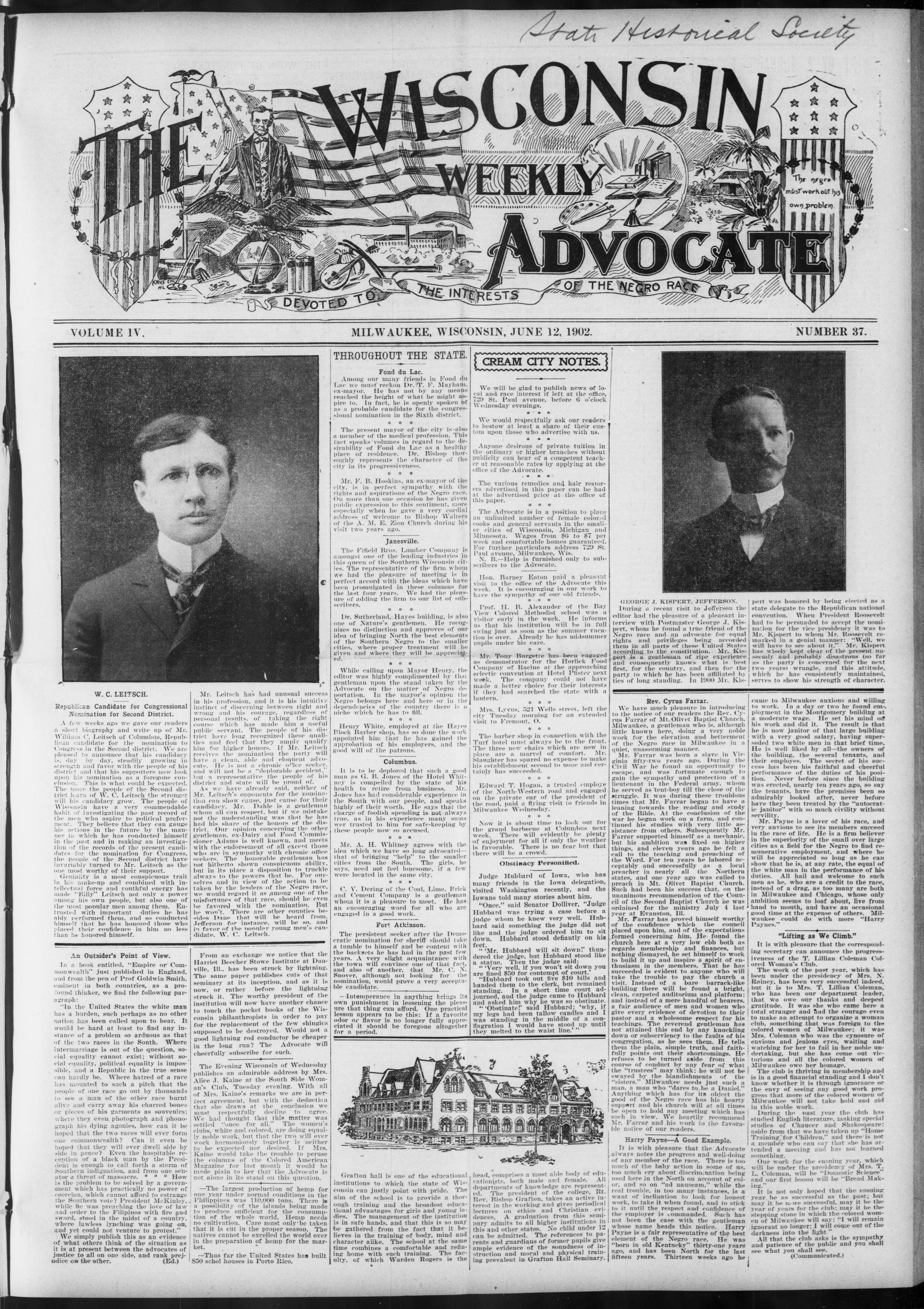
Page text (machine-generated)
State Historical Society
WISCONSIN
WEEKLY
ADVOCATE
DEVOTED TO THE INTERESTS OF THE NEGRO RACE
[Name]
VOLUME IV.
[Name]
W. C. LEITSCH.
Republican Candidate for Congressional Nomination for Second District.
A few weeks ago we gave our readers a short biography and write up of Mr. William C. Leitsch of Columbus, Republican candidate for the nomination to Congress in the Second district. We are pleased to announce that his candidacy is, day by day, steadily growing in strength and favor with the people of his district and that his supporters now look upon his nomination as a foregone conclusion. This is what could be expected. The more the people of the Second district learn of W. C. Leitsch the stronger will his candidacy grow. The people of Wisconsin have a very commendable habit of investigating the past record of the men who aspire to political preferment. They believe that they can gauge his actions in the future by the manner in which he has conducted himself in the past and in making an investigation of the records of the present candidates for the nomination for Congress, the people of the Second district have invariably turned to Mr. Leitsch as the one most worthy of their support.
Geniality is a most conspicuous trait in his make-up and combined with intellectual force and youthful energy has made "Billy" Leitsch not only a power among his own people, but also one of the most popular men among them. Entrusted with important duties he has ably performed them, and so conducted himself that he has honored those who placed their confidence in him no less than he honored himself.
An Outsider's Point of View
In a book entitled, "Empire or Commonwealth" just published in England, and from the pen of Prof Goldwin Smith, eminent in both countries, as a profound thinker, we find the following paragraph:
"In the United States the white man has a burden, such perhaps as no other nation has been called upon to bear. It would be hard at least to find any instance of a problem so arduous as that of the two races in the South. Where intermarriage is out of the question, social equality cannot exist; without social equality, political equality is impossible, and a Republic in the true sense can hardly be. Where hatred of a race has mounted to such a pitch that the people of one race go out by thousands to see a man of the other race burnt alive and carry away his charred bones or pieces of his garments as souvenirs; where they even photograph and phonograph his dying agonies, how can it be hoped that the two races will ever form one commonwealth? Can it even be hoped that they will ever dwell side by side in peace? Even the hospitable reception of a black man by the President is enough to call forth a storm of Southern indignation, and from one senator a threat of massacre. * * * How is the problem to be solved by a government which has practically no power of coercion, which cannot afford to estrange the Southern vote? President McKinley, while he was preaching the love of law and order to the Filipinos with fire and sword, stood in the midst of a country, where lawless lynching was going on, and yet could not venture to protest."
We simply publish this as an evidence of what others think of the situation as it is at present between the advocates of justice to all on one side, and rank prejudice on the other. (Ed.)
Mr. Leitsch has had unusual success in his profession, and it is his intuitive instinct of discerning between right and wrong and his courage, regardless of personal results, of taking the right course which has made him a useful public servant. The people of his district have long recognized these qualities and feel that they amply qualify him for higher honors. If Mr. Leitsch receives the nomination the party will have a clean, able and eloquent advocate. He is not a chronic office seeker, and will not be a "deplorable accident," but a representative the people of his district and state will be proud of.
As we have already said, neither of Mr. Leitsch's opponents for the nomination can show cause, just cause for their candidacy, Mr. Dahle is a gentleman whom all can respect, but if we mistake not the understanding was that he has had his share of the honors of the district. Our opinion concerning the other gentleman, ex-Dairy and Food Commissioner Adams is well known, and meets with the endorsement of all except those who are in sympathy with chronic office seckers. The honorable gentleman has not hitherto shown conspicuous ability, but in its place a disposition to truckle always to the powers that be. For ourselves and in view of the action to be taken by the leaders of the Negro race, we would regard it as among one of the misfortunes of that race, should he even be favored with the nomination. But he won't. There are other counties besides Dane that will be heard from. Jefferson for instance, will be so, and in favor of the popular young men's candidate, W. C. Leitsch.
From an exchange we notice that the Harriet Beecher Stowe Institute at Danville, Ill., has been struck by lightning. The same paper publishes cuts of that seminary at its inception, and as it is now, or rather before the lightning struck it. The worthy president of the institution will now have another chance to touch the pocket books of the Wisconsin philanthropists in order to pay for the replacement of the few shingles supposed to be destroyed. Would not a good lightning rod conductor be cheaper in the long run? The Advocate will cheerfully subscribe for such.
The Evening Wisconsin of Wednesday publishes an admirable address by Mrs. Alice J. Kaine at the South Side Woman's Club, Tuesday evening. With all of Mrs. Kaine's remarks we are in perfect agreement, but with the deduction that she draws at the conclusion we must respectfully decline to agree. We had thought that this matter was settled "once for all." The women's clubs, white and colored, are doing equally noble work, but that the two will ever work harmoniously together is neither to be expected nor desired. If Mrs. Kaine would take the trouble to peruse the columns of the Colored American Magazine for last month it would be made plain to her that the Advocate is not alone in its stand on this question.
The largest production of hemp for one year under normal conditions in the Philippines was 110,000 tons. There is a possibility of the islands being made to produce sufficient for the consumption of the whole world. Hemp needs no cultivation. Care must only be taken that it is cut in the proper season. The natives cannot be excelled the world over in the preparation of hemp for the market. Thus far the United States has built 850 schol houses in Porto Rico.
THE MUSEUM OF THE WEST
THROUGHOUT THE STATE
Fond du Lac.
Among our many friends in Fond du Lac we must reckon Dr. T. F. Mayham, ex-mayor. He has not by any means reached the height of what he might aspire to. In fact, he is openly spoken of as a probable candidate for the congressional nomination in the Sixth district.
***
The present mayor of the city is also a member of the medical profession. This fact speaks volumes in regard to the desirability of Fond du Lac as a healthy place of residence. Dr. Bishop thoroughly represents the character of the city in its progressiveness.
* * *
Mr. F. B. Hoskins, an ex-mayor of the city, is in perfect sympathy with the rights and aspirations of the Negro race. On more than one occasion he has given public expression to this sentiment, more especially when he gave a very cordial address of welcome to Bishop Walters of the A. M. E. Zion Church during his visit two years ago.
Janesville
The Fifield Bros. Lumber Company is amongst one of the leading industries in this queen of the Southern Wisconsin cities. The representative of the firm whom we had the pleasure of meeting is in perfect accord with the ideas which have been promulgated in these columns for the last four years. We had the pleasure of adding the firm to our list of subscribers.
* * *
Dr. Sutherland, Hayes building, is also one of Nature's gentlemen. He recognizes no distinction and approves of our idea of bringing North the best elements of the Southern Negro to the smaller cities, where proper treatment will be given and where they will be appreciated.
※ ※ ※
While calling upon Mayor Henry, the editor was highly complimented by that gentleman upon the stand taken by the Advocate on the matter of Negro deportation. In the mayor's opinion the Negro belongs here and here or in the dependencies of the country there is a niche which he has to fill.
```markdown
```
Henry White, employed at the Hayes Block Barber shop, has so done the work appointed him that he has gained the approbation of his employers, and the good will of the patrons.
Columbus.
It is to be deplored that such a good man as G. B. Jones of the Hotel Whitney is compelled by the state of his health to retire from business. Mr. Jones has had considerable experience in the South with our people, and speaks highly of their worth. He says that the charge of foolish spending is not always true, as in his experience many sums wer trusted to him for safe-keeping by these people now so accused.
* * *
Mr. A. H. Whitney agrees with the idea which we have so long advocated that of bringing "help" to the smaller cities from the South. The girls, he says, need not feel lonesome, if a few were located in the same city.
* * *
C. V. Dering of the Coal, Lime, Brick and Cement Company is a gentleman whom it is a pleasure to meet. He has an encouraging word for all who are engaged in a good work.
Fort Atkinson.
The persistent seeker after the Democratic nomination for sheriff should take a tumble to himself and be content with the backsets he has had in the past few years. A very slight acquaintance with the town will convince one of that fact, and also of another, that Mr. C. N. Snover, although not looking for the nomination, would prove a very acceptable candidate.
- Intemperance in anything brings its own punishment in lessening the pleasure that thing can afford. One practical lesson appears to be this: If a favorite odor or flavor is no longer fully appreciated it should be foregone altogether for a period.
THE MUSEUM OF THE WEST
Grafton hall is one of the educational institutions to which the state of Wisconsin can justly point with pride. The aim of the school is to provide a thorough training and the broadest educational advantages for girls and young ladies. The management of the institution is in safe hands, and that this is so may be gathered from the fact that it believes in the training of body, mind and character alike. The school at the same time combines a comfortable and refining home with such training. The faculty, of which Warden Rogers is the
CREAM CITY NOTES.
---
We will be glad to publish news of local and race interest if left at the office, 729 St. Paul avenue, before 6 o'clock Wednesday evenings.
☆ ☆ ☆
We would respectfully ask our readers to bestow at least a share of their custom upon those who advertise with us.
Anyone desirous of private tuition in the ordinary or higher branches without publicity can hear of a competent teacher at reasonable rates by applying at the office of the Advocate.
The various remedies and hair restorers advertised in this paper can be had at the advertised price at the office of this paper.
The Advocate is in a position to place an unlimited number of female color-cooks and general servants in the smaller cities of Wisconsin, Michigan and Minnesota. Wages from $6 to $7 per week and comfortable homes guaranteed. For further particulars address 729 St. Paul avenue, Milwaukee, Wis.
N. B.—Help is furnished only to subscribers to the Advocate.
Hon. Barney Eaton paid a pleasant visit to the office of the Advocate this week. It is encouraging in our work to have the sympathy of our old friends.
Prof. H. B. Alexander of the Bay View Colored Methodist school was a visitor early in the week. He informs us that his institution will be in full swing just as soon as the summer vacation is over. Already he has midsummer pupils under his care.
```markdown
```
Mr. Tony Burgette has been engaged as demonstrator for the Horlick Food Company of Racine at the approaching eclectic convention at Hotel Pfister next week. The company could not have made a better choice for their interests if they had searched the state with a lantern.
☆ ☆ ☆
Mrs. Lyrus, 521 Wells street, left the city Tuesday morning for an extended visit to Fremont, O.
***
The barber shop in connection with the Turf hotel must always be to the front. The three new chairs which are now in place are a marvel of comfort. Mr. Slaughter has spared no expense to make his establishment second to none and certainly has succeeded.
```markdown
```
Edward T. Hogan, a trusted employee of the North-Western road and engaged on the private car of the president of the road, paid a flying visit to friends in Milwaukee Wednesday.
* * *
Now it is about time to look out for the grand barbecue at Columbus next week. There will evidently be plenty of enjoyment for all if only the weather is favorable. There is no fear but that there will be a crowd.
Obstinacy Personified.
Judge Hubbard of Iowa, who has many friends in the Iowa delegation, visited Washington recently, and the Iowans told many stories about him.
"Once," said Senator Dolliver, "Judge Hubbard was trying a case before a judge whom he knew very well. Hubbard said something the judge did not like and the judge ordered him to sit down. Hubbard stood defiantly on his feet.
"Mr. Hubbard will sit down!" thundered the judge, but Hubbard stood like a statue. Then the judge said:
"Very well, if you won't sit down you are $50 for contempt of court."
are fined $50 for contempt or court.
"Hubbard took out five $10 bills and handed them to the clerk, but remained standing. In a short time court adjourned, and the judge came to Hubbard and asked him why he was so obstinate.
"‘Obstinate!’ said Hubbard: ‘why, if my legs had been tallow candles and I was standing in the middle of a conflagration I would have stood up until they melted to the waist line.’"
(1)
head, comprises a most able body of educationists, both male and female. All departments of knowledge are represented. The president of the college, Rt. Rev. Bishop Grafton, takes an active interest in the working and gives periodical lectures on ethics and Christian evidences. A graduation from this seminary admits to all higher institutions in this and other states. No child under 12 can be admitted. The references to parents and guardians of former pupils give ample evidence of the soundness of instruction and moral and physical training prevalent in Grafton Hall Seminary.
---
[Name not visible in the image]
GEORGE J. KISPERT, JEFFERSON.
During a recent visit to Jefferson the editor had the pleasure of a pleasant interview with Postmaster George J. Kispert, whom he found a true friend of the Negro race and an advocate for equal rights and privileges being accorded them in all parts of these United States according to the constitution. Mr. Kispert is a gentleman of ripe experience and consequently knows what is best first, for the country, and then for the party to which he has been affiliated by ties of long standing. In 1900 Mr. Kis-
Rev. Cyrus Farrar.
We have much pleasure in introducing to the notice of our readers the Rev. Cyrus Farrar of Mt. Olivet Baptist Church, Milwaukee, a gentleman who is, although little known here, doing a very noble work for the elevation and betterment of the Negro race in Milwaukee in a quiet, unassuming manner.
Mr. Farrar was born a slave in Virginia fifty-two years ago. During the Civil War he found an opportunity to escape, and was fortunate enough to gain the sympathy and protection of a lieutenant in the Federal army, whom he served as tent-boy till the close of the struggle. It was during these troubles times that Mr. Farrar began to have a leaning towards the reading and study of the Bible. At the conclusion of the war he began work on a farm, and continued his studies with very little assistance from others. Subsequently Mr. Farrar supported himself as a mechanic, but his ambition was fixed on higher things, and eleven years ago he felt a call to the teaching and preaching of the Word. For ten years he labored acceptably and successfully as a local preacher in nearly all the Northern states, and one year ago was called to preach in Mt. Olivet Baptist Church. Such had been his success that, on the unanimous recommendation of the Council of the Second Baptist Church he was ordained for the ministry July 4 last year at Eranston Ill.
Mr. Farrar has proved himself worthy of the confidence which the council placed upon him, and of the expectations formed concerning him. He found the church here at a very low ebb both as regards membership and finances, but nothing dismayed, he set himself to work to build it up and inspire a spirit of enthusiasm in the members. That he has succeeded is evident to anyone who will take the trouble to pay the church a visit. Instead of a bare barrack-like building there will be found a bright, clean, carpeted auditorium and platform; and instead of a mere handful of hearers, a fair audience of men and women who give every evidence of devotion to their pastor and a wholesome respect for his teachings. The reverend gentleman has not attained this end by any knuckling down or subserviency to the faults of his congregation, as he sees them. He tells them the plain, simple truth, and faithfully points out their shortcomings. He refuses to be turned aside from this course of conduct by any fear of what the "trustees" may think; he will not be swayed by the blandishments of the "sisters." Milwaukee needs just such a man, a man who "dares to be a Daniel." Anything which has for its object the good of the Negro race has his hearty support and his church will at all times be open to hold any meeting which has such in view. We heartily recommend Mr. Farrar and his work to the favorable notice of our readers.
Harry Payne—A Good Example
It is with pleasure that the Advocate always notes the progress and well-doing of any member of the race. There is too much of the baby action in some of us, too much cry about discrimination being used here in the North on account of color, and so on "ad nauseam," while the real trouble, in too many instances, is a want of inclination to look for honest work, to take it when found, and to stick to it until the respect and confidence of the employer is commanded. Such has not been the case with the gentleman whose name heads this notice. Harry Payne is a fair representative of the best element of the Negro race. He was "born in old Kentucky" thirty-one years ago, and has been North for the last fifteen years. Thirteen weeks ago he
pert was honored by being elected as a state delegate to the Republican national convention. When President Roosevelt had to be persuaded to accept the nomination for the vice presidency it was to Mr. Kispert to whom Mr. Roosevelt remarked in a genial manner: "Well, we will have to see about it." Mr. Kispert has wisely kept clear of the present unseemly and probably disastrous (so far as the party is concerned for the next two years) wrangle, and this attitude, which he has consistently maintained, serves to show his strength of character.
came to Milwaukee anxious and willing to work. In a day or two he found employment in the Montgomery building at a moderate wage. He set his mind on his work and did it. The result is that he is now janitor of that large building with a very good salary, having superseded two white men in that brief time. He is well liked by all—the owners of the building, the several tenants, and their employees. The secret of his success has been his faithful and cheerful performance of the duties of his position. Never before since the building was erected, nearly ten years ago, so say the tenants, have the premises been so admirably looked after, never before have they been treated by the "autocratic janitor" with so much civility without servility.
Mr. Payne is a lover of his race, and very anxious to see its members succeed in the race of life. He is a firm believer in the superiority of the small over large cities as a field for the Negro to find remunerative employment, and where he will be appreciated so long as he can show that he is, at any rate, the equal of the white man in the performance of his duties. All hail and welcome to such men as he, who are a credit to the race, instead of a drag, as too many are both in Milwaukee and Chicago, whose only ambition seems to loaf about, live from hand to mouth, and have an occasional good time at the expense of others. Milwaukee could do with more "Harry Paynes."
"Lifting as We Climb."
It is with pleasure that the corresponding secretary can announce the progressiveness of the T. Lillian Coleman Colored Woman's Club.
The work of the past year, which has been under the presidency of Mrs. N. Rainey, has been very successful indeed, but it is to Mrs. T. Lillian Coleman, who has been our department leader, that we owe our thanks and deepest gratitude. It was she who came here a total stranger and had the courage even to make an attempt to organize a woman club, something that was foreign to the colored women of Milwaukee; it was Mrs. Coleman who was the cynosure of envious and jealous eyes, waiting and watching for her to fail in her noble undertaking, but she has come out victorious and all the colored women of Milwaukee owe her homage.
The club is thriving in membership and is in a good financial standing and I don't know whether it is through ignorance or the envy of seeing any good work progress that more of the colored women of Milwaukee will not take hold and aid in this noble work.
During the past year the club has studied English literature, making special studies of Chaucer and Shakespeare; aside from that we have taken up "Home Training" for Children," and there is not a member who can say that she has attended a meeting and has not learned something.
Our work for the ensuing year, which will be under the presidency of Mrs. T. L. Coleman, will be "Domestic Science" and our first lesson will be "Bread Making."
It is not only hoped that the ensuing year be as successful as the past; but may it be more successful, may it be the year of years for the club; may it be the stepping stone in which the colored women of Milwaukee will say: "I will remain ignorant no longer; I will come out of the darkness into the light."
All that the club asks is the sympathy and patience of the public and you shall see what you shall see.
(Communicated.)
SWEPT BY A TORNADO.
Illinois and Iowa are Visited
Heavy Wind Storm.
MUCH DAMAGE o_
Storm Demolishes Buildings in a
Towns and Kills and In-
K jures Many.
Tree OS Saar es eee oO on ee eee OME ght ees ae aes oe are
visited Central Illinois. The wind
wrought ruin and woe and the property
Joss will be tens of thousands of dollars.
There is no way really of estimating the
loss at present, owing to the uncertainty
as to the effect upon the growing crops,
which, it is feniees suffered heavily.
Three Young Women Killed.
The saddest feature, however, was the
pe three young women who were
attending a dance at the town hall of
Merna, a small village, ten miles east
of this city. There was a party, of 250
wm76 men and women at the dance in
the hall when the tornado struck the
building about 11 o'clock last night. Ev-
erybody rushed for the door. A number
of young men held the doors to prevent
the people from escaping, fearing that
they might be inju killed if they
got outside. About half of them, how-
ever, seca pees and then the building col-
lapsed. e others were buried in the
wreck. Three were killed and forty or
fifty others more or less oy lek some
of them seriously. The dead:
MISS LENA JAHAJAM,
MRS. EDWARD MARTIN.
MISS ANNA KELLY.
All are daughters of prominent farmers
in the vicinity. The bodies were horribly
mutilated by the heavy timbers. Quite
a number of young men and women were
taken from the ruins in an unconscious
condition and some of them are still in
that ate ae it is feared there may be
other deaths:
b Struck by Tornado.
The storm struck Merna with the great-
est fury—greater than any other place
in the county. Many of the finest houses
and barns were cen red
The storni reached Bloomington about
11 p. m., commencing with a furious
electrical display. Rain accompanied the
wind and the business district suffered
severely. Many plate glass windows
were blown in and the stocks of goods
badly damaged. Hundreds of the best
trees in the city were broken off at the
trunks and the streets are almost im-
passable. Telegraph and telephone poles
were broken short off and the wires
added to the blockade. Buildings all
over the city were damaged, but no lives
were lost nor was anyone seriously in-
jured.
A man standing on West Washington
street was blown 300 feet, but escaped
with only bruises.
University is Wrecked.
Wesleyan University, just on the eve
of commencement week, had its roof
blown off, and was badly damaged by
water.
The railroads report damaged tracks
due to telegraph poles falling on the
tracks. So far as now known, no one
was killed or injured. Efforts are mak-
ing to reach the small towns in the
county as it is believed several of them
must have suffered more or less damage.
No fatalities occurred except at Merna,
so far as now known.
Three Perish at Kingston Mines.
Pekin, Ill, June 11.—A tornado ea
over Tazewell county last night, killing
three and fatally injuring two persons at
eingaton Mines, south of here. The
dead:
MRS. THOMAS MURRAY AND IN-
FANT.
WILLIE M'ELWEE, aged 3.
Patrick McElwee and wife were fatally
injured.
The entire east end of the village of
1000 inhabitants was swept away. The
storm struck Kingston Mines about 10:30
p. m. and lasted half an hour, causing
$15,000 damage. A second storm did
considerable additional damage at 1:30
a. m._ Physicians from Pekin, Glasford
and Mapletown were called to care for
the wounded.
Many Buildings Demolished.
Houses and barns were blown down in
Groveland, Minier, Dilon, Hopedale and
Delavan, but so far no loss of life in any
of those places have been reported. The
most destruction seems to have been at
Kingston Mines.
Opposite Pekin the river overflowed its
banks and covered 68,000 acres of corn,
which is believed to have been ruined.
Property Loss Reaches $250,000.
Springfield, Il, June 11.—Later ad-
vices from the storm at Bloomington re-
ceived by passengers alighting from Chi-
cago & Alton trains and from telegrams,
ear the property loss at $250,000. No
loss of life has heen reported in the city,
but there is a long list of injured.
Dispatches from Peoria place the loss
of life in Tazewell county at fifteen.
Tornado in Iowa.
Burlington, Ia., June 11.—Burlington
has been practically cut off from tele
eeekic communication with the outside
world since 9 o'clock last night, the wires
being down in all direcnons. Last night's
storm was the worst in years and was
attended by a most thrilling electrical
display. There were no lives Jost in this
city.
Two hundred feet of lumber belonging
to the Gilbert & Hudges Lumber Com-
pany broke from its moorings above the
elty, pact of it floating down the river
and the rest piling up on shore. Much
other damage to property resulted.
Lightning struck in several places.
Steamer Breaks in Two.
The steamer Comet broke in half and
sunk, but no lives were lost. Rob Roy,
a pleasure craft, was badly damaged and
washed ashore. Barges and boathouses
were filled with water or blown high and
eee on the bank.
here are many reports of damage in
the surrounding country, but details are
lacking.
Des Moines, Ia., June 11.—Very
meager details of the storm which passed
over Central Iowa have been received
here so far owing to the fact that not
half a dozen wires running out of the
city are in working order. It is known
that the storm struck the town of Jor-
dan, a few miles east of Boone. The
extent of the damage is not known, al-
though it is reported that no lives were
lost, and that some of the principal
buildings of the place were destroyed.
Oskaloosa renorss considerable damage
from the wind.
Illinois Town Wiped Out.
Jacksonville, Ill., June 11.—There
was a hard wind storm here last night
but no damage to this immediate secction
has been reported. Danvers, on the Al-
Train Blown Off Track.
Corwith, Ia., June 11.—A_ tornado
struck an empty excursion train on the
Towa Central five miles east of here last
night and blew three cars from the
track while the train was running thirty
miles an hour, leaving the engine and
the two last coaches on the track. No
one was hurt.
Storm Wrecks Train.
Latham, Ill., June 11.—The severe
storm of last night washed out a bridge
on the Peoria division of the Illinois Cen-
tral near here and a freight train ran
into the hole. The crew was injured but
not seriously. Comparatively little dam-
age was done here.
Killed by Minnesota Storm.
Detroit, Minn., June 11.—The list of
the killed in the tornado of Monday aft-
ernoon is as follows:
MRS. E, 0. BERG.
FOUR CHILDREN of ANDREW HIUM,
two girls, aged 13 and 11, and two boys,
aged 15 and 6.
The Hiums had five other children who
were all more or less injured. Mrs. Hium
was hurt probably fatally, but Hium
himself was unscathed.
In all thirty farmhouses and barns
were totally destroyed.
Two Churches Blown Down.
Paxton, Ill., June 11.—A bere storm
of rain and wind prevailed in this sec-
tion of the state at an early hour this
morning, accompanied by thunder and
lightning. Great damage was done to
shade trees. Cars were blown from the
track on the. Illinois Central between
here and Ludlow, and it is reported that
two churches were blown over at Clar-
ence, seven miles east of here.
Many Elevators Destroyed.
Springieu June 11.—Telephone and
telegraph wires were still down at noon
between this on and Bloomington. The
office of Supt. Corbett of the Chicago &
Alton has information piroeet train- |
men that the Alton depot at Blooming-
ton was demolished by the storm last
night. It is reported that the town of
Stanford, south of Bloomington, was
badly damaged by the storm and that
several elevators on the Alton, south of
Bloomington, were blown down and that
300 feet of the Alton track north of |
Pekin was washed out.
Many Buildings Unroofed. |
Lincoln, Ill, June 11.—This city and
immediate locality was visited about
midnight by a severe destructive hurri-
cane. Hard rain and lightning did a
great deal of damage. Public buildings,
churches and residences were unroofed,
and telephone and electric street system
were badly crippled. Most of the streets
are blockaded with fallen shade trees
and wires. The villages of Atlanta,
Lawndale, Elkhart and others in this
county suffered heavy losses on eleva-
tors and other buildings. Small grain is,
damaged to a considerable extent. So
far no loss of life is reported. |
COL. LYNCH IS CAUGHT.
Irishman Who Fought with the Boers is
Arrested by English
Police.
London, June 11.—Col. Arthur Lynch,
who fought with the Boers in South Af-
riea and who in November last was elect-
ed to represent Galway in the House of
Commons, was arrested this morning on
his arrival at New Haven from Dieppe,
France. Col. Lynch, who was accom-
panied by his wife, was brought to Lon-
don and was afterwards taken to the
Bow street police station.
Arraigned in Bow Street.
Subsequently Col. Lynch was _ar-
raigned at the Bow street police court
on the charge of high treason and was
remanded untii Saturday, June 14, after
formal evidence of his arrest had been
presented.
The prisoner, who was described on
the charge sheet as a “journalist,” sat
in the dock, apparently unconcerned un-
til the magistrate asked him if he had
anything to say in reply to the charge.
Then he arose and replied almost inau-
dibly, “No, sir.” He did not apply for
bail and was taken to the cells.
+ Police Charge Irish Mob.
Extraordinary scenes occurred at Ar-
magh, Ireland, in connection with the
unveiling there of a memorial to a man
killed while fighting for the Boers at
Modderspruit, says the Belfast corre-
spondent of the Times.
Michael Davitt addressed the meeting,
saying that_the Irish were trampled on
by a base British government and they
must imitate the Boers in temperance
and loyalty to race and language.
A force of armed police protecting the
official note taker arrived and the crowd
became very violent, wild scenes of up-
roar resulting. The police with fixed
bayonets pushed back the crowd, but the
note taker did not succeed in gaining ad-
mission.
__Col. Lynch is charged with treason.
All of the Employes of the Trust are
Preparing to Go
Out.
Chicago, Il., June 11.—Angered by the
refusal of the officers of the United
States Brewing Company—more_ com-
monly known as the trust—to reinstate
thirty brewery drivers’ helpers who went
on strike on Monday, the other unions
connected with the firms are preparing
to call a general strike tomorrow morn-
ing. The men are thoroughly organized
and their leaders claim that not a barrel
of beer can be moved from the breweries
involved without-their consent after the
strike call has been issued.
The helpers struck on Monday to get a
higher wage. They were being paid
from $7 to $12 a week and asked for a
parallel raise of $5. This was refused
and later the officers of the brewing
trades council—an organization of all the
unions engaged in the handling of beer—
met with the employers to talk the sit-
uation over. They were told that the
men would not be given their demands
and might not be taken back at all.
—_—_——_—_
Revolution Has Broken Out in Sub-
urbs of Venezuela
Town.
Berlin, June 11.—The German cruisers
Gazelle and Falke have been sent to
LaGuira, Venezuela, at the special re-
uest of the German charge d'affaires at
Caracas, Herr yon Piigrim-Baltazzi, in
consequence of a revolution having
broken out in the suburbs of LaGuira,
leading to the bombardment of the town
by forts and Venezuelan warships.
BEY OF TUNIS EXPIRES.
Sidi Ali Had Been the Ruler Since Oc-
tober 21, 1882.
Tunis, June 11.—Sidi Ali, the Bey of
Tunis, died this morning.
Sidi Ali was born October 15, 1817,
He was the son of Sidi Ahsin and suc-
ceeded his brother, Sidi Mohamedes-
Sadok, October 27, 1882. The deceased
Bey is succeeded by his son, Mohamed,
who was born in 1855. The reigning
family of Tunis has occupied the throne
since 1691.
ASK AN INVESTIGATION.
TRE REASONS FOR MISS TAYLOR .
REMOVAL ARE DEMANDED.
Mr. Carmack Wants Senate to Look Into
Dismissal of Former Wiscon-
sin Woman.
Washington, D. C., June 10.—Shortly
after the Senate convened today, Mr.
Carmack (Tenn.) introduced a resolution
directing the committee on civil service
and retrenchment to investigate the cas:
of s.ebecea J. ‘Laylor, a former Wiscon
sin woman, a clerk in the ward depart-
ment who was discharged from her
position for the alleged reason of criti-
cizing the administration's Philippine
policy in a communication to the press.
The committee was directed to investi-
gate the reasons for her discharge. ‘The
resolution went over under the rule.
Miss Rebecca Taylor is a kinswoman of
Representative McCleary of Minnesota.
She wrote savage criticisms on the pec
icy of the late President McKinley. They
were so bitter that he caused inquiries
to be made as to her identity. When he
found that she was a government clerk
he dropped the investigation.
——_——
North American Trust Company Pro-
poses Great Financial En-
terprise.
New York, June 10—The North
“American Trust Company of New York
is promoting a gigantic combination of
national banks of the country, which is
to include one national baak in each
financial center and state capital. The
combination will be known as the Ameti-
can Benkers’ Corporation, which has
been chartered quietly under the gener .
corporation act of New Jersey with <
capital of $5,000,000. The charter pro-
vides for a surplus of $45,000,000.
The scheme is the outcome of the
branch banking movement. The plan is
outlined in a letter from the trust com-
pany to the several financiers with whom
it is negotiating. It is as follows:
‘The fdea of branch banking {s not a new
one. It has not been tiled to any great ex-
tent in this country for various reasens,
chief of which is that each state has dit-
ferent oS ee ae we
sw "Permits of Expansion.
‘The nationai banking act-has been amen‘-
ed to permit of expansion in this direc ion
by the establMshment of small-sized banks
Barring the question of taxation, ther
would seem to be little to prevent the ov
ganization of an immense national bank,
With the very purpose in view provided ft
were established with the large enough sur-
plus to acquire a sufficient number of banks
throughout the country.
There are other serlous obstacles to the
ownership of such banks under the natloval
banking act. A safer and more profitable
plan would be the formation of a corpora-
tion which could purchase and control a
number of national banks, also state banks
and trust companies. To this end such an
institution has been chartered under New
Jersey laws. ‘The only taxes payable will
be the annual one-tenth of 1 per cent. oa
$5,000,000 capital.
To Take No Deposits.
The main office, momanity Jersey City.
will be only the meeting place for stock
holders. | No deposits will be accepted (by
the parent institution, which will confine
its operations to the investment of its cap-
ital and surplus. i
"The first purchase will be a large New
York city national bank. New, York wiil be
the praction! headquarters, | The oificers of
the New York bank will also be executives
of the corporation. Je will be absolutely
necessary to own a national bank in New
York city, and other important central
points throughout the country, because oar
national banking laws compel na‘ional
banks to designate as depositories only in-
stitutions organized under those laws.
The special features of the plan will be
discouragement of the dangerous method of
paying high interest on deposits. Insie.d
will he given lager Uberality to customers
in exchange of checks and cashing of drafts
with bills of lading attached. Avoidance o
unnecessary accumulation of balances wheu
they can be profitably Used In another sec-
on.
Seeks Bare Control.
With the exception perhaps of the New
York Central Bank, only bare controlling
interest in out-of-town banks will be
bought. The aim will be to own in each
state the controlling interest in at least
one good bank, which will have sufficient
surplus to permit of purchase of several
loca! ovganizations. The owne:siip cf thes»
institutions will be sufficient guarantee to
the depositing public without necesstrat'ng
large and vexatious local capital and sur-
plus Mabilities, the idea belng that the
smaller the capitalization in proporifon to
deposits obtainable the larger the pro‘its.
The capital stock will be invested in
United States and state bonds. It will be
noted that the central {dea Is the propost-
tion to utilize to its fullest extent the large
credit of such an institution by means of
numerous sinall capitalizations throughout
‘the country.
. Think Run Impossible.
The fact that it will not receive deposits
at headquarters or directly transact a bank.
ing business would make a run on the
parent institution impossible. Profits will
e sufficient to satisfy the most exacting.
Other banks will continue to follow the an-
tiquated system. This network of banks
owned by ane corporation would be In po-
‘sition to follow without loss a mor2 profit.
able method of meeting commercial ex-
change demands. Organization quictiy an‘l
unostentatiously will materially aid in
launching the institutions and in securing
the various desirable plants throughout the
BLOWN TO ATOMS.
Three Men Meet Instant Death in the
Aurora, Near Ironwood,
Mich,
Ironwood, Mich., June 10.—[Special.]
—A fatal explosion occurred in the Au-
rora mine last night, killing three men.
Isaac Ryan, Tom Johns and Arthur
Tregembo were at work near a drift
when in some maner dynamite near at
hand went off. They were blown to
Pieces.
Two of the men were identified by the
shoes and shreds of clothing. Their
bodies were blown to atoms.
Tregembo leaves a wife. Ryan and
Johns were single.
Found Gold in a Hole.
While out hunting in the Wichita
mountains, about sixteen miles west of
Mountain View, O. T., F. J. Schmieder
discovered what seemed to have been
an old mine. He had run a rabbit into
a hole between two rocks, and, on prying
the recks apart, was surprised to find the
opening growing larger. Upon investi-
gation a .hole 10 feet in diameter and
over 100 feet deep was found. There
is great excitement over the discovery,
as the pore think it is a mine worked
by the Spaniards hundreds of years ago,
A piece of ore taken from the hole about
twenty feet below the surface shows
valuable deposits of gold.—St. Louis
Globe-Democrat.
—The Columbia, which sailed ‘from
Poston in September, 1787, was the first
ship that carried the Stars and Stripes
completely around the world.
—Kimberley, South Africa, will erect a
statue of the late Queen Victoria on
coronation day.
—About 4,475,000 persons are em-
ployed in the world’s mines.
BUCKET SHOP
STEALS QUOTATIONS.
Leak at Kansas City Has Been Discov-
ered—Telephones Caught
the Ticks.
Kansas City, Mo., June 11.—Members
of the Kansas City board of trade as-
sert that they have unearthed a scheme
by which the Christie Grain and Stock
Company, alleged to be the biggest buck-
et shop concerns in the country, has come
into the possession of the quotations of
the Chicago board of trade. Telephone
receivers of the most delicate pattern
known were found behind the blackboard
of the Fred P. Smith Commission Com-
pauy in the board of trade building. This
company is a correspondent of Harris,
Gates & Co. of Chicago. From these
telephones wires were run to the tower of
the building and thence to Christie’s of-
fice in the adjoining building. Tbe tele-
phone receivers were so situated as to be
within a few inches of the telegraph in-
struments and were so sensitive that a
conversation carried on in Smith’s office
could be heard in the office of the alleged
bucket shop. For a year it has been
known that there was a leak at Kansas
City whereby the bucket shops of the
West secured the Chicago quotations.
PRESIDENT HONORS
WEST POINT CADET.
Pins Medal to Coat of Calvin Titus—
Mr. Roosevelt Attends Military
Academy Commencement.
West Point, N. ¥., June 11.—Presi-
dent Roosevelt arrived at West Point
at 10 o’clock. He was met at the sta-
tion by Col. Mills, superintendent of the
West Point Military Academy, and his
staff, the academy band and a detach-
ment of cavalry. <A salute of tweuty-
one guns was fired as the President
appeared on the top of the hill. The
cadets were paraded in front of the
barracks and stood at attention as the
President and party passed on the way
to the superintendent’s house. A review
of the corps of cadets followed imme-
diately.
A feature of this was the presentation
to Cadet Calvin Titus of a medal pro-
vided by Congress for his bravery in
scaling the wall at Pekin, China. The
order was read by Capt. Rivers and
President Roosevelt pinned the medal to
the coat of the young man, and as he did
so, extended his congratulations. After
the review a reception was held at Supt.
Mills’ quarters.
“BUGVILLE” ARTIST
serials a
Gus Dirks, Whose Parents Resided in
Phillips, Wis., Kills Him-
self in New York.
New York, June 11.—Gus Dirks, the
newspaper artist, whose drawings,
known as the “Bugville” sketches,
brightened many a moment for appre-
ciative thousands throughout the coun-
try, committed suicide last night by
shooting himself through the head with
a 38-calibre revolver.
Dirks had been in ill health for some
time, and it is thought that he became
despondent.
Gustavus Dirks was a German. by
birth, having been born in the province
of Schleswig-Holstein, on the Danish
border. He was about 35. years old.
His parents are living in Phillips, Wis.,
and his brother, Rudolph Dirks, the
originator of the “Katzenjammer Kids,’
has his home in this city.
MISS TAYLOR WILL
She will Appeal to the Civil Service Com-
mission and May Take Mat-
ter Into Courts.
Washington, D. C., June 11.—Miss
Rebecca J. Taylor, the former Wisconsin
woman dismissed from her place as
clerk in the war department, is devising
a plan which may cause the Presideut
some trouble. She is considering the
advisability of appealing to the Civil
Service Commission for the, purpose of
securing a ruling on her claim that she
was dismissed without being accorded
an opportunity to answer charges, If
the commission sustains the President.
which it probably will, she then will
appeal to the courts and may carry
the case to the supreme court.
Black Columns of Vapor and Gas Arise
from Mountains Near Lake
Managua.
Managua, Nicaragua, June 11.—Dark,
high, ugly-looking columns of vapor and
gas have within the last few days been
arising from the cratered cones known
as Momotombo and Santa Maria, on the
large mountainous range of volcanic
Bjecta, west of Lage Managua, causing
an uneasy feeling among many of the
people in adjacent towns.
SOLDIERS SURROUND
ESCAPED CONVICTS.
Men Who Murdered Guards at the Ore-
gon State Prison Have Been
Cornered.
Salem, Ore., June 11.—Goy. Geer to-
day called out a company of the na-
tional guards and ordered it to Gervais
where Tracy and Merrill, the convicts
who escaped from the penitentiary on
Monday after killing three guards and
shooting a prisoner, are surrounded.
MIGHT HAVE SHOT ROOSEVELT.
Woman Who Wanted to See the Presi-
dent Has Homicidal Mania.
Philadelphia, Pa., June 11.—Miriam L.
Medley, the woman whose peculiar con-
duct while demanding to see President
Roosevelt resulted in her being arrested
in Washington a few days ago, has been
committed to the state hospital for the
insane at Norristown.
The commitment was made oe the
petition of two sisters of Mrs. Medley,
who said the latter is possessed of homi-
cidal tendencies. When taken into cus-
tody by the Washington police a loaded
revolver was found on Mrs. Medley.
CZECHS INSULT THE KAISER.
Violent Scenes in Austrian Reichsrath
Due to Marienburg Speech.
Vienna, June 11.—In the Reichsrath
Klofac, a Czech Radical, violently at-
tacked the German Emperor in connec-
tion with his anti-Polish speech at Ma-
rienburg. The president called Klofac
to order for apeeens of the Kaiser's
“jmpudence,” whereupon the other Rad-
ical members caused an uproar by shout-
ing and insulting the Kaiser.
THE WORK OF CONGRESS.
Preaceedingcs in the Honse_
oe ee ee oe ae ee ee wee
ly applauded when he concluded. Mr.
Crumpacker contended that Congress had
the power, and should exercise it, to make
the slaying of the President capital offense
witbont qualification or limitation.
General debate on the anti-anarchy Dill
was closed in the House on the 6th. The
incident of the oy was a speech by Mr.
Richardson, an Alabama Democrat, con-
demning the President in severe terms for
the references in his Memorial day oration
at Arvegtes to the epithets aeons, to Lin-
coln and Grant during the Civil War and
for his os to lynehings. He declared
that the President's remarks violated the
propeienes of the occasion, Mr. Littlefield
made a legal argument of an hour and a
half in closing the debate on the bill. The
section of the Senate bill bre ning. a body-
guard for the President was stricken from
the Senate bill as a precaution in the case
the Honse substitute failed. An effort was
made to strike from the first section of
the snbstitue the words Hoaiting the crime
of eS President to the President in
his officlal gape: but the motion was
lost, to 89. Only one section had beea
disposed of when the House adjourned.
By a vote of 100 to 72, cast on strict party
lines, the resolution requesting Information
as to ef or other compensation paid to
Gen. Wood during the occupation of Cuba
was lald on the table.
Mr. Cannon, chairman of the committee
on appropriations, asked unanimous consent
in the House on the 7th to consider a reso-
lution to authorize the conferees on the
aauery civil speeaces bill to insert in
thet, a the necessary appropriations au-
thorized by the omnibus public ee bill,
He explained that about $6,000,000 should
be appropriated in the sundry civil bill on
account of the omnibus act which was
signed Friday. There was no objection,
and the resolution was adopted. The anti-
anarchy bill took up the rest of the day.
The anti-anarchy bill was passed by the
House on the 9th. The remainder of the
day was devoted to the bill to transfer cer-
tain forest reserves from the interior de-
partment to the agricultural department,
and to authorize the creation in such re-
serves of game and fish preserves. Presi-
dent Roosevelt, in his annual message, rec-
ommended such a measure. The minority
of the public lands committee offered as a
substitute for the bill a measure which
eliminated that portion of the bill which
transfers the reserves to the Agricultural
Department. No vote was reached. Mr.
Hitt from the committee on foreign affairs
presented a resolution which, after reciting
the fact that peace has been established in
South Africa, calls — the secretary of
state for a complete list of American citi-
zens now detained as prisoners of war in
South Africa and for information as to
what action Is being taken to secure their
release, It was adopted without division.
The House on the 10th defeated the bili
to transfer certain forest reserves to the
agricultural department and to authorize
the Presiderit-t® estabiish game and fish
preserves. Its death was accomplished by
striking out the enacting clause. The mo-
tion was made by Mr. Cannon and was
carried by 100 to 70. The House then
adopted a special order for the considera-
tion of the Corliss Pacific cable bill by a
vote of 108 to 73 and for the remainder of
the afternoon listened to the author of the
measure argue in favor of its passage. It
was ordered that there ‘be a session Sun-
day, June 29, at 1 o'clock, to be devoted to
culogies on the life and’ character of tke
late Representative Cummings of New
York.
‘The House on the 1ith killed the Corliss
Pacifie cable bill by striking out the enact-
ing clause. A Senate bill en peteea to au-
thorize the town of Lawton, ©. T., to use
$150,000 from the sale of town lots for
municipal improvements; Anadarko, O. T.,
$60,000, and Hobart, O. T.. $50,000. An-
Other Senate bill was passed to retire fous |
survivors of the Lady Franklin Bay expe-
dition as sergeants in the signal service.
Proceedings in the Senate.
‘The Senate on the 5th gir the military
academy appropriation bill, providing for
extensive improvements at West Point, and
devoted the rest of the day to debate upon
the eanal bill. Senator Hanna, who is lead-
ing the fight for the Panama route, illus-
trated his speech in favor of the Spooner
amendment with a number of maps, show-
ing the volcanoes on the isthmus. ‘The
senator Iaid particular stress on the fact
that there were more in the neighborhood
ef the Nicaragua route than in that of the
Panama route. Mr. Mitchell (Or.) declared
the euthorities Indicated that the danger
froni earthquakes was 100 per cent. greater
in the region of the Panama route than in
that of the Nicaragua route. In either case,
however, was the danger sufficient to ren-
der hazardous the construction of the canal.
A senator delivering a speech seated was)
an unusual spectacle in the Seuate on the
6th, Senator Hanna, tiring under his long
effort and his injured leg paining him con-
siderably, sat at his desk and continued
his argument in faver of the Panaia
route. Mr. Hanna presented a synopsis of
the statement of elghty-three captains of
ocenn going steamers and other vessels
bearing on the use of an Isthmian canal,
and sald it seemed to him a sound business
proposition to bulld the canal along the
route preferred by seafaring men. All of
the masters questioned were unanimous in
favor of the Panama route for szeamers
400 feet long and 25 draft, provided both
canals were In operation and weather and
expense conditions were equal. A bill to
pay $1042 to Frank C. Dariiug of Minne-
sota for damages done by the Sioux In-
dians, and a large number of private pen-
sion bills were passed. ‘The usual execu-
tive session preceded adjournment.
At the conclusion of routine business in
the Senate on the 7th, Mr. Depew spoke
in advocacy, of the bill appropriating #10.-
000,000 for the purchase of 2,000,000 acres
of jand for a national forest reserve tn _Vir-
ginia, North Carolina, South Carolina, Geor-
gia, Alabama and Tennessee, The Senate
then began the consideration of the meas-
ure commonly known as the London dock
charges bill. Mr. Nelson in Secor of the
bill said the charges made at the London
docks against American flour, principally,
were a discrimination against the United
States. The bill, he continued, was for
the purpose of. ‘protecting the’ American
manufacturer, the American producer and
the American farmer, which protection was
needed all the more since the formation
of the shipping combine by Mr. Morgan.
As the situation is, said he, “the American
shippers are in the clutches of a devilish
of a monopoly from which we ought to
Tray every evening before going to hel to
be delivered.” The bill was then laid aside
and consideration of the canal bill occupied
the rest of the session.
During the early part of the session in
the Senate on the Sth, the naval appro-
priation bill was considered. All of the
conuntttee amendments were agreed to ex-
cept that relating to the construction of
two additional battleships, two cruisers and
two gunboats, action on which was delayed.
After a ri ogre by Mr. Simmons in support
of the bill for the establishment of a na-
tional forest reserve in the southern Ap-
paaciies mountains discussion of the canal
ill was resumed, The usual executive ses-
sion preceded adjournment.
Another of the big supply bills of the
government was disposed of by the Senate
on the 10th, the naval bill, carrying more
than $78,000,000, being passed. It includes
provisions for two first-class battleships,
wo first-class armored cruisers and two
gunboats, but strikes out the house pro-
vision that one of each shall be bullt at
government yards. The amendment to pro-
vide for a naval training station on the
ersous who owe allegiance to ¢ha
Rtates, whether they’ be ceitt,¢2 bee
United States or not, was passed pe 12e
Senate on the 11h. “It was explai ty (Be
Mr. Foraker thay the bill simply wel bY
Provide for the issuance of ‘pace nis 12
citizens of Porto Rico and the Paige, 2°
The rest of the day was devoted fees:
sideration of the canal bill and the sunjeuy
of election of United States senators by
popular vote. The usual executive session
preceded adjournment.
Coronation Cliaim<«_
“There is in England,” writes Karl
Edwin Harriman in the Pilgrim for Jung
in the course of an article entitled
“When England Crowns a King,” “cer-
tain families that down the ages have in-
herited rights, originally gained through
some remote ancestor's personal service
to the King, which make their heads to-
day personages to be’ reckoned with in
all the earl marshal’s plans for the
coronation festivities. Thus it is the in-
herited privilege of the Duke of New-
castle to provide a glove for and sup-
port his majesty to the chair. The
Bishops of Durham and Bath and Wells
claim the right to support their ma-
jesties during the ceremony proper. It
also is the privilege of the Duke of Som-
erset to carry the golden orb, while, if
he choose, the Earl of Errol, carrying a
gold-tipped silver baton, may walk in
the procession as the lord high con-
stable of Scotland. It is the right of
the Lord Grey of Ruthyn to carry the
royal spurs of gold; and by the same
token of ancestral service to a King.
Col. C. G. Brown, as Baron of Ford-
wich, may, if he so elect, carry above
their majesties’ heads a crimson can-
opy!”
LATEST MARKET REPORTS
EGG AND DAIRY PRODUCTS.
MILWAUKEE—Eggs—Market_ vy firm;
fresh, loss off, cases Included, :
fresh cases returned, 14%@l15c; secon
10¢. secre. were 482 cases.
Butter—Market %4c lower; fancy prines,
22c; fancy or extra creamery, ee ‘iy, wget
firsts, + Seconds, 17@18c; dairy
oo 1 19e; extra fancy dairy, 18¢;
ines, 15@16c* rol’, 15@16e; packing ‘stock,
ld@ise; whey, ‘Ye; grease, 4@oc. “The rez
ceipts today were 36,480 Ibs against 12,755
yesterday. The receipts continue fairly
good, a great deal of it gomg Into cold
storage. The local demand is fairly
Dairy {s coming in moderately and is In
good demand. Fine lines of dairy sell bet-
ter than ercamery.
Cheese—Steady. Receipts were 9150 Ibs
today against 10,990 Ibs yesterday. Full
creain flats, fancy, 13@15%4; good tockoice,
144@12%4c; Young Americas. 12%@13¢3
daisies, 12i5@13c; fancy brick, Ie; low
grades, 11@12c; limburger, per Ib, No. 1,
l4e; low grades, 10@12c; imported Swins,
25e;} Block Swiss, domestic, 1s@16e; fancy
jouf, 15%4@16c; ‘No. 2, 13@14ce; Sapsago,
vc; farmers’. 10@1ic.
SEYMOUR—Sales, 91 single daisies, 10%¢;
35 double daisies, 10%c; 371 flats, ie.
PLYMOUTH—Twenty-seven factories of-
fered 2190 boxes cheese, all of which sold
as follows: 345 longhorns, 10%c; $0 do,
L%e; 1514 daisies, 10}4c; 355 twins, Sige:
69 do, 10¢e; 466 Young Americas, 1tgc; 334
do, 10%c.
CHICAGO—Butter — Steady: creameries,
ISG@214e; dairies, 18G19%e, “Cheese—Hasy;
twins, 9%c; daisies, 10@1014¢; Young Ameri-
cas, 104@10%e, Eggs—Easy; loss off, cases
returned, 15%. Live poultry—Steady; tur-
keys, 10@12c; chickens, 11%¢.
MILWAUKEB LIVE STOCK MARKET.
HOGS—Receipts, 10 cars; market Se high-
er; light, 6.95@7.20; mixed and medium
Weights, 7.25@7.35; common to good pack-
ers, 6.90@7.25; selected heavy, 7.40@7.45.
Pigs, 90 to 120 Ibs, 5.50@6.25.
CATTLE — Receipts, 2 cars; steady;
grass catite lower; ' butchers’ steers.
medium te good,’ 1050 to. 1300
Tbe, 5,75@6-50: falr to medium, 950. to
1050, “4.75@5.50; heifers, common, 2.
8.00; good, 4.50@5.50; cows, fair to oe,
2.75@4.00; ‘canners, 1.75@2.50; bulls, com-
mon, 2.50@3.00; choice, 3.50@4.50; feeders,
S00 ‘to 950. Ihs." 3.50@4.00: stockers, 500 to
70 Ibs, 2.75@3.25: veal calves, light, 5.50@
5.75; choice, 6.00@6.50. Milkers—Common,
no demand; fancy cows, 30.00@40.00.
SHEEP—Receipts, 1 ‘car; steady, 3.00@
3.75; bucks, 2.75@3.25; lambs, 4.00@5.75;
spring lambs. 5.0006.50.
MARKETS BY TELEGRAPH.
MILWAUKEE—Flour—Steady. Wheat —
Firmer; No. 1 Northern, on track, 78e; No.
2 Northern, on track, 77e. Corn—Steady;
No. 3 on track, 62c, | Oats—Steady; No. 2
white, on track, 46e; No. 3 white, on track,
44@45c, Barley—Steady; No. 2’ on track,
70c; sample on track, 68@69%4c. “ Rye—Firm;
No. 1 on track, 58¢. Provisions—Firm;
pork, 17.70; lard, 10.35.
Flour markets steady; pee 3.85G3.95;
bakers’, 2.85@2.95; re 0043.10.
Millstuffs are steady ‘and quoted at 16.00
for bran, 18.00 for standard middlings and
20.00 for Milwaukee flour middlings in 10u-
ib sacks; red dog, 21.00.
MINNEAPOLIS — Close — Wheat—July,
74luc; September, G68%e; on_track, No. 1
hard, 78¢; No. 1 Northern, T5@7544c; No. 2
Northern, eee pe
NEW YORK—Close—July wheat, 7fe; Sep-
tember, 75%e. Corn—July, 675%c; Septem-
ber, 6314c.
DULUTH — Close — Wheat —Cash No. 1
hard, 7o%e3, No. 1 Northern, 73Me; No. 2
Northern, 72c; No. 3 spring, aS to ar-
rive, No. 1 hard, 76%c; No, 1 Northern,
73%c; July, 734c! September, 704c; Mant-
toba No. 1 Northein cash, '73%4c;' No. 2
Northern, 71%e. Oats—September, 2%c.
Rye—55W%e. Flax—Cash, to ariive and June,
170; September, 144i October, 140. Ke-
ceipts of wheat, 10,711 bus; shipments, 126,-
866 bus.
ST. LOUIS—Close—Wheat—Higher; No. 2
red, elevator, 76%4c: Juty, 69%e: September,
68¥%je; No. 2 hard, 72W@73e. “Corn—Higher;
No. 2 cash, 61%4c; July, 60%e; September,
S4tse._ Oats—Firm; No. 2 cash, 43%c; July,
Hac: Beptember; -Zfc; No. 2 white, (46%c.
ead—Steady; 3.95 bs 7 elter—Stea
to firm; 4.50@4.55. m :
CHICAGO—Close_ —_ Wheat, 7i%e: Inty,
Tae September, 70G70%4c; December, 71%
@ii%e. Corn—June, nc July, 63;
September, 584@58%ec; recember, 44%c;
May, ASUGAS IAC Oats—June, 40; July,
867, 37¢c, new ae: September, 28%c. new
204gc; December, 28%4c, new 30ige. " Pork—
June’ and July, 17.70;' September, 17.7744;
January, 16.25. Lard—June, 10.30; July,
10.30@16.8214; September, 16.35: October,
10.2744; January, 9.35: Mays 9.27%. Ribs—
June and July, AOSTA: oe 10.25:
sana 8.55, Flax—Cash N. W.. 1.76; 8.
W., 1.56; September, 1.42; October, 1.39.
Rye—July, b64e; September, 54%4c. Burley
—Cash, 64@68e. Timothy—September, 4.57.
Clover—Cash, 8,35.
KANSAS _ CITY — Close — Wheat — July,
GUKGCGe; September, Giyec; cash No. 2
hard, 70e; No. 2 red, 73c; No. 2 spring.
6914, Corn—July, Bore September, 50%@
.c; cash No, 2 mixed, Sovacs No, 2 white,
Bras Oats—No. 2 white, 43@43\%c.
TOLEDO—Wheat—Fairly — active; cash,
8c; June, 80c; July, T4c: September, 73c.
Corn—Dull, steady; cash, 6214; July, 62%4c;
September, 58%e: Deceniber. 444c. ’ Oatn—
Active, strong; cash, 4c; July. 37%e; new,
Some: Beptember, Zoic; new, Si4e. | Clover
eae l, steady; cash, 5.0734; October,
5.12%.
ST. LOUIS—Cattle—Receipts, 2500; mar-
ket steady; beef steers, Solar .75; stockers
eS seenerey renee. 7 and bates,
-50G8.00, ‘ogs—Recelpts, 3500, steady;
pigs, eae Fins 7.00@7.35; buteb-
ers’, 7.1! 55. Sheep—Receipts, 4000; mar-
me slow; sheep, 4.25@4.75; lambs, 5.00@
KANSAS CITY—Cattle—Receipts, 7000:
market steady to lower; beef steers, 4.75@
6.25: Texans, 3.20@4.45; cows and heifers,
2.00@6.50; stockers and feeders, 3.15@5.50.
Hogs—Receipts, 11,000; market steady te
strong; heavy, 7.40@7.55; ee 25a
7.45; medium, 7.15@7.40; yorkers, 7.15@7.30;
pigs, 6.15@6.85. Sheep—Receipts, 4000:
ae steady; sheep, 4.00@5.30; lambs, 4.00
7.10.
SQUTH OMAHA Cattle—Recelpts, 2500;
beef steers, 2.75G@4.50; ‘Texans, oa
cows and heifers, 3.75@6.00; canners, 1.70"
3.25; stockers and feeders, 3.00@5.25. Hogs
ziccelpts, 9000; marker be higher: heavs,
7.40@7.55; mixed, 7.3507.45; pigs, 5.0@
7.0, “Sheep—Receipts, 2000: market stronz
and lower; sheep, 5.50@6.00; lambs, 5.758
47
—There are in the borough of Brooklyn
20,000 apartment or tenement houses
(less than half the number of New York),
11,000 stores, 10,000 stables, 5000 fac-
tories, 541 hotels or: hotel-saloons, 314
schools, 540 churches, 90 theaters, 91
lodging houses, 215 elubs, 46 station
houses, 126 engine houses, 153 hospitais
and asylums and 1300 warehouses.
SONG OF TWO.
We thought when Love at last should come,
The rose would lose its thorn,
And every lip but Joy's be dumb
When Love, sweet Love, was born;
That never tears should start to rise,
No night o'ertake our morn,
Nor any guest of grief surprise,
When Love, sweet Love, was born.
And when he came, O Heart of mine!
Was miss-
The thorns shall wound our hearts again
But not the fear of yore.
For all the guests of grief and pain
Shall serve him evermore.
—Arthur Sherburne Hardy.
THYRA'S BARGAIN.
"How are you?" said Thyra; "I'm glad you are punctual. We will go by tram."
"Why tram?" I queried, handing her a massive bunch of violets. "I suppose these suit your costume."
"Thanks!" she said, graciously. "I'm glad you spare me Parmas they are out of date. Tram because I want to see life."
"You won't see much life in London, N.," said I; "low life chiefly."
"That's what I mean," cried Thyra. "To be consistent one must see London, N., from a tram. Consistency is the only thing left worth living for."
In the tram a stout charwoman with two porter bottles oozing out a fish basket pressed uncomfortably close. Thyra, with a sweep of silken skirts, moved to the opposite side.
"There's more room," she explained, sweetly.
I glanced at her as she confronted me, smartly shod, gloved, gowned, and thanked Fate she had taken pity on me. I quite blessed Hal for getting himself run over in the Holloway road, and immuring himself with a broken arm in the Great Northern Hospital. My duty visit was quite bearable since Thyra had volunteered to come and help cheer the invalid—and his visitor. How incongruous her wild-rose face looked in the sullen-colored tram!
"I'm glad I came in a tram," she chattered.
"I'm not," I grumbled. "I can't think what possessed you."
"I wanted a new experience. It's most amusing; but I shan't do it often."
Presently we passed an old curiosity shop, and my attention was riveted for a moment. My one and only vice is Sevres, and I am prouder of my collection than most men are of their horses. In the dirty window, beside an aggressive china Dalmatian dog, I spied a vase, and I wondered if bargains could be struck even in the Holloway road. With keen interest I turned to look again. My hat collided sharply with Thyra's feathers.
"I beg your pardon," I exclaimed.
"But "What a funny blotting-paper dog!" was all her comment.
The tram stopped with a jerk.
"Here is the Nag's Head, madam—allow me," and the smiling conductor had swung my dainty little lady off the platform.
We saw Hal, we commiserated with him. We found him, I distinctly remember, in "No. 7, Pay Ward," with a lynx-eyed sister watching his tale of visitors, and refusing to admit more than two at a time. Thyra and I sat on a bench outside, amid whiffs of chloroform, and then Mr. and Mrs. Trelawney came out, greeted us cordially, and we went in.
"Let's walk," said she, as we left, and I assented cheerfully, remembering the vase.
He was a parchment-visaged old man, with restless fingers and the most incongruously wistful eyes one ever saw. Thyra fidgeted about at the other end of the shop among some Zulu firepots and assegais, while I worked diplomatically up to the subject of the vase.
"How much?" he said slowly, taking it carefully from the window. "How much?"
I trembled with eagerness as I saw his skinny fingers close round the exquisite thing. It was perfect; I felt the desire of possession flooding me, and I coughed nervously.
"How much? It's a good piece of work. (Didn't I know that?) 'I could not sell it under £70.'"
"Seventy pounds!" I said artfully: "that's a large price. Have you another like it?"
"A pair? No," said the old curiosity dealer, putting the vase back.
Thyra sauntered up, and I determined to say no more now. I would come next day and try to get the vase for £50. Half the joy of collecting lies in the bargaining, with its alternating hopes, fears and tremors. I did not feel inclined to forego that part of the programme.
"I'm not going to walk another step, neither are you," I said, when we got outside the shop, signaling a hansom meanwhile. The man did not see, and Thyra touched my arm.
"While you are telegraphing to that man I want to ask the price of the blotting-paper dog; it's so funny."
I achieved the hansom. Presently Thyra trotted out with a pink face and shining eyes.
"Where's the dog?" I said.
We drove home, well content with each other and all the world. When I left her at her door I had a few Russian violets in my coat.
There was a boom in Kaffirs that week, and I never had a moment in which to remember Thyra or china, or the Holloway road. I was reminded of them all forcibly four or five days later by seeing the fellow of my vase exhibited in a window in Pall Mall. It was marked £200. I went in hurriedly and bought it.
"It's a beauty," said the dealer, who personally superintended the packing of my purchase. "If one could only get hold of the other, the pair would be priceless to a collector."
My mouth watered. I took a hansom and drove straight away to the Hollowoy road. How I blessed Thyra for insisting on going in the tram. She was a dear little girl. I would shower her with Czar violets in future.
The hansom stopped; I jumped out. The wrinkled visage was there, and the wistful eyes sought mine in mild protest at such haste.
"I will take that vase, the Sevres," I began, spreading out my check book. There was a pause.
"How much will you give me for it?" I tapped my fountain pen thoughtfully on the counter. The spirit of barter was not dead.
"Sixty pounds," I said at last.
"I sold it last week for £70, and the lady gave me £5 for the dog."
The somber eyes looked triumphantly up to mine.
I went out.
Perhaps Thyra would sell me the vase
—or stay—I might propose to her—marry her—marry the vase—marry anything.
I must have the pair.
I drove straight to Fuller's, in Regent street. I know where to find her at the tea hour.
She beamed.
"Do have some tea! I was just wishing I had someone to talk to. Oh! by the way, don't ever call yourself a judge of china again. I sold that piece of old Sevres you would not look at to Gordon of Pall Mall for £170 the very next day."
I have mercenary women.—The Free Lance.
A new thing in the way of reflectors for electric lamps is one made of mica.
VAN'S LEG IS MENDING.
New York's Famous Center Field is Rapidly Recovering From Recent Injury. Van Haltren, New York's famous center field, is rapidly recovering from the injury he received on the recent
C
New York-Pittsburg game. Van's attempt to slide to base resulted in a broken leg. He declares he will soon be playing for the Giants again.
PINE TREES FROM THE SEED.
Work of Reforesting in the South of California.
The preservation of the nation's water conservers is becoming the great agricultural question of the day, and Uncle Sam's recent appropriation of $200,000 over and above the usual stipulation to be devoted to forestry purposes gives substantial evidence that the needs are imperious. The loss to our country by forest fires has been estimated at $50,000,-000 a year, but with the present arrangements and the increased appropriations such stories of destruction will soon be relegated to past history. Our forests are now protected in a way, but the great areas devastated by fire should be replenished with growth, and one of the most interesting and remarkable projects of modern times is the reforestry of these barren slopes.
In the six forest reservations of Southern California, the San Jacinto, San Bernardino, Zaca lake, Trabuco, Santa Ynez and San Gabriel, the united area of which is about 5,000,000 acres, the work of reforestation is being carried on with a vim. Pine seeds were distributed to officers in charge of the reserves and to other interested parties who agreed to see that they were properly disposed of, and during the past four months thirty forest rangers have been actively employed in planting pine seeds on mountain slopes that have been devastated by fire. If nature is propitious these seeds will give birth to forests which will in time transform the rugged barrenness of their original abode into a musical labyrinth of green. Thus will the irrigation fountains be redeemed and the orchards saved from drought and destruction.
The question of reforestation was first agitated in 1897, at which time some demonstrative work was accomplished, the experiments proving most profitable of results. At elevations varying from 2000 to 10,000 feet numerous species of pines were planted, including the pinus tuberculata, Torrey pine, jeffri, pinus ponderosa, lembertiana, Coulter pine, librocedrus, abijes concolor and many others. Many of these trees are from 18 inches to 2 feet high at the present date, and give promise of becoming thrifty forest monarchs.—San Francisco Chronicle.
No Violins in Cremona.
In Harper's, W. L. Alden says that the Cremonese dislike violins, and tells amusingly of his search for a violin in Cremona:
"Being in Cremona, I naturally went in search of violins. I had a vague idea that I might pick up a Stradivarius, an Amati, a Guarnerius, and perhaps other treasure of the kind, for next to nothing, like those fabulous persons who are said to pick up invaluable furniture and priceless old books for a mere music hall song. Of course I did not find any valuable violins, but, what was still stranger, I did not see or hear a single violin the whole time I was in Cremona. In every Italian city there are dozens of shops devoted to the sale of musical instruments of all sorts, and, among these, violins of all sizes and conditions, from the young soprano violin to the venerable and gouty contrabass, are exposed in the windows. In Cremona, however, there is not a violin to be sold, and I am persuaded that there is not one in the possession of a single Cremonese. At first I could not understand this mystery. Neither could I understand why no one to whom I spoke seemed to take the slightest interest in the great violin makers of the town. Baedeker asserts that the house of Antonio Stradivarius is still to be seen, and I went in search of it. I found only a vacant lot where the house had stood, and I was informed by a policeman, who looked at me sternly and with evident suspicion, that the house of Stradivarius had been torn down. I asked him why so valuable a relic had been destroyed, and he replied by suggesting that if I would accompany him to the headquartes of the police, I might possibly receive an answer to my question. I left him more in anger than in sorrow, and asked no more questions of the Cremona police. From what I afterwards learned in conversation with several of the leading porters and street sweepers of the place, I came to the conclusion that the people of Cremona had for so many weary years been asked by strangers concerning the Cremona violins and their makers that in a fit of justifiable rage they had resolved that the entire subject of violins should be ignored both by themselves and the strangers who might venture within their gates. I cannot say that I blame them. Their town has picturesque architecture, a school of art of its own, and a history that it has a right to be proud of, but the stranger never thinks these things worthy of notice, and conceives of Cremona exclusively as the birthplace of certain fiddles. I no longer wonder that it is unsafe for a man to speak of violins to the Cremonese. They are a polite people, and a long-suffering people, but they are very tired of violins, and the stranger who visits Cremona will, if he is a prudent man, remember this fact."
TEN PERISH IN A FIRE.
Chicago, Ill., June 10.—Of the thirty-four persons injured in the St. Luke Society Hospital fire yesterday it is feared that three will die, thus bringing the total of deaths to thirteen. Those reported in a critical condition today are: T. T. Mears, Enosburg Falls, Vt., badly burned about face hands and body; A. W. Wattles, Chicago, badly burned and bruised; Mrs. Amelia Wilson, Chicago, badly burned.
The other thirty-one injured persons were reported better of their hurts, but most of them were still badly shaken in their nerves by the horror of what they endured and witnessed yesterday.
The eight men arrested last night are still held today, including O. E. Miller, president of the St. Luke Society. Miller is said to have lived in Denver at one time, where he was in the banking business. A search of the records of the health department today failed to discover any record showing that the hospital had been licensed according to the law. Coroner Traeger today sent his deputies to view the victims of the fire and decided to postpone the inquest for a few days till a complete investigation has been made.
"There will be a full investigation," said the coroner, "and it may make somebody uncomfortable. We will endeavor to discover if the patients were strapped down, as reported, and if there was a sufficient number of attendants. If any one of the deaths was due to negligence, the guilty person or persons will be made to pay the penalty."
Samuel K. Markham, attorney for the men under arrest, said today that the society had applied several times for a hospital license, but had had always been refused because the people in the neighborhood of the hospital objected to the location of such an institution near them. He said that Mr. Miller applied for a license after the society moved into the Hotel Woodruff, but had not received it.
Shackled Inmates Roasted Alive.
Wihle a score of men, some manacled, some in straitjackets, many wild with the madness of drink and drug, beat furiously at the double-barred windows of the St. Luke's Society sanitarium at Wabash avenue and Twenty-first street yesterday afternoon flame and smoke rushed up stairway and elevator shaft. Life after life went out in the fierce fire or ebbed away as the victims lay crushed and bleeding on the stone pavement. The count thus far shows a death list of ten. Among the victims was Ald. Kent of the Fifth ward.
The flames, starting shortly after 3 o'clock, spread from the basement up through the structure with incredible swiftness. The inmates, victims of liquor, morphine, cocaine and other drugs, found escape cut off almost instantly. Iron bars and heavy wire netting guarded the windows. Back and forth through the upper halls the patients ran, shrieking in terror. In the violent wards were men chained to cots and locked within cell-like rooms. There was no time to free them. They perished amid their terrible struggles for freedom.
Semi-maniacs beat at the bars and tore their scant clothing as they found egress blocked. One patient, hammer in hand, fought his companions fiercely. Fierce, animal-like roars came from the windows. Men with horror peering out from their eyes and foam on their lips wrenched at iron barriers until the blood flowed in streams from their hands. Several who found windows unguarded on lower floors leaped to the pavement and were either killed or badly injured.
List of the Dead
The identified and unidentified dead, with police descriptions of the latter, are: BAUMANN, MRS. M., St. Louis, Mo., or dirs. Leach, Omaha, Neb. BOYD, DR. B. H., 5322 Calumet avenue; medical attache sanitarium; injured at fire and died at Wesley Hospital last night; identified by son. KENT, ALD, WILLIAM E., identified. NEWELL, S. J., saloonkeeper, 474 Fairfax avenue; identified. RIBBECK, GEORGE A., Hillsdale, Mich. STANTON, DR. JAMES T., 182 North Curts street; identified.
UNIDENTIFIED MAN. Description:
About 40 years of age, light complexion,
light hair, light mustache.
UNIDENTIFIED MAN. Description:
Dark mustache, dark hair, age between 25
and 30 years; body not burned beyond possible recognition.
UNIDENTIFIED MAN. Description:
Weight, 150 pounds, dark mustache, week's
growth of beard, about 28 years of age, 5
feet 7 inches tall, dark hair.
UNIDENTIFIED MAN. Description:
Middle age, 5 feet 10 inches in height,
weight 180 pounds, sparse mustache, rather
full face.
Names of the Missing.
According to a list compiled by the management of the sanitarium, the following are missing, some of whom probably are among the bodies which were burned beyond recognition:
BISHOP, J. E., patient, St. Louis, Mo.
CAHILL, M. J., 274 Bowen avenue; aged 74 years; editor Chicago Pilot; attache of the sanitarium, but ill in the house for the last few days.
DAVIS, W. E., patient, Cedar Rapids, Ia.
DALZELL, SAMUEL, employe.
EGGLESTON, WILLIAM, patient: brought to sanitarium recently by Harrison street police.
HARRIGAN, GEORGE, 3122 Kedzie avenue.
HARRINGTON, JOSEPH, 1190 Carpenter street; brought to sanitarium three days ago by Twenty-second street police. LOUCKS, MORRIS B., patient; baker; 1447 West Van Buren street. MGRAIL, CHARLES, 186 North Clark street; restaurant keeper. MORRISON, MALCOLM, 150 Vedder street; sent to sanitarium by Rev. N. B. Barr.
RYAN, THOMAS, 3729 Auburn street; patient; brought to sanitarium June 5 by Thirty-fifth street police. WOODRICH, FRANK W., 1568 Kenmore avenue; patient; taller in Equity building. The injured: Davls, H. C., manager of the sanitarium; severely burned in attempting a rescue
Davis, H. C., manager of the sanitarium; severely burned in attempting a rescue. Carlson, Carl A., 323 One Hundred and Twelfth street, painter; internally hurt by jumping; removed to hospital. Sult, Joseph T., 323 State street; injured by jumping into a net; taken to Wesley hospital. Johnson, Frank J., night attendant of Ald. Kent; burned about face and body. Gallagher, Thomas, pipeman of engine No. 8; cut by flying glass. Bowman, Mrs. B. H., burned while rescuing her 4-year-old daughter from third floor; ran to street without clothing; severely burned about body; will live. Bowman, Gracle, 4 years old; burned
Bowman, Gracie, 4 years old; burned about body: not serious.
Hadley, Michael, fireman; burned while trying to rescue Carl A. Carlson from fourth floor; burned about face and hands; not serious. Leah, Mrs., wife of Omaha brewer; overcome by smoke; not believed to be serious; rescued by firemen.
Luby, Michael, laborer, 414 West Taylor street.
Osborn, C. M., New York; wrist cut and face lacerated. McMannis, Mary, patient, rescued from third floor; burned and overcome by smoke. Jameson, Mattle, patient, rescued from third floor by firemen; overcome.
Wilson, Mrs. Amelia, patient, carried out
by police and firemen; taken to Provident hospital; may die from burns. Ellis, Minnie, patient, carried out by police; burned, not serious. Downey, John, Omaha, patient, jumped from third floor to roof of adjoining building; not seriously injured. Davis, A. C., business manager of the hospital, burned while in basement learning origin of fire and while endeavoring to arouse inmates; not serious.
Norman, Henry, colored, alded in rescues and was burned about hands; not serious. Kappa, Fred, cut by glass on fourth floor
Several others were taken away by friends before their names were ascertained.
Fire's Origin a Mystery.
The fire's origin is a mystery. It started in the basement, where House Fireman Lee Seymour, who began work only yesterday, was cleaning flues. A tank of gasoline, used for both cooking and lighting purposes, was also on this floor, and a few minutes before the alarm of fire was given this tank was being filled by two men under direction of House Engineer William Lanahan, whose term of service also beyan yesterday. W. W. Watson, who was proprietor of the Woodruff hotel, which occupied the building until Feb. 1, when the St. Luke's Society took possession, and who was still rooming on the third floor, thinks the disaster may have been caused by the use of gasoline.
"I was preparing to give up my room," said Mr. Watson. "The manner in which gasoline was used caused me to fear for the result. Every night before retiring I would inspect the premises to see that no careless employees had left gasoline about where it was in danger of being accidentally ignited."
Building Burns Rapidly.
The old Woodruff hotel was occupied by a branch of the St. Luke's society as a sanitarium. It was a seven-story brick and frame structure. The fire broke out in the basement and quickly shot up the elevator shafts, setting abaze the whole upper part of the building before the inmates could be warned of their danger. Ten minutes after the flames were discovered a section of the roof fell in. Nicholas Wattles, an attendant of the institution, was one of the first to discover the building was on fire. He ran from the office on the first floor to the fifth, giving warning to the patients. At the fifth story escape was cut off by the heat behind him and, crazed by the heat behind him, he leaped from a window to the street below and was instantly killed.
The institution was conducted by Dr. O. E. Miller for the purpose of curing victims of the excessive use of morphine, tobacco and alcohol. His patients were from various parts of the country. The loss is understood to have reached $50,000.
Pitiable Death of Billy Kent.
Perhaps the most pitiable of all the deaths was that of Ald. (Blind Billy) Kent. Not only was he totally blind, but he was incased in a straightjacket with his hands strapped to his waist. Kent was an astute politician, had been member of the state Legislature, and was a delegate to the Republican national conventions of 1884, 1888 and 1892. His blindness was due to a gunshot wound received at the hands of a saloonkeeper.
Bad Blaze in Philadelphia.
Philadelphia, Pa., June 10.—The Germantown Junction Elevator and Warehouse Company's building, 2933 North Broad street, and the grain warehouse of L. J. Miller & Sons, 2931 North Broad street, together with a half dozen dwelling houses in the neighborhood, were destroyed by fire today. The loss is estimated at $125,000.
Five Die at Saratoga.
Saratoga, N. Y., June 10.—The number of dead in the fire yesterday morning is five. The victims are: MABEE, MRS. ELIZABETH, suffocated. OWENS, MRS. SARAH, burned to death. HOWLAND, DAVID, burned to death. HOWLAND, MRS. DAVID, burned to death. FARRINGTON, MISS, body still in the ruins.
NO CHANGE IN THE STRIKE SITUATION.
Not Expected that Conference Between Mitchell and Wright will Bring About Settlement.
Wilkesbarre, Pa., June 10.—In the absence of President Mitchell from strike headquarters today there was a dearth of news from the miners side, President Mitchell is expected to arrive here from New York late this afternoon. Not much significance is placed on his visit to Commissioner Wright, it being generally believed that he went to the metropolis merely to give the labor commissioner some inside information for the benefit of President Roosevelt. The mining superintendents in this valley said today there was no change in the conditions at their collieries. Water is slowly accumulating in many of the mines throughout the entire region.
About twenty-five men who were engaged in fighting fire at the Jersey mine of the Delaware, Lackawanna & Western Company deserted their posts. This is said to be a serious matter for the company which is short of men. About sixteen men and women were arrested by coal and iron police and constables at Nanticoke today in connection with the assault last Saturday on a night watchman who was on his way home from the Delaware, Lackawanna & Western collieries.
DIVIDE STONE RANSON.
Secret Congress Meets in Sofia to Arrange for Disposition of Money Paid for Missionary's Freedom.
Salonica, Roumelia, June 10.—The Strouma, a newspaper published at Kostendit, Bulgaria, says it has transpired that a secret congress of delegates from Kostendit, Dubnitza and elsewhere, met in Sofia at the end of March and arranged for the disposition of the money received as ransom for Miss Ellen M. Stone, the American missionary, and her companion, Mme. Tsilka. Karapeoff, alias Tchnerpeoff, the leader of the brigands which captured the missionaries, was among the delegates who decided to send bands into Macedonia on a secret mission.
THE CROP REPORT.
Washington, D. C., June 10.—The average condition of winter wheat on June 1 was 76.1 as compared with 76.4 on May 1, 1902. The average of spring wheat June 1 was 95.4 as compared with 92 at the corresponding date last year. Following were the government report
Year. Winter Spring Oats. Rye. Barley.
Wheat. Wheat. Wheat. Rye.
1901 87.8 92.0 85.3 83.9 91.0
1900 82.7 87.3 91.7 87.6 86.2
1899 67.3 91.4 88.7 84.5 91.4
1898 90.8 100.9 88.6 97.1 78.8
1897 78.5 89.6 89.0 89.9 87.4
1896 77.9 99.9 98.8 85.2 98.0
1895 71.1 97.8 84.3 85.7 90.3
1894 83.2 88.0 87.0 93.2 99.1
1893 75.5 86.4 88.9 84.6 88.3
1902 May 76.1 95.4 ... 83.4 ...
1901 May 94.1 ... ... 94.6 ...
1901 July 88.3 95.6 83.7 93.6 91.3
1900 July 80.8 55.2 85.5 89.6 76.3
1899 July 65.6 91.7 99.0 85.0 92.0
TORNADO IN MINNESOTA.
Many Persons are Killed by Wind Storm.
MUCH DAMAGE DONE.
Sweeps Over Northern Part of Gopher State, Leaving Death and Ruin
St. Paul, Minn., June 10.—[Special.]—A tornado which swept across the northern part of the state yesterday afternoon killed four persons, seriously injured ten others and demolished fifteen farm houses.
The storm occurred between 4 and 5 o'clock and carried death and desolation in its path.
The area covered by the tornado was one-half mile wide and probably twenty miles long. It took a southeasterly course, demolishing fifteen or more farm buildings.
At Voss postoffice, Mrs. O. Berg was killed when her home was smashed.
Hundreds of head of stock were killed and everything was swept as clean as if a fire had run over the stricken territory. It is believed that other casualties will be reported.
Heat was Intense.
The heat was intense yesterday and all day clouds piled up in the sky and heavy rains were predicted.
Shortly after 4 o'clock the breeze died down and there was not a breath of air stirring. It grew darker and darker and the heat grew almost unbearable.
Suddenly the tornado swept through the ill-fated country. Houses were demolished and their inmates crushed to death under the mass of debris.
Trees were uprooted and barns were blown down and their contents scattered for miles. Hundreds of cattle perished.
The Norwegian Lutheran Church at Atlanta was destroyed.
The church at Spangele was demolished.
Property Loss of $60,000.
Detroit, Minn., June 10.—The tornado of yesterday afternoon swept across the northwestern part of this (Becker) county and while, owing to the distance from here and poor communications, details are yet meager, it is certain that three or four persons were killed and a property loss of $60,000 occasioned.
Feared Many Met Death.
Mrs. O. Berg was killed and the farm houses of the following were destroyed: Arnek Kneutson, Henry Lysne, Sam Houge, John Gunderson, John Morecz, S. O. Mossaly, Paul Smzak, Ole Johnsonberg, A. Sperckk and John Berg.
It is probable that some of the inmates were killed, though names are not yet at hand.
Ole Johnsonberg and his son were picked up and carried a quarter of a mile by the storm but were uninjured.
Ten Persons Killed.
Lake Park, Minn., June 10.—A tornado struck twelve miles north of here at 5:15 p. m. yesterday, sweeping a strip of land two miles wide and three miles long.
It destroyed nine farm houses and killed ten persons.
Further details have not yet reached here.
Hot Day in Omaha.
Omaha, Neb., June 10.—Seventy-four degrees of heat was registered at 8 o'clock this morning and by 9:30 the thermometer stood at 92, with barely any wind. The indication are for the hottest day of the season thus far.
BADGER MISSIONARY
PAID BY CHINESE.
Rev. Bostick Verity of Wisconsin Forces Settlement for Damage to Mission During Boxer Uprising.
Washington, D. C., June 10.—[Special.]—American missionaries in China are charged with remarkable conduct according to official dispatches in possession of the state department. Two of them went so far as to compel the local authorities of the province of Shantung to reimburse them for their traveling expenses from China to the United States. The two missionaries involved are Dr. T. B. Crawford and T. J. Hudson. Their claims were presented to the governor of Shantung, and he agreed to pay them and other claims filed by American missionaries. To Missionaries Bostick Verity of Wisconsin and Barrow and Miss Sture the Shantung authorities paid $2200 as compensation in full for all losses sustained by their missions at Talan City during the Boxer revolt of 1903.
DR. PATTON LEAVES PRINCETON VARSITY.
Desire to Pursue Literary Labors Given as Cause—Prof. Woodrow Wilson Chosen His Successor.
Princeton, N. J., June 10.—Dr. Francis L. Patton resigned the presidency of Princeton University at the annual meeting of the board of trustees. His action was a great surprise. Dr. Patton gave as the reason for his resignation a desire for more time to carry out his literary plans. He recommended that Prof. Woodrow Wilson, McCormick professor of jurisprudence and politics, be elected president, and this action was unanimously taken by the trustees.
MORE TROUBLE IN HAYTI IS EXPECTED.
Three Candidates for the Presidency Are Marshaling Their Forces for a Great Battle.
Kingston, Jamaica, June 10.—The steamer Lauenburg, from New York for West India ports, arrived here today. She brought advices from Port Au Prince, Hayti, to the effect that while the provisional government of the republic is acting wisely, fighting will certainly follow shortly. Firmin, Senque and Fouchard are the three principal candidates for the presidency and each is endeavoring to stir up strife.
BADGER A "STAR"
MAN AT ANNAPOLIS.
Carl W. Richter of Wisconsin Stands Well at the United States Naval Academy.
Annapolis, Md., June 10.—"Star" men or those receiving a percentage of 85 or more of the first, second and third classes of naval cadets, were announced today. Carl W. Richter of Wisconsin is in the class.
FOR THE PANAMA.
Indiana Senator Makes a Strong Speech Against the Nicaragua Route.
Washington, D. C., June 11.—In the Senate this afternoon Senator Fairbanks of Indiana declared himself in favor of the Panama canal route. His predilections and opinions, founded upon fragmentary and unsatisfactory information, he said, had been entirely in favor of the Nicaragua route. But if weight was to be given to the opinion of our own impartial commissioners, men of experience and capacity had declared we must discard the Nicaragua and select the Panama route.
The senator spoke of the greatness of the undertaking, one which when completed, would vitally affect the commerce of the United States and of the world. A new highway to be established through which a mighty commerce would pass during the centuries before us. The United States, he said, does not underrate the magnitude of the work. Her resources are entirely adequate. She asks no aid of any power—and is ready to carry the enterprise to its consummation and hold it perpetually for the commerce of the world, and upon terms of absolute equality.
He then discussed the steps leading up to the formation of the Walker commission and its two reports, the first favorable to Nicaragua and the second favorable to Panama, after the Panama Canal Company had offered to sell its rights and property for $40,000,000. The commission, he declared, had acted with entire consistency and the reasons which led it to reconsider and change its recommendations were absolutely sound and controlling.
Panama the Cheaper
If, said the senator, we had but to consider the relative cost of construction of the two canals, there would be a saving on the Panama route of substantially $5,500,000. The commission had disclosed a singular and important fact, one which should be distinctly borne in mind, and that is that it would cost $1,300,000 less per annum to operate the Panama than to operate the Nicaragua route. This sum, capitalized on the basis of the interest upon the national bonds, equivalent to two per cent. amounted to $65,000,000. Add to this the amount saved in construction and he said, we have a total sum to the credit of the Panama route of $7,500,000. He declared that the all-important question was to select the proper route, and this must be determined upon no considerations of mere sentiment or favoritism. The senator discussed at considerable length the question for the title of the property of the Panama Canal Company. He did not think, he 'said, that the contention that it was impossible for the United States to secure an absolute title to the property to be well founded, but said he believed that the United States would take the property if it should purchase it, free and clear of all demands of stockholders and creditors and that it would not rest under any legal, equitable, or moral obligation to pay one dollar beyond the $40,000, the price asked by the canal company.
The views of the minority of the committee with respect of the power of the company to convey to the United States a good title, he said, are perfectly sound and consistent with the practice of the French and American courts. Discussing the question of paying for the proposed canal, Senator Fairbanks said he would rather see the work paid for out of the treasury as it progresses and without issuing a solitary bond therefor, but there are so many urgent and proper drafts upon the treasury that he feared it could not be done without imposing an undue burden upon it.
Favors Bond Issue.
The building of the canal should not be allowed to postpone the many improvements necessary to accommodate the public business and to impose a burden which would make necessary and imperative a considerable annual increase in current taxes. For these reasons the cost of the work should be distributed over a reasonable number of years by the issue of bonds, so that it may be lightly borne.
In closing the senator combatted the suggestion that those who opposed the construction of any isthmian canal are in favor of the Panama route, believing that its consideration will operate at least to further delay the enterprise.
SOLUTION OF COAL STRIKE FAR OFF.
United States Labor Commissioner Wright Does Not See Any Signs of a Settlement.
New York, June 11.—Carroll D. Wright, United States commissioner of labor, was in conference today with President Truesdale of the Lackawanna and President Fowler of the Ontario & Western. Later Mr. Wright said: "I am investigating those things in regard to the strike that the public does not know about and the solution of the question is now far off. I cannot say if there is any prospect of an immediate settlement of the strike."
SWEEPING INJUNCTION AGAINST STRIKERS.
Coal Miners Not Allowed to Interfere in Any Way with Non-Union Men.
Monongah, W. Va., June 11.—The 150 striking miners who have been marching from plant to plant in this region since Sunday were served with injunctions late last night by the sheriff of the county. They are summoned to appear before the judge last Monday in June. The injunction is sweeping and restrains the strikers from entering upon the company's property, from congregating in large numbers near the company's plants or from threatening and intimidating employees of the operators.
FRANCO-RUSSIAN ALLIANCE.
Union Held Essential for the World's Equilibrium.
Paris, June 11.—Prime Minister Combes read the ministerial declaration to a full house in the Chamber of Deputies. In concluding his remarks, the premier said: "Never losing sight of the superior, permanent interests of the country, our foreign policy will continue the alliance of which France and Russia equally appreciate the beneficent action and in which universal opinion sees an essential guaranty of the world's equilibrium."
VALUABLE JEWELS RECOVERED.
Mother of Mrs. George Gould Gets Her Gems Back.
New York, June 11.—Capt. Titus of the detective bureau announced tonight that the jewelry valued at $80,000 stolen a week ago from Mrs. Charles D. Kingdon, mother of Mrs. George Gould, while stopping at the Waldorf-Astoria, has been recovered.
Telephone Black No.244.
Send money by Express Money Order, P. O. Money Order or Registered Letter to the Wisconsin Weekly Advocate.
ADVERTISING RATES
TO CONTRIBUTORS:
All communications must be sent with the name and address of the sender as an evidence of good faith, but not necessarily for publication. No manuscript returned if not accepted, unless accompanied by stamps.
The Wisconsin Weekly Advocate company wishes to notify the public that all contracts and business transactions with this company must have the company stamp, otherwise they will be void. Neither will this company be responsible for paid subscriptions unless given to duly-accredited agents, who, on request, will give the company's receipt for same. Subscribers failing to receive their papers regularly will kindly notify the general office. Address all business communications to the general manager, 729 St. Paul avenue.
Entered in the Postoffice at Milwaukee as Second-class matter.
EDITORIAL PARAGRAPHS.
The earthquake at Chattanooga affords an opportunity for some sensational correspondent to convert Lookout mountain into a volcano.
With her rich pearl fisheries and her recently discovered gold mines, Prairie du Chien may soon rival the Klondike and Cape Nome.
The acceptance of the consulship at Martinique by an Illinois man was an attestation of the courage of the average American office-seeker.
The saloon-smashers of McFarland, Wisconsin, have like Mrs. Nation found that the laws which impel peace apply to the just as well as the unjust.
When Richard Pearson Hobson becomes an Alabama state senator he will be able to give his colleagues pointers in the matter of receiving lobbies of the fair sex.
Corbett is to fight Jeffries if the latter wins his fight with Fitzsimmons. If the latter has anything "agin" Corbett, he now knows how he can keep him out of the contest for the championship.
Although cattle are frequently the cause of train wrecks, the fatal cow incident near Chattanooga, recently, may suggest a way to clear the country roads of crazy automobile racers.
Compelling a Minnesota lumber concern to pay $78,000 for lumber that it cut on the Chippewa reservation, is intereference with a privilege that has helped many lumbermen to riches in the past.
The Washington item chronicling a smashing of bric-a-brac by a Western senator in his cups, will have a broad application until the smasher's name is published. Items of that kind should be specific, personally.
The determination of the board of governors of the Automobile Club of America to discountenance speed trials of automobiles on public highways probably forecasts the enactment of a law that will fortify them in that resolve.
Wisconsin's apple harvest bids fair to be of bountiful proportions this year, and all small fruits, with the exception of strawberries, promise a more than average yield. Though meat may be scarce and high, therefore, there will be compensations.
The English critics say of "The Kentons," that "Mr. Howells has written it in the American language." The English critics are up-to-date. It is truly "the American language" now. It was "the English language" when Mr. Shakespeare wrote his plays.
Although King Edward was born in the month of November, his birthday celebration occurred in London the other day. This was because May weather is more propitious for military displays than the weather of the eleventh month. None but kings can thus toy with dates in order to beat the weather.
Rabbi Hirsch of Chicago is entitled to respectful attention when he declares, "The fact that I hold services on Sunday does not make me a Christian." There are also thousands of persons who attend services on Sunday—Christian service even—but who are not Christians by any manner of means.
M. Santos-Dumont appears to be as badly "cut up" as his balloon ship was by a London miscreant. He has abandoned his intention of giving aeronautical exhibits in England, and will in the immediate future devote himself to the development of airship enthusiasm in the United States. There is plenty of room for him here, on the surface as well as in the air.
The running amuck of an uncontrollable automobile during a speed run on Staten Island shows that the motor wagon lacks an element of safety in comparison with the horse wagon, during such exciting times—the element of common sense on the part of the horse. When drivers "lose their heads, the intelligence of the horse often saves them from injury; when the motorman becomes panic-stricken all is lost, and spectators have to "look out for the cars."
The actions of the boy at North Chicago who has lost his mental balance through an electric shock, and who barks like a dog, after nightfall, furnish interesting evidence of a phase of nervousness that explains the barking of victims of vicious dogs who were supposed to have hydrophobia. In the light of the Chicago case, these victims were certain-
ly nervous wrecks; but their barking probably had no relation to the primary cause of their troubles. Electricity has never been known to bark.
George L. Watson, having had a number of trials at the designing of challengers for the America's cup, and William Fife having had one or two trials, the two leading British designers will now "lay their heads together" and see if they can produce a craft that won't have to steer in the wake of the Yankee defence sloop. Perhaps they can; but it has been perhaps for a long, long time.
Afro-American Council Meeting.
All eyes are now turned to the great July meeting at St. Paul. Be sure to attend. The meeting of the National Afro-American Council at St. Paul, Minn., July 9-10-11, promises to be the largest yet held. All railroads in the United States have made a rate of one fare plus $2 for the round trip to the National Educational Association which meets in Minneapolis during the same week, and persons wishing to attend the Council meeting can purchase tickets to the N. E. A. at Minneapolis and ride over to St. Paul on street car for ten cents. There is no color line in St. Paul. Every hotel in the city will receive Afro-Americans and accommodations may also be secured with many private families at reasonable rates.
An excellent programme has been prepared. The present status of the race and the best means of improving conditions will be discussed by such eloquent speakers as Mrs. Mollie Church Terrell, ex-Representative George H. White, Mrs. J. Silome Yates, Archbishop Ireland, Dr. I. B. Scott, Hon. H. C. Smith, W. H. Pledger, John C. Dancy, C. J. Perry, and a host of other silver-tongued orators. N. B.—Ask for tickets over the Wisconsin Central railway.
Machinery and Wages.
The effect of machinery on wages is well exemplified by the following figures, says Scientific American. At one time in the United States a roller in a rail mill, rolling iron or steel rails, received about 15 cents per ton, turning out from 75 to 100 tons per turn. Today, in some of the modern steel rail mills, less than 1 cent per ton is paid for doing the same work, and yet by the end of the year the roller in the rail mill can make as much money as he did under the old method of working. At one time 45 cents per ton was paid for heating iron for making iron rails. Today, through the use of the improved methods, very little more than $ \frac{1}{2} $ cent per ton is paid for doing the same work, and yet the wages received are better than they were at that earlier time.
Imitation Im tated,
It is not many years since the threatened ivory famine produced that remarkable imitation known as celluloid, which has been successfully employed for a thousand uses. Now the imitation has itself been imitated by a curious preparation of potato pulp. The inventor is a Dutchman, and he treats the waste pulp, itself a residue from the manufacture of potato flour, with a solution of acid and glycerine. The resulting compound takes a plastic form, and is dried and ground to powder. This powder is molded into block with the aid of water, very much as one uses plaster of paris. The material can be cut, turned, bored, etc., and used for every purpose for which ivory, bone, celluloid, etc., are adapted.—London Globe.
His Turn Now.
One day mamma told Milton that he was older than the baby and must let the baby have his toys if he wanted them, because the baby was the littlest. Milton was very good, and went in search of other amusements all day.
The next morning we heard a cry from the children, and going to find the cause, Milton was found endeavoring to collect all the toys in the room and at the same time keep the baby away from them. Upon inquiring the trouble Milton said: "I let him have my toys and be the littlest yesterday, and now I'm going to be littlest today."—Little Chronicle.
It Depended.
Two old-time darkies were engaged in a discussion of death and its mysteries when Uncle Mose said:
"Revben, does you b'lieve dat whin a pusson die dat he kin turn to a dog er chicken?"
"Well, I dunno," answered Reuben.
"Ef you had yo' way whin you dies would you turn to er chicken?"
"Dat depends all togedder."
"All togedder on what?"
"On whedder you lived in de nearabouts er not."—Philadelphia Times.
Age by Vehicles.
Mrs. Sylvia Dunham, whose home is in a village near Boston, counts her age by the successive types of vehicles she has seen perfected. She was born in 1800. At 5 years of age she rode in a stage coach, at 49 she boarded a railway train for the first time, at 89 she rode on an electric car, and at 100 she enjoyed an outing in an automobile. At the age of 102 years she still attends to her household duties, works in her little garden and reads an hour every day.—Baltimore Sun.
To Our Southern and Eastern Friends
Delegates and others who intend visiting St. Paul during the approaching Council should, when buying their tickets, ask to be taken north from Chicago over the Wisconsin Central railway. This company has always acted in a much more friendly manner to the members of the race than the other two companies which run through the state of Wisconsin. Will our Southern and Eastern exchanges kindly notice this fact in their next issues?
What was Wanted.
Butcher—"Well, my little dear, an' what do you want?"
Little Dear—"T'aint wot Hi wants! Hi wants a dimind dog collar, an' a bro'm an' a permint parse to the music 'all, an' a seat at the corinashun. But it ain't wot Hi wants, it's wot muver wants, an' she wants 'arf a pound off the scraggy end of a neck o' mutton, on the nod till Monday."—Punch.
A Double Crime.
A sentence was once pronounced by a Scotch judge with the following accompaniment: "Ye did not only kill and murder the man, and thereby take away his valuable life, but ye did push, thrust, or impel the lethal weapon through the belly-band of his regimental trousers, which were the property of his majesty."—Glasgow Evening Times.
Turquoise Mines.
Hieroglyphics carved on the rocks in the peninsula of Mount Sinai show that the famous turquoise mines there, furnishing the finest stones in the world, were originally opened by the Egyptians.
Palestine is a small country, not more than 150 miles in length from Dau to Beersheeba, and an average breadth of not more than fifty miles. The area of all Syria, including Palestine, is officially calculated at 108,060 square miles, and the population is between 3,000,000 and 1,500,000.
FRIDAY Our Extra Special BARGAIN DAY
has become a great popular shopping day in our store and is greatly appreciated by economical housekeepers for the STERLING BARGAINS OFFERED. THIS FRIDAY we make an extra effort to win your patronage. Everything just as advertised.
Drapery Bargains
$1.25 Ruffled Curtains...69c
$2.75 Tapestry Portieres.....$1.29
$1.50 Lace Curtains.....98c
12½c Curtain Muslin.....5c
8c Brass Sash Rods.....2c
Umbrellas
$2 Silk Umbrella, tight roll,
Paragon frame, nat-
ural wood handle.. $1.59
In Suit Dep't
New Walking and Dress Shapes, t
effects. Blue and Black Duck Skir
White Pique
Skirts at..... $2.75 to $8.50
Crash and Linen
Skirts at..... $1.50 to $5.00
In Linen D
A Great Friday Clearance Sale of Towels
Odds and ends, broken lots, samples and counter soiled and mussed Towels culled out of our regular lines. There are Huck Towels, Turkish Towels, Damask Towels, etc., and the few items following will give an idea of what you can expect—values just as quoted—prices just as advertised.
Odds and ends, broken lots, same Towels culled out of our regular line Towels, Damask Towels, etc., and the f what you can expect—values just as quo A large lot of Double Twilled, Bleached and Unbleached Turkish Towels, 18x30 Linen Huck Towels, 17x34, plain and bordered and other styles, running in value up to 15c each choice Friday
An extra 25c Linen Huck Towel, 22x45, plain and colored border, gotten up for use and not for show. We have about 50 dozen of them and are a wonderiul bargain while they last, at. 19c
REED B
Call for Meeting of National Afro-American Council, at St. Paul, Minn., July 9, 10 and 11,
To the Members of the National Afro-American Council Delegates from Local Councils and Affiliated Organizations, such as Churches, Colleges, Benevolent Societies, Newspapers and Other Race Organizations: Greeting—The fifth annual session of the National Afro-American Council will be held in the state house, at St. Paul, Minn. July 9, 10 and 11, 1902.
It is our earnest desire that every church, college, benevolent society and other race organization shall be represented. It is greatly desired that this annual meeting shall be the largest and most potent for good of any which the council has ever held. The condition of the race's affairs makes this consummation mandatory. Our main reason for meeting at St. Paul, Minn., is to create more enthusiasm in the work of the council in the West.
We have just received notice from our chief counsel at Washington, D. C., A. A. Birney, Esq., who informs us that although subject to many delays and complications, arising from local and legal
J.
causes, the Louisiana test case is now in a fair way to reach final adjudication. There is urgent need for more money to carry on this legal contest, which we hope will be cheerfully contributed by the race. The many stirring questions of race interest which claim immediate attention should inspire every Afro-American church, college, benevolent society and other race organizations to send representatives accompanied by the annual tax of $5 to this great national gathering. We have every reason to believe that the meeting will be largely attended.
BASIS OF MEMBERSHIP.
(Article III. of Constitution.)
Section 1. The Afro-American Council shall be composed of members as follows:
1st. All persons who hold life membership.
2d. Council delegates, representing duly accredited local councils.
3d. Affiliated delegates, representing organizations of similar plans and purposes co-operating with Afro-American Council.
Sec. 2. Every local Afro-American council shall be entitled to representation in the national council by delegates elected on a basis of one delegate to every fifty (50) members, said delegates to qualify upon presentation of credentials and payment of 10 cents for each member so represented. Provided, however, that any local council having less than fifty (50) members shall be entitled to one vote, upon presentation of credentials and payment of the annual tax of $5.
Sec. 3. Religious and secular organizations which have for their aim and work the mental and moral elevation of
---
In Wash Goods Dept.
A big assortment of regular 20c, 25c and 29c hemstitcheddamask, fringed damask, colored border damask, hemstitched hucks and other styles of Linen Towels, full sizes and a wonder bargain at each 15c for Friday..... 150 dozen 10c Crash Towels, one yard long, extra special for 6½c Friday, while they last.....
the race, and which desire to co-operate with the national council, may be represented by affiliated delegates, not more than two delegates to each organization. Said delegates shall have the right to vote upon payment of $5 for each delegate. Sec. 4. Editors of Afro-American newspapers and principals of academic schools and colleges may be admitted to membership in the national council and be entitled to a vote upon presentation of credentials and payment of the annual tax of $5. HALF FARE RATES ON RAILROADS.
Delegates can secure half rates by purchasing tickets to the National Educational Association which meets at Minneapolis (street car fare from Minneapolis to St. Paul is only 10 cents), July 7 to 11.
The following extract from letter from Mr. Erwin Shepard, secretary of the N. E. A. gives the necessary information: The rate which has been made by all railroad lines in the United States for our association is one fare for the round trip, plus $2 membership fee in N. E. A. This membership fee is included in the purchase price of the ticket and is represented by a special membership coupon attached, to be exchanged at the registration office in Minneapolis for membership certificate. The certificate will bear a coupon entitling the holder to a volume of the proceedings of the Minneapolis convention sent by express prepaid in case request for the copy is made to this office before September 1. The N. E. A. has no objection to the members of the National Afro-American Council using railroad rate which has been granted to this association. It will be necessary for all railway tickets to be presented to be validated at the Minneapolis office of the general agent.
ESPECIAL CAUTION.
Be careful to buy tickets to the National Educational Association at Minneapolis. Tickets will be on sale at all coupon railroad ticket offices in the United States three days before July 7.
Let all the organizations above named elect their delegates as soon as possible and send their names to Cyrus Field Adams, secretary, 934 S. Street N. W., Washington, D. C.
The citizens of St. Paul are preparing to entertain the council in first-class style and the trip promises to be a delightful one. (Signed)
ALEXANDER WALTERS.
President.
T. THOMAS FORTUNE.
Chairman Executive Committee.
CYRUS FIELD ADAMS.
General Secretary.
SLIPPING INTO SEA.
Inverness is Going, but it May be Quite a Long Time Yet. Inverness, the capital of the Highlands, is threatened with a terrible calamity, according to Dr. Davidson of Birmingham, an authority in seismology. It is known of geologists that Inverness occupies a most interesting position at the outlet of the great crack, or crevasse, in the geological formation of the northern part of the island, which, as the Caledonian canal, cuts the country in two, says Pearson's Weekly.
Dr. Davidson warns the inhabitants of Inverness to be prepared for earthquakes periodically. The earth's crust in the Inverness district is gradually slipping seaward, and Loch Ness (one of the chain of lakes which form the canal) in a few "hundreds of thousands of years" will be part of the sea.
Shirts for Visitors.
Whatever might have been said against the Venetians, they were a hospitable people—this, too, in small as well as in great matters. When, for example, in 1476, an ambassador from the Khan of Tartary visited the city, and it was known that the Khan and his suite carried but one shirt apiece in their bags, the Senate formally voted 20 ducats that they might be provided with additional shirts, which were accordingly made "alla tartarescha" and presented. We can imagine how the good councilors and citizens would enjoy this kindly little jest.
Since the art of abbreviation is perfected in America dealers in pine apples call 'em pines.
Silk Bargains for Friday
50-cent White Wash
Corded Silks, for.....39c
One-dollar Cheney Bros.' Silk Foulard, for.....49c
50-cent Black Wash
Corded Silks, for.....39c
85-cent Colored Taffeta, best make for.....59c
85-cent Black Satin
Duchess, for.....59c
$1.25 Black Taffeta Silk for.....79c
Extra Specials for Friday
Those wishing a First=Class Meal at Any Hour are Cordially Invited to Call at the WOODARD HOUSE
SUNDAY 5 O'CLOCK DINNER A SPECIALTY.
5c Tar 2c
Soap.....
15c Hump Hooks and Eyes,
per box.... 5c
15c Dress 10c
Shields.....
15c Hose Sup-
porters.... 10c
LENNON
Those wishing a First
Hour are Cordially In
WOODAR
519 Wells St., Milwaukee, Wis.
SUNDAY 5 O'CLOCK DIN
CARROLL AND NIXON.
Gotham Politicians Laughing Over an Incident at Hill Harmony Feast.
All the men who went from New York county up to the Hill harmony feast one evening recently are laughing about an incident in which Lewis Nixon and John F. Carroll figured. Mr. Carroll keeps his hands in his own pockets most of the time, unlike some Tammany men. He was doing this at the Hill reception, when he wandered over near a crowd of men who were talking to Mr. Nixon.
"Here comes Carroll," said one of the men who was talking with Mr. Nixon. Mr. Nixon bristled up in a minute.
"No, sir." he said loudly, "I will not shake hands with you, sir. I consider shaking hands an act of friendship, and I do not look on you as a friend."
Mr. Carroll had made no move to shake hands with any one, and he was at a loss to understand what had happened for a moment. Then he saw that Mr. Nixon was talking at him. Mr. Carroll grinned and passed on.
Tammany Hall is about to break the record in the raising of funds for political purposes. The story is that a fund of more than $500,000 is now being raised by the opponents of the Croker-Sullivan combination, to be expended in the primary fights in September. The Carroll-Van Wyck leaders, aided by powerful financial interests, are said to be getting that vast sum together for the purpose of exterminating the Croker influence in Tammany Hall.
Information of this project has reached Richard Croker in England, and he is said to have advised his followers to raise a larger amount, if it is necessary to defeat the plans of his enemies. One hundred thousand dollars of the anti-Croker money will be required, it is declared, to defend the leadership of John F. Carroll, John B. Sexton, August Moebus, Percival E. Nagle and Thomas F. Foley in their respective districts. It is said that $20,000 or more will be distributed in each of these districts. Tammany leaders say that it will cost more than that amount for Carroll, Sexton and Nagle to win against the opposition of the Croker-Sullivan men.
Mark Twain's Financial Status.
Mark Twain has grown wise in his old age. He has become financially very strong again, and has not only recovered his lost fortune but added thereto until he can correctly be described as a "rich man." For this happy condition he owes thanks to his friend and ardent admirer, Henry H. Rogers, the Rockefeller understudy and Standard Oil and Copper multimillionaire. He began several years ago making Mr. Rogers the custodian of his surplus cash with a prayer that the multi should invest it safely and profitably. The great capitalist accepted the charge in the right spirit and put the humorist onto sundry and divers good things, also not neglecting to let him out at the right time, a formality too often omitted in Wall street. The Twain account was nursed from a small beginning into formidable proportions, and today stands a gratifying monument to the Oil King's unselfish regard for a friend. To such a degree is Mr. Rogers interested in the temporal welfare of the famous author and lecturer, and so determined is he that no financial misfortune shall again overtake him that he exercises a close personal supervision over receipts and disburse-
---
10,000 yards Fine French Torchon Lace Edgings and Insertions, in dainty styles, 1 to 3 inches wide. These are regular 8c and 10c Laces. Friday bargain price..... 4c
1500 sample strips Embroideries from one of the best manufacturers in Switzerland, $4\frac{1}{2}$ to 6 yard lengths, worth 15c a yard—Friday bargain price..... $7\frac{1}{2}c$
25c Embroideries 10c—Another great lot of flouncings, edging and insertions, in strips of $4\frac{1}{2}$ to 6 yards, values to 25c a yard— Friday bargain price..... 10c
One-dollar Cheney Bros. 49c
Silk Foulard, for.....
85-cent Colored Taffeta, 59c
best make for.....
$1.25 Black Taffeta Silk
for.... 79c
15c Children's Tan Stockings.....5c
25c, 39c, 50c and 75c Fancy and Leather Belts.
Choice Friday.....5c
25c Ladies' Long Sleeve Vests,
all sizes, nicely finished,
Friday.....19c
10c bottle Perfume,
Friday.....5c
N GRAND AVE. &
THIRD STREET
st=Class Meal at Any
invited to Call at the
D HOUSE
Mrs. Lee Woodard, Prop.
DINNER A SPECIALTY.
Beware of Impostors
of different professions soliciting money in Wisconsin for purposes unknown to any person in that state and for use elsewhere. Driven out of other states they are overrunning this. We think it an imperative duty on us as being the only negro paper in the state, to protect its generous philanthropists. From now on, we shall warn the mayor and chief of police of every city in Wisconsin against such adventurers.
The Oliver Typewriter ..
OUVER
MADE
Philadelphia, 1899. Earls Court, London, 1899. Omaha, 1899. Paris 1900 Venice, 1901. Lille (France), 1901 Buffalo, 1901. It is displacing old style machines everywhere, and holds first place in the estimation of the majority of leading representative business and professional men. Write for Catalogue.
Wm. C. Kreul
434-436 Broadway, - Corner Mason Street MILWAUKEE
ments. He is bent on making the sunset of the Twain life rosy and smooth. In this world's goods Samuel T. Clemens was never so well fixed as now.—Kansas City Journal.
—Of the 34,864,865.8 hectares (86,151.083.3 acres) of land in Prussia 8,270.133.5 hectares (20,435,499.8 acres), or 23.7 per cent., are occupied by forests and orchards. More than one-third of the area of Hessen-Nassau, Hohenzollern and Brandenburg is covered with forests. In Schleswig-Holstein, on the other hand, forests occupy less than one-fifteenth of the entire area of the province.
---
FARM AND GARDEN Treating Rot in Peaches.
The brown rot of peaches is generally familiar to growers of this fruit, but many are careless in ridding their orchards of the pest, probably because they do not appreciate the damage the fungous growth does. The illustration fairly shows how the mummified peaches look when attacked with this disease. Not only is the fruit attacked by this disease, but the twigs are also affected, and the growth is much more formidable during a damp growing season than a dry one.
It seems unnecessary to say that much of the trouble from this difficulty could be avoided; that is, the disease might be checked, if these mummified specimens were picked from the trees before the buds appear in the spring. As with most fungous diseases of fruit trees, this brown rot may be largely overcome by spraying. It would occupy too much space to go into the de-
SIMMOND BEACHES
MUMMIFIED PEACHES. tails of this disease here and tell how to combat it, hence the reader, if a peach-grower, wherever located, is advised to send a request to the director of the Georgia Experiment Station, located at Experiment Station Postoffice, Ga. If not a resident of Georgia, send a 2-cent stamp for the bulletin and ask for Bulletin No. 50.
Repeated Trials of Crops.
Every farmer who has tried the plan knows that he frequently fails to get a satisfactory crop of some grain or vegetable, and does not always succeed in getting a stand of the crops sown for stock. This is often the case with crimson clover, and sometimes with the cow pea and with alfalfa.
Several recent communications from correspondents who have adopted the suggestion offered in this column regarding alfalfa state that they tried the plan, but did not get a satisfactory stand, and hence would give it up. This is wrong, as the writer can testify, for on several occasions he has failed to get a satisfactory stand without any apparent cause for the failure except in one instance, when the seed was poor.
On the other hand, other sowings have brought good stands, and additional trials on the same land where previous failures had been made resulted in success. If tests on small plots show that certain crops can be grown on the farm, one ought not to be discouraged at a single failure, especially with such a crop as alfalfa, which promises so much to the American farmer.
Milking in Australia.
In Australia they have a novel way of milking in some of the large dairies, which precludes the access of dirt and filth to the milk pail while milking. It is a milking glove or tube. The valve lies over the teat and is connected with a long narrow tube which leads to a covered pail. The orifices in the lid of the pail are just
.
large enough to admit the tubes into the pail and are not attached to them. The plan seems to be the most feasible of any of the devices for the purpose of excluding foreign substances from the milk pail. It is very important that all deleterious substances be kept from the milk pail in any way that can be employed consistent with economy.
Price of Binder Twine.
Binder twine is higher this year than for the past twelve years, with the exception of 1898. Wholesale prices are about one-third higher at the present time than a year ago, and there has not been a time for years past when twine was as scarce in the Chicago market. If the harvest should be light or if the growth of straw is not heavy, there will probably be no material advance over present prices and the supply of twine will be ample. If, however, we should have seasonable rains throughout the country, resulting in a rank growth of straw, there is likely to be a twine famine, for the simple reason that there is not twine enough in the country to bind a heavy harvest. Farm. Field and Fireside.
To Destroy Potato Bugs.
Hand-picking of potato bugs is a slow process, and if the spot is a large one many of the plants will be in-
jured by the beetles before the work is finished. On the appearance of the pests go over the plot and spray with paris green, which destroys them quicker than by any other method. Delay in so doing, even for a day, may result in the vines being so seriously injured as to render it impossible for them to recover their vitality, the yield of the crop being consequently reduced to a certain extent.
Utilize Waste Places.
Fence corners and waste places may be utilized for the purpose of planting shade trees for windbreaks, or even fruit trees. Where these places have grown up with large weeds or brush a simple plan for ridding them up is to feed animals their fodder during the winter in these vicinities. In sloughs where ordinary crops will not thrive willows may be planted, as these will furnish a large amount of wood after a few years. When land was worth $5 and $10 an acre a little waste around fence corners was of small significance, but now that land has risen to $50 and $100 per acre one cannot afford to give up the use of four or five acres of land on every quarter section. One writer in Iowa Homestead, estimates the amount of waste land due to fences in a State like Iowa to be 222,000 acres. This, it is claimed, might be made to produce profitable crops.
Bloating Cows.
There is always more or less complaint regarding the bloating of cows during the first weeks after they have been turned out to pasture. Doubtless a part of the trouble is due to the animal, long deprived of green food, overloading her stomach and at the same time drinking copiously of water. Oftentimes, however, the trouble is either due to improper feeding or else the animal has an attack of indigestion. In either case the remedy is in an entire change of diet, avoiding any food that is not of the best quality and confining the grain ration to such as are of easy digestion.
The quality of the water drunk by the animal should be looked into carefully and particularly if the water is from a stream in the pasture. If there is the slightest doubt about the quality of the water, the source of supply should be changed.
Grain and Dairy Farming.
An important difference between dairy farming and grain farming is the amount of the farm that is sold with the product that is of the fertility of the farm. The man who sells a ton of wheat sells in it about $7 worth of fertilizing elements, and if he does not buy something to replace them his farm is so much poorer. The dairyman who sells a ton of butter has sold but 50 cents' worth of fertilizing material, and if he is a good dairyman, he has probably added much more than that, or twenty times that to the value of the farm in the bran, oil meal, cotton seed, or other food that he purchased while feeding his cows for making that ton of butter. It is in this way that the dairyman's farm is continually growing more productive, and if he does not make much from his dairy, he should from the crops that he can grow on his much enriched soil. American Cultivator.
Dairy Notes.
See that each cow eats her food clean.
Cows fed on rich food make rich manure.
Better five cows on full feed than ten on scant rations.
Try an increase in rations before condemning a cow.
Skill in feeding will make a vast difference in the profits.
If butter is overworked it will show an oily or greasy look.
Do not let the cream get thick sour; churn when slightly acid.
A good separator does wonderfully close skimming if intelligently handled.
One essential to success in dairying is a cow fitted for a special purpose.
Fall and winter calves will make fully as good dairy cows as spring calves.
Rich food will make rich milk and rich milk will make the most cream and butter.
In dairying especially, economy of land means the fewest acres and the most cows.
One of the best ways to judge a cow's worth is to milk her; the result will usually be more satisfactory.
Much of the butter made on the farm loses much of its value before reaching market by improper handling.
If you are after a good dairy cow, it is not desirable to lay too much stress on having a good beef animal too.
There is no complicated work about making gilt-edged butter, if one will only follow the right principles in the art.
A pound of butter can be produced so as to give a better profit than a quart of milk, if proper management is given. A thorough washing with a warm, weak solution of salsoda, followed by a hot water bath, will effectively clean metal milk vessels. During the summer considerable care must be exercised, as the cream being a little too warm or a trifle too acid will injure the quality of the butter.
It is often found that the animal giving the most milk is not the one that gives the most butter fat. A smaller yield of milk with a higher per cent of butter fat may make the cow the real leader of the herd. It is often that the color of the butter is injured to a more or less extent by too much working. The force applied breaks the globules and exposes the hard, white stearine and margarine in their centers, which is on their outer parts when they are whole.
NORTHERN WISCONSIN RAILROAD LANDS
Are increasing in value from year to year. Railroads are the great civilizers, for they give the settler as well as the manufacturer equal opportunity to work in undeveloped fields, thereby rapidly settling the country and bringing forth its undiscovered riches. Northern Wisconsin is rich in iron ore, clay, kaolin, marl, timber and fine farm lands. It has made many a settler independent and added to the wealth of manufacturers who have sought this territory. Opportunities have not passed, as there is still a generous supply of land which can be obtained at low figures and on easy terms.
THE WISCONSIN CENTRAL RY.
Was one of the first roads to penetrate the vast Northern Wisconsin Wilderness which stretches across the State from east to west. It, also, has developed from year to year and today offers the best of transportation facilities, enabling all to ship the products of that section to any market in the world. Illustrated pamphlets and maps which are interesting as well as instructive can be obtained by addressing W. H. KILLEN. Land & Industrial Commissioner: WISCONSIN CENTRAL RAILWAY. TICKET OFFICE, 400 EAST WATER ST. Tel. 624.
TO AND FROM LEAVE ARRIVE
St. Paul, Minneapolis, Iron Town, Ashland, Superior, Duluth, Pacific Coast.... *5:00 am *7:15 am *8:00 pm
Marshfield, Chippewa Falls. Eau Claire. +12:01 pm *7:15 am +13:20 pm *7:15 am
Fond du Lac, Oshkosh, Neenah, Menasha. *7:35 am +10:15 am +12:01 pm *3:20 am +12:01 pm *6:15 am *8:00 pm
*Daily. *Daily except Sunday.
E. F. POTTER, Gen'l Supt.
JAS. C. POND, Gen'l Pass. Agt.
Milwaukee, Wis.
WONDERFUL DISCOVERY Curly Hair Made Straight By
FROM LIFE
OZONIZED OX MARROW
(Copyrighted.)
This wonderful hair pomade is the only safe preparation in the world that makes kinky or curly hair straight as shown above. It nourishes the scalp and prevents the hair from fading or creasing or breaking. It makes the hair long and silky. Sold over forty years and used by thousands. Warranted harmless. Testimonials free on request. It was the first preparation ever sold for straightening kinky hair. Beware of imitations. Get the Original Ozonized Ox Marrow as the genuine never fails to keep the hair straight, soft and beautiful. A must necessity for last-grown women and children. Millions performed. The great advantage of this wonderful pomade is that by its use you can straighten your own hair at home. Owing to its superior and lasting qualities it is the best and most economical. It is not possible for anybody to produce a preparation equal to it. Full directions with every bottle. Only 50 cents. Sold by druggists and dealers or send us 50 cents for one bottle or $1.40 for three bottles. We pay all express charges. Send postal or express money order. Write your name and address plainly to
OZONIZED OX MARROW CO. 76 Wabash Avenue, Chicago, Illinois.
MILWAUKEE...
PENTECTION
AND SPECIALTIES
Instantaneous Cleanable Star Burners,
Adjustable Needle Valve.
For Natural, Artificial or Gasoline Gas.
139 Burrell St., Milwaukee, Wis.
WHEN IN MADISON
Call at the
Avenue
Hotel...
M. J. REGAN, Prop.
$2.00 Rate . . .
Free 'Bus.
Northwestern House
APPLETON, WIS.
JOHN A. BRILL, - Proprietor.
Terms $1.00 Per Day.
Accommodations the best in the State. When in Appleton stop at the
NORTHWESTERN
S. F. PEACOCK & SON
Funeral Directors
AND
EMBALMERS
31 Broadway. MILWAUKEE, WIS
---
NORTH OR SOUTH
Always ask for tickets via the Monon Route THE SHORT LINE BETWEEN Chicago, Indianapolis, Cincinnati,
Louisville
Six trains daily between Chicago and the Ohio river.
For folders, rates, etc., call at any Monon ticket office or address
FRANK J. REED,
Gen'l Pass. Agent, Chicago.
S. B. JONES,
C. P. Agent, 232 Clark St., Chicago.
GEORGE HAYS Turning Mill and Box Factory
Rockers and all kinds of Restaurant Blocks, Extension Ladders, Tea Caddies, Boxes, Turning, Sawing, Mitchell Improved Washers, Trestels, Swinging Scaffolds. Repair Work PromptlyAttended to TELEPHONE MAIN 252. 228-230 Fifth St., Milwaukee, Wis.
While in city visit . . .
STEPHENS'
HOTEL and RESTAURANT
First-Class Accommodations
Home Cooking a Specialty...
No. 2832 State St., CHICAGO, ILL.
WILLIAM T. GREEN
Lawyer
Notary Public
Rooms 17-18 Birchard Block.
105 GRAND AVENUE.
Telephone White 9214
MILWAUKEE.
WANTED--AGENTS
We want 100 agents in every city, town and hamlet in the U. S. for the Wisconsin Weekly Advocate. It will be devoted to the interest of the Negro race and will contain the news of their sayings and doings throughout the world.
50 Per Cent. Commission
ADDRESS
WISCONSIN WEEKLY ADVOCATE
MILWAUKEE, WIS.
Before Starting on Your Travels
CALL ON
Geo. Burroughs & Sons
MANUFACTURERS OF
PREMIUM TRUNKS
VALISES, SAMPLE CASES, Etc.
424 & 426 East Water St., Milwaukee.
TONEY THE ARTIST
FINE ART
Shining Parlor
2164 GRAND AVENUE
Opposite Flanner's Music Store
MILWAUKEE, WIS.
50 YEARS' EXPERIENCE
PATENTS
TRADE MARKS
DESIGNS
COPYRIGHTS & C.
Anyone sending a sketch and description may quickly ascertain our opinion free whether an invention is probably patentable. Communications strictly confidential. Handbook on Patents sent free. Oldest agency for securing patents. Patents taken through Munn & Co. receive special notice, without charge, in the
A handsomely illustrated weekly. Largest circulation of any scientific journal. Terms, $3 a year. four months, $L. Sold by all newsdealers. MUNN & Co. 361Broadway. New York Branch Office, 625 F St., Washington, D. C.
CENTRAL HOUSE
CHAS. McCULLEY, Manager.
Dealer in Imported and Domestic
Wines, Liquors and Cigars
MANITOWOC, WIS.
...UNIC
Laundry and
No. 208 Sixth
GEO. W. S
...ALL WORK CAR
Lowest Prices and Sati
...UNION...
dry and New
No. 208 Sixth Street
E.O. W. SAYL
WORK CAREFULLY
t Prices and Satisfaction Guars
UNION...
y and News Co.
208 Sixth Street
W. SAYLES
K CAREFULLY DONE...
s and Satisfaction Guaranteed.
THE BAKERY
New York Tailor 2 WELLS STREET
York Tailoring Co. VELLS STREET
The New York 322 WELLS
The New York Tailoring Co.
322 WELLS STREET (Bet. 3d and 4th Sts.)
Ladies' and Gents' Suits Made to Order. We also Clean, Press, Repair and Dye All kinds of Ladies' and Gents' Garments. Satisfaction Guaranteed. . . .
A man talking on the phone.
DEAFNESS OR H
ARE NOW
by our new invention. Only the
HEAD NOISES GEAS
F. A. WERMAN, OF B.
Gentlemen: — Being entirely cured of deafness,
a full history of my case, to be used at your discretion.
About five years ago my right ear began to sit
my hearing in this ear entirely.
I underwent a treatment for catarrh, for three
number of physicians, among others, the most common
only an operation could help me, and even that
then cease, but the hearing in the affected ear would
I then saw your advertisement accidentally in
ment. After I had used it only a few days accord
to-day, after five weeks, my hearing in the disease
heartily and beg to remain.
Very truly yours.
F. A. W.
Our treatment does not interfere
Examination and
advice free.
YOU CAN CURE YOU
INTERNATIONAL AURAL CLINIC, 59
Mention the Wisconsin Weekly Advocacy
ALL CASES OF
PRESS OR HARD HAT
SURE NOW CURABLE
new invention. Only those born deaf are
NOISES CEASE IMMED
A. WERMAN, OF BALTIMORE, SAL
BALTIMORE
are entirely cured of deafness, thanks to your treati-
ture, to be used at your discretion.
Go my right ear began to sing, and this kept on g
entirely.
iment for catarrh, for three months, without any
long others, the most eminent ear specialist of the
could help me, and even that only temporarily, the
ringing in the affected ear would be lost forever.
advertisement accidentally in a New York paper,
and it only a few days according to your direction.
my hearing in the diseased ear has been entire
main
Very truly yours.
F. A. WERMAN, 730 S. Broad
that does not interfere with your usu
YOU CAN CURE YOURSELF AT HOME
NAL AURAL CLINIC, 596 LA SALLE AVE.,
Wisconsin Weekly Advocate when answeri
ALL CASES OF
FOR HARD HEARING
NOW CURABLE
Section. Only those born deaf are incurable.
ES CEASE IMMEDIATELY.
WERMAN, OF BALTIMORE, SAYS:
BALTIMORE, Md., March 30, 1901.
Sured of deafness, thanks to your treatment, I will now give you
med at your discretion.
But ear began to sing, and this kept on getting worse, until I lost
atarrh, for three months, without any success, consulted a num-
rthe most eminent ear specialist of this city, who told me that
he, and even that only temporarily, that the head noises would
affected ear would be lost forever.
But accidentally in a New York paper, and ordered your treat-
few days according to your directions, the noises ceased, and
ing in the diseased ear has been entirely restored. I thank you
Very truly yours.
F. A. WERMAN, 730 S. Broadway, Baltimore, Md.
not interfere with your usual occupation.
IN CURE YOURSELF AT HOME
AT a nominal
cost.
AL CLINIC, 596 LA SALLE AVE., CHICAGO, ILL.
Weekly Advocate when answering advertisements.
Gentlemen : — Being entirely cured of deafness, thanks to your treatment, I will now give you a full history of my case, to be used at your discretion. About five years ago my right ear began to sing, and this kept on getting worse, until I lost
About five years ago my right car began to sing, and this kept on getting worse, until I lost my hearing in this car entirely.
my hearing in this ear entirely.
I underwent a treatment for catarrh, for three months, without any success, consulted a number of physicians, among others, the most eminent ear specialist of this city, who told me that only an operation could help me, and even that only temporarily, that the head noises would then cease, but the hearing in the affected ear would be lost forever.
I then saw your advertisement accidentally in a New York paper, and ordered your treatment. After I had used it only a few days according to your directions, the noises ceased, and to-day, after five weeks, my hearing in the diseased ear has been entirely restored. I thank you heartily and beg to remain. Very truly yours.
Examination and advice free. YOU CAN CURE YOURSELF AT HOME at a nominal cost. INTERNATIONAL AURAL CLINIC, 596 LA SALLE AVE., CHICAGO, ILL. Mention the Wisconsin Weekly Advocate when answering advertisements.
NELSONS
STRAIGHTINE
TRADIMENT
THE
LATEST DISCOVERY
FOR MAKING
KNOTTY, KINKY, CURLY HAIR STRAIGHT.
BEFORE
AFTER
Not only straightens the hair, but, by nourishing the roots, prevents it from falling, itching, irritating scalp diseases, and gives a hair. It is used and highly endorsed by the best country. We guarantee Straightline to be free, and cannot injure the hair. Straightline does not annoy, and will not become rancid. Straightline is Price, 25 cents a can (one month's treatment). If so it he will get it for you, or we will send it by mail, not of 30c. in stamps. Address,
MANUFACTURING CO., Richmond, Va.
money. Write for terms.
Nelson's Straightline
out, removes dandruff, cures itching, irritating scalp diseases, and gives a long and beautiful head of hair. It is used and highly endorsed by the best people in all sections of this country. We guarantee Straightine to be free from all injurious chemicals, and cannot injure the hair. Straightine does not make the hair sticky or gummy, and will not become rancid. Straightine is sold at all drug stores. Price, 25 cents a can (one month's treatment). If your druggist does not keep it he will get it for you, or we will send it by mail, securely wrapped, on receipt of 30c. in stamps. Address,
out, removes dandruff, cures itching, irrita long and beautiful head of hair. It is used people in all sections of this country. Wt from all injurious chemicals, and cannot in make the hair sticky or gummy, and will sold at all drug stores. Price, 25 cents your druggist does not keep it he will get securely wrapped, on receipt of 30c. in sta NELSON MANUFACTURE Agents can make big money. Writ
ruff, cures itching, irritating scalp dis
ail head of hair. It is used and highly en-
sions of this country. We guarantee Str
chemicals, and cannot injure the hair. St
sky or gunny, and will not become ranc
ores. Price, 25 cents a can (one month
not keep it he will get it for you, or we w
on receipt of 30c. in stamps. Address,
NELSON MANUFACTURING CO.
make big money. Write for terms.
NELSON MANUFACTURING CO., Richmond, Va. Agents can make big money. Write for terms.
First to Cry "Hoch!"
Frederick I., Grand Duke of Baden, whom the Emperor William has been enthusiastically toasting on the occasion of the fiftieth anniversary of the grand duke's accession, is the German Kaiser's uncle by marriage. In 1856 the Grand Duke Frederick led to the altar the Princess Louise, daughter of King William of Prussia, as he was then. In 1870, at Versailles, the Grand Duke of Baden was the first to cry "Hoch!" and to sainte King William as German Emperor. It has been sometimes asserted on the strength of this that the Grand Duke Frederick, owing to his intimate family connection with the Prussian dynasty, has always been Prussian in spirit, and
---
---
---
MEALS AT ALL HOURS
T.
A. BAIRD, Cutter.
BEST ACCOMMODATIONS FOR THE TRAVELING PUBLIC All Visitors to Manitowoc Should Call at
Telephone Black 9343.
Milwaukee, Wis.
THE MOST PERFECT
Hair Dressing
EVER DISCOVERED.
Guaranteed Perfectly Harmless,
ELEGANTLY PERFUMED.
Do not ruin your hair by using dangerous and worthless preparations when you can get this reliable remedy.
ready to lend a hand to the aggrandizement of the Hohenzollerns. This is not altogether in accordance with historical facts. In 1866, during the conflict between Prussia and Austria, Grand Duke Frederick sided with the Hapsburgs, and fought in two ineffective battles against the troops of his father-in-law. He was "backing the wrong horse," and at the close of the war had to pay a heavy indemnity. He knew better in 1870, and his army achieved considerable distinction in the campaign. At Versailles, too, the grand duke definitely cast in his lot with the restored German empire.—Newcastle (England) Weekly Chronicle.
—Stamps are first mentioned by Syneius, Bishop of Cyrene, about 300 A. D.
ANY HEAD NOISES?
FIREMEN'S TOURNAMENT.
Three Departments to Meet at Cedarburg This Year.
PRIZES ARE OFFERED.
Annual Outing Will be Held at Hilgen's Spring Park on Sunday,
Cedarburg, Wis., June 11.—[Special.]
—The annual tournament of the Washington and Ozaukee counties and North Milwaukee Firemen's Association will be held in this city on Sunday, June 22.
In the afternoon a picnic and concert will be given at Hilgen's Spring park, at which a number of drills and exhibitions will be given. In the evening a dance will be given by the firemen.
Following is the programme arranged for the day:
JUDGE HUMPHREY
DIES AT HUDSON.
Former Congressman Expires at His Home After Eight Weeks' Illness.
Hudson, Wis., June 11.—[Special.]—Judge Herman L. Humphrey, after an illness of eight weeks, passed away very peacefully yesterday evening. He was 72 years of age and was one of the most prominent residents of St. Croix county, locating here in 1852. He has been circuit judge, member of Congress and held many other public offices.
William Sanders, Eau Claire.
Eau Claire, Wis., June 11.—[Special.]—William Sanders, elder of the Seven Day Adventist Church here, died on Monday. The body will be shipped to Moon. Marathon county for interment.
PORTAGE BOY CAUGHT ROBBING THE MAIL.
Found with Several Letters Upon His Person When Arrested by Authorities.
Portage, Wis., June 11.—[Special.]—Carl Schwanz, a 14-year-old lad, was caught in the act of robbing the combination boxes in the postoffice this forenoon. Mail for the Purdy Drug Company and Portage Hosiery Company, was found in his possession. By watching patrons of the postoffice open their combination lock boxes he had learned the combinations, was thus enabled to open the boxes. Many letters have been missed lately. The boy made a confession when arrested.
ED. MERRILL MAY NOT GO TO LAWRENCE.
Beloit Athlete Denies that He Has Accepted Offer Made by Appleton University.
Beloit, Wis., June 11.—[Special.]—Ed Merrill, the noted Beloit College athlete, who was yesterday reported to have accepted an offer to become physical instructor at the Lawrence University at Appleton, when seen today denied that he had accepted the position. He added that he was considering the offer made him, but that he had received offers from several other colleges and whichever made him the best proposition would be accepted by him.
FAIL TO SUPPLY WATER SYSTEM.
Prairie du Chien Council Unable to Decide Matter.
Prairie du Chien, Wis., June 11. [Special.]—The city council at a meeting held last night refused by a vote of 7 to 5 to provide any means to supply the mains of the water system to be installed for the city. The matter has been before the council for several months and no agreement can be reached. Contractors have commenced the building of the reservoir, and the entire plant is to be finished by November 1. A proposition by a private corporation to do the pumping for city purposes at $650 per year and 4 cents per thousand gallons for all other purposes, was turned down. The specifications call for two pumps with a capacity of 1,000,000 gallons per day, and the water to be raised into a reservoir at a height of 265 feet.
Beloit Woodmen of the World in Favor of New Plan.
Beloit, Wis., June 11.—[Special.]—The managers of the Woodmen of the World Fraternal Insurance Company are convinced that a readjustment of the order is needed and speakers have been engaged to advocate the proposed new plan of readjustment. The Beloit camp is one of the strongest and most progressive in the order and has always been opposed to readjustment in the past. Now the members have become convinced that this is the best plan. Hon. John Sullivan of Kansas City has been engaged to address the local lodge next week.
Traffic in Portion of Marinette is Badly Interfered With.
Marinette, Wis., June 11.—As a result of what was thought to be a cloudburst Monday night one section of this city is under water. Five streets are covered and traffic on them is impossible. People enter and leave their houses on rafts, and it is expected that considerable damage will result. Several crews of men are busy digging ditches to drain the flooded district. The rainfall here for a week past has been the heaviest known in twenty years.
Crops Are Retarded.
Askeaton, Wis., June 11.—[Special.]— The continued heavy rains of the past few weeks are doing considerable injury to the crops in this vicinity. In some places the grain fields are covered with water and quite a number of farmers have not yet planted either corn or potatoes.
BELOIT COUPLE ELOPES.
PRETTY BOOK-KEEPER RUNS AWAY WITH RALPH BABBITT.
Groom is the Son of ex-Congressman Babbit—Bride and Groom Are Forgiven.
Beloit, Wis., June 10.—[Special.]—Miss Edith Flint, daughter of J. F. Flint, the pretty book-keeper at Hardy's grocery store, proprietor of the Star Mills, and Ralph Babbitt, son of ex-Congressman Clinton Babbitt, were parties to an elapement last night. Saying nothing of their intentions to their parents or closest friends, they went to Rockford, Ill., and were married. A message to the bride's father from the bridegroom last night brought the news to Beloit. They will probably now return to Beloit, as they have nothing to fear.
CHANGES MADE IN STATE INSTITUTIONS.
State Board of Control Meets at Oshkosh and Appointments Are Decided Upon.
Oshkosh, Wis., June 10.—A number of changes were decided upon for Wisconsin institutions at a meeting of the state board of control which met here last evening. Three members of the board were present, they being A. G. Nelson, N. B. Treat, and H. Grotephorst. Gustav Kuestermann was present at the afternoon session, but he was forced to leave on an early train for Delavan.
The board appointed O. E. Bickford, acting deputy at Waupun, assistant superintendent at the Green Bay reformatory. The appointment of Dr. E. A. Smith, acting physician at Waupun, was made permanent. Joseph Fuss, chief clerk at Waupun, was reappointed. Rev. G. W. Pepper was made chaplain at Waupun. S. L. Smith was appointed chief engineer at the Waupun prison, and Clarence Willis, assistant engineer at the state hospital, was appointed chief engineer at the Mendota insane asylum.
MONTICELLO GIRL KILLED BY WIND MILL.
Her Hair was Caught in a Shaft and Her Skull was Crushed.
Monticello, Wis., June 10.—[Special.]
—Miss Lillie Marty, the 11-year-old daughter of Mr. and Mrs. Jacob F. Marty of the town of Adams, Green county, was killed in a windmill yesterday. Her father was pumping water with a gasoline engine and the little girl started to climb up the tower. When about twelve feet from the ground her hair was caught in the shaft and before the mill could be stopped her skull was crushed. She lived until morning.
DIED IN THE SOUTH.
Racine Man Expires on His Way Home from the Charleston Ex-
Racine, Wis., June 10.—[Special.]—A telegram was received here today from Ashville, N. C., announcing the death of N. D. Norris, formerly of this city. Mr. Morris went to Charleston some time ago to attend the exposition there and was returning home when he was taken ill at Ashville. Harry Summerton, a brother-in-law to the deceased left recently to attend Mr. Morris and he will bring the remains back here for interment. The deceased was 48 years of age and was a well known Mason.
GEN. BRAGG MAKES HIS APPOINTMENT.
Names Joseph Springer of Havana as His Assistant in Cuban Consular Office.
Fond du Lac, Wis., June 10.—[Special.]—Gen. Edward S. Bragg has announced that Joseph A. Springer of Havana has been selected to act as vice consul to Havana. Mr. Springer has been employed in the United States consular office in Cuba for the past twenty years and is thoroughly familiar with the workings of the office.
GERMAN VETS ELECT OFFICERS.
Max Hottetle of Milwaukee Chosen President at the Plymouth Reunion.
Hymouth, Wis., June 10.—A business meeting of the delegates to the Kriegerfest was held at Lyceum hall yesterday, and all the old officers re-elected, as follows: President, Max Hottelet of Milwaukee; first vice president, A. Bandman of Sheboygan; second vice president, Emil Court of Milwaukee; secretary, G. Guenther of Clinton; treasurer, Louis Schwan of Appleton. An amendment to the constitution was recommended whereby a family of a deceased member be allowed $150 at the death of a soldier, each member of the association to be assessed 15 cents for each death. A committee will look into the matter and be prepared to report at the next annual meeting. It was voted to hold the next reunion in Sheboygan.
HAS NO FAITH IN MEDICINE.
Racine Man Refuses Aid of the Attending Physicians.
Racine, Wis., June 10.—Nels Luccasohn, the local contractor, who some time ago refused medical aid because he was a believer in Christian science, is still quite ill at the St. Luke's Hospital, whither he has been removed. He was taken sick some time ago with intestinal trouble and at first refused to take medicine. His wife insisted, however, and he was growing better, when he tore off all the bandages which had been put on him. Members of his congregation visited him, but they were refused admittance and the sick man was removed to a hospital to keep them away. Attending physicians state that unless he follows their advice Luccasohn will not recover.
HAIL BREAKS MANY WINDOWS.
Severe Storm Strikes Watersmeet, Mich. Doing Considerable Damage.
Three Lakes, Wis., June 10.—[Special.]—A severe hail storm struck Watersmeet,' Mich., last night, breaking nearly every window light in the village. Hail was found about the size of a hen's
Mailed Indecent Letters
Peshtigo, Wis., Junie 10.—Deputy United States Marshal Gantz and Postoffice Inspector Bird arrested Harry Alkus for sending obscene letters through the mail in connection with the big land case now pending between the Peshtigo Lumber Company against R. O. Hunt and others to Clara Suk, a servant girl employed at the residence of Mr. Hunt. Alkus was taken to Green Bay by the officers and lodged in jail.
President of United Norwegian Lutheran Church of America.
Eau Claire. Wis., June 9.—[Special.]— Rev. Gjermund Hoyme, president of the United Norwegian Lutheran Church of America, died this morning about 9 o'clock. Bishop Homye had been ill for several months and his death has been expected for some time. Although quite weak he had clung to life longer than was expected.
At the bishop's bedside in his last moments were his wife, his sons Harold, Christopher and Jermund, respectively 18, 12 and 15 years; his four daughters,
M.
THE LATE BISHOP HOYME.
Mrs. Knutson and Mrs. Cypreansen of Eau Claire, Mrs. Thompson of Cresco, Ia., and Mrs. Asgaard of DeForest, Wis., and their respective husbands, two of whom are clergymen.
The dying prelate had been unconscious much of the time for several days and during intervals of consciousness had said farewell to all the members of his family.
The four physicians in attendance believe a cancerous affection of the digestive organs was the cause of death. There will be no post-mortem examination.
Rev. Hoyme was president of the United Norwegian Lutheran Church of America, which comprises 1000 congregations and also a number of colleges, including the theological seminary here, which is the largest of its kind in the Northwest, and a number of seminaries in the West. This synod is the most flourishing Lutheran congregation in the country, $2,000,000 having been raised for the seminary in the past two years. Rev. Hoyme had charge of the raising of this money. He had held the position of president since the synod was organized and no other man had ever been mentioned for the place.
He was born in Norway, but came to Wisconsin when a child. He was educated at the University of Wisconsin and later at the Lutheran seminary at Minneapolis. His parents were extremely poor and when he was 8 years old they moved from Port Washington to Iowa, making the trip in a wagon, the young lad driving a cow the entire distance of 200 miles. The funeral of Bishop Hoyme is to be held here Thursday afternoon at 2 o'clock.
STUDENT SHOT HAZER.
Phillip Kopplin, Senior Law at Madison, Wounded in the Leg by Harry Hermann.
Madison, Wis., June 9.—Phillip C. Kopplin of Lavell, a senior law student at the University of Wisconsin, was shot in the leg by Harry Hermann of New London, a fellow student, as the outcome of a hazing frolic of which the latter had been made the victim.
Hermann was ducked in the lake and when he reached home he armed himself with a revolver. Later while walking along the street he was "rushed" by a crowd of students and during the melee the gun was discharged, the bullet lodging in Kopplin's leg. The latter was a particular friend of Hermann's and was trying to persuade him to go home, instead of taunting the mob of students which had surrounded him. When Hermann raised his revolver someone tried to grab it and in the struggle it was discharged
Kopplin's wound will not prove serious, the attending doctor stating that Kopplin will recover.
Clifford Lavigne, Who Resides Near Chippewa Falls is in a Critical Condition
Chippewa Falls, Wis., June 9.—[Special.]—Clifford Lavigne, a farmer living near this city, was robbed and terribly beaten while going home Saturday night. He had received pay for a carload of sheep and the money was taken from him. He was found Sunday in an unconscious condition with his skull broken. Physicians say he will die. The assailants are at large.
ASKS FOR DEED OF PROPERTY.
Andrew Carnegie's Gift of $50,000 Will Now Be Forthcoming.
Racine, Wis., June 9.—[Special.]—A letter was received here today from James Bertram, the private secretary to Andrew Carnegie, which stated that as soon as a certified deed of the property donated for the public library site was received by Mr. Carnegie the $50,000 donated for the library would be forwarded to this city. Arrangements were immediately made to mail the deed to Scotland, where Mr. Carnegie now resides. It was decided today that a room in the new building be set aside for the purpose of placing the collection of birds of the late Philo R. Hoy, in this room. The collection which is valued at $15,000 was donated to the city a year ago.
Annual Woodmen's Picnic.
Portage, Wis., June 9.—[Special.] The seventh annual picnic of the Columbia County Association of Modern Woodmen of America will be held at Pardeeville, June 18. Rev. J. A. Collinge of Fall River will deliver the address.
MONUMENT UNVEILED.
Waukesha, Wis., June 9.—[Special.]— Yesterday afternoon at Prairie Home cemetery a massive granite monument was unveiled with the impressive ritualistic services of the Woodmen of the World, to the memory of Jacob Kramer, the only departed member of Burr Oak camp, Waukesha. Fully 400 members of the order attended the ceremonies and there were numerous other persons besides those who had been initiated into the mysteries of Woodcraft.
Delegations of Woodmen from Racine, Oconomowoc, Milwaukee, Fond du Lac, Corliss, Babcock and Jefferson arrived here about noon yesterday. The Racine delegates numbered about eighty-five and they came in two special cars on the electric line, bringing with them a large number of ladies. Three camps from Milwaukee were represented. The members of the order gathered at the hall on Main street at 1 o'clock, and half an hour later the parade was formed under the direction of Lieut. D. J. Martin, who acted as marshal of the day. John Hughes and Edward Harrington were his aides. Following the Woodmen were the ladies in carriages, the whole procession being nearly half a mile in length. Upon reaching the cemetery M. D. Nickels of Madison acted as master of ceremonies, and the unveiling ceremonies were begun. The officers of the local lodge conducted the ritualistic work. C. E. Armin made an appropriate address at the grave, eulogizing Mr. Kramer and telling of the esteem in which he was held by his acquaintances and the members of the order. He also gave a short discourse on the benefits to be derived from fraternal societies, saying that they are a natural outgrowth of civilization and will increase in power and number in the same ratio as the civilization of the world is increased and bettered. The beautiful poem prepared for the ceremony was read by Henry Lockney, and a quintette from the local camp rendered a selection. Before leaving the cemetery every Woodmen present marched past the grave of their departed brother and deposited on it a little sprig of evergreen.
After the return to the city a reception was held at the Athenaeum and a short programme was rendered. Later on the wives and daughters of the members of Burr Oak camp served a supper to the visitors at the G. A. R. hall.
BISHOP TO BE JUDGE.
Rt. Rev. I. S. Nicholson Will Go to Eau Claire to Hear Charges Against Rector.
Eau Claire, Wis., June 9.—[Special.]—Rt. Rev. I. L. Nicholson, bishop of Milwaukee, will come here at as early a date as possible and will try the points at issue between the congregation of Christ Church, and the rector, Rev. J. F. Milbank. The trial will be in open church. The bishop having entered and taken his seat will state that charges in regard to the church ritual have been preferred against the rector, and that a trial has been requested. He will then call upon the parties for a statement. The case is then submitted by both sides.
The whole difference is in the matter of the ritual, and the charge that the services are gradually becoming similar to those used in the Roman Catholic Church, or in other words, too intensely High Church.
Father Milbank claims to be a follower of the famous Dr. Pusey, who created such an excitement all over the religious world some fifty years ago by his famous tracts and letters respecting the confessional, and in an especial manner by one entitled: "The Church of England leaves her children free to whom to open their griefs."
LIVES IN DANGER.
Failure to Repair Dam at Kaukauna May Result in Big Dam-
Kaukauna, Wis., June 9.—[Special.] An examination of the damage recently caused by high water at the sluice-gate of the dam of the Green Bay & Mississippi Canal Company and others, show this structure to be in a very unsafe condition, from the rotting of timbers and planking.
There are three mills on this water power who are paying water rentals amounting to $4050 each year, and the men in charge say they have frequently asked for various repairs, but their requests have been utterly ignored. In view of the existing state of affairs at present such neglect is culpable. Valuable property and lives are at stake, should a further and larger break occur at the same point. With the present head of water, nineteen feet at the Lindauer pulp mill, a part of this structure is likely to be carried away by such a disaster.
MURDERS HIS WIFE.
Eau Claire Man Shoots Woman to Death and Attempts Suicide
Eau Claire, Wis., June 9.—[Special.]—Byron Shurtleff, an umbrella mender, commenced firing with a revolver at his wife as she lay in bed at 8 o'clock this morning at their home, 316 Bellinger street. He shot her four times, riddling her body with bullets. He then shot himself.
The woman was dead when neighbors rushed in, but the man is still alive at the hospital.
The pair had five children, all girls, the eldest 13 years and the youngest 3, who had fled affrighted from the house.
Shurtleff said he committed the crime because his wife went with other men.
The family came from Chippewa Falls a few days ago.
Byron Shurtleff, who shot his wife and self died this afternoon.
LOCATE BODY WITH MERCURY.
Peculiar Method Adopted to Recover Remains of Drowned Man.
Green Bay, Wis., June 9.—The body of Ollie Goeben has been recovered from Fox river, in which he was drowned on Tuesday last. In the sarch for the body a peculiar method was resorted to. A loaf of bread containing several ounces of mercury was placed in the water near where he was last seen and allowed to drift. It followed a circultous course through the piling and finally at a point about seventy-five feet from where it was launched came to a standstill. The plan was suggested by a sailor, who claimed to have seen it successfully tried before.
Saved by Tearing of Clothes
Marinette, Wis., June 9.—Dominick Lavalle was caught in the shaft in the lower paper mills and whirled to the roof and back several times. His escape from instant death was only due to his clothes parting and dropping him to the floor unconscious and bruised, but not fatally injured.
SIX HURT IN A WRECK.
Colored Porter and Five Laborers Are Injured.
Neenah, Wis., June 10.—[Special.]—The northbound passenger train on the Wisconsin Central road, which is due to arrive here shortly after midnight, crashed into a freight train a short distance south of the station.
Six freight cars were badly damaged and forced from the track. George Lewis, a colored porter, who home is in Milwaukee, was badly injured. He was passing from one car to another when the crash came and he was thrown against the door of the car with great force.
Five Italian laborers who were in the caboose of the freight train were badly bruised and some of the passengers on the limited were also badly shaken up, but no one was seriously injured.
The passenger train was well filled, a large party of Saengerfest delegates being on board. Although the members of the party were given a bad scare, none of them was injured. Lewis, the colored porter who was injured, was taken to Milwaukee this morning. The wreckage prevented the passage of trains this morning and the traffic was delayed for several hours.
WRECKS CAUSE DEATH.
Manitowoc Young Man Contracts Disease While in the Government Lightship Service.
Manitowoc, Wis., June 10.—[Special.]
—Word reached this city yesterday of the death of Louis Buritz, a Manitowoc young man, in a government hospital in Baltimore, the cause of his death being tuberculosis, contracted from exposure in two wrecks. Buritz left here seven years ago to enter the government servic. In the spring of 1898, while running from Cuba, his ship was wrecked and Buritz had a very narrow escape from drowning and contracted a severe cold. In February last he entered the government lightship service and was caught in another terrific storm. He was one of the three of the boat's crew who were rescued. He was taken sick, but having improved was about to visit this city. The deceased was 36 years of age. The remains will be brought here for burial.
OSHKOSH YOUTH IS FOUND AT MANITOWOC.
Ran Away from Home to Join Dog and Pony Show Which Exhibited There.
Manitowoc, Wis., June 10.—[Special.]
—Edward Bauer, a boy 12 years of age, who had ran away from his home in Oshkosh, was found here by the local police department yesterday and returned to his parents. Norris & Rowes' dog and pony showing gave an exhibition in Oshkosh the other day and young Bauer becoming possessed with the idea of joining the circus left town with the show unknown to his parents or friends. He was captured here and a brother came to this city and left for Oshkosh with him last night.
ED. MERRILL ACCEPTS.
Famous Beloit College Athlete Will be Physical Director at Lawrence University
Appleton, Wis.. June 10.—[Special.]—Word was this morning received from Beloit to the effect that the proposition recently advanced by the authorities of Lawrence University to Ed. Merrill, the famous athlete of Beloit College, has been accepted by the latter and that he will assume his new duties as physical director of the college with the beginning of the next school year in September. In addition to his work as physical director, Merrill will also have charge of several preparatory classes to which he will devote his attention in the mornings.
LIST OF BELOIT GRADUATES
A Class of Thirty-seven Will Be Given Diplomas This Year.
Beloit, Wis.. June 10.—A class of thirty-seven will be graduated from Beloit College this year. The list of names follows:
Henry Frederic Arnemann, Two Rivers, Wis.; Lindsay Alexander Beaton, Chicago, Ill.; Alexander F. Beaubien, DeKalk, Ill.; Ruth Bleekman, La Crosse, Wis.; Hamilton Bradshaw, DeKalb, Ill.; Robert Leland Brown, Beloit; Ernest John Bunge, Eitzen, Minn.; Alice Gertrude Butler, Elgin, Ill.; Iva Butlin, Beloit; Edith Ethel Cowgill, Rochester, Ind.; Amy B. Curtis, Castlewood, S. D.; Lyle Everett Gorham, Waukegan, Ill.; John Lorenzo Griffith, M. Carroll, Ill.; Nellie Halfhead, Beloit; Walter Scott Hancock, Columbus, Wis.; Robert Hopkins Harrison, Princeton, Ill.; Margaret Ellzabeth James, Waukesha, Wis.; Alice Gertrude Kent, Beloit; Edward Strong Merrill, Beloit; Sarah Mawhney, Edgerton. Wis.; Edward Montgomery, Rockford, Ill.; Emily Adelalde Moore, Clinton, Wis.; Ethel Pangborn, Clinton, Wis.; Marshall Carleton Pease, Glenn Ellyn, Ill.; Florence Peck, Clinton, Ia.; Tallef Christian Pederson, Rockton, Ill.; Grace Perry, Edgerton, Wis.; William Aurellus Rose, Rochester, Wis.; George Cairncross Ross, Waukegan, Ill.; George Chester Safford, Chicago, Ill.; Mary Louise Sawyer, Chicago, Ill.; Henry Dickinson Smith, Pang Chuang, China; Ralph Whitney Story, Milwaukee, Wis.; Alice Marian Spencer, Evansville, Wils.; Herbert Ashby Whitlock, Chicago, Ill.; Burdette Fletcher Williams, Milwaukee, Wis.; Leland Sargeant Woodruff, Beloit.
OLD MAN ATTEMPTS SUICIDE
Stabs Himself With Knife at Railway Station at Eau Claire.
Eau Claire, Wis., June 10.—An old man tried to stab himself with a pocket knife at the Omaha station, but was seized and locked up. He seemed demented, declared he was wicked and wanted to die. He gave the name of Dietz and said his home was at Menominee.
An unknown man tried to jump over the railing of the Grand avenue bridge last evening, but a woman with him pulled him back. They then disappeared. The police are investigating.
PORTION OF STOMACH REMOVED.
Oshkosh Man Lives With Part of the Ogan Missing.
Oshkosh, Wis., June 10.—Charles Strycewski, an employee of the Foster-Lothman sash and door factory, has been relieved of a third of his stomach and is alive and gradually getting well. The operation was rendered necessary by cancer of the stomach and was performed five weeks ago. Strycewski is now permitted to take solid food and there is every reason to believe in his ultimate recovery.
A. H.
MRS. KATE TAYLOR.
Mrs. Kate Taylor, a graduated nurse of prominence, gives her experience with Peruna in an open letter. Her position in society and professional standing combine to give special prominence to her utterances.
CHICAGO, ILL., 427 Monroe St.—"As far as I have observed Peruna is the finest tonic any man or woman can use who is weak from the after effects of any serious illness.
"I have seen it used in a number of convalescent cases, and have seen several other tonics used, but I found that those who used Peruna had the quickest relief.
"Peruna seems to restore vitality, increase bodily vigor and renew health and strength in a wonderfully short time."—MRS. KATE TAYLOR. In view of the great multitude of women suffering from some form of female disease and yet unable to find any cure, Dr. Hartman, the renowned specialist on female catarrhal diseases, has announced his willingness to direct the treatment of as many cases as make application to him during the summer months, without charge. Address The Peruna Medicine Co., Columbus, Ohio.
CAN'T MATCH OUR ENGINES.
Russia Has to Condemn Twenty-four New Ones Made at Home.
Russia is finding out that it is cheaper and more practical to import American locomotives than to manufacture her own. Twenty-four new locomotives built at the Charkoff works for the Central Russian railway have been condemned as practically useless, and the government railways advisory board has recommended a return to the practice of purchasing locomotives abroad, as was always done until recently.
The contract for the Charkoff locomotives called for a speed limit of fifty miles an hour. The most that the engines turned out could do was eighteen miles
The imported American locomotives, on the other hand, have never failed to fulfil the speed requirements, and the Baldwin Locomotive Works alone has shipped 419 engines to Russia, including all types.—New York Sun.
Greatest Machine Shops in the World.
At West Allis, just outside of Milwaukee, the greatest machine shops in the world are being built by the Allis-Chalmers Company. This mammoth plant, designed by Edwin Reynolds, the famous chief engineer of the company, will cost $3,000,000 and will afford employment for 5000 men. Attracted by the same advantages which led the Allis-Chalmers Company to locate there, six other large industrial concerns have built shops at West Allis and more are to follow. By the time the Allis-Chalmers plant is in full operation, West Allis will be a city of 30,000 inhabitants, and this number will speedily grow to 75,000 or 100,000.
Nowhere else can certain employment and a cheap and attractive home be obtained so easily as at West Allis. Moreover real estate in this new manufacturing center will increase rapidly in value, not owing to any boom, but because of the substantial industries which are the town's foundation.
A large tract of land adjoining the site of the Allis-Chalmers plant has been platted by the original owners, who now offer lots for sale on terms which make them a most attractive investment. The working man who wants a home where he can always find work, or the investor who would place his money where it will be safe, should investigate this. Lots now selling for $250 to $550 will bring double those amounts in one year. An interesting account of the greatest machine shops in the world will be sent on request by W. H. Shenners & Co., 348 National avenue, Milwaukee, Wis.
Won by a Single Vote.
A curious election result is reported from Montauban, (Ille-et-Vilaine,) where, out of a constituency numbering about 30,000, the Radical candidate obtained 12,994 votes, and won the seat by 1 vote, his opponent, a Conservative, receiving 12,993 votes.-London Mail.
Do Your Feet Ache and Burn?
Shake into your shoes Allen's Foot-Ease, a powder for the feet. It makes tight or New Shoes feel Easy. Cures Corns, Bunions, Swollen, Hot and Sweating Feet. At all Druggists and Shoe Stores, 25c. Sample sent FREE. Address Allen S. Olmsted, LeRoy, N. Y.
Two Russian students have been hanged at Poltava for posting forged proclamations, apparently signed by the Czar, urging the peasants to rise in revolt.
Free Cure for All Stomach and Bowel Troubles.
I have discovered harmless remedies that will cure dyspepsia, constipation and all stomach and bowel troubles, and will send two packages absolutely free to any reader of this paper. C. H. Rowan, Dept. 15 North Milwaukee, Wis.
An official report gives the estimated additional cost necessary to complete Siberian railroads as $36,000,000.
The F. Mayer Boot & Shoe Co., Milwaukee, Wis., have built up an enviable reputation for making first-class shoes. It requires over 600 workmen to supply the present demand. See their ad. in this issue.
The Vatican now has an installation of electric lights which cost $45,000.
PISO'S CURE FOR
CURES WHERE ALL ELSE FAILS
Best Cough Syrup. Tastes Good. Use
in time. Sold by druggists.
CONSUMPTION
900 DROPS
CASTORIA
A Vegetable Preparation for Assimilating the Food and Regulating the Stomachs and Bowels of
INFANTS & CHILDREN
Promotes Digestion, Cheerfulness and Rest. Contains neither Opium, Morphine nor Mineral. NOT NARCOTIC.
Recipe of Old Dr. SAMUEL PITCHER
Pumpkin Seed -
Alx. Sunna +
Rochelle Salts -
Amine Seed +
Pepermine -
Bi Carbinate Soda +
Worm Seed -
Clarified Sugar
Wintergreen Flavor.
A perfect Remedy for Constipation, Sour Stomach, Diarrhoea Worms, Convulsions, Feverishness and Loss of Sleep.
Fac Simile Signature of
Charles H. Flitcher
NEW YORK.
At 6 months old
35 Doses - 35 CENTS
EXACT COPY OF WRAPPER.
CASTORIA
For Infants and Children.
The Kind You Have Always Bought
Bears the Signature of
Charles H. Flitcher.
In Use
For Over Thirty Years
CASTORIA
THE CENTAUR COMPANY, NEW YORK CITY.
Mayer's School Shoes
Are made for boys and girls, in every conceivable style—They are made of the best material only and will WEAR LIKE IRON.
PRICE from $1.50 up. ASK YOUR DEALER FOR OUR SHOES and look for the trade mark stamped on the sole.
F. MAYER BOOT & SHOE CO.,
MILWAUKEE, WIS.
DO YOU SHOOT?
If you do you should send your name and address on a postal card for a WINCHESTER GUN CATALOGUE.
IT'S FREE.
It illustrates and describes all the different Winchester Rifles, Shotguns and Ammunition, and contains much valuable information. Send at once to the Winchester Repeating Arms Co., New Haven, Conn.
MRS. WINSLOW'S SOOTHING SYRUP for Children teething; softens the gums, reduces inflammation, allays pain, cures wind colic. 20 cents a bottle.
Vienna papers report a serious revival of piracy on the Red Sea.
FITS Permanently Cured. No fixes or nervousness after first day's use of Dr. Kline's Great Nerve Restorer. Send for FREE $2.00 trial bottle and treatie.
DR. R. H. KLINE, Ltd., 631 Arch St., Philadelphia, Pa.
Tomatoes act directly on the liver.
Hecht & Zummach's
... Reliable...
Mixed Paints
It Lasts Longer and Looks Better
Paint Talk
Do you ever stop to consider what a big improvement a little paint will make in the looks of your house? Give it a coat of Hecht & Zummach's Reliable Mixed Paint and see. It will surprise you, and the expense will be very small.
One Gallon will cover 300 square feet. "Two coats."
Ask your dealer for it and take no other.
Hecht & Zummach
Milwaukee, Wisconsin.
Keep Your Bowels Strong.
Constipation or diarrhoea when your bowels are out of order. Cascarets Candy Cathartic will make them act naturally. Genuine tablets stamped C. C. C. Never sold in bulk. All druggists, 10c.
PENSION JOHN W. MORRIS, Washington, D.C.
Successfully Prosecutes Claims.
Late Principal Examiner U.S. Pension Bureau.
3 yrs in civil war, 15 adjudicating claims, atty since
OLDEST commission house in New York, established 1838. Butter, eggs, cheese, pork, poultry, dressed calves, game, fruits, etc.
E. B. WOODWARD, 304 Greenwich street, N. Y.
9.00 DROPS
A curious feature may be noted in our yesterday's list of assassinated sovereigns. Of the six rulers who have been murdered during the last two decades, four met their doom on Sunday, and the other two on Saturday. Czar Alexander II., President Carnot, and King Humbert were all slain on Sunday; and, though Shah Nasred-Deen was killed on Friday, that is the Moslem Sabbath, and he was actually shot while kneeling in the mosque. On Sunday, too, Senor Canovas, the Spanish premier, was killed, while the life of President Faure was twice attempted on Sunday in 1896. Next Sunday is Saturday, and on this day Gen. Garfield, the Empress of Austria, and President McKinley met their fate, and last Saturday King Alfonso stood in peril of his life. Mere mortals hail the week end with pleasure, but to monarchs it seems a season of peculiar peril—London Chronicle.
Lusks Springs, Ind., June 9th. It would be hard to find a happier man than Mr. William Catterson of this place has been for the last few weeks. For twenty years his wife had been an invalid with a complication of diseases, Neuralgia, Rheumatism and generally broken down constitution. Mr. Catterson had done everything that loving care could suggest, but in vain—his wife only grew worse. Recently, however, he heard of Dodd's Kidney Pills and determined to give them a trial and was overjoyed at the splendid result.
From the very beginning of the treatment she commenced to improve, till now she is nearly well and Mr. Catterson is rejoicing. He says: "Nothing ever did her so much good. We will always praise Dodd's Kidney Pills for the good work they have done for us."
—Canadian boards of trade and manufacturers are sending resolutions to the Dominion government requesting a revision of the tariff.
I find Piso's Cure for Consumption the best medicine for croupy children.--Mrs. F. Callahan, 114 Hall street, Parkersburg, W. Va., April 16, 1901.
—Mexico City has over fifty miles of electric street railroad, and it is one of the best-lighted cities in the world.
Hall's Catarrh Cure
Is a constitutional cure. Price, 75c. Now it's the world, the beef trust and the devil.—Exchange.
Britannia rules the wave, of course;
She's been so long about it
That it has come to pass at last
Nobody cares to doubt it.
But if, to prove her ownership,
Britannia tried to pawn it,
She'd find that J. P. Morgan had
A heavy mortgage on it.
-W. J. Lampton in New York Herald.
IN GAY NEW YORK.
Eddie Foy has signed a contract with Klaw & Erlanger to appear under their management for a term of years.
D. O. Mills, who is ill at his home, is reported to be much better, and it was said that he probably would sail very soon for Europe.
As a memorial to her late husband, Mrs. Cornelius Vanderbilt has announced her intention of giving to St. Bartholomew's Church, of which Mr. Vanderbilt was a vestryman, two sets of bronze doors and an entire new front for the church—all at an estimated cost of something like $200,000.
Thomas F. Cushing, well known in New York and Newport society, died at his New York home, 29 East Thirtyninth street. He had been ill for more than two months, indirectly as the result of injuries received in an accident in Newport about two years ago, when he was knocked down by a horse.
Under bright skies and carrying hundreds of waving banners, an army of Brooklyn Sunday school children paraded recently before Gov. Odell and other prominent officials on the occasion of the seventy-third annual walk of the Brooklyn Sunday School Union. There were 9215 children, in nineteen divisions.
Upon Miss Helen Gould was conferred the honorary degree of doctor of letters at the commencement exercises of the class of 1902 of New York University at the Metropolitan Opera house. Miss Gould, with Mrs. Catherine Bacon Smith and Mrs. Martha Buell Munn, who also received the degree, sat in the front row of seats on the stage.
The triumvirs of Tammany face a new combination and the present harmony of the organization presages a new shake-up. James I. Martin is to be the new boss, according to the information furnished the Brooklyn Eagle, which says that several district leaders are trying to effect a combination strong enough to abolish the triumvirate and elect Martin as head of the organization. Seventeen leaders are said to be pledged to the change.
Odell Williams, the comedian, who has scored many successes in notable Broadway productions, is dying at a hospital. Mr. Williams' trouble is heart failure. He has had frequent attacks during the past few years and was compelled to retire from the stage early this season. "Del" Williams, as he was affectionately known, has been seen in many plays, but his greatest success was in "Way Down East," in which he played the part of the Squire.
In pearl felt hats of the "Rough Rider" pattern, alongside of which the regulation old gray helmet does not gain much favor. Uncle Sam's letter carriers have blossomed forth for the heated season. The adoption of this new style of headgear is the most radical change that has ever been made in the uniforms of the postmen. Besides presenting a newer effect the felt "Rough Rider" is considerably lighter and more comfortable than was the old stiff helmet. It is also claimed that it is more durable.
The police think an employee of the Waldorf-Astoria stole Mrs. Mary Kingdon's jewels, valued at $10,000. A careful examination of the room occupied by Mrs. Kingdon proves that no attempt was made to force an entrance, and that false keys were not used to open the door. The maid has been exonerated from suspicion. The detectives began searching for indications of a professional thief. Finding none, they turned their attention to servants. Other detectives started a search for two well-known thieves.
It will undoubtedly be of interest to women visitors here to know that imported souvenirs of the coronation are already on sale in the stores at remarkably reasonable figures. You can get pin trays, heart-shaped, oval and oblong, decorated with a portrait in colors of Queen Alexandra, with the coronation date and a crown in gold, which are pretty mementoes of your visit to New York and also an interesting souvenir of the times. Then there are also any number of fancy placques, fruit plates, cups and saucers to be had, with a likeness of either the King or the Queen burned in brilliant colors, which make pretty ornaments.
A quiet wedding at Tuxedo Hall recently marked the union in marriage of William Hepner and Miss Frances Lillian Hutkoff. There were no bridesmaids nor ushers, and only intimate friends of the families of the parties were in attendance. After the ceremony Mr. Hepner and his bride started on a tour to the Pacific coast and Yellowstone Park, which will extend over six weeks. Upon their return to New York they will reside in a $50,000 mansion in Harlem, the present of the father of the bride. Mr. Hepner makes the wigs for the theatrical profession. His business start was made in Chicago, where he continues to maintain an establishment.
Henry Siegel is making arrangements for the construction of a building on the site of the small piece of property at the northwest corner of Thirty-fourth street and Broadway, which he purchased about a year ago for $375,000. "People said I was crazy when I paid $375,000 for the property," said Mr. Siegel yesterday. "It has a frontage of 31 feet on Broadway and a depth of 51 feet, but it slopes so that the width of the lot in the rear is only 16 feet. I have leased the property for a long term to a cigar company for $40,000 a year. That represents 5 per cent on $800,000. When the present tenant's lease expires next year I shall put up a four-story building costing not more than $40,000.
Contracts have been awarded by Henry C. Frick of Pittsburg for the erection in that city of a modern hotel to cost $3,000,000, which, it is promised, will equal in appointments and comfort any in the land. New ideas are to be introduced which, it is said, will fix a standard of hotel building for some years to come. The hotel is to adjoin the Frick building, on a plot of ground 200 by 100 feet, in Grant street. It will rise to eighteen stories, and in design the structure will resemble closely the great office building which bears Mr. Frick's name and which is regarded by architects as a model. D. H. Burnham of Chicago, the architect of the Frick building, will prepare the plans for the hotel, and construction work will be done under his direction by the George A. Fuller Company.
Bridge whist for high stakes is a risky business, especially on board a passenger steamer when the players are only chance acquaintances. At least Otto C.
Kersgood of San Francisco, who says he is a banker, thinks so, for when Mrs. Katherine Hartridge arrived from Colon on the Advance he had her arrested and locked up, as he alleged, for robbing him of $270. After spending a night in a cell the woman was in a terrible rage and gave Kersgood a piece of her mind in very emphatic phrases when he went to court with her and a policeman this morning. "You talk of being a gentleman," she said. "Look what you have made me submit to. You know that I did not take your money, and that whatever you lost at bridge whist was won from you fairly." Kersgood turned his head aside and gave a "bridge whist" smile, but said nothing.
Devery, the former chief of police, who contends he is still chief and that the court of appeals will so decide his case now pending before it, has stirred up a "hornets' nest" among the Tammany politicians. He not only says he is against Croker because Croker is a resident abroad, but that he will do all he can to aid the reformers. Talk about a flash of lightning out of a clear sky! The wigwam is in consternation. Meanwhile the big chief is at Rockaway summer-seasoning himself. He rolled into town the other day and was, like Dickens' Mrs. Fezziwig, "one vast substantial smile," for he was in great glee over the fuss he had created. Not only that, he had hired a stalwart new coachman and paid several visits to several Fifth avenue tailors to study the style of the high-toned liveries of the day. His old coachman has become heir to $50,000 in England and wore no livery. "Scarlet ain't me color," said Devery to one of the tailors; "neither is orange. What's the matter with pea green?" And pea green it will be.
The hot weather has made evident one fact in men's fashions. The shirtwaist is no longer in vogue for men. Last summer it was all the go, but it was only on trial. In all the crowds on the avenue and the other many thoroughfares a short time ago not a man with a shirtwaist was visible. A Wall street good fellow who knows all the ropes about the "cut" of the day says that the cause of it all is because a man likes to have handy pockets. "A woman," said he, "will go about content with one hand occupied in hanging on to a purse or reticule and the other clutching frantically at her skirts, and yet wonder why she is not a commercial success. Man will give up drink—sometimes—and cigars and theaters, but he cannot give up pockets. And that is why the masculine shirtwaist has dropped out of existence. It does not have pockets."
The filing of the will of the late Paul Leicester Ford, the author, who was murdered by his brother, Malcolm Webster Ford, on May 8, revealed the fact that since the death of Mr. Ford his wife, Grace Kidder Ford, has given birth to a baby girl. This child is named in the petition as an heir at law with her mother. The greatest secrecy has been maintained about the birth of the child. From a friend of the family it was learned that the baby, which is named Lesta, was born on Sunday or Monday last. Mrs. Ford and the baby are both said to be doing well. No mention is made in the will of Paul Ford's brother Malcolm. The value of the estate is not estimated. The child will receive such a share in the estate as if her father had left no will. Worthington C. Ford, his brother, is to have all testator's books, manuscripts and engravings relating to American history. The testator's sister, Mrs. Roswell Skell, Jr., is to have a bequest of $5000.
The Waldorf-Astoria is a great rendezvous for women who, to use the worn-out term, like to drop in and "rubber." They poke through the corridors of the hotel under the pretense of looking for someone, and carry it out to such a degree of absurdity that they have attracted the attention of the house detective, and he facetiously calls it the "Waldorf look." "Here come two women and a man who are using the 'Waldorf look,'" said the sleuth to a bystander. "Follow them and you will see how it works." The trio referred to walked rather slowly and scrutinized each face with care. From time to time one or the other would exclaim: "Do you think he will be here?" "Of course he will be late." "They said they'd be here at 3 o'clock, didn't they?" They sat down in the Turkish room and said mean things about the mythical person, or persons, with whom they claimed an engagement. When tired they moved around to the other hall and lined up along the promenade. They still looked at everyone who passed, looked hard, the "Waldorf look." "That meeting somebody scheme worked fine, didn't it?" said one of the women as they went out the door. "We can use it again."
SNAP SHOTS.
Speaking terms—telephone rates.
A show case—the theatrical law suit.
The seat of the scornful—in an automobile.
Berry pickers expect other people to take their pick.
Of more than passing importance—counterfeit money.
You seldom see a messenger boy in the hurry-up wagon.
A “tight” man should not be allowed to turn himself loose.
It is not often that the burglar tries his skill on a canal lock.
A horse race isn't abandoned just because it's declared "off."
No, Hebrew national airs are not always played on a jewsharp.
The depot restaurant is what you might call a "lack of time" table.
When you are hard up, it isn't much help to "soak" your bathing suit.
"Don't worry," said the expert burglar to his pal; "just take things easy."
The oculist, not the glazier, attends to the pains in "the windows of the soul."
Summer hotels may accommodate people, but they are seldom any too accommodating.
A man may be "taken at his own estimate," but he is seldom esteemed so big as he is in his own estimation.
Even a gossipy landlady has an idea that idle roomers don't pay.—Philadelphia Evening Bulletin.
What's in a Name.—Down Towne—I hired a new typewriter this morning.
Upson Downe—Why, where is she? I don't see her around.
don't see her around.
Down Towne—When I learned that
her name was Simmons, I fired her.
Upson Downe—What for?
Down Towne—Why, do you suppose I
want my letters signed "per Simmons?"
—Princeton Tiger.
"DEAR MRS. PINKHAM:—I suffered four years ago with a tumor in my womb, and the doctors declared I must go to the hospital and undergo an operation, which I dreaded very much and hesitated to submit.
"My husband consulted an old friend who had studied medicine, although he was not a practising physician, and he said he believed that Lydia E. Pinkham's Vegetable Compound would cure me. That same day I took my first dose, and I kept it up faithfully until twelve bottles had been used, and not only did the tumor disappear, but my general health was very much improved and I had not felt so well since I was a young woman.
"As I have suffered no relapse since, and as I took no other medicine, I am sure that your Compound restored my health and I believe saved my life."—Mrs. D. Arnold.
$5000 FORFEIT IF THE ABOVE LETTER IS NOT GENUINE.
When women are troubled with irregular, suppressed or painful menstruation, weakness, leucorrhoea, displacement or ulceration of the womb, that bearing-down feeling, inflammation of the ovaries, backache, bloating (or flatulence), general debility, indigestion, and nervous prostration, or are beset with such symptoms as dizziness, faintness, lassitude, excitability, irritability, nervousness, sleeplessness, melancholy, "allgone," and "want-to-be-left-alone" feelings, blues, and hopelessness, they should remember there is one tried and true remedy. Lydia E. Pinkham's Vegetable Compound at once removes such troubles. Refuse to buy any other medicine, for you need the best.
Sleep for Skin-Tortured Babies
Cricuta
SOAP
MEDICINAL
TOILET
In Warm Bath
Cuticura SOAP
And gentle anointings with CUTICURA, greatest of skin cures, followed in severe CUTICURA RESOLVENT PILLS. The most speedy, permanent, and economical to disfiguring, itching, burning, bleeding, scalp skin and scalp humours, rashes, irritation, loss of hair, of infants and children, and all other remedies fail
Millions of Mothers Use
Assisted by CUTICURA OINTMENT, the great skin cure, for pressing the skin of infants and children, for rashes, itchings, and crusts, scales, and dandruff, and the stopping of falling hair, soothing red, rough, and sore hands, and for all the purposes. Millions of Women use CUTICURA SOAP in the form of baths for tions, and excoriations, for too free or offensive perspiration, if weaknesses, and for many sanative, antiseptic purposes when women, especially mothers. CUTICURA SOAP combines in Oral skin and complexion soap and the best toilet and baby soap in
Complete External and Internal Treatment
Cuticura THE SET $1.
Consisting of CUTICURA SOAP (25c.), scales, and soften the thickened cut to instantly allay itching, inflammation, heal; and CUTICURA RESOLVENT PILLO blood. A SINGLE SET is often sufficient disfiguring, and humiliating skin, so of hair, when all else fails. Sold thru 27-28, Charterhouse Sq., London. French Depot: 5 Rue de la CHEM. CORP., Sole Props., Boston, U. S. A.
CUTICURA RESOLVENT PILLS (Chocolate Coated) are a new substitute for the celebrated liquid CUTICURA RESOLVENT, as and humour cures. Each pill is equivalent to one teaspoonful screw-cap pocket vials, containing the same number of dosalvent, price, 25c.
Cuticura
SOAP
And gentle anointings with CUTICURA, purest of emollients and greatest of skin cures, followed in severe cases by mild doses of CUTICURA RESOLVENT PILLS. This is the purest, sweetest, most speedy, permanent, and economical treatment for torturing, disfiguring, itching, burning, bleeding, scaly, crusted, and pimply skin and scalp humours, rashes, irritations, and chafings, with loss of hair, of infants and children, and is sure to succeed when all other remedies fail
Millions of Mothers Use Cuticura Soap
Assisted by CUTICURA OINTMENT, the great skin cure, for preserving, purifying, and beautifying the skin of infants and children, for rashes, itchings, and chafings, for cleansing the scalp of crusts, scales, and dandruff, and the stopping of falling hair, for softening, whitening, and soothing red, rough, and soro hands, and for all the purposes of the toilet, bath, and nursery. Millions of Women use CUTICURA SOAP in the form of baths for annoying irritations, inflammations, and excoriations, for too free or offensive perspiration, in the form of washes for ulcerative weaknesses, and for many sanative, antiseptic purposes which readily suggest themselves to women, especially mothers. CUTICURA SOAP combines in ONE SOAP at ONE PRICE, the BEST skin and complexion soap and the BEST toilet and baby soap in the world.
CUTICURA RESOLVENT PILLS (Chocolate Coated) are a new, tasteless, odourless, economical substitute for the celebrated liquid CUTICURA RESOLVENT, as well as for all other blood purifiers and humour cures. Each pill is equivalent to one teaspoonful of liquid RESOLVENT. Put up in screw-cap pocket vials, containing the same number of doses as a 50c. bottle of liquid RESOLVENT, price, 25c.
---
HAMLINS WIZARD OIL FOR SORE THROAT ALL DRUGGISTS SELL IT
M. N. U.....NO. 24,1902 WHEN WRITING TO ADVERTISERS please say you saw the Advertisement in this paper.
THE POP
Except ye be converted, and become as little children, ye shall not enter into the kingdom of Heaven. Matthew xviii:3.
When Jesus said of a little child, "Of such is the kindom of Heaven," it was a revelation. In it was the strange and heavenly lesson which the Christian world has never yet fully learned; that there is a childhood which we have to leave behind, before we can enter into fullness and sweetness of a pure Christian life.
We are surrounded by professional piety. As a nation, we are religious. Our government is strict in its enforcement of Christian morals. How has our religion affected our life? What influence has it had upon the lives of others? From the pulpit we had had for 1800 years beautiful doctrines of love and charity; while the laws of business and the laws governing social requirements have come down to us, almost unchanged, and in almost unbroken succession, from brutal pagan times.
Over and above the perfunctory morals and prescriptive church duties, how much then, have we grown spiritually as a people? How much have we developed into the higher life personally? Have we the spirit of the Christ, the genius of his gospel?"
When, by sober thought, we take in the full import of the Master's declaration that, unless we "become as little children," we "shall not enter the kingdom of Heaven," we must see with dismay how little is the advancement we have made in the spiritual life—the best of us. How many of us professing godliness have, according to this qualification, ever entered the kingdom of Heaven?
It is a momentous question to us all. Are we, in the abundance of our religion, becoming childlike? We are ever disposed to measure ourselves by what is conspicuous, and tells in our favor with others. Jesus teaches us to measure ourselves by what is childlike. All the effort we may put forth to add to our religious stature does not imply growth, but partakes more of the nature of spiritual pride. One quaint old English writer declares that the Christian grows tall by stooping; that the heaviest wheat is not found upon the most upright stalks, and so the growth in the divine life is not marked by imposing greatness.
The statement is imperative: we must become as little children, or we most surely miss our spiritual opportunities, and our claim to godliness becomes a mere professional piety, vacuous and comparatively worthless, perfunctory and negative in its nature, while the affirmative which alone gives life and impulse to the soul is lacking.
Oh, sweet, happy, loving childhood! Is it possible for us to ever taste its sweetness here on earth again? To many of us the beautiful sunlit days of childhood are but a sweet memory. The golden gates of youth have long since closed behind us. Its glamours and fairy scenes are past. The ruins of its airy castles, the dreary wrecks of our human hopes, are around us; we are in the grip of stern and rugged realities. The world is stripped of the sweet illusions through which we were wont to see it, and often in our sad hearts are echoed the touching lines:
Backward, flow backward, O tide of the years!
I am so weary of toil and of tears—
Toils without recompense, tears all in vain.
Take them, and give me my childhood again.
And the sweet, sad tears fall as we look back to the happy days of childhood long ago. Most of us are wearied men and women. Our lives are marked by sorrow and anxiety. We are pilgrims and strangers, some of us journeying through an unfriendly world; and we are too often burdened by the thought that now, in the midst of cares and the afflictions incident to this life, we may look for no more abiding hoppiness here; and thus we find no fruit to our religion, and miss the grand central principle of personal piety. And now comes the declaration of the great Teacher, "Except ye be converted and become as little children, ye cannot enter into the kingdom of heaven," with its gleam of heavenly light, revealing to the weary and heavy-laden that a sweeter, sunnier childhood than any of us have known here is within the reach of all, if we but place ourselves in correspondence with right conditions by turning from all that is gross and sordid, sinful and selfish.
We all scorn mean actions, and are given to impulses of the constitutional good that may be in us. These alone do not constitute true virtue. The Christian life calls for more than that. We must develop into permanent principles the impulses of what is right from our somewhat misty and undeveloped conceptions of what constitutes spiritual goodness. While holding unswervingly and with conscientious honesty to the letter of what we conceive to be the gospel of Jesus, we sometimes lose sight of the fact that what we hold to so dearly, and feel ready to lay down our lives for, is of little value when divested of the spirit of Jesus; and we lose its virtues and forfeit its promise because we neglect soul and heart culture, while we are faithful and true to all its intellectual interests.
If we but put the spirit first, and be governed by it in all we say and do, it will cost us no effort to grow into sweet religious childhood. "Behold the lilies of the field, how they grow." We will have no need to toil and spin for ourselves what we might conceive to be becoming and attractive religious adornments, if we but remember at all times that the "hidden man of the heart, in that which is not corruptible, even the ornament of a meek and quiet spirit, which in the sight of the Lord is of great price," is of the first importance in the religious life; and we will grow imperceptibly to ourselves into Christian beauty, sweetness and power, and the bright
sunshine of happy childhood will surround us again.
This does not mean that we shall always under such conditions live sinless and sorrowless; for we still, like children, will have "our light afflictions" and our tears. For under the best conditions, we may be wayward, and we must undergo its penalty and suffer the necessary and salutary discipline; but, while under the rod, we will possess the sweet disposition of childhood to press closer to our Father, clasp our arms, as it were, around him, looking up to him through our blinding tears. He will accept our penitence as a loving Father, lay aside the rod and give us the kiss of forgiveness and peace; and help us to be what we should as his children, to learn amid the toils and troubles of this life how to become good, sweet and obedient children.
And this is life eternal, that they might know thee, the only true God, and Jesus Christ, whom thou hast sent.—John xvii. 3.
What our life is to be will depend largely upon our conception of God. We grow up in the likeness of our God. If our God is arbitrary we will be arbitrary. There are men who worship not a rational God, but an arbitrary God, and their life is just as arbitrary as their God. If our God is austere our life will be austere. If our God is narrow—distinctly outlined with our theological pencil—then our life will be narrow and intolerant, ready to antagonize every soul that cannot live and move and have its being in our own little circle. A few minutes' conversation with a man will very often betray the character of his God. It is important for a true life that we know the true God. "This is life eternal, that they might know thee, the only true God, and Jesus Christ, whom thou hast sent."
To know God I must stand face to face with him. I must hear him speak. I must catch his eye. I must walk by his side through all the joys and sorrows, through all the great transactions of life. In truth, God cannot be defined to you, but he has defined himself. Where? In Jesus Christ, not Carlyle, not Plato, not Abraham, but Jesus Christ, and when you want to teach God to your little boy, do not try to teach him by way of farfetched definitions, but take him by the hand and lead him to Jesus Christ, and whisper God to him. See him as he stands there in quiet, modest majesty, and says, "Peace, be still," to the angry waves. That is God, the true God.
There are people who only see God in the waves, but there he is above the waves. See him as he meets the widow of Nain, with his great-hearted sympathy, as she journeys toward the grave, saying, "Weep not." That is the true God. When I hear a voice coming to me out of this book, like the "sound of many waters," speaking now in thundering accents of wrath till sin blanches with fear, and now in those other world tones borne in from distant shores that seem to lift and bear my life beyond its meaner sphere, or in the low rhythmic measure that hushes the outburst of grief, then my heart says, "This is the true God; let my soul rest there."
To know the true God is life eternal. Where shall we find him, in the heavens? We take our astronomical staff in hand and journey up to the skies. We knock at the celestial door and ask, "Is God here?" and we come back to say, "There is no God there." With geological hammer in hand we walk into the fields and in at the granite doors, and we come back to say, "He is not there." But did you expect to find God there? Did you find any rocks in the heavens? Did you find any planets in the fields? Look into the fields and look into the book for God. Yes, but God is not equally revealed everywhere. There may be no God in Laploni's heaven, but there is a God in Newton's heaven; there is a God in David's heaven; there is a God in your heaven.
How shall we search for God? With critic's eye. Then do you know what you will get? Just what you are looking for. You will get a bundle of Moses' mistakes. You will get Jonah's whale and Joshua's sun. There is nothing more pitiable in this world than the little critic who is never able to burst the veins of mere criticism, going up in the broad mountains of God and putting his finger down here and there, saying, "Here is a mistake and there is a mistake." Coming down into the valley of suffering humanity, not with the balm of sympathy, but with the vinegar of criticism, leafing over the pages of this book and finding fault with this period and that.
How shall we know God? Just as we know anything else, by faith and demonstration, not the demonstration of the schoolmaster, not the demonstration of the theologian, but the demonstration of the spirit. But says some one, "I have trouble about believing, I cannot believe." Then you are an anomaly. To demonstrate that a seed has life it must be planted in the earth, and then it will blossom into a thing of beauty. I come to you with Jesus Christ. I say the true God is there. You say we will test him, we will prove him. We must have a demonstration. Bring out the philosophers, bring out the critics, bring out the theologians. You shall know him by demonstration, but not by demonstration of men, but by the demonstration of the spirit plant in thy life. Set him in thy heart, and there he will grow and blossom forth in all the glory of godliness. This is the rock, this is the foundation.
God's philosophy of life is very simple. He made the body out of dust. He breathed the soul in from himself. To know the dust is science. To know God is religion. To know the dust is life temporal. To know God is life eternal. I confess I do not know how Christ is both human and divine; I do not know how the two natures blend in one; I do not know how the two wills are welded together; I cannot fathom the infinite; I cannot rise to its height. What better would my life be if I could? But I know Jesus Christ; for when his righteousness had settled upon my soul his sunlight awakened me to a new day, a new life.
All that is human must retrograde if it do not advance.—Gibbon.
I WILL SET YOU UP IN BUSINESS
My Conditions are so Slight that They Come Within the Reach of All.
I WANT you to write to me and send me your name and address on a postal card. I am in a position to put you in the way of making more money in one day than you can make in one month at the ordinary vocations of life. I don't care how well you may be doing or how good the job is that you already hold. I know when you get my reply to your postal card that you will give up everything and work for me. If you will only do as I shall tell you, and follow the instructions that I shall give you, you will be your own "Boss," and sit at your own desk in your own office. This is no fake, but a true and honest chance that I offer to every man or woman, black or white. I make no discrimination as to color, race, or condition. If you are willing to work, I am willing to help you on to independence. This is the chance of your lifetime. Do not delay; send me your name and address today, and I will send you a valuable present free. Write to—
1700 Lucas Avenue,
TONSO
Second
Visitors to the
Cleanliness,
patronize
Slaughter's T
217
Hot and Cold Baths
ELEGANT N
ONSORIAL P
Second to None in the
Visitors to the city and those
Cleanliness, Elegance and
matronize
Fighter's Turf Hotel T
217 Wells Street, Mil
and Cold Baths in Connection.
---
ELEGANT NEW
TONSORIAL PARLORS,
Second to None in the World.
Visitors to the city and those who appreciate
Cleanliness, Elegance and Comfort should
patronize
Slaughter's Turf Hotel Tonsorial Parlors,
217 Wells Street, Milwaukee.
Hot and Cold Baths in Connection. Franklin A. Hackley, Mgr.
```markdown
```
TEL. MAI
TEL. MAIN 6253. 502
Proclamation
To the Readers of this Great Paper, The Wisconsin Advocate
Know All Men by these Presents---- Greeting:
Whereas Storms, Tornadoes, Droughts, Floods, and divers evils have devastated the country, and whereas money is scarce and bread is dear, and whereas we desire to show our appreciation for the patronage so bountifully bestowed upon us by the noble readers of this great paper; therefore, be it known to all who shall read this Proclamation that, until further notice, we shall send to all who shall send us their name and address on a postal card a full size package of OZONO, free of all charges, and not one cent to pay for this great King of all Hair Tonics, which removes the curl from the hair and gives it length, lustre, and beauty, thus enabling any one to arrange the hair in any desired style or fashion. And whereas we send you this OZONO, King of all Hair Tonics and Hair Straighteners, to prove its superior merits, now be it known that we send no sample, but a full size package free. Therefore, write your name and address plainly, so that you may receive the OZONO without delay, and send your letter quickly, as this great chance will not last forever. Address—
310 E. BROAD STREET, - - - RICHMOND, VA.
D NEWS TO
fully. Do Not Send One
te and Learn the Glad Tidi
Read Carefully. Do Not Send One Cent, but Write and Learn the Glad Tidings.
The Dominion Manufacturing Co., of No. $106\frac{1}{2}$ E. Clay Street, Richmond, Va., are making a very liberal offer to all worthy people, ladies or gentlemen, who are anxious to earn money, and especially so to those who are willing to put forth their every effort so that they may rise in the world, thus gaining in a short while both that independence so much desired by every one and the respect from all classes that independence assures. The Dominion Manufacturing Co., unlike most firms, make their offers genuine, their methods easy, and their credit offer is indeed the most liberal offer that can be made. In fact, this celebrated Company offers to every one who is willing to
Dominion Manufacture
No. 106½ East Clay S
Send No Money.
To Each Subs
To the Wisconsin We
will present a handso
ot an elegantly gotten
President McKinley.
ch Subscriber
Wisconsin Weekly Advocate that present a handsome souvenir in elegantly gotten up portrait of Agent McKinley.
HARTONA POSITIVELY STRAIGHTENS
ALL—
Kinky, Knotty, Stubborn.
Harsh, Curly Hair.
A makes the hair grow long, straight, be Cures Dandruff, Baldness, Itching, Eczema. Prevents Falling Out of the Hair.
HARTONA POSITIVELY STRAIGHTENS Hair. Guaranteed harmless. Sent a price—25c. and 50c. per box.
A FACE BLEACH will gradually turn a dark person five or six shades lighter, and malatto person almost white. HARTONAoves Wrinkles, Dark Spots, Pimples, Fine Blemishes of the Skin. Guaranteed not to any address on receipt of price—
Remedies are absolutely guaranteed, and refunded if you are not perfectly satisfied. Will send you free a book of testimonials of people in your own State who have used Remedies.
GRAND OFFER. Send us One mention this you three large boxes of HARTONA HAIR TENER, two large bottles of HARTONA and one large box of HARTONA NO-SMALL agreeable odors caused by Perspiration.
Will be sent securely sealed from observance and post-office and express office address. Be sent in Stamps or by Post-Office More Registered Letter or by Express. All orders to—
HARTONA REMEDY CO.
909 E. Main Street,
RICHMOND, VIRGINIA.
Dominion Manufacturing Co., Dept. No. 1061/2 East Clay Street, RICHMOND, VA. Send No Money.
To Each Subscriber
To the Wisconsin Weekly Advocate the editor will present a handsome souvenir in the form of an elegantly gotten up portrait of the late President McKinley.
HARTONA makes the hair g
and glossy. Cures Dandruff, B
Scalp Diseases. Prevents Falli
ture Baldness. HARTONA PO
KINKIEST HAIR. Guaranteed
receipt of price—25c. and 50c. per
HARTONA FACE BLEACH,
black or dark person five or six
skin of a mulatto person all
BLEACH removes Wrinkles, Dair
heads, and all Blemishes of the
harmless. Sent to any address
per bottle.
Hartona Remedies are absol
is positively refunded if you are
us, and we will send you free a b
one hundred people in your ow
using Hartona Remedies.
SPECIAL GRAND OFF
we will send you three large box
AND STRAIGHTENER, two large
BLEACH, and one large box or
removes all disagreeable odors can
Arm-Pits, &c.
Goods will be sent securely
your name and post-office and e
Money can be sent in Stamps or
enclosed in Registered Letter or
Address all orders to—
HARTONA makes the hair grow long, straight, beautiful, soft, and glossy. Cures Dandruff, Baldness, Itching, Eczema, and all Scalp Diseases. Prevents Falling Out of the Hair and Premature Baldness. HARTONA POSITIVELY STRAIGHTENS THE KINKIEST HAIR. Guaranteed harmless. Sent anywhere on receipt of price—25c. and 50c. per box.
HARTONA FACE BLEACH will gradually turn the skin of a black or dark person five or six shades lighter, and will turn the skin of a mulatto person almost white. HARTONA FACE BLEACH removes Wrinkles, Dark Spots, Pimples, Freckles, Blackheads, and all Blemishes of the Skin. Guaranteed absolutely harmless. Sent to any address on receipt of price—25c. and 50c. per bottle.
Hartona Remedies are absolutely guaranteed, and your money is positively refunded if you are not perfectly satisfied. Write to us, and we will send you free a book of testimonials of more than one hundred people in your own State who have used and are using Hartona Remedies.
SPECIAL GRAND OFFER. Send us One Dollar and mention this paper, and we will send you three large boxes of HARTONA HAIR GROWER AND STRAIGHTENER, two large bottles of HARTONA FACE BLEACH, and one large box of HARTONA NO-SMELL, which removes all disagreeable odors caused by Perspiration of the Feet, Arm-Pits, &c.
Goods will be sent securely sealed from observation. Write your name and post-office and express office address very plainly. Money can be sent in Stamps or by Post-Office Money Order or enclosed in Registered Letter or by Express.
AGENTS WANTED in Every Town and City. Liberal Salary Paid.
AFTER USING
MARTONA
ADE-MARK.
BEFORE USING
MARTONA
THE E. MARIE
ST. LOUIS, MO.
VS TO ALL.
ot Send One Cent, but
the Glad Tidings.
work a chance that, if accepted, will practically set them up in business. Every lady or gentleman, white or colored, is cordially invited to write to the Co., who will explain in detail by return mail their most liberal system, whereby any one who is really anxious to mount upward on life's ladder, to fame, wealth and happiness, can do so. There are no impossible conditions; all who will can take advantage of this great chance. A valuable sample will be sent to all who write, for which they make no charge. Those who are already at work can increase their incomes by following their methods. So this chance is open to all. Address for particulars,
ing Co., Dept.____,
reet, RICHMOND, VA.
criber
kly Advocate the editor
me souvenir in the form
up portrait of the late
TRADE-MAR.
now long, straight, beautiful, soft, mildness, Itching, Eczema, and all going Out of the Hair and Prema- SITIVELY STRAIGHTENS THE Hair harmless. Sent anywhere on a box.
will gradually turn the skin of a shades lighter, and will turn the most white. HARTONA FACE Spots, Pimples, Freckles, Black- ve Skin. Guaranteed absolutely on receipt of price—25c. and 50c.
stently guaranteed, and your money not perfectly satisfied. Write to book of testimonials of more than one State who have used and are
ATER. Send us One Dollar and mention this paper, and copies of HARTONA HAIR GROWER bottle of HARTONA FACE HARTONA NO-SMELL, which used by Perspiration of the Feet,
sealed from observation. Write express office address very plainly. by Post-Office Money Order or by Express.
---
AFTER USING HARTONA
TRADE-MARK.
BEFORE USING
HARTONA