Wisconsin Weekly Advocate
Thursday, June 19, 1902
Milwaukee, Wisconsin
Page text (machine-generated)
WISCONSIN
WEEKLY
ADVOCATE
DEVOTED TO THE INTERESTS OF THE NEGRO RACE
EDITORIAL PARAGRAPHS.
A Negro Scholar.
Among the men who received the degree of master of arts at Columbia University this year was Moses Leonard Frazier, a Negro who has demonstrated what perseverance will do in the matter of obtaining an education. Mr. Frazier was born a slave forty-two years ago. He chose the business of hair dressing and chiropody as a means of making money with which to buy the opportunity of studying in the best institutions of the United States. He first entered Mount Union College at Alliance, O., where he was graduated from the literary department in 1896 with the degree of bachelor of philosophy. That autumn he matriculated at Harvard University, but he became dissatisfied at Cambridge and began a course in the New York Law School, at the same time continuing his studies for the degree of master of philosophy. He established a school of chiropody and dermatology. This brought him in a good income and enabled him to live in luxury while pursuing his studies. In 1899 he was graduated from the law school with the degree of LL. B. About this time he returned to Mount Union College to take an examination for the master's degree in philosophy. This he procured. He immediately began to practice law at the New York bar, making a specialty of criminal law. In connection with his law practice he continued to study for the degree which he took with the Columbia class of 1902.
Mr. Frazier is not yet satisfied with his education. He is now making plans to go to Germany, where, at Heidelberg, he will take a course in constitutional law.
It is the men of Mr. Frazier's class who will solve the race problem in America. The class is not a small one and within the next ten years it will be a tremendous power for good in the land. The men who can work for an education as Mr. Frazier has worked, undiscouraged by obstacles and undeterred by the flight of years will know how to use knowledge when they have obtained it.
It is with extreme satisfaction that we print the above editorial from the Sentinel of Monday last. This is but another evidence that true merit and success will always gain its meed of approbation irrespective of race. It was mentioned last week in the Advocate that there is on the part of some of our members too much "whining," too much of the "baby" act. The whole matter is in a nutshell, so to speak. Let us show ourselves at any rate, the equal intellectually, morally and physically with our white brethren and the prejudice which at present exists (but only in the minds of the semi-educated) will soon be a thing of the past. The race has the matter in its own hands and can work the matter out in the required direction.—Ed.
REFUSE TO LET
HIM PREACH
Negro Minister is Barred from the Oshkosh Y. M. C. A.—Meth-
Oshkosh, Wis., June 15.—Rev. P. A. Hubert, a colored minister, who has been in the city some days, was billed to address a meeting this afternoon at the Y. M. C. A., but was prevented from doing so by Secretary Luce on account of letters received by Mr. Luce and others in the city. The letters contained charges reflecting on the character of Hubert. The letters were received by most of the local evangelical clergymen and by some of the prominent business men. They are signed by Richard B. Montgomery, editor and publisher of the Wisconsin Weekly Advocate of Milwaukee. They are represented to be a "warning to the philanthropic people of Wisconsin," and severely criticise and discredit the methods of Mr. Hubert.
The latter denies the charges therein contained, and maintains that they are the result of a personal grievance that Mr. Montgomery holds against him, Hubert. Hubert came to this city some days ago, and has been soliciting funds for "the African Methodist church." He has collected, it is believed, about $500. He applied for lodgings at the Tremont Hotel, but was refused, and was taken in and provided with room and lodging by Rev. G. M. Lindsay of the First Presbyterian church. He will, he says, sue the Tremont people for refusing to receive him.
The publication of the above by the Sentinel is timely. The editor of the Wisconsin Weekly Advocate has means of knowing who are and who are not worthy of the support of the philanthropically inclined, and it is with this end in view that he has published in his paper a "warning." It was not by any means on account of any personal matter that the editor was compelled to send the letters mentioned to Oshkosh. The personal grievance could be forgiven and overlooked but the injury to the
Negro race which is perpetrated constantly by men of Mr. Hubert's caliber, in the name of the religious advancement of that race, can not and will not be so. In connection with this matter the editor has been actuated only with the highest ideals. Too many unreliable people have by being gifted with a "presence" and a persuasive tongue done irreparable injury to a good cause. The several objects for which clerical and other solicitors are constantly canvassing this state should be closely looked into by those who are so continuously (shall we say?) badgered.
By the way, the editor is frequently a guest at the Tremont House, and has all ways been treated in a courteous manner.—[Ed.]
BLACK TO PRO-
TECT HIMSELF.
Bishop Alexander Walters Tells the People that Great Trouble is Imminent
Chicago, Ill., June 17.—"The time has come when the black man must depend upon himself for protection. I do not stand for mobs, but every negro should be prepared to protect his home, his life and children even to the death."
This advice was given at a meeting of Negroes last night by Bishop Alexander Walters of the colored church of Ohio, after he had warned his hearers that all signs pointed to a time of great trouble for them. Bishop Walters is president of the Afro-American council. A resolution was adopted and telephoned to Gov. Yates calling on him to take immediate steps to protect the wives and property of the colored people at El Dorado and Harrisburg, Ill.
The advice given here by our good friend, Bishop Walters, is liable to be misapprehendid. If any thing Bishop Walters is a man of peace, a humble follower of the teachings of his Master. Every American citizen has the right to protect his life, his home and his children. That this right is denied to our race, we can not believe. The signs of the times in our opinion point in a direction where the Negro with every other citizen will be protected and it lies with ourselves to so mold public opinion by our actions, that the inalienable rights of which we are inheritors shall be preserved. Ed.
RACE GLEANINGS.
The "Silk Stocking" Committee Drew the Color Line.
Mayor Carter H. Harrison's "Silk Stocking" committee, after laboring for three weeks finally succeeded in resurrecting a large bunch of old political stiffs and many men who are holding office at the present time whom it recommended to-the convention for the various positions on the county ticket. This historic "Silk Stocking" committee considered the claims of all nationalities upon the Democratic party except the Chinaman and the Negro and if the Chinaman had a vote we presume the "Silk Stocking" chaps would rather select or recommend Cheap John Chinaman for county commissioner than a respectable Negro.
If the leaders of the party permit themselves to be controlled by the actions of this narrow-minded committee and refuse to nominate an Afro-American for county commissioner then they cannot expect many colored men to holer and shout for the ticket.—Broad Axe, Chicago.
Got Off Easy
A few days ago Gov. Jelks of Alabama has pardoned George Howard, Martin Fuller and John Strength, three of the four white men convicted in Elmore county of lynching the Negro, Robin White, and sentenced to ten years in the pententiary. The case is notable as the only instance in Alabama where a white man has been convicted of lynching a Negro. The men had served one year, and the case is again notable from the fact that there men were not compelled to serve out at least half of their time. It may be argued that the example set in convicting them will tench others a wholesome lesson. And yet it should be remembered that it will also serve to make others bold and defiant, because of the clemency exhibited in this case. Men who commit such heinous acts should be made to pay the full penalty.—Philadelphia Tribune.
"The Back Number Negro."
Who is the "Back-number" Negro? The one who has confidence in the Negro race or its leaders. One that disbelieves everything that a Negro says, but believes everything a white man says. One that believes that nothing that a Negro has is as good as what a white man has. One who does not patronize Negro enterprises, employs no Negro doctors, lawyers, mechanics, etc., and does not try to build up Negro establishments. He is envious and jealous of his brethren's success, and would do anything low or mean to hinder him. These are some of the characteristics of the "Back-number Negro."—Mobile Weekly Press.
Prof. Booker Washington has recently purchased a home near Weymouth, Mass. This is to be a summer residence. By every act Prof. Washington shows that he believes in practicing what he preaches, "Save your money and buy homes."—Searchlight, Wichita, Kan.
CREAM CITY NOTES.
---
We will be glad to publish news of local and race interest if left at the office 79 Fifth street, before 6 o'clock Wednes day evenings.
☆ ☆ ☆
We would respectfully ask our readers to bestow at least a share of their custom upon those who advertise with us.
Anyone desirous of private tuition in the ordinary or higher branches without publicity can hear of a competent teacher at reasonable rates by applying at the office of the Advocate.
★★
The various remedies and hair restorers advertised in this paper can be had at the advertised price at the office of this paper.
* * *
The Advocate is in a position to place an unlimited number of female colored cooks and general servants in the smaller cities of Wisconsin, Michigan and Minnesota. Wages from $6 to $7 per week and comfortable homes guaranteed. For further particulars address 729 St. Paul avenue, Milwaukee, Wis.
N. B.—Help is furnished only to subscribers to the Advocate.
Mr. Reed of 202 Twenty-fourth street has returned from a pleasant trip in the South. Amongst other places visited was Atlanta, Ga., the home of Miss Bessie Stinson, his valued help. He was pleased to notice that she was no mere incident in the line of superior girls from Georgia. It is refreshing and encouraging to have our opinion corroborated in this way. Miss Stinson was justly pleased at the remarks of this gentleman on her compatriots and friends in Atlanta.
* * *
Our notice of the success of Harry Payne as janitor of the Montgomery building has already had the desired result. Mr. Dick Reeves has been appointed as an assistant to Harry, a son of our esteemed citizen, Mr. J. J. Miles, has likewise secured a position with the Fowles Printing Company. A nephew of Mr. J. Gaines has secured recognition by the Printers' Union.
* * *
Miss Mary Simms, formerly of Kausas City, has through this office secured a desirable position in Sheboygan. We have heard from her since and she is gratified and pleased with the efforts that have been made.
* * *
Miss Florence Garnett of Louisville, Ky., is at present a guest with Mrs. Edna Jackson, 40 Eighth street.
* * *
Mrs. Lee Woodard, 519 Wells street, is now fully recovered from her recent severe illness. Her home is again as it always is when she is at the helm—a model of neatness and comfort. To her patrons nothing further need be said than that her catering to their needs in regard to meals leaves nothing to be desired.
```markdown
```
We notice from the Evening Wisconsin that our friend, Mr. Albion Weiber, deputy clerk of courts, is getting his wires laid for the ensuing county campaign by inaugurating a war against the "rats" that infest the court house. Did our esteemed contemporary mean to perpetrate a joke or what?
* * *
Attorney W. T. Green is paying what we hope wil be a pleasant visit to Madison this week. He will attend his class reunion, that of 1892, and will meet with many of his old friends with whom he has kept in touch and who will be gratified to learn of the success which has attended him in his career and the eminence he has attained in his profession.
Afro-American Council Meeting.
All eyes are now turned to the great July meeting at St. Paul. Be sure to attend.
The meeting of the National Afro-American Council at St. Paul, Minn., July 9-10-11, promises to be the largest yet held.
All railroads in the United States have made a rate of one fare plus $2 for the round trip to the National Educational Association which meets in Minneapolis during the same week, and persons wishing to attend the Council meeting can purchase tickets to the N. E. A. at Minneapolis and ride over to St. Paul on street car for ten cents.
There is no color line in St. Paul. Every hotel in the city will receive Afro-Americans and accommodations may also be secured with many private families at reasonable rates.
An excellent programme has been prepared. The present status of the race and the best means of improving conditions will be discussed by such eloquent speakers as Mrs. Mollie Church Terrell, ex-Representative George H. White, Mrs. J. Silome Yates, Archbishop Ireland, Dr. 1. B. Scott, Hon. H. C. Smith, W. H. Pledger, John C. Dancy, C. J. Perry, and a host of other silver-tongued orators. N. B.—Ask for tickets over the Wisconsin Central railway.
To Our Southern and Eastern Friends Delegates and others who intend visiting St. Paul during the approaching Council should, when buying their tickets, ask to be taken north from Chicago over the Wisconsin Central railway. This company has always acted in a much more friendly manner to the members of the race than the other two companies which run through the state of Wisconsin. Will our Southern and Eastern exchanges kindly notice this fact in their next issues?
AROUND THE STATE.
Barbecue at Columbus.
The barbecue given at Columbus was a great success in spite of the many adverse circumstances. The people of that burg had evidently the idea that any entertainment gotten up by Negroes was bound to prove a "fake." They were, however, agreeably disappointed as they had to confess that they were royally entertained. The management has at the same time to record its thanks to the inhabitants who, after they had gotten over their surprise, fell into line and enjoyed themselves thoroughly. The members of the race attending the barbecue from Milwaukee comprised Messrs. Doc and Dan Truss, J. H. Parrish, Willie Harris, Fred and Charles Thompson, Bob Marrin, Harvie Hollow, Hans Washington and John Osborn, and the Misses Velera Poole, Nettie Harris, Mattie Thomas and Sarah Moore. The company arrived in Milwaukee early Thursday morning, all entirely pleased with the treatment of the good people of Columbus.
Appleton.
Mr. and Mrs. Elmore gave a dinner party Sunday last in honor of Miss Mamie White of Neenah, who is at present at home on a vacation. Among the guests were Mr. and Mrs. Thomas, Neenah; Mrs. Welcome Hyde; the Misses Harper and Miller, and Miss Cooper, from New London. The dinner was one of Mr. Elmore's usual successes. The table was decorated with smilax and carnations, giving a beautiful combination of pink and green.
Mr. and Mrs. Elmore and Miss Mamie White of Neenah attended the commencement exercises of the Conservatory of Music, Lawrence University, held at the Methodist Church Tuesday night.
Mr. and Mrs. Thomas of Neenah have issued invitations for a dinner in honor of Miss Mamie White Sunday next.
CENTURY OLD BILL PAID.
Account for Wine Bought the Year After Waterloo Had Just been Settled.
It would, perhaps, be incorrect to suppose that so old-established and well-connected a firm as Messrs. Hedges & Butler, the wine merchants of Regent street, could ever be startled out of their equanimity. But they had a genuine surprise this week in the shape of a check for £95 12s 8d from the court of chancery for goods supplied to an aristocratic customer in 1816, the year after the battle of Waterloo.
A peep into the firm's ledgers for 1816 shows that the customer ran up a small account, and then, in faded, old-fashioned writing, follow entries of a meeting of creditors and the payment of a composition in the pound which reduced the debt by some £8.
Some months ago an industrious deliver into the lists of those for whom money is waiting in chancery, if they can prove their claim, came upon the names of Hedges & Butler. It seems that their customer had set aside for the benefit of his creditors the sum of over £2000 in "new consols." The value of those consols, with the accumulated interest, has been greatly enhanced.
Proof of the debt was easy, for the ledgers go back to 1667, and thus it came bout that for a debt of about £20 and nearly a century old the firm received from the court of chancery a check for nearly a century of sovereigns.—London Mail.
Roses Pay for Church Rent.
The Tulpehocken Reformed Church at Reading, Pa., recently paid up 157 years' back rent with a bunch of roses. The church was founded in 1727, when Caspar Wistar donated a tract of land to the congregation, in consideration of which one red rose was to be paid annually.
For eighteen years the rose was paid regularly, when the practice fell into disuse. The stipulation was unknown to the present congregation until last fall, when it was discovered in an old deed.
As no roses had been paid since 1745, it was decided that all arrears of rent should be paid with formal ceremonies. All the known Wistar heirs were invited to attend, and a large delegation arrived from Philadelphia by special train.
Thousands of persons attended the ceremonies, which took place at the morning service. The historical address was delivered by Rev. James I. Good of Reading. Miss Edith Welker made the presentation of the roses, which were bound together in a huge bouquet with bright ribbon. Dilwyn Wistar of Philadelphia accepted the tribute, and Roland S. Morris, also of Philadelphia, made the response for the Wistar family.
surely in the old deed shows that the Tulpe-hocken rose custom antedates the Baron Stiegel rose feast at Manheim.
Plea of Vegetarians.
Vegetarians hold that meat is poisonous, and condemn it severely in every possible way. Water forms 75 per cent. of its composition, they claim, and what gives it its flavor is the principle of active poison in it. Venous blood, they say, is admitted to be poisonous, and it is this blood in meat that causes it to taste pleasantly. To prove their claim they state that meat, washed clean of its venous blood, has no taste whatever, and no one will eat it. "Eat vegetables, fruits and grains," says the vegetarian, "if you would be healthy. Join our ranks, for one-third of the world's inhabitants belong to us already—the millions of Buddhists are with us, their creed forbidding them to kill any living thing. Tolstoy is a vegetarian, and Thoreau was one also, while in the past our fold included Adam, Plato. Voltaire, Benjamin Franklin and a thousand other immortal names."—Philadelphia Record.
Call for Meeting of National Afro-American Council, at St. Paul, Minn., July 9, 10 and 11, 1902.
To the Members of the National Afro-American Council Delegates from Local Councils and Affiliated Organizations, such as Churches, Colleges, Benevolent Societies, Newspapers and Other Race Organizations:
Greeting—The fifth annual session of the National Afro-American Council will be held in the state house, at St. Paul, Minn., July 9, 10 and 11, 1902.
It is our earnest desire that every church, college, benevolent society and other race organization shall be represented. It is greatly desired that this annual meeting shall be the largest and most potent for good of any which the council has ever held. The condition of the race's affairs makes this consummation mandatory. Our main reason for meeting at St. Paul, Minn., is to create more enthusiasm in the work of the council in the West. We have just received notice from our chief counsel at Washington, D. C., A. A. Birney, Esq., who informs us that although subject to many delays and complications, arising from local and legal
B. J.
General Secretary National Afro-American League.
General Secretary National Afro-American League.
causes, the Louisiana test case is now in a fair way to reach final adjudication. There is urgent need for more money to carry on this legal contest, which we hope will be cheerfully contributed by the race. The many stirring questions of race interest which claim immediate attention should inspire every Afro-American church, college, benevolent society and other race organizations to send representatives accompanied by the annual tax of $5 to this great national gathering. We have every reason to believe that the meeting will be largely attended.
BASIS OF MEMBERSHIP.
BASIS OF MEMBERSHIP:
Section 1. The Afro-American Council shall be composed of members as follows: 1st. All persons who hold life membership. 2d. Council delegates, representing duly accredited local councils.
duly accredited local councils. 3d. Affiliated delegates, representing organizations of similar plans and purposes co-operating with Afro-American Council. Sec. 2. Every local Afro-American council shall be entitled to representation in the national council by delegates elected on a basis of one delegate to every fifty (50) members, said delegates to qualify upon presentation of credentials and payment of 10 cents for each member so represented. Provided, however, that any local council having less than fifty (50) members shall be entitled to one vote, upon presentation of credentials and payment of the annual tax of $5.
Sec. 3. Religious and secular organizations which have for their aim and work the mental and moral elevation of the race, and which desire to co-operate with the national council, may be represented by affiliated delegates, not more than two delegates to each organization. Said delegates shall have the right to vote upon payment of $5 for each delegate. Sec. 4. Editors of Afro-American newspapers and principals of academic schools and colleges may be admitted to membership in the national council and be entitled to a vote upon presentation of credentials and payment of the annual tax of $5.
HALF FARE RATES ON RAILROADS.
Delegates can secure half rates by purchasing tickets to the National Educational Association which meets at Minneapolis (street car fare from Minneapolis to St. Paul is only 10 cents), July 7 to 11.
The following extract from letter from Mr. Erwin Shepard, secretary of the N. E. A., gives the necessary information:
The rate which has been made by all railroad lines in the United States for our association is one fare for the round trip, plus $2 membership fee in N. E. A. This membership fee is included in the purchase price of the ticket and is represented by a special membership coupon attached, to be exchanged at the registration office in Minneapolis for membership certificate. The certificate will bear
NUMBER 38.
a coupon entitling the holder to a volume of the proceedings of the Minneapolis convention sent by express prepaid in case request for the copy is made to this office before September 1. The N. E. A. has no objection to the members of the National Afro-American Council using railroad rate which has been granted to this association. It will be necessary for all railway tickets to be presented to be validated at the Minneapolis office of the general agent.
ESPECIAL CAUTION
Be careful to buy tickets to the National Educational Association at Minneapolis. Tickets will be on sale at all coupon railroad ticket offices in the United States three days before July 7.
Let all the organizations above named elect their delegates as soon as possible and send their names to Cyrus Field Adams, secretary, 934 S. Street N. W., Washington, D. C.
The citizens of St. Paul are preparing to entertain the council in first-class style and the trip promises to be a delightful one.
(Signed)
ALEXANDER WALTERS.
President.
T. THOMAS FORTUNE.
Chairman Executive Committee.
CYRUS FIELD ADAMS.
General Secretary.
Chicago Girl Weds a Convict.
To fulfill her promise that she would wed her sweetheart, even though he was sent to the penitentiary, Miss Genevieve Edwards was married the other day to Frank Ostrander in Jailer Whitman's office at the county jail by Justice Hamburgher. Immediately after the ceremony Ostrander was locked up in a cell to await removal to Joliet. Miss Edwards is 22 years old and lives at Dearborn avenue and Chestnut street in Chicago. She walks with crutches. The bridegroom is a handsome man with black hair and mustache.
Three years ago Ostrander was arrested on a charge of burglary on the day that the two had set for their wedding. Seven months ago he was released from the penitentiary on parole, and at once sought out the girl, who he found had remained true to him. Again a day was set for the marriage, but on May 17 the young man was again arrested on a charge of larceny. Recently the little bride told the guards she was very happy and only wished she could share her husband's imprisonment.
Girl's Beauty Fair Evidence in Minnesota.
The supreme court of Minnesota decided that a girl's beauty is not to be counted against her and that, if a jury is influenced by the comeliness of a plaintiff, it is not for the courts to deprive her of her natural advantages.
This ruling was made in the case of Emma Koplitz against the city of St. Paul. The girl was injured by an accident while on a coaching party and sued the city, alleging a defective road. She was awarded a verdict of $300 and the city appealed, alleging that her beauty influenced the jury.
The supreme court denies a new trial and the verdict stands.
Rats and Commerce.
In France, more than anywhere else, the science of economy is carried almost to a fine art. The common sewer rats of Paris are raised to clean the flesh from bones that are to be used in manufactures, but that must not be boiled to clean them. When full-grown rats are killed their furs are used for fur trimmings, their skins for gloves, their thigh bones for the highest grade of "ivory" toothpicks; their tendons and bones are cooked down to make those beautiful gelatine capsules which our physicians often give us medicine in, and their teeth are used for tipping fine burnishers for bookbinders' use.—Popular Mechanics.
Getting a Move On.
It was said of Charles Spurgeon by some of his uncharitable critics that he could treat even an earthquake with levity. The most memorable earthquake in England in modern times was in North Essex, April 22, 1884, when Colchester was the scene of great destruction of property, including the partial collapse of several churches. It was that event which was the subject of one of the jokes of Charles Spurgeon, "Earthquake in Essex!" said he on opening his morning paper. "Dear me! I'm glad to see my old county on the move at last."
Sweet Smelling Wu.
"Wu-Ting-Fang," says the London Chronicle, "acquired his pungent English in London. He was a student in the Middle Temple in 1876, and was known by his proper name of Ng Choy. Subsequently after he had entered the public service of his country at Tien-Tsin and had been promoted to be a mandarin, he followed the custom of adopting an official name. Ting-Fang is said to mean 'hall fragrance,' and is intended to indicate that the one so designated is so just and eminent a lawgiver that the sweet savor of his reputation 'fills the court.'"
A Hen's Strange Brood.
A hen belonging to John St. Clair of Norfolk, Conn., which had been missing for a week, returned with six young partridges. It is supposed that the hen, while scratching in the woods, discovered the partridge's nest and remained there until the eggs hatched out. Farmers say they never heard of such a thing before.
—Kuhel, an Englishman, who crossed the English channel in a nine-foot boat, will attempt to cross the Atlantic in the same way.
National Convention of United Mine Workers to Convene.
MEET IN INDIANAPOLIS
Question of Calling Out All Soft Coal Miners in the Country will be Decided.
Indianapolis, Ind., June 18.—The call for a special convention of the United Mine Workers of America to be held at Indianapolis, July 17 next, was issued from the miners headquarters here today.
Wilkesbarre, Pa., June 18.—The long expected call for a special national convention of United Mine Workers of America was issued today by National President Mitchell at strike headquarters to be held at Indianapolis, at the earliest possible date. The date of the convention will be fixed by W. B. Wilson, national secretary at Indianapolis, who has charge of the machinery by which a convention is arranged.
The convention will be held for the purpose of discussing the advisability of involving all the soft coal miners in the United States in the struggle now going on in the anthracite coal fields. Under the constitution of the union, five districts must request action before the national president can issue a call for a national convention. The five districts that applied for this convention were the three anthracite districts, the Michigan districts and the West Virginia district where a strike is now on. President Mitchell has had the consent of the five departments for some time, but for some reason did not see fit to issue the call until today. The request for the convention was made at Hazleton four weeks ago last Friday.
Disastrous to Country.
President Mitchell was extremely uncommunicative as to what the probable action of the convention might be. If the delegates should decide to inaugurate a national suspension of coal mining everybody at strike headquarters believe it would have a disastrous effect on the industries of the country. The supply of coal would become so short that large and small industrial establishments would be compelled to suspend operations and many railroads also would seriously suffer. There are approximately about 450,000 coal miners in the United States. Of these about 350,000, Mr. Mitchell says, are affiliated with the union, and an additional 50,000 comply with legislation of the miners' organization.
Many Favor Strike.
It is utterly impossible at this distance to forecast what the national gathering will do, because not one delegate has yet been elected. The anthracite delegates will go into the convention with 142,000 striking hard coal miners at their back for a general strike. The West Virginia delegates will have approximately 25,000 behind them for a strike, and in Michigan, where the union has been having trouble, the delegates also will be instructed for a national suspension. Central Pennsylvania will contribute a certain number of delegates who will want a general strike, as also will Kentucky. It remains for Western Pennsylvania, Ohio and Illinois to offset, as it is unofficially understood that the miners in those sections are not very enthusiastic for a general stoppage of coal production.
Mitchell Has a Plan.
There is a strong belief here that President Mitchell has some plan to submit to the delegates and this belief is strengthened by the fact that he delayed the call so long. He had a conference with President Patrick Gilday of the Central Pennsylvania bituminous district on Sunday and has been in frequent communication with other soft coal leaders in the West. The great barrier to be overcome in the camp again for a national suspension is the yearly wage scale agreement that many of the soft coal miners have with the companies. These agreements are looked upon as contracts, and a large percentage of miners in the West are rather averse to breaking them. The principal bone of contention in the anthracite region is for a yearly wage agreement. Those who are opposed to a general strike use the argument that if the soft coal miners break these contracts and go on strike to help the anthracite men they would be losing in the West what the hard coal miners are fighting for in the East. Some of the national leaders who have discussed the subject with the Associated Press correspondent at headquarters say that if the life of the organization was in danger the convention would not hesitate a moment to call for a national strike. It is generally accepted by the strikers that the real object of the anthracite coal operators is to break up the union in this part of the country at least.
Compromise is Probable.
It is not improbable that the conservative men in the convention will be able to prevent a general suspension and carry through the convention some sort of a compromise.
One plan that is talked of is to have only the central Pennsylvania and West Virginia men hold the anthracite workers and another plan is to have all the soft coal miners work only a certain number of days each week. Failing to gain anything by either of these two movements then, as a final card, stop the production altogether. All the coal that is now coming East is from Central Pennsylvania, West Virginia and Maryland.
A delegation of Illinois leaders will be here tomorrow. It is said they come merely to talk over a local difference in Illinois.
One Thousand Delegates.
There will be about 1000 delegates in the convention. Each local union will have one vote for each 100 members or fraction of that number and an additional vote for each majority fraction. Ten delegates can be sent to the convention yet the delegation may have but one vote among them. National Secretary Wilson has already started to send out the call for the convention. The call is sent direct to every local union and does not first go through the district offices. An effort was made to get an idea from Mr. Mitchell when the convention would be held, but he positively refused to make any guess. He said Mr. Wilson would be the one to announce that
Affects Other Trades.
The big lace mill which was tied up yesterday because the management would not discharge several girls whose relatives are still at work in the mines, did not resume operations today. General Manager Doran said the firm has been much annoyed of late by the strikers insisting upon the discharge of certain employees on account of the coal strike and that the company is now going to make an issue of it and fight it out. The girls whose dismissal is demanded by the lace makers' union, he said, will not be discharged.
Another Earthquake in Mexico.
Mexico City, June 18.—An earthquake shock was felt yesterday at Chilpancingo at 3 minutes past 12, noon. The shock lasted twenty seconds. No damage was done, but great terror prevailed.
AMERICANS ILL-TREATED WHILE IMPRISONED IN VENICE.
London, July 18.—The text of the findings of the court of inquiry in the case of the United States civil officers imprisoned at Venice in the latter part of April throws a new and important light on the affair. It now appears that the United States consul at Venice, Henry A. Johnson, and a lawyer provided by him for the defense, urged the officers to plead that they were violently drunk. This they utterly declined to do. Rear Admiral Arnet S. Crowninshield, commanding the European squadron, in reviewing the findings of the court, severely censures Capt. James H. Dayton, the commander of the Chicago, for not personally attending to the defense of the officers and comments on the "revolting indignities" suffered by the officers while confined at Venice. Under the circumstances, Admiral Crowninshield holds "a court-martial would be a farce."
Officers Were Not Drunk.
Capt. Drayton's court of inquiry minutely traces the movements of the officers of the Chicago on the day of their arrest and says Lieut. John S. Doddridge and Surgeon Robert E. Ledbetter were "affected by liquor to a noticeable extent, but were not intoxicated in the ordinary meaning of the term and there is no evidence that the other parties were affected by drinking."
The disturbance arose when Capt. Robert F. Wynee, commanding the marine guard of the Chicago, seeing Doddridge and Ledbetter sitting outside Florian's cafe, gave a hail, unusual in this place, resembling "yi! yi! yi!" Lieut. Doddridge and Surgeon Ledbetter ran towards Capt. Wynee, upsetting chairs and two small tables. A large crowd and the police immediately surrounded Lieut. Doddridge, who endeavored to explain.
Attacked by Crowd.
"The crowd," the findings continued, "pressed on shouting and gesticulating, and were not well controlled by the police. The police seized Lieut. Doddridge and apparently at the same time the crowd attacked him. Lieut. Doddridge was roughly handled by the police and it required the assistance of citizens to effect his arrest. But there were no means of distinguishing the persons assisting the police from those who were wantonly attacking the prisoner."
Capt. Wynne, Surgeon Ledbetter, Naval Cadet James C. Kress and Langley, a marine, all forcibly endeavored to help Lieut. Doddridge, retaliating for the assistance of the civilians but not attacking the police.
"At the station," it is added in the findings of the court, "there was much excitement. The crowd was at first allowed therein and no one appeared to be in high authority. The crowd shouted and gesticulated and the officers made demands and protests. Their treatment in prison was severe and extremely humiliating, but there is no evidence that the prison rules were exceeded."
HOUSE CHANGES BANKRUPTCY LAW.
Preferences are Defined and Four Additional Grounds for Refusing Discharge are Added.
Washington, D. C., June 18. The bill to perfect the bankruptcy law passed by the House yesterday amends the law in fifteen particulars to meet defects which, it is said, experience has disclosed. The most important amendment is one to define preference, to meet the supreme court decision in the case of Pirie vs. the Chicago Title & Trust Company. In this decision the court held that payment made in good faith after actual insolvency, though in due course of trade without intention of making preference, must be surrendered before the creditor who received such payment could prove the balance of his debt. This, said Mr. Ray, who led the debate for the amended bill, never was intended by the framers of the constitution. Mr. Ray said it was the cause of 99 per cent, of the objections of the law.
Four additional grounds for refusing a discharge in bankruptcy also are added. First, obtaining property on credit on materially false statements; second, making a fraudulent transfer of property; third, having been granted or denied a discharge in bankruptcy within six years, and, fourth, having refused to obey the order of the court, or refusal to answer material questions by the court.
An additional section was added on motion of Mr. Ray which provided that when a debtor waived his exemptions he could not thereafter claim them under the law of the state in which he lived.
FAIL TO BLOCK CLARK'S PROMOTION.
Senate Overrules the Objection of Mr Warren and Confirms the Nomination.
Washington, D. C., June 18.—When the Senate went into executive session today Senator Hale reported favorably the nomination of Capt. Charles E. Clark, to be advanced several numbers and made a rear admiral. He asked to have the nomination confirmed, but Senator Warren objected. Subsequently Senator Warren withdrew his objection and Capt. Clark was confirmed.
NEW STEAMSHIP BLUCHER
Fine Addition to the Hamburg-American Line's Fleet.
New York, June 18.—The new steamship Blucher of the Hamburg-American line arrived yesterday on her maiden voyage. The Blucher is a sister ship of the Moltke of the same line and was built at Hamburg. She is fitted with all the modern appliances for comfort and safety, and has accommodations for 280 saloon, 180 second cabin and 2400 third class passengers. Her dimensions are 525 feet in length, 62 feet beam and 45 feet depth. Her tonnage is 14,000 gross and 7667 net. Her engines represent 8000 horse power and she is calculated to speed 16 knots per hour.
ELCHO MILL A COMPLETE LOSS.
Fire Started from Sparks on Roof—Entire Plant Wiped Out.
Elcho, Wis., June 18.—[Special.]—The G. W. Jones Lumber Company's sawmill was completely destroyed by fire early yesterday morning. The cause of the fire is unknown, but it is thought that it started from a spark on the roof. Before it was discovered by the watchman it had gained considerable headway. The company was about to put in a lath mill in connection with the shingle mil. The burning of the plant leaves the company with a large stock of logs, shingles and lumber on hand. It is a bad blow to the town and surrounding country.
THE AUGUSTINIAN COLLEGE OF ST. THOMAS CONFERS DEGREES.
Philadelphia, Pa., June 17.—For the first time in the United States the honorary degree of Doctor of Jurisprudence was conferred today at the Augustinian College of St. Thomas of Villanova. The recipient was Former President Cleveland, who had already had the degree of LL. D., conferred by the Princeton University.
The cermony of conferring the degree upon Mr. Cleveland was a part of the commencement exercises of the college and followed the dedication of a new monastery, college and chapel. The Austrian ambassador, Ladislaus Hngelmuller, Paron von Hengerbar, received the honorary degree of doctor of philosophy. Honarary degrees were also conferred on Rev. William H. Hill, rector of St. Paul's Church, Brooklyn; Judge Morgan, J. O'Brien, New York; Former Judge Joseph F. Daly, New York; Judge F. T. Fitzgerald, New York.
Archbishop Ryan presiding at the ceremony. Previous to conferring the diplomas, Mr. Cleveland spoke briefly.
PRESIDENT IS ANGRY.
Maj. L. W. T. Waller Called to Account for Newspaper Interview Credited to Him.
Washington, D. C., June 17.—Maj. L. W. T. Waller, who was court-martialed for executing the orders of Brig.-Gen. Jacob Smith in the island of Samar, has been called to account by Secretary of the Navy Moody for the interview he gave on Friday last upon his arrival at San Francisco. Unless Maj. Waller explicitly denies the interview, he is in danger of being severely reprimanded, or even court-martialed. When Secretary Moody's attention was called to the interview, he sharply condemned it. The President also objected to the interview, the more so because in his reprimand of Lieut.-Gen. Miles some months ago he gave both services to understand that he did not propose to permit officers to make statements criticizing their superiors in either service.
In the interview credited to Maj. Waller, that officer specifically reflected upon the authorities in Washington, and made statements which were highly objectionable, not only so much on account of the words themselves as because of the insinuations they conveyed.
Maj. Waller was quoted as saying that the revolution in the Philippines could not be quelled unless the severest measures were taken; that he never questioned Gen. Smith's orders except in one instance, which he declined to state; that Samar—"Well, hell is a winter resort compared to Samar." He was further quoted as saying:
"I left Samar a howling wilderness. They tried to make it that for us, but we made it a howling wilderness for them. I objected to being court-martialed. It wasn't done at my pleasure. I was not consulted in the matter; I was simply court-martialed." Then followed the following statement, to which the President and Secretary Moody took particular exception: "I know who caused that court-martial; I know who brought it forward; I know who was at the back of it all, and Washington knows as much."
TO INTRODUCE BILL
TO END COAL STRIKE.
New Jersey Representative Has a Plan for a National Board of Arbitration.
New York, June 17.—Representative Allan McDermott of Jersey City has announced that he will introduce tomorrow in the House of Representatives a resolution looking to a settlement of the coal strike. It will provide for an investigation by a national board of arbitration to be appointed by the President. This board shall have power to settle all disputes between labor and capital.
SOLDIERS MASSACRED BY FILIPINOS.
Seven Americans are Slain and Their Bodies are Horribly Mutilated by Ladrones.
Manila, June 17.—The bodies of the sergeant, two corporals and four privates of the Fiftieth Cavalry who were captured May 15 by Ladrones at Binangonan, Rizal province, Luzon, have been recovered. Most of the bodies had been hewn limb from limb and it was impossible to recognize four of the dead men.
APOSTOLIC DELEGATE TO THE PHILIPPINES.
Rt. Rev. Thomas O'Gorman of Sioux Falls, Ia., will be Selected by the Pope.
Rome, June 17.—Rt. Rev. Thomas O'Gorman, bishop of Sioux Falls, S. D., who has been in Rome for some time, will probably be selected apostolic delegate in the Philippine islands.
RIOTERS SPOIL AN EXCURSION.
Pleasure Seekers Seriously Injured While Returning from Madison.
Dixon, Ill., June 17.—The first Sunday excursion of the Illinois Central railroad from this city to Madison, Wis., ended in a riot-on the return trip. Intoxicated roughs from Mendota commenced fighting soon after leaving Madison, seriously injuring some of the excursionists. F. J. Miller of the Miller-Gantz Light Company was severely wounded on the head. The officials of the road were here for the purpose of investigating the trouble.
Curious Scene in Court.
A curious scene took place in a court at Emporia. Kan., one day last week, when a convicted murderer, who had been sentenced to five years in the penitentiary, delivered an address of thanks, as follows: "I am entirely satisfied with the verdict of the sentence, and I am confident that not one jury in ten would have been so lenient with me. I desire to sincerely thank the court for its just and courteous manner of conducting this trial, and I hope that the blessing of God will remain with you all."
Blew the Sun Out.
A little girl about 3 years old was out playing, when suddenly it became very cloudy. She ran into the house and startled her mamma by saying:
"I'm not going to stay outdoors any more."
"Why?" asked her mother.
"Because God blowed the sun out."—Little Chronicle.
BLOODY STRIKE RIOT.
POLICEMAN AND WORKMAN ARE WOUNDED DURING FIGHT.
New York, June 18.—A meeting of the striking dyers' helpers held at Paterson, N. J., was followed by a riot in which one policeman and one of the rioters were shot. The wounded policeman, Charles Robinson, received a bullet wound in the arm. The wounded striker was shot in the neck. He was carried away by his comrades and the police have not learned his name. The trouble did not last long and the mob soon was dispersed and quiet restored in the city. There were two more outbreaks later in the city and several rioters are reported to have been wounded. The situation has become so grave that it is believed the militia will be called out before night.
It is reported that a woman who lives a prominent part in the riot was shot and killed. Four wounded persons have been taken to the general hospital. One of these is Harry Harris, a reporter for the Morning Call. His condition is serious. Four other men, one of them an Italian, have been shot and are in the general hospital. One of them is a colored man.
HIGHWAY BETWEEN CHICAGO AND GOTHAM.
Automobilists, Bicyclists and Good Road Crusaders are Interested in the Project
New York, June 18.—Prominet automobilists, bicyclists and good roads cruisers have formed a national alliance to promote the building of a short cut highway from New York to Chicago, which will reduce the distance of the present roundabouts route between the metropolitan cities of the East and West from 987 to 850 miles. Officers of the new body were elected as follows: Col. Albert A. Pope, Boston, president; John B. Uhle, New York, who is president of the highway alliance, vice president; W. L. Dickinson, Springfield, Mass., secretary and A. H. Battey, New York treasurer.
It is estimated that fully 400 miles of the projected route already has been equipped with good roads. The scheme is to connect those highways by new ones to be built by the states, counties and municipalities on the line of the proposed highway.
It is intended that the read shall begin at Fort Lee and run through New York state by way of Newburg, Binghamton, Elmira, Corning, Olean and Jamestown to Conneau, O., on Lake Erie. In Ohio it will pass through Cleveland, Elyria and Sandusky and thence through Indiana by way of South Bend and Hammond to Chicago. A convention in the interest of the projected route is to be called to meet at Atlantic City, July 18.
VENEZUELAN REBELS WIN BIG VICTORY.
Much Blood is Shed in Capturing Important Seaport Held by Federal Soldiers.
Willemstad, Island of Curacao, Friday, June 13.--News reached here today of an important success of the Venezuelan revolutionists. After five hours' fighting, Wednesday, June 11, 1000 revolutionists, commanded by Gens. Riera, Penaloza and Sierralta, captured La Vela de Coro, a seaport town on the Gulf of Coro. Of the government forces, 27 men were killed and 128 captured. Coro, the capital of the state of Falcon, where Vice-President Ayala is in command of the troops of the government, is besieged by the revolutionists, and, when these advices left La Vela de Coro, was expected to surrender at any moment.
After a revolt of the government troops in the barracks at Ciudad, Bolivar, capital of the state of Bolivar, Gov. Sarria retreated with his followers to Port Tables, on the Orinoco, where President Castro had sent him 600 men with instructions to make an attempt to reoccupy Ciudad Bolivar. The plan is here considered to be chimerical.
The French cruiser Suchet is at Carupano, Venezuela; the British cruiser Aloit is at Ciudad Bolivar, and the Dutch cruiser Konigin Regentes has arrived at La Guira.
New York, June 18. Guatemala dispatches state that Manuel Morales Tobar, vice-president of the republic, died Monday at noon, cables the Panama (Colombia) correspondent of the Herald. The cause of his death is not stated.
CAR CLEANERS' STRIKE.
Pullman Employees Demand Increase in Wages and Overtime Pay.
Chicago, Ill., June 18.—Three hundred men employed as Pullman car cleaners have gone on strike for better wages and pay for overtime. The men have organized the United Order of Car Cleaners, Union No. 1, and application has been made to the American Federation of Labor for a charter. The car cleaners now receive $45 a month and demand $50. If a train is late they say they have to wait around the yards to clean the cars when they come in, no matter what the hour may be, and they receive no extra pay for it.
ROCKEFELLER GIFT DENIED.
Donation of $750,000 to Chicago University was by Other People.
Chicago, Ill., June 18.—The report that John D. Rockefeller had given the University of Chicago $750,000 not heretofore announced was denied by President Harper today.
"The report that this sum came from Mr. Rockefeller is untrue," said Dr. Harper. "The money came from different people—about forty of them. I am not at liberty to give out their names and hence cannot answer the question whether Mr. Rockefeller was among the donors."
PROF. JOHNSON HONORED.
Madison Professor a Trustee of Antioch College.
Springfield, O., June 18.—Prof. J. B. Johnson of the University of Wisconsin was elected a member of the board of trustees of Antioch College today.
Illinois Arrives in England.
Southampton, Eng., June 18.—The United States battleship Illinois, flagship of Rear Admiral Arent S. Crowninshield, commanding the European squadron, arrived here today. The Illinois is to represent the American navy in the naval review in the Solent in honor of the coronation of King Edward.
THE WORK OF CONGRESS
Proceedings in House.
The House on the 12th adopted a special rule for the consideration of the irrigation bill, which passed the Senate some time ago, and devoted the day to general debate of the measure. Mr. Olmstead (Pa.) enlivened the proceedings with a humorous speech in reply to Mr. Cushman's attack on the committee on rules. The Pennsylvanian defended the machinery of the House, arguing that present legislative methods were necessary for the transaction of public business. Fourteen thousand bills had been introduced at the present session. The House would have to sit night and day for ten years to consider and pass on all of them. He went over the record to show that more bills had been passed and more unanimous consents had been accorded in the last Congress than in the forty-ninth and fiftieth congresses before the present system went into effect. He concluded by adjuring members, in the language of a Western music hall notice, "Don't shoot the fiddlers, they are doing the best they can."
After two days' stubborn fighting the irrigation bill was passed by the House on the 13th by a vote of 146 to 55, a majority of almost 3 to 1. The bill creates a reclamation fund from the sale of public lands in Arizona, Colorado, California, Idaho, Kansas, Nebraska, Montana, New Mexico, Nevada, North and South Dakota, Oregon, Utah, Washington, Wyoming and Oklahoma. This fund, less the amount paid to local land offices and 5 per cent, due the state for educational purposes, is to be used for building and maintaining irrigation works in the states and territories named. Provision is made for limiting the sale of lands to bona fide settlers, and not more than 160 acres shall go to any one person in one tract.
Mr. Hay (Va.) in the House on the 14th called up a resolution which had been referred to the committee on insular affairs, but not acted upon within the period prescribed by the rules, calling upon the secretary of war for a statement showing the "amount of money expended by the United States since May 1, 1898, for the cost of the army serving in the Philippines, for the maintenance of both the military and civil government of solid islands for the transport service to the islands, for the maintenance of the insular bureau of the war department and for any other purpose connected with the occupation and possession of the Philippine Islands of the United States." Mr. Crumpacker (Brad.) moved to lay the resolution upon the table, which was carried, 90 to 67. Mr. Cannon, from the committee on appropriations, reported the general deficiency bill and gave notice that at any day he would call it up. Private pension bills were then taken up and were passed before adjournment.
The House on the 16th transacted miscellaneous business under suspension of the rules. It included the adoption of resolutions appropriating $25,000 for the preparation of plans for a memorial in Washington, D. C., to Abraham Lincoln, $100,000 toward the erection of a monument to the prison ship martyrs, who died off Brooklyn as a result of the cruelties to which they were subjected by the British during the revolutionary war, and $10,000 for the erection of a monument at Fredericksburg, Vs., to the memory og Gen. Hugh Mercer, who was killed during the Revolutionary War. Two bills were passed to amend the general pension laws, one to provide for the restoration to the pension rolls of the widows of soldiers who subsequently married and were again widowed, and one to increase the pension of those who have lost a limb or were totally disabled while in the military or naval service. The latter bill also carries a provision to increase the pension of a soldier under the dependent act of 1890 from $12 to $30 per month when such pension requires frequent of periodical attendance. The resolution calling on the secretary of war for his reasons for the dismissal of Rebecca J. Taylor, a clerk in the war department, was laid on the table, 100 to 84. A bill to retire the Hawaiian silver coinage and its replacement with subsidiary coinage of the United States was lost, 114 to 71, two-thirds not having voted in the affirmative. The Senate amendments to the naval appropriation bill were non-concurred in and it was sent to conference.
The House on the 17th agreed to the conference asked for by the Senate on the anti-anarchy bill, and Messrs. Ray (N. Y.), Overstreet (Ind.) and Lanham (Texas) were appointed conferees. Passed bills to amend the bankruptcy law; providing for the punishment of United States prisoners for crimes committed while confined in state institutions; to increase the fees of jurors in United States courts from $2 to $3 per day; to allow appeals from final rulings of the general land office to the supreme court of the District of Columbia; to incorporate the Society of the Army of Santiago de Cuba, and to ratify the agreements negotiated by the Dawes commission with the Creek, Kansas or Kaw Indians of Oklahoma. The bill to ratify the agreement with the Choctaw and Chickasaw Indians was under consideration when the House adjourned at 10:30 o'clock, a night session being held. A House bill to provide for the opening to settlement of 480,000 acres of land in the Klowa, Comanche and Apache Indian reservations in Oklahoma was defeated.
The general deficiency appropriation bill, the last of the supply bills, was passed by the House on the 18th. In the course of some remarks early in the session Mr. Cannon declared that if he could have his way Congress would adjourn sine die before July 4. A night session was held at which the House considered bills reported from the committee on Indian affairs.
Proceedings in Senate.
The Senate on the 12th devoted the day to debate on the London dock charges bill and the canal measure. In discussing the former Mr. Hale maintained that "this attempt to force the United States to put its hand in a trade between two parties competent to make an agreement was a ruthless exercise of legislative power" and ought not to be countenanced. Mr. Spooner contended that it had been the custom of Congress to regulate bills of lading in both interstate and foreign commerce. He declared that the common carrier "took the shipper by the throat," and the latter was compelled to sign the bill of lading containing the "fine-print conditions" under practical duress, with a knowledge that he could not have his goods shipped unless he agreed to the terms proposed.
The Senate on the 13th received a special message from the President on reciprocity with Cuba. A resolution was offered by Mr. Mitchell directing the committee on Pacific Islands and Porto Rico to inquire into the general condition of Hawaii, the administration of affairs there; the quality, condition and value of the public lands in Hawaii; the crown lands and the title of the former queen therein; with power to sit during the recess and a subcommittee to visit the islands if necessary and report at the beginning of next session. Mr. Hoar proposed an amendment providing that the committee should inquire whether the former queen has any claim against the United States, legal or equitable, by reason of having parted hitherto with her title. Mr. Mitchell accepted the amendment and the resolution was referred to the committee on Pacific Islands and Porto Rico. The rest of the day was spent in executive session considering the nomination of Capt. Crozier to be chief of ordinance of the army. No action was taken.
A joint resolution was offered by Mr. Scott in the Senate on the 14th providing for the detail of an engineer officer of the army to direct a survey upon the Isthmus of Darien to verify surveys already made for an interoceanic canal "at the narrowest part of the Isthmus." The measure was ordered to lie on the table. The House amendments to the irrigation bill were agreed to. This passes the measure and sends the bill to the President. The District of Columbia appropriation bill was also passed. It includes a provision for a personal tax to be levied to the district. Consideration of the Isthmian canal bill was then resumed, Mr. Morgan continuing his speech in support of the measure and in criticism of the Panama project. A large number of private pension bills were disposed of. The day closed with eulogies on the late Representative Stokes of South Carolina.
After a discussion extending over parts of several days what is popularly known as the London dock charges bill was passed by the Senate on the 16th. The opposition to the measure practically collapsed and it was passed without division. Messrs. Hale, Perkins and Tillman were named as conferences on the naval appropriation bill, and Messrs. Hour, Fairrbanks and Pettus were appointed as conferees on the bill for the protection of the President. Just before the executive session which preceded adjournment a spilted discussion was precipitated over a motion by Mr. Proctor of Vermont to agree to a conference with the House on the army appropriation bill. Several weeks ago the Senate was affronted by a message from the House refusing to submit to conference certain Senate amendments to the bill. The opposition to Mr. Proctor's motion was so vigorous that final
ly he was forced to withdraw it for the present.
In the Senate on the 17th Mr. Quay gave notice that at the conclusion of the voting on the isthmian canal question he will move to discharge the committee on territories from further consideration of the bill providing for the admission as states of the territories of Oklahoma, Arizona and New Mexico. Bills were passed to regulate the commutation of United States prisoners for good conduct: to ascend the act providing for a permanent census office, so as to include "unskilled laborers" in the list of those employed not included in the civil service; to provide for refund taxes paid on legacies and bequests for uses of religious, charitable or educational character; for the encouragement of art, etc. The rest of the day was devoted to debate upon the canal bill. At 6:08 the Senate went into executive session and soon afterward adjourned.
Practically the entire day on the 18th was taken up with debate upon the canal bill. A bill to restore to the active list of the navy Surgeon John Walton Ross as medical director was passed. A resolution offered several days ago by Mr. Carmack, directing the civil service committee to inquire into the discharge from the war department of Miss Rebecca J. Taylor for the publication of articles in newspapers criticising the President was called up, and Mr. Carmack spoke in support of it. He maintained that the requirements of the civil service law had been flagrantly violated in this case, inasmuch as, he said, Miss Taylor had had no charges preferred against her, nor had she been afforded opportunity to make answer to any charges. He maintained that a letter inquiring whether Miss Taylor was the author of a certain newspaper article and her admission that she had written the article did not constitute a charge against her within the meaning of the civil service
law. He intimated that she was discharged "because she took the wrong side of the Philippine question from the administration point of view." The District of Columbia appropriation bill was sent to conference, and Mr. Spooner offered some amendments intended to perfect his substitute.
LATEST MARKET REPORTS
Milwaukee, June 18, 1902.
EGG AND DAIRY PRODUCTS.
MILWAUKEE—Eggs—Market very firm; fresh, loss off, cases included, 15@15½c; fresh, cases returned, 14½@15c; seconds, 9 @10c. Receipts were 464 cases.
Butter—Marker weak; fancy prints, 21½c; fancy or extra creamery per lb, 21c; firsts, 19½@20c; seconds, 16@17c; dairy prints, 19c; extra fancy dairy, 18c; lines, 15@16c; roll, 15@16c; packing stock, 14@15c; whey, 9c; grease, 4@5c. The receipts today were 31,564 lbs against 9500 yesterday. The receipts of creamery are accumulating while dairy cleans up rapidly on account of the improvement in quality. Fancy dairy will sell readily, and is preferred to choice creamery.
Cheese—Steady. The demand at present is fair and the arrivals light. Very little has gone into storage thus far. Off stock is especially slow sale. Receipts, 16-950 lbs today against 8910 lbs yesterday. Full cream flats, fancy, 10@11c; good to choice, 8@9c; Young Americas, 11@12c; daisies, 11@11%c; fancy brick, 11@12c; low grades, 9@10c; limburger, per lb, No. 1, 10@11c; low grades, 8@9c; imported Swiss, 25c; Block Swiss, domestic, 12%@13%c; fancy loaf, 11½@12c; No. 2, 8@9c; Sapsago, 20c.
PLYMOUTH—Twenty-seven factories offered 3045 boxes cheese, all but 15 of which sold as follows: 354 longhorns, 10%c; 135 do, 10%c; 1222 daisies, 10%c; 210 do, 10%c; 92 twins, 9%c; 321 do, 5%c; 596 Americans, 10%c; 105 do, 10%c.
CHICAGO—Butter—Steady; creameries, 18@21c; dairies, 17%@19%c. Cheese—Steady; twins, 10%@19%c; daisies, 10%@19%c; Young Americas, 10%c; Eggs—Steady; loss off, cases returned, 15c. Poultry—Steady; turkeys, 10@12c; chickens, hens, 10%c; springs, 16@22c.
MILWAUKEE LIVE STOCK MARKET.
MILITARY LIVE STOCK MARKET
HOGS—Receipts, 5 cars; market slow; light, 6.90@7.10; mixed and medium weights, 7.00@7.30; common to good packers, 6.80@7.15; selected heavy, 7.30@7.40. Pigs, 90 to 120 lbs, 5.50@6.25.
CATTLE — Receipts, 3 cars; fat cattle steady; grassers lower; butchers' steers, medium to good, 1050 to 1300 lbs, 5.75@6.50; fair to medium, 950 to 1050, 4.50@5.25; heifers, common, 2.50@3.00; good, 4.50@5.50; cows, fair to good, 2.75@4.00; canners, 1.75@2.50; bulls, common, 2.50@3.00; choice, 3.50@4.50; feeders, 800 to 950 lbs, 3.50@4.00; stockers, 500 to 750 lbs, 2.75@3.25; veal calves, light, 5.25@5.50; choice, 5.75@6.25. Milkers—Common, no demand; fancy cows, 30.00@40.00.
SHEEP—Receipts, 1 car; steady, 3.00@4.00; bucks, 2.75@3.25; spring lambs, 5.50@6.50.
Chicago receipts: Hogs, 35,000; cattle, 18,000; sheep, 18,000.
MARKETS BY TELEGRAPH.
MILWAUKEE—Flour—Steady. Wheat—Steady; No. 1 Northern, on track, 77½c; No. 2 Northern, on track, 76½c; Corn—Dull; No. 3 on track, 60½c; Oats—Steady; No. 2 white, on track, 47c; No. 3 white, on track, 46@46½c. Barley—Steady; No. 2 on track, 71c; sample on track, 64@70½c. Rye—Steady; No. 1 on track, 58c. Provisions—Firm; pork, 17.65; lard, 10.20.
Flour market steady; patents; 3.85@3.95;
bakers; 2.85@2.95; rye; 3.00@3.10.
Millstuffs are steady and quoted at 16.00 for bran, 17.50 for standard middlings and 19.00@19.50 for Milwaukee four middlings in 100-lb sacks; red dog, 21.00.
CHICAGO - Close - Wheat-June, 73%c
July, 72%@72%c; September, 71%@71%c;
December, 72%@72%c. Corn-June, 64%c;
July, 65%c; September, 58%@58%c; December,
44%@44%c; May, 43%c; Oats-June,
42%c; July, 36%c; new, 39%c; September, 28%@28%c;
new, 30%c; December, 28%c; new,
30%c; Pork-June and July, 17.60; September,
17.77%; January, 16.30; October, 17.60;
Lard-June, 10.20; July, 10.20@10.22%; September,
10.27%; October, 10.25; November,
9.92%; December, 9.42%; January, 9.17%;
May, 1.01; Ribs-June and July, 10.47%; September,
10.32%; January, 8.52%; Flax-Cash Northwest, 1.76; Southwest, 1.56; September,
1.39%; October, 1.35; Rye-July,
56%@56%c; September, 53%@54c; Barley-Cash, 65%@69%c; Tlmothy-September, 4.55;
Clover-Cash, 8.35.
MINNEAPOLIS - Close - Wheat-July,
75%c; September, 69%@69%c; on track. No. 1 hard, 78c; No. 1 Northern, 75%c; No. 2 Northern, 73%c.
TOLEDO — Wheat — Dull, steady; cash, 79%c; June, 79%c; July, 74%c; September, 74%c; Corn—Fairly active, easier; cash, 62%c; July, 62%c; September, 58%c; Oats—Dull, easier; cash, 44c; July, 36%c; new, 39%c; September, 29c; new, 31%c. Clover seed—Dull, steady; cash, 5.02%c; October, 5.07%c.
DULUTH — Close — Wheat—Cash No. 1 hard, 76%c; No. 1 Northern, 74%c; No. 2 Northern, 72%c; No. 3 spring, 71%c; to arrive, No. 1 hard, 77%c; No. 1 Northern, 74%c; July, 74%c; September, 70%c; Manitoba, No. 1 Northern cash, 74%c; No. 2 Northern, 72%c; Oats—September, 29%c; Rye—55%c; September, 53c; Flax—Cash, 1.74; to arrive, on track and June, 1.70; September, 1.40%; October, 1.36%; cash No. 1 Northwest, 1.75. Receipts—Wheat, 42,-743; shipments, 21 334
ST. LOUISE—Close—Wheat—Firm; No. 2 red cash, elevator, 77c; July, 69%@69%c; September, 69%@69%c; No. 2 hard, 73%@74c; Corn—Lower; No. 2 cash, 61%c; July, 61%c; September, 54c; Oats—Lower; No. 2 cash, 45c; July, 32%c; September, 27%c; No. 2 white, 48%c; Lead—Steady; 39%c; Spelter—Steady; 4.60.
KANSAS CITY—Close—Wheat—July, 66%@67c; September, 66%c; cash, No. 2 hard, 70%c; No. 2 red, 71%@72c; No. 2 spring, 60%c; Cerr—July, 58%@58%c; September, 71%@71%c; cash No. 2 mixed, 62%; No. 2 white, 65%c; Oats—No. 2 white, 45c.
NEW YORK—Close—Wheat—July, 78%c; September, 76%c; oCrn—July, 66%c; September, 63%c.
KANSAS CITY—Cattle—Receipts. 5000; market steady; beef steers, 4.50@7.40; Texans, 2.20@6.35; cows and heifers, 1.75@6.75; stockers and feeders, 3.85@5.00. Hogs—Receipts. 7000; market steady to lower; heavy, 7.40@7.55; packers, 7.25@7.40; medium, 7.20@7.45; yorkers, 7.20@7.30; pigs, 6.50@6.85. Sheep—Receipts. 3000; market strong; muttons, 4.00@5.30; lambs, 4.50@7.00.
ST. LOUIS—Cattle—Receipts. 6000; market steady; beef steers, 4.75@7.65; Texans, 3.00@6.25; stockers and feeders, 3.50@4.95; cows and heifers, 2.25@5.40. Hogs—Receipts. 3000; market steady for best, others slow; pigs, 7.00@7.20; packers, 7.00@7.40; butchers, 7.20@7.50. Sheep—Receipts. 500; market steady; sheep, 4.00@4.50; lambs. 5.75@7.50.
SOUTH OMAHA—Cattle—Receipts, 3300:
market best, steady, common lower; beef
steers, 4.65@7.50; cows and heifers, 3.70@
5.80; Texas steers, 4.30@5.40; canners, 1.50@
3.25; stockers and feeders, 3.00@4.85;
Hogs—Receipts, 10,600; market weak and
5c lower; heavy, 7.30@7.50; mixed, 7.15@
7.25; pigs, 6.00@7.00; Sheep—Receipts, 3300;
market weak; shepe, 4.50@5.25; lambs, 5.00@
7.00.
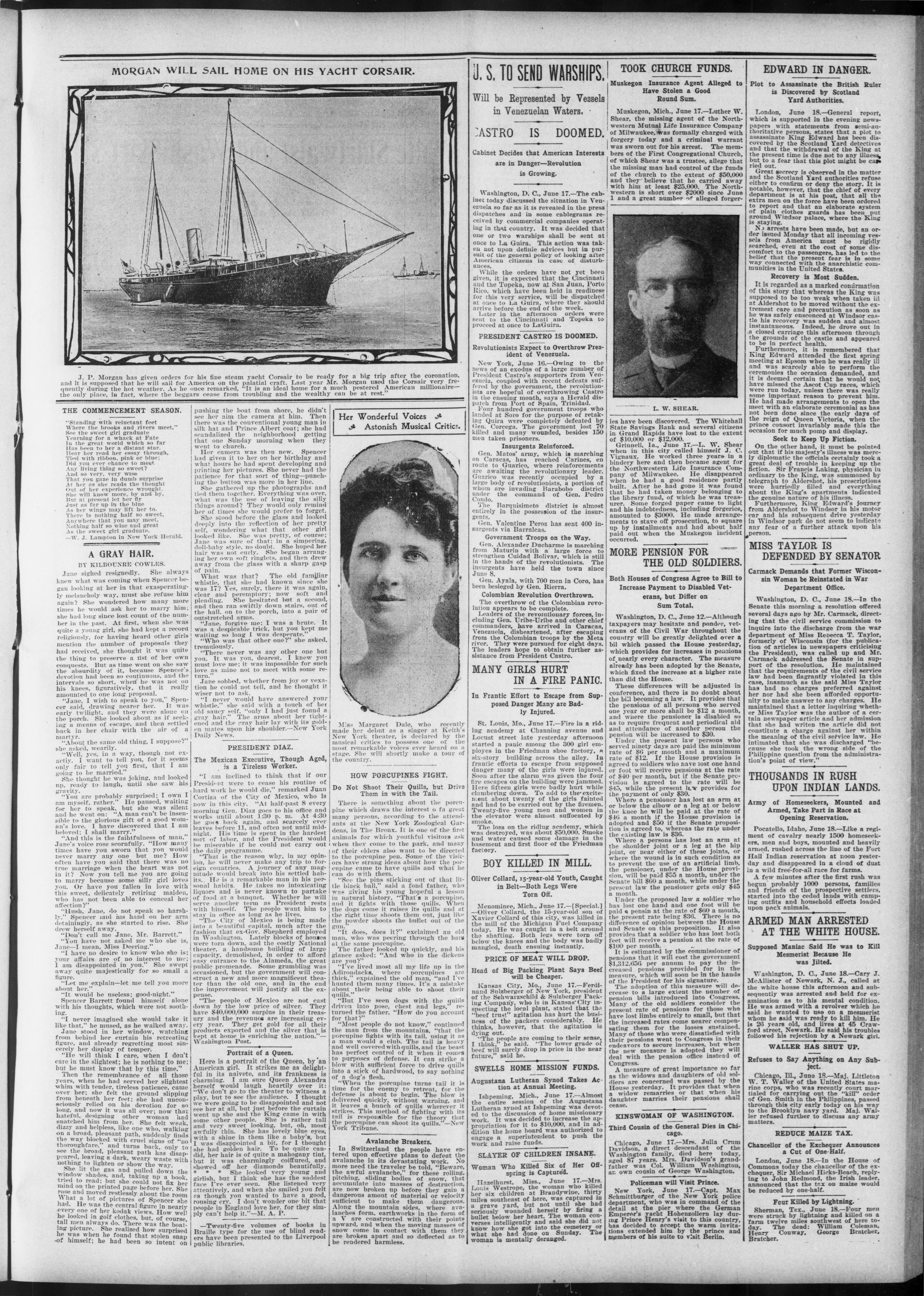
THE SHIP
J. P. Morgan has given orders for his fine steam yacht Corsair to be ready for a big trip after the coronation, and it is supposed that he will sail for America on the palatial craft. Last year Mr. Morgan used the Corsair very frequently during the hot weather. As he once remarked, "It is an ideal home for a much pestered American millionaire—the only place, in fact, where the beggars cease from troubling and the wealthy can be at rest."
THE COMMENCEMENT SEASON.
"Standing with reluctant feet
Where the brooks and rivers meet,"
See the sweet girl graduate
Yearning for a whack at Fate
In the great world which so far
Has been to her a distant star.
Hear her read her essay through,
Tied with ribbon, pink or blue;
Did you ever chance to meet
Any living thing so sweet?
And so very, very wise
That you gaze in dumb surprise
At her as she reads the thought
Out of her experience wrought.
She will know more, by and by,
But at present let her fly
Just as far up in the blue
As her wings may lift her to.
There is nothing half so sweet,
Anywhere that you may meet,
Nothing half so wise and great
As the sweet girl graduate.
—W. J. Lampton in New York Herald.
BY KILBOUNRE COWLES.
Jane sighed resignedly. She always knew what was coming when Spencer began looking at her in that exasperatingly melancholy way, must she refuse him again? She wondered how many more times he would ask her to marry him; she had long since lost count of the number in the past. At first, when she was quite a young girl, she had kept a record religiously, for having heard other girls mention the number of proposals they had received, she thought it was quite the thing to preserve a rist of her own conquests. But as time went on she saw the absurdity of it, because Spencer's devotion had been so continuous, and the intervals so short, when he was not on his knees, figuratively, that it really amounted to one long proposal.
"Jane, I wish to speak to you," Spencer said, drawing nearer her. It was early twilight, and they were alone on the porch. She looked about as if seeking a means of escape, and then settled back in her chair with the air of a martyr.
"About the same old thing, I suppose?" she asked, wearily.
"Well, yes, in a way, though not exactly. I want to tell you, for it seems only fair to tell you first, that I am going to be married."
She thought he was joking, and looked up, ready to laugh, until she saw his gravity.
"You are probably surprised; I own I am myself, rather." He paused, waiting for her to speak, but she was silent and he went on: "A man can't be insensitive to the glorious gift of a good woman's love. I have discovered that I am beloved; I shall marry."
"And this is the faftfulness of man," Jane's voice rose scornfully. "How many times have you sworn that you would never marry any one but me? How often have you said that there was no true marriage when the heart was not in it? Now you tell me you are going to marry because some silly girl loves you. Or have you fallen in love with this sweet, delicately retiring maiden, who has not been able to conceal her affection?"
"Hush, Jane, do not speak so harshly." Spencer said ins hand on her arm detainingly, as she started to rise. She drew herself away.
"Don't call me Jane, Mr. Barrett."
"You have not asked me who she is, Jane—I mean, Miss Deering."
"I have no desire to know who she is; your affairs are of no interest to me; I am disappointed in you." She swept away quite majestically for so small a figure.
"Let me explain—let me tell you more about her."
"It would be useless; good-night."
Spencer Barrett found himself alone with his thoughts, which were not soothing.
"I never imagined she would take it like that," he mused, as he walked away.
Jane stood in her window, watching from behind her curtain his retreating figure, and already regretting most sincerely her display of temper.
"He will think I care, when I don't care in the slightest; he is nothing to me; but he must know that by this time."
Then the remembrance of all those years, when he had served her slightest whim with tender, tireless patience, came over her; she felt the ground slipping from beneath her feet; she had unconsciously relied on his devotion for so long, and now it was all over; now that hateful, designing other woman had snatched him from her. She felt weak, dizzy and helpless, like one who, walking on a broad, pleasant path, suddenly finds the way blocked with cruel signs of "no thoroughfare," and turns back, only to see the broad, pleasant path has disappeared, leaving a dark, weary waste with nothing to lighten or show the way.
She lit the gas and pulled down the window shades, and, taking up a book, tried to read; but she could not fix her mind on the printed page before her. She rose and moved restlessly about the room. What a lot of pictures of Spencer she had. He was the central figure in nearly every one of her kodak views. How well he looked in golf clothes, but, of course, tall men always do. There was the boating picture. She realized how surprised he was when he found that stolen snap of himself; he had been so intent on
pushing the boat from shore, he didn't see her aim the camera at him. Then there was the conventional young man in silk hat and Prince Albert coat; she had scandalized the neighborhood getting that one Sunday morning when they went to church.
Her camera was then new. Spencer had given it to her on her birthday and what hours he had spent developing and printing her pictures. She never had the patience for that sort of thing—punching the button was more in her line.
She gathered up the photographs and tied them together. Everything was over, what was the use of leaving the silly things around? They would only remind her of times she would prefer to forget.
She stood before the glass and looked deeply into the reflection of her pretty self, wondering what that other girl looked like. She was pretty, of course; Jane was sure of that; in a simpering, doll-baby style, no doubt. She hoped her hair was not curly. She began arranging her own soft ringlets, and then drew away from the glass with a sharp gasp of pain.
What was that? The old familiar whistle, that she had known since she was 17? Yes, surely, there it was again, clear and peremptory; now soft and pleading. She hesitated but a second, and then ran swiftly down stairs, out of the hall, on to the porch, into a pair of outstretched arms.
"Jane, forgive me: I was a brute. It was a despicable trick, but you kept me waiting so long I was desperate."
"Who was that other one?" she asked, tremulously.
"There never was any other one but you. It was you, dearest. I knew you must love me; it was impossible for such love as mine not to meet with some return."
Jane sobbed, whether from joy or vexation he could not tell, and he thought it wiser not to ask.
"I never would have answered your whistle." she said with a touch of her old saucy self. "only I had just found a gray hair." The arms about her tightened and the gray hair lay with its golden mates upon his shoulder.—New York Daily News.
PRESIDENT DIAZ.
The Mexican Executive, Though Aged, is a Tireless Worker.
"I am inclined to think that if our President were to cease his routine of hard work he would die," remarked Juan Cortiza of the City of Mexico, who is now in this city. "At half-past 8 every morning Gen. Diaz goes to his office and works until about 1:30 p. m. At 4:30 he goes back again, and scarcely ever leaves before 11, and often not until midnight. His time is spent in the hardest sort of labor, and the President would be miserable if he could not carry out the daily programme.
"That is the reason why, in my opinion, he will never make any trip to foreign countries. A journey of any magnitude would break into his settled habits. He is a remarkable man in his personal habits. He takes no intoxicating liquors and is never known to partake of food at a banquet. Whether he will serve another term as President rests with himself. The people want him to stay in office as long as he lives.
"The City of Mexico is being made into a beautiful capital, much after the fashion that ex-Gov. Shepherd employed in Washington. Lately blocks of houses were torn down, and the costly National theater, a handsome building of large capacity, demolished, in order to afford easy entrance to the Alameda, the great public promenade. Some grumbling was occasioned, but the government will construct a new and more magnificent theater than the old one, and in the end the improvement will justify all the expense.
"The people of Mexico are not cast down by the low price of silver. They have $40,000,000 surplus in their treasury and the revenues are increasing every year. They get gold for all their products exported and the silver that is kept at home is enriching the nation."—Washington Post.
Portrait of a Queen
Here is a portrait of the Queen, by an American girl. It strikes me as delightful in its naivete, and its frankness is charming. I am sure Queen Alexandra herself would laugh heartily over it: "We don't go to the theater to witness a play, but to see the audience. I thought we were going to be disappointed and not see her at all, but just before the curtain went up she and the King came in with some other people. She is rather tall and very sweet looking, but, oh, most awfully thin. She has lovely blue eyes, with a shine in them like a baby's, but I was disappointed a bit, for I thought she had golden hair. To be quite candid, her hair is of quite a mahogany tint, but it was charmingly coiffured, and showed off her diamonds beautifully. * * * She looked very young and girlish, but I think she has the saddest face I've ever seen. She listened very attentively, and when she smiled you felt as though you wanted to have a good, rousing cry. I don't wonder one bit that people in England love her, for they simply can't help it."—M. A. P.
Twenty-five volumes of books in Braille type for the use of blind readers have been presented to the Liverpool public libraries.
A. E.
Miss Margaret Dale, who recently made her debut as a singer at Keith's New York theater, is declared by the musical critics to possess one of the most remarkable voices ever heard on a stage. She will shortly make a tour of the country.
HOW PORCUPINES FIGHT.
Do Not Shoot Their Quills, but Drive Then in with the Tail.
There is something about the porcupine which draws the interest o fa great many persons, according to the attendants at the New York Zoological Gardens, in The Bronx. It is one of the first animals for which youthful visitors ask when they come to the park, and many of their elders also want to be directed to the porcupine pen. Some of the visitors have strang ideas about how the porcupine came to have quills and what he can do with them.
"See the pins sticking out of that little black ball," said a fond father, who was giving his young hopeful a lesson in natural history. "That's a porcupine, and it fights with those quills. When the dogs come it raises its quills and at the right time shoots them out, just like the powder shoots the bullet out of the gun."
"It does, does it?" exclaimed an old man, who was peering through the bars at the same porcupine.
The father looked up quickly, and his glance asked: "And who in the dickens are you?
"I've lived most all my life up in the Adirondacks, where porcupines are thick," explained the old man, "and I've hunted them many times. It's a mistake about their being able to shoot their quills."
"But I've seen dogs with the quills driven into nose, chest and legs," returned the father. "How do you account for that?"
"Most people do not know," continued the man from the mountains, "that the porcupine fights with its tail, using it as a man would a club. The tail is heavy and well covered with quills, and the beast has perfect control of it when it comes to purposes of defense. It can strike a blow with sufficient force to drive quills into a stick of hardwood, to say nothing of a dog's flesh.
"When the porcupine turns tail it is time for the enemy to retreat, for the defense is about to begin. The blow is delivered quickly, without warning, and it leaves a bunch of quills wherever it strikes. This method of fighting with its tail is responsible for the theory that the porcupine can shoot its quills."—New York Tribune.
Avalanche Breakers
In Switzerland the people have entered upon effective plans to defeat the avalanche in its devastating work. No more need the traveler be told, "Beware, the awful avalanche," for these rolling, pitching, sliding bodies of snow, that accumulate into masses of destruction, are now broken up before they gain a dangerous amout of material or velocity sufficient to make them dangerous. Along the mountain sides, where avalanches form, earthworks in the form of a V are constructed with their points upward, and when the moving masses of snow come in contact with them they are broken apart and so deflected as to be rendered harmless.
U. S. TO SEND WARSHIPS.
Will be Represented by Vessels in Venezuelan Waters.
CASTRO IS DOOMED.
Cabinet Decides that American Interests are in Danger—Revolution is Growing.
Washington, D. C., June 17.—The cabinet today discussed the situation in Venezuela so far as it is revealed in the press dispatches and in some cablegrams received by commercial companies operating in that country. It was decided that one or two warships shall be sent at once to La Guira. This action was taken not upon definite advices but in pursuit of the general policy of looking after American citizens in case of disturbances. While the orders have not yet been given, it is expected that the Cincinnati and the Topeka, now at San Juan, Porto Rico, which have been held in readiness for this very service, will be dispatched at once to La Guira, where they should arrive before the end of the week.
Later in the afternoon orders were sent to the Cincinnati and Topeka to proceed at once to LaGuira.
PRESIDENT CASTRO IS DOOMED.
Revolutionists Expect to Overthrow President of Venezuela.
New York, June 16. Owing to the news of an exodus of a large number of President Castro's supporters from Venezuela, coupled with recent defeats suffered by the government, the revolutionists are hopeful of overthrowing Castro in the ensuing month, says a Herald dispatch from Port of Spain, Trinidad. Four hundred government troops who landed at Soro for the purpose of retaking Quira were completely defeated by Gen. Corcega. The government lost 70 killed and many wounded, besides 150 men taken prisoners.
Insurgents Reinforced.
Gen. Matos' army, which is marching on Caracas, has reached Carines, en route to Guarico, where reinforcements are awaiting the revolutionary leader. Guarico was recently occupied by a large body of revolutionists, a portion of whom are invading Barabobo district under the command of Gen. Pedro Condo. The Barquisimeto district is almost entirely in the possession of the insurgents. Gen. Valentine Peroz has sent 400 insurgents via Barralcas. Government Troops on the Way.
Government Troops on the Way.
Gen. Alexander Ducharme is marching from Maturin with a large force to strengthen Cuidad Bolivar, which is still in the hands of the revolutionists. The insurgents have held the town since June 8.
Gen. Ayala, with 700 men in Coro, has been besieged by Gen. Rierra.
Colombian Revolution Overthrown.
The overthrow of the Colombian revolution appears to be complete.
Leaders of the revolutionary forces, including Gen. Uribe-Uribe and other chief commanders, have arrived in Caracas, Venezuela, disheartened, after escaping from the Colombian troops by the Meta river. They were pursued for eight days. The leaders hope to obtain further assistance from President Castro.
MANY GIRLS HURT IN A FIRE PANIC.
In Frantic Effort to Escape from Supposed Danger Many are Badly Injured.
St. Louis, Mo., June 17.—Fire in a riding academy at Channing avenue and Locust street late yesterday afternoon started a panic among the 300 girl employees in the Friedman shoe factory, a six-story building across the alley. In frantic efforts to escape from supposed danger many of the girls were injured. Soon after the alarm was given the four fire escapes on the building were jammed. Here fifteen girls were badly hurt while clambering down. To add to the excitement about twenty of the girls fainted and had to be carried out by the firemen. Twenty-five young men and women in the elevator were almost suffocated by smoke.
The loss on the riding academy, which was destroyed, was about $50,000. Smoke and water caused some damage in the basement and first floor of the Friedman factory.
BOY KILLED IN MILL.
Oliver Collard, 15-year-old Youth, Caught in Belt—Both Legs Were Torn Off.
Menominee, Mich., June 17.—[Special.]
—Oliver Collard, the 15-year-old son of Xavier Collard of this city, was killed in the mill of the Michigan Fuel Company today. He was caught in a belt around the shafting. Both legs were torn off below the knees and the body was badly mangled, death ensuing instantly.
PRICE OF MEAT WILL DROP.
Head of Big Packing Plant Says Beef will be Cheaper.
Kansas City, Mo., June 17.—Ferdinand Sulzberger of New York, president of the Schwarzschild & Sulzberger Packing Company, who is in Kansas City inspecting the local plant, stated that the "beef trust" agitation has hurt the business of the packers considerably. He thinks, however, that the agitation is dying out.
"The people are coming to their sense, I think," he said. "The lower grade of beef will surely drop in price in the near future," said he.
SWELLS HOME MISSION FUNDS.
Augustana Lutheran Synod Takes Action at Annual Meeting.
Ishpeming, Mich., June 17.—Almost the entire session of the Augustana Lutheran synod at Ishpeming was devoted to the discussion of home missionary work. It was decided to increase the appropriation for it to $10,000, and in addition the home board was authorized to engage a superintendent to push the work and raise funds.
SLAYER OF CHILDREN INSANE.
Woman Who Killed Six of Her Offspring is Captured.
Hazelhurst, Miss., June 17.—Mrs. Louis Westrope, the woman who killed her six children at Brandywine, thirty miles southeast of here, was captured in a grave yard, but not until she had seriously wounded herself by firing a bullet below her heart. The woman converses intelligently and said she did not know how she got into the cemetery or what she had done on Sunday. The woman is mentally deranged.
TOOK CHURCH FUNDS.
Muskegon Insurance Agent Alleged to Have Stolen a Good Round Sum.
Muskegon, Mich., June 17.—Luther W. Shear, the missing agent of the Northwestern Mutual Life Insurance Company of Milwaukee, was formally charged with forgery today and a criminal warrant was sworn out for his arrest. The members of the First Congregational Church, of which Shear was a trustee, allege that the missing man had control of the funds of the church to the extent of $50,000 and they believe that he carried away with him at least $25,000. The Northwestern is short over $2000 since June 1 and a great number of alleged forger-
M. H.
ies have been discovered. The Whitehall State Savings Bank and several citizens in Grand Rapids have lost to the extent of $10,000 or $12,000. Grinnell, Ia., June 17.-L. W. Shear when in this city called himself J. C. Vignaux. He worked three years in a bindery here and then became agent for the Northwestern Life Insurance Company of Milwaukee. He disappeared when he had a good residence partly built. After he had gone it was found that he had taken money belonging to the library fund, of which he was treasurer. Some forged paper came to light and his indebtedness, including forgeries, amounted to $3000. He made arrangements to stave off prosecution, to square up by installments and had about half paid out when the Muskegon incident occurred.
MORE PENSION FOR THE OLD SOLDIERS.
Washington, D. C., June 12.—Although taxpayers may hesitate and ponder, veterans of the Civil War throughout the country will be greatly delighted over a bil which passed the House yesterday, which provides for increases in pensions of nearly every character. The measure already has been adopted by the Senate, which fixed the increase at a higher rate than did the House. These differences will be adjusted in conference, and there is no doubt about the bill becoming a law. It provides that the pensions of all persons who served one year or more shall be $12 a month, and where the pensioner is disabled so as to require frequent and periodical aid and attendance of another person the pension will be increased to $30.
Under the present law persons who served ninety days are paid the minimum rate of $6 per month and a maximum rate of $12. If the House provision is agreed to soldiers who have lost one hand or foot will receive pensions at the rate of $40 per month, but if the Senate provision is agreed to the rate will be $45, while the present law provides for the payment of only $30. Where a pensioner has lost an arm at or below the elbow or a leg at or below the knee he will be paid at the rate of $46 a month if the House provision is adopted and $50 if the Senate proposition is agreed to, whereas the rate under the existing law is $36.
Where a persons has lost an arm at the shoulder joint or a leg at the hip joint, or near either of these joints, or where the wound is in such condition as to prevent the use of an artificial limb, the pensioner, under the House provision, will be paid $55 a month, under the Senate bill $60 a month, while under the present law the pensioner gets only $45 a month.
Under the proposed law a soldier who has lost one hand and one foot will be paid a pensin at the rate of $60 a month, the present rate being $36. There is no difference of opinion between the House and Senate on this proposition. It also provides that a soldier who has lost both feet will receive a pension at the rate of $100 per month.
It is estimated by the commissioner of pensions that it will cost the government $1,312,656 per annum to pay the increased pensions provided for in the measure, which will soon be in the hands of the President for his signature. The adoption of this measure will decrease to a large extent the number of pension bills introduced into Congress. Many of the old soldiers consider the present rate of pensions for those who have lost limbs entirely to small, but that the increased rates come nearer compensating them for the losses sustained. Many of those who were dissatisfied with their pensions went to Congress in their endeavors to secure increases, but when the new measure is adopted they will deal with the pension office instead of Congress.
A measure of great importance so far as the widows and daughters of old soldiers are concerned was passed by the House yesterday. It provides that when a widow remarries or that when his daughter marries their pensions shall cease.
KINSWOMAN OF WASHINGTON.
Third Cousin of the General Dies in Chicago.
Chicago, June 17.—Mrs. Julia Crum Davidson, a direct descendant of the Washington family, died here today, aged 87 years. Mrs. Davidson's grandfather was Col. William Washington, an own cousin of George Washington.
Policeman will Visit Prince.
New York, June 17.—Capt. Max Schmittburger of the New York police department, who was in command of the detail at the pier where the German Emperor's yacht Hohenzollern lay during Prince Henry's visit to this country, has decided to accept the warm invitations extended him by the prince and members of his suite to visit Berlin.
Plot to Assassinate the British Ruler is Discovered by Scotland Yard Authorities.
London, June 18.—General report, which is supported in the evening newspapers with statements from semi-authoritative persons, states that a plot to assassinate King Edward has been discovered by the Scotland Yard detectives and that the withdrawal of the King at the present time is due not to any illness, but to a fear that this plot might be carried out. Great secrecy is observed in the matter and the Scotland Yard authorities refuse either to confirm or deny the story. It is notable, however, that the chief of every department is at his post, that all the extra men on the force have been ordered to report and that an elaborate system of plain clothes guards has been put around Windsor palace, where the King is staying.
No arrests have been made, but an order issued Monday that all incoming vessels from America must be rigidly searched, even at the cost of some discomfort to the passengers, has led to the belief that the present fear is in some way connected with the anarchistic communities in the United States.
Recovery is Most Sudden.
It is regarded as a marked confirmation of this story that whereas the King was supposed to be too weak when taken ill at Aldershot to be moved without the extremest care and precaution as soon as he was safely enconced at Windsor castle his recovery was sudden and almost instantaneous. Indeed, he drove out in a closed carriage this afternoon through the grounds of the castle and appeared to be in perfect health.
Furthermore, it is remembered that King Edward attended the first spring meeting at Epsom when he was really ill and was scarcely able to perform the ceremonies the occasion demanded, and it is deemed certain that he would not have missed the Ascot Cup races, which were run today, unless there was really some important reason to prevent him. He had made arrangements to open the meet with an elaborate ceremonial as has not been done since the early days of the reign of Queen Victoria, when the prince consort invariably made this the occasion for much pomp and display.
Seek to Keep Up Fiction.
On the other hand, it must be pointed out that if his majesty's illness was merely diplomatic the officials certainly took a great deal of trouble in keeping up the fiction. Sir Francis Laking, physician in ordinary to the King, was summoned by telegraph to Aldershot, his prescriptions were hurriedly filled and everything about the King's apartments indicated the genuine nature of his illness. Furthermore, King Edward's journey from Aldershot to Windsor in his motor car and his subsequent drive yesterday in Windsor park do not seem to indicate any fear of a further attack upon his person.
MISS TAYLOR IS
DEFENDED BY SENATOR
Carmack Demands that Former Wisconsin Woman be Reinstated in War Department Office.
Washington, D. C., June 18.—In the Senate this morning a resolution offered several days ago by Mr. Carmack, directing that the civil service commission to inquire into the discharge from the war department of Miss Rebecca T. Taylor, formerly of Wisconsin (for the publication of articles in newspapers criticising the President), was called up and Mr. Carmack addressed the Senate in support of the resolution. He maintained that the requirements of the civil service law had been flagrantly violated in this case, inasmuch as the said Miss Taylor has had no charges preferred against her nor had she been afforded opportunity to make answer to any charges. He maintained that a letter inquiring whether Miss Taylor was the author of a certain newspaper article and her admission that she had written the article did not constitute a charge against her within the meaning of the civil service law. He intimated that she was discharged "because she took the wrong side of the Philippine question from the administration's point of view."
THOUSANDS IN RUSH UPON INDIAN LANDS.
Army of Homeseekers, Mounted and Armed, Take Part in Race at Opening Reservation.
Pocatello, Idaho, June 18.—Like a regiment of cavalry nearly 1500 homeseekers, men and boys, mounted and heavily armed, rushed across the line of the Fort Hall Indian reservation at noon yesterday and disappeared in a cloud of dust in a wild free-for-all race for farms.
A few minutes after the first rush was begun probably 1000 persons, families and friends of the prospective settlers, started into the ceded lands with camping outfits and household effects loaded upon pack animals.
ARMED MAN ARRESTED AT THE WHITE HOUSE.
Supposed Maniac Said He was to Kill Mesmerist Because He was Iilted
Washington, D. C., June 18.-Cary J. McAllister of Newark, N. J., called at the white house this afternoon and subsequently was arrested and held for examination as to his mental condition. He was armed with a revolver which he said he wanted to use on a mesmerist whom he said was ready to kill him. He is 26 years old, and lives at 45 Crawford street, Newark. He said his troubles followed his rejection by a Newark girl.
WALLER HAS SHUT UP.
Refuses to Say Anything on Any Subject.
Chicago, Ill., June 18.—Maj. Littleton W. T. Waller of the United States marine corps, who was recently court martialed for carrying out the "kill" order of Gen. Smith in the Philippines, passed through this city early today on his way to the Brooklyn navy yard. Maj. Waller refused further to discuss any army matters.
REDUCE MAIZE TAX.
Chancellor of the Exchequer Announces a Cut of One Half.
London, June 18.—In the House of Commons today the chancellor of the exchequer, Sir Michael Hicks-Beach, replying to John Redmond, the Irish leader, announced that the tax on maize would be reduced by one-half.
Four Killed by Lightning.
Sherman, Tex., June 18.—Four men were struck by lightning and killed on a farm twelve miles southwest of here today. The dead: William Coleman, Henry Conway, George Bratcher, Bratcher
The Wisconsin Weekly Advocate
Telephone Black No. 244.
SUBSCRIPTION RATES.
Any part of the United States and Canada,
postage paid.
One Year ..... $2.00
Six Months ..... 1.25
Three Months ..... .75
Send money by Express Money Order, P. O.
Money Order or Registered Letter to the
Wisconsin Weekly Advocate.
ADVERTISING RATES.
One inch, single insertion ..... 25c
One inch, per year ..... $9.00
Business locals 5c per line each insertion.
Apply for rates to the Advocate.
TO CONTRIBUTORS:
All communications must be sent with the name and address of the sender as an evidence of good faith, but not necessarily for publication. No manuscript returned if not accepted, unless accompanied by stamps.
The Wisconsin Weekly Advocate company wishes to notify the public that all contracts and business transactions with this company must have the company stamp, otherwise they will be void. Neither will this company be responsible for paid subscriptions unless given to duly-accredited agents, who, on request, will give the company's receipt for same. Subscribers failing to receive their papers regularly will kindly notify the general office. Address all business communications to the general manager, 79 Fifth street.
Entered in the Postoffice at Milwaukee as Second-class matter.
As to the auto-race in public highways: It ought to stop.
Col. Lynch, late of the Boer army, has returned to England to discover that the war is not over.
Wisconsin Department G. A. R. has chosen a Superior man for commander. It generally does.
If there is anyone disposed to kick now that the South African war is over, it is probably the army mule.
In spite of the recent behavior of volcanoes elsewhere, the Japs continue to be proud of their Fusi Yama.
June, 1902, will be remembered in Wisconsin as a month of thunder storms as well as a month of roses.
The brewers have decided to keep up the price of beer, and rely upon the consumers to keep down the supply on hand.
The late activity in the business of selling mules to the English will be superseded by activity in sales of cattle to the Boers.
While others are agitating for an eighth-hour day, Dr. Dowie comes out for an eight-hour night. He always was just that contrary!
It is painful to reflect upon the mortification with which William Waldorf Astor regards the hob-nobbing of Jim Keene and King Edward.
A Chicago girl working in a restaurant has fallen heir to a fortune of a million dollars. This is more than some waiters can save out of their tips.
The Chicago girls are tickleder over Ada Barclay's assertion that they have small feet than they would have been if she had credited them with long heads.
Washington's Marine Band will hereafter refuse to play "rag-time" music; but presumably it will be true to its name and make an exception of "A Life on the Ocean Wave."
It didn't require the suicide of a Chicago man after reading "The Sorrows of Satan" to indicate the direction in which Chicago sympathies instinctively extend.
The object of Commissioner Carroll D. Wright's investigation is to throw light upon the coal strike. The people will be glad to obtain light. However, they need not only light but fuel.
The serious shooting of a boy during the Pawtucket strike riot sustains the traditional observation that in all such such cases of violence with firearms the innocent are the sufferers.
Why did Mark Twain weep on revisiting the scenes of his boyhood? Perhaps because he recalled the time when he was Huckelberry Finn, and reflected that now he is near his Huckleberry finish.
The sea captain who reports having passed during his voyage a floating island populated by thousands of monkeys as opened a new field for adventure by "the man who would be king."
Those Alaskan volcanoes that are emulating Mont Pelee are invited to do their darnedest now, so that when the tide of settlement crowds in, and Alaska is a state of the Union, they can rest upon their record.
New York has something to brag of in the fact that she is to have the largest drydock in the world. But there is nothing creditable in the slowness with which an enterprise that was absolutely essential to maritime greatness has developed in the chief port of the United States.
From the account of the fatal derailment on the Detroit & Mackinac railroad, the accident was unavoidable. But the happening should admonish trainhands that they should be exceedingly watchful during the excursion season.
The King of Italy's investment of $8,000,000 in Virginia coal lands is probably due to his observations as to the "cinch" which the American coal barons have upon the earnings of the people. A King well supplied with coal lands could run his realm without taxing his own people.
Chicago's display of interest in the character of her hospital buildings, since the holocaust in the institution for inebriates on Wabash avenue, should be emulated by the authorities of all places where there are institutions in which people are strapped to beds or confined in cages.
The movement in Germany against the defacement of scenery with advertising boards or with designs painted upon the
---
faces of rocks will be emulated generally by people who have proper appreciation of the value of scenic beauty. The obtrusiveness of the "bill board" is bringing about the abolition of that form of advertising.
The patriotic action of Gen. Gomez in declining the pension voted him by the Cuban government until Cuba is ready to acknowledge its debt to the Cuban revolutionary soldiers in a similar manner, stamps him as a hero of the true blue type. Cuba can never repay Gomez for what he has done in her behalf.
The detailed reports of Ascension Day in St. Pierre, the doomed city of Martinique, are now coming in from newspaper correspondents who have visited the ruins. They are terrible, for it seems in any view terrible that twenty-six thousand human beings should be snuffed out of existence as the light of a candle might be snuffed out, at a single stroke, and with no chance to prepare for their fate. Yet to those who have faith in the eternity of the human soul—to those who believe that life on earth is but a preparation for life immortal—the history of Ascension Day at St. Pierre is not disquieting. "God is over all," believers in the comforting philosophy of immortality can exclaim. "All that live must die, and what matters it whether death comes by lingering disease or by sudden stroke? 'God's in His heaven; all's right in the world.'"
AGED HEART'S LONGING.
Mother Becker, Resident of the Battery in Gotham, Prefers Home, Sweet Home.
Now that the little pink daisies and the pansies, yellow and purple, ripple into laughter, like rows of children with their faces upturned; now that the long afternoon shadows upon the turf are full and leafy, and the winds blow in warm little gusts from the South, and the waves sparkle in the spring sunshine, Mother Becker has reappeared in the park.
For many years now the habitues of the Battery have known her. The spring is not held to have arrived, no matter what the calendar and what the blossoms say, until the morning dawns when she hobbles along the winding paths to the sunny row of benches that look straight upon the burnished water. The policemen know her, and if she should nod at her station they would never touch harshly her bent old shoulders or bid her wake. Her fellow idlers know her and give her respectful salutation as she comes. The children who crawl under the swinging iron chains that pretend to keep them from the sward know her, and the little ones come up shyly and slyly behind her to tweak at her skirt and to scurry with delighted peals of joy when she turns her laughing face in mock threat upon them.
She smiles gently as she comes along the paths. When she reaches the unshaded benches along the water front she selects the one with the most unobstructed view and there she seats herself. Her blue eyes have faded and are half lost in the wrinkles that radiate around them, but even yet they are capable of looking kindly upon mankind and gratefully upon the beauty about her.
She site and looks and dreams and dozes. If you speak to her, as neighbor to neighbor, she will answer you with gentle, self-respecting humility, whether you are a great personage, a policeman, an apple vender, a visitor, or a mere ragged tramp or a poor tawdry woman waking suddenly from stupid sleep beside her. It is as though she felt herself the least of all the human race, and yet, because one of it, not altogether little
Sometimes she arises and hobbles to the sea wall and looks straight ahead. There are the green islands of the bay breaking her vision. The picture is crowded with sails and masts and smoke stacks. She looks at the statue shining green and bronze against the blue sky or black against the molten glory of the evening sun, and then she looks afar, as though her dim eyes pierced the woods and hills and saw again the straight stretch of waters. Then she comes slowly back, and her place is always empty for her. If you ask her, by look or word, she will explain gently to you why she leaves the heach and walks to the sea wall.
"So it seems to me sometimes that I my old home can see," she says. "It will be now forty years since I have come here. Then was I a young woman—thirty years—and I came with my man and my five children, yes—Princenthal it was called; have you perhaps been there? In the dooryard of my sister's house there is a lilac tree; and there are onions planted and many things. It was my house also until we have come here." She cights a little.
"When I a young woman and a busy housemother was, the heimweh—what call you it?—the homesickness—often came upon me. But now—my man, he is dead, my children they are men. They take care of me; I have the time to come here, and here is the nearest place in Princenthal. I am an old woman; maybe I should think on heaven. But I love better to think of my old home. And God is good. He has given us this so wonder-lovely place to sit and look toward home. He will not mind the old woman that she does not think on heaven, think you?"—Anne O'Hagan in New York Daily News.
SIZE OF THE SKULL.
No Sensible Relation Between Intellect and Cranial Capacity.
The opinion is widely held that intelligence is connected with cranial capacity, or, in other words, with the size of the head. "The question," says Cosmos, "has often been brought up by scientists, but their investigations have resulted in nothing conclusive, and this has been generally regarded as due to the fact that these two magnitudes are incommeasureable. We may, it is true, measure the length and breadth of a head, but how shall we express degrees of intellect in figures? However this may be, these difficulties have not frightened Prof. Karl Pearson, who has made a series of experiments that he describes in a recent paper before the London Royal Society.
"To eliminate as far as possible the errors that might be introduced into comparative measurements on a large number of persons by differences of age, education and nourishment, Prof. Pearson devoted his attention to a homogeneous group of individuals of the same social environment—the students of the University of Cambridge. The Anthropological Society of Cambridge furnished him with a series of measurements on students whose university standing could be obtained from the records. The results deduced from these measurements by a method invented by Prof. Pearson * * * proves that the intelligence of a student, so far as it can be measured by his success as a scholar, has no sensible relation to the size of his head. Other experiments in different colleges of the unite' kingdom confirm this result."—Literary Digest.
Another Wash Goods Whirl
Another Wash Goods Whirl
Our fortunate purchase of Wash Fabrics of Ely Walker Dry Goods Co., at half and less than half price, is the cause of the crowds in our Wash Goods section. The values we are offering are the talk of the town. The prices still lower Friday.
EXCELLENCE ECONOMY ENTERPRISE
Housekeepers Linen Specials
37½c for 50c Table Damask—a special
5 c grade cream table dam-
ask and never sold for
less than 50c. Friday spec..
37½c
10c each for 15c Towels—about 50
dozen odds and ends and broken lots
of Turkish and linen huck towels—18x
36 and 17x34 inch size, a great
choice as a Friday
special
10c
7c Sheeting for 434c—5000 yards 36-
inch full bleached muslin fine even
quality and clear black—retails
everywhere at 7c a yard.
Friday special
4³c
85c for $1.35 Spreads—1 case large
size new pattern crochet white bed-
spreads—with or without
fringe, regular price $1.35.
Friday special
85c
$1.19 for $1.50 Comforters—House made and filled with the best white cotton and guaranteed full size—our regular price is $1.50 each, splendid choice of patterns on Friday at only..... $1.19
Another Wash
Our fortunate purchase of Wash Goods Co., at half and less than crowds in our Wash Goods section. the talk of the town. The prices st
5000 yards Corded Batistes and Lawns, in pretty dainty colorings for house gowns, also black and whites, 6c kind Friday..... 2½c
200 pieces Fine Figured Batiste, pretty choice colorings, lots of black and white, kind that others retail at 15c a yard—we say Friday
Curtains & Draperies
For Friday only—1000 pairs Scotch Net
Curtains, worth $1.25 per pair—
for only, per pair.....69c
1000 Ruffle Muslin Curtains,
worth $1.50—for only, per pair.....59c
4-foot Curtain poles, with
trimmings, for.....4c
38-inch Lace Stripe Scrim,
for.....2 $c
White Curtain Loops, per
pair.....3c
REED B DAWN.
DAWN
A ship with a cargo laden to the guards
Has come to port! Lo, how her masts and
spars
Above the kindling clouds begin to lift.
And her great peak has dashed the skies
with light!
For all on earth she brings a royal gift.
More precious than was ever sung by
bards.
Her hold is stuffed with incense and with
myrrh.
And round her elings a fragrance and a scent
Of Thule or some distant Orient,
With whiffs of a divine air, the swift
Sidereal blast that bore her from the stars.
The woods and hills rejoice to welcome her
As though she bore to earth some envoy or Some God-accredited ambassador. Sent hither from beyond the Pleiades. Near and more near she draws! The heavens grow bright
With her approach! Lo, in what vessel- yards
Were her stout timbers hewn? What work-
man laid
man said
Her stars? Frame? What fearless pilot
watched
Her anchor, steered her through the chart less seas?
—William Prescott Foster in Atlantic.
JUST ONE GIRL
Of course it never would have happened had Mrs. Douglass been at home. But Dame Fortune sometimes plays queer freaks on her most unsuspecting sons and daughters, and it so happened that Mrs. Douglass was far away when her son's telegram arrived.
"Will be home tomorrow with Lockwood. Stay a week." So the telegram read. Nothing so formidable sounding about that, but mother was away. And Lockwood? Well, Gilbert Lockwood was the only son and heir of Hon. Grant Lockwood, ex-senator and county judge.
"Whatever shall we do?" asked poor Margaret. Proud, aristocratic Margaret, who loved nothing so much as a fine display. Margaret never did know just what to do unless her younger sister, Beth, suggested.
"Mother away," she continued, "Molly down with neuralgia, and Milly in tantrums, to say nothing of cook, who is ready to fly at a moment's warning."
Now Molly was upstairs girl, while Milly enjoyed the double privilege of waitress and ladies' maid. Her tantrums were chronic, aggravated this time by Molly's illness and a consequent increase of work. A dreadful state of affairs, most surely.
"Well, we are in a tight place, that's a fact," answered Beth. "We have spoiled Milly by doing most of Molly's work, and she will never consent to doing both. More than that, Julia always insists on extra help in the kitchen when there is company. There's where Molly proves herself a jewel."
"And Harold so particular. Beth, it's awful. Gilbert Lockwood, of all people, and his first visit! Things are sure to go wrong, and I shall die of mortification. Harold will scold, and mother! Beth, can you imagine how poor mother will feel?"
But in the meantime Beth had done some thinking, and, to judge by the decided pose of her chin, had thought to some purpose.
"I have it, Madge," she answered; "leave it to plain, practical Elizabeth, and the honor and dignity of the Douglass family will live forever. I am going to put Milly in the kitchen with Julia and—"
"But," remonstrated Julia.
"No 'buts,' my dear. I am going to take Milly's place with Molly's work." And with a curtesy half-mocking, half-triumphant, Beth stood before her sister, arms akimbo.
m
are three of the foundation stones on which the popularity of this store rests. Merchandise excellence and price economy are welded together here as nowhere else. Our special effort in Bargain Offering for Friday will readily appeal to Economical Housekeepers.
White Shirtwaist and Wash Skirt Sale
A great purchase of 50c on the dollar (of Strours, Eisendrath & Co.) one of the largest manufacturers of Ladies' Waists and Skirts in the United States will be arranged on second floor for quick selection. Every garment strictly up-to-date. A wonderful money-saving opportunity. Don't miss it!
two rows of embroidery and tucked back at less than cost to make—each..... 45c
100 dozen White Fine Sheer India Linen Waists, tucked and hemstitched, all-over embroidery and medallion effects Bargains at $2.00 each Friday 08c
Bargains at $2.00 each
Friday
special.....98c
Wash Skirts—Regular $1.00 Wash
Crash Skirts, nicely
trimmed—
Friday.....49c
Goods Whirl
ash Fabrics of Ely Walker Dry
in half price, is the cause of the
n. The values we are offering are
still lower Friday.
Rib
3000 ya
Ribbons
elty cord
wide—re
3000 yards all-silk Wash Taffeta Rubbons, in plain colors and novelty cord effects—31/2 in. wide—regular 15c values—Friday special, yard. 10c
5000 yards fine French Valenciennes and Torchon Lace Edgings insertions and beadings the 8c and 10c qualities Friday sale 4c
Bargains in Our China and Summer Glassware for Friday and Saturday before offered--quality considered.
and Glassware Dept. and Saturday selling-at prices never
Summer Glassware for Friday and Saturday selling-at prices never before offered-quality considered. 10 oz. Table Tumblers-cut bottom Thin Blown Tumblers-Piain, clear
LENNO
Those wishing a First
Hour are Cordially I
WOODAR
519 Weils St., Milwaukee, Wis.
SUNDAY 5 O'CLOCK D
BROS. & L
---
---
500 pieces handsome Shirtwaist Madras, in all the dainty colorings, perfectly fast colors and material that will wear, bargain at 10c a yard, Friday..... 5C 3000 yards Percales, figured, striped and corded effects, width to 36 in., reg. 10c and 15c goods, Friday..... 6½C
10 oz. Table Tumblers—cut bottom
—proper shape—always sold at $2
a dozen. For a starter
per dozen ..... $1.26
Thin Blown Tumblers—prettily engraved—light and dainty, choice of
four engravings—always sold at
$1.00 per dozen. For a starter
per dozen ..... 69c
"But I?" again ventured poor Margaret.
"You? Oh, yes! You will do the honors, play hostess, explain how poor mamsy went away for a rest, and how sister Beth is visiting a friend! See?"
Margaret protested that Harold would be angry, and that their mother would never get over it, but Beth was firm.
"Leave it to me," she said. "I'll manage Harold, and mother will never know."
So it happened that when Harold Douglass and his friend alighted at the steps of the Dongless home only Margaret was there to greet them.
"Why, Madge!" he exclaimed. "Where are mother and Beth?"
"Oh, mother was not well, so we sent her to Aunt Jane's for a rest, and Beth—" But here Margaret was interrupted with:
"If you please, Miss Margaret, will Mr. Harold just step into the library a moment?" And there stood Beth, in a neat but plain calico, with a white apron, her hair smoothed plainly back, only an occasional curl escaping over her brow and neck.
Too astonished to speak, and obeying a slight but imperative nod of Margaret's head, Harold followed Beth in. After listening to her explanation he gave a most reluctant consent, promising secrecy, saucy Beth giving as a final argument:
"Well, with only one to choose from Mr. Lockwood may leave his heart, and incidentally his fortune, in the Douglass family. Who can tell?"
At dinner, however, and at all subsequent meals, Harold noticed that many of Gilbert Lockwood's stray glances fell, not upon Margaret, but upon Beth, who certainly made a very demure and decidedly pretty waitress.
Each evening when he met her in the little summer house for their daily chat, Harold tried Beth's patience by coaxing her to give the farce up, or at least to let him introduce her and explain to Lockwood. "No; I like the fun," Beth always answered. "It is rich to watch Madge's face when I come in. She is so afraid I will make some dreadful break. And I almost did when I called you Harold this noon; but I guess he didn't notice." The brother and sister made a very pretty picture as they sat thus talking, but it seemed not to so strike Gilbert Lockwood, who for the third night in that week stood at his window watching them
"Humph! This after-dinner tete seems to be a steady diet for Douglass," he growled to himself. "A deucedly pretty girl, but why doesn't Hal look higher? But say, that's the very face that has been haunting my dreams ever since I came. Am I moonstruck, too, and in love with Hal's sweetheart? Zounds! the bold fellow is actually kissing her—and I, why, I believe I'd like to kick him. This is a pretty state of affairs."
But it was even so. And when Harold rejoined his friend for a quiet smoke he found him decidedly grumpy and disposed to discuss the folly of unequal marriages. At the end of the week, on their return to college, there was a decided coolness between the two fellows, but Lockwood soon made up his mind that was foolish on his part, and soon all was as it should be. But even so, Gilbert used to envy Harold those regular letters that came, at the same time condemning his folly.
At last came the commencement, and with it all the fathers, mothers, sisters, brothers, sweethearts, cousins and aunts. And here was Gilbert Lockwood's surprise, for with the Douglass family came "that pretty waitress."
"His mother must know all about it," thought Lockwood; "wonder how she likes it? That other rather stunning girl must be his sister Beth, of whom Hal
WOODARD HOUSE
SUNDAY 5 O'CLOCK DINNER A SPECIALTY.
1
Ribbon Bargain
10c Laces for 4c
Thin Blown Tumblers—Plain, clear and dainty, always sold at 75c a dozen. For a starter per dozen ..... 50c
Half Thick Pressed Tumblers—with dainty engravings, regular 75c a dozen kind. For a starter per dozen ..... 50c
is always talking. Guess I'll go over and make myself agreeable."
No sooner said than done. The introductions were not hurried, but Gilbert Lockwood could not believe his own ears when Harold introduced him to Beth.
"Why, Miss Douglass! I—that is—
"Why, Miss Douglass! I—that is—why, I thoughts—"
"Yes," laughed Beth, "you thought that I was the waiting maid at Douglass'. Well, so I was; but if you are real good I'll tell you all about it some day, but mother must never know."
Whether it was that Beth's "some day" sounded promising, or that the sight of Harold ahead with that stunning girl was balm in itself, he did not analyze, but Gilbert certainly began to feel decidedly bright and cheerful. That night he confided to Harold.
And then came the explanation and confession, after which the men had a hearty laugh and finally strolled off, man fashion, for a quiet smoke.
In after years, when Harold and "that stunning girl," were one, when Margaret was the wife of a wealthy banker, and Mrs. Douglass had three homes instead of one, Beth used to ask:
"Say, Gilbert, tell me, did you love Beth, the waitress, or Beth, the society girl, the better?"
And Gilbert would always answer:
"I think, my dear, that I love Beth, my wife, the best of all."—New York Daily News.
Stagnation in the Ginseng Trade.
Cincinnati is a great center for ginseng and does an enormous export business. The market for ginseng and other roots is in a chaotic state, the result of extraordinary conditions. A member of a leading concern engaged in exporting the root said today that the interference of the Christian powers in China had cost America the ginseng trade. For years the Chinese have taken practically the entire crop of ginseng, but last season their purchases were fully two-thirds under the normal in consequence of the high prices demanded, and dealers found it necessary to carry over large stocks to this season. This year's crop is now ready to be sold but no market can be found, as exporters are unwilling to purchase until their holdings from last year have been disposed of.—Cleveland Plain Dealer.
Too High for Wheeling.
"I'd like for anybody to tell me how they're going to get $500 worth of straw in a Panama hat," said a local city official in disgust. "Why, I can buy all the straw in West Virginia for that money." They do say, though, that some of the hats cost that much, but none of the Wheeling officials are buying them.—Wheeling Daily News.
Belts Another lot of those regular 25c, 50c, 75c, $1 and $1.25 Ladies' Belts for Friday's sale at each, only.....
Vash Skirt Sale endrath & Co.) one of the largest United States will be arranged on strictly up-to-date. A wonderful
Big assortment White Waists, of fine India Linen, front of all-over embroidery, tucked back and various neat up-to-date styles, values to $2.50, Friday choice $1.25
New line Waists, Gibson effects, front of all-over embroidery, new collar and cuffs button front or back values to $3.00. This sale at..... $1.50 Wash Duck Skirts—Black and white, navy and white, also cotton coverts, values to $2 each- Friday choice..... 98c
Millinery
A table of Women's, Misses' and Children's Fine Straw Hats, this season's newest shapes in turbans, sailors and fancy dress styles, worth to $1.00, Friday bargain.....19c
$5.00 and $6.00 Hats for.....$2.98
Women's Fine Shirtwaist Hats and Dress Hats, stylishly trimmed. Our choicest $5 and $6 values, Friday a bargain at.....$2.98
Pattern Hats 1/2 Price.
$10.00 Trimmed Pattern Hats.....$5.00
$15.00 Trimmed Pattern Hats.....$7.50
$20.00 Trimmed Pattern Hats.....$10.00
Notion Dept.
5c, 7c, 10c, 121c Braids, Trimming Braid, Binding Braid, Velveteen Binding, Cotton Braid, Wool Braid, Silk Braid, narrow and wide, Choice Friday, per yard. 1C
GRAND AVE. & THIRD STREET
First=Class Meal at Any
y Invited to Call at the
RD HOUSE
Wis. Mrs. Lee Woodard, Prop.
K DINNER A SPECIALTY.
The Oliver Typewriter ..
OUPER
10
2
Philadelphia, 1899. Earls Court, London, 1899. Omaha, 1899. Paris 1900 Venice, 1901. Lille (France), 1901 Buffalo, 1901. It is displacing old style machines everywhere, and holds first place in the estimation of the majority of leading representative business and professional men. Write for Catalogue.
Wm. C. Kreul
434-436 Broadway, Corner Mason Street MILWAUKEE
Beware of Impostors
Beware of Impostors
of different professions soliciting money in Wisconsin for purposes unknown to any person in that state and for use elsewhere. Driven out of other states they are overrunning this. We think it an imperative duty on us as being the only negro paper in the state, to protect its generous philanthropists. From now on, we shall warn the mayor and chief of police of every city in Wisconsin against such adventurers.
---
SEG BE NE oS
ee a=
ee
: A Weer ny
| Gorn Lat
a ee
The disease, scaly leg, is well known
to all who keep poultry, and while it
is considered that the presence of this
trouble does not affect the health of
the fowl, it is an objectionable trouble
and ought to be removed. There is
good reason to believe that the com-
fort if not the health of the fowl is
affected, for the scaly leg is due to a
parasite and the working of the mite
must be more or less annoying to the
birds.
The illustration shows how the scaly
leg looks, and it will be seen that it
differs from the other leg trouble
known as ae leg. The pene-
trating of the mii beneath the scales
causes them to protrude so that to
reach the mites and remove the cause
of the trouble the scales must be re-
moved. Soak the legs in warm, soapy
water until the scales are softened
somewhat, then remove them with a
<<
a Raegth
a Uk (Mag
(LEX We oe
Sea
f
SCALY LEG ON FOWLS.
dull knife. If bleeding results, soak
the legs a little while longer.
Prepare an ointment of two drachms
of balsam of Peru, mixed with two
ounces of vaseline and apply this after
the scales have been removed. The
ointment should be applied by spread-
ing it on a cloth and bandaging the
legs of the fowls. Renew every two
days until a cure is effected.
Pore Bred Cattle in Iowa.
Iowa not only has the reputation of
being the greatest agricultural State
in the Union, but that it leads as well
in the production of fine cattle. In the
breeding of shorthorns it stands first,
and the sale of these cattle clearly
shows that the business is on a good
paying basis. The average of the sales
of Iowa shorthorns the last year bas
been from $200 to $725 a head, with the
majority of sales ranging from $300
to $500 a head. The breeders of Here-
ford cattle in Iowa enjoy a good
healthy trade in their favorites, breed-
ing about one-tenth of all the Hereford
cattle in the United States, and repre-
sented by over three hundred breeders,
two hundred of whom are members of
the association. Thus Iowa stands
fourth in the production ‘and sale of
Hereford cattle, and the prices obtainea
at the public sales averaged from $200
to $300 a head. Although there are
ten times as many shorthorns in the
United States, and three times as many
Herefords as Aberdeen-Angus, yet the
farmers and breeders of Iowa are
reaching out for the latter kind, and
Towa stands first in the breeding of
Angus cattle, having nearly three hun-
dred breeders raising one-third of ail
the Angus cattle in the United States,
showing a growth and increase within
the State of 800 per cent in the last ten
years.—Agricultural Epitomist.
Oleo Sold for Butter.
The oleo people have always made a
strong point of oleo being a cheap but-
ter for the poor man, and many have
been the crocodile tears shed by the
oleo trust over the inability of the poor
man to pay the high price for cow but-
ter. Of course every one knows how
readily the oleo makers sacrifice them-
selves for the poor, butterless laboring
man, but we have never been able to
obtain figures showing the exact extent
of the sacrifice until the last report of
the Pennsylvania dairy and food com-
mission came to hand.
This report shows that out of 1,482
samples bought for butter in the Penn-
sylvania groceries 1,195 of them were
oleo. As the above was sold at butter
prices, the poor man had to pay about
£119 over what he could have bought
the oleo for under its own name. This
is philanthropy at 10 cents per pound
excess profit—Hoard’s Dairyman.
Thin Rind Sow.
nr ats pie 3
Lonel Cel.
on &
ae ne
“wa r whe
= ere aoe eee
SS nae tillage
Won first premium at Kentucky State
Fair in 1897; also sweepstakes premium
in aged herd at Natchez, Miss., 1897-
1898. Property of James S. Kiger, Ma-
plebrook Farm, Charlestown, Ind.
Infertility of Eggs.
One of the best plans of avoiding in-
fertility of eggs, if it be really due to
the forcing of eggs during the winter.
is to have a number of selected fowls
that are kept solely for the purpose of
supplying the eggs that are to be hatch-
ed. While this plan would entail con-
siderable labor and a separate pen, it
would also enable poultry-raisers to
utilize the valuable two and three-year-
old hens that are not equal to the task
of heavy winter laying.
It is advocated by some authorities
that more heavy grain and less in the
way of mashes be fed to laying hens,
the claim being that the vitality of the
bird can be kept up longer by this
method.
The Mare at Foaling Time.
Much of the success that should at-
tend horse-breeding depends upon the
care and attention bestowed upon the
mare toward and at foaling time, as
then not only are her own health and
safety at stake, but the welfare of her
progeny is also a matter for serious
consideration. It is therefore necessary
that extra precautions be adopted an:
intelligent observation maintained in
order that mare and foal may pass
through this critical period in the most
satisfactory manned—Prof. George
Fleming.
Mon't Use Milk s reservatives.
Several so-called milk preservatives
are being offered this year that were
not on the market a year ago, and the
claim is made for at least one of them
that it will not in any way injure the
milk. It would seem almost unneces-
sary to advise farmers to avoid these
preservatives, for the use of them will
mean trouble. The local board of
health in nearly, every town in the
country sufficiently large to have such
@ body of men, backed by the law, will
make more trouble this year than ever
before. Formalin and other chemicals
‘used for the preservation of milk are
very injurious to health, and laws
against the use of them are rigorously
enforced. Unfortunately, the farmer
cannot control the milk after it leaves
his hands, but as many farmers d>
liver the product of their dairies direct
to the consumer this warning is meant
for them. The writer has personal
knowledge that the utmost precautions
are being taken in many States, and
there is no way of fooling these au-
thorities. In some sections the law
has been changed so that a term of
imprisonment has been added to the
heavy fine that was imposed a year
ago. In other sections fine and im-
prisonment takes the place of fine or
imprisonment.
Watch the Hocs Carefully.
A hog that does not care for its corn
is an object of suspicion. It should
at once be separated from the herd.
Both the sick pig and the herd, which
are as yet apparently well, should be
thoroughly disinfected — themselves
and their yards, nests and feeding
troughs—and put °n a laxative, cool-
ing diet. On a failure of the off-its-
feed pig to recover at once, or the ap-
pearance of further disorders in the
herd, resort immediately to stringent
measures to cure hog cholera—for the
chances are that your herd has this
fatal disease.
We are convinced that every farm
on which swine are kept should be
provided with a dipping tank fot
swine, in order to keep the stock free
from lice and skin disease by an occa-
sional dipping, and especially to dis-
infect the hogs in case of a threatened
outbreak of cholera. The dipping tank
is a comparatively cheap appliance.—
Nebraska Farmer.
Gaad Wacon Tack.
a an a Se
My Wagon -Jack is made entirely of
oak, except the pins and brace, which
are of iron. The brace is of %-inch
cari round iron, flatten-
TN d ed at ends and bent
N at an angle to fit
SX A the upright pieces, a
TSS and b. The up-
By, right, a, is 2x4x28
\ inches; base, b, is
qj] \ 2x4x1S inches; ley-
er, ¢, 1x4x40 inches,
= while the latch, d,
e is 1x114x14 inches.
TN d ed at ends and bent
x I at an angle to fit
A the upright pieces, a
TSS and b. The up-
Sy, right, a, is 2x4x28
” inches; base, b, is
qj] \ 2x4x18 inches; lev-
er, ¢, 1x4x40 inches,
= while the latch, d,
= is 1x114x14 inches.
The iron brace is of 14-inch round iron
and 18 inches long. The cut shows it-
self as to how it is made—cC. BE.
Likens, in lowa Homestead.
Overfecding of Fowl.
Irregular feeding usually means over-
feeding. The fowl, like other animals
that are not fed at proper intervals, is
liable to eat too much at one time, and
suffer from indigestion. But such suf-
fering means ceasing of egg produc-
tion for the fowl as surely as it does
of milk production in the cow. Theze
is but one way to prevent this, and that
is the feeding at regular hours, and if
any cause, as an enforced absence from
home, delays the feeding hour, give
less rather than more to the flock and
see that the larger and more greedy
ones do not obtain more than their
proper share. Even missing one feed-
ing entirely is not as bad for them 9s
getting too much at one time, and if
any time is an excuse for a hearty
feeding it is just before they go to
roost at night. Then they can digest
it before morning. Whether too much
at that time ever gives them the night-
mare or not we cannot say, but we nev-
er saw or heard any indications of it.-—
American Cultivator.
Passing of the Public Range.
According to a telegram from Helena,
Mont., the cattlemen of the Northwest
are buying land rapidly and settling
down with their herds. They have be-
gun to realize that the public range
will soon be a thing of the past, and
that the man who would continue in
the business of raising cattle must
have Jand of his own upon which to
graze them. This is an encouraging
feature of the live stock industry, for
it means more cattle on the same nuni-
ber of acres and better cattle than
have been produced by the ranges. At
the same time it mukes the cattleman
independent and no longer at the mercy
of the seasons, compelled to move
hither and thither with his herds in
order to find sustenance for them.
The Stable Floor.
Undoubtedly the most convenient
floor of a stable is of cement. The
ideal floor is made of cement, with
movable plank floors for the stalls. In
localities where the soil is of a clayey
nature the natural soil will make a
very satisfactory floor if the stalls are
floored with plank and plank gutters
are provided for the manure. Such a
floor makes an excellent temporary ar-
rangement, and cement can be pur-
chased and luid as time and funds will
permit.
NORTHERN WISCONSIN RAIL-
ROAD LANDS
Are increasing in value from year to
year. Railroads are the great civilizers,
for they give the settler as well as the
manufacturer equal opportunity to work
in undeveloped fields, thereby rapidly set-
tling the country and bringing forth its
undiscovered riches. Northern Wiscon-
sin is rich in iron ore, clay, kaolin, marl,
timber and fine farm lands. It has made
many a settler independent and added to
the wealth of manufacturers who have
songht this territory. Opportunities have
not pert, as there is still a generous
supply of land which can be obtained at
low figures and on easy terms.
THE WISCONSIN CENTRAL RY.
Was one of the first roads to penetrate
the vast Northern Wisconsin Wilderness
which stretches across the State from
east to west. It, also, has developed
from year to year and today offers the
best of transportation facilities, enabling
all to at the products of that section to
any market in the world. Illustrated
pamphlets and maps which are interest-
ing as well as instructive can be obtained
by addressing W. W. KILUEN,
Land & Industrial Commissioner;
WISCONSIN GEHTRAL RAILWAY,
$$ $$ $$ — —_—_—_-_ — | ————
&t, Paul, Minneapolis, Iron (| 15:00am) 27:15 am
Towns, Axhiand, Superior, }] 8:45pm) 5:00 pm
Duluth, Pacitle Coust ...... U ssieaa amu bess
(| 5:00am) *7:15am
More fet. Chippewa Falls. )}¢)2:01 nm) 43:20pm
Eau Claire .....cceeeeeeeee | omek pin 98:00 DM
Soe ee
Fond “in Lac. Oshkosh, Nee- *7:35 gm /t10:15 am
Lal, Menusht@.....sececeoee 4 (P12:01 pm) 13:20pm
| T4835 pm} 36:15pm
1 *8:45 pm! *:00 9m
SPaily. Daily exeepe Sunday.
E. F. POTTER, Gen'l Supt.
JAS. C. POND, Gen'l Pass. Agt.
Milwaukee, Wis.
SARA AAADAAAAAAA AS
y
¥
4 U
4 \ y
Z
% Curly Hair Made Straight By
% “
¥ faa ass in
‘4 ee a Aon:
ig No gi
y a NS 5
4 | >
4 ee: =
_—— = > 4 j
an — & SS
% = —
$ aA td Sida =
3 TAKEN FROM LIFE:
¥ BEFORE AND AFTER TREATMENT.
ORIGINAL 3
B Tv
¥OZONIZED OX MARROW
Z (Copyrighted)
¥ ‘This wonderful hair pomade is theonly safe
¥% preparation in the world that makes kinky or
burly hair straight as shown above. It nour-
{shes the scalp and prevents tho hair from
Y falling out or breaking off, cures dandruff and
makes the hair grow long and silky. Sold over
% forty years and used by 1 jousands. Warranted 9
¥ harmless. Testimonials free on request. It ¥
Ywas the first proparation ever sold for
Y straightening kinky hair. | Beware of, imita-
tions. “Get the Original Ozonized Ox
¥ harrow asthe genuine never fails to keep g
the hair straight, soft and beautiful. 4 tollet
J necessity for indies, gentlemen and children,
¥ Elegantly perfumed: ‘Tho great advantage of
¥ this wonderful pomade is that by its use you
¥ can straighten your own hair at home, Owing
toltesuperior and tasting qualities itis the
Y best and most economical. It is not possible
Y for anybody to produce a preparation equaltg
Fit. Full directions with every bottle. Only SO
cents. Sold by druggists and dealers or send
¥ us SO cents for one bottle or $1.40 for three
¥ dotties. We pay all express charges. Bend
postal or express sioner order. Write your
% name and address plainly to
4 OZONIZED OX MARROW CO.,
¥%76 Wabash Avenue, Chicago, Illinois.
CXRA KAKA RAK LK LEME ERLE ELEN
MILWAUKEE...
GAS STOVE Co.,
MANUFACTURERS OF
fecal
RCTs y
| Pe aN )
PERFECTION GAS RANGES
AND SPECIALTIES
Instantaneous Cleanable Star Burners,
Adjustable Needle Valve,
Por Natural, Artificial or Gasoline Gis.
139 Burrell St., Milwaukee, Wie
WHEN IN MADISON
Call at the ——__-—
Avenue
3 Hotel eee
M. J. REGAN, Prop.
$2.00 Rate... .06-
fam Free ’Bus.
at
Northwestera House
APPLETON, WIS.
JOHN A. BRILL, - Proprietor.
Terms $1.00 Per Day.
NORTHWESTERN ~
SF PEACOCK & SON
Funeral Directors
EMBALMERS
‘31 Broadway, MILWAUKEE. WIS
Bi Tg
WORTH GR SOUTH
Aiways ask for tickets
via the
THE SHORT LINE BETWEEN
Chicago,
Indianapolis,
Cincinnati,
Louisville
Six trains daily between Chicago and
the Ohio river.
For folders, rates, etc., call at any
Monon ticket office or address
FRANK J. REED,
Gen’! Pass. Agent, Chicago.
5S. B. JONES,
C. P, Agent, 232 Clark St., Chicago.
MEALS AT ALL HOURS. BEST ACCOMMODATIONS FOR THE TRAVELING PUBLIC.
« : ZN All Visitors to Manitowoc Should Call at
1 CHAS. McCULLEY, Manager.
: y = Dealer in Imported and Domestic
; Wines, Liquors and Cigars
or, Eighth and Commercial Sts. MANITOWOC, WIS.
a SB MM
2a F ; 3
7 See q ¢ es
ne 4 ies i pe
- ie ee ee | ;
oy a
ya =) Set eee :
ae
a ee oe te
ge ee eee F Bee > |
Ms See 4 = hase 4 Sd
CEES ee. lees J me Sater: os ce "3 ==
PA See Ds hie ee '
oe fre err ir eee
| Orie 2 Be | Hewes. , 33
lm ee iS gee :
. .
Turning Mill and
Box Factory
Rockers and all kinds of Restaurant
Blocks, Extension Ladders, Tea Cad-
dies, Boxes, Turning, Sawing, Mitchell
Improved Washers, Trestels, Swinging
Scaffolds. Repair Work PromptlyAttend:d to
TELEPHONE MAIN 252.
228-230 Fifth St., Milwaukee, Wis.
we LIINION....
Laundry and News Co.
No. 208 Sixth Street
GEO. W. SAYLES
ALL WORK CAREFULLY DONE...
Lowest Prices and Satisfaction Guaranteed.
STEPHENS?
HOTEL ot RESTAURANT
Reso
A. BAIRD, Cutter. - Telephone Black 9343.
The New York Tailoring Co.
322 WELLS: STREET
(Get. 3d and 4th Sts.)
Ladies’ and Gents’ Suits Made to Order, ze .
Write, GintiecceigeatsGarmens, Milwaukee, Wis.
Satisfaction Guaranteed. ... ~ é
GOP PPP PIP PDL PPP PPP PIP IPPLPL AA
WILLIAM T, GREEN
Lawyer
Notary Public
Rooms 17-18 Birchard Block.
103 GRAND AVENUE.
Telephone White 9214 ———_—-
MILWAUKEE. |
NELS 6 7 THE MOST PERFECT
HE
Si pal TATEST DISCOVERY 2
FOR MAKING
imccvtiage ANGI DD
ono ee tan in
Soe eae EVER DISCOVERED.
Wane oy) '
SO.) uaanlad Pct Han
“i an << BA, Uaranteed FEreCuy Harmicss,
ee
fl yf - f ELEGANTLY PERFUMED.
WEY PN : Do not ruin your hair by using dangerous
agg S Ak Me and worthtess preparations when you can
> : we : get this reliable remedy. @ @ 8 2 2 ©
amit oO > ot
RS dae Not only straightens the hair, but, by nour-
5 Nelsou $ aiPaigo line ishing the roots, prevents it from "ailing
? out, removes dandruff, cures itching, irritating scalp diseases, and i a
? long and beautiful head of hair. It is used and highly endorsed by the best
: peepie in all sections of this country. We guarantee Straightine to be free
: rom all injurions chemicals, and cannot injure the hair. Straightine does not
make the hair sticky or gummy, and will not become rancid. Straightine is
sold at all drug stores. Price, 25 cents a can (one month’s treatment). If
your druggist does not keep it he will get it for you, or we will send it by mail,
securely wrapped, on receipt of 30c. in stamps. Address,
NELSON MANUFACTURING CO., Richmond, Va.
43-Agents can make big money. Write for terms.
SOS2GSGSSSSSDSOSSSOOOS SO DOCCOOSOOS SOD p>
WANTED -- AGENTS
We want 100 agents in every
city, town and hamlet in the
U.S. for the Wisconsin Week-
ly Advocate. It will be do-
voted to the interest of the
Negro race and will contain the
news of their sayings and
doings throughout the world.
50 Per Cent. Commission
——— ADDREss————
; MILWAUKEE, Wis.
Before Starting on Your Travels
Geo. Burroughs & Sons
PREMIUM TRUNKS
VALISES, SAMPLE CASES, Etc,
424 & 426 East Water St., Milwankee
THE WISCONSIN
Is in a position tv place Colored Female
Help in the foliowing cities at wages
ranging from $4 to $7 per week:
Appleton Neenah
Calumet Neillsviile
Eau Claire Marinette
Florence Marquette
Fond-du-Lac Oconomowoc
Jefferson Racine
Kenosha Sheboygan
Manitowoc Waupaca
Waupun
For particulars address
R. B. MONTGOMERY
Wisconsin Weekly Advocate, 79 Fifth Street, Milwaukee
TONEY iehicr
FIRE ART
Shining Parlor
cera
50 YEARS’
EXPERIENCE
Trave Marks
Desicns
Copyricuts &c.
Anyone sending a sketch and description may
quickly ascertain our opinion free whether an
invention its probably patentere. ‘Communica-
“Sent free. Gldest agency ror securing spate
Patents taken through Munn & Co. receive
special notace, fific charge, eri
A handsomely fitustrated weekly. Largest cir-
culation of any scientific journal, Terms. $3 a
Sear foe months, $1. Sold by all newsdealers.
MUNN & Co,2¢*2~-0». New York
‘Branch Office, 625 F St, Washington, D. C.
Lose Their Lives in a Mill Pond at Kingston, Wis.
Men on Shore See Accident, but Thought that Children Were in
Markesan, Wis., June 17.—[Special.] Two girls were drowned in the mill pond at Kingston, eight miles west of here, yesterday afternoon. They were out riding on the pond, when the boat capsized and both were thrown into the water.
The dead are:
MAUD MOORE, aged 15 years, daughter of John Moore.
AXY WALKER, aged 15 years, daughter of Charles Walker.
Although a vigorous search has been made for the two drowned girls, only one body has been recovered up to noon today.
A number of men who were working near the pond saw the two girls clamoring to reach the boat, but they supposed that the persons in the water were boys out for a swim. When the girls began to scream for help the men rushed to the pond, but they arrived too late, as the girls had sank from sight and did not come to the surface again.
TO ENLARGE PLANT.
Waukesha Sheet Steel Company is Planning to Enlarge Its Factory Soon.
Waukesha, Wis., June 17.—[Special.] Reports are being circulated by the employes of the sheet steel company that a large addition to the plant is soon to be made, including a corrugating plant and a shop in which the raw iron can be made into steel. The latter will be of the most importance, as the lack of steel has compelled the company to shut down the works in a large degree for a good share of the time since they were opened last winter.
It is almost impossible to get the steel in sufficient quantities and scores of men have been thrown out of work in consequence. It is understood, however, that some of the mills will be run this week and if it is possible to obtain steel these will continue to run from now on. If the proposed addition is made it will obviate the necessity of shutting down several days out of each week on account of lack of material. The corrugating plant is merely for the transforming of the smooth sheets of steel into the wavy pieces used on the sides and roofs of buildings. Neither Mr. Patterson or Mr. Jones could be communicated with at the mills this morning and the office employees merely stated that they had no authority to confirm the reports regarding the plans of the company.
NEW HEAD FOR MILTON.
Rev. Daland of Leonardsville, N. Y., May Accept Position—Will attend Commencement Exercises.
Milton, Wis., June 17.—Rev. William C. Daland of Leonardsville, N. Y., has signified his willingness to accept the call of the trustees of Milton college to the presidency of that institution on certain conditions, which will probably be accepted. He will be present at the coming commencement exercises June 25, and the final arrangements will be completed then. Dr. Daland is a man of great versatility and will bring to the new position unusual qualifications. He is a thorough scholar, an author of wide reputation, and an accomplished musician. He has traveled abroad extensively, was pastor of a church in London, Eng., for several years, and speaks fluently several of the European languages.
SEEKS DEATH BY FIRE.
Mrs. George Parker of Lima Pours Kerosene Over Her Clothes and Ignites Them.
Madison, Wis., June 17.—[Special.]—Mrs. George W. Parker, wife of a Lima township farmer, while her grandmother and her 7-year-old daughter were asleep, went into a chicken coop, poured a quart of kerosene over herself and then ignited it. The body was not discovered until evening. Mrs. Parker read an account of the suicide of a woman in a similar manner a few days ago and remarked how terrible a death it was.
"MASCOT" HAS ARRIVED.
The Badger Teddy is Received by Capt Reiter of the Battleship Wisconsin.
Eau Claire, Wis., June 17.—[Special.]
—A letter to E. D. Rounds from Capt. Reiter of the battleship Wisconsin, received today, says: "I am glad to announce the safe arrival of the badger Teddy. He came through in splendid condition and although his new surroundings are strange to him, and he is rather timid, I have no doubt will become a fine pet and the pride of the crew of the Wisconsin."
FARMER KILLED BY TRAIN.
John Mezera Meets Death in Yards at Prairie du Chien.
Prairie du Chien, Wis., June 17. [Special.]—John Mezera, a retired farmer, was struck by a Burlington train and killed here this morning. Mezera was on his way to the St. John's Bohemian Church and tried to cross the track ahead of the train when it struck him, breaking several ribs, left arm and collar bone, besides bruising the head and body. He died at noon. It is said the train was running above the six-mile an hour limit inside the city, but the engineer gave plenty of warning.
NATURAL GAS NEAR APPLETON.
Discovery Made on a Farm in Town of Chester
Appleton, Wis., June 17.—Natural gas has been discovered on the farm of Charles Weaver in the town of Chester, near here. The find has caused considerable excitement, both in the vicinity of the well and also in this city. The gas was struck while Weaver was engaged digging a well on his farm. The flow of gas is said to be quite large and a good supply will be secured.
To Tour Through Europe.
Oconomowoc, Wis., June 17.—Rev. C. F. McBride, pastor of St. Jerome's Church, and Rev. Ryan of St. Francis Seminary, will sail for Queenstown Saturday. They will travel through Ireland and England, and will visit Italy and the Orient, returning the latter part of September.
PLAN IMPROVEMENTS.
Waukesha Board of Education Decides on Numerous Repairs to School Buildings.
Waukesha, Wis., June 18.—[Special.]
The board of education held an adjourned meeting last evening at which the plans for the coming summer were discussed, especially in regard to the repairs and improvements to be made on some of the school buildings. The committee on buildings and grounds made a quite lengthy report in which it recommended the repainting of the Union school on the outside and several of the rooms in each school. Most of the grade rooms must also be whitewashed or kalsomined and numerous other changes are recommended as necessary to the comfort and health of the pupils. The ladies who represent the various city clubs and who have a neat sum to expend in decorating one of the school rooms, will be allowed to do so under the supervision of the committee.
of the committee.
The matter of filling the places of the three teachers who did not sign their contracts was merely mentioned and the fact was noted that applications for the positions had already been received. There is a possibility that Miss Dickie, the high school teacher, will be engaged for another year notwithstanding her refusal to sign the contract with the city within the five days allowed by the board. It was suggested that it might be well to engage Miss Rockefellow, who resigned in order to start her campaign for the county superintendency of schools, to aid in cataloguing the high school library during the summer months. The standings of the graduating class were investigated and all will be allowed to receive their diplomas, the averages being the best of any graduating class in the local school. There are several of the members who did not have a single mark below 80 per cent. during their entire course of four years, one who did not get any markings in any study below 90 per cent, and another whose lowest was 87. It is likely Vice-President W. H. Sleep will sign the diplomas this year instead of President T. E. Ryan, as the latter is in New York and is not expected to return before Friday night at the earliest.
Work Started on New Plant.
Active work is being done on the addition to the steel structural works and it is the intention of the contractor to have the building finished by the end of the summer. The addition is 180 feet long by about 150 feet wide and will be fitted out with modern machinery for working with structural steel, it being the intention of the directors merely to double the capacity of the plant, rather than to change the character of its output.
Folkman-Betker Nuptials.
Frank Folkman and Miss Jennie Better will be married on June 25 at the M. E. Church, Rev. J. S. Lean officiating. The ceremony will take place at 4:30 o'clock and a wedding supper will be served at the home of the bride on White Rock avenue at 7 o'clock. The young couple will start at once for South Dakota, where they will spend about two weeks before taking up housekeeping here.
DEGREES CONFERRED.
Three Well Known Professors are Given the Title of Doctor of Laws
Madison, Wis., June 18. At the meeting of the board of regents held here yesterday afternoon the honorary degree of doctor of laws was conferred upon William W. Campbell of the Lick observatory, William Relese of the Shaw gardens at St. Louis and Minton Warren, professor of Latin at Harvard university. Prof. Thelese was formerly connected with the Wisconsin university, but resigned to accept his present position.
The afternoon yesterday was devoted to class day exercises. Frank W. Bucklin, the president of the class, delivered the address of welcome. Paul Binzel of Milwaukee delivered the ivy oration while Paul Foster delivered the farewell speech. Miss Anna Gapen followed with a soprano solo. Miss Mary B. Swain of Milwaukee and John F. Powers of Mayhew gave the class history. Miss Nora B. McCue of Madison and Dwight E. Beebe of Racine, who delivered the class prophecy.
The farewell address to the under-class-men was given by Sanford P. Starks of Madison and the response on behalf of the juniors was made by Miss Julia M. Anderson of Racine. Philip L. Spooner sang a tenor solo and the class statistics were given by William H. Parer of Eagle. John C. Miller of Marinette, the class orator, chose as the subject of his oration "The Patriot-Martyr of the American Revolution."
In the evening the senior class presented its play "Because She Loved Him So" at the Fuller Opera house.
The pipe of peace ceremony took place on the campus at 11 o'clock in the evening.
New Teacher at Lawrence.
Appleton, Wis., June 18.—[Special.]—At a meeting of the board of trustees of Lawrence University, held this morning, Miss Ida Fleischer of Toledo, Ia., was appointed as successor to Miss Mabel Eddy, resigned, as teacher in modern languages and preceptress at Ormsby hall. The work of preceptress at the ladies' hall has heretofore always been in charge of the teacher in modern languages and in view of the fact that the board has decided to shift this duty onto the teacher in English literature it is likely that Miss Blount, present teacher in the chair of literature, will resign, refusing to assume the work of preceptress. The matter of purchasing a half block adjacent to the college campus is also under advisement by the trustees and in case it is taken a boys' dormitory will be erected within the next year.
PASTOR'S DAUGHTER DROWNS IN POND.
Miss Ada Raihle of Chippewa Falls Victim of Accident—Companion Saves Herself.
Chippewa Falls, Wis., June 18.—[Special.]—Ada Raihle, 17 years old, daughter of Rev. G. Raihle, pastor of the German Methodist Church in this city, was drowned in Young's mill pond, seven miles from here, yesterday afternoon. Miss Louise Jose, a young lady of this city, was with Miss Raihle in a boat. The two became frightened when the boat rocked and both jumped overboard. Miss Jose saved herself after a desperate struggle.
MILL MEN WILL STRIKE.
Chippewa Falls Employes Present Their Written Ultimatum to the Company.
Chippewa Falls, Wis., June 18.—[Special.]—The mill men yesterday presented the Chippewa Lumber and Boom Company with a written demand, signed by the mill men's union, for ten hours' work a day. The company declares it will not lessen the hours of work and on Thursday morning the men will not return to work. It is believed, however, that the matter will be amicably settled by raising the men's wages.
END WATER POWER FIGHT
BUSINESS MEN'S ASSOCIATION TO BRING ABOUT ADJUSTMENT.
Ten Thousand Horse Power Goes to Waste Daily Owing to the Controversy.
Kaukauna, Wis., June 17.—[Special]— The Kaukauna Business Men's Association hope to be able to bring about an amicable adjustment of affairs between the Green Bay and Mississippi Canal Company, who are sole owners of all the waterpower in Fox river at this point, and the Kaukauna Water Power Company, who own more than 75 per cent of the abutting land rights on the river and the islands situated in the midst of this waterpower. Each is valuable property and each is practically useless without the other, and if, as the business men hope, they can help them to agree to combine their interests, both will be materially benefitted.
As the matter stands now the lawyers are the only people being benefitted by the immense waterpower now daily running to waste over the government dam.
Extending for nearly a mile below the dam at Kaukauna the Vilas land interests are the necessary key to complete and conserve the fine waterpower now useless amounting to something like 10,000 horse power, every pound of which energy is now being wasted.
With a waterpower larger than the city of Lowell, Mass., containing nearly 100,000 inhabitants, mostly employed in manufacturing, there is no reason why Kaukauna cannot occupy just as proud a position in the commercial world.
LAST OF THE RAVENNA WRECK VICTIMS FOUND.
Body of Dell Munson was Located Deep Under Wreckage—Taken Out with Difficulty.
La Crosse, Wis., June 17.—[Special.]— The last of the four victims of the Ravenna wreck at Eagle Point Thursday was recovered yesterday. The remains of Dell Munson of Oualaska were received here today. He was found deep under the wreckage and was taken out after much difficulty. The Ravenna will be raised this week. It is not thought that it will be worth much and some experienced river men state that it will be a total wreck and good for nothing. The hull lies lengthwise of the channel in such a position as to menace navigation. It projects several feet above the water at an angle of 45 degrees. The upper works seem to rest firmly on the bottom.
WISCONSIN MAN COMMITS MURDER.
Harry W. Bragg of Pelican Slays Woman He Loved and Shoots Himself.
Columbus, O., June 17.—Jealousy was the cause of a murder and suicide at the United States army barracks in Columbus, Harry W. Bragg, a private in Co. F of the Twentieth infantry, shot Mrs. Lizzie Tibbits through the heart, killing her instantly and then put a bullet through his own brain. Bragg, whose home is in Pelican, Wis., served in the Philippines in the Third and Fourth United States volunteers and re-enlisted in the Twentieth at San Francisco. Bragg was infatuated with the woman.
TWO MILLION FEET OF LUMBER DESTROYED.
Loss at Eau Claire Blaze Reaches $25,000 and the Fire is Still
Eau Claire, Wis., June 17.—[Special.]
—The Linderman Box and Veneer Company's conveyor, containing 2,000,000 feet of lumber and the company's office, was burned. The fire started at 11 o'clock this morning and was still raging at 1 p.m., and only the fact that a southeast wind was blowing saved the factory.
The loss is already $25,000, and 100 men are fighting the fire with buckets as only one stream can be thrown by the fire department. Thorp Wilcox, the vice president and general manager, is away on his wedding tour.
THIEF WAS ROBBED.
Robert Meyer, Who Stole $4000 from His Employer, Loses Money in Milwaukee.
Fond du Lac, Wis., June 17.—[Special.]—Undersheriff Sheridan returned to the city last evening, having in his custody Robert Meyer, who was arrested in Milwaukee. Meyer departed from here last Sunday after taking about $400 from his employer. When he reached Milwaukee he was robbed of the money. He reported the matter to the Milwaukee police department and while he was telling the story to Capt. Laubenheimer, the latter suspected that Meyer had probably stolen the money himself and he consequently telephoned to the local authorities and Meyer's arrest followed. Later in the day Undersheriff Sheridan went to Milwaukee with a warrant for the arrest of Meyer and brought the man back with him.
The officer said that Meyer had stolen the $415 in cash and $1400 in bank certificates out of the bureau drawer of Nicholas Cosgrove, a farmer living five miles out of the city and by whom he had been employed.
WANT TEN-HOUR SCHEDULE.
Mill Men at Chippewa Falls to Strike Unless Demands are Granted.
Chippewa Falls, Wis., June 17.—A committee of mill men demanded a ten-hour schedule today. Manager William Irvine absolutely refused the demand and told the men that the Weyerhauser syndicate would close down the mill and send all logs down the river to be sawed at Davenport and Rock Island. Final action is to be taken Wednesday morning, when the men will no doubt go on strike.
Succeeds Capt. Luethe.
Neillsville, Wis., June 17.—At an election held by Co. A, Third infantry, W. N. G., Henry W. Klopf, adjutant of the Third battalion. Third regiment, was chosen captain to fill the vacancy made by the death of B. E. Luethe. Frank J. Burnett, second lieutenant, was chosen first lieutenant and Bert Beardsly second lieutenant.
Annual Retreat at Kemper Hall.
Kenosha, Wis., June 17.—The annual retreat at Kemper hall began yesterday afternoon. Many visitors from out of town and nearly all the associate sisters were present. The retreat will continue until Saturday morning. During the period absolute silence will be observed, and services will be held at regular hours every day.
RICHEST CLERGYMAN IN WORLD DEAD.
Dean Eugene Augustus Hoffman Passes Away Suddenly—Leaves Estate Worth $20,000,000.
Plattsburg, N. Y., June 18.—Rev. Eugene Augustus Hoffman, dean of the General Theological Seminary of the Protestant Episcopal Church, and the richest clergyman in the world, died suddenly yesterday while returning from Canada on a special car on the Delaware and Hudson road just before the train reached this city. He was 73 years old.
Dean Hoffman, during the quarter century that he had occupied his post with the seminary, had exercised a tremendous influence upon the clergy of his church throughout the country, and the serious effect of his loss cannot be easily estimated. From the beginning of his career until his death, rich, cultured, courted by society, he was distinguished for many remarkable traits, but most of all by his love for hard work and his sincere friendship for the poor. He had no sympathy with the gradual desertion by the church of those city regions which are crowded with the tenements of the workingmen, and was the organizer of the first workingman's club ever established in the United States.
The dean's outside benefactions comprise churches, chapels and endowments in various parts of the country, a theological seminary for negro students in Tennessee being among them.
The present value of the Hoffman estate is probably about $20,000,000, but no one can yet appraise it accurately. It was founded before the republic was born and has grown steadily ever since. The Hoffman house, itself worth more than $1,000,000, with its famous Ed Stokes' barroom, is part of the property, and was the most incongruous of the dean's possession.
Y. M. C. A. DELEGATES GOING TO NORWAY.
State Secretary Anderson and City Secretary Willis, the Latter's Wife to Accompany Him.
Milwaukee, Wis., June 18, 1902. The world's conference of the Young Men's Christian Association, to be held at Christiana, Norway, August 20 to 24, will be attended by F. E. Anderson, state secretary for Wisconsin, and C. B. Willis, general secretary of the Milwaukee association. Mrs. Willis will accompany the general secretary and they will remain abroad about two months. The party will leave New York on the steamer Minnetonka, on July 26. They will spend several days in London and will then proceed by boat to Norway from Hull. Mr. Anderson will visit his old home at Ryd, Sweden, after the conference.
Charles Puehler, formerly secretary of the Kaukauna association, has been appointed assistant state secretary and will have charge of Mr. Anderson's work during his absence. There has been no formal request or members of the Y. M. C. A. here to aid the movement to establish a farm in Colorado, where young men who go to the Centennial state in search of health can be cared for at moderate expense. The project seems to be an Eastern one.
EX-SENATOR IS DEAD.
John Bolender, Former Member of the State Legislature, Passes Away at Monroe.
Monroe, Wis., June 18.—[Special]— John Bolender, aged 65 years, one of the pioneer settlers of this city and at one time state senator from this district, died this morning. Mr. Bolender was one of the most prominent citizens of this city for many years.
Mrs. Morrison, Racine.
Racine, Wis., June 18.—[Special.]—Mrs. Morrison, the widow of John Morrison, died her on Tuesday.
Mrs. John Kramer, New London.
New London, Wis., June 18.—[Special.]—Mrs. John Kramer died at her home here on Tuesday.
T. W. Horton, Rome.
Friendship, Wis., June 18.—[Special.]—T. W. Horton, a pioneer of the town of Rome, died of heart failure. He was a veteran of the Civil War.
C. Hollenbeck, Waupaca.
Waupaca, Wis., June 18.—[Special.]—Clyde Hollenbeck, the 4-year-old son of A. W. Hollenbeck, died yesterday morning of pneumonia.
FIREMAN IS KILLED.
Otto Steffen, Employee of the North-
Western Road, Meets Death
Crossing Bridge.
Boscobel, Wis., June 18.—[Special.]— Otto Steffen, a fireman on the Chicago & North-Western railroad, who was to have been married to Miss Carrie Rick of this city in a few days, was instantly killed this morning by putting his head out of the engine window, while crossing the bridge over the Wisconsin river at Merrimac. Steffen was firing on a freight engine on the North-Western road. When his train approached the bridge he put out his head to get a view of the track ahead of him. A piece of iron which was being used in repairing the bridge protruded from the bridgework, struck his head, fracturing his skull and causing almost instantaneous death.
The unfortunate fireman was 23 years of age and was to have been married to Miss Rick the latter part of this week. When the bride-to-be was informed of her intended husband's death she was prostrated with grief.
YOUNG MEN SENT TO THE REFORMATORY.
Max Readke of Sheboygan Pleads Guilty to Robbery at Manitowoc— Juror Taken Ill.
Manitowoc, Wis., June 18.—[Special.]
A touching scene was enacted in circuit court yesterday afternoon when a young man, not yet 21 years of age, named Max Readke, was sentenced by Judge Kirwan to a term of not less than one year nor more than seven years in the state reformatory in Green Bay. The young man hails from Sheboygan and pleaded guilty to the charge of stealing $20 from Frank Franite, a companion, in Sheboygan last February. Readke was once an inmate of the industrial school. He has been following the occupation of a barber in Sheboygan, Racine, Fond du Lac and other cities in the state.
The report of Chief Engineer Dueno of the fire department for the year ending April 1 shows a loss by fire in this city during that period of over $72,688.40.
MAY BE PRESIDENT.
Dr. H. S. Pritchett will be Selected by the University of Wisconsin Regents.
Madison, Wis., June 17.—[Special.]—One of the regents of the University of Wisconsin admitted this morning that President Henry Smith Pritchett of the Massachusetts Institute of Technology of Boston, one of the most prominent educators in the country, has been chosen president of the State university and that he has signified his willingness to accept. It is understood that the salary is to be $9000 per year and house rent. Prof. Pritchett now receives $12,000, but he desires a larger field of labor and concluded to come West and take the presidency of Wisconsin University.
Madison, Wis., June 17.—[Special.]—Speculation as to the selection by the board of regents of a president of the university was rife today, as it is understood that the board will positively made a selection at its meeting today. It is learned, positively, that not only is it not President J. W. Bashford of the Ohio Wesleyan University, but that the new president is to be a man whose name has not, up to this time, been associated with the rumors of expected selections. It is believed here that the "dark horse" is Prof. Henry S. Pritchett of the School of Technology of Boston.
Pritchett is the Man.
A gentleman here, familiar with the situation, said this morning:
situation, said this morning:
"If President Bashford is not the man, and it is not a Western man, as I learn today it will not be, then you can guess that Prof. Prichett of Boston will be selected, and I think you will not be far off the mark. I know that President Pritchett has been secretly under consideration, but I believe the only delay in making it known is the impossibility, to secure him. If a selection is to be made today it is quite probable that the board has heard favorably from him."
Prof. Pritchett is said to be a man of strong character, considerable executive ability and great learning, and it is said he has made a wonderful success in Boston. He has been prominently identified with the School of Technology there for a number of years.
A Brilliant Career.
Henry Smith Pritchett was born at Fayette, Mo., on April 16, 1857. He was a graduate of Pritchett College at Glasgow, Mo., in 1875 and the following year he entered the United States Naval Observatory. Two years later he was appointed assistant astronomer at the institution. He was selected as astronomer of the Venus expedition to New Zealand, in 1882 and the following year he accepted the position of professor of astronomy at Washington University at St. Louis. He was in charge of the government party to observe the California eclipse in 1889. He spent 18945 in Europe on scientific work and since 1897 he has been superintendent of the United States coast and geodetic survey.
TOWNS ARE EXEMPTED.
Exceptions are Made of Wisconsin Cities in the Flat Rate Increase of Insurance.
Chicago, Ill., June 17.—Exceptions will be made of several cities and towns of Wisconsin in the 25 per cent. flat rate increase. The Wisconsin Field club has seriously objected to the inforcement of the advance in some cities, and the local agents have refused in many cases to adopt it. Companies acted differently in regard to insisting on the advance, and conditions were becoming more unsatisfactory. In the cases exempted from the rate advance it is stated that the towns have been rated within the last few months, and the tariff so obtained is about the same as would result from the approved schedules. It is held that the 25 per cent. advance applied in such cases is obviously unfair. Just what effect this will have with other towns that have been claiming that they should not be subjected to the increase remains to be seen. The towns exempted are: Algona, Reedsbury, Hudson, Beaver Dam, Stevens Point, Lake Mills, Durand, Madison, Marinette, Jefferson, Baraboo, Whitewater, Monroe, Delavan, Sturgeon Bay,
WISCONSIN EDITORS' ANNUAL OUTING.
President Luckow Announces that Programme for the Tour Has Been Completed.
Baraboo, Wis., June 17.—President Luckow of the Wisconsin Press Association announces that all arrangements for the annual tour of the Badger editors, have been completed and those wishing to join the excursion should send their names to O. F. Rossler at Jefferson.
While in St. Paul the association will be the guests of the Commercial Club. At 8 p. m. on June 24 the boat Dubuque of the Diamond Jo line will start with the party down the river to St. Louis. Among the principal cities where stops will be made are Red Wing, Lake City, Winona, La Crosse, Dubuque. Davenport, Muscatine, Burlington, Keokuk, Quincy and Hannibal. An orchestra of four pieces has been engaged to furnish music on the entire trip to St. Louis. The boat will arrive at St. Louis June 28, where the editors will be shown the fair ground site. The return trip will be made over the Altin road to Chicago, leaving St. Louis June 29. The expense of the trip is placed at $16 each.
OFFERS PUBLIC HEATING PLANT.
John I. Beggs Agrees to Erect Establishment at Racine.
Racine, Wis., June 17.—At the regular session of the common council last evening John I. Beggs of the Milwaukee Electric Railway and Light Company notified the aldermen that he would like to have an ordinance introduced permitting the establishment of a public heating plant in connection with the power and light plant. A resolution was introduced ordering the chief of police to search all nonunion molders and fine them in case they were found with weapons upon their person. This measure resulted from the trouble with Fred McMillan, who flourished a gun in Sugden's saloon on Sunday.
Engage Former Milwaukee Woman.
Madison, Wis., June 17.—Miss Adelaide Hasse has been secured by the Wisconsin Free Library commission to have charge of the care of public documents at the summer school to be held in Madison from July 5 to August 30. Miss Hasse is a former Milwaukee woman and at present she is cataloguer of the public documents at the New York public library.
Married Sixty-Six Years.
Oshkosh, Wis., June 17.—It was sixty-six years ago Saturday that Mr. and Mrs. Thomas T. Harrison of this city were married. Mr. Harrison is nearly 95 years of age, his birthday being July 7, while his wife is twelve years his junior. They came to this city fifty years ago.
HAS NOT BEEN CALLED AS PRESIDENT OF STATE UNIVERSITY.
Announces to Students that Report is Without Foundation—Regents Have Made Selection.
Delaware, O., June 16.—To editor of Wisconsin: I have not received a call from the University of Wisconsin. The report is incorrect.
J. W. BASHFORD.
Delaware, O., June 16.—[Special.]—Dr. J. W. Bashford, president of the Ohio Wesleyan university, has received no call from the regents of Wisconsin university.
President Bashford, of Ohio Wesleyan University today before students and alumni at a commencement gathering, denied the report of his receiving a call to the presidency of the University of Wisconsin as announced last night.
Madison, Wis., June 16.—[Special.]— The regents of the state university have selected a successor to former President Charles Kendall Adams, but it is not Dr. Bashford of Ohio. All of the members of the board state that nothing will be announced until Wednesday, when the report of the regents will be made public.
NEGRO HARVESTERS.
Waukesha Canning Company Engages Eighty-two Colored Men to Gather Pea Crop.
Waukesha, Wis., June 16.—[Special.]
—Owing to the scarcity of labor in the country, the Waukesha Cannig Company has been compelled to get help from other points and yesterday eighty-two negroes were brought here from Chicago and other points to work as field hands for the next few weeks. For the past two years the company has cut the peas, of which they have nearly 1500 acres this year, by machines, but they have found that there is usually a large loss caused in following this method and it was decided to go back to the older and safer method of hand-picking. It is intended to clean up about eighty-five acres a day from now until the entire crop is brought to the company's plant here. The negroes will not live in the city but have had camping places prepared for them at the seven collecting places which the company has established in different parts of the county. They will be here for about six weeks. The force of workers at the canning factory has been increased by several dozen men and everything is now in readiness for the active summer work.
FORMER WISCONSIN GIRL IS MISSING.
Miss Evans, a Dodgeville Young Lady, Leaves the Home of Adopted Parents at St. Paul.
St. Paul, Minn., June 16.—The whereabout of Inez Evans, the former Dodgeville, Wis., girl, continues to be a mystery. One clue after another has failed and there are none left to work for the police. The 17-year-old girl has disappeared completely and no trace can be found of her. The police are of the opinion that the girl eloped and is now on her way to the Pacific coast. When Miss Evans left her home last Wednesday she had no money. The girl was adopted by Mr. and Mrs. Evans and her real name is Jones. When she was 7 months old, black diphtheria wiped out the entire family with the exception of the father and little daughter. Mr. Jones agreed to the adoption and as he died three years later, the adopted daughter was never told of her real parents.
HURT WHILE GREETING PARENTS.
Charles Nelson, a 10-year-old Caledonia Bov, is Badly Injured.
Racine, Wis., June 16.—An accident which will probably prove fatal to Charles, the 10-year-old son of Mr. and Mrs. James Nelson of Caledonia, occurred yesterday near Horlicksville. The lad had run out to the road to welcome his father and mother home, and climbed on to the rear of the buggy to ride into the yard, when he suddenly slipped and his foot was caught in the wheel of the buggy and the bone in the right leg was broken and forced through the flesh before the buggy was stopped. Little hopes are entertained for his recovery.
BARN DESTROYED BY LIGHTNING.
Building Near Ripon Erected Thirty Years Ago Struck by Bolt.
Ripon, Wis., June 16.—[Special.]—Early Sunday morning lightning struck a large hay and cattle barn on the farm of E. P. West, three miles east of this place, causing complete destruction. The barn contained farm machinery and straw, and in the basement four hogs all of which were destroyed. The building was built over thirty years ago of hewn timber and was one of the best in this section. Mr. West has lived on the place for 60 years and never had a building burned before. Insurance was very light.
ALDERMAN IS THREATENED.
Racine Nonunion Molder Goes on Drunken Rampage.
Racine, Wis., June 16.—Fred McMillan, a nonunion molder employed at the Case Plow Works, was arrested on Sunday evening for threatening to shoot Ald. Fred Sugden. The man held a loaded revolver at Sugden's head and later threatened to shoot several other occupants of the place. He flourished his gun and ordered everyobdy to take a drink. A boy who was in the place ordered a bottle of pop, but McMillan forced him to drink beer instead.
BODIES STILL IN LAKE.
Searchers are Unable to Locate Remains of Drowned Students.
Madison, Wis., June 16.—The search for the bodies of George Lohr and Miss Hawley, who were drowned in Lake Mendota last Wednesday, continued all day yesterday and today, but without success. Three sticks of dynamite were used yesterday in the hopes of bringing the bodies to the surface, but the experiment proved futile. It is the general opinion that the bodies will not be recovered for some time. In spite of this belief a vigorous search is being made each day.
Bloomer Church Dedicated.
Bloomer, Wis., June 16.—[Special.]—The corner stone of St. Paul's Catholic church here was laid yesterday. What was by far the largest crowd ever attracted to the city was here to participate in the day's exercises. A special train carrying upwards of 800 came from Eau Claire and Chippewa Falls and people drove in from far and near. It is estimated that fully 2000 people witnessed the services.
Plenty of Boys in Berlin.
In general statisticians have to complain of the unequal increase in the number of female children as compared with that of males. It is interesting, therefore, to note that Berlin, the capital of the military monarchy of Prussia, has always broken the record in this respect, so that Kaiser Wilhelm need not fear that the ranks of his legions will be thinned. Last year 52,245 children were born in Berlin. Of these 27,077 were boys and 25,168 were girls, showing an increase to the credit of the male population of 1909. Berlin, for some reason or another, seems to have the privilege of turning out more boys into the world than girls, for taking the numbers from 1891 to 1900, we find there was an average annual increase in the male progeny of the city during the ten years of 1361 over the female—in other words, out of every 1000 infants born, 513 were boys and 487 girls. The year 1820 was the record year last century, when 525 boys were born out of 1000 babies.—London Telegraph.
—The Griffon, designed by Cavalier de La Salle, the first boat known to have sailed the upper lakes, was built in 1679 in what is now the village of La Salle, near Niagara Falls.
KIDNEY TROUBLES.
Mrs. Louise M. Gibson Says That This Fatal Disease is Easily Cured by Lydia E. Pinkham's Vegetable Compound. "DEAR MRS. PINKHAM:—I felt very discouraged two years ago, I had suffered so long with kidney troubles and other complications, and had taken so much medicine without relief that I began to think there was no hope for me. Life looked so good to me, but what is life without health? I wanted to be well.
M.
MRS. LOUISE M. GIBSON.
"Lydia E. Pinkham's Vegetable Compound cured me and made me well, and that is why I gladly write you this, and gladly thank you; six bottles was all I took, together with your Pills. My headache and backache and kidney trouble went, never to return; the burning sensation I had left altogether; my general health was so improved I felt as young and light and happy as at twenty."
—Mrs. LOUISE GIBSON, 4813 Langley Ave., Chicago, Ill.—$5000 forfeit if above testimonial is not genuine.
If you feel that there is anything at all unusual or puzzling about your case, or if you wish confidential advice of the most experienced, write to Mrs. Pinkham, Lynn, Mass., and you will be advised free of charge. Lydia E. Pinkham's Vegetable Compound has cured and is curing thousands of cases of female trouble.
MILLIONS
OF WOMEN
Colicura
SOAP
MEDICINA!
TOILET
Preserve, Purify, and Beautify the Skin, Scalp, Hair, and Hands with Cuticura SOAP
MILLIONS OF WOMEN USE CUTICURA SOAP, assisted by CUTICURA OINTMENT, for beautifying the skin, for cleansing the scalp, and the stopping of falling hair, for softening, whitening, and soothing red, rough, and sore hands, for baby rashes, itchings, and irritations, and for all the purposes of the toilet, bath, and nursery. Millions of women use CUTICURA SOAP in baths for annoying irritations, inflammations, and excoriations, or too free or offensive prespiration, in washes for ulcerative weaknesses, and for many sanative, antiseptic purposes, which readily suggest themselves to women, especially mothers.
Complete Treatment for Humours, $1. Consisting of CUTICURA SOAP (25c.), to cleanse the skin of crusts and scales, and soften the thickened cuticle, CUTICURA OINTMENT (50c.), to instantly allay itching, inflammation, and irritation, and soothe and heal, and CUTICURA RESOLVENT PILLS (25c.), to cool and cleanse the blood.
CUTICURA RESOLVENT PILLS (Chocolate Coated) are a new, tasteless, odorless, economical substitute for the celebrated liquid CUTICURA RESOLVENT, as well as for all other blood purifiers and humour cures. 60 doses, 25c.
Sold throughout the world. British Depots. 27-28, Charterhouse Sq., London. POTTER DRUG AND CHEM, CORP., Solpa Propa, Boston, U. S. A.
WHEN WRITING TO ADVERTISERS please say you saw the Advertisement in this paper.
PISO'S CURE FOR
CURES WHERE ALL ELSE FAILS.
Best Cough Syrup. Tasteless Good. Use in time. Sold by druggists.
CONSUMPTION
Mary
Above are photographic reproductions of Theobald Chartran's magnificent paintings' of Mrs. Theodore Roosevelt and Ethel Roosevelt, which occupied the lion's share of attention at the recent Paris salon. It is reported that President Loubet was anxious to purchase the pictures on behalf of the French government and present them to President Roosevelt as a mark of his nation's esteem. There has been strong opposition to this, however, on the part of the French tax payers, and the scheme has fallen through. Now the beautiful paintings await a purchaser at Paris.
Same old season,
Same old June.
Same old throbbing,
Hearts in tune,
Same old going
There in state,
Same old bridal
Party late.
Same old wedding,
Same old crowd,
Same old parents,
Glad and proud.
Same old service,
Same old style.
Same old marching
Down the aisle.
Same old pastor,
Same old fee.
Same old "rubbers"
There to see.
Same old ring and
Same old book,
Same old pleased
And happy look.
Same old "sweet and
Lovely" bride,
Same old bridegroom
On the side.
Same old promises,
To stand
Close together,
Heart and hand.
Same old music,
Same old air,
Same old flowers
Everywhere.
Same old slippers,
Same old rice,
Same old glimpse of
Paradise.
Same old doubts and
Same old fears,
Same old smiles and
Same old tears.
Same old doubling
Risks with Fate,
Same old Love that
Keeps it straight.
-W. J. Lampton in New York Herald.
HE WAS "SMOKED OUT."
The Real Reason Why Mark Twain Quit the River.
"What Caused Mark Twain to Leave the River, or Why a Great Humorist Did Not Become a Second Jim Bludso," is one of the books that has never been written by Samuel L. Clemens or anyone else. So far as known, the story has never even appeared in print, although it is vouched for by several of the old river men who have the yarn-spinning habit.
According to these authorities Mark Twain never became a full-fledged pilot and never stood a night watch alone. In other words, while he had a pilot's license, his mastery of the great river craft on which he rode was always limited by the understanding that an older and more experienced head was within easy call. This was no discredit to the young pilot.
On the occasion in question, it matters not what the year or boat, the steamer to which young Clemens was attached as cub pilot was bound up stream with a heavy cargo of cotton. At the officers' table the first day out from Natchez, Miss., the talk turned upon what to do in sudden emergencies, and especially in case of fire on a steamer loaded with cotton. The matter was discussed in all its bearings, each of those present giving his ideas upon the subject. Mark Twain, like most of the others, held to the notion that it was the pilot's duty in such an emergency to emulate the now famous Jim Bludso and "hold her nozzle to the bank till the last galoot's ashore." Immediately after dinner Clemens went to the pilot house to stand his watch.
Among those at the table was the assistant engineer, a young man whose experience of life had taught him to doubt the ability of human nature to carry out the projects of its more boastful moments. He went below at the same time Mark Twin went aloft, but the two
continued to think of the conversation just closed. The more the engineer thought about it the less credit he was disposed to give to the cub pilot's scheme, however nice it might appear in poetry or the newspapers.
As every one knows, the pilot house and engine room of a steamboat are connected, not only with bells for signaling, but with a speaking tube, through which the important functionaries who operate above and below can discuss the weather and politics in their spare moment. The mouth of the tube at the upper end is but little large than the human mouth, but in the engine room it has the shape of a funnel as big as a half-bushel measure. While the assistant engineer was pondering the emergency question he was also wiping off a portion of the machinery with a bunch of cotton waste, and as he reached the mouth of the speaking tube it was the work of but a moment to touch a match to the inflammable material in his hand and thrust it far into the tube.
No one saw the act, but everybody on board heard from it, in about a minute. Mark Twain, alone in the pilot house and still pondering the dire things he had heard from the older hands about the horrors of burning steamboats, especially when they happened to be loaded with cotton, was horrified to see smoke pouring from his end of the speaking tube. There was but one thought in his mind. The boat was on fire. Dropping the wheel, which spun around and around as it left his hand, he grasped the rope by which the big bell was sounded and began pulling like a sexton, at the some time raising his voice in a cry of "Fire," "Fire," "The boat's afire!" Here the officers of the boat and the passengers are said to have found him, after hurrierly ascertaining that the alarm was false, still valorously determined to "save the ship." The boat, relieved of the rudder's guidance, had in the meanwhile swung around in the current and dashed full speed on a sand bar, from which it required half a day to drag her. And Mark Twain, having lost his nerve, left the river.—St. Louis Globe-Demoat.
WORSE THAN "HEN TRACKS."
Novelist Accused of Writing with the Aid of a Terrier.
The copy of a certain novelist is a fearsome sight. On more than one occasion the arrival of a batch of MS. from this gentleman has led to trouble in the composing department.
Quite recently the novelist in question fairly eclipsed himself. His copy was, indeed, a puzzle.
"Confound the fellow!" growled one of the comps. "He's enough to drive a man to drink."
"Have you ever heard how he writes?" solemnly demanded a fellow sufferer.
"No," was the reply.
"Oh," continued the other, "it's simple enough. Mr. Z (the novelist) owns a rough-haired terrier. When he feels like writing a story he whistles to the dog, dips his tail in the ink and plants him down on a sheet of paper. Then the novelist begins to think and tells the story to the dog. The brute wags his tail—and there you are."—Tit-Bits.
White Horse Out of the Question
It is said that Mrs. Leslie Carter, during a rehearsal of "DuBarry" in Baltimore, objected to the presence of a white horse to take the part of the animal who is brought on to draw the unfortunate heroine's tumbrel through the streets of Paris to the guillotine. She was told that the horse was a "bully old nag" and "just the thing" wanted. "I can't help it," replied the actress. "This scene is the most crucial point of the play. I can't afford to take any chances. I have no objections to the horse personally. but he's white, and in a tragic scene like this I can't afford to give any fool out in the front a chance to make a joke out of the red-headed girl and the white horse." It need hardly be said that the "red-headed girl" referred to was Mrs. Carter herself. — Leslie's Weekly.
The Greatest Machine Shops in the World
of over 30,000 inhabitants, or larger than any other Wisconsin city, except Milwaukee. This will be the size of West Allis within a year and will form the nucleus of a city of 75,000 to 100,000 population.
The assured future of West Allis as a great industrial center means that real estate values will increase rapidly. Indeed land in this new city affords the safest and most profitable investment that is open today. This is no more booming of a suburban tract of land. The shops built here are those of solid and established companies, forced by increasing business to find more roomy sites than could be had within the city limits of Milwaukee. West Allis lots have a substantial value and every one of the new buildings now going up means money in the pocket of the early investor. The price of lots will beyond doubt double in a short time.
HON. THEOBALD OTJEN, Member of Congress. W. H. SHENNERS, of W. H. Shenners & Co.
CHAS. F. P. PULLEN, Cashier of German-American Bank. C. S. OTJEN, of Otjen Bros., Contractors,
are the original owners and platters of a large tract of land adjoining the site selected by the Allis-Chalmers Company. They have platted this tract, made excellent streets, laid sidewalks, and as fast as possible are building houses for workmen employed in the great shops. Nowhere else can certain employment and a cheap and attractive home be secured so easily as at West Allis. Choice lots are selling at prices ranging from $250 to $550, with very liberal terms of payment. Beyond question these lots will be worth from $500 to $1000 a piece in a year from now. You can make no other investment so safe, sure and profitable. Titles are perfect and every purchaser receives a complete abstract. A postal will bring full details and a booklet giving an interesting account of the greatest machine shops in the world. Call or Address
348 National Avenue, Milwaukee, Wis.
75,000 BOXES FREE.
John A. Smith of Milwaukee can sympathize with rheumatic sufferers, because he was himself tortured by this disease for years. He made a thorough study of his own case and of the causes of the disease, following this with the experimental use of remedies suggested by the knowledge thus gained. Ultimately he found a combination of herbs which completely rid his system of every trace of rheumatism, and, though years have elapsed, he is still perfectly free from any symptom of the old ailment. Neighbors and friends to whom Mr. Smith gave the remedy were cured with equal thoroughness and permanence and "Gloria Tonic," as Mr. Smith named the discovery, began to be in demand. Since that time many thousands have by its use been relieved of the terrible affliction of rheumatism. Mr. Smith has 75,000 sample packages of this remedy which he desires to distribute, free of charge, among rheumatic sufferers. He therefore authorizes the announcement that any reader of this paper may obtain a free trial package of "Gloria Tonic" by addressing John A. Smith, No. 80 Germania building, Milwaukee, Wis.
VALUE OF STEAMSHIPS.
One Today Worth More Than a Fleet of Yesterday.
The sum of £1,523,000, for which the directors of the North German Lloyd are arranging policies of insurance on their new steamer, the Kaiser Wilhelm II., when she is ready for sea, not only indicates that she will be the most valuable merchant steamer afloat, but it affords a good measure of the rapidity with which the value of the largest merchant steamers has increased in recent years. Half a century ago the value of the whole fleet of the Cunard line as it was might be valued at £936,760, and in those days that fleet consisted of nine steamers, the finest of their kind then in existence, and six smaller boats. Fifty years later the estimated value of the most costly steamer in the world exceeds by £300,000 the whole value put upon the fifteen vessels of what was then regarded as about the finest fleet of merchant steamers in the world.—Pearson's Weekly.
Couldn't Straighten Up.
Breed, Wis., June 16th.—Charles F. Peterson of this place, Justice of the Peace for Oconto County, tells the following story:
"For years I had an aching pain in my back, which troubled me very much, especially in the morning.
"I was almost unable to straighten my back and the pain was unbearable.
"I did not know what it was, but seeing an advertisement of Dodd's Kidney Pills, I concluded to try a box.
"I can only say that that one box alone has done me more good than anything else ever did.
"I feel as well now as ever I was.
"I have recommended Dodd's Kidney Pills to several others who are using them with good results."
Mr. Peterson is a highly respected man and one who would not so positively make a statement unless it was absolutely true.
Safes in Churches.
"The modern up-to-date church," said an architect, who is now working on plans for a large suburban place of worship, "has many equipments that were not thought of several years ago. It may sound strange to speak of a safe in a church, especially in view of the old saying, 'As safe as a church.' And yet quite a number of churches now have safes in them; not necessarily to keep money in, for church funds are usually kept elsewhere, but for th preservation of books and records, together with the silver plate that is often of great value. The average communion service, for instance, is usually of the heaviest silver, and sometimes of gold, where the congregation is a very rich one. A safe guards against fire as well as burglaries, and that has now come to be regarded as quite essential."—Philadelphia Record.
—Ninety-seven American municipalities report that they have established cremation or reduction plants for sewage, according to Engineering News (May 1). "Pennsylvania and Indiana lead in the total number of plants, having 14 and 12, respectively, and also in the number of crematories, which is 10 for each. New York, Pennsylvania and Ohio each report four reduction plants."
—Dog lovers in Berlin have to pay a tax of $5 a year on each of their pets.
We make a full line of Oxfords as well as low cut shoes with rubber on the side and over the instep, that cannot be surpassed by anyone. Price ranges from $1.75 up. ASK YOUR DEALER FOR OUR SHOES, and see that the trade mark is stamped on every sole.
Do Your Feet Ache and Burn?
Shake into your shoes Allen's Foot-Ease, a powder for the feet. It makes tight or New Shoes feel Easy. Cures Corns, Bunions, Swollen, Hot and Sweating Feet. At all Druggists and Shoe Stores, 25c. Sample sent FREE. Address Allen S. Olmsted, LeRoy, N. Y.
—Sergt. Robert Dawson, who took part in the siege of Sebastopol, the battles of Inkerman and Alma and the Balaclava charge, died recently at Bedale, Yorkshire, says the London Daily Mail. The account does not say that he died in the workhouse (almshouse), but since there is where the old British soldiers usually die that may be understood.
Free Cure for All Stomach and Bowel Troubles.
I have discovered harmless remedies that will cure dyspepsia, constipation and all stomach and bowel troubles, and will send two packages absolutely free to any reader of this paper. C. H. Rowan, Dept. 15 North Milwaukee, Wis.
At Yarmouth the street standards now being erected in connection with the electric tramways serve a three-fold purpose. They carry the overhead cables that supply the motive power, a private telephone wire for the corporation, and, instead of being toned by an ornamental finial support a powerful electric arc light.
The F. Mayer Boot & Shoe Co., Milwaukee, Wis., have built up an enviable reputation for making first-class shoes. It requires over 600 workmen to supply the present demand. See their ad. in this issue.
At the present ratio of progress seventy years will elapse before Pompeii is entirely uncovered. It is thought that as much of treasure remains as has been exhumed.
Henry A. Salzer, the well-known Wisconsin seedsman, gives the last thousand dollars to wipe out the debt of the La Crosse Y. M. C. A.
A nugget of pure gold, weighing 64 ounces, has been unearthed by a Chinese digger at Talbot creek, Georgetown, Queensland.
I cannot praise Piso's Cure enough for the wonders it has worked in curing me.
R. H. Seidel, 2206 Olive street, St. Louis, Mo., April 15, 1901.
Alien immigrants to the number of 6379 landed in the United Kingdom in April last, as compared with 5852 during April, 1901.
After being patched up, the old battleship Belleisle is to be made a target for British torpedoes.
Hall's Catarrh Cure
Is taken internally. Price, 75c.
English is studied by 95 per cent. of the students in the higher schools of Egypt.
MRS. WINSLOW'S SOOTHING SYRUP for Children teething; softens the gums, reduces inflammation, allays pain, cures wind colic. 25 cents a bottle.
Theaters in Japan are usually built of wood.
Celery engenders sleep.
A CHANCE TO MAKE MONEY.
MILWAUKEE REFERENCE DIRECTORY.
Stocks, Bonds and Investment Securities.
ROGERS, C. C., Chamber of Commerce.
PEOPLE'S COMMISSION CO., 86 & 88 Mich st.
HADDEN-RODEE CO., THE, Chamber of Com.
Grain and Commission Merchants.
ROGERS, C. C., Chamber of Commerce.
BARTLETT & SON CO., L., Chamber of Com.
KRULL COMMISSION CO., ROB'T, Cham. of C.
Hay, Grain and Feed Dealers.
KRULL COMMISSION CO., ROB'T, Cham. of C.
Patent Attorney and Solicitor.
UNDERWOOD, H. G., 107 Wis. st. Tel. M. 502.
Business College,
Cream City Business College, E. W. & Wis. sts.
WHOLESALE.
Wines and Liquor Dealers.
KISSINGER CO., J. P., 278 East Water st.
Wholesale Grocers.
SMITH, THORNDIKE & BROWN CO.
Bicycles, Enameling and Sundries.
NAT. CYCLE SUPPLY & EN. CO., 155 W. W.
Printers' Supplies and Electrotypes.
GETHER & DREBERT CO., 91 Huron st.
Paper Boxes, Folding, Shrt, Confectionery, Medicine Boxes.
MOLITOR, M., 118-120-122-124 Huron st.
SCHULZE & CO., A. GEO.
Gas, Gasoline Engines and Power Pumps—New and Second Hand.
LAUSON, C. P. & J., 103 West Water st.
MILWAUKEE MACHINERY CO., 290 E. Water.
LAUSON, C. P. & J., 103 West Water st.
MILWAUKEE MACHINERY CO., 290 E. Water.
H. MOOERS CO., Second and Sycamore sts.
Wholesale Saddlery and Harness.
DYER SADDLERY CO.
Scales, Gasoline and Gas Engines and
Windmills.
FAIRBANKS, MORSE & CO., 134 Sycamore st.
Steam, Hotwater Heating Contractors
H. MOOERS CO., Second and Sycamore sts.
AM. FOUNDRY & FURNACE CO., Schools only.
Printers' Rollers and Inks.
Badger State Printers' Roller Co., 1210 Clybourn.
CANDY CATHARTIC
Cancarets
BEST FOR THE BOWELS
10c.
25c. 50c.
All
Druggists
Genuine stamped C. C. C. Never sold in bulk.
Beware of the dealer who tries to sell
"something just as good."
HAMLINS WIZARD OIL
FOR NEURALGIA
ALL DRUGGISTS SELL IT
10 WA FARMS$4 PER ACRE
CASH BALANCE CROPTIL PAID MULHALL SING CITY,LA
If afflicted with Thompson's Eye Water
weak Eyes, use
DETECTIVES—Every locality, good salary, experience unnecess
International Detective Agency, Milwaukee, WI.
LOW CUT
WALKING SHOES
the fad this summer.
e of Oxford as well
n rubber on the side
that cannot be sur-
Price ranges from
OUR DEALER FOR OUR
the trade mark is
ide.
ROOT & SHOE CO.,
AUKEE, WIS.
are now being built at West Allis, Wis., by the Allis-Chalmers Company. Besides this mammoth plant, which will alone employ 5000 men, the following other industries are already located at West Allis: Milwaukee Electric Co., 500 employes; Fred M. Prescott Steam Pump Co., 250; Rosenthal Husker Co., 250; Kearney & Trecker, 150; Shaw-Gerlinger Steel Casting Co., 100; West Allis Malleable Iron & Chain Belt Co. 250. With 6500 men at work in these great shops West Allis will be a city
except Milwaukee. This will
of a city of 75,000 to 100,000
EY.
At real estate values will increase
in investment that is open today.
are those of solid and established
and be had within the city limits of
new buildings now going up means
not double in a short time.
RS, of W. H. Shenners & Co.
EN, of Otjen Bros., Contractors,
the site selected by the Allists,
laid sidewalks, and as fast as
where else can certain employment
ice lots are selling at prices rang-
these lots will be worth from $500
safe, sure and profitable. Titles
bring full details and a booklet
THE PO
By Rev. Nehemiah Boynton, D. D.
See that thou make all these things according to the patterns showed to thee in the mount.—Hebrews viii., 5.
If we could have been present with those superstitious, half-tutored children of Israel, as they stood at the base of that beautiful mountain of antiquity and watched the enveloping cloud which received Moses out of their sight, I am sure that we should have certainly failed of the larger satisfaction of that significant event. Their eyes were holden; they did not see the larger part; they did not see at all. It is possible that we at this present day are better able to estimate the value of the vision upon that wonderful occasion than were the children of Israel themselves. For it is possible, is it not, to be so close to an event as to lose the perspective of it, and in losing the perspective fail of the larger significance?
However much there may be of obscurity, then, which gathers round our knowledge of this great event in Old Testament history, of one thing we may be very sure, that Moses during those forty days was not spending the major part of his time in committing to memory dimensions in feet and inches of the tabernacle which was to be built to the honor of God; nor was he concerned very largely in copying certain plans which had been revealed to him there.
The song is always the singer's soul to begin with. Writing the score is a matter of incident. The scheme is in the architect's mind. Drawing it out upon paper is purely a matter of detail. Moses in the mount saw with clear eye the great and mighty ideal, meditated upon it until it became part and parcel of his nobler self.
What was that ideal? It was this: That the heavenly Father would have an earthly tabernacle; that if he were to have an earthly tabernacle, it must be a free-will offering of the children who loved him, and if the children who loved him were to make a free-will offering unto him, that offering must represent those children at their best, it must be the best in material—gold, silver, precious stones, linen fine and purple. It must be the very best in proportion, there must be nothing angular about it. It must be the best in ornamentation. It seems to me that it is a keen suggestion that although this tabernacle was to be built for God, and have its home in the wilderness, it must be ornamented. God loves beautiful things.
Now, Moses was a man with like passions as ourselves and with like powers as well, and the only way in which God could communicate with Moses was by and through those powers in Moses which were most like God. Moses had a spiritual eye, through which he could see God. So have you. Moses had a spiritual ear, by virtue of which he could hear God. So have you. Moses had not a single power for seeing and hearing and knowing God which is not essentially represented in your life and mine; and if Moses, in his vision of God, could catch the sense of a high and holy ideal which in its working out should represent Israel at its best, so you and I personally, in our visions of God, can catch a sight of the high and holy ideal which he cherishes for our lives, and can have grace to begin to build our tabernacle in the wilderness of our life for him, which shall represent these poor lives of ours absolutely at their best in material for God, best in proportion for God, best in workmanship for God, best in ornamentation for God.
That is the simple message of to-day, that just as the pattern was revealed unto Moses in the mount, by virtue of which he was to make all things, so the pattern may be revealed to you and to me for our little lives, in order that in every respect we may make those lives according to the pattern which has been shown unto us in the mount of our nearest approach to God.
If we are to hold this fact just for a little while before our minds, the very thing which suggests itself is so commonplace that we do not discern the real power of it, namely, that God is all the while and everywhere working by a plan.
We see this truth as we look out into God's beautiful world. It is very evident anywhere for a man who will look to see it. There can not, by any possibility, be such a thing as one little twinkling star running wild in the blue firmament, else all God's plan for the universe would be in jeopardy; there can not, by any possibility, be such a thing as one little violet blooming independently in and of itself in some wilderness of the world without, by virtue of that fact, God's great plans for his great universe being in jeopardy.
If God has a plan, if God's plan is inclusive, it follows that God's plan for the human life may be known. You may know what God's purpose is for your life, and then be able to do all things according to the pattern shown unto you. Of course, we understand that no man ever entirely and wholly apprehends the plans of God. It requires a whole universe to display those plans to begin with; but if one may not completely understand the entire plan of God for his day, for his generation, for his universe, he still may catch a glimpse of the plan of God for his own life.
If it is true that God has a plan, if it is true that that plan is inclusive of your life and of my own, it is also true that those will know most of the plan of God who are most continually in his presence. "He that followeth me shall not walk in darkness." "If any man will do his will, he shall know." And wherever there is a man who dwells in the secret place of the Most High, there is a man who abides under the shadow of the Almighty, and he it is who comes to know that God has planned for his own life, and that by the grace of God, through storm and sunshine, he is building his life according to the pattern of that plan which has shown unto him in the mount.
Where is the pattern? do you ask. The answer is so evident. The pattern is in
the person. He was, and is, and is to be in Jesus Christ, the son of the everliving God. Multitudes of people in the world to-day have their theology and their religion all twisted up together and are unable to dissociate the one from the other.
Probably there never was a time in the history of the world when it was more important for the disciples of Jesus Christ to have a luminous sense of God's presence in their lives and his power over and through all, than in these throbbing, restless days through which we are passing.
"How shall I know," the soul asks, "that Jesus Christ is for me the pattern according to which I have to build?" Just as you know anything else. Look into that deep soul of yours. What do you find? You find there a hungering for love. Search the world everywhere to find that which will satisfy that soul hunger. You will not find the satisfaction of it until you have the world's most perfect expression of love. You will find that in Jesus Christ.
There is, I believe, in every earnest soul which seeks not its own, but others' good, an idea of sacrifice, and if you want to see sacrifice in its perfection you will find it in the man of God, who shouldered his rough-hewn cross and bore it to unsightly alvary and put it in the ground and hung thereon in order that you might have life and have it more abundantly.
The right of Jesus Christ to be the pattern for your life and mine is not a right of exegesis, it is a right of experience—not of theology, but of personal religion in the heart. Take his sacrifice and work it out in your own life; take his love and make the representation of it as far as you may in your own life, and as you work and struggle and toil to pattern your life, you will find creeping into your soul increasingly the satisfaction of the joys and growing fellowship which will make the man of Nazareth to you "the chiefest among ten thousand and the one altogether lovely."
THE DIGNITY OF LABOR.
Many have believed that God actually pronounced the curse of labor upon not only Adam, but as well upon all who were to follow him upon the earth. Accordingly they have looked upon labor as really an affliction and curse from God, a necessary evil for the many, a thing to be despised, hated and shunned when possible. Horny hands, toughened muscle, sweaty faces they have considered as marks of inferiority, and their opposite signs of true and favored manhood and womanhood.
Some think labor a curse because of their faith in the old Bible story; others se regard it because they live only a life of toil and struggle; still others have this opinion of it because they imagine that idling is easier and pleasanter than working. The belief that God doomed all the race to labor in punishment of Adam's sin does not find proof in certain conditions now existing in the world. Many savages residing in the tropics live without labor. The do-nothings in our own land live likewise.
Whatever may have been the character of work in Adam's time, whether a curse or a blessing, it remains for us to remember that it is the one means whereby most of us are to improve ourselves, our conditions and those of the world.
The prejudice that labor is degrading is giving way. Work must be done. Everybody should do his share. The share God requires of an individual is not merely a definite mathematical part of all the work required for the subsistence and comfort of the world, but all that the powers, abilities, capacities of that individual can reasonably accomplish.
HEROISM FOUND IN HOMES.
It is a great thing to be a hero in the war. It is a greater thing to be a hero at home. Any man can do well on a special occasion. Anybody can be good on Sunday. Anybody can be bright and cheerful in congenial society. Anybody can do a heroic thing once or twice in a lifetime. But the attainments of every common day is a truer index to one's life, a truer measure of its character and value than are the striking and brilliant achievements of special occasions.
There are many men who are magnificent on public occasions—wise, eloquent, masterly, but who are utterly unendurable in the privacy of their own homes. There are women who shine with wonderful brilliancy in society, sparkling in conversation, resistless in their charms, but who in ordinary life are the dullest and most wearisome of mortals.
On the other hand, there are men who are never heard of on public occasions whose names never appear in the newspapers, who do no conspicuous things, and yet their years are rich in the beauty and fruitfulness of love. So there are women who do not shine in society, who attract no admiring throngs with their resistless charms, but who, in a quiet, sheltered world, pour out their hearts' love like a benediction on all around them. Such as these the world is in special need of just now.
SERMONETTES
A Spiritual Contradiction.—How can we be true to Jesus Christ and indifferent to the salvation of others? Such a thing is a spiritual contradiction. Rev. Dr. Shaw, Presbyterian, New York City.
God's Light.—If there were men who had never been awake during the day and had never once seen the sun or felt its warmth, and if these men had come to doubt even the existence of the sun, their doubt and every trace of their agnosticism would be instantly removed were they to come out but once under the sky in which the sun was shining. In like manner all doubt and agnosticism with reference to God is instantly removed by coming into God's light.—Rev. W. S. Fulton, Presbyterian, Pittsburg, Pa.
WILL SET YOU UP IN BUSINESS
My Conditions are so Slight that They Come Within the Reach of All.
I WANT you to write to me and send me your name and address on a postal card. I am in a position to put you in the way of making more money in one day than you can make in one month at the ordinary vocations of life. I don't care how well you may be doing or how good the job is that you already hold. I know when you get my reply to your postal card that you will give up everything and work for me. If you will only do as I shall tell you, and follow the instructions that I shall give you, you will be your own "Boss," and sit at your own desk in your own office. This is no fake, but a true and honest chance that I offer to every man or woman, black or white. I make no discrimination as to color, race, or condition. If you are willing to work, I am willing to help you on to independence. This is the chance of your lifetime. Do not delay; send me your name and address today, and I will send you a valuable present free. Write to—
1700 Lucas Avenue.
TONSO
Secon
Visitors to th
Cleanliness,
patronize
Slaughter's T
217
Hot and Cold Baths
ELEGANT N
ONSORIAL P
Second to None in t
Visitors to the city and those
Cleanliness, Elegance and
matronize
Fighter's Turf Hotel T
217 Wells Street, Mil-
d Cold Baths in Connection.
---
ELEGANT NEW
TONSORIAL PARLORS,
Second to None in the World.
Visitors to the city and those who appreciate
Cleanliness, Elegance and Comfort should
patronize
Slaughter's Turf Hotel Tonsorial Parlors,
217 Wells Street, Milwaukee.
Hot and Cold Baths in Connection. Franklin A. Hackley, Mgr.
```markdown
```
TEL. MAIL
TEL. MAIN 6253. 502
Proclamation
To the Readers of this Great Paper, The Wisconsin Advocate
Know All Men by these Presents----
Whereas Storms, Tornadoes, Droughts, Floods, and divers evils have devastated the country, and whereas money is scarce and bread is dear, and whereas we desire to show our appreciation for the patronage so bountifully bestowed upon us by the noble readers of this great paper; therefore, be it known to all who shall read this Proclamation that, until further notice, we shall send to all who shall send us their name and address on a postal card a full size package of OZONO, free of all charges, and not one cent to pay for this great King of all Hair Tonics, which removes the curl from the hair and gives it length, lustre, and beauty, thus enabling any one to arrange the hair in any desired style or fashion. And whereas we send you this OZONO, King of all Hair Tonics and Hair Straighteners, to prove its superior merits, now be it known that we send no sample, but a full size package free. Therefore, write your name and address plainly, so that you may receive the OZONO without delay, and send your letter quickly, as this great chance will not last forever. Address—
GOOD NEWS TO ALL.
The Dominion Manufacturing Co. of No. 1061/2 E. Clay Street, Richmond, Va., are making a very liberal offer to all worthy people, ladies or gentlemen, who are anxious to earn money, and especially so to those who are willing to put forth their every effort so that they may rise in the world, thus gaining in a short while both that independence so much desired by every one and the respect from all classes that independence assures. The Dominion Manufacturing Co., unlike most firms, make their offers genuine, their methods easy, and their credit offer is indeed the most liberal offer that can be made. In fact, this celebrated Company offers to every one who is willing to
Dominion Manufacture
No. 106½ East Clay S
Send No Money.
To Each Subs
To the Wisconsin We
will present a handse
ot an elegantly gotten
President McKinley.
Manufacturing Co., De-
06½ East Clay Street, RICHMOND,
ay.
ch Subscriber
Wisconsin Weekly Advocate th
resent a handsome souvenir in
elegantly gotten up portrait of
ent McKinley.
HARTONA
POSITIVELY STRAIGHTENS
—ALL—
Dominion Manufacturing Co., Dept. No. 1061/2 East Clay Street, RICHMOND, VA. Send No Money.
To Each Subscriber
To the Wisconsin Weekly Advocate the editor will present a handsome souvenir in the form of an elegantly gotten up portrait of the late President McKinley.
Kinky, Knotty, Stubborn. Harsh, Curly Hair.
HARTONA makes the hair g
and glossy. Cures Dandruff, B
Scalp Diseases. Prevents Falli
ture Baldness. HARTONA POT
KINKIEST HAIR. Guaranteed
receipt of price—25c. and 50c. per
HARTONA FACE BLEACH,
black or dark person five or six
skin of a mulatto person all
BLEACH removes Wrinkles, Dark
heads, and all Blemishes of the
harmless. Sent to any address
per bottle.
Hartona Remedies are absol
is positively refunded if you ar
us, and we will send you free a
one hundred people in your o
using Hartona Remedies.
SPECIAL GRAND OFF
we will send you three large box
AND STRAIGHTENER, two large
BLEACH, and one large box o
removes all disagreeable odors ca
Arm-Pits, &c.
Goods will be sent securely
your name and post-office and o
Money can be sent in Stamps o
enclosed in Registered Letter or
Address all orders to—
A makes the hair grow long, straight, be
Cures Dandruff, Baldness, Itching, Ec-
cess. Prevents Falling Out of the Hair.
HARTONA POSITIVELY STRAIGHT
HAIR. Guaranteed harmless. Send a
price—25c. and 50c. per box.
A FACE BLEACH will gradually turn
dark person five or six shades lighter, and
inculatto person almost white. HART
moves Wrinkles, Dark Spots, Pimples, Free
all Blemishes of the Skin. Guaranteed,
ent to any address on receipt of price—
Remedies are absolutely guaranteed, and
refunded if you are not perfectly satisfied.
Will send you free a book of testimonials
people in your own State who have u
na Remedies.
AL GRAND OFFER. Send us One
mention this
you three large boxes of HARTONA HA
RIGHTENER, two large bottles of HART
and one large box of HARTONA NO-SM
agreeable odors caused by Perspiration.
Will be sent securely sealed from observa-
tion and post-office and express office address
be sent in Stamps or by Post-Office More
registered Letter or by Express.
All orders to—
HARTONA REMEDY CO.
909 E. Main Street,
RICHMOND, VIRGINIA
HARTONA makes the hair grow long, straight, beautiful, soft, and glossy. Cures Dandruff, Baldness, Itching, Eczema, and all Scalp Diseases. Prevents Falling Out of the Hair and Premature Baldness. HARTONA POSITIVELY STRAIGHTENS THE KINKIEST HAIR. Guaranteed harmless. Sent anywhere on receipt of price—25c. and 50c. per box.
HARTONA FACE BLEACH will gradually turn the skin of a black or dark person five or six shades lighter, and will turn the skin of a mulatto person almost white. HARTONA FACE BLEACH removes Wrinkles, Dark Spots, Pimples, Freckles, Blackheads, and all Blemishes of the Skin. Guaranteed absolutely harmless. Sent to any address on receipt of price—25c. and 50c. per bottle.
Hartona Remedies are absolutely guaranteed, and your money is positively refunded if you are not perfectly satisfied. Write to us, and we will send you free a book of testimonials of more than one hundred people in your own State who have used and are using Hartona Remedies.
SPECIAL GRAND OFFER. Send us One Dollar and mention this paper, and we will send you three large boxes of HARTONA HAIR GROWER AND STRAIGHTENER, two large bottles of HARTONA FACE BLEACH, and one large box of HARTONA NO-SMELL, which removes all disagreeable odors caused by Perspiration of the Feet, Arm-Pits, &c.
Goods will be sent securely sealed from observation. Write your name and post-office and express office address very plainly. Money can be sent in Stamps or by Post-Office Money Order or enclosed in Registered Letter or by Express.
AGENTS WANTED in Every Town and City. Liberal Salary Paid.
AFTER USING
HARTONA
SADE-MARK.
BEFORE USING
KARTONA
A
work a chance that, if accepted, will practically set them up in business. Every lady or gentleman, white or colored, is cordially invited to write to the Co., who will explain in detail by return mail their most liberal system, whereby any one who is really anxious to mount upward on life's ladder, to fame, wealth and happiness, can do so. There are no impossible conditions; all who will can take advantage of this great chance. A valuable sample will be sent to all who write, for which they make no charge. Those who are already at work can increase their incomes by following their methods. So this chance is open to all. Address for particulars,
ing Co., Dept.____,
reet, RICHMOND, VA.
scriber
weekly Advocate the editor
me souvenir in the form
up portrait of the late
TRADE-MAR.
now long, straight, beautiful, soft, mildness, Itching, Eczema, and all lying Out of the Hair and Prema- SITIVELY STRAIGHTENS THE harmless. Sent anywhere on the box.
will gradually turn the skin of a shades lighter, and will turn the most white. HARTONA FACE Sk Spots, Pimples, Freckles, Black- ve Skin. Guaranteed absolutely on receipt of price—25c. and 50c.
stently guaranteed, and your money not perfectly satisfied. Write to book of testimonials of more than one State who have used and are
FER. Send us One Dollar and mention this paper, and copies of HARTONA HAIR GROWER large bottles of HARTONA FACE HARTONA NO-SMELL, which used by Perspiration of the Feet,
sealed from observation. Write express office address very plainly. Or by Post-Office Money Order or by Express.
---
AFTER USING
TRADE-MARK.
BEFORE USING
HARTONA