Wisconsin Weekly Advocate
Thursday, June 26, 1902
Milwaukee, Wisconsin
Page text (machine-generated)
State Historical Society
WISCONSIN
WEEKLY
The negro must work out his own problem.
ADVOCATE
DEVOTED TO THE INTERESTS OF THE NEGRO RACE
[Name not visible in the image]
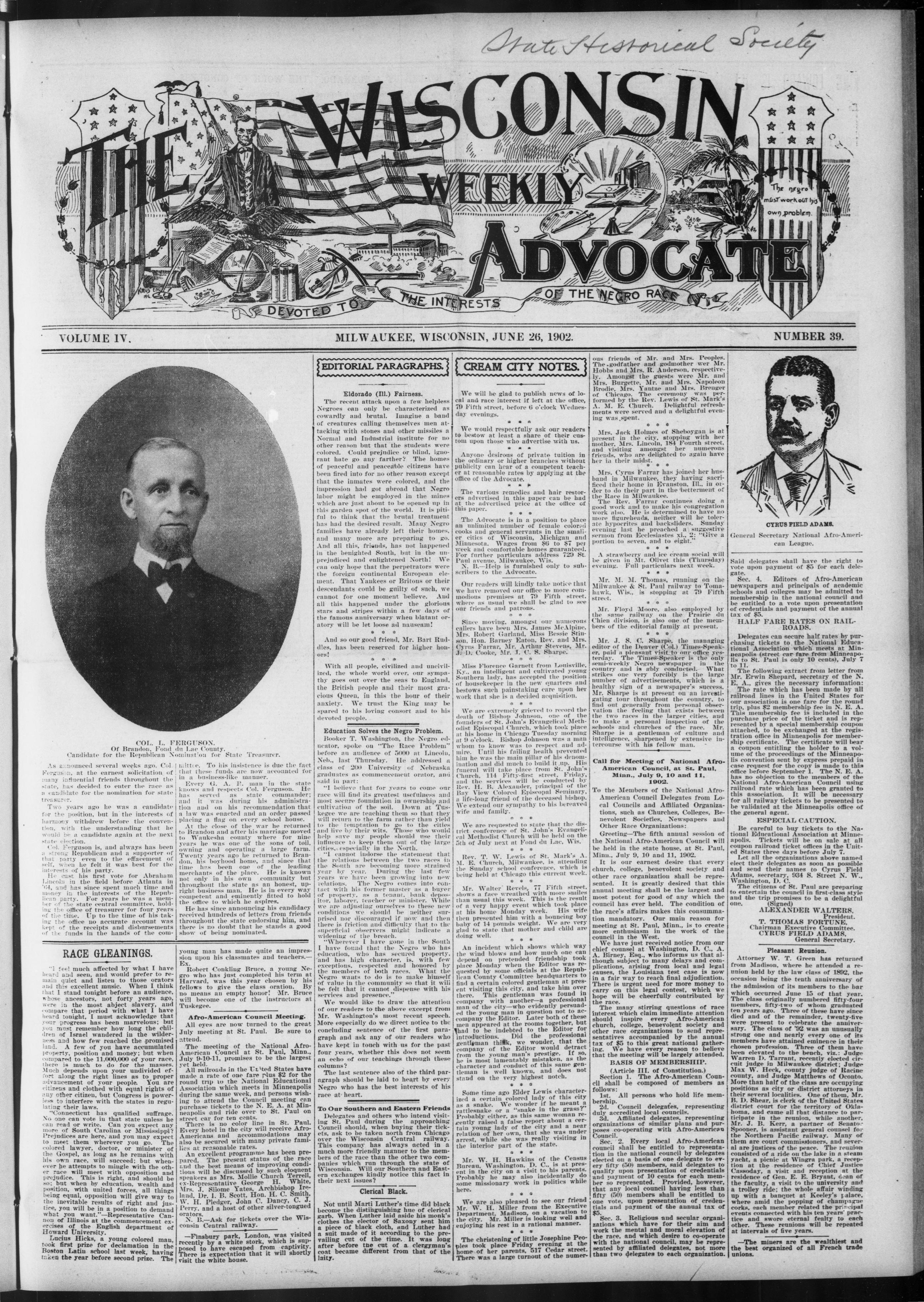
COL. L. FERGUSON.
Of Brandon, Fond du Lac County.
Candidate for the Republican Nomination for State Treasurer.
VOLUME IV.
COL. L. F.
Of Brandon, Fond
Candidate for the Republican N
As announced several weeks ago. Col. Ferguson, at the earnest solicitation of many influential friends throughout the state, has decided to enter the race as a candidate for the nomination for state treasurer.
Two years ago he was a candidate for the position, but in the interests of harmony withdrew before the convention, with the understanding that he would be a candidate again at the next state election.
Col. Ferguson is, and always has been a strong Republican and a supporter of that party even to the effacement of self, when he felt it was best for the interests of his party.
He cast his first vote for Abraham Lincoln in the field before Atlanta in 184, and has since spent much time and money in the interests of the Republican party. For years he was a member of the state central committee, holding the office of treasurer for four years of the time. Up to the time of his taking the office no accurate account was kept of the receipts and disbursements of the funds in the hands of the com-
RACE GLEANINGS.
"I feel much affected by what I have heard and seen, and would prefer to remain quiet and listen to those orators and this excellent music. When I think that I stand tonight before an audience, whose ancestors, not forty years ago, were in the most abject slavery, and compare that period with what I have heard tonight, I must acknowledge that your progress has been marvelous; but you must remember how long the children of Israel wandered in the wilderness and how few reached the promised land. A few of you have accumulated property, position and money; but when compared to the 11,000,000 of your race, there is much to do for the masses. Much depends upon your undivided effort along the right lines as to proper advancement of your people. You are citizens and clothed with equal rights of any other citizen, but Congress is powerless to interfere with the states in regulating their laws.
"Connecticut has qualified suffrage. No one can vote in that state unless he can read or write. Can you expect any more of South Carolina or Mississippi? Prejudices are here, and you may expect to meet them wherever you go. The colored lawyer, doctor, or minister of the Gospel, as long as he remains with his own race, will succeed; but whenever he attempts to mingle with the other race will meet with opposition and prejudice. This is right, and should be so; but when by education, wealth and position, with united forces, all things being equal, opposition will give way to the inevitable results of right and justice, you will be in a position to demand what you want."—Representative Cannon of Illinois at the commencement exercises of the English department of Howard University.
Lucius Hicks, a young colored man, took first prize for declamation in the Boston Latin school last week, having taken the year before second prize. The
mittce. To his insistence is due the fact that these funds are now accounted for in a business-like manner. Every G. A. R. man in the state knows and respects Col. Ferguson. He has served as state commander; and it was during his administration and on his recommendation that a law was enacted and an order passed placing a flag on every school house.
At the close of the war he returned to Brandon and after his marriage moved to Waukesha county where for nine years he was one of the sons of toil, owning and operating a large farm. Twenty years ago he returned to Brandon, his boyhood home, and since that time has been one of the leading merchants of the place. He is known not only in his own community but throughout the state as an honest, upright business man. He is in every way competent and eminently fitted to hold the office to which he aspires. He has since announcing his candidacy received hundreds of letters from friends throughout the state endorsing him, and there is no doubt that he stands a good show of being nominated.
young man has made quite an impression upon his classmates and teachers.—Ex.
Robert Conkling Bruce, a young Negro who has just completed his term at Harvard, was this year chosen by his fellows to give the class oration. By no means an empty honor! Mr. Bruce will become one of the instructors at Tuskegee.
Afro-American Council Meeting.
Afro-American Council Meeting.
All eyes are now turned to the great July meeting at St. Paul. Be sure to attend.
The meeting of the National Afro-American Council at St. Paul, Minn., July 9-10-11, promises to be the largest yet held.
All railroads in the United States have made a rate of one fare plus $2 for the round trip to the National Educational Association which meets in Minneapolis during the same week, and persons wishing to attend the Council meeting can purchase tickets to the N. E. A. at Minneapolis and ride over to St. Paul on street car for ten cents.
There is no color line in St. Paul. Every hotel in the city will receive Afro-Americans and accommodations may also be secured with many private families at reasonable rates.
An excellent programme has been prepared. The present status of the race and the best means of improving conditions will be discussed by such eloquent speakers as Mrs. Mollie Church Terrell, ex-Representative George H. White, Mrs. J. Silome Yates, Archbishop Ireland, Dr. I. B. Scott, Hon. H. C. Smith, W. H. Pledger, John C. Dancy, C. J. Perry, and a host of other silver-tongued orators.
N. B.—Ask for tickets over the Wisconsin Central railway.
—Finsbury park, London, was visited recently by a white stork, which is supposed to have escaped from captivity. There is expectation that it will shortly visit the white house.
EDITORIAL PARAGRAPHS.
Eldorado (Ill.) Fairness.
The recent attack upon a few helpless Negroes can only be characterized as cowardly and brutal. Imagine a band of creatures calling themselves men attacking with stones and other missiles a Normal and Industrial institute for no other reason but that the students were colored. Could prejudice or blind, ignorant hate go any farther? The homes of peaceful and peaceable citizens have been fired into for no other reason except that the inmates were colored, and the impression had got abroad that Negro labor might be employed in the mines which are just about to be opened up in this garden spot of the world. It is pitiful to think that the brutal treatment has had the desired result. Many Negro families have already left their homes, and many more are preparing to go. And all this, friends, has not happened in the benighted South, but in the unprejudiced and enlightened North! We can only hope that the perpetrators were the foreign continental European element. That Yankees or Britons or their descendants could be guilty of such, we cannot for one moment believe. And all this happened under the glorious stars and stripes within a few days of the famous anniversary when blatant oratory will be let loose ad nauseam!
And so our good friend, Mr. Bart Ruddles, has been reserved for higher honors!
* * *
With all people, civilized and uncivilized, the whole world over, our sympathy goes out over the seas to England, the British people and their most gracious Queen, in this the hour of their anxiety. We trust the King may be spared to his loving consort and to his devoted people.
Education Solves the Negro Pr
Booker T. Washington, the Negro educator, spoke on "The Race Problem" before an audience of 5000 at Lincoln, Neb., last Thursday. He addressed a class of 200 University of Nebraska graduates as commencement orator, and said in part:
"I believe that for years to come our race will find its greatest usefulness and most secure foundation in ownership and cultivation of the soil. Down at Tuskegee we are teaching them so that they will return to the farm rather than yield to the temptation to go to the cities and live by their wits. Those who would help save my people should use their influence to keep them out of the large cities, especially in the North.
"I cannot indorse the statement that the relations between the two races in the South are becoming more strained year by year. During the last few years we have been growing into new relations. The Negro comes into contact with his former master as a buyer of property, as a tenant, bank depositor, laborer, teacher or minister. While we are adjusting ourselves to these new conditions we should be neither surprised nor discouraged if now and then there is friction and difficulty that to the superficial observers might indicate a widening of the breach.
"Wherever I have gone in the South I have found that the Negro who has education, who has secured property, and has high character, is, with few exceptions, respected and honored by the members of both races. What the Negro wants to do is to make himself of value in the community so that it will be felt that it cannot dispense with his services and presence."
We would like to draw the attention of our readers to the above excerpt from Mr. Washington's most recent speech. More especially do we direct notice to the concluding sentence of the first paragraph and ask any of our readers who have kept in touch with us for the past four years, whether this does not seem an echo of our teachings through these columns?
The last sentence also of the third paragraph should be laid to heart by every Negro who has the best interests of his race at heart.
To Our Southern and Eastern Friends Delegates and others who intend visiting St. Paul during the approaching Council should, when buying their tickets, ask to be taken north from Chicago over the Wisconsin Central railway. This company has always acted in a much more friendly manner to the members of the race than the other two companies which run through the state of Wisconsin. Will our Southern and Eastern exchanges kindly notice this fact in their next issues?
Clerical Black.
Not until Marti Luther's time did black become the distinguishing hue of clerical garb. When Luther laid aside his monk's clothes the elector of Saxony sent him a piece of black cloth, and Luther had a suit made of it according to the prevailing cut of the time. It was long after before the cut of a clergyman's coat became different from that of the laity.
CREAM CITY NOTES.
We will be glad to publish news of local and race interest if left at the office, 79 Fifth street, before 6 o'clock Wednesday evenings.
必 必 六
We would respectfully ask our readers to bestow at least a share of their custom upon those who advertise with us.
Anyone desirous of private tuition in the ordinary or higher branches without publicity can hear of a competent teacher at reasonable rates by applying at the office of the Advocate.
The various remedies and hair restorers advertised in this paper can be had at the advertised price at the office of this paper.
The Advocate is in a position to place an unlimited number of female colored cooks and general servants in the smaller cities of Wisconsin, Michigan and Minnesota. Wages from $6 to $7 per week and comfortable homes guaranteed. For further particulars address 729 St Paul avenue, Milwaukee, Wis.
N. B.—Help is furnished only to sub scribers to the Advocate.
Our readers will kindly take notice that we have removed our office to more commodious premises at 79 Fifth street, where as usual we shall be glad to see our friends and patrons.
* * *
Since moving, amongst our numerous callers have been Mrs. James McAlpine, Mrs. Robert Garland, Miss Bessie Stinson, Hon. Barney Eaton, Rev. and Mrs. Cyrus Farrar, Mr. Arthur Stevens, Mr. J. D. Cooke, Mr. J. C. S. Sharpe.
* * *
Miss Florence Garnett from Louisville, Ky., an intelligent and cultivated young Southern lady, has accepted the position of housekeeper in the new quarters and bestows such painstaking care upon her work that she is a decided acquisition.
* * *
We are extremely grieved to record the death of Bishop Johnson, one of the founders of St. John's Evangelical Methodist Episcopal Church, which took place at his home in Chicago Tuesday morning at 9 o'clock. Bishop Johnson was a man whom to know was to respect and admire. Until his failing health prevented him he was the main pillar of his denomination and did much to build it up. His funeral will take place from St. John's Church, 114 Fifty-first street, Friday, and the services will be conducted by Rev. H. B. Alexander, principal of the Bay View Colored Episcopal Seminary, a life-long friend of the deceased bishop. We extend our sympathy to his bereaved wife and family.
☆ ☆ ☆
We are requested to state that the district conference of St. John's Evangelical Methodist Church will be held on the 5th of July next at Fond du Lac, Wis.
```markdown
```
Rev. T. W. Lewis of St. Mark's A.
M. E. Church, Milwaukee, is attending
the Sunday school conference, which is
being held at Chicago this current week.
Mr. Walter Revels, 77 Fifth street,
shows a face wreathed with more smiles
than usual this week. This is the result
of a very happy event which took place
at his home Monday week. His wife
then presented him with a bouncing boy
baby of 14 pounds weight. We are very
glad to state that mother and child are
doing well.
办 非 非
An incident which shows which way the wind blows and how much one can depend on pretended friendship took place Monday when the Editor was requested by some officials at the Republican County Committee headquarters to find a certain colored gentleman at present visiting this city, and take him over there. This gentleman was found in company with another—a professional man of the city—who evidently persuaded the young man in question not to accompany the Editor. Later both of these men appeared at the rooms together, but had to be indebted to the Editor for introductions. Did the professional gentleman think, we wonder, that the company of the Editor would detract from the young man's prestige. If so, he is most lamentably mistaken, as the character and conduct of this same gentleman is well known, and does not stand on the very highest notch.
☆ ☆ ☆
Some time ago Elder Lewis characterized a certain colored lady of this city as a snake. We wonder if he meant a rattlesnake or a "snake in the grass?" Probably either, as this same woman recently raised a false report about a certain young lady of the city and a near relation of her own, that she was under arrest, while she was really visiting in the interior part of the state.
立 坐 立
Mr. W. H. Hawkins of the Census Bureau, Washington. D. C., is at present in the city on a visit to his parents. Probably he may also incidentally do some missionary work in politics while here.
☆ ☆ ☆
We are also pleased to see our friend Mr. W. H. Miller from the Executive Department, Madison, on a vacation to the city. Mr. Miller is looking well and enjoying his rest in a rational manner.
The christening of little Josephine Peoples took place Friday evening at the home of her parents, 517 Cedar street. There was a large turnout of the numer-
ous friends of Mr. and Mrs. Peoples. The godfather and godmother wer Mr. Hobbs and Mrs. R. Anderson, respectively. Amongst the guests were Mr. and Mrs. Burgette, Mr. and Mrs. Napoleon Brodie, Mrs. Yantze and Mrs. Brenger of Chicago. The ceremony was performed by the Rev. Lewis of St. Mark's A. M. E. Church. Delightful refreshments were served and a delightful evening was spent.
```markdown
```
Mrs. Jack Holmes of Sheboygan is at present in the city, stopping with her mother, Mrs. Lincoln, 184 Fourth street, and visiting amongst her numerous friends, who are delighted to again have her in their midst.
* * *
Mrs. Cyrus Farrar has joined her husband in Milwaukee, they having sacrificed their home in Evanston, Ill., in order to do their part in the betterment of the Race in Milwaukee.
The Rev. Farrar continues doing a good work and to make his congregation work also. He is determined to have no more figureheads, neither will he tolerate hypocrites and backsliders. Sunday evening last he preached a suggestive sermon from Ecclesiastes xi., 2: "Give a portion to seven, and to eight."
※ ※ ※
A strawberry and ice cream social will be given in Mt. Olivet this (Thursday) evening. Full particulars next week.
* * *
Mr. M. M. Thomas, running on the Milwaukee & St. Paul railway to Tomahawk, Wis., is stopping at 79 Fifth street.
* * *
Mr. Floyd Moore, also employed by the same railway on the Prairie du Chien division, is also one of the members of the editorial family at present.
* * *
Mr. J. S. C. Sharpe, the managing editor of the Denver (Col.) Times-Speaker, paid a pleasant visit to our office yesterday. The Times-Speaker is the only semi-weekly Negro newspaper in the country and is ably conducted. What strikes one very forcibly is the large number of advertisements, which is a healthy sign of a newspaper's success. Mr. Sharpe is at present on an investigating tour throughout the country, to find out generally from personal observation the feeling that exists between the two races in the larger cities, and to make a personal inspection of the schools and churches of the race. Mr. Sharpe is a gentleman of culture and intelligence, sharpened by extensive intercourse with his fellow man.
Call for Meeting of National Afro-American Council, at St. Paul, Minn., July 9, 10 and 11, 1902.
To the Members of the National Afro-American Council Delegates from Local Councils and Affiliated Organizations, such as Churches, Colleges, Benevolent Societies, Newspapers and Other Race Organizations: Greeting—The fifth annual session of the National Afro-American Council will be held in the state house, at St. Paul, Minn., July 9, 10 and 11, 1902.
It is our earnest desire that every church, college, benevolent society and other race organization shall be represented. It is greatly desired that this annual meeting shall be the largest and most potent for good of any which the council has ever held. The condition of the race's affairs makes this consummation mandatory. Our main reason for meeting at St. Paul, Minn., is to create more enthusiasm in the work of the council in the West.
We have just received notice from our chief counsel at Washington, D. C., A. A. Birney, Esq., who informs us that although subject to many delays and complications, arising from local and legal causes, the Louisiana test case is now in a fair way to reach final adjudication. There is urgent need for more money to carry on this legal contest, which we hope will be cheerfully contributed by the race. The many stirring questions of race interest which claim immediate attention should inspire every Afro-American church, college, benevolent society and other race organizations to send representatives accompanied by the annual tax of $5 to this great national gathering. We have every reason to believe that the meeting will be largely attended.
BASIS OF MEMBERSHIP.
(Article III of Constitution)
(Article III. of Constitution.)
Section 1. The Afro-American Council shall be composed of members as follows:
1st. All persons who hold life membership.
2d. Council delegates, representing duly accredited local councils.
duly accredited local councils.
3d. Affiliated delegates, representing organizations of similar plans and purposes co-operating with Afro-American Council.
Sec. 2. Every local Afro-American council shall be entitled to representation in the national council by delegates elected on a basis of one delegate to every fifty (50) members, said delegates to qualify upon presentation of credentials and payment of 10 cents for each member so represented. Provided, however, that any local council having less than fifty (50) members shall be entitled to one vote, upon presentation of credentials and payment of the annual tax of $5.
Sec. 3. Religious and secular organizations which have for their aim and work the mental and moral elevation of the race, and which desire to co-operate with the national council, may be represented by affiliated delegates, not more than two delegates to each organization.
NUMBER 39.
J.
General Secretary National Afro-American League.
General Secretary National Afro-American League.
Said delegates shall have the right to vote upon payment of $5 for each delegate.
Sec. 4. Editors of Afro-American newspapers and principals of academic schools and colleges may be admitted to membership in the national council and be entitled to a vote upon presentation of credentials and payment of the annual tax of $5.
HALF FARE RATES ON RAILROADS.
Delegates can secure half rates by purchasing tickets to the National Educational Association which meets at Minneapolis (street car fare from Minneapolis to St. Paul is only 10 cents), July 7 to 11.
The following extract from letter from Mr. Erwin Shepard, secretary of the N. E. A., gives the necessary information:
E. A., gives the necessary information: The rate which has been made by all railroad lines in the United States for our association is one fare for the round trip, plus $2 membership fee in N. E. A. This membership fee is included in the purchase price of the ticket and is represented by a special membership coupon attached, to be exchanged at the registration office in Minneapolis for membership certificate. The certificate will bear a coupon entitling the holder to a volume of the proceedings of the Minneapolis convention sent by express prepaid in case request for the copy is made to this office before September 1. The N. E. A. has no objection to the members of the National Afro-American Council using railroad rate which has been granted to this association. It will be necessary for all railway tickets to be presented to be validated at the Minneapolis office of the general agent
ESPECIAL CAUTION
Be careful to buy tickets to the National Educational Association at Minneapolis. Tickets will be on sale at all coupon railroad ticket offices in the United States three days before July 7.
Let all the organizations above named elect their delegates as soon as possible and send their names to Cyrus Field Adams, secretary, 934 S. Street N. W., Washington, D. C.
The citizens of St. Paul are preparing to entertain the council in first-class style and the trip promises to be a delightful one. (Signed)
ALEXANDER WALTERS.
President.
T. THOMAS FORTUNE.
Chairman Executive Committee.
CYRUS FIELD ADAMS,
General Secretary.
Pleasant Reunion.
Attorney W. T. Green has returned from Madison, where he attended a reunion held by the law class of 1892, the occasion being the tenth anniversary of the admission of its members to the bar which occurred June 15 of that year. The class originally numbered fifty-four members, fifty-two of whom graduated ten years ago. Three of these have since died and of the remainder, twenty-five were present to celebrate the anniversary. The class of '92 was an unusually strong one and nearly every one of its members have attained eminence in their chosen profession. Three of them have been elevated to the bench, viz.: Judge Warren D. Tarrant, recently elected circuit judge in Milwaukee district; Judge Max W. Heck, county judge of Racine county, and Judge Matthews of Oconto. More than half of the class are occupying positions as city or district attorneys in their several localities. One of them, Mr. B. D. Shear, is clerk of the United States district court for the territory of Oklahoma, and came all that distance to participate in the reunion, while another, Mr. J. B. Kerr, a partner of Senator Spooner, is assistant general counsel for the Northern Pacific railway. Many of them are court commissioners, and several are justices of the peace. The reunion consisted of a ride on the lake in a steam yacht, a picnic at Wingra park, a reception at the residence of Chief Justice Cassoday, a visit and reception at the residence of Gen. E. E. Bryant, dean of the faculty, a visit to the university and a trolley ride; the whole affair winding up with a banquet at Keeley's palace, where amid the popping of champagne corks, each member related the principal events connected with his ten years' practice and swore eternal fealty to each other. These reunions will be repeated at intervals of five years.
The miners are the wealthiest and the best organized of all French trade unions.
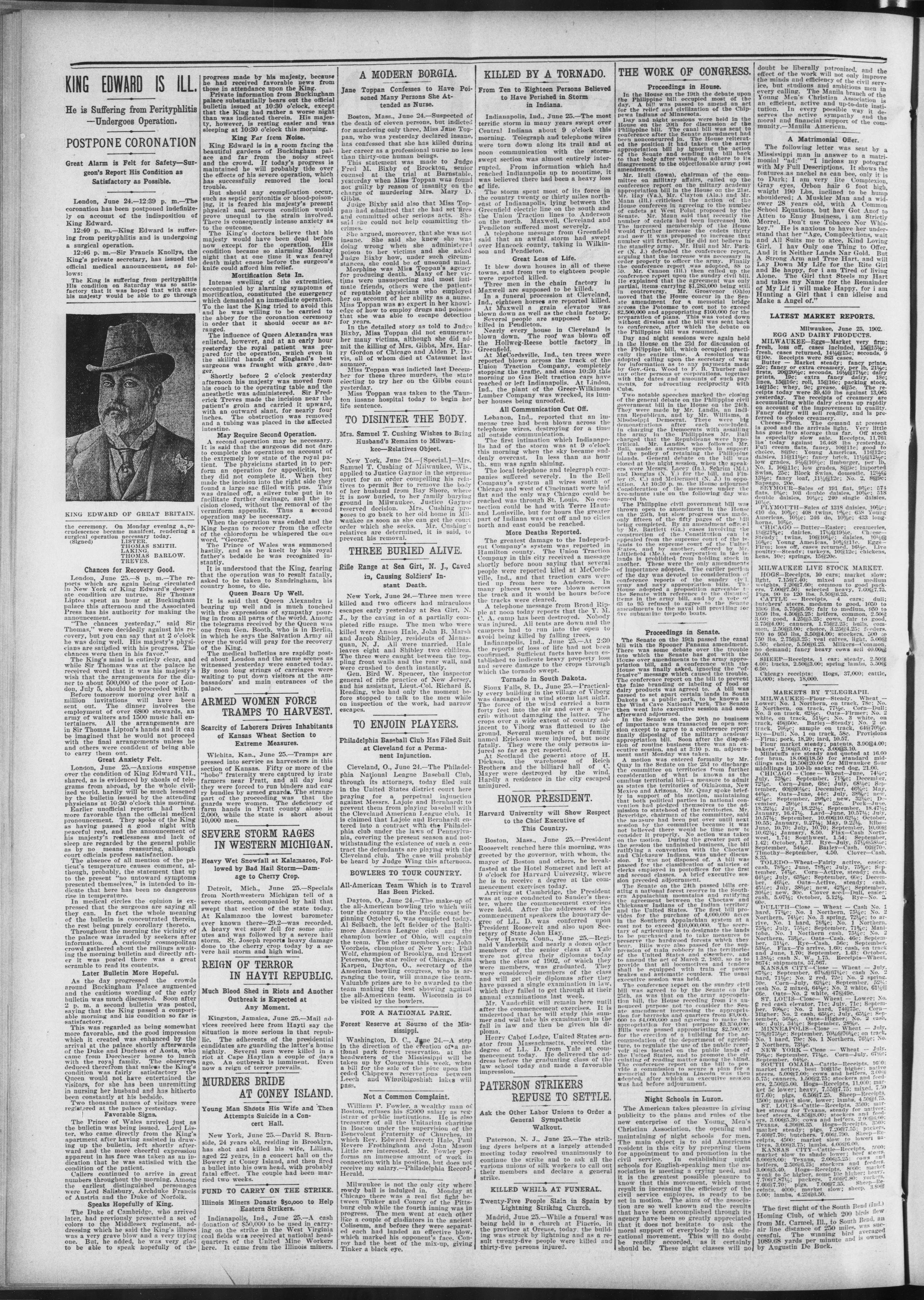
KING EDWARD IS ILL.
He is Suffering from Perityphlitis Undergoes Operation.
POSTPONE CORONATION
Great Alarm is Felt for Safety—Surgeon's Report His Condition as Satisfactory as Possible.
London, June 24.—12:39 p. m.—The coronation has been postponed indefinitely on account of the indisposition of King Edward.
12:40 p. m.—King Edward is suffering from perityphilitis and is undergoing a surgical operation.
12:46 p. m.—Sir Francis Knollys, the King's private secretary, has issued the official medical announcement, as follows:
The King is suffering from perityphilitis His condition on Saturday was so satisfactory that it was hoped that with care his majesty would be able to go through
KING EDWARD OF GREAT BRITAIN the ceremony. On Monday evening a recrudescence became manifest, rendering a surgical operation necessary today. (Signed) LISTER
LISTER.
THOMAS SMITH.
LAKING.
THOMAS BARLOW.
TREVES.
Chances for Recovery Good.
London, June 25.—8 p. m.—The reports which are again being circulated in New York of King Edward's desperate condition are untrue. Sir Thomas Lipton spent an hour at Buckingham palace this afternoon and the Associated Press has his authority for making the announcement.
"The chances yesterday," said Sir Thomas, "were decidedly against his recovery, but you can say that at 2 o'clock he was doing well. His majesty's physicians are satisfied with his progress. The chances were then in his favor."
The King's mind is entirely clear, and while Sir Thomas was at the palace he received word that it was his majesty's wish that the arrangements for the dinner to about 500,000 of the poor of London July 5 should be proceeded with.
Before tomorrow morning over half a million invitations will have been sent out. The dinner involves the employment of over 6800 stewards, an army of waiters and 1500 music hall entertainers. All the arrangements are in Sir Thomas Lipton's hands and it can be imagined that he would not proceed with the final arrangements unless he and others were confident of being able to carry them out.
Great Anxiety Felt.
London, June 25.—Anxious suspense over the condition of King Edward VII., shared, as is evidenced by shoals of telegrams from abroad, by the whole civilized world, hardly will be much lessened by the bulletin issued by the attending physicians at 10:30 o'clock this morning. Earlier unofficial reports had been more favorable than the official medical pronouncement. They spoke of the King as having passed a good night with peaceful rest, and the announcement of his majesty's restlessness and lack of sleep are regarded by the general public as by no means reassuring, although court officials profess satisfaction.
The absence of all mention of the patient's temperature causes comment, although, probably, the statement that up to the present "no untoward symptoms presented themselves," is intended to indicate that here has been no dangerous rise in temperature.
In medical circles the opinion is expressed that the surgeons are saying all they can. In fact the whole meaning of the bulletin is concentrated therein, the rest being purely corollary thereto.
Throughout the morning the vicinity of the palace was invaded by seekers after information. A curiously cosmopolitan crowd gathered about the railings awaiting the morning bulletin and directly after it was posted there was a great scramble to read its contents.
Later Bulletin More Hopeful.
As the day progressed the crowds around Buckingham Palace augmented and the cautious wording of the early bulletin was much discussed. Soon after 2 p. m. a second bulletin was posted, saying that the King passed a comportable morning and his condition so far is satisfactory. This was regarded as being somewhat more favorable, and the good impression which it created was enhanced by the arrival at the palace shortly afterwards of the Duke and Duchess of Aosta, who came from Dorchester house to lunch with the royal family. The observers deduced therefrom that unless the King's condition was fairly satisfactory the Queen would not have entertained the visitors, for she has been unremitting in nursing her husband and has hitherto been constantly at his bedside.
Two thousand names of visitors were registered at the palace yesterday.
Favorable Signs.
The Prince of Wales arrived just as the bulletin was being issued. Lord Lister, who came directly from the King's apartment after having assisted in drawing up the bulletin, left shortly afterward and the more cheerful expression apparent in his face was taken as an indication that he was satisfied with the condition of the patient.
Callers continued to arrive in great numbers throughout the morning. Among the earliest distinguished personages were Lord Salisbury, Archduke Francis of Austria and the Duke of Norfolk.
Speaks Hopefully of King.
The Duke of Cambridge, who arrived later, had previously presented a set of colors to the Middlesex regiment, addressing which he said the King's illness was a very grave blow and a very trying one. But, he added, he was very glad to be able to speak hopefully of the
progress made by his majesty, because he had received favorable news from those in attendance upon the King. Private information from Buckingham palace substantially bears out the official bulletin issued at 10:30 o'clock, except that the King had rather a worse night than was indicated therein. His majesty, however, is resting easier and was sleeping at 10:30 o'clock this morning.
King Far from Noise.
King Edward is in a room facing the beautiful gardens of Buckingham palace and far from the noisy street and the crowd. If today's progress is maintained he will probably tide over the effects of his severe operation, which has successfully removed the local trouble.
But should any complication occur, such as septic peritonitis or blood-poisoning, it is feared his majesty's present physical and nervous condition would prove unequal to the strain involved. There is consequently intense anxiety as to the outcome.
The King's doctors believe that his majesty would have been dead before now except for the operation. His condition became so alarming Monday night that at one time it was feared death might ensue before the surgeon's knife could afford him relief.
Mortification Sets In.
Intense swelling of the extremities, accompanied by alarming symptoms of mortification, constituted the emergency which demanded an immediate operation. To the last the King tried to avoid this and he was willing to be carried to the abbey for the coronation ceremony in order that it should occur as arranged. The influence of Queen Alexandra was enlisted, however, and at an early hour yesterday the royal patient was prepared for the operation, which even in the skillful hands of England's best surgeons was fraught with grave danger.
Shortly before 2 o'clock yesterday afternoon his majesty was moved from his couch to the operating table and the anesthetic was administered. Sir Frederick Treves made the incision near the patient's groin and carried it upward, with an outward slant, for nearly four inches. The obstruction was removed and a tubing was placed in the affected intestine.
May Require Second Operation.
A second operation may be necessary. It is said that the surgeons did not dare to complete the operation on account of the extremely low state of the royal patient. The physicians started in to perform an operation for appedicitis, but they did not complete it. When they made the incision into the right side they found a large sac filled with pus. This was drained off, a silver tube put in to facilitate further drainage, and the incision closed, without the removal of the vermiform appendix. Thus a second operation may be necessary. When the operation was ended and the King began to recover from the effects of the chloroform he whispered the one word, "George." The Prince of Wales was summoned hastily, and as he knelt by his royal father's bedside he was recognized instantly.
It is understood that the King, fearing that the operation was to result fatally, asked to be taken to Sandringham, his country home, to die.
Queen Bears Up Well.
It is said that Queen Alexandra is bearing up well and is much touched with the expressions of sympathy pouring in from all parts of the world. Among the telegrams received by the Queen was one from Gen. Booth, who is in Berlin, in which he says the Salvation Army all over the world will pray for the recovery of the King.
The medical bulletins are rapidly posted about London and the same scenes as witnessed yesterday were enacted today. By noon long strings of carriages were waiting to put down visitors at the ambassadors' and main entrances of the palace.
ARMED WOMEN FORCE TRAMPS TO HARVEST.
Wichita, Kan., June 25.—Tramps are pressed into service as harvesters in this section of Kansas. Fifty or more of the "hobo" fraternity were captured by irate farmers near Pratt, and all day long they were forced to run binders and carry bundles by armed guards. The strange part of the proceeding was that the guards were women. The deficiency of farm hands in Pratt county alone is 2,000, while the state is short about 10,000 men.
SEVERE STORM RAGES IN WESTERN MICHIGAN.
Heavy Wet Snowfall at Kalamazoo, Followed by Bad Hail Storm—Damage to Cherry Crop.
Detroit, Mich., June 25.—Specials from Northwestern Michigan tell of a severe storm, accompanied by hail that swept that section of the state today. At Kalamazoo the lowest barometer ever known there—29.2—was recorded. A heavy wet snow fell for some minutes and was followed by a severe hail storm. St. Joseph reports heavy damage done to the cherry crop today by a severe hail storm and high wind.
REIGN OF TERROR IN HAYTI REPUBLIC.
Much Blood Shed in Riots and Another Outbreak is Expected at Any Moment.
Kingston, Jamaica, June 25.—Mail advises received here from Hayti say the situation is more serious in that republic. The adherents of the presidential candidates are guarding the latter's house nightly. Several men were killed in a riot at Cape Haytian a couple of days ago. An outbreak is imminent. Even now a reign of terror prevails.
cert Hall.
New York, June 25.—David S. Burnside, 24 years old, residing in Brooklyn, has shot and killed his wife, Lillian, aged 22 years, in a concert hall on the Bowery at Coney Island, and then fired a bullet into his own head, with probably fatal effect. The couple had been married two weeks.
FUND TO CARRY ON THE STRIKE.
Illinois Miners Donate $50,000 to Help Eastern Strikers.
Indianapolis, Ind., June 25.—A cash donation of $50,000 to be used in carrying on the strike in the West Virginia coal fields was received at national headquarters of the United Mine Workers here. It came from the Illinois miners.
A MODERN BORGIA.
Jane Toppan Confesses to Have Poisoned Many Persons She Attended as Nurse.
Boston, Mass., June 24.—Suspected of the death of eleven persons, but indicted for murdering only three, Miss Jane Toppan, who was yesterday declared insane, has confessed that she has killed during her career as a professional nurse no less than thirty-one human beings. This statement was made to Judge Fred M. Bixby of Brockton, senior counsel at the trial at Barnstable, yesterday when Miss Toppan was found not guilty by reason of insanity on the charge of murdering Mrs. Mary D. Giths.
Judge Bixby said also that Miss Toppan had admitted that she had set fires and committed other serious acts. She said she could not help committing the crimes.
She argued, moreover, that she was not insane. She said she knew she was doing wrong when she administered poison to her victims and she asked Judge Bixby how, under such circumstances, she could be of unsound mind. Morphine was Miss Toppan's agency for producing death. Many of her victims were unsuspecting and most intimate friends, others were the patients of reputable physicians who employed her on account of her ability as a nurse. Miss Toppan was so expert in her knowledge of how to employ drugs and poisons that she was able to escape detection for years.
In the detailed story as told to Judge Bixby, Miss Toppan did not enumerate her many victims, although she did admit the killing of Mrs. Gibbs, Mrs. Harry Gordon of Chicago and Alden P. Davis, all of whom died at Cataumet last summer.
Miss Toppan was indicted last December for these three murders, the state electing to try her on the Gibbs count yesterday.
Miss Toppan was taken to the Taunton insane hospital today to begin her life sentence.
TO DISINTER THE BODY.
Mrs. Samuel T. Cushing Wishes to Bring Husband's Remains to Milwaukee—Relatives Object.
New York, June 24.—[Special.]—Mrs. Samuel T. Cushing of Milwaukee, Wis. applied to Justice Gaynor in the supreme court for an order compelling his relatives to permit her to remove the body of her husband from Bay Shore, where it is now buried, to her family burying ground in Milwaukee. Justice Gaynor reserved decision. Mrs. Cushing proposes to go back to her old home in Milwaukee as soon as she can get the court order which she seeks. Mr. Cushing's relatives are determined, it is said, to prevent his removal.
THREE BURIED ALIVE.
New York, June 24.—Three men were killed and two officers had miraculous escapes early yesterday at Sea Girt, N. J., by the caving in of a partially completed rifle range. The men who were killed were Anson Hale, John B. Marsh and Jacob Shibley, residents of Manasquan, N. J. All were married. Hale leaves eight and Shibley two children. The three were caught between the toppling front walls and the rear wall, and were crushed to death instantly. Gen. Bird W. Spencer, the inspector general of rifle practice of New Jersey, and his assistant, Lieut.-Col. Richard B. Reading, who had only the moment before stopped to talk to the men while on inspection of the work, had narrow escapes.
TO ENJOIN PLAYERS.
Philadelphia Baseball Club Has Filed Suit at Cleveland for a Permanent Injunction
Cleveland, O., June 24.—The Philadelphia National League Baseball Club, through its attorneys, today filed suit in the United States district court here praying for a perpetual injunction against Messrs. Lajoie and Bernhardt to prevent them from playing baseball with the Cleveland American League club. It is claimed that Lajoie and Bernhardt entered into a contract with the Philadelphia club under the laws of Pennsylvania, covering the present season and notwithstanding the existence of such a contract the defendants are playing with the Cleveland club. The case will probably be heard by Judge Wing this afternoon.
BOWLERS TO TOUR COUNTRY.
All-American Team Which is to Travel Has Been Picked.
Dayton, O., June 24.—The make-up of the all-American bowling trio which will tour the country to the Pacific coast beginning October 6, was completed today. Al Selbach, the left fielder of the Baltimore American League club and the champion bowler of Ohio, will captain the team. The other members are: John Voorheis, chompion of New York; Phil Wolf, champion of Brooklyn, and Ernest Peterson, the star roller of Chicago. Sam Karpen, Dayton, O., secretary of the American bowling congress, who is arranging the tour, will manage the team. Valuable prizes are to be awarded to the team making the best showing against the all-American team. Wisconsin is to be visited by the bowlers.
FOR A NATIONAL PARK.
Forest Reserve at Source of the Mississippi.
Washington, D. C., June 24.—A step in the direction of the creation of a national park forest reservation at the headwaters of the Mississippi will be taken up by Congress this week, when a bill for the sale of the pine upon the ceded Chippewa reservations between Leech and Winnibigoshish lakes will pass.
Not a Common Complaint
William P. Fowler, a wealthy man of Boston, refuses his $2000 salary as registrar of public institutions. He is also treasurer of all the Unitarian charities in Boston under the supervision of the Benevolent Fraternity of Churches, in which Rev. Edward Everett Hale, Paul Revere Frothingham and John Mason Little are interested. Mr. Fowler performs an immense amount of work in connection with his position, but does not receive my salary.—Philadelphia Record-Herald.
Milwaukee is not the only city where rowdy ball is indulged in. Monday at Chicago there was a real fist fight between Tinker and Conroy of the Pittsburg club while the fourth inning was in progress. The men went at each other like a couple of gladiators in the ancient Coliseum, and before they were separated each had landed an effective blow, which marked his opponent's face. Conroy had the best of the mix-up, giving Tinker a black eye.
KILLED BY A TORNADO.
Indianapolis, Ind., June 25.—The most terrific storm in many years swept over Central Indiana about 9 o'clock this morning. Telegraph and telephone wires were torn down along its trail and at noon communication with the stormswept section was almost entirely interrupted. From information which had reached Indianapolis up to noontime, it was believed there had been a heavy loss of life.
The storm spent most of its force in the country twenty or thirty miles northeast of Indianapolis, lying between the Greenfield electric line on the south and the Union Traction lines to Anderson on the north. Maxwell, Cleveland and Pendleton suffered most severely. A telephone message from Greenfield said that an awful storm had swept over Hancock county, taking in Wilkinson and Pendleton.
Great Loss of Life.
It blew down houses in all of these towns, and from ten to eighteen people were reported killed.
Three men in the chain factory in Maxwell are supposed to be killed. In a funeral procession at Cleveland, Ind., eighteen horses are reported killed. At Maxwell a grain elevator was blown down as well as the chain factory. Several people are supposed to be killed in Pendleton. Nearly every house in Cleveland is blown down. The roof was blown off the Hollweg-Reese bottle factory in Greenfield. At McCordsville, Ind., ten trees were reported blown across the track of the Union Traction Company, completely stopping the traffic, and since 10:30 this morning no Gas Belt traction cars have reached or left Indianapolis. At Lindon, Ind., the plant of the Greer-Wilkinson Lumber Company was wrecked, its lumber houses being unroofed.
All Communication Cut Off.
Lebanon, Ind., reported that an immense tree had been blown across the telephone wires, destroying for a time all outside communication.
The first intimation which Indianapolis had of the storm was at 9 o'clock this morning when the sky became suddenly overcast. In less than an hour the sun was again shining.
The local telephone and telegraph companies suffered severely. In the Bell Company's system all wires south of Chicago and west of Cincinnati were laid flat and the only way Chicago could be reached was through St. Louis. No connection could be had with Terre Haute and Louisville, but for hours the greater part of Indiana was cut off and no cities north and east could be reached.
More Deaths Reported.
The greatest damage to the Independent Company's system was reported in Hamilton county. The Union Traction Company in this city received a message shortly before noon saying that several people were reported killed at McCordsville, Ind., and that traction cars were tied up from here to Anderson. In many places trees were blown across the track and it would be hours before the tracks were cleared. A telephone message from Broad Ripple at noon today reports that the Y. M. C. A. camp has been destroyed. Nobody was injured. All tents are down and the campers had to run into the open to avoid being killed by falling trees.
Indianapolis, Ind., June 25.—At 2:30 the reports of loss of life had not been confirmed. Sufficient facts have been established to indicate heavy property loss and severe damage to the crops through which the tornado swept.
Tornado in South Dakota.
Sioux Falls, S. D., June 25.—Practically every building in the village of Viborg was damaged in a wind storm last night. The force of the wind carried a barn forty feet into the air and over a corncrib without damaging the latter. The crops over a wide extent of country adjacent to Viborg was flattened to the ground. Several members of a family named Erickson were injured, but none fatally. They were the only persons injured so far as yet reported. At Scotland the general store of H. Dickson, the warehouse of Reich Brothers and the billiard hall of C. Mayer were destroyed by the wind. Hardly a residence in the city escaped uninjured.
HONOR PRESIDENT.
Harvard University will Show Respect to the Chief Executive of This Country.
Boston, Mass., June 25.—President Roosevelt reached here this morning, was greeted by the governor, with whom, the mayor of Boston and others, he breakfasted at the Hotel Somerset and left at 9 o'clock for Harvard University, where he is to receive a degree at the commencement exercises today. Arriving at Cambridge, the President was at once conducted to Sander's theater, where the commencement exercises were held. After the addresses of the commencement speakers the honorary degree of LL. D. was conferred upon President Roosevelt and also upon Secretary of State John Hay.
New Haven, Conn., June 25.—Reginald Vanderbilt and nearly a dozen other members of the senior class at Yale were not given their diplomas today when the class of 1902, of which they were members, was graduated. They were considered members of the class and will get their diplomas after they have passed a single examination in law, which they failed to get through at their annual examinations last week. Mr. Vanderbilt will remain here until after the commencement exercises. It is understood that he will study this summer and will take his examination in the fall in law and then be given his diploma.
Henry Cabot Lodge, United States senator from Massachusetts, received the degree of LL. D. from Yale at commencement today. He delivered the address before the graduating class of the law school today and made a favorable impression.
PATERSON STRIKERS REFUSE TO SETTLE.
Ask the Other Labor Unions to Order a General Sympathetic Walkout. Paterson, N. J., June 25.—The striking dyers helpers at a largely attended meeting today resolved unanimously to continue the strike and to ask all the various unions of silk workers to call out their members and declare a general strike.
KILLED WHILE AT FUNERAL
Twenty-Five People Slain in Spain by Lightning Striking Church. Madrid, June 25.—While a funeral was being held in a church at Pinerio, in the province at Orense, today, the building was struck by lightning and as a result twenty-five people were killed and thirty-five persons injured.
THE WORK OF CONGRESS.
Proceedings in House.
In the House on the 19th the debate upon the Philippine bill occupied most of the day. A bill was passed to amend an act for the relief and civilization of the Chippewa Indians of Minnesota. Day and night sessions were held in the House on the 20th for discussion of the Philippine bill. The canal bill was sent to conference after the Senate amendment had been nonconcurred in. The House reiterated the position it had taken on the army appropriation bill by ignoring the action of the Senate and sending the bill back to that body after voting to adhere to its disagreement to the objectionable army post amendments.
Mr. Hull (Iowa), chairman of the committee on military affairs, called up the conference report on the military academy appropriation bill in the House on the 21st. Mr. Hay (Va.), Mr. Clayton (Ala.) and Mr. Mann (Ill.) criticised the action of the House conferences in agreeing to the number of cadets at West Point proposed by the Senate. Mr. Mann said that recently the number of cadets had been increased 100. The increased membership of the House would further increase the cadets thirty and now it was proposed to increase that number still further. He did not believe in the standing army. Mr. Hull and Mr. Parker (N. J.) defended the conference report, arguing that the increase was necessary in order properly to officer the army. Finally the conference report was adopted, 88 to 50. Mr. Cannon (Ill.) then called up the conference report upon the sundry civil bill. He explained that the agreement was only partial, items carrying $1,283,000 being still in controversy. Mr. Grosvenor (Ohio) moved that the House concur in the Senate amendment for a memorial bridge across the Potomac to cost not to exceed $2,500,000 and appropriating $100,000 for the preparation of plans. This was voted down without division and the bill was sent back to conference, after which the debate on the Philippine bill was resumed.
Day and night sessions were again held in the House on the 23d for discussion of the Philippine bill, which occupied practically the entire time. A resolution was adopted calling upon the secretary of war for information as to any payments made by Gov.-Gen. Wood to F. B. Thurber and any other persons or corporations, together with the dates and amounts of such payments, for advocating reciprocity with Cuba.
Two notable speeches marked the closing of the general debate on the Philippine civil government bill in the House on the 24th. They were made by Mr. Landis, an Indiana Republican, and by Mr. Williams, a Mississippi Democrat. There were big demonstrations after each concluded. In charging the Democrats with assailing the army in the Philippines Mr. Ball charged that the Republicans were hypocritical. Mr. Landis, who followed Mr. Ball, made an earnest speech in support of the policy of retaining the Philippine islands. General debate on the bill was closed at the night session, when the speakers were Messrs. Lacey (Ia.), Schrim (Md.) and Douglas (N. Y.) for the bill, and Finley (S. C.) and McDermott (N. J.) in opposition. At 10:30 p. m. the House adjourned Consideration of the measure under the five-minute rule on the following day was agreed to.
The Philippine civil government bill was thrown open to amendment in the House on the 25th, but slow progress was made, only fifteen of the fifty pages of the bill being completed. By an amendment offered by Mr. Bartlett (Ga.) cases involving the construction of the Constitution can be appealed from the supreme court of the islands to the supreme court of the United States, and by another, offered by Mr. Littfield (Me.), one corporation in the islands is prohibited from holding stock in another. These were the only amendments of importance adopted. The earlier portion of the day was devoted to consideration of conference reports of the sundry civil army and navy appropriation bills. The House adopted a proposition agreeable to the Senate with reference to the disputed items in the army bill, and by a vote of 63 to 95 refused to agree to the Senate amendments to the naval bill providing for five submarine torpedo boats.
Proceedings in Senate.
The Senate on the 19th passed the canal bill with the Spooner Panama amendment. There was some debate over the trouble into which the Senate has got with the House over amendments to the army appropriation bill, and a conference with the House was finally asked, ignoring the "offensive" message which caused the trouble. The conference report on the bill to prevent the false branding or labeling of food or dairy products was agreed to. A bill was passed to set apart certain lands in South Dakota as a public park, to be known as the Wind Cave National Park. The Senate then went into executive session and soon afterward adjourned.
In the Senate on the 20th no business of importance was transacted in open session except to agree to a conference report finally disposing of the military academy appropriation bill. Soon after the disposition of routine business there was an executive session, and at 3:10 p. m. adjournment until Monday was taken.
A motion was entered formally by Mr. Quay in the Senate on the 23d to discharge the committee on territories from further consideration of what is known as the omnibus territorial bill—a measure to admit as states the territories of Oklahoma, New Mexico and Arizona. Mr. Quay spoke briefly in support of his motion, maintaining that both political parties in national convention had pledged themselves to the admission to statehood of the territories. Mr. Beveridge, chairman of the committee, said the measure had been put over until next session by the committee because it was not believed there would be time now to consider it properly. No action was taken on the motion. During the greater part of the session the unfinished business, the bill ratifying a convention with the Choctaw and Chickasaw Indians, was under discussion. It was not disposed of. A bill was passed for the classification of salaries of clerks employed in post offices for the first and second classes. A brief executive session preceded adjournment.
The Senate on the 24th passed bills creatling a national forest reserve in the Southern Appalachian mountains and ratifying the agreement between the Choctaw and Chickasaw Indians of the Indian territory and the United States. The first bill provides for the purchase of 4,000,000 acres in the Southern Appalachian system at a cost not to exceed $10,000,000. The secretary of agriculture is to designate the lands to be purchased and to take measures to preserve the hardwood forests which they bear. Bills were also passed for the suppression of train robbery in the territories of the United States and elsewhere, and to amend the act of March 2, 1893, so as to provide that all locomotives and tenders shall be equipped with train or power brakes and automatic couplers. The usual executive session was held.
The conference report on the sundry civil bill was agreed to by the Senate on the 25th, as was that on the army appropriation bill, the House receding from its announced purpose not to consider the Senate amendment increasing the appropriation for barracks and quarters from $3,000,000 to $4,000,000 and agreeing to make the appropriation for that purpose $3,350,000. Bills were passed appropriating $2,500,000 for the erection of a building for the accommodation of the department of agriculture, to regulate the use of the public reservoir sites located on the public lands of the United States, and to promote the circulating of reading matter among the blind. The conference report on the bill to provide a commission to secure a plan for a memorial to Abraham Lincoln was then adopted, after which an executive session was had before adjournment.
Night Schools in Luzon.
The American takes pleasure in giving publicity to the plans and rules of the new enterprise of the Young Men's Christian Association, the opening and maintaining of night schools for men. The main object is to aid Americans resident in this city by preparing them for appointment to and promotion in the civil service. In establishing night schools for English-speaking men the association is meeting a crying need, and it is the greatest possible pleasure to know that this movement, which must result in increasing the efficiency of the civil service employees, is ready to be set in motion. The aims of the association are so well known and the results that have been accomplished through its agency have been so greatly appreciated that it does not hesitate to ask the moral support of everybody in this educational movement. This will no doubt be readily accorded, as it certainly should be. These night classes will no
doubt be liberally patronized, and the effect of the work will not only improve the minds and efficiency of the civil service, but studious and ambitious men in every calling. The Manila branch of the Young Men's Christian Association is an efficient, active and up-to-date institution. In every possible way it deserves the active sympathy and the moral and financial support of the community.—Manila American.
A Matrimonial Offer
The following letter was sent by a Mississippi man in answer to a matrimonial "ad;" "I inclos my potograf with My Full Descriptions. It shows the features as nachel as can bee, only it is to Dark; I am very lite Complexion, Gray eyes, Orbon hair G foot high, weight 190 Lbs, inclined to be hump shouldered; A Muskler Man and a widower 28 years old, with A Common School Equations, but hav Got Anof to Atten to Enny Business, i am Strictly Morrel. Don't use Tobacco Nor Whiskey." He is anxious to have her understand that her "Age, Complecktions, wait and All Suits me to atee, Kind Loving Girl. I hav Only one Thing to Offer, And it is Neither Lands Nar Gold. But A Strong Arm and True Hart, and will Lay Down My Life for the Rite Girl and Be happy, for i am Tired of living Alone. The Girl that Steels my Hart and takes my Name for the Remainder of My Lif i will make Happy, for i am Hunting a Girl that i can idleise and Make a Angel of."
LATEST MARKET REPORTS.
Milwaukee, June 25. 1902. EGG AND DAIRY PRODUCTS.
MILWAUKEE—Eggs—Market very firm; fresh, loss off, cases included, 15@15½%; fresh, cases returned, 14½@15%; seconds, 9 @10c. Receipts were 863 cases. Butter — Market steady; fancy prints, 22c; fancy or extra creamery, per lb, 21½%; firsts, 20@12½%; seconds, 16½@17½%; dairy prints, 19c; extra fancy dairy, 18c; lines, 15@16c; roll, 15@16c; packing stock, 14@15c; whey, 9c; grease, 4@5c. The receipts today were 39,459 lbs against 13,065 yesterday. The receipts of creamery are accumulating while dairy cleans up rapidly on account of the improvement in quality. Fancy dairy will sell readily, and is preferred to choice creamery.
Cheese—Firm. The demand at present is good and the arrivals light. Very little has gone into storage thus far. Off stock is especially slow sale. Receipts, 11.761 lbs today against 16.468 lbs yesterday. Full cream flats, fancy, 10@11c; good to choice, 8@9c; Young Americas, 11@12c; daisies, 11@11%c; fancy brick, 11%@12%c; low grades, 9%@10%c; limburger, per lb. No. 1, 10@11c; low grades, 8@9c; imported Swiss, 25c; Block Swiss, domestic, 12%@13%c; fancy loaf, 11%@12c; No. 2, 8@9c; Sapsago, 20c.
SEYMOUR—Sales of 191 flat, 9%@c; 574 flats, 9%@c; 103 double daisies, 9%@c; 518 double daisies, 10%c; 240 single daisies, 10%c.
PLYMOUTH—Sales of 1318 daisies, 10%@c; 410 do, 10%@c; 408 twins, 9%@c; 658 Young Americas, 10%@c; 246 do, 10%@c; 433 longhorns, 10%c.
CH1CAGO — Butter—Easter; creameries,
18@12%c; dailies, 17%@19%c. Cheese—
Steady; twins, 10@10%c; daisies, 10%@
10%c; Young Américas, 10%@11c. Eggs—
Firm; loss off, cases returned, 16%c. Live
poultry—Steady; turkeys, 10@12c; chickens,
hens, 10c; springs, 15@20c.
MILWAUKEE LIVE STOCK MARKET
HOGS—Recelpts, 10 cars; market slow; light, 7.15@7.40; mixed and medium weights, 7.20@7.60; common to good packers, 7.00@7.50; selected heavy, 7.00@7.75; Pigs, 90 to 120 lbs, 5.50@6.25.
CATTLE — Recelpts, 4 cars; dull; butchers' steers, medium to good, 1050 to 1300 lbs, 5.75@6.50; fair to medium, 950 to 1050 lbs, 4.50@5.25; heifers, common, 2.50@3.00; good, 4.25@5.25; cows, fair to good, 2.75@4.00; canners, 1.75@2.25; bulls, common, 2.50@3.00; choice, 3.25@4.25; feeders, 800 to 950 lbs, 3.50@4.00; stockers, 500 to 750 lbs, 2.75@3.25; veal calves, light, 5.00@5.50; choice, 5.50@6.25. Milkers—Common, no demand; fancy heavy cows sell 40.00@50.00.
SHEEP—Recelpts, 1 car; steady, 2.50@4.00; bucks, 2.50@3.00; spring lambs, 5.50@6.50.
Chicago) recelpts: Hogs, 37,000; cattle, 13,000; sheep, 18,000.
MARKETS BY TELEGRAPH.
MILWAUKEE—Flour—Steady. Wheat —
Lower; No. 1 Northern, on track, 78c; No.
2 Northern, on track, 77%c. Corn—Dull;
No. 3 on track, 62%c. Oats—Firmer; No. 2
white, on track, 51%c; No. 3 white, on
track, 49@60c. Barley—Steady; No. 2 on
track, 70%c; sample on track, 64@70%c.
Rye—Dull; No. 1 on track, 58c. Provisions
—Firm; pork, 18 20; lard, 10 57
nr; perk; 8.20; farc;
Flor; port; 8.20; patents; 3.00@4.00;
hakers; 6.00@3.00; FUS; 4.00@3.10
bakers', 2.90@3.00; rye, 3.00@3.10.
Millstuffs are steady and quoted at 16.00
for bran, 18.00@18.50 for standard middlings and 19.50@20.00 for Milwaukee flour
middlings in 100-lb sacks; red dog, 21.00.
CHICAGO — Close — Wheat—June, 74%c;
July, 73%c; September, 71%c; December,
72%c; Corn—June, 68c; July, 68%c; September,
60@60%c; December, 46%c; May,
44%c; Oats—June, 44c; July, 38%c; new,
42%c; September, 29%c; new, 32%c; December,
29%c; new, 32c. Pork—June,
18.22%c; July, 18.22%c; September, 18.47%c;
January, 16.47%c; Lard—June, 10.57%c; July,
10.57%c; September, 10.60@10.62%; October,
10.55; January, 9.27%c; May, 9.22%c; Ribs—Junc,
10.70; July, 10.70; September, 10.60@10.62%; January, 8.50. Flax—Cash Northwest,
1.74; Southwest, 1.54; September,
1.42; October, 1.37. Rye—July, 57%@58%c;
September, 54%c; Barley—Cash, 66@70%c;
Timothy—September, 4.50. Clover—Cash,
8.35
TOLEDO-Wheat-Fairly active, easier; cash, 78%c; June, 78%c; July, 75%c; September, 74%c. Corn-Active, steady; cash, 64%c; July, 63%c; September, 60c; December, 46%c. Oats-Active, steady; cash, 45%c; July, 38%c; new, 42%c; September, 30%c; new, 30c. Clover seed-Dull, easier; cash, 5.07%c; October, 5.12%c. Rye-No. 2, 60c.
DULUTH-Close - Wheat - Cash No. 1 hard, 77%c; No. 1 Northern, 75%c; No. 2 Northern, 74%c; No. 3 spring, 72%c; to arrive, No. 1 hard, 78%c; No. 1 Northern, 75%c; July, 75%c; September, 71%c; Manitoba, No. 1 Northern, 75%c; No. 2 Northern, 73%c. Oats-Cash, 46c; September, 31%c. Rye-Cash, 56c; September, 53%c. Flax-To arrive, 1.60; cash, on track and June, 1.70; September, 1.43; October, 1.38%c; cash N. W, 1.75. Receipts-Wheat, 8674; shipments, 57,567.
KANSAS CITY—Close — Wheat — July,
67%c; September, 67%@70%c; cash No. 2
hard, 71%c; No. 2 red, 72c; No. 2 spring,
70c; Corn—July, 62%c; September, 52%c;
cash No. 2 mixed, 64%c; No. 2 white, 61%@
66c; Oats—No. 2 white, 47@49c.
ST. LOUISE—Close — Wheat — Lower; No.
2 red cash elevator, 71c; July, 71c; Septem-
ber, 70%c; No. 2 hard, 74@75c; Corn—Higher; No. 2 cash, 65%c; July, 65%c; Septem-
ber, 56%c; Oats—Higher; No. 2 cash,
46c; July, 34%c; September, 28%c.
MINNEAPOLIS—Close — Wheat — July,
75%@75%c; September, 70%@70%c; on track,
No. 1 hard, 79c; No. 1 Northern, 76%c; No.
2 Northern, 73%c.
NEW YORK—Close — Wheat — July,
79%c; September, 77%c; Corn—July, 67%c;
September, 64%c.
SOUTH OMAHA—Cattle—Receipts 16:00
market active, best 10@15c higher; native
steers, 5.00@7.00; cows and heifers, 3.00@
5.75; canners, 1.50@2.75; stockers and feeders, 2.50@5.00. Hogs—Receipts, 11,000; market
5c lower; heavy, 7.55@7.75; mixed, 7.50@7.00; plugs, 6.50@7.25. Sheep—Receipts,
1500; market slow, lower; lambs, 4.50@4.75.
ST. LOUIS—Cattle—Receipts, 3500; market strong for Texans, steady for natives;
beef steers, 4.85@8.00; stockers and feeders, 3.00@5.30; cows and heifers, 2.00@6.00.
Texans, 4.30@6.35. Hogs—Receipts, 3500; market steady; plugs, 7.20@7.55; packers,
7.40@7.70; butchers, 7.60@7.00. Sheep—Receipts, 4500; market slow to lower; natives, 4.30@7.75; lambs, 4.00@6.00.
KANSAS CITY—Cattle—Receipts, 700; market slow to shade lower; beef steers, 5.00@8.00; Texans, 2.00@5.25; cows and heifers, 2.50@6.75; stockers and feeders, 3.00@5.40. Hogs—Receipts, 8000; market weak to 5c higher, some 10e higher; heav, 7.70@7.87½; packers, 7.60@7.80; yorkers, 7.60@7.70; pligs, 7.00@7.35. Sheep—Receipts, 4000; market slow; sheep, 3.80@5.00; lambs, 4.25@6.50.
The first flight of the South Bend (Ind.) Homing Club, of which 200 birds flew from Mt. Carmel, Ill., to South Bend, an air line distance of 250 miles, was successful. The winning bird averaged 1089.68 yards per minute and is owned by Augustin De Buck.
LOOKING BACK
As down the busy street I walk,
Intent on strenuous ways.
I seem to hear the robin's song
I heard in other days.
I seem to see the orchard white,
With blossoms bending low.
And smell the lilac at the gate
I loved so long ago.
I see again the old rail fence,
The meadow, green and fair.
And hear the bobolink outpour
His bubbling carol there.
I see the upland fields, all white
With daisies starred like snow.
And watch the swallows circle round
The old barn down below.
I hear the cowbell tinkle clear,
And see the lambs at play;
While all the air is fragrant sweet
With breath of new mown hay.
I wander to the trysting place—
Bless me! how time does flow!
The girl is now a grandma, twice,
I loved so long ago.
THOSE BUTTONS.
A Story of Tommy Atkins, a Girl and a Recognition.
She jumped into a third-class railway carriage, just as the train was beginning to move out of the station.
A soldier was leaning out the window on the opposite side. He did not turn his head at her somewhat flurried entrance, but continued to gaze out the window.
At sight of the soldier, a curious light came into the girl's eyes, for she collected military buttons. Two remarkably fine specimens gleamed on the soldier's coat, just below his pipe-clayed belt.
She fixed her eyes upon the buttons and broke the tenth commandment. Remember, she was a button enthusiast.
Her collection, so far, was but a scanty one. She did not move in military circles. What a difference those two buttons would have made!
She wanted the buttons badly, and they were no earthly good to the soldier. What useful purpose could they possibly serve, stuck there in that foolish fashion, just where the soldier's waist ought to have been? They would certainly look much better in her little button museum, on a background of red velvet. Velvet was so much more becoming than flannel. Really, those buttons could not be expected to do themselves justice on red flannel!
She edged a little nearer to the soldier. She could not have told what regiment the buttons belonged to, but that was no matter. She wanted them. That was enough.
How easy it would be, with the help of her pocket scissors—but no, such a thing was impossible!
The hungry look deepened in her eyes. Such a look Tantalus might have worn as he gazed in agony at the golden fruit he might not reach. It was impossible, she told herself, and yet how easy!
Furtively she fumbled in her pocket. Then she glanced again at the burly, motionless back. Softly she crept nearer and nearer to that unconscious expanse of red flannel.
One—two little snips, and the buttons would be hers! Why not? Surely it was an innocent proceeding! Supposing she were to ask the soldier for those buttons, he would, she reflected, be only to happy to present them to her. But speak to a strange man in a railway carriage she could not. Much better to do the thing quietly without any fuss.
Would the soldier get into trouble for returning to his barracks minus two buttons? She hoped not.
Of course, if he knew nothing about their disappearance he could not be held responsible. On the whole, therefore, it would be better that he should not know. In fairness to the poor soldier, she would snip them off behind his back.
She was almost beginning to feel as if she would be doing the soldier a service by cutting off those superfluous buttons. This, of course, is the right and proper frame of mind in which to commit any kind of sin.
With trembling fingers she brought her scissors to bear upon the button that was nearest to her.
There was an almost inaudible click, and the button was hers!
Emboldened by her success, she seized the other button between her finger and thumb.
Now, whether it was that success had made her reckless or excitement unnerved her, or whether it was an unexpected jerk in the motion of the train, the writer is not in a position to say.
Suffice it that, at the critical moment, her hand slipped, as it were, and she gave the button an involuntary pull.
The soldier looked round.
The button she had annexed dropped from her nerveless fingers.
He picked it up and gazed at it in silent amazement.
Then his eyes fell upon the scissors in her hand.
er hand.
"My button!" he remarked, stupidly.
"My button!" he remarked, stupidly.
"I collect them, you know," she said.
"Oh!"
She looked at him nervously.
His face was twitching convulsively.
"I—I suppose I ought to apologize," she stammered.
"Please don't. Would you like the other one as well?"
"No, thank you."
"But you—you were trying to snip it off when I turned round, weren't you?"
"Ye-es."
He looked at her scarlet face in evident enjoyment of her confusion.
"You have changed very much," he said, and his eyes were overrunning with laughter now. They wer wonderfully pleasant eyes.
"How do you mean?" she asked.
"Two years ago," he said, "you had the keenest sense of humor of any girl I know."
At the words the whole adsurdity of the situation flashed upon her.
Her merriment threatened to become almost hysterical. Suddenly she stopped laughing and looked at his soldier's uniform.
"What are you wearing those for?" she said.
"I've enlisted."
"Good heavens."
"Six months ago."
"Can nothing be done?"
"I don't understand."
"Can't you resign, or abscond, or whatever it's called?"
"And you are the woman who collects military buttons!" he remarked sadly.
"Don't you want to get out?
"Not till the next station but one," he replied.
"Out of the army, I mean, of course."
"Get out of the army? Why, I've only just got in!"
"What made you do it?"
"Love of the thing, Bess. Couldn't do it any other way, so made up my mind to start in the ranks."
"But two years ago you—"
"I had very different plans? Two years ago, if you remember, I was going to be married."
She looked at him in growing wonder.
"Do you mean that for her sake you sacrificed your dearest wish?"
"I couldn't expect her to marry a comon soldier, could I?"
"And she never guessed. She allowed a paltry quarrel to separate her from the man who was willing to give up so much."
"I used to think she would come back."
"And you waited?"
"Yes. Six months ago I heard she was engaged to another man."
"It was not true, Jim."
"Not true?"
"No, Jim, you said just now you couldn't expect the girl to marry a common soldier. Won't you give her the chance?"
"Bess!"
"Oh, Jim, I adore military buttons!"
—New York Daily News.
HOW TO AVOID LIGHTNING.
Rules for the Aid of the Injured—Send
Nine hundred and seventy-three people were killed by lightning in the United States in the year 1900. Of this number 291 persons were killed in the open, 158 in houses, 57 under trees and 56 in barns, while the circumstances attending the death of the remaining 151 are not known. Besides this larger mortality list there were 973 persons more or less injured by lightning during the same time; 327 were injured while in houses, 243 in the open, 57 in barns and 29 under trees, and the location of the remaining is not known. From these statistics, which are compiled by the United States weather bureau, it can easily be seen that of the entire population of the United States one in every 40,000 is killed by lightning during a year.
A safe and reliable guide to reduce to the minimum the danger from stroke by lightning is to be drawn from these figures.
Keep Away from Trees.
When a severe thunder storm is raging the safest place is in the open, close to the earth. If the body is erect, it acts as an excellent conductor for the lightning to find its way to the earth. For this reason it is dangerous to take refuge under a tree. Doubtless most of the persons who perished while under trees would be alive today had they remained in the open. It is also injudicious to huddle under threshing machines, sheds or in the grand stands of race tracks or county fairs, especially under or near the flag staffs which usually adorn such structures. Men, like animals, are killed not singly, but in bunches, when they huddle together. Avoid standing in doorways, near chimneys and fireplaces, close to cattle or near the ends of a wire clothes lines during a thunder storm. On the other hand, there is not much sense in going to bed or trying to insulate one's self in feather beds. Small articles of steel or iron, as a knife, kettle or key, do not attract lightning, as it is popularly believed.
It is established that lightning does not strike as often in cities as in rural districts. The reason for this is based on a scientific principle. During a thunder storm the moisture in the air is surcharged with electricity. This electricity is attracted to the earth. When the force that is drawing it toward the earth becomes strong enough the electricity follows the easiest path; and because upright objects, as trees, houses and men, are better conductors than surrounding air, and are therefore the easiest path, the electricity passes through them into the earth. In cities the electricity in the air is attracted to the earth by hundreds of conductors in the shape of sky-scrapers and high chimneys. There are no such conductors in the country and the electricity in the clouds is allowed to accumulate, so that when it gives away it breaks with great force. The country is a theater with but one exit, while the city is the same theater with many exits. When these facts are considered the wonder is not that so many people are struck, but rather so many people escape. The flash will not inflict harm, as one who lives to see the fire needs to concern himself no more with that discharge.
Aid to One Struck.
If one has been struck by lightning the first thing to do is to go to work to restore consciousness, as lightning oftener brings about suspended animation than somatic death. The condition of a person struck by lightning is much the same as that of a person rescued from drowning. Try to stimulate respiration and circulation. Do not cease in the effort to restore animation in less than an hour, as you value the life of the sufferer.
The method used to restore respiration is immaterial; a good way is to imitate the motion of respiration by alternately compressing and expanding the lower ribs. Do this gently but persistently at the rate of twenty times per minute. Keep the body warm by the application of hot flannels, bottles of hot water, hot bricks, or in case of an emergency, warm clothing from bystanders. Rub the limbs upward, so as to force the blood to the heart and brain. Two or three persons can do this, remembering all the time to make but one stroke, and that toward the body, so as to force blood toward the heart. Rub firmly, but energetically. Three things are to be borne in mind: do not give up; keep up the effort to restore respiration, and keep me body warm by rubbing and hot applications. When swallowing is established, a teaspoonful of warm water, wine, diluted whisky or brandy, or warm coffee should be given. When consciousness is restored encourage sleep.
Do not give up, keep at work and send for a physician.
Of the visible effects of lightning stroke upon the human body little more can be said than that sometimes burns have been noticed, and frequently red spots or markings, which are localized congestions of the small blood vessels of the skin. These, because of the branchings and network, have led to the fanciful idea of photographs of trees. The effect of lightning is to cause a temporary paralysis of the respiration and the heart beat, which, if allowed to continue, will deepen into death, but when treated as above described will generally pass away.—Washington Star.
Remarkably Sensitive.
"An egg in the process of hatching," says an expert, "is remarkably sensitive to vibration. Half the failures that amateurs encounter in hatching out chicks by the incubator method are due to lack of precaution in providing against the effect of vibration on the eggs. The rumble of a train or the passage of a wagon along the street will spoil a whole incubator full of eggs, if the faintest vibratory wave reaches the apparatus. Even such a little thing as the banging of a door in some other part of the house will destroy the chances of hatching out a brood, where care has not been taken to place the incubator beyond the reach of such disturbances. A thunderstorm always gives breeders a scare, as thousands of eggs may be spoiled by a sudden heavy thunder clap. To sneeze or cough in the vicinity of the incubators will sometimes work a disastrous result."
Kate Greenaway Cot.
Her Majesty Queen Alexandra has expressed her approval of the proposed memorial to Kate Greenaway, in the form of a cot perpetually endowed in the Great Ormond Street Hospital for children.
WARSHIP IS BLOWN UP.
The Chinese Cruiser Kai Chi is Tomb of Her Crew.
Empire.
London, June 23.—One hundred and fifty officers and men of the Chinese navy met instant death yesterday in the explosion of the cruiser Kai Chi, the finest vessel of the Chinese navy, in the Yang-Tse river. News of the disaster was reported officially late yesterday afternoon to the British government by its representatives at Shanghai.
The Kai Chi was at anchor when a terrific explosion rent it asunder and hurled great fragments of the upper works of the vessel high into the air. The shattered hulk rocked violently on the surface of the river for a moment, then gave a great lurch and plunged to the bottom.
Within thirty seconds of the first great roar the wreck of the Kai Chi had sunk, carrying with it the corpses of most of its men.
Only two of those on board escaped death. These were on deck when the explosion occurred. Though they were thrown violently into the water, they were not rendered unconscious by the concussion, and managed to keep afloat until picked up by men in a boat. What caused the catastrophe is not known. One theory is that the boilers blew up, but the indications are that the internal heat exploded the powder magazine.
BIG HOTEL COLLAPSES.
The St. James Hotel at Dallas, Texas, Caves in, but No Lives
are Lost.
Dallas, Tex., June 23.—At 2:05 o'clock this morning the center section of the St. James' hotel, a three-story building located at Main and Murphy streets, collapsed without warning and thirteen were carried down with the debris without a single fatality.
For a few minutes after the crash it was thought several lives had been lost, but by quick work firemen and policemen rescued all those who had not escaped through their own efforts.
The escape of those who were taken from the debris was marvelous, as there were tons of brick, mortar and woodwork piled in above where they were found. Three men who were on the third floor are thought to be the most seriously injured. They are:
J. Field, fell from third floor to ground, badly lacerted and suffering from shock.
J. F. Hoffman, serious cut in leg and suffering from shock.
J. Rose, thought to be Injured internally.
Others injured, but not seriously, are James Nolan, official scorer of the Texas League, in Dallas and well known in Galveston and New Orleans; Bert Winfrey, hurt about shoulders and head; F. M. Sasche, bruised slightly about legs; H. F. Jenkins, hurt about head; N. H. Dillon, one leg slightly injured.
W. H. Fletcher, manager of the St. James hotel, his wife and two daughters escaped unharmed.
The Herman lodging house, which is next door to the St. James, also fell, but the guests escaped. The proprietor, named McDonald, escaped with a severe scalp wound.
ATTACK SOLDIERS.
American Troops Ambushed While Escorting Wagon Train on the Isle of Mindano.
Manila, June 23.—Five soldiers of the Twenty-seventh infantry, forming an advance guard which was escorting a wagon train half a mile from Camp Vicars, Island of Mindanao, were attacked today by ten bolomen.
One soldier had an arm badly cut and another was seriously wounded in the head. The Moros captured a rifle and escaped uninjured.
The Badinglam Moros say the attackers were Moros from Bonolod, who went on the warpath in the morning for the avowed purpose of killing negligent Americans.
The First and Second separate brigades have been consolidated.
Lieut.-Col. Frank D. Baldwin, from the island of Mindanao, reports that the Moros have held a big conference at Bacolod. The Sultan urged a policy of friendship with the Americans, but two of the dattos said they would die first. Others declared that if the two dattos caused war they would not assist them. Three towns in the western part of the island are inclined to be unfriendly. Col. Baldwin hopes to win them over to peace.
SETTLE TORONTO STRIKE.
Peace Declared After Troops are Called to Disperse Mobs of
Toronto, Ont., June 13.—Business Agent MacDonald, for the striking employees, stated this morning that after a conference of twelve hours with the officers of the street railway company, the question of wages and recognition of the union had been practically settled. President Ames of the board of trade is authority for the statement that the strike is about settled and that the cars may run this afternoon.
Mob violence and the mustering of armed soldiers were the results of the railway company's efforts to run cars with nonunion employees in place of union strikers yesterday morning. Cars were smashed, much blood was shed and traffic was paralyzed. The company ceased its efforts and called for troops. The soldiers are in the city.
MYSTERIOUS SHOOTING
Matron of Kansas Reform School Dying of Wound—Husband Tries Suicide.
Topeka, Kas., June 23.—Matron Lowe of the reform school lies unconscious at the hospital with two bullet wounds through her abdomen. There is no hope of recovery. Her husband, J. C. Lowe, who has a slight bullet wound in his head, is in prison charged with the shooting. Before becoming unconscious Mrs. Lowe declared the shooting was accidental and the same declaration is made by her husband. In the medical ward Lowe drank from a can labeled "carbolic acid," but the contents proved a weak solution and had no injurious effect.
Duke of Manchester Pays His Debts.
London, June 23.—The Duke of Manchester today took the customary oath and his seat in the House of Lords, his financial disabilities having been removed.
STRIKERS ARE DEFEATED
SUSQUEHANNA COMPANY SCORES PARTIAL VICTORY.
Induces Engineers, Firemen and Pump Runners to Return to the Collieries.
Wilkesbarre, Pa., June 24.—The Susquehanna Coal Company, which is controlled by the Pennsylvania railroad, scored a partial victory today when it succeeded in getting several engineers, firemen and pump runners to return to its colliers at Nanticoke. The men held a secret meeting yesterday and most of them decided to return. The exact number who went to work is not known at this time as the company officials will not discuss the matter.
ACCUSES PROMINENT MEN OF 'FRISCO.
Man Confesses to Connection in the Murder of Nora Fuller—Paid to Disappear.
Sedro, Wash., June 24.—A man confessing to being one of Nora Fuller's murderers has surrendered to the city marshal. He says he is John Bennett, for whom the police have been searching for several months. In an interview at the jail Bennett asserted he woud make a full confession, which would implicate some of the most prominent men in San Francisco. He particularly mentioned a prominent physician of San Francisco. He asserts that he was not the real murderer. Bennett says Nora Fuller went with him to the Sutter street house of her own free will.
"I have her letters in my pocket," says Bennett, "showing where the real culprits have sent me money to keep out of the way, but now when they have neglected me, it gives me the excuse to end the awful fear and suspense to which I have been subjected."
BLAMED FOR DEATHS IN HOSPITAL FIRE.
Proprietor of St. Luke's Sanitarium in Chicago Held Responsible by Coroner's Jury.
Chicago, Ill., June 24. After three hours' deliberation yesterday a coroner's jury declared Orlando E. Miller, president of the St. Luke Society, and Henry Clark Davis, general manager, responsible for the death of Ald William E. Kent and others in the Woodruff hotel fire of June 9. The others connected with the institution who were held pending the result of the coroner's investigation were discharged. The jury censured the management of the hospital for its methods used in treating patients and for violation of the state medical practice act in allowing persons other than licensed physicians to administer the tregtment.
BLAMED FOR 200 DEATHS.
Officials Responsible for the Explosion in Coal Mine at Fraterville, Tennessee.
Coal Creek, Tenn., June 24.—The coroner's jury which has investigated the cause of the Fraterville mine explosion of May 19 finds that the men and boys in the mine "came to their death from an explosion in said mine, caused by gas or coal dust or both combined, and further agree that the said explosion was caused by neglect of the mine officers and state mine inspector."
MAY REID CASE GOES TO IURY.
Former Wisconsin Woman, Charged with Arson. Expeats to be Freed.
Rochester, N. Y., June 24.—[Special.]—It is expected that the Ella May insurance fraud case will go to the jury this evening. Attorney Raines took most of yesterday afternoon and all this morning summing up for the defense. District Attorney Warren began summing up for the prosecution early this afternoon. Judge Sutherland will next charge the jury and put the case in their hands, both Mr. Warren and Mr. Raines are confident of getting the verdict.
CLEVELAND OFF ON VACATION.
Former President Goes to Buzzards Bay Home for Summer.
Princeton, N. J., June 24.—Grover Cleveland and Mrs. Cleveland, with their four children, Ruth, Esther, Marion and Richard, left here yesterday for their summer home at Buzzards Bay. Mr. Cleveland seemed to be annoyed by the reports that he will enter actively into the coming campaign. The former President took a big supply of fishing tackle with him.
MINING CLERK GOES WRONG.
L. A. Civill of Colorado Springs Short in His Accounts.
Colorado Springs, Col., June 24.—L. A. Civill, for three years past confidential clerk for Frank H. Pettingell & Co., mining brokers of Colorado Springs and Detroit, is missing. A hasty examination of the books showed a $5000 shortage. Civill is 50 years old and an old time resident. The police have been notified to arrest him.
GIVE IN TO TELEGRAPHERS
Chicago Western Union Officials Ask Men to Return.
Chicago, Ill., June 24.—The Western Union Telegraph Company withdrew its opposition yesterday to the formation of a union by the commercial telegraphers. The nine men who were discharged on Friday were sent for and informed that they could have their old positions again with full pay for the time lost.
DETECTIVE NORBECK CAPTURED.
Fugitive Involved in Minneapolis Municipal Scandals is Arrested.
Minneapolis, Minn., June 24.—Detective C. C. Noi jeck, who fled from Minneapolis while his trial on a bribery charge was in progress, was captured at Shakopee, twenty-two miles from Minneapolis, after a fierce fight. His arrest was made through a druggist named Bruen, who recognized him and notified the authorities.
Con Otis' Daughter to Wed.
Rochester, N. Y., June 24—Miss Mary Louise Otis, eldest daughter of Gen. and Mrs. Elwell Stephen Otis, and Ralph Isham of Chicago will be married here this evening.
Mrs. Seward Webb Badly Hurt.
Burlington, Vt., June 24.--Mrs. Seward Webb, daughter of the late William H. Vanderbilt, has been severely injured by a fall from her horse.
TWO KILLED; MANY HURT
FATAL COLLISION DURING FOG AT MINGO JUNCTION, O.
Passenger Train Jumps Track Near Ashton, Ia., Killing Two and Injuring Five.
Steubenville, O., June 23.—As a result of a collision between two light engines on the Cleveland & Pittsburg railroad at Mingo Junction, early today, during a heavy fog, two men were killed and a number of others injured.
C. R. Walker, brakeman, Toronto, O., scaled to death.
L. F. Cooper, engineer, ankle broken; Conductor Earl Frazler, Steubenville, back sprained; C. M. Miller, fireman, badly bruised; Engineer H. A. Wiggins, Chicago, head cut; Conductor Edward Doddy, Wellsville, hand Injured; Fireman Charles McMillen, Wellsville, head cut.
H. F. Hannaford of Cleveland, an engineer, who was "deadheading," was cut about the head.
both engines were completely wrecked. Two Killed and Five Hurt.
St. Paul Minn., June 23.—A passenger train on the Sioux City branch of the Chicago, St. Paul, Minneapolis & Omaha railroad jumped the track near Ashton, Ia., at 1:45 a. m. yesterday. Two trainmen were killed, five others seriously hurt and a number of passengers received minor injuries. The dead:
ROBINSON, C. J., Sioux City, Ia.; mail clerk.
BARRETT, —, fireman; scalded by escaping steam; died shortly after being taken from under engine.
The injured:
Erskline, James, St. Paul; mall clerk; hurt about back and head; serious.
Weston, F. E., St. Paul; mall clerk; badly scalded by escaping steam.
Hall, C. H., St. Paul; mall clerk; hurt about back and head; serious.
Thompson, U. S., St. Paul; mall clerk; hurt about back and head; serious.
Engineer of train, name not ascertained;
A misplaced switch caused the accident
Three Young People Killed.
Seattle, Wash., June 23.—Miss Helen Stratton and Miss Emma Ramsted were instantly killed by a Northern Pacific passenger train at O'Brien, thirteen miles south of Seattle last evening, and James Miller was so seriously injured that he died three hours later. The three with Benjamin O. Winkler were in a buggy crossing the rails when the train came upon them.
Log Train Runs Away.
Duluth, Minn., June 23.—A log train of twenty cars on the Iron Range road ran away on a heavy grade for eight miles, and twenty men had a miraculous escape from death. The cars were reduced to kindling wood and logs eighteen inches in diameter were broken in two. It is estimated that the speed of the train was 110 miles an hour.
Another Victim of Wreck.
Brainerd, Minn., June 23.—Fireman Montgomery, injured in the Northern Pacific wreck near Staples, Minn, last Friday morning, died in the railroad hospital here early today, making the seventh death from the accident.
CRITICISM OF ARMY CAUSES FATAL FIGHT.
One Man Killed and Three Dying as Result of Battle at Church Fete— A Bloody Affray.
Knoxville, Tenn., June 23.—Criticism of the American army's conduct in the Philippine islands at a church fete at Ross' quarry, a suburb of this city, yesterday, led to a desperate battle in which one man was killed and three were stabbed so severely that their recovery is impossible. Half a score of other persons were slightly injured. All connected with the bloody fray were prominent in politics, militia circles or commercial affairs. The dead:
KENNEDY, JOHN, aged 46, married; death caused by two revolver shots fired by Link Monday.
*The injured:
Monday, Link, late Co. C, Ninth infantry; jugulan vein severed by knife in hand of Alonzo Barger.
Barger, Alonzo, unmarried; dying from knife in hands of Monday. Hobbs, Charles; seriously stabbed by Monday.
LARGEST GUN IN WORLD IS READY.
Most Powerful Weapon Yet Devised will be Tested by Government on Wednesday.
New York, June 23.—A sixteen-inch gun, the largest in the world, will be completed at Watervliet arsenal by Wednesday and sent to the United States government proving grounds at Sandy Hook. Its operations are expected to astonish the world. It is the most powerful weapon yet devised by man and it is expected to revolutionize the art of gunmaking. The work upon this gun has been going on for years.
WHIPPED BY HIS MOTHER-IN-LAW.
Indian Commits Suicide—Action Attributed to Education at Government School.
El Paso, Tex., June 23.—Juan Micaba, a full-blooded Acoma Pueblo Indian residing near Las Cruces, N. M., committed suicide because he was whipped by his mother-in-law. Micaba had a quarrel with his wife and whipped her. He was in turn whipped by his mother-in-law. This is the first suicide ever reported among the Acoma Pueblos and the old tribesmen attribute it to the education received by Micaba at the government schools.
IOWA 'PHONE STRIKE SPREADS.
Electrical Workers and Linemen May Join Operators.
Des Moines, Ia., June 23.—The strike of the teleprone operators shows no sign of settlement. The electrical workers and linemens' union will go out in sympathy. Several wires of the Bell and Independent systems have been cut by strike sympathizers. Despite the importation of a number of operators the service on both lines continues to be demoralized. There are seventy-one girls out.
Convicted of Stealing $25,000.
Baltimore, Md., June 23.—John K. Messersmith, a cotton broken, who has been on trial here for the last five days, charged with obtaining $25,000 by means of false pretenses from the Merchants' National Bank, was convicted of the charge. Sentence was suspended upon a motion for a new trial.
FIVEPASSENGERSBURNED
FATAL ACCIDENT ON ELECTRIC RAILWAY IN BROOKLYN.
New York, June 23.—While running at a high rate of speed, a Mertle avenue trolley car in Brooklyn took fire, burning the motorman and five passengers, one probably fatally. Other passengers were badly injured, jumping to escape the flames which swept the full length of the car, being carried by the wind.
Grace von Birkland, 17 years old, was burned about the face, arms and legs, and will die. Others who were less seriously injured were:
Oscar von Birkland, burned about face and arms; Mrs. Grace von Birkland, burned about face and arms; Thomas Huff, motorman, burned about legs, arms and face; Philip Ross, Jr., burned about the face and hands; Frank Loretti, burned about the face and hands.
The car was making a return trip to the Brooklyn bridge from the Ridgeway picnic park. It was loaded to the utmost limit, the conductor's register showing 110 passengers when there was a report that was heard three blocks in all directions and which almost lifted the car from the track.
Passengers are Burned.
A fuse had burned out and a flame immediately caught the woodwork and also burst through the motor box. This flame was carried up over the front dashboard and being caught by the draught caused by the car's speed, swept back, burning all who were unable to throw themselves into the street. The motorman, although much injured, stuck bravely to his post and applied the brakes, bringing the car to a stop.
Miss von Birkland received the full force of the flames and was unconscious when the car was brought to a standstill. Her father and mother were also barly burned and for a time it was feared that they might not recover. The car was almost entirely destroyed.
Ten Injured in Chicago.
Chicago, Ill., June 23.—Ten persons were hurt in a trolley car collision last night. The accident occurred at Clark and Twelfth streets, a southbound Wentworth avenue and a westbound Twelfth street car meeting at the crossing. Each motorman thought he had the right-of-way and both cars were going at full speed. The injured:
Louis Aronhouse, head severely cut; Harry Cohn, severely bruised; James Cotter, motorman, left arm broken; Mrs. Anne McLaughlin, back wrenched; M. L. McLaughlin, side by splinters; Luke McLaughlin, head bruised; Bennie Osterzetser, severely bruised; Lee Rildner, severely bruised; Miss Lena Schmidt, seriously bruised; Mrs. Jane Sucher, seriously wrenched and bruised.
Sixteen People Hurt.
Olean, N. Y., June 13.—A collision occurred on the Olean, Rock City & Bradford trolley line, between a vestibulated car and a platform car at Bells camp last evening, in which fourteen passengers were injured, but none seriously. William J. Stewart of Bradford, Pa., motorman of the passenger car, had his left leg cut off. Motorman McCarty of the platform car was also seriously injured.
Gives Statistics to Offset the Claims of Operators and Asks Justice for the Strikers.
Wilkesbarre, Pa., June 23.—President John Mitchell of the United Mine Workers of America has issued an address to the public. It is partly a reply to the letters of the operators declining to accede to the demands of the union, which were published about ten days ago.
Briefly summarized, the address says that every possible means was resorted to in the effort to prevent the strike, claims that the cost of living has increased to the point where the miner was compelled to ask for higher wages, denies the allegations of the operators that the productive capacity of the mine workers has fallen off, but, on the other hand, has increased; quotes official figures to substantiate the contention that the employer can pay higher wages without increasing the cost of coal to the consumer; asserts that the coal carrying railroads which control about 85 per cent. of the mines absorb the profits of their coal companies by charging exorbitant freight rates; claims that a ton at the mines means anywhere from 2740 to 3190 pounds instead of 2240, and says that more men are killed and injured in the anthracite mines of Pennsylvania annually than were killed or wounded during the Spanish-American war.
The address also says that in the event the union is crushed, which, it adds, is not likely, a new organization would rise from its ruins. It concludes with another appeal for arbitration of all questions in dispute.
MAN AND WOMAN KILLED BY DYNAMITE
House in Which They Were Sleeping Blown Up—The Work of Enemies.
La Follette, Tenn., June 23.—A terrific explosion occurred at the railroad camp of William Park, four miles from here, this morning at about 2 o'clock. Hero Jones and Martha Chapman were literally blown to pieces and the house in which they were sleeping was demolished. A baby, also in the house, was thrown quite a distance, but was unhurt. Four cases of dynamite are reported missing from the contractor's magazine and it is thought these were placed under the house by enemies of the pair. Officers are making an investigation.
YALE COMMENCEMENT.
Senator Henry Cabot Lodge Addresses the Graduating Class of the Law School.
New Haven, Conn., June 21.—The commencement exercises of Yale University were begun today with the class day ceremonies of the academic and Sheffield scientific departments and the anniversary exercises of the law school. Beautiful weather prevailed and all the exercises were attended by large crowds. Senator Henry Cabot Lodge of Massachusetts delivered an address to the graduating class of the law school.
Charles T. Child Dead.
New York, June 23.—Charles T. Child, technical editor of the Electrical Review of New York, died today at Gleasondal, Mass., of typhoid fever. Mr. Child, who was but 35 years old, was a widely known writer on electrical and scientific subjects.
The Wisconsin Weekly Advocate
Telephone Black No. 244.
Any part of the United States and Canada,
postage paid.
One Year ..... $2.00
Six Months ..... 1.25
Three Months ..... .75
Send money by Express Money Order, P. O.
Money Order or Registered Letter to the
Wisconsin Weekly Advocate.
ADVERTISING RATES.
TO CONTRIBUTORS:
All communications must be sent with the name and address of the sender as an evidence of good faith, but not necessarily for publication. No manuscript returned if not accepted, unless accompanied by stamps.
The Wisconsin Weekly Advocate company wishes to notify the public that all contracts and business transactions with this company must have the company stamp, otherwise they will be void. Neither will this company be responsible for paid subscriptions unless given to duly-accredited agents, who, on request, will give the company's receipt for same. Subscribers failing to receive their papers regularly will kindly notify the general office. Address all business communications to the general manager, 79 Fifth street.
Entered in the Postoffice at Milwaukee as Second-class matter.
The "coon" song which led to murder in Indiana must have been as bad as the rest.
Now that the war in South Africa is over, the daily surrenders are all from one side.
Perhaps hats of that style are called Panamas because they cost so much more than they're worth.
Marconi's invention of a rapid "wireless" receiver was as necessary as the ability to read one's own writing.
And now Prof. Triggs rises to affirm that "culture is a failure." Some of the things which have been sold for culture are.
It is Admiral Clark now after having been admirable Clark for a long time, among people who appreciate worth in a naval officer.
The Jefferson farmer who was picked up after daring a bull now knows how it feels to be in politics, under certain circumstances.
The reported popularity of "rag time" music in Germany is further evidence of the increasing competition of American manufacturing genius.
Now that the steamship combination is perfected it is naturally reported that rates of freight are to be raised. It is safe to gamble that they won't decline.
The kidnapers who planned running off with Mary McLane, may put in a plea of self-defense. It would have been just like Mary to run off with the kidnapers.
The exact range of M. Santos-Damont's ambition can now be ascertained without a stadimeter; he is to appear as an aeronautic attraction at Coney Island.
In the Chicago case, the gun that was supposed to be be without a charge happened to hit the one who was foolish enough to take chances on the supposition.
Nineteen hours and fifty-seven minutes from New York to Chicago. What would old Peter Stuyvesant or John Kinzie have thought of that? This is a rapid age.
Dame Rumor reports that the Count de Lafayette, of the Rochambeau party, lost his heart in St. Louis, and returned for it from Cincinnati, without advertising.
The proposed candy trust will be nothing to the trust that people now put in the sweets of the wholesale confectioners, which are said in many instances to be sugar or something equally sweet, chiefly the latter.
The particular moral in the case of the stranger suicide found in Chicago in a suit of clothes that formerly belonged to a Milwaukee man, recommends the tearing out of ownership brands when the garments are sold to the "old clo' man."
The defenders of the "manly art of self-defense" have an argument in the fact that Terry McGovern has gone through the stress of prize ring performances unscathed, while his indulgence in baseball yesterday resulted in the fracture of his collar bone.
John W. Gates, of wire and several other kinds of fame, is indulging in mental aeronautics, and has reached a point of view from which he sees America owning all the world and many supplementary properties that can be listed only with the aid of a telescope.
The Kaiser has reached the conclusion that the best man behind the gun is he who can make things uncomfortable for the man in front of the weapon, and he has therefore provided decorations for naval gunners who can hit the mark with frequency and effectiveness.
The color line would have a significant blur in Virginia, where a daughter of Gen. Robert E. Lee, has been arrested for violating the "Jim Crew" law, were it not for the fact that Miss Lee's occupancy of a seat in the section of a street car reserved for colored people was purely accidental.
The fact that the origin of the recent fatal fire in the Chicago hospital for inebriates has been located in a pile of refuse paper and old mattresses lying in the basement, near the elevator shaft, does not establish a reputation for care on the part of the management of the institution. Such conditions might be proper in a school for fire-bugs.
Is it a mere fancy, or did the chorus of feminine praise for railway manage-
ment that broke out when the orders against smoking and drinking were announced die away contemporaneously with the promulgation of the Pennsylvania's direction to trainmen to prohibit all persons from exchanging kisses upon the arrival and departure of trains?
It is now incumbent upon the authorities at Manila to do with the cholera what the Americans did with the yellow fever during their occupancy of Havana. Sanitary campaigning is quite as important as military movements in some instances, as was shown as far back as the Civil War, when Gen. Butler fought disease as an incident of fighting the rebels.
A law will become operative in South Carolina on the 1st of next month under which no person in that state will be permitted to carry a pistol either concealed or unconcealed, if it is less than twenty inches long or weighs less than three pounds. The object of the law is as beneficent as manifest, but a more sweeping enactment would be necessary in Kentucky, where the mountaineers waiting to get the drop on people they canlike think nothing of toting about the long rifles with which their ancestors fought under Jackson at New Orleans.
By the death of Col. "Pat" Donan a picturesque phrase-maker is lost to American journalism. He was the man who gave Dakota its catchy designation of "the Banana Belt." The colonel was one of the most successful boomers who ever operated, and he had exerted his genius for localities as far apart as Portland, Oregon, on the north and the Texas oil region on the south.
Another American girl who married a title has been disillusioned. The divorce of Baroness Halkett, formerly Miss Sarah Anson Stokes of New York, was granted on the grounds of cruelty and infidelity. On several occasions, the plaintiff testified, the titled defendant kicked her, indicating that there may be a wide distinction between a nobleman and a noble man.
The oil shipping enterprise which contemplates the use of whaleback boats to carry oil from the Texas oil regions to St. Louis will stimulate the consumption of oil for fuel. The scarcity of coal in the East consequent upon the coal strike is causing many industries to put in oil burning furnaces, and all that prevents a rapid consumption of oil is the lack of facilities for furnishing the liquid fuel.
The address of the Liberty Bell is once more "Philadelphia, Pa." It was toted to Charleston for the exposition, and, the exposition being over, it has been toted back. People who visit Philadelphia during the periods while the bell is away may feel that they have a grievance; but that will probably not disturb the Philadelphia politicians, who see a chance for a junketing trip whenever the relic of 1776 is in demand elsewhere.
A HUMAN BEE-HIVE.
Such is the City of New York Proper The Arteries for Incoming and Outgoing Traffic.
Everybody familiar with New York who has had much experience in other cities abroad as well as on this side of the Atlantic concedes that Manhattan-called the city of New York before the charter four years ago made it only a borough-is the most cosmopolitan city in the universe. But that is not its only extraordinary feature as a human beehive. There is another great one. Even all New Yorkers themselves are not familiar with it.
Strangers who happen to be, say, in the neighborhood of the Brooklyn bridge or the ferries in the early forenoon or evening are always amazed at the sight. And no wonder. Over 500,000 people who live outside of Manhattan rush to work in the borough between the hours of 6 and 10 a.m. each day. During these four hours 125,060 people per hour come from various places. As 7:30 a.m. approaches the main columns begin to arrive. By 8 a.m. the marching body is still in full swing. Every ferry boat is then loaded to the guards. In the trains there is scarcely standing room. In order to bring this great army to Manhattan the transportation facilities in and around are taxed to their utmost. Special cars have to be run at the rush hours, and the frequency of trains is increased about 50 per cent.
The main artery for incoming human traffic is, of course, the Brooklyn bridge. Here in one day an average of 150,000 people enter from Brooklyn. Of that number the trolley cars carry 90,000 and the bridge cars and the Brooklyn elevated 60,000. In order to handle this large number of passengers 8750 cars cross the bridge back and forth. It is to, the bride the borough ferry boats carry the largest number of people. They bring each day approximately 257,000 human beings. The Staten Island ferry brings about 15,000. On the Hudson river side the largest number of persons is carried by ferries connected with the Pennsylvania railroad. These ferries bring about 62,500 people daily. Other Jersey City ferries, the Hoboken ferries and the Weehawken, bring 35,000. Add to this all that come by the various railroads from the suburbs of New York and New Jersey and there is a grand total daily of 568,000 persons who come to work in Manhattan in the morning and leave in the evening.
A visitor here who has never seen the sight should some evening a little after 5 o'clock station himself near the bridge stairway and witness the procession of men and women on their way up Park row and through the City Hall park to their borough homes. There is probably no locality in any city anywhere where so many people pass a given point in an hour as at this special spot.
The Auto as a Time-Saver.
H. C. Frick, the well known steel magnate of Pittsburg, uses a powerful automobile to cover the fourteen miles from his home to his office twice daily, and the time consumed in the journey is but twenty-one minutes. The millionaire is reported to have said the time saved him by the new means of locomotion amounts to at least $500,000 yearly.
Time to Burn.
The Japanese have plenty of time, because they have several different ways of reckoning the days, months, year and other periods. They have both solar and lunar time; Japanese, Chinese and Occidental time; two national calendars and several special periods. So that they have literally "a time for everything." Japan Weekly Times.
Special Bargains in Millinery Dept. Don't Miss Them. A Chatelaine "Extra"
An assorted lot of regular 50c, 75c, 98c, $1.25 and $1.48 Beaded Satin and Leather Chatelaine Bags and Purses—nicely mounted, well made, but they are the last of representative styles at above price which we will close out on Friday at..... 29c Sale Friday Morning from 9 to 12 Only
ATalcum Powder
"Extra"
500 Boxes Fine Borated Talcum Powder, very healing and refreshing—This powder is a special at 10c a box, but an extra for Friday only at per box..... 5c
A Tie "Extra"
A lot of Men's and Boys' Silk Ties, assorted styles, selling at 25c and 50c each—as an extra special for Friday..... 9c
12½c Wash Lace 5c
5000 yards fine Normandy Valenciennes, Point De'Paris and English Torchon Lace Edgings and Insertions, worth to 12½c a yard, Friday bargain a yard..... 5c
$5 Hats for $1.95
A table of Women's Trimmed Dress and Shirtwaist Hats, all late styles and formerly sold for $5.00. Friday bargain at..... $1.95
5c Handkerchiefs 2½c
100 doz. Women's and Children's Hemstitched Handkerchiefs, plain, white and fancy borders, 5c values, Friday..... 2½c
Full line of Bon Ton Corsets.
Bat Wings and Windsor Ties for Summer.
Large green velvet spots appliqued close together adorn other stunning ties of white silk.
Violet silk, finely shirred and gathered, forms the lining of another stunning parasol, this of white silk with a design of moss roses and leaves extending through the center of each gore.
Then for afternoon or evening wear one sees smart ruches of green maline, or perhaps a heavier net, all laid in flat pleats coming well over the shoulders. Long ends of black moire ribbon finish many of these new ruches or boas, whichever one may wish to call them.
Windsor ties will probably be worn to some extent with the stiff turn-down collars of our grandmothers, which are seen so much this season. In cream white silk there are handsome ties of this pattern embroidered on one side of the bias edges with a line of fieur de lis in bright green.
Among the pretty neckwear for the summer girl are the bat-wing ties in silk, black and various colors, the two lower edges being white, so that when the tie is adjusted there is the odd effect of the two colored loops and the white ends alternating. In green and white they are rather pretty, as also in dark blue and a deep shade of red.
Besides the wide ribbon sashes, hand-painted on either end with a cluster of flowers, with a single flower scattered here and there throughout the length of the ribbon, there are wide ribbon belts painted with similar floral designs on the ends, the remainder, however, plain. These new belts are laced together at the back and tied in a simple knot in front, the ends falling on the skirt.
A flounce of heavy white net trims a handsome white silk petticoat. At the foot of the flounce a tiny ruffle is gathered very full, this being run with black velvet ribbon in three rows. Fine white lawn petticoats sometimes show triple ruffles, all of the same width, in which case the center one is of silk. Pink and light blue are the favorite colors, showing delicately through the outer ruffle of embroidered lawn.
Rich color effects are seen in the French sashes. White moire forms the center of one of these, an inch wide border all around being of white satin. Then at either end is woven a design of roses in shades of red, with more of the flowers scattered along the border. Another sash of white silk is bordered with satin in a shell pink, a design of moss roses appearing at either end. Deep silk fringe adorns the handsomest of these imported sashes.
Linen color canvas ribbon, dotted with black, trims a stylish gown of linen in the natural shade. At the foot of the skirt is a wide insertion of antique lace of the same shade as the linen. The ribbon is then applied at both edges of the lace, the black dots showing effectively against the neutral background. The bodice is finished with a broad sailor collar, edged with two rows of the ribbon, which also trims the cuffs. A crush belt of linen is piped with black, and at the back ribbon tabs are caught with buttons of cut steel.
The fashionable green and blue combination is varied once in a while, when light blue is used instead of a deeper tone, as in a stylish hat of pale blue satin straw, one of the models with a straight brim and low crown. The brim edge is finished with a bias fold of light blue moire, perfectly flat, and underneath at either side a bright green wing rests close to the straw. On the crown two more of the wings are caught at either side. Two plaque rosettes of the blue moire, from which the wings spread, are centered with small pearl cabochons.
The lining of many of the expensive parasols is wonderfully elaborate this season, the interior often being more showy than the outside, and the color contrasts unusually pretty. For instance, one parasol covered with a handsome
---
Reed Bros Lennon
Friday Housekeepers' Bargains
This is a busy department, but will be especially so tomorrow—you'll be one of the crowd if you read these prices.
DRESS GOODS—"EXTRAS"
New choice Waistings, beautiful colorings, handsome stripe effects the regular price 15c in dress goods aisle, Friday.....9c 38-in. Henriettas in all the wanted colorings, including the light tints, they are worth 35c, they go Friday at.....18c
Ribbon Snaps Friday
3000 yards all-silk Wash Taffeta Hair
Ribbons—in plain and novelty stripes
and dots—values 10c—Friday
bargain a yard.....5c
Fine silk wash taffeta in all colors
also novelty cord and polka dot effects
34-inch wide—values 2 c—
Friday special yard.....12 $^{1}$ c
25c Ribbons for 19c—4 and 5-inch wide
—Liberty taffetas—novelty silk taffeta
and Louisine ribbons—Regular 25c
qualities—Friday
a yard.....19c
white flowered silk is set off with a lining of apple green liberty silk, row upon row of it shirred half way down the center of the ribs and covering the sticks entirely. From the shirring it is caught in soft folds and gathered to the parasol edge, a fall of mechlin lace marking the joining of the shirred material, and the folds further enrich the draped lining.—New York Mail and Express.
NO RAGTIME AT WHITE HOUSE.
Marine Band will Omit Popular Airs from Programme.
No more "rag time" for white house concerts, except possibly for encores, is the decision of Lieut. Santelmann, leader of the Marine band. This announcement was made recently, after the first open air concert on the President's grounds, the programme of which was noticeable for the absence of this popular class of music.
"As the Marine band is the official band of the white house," said Lieut. Santelmann, "it is in keeping with the organization's dignity, and I believe it is the purpose of the authorities to have it a representative band in the education of the tastes of the people. Of course, I don't mean that 'rag time' will never be played, but it will not be included in the regular programmes and will be given only for encores.
"There are a vast number of students of music in Washington, and, I believe, an ever increasing appreciation of the beautiful and classical in music, as is evidenced by the many requests constantly received for such music upon the programmes. At the request concert a* the capitol last year of the 700 requests received the greater number were for one of the standard dead marches, the next greatest for the overture from 'Tannhaeuser,' while for the third I was honored with the request for my overture 'Lebanon.' Of all the communications received there was practically none for the trashy class, and but few for what is generally known as the popular selections."
"The Marine band will get an awful lot of encores," said a little girl while commenting on the decision.
Bare, Polished Table Proper Summer Style.
The proper thing this summer is the revival of a once popular custom—the bare table, bare of damask, and decorated with doylies, centerpieces and that sort of thing.
For luncheon, tea and dinner, tables of highly polished mahogany, oak, birch, cherry and maple will be used.
The shops are full of such furnishings for the purchaser to choose from, "she happens to have no suitable tables at home. There is a great demand for decorative linens, in doyles, centerpieces, tea cloths and scarfs. These are found in the beautiful hand-made laces and exquisitely fine linen centers, which are the richest and most elegant of table decorations. Among the laces used are point de Venise, duchesse, Bruges, cluny and admirable representations of the famous Irish laces of "crickmacross. The "cut-out" effects representing old laces of the Italian school are also used, but the prime favorites are the rich Irish laces and Venetian point. The shapes are round, in graded sizes, except the scarfs and teacloths.
Wasn't Duplicated.
A French bride recently received from a relative, a geographer, as a wedding present a silver sugar bowl in the form of the earth, the cover comding off at the equator. The map of the earth was elaborately engraved on the globe, and the route taken by the happy pair on their wedding journey, says Pearson's Weekly, is indicated by a line of lapis lazuli, the names of the towns in which a stay was made being inserted in enamel.
New York's Nickname.
Time and again in the world's history has a name applied in derision been adopted by the persons sneered at and later been considered with pride. Gotham, New York's alias, says an exchange, was originally applied in derision, doubtless because of some alleged foolishness of New Yorkers, the name being taken from "The Merry Tales of the Madmen of Gotham," satirical stories written in the Fifteenth century by Adam Borde, a Carthaginian monk, who afterward died in the tower of London.
---
Choice Satin-stripe Challies, plain and figured designs, 50 new colors to select from, regular 39c kind, This sale..... 25c
40-in. Black Cheviots, firm, wiry twill, the kind that retails at 65c, for Friday's selling at..... 37½c
Wash Goods
Just received a large shipment of S cotton novelties—latest Foulard des These goods are worth 10c of any50
New hemstitched and corded dimit colorings and designs--a regular 15c This sale.....
30-inch linen Batiste--very popular and entire dress wear—considered Friday.....
Lace stripe Novelties and combination of this season's choicest effect yard—Friday we say.....
Those wishing a First Hour are Cordially I
WOODAR
519 Wells St., Milwaukee, Wis.
SUNDAY 5 O'CLOCK D
Wash Goods Bargains
Just received a large shipment of Simpson's beautiful silk finish cotton novelties—latest Foulard designs—choice summer colorings— These goods are worth 10c of anybody's money—A bargain Friday. 5c
New hemstitched and corded dimities—the season's choicest colorings and designs—a regular 15c fabric— 8 $ _{2} $ c
This sale......
30-inch linen Batiste—very popular for waists—skirts and entire dress wear—considered a bargain at 25c— 15c
Friday......
Lace stripe Novelties and combination silk effects—a large assortment of this season's choicest effects—never less than 50 c a yard—Friday we say..... 25c
Those wishing a First=Class Meal at Any Hour are Cordially Invited to Call at the WOODARD HOUSE
SUNDAY 5 O'CLOCK DINNER A SPECIALTY.
DIRTIEST OF CITIES.
Amoy, China, the Filthiest Town on Earth.
There are many towns in different countries holding records of which the inhabitants are justly proud. On the other hand, there are some places with distinctions the dubious nature of which is quite unenvied.
It may be said of Amoy, in China, that it is the filthiest city in the world—a record which certainly no other place is anxious to eclipse. The city is on an island of the same name. For upward of a thousand years it has been an important trading place. The population of the island is estimated at over 400,000, and it has been said that there are something like 5,000,000 dead bodies packed in its soil. For many centuries the hillsides of the city have been used as a burying ground. Now the city and cemetery are hopelessly mixed. The graves touch one another at every point and form a solid white surface of rock, brick, procelain and cement, covering more than 1,000,000 square feet. Near one of the joss houses 30,000 bodies are buried vertically to save space. They stand on a plot of ground of as many feet square.
The wells from which the city draws its water supply are shallow, and are sunk on the edges of graveyards, and even among the tombs themselves. The water is muddy, and is colored by the perpetual turning up of the soil. It has no sewers, and the streets vary from two feet to six feet in width; no wheeled vehicle can use them. Here and there is an open space or plaza, dug out so as to be a huge receptacle, into which the streets discharge their refuse. Filth abounds, and its twin sister—disease—flourishes. The atmosphere is laden with noxious smells, and the burial of the dead goes on at an alarming rate.
The city of Artena, in Italy, can also claim a dubious distinction, which is quite undisputed. It is said that there is no man or woman among its inhabitants who has not either committed a murder or tried to do so.
Gheel is a town about thirty miles east of Antwerp and about the same distance from the German frontier. It is unique, for there is no other town in the world which can number so many lunatics among its inhabitants. There are some 1300 demented creatures within its boundaries, and they are not confined within the walls of any asylum, being perfectly harmless. They live in the houses of the sane inhabitants, with whom the government makes arrangements for their keep, etc. There are four mental specialists resident in Gheel, who, with the assistance of four other men, look after the people of this curious town.
The small town of Foulness, on the Island of Foulness, has the unenviable distinction of being the most isolated town within fifty miles of London. The island lies off the coast of Essex, and the remoteness of this small town, which is in the center, may be judged by the fact that it is about two miles from the coast. A boat must be used in order to reach any place beyond the island, and a tramp or a ride of twelve miles must be taken in order to reach the nearest post town, which is Rochford, the nearest railway station being at Southend.—Tit-Bits.
As to Printers' Marks.
The interrogation mark or "point" (?) was originally a "q" and an "o," the latter placed under the former. They were simply the first and last letters of the Latin word "questio." So, too, with the sign of exclamation or interjection (!). In its original purity it was a combination
"New Idea" Patterns All 10c each.
Hosiery "Extras"
1 case Men's Seamless Cotton 1/2 Hose, double heels and soles; extra special per pair.. 5c 1 case Women's pretty lace effect dropstitch Seamless Stockings; a splendid 15c a pair article; extra special..... 10c
Underwear "Extras"
An assorted lot of Women's and Children's regular 10c, 12½c and 15c Sleeveless Vests, all ecru. Extra special..... 5c Men's Fancy Striped Balbriggan Shirts and Drawers; Regular 50c a garment goods; to close out this lot as an Extra Special ..... 25c
Drapery Department
$2.50 Lace Curtains, per pair..... 98c
$2.75 Derby Portieres..... $1.10
14c Embroidered Muslin..... 8c
12¼c Silkalines..... 4c
$1.25 Ruffled Curtains..... 49c
Bargains
Simpson's beautiful silk finish designs—choice summer colorings—body's money—A bargain Friday.
lies—the season's choicest fabric— 5c
for waists—skirts a bargain at 25c— 15c
ion silk effects—a large assortments—never less than 50 c a 25c
st=Class Meal at Any Invited to Call at the RED HOUSE
Mrs. Lee Woodard, Prop.
DINNER A SPECIALTY.
The Oliver Typewriter ..
OTTER
GOLD MEDALS AND FIRST AWARDS.
Philadelphia, 1899. Earls Court, London, 1899. Omaha, 1899. Paris 1900 Venice, 1901. Lille (France), 1901 Buffalo, 1901.
It is displacing old style machines everywhere, and holds first place in the estimation of the majority of leading representative business and professional men. Write for Catalogue.
Wm. C. Kreul
434-436 Broadway. Corner Mason Street MILWAUKEE Beware of Impostors
of different professions soliciting money in Wisconsin for purposes unknown to any person in that state and for use elsewhere. Driven out of other states they are overrunning this. We think it an imperative duty on us as being the only negro paper in the state, to protect its generous philanthropists. From now on, we shall warn the mayor and chief of police of every city in Wisconsin against such adventurers.
of "i" and "o," the latter underneath, as in the question mark. The two stood for "Io," the Latin exclamation of joy. The paragraph mark is a Greek "p," the initial of the word paragraph. The early printers employed a dagger to show that a word or sentence was objectionable and should be cut out.
Fridge—What's all this I hear about Stimson having a row with Jenkins? They actually came to blows, I believe, and I hear that Stimson was very severely injured. He isn't in danger, I hope? Bridge—No, he's not in any danger, unless he's fool enough to tell Jenkins he's an idiot again.—Glasgow Evening Times.
---
NORTHERN WISCONSIN RAILROAD LANDS
NORTHERN WISCONSIN RAILROAD LANDS
Are increasing in value from year to year. Railroads are the great civilizers, for they give the settler as well as the manufacturer equal opportunity to work in undeveloped fields, thereby rapidly settling the country and bringing forth its undiscovered riches. Northern Wisconsin is rich in iron ore, clay, kaolin, marl, timber and fine farm lands. It has made many a settler independent and added to the wealth of manufacturers who have sought this territory. Opportunities have not passed, as there is still a generous supply of land which can be obtained at low figures and on easy terms.
THE WISCONSIN CENTRAL RY.
Was one of the first roads to penetrate the vast Northern Wisconsin Wilderness which stretches across the State from east to west. It, also, has developed from year to year and today offers the best of transportation facilities, enabling all to ship the products of that section to any market in the world. Illustrated pamphlets and maps which are interesting as well as instructive can be obtained by addressing W. H. KILLEN,
TICKET OFFICE, 400 EAST WATER ST. Tel. 624.
TO AND FROM LEAVE ARRIVE
St. Paul, Minneapolis, Iron
Towns, Ashland, Superior,
Duluth, Pacific Coast ... 5:00 am
*8:45 pm ... 7:15 am
... 5:00 am ... 8:00 pm
Morshif H. Chippewa Falls
Eau Claire ... 5:00 am
+12:01 pm ... 7:15 am
+8:45 pm ... 3:20 pm
... 5:00 am ... 8:00 pm
Fond du Lac, Oshkosh, Neenah,
Meenaha ... 5:00 am
*7:35 am ... 7:15 am
+12:01 pm ... 10:15 am
+8:45 pm ... 3:20 pm
... 5:00 am ... 6:15 pm
... 8:45 pm ... 8:00 pm
*Daily. Daily except Sunday.
E. F. POTTER, Gen'l Supt.
JAS. C. POND, Gen'l Pass. Agt.
Milwaukee, Wis.
WONDERFUL DISCOVERY
Curly Hair Made Straight By
TAKEN FROM LIFE:
BEFORE AND AFTER TREATMENT.
ORIGINAL
OZONIZED OX MARROW
(Copyrighted.)
This wonderful hair pomade is the only safe preparation in the world that makes kinky or curly hair straight as shown above. It nourishes the scalp and prevents the hair from falling out or breaking off, curly, dandruff and makes the hair grow long and silky. Sold over forty years and used by thousands. Warranted harmless. Testimonials free on request. It was the first preparation ever sold for straightening kinky hair. Beware of imitations. Get the Original Ozonized Ox Marrow as the genuine never fails to keep the hair straight, soft and beautiful. A toilet necessity for ladies, gentlemen and children. Elegantly perfumed. The great advantage of this wonderful pomade is that by its use you can straighten your own hair at home. Owing to its superior and lasting qualities it is the best and most economical. It is not possible for anybody to produce a preparation equal to it. Full directions with every bottle. Only 50 cents. Sold by druggists and dealers or send us 50 cents for one bottle or $1.40 for three bottles. We pay all express charges. Send postal or express money order. Write your name and address plainly to
OZONIZED OX MARROW CO.,
76 Wabash Avenue, Chicago, Illinois.
MILWAUKEE...
PERFECTION
MADE IN THE USA
AND SPECIALTIES
Instantaneous Cleanable Star Burners,
Adjustable Needle Valve,
For Natural, Artificial or Gasoline Gas.
139 Burrell St., Milwaukee, Wis.
WHEN IN MADISON
Call at the
Avenue
Hotel...
M. J. REGAN, Prop.
$2.00 Rate .....
Free 'Bus.
Northwestern House
APPLETON, WIS.
JOHN A. BRILL, - Proprietor.
Terms $1.00 Per Day.
Accommodations the best in the State. When
in Appleton stop at the
NORTHWESTERN
S. F. PEACOCK & SON
Funeral Directors
AND
EMBALMERS
431 Broadway. MILWAUKEE, WIS.
Always ask for tickets via the Monon Route THE SHORT LINE BETWEEN
Chicago,
Indianapolis,
Cincinnati,
Louisville
Six trains daily between Chicago and
the Ohio river.
For folders, rates, etc., call at any
Monon ticket office or address
FRANK J. REED,
Gen'l Pass. Agent, Chicago.
S. B. JONES,
C. P. Agent, 232 Clark St., Chicago.
GEORGE HAYS Turning Mill and Box Factory
Rockers and all kinds of Restaurant Blocks, Extension Ladders, Tea Caddies, Boxes, Turning, Sawing, Mitchell Improved Washers, Trestels, Swinging Scaffolds. Repair Work PromptlyAttended to TELEPHONE MAIN 252. 228-230 Fifth St., Milwaukee, Wis.
While in city visit . . .
STEPHENS'
HOTEL and RESTAURANT
First-Class Accommodations
Home Cooking a Specialty...
No. 2832 State St., CHICAGO, ILL.
WILLIAM T. GREEN
Lawyer
Notary Public
Rooms 17-18 Birchard Block.
105 GRAND AVENUE.
Telephone White 9214 MILWAUKEE.
WANTED--AGENTS
We want 100 agents in every city, town and hamlet in the U. S. for the Wisconsin Weekly Advocate. It will be devoted to the interest of the Negro race and will contain the news of their sayings and doings throughout the world.
50 Per Cent. Commission
ADDRESS
WISCONSIN WEEKLY ADVOCATE
MILWAUKEE, WIS.
Before Starting on Your Travels
CALL ON
Geo. Burroughs & Sons
MANUFACTURERS OF
PREMIUM TRUNKS
VALISES, SAMPLE CASES, Etc.
424 & 426 East Water St., Milwaukee.
TONEY THE ARTIST
FINE ART
Shining Parlor
2161 GRAND AVENUE
Opposite Flanner's Music Store
MILWAUKEE, WIS.
50 YEARS' EXPERIENCE
PATENTS
TRADE MARKS
DESIGNS
COPYRIGHTS &C.
Anyone sending a sketch and description may quickly ascertain our opinion free whether an invention is probably patentable. Communications strictly confidential. Handbook on Patents sent free. Oldest agency for securing patents.
Patents taken through Munn & Co. receive special notice, without charge, in the
Scientific American. A handsomely illustrated weekly. Largest circulation of any scientific journal. Terms, $3 a year four months, $1. Sold by all newsdealers. MUNN & Co. 361 Broadway. New York Branch Office, C25 F St., Washington, D. C.
FARMS AND
Irrigating a Farm Garden. Many farmers feel so sure of success with artificial watering that they are putting down artesian wells and intend to build reservoirs as soon as possible, the past dry seasons causing them to realize the necessity of a most constant supply of moisture. Nearly all the wells are 2 inches in diameter and cost from 50 to 80 cents per foot. The flow amounts to from 15 to 85 gallons per minute. One $1/2-inch well that cost $200 and is 295 feet deep flows about 1,300 gallons per minute, though the amount has never been accurately measured. It is thought the flow of some wells near this large one has diminished and it is possible that the artesian water supply may be limited.
A few fields have been flooded or "wet up" direct from these wells during the fall and winter, and have produced the following season 25 to 30 bushels of wheat to the acre, and other crops in proportion, while fields not so treated produced less than half this amount. Irrigation here is largely confined to gardens, the water in most cases being used direct from the wells, but a few farmers have reservoirs which aid in the economical use of the water, thus giving much better results. One garden has been irrigated five
AN ARTESIAN WATER SUPPLY.
years and is producing all kinds of vegetables in abundance and of fine quality. A few gardens have been watered by wind-pumps. This method gives excellent results, especially where a small reservoir is used. Other gardens have been watered by pumping from streams. This mode of irrigation must necessarily be limited, as the amount of water in streams is very small during a dry time. In fact, I have seen it almost dry.
The water is usually run between the rows of the various crops, sometimes between every row, or at most every third or fourth row. The plan proposed is to have main ditches, with several sets of laterals dividing the fields into squares, varying in size according to the slope of the land. Instead of ditches for the second set of laterals, back furrows may have to be substituted if the fields have much slope, for the water is too valuable to permit of waste. The illustration shows how a few "catch" the water from artesian wells. It may be distributed as best suits the gardener or farmer.—L. G. Hendricks, in Farm and Home.
The Gradus Pea.
Those who find the best profit in raising the wrinkled varieties of peas will be glad to have the Gradus, shown in the illustration. Not only is the quality of this variety equal to that of any wrinkled sort, but it is better than any of the smooth sorts that are early in season. The Gradus combines quality with extra earliness and extreme productiveness. Most of the wrinkled sorts are rather tender, but this variety may
```markdown
```
be planted as early as any of the smooth sorts without injury, and is said to be the only wrinkled variety with which this can be done. The growth of the vine is strong and healthy, and the bearing qualities are of the best. The pods are large, holding from eight to ten peas. While the sort is comparatively new, it has been tested quietet extensively, and if it does as well generally as in the localities where it has been tested it will be an acquisition.
Deep Plowing.
We used to believe in what we read when young about the value of plowing deep to bring up the fertility that had leached down through the surface soil into the subsoll. Our opinion was changed when we tested the deep plowing upon a field with a clay subsoil that we planted with corn. Later experiments have more thoroughly convinced us that deep plowing, by which we mean a depth of more than four to six inches, is seldom beneficial in this climate, whatever it may be in other sections of the country. The crops like
corn, that like to spread their roots near the surface where the soil is warmed by the sun, certainly do not need to have the earth stirred very deeply for them, while those that send their roots down into the subsoil, as onions, clover, beets, etc., can do so almost through the hardest subsoil or anything excepting a gravel in which there is no moisture.—American Cultivator.
Select Good Seed.
Replanting in the field is obnoxious to the farmers, hence they should select good seed. When plants are missing in the hills or rows the appearance of the field is not attractive. It is better and cheaper to buy selected seed than to perform the labor of replanting that which would be unnecessary and which could be prevented by making a proper beginning. The failure to properly prepare the ground, too little care given to the covering of the seeds and economizing in the use of seeds are also causes of loss.
Sorghum for Stock Feeding. Any farmer who can grow corn successfully can succeed with sorghum, and will find it a decided addition to the winter supply of stock food, although those without a great deal of experience with it seem to think it can be used to advantage only as a supplement to the pasture. To grow sorghum successfully the soil must be put in good condition, broken up deep and well prepared. Make the seed bed fine and sow the seed any time this month. Grown for hay, the seed is sown broadcast at the rate of two bushels per acre and harrowed in, but it is better to grow it in rows two or three feet apart, the latter distance being preferable, enabling one to cultivate with the horse. When grown in rows the culture should be the same as with corn, and the plot should be kept free from weeds. Stock of all kinds eat sorghum readily and it will pay to experiment with a small plot of it this season. In feeding it, as with all foods that are new to the animals, it should be given in small quantities at first until the animals get used to it.
An Underground Cistern.
Mrs. Lou Detwiler, of O'Brien County, writes Iowa Homestead: "Will you please give a good plan for an underground cistern? I would like one so the pump can be in the house." To this the editor of the Homestead replies: "A cistern is built according to the customary methods with an inlet for the rain water. In the bottom or to one
OVERFLOW
THE
FLOW
FROM
THE
VESSEL
side of the cistern is built a filter, which consistse of a solid brick wall made of soft brick. A lead pipe leads from this to the cistern pump in the kitchen. All cisterns should be provided with an overflow pipe to let off the surplus water in times of flood. We find this a better plan than to depend on cutting off the flow in the inlet, as that will sometimes be neglected."
Trimming Plum Trees.
The trimming of plum trees is similar to that of the peach. Do not trim a plum tree for two or three years, as the little shoots bear the first fruit, and let them remain until you have had a good crop. Afterward trim the trees systematically, says Mr. Skillman, a successful New Jersey plum grower.
Farm Notes.
Bordeaux mixture controls downy mildew on lima beans.
The Iron Mountain is a rich peach and almost melts in the mouth.
A haphazard, go-easy way in farming is not going to bring a big profit this year.
Make the boy's interest in the farm so profitable that he will be anxious to make farming his life work.
Chicory culture was started by Long Island farmers several years ago, but it did not pay and has been abandoned.
The farmer as well as the business man who is going to forge to the front these times is the one who thinks and plans.
Broom corn should have frequent cultivation till the plants are two feet high. Then the cultivation may be stopped unless needed to retain moisture.
It has been demonstrated that in the sections where thorough drainage is practiced larger crops are produced, and at less cost than wher drainage is neglected.
The currant worm is ready to begin work on the first approach of warm weather. Powdered hellebore is the remedy, which may be used with water or applied in the dry condition, while the leaves are damp from rain or dew. String beans can be obtained during the entire summer by planting once a month for successive supplies. The seed germinates quickly in warm weather, and the plants grow rapidly. They can also be extensively grown for pickling.
When the old strawberry beds are out of use plow them under for late cabbage or turnips. If preferred the land may remain for a garden plot next spring, but if such is preferred the bed must be seed. Late in the fall cover the beds with manure and grow the plot next spring.
Wines, Liquors and Cigars MANITOWOC, WIS.
UNION...
y and News Co.
208 Sixth Street
W. SAYLES
CAREFULLY DONE...
and Satisfaction Guaranteed.
...UNIC
Laundry ans
No. 208 Sixt
GEO. W. S
...ALL WORK CAR
Lowest Prices and Sati
THE BANK
...UNION.... Laundry and News Co. No. 208 Sixth Street GEO. W. SAYLES ...ALL WORK CAREFULLY DONE... Lowest Prices and Satisfaction Guaranteed.
York Tailoring Co. VELLS STREET (Bet. 3d and 4th Sts.)
The New York 322 WELLS (Bet. 3d and
The New York Tailoring Co.
322 WELLS STREET (Bet. 3d and 4th Sts.)
Ladies' and Gents' Suits Made to Order. We also Clean, Press, Repair and Dye All kinds of Ladies' and Gents' Garments. Satisfaction Guaranteed. . . .
VISCONSIN
Y ADVOCATE
to place Colored Female
following cities at wages
to $7 per week:
Neenah
Neillsville
Marinette
Marquette
Oconomowoc
Racine
Sheboygan
Waupaca
Waupun
address
MONTGOMERY
THE WISCO WEEKLY A Is in a position to pla Help in the following ranging from $4 to $7
THE WISCONSIN WEEKLY ADVOCATE
Is in a position to place Colored Female Help in the following cities at wages ranging from $4 to $7 per week:
For particulars address R. B. MONT
R. B. MONTGOMERY
THE MOST PERFECT
Hair Dressing
EVER DISCOVERED.
Guaranteed Perfectly Harmless,
ELEGANTLY PERFUMED.
---
Nelson's Straightline Not on ishing out, removes dandruff, cures itching, irrit long and beautiful head of hair. It is used people in all sections of this country. We from all injurious chemicals, and cannot make the hair sticky or gummy, and will sold at all drug stores. Price, 25 cent your druggist does not keep it he will get securely wrapped, on receipt of 30c. in st
NELSON MANUFA
Agents can make big money. Writ
Not only straightens the hair, but, by nourishing the roots, prevents it from falling, itching, irritating scalp diseases, and gives a full hair. It is used and highly endorsed by the best country. We guarantee Straightine to be free, and cannot injure the hair. Straightine does notummy, and will not become rancid. Straightine is Price, 25 cents a can (one month's treatment). If so it he will get it for you, or we will send it by mail, out of 30c. in stamps. Address,
MANUFACTURING CO., Richmond; Va.
money. Write for terms.
Nelson's Straightline Not only straightens the hair, but, by nourishing the roots, prevents it from falling out, removes dandruff, cures itching, irritating scalp diseases, and gives a long and beautiful head of hair. It is used and highly endorsed by the best people in all sections of this country. We guarantee Straightline to be free from all injurious chemicals, and cannot injure the hair. Straightline does not make the hair sticky or gummy, and will not become rancid. Straightline is sold at all drug stores. Price, 25 cents a can (one month's treatment). If your druggist does not keep it he will get it for you, or we will send it by mail, securely wrapped, on receipt of 30c. in stamps. Address,
Agents can make big money. Write for terms.
MEALS AT ALL HOURS.
Cor. Eighth and Commercial Sts.
'Phone 111.
A. BAIRD, Cutter.
Appleton Calumet Eau Claire Florence Fond=du=Lac Jefferson Kenosha Manitowoc
Wisconsin Weekly Advocate,
NELSONS
STRAIGHTINE
THE
LATEST DISCOVERY
FOR MAKING
KNOTTY, KINKY, CURLY HAIR STRAIGHT
BEFORE
AFTER
Telephone Black 9343.
Milwaukee, Wis.
79 Fifth Street, Milwaukee
Do not ruin your hair by using dangerous and worthless preparations when you can get this reliable remedy.
PROF. JOHNSON IS KILLED.
Tragic Death of Dean of Wisconsin University.
AT HIS SUMMER HOME.
His Head Crushed Under the Wheel of the Wagon from Which He Fell.
Madison, Wis., June 24.—Word was received her yesterday that J. B. Johnson, dean of the college of mechanics and engineering of the University of Wisconsin, had been killed at Pier Cove, Mich. His head was crushed by the wheel of a loaded wagon from the top of which he had fallen while taking a load of household goods from the depot at Fennville to the summer cottage at Pier Cove.
The death is a severe blow to the university and the state. Gov. La Follette mourns the decedent as a personal friend and as one of the greatest educators of Wisconsin. Acting President E. A. Birge of the university and W. F. Vilas and B. J. Stevens, regents, have issued statements of condolence.
Dean Johnson was elected head of the college of engineering January 17, 1899, when the place was created. He was then professor of engineering in Washington University at St. Louis, Mo. For years he had been recognized as an engineer of high rank and when elected to the deanship he was president of the Society for the Promotion of Engineering Education. He was professor in the St. Louis institution for sixteen years prior to coming to Madison. He was fellow and past vice president of the American Association for the Advancement of Science. For a long time he was president of the Engineers' club in St. Louis. He was also a member of the International Society for the Testing of Engineering Materials, the American Waterworks Association, the St. Louis Academy of Science and the Missouri Historical Society.
Dean Johnson's addresses on engineering subjects and his magazine contributions have been widely reviewed.
NAMES ASSISTANTS.
State Commander Agen of the G. A. R Has Announced the Appointment of Minor Officials.
West Superior, Wis., June 24.—State Commander Agen of the G. A. R. has announced the following appointments:
Assitsant Adjutant General—F. A. Bird, Madison.
Assitsant Quartermaster General—H. B. Robbins, Baraboo.
Department Inspector—J. M. Whitley, Depere.
Judge Advocate—R. E. Bradford, Chippewa Falls.
Chief Mustering Officer—William Wilson, Appleton.
Chief of Staff—Frank E. Hurd, New Lisbon.
There are minor appointments to be made, but these will not be filled for some time. Invitations have been extended to the newly-appointed staff officers to attend a reception to be given in this city Wednesday evening by the Woman's Relief Corps.
Monday Col. Agen will go to Waupaca, where he will attend the annual meeting of the board of trustees of the Soldiers' home. At this meeting the causes of complaints which have been made by soldiers at the Waupaca home will be investigated. The trip will include Milwaukee and Sheboygan and Monroe and Green counties.
METHODIST CAMP MEETING.
Platteville District of the Church will Go Into Camp on August 8.
Platteville, Wis., June 24.—[Special]—The Platteville District campmeeting will be held in the beautiful grove owned by the Methodists. The opening services will be Friday, August 8, and the closing Sunday evening, August 16. Rev. J. W. Bashford, Ph. D., president of the Ohio Wesleyan University, will preach each Sunday, and during the week will lecture each day on "The Science of Religion." Mrs. Mabel Conklin, national lecturer of the W. C. T. U., will speak each day and conduct the children's meetings. Mrs. W. F. Oldham of Chicago and Rev. L. C. Bare, president of Lucknow College, India, will give addresses on missions.
TOM THE PEEPER CAUGHT.
Kenosha Man Captured While Peering Into the Windows of Residences.
Kenosha, Wis., June 24.—Robert McDearmont was arrester here yesterday while peering into a window of the Eichelman hotel. He had climbed to the roof of a three-story building, in order to get a good view. Constable Millager saw him and immediately covered him with a revolver and ordered him down. He then placed him under arrest.
WOODBURN DEPOT BURGLARIZED.
Half-Breed Indian is Suspected of Having Entered the Station.
Rhinelander, Wis., June 24.—[Special]
—The chief of police of this place received a telegram from Woodburn today stating that the Soo depot there had been entered by burglar and robbed of railroad tickets, a gold watch and private papers belonging to the agent, J. F. Field. A tall man, apparently a half-breed, is suspected by the agent.
TRIED FOR ATTEMPTED MURDER.
Delia Gardiner, Who Tried to Shoot Lover, is Arraigned.
Oconro, Wis., June 24.—Miss Delia Gardiner, who shot and wounded Stephen Lemers at Stiles Junction, near here, last Tuesday, was given a preliminary hearing before Justice Reinhart here yesterday. Lemere testified that after she had shot him she told him that she was going to kill herself and that she wanted him to die with her.
TO HOLD GOLF TOURNEY.
Madison and Janesville Teams are to Meet on July 12.
Madison, Wis., June 24.—[Special]—A golf tournament between Madison and Janesville players has been agreed upon for July 12. It is not decided whether it will be played here or at Janesville. The first Madison tourney in preparation for the event will be held next Thursday.
Burglars Rob Saloon Near Wausau.
Wausau, Wis., June 24.—[Special.]—During the temporary absence of John Gossman from his saloon at Kelly, a small station four miles from here, his place was entered early last night by burglars and about $100 in cash and other valuables taken. Two strangers were seen about the place previously and these were later found by the sheriff in an empty box car. They will be held on a charge of burglary.
JAIL DELIVERY ATOCONTO
SEXTETTE OF PRISONERS DRILL HOLE THROUGH STONE WALL.
Men Were Held Charged with Burglariz ing the Store of H. Thiel
Oconto, Wis., June 25.—Six prisoners effected a jail delivery here on Sunday night by drilling a hole through the solid stone wall. The sextette of prisoners who succeeded in making their escape were being held on a charge of burglary. The charge preferred against the men was robbing the store of H. Thiel on May 6.
The only thing found in the morning which appeared to have been used in making the opening were two hardwood sticks covered with wool mitts to muffle the sound, but from the appearance of the outside wall it looks as though they had confederates to aid them. Sheriff Orr discovered their escape at 6 o'clock in the morning and immediately sent messages to neighboring cities giving a description of the escaped men. At the trial they gave their names as John Lane, Thomas Ward, James Scott, Ed Hogan, F. F. McCormick and James Hoy. Two of the men have since been identified as Dad Flynn and Lefty Fitzgerald, two notorious characters who were arrested this spring on a charge of robbing a postoffice in Rock county.
SIX ESCAPE DROWNING.
BOAT SAILED BY A PARTY OF CHICAGOANS IS OVERTURNED.
Were Out in Middle of Delavan Lake When the Accident Happened
to the Boat.
Delavan, Wis., June 25.—[Special.]—A party of Chicago people had a narrow escape from drowning in Delavan lake yesterday afternoon. Mr. and Mrs. Samuel Forrest, Mr. and Mrs. J. M. Taylor and Mrs. J. S. Swissler went out sailing with M. B. Jones of Milwaukee, and were upset near the middle of the lake. Mr. Forrest is the manager of the Dearborn Theater Stock Company, and Mrs. Forrest, better known as Mamie Ryan, is leading woman. Mrs. Forrest was almost drowned, but the others escaped with a drenching.
DR. THOMPSON MARRIED TO JANESVILLE GIRL.
Milwaukee Physician Weds Miss Amy Bowles at the Bride's Home
Janesville, Wis., June 25.—[Special.]
—Dr. Arthur N. Thompson of Milwaukee and Miss Amy Bowles of Janesville were married at 1 o'clock today at the home of the bride's parents, Mr. and Mrs. C. E. Bowles. The ceremony was performed by Rev. Richard M. Vaughn of the Baptist Church. The newly married couple will reside in Milwaukee.
Sheboygan, Wis., June 25.—[Special.]
—The marriage of Dr. A. R. Ebenreiter and Miss Madaline Vollrath took place this afternoon at 4 o'clock at Vollrath park. The couple will take a trip south. Rev. Father Thill of Holy Name church officiated.
Beloit, Wis., June 25.—[Special.]
Miss Julia Fox and Dr. J. B. Carr, both of this city, were married this morning at the St. Thomas Catholic Church.
Bloomer, Wis., June 25.—[Special] Dr. Ray Brooks and Miss Dora B. McWethy were married at 4 o'clock this afternoon. They are leading young people in society here. They will live at Colfax.
SHEBOYGAN GIRL KILLED AT ALBANY.
mr. and Mrs. Steuerwald Leave Upon Receiving Word of Daughter's Death.
Sheboygan, Wis., June 25.—[Special.] Mr. and Mrs. C. J. Steuerwald left last night for Albany, N. Y., upon receiving the announcement of the death of their daughter Alice, she being instantly killed by a fall. The young lady was a member of a theatrical company playing in Albany.
FUNERAL OF DEAN JOHNSON
Burial Took Place at Pier Grove, Mich., this Afternoon.
Madison, Wis., June 25.—Rev. F. A. Gilmore, pastor of the Unitarian Church of this city, left yesterday for Pier Grove, Mich., where he will officiate tomorrow afternoon at the funeral of Dean John B. Johnson, the former Wisconsin University instructor who was killed there on Sunday. He was accompanied by Dean E. A. Birge and Profs. Bull and Turnsaure. It was learned here today that Dean Johnson carried $35,000 life insurance, thus leaving his family in good circumstances.
LINEMAN KILLED BY LIVE WIRE.
Fred Kuchenberg, Employed by the Mari- nette Street Railway. Meets Death.
Marinette, Wis., June 25.—Frederick P. Kuchenberg, a lineman in the employ of the local street railway company, while attempting to run a wire over a pole here yesterday, accidently touched two arc light wires, one with each hand. He tried to release himself, but the current was too strong and he died in a few moments. John Powers, another lineman, had a narrow escape at the same place a few minutes later.
U. P. CUTS DOWN ITS FORCE.
Over 600 Railroad Employees are Discharged by Western Company.
Cheyenne, Wyo., June 25. The Union Pacific railroad has discharged the remaining 500 men employed in its shops here, making 650 in all. This includes thirty boilermakers and helpers who struck. The order discharging the men states that the shops are to be closed permanently and the dismantling of the machinery will be commenced at once, and everything will be prepared for a long idleness.
RAILROAD MAN TO BE PRIEST.
L. B. Hastings of Neenah Leaves to Take Up Course of Studv.
Neenah, Wis., June 25.—L. B. Hastings, who has been local agent for the Chicago, Milwaukee & St. Paul road in this city for several years, has resigned his position and left for Suwanee, Tenn., where he will enter the University of the South and study for orders in the Episcopal Church. He will devote the rest of his life to the priesthood. He is a son of Supt. Hastings of the Milwaukee road.
A REFORMER IS MOBBED.
Mark Syverson of Tomah Has a Narrow Escape.
STOPS A BALL GAME.
Man Who Formerly Managed the Tomah Ball Team Enforces New Rule of the Mayor.
Tomah, Wis., June 23.—Mark Syverson, president of the Monroe County Fair Association, stopped a ball game at the fair grounds yesterday afternoon and was nearly mobbed by the infuriated players and spectators. His action was the outgrowth of an attempt by Mayor Nuzum to close the saloons on Sunday. He says he will have the players arrested for violating the Sunday law. The baseball players were warned that Sunday games would not be allowed within the city limits. They then attempted to get permission from the fair association officers to play on the fair grounds outside of the city. Mr. Syverson claimed that he declined to give them permission.
Mr. Syverson is an ardent baseball enthusiast and he managed last year's team which played regularly on Sunday. He opposes the ball players because he believes in upholding the position of the city administration.
FOLLOWS EXAMPLE OF YOUNG LOCHINVAR.
Charles Woodman of Niagara Goes to Marinette and Weds Miss O'Connell Secretly.
Marinette, Wis., June 23.—[Special.]—Charles Woodman, a young business man of Niagara, Wis., came to this city Sunday on an excursion alone. He returned with Miss Winnifred O'Connell of this city as his bride. The young couple had been postponing their wedding on account of parental objection, but the groom, like a young Lochinvar, stole his bride away and went to Menominee, where the ceremony was performed by a priest, and they returned to the groom's home man and wife.
Carl Jacobson, a well-known Marinette young man and a son of N. P. Jacobson, was secretly married to Miss Clara Hesse of Chicago. The first intimation the young man's friends had of his marriage was when they noticed among the arrivals at the Hotel Pister in Milwaukee, the names of Mr. and Mrs. Carl Jacobson of Marinette.
SHOT WHILE HUNTING.
Thomas Jones of Racine Refuses to State Who fired the Bullet Which Struck Him.
Racine, Wis., June 23.—Thomas M. Jones, a prominent business man of this city, was shot in the breast while out hunting about four miles west of the city yesterday. He refuses to give the name of the person who fired the shot. He says it was a good friend of his and as the shot was fired accidentally he does not wish to state who inflicted the injury. Mr. Jones went hunting with Robert Jones.
ENGINEERS' SESSION CLOSES.
Annual Gathering at Oshkosh Drew Over 3000 People—Officers Elected.
Oshkosh, Wis., June 23.—The second annual state convention of the National Association of Stationary Engineers came to a close last evening, with a big celebration at Electric park. Over 3000 visitors were in town yesterday attending the annual gathering. George B. Van Tassel of Chicago delivered an address in the afternoon.
The following officers were elected at Saturday's session:
President, J. A. Wickert, Milwaukee; vice president, I. H. Crawford, Oshkosa; secretary, Fred Bloom, Racine (re-elected); treasurer, A. P. Faller, Milwaukee; conductor, A. G. Davis, Racine; doorkeeper, A. Warren, Waukesha.
The place for the next convention was undecided, it being left to the executive committee.
MAY NOT ACCEPT POSITION.
Successor to Miss Eddy at Lawrance University May Not Come.
Appleton, Wis., June 23.—[Special]—A letter received yesterday by President Plantz of Lawrence University states that Miss Fleischer of Toledo, Ia., recently appointed to the chair in modern languages as successor to Miss Mabel Eddy, who resigned, may not be able to accept the position owing to the fact that she has already signed a contract to take a similar position in the normal school at Ypsilanti, Mich., for the coming year. The letter-further states that she will if possible be released from the contract with the Michigan institution, and in such event she will be ready to assume her new duties at Lawrence University with the beginning of the next school year in September.
MISAPPROPRIATION OF FUNDS
School Directors at Brule, Douglas Coun-
ty. are Sued.
West Superior, Wis., June 23.—A suit for alleged unlawful expenditure of money has been brought in circuit court against the board of school directors of the town of Brule. William Follis is treasurer of the town and district. Frank Hansler has been president of the board and Victor Bunchanan vice president. The other members of the board are Thomas J. Clark, secretary; Victor Oakes, P. A. Peterson, Henry Hantile, Andrew Meki and Theodore Berggreen, clerks. Joseph Gagner, a resident and taxpayer of the town of Brule, brings the suit.
SUGAR BEETS SHOW UP WELL
Excellent Crops are Looked for in the State.
Watertown, Wis., June 23.—The various fields of sugar beets in this vicinity are in excellent condition. The work of bunching and thinning has begun and the labor will require about one week longer. Over one hundred farmers in this section are experimenting with the crop this year and if it is found that it pays to raise the roots a large beet sugar factory will be established in this city.
BROKE LEG IN BALL GAME.
Brother of Pete Husting Sustains Fracture at Mavyille.
Mayville, Wis., June 23.—[Special.]— Gustave Husting, a brother of Pete Husting, the crack American League pitcher, sustained a fracture of a leg in a ball game here yesterday. The game was with Hartford and resulted in an eleven-inning victory for the home team, the score being 13 to 12.
REPORT ON INSURANCE
REPORT ON INSURANCE
COMMISSIONER GILJOHANN GIVES OUT FIGURES.
Report Shows that There are 144 Companies Operating in Wisconsin at Present
Madison, Wis., June 24.—[Special.] Insurance Commissioner Emil Giljohann has just issuer the annual report containing statements in detail of life insurance companies, stipulated premium, surety and casualty companies, and assessment and fraternal orders of this and other states, authorized to transact business in Wisconsin. The report shows that there are 144 such organizations operating in the state at present, of which 36 are life insurance companies, 49 fraternal beneficial orders, 27 stock casualty companies, 15 assessment accident, 11 surety corporations, three assessment life, two stipulated premium and one mutual casualty company.
There has been a net increase of three organizations since December 31, 1899. Since that date, up to June 1, 1902, there have been admitted to do business in this state four life companies, nine fraternal beneficial orders, four assessment accident, four stock casualty and one assessment life company. Since the same date, December 31, 1900, there have ceased to operate in this state seven assessment accident companies, four assessment life, two stipulated premium life, two fraternal benefit orders, one suretyship, and one casualty company. The total receipts of Commissioner Giljohann's department during the year 1901 were $435,937.46.
CATHOLICS TO FIGHT AGAINST SOCIALISM.
Society Formed by Roman Church to Drive Anarchy Out of Existence
Buffalo, N. Y., June 24.—Bishop Quigley of the diocese of Buffalo has appointed a committee to draw up plans of an organization to fight anarchy and socialism. This step has been taken in line with the recommendation of Pope Leo XIII. in his encyclical on socialism. The proposed society will be made up of priests and lay members of the church and is believed to be the first organization of its kind to be formed in this country.
SENTENCE MRS. WILLIS.
Former Milwaukee Woman Pleaded Guilty at Racine to Charge of Horse Stealing.
Racine, Wis., June 24.—Mrs. Frankie Willis, wife of W. H. Willis, a barber in Chicago and a former resident of Milwaukee, today pleaded guilty to the charge of horse stealing and was sentenced to serve two years in the penitentiary at Waupun.
In 1887 the woman was arrested in Milwaukee on the same charge and served three years. Her friend in Chicago refused to aid her in her present trouble and the woman is despondent.
Mrs. Willis hired a horse and buggy from a Racine livery stable last week and was arrested at Waukegan, where had tried to dispose of the rig.
DIED FROM DRINKING WATER.
Fidel Kneifel Emptied Pail and Half— Expired Soon After.
La Crosse, Wis., June 24.—[Special.]
—Fidel Kneifel of New Burgh Corners, twenty miles south of here, is dead, the result of drinking a pail and a half of water. Kneifel, who was 35 years old, fell from a barn some time ago and since has displayed queer breaks at times. During the hot spell he became worse and today upon being left alone he drank all the water in the house. The result was an internal rupture and death.
Horace Haner. Polk.
West Bend, Wis., June 24.—[Special.] Horace Haner, known as the sage of Cedar Creek, died at his home in the town of Polk, near here, yesterday at the age of 83 years. He had resided at his home here since 1845, when he purchased the land from the United States government.
William McKay. Portage.
Portage, Wis., June 24.—[Special]— William McKay, an old settler, who had resided in this vicinity since 1848, died Sunday, aged 85 years. He was a native of Scotland. He leaves four sons and two daughters.
Mrs. Bertha Breitzman, Marinette.
Marinette, Wis., June 24.—[Special.]—Mrs. Bertha Breitzman, wife of Dr. Breitzman of this city, died with convulsions yesterday. She was 30 years of age and is survived by her husband and two children.
TWO INJURED IN FIGHT.
Italians Engage in Combat at Truesdell, Near, Kenosha.
Kenesha, Wis., June 24.—Two Italian laborers were badly wounded in a fight in the village of Truesdell, west of here, yesterday afternoon. One man was shot through the abdomen and the other through the thigh. The men belonged to a gang of workmen employed on a railroad near the village. No one knows exactly how the fight started. The men suddenly commenced fighting and one of the workmen drew a gun and started shooting.
DECIDED TO BE SPLICED AT ONCE
While Visiting at Marinette Young Couple Change Their Minds.
Marinette, Wis., June 24.—Another one of Cupid's strange caprices was shown in the marriage of an Appleton couple in Menominee Sunday. John Dartitz and Emma Joeris came up on the excursion to visit with Mr. and Mrs. F. Schutte in this city. They were to be married shortly in Appleton and invitations had been issued for a large wedding. The young couple after arriving in Marinette, decided to be spliced for life while here.
DATES FOR OSHKOSH REGATTA.
Three Days' Races are to be Decided on July 30 to August 1.
Oshkosh, Wis., June 24.—At a meeting of the Oshkosh Yacht Club held last evening the dates for the annual regatta were decided upon, July 30, 31 and August 1 being selected. The races will be sailed over the usual triangular course. The first race will be the Falker cup. All the members of the Inland Lakes Yachting Association will be invited to compete.
Badgers Get Diplomas at Wellesley.
Wellesley, Mass., June 24.—Among the Wisconsin graduates at Wellesley College were Jessie D. Burnham and Sarah E. Lennox of Milwaukee and Florence H. Hastings of Green Bay.
CARROLL GRADUATION.
College Commencement Exercises Opened with Baccalaureate Sermon by Rev. Chapin.
Waukesha, Wis., June 23.—[Special.]
—Commencement week for the students of Carroll College began yesterday morning, when Rev. J. E. Chapin of Neenah delivered the baccalaureate sermon at the Presbyterian Church. His text was, "Ask and ye shall receive," and he made an able defense of the man who is ambitious, saying that ambition was one of the indispensable means of success. If a man desires a public office and is capable of performing its duties, it is right and proper that he should announce his candidacy for that office and try to be elected to it. It would have been an unfortunate thing for the country, said Dr. Chapin, if Lincoln, Grant and other great men had not felt this way about the matter.
Today is ministers' day, and all of the college graduates who have entered the ministry and are able to be here are expected to attend. An address was given by Rev. James B. Lee of Milwaukee and several others at the exercises held this afternoon at 2 o'clock. Tonight the college Glee Club and orchestra will give a concert at Voorhees hall. The annual field-day exercises are scheduled for tomorrow afternoon and the alumni banquet takes place at the Congregational Church parlors in the evening. The senior orations will be delivered at the college Wednesday morning at 10 o'clock, the class-day programme will be rendered at 2 o'clock in the afternoon, and the week will be brought to a close by the commencement exercises at the Casino Thursday night. The annual meeting of the trustees will be held Thursday afternoon.
The following events will be participated in at the college field day tomorrow afternoon: 100-yard dash, quartermile run, running broad jump, shot put, running high jump, pole vault, 300-yard boys' race, relay race, senior class vs. the faculty. Twenty of the students have entered the contest. The officials are as follows: Starter, Milo Mucklestone; timers, E. G. Ehlman, P. G. West, George Sim; clerk, A. F. Milner; scorer, W. Carleton; judges at finish, M. D. Nave, Edgar Olin, George Ray, G. G. Eddy.
Captured After Two Years.
Under Sheriff Don McKay returned to the city this morning, having in custody John Lau, who, it is claimed, forged a note with A. H. Gibson's name, about two years ago. Lau has passed himself under various aliases since then, among some of them being Max Schulz, John D. Morris and Charles G. Morris. At the time of the forgery he was working in a restaurant in this city. He was located in Chicago and was brought back. He was given a preliminary hearing this morning and placed under $1000 bonds. Being unable to furnish the bail he was remanded to jail to await trial.
Fountain House Ball July 4.
The opening ball at the Fountain Spring house will take place on the evening of Friday, July 4, and it is expected by Manager Walker that a large party of Chicago and Milwaukee people will attend.
Hadfield Case Up.
The final settlement of the estate of the late Joseph Hadfield is being conducted in probate court today.
WILL ENTER CONVENT.
Miss Sarah Adamson, a Kenosha School Teacher, to Become Dominican Sister.
Kenosha, Wis., June 23.—Miss Sara Adamson, a teacher in the public school of this city, has sent her resignation to Supt. Baker. She will enter the convent at Sinsiniwa Mound, Wis., in August to become a Dominican sister.
FIREMEN'S CONTEST HELD.
Annual Meet of Eastern Wisconsin Association at Brillion.
Brillion, Wis., June 23.—[Special.]—The contests at the annual tourney of the Eastern Wisconsin Firemen's Association at Brillion on Saturday resulted as follows:
Hook and ladder race, first prize, Kiel, 31 seconds; second, Elkhart, $31\frac{1}{2}$ seconds; third, Brillion, $33\frac{1}{4}$ seconds; fourth, Wayside, 36 seconds.
Hub and hub hook and ladder race, between two fastest companies, won by Elkhart. Hub and hub hook and ladder race between two slowest companies, won by Brillion. Hose contest, first prize, Plymouth, 3314 seconds.
Single man's climbing contest, first prize,
C. Winter, Elkhart, 7 4-5 second; second,
W. Damrow, Kiel; third; Ed. Bade, Plymouth,
fourth; H. Loebel, Elkhart.
Single man's coupling contest, first, D.
Munk, Plymouth, 5 4-5 seconds; second, J.
Engelman, Elkhart, 6 seconds; third, A.
Luth, Elkhart, 6 4-5 seconds; fourth, H.
Kramer, Elkhart, 7 1-5 seconds.
Foremen's race, Brockman of Elkhart,
won, time 11 seconds.
Chiefs' race, won by S. T. Barnard, Brillion,
in 12 seconds.
DID NOT KNOW IT WAS LOADED.
Osceola, Wis., June 23.—[Special.]— Yesterday afternoon while Oscar Fisk's 6-year-old son and another boy aged 11 were playing with a rifle, Fisk's boy was shot through the stomach, the ball passing clear through, and it is feared the boy will die from the wound. The gun was used the day previous and a bullet left in the gun, and as the boys were accustomed to using it for a plaything did not examine it.
TWO STUDENTS HELD UP.
Will Spaulding and Doc Andrus Robbed of Their Change by Highwaymen.
Appleton, Wis., June 23.—[Special.] Will H. Spaulding of River Falls and Doc Andrus of Ashland, two students of Lawrence University, were held up by two highwaymen in this city last night while on their way to the depot, where they were to take the train for their home. The highwaymen were unsuccessful in securing anything more than a few dollars, having overlooked some bills and jewelry.
LOSES SIGHT OF AN EYE.
Piece of Iron Causes Blood Poisoning Eve Had to be Removed.
Pound, Wis., June 23.—[Special]—Albert Behling, while removing a doublebitted axe from the handle was struck in the eye by a piece of iron from the axe. Blood poisoning set in and he had to go to Milwaukee and have the injured eye removed in order to save the other one.
RACINE BOY BITTEN BY DOG.
Charles Jensen, Aged 10 years, Attacked by Canine. Racine, Wis., June 23.—Charles Jensen, aged 10 years, was attacked by a strange dog near his home yesterday and terribly bitten. The dog was driven off after a hard fight. Physicians state that the boy will live.
LIGHTEST WOOD THAT GROWS
Found in Missouri and it is Considerably Lighter Than Cork.
Deep in the bogs and swamps of Southeastern Missouri, in Dunklin and Butler counties, where the land is never driv and water from one to six feet deep stands perpetually in the forests, there grows a rare and curious tree. The natives know it as the corkwood, or cork, tree. Science has given it a longer name, the Leitneria floridana, floridana because it was first discovered in Florida along the coast, from which it has long since been washed away. Some meager specimens of it, two to six feet high, are still found in the swamp near Appalachicola, Fla., and a few near Varner, Ark., but in both these places it is exceedingly limited in numbers, an occasional specimen being found, and hardly rises to the dignity of a tree. Only in Southeast Missouri, where it reaches a height of fifteen to twenty feet and a diameter of two to five inches, is it really a tree.
What makes the corkwood so remarkable is its exceeding lightness. Beyond a doubt it is, as William Trelease of the Missouri Botanical garden has shown, the lightest tree in weight that grows. Its wood weighs less than cork. It is so light that the natives use it to make floats for their fishing nets. And yet its wood, though so spongy that one may easily sink one's finger nail in it, is far tougher than cork. The specific gravity of corkwood, as learned from careful tests made by Prof. Nipher in St. Louis, is .207. The roots are even lighter than the stem; a test showed them to have the astonishingly low specific of gravity of .151.
A further idea of the lightness of the corkwood may be gained by a comparison with other woods. The great majority of woods range between .400 and .800. Cork itself is .240. The tree that approaches closest to the corkwood in lightness is the golden fir tree, which grows in the swmps around Tampa Bay and along the Indian river, Florida. Its specific gravity, according to Sargent, is .2616. In coparison with the corkwood, which is the lightest wood with its specific gravity of .207, may be placed the heaviest wood known, the black ironwood of Florida, whose specific gravity is .1302.—Kansas City Star.
The Secret of Health in Old Age.
Sheperd, Ill., June 23d.—Sarah E. Rowe of this place is now 72 years of age and just at the present time is enjoying much better health than she has for over 20 years. Her explanation of this is as follows:
"For many years past I have been troubled constantly with severe Kidney Trouble, my urine would scald and burn when passing and I was very miserable.
"I am 72 years of age and never expected to get anything to cure me, but I heard of Dodd's Kidney Pills and thought it would do me no harm to try them.
"I am very glad I did so, for they cured me of the Kidney Disease and stopped all the scalding sensations when passing the urine. "I feel better now than I have for twenty years."
Hand-Made Marbles.
In the city of Tacoma some scientific sharps have discovered a way to do in two days what it has heretofore taken nature a million years to accomplish, according to geologists. Gypsum is what has been called for convenience "young marble"—that is, if left to itself some thousands or millions of years it would become marble. These Tacoma sharps are now shaping their gypsum with lathes and chisels—it is soft and easily worked—and then subjecting it to a secret treatment which makes it really marble of a very high quality. The gypsum is brought from mines in Alaska. It is said to be exactly the same substance as goes to form marble.—Savannah News.
Feminine of "Hero."
The class was reciting and little Johnny Fellows was the last one on the line. The teacher started with the head and asked what was the feminine of "hero." No. 1 shook her head. It passed to No. 2. She missed it, and so did No. 3. As it came nearer and nearer to Johnny he became much excited, apparently knowing the answer, and waved his hand frantically.
"Well, Johnny" said the teacher at last, "everybody has missed. Now, can you tell me the feminine of hero?" "Shero!" shouted Johnny, exultingly.—New York Tribune.
Becoming Civilized.
All mills in Japan run day and night and change hands at noon and midnight. The vast majority of mill workers are children, who work eleven hours at low wages. In one mill at Osaka 2,600 workers are under 15 years of age, and operate only 3700 spindles. In this country 300 persons operate the same number. Pearson's Weekly.
Progress of the African Railway.
The Cape of Cairo railway has been completed as for as the Zambesi, where a great steel bridge, having one span of 500 feet, will carry the line across the river at the Victoria falls. The whole section from Bulawayo to the Zambesi, 275 miles in length, or nearly 1700 miles from Cape Town, is expected to be open next year.
At the suggestion of the Kaiser the Royal Belgian Workman's Choral Society will visit Berlin in October to give a series of concerts.
Bears the
Signature of
Charles H. Hitchin.
Every tablet of Cascarets Candy Cathartic bears the famous C. C. C. Never sold in bulk. Look for it and accept no other. Beware of fraud. All druggists, 10c.
HAMLINS WIZARD OIL
FOR
LAME BACK
ALL DRUGGISTS. SELL IT
DON'T DYE YOUR HAIR; USE S. & H. HAIR restorative; guarantee to restore gray or faded hair to natural color and brilliancy; money refunded if not satisfied after using it. Call or write. S. & H. Remedy Co., 102 Fowler street, Milwaukee, WI.
M. N. U.....NO. 26,1902
WHEN WRITING TO ADVERTISERS please say you saw the Advertisement in this paper.
PISO'S CURE FOR
CURES WHERE ALL ELSE FAILS.
Best Cough Syrup. Tastes Good. Use in time. Sold by druggists.
CONSUMPTION
MILWAUKEE
F. MAYER
B. & S. CO.
CUSTOM MADE
Mayer's
SHOES
SHOULD BE WORN BY EVERYBODY
because they are made on good fitting lasts and pat-
terns that are up-to-date.
We employ only skilled workmen and use the
best material in everything we make.
Mayer's shoes give satisfaction where others fail.
ASK YOUR DEALER FOR OUR SHOES and
see that the trade mark is stamped on every sole.
F. MAYER BOOT & SHOE CO.,
MILWAUKEE, WIS.
WHERE DOCTORS FAIL
ToCure Woman's Ills, Lydia E. Pinkham's Vegetable Compound Succeeds. Mrs. Pauline Judson Writes:
"DEAR MRS. PINKHAM:—Soon after my marriage two years ago I found myself in constant pain. The doctor said my womb was turned, and this caused the pain with considerable inflammation. He prescribed for me for
M.
MRS. PAULINE JUDSON,
Secretary of Schermerhorn Golf Club,
Brooklyn, New York.
four months, when my husband became impatient because I grew worse instead of better, and in speaking to the dru-gist he advised him to get Lydia E. Pinkham's Vegetable Compound and Sanative Wash. How I wish I had taken that at first; it would have saved me weeks of suffering. It took three long months to restore me, but it is a happy relief, and we are both most grateful to you. Your Compound has brought joy to our home and health to me."—MRS. PAULINE JUDSON,
47 Hoyt Street, Brooklyn, N. Y. — $5000 forfeit if above testimonial is not genuine
It would seem by this statement that women would save time and much sickness if they would get Lydia E. Pinkham's Vegetable Compound at once, and also write to Mrs. Pinkham at Lynn, Mass., for special advice. It is free and always helps.
LIBBY Luncheons
We seal the product in key-opening cans. Turn a key and you find the meat exactly as it left us. We put them up in this way
Potted Ham, Beef and Tongue, Ox Tongue (whole), Veal Loaf, Deviled Ham, Brisket Beef, Sliced Smoked Beef.
All Natural Flavor foods. Palatable and wholesome. Your grecer should have them.
Libby, McNeill & Libby, Chicago
"HOW TO MAKE GOOD THINGS TO EAT" will be sent free if you ask us.
SCHOOL DISTRICT WI
Cleanly and Sanitary Durable and Artistic Safeguards Health The delicate tints are made with special reference to the protection of pupils' eyes. Beware of paper and germ-absorbing and disease-breeding Kalsomines. ALABASTINE COMPANY, Grand Rapids, Mich.
WANTED-FARM. If you want to sell your farm, send description and price at once. J. H. MYERS. 14 Mack Block, Milwaukee.
ROCHAMBEAU'S CROSS
It Stands for "Honor and Native Land" Sentiments He Always Followed.
The Rochambeau celebration has revived the charming story of how the great man was admitted into the Legion of Honor.
The order was instituted by Napoleon 100 years ago. The first great council of the legion unanimously decided to send the old hero a letter of admission, but Rochambeau by a gesture refused it, begging that it might be conferred on his son, Gen. Rochambeau, who was defending at that time Martinique against the English.
Time passed. When Napoleon was crowned Emperor he recalled the great charges of the ancient court, and distributed several grades of the legion.
He remembered the marshal and sent him a brevet of grand officer with a letter informing him that by his rank of ancient marshal of France he conferred on him this grade without making him pass by the inferior grades. The old marshal was obliged this time to accept. He was for that matter in bed on his property of Rochambeau, and he wrote on this occasion these beautiful and simple words: "The device of the cross is 'Honor and Native Land.' I have always professed these sentiments with loyalty during my military career."
Congo Man's Darling Pig.
The natives are not heavy meat eaters. The domestic fowl—that marvelous combination of skin, bone and feathers—the old friend of all African travelers, and the inevitable bleating goat, are common to all districts. There are also some sheep to be had. But the darling pet of a Congo man is his pig. You can treat his wife and children as you like, but if you touch his pig, beware! To kill a man's pig that breaks through your fence and digs up your vegetable garden is to commit the unpardonable sin, and the owner never forgives you. Hog's flesh is equally dear to him. Game in some parts is plentiful, but more especially in Zombo. There we have several kinds of deer, antelopes and wild hares; the only difficulty is to bag them. Guinea fowls, partridges and pigeons abound and there are some pheasants, and in the swampy valleys we find wild ducks and many other birds. Eagles, vultures and other birds of prey are common, and very annoying, while the woods are resplendent with the gorgeous plumage of the birds. Elephants, buffaloes and leopards are to be found, but must be sought for in the more sparsely populated districts.—From the Geographical Journal.
Death-Dealing Fear.
Fear causes more disease than do microbes, more deaths than famine, more failures than panics it costs more than war, is always a failure, and is never necessary. Fear weakens the heart's action, induces congestion, invites indigestion, produces poison through decomposing foods, and is thus the mother of auto-poisoning, which either directly causes or greatly aids in the production of quite 90 per cent of all our diseases. G. F. Mencham, M. D., in Health.
Nickel-Steel Nonexpansible.
Nickel-steel of 38 per cent nickel has the least coefficient of expansion of any known metal, being only one-thirteenth that of iron. This remarkable freedom from variation of length under a variation of temperature has caused the quite general adoption of nickel-steel for the pendulum rods of high-grade clocks.
Do Your Feet Ache and Burn?
Shake into your shoes Allen's Foot-Ease, a powder for the feet. It makes tight or New Shoes feel Easy. Cures Corns, Bunions, Swollen, Hot and Sweating Feet. At all Druggists and Shoe Stores, 25c. Sample sent FREE. Address Allen S. Olmsted, LeRoy, N. Y.
Big Heads No Criterion of Brains.
Measurements of a large number of heads of those attending the universities of Great Britain show that the intelligence of a student, so far as it can be measured by his success as a scholar, has no relation to the size of his head.
The F. Mayer Boot & Shoe Co., Milwaukee, Wis., have built up an enviable reputation for making first-class shoes. It requires over 600 workmen to supply the present demand. See their ad. in this issue.
If the reader is really curious it may interest him to know that the total length of hair in the average woman's head is just fifty-five miles, until she has sifted out the combings in the morning.
I have used Piso's Cure for Consumption with good results. It is all right.—John W. Henry, Box 642, Fostoria, Ohio, Oct. 4, 1901.
—Five thousand trut from Holywell, North Wales, have been released at Loch-vaa, near Boat of Garten, Invernesshire.
Hall's Catarrh Cure
Is a constitutional cure. Price, 75c.
The Social Economics Club of Chicago, composed of Chicago women, has six colored women among its members.
MRS. WINSLOW'S SOOTHING SYRUP for Children teething; softens the gums, reduces inflammation, allays pain, cures wind colic. 25 cents a bottle.
The failure of the high-speed experiments on German railroads has been attributed to the lightness of the rail.
FITS Permanently Cured. No fits or nervousness after first day's use of Dr. Kline's Great Nerve Restorer. Send for FREE $2.00 trial bottle and treatise. DR. R. H. KLINE, Ltd., 831 Arch St., Philadelphia, Pa.
No fewer than five British peers answer to the name of Lord Grey.
THE LIGHTENING BUG.
De lightin' bug he started out
A trabblin' froo de night;
Says he, "De road is fullo' doubt;
I wisht I had a light."
An' so he flew up to de sky
An' stole hisse'f a star;
Says he, "Wif such a lantern I
Kin journey near an' far."
Dat shlinin' star, it weighed so much
It nearly made him fall
An' any boy dat tried could clutch
De lantern, bug and all.
Sech doin's, honey, is what makes
Some people lead a dance,
De man dat steals his brightness takes
A mighty sight o' chance.
Scenes and Incidents of Everyday Life in the Paris of America.
Andrew Carnegie has been chosen president of the Society of American Authors, to fill the vacancy caused by the death of Dr. Thomas Dunn English.
Ernestine Schaffner, formerly known as the "Tombs angel," is dead. She had been in poor health for several years and was compelled to give up her work in the city prison on that account.
The women of New York are tired of the privilege of standing up between the seats in open street cars. Nearly every prominent woman's organization is preparing to take action in the matter.
On August 4 next Russell Sage will be 86 years old. He has now entirely recovered from his recent illness and attending the meeting of four boards of directors to which he belongs. Mr. Sage gets an income of about $15,000 a year from the fees paid to him as a director. He is a member of boards of twenty-six companies and institutions.
Frederick Thompson, who owns "A Trip to the Moon," down at Coney Island, has a novel scheme. He has offered $30,000 a year for a ten years' lease on the roof of Macy's new store, which is being built in Herald Square. Should the deal be arranged, Mr. Thompson will build a permanent Midway on the roof, with side shows a-plenty. Ten cents general admission will be charged, and it will cost a little more to see the special shows.
Laura Biggar will not get all the money left to her by Henry M. Bennett until she wins a legal battle that is scheduled to begin shortly and is likely to last until the subway is finished, at least. The will is to be filed for probate at Freehold, N. J., and then the onslaught of the late millionaire's relatives will begin. They will make the contention that Miss Biggar hypnotized Mr. Bennett, or exerted some other kind of influence over him, so that he overlooked his blood relations when he made his will.
Marshall Field of Chicago bought No. 3 East Thirtieth street, which is another addition to the large plat he has been acquiring for some time on the Fifth avenue block, between Thirtieth and Thirty-first streets. At $85,000 for this twenty-one foot frontage, it will appear as if property on the north side of Thirtieth street, just east of Fifth avenue, has reached a value of something more than $4000 a front foot. It was about a year ago that Mr. Field purchased No. 5, which adjoins for about $2400 a foot.
A man who, while alive, gloried in the fact that he lived on 15 cents a day, was found dead the other afternoon, leaving behind him $60,000 worth of real estate. When discovered a small kitten which he had raised was found sleeping on the dead man's shoulder. He was formerly a French soldier and came to this country twenty years ago. Six months ago he was divorced from his wife, who has since married. He was regarded as an eccentric miser by his neighbors, boasting continually of his wealth, yet living in the most abject poverty.
The poor are in fashion, too, in a way. They are playing ping-pong on the pavements of New York. In this street game no rackets are used, but the children use the palms of their hands in their stead. The ball is sometimes a rubber one and sometimes of celluloid. The balls can be purchased for one or two cents and that is the complete cost of the game. White chalk lines marked on the asphalt pavement serve as tables and the game can be seen almost any clear day in any asphalt-paved thoroughfare. Two play at a time, but the children have figured down the points of the game and have made their own methods of scoring and counting.
The Get Together Club gave a dinner at Bath Beach which was unique. The table decorations were the work of the pupils of the Children's Aid Society. The club consists of a number of gentlemen who stand sponsors for the society. The tables were ornamented with bent-iron candlesticks with crepe paper shades, the former made by the boys, the latter by the girls. Baskets made in the basketry classes filled with ferns gathered by the children in woodland rambles served as centerpieces, and pretty paper bon-bonieres, ice cream cases and the like added charming touches of color. The menus, with pretty covers decorated in water colors, were painted and written by the youngsters, and occasioned more perplexity than any other part of the preparations. The long list of high-sounding eatables furnished too strong a contrast to their own ordinary diet of bread and tea to pass unnoticed, and it is still a question for debate whether the "rich gentlemen" eat all that is going or take their choice of the goodies.
The Adamses.
Senator Depew tells a story complimentary to Henry Adams, the historian, who is now in Europe with Mr. and Mrs. Payne Whitney. Mr. Adams has a beautiful home, near Senator Depew's and adjoining the residence of Secretary Hay, his most intimate friend. The senator happened to be passing Mr. Adams' recently when he overheard this conversation between two negroes:
"Who libs dere?"
"Dat's Mr. Henry Adamses house."
"Who he?"
"Doan know Mr. Henry Adams? All his fathers and grandfathers wuz Presidents in de White house."
"What he do for a libin?"
"He doan do nothin' 'cept trail roun' de worl' nine monts ebery year, stay in dat house t'ree, keep de house open all de time, an' pay his help full wages. He's a gen'leman, he is."
One of the Ablest Senators.
These are the recreations of Spooner. When he is engaged in serious business he has no difficulty in demonstrating that he is one of the ablest men in the Senate. Hitherto he has gone unchallenged in debate. Lately a new senator, Bailey of Texas, has arisen on the Democratic side, whose skill in debate is perhaps as great as Spooner's own. Spooner
never assumes his tired air when Bailey is talking, and when they clash in debate—as they often do, for the two men seek each other—each recognizes in the other a foeman worthy of his steel. Several times lately the unconquered Spooner has had to draw back after a duel with Bailey and admit that it was a drawn battle. Frequenters of the galleries are anxiously awaiting a debate on some really great measure, when it is a moral certainty that the two giants of debate will meet and treat the country to a remarkable exhibition of tongue play that will be as sharp as the click of rapiers.—C. W. Thompson in New York Times.
HUMOROUS ITEMS.
Uncle—How old are you, Jimmy? Jimmy—I'm 13 at home, 14 at school, and eleven in the train.—Tit Bits.
Mike—Say, Pat, phwat is a wather-shpaniel? Pat—Sure, he must be some rilitiv av thim ocean grayhounds we read about.—Harvard Lampoon.
Blonde Bridesmaid—The ushers haven't seated your aunt Maria with the family.
Other Bridesmaid (sister to the bride)—No, she sent only a pickle fork!—Life.
Mother—I am surprised, Bthel, that you should talk so impertinently to papa. I'm sure you never heard me talk that way to him.
Ethel—Well, you choosed him, and I didn't.—Detroit Free Press.
"I'm fixed," said the young doctor; "I've got a big enough practice to keep me in easy circumstances for life." "But suppose you should lose half your patients?" "Till just double my bills on the others"—Philadelphia Press.
A Cleansing Process—"How clean and fresh the landscape looks today," said Mrs. Hilland to her husband. "I read something in the paper about detectives scouring the country," explained Mr. Hilland.—Pittsburg Chronicle.
Counting Them—"Mr. Woodby Witte says that there are only eight jokes in the world." "I should never have suspected from his efforts to amuse," answered Miss Cayenne languidly, "that he had found so many."—Washington Star.
At the Menagerie—"What does the tiger remind you of?" asked the mother of little Dorothy, expecting, of course, she would say a kitty. "Why," replied Dorothy, seriously. "the reminds me of a barber pole."—Ohio State Journal.
The Chickens' Heads.—Mrs. Youngwife—I want to get some salad. Dealer—Yes'm. How many heads? Mrs. Youngwife—Gracious! I thought you always took the heads off. I want just plain chicken salad.—Philadelphia Press.
Good One.—Brother, don't you know if you swear at those mules you won't get to Paradise? Bad One—Yes, pawson; but if I don't swear at them I won't get to the end of the row, and that's the important thing at present.—Philadelphia Record.
First Newsboy—I'll bet you tuppence to a penny'orth o' nuts that 'Skepter' wins the Derby.
Second Newsboy—Done.
Third Newsboy—I'll hold the stakes. First Newsboy—Yes, but who's a-going to hold you?—Punch.
"And does your dolly close its eyes?" said the minister, visiting at the house of a parishioner. "No, sir," replied the little thing: "but I'm going to take her to church some day, and see if she will; papa says nearly everybody goes to sleep there."—Yonkers Statesman.
Conductor Scored.—Conductor — Let's see. Did I get your ticket? Smart Passenger—You took it up at Montalvo and punched — out of it. Conductor—I beg your pardon, sir; but it isn't customary on local tickets to punch out the passenger's destination.—Los Angeles Herald.
Friggs—Funny about Harry. He was saying only a few weeks ago he wouldn't have Maude if there wasn't another woman in the world, and now their cards are out.
Griggs—That's all right, there is another woman in the world.—Boston Transcript.
"Do as I tell you," Tommy's mamma cried. "It's about time you realized the futility of struggling against the inevitable. Do you know what that means?"
"Yes'm," replied Tommy, "it means there's no use of' washing my hands an' face, 'cause they'll only get dirty again."
—Philadelphia Press.
Full of Goodness.—"What makes your billy so meek and mild these days?" inquired the first nanny goat.
"He's got religion, I guess," said the other.
"You don't say?"
"Yes, he ate a Bible the other day."—Catholic Standard and Times.
"I'm afraid it won't do at all," said the magazine editor, as he tossed the story aside. "It's a magnificent story, but—" The expectant author stood trembling as he hung on the words. "But it's at least three pages long, and I fear it will distract attention from the advertisemnts!"—Baltimore News.
Mrs. Slangay—Surely, John, you haven't brought any one home to dinner!
Mr. Slangay—Sure, I have! Haven't you got any grub for 'em?
Mrs. Slangay—Of course, not. You told me you'd bring home a couple of lobsters for dinner.
Mr. Slangay—Well, that's them in the parlor.—Philadelphia Press.
MISS JORDAN PAID.
How Miss Q. of the Editorial Department Replaced a Luncheon.
The following story is told about Miss Elizabeth G. Jordan, formerly of Milwaukee, whose new book, Tales of Destiny, has just been published by the Harpers. When Miss Jordan was working on the staff of one of the chief newspapers in New York she had an assistant whom we will call Miss Q. One day Miss Q ordered a modest luncheon brought to her desk, where Miss Jordan observed it temptingly displayed during Miss Q's absence from the room. Miss Q failing to return, Miss Jordan raised a cover of one of the dishes, which proved very attractive to a hungry woman whose absorption in work had caused her to forget her own luncheon. The tasting of one dish led to the eating of it. Still Miss Q did not arrive. Miss Jordan seated herself and, throwing care to the winds, ate the entire luncheon, carefully replaced the covers, and returned to her desk. Presently Miss Q arrived and sat down with an air of pleasant satisfaction. Removing the covers one by one she discovered her loss, and without remark left the room. It was not long before a waiter appeared at Miss Q's desk bearing a tray loaded down with all the delicacies of the season, including quail on toast. To this sumptuous repast Miss Q now sat down. Meanwhile the waiter had approached Miss Jordan and presented her a bill. She looked at the amount. It was $4.50. "This was to be charged to you, m'm,"
said the waiter. "Certainly," said Miss Jordan, continuing her work, without the slightest change of countenance.
A.
We would caution all people against accepting substitutes for Peruna. Insist upon having Peruna. There is no other internal remedy for catarrh that will take the place of Peruna. Allow no one to persuade you to the contrary. If you do not derive prompt and satisfactory results from the use of Peruna, write at once to Dr. Hartman, giving a full statement of your case, and he will be pleased to give you his valuable advice gratis.
Address Dr. Hartman, President of The Hartman Sanitarium, Columbus, Ohio.
WISCONSIN - T
Offers you a Safe and Profitable Invent
Well over 700 feet down. Have closed
have a gusher in 30 days at the farthest
It will make you money.
DIRECT
HON. C. E. ESTABROOK, HON. JULIUS
HON. J. F. WARE, HON. C. A. TEAGLE,
Four of the Directors Are W
Installment { 12c time—1000—$5.00
Plan { 12c time—500—$3.00
Send for Prospectus. Address
COLBURN & PECK, F
SKIN
TORTURE
And every District of Skin and Skin
Relieved by
Cuticle SOAP
And a single anointing with cure and purest of emollients. Lowed in severe cases by RESOLVENT PILLS, to do the most speedy, permanent torturing, disfiguring, itching, crusted, and pimply skin and of hair, ever compounded.
Millions of
USE CUTICURA SOAP, assuring preserving, purifying, and holding the scalp of crusts, scales, and falling hair, for softening, white and sore hands, for baby rashes, form of baths for annoying irritation, free or offensive perspiration, in the weaknesses, and many sanative, suggest themselves to women and poses of the toilet, bath, and nursery bines delicate emollient properties, great skin cure, with the purest most refreshing of flower odour.
ONE PRICE, the BEST skin BEST toilet and baby soap in the COMPLETE EXTERNAL AND INTERNA
WISCONSIN-TEXAS OIL CO.
Offers you a Safe and Profitable Investment. Now drilling on Spindle Top. Well over 700 feet down. Have closed contract for 900,000 barrels oil. Will have a gusher in 30 days at the farthest, don't delay but get some of the stock. It will make you money.
DIRECTORS
HON. C. E. ESTABROOK. HON. JULIUS WECHSELBERG. COL. DAN B. STARKEY.
HON. J. F. WARE. HON. C. A. TEAGLE. J. W. KINNEAR. DR. I. D. MILLS.
Four of the Directors Are Well-Known Wisconsin Men.
Installment { 12c time—1000-$5.00 down, $5 per month } Shares 10c Cash
Plan { 12c time— 500-$3.00 down, $3 per month }
Send for Prospectus. Address
COLBURN & PECK, Fiscal Agents, 705 Pabst Bldg.
Milwaukee, Wis
SKIN TORTURES
Cuticura SOAP
And a single anointing with CUTICURA, the great skin cure and purest of emollients. This treatment, when followed in severe cases by mild doses of CUTICURA RESOLVENT PILLS, to cool and cleanse the blood, is the most speedy, permanent, and economical cure for torturing, disfiguring, itching, burning, bleeding, scaly, crusted, and pimply skin and scalp humours, with loss of hair, ever compounded.
Millions of Women
JSE CUTICURA SOAP, assisted by Cuticura Ointment, for
USE CUTICURA SOAP, assisted by Cuticura Ointment, for preserving, purifying, and beautifying the skin, for cleansing the scalp of crusts, scales, and dandruff, and the stopping of falling hair, for softening, whitening, and soothing red, rough, and sore hands, for baby rashes, itchings, and chafings, in the form of baths for annoying irritations and inflammations, or too free or offensive perspiration, in the form of washes for ulcerative weaknesses, and many sanative, antiseptic purposes which readily suggest themselves to women and mothers, and for all the purposes of the toilet, bath, and nursery. CUTICURA SOAP combines delicate emollient properties derived from CUTICURA, the great skin cure, with the purest of cleansing ingredients and the most refreshing of flower odours. It unites in ONE SOAP at ONE PRICE, the BEST skin and complexion soap, and the BEST toilet and baby soap in the world.
COMPLETE EXTERNAL AND INTERNAL TREATMENT FOR EVERY HUMOUR.
The Set, $1 cool and cleanse the skin, scalp, and blood humours, with loss of the world. British Depot: 27-28, Charterhouse Palx, Paris. POTTER DRUG AND CHEM. COTICURA RESOLVENT PILLS (Chocolate Coat substitute for the celebrated liquid COTICURA R and humour cures. Each pill's equivalent to one screw-cap pocket vials, containing 60 doses, antiseptic, tonic, and digestive, and beyond que economical blood and skin purifiers, humour cul
The Set, $1 cool and cleanse the blood. A SINGLE SET is often sufficient to cure the most torturing, disfiguring, itching, burning, and scaly skin, scalp, and blood humours, with loss of hair, when all else fails. Sold throughout the world. British Depot: 27-28, Charterhouse Sq., London. French Depot: 5 Rue de la Paix, Paris. POTTER DRUG AND CHEM. CORP., Sole Props., Boston, U. S. A.
CUTICURA RESOLVENT PILLS (Chocolate Coated) are a new, tasteless, odourless, economical substitute for the celebrated liquid CUTICURA RESOLVENT, as well as for all other blood purifiers and humour cures. Each pill is equivalent to one teaspoonful of liquid RESOLVENT. Put up in screw-cap pocket vials, containing 60 doses, price, 25c. CUTICURA PILLS are alterative, antiseptic, tonic, and digestive, and beyond question the purate, sweetest, most successful and economical blood and skin purifiers, humour cures, and tonic-digestives vet compounded.
MRS JUDGE McALLISTER.
Citicura
Mrs. Judge McAllister writes from 1217 West 33d St., Minneapolis, Minn., as follows:
"I suffered for years with a pain in the small of my back and right side. It interfered often with my domestic and social duties and I never supposed that I would be cured, as the doctor's medicine did not seem to help me any.
"Fortunately a member of our Order advised me to try Peruna and gave it such high praise that I decided to try it. Although I started in with little faith, I felt so much better in a week that I felt encouraged.
"I took it faithfully for seven weeks and am happy indeed to be able to say that I am entirely cured. Words fail to express my gratitude. Perfect health once more is the best thing I could wish for, and thanks to Peruna I enjoy that now."—Minnie E. McAllister.
The great popularity of Peruna as a catarrh remedy has tempted many people to imitate Peruna. A great many so-called catarrh remedies and catarrhal tonics are to be found in many drug stores. These remedies can be procured by the druggist much cheaper than Peruna. Peruna can only be obtained at a uniform price, and no druggist can get it a cent cheaper.
Thus it is that druggists are tempted to substitute the cheap imitations of Peruna for Peruna. It is done every day without a doubt.
THE PO
LOVE'S SEEING POWER.
By Dean Richmond Babbitt, D. D.
She hath done what she could; she is come beforehand to anoint my body to the burying.—Mark xiv.. 8.
The most beautiful things ever done have been those done by women. Men have done heroic acts, so have women. But in the heroism of women there has often been a sweet and entrancing beauty that has covered the hard, rigorous, severe lines of naked heroism. Tenderness and love have been the setting of their heroic deeds, and the rugged, heroic act which would in man stand forth in a cold isolation is entwined by woman with a sweet attractiveness that warms while it inspires. Their love wraps round some stern act of self-denial or self-sacrifice as the softness of the velvety moss covers the gnarled and rugged oak. The words I have quoted in the text refer to such an act of woman, one doubtless of large self-denial, but so pervaded by self-forgetful love, so lost in a passion of self-abandonment, that one in gazing on the moving picture is swayed by the beauty, love and gracious kindliness of the act, rather than impressed by its heroism.
But, furthermore, the heroic act to which I refer reads us another lesson than that of beauty. It teaches profoundly the seeing power of love. Look at the picture as St. Mark; the gospel limner, paints it, and see this lesson. The Savior is dining with Simon in Bethany. A proud company is doubtless present. He is receiving at meat after the manner of the Orientals, and a simple-hearted, loving being, not learned in controversies about duty, or wise in the theoretic ethics, or exercised in subtle questions of conduct, comes into the room with a box of precious ointment of spikenard. She is only a woman who was devoted to Christ. She loved the great Spiritual Being before her, and she wanted to express her love in some way that might be somewhat adequate. All love wants to express itself. It is of the very nature of love to express itself. And this adoring woman, full of this deep, pure, spiritual love of the Savior, must tell it out, in some way that would measure to some degree her feelings, though whatever means she used she knew she could not tell it all.
There she stands with her simple, loving heart, about to do a heroic act which will make her, nameless as she is in the Gospel story, yet famous for all time; and so she bends over the Lord, and with one swift gesture of love breaks the alabaster box and pours the precious ointment on his head, raining down tears on his feet in the swelling torrent of her love, and then using her long hair as a towel, wipes his feet, kisses them, and anoints them with the ointment. The rapture, the humility, the beauty, the innate heroism of that act will ever lie safely preserved in the amber of man's memory, for the human heart will not let it die.
And then cold, calculating prudence begins its work in the minds of the unheroic company about. "It was a foolish act." say the wise economists among Simon's guests. But the woman was no political economist; she only loved. "Why was not this ointment sold for so much and given to the poor? Is not our dear Lord always considering the poor? Why is this ointment thrown away, just for nothing?"
Beauty? Many do not understand the word. Heroism? Many don't know it when they see it. Many do not estimate at its value the divineness of love's passion and love's beauty, because they have it not. They cannot see these values, because love does not give them the seeing power. Thrift, economy, saving, yes, all that is good, but not good when at the expense of things better.
Ah! the Master valued the beautiful, generous act of the sinning yet loving woman at its true worth, for Christ himself had, beyond all human measurement, the prevening insight of love. He commended her act, lifted it up for universal admiration, for an eternal fame. Her spirit, with all its past sin, was kindred to him. The oracle in her heart was better in the eyes of Christ than the oracle in their prudent heads. And she, too, with the same piercing gaze of love, had ever grown prophetic in her beautiful act, and had seen deeply into her Lord's future as killed by his enemies. It sees fore and aft, and is alive to the present. The power of love is always that of the seer. And Christ recognized that great gift in the loving woman, that gift of wonderful insight through love, defended her, and said: "She hath done what she could; she hath anointed me to my burning."
But now wing your thought wider and speed from this heroic act of beauty and of grace, to God's nature and character of love. Did you ever ask why God loves man? God loves man because it is God's nature to be full of love, and God's love is but God's insight into man's value. Do not tell me that man is worthless in the sight of God. How could God be love, as we know he is, and yet not have the piercing gaze that sees his own image, even if obscured, in man? We do not love men, because the weedy growth of our selfishness chokes off our love. But not so with God, for he loves all men. That truth is radiant in the Old and New Testaments, and flashes out and gleams in glowing colors all through God's revelation of himself. No one is excerpted from God's love.
We look out on the world and see men in the densest ignorance, swayed by distinctive passions, drowned by the cancer of selfishness, utterly unlovable. But having no love, we do not see deep enough. Love's insight wanting, we have no measure of moral or spiritual values. We miss the divine in man, which God's love discovers, and which his grace gradually brings even to blunt human gaze. When we look into our own hearts, and analyze our own consciences, if we are truly humble, we are inclined to wonder how anybody can love us. Yet God's swift and perceiving gaze of love sees, so to say, a reflection of Christ now in us, some spark of the divine, some glint
of goodness, something so valuable, so worthy in his eyes that he sent his own son to redeem us and bring out the beauty and glory of God's nature in us, and awake to vision the love in our own hearts, so that we may see somewhat as he sees when he looks on men.
A Christian without love is a contradiction in terms, and wherever you find high professions of gospel character, doctrinal distinctions drawn to the ninth of a hair unctuous repetition of the creed, ethical hair splitting and no love with it all, call it by its right name, "Religious rattle." Love is the underlying force of Christian character and faculty, is not only the seeing power, but the doing power.
THE AMERICAN CITIZEN.
By Rev. J. P. Brushingham, D. D.
His Majesty, the American Citizen, must be deemed the equal of every other citizen before the law, as he is at the throne of the eternal. It is not an absolute equality of talents and ability; not all are Platos and Pauls, Clays and Websters; but an equality of rights and guaranteed privileges.
P. B.
True American citizenship not only believes in equality, but refuses to be The materialistic
merely mercenary. The materialistic factor, which largely and necessarily makes up his business career, will be subordinated to the highest ideals of the social, intellectual and spiritual life.
He will not heap up dollars merely for the sake of heaping dollars. For the man who makes money just to make money and to be richer than some other millionaire is playing what John Ruskin calls "a game of money" as surely as the boy is playing a game of marbles-for what is the difference?
One is trying to beat at the game of marbles and the other is trying to beat at the game of dollars. The heap of dollars is of no more use to the man than the heap of marbles is of use to the boy. A true citizen will recognize the uses and value of wealth, but will not identify himself with any purse-proud plutocracy. As George William Curtis declares, America should have some better excuse for an independent existence than a superior facility for money making.
Why, if we are unfaithful to our higher mission as a nation, though our population were to double in a year and the roar and rush of our vast machinery were to silence the music of the spheres, and our wealth were enough to buy all the world, our population could not bully history, nor all our riches bribe the Eternal nor prevent the fiery finger of retributive justice writing upon us: "Ichabod, Ichabod, thy glory is departed."
CHRIST, GREATEST TEACHER.
By Ray A. G. Berger
The names of Washington and Jefferson, Webster and Clay, Grant and Lincoln, Garfield, Harrison and McKinley recall our national history of the past. But religious history presents a great galaxy of notable men and women, each beautiful in the luster of his own personality.
But above them all stands one figure which commands our undivided attention, however we may view Him. He stands in a class of religious teachers whose names can be counted on the fingers of one hand. They are Confucius, Mohammed, Brahma, Buddha and Christ. But Christ stands pre-eminent among them all. In His character, the purpose of His life, His teachings and in the virtue and piety of His followers. Christ is the most conspicuous personality the world's history affords.
First, Christ is the all and in all in the plans of human redemption. Redemption had its origin in the love of God, and Christ is the highest expression of that love to man. The plan of redemption recognizes man's need, and is the method by which God seeks to restore him to his lost estate. In carrying out this plan it became necessary that one should become a sacrifice for the race. Christ became the Savior of man. He came to reveal God to man and then to save him.
He is the one supreme object of the believer's faith and hope and love and worship. Christ is all this because he is our Savior. Moreover, he is our model life, our perfect exemplar. He is our teacher, sympathetic and helpful, our comforter, our friend, and our Redeemer. Said He: "I am the Way, the Truth and the Life."
In a word, He is the source and inspiration of our spiritual life. We draw help from Him as from the wells of salvation. By him we are justified, regenerated by His spirit and have adoption, sanctification and glorification. Finally, Christ will be the all and in all of heaven.
SERMONETTES
You never lift up a life without being yourself lifted up.—Emerson.
Influence of a Church.—The influence of the church is not for a few, but for the whole community in which it is located. The church in a community stands for righteousness, integrity, and as a reminder that men will have to give an account of their actions. Then, again, the church creates friendship in a community.—Rev. J. G. Vose, Congregationalist, Providence, R. I.
Spiritual Prosperity.—We must not forget what we have inherited from the past. There has been no such century of unexampled prosperity. It is for us to say if this material, moral and spiritual prosperity shall continue. In our hands is the lever which sways the switch. In nation's life, as in an individual's life, now is the day of salvation, and if Christians only do their duty all will be well.—Rev. Dr. Baker, Presbyterian, Philadelphia, Pa.
I WILL SET YOU UP IN BUSINESS
My Conditions are so Slight that They Come Within the Reach of All.
I WANT you to write to me and send me your name and address on a postal card. I am in a position to put you in the way of making more money in one day than you can make in one month at the ordinary vocations of life. I don't care how well you may be doing or how good the job is that you already hold. I know when you get my reply to your postal card that you will give up everything and work for me. If you will only do as I shall tell you, and follow the instructions that I shall give you, you will be your own "Boss," and sit at your own desk in your own office. This is no fake, but a true and honest chance that I offer to every man or woman, black or white. I make no discrimination as to color, race, or condition. If you are willing to work, I am willing to help you on to independence. This is the chance of your lifetime. Do not delay; send me your name and address today, and I will send you a valuable present free. Write to—
1700 Lucas Avenue,
---
TONSO
Second
Visitors to the
Cleanliness,
patronize
Slaughter's T
217
Hot and Cold Baths
ELEGANT N
ONSORIAL P
Second to None in th
Visitors to the city and those
Cleanliness, Elegance and
patronize
Daughter's Turf Hotel T
217 Wells Street, Milwaukee
d Cold Baths in Connection.
ELEGANT NEW
TONSORIAL PARLORS,
Second to None in the World.
Visitors to the city and those who appreciate
Cleanliness, Elegance and Comfort should
patronize
Slaughter's Turf Hotel Tonsorial Parlors,
217 Wells Street, Milwaukee.
Hot and Cold Baths in Connection. Franklin A. Hackley, Mgr.
```markdown
```
TEL. MAIL
TEL. MAIN 6253. 502
TEL. MAIN 6253. 502 WELLS ST.
A
Proclamation
To the Readers of this Great Paper, The Wisconsin Advocate
Know All Men by these Presents---- Greeting:
Whereas Storms, Tornadoes, Droughts, Floods, and divers evils have devastated the country, and whereas money is scarce and bread is dear, and whereas we desire to show our appreciation for the patronage so bountifully bestowed upon us by the noble readers of this great paper; therefore, be it known to all who shall read this Proclamation that, until further notice, we shall send to all who shall send us their name and address on a postal card a full size package of OZONO, free of all charges, and not one cent to pay for this great King of all Hair Tonics, which removes the curl from the hair and gives it length, lustre, and beauty, thus enabling any one to arrange the hair in any desired style or fashion. And whereas we send you this OZONO, King of all Hair Tonics and Hair Straighteners, to prove its superior merits, now be it known that we send no sample, but a full size package free. Therefore, write your name and address plainly, so that you may receive the OZONO without delay, and send your letter quickly, as this great chance will not last forever. Address—
D NEWS TO A
fully. Do Not Send One
te and Learn the Glad Tidin
Read Carefully. Do Not Send One Cent, but Write and Learn the Glad Tidings.
The Dominion Manufacturing Co., of No. 1061/2 E. Clay Street, Richmond, Va., are making a very liberal offer to all worthy people, ladies or gentlemen, who are anxious to earn money, and especially so to those who are willing to put forth their every effort so that they may rise in the world, thus gaining in a short while both that independence so much desired by every one and the respect from all classes that independence assures. The Dominion Manufacturing Co., unlike most firms, make their offers genuine, their methods easy, and their credit offer is indeed the most liberal offer that can be made. In fact, this celebrated Company offers to every one who is willing to
Dominion Manufacture
No. 106½ East Clay S
Send No Money.
To Each Subs
To the Wisconsin Wes
will present a handset
of an elegantly gotten
President McKinley.
Manufacturing Co., De-
1006½ East Clay Street, RICHMOND,
ley.
ch Subscriber
Wisconsin Weekly Advocate th
resent a handsome souvenir in
elegantly gotten up portrait of
ent McKinley.
HARTONA
POSITIVELY STRAIGHTENS
—ALL—
Dominion Manufacturing Co., Dept. No. 1061/2 East Clay Street, RICHMOND, VA. Send No Money.
To Each Subscriber
To the Wisconsin Weekly Advocate the editor will present a handsome souvenir in the form of an elegantly gotten up portrait of the late President McKinley.
Kinky, Knotty, Stubborn. Harsh, Curly Hair.
HARTONA makes the hair gel and glossy. Cures Dandruff, Baldness, Scalp Diseases. Prevents Fallition. Baldness. HARTONA POTKINKIEST HAIR. Guaranteed receipt of price—25c. and 50c. per bottle.
HARTONA FACE BLEACH is black or dark person five or six skin of a mulatto person all BLEACH removes Wrinkles, Dark heads, and all Blemishes of the harmless. Sent to any address per bottle.
Hartona Remedies are absolutely positively refunded if you are us, and we will send you free a one hundred people in your own using Hartona Remedies.
SPECIAL GRAND OFF
we will send you three large box AND STRAIGHTENER, two large BLEACH, and one large box or removes all disagreeable odors as Arm-Pits, &c.
Goods will be sent securely your name and post-office and on Money can be sent in Stamps enclosed in Registered Letter or Address all orders to—
A makes the hair grow long, straight, be
Cures Dandruff, Baldness, Itching, Eczema.
Prevents Falling Out of the Hair.
HARTONA POSITIVELY STRAIGHT HAIR. Guaranteed harmless. Sent a price—25c. and 50c. per box.
A FACE BLEACH will gradually turn the dark person five or six shades lighter, and a mulatto person almost white. HARTON moves Wrinkles, Dark Spots, Pimples, Free all Blemishes of the Skin. Guaranteed sent to any address on receipt of price—
Remedies are absolutely guaranteed, and refunded if you are not perfectly satisfied. Will send you free a book of testimonials or people in your own State who have used her Remedies.
REAL GRAND OFFER. Send us One mention this you three large boxes of HARTONA HAIR LIGHTENER, two large bottles of HARTON and one large box of HARTONA NO-SMALL disagreeable odors caused by Perspiration.
Will be sent securely sealed from observance and post-office and express office address be sent in Stamps or by Post-Office More Registered Letter or by Express.
All orders to—
HARTONA REMEDY CO.
909 E. Main Street,
RICHMOND, VIRGINIA.
HARTONA makes the hair grow long, straight, beautiful, soft, and glossy. Cures Dandruff, Baldness, Itching, Eczema, and all Scalp Diseases. Prevents Falling Out of the Hair and Premature Baldness. HARTONA POSITIVELY STRAIGHTENS THE KINKIEST HAIR. Guaranteed harmless. Sent anywhere on receipt of price—25c. and 50c. per box.
HARTONA FACE BLEACH will gradually turn the skin of a black or dark person five or six shades lighter, and will turn the skin of a mulatto person almost white. HARTONA FACE BLEACH removes Wrinkles, Dark Spots, Pimples, Freckles, Blackheads, and all Blemishes of the Skin. Guaranteed absolutely harmless. Sent to any address on receipt of price—25c. and 50c. per bottle.
Hartona Remedies are absolutely guaranteed, and your money is positively refunded if you are not perfectly satisfied. Write to us, and we will send you free a book of testimonials of more than one hundred people in your own State who have used and are using Hartona Remedies.
SPECIAL GRAND OFFER. Send us One Dollar and mention this paper, and we will send you three large boxes of HARTONA HAIR GROWER AND STRAIGHTENER, two large bottles of HARTONA FACE BLEACH, and one large box of HARTONA NO-SMELL, which removes all disagreeable odors caused by Perspiration of the Feet, Arm-Pits, &c.
Goods will be sent securely sealed from observation. Write your name and post-office and express office address very plainly. Money can be sent in Stamps or by Post-Office Money Order or enclosed in Registered Letter or by Express.
AGENTS WANTED in Every Town and City. Liberal Salary Paid.
AFTER USING
HARTONA
BEFORE USING
KARTONA
TRADE-MARK.
ST. LOUIS, MO.
VS TO ALL.
ot Send One Cent, but
the Glad Tidings.
work a chance that, if accepted, will practically set them up in business. Every lady or gentleman, white or colored, is cordially invited to write to the Co., who will explain in detail by return mail their most liberal system, whereby any one who is really anxious to mount upward on life's ladder, to fame, wealth and happiness, can do so. There are no impossible conditions; all who will can take advantage of this great chance. A valuable sample will be sent to all who write, for which they make no charge. Those who are already at work can increase their incomes by following their methods. So this chance is open to all. Address for particulars,
ing Co., Dept.____,
reet, RICHMOND, VA.
ccriber
kly Advocate the editor
me souvenir in the form
up portrait of the late
TRADE-MAR.
now long, straight, beautiful, soft, oddness, Itching, Eczema, and all ing Out of the Hair and Prema- POSITIVELY STRAIGHTENS THE harmless. Sent anywhere on box.
will gradually turn the skin of a shades lighter, and will turn the most white. HARTONA FACE Spots, Pimples, Freckles, Black-eye Skin. Guaranteed absolutely on receipt of price—25c. and 50c.
stently guaranteed, and your money not perfectly satisfied. Write to book of testimonials of more than one State who have used and are
BETTER. Send us One Dollar and mention this paper, and copies of HARTONA HAIR GROWER large bottles of HARTONA FACE HARTONA NO-SMELL, which used by Perspiration of the Feet,
sealed from observation. Write express office address very plainly. Or by Post-Office Money Order or by Express.
---
AFTER USING HARTONA
TRADE-MARK.
BEFORE USING
HARTONA