Wisconsin Weekly Advocate
Thursday, July 3, 1902
Milwaukee, Wisconsin
Page text (machine-generated)
State Historical Society
WISCONSIN
WEEKLY
ADVOCATE
DEVOTED TO THE INTERESTS OF THE NEGRO RACE
KRUS
KRUS
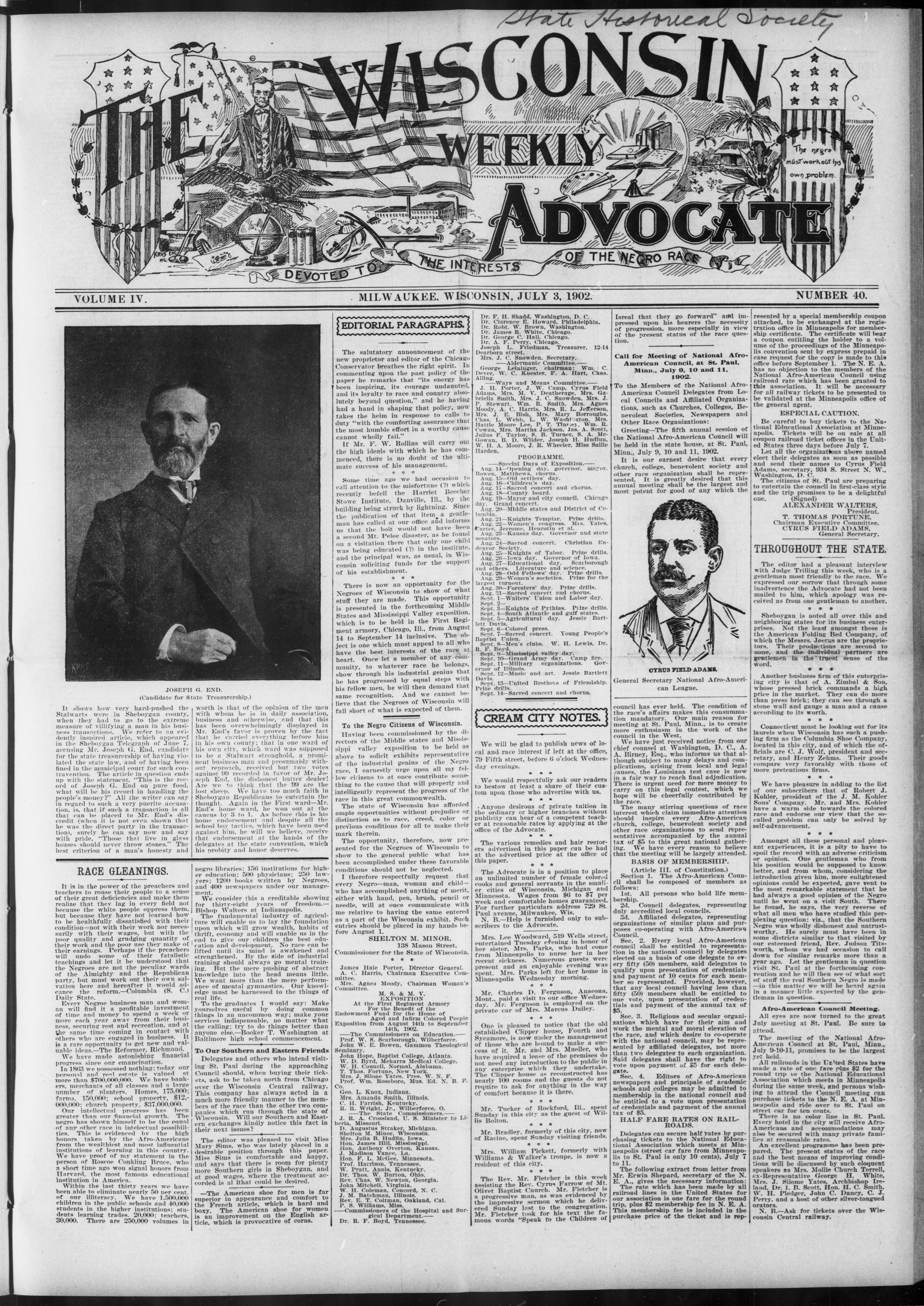
JOSEPH G. END.
(Candidate for State Treasurership.)
It shows how very hard-pushed the Stalwarts were in Sheboygan county, when they had to go to the extreme measure of villifying a man in his business transactions. We refer to an evidently inspired article, which appeared in the Sheboygan Telegraph of June 7, accusing Mr. Joseph G. End, candidate for the state treasurership of having violated the state law, and of having been fined in the municipal court for such contravention. The article in question ends up with the statement, "This is the record of Joseph G. End on pure food, what will be his record in handling the people's money?" All the writer can say in regard to such a very puerile accusation, is, that if such a transaction is all that can be placed to Mr. End's discredit (when it is not even shown that he was the direct party in the transaction), surely he can say now and say with pride, "Those that live in glass houses should never throw stones." The best criterion of a man's honesty and
RACE GLEANINGS.
RACE GLEANINGS.
It is in the power of the preachers and teachers to rouse their people to a sense of their great deficiencies and make them realize that they lag in every field not because the white people oppress them, but because they have not learned how to be healthfully dissatisfied with their condition—not with their work nor necessarily with their wages, but with the poor quality and grudging quantity of their work and the poor use they make of their earnings. Perhaps if the preachers will undo some of their fatalistic teachings and let it be understood that the Negroes are not the peculiar wards of the Almighty and the Republican party, but must work out their own salvation here and hereafter it would advance the reform.—Columbia (S. C.) Daily State.
Every Negroe business man and woman will find it a profitable investment of time and money to spend a week or more each year away from their business, securing rest and recreation, and at the same time coming in contact with others who are engaged in business. It is a rare opportunity to get new and valuable ideas.-The Reformer, Richmond.
We have made astonishing financial progress since our emancipation. In 1863 we possessed nothing; today our personal and real estate is valued at more than $700,000,000. We have bankers, merchants of all classes and a large number of planters. Homes, 175,000; farms, 150,000; school property, $12,-000,000; church property, $37,000,000. Our intellectual progress has been greater than our financial growth. The negro has shown himself to be the equal of any other race in intellectual possibilities. This is evidenced by the high honors taken by the Afro-Americans from the wealthiest and most influential institutions of learning in this country. We have proof of my statement in the person of Roscoe Conkling Bruce, who a short time ago won signal honors from Harvard, the most famous educational institution in America.
Within the last thirty years we have been able to eliminate nearly 50 per cent. of our illiteracy. We have 1,500,000 children in the public schools and 40,000 students in the higher institutions; students learning trades. 20,000; teachers. 30,000. There are 250,000 volumes in
VOLUME IV.
worth is that of the opinion of the men with whom he is in daily association, business and otherwise, and that this has been overwhelmingly displayed in Mr. End's favor is proven by the fact that he carried everything before him in his own county; that in one ward of his own city, which ward was supposed to be a Stalwart stronghold, a prominent business man and presumably without reproach, received but two votes against 99 recorded in favor of Mr. Joseph End, the dishonest butter dealer! Are we to think that the 99 are the lost sheep. We have too much faith in Sheboygan Republicans to entertain the thought. Again in the First ward—Mr. End's home ward, he won out at the caucus by 3 to 1. As before this is his home endorsement and despite all the school boy tactics, which have been used against him, he will we believe, receive that endorsement at the hands of the delegates at the state convention, which his probity and honor deserves.
negro libraries; 156 institutions for higher education; 500 physicians; 250 lawyers; 1200 books written by Negroes, and 400 newspapers under our management. We consider this a creditable showing for thirty-eight years of freedom. Bishop Walters at Indianapolis.
The fundamental industry of agriculture will enable us to lay the foundation upon which will grow wealth, habits of thrift, economy and will enable us in the end to give our children the best education and development. No race can be lifted until its mind is awakened and strengthened. By the side of industrial training should always go mental training. But the mere pushing of abstract knowledge into the head means little. We want more than the mere performance of mental gymnastics. Our knowledge must be harnessed to the things of real life.
To the graduates I would say: Make yourselves useful by doing common things in an uncommon way; make your services indispensable, no matter what the calling; try to do things better than anyone else.—Booker T. Washington at Baltimore high school commencement.
To Our Southern and Eastern Friends
Delegates and others who intend visiting St. Paul during the approaching Council should, when buying their tickets, ask to be taken north from Chicago over the Wisconsin Central railway. This company has always acted in a much more friendly manner to the members of the race than the other two companies which run through the state of Wisconsin. Will our Southern and Eastern exchanges kindly notice this fact in their next issues?
The editor was pleased to visit Miss Mary Sims, who was lately placed in a desirable position through this paper. Miss Sims is comfortable and happy, and says that there is room for plenty more Southern girls in Sheboygan, and at good wages, where the treatment accorded is al lthat could be desired.
The American shoe for men is far superior in appearance and comfort to the French article, which is hard and boxy. The American shoe for women is an improvement on the English article, which is provocative of corns.
EDITORIAL PARAGRAPHS.
The salutatory announcement of the new proprietor and editor of the Chicago Conservator breathes the right spirit. In commenting upon the past policy of the paper he remarks that "its energy has been inspiring, its courage undaunted, and its loyalty to race and country absolutely beyond question," and he having had a hand in shaping that policy, now takes the helm in response to calls to duty "with the comforting assurance that the most humble effort in a worthy cause cannot wholly fail."
If Mr. F. W. Rollins will carry out the high ideals with which he has commenced, there is no doubt of the ultimate success of his management.
Some time ago we had occasion to call attention to the misfortune (?) which recently befell the Harriet Beecher Stowe Institute, Danville, Ill., by the building being struck by lightning. Since the publication of that item a gentleman has called at our office and informs us that the bolt would not have been a second Mt. Pelee disaster, as he found on a visitation there that only one child was being educated (?) in the institute, and the principal was, as usual, in Wisconsin soliciting funds for the support of his establishment.
***
There is now an opportunity for the Negroes of Wisconsin to show of what stuff they are made. This opportunity is presented in the forthcoming Middle States and Mississippi Valley exposition, which is to be held in the First Regiment armory, Chicago, Ill., from August 14 to September 14 inclusive. The object is one which must appeal to all who have the best interests of the race at heart. Once let a member of any community, to whatever race he belongs, show through his industrial genius that he has progressed by equal steps with his fellow men, he will then demand that same recognition. And we cannot believe that the Negroes of Wisconsin will fall short of what is expected of them.
To the Negro Citizens of Wisconsin
Having been commissioned by the directors of the Middle states and Mississippi valley exposition to be held as above to solicit exhibits representative of the industrial genius of the Negro race. I earnestly urge upon all my fellow citizens to at once contribute something to the cause that will properly and intelligently represent the progress of the race in this great commonwealth. The state of Wisconsin has afforded ample opportunities without prejudice or distinction as to race, creed, color or previous conditions for all to make their mark therein.
The opportunity, therefore, now presented for the Negroes of Wisconsin to show to the general public what has been accomplished under these favorable conditions should not be neglected.
I therefore respectfully request that every Negro—man, woman and child—who has accomplished anything of merit, either with hand, pen, brush, pencil or needle, will at once communicate with me relative to having the same entered as a part of the Wisconsin exhibit. Such entries should be placed in my hands before August 1.
SHELTON M. MINOR.
Commissioner for the State of Wisconsin
* * *
James Hale Porter, Director General.
A. C. Harris, Chairman Executive Committee.
Mrs. Agnes Moody, Chairman Woman's Committee.
Aged and Infirm Colored People Exposition from August 14th to September 14th, 1902. The Commissioners on Education. Prof. W. S. Scarborough, Wilberforce. John W. E. Bowen, Gammon Theological Seminary.
Mrs. J. Silone Yates, Pres. W. N. F.
Prof. Wm. Roseboro, Mus. Ed. N. B. P.
Co.
The State Commissioners.—
J. R. A. Crossland, U. S. Minister to Liberia, Missouri.
D. Augustus Straker, Michigan.
Shelton M. Minor, Wisconsin.
Mrs. Julia B. Hudlin, Iowa.
Hon. James Hill, Mississippi.
Hon. Anthony Overton, Kansas.
J. Madison Vance, La.
Hon. F. L. McGee, Minnesota.
Prof. Harrison, Tennessee.
W. Pratt, Annis, Kentucky.
Dr. Thos. W. Burton, Ohio.
Rev. Chas. W. Newton, Georgia.
John Mitchell, Virginia.
W. H. Coleman, Concord, N. C.
J. M. Batchman, Illinois.
Rev. E. T. Coltman, Oakland, Cal.
P. S. Williams, Miss.
Commissioners of the Hospital and Surgical Department.—
Dr. R. F. Boyd, Tennessee.
Dr. F. H. Shadd, Washington, D. C.
Dr. Clarence E. Howard, Philadelphia,
Dr. Robt. W. Brown, Washington.
Dr. James R. White, Chicago.
Dr. George C. Hall, Chicago.
Dr. A. F. Perry, Chicago.
Joseph L. Friedman, Treasurer, 12-14
Dearborn street.
Mrs. J. C. Snowden, Secretary.
—Aldermanic Committee.
George Leininger, chairman; Wm. C. Dever, W. C. Kuester, F. A. Hart, Chas. Alling.
—Ways and Means Committee.
J. H. Porter, J. W. Camp, Cyrus Field Adams, Mrs. M. V. Deatherage, Mrs. Gabriella Smith, Mrs. J. C. Snowden, Mrs. J. P. Stewart, Wm. R. Smith, Mrs. Agnes Moody, A. C. Harris, Mrs. R. L. Jefferson, Mrs. J. E. Bish, Mrs. Mary Borroughs, Chas. L. Webb, L. W. Washington, Mrs. Hattie Moore Lee, P. T. Tinsley, Wm. R. Cowan, Mrs. Martha Jackson, Jas. A. Scott, Julius F. Taylor, S. B. Turner, S. A. McGowan, B. D. Wilder, Joseph H. Hudlun, W. H. A. Moore, J. R. Wheeler, Miss Sallie Harden
PROGRAMME.
Special Days of Exposition. Aug. 14-Opening day, governor, mayor. Bowen, Matthews, chorus.
Aug. 15—Old settlers' day.
Aug. 16—Children's day.
Aug. 17—Sacred concert and chorus.
Aug. 18—County board.
Aug. 19—Mayor and city council. Chicago day. Grand concert.
Aug. 20—Middle states and District of Columbia.
Aug. 21—Knights Templar. Prize drills.
Aug. 22—Women's congress. Mis. Yates, Carter, Jerrome, Henrotin et al.
Aug. 23—Kansas day. Governor and state senators.
Aug. 24—Sacred concert. Christian Endeavor Society.
Aug. 25—Knights of Tabor. Prize drills.
Aug. 26—Iowa day. Governor of Iowa.
Aug. 27—Educational day. Scarborough and others. Literature and science.
Aug. 28—Odd Fellows' day. Prize drills.
Aug. 29—Women's societies. Prize for the largest turnout.
Aug. 30—Foresters' day. Prize drills.
Aug. 31—Sacred concert and chorus.
Sept. 1—Waiters' Union and Labor day.
Sept. 2—
Sept. 3—Knights of Pythias. Prize drills.
Sept. 4—South Atlantic and gulf states.
Sept. 5—Agricultural day. Jessie Bartlett Davis.
Sept. 6—Colored press.
Sept. 7—Sacred concert. Young People's Baptist Union.
Sept. 8—Men's clubs. W. H. Lewis, Dr. R. F. Boyd.
Sept. 9—Mississippi valley day.
Sept. 10—Grand Army day. Camp fire.
Sept. 11—Military organizations. Governor of Illinois.
Sept. 12—Music and art. Jessie Bartlett Davis.
Sept. 13—United Brothers of Friendship. Prize drills.
Sept. 14—Sacred concert and chorus.
CREAM CITY NOTES.
---
We will be glad to publish news of local and race interest if left at the office, 79 Fifth street, before 6 o'clock Wednesday day evenings.
☆ ☆ ☆
We would respectfully ask our readers to bestow at least a share of their custom upon those who advertise with us.
---
Anyone desirous of private tuition in the ordinary or higher branches without publicity can hear of a competent teacher at reasonable rates by applying at the office of the Advocate.
☆ ☆ ☆
The various remedies and hair restorers advertised in this paper can be had at the advertised price at the office of this paper.
** **
The Advocate is in a position to place an unlimited number of female colored cooks and general servants in the smaller cities of Wisconsin, Michigan and Minnesota. Wages from $6 to $7 per week and comfortable homes guaranteed. For further particulars address 729 St. Paul avenue, Milwaukee, Wis.
N. B.—Help is furnished only to subscribers to the Advocate.
Mrs. Lee Woodward, 519 Wells street, entertained Tuesday evening in honor of her sister, Mrs. Parks, who had come from Minneapolis to nurse her in her recent sickness. Numerous guests were present and an enjoyable evening was spent. Mrs. Parks left for her home in Minneapolis Wednesday morning.
***
Mr. Charles D. Ferguson, Anacona, Mont., paid a visit to our office Wednesday. Mr. Ferguson is employed on the private car of Mrs. Marcus Dailey.
* * *
One is pleased to notice that the old established Clipper house, Fourth and Sycamore, is now under the management of those who are bound to make a success of it. Mr. and Mrs. Mueller, who have acquired a lease of the premises do not need any introduction to the public in any enterprise which they undertake. The Clipper house as reconstructed has nearly 100 rooms and the guests do not require to ask for anything in the way of comfort because it is there.
\* \* \*
Mr. Tucker of Rockford, Ill., spent Sunday in this city as the guest of Willis Bolton.
☆ ☆ ☆
Mr. Bradley, formerly of this city, now of Racine, spent Sunday visiting friends.
* * *
Mrs. William Pickett, formerly with Williams & Walker's troupe, is now a resident of this city.
* * *
The Rev. Mr. Fletcher is this week assisting the Rev. Cyrus Farrow of Mt. Olivet Baptist Church. Mr. Fletcher is a progressive man, as was evidenced by the impressive sermon which he delivered Sunday last to the congregation. Mr. Fletcher took for his text the famous words "Speak to the Children of
Isreal that they go forward" and impressed upon his hearers the necessity of progression, more especially in view of the present status of the race question.
Call for Meeting of National Afro American Council, at St. Paul, Minn., July 9, 10 and 11, 1902
To the Members of the National Afro-American Council Delegates from Local Councils and Affiliated Organizations, such as Churches, Colleges, Benevolent Societies, Newspapers and Other Race Organizations:
Greeting—The fifth annual session of the National Afro-American Council will be held in the state house, at St. Paul, Minn., July 9, 10 and 11, 1902.
It is our earnest desire that every church, college, benevolent society and other race organization shall be represented. It is greatly desired that this annual meeting shall be the largest and most potent for good of any which the
M.
General Secretary National Afro-American League.
General Secretary National Afro-American League.
council has ever held. The condition of the race's affairs makes this consummation mandatory. Our main reason for meeting at St. Paul, Minn., is to create more enthusiasm in the work of the council in the West. We have just received notice from our chief counsel at Washington, D. C., A. A. Birney, Esq., who informs us that although subject to many delays and complications, arising from local and legal causes, the Louisiana test case is now in a fair way to reach final adjudication. There is urgent need for more money to carry on this legal contest, which we hope will be cheerfully contributed by the race.
The many stirring questions of race interest which claim immediate attention should inspire every Afro-American church, college, benevolent society and other race organizations to send representatives accompanied by the annual tax of $5 to this great national gathering. We have every reason to believe that the meeting will be largely attended.
BASIS OF MEMBERSHIP.
Section 1. The Afro-American Council shall be composed of members as follows: 1st. All persons who hold life membership. 2d. Council delegates, representing duly accredited local councils.
3d. Affiliated delegates, representing organizations of similar plans and purposes co-operating with Afro-American Council. Sec. 2. Every local Afro-American council shall be entitled to representation in the national council by delegates elected on a basis of one delegate to every fifty (50) members, said delegates to qualify upon presentation of credentials and payment of 10 cents for each member so represented. Provided, however, that any local council having less than fifty (50) members shall be entitled to one vote, upon presentation of credentials and payment of the annual tax of $5.
Sec. 3. Religious and secular organizations which have for their aim and work the mental and moral elevation of the race, and which desire to co-operate with the national council, may be represented by affiliated delegates, not more than two delegates to each organization. Said delegates shall have the right to vote upon payment of $5 for each delegate. Sec. 4. Editors of Afro-American newspapers and principals of academic schools and colleges may be admitted to membership in the national council and be entitled to a vote upon presentation of credentials and payment of the annual tax of $5.
HALF FARE RATES ON RAILROADS.
Delegates can secure half rates by purchasing tickets to the National Educational Association which meets at Minneapolis (street car fare from Minneapolis to St. Paul is only 10 cents), July 7 to 11.
The following extract from letter from Mr. Erwin Shepard, secretary of the N. E. A., gives the necessary information: The rate which has been made by all railroad lines in the United States for our association is one fare for the round trip, plus $2 membership fee in N. E. A. This membership fee is included in the purchase price of the ticket and is rep-
resented by a special membership coupon attached, to be exchanged at the registration office in Minneapolis for membership certificate. The certificate will bear a coupon entitling the holder to a volume of the proceedings of the Minneapolis convention sent by express prepaid in case request for the copy is made to this office before September 1. The N. E. A. has no objection to the members of the National Afro-American Council using railroad rate which has been granted to this association. It will be necessary for all railway tickets to be presented to be validated at the Minneapolis office of the general agent.
ESPECIAL CAUTION.
Be careful to buy tickets to the National Educational Association at Minneapolis. Tickets will be on sale at all coupon railroad ticket offices in the United States three days before July 7.
Let all the organizations above named elect their delegates as soon as possible and send their names to Cyrus Field Adams, secretary, 934 S. Street N. W., Washington, D. C.
The citizens of St. Paul are preparing to entertain the council in first-class style and the trip promises to be a delightful one. (Signed)
ALEXANDER WALTERS,
President.
T. THOMAS FORTUNE,
Chairman Executive Committee.
CYRUS FIELD ADAMS,
General Secretary.
THROUGHOUT THE STATE.
The editor had a pleasant interview with Judge Trilling this week, who is a gentleman most friendly to the race. We expressed our sorrow that through some inadvertence the Advocate had not been mailed to him, which apology was received as from one gentleman to another.
* * *
Sheboygan is noted all over this and neighboring states for its business enterprises. Not the least amongst these is the American Folding Bed Company, of which the Messrs. Joerns are the proprietors. Their productions are second to none, and the individual partners are gentlemen in the truest sense of the word.
***
Another business firm of this enterprising city is that of A. Zimbal & Son, whose pressed brick commands a high price in the market. They can do more than press brick; they can see through a stone wall and gauge a man and a cause according to its worth.
* * *
Connecticut must be looking out for its laurels when Wisconsin has such a pushing firm as the Columbia Shoe Company, located in this city, and of which the officials are C. J. Wolf, president and secretary, and Henry Zehms. Their goods compare very favorably with those of more pretentious firms.
牵牵
We have pleasure in adding to the list of our subscribers that of Robert J. Kohler, president of the J. M. Kohler Sons' Company. Mr. and Mrs. Kohler have a warm side towards the colored race and endorse our view that the so-called problem can only be solved by self-advancement.
☆ ☆ ☆
Amongst all these personal and pleasant experiences, it is a pity to have to spoil the record with an adverse criticism or opinion. One gentleman who from his position would be supposed to know better, and from whom, considering the introduction given him, more enlightened opinions could be expected, gave vent to the most remarkable statement that he had always a good opinion of the Negro until he went on a visit South. There he found, he says, the very reverse of what all men who have studied this perplexing question: viz., that the Southern Negro was wholly dishonest and untrustworthy. He surely must have been in some districts similar to that visited by our esteemed friend, Rev. Judson Titsworth, whom we had occasion to call down for similar remarks more than a year ago. Let the gentleman in question visit St. Paul at the forthcoming convention and he will then see of what sort of stuff the real Southern Negro is made—in this matter we will be heard again in a manner little expected by the gentleman in question.
---
Afro-American Council Meeting
All eyes are now turned to the great July meeting at St. Paul. Be sure to attend.
The meeting of the National Afro-American Council at St. Paul, Minn., July 9-10-11, promises to be the largest yet held.
All railroads in the United States have made a rate of one fare plus $2 for the round trip to the National Educational Association which meets in Minneapolis during the same week, and persons wishing to attend the Council meeting can purchase tickets to the N. E. A. at Minneapolis and ride over to St. Paul on street car for ten cents.
There is no color line in St. Paul. Every hotel in the city will receive Afro-Americans and accommodations may also be secured with many private families at reasonable rates.
An excellent programme has been prepared. The present status of the race and the best means of improving conditions will be discussed by such eloquent speakers as Mrs. Mollie Church Terrell, ex-Representative George H. White, Mrs. J. Silome Yates, Archbishop Ireland, Dr. I. B. Scott, Hon. H. C. Smith, W. H. Pledger, John C. Dancy, C. J. Perry, and a host of other silver-tongued orators. N. B.—Ask for tickets over the Wisconsin Central railway.
KING CONTINUES 10 GAIN.
Reported by Physicians to Have
Passed Excellent Night.
MONARCH SLEEPS WELL
Substantial Improvement in All Respects
—The Royal Patient Shows
Fortitude.
London, July 1.—The following bulle-
tin was posted at Buckingham palace at
7 p. m.:
The advancement in the King’s condition
is maintained. His appetite is improving
and the dressing of his wound is less pain-
ful. His majesty is still fatigued on the
least exertion.
TREVES, LAKING, BARLOW.
London, July 1.—The following bulle-
tin on the condition of King Edward was
posted at Buckingham palace at 10
o'clock this morning:
The King passed an exceflent night of
natural sleep. He has gained strength and
wade substantial improvement in all re-
spects. TREVES, LAKING, BARLOW.
5:18 P. m.—The Associated Press
learns that King Edward spent an ex-’
cellent day and that he continues to im-
prove. Sir Frederick Treve this after-
noon expressed entire satisfaction with
the patient’s condition.
,. London, July 1.—The reappearance to-
day of Queen Alexandra as a partici-
pant in a public ceremony practically
marks the end of the period of anxiety
caused by King Edward’s condition.
Her presence at the review of the colo-
nial troops by the Prince of Wales great-
ly increased public enthusiasm over
what in itself was a picturesque and
interesting event. Upwards of 2500
colonials were brought in from the
jvarfous encampments and marched
through great crowds down Constitution
hill, which was lined with troops, past
Buckingham palace which for a week
has been the center of such supreme
interest, and along the Mall to the Horse
Guards’ parade. The contingent present
represented all parts of the British em-
pire with the gxception of India, whose
troops will be peately reviewed to-
morrow. The Canadian detachment
numbered 609 men and was by far the
largest body on parade. The smallest
detachment consisted of three natives
of the island of St. Lucia, Borneo, Cey-
lon, Fiji, the West Indies generally. Cy-
prus, the Gold Coast, Nigeria, Uganda
and other remote colonies were represent-
ed by native troops in clothing of strik-
ing variety, while straight from the
fighting line in South Africa, were details
from Canadian scouts, Kitchener's horse
and contingents from a number of local
levies raised during the war.
Cheers for the Queen.
The Queen’s appearance while on her
way from the palace to the horse guards
were greeted with salvos of cheers,
which increased in strength as the spec-
tators noticed that the c.deal of the past
week had but little affected her majesty‘s
health and noted the absence of any
signs of anxiety as she cheerily acknowl-
edged the congratulations of the public
at the uninterrupted progress of the
King.
) . The Queen was seated in an open car-
riage. Beside her was the Princess of
Wales, and seated opposite were the
Princess Victoria and Princess Charles
of Denmark. Several carriages contain-
ing the Duke of Cambridge, the Duchess
of Connaught and others followed.
The Prince of Wales was accom pote’
by the Crown ane ot pena, Prince
rederick, Prince Charles of Degmark
Fad hak ates aoe Ge the tora oe
taches, including Maj. E. B. Cassatt, the
Batted States military attache. The
Duke of Connaught and Lord Roberts,
the commander-in-chief, stirrounded by
brilliant staffs, rode behind the Prince
of Wales’ party. The long lines of
troops completely filled the horse guards’
Dida tautlah began aeatedokasieaeais
stood out in vivid contrast with the trees
in the park. Thousands of spectators
filled the stands or stood bekina tie po-
lice. Among the interested on-lookers
was Prince “Eddy” and the other chil-
dren of the Prince and Princess of
Wales. All the colonial premiers, In-
dian princes and other guests of the na-
tion were present to say nothing of mem-
bem of the House of Commons without
end.
The troops marched quickly past the
Queen's carriage, the Prince of Wales
receiving the salute. The Queen then
drove slowly in and out of the lines and
the Prince of Wales closely inspected
the troops and dismounted and conferred
medals and crossses on those who had
merited the honor, shaking hands
with the recipients of the Victoria
cxoss,
Yelled Themselves Hoarse.
Then followed the most picturesque
feature of the day. The Duke of Con-
naught, at the head of the troops and
facing the Prince of Wales, in. clear
tones gave the command. “The parade
will give three cheers for the King,” and
himself started the “Hip,” “hip.” In
a second the refrain was taken up and
there rose cheers such as London seldom
hears, the sound of which must have
reached almost to the royal sick room,
half a mile away. Helmets, caps and
campaign hats rose in waving confusion
at the bayonet’s point, and the assem-
bled crowds joined in with equal vigor.
A men in the Canadian ranks shouted
“and a tiger,” at which the troops and
crowd once more yelled themselves
hoarse. It was the first oceasion since
the announcement of the King’s illness
that the general public had an opportu-
nity to vent their feelings and the peo-
ple took advantage of it.
After this the life guards rode up to
the Queen's carriage to the accompani-
ment of “God Save the King,” and
cheers not unmingled with tears of the
women, many of whom were deeply af-|
fected. The Suen drove slowly past’
the troops to Buckingham palace con-,
stantly bowing and smiling acknowledge-;
ments of the people’s greetings; the
Prince of Wales and the other members
of the royal family followed, the colo-
nials reformed in columns, and, amidst
CRONJE TAKES THE OATH.
Boer Commander, Who is at St. Helena
with Other Prisoners, Swears
Allegiance.
Jamestown, St. Helena, July 1.—Gen.
Cronje, the Boer commander, who, with:
his army, was captured by Lord Roberts
at Paardeberg, Orange Free State, in
February, 1900, has taken the oath of
allegiance to King Edward. Many of
the remaining prisoners are following his
example,
fae Se
Sparta Miners on Strike.
Duiuth, Minn., July 1—The miners,
more than 200 in number, at the Sparta
and Malta mines at Sparta, on the Me-
saba range, are on a strike for an ad-
yance from $1.75 to $2 a day. The
Sparta Miuing Company offered to com-
promise with the men on a basis of
R90 a day, but it was refused.
THE BANKS MUST PAY.
Federal Judge at Brooklyn, N. Y., Hands
Down a Decision in a
Test Case.
New York, July 1.—While beginn
today Uncle Sam will remit his clzi..
to taxes which have put $70,000,000 ix
his treasury annually for several years.
and the banks, national, state and sav-
img, are to feel the effect of this reduc-
tion in their expenses. together with
various other lines of business enter
prises, the national banks have not_been
eased by a decision rendered by Judge
Lacombe, in the federal court of Brook-
lyn, holding that the treasury depart-
ment must not repay the tax which ws
levied on the undivided profits of one
bank. Judge Lacombe’s decision was
given in the case of the Leather Man~
facturers’ Bank brought as a test iw
ascertain if the treasury department
could collect $154 which was leied as
war taxes on undivided erie of $77,-
796 held by the bank. Vhen Congres:
passed the internal revenue act in 1808
imposing a tax on the surplus funds in
the various banks, objection was made
and the Leather Manufaeturers’ Bank
was the only one to make the payment.
Having done this, it brought suit to re-
cover.
Taking this decision as a precedent,
all the banks now will be compelled to
pay the taxes which have accrued in
the last three years as the law was not
repealed until this year.
Nearly all the banks in the count
will*make an effort to have this decisio
reversed, and the American Bankers’ As-
sociation probably will carry the case to
the supreme court.
Chicago, Il., July 1.—Within a few
days practically every bank in Chicago
will be called on to pay back United
States internal revenue taxes on its.un-
divided profits for the period from the
passing of the war revenue act by Con-
gress up to January 1, 1902. The tax
amounts to $2 per $1000 and covers a
period of practically three years. The
amount of undivided profits of the Chi-
cago banks has been during that period
about $8,000,000. Hence the total in-
yolved in back taxes in Chicago is about
$16,000. Furthermore, the decision f-
fects the future taxes of banks under
the internal revenue law.
TO MAKE CHEAP PAPER.
Concern at Kankakee, Ill., to Use Old
Cornstalks in Its Manufacture—
Will Erect a Plant.
Kankakee, Ill., July 1.—It is believed
that the plant of the National Fiber
and Cellulose Company, soon to be estab-
lished in this city, will eventually de-
crease the price of paper.
While it is not the intention of t..
corporation to manufacture paper ut
once, it intends to make paper stock,
and ultimately paper mills will prob-
ably be located here.
The National Fiber and Cellulose Com-
pany has just purchased the site of the
Kankakee Stone and Lime Company for
its plant.
The companv is owner of a process for
preparing paper stock and cellulose
from corns‘alks, a product that is now
mostly wasted.
It is proposed by the company to lo-
eate mills in different sections, to work
up the raw material—that is, husk, strip.
and separate the pulp and fiber, which
will then be pressed and shipped to cer
tral mills in Kaukakee for reduction.
While the outer covering of the-eorn-
stalk is worked up into paper. the pith.
which is valueless as feed, can be made
into cellulose, the chemical pease
oi which are almost unlimited.
eae Sei ase
Continuous Downpour Does Great Dam-
age to Crops in New York—Hay
Rotting in the Fields,
New York. July 1—Reports from
Central and Northern New York indicate
that he continuous rain of June has
done many thozsands of dollars’ worth
of damage to the crops.
Farmers say that alfalfa, timothy and
clover are rotting in the fields, that the
oats and barley crops will consist chiefly
of straw, that sweet corn and tne regu-
lar field corn sre rotting and that pas-
ture lands are teo wet to produce nutri-
tious feed for stock. In Rutland county
the corn crop is believed to be ruined
while only « small part of the hay has
been harvested. In Oneida county farm-
ere are replanting their corn while the
pea crop is alse seriously damaged.
INDEMNITY HELD UP.
China Disagrees with Powers Over the
Rate of Exchange.
Tekin, July 1.—The taotai of Shanghai
has notified the bankers’ commission that
China refuses to pay the July instali-
ment of the indemnity except at the rate
of exchange prevailing April 1, 1901.
The foreign ministers consider that the
tuotai’s declaration is the result of the
announcement of United States Minister
Conger to the Chinese government that
the United States sustains China's con-
tention and is- willing to accept pay-
ment on the basis mentioned. But the
ministers are confident that China will
accept the decision of the majority of the
ministers when she is convinced that the
United States is her ouly supporter.
——_+————
RENEWS BUCKETSHOP WAR.
Chicago Board of Trade Sues Three Brok-
ers in Indianapolis.
Indianapolis, Ind., July 1.—The Chi-
cago board of trade has sued L. A. Kin-
sey, Lyman Lewis and Philip Mutchner,
charging them with operating bucket-
shops and using the quotations of the
Chieago board. The _ complainant will
strive to show that the Chicano board
of trade has an inherent property right
in the quotations, which can be protected
in equity. The case has attracted un-
usual attention here on account of the
prominence of the local stock brokers in-
volved.
a
Make a Human Bridge.
A curious custom takes place in vil-
lages of the eee district, Bel-
gium, in May. After Sunday service
numbers of lads cluster round the church
entrance, and as the girls come out seize
them one by one, one lad grasping a girl
by the shoulder and the other by the
heels, the two lifting her well up while
a third bumpkin passes under the hu-
man bridge thus formed, This is done
in the presence of the parents, who
themselves have passed through the same
ordeal.
—Spite of the superstition of the sailor
who will not ship on the vessel which
the rats have left, efforts are being made,
at the instance of bacteriologists who say
they disseminate disease, to rid all ves-
sels afloat of the vermin.
a aeeelipnincnetionias
—The finest example of weaving in the
world is said to be the Panama hats
manufactured in Jipijapa (pronounced
Hip-yhanni), in the province of Monte-
eristic, Eevador. ye
————_—__-____—__
—The dukite snake of Australia is said
to be more dangerous and more relent-
less in its pursuit of a foe than even the
fer-de-lance.
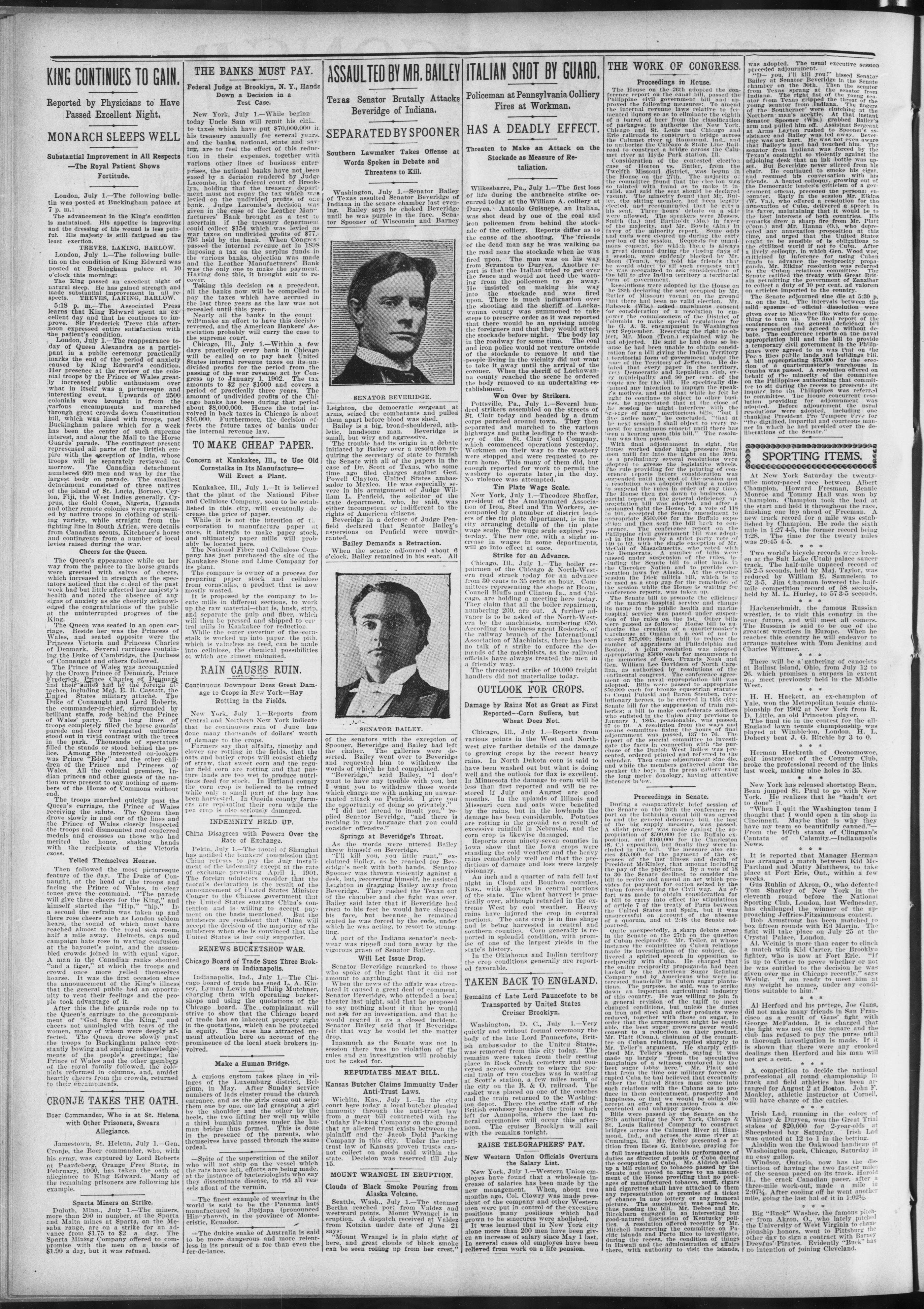
ASSAULTED BY MR. BAILEY
Texas Senator Brutally Attacks
Beveridge of Indiana.
oe
Southern Lawmaker Takes Offense at
Words Spoken in Debate and
Threatens to Kill. :
—
Washington, July 1.—Senator =
of Texas assulted Senator Beveridge of
fndiana in the senate chamber last even-
ing. Bailey says he choked Beveridge
until he was purple in the face. Sena-
tor Spooner of Wisconsin and Barney
Sceeeeemereeee ah Sree
Ess PR
Ss oa. Sey
= ~ Ss
a ——=
SENATOR BEVERIDGE.
Leighton, the democratic sergeant at
arms, seized the combatants and pulled
them apart before blood was shed.
seney is a big, broad-shouldered, ath-
letic, handsome man. Beveridge is
small, but wiry and aggressive.
The trouble had its origin in 2 debate
initiated by Bailey over a resolution re-
quiring the secretary of state to furnish
the Senate with all of the papers in the
case of Dr. Scott of Texas, who some
time ago filed charges against Geut.
Powell Clayton, United States ambas-
sador to Mexico. He was especially se-
vere in his arraignment of Judge Wil-
liam L. Penfield, the solicitor of the
state department, who, he said, was
either incompetent or indifferent to the
rights of Americsn citizens.
Beveridge in a defense of Judge Pen-
field declared that | Senator Bailey's
aspersions on Penfield were unwar-
ranted.
Bailey Demands a Retraction.
When the senate adjourned about 6
o’clock, Bailey remained in his seat. Ail
ee
\ : -
— 8 . .
es Pain i
mo A 4
aw. oe
are: SENATOR BAILEY.
of the senators with the exception of
Spooner, Beveridge and Bailey had left
the chaber. The galleries were de-
-serted. Bailey went over to Beveridge
-and requested him to withdraw the
words of which he had complained.
“Beveridge,” said Bailey, “I” don’t
want to have any trouble with you, but
I want you to withdraw those words
which charge me with making an unwar-
ranted attack on Penfield. I give you
the opportunity of doing so privately.”
“I did not intend to insult you,” ‘e-
plied Senstor Bevridge, “and there is
nothing in my language that you could
consider offensive.”
Springs at Beveridge’s Throat.
As the words were uttered Bailey
threw himself on Beveridge.
“TH kill you, you little runt,’ ex-
claimed Bailey, as he reached for Bey-
eridge’s neck with both hands. Senator
Spooner was thrown vioiently against a
desk, but, recovering himself, he assisted
Leighton in dragging Bailey away from
Beveridge. They rushed the Texan out
of the chamber and the fight was over.
Bailey said later that if Beveridge had
risen to his feet he would have slapped
his face, but because he rem:ined
seated he was forced by the code, under
Selick he was acting, to resort to strang-
ing.
A part of the Indiana senator's neck-
wear was ripne@ 2nd torn away by the
vigorous grasp of Senator Bailey.
Will Let Issue Drop.
Senztor Beveridge remarked to those
who spoke of the fight that it did not
amount to anything.
When the news of the affair was ciren-
lated it caused a great deal of comment.
Senator Veveridge, who attended a local
theater Inst night. said that he proposed
to say nothing about it that he would
not ask for an investigation, and that he
would regard it 2s a_closed_incident.
Senator Bailey said that if Beveridge
felt that way he would let the matter
drop.
Inasmuch as the Senate was not in
session there tvas no violation of the
rules and en investigation will probably
pot he seked for_
REPUDIATES MEAT BILL.
Kansas Butcher Claims Immunity Under
Anti-Trust Laws.
Wichita, Kas., July 1—In the city
court here today a local butcher pleaded
immunity through the anti-trust law
from a meat bill contracted with the
Cudahy Packing Company on the ground
that qn alleged trust exists between the
plaintiff and the Jacob Dold Packing
Company in this city. Under the anti-
trust law of Kansas proven trusts can-
not collect on goods sold within the
state. Decision was reserved till July
15.
———
MOUNT WRANGEL IN ERUPTION.
Clouds of Black Smoke Pouring from
Alaska Volcano.
Seattle, Wash., July 1—The steamer
Bertha reached por: from Valdez and
westward points. Mount Wrangel is in
eruption. A dispatch received at Valdez
from Kotzina under date of June 21
says:
“Mount Wrangel is in plain sight of
here, and great clouds of black smoke
ean be seen rolling up from her crest.”
ITALIAN SHOT BY GUARD.
Policeman at Pennsylvania Colliery
Fires at Workman.
HAS A DEADLY EFFECT.
Threaten to Make an Attack on the
Stockade as Measure of Re-
taliation.
Wilkesbarre, Pa., July 1—The first loss
of life during the anthracite strike oc-
curred today at the William A. colliery at
Duryea, Antonio Guisuepe, an Italian,
was shot dead by one of the coal and
iron policemen from behind the stock-
ade of the colliery. Reports differ as to
the cause of the shooting. The ‘friends
of the dead man say he was walking ou
the road near the stockade when de was
fired upon. The man was on his way
from Scranton to Duryea. Another re-
port is that the Italian tried to get over
the fence and would not heed the warn-
ing from the policemen to go away.
He insisted on making his way
into the stockade and was fired
upon. There is much indignation over
the shooting and the sheriff of Lacka-
wanna county was summoned to take
steps to preserve order as it was reported
that there would be an sprising among
the foreigners and that they would attack
the stockade before night. The body lay
in the roadway for some time. The coal
and iron police would not venture outside
of the stockade to remove it and the
people living in the vicinity did not want
to take it away until the arrival of the
coroner, When the sheriff of Lackawan-
na county reached the scene he ordered
the body removed to an undertaking es-
tablishment.
Won Over by Strikers.
Pottsville, Pa., July 1.—Several hun-
dred strikers assembled on the streets of
St. Clair today and headed o, a drum
corps paraded around town. hey then
separated and marched to the various
highways and paths leading to the wash-
ery of the St. Clair Coal Company,
which commenced operations yesterday.
Workmen on their way to the washery
were stopped and were requested to re-
turn home. This many of them did, but
enough reported for work to permit the
washery to operate later ,in the day.
No violence was attempted.
Tin Plate Wage Scale.
New York, July 1.—Theodore Shaffer,
president of the Amalgamated Associa-
tion of Iron, Steel and Tin Workers, ac-
companied by a number of district lead-
ers of the tin plate department, is in the
city serene details of the tin plate
wage scale. ‘he wage scale expired yes-
terday. The new one, with a slight in-
crease in wages in some departments,
will go into effect at once.
Strike for an Advance.
Chicago, UL, July 1.—The boiler re-
pairmen of the Chicago & North-West-
ern road struck today for an advance.
from 30 cents to 35 cents an hour, Com-
mittees representing the shops at Booa,
Council Bluffs and Clinton hee and Chi-
cago, are holding a meeting here today.
They claim that all the boiler repairmen,
numbering 260, are out. A further ad- |
vance is to be asked of the North-West-
ern by the machinists, numbering 6590.
According to business agent Roderick, of
the railway branch of the International
Association of Machinists, there has been
no talk of 2 strike to enforce the de-
mands of the machinists, as the raiiroad
officials have always treated the men in
a friendly way.
The threatened strike of 10,000 freight
handlers did not materialize today.
OUTLOOK FOR CROPS.
Damage by Rains Not as Great as First
Reported—-Corn Suffers, but
Wheat Does Not.
Chicago, Il., July 1.—Reports from
various points in the West and North-
west give further details of the damage
to growing crops by the recent heavy
rains. In North Dakota corn is said to
have been washed out but what is doing
well and the outlook for flax is excellent.
In Minnesota the damage to corn will be
less than first reported and will be re-
stored if July and August are good
months. In the uplands of Illinois and
Missouri corn and oats were benefited
by the rains, but in the lowlands the
damage has been considerable, Potatoes
are rotting in the ground as a result of
excessive rainfall in Nebraska, and the
corn crop is likewise damaged.
Reports rrom ninety-seven counties in
Iowa show that the Iowa crops were
standing the cold weather and the heavy
rains remarkably well and that the pre-
dictions of damage and loss were largely
visionary.
An inch and a quarter of rain fell last
night in Cloud and Bourbon counties,
KKas.. with showers in central portions
of the state. The wheat harvest is prac-
tically over, although retarded in the ex-
treme West by cool weather. Heavy
rains have injured the crop in central
portions. The oats crop is in fine shape
and is being harvested in central and
southern counties. Corn generally is re-
ported in splendid condition, with prom-
ise of one of the largest yields in the
state’s history.
In the Oklahoma and Indian territory
the crop conditions generally are report-
ed favorable.
TAKEN BACK TO ENGLAND.
Remains cf Late Lord Pauncefote to be
Transported by United States
Crviser Brookiyn.
Washington, D. C., July 1.—Very
quietly and without formal ceremony the
body of the late Lord Pauncefote, Brit-
ish ambassador to the United States,
was removed from this city today. The
remains were taken from their resting
place in Rock Creek cemetery and con-
veyed across country to where the spe-
cial train of two coaches was in waiting
at Scott's station, a few miles north of
the city on the B. & O, railroad. The
casket was placed on one of the coaches
and the train returned to the Washing-
ton depot. There the entire staff of the
British embassy boarded the train which
left for Annapolis, where the last fu-
neral ceremonies will occur this after-
noon. The cruiser Brooklyn will sail
with the remains tonight.
—
RAISE TELEGRAPHERS’ PAY.
New Western Union Officials Overturn
the Salary List.
New York, July 1.—Western Union em-
ployes have found that a wholesale in-
crease of salaries has been made by the
new management. When, about two
months aa Col. Clowry was made pres-
ident of the company and other Western
men were put in control of the executive
positions many positions which had
grown to be stnecures were abolished.
It was learned that in New York city
alone more than 200 men have been giv-
en an increase of salary since May 1 last.
In several cases old employes have been
relieved from work on a life pension.
THE WORK CF CONGRESS.
Proceedings in Heuse.
The House on the 26th scopted the con-
ference report on the canal bill, passed the
Pailtppine civil government bill and ap.
proved the following measures: To amend
the internal revenue laws relative to fer-
mented liquors so as to eliminate the eighth
of a barrel of beer from the classification
of packages; to authorize the New York.
Chicago and St. Louis and Chicago and
Erie railroads to construct a bridge across
the Calumet river x Hammond, fra. and
to authorize the Chitago & State Line Rail-
road to construct a bridge across the Calu-
met river at Hyde Park station, Ill.
Consideration of the contested election
ense of Horton vs. Butler, from the
‘Twelfth Missouri district, was begun in
the House on the 27th, The majority o¢
the committee found that the «lec ion wes
so tainted with fraud as to make it in
valid. und said the seat should be declared
vacant. The minority found that Mr. Bnt-
jer, the sitting member, had been tegally
elected. and recommended that he retain
his seat. Three hours’ debate on a sile
were allowed. The speakers were Messrs,
Smith (la) and Bartho'dt «Mo.) in. faver
of the eee and Mr. Bowle (Ala.) tn
favor of the minority repert. Some odds
and ends were cleared P. during the carly
portion of the session. Kequests for unanl-
mons consent, for which the:e is always
a great demand during the closing days of
a session, were suddenly blocked by Mr.
Meon (Tenn), who told his friencs that
he would object to all such requests unt’)
ho was recegaized to ask consideration of
the bill to give Indian territory a territorial
form of government.
Kesointions were adopted by the House on
he 28th declaring the seat occupied by Mr.
Butler of Missour: vacant on the ground
‘hat there had been no valid election, Mr.
Rabceck (Wis.) asked unanimous consent
‘or consideration of a resolution to em-
power the commissoners of the District of
Columbia to make special regulations for
he G. A. R. encampment in Washington
next Sepiember. Reserving the right to ob-
ject, Mr. Moon (Tenn.) explana why he
uid objected. He said he had done s0 be-
ause he had been unable to obtain consid-
ration for a bill giving the Indian Territory
: territorial form of gevernment under the
anv of the Territory of Jefferson. He de-
tated that every paper in the territory,
very Democratic and Kepublican ciub, ev-
ry municipality and 90 per cent. of the
weople are for the bill. He speciteally dis-
“aimed any Intention to impugn the speak-
ss motives, and said that while he felt he
ught to continue to object to other busi-
‘ess, he appreciated that at the close of
he session he might. interfere with the
‘g-sege of many meritorious bills, “but I
dive notice now,” he concluded, “that at
he next session I shall object to every re-
mest for unanimous consent until there has
heen a hearing upon this bill.” The resolu-
tion was then passed,
With final adjournment in sight, the
Mouse worked under high pressure from
soon wntil far inte the night on the 0th.
\s a preliminary several resolutions were
adopted to grease the legislative wheels.
Che rule providing for the printing of con-
erence icports before cousideration was
suspended until the end of the-session and
i resolution was adopted making a motion
to suspend the rules in order at any time.
The House then got down to business. A
partial report on the general deficteney ap:
propriation bill was adopted, and after a
prolonged fight the House, by a vote of 118
fo 101, accepted the Senate amendment to
xonropriate $500,000 for the Buffalo expo-
sition and then sent the bill back to con-
erence, The conference report on the
Vhilippine civil government biil was adopt-
cd in the House by a strict party vote of
140 to 92, with the single exception of Mr.
McCall of Masachusetts, who yoted with
the Democrats. A number of bills were
passed under suspension of the rules, fn
cluding the Senate bill te allot lands ta
the Cherokee Nation and to provide cor-
yoration laws for Alaska. At the evenin<
session the Dick militia bill, whieh fs to
be used as a stop gap for the remainder of
the session while the House ix waiting for
conference reports. was taken up.
The Senate bill to promote the efficiency
of the marine hospital service and change
its name to the public health and marine
nospital service was passed under suspen-
sion of the rules on the Ist. Other bills
were passed as follows: House bill to au.
thorize the creation of a quartermaster's
warehouse at Omaha at a cost of not to
exceed 375,000; Senate bill to reduce the
number of appraisers at Philadelphia and
Roston, A joint resolution was adopted
appropriating $5000 each for monuments to
the memories of Gen, Francis Noah and
Gen. William Lee Davidson of North Care-
lina, as authorized by resolutions of the
continental congress. The conference agree-
ment on the naval appropriation bill was
adopted. Bills were passed to appropriate
$50,000 each for bronze equestrian statutes
to Count Pulaski and Baron Steuben, revo-
lutionary heroes, to be erected In this city;
Senate bill for the suppression of train rob:
beries; a bill to make confederate soldiers
who enlisted In the Union army previous to
January 1, 1865, pensionable, was passed,
97 to 19. "A resolution from the ways and
means committee fixing the hours of final
adjournment was passed, 187 to 76. ‘The
report of the special committee to Investi-
gate the facts in connection with the pur-
chase of the Danish West Indies was [re-
sented, ordered printed and ref>rred to the
calendar. Then came adjournment sine die,
and while the members gathered about the
speaker ths bors In the press sallery sng
the long meter doxology, having attentive
listeners bc'ow.
Proceedings in Senate.
During a comparatively brief session of
the Senate on the 26th the conference re.
port on the Isthmian canal bill was agreed
to and the general deficiency bill, the last
of the big supply measure, was passed.
A slight protest was made against the ap-
propriation of $500,000 for the Buffalo ex-
position, and $160,000 for the Charleston
(8S. C.) exposition, but finally they were in-
cinded In the bill. ‘The méasuré also ear-
rics $45,000 for the payment of the ex-
Penses of the ast filness and death of
»resident McKinley, that amount including
the pay of the physicians. By a vote of 18
to 30 the Senate declined to consider the
bill to revive and amend an act which pro-
vides for payment for cotton selzed by the
Union forces during the Civil way. An ef-
fort was made to obtain consideration for
a bill to carry into effect the stipulations
of article 7 of the treaty of Paris between
the United States and Spain, but it was
unsuccessful on account of the absence
of a quorum, and at 2:48 the Senate ad-
journed.
Quite unexpectedly, a_sharp debate arose
in the Senate on the 27th on the question
of Cubau reciprocity. Mr. Teller, at whose
instance the committee on Cuban relations
made its investigation of the subject, de-
livered a spirited speech in opposition to
reciprocity with Cuba, He charged that
the entire reciprocity propoganda had been
Lacked by the American Sugar Retining
Compary and by Americans who were in-
terested financially in Cuban sugar planta-
tions. The purpose. he said, was to strike
down an important agricultural industry
of this country. He was willing to join !
a general revision of the tariff to imeet
changed conditions, but unless the duties
on fron and steel and other products were
‘reduced, together with those on sugar, in
order that the arrangement might be equit-
able. the beet sugar growers never would
consent to a reduction on their product.
Mr. Platt (Conn.), chairman of the commit-
tee on Cuban relations, Fepied sharply to
Mr. Teller’s argument. He sharply criti-
cised Mr. Teller’s > sage saying it was
made up largely “from the speculative
imaginings of a witness. aor by the
beet sugar lobby here.” Mr, Platt said
that from the time our military forces oc-
eupied Cuba he had believed that eventually
either the United States must come into
such relations with the Cubans as to pro-
duce in them contentment, prosperity and
happiness, or that we would be obliged to
accept an offer of annexation from a dis-
contented and unhappy people.
Bills were passed oy the Senate on the
2th authorizing the New York, Chicago &
St. Louis Railroad Company to construct
bridges across the Calumet River at Ham-
mond, Ind., and across the same river at
Cummings, I. Mr. Teller presented a =
tition from Estes G. Rathbone, praying for
a full investigation Into his performance of
duties as director of posts of Cuba ——.
the oa of Cuba. Mr. Aldrich call
up a bill relating to tobacco passed by the
Senate and moved to aeree to ap amend-
ment of the House providing that no ae
ages of manufactured tobacco, snuff, cn
and cigarettes shall have attached to them
any representation or promise of a ticket
of chance in any lottery or any immoral
picture. The amendment was agreed to,
thus passing the bill. Mr. Deboe and Mr.
Binekbur engaged in an interesting but
good-natured discussion of a poll-
ties. A resolution offered recently by Mr.
Mitchell instructing the committee on Pa-
cifie islands and Porto Rico to investigate,
during the recess, the condition of things
in Hawali and the administration of affairs
there, with authority to visit the islands,
was adopted. The usual executive 5,
precedes adjourumiont. E —
“D— you, I'll kill you!” hissed senator
Bailey at Senator Beveridge in the Sonate
chamber on the 30th. Then the senator
from ‘Texas sprang at the senator from
Indiana. The right fist of the young sen.
ator from Texas gripped the throat of the
young senator from Jndiana. ‘The fingers
of the Southerner’ were clutching at the
Northern’ man’s necktie, At that instant
Senator Spooner (Wis.) grabbed Bailey's
arm and pulled him off. Assistant Sergeant
at Arms Layton rushed to Spooner’s as-
‘sistance and Bailey was led away. Bever-
idge was not hurt. He was not even aware
that Bailey's hand had touched him. The
senator from Indiana was forced by the
Texan's onslaught so violently against the
adjoining desk that an ink bottle was up-
set. But Beveridge never stirred from his
chair. He continued to smoke his cigar.
and resumed his conversation with his
friends. A heated colloquy. growing out of
the Democratic leader's criticism of a gov-
ernment olmcial, preceded the personal, en-
counter. pd in the session Mr. Elkins
(W. Va.), who offered a resolution for the
amnexation of Cuba, delivered a pec in
its favor, SoU that it would be to
the best interests of both countries. His
remarks drew a sharp fire from Mr. Platt
(Conn.) and Mr, Hanna (O.), who depre-
eated any annexation proposition at this
time, and urged that the United States
ought te be sensible of is obligations to
the civilized world if not to Cuba. After
a lively colloquy, in which Gen. Wood was,
criticised by Inference for using Cuban
funds to adyance the reciprocity propa-
ganda, Mr. Elkins’ resolution was referred
to the Cuban relations committee. The
Senate ratified the treaty with Great Brit-
ain permitting the government of Zanzibar
to collect a duty of 10 per cent. ad valorem
on articles imported to the country.
The Senate adjourned sine die at 5:30 p.
m, on the Ist. The intervals between the
mild spasms of official. dissolution were
giyen over to Mieawher-like walts for some.
thing to turn up. The final mepart of the
conference on the general deficiéncxy bi'l
was presented and agteed to without de-
bate. The conference reports on the naval
appropriation bill and the bill to provide
a temporary civil government in the Philip-
pines were agreed to as was that on the
Por.9 Rico public lands and buildings biti.
A bill appropriating $75,000 for the erec-
tion of a quartermaster’s warehouse in
Omaha was passed. A resolution offered on
behalf of the minority of the committee
on the Sanaa authorizing that commit-
tee to sit during the recess to prosecute its
inquiry. Ivto the [Philippines was referred
te committee. ‘line House concurrent reso-
lution providing for adjournment was
adopted. Before adjournment the usval
resolutions were adopted, including ene
thanking V’resident Pro Tempore Frye for
“the diguitied, impress and courteous man-
ner In which he had presided over the de-
liberations of the Senate.”
~ SPORTING ITEMS.
At New York Saturday the twenty-
mile motor-paced race between Albert
Champion, Howard Fresman, Bennie
Monroe and Tommy Hall was won by
Champion. Champion took the lead at
the start and held it throughout the race,
finishing one lan ahead of Freeman. A
new track record for a mile was estab-
lished by Champion. He rode the sixth
mile in 1:27 4-5, the former record being
1:28. The time for the twenty miles
was 29:45 4-5.
se
Two world’s bicycle records were brok-
en at the Salt Lake (Utah) palace sancer
track, The half-mile unperes record of
552-5 seconds, held by Maj. Taylor, was
reduced by Wililam E. Samuelson to
52. 3-5. Jim Chapman lowered the haif-
mile competition record of 58 seconds,
held by ML. Hurley, to 57 3-5 seconds.
see
Hackenschmidt, the famous Russian
wrestler, is to visit this country in the
near future, and will meet all comers.
The Russian is said _to be one of the
greatest wrestlers in Europe. When he
reaches this country he will endeavor to
arrange matches with Tom Jenkins and
Charles Wittmer.
** &
There will be a’ gathering of canoeists
at Ballast island, Ohio, from July 12 to
26. which promises a surpass in extent
auy meet previously held in the Middle
West.
se 8
_H. H. Hackett, an_ ex-champion of
Yale, won the Metropolitan tennis cham-
‘pionship for 1902 at New York from R.
-D, Little, an old Princeton player.
__'The final tie in the contest for the all-
England lawn tennis championship was
played at Wimbledon, London. H. L.
Doherty beat J. G. Ritchie by 3 to 0.
; e* *
} Herman Hackrath of Oconomowoc,
golf instructor of the Country Club,
broke the professional record of the links
last week, making nine holes in 35.
2
New York has released shortstop Bean.
Bean jumped St. Paul to go with New
York. He realizes that he “hadn’t ort
to done” it.
“When I quit the Washington team I
thought that £ would open a tin shop in
Cincinnati. Maybe that is why they
have my team so beautifully canned.”—
From the 107th stanza of Clingman’s
Cantata of Calamity.—Indianapolis
News.
see
It is reported that Manager Herman
has arranged a match between Kid Mc-
Partland and Matty Matthews, to take
place at Fort Erie, Ont., within a few
weeks.
Gus Ruhlin of Akron, O., who defeated
Tom Sharkey of New York in the
eleventh round before the Nations:
Sporting Club, London, last Wednesday,
has challenged the winner of the ap-
proaching Jeffries-Fitzsimmons contest.
Bob Armstrong has been matched to
box fifteen rounds with Ed Martin. The
fight will take place on July 25 at the
Crystal Palace, London.
Al. Weinig is more than eager to clinch
a match with Kid Carter, the Brookiyn
fighter, who is now at Fort Erie. “if
is up to Carter to prove whether or noi
he was entitled to the decision he was
given over me in Chicago recently,” says
Weinig. “I am ready to meet him at
any weight he names, under any condi-
tions suitable to him.”
se 8
Al Herford and his pretege, Joe Gans,
did not make many friends in San Fran-
cisco as_a_result of Gans’ fight with
George McFadden. It is charged that
the fight was not on the square and the
club has refused to pay the purse utitil
a thorough investigation is made. If it
is shown that there were any crooked
dealings then Herford and his mau will
not get a cent.
a
A competition to decide the national
professional all round championship in
track and field athletics has been ar-
ranged for August 2 at Boston. John F.
Moakley, athletic instructor at Cornel!,
will have charge of the entries.
se
Trish Lad, running in the colors of
Whitney & Duryea, won the Great Trial
stakes of $20,000 for 2-year-olds at
Sheepshead bay Saturday. Irish Lad
was quoted at 12 to 1 in the betting.
Aladdin won the Oakwood handicap at
Washoington park, Chicago, Saturday i»
an easy gallop. .
Windsor, Ontario, now has the dis-
tinction of having the two fastest mile=
of the season paced on its track. Harol!
H., the crack Canadian pacer, after #
three-mile work-out, made a mile i0
2:074. After cooling off he went anothe:
mile, going the last hal of it in 1:02%2.
ees
Big “Buck” Washer, the famous pii« -
er from Akron, O., who lately pitch’
the University of West Virginia to cham-
| pionship honors, went to Pittsburs the
A FISH STORY.
Who taketh from a numskull’s ps
The surest kind of equine tips,
And on the loser plants his chips?
The lobster.
At poker, when the draw's comp'ete,
Who murmurs, with a querying bieat,
“How many do four aces beat?”
‘The lobster.
Who, when a maid, all guileless, gay,
Avers she’s fond of fizz frappe,
Iteplicth: “Creature, hence away!”
: The lobster.
Who every kind of duty hates,
Yet, harassed by the adverse fates,
Grids out bad yerse at workhouse rates:
‘The lobster.
: Town Toptes.
eet
BY LUBANA WW. SAR.
“{ hope you ain’t got no objections to
my marryin’ Lucindy, dad! I think an
awful lot of her, an’ I’m pretty sure she
sets a lot by me, tho’ why, I don’t jest
know, for there’s lots of fellers in Lone-
someville that’s got more about ’em than
me to make a woman like him!”
The speaker, Dick Pendergrass, was a
freckle-taced lad with honest blue eyes
and a taffy-colored mustache that was
just in the act of sprouting.
He jooked at his father rather shyly
at first, but as the old man removed his
pipe from his mouth, and hitched his
chair back a little upon the porch, he
grew more courageous and faced him
squarely.
“I hain’t no objections tew Lucindy,
Dick,” said the old man slowly, “an’
neither has your ma, nor any on the
children; but don’t act tew quick about
marryin’, my boy! Take my advice an’
don’t you act tew quick about it!’
“but, dad, we're both old enough to
marry, I’m sure, an’ as for changin’ our
minds, that air ain’t possible! I shall
always love Lucindy just as long as 1
live?” Why shouldn’t we get married
without no more waitin’ ?”
The farmer was silent for several min-
utes. When he spoke again his voice
was a bit husky, and twice he coughed
a little as if to cover his real feelings.
“Your, ma an’ J thought that way
onet, my boy. We was in love an’
couldn't see no good reason for waitin’.
Yew know what a life we've had of it
here on the farm. It’s been nothin’ but
a lifetime of worryin’ an’ slavin’. I don’t
say but what you've got more tew start
with than your old dad had, but. yew
ain't got. much, not half as. much as
you'd oughter haye when yew take the
care of a woman ou your shoulders.”
Dick Pendergrass looked surprised at
such sentiments from his father. He
knew, of course, that as farmers go, his
father was really a very thoughtful hus-
band. When he was around the house
he di all the lifting for his wife, ex-
cept, of course, when he, Dick, was
there to_help her, But the farm was
poor, and he worked early and late, and
so the old couple had grown careworn
together.
His father’s cough was very bad this
season, and his sinewy frame had be-
come pitifully thin and feeble.
“YT could bring Lucindy right here,”
he said suddenly. “I am sure she'd take
right hold an’ help ma if she’d let her!”
He had forgotten entirely what his
father was saying while the vision of
the old people rose up before him, so he
was not prepared for his father’s out-
burst of scorn nor the flood of eloquence
from that unexpected quarter,
“That's it, yew scoundrel; Yew would
dew jest that! You'd bring that girl here
an’ let her wear herself out jest the same
as I have done with Betsy! Hain’t it
bad enough that one in the family has
ill-treated a woman, an’ that the father
who is settin’ before you? I tell you
when I married your mother she was
a purty gal, as purty as Lucindy, an’
might say purtier. An’ what kind of a
life has she had with me—she with her
big blue eyes an’ purty pink cheeks that
was sweet enough for a King or Em-
peror? What has she had in all the years
that she has been my wife? Not a dog-
goned thing but hard work an’ worry!
Fust it’s churn an’ wash dishes, then it’s
wash dishes an’ churn, not tew say noth-
in’ of the cookin’ an’ sewin’ an’ bakin’!
There’s never a minute’s rest for her
poor, tired feet, an’ her hands that used
ter be like satin air as rough as a grater,
She ain't had no pleasure nor no chances
nox nethin’—it’s jest work, work, work
all the time, an’ that’s exactly what'll
come if yew marry Lucindy. No, sir!
I won't give my consent tew your mar-
ryin’ that gal! I don’t dew it, Dick,
now that I come to think it over!’
A sharp bit of coughing brought the
tirade to an end and Dick managed to
catch his breath before his father had
recovered.
“Ain't my mother satisfied?” he began
with poor courage, then waited breath-
lessly for-his father’s answer,
“Air the angels in heaven satisfied tew
be forever twangin’ on golden harps?
Of course they be, fer they don’t know
no better! Give one on ’em a ot or
a fiddle for a change an’ Ill het a_dol-
lar that’ they’d appreciate it! Your
mother is satisfied in a way, I s’pose:
still, if it hadn't been fer me she might
a done better.”
A yoice from the kitchen interrupted
the speaker.
“L[ wish one of you would come an’
help me with the tubs.”
It was a tired voice, but by no means
fretful or unpleasant.
Dick rese at once, but his father was
before him. It seemed almost as if he
had_ anticipated the summons. *
“Such love as that ought tew pay a
woman,” Dick whispered. “I’m sure
Cindy’d think so, that is, if I was mean
enough tew. ask her.” E
His reveries was cut short by a piere-
ing seream from his mother. He rushed
into the kitchen, and then stood shiver-
ing with horror. x
The tub had been too heavy, or it had
slipped or something—for the old man
lay on the floor as white as death, but
still breathing slightly. 8
His mother bent over the grizzled
head, and her tears were running down
upon the face of her husband. | |
“He has killed himself in his own
kitehen!” she cried sharply. “Run fer
thé doctor, quick, Dick! No, it ain’t no
use! He's tad poor,man! Poor, dear
husband, it's jest judgment! We've been
tew happy together.’—New York Daily
Times.
Must be Frugal.
One of the peculiarities about the mili-
tary service in Germany is the paternal
interest that the officers are required to
take in the frugality of the men, The
pay of the soldier is only 6 cents a day,
but the army regulations guard it ie
ously. Each man is expected to keep
his money in a little bag suspended from
a string around his neck, and any officer
during inspection may demand to have
the bags opened and their contents
shown. If it be found that a soldier is
spending his pay too freely—think of
that with the pay at so low_a_mark!—
he is reprimanded and punished. He is
compelled to make his pay cover his ex-
peises.
=
The Oldest Science.
A dispute recently arose at a beer
table in Germany between a group of
university men as to which science was
the oldest. A representative of the law
declared that it was jurisprudence, for
this science must have been known in
Paradise, seeing that Adam and Eve
were evicted therefrom. “Why,” said
a graduate of medicine, “medicine is cer-
tainly of older date. Just think of the
operation that Adam had to submit to
in order that a rib should be obtained
for Eve!” “No, no, gentlemen,” retorted
an electrotechnician, “for before any-
thing was created God said, ‘Let there
be light?” ‘Then¢ame the theologian,
who said: “I do not want to appear
presumptuous, but I think that prece-
deuce belongs to theology, for before it
was light it was—dark!”
eis igo to
Reviewed in Letter Left by Mr. Haner of
Hartford, Wis., to be Read
After His Death.
The following words written by Horace
Haner of Hartford, Wis., to be read at
his burial, were addressed by Dow Max-
on on June 24 to a large assemblage of
Mr, Haner’s old neighbors and friends
who had gathered to pay their last re-
‘spects to him: n
I, Horace Haner, was born in 1819 in the
town of Jefferson, Schoharie county, New
York. At the age of 8 years I, with my
parents, moved to the western part of the
state and settled in wes county, where
I lived until 1889. In June of that year
I married my wife, Naney Jane Gould, with
whom I haye lived apply for sixty-three
years. In 1842 I moved to I!inois, where
I lived three years. In 1845 I came to Wis-
consin and in the following year moved on
to my farm in Cedar Creek, where the last
fifty-six years of my life have been spent.
My farm was heavily timbered, All the
farm machinery I had was an axe, a hoe
and a grindstone. 1 have always tried to
live an honest, industrious and upright life,
and to treat all my neighbors and friends
with respect.
I am an old-fashioned man, therefore It
Is my request that when my time comes to
leaye this world of care, there be no grand,
expensive funeral. 1 wish no display, but
that everything correspond to my mode
of living, I wish no monument or sostly
stone, but one from mother nature, wit!
my name, age, date of birth and death
carved on It in the simplest manner. My
coffin, made by my orders years ago, is as
I wanted it. I have not attended church
much during my life in Wisconsin, as there
was no English church within a reasonable
distances of me. Notwithstanding, I have
contributed to build churches and to sup-
port ministers of the gospel.
In the early days here we bad English
preaching, once In two weeks, in our school
Rouse for eight years. I never turned a
poor tramp away empty handed, nor did a
weary traveler ever go hungry from my
door. I found this world May 7, 1819.
Then the sickle was the only way to cut
grain. I leaye tt with a harvester drawn
by horses, Behold the advancement of the
last fifty years! IT am thankful I haye been
allowed to live to see the many improve-
ments that have taken place in this great
world of ours, during my time.
I have lived to a ripe old age and am
ready to go when called. I leave three
sons, three daughters, thirty grand children,
fourteen great grandchildren and a widow.
I herewith bid my family, old neighbors and
friends an affectionate farewell until we
‘meet in the Great Beyond.
HORACE HANER.
Mr, Haner never had a serious illness
in his life, was of a happy, cheerful
nature. He died of old age on Sunday,
June 22, 1902, while sitting in his chair,
He was very fond of recounting the im-
portance of Sunday in his life, he hay-
ing met the girl he married on Sunday,
did all his courting on Sunday, was mar-
ried on Sunday, his first child was torn
on Sunday and she was married on Sun-
day; his golden wedding occurred on
Sunday and he attained the age of $0
on Sunday; his wife was 80 years of age
on Sunday, December 15, last, 1nd he
has completed his record by dying on
Sunday, as he said he must. He was
a man of an original and peculiar ¢har-
acter and will be missed in the iittle
circle among whom be dwelt.
Mr. Haner was a subscriber to the
Wisconsin for a great many years and
up to the time of his death.
| GULF STREAM MARKS.
Its Course Through the Ocean Plainly
/ Indicated.
The color of the stream is a perceptibly
deeper blue than that of the neighbor-
ing sea, this blueness forming one of the
standard references of the nautical nov-
elists. The depth of color is due to the
high percentage of salt contained, as
compared with the cold green water of
higher latitudes, observation having
shown that more salt held in solution by
sea water the more intensely blue is
shown that the more instensely blue is
its color. Thus even in extratropical
latitudes we sometimes observe water of
‘a beautiful blue color, as, for instance,
in the Mediterranean and in other nearly
land-locked basins, where the influx of
fresher water being more or less impeded
the percentage of salt contained is raised
by evaporation above the average.
Another important fact in connection
with the stream is its almost tropical
temperature, due to the fact that its
high velocity enables it to reach the mid-
dle latitudes with very little loss of heat.
Upon entering its limits, the temperature
of the sea water frequently shows a rise
of ten degrees and even fifteen degrees.
It was this fact that gave to the stream
in the later years of the Eighteenth cen-
tury, and the earlier years of the Nine-
teenth an importance in the minds of
navigators that it no longer possesses. In
those days the chonometer, invented by
Harrison in 1765, was still an experi-
ment. Instruments were crude and nau-
tieal tables often at fault.
The result was that the determination
of the longitude was largely a matter of
guesswork, a vessel after a voyage from
the channel to America often being out
of her reckoning by degrees instead of by
minutes. The idea, first suggested by
Benjamin Franklin, that the master of a
vessel, by observing the temperature of
the surface water, could tell the moment
of his entry into the gulf stream, and
could hence fix his position to within a
few miles, was hailed with delight. ‘The
method was published in 1799 by Jon-
athan Williams in a work lengthily en-
titled “Thermometrical Navigation, be-
ing a series of experiments ae obser-
-yation tending to prove that by ascer-
taining the relative heat of the sea water
from time to time, the passage of a ship
‘through the gulf stream, and from deep
water into soundings, may be discovered
‘in time to avoid danger.” In this work
he makes the patriotic comparison of the
gulf stream to a streak of red, white and
blue, painted upon the surface of the sea
for the guidance of American navigators.
—National Geographical Magazine.
Judicial Dignity in Bombay.
Mark Twain. relating several incidents
of his travels in India, told the follow-
ing story anent the pomposity of the
judge of the Bombay high court:
“A judge, whose bearing denoted that
never for an instant could he forget his
judicial distinction, was walking up and
down the platform of a small railway
station just before taking his seat in the
train. A few minutes after the train had
drawn into the station a perspiring Eng-
lishman rushed on to the platform and
said to the judge:
“Ts this the Bombay train?’
“The judge, looking over the head of
the questioner, remarked coldly:
“fF am not the station master.’
Whereupon the Englishman retorted,
with considerable heat: |
“ ‘Then, confound you, sir, why do you
swagger about as if you were.’ "—New
York Times.
—
Tundicrous Coincidences.
Coincidences of a ludicrous charactct
are liabie to oceur on the most solemn _oc-
casions, As an illustration, the New
York Christian Advocate recalls that
Rev. C. R. Moses of Virginia, a Baptist
preacher of considerable renown, once
spent a Sunday in Richmond, soon atter
he had yisited the beautiful regions
around Mountain Lake in Giles county,
Va. Being invited by one of the city
pastors to preach, toward the close of the
sermon he gave as an illustration a vivid
description of the wonderful landscape
scenes which he had just beheld, and as
he closed called on ‘the choir to sing
something of their own selection. They
struck up the old hymn __beginnins,
“There is a land of pure delight,” but
when they reached the fourth stanza
these words confronted them:
Could we but stand where Moses stood,
‘And view the landscape o'er.
_ They tried to sing, but broke down.
The congregation followed their example,
and the service closed in general merri-
ment.
Soa een tie etie
,
LAKE’S SAD RECORD.
Numerous Catastrophes are Recorded
Against the Madison Body
of Water.
or water.
"The recent sad accident in Lake Menodta
at Madison, Wis., when Ada L. Hawley
of Madison and George L. Lohr of Mil-
waukee were drowned, has reminded
residents of the capital city of many
other similar catastrophies in years gone
by. No less than eight or ten drown-
ings have been chronicled during the
past twenty years.
The first student known to have been
drowned in the lake was Cyril H.
Brackett, His death occurred in No-
vember, 1858. Young Hackett was
drowned while skating on the lake.
Many tragedies of recent years are
recalled, they being:
On June 27, 1886, Frank White, a
student from Marshall, Miun., was
drowned in about eighteen feet of water.
He, with two companions, Howard
Greene and E. B. Belden of Milwaukee,
were out swimming when he was seized
with cramps and drowned, before his
comrades could assist him. His body
7s recoyered py a diver several days
ater.
In the spring of 1893 three students,
A. E. Coe, brother-in-law of A, B. Aus-
tin, Jr., of Madison, E. B. White and
W. B. Strong, were capsized in a_sail-
boat off Maple Bluff. Strong held to
the boat until his strength and. endur-
ance gave out and Coe clung to the
craft and to Smith even after the latter
was dead from hanging head downwards
in the water. The accident happened at
noon, and about 4:30 in the afternoon a
party righted the overturned boat and
rescued Coe, who was about ready to
loose his hold.
Skaters Drowned.
Otto Lenzer, a printer 26 years of
age, was_drowned in the lake on De-
cember 27, 1895, while skating on some
thin ice. There was a large crowd on
the ice and many broke through, but the
case of Otto Lenzer was the only one
which resulted fatally. J. F. A. Pyre,
now assistant professor of English lit-
erature at the university, was rescued
from probable drowning on this same
day by John R. Richards of football
fame. Ernest B. Smith, son of J. B.
Smith of Madison, and Maude Stephens,
daughter of David Stephens, also broke
through, but were pulled out by Warren
Hawley, the brother of Miss Ada L.
Hawley, who was recently drowned.
In the winter of ’94-5, about New
Year's, three students sailed into open
water off Picnic Point and two of them
were drowned.
John Day, one of the most promising
athletes the university ever had, a great
crew man and a fine debater, was
drowned during the spring of 1896 by
the swamping of the shell in which the
crew was practicing near Picnie Point.
The accident occurred in the spring of
his sophomore year .
In 1893 Charles Freeman of Milwau-
kee was drowned while bathing in Lake
Mendota. :
Boats Capsize.
Three years ago this summer Charles
Goldenberger, Jr., was drowned by the
capsizing of a rowboat while out with
two companions about a block from the
university boat house. The body was
found almost immediately.
In March, 1890, Ralph Seligman, aged
17 years, the son of Jacob Seligman of
Madison was drowned and his body was
not recovered for ten weeks.
On September 6, 1896, John Norman,
brother of City Clerk O. S. Norman,
went fishing and the next morning the
young man’s boat was found upturned in
the lake. The body came up after five
or -six days.
Seized with Cramps.
Six years ago on the 28th of this
month John Spang of Dodgeville, 18
years of age, was drowned while bathing
near the assembly grounds. He went out
with a boat anil it is thought that when
swimming some distance from the boat
a cramp seized him. The drowning oc-
curred at 4 o'clock in the afternoon ot
Tuesday and the body was found less
than four days later, Saturday morning.
almost directly across the lake from the
place . where the accident happened.
Much dynamite was used in the search
for the body and to this is attributed the
fact that it came up in a few days.
During the assembly season of 1900
Miss Jennie Rupp, daughter of Anthony
A. Rupp, stewart of the Park hotel, was
the victim of a deplorable accident which
all remember. Miss Rupp, together with
some girl friends and Alexius Baas, to
whom the boat belonged, were run down
by a steamer. Miss Rupp was the only
oecnpant who was not rescned.
SPEECH WAS IN HIS POCKET.
No Occasion for Mental Agitation on
Part of Maj. McKinley.
Representative Dalzell was sitting
gloomily in a corner of the ways and
means committee toom.
“What's the matter, John?” asked Rep-
resentative McClellan. “You look as
though you were in much distress.”
“I am,” replied Dalzell. “I have got
to make a speech on this Philippines civ-
il government bill and I am as nervous
as a cat. I always have stage-fright be-
fore I make a speech.
“And that reminds me,” he continued.
“Years ago President McKinley and I
were waiting at a hotel to be driven to a
hall where we were both announced to
speak. Mr. McKinley sat calmly smok-
ing his cigar, while I was pacing up and
down just as I am now.
“*Major,’ I said, ‘Don’t you ever get
neryous before speaking? You are as
cool as a cucumber, and I’m as nervous
as the valedictorian of a young ladies’
seminary.’
““My dear Dalzell,’ he replied, ‘the dif-
ference between us is this: You have got
your speech in your head and I’ve got
mine in my pocket.’
A Time-Saving Device.
A unique time-saving device is said to
be used in the office of one of New
York’s large drug companies. Over the
desks of each member of the firm and
each manager of a department are four
incandescent lights of different colors.
When the individual is at his desk and
at liberty to consider questions from oth-
ers in the office, his white light is turned
on. When he is in the building and
must be hunted up he leaves his green
light burning. When he is engaged and
not to be disturbed except for vitally
important matters his blue light is in
evidence; while the display of his red
light means, practically, “Danger!” Will
not brook interruption under any con-
sideration.
ELKINS FOR ANNEXATION,
Addresses Senate in Support of
His Resolution.
HIS PLEA FOR CUBA.
As a State in American Union Her Peo-
ple Would be Prosperous and
Progressive.
Washington, D. C., June 30.—Mr.
Elkins addressed the Senate today on his
resolution providing for annexation of
Cuba. He said that his resolution had
been misunderstood. It had no bearing
upon Cuban reciprocity and was not in-
tended to have any. It simply voiced in
concrete form his judgment that Cuba
ought to be annexed to the United States
and the sooner the better for both coun-
tries The resolution did not suggest
annexation of Cuba in an offensive way.
It provided that the Cubans must take
the initiative and only after they had
asked for annexation could the United
States act.
For nearly a century, he said, the an-
nexation of Cuba to the United States
had been the ambition of American
statesmanship. He pointed out that
many distinguished and patriotic Amer-
ican statesmen from Jefferson to Me-
acinley had favored annexation and he
thought the present was an opportune
AON
TEN
pS OY
fe Says
Se a
SENATOR ELKINS.
time to carry into effect the well-defined
wishes of a majority of the people of
Cuba and the United States in regard to
annexation. It was, he declared, in the
interest of both countries. The environ-
ments of Cuba with the trials and diffi-
culties that beset her on the threshold of
her national life, stand in the way of her
being long an independent nation; while
as a state in the American union her
people would be ie ase and progres-
sive and enjoy the liberty and all the
blessings that would flow from being
‘part of the best, greatest and freest gov-
ernment in the world.
No Hurtful Competition.
After annexation the products of Cuba
would not come into hurtful competition
with those of the United States. Free
‘trade amongst the states has never low-
ered the price of labor or worked injury
‘to American interests. Wherever our
flag floats the price of labor advances.
Continuing, Mr. Elkins said: 3
It is claimed that annexation would de-
stroy the promising and growing beet sugar
Industry of the United States. Not so, low
ESR: The price of products among the
tates of the union always seek an equilib-
(rium. With proper Qrotection In favor of
the cane sugidr of Cuba, which she will
enjoy as a state and the ‘beet sugar of the
United States, within fifteen years the
United States’ would not only — produce
enough sugar for its own consumption, but
largely compete with ether countries in
the markets of the world,
But for the war with Spain, although so
successful and glorious, Cuba would now
be a part of the United States.
Even with the war, had it not been for
our declaration that the war was not waged
for conquest or aggrandizement, known as
the Teller amendment, Cnba would today
be a part of the United States just as
Porto Rico and the Phil-nnines are, ‘This
awendyent bas proved both mischievous
and unwise.
..hen Cuba shall become a part of the
American union and the isthmian canal
shall be completed, which is now assured,
Porto Rico, Cuba, Hawail and the Philip
pines will be the ‘outposts of the great re-
public, standing guard over American {n-
terests ip the track of the world’s com-
ere in its trimuphal march around the
lobs.
S "There ts a tendency in all human affairs
in government, trade and commerce to con-
centration and combination. Meteors go
to the sun; small nations are becoming
parts of great nations and Cuba in her
present. environment, situated us she Is,
cannot be expected to resist this tendency.
Embarrasses Healthy Progress.
The effect of the Platt amendments will
be to help bring about annexation. 4 na-
ton canrot long remain half free and half
dependent; such a condition embarrasses
healthy progress in national llfe, and leaves
but little room for the exercises of the
genius and Intelligence of a people in the
affairs of government, especially when un-
der such restrictions ‘as these amendments
mpose.
‘The question of annexation forces itself
to the front and wil! claim from now on
the attention of the peonte of both coun-
tries. Reciprocity with Cuba affords no
adequate remedy for what threatens her
Interests. A 20 per cent. reduction in her
tariff and ours will do Cuba as a people
or a government [ittle or no good while
ic will work ~reat harm to the interests of
the United States.
‘There was long discussion and fierce op-
position to the annexation of Texas—much
more, I think, than there will be to an-
nexation of Cuba—but it came at last as
surely as the annexation of Cuba will come.
‘There is not a loval and true American
to be found within the confines of the re-
u_.-. who would give up Texas and with-
fh a few years after Cuba becomes @ state
in our unlon, not an American will be
founa willing to part with the Island.
—_--_——_ 2
Dispute Over on Unpaid Bill Results in
Bloody Tragedy at Her stead,
Long Island.
New York, June 30.—A controversy ati
Hempstead, L. I., between Felice Rav
and Joseph Carris over an unpaid bil
amounting to $2 has been the cause 0
what probably will be a double tragedy.
After a preliminary quarrel, the men met
in the street, Ravo with a donble-barrel
shotgun in bis hand and Carris with a
revolver. A few minutes later Carris lay
dead by the roadside, with gaping
wounds in his ‘breast and left side while
Rayo was shot twice. He probably will
die.
———_—__—
COULDN’T PAY HIS DEBTS.
Despondent Youth Commits Suicide by
Shooting at Denver, Col.
Cripple Creek, Col., June 30.—krnest
M. Gray, aged about 35 years, son of Dr.
George W. Gray, a well-known physician
and surgeon of Washington, committed
suicide by shooting himself in the breast
with a revolver. Despondency because
of inability to pay his debts was thr
cause,
GIVEN OPPORTUNITY
TO RESUME WORK.
Operators at Hazelton, Pa., Issue an In-
vitation to Striking Mine
Workers.
Hazleton, Pa., June 20.—Copies of the
following notice were distributed among
the striking miners at the Harwood col-
liery this morning:
With a view of ending what we deem a
hopeless and uncalled for strike, an oppor-
tunity of resuming work at our Harwood
colliery is hereby offered to our employes.
Let every Inside man who wants to begin
work quietly notify the general Inside fore-
man and let every outside man notify the
outside foreman, When a mee of our
adult inside and outside men 'y their
desire to begin work this colliery will be
started. Foremen will not make known the
names of those applying for work.
(Signed) PARDEE & CO.
Several hundred strikers stationed
along the roads leading to the Drifton
colliery of Coxe Bros. & Co. this morn-
ing turned back all men who reported
for work with the exception of the clerks
and the passenger crews of the Dela-
ware, Susquehanna & Schuylkill railroad.
The strikers and the deputies came to-
gether on the Freeland borough line.
When Sheriff Jacobs arrived the men
dispersed.
Ten Thousand Men Idle.
Pittsburg, Pa., June 30.—With the
final turn last sere the plate glass and
window glass industries of the country
came to a standstill, the former plants
for one and the latter for two months,
ort idle an aggregate of 10,000
men, ‘he complete shutdown of the
plate glass factories is a condition never
before existing in this country. The plate
glass men go out through an agreement
of producers which the Pittsburg Plate
Glass Company insisted upon, thereby
forcing the smaller concerns to fall in
line. rhe window glass workers, who
he last night, are employed in the in-
lependent factories, the American Com-
pany’s and the Federation Company's
employes having quit on May 15.
Strikers Return to Work.
Pittston, Pa., June 30.—All the strik-
ing engineers and pumpmen in this city,
about thirty-five in number, seoerted for
duty today. The majority of them were
given eons but a number were
stood aside until the imported men now
at work could be provided for in other
directions. The firemen refused to join
the movement. In this district there are
about forty engineers and pump runners
still out, but it is believed that before
the wis the week they will all be back
at work,
MEN ORDERED OUY.-.
Order Authorizing Strike of Union Pa-
cific Machinists Takes Effect.
Omaha, Neb., June 30.—The order au-
thorizing a strike of all the machinists
on the Union Pacifie system went into
effect at 10 o'clock this morning. There
were few men left to walk out at Omaha
and Council Bluffs, however, the ma-
chine shops having been closed down
Friday night. Nobody except the ma-
chinists knew what hour the walkout
would occur, and railroad officials were
kept in suspense until the men
should stop work. No reports were re-
ceived from outside shops up to noon,
but it is understood that the order issued
from the executive committee of the In-
ternational Machinists’ Union merely
authorized the strike, and that a vote
will be taken by local unions before the
actual walkout occurs. In Omaha this
preliminary step had been taken.
There will be about 1700 men affected
by the strike. This includes moulders
and. boilermakers, who have already
struck, those who were locked out and
those who are expected to obey the
strike order of the machinists’ executive
committee.
A large meeting of the machinists was
in progress during the day at the Labor
Temple, behind closed doors.
A dispatch received from Cheyenne
states that a dozen machinists and their
helpers, who remained on duty after the
closing of the shops at that pines last
week, went on strike today. This makes
nearly 700 men who are on strike or are
thrown out of eto ploymient by_the closiug
of the shops at that point. Reports re-
ceived at headquarters state that the ma-
chinists at_Grand Island, Neb., and
Evanston, Wyo., did not strike.
No figures have been received detail-
ing the number of men who went out at
each shop, but with few exceptions the
walkout seems to be general.
MAKES GAS FROM AIR.
Cleveland Grocer.Makes Discovery Which
Promises to Revolutionize the
Industrial World.
Cleveland, O., June 30.—Henry Soud-
er, a erocer at 954 Payne avenue, has
made a discovery which bids fair to
revolutionize the industrial world and to
solve the problem of heat and light.
Souder lights with a gas he makes him-
self, and he has succeeded’ in interesting
such men as Alfred Deforest, secretary
of the American Steei and Wire Com-
pany; John Van Epps, manager of the
Delaware & Hudson Coal Company, and
F. H. Green, purchasing agent of the
Lake Shore Railroad Company, to back
him in the orvanization of a company.
How Souder makes the gas is a secret.
It is however, taken from air, and is
cheaper than coal, wood or oil for fuel.
It wil!, it is claimed, displace coal in the
firme of locomotives and all steam en-
gines, as well as blast furnaces. With a
trunk’ * of chemicals, it is said, a. steam-
boat could be run from New York to
Liverpool.
The heat of this gas is sufficient to
melt com>er in the open air. It gives off
a light that is most brilliant.
The grocer is 43 years old. He has
been workine on his invention for years.
sr ___
GAVE HIMSELF UP.
Absconding Teller Whose Accounts Show
a Shortage of $85,000 is Now
: Confined in Jail.
Salt Lake, Utah, June 30.—Alexander
A. Robertson, member of the city coun-
‘cil and paying teller in Wells Fargo’s
Bank, who disappeared Saturday morn-
| ing and whose accounts at the bank
showed a shortage of between $85,000
and $90,000, has given himself up to the
police and is now in the county jail.
———_-___<§
| FAMOUS TREES THREATENED.
‘Forest Fires Caused by Carelessnea’s of
Government Surveying Party.
Stockton, Cal., June 30.—A forest fire
in the Tuolumne mountains threatens the
destruction of famous Tuolumne growth
of big trees. The fire was due to the
carelessness of a government servoing
party in failing to put out signal fires.
The embers were scattered by a high
wind at night and the result was that
a line of five miles is spreading across
the mountains in the direction of Big
Tree Grove. A message was sent to
Wawona asking that soldiers be sent
to the scene to assist in sentiog: the fire,
and they =sepee at once, increasing
the foree of fire fighters. A large acre-
nge of pasturage land has been destroyed
jund_some of the most picturesque portions
bf Tuolumne county have been burned
es This is the first big forest fire this
jeason. .
Gen. Gordon’s Bible.
In the corridors at Windsor stands 2
little ebony pedestal, and on it a splen-
did casket of the Seventeenth century
Italian work, with sides of engraved
rock crystal. Within this gorgeous set-
ting lies wide open on a satin cushion, a
litte, atl worn, book. Tt is — ee;
lon’s Bible, and is open at the gospel
according to St. John. Below a little
plate bears an inseription recording the
fact that the Bible was presented to her
majesty by the sister of Gen. Gordon
after his death. 3
_—
New Oil Steamers.
J. M. Guffey of Pittsburg is ove of a
number of oil men now equipping steam-
ers to bring Texas oil in bulk to New
York from Port Arthur and Sabine Pass.
The steamers Mr. Guffey. is fitting out
are called Winifred and Catania. Mr.
Counselman of Chicago is putting four
boats in commission, each with a carry-
ing capacity of 2500 tons. It is the be-
lief, that oii will come into general use
in New York instead of coal because of
its cheapness.
—————_—___
‘Picklish Point in Polo.
While one of the backs of the opposite
team who had ventured too far forward
was making for his post toward the goai,
a shot from one of the other team sent
the ball after him. Overtaking him and
coming in contact with the only exposed
vart of the pony. it caused the latter to
drop his lifted tail with such promptness
as to secure the ball underneath. The
pony becoming frightened went straight
through the goal, and the side who shot
the ball claimed a goal—Medras Mail.
paseeaaeinaeen es
LATEST MARKET REPORTS.
Milwaukee, July 1, 1902.
nnn Ate HATS Sears
ee a. ee Re ee eee ee ae er eee
MILWAUKEE—Eggs—Market very firm;
fresh, loss off, cases included, 16‘4@17c:
fresh, cases included, 164%@lic; fresh, cases
returned, 16@16%%c; seconds, 11@13c. Re-
en were 240 cases.
utter — Market steady; tance prints,
22c; fancy or extra creamery, per Ib, Er ad
firsts, 2ogavikes seconds, 164¢q@17%c; ry
poate oct extra_ fancy dairy, Se:
Des, 15@l6e; roll, JOG es pecking see
W@l5e; whey, 9c; grease, Se. he re-
ceipts today were 12,000 Ibs against 15,416
yesterday. The porate of creamery are
accumulating while dairy cleans up rapidly
on account of the improvement in quaiity.
Fancy dairy will sell readily, and q pre-
ferred to choice creamery.
Cheese—Firm. The demand at present
Is good and the arrivals light. Very little
has gone into storage thus far. Oi stock
es especially slow sale. Receipts, 10,050
Ibs today against 9915 Ibs yesterday.
Full cream flats, fancy, 10@11¢; good to
cheice, 8@9c; Young Americas, 11@12c;
daisies, 11@11%c: fancy brick, Tey:
low grades, SHE: Ikuberger, per Ib,
No. 1, 10@l1e: low grades, S@ec: ‘imported
Swiss, 25c; Block Swiss. domestic, 124@
13%e; fancy loaf, 11%@12c; No. 2, s@dez
Sapsago, 20ec.
FOND DU LAC—Sales at the dairy board
today: 386 twins at kc; 127 daisies at
10Ke; 230 daisies at 10%c; 85 daisies at
ike, Market active.
CHICAGO—Rutter—Steady; — creameries,
18@21%4c; dairies, — 18@1)%e. Cheese—
Steady: daisies, 105,@11c; Young Americas,
10%,@10%c; twins, 10e. Eggs—Firm: loss
off, cases returned, 17%c. Iced ponltry—
Easy: chickens, 9@i7c; turkeys, 11@13%c.
MILWAUKEE LIVE STOCK MARKET.
HOGS—Receipts, 28 cars; market strong:
light, 7.200745; mixed and medium
weights, 7.2027.65; common to good pack
ers, 7.00@7.50; selected heavy, 7.70@7.S5;
Pigs, 90 to 120 lbs, 5.75@6.50.
CATTLE — Receipts, 16 cars: steady;
butchers’ steers, medium to good, 1050 to
1300 Ibs, 5.50@6.25; fair to medium, 950 to
1050 Ibs, 4.2545.00; heifers, common, 2.50@
3.00; good, 4.25@5.00: cows, fair to good,
2.75@4.00; canners, 1.75@2.25: bulls, com-
mon, 2.50@3.00; cholce, 3.25@4.25; feeders,
$60 to 950 Ibs, 3.50@4.00; stockers, 500 to
750 Ibs, 2.75@3.25;_ veal’ calves, common,
5.00@5.50; cholee, 5.75@6.25. Milkers—Ail
kinds—no demand.
SHEEP-—Receipts, 5 cars, steady, 2.500
3.50; bucks, 2.25@3.00; spring lambs, 5.0046
Chicago receipts: Hogs, 18,000; cattle,
4000; sheep, $3,000
MAREPTS RY TREILPCQRAPH.
MILWAUKEE--Flour—Steady.| Wheat —
Higher: No. 1 Northern, on track, 79¢; No.
2 Northern, on track, 78e. Corn—Steady:
No. 3 on track, 6ie. Oats—Firm; No. 2
white, on track, 55%$c; No. 3 white, on
track, 5514@54e. Barley—Steady; No. 2 on
track, 7134c; sample on track, 6o@ile. Rye
—Steady: No. 1 on track, 58'gc. Provislons
—Firm; pork, 18.42; lard, 10.70.
Flour market steady; patents, 3.90@4.00;
bakers’, 2.00@3.00; rye, 3.00@3.10.
Millstnffs are steady ‘and quoted at 16.00
for bian, i8.00@18.00 for standard mid-
lings and 19.50@20.00 for Milwaukee Sour
iniddlings in 100-ib sacks; red dog, 21,00.
CHICAGO—Close — Wheat —Suly, T5%e;
September, T44@7T44c; December, T5\c.
Corn—July, T4c; September, G62%c; Decem-
ber, 48%@e49c; January, 46%c; May, 46%@
463%e. Oats—July, 42ige; new, 4840; Sep-
tember, 32%: new, 35'gc; December, 32%¢;
rew, 35%c. Pork—July, 18.35; September,
18.55; January, 16.57%. Lard—July, 10.70;
September, 10.72%; October, 10.65; Decem-
ber, 9.72%; May, 9.37144@9.40. Ribs—July,
10.65; Erpemnles, 10.679; January, §.70.
Flax—Cash N. W., 1.74; 5. W., 1.40; Octo-
ber, 1.26. Rre—July, 57%@58e: September.
S54@5ee. Barley—Cash, G7@7ic. Timothy
—September, 4.82%. Clover—Cash, 8.35.
NEW YORK—Close — Wheat—July, 81¢;
eye Fie. Corn—July-September,
Be.
ST. LOUIS—Close—Wheat—Strong, hich-
gr; No.2 Ted cash, elevator, weg Jatt.
TSige; September, TIHaTIMC: No. 2 hard,
peariuee. Corn—Weak; Na: 2 cash, nen-
inal: July, Ghe: September, SiGe. ‘Oats—
Higher: No. 2 cash, S0W@ol%c; July, S0%c;
September, 32c; No. 2 white, Stic. “Lead—
Steady: 3.0714. Spelter—Steady; 4.85.
TOLEDO—Wheat—Delivery active, strong;
cash, 0c; July, 75%c; September, T8e: De-
cember, hit 2 Corn—Acuve, strong; cash,
Ger July, Ge; September, 63c; Decem:
ber, 48%c. Oats—Active, firm; cash, 47i4e;
duly, 42%4c: September, 32%c; new July,
4se; new September, ° Clover seed—
Dull, strong: October, .
KANSAS CITY—Close — Wheat — July,
GSY%aGsi~c; September, 68%c; cash No. 2
hard old, 71%c; No. 2 red old, 73@73%4c:
new, 70@71ic. No. 2 spring. WGi1c. Corn—
July, 61%¢: September, 53¢; cash No. 2
mixed, 64c; No. 2 white, Gic. Oats—No. 2
white, 50c.
MINNEAPOLIS — Close — Wheat — July,
Sue; September, 72%c: on track, No. 1
hard, 81%c; No. 1 Northern, 79%4¢; No. 2
“Northern, 6c. Ls
” DULUTH—Close—Wheat — Cash No. 1
hard, 78%c: No. 1 Northern, 76\%e; No. 2
| Northern, 74%¢; No. 3 spring, 72%c; to ar-
rive, No. 1 hard, 78%c; No. 1 Northern,
FGee; July, 76\c: September, Zaye. Mani-
| toba No. 1 Northern cash, 76%; No. 2
Northern, 74%c. (Oats—Cash, 0c: ‘Septem-
ber, 344gc. cree, Sie: September, 55c.
Fiax—Cash N. W., 1.75; September, 14m:
| Bias Git) Bs. hecelpts— Wheat,’ 16,761;
shipments, 149,117.
str. . Le area heer er 7500; oon
st jor veg; beef steer .
ASS Wien ‘and ‘feeders 2.8544.90: cows
and heifers, a ‘exans, 3.206.25.
| Hoge Becetpee ; market Se higher;
| pigs, 7. OO; =. TAOGT.735: butch-
ers’, 7. 00. eep—Receipts, 1500; mar-
B eae on te arene sheep, 3.10@3.50;
imbs, 4. .
KANSAS CITY—Cattle—Receipts, 10,000;
market aa beef steers. Soohis25; Tex-
ans, 2.75@5.60; cows and heifers, 1/4
5.40; Stockers and feeders, 2.5046.85. Hozs
~“Rtecelpts, 10,000; market strong to Se hica-
er; heavy, wartee es po sees er
medium, ie Bai 4.60G7.70; pigs,
ST ES, coh e DGs oo: lanibe, 475850.
strong; s! 00; lam. . a
SOCTH “OMAHA Cattle Receipts, 3000;
market for best stronger, other steady;
beef steers, 5.00@8.00; cows and _helfers,
3.25@5.85;_stockers and feeders, fee ve
calves, 75. Boge Recei7s. 10,000;
Pau ae Saber aig ee ae
i 70; . eep—
gelpts, S00 market steady; sheep, 3.50%
4.00; ibs, 4.00@5.75.
—Manila_ policemen speak English,
Chinese, Spanish, Tagalog, Visayan,
Pompanga, Macabebe, Japanese, Rus-
sian and Hindustanee with equal incor-
rectness and earn as much as $900 a
year.
—_—_—>—_—
—Pearl street_has the unique distinc-
tion of being New _York’s crookedest
street. This is straight.
The Wisconsin Weekly Advocate
Printed in the Interests of the Negro Race. MILWAUKEE, WIS.
Telephone Black No.244.
One Year ..... $2.00
Six Months ..... 1.25
Three Months ..... 75
Send money by Express Money Order, P. O.
Money Order or Registered Letter to the
Wisconsin Weekly Advocate.
ADVERTISING RATES
TO CONTRIBUTORS
All communications must be sent with the name and address of the sender as an evidence of good faith, but not necessarily for publication. No manuscript returned if not accepted, unless accompanied by stamps.
The Wisconsin Weekly Advocate company wishes to notify the public that all contracts and business transactions with this company must have the company stamp, otherwise they will be void. Neither will this company be responsible for paid subscriptions unless given to duly-accredited agents, who, on request, will give the company's receipt for same. Subscribers failing to receive their papers regularly will kindly notify the general office. Address all business communications to the general manager, 79 Fifth street.
Entered in the Postoffice at Milwaukee as Second-class matter.
IN GAY NEW YORK.
Scenes and Incidents of Everyday Life in the Paris of America.
William Bement Lent of this city, author of "Halcyon Days" and other books, died at his summer home at Norfolk, Conn., aged 60 years.
Charles Case Minister, a wealthy mine owner, dropped dead at Seventeenth street and Fourth avenue from heart disease induced by a narrow escape from death beneath the wheels of a trolley car.
Commodore E. C. Benedict rescued a party of five young people near Oyster Bay after a squall had broken the mast of their catboat and half filled the boat with water. The boat was the Lobster of the Riverside Yacht Club, owned by Abbott Brush.
In the Broad street curb market the other day $21,000 Cuban government 6 per cent. bonds sold at 30 per cent. This is a decline of 10 per cent. in three weeks. The bonds are of the $3,000,000 issue of 1896, signed by Estrada Palma, now president of Cuba.
Mrs. Seward Webb is suffering from severe bruises and other injuries received by a fall from a horse at Burlington, Vt. The animal became frightened and bolted, unseating Mrs. Webb. She was rendered unconscious and remained so some time after being removed to her home.
The personal estate of Miss Beatrice Goelet, who died on February 11 at about 16 years of age, amounts, according to the official appraisement, to $751,-511. She was a daughter of Robert Goelet, who died on his yacht Nahma off Naples in April, 1899, leaving a large estate.
You will be surprised to see how often "veal chops a la milanaise," breaded veal cutlets with tomato sauce, and "roast veal" figure on the bills of fare of New York restaurants just now. This is due to the low price of veal and the high price of beef. The quality of the meat is excellent, too, and the a la carte prices rather reasonable.
One of the pleasures of owning a Panama hat to most men is that they are an extravagance. The high price appeals to the imagination. The imitations deceive nobody and humble their owners. What effect the sort of hat advertised by a Broadway hatter will have is hard to determine. His sign reads: "Genuine psuedo Panama hats."
After a life of twenty-four hours the tiniest baby in Greater New York is dead. It was a boy, and although perfectly developed in every way weighed only twenty-eight ounces when born. He came to the home of Mr. and Mrs. Israel Weissberst. From crown to heel he measured ten inches. A small tea cup fitted him as a hat and his mother's wedding ring made a large bracelet for his tiny wrist.
An effort is being made by the police to put a stop to the cry: "Give me a nickel, mister!" that is sounded nightly by professional beggars on Broadway and Fifth avenue. Four policemen have been detailed to devote all their attention to keeping track of the pestiferous mendicants. The men will work in conjunction with the charity organization board, and all information incorporated on the police records. The plan worked well when Roosevelt was police commissioner.
Already the motor vehicles for business purposes in use in New York include eight ambulances in use by various hospitals, a truck used by a safe manufacturing company, which has a hoisting attachment under the seats; large furniture vans, a brewery truck which carries fifty half barrels of beer, and over 100 delivery wagons of various sorts. One express company uses motor wagons exclusively for its delivery service.
Oscar Darling, a wealthy civil engineer, promoter and inventor, living at Amityville, L. I., was presented the other day by his wife with his twenty-sixth child, a son. The little one has twenty-one brothers and sisters, five of twenty-six having passed away, four in infancy and one after reaching manhood. The father is but 60 years of age. He was twice married. His first wife bore him fourteen, and then he married a blushing belle of but 19 years, who has become the mother of twelve.
The annual rose and strawberry show of the Newport Horticultural Society at Newport is of special interest to the summer residents because the exhibits are principally from the greenhouses of the Newport estates, and because of the rivalry between the gardeners to win for their employers the special prizes which are offered. In the present show the greatest interest was in the contest for the silver cup offered by Mrs. Burke-Roche for the best display of roses. The prize was awarded to the display made by Perry Belmont, William Barth, gardener, which consisted of an artistic and effective arrangement of American beauty and bridemaids roses. The second prize was given to the display from Mrs. Robert Goelet's greenhouse, and the third to that from "Beaulieu," occupied by Cornelius Vanderbilt. Mr. Belmont also took the first prize for a group of twenty-five American beauty roses, with the J. J. Van Alen houses second.
THE TEST OF THE SKY.
Not to Earth's test—to thine, wide-arching sky!—
Bright, ruthless sky, in whose thrice-limpid blue
The unseen currents, air and fire and dew,
Do purify themselves continually;
Even to thy test and judgment, all things come;
Sky of a thousand storms,
A million stars—thou heaven bent o'er all,
Limitless, fathomless and inscrutable;
Laws, customs, creeds—the fabrics that men rear,
Unstayed, unglossed, must meet th' acuser here;
the wise
Or bind the sumptuous dwellings of the
great—
Laid bare to wind and sun
All crumbling show, worm-cankered and
undone.
But wisdom shines more clear.
Truth even whiter; naught has love to
fear.
Nor unstained faith, from you broad
glances sent
glances sent
Down the blue gulf and dazzling firmament.
Thy face we seek—we, too, thou searching
sky.
In whose dread vault and glacial bright abyss
Winged currents bind the unseen world to this;
Whose life renews earth's life perpetually;
Not to men's courts—to thine, we also come!
Still to the desert lone
We steal apart, or mountain waste and high.
And wait the solemn verdict of the sky.
--Dora Read Goodale in the Atlantic.
WHERE A HERO FELL.
Near the roadside, one mile north of Greencastle, Pa., stands a stately monument. The shaft, a granite obelisk, reaches a height of twenty-one feet, and rests upon a block of the same material four and one-half feet square. It bears this inscription on the four sides of the base:
South—Erected by Corporal Rihl Post, G. A. R., of Greencastle, Pa. East—To the memory of Corporal William H. Rihl, Co. C, First New York (Lincoln) Cavalry, who was killed on this spot June 22, 1863. North—The first Union soldier killed in action in Pennsylvania. West—An humble, but brave defender of the Union.
This monument performs a twofold duty. It records an important historical incident of the Civil War—the fall of the first Union soldier north of Mason and Dixon's line; and perpetuates the memory of a hero who sacrificed his life upon his country's altar.
Corporal Rihl was, in the best sense of the term, a brave soldier. Friend and foe unite in testifying to his bravery. The courage he displayed entitles him to a high place on the roll of America's heroic dead.
I was a Confederate, a member of the force that led the advance into Pennsylvania., and on June 22, 1863, witnessed the fearless behavior of the gallant corporal. With sincere regret I saw him fall, and in that feeling all my comrades shared
On the morning of June 22, 1863, Gen. Jenkins' brigade of Virginia cavalry moved from near Hagerstown, Md., to take the position of advance guard to the Confederate army now forming column to move northward. Before midday, and half way from Hagerstown to Greencastle, he passed the most advanced body of infantry, and placed his brigade in the front. This compelled the marching order of the column. The whole army was in motion. The invasion began. The fate of the South hung upon the result of the movement. What would the result be? The answer came at Gettysburg.
We were upon hostile soil. The whole North was aroused as never before. Thousands on thousands were gathering to expel us. At any moment we might expect to meet some portion of the Union army. From now on every precaution must be taken to prevent a surprise. To that end Gen. Jenkins sent forward two companies, B and L, of the Fourteenth Virginia cavalry, under Capt. Joseph A. Wilson, with orders to so time their march as to maintain a distance of three miles in front of the brigade. A strong scouting party, flanked by a line of videttes, went in front of all.
Our line of march was through a fertile and attractive section. In every direction the prospect was pleasing. There were pastures stretching far away in gentle undulations, clothed in rich, luxuriant verdue, broad acres of bright, golden grain, bending with a ripeness that called for the thrusting in of the sickle, long smooth meadows, beneath burdens of new-mown hay, left spoiling in the swath; neat, substantial and, in many instances elegant dwellings amid delightful environments, but closed and silent.
Silence reigned over the whole scene-- the unbroken silence of a holy Sabbath day; for, from the green pastures had been driven flock and herd; the husbandman had quit the harvest and fled for refuge; the affrighted people had abandon their homes, or had barred themselves within, and tremblingly awaited our approach.
The day was intensely hot. Frequent short halts were made to give man and beast a breathing spell. One of these halts was made three miles north of Greencastle.
So far our march had been without incident of note.
Suddenly there came a change! From the front there was heard an irregular "pop! pop! pop!" and, in a whirl of dust, closely pressed by a body of Federal, our scouts burst in view. In a twinkling every trooper was mounted and in place. Both parties were upon us before we were discovered. The Federals wheeled and retreated, answering the shots fired after them. Every rein was grasped; every trooper nerved and leaning forward to catch the word of command; every horse crouching for the spring, and the word of command was passing the lips of the officer, when, with the rumbling of a thunderstorm a regiment of cavalry came tearing from the north upon us. On meeting their retreating scouts, they halted only for a second, and at the command, "Forward! Trot! Gallop! Cha-r-rge." they bounded onward, a solid, irresistible mass.
All that we could do was to fall back to a more favorable position, and quickly, too, or else be overriden, crushed, annihilated. On dashed the Federals and
"Fours! Rightabout-wheel! Forward! Gallop!" and, off we go, the enemy right at our heels. The race was on. A race for life and death.
At the first appearance of the Federals right in their front we noticer a gallant trooper on a dark sorrel. His fearless bravery won the admiration of our whole command. Along the whole course of our retreat this brave fellow exposed himself to the fire of our rear guard. Hundreds of missiles went screaming toward him, but, pistol in hand, and firing as he came, he paid no heed to the danger he invited. Hero though he was, he was rapidly nearing a sad but glorious grave.
Through a strip of timber, down the gentle slope, over the depression, up the next rise, past a farmhouse, on to the broad level north of Greencastle, and we came upon Rhodes' Alabama division debouching from the road. Now is our time to strike. With a touch of the spur, Capt. Wilson's horse carries him
from the rear, half way up the column and, as the horse bounds forward, the captain's voice rings loud and clear: "Squadron, ha-a-alt! Dismount to fight! Action rea-r-r-r! Quick! Ma-r-reh!" Our horses were led away, and the next minute we were lined up behind a fence almost parallel, with the road.
On taking my place in the line I looked to see where the gallant trooper on the sorrel was. He was not at the head of the halted column, and I knew he would not be in the rear of it. I was sure then that he was somewhere along the road just in front of us.
the road just in front of us.
There was a sound of hoof beats. They grew louder and came nearer, nearer, and— "Look out," called a trooper at my side, "here they come!" And then a head came just above the level—another and another. A step further, and in full sight, not twenty-five yards distant, rode the daring trooper on the sorrel horse with two soldiers at his rear.
Click, click, click--three carbines were cocked. I heard a scraping sound as they were thrust between the rails and aimed. Now the trooper on the sorrel rides a step forward, cautiously reconnoitering; and now he turns his eyes in our direction. He sees us and his pistol arm responds to his eye as it is raised; the hammer is up; the eye runs along the barrel; the finger is bent in search of the trigger. Too late, too late! Bang! bang! bang! and the gallant form swayed in the saddle; the rein dropped; the stricken horse reared, leaped forward and shied, and with his pistol still grasped in his hand the heroic William H. Bibl fell into the dust of the road.
ta-ta-ta-ta! came the notes of a bugle from the south. I looked to see whence they came. I heard the roaring sound as of a tropical tornado; and, coming on, in platoon formation, that filled the road from edge to edge, was the Fourteenth Virginia Cavalry. ta-ta-ta-ta sounded again, and from a trot that massive column sprang into a sweeping charge, the sabers, in one broad gleam of brilliancy, flew from their scabbards, and, as though urged by some invisible force, they shed onward.
Before me, not twenty-five yards away, lay the still form of my fallen foe. I could not endure the thought of seeing his body trampled beneath the iron-shod hoofs of a thousand horses. Springing over the fence, I called a comrade, who saw and felt as I did, and who was with me in a second. Another second and we had crosed the road and lifted the body beyond the reach of the on-rushing regiment. But there had not been a fraction of an instant to spare.
Life was not entirely extinct, and I rested the hero's on my knee, while kind-hearted James Eubank endeavored to pour a cooling drop of water from his canteen through the bloodless lips. But, as the first drop fell, there was a straightening of the limbs, a heavy broken sigh, the form quivered, became rigid, and the courageous Rihl was dead.
Gently we laid his on the grass. Tenderly we crossed his hands upon his breast. And, reverently covering his face with his hat, we turned sadly, silently from him and left him to that sleep that knows no waking—as true, as brave, as noble a hero as ever fought in defense of his country.—New York Daily News.
TURNS THEM TO STONE.
Limewater Has This Effect on Bodies Long Buried.
Human bodies buried in limestone countries are often turned to solid stone by the limewater which penetrates the graves. In other soils there are elements which sometimes so embalm the buried dead as to preserve form and features unchanged. Many such cases are on record. Robert Burns' body was disinterred in 1815 to be removed to a new tomb. To the surprise of all his friends the features were found to be as perfect as at burial. When the body of John Hampden, the famous English patriot and leader, was disinterred by Lord Nugent 200 years after burial the form and features were as unchanged as if the corpse had been recently laid in the grave.
Raise Your Salary.
Most men who work for a salary cherish the belief that they are not getting enough pay to fit either their needs or their deserts. They delight in whispering confidentially, over their cigars and whisky, that their employers are becoming rich while the real brains of the business, the real money-making power in the house, is none other than their humble selves, poor slaves that they are, toiling for others' gain. As the pile of cigar ashes grows and the contents of the bottles lessen these oppressed beings become pathetic in their complainings. They tell of their employers, riding about in swift, luxurious automobiles, while the unknown underlings, to wit, themselves, struggle along on a pittance, dodging bill collectors, pinched by poverty, unhonored and unsung. "If we only had twenty or fifty dollars more each month," they say, "we could be comfortable."
Any one of these disconcerted gentry can add from 20 to 50 per cent. to his salary without asking his employer's leave. All he need do is cut off his whisky and cigars and cease feeding his other vices, if he has any. But none of these gentry ever thinks of taking such means to increase his income. Genius such as his cannot be required to economize, and it seldom does.—San Francisco Bulletin.
Feats of Insects.
There is a certain little fly that was observed to run three inches and make in doing it 440 steps—all in one-half a second of time. To equal this, in proportion to his size, a man would have to run at the rate of twenty miles a minute. The common flea leaps 200 times its own length. To show like agility a man six feet tall would have to leap a distance of 1200 feet. The cheese mite is about one-quarter of an inch in length, yet it has been seen to take the tip of its tail in its mouth and then, letting go with a jerk, to leap out of a vessel six inches in depth. To equal this a man would have to jump out of a well from a depth of 144 feet.
A well-known student of nature once tried the growing force of a squash. When it was eighteen days old and measured twenty-seven inches in circumference he fixed a sort of harness around it, with a long lever attached. The power of the squash was measured by the weight it lifted, the weight being fixed to the lever. When it was twenty days old, two days after the harness was fixed on it, it lifted sixty pounds. On the nineteenth day it lifted 5000 pounds.—Cincinnati Commercial Tribune.
Syrian Asphalt.
Asphalt is found in the provinces of Syria on the banks of the Dead sea, floating on the surface of its waters. Through the action of earthquakes the asphalt has been torn from the bottom of the sea and driven toward the shores, especially to the east. The narratives of the Greek and Roman historian to the effect that asphalt as small islands was upheld by the salt water and driven over the surface of the sea are without doubt true. This asphalt, and generally the oriental or Egyptian, is pure and expensive, and used principally in the manufacture of a certain kind of varnish, but for general purposes, owing to its brittleness as well, is useless in the asphalt industry.—American Asphalt Journal.
WOODARD HOUSE
HEIR APPARENT.
THE LORD OF THE RING
Doctors Consider the Disease Essentially One for the Surgeon.
It is generally agreed among the members of the medical profession of America that appendicitis is a surgical disease; that is, one that generally arrives at a stage where the removal of the vermiform appendix becomes imperative. It is agreed also that science has made great progress toward an understanding of the disease.
When arrested at its inception the disease yields readily to treatment, but when attention to it is delayed the infection extends to the surrounding tissue and chances for fatal results are largely increased. Vermiform appendix means "wormlike appendix," and the name is suggestive of the form of the organ. It is described in medical works as "a blind tube about as thick as an ordinary lead pencil and varying from three to six, and even more, inches in length, attached to the rear of the caecum," which is the name applied to the beginning of the large intestine. The appendix is somewhat erratic in its position, and one of the dangers of the operation to remove it is the difficulty in locating it.
Generally the affection is indicated by pain and tenderness in the right side of the abdomen opposite the upper portion of the hip, but surgical experience has taught that the point of tenderness, as located by pressure on the abdomen, is not always indicative of the position of the affected part. The appendix is poorly supplied with blood from a single artery, and is of low vitality. When in health in the adult it is apparently without function.
Appendicitis may be caused by an injury or overexertion, but generally it results from the introduction of some foreign substance into this little tube, which becoming imbedded there, produces irritation. When such irritation is present it makes the interior of the tube the swarming ground of bacteria, which migrate into the tissues and cause the trouble. Dr. J. Coplin Stinson of San Francisco in a recent article tells of some of the foreign bodies that have been found in the appendix either during operation or post mortem investigation.
In one case 122 bird shot were found in the appendix of a man who in life had experienced no discomfort from their presence. Pins, pieces of bones, bits broken from the teeth, cherry stones, apple pits, bits of grass or straw from a broom, oat husks, date seeds, and kindred articles are common irritants. In many cases persons have recovered from the first attack of appendicitis without the aid of an operation and have never been troubled again, but in general such recovery is followed at intervals of more or less frequency by other attacks, and each recurring attack makes an operation more imperative.
This operation, if performed in time, and without accident, is not considered dangerous. The fatalities resulting are mostly in cases similar to that described as having prevailed with King Edward, where the infection had extended from the appendix to the caecum and to the peritonium, producing peritonitis.—Chicago Tribune.
SUMMER CUSHION COMFORTS.
The Washable Cover a Convenience-Other Suggestions.
The washable sofa pillow cover, made with buttons and buttonholes so that it may be easily removed, will be found a great convenience and a great comfort, particularly for the summer cottage, where the soft pillows must do duty not only in the house but also on the piazza. These covers may be made of figured chintz, organdy, cretonne, dimity or checked linen. If something particularly dainty is required they may be made of white lawn with deep ruffles and outlined in embroidery stitch. Green and white or pink and white gingham in small unbroken checks make pretty covers if the alternate squares are worked in spider webs with double cross stitch, says the Ladies' Home Journal.
Still daintier washable covers may be made from the dotted dimities which come now in such delicate colors. Three yards will make a ruffled cover at an expense of a little over 30 cents. Half a dozen of these covers would make a pretty gift for the summer bride.
Pine, hop, clover and balsam pillows are all very soothing and comforting when one is weary. The clover blooms for the pillows may be gathered and dried upon a sheet in the shade, being turned constantly until they are quite dry, then put in a cover of strong calico, over which the washable cover of something which suggests coolness and summer may be slipped. The pine pillows are made by picking off the terminal buds and the needles and filling the pillow with them as with down. The pine needles are aromatic and pillows made from them are said to be conducive to sleep. Neither pine nor balsam pillows should be filled too full.
Why Our Girls are Getting Braver.
At Bryn Mawr we consider out-of-door exercise, in connection with gymnasium
The Oliver Typewriter .
The Standard Visible Writer
GOLD MEDALS AND FIRST AWARDS.
Philadelphia, 1899. Earls Court, London, 1899. Omaha, 1899. Paris 1900
Venice, 1901. Lille (France), 1901
Buffalo, 1901.
It is displacing old style machines everywhere, and holds first place in the estimation of the majority of leading representative business and professional men. Write for Catalogue.
Wm. C. Kreul
434-436 Broadway, - Corner Mason Street
MILWAUKEE
Beware of Impostors
of different professions soliciting money in Wisconsin for purposes unknown to any person in that state and for use elsewhere. Driven out of other states they are overrunning this. We think it an imperative duty on us as being the only negro paper in the state, to protect its generous philanthropists. From now on, we shall warn the mayor and chief of police of every city in Wisconsin against such adventurers.
work, very important. Our students are encouraged to play basket ball, hockey, tennis, golf, and tether ball; also to swim, and to ride horseback and on bicycles. In the spring we have our match games in basket ball. Our out-of-door games tend, moreover, to develop a spirit of generosity, endurance, and fortitude. These last three considerations are very strong ones in favor of the rough sports. For instance, a pupil came to me the other day with a very badly hurt thumb, which I noticed although she said nothing about it. She had hurt it playing hockey, but she did not seem to think it was anything at all. Ten years ago, a college woman would have considered it a rather serious injury. Surely no one can consider incidents like that without realizing all they stand for, and what they will mean in the future lives of college women.-Louisa Smith in Success.
THOSE LOVERS' QUARRELS.
Tis Very Easy to Find a Subject for Difference—Don't be Jealous.
Shun them as you would the smallpox, flee from them as you would from some deadly cobra; forget all the nonsense you ever read or heard about the joys of making up; remember the older story of the fox without a tail.
The longer you can keep from quarreling the less likely you will be to start. Every impulse which passes through the brain makes a path for similar impulses to quarrel—first a bridle-track, then a lane, last a highway. That is why the little tiff grows into a misunderstanding, and the misunderstanding into a real ugly quarrel, and every time one or other of the pair is put out the angry words come more glibly.
It's absurd, when you come to think of it, how very easy it is to find things to quarrel about, says a writer in Woman's Life. You only need to be a little self-opinionated, a trifle vain, not very sympathetic, and you can get up a real old row over the merest trifle.
But it is very undignified to quarrel. Anger generally makes people go red in the face, and it always makes them feel very ill—philosophers say it generates a definite poison which circulates through the blood. Now, is it worth while poisoning yourself because Romeo does not turn up to take you to the theater precisely at the hour he said he would?
Is it a sensible thing to say to yourself all the while you are waiting: "He has met some other girl and is talking to her. He never considers me. I will give it to him when he does come!"
Or perhaps he does not agree with you about something—something near and dear to your heart. It's hard, and it may make you feel that he isn't your twin soul at all. Only don't tell him so, brutally. Wait a while and try and find out
When you feel very angry with him, when you just ache to sit down and write the fatal words, "I never wish to see you again as long as I live!"—think think hard how it would feel if he took you at your word. Sleep on it—not one night but three. If you quarrel, it means either separation or misery for a time. Probably, too, the doing of reckless things to drown the ache which both of you will regret. It takes two to quarrel. Never be number two. Avoid delicate topics, don't fancy slights, don't be exacting—nothing makes a man worse tempered than to feel his independence is being cut away from him—above all, don't be jealous of his friends, his books, his hobbies, his work, his old sweethearts.—New Orleans Piscayne.
Animal, Vegetable and Mineral Hash.
A piece of shoestring served in high during the Confederate reunion at Dalals, Tex., was the cause of the death of Alfred Hobgood, a Civil War veteran at Oxford who attended the reunion. Mr. Hobgood swallowed the string, which had a brass tip on it and blood poisoning resulted.—Baltimore Morning Herald.
NORTHERN WISCONSIN RAIL- ROAD LANDS
Are increasing in value from year to year. Railroads are the great civilizers, for they give the settler as well as the manufacturer equal opportunity to work in undeveloped fields, thereby rapidly settling the country and bringing forth its undiscovered riches. Northern Wisconsin is rich in iron ore, clay, kaolin, marl, timber and fine farm lands. It has made many a settler independent and added to the wealth of manufacturers who have sought this territory. Opportunities have not passed, as there is still a generous supply of land which can be obtained at low figures and on easy terms.
THE WISCONSIN CENTRAL RY.
Was one of the first roads to penetrate the vast Northern Wisconsin Wilderness which stretches across the State from east to west. It, also, has developed from year to year and today offers the best of transportation facilities, enabling all to ship the products of that section to any market in the world. Illustrated pamphlets and maps which are interesting as well as instructive can be obtained by addressing W. H. KILLEN,
TICKET OFFICE, 400 EAST WATER ST. 161, 624.
TO AND FRO 1
LEAVE
*5:00 am
*8:45 pm
*7:15 am
*8:00 pm
St. Paul, Minneapolis, Iron
Town, Ashland, Superior,
Duluth, Pacific Coast
*5:00 am
*12:01 pm
*7:15 am
*13:20 pm
*8:00 pm
*7:15 am
Marshfield, Chippewa Falls.
Eau Claire
*5:00 am
*8:45 pm
*7:15 am
*10:15 am
*13:20 pm
*8:15 pm
Fond on Lac, Oshkosh, Neenah,
Menasha
*7:35 am
*12:01 pm
*6:15 pm
*8:00 pm
*Daily. +Daily except Sunday.
E. F. POTTER, Gen'l Supt.
JAS. C. POND, Gen'l Pass. Agt.
Milwaukee, Wis.
WONDERFUL DISCOVERY Curly Hair Made Straight By
BATH FROM LET:
OZONIZED OX MARROW
(Copyrighted.)
This wonderful hair pomade is the only safe preparation in the world that makes kinky or curly hair straight as shown above. It nourishes the scalp and prevents the hair from falling out or breaking off, cures dandruff and makes the hair grow long and silky. Sold over and over again in the hands. Warranted harmless. Testimonials free on request. It was the first preparation ever sold for straightening kinky hair. Beware of imitations. Get the Original Ozonized Ox Marrow as the genuine never fails to keep the hair straight, soft and beautiful. A toilet necessity for ladies, gentlemen and children. Elegantly perfumed. The great advantage of this wonderful pomade is that it can be worn on own hair at home. Owing to its superior and lasting qualities it is the best and most economical. It is not possible for anybody to produce a preparation equal to it. Full directions with every bottle. Only 50 cents. Sold by druggists and dealers or send us 50 cents for one bottle or $1.40 for three bottles. We pay all express charges. Send postal or express money order. Write your name and address plainly to
OZONIZED OX MARROW CO. 76 Wabash Avenue, Chicago, Illinois. MILWAUKEE... GAS STOVE CO., MANUFACTURERS OF
PERFECTION
DESIGN TO EXCELLENCE
AND SPECIALTIES
Instantaneous Cleanable Star Burners,
Adjustable Needle Valve,
For Natural, Artificial or Gasoline Gas.
139 Burrell St., Milwaukee, WI.
WHEN IN MADISON Call at the
Avenue Hotel...
M. J. REGAN, Prop.
$2.00 Rate.....
Free 'Bus.
Northwestern House
APPLETON, WIS.
JOHN A. BRILL, - Proprietor.
Terms $1.00 Per Day.
Accommodations the best in the State. When in Appleton stop at the NORTHWESTERN S. F. PEACOCK & SON Funeral Directors AND EMBALMERS
431 Broadway. MILWAUKEE, WIS.
Always ask for tickets via the Monon Route THE SHORT LINE BETWEEN Chicago, Indianapolis, Cincinnati,
Louisville
Six trains daily between Chicago and the Ohio river.
For folders, rates, etc., call at any Monon ticket office or address
FRANK J. REED,
Gen'l Pass. Agent, Chicago.
S. B. JONES,
C. P. Agent, 232 Clark St., Chicago.
GEORGE HAYS Turning Mill and Box Factory
Rockers and all kinds of Restaurant Blocks, Extension Ladders, Tea Caddies, Boxes, Turning, Sawing, Mitchell Improved Washers, Trestels, Swinging Scaffolds. Repair Work PromptlyAttended to TELEPHONE MAIN 252. 228-230 Fifth St., Milwaukee, Wis.
While in city visit.... STEPHENS' HOTEL and RESTAURANT First-Class Accommodations Home Cooking a Specialty...
No. 2832 State St., CHICAGO, ILL.
WILLIAM T. GREEN
Lawyer
Notary Public
Rooms 17-18 Birchard Block.
105 GRAND AVENUE.
Telephone White 9214
MILWAUKEE.
WANTED--AGENTS
We want 100 agents in every city, town and hamlet in the U. S. for the Wisconsin Weekly Advocate. It will be devoted to the interest of the Negro race and will contain the news of their sayings and doings throughout the world.
50 Per Cent. Commission
ADDRESS
WISCONSIN WEEKLY ADVOCATE
MILWAUKEE, WIS.
Before Starting on Your Travels
CALL ON
Geo. Burroughs & Sons
MANUFACTURERS OF
PREMIUM TRUNKS
VALISES, SAMPLE CASES, Etc.
424 & 426 East Water St., Milwaukee.
TONEY THE ARTIST
FINE ART
Shining Parlor
2161 GRAND AVENUE
Opposite Flanner's Music Store
MILWAUKEE, WIS.
50 YEARS' EXPERIENCE
PATENTS
TRADE MARKS
DESIGNS
COPYRIGHTS & C.
Anyone sending a sketch and description may quickly ascertain our opinion free whether an invention is probably patentable. Communications strictly confidential. Handbook on Patents sent free. Oldest agency for securing patents.
Patents taken through Munn & Co. receive special notice, without charge, in the
Scientific American. A handsomely illustrated weekly. Largest circulation of any scientific journal. Terms, $3 a year four months, $L. Sold by all newsdealers. MUNN & Co. 361Broadway. New York Branch Office, 625 F St., Washington, D. C.
MEMORIES
OF THE
WAR
"The first time I ver heard guns fired in earnest," said the old soldier, "was in a storm at sea; from troops on a transport that was foundering. There were a lot of troops, twenty thousand or so, on vessels, bound on an expedition down the coast. Besides the transports, there were a lot of naval vessels of all sorts. And then there were some vessels in tow, with supplies and subsistence stores. The steamer that my regiment was aboard had a ship in tow. Altogetehr it was a fleet of fifty vessels or more. We went along down the coast slow and easy, so as to keep together—no use of getting there piecemeal, because nothing could be done till all were there—and so as to accommodate the slower boats and those that were towing others.
"We had one day of bad weather that finally worked up into a storm. There was a high sea all day, and the ship we had in tow charged over it at a great rate. Sometimes when the steamer's nose was in a valley, and her stern in the air, looking astern from her after deck you couldn't see the lower masts of the ship we were towing. All you could see was her topmasts and to'gallantmasts and upper yards. The ship was out of sight in the valley. Next minute the steamer's bow would be in the air and her stern buried, and then looking at the ship, as she rose up on a great wave behind us, you could see her forefoot. A minute later the steamer's stern would be in the air again, and the ship would be sliding down the face of the wave into the valley. It seemed as though it was about the limit of towing, and I almost wondered they didn't cut her loose.
"As the day went on the weather got worse and night shut in early, with the sky overcast and the wind blowing a gale, the sea rougher than ever, and vessels all around us rolling and tossing. We had heard once or twice, just before dark, when the blasts of wind had let up a little, sounds of firing to windward, and we knew there must be a vessel there in distress. After nightfall we could see in the distance the flash of the guns; the volley firing of men apparently drawn up in line on the deck. It wasn't our place to help them; there were many vessels nearer. They had all the help it was possible to give them. We learned later that nearly all on the vessel were saved. There were about twenty-five lost.
"When we came on deck on our ship the next morning we saw something that interested us very much; the upper part of the after chimney—the steamer had two smokestacks, ranging fore and aft—had been carried away completely, and it lay on deck over on the port side of the ship. On the starboard side, aft, a boat hanging on davits had been smashed, and the steamer's rail cut down to the deck. This damage had been done by the ship we had in tow. Her jibboom had poked off the upper sections of the smokestack and her cutwater had smashed the boat and cut down the rail. According to the story aboard, we had occasion in the night to back. The story was that there were breakers ahead. When we went astern the ship kept coming, and came aboard of us on the starboard quarter. They cut her loose as soon as they could, and the men on the ship made sail on her. She hadnt' done us very much damage—I have sometimes wondered what would have happened if she had struck us a little harder blow.
"We went on easily enough with one long and one short chimney. We were going slow, and we didn't need the draught that we lost through the cutting down of one of them. We didn't pick the ship up again, but we saw her a few days later, at our port of destination, trim and all right. It hadn't disturbed her to be cut loose in the storm; in fact, I have no doubt that she liked it much better to be permitted to make her own way."—True Flag.
The Hero's Grave.
"I don't reckon as we could find it at this late day, nohow."
"Find what, Uncle Ted?"
"Jimmy Dare's grave. Jimmy Dare, the hero o' Shiloh—one o' the heroes."
"Who was he? What did he do? Tell me about him."
"Why, la me! What's such lads as you know about war and so on. 'Twas in your father's time—yes, in your grandfather's, even."
"You see, Jimmy an' me were chums from boyhood, an' I reckon 'bout the only thing we ever did differ in was our sweethearts; an' when the war broke out we was among the fust volunteers from our section, jined the same company, and marched days an' days together, hungry sometimes, but oftener tired an' sleepy. Oh, me, but war is dreadful! Jimmy never got back to the old home nor his lassie, Nettie Ray; and here I am without my good right arm—a sleeve empty, an' a crippled leg besides; la, la—but we fought in a glorious cause, an' we come out victors."
"But Jimmy, Uncle Ted?"
"Jimmy? Why, that's who I'm a talkin' 'bout. Jimmy, you see, was a fair-haired boy, an' as I often fancied sort o' chicken-hearted. Shows what a fool I was, that's all.
"Jimmy, he an' me kept together for a time, went foragin', and I must say
he could jist cook a chicken or turkey beautiful; he'd white hands like a woman, yes, an' curls, yellow curls.
"The battle where he fell was at Shiloh; somehow we'd got separated, an' in the midst o' that fearful slaughter I saw close to me our colonel, a man we all loved, who had a beautiful wife an' baby, as we all knew. One o' the rebs leaped forward and was jist goin' to lay out our colonel, when up flew his arm an' he fell dead from Jimmy's shot. Then other Confederates sprang at us, and we had a lively time, and we all fought like tigers. Ah, me! ah, me!"
"Was Jimmy killed then?"
"Jimmy? Oh, fust thing I knew our colonel was down, wounded in the breast, as we found afterward. Jimmy bent over him, lifted him in his arms—in his left arm, for he still fought with his right—an' he sung out to me, gay an' cheerful:
"Cover me, Ted, the best you can. I'm takin' the colonel to his wife an' baby."
"I tried to save him. I think they found out then the mettle in my good right arm; they'd ought to, fur they shot it away in less than ten minutes.
"I begun to back out after that. I felt sort o' weak; an' as I went I wondered if Jimmy got away with the colonel. I had left the hottest o' the fray; there was just then re-enforcements, an' on I stumbled over dead an' dying, myself most dead with pain an' loss o' blood.
"As I went on slowly like, I saw a slender, boyish form, a head o' yellow curls, among which was a crimson mass an'—an' that was Jimmy."
"Oh, yes; killed by a ball, but I couldn't see the colonel nowhere. So as I went away, where my arm got a little attention, I found that the colonel had been assisted off the battlefield by his own wife an' servant, who, sure enough, was lookin' for him.
"That's the story o' my boyhood's chum; that's the reason old maid Miss Ray never married, an' I reckon you don't wonder I wished we knew where his grave was, so as we could cover it over with flowers?"
"I wish we could, Uncle Ted, but—with a tender smile—"the heroes are not all dead. Seems to me we've got one in our own family, eh?"
"Tut, tut; I only did my duty, that's all, that's all; but, Jimmy was a hero, true blue."—American Tribune.
Origin of Army Leggings.
"I don't believe that one soldier out of a thousand knows what caused this government to adopt leggings in the army," said a member of the G. A. R. "During the Civil War leggings were not known in this country. The soldiers wore stockings, and when marching through mud they would pull their stockings over their pants.
"In this way stockings took the place of leggings during the entire war. Each soldier usually had two pairs of stockings, and he utilized one of these as coverings for his trousers when he struck deep mud. Then, after the march had been ended, he would pull off the stockings, put on a clean pair, and wash the old ones. The stockings always protected his trousers from the mud.
"It was some time after the war that leggings were adopted in the army, and it is my opinion that they came as a direct result of the stockings scheme, which the boys of '61 invented.
"Many similar conveniences which we now have grew out of that fight. For instance, there is roasted coffee. Before the war roasted coffee could not be had on the market. During the rebellion the government roasted its coffee and sent it to the men. After the rebellion had ended enterprising merchants put roasted coffee on the market and made a mint of money out of it.
"Before the days of the war desiccated food was unknown in this country. The government sent barrels of dried vegetables to the soldiers, and at first they were laughed at. I remember that the men in my company took the dried food and threw it away, ridiculing the idea that it was fit to eat. There were some German soldiers in the company, however, who quietly gathered up the vegetables, and that evening a most tempting odor of viands proceeded from their tent. The boys investigated and found that Germans had stewed the dried vegetables and made an appetizing dish out of them. Thus war, as well as peace, teaches us a few things about what to wear and what to eat."—Chicago Inter Ocean.
Monument to John Burns.
A monument to John Burns, the citizen hero of the battle of Gettysburg, has just been erected by the State of Pennsylvania. It is situated in the open fields near Reynolds' woods on the western ridge of the first day's field. It was here that John Burns won renown. The monument shows a bronze figure of heroic size standing on a great boulder of battlefield granite. On the face of the boulder is the following inscription:
"My thanks are specially due to a citizen of Gettysburg named John Burns, who, although over 70 years of age, shouldered his musket and offered his services to Colonel Wister, One Hundred and Fiftieth Pennsylvania Volunteers. Colonel Wister advised him to fight in the woods, as there was more shelter there. But he preferred to join our line of skirmishers in the open fields. When the troops retired he fought with the Iron Brigade. He was wounded in three places.—Gettysburg Report of Major General Doubleday."
Down to the year 1876 Krupp had delivered to various European nations over 15.000 cannon.
THE
HOUSEHOLD
The washing machine shown in the illustration seems to have the faculty of cleaning the clothes without subjecting them to the harsh treatment usual in an apparatus of this character, as the pounders are so attached to the operating shaft as to yield readily when any large mass of clothing is encountered, instead of forcing their way through the pile and, perhaps, tearing the garments. The plungers which carry the pounder heads are connected with the actuating shaft by curved springs, instead of being joined rigidly, and are thus disposed to yield under pressure when the obstruction is
NEWEST WASHING MACHINE.
too great for them to force into the suds. The inner surface of the tub is covered with corrugated metal, so shaped that the plunger heads come in contact with the front edge first and scrub the clothes down the inclined surface until the bottom is reached. It will thus be seen that the rotation of the actuating shaft by the crank wheel will subject the wash to practically the same motion that it would receive if scrubbed by hand over a board. The machine is conveniently shaped for handling the washing and its weight is not much greater than that of the ordinary tubs used on washday. The inventor is H. A. Robinson of Port Huron, Mich.
Chocolate Cream Peppermint Wafers. Use the ready-made peppermint wafers, not crystallized, to be found in almost any candy store. Melt down a cake of "Medallion" full vanilla, sweet chocolate. As soon as the chocolate becomes soft but not thin, dip or roll the plain peppermint wafers in it, one at a time, with a three-tined steel fork; drop them in regular rows across a sheet of buttered manila paper or wax paper and set them in a cool room to dry and harden. The other wafers of the cream sort, wintergreen, maple, coffee and the like, may be treated in like manner.
Stewed Rhubarb.
Wash the rhubarb, peel it and cut into pieces one inch long. Rhubarb should always be cooked in a double boiler. Put in two tablespoonfuls of cold water and one quart of cut rhubarb. Let this cook until the rhubarb is soft, and sweeten to taste. Some persons do not like the full flavor of the rhubarb, and add two cupfuls of water to render it less sharp. When this is done more sugar should be added.
Tomatoes Stuffed with Meat. Plunge ten tomatoes into boiling water for an instant, peel off the skin and let them get cold. Cut the tops off and scoop out the inside, which put into the chopping bowl with a cup of cold meat and one-half a cup of bread crumbs. Chop all together, add salt and pepper, and fill the tomatoes with this mixture. Put a small piece of butter on the top and put them into the oven to get hot. Serve on slices of toast.
Browned Potatoes.
Boil and mash a quart of potatoes; moisten with boiled milk. Beat separately the white and yolk of an egg; add the yolk to the potato, and a little salt. Whisk the white to a froth and add, just before putting in the oven. Put the mixture in a large soup plate and bake fifteen minutes; serve as soon as taken from the oven.
Lemon Pudding.
To three pints boiling milk add one tablespoon cornstarch dissolved in cold milk, the juice and grated rind of two lemons, three tablespoons sugar and a lump of butter. Stir contsantly till thick, remove from fire, add four well-beaten eggs. Turn into molds. Serve ice cold with cream and sugar.
Notes for Housewives.
Ripe tomatoes will remove ink and other stains from white cloth; also from the hands.
For burns, equal parts of white of egg and olive oil will prevent blisters if applied at once.
Children will relish the morning cereal that contains dates, figs or even prunes as a relief from its sameness.
To clarify sugar break it into a copper pan and to each pound allow two gills of water. Place on the stove and gradually allow it to boil. Carefully remove the scum as it rises, now throw in an additional half pint of water and allow it to boil again. Skim very thoroughly and strain through muslin.
Silk pocket handkerchiefs should be washed by themselves. Put them to soak in cold water for an hour or two, afterward washing them, soaping them as they are washed. Wash a second time, if necessary. Then rinse in cold soft water containing a handful of salt, and rinse again in water containing a little bluing.
CENTRAL HOUSE
CHAS. McCULLEY, Manager.
Dealer in Imported and Domestic
Wines, Liquors and Cigars
MANITOWOC, WIS.
UNION...
and News Co.
208 Sixth Street
W. SAYLES
CAREFULLY DONE...
and Satisfaction Guaranteed.
...UNIC
Laundry and
No. 208 Sixt
GEO. W. S
...ALL WORK CAR
Lowest Prices and Satis
THE STORE
No. 208 Sixth Street GEO. W. SAYLES ...ALL WORK CAREFULLY DONE... Lowest Prices and Satisfaction Guaranteed.
York Tailoring Co. WELLS STREET (Bet. 3d and 4th Sts.)
The New York 322 WELLS (Bet. 3d and
The New York Tailoring Co.
322 WELLS STREET (Bet. 3d and 4th Sts.)
Ladies' and Gents' Suits Made to Order. We also Clean, Press, Repair and Dye All kinds of Ladies' and Gents' Garments. Satisfaction Guaranteed. . . . Milwaukee
WISCONSIN
Y ADVOCATE
to place Colored Female
following cities at wages
to $7 per week:
THE WISCO WEEKLY A Is in a position to play Help in the following ranging from $4 to $7
THE WISCONSIN WEEKLY ADVOCATE
Is in a position to place Colored Female Help in the following cities at wages ranging from $4 to $7 per week:
For particulars address R. B. MONT Wisconsin Weekly Advocate,
Waupun address
MONTGOMERY
e, 79 Fifth Street, Milwaukee
Nelson's Straighline Not only ishing out, removes dandruff, cures itching, in long and beautiful head of hair. It is useful people in all sections of this country. We from all injurious chemicals, and cannot make the hair sticky or gummy, and will sell at all drug stores. Price, 25 cent your druggist does not keep it he will get securely wrapped, on receipt of 30c. in st.
NELSON MANUFACTURE
Agents can make big money. Writ
Not only straightens the hair, but, by nourishing the roots, prevents it from falling, itching, irritating scalp diseases, and gives a full hair. It is used and highly endorsed by the best country. We guarantee Straightine to be free, and cannot injure the hair. Straightine does not dummy, and will not become rancid. Straightine is price, 25 cents a can (one month's treatment). If so it he will get it for you, or we will send it by mail, out of 30c. in stamps. Address,
MANUFACTURING CO., Richmond, Va.
money. Write for terms.
Nelson's Straightline Not only straightens the hair, but, by nourishing the roots, prevents it from falling out, removes dandruff, cures itching, irritating scalp diseases, and gives a long and beautiful head of hair. It is used and highly endorsed by the best people in all sections of this country. We guarantee Straightline to be free from all injurious chemicals, and cannot injure the hair. Straightline does not make the hair sticky or gummy, and will not become rancid. Straightline is sold at all drug stores. Price, 25 cents a can (one month's treatment). If your druggist does not keep it he will get it for you, or we will send it by mail, securely wrapped, on receipt of 30c. in stamps. Address,
Agents can make big money. Write for terms.
MEALS AT ALL HOURS.
Cor. Eighth and Commercial! Sts.
'Phone 111.
A. BAIRD, Cutter.
Appleton Calumet Eau Claire Florence Fond=du-Lac Jefferson Kenosha Manitowoc
NELSONS
STRAIGHTINE
TRADITIONAL
THE
LATEST DISCOVERY
FOR MAKING
KNOTTY, KINKY, CURLY HAIR STRAIGHT
BEFORE
AFTER
BEST ACCOMMODATIONS FOR THE TRAVELING PUBLIC. All Visitors to Manitowoc Should Call at
Telephone Black 9343.
Milwaukee, Wis.
Neenah
Neillsville
Marinette
Marquette
Oconomowoc
Racine
Sheboygan
Waupaca
THE MOST PERFECT
Hair Dressing
EVER DISCOVERED.
Guaranteed Perfectly Harmless.
ELEGANTLY PERFUMED.
Do not rain your hair by using dangerous and worthless preparations when you can get this reliable remedy.
GIRL 1S BADLY BURNED,
‘Clara Miller Has Narrow Escape
from Death.
‘WAUKESHA HOTEL FIRE
She was Lowered from Third Story Win-
dow to Ground When Escape
is Cut Off. .
Waukesha, Wis., July 1.—[Special.]—
Clara Miller, a domestic in the employ
of Valentine & Tiller, who run a hotel
on Madison street, narrowly escaped be-
ing burned to death last night. The ho-
tel took fire, a curtain blowing onto a
lamp. The girl was in bed, but was
awakened by the smell of smoke and
arising opened her door which led into
the room in which the fire started. The
flames rushed through the door and ig-
nited the woman’s night dress. Miss
Miller sereamed and Mr. Tiller, who was
near by, rushed to her assistance. He
beat out the flames and finding that es-
cape was cut off by the doorway, rushed
to the window. The girl's room was on
the third floor. As Mr. Tiller looked out
of the window he saw a boarder leaning
out of a window directly under where
he was standing. He called to the man
and then lowered the unconscious girl
to the boarder, who grasped her in his
arms and then in turn lowered her to
the ground, where she lay until medical
aid could be summoned.
In the meantime Mr. Tiller started to
fight the fire. The department soon ar-
rived and the flames were subdued with
chemicals. The loss is $56, covered by
insurance. The girl is badly burned
about her face, neck and breast, but will
recover.
THREE PIONEERS
OF GREEN BAY,
Mrs, A. M. Marshall, Mrs. E. S. Martin
and Thomas McLean Have
Passed Away.
Green Bay, July 1.—[Special.]—Mrs.
Elizabeth Smith Martin, widow of M. L.
Martin, died Sunday morning. She was
one of the oldest settlers of this city.
The death of Mrs. Amanda M. Mar-
shall oceurred at her home Sunday morn-
ing. Mrs. Marshall was born at Poult-
ney, Vt., and died at the age of 86 years.
Mr. and Mrs. H. H. Marshall located
here in the early days, where Mr. Mar-
shall operated a grocery.
Thomas MeLean died Saturday. He
had been a resident of Brown county
for the past thirty years, having lived on
a farm between this city and Depere.
He was born at Durrah County Antrim,
Ireland, in November, 1816, and came to
this country with his parents, when
12 years olf, the family settling at
York, Can. In 1843 he came to Wiscon-
sin and was married at Milwaukee to
Catherine Flood. Some years later he
moved to Calumet county and then to
Brown.
eeeee ee
USE DOGS TO POISON
WELL AT HOSPITAL.
Persons Who Opposed the Location of
Pest House at Manitowoc
are Suspected.
Manitowoe, Wis., July 1.—[Special.]—
The water in the well at the detention
hospital recently became unfit for use
and an investigation was ordered by the
board of health. Upon cleaning the well
and removing the pump two large dogs
badly decomposed were found floating in
the water. It is thought that the dogs
were placed in the well by persons who
were opposed to the location of the hos-
pital in that vicinity.
ee ga et
Prominent Young Farmer of Racine Coun-
ty Steps on a Rusty Nail
and Death Follows.
Racine, Wis., July 1.—[Special.]—
John Johnson, a prominent young farmer
of. this county, died at his home near
North Cape, this morning, of lockjaw.
Four weeks ago he stepped on a_rusty
nail and this caused the dread disease.
Several doctors attended him buat were
unable to save his life. He was 30 years
of age and is survived by his wife and
one child.
i Se ge ae
KNOCKS OUT GAME LAW.
Oshkosh Judge Holds that Wardens’
Rights are Limited.
Oshkosh, Wis., July. 1.—In_ connty
court a_ decision was handed down by
Judge Cleveland which practically de-
clares the state game and fish law to be
unconstitutional, The case in which the
decision was made was that of the state
of Wisconsin against P. B. Le Fever and
William Rogers. The defendants were
charged with interfering with a deputy
game warden, William Raeth of Mil-
waukee, while in search of alleged il-
legally caught fish on board the boat Le
Fever.
The decision signifies that that part
of the law is unconstitutional which
permits game wardens to enter upon a
public conveyance and search for sus-
pected game or fish without due process
of law or without proper documents for
so doing.
——_—_-____
SEEK CHICAGO MAN.
Thought that H. G. Clarke May Have
Been Drowned.
Racine, Wis. July 1.—[Special.]—
Chief of Police O'Neill of Chicago this
morning requested the local* force to
search all of the hotels and hospitals here
for H. G. Clarke of that city who has
been missing from his home for several
days. The search was made but without
finding any trace of the man. It is
thought that Clarke was the man that
fell or jumped from the Barry Line
steamer City of Fremont. The lake is
being watched for the body.
——$_-—___—_
FATAL SHOOTING AFFRAY.
Two Finlanders Have a Gun Fight at
Tron Belt.
Tron Belt, Wis., July 1.—[Special.J—
in a shooting affray here last night Ja-
cob Bibeck was paanly, fatally shot
and Herman Hill killed. Both are Fin-
landers. The inquest will be held to-
night over Hill's body.
—————————_—_—_-
MAY HAVE BEEN DROWNED.
Chicago Man Camping on Lake Winneba-
go Mvsteriously Disappears.
Neenah, Wis., July 1.—William Hamp.
den, son of H. B. Hampden, a Chicago
élothier, whose family has been camp-
ing at Clifton, has not been seen since
‘Thursday, and his parents are afraid he
owas drowned in Lake Winnebago. There
is a slight suspicion of suicide.
R. J. WASHBURNE DIES.
Well-Known Business Man of Palmyra
and ex-President of State Phar-
maceutical Association.
Palmyra, Wis., July 1.—[{Special.J—
R. J. Washburne, one of Palmyra’s old-
est business men, died yesterday in Chi-
cago, where he went last week with a
hope of improving his health.
Mr. Washburne was 63 years old, and
leaves a widow, an only. suu_and a daugh-
ter. He came from New York to Wis-
consin in 1853, established himself in
business in Palmyra in 1860. For _sey-
eral years he was president of the Stat.
Pharmaceutical Association. Six years
ago he was elected president of the Rock
River Valley Agricultural Association,
an office held until his death.
Gottlieb Spiering, Oshkosh,
Oshkosh, Wis. July 1.—f{Special.]—
Gottlieb Spiering, an aged resident of
this city, died at the home of ‘his_son-in-
law, William Kasten. He was 87 years
of age.
Mrs. Henry Waddell, Baraboo.
Baraboo, Wis., July aoe
Mrs. Henry. Waddell, aged years, is
dead. A husband and seven childrea
survive her.
Henry D. Harlis, Racine.
_ Racine, Wis., July 1.—Henry D. Har-
lis, aged 77 years, died yesterday.
eg ae
East Wisconsin Saengerbund Ends Its
Session at Two Rivers—Local So-
ciety Covers Expenses.
Two Rivers, Wis., July 1.—[Special.]
The fourth annual session of the East
Wisconsin Saengerbund, which clos»!
here yesterday, proved to be the mos.
suecessful ever held, both in point of ai-
tendance and,enthusiasm. It is esti-
mated that the trains and electric lines
brought in over 5000 pepole on Sunday
alone. Brillion was chosen as the next
place where the annual gathering is to
take place. Pickpoekets got in their
work and a number of losses ranging
trom small sums up fo $300 were re-
ported to the police. It is believed that
the local society cleared enough to meet
all expenses incurred.
rr
Daniel Streeter, Living Near Fennimore.
3 Hurls Stone at Doc Barnum,
Causing Death.
Fennimore, Wis., July 1.—[Special.]—
Daniel Streeter, a farmer living three
miles west of here, threw _a rock at his
aged father-in-law, Doc Barnum, strik-
ing him on the head and inflicting a
wound from which he died shortly after-
ward.
Streeter had been drinking and might
have been under the influence of liquor.
It is said a wordy dispute led to the
act. Streeter claims Barnum threw a
rock first.
eee
INDIANS MAY GET MONEY.
Government will Reopen the Oneida
Claim to $300,000.
Madison, Wis., July 1.—C. E. Buell,
assistant attorney general, returned from
Washington, where he appeared before
the interior department for the Oneida
Indians of Wisconsin, who want $300,-
000 of the $2,000,000 awarded the
Oneidas of New York for certain lands
ceded to the federal government many
years ago. The interior department once
decided that the Oneidas of Wisconsin
were not entitled to share in the award,
because they had_ received government
land in this state in_lieu of their equity
in the other lands. Upon petition of th»
Wiscorsin Indians the case was reopened
and they were given another hearing.
There are about 2000 Oneidas in Wis-
consin who are entitled to share in the
$360,000 should the government sustain
their claim.
SS
DENY WHITECAP RAID.
Answer Filed in McFarland $11,0co Dam-
aze Suit.
Madison, Wis., July 1.—The eleven de-
fendants in the $11,000 damage suit
brought by Lonis McParland of the vil-
age of McParland. against . seven al-
leged whitecappers who destroyed his
alleged iNegal saloon on the night of May
8, together with four others who acied
with the seven in formulating the plot,
and who are alleged to be co-conspiraiors,
have filed their answer in the circuit
court. They enter a general denial, and
some of them who pleaded guilty «and
paid their fines inf the criminal action
now deny in the civil action having had
anything to do with the raid or baving
been present at it.
ee eee
NORMAL REGENTS’ ELECTION.
Frank A. Ross of Superior is Named as
President.
Madison, Wis., July. 1.—[Special.J—
The Board of Normal School Regents
elected officers today as follows: Dresi-
dent, Frank A. Ross, Superior; vice pres-
ident. F, H. Lord, River Falls; secre-
tary, S..S. Rockwood, Portage. All are
re-elections. The committee on graduat-
ing classes reported. It was decided by
resolution that when the board adjourns
it be to meet in December. The balance
of the morring was spent in executive
session.
SS
| MEMORIAL TO DEAN JOHNSON.
| Members of the Faculty of University
Adopt Resolutions.
Madison, Wis., July 1.—The faculty
of the university met in Special session
yesterday to take action on the death of
Dean J. B. Johnson. Resolutions were
adopted paying tribute to the high quali-
ties of the dean and expressing the deep
sympathy of the faculty and the loss to
the university and the state.
——— ee ee
GEN. BRAGG IN HAVANA.
Wife Receives a Dispatch from Consul
General.
Fond du Lac, Wis., July 1—Mrs. FE.
S. Bragg is in receipt of a ope from
Gen. Bragg stating that he had arrived
safely at Havana and was in good
health. Mrs. Bragg will not join her
husband on the island until fall.
eee Ree
GREAT LOG JAM ON ST. CROIX.
Seventy-five Million Feet May be Hung
Up Indefinitely.
Grantsburg, Wis., July 1.—Sevenry-
five million feet of logs are jammed on
the St. Croix river, extending from Nor-
way Point to Kettle river, a distance of
ten miles, and unless the water rises
will be hung up indefinitely.
neon -aPe ap AS
Governor Gives Regan a Place.
Madison, Frise July 1.—P. C. Regan,
son of M. J. Regan, superintendent of
the State Industrial School for Boys at
Waukesha during the’ Peck administra-
tion and now one of the leading free
silver Democrats of this city, has been
given a job as attendant at the hospital
for the insane at Mendota. As an at-
tendant at Mendota young Mr. Regan
gets $22 a month and board and lodgiug.
T. F. FRAWLEY 1S DEAD.
Appendicitis Causes Death of Eau
Claire Attorney.
WAS A GOLD DEMOCRAT.
Rushed to His Home on Special Train in
Hopes of Bidding His Wife
Farewell,
Eau Claire, Wis., June 30.—[Special.]
—Thomas F. Frawley died at his home
in this city last night at 7 o'clock. He
was brought from Medford, where he
was suddenly seized with an attack of
appendicitis, by special train. There was
little hope that he could live, but he
was hurried home, as he desired to see
his wife.
Mrs. Frawley has been in Saint
Luke’s Hospital at St. Paul recovering
after an operation, and though scarcely
able to travel, left for Kau Claire last
night. She did not arrive here until
after her husband’s death.
Mr. Frawley’s ailment at first was ap-
pendicitis and a rupture of the appendix
ceented in septic peritonitis and the case
was hopeless from the start. An opera-
tion was performed at Medford.
‘The funeral of Mr. Frawley will be held
Wednesday morning at 9:30 o'clock.
Mr. Frawley was widely known as a
successful lawyer. He was for years a
leader of Wisconsin Democrats. He was
interested in numerous large enterprises.
Business of the Hau Claire, Chippesta
Falls & Northeastern railway, of which
he was a director and attorney, had
taken him to Medford. Besides a wite
and son, five brothers survive bim.
Made His Own Way.
Thomas Francis Frawley was born
near Troy, N. Y., March 6, 1851._ Early
in the 50s his parents came to Wiscon-
sin, settling on a farm in the town of
SER eee eee eee
Ce Ce
Fa ee
& — eee
2 eons ES OS Gis 2
Be Ngee ca eet
"i = se aie age a
5 ~~ —
ea & pe
- ue . fee
ees 2 : ee
a ee
a Sees
chee BSS es
Pe eS ee -
s oe oe ee gees ©
ee oS Re
PY es
: oe
en be
T F. FRAWLEY.
Vermont, Dane county. In his early
boyhood the son worked on the farm and
studied during the winter. After a course
in Albion Academy he entered the Uni-
versity of Wisconsin in 1872 and was
graduated with the class of 1875, after
working his way through the university.
From the time of his graduation to
1880 he was principal of the Eau Claire
high school, and in the last year of his
principalship he received the master’s
degree from the state university. Hay-
ing studied law during his spare hours
while teaching, he was admitted to the
bar and began practicing immediately in
Eau Claire.
An Influential Gold Democrat.
Mr. Frawley for years was influential
in Demoeratie circles, and was a dele-
gate to the national convention at St.
Louis in 1888. For many years down
to 1896 he was a member of the state
Democratic central committee, and iu the
last named year presided at the state
convention in Milwaukee which met for
the selection of delegates to the national
conyention in Chicago. Upon taking the
chair he made a speech in regard to
what the policy of the party should be,
and strongly opposed the adoption of a
free coinage of silver plank in the plat-
form.
After the Chicago conyention he re-
signed his membership in the state cen-
tral committee and was chosen a mem-
ber of the national or gold Democratic
state central committee.
For ten years Mr. Frawley was a
member and for several years president
of the common council of Eau Claire
and a member of the board of education.
He was president of the Eau Claire Bar
Association at the time of his death.
He was married in 1877 to Miss Lydia
a Lawler, who with one son survives
im.
Of late years Mr. Frawley has been
interested with Eastern capitalists in
promoting railroads in Wisconsin, and he
was one of the chief workers in the pro-
posed road to run north of Hau Claire
iuto Sawyer county. He was also large-
ly interested in the Marinette & Menom-
inee electric railway.
MANY LIVES IN DANGER.
Motorman Saves Car from Being Run
Down by a Train.
Janesville, Wis., June 30.—A bad acci-
dent was narrowly avoided on the street
railway by the motorman pushing his cat
off the tracks of the railway company
and protecting the lives of about fifty
passengers on the car. The car was
crossing the tracks of both the Milwau-
kee and North-Western lines when the
trolley slipped and the car stood sta-
tionary on the tracks. A freight train
was coming in, and almost crashed into
the street car, but the energies of the
motorman and others got the car off the
track before the train reached the cross-
ing.
——__-
GOES CRAZY OVER POLITICS.
Albert Anderson, Who Resides Near
Monroe, Becomes Insane Over Strife.
Monroe, Wis.*June 50.—Albert B. An-
derson, who resides in the town of Jor-
dan, near here, has lost his mind, owing
to worry over the political strife which
is now going on in the state between the
La Follette and the Stalwarts. Ander-
son favors La Follette and it is claimed
that he worried for fear the governor
might be beaten out and this upset his
mind. He is to be examined by the
county physician,
re
WOULDN'T GET OUT OF THE WAY.
Marinette Man Had Idea that Street
Cars Must Turn Out for Him.
Marinette, Wis., June 30.—[Special.]
—James Fisher, an old resident of Mari-
nette, was today committed to the insane
asylum. He has a delusion that street
ears and railroad trains have to go out
of the way for him and it was feared
that he would be killed unless restrained.
NEW PRESIDENT OF
COLLEGE AT MILTON.
Rev. William C. Daland, D. D., of Leon-
ardsville, N. Y., will Become
Head of Institution.
Milton, Wis., June 80.—[Special.]—
Rey. William C. Daland, D. D., of Leon-
ardsville, N. Y.. has accepted the call
eee
yo
ot.
og ae -.
oe 8
oe
REY. W. C. DALAND.
to become president of Milton College.
He will assume charge of the institution
next September, when the next-term will
open,
JUNEAU GIRL WEDS
ACTOR AT MUSKEGON.
onsets
Miss Alma Benz Becomes the Wife of Jo-
seph V. Dupont in Michi-
gan City.
_ Muskegon, Mich. June 80.—[Spe-
cial.]—Joseph V. Dupont, an actor whose
home is at Red Wing, Minn., and Alma
Benz ot Juneau, Wis., were quietly mar-
ried here today.
Juneau, Wis., June 80.—{Special.]—
Alma Benz, daughter of O. W. Benz, a
loeal school teacher, and Joe Du Pont,
formerly an actor with Kelley’s People’s
Players Company, eloped from here in
February but were arrested as_he was
leaving Horicon with the girl. Du Pont
was charged with kidnaping, as she was
only 16 years old. Afterwards he was
released from jail and became reconciled
with the parents of the girl. Since then
she has resided with the family in this
city, but her parents would not grant
their consent to a-marriage because they
thought their daughter too young.
Last Monday night the girl and Du
Pont left mysteriously and the Benz fam-
ily have been unable to locate them.
The actor said that Du Pont is sis
stage name and sometimes said that his
right name was Grossman and at other
times stated that it was Grossinger and
that his mother resided at St. Paul.
The couple could not get a license to
marry in Wisconsin on account of the
girl's age and the refusal of the parents
to give their consent.
Mr. Benz, the father, stated today that
while he regretted the marriage he would
do nothing to set it aside and was willing
that they should come here to reside
with him.
% .
AT DOCTOR’S HOUSL
Tne Child of Mrs. Albert Holmes of Fort
Atkinson Dies While Visiting
at Brodhead.
Broadhead, Wis., June 30.—[Special.]
—Albert, the 20-months-old child of Mrs.
Albert Holmes of Fort Atkinson drank
carbolic acid this morning and died in
terrible agony soon afterwards. Mrs.
Holmes and her child were visiting at
the home of Dr. and Mrs. W. L.
Stephenson of this city. This morning
Mrs. Holmes dressed the boy and sent
him out into the hall to play with th
doctor’s child. A few moments later i
little fellow came back crying. His face
was badly burned and the mother imme-
diately took him to the doctor. Dr.
Stephenson worked in vain to save the
child.
It seems that this morning a member
of the family used carbolic acid in the
bathroom and left it, the bottle contain-
ing the poison, ‘on a chair. The chil-
dren went into the room and finding the
bottle began playing with it. The
Holmes child drank most of the contents
of the hottle.
IN RACINE FACTORY.
Employes of Wagon Works Make Wild
Dash for Doors When Alarm
is Sounded.
Racine, Wis. June 30.—[{Special.]—
Fire at noon today in the truck depart-
ment of the Racine Carriage Wagon
Works caused a wild panic among the
750 employes of the concern, All made
a dash for the doors and it was feared
that many would be seriously injured.
Fortunately only a_few were slightly
hurt. The loss is $2000 covered by in-
surance,
th oe erent
FIND GEORGE LOHR’S BODY.
Remains of Milwaukeean Discovered in
Lake Mendota.
Medison, Wis., June 30.—[Special.]—
The body of George L. Lohr was found
floating in Lake Mendota yesterday
morning by William Smith, Mr. Lohr
was drowned with Miss Ada Hawley
while boating eighteen days ago. The
body was floating near Picnic Point,
about a mile from the scene of the acci-
dent. Miss Hawley’s body, when it was
found last Thursday, was floating about
300 yards from the place where it was
thought she drowned. A strong wind
was blowing all day yesterday toward
the west_and this probably carried the
body of Lohr to the place where it was
discovered,
Smith will receive the reward of $50
that was offered by Mayor Groves for
the recovery of either body.
age eee aes,
A. J. RULIEN DIES SUDDENLY.
Business Man of New Richmond Passes
Away at Toliet.
New Richmond, Wis., June 80.—A tel-
egram received here yesterday tnnounces
the death of Andrew J. Rulien at Joliet,
lil., on Saturday. He was a prominent
business man, being a member of the
firm of Rulien Brothers & MecNaully,
and was also a prominent Woodman.
F. Steele, Eldorado.
Fond du Lae, Wis., June pee iguiee
—J. F. Steele of Eldorado, a well-known
farmer, Wied early this morning at the
age of 78 years. He is survived by his
wife, three sons and four daughters. Mrs.
George McDermett of this city is a
daughter.
OFFICERS ARE ELECTED.
State Association of Christian En-
deavorers End Session.
NEXT IN MILWAUKEE.
Bruce Douglas of Milwaukee is Chosen
Treasurer and Caroline Fair-
child Secretary.
Fond du Lac, Wis., June 28.—[Spe-
cial.]—At this morning’s business ses-
sion of the State Ohristian Endeavor As.
sociation, Milwaukee was selected ag the
next meeting place of‘ the biennial con-
vention of the association and the fol.
lowing officers were elected:
poeple Gacces E, Farnum, Oshkosh.
Secretary—Caroline Fairchild, Green Bay.
‘Treasurer—Bruce Douglas, Milwaukee.
Junior Superintendent—AMiss Ella Brown,
Eau Claire,
Assistant Junior Superintendent—Miss
Katherine Stoddard, Janesville.
Superintendent Evangelical Department—
Rey. ~. C. Grant, Eau Ciaire.
Chairman Corresponding Committee—Sig-
na Markstrum, Wausau.
Superintendent ey, Department—
Mrs. A. C. Kempton, Eau Claire.
Chairman ceenap eon Committee—C,
hi, Sergwick, Manitowoc.
Chairman Christian Citizenship—Rey. A.
E, Leonard, Neenah.
Vice Presidents—Baptist, J. Blake, North-
field; Christian Church, Rev. D. Wetzel,
Fooxsville; Congregational, Rev. Bb. C.
Campbell, ‘Free Will Methodist, Rev. It. I,
Manaton, Milwaukee; Moravian,» Rev. A.
Haupart, Watertown; Primitive Methodist,
Rey. J. Hardcastle, Platteville; Presby-
terian, Rey. J. F. Young, Marshileld; Sev-
en Day Baptist, Prof. Albert Whitford,
Milton; Dutch Reform, Rev. Van Zenten,
Cedar Grove; and Welsh Presbyterian, Rev.
J. Jones, Milwaukee.
At the meeting an invitation was read
from Mayor Kose of Milwaukee invit-
ing the delegates to meet in the Cream
city next time, and this invitation was
accepted,
WILL BE MISSED BY MANY.
Mrs. Caroline Bell Doolittle, Who Passed
Away at Delavan.
Delavan, Wis., June 28.—[Special.]—
The funeral of Mrs, Caroline Bell Doo-
little, who passed away Wednesday after
a number of years of constant suffering,
borne with remarkable patience, will be
borne with remarkable patience, was held
yesterday afternoon at 3:20 o’elock.
Caroline Bell was married to James
B. Doolittle in the early ’50s in the
stone mansion built by her grandfather,
Bell, at Windham, Greene county, N. Y.
Her grandfather was an English Quaker
and, being opposed to war, came to the
United States rather than be pressed
into the manufacturing of implements of
war, he having a factory for the manu-
facture of steel instruments, for the use
of surgeons. He thought American
methods of building altogether too flimsy
and for the stone mansion which be-
came a landmark in Central New York
he had the heavy matefial carried over
the Catskill mountains to Windham.
There he lived and died.
Mrs. Doolittle was a favorite with all
who made her acquaintance and to the
last her home was ever open to all
friends who sought its Bosnitatle doors.
Her husband was a prominent granger
when that organization was at its best
in Wisconsin. No children blessed Mr.
and Mrs. Doolittle’s union, but all chil-
dren, especially numerous nieces and
nephews, considered her home a haven
of good cheer. And the description of
the good woman, given by a little daugh-
ter of 8. R. Bell, who said: “You ought
to go to my Aunt ’Line’s;’ she just fol-
lows you around with a pitcher of milk
and a plate of cake,” was endorsed by
all little folk and many of a larger
growth,
Surviving Mrs. Doolittle are her hus-
band, two sisters, Mrs. E. D. Smith and
Mrs. Parsons, and two brothers, J. W.
Bell of Kansas City and S. R. Bell of
Sit feserracteux
STRAWBERRY SEASON ENDS.
Growers in Western Wisconsin Report a
Profitable Year.
Sparta, Wis. June 28,—[Special.]—
This week will about end the strawberry
season in this vicinity. It has been
a very profitable year for growers, the
weather being very favorable for the
erop, also for shipping. It is estimated
that over one hundred car loads of straw-
berriés have already been shipped. Prices
have been good, averaging about $1.50
per sixteen nat ease. The blueberry
erop will be short in this locality. Rasp-
berry crop will be fair. They are just
beginning to come in and selling at $2.50
per case
———__+___.
. LUMBER SUIT STARTED.
Case of Wisconsin Sulphite Company
Against D. K. Jeffris is Begun.
Appleton, Wis., June 28.—The damage
suit which was brought against the D.
K. Jeffris Lumber Company by the Wis-
consin Sulphite Company was begun at
Shawano yesterday. Referee M. J.
Wallrich is hearing the evidence in the
ease. The plaintiffs arranged to have
the Jeffris company to transport by rail
about 5,000,000 feet of pine logs. After
the saw mill company had been allowed
a certain amount of expenses in hauling
the logs, the profits to be shared alike.
The plaintiff alleges that the Jeffris
company did not live up te its agreement.
A suit for $40,000 has therefore been in-
stituted.
a
DEATHS IN THE STATE.
Alfred Marden, Beaver Dam.
Beaver Dam, Wis., June 28.—[Spe-
eial.J—Alfred Marden, one of the early
settlers of this city, died early yester-
day morning at the age of 72 years. The
funeral will be held Sunday afternoon. |
Mrs. Lydia Young, Oak Park.
Oak Park, Wis., June 28.—[Special.]—
Mrs. Lydia’ M. Young of See
Wis., died suddenly yesterday, aged 64
years.
Leonhardt Maurer, Kenosha.
Kenosha, Wis., June 28.—[Special.]—
Leonhardt Maurer ,the first manufactur-
er of pop and soda water in Wisconsin,
died at his home in this city late Thurs;
day evening. He was 77 years of age.
apa ppelinaiighnapini eaten
New Church at Washburn.
Washburn, Wis., June 28.—[Special.]
—The trustees of the St. Louis Catholic
Church of this city are having plans
made for a new church building which
they will erect this summer. .The old
church building will be turned into a
parochial school, and a new stone and
brick building to cost in the neighbor-
hood of $25,000, or possibly more, will
be erected.
———
. Ripon Man an Offices.
Chicago, Ill, June 28.—Prof. G. W.
‘Saunderson of Ripon, Wis., has been
elected second vice president of the Na-
tional Association of Elocutionists.
Prot. H. G. Hawn of New York was
elected president.
STATE INSTITUTION
EXPENSES FOR JUNE,
4 —__>__.
Board of Control Reports that $59,825.57
was Spent During the
Past Month.
Madison, Ws., June 28.—[Special.]—
Expenses at the nine state charitable and
penal institutions during June as audited
by the state board of control aggregate
HR Poe Se
This includes about $3500 for a new
water power pump at the state prison
and $1000 paid on new building an.
equipment at the home for feeble minde,
scene agian
THIRTY WORKMEN
HAVE NARROW ESCAPE.
saan inte
Cave-In at Case Plow Works at Racine
Endangers the Lives of Many
Workinemen.
Racine, Wis., June 28.—About thirty
workmen narrowly escaped being killed
while at work this morning at the ad-
dition to the J. I. Case plow works. They
were at work beside a large hill engaged
in building a supporting wall. A cave-
in of about fifty loads of dirt rushed
down upon them and several of the men
were caught under the slide, but were
rescued without serious injury.
Lape eeedeet ie ees
ELABORATE TOMBSTONE
FOR LEITER’S PET DOG.
Delavan Firm Has Finished an Expensive
Headstone to be Placed on
Canine’s Grave.
Delavan, Wis., June 28.—A local firm
of monument contractors hes just fin-
ished a very elaborate headstone exe-
cuted on the order of one of the daugh-
ters of L. Z. Leiter. The marker is for
a pet dog that died in Washington some
months ago and was buried at the Lake
Geneva home of the Leiters.
‘The faithful animal was put in a costly
coffin in Washington and thus conveyed
to “Linden lodge” on Geneva’s peaceful
shores,
The grave occupies a beautiful spot
on the broad acres of the Leiter farm.
The order for the headstone was given
some months ago, and the work has been
quietly prosecuted.
The marker is of the finest granite and
marble and the name of the animal has
been cut in bold letters on the headstone.
a ee eee
PIONEERS OF THE NORTHWEST.
Former Prairie du Chien Couple Married
Fifty-Seven Years.
Prairie du Chien, Wis., June 28.—
(Special.]—Mr. and Mrs. Louis Bar-
rette, who, at their home in Minneapolis
the other day, celebrated the fizty-sey-
-enth anniversary of their wedding, are
both natives of Prairie du Chien. They
“Were married here on July 15, 1845.
| Besides a numerous retinue of children,
grandchildren and friends, there was
present at the celebration Mrs. George
Desrivers of Oklahoma, who was one of
the bridesmaids at the wedding ceremo-
ny fifty-seven years ago. Mrs. Barrette
is a grand-daughter of Pierre Antaya,
who was one of the historic characters
in the settlement of the Northwest. Mr.
Barrette is a son of Peter Barrette, who
established the first ferry across the
Wisconsin river, at Bridgeport, seven
miles from Prairie du Chien.
——_—_—____—.
ON A GEOLOGICAL TOUR.
Prof. Blackwelder of Chicago University
and Several Students in the State.
Baraboo, Wis., June 28.—[Special.]—
Prof. E. Blackwelder and several stu-
dents*from the Chicago University are
here on the trail of a glacier. The region
about Baraboo is famous for its geolosi-
cal formations and for the exceptionally
distinct evidences of the glaciers which
visited this state many years ago. The
terminal moraine of the glacier wil! be
carefully ,studied and with»their bright,
new hammers they will endeavor to
erack some of the difficult and unsettled
questions surronnding this undeveloped
geological field.
Ce es ee
MARINES ARRESTED AT KENOSHA.
Crew of United” States Training Ship
Dorothea in Trouble.
Kenosha, Wis., June 28.—[Special.j—
The United States training ship Doro-
thea came into Kenosha Thursday even-
ing fer the night and it is probable that
the visit to the Park city will not soon
be forgotten by some of the members of
the crew, for on account of the depreda-
tions committed by them in the’city four
of the members of the crew were arrest-
ed by the city police and when turned
over to the officers of the ship they were
thrown into irons to repent of their row-
dyism.
MISS HAWLEY BURIED.
Madison Girl, Drowned in Lake Mendota,
is Laid to Rest.
Madison, Wis., June 28.—The funera!
of Miss Ada L, Hawley, daughter of
E. W. Hawley of Madison, who drowned
in Lake Mendota on the evening of June
11, her escort, George Lohr of Milwau-
kee drowning at the same time, was held
in the chapel of the Congregational
Church here yesterday afternoon, Inter-
ment was in Forest Hill cemetery. Rev.
E. G. Updike of the Congregational
Chureh, of which Miss Hawley was au
attendant, officiated.
——_—__—_.—__—
SUCCESSOR FOR GOFF.
E. P. Sandsten of Maryland College Se-
lected by Wisconsin Regents.
Madison, Wis., June 28.—The regents
of the University of Wisconsin have
chosen E. P, Sandsten, associate pro-
fessor of horticulture, Maryland Agricul-
tural College, to the same position an the
College of Agriculture, aiversity of
Wisconsin. Mr. Sandsten succeeds Prof.
E. S. Goff, who died June 6.
$+
BIG SALE OF LUMBER.
Washburn Company Has Bought Over
Hundred Million Feet.
Washburn, Wis., June 28.—One hun-
dred _and twenty-five miilion feet of
standing pine on the north shore of Lake
Superior on Minnesota soil has been pur-
chased by Akeley & Sprague of this
city. The firm has decided to double its
present holdings.
Wests ieeSenapis———
Milton Man Killed in New Mexico.
Milton, Wis., June 28.—A_ telegram
was. received here from Las Vegas, N.
M., telling of the death of Albert C.
Whitford, formerly of this city.. He was
a railroad conductor on the Santa Fe
and was_ killed while performing. his
duties. He was the son of Prof. Albert
Whitford and a nephew of the late Presi-
gent W. C. Whitford of Milton Collese-
ibaa aieilpeata—
Town Clerk Married.
a pe du Chien, Wis., June 28.—[ Bee
cial.|—Fred J. Perrin, clerk of the vil:
lage of Wauzeka, and Miss Mollie Copper
of Ferryville were married in this a
today 7 Rev. L. R. 8. Ferguson of the
First M. E. Church.
Congressman T. Y. Fitzpatrick.
Congressman T. Y. Fitzpatrick.
Hon. T. Y. Fitzpatrick, Congressman from Kentucky, writes from the National Hotel, Washington, D. C., as follows:
"At the solicitation of a friend I used your Peruna and can cheerfully recommend your remedy to anyone suffering with catarrh or who needs a good tonic."—T. Y. FITZPATRICK.
A Good Tonic.
Pe-ru-na is a natural and efficient nerve tonic. It strengthens and restores the activity of every nerve in the body. Through the use of Pe-ru-na the weakened or overworked nerves resume their natural strength and the blood vessels begin at once to regulate the flow of blood according to nature's laws. Congestions immediately disappear.
Catarrh Cured.
All phases of catarrh, acute or chronic, are promptly and permanently cured. It is through its operation upon the nervous system that Pe-ru-na has attained such a world-wide reputation as a sure and reliable remedy for all phases of catarrh wherever located.
If you do not derive prompt and satisfactory results from the use of Peruna, write at once to Dr. Hartman, giving a full statement of your case, and he will be pleased to give you his valuable advice free.
Address Dr. Hartman, President of The Hartman Sanitarium, Columbus, O.
Scotch Regalia Ring.
The traditional history of the Scotch regalia ring is of the most tragic, not to say melancholy, character. It is believed that it was the favorite ring of Mary Stuart, and that, after her judicial murder in Fotheringay cactle, it was transmitted to her son. From James it descended to Charles I, at whose coronation at Scone in 1633 it played a distinct part. Once more did this ill-fated ring figure at an untimely and ill-merited death; for, with almost his last breath upon the scaffold at Whitehall, Charles bequeathed it to Bishop Juxon in trust for his son. In due course of time the ring came into the possession of James II, and was carried away with him on his flight to the continent. When, however, he was detained by the fishermen at Sheerness, the ring, which had been secreted in the King's underclothing, only escaped robbery by the luckiest of mistakes on the part of the sailor who searched him. Thus the ring was passed on uninjured to James' descendants, till, by the bequest of Cardinal York, it became the property of the reigning dynasty once more, and was by them replaced among the royal jewels of Scotland, from which it had been separated for many a long year.—Good Words.
Taking a Man Unawares.
Bland, Mo., June 30th.-F. B. Crider describes very graphically how he was overtaken by an enemy and his narrow escape. He says:
"For years I have been troubled with Kidney Disease, which came on me so gradually that I did not know what it was until the pains in my back warned me that it was Kidney Trouble.
"I began treatment at once and used one medicine after another, but without help, till at last I was just about to give up in despair.
"Just then I heard of Dodd's Kidney Pills and bought a few boxes and began to take them. They helped me from the first and now I am completely cured. "Dodd's Kidney Pills is the only medicine that ever did me any good. They are worth their weight in gold."
Are Naughty. Too.
The class yell of the graduating class of the Girls' High School of San Francisco was somewhat more interesting than class yells usually are. It ran:
Rheumatism is thought by the best authorities to be caused by an excess of lactic acid in the blood. To neutralize and eliminate this from the system take Camp's Curative Powder or Tablets, a valuable remedy for minor attacks of rheumatism. $1, 50c, 25c. All druggists, or J. H. Camp Curative Powder & Tablet Co., Milwaukee, Wis.
—Five kittens, their mother and two young pigeons are sharing in perfect amity the occupancy of a pigeon box at Weston-super-Mare, England.
—Three hundred and fifty thousand dollars was the amount lost recently at Budapest by one young British nobleman to another.
CANDY CATHARTIC
Cancarets
BEST FOR THE BOWELS
10c.
25c. 50c.
All
Druggists.
M. N. U.....NO. 27 1902 WHEN WRITING TO ADVERTISERS please say you saw the Advertisement in this paper.
WANTED—FARM. If you want to sell your farm, send description and price at once. J. H. MYERS, 14 Mack Block, Milwaukee.
PISO'S CURE FOR
CURES WHERE ALL ELSE FAILS
Best Cough Syrup. Tastes Good. Use in time. Sold by druggists.
CONSUMPTION
JOKE ON SAM JONES.
Unpremeditated Remark Brought Him Buttermilk from All Sides.
"Speaking of practical jokes," said a man from Texas, "reminds me of a little thing that happened a few years ago in one of the more prosperous young towns of the big state. There was a big religious revival going on at the time, and it was being conducted by one of the most noted evangelists of the country. Sam Jones was the man, and he was stirring things up in that section of the world. The town was wrought up over his sayings. One day he found himself in possession of a bottle of good old wine, which had been sent to him as an evidence of good faith in a profession made by some man who had decided to quit the rum habit. Same Jones had no use for the wine. In a jocular way he presented the wine to the newspaper crown, telling the boys they might manage to get a little inspiration out of it. One of the boys, in writing a little skit about the thing, said Mr. Jones had given the wine to the boys of the press, and had incidentally mentioned the fact that buttermilk was his favorite drink. The little town was the hub of the buttermilk belt. Enough milk was produced in that part of Texas to float the American navy. The newspaper notice had a marvelous effect. It brought forth the buttermilk, and it came in all sorts of quantities to the hotel where the evangelist was stopping. Buckets, bottles and cans and utensils of almost every kind were left at the eating place for the Georgian. Milk bells were ringing and milk wagons were rolling up to the place during all the day. I never saw as much buttermilk in my life. Sam Jones, if he had lived to be as old Methuselah, could not have consumed the quantity of milk which had been hauled, carried and 'toted' to the hotel by Texans who read the little squib in the newspaper about buttermilk being the favorite drink of the evangelist. Sam Jones was somewhat annoyed by the thing at first, but the funny part of the situation dawned on him, and, appreciating the good spirit of the offering, he got a deal of fun out of it all. It was a good practical joke and yet altogether unintended, for the newspaper man never dreamed of the consequences.—New Orleans Times-Democrat.
POISONED BY COPPER.
Japanese Mining District Being Decimated by the Deadly Mineral.
The fight between the capitalist and the workingman has begun in Japan with a tragedy worthy to be treated by the pen of a great dramatist. The Ashio copper mine, the property of Mr. Furukuwa, a Japanese millionaire, is one of the greatest copper mines in the world, employing over 12,000 men. This mine has been affecting thousands of acres of once fertile land, ruining the crops, poisoning the domestic animals and undermining the health of a large population. All attempts to obtain redress for the people have failed, despite the fact that the cause of the sufferers has been championed by Mr. Tanaka, a member of Parliament, who has caused scenes of almost insane violence in the diet by his attempts to obtain what he considers justice for the people. Tanaka even went the extreme length—for a Japanese
of attempting, in December last, personally to place a petition on the subject in the hands of the Eperor while that ruler was returning to the palace after opening the diet.
The tragedy was deepened a short time ago by the suicide of the millionaire mine owner's wife. She, unfortunate lady, had gone mad and had been under observation some time before her act of self-destruction, which took place in a ditch by the roadside under the most distressing circumstances. The millionaire himself is now seriously ill, and the doctors will not allow any newspapers to be brought into his room, owing to the fact that they frequently contain references to the awful state of things at Ashio.
It is singular that little or no sympathy is extended to the sufferers by the press of by the public. The newspapers generally side with the multimillionaire and pour contempt and ridicule on the decimated people and on the one or two generous publicists who have taken their part. The government organs and the ministers talk glibly of the impossibility of checking the poisoning all at once, and neglect taking any action for checking it at all by promising to appoint commissioners of inquiry, although one commission, which numbered among its members some of the oldest scientists in Japan, has already sent in a report which discloses the existence at Ashio of an awful state of things.—Tokio Letter in the Chicago News.
Status of a Mother-in-Law.
The status of a former mother-in-law in a house in which a new wife has been installed has been handled with rare courage by Judge Holden, in an Illinois court. William Giese had been three times a widower. The mother of two of his wives—they were sisters—was living with him when he took his fourth wife. She objected to the supernumerary mother-in-law, and shortly left her husband's home, writing him this letter:
"Dear Papa: I did not have any thought of leaving you. I am only gone. I will no longer live with your mother-in-law. As soon as you have a home for me you can let me know, and I will come back to you. Up to the time you get a home you must support me. But with a strange woman I will not live."
Later she brought action for separate maintenance, and failed, Judge Holden explicating the legal situation in this humane fashion:
"A man has a right to keep a mother-in-law in his house, just as he has a right to keep a dog. If the dog does not bite, his wife cannot complain because he keeps it in the house, and it is the same with an ex-mother-in-law—that is, the mother of a former wife. If she doesn't harm anybody, the last wife has no grounds for complaint. I'll dismiss the bill for want of equity."
Off with His Head.
Of all oriental races there are none more callous and indifferent to human life than the Moors. A traveler who has recently returned from Morocco related the following anecdote in proof of this fact: The grandfather of the present Sultan was one day boating on the lake in the gardens of the palace, the boat, by the way, being a small steam launch given him by Queen Victoria. By some accident the vessel capsized and the Sultan and two of his wives, by whom he was accompanied, were thrown into the water. A soldier on guard in a part of the palace out of view heard the cries, and running up, sprang into the water and rescued the Sultan's favorite wife, the ruler himself scrambling out unaided. Later in the day the soldier was sent for and presented himself joyfully before his monarch, convinced that his reward would be great. "You are the soldier who rescued the delight of my eyes?" quoth the Sultan. The soldier bowed. "Did you dare to look at her?" "I did, your highness," replied the soldier, taken off his guard. The Sultan turned to an officer, murmured a few words and a moment later the soldier was on his way to the headsman. That was his reward!—Family Herald.
Hundreds of Dollars for a Spoon.
erty of the late William Boore of 54 Strand, sold recently at Christie's. Its name is derived from the following inscription on the stem: "Rd. in Ao. 1665, when dyed at London of the Plague 68, 596—of all Diseas 97,306." It was sold for £128. A pair of Commonwealth spoons by the same maker went for £132; a large Charles I. spoon, dated 1634, for £52; an Elizabethan seal-top for £39, and a Tudor "Maidenhead" spoon for £45. There were in the collection numerous early English "Apostle" spoons, of which the most important was a set of thirteen of the reign of James I. and Charles I., the nimbus of each molded with the Dove, the St. John, the St. Jude, the St. Philip, the St. Bartholomew, the St. James-the-Less, the St. Simon Zelotes, the St. James-the-Greater, the St. Thomas, the St. Andrew, and two other spoons. The set realized £480, the purchaser being Mr. Roe—Pall Mall Gazette.
ENGLAND'S DYNASTY.
Is Edward of the House of Hanover or of Saxe-Coburg-Gotha?
In the person of King Edward VII. have we the first member of a new British dynasty, or have we not? Are we still ruled by the house of Hanover, or by that of Saxe-Coburg-Gotha? According to the new Almanach de Gotha, whose editors ought to know, the latter is the case, though in Mr. Stead's "Kings and Queens of England," Edward VII. is put down as a member of the "House of Hanover." There are a few genealogical authorities who argue stoutly that he is right, maintaining that "sovereignty swamps paternity," and that no case can be quoted, out of our own history, at least, of the son of a female reigning sovereign who did not belong to the dynasty of his mother, and that the blood relationship between a new monarch and his predecessor must be much more remote before it can be said that he establishes a new race of rulers. We notice that in the catalogue of royal portraits at the New Gallery, Edward VII. is given as "the first sovereign of the house of Saxe-Coburg, or Wettin."
A correspondent writes: "There can be little doubt that, in espousing the former view, even so great an authority as the Almanach de Gotha is wrong. In view of the fact that female succession is the royal law of the country, it is clear that the house of Hanover has not been supplanted by that of Saxe-Coburg any more than the house of Hapsburg was followed in Austria by the house of Lorraine when a prince of the latter married Maria Theresa. Her son and successor, Joseph II., did not found a new Austrian dynasty of Lorraine, but continued that of the Hapsburgs.
Similarly does any one suppose that if Philip II. of Spain had married Mary of England, her son, if she had left one, would have been the first of a Hapsburg dynasty in England? Certainly not. Then, again, to return to our own time, suppose the present Queen of Holland were to die and leave a son and successor, he certainly would not be called the founder of a Mecklenburg dynasty in the Netherlands, but only the prolonger of the house of Orange-Nassau in the female line. The analogy is perfect with regard to ourselves and rules out of court the editor of the Almanach de Gotha with his theory of a Saxe-Coburg dynasty succeeding to that of Hanover in England.—London Chronicle.
FORBIDDEN NEGATIVES.
The Routine Followed in Taking Pictures of Royalty.
The routine of taking royal photographs is something like this: The photographer, in the first place, must be a man of established reputation, and as probably several are writing at once each gets a sitting in turn. The reply makes a regular appointment, say at Marlborough house, Sandringham or Windsor, and on the day appointed the artist attends with his apparatus and one or two assistants.
After a few minutes' wait in an outer room he is conducted into the presence of the royal personage, whose personal attendants have seen to it that everything is in readiness for the taking of the photograph in the room. Most royal personages, particularly our King, are experienced sitters, thanks to the enormous number of times they have been photographed, and the actual operation is very quickly over. Next comes the developing of the negative, the "retouching," and when at last the proof is ready it is taken to the palace by the photographer for royal sanction.
You would be amazed if you knew the number of condemned negatives, for the slightest suspicion of lack of dignity or frivolous appearance is enough to condemn the negative to the shelves of the studio forever. Very rarely indeed is one of our royal family photographed smiling, much less laughing, though the well-known portrait of her last majesty Queen Victoria was a very conspicuous exception to this rule. That, however, was a snapshot taken by an amateur. Some years ago a photograph was taken of Princess Maud of Wales, who, just as the exposure was being made, laughed heartily at some remark her sister had made, and the resulting picture was instantly condemned by our present Queen. —Pearson's Weekly.
Swamp Wild Flowers.
Leaving the roadsides and the pastures for the meadows, the bogs and the cool retreats of the swamps wherein Nature so often hides her rarest and most precious treasures, hopes are high, for what may they not contain? In the moist meadows and along the edge of the swamps the yellow or field avens is replacing the marsh marigold. The middle of June is not too early to look where the meadow is rich and moist for that strikingly handsome orchid, the early purple-fringed orchid. The cow parsnip is there also, says Country Life in America. Where the meadows are low and on the edges of the swamp the grasspink or calopogen, a fairly common orchid, and the monkey flower are in bloom. A shy denizen of the more secluded parts of the swamp is the fragrant rose or sweet-scented pogonia, sometimes called snake-mouth, a charming member of the orchid family. Still another orchid, rare and solitary and a lover of the deep swamp, is the showy lady's slipper. The small, pale green orchid and the fringed green orchid delight in cool bogs. Deliciously sweet and fragrant is the swamp pink or honeysuckle, known also as the white or clammy azalea.
London's Slow Police
About a year ago a gentleman residing in London, says the Outlook, finding that burglarars had visited his house, rushed to his telephone to communicate with the police. Imagine his consternation on learning that there was no telephone in the police station! As the idea of using the telephone would never have occurred to a Londoner at home, this gentleman must have been a foreigner. The Spectator presumes he then found on inquiry that the correct thing to do under the circumstances was to dispatch his butler to the station house in a hansom, a good old custom dating from the reign of Queen Anne. At the time of the search for the Liverpool Bank robber, Gondie, the police were much hampered by the fact that the Scotland Yard service is not equipped with the telephone. These astonishing conditions prevail in London today, the local police stations having no telephone connection whatever, either with one another or the public.
The Greatest Machine Shops in the World
CHEMICAL MACHINERY COMPANY
of over 30,000 inhabitants, or larger than any other Wisconsin city, except Milwaukee. This will be the size of West Allis within a year and will form the nucleus of a city of 75,000 to 100,000 population.
The assured future of West Allis as a great industrial center means that real estate values will increase rapidly. Indeed land in this new city affords the safest and most profitable investment that is open today. This is no mere booming of a suburban tract of land. The shops built here are those of solid and established companies, forced by increasing business to find more roomy sites than could be had within the city limits of Milwaukee. West Allis lots have a substantial value and every one of the new buildings now going up means money in the pocket of the early investor. The price of lots will beyond doubt double in a short time.
HON. THEOBALD OTJEN, Member of Congress. W. H. SHENNERS, of W. H. Shenners & Co.
UNIVERSITY OF GERMAN AMERICAN BANK. C. S. OTJEN, of Oten Bros., Contractors
are the original owners and platters of a large tract of land adjoining the site selected by the Allis-Chalmers Company. They have platted this tract, made excellent streets, laid sidewalks, and as fast as possible are building houses for workmen employed in the great shops. Nowhere else can certain employment and a cheap and attractive home be secured so easily as at West Allis. Choice lots are selling at prices ranging from $250 to $550, with very liberal terms of payment. Beyond question these lots will be worth from $500 to $1000 a piece in a year from now. You can make no other investment so safe, sure and profitable. Titles are perfect and every purchaser receives a complete abstract. A postal will bring full details and a booklet giving an interesting account of the greatest machine shops in the world. Call or Address
348 National Avenue, Milwaukee, Wis.
MISS VIRGINIA GRANES
Tells How Hospital Physicians Use and Rely upon Lydia E. Pinkham's Vegetable Compound.
"DEAR MRS. PINKHAM: - Twelve years continuous service at the sick bed in some of our prominent hospitals, as well as at private homes, has given me varied experiences with the diseases of women. I have nursed some
A.
MISS VIRGINIA GRANES.
President of Nurses'Association, Watertown,N.Y. most distressing cases of inflammation and ulceration of the ovaries and womb. I have known that doctors used Lydia E. Pinkham's Vegetable Compound when everything else failed with their patients. I have advised my patients and friends to use it and have yet to hear of its first failure to cure.
"Four years ago I had falling of the womb from straining in lifting a heavy patient, and knowing of the value of your Compound I began to use it at once, and in six weeks I was well once more, and have had no trouble since. I am most pleased to have had an opportunity to say a few words in praise of your Vegetable Compound, and shall take every occasion to recommend it."—MISS VIRGINIA GRANES.—$5000 forfelt if above testimonial is not genuine.
Lydia E. Pinkham's Vegetable Compound has stood the test of time, and has cured thousands.
Mrs. Pinkham advises sick women free. Address, Lynn, Mass.
75,000 BOXES FREE.
John A. Smith of Milwaukee can sympathize with rheumatic sufferers, because he was himself tortured by this disease for years. He made a thorough study of his own case and of the causes of the disease, following this with the experimental use of remedies suggested by the knowledge thus gained. Ultimately he found a combination of herbs which completely rid his system of every trace of rheumatism, and, though years have elapsed, he is still perfectly free from any symptom of the old ailment. Neighbors and friends to whom Mr. Smith gave the remedy were cured with equal thoroughness and permanence and "Gloria Tonic," as Mr. Smith named the discovery, began to be in demand. Since that time many thousands have by its use been relieved of the terrible affliction of rheumatism. Mr. Smith has 75,000 sample packages of this remedy which he desires to distribute, free of charge, among rheumatic sufferers. He therefore authorizes the announcement that any reader of this paper may obtain a free trial package of "Gloria Tonic" by addressing John A. Smith, No. 80 Germania building, Milwaukee, Wis.
The shipbuilding industry of the United States has had a remarkable growth during the last decade. Five million tons of shipping are now required, says A. R. Smith in Leslie's Weekly, for the carriage of our entire foreign commerce. Eugene T. Chamberlain, in the same magazine, declares that our future lies on the sea.
The F. Mayer Boot & Shoe Co., Milwaukee, Wis., have built up an enviable reputation for making first-class shoes. It requires over 600 workmen to supply the present demand. See their ad., in this issue.
Oaths were constantly heard in society in London a hundred years ago. With the introduction of golf they are again becoming fashionable.
Mayer's SHOES
Mayer's shoes for the FARMER, MINER, LABORER, etc., are made of strong and tough leather. They are reliable in every respect and are guaranteed to give satisfactory wear.
PRICE from $2.00 up. Ask your dealer for our shoes and look for the trade mark stamped on the sole of every shoe.
F. MAYER BOOT & SHOE CO.,
MILWAUKEE, WIS.
What About Your School Houses?
You may not this season be able to build a new one, or make the radical changes in the old one that you had in contemplation, but there is no school district in the United States that cannot afford to tint with Alabastine the interior of their buildings, thus making them more attractive, getting colors made with special reference to their effects on the eyes of the pupils, getting a sanitary and rock base cement coating that will not harbor disease germs.
The closely crowded school rooms need all the safeguards to the health of the pupil that intelligent officials can surround them with, and all sanitarians unite in saying that Alabastine is the only proper material to be used on such walls.
The United States department of agriculture now has well equipped laboratories for the investigation of the diseases of plants in Washington City, Florida and California. There are also fifty experiment stations where plant diseases are studied, and in perhaps half that number of colleges practical courses on plant life are given.
Do Your Feet Ache and Burn?
Shake into your shoes Allen's Foot-Ease, a powder for the feet. It makes tight or New Shoes feel Easy. Cures Corns, Bunions, Swollen, Hot and Sweating Feet. At all Druggists and Shoe Stores, 25c. Sample sent FREE. Address Allen S. Olmsted. LeRoy, N. Y.
—Woodchurch parish, Wirral, England, has a parish cow which may be borrowed for a year at a stretch for 64 cents, as the result of a legacy.
Chronic dyspepsia is generally a long time—perhaps years—in becoming seated, nevertheless the prospects of a cure are most favorable with directions and use of Camp's Curative Powder or Tablets. $1, 50c, 25c. All druggists, or J. H. Camp Curative Powder & Tablet Co., Milwaukee, Wis.
-No branch of medical learning has progressed faster than the study of infectious diseases.
We use Piso's Cure for Consumption in preference to any other cough medicine.-Mrs. S. E. Borden, 442 P street, Washington, D. C., May 25, 1901.
-Almost a quarter of the women of Germany earn their living by their own labor, mostly in farm work.
Hall's Catarrh Cure
Is taken internally. Price, 75c.
—Oak timber, when well seasoned, weighs 20 per cent. less than it does when it is green.
MRS. WINSLOW'S SOOTHING SYRUP for Children teething; softens the gums, reduces inflammation, allays pain, cures wind colic. 25 cents a bottle.
—In the eye of the state all religions are equal in Australia.
A CHANCE TO MAKE MONEY.
FACE HUMOURS
BEFORE
BETTER
USING
CUTIOURA
SOAP.
Pimples, Blackheads, Red, Rough, Oily Skin Prevented by Cuticura SOAP
MILLIONS OF PEOPLE USE CUTICURA SOAP, assisted by CUTICURA OINTMENT, for preserving, purifying, and beautifying the skin, for cleansing the scalp of crusts, scales, and dandruff, and the stopping of falling hair, for softening, whitening, and soothing red, rough, and sore hands, for baby rashes, itchings, and chafings, and for all the purposes of the toilet, bath, and nursery. Milliens of Women use CUTICURA SOAP in the form of baths for annoying irritations, inflammations, and excoriations, or too free or offensive perspiration, in the form of washes for ulcerative weaknesses, and for many sanative purposes.
Complete Treatment for Humours, $1.
Consisting of CUTICURA SOAP (25c.), to cleanse the skin of crusts and scales, and soften the thickened cuticle; CUTICURA OINTMENT (50c.), to instantly allay itching, inflammation, and irritation, and soothe and heal; and CUTICURA RESOLVENT PILLS (25c.), to cool and cleanse the blood. A SINGLE SET is often sufficient to cure the reverent case.
CUTICURA RESOLVENT PILLS (Chocolate Coated) are a new, tasteless, odourless, economical substitute for the celebrated liquid CUTICURA RESOLVENT, 60 doses, price, 25c.
Sold throughout the world. British Depot: 27-28, Charterhouse Sq., London. French Depot: 5 Rue de la Paix, Paris. Potter DRUG AND CHEM. CORP., Soile Prope., Boston, U. S. A.
HAMLINS WIZARD OIL FOR PAIN OF ANY KIND
ALL DRUGGISTS SELL IT
HOES
MILWAUKEE
F.MYER, B.A.S.CO.
CUSTOM MADE
MER, MINER, LABORER,
and tough leather. They are
and are guaranteed to give
ask your dealer for our shoes
ark stamped on the sole of
ER BOOT & SHOE CO.,
MILWAUKEE, WIS.
are now being built at West Allis, Wis., by the Allis-Chalmers Company. Besides this mammoth plant, which will alone employ 5000 men, the following other industries are already located at West Allis: Milwaukee Electric Co., 500 employes; Fred M. Prescott Steam Pump Co., 250; Rosenthal Husker Co., 250; Kearney & Trecker, 150; Shaw-Gerlinger Steel Casting Co., 100; West Allis Malleable Iron & Chain Belt Co., 250. With 6500 men at work in these great shops West Allis will be a city
except Milwaukee. This will of a city of 75,000 to 100,000
KEY.
real estate values will increase investment that is open today. Are those of solid and established be had within the city limits of new buildings now going up means not double in a short time.
S. of W. H. Shenners & Co.
N. of Otjen Bros., Contractors,
the site selected by the Allis-Is, laid sidewalks, and as fast as where else can certain employment price lots are selling at prices rang-these lots will be worth from $500 safe, sure and profitable. Titles bring full details and a booklet
THE PO
I will hope continually, and will yet praise thee more and more.—Psalm lxxi., 14.
There are set in the human sky bright stars which are like the diadems of the night, illumining, assuring, brightening, beautifying. There is one star of the first magnitude which shines on undimmed while day and night succeed each other, seasons come and go, and life's race is run.
What is this star? Hope; hope--the undimmed star of the ages and the light of God; hope, which is like the inbreathing of the peace of heaven in the midst of the disturbances of earth; hope, which is the healing touch which drives away the maladies of our bodies and minds; hope, that is the brightest star that is set in the firmament of life.
The light of that star cheers the sailor upon the storm-tossed sea, and the rumble of the thunder and the gleam of the lightning cannot so terrify his soul that he is unconscious of the light which comes from his starlit firmament, and no curtain of darkness can be hung before him which shall make him oblivious of the fact that piercing the gloom there are the rays of this star in the firmament of his life, set there by an infinite God, of which no tempest can rob him, and which no darkness of the night can prevent shining into his soul.
The light of this star guides the explorer when the days seem dark and dreary and his toil of search seems fruitless. This star it is that brightens the desk of the student who is poring over his books continually for a larger wisdom and ability for life's great undertakings; and when he grows weary of his task and begins to think that he has not the ability to cope with the problems which present themselves, then he is encouraged by the rays of this star which fall upon his desk. The professional man in every department of life is cheered on by the same light.
This is the star that enables the man whose arm is bared, and who is working at the anvil, to prosecute his laborious tasks. It is the star which leads the husbandman of the soil to scatter his seed and wait for the coming of the harvest. It is the star—the bright star—which leads the mother in the routine duties of the home when the tasks seem irksome; it is the star which cheers her on—the light from this star—and she takes up her tasks, and says: I have done this same round of duties five hundred times, but it seems brighter to-day because I can see the light from the star. She sings her lullaby to her babe, and performs the humblest duties under the light of the star.
And the little child just coming to consciousness has its sorrows and trials and difficulties, but they are driven away, because even to the child there comes the same glow of gladness through the twinkling star in the firmament of the childlife. Childhood passes on to youth, with its castle building, with its disappointments; youth also is stimulated by the star. In the vigor of life, when the heart beats strong and the temple throb tells of abundant life, then it is that every man becomes a hundred men, because the light of the star cheers him on his way. Youth passes on to middle life and to eventide, and still it is the star.
It is the star of light which pierces even to the innermost parts of the valley of disconsolation that cheers man on in his great tasks. And when, by and by, the heavens themselves seem to close in upon us and the darkness of night gathers about us, we feel the chill of some strange bereavement, and our hearts are burdened more than we can bear, and it seems to us as though we would be in abject despair and life were not worth living; the voice which was sweetest to us silenced—then we are not in despair, for it is the star which God has set in our firmament which sends down its gladdening rays to us and says: God's in his heaven: all's right with the world.
Hope—what is it? The strange somewhat which has made history and saved the world. For we read in the epistle to the Romans: "We are saved by hope." What is hope? A rational expectation of good as yet unrealized; something better farther on, from the morning of life to the setting of the sun, something better farther on.
Nations from their infancy until their present degree of development attest to the same great truth. What is our own nation but that? What is the tremendous industrial energy of our day but the expectation that we shall acquire greater wealth, that it shall be distributed for the blessing of the world? There is no statesmanship but that which builds hopefully, with the expectation of something better and something greater. Man may fall a hundred times in his plans, yet hope does not die.
Blessed be God for this writing of himself into our hearts which causes us to believe that in spite of ten thousand ills and disadvantages, there are better things before us than the world has ever dreamed of. There is no labor of life lost, then, because it merges into larger good and wider blessing. There is no discipline of life which falls flat and useless. There is no trial, no hardship, lost forever. God knows how to conserve the energies of life.
Homemakers, some of you have not yet realized what you had expected. You find it necessary to live humbly. Hearken to the song of hope. Expect better things material. God is on our side. He will help us. We are being enriched by a discipline which could not be received in any other way.
There are disappointed ones. Some of you have not known the joy you hoped to receive. Do not lose sight for a moment of the star of hope, the hope of better things. It will come. It will come. God will not disappoint us. We are the children of the king, who has rich treasures of truth and grace, and if he does not always grant us what we want at the time we expect it, he will keep us in heart
and hope, and will ultimately reward us with better things than this world dreams of. I preach this not as a dream or a fancy. It is the most blessed reality of life, as respects the future, for it simply lifts earth up, and up, and up, until it connects itself with heaven, and we have not touched the last round of the ladder of prosperity until we have set our foot upon the star of God. Hope is like the life-preserver, which keeps the man afloat when the waves are rolling high.
There are distinctive features of the Christian's hope, for it is founded upon the rational expectation of enjoyment of both heaven and earth here and now. I am not willing to wait for heaven until I have ceased to breathe. I am not willing to wait for the flowers of Paradise until I can pluck them in God's garden yonder. I believe he has scattered the seed along my way. I believe I may pluck these mountain flowers even in my humble path. I believe, I know, that hope gives us the best of this world and the best of the next world, for in the expectation of heaven's joy we can already hear its song; in the expectation of heaven's wealth we can already feel the gladness of princeship; in the belief and knowledge that we are kings and princes with God. The Christian's hope presses on, and on, and on, until it reaches beyond the stars where God in glory reigns, and reigns forever.
Do not be dismayed; there is a star shining yonder which will not dim though all the world grow dark about you. Hope, hope, because even the tomb will not close over that light piercing down beneath the clods which seem to cover the faces of loved ones. There is the light of hope, the hope of the resurrection, of the life eternal; and by and by, in the realization of that blessed hope, I know what I shall do—I shall stand within the gates of God; I shall greet the loved ones there. I shall see the smile which was the light of life in my childhood; I shall hear that voice which was a monition, a call, an encouragement, in the period of my youth.
Life, immortal life—there is speculation as to whether it be a reality apart from Christ or not. We need not speculate on that; it is enough for us to know that there is one way of life, and that way is the way of the cross and of the tomb, of Olivet and of the throne, where Christ of God is the giver of life. He becomes our immortality. "I will hope continually," yea, I will hope till my last expiring breath. I will pillow my head upon hope. I will lie down to pleasant dreams and to the blessed realization that Jesus Christ is the resurrection and the life.
AWFUL CURSE OF DRINK.
By Rev. Polemus Swift
The rum traffic is an enormous business. The direct cost to the people of the United States is the amount of money spent for liquors. This is for native distilled spirits $500,000,000; for domestic beer, $475,000,000; for domestic wines, $60,000,000; for imported liquors of all kinds, $20,000,000; total, $1,055,000,000.
To this enormous direct cost must be added the larger indirect cost. That has been estimated all the way from $1,000,-000,000 to $1,500,000,000.
If we take the most conservative figures and say that the total cost of the traffic is $2,000,000,000 we yet have a sum that is all but unthinkable. If that were saved it would give $400 per year to each of 5,000,000 families.
It would give to each of 10,000,000 families four barrels of flour, fifteen pairs of shoes, ten complete suits of clothing, fifteen bushels of potatoes and 500 pounds of meat.
Before so large a distribution the problem of poverty would disappear as the morning mist before the July sun. The cost of the rum traffic is ten times as much as all the churches of America have given for home and foreign missions from their organization to this hour; twenty times as much as all salaries paid for public school teachers in the United States and ten times as much as is expended for public education in all forms.
The drink habit is responsible for a large percentage of the disease from which our people suffer. Every physician is familiar with a large class of alcoholic diseases. We have alcoholic phthisis, enlargement and feebleness of the heart, epilepsy, paralysis, dropsy, insanity, derangement of liver and kidneys, and a complete breakdown of the nervous system. The drink habit results in loss of acute sense of feeling and control of the body; judgment is clouded, nerves shattered and prompt action rendered impossible. All this results in a harvest of awful death.
SERMONETTES
Conquer Yourself.—You can only conquer yourself by letting Christ dwell in you and then following in the way he shall lead, your life will be the victorious one. Give him your life, serve him with your whole heart; go with him to minister to the needy ones of earth, who long for your help.—Rev. G. R. Lunn, Presbyterian, Brooklyn, N. Y.
Successful Christians.—To be successful Christians we must be loyal to every precept of God's faith and have a longing for God's favor. 'Tis only thus we can experience the true faith. The church to-day must be anointed by the Holy Ghost. Thus it is with every one of us who wishes to accomplish God's mission.—Rev. J. R. Stevenson, Presbyterian, Chicago, Ill.
Mistakes in the Home.—A mistake may be made in the home that may be made for eternity. Notwithstanding all the power of a mother's influence, evil finds its way into the sacred precincts of the home, lays its iron hand upon the children and works their ruin. Great may be the mother's power, but greater may be the power of the awful demons of wickedness outside.—Rev. F. K. Baker, Methodist, San Francisco. Cal.
I WILL SET YOU UP IN BUSINESS
My Conditions are so Slight that They Come Within the Reach of All.
I WANT you to write to me and send me your name and address on a postal card. I am in a position to put you in the way of making more money in one day than you can make in one month at the ordinary vocations of life. I don't care how well you may be doing or how good the job is that you already hold. I know when you get my reply to your postal card that you will give up everything and work for me. If you will only do as I shall tell you, and follow the instructions that I shall give you, you will be your own "Boss," and sit at your own desk in your own office. This is no fake, but a true and honest chance that I offer to every man or woman, black or white. I make no discrimination as to color, race, or condition. If you are willing to work, I am willing to help you on to independence. This is the chance of your lifetime. Do not delay; send me your name and address today, and I will send you a valuable present free. Write to—
ELEGANT NEW
TONSORIAL PARLORS,
Second to None in the World.
Visitors to the city and those who appreciate
Cleanliness, Elegance and Comfort should
patronize
Slaughter's Turf Hotel Tonsorial Parlors,
217 Wells Street, Milwaukee.
Hot and Cold Baths in Connection. Franklin A. Hackley, Mgr.
```markdown
```
Proclamation
To the Readers of this Great Paper, The Wisconsin Advocate
Know All Men by these Presents---- Greeting:
Whereas Storms, Tornadoes, Droughts, Floods, and divers evils have devastated the country, and whereas money is scarce and bread is dear, and whereas we desire to show our appreciation for the patronage so bountifully bestowed upon us by the noble readers of this great paper; therefore, be it known to all who shall read this Proclamation that, until further notice, we shall send to all who shall send us their name and address on a postal card a full size package of OZONO, free of all charges, and not one cent to pay for this great King of all Hair Tonics, which removes the curl from the hair and gives it length, lustre, and beauty, thus enabling any one to arrange the hair in any desired style or fashion. And whereas we send you this OZONO, King of all Hair Tonics and Hair Straighteners, to prove its superior merits, now be it known that we send no sample, but a full size package free. Therefore, write your name and address plainly, so that you may receive the OZONO without delay, and send your letter quickly, as this great chance will not last forever. Address—
D NEWS TO
fully. Do Not Send One
te and Learn the Glad Tidi
Read Carefully. Do Not Send One Cent, but Write and Learn the Glad Tidings.
The Dominion Manufacturing Co., of No. 1061/2 E. Clay Street, Richmond, Va., are making a very liberal offer to all worthy people, ladies or gentlemen, who are anxious to earn money, and especially so to those who are willing to put forth their every effort so that they may rise in the world, thus gaining in a short while both that independence so much desired by every one and the respect from all classes that independence assures. The Dominion Manufacturing Co., unlike most firms, make their offers genuine, their methods easy, and their credit offer is indeed the most liberal offer that can be made. In fact, this celebrated Company offers to every one who is willing to
Dominion Manufacture
No. 106½ East Clay S
Send No Money.
To Each Subs
To the Wisconsin We
will present a handso
of an elegantly gotten
President McKinley.
ch Subscriber
Wisconsin Weekly Advocate that present a handsome souvenir in elegantly gotten up portrait of theaint McKinley.
HARTONA POSITIVELY STRAIGHTENS
ALL—
Kinky, Knotty, Stubborn,
Harsh, Curly Hair.
A makes the hair grow long, straight, be Cures Dandruff, Baldness, Itching, Eczes. Prevents Falling Out of the Hair.
HARTONA POSITIVELY STRAIGHTENS HAIR. Guaranteed harmless. Sent a price—25c. and 50c. per box.
A FACE BLEACH will gradually turn a person five or six shades lighter, and manulatto person almost white. HARTONAoves Wrinkles, Dark Spots, Pimples, Fresh Blemishes of the Skin. Guaranteed not to any address on receipt of price—
Remedies are absolutely guaranteed, and refunded if you are not perfectly satisfied. Will send you a book of testimonials of people in your own State who have used Remedies.
AL GRAND OFFER. Send us One mention this you three large boxes of HARTONA HAIR TENER, two large bottles of HARTONA one large box of HARTONA NO-SMALL agreeable odors caused by Perspiration.
Will be sent securely sealed from observance and post-office and express office address. Be sent in Stamps or by Post-Office More registered Letter or by Express.
All orders to—
HARTONA REMEDY CO.
909 E. Main Street,
RICHMOND, VIRGINIA
Dominion Manufacturing Co., Dept. No. 1061/2 East Clay Street, RICHMOND, VA. Send No Money.
To Each Subscriber
To the Wisconsin Weekly Advocate the editor will present a handsome souvenir in the form of an elegantly gotten up portrait of the late President McKinley.
HARTONA makes the hair g
and glossy. Cures Dandruff, H
Scalp Diseases. Prevents Falli
ture Baldness. HARTONA P
KINKIEST HAIR. Guaranteed
receipt of price—25c. and 50c. per
HARTONA FACE BLEACH,
black or dark person five or six
skin of a mulatto person all
BLEACH removes Wrinkles, Dark
heads, and all Blemishes of the
harmless. Sent to any address
per bottle.
Hartona Remedies are absol
is positively refunded if you are
us, and we will send you free a
one hundred people in your ow
using Hartona Remedies.
SPECIAL GRAND OF
we will send you three large box
AND STRAIGHTENER, two large
BLEACH, and one large box o
removes all disagreeable odors can
Arm-Pits, &c.
Goods will be sent securely
your name and post-office and o
Money can be sent in Stamps o
enclosed in Registered Letter or
Address all orders to—
HARTONA makes the hair grow long, straight, beautiful, soft, and glossy. Cures Dandruff, Baldness, Itching, Eczema, and all Scalp Diseases. Prevents Falling Out of the Hair and Premature Baldness. HARTONA POSITIVELY STRAIGHTENS THE KINKIEST HAIR. Guaranteed harmless. Sent anywhere on receipt of price—25c. and 50c. per box.
HARTONA FACE BLEACH will gradually turn the skin of a black or dark person five or six shades lighter, and will turn the skin of a mulatto person almost white. HARTONA FACE BLEACH removes Wrinkles, Dark Spots, Pimples, Freckles, Blackheads, and all Blemishes of the Skin. Guaranteed absolutely harmless. Sent to any address on receipt of price—25c. and 50c. per bottle.
Hartona Remedies are absolutely guaranteed, and your money is positively refunded if you are not perfectly satisfied. Write to us, and we will send you free a book of testimonials of more than one hundred people in your own State who have used and are using Hartona Remedies.
SPECIAL GRAND OFFER. Send us One Dollar and mention this paper, and we will send you three large boxes of HARTONA HAIR GROWER AND STRAIGHTENER, two large bottles of HARTONA FACE BLEACH, and one large box of HARTONA NO-SMELL, which removes all disagreeable odors caused by Perspiration of the Feet, Arm-Pits, &c.
Goods will be sent securely sealed from observation. Write your name and post-office and express office address very plainly. Money can be sent in Stamps or by Post-Office Money Order or enclosed in Registered Letter or by Express.
AGENTS WANTED in Every Town and City. Liberal Salary Paid.
AUTERUSING
HARTONA
DEFORE USING
HARTONA
TRADE-MARK.
ST. LOUIS, MO.
VS TO ALL.
ot Send One Cent, but
the Glad Tidings.
work a chance that, if accepted, will practically set them up in business. Every lady or gentleman, white or colored, is cordially invited to write to the Co., who will explain in detail by return mail their most liberal system, whereby any one who is really anxious to mount upward on life's ladder, to fame, wealth and happiness, can do so. There are no impossible conditions; all who will can take advantage of this great chance. A valuable sample will be sent to all who write, for which they make no charge. Those who are already at work can increase their incomes by following their methods. So this chance is open to all. Address for particulars,
ing Co., Dept.____,
reet, RICHMOND, VA.
ccriber
kly Advocate the editor
me souvenir in the form
up portrait of the late
TRADE-MAR.
how long, straight, beautiful, soft, mildness, Itching, Eczema, and all gag Out of the Hair and Prema- SITIVELY STRAIGHTENS THE harmless. Sent anywhere on box. will gradually turn the skin of a shades lighter, and will turn the most white. HARTONA FACE x Spots, Pimples, Freckles, Black- e Skin. Guaranteed absolutely on receipt of price—25c. and 50c. tately guaranteed, and your money not perfectly satisfied. Write to book of testimonials of more than in State who have used and are FER. Send us One Dollar and mention this paper, and copies of HARTONA HAIR GROWER large bottles of HARTONA FACE HARTONA NO-SMELL, which used by Perspiration of the Feet, sealed from observation. Write express office address very plainly. or by Post-Office Money Order or by Express.
```markdown
```
AFTER USING HARTONA
TRADE-MARK.
BEFORE USING
HARTONA