Wisconsin Weekly Advocate
Thursday, July 10, 1902
Milwaukee, Wisconsin
Page text (machine-generated)
WISCONSIN
WEEKLY
ADVOCATE
DEVOTED TO THE INTERESTS OF THE NEGRO RACE
THE CHURCH
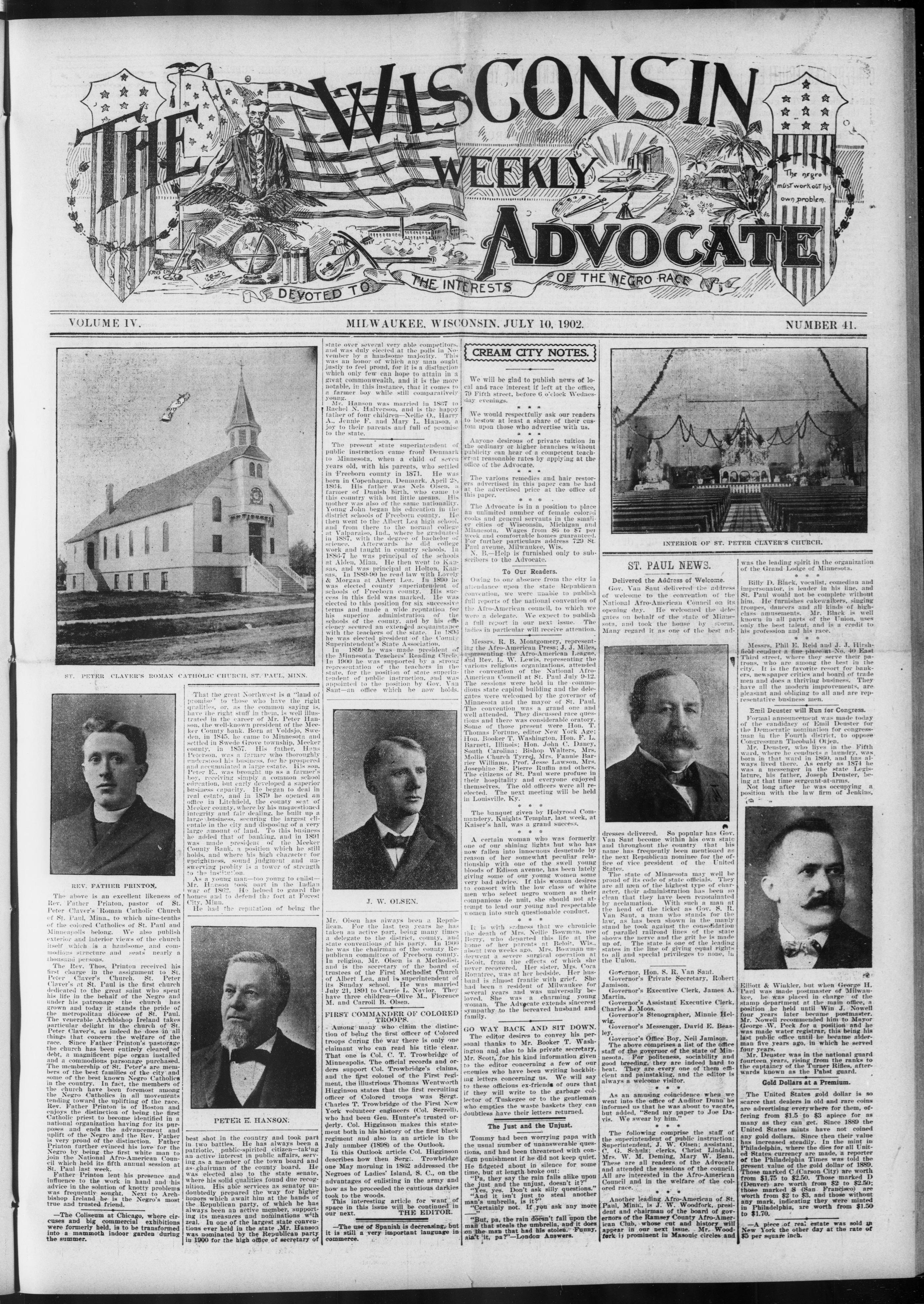
ST. PETER CLAVER'S ROMAN CATHOLIC CHURCH, ST. PAUL, MINN.
VOLUME IV.
ST. PETER CLAVER'S ROMAN C
P.
REV. FATHER PRINTON.
The above is an excellent likeness of Rev. Father Printon, pastor of St. Peter Claver's Roman Catholic Church of St. Paul, Mina., to which nine-tenths of the colored Catholics of St. Paul and Minneapolis belong. We also publish exterior and interior views of the church itself which is a handsome and commodious structure and seats nearly a thousand persons.
The Rev. Thos. Printon received his first charge in the assignment to St. Peter Claver's Church. St. Peter Claver's at St. Paul is the first church dedicated to the great saint who spent his life in the behalf of the Negro and under his patronage the church has grown and today it stands the pride of the metropolitan diocese of St. Paul. The venerable Archbishop Ireland takes particular delight in the church of St. Peter Claver's, as indeed he does in all things that concern the welfare of the race. Since Father Printon's pastorage the church has been entirely cleared of debt, a magnificent pipe organ installed and a commodious parsonage purchased. The membership of St. Peter's are members of the best families of the city and some of the best known Negro Catholics in the country. In fact, the members of the church have been foremost among the Negro Catholics in all movements tending toward the uplifting of the race. Rev. Father Printon is of Boston and enjoys the distinction of being the first Catholic priest to become identified in a national organization having for its purposes and ends the advancement and uplift of the Negro and the Rev. Father is very proud of the distinction. Father Printon further evinced his love for the Negro by being the first white man to join the National Afro-American Council which held its fifth annual session at St. Paul last week.
Father Printon lent his presence and influence to the work in hand and his advice in the solution of knotty problems was frequently sought. Next to Archbishop Ireland he is the Negro's most true and trusted friend.
The Coliseum at Chicago, where circuses and big commercial exhibitions were formerly held, is to be transformed into a mammoth indoor garden during the summer.
That the great Northwest is a "land of promise" to those who have the right qualities, or, as the common saying is, have the right stuff in them, is well illustrated in the career of Mr. Peter Hanson, the well-known president of the Meeker County bank. Born at Voldsjo, Sweden, in 1845, he came to Minnesota and settled in Swede Grove township, Meeker county, in 1857. His father, Hans Peterson, was a farmer who thoroughly understood his business, for he prospered and accumulated a large estate. His son, Peter E., was brought up as a farmer's boy, receiving simply a common school education, but early developed a superior business capacity. He began to deal in real estate, and in 1879 he opened an office in Litchfield, the county seat of Meeker county, where by his unquestioned integrity and fair dealing, he built up a large business, securing the largest clientele in the city and disposing of a very large amount of land. To this business he added that of banking, and in 1891 was made president of the Meeker County Bank, a position which he still holds, and where his high character for uprightness, sound judgment and unswerving probity is a tower of strength to the institution.
As a young man—too young to enlist—Mr. Henson took part in the Indian war of 1862. He helped to guard the homes and to defend the fort at Forest City, Minn. He had the reputation of being the
[Name]
best shot in the country and took part in two battles. He has always been a patriotic, public-spirited citizen—taking an active interest in public affairs, serving as a member of the town board and as chairman of the county board. He was elected also to the state senate, where his solid qualities found due recognition. His able services as senator undoubtedly prepared the way for higher honors which await him at the hands of the Republican party, of which he has always been an active member, supporting its measures and nominations with zeal. In one of the largest state conventions ever held in the state, Mr. Hanson was nominated by the Republican party in 1900 for the high office of secretary of
state over several very able competitors, and was duly elected at the polls in November by a handsome majority. This was an honor of which any man ought justly to feel proud, for it is a distinction which only few can hope to attain in a great commonwealth, and it is the more notable, in this instance, that it comes to a farmer boy while still comparatively young. Mr. Hanson was married in 1867 to Rachel N. Halverson, and is the happy father of four children—Nellie O., Harry A., Jennie F. and Mary L. Hanson, a joy to their parents and full of promise to the state.
The present state superintendent of public instruction came from Denmark to Minnesota, when a child of seven years old, with his parents, who settled in Freeborn county in 1871. He was born in Copenhagen, Denmark, April 25, 1864. His father was Nels Olsen, a farmer of Danish birth, who came to this country with but little means. His mother was also of the same nationality. Young John began his education in the district schools of Freeborn county. He then went to the Albert Lea high school, and from there to the normal college at Valparaiso, Ind., where he graduated in 1887, with the degree of bachelor of science. Afterwards he did college work and taught in country schools. In 1886-7 he was principal of the schools at Alden, Minn. He then went to Kansas, and was principal at Holton, Kansas. In 1889-90 he read law with Lovely & Morgan at Albert Lea. In 1890 he was elected county superintendent of schools of Freeborn county. His success in this field was marked. He was elected to this position for six successive terms and made a wide reputation for his superior administration of the schools of the county, and by his efficiency secured an extended acquaintance with the teachers of the state. In 1896 he was elected president of the County Superintendent's State Association.
In 1899 he was made president of the Minnesota Teachers' Reading Circle. In 1900 he was supported by a strong representation of the teachers in the state, for the position of state superintendent of public instruction, and was appointed to the position by Gov. Van Sant—an office which he now holds.
[Name]
J. W. OLSEN.
Mr. Olsen has always been a Republican. For the last ten years he has taken an active part, being many times a delegate to the district, county, and state conventions of his party. In 1900 he was the chairman of the county Republican committee of Freeborn county. In religion, Mr. Olsen is a Methodist, and is the secretary of the board of trustees of the First Methodist Church of Albert Lea, and is superintendent of its Sunday school. He was married July 21, 1891 to Carrie L. Navlor. They have three children—Olive M., Florence M. and Carroll B. Olsen.
FIRST COMMANDER OF COLORED TROOPS
Among many who claim the distinction of being the first officer of Colored troops during the war there is only one claimant who can read his title clear. That one is Col. C. T. Trowbridge of Minneapolis. The official records and orders support Col. Trowbridge's claims, and the first colonel of the First regiment, the illustrious Thomas Wentworth Higginson states that the first recruiting officer of Colored troops was Sergt. Charles T. Trowbridge of the First New York volunteer engineers (Col. Serrell), who had been Gen. Hunter's trusted orderly. Col. Higginson makes this statement both in his history of the first black regiment and also in an article in the July number (1898) of the Outlook.
In this Outlook article Col. Higginson describes how then Sergi. Trowbridge one May morning in 1862 addressed the Negroes of Ladies' Island, S. C., on the advantages of enlisting in the army and how as he proceeded the cautious darkies took to the woods.
This interesting article for want of space in this issue will be continued in our next. THE EDITOR.
The use of Spanish is decreasing, but it is still a very important language in commerce.
CREAM CITY NOTES.
We will be glad to publish news of local and race interest if left at the office, 79 Fifth street, before 6 o'clock Wednesday evenings.
We would respectfully ask our readers to bestow at least a share of their custom upon those who advertise with us.
Anyone desirous of private tuition in the ordinary or higher branches without publicity can hear of a competent teacher at reasonable rates by applying at the office of the Advocate.
The various remedies and hair restorers advertised in this paper can be had at the advertised price at the office of this paper.
The Advocate is in a position to place an unlimited number of female colored cooks and general servants in the smaller cities of Wisconsin, Michigan and Minnesota. Wages from $6 to $7 per week and comfortable homes guaranteed. For further particulars address 729 St. Paul avenue, Milwaukee, Wis.
N. B.—Help is furnished only to subscribers to the Advocate.
To Our Readers.
Owing to our absence from the city in attendance upon the state Republican convention, we were unable to publish full reports of the national convention of the Afro-American council, to which we were a delegate. We expect to publish a full report in our next issue. The ladies in particular will receive attention.
Messrs. R. B. Montgomery, representing the Afro-American Press; J. J. Miles, representing the Afro-American League, and Rev. L. W. Lewis, representing the various religious organizations, attended the convention of the National Afro-American Council at St. Paul July 9-12. The sessions were held in the commodious state capitol building and the delegates were welcomed by the governor of Minnesota and the mayor of St. Paul. The convention was a grand one and well attended. They discussed race questions and there was considerable oratory. Some of those present were Hon. T. Thomas Fortune, editor New York Age; Hon. Booker T. Washington, Hon. F. L. Barnett, Illinois; Hon. John C. Dancy, South Carolina; Bishop Walters, Mrs. Mollie Church Tyrrel, Mrs. Fannie Barrier Williams, Prof. Jesse Lawson, Mrs. Josephine St. Pierre Ruffin and others. The citizens of St. Paul were profuse in their hospitality and everyone enjoyed themselves. The old officers were all re-elected. The next meeting will be held in Louisville, Ky.
* * *
The banquet given by Holyrood Commandery, Knights Templar, last week, at Kaiser's hall, was a grand success.
* * *
A certain woman who was formerly one of our shining lights but who has now fallen into innocuous desuetude by reason of her somewhat peculiar relationship with one of the swell young bloods of Edison avenue, has been lately giving some of our young women some very bad advice. If this woman desires to consort with the low class of white men who select negro women as their companions de nuit, she should not attempt to lead our young and respectable women into such questionable conduct.
* * *
It is with sadness that we chronicle the death of Mrs. Nellie Bowman, nee Berry, who departed this life at the home of her parents at Beloit, Wis., about two weeks ago. Mrs. Bowman underwent a severe surgical operation at Beloit, from the effects of which she never recovered. Her sister, Mrs. Cora Rountree, was at her bedside. Her husband is almost frantic with grief. She had been a resident of Milwaukee for several years and was universally beloved. She was a charming young woman. The Advocate extends sincerest sympathy to the bereaved husband and family.
GO WAY BACK AND SIT DOWN. The editor desires to convey his personal thanks to Mr. Booker T. Washington and also to his private secretary, Mr. Scott, for his kind information given to the editor concerning a few of our enemies who have been writing backbiting letters concerning us. We will say to these officious ex-friends of ours that if they will write to the garbage collector of Tuskegee or to the gentleman who empties the waste baskets they can doubtless have their letters returned.
The Just and the Unjust.
Tommy had been worrying papa with the usual number of unanswerable questions, and had been threatened with condign punishment if he did not keep quiet. He fidgeted about in silence for some time, but at length broke out:
"Pa, they say the rain falls alike upon the just and the unjust, doesn't it?"
"Yes, yes. Don't ask silly questions."
"And it isn't just to steal another man's umbrella, is it?"
"Certainly not. If you ask any more"
"But, pa, the rain doesn't fall upon the man that steals the umbrella, and it does on the man that had his stolen. Funny, ain't it, pa?"—London Answers.
LA SAINTE MARIE DE L'ANSE
INTERIOR OF ST. PETER CLAVER'S CHURCH.
ST. PAUL NEWS.
Delivered the Address of Welcome. Gov. Van Sant delivered the address of welcome to the convention of the National Afro-American Council on its opening day. He welcomed the delegates on behalf of the state of Minnesota, and took the house by storm. Many regard it as one of the best ad-
M. B.
dresses delivered. So popular has Gov. Van Sant become within his own state and throughout the country that his name has frequently been mentioned as the next Republican nominee for the office of vice president of the United States.
The state of Minnesota may well be proud of its code of state officials. They are all men of the highest type of character, their administration has been so clean that they have been renominated by acclamation. With such a man at the head of the ticket as Gov. S. R. Van Sant, a man who stands for the law, as has been shown in the manly stand he took against the consolidation of parallel railroad lines of the state shows the nerve and the grit he is made up of. The state is one of the leading states in the line of giving equal rights to all and special privileges to none, in the Union.
Governor, Hon. S. R. Van Sant.
Governor's Private Secretary, Robert Jamison.
Jamison. Governor's Executive Clerk, James A. Martin.
Governor's Assistant Executive Clerk Charles J. Moos.
Charles J. Moos.
Governor's Stenographer, Minnie Helwig.
Governor's Messenger, David E. Beasley.
Governor's Office Boy, Neil Jamison.
The above comprises a list of the office staff of the governor of the state of Minnesota. For politeness, sociability and good breeding, they are indeed hard to beat. They are every one of them efficient and painstaking, and the editor is always a welcome visitor.
* * *
As an amusing coincidence when we went into the office of Auditor Dunn he informed us that he was about to vacate, but added, "Send my paper to Joe Davis. We swear by him."
The following comprise the staff of the superintendent of public instruction: Superintendent, J. W. Olsen; assistant, C. G. Schulz; clerks, Christ Lindahl, Mrs. W. M. Deming, Mary W. Bean. These are all readers of the Advocate and attended the sessions of the council. All are interested in the Afro-American Council and in the welfare of the colored race.
Another leading Afro-American of St. Paul, Minni., is J. W. Woodfork, president and chairman of the board of governors of the Ramsey County Afro-American Club, whose cut and history will appear in our next issue. Mr. Woodfork is prominent in Masonic circles and
---
* * *
was the leading spirit in the organization of the Grand-Lodge of Minnesota.
* * *
Billy D. Black, vocalist, comedian and impersonator, is leader in his line, and St. Paul would not be complete without him. He furnishes cakewalkers, singing troupes, dancers and all kinds of high-class amusements. Mr. Black is well known in all parts of the Union, uses only the best talent, and is a credit to his profession and his race.
Messrs. Phil E. Reid and J. J. Hirshfield conduct a fine place at No. 40 East Third street, where they serve their patrons, who are among the best in the city. It is the favorite resort for bankers, newspaper critics and board of trade men and does a thriving business. They have all the modern improvements, are pleasant and obliging to all and are representative business men.
Emil Deuster will Run for Congress.
Formal announcement was made today of the candidacy of Emil Deuster for the Democratic nomination for congressman in the Fourth district, to oppose Congressman Theobald Otjen. Mr. Deuster, who lives in the Fifth ward, where he conducts a laundry, was born in that ward in 1860, and has always lived there. As early as 1874 he was a messenger in the state Legislature, his father, Joseph Deuster, being at that time sergeant-at-arms. Not long after he was occupying a position with the law firm of Jenkins,
J. H.
Elliott & Winkler, but when George H. Paul was made postmaster of Milwaukee, he was placed in charge of the stamp department at the main office, a position he held until Win J. Nowell four years later became postmaster. Mr. Nowell recommended him to Mayor George W. Peck for a position and he was made water registrar, this being his last public office until he became alderman five years ago, in which he served four years.
Mr. Deuster was in the national guard fourteen years, rising from the ranks to the captaincy of the Turner Rifles, afterwards known as the Pabst guard.
Gold Dollars at a Premium.
The United States gold dollar is so scarce that dealers in old and rare coins are advertising everywhere for them, offering from $1.5 to $3 apiece for as many as they can get. Since 1889 the United States mints have not coined any gold dollars. Since then their value has increased steadily. In the mint in Philadelphia, where the dies for all United States currency are made, a reporter of the Philadelphia Times was told the present value of the gold dollar of 1889. Those marked C (Carson City) are worth from $1.75 to $2.50. Those marked D (Denver) are worth from $2 to $2.50; those marked S (San Francisco) are worth from $2 to $3, and those without any mark, indicating they were minted in Philadelphia, are worth from $1.50 to $1.70.
-A piece of real estate was sold in New York the other day at the rate of $5 per square inch.
CONFERENCES FRUITLESS.
Railway Managers Willing to Yield but Repudiate the Union.
THE PEACE PLANS FAIL.
When Told that Terms are Subject to Approval by Union the Negotiations are Dropped.
Chicago, Ill., July 9.—At noon today indications were that the conferences arranged to take place between the railroads and committees from the warehouses would fail to bring about peace in the freight handlers' strike.
Committees were appointed this morning to confer with the managers or superintendents of the respective roads. They were not prepared, however, to make a final settlement, that being reserved for the union as a whole. The Rock Island, the Lake Shore, the St. Paul and the Monon officials refused to treat with the men on this basis. At the offices of each of these roads propositions for a settlement were made, but when the men said the matter would have to be approved by the executive committee of their union the managers declared the conference at an end. The conference between officials of the Illinois Central and the strikers was still on at noon.
As the railroads all along have insisted that any settlement must be made with their own men alone, it is thought that all the other conferences on now will terminate as have the ones mentioned.
At 1 p. m. General Manager Gardner of the Chicago & North-Western, reported that the conference with his men had terminated in an agreement, the men stating that they had the right to make a settlement. The Chicago, Burlington & Quincy and the Chicago & Alton conferences at the hour named were still on, the hitch, it was said, being over the statements by the committees that any terms agreed upon would not be binding unless ratified by the executive committee of the union.
Developments Summarized.
Secretary E. L. Turley of the National Teamsters' Union warned teamsters to take no part in the strike.
Six companies filled freight houses with men shipped in from other points.
Wholesale houses reported freight shipments from 20 to 70 per cent. lighter than they would have been had no strike been called.
Forty negroes, imported by the Chicago & Alton, deserted on appeal of pickets. Five railroads placed dining and sleeping cars on sidetrack for accommodation of their employees. Crowd of pickets angered by importation of men was dispersed by police at Taylor street and Fifth avenue. Illinois Central and Chicago & North-Western officials announced that they had more men than were employed when the strike was ordered. Lake steamer lines refused to take freight consigned to interior points which they do not usually handle. South Water street merchants obtained supplies and the threatened famine in food is not imminent. Erie liner Conestoga cleared from Chicago for Buffalo by way of Milwaukee without cargo, because railroads were unable to deliver freight at docks.
Scores of truck teamsters demanded instructions from their officers at headquarters and were told to haul freight as usual. Pickets were withdrawn from some of the freight houses pending the conferences to be held today. All the roads announced last night that they would receive freight today.
Shippers and the large firms about town found things in better shape at the freight houses today and were enabled to secure freight and deliver goods for shipment on the various lines of railway as was usual before the strike began.
Asked to Fill Strikers' Places.
Babcock, Wis., July 9.—[Special.]—A call has been made upon some of the employees of the Chicago, Milwaukee & St. Paul Railway Company of this division to go to Chicago, and temporarily take the place of the strikers at the freight houses. As a rule the call meets with objection.
Miners' Chief Confident of Success.
Nanticoke, Pa., July 9.—President Mitchell of the United Mine Workers came here from Wilkesbarre today and addressed the delegates of District No. 1, who are now in annual convention here. He said in conclusion: "In all my experience in the labor movement, I have never participated in a strike in which I felt so confident of success. If our membership will stand as I know they will we shall in the not distant future achieve a victory and shall settle for all time the right of the coal miners to receive for honest labor and unremitting toil at least a sufficient wage to enable them to live, maintain and educate their families and enjoy a few of the pleasures of our civilization."
STRIKE AT CORLISS
Twenty-five Imported Freight Handlers Refuse to Continue Work
Racine, Wis., July 9.—[Special.]— Twenty-five of the 150 men brought to Corliss to transfer merchandise from one car to another to be shipped directly through Chicago refused to go to work this morning and the railroad officials, fearing that other men would leave or that freight handlers who are on a strike would reach Corliss at 9 o'clock this morning and seek to get others to leave their work, ordered all the men into the freight cars which are used as lodging places and the train was backed to Sylvania, a station three miles west of Corliss. As soon as clerks and checkers arrive from Milwaukee and Chicago the train will be brought in and the men put to work.
On one side of a platform 460 feet long are many cars loaded with merchandise for Eastern points and all brought to Corliss from Western avenue. Merchandise will be transferred night and day into cars across the platform. Telegraph operators are there with offices in a box car and with two switch engines the railroad officials expect to defeat the Chicago freight handlers, now on a strike. Another platform is to be built opposite the present one and men are now at work on it. The officials state that unless a settlement is made with the strikers hundreds of cars of merchandise will be brought to Corliss daily and transferred.
CLOSE FAIR ON SUNDAY.
Directors of St. Louis Exposition Adopt Formal Resolution to that Effect.
St. Louis, Mo., July 9.—The board of directors of the Louisiana Purchase Exposition adopted a resolution that during the whole duration of the exposition the gates shall be closed to visitors on Sundays. After the meeting a telegram was sent to Secretary of the Treasury Shaw, at Washington, notifying him that the Sunday closing resolution as forwarded by the treasury department had been adopted.
HOD TAYLOR TO GO
Secretary Shaw is Making Arrangements to Swing His Axe in the Treasury Department.
Washington, D. C., July 9.—Secretary Shaw has defined one policy in his administration of the treasury department, which is that the usefulness of every officer of the department must, of necessity, have become seriously impaired after a period of four or five years. No secret is made of this belief on the part of Mr. Shaw. An intimation of it was given as early as April, when it became known that within a few months Assistant Secretary Spaulding, who is in charge of the customs administration, would have to make way for a successor.
Gen. Spaulding has held the office for five years, and, according to Mr. Shaw, has outlived his usefulness in the department, not from any fault of his own, but simply because no federal officer can continue to act with the same efficiency after the lapse of a few years.
Resignation Acceptable.
The same rule is being made to apply to Assistant Secretary Taylor, who has charge of the administration of the immigration laws, public buildings and other important matters in the treasury department. It has been an open secret for several weeks that Mr. Taylor would within a few months receive an intimation that his resignation would be acceptable to Mr. Shaw. The resignations in the cases of the assistant secretaries would, of course, go to the President, for these officers are appointed by the President, but it has been generally understood that President Roosevelt would allow Secretary Shaw to arrange the personnel of the treasury according to his own ideas of sound and efficient administration.
Assistant Secretary Ailes probably will continue to hold his place, for he has been in office only a little more than a year, and therefore has not reached the point where his term of usefulness can be said to have ended.
Slated for Dismissal.
At least two or three division and bureau chiefs are believed slated for dismissal, and in all cases these are men who have held their present positions for four years or more. Mr. Shaw was quoted recently as saying he believed Secretary Gage, Assistant Secretary Spaulding and Assistant Secretary Taylor should have been superseded at the end of their four years' term. He recommended the removal of T. V. Powderly, commissioner of immigration, and carried his point, although strong influences were used to secure Mr. Powderly's retention.
It has been said that George E. Roberts, director of the mint, would resign some time during the summer, but Mr. Roberts will neither deny nor affirm the report.
BOW NEARLY CUT OFF.
Fa. River (Seamer Priscilla in Collision with the Powhattan—Passen-
Newport, R. I., July 9.—The Fall River line steamer Priscilla is at her pier in this city with a big hole in her port bow and one of her crew dead, due to a collision with the Merchants and Miners' Transportation Company's steamer Powhattan, in Narragansett bay last night, in a fog. The victim was John Muniz, a Portuguese deckhand. Beside him no one was injured. The Priscilla was struck fair by the Powhattan and her bow was nearly cut off. The stem of the latter penetrated fully 20 feet into the hull of the Priscilla. The inflow of water very soon extinguished the electric lights, and the passengers, most of whom were in bed, were turned out of their rooms in darkness. Their nervousness was intensified as they found the men on the ship passing out life preservers by candlelight. There was no panic, although no help was in sight and the steamer was apparently in great need.
RIVERS RISE RAPIDLY.
Flood Situation in Iowa is Very Serious Lowlands are Submerged and Bridges in Danger.
Des Moines, Ia., July 9.—The flood situation in Iowa is more serious than at any time in ten years. The Des Moines, Ia, Raccoon, Cedar and Skunk rivers are from 7 to 15 feet above low water mark and the lowlands are submerged. Hundreds have been made homeless. In Des Moines 200 persons have already been forced to abandon their homes and have suffered the loss of horses, cattle and hogs. At Des Moines and elsewhere throughout the central section of the state continued rain has fallen for twenty-four hours, the precipitation at Boone and Fort Dodge being reported as nearly 4 inches.
Rivers continue to rise rapidly and are filled with driftwood. False work on a concrete bridge has gone out here and two other bridges are in danger. A bridge across the Des Moines river near Boone is reported to have gone out. Levees in Des Moines are weakening and if a break occurs hundreds of acres of residential property will be flooded.
DISASTROUS FIRE IN DALLAS, TEX.
Dallas, Tex., July 9.—Fire this morning completely destroyed the wholesale drug houses of Patton, Worsham Company; Texas Drug Company; J. W. Crow Drug Company and H. W. Williams & Co. The wholesale paper house of Scarff & O'Connor was badly wrecked and considerable damage was done to the Santa Fe depot. The loss will reach $225,000 to $250,000, insurance about $175,000.
DEATH OF A FAMOUS HORSE.
Linden Tree, Given to Gen. Grant by Sultan. Liver Thirty-three Years.
Omaha, July 9.—Linden Tree, the fine Arabian horse presented by the Sultan of Turkey to Gen. Grant, died at the farm of Gen. L. W. Colby of Beatrice, Neb., aged 33 years. Gen. Grant met the Sultan of Turkey during his tour around the world, and on his return home the Sultan sent him the finest specimen of the pure Arabian horse that was to be obtained. The horse later was purchased by Gen. Colby of Beatrice. He was used as a saddle animal for several years, but since he became too old to be of practical value has been tenderly cared for.
WRECKED THE JAIL.
Prisoners Explode Dynamite but are Covered with Winchesters.
St. Joseph, Mo., July 9.—Prisoners in the St. Joseph jail exploded dynamite in the structure, wrecking the rear wall and shattering windows of the court house adjoining. None of the prisoners escaped. Pandemonium reigned in the jail. Deputies with Winchesters are keeping the prisoners back.
GET TWENTY-FIVE YEARS.
Jessie Morrison, Convicted of Murder, is Sentenced.
NEW TRIAL OVERRULED
Eldorado, Kas., July 8.—Jessie Morrison, convicted June 28 of murder in the second degree for killing Mrs. Olin Castle at the latters home here in June, 1900, by cutting her throat with a razor, was today sentenced to twenty-five years in the penitentiary. Motion for a new trial was overruled. Miss Morrison, who has gone through three trials, took the sentence with little show or demonstration. The case will be appealed to the state supreme court. At her second trial Miss Morrison was given but five years.
Rivalry of Two Women.
The rivalry of two "girls," one of them 30 years old and the other 26, for the love of a boyish young man of 24, was at the bottom of this sensational tragedy. Olin Castle was a clerk in the Racket store. Jessie Morrison was also a clerk in the Racket store. Her tender regard for her fellow clerk, Olin Castle, was no secret. For two years or more Olin Castle "kept company" with her, seeming to prefer her to Miss Morrison. On June 13—unlucky day—Olin Castle and Clara Wiley were married.
The wedding passed off smoothly enough, and eight days later there was a reception given by the parents of the groom. The next morning Castle went to the store about 6:30 o'clock, as was his wont. At 9 o'clock came a message that his wife had been murdered. He hastened home and found his bride of a week lying on the dining-room floor with her throat cut.
Caught Red-Handed.
Neighbors teid what they knew of the case. Mrs. E. R. Spangler called to neighbors across the street, and one of them—Mrs. Moberly—came over, broke open one of the screen doors and hastened to the dining room, where she saw Jessie Morrison, the defeated rival, standing over the prostrate form of the bride of a week, with a bloody razor in her hand.
It was thought that Mrs. Castle would die before sundown. She revived sufficiently in the afternoon to write an ante-mortem statement, accusing Jessie Morrison.
Miss Morrison claimed she had acted in self-defense.
WEST CALLS FOR MONEY.
Large Sums Shipped from New York to Chicago, St. Louis and Other Points.
New York, July 8.—Movements of currency to Chicago, St. Louis and other Western money centers have in two days reached a phenomenal figure, considering that it is too early in the season for the regular demand for cash needed in crop movements. Currency to the amount of more than $1,050,000 was shipped West from New York on Saturday and Monday, and the incident is sufficiently extraordinary to have arduous comment in financial circles. Further requisitions upon New York are expected by those who have studied the situation in the West the most carefully.
"We have the largest amount of currency on hand that we have ever held." said Cashier Kilborn of the National City Bank, "and it was just in anticipation of this demand that I planned for the large holding. Our people here laughed at me, but I felt sure there would be an early and large demand from the West. Chicago has been loaning money to New York, and now, as the season of crop movement approaches, she is preparing for large necessities. Instead of renewing loans she is calling for currency. That is the whole stary." Assistant Cashier Alexander of the National Bank of Commerce, which shipped $400,000 in currency to St. Louis, attributed the early call for money to the demand in many Western states for funds to finance large enterprises, and to the change in New York exchange rates, which have recently gone from 30 cents a thousand premium to 40 cents discount.
THE PANEL DISCHARGED.
Court Believed that Certain Jurors Were on Friendly Terms with Andrews' Associates.
Detroit, Mich., July 8.—Judge Alfred J. Murphy of the recorder's court created a sensation in the early proceedings today for the trial of Frank C. Andrews, former vice president of the wrecked City Savings Bank, which began this morning, by dismissing the entire panel of jurors drawn for the July term of court.
Judge Murphy said in explanation of his action he had receive certain information affecting members of the jury and he considered it proper in the interests of justice to discharge the entire panel summoned for the rest of the term.
While it has not been developed in court, it has been rumored that several of the men on the jury were very friendly with some of Frank C. Andrews' close political associates.
Andrews' attorneys announced that the ruling of the court in regard to the jurors took them by surprise and entered an exception. Attorney Baker then moved to quash the charge against Andrews on the ground that the prosecution had not set up a proper case.
S. W. DORSEY MARRIES.
Former Senator United to Miss Laura Bigelow in New York.
New York, July S.—Former Senator Stephen W. Dorsey of Arkansas was married to Miss Laura Bigelow at Grace Church by Rev. Dr. William K. Huntington. Mrs. Bigelow, widow of John Bigelow, who was financial agent of the United States government in London for twenty years, gave the bride away. The ceremony was witnessed by a few relatives. After a tour of European cities Mr. and Mrs. Dorsey will make their home at Los Angeles, Cal.
PRESENTED TO THE POPE.
Answer of Committee of Cardinals on Subject of Friars' Lands.
Rome, July 8.—The answer of the committee of cardinals to Gov. Taft's recent note on the subject of the friars' lands in the Philippine islands was presented to the Pope this morning by Cardinal Rampolla, the papel secretary of state. The pontiff expressed his pleasure at the celerity with which the business had been dispatched and said, jestingly: "We are teaching the Americans the renowned art of hustling." The answer will be translated into French and will be printed.
OUTLAW ESCAPES
Officers Had Tracy Definitely Located, but He Plunged Into Brush and Got Away.
Seattle, Wash., July 9.—Harry Tracy, the fugitive convict outlaw, has for the fourth time since his arrival at Meadow Point, escaped from the officers. Tracy was definitely located in the home of Charles Gerrels, one mile north of the town of Renton at 2 o'clock yesterday afternoon.
At 4:45 o'clock Deputy Sheriff Cook arrived with a fraction of the posse and advanced up the track towards Gerrels' home. Tracy stood in the rear of the premises and overheard a conversation between one of the women inmates of the house and two young men from Renton, and then the convict plunged into the brush and was lost to view. When Tracy disappeared from the Gerrel's home, the bloodhounds were hastily brought up from the rear and turned loose on the hot scent. Both dogs struck the trail down the stream, following it for a quarter of a mile and crossing the track only to double back and swim the river.
Half way between Cedar river and Burroughs' boathouse both dogs ran into cayenne pepper sprinkled in the outlaws' retreating footsteps. Their nostrils were filled with the fiery substance, and fully ten minutes were lost in relieving the dogs so that they could again exercise their powers of smell. Pressed to desperation Tracy made a circuit, headed due north and plunged into the outskirts of the lake, where he finally succeeded in casting the scent. It was now dark and Guard Carson returned to Renton.
Posse in Close Pursuit.
A messenger from Black River Junction, ten miles from here, said Tracy was seen in a hop-drying house near there just before 8 o'clock. Hundreds of armed men are in the vicinity. Tracy was subsequently driven from the hop house and is going in the direction of the southern point of Lake Washington. The posse is close after him. Guard Carson with hounds and men has left Renton to intercept him.
PREVENTED A WRECK
Boy Uses Sister's Red Frock to Flag Train and Disaster is Thus Averted.
New York, July 9.—Eldridge Finkle, 15 years old, and his sister, 13, saved a train on the Poughkeepsie & Eastern railroad from being wrecked by flagging the locomotive just in time to prevent it from rolling upon spreading rails, which would have thrown the engine and six cars down a steep embrankment. The children were gathering raspberries near Boston Corners, Duchess county, and the boy noticed that the rails were spread. The girl wore a red fock and, as the children knew that the train was almost due, they had a hurried consultation on the track.
With the red dress in his hand the lad started up the track to meet the train. He had not gone 300 feet when it came along. It was a part of the road where fastest time is made and the train was running at about thirty-five miles an hour. The frantic waving of the red frock by the boy was enough to warn the engineer, and the brought his train to a standstill within a few feet of the dangerous trap.
BARN STRUCK BY STORM.
Mass of Machinery and Hay Falls to Basement and Causes Death of Two People.
St. Paul, Minn., July 9.—As a result of the terrific storm which prevailed south and east of Waseka, Minn., Saturday evening the family of Adam Bishman, Sr., is plunged into the grief of a tragic death in the family. Adam, Jr., his two sisters and the hired man were in the basement of the large barn attending to the milking when the storm burst in all its fury, the barn was torn asunder and the heavy mass of farm machinery and hay with which the upper floors of the barn were filled, crashed into the basement upon them. One of the daughters was killed instantly and Adam, Jr., was so crushed that he died from his injuries yesterday. The other two occupants were rescued from suffocation only after long hours of work by the neighbors. Eight head of horses and six head of cattle were also killed.
The damage was very heavy about Wanda and at Perham the storm leveled a circus tent, which caught fire from the lights. Several people were burned and bruised, but none fatally injured.
MANY PEOPLE DIE FROM EXTREME HEAT.
Pittsburg, Pa., July 9.—Six more victims of the heat were reported up to 1 o'clock, making eleven deaths since yesterday. The mercury was 88 degrees at 1 o'clock today. New York, July 9.—This was the hottest day of the year in this city. The weather bureau thermometer showed a temperature of 91 degrees at 1 o'clock and there was little or no breeze. Six deaths from the heat were reported during the morning.
KLONDIKE M'DONALD DEAD.
Pioneer of Frozen North Killed in New York Street Fight.
New York, July 9.—In an altercation in front of the Rossmore hotel, Broadway, near Forty-second street, a smooth-faced man, said to be James S. McDonald, the famous prospector who came back from the Klondike with $15,000,-000 and untold wealth in his claims, was injured so terribly that he died in the New York Hospital.
Klondike McDonald was a picturesque character, who, working as a miner at Aspen, Col., caught the Klondike gold craze at the right time and amassed a great fortune. His story was the sensation of the day. He rode in a private car, was married with great ostentation and was then forgotten.
LONGER LIFE FOR THOMBS.
Governor Grants a Respite TiM August 11 to Give Time for an Appeal.
Chicago, Ill., July 9.—Gov. Yates yesterday granted a respite until August 11 to Louis G. Thombs, sentenced to be hanged for murdering a woman on the steamer Peerless. The governor first granted stay of sentence until July 11, and now has extended it until August 11, to give time for an appeal to the supreme court.
DR. ADAMS OUT OF DANGER
Believed to be Recovering from His Serious Illness.
Redlands, Cal., July 9.—Dr. Charles Kendall Adams, former president of Wisconsin University, who is seriously ill in this city, was pronounced past the danger point by Dr. Norman Bridge of Los Angeles after a consultation.
TO SEIZE SUPPLIES
Force of Moros Plot to Make an Attack Upon Train Belonging to the Americans.
Manila, July 8.—News has reached here from Camp Vicars, Mindanao, to the effect that a strong force of Moros, including twenty-one riflemen, was out skirmishing to make an attack on a supply train. Troops with artillery were sent out and frustrated the attempt. The would-be ambushers were recognized by the friendly natives as part of the force of the Sultan of Bacolod, who is carrying on a successful agitation against the Americans in the country about Lake Lanao, and has sent a defiant ultimatum to the American commander.
The Moros in the towns of Masieu and Bacolod are growing more aggressive. Gen. Chaffee has advised Gen. George W. Davis to disregard the insulting letter received from the Sultan of Bacolod and to remain unaggressive unless attacked or an overt act is committed.
Fails to Prove Charges.
The investigation into the charges against American officers and troops made by Maj. Gardener, governor of Tayabas, was concluded yesterday. In response to the invitation extended by the court of inquiry to Maj. Gardener to submit proof of his charges as to the hostility of the military officials to the civil authority, the governor of Tayabas says it is unavailable. He thanks the court but refuses its offer for him to visit any part of the archipelago for the purpose of gathering information to substantiate his charges.
Accused Captain Wins a Point.
The court martial which is trying Capt. James A. Ryan of the Fifteenth cavalry on the charge of having been unnecessarily severe with the natives of the province where he was stationed has decided to exclude portions of Judge Rhode's report, which forms the basis of the charges against the officer, as not bearing on the specific charges against the captain. Judge Rhode was then excused and Capt. Ryan was called and began the defense of his conduct in administering Jiminez, Mindanao.
. Cholera on the Increase.
The cholera is slowly increasing here. The municipal board of health is cooperating with the insular health authorities and is preparing extraordinary plans for the destruction of the filthy districts of Manila and the removal of 40,000 persons to suburban sanitary camps.
DODGE THE OLEO LAW.
Vegetable Coloring Matter Used or Artificial Color Sold Separately— Palm Oil to be Used.
Washington, D. C., July 8.—Oleomargarine manufacturers threaten to defeat the object of the dairymen and the will of Congress, as expressed in the bill which passed at the last session taxing "artificially" colored oleo and process and renovated butler. The commissioner of internal revenue, who is intrusted with the enforcement of the law, finds that he will be restricted to its letter, and that the manufacturers, by using natural vegetable products, can give oleo a shade of yellow without subjecting their output to the prohibitive tax of 10 cents a pound imposed upon oleo "artificially" colored in imitation of butter. One of the largest concerns in Chicago manufacturing oleomargarine has struck another method of evading the law. Instead of giving their product a butter color by the use of vegetables they intend to furnish with each package of the uncolored oleo a little pellet, with instructions for using it. The housekeeper purchases the uncolored oleo and receives the pellet, and in the quiet of her homeside proceeds to give the oleo a butter color. Palm oil, a pure vegetable oil, said to be more nutritious and cheaper than cotton seed oil, rich yellow in color, which will impart a beautiful yellow to oleo, will probably be extensively used in giving it a butterlike color without enabling the commissioner of internal revenue to tax it 10 cents a pound. Commissioner Yerkes frankly confesses that he is unable to see how he can prevent the spirit of the law being violated. The law is clear and explicit, and unless some "artificial" ingredient is used to color the oleo he can only tax it one-fourth of a cent a pound.
MEN TERRIBLY BURNED BY DYNAMITE EXPLOSION
Pittsburg, Pa., July 8.—A premature explosion of dynamite in a blast furnace slag dump near Duquesne, Pa., today killed one man and dangerously injured four others. All were workmen engaged in the blasting of the slag. George Dezuka, aged 28 years, was literally torn to pieces.
The injured men were all terribly burned and are in a serious condition. Their names are: James Clemming, foreman; John Corlass, Vincent Archer and Michael Skellish. It is believed that the heat from the slag caused the explosion.
TWO BOYS ARE DROWNED
One was Rocking the Boat and Finally Upset the Craft.
Peoria, Ill., July 8.—Frank Cannon yesterday afternoon dragged Frank Case to death with him. They and two others went boating on the Illinois river, near the south end of the city. Case disrobed to take a swim and began rocking the boat. Cannon begged him to desist, as he could not swim, and the more Cannon begged the harder Case rocked. Finally he upset the boat, dumping all four into the river. As Cannon was about to sink he threw both arms around the neck of Case and resisted all efforts to dislodge him. Both were drowned, and when their bodies were recovered an hour later Cannon still had Case clasped around the neck. William Auer and Joseph Blondell, in the boat at the time it overturned, swam to shore, but could not assist their companions. All were about 15 years of age.
A Bath on the Prairie.
Col. Harry Hall of Washington says that on a journey across the prairies he stopped with a farmer for the night. He asked if he could have a bath, for he was dusty and travel-stained. "Certain." replied the farmer. Then he shouted to his son: "Jim, get the fixin's for a bath for this yer gent."
Jim came back with a towel, a chunk of soap and a pickaxe. "What's the pickaxe for?" asked Hall. "Oh." said Jim, "you'll have to dam up the crick."
Jacko Hilligan of Jersey City is still leading the Eastern Leaguers with the excellent average of .389. Halligan is the only batter having more than 75 safeties, his nearest competitors being Clancy of Worcester, with 73, and Brain of Buffalo, with 69. During the last week Griffin made rapid strides and is now among the batsmen of the Eastern League. He is the only Newark representative among the 300 batsmen.
—Fred Bunting, aged 3, was struck by lightning and fatally burned.
—Emil Vondrasck, aged 11, and Frank Jason, aged 9, were drowned at Gougar's park, two miles above Kankakee.
—Edward Dermott, aged 45, was prostrated by heat and died on the way to the county hospital.
—John Formellom, 14 years old, who was bitten by a dog in front of his home, died of hydrophobia at the county hospital.
—Lightning killed Hubert P. Tobin and caused burning of the American Malting Company building in Leavitt street.
—Mrs. Burnett W. Pyle found her husband, who disappeared twenty-two years ago, dead from a wound self-inflicted at Garfield Park sanitarium.
James Reddick, clerk of the probate court, is still confined to his home and bed. His physicians say that he cannot leave bed before two weeks.
Theodore Oelfeuer, who murdered his wife and wounded his baby and stepdaughter, committed suicide by hanging in Canalport avenue police station.
David Haas, 19 years old, of Percy, Pa., fell from a Lake Shore & Michigan Southern railroad freight train and sustained injuries which may cause his death.
To save Michael McCaffery from unjust punishment for the Webster Adams murder, Herman Eichendorf and Michael O'Hara surrendered to police and confessed.
—In escaping from a fire in his home Harry Baxton, a blacksmith, was badly bruised about the body by jumping from a second story window. The loss is estimated at $1000.
John Coltor, chief train dispatcher of the Douglas park division of the Metropolitan elevated railroad, was killed by slipping on a live rail when hurrying to get away from threatening lightning.
Christian Meier has been appointed city civil service commissioner to succeed Robert Lindblom. George J. Thompson, union cigarmaker, has been appointed a school trustee. Father Heldman was made a library board member.
LATEST MARKET REPORTS.
MILWAUKEE, JULY 9, 1902. EGG AND DAIRY PRODUCTS.
MILWAUKEE—Eggs—Market very firm; fresh, loss off, cases included, 17½c; fresh, cases returned, 17c; seconds, 15@16c. Receipts were 554 cases.
Butter — Market firm; fancy prints, 21½c; fancy or extra creamery, per lb, 21c; firsts, 20c; seconds, 16@17c; dairy prints, 18½c; extra fancy dairy, 17½c; lines, 14½c@15½c; roll, 14½c@15½c; packing stock, 13@14c; whey, 9c; grease, 4@3c. The receipts today were 36,693 lbs against 11,590 yesterday. The receipts of creamery are accumulating while dairy cleans up rapidly on account of the improvement in quality. Fancy dairy will sell readily, and is preferred to choice creamery.
Cheese—Firm. The demand at present is good and the arrivals light. Off stock is especially slow sale. Receipts, 11,940 lbs today against 15,640 lbs yesterday. Full cream flats, fancy, 10@11c; good to choice, 8@9c; Young Americas, 11@12c; daisies, 11@11%c; fancy brick, 11@12%c; low grades, 9%@10%c; limburger, per lb. No. 1, 10%@11%c; low grades, 8@9c; imported Swiss, 25c; Block Swiss domestic, 12%@13%c; fancy loaf, 11%@12%c; No. 2, 8@9c; Sapsago, 20c.
CHICAGO—Butter—Firm; creamery, 10@21%c; dairies, 18@20c. Eggs—Firm; loss off, 17%@18c. Cheese—Unchanged; twins, 10@10%c; daisies, 10%@10%c; Young Americas, 10%c. Poultry—Firm; chickens, 11c; springs, 13@15c; turkeys, 12@13%c.
MILWAUKEE LIVE STOCK MARKET.
HOGS—Receipts, 6 cars; market 5c lower; light, 7.25@7.60; mixed and medium weights, 7.45@7.85; common to good packers, 7.10@7.60; selected heavy, 7.80@8.00. Pigs, 90 to 120 lbs, 5.75@6.50.
CATTLE — Receipts, 3 cars; steady; butchers' steers, medium to good, 1050 to 1300 lbs, 5.50@6.25; fair to medium, 950 to 1050 lbs, 4.25@5.00; heifers, common, 2.50@3.25; good, 4.25@5.00; cows, fair to good, 2.75@4.00; canners, 1.75@2.50; bulls, common, 2.50@3.00; choice, 3.25@4.25; feeders, 800 to 350 lbs, 3.50@4.00; stockers, 500 to 750 lbs, 2.75@3.25; veal calves, common, 5.25@5.75; choice, 6.00@6.50. Milkers—Common, 20.00@30.00; choice heavy, 40.00@55.00.
SHEEP—Receipts, 1 car; steady, 2.50@3.50; bucks, 2.25@3.00; spring lambs, 4.50@6.00.
Chicago receipts: Hogs, 30,000; cattle, 15.500; sheep, 15.000.
MARKETS BY TELEGRAPH
MILWAUKEE—Flour—Steady. Wheat —
Higher; No. 1 Northern, on track, 77½c;
No. 2 Northern, on track, 76½c. Corn —
Higher; No. 3 on track, 64c. Oats—Firm;
No. 2 white, on track, 53c; No. 3 white, on
track, 50@51c. Barley—Steady; No. 2 on
track, 71½c: sample on track, 65@71½c.
Rye—Firm; No. 1 on track, 58½c. Provisions
—Firm; pork, 18.42; lard, 10.97.
Flour market steady; patents, 3.90@4.00;
bakers', 2.90@3.00; rye, 3.00@3.10.
Millstuffs are steady and quoted at 16.25 for bran, 19.50 for standard middlings and 21.50 for Milwaukee flour middlings in 100 lb sacks; red dog, 22.50.
CHICAGO—Close — Wheat — July, 76c; September, 73%@73%c; December, 74%@74%c; May, 76%@76%c; Corn—July, 86c; September, 61%@61%c; December, 47%c; May, 44%c; Oats—July, 43%c; new, 49%c; September, 31%c; new, 34%c; December, 31%c; new, 34%@34%c; May, 36c; Pork—July, 18.47%; September, 18.60; January, 16.60; October, 18.10; Lard—July, 10.81%; September, 10.95; October, 10.87%; November, 10.20; December, 9.62%; January, 9.30@9.32%; May, 9.22%; Ribs—July, 10.65; September, 10.70; October, 10.50; January, 8.55.
NEW YORK—Wheat—July, 71c; September, 78%c; Corn—July, 70c; September, 64%c.
MINNEAPOLIS — Close — Wheat — July, 78%c; September, 72c; on track, No. 1 hard, 51c; No. 1 Northern, 79c; No. 2 Northern, 74%c.
DULUTH — Close — Wheat — Cash No. 1 hard, 78%c; No. 1 Northern, 76%c; No. 2 Northern, 74%c; No. 3 spring, 72%c; to arrive, No. 1 hard, 78%c; No. 1 Northern, 76%c; July, 76%c; September, 73%c; Manitoba No. 1 Northern cash, 76%c; No. 2 Northern, 74%c; Oats—September, 33%c; Rye—On track, 57c; September, 54c; Flax—Cash and on track, 1.56; cash N. W., 1.75; September, 1.41%; October, 1.36%; Receipts—Wheat, 73,941; shipments, 60,267.
KANSAS CITY — Close — Wheat — July, 69%c; September, 68%c; cash No. 2 hard, new, 70@72c; No. 2 red, new, 71%c; Corn—July, 62%c; September, 50%@51c; cash No. 2 mixed, 65%c; No. 2 white, 68%c; Oats—No. 2 white, 48@49c.
ST. LOUISE—Close—Wheat—Higher. No. 2 red, elevator, 72%c; July, 72%@72%c; September, 71%c; No. 2 hard, 75%@77c; Corn—Higher. No. 2 cash, 63%c; July, 63%c; September, 53%c; December, 41%@41%c; Oats—Higher. No. 2 cash, 52c; July, 37c; September, 29%c; No. 2 white, 56%c; Lead Deposit, 3.071; Speller—Easy, 4.90
TOLEDO—Wheat—Dull, strong; cash, 78c;
July, 77c; September, 76½c; December,
71½c; Corn—Dull, steady; cash, 65c; July,
65c; September, 61½c; December, 47½c;
Oats—Dull, strong; cash, 45½c; July, 43c;
September, 31½c; new July, 49c; new Sept-
ember, 35c. Clover seed—Dull, steady;
cash, 5.10; October, 5.15.
SOUTH OMAHA—Cattle—Receipts, 3000;
market, best stronger; others unchanged;
beef steers, 5.00@6.25; cows and heifers,
5.25@6.00; canners, 1.75@3.00; stockers and
feeders, 2.75@5.25. Hogs—Receipts, 3000;
market shade lower; heavy, 7.85@7.95;
mixed, 7.75@7.85; plugs, 6.50@7.50. Sheep—
Receipts, 4000; market steady, sheep, 3.50@
4.90; loepe, 5.75@5.90.
4.00, lambs, 3.10, 6.25
KANSAS CITY—Cattle—Receipts, 12.
000; market shade lower; slow; beef steers,
4.00@8.30; Texans, 3.25@4.80; cows and
heifers, 2.00@6.60; stockers and feeders,
4.55@3.25 Hogs—Receipts, 5000; market
steady to shade lower; heavy, 8.05@8.15;
packers, 7.95@8.10; medium, 7.85@8.00;
yorkers, 7.80@9.71; plugs, 7.50@7.75 Sheep—Receipts, 4000; market steady; sheep,
3.30@4.20; lambs, 4.60@6.25.
ST. LOUIS—Cattle—Receipts, 3000; market
firm, with Texans 10@16c higher; beef
steers, 4.00@7.75, top, 8.00; stockers and
feeders, 3.50@5.25; cows and heifers, 2.25@
5.50; Texas steers, 3.10@5.65; choice, 6.35
Hogs—Receipts, 3000; market firm; plugs,
7.25@7.75; packers, 7.75@7.90; butchers, 7.80@8.20; Sheep—Receipts, 2000; market active,
lambs lower, sheep stronger; sheep,
3.00@3.75; lambs, 5.00@6.75.
PEACE!
“Peace!” is the word, to the war-sweot
pelt, rE
Trat the galloping burghers bring.
“Peace!” is the cry in a tone heart-felt
From coster znd peer and king.
“Peace!” is the chorus—: mighty voice
Upraised in a ee 1efrain—
As nations, a world-wide throng, rejoice—
But the graves of the dead rematn.
Cheers from a myriad bursting throats
Greeting the welcome news.
Songs in a flood of thankful notes,
‘Till even the stones enthuse.
An end to the dread-pent day and sight,
‘An end to the long, long strain,
An end to the battle and march and flight—
But the graves of the dead remain.
The rifle is mute on the Lowldered top,
The evening lamplights giow:
The farmer thinks on a different crop
Than bullet and shell may sow.
Over the veldt, all silent, vast,
The vultures wheel in yaln.
‘The banquet of war is done, at last—
But the graves of the dead remain.
Mothers there are who n»w may sleep,
Nor dream of a moaniug poy?’ -
Wives who out of their ot weep;
Maidens who dance with joy.
But in many. a homestead tears art hot,
And many an English lane,
nee ee of the tidings peace comes
For the graves of the dead remain.
—Edwin L. Sabin in Leslie's Weekly.
REWARD OF THE FAITHFUL
A Dusky Tale of Love and Victory.
fhe casty Diace race ove aE ee
hole into which the iron digger dropped
with power, was as wooden as the oaken
handle of the tool itself, but the impas-
sive exterior was but as the ashes that
choke the mouth of the voleano—there
were fires of emotion within.
Ben's biue check sleeves were wet from
shoulder to wrist in the vehemence of his
exertions, but his hands could not keep
pace with the rush of his thoughts,
Herein lay his trouble: Lurinda, laun-
dress at Locust Hill, going hqme from
“meetin’ ” the evening before, had scorn-
fully refused (for the third time) to name
the day she would take him as her sec-
ond husband—and he had loved Lurinda
with the faithful love of a dull man long
before she married Shay Beazley—yel-
low-faced Shay—with whom she had led
anything but an easy life until a fatal
combination of whisky and pneumonia
made her a widow.
“Lurindy,” Ben had pleaded, “whuf
fuh yuh keep puttin’ me off dat way?
I’s wait en’ wait all de seben yeah yu
mah’ed tuh Shay. Now Shay been dead
en’ gone tuh glory dese two yeah, whuf
fuh yuh g’wine mek’ me wait any
longuh?”
And Lurinda, tall, stern, and gaunt as
a bear in spring, but to faithful Ben
all that was lovely and desirable, had
looked down from her superior physical
and mental heights to answer:
LURINDA’S REASONING.
“I’s ain’ g’wine fuhgit my duty-tuh de
dead tuh grat’fy de lub o” no libin’—naw
suh—I ain’ nigh got de slab obeh Shay.
nuh yit de coffin roun’ him paid fuh—
an’ ’twell dey paid fuh, tuh de las’ cent,
I ain’ g’wine let mahin’ come in my
hade?!”
Ben looked at the set jaw of his be-
trothed with a sinking heart. Well he
knew it would be many a day before
Lurinda couid spare enough from her
hard earnings to complete the payment
on the casket and the oaken slab over
Shay; she had the rent to pay and the
five children to feed. Yet he dared not
offer to help her, for had she not said,
time and again, that she would neyer
marry another man who could not give
her a home, and was he not depriving
himself of everything but ‘the bare neces-
sities, to make slow payments on the
house with the crooked chimuey at the
outskirts of Little Mason?
He said no more, but in humility and
dejection bade Lurinda goodnight at her
door,
“7? waited longah fur Lurindy dan
Jacob fur Rachel,” he mused, as the
iron cut into the yellow clay, “en’ Lawd
knows how much longah I's got tuh wait
wid de poss’bil’ty 0’ a fine ‘oman lak
huh, uh gettin’ uh bettuh chanst den
me.
The fence the heavy-hearted lover was
building lay between the mghwav and a
sloping pasture-field, in the upper corner
of which next the road was the negro
cemetery, protected by a tumble-down
“worm” fence from the encroachments
of the yellow Jerseys in the grass-field.
The railroad lay, hot and shining, in the
Indian summer sun across the southern
end of the field. A Jong freight train,
weighted with gray building-stone, tore
by, leaving a stream of sparks and smoke
in its wake.
Ben wiped away the sweat drops as
the stifling air grew hotter, but it was
not until the two Jersey cows, with bel-
Jows of fright, ran by him in a frantic
rush for the great ponds which lay be-
side the fence at the foot of the upward
slops, that he observed that the long, dry
grass, inflammable as tissue paper, was
a wall of flame. :
THE RESCUE OF THE SLAB,
His heart leapt in his throat. Shay’s
grave with its unpaid-for wooden marker
was in the rude cemetery on the hill,
close by the tumble-down fence with its
corners heaped with dry ieaves and dead
growth of goldenrod and -‘everlasting.”
If that slab was burned—goodby to his
hopes of Lurinda! He threw two quick
glance at the coming firecloud, then
looked toward the graveyard on the hill-
top. Could he make it?
Before three seconds were gone he had
dipped himself in the pond, and with his
ragged cap running rivers of waters and
bis dripping coat in his hand, was run-
ning like a mad thing up the road. The
hot air burned his cheeks and took his
breath when he reached Lurinda’s
mound, bnt with the energy of despera-
tion he wrenched the oak slab loose from
its foundation block and wrapped his wet
coat about it just as the fire leapt
through the fence and caught the ever-
lastings and the short grass on Shay’s
grave.
The stinging smoke choked and blinded
him—the scorching flames licked at his
hands, but he clasped his precious bur-
den hard and stumbled into the
road. Happily a dozen hurried steps
brought him to the great pond with its
waters of safety.
After a time Ben crept painfully up
the road to his cabin. A gaping crowd
of neighbors came to exclaim over him
and minister to his needs. Old Aunt
dinny, Ben’s best friend, was loud in
condemnation of his foolhardy feat.
“Lawd, Ben, you is sho’ crazy!” she
exclaimed, as she bound up his blistered
hands and bathed his scorched face—
“Dat nigguh Lurindy ain ’wuth no sich
strivin's ez dis, no way en’ no how!
Now some you nigguhs stay heah en’
teck keer o’ Ben while I go fine Lurindy
= sie ez ae ole feet kin tote me ober
le groun’! gw'i y ;
Sih aah ee a ee
in the gathering dusk Uuri a
aubsetarha Moana bate at fae
inkled dress, ray a
aes home. made her way humbly.
en’s eyes brightened as the an;
. is as gular
soe of his beloved appeared in the door-
“Lurindy,” he said thi ae |
with one ciltnacwetaiieen a polagne
slab leaning against his bed—its spleuten
ae Lurindy, I save it fuh
ng CONQUEST OF LURINDA,
e tears streamed down Lurinda’
dark face—Aunt Jinny had done be.
work well, and the sight of Ben’s ban-
daged hands was an added prick to her
conscience.
“Yuh mout uh buhnt up, Ben,” she
quavered between sobs, “Yuh mout uh
died savin’ dat piece 0’ wood—en’ den
da’ wouldu’ been no use o’ me livin’!
O Ben, I ain’ gwine let dat ole debt
stan’ between me an’ you no moak! En’
T’s ready tuh mah’y yuh now—right now
—ef dat’ll mek yuh any happiuh!”
Ben's eyes wideed with hope—incredu-
lity—joy._ He looked at the downcast
face of Lurinda, then at his useless
hands, and opened and shut his mouth
helplessly.
“Why, Lurindy,*gal,” he stammered at
length, “I won’ be able tuh wuck fub
yuh, fuh uh long time! En’ [ ain’ got de
house paid fuh yit,” he added weakly.
“Whut dat mattuh?” Aunt Jinny spoke
ine a tone of command, “Shet up dat
mouf o’ youh’n, Ben! Ef Lurindy willio’
teck yuh now, don’ yuh try tuh put huh
out’en de notion! Can’t some yuh niz-
guhs go git de preachuh?” she asked,
turning to the other open-mouthed guests.
Volunteers were not lacking, and a lit-
tle later, Ben, leaning on the arm of Lu-
rinda. with the light of love and the
fruition of hope illumining his counte-
nance, walked down the road to her cab-
in. A broad shaft of light from the open
door fell on the coal ash path, and five
little woolly heads were thrust out to
welcome “Mammy.”
“Chilluns,’ ‘announced Lurinda, proud-
ly, as she led Ben in, “I's foteh you uh
new pappy! Breng de cusion’ cheer,
Smyrna Ann, en’ Ned, yuh en’ Zeky kin
teck dis dime an’ go tuh de stoah en’
git some reesins while Loueezy en’ Cal-
line sets de fiah in de stove. We gwine
hab reesin cake fuh suppuh. Yo’ Pappy
pow’ful fond o’ reesin eake.”—New York
Evening Post.
Housekeeping in London.
In a bright and interesting article in
the Fortnightly Review, entitled: “Ameri-
can Wives, and English Housekeeping,”
Mrs. John Lane, an American woman
living in London, tells how much harder
and more expensive it is to keep house in
England than in the United States. ‘The
comforts and conyeniences at the com-
mand of the dweller in the ordinary flat
in this country, according to the writer,
are to be had in England only in the
homes of the very rich and most pro-
gressive residents.
Among other things she says: 2
“How I wish I could clap a big, stolid,
conservative, frost-bitten English matron
into a snug American house, with a fur-
nace, and heaps of closet (cupboard)
room, and all sorts of bells and lifts and
telephones, and then force her to tell me
the absolute, unvarnished truth. What
would she say? I know!”
Of her search for a moderate priced
house in London she tells in this way:
“No model fiat turning up here, we
were reduced to take a house, for which
we were willing to give from £150 to
£200, The agony of that search and the
| horror of the various mansions offered!
For the first time I recognized the wis-
dom that puts no clothes closets in Lon-
don houses, when I think of the reposi-
‘tories of dirt they would inevitably be-
come. At that time I was not on such
intimate terms with the climate as I haye
‘since become, and I did not understand
‘that it is humanly impossible to rise tri-
-umphant over fogs, smuts and beetles.
“For my benefit grim and dingy care-
takers rose out of the bowels of the
earth as out of a temporary tomb (al-
“Ways in bonnets), and showed us over
awful houses in which every blessed
thing had been carried away, even to
the, door knobs and the keyholes—I
Jean, of course, the. oe around the
holes. Awful, closeth houses, guilt-
of comfort, with “dreary grates,
promising a six months’ shiver, and
great, gaunt windows rattling forebod-
ingly. As for plumbing—but it is well
to drop a curtain over the indescribable.
I do protest, however, against the peo-
ple who live in these houses—houses
whose discomfort an American artisan
would not tolerate—looking with ineffable
self-complacency on their methods, and
sniffing at our American ingenuity and
our determination to make life com-
fortable. Of course, we got a house,
thanks to no estate agent, but as we
could not rent it we had to buy it—or
rather the thirty-eight years’ remnant of
a lease—a mysterious arrangement to an
American,
_ “The most obvious defect we discoy-
ered in our house was that it was very
cold—a universal English drawback—
and the inadequate open fires seem to ne-
centuate the chill. I admit that furnaces
are not a crying need in England all
through the winter, but from December
to Mareh it is a pretense to say you are
comfortable, for you are not. There is
no doubt but New England has bad
throat and lung trouble, yet so has Old
England, and the hardening process does
not save, if statistics are right. If I
must take cold and die, at least I prefer
to do so comfortably.”
When Mr. and Mrs. Lane decided to
remove the unattractive mantlepieces
from the honse for which they had
searched so diligently, they discovered
that the English wooden mantels were
“too expensive and clumsy.” The sug-
gestion was made that they do the pur-
chasing in New York while on the visit
they were about to make. The sugges-
tion was acted upon and Mrs. Lane
states: “We went to New York and
there we bought three wooden mantels—
six feet high and six feet wide—one of
the best quartered oak, of so simple and
graceful a design that they are aiways
noticed and admired, and these three
were packed, sent and landed at our
front door in London, and the price, all
included, was not much more than we
should have paid for’ the only one in
London of which I approved.”
ACCORDING TO RULE.
Courting Sundays are Feature of Vil-
lage Life in Holland.
Holland is a place where primitive cus-
toms abound. ‘Traditions are sacredly
handed down and observed, and this ven-
eration for ancient things has kept alive
in the country what are known as court-
ing Sundays. Throughout Holland the
four Sundays of November are kept as
fete days. They are named severally
Review, Decision, Purchase and Posses-
sion Sundays. On Review Sunday every-
ene goes to church, and after service
there is a church parade, when all the
young men and maidens look at each oth-
er, but forbear speaking. On Decision
Sunday each would-be benedict ap-
proaches the maiden of his choice with a
ceremonious bow, and from her response
judges whether he is acceptable as a
suitor or not. On Purchase Sunday the
consent of parents and guardians is
sought, if the wooing during the week
has been happy. Possession Sunday wit-
nesses the first appearance of the va-
rious lovers before the world as actual
or prospective brides and bridegrooms.—
Pearson’s Weekly.
Story on Mark Twain.
The Missouri papers are telling this
story of Mark Twain's recent visit to the
state: A big crowd gathered at a rail-
way station to meet him. A little boy
knew that somebody was coming, but he
did not know Mark Twain from Bossie
Francis. This kid perched. himself on
top of a freight car, where he could see
what happened. The train rolled in, and
as Mark stepped off the people became
excited and shouted, “Here he is! Here
he is!’ The kid on the box car thought
a great criminal had been canght, and
shouted, “Git a rope! Git a rope!” Dr.
Clemens laughed till the tears ran out
of his eyes.
MANY DASHED 10 DEATH.
Electric Car Crashes Down the
Mountain Side.
ELEVEN PEOPLE KILLED
‘The Motorman Lost Control of His Cat
and the Brakes Refused
to Work.
ee ee ene oe ne en en ee ee ad
road late last night caused the almost
instant death of eleven persons and oue
victim died in the hospital here early to-
day. It is believed that several other
victims will succumb to their injuries.
The bodies of’ many of the victims were
erushed and maimed almost beyond rec-
ognition and the scenes about the wreck
were horrifying. The accident -was
caused by a combination baggage and
passenger car getting away from the mo-
torman and rushing down the mountain
side at terrifie speed.
The brakes refused to work and at
the end of the grade the heavy car
crashed into a loaded open car, also de-
scending the mountain. The latter was
hurled from the track, turned on its side
and over 50 per cent. of the passengers
were injured. Those who were pinued
directly under the car were crushed to
death and in some instances terribly mu-
tilated. The combination car also left
the track and turned on its side.
As the scene of the accident is remote
from the city it was two hours before
appliances to raise the open car and
release the victims were secured.
Collide on Sharp Curve.
The accident happened at a sharp
curve where the track turns to make
the climb up the steep mountain side.
‘The wreck occurred at the end of a day
of pleasure at the resort at the top of
the mountain and the cars were loaded
with excursionists. The car on which
the dead and injured persons were riding
was an oper one in charge of Motor-
man Arthur Perkins and Conductor
James Cameron, and the ear which was
responsible for the wreck was in charge
ot Motorman William Dodge. Accord-
ing to Conductor Cameron, of the open
ear, the closed car ran away while com-
ing down the grade above the curve and
collided with the open car as the latter
was rounding the curve. Both cars then
went down thesgrade at lightning speed.
At the foot of the hill the cars came
together again. Just before the rear
ear had reached the one ahead, the lights
in the first car went out and added ae
ness to the horror. ‘The heavy double
ear struck the other with such force that
it raised the rear end of the first car
into the air and over the right embank-
ment on the side. Both cars were de-
railed and the passengers were thrown
in every direction. Many were killed
instantly, others died from their wounds
immediately afterward.
Names of the Victims.
The following is a complete list of dead
and most seriously injured:
‘The dead, all of Gloversville:
MRS. EDWARD J. BAIRD aged 68,
MISS BLECTA BAIRD, 32.
MISS MARGARET MAIN, 32,
MRS. ORNAN EASTMAN:
EDWARD DAVIS. ;
EDWARD L. TREVITT.
JOSEPH SALOY.
MRS. JOSEPH SALOY.
EDWARD SALOY.
ISADORE ROTHBERG.
MRS. MARIA ANNABEL,
FRED CRONIN.
The injured:
Kecorder Frank Wood, !eg broken; condi-
tion serious.
Mrs. Wilmarth, serious internal injuries.
nalts Herbert “Maxsen, badly cut about
head.
Mrs. BE. L. Heacock, face badly cut.
James Heacock, fracture of leg, bruise
en hip. ’
Miss Lucy Heacock, leg broken.
Robert Butler, cut about head and in-
ternal injuries.
Miss Ruby Hines, shock and bruises.
Miss Louise Chapman, severe shock and
Internal Injuries.
Arthur Perkins, inotorman, shoulder dis-
located,
Herbert Maxson, clerk, knee crushed.
Benj. Rice scalp wounds, legs broken.
Orrin Eastman, Internal injuries,
Nathan Johnson, both ‘legs | severely
bruised.
George Fisher, head bruised and inter-
nal injuries.
Willlum Dodge, motorman, legs broken:
condition serious.
William Brown, Kingsboro, leg broken in
two places.
Charles Brown, compound fracture of leg. |
Robert Saloy, cut about face aad ormsed. |
Edward Schell, lez broken, terribly. in-,
Jured about abdomen and hips; condition |
serious.
Mrs. George Fisher, leg broken. .
Twelve other persons whose injuries
were of a less serious nature were re- |
moved to their homes, |
City Recorder Frank C. Wood, with |
both legs crushed, was held under the
car for two hours between two dead
women.
Failed to Hold the Train.
Boulder, Col., July 5.—In the accident
on the Chautauqua street car line, one
woman was killed and twenty persons in-
jured. The cars were heavily teaden and |
the chain brakes used on the trailers
failed to hold the train. It rushed down
the hill with tremendous velocity. The
train overturning at a bend in the track
at the Sisters of St. Gertrude’s Acade-
my. This is a distance of about four
city blocks from the Chautauqua grounds.
The motor car was badly wrecked, and
it was in this and upon the platforms of
other cars that most of the serious ac-|
eidents occurred. The academy Was |
turned into a hospital, the seriously in|
jured being taken there. .
Mrs. tennie Richards died soon after
being taken from the wreck.
The injured:
Ida Bragger, aged 19, badly ernshed.
Mrs, Robbing, crushed and brulsed,
Miss Whitelock, bruised, not serfous.
Fred Wilson, aged 12, leg broken, bruised
abont head.
Mrs. P. Larson, aged 60, crushed inter-
nally, serious,
Theodore Stawn, aged 25, leg broken,
back bruised, wounded scalp.
Mrs. F. A.’ Hunter, aged 53, bruised. |
Mrs. J. O. Miller, ‘aged 30, ‘arm broken, |
otherwise bruised.
Mrs. Neta Dayis, leg broken, bruised. |
Naunie Gummeson, knee injured.
Mrs. S. J, Gardiner, injured about head: |
condition serious but thought she will re- |
cover.
Henry Mevring, aged 22, miner of Salida, |
sériouely injured in groin,
Trolleys Meet on a Curve.
New Castle, Pa., July 5.—One man
dead, one fatally injured and more than
a score of others are seriously hurt as a
result of the worst accident in the history
of the Pennsylvania & Mahoning Valley
electric railway between here and
Youngstown. _
The dead are?
J. H. NEEDLER of Edinburg.
Injured:
C. F, Margolf of Teenton, N. ¥., probably
fatally.
David Conn of Mahoningtown.
Samuel Shields of Fostoria, Pa., condition
serious. z
quctormman Richard Thompson of Lowell-
ville.
Joe Bartlett of this city, internally in-
jured.
Pe W. Em of Westmiddlesex.
Samvel Boden, New Castle.
Hd Edna Biddle of Indiana, seriously in-
Miss Appleton, New Castle.
Willan Brady, New Castie.
Many others were cut and scratched
by flying glass.
‘Two cars, each carrying nearly 100 per-
Sons, crashed together on a curve, near
Edinburg, four miles west of this city.
Train Kills Two Picnickers.
Sioux City, Ia., ay 5.—A Chicago,
Milwan! -e & St. Paul passenger train
struck a buggy soptaining a party of pic-
nickers at fiverside park. The dead:
MRS. R. J. SENEY, 38 years old.
MISS ALPHA SENEY, 14 years old.
The injured:
i a Py uy be aid Rance pal a et
ut off, an interna! ured; a a
Robert Henry, 5 nae leg ooken:
Passengers in a Panic.
aes Ill, July 5.—A motor car on
the etropolitan elevated railroad
caught fire last night while passing
Augusta street. There were 200 People
on the train and a panic ensued. In the
scramble that resulted a number of per-
sons were erushed and two women are
said to have been seriously injured. The
motor car was destroyed ae the fire and
the car next to it was badly damaged.
Four People Drowned.
St. Paul, Minn., July 5.—The casual-
ties of the Fourth near the Twin Cities
include four drownings, and a large num-
ber of injuries from toy cannons, mud
cans and other_ explosives. Those
drowned were: John eee in St.
Croix lake, having fallen from the steam-
er Cyclone; D. Ww Emerson in Eake Cal-
houn; Paul F. Thompson at Cedar lake,
and William Rober in Kish lake, near
Osseo. All. four were residents of Min-
neapolis,
PREMIER WILL QUIT.
Lord Salisbury Said to be Desirous of Re-
tiring from Public Life—His
Successor,
London, July 5.—At the earliest possi-
ble moment Lord Salisbury contemplates
retiring from publif life. But that sev-
erance from the affairs of the empire
which he has so long administered is not
likely to come until after the coronation
and it may possibly be still further de-
layed by now unseen reasons of state or
politics. During the last few months
the premier has more and more detached
himself from the cares of office. With
increasing age his dislike of publicity
and dread of details which higii office-
holding involves have been strengthened
into an antipathy so strong as to render
even conservative leaders less importunate
in their demands that he remain pre-
mier. Those who have recently been
brought into contact with the aged
statesman privately comment on his ab-
sent-mindedness, which is only overcome
by great effort when it is absolutely nec-
essary for him to deliver a public utter-
ance on a question of importance. Peace
in South Africa having been procured,
Lord Salisbury is said to consider the
crowning of the King as the moment
when his services to the nation may most
fitly be ended,
he curiously veiled intimation in the
Times this morning, when, referring to
the appointment of Schomberg MeDon-
nell, principal private secretary of Lord
Salisbury, to succeed Lord Esher as sec-
retary of his majesty’s office of works,
that paper said it thought it doubtful if
Lord Salisbury will try to fing a new
crete adding “that the Brpenionene
of Mr. MeDonnell cannot fail to revive
the rumor of the premier’s resignation
after the coronation,” is the only notifi-
cation here that the often-repeated ru-
mor is now on the verge of becoming a
fact. The Westminster Gazette (Lib-
eral), while not professing to know
the truth or otherwise of the
‘Times’ rumor, sadly admits that if
Lord _ Salisbury retires it will not bring
the Liberals into power and prophesie=
that the “Uniorist party, if Salisbury
goes, will probably move along the line
of least resistance, make Mr. Balfour
premier, leave Mr. Chamberlain at the
colonies and exchange some old lamps
for new by the process which is called
reconstruction. How long the — recon-
structed government might last and
whether Mr. Balfour and Mr. Chamber-
lain might not change places before the
end of Parliament are questions which
at present are too speculative to an-
ewer’?
Fatal Termination of Balloon Ascension
—Parachute Cords Probably
Gave Way.
Mount Vernon, l., July 5.—Robert
Holbrook, aged 23, a St. Louis aeronaut,
who made a balloon ascension at the
celebration here yesterday, was found
dead a mile and a half from the starting
point of the balloon.
One theory is that the parachute cords
gave way and that the parachute itself
was turned wrong side out.
It is estimated that Holbrook fell a
distance of from 400 to 500 feet.
Lafayette, Ind., July 5,—Jack Win-
ters, an aeronaut from Jacksonville, Ill.,
had made an ascension here, expecting
to descend by his parachute. He leaped
out, but the repes caught and he could
not open the parachute nor loosen it from
the balloon. He struck the ground, but
was rendered unconscious for a time.
Physicians think he will be all right in
a few days.
KID CURRY GANG.
Believed to Have Perpetrated the Re-
cent Robbery of Rock Island
Express Train.
Chicago, I., July 5.—That the mem-
bers of the Kid Curry band of bank and
train robbers, wanted for alleged com-
plicity in the recent Union Pacific holdup
perpetrated the robbery of the Rock Is-
land tee train at Dupont, Ill., Thurs-
day night, is believed probable by detec-
tives, 100 of whom are working on the
case today.
It was officially stated today by an offi-
cer of the United Siates Express Com-
pany that the robbers secured only $50
worth of jewelry. They carried away
a package of worthless vouchers and
other papers, but overlooked a package
containing $100,000.
eo
MAN SHIPPED BY EXPRESS.
Starts on a Journey in a Box, but is Dis-
covered and Arrested.
Niles, Mich., July 5.—As the American
express’ fast westbound train reached
Marshall on the Michigan Central, Mes-
senger George Hall was sorting express
matter for transfer when he turned over
a box which struck bis experienced touch
as being suspicious. The box was shipped
as merchandise from Boston and was ad-
dressed to partes in Cheney, Wash. Mes-
senger Hall tore the cover off the box
and found a man within. The messenger
searched the inmate of the box and find-
ing him unarmed, replaced the cover,
and at Kalamazoo the fellow was arrest-
ed. He had prorigine in the box and
stated that his friends shipped him as
merchandise becaues he had no money
and desired to go to Washington.. He
is a foreigner.
AMNESTY FOR FILIPINOS,
President Puts Philippines Under
Civic Control.
PARDON FOR REBELS.
Praises the Troops Who Served in Cuba
and Also Those in the
Archipelago.
ee Se Le ee ee ee
Roosevelt has formally declared peace re-
stored in the Philippines, placed the
islands under civil control, and extend-
ed general amnesty to the Filipinos who
have been in rebellion, These three
things, marking one of the most impor-
tant chapters in Philippine history, were
accomplished through the issue of three
separate orders and proclamations—one
by the President over his own signature,
extending amnesty; one through Secre-
tary Root by the President's order, re-
lieving Gen. Chaffee from his duties as
military governor, and a third which
takes the shape of a general order ad-
dressed to the entire army of the United
States, in which Secretary Root takes
oceasion to express the President’s high
appreciation of the work it has accom-
plished, both in Cuba and in the Philip-
pines,
1 Eo amnesty proclamation is as fol-
lows:
oe the President of the United States—A
‘roclamation:
‘Whereas, many of the inhabitants of the
Philippine archipelago were in insurrection
saree the authority and sovereignty of
¢ kingdom of ce at divers times from
August, 1896, until the cession of the archt-
pelago by that kingdom to the United
tates of America, and since such cession
many of the persons so engaged in insur-
rection have until recently resisted the an-
thority and sovereignty of the United
States, and
‘Whereas, the insurrection against the au-
thority and sovereignty of the United
States is now at an end, and peace has
been established in all parts of the archi-
pelago except in the country Inhabited by
he Moro tribes, to which this proclamaticn
does not apply; and
Whereas, during the course of the insur.
rection against the kingdom of Spain and
against the government of the United
States persone engaged therein, or those in
sympathy with and abetting them, commit-
ted many acts in violation of the laws of
civilized warfare, but it is believed that
such acts wete generally committed in ig-
nuorance of those laws, and under orders
issued by the clvil or military insurrection-
ary leaders; and,
Whereas, It 18 deemed-to be wise and
humane, in accordance with the beneficent
purposes of the government of the United
States toward the Filipino Ts, and con-
ducive to peace, order and loyalty among
them, that the doers of such acts who have
not already suffered punishment shall not
be held criminally responsible, but shail
be relleved ‘from punishment for particl-
pation in these insurrections, and for un-
lawful acts committed during the course
thereof, by @ general amnesty and pardon;
Now, therefore, be it known, that I, The-
odore Roosevelt, President of the United
States of Ameica, by virtue of the power
and authority, yested in me by the Consti-
tution, do hereby proclaim and declare,
without reservation or condition, except as
hereinafter provided, a full and complete
pines and amnesty to all persons in the
Paililppine archipelago who have Sat on ok
ed in the insurrection aforesa! or who
have a! ald and comfort to persons par-
tieipat ing in said insures eat sae the of-
fenses treason or sedition, for all
offenses, political in their character, com-
— the course of such oo:
purstant to orders issued Li ie civil or
military Snieesertany authorit or which
grew out of internal policed feuds or dis-
sensions between Filipinos and vo lgheomt
or the Spanish authorities, or which result-
ed from internal pensest feuds or dissen-
sions among the Filipinos themsetves dur-
ing either of sald insurrections.
Provided, however, that the pardon and
amnesty hereby granted shall not Inclnde
‘such persons committing crimes since May
{iB in any province of the archipelago
in which at the time civil goverument was
-established, nor shall it include sueh per-
‘sons as have been heretofore finally con-
/vieted of the erlmes of murder, rape. arson,
‘or robbery by any military or elvil tribunal
orgonized under the authority of Spain or
‘of the United States of Ameriea, bat which
special application may be made te the
toper. authority for pardon by any person
felonging to. the. exempted classes, and
such clemency as is consistent with buman-
ity and justice will be liberally extended,
and further,
Provided, ‘that this amnesty and pardon
shall not affect thé title or right of the
government of the United States or that of
the Philippine Isiands to any property or
property rights heretofore used or. appro-
priated by the military or elvil authorities
of the government of the United States
or that’ of the Philippine islands organized
under authority of the United States, by
way of confiscation or otherwise, and,
Provided, further, that every person who
shall seek to avail himself of this proclama-
tion shall take and subscribe the following
oath before any authority in the Philippine
archipelago authorized to administer oaths,
namely:
“I, —-—, solemnly swear (or affirm) that
L 1ecognize and accept the supreme author-
ity of the United States of America in the
Philippine islands, and will maintain trne
faith and allegiance thereto, that I im-
pose upon myself this obligation yolun-
tarily, without mental reservation or pur-
pose of evasion, so help me God.”
Given under "my hand at the city of
Washington this fourth day of July, In the
year of our Lord one thousand nine hun-
dred and two, and In the one hundred and
twenty-seventh year of the independence of
the United States,
THEODORE ROOSEVELT.
By the President,
ELUIU ROOT, Secretary of War.
Pere Marquette Passenger Run Into by
Main Line Flyer—Engineer
Killed by Jumping.
Traverse City, Mich., July 5.—A spe-
cial Pere Marquette passenger train
made up of an engine and two cars was
run into late last night at Williamsburg
by the regular main line flyer. Engineer
Roy Pickett, of the special train, whose
home is in Grand Rapids, jumped and
struck his head on a switch standard.
He was killed instantly. Fireman
Dwyer also jumped and was severely in-
‘jured. None of the pasengers were hurt
and the financial loss is not heavy.
ee
WILKIE IS WORRIED.
Little Protection for President in Tem-
porary White House.
Washington, D. C., July 5.—Chief Wil-
kie of the secret service says he will be
glad when the President gets safely set-
tied in Oyster Bay.
The reason for Mr. Wilkie’s neryous-
ness lies in the fact that while transact-
ing business in his temporary residence
the President—uniess he should choose
to climb behind a desk or crawl under a
hed—is necessarly in plain view of a
dozen or more windows,
“Why, goodness me,” said the secret
service officer who has been on guard
around the President’s office since the
white house was vacated, “a man could
sit in ane one of those windows on H
street and pick off the President with a
rifle bullet and make his escape without
any one being in the least aware where
the shot came from. The President, al-
ways careless of his personal safety, has
been in the habit of ee at the win-
dows or out in the yard with the mem-
bers of the cabinet and other callers. It’s
a mighty lucky thing he is going to
ve.
HASTENED BY THE KING.
Edward Overrules the Doctors and Says
Coronation will Not be
Delaved.
London, July 8—The news that the
coronation of King Edward was to ba
held before the middle of August was
published in America before it was
known here. But the London Times and
other papers this morning confirm the
Associated Press announcement. Front
the same excellent source the Associated
Press learns today,that the pressing for-
ward of the coronation was due to the
personal insistence of the King. His doc-
tors were at first opposed to such an
early date, but the King declined to agree
to any other plans, and the doctors, final-
ly realizing that more danger was likely
to arise in opposing his majesty on this
Point, agreed to it. They now see the
King was right and that it will be far
better for him to get through the turmoil
of the coronation as soon as possible
than to have it hanging over him for
months. King Edward has determined
to break ng the court at Buckingham
palace until after the coronation. He
may go on board his yacht for a few
days’ cruise, but he is more likely to re-
main in London until the affair is over
and then take a a holiday.
The bulletin regarding the condition
of King Edward posted at Buckingham
palace at 10 o'clock this morning says:
“The King’s progress is all that can be
desired,”
WOMEN BARRED OUT.
Turners Refuse to Admit Them to Mem-
bership in Society—Would Tax
Church Property.
Davenport, Ia., July 8—Women were
barred from membership in the North
American Turnerbund by a vote of
183 4-5 to 1541-5, after a iong and heat-
ed discussion. For some time there has
been agitation looking toward the admis-
sion of women to the. order, and advo-
cates of the measure came to the na-
tional convention prepared to make 2
hard fight. A two-thirds vote is neces-
sary to make the change. Women now
heve societies of their own which are
affiliated with the Turners.
An important place was given in the
proceedings to a roseinn to favor the
taxation of chure eae to which is
pledged the support of astern dele-
gates, in whose states much Turner s0-
ciety property is exempted from taxa-
tion. The Peomaitnon was generally sup-
ported by Western delegates.
It was decided not to hold the next
national turnfest until 1905, thus defeat-
ing the hopes of St. Louis and Chicago
delegates for 1904.
With great enthusiasm the bund Sr
ed a resolution favoring free text books.
Pittsburg secured the next business con-
vention in 1904, Indianapolis was con-
tinued as the business headquarters, the
Indiana district to elect head officers.
The delegates were entertained last
night with an excursion on the Missis-
sippi river given by local Turners.
SHORTS SQUEEZED.
July Corn Sells at 90 Cents, the Highest
Price Reached Since 1892—No
Excitement in Pit.
Chicago, Ill.,.July 8.—Shorts in July
corn were squeezed again today and the
cornered delivery went to 90 cents, the
highest price since 1892, when the mar-
ket touched $1.
July closed at 84 cents yesterday, an
advance of 7 cents over the previous
close. Opening bids today were from
84 to 85 cents. Shorts were the bidders,
and by running the market up to 90 cents
a little before noon they _got appproxi-
mately 250,000 bushels. It is estimaced
that in selling this much the manipu-
lators of the market made a profit of
$60,000, as most of their line, estimated
at 15,000,000 bushels, was purchased
between G1 and 65 cents. No excitement
was evident in the pit, although all were
interested in the problem of where the
Gates coterie would let the price advance
to before easing their grip. The price is
already far past the maximum at which
Phillips allowed shorts to settle in his
first and most successful deal. Shorts
who have covered have paid heavily for
the privilege and those who are still on
the wrong side of the market are gen-
erally believed to be in the most serious
predicament of a decade.
July corn closed at Sic.
PRESIDENT AT WORK.
Official Business ‘Transferred to Oyster
Bay from Washington—An Anti-
Trust Measure.
Oyster Bay, L. L, July 8.—A tremen-
dous rain storm kept the President in
his Sagamore hill home early today.
During the morning hours he was busy
in his library with Secretary Cortelyou
attending to a mass of official mail and
disposing of some routine departmental
matters that had been transmitted to him
from Washington.
A rumor gained currency today that
John Mitchell, president of the United
Mine Workers, would be here this after-
noon; but if he should come it would be
on his own responsibility and without
having made an engagement to see the
President.
It is quite likely that in a week or ten
days a conference will be held with the
President by Representative Littlefield of
Maine with respect to the anti-trust bill
which Mr. Littlefield is drafting. This
interchange of views will be made the
basis of the first draft of the measure.
While the executive offices in the town
now are in possession of a corps of clerks
the President has let it be understood
that he will spend litfle time in them,
TWO VOLCANOES ARE
IN ACTIVE ERUPTION.
Senleigeaseaelis
Managua, Nicaragua, July 8.—The
Democracia of this city reports that the
voleanoes of Mirad Valle and’ Rincond
Vielja, in Costa Rica, situated respective-
ly eighty and sixty miles southeast of
Lake Nicaragua, are in active eruption.
————————
CORONATION SET FOR AUGUST.
Ceremony to be Performed Between the
rith and 15th.
London, July 8.—King Edward will be
crowned between August 11 and August
15. The pageant through the streets and
the ceremony at Westminster abbey will
be much curtailed from the original plan.
Their majesties will drive from Bucking-
ham palace to the abbey through the
mall to Whitehall and thence to the ab-
bey, the same route as taken at the open-
ing of Parliament.
er la
Earl of Arundel Dead. .
London, July 8.—The Baril of Arundel
and Surrey, only son of the Duke of
Seen Sot this at Arundel
castle, x. He had ee and
a ¢ripple since his birth, September 7,
1279. %
EDITORIAL PARAGRAPHS.
eae se
i nai A
Printed: in tid Interests of the Negro Race;
: MILWAUKEE, WIS.
ee
Telephone Black No, 244.
SUBSCRIPTION RATES. ~~
Any part of the United States and Canada,
postage paid.
OBO SORE. 6 220 sus eee eects ate- === ge
WES MOMMA cys iyeee taal eestor 75
Three Months .2..3.5 525. .ci}ces.--- TS
Send money by Express Money Order, P. 0.
Money sorter, or Registered Letter to the
Wisconsin Weekly Advocate.
ADVERTISING RATES.
One inch, single insertion...........-., 25¢
One Inch ER Fer a. ay $9.00
Business locals 5c per line each insértion.
Apply for rates to “he Advocate
“ "O CONTRIBUTORS:
1 communications must be sent with the
name and address of the sender as an evi-
dence of good faith, but not necessarily for
publication. No manuscript returned If not
accepted, unless accompanied by stampa
The Wisconsin Weekly Advocate company.
wishes to notify the public that all contracts |
and business transactions with this com-
pany must have the ‘company stamp. other-
wise they will be void. Neither will this
company be responsible for paid subserip-
tions unless given to duly-accredited agents,
who, on request, will give the company’s re-
ceipt for same.’ Subscribers failing to re-
ceive their papers regularly will kindly noti-
fy the general office. Address all business
communications to the general manager,
79 Fifth street.
Entered. in the Postoffice at Milwaukee as
Second-class matter.
For a man whose health is said to be
not of the best, J. Pierpont Morgan is a
great diner-out. .
_———
The inereasing popularity of ping-pong
may give fresh vogue to the song “After
the Ball.”
_
It is unlikely that Mary MacLane as-
tonished Chicago as much as Chicago
astonished her.
German promoters are closely watch-
ing J.! Pierpont Morgan, to discover, if
possible, how he performs the consolida-
tion act.
—_—_——
The quietude of Fitzsimmons and
Jeffries indicates that they have at last
decided to fight with their fists instead of
with their tongues.
When Aguinaldo comes, the anti-im-
perialists will wish they had a more im-
pressive figure to trot about the coun-
try as a second Washington.
Lazy people who ought to mow their
lawns, but don’t, may be interested in
the news that there is now an “auto”
lawn mower for all who have the price.
Now that Congress has adjourned,
those citizens wi take delight i» wit-
nessing personal encounters will perhaps
be’ able to content themseives with
patronizing boxing matches.
a
For most readers, the shuffle of the
contending forces in Venezuela is enig-
matical, because of the frequency of rey-
olutions in that part of the world and
the abundance of ambitious leaders.
"Phe public would have more interest iv
Mr Barrie’s charge concerning Sir
Thomas Lipton’s yachting enterprises, if
it could be convinced that he is not try-
ing to use it to gratify a bit of spite.
Miss Mary MacLane is going from
Butte to Boston. “Butte to Boston”
would make a good title for her next
book; but perhaps “ ‘Lute’ to Boston”
would conform more closely to her ideas.
————
It appears that the indignation against
Ambassador Choate’s policy of cutting
short the after-dinner speeches at the
celebration of the Fourth in London was
exhibited by those who had speeches to
make, and not by those who were there
to eat and drink and—listen.
Sa:
India’s princes were banqueted by the
Prince of Wales, and given an exhibition
of social and ceremonial splendor that
repaid them for the trouble of their long
jomrney- Display is more potential than
courtesy or hospitality with some of
Britain’s colonial attachments.
It is again rumored that Sir Thomas
Lipto& will send another challenge for
a seriés of races for the America’s cup.
‘There may be uo truth in it, but it is
eviderit that yachtsmen who may have
secret aspirations are holding their peace
until it is demonstrated that Sir Thomas
has had enough.
—————
The Boston Herald’s endorsement of
the Oshkosh skimmer Tecumseh is a
compliment to Lake Winnebago yachts-
men, whose handling of the ‘Tecumseh
after she had been beaten in the early
races proved that the West can sail as
well as build boats.
————
To that class of authors who think of
reviewers as men with a meat-ax there
is food for reflection in the obsérvation
of Thomas Nelson Page that he is struck
on reading the book notices in American
newspapers at the number of geniuses
constantly being discovered, and ‘that he
wonders what becomes of them all.
Emperor William's Meteor isfi’t flash-
ing through the blue water with a speed
that justifies her name.. She has been
beaten four times; and although the
Kaiser may not take Capt. Parker's ad-
vice and make her a motor yacht, he
may conclude to have the Yankee build-
ers tinker with the craft to find if pos-
sible the cause of her slowness. Some-
times. tinkering completely. alters the
cheracter of a yacit.
When Botha, Dewet) and. Delarey
come to the United States they will find
that, there has been no lack of sympathy
for the struggling burghers who fought
so persistently for a hopeless cause; and
they will also realize why it would have
been: the height of unwisdom for the
United States to have interfered in their
behalf, as some misguided sympathizers
demanded. Friendship linked with fo!-
ly would have been utterly worthless.
D. E. BEASLEY.
No wiser selection could have been
made than that of D. E. Beasley. as
chairman of the executive comunittee of
the Minnesota Colored — Republican
League, to which office he was elected
last Tuesday at the meecing of the or-
ganization held at Masonic hall on West
Fifth street. Mr. Beasley as private
messenger to Goy. Van Sant, owns a
beautiful. home, has a charming wife ang
two lovely children, one a son, Harris B.
bt e 3
Ss Ries
gated riled es
ay ¥ 4 be iar ee i
a Ay. ren ms.
3 Reet ey
. es te
Rete OP ag. Per
< i ie See)
eee ae
a
io —_
ee
AS pean
S50 ae
BAL ons cae
Beasley, 9 years of age, the other a
little daughter, Miss Ruth, aged about 9
mouths. Mr. and Mrs. Beasley are old
residents, and have a lovely home and
“Mrs. Beasley is a charming housekeeper.
‘Her home is a model of neatness and ele-
gance, one of the best the editor has
ever seen. They have a charming niece,
Miss Josie Harmon, who makes © her
home with them.
se :
The prince of St. Paul's Colored busi-
ness men is Scott R. Walker, who runs
a magnificent establishment at 374 Min-
nesota street. where the rarest wines,
the finest liquors and the best cigars are
always on hand. Mr. Walker conducts
the sweliest establishment of its class in
the state of Minnesota and with the pos-
sible exception of the Turf, it is the best
anywhere west of Chicago. Mr. Walker
is well known in this city, which he
recently yisited to attend the opening
a =
2s
si aa: Zz Tu
f Sr
N ¥
of the Turf by his old_ friend, J. L.
Slaughter. Mr. Scott Walker is a strong
race man, a jolly good fellow, gives lib-
erally to charities and religious work,
and interested in the Afro-Americai
newspaper. When approached by the
editor of the Advocate he became a sub-
seriber at once. Mr. Walker is unmar-
‘ried and is considered a good catch.
———._____
| The popular and well-known head
waiter at the Hotel Ryan is Mr. Wil-
liam Evans, successor to the late Major
Pettus, and already one of the most ac-
complished head waiters in the North-
west. In addition to being head waiter,
es : :
eo =
he conducts two shining parlors in the
business districts and does a thriving
business. He is a widower and is con-
sidered one of the best looking men_ in
St. Paul. He employs from forty-five
to fifty men at the Hotel Ryan which
itself needs no recommendation. He is
feared, loved and respected by his men
and has the confidence of his employers.
ate
éAneritife”? Condemned.
The French Academy of Medicine, at
the unanimous request of the Chamber,
has: issued a report strongly condemning
the drinks used as “aperitifs,” or appetiz-
ers, by the bulk of the French middle
and lower classes. After careful analy-
sis Dr. Laborde, who was specially com-
missioned, declares that every quality of
absinthe contains poisonous elements. He
discards the fallacy that vermouth, or
noyeau, is harmless. Chartreuse is.dan-
gerous in a lesser degree, and ought only
to be used in tiny medical doses for spe-
cific purposes. French gin is a form of
wood spirit, and the superstition which
makes “vluneraire” a popular remedy
in certain emergencies is perilous to hu-
man’ life. The Legislature ought, ac-
cording to the report, to forbid the fabri-
cation of these liquors and the immedi-
ate enforcing of the law of 1846 against
absinthe. Dr. Laborde considers that the
fiscal revenue loses as much as it gains
by fraud or adulteration, and by_ the
criminal or mental heredity caused by
the terrible spread of alcoholism ‘in
France.—London News.
~Johnson commonly required three or
four months for the composition’ of a
drama. He generally revised it after the
reheerssls had begun, adding here and
toting sway there, as his judgmeut and
*aney dictated.
———————————
f in it MAIL ORDERS SOLICITED. SATISFACTION GUARANTEED. B It E t 4
To Milwaukee are cordially in- ed Bro . While they last—about 200 fancy
vited to make our store’ their VW? Petal, Jeweled an Tegathor Belts
Headquarters. Meet your So ; gece oan rom 50c to
friends and have all your parcels GRAND AVE: G THIRD ST. , oto .
C2ECKE? FREE. © THE METROPOLITAN TRADE CENTER. Pere ae C
@ : Quick Selling Bar-
: :
riday an ATUTGAY silver:
| ‘ ments. %¢ Yee Ye Be Be
meee :
z Sale tao eae ee OTTO
| The Last Ss li H -
$5.00 Hats for $1.98; Chances SaMple Hosiery | For Men
Atable of Women’s Shirtwaist Street es < z
co Decne Hate—made of fine straw, $ The buying has been far beyond our expectation. Everybody ¢ Some special offerings in Summer
eta and stylishly eS] 08 peek with the Sergei, Of socus the lots are considera- menaatas fe assume the shape of
med—jur regular $5.04 bly broken—but to make a Clean Sweep of the balance we ‘have sere. ane. the )Actual
Hat—Friday reduced to... °* \$ reassorted them as follows for Friday ead Saturday’s selling: Nee eae oe ean
, ki Women’s Hose Men’s 14 H mabirtannd Drawere—
i s ien’s 14 Hose Undershirts and Drawers—
Remn nt Tuc ings All styles, worth up to 50c.a pair |, All styles and grades and. selling C pee see cueeble— side
500 pieces Maninfacturer's carpe strips § and welling during a pair, | during the sale at apelr, ¢ jBlackey; Tomuet qe Pronch Balbrig-
and bauste ticking: plain, ‘fancy the sale at 20c, C 83 pairs | 20c a pair, go in 15¢ 3 pairs = a paeen ae eewety
draw-wor anid lace stripe effects— Cc EO URE ooscseses eaanssees WOe BOCA Boao set slih so cosccusrys for 40c 47 Men's Nobby Belts, 25 and soc
worth to $3 a yard, Friday a piece...... All ekyleg: ancl prada worth up to a aeiiee ne grades worth up to See ee Soft Bosom
° . 1 75c and selling dur- a pair, 5c, and selling @ pair, and Stiff Bosom Shirts—
20c Embroideries forI2-C ang the ral at 35c, 25c Spairs during the sale at 25c 3 ae 79¢ oop whites und tans—
‘ oer 2 0 im bis. 50s caseceden for 70c iC, ZO iN At... for 7c. splendid assortment of mi-
ci Di atta Reece 1 All styles and grades worth up to | Allstyles and grades worth up to Fach terials and colorings,
and Insertion, 3 to Sin. wide, vals 2C $1.25, and selling a pair, $1.00, and selling @ pair, 4% 19c a pair for 35c and 50c Suspenslers
ues to 2uc, Friday bargain, a yard... during the sale at C 3 pairs during the sale “50c 3 pairs Regular 50c¢ Four-in-hani,
ibb f Gde, goin at. for 1.40 | 65c, go in at......... for $1.40 23c Puff, long narrow Four-in-
25c Ribbons for 19c} children’s 25e Children’s Fancy and Pai. wum- WOE roo, Buttery and Png.
. “Si : te? * se Cotton and Lisle Thread Stockings 5 2 for 25e cl ‘ong Ties—big assortment.
Mee pee aan atl Stockings 0c ail sixes Plain, Ribbed and Dropegtei Al OW ¥2.Golf Stocks—25e and soc
Hubei reaa. ol 203 Wash Goods Bargains > Leh or pew oat oar nar eane nro
z sa secon A rt
e Simpson’s Silk Novelties and Indigo China Dept Toilet icles
White Goods Biue Prints, come in lightand dark ig mast eee eee ae Dees Vieeite Lagbeness 10 | Toa ee 15
colorings, best 8c quality, We are adding to this department 2 scented Soap IC | root Paste. LOC
Extra Special BARA erratic i every day in necessary and useful — 19c i Pozzoni's Face
. ; rs a imities, atrose, os tesereceeeee | ‘ow
lot of Fine White Goods in Shirt-? etc., choice patterns and cole:-{ fp, $ 2-quart Preserving Kettl. rsts.......19¢ $ Hind’ Eaear ats secee LO
fveist Lengths, which have been used in § ; 2 i 10c > ro pTiones aac ‘
auelay a8 whish we sill osllae very litle ings, 18 and 20c values, Friday 4-quart Preserving Kets! -1FSt 22-29 ¢ Almond 39 | 15e Bottle F.orida
price to close. Galatea Cloth for outing suits, walk- ¢ 10-quart Preserving Ke fle, fir ‘s............80¢ § Cream......... Cc | Water
| for a Waist Pattern of 214 ing ni bore Dione, ics black Saver Hand sence 82; fEBE vn A$C 8 Sozodont f Bai pacoaesenttew 10c
yd.—nice quality figured § 24 white, tan and white, blue and quart Hand Sauct Pan, first ...I9C § at, IC. | 25c Bottle wot
| Cc White goods worth 18c a yd, $ White, red & black stripes, ete 5 S-quart Hand Sauce FAM, fir s.S..memn35C 2 Graven? Po lPecitiee. Lac |
. everywhere at 20c a yd., Fri... OC ¢ 2-quart Deep Pudding can, firsts 100 raves ooth | = —
for a Waist Pattern of 234 ? Mercerized etamines, light pink,light $ 3-quart Deep Pudding Pun, firsts 150 § Powder 12: | Fine Face ,
| ¥ Tote ean blue, tan, reseda, green, fast colors; 2 4-quart Deep Pudding Pan, firsts...01Ge Q Stecorseerseeee 2C | Chamois. co Re
s ed. 2 a beautiful summer waist and dress $ 2-quart Coffee Pot, frsts...ccssssevseseneeseese BOC § NARS
for a Waist Pattern of 2! material, 50c values, to close B-quart Coffee Pot, fir8ts.....se see reenn BD
65c yards of regular 39c a att Friday....... a ee ee Silexo for cleaning, best yet, Bi ae Belts Belty
| White Goods, Pineapple Tissue Silk and Linen Ma- 2 Copper Nickeled Crumb Tray and Serape24e All of our reguiar 5% and 75e Silk—
for a Waist Pattern of 214 terial, a thin sheer fabric, comes in ¢ Boxwood Salad Spoon Fork..........1m25e § Satin—Moire—Tuscan and Waxh Belts
85c yards of regular 50c and 69c june OES only, aoe prettier ze best Paring Knife......sssmessene 100 9 —all this season’s styles, all
Wits Gostfeplensidtaega | ne,co0tummer deem” BQ: fuer ox Seemann nage f eating fer Ruder and” JOC
To the Negro Citizens of Wisconsin.
Having been commissioned by the di+
rectors of the Middle states “and. Missis;
sippi valley exposition to be heid ss
aboye to solicit exhibits representative!
of the industrial genius of the Negro
race, I earnestly urge upon all my felt
low cicizens to at once contribute some
thing to the cause that will properly and
intelligently represent the progress of the
race in this great commonwealth.
The state of Wisconsin has afforded
ample opportunities withou! prejudice Gf
distinction as to race, creed, color or
previous conditions for all to make theiy
mark therein.
The opportunity, therefore, now pre
sented for the Negroes of Wisconsin tg
show to the general public what has
been accomplished under these favorabiff
conditions should not be neglected. ”
I therefore respectfully request that,
every Negro—man, woman and child—
who has accomplished anything of merit,
either with hand, pen, brush, pencil of
needle, will at once communicate with
me relative to having the same entered
as a part of the Wisconsin exhibit. Such
entries should be placed in my hands be-
fore August 1.
SHELTON M. MINOR, :
138 Mason Street,
Commissioner for the State of Wisconsin:
es se
James Hale Porter, Director General.
A. C. Harris, Chairman Executive Com-
mittee.
Mrs. Agnes Moody, Chairman Woman's
Committee.
M. 8..& MV.
. EXPOSITION
At the First Regiment Armory
For the Benefit of the,
Endowment Fund for the Home’ of
Aged and Intirm Colored Peopie.
Exposition from August 14th to September
14th, 1902.
—The Commissioners on Edneation.—
Prof. W. 8. Scarborough, Wilberforce.
John W. E. Bowen, Gammon Theological
Seminary.
John Hope, Baptist College, Atlanta.
W. D. Byrd, Meharra Medical College.
W. HH. Council, Normal, Alabama.
T. Thos. Fortune, New York.
Mrs, J. Silone Yates, Pres. W. N. F.
on Wm. Roseboro, Mus. Ed. N. B. P,
0.
Geo. L. Knox, Indiana.
Mrs. Amanda Smith, Ilinois.
Cc. H, Parrish, Kentucky.
R. R. Wright, Jr.. Wilberforce, 0.
——The_ State Commissioners.—
J. R.A. Crossland, U. 8. Minister to Li-
beria, Missouri.
D. Augustus Straker, Michigan.
Shelton M. Minor, Wisconsin.
Mrs. Julia B. Hudlin, lowa.
Hon. James Hill, Mississippi.
Hon, Anthony Overton, Kansas.
J. Madison Vance, La.
Hon, F. L. MeGee, Minnesota.
Prof. Harrison, Tennessee.
W. Pratt, Annis, Kentucky.
Dr. Thos. W. Burton, Ohio.
Rev. Chas. W. Newton, Georgia.
John Mitchell. Virginia.
W.H,. Coleman, Concord, N. C,
J. M, Batchman, Ilinols.
Rey. E. T. Coltman, Oakland, Cal.
P. S. Williams, Miss.
——Commissioners of the Hospital and Sur-
gical Department.—
Dr. R. F. Boyd, Tennessee.
Dr. F. H. Shadd, Washington, D. C.
Dr. Clarence E. Howard, Philadelphia.
Dr. Robt. W. Brown, Washington.
Dr. James R. White, Chicago.
Dr. George C. Hall, Chicago.
Dr. A. F. Perry, Chicago.
Joseph L. Friedman, Treasurer, 12-14
Dearborn street.
Mrs. J. C. Snowden, Secretary,
——Aldermanic Committee..— zs
George Leininger, chairman; ‘Wm. C:
Dever, W. C, Kuester, F. A. Hart, Chas.’
Alling.
——Warys and Means Committee.—
J. H, Porter, J..W. Camp, Cyrus Field
Adams, Mrs. M. ¥, Deatherage, Mrs. Ga-
briella Smith, Mrs. J. C, Snowden, Mrs. J.‘
P. Stewart, Wm. ‘R. Smith, Mrs. Agnes
Moody, A. . Harris,’ Mrs. R! L. Jefferson,
Mrs. J. E. Bish, Mrs. Mary Secronehte
Chas. L. Webb, Lu: W. Washingten. Mrs.
Hattie Moore Lee, P. T. Tinsley, Wm. R-
Cowan, Mrs. Martha Jackson, Jas. A. Scott,
Julius F. Taylor, 8. B. Turner, S. A. Me-
Gowan, B. D. Wilder, Joseph H.-‘Hudlun,
‘up A. Moore, J.:R. Wheeler, Miss Sallie
Harden. ¥
PROGRAMME. 1 a
—Special Days of Expositiosn— |,
Aug. 14—9Opening day, governor, me, ‘
Bowen, Matthews, chorus. =
ug. 15—Old settlers’ day. os
Aug. 16—Children’s day. 2D
Aug. 17—Sacred concert and chotusy +3.
‘Aug. 18County -beard. sit
= Aug. 19>-Mayor and city council, Chicage
s Aus, 26 alld evoke toe anaen intel tt et Co;
Sfubia.
UAug. 21—Knights Templar. Prize drills.
A Aug. 22—Wonen's congress. Mis. Yates,
Carter, Jerrome, Henrotin et al.
7 Aug. 23— Kansas day. Governor and state
Peensttors.
fs Ang. 24—Sacred concert. Christian En-
Alcaver Society,
» Aug. 25-Kuigits of Tabor. Prize drills.
” Aug. 26—Towa day, Governor of Iowa.
Aug. 27—Edneational day. Scarborough
and others, Literature and science.
Aug. 28—Odd Feilows’ day. Prize drills.
. Aug. 28—Women’s societies. Prize for the
Aargest” turnout.
5 Aug. 20—Foresters’ day. Prize drills.
!. Aug. $1—Sacred concert and chorus.
Sent. Waiters’ Union and Labor day.
Sept. 2—
| Sept. 3—Knights of Pythias. Prize drills.
Sept. 4—South Atlantic and gulf states.
Sept. 5—Agricultural day. Jessie Bart-
lett Davis. :
Sept. 6—Colored press.
/ Sent. TSaered concert. Young People’s
Bapuist_ Union.
(Sept. §—Men's clubs, W. H. Lewis, Dr.
RF. Boyd,
Sept. 2!—Mississippi valley day,
Sept. 10—Grand Army day, Camp fire.
Sept. 11—Military organizations. — Gov-
ernor of Illinois.
Sent. 12—Music and art. Jessie Bartlett
Davis.
Sent. 18—United Brothers of Friendship.
Prize drit!s.
Sept. 14—Sacred concert and chorus,
| ON. E OWNED MARTINIQUE.
Grandmother ofa Georgia ‘Woman Trad:
ed it Away, Fearing the Volcano.
A most interesting story was told a
Banner reporter concerning the origina]
possession of the island of Martinique.
‘Phe story concerns Mrs. S. C. Reese of
this city. whose grandmother once owned
a greater part of the volcanic isle.
Mrs. Reese’s grandmother was Mme.
;Gouvain, who was closely related in
marriage to Count de Trobriand of
France. She was an intimate friend of
Josephine de Beauharnais, who after-
ward became the wife of the great Na-
poleon, and she left France on the night
on which Napoleon married the Austrian
princess, Marie Louise, and came to
America.
Not satisfied with her possession in the
Frerch West Indies after her coming to
America, she traded her land on the
island of Martinique to Count d‘Estang.
the gallant French officer to whom were
}given valuable lands in America for hie
service to the colonies during the revo-
jution. Most of these lands were in the
Southern stares, and 20,000 acres were
situated. in Georgia, some of which em-
braced ’the present site of Athens, and
others of which Jay near Callulah Falls.
- Mmé, Gouvain ‘was advised by her
agent to sell her possesions in Martin-
ique ‘on acount of the voicanic condi-
‘tion of the country, and time has proved
the wisdom of her choice. She was a
very Wealthy woman and in close confi-
dence with the powers of the monarchy
of Frence.
Mrs. Reese has now in her possession
a most gorgeous dress of her grand-
‘mother, which was worn at the mar-
riage of Napoleon to Josephine Beau-
harnais and which is a priceless relic.
The story of the division of the Gou-
vain estate, formerly belonging — to
@Estang, is one of piecemeal separation
and division until. it became possessed
by hundreds of relatives of the noted
French woman, Mrs. Reese possesses
much information in the shape of pa-
pers, maps, ete., concerning the island of
Martinique, which. descended from its
original owner.
Dyeing of Milk.
Evidence is accruing that the practice
of adding artificial coloring matter tc
[milk .is increasing. Samples are com-
monly. met with thus colored to give them
a rich but false creamy aspect. The nat-
ural color of milk~bears no relation nee-
essarily to the amount of cream present.
Annatto is the dye commonly used, and
it is fortunate that it is harmless. Cer-
tain coal-tar dyes have, however, been
detected in milk, and among them the
sodium salt of dimethylanilineazobenzene-
sulphonic acid.—Pearson's Weekly.
_———
2 He was Bunkered.
A-golfing magazine tells a story of a
am he applied. for the secretaryship
of a club.
“You understand,” said the captain,
“that we want a secretary who is thor-
oughly accustomed, to managing men.”
“In that. case,” answered the appli-
cant, sadly, “I’m.afraid it’s not me you
want, but my wife.” aes
He was bunkered.—London Globe.
Those wishing a First-Class Meal at Any
Hour are Cordially Invited to Call at the
519 Weils St., Milwaukee, Wis. Mrs. Lee Woodard, es
SUNDAY 5 O'CLOCK DINNER A SPECIALTY. |
THE CZAR’S CIGARS.
Pride of a New Orleans Man, Who Has
One of Them.
“Here is a cigar which was made for
the Czar of Russia,” said an euthisias-
| tie plebian, as he yarved a cigar at
least seven inches lon~ -;y. +f his pocket,
“and [ll bet its one ef 4 finest on the
globe. It was given to me by a man
who just dropped in from Havana, and
he got it from a cigar firm there which
has the contract for making all the
cigars for the Czar. It is a_ special
brand, of course, and great care is exer-
cised in making them. Making: cigars
for princes and potentates and the
crowned heads is a great business in Ha-
vana, and incidentally I may remark,
from what well-posted men told me, that
they turn the royal contracts to good
use in more than one way. You see, it
is a good advertising feature. It gives
the cigarmakers a prestige which they
cannot get in any other way. King
Edward of England has his cigars spe-
cially made. By the way, that reminds
me of the fact that we frequently find
cigars in this country which are fre-
quently labeled with the English coat of
arms, just as the cigars are labeled which
are made specially for his majesty the
King of England.
“Of course, they are not the same
cigar. It is simply a catch system. All
the cigars ‘that are made for crowned
heads by Cuban manufacturers are
‘bought by the men they are made for,
and scrupulous care is exercised in the
“matter. The only men who ever get any
of these cigars either get them on orders
‘from royal personages or they get them
as guests of the royalty. A particular
kind of tobacco is used in the manufac-
ture of these cigars. Take a case for
‘intance, of the Czar of Russia. Cigars
that are made for him are branded with
the Russian coat of arms, and he buys
all the cigars the factory can make out
‘of the material and in the way specified
‘in his order. But, of course, the cigar
I have is one of the lot, because it comes
‘from the factory. I suppose it was
ueezed out of the box in some way.
‘They had .one over, and I was lucky
enough to get it. FE expect to lay off for
na day so I can smoke it at.my pleasure,
-and'then I will be able to tell whether
the Czar has an educated and refined
taste for tobacco.—New Orleans Tmes-
die bea
German Carp Take the Hook.
Numbers of German carp were caught
with hook and lien along the river front
Saturday morning. some of them meas-
uring from 12 to 18 inches in length and
selling readily at 10 cents each. Hereto-
fore the few fishermen who delighted to
sit around the docks down town and in-
dulge in their favorite pastime were re-
warded only by landing an occasional
catfish, hence the news that good big
carp were biting in the various docks
brought large numbers of amateur ang-
Jers to the river front, with more or less
success. It is estmated that about 300
fine carp were caught during the day
and the yeteran piscatorialists upstrect
were ‘put to it” to explain the phenome-
non. dome said the catch was due to.a
stock of small carp placed in the river
‘years ago, but the most spigneible theory,
‘and one advanced by John J. Fowler.
was that the supply is from some valua-
ble fish pond in the upcountry, which
was probably broken by the recent heavy
rains.—Wilmington (N. C.) Star.
\ | a * > .
—The total value of Canada’s mineral
products_in 1900 reached over $63,000,
000, or $12 a head of the population.
The Oliver
e
Typewriter ..
) ‘i
Fal |
a 2
Fe seis Va
em Reta
SNA ee ages
Wyo Nisin ed
pe ey
iL sei
The Standard Visible Writer
GOLD MEDALS AND FIRST AWARDS.
Philadelphia, 1899. Earls Court, Lon
don, 1899. Omaha, 1899. Paris 1900
Venice, 1901. Lille (France), 1901
Buffalo, 1901,
It is displacing old style machine:
everywhere, and holds first place ir
the estimation of the majority of lead.
ing representative business and pro:
fessional men. Write fer Catalogue.
Wm. C. Kreul
484-436 Broadway, - Corner Mason Street
MILWAUKEE
Beware ol Mnasiars
of different professions solic-
iting money in Wisconsin for
purposes unknown to any per-
son in that state and for use
elsewhere. Driven out of
other states they are overrun-
ning this. We think it an im-
perative duty on us-as being
the only-negro paper in the
state, to-protect its. generous
philanthropists. From now
on, we shail warn the mayor
and chief of police of every
city in Wisconsin against such
adventurers.
An Amplified Reason.
_ Little Patrick's father has. struck
it. rich in the Klondike, so he thouzht
he “would indulge in-a severe a
tack of pieamonia, “just for a change.”
The doctor came. and. reaaing over the
nurse’s chart, said: “Patient refused to
take medicine? Patrick, what does this
mean? Why did you refuse to take
medicine?” “Coz,” said Patrick. “That's
no reason,” said the doctor “Why did
you do it?” * “Coz,” again said Patrick,
“] must have a. better reason than that,’
returned the doctor. ‘“Well,”: said Pat-
rick, “becoz, then!’—Boston Herald.
LA FOLLETTETHE CHOICE.
First Ballot Gave Him 790 Againt 266 for Whitehead.
REMAINDER OF TICKET.
Informal Ballot for Governor was Unanimously Made Formal—Davidson Lieutenant.
REPUBLICAN STATE TICKET.
For Governer—ROBERT M. LA FOL LETTE. Dane County.
Lieutenant Governor-JAMES O. DAVIDSON, Crawford County.
Secretary of State-WALTER L. HOUSER, Buffalo County.
Attorney General—L. M. STURDEVANT, Clark County. Treasurer—J. J. KEMPF, Milwaukee County.
Superintendent of Public Instruction CHARLES P. CARY, Walworth County. Railroad Commissioner—J. W. THOMAS, Chippewa Falls. Insurance Commissioner—ZENO M. HOST, Milwaukee County. Madison, Wis., July 16.—[Special.] It was exactly 12:15 when Chairman Bryant called the delegates to order, and in almost a moment quietness reigned. Never were delegates more orderly. After the invocation by Rev. Dr. Butler, on motion the reading of the list of accredited delegates was dispensed with.
Gen. Bryant appointed Zeno M. Host secretary, F. E. McGovern first assistant secretary, C. O. Maas second assistant secretary, E. E. Smith official stenographer, William Helm sergeant-at-arms and F. W. Gilman assistant sergeant-at-arms.
Judge Bancroft was then named as temporary chairman and immediately began to address the convention.
It was 12:45 when Chairman Bancroft
[Name]
concluded. Senator McGillivray immediately secured the floor and moved that all resolutions and amendments offered be referred to the committee on resolutions without being read. It was unanimously adopted. Chairman Bancroft then ordered the roll call of congressional districts for announcement of the committees on resolutions and permanent organization. Gen. Bryant informed the convention that the committee on resolutions was at liberty to meet in the Senate chamber. Gen. Winkler presented the Spooner resolutions, and then Chairman Phillipp of Milwaukee offered another set, both being referred to the committee on resolutions without comment.
A motion to adjourn to 3 o'clock was declared lost, although a majority seemed to think it was carried.
A motion to adjourn until 4 o'clock carried.
The New State Central Committee.
In accordance with the recommendations of the congressional district caucuses held this morning, the members of the new state central committee will be as follows:
First District—C. C. Gttlings, Racine; P. C. Wilder, Evansville.
Second District—J. M. Nelson, Madison; J. C. McKenzie, Columbia county.
Third District—Dwight T. Parker, Fennimore; James A. Stone, Reedsburg.
Fourth District—George A. West, Ed. Bullock, Milwaukee.
Bullock, Milwaukee.
Fifth District—August Buckholtz, Milwaukee; S. E. Gernon, Waukesha.
Sixth District, John B. Bonnett, Port
Sixth District—John R. Bennett, Port Washington; F. M. Lawrence, Mabel. Seventh District—E. J. Foster, Fairchild; Dr. W. T. Searles, Sparta.
Eighth District—Eber Simpson, Oshkosh
W. H. Corrigan, Plainfield.
Ninth District—W. Davis, Marlnette; J. P. Dousman, Depere.
Tenth District—M. Brosenberry, Marathon; M. E. Dillon, Ashland.
Eleventh District—Currie G. Bell, Bayfield; Samuel J. Bradford, Hudson.
Opening of the Evening Session.
At 8:15 Chairman Bancroft rapped the convention to order for the evening session, and after making a number of announcements called for the report of the committee on resolutions. Chairman Chynoweth responded. He said Secretary Edmunds had not arrived, but he was expected to reach the hall presently. A few moments later, before the delegates had time to become restless the secretary of the committee arrived. He was escorted at once to the platform
He read the report amid a quiet that would seem could hardly be possible with such a vast assemblage of sweltering people. The quiet was soon broken, however, when Mr. Edmunds read that portion of the report in which Senator Spooner's name was mentioned in complimentary terms. A thousand voices rent the air with shouts and round after round of applause greeted this allusion. The platform pleased the multitude and it gave vent to pent up feelings in a most robustious manner. But this shouting and cheering was eclipsed when the name of Gov. La Follette was mentioned. It was worse than bedlam let loose and the cheering was long and continued. The enthusiasm was intense and it was reaching a high pitch rapidly. The delegates were in excellent humor and a spirit of good cheer prevailed up to this point. Then it was, at the conclusion of the reading of the report, that the first gun was fired by the friends of Senator Spooner, who wished an unqualified endorsement both of his past record and of him as a candidate for re-election. J. W. Wallrich, presented the minority report. The minority was signed by Mr. Wallrich, F. C. Winkler and A. A. Williams.
Winkler's Appeal for Spooner.
Gen. Winkler of Milwaukee said in justification of his course in signing the minority report that from the President
down to the humblest laboring man, the people of the North and of the South, all want him in the United States Senate. "It is upon his record that this demand for re-election is based," he said. "It is not necessary and it is an insult to a man like Senator Spooner to exact pledges." There was a disapproving demonstration at this statement, but Gen. Winkler insisted that if Senator Spooner should be endorsed at all it should be on his record. It was evident that the delegates were tired of debate and the chairman put the question, the roll being called by counties. The result was $353\frac{1}{2}$ voted for the substitute and $709\frac{1}{2}$ voted against it. It was declared lost.
The platform which was finally adopted is as follows:
We, the Republicans of Wisconsin, in convention assembled, reaffirm our support of the principles of the party as represented in the last national platform and as loyally exemplified in the policies of administration by William McKinley and Theodore Roosevelt. Lamenting the enduring loss to the country in patriotism and statesmanship through the untimely death of President McKinley we testify our confidence in the ability of his successor worthily to administer the high trust; and we record our appreciation of his splendid courage and unyielding integrity made manifest in his official conduct.
We approve the public service of Wisconsin representatives in both houses of Congress.
We especially commend the official career of Hon. John C. Spooner who, by his notably able, conservative and patriotic course upon questions of national and international importance, has become recognized as a leader in the United States Senate. We again express our regret for his announced determination not to serve the state another term in the Senate, and should he now find it possible to reconsider this decision and express his willingness to stand as a candidate in harmony with the sentiment and in support of the platform principles here adopted by Wisconsin Republicans in state convention, and for the election of a Legislature favorable to their enactment into law, his decision would meet the general approval of Republicans everywhere, and we pledge him the enthusiastic support of the party for his re-election to the high position which he has filled with such distinguished ability and with such great honor to the state and nation. And in case Senator Spooner shall not find it possible to again be a candidate for United States senator, we demand that all candidates for this position shall endorse the principles of the platform and favor the election of a Legislature pledged to enact these principles into law. We adopt the last Republican state platform and reaffirm its principles.
We endorse and approve the administration of Gov. Robert M. La Follette as conspicuously able, honest, impartial and even mindful of public interests. We commend his patriotic devotion, his long-continued and courageous effort in behalf of good government. The just, fearless and conscientious performance of his plain duty to secure the fulfillment of pledges made to the people has received the most emphatic approval of the Republican party of Wisconsin, and we take great pleasure in recording that approval in convention. His renomination by overwhelming majority is the best assurance of loyalty and faithful adherence to principle that could be given to the people by any party.
We regret the failure of the last Legislature to enact those laws pledged to the public by demands of the Republican party through platform in its last state convention.
We condemn the pernicious activity of federal officials in this state, in disregard of civil service laws, in attempts to forestall and control the convention action of the party to which they owe their preferment, and in assisting professional lobbyists before the Legislature and elsewhere in the work of defeating legislation in repudiation of party pledges. As representatives of the Republicans of Wisconsin, chosen in a contest and after a campaign which has left no reasonable ground for doubt, we declare that equal and uniform taxation of all taxable property and the right of every citizen to an equal voice through a direct vote in the nomination of candidates for office, are issues of supreme importance in the ensuing state campaign.
Therefore, we repeat that the great reformation effected in our general elections through the Australian ballot inspires us with confidence to apply the same method in making nominations so that every voter may exercise his sovereign right of choice by direct vote without the intervention and interference of any political agency. We therefore demand that caucuses and conventions for the nomination of candidates for office be abolished by legislative enactment, and that all candidates for state, legislative, congressional and county offices be nominated at a primary election upon the same day by direct vote under the Australian ballot.
We heartily endorse the careful, conscientious and judicious work of the tax commission, as shown by its reports and recommendations to the last Legislature, and give assurance of support in the advancement to completion of its difficult task. We renew the demands of the party for the enactment of such laws as may be necessary to compel each individual and every corporation transacting business within the state—except such fraternal and other associations as are now exempted from taxation by law—to bear a justly proportionate share of the burdens of taxation. To the immediate accomplishment of this end the Republican party of Wisconsin stands pledged. And we ask that all candidates for Senate and Assembly at the coming election be called upon by the voters to give assurance of their support of measures in accordance with these pledges made by the party, and we here record our censure of those who for purely selfish purposes have obstructed the earlier fulfillment of these party obligations.
Minority Report on Spooner.
Following is the minority report on the endorsement of Senator Spooner:
Strike out all relating to United States senator and insert in lieu thereof the following: We approve the public service of Wisconsin Republicans in both houses of Congress. We especially commend the official career of Hon. John C. Speener, who by his notably able, conservative and patriotic course upon questions of national and international importance has been recognized as a leader in the United States Senate. We recognize with proud satisfaction his preeminent position in the councils of the nation and that the highest public interests as well as the wishes of the people demand his continued service in the Senate of the United States. In full accord with this sentiment we endorse the Hon. John C. Spooner unconditionally for re-election.
Minority Report on Primary Elections.
Gen. Winkler presented the following minority report on the primary elections resolution in the platform:
The undersigned, members of the committee on resolutions, report an amendment of the majority report as follows: Strike out all relating to primary elections and in lieu thereof insert as follows:
Resolved, that the subject of reform in our system of nomination for office is one requiring the careful and thoughtful consideration of the Legislature. We favor such legislation as will secure to every citizen the freest expression of his choice in the selection of candidates of his own party, and the right of political parties, subject to proper regulations of law, for an honest vote and an honest count, to control their own primaries and conventions.
Political parties are voluntary organizations, which the people who compose them have the right to govern in their own way, but legislation is justified to enforce opportunity for a full and free vote at their primaries and to favor giving effect to such vote. The right of political parties or any political organization to get in convention for the consideration of public questions, the adoption of platforms and the designation of candidates for office, is a right inherent in American freemen and should not be prohibited by legislation enacted for it.
THURSDAY'S SESSION.
Madison, Wis., July 17.—Little time was lost by the convention in getting down to business this morning. The suffering because of the heat yesterday afternoon and last night was sufficient to make the delegates anxious to rush matters and conclude the business with
as little delay as possible, so they began to gather early. gavel fell sharply and the convention came to order.
Matheson Names Whitehead.
Four minutes later the roll call for nominations for governor began. Responding to the call of the Fourth district, A. E. Matheson made his way to the platform to present the name of Senator Whitehead amid great applause.
When Senator Whitehead's name was presented a roar went up, the Stalwarts arising and shouting for their favorite.
Chynoweth Nominates La Follette.
The tall form of H. W. Chynoweth arising in response to the call of the Third district presaged the presentation of the governor's name, and for the first time this morning did the applause come near equaling the wildness of last night. It was 9:50 o'clock when Mr. Chynoweth began to talk.
When Mr. Chynoweth concluded there was an interesting scene. Mrs. La Follette, who was on the platform, seized Mr. Chynoweth's hand and shook it warmly.
It required twenty-five minutes to poll the vote. In the Fifth district five votes were cast for Gov. Scofield and in the Sixth district three for W. H. Froelich.
The total vote cast was 1064, there being one delegate absent. R. M., La Follette received 790; John M. Whitehead, 266; Edward Scofield, 5; William H. Froelich, 3.
Hats and fans went up into the air on the announcement of the result of the ballot.
Made Unanimous.
With a roar of applause the informal ballot was unanimously made formal. A committee of five was appointed to wait on the governor and bring him before the convention. Senator McGillivray moved that nominating speeches be limited to ten minutes and seconding speeches to five, which carried.
which carried. The chair appointed Senator J. H. Stout, Gen. C. F. Winkler, J. C. Kerwin, Senator O. G. Munson and E. L. Philipp to wait on the governor. The convention then proceeded to the nomination of a lieutenant-governor.
nomination or a lieutenant-governor.
A. H. Long of Madison nominated J. O. Davidson of Crawford county, referring briefly in doing so to his record as state treasurer. A delegate in the Ninth district wanted the nomination by acclamation, but objection was made.
Attorney F. C. Boden of Milwaukee placed the name of H. August Luedtke of Milwaukee before the convention for lieutenant governor, as a man whose record and character would bear the closest scrutiny, and a man who has been opposed to everything in form Republican but in essence Populistic. This remark was greeted with hisses and shouts of disapproval.
Davidson Nominated.
The vote for lieutenant governor was practically the same as that for governor, the Stalwarts supporting Luedtke and the La Follette men Davidson.
The main difference in the ballot was due to the fact that some of the delegates were obliged to leave the hall because of the intense heat.
It was high noon when the balloting was completed for lieutenant governor. Because of the torrid atmosphere in the convention hall many of the spectators had left the building so that while every bit of available space was taken when the convention came to order there was lots of room at noon.
Varsity Yell for La Follette.
It was exactly high noon when Gov. La Follette appeared. In an instant the convention was on its feet. With an enthusiasm never excelled even on a victorious football field, the varsity yell was given and then thrice repeated.
For a moment there was quiet when Chairman Bancroft presented Senator Stout, who in turn did likewise with Gov. La Follette, presenting him as not only the present, but the future governor.
When the governor stepped forward the varsity yell again broke forth, this time even with greater vigor and wilder enthusiasm. Six times was the well-known cry repeated and ending with a mighty roar. For nearly ten minutes the ovation continued, delegates climbing on chairs, waiving hats, fans and coats in giving vent to wildest feeling.
Meanwhile the governor stood smiling continuously bowing.
La Follette Speaks.
The governor spoke with great emphasis and was frequently interrupted. "Give it to 'em, Bob," a delegate would shout. The governor would smile and then when the applause subsided, proceeded to do so.
Gov. La Follete spoke as follows:
Gentlemen: I am informed by your committee of my nomination for governor of the state of Wisconsin by the Republican party which you represent here in convention. I accept the nomination with a deep sense of the honor which is conferred and of the duty which is imposed. I am grateful for the approval of the acts of the administration by the Republican party for which you are authorized to speak, and to which you have given strong expression here today. Called for a second time to represent the Republican party as its candidate for governor, permit me through you to convey my profound appreciation to your constituents for this evidence of their continued confidence.
When William McKinley was officially notified of his renomination for the presidency, he was able to say that faith with the people had been kept; that the pledges made to the people by the Republican party had been redeemed. It has been the proud boast of the party from Lincoln to Roosevelt that its obligations were always honored. A citizen of this country could at any time ascertain the lines upon which the Republican party would legislate by consulting its platform declarations. It never equivocated; it never dodged; it never straddled. In plain terms it presented its promises. In good faith it redeemed them.
Political platforms must be upheld if political parties are to be maintained. Their declarations are the expression of the deliberate judgment, the consensus of opinion, the common intent, the generally accepted and well understood policy of the party on important issues.
Platform pledges express the convictions of the party and are the inducements offered by the party for the votes of the people. They are the party's promise to do specific things. They are the voter's guide in determining with what party he will affiliate. They constitute a written contract deliberately entered into with every man who casts his vote for the candidates of that party. Neither the party nor the official representative of the party can with honor change or repudiate that contract. The candidate who is unwilling to be bound by the platform of the party has no moral or political right to accept a party nomination. If having accepted a nomination he finds that he is not in accord with the pledges of his party, if he cannot carry out its promises as an official, if he decides to be independent of platform obligations, he is then in honor bound to so announce, at once to withdraw as a party candidate and stand, if at all, upon his individual declaration as a candidate for office independent of party support.
These propositions require no argument. They are the unwritten but unchangeable law of political ethles. They enforce themselves between the candidate and the party, and the official and the public.
That the platform promises of the Republican party have been broken and its honor stained in Wisconsin, no man is permitted truthfully to deny. After years of discussion of just and equal taxation and nomination by direct vote, no party platform pledged to these issues could have been adopted unanimously two years ago, unless that platform proclaimed the will of the Republican party. That many legislators remained loyal to the party and faithful to their constituents for the enactment of these pledges into law, battling for the right and steadfastly endeavoring to hold the party erect in honor, will never be forgotten by the people of Wisconsin.
Opposition to that platform ought to justify itself upon the plea that the pledges were not well understood and did not represent the real sentiment of the party. That claim will not be made again. For eighteen
months the debate has been on. If the arguments have not always been addressed to reason. If the discussion has not always been parliamentary, at least the lines have been clearly drawn and the count finally made.
There can be no misunderstanding as to the Republican platform of 1902. Whatever difference of opinion individuals may have heretofore entertained, as Republicans they must now acquiesce in the expressed will of the party. It has spoken in no uncertain voice for the enactment of these platform declarations into law in twentythree of the thirty-three senate districts and seventy of the one hundred assembly districts of the state. It has proclaimed by overwhelming majority, from Lake Superior to the Illinois line, that its promises shall now be made good to the last letter.
Twenty-nine years ago, before a cultured audience in the Assembly chamber of the capitol, Chief Justice Ryan made a warning forecast. I see him now as then—his bowed figure, his transparent face, his luminous eyes, through which, undimmed with age, shone the genius of one of the great intellects of the last century. Again I hear his ribrant voice across almost a generation of time:
"There is looming up a new and dark power. I cannot dwell upon the signs and shocking omens of its advent. The accumulation of individual wealth seems to be greater than it ever has been since the downfall of the Roman empire. And the enterprises of the country are aggregating vast corporate combinations of unexamined capital, boldly marching, not for economic conquests only, but for political power. We see their colors, we hear their trumpets, we distinguish the sound of preparation in their camps. For the first time really in our politics, money is taking the field as an organized power. It is unscrupulous, arrogant and overbearing. Already, here at home, one great corporation has trifled with the sovereign power and insulted the state. There is great fear that it and its great rival have confederated to make partition of the state and share it as spoils. Wealth has its rights. Industrial wealth has its honors. These it is the duty of the law to assert and protect, though wealth has great power of self-protection and influence beyond the limits of integrity. But money as a political influence is essentially corrupt; is one of the most dangerous to free institutions; by far the most dangerous to the free and just administration of the law. It is entitled to fear, if not to respect. The question will arise, and arise in your day, though perhaps not fully in mine; which shall rule—wealth or men; which shall lead—money or intellect; who shall fill public stations—educated and patriotic free men, or the feudal serfs of corporate capital?"
How prophetic his words!
How prophetic his words:
The greatest danger menacing republican institutions today is the overbalancing control of city, state and national legislatures by the wealth and power or public service corporations. This is not more marked with one political party than with another. It deals with public officials. It makes no political distinctions. It cannot be cured by denunciation. It cannot be defended by the cry of "purist" or "populist" or "demagogue." It goes directly to the root of government. It threatens to sap the life of American citizenship. The voter elects the candidate; the corporation controls the official. It leaves the citizen the semblance of power which is actually exercised against him.
The problem presented is a momentous one. It calls for no appeal to passion or prejudice or fear. It calls for courage and patriotism and self-sacrifice. It calls for solution. Shall the American people become servants instead of masters of their boasted material progress and prosperity—victims of the colossal wealth this free land has fostered and protected? Surely our great cities, our great states, our great nation, will not helplessly surrender to this most insidious enemy which is everywhere undermining official integrity and American institutions. Surely the party of Abraham Lincoln which abolished slavery, which kept the United States undivided upon the map of the world, will not abandon its traditions, its memories, its hopes, and become the instrument of injustice and oppression. It will do its plain duty now, as it did in that greatest epoch of the country's history. It will meet the issues with rectitude and unfaltering devotion, strong in the faith of ultimate triumph.
Gentlemen of the convention, the contest for equal and just taxation and nominations by direct vote is not yet completely won. The nomination which you have just tendered me is the unmistakable, the emphatic demand of the Republican party for the prompt enactment of these laws. But between that expressed will and the rlpening of these measures into law, there are caucuses and conventions for the nomination of candidates for the Senate and Assembly. When the Legislature convenes there are the same forces to be met and contended with that led to the undoing of the last Legislature. I appeal to you, and through you to the people of the state, to be vigilant to the last hour. Do not relax your efforts until this good work is finished. Let no man be named for the Legislature who is not fully in accord with the Republican platform. Name only men who are willing to go on record for this legislation, who are free from all entanglements or complications that may force them to vote contrary to desire and conscience. Wherever senators or assemblymen already have been nominated, let them openly and publicly proclaim their position with respect to these issues. This is equally the right of the party and the public.
Gentlemen, the contest through which we have just passed strengthens the pillars of government by the people and for the people. It teaches the sacredness of public obligation. It elevates moral standards in public life.
No Quarrel with Individuals
These are lessons which we should cherish. Let all else of this contest be forgotten. It does not signify who began it, or why it was begun. It has been decided. Let that suffice. I do not treasure one personal injury or lodge in memory one personal insult. With individuals I have no quarrel and will have none. The span of my life is too short for that. But so much as it pleases God to spare unto me I shall give, whether in the public service or out of it, to the contest for good government.
Every pledge of the platform which you have adopted here today has my unqualified approval, and, if elected, I shall, in so far as the direction of public affairs is committed to me, faithfully strive to carry out these pledges.
I accept a nomination firm in the resolution to discharge every duty that devolves upon me conscientiously, sustained by the abiding conviction that the Republican party will redeem its pledges and press on to other victories.
If again chosen chief executive of this commonwealth, it will be my highest endeavor personally, and with the aid of my associates in office and the co-operation of the legislative department, to give the people of Wisconsin an efficient and economic state government, honestly administered in a spirit of justice to all men and to all interests.
The late adjournment and the hot weather made the delegates slow in assembling for the afternoon session so that it was 2:30 o'clock before Chairman Bancroft brought his gavel down. There were few spectators in the building, the long line of chairs in the rear of the delegates' seats and in the galleries being mostly vacant.
On motion of Fred Lorenz nominations for secretary of state were called for. In order to hasten matters nominating speeches were limited to five minutes and seconding speeches to two minutes, and the number of speeches be limited to one nominating and one seconding.
Houser Placed in Nomination.
The Seventh district was called before there was any response and then J. W. Whelan of Mondovi arose to nominate Walter L. Houser of the same town.
Farr Withdraws.
When the Tenth district was reached Assemblyman Cady of Marshfield, standing on a chair, announced that the name of Joseph R. Farr would not be presented to the convention. Mr. Farr, he said, decided to withdraw from the contest this noon, but he was anxious to thank his friends and assure the convention of his loyalty to the party and his warm support of the platform and the nominee. Senator Mead of the Eleventh district was roundly applauded when he took the platform to place Rock J. Flint in nomination.
On the informal ballot Walter Houser received 639 votes and Rock Flint 423. The vote for secretary, like that for lieutenant-governor, was practically the
same as that recorded for governor, the Stalwarts voting for Flint. The informal ballot was declared formal and Walter Houser of Buffalo declared the nominee for secretary of state.
Kempf Placed in Nomination.
At 3:30 o'clock the chairman called for nominations for state treasurer. Peter Koehler of Milwaukee presented John J. Kempf. In so doing Mr. Koehler told of the political career of Mr. Kempf and said one of his essential characteristics was loyalty to his party. A. W. Pott of Sheboygan nominated Joseph G. End for state treasurer as a representative of a section famous for its cheese, chairs and children, claiming recognition at this time because of the remarkable growth of Republicanism in Sheboygan county.
Jardine is Urged.
In a voice that could not be understood by half the delegates, a delegate from Fond du Lac nominated Leander Ferguson of Brandon. E. E. Brown of the Eighth district pleaded for recognition for Waupaca county, one of the strongest Republican counties in the state.
Senator O'Neill, in behalf of the Eleventh district, nominated L. A. Clausen for statetreasurer.
The result of the ballot for treasurer was announced as follows: Total number cast, 1061; Ferguson, 5; Claussen, 27; Kempf, $614\frac{1}{2}$; End, 414. The nomination of Kempf was then made unanimous.
At 5:10 o'clock nominations for attorney general was called for. Mr. McDowell of Racine nominated C. C. Gittings of Racine. Mr. Bashard nominated Martin Bergh of La Crosse. F. A. Tucker of Clark county nominated L. M. Sturdevant of Neillsville. Mr. Pamperin of Oconto presented D. G. Classon.
Sturdevant Victorious.
For attorney-general, W. C. McDowell placed in nomination C. C. Gittings of Racine, Mr. Boshard of La Crosse named Martin Bergh of that place, Mr. Pamperon of the Eighth district advocated D. G. Classon of Oconto, and Mr. Tucker named L. M. Sturdevant of Neillsville. Mr. Gittings subsequently withdrew in favor of Mr. Sturdevant. The result of the ballot for attorney-general was as follows: Gittings, 3; Bergh, $125\frac{1}{2}$; Sturdevant, 702; Classon, $210\frac{1}{2}$. Sturdevant was declared the nominee of the convention.
Cary Defeats Harvey.
For superintendent of public instruction L. E. Gettle of Rock county nominated Prof. C. P. Cary. State Superintendent L. D. Harvey was named by George H. Buckstaff of Oshkosh. W. D. Hoard seconded Harvey's nomination. Delegate Cady of the Ninth district seconded Cary. The vote resulted: Cary, 564½; Harvey, 465½. The informal ballot was made formal and Mr. Cary was declared the nominee.
Thomas for Railroad Commissioner.
M. E. Dillon of Ashland nominated F. O. Tarbox of Ashland for railroad commissioner. R. A. Nye named Jonas Swenolt of Shawano county. D. E. Jones of Bayfield advocated Nels Nelson of Washburn and Delegate Peterson nominated John W. Thomas. Mr. Williams of Fond du Lac spoke for Hugh A. Winslow of Fond du Lac. The name of A. W. Anderson of Grantsburg was withdrawn. The vote resulted as follows: Tarbox, 315; Nelson, 1; Thomas, 601; Winslow, $ \frac{1}{2} $ ; Swenholt, $ 93\frac{1}{2} $ . The vote was made unanimous in favor of Mr. Thomas.
Host in Spite of Broken Slate.
Gen. Bryant nominated Zeno M. Host for insurance commissioner, Robert Keith of Milwaukee spoke for Robert T. Hazelwood and A. H. Smith of Sparta made a strong plea for J. E. Broadwell. Host was made the nominee by the following vote: Host 696, Hazelwood 232, Broadwell 72. The convention adjourned sine die at 8:30 p. m.
La Follette 790
Whitehead 266
Scofield 5
Frochlich 3
For Lieutenant Governor—
Davidson 783
Luedtke 275
Secretary of State—
Houser 626
Fllnt 435
Attorney General—
Sturdevant 701
Classon 231
Bergh 132½
State Treasurer—
Kempf 614½
End 414½
Clausen 27
Ferguson 5
Superintendent of Public Instruction—
Cary 573
Harvey 465
Railroad Commissioner—
Thomas 602
Tarbox 315
Swenholt 102½
Winslow 5½
Wilson 1
Insurance Commissioner—
Host 696
Hazelwood 241
Broadwell 72
Bryant Chairman Again.
Before adjournment, on motion of Mr. Frear of St. Croix county, Gen. George E. Bryant was unanimously chosen chairman of the state central committee.
BLUNDERING COURTESY.
Excessive Kindliness of Heart Productive of Amusement.
Excessive kindliness of heart, when allied to a blundering courtesy, is occasionally productive of an amusing incident. Of such is the following: A president in recent times of one our royal colleges was noted for the possession of a trim little yacht, which he was fond of sailing in one of the reaches of the River Thames. One day the president had the misfortune to capsize his craft, with the consequent result of complete immersion. He was immediately assisted ashore and a change of clothing provided at an adjacent boathouse; this, however, did not include a hat of any description. The president, who is an old man, and correspondingly bald, stood shivering, his scant hair uncomfortably stirred by the breeze. His plight was observed with respectful compassion by one of the students of the college who had witnessed the catastrophe, and offered his own headgear. The president, however, seemed reluctant to accept it, saying: "If I take yours, what will you do?" "Oh, sir," said the student, "it doesn't matter for me. I've got hair on my head." This statement was accepted as final by the president, together with the cap, and he laughed heartily at what, after all, was not wholly a one-sided joke, for the consternation of the student may be better imagined than described.—Candid Friend.
He Found a "Curio."
Seven years ago a man, in passing a rag and bone shop in the Paris slums, saw an old panel lying among a lot of cast off clothing in the window, and being a collector of curios, he went in and secured it for the trifling sum of 3 francs. He took his purchase home, and when it had been cleaned he was astonished to see the signature of Rembrandt, with the date 1629 in one corner. Experts proved that the panel was indeed the work of the great master, and shortly afterward the owner refused £4,000 for the curio which the poor shopkeeper had long been unable to get half a crown for.—London Tit-Bits.
Always ask for tickets via the Monon Route THE SHORT LINE BETWEEN Chicago, Indianapolis, Cincinnati,
Louisville
Six trains daily between Chicago and the Ohio river.
For folders, rates, etc., call at any Monon ticket office or address
FRANK J. REED,
Gen'l Pass. Agent, Chicago.
S. B. JONES,
C. P. Agent, 232 Clark St., Chicago.
GEORGE HAYS Turning Mill and Box Factory
Rockers and all kinds of Restaurant Blocks, Extension Ladders, Tea Caddies, Boxes, Turning, Sawing, Mitchell Improved Washers, Trestels, Swinging Scaffolds. Repair Work PromptlyAttended to TELEPHONE MAIN 252. 228-230 Fifth St., Milwaukee, Wis.
While in city visit . . .
STEPHENS'
HOTEL and RESTAURANT
First-Class Accommodations
Home Cocking a Specialty...
No. 2832 State St., CHICAGO, ILL.
WILLIAM T. GREEN
Lawyer
Notary Public
Rooms 17-18 Birchard Block.
105 GRAND AVENUE.
Telephone White 9214
MILWAUKEE.
WANTED--AGENTS
WANTED--AGENTS
We want 100 agents in every city, town and hamlet in the U. S. for the Wisconsin Weekly Advocate. It will be devoted to the interest of the Negro race and will contain the news of their sayings and doings throughout the world.
50 Per Cent. Commission
ADDRESS
WISCONSIN WEEKLY ADVOCATE
MILWAUKEE, WIS.
Before Starting on Your Travels
CALL ON
Geo. Burroughs & Sons
MANUFACTURERS OF
PREMIUM TRUNKS
VALISES, SAMPLE CASES, Etc.
424 & 426 East Water St., Milwaukee.
TONEY THE ARTIST
FINE ART
Shining Parlor
2164 GRAND AVENUE
Opposite Flanner's Music Store
MILWAUKEE, WIS.
50 YEARS' EXPERIENCE
PATENTS
TRADE MARKS
DESIGNS
COPYRIGHTS & C.
Anyone sending a sketch and description may quickly ascertain our opinion free whether an invention is probably patentable. Communications strictly confidential. Handbook on Patents sent free. Oldest agency for securing patents.
Patents taken through Munn & Co. receive special notice, without charge, in the
Scientific American.
A handsomely illustrated weekly. Largest circulation of any scientific journal. Terms, $3 a year, four months, $1. Sold by all newsdealers.
MUNN & Co. 361 Broadway. New York
Branch Office, 625 F St., Washington, D. C.
Miss Brown of La Crosse Makes Four Unsuccessful Attempts.
IS DECLARED INSANE.
First Tries to Cut Throat, Then Takes Poison—Attempts to Drown Herself.
La Crosse, Wis., July 8.—[Special.]—Miss Hattie Brown, age 26, formerly of Trempealeau, from which place she came to La Crosse some time ago, has been sent to the Mendota asylum for the insane after four different attempts to commit suicide. The first time anything wrong was discovered was a couple of days ago when her parents discovered her running around the house with a carving knife. She attempted to cut her throat, but was frustrated and attempted to slay her saviors. A short time later she tried the carbolic acid route, but was discovered again. Then she rushed down through town and attempted to find relief in the deep Mississippi river, but was caught while making ready to leap into the cool, inviting waters. Failing in this she again got hold of a butcher knife and being caught trying to cut her throat made havoc with the peace of mind of the neighbors by chasing them with the knife brandished in air. Finally she was examined by Drs. G. E. Powell and J. A. Rowles, and declared temporarily insane.
IS FATALLY INJURED.
Robert Hall, Chief Lineman of Wisconsin Telephone Company, Falls from Telegraph Pole.
Racine, Wis., July 9.—[Special.]—Robert Hall, the chief linesman and chief electrician of the Wisconsin Telephone Company in this city, was perhaps fatally injured shortly before noon today, by falling from a telegraph post to the pavement below, a distance of over twenty feet.
Mr. Hall struck on his head and sustained a fracture of both hips, the left leg and several bad cuts about the head, besides being internally injured. He was unconscious when picked up and at St. Luke's hospital, whether he had been removed, it was stated that Mr. Hall would not recover from his injuries.
A number of poles were blown down by the storm on Monday and Mr. Hall in company with a crew of men went out this morning to make repairs. While on the pole fixing a fuse which had burned out, Mr. Hall came in contact with a live wire and, although he tried to save himself from falling, the shock was too great and he was precipitated to the pavement.
Mr. Hall was well known as a Knight Templar and also as a Knights of Pythias. He was married only a month ago and is survived by his newly wedded wife.
THEIR BOAT CAPSIZED.
Three Women, Including Mrs. Scofield of Milwaukee, Have Narrow Escape from Drowning.
Baraboo, Wis., July 9.—[Special.] Mrs. William Scofield of Milwaukee, Mrs. H. P. Jones of this city and Mrs. H. G. Jones of Delton had a narrow escape from drowning in Mirror lake. While waiting for the steamer the three ladies concluded to take a short trip in a row boat, but when only a short distance from the shore the craft capsized and all were thrown into the water. F. S. Scofield and H. P. Jones were on the shore and at once proceeded to rescue the ladies, which was done with considerable difficulty as the water is very deep at the steamer landing. Mr. Scofield was so excited that he jumped into the water with a coat on one arm and with an umbrella on the other. Notwithstanding this handicap he was able to effect the rescue.
CHARGED WITH COUNTERFEITING.
Three Brothers Arrested at Green Bay For Passing Bad Money.
Green Bay, Wis., July 9.—James, Timothy and Don Brennan were arrested yesterday on the charge of passing counterfeit money in the county during the latter part of last week. They were arrested at their home in Glenmore by a secret service man and United States Marshal Glantz. James has served five years in prison. The counterfeits are poor ones of a silver dollar and were passed at night at a Fourth of July picnic. The evidence against the men is thought to be strong.
GIRLS ACT AS PALLBEARERS.
Women in Garb of Trained Nurses Carry Friend to Rest.
Oshkosh, Wis., July 9.—Six young women in the garb of trained nurses acted as palbearers at the funeral of Miss Gertrude Clark in the town of Nekimi, near here, yesterday. Th palbearers were Miss Martha Dougherty, Miss Mayme Dougherty, Miss Finerty, Miss Fagg, Miss Zander, Miss Krupsack, all of Trinity Training School for Nurses at Milwaukee, where Miss Clark was taking a course when she was taken with congestion of the lungs.
DEMURRER SUSTAINED.
Judge Belden of Racine Decides in Favor of ex-Sheriff Hollister
Racine, Wis., July 9.—[Special.]—In the circuit court this afternoon Judge Belden sustained the demurrer filed by ex-Sheriff Hollister of Walworth county in the suit brought against him by Milo D. Ranney. The latter alleged that money had been illegally allowed to Hollister while the latter was in office. The demurrer filed claimed that there was no cause for action and it was sustained by the court.
BOY SHOOTS HIS COUSIN.
While Playing with Revolver Marinette Youth Mortally Wounds Girl.
Marinette, Wis., July 9.—An adopted daughter of A. M. Farm in the village of Peshtigo was accidentally shot yesterday by an uncle, a boy about 17 years old. The boy was taking a revolver from a cigar box to put it in his trunk when it was accidentally discharged, the shot going through the child's body a little below the heart. She will probably die.
CHURCH MOVED BY STORM.
Building at Cleveland Near Chippewa Falls Rocked from Foundation.
Chippewa Falls, Wis.. July 9.—[Special.]—The Congregational Church in the town of Cleveland was moved four feet on its foundation during a severe wind storm. A new barn in the course of construction was blown down and other buildings damaged.
ARMY OFFICERS EXAMINE SITE NEAR TWO RIVERS.
Should Post be Located, it Would Result in Several Thousand Soldiers Being Brought There.
Two Rivers, Wis., July 9.—[Special.]
—Several United States army officers were in town yesterday with a view of finding a suitable site for an artillery rifle range for the government. There is a large tract of land lying along the lake shore north of here, which they thought might be suitable for this purpose. Other locations are also being looked over, but it is thought that this place will be selected and the range established here. Several thousand troops would be brought here at a time for practice.
REFUSES TO PAY TAXES ON FISH IN HATCHERIES.
H. C. Pierce, Residing Near West Superior, Declines to Pay Amount Assessed.
West Superior, Wis., July 9.—[Special]—Can fish in a private hatchery and in private ponds be assessed and taxed? That question is likely to be taken into the courts here for determination. The town of Nebagamon, in this county, and H. C. Pierce, president of the Mexican Central railway and a resident of St. Louis, disagree upon the question. The assessor of that town put Mr. Pierce down on the rolls this year for $35,000 worth of property in the shape of fish. Mr. Pierce has a private hatchery, larger than any in the state, a few miles south of Nebagamon on the Brule river, and has been hatching fish there for the past few years. He has several fine ponds filled with them and it is claimed that the stock is worth fully the amount alleged by the assessor. When Mr. Pierce paid his taxes this year, however, he refused to pay on the fish, claiming that the town could no more tax them than it could tax wild animals that he might have fenced in on his place for his own pleasure.
WOMAN FALLS INTO TANK AND DROWNS.
Anna Hagan, While in a Fit, Meets Death in Milk Tank Near Galesville.
Galesville, Wis., July 9.—[Special.]— The lifeless body of Anna Hagan was discovered yesterday afternoon hanging over a milk tank and face downward in the water, on the farm of Nels Jeentland, near this city. The woman was seen entering the milk house about a half hour before the body was discovered. She was subject to fits and it is supposed that she was seized with one while at work. She fell over the water tank, her head going under the water between the cans. In her helpless condition she drowned.
ATTACKED BY A DEER.
Woman Residing on Farm Near Chippewa Falls Badly Cut by Blow from Hoof.
Chippewa Falls, Wis., July 9.—[Special.]—A. Belair, a farmer living at Wheaton, three miles from the city, killed a full-grown deer yesterday in defense of his daughter. The deer came to the farm several days ago and was friendly with the men folk. It had a small bell and a rope around its neck and was believed to be tame. Yesterday, however, when Belair's daughter, Mrs. Fred Norman, stepped out of the door the deer approached and rising on its hind feet struck her with its hoof, inflicting a severe gash under the eye.
EA-SENATOR HOYT IS DEAD.
Former Prominent Member of Wisconsin Legislature Dies in Vernon County.
Viroqua, Wis., July 9.—[Special.]—Ex-Senator J. W. Hoyt, one of the most prominent residents of this county, died at his home at Chaseburg yesterday at the age of 62 years. He has been active in public affairs for the past thirty years. He served both in the Assembly and Senate.
Ole E. Phillipson, Darlington.
Darlington, Wis., July 9.—[Special.]—Ole E. Phillipson, superintendent of La Fayette county poor house, died on Monday from cancer of the stomach.
Mrs. M. E. Clement, Willow Springs.
Darlington, Wis., July 9.—[Special.]—Mrs. Mary E. Clement, widow of Frank Clement of Willow Springs, died in Chicago yesterday, while being operated upon.
WILL TRANSFER AT CORLISS.
Work Has Been Started on the Freight Platform There.
Racine, Wis., July 9.—The Chicago, Milwaukee & St. Paul Railroad Company yesterday put men to work building an elevated platform 460 feet long by 20 feet wide at Corliss, seven miles west of this city, and the junction of the Chicago, Milwaukee and southwestern divisions of the road. Coal sheds have been taken down to make room for the platform, and although the representatives of the road claim that they know not what use is to be made of the large platform it is believed that the company will there transfer all freight as a result of the freight handlers' strike in Chicago.
CHILD DIES FROM NEGLECT.
Parents Wheeled Babe from Saloon to Saloon and it Starved.
Madison, Wis., July 9.—Charles Sand's 7-weeks-old baby died on Sunday evening from neglect and starvation. The coroner held an inquest over the remains yesterday and found that the father and mother had been on a protracted spree for a week and that they took the child with them, wheeling it from saloon to saloon in a go-cart. They left the child in the cart all night and in the morning found it dead. Judge Donovan, who held the inquiry, decided that the child had died from neglect, but he said he would not be able to hold the parents.
INSPECT NEW INSANE ASYLUM.
Members of the Board of Control Go to Weyauwega.
Madison, Wis., July 9.—Judge William P. Lyon of Madison and Gustav Kuesterman of Green Bay, members of the state board of control, left yesterday for Weyauwega to inspect the new asylum for the chronic insane of Waupaca county. The buildings were constructed under the supervision of the board and must be accepted by that body before patients are admitted. The buildings are to cost, when completed. $65,000.
ON TRAIL OF MURDERER.
Man Who Killed Deputy Sheriff Cooper, Seen at Waterloo.
HIDDEN NEAR HISHOME
Decamped Before Officers Reached the Place and Made Escape with Horse and Wagon.
Waterloo, Wis., July 8.—[Special.]—The people of this city have been highly excited today over the fact that F. W. Stephenson, the man who killed Deputy Sheriff William Cooper in this city on the evening of February 8, and who was among the number who escaped from the Jefferson county jail recently, has been in hiding near the home of his father here for the past week or more.
It was learned last evening that he was here, but before the officers could make a search of the premises he managed to escape, going north with a horse and milk wagon.
Five miles north of here, at the home of John Barker, where he was captured after the killing of Cooper, he traded the milk wagon for a buggy and then left, going west from there.
It will be almost impossible for him to escape, as officers are scouring the country for him.
WRIGHT IS PARDONED
Former Racine Resident Who Killed Two Officers Released After Serving Eleven Years.
Racine, Wis., July 8.—Charles T. Wright of this city has been granted unconditional pardon from Jackson, Mich., prison. Eleven years ago Wright was reputed to be worth $75,000. One day at Otter Creek he became involved in a dispute with two officers, O'Leary and Thurston, over the seizure of some logs. During the scuffle both officers were killed. Wright was arrested on the charge of killing one of the men. Over a year ago, through the efforts of relatives, he was paroled. It is the intention of Wright to ascertain where all of his property went to, for during the trial and after he was sentenced to prison it disappeared.
CRUSHED TO DEATH.
Oiler in Janesville Machinery Company's Plant Meets Death in an Underground Shaft.
Janesville, Wis., July 8.—[Special.]—Cornelius McGinley, a young man 35 years of age, a son of Mrs. Bridget McGinley, employed as an oiler by the Janesville Machine Company, was instantly killed this morning by being caught on an underground shaft which he had gone down through a manhole to oil. His body was frightfully crushed and mangled before he was discovered and the machinery shut down. He leaves a mother and three brothers.
PRONOUNCED BOY DEAD.
Racine Youth Falls from Tree and is Picked Up Unconscious.
Racine, Wis., July 8.—While camping with a party of friends several miles north of here yesterday, William Johnson, aged 15 years, fell from a tree and struck squarely on his head. He was unconscious when picked up and after working over him for about an hour, his friends thought the boy dead. While placing him in a wagon to take him home, the youth showed signs of life and after being worked over again, he came to. Outside of a few fainting spells he did not show any bad effects from the fall
RIVER BOAT UPSET
Stout Guy Rope Saves Barge from Sinking, at La Crosse.
La Crosse, Wis., July 8.—A guyline, tied to the raft which she was towing from St. Paul to St. Louis, saved the steamer Cyclone from destruction. The boat was caught in a severe storm just out of Trempealeau and was overturned. She quickly filled with water and her crew of twenty-five saved their lives by swimming to shore. She was prevented from going to the bottom by the lines and has been righted.
DROWNED AT HUDSON.
Body of Frank Burkenhaver, Formerly of Minneapolis, Found in Lake.
Hudson, Wis., July 8.—[Special.]—Frank Burkenhaver, a shoemaker of Minneapolis, who came here Friday looking for work, was found drowned in the lake near the county bridge this morning. He was about 35 years of age and claimed to have been in business in Minneapolis, but met with reverses.
WHILE WATER WOMAN MAY DIE.
Mrs. Schwartz, Shot by P. H. Fender,
Not Expected to Live.
Whitewater, Wis., July 8.-Mrs. Amelia Schwartz, the victim of P. H. Fender, who was shot last Saturday evening, is in a precarious condition and the doctors fear she will not recover from the effects of the wounds. Fender is being held pending the outcome of the shooting.
OBITUARY MENTION.
Eagle, Wis., July 8.—[Special.]—The funeral of Mrs. Hannah Klineway, who died on Saturday, was held from the residence this afternoon.
Mrs. Darius Reed, Palmyra.
Palmyra, Wis., July 8.—[Special.]— Mrs. Darius Reed, who died at Whitewater last Friday, was buried here on Sunday. She was 81 years of age and had resided here for almost fifty years.
John Timm, La Crosse.
La Crosse, Wis., July 8.—[Special.]— John Timm, one of the oldest residents of this city, died yesterday at the age of 72 years.
More Suits for West Superior.
West Superior, Wis., July 8.—[Special.]—Still more bond suits are threatening the city. Notice was today filed by Lucy Torr, stating that she elected to declare certain bonds held by her due, interest on them not having been met by the city when due on July 2. The bonds held by her are special improvement bonds extended under the refunding scheme in 1898.
Beloit Couple Struck by Train
Beloit, Wis., July 8.—Harry Baker of Beloit and Miss Bessie Wilcox of Janesville, who were returning from a drive to Rockford, were struck by a freight train on the St. Paul road at 1 o'clock yesterday morning. The buggy was completely demolished, but the occupants escaped.
SWEPT BY SEVERE STORM.
Pewaukee Lake and Surrounding Country are Visited.
PAVILLION DESTROYED.
Cries for Help Heard from Lake During the Storm, but No Loss of Life Reported.
Pewaukee, Wis., July 7.—[Special.] Everywhere are evidences of the destructive force of the storm which raged here last night. The road in many places is obstructed by huge trees and brush, while deep gullies were washed in the road by the water. During the night the lake rose four inches and today continues to raise as the flood comes in from the hills and marshes. No loss of life has been reported this far, though it will be impossible to tell just what the extent of the damage is to life and property for several days. The large new barn of Thomas Wood was blown down and some cattle injured.
Along the lake shore are numerous rowboats with oars and fishing tackle, which shows that their recent occupants must have had a narrow escape. At Bellevue five men were out in boats 200 yards from the shore when the storm struck them. Their boats were capsized, but all managed to reach the shore after a hard fight. At Rocky point the Aspirant was blown off its cradle and damaged somewhat. The damage at the beach was exaggerated and only the pavilion was wrecked. Three men and two ladies were out in the storm and landed at Waukesha Beach nearly dead with fright and exhausted.
Repeated cries for help were heard by people at Pewaukee and Bellevue, but as far as could be ascertained nobody was drowned.
Two Children Reported Killed.
Hartland, Wis., July 7.—[Special.]— The worst wind and rain storm in many years visited this section last evening. Barns, windmills, chimneys, etc., were blown down and great havoc was wrought to fruit and forest trees. Grain and hay fields are lodged flat and the ruin is very great, especially to the oats crop.
On the Crouch farm, north of town, a large barn was completely wrecked and carried in every direction.
A barn on the farm of Peter Johnson, east of the village, was lifted from its foundation and carried some distance.
In the village the roof of H. Baus' house was blown in.
At Merton similar damage resulted to barns and crops and it is reported that two children of George Maulster were killed.
The wind was terrific and forced the rain through the casements of the most substantially built houses. Floors and cellars were flooded
Church Steeple Blown Down.
Menomone Falls, Wis., July 7.—[Special.]—The 70-foot steeple of the German Evangelical Church here was blown down last evening at 9 o'clock, just a few minutes after the services of the evening closed, by the terrific wind storm that passed over this vicinity, accompanied by rain and hail. The damage done the church and furniture will probably amount to $1000. The property was insured in the Mutual Fire Insurance Company of the Wisconsin Conference of the Evangelical Association for $2500. Great damage was done in the village and surrounding country in the blowing down of shade trees, fences, chimneys, orchards. Grain of all kinds is flat on the ground and ruined to a large extent. The storm was the worst that ever struck Menomone Falls in the memory of the oldest inhabitants
Racine Woman Struck by Lightning.
Racine, Wis., July 7.—[Special.]—Mrs. Andrew Olson, aged 38 years, of this city had a miraculous escape from death shortly after midnight this morning. A bolt of lightning struck the house and entered the room in which Mr. and Mrs. Olson were sleeping. Mrs. Olson was struck on the left side by the bolt and the entire side was paralized by the blow. The husband escaped uninjured. Several doctors were summoned and after working over the woman all night succeeded in restoring her to consciousness this morning. The house was damaged to the extent of $300 by the fire which was started by the bolt.
The storm which raged here last night caused considerable damage. The tracks of the electric road, between here and Milwaukee, were washed out at several places delaying the traffic for some time.
Bolt Strikes Janesville Church.
Janesville, Wis., July 7.—[Special.]— One of the severest electrical and rain storms of the season broke over this city and surrounding country last evening and when it had ceased at midnight, it had left considerable damage behind. The rain was accompanied by a bad thunder and lightning display and during the storm the tower on the St. Patrick's Church was struck by a bolt. The spire was set afire and the fire department had to be called to extinguish the blaze.
Phillips Tannery Wrecked.
Phillips, Wis., July 7.—[Special.]—Saturday evening about 7 o'clock a tornado passed about a mile north of this city. It first struck the G. P. Miller Lumber Company plant, carrying the office building a distance of 100 feet, and scattering lumber in all directions, but doing very little damage to the sawmill. It next struck the Phillips tannery, belonging to the United States Leather Company, blowing down the large smoke-stacks and three of their large buildings, and scattering hundreds of cords of bark. One man was slightly hurt. The rain fell in torrents while the tornado lasted. The loss will be heavy.
Lake Mills Visited by Storm.
Lake Mills, Wis., July 7.—[Special.]—Last night after 7 o'clock a severe thunder storm accompanied by a wind storm visited this place. An unprecedented downpour of over two inches in an hour was recorded. Lightning struck in several places.
Fish Hatcheries Damaged.
Bayfield, Wis., July 7.—[Special.] The state fish hatchery located here has been badly damaged by the recent heavy rain and thunder storms. The fish ponds have all been flooded.
Bad Storm at Hudson.
Hudson, Wis., July 7.—A terrific rain storm swept over this place on Saturday night, doing considerable damage by flooding cellars and ruining crops.
TRIES TO END LIFE.
Isaac Basting of Lannon Attempts Suit-side After Quarrel with Sweetheart
Lannon, Wis., July 7.—Isaac Basting, after a quarrel with his sweetheart, in which he is said to have struck the girl, and to have knocked out several of her teeth, tried to end his life by cutting his throat with a razor. The man thought he had killed his sweetheart, and consequently tried to end his life.
SHOOTS WOMAN WHO REFUSESTO MARRY HIM.
Watertown Man Attempts Double Tragedy When Widow Refuses to Wed-Both Recover.
Watertown, Wis., July 7.—Because Mrs. J. Schwartz, a widow residing in this city refused to marry P. H. Fender the latter shot the woman twice and then took poison himself. Doctors were immediately summoned and both persons will live. The exact cause for the tragedy is not known, but it is understood that Fender has veen very anxious to marry Mrs. Schwartz and that he was very jealous of her. After the shooting Fender went to his boarding house, where he was found soon afterward by Marshall Holmes.
WEST SUPERIOR ASKS TAXES FROM BREWERS.
Outside Dealers will be Required to Pay $500 License Fee to Do Business.
West Superior, Wis., July 7.—[Special.]—"Pay Up or Get Out." That is the ultimatum quietly given to the outside breweries operating in the city by Mayor O'Hare last week. The mayor said nothing about the matter, but told each agent of a brewing concern that he must pay into the city the regular $500 license fee for saloons and liquor establishments by tomorrow or quit the business in this city. It is expected that there will be one or two quit the business, some will fight the proposition, while others will pay up. There are nine or ten Milwaukee, La Crosse, St. Louis, Duluth and other outside brewing firms operating in the city, and should they all pay it means in the neighborhood of $5000 to the city. However, it is not expected that all will pay but that on the contrary there will be something of a fight on the part of some of the men representing the brewers.
GREEN BAY FLOODED. WITH BAD MONEY.
Counterfeit Dollars are Abundant in the Towns of Brown County—Suspects Being Watched.
Green Bay, Wis., July 7.—[Special.] Counterfeit silver dollars have been circulated in farming towns in the vicinity of Green Bay within the last few days. The design of the spurious dollars is almost perfect, but otherwise the bogus coin is a very-crude imitation. Some of the dollars are made of lead unalloyed. Others are cast of an alloy of lead and silver and have the ring that is found in the real article. There is a roughness in the surface of the counterfeit coin that is easily noticed. District attorney Cady has received numerous complaints of the workings of the counterfeiters, but probably will take no action beyond reporting the matter to the treasury department for investigation. In two instances the counterfeit money was passed at right-time celebrations of the Fourth of July in country places. F. Wittig took in twenty-three of the dollars and Joseph Wattama of Hebel's Corners took in fifty-two of the dollars.
QUEER FREAK OF LIGHTNING.
Peculiar Accident Happens to Andrew Wedlake of Dodgeville.
Dodgeville, Wis., July 7.—[Special.]—A very peculiar accident happened to Andrew Wedlake, three miles from this city, last week. While he was unhitching his team at his home, lightning struck a steel windmill near where Mr. Wedlake was and threw him a distance of sixteen feet upon a pile of wood. A black mark is left on his breast where the lightning struck him, and with the exception of a little pain he is not injured. It is considered a miracle how he escaped death. One of the horses was knocked down.
THIEF RETURNS WATCHES.
Madison Chief of Police Receives Time-Pieces by Mail.
Madison, Wis., July 7.—[Special.]—Chief of Police H. C. Baker received in his mail this morning two gold watches directed simply to the chief of police. They proved to be part of the proceeds of the burglary of Prof. C. A. Van Veler's home on West Gorham street Saturday night. Four watches and some jewelry were taken. Two of the watches were marked and the thief was too wise to try and dispose of them. He put them in an envelope directed to the chief and dropped them in a mail box.
KENOSHA WOMAN MISSING.
Friends of Mollie Richards Think She Has Met with Foul Piav.
Kenosha, Wis., July 7.—Miss Mollie Richards, a young woman 18 years of age, is missing from her home and the local police have been unable to find any trace of her. The young girl's friends think she has met with foul play. Miss Richards left here a week ago Saturday to join her father in Cincinnati, but she has failed to reach her destination thus far.
BOY DROWNS IN RESERVOIR.
Eau Claire Woman Finds Child's Hat Floating in the Basin.
Eau Claire, Wis., July 7.—[Special.]—Robert Glomski, an 8-year-old boy, fell into a log reservoir yesterday afternoon and was drowned. His mother had come out to call the boy to dinner and saw his hat floating on the surface of the water. She suspected that the child had been drowned and when the place was dragged the body of the boy was recovered.
DIES FROM HIS WOUNDS.
Prairie du Chien Man Dies from Injuries Received in Fight.
Prairie du Chien, Wis., July 7.—John Wilson, who was found with two holes in his hand on July 4, died on Saturday evening from the effects of the injuries. Wilson is said to have had a fight with a man named Howard, the trouble being caused through jealousy over a woman.
SEARCHES FOR HIS BROTHER.
Dr. E. Clarke, Brother of Chicago Man, Investigates Disappearance.
Racine, Wis., July 7.—Dr. E. Clarke, a brother of Horace G. Clarke, the young Chicago board of trade man who disappeared from a Barry line boat here last week, is here investigating the mysterious disappearance.
Milwaukee Woman Injured.
Janesville, Wis., July 7.—Mrs. Byron Comstock of Milwaukee was badly injured in a runaway accident here on Friday. She and her husband, who is an engineer on the North-Western road, were returning to the city, when they collided with another team. Mrs. Comstock became so frightened that she fell over the dashboard under the feet of the horse.
RACE RIOT AT LA CROSSE.
Americans and Assyrians Engage in a Fierce Battle.
SEVERAL ARE INJURED.
Foreigners Have Been in Habit of Raising Disturbance When They Came to Town.
La Crosse, Wis., July 7.—[Special.]—The race war between Americans and Assyrians, which culminated in the riot Saturday night, has caused such intense feeling on both sides that it is expected that other troubles will occur before the matter is settled. The leading participants of the Saturday night riot were brought into court today. Jack Murphy, Abe Lockman and Louis Wachter, the three Americans, the worst cut up by the Assyrians are out today, the stab wounds not being serious.
The story as told by the Americans is that the Assyrians who have come into town three or four hnudred strong in the past couple of years, claim absolute ownership to that part of town, which they inhabit and where they have bought much property.
The immediate cause of the trouble Saturday night was the refusal of a party of Assyrians to let Hans and Carl Koehr get a drink at a public artesian fountain on the street corner. This brought on blows and the Assyrians called for help and were answered by a hundred dusky men armed with clubs and knives appearing from the neighboring buildings. The Americans, too, were reinforced and a pitched battle with knives and clubs between the warring factions was the result. First the Assyrians were vanquished, but they gained more reinforcements and charged the Americans, gaining a temporary victory. The Americans, however, finally outnumbered and overpowered the Assyrians and beat some of them into insensibility. Their names cannot be learned, as they were dragged back to the nearby houses and hidden by the Assyrians. Severa shots were fired, out no one hit. The Assyrians were free with their stillettos and many Americans were badly cut, but not seriously. A platoon of police stopped the rioting and sent the Assyrians to their homes.
During last night several appeared at one of the police substations, stating that someone was shooting into their houses. The police, however, were unable to locate the parties using the firearms. Feeling runs high between the warring factions. The trouble is the outgrowth of former minor brushes and it is feared will yet result in bloodshed. There were at least 300 participants in the riot Saturday night and the streets were jammed with fully 800 spectators. The Assyrians held a mass meeting at a house on Mill street, Sunday, but refuse to state what transpired. They say it was a meeting of one of their secret societies.
A second riot was narrowly averted here last evening by the police. A bus load of Assyrians passing down Mill street, caused a renewal of the trouble of Saturday evening. The Assyrians were attacked by a mob of about 100 men and boys. The police arrived in time to avert any serious trouble.
MILWAUKEE SELECTED.
Letter Carriers Chose Cream City For Their Next Convention.
West Superior, Wis., July 7.—At the closing session of the letter carriers, held here on Saturday evening, Milwaukee was chosen as the next meeting place of the association. The following officers were chosen for the ensuing year:
E. P. Kevin, La Crosse, president; H. T. Logic, West Superior, vice president; V. A. Kruck, Racine, secretary; A. B. Elbilein, Milwaukee, treasurer; J. M. Coley, West Superior, organizer; S. C. Sorensonal, Milwaukee, delegate-at-large.
The session closed with an address by National President Kellar and a banquet at the West Superior hotel.
MRS. MILTON PETTIT DEAD.
Widow of Late ex-Lieut.-Gov. Pettit Dies at Kenosha.
Kenosha, Wis., July 7.—[Special.]—Mrs. Milton H. Pettit, widow of the late Lieut. Gov. Milton H. Pettit, founder of the well known M. M. Pettit Malting Company of Kenosha, died at her home in this city this morning at the age of 75 years. Death resulted from heart failure caused by the excessive heat of yesterday. Mrs. Pettit was one of the best known ladies and oldest residents of the city. She is survived by a son and two daughters: O. M. Pettit and Mrs. R. E. Mailer of this city and Mrs. Harry Griswold of Chicago.
FIVE GIVEN CERTIFICATES.
Fifteen Fail to Pass Satisfactory Examinations for Superintendents
Madison, Wis., July 7.—[Special.] Only five of the twenty candidates for county superintendent certificates who took the examinations last week at Madison, Eau Claire and Appleton passed. The successful ones are Sylvester C. Cushman, Arlington, Columbia county; F. M. Gensch, Louis Corners, Manitowoc county; Henry G. Hotz, Madison; Minnie Morgan, Hartford, and George W. Weldon, Ellsworth.
DEATHS IN THE STATE.
Mrs. Mary Minahan. Green Bay.
Green Bay, Wis., July 7.—[Special.]—Mrs. Mary Minaban, mother of John R. and Robert E. Minaban, the widely known physicians and surgeons of this city, is dead here. Her death occurred quite suddenly Saturday night, resulting from a paralytic stroke suffered about a year ago. The funeral was held today.
Jacob Blum, Watertown.
Watertown, Wis., July 7.—[Special.]— Jacob Blum died here on Saturday at the age of 80 years.
Hannah Kline. Eagle Bay.
Eagle Bay, Wis., July 7.—[Special.]— Hannah Kline, widow of the late Jacob Way, died at her home of paralysis on Saturday at the advanced age of 90 years
Thomas T. Jones. Dodgeville.
Dodgeville, Wis., July 7.—[Special.]— Thomas J. Jones, father of Mrs. George L. Miller and Mrs. Charles Dilder of Milwaukee, died at his home here on Friday, at the age of 82 years.
Mrs. R. P. Main. Oregon.
Oregon, Wis., July 7.—[Special.]—Mrs. R. P. Main, one of the early settlers of this vicinity, died here on Friday at the age of 89 years.
Mrs. Susan Ingersoll, Port Washington.
Port Washington, Wis., July 7.—[Special.]—Mrs. Susan Ingersoll died here on Friday at the age of 85 years.
Sumner Steele, Ripon.
Ripon, Wis., July 7.—[Special.]—Sumner Steele, one of the old-time settlers of this place, died on Saturday, aged 61 years.
Rheumatism is thought by the best
authorities to be caused by an excess of
lactic acid in the blood. To neutralize
and eliminate this from the system take
€amp’s Curative Powder or Tablets, a
valuable remedy for minor attacks of
rheumatism. a 50e, 25e. All drug-
gists, or J. H. Camp Curative Powder %
Tablet Co., Milwaukee, Wis.
=
The ancient historians say that over
1000 miles of the lewer Nile were pro-
tected by artificial embankments and
other works of engineering skill.
eee
Mrs. J. H. Haskins, of Chicago.
. J. H. te
Ill., President Chicago Arcade
Club, Addresses Comforting
Words to Women Regarding
Childbirth,
“Dear Mrs. PinkHAM:— Mothers
need not dread childbearing after they
know the value of Lydia E. Pink-
ham’s Vegetable Compound.
While I loved children I dreaded the
ordeal, for it left me weak and sick
ee Sa as \
LOA. WR,
‘ ee NY
iy Te EG «Vc
4 y Pie a barr) ~
} poe
¢ ‘ i: {
By is & a
i bs \
y 7 ti
f\ S AK
CO), ee 5
xf lJ FRENS — y) g
aida sox cane raa |
for months after, and at the time I
thought death was a welcome relief;
but before my last child was born a
poe neighbor advised LydiaE.Pink-
am’s Vegetable Compound, and
I used that, together with your Pills
and Sanative Wash for four months
before the child’s birth;— it brought
me wonderful relief. I hardly had an
ache or pain, and when the child was
ten days old I left my bed strong in
health. Every spring and fall I now take
abottleot Lydia E.Pinkham’s Veg-
etable Compound and find it keeps
me im continual excellent health.”—
Mas. J. H. Hasxrins, 3248 Indiana Ave.,
Chicage, Ill. — $5000 forfeit if above testimo-
nial ig not genuine.
Care and careful counsel] is
what the expectant and would-be
mother needs, and this counse]
she can secure without cost by
writing to Mrs. Pinkham at
Lynn, Mass.
(ze WS
BRET Sh oe be}
z bs is
a nr
pL . = ios
Ee = ot
De SS f
Ee pecs “s
Same P
IES RS 3
K SEMEN <<!
He Wtaees = /]
Ri. Ves // Bia
GEE oe SSS LEB GISN
COS
APSE Nea Saint
WEEN eae AOE
W. L. DOUCLA
$3 &$3:39 SHOES wi!
WADE
W. L. Douglas shoes are the stan-
dard of the world. _ This is the reason
W. L. Douglas makes and sells more
men’s $3.00 and $3.50 shoes than any
other two manufacturers.
W.L. DOUCLAS $4 SHOES
CANNOT BE EXCELLED.
3278 owes, $1,103,820 | 12°6 mostis, $2,340,000
Best imported and American leathers, Heyl's
Patent aly, Enamel, Box Calf, Galf, Vic Kid, Coron
Colt, Nat. Kangaroo.’ Fast Color Eyelets used.
Caution ! Hes ewaa'se ret POU
Shoes by mail, 25c. extra. Illus. Catalog free.
W. L. DOUGLAS, BROCKTON, MASS.
RE
ee oe 4
py Ria tae ek
baa
Eee aol»
| eee! Tc)
aS
| a I at
SVS: > eee 2
S235 Ft aa
- ee ZAIN
SS ee Xa
A ees \
Good Things to Eat
From ‘Libby's famous hygienic, kitchens.
! ‘waocre purity prevails. meats used in
| LIBBY’S _
- Natural Flavor
:
Food Products
ere U.8. Government Inaposted. The wholesome
fispreparetion for gow scoventanen Intra tai
key-opening cans. A supply on your pantry shelves |
enables youto have alwaye at hand the essentials |
to the very best meals ‘he littie book, “How to
Make Good Things to Bat,” tells all abeut them— |
sent free. Libby's Atlas of the World, mailed
free for 10 cents postage. .
LIBBY, McNEILL & LIBBY, CHICAGO.
Buy and Try a Box Tonight.
While you think of it, go buy and
try a box of Cascarets Candy Ca-
thartic, ideal laxative, tonight. You'll
never regret it. Genuine tablets
stamped C. C. C. Never sold in’
bulk. All druggists, roc.
‘a HAMLINS WIZARD OIL
Soa ee
ie Veet Nasu iiace
ALL “DRUGGISTS SEEL IT
DON'T DYE YOURGIAIR: we 8&1. Mair
restorative;. guarantée to restore gray or fidea
hair to natural color and brillianey; money re-
funded if not satisfied a*ter using tt. Call or
write. S.< H. Remedy 0.102 Fowler street,
Chicogo, il. Ps
WIND ON THE MOUNTAIN.
Suddenly fallen in bine enchanted weather,
Like a sea at its highest heave and far-
thest run,
Blue beyond blue, asleep, in the wind
and sun,
The mountains! Here, with only our arms
for tether,
In the rose-heaned laurel and ankle-deep
in the heather,
With the wind on the mountain are we
o'er a world at rest,
The wind in your wild skirts binding us
breast to bieast,
Blowing your hair in my face as we cling
together.
oe my arms! If now at wind’s wild
rime,
If we should be snatched on the wind’s
wild wildest sweep,
Snatched and whirled and blown as
rT: as a featner,
Up and away from our bride-bloomed sum-
mit of time,
Out = afar where the peaks of eternity
sleep,
We may vanish at least and fall at the
last together.
—Joseph Russell Taylor in Scribner's.
SALE OF A HEART.
BY J. TORREY CONNOR.
/
The ball is over, in a pretty boudoir,
lighted only by a taper and the flames
that flicker on the hearth, the belle of
‘the evening recalls her triumps. She
ee wheeled the easy chair within the
circle of firelight, and its fitful gleams
‘reveal her, wraithlike, in the white bali
dress that is scarcely whiter than the
face above it.
An hour ago, one of a brilliant thron«,
her glancing feet kept time, unwearie
with the measures of the latest waltz.
An hour ago! Yet the cheek that is
pressed against the downy cushions has
lost its bloom; yore is the sparkle fron
her eyes, and the crimson roses on her
breast are drooping, dying.
She holds in her hand a jewel casket,
and slowly, with half-reluctant’ admira-
tion, lifts from their satin nest a string
of glowing rubies, laying them against
her_bare white throat.
“Fit for a princess,” she murmurs:
“but what a price to pay! I am to tram-
ple my heart underfoot, forsooth; and
‘all that the world—my _world--most
prizes, is mine. To be admired, courted,
‘the observed of observers, is as the very
breath of life to me. Why do I hesitate?
With his name, his millions, there are
no heights in the social scale that 1
would not dare. And yet—what did I
read in the bold gaze that followed me
everywhere tonight? Not love. Passion,
admiration, it may be—love wears not
‘the guise of a serpent seeking its prey.
Ah! well. He wishes a handsome figure-
head for his establishment. I long for
wealth and ere barter one sees
every day. So shall it be.”
The flames die out upon the hearth,
and amid the gray ashes a single ember
glows. The woman shivers, murmuring:
“How cold it has grown! I seem to see
phantom faces on every side—his face, as
I saw it yesterday. One moment his eyes
met mine as my carriage whirled by, and
oh, the reproach in that glance! Enough
of this. I will ring for my sleeping
draught and drink oblivion.” Her hand
seeks the bell to rouse the sleeping maid;
she hesitates, then lifts to her lips the
flowers dropping on her breast.
“Send back to me one little rose,’ he
said, ‘that I may know I can hope.’ Ah,
Robert, my love, my own—once I thought
the world well lost, gazing into your
earnest eyes!”
“It seems so long ago, that happy sum-
mer.
“Do you remember, dear, as I do, that
quiet country lane where the wild roses
ran riot? And there was the lilac-scent-
ed graden where our mornings were
passed, and the lake where we gathered
water lilies. I was Marion to you—never
the society butterfly. Though you wooed
not boldly, I well knew the words you
longed to speak; and often I pictured an-
other and a better life, when I should
place my hand in yours, and we should
go forth inte the world together. — But
that is past; why dally with fate! Sleep
is not for me this night, until the words
that seal my destiny are penned.”
Again her hand is on the bell; then,
turning, she seats herself at the escri-
toire,
'The trim maid who enters noiselessly
in answer to the summons marvels much
at the carelessness of her mistress, as
her glance falls on a chain of rubies,
trailing its glittering length upon the
hearthrug. And with the crimson roses
resting above her heart, the maiden
writes.—New York Daily News.
A GREAT SALT FIELD.
How Product is Obtained in the Middle
of the Colorado Desert.
In the middle of the Colorado desert,
a little to the north of the Mexican bor-
der, and 264 feet below the level of the
sea, lies a field of crystallized salt more
than a thousand acres in extent,,present-
ing a surface as white as snow, and be-
neath the noondare glare of the sun so
dazzling that the naked eye cannot
stand its radiance. It stretches away
for miles and miles about Salton, Col., an
ocean of blazing, blistering white.
Here daily throughout the year men
are at work overturning the great depos-
it with massive plows and scrapers, get-
ting it into great piles preliminary to put-
ting through the refining pie ‘The
salt plows used to secure the harvest are
great four-wheeled implements, driven by
steam and managed es two men. The
salt crust is thrown up in parallel ridges,
then laborers with hoes work it to and
fro in the water, washing out the dirt,
preliminary to stacking it in mounds to
be taken to the mill.
_ Salt springs in adjacent foothills are
constantly contributing to the deposit,
| and so heavily laden are they with almost
pure salt that the plow has hardly passed
on before a new crust has formed in
the furrow left. This fact renders it un-
necessary to operate more than a small
portion of the vast deposit. At present
only ten acres are worked. é
As may be supposed, work in these
fields is performed under the most try-
ing conditions. No white man can stand
the intense heat, and for this reason the
work is done wholly by Japanese and by
Coahiuila Indians. Of these the Indians
are by far the better adapted to the
work, the Japanese performing only one
portion, sewing the sacks in which the
salt is shipped. The atmosphere, laden
as it is with particles of ae gives rise
to a painful thirst, and the only available
drinking water comes from a single well.
It is warm and ill tasting.
| Beautiful mirages frequently appear
above the great salt field in the dayne,
sky pictures of magnificent cities and
flower-dotted, tree-shaded fields. The
moonlight, too, produces wondrously
beautiful effects upon the great field of
gleaming salt. For several weeks in the
year the thermometer on the salt fields
averages 140 degrees, and the reflection
of the sun produces a glare like that
from a furnace. The deposits vary in
thickness from 10 to 20 inches, and form
a solid erust over the great marsh. It is
estimated that about 700 tons are now
lowed up daily —New York Tribune.
Uses Mast for a Smokestack.
A New York. yacht owner, W. G.
Jameson, is having built for him by De-
siguer Fife, who fashioned Shamrock I.
for Sir Thomas Lipton, a shallow
draught motor schooner of about forty
tons which has many origina) features.
The chief one consists of making an. ex-
haust pipe of the mast, which is, hollow,
thus doing away with the necessity of
a smokestack. The eseape valve of the
motor has been Jed into the foremast.
and the vapor will thus discharge itself
into the upper air. Outwardly this mast
has all the appearance of an old-fash-
ioned wooden spar, whereas it is a tube
of light but finely wrought steel.
sheathed with yellow pine. The boat is
sparred for a big sail plan, and, judging
from the stepping of the main mast, she
fis to be thoroughly modern, insomuch
pice the greater part of her wings will
be in the mainsail.
eee
BOY CROESUS.
Bertram Cutler, Who Has Taken Out
Stock in Steel Trust in Rocke-
feller’s Name.
bo
YG he,
<a
fms
ie
: eee
=. Va |
1 og +} . |
ae
od -
= ~
|p FA A
lt ‘ee
eee. oo
i} ai pee
4 be as
| Ps JS: ee
| ee
eee
According to the steel trust’s list of
stockholders Bertram Cutler is the owner
of $12,000,000 worth of steel stock.
Bertram, however, is the office stenogra-
pher of John D. Rockefeller, which partly
explains the wonder. It is an open se-
eret that Mr. Rockefeller knows a great
deal more about the stock than does his
stenographer. 2
ee
«
PENNANT WINNERS.
Pittsburg Team Almost Certain to Cap-
ture Much Coveted Flag This
Season.
| iH oe F |
5 MY
i . “" bad |
ee peel
_ The Pittsburg team is almost certain
to land the pennant of the National
League this season. Above is a snapshot
of Capt. Clarke, who plays left field.
scliiaetnieand gee eee
Lady Yorke’s Vision.
Apropos of some of the legends and
superstitions that have been quoted in
connection with King Kdward’s post-
yee coronation, the Marquise de
ontenoy tells this story relating to the
fate Sir Joseph Yorke: “Lady Yorke
Was at a concert one afternoon in Lon-
don when she suddenly saw the figure
of her husband berore her dripping. with
water. The illusion was only mo-
mentary. But it was so remarkable that
she became alarmed and went hurriedly
away. Just as she was leaving she met
an acquaintance, who remarked to her:
‘I have just seen Sir Joseph, but he was
in such a hurry _that I could not speak
to him.’ Lady Yorke went homie trem-
bling with melancholy forebodings. The
next day there came news tbat the yacht
in which Sir cone had been sailing
on the Solent, with some friends, had
been struck by lizhtning, sunk and al!
hands drowned. This story is as. well
authenticated as any tale of the super-
natural can be.”
A Counterblast Against Fireworks.
There is one form of rejoicing akin to
illumination which should be absolutely
forbidden, and that is the letting off of
fireworks of any kind either in the
streets or from houses. Fireworks of
any kind are dangerous in careless hands
and near buildings. The smallest, such
as squibs and erackers, let,off in.a street
ey injure eyesight or cause a temporar)
rush or panic in a crowd. A-rocket doe:
not always descend in the form of /
‘stick; it sometimes fails to rise, bu’
ovhether it comes down as a blazing fire
brand or a smouldering lath it may g
*hrough a window and set five to
house, or it may hurt a human beine
A rocket-stick, even if quite extinct, fal!
ing among the upturned faces of a crow:
might do seriousedamage. ear
Wr. Marean’« Wav,
One of the leading figures in the house
of Drexel & Co. in Bhitadelphia which
represents the interests of J. P. Morgan
in that city, is George C. Thomas, who
tells a story of the = financier’s
knowledge of the world in general and
of expressmen in eee
_ Mr. Thomas’ on! uy. daughter was mar-
ried last fall, and Mr. Morgan, in -Speak-
ing to the father of the event, said that
he had brought over from Europe « lit-
tle present for the ang. lady, which he
would send from New ork as soon as
he had returned. A few days later there
came to the office of the Philadelphia
banker a medium-sized package, ad-
dressed in Mr. Morgan’s own handwrit-
ing, tied with a common piece ef brown
twine and wrapped in coarse yellow pa-
A which had. broken at the corners.
he look of the thing did not speak of
any contents out of the ordinary, and,
being very busy at the moment of its
arrival, Nr. Thomas did not oo it for
nearly an hour, during which time it
rested unnoticed on a corner of his desk.
Then he broke the string, dug down
through a lot of paper, and brought to
light a pearl necklace worth anywhere
froin $1500 to $2500.
Mr. Morgan had merely realized that
an article of that value was more safely
sent through the express with neither
seals nor registering to tell of its worth.
—New York Times.
oe : i? CASTORIA
|__ aici For Infants and Children.
PASS iueiA a the Kind You Have
sg Always Bought
slmiating the Food and Regula
ling the Stomachs and Bowels of Bears the
| INFANTS “CHILDREN Si 8
I| Promotes Digestion Cheerful- ignature
ness and Rest.Contains neither f
1 eens nor Mineral. 0
OT NARCOTIC. “
saeefencear seaman ;
i: Ae t
eckalle Sale ~ H
Poe Py he In
| a eelh(Le (Use
eee (AR:
ness end LOSSOF SLEEP. || For Over
Fac Simile Signature oF *
Zee (i Thirty Years
| fe SLSR E ERO ie ep es |:
/ Ae egenaieey ss ee i
js saciaiteiDmcenmtianamen |
EXACT COPY OF WRAPPER. ia f
_ —_ : ‘THE CENTAUR COMPANY. NEW YORK CrTy.
Saved the Baby.
New Providence, lowa, July 7.—Little
Helen Moon, the 3-year-old daughter of
Mr. and Mrs. E. V. Moon of this place,
had a narrow escape from death.
Her mother noticed she seemed to be
very clumsy and complained when she
Was rocked. Her limps and face were
bloated badly.
A doctor was summoned, but she got
no better. He said she had Kidney
‘rouble in the worst form.
‘Two other doctors were called in and
they agreed that there was very little,
if any, hope. She was bloated all over,
her eyes being completely closed and
her abdomen bloated until it was pur-
ple.
They bought six boxes of Dodd’s Kid-
ney Pills and she commenced to im-
Prove at once. ‘She had used nine bexes
before the Dropsy was all gone. ‘The
treatment was continued and now she
is as well as ever.
Dodd’s Kidney Pills certainly saved
the little one’s life.
——__.+__
“A Look and a Half a Look.”
‘a
o> iV, "wr S
= an a })
OA 4B a Ke pn
CAE Sz NN
5 GON NS EN
s A ee en ey
RK \ JG 24)
ti lB EG epee
fi ‘ Cae,
pie Ee i GNSEFZ
if df e a Se Bj H))
SBN : Ee SZ
‘hs — ree AQ.
f i
Hie ay .
Bs fey \
w= |
ew AS Se =
To Preserve, Purify, and Beautify
the Skin, Hands, and Hair
Nothing Equals
nA
&
es
Me of aoe = = a assisted
uticura Ointment, the t skin cure, for preservin:
purifying, and beating the skin, for cleansing the eal
of crusts, scales, and dandru Dad tie at oeoinay-ok, fallin hair,
for softening, whitening, and soothing red, rough, and aoa bande
for baby rashes, itchings, and chafings, in the form of baths
for annoying irritations and inflammations, or too free or offen-
sive perspiration, in the form of washes for ulcerative weaknesses,
and many sanative, antiseptic purposes which readily suggest
themselves to women, especially mothers, and for all the purposes
of the toilet, bath, and nursery. No other medicated soap is to be
compared with it for preserving, purifying, and beautifying the
skin, scalp, hair, and hands. Wo other foreign or domestic toilet
soap, however expensive, is to be compared with it for all the
purposes of the toilet, bath, and nursery. Thus it combines in
ONE SOAP at ONE PRICE, the BEST skin and complexion
soap, and the BEST toilet and baby soap in the world,
COMPLETE TREATMENT FOR EVERY HUMOUR, $1.
ti Consisting of CUTICURA SOAP (25c.), to cleanse the skin of crusts
G cura and scales, and soften the thickened cuticle; CUTICURA OINTMENT
(66c.), to instantly allay itching, inflammation, and irritation, and
secht soars heed “Case eras eases
THE SET $I. Tost torturing, dishiguring, and destitinting ate acelp, sed Uicod
humours, with loss of hair, when all else .. Sold throughout the world. British
Depot: 27-28, Charterhouse ‘Sq., London. French Pas 5 Bue de la Paix, Paris.
PorreR DRUG AND CHEM. CoxP., Sole Props., Boston, U. 8. A.
~ Concuns Rrsouvent Prite (Chocolate Coated) are s new, tasteleas, odouriess, econom-
feal substitute for the celebrated liquid Curicuna LENT, as well as for all other blood
Birifers snd nomour cure deach pills equivalent one teagpoontol of ld Resovenr.
—_————— _. —_—n nnn Eee
ag a a eer
Hl. MYERS, 14 Mack Block, Milwaukee. t WHEN WRITING TO ADVERTISERS
—— Se eee | BEB presse say you ‘saw the Advertisement
ia this paper.
aR SBS ASL JOHN W.MORRIS,
Be eit mp | ENSION SASS
While in Florida, traveling the country
road, I asked a native how far it was to
the next town and his reply was, after
squinting sharply in the direction of the
place: ‘Wal, I reckin hit’s about a look
an’ a half a look.” ‘That meant as far
as I could see and half as far again, pro-
viding our ranges of vision were the
same, which was not nearly the case, as
I was unaccustomed to looking across the
pine barrens. ‘The origin of the ex-
pression puzzled me for a long time; but
at last it is settled. After Abraham
weut out of Egypt the Lord said to him:
“Lift up now thine eyes and look from
the place where thou art, northward and
southward, and eastward and westward.
For all the land which thou seest, to thee
will I give it, and to thy seed forever.” —
New York Press.
eg
Supreme Court Sustains the Foot-Ease
Trade-Mark.
Justice Laughlin, in Supreme Court,
Buffalo, has ordered a permanent injunc-
tion, with costs, and a full accounting of
sales, to issue against Paul B. Hudson,
the manufacturer of the foot powder
ealled “Dr. Clark's Foot Powder,” and
also against a retail dealer of Brooklyn,
restraining them from making or selling
the Dr. Clark’s Foot Powder, which is
declared, in the decision of the court, an
imitation and infringement of ‘Foot-
Ease,” the powder to shake into your
shoes. Allen S. Olmsted, of Le Roy, N.
Y., is the owner of the trade-mark “loot-
Ease.” Similar suits will be brought
against others who are now infringing on
the Foot-Ease trade-mark and common
law rights.
rea ee
Where Street Bands Come From.
Very few Deorls know how or where
German street bands spring from, but
they may be interested to know that it is
a regular business, carried on by agents
who are of the same nationality and who
are fairly well established on this side.
Most of the men who come over are from
the Black Forest and have a little knowl-
edge of brass instruments, and they im-
mediately make for an agent of this de-
seription. One of these agents keeps all
kinds of brass instruments in bis house
and could turn out his German bands by
the dozen to anney the poor, suffering
rate payers of the district. There may be
many more, we know, who may have
commenced in the same way before they
appeared as full-blown professionals.—
Leslie’s Weekly.
pathy ONES SS
Do Your Feet Ache and Burn?
Shake into your shoes Allen’s Foot-
Ease, a powder for the feet. It makes
tight ur New Shoes feel Easy. Cures
Corns, Bunions, Swollen, Hot and
Sweating Feet. At all Druggists and
Shoe Stores, 25c. Sample sent FREE.
Address Allen S. Olmsted, LeRoy, N. ¥.
Soe ee pee
Wat for Giris.
The strenuous life is the life that
sounds like a trumpet. It is dominey
assertive, militant. There is a tone 0!
defiance and strife in it. It is next door
to a strident life. If that is what it
means it is not a natural nor a desirable
life for girls——Harper’s Bazar.
eee ene ens
Chronic dyspepsia is generally a long
time—perhaps years—in becoming seat-
ed, nevertheless the prospects of a cure
are most favorable with directions and
use of Camp’s Curative Powder or Tab-
lets. $1, be, 25c. All druggists, or J.
H. Camp Curative Powder & Tablet Co.,
Milwaukee, Wis.
tie
—There has been erected in the works
of the Bethlehem Steel Company a steam
hammer four stories high which strikes
a blow of 125 tons.
Two bottles of Piso’s Cure for Con-
sumption cuted me of a terrible cough.—
Fred. Hermann, 209 Box avenue, Buffalo,
N. ¥., Sept. 21, 1901.
————$
—Science has no record of the discoy-
ery of mercury; history knows nothing
of the discoverer.
;
Hall’s Catarrh Cure
Is a constitutional cure. Price, 75e.
—————
The manufacture of sugar in Italy
now suffices for two-thirds of the nation-
al consumption.
ar es
MMs. WINSLOW'S SOOTHING SYRUP for
Children teething; softens the cams, seduces 1n-
Ssmmation, allays. pain, cures wind colic. 30
cents a bottle.
——_—_-——_—_
—The mandarin duck is.one of the
most beautiful of aqnatic birds,
. ——_——_——_
’ A pative of Cuba has invented a
Yorseshoe that needs no nails.
—
FITS Reretanentis. cures. Nofite or nervousnessafier
NS arp plted es oescti mtlaeedtretie
eke SPPLIGNE. een.s ods a vob St, Philadelphia, Pa.
————
—A railroad is being built between
Tampice and Mexico City. F
oN ae =: >>: ee
a Be re gy 5333355553553 FF F522 35553>
ay ae Pa a aL Tene ae SSSSSSSSF>5>
a oe aS eS) ie By: OU U | me eI ek
wa i My Conditi . orm & : on ee WY,
A on#tare so Sli Le oe 2s Es W
A * ee eee ight ‘hat They Com we : W
a I a you to write to.me and send mi ace in the Reach of All z W
iN ; oes the way of making more . your name and address on a as = ae \
i of life. ‘I don’t tare how well yo money in one day than you can m oe card. I am in- a positi Ww
AN - wes et tees Seutalichad bai — ee how good the job ‘. co orig mosth at the Dela » put Wy
an you; and follow the'i : will give up’ : you already | i tdinary vocations 7]
AN iy the*inst®actions’th r everything and work ady hold. I know ay
A in yout own office. This is f ] at Ishall give you, yi i for me. If youtwi when you W
fr white. I make'ho ee. anid Bos Wu will be your-own “Boss f youwill only do as I shai Ww)
an ‘you or to i don iscrimittion as'to color, onest chance that I offe , and sit at your own ces Ww
oe to in lependence. Tkis is the shin r, face, of condition. « If you fer to every oe 6 Cesk
aK y, and I will send you a valuab’ chance of your lifetime. Do are willing to work, Ia ae lack or W
AN yélua le present free. “Write to not delay; send me Sad cad m wae to help Wy
ei erik, sip L : 2 to— ie | aaa el address ae Ww
ae 1700 Lucas ‘hvénee : ANY AE. "Te A ; Zz : o
ceccecccececctc<éece is RIAHRTI y
SSSSSTSTTESSSETSEE . LOUIS, MO NY)
= 26€SeCSSeecse a
som “% a ae oS § j — ze ae aaa
ae re pete
pp ea ae | eu ne ro me ow ae
tae ae Sah: eT 4s 5. ae eS 4 . £
be mt es oe a ioe =
ge? ear th aed eam RE
Pd oe) ail mS a
Ng Le ee Moe ae ae a
ae A oP
@Ge. ae Pe ae i
eta in hae ae ae ic, ae ie
| sont Se meee ae cae
| Perl >. ite OE estas
| i i AS a oN wr 2
SG woo LINION.... es >
Laundry and News Co.
ae i No. 208 Sixth Street” 5
GEO. W. SAYLES
ALL WORK CAREFULLY DONE...
i Lowest Prices and Satisfaction Guaranteed.
A. BAIRD, Cutter. Telephone Black 9343.
The New York Tailoring Co.
Boo wets sTHeeT
(Bet. 3d and 4th Sts.)
Ladies’ and Gsnts* Suits Made to Order. = a
Rind end and Gant Garments Milwaukee, Wis.
Satisfaction Guaranteed. ....
THE WISCONSIN
Is in a position to place Colored Female
Help in the following cities at wages
ranging from $4 to $7 per week:
Appleton Neenah
Calumet Neillsville
Eau Claire Marinette
Florence Marquette™
Fond-du-Lac Oconomowoc
Jefferson Racine
Kenosha Sheboygan
Manitowoc Waupaca
Waupun
For particulars address
R. B. MONTGOMERY
Wisconsin Weekly Advocate, 79 Fifth Street, Milwaukee
ELS ‘G 7 THE MOST PERFECT
HE
ph STEST DISCOVERY 2 os ;
FOR MAKING ;
ry Mine Curly Hap STR
is ao q
ist eee ee EVER DISCOVERED. ‘
Fee yy, = ee pats
eo Ee a \ 6 P H
i es )\ Guaranteed Perfectly Harmless,
th eye MN, > (
is mye ip We aed j ELEGANTLY PERFUMED. ;
SS ik megs NS \ Do not ruin your hair by using idasciionst
Crane” eee tt and worthless preparations when you can,
2 ~ Are get this reliable remedy. @ 2% 8 8 Ye YS
aS asain Vil Not only straightens the hair, but, by nour-§
Nels % air ago ine ishing the Totka, revents it from Nalling
out, removes dandruff, cure; itching, irritating ae diseases, and gives a
? jong and beautiful head of hair. It is used and highly endorsed by ie teat
z poss in all sections of this country. We guarantee Straightine to be free
; rom all injurious chemicals, and cannot injure the hair. Straightine does not
make the hair sticky or gummy, and will not become rancid. Straightine is
sold at all drug stores. Price, 25 cents a can (one month’s treatment). If
your druggist does not keep it he will get it for you, or we will send it by mail,
Securely wrapped, on receipt of 30c. in stamps. _ Address,
NELSON MANUFACTURING CO., Richmond; Va.
43-Agents can make big money. Write for terms.
TRACKLESS TROLLEY ROAD.
trolley wire there are two wires, allow-
ing enough for the car to deviate about
ten feet, when need be, from its ordinary
course.
When cars have to pass, the motorman
‘of one merely has to remove his trolleys
from the wires for a moment while the
other car slips past. The ability to
change direction within limits, of course,
will be necessary to allow passing other
vehicles on the road.
The basic idea of such a line is not &
new one. As far back as 1882, Siemens
& Halske ran a-carriage through the
streets of Berlin by. means of a suspend-
‘ed wire. The idea was not further de-
veloped at the time, however, and noth-
ing practical was done in ‘this direction
until comparatively recently.—South Bos-
ton News. % *
Franchise Granted for a Company to Op-
erate in Fanklin, N. H.
The first trackless trolley line in Amer-
iea will be in operation at Franklin, N.
H., the city council having granted per-
mussion to a company to erect poles and
wires for the system between the rail-
road stations. Work upon the new line
is to be begun at once. A fine stretch of
macadam road will serve to give the
tvackless trolley aaexcellent “opportuni.
wie Germany a line of the sort has been
operated from the oid fortress of Konig-
stein through the Biela valley, the cars
making use of the highway and street
pavements without difficulty. The cars
were at first operated over a distance of
a mile and a half, but an extension of
the service by eight or nine miles is
plaaned. “ S
In place of the usual single overhead
He Has it Cold.
Gobang—Do you use a field glass when
you go to the races? Grymes—No; 1
do rot go ‘much=on style. A hottle- ix
good enough for me.—Judge.
ee ee ee ee Te eee ae
Peteeant ROMER mR
| TONSORIAL PARLORS, :
eee SS
| Second to None in the World. E
| Visitors to the city and those who appreciate b
Cleanliness, Elegance and Comfort should E
| pon. 26 E
~ Slaughter’s Turf Hotel Tonsorial Parlors, §
| 217 Wells Street, Milwaukee. E
| Hot and Cold Baths in Connection. Franklin A. Hackley, Mgr. i
a eee
sei Alfred A. Grunitz
(i a etd ; DEALER IN
Ge: Sit & Sle Ne
Fee: a2 { OF ALL KINDS.
SS => Fresh Fish and Oysters in Season
TEL. MAIN 6253. 502 WELLS ST.
| ao _—
| ti
To the Readers of this Great Paper,
The Wisconsin Advocate
Know All Men by these Presents-----
Greeting:
Whereas Storms, Tornadoes, Droughts, Floods, and
divers evils have devastated the country, and whereas
money is scarce and bread is dear, and whereas we desire
to show our appreciation for the patronage so bountifully
bestowed upon us by the noble readers of this great paper;
therefore, be it known to all who shall read this Proclama-
tion that, until further notice, we shall send to all who
shall send us their name and address on a postal card a
full size package of OZONO, free of all charges, and not
one cent to pay for this great- King of all Hair Tonics,
which removes the curl from the hair and gives it length,
lustre, and beauty, thus enabling any one to arrange the
hair in any desired style or fashion. And whereas we
send you this OZONO, King of all Hair Tonics and Hair
Straighteners, to prove its superior merits, now be it known
that we send no sample, but a full size package free.
Therefore, write your name and address plainly, so that
you may receive the OZONO without delay, and send
your letter quickly, as this great chance will not last for-
ever. Address—
{seac| BOSTON CHEMICAL COMPANY
Manufacturing Chemists,
310 E. BROAD STREET, - - - RICHMOND, VA.
— eee
GOOD NEWS TO ALL.
Read Carefully. Do Not Send One Cent, but
Write and Learn the Glad Tidings.
The Dominion Manufacturing Co.,, work a chance that, if accepted, will
of No. 106% BE. Clay Street, Rich~| practically set them up in business.
mond, Va., are making a very liberal | Every lady or gentleman, white or
offer to all worthy people,.ladies or | colored, is cordially invited to write —
gentlemen, who are anxious to earn [| to the Co., who will explain in detail |
money, and especially so to those who | by return mail their most liberal sys-
are willing to put forth their every | tem, whereby any one who is really
effort so that they may rise in the | anxious to mount upward on -life’s |
world, thus gaining in a short while | ladder, to fame, wealth and happi- |
both that independence so much de- | ness, can do so. There are no impos-_
sired by every one and the respect | sible conditions; all who will can take
from all classes that independence as- } advantage of this great chance. A
sures. The Dominion Manufacturing | valuable sample will be sent to all
Co., unlike most firms, make theie | who write, for which they make uo
offers genuine, their methods easy, | charge. Those who are already at
and their credit offer is indeed the | work can increase their incomes by
most liberal offer that can be made. | following their methods. So this
In fact, this celebrated Company | chance is open to all. Address for
offers to every one who is willing to | particulars,
Dominion Manufacturing Co., Dept.___,
No. 10614 East Clay Street, RICHMOND, VA.
Send No Money.
To Each Subscriber
To the Wisconsin Weekly Advocate the editor
will present a handsome souvenir in the form
ot an elegantly gotten up portrait of the late
President McKinley.
(5
fey HARTONA Ge
ae ay
wg oe 2
gen: POSITIVELY STRAIGHTENS Ry ee
Geen a i a
Be 2 —ALL— 4 SD
Cy ae . geen ad
an Fd Me Sw
Seu Kinky, Knotty, Stubborn, Ss
sironevone H h c | H . arrenusina
; a NA arsh, Gur y air. HARTONA
bs HARTONA makes the hair grow long, straight, beautiful, soft,
44y and glossy. Cures Dandruff, Baldness, Itching, Eczema, and all
Faq Scalp Diseases. Prevents Falling Out of the Hair and Prema-
fe ture Baldness. HARTONA POSITIVELY STRAIGHTENS THE
faa KINKIEST HAIR. Guaranteed harmless. Sent anywhere on
waa receipt of price—25c. and 50c. Ea box.
* HARTONA FACE BLEAC! ean turn the skin of a
black or dark person five or six shades lighter, and will turn the
Baa skin of a mulatto person almost white. HARTONA FACE
m BLEACH removes Wrinkles, Dark prot Pimples, Freckles, Black-
waa heads, and all Blemishes of the Skin. Guaranteed absolutely
pare Sent to any address on receipt of price—25c. and 50c.
Tr bottle. .
= Hartona Remedies are absolutely guaranteed, and Your. money
is Perey. refunded if Si are not perfectly satisfied. Write to
us, and we will send you free a book of testimonials of more than
one hundred people in your own State who have used and are
using Hartona Remedies.
SPECIAL GRAND OFFER. Send us One Dollar and
i mention this r, and
5 we will send zon three large boxes of HARTONA HAIR GROWER
= AND STRAIGHTENER, two large bottles of HARTONA FACE
if ~BLEACH, and one large box of HARTONA NO-SMELL, which
if ee oh ace odors caused by Perspiration of the Feet,
|g) Arm-Pits, &c.
iW Goods will be sent accuse, sealed from observation. Write
\q as ame and post-office and express office address very plainly.
| oney can be sent in Stamps or eee Money Order or
\q resi in ipa ar Letter or by Express,
q ddress all orders to—
| PRADE-MARK. TRADE-MARK.
| “ge. HARTONA REMEDY CO. zie
I 909 E. Main Street,
q > =
ay, RICHMOND, VIRGINIA. aay
a | e pe fh % ee
Bo. Qh AGENTS WANTED in Every Town and 1 p
33 City. Liberal Salary Paid. Eas =
MT ER URS _ vee
on Ea ooo