Wisconsin Weekly Advocate
Thursday, August 14, 1902
Milwaukee, Wisconsin
Page text (machine-generated)
State Historical Society
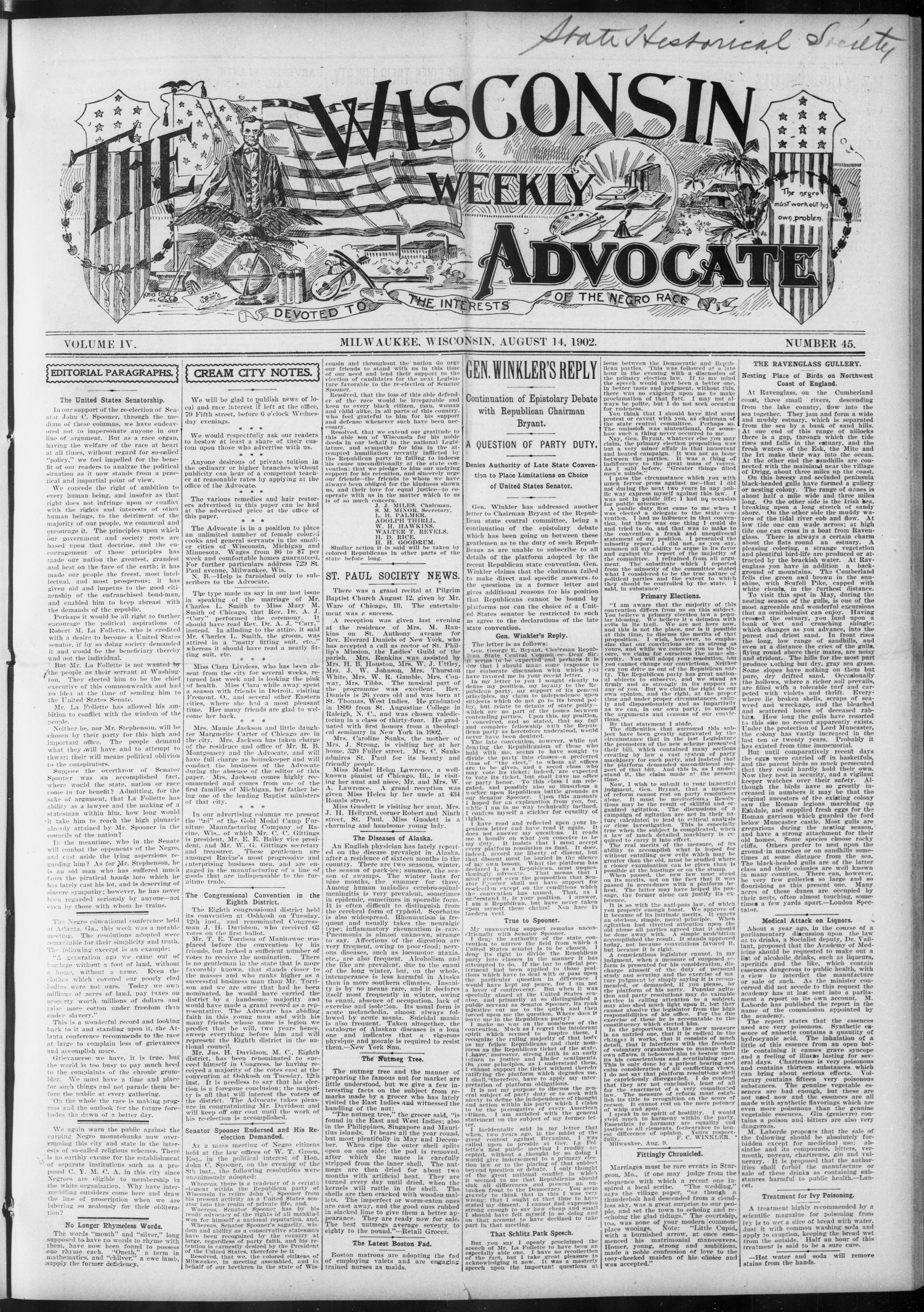
WISCONSIN
WEEKLY
ADVOCATE
DEVOTED TO THE INTERESTS OF THE NEGRO RACE
EDITORIAL PARAGRAPHS.
The United States Senatorship
In our support of the re-election of Senator John C. Spooner, through the medium of these columns, we have endeavored not to impersonate anyone in our line of argument. But as a race organ having the welfare of the race at heart at all times, without regard for so-called "policy," we feel impelled for the benefit of our readers to analyze the political situation as it now stands from a practical and impartial point of view.
We concede the right of ambition to every human being, and insofar as that right does not infringe upon or conflict with the rights and interests of other human beings, to the detriment of the majority of our people, we commend and encourage it. The principles upon which our government and society rests are based upon that doctrine, and the encouragement of those principles has made our nation the greatest, grandest and best on the face of the earth; it has made our people the freest, most intellectual, and most prosperous; it has given aid and impetus to the good citizenship of the enfranchised bond-man, and enabled him to keep abreast with the demands of the republic.
Perhaps it would be all right to further encourage the political aspirations of Robert M. La Follette, who is credited with a desire to become a United States senator, if by so doing society demanded it and would be the beneficiary thereby and not the individual. But Mr. La Follette is not wanted by the people as their servant at Washington. They elected him to be the chief executive of this commonwealth and had no idea at the time of sending him to the United States Senate. Mr. La Follette has allowed his ambition to conflict with the wisdom of the people.
Neither he, nor Mr. Stephenson, will be chosen by their party for this high and important office. The people demand what they will have and to attempt to thwart their will means political oblivion to the conspirators.
Suppose the overthrow of Senator Spooner was an accomplished fact, where would the state, nation or race come in for benefit? Admitting, for the sake of argument, that La Follette has ability as a lawyer and the making of a statesman within him, how long would it take him to reach the high pinnacle already attained by Mr. Spooner in the councils of the nation?
In the meantime, who in the Senate will combat the opponents of the Negro, and cast aside the lying aspersions regarding him? As for Mr. Stephenson, he is an old man who has suffered much from the piratical hands into which he has lately cast his lot, and is deserving of sincere sympathy; however, he has never been regarded seriously by anyone—not even by those with whom he trains.
The Negro educational conference held at Atlanta, Ga., this week was a notable meeting. The resolutions adopted were remarkable for their simplicity and truth. The following excerpt is an example:
"A generation ago we came out of bondage without a foot of land, without a home, without a name. Even the clothes which covered our poorly clad bodies were not ours. Today we own millions of acres of land, pay taxes on property worth millions of dollars and raise more cotton under freedom than under slavery."
This is a wonderful record and looking back to it and standing upon it, the Atlanta conference recommends to the race at large to complain less of grievances and accomplish more.
Grievancese we have, it is true, but the world is too busy to pay much heed to the complaints of the chronic grumbler. We must have a time and place for such things and not parade them before the public at every gathering. On the whole the race is making progress and the outlook for the future forebodes the dawn of a better day.
We again warn the public against the carping Negro mountebanks now overrunning this city and state in the interests of so-called religious schemes. There is no earthly excuse for the establishment of separate institutions such as a proposed C. Y. M. C. A. in this city since Negroes are eligible to membership in the white organization. Why have intermeddling outsiders come here and draw the line of proscription when we are laboring so zealously for their obliteration?
No Longer Rhymeless Words
The words "month" and "silver," long supposed to have no words to rhyme with them, have now been found to possess one rhyme each. "Oneth," a term in mathematics, and "chilver," a ewe lamb, supply the former deficiency.
We will be glad to publish news of local and race interest if left at the office, 79 Fifth street, before 6 o'clock Wednesday evenings.
```markdown
```
We would respectfully ask our readers to bestow at least a share of their custom upon those who advertise with us.
☆ ☆ ☆
Anyone desirous of private tuition in the ordinary or higher branches without publicity can hear of a competent teacher at reasonable rates by applying at the office of the Advocate.
* * *
The various remedies and hair restorers advertised in this paper can be had at the advertised price at the office of this paper.
* * *
The Advocate is in a position to place an unlimited number of female colored cooks and general servants in the smaller cities of Wisconsin, Michigan and Minnesota. Wages from $6 to $7 per week and comfortable homes guaranteed. For further particulars address 729 St. Paul avenue, Milwaukee, Wis.
N. B.—Help is furnished only to subscribers to the Advocate.
The type made us say in our last issue in speaking of the marriage of Mr. Charles L. Smith to Miss Mary M. Smith of Chicago, that Rev. Dr. A. J. "Cory" performed the ceremony. It should have read Rev. Dr. A. J. "Cary," instead. In alluding to the attire, it said Mr. Charles L. Smith, the groom, was attired in a "matty fitting suit, etc." whereas it should have read a neatly fitting suit, etc.
☆ ☆ ☆
Miss Clara Liveless, who has been absent from the city for several weeks, returned last week and is looking the pink of health. Miss Clara while away spent a season with friends in Detroit, visiting Fremont, O., and several other Eastern cities, where she had a most pleasant time. Her many friends are glad to welcome her back.
Mrs. Mamie Jackson and little daughter Marguerite Carter of Chicago are in the city. Mrs. Jackson has taken charge of the residence and office of Mr. R. B. Montgomery and the Advocate, and will have full charge as housekeeper and will conduct the business of the Advocate during the absence of the editor of this paper. Mrs. Jackson comes highly recommended and comes from one of the first families of Michigan, her father being one of the leading Baptist ministers of that city.
☆ ☆ ☆
In our advertising columns we present the "ad" of the Gold Medal Camp Furniture Manufacturing Company of Racine, Wis., of which Mr. C. C. Gittings is president, Mr. E. E. Bailey vice president, and Mr. W. G. Gittings secretary and treasurer. These gentlemen are amongst Racine's most progressive and enterprising business men, and are engaged in the manufacturing of a line of goods that are indispensable to the furniture trade.
The Congressional Convention in the Eighth District.
The Eighth congressional district held its convention on Oshkosh on Tuesday. 12th inst., and renominated Congressman J. H. Davidson, who received 63 votes on the first ballot.
Mr. T. E. Torrison of Manitowoc was placed before the convention by his friends, but lacked a sufficient number of votes to receive the nomination. There is no gentleman in the state that is more favorably known, that stands closer to the masses and who ranks higher as a successful business man than Mr. Torrison and we are sure that had he been nominated, he would have carried the district by a handsome majority and would have made a grand record as a representative. The Advocate has abiding faith in this young man and with his many friends whose name is legion we predict that he will, two years hence, sweep everything before him and will represent the Eighth district in the national council.
Mr. Jas. H. Davidson, M. C., Eighth district, has been renominated to succeed himself in Congress, he having received a majority of the votes cast at the convention at Oshkosh on Tuesday, 12th inst. It is needless to say that his election is a foregone conclusion; the majority is all that will interest the voters of the district. The Advocate takes pleasure in congratulating Mr. Davidson and will keep off our coat until the work of his re-election is accomplished.
Senator Spooner Endorsed and His Re-election Demanded.
At a mass meeting of Negro citizens held at the law offices of W. T. Green, Esq., in the political interest of Hon. John C. Spooner, on the evening of the 8th inst., the following resolutions were unanimously adopted:
Whereas, there is a tendency of a certain element within the Republican party of Wisconsin to retire John C. Spooner from his present activity as a United States senator into the realm of private life, and.
Whereas, Senator Spooner has by his ready advocacy of the rights of all mankind won for himself a national reputation, and.
Whereas, Senator Spooner's sagacity, wisdom and ability as a conservative statesman have been recognized by the country at large, regardless of party faith, and his retention is carnely desired by the President of the United States, therefore be it
Resolved, that we, the colored citizens of Milwaukee, in meeting assembled, and in behalf of our brethren in the state of Wis-
consin and throughout the nation do urge our friends to stand with us in this time of our need and lend their support to the election of candidates for the next Legislature favorable to the re-election of Senator Spooner. Resolved, that the loss of this able defender of the race would be irreparable and keen to every black citizen, man, woman and child alike, in all parts of this country. who feel grateful to him for his support and defense whenever such have been necessary.
Resolved, that we extend our gratitude to this able son of Wisconsin for his noble deeds in our behalf in the national Legislature, and sympathy for him in the attempted humiliation recently inflicted by the Republican party in failing to indorse his cause unconditionally at the state convention; that we pledge to him our undying support for his retention, and sincerely urge our friends—the friends to whom we have always been obliged for the kindness shown us, and their love for equal justice—to cooperate with us in the matter which to us is of so much concern.
J. J. MILES. Chairman,
S. M. MINOR. Secretary,
L. H. PALMER,
ADOLPH THIRLL,
W. H. HAWKINS,
WALTER T. REVELS,
H. D. RICE,
H. H. GOODRUM
Similar action it is said will be taken by colored Republicans in other parts of the state before long.
ST. PAUL SOCIETY NEWS.
There was a grand recital at Pilgrim Baptist Church August 12, given by Mr. Ware of Chicago, Ill. The entertainment was a success.
A reception was given last evening at the residence of Mrs. M. Rankins on St. Anthony avenue for Rev. Everard Daniels of New York, who has accepted a call as rector of St. Phillip's Mission, the Ladies' Guild of the parish. Mrs. Rankins was assisted by Mrs. H. B. Houston, Mrs. W. J. Uttley, Mrs. J. W. Johnson, Mrs. Thurston White, Mrs. W. R. Gamble, Mrs. Conway, Mrs. Tibbs. The musical part of the programme was excellent. Rev. Daniels is 26 years old and was born at St. Thomas, West Indies. He graduated in 1899 from St. Augustine College in Raleigh, N. C., and was chosen valedictorian in a class of thirty-four. He graduated with first honors from a theological seminary in New York in 1902.
Mrs. Caroline Sanks, the mother of Mrs. J. Strong, is visiting her at her home, 320 Fuller street. Mrs. C. Sanks admires St. Paul for its beauty and friendly people.
Miss Mabel Helen Lawrence, a well-known pianist of Chicago, Ill., is visiting her aunt and niece, Mr. and Mrs. W. A. Lawrence. A grand reception was given Miss Helen by her uncle at 434 Ronals street.
Miss Guodett is visiting her aunt. Mrs. J. H. Hellyard, corner Robert and Ninth street, St. Paul. Miss Guodett is a charming and handsome young lady.
The Diseases of Alaska.
An English physician has lately reported on the disease prevalent in Alaska, after a residence of sixteen months in the country. There are two seasons, winter, the season of pack-ice; summer, the season of swamps. The winter lasts for nine months, the summer for three. Among human maladies cerebro-spinalmeningitis is very prevalent, sometimes in epidemic, sometimes in sporadic form. It is often difficult to distinguish from the cerebral form of typhoid. Scorbatus is also widespread. Rheumatism is frequent and usually takes the neuralgic type; inflammatory rheumatism is rare. Pneumonia is almost unknown, strange to say. Affections of the digestion are very frequent, owing to poor-food; nervous diseases, such as locomotor ataxia, etc., are also frequent. Alcoholism and the like are prevalent, due to the ennui of the long winter, but, on the whole, intemperance is less harmful in Alaska than in more southern climates. Insanity is by no means rare, and it declares itself most frequently in winter, owing to ennui, absence of occupation, lack of exercise and isolation. Its usual form is acute melancholia, almost always followed by acute mania. Suicidal mania is also frequent. Taken altogether, the catalogue of Alaskan diseases is a long one and indicates that a vigorous physique and morale is required to resist them.—New York Sun.
The Nutmeg Tree.
The nutmeg tree and the manner of preparing the famous nut for market are little understood, but we give a few interesting facts on the subject from remarks made by a grocer who has lately visited the East Indies and witnessed the handling of the nut:
"The nutmeg tree," the grocer said, "is found in the East and West Indies; also in the Philippines, Singapore and Mauritius islands. It bears all the year round, but most plentifully in May and December. When ripe the outer shell splits open on one side; the pod is removed, after which the mace is carefully stripped from the inner shell. The nutmegs are then dried for about two months with artificial heat. They are turned every day until dried, when the kernels will rattle in the shell. The shells are then cracked with wooden mallets. The imperfect or worm-eaten ones are cast away, and the good ones rubbed in slacked lime to give them a better appearance. They are ready now for sale. The best nutmegs average seventy to eighty to the pound."—Retail Grocer.
The Latest Boston Fad.
Boston matrons are adopting the fad of employing valets and are engaging trained nurses as maids.
Gen. Winkler has addressed another letter to Chairman Bryant of the Republican state central committee, being a continuation of the epistolary debate which has been going on between these gentlemen as to the duty of such Republicans as are unable to subscribe to all details of the platform adopted by the recent Republican state convention. Gen. Winkler claims that the chairman failed to make direct and specific answers to the questions in a former letter and gives additional reasons for his position that Republicans cannot be bound by platforms nor can the choice of a United States senator be restricted to such as agree to the declarations of the late state convention.
Gen. Winkler's Reply.
Gen. George E. Bryant, Chairman Republican State Central Committee--Dear Sir: It seems to be expected and perhaps it is due that I should make some response to the elaborate discussion with which you have targeted me in your recent letter.
The late convention, however, while not denying the Republicanism of those who hold with me, seems to have sought to divide the party into classes—a preferred class of "the elect," to whom all offices are to be given, and a second class who may vote its ticket; indeed, are expected to vote its ticket, but shall have no office or party honor. To this class I am relegated, and possibly also so illustrious a worker upon Republican battle grounds as our Senator Spooner. Upon this anomaly I hoped for an explanation from you, for, while I am in no way technically inclined, I confess myself a stickler for equality of rights.
I have read and reflected upon your ingenious letter and have read it again. It does not answer my questions. It reads me a homily on what you conceive to be my duty. It insists that I must accept every platform resolution as final. It does, indeed, accord me liberty of dissent, but that dissent must be buried in the silence of my own bosom. What the platform has declared I, as a Republican, must unquestioningly advocate. That means that I must accept even the proposition that Senator Spooner shall not have support for reelection except on the conditions which the convention has named. That, as I understand it, is your position. I answer, I am a Republican, but have never taken upon myself these chains! Non haec in fidelera vend.
True to Spooner.
My unswerving support remains unconformities with Sensor Spooner.
My unswerving support remains unconditionally with Senator Spooner. I deny the authority of the state convention to narrow the field from which a United States senator is to be chosen. I deny its right to divide the Republican party into classes in the manner it has attempted to do. If the bar to official preferment had been applied to those positions which have to deal with or pass upon the particular question in difference I would have kept my peace, for I am not a lover of controversy. But when it was specially aimed at the United States senator, and primarily at so distinguished a public servant as Senator Spooner, its rank injustice cut me to the quick and then forced upon me the question. Where does it leave me in the Republican party?
I make no war on the nominees of the convention. Much as I regret the intolerant spirit which seemed to inspire them. I recognize the ruling majority of that body as my fellow Republicans and their nominess as the Republican ticket of the state. I have, moreover, strong faith in an early return to justice and kinder sentiments. On your principles, as I understand them, I cannot support the ticket without thereby ratifying the platform which degrades me. I shall, therefore, have to apply my interpretation of platform obligations.
It is not my purpose to discuss the general subject of party duty or to seek with nicety to define the independence of thought and action within his party which I claim to be the pierogative of every American citizen. I am satisfied with the general statement on the subject of my former letter.
I incidentally said in my letter that when, two years ago, in the midst of the great contest against Bryanism, I was called upon to preside at Gov. La Follette's first public meeting I readily accepted, without a thought by so doing I would give indorsement to a primary election law or to the placing of that subject beyond question or debate. I only thought of the great national conflict in which it seemed to me that Republicans should sink all differences and present an unbroken front to the Democracy. You seen gravely to think that in this I was very wrong; that I ought at that time to have stated my dissent. I cannot find expression strong enough to say how cheap and small I should have felt myself in so doing and on that account to have declined to take part in that meeting.
That Schlitz Park Speech.
But you say I openly proclaimed the speech of Mr. La Follette to have been an especially able one. I have no recollection of the ract, but I take great pleasure in acknowledging it now. It was a masterly speech upon the important questions at
issue between the Democratic and Republican parties. This was followed at a late hour in the evening with a discussion of the primary election law. If to my mind the speech would have been a better one, in better taste and judgment, without this, there was no exigency upon me to make proclamation of that fact. I may not always be polite, but I do not seek occasion for rudeness.
You think that I should have filed some protest or caveat with you, as chairman of the state central committee. Perhaps so. The omission was unintentional, for somehow such a thing never occurred to me.
Nay, Gen. Bryant, whatever else you may claim, the primary election proposition was but a very minor affair in that important and heated campaign. "It was not an issue between the parties. It was a thing of indifference to the great mass of voters. As I said before, "Greater things filled men's minds."
I pass the circumstance which you with much fervor press against me—that I did not during the next two years in any public way express myself against this law. I was not in public life; I had no occasion for public utterance. A public duty first came to me when I was elected a delegate to the state convention. I had no influence in that convention, but there was one thing I could do and tried to do, and that was to make to the convention a frank and unequivocal statement of my position. I presented the minority report. I did not, as you say, summon all my ability to argue in its favor and against the report of the majority of the committee. I refrained from all argument. The substitute which I reported from the minority of the committee stated what I considered to be the true nature of political parties and the extent to which they should be controlled by the state. I said, in substance:
Primary Elections.
"I am aware that the majority of this convention differs from us on this subject. You believe a primary election law a popular blessing. We believe it a delusion with evils in its trail. We are not here now, and this is not the place, nor is it possible at this time, to discuss the merits of that proposition. I wish, however, to emphasize that our convictions are as strong as yours, and while we concede you to be sincere, we claim for ourselves the same sincerity. You will adopt your resolution, but you cannot change our convictions. Neither can you drive us out of the Republican party. The Republican party has great national objects to subserve, and we stand as firmly and as strongly in its support as any of you. But we claim the right to our own opinion, and the right, at the proper time and under proper circumstances, calmly and dispassionately and as impartially as we can, in our own party, to present the arguments and reasons of our convictions."
By that statement I abide.
The difficulties that surround this subject have been greatly aggravated by the circumstance that in the last Legislature the promoters of the new scheme presented their bill, which contained many sections creating by law a vast system of party machinery for each party, and insisted that the platform demanded unconditional support of that bill. And this is, as I understand it, the claim made at the present time.
Now, I wish to submit to your impartial judgment, Gen. Bryant, that a measure of reform cannot rest on party resolutions alone. It must be mediatorious. Resolutions may be the result of skillful and organized agitation. The discussions of a campaign of agitation are not in their nature calculated to lead to critical analysis or close investigation. This is especially true when the subject is complicated, when a law of much detailed machinery is required to carry it into effect.
quired to carry it in the real merits of the measure, of its ability to accomplish what is hoped for without entailing new evils which may be greater than the old, must be studied where a closer examination can be given than is possible at the hustings or on the stump. When passed, the new law must stand on its merits, not on the fact that it was passed in accordance with a platform behest. The latter may have helped its passage, the former alone can justify its existence. It is so with the anti-pass law, of which you properly enough boast. We approve of it because of its intrinsic merits. It enacts an obvious, simple, moral principle. When agitation had rivetted attention upon the old abuse all parties agreed that it should be done away with. A simple prohibition accomplished the result. It stands approved today, not because conventions favored it, but because it is right.
A conscientious legislator cannot, in my judgment, when a measure of supposed reform is presented for his consideration, discharge himself of the duty of personal study and scrutiny and the exercise of mature judgment by simply saying it is recommended, or demanded, if you please, by the platform of his party. Popular agitation and party resolutions may do valuable service in calling attention to a subject, may also shed much light upon it, but they cannot absolve the legislator from the high responsibilities of his office. For the due exercise of these he is accountable to the constituent which elected him.
In the proportion that the new measure is an untrified one, that it is radical in the changes it works, that it consists of much detail, that it interferes with the freedom of voluntary organizations to manage their own affairs, it behooves him to bestow upon its his conscientious and scrutinizing care. This is only done by a patient hearing and calm consideration of all conflicting views. I do not say that platform resolutions shall be capriciously disregarded. I do contend that they are not conclusive, least of all for the enactment of a very complicated law. The measure of reform must establish its title to recognition on the score of reason. It cannot rest on the mere potency of whip and spur.
I speak in no spirit of hostility. I would yield much to harmony within the party. Essentials to harmony are equality and justice to all elements, forbearance to honest difference of opinion. Yours respectfully. F. C. WINKLER.
Fittingly Chronicled.
Marriages must be rare events in Sturgeon, Mo., if one may judge from the eloquence with which a recent one inspired a local scribe. "The wedding," says the village paper, "as though a thunderbolt had descended from a cloudless sky, was a great surprise to our people, and set the town to echoing and reechoing the glad tidings." The courtship, too, was none of your modern commonplace wooings. Note: "Little Cupid, with a burnished arrow, at once commenced his matrimonial manoeuvers. Homer, young, strong and ambitious, made a noble confession of love to the 10sy-cheeked maiden of his choice and was accepted."
NUMBER 45.
THE RAVENGLASS GULLERY.
Nesting Place of Birds on Northwest Coast of England.
At Ravenglass, on the Cumberland coast, three small rivers, descending from the lake country, flow into the sea together. They jam and form a wide and muddy estuary, which is separated from the sea by a bank of sand hills. At one end of this range of hillocks there is a gap, through which the tide rises and falls in the estuary, and the fresh waters of the Esk, the Mite and the Irt make their way into the ocean. At the other end the sandhills are connected with the mainland near the village of Driggs about three miles up the coast
On this breezy and secluded peninsula, black-headed gulls have formed a gullery or nesting colony. The range of dunes is about half a mile wide and three miles long. On the other side is the Irish sea, breaking upon a long stretch of sandy shore. On the other side the muddy waters of the tidal river ebb and flow. At low tide one can wade across; at high tide one can cross in a boat from Ravenglass. There is always a certain charm about the flats round an estuary. A pleasing coloring, a strange vegetation and plentiful bird-life are produced or attracted by the brackish water. At Ravenglass you have in addition a background of mountains. The Cumberland fells rise green and brown in the sunshine, with Scafell Pike, capped with white clouds, in the furthest distance. To visit this spot in May, during the nesting season of the gulls, is one of the most agreeable and wonderful excursions that an ornithologist can enjoy. Having crossed the estuary, you land upon a bank of wet and crunching shingle; which changes as you advance, into the purest and driest sand. In front rises the long, low range of sandhills, and even at a distance the cries of the gulls, flying round above their mates, are noisy and strident. The hills for the most part produce nothing but dry, gray sea grass. Some slopes have nothing on them but pure, dry drifted sand. Occasionally the hollows, where a richer soil prevails, are filled with a tolerable turf and carpeted with violets and thrift. Everywhere lie broken shells, scraps of seaweed and wreckage, and the bleached and scattered bones of deceased rabbits. How long the gulls have resorted to this site no record apparently exists. Under the protection of Lord Muncaster, the colony has vastly increased in the last ten or twenty years. Probably it has existed from time immemorial.
But until comparatively recent days the eggs were carried off in basketfuls, and the parent birds so much persecuted that they could hardly hold their own. Now they nest in security, and a vigilant keeper watches over their safety. Although the birds have so greatly increased in numbers it may be that the original ancestors of the existing colony saw the Roman legions marching up Eskdale, and supplied fresh eggs for the Roman garrison which guarded the ford below Muncaster castle. Most gulls are gregarious during the nesting season, and have a strong attachment for their old homes. Some species choose rocky cliffs. Others prefer to nest upon the ground-in marshes or on sandhills sometimes at some distance from the sea. The black-headed gulls are of the latter class and their colonies are well known in many counties. There can, however, be very few gullies so large and so flourishing as this present one. Many acres of these dunes are occupied by their nests, often almost touching, sometimes a few yards apart.—London Spectator.
Medical Attack on Liquors
About a year ago, in the course of a parliamentary discussion upon the law as to drinks, a Socialist deputy, Dr. Vaillant, proposed that the Academy of Medicine should be requested to make out a list of alcoholic drinks, such as liqueurs, aperitifs and the like, which contain essences dangerous to public health, with a view to interdict the manufacture or sale of such. As the minister concerned did not accede to this request the academy has at last sent into a parliament a report on its own account. M. Laborde has published the report in the name of the commission appointed by the academy.
The report states that the essences used are very poisonous. Synthetic essence of anisette contains a quantity of hydrocyanic acid. The inhalation of a little of this essence from an open bottle containing it causes grave syncope and a feeling of illness lasting for several days. Chartreuse is very poisonous and contains thirteen substances which can bring about serious effects. Volnerary contains fifteen very poisonous substances. The genuine vegetable essences are bad enough, but these are not used now and the essences are all made with synthetic flavorings which are even more poisonous than the genuine vegetable essences. Gin (genievre) contains a poison and bitters are also very dangerous.
M. Laborde proposes that the sale of the following should be absolutely forbidden except for medicinal use: absinthe and its compounds, bitters, vermouth, noyeau, chartreuse, gin and vulnerary. It is proposed that the authorities shall forbid the manufacture or sale of these drinks as containing substances harmful to public health.—Lancet.
Treatment for Ivy Poisoning.
A treatment highly recommended by a scientific magazine for poisoning from ivy is to wet a slice of bread with water, dust it with common washing soda and apply to eruption, keeping the bread wet from the outside. Half an hour of this treatment is said to be a sure cure. Hot water and soda will remove stains from the hands.
MOROS KILL SENTINELS.
Outpost of the Twenty-Seventh Infantry Attacked. ARMED WITH SPEARS.
Manila, Aug. 13.—A small party of Moros surprised an outpost of the Twenty-seventh infantry at Camp Vicars yesterday. Sergeart Foley and private Carey were killed and private Van Dorn was severely wounded. The Moros, who numbered only a dozen, were armed with spears and swords. The morning was dark and foggy. The attacking party crawled to within a few feet of the sentinels and then sprang upon them suddenly. The entire outpost rushed to the relief of the sentinels, but they were too late. The Moros escaped, although a possible few were wounded. The American sentinels were terribly out by the swords and spears.
The attacking Moros were all from Bacolod, and the occurrence probably will result in a move against that town, which has a strong fort and other defences. Constabulary Inspector William Schermerhorn, whose home was in Seattle, Wash., was mortally wounded in a recent fight with Landrones at Iligan, Mindanao. The fourth anniversary of the capture of the city of Manila, which was surrendered to the American forces on August 13, 1898, was observed as a general holiday.
Outbreak of Cholera.
San Francisco, Cal., Aug. 13.—The reason given by army officers who have arrived on the transport Lawton, for the renewed outbreak of cholera in the Philippines is the premature withdrawal of precautionary measures by the American officials at Manila, under the impression that the disease had been fought to a standstill. The scourge had only been scotched, however, and with the relaxation of the controlling grip it resumed its work of devastation with renewed vigor.
"We will not get rid of the cholera in the Philippines," said Assistant Surgeon Rhoades," until the heavy rains come. That will be in October. In the meanwhile our people are doing everything possible to keep the disease within bounds."
FOUND ON THE TRACK.
Dead Body of Well-Dressed Man with a Complete Outfit of Burg- lars' Tools
Ortonville, Minn., Aug. 13.—The body of an unknown man, who is thought to have been a member of a band of train robbers or safe blowers, was found lying across the railroad track in the village of Odessa.
The indications are that the man was murdered and his body placed across the track in the hope that passing trains would destroy evidence of the crime. There was a bullet hole in the right temple, and citizens of Odessa report having heard several shots fired in the vicinity about midnight.
Upon the dead man was found a safe blower's outfit, consisting of steel drills, dynamite caps and fuse, a bottle of nitroglycerin and a quantity of soap pulp. The authorities believe that the man was a member of a gang which was preparing to hold up a train at Odessa, but quarreled among themselves and that the murder was the outcome of this quarrel. He was about 40 years of age, fairly well dressed and had a saudy mustache. His mouth showed a very perfect and expensive lot of dental work, with numerous heavy gold fillings.
MORGAN'S SHIP COMBINE.
Details of Management to be Arranged Next Week—Utilize Old Pennsylvania Charter.
New York, Aug. 13.—With the arrival here next week from Europe of J. P. Morgan and President Griscom of the International Navigation Company, conferences are expected to begin to arrange the details of management for the new steamship combination.
After January 1 it is the present intention, according to a reliable source of information, to abolish the separate boards and to manage the entire British business of all the lines through executive traffic officers under the direction of the control board.
It is expected that the British arrangement will be duplicated to a very large extent on this side with Mr. Griscom as chairman.
One plan that is under consideration is to utilize the old Pennsylvania charter of the International Navigation Company and increase the capital to $170,000,000 including $50,000,000 of 4 1/2 per cent. debenture bonds, $60,000,000 of 6 per cent. preferred stock and $60,000,000 common stock.
PHILIPPINE VETERANS.
MacArthur, Wheaton and King Attend ing the Reunion at Council Bluffs.
Council Bluffs, Ia., Aug. 13.—Veterans of the Philippine war began to pour into the city early today to take part in the reunion of the National Society of the Army of the Philippines, which begins today. Among the early arrivals were Gen. Irving Hale, president of the society, and Gens. MacArthur, Wheaton and King, who were escorted to headquarters by committees of the local society. Delegations from Iowa, Nebraska, Minnesota, North and South Dakota, Kansas and Colorado came in on early trains and later in the day those from other camps began to arrive.
Following a brief reception to delegates at headquarters they were given an opportunity to register, after which was held a general meeting of the society, presided over by its president, Gen. Hale.
TAYLOR SENDS EXPERT.
To Value Sites for Public Buildings in Green Bay, Wausau and Fond du Lac.
Washington, D. C., Aug. 13.—[Special.]—Assistant Secretary Taylor has written Bernard Osann, a real estate expert of Chicago, requesting him to visit Green Bay, Wausau and Fond du Lac to investigate and report upon the various sites offered in these cities for new public buildings. Mr. Osann has frequently been employed by the treasury department to appraise values of sites for public buildings, and his work in the past has proven most satisfactory.
DROWNED IN LAKE HURON
Man's Carelessness Overturns Rowboat and Chicago Girl Thereby Loses Her Life.
Port Huron, Mich., Aug. 12.—Miss Alice Moxley, aged 22, daughter of James T. Moxley of 2016 Jackson boulevard, Chicago, was drowned in Lake Huron, off Lake Side park, this city. The unfortunate girl and her brother Charles came here two weeks ago to visit James McDonald. The two, in company with their cousin, Lester McDonald, chartered a rowboat at 6:30 in the morning to spend a couple of hours fishing. The party fished at the nets about two hours and then decided to return home. McDonald, who was in the bow, stood up to untie the line, causing the boat to lean to one side, and as the lake was choppy, a large amount of water was shipped and the boat capsized, all falling under it. McDonald marose first, and caught Charles Moxley, who could not swim, and started for the nets, reaching there after a hard struggle.
Miss Moxley appeared above the water but once, and then disappeared. The young man could give her no assistance. Their cries for help reached the cars of the cottagers after considerable length of time, and when rescued were about exhausted. The life-saving crew late yesterday afternoon found the body of Miss Moxley.
CRUEL SLAUGHTER
Investigation Into the Shooting of Four School Teachers Sent to the Philippines.
Manila, Aug. 12.—An investigation made by the constabulary to clear up the facts of a Cebu coaching party of four school teachers, shows that the party was ambushed twelves miles from Cebu. Two teachers were shot and killed at the first volley; a third, who ran, was shot in the back, and a fourth, who was captured, was shot in the chest while he was praying for mercy. It is suspected that the fourth man was buried alive, as his wound was slight and probably would not have caused death. Dogs dug up two of the bodies and devoured the flesh. It is believed that sufficient evidence has been secured to convict all the participants in the crime.
The bodies of these teachers were found on July 24 after the teachers had been missing since June 10. The police killed the leader of the band of murderers and captured eight other alleged participants in the crime. One man escaped.
SACKING THE TOWN.
Minister Bowen Reports that Barcelona is in Hands of the Revo- lutionists.
Washington, D. C., Aug. 12.—Minister Bowen has cabled the state department from Caracas that our consul at Barcelona has informed him by wire that Barcelona has been taken by the revolutionists; that they are sacking the town and that in his judgment the protection of a vessel should be immediately afforded him. Mr. Bowen has cabled the Cincinnati to return without delay. He notes that the Topeka is at Porto Cabello and the Marietta up Orinoco river. Orders were at once dispatched to Porto Cabello by the navy department for either the Cincinnati or the Topeka to proceed to Barcelona, upon the arrival of the former at Porto Cabello.
The navy department today received two cablegrams from Commander McCrea of the gunboat Machias, dated Cape Haytien, August 12, in which he reports that the attempted blockade of the port by the revolutionists is ineffective. In the first dispatch he said: "Have decided blockade spasmodic, therefore ineffective. Notified consuls. Will protect innocent neutral commerce." In the second dispatch which came later, he said: "Consider blockade abandoned. American schooner reports blockader absent."
GOLD BURIED FORTY YEARS
Ohio Man Finds His Store of Wealth Just Where He Left It.
Masysville, Cal., Aug. 12.—Forty years ago J. H. Merryman, an Ohioan, buried beneath the floor of his mining cabin in Plumas county $2000 in gold nuggets and this week he unearthed his cache to find his stored wealth just as he left it in 1860.
In that year Merryman, who had prospered as a miner, concluded to visit San Francisco and putting in his belt what gold he thought he would need buried the balance. A gay life at the bay soon broke him and while befuddled with drink he was "shanghaied." He was finally landed at New York. Misfortune followed misfortune and it was only recently that he had money enough to return to California.
During the intervening years the thought of his buried treasure never left him and it was with trembling hands the old pioneer grasped a spade to dig for gold on the spot where he figured his cabin once stood. Providence favored him after many efforts and yesterday Merryman came down from the mountains to take a train for San Francisco. He will return East.
DEER PLENTIFUL THIS YEAR
Game Warden Morse Makes Tour of Northern Michigan "Incog."
Houghton, Mich., Aug. 12.—[Special.]
—News that deer are more plentiful in the upper peninsula this year than in any of the five preceding twelvemonths will be good news to stalkers of the game. Grant M. Morse, state game warden, is authority for the statement. For the last few weeks Mr Morse has been making quiet journeys through the woods in the upper peninsula. He has found few violations of the game laws. Last week he spent incognito at Lake Gogebie. His object was to see how the resorters treated the game. One evening while out in a boat he saw three deer come to the water's edge. They were apparently quite tame and it would have been easy to shoot them. Although the temptation was great, several persons, who stood nearby with firearms, resisted it.
French Election Barkers.
The election "barker" is peculiar to French soil. At critical moments in a candidate's speech the "barker" puts him out by imitating a dog, and a really good man at the business is worth good money at such times. Half a dozen of them in Paris earn enough at election times to last them for a year.
The Elephant Family.
It is estimated that there are fewer than 10,000 wild elephants left in all the countries on the globe, and that five of these will be killed off where one is born. It is a matter of only a few years when the last must go.
Fireproof Passenger Trains.
All the new trains on the Central London railway are to be of fireproof construction, steel and asbestos being largely used. Other precautions for the safety of passengers are being taken.
WOMAN THREATENS TO KILL GEN. CHAFFEE.
Arizona Widow Says She will Have the Officer's Life or Satisfactory Reparation.
El Paso, Tex., Aug. 13.—Prepared to take the law into her own hands, Amy, White of Verde, Ariz., is on her way to New York, where she expets to have a settlement with Gen. Chaffee when he arrives from the Philippines.
Mrs. White is the widow of a discharged soldier of the Eighth Infantry. On his death bed her husband exacted a pledge that she would prefer charges against Gen. Chaffee for alleged cruel treatment at Camp McDowell, Ariz. Mrs. White charges that Gen. Chaffee, who was then a major, sent soldiers to their home, burned their house and drove off all their cattle.
"I am going to New York to meet Gen. Chaffee," she said, "and if he does not give me satisfaction I'll shoot him dead in his tracks. I have preferred charges, but he prevented them from getting before Congress. I have told Gen. Miles about it, and he says for me to wait. I have waited long enough. I want a settlement and I'm going to have it. I'll have his life or satisfactory reparation."
THREE SHIPS SENT.
Cincinnati, Topeka and Marietta Now in South American Waters
Washington, D. C., Aug. 13.—Over night the navy department received word that the Cincinnati had sailed yesterday from Porto Cabello for Barcelona under the instructions cabled yesterday to Commander McLean. The Topeka will protect American interests at Porto Cabello. Minister Bowen cabled today that the cable from Barcelona to Caracas had again been cut. Neither the state nor the navy department has received confirmation of the press dispatches from Port of Spain that the American, Italian and Dutch consulates had been pillaged. Owing to the general disturbed condition of affairs all along the line of the Venezuelan coast and the appeals of Minister Bowen for warships, the question whether our naval force in those waters is sufficient to take care of the existing situation and to meet future contingencies has been canvassed. We now have three ships at the three critical points, the Cincinnati at Barcelona, the Topeka at Porto Cabello, where the Germans already have landed a force, and the Marietta at the mouth of the Orinoco, which was declared blockaded by the Castro government.
The question of affording an asylum to President Castro aboard an American warship in case he should be obliged to flee from the country and should have no other means of escape, has not been seriously considered by the state department, as it is not believed that his condition at present is desperate enough to make such a move imperative. Besides, it is reported through the press dispatches that he has a vessel at La Guaria upon which he can embark for France if the necessity should arise.
Minister Powell cabled the state department from Port Au Prince today that Gonaives was in the hands of the revolutionary forces under Gen. Firmin. On Monday he cables that the Vacquez government had notified him that Gonaives, with three other provinces, are in rebellion.
STEBBINGS IS HELD TO THE GRAND JURY.
Chicago, Ill., Aug. 13.—The coroner's jury in the matter of the death of Walter A. Scott, recommended that Stebbings be held to the grand jury.
No charge of crime was made against Stebbings, but the jury recommended that the grand jury investigate the killing. Stebbings testified in his own behalf at the inquest and stated that at no time during the time Scott was striking and kicking him did he knowingly stab him. The thought of such a thing, he said, never came to him. He said that just before he called upon Scott, whose office was just across the hall from his own, he had received a letter. This he was opening with a paper knife when he went into Scott's office. Stebbings said he was in a dazen condition from the attack of Scott, who kicked him and pushed him from his office. He struck at Scott but did not know it was with the knife. Miss Myrtle Shumate, Scott's stenographer, testified practically to the same story, save that she said she heard Stebbings call Scott a liar.
The verdict is said to be the mildest in the history of the coroner's office.
BRAGG INCIDENT CLOSED.
United States to Take No Further Action Against Consul General at Havana Unless Requested.
Washington, D. C., Aug. 13.—Unless the Cuban government makes some further representations in the case of Gen. Bragg, the United States consul general at Havana, and indicates that he is not wanted there any more, the United States will not disturb its representative. The complaint of the Cuban minister of foreign affairs over Gen. Bragg's uncomplimentary remarks concerning the Cubans in a private letter to his wife, with Gen. Bragg's explanation that he had a right to say what he pleased to his better half, and that what he said wasn't anybody's business, was sent to President Roosevelt. That was the end of it as far as anybody here knows. President Palma has mentioned the Bragg incident once casually to Mr. Squiers, the United States minister in Havana, but he did not indicate that his government wanted to have Gen. Bragg recalled.
LEDOCHOWSKI'S ESTATE.
Cardinal's Will Disposes of Property V.1
ud at $200,000.
Rome, Aug. 13.—Cardinal Ledochowski's will has been opened and it is announced that he appoints as sole legatee his nephew, Count Ledochowski, a retired officer of the Austrian army, who resigned his commission as a protest against the practice of dueling in the army. A painting of great value is left to the Pope and the secretary of the former prefect of the propaganda inherits the cardinal's silver service and a life annuity. The fortune left by the defunct prelate is estimated at $200,000.
BOSTON BROKER ARRESTED.
Charged with Using Mails in Conspiracy to Defraud.
Boston, Mass., Aug. 13.—Frederick E. Betts, broker, is under arrest on a charge of using the United States mails in a conspiracy to defraud in connection with the firm of J. M. Fisher & Co., whose affairs have been in the courts for some time. Betts is held under $10,000 for hearing.
ARE GIVEN THEIR LIBERTY.
Mine Workers, Sentenced for Contempt, Let Out of Jail.
RELEASED BY JACKSON.
Did Not Know They Were Violating the Injunction and Promised Not to
Do So Again.
Parkersburg, W. Va., Aug. 12.—Judge Jackson this morning released Thomas Haggerty and six other members of the United Mine Workers who were serving sixty and ninety days in jail for contempt of court. The prisoners filed a petition for release, alleging that they had not known they were violating the injunction when they did so and promising not to do so again. Attorneys for the coal companies opposed their release, but it was granted subject to rearrest to complete the original sentence if they violated the injunction again.
Deputies and Strikers Shoot.
Scranton, Pa., Aug. 12.—A lively battle occurred last night between deputies and strikers at Throop, an isolated mining village six miles north of here. Scores of shots were exchanged, but as far as is known no one was hit.
The one colliery in the village is operator by the Pancoast Coal Company, a branch of the Ontario and Western coal department. Last Tuesday the washery was started under the protection of armed deputies. There has been some stone-throwing at the deputies and clubbing of workmen and on several occasions the deputies discharged their guns to frighten away the boys who pelted the washery with slingshots.
Yesterday the four deputies guarding the pumping station located on the river bank were driven to cover by a volley of shots from the other shore. They returned the fire and silenced the attack. When darkness fell the attack on the pumphouse was renewed. The company anticipated it and had a big force of deputies on hand.
Bullets Fly Thick and Fast.
For an hour bullets flew thick and fast. The attacking party seemed to concentrate its fire on the pumphouse, for it was fairly riddled with bullets. The deputies shot into the bushes on the opposite shore, only 100 feet away, making a target of the spot where the flashes of the assailants' guns were seen. The strikers evidently quit because of their ammunition being exhausted, and this put an end to hostilities. Several houses in the village were struck by bullets from the deputies' rifles. Sheriff Schadt went to the scene, but on account of the darkness was unable to do anything.
Farmers Ask for Protection.
Shenandoah, Pa., Aug. 12.—Complaint was made to brigade headquarters that strikers are foraging in the rich agricultural district of the Catawissa valley, which spreads its broad and fertile length along the other side of the mountains north of this city. Lucien Munbeck reported for some time raids have been made on his farm by parties of men. He caught a man tearing out whole stalks of corn. He ordered the man off the place and as he was leaving he fired two shots at the farmer. The latter was armed, but did not shoot. A widow, who owns a farm, reported that several men came on her premises and dug potatoes. One farmer has several men patrolling his farm day and night. The foragers do not confine themselves to stealing crops, but also take poultry.
Small Strikes Settled.
Wilkesbarre, Pa., Aug. 12.—President Mitchell stated today that he had received official information from Pittsburgh that the strike of coal miners along the West Penn railroad was about settled and that the men would be back to work in a short time. He said it was gratifying to him to know that all the small strikes were being settled. This would enable the Miners' Union to concentrate all its strength in the anthracite region and the West Virginia strike region. Mr. Mitchell said he was confident that the hard coal miners were going to win.
TWO BAD TRAIN WRECKS
Freight Train Plunges Through Open Draw Into Elizabeth River—Two Trainmen Killed.
Elizabeth, N. J., Aug. 12.—A freight train on the Long Branch division of the Central of New Jersey Railroad plunged through an open drawbridge into the Elizabeth river today. Twelve cars are piled on top of the locomotive, which lies on the bottom of the river. Two men lost their lives. They are Patrick Mansfield, brakeman, and Fireman Nebster of Bayonne. One body has been recovered. Engineer Robert Beany of Elizabethport jumped from his cab, breaking his leg and sustaining internal injuries.
Warsaw, Ind., Aug. 12.—Au expensive wreck on the Pennsylvania road between Winona and Warsaw, occurred late last night, badly smashing two locomotives and twenty freight cars, loaded with farming machinery and merchandise, entailing a loss of about $75,000. The wreckage impeded all traffic until the tracks were cleared this forenoon. No loss of life resulted.
WOMAN ADMITS PERJURY.
Says She Sent a Man to Prison on False Charge of Criminal Assault.
Lincoln, Neb., Aug. 12.—Mrs. Jennie Craig of Knox county made a confession that she had caused M. G. Hubbard to be sent to the Nebraska penitentiary on a charge of criminal assault by falsely testifying against him. The woman has made a deposition that the assault did not occur. On the strength of her deposition Hubbard has brought suit against Gov. Savage to compel him to issue a pardon.
FAULKNER GETS TWO YEARS.
Member of St. Louis House of Delegates Is Sentenced.
St. Louis, Mo., Aug. 12.—Harry A. Faulkner, a member of the House of Delegates, who was recently convicted of perjury in connection with the municipal bribery cases, was sentenced in the circuit court to two years in the penitentiary. Faulkner immediately filed an appeal to the supreme court, and was given his freedom, pending the hearing, on a $10,000 bond.
WIDELY-KNOWN MUSICIAN DIES.
Charles E. Pratt, Accompanist for Emma Abbott and Clara Louise Kellogg.
New York, Aug. 12.—Charles E. Pratt, a once widely known musician, is dead of apoplexy. He was born at Hartford, Conn., in 1841 and at various times he was associated as accompanist and organist leader with such artists as Emma Abbott, Mme. Anna Bishop, Robert Heller, Alice Dunning Lingard and Clara Louise Keliogg.
HARVESTER PLANTS PAID FOR IN CASH.
HARVESTER PLANTS PAID FOR IN CASH.
New Company will Require No Financiering and There will be No Offer of Its Stock to the Public.
New York. Aug. 13.—The incorporators of the International Harvester Company, articles of incorporation of which were filed yesterday in Jersey City, today made public a statement which says in part:
"The International Harvester Company has been organized under the laws of New Jersey with a capital stock of $120,000,000 to manufacture and sell harvesting machinery. It has purchased the property and business of the following manufactories: The McCormick Harvesting Machine Company, Deering Harvester Company, Plano Manufacturing Company, Warder, Bushnell & Gleasner, Milwaukee Harvesting Company. The company is capitalized upon an exceptionally conservative basis. Of its assets $80,000,000 are in cash working capital. The company will require no financing and there will be no offer of its stock to the public, all the cash required having been provided by its stockholders."
After alluding to the advance in prices of raw material and the possible consequent advance in the price of harvesting machinery, unless economy in existing conditions of manufacture could be accomplished, the statement continues:
"The manufacturers realize that their welfare and the interests of the farmers are identical. An advance in the price of agricultural machinery would injure the farmers and react upon the manufacturers. But on the other hand, if existing conditions continued an advance in prices would be inevitable. It thus became necessary that either the prices should be advanced or that substantial economies should be effected in the manufacture and distribution of agricultural machinery. The management of the company will be in charge of gentlemen who for years have been identified with the business. The company will start with ample manufacturing facilities. It has five fully equipped manufacturing plants in the United States and one plant in process of construction in Canada."
The officers of the company are: President, Cyrus H. McCormick; chairman executive committee, Charles Deering; chairman finance committee, George W. Perkins; vice president, Harold F. McCormick, James Deering, William H. Jones, John J. Glessner; secretary and treasurer, Richard F. Howe; board of directors, Cyrus Bentley, Paul D. Cravath, William Deering, Charles Deering, James Deering, E. H. Gary, John J. Glessner, William F. Howe. Abram M. Hyatt, Wiliam H. Jones, Cyrus H. McCormick, Harold F. McCormick, Stanley McCormick, Eldridge M. Fowler, George W. Perkins, Norman B. Ream and Charles M. Ward.
SLAIN BY MINISTER
Accident is Kept Secret for Fifteen Years While Others are Ac-
Terre Haute, Ind., Aug. 13.—A great sensation has been caused by the confession of Rev. Charles Hill that he fired the shot that killed Mrs. Smith, a tragedy that had been a mystery for fifteen years.
The aged widow had gone to the house of a family named Shingdecker to get a bucket of water. As she reached for the bucket she staggered back into the house saying, "I am shot," dropped to the floor and expired.
It was learned that some boys in the neighborhood were firing at a mark and Tom Llewellyn and Ed Tool were arrested, but the bullet which killed Mrs. Smith was too large for either of the guns the boys were using and they were released.
The tragedy had been all but forgotten in late years. Now Mr. Hill says that he and William Trager were shooting at a mark a long distance from the Shing-decker house and that a shot fired by himself in the direction of the house was the one which caused the woman's death. His friends are astounded, as none believed him to be a man who would carry such a secret.
BOILER BLEW UP.
Four of the Crew of the Tug Jacob Kuper Killed or Drowned in New York Harbor.
New York, Aug. 13.—The boiler of the tug Jacob Kuper blew up today near St. Georges, Staten Island. Four of the crew were killed or drowned. Two men were picked up alive by the Staten Island ferryboat Castleton and brought to this city. The tug sank almost immediately and later a quantity of wreckage and clothing and the name board came ashore with the ebb tide along Staten Island.
The tug was towing a lighter loaded with cotton from Brooklyn to Staten Island. Capt. Braisted of the ferryboat Castleton says the explosion and the sinking of the tug were almost simultaneously. The tug seemed to break in two amidships. Only one man was picked up by the Castleton. His face was horribly burned and scalded. The other rescued man was picked up by a passing tugboat. The lighthouse boat Daisy is at the place where the tug went down grappling for the bodies of the lost.
STEEL TRUST DIVIDEND
Profits to Date are $30,000,000 on Actual
Outlay of $25,000,000, or 125
Per Cent.
New York, Aug. 13.—Members of the United States Steel Corporation under Whiting Syndicate today received a third dividend of 5 per cent, on the face of the $200,000,000 for which they were liable. The syndicate was not asked to advance more than $12½ per cent, of this amount, however, so its profits to date are $30,000,000 on the actual outlay of $25,000,000, or a return of 125 per cent., less a comparatively small sum in loss of interest.
TWO BOYS DROWNED.
One Loses His Life While Trying to Rescue the Other.
Atlantic City, N. J., Aug. 13.—The parents of the victims and thousands of summer visitors witnessed a double drowning in the surf here. Ten-year-old Joseph Land, son of Charles Land, a wealthy builder of Philadelphia, heroically lost his life while trying to rescue a companion, Daniel De Angeli, about his own age, son of John De Angeli, a member of Dumont's minstrels. De Angeli had been toppled over by a wave, and was being carried out into deep water. Samuel Stagg, 11 years old, son of Samuel Stagg, a stationer in Newark, who with young Land tried to save De Angeli, was rescued by a life guard while struggling for his life. Ten or fifteen minutes elapsed before the life guards found the bodies in shallow water. The guards and several physicians worked over the boys for an hour or longer, but were unable to resuscitate them.
Oyster Bay, Aug. 12.—Chief Justice Oliver Wendell Holmes of the supreme court of Massachusetts has been appointed associate justice of the United States supreme court, to succeed Justice Gray, resigned. The announcement was made by President Roosevelt late yesterday afternoon.
Justice Gray resigned because of ill health and his advanced age, 74 years. During the last two months he has had two strokes of apoplexy, and realizing that he probably never would be able again to assume the place which he so long had filled with distinguished ability and honor, he decided to tender his resignation.
Sketch of New Justice.
Justice Oliver Wendell Holmes is a son of the author Oliver Wendell Holmes, and has been justice of the Massachusetts supreme court since 1882. He was born in Boston in 1841, and was edu-
cated at the public schools and Harvard College and Harvard Law School. Immediately after his graduation from Harvard he enlisted in the Twelfth Massachusetts regiment, and was wounded in Antietam and again at Fredericksburg, where he was mustered out as brevet lieutenant colonel. He took up the law after the war and edited the twelfth edition of "Kent's Commentaries," and for three years was editor of the American Law Review. He was for a time one of the law faculty at Harvard. He served as associate justice of the supreme court until 1899, when he was made chief justice.
Retires on Full Pav.
With the exception of Justice Harlan, Justice Gray has served on the federal supreme bench longer than any of his present colleagues. He was appointed an associate justice by President Arthur, December 10, 1881, his service extending, therefore, through nearly twenty-one years. He retires on his full salary, $10,000. There are three other men on the supreme court bench whose privilege it is to retire voluntarily on full pay. They are Chief Justice Fuller and Justices Harlan and Shiras. One of the most prominent lawyers practicing before the supreme court said not long ago that while the inevitable retirement or Justice Gray was to be deplored and regretted, it was a compensating advantage that new blood would be brought into the court.
Justice Gray's Career.
Horace Gray was appointed associate justice of the supreme court by President Arthur, December 20, 1881, to succeed Justice Clifford. He was born in Boston, Mass., March 24, 1828, was educated in Boston and at Harvard and was admitted to the bar in 1851. In August, 1864, he was appointed associate justice of the Massachusetts supreme court, and in September, 1873, became the chief justice. His decisions cover a wide range of subjects and form the basis of valuable original references in law.
Justice Gray delivered a number of important opinions. He was remarkably exact and deliberate and frequently spent considerable time in the preparation of his decision. His specialty was will cases. Justice Gray was with the majority of the court in his decisions in the income tax cases and the insular cases. He was always an ardent Republican.
BOTH HANGED TO A TREE.
Mob Batters Down Jail Door at Lexington, Mo., and Secures Two Murderers.
Lexington, Mo., Aug. 12.—At 1:30 o'clock this morning a mob numbering some 200 or 300 masked men battered down the door of the jail located in the court yard here, secured therefrom Charles Saliers, white, and Harry Gates, colored, who one week ago murdered George W. Johnson, and hanged them to a tree a short distance south of town.
LIGHTNING'S QUEER PRANKS.
Melts All a Woman's Jewelry Without
Seiziously Injuring Her.
Coffeen, Ill., Aug. 12.—During a thunderstorm here, lightning struck Mrs. Frank Neller of St. Louis, melted a gold watch chain which was about her neck, and also four gold rings on her left hand. The rings ran together into one piece. In her hand was an umbrella with a steel rod and the rod was twisted out of shape. Her left shoe was torn off. She was rendered unconscious for an hour, but has fully recovered. Mr. and Mrs. Niller had stepped into a church, and running down, the bolt stunned Mrs. Neller. Neller was also severely shocked.
SHOT BY CHICKEN THIEVES.
Sheriff of Henry County, O., Receives Probably Mortal Wound
Toledo, O., Aug. 12.—Sheriff W. C. Barnhill of Henry county was shot and perhaps mortally wounded by chicken thieves. He was summoned to the southern part of the county, where some farmers had three thieves with wagons located. When Barnhill and two deputies attempted to arrest them they showed fight. The sheriff was shot through the chin, the ball just missed the jugular vein. In the melee the thieves escaped. A posse was formed to run them down and one, a boy of 15, has been captured.
ROBBERS MAKE GOOD HAUL.
Get $500 Cash and Negotiable Paper from Valnaraiso House.
Valparaiso, Ind., Aug. 12.—The residence of Dr. A. A. Stoneburner was robbed late yesterday afternoon. The hired girl was alone in the house at the time, and was seized from behind, gagged and bound and thrown into a bathtub, face down, and the water turned on. She was found in an insensible condition, and is yet unable to give any details. The robbers secured $500 in cash and several thousand dollars of negotiable paper. Stoneburner has oeffies in Chicago. The robbers are still at large.
A SEA-SONG.
Yee ho! Down below! Is your spirit aglow
With the sound and the spume and the
fret of the sea?
The salt air is keen on your brown cheek.
I ween.
And the heart in your bosom's a-dancing
with glee!
Then up with the sail to the freshening
gale,
And joy to our sailing—right scamen are
we;
At the first gleam of morning we'll laugh
at the warning
Of the jolly red sun peeping up from
the sea.
Our hearts are in tune to the magical rune
Of the life-giving wind as it strains at
the sheet;
The wild airs will scatter our troubles—
what matter!
When the brine's in our nostrils the
world's at our feet.
Then up with the sail to the freshening
gale.
And joy to our sailing-right seamen are we:
We will sing to the daring of hardy seafaring.
And welcome a fight with our brother,
the sea!
—Helen Turner in Harper's Magazine.
THE HANDSOME HANSOM.
BY SALLIE LONGMORE. Because her maid was ill Miss Eleanor Somers was obliged one August evening to come to town alone by a train which arrived at Grand Central station at 8 o'clock.
She was a very pretty girl, and an heiress to boot, but she was very independent, and instead of taking a cab in the station, as she should have done, she walked out to the street and examined critically the hansoms that passed her. Seeing one more than ordinarily natty, she hailed the cabby, gave him her aunt's address, and stepped inside. The horse was a beauty, and she loved horses. The man drove exceedingly well. As they drove along a young man on the pavement waved his stick and called out: "Ho, Thomas, pull up, I say!"
The driver flicked his horse, but the man sprang forward and took it by the bridle. "Thomas," said the man, "if you are going to drive for me you must obey orders."
"Yes, sir," said the cabman. Then the man, who had on a dress suit and carried a stick in his hand, a cigar in his mouth, and a covert coat over his arm, threw away the cigar, got in, and said: "Drive on!" Thomas obeyed.
Even a less clever girl than Eleanor might have seen what the matter was, but a less clever girl would have been disconcerted. She opened the battle herself.
"I suppose this is your own private hansom," she said, "and that your coachman, thinking you were out of town, has tried to turn an honest penny by picking up a few fares on his own account?"
The man, whose name was Alfred Langdon, had expected to have things all his own way with the unlawful occupant of his own trap, for he had understood the situation at once when he had recognized Thomas coming down the avenue. "I suppose he did," he said. "And do you think," Miss Somers continued. "that because I innocently mistook your carriage for a cab, it gives you the right to get in while I am in it, and order your coachman to drive on?" "It is my trap," said Langdon weakly. "What difference does that make?" "All the difference. I should think." "I don't agree with you," said Miss Somers.
"What do you think I ought to have done?" asked Langdon with some humility.
"One of two things; either you should have put me out on the pavement, as you had a right to do; or, if you were going to let me stay in your carriage at all, you should not have got in yourself without my permission."
Langdon was silent for a moment.
"You are right," he said. "I owe you an apology." He poked up the flap with his stick. "Pull up at the corner, Thomas." he said.
"Which are you going to do?" Eleanor asked.
"My name is Alfred Langdon," he said, "and I have great pleasure in putting the hansom entirely at your disposal."
"You are some sort of a cousin of Mrs. James Renwick?" she inquired.
"I am," said Langdon. "Would you mind telling me your name?"
"I should have had no objection whatever at first. But I am not sure that good manners require me to tell you now."
"You are very hard on me," said Langdon.
The hansom drove up at the curb.
"Don't get out, said Eleanor; and had he been looking at her, Langdon might have seen a mischievous twinkle in her eyes. "Now that you are here," she went on, "if you are not in any great hurry, I shall ask you to do me a favor. I am going to my aunt's. She leaves for Europe tomorrow. She is very particular and would be annoyed at my driving about alone in cabs at night. If I could say you brought me down, it might save me a scolding."
"I am only too delighted," said Langdon, "and I shall take the permission as a sign that you have forgiven me. Where shall I tell him to go?"
"He knows," said Eleanor.
"So did I," said Langdon.
"And you thought you would amuse yourself at the expense of Thomas' fare?"
"I'm afraid I must admit that."
"If it had been Amy Taylor, she would have burst into tears, and then where would you have been?"
"You know her?"
"Yes, very well."
"Strange I can't place you," said Lang-
don.
"Not at all; I've been abroad a great deal, and then——"
"And then what?"
"I live very quietly with my mother in the country. She is an invalid. I never came out."
"Where do you live?"
"Near Tuxedo."
"I can't imagine who you are."
"Let me see if I can help you. Do you remember about twelve years ago a small girl of 8, who tried to crimb over an iron railing of Central park, but got caught by her dress and hung there till a big boy came along and took her down?"
"Yes! I do, very well! Was that you?"
"I'm afraid it was."
Only as Nelle, I fancy. My name is Eleanor."
"Nellie? Eleanor? Nellie?"
"No use!" laughed Eleanor. "And now, here we are. Will you ring the bell, please?"
Langdon got out. Eleanor pushed up
the flap. "Here's you're fare, Thomas," she said. "You'll catch it tomorrow. Don't wait for Mr. Langdon; go back to the stable."
"Thank you kindly, miss," said Thomas. "Say a good word for me, miss, to Mr. Langdon. It's the first time; on my word, miss."
When they got into the house Thomas drove away.
Mrs. Renwick received them cordially. "It was lucky you found Alfred at the station, Eleanor," she said. "Girls should never go about alone in cabs at night. Much better even take an omnibus. A man once got right into the cab with your Aunt Julia. To be sure he was a gentleman, and got out at once, but she was dreadfully frightened."
Thomas did not feel happy when he called for orders next day. Instant dismissal was what he deserved and expected, but he was mistaken.
"What am I paying you, Thomas?" asked his master.
"Twelve dollars a week, sir," said Thomas.
"Make it $14, and don't take out the horses without orders."
"Thank you kindly, sir," said Thomas. "I know it was not right."
"No. it was not right," said Langdon. "But I hope I shall be able to make it right one of these days."
And you have only to see Thomas taking Master Alfred and Miss Eleanor Langdon to school in a neat little governess car to feel sure that, after all, on that August evening, Thomas had done the right thing.—New York Daily News.
SOFKA. AN INDIAN DRINK.
It is Made of Cornmeal and White People are Getting Fond of It.
Sofka, the national drink of the Creek Indians of the Indian territory, is to them what the mint julep is to the native Kentuckian. It is made of corn and water. There are three kinds, plain, sour and white. The latter two are fancy mixed drinks.
The recent invasion by white people of the domain of the Creek Indians has popularized sofka until the fashion of drinking it has spread all over the Southwest, and it promises to become an equal favorite with the mint julep and whisky sour.
Indians have a dish made expressly for sofka. When an Indian wants a sofka dish he goes to the woods, hews down a hickory tree and cuts therefrom a block ten inches thick. In one side of this block he hollows out a bowl-shaped cavity six inches deep and makes the inside as smooth as possible.
In this vessel the Indian places his corn, and with a pestle, which is sometimes made of stone, but more commonly of hard hickory, he pounds the corn until it is a coarse meal. Then he takes some kind of fan or something which will take its place, and fans the broken grains until all the husks fly away. If the broken grains are uneven in size he takes out the larger grains and beats them into a finer meal.
A potful of hot water and two quarts of meal are used in making sofka. When the corn and water have been put in the pot and the pot has been placed over the fire, take some vessel having perforations in the sides or bottom and put in it some clean wood ashes. Then nearly fill the vessel with water. Hold this vessel over the pot containing the meal, and let the lye made by the water soaking through the ashes drip into the sofka. Then the mixture is allowed to boil for from three to five hours. It is next set aside and not drunk for days later. This is plain sofka. The sour sofka is made in the same way, but the mixture is set aside until it has soured or fermented. This soured mixture is the popular drink among the full-blooded element.
White sofka is made from white corn and tastes much better. The Indians have a fine white corn which they raise exclusively for this purpose. In making white sofka the grains are cooked whole and the flakes are eaten later after having been boiled in the water and lye. The corn is then known as big hominy. The Indians eat with their sofka a dish known as blue dumplings, which are quite as necessary as cheese and crackers with beer. In the making of blue dumplings two cups of cornmeal are used, a half teaspoonful of baking soda and a small quantity of butter.
The meal and soda are mixed thoroughly. Enough butter is used to make the meal hold together and it is rolled into a pot of boiling water, boiled for from three to five minutes, removed with a spoon and served hot. The dish is fit for any palate.
ALL ABOUT BUTTONS.
Their History Treaced from Time When Wooden Molds Were Used.
The original button was wholly a product of needlework, but was soon improved by the use of a wooden mold, over which a cloth covering was sewed. From this it was only a step to the brass button, which was introduced by a hardware manufacturer in Birmingham in 1689. It took 200 years to improve on the method of sewing the cloth on the covered button; then an ingenious Dane invented the device of making the button in two parts and clamping them together, with the cloth between.
In 1750 one Caspar Wistar set up the manufacture of brass buttons in Philadelphia, and soon afterward Henry Witeman began making them in New York. The buttons of George Washington and most of the continental army were made in France. Connecticut presently came to the front and began making buttons of pewter and tin at Waterbury, the present center of the button industry.
Buttons are now made of almost everything, from seaweed and cattle hoofs to mother-of-pearl and vegetable ivory. Excellent buttons are made from potatoes, which, treated chemically become as hard as ivory. Large button factories make their entire product from various mixtures of gutta percha, skim milk and blood; others from celluloid and horn. The patent office has issued 1,355 patents for making buttons. The most important branch of the button industry in the United States is the making of pearl buttons, the material being obtained from shells gathered along the Mississippi river. The industry has practically grown up within the last ten years, and its introduction is due entirely to J. F. Boepple of Muscatine, Iowa, a native of Germany, who had learned the trade abroad.
He saw that millions of dollars were going to waste in the shells known as "niggerheads," of which tons were piled up on the banks of the river. Thousands of people are now employed in turning these shells into buttons, the little plants being found all the way from Minnesota to Missouri. Muscatine is still the great headquarters of the industry. It has forty factories. The value of the shells has risen from 50 cents to $20 a hundredweight. And yet American buttonmaking is in its infancy, 'tis said.—Behoboth Sunday Herald.
Philosophy of Fatigue.
Some may be interested to know that there is now almost a new kind of philosophy of fatigue. Some speculators think man became conscious because his intuitions were slowed up by exhaustion, so that the mind has to pick its way
slowly and logically, instead of divining instantly as it used to do. It was the fall of man. Wilder dreamers have even described the origin of cosmic gas and nebulae, from which all the worlds come, as due to progressive fatigue of the ether, which is far more subtle and back of it. It is a little as if they were attempting to rewrite the first phrases of the Old Testament so that it should read, "In the beginning was fatigue."—Ainslee's Magazine.
HIS MOTHER MAY DIE.
Capt. Putman Bradlee Strong's Wild Escapade May Have Fatal Effect on Sorrowing Mother.
The mad escapade of Capt. Putman Bradlee Strong, who gave up a splendid promising military career to gratify a passing passion, is calculated to have a
fatal effect upon his mother. The heartbroken woman is reported to be at death's door as a result of her son's shameful conduct.
SPREADING THE WORK
Miss Barnes of Chicago Tells of "Branch Associations and Association Settlements."
In her talk on "Branch Associations and Association Settlements," given before the secretarial institute workers in Milwaukee recently, Miss Helen F. Barnes told something of the work carried on in the three large settlements under the control of the Y. W. C. A. Hull House, Chicago, the settlement work in the heart of the packing district of Kansas City, and the work carried on at Willoughby House, Brooklyn, are well established and on a firm foundation
Breathing Places for Girls.
In speaking of the playgrounds as a special feature of the Kansas City work, Miss Barnes expressed herself as strongly in favor of the establishment of small parks or breathing place in connection with Y. W. C. A. buildings as a means of doing much good in the physical upbuilding of young women housed for so many hours in factories and stores. Printed slips giving the location of city associations in many states of the Union were distributed, and from these Miss Barnes pointed out such places as have branch work done by the central associations, dwelling briefly on the scope of each.
In giving instruction as to the manner of organizing branch Y. W. C. A. work, emphasis was placed upon the necessity of becoming thoroughly informed as to the following: The number of women employed in the particular district or the number living near a certain district; the home life, the church life, the social life of the young woman employed; the physical conditions under which the girls work; the wages paid; the manner in which the money is spent; whether any money is saved; and any other fact which the locality might warrant.
The lack of wisdom in starting an association branch until there is a call for one in a particular locality, and until the proper funds for its maintenance have been assured, was pointed out, and the necessity for making the work as beautiful and attractive as possible was emphasized.
Formation of Girls' Club
The organization of clubs, after the branch is established, was referred to as of importance. "I firmly believe in self-governing club," said Miss Barnes, "and advocate them most strongly in connection with the work. I believe that the right kind of club is of the greatest help in developing the young women mentally, and, when self-governing, it is sure to bring out the ability and power which only lies waiting to be developed."
Among some of the subjects suggested for discussion by young women in their club work were these: "What part has woman played in the city's development and why should women be interested in their own city?" "Is minding one's own business a benefit to the community at large?" "Are women, on an average, as successful in business as men?" "What will become of women, unmarried, who cannot save for old age?" "Can a married woman build up the home life if she goes out to work?" "What qualities in woman have most influenced my life?" "What do we mean by womanly and unwomanly?" The advisability of having some kind of physical exercises at the club meetings and of having the sessions open and close with promptness, was also mentioned.—Evening Wisconsin.
Defacing London.
No more completely wanton innovation has been made in our time than the epidemic of tawdry gilt lettering upon the street fronts of London. The rapidity with which it has spread indicates the abject state of public opinion upon architecture. Twenty years ago a universal outcry would have been raised if any one had dared to propose spoiling whole streets with this frippery; now nobody cares. But the question arises whether among the liberties of Englishmen that of defacing a great capital can reasonably be included.—London Builders' Journal.
WORK OF AN INCENDIARY
BOLD ATTEMPT TO FIRE BUSINESS PORTION OF PEORIA, ILL.
Blaze in Thickly-Built Section of Town Destroys Nearly $200,000 Worth of Property.
Peoria, Ill., Aug. 11.—A bold attempt was made at noon today to fire the business portion of the city. The losses include: Horace Clark & Sons' mills, $100,000; Neumiller's livery barn and twenty horses, $50,000; O'Leary's undertaking establishment, $25,000.
The Neumiller Livery Company's livery barns at 600 Adams street were fired by an incendiary and twenty horses were suffocated. Only one horse was saved from the fire. The entire stock of carriages was destroyed.
The O'Leary undertaking establishment and contents are a total loss. The Neumiller barns are in a thickly built up section of the city and at this time it is feared the flames will spread to adjoining buildings. Previous to this fire an attempt was made to fire the store rooms and offices of the Val. Blatz Brewing Company a few blocks away. A residence was fired early this morning.
The firebug has played havoc in Peoria for months and the reward of $500 does not effect his capture.
While the Neumiller fire was raging the torch was applied to the roller mills of Horace Clark & Sons, a few blocks away, and the entire plant was wiped out. It is singular that the founder of the company died early this morning of paralysis. The police think they have arrested the firebug.
PLAN TO END STRIKE.
Scheme Submitted to President Roosevelt and Referred to Attorney General's Department
New York, Aug. 11. President Roosevelt has in his hands, according to the World, a plan subhitted by Martin Dolphin, former president of the International Railroad and Commercial Telegraphers, by which, Mr. Dolphin thinks, the strike in the anthracite coal fields could be ended. President Roosevelt referred the proposition to the attorney general's department and it is now being considered by H. M. Hoyt, acting attorney-general. This plan is to have the government exercise the right of eminent domain and seize a certain number of the mines and operate them for the purpose of taking out all the hard coal required by the government in its various buildings, on the ships of the navy department and for all other governmental purposes.
The right of the government to intervene in a strike which interferes in any way with governmental functions was provided, Mr. Dolphin contends, by President Cleveland's action in the Chicago strike of 1893 when he ordered out United States troops to keep the strikers from interfering with the transportation of the mails. In the present case intervention of the kind he advocates, Mr. Dolphin says, would also break the back bone of the strike by forcing the operators to resume work in the mines.
New York, Aug. 11.—The Central Federated Union of this city has gone on record against the judges who have issued injunctions against the striking miners. At a meeting just held a long preamble and set of resolutions was unanimously passed. The first paragraph of the preamble denounces the judges mentioned and calls them "willing and subservient tools of the coal trust." After still further scoring the judges the resolutions "urge the miners to insist upon and if need be defend their right to feed starving brothers in defiance of the mandate of the federal courts, and that we pledge them our hearty support to the furthering of that end."
ROOT REPLIES TO SUIT
Says Miss Taylor's Dismissal was for Good of Service—Disrespectful and Insubordinate.
Washington, D. C., Aug. 11.—Secretary Root in replying to the petition of Rebecca J. Taylor for a writ of mandamus to compel the secretary of war to reinstate her to the position held by her in the war department, says political considerations did not figure in the cause, but she was discharged because she was disrespectful, insupordinate, and her retention was prejudicial to the good of the service. Suit was entered by Miss Taylor in the supreme court of the District of Columbia. Miss Taylor in a letter published in a local newspaper severely criticised the policy of the government in the Philippines as well as the utterances of President Roosevelt. In his answer Secretary Root says:
"The civil service rules do not restrict the constitutional right of the secretary of war to appoint and remove subordinate officers of the department. These rules do not vest in any employee any right cognizable in a court of law in the enforcement of or obedience to such instructions, or to make the head of any executive department answerable to the judicial power for any supposed violation, disregard, evasion or disobedience of the same; but for all violation, disregard, evasion or disobedience thereof the head of each department is answerable only to the President, in whom the executive power is vested by the constitution."
Secretary Root asserts that Miss Taylor's attention was called to the offensive criticism, and she was given three days in which to explain whether or not she was responsible for the article. The clerk admitted the authorship, but did not offer any excuse, retraction or mitigation of the statements concerning the President.
PHILADELPHIA PAPERS UNITE.
Public Ledger and Times to be Consolidated on August 12.
Philadelphia, Pa., Aug. 11.—The Public Ledger and the Philadelphia Times announce that on and after Tuesday, August 12, the two newspapers will be consolidated and will thereafter appear under the title of "Public Ledger and the Philadelphia Times." The two papers are owned by Adolph S. Ochs. The Philadelphia Times will cease as a separate publication after Monday's issue.
The editor in chief is L. Clarke Davis of the Public Ledger, with Dr. A. C. Lambdin of the Philadelphia Times as his associate. George W. Ochs will be general manager of the consolidated properties.
ARTIST TISSOT DEAD.
Illustrator of "Life of Christ" Passes Away, in Paris.
Paris, Aug. 11. James Joseph Jacques Tissot, the artist, illustrator of the "Life of Christ," is dead. He was born in 1836.
MUST PAY THE TAX.
MUST PAY THE TAX.
Commissioner Yerkes Renders Decision Adverse to Oleo Manufac-
Washington, D. C., Aug. 12.—Commissioner of Internal Revenue Yerkes spiked the guns of the oleomargarine manufacturers and prevented the nullification of the law imposing a tax of 10 cents a pound on oleo colored in imitation of butter. He decided that palm oil cannot be used in making this article, as proposed by the manufacturers, without subjecting the product to the tax of 10 cents a pound, instead of one-fourth of 1 cent as uncolored oleomargarine. The commissioner found if five pounds of palm oil is used in 1500 pounds of oleomargarine the product has a yellow color like that of butter.
Representatives of the oleomargarine manufacturers argued that palm oil was not an artificial coloring within the meaning of the law. The commissioner rendered a decision adverse to the manufacturers in the following language:
"This office rules that where so minute and infinitesimal a quantity of a vegetable oil is used in the manufacture of oleomargarine as is proposed to be used of palm oil, and through its use the finished product looks like butter of any shade of yellow, it cannot be considered that the oil is used with the purpose or intention of being a bona fide constituent part or element of the product, but is used solely for the purpose of producing or imparting a yellow color to the oleomargarine, and, therefore, that the oleomargarine so colored is not free from artificial coloration, and becomes subject to the tax of 10 cents per pound."
When the measure was before Congress a scheme was advanced which provided that "when oleomargarine is free from artificial coloration that causes it to look like butter of any shade of yellow, said tax shall be one-fourth of 1 cent per pound."
Several leading senators declared they would not agree to allow the bill to be voted upon unless this amendment was agreed to. It was adopted, in the hope that the commissioner of internal revenue would rule that palm oil is not "artificial coloration." His ruling is a great disappointment, and the question may be appealed to the federal courts.
TWO OFFICERS SHOT BY GANG OF THUGS.
Chicago, Ill., Aug. 12.—Officers Timothy Devine and Charles T. Pennell, patrolmen of the Chicago police department, were killed here early today in a revolver battle with what is supposed to have been a gang of thugs. Much mystery surrounds the shooting, for both men died before an adequate account of the shooting could be obtained—Devine in the ambulance on the way to the hospital and Pennell on the operating table while surgeons were probing for bullets.
The fight occurred just before dawn near Jackson boulevard and Ashland avenue, in the aristocratic section of the west side. The fusilade of shots aroused the entire neighborhood. Citizens who heard the dying policemen groan rushed to their assistance and saw men running away. Officer Pennell, meanwhile, had heroically staggered to a patrol box and sent in an alarm for assistance. At once the police set a drag net for all suspicious characters and soon had six men in custody. Before Pennell died he was able to gasp out a few words about "robbers," giving descriptions of two men.
HELD UP A STAGE.
Robbers Secure $4000 and Make Good Their Escape—Driver is Shot Dead.
Tuscon, Ariz., Aug. 12.—E. L. Creo De Sonora brings an account of a daring holdup near Mazatlan, Mex., by three masked men. The robbers secured $4000 and made good their escape with the plunder. Mariano Cordillo, the driver, attempted to whip up the horses and was shot dead. The stage was full, but the passengers were unmolested. A shipment of $4000 to a bank at Mazatlan was the booty the robbers were after and when they secured this they allowed the stage to proceed. A posse was sent after the robbers, but up to last reports their search was fruitless
El Paso, Tex., Aug. 12.—M. B. Davis of the Wells Fargo Express Company here has received a telegram from the company's detective at Zaragossa, Mex., announcing the capture of James Parrish, the third of the alleged Mexican Central robbers. Highland Falls, N. Y., Aug. 12.—The postoffice here was entered by burglarst last night. The large safe was blown open with dynamite and stamps to the value of $1500 and $500 in currency, three diamond rings, a valuable bracelet and all the records of the office were stolen. There is no clue to the robbers.
FASTEST IN THE WORLD.
Launch of the Steamship Kaiser Wilhelm II. at Stettin.
Stettin, Aug. 12.—The new German Lloyd steamship Kaiser Wilhelm II. was successfully launched at the Vulcan ship-yard today, in the presence of Emperor William.
The Kaiser Wilhelm II. will be the largest and is designed to be the fastest ship in the world. Her dimensions are: Length 707 feet; beam $71\frac{1}{2}$ feet; depth 39 feet, and draught 29 feet. Her displacement is 19,500 tons. She is to be of 39,000 horsepower and will have accommodations for 1000 cabin passengers.
BULL KILLS IOWA PIONEER.
J. M. Molsberry of Plymouth Gored by Vicious Animal.
Mason City, Ia., Aug. 12.-J. M. Molsberry, ex-postmaster of Plymouth and a pioneer of this county, was gored to death by a bull Sunday evening. He was driving cattle from the pasture when the bull viciously attacked him. He was 80 years old.
PRINCE SHOT IN THE NECK.
Governor of Kharkov Fired at Four Times While in Tivoli Gardens.
St. Petersburg, Aug. 12.—Prince Obolenski, governor of Kharkov, was fired at four times last night while he was in the main avenue of the Tivoli gardens at Kharkov. One bullet struck the prince in the neck producing a slight wound. Another bullet wounded Bessonoff, chief of police, in the foot. The culprit was arrested. BIG SHIP PLANT SOLD.
United States Company Buys Works of Harlan & Hollingsworth.
Wilmington, Del., Aug. 12.—The Harland & Hollingsworth local shipbuilding plant was last night transferred to the United States Shipbuilding Company. The price is said to be $1,500,000.
—Robbers made an unsuccessful attempt to break open the safe in the offices of the Perwyn Lumber and Coal Company at Berwyn.
—An elevator in the Marquette building dropped from the eighth to the fifth floor yesterday before the safety device brought the car to stop. Several women were among the passengers, and their screams could be heard by occupants of offices. No one was injured.
—Imagining that persons were conspiring to rob him and his family, Joseph Lalone is said to have prevented his wife and children from leaving home for nearly a month. The imprisonment of the family ended last night when policemen broke down the doors of the house, subdued Lalone and took him to the station.
Three persons were injured in a collision between two electric crrs in Ashland avenue between Austin and Grand avenue last night. A northbound car became derailed and was struck by one going in the opposite direction. Those injured were Fred Curry, Frank Kolioris, Joseph Eary.
Patrick Green, a molder, 65 years old, was killed by a Chicago & NorthWestern railroad train at the Belden avenue crossing yesterday. John Cahill was found deal by the side of the Michigan Central tracks at Hammond, Ind., yesterday. He was returning from his father's funeral at Niles, Mich.
The case of the people against Edward Gough and James Grant, who have been held on the charge of having murdered Elizabeth Stewart in O'Hara's saloon, was dismissed by Justice E. C. Hamburger yesterday for lack of evidence to hold them to the grand jury. Gough was the last man who was seen with Mrs. Stewart.
LATEST MARKET REPORTS.
MILWAUKEE, AUGUST 13, 1902.
EGG AND DAIRY PRODUCTS.
MILWAUKEE—Eggs — Market weak;
fresh, loss off, cases included, 16c; fresh,
cases returned, 15%; seconds, 12@13c. Receipts were 420 cases.
Butter — Market steady; fancy prints,
21c; fancy or extra creamery, per lb,
20c; firsts, 19c; seconds, 16@18c; dairy
prints, 18c; extra fancy dairy, 17c; lines,
14@16c; roll, 15@16c; packing stock, 13@
14c; whey, 9c; grease, 4@5c. The receipts
today were 32,420 lbs against 18,700 yesterday.
The receipts of creamery are ample,
but only small amounts going into
storage. Dairy is in good demand and
receipts fairly heavy. Merchants are putting
large quantities into storage.
Cheese—Firm. The demand at present is good and the arrivals heavier. Off stock is especially slow sale. A great deal is going into cold storage. Receipts, 17,430 lbs today against 24,500 lbs yesterday. Full cream flats, fancy, 10@11c; good to choice, 8@9c; Young Americas, 11@12c; daisies, 11@11%c; fancy brick, 11@12%c; low grades, 9%@10%c; limburger, per lb, No. 1, 10%@11%c; low grades, 8@9c; imported Swiss, 25c; Block Swiss domestic, 12%@13%c; fancy loaf, 11%@12c; No. 2, 8@9c; Sapsago, 20c.
CHICAGO — Butter—Steady; creameries, 15@18c; daisies, 15@18%c. Cheese—Unchanged; twins, 10@10%c; daisies, 10%@10%c; Young Americas, 10%@11c. Eggs Steady; loss off, cases returned, 17%c. Feed-poultry—Steady; turkeys, 12%@13%c; chickens, 11@14%c.
PLYMOUTH—Twenty-four factories offered 2878 boxes of cheese, all of which sold as follows: 489 longhorns, 10%@c; 18 do, 10%@c; 1785 daisies, 10%@c; 126 twins, 10%@c; 30 do, 10c; 287 Young Americas, 10%@c; 143 do, 10%c.
FOND DU LAC—Sales, 196 twins at 10c
and 465 daisies at 10½c.
MILWAUKEE LIVE STOCK MARKET
HOGS—Receipts, 3 cars; market steady;
light, 6.75@7.10; mixed and medium
weights, 6.75@7.15; common to good pack-
ing sows, 6.50@6.85; selected heavy, 7.25@
7.25. Pigs, 90 to 120 lbs, 5.50@6.25.
CATTLE — Receipts, 3 cars; steady;
butchers' steers, medium to good, 1050 to
1300 lbs, 5.50@6.25; fair to medium, 950 to
1050, 4.25@5.00; heifers, common, 2.75@
3.50; good, 4.25@5.25; cows, fair to good,
2.75@4.25; canners, 1.75@2.50; bulls, com-
mon, 2.25@2.57; choice, 3.00@3.75; feeders,
800 to 950 lbs, 3.50@4.25; stockers, 500 to
@5.00; choice, 6.50@7.50. Milkers—Common,
750 lbs, 2.75@3.50; veal calves, heavy, 3.50
sell for canners; choice, 35.00@45.00.
SHEEP—Receipts, 2 cars; steady; 3.00@
4.00; bucks, 2.00@2.50; spring lambs, 4.25@
5.50.
Chicago receipts: Hogs, 18,000; cattle,
5500; sheep, 17,000.
MARKETS BY TELEGRAPH
MARKETS BY TELEGRAPH
MILWAUKEE—Flour—Steady. Wheat —
Firmer; No. 1 Northern, on track, 74c; No. 2
Northern, on track, 73c. Corn—Firm; No. 3
on track, 61c. Oats—Dull; No. 2 white,
on track, 45c; No. 3 white, on track, 44@
48c. Barley—Steady and unchanged; No.
2 on track, 68c; sample on track, 60@88c.
Rye—Firm; No. 1 on track, 51c. Provisions
—Steady; pork, 10.10; lard, 9.57.
Flour market steady; patents, 3.30@4.00;
bakees', 2.90@3.00; rye, 3.00@3.10.
Millstuffs are steady and quoted at 15.00
for bran, 19.00 for standard middlings and
21.00 for Milwaukee flour middlings in 100-
lbs. sacks; red dog, 23.00.
CHICAGO—Close —Wheat—August, 72%c
September, 70%@71%c; December, 67%@67%c; May, 70%@70%c; Corn—September, 52%c; December, 41%@41%c; May, 39%c; Oats—August, 26%c; new, 32%c; September, 26%c; new, 31%c; December, 26c; new, 29%c; May, 30%c; Pork—August, 15.90
September, 16.00; October, 16.15; January, 14.27%c; May, 13.80; Lard—August, 10.40
September, 10.50; October, 9.52%c; November, 9.00; December, 8.70; January, 8.27%c; May, 8.07%c; Ribs—August, 9.45; September, 9.50; October, 9.00; January, 7.42%c; Flax—Cash N. W. 1.45; S. W. 1.40; September, 1.32; Rye—September, 48%@49c; Timothy—September, 3.70; Clover—Cash, 8.50; Barley—Cash, 55%@53c
DULUTH—Close — Wheat—Cash No. 1
hard, 76c; No. 1 Northern, 72¹c; No. 2
Northern, 71c; No. 3 spring, 68¹c; to
arrive, No. 1 hard, 73¹c; No. 1 Northern,
70¹c; September, 68¹c; December, 60¹c;
Oats—September, 30c; December, 28¹c; to
arrive, 31c. Rye—On track, 48¹c; September,
47¹c; to arrive, 48¹c. Flax—Cash,
1.43; to arrive, 1.38; on track, 1.43; cash N.
W. 1.44; September, 1.33; October, 1.00.
Receipts wheat, 14,486; shipments, 84,885.
MINNEAPOLIS — Close — Wheat—September,
65¹⁄₄@66¹c; December, 65¹⁄₄@66¹c;
on track, No. 1 hard, 78¹c; No. 1 Northern,
76¹c; No. 2 Northern, 74¹c.
NEW YORK—Close — Wheat — September,
73¹c; December, 73¹c; Corn—September,
58c; December, 46¹c.
KANSAS CITY—Close—Wheat — September,
62¹c; December, 63c; No. 2 cash hard,
65@66c; No. 2 red, 641¹⁄₄@63c. Corn—September,
42@42¹c; December, 34c; cash No. 2
mixed, 52c; No. 2 white, 56@56¹c; Oats—
No. 2 white, 33@34c.
TOLEDO—Wheat—Active; strong; cash,
71c; September, 71c; December, 71½c; May,
73½c; Corn—Fairly active; strong; Sept-
ember, 52½c; December, 41c; May, 39c;
Oats—Active; strong; September, 31½c; De-
cember, 29½c; Cloverseed—Active; strong;
October, 5.45; January, 5.35. No. 2 alske,
7.20@7.40. Rye—No. 2, 51c.
ST. LOUIS—Close— Wheat—Higher.
No. 2 red cash, elevator, 64½c; September,
64½c; December, 66½c; No. 2 hard, 68½c;
Corn—Higher. No. 2 cash, 54½c; September,
47½c; December, 36½c; Oats—Higher. No.
2 cash, 26½c; September, 25½@25½c; De-
cember, 26c. No. 2 white, 55e old. Lead-
Firm, 4.00. Spelter—Firm, 5.20@5.25.
ST. LOUIS—Cattle—Receipts, 5000; nat-
ives lower; Texans steady; beef steers, 4.00
@7.70; stockers and feeders, 3.50@4.80; cows
and hefters, 3.25@5.00; Texans, 2.70@5.49.
Hogs—Receipts, 4500; steady; pigs, 5.900
7.05; packers, 6.85@7.10; butchers, 7.00@
7.20. Sheep—Receipts, 3000; market slow;
cheep, 3.25@4.50; jams, 3.25@5.50.
sheep. 3.25@4.25 cattle. 19,000
market weak to 10c lower; beef steers. 5.00
@8.25; Texans. 2.60@4.90; cows and heifers.
1.75@5.10; stockers and feeders. 3.30@5.50.
Hogs-Recepts. 8000; steady to 5c lower;
heavy. 7.00@7.67½; packers. 6.70@6.90; medium.
6.80@7.00; yorkers. 6.90@6.95; plugs.
6.50@6.65. Sheep-Recepts. 3000; weak;
sheep. 3.40@4.25 lambs. 3.70@5.80.
SOUTH OMAHA-Cattle-Recepts. c5000
best strong, others dull; beef steers. 4.75@8.25; cows and heifers. 3.00@4.40; Western steers. 4.50@6.50; Texans. 4.25@5.40; stockers and feeders. 2.75@5.60. Hogs-Recepts. 9500; steady to strong; heavy. 6.80@7.00; mixed. 6.70@6.80; plugs. 4.00@6.50. Sheep-Recepts. 11,000; market steady but lower;
sheep. 3.65@4.00; lambs. 3.50@5.50.
The Wisconsin Weekly Advocate
Printed in the Interests of the Negro Race, MILWAUKEE, WIS.
Telephone Black No. 244.
SUBSCRIPTION RATES.
Any part of the United States and Canada, postage paid.
One Year ..... $2.00
Six Months ..... 1.25
Three Months ..... .75
Three Months
Send money by Express Money Order, P. O.
Money Order or Registered Letter to the
Wisconsin Weekly Advocate.
ADVERTISING RATES.
One inch, single insertion..... 25c
One inch, per year..... $9.00
Business locals 5c per line each insertion.
Apply for rates to the Advocate.
TO CONTRIBUTORS:
All communications must be sent with the name and address of the sender as an evidence of good faith, but not necessarily for publication. No manuscript returned if not accepted, unless accompanied by stamps.
The Wisconsin Weekly Advocate company wishes to notify the public that all contracts and business transactions with this company must have the company stamp, otherwise they will be void. Neither will this company be responsible for paid subscriptions unless given to duly-accredited agents, who, on request, will give the company's receipt for same. Subscribers failing to receive their papers regularly will kindly notify the general office. Address all business communications to the general manager, 79 Fifth street.
Entered in the Postoffice at Milwaukee as Second-class matter.
It appears that the White House, also, has had its skeleton in hiding.
The earth is presenting new wrinkles in Southern California also.
Express safes are not fireproof, when the "firing" is done with dynamite.
William K. Vanderbilt's mile in 482-5 seconds sets a pace for automobiles that may be killing for somebody.
The Michigan fruit-farming couple who have adopted twenty-two orphans are evidently used to doing a wholesale business.
From a common-sense standpoint, both "Putty" and Yohe are rather ordinary stock to command the interest of two continents.
The Chicago electric cars which are to be geared for a speed of 160 miles an hour, ought to be able to get away from all city speed ordinances.
With the reporters in their present mood, May Yohe could not disappear if she tried; but it is evident that she isn't anxious to get out of range of the public eye.
Pierpont Morgan finds no difficulty in succeeding when he goes up against European competitors; but in his strife for London franchises his opponent was a Chicago man.
The Canadian yachtsmen who have seen the Tecumseh sail are beginning to fear that the Seawanhaka challenge cup will be taken to the United States on a moving sidewalk.
The Milwaukee men who were "easy" enough to be led into betting large sums on a put up job are probably as anxious to keep out of print as they are to recover their lost money.
Old World buildings seem to be tumbling on every hand, in response to the anonuncement of the organization of an American skyscraper company for a building campaign in Europe.
---
It was a great day for the University of Wisconsin when the board of regents secured the late Dr. Charles Kendall Adams. May they be equally fortunate in the selection of his successor!
The wealthy Cleveland Chinaman who is reported to have bought beautiful Tum Yum of Chicago isn't the first man who has purchased a bride within the boundaries of the United States.
The modern scow skimming dishes which figure as yachts are variations of the plank-on-edge, or narrow and deep yacht with heavy keel ballast. They represent the plank-on-its-side.
---
Russell Sage is credited with the belief that he has attained his eighty-sixth year because he has never tired himself out in looking for holidays. But "Russ" sometimes jokes,—when he can spare the time.
---
The story about a Milwaukee actor's dog that left him because he gave it a glass of beer would have more point if the narrator could name the brand of the beverage that aroused the canine's disgust.
Andrew Lang has written unappreciatively of Dickens, which provokes Swinburne to refer to Mr. Lang as "a writer disentitled to express and disqualified to form an opinion on the work of an English humorist."
The Kaiser's explanation in regard to the meager bestowal of decorations in connection with the Prince Henry amenities is evidence that he has added the American press to the only-power he has heretofore feared.
Fitzsimmons won over the mayor of San Francisco in one brief round; and he did it entirely with his face. But the mayor's "say-so" was not necessary to acquit the ex-champion of the charge of "faking" in the fight with Jeffries.
When street railway cars are telescoped by collision, as at Elgin, Illinois, they must necessarily come together at telescoping speed. Some street railway motormen seem to believe that street cars are exempt from the dangers of fast traveling.
Now it is known that Explorer Baldwin went north to find the pole or never again set eyes upon the benign countenance of his partner in the hyphenated pole-seeking corporation, the world will no longer question Mr. Baldwin's courage.
To the Negro Citizens of Wisconsin.
Having been commissioned by the directors of the Middle States and Mississippi Valley Exposition to solicit exhibits, representative of the industrial genius of the Negro race, I earnestly urge upon all my fellow citizens to at once contribute something to the cause that will properly and intelligently represent the progress of the race in this great commonwealth. The state of Wisconsin has afforded ample opportunities without prejudice or distinction as to race, creed, color or previous conditions, for all to make their mark therein.
The opportunity now presented for the Negroes of Wisconsin to show to the general public what has been accomplished under these favorable conditions should not be neglected. I, therefore, respectfully request that every Negro-man, woman and child who has accomplished anything of merit, either with hand, pen, brush, pencil or needle, will at once communicate with me relative to having the same entered as a part of the Wisconsin exhibit. Such entries should be placed in my hands before August 1.
SHELTON M. MINOR,
128 Macon Street
Milwaukee, Wis.
Commissioner for the State of Wisconsin.
M. S. & M. V.
EXPOSITION
At the First Regiment Armory
For the Benefit of the
Endowment Fund for the Home of
Aged and Infirm Colored People
Exposition from August 14th to September
14th, 1902.
James Hale Porter, Director General.
A. C. Harris, Chairman Executive Committee.
Mrs. Agnes Moody, Chairman Woman's
Committee.
—The Commissioners on Education.—
Prof. W. S. Scarborough, Wilberforce.
John W. E. Bowen, Gammon Theological
Seminary.
John Hope, Baptist College, Atlanta.
W. D. Byrd, Meharra Medical College.
W. H. Council, Normal, Alabama.
T. Theos, Fortune, New York
Mrs. J. Silone Yates, Pres. W. N. F.
Prof. Wm. Roseboro, Mus. Ed. N. B. P.
Co.
Geo. L. Knox, Indiana.
The State Commissioners. J. R. A. Crossland, U. S. Minister to Liberia, Missouri. D. Augustus Straker, Michigan. Shelton M. Minor, Wisconsin. Mrs. Julia B. Huddlin, Iowa. Hon. James Hill, Mississippi. Hon. Anthony Overton, Kansas. J. Madison Vance, La. Hon. F. L. McGee, Minnesota. Prof. Harrison, Tennessee. W. Pratt, Annis, Kentucky. Dr. Thos. W. Burton, Ohio. Rev. Chas. W. Newton, Georgia. John Mitchell, Virginia. W. H. Coleman, Concord, N. C. J. M. Batchman, Illinois. Rev. E. T. Coltman, Oakland, Cal. P. S. Williams, Miss. Commissioners of the Hospital and Surgical Department.
Dr. R. F. Boyd, Tennessee.
Dr. F. H. Shadd, Washington, D. C.
Dr. Clarence E. Howard, Philadelphia.
Dr. Robt. W. Brown, Washington.
Dr. James R. White, Chicago.
Dr. George C. Hall, Chicago.
Dr. A. F. Perry, Chicago.
Joseph L. Friedman, Treasurer, 12-14
Dearborn street.
Mrs. J. C. Snowden, Secretary.
—Aldermanic Committee.
George Leininger, chairman; Wm. C.
Dever, W. C. Kuester, F. A. Hart, Chas.
Alling.
—Ways and Means Committee.
J. H. Porter, J. W. Camp, Cyrus Field
Adams, Mrs. M. V. Deatherage, Mrs. Gabriella Smith, Mrs. J. C. Snowden, Mrs. J.
P. Stewart, Wm. R. Smith, Mrs. Agnes
Moody, A. C. Harris, Mrs. R. L. Jefferson,
Mrs. J. E. Bish, Mrs. Mary Borroughs,
Chas. L. Webb, L. W. Washington, Mrs.
Hattie Moore Lee, P. T. Tinsley, Wm. R.
Cowan, Mrs. Martha Jackson, Jas. A. Scott,
Julius F. Taylor, S. B. Turner, S. A. McGowan, B. D. Wilder, Joseph H. Hudlun,
W. H. A. Moore, J. R. Wheeler, Miss Salille
Harden.
PROGRAMME.
Special Days of Exposition.—
Aug. 14—Opening day, governor, mayor.
Bowen, Matthews, chorus.
Aug. 15—Old settlers' day.
Aug. 16—Children's day.
Aug. 17—Sacred concert and chorus.
Aug. 18—County board.
Aug. 19—Mayor and city council. Chicago
day. Grand concert.
Aug. 20—Wisconsin and Missouri Day.
Aug. 21—Knights Templar. Prize drills.
Aug. 22—Women's congress. Mts. Yates,
Carter, Jerrome, Henrotin et al.
Aug. 23—Kansas day. Governor and state
Aug. 23—Kansas day. Governor and state senators.
seators.
Aug. 24—Sacred concert. Christian Endeavor Society.
Aug. 25—Knights of Tabor. Prize drills.
Aug. 26—Iowa day. Governor of Iowa.
Aug. 27—Educational day. Scarborough and others. Literature and science.
Aug. 28—Odd Fellows' day. Prize drills.
Aug. 29—Women's societies. Prize for the largest turnout.
Aug. 30—Foresters' day. Prize drills.
Aug. 31—Sacred concert and chorus.
Sept. 1—Waiters' Union and Labor day.
Sept. 2—
Sept. 3—Knights of Pythias. Prize drills
Sept. 4—South Atlantic and gulf states.
Sept. 5—Agricultural day. Jessie Bart
lett Davis.
Sept. 8—Men's clubs. W. H. Lewis, Dr. R. F. Boyd. Sept. 9—Mississippi valley day. Sept. 10—Grand Army day. Camp fire. Sept. 11—Military organizations. Governor of Illinois. Sept. 12—Music and art. Jessie Bartlett Davis. Sept. 13—United Brothers of Friendship. Prize drills. Sept. 14—Sacred concert and chorus.
Where Prayer Never Ceases.
There is one spot in the United States where the voice of prayer is never still. For more than twenty months the "turret of prayer" that surrounds the Temple of Truth, near Lisbon Falls, Me., has never for an instant been without the sound of a human voice in supplication. It is the intention of the people who attend to this remarkable form of worship that prayer in the turret shall never cease so long as the building shall stand. Those who take part in the service compose the Holy Ghost and Us Society. The society affiliates with no denomination and tries to conform strictly to the teachings of the Bible. Starting without a penny, it has in a few years achieved such success that it has built four buildings, the Temple of Truth among them, which form a rectangle capable of seating 20,000 people.—Methodist Magazine.
Mav Rival Odessa.
Russia announces that the River Bug, which has been dredged, is open to navigation for vessels drawing twenty-five feet of water between Otchakoff, on the Black sea, and Odessa. Nicolaieff may soon rival Odessa as a grain port.
—Cordite, which has been used in the British service for a dozen years, has been condemned by a commission appointed to investigate its effect upon arms.
ELK EXPRESS CO.
G. J. CHARLESTON, Mgr.
63 E. Sixth Street,
ST. PAUL, MINN.
We Advertise What We Have; and Have What We Advertise.
Reed Bros Lennon
Clean-Up-Sale Specials for Friday
GRAND AVE. & THIRD ST. THE METROPOLITAN TRA Clean-Up-Sal Great Lace Bargain 20c and 25c Laces
A Clean-Up Sale of reguair 20c and 25c PointVenise.Guipure and Chantilly.Lace Galloons—medallion and serpentine style, white, cream and black. Friday on Bargain Table
For only 15c
Best quality pureSilk,
French Taffeta Ribbon in plain colors,
novelty stripes and colored effects.
Friday Clean-up Sale price
Women's Trimmed Hats in shirtwaist or dress styles—all regular $4 and $5 values. Clean-up Sale price
For Only
$1
Each
A table of fine Muslin and Cambrie Drawers and Gowns, slightly soiled from window display. Prices range from $50 to $2.00 each. Friday choice at just
Broken lines of Children's and Women's regular 15c, 19c and 25c Stockings, plain and ribbed, heavy and light weights, all sizes Clean-up Sale price
The Oliver Typewriter .
The Standard Visible Writer
GOLD MEDALS AND FIRST AWARDS.
Philadelphia, 1899. Earls Court, London, 1899. Omaha, 1899. Paris 1900
Venice, 1901. Lille (France), 1901
Buffalo, 1901.
It is displacing old style machines everywhere, and holds first place in the estimation of the majority of leading representative business and professional men. Write for Catalogue.
Wm. C. Kreul
434-436 Broadway, Corner Mason Street MILWAUKEE Beware of Impostors
of different professions soliciting money in Wisconsin for purposes unknown to any person in that state and for use elsewhere. Driven out of other states they are overrunning this. We think it an imperative duty on us as being the only negro paper in the state, to protect its generous philanthropists. From now on, we shall warn the mayor and chief of police of every city in Wisconsin against such adventurers.
BARGAIN HUNTERS
Clothing to fit without being measured for. Prices less than you ever bought them for. Our specialty is misfit and uncalled-for custom tailor made clothing. Tailors' prices for full dress or Tuxedo suits from $30 to $60; our price from $15 to $18. English walking or good business suits made to measure by best of tailors from $18.00 to $35.00. Our price $8.00 to $18.00. Every suit bears our guarantee label. All garments bought of us are kept repaired and pressed free of charge for one year. To be convinced see our window display.
MILLER BROS.
213-15-17 West Water St.
Milwaukee, Wis.
Open evenings till 9 p. m.; Sundays
till 12 m.
THE WISCONSIN WEEKLY ADVOCATE
Is in a position to place Colored Female Help in the following cities at wages ranging from $4 to $7 per week:
R. B. MONTGOMERY
Wisconsin Weekly Advocate, 79 Fifth Street, Milwaukee
Those wishing a First=Class Meal at Any Hour are Cordially Invited to Call at the
WOODARD HOUSE
519 Wells St., Milwaukee, Wis. Mrs. Lee Woodard, Prop. SUNDAY 5 O'CLOCK DINNER A SPECIALTY.
A GENUINE SNAP IN Wash Suits
This may seem out of proportion, but here they are—just 56 of them—stylish, well-made linen, grass linen and dimity Suits, balance of all Wash Suits made up to sell at $7.50 to $12.50 each. On Bargain Table, second floor, on Friday, at Cleanup Sale price of
$1.98
Broken lines of regular 25c, 29c and 35c linen hemstitched Huck Towels—Cleanup Sale price for Friday
Broken lines of regular 25c, 29c and 35c linen hemstitched Huck Towels—Clean-up Sale price for Friday
For Only
19c
each
A Genuine Snap in Bed Spreads
Odds and ends of regular 75c and 85c White Crochet Bedspreads—a splendid bargain at Friday Clean-up Sale price
For only
49c
Each
$3.25 Spreads
For only 49c Each
Assorte lot of
regular $3.25
and $3.50 fine
Marseilles and
satin pique
Bed spreads—
with or without fringe.
Clean-up Sale
price
For Only
$2.48
C. C. GITTINGS, Pres. E. E. BAILEY, Vice-P
GOLD M
Folding F
MANUFACTU
Gold Medal Camp Fu
Incorporated February, 1892.
THE WISCO
WEEKLY AD
Is in a position to place
Help in the following
ranging from $4 to $7 p
Appleton
Calumet
Eau Claire
Florence
Fond=du=Lac
Jefferson
Kenosha
Manitowoc
For particulars address
R. B. MONTO Wisconsin Weekly Advocate, Those wishing a First- Hour are Cordially Inv
A Silk Bargain 50c Wash Silks
We are cleaning up a choice lot of regular 50c Wash Silks in the corded effects, Persian Stripes, etc.—all in the newest tints & combinations. Clean-up Sale price
For only 28c
New Fall Waistings
Just received a shipment of New Fall Waistings, new Belford Cords, Welts, Pontell Points, plain and bordered effects, exquisite colorings. As a starter the price is
At only 75c a yard
Wash Goods
15c, 18c and 20c Kinds
These include corded
Dimities, Albatross,
Batiste, plain Lowns,
Corded Novelties,
etc. Clean-up Sale
price
At only
5c
a yard.
20c and 25c Kinds
In this lot you find
Imperial Dimities,
Dotted Swisses, etc.,
etc., in beautiful
patterns and colorings.
Clean-up Sale price
At only
8c
a yard.
25c., 35c and 40c Kinds
At only 5c a yard.
8c
These are Imported Pongees, Egyptian Tissues, Silk Swisses, Lace Stripes, Embroidered Swisses, etc., and will be quick sellers at Clean-up Sale price
At only $ 1 2_{2}^{1} \mathrm{c} $ a yard.
c-Pras. W. G. GITTINGS, Sec.—Treas. MEDAL furniture URED BY.... furniture Mfg. Co.
RACINE, WIS., U. S. A.
NORTHERN WISCONSIN RAIL ROAD LANDS
Are increasing in value from year to year. Railroads are the great civilizers, for they give the settler as well as the manufacturer equal opportunity to work in undeveloped fields, thereby rapidly settling the country and bringing forth its undiscovered riches. Northern Wisconsin is rich in iron ore, clay, kaolin, marl, timber and fine farm lands. It has made many a settler independent and added to the wealth of manufacturers who have sought this territory. Opportunities have not passed, as there is still a generous supply of land which can be obtained at low figures and on easy terms.
THE WISCONSIN CENTRAL BY.
Was one of the first roads to penetrate the vast Northern Wisconsin Wilderness which stretches across the State from east to west. It, also, has developed from year to year and today offers the best of transportation facilities, enabling all to ship the products of that section to any market in the world. Illustrated pamphlets and maps which are interesting as well as instructive can be obtained by addressing W. H. KILLEN,
WISCONSIN CENTRAL RAILWAY.
TICKET OFFICE, 400 EAST WATER ST. Tel. 624.
TO AND FROM LEAVE ARRIVE
St. Paul, Minneapolis, From Town, Ashland, Superior, Duluth, Pacific Coast ... *5:00 am *7:15 am
*8:45 pm *8:00 pm
... *5:00 am *7:15 am
+12:01 pm *12:20 pm
*8:45 pm *8:00 pm
*5:00 am *7:15 am
Pond 40 Lac, Oshkosh, Nee- nah, Menasha ... *7:35 am *10:15 am
+12:01 pm *12:20 pm
*4:35 pm *6:15 pm
*8:45 pm *8:00 pm
*Daily. +Daily except Sunday.
E. F. POTTER, Gen'l Supt.
JAS. C. POND, Gen'l Pass. Agt.
Milwaukee, Wis.
WONDERFUL
DISCOVERY
Curly Hair Made Straight By
TAKEN FROM LIFE:
BEFORE AND AFTER TREATMENT.
ORIGINAL
OZONIZED OX MARROW
(Copyrighted.)
This wonderful hair pomade is the only safe preparation in the world that makes kinky or curly hair straight as shown above. It nourishes the scalp and prevents the hair from falling out or breaking off, cure dandruff and improve hair silk. Sold over forty years and used by thousands. Warranted harmless. Testimonials free on request. It was the first preparation ever sold for straightening kinky hair. Beware of imitations. Get the Original Ozonized Ox Marrow as the genuine never fails to keep the hair straight, soft and beautiful. A toilet necessity for ladies, gentlemen and children. Elegantly perfumed. The great advantage of this wonderful pomade is that by its use you can straighten your own hair at home. Owing to its superior and lasting qualities it is the best and most economical. It is not possible for anybody to produce a preparation equal to it. Full directions with every bottle. Only 50 cents. Sold by dealer or send us 50 cents for one bottle or $1.40 for three bottles. We pay all express charges. Send postal or express money order. Write your name and address plainly to
7 OZONIZED OX MARROW CO.,
76 Wabash Avenue, Chicago, Illinois.
MILWAUKEE...
PERFECTION
PERFECTION GAS RANGES
AND SPECIALTIES
Instantaneous Cleanable Star Burners,
Adjustable Needle Valve,
For Natural, Artificial or Gasoline Gas.
139 Burrell St., Milwaukee, Wis.
WHEN IN MADISON
Call at the
Avenue
Hotel...
M. J. REGAN, Prop.
$2.00 Rate .....
Free 'Bus.
Northwestern House
APPLETON, WIS.
JOHN A. BRILL, - Proprietor.
Terms $1.00 Per Day.
Accommodations the best in the State. When in Appleton stop at the
NORTHWESTERN
S. F. PEACOCK & SON
Funeral Directors
AND
EMBALMERS
431 Broadway. MILWAUKEE WIS.
Always ask for tickets via the Monon Route THE SHORT LINE BETWEEN Chicago, Indianapolis, Cincinnatl,
Louisville
Six trains daily between Chicago and the Ohio river.
For folders, rates, etc., call at any Monon ticket office or address
FRANK J. REED,
Gen'l Pass. Agent, Chicago.
S. B. JONES,
C. P. Agent, 232 Clark St., Chicago.
GEORGE HAYS Turning Mill and Box Factory
Rockers and all kinds of Restaurant Blocks, Extension Ladders, Tea Caddies, Boxes, Turning, Sawing, Mitchell Improved Washers, Trestels, Swinging Scaffolds. Repair Work PromptlyAttended to TELEPHONE MAIN 252. 228-230 Fifth St., Milwaukee, Wis.
While in city visit . . .
STEPHENS'
HOTEL and RESTAURANT
First-Class Accommodations
Home Cooking a Specialty...
No. 2832 State St., CHICAGO, ILL.
WILLIAM T. GREEN
Lawyer
Notary Public
Rooms 17-18 Birchard Block.
105 GRAND AVENUE.
Telephone White 9214 MILWAUKEE.
WANTED--AGENTS
We want 100 agents in every city, town and hamlet in the U. S. for the Wisconsin Weekly Advocate. It will be devoted to the interest of the Negro race and will contain the news of their sayings and doings throughout the world.
50 Per Cent. Commission
ADDRESS
WISCONSIN WEEKLY ADVOCATE
MILWAUKEE, WIS.
Before Starting on Your Travels
CALL ON
Geo. Burroughs & Sons
PREMIUM TRUNKS
424 & 426 East Water St., Milwaukee.
TONEY THE ARTIST
FINE ART
Shining Parlor
2161 GRAND AVENUE
Opposite Flanner's Music Store
MILWAUKEE, WIS.
50 YEARS' EXPERIENCE
PATENTS
TRADE MARKS
DESIGNS
COPYRIGHTS & C.
Anyone sending a sketch and description may quickly ascertain our opinion free whether an invention is probably patentable. Communications strictly confidential. Handbook on Patents sent free. Oldest agency for securing patents.
Patents taken through Munn & Co. receive special notice, without charge, in the
A handsomely illustrated weekly. Largest circulation of any scientific journal. Terms, $3 a year four months, $1. Sold by all newsdealers. MUNN & Co. 361Broadway. New York Branch Office, 625 F St., Washington, D. C.
FARMERS CORNER Automatic Poultry Feeder.
Another inventive genius has forgotten the needs of man long enough to devise an interesting and novel contrivance for the feeding of poultry, which, if it works as the designer intended it should, will mean a large saving in the amount of labor necessary in the care of fowls, and also in the amount of food. It consists of a feed box equipped with a trap door in the bottom operated by a slide, which in turn is at-
CHICKEN IN A WATER TANK
POULTRY FEEDER
tached to an arm reaching to an inclined step on the ground. The step is really a shallow box in which bait is put to tempt the fowls. The bait is corn scattered on the bottom of the box, which is covered with glass. The fowls are lured by hunger onto the board and they pick at the kernels they can see but cannot get. The weight of the fowl releases the slide in the grain box and enough food falls to the ground to satisfy the hungriest of owls. The idea is that a fowl will not walk onto the boards unless hunger prompts, and so the inventor hopes that the law of supply and demand will work admirably.
Time of Cutting Hay.
The results of experiments conducted by different stations show that the degree of maturity at which hay is cut influences very largely the shrinkage during curing. At the Pennsylvania station early cut hay lost on an average 29 per cent in weight, while late cut hay lost only 21.5 per cent. Timothy, cut when just beginning to head, lost 75 per cent of water in curing; when cut at the beginning of the blossoming period, 66 per cent, and when cut a little later, or about the usual time, 57 per cent. The Michigan station found a shrinkage of about 60 per cent in curing clover. At the New York station meadow fescue mixed with a little red clover lost in one lot 62.68 per cent and in another 58.25 per cent during curing. The moisture retained in cured fodder varies with different kinds. Atwater states that for New England timothy hay retains on an average 12 per cent of moisture, clover hay 14 per cent and corn fodder 25 per cent.
Lime with Fertilizers.
The use of lime on farm lands is largely for the purpose of sweetening the soil, and as it has little or no manurial value there is no good reason why it should be applied in connection with commercial fertilizers, but many reasons why it should not be so mixed. If the commercial fertilizer contains nitrogen in the form of ammonia the action of the lime will be to set free the ammonia and it will escape into the air; of course if the fertilizer was applied to the soil at once after being mixed with the lime the soil might retain most of the ammonia, but it is taking a risk that ought not to be taken. The same loss of fertilizing material takes place when lime is mixed with some other chemicals, and the loss is even greater with some than in the case of mixing with the nitrogen in the form of ammonia.
Gate for the Hogs.
Gate for the Hogs. Ray Eveland sends the Iowa Home stead a sketch of a gate through
ds the Iowa Home a gate through which hogs may pass and which will restrain the cattle and calves from following. Make a small gate and hang it with a pairof small hinges as shown in the illustration. Let the
which hogs may pass and which will restrain the cattle and calves from following. Make a small gate and hang it with a pair of small hinges as shown in the illustration. Let the gate hang downward so it can swing both ways and the hogs will soon get on to the combination of opening it.
Saving Nitrogen in Stables.
Saving Nitrogen in Stables. Experiments in Europe have proven that the loss of nitrogen from the manure in stables amounts to 63.6 per cent where only straw is used for bedding, and but 48.3 per cent where peat was used. In the sheep shed they found a loss of 50.2 per cent where straw was used, and about half as much where peat or earth was used. Dry earth rich in humus or vegetable matter is about equal to peat. A good plan for using them is to put the earth or peat over the straw where the manure drops.
No Wheat Famine Imminent. Argentina, according to a book just published by a German authority, K. Gerger, has 157,000,000 acres suitable for wheat. This is three to four times our present wheat area. At present Argentina produces about 95,000,000 bushels a year. Herr Kerger asserts that it can raise at least twenty-four times as much, or over 2,280,000,000 bushels, when all the land capable of growing wheat is under cultivation. This would about double the existing wheat supply in the world. Calcula-
tions of this character are always more or less illusory, but there is no doubt whatever that in the humid region of Argentina only about one-sixtieth of the surface is as yet under the plough, and that the supply of wheat lands seems to be equal to any possible future demand for years to come. Since 1890 when Mr. Robert Woods Davis was predicting that the United States by this time would be importing wheat, the world supply of wheat has more than kept pace, in good years, with consumption.—Philadelphia Press.
The Roots of Corn.
Any person who will make a careful examination of the corn plant will find that first a system of very fine threadlike roots are formed as near the surface of the ground as they can find heat and moist soil. These spread out horizontally, and are almost certain to be destroyed or pruned by the cultivator shovels. As the plant develops and has more need for food a second set of horizontal roots are formed larger than the others. These are the main feed roots of the plant, and in loose soil they grow five to seven feet long. If the condition of soil will permit, these roots will develop at such a depth below the surface as to be safe from the cultivator shovels, but as they branch out into numerous fine, fibrous roots they actually fill the fine cultivated soil to draw food from every particle, and only shallow cultivation will prevent injury to them.
Besides the two sets of horizontal roots as described, there are usually two or more sets, beginning at or near the base of the stalk as brace roots and go straight down into the subsoil. They have been traced as deep as four feet. These vertical roots have few fibrous roots attached, but serve an important end in being able to bring moisture from the deep soil, late in the season, when droughts are likely to prevail.
As will be seen, the roots of the corn plant develop as the top grows, also an understanding of the root development suggests the method of fertilization which should be through all the surface soil, and not in the hill nor in the row only. The cultivation should be done so as not to interfere with the roots that want to occupy the ground prepared for them, yet at the same time prevent evaporation of the moisture by maintaining a surface mulch of fine earth by frequent shallow cultivation.—Up-to-Date Farming.
Paper Berry Box.
The paper berry basket has been recently introduced, and if one may judge from the opinions of those who have used it the present season it will be most welcome. The illustration, from a photograph, shows the form of the box. It is made of so-called water-
proof paper, is well ventilated and the inside is treated to a coat of paraffine so that it is moisture-proof and odorless. If manufacturers can get the price of this box down so that it is cheaper than the splint boxes now used the paper box is destined to have a large sale. It carries the fruit in good condition for long distances and, apparently, it does not dry out so readily as in the splint baskets.
Importing Butterine.
It is now reported that the latest scheme of the manufacturers of butterine is to import colored margarine from Europe, thus avoiding the tencent tax, and placing it in the list of food articles imported in the original packages. Whether they expect to send the oil to Holland and Denmark and have it manufactured there, or will export the completely made article, either colored or uncolored, and then have it sent back as Danish or Dutch butter, we do not learn yet. Possibly if they try the latter method it will sell at higher prices when it comes back, as Jamaica rum made in Massachusetts, or French brandy from California, or champagne from New Jersey apples, sell for more after they have made the two ocean voyages. Exchange.
Success with Poultry.
Those people who do not have good success in hatching eggs under hens usually will not do much better with the incubator. They may be divided into two classes, one that is careless and neglectful, and the other that is altogether too fussy, who wants to be stirring the hen, or feeding her, or handling the eggs three or four times a day. For either of these to succeed with the incubator there must be a thorough reformation; a determination to follow the instructions given exactly, and do no more and no less than is explicitly laid down, and to do it by the clock.
Whitewash.
Whitewash is the cheapest disinfectant we know of. A coat of whitewash in a poultry house sweetens it up wonderfully. It is not necessary to try to do an artistic job. Any brush or even an old broom may be used to apply the wash. A spray pump can be bought cheaply and will save time in whitewashing. Whatever is used, don't forget to whitewash.—Exchange.
Cottonseed Meal for Horses.
Cottonseed meal is successfully used as a feed for horses and mules. It may be better in winter to combine the meal with corn, though some have had complete success with the meal at an exclusive grain ration for both horses and mules.
THE
HOUSEHOLD
Pneumatic Canning Device. The principal cause of the spoiling of fruit canned for winter use is the action of the air inside, which induces fermentation of the alcohol in the juice of the fruit, ultimately passing to the final stages of decay. By ordinary methods of canning it is almost impossible to exhaust this air entirely, and it is to aid in this work that the apparatus here shown has been designed
```markdown
```
SEALING BY ATMOSPHERIC PRESSURE.
by William H. Fredericks, of Portland, Ore. The intention of the inventor is to make the machine exhaust the air from the can and then seal it automatically without allowing a return of the air from the outside. In order to accomplish this purpose the only change rendered necessary in the jar is the insertion of a valve in the center of the screw top. The mechanism consists of a cylinder and piston, the latter being lifted by a hand lever to draw the air from the jar through the connecting mouthpiece. When it is desired to open the can a turn of the valve admits air and makes it easy to unscrew the cover.
On Buying Fish.
Buy only that which is well in season, and therefore probably cheap, plentiful, and good. Never buy cheapened fish—in other words, stale—for your economy (?) may result in poisoning your family. Washing in vinegar and water is a doubtful and unpleasant theory. Select fish with bright eyes, red gills, and also stiff and firm. Sunken dim eyes or a flabby, wrinkled appearance always denote stale fish. The coloring of all fish should be bright and clear. In many places fish on Mondays is merely that left over from Saturday. Shell-fish should be heavy for their size, and the tail of a lobster should clap back with a sharp spring when it is straightened out.
Lemon Pie.
For lemon and cream pie the crust must be baked first and allowed to cool before filling. Three eggs, leaving out the whites of two for the top, the grated rind and juice of a lemon, one cupful of sugar, a small cupful of water, a heaping tablespoonful of cornstarch, and a small piece of butter. Wet the cornstarch with a little cold water, add the remainder of the water, boiling, then the other ingredients. Cook all well together; when cold fill the crust, and after putting on the meringue made with the whites of two eggs and one-half cupful of powdered sugar, place in the oven just long enough to brown nicely.
Coffee Ice Cream.
Grind the coffee as coarsely as your mill will let you and put with one pint of cream into an oatmeal boiler, and let it scald for ten minutes or more over the fire; then lay a clean cloth over your sieve and strain all through it; then stir into it half a pound of sugar, and when cold, add another pint of cream, and freeze it in the usual manner.
Scrambled Eggs.
Economical scrambled eggs are best made by putting some dripping or butter in a saucepan. Let it melt, then beat two eggs, pour them in, add a breakfast cupful of fine bread crumbs, pepper and salt and a tablespoonful of milk. Stir well until the eggs are cooked to taste. Spread on three rounds of toast or bread fried in dripping.
Don't smack your lips.
Don't take large mouthfuls.
Don't blow you food, in order to cool it
Don't use your knife instead of your fork.
Don't find fault and pick about your food.
Don't talk with your mouth filled with food.
Don't soil the table-cloth with bones, parings, etc.
Don't commence eating as soon as you are seated.
Don't retail all the slanders you can think of at the table. Don't take bones up in your fingers to eat the meat from them.
Don't call attention to any little mistake which may have occurred. Don't make yourself and your own affairs the chief topic of conversation.
affairs the chief topic or conversation.
Don't take another mouthful, while any of the previous one remains in the mouth.
Don't reach across the table for anything; but wait until it is passed to you, or ask for it.
Don't put your elbows on the table, or lounge about; if not able to sit erect, ask to be excused.
Don't frown or look cross at the table; it hurts your own digestion, as well as that of those eating with you.
MIDDLE STATES and MISSISSIPPI VALLEY EXPOSITION
TO BE HELD IN CHICAGO
AUG. 14th to SEP
First Regim
The first practical demonstration people of the North of the de- the negro race in this section.
A Grand Display of
The nation's first big event of go is the freest and most hosp- States, the greatest summer n
The principal feature of th will be seen. Do not fail greatest of all Race Exposition
SPECIAL RAILF
AG. 14th to SEPT. 14th, 1915
... AT ...
At Regiment A
practical demonstration ever given
the North of the development and
race in this section.
And Display of Race P
n's first big event of the 20th century
creest and most hospitable city in
the greatest summer resort in the w
principal feature of the Charleston
seen. Do not fail to visit Chicago
of all Race Expositions.
SOCIAL RAILROAD RAIL
AUG. 14th to SEPT. 14th, 1902,
First Regiment Armory
The first practical demonstration ever given to the people of the North of the development and growth of the negro race in this section.
A Grand Display of Race Progress
The nation's first big event of the 20th century. Chicago is the freest and most hospitable city in the United States, the greatest summer resort in the west. The principal feature of the Charleston Exposition will be seen. Do not fail to visit Chicago and the greatest of all Race Expositions.
For information, address
THE COM
Suite 701.
THE COMMITTEE,
167 Dearborn
Suite 701. 167 Dearborn St., Chicago.
New York Tailori 22 WELLS STREET
The New York 322 WELLS
The New York Tailoring Co.
322 WELLS STREET (Bet. 3d and 4th Sts.)
Ladies' and Gents' Suits Made to Order. We also Clean, Press, Repair and Dye All kinds of Ladies' and Gents' Garments. Satisfaction Guaranteed. . . .
HARTONA
POSITIVELY STRAIGHTENS
—ALL—
Kinky, Knotty, Stubborn.
Harsh, Curly Hair.
HARTONA makes the hair grow long, straight, bobbed, Cures Dandruff, Baldness, Itching, Eczema. Prevents Falling Out of the Hair. HARTONA POSITIVELY STRAIGHTENS HAIR. Guaranteed harmless. Sent at price—25c. and 50c. per box.
HARTONA FACE BLEACH will gradually turn dark person five or six shades lighter, and mulatto person almost white. HARTONA removes Wrinkles, Dark Spots, Pimples, Freckles. All Blemishes of the Skin. Guaranteed. Sent to any address on receipt of price—
A Remedies are absolutely guaranteed, and any refunded if you are not perfectly satisfied will send you free a book of testimonials of people in your own State who have used HARTONA Remedies.
NIAL GRAND OFFER. Send us One mention this.
If you three large boxes of HARTONA HAIRIGHTENER, two large bottles of HARTONA and one large box of HARTONA NO-SMELT disagreeable odors caused by Perspiration etc. will be sent securely sealed from observers and post-office and express office address be sent in Stamps or by Post-Office Monetary Registered Letter or by Express.
all orders to—
HARTONA REMEDY CO.
909 E. Main Street,
RICHMOND, VIRGINIA.
HARTONA makes the hair grow and glossy. Cures Dandruff, Baldie Scalp Diseases. Prevents Falling of nature Baldness. HARTONA POSITIVE KINKIEST HAIR. Guaranteed her receipt of price—25c. and 50c. per bottle.
HARTONA FACE BLEACH will black or dark person five or six shades of a mulatto person almost BLEACH removes Wrinkles, Dark Scalp heads, and all Blemishes of the hairless. Sent to any address one per bottle.
Hartona Remedies are absolutely is positively refunded if you are not us, and we will send you free a book one hundred people in your own use using Hartona Remedies.
SPECIAL GRAND OFFEE
we will send you three large boxes of AND STRAIGHTENER, two large BLEACH, and one large box of H removes all disagreeable odors cause Arm-Pits, &c.
Goods will be sent securely sea your name and post-office and express Money can be sent in Stamps or be enclosed in Registered Letter or by Address all orders to—
HARTONA makes the hair grow long, straight, beautiful, soft, and glossy. Cures Dandruff, Baldness, Itching, Eczema, and all Scalp Diseases. Prevents Falling Out of the Hair and Premature Baldness. HARTONA POSITIVELY STRAIGHTENS THE KINKIEST HAIR. Guaranteed harmless. Sent anywhere on receipt of price—25c. and 50c. per box.
HARTONA FACE BLEACH will gradually turn the skin of a black or dark person five or six shades lighter, and will turn the skin of a mulatto person almost white. HARTONA FACE BLEACH removes Wrinkles, Dark Spots, Pimples, Freckles, Blackheads, and all Blemishes of the Skin. Guaranteed absolutely harmless. Sent to any address on receipt of price—25c. and 50c. per bottle.
Hartona Remedies are absolutely guaranteed, and your money is positively refunded if you are not perfectly satisfied. Write to us, and we will send you free a book of testimonials of more than one hundred people in your own State who have used and are using Hartona Remedies.
mention this paper, and we will send you three large boxes of HARTONA HAIR GROWER AND STRAIGHTENER, two large bottles of HARTONA FACE BLEACH, and one large box of HARTONA NO-SMELL, which removes all disagreeable odors caused by Perspiration of the Feet, Arm-Pits, &c.
Goods will be sent securely sealed from observation. Write your name and post-office and express office address very plainly. Money can be sent in Stamps or by Post-Office Money Order or enclosed in Registered Letter or by Express.
AGENTS WANTED in Every Town and City. Liberal Salary Paid.
AFTER USING
HARTONA
A. BAIRD, Cutter.
BEFORE USING
MARTONA
AFTER USING
HARTONA
14th, 1902,
Ant Armory
on ever given to the
development and growth of
Race Progress
the 20th century. Chica-
able city in the United
port in the west.
Charleston Exposition
visit Chicago and the
DAD RATES
MITTEE,
67 Dearborn St., Chicago.
Telephone Black 9343. Tailoring Co. STREET Sts.)
Milwaukee, Wis.
TRADE-MARK.
ing, straight, beautiful, soft,
iss, Itching, Eczema, and all
out of the Hair and Prema-
ELY STRAIGHTENS THE
unless. Sent anywhere on
gradually turn the skin of a
ass lighter, and will turn the
white. HARTONA FACE
iss, Pimples, Freckles, Black-
n. Guaranteed absolutely
ceipt of price—25c. and 50c.
guaranteed, and your money
perfectly satisfied. Write to
testimonials of more than
date who have used and are
Send us One Dollar and
mention this paper, and
HARTONA HAIR GROWER
bottles of HARTONA FACE
HARTONA NO-SMELL, which
by Perspiration of the Feet,
from observation. Write
office address very plainly.
Post-Office Money Order or
press.
---
AFTER USING
HARTONA
TRADE-MARK.
BEFORE USING
HARTON.
FATHER SHOT DAUGHTER
Miss Ullman was Fired Upon from Ambush by Parent.
Mr. Ullman Made Complete Confession When Confronted by Officers Working on the Case.
Juneau, Wis., Aug. 13.—[Special.] The mystery connected with the shooting from ambush of Miss Ida Ullman a week ago last Sunday was cleared up yesterday, when Albert Ullman, the girl's father, confessed to the shooting. The father was arrested soon after making the confession and was locked up in the jail at this place.
Father Confesses Guilt.
Sheriff Solon and Deputy Sheriff Peters of this county and Deputy Hildebrand of Waukesha, who have been working on the case for over a week, finally traced the crime down to the father of the young woman. He at first refused to admit the shooting, but after being confronted with all the evidence he finally broke down and confessed his guilt. The girl after being shot by her parent lay in a secluded spot near the roadside for an entire day and the unattended wound almost caused her death.
Shields Her Parent.
She knew who had done the shooting, but she never said a word about it to the authorities, as she wished to shield her father. Ullman is 64 years of age and is a wealthy farmer. His wife has been dead for some time and he lives at home with a family of ten children. Ullman claims that he has had trouble with his daughter and that she took $350 from him in March and he said he merely went into the woods to scare her but that the gun exploded accidentally, wounding his daughter. He was talking to her at the time and she knew who had done the shooting.
Tried to Cover His Crime.
The investigation of the officers disclosed the fact that he was lying, although he made an attempt to have it appear that he was in Milwaukee by driving to Oconomowoc and taking the train to that city. He returned to Gifford on the midnight train and walked from there to the spot where he attempted to commit the crime.
After he had supposed he had killed his daughter he walked back to Oconomowoc and returned home with his team, thereby making it appear that he was at Milwaukee all the time.
On the way Ullmann was met by Frank Gunderson, a neighbor, who talked with him, and this helped to disprove his attempt at an alibi.
Held for Trial.
The confession of Ullmann caused great excitement and indignation in the vicinity of his home. He was brought here last evening by Sheriff Solon and Deputy Peters and taken before Justice Clifford. District Attorney Lueck appeared for the state and Attorney Malone appeared for the defendant. Ullmann waived the preliminary hearing and was held under $10,000 bonds. Ullmann, it is said, has always treated his daughter inhumanly and whenever possible she would work for the neighbors. When advised to get a detective to assist in arresting the guilty person Ullmann told the authorities to take the nurse out of his house which they had employed to care for his daughter. Albert Ullman this morning furnished the $10,000 bail and was liberated. His bondsmen are John and Edward LaBuwi of this place.
RUN SATURDAY NIGHT.
Seven of the Paper Mills in the Fox River Valley Operated in All or in Part.
Menasha, Wis., Aug. 13.—[Special.] Paper mills in the Fox river valley now being operated either all or in part on Saturday nights are the Menasha Paper Company, Menasha; Tioga mill, Appleton; Vulcan mill, Appleton; Atlas mill, Appleton; Patten Paper Company, Appleton; Combined Locks Paper Company, Combined Locks; Thilmany Paper Company, Kaukauna. Within two weeks five paper mills in Fox river valley have begun operating either a part or all of Saturday nights, most of the employees being union men, In contravention of the declaration of principles for which the recent strike was ordered.
The last to revert either in whole or in part to the old time schedule are the Thilmany and Combined Locks mills. These, with the Kimberley and Clark mills at Appleton, and the Menasha Paper Company and the Patten Paper Company, which opposed the union in the strike, make seven mills working Saturday nights. According to the terms of the agreement made between the paper mills companies and the union before the strike, it is stated, those mills which unhesitatingly granted the short-hour schedule did so with the understanding that the union would within a given time exert its utmost influence and bring all the competing mills into the same agreement. The time for this expired over a month ago. With seven mills here operating on Saturday nights, in view of the extreme close trade competition between the short and long hour schedule plants, the general query here now is what will the union do?
The C. W. Howard Company of Menasha was reported this morning to have requested the union to allow its operators to work Saturday nights. The report, however, was denied at the office. At Appleton it is said union men have applied at the Patten mill for work on the long-hour schedule. Both John McNaughton, president of the Patten Paper company, and Supt. Ballou of the Menasha Paper Company say they have no difficulty in securing nonunion operators. Vigorous action on the part of the union is expected in an endeavor to save from defeat the object attained by the recent strike.
INCREASE IN RAILROAD TAXES.
Semi-Annual Payment Shows that Companies are Paying More.
Madison, Wis., Aug. 13.—At the opening of business yesterday there was $1,107,726.18 in the general funds of the state treasury, against $767,972.58 at the same time last year. The increase is principally due to the increase in taxes on railroads. The taxes of these corporations are based on their earnings, the big companies, like the Chicago, Milwaukee & St. Paul, the Chicago & North-Western, Wisconsin Central and others of the same class, pay 4 per cent. on their gross earnings. As the earnings of these roads increase their state taxes increase. The roads pay their taxes in semi-annual installments, the first half on or before February 10 and the second on or before August 10. All of the ordinary and extraordinary expenses of the state come out of the general fund.
NECESSARY TO LASSO A RAVING MANIAC.
John Collin of Osceola Goes Violently Insane While at St. Croix
Osceola, Wis., Aug. 13.—[Special.]—John Collin, who returned from the hospital for the feeble-minded about a month ago, went violently insane at St. Croix Falls. It was necessary to lasso him in order to place him in irons. He will be taken to the asylum tomorrow.
SHEBOYGAN YOUTH HAS NARROW ESCAPE.
Squeezed Between Locomotive and Oil House While Trying to Board Moving Engine.
Sheboygan, Wis., Aug. 13.—[Special.]
—George Schlyter, adopted son of Gus Schlyter of the Evergreen City house, attempted to jump on the running board of a moving switch engine yesterday, and falling, had his shoe torn off, his foot striking the flange of a wheel of the tender and being caught under the oil house. Strange to say, not a bone in the foot was broken, but it was badly bruised. He is employed as weigher for the C. Reiss Coal Company.
BLOWN OFF LEDGE OF ROCK BY DYNAMITE.
La Crosse Man Meets Death in Quarry— His Body was Frightfully Mangled.
La Crosse, Wis., Aug. 13.—[Special.]—J. August Lund, a quarryman, was killed at the Wooley & Hanson quarry by being blown off a ledge by a charge of dynamite and striking on the jagged rocks fifty feet below. Just how the accident happened will not be definitely known until the coroner's inquest today, but it appears that he was standing on the ledge instead of retreating with the rest of the men, and the concussion of the blast blew him over. He was frightfully mangled.
NOT GUILTY OF PERJURY.
Attendant Harry Ball of Kankakee Hospital is Discharged of Serious Offense.
Kankakee, Wis., Aug. 13.—Harry H. Ball, employed as attendant at the hospital here, and who was accused of perjury by Trustee Murphy, was discharged of the offense yesterday owing to lack of evidence. Ball was arrested yesterday for having sworn that a year ago Trustee Murphy had been drunk in the hospital; that the witness had seen him drinking whisky in the dispensary. Ball also testified that shortly after or before the drinking episode Murphy had late at night sent for a young woman attendant to come to Murphy's room and that the nurse had complied.
DELEGATES TO MINE CONGRESS.
Appointments are Announced by Gov. La Follette.
Madison, Wis., Aug. 13.—[Special.]—Gov. La Follette today appointed the following delegates from Wisconsin to the mining congress which meets at Butte, Mont. September 1 to 5:
William H. Harris, Galena, Ill.; James McGee, Earle Hilbert, Milwaukee; Phillip Allen, Jr., and Charles McIlhon, Mineral Point; George D. Orput, Arthur Knopp, Platteville; Thomas H. Gill, Milwaukee; Philip Fox, Madison; Herman Grotophorst, Baraboo; Richard Bell, Platteville; Fenwick Goulthard, New Diggings; John M. Vrchota, La Crosse; F. C. Bishell, Fond du Lac; Thomas Bardon, Ashland; Richard Kennedy, Highland; Jefferson Crawford, Hazel Green; Henry Ragges, J. W. McLauglin, Benton; Thos. Williams, Hazel Green; B. Tucker, James McCormack, Cuba City; James W. Murphy, J. J. Williams, Platteville; Calvert Spensley, Mineral Point; T. B. Ennor, Potosi; Thomas J. Law, Shullsburg; George W. Watson, New Diggings; M. J. Regan, Madison; Frank J. Kipp, M. D. Kelly, Milwaukee; Martin Pattison, Kirby Thomas, J. B. Arnold, Walter Fowler, West Superior; Matthew Richards, Platteville.
SWALLOWS TEETH, MAY DIE
Janesville Man has Peculiar Accident and is Near Death
Janesville, Wis., Aug. 13.—While laughing heartily over a funny story, it is said, John G. Robertson of Cooksville, a village near here, swallowed his false teeth, July 6, and has since suffered so intensely that he was sent to Chicago yesterday to undergo an X-ray examination and a possible operation. The man swallowed his teeth when he suddenly burst into laughter, and for some time afterward his health remained as usual. His condition, however, has grown much worse within the last few days. At times his suffering has almost killed him. The plate is of extra large size and physicians here sent the patient to Chicago for an operation, which, it is feared, may result fatally on account of Mr. Robertson's advanced age.
SCOTT BURIED AT MERRILL.
Remains of Man Murdered in Chicago Brought Home for Burial.
Merrill, Wis., Aug. 13.—The remains of the late Walter A. Scott, who was murdered in Chicago last Saturday, arrived in the city yesterday morning, accompanied by Mrs. Scott and son, relatives and friends. The funeral was held from the Scott Memorial Church in the afternoon, under the auspices of the Masonic fraternity, Rev. H. A. Talbot of Depere and Rev. E. W. Mager of this city officiating. The flags on public buildings were at half mast. A special train on the St. Paul road brought a great many friends of the deceased from abroad. The floral offerings were the greatest ever seen here.
CAPT. ROWLAND IS KILLED.
Copper Country Miner Who was Handling a Charge of Dynamite.
Houghton, Mich., Aug. 13.—[Special.]
—Capt. Thomas Rowland was killed by an explosion of dynamite at a shaft on section 16 of the Baltic mining property late yesterday afternoon, while handling a charge preparatory to doing exploratory work. The shanty where the accident occurred was burned, together with the clothes of a dozen men. Capt. Rowland's body was mangled. The deceased is survived by a widow and four children.
ORIGIN OF ANTHRAX.
State Veterinarian Roberts Discovers Cause of Disease at La Crosse.
La Crosse, Wis., Aug. 13.—State Veterinarian E. D. Roberts has discovered the origin of anthrax, which has been causing the death of many La Crosse cattle. He found that the disease first made its appearance in the barn of John Potrocke, who lives near here. A cow died and he buried it near the barn. A rainstorm set in soon after and spread the germs of the dead animal.
DEATH OF A. L. SMITH.
Mr. Smith was Once a Professor in the Wisconsin University and was
Appleton, Wis., Aug. 12.—[Special.]—August Ledyard Smith, one of the oldest and most highly esteemed citizens of this city, died at his home at 6:30 o'clock this morning, death being the result of a severe attack of jaundice, superinduced by the infirmities of an advanced age and the result of an exposure to cold received two weeks ago, while on a pleasure trip on Lake Winnebago.
Mr. Smith was 69 years of age, having been born at Middletown, Conn., in the year 1833. He is survived by two sons, Frank Taylor Smith, a prominent attorney of Milwaukee, and August Ledyard Smith, Jr., president of the National Paper Company of Madison, Me.
The decedent has been affiliated with the business and industrial development
PETER HENRY
of the Fox River valley perhaps more closely than any resident of Appleton, and his death will be mourned by the entire city. He has been prominent in educational affairs throughout the state, having been a regent of the State University, appointed to the position by Gov. Fairchild. He has been a trustee of Lawrence University for a great many years and has held a similar position on the board of Wesleyan University, from which institution he was a graduate.
He held a position as professor at the State University in the early 60's. He has been the organizer of a great many institutions in this state, prominent among which are the First National Bank of this city, the Appleton Edison Electric Light Company, the first organization in the world to distribute electricity for commercial purposes, and the Appleton Iron Works. He has been mayor of this city and represented the Sixth district as senator in 1866.
PRIEST PAYS A FINE.
Rev. Jungblud of Neillsville is Assessed $100 and Costs for Assaulting His Ward.
Grand Rapids, Wis., Aug. 12.—Rev. Charles Jungblud of Neillsville and his housekeeper, Lizzie Nolan, yesterday pleaded guilty to the charge of assault and battery preferred against them by Marion Prieur, a ward of the priest's. Rev. Jungblud was fined $100 and costs, aggregating over $450, and Miss Nolan was assessed $50 and costs. This ended one of the most sensational trials held in this part of the state in many years. The defendants fought hard all the way through and considerable sensational testimony was introduced during the trial.
On May 17 Father Jungblud was convicted after a trial by jury on a charge of "assault without regard to human life," the penalty for which is a term of not more than eight years in the penitentiary. The woman was convicted of assault and battery at the same time. A motion was immediately made for a new trial based on the argument that the charge upon which a conviction was gained was not the correct one. Judge Webb took the matter under advisement and last week notified all parties to appear in court here yesterday. When the two defendants were placed on the stand they changed their plea of not guilty and pleaded guilty to the charge of assault and battery.
The evidence in the first trial showed that last October the defendants kept the child, Marion Prieur, without food for thirty-six hours, eight hours of which time she was strung up with a rope tied around her arms and fastened to a hook in the ceiling of the dining room, so her toes could just touch the floor, and that while thus suspended Lizzie Nolan had held the girl's clothing up over her head while the priest whipped her bare body with a six-pronged whip. This evidence was to a great extent corroborated by the denfendants. The case came before Judge Webb on a change of venue.
CAPSIZED ON LAKE MENDOTA.
John Gallagher's Yacht is Upset Again at Madison.
Madison, Wis., Aug. 12.—John Gallagher's sailboat, the Ellen, which capsized with Miss Bertha Riedesel and Henry Dickinson, two university students, two weeks ago, went over again on Lake Mendota Sunday night, and threw a party composed of Mr. Gallagher and five other persons into the water where they remained nearly an hour before being rescued. Mr. Gallagher is head of the Gallagher Tent and Awning Company of this city and though he is an expert sailor, a sudden squall capsized the boat before he knew what had happened. M. C. Tyner, a university student, who was out in a launch, rescued the party. The names of the five other parties in the boat cannot be learned.
FIVE DEATHS IN A YEAR.
Two Rivers Family is Almost Wiped Out in Short Time.
Two Rivers, Wis., Aug. 12.—[Special.]
A remarkable fatality has been visited upon the Stoudt family within the past year. About a year ago Peter Stoudt, a son, died, which was followed a short time later by the demise of his sister, Mrs. George Naeholtz. Then Mrs. John Stoudt passed away and shortly after the two twin babies of the late Peter Stoudt also succumbed. And now at last Mrs. Peter Stoudt has died, making five deaths within almost a year.
LITTLE BOY WAS LOST.
Wandered About in Woods for Two Days and a Night.
WAS ALMOST FAMISHED
Jefferson, Wis., Aug. 12.—The 3-year-old child of August Moldenhauer, who resides on a farm about a mile from the city, strayed away from home Saturday and when found he was almost starved and his face and body was covered with blood caused by mosquito bites. He was found lying by the roadside about three miles from home Monday morning.
The child left home on Saturday afternoon, but he was not missed until evening. A search was made, but all efforts to find the child proved unavailing. The family became alarmed and the neighbors were notified and a general alarm was sounded and the people for miles around assisted in the hunt for the little tot.
The work on the farm was temporarily stopped and the quest continued until 2 o'clock in the morning, when it became too dark to see. At that time the hands resumed their work, but at 5 o'clock in the morning the search for the lost child was resumed. While walking towards the road nearly three miles from the home the brother and sister of the lost child saw it lying on the bare ground, nearly famished and almost dead from the bites of the mosquitoes which infest that particular neighborhood. The little fellow was in a precarious condition, but will probably survive his awful experience.
BAD MAN AT LARGE.
Village of La Crescent, Near La Crosse, has Holdup, Robbery and Infernal Machine Incident.
La Crosse, Wis., Aug. 12.—After defrauding Mrs. Mary Stephenson of La Crescent, Minn., of the price of a night's lodging and breakfast, and twice attempting to rob her house, an unknown man entered the home of Rev. Father Dolle, a Catholic priest, demanding his money. He defended himself with a carving knife and the robber fled. Later in the day the man held up the drug store of aged Thomas Minshall, and now the latter is confined to his bed with nervous prostration. He then sent a strange contrivance, thought to be an infernal machine, to Postmaster Everett Webster.
A mob formed for the purpose of giving the fellow a coat of tar and feathers, but he escaped on the Southern Minnesota railroad to Hokah. He was heavily armed and is thought to be crazy. He bought a ticket at Hokah for a Michigan point.
CABBAGE CROP IS LARGE.
Over 30,000 Tons will be Shipped from Vicinity of Appleton to Various Points.
Appleton, Wis., Aug. 12.—Between 25,000 and 30,000 tons of cabbages will be harvested in Outagamie county by the last of this month. The crop, which is larger than that in any county in the state except Racine, will be shipped about August 20. Premature harvesting and a large supply will about split last year's prices. The first shipments, it is stated by local commission merchants, will be made at the rate of from $4 to $5 per ton. There are about 2200 acres of land in the county devoted to the raising of cabbage, over a third of which is controlled by the H. Louis Fruit and Produce Company. The crop will average twelve tons per acre.
TWO YEARS AT WAUPUN.
Kentuckian Who Stole a Motorcycle Sentenced at Racine—Gave Officers a Long Chase.
Racine, Wis., Aug. 12.—[Special.]—L. W. Mason, or H. C. Jones, of Lexington, Ky., who attempted to steal a motorcycle from the Wisconsin Wheel works, today pleaded guilty to the charge of larceny and was sentenced to serve two years at Waupun. Mason shipped the wheel by express to Chicago and when he was aboard a North-Western passenger train and saw officers of the wheel company enter the coach in search of him, he jumped through the window and gave officers and police a long chase before he was captured. Mason claims to be a florist.
HARD WORK TO HARVEST HAY.
Excessive Rain has Rendered Marshes Unfit to Work In.
Plainfield, Wis., Aug. 12.—[Special.] Farmers are having a serious time haying on the marshes this season as so much rain has caused the marshes to be so soft that teams cannot be used. The cutting is being done by hand and the hay has to be carried off with poles which is the old-fashioned way of our forefathers in early times. In many places men have to work in several inches of water and but very little haying has been done, many waiting, thinking the marshes may dry up. There is likely to be a great shortage of hay and farmers are disposing of their cattle as they cannot get sufficient hay to feed them. The outlook is very discouraging for farmers on the hay question.
MAY REORGANIZE COMPANY.
Stockholders of Badger State Telephone Company to Meet.
Monroe, Wis., Aug. 12.—The directors of the Badger State Long Distance Telephone Company who have been trying to reorganize the company for some time past have given up the task and they state that they will leave it to the stockholders to reorganize the concern. Unless something is done in the near future the property will be foreclosed, as a mortgage of $30,000 will fall due soon. The German-American Bank of Milwaukee holds the mortgage.
RACE HORSE BREAKS TWO LEGS.
Valuable Thoroughbred Strikes Soft Spot in Track at Ianesville.
Janesville, Wis., Aug. 12.—While being worked on the race track here yesterday a valuable thoroughbred horse struck a soft spot in the course and broke both ankles. The bones protruded through the flesh. The rider, George Casey, was unhurt. The horse was brought here one year ago by Gleason, the horse tamer, and later seized on a writ of attachment and held by Dan Ryan. The animal was destroyed.
BANKS ARE PROSPEROUS.
BADGER INSTITUTIONS HAVE THIS YEAR GROWN IN STRENGTH.
Report of Examiner Bergh, Filed at Madison, Shows Conditions to be Excellent.
Madison, Wis., Aug. 9.—The banks of Wisconsin, state, private and savings, are in a flourishing condition, according to the report of Bank Examiner M. C. Bergh, just made public. There are 167 state banks, 136 private and 1 savings bank, which it is estimated do about one-third of the total banking business.
On the morning of July 7 last the total resources and liabilities of these institutions was $83,230,641.76, an increase of $4,042,638.84 since the previous report of January 6.
The total resources and liabilities of the 167 state banks on July 7 were $69,-063,977.23 against $65,089,732.22 on January 6, an increase of $3,974,245.01.
The resources and liabilities of the 136 private banks on July 7 were $13,404,128.57 against $13,402,183.63 on January 6, an increase of $2044.94.
There is only one savings bank in the state, that being at Beloit. Its resources and liabilities on July 7 were $762,535.96 against $696,057.07 on January 6, an increase of $66,488.89.
The report in detail on the resources and liabilities of the state banks is as follows:
RESOURCES.
Loans and discounts.....$42,872,612.78
Due from directors and stock-
holders.....1,237,705.92
Due from brokers and call
loans.....1,720,773.23
Overdrafts.....352,508.56
Banking houses.....1,200,328.27
Other real estate.....424,317.88
U. S. bonds, stocks and secur-
ties.....5,674,728.16
Cash items.....590,127.39
Due from banks and bankers.....11,200,163.69
U. S. and national currency on
hand.....1,917,592.44
Specie.....1,665,919.26
Loss and expense account.....138,199.65
Total.....$69,063,977.23
LIABILITIES.
Capital stock.....$7,429,825.00
Surplus fund.....1,302,228.88
Undivided profits.....1,144,804.00
Due depositors on demand.....30,482,490.52
Due depositors on time.....27,525,055.20
Savings deposits.....955,849.70
Bills rediscounted.....27,360.00
Other liabilities.....196,363.93
Total ..... $69,068,977.23
Following is a summary of the items of capital, deposits, species, cash items, United States currency and due from banks and comparison with last report, January 6, 1902:
July 7, 1902. Jan. 6, 1902. Capital ..... $7,429,825.00 $7,149,725.00
Deposits ..... $58,963,395.42 $5,481,393.26
Species ..... 1,663,919.26 1,707,118.58
Cash Items ..... $90,127.39 $830,338.76
U.S. currency ..... 1,917,592.44 2,220,635.85
Due from banks ..... 11,260,163.69 11,831,348.35
Report of Private Banks.
The report in detail of resources and liabilities of private banks is as follows:
RESOURCES.
Loans and discounts..... $8,635,124.94
Unpaid capital ..... ...
Overdrafts ..... 153,753.98
Banking houses and fixtures ..... 359,429.02
Other real estate ..... 406,611.23
U. S. bonds, stocks and securi-
ties ..... 460,969.96
Cash items ..... 142,720.51
Due from banks and bankers ..... 2,469,055.15
U. S. and national currency on
hand ..... 484,775.69
Specie ..... 228,358.74
Loans and expense account ..... 63,329.35
Total ..... $13,404,128.57
LIABILITIES.
Capital stock, paid in and un-
impaired ..... $1,132,509.64
Surplus fund ..... 190,011.31
Undivided profits ..... 297,464.75
Due depositors on time ..... 5,019,541.51
Due depositors on demand ..... 6,483,519.14
Due to others not included
above ..... 263,106.53
Bills rediscounted ..... 17,975.69
Total ..... $13,404,128.57
The Beloit Savings Bank.
The following is a report of the resources and liabilities of the Beloit Savings bank:
RESOURCES.
Loans and discounts.....$412,277.85
Banking house and fixtures.....14,532.09
U. S. bonds, stocks and securities 268,868.80
Cash items.....5,969.61
Due from banks and bankers.....50,607.37
U. S. and national currency on hand.....6,499.00
Specie.....1,617.55
Loss and expense account.....2,163.69
Total .....$762,535.96
LIABILITIES.
Undivided profits .....$43,526.05
Due depositors on time.....719,009.91
Total .....$762,535.96
DEATH BY DROWNING
OF MENASHA YOUTH.
Ralph Barlow Disappears Near Stockbridge and Accidental Death is Probable.
Menasha. Wis., Aug. 9.—[Special.]—Ralph Barlow, 21 years old, son of Albert Barlow of Menasha, is thought to have been dorwned at 11 o'clock last night in Lake Winnebago near Stockbridge. The young man went with a party of fishermen to raise nets which were set illegally, the work being done at night to escape detection by game wardens.
The fishermen left Barlow on shore. When they returned Barlow's coat was found together with an overturned skiff. It is believed Barlow attempted to row out to the nets after the fishermen left him and was upset and drowfed. A high wind was blowing at the time. Searching parties are out this morning. Barlow was one of a party of campers near Stockbridge.
SAFE BLOWERS AT WORK
Bag Containing an Unknown Quantity of Money Secured from Coriss Engineering Company. Racine, Wis., Aug. 9.—[Special.]—Safeblowers have gotten away with a bag containing an unknown quantity of money, the property of C. A. Brown, president of the Brown-Coriliss Engineering Company. Last night they entered the office at Coriliss, seven miles north of this city, and blew the doors off the safe, securing the money. Valuable papers were left untouched.
JAMES M'CALLAN DIES.
Well-Known Oshkosh Politician's Days Ended.
Oshkosh, Wis., Aug. 9.—James McCallan, aged 57 years, died yesterday morning at St. Mary's Hospital, death following an operation performed Tuesday. For thirty years he had been a resident of Oshkosh and was well known in local politics. He came from New York in 1872. His wife, a daughter and two sons survive.
PICKPOCKETS' RICH HAUL
Reap a Harvest at the Northern Chautauqua Assembly.
Marinette, Wis., Aug. 11.—[Special.]
—Pickpockets made some rich hauls at the Northern Chautauqua Assembly Sunday evening. They worked in the crowds and relieved a dozen or more people of valuables.
One man, John Hanson of Green Bay, said to be a railway conductor, lost a pocketbook with $2200 in it. Of this $55 was cash and the rest was in checks and drafts, some of them negotiable.
The light-fingered men carried away other valuables aggregating several hundred dollars. There were four of them, and their method was to create a jam at the street cars and then rifle the pockets of their victims, and it succeeded very well.
HORSETHIEVES AT WORK.
Barn Entered at Black River Falls and Valuable Horse Stolen—Sheriff on the Trail.
Black River Falls, Wis., Aug. 11.—[Special.]—About 2 o'clock yesterday morning horsethieves broke into the barn of John Meeks, a drayman of this city, taking a fine young horse, a set of harness and a new buggy. Mr. Meeks had a number of other horses in the barn at the time. The mate to the horse that was stolen raised such a commotion that it aroused the Meeks family and neighbors living near. The sheriff was at once notified and started in pursuit, the thieves having about an hour's starr. It had rained in the early part of the morning and the men were easily tracked down the hill and through the city, heading towards Sparta, Monroe county. The thieves had two single rigs, but at Pine Hill, ten miles from here, they left one buggy and hitched up the two horses, passing through Cataract, eighteen miles from here, at 5 o'clock this morning, the sheriff almost on their heels.
It is thought that an organized gang of horsethieves are working throughout La Crosse and Jackson counties, as a number of teams and buggies have been taken within the past month and no trace of any of them has yet been found.
SITE FOR SUPERIOR FEDERAL BUILDING.
Selected by the Government and $33,750 will be Paid for it—Agent Coming to Wisconsin.
Washington, D. C., Aug. 11.—[Special.]—Assistant Secretary Taylor today announced that the government had selected a site for the new public building at Superior, Wis. The site chosen was offered by Stratton & Hammond and is located at the corner of Tower avenue and Fourteenth street. The price to be paid is $33,750. Mr. Taylor said that he will dispatch a special agent to Fond du Lac, Warsaw and Green Bay to examine the various sites offered in those cities.
Bids were opened today by the supervising architect of the treasury for plaster cast models for the Janesville public buildings. There were five bidders, as follows: Franklin Whitman Company, Washington. $390; G. G. Langhagen, New York, $385; Thomas A. Mann, Moorstone, N. J., $235; James F. Early, Washington. $290; Boyd & Shearer, Baltimore. $295.
FEARS ALIENATION OF WIFE'S AFFECTION.
FEARS ALIENATION OF WIFE'S AFFECTION.
Milton Junction Man Enjoins Neighbor from Speaking to His Helpmate.
Janesville, Wis., Aug. 11.—[Special.]
—Fearing that Thomas Bickel would alienate the affections of his wife, John B. Gallup of Milton Junction has secured an injunction restraining him from speaking to, writing to, visiting or communicating with the wife of Gallup, directly or indirectly, either in person or by agent, servant or employee.
TRAIN ROBBERS ARE FOILED
H. C. Hansen, Night Operator at Pewaukee. Erustrates Bold Attempt.
Pewaukee, Wis., Aug. 11.—Train robbers were foiled in an attempt to hold up the fast mail on the Chicago, Milwaukee & St. Paul road by the nerve of H. C. Hansen, the night operator.
At 1 o'clock Sunday morning Hansen noticed that the east switch light was missing and went to investigate. He was attacked from behind by three men who sprang from behind some box cars.
Hansen called loudly for help, meanwhile putting up a game fight. When help arrived the men fled after firing several shots. Hansen was cut, but was able to resume his duties. The switch was found open, the lamp having been removed.
RESUME SHIPPING PULP.
Strike on Long Tail Point at End—Shut Down Several Days.
Green Bay, Wis., Aug. 11.—[Special.]
—Work has been resumed at the Northwestern Pulp Wood spur on Long Tail point after a shutdown of several days, owing to a strike among the crew. R. A. Toylar, superintendent of the works, stated today that a full crew of workmen has been secured and the works are again running full blast. Some of the strikers returned to work while the balance of the crew is made up of new men. The shipment of pulp to the north and west, which had been stopped during the strike, has been resumed.
KENOSHA STRIKE IS SETTLED.
Ice Handlers Agree to a Compromise and Return to Work.
Kenosha, Wis., Aug. 11.-The 200 ice handlers in this city who have been out on a strike for several days returned to work yesterday, a compromise having been effected between the men and their employers. Foreman Lebe of the Knickerbocked Company refused to state at what terms the men had decided to return to work.
Appleton Boy Drowned.
Appleton, Wis., Aug. 11.—John Stengel, a 12-year-old son of John Stengel, drowned while in bathing Sunday afternoon. His body was recovered an hour later.
THE PO
All ye are brethren.—Matthew xxiii., 8. It was a profound remark of Schilling that history as a whole is a successive revelation of God. And in this revelation both God and man have participated. God has been seeking to reveal himself in his true nature and character, and this effort has been met and seconded by man reaching out after him and responding to him. It has been a slow process, but it has gone steadily on increasing in breadth and significance as the centuries have come and gone.
The cry of the human heart throughout the ages has been after God: "Oh, that I knew where I might find him!" But it was not till Jesus came that any soul had any adequate conception of his nature and character.
The fundamental proposition of the kingdom that Jesus established is the universal fatherhood of God. By him all partition walls have been broken down, and all dividing lines removed, so that all men everywhere may now look up to him and say, "Our father, who art in heaven."
The co-ordinate proposition is the universal brotherhood of man. God is the Father of all; and "if one is our Father, even God, then all we are brethren." Most men are ready to concede this fact in a general way, but when we come to make a practical specific application of it, we discover that it is scarcely more than a theory. We say that we believe it, but we are hardly ready to practice it. We are quite ready to recognize as our brethren those who are living on the same plane as we are—those whose tastes and habits are in common with ours; and also quite ready to recognize that those above us are our brethren, and that they have certain obligations toward us which we are very anxious to have them recognize and fulfill; but we are not sure about those who are below us. Many refuse to recognize these as brethren. They are our brethren, however, even though we do not like to recognize them. The limits of human brotherhood reach from the highest to the lowest, from the richest to the poorest, from the most worthy to the most unworthy. To all of these we are indebted, for the measure of obligation reaches as far as the limits of brotherhood; and we need to keep asking ourselves the question: "How much owest thou?"
First, there is our debt to the past. The limits of our brotherhood reach back to the very beginning. Every man who has lived before us has contributed to what we have and are. Every sin of the past is seen and felt in the present. And what is true of the evil is just as true of the good. We stand upon the shoulders of all the past and enjoy the blessings for which they have lived and labored and died.
And we ought to be grateful to them for what they have made it possible for us to do. This is our debt to them, and we can pay it only as we live such lives as not to lose all this for which these noble souls have lived and died, and by making our best contributions to the end that not only ourselves but the race as well shall be made perfect.
Second, there is our debt to the present. We are brothers not only to the past, but also to the present generation. The relation of man to man is a mutual relation. The spirit of Jesus is that if any man has in his possession anything that makes his life easier and better, it is his duty to impart this to others as far as possible, so as to make this world, and this life, as beautiful and helpful to all as we can.
The most widely separated peoples are linked together by the ties of brotherhood, and we shall never live our best life till we have come to recognize this fact and to order our lives in accord with it. All wrongs shall be righted and all oppression cease when men once learn that they are brethren.
Third, there is our debt to the future. Even though we recognize that every man who has lived in the past, and that every one who is living to-day, is our brother, and try to fulfill our duties and obligations toward them all, still we have not yet reached the limits of human brotherhood or the measure of our obligation. We are brothers as well to all future generations. If it is true that every good and every evil of the past is seen and felt in the present, it is equally true that every good and evil of the present will be seen and felt in the future. God's law is: "Whatsoever a man soweth, that shall he also reap."
Our debt to the future, like that to the past and present, is twofold; what we get and what we have to give. We are not in the world to get all we can out of it for ourselves. We are not in it even to get all we can out of it for the present generation. We must take the future into the account as well. The man who lives for the present only does not live the best life. The man lives to-day on what he has to earn to-morrow is not living the right kind of a life. He is using that which does not belong to him as yet, and that which may never belong to him at all.
And what is true of the individual is true of the generation. Generations, too, must learn to live within their means if they are to live the best life. If we are living to-day on what must be produced by the next generation, we are doing a great injustice to them, and to ourselves as well. We are making life easy to ourselves at the expense of somebody else. It is true that we all have to live more or less for the future. We must make our plans for to-day large enough to include the future, but we must not borrow from the future. We must be careful not to bind any burdens upon them that will be heavy to bear and that it will be impossible for them to throw off.
Illustrations of this are seen and will be felt in the long-time franchises that are granted to public-service corporations. Many cities are tied up, and oth-
ers are continuing to be tied up, for years to come by their councils and board of public works, who seem to think that they have a good thing for the present, or, what is too frequently true, because these corporations are willing to give them a few thousand dollars for their vote, without any thought of the people who are to bear these burdens in the years to come.
Surely we need to have a new sense of our duty and obligation. We need to have our horizon enlarged, so as to get a larger and better view of life and life's relations. We have much more to learn in the meaning of brotherhood before that brotherhood will be realized. The future is looking to us, and we are responsible for it. We have it in our power to make it pleasant and helpful to all those who are to live in it, and we also have it in our power to make it very hard for them. May the good God make us wise to all of this, and may we, like men, meet the full measure of our obligation to the past, the present and the future, for all we are brethren.
DEFINES CHRISTIANITY.
Moralists never tire of describing the influence of companions on a person's life. But if the law of association is important in the social world we will also find that it is just as fundamental in the religious life. Because there is nothing so intensely interesting as the study of the world's religions, men have always asked the question, "What is religion?" And what is it? Some one replies, "It is faith." But faith is merely that which leads to God. Another says it is righteousness. But the righteous life is only that which springs from a life with God.
It is neither of these, but, rather, religion is simply a companionship with God as revealed in nature and truth. And as the companions of Socrates grew wise, as the associates of Daniel became courageous, so the companions of God become broad-spirited, truly righteous and noble in character.
There could be no religion if God lived alone. Neither could there be religious life if man had no creator. It takes God and man to make a religion; for the essence of religion is companionship like that of a collie with its master; not a fellowship like that of a reveller with Bacchus, but the companionship of a righteous man with a divine being who is infinitely upright and sympathetic.
Dogmas and creeds are useful in religion only as helps and instruments that guide one into the presence of God. But they must not usurp the place of religion, which is a life with God. It is not strange, then, that the people have different kinds of religious life. The reason is that the temperament, education and callings of men lead them into a companionship with God that emphasizes particular attributes of the divine nature.
There are 140 denominations and most of these have a religious life because each of them has some association with God. But that man has the best religion who has a Wesleyan heart, a Presbyterian conscience, and an Episcopalian reserve, because his religious life issues out of a companionship with God that appreciates all parts of the divine nature.
The world is constantly perplexing itself with the question, "What is Christianity?" And should the interrogative be put to many Christians some would declare that it is the system of truth portrayed in Paul's epistle to the Romans. But it is more than that. Others would affirm that it is the sermon on the mount. Christianity is just a companionship with Christ; and the book of Romans—great as it is—is but a letter of introduction to the Nazarene and the precepts spoken on the mount picture a type of the conduct and life that results from association with the Christ.
Christianity is the highest type of friendship between God and man. We talk about going to heaven when we die, but the heavenly life, companionship with the Godlike and Christlike begins here. Paul and Luther went to heaven before they died, not after. And so must man to-day, for religion is a wholesome and sustaining companionship with God that begins on earth and continues through the centuries.
Faith in God.—He who would rob man of his faith in God can be no teacher of American patriotism.—Bishop Fallows, Episcopal, Chicago, Ill.
The Preached Word.—For the time being it is possible to crowd a church by other methods than that of the preached word. What the people need and want to hear from the pulpit is not so much about capital and labor, but more of the teachings of the blessed Master, who came to teach peace.—Rev. L. M. Zimmerman, Lutheran, Baltimore, Md.
Satisfy the World.—There is much talk to-day about a confession that will satisfy the world. This is impossible, as the truth of a good confession is revealed to men by the Holy Ghost. Men may call Christ a good man, but He is recognized as Divine only through the work of the spirit of God. The world is satisfied to look on Jesus Christ as a man, but the church is not satisfied except to know Him as Lord.—Rev. F. W. Sneed, Presbyterian, Pittsburg, Pa.
A Genius for Religion.—The writers of the Bible were all, so far as we are informed, of the Jewish race. This fact sheds a flood of light on the Bible. Certain races have a peculiar fitness for certain things—the Greek for art, for instance, and the Anglo-Saxon for civilization. So the Jews had a genius for religion. The Bible in all its various parts is essentially a religious book. God is the center of all its thoughts. It represents the supreme product of that race whose genius was religion for ages.—Rev. P. F. Sutphen, Presbyterian, Cleveland, O.
GLOSSINE BEFORE AFTER
The True Hair Grower and Hair Straightener IS FOUND AT LAST.
Cures Dandruff, Tetter, Itch, and all Scalp Diseases at once and forever. Straightens curly troublesome Hair in from 7 to 30 days, without the use of hot irons or any other mediums. When the Hair has become straight, which it surely will if you use GLOSSINE, it will stay straight forever. It will stop the Hair from falling out in 2 to 4 days. It will restore Gray Hair to its natural color in 30 to 60 days. It will grow Hair on the baldest head in from 10 to 40 days. It will improve the hair at once. You do not have to wait. Just as soon as it is applied the Hair will become soft, lustrous, pliant, and wavy, so that you can dress it in any style you wish. It has never failed to straighten and beautify the most obstinate, curly, refractory, troublesome Hair, and will be sure to give you supreme satisfaction. It is good for all kinds of Hair for white or colored, for ladies and gentlemen, children or grown-up people, babies, and boys and girls. Good for the Hair, the Mustache, and the Eye-Brows. It is made from roots and herbs and leaves, and is
HERE IS A TRUE AND GENEROUS
JUST READ THIS.
Now you must send to us which will sell at retail for agree to use it on your own have commenced to use it done for you, they will receive for same, to comply with us, and do us all the you actually $6.00 worth have seen your Hair, the GLOSSINE. PLEASE of GLOSSINE and seen and acme of all Hair Ton
To Continental
Enclosed please find HAIR TONIC, worth sell all that I do not useation of you allowing me is not true, you are to the future, I will endeavour privileges as specified ab
HERE IS A TRUE AND GENEROUS OFFER-Not a Bluff to get
JUST READ THIS. Now, here is the gloss.
Now you must send to us only $2.00 and the very which will sell at retail for 50c. each or $6.00. We agree to use it on your own Hair: 2d. Just as soon have commenced to use it) you must talk it up to done for you, they will eagerly buy it. 3d. You receive for same, to compensate you for your kind with us, and do us all the good you can, by showing you actually $6.00 worth of goods for only $2.00. have seen your Hair, they will buy thousands of GLOSSINE. PLEASE DO NOT WAIT A MINUTE of GLOSSINE and seen its good effects you will and acme of all Hair Tonics by the best people of
$4.00—This O
Special Trick
To Continental Chemical Co.
Enclosed please find the sum of $2.00, for w HAIR TONIC, worth 50c. each, or $6.00 in a sell all that I do not use at no less than 50c. per pation of you allowing me to keep the money that me is not true, you are to return the $2.00 that I the future, I will endeavor to find some one who privileges as specified above.
Name
Street
State
Nearest Express
JUST READ THIS. Now, here is the glorious opportunity we offer you. Remember, GLOSSINE sells at 50c. for an extra large box Now you must send to us only $2.00 and the very moment we receive the money we will at once send to you 12 extra large boxes of GLOSSINE which will sell at retail for 50c. each or $6.00. We exact of you only the following easy conditions, which are easily complied with: 1st. You agree to use it on your own Hair: 2d. Just as soon as you see the improvement in your own Hair (which will be in a few days only after you have commenced to use it) you must talk it up to your friends, showing your own Hair to prove its merits, and, as they will see what it has done for you, they will eagerly buy it. 3d. You are to sell it for no less than 50c. per box, and you are to keep all of the money that you receive for same, to compensate you for your kind efforts in introducing the great remedy in your locality. All we ask is that you act fair with us, and do us all the good you can, by showing the people, white and colored, what GLOSSINE has done for you. REMEMBER, we send you actually $6.00 worth of goods for only $2.00. Why? Because we know it will give you a beautiful head of Hair, and, when the people have seen your Hair, they will buy thousands of boxes. Every one whom you sell a box, white or colored will be a walking advertisement for GLOSSINE. PLEASE DONOT WAIT A MINUTE, but fill out the Coupon and mail to us at once, and after you have received the $6.00 worth of GLOSSINE and seen its good effects you will certainly become our Agent. Remember that GLOSSINE is now recognized as the standard and acme of all Hair Tonics by the best people of the country, who are sending us hundreds of testimonials daily.
To Continental Chemical Co., 1700 Lucas Ave., St. Louis, Mo.:
Enclosed please find the sum of $2.00, for which please send me at once twelve (12) of your regular extra large boxes of GLOSSINE HAIR TONIC, worth 50c. each, or $6.00 in all. In return for this favor, I hereby bind myself to use GLOSSINE on my own Hair, and to sell all that I do not use at no less than 50c. per package. I also agree not to cut the price under any consideration. And for and in consideration of you allowing me to keep the money that I receive for same, I agree to act as your Agent in the future. But if all that you have told me is not true, you are to return the $2.00 that I hereby send to you. If free thickness or any other good reason, I cannot act as your Agent in the future, I will endeavor to find some one who will take the Agency in my place. To all these agreements I hereby bind myself for the privileges as specified above. If you send only $1.00, 6 boxes, worth $8.00 will be sent to you.
```markdown
```
To Each Su
To the Wisconsin will present a ha of an elegantly go President McKinle
To Each Subscriber
To the Wisconsin Weekly Advocate will present a handsome souvenir of an elegantly gotten up portrait of President McKinley.
To Each Subscriber
To the Wisconsin Weekly Advocate the editor will present a handsome souvenir in the form of an elegantly gotten up portrait of the late President McKinley.
NELSONS
STRAIGHTINE
IMAGE MARY
THE
LATEST DISCOVERY
FOR MAKING
KNOTTY. KINKY. CURLY HAIR STRAIGHT
BEFORE
AFTER
Nelson's Straightline out, removes dandruff, cures it long and beautiful head of hair people in all sections of this country from all injurious chemicals, and make the hair sticky or gummy, sold at all drug stores. Price, your druggist does not keep it he securely wrapped, on receipt of 3 NELSON M
Agents can make big money
NELSON'S Straightline Not only straightens the hair, cleansing the roots, prevents dandruff, cures itching, irritating scalp dandruff and beautiful head of hair. It is used and highly used in all sections of this country. We guarantee St. Paul injurious chemicals, and cannot injure the hair. The hair sticky or gummy, and will not become rarer at all drug stores. Price, 25 cents a can (one more druggist does not keep it he will get it for you, or we easily wrapped, on receipt of 30c. in stamps. Address, NELSON MANUFACTURING CO.ents can make big money. Write for terms.
Nelson's Straightline Not only straightens the hair, but, by nourishing the roots, prevents it from falling out, removes dandruff, cures itching, irritating scalp diseases, and gives a long and beautiful head of hair. It is used and highly endorsed by the best people in all sections of this country. We guarantee Straightine to be free from all injurious chemicals, and cannot injure the hair. Straightine does not make the hair sticky or gummy, and will not become rancid. Straightine is sold at all drug stores. Price, 25 cents a can (one month's treatment). If your druggist does not keep it he will get it for you, or we will send it by mail, securely wrapped, on receipt of 30c. in stamps. Address,
NELSON MANUFACTURING CO., Richmond; Va.
WHAT GLOSSINE WILL DO.
Now, here is the glorious opportunity we have only $2.00 and the very moment we receive the for 50c, each or $6.00. We exact of you only the Hair: 2d. Just as soon as you see the impulse you must talk it up to your friends, showing eagerly buy it. 3d. You are to sell it for no less, you can, by showing the people, white and of goods for only $2.00. Why? Because we will buy thousands of boxes. Every one who DO NOT WAIT A MINUTE, but fill out the Coats good effects you will certainly become our friends by the best people of the country, who are
$4.00—This Coupon is with Special Trial-Order from Chemical Co., 1700 Lucas Street. The sum of $2.00, for which please send me 50c. each, or $6.00 in all. In return for this, it no less than 50c. per package. I also agree to keep the money that I receive for same, I return the $2.00 that I hereby send to you. To find some one who will take the Agency love. If you send only $1.00, 6 boxes, we
Name
Street
(If any)
State
Nearest Express Office
Alfred A. Grunitz
DEALER IN
Fish, Salted & Smoked Meats
OF ALL KINDS.
Fish Fish and Oysters in Season
53. 502 WELLS ST.
Subscriber
Weekly Advocate the editor
some souvenir in the form
ten up portrait of the late
THE MOST PERFECT
Hair Dressing
EVER DISCOVERED.
Guaranteed Perfectly Harmless,
ELEGANTLY PERFUMED.
Do not ruin your hair by using dangerous and worthless preparations when you can get this reliable remedy.
Not only straightens the hair, but, by nourishing the roots, prevents it from falling, irritating scalp diseases, and gives a It is used and highly endorsed by the best entry. We guarantee Straightine to be free cannot injure the hair. Straightine does not and will not become rancid. Straightine is 25 cents a can (one month's treatment). If will get it for you, or we will send it by mail, 0c. in stamps. Address,
MANUFACTURING CO., Richmond; Va.
By. Write for terms.
GLOSSINE THE WONDER
QUEEN OF ALL HAIR TONICS
FOR DIRECTIONS
BEFORE
AFTER
SEE INSIDE
STRAIGHTENS CURLY KINKY
KNAPPY HAIR
CONTINENTAL CHEMICAL CO
ST. LOUIS, MO.
your money, but a chance we offer you to secure a
serious opportunity we offer you. Remember
moment we receive the money we will at once.
We exact of you only the following easy com-
panies as you see the improvement in your own
your friends, showing your own Hair to pro-
pare to sell it for no less than 50c. per box, a
efforts in introducing the great remedy in
the people, white and colored, what GLOSSE
Why? Because we know it will give you
boxes. Every one whom you sell a box, wh
E, but fill out the Coupon and mail to us a
certainly become our Agent. Remember t
the country, who are sending us hundreds
Coupon is worth $4.00 to
Real-Order Agents
, 1700 Lucas Ave., St. Louis
which please send me at once twelve (12) of
all. In return for this favor, I hereby bind
a package. I also agree not to cut the price u
I receive for same, I agree exact as your Ag
ereby send to you. If free tickness or an
will take the Agency in my place. To all
only $1.00, 6 boxes, worth $3.00 will be se
P. C.
House No.
(if any)
s Office
Grunitz
IN
smoked Meats
INDS.
letters in Season
S ST.
PERFECT
ressing
OVERED.
actly Harmless.
PERFUMED.
the hair, but, by nour-ents it from falling diseases, and gives a tendorsed by the best Straightine to be free Straightine does not acid. Straightine is birth's treatment). If will send it by mail, D., Richmond; Va.
Visite
Clean
patro-
Slaughte
Hot and Col
THE BAKERY
ELEGANT NEW
TONSORIAL PARLORS,
Second to None in the World.
Visitors to the city and those who appreciate
Cleanliness, Elegance and Comfort should
patronize
Slaughter's Turf Hotel Tonsorial Parlors,
217 Wells Street, Milwaukee.
Hot and Cold Baths in Connection. Franklin A. Hackley, Mgr.
so harmless that it can do no injury—not even to a three-day-old baby. Three boxes are sure to complete the treatment, and in most instances one box alone is sufficient. It is very cheap—50c. for an extra large size box, or $1.00 for three extra large size boxes, guaranteed a full and complete treatment. You will never have to use more than three boxes. After you have used that quantity your Hair will be in a perfect condition, and you will never have to use any Hair Tonic of any kind again. It is the greatest wonder of the century, and will take the place of all other Hair Tonics now on the market. No one, after once using GLOSSINE, will use any other Hair Tonic, because there is nothing to equal it in the whole wide world. Everybody be they white or colored, old or young, who will only use it, cannot fail to have a beautiful head of long, fine Hair. It is a wonder and as sure as sunrise. Who is it that will let a $1.00 bill prevent them from having a beautiful head of Hair?