Wisconsin Weekly Advocate
Thursday, August 28, 1902
Milwaukee, Wisconsin

Page text (machine-generated)
State Historical Society
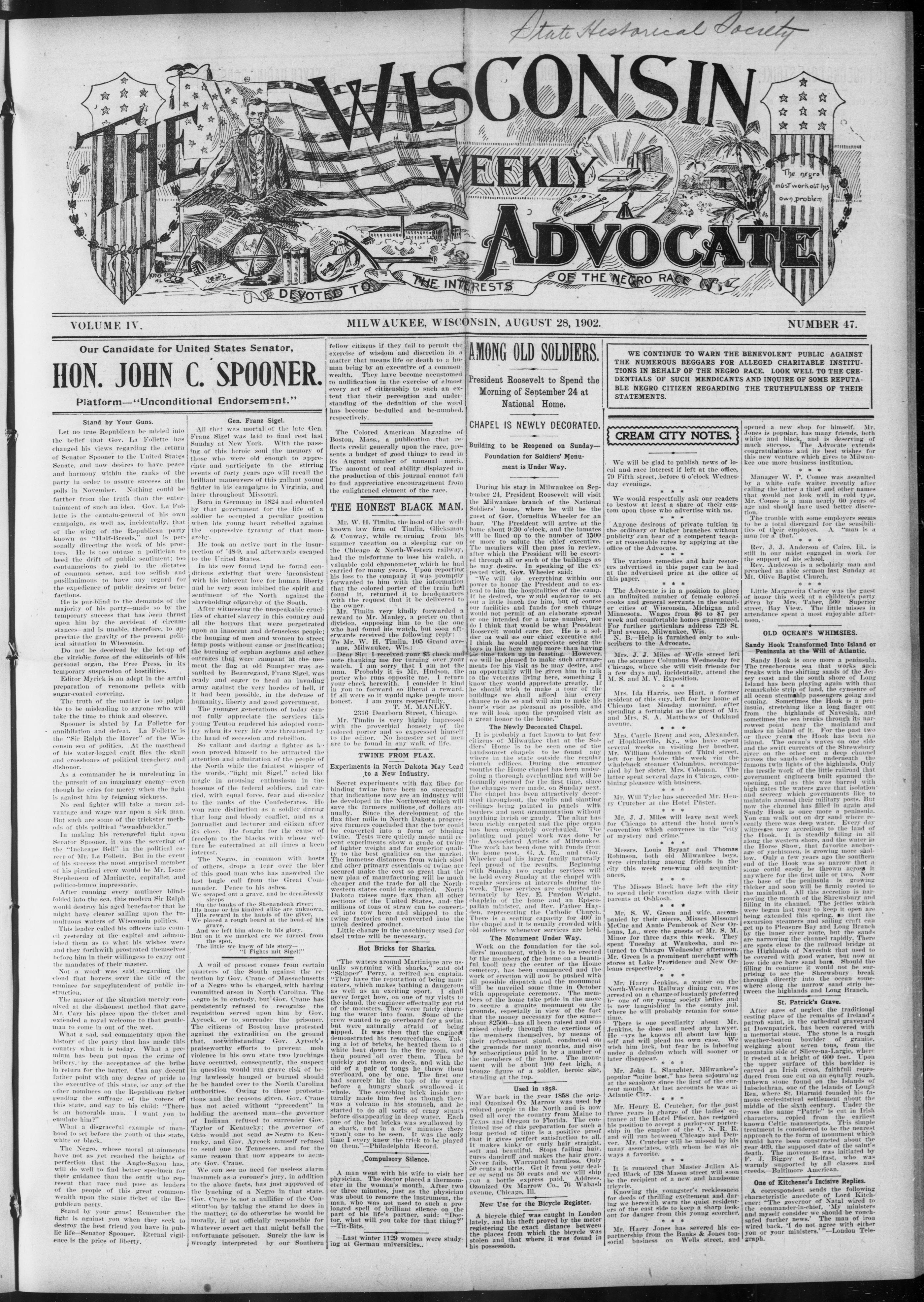
WISCONSIN
WEEKLY
ADVOCATE
DEVOTED TO THE INTERESTS OF THE NEGRO RACE
HON. JOHN C. SPOONER.
Platform—"Unconditional Endorsement."
VOLUME IV.
Stand by Your Guns.
Let no true Republican be misled into the belief that Gov. La Follette has changed his views regarding the return of Senator Spooner to the United States Senate, and now desires to have peace and harmony within the ranks of the party in order to assure success at the polls in November. Nothing could be farther from the truth than the entertainment of such an idea. Gov. La Follette is the captain-general of his own campaign, as well as, incidentally, that of the wing of the Republican party known as "Half-Breeds," and is personally directing the work of his proctors. He is too obtuse a politician to heed the drift of public sentiment; too contumacious to yield to the dictates of common sense, and too selfish and pusillanimous to have any regard for the expedience of public desires or benefactions.
He is pur-blind to the demands of the majority of his party—made so by the temporary success that has been thrust upon him by the accident of circumstances—and is unable, therefore, to appreciate the gravity of the present political situation in Wisconsin.
Do not be deceived by the let-up of the vitriolic force of the editorials of his personal organ, the Free Press, in its temporary suspension of hostilities.
Editor Myrick is an adept in the artful preparation of venomous pellets with sugar-coated covering.
The truth of the matter is too palpable to be misleading to anyone who will take the time to think and observe.
Spooner is slated by La Follette for annihilation and defeat. La Follette is the "Sir Ralph the Rover" of the Wisconsin sea of politics. At the masthead of his water-logged craft flies the skull and crossbones of political treachery and dishonor.
As a commander he is unrelenting in the pursuit of an imaginary enemy—even though he cries for mercy when the fight is against him by feigning sickness.
No real fighter will take a mean advantage and wage war upon a sick man. But such are some of the trickster methods of this political "swashbuckler."
In making his revengeful fight upon Senator Spooner, it was the severing of the "Inchecape Bell" in the political career of Mr. La Follett. But in the event of his success the most surprised member of his piratical crew would be Mr. Isaac Stephenson of Marinette, capitalist, and politico-bunco impressario. After running every mutineer blindfolded into the sea, this modern Sir Ralph would destroy his aged benefactor that he might have clearer sailing upon the tumultuous waters of Wisconsin politics.
This leader called his officers into council yesterday at the capital and admonished them as to what his wishes were and they forthwith prostrated themselves before him in their willingness to carry out the mandates of their master.
Not a word was said regarding the cloud that hovers over the title of the nominee for superintendent of public instruction.
The master of the situation merely connived at the dishonest method that gave Mr. Cary his place upon the ticket and extended a royal welcome to that gentleman to come in out of the wet.
What a sad, sad commentary upon the history of the party that has made this country what it is today. What a premium has been put upon the crime of bribery, by the acceptance of the bribe in return for the barter. Can any decent father point with any degree of pride to the executive of this state, or any of the other nominees on the Republican ticket pending the suffrage of the voters of this state, and say to his child: "There is an honorable man. I want you to emulate him?" What a disgraceful example of manhood to set before the youth of this state, white or black.
The Negro, whose moral attainments have not as yet reached the heights of perfection that the Anglo-Saxon has, will do well to find better specimen for their guidance than the outfit who represent that race and pose as leaders of the people of this great commonwealth upon the state ticket of the Republican party.
Stand by your guns! Remember the fight is against you when they seek to destroy the best friend you have in public life—Senator Spooner. Eternal vigilence is the price of liberty.
Gen. Franz Sigel.
All that was mortal of the late Gen. Franz Sigel was laid to final rest last Sunday at New York. With the passing of this heroic soul the memory of those who were old enough to appreciate and participate in the stirring events of forty years ago will recall the brilliant maneuvers of this gallant young fighter in his campaigns in Virginia, and later throughout Missouri. Born in Germany in 1824 and educated by that government for the life of a soldier he occupied a peculiar position when his young heart rebelled against the oppressive tyranny of that monarchy.
He took an active part in the insurrection of '48-9, and afterwards escaped to the United States. In his new found land he found conditions existing that were inconsistent with his inherent love for human liberty and he very soon imbibed the spirit and sentiment of the North against the slaveholding oligarchy of the South.
After witnessing the unspeakable cruelties of chattel slavery in this country and all the horrors that were perpetrated upon an innocent and defenseless people; the hanging of men and women to street lamp posts without cause or justification; the burning of orphan asylums and other outrages that were rampant at the moment the flag at old Sumpter was assaulted by Beauregard, Franz Sigel, was ready and eager to head an invading army against the very hordes of hell, if it had been possible, in the defense of humanity, liberty and good government. The younger generations of today cannot fully appreciate the services this young Teuton rendered his adopted country when its very life was threatened by the hand of secession and rebellion.
So valiant and daring a fighter as he soon proved himself to be attracted the attention and admiration of the people of the North while the faintest whisper of the words, "fight mit Sigel," acted like magic in arousing enthusiasm in the bosoms of the federal soldiers, and carried, with equal force, fear and disorder to the ranks of the Confederates. He won rare distinction as a soldier during that long and bloody conflict, and as a journalist and lecturer and citizen after its close. He fought for the cause of freedom to the blacks with whose welfare he entertained at all times a keen interest.
The Negro, in common with hosts of others, drops a tear over the bier of this good man who has answered the last bugle call from the Great Commander. Peace to his ashes.
We scraped out a grave, and he dreamlessly sleeps
On the banks of the Shenandoah river;
His home or his kindred alike are unknown.
His reward in the hands of the giver.
We placed a rough board at the head of his grave.
And we left him alone in his glory.
But on it we marked ere we turned from the spot.
The little we knew of his story—
"I Fights mit Sigel!"
A wail of protest comes from certain quarters of the South against the retention by Gov. Crane of Massachusetts of a Negro who is charged with having committed arson in North Carolina. The Negro is in custody, but Gov. Crane has persistently refused to recognize the requisition served upon him by Gov. Aycock, or to surrender the prisoner. The citizens of Boston have protested against the extradition on the ground that, notwithstanding Gov. Aytock's praiseworthy efforts to prevent mob violence in his own state two lynchings have occurred, consequently, the suspect in question would run grave risk of being lawlessly hanged or burned should he be handed over to the North Carolina authorities. Owing to these protestations and the reasons given, Gov. Crane has not acted without "precedent" in holding the accused man—the governor of Indiana refused to surrender Gov. Taylor of Kentucky; the governor of Ohio would not send a Negro to Kentucky, and Gov. Aycock himself refused to send one to Tennessee, and for the same reason that now appears to actuate Gov. Crane.
We can see no need for useless alarm inasmuch as a coroner's jury, in addition to the above facts, has just approved of the lynching of a Negro in that state. Gov. Crane is not a nullifier of the Constitution by taking the stand he does in the matter; to do otherwise he would be morally, if not officially responsible for whatever overt act that might befall the unfortunate prisoner. Surely the law is wrongly interpreted by our Southern
fellow citizens if they fail to permit the exercise of wisdom and discretion in a matter that means life or death to a human being by an executive of a commonwealth. They have become accustomed to nullification in the exercise of almost every act of citizenship to such an extent that their perception and understanding of the definition of the word has become be-dulled and be-numbed, respectively.
The Colored American Magazine of Boston, Mass., a publication that reflects credit generally upon the race, presents a budget of good things to read in its August number of unusual merit. The amount of real ability displayed in the production of this journal cannot fail to find appreciative encouragement from the enlightened element of the race.
THE HONEST BLACK MAN.
Mr. W. H. Timlin, the head of the well-known law firm of Timlin, Glicksman & Conway, while returning from his summer vacation on a sleeping car on the Chicago & North-Western railway, had the misfortune to lose his watch, a valuable gold chronometer which he had carried for many years. Upon reporting his loss to the company it was promptly forwarded to him with the information that the colored porter of the train had found it, returned it to headquarters with the request that it be delivered to the owner.
Mr. Timlin very kindly forwarded a reward to Mr. Manley, a porter on that division, supposing him to be the one who had found his watch, but soon afterwards received the following reply:
To Mr. W. H. Timlin, 105 Grand ave. Milwaukee, Wis.
Dear Sir: I received your $3 check and note thanking me for turning over your watch. I am sorry that I am not the man. Probably it is Mr. Hudson, the porter who runs opposite me. I return your check herewith. I consider it kind in you to forward so liberal a reward. If all were so it would make people more honest. I am yours respectfully.
T. M. MANLEY.
2316 Dearborn Street, Chicago.
Mr. Timlin is very highly impressed with the proverbial honesty of the colored porter and so expressed himself to the editor. No honester set of men are to be found in any walk of life.
TWINE FROM FLAX
Experiments in North Dakota May Lead to a New Industry.
Secret experiments with flax fiber for binding twine have been so successful that indications now are an industry will be developed in the Northwest which will save the farmers millions of dollars annually. Since the development of the flax fiber mills in North Dakota progressive farmers concluded that the tow could be converted into a form of binding twine. Tests were quietly made until recent experiments show a grade of twine of lighter weight and far superior quality to the best qualities on the market. The immense distances from which sisal and other primary essentials of twine are secured make the cost so great that the new plan of manufacturing will be much cheaper and the trade for all the Northwestern states could be supplied. North Dakota raises more flax than all other sections of the United States, and the millions of tons of straw can be converted into tow here and shipped to the twine factories and converted into the much desired product.
Little change in the machinery used for sisel twine will be necessary.
Hot Bricks for Sharks.
"The waters around Martinique are usually swarming with sharks," said old "Skipper" Perry, a retired sea captain. "They have the reputation of being man eaters, which makes bathing a dangerous as well as an exciting sport. I shall never forget how, on one of my visits to the island, the engineer effectually got rid of the monsters. They were fairly churning the water into foam. Some of the crew wanted to go overboard for a swim, but were naturally afraid of being nipped. It was then that the engine demonstrated his resourcefulness. Taking a lot of bricks, he heated them to a white heat down in the fire room, and then poured oil over them. Then he quickly got them on deck, and with the aid of a pair of tongs he threw them overboard, one by one. The first one had scarcely hit the top of the water before a hungry shark swallowed it whole. The scorching brick inside naturally made him feel as though there was a volcano in his stomach, and he started to do all sorts of crazy stunts before disappearing in deep water. Each one of the hot bricks was swallowed by a shark, and in a few minutes there wasn't one to be seen. It was the only time I every knew the trick to be played on them."—Philadelphia Record.
Compulsory Silence
A man went with his wife to visit her physician. The doctor placed a thermometer in the woman's mouth. After two or three minutes, just as the physician was about to remove the instrument, the man, who was not used to such a prolonged spell of brilliant silence on the part of his life's partner, said: "Doctor, what will you take for that thing?" —Tit-Bits.
—Last winter 1129 women were studying at German universities..
AMONG OLD SOLDIERS.
During his stay in Milwaukee on September 24, President Roosevelt will visit the Milwaukee branch of the National Soldiers' home, where he will be the guest of Gov. Cornelius Wheeler for an hour. The President will arrive at the home about 9:30 o'clock, and the inmates will be lined up to the number of 1500 or more to salute the chief executive. The members will then pass in review, after which the President will be escorted through all or such of the buildings as he may desire. In speaking of the expected visit, Gov. Wheeler said:
"We will do everything within our power to honor the President and to extend to him the hospitalities of the camp. If he desired, we would endeavor to set out a little lunch for him, but of course our facilities and funds for such things would not permit of an elaborate spread or one intended for a large number, nor do I think that would be what President Roosevelt would care for. He is a soldier as well as our chief executive and I think he would appreciate seeing the boys in line here much more than having his time taken up in feasting. However, we will be pleased to make such arrangements for his visit as he may desire, and an opportunity will be given him to talk to the veterans living here, something I know they would appreciate greatly. If he should wish to make a tour of the buildings we shall afford him every chance to do so and will aim to make his hour's visit as pleasant as possible, and we will look upon the promised visit as a great honor to the home."
The Newly Decorated Chapel.
It is probably a fact known to but few citizens of Milwaukee that at the Soldiers' Home is to be seen one of the handsomest chapels to be found anywhere in the state outside the regular church edifices. During the summer months the Home chapel has been undergoing a thorough overhauling and will be formally opened for the first time, since the changes were made, on Sunday next. The chapel has been attractively decorated throughout, the walls and slanting ceilings being painted in panels with borders and neat ornamentation without anything lavish or gaudy. The altar has been richly carpeted and the pipe organ has been completely overhauled. The painting and panel work was done by the Associated Artists of Milwaukee. The work has been done with funds from the home post, G. A. R., and Gov. Wheeler and his large family naturally feel proud of the results. Beginning with Sunday two regular services will be held every Sunday at the chapel with regular services at intervals during the week. These services are conducted alternately by Rev. E. Purdon Wright, chaplain of the home and an Episcopalian minister, and Rev. Father Hayden, representing the Catholic Church. There is a seating capacity for 400 in the chapel and it is usually crowded with old soldiers whenever services are held.
The Monument Under Way.
Work on the foundation for the soldiers' monument, which is to be erected by the members of the home on a beautiful knoll near the center of the Home cemetery, has been commenced and the work of erection will now be pushed with all possible dispatch and the monument will be unveiled some time in October with appropriate ceremony. The members of the home take pride in the move to secure a granite monument on the grounds, especially in view of the fact that the money necessary for the same about $2500—has all been raised and was raised chiefly through the exertions of the members themselves, by means of their refreshment stand, conducted on the grounds for many months, and also by subscriptions paid in by a number of the members of the home. The monument will be about 100 feet high, a bronze figure of a soldier, heroic size, standing at the top.
Used in 1858.
Way back in the year 1858 the original Ozonized Ox Marrow was used by colored people in the North and is now used all over the country from Maine to Texas and Oregon to Florida. The continued use of this preparation for such a long period of time is a positive proof that it gives perfect satisfaction to all. It makes kinky or curly hair straight, soft and beautiful. Stops falling hair, cures dandruff and makes the hair grow. Never fails. Warranted harmless. Only 50 cents a bottle. Get it from your dealer or send us 50 cents and we will ship you a bottle express paid. Address, Ozonized Ox Marrow Co., 76 Wabash avenue, Chicago, Ill.
New Use for the Bicycle Register.
A bicycle thief was caught in London lately, and his theft proved by the meter registering the exact distance between the places from which the bicycle was stolen and that where it was found in his possession.
WE CONTINUE TO WARN THE BENEVOLENT PUBLIC AGAINST THE NUMEROUS BEGGARS FOR ALLEGED CHARITABLE INSTITUTIONS IN BEHALF OF THE NEGRO RACE. LOOK WELL TO THE CREDENTIALS OF SUCH MENDICANTS AND INQUIRE OF SOME REPUTABLE NEGRO CITIZEN REGARDING THE TRUTHFULNESS OF THEIR STATEMENTS.
CREAM CITY NOTES.
We will be glad to publish news of local and race interest if left at the office, 79 Fifth street, before 6 o'clock Wednesday
☆ ☆ ☆
We would respectfully ask our readers to bestow at least a share of their custom upon those who advertise with us.
Anyone desirous of private tuition in the ordinary or higher branches without publicity can hear of a competent teacher at reasonable rates by applying at the office of the Advocate.
---
The various remedies and hair restorers advertised in this paper can be had at the advertised price at the office of this paper.
* * *
The Advocate is in a position to place an unlimited number of female colored cooks and general servants in the smaller cities of Wisconsin, Michigan and Minnesota. Wages from $6 to $7 per week and comfortable homes guaranteed. For further particulars address 729 St. Paul avenue, Milwaukee, Wis.
N. B.—Help is furnished only to subscribers to the Advocate.
Mrs. J. J. Miles of Wells street left on the steamer Columbus Wednesday for Chicago, where she will visit friends for a few days and, incidentally, attend the M. S. and M. V. Exposition.
公 私 案
Mrs. Ida Harris, nee Hart, a former resident of this city, left for her home at Chicago last Monday morning, after spending a fortnight as the guest of Mr. and Mrs. S. A. Matthews of Oakland avenue.
```markdown
```
Mrs. Carrie Brent and son, Alexander, of Hopkinsville, Ky., who have spent several weeks in visiting her brother, Mr. William Coleman of Third street, left for her home this week via the whaleback steamer Columbus, accompanied by her sister, Mrs. Coleman. The latter spent several days in Chicago, combining pleasure with business.
家 大 白
Mr. Will Tyler has succeeded Mr. Henry Crutcher at the Hotel Päster.
---
Mr. J. J. Miles will leave next week for Chicago to attend the hotel men's convention which convenes in the "city of mystery and crime."
* * *
Messrs. Louis Bryant and Thomas Robinson, both old Milwaukee boys, were circulating among friends in the city this week renewing old acquaintances.
```markdown
```
The Misses Black have left the city to spend their vacation days with their parents at Oshkosh.
```markdown
```
Mr. S. W. Green and wife, accompanied by their nieces, Misses Missouri McCue and Annie Pembrook of New Orleans, La., were the guests of Mr. S. M. Minor for three days this week. They spent Tuesday at Waukesha, and returned to Chicago Wednesday afternoon. Mr. Green is a prominent merchant with stores at Lake Providence and New Orleans respectively.
\*\*\*
Mr. Harry Jenkins, a waiter on the North-Western Railway dining car, was arrested on a charge of bastardy preferred by one of our young society ladies and is now languishing in the county jail, where he will probably remain for some time.
There is one peculiarity about Mr. Jenkins, he does not need any lawyer. He says he knows all about law himself and will plead his own case. We wish him luck, but fear he is laboring under a delusion which will sooner or later disappear.
Mr. John L. Slaughter, Milwaukee's popular "mine host," has been sojourning at the seashore since the first of the current month. At last accounts he was at Atlantic City.
宣宣宣
Mr. Henry E. Crutcher, for the past three years in charge of the ladies' entrance at the Hotel Pfister, has resigned his position to accept a parlor-car portership in the employ of the C. N. R. R. and will run between Chicago and Denver. Mr. Crutcher will be missed by his many associates, with whom he was always a favorite.
☆ ☆ ☆
It is rumored that Master Julian Alfred Black of 138 Mason street will soon be the recipient of a new and handsome tricycle.
Knowing this youngster's recklessness for deeds of thrilling excitement and daring we herewith warn the quiet residents of the east side to keep a sharp lookout for danger from this young scorcher.
Mr. Harry Jones has severed his co-partnership from the Banks & Jones tonsorial business on Wells street, and
NUMBER 47.
opened a new shop for himself. Mr. Jones is popular, has many friends, both white and black, and is deserving of much success. The Advocate extends congratulations and its best wishes for this new venture which gives to Milwaukee one more business institution.
* * *
Manager W. P. Comee was assaulted by a white cafe waiter recently after calling the latter a thief and other names that would not look well in cold type. Mr. Comee is a man nearly 60 years of age and should have used better discretion.
The trouble with some employers seems to be a total disregard for the sensibilities of their employes. A "man is a man for a that."
* * *
Rev. J. J. Anderson of Cairo, Ill., is still in our midst engaged in work for the support of his school.
Rev. Anderson is a scholarly man and preached an able sermon last Sunday at Mt. Olive Baptist Church.
* * *
Little Marguerita Carter was the guest of honor this week at a children's party given by Mrs. Taber, 560 Superior street, Bay View. The little misses in attendance spent a most enjoyable afternoon.
OLD OCEAN'S WHIMSIES
Sandy Hook Transformed Into Island or Peninsula at the Will of Atlantic.
Sandy Hook is once more a peninsula. The treacherous sea that works such freaks with the shifting sands of the Jersey coast and the south shore of Long Island has been playing again with that remarkable strip of land, the cynosure of all ocean steamship passengers going and coming. Sometimes the Hook is a peninsula, stretching like a long finger out from the highlands of Navesink, and sometimes the sea breaks through its narrowest point near the mainland and makes an island of it. For the past two or three years the Hook has been an island. The ocean's waves on one side and the swift currents of the Shrewsbury river on the other cut a deep channel across the sands close underneath the famous twin lights of the highlands. Only the trestle work of the little railroad that government engineers built spanned the opening, and as this was barred with high gates the waters gave that isolation and secrecy which governments like to maintain around their military posts. But now the channel has filled in again and Sandy Hook is once more a peninsula. You can walk out on dry sand where recently there was deep water. Every day witnesses new accretions to the land of the Hook. It is steadily filling in all along the western shore, and the water in the Horse Show, that favorite anchorage of yachtsmen, is growing more shallow. Only a few years ago the southern end of the Hook was so narrow that a stone could easily be thrown across it anywhere for the first mile or two. Now the base of the peninsula is growing thicker and soon will be firmly rooted to the mainland. All this accretion is narrowing the mouth of the Shrewsbury and filling in its channel. The jetties which were begun last year to keep it open are being extended this spring, so that the excursion steamers and sailing craft can get up to Pleasure Bay and Long Branch by the inner river route, but the sands are narrowing the channel rapidly. There are spots close to the railroad bridge at the Highlands of Navesink that used to be covered with good water, but now at low tide are bare sand bars. Should the filling in continue it would not be surprising to see the Shrewsbury break through directly into the ocean somewhere along the narrow sand strip between the highlands and Long Branch.
St. Patrick's Grave.
After ages of neglect the traditional resting place of the remains of Ireland's patron saint, in the cathedral graveyard at Downpatrick, has been covered with a memorial stone. The stone is a rough weather-beaten bowler of granite, weighing about seven tons, from the mountain side of Slieve-na-Largie, where it rested at a height of 600 feet. Upon the upper surface of this bowler is carved an Irish cross, faithfull reproduced from one cut on an equally rough, unhewn stone found on the Islands of Inisclothran, one of the islands of Lough Rea, where St. Diarmid founded his famous ecclesistical settlement about the middle of the sixth century. Under the cross the name "Patric" is cut in Irish characters, copied from the earliest known Celtic manuscripts. This simple treatment is considered to be the nearest approach to the form of monument which would have been constructed about the year 469, the supposed date of the saint's death. The movement was initiated by F. J. Bigger of Belfast, who was warmly supported by all classes and creeds.—Baltimore American.
One of Kitchener's Incisive Replies.
A correspondent sends the following characteristic anecdote of Lord Kitchener: "The governor of Natal wired to the commander-in-chief, 'My ministers and myself consider we should be vouch-safed further news.' The man of iron wired back, 'I do not agree with either you or your ministers.'"—London Telegraph.
Gen. Gobin Sees No Signs of a Settlement.
Individual Operators Would Make Concessions if They Could Do So Without Stultification.
Shenandoah, Pa., Aug. 25.—Much importance is attached to the calls Gen. Gobin receives from coal mine operators who spend hours with the general in going over the strike situation. After having met a number of operators Gen. Gobin said today that he does not see any signs of a settlement. In fact he states that all indications point more definitely to a prolongation of the strike now than they did when he first reached here. He keeps in touch with the strikers, as well as the operators, and may be seen daily riding over the hills with members of his staff. Along the road he frequently holds conversations with miners, all of whom display a friendly feeling toward him personally. There is no ill-feeling against the soldiers.
Individual operators are beginning to display evidence of a willingness to end the strike if a method could be shown them how they could make concessions to the men without stultifying themselves. In speaking with members of the staff at brigade headquarters some have within the past few days stated that if a way could be suggested whereby they could give in without placing themselves in a bad light they would favor a settlement. Gen.Cobin is using his good offices toward a settlement, and he allows no opportunity to pass when in conference with operators to make a conservative plea for the men on strike.
Senator Hanna Discouraged.
Buffalo, N. Y., Aug. 25.—Senator Hanna admits that all hope of persuading the anthracite coal operators to arbitrate with the strikers has been abandoned.
"I have exhausted all my efforts," said Senator Hanna. "I have done all in my power and can do no more. I will make no further attempts, for it would be useless."
He said it sorrowfully, for it is his belief that the operators are wrong in refusing to meet the miners.
He declared there was no chance of arbitration so long as only one side, the miners, were willing to arbitrate. He gave it as his opinion that the miners will not give in as long as they are able to fight.
"It will not be a short fight," said he. "It will be prolonged, and such prolongation will mean not only hardships for the miners and the women and children dependent on them, but it will have its effect on the American people. The longer this struggle continues the greater will be the increase in the price of coal."
"I talked with Mr. Morgan before he went to Europe," continued the senator, "and before the strike was fully under way. He deplored the situation, but would take no active part toward a settlement. His attitude, in my opinion, is unchanged."
SPECIAL OFFICER ASSAULTED.
Mobbed by Strikers While Trying to Rescue Nonunion Workman.
Hazleton, Pa., Aug. 25.—August Sheuch, aged 56 years, a special policeman in the service of the Lehigh Valley Coal Company, was assaulted and stabbed on the outskirts of the city today while attempting to rescue his son, William Sheuch, a nonunion workman, from a mob. About 3000 strikers had gathered from all parts of the Hazleton region on the roads leading to the mine to frustrate the plans of the company for a partial resumption of operations with a nonunion force of 250 hands.
A majority of the nonunion men were taken to the workings in a special train with which the strikers did not attempt to interfere. William Sheuch, who lives in this city, walked from his home toward the colliery and thus fell into the hands of the pickets. Most of the clothing was torn from his back in the struggle which followed. When Sheuch's father rushed to his aid the mob sat upon the elder Sheuch, who was finally rescued by a mine foreman and removed to the miners' hospital.
Sheuch was stabbed in the breast and on each hip, kicked in the abdomen and struck on the head with a stone. His injuries are not very serious. The knife which was sunk into his breast struck a rib, and that fact probably saved his life. The effort to prevent work at the mine was successful.
The report of a resumption at the Cranberry colliery of A. Pardee & Co. caused about 500 men to gather near the mine today, but no attempt was made to start work.
Every Road Picketed.
Tamaqua, Pa., Aug. 25.—Not since the inauguration of the anthracite coal miners' strike have the United Mine Workers had so many pickets patrolling the Panther Creek valley as was the case today. Every road and path leading to the collieries was guarded in an effort to persuade the nonunion men not to go to work. No new recruits were added to the working force and quite a number were turned back. The extra vigilance was due to the rumor that it is the intention of the Lehigh Coal and Navigation Company to cut coal as soon as sufficient men can be secured. An official of the company admitted today that practical miners are hard to procure, and that none of the coal companies are able to operate any of the mines for this reason.
Mine Boss Shoots Striker.
Pottsville, Pa., Aug. 25.—George Wheatley, an outside foreman at the Brookside colliery of the Philadelphia & Reading Coal and Iron Company, is under $1000 bail, charged with shooting George Searer, aged 19 years, of Lower City. Wheatley says he was followed through the streets by a crowd of strikers and their sympathizers, who jeered and hooted him. Becoming enraged he drew a revolver and fired into the crowd. The bullet took effect in Searer's leg. Wheatley has been a mine boss for a number of years.
Couldn't See Morgan.
New York, Aug. 25.—John Mitchell, president of the United Mine Workers, arrived in the city today and shortly before noon a committee of three young men called at the office of J. P. Morgan & Co., but Mr. Morgan had not arrived at his office and the committee left without seeing any member of the firm. Neither of the young men would speak of himself or the purpose of his visit, but it is understood they constitute the committee of the Peoples' Alliance of Hazleton, Pa., which is said to have a plan for the settlement of the strike.
There was no appreciable change in the coal situation here today. Hard coal continues to be sold by the retail dealers to their customers at the rate of $10 a ton. Exceptional cases show, however, that coal has been sold wholesale as high as $11.50 a ton and the retail price had reached $12.50.
EX-GOV. HOADLY DIES.
Former Executive of Ohio and Prominent Corporation Lawyer Passes Away.
Watkins, N. Y., Aug. 27.—George Hoadly, former governor of Ohio and widely known as a corporation lawyer, died at his residence in this city last night, aged 76 years. Together with his family he had been visiting here for a number of weeks. The body will be taken to Cincinnati, his old home, for interment. Mr. Hoadly was born in New Haven, Conn., July 31, 1826. He was graduated from Western Reserve College, Hudson, O., in 1844. He was elected by the Legislature in 1851 to the judgeship of the superior court of Cincinnati. He was city solicitor in 1855, and in 1857 succeeded Judge Gholson on the bench of the new superior court. He was re-elected to the superior court in 1864, but resigned in 1866 to establish a law firm.
Mr. Hoadly originally was a Democrat, but on account of slavery found his way into the Republican party, with which he remained until the close of Grant's first term as President of the United States. In 1876 he joined the Liberal Republicans and was absorbed into Democratic ranks. He appeared as counsel in favor of the Florida and Oregon Democratic electors in 1877. In 1883 he was nominated for governor against Judge Foraker, the Republican nominee. The canvass was an exciting one and attracted the attention of the entire country. It resulted in the election of Mr. Hoadly by a decided majority.
In 1887 Mr. Hoadley removed to New York and engaged in the practice of law.
KEENE'S HOPEFUL VIEW.
Says Stock Market is on Firm Foundation and is Positive that Prices will Go Higher.
New York, Aug. 27.—James R. Keene, who returned home last week from a three months' trip in Europe, in discussing the stock market says: "The fundamentals of the market are solid. I never was more positive in my life than I am in the opinion that stocks will reach a higher range of values. Agricultural conditions and business activity, such as we have enjoyed and have reason to expect, make a firm foundation for stock values. We have the products and the markets are open to us. "There is no false bottom to this period of good times. We have had six years of business prosperity to put the farmer and the railroad, the merchant and the workman, on firm ground. Our crops are good and marvelously abundant.
"Although prices may look high now in contrast with past quotations, I believe that prices are relatively lower and stocks intrinsically more valuable than they were six years ago.
"I know of no false dividends declared for stock jobbing or other purposes, but I do know of railroads that have been earning 12 per cent. and paying a conservative dividend of 6. All our railroads have plenty of money in their treasuries and have spent money wisely, enhancing the values of their properties."
STATUS OF POSTMASTERS
May Join Political Club and Make Contributions, but Should Not be Unduly Prominent.
Washington, D. C., Aug. 27.—The part which postal employees are to be permitted to take in a political campaign is outlined in the following instructions which acting Postmaster General Wynee has addressed to a postmaster who sent a letter of inquiry:
In reply to your letter, you are informed that you are not prohibited from joining a political club, nor making voluntary financial contributions outside of a government office or building, nor from acting as a delegate to a county, state or congressional convention.
You should not, however, serve as chairman of a state or county committee, nor take active part in conducting a political convention, nor make yourself unduly prominent in local political matters.
OIL FIELD CONDITIONS BECOME ALARMING.
Hundreds of People Overcome and in Danger of Total Blindness by Contact with Gas.
Beaumont, Tex.. Aug. 27.—George A. Hill, inspector of the oil field, gave out a statement in which he says:
"The conditions of the oil field are alarming in the extreme. The gas is so dangerous to the lives of the operators that over 100 are overcame daily and danger of total blindness is greatly feared as a result of constant contact."
HEAD-END COLLISION.
Seventeen People Injured, Two Seriously, in a Railway Accident
Youngstown. O., Aug. 27.—Two cars of the Youngstown & Sharon Electric Railway collided at 5:15 o'clock this morning two miles south of Sharon. Seventeen persons were injured, two seriously. The seriously injured are: F. S. Bach and John Farrapher, both of Youngstown. Fifteen others received slight injuries. The accident was the result of a misunderstanding of orders and heavy fog.
NEGOTIATIONS FAIL
Distilleries at Peoria will Not be Ab sorbed by Whisky Trust.
Peoria, Ill., Aug. 21.—Peoria's two immense independent distilling industries are not for sale, and will not be absorbed by the recently reorganized whisky trust. For weeks past the press dispatches from the East have been proclaiming that the deals for the purchase of these plants by the big combine were practically closed and that within a very short time they would be transferred and the visit of Angelo Meyers, president of the trust, to this city last week gave color to the rumor. Corning & Co. were approached and the negotiations were broken off. The Clarke Distilling Company refused to enter any combine, and deny any overtures having been made.
GREAT RUSH FOR LANDS.
Multitude of Settlers Apply for 1500 Farms in Oklahoma.
El Reno, Okla., Aug. 27.—The decision of the supreme court attaching a strip of land four miles wide to Oklahoma in the Chickasaw nation has brought thousands of people here to file at the land office. Special trains are bringing in additional crowds, and the rush for these lauds promises to be almost as great as the opening last fall. There are about 1500 farms in the strip.
Guidi to Go to Manila.
Rome, Aug. 27. Although it will not be officially announced until the end of the week, the appointment of Mgr Guidi as epostolic delegate at Manila is considered assured.
THE DECISION IS FINAL.
Coal Barons will Permit No Interference in Miners' Strike.
New York, Aug. 27.—No new plans for arbitrating the coal strike, no matter by whom they are inspired, will be considered by the operators, and no influence that President Mitchell of the United Mine Workers can bring to bear on them will change their position one lota. Such was the conclusion reached last night by the presidents of the anthracite coal carrying companies in conference. It was also stated officially that J. Pierpont Morgan will not take a hand in the dispute.
The meeting of the coal presidents was held in a private room in the Delmonico building. It was in many respects the most important held by the representatives of the coal roads since the strike began. There were present President J. W. Fowler of the New York, Ontario & Western railroad. President Baer of the Philadelphia & Reading, President Underwood of the Erie and President Truesdale of the Lackawanna railroad. The situation at the mining districts was discussed for two hours, during which time reports from the mines were considered. The reports showed that men were applying for work in increasing numbers, but that a break in the strike had not occurred yet. No time, it was stated, was fixed for opening the collieries, but the question as to the preparing the mines for reopening was considered fully.
Will Recognize No Interference.
President Baer was seen when the conference was over and made the following statement:
* : The operators are a unit in standing by their original position. The situation at the mines is improving daily. A few more men are applying to be taken back every day, but when the work will be actively resumed I will not undertake to say. I will say, however, that no interference by any outside parties, no matter how highly we may esteem the parties themselves, will have any effect. The matter at issue can only be settled between the operators and the miners.
: The statement of Mr. Hewitt that :
: the operators are "defending Amer-
can liberty" exactly covers the
: ground. It is calm, logical, and
: ought to be convincing. It exactly
: represents the position of both sides
: in the controversy. I believe it will
: aid in bringing about an end of the
: strike. I could not add one word to
: it that will help to offset the well
: meant attempt of people of high
: standing in the community, but who
: are not business men, to bring up
: the question of airbltration again.
No Chance for Argument.
Mr. Paer added that this hope of arbitration which was held out, but which had no foundation, had a good deal to do in prolonging the strike. He said, in answer to a question, that President Mitchell of the United Mine Workers could gain nothing by coming here in the hope of bringing up the question of arbitration. All the arguments which Mitchell could use were discussed before the strike was declared.
Morgan's Attitude Toward Strike.
A general statement regarding Mr. Morgan's attitude was made on behalf of the operators, to the following effect:
of the operators, to the following effect: "Mr. Morgan knew the exact situation while in Europe just as if he had been here. He was in touch with everything that transpired, and could have interfered in the dispute while he was abroad just as easily as when he returned. His return does not change the situation. There is no reason why he should interfere now any more than at any time during the strike, and he does not mean to interfere."
STRIKERS IN UGLY MOOD.
Chop Down Trolley Poles and Cut Electric Wires.
Tamaqua, Pa., Aug. 27. The fact that the striking miners in the Panther Creek valley are in a very ugly mood was shown today when several of the poles of the trolley line which runs from this place to Summit Hill, were chopped down and the wires cut. This was probably done to prevent troops from being taken from Manila park, where they are encamped, to Lansford and Summit Hill. Maj. Gearhart outwitted the strikers, however, by taking two companies of soldiers to Summit Hill an hour before they were expected.
In Lansford, Summit Hill and Coaldale the detachments of soldiers that were sent out at daybreak to preserve order and protect nonunion men were greeted by large crowds of strikers who hooted them and called them names. At Coaldale the soldiers were compelled to get off the cars and force the mob back from the tracks. In Lansford a crowd of women joined in hooting the guardsmen. Maj. Gearhart admitted that the situation is serious.
OLD SOLDIERS WORRIED.
Pension Bill Passed by Both Houses Failed in Conference.
Washington, D. C., Aug. 27.—Thousands of old soldiers are writing the pension office regarding a measure which passed both branches of Congress providing for the increase of pensions of all union soldiers who served one year or more to $12 a month regardless of disabilities. This measure also increased the pensions of those who have lost limbs and suffered disabilities.
For the information of those interested it can be said that the measure in question did not become a law. The Senate declined to agree to the increase, and the measure is now in conference committee. As the next session will be a continuation of the Congress which adjourned this summer it will not be necessary to put the bill through the two houses again, and all that is necessary to enact it will be for the conferences to reach an agreement which is ratified by both houses and to receive the President's approval.
CAVE-IN AT QUEEN MINE.
Dozen Houses on Verge of Abyss Near Negaunge.
Negaunee, Mich., Aug. 27.—A large area of ground at the Queen mine has caved in, carrying down several hundred feet of the South Shore railway track and several ore cars. A dozen houses are on the verge of the abyss and the families are moving out.
Branc on North-Western.
Waukegan, Ill., Aug. 27.—[Special.] Stockholders of the Chicago & North Western railroad have incorporated a company to build a new branch connecting their lines between Lake Bluff and Mayfair. It will form a cutoff and also open new territory.
AUTGMOBILE PLUNGES OVER AN EMBANKMENT
Machine Had Four Occupants, Two of Whom are Killed—The Driver Lost Control.
Long Branch, N. J., Aug. 27.—Four persons went flying down an embankment with a big Rhoder-Snyder machine at Elberon yesterday afternoon. The dead are Frank J. Matthews of Jersey City, aged 40 years; Mrs. Cobb of Richmond, Va., aged about 32 years. The injured are Mrs. Louis Pizzini, who is suffering from a fractured leg and shock; Rev. Father Grant of the Paulis: fathers. New York, who injured his leg and is also suffering from shock; Rudolph Meyer, the chauffeur, who escaped with an injured leg.
Where the road passes above the tracks of the New York & Long Branch railroad on a bridge is a most dangerous spot. After crossing the trolley tracks near by, Mr. Matthews lost control of his machine, which began to
The tracks of the New York & Long Branch railroad were below, a distance of thirty-five feet. The railing of the bridge gave way and the auto turned a somersault as it went down. Mr. Matthews was underneath the wreck and was reinioned fast. His death was almost instantaneous.
PLOT AGAINST KING.
Supposed Conspiracy to Take the Life of Victor Emmanuel, king of Italy.
London, Aug. 27.—In a dispatch from Genevt the correspondent of the Daily Mail reports the arrest of twenty-three Italians, supposed to be anarchists, in connection with an alleged plot to derail the train bearing King Victor Emmanuel to Berlin.
Geschenen, Switzerland, Aug. 27.—The train bearing the King of Italy and his suite emerged from the St. Gothard tunnel and arrived here at 5 o'clock last evening. The King left Rome for Berlin to visit Emperor William.
The railroad station here was decorated in honor of the King's arrival and he was greeted by the playing of the Italian national anthem and salutes fired from the heights surrounding the town.
His majesty was welcomed to Switzerland by President Zemp and the federal councilors. In an address President Zemp said this visit of the King of Italy was a fresh proof of friendship, and that he was convinced it would draw closer the ancient and good relations existing between the neighboring countries. Replying to the President, Victor Emanuel said it was a pleasure to express the cordial friendship between Italy and Switzerland, and that he hoped it would constantly become closer. After this exchange of courtesies the King's train proceeded for Berlin.
SEEKS OFFICER'S LIFE.
Escaped Convict Declares His Conviction Resulted from Perjured Testimony.
Butte, Mont., Aug. 27.—With officers of the state penitentiary upon his trail, assisted by bloodhounds, Tom O'Brien, the convict who last Friday made a daring escape from the state prison, has sent a communication to the Miner pleading for a public statement of his alleged crime and vowing the death of Under Sheriff Dave Morgan, whose alleged perjured testimony, the convict declares, sent him to prison and wrecked his home. The document received by the Miner bears the postmark of Anaconda. The writer dates his communication from a mountain in the surrounding hills of Anaconda and says that he wrote his story behind a rock, dividing his time between his Winchester and his pen. The communication is a literary freak and no question as to its authenticity, as the handwriting has been fully identified by the warden of the penitentiary and others acquainted with the criminal.
O'Brien declares his sole object in escaping from the prison is to kill Deputy Sheriff Morgan. He was sent up for robbery in 1901.
GEN. NORD DEFEATED.
Troops of Provisional Government Forced to Evacuate Limbe—Inhabitants Rise in Revolt.
Paris, Aug. 27.—A dispatch received here from Cape Haytien, Hayti, says the troops of Gen. Nord, the minister of war of the provisional government, have been defeated and forced to evacuate Limbe and adds that the fighting continues. It is further reported that the inhabitants of Aux Cayes and Aguins have risen against the provisional government and that Gen. Simon, commander of the department of the south, who has declared himself in favor of Gen. Firmin, is marching on Miragoane.
HANNA MUST JOIN THE UNION
May be Unable to Lay Corner Stone for Salvation Army Citadel.
Cleveland, O., Aug. 27.—"No card, no work" rules, which Business Agent Millison of the Bricklayers' Union announces will be applied, will make it necessary for Senator Hanna to join the Bricklayers' Union and get a working card before he can lay the cornerstone of the great building the Salvation Army is about to erect. Senator Hanna was one of the most generous contributors for this new citadel, and is to lay the cornerstone. Agent Millson says Mr. Hanna can be elected an honorary member of the Bricklayers' Union and given a temporary working card. The senator says he does not know whether he will lay the cornerstone or not.
CATTLE SPREAD DISEASE.
Kansas Woman Dies of "Lumpy Jaw," and Other Persons are Afflicted.
Pratt, Kas., Aug. 27.—Mrs. Kimball is dead from lumpy jaw caught from cattle, and Mr. Cochran, editor of the Pratt Republican, has been brought to a hospital here dangerously afflicted with the disease. Another man, whose name has not been learned, has caught the disease by chewing straw. Mr. Cochran caught the disease by lying down in a pasture where lumpy-jawed cattle grazed. The doctors here say there are only six cases on record where human beings have caught lumpy jaw from cattle.
REV. GALLAUDET DIES.
Episcopal Clergyman Noted for Work Among Deaf Mutes
New York, Aug. 27.—Rev. Thomas Gallaudet, D. D., a Protestant Episcopal clergyman, who was noted for his work among deaf mutes, died at his home in this city today. He was born at Hartford, Conn., in 1822.
Mrs. Hunter Released.
New York, Aug. 27. On her promise not to solicit alms in the future, Mrs. Jean Harris Hunter, who was arrested here by officers of the charity organization society for begging, has been allowed to go without trial.
Northern Pacific Express Stopped at Sand Point, Ida.
Spokane, Wash., Aug. 26.—The westbound Northern Pacific train was held up at Sand Point, Ida., sixty-five miles east of here, at 11 o'clock last night. The robbers, of whom there were seven, forced the engineer to stop the train, after which they uncoupled the baggage car. Then they compelled the engineer at the point of a revolver to pull up the track about three miles further, where they tried to wreck the baggage car with dynamite. The explosives failed to work for some unknown cause and after spending fifteen minutes with the car the robbers decamped, allowing the engineer to go back to the train with his engine. Two other thugs had guarded the train, keeping the passengers inside by firing revolvers along the sides. No attempt was made to molest the passengers, and after the engine came back the other robbers left and the train came on to Spokane. The train was heavily loaded.
St. Paul, Minn., Aug. 26.—A telegram was received today by the general manager of the Northern Pacific railway from a division superintendent stating that train No. 3 of that road, in charge of Conductor William Gilbert and Engineer G. H. Wilson, had been stopped at 10:35 last night, four miles west of Sand Point, Ida., by a gang of seven or eight men.
The express messenger refused to open his car, notwithstanding the threats of the bandits.
About twenty shots were fired, but no one was hurt and no one robbed. Officers were notified of the attempted robbery as soon as possible.
A tramp named William Pearson, who was stealing a ride on the baggage car, said that he saw two of the men's faces and could identify them. He was held at Snookane
The work is believed to be that of tramps.
INSTRUCTIONS TO MILES.
Authorized to Inspect Army in Philippines, but Not to Interfere with Chaffee or Davis.
Washington, D. C., Aug. 26.—The war department this afternoon gave out the order issued to Lieut.-Gen. Miles to go to the Philippines. It is signed by William Cary Sanger, acting secretary of war, and is as follows:
War Department, Aug. 26, 1902.—Sir: I have the honor to state that your application for authority to inspect that portion of the army serving in the Philippines is approved by the President. You will sail about the 15th of September, and in inspecting the condition of the army will give particular attention to its instruction, discipline and to supplies of all kinds.
Gen. Miles will not interfere in any way with either Gen. Chaffee or his successor, Gen. Davis, in the direction of the army in the Philippines. He will critically examine the conditions as he finds them, devoting his attention entirely to matters of army administration and not to political affairs, and the results of his work will be embodied in a set of reports. He will be accompanied by at least two members of his staff, namely, Lieut.-Col. Whitney and Col. Reber, the latter his son-in-law.
Leaving about September 15, and allowing a month for a tour of inspection of the principal islands of the archipelago, Gen. Miles should return to Washington early in January next. The transports Crook, Sheridan and Thomas are now lying at San Francisco. The Sheridan will sail on the first of September, and the Thomas, according to present arrangements, will start on September 16. In case the Thomas should not be ready to sail on that date, the Crook would go in her stead. All of these vessels have fine accommodations, and are well equipped to make the voyage of Gen. Miles a very comfortable one.
ABSOLUTELY UNTRUE.
Story that Bankers Would Pay Money to Notorious Forger if He Would be Good.
New York, Aug. 26.—James R. Branch, secretary of the American Bankers' Association, gave the following statement today to the Associated Press:
"The report which has appeared in a good many papers to the effect that S. Charles Becker, who is serving a sentence for forgery, will be paid a salary or pension by the American Bankers' Association to stop his career in crime is absolutely untrue. He is now at San Quentin penitentiary, California. Through the efforts of the association he was tried and convicted some years ago for a depredation on a member of our organisation. It is well known that we spare no expense to incarcerate a professional criminal who operated on our members.
"The association never has and never will pay one dollar, however, to this class of people through fear of their future crimes."
KILLED THE FIREMAN.
Passenger Train Crashes Into Rear of Freight in the Yards at Ano-
St. Paul, Minn., Aug. 26.—Northern Pacific passenger train No. 7 crashed into the rear end of a freight train in the yards at Anoka, killing the fireman, Harry Hutchins, and delaying traffic. In clearing away the wreckage, David H. Wilson, engineer of No. 7, was caught between two timbers and fractured his leg.
The passenger train was pulling into the yards where several uncoupled freight cars had stopped on the main line. When it was seen that a serious collision could not be averted Hutchins leaned from the cab. In doing so his foot slipped and he fell head foremost to the ground, striking the rail with his head and breaking his neck.
Survey New Townships.
Chippewa Falls, Wis., Aug. 26.—O. Whitehead, civil engineer and "townsite" man, arrived here yesterday with a party of Omaha railroad officials. They left for a trip over the line of the Chippewa Falls, Eau Claire & Northwestern railway to survey new town sites. Jim Falls, Burnet Falls and Little Falls have been picked out for town sites.
Death of Peter S. Hoe
New York, Aug. 26.—Peter S. Hoe, the last surviving member of the original firm of R. Hoe & Co., manufacturers of printing presses, is dead at Upper Montclair, N. J., from heart failure. Mr. Hoe was born in New York eighty-one years ago.
To be Armed with Rapid Fire Guns Upon Her Arrival in Milwaukee.
Washington, D. C., Aug. 26.—[Special.]—The new revenue cutter Tuscarora, which was built by the Trigg Shipbuilding Company of Richmond, Va., and is destined for service on the great lakes, with headquarters at Milwaukee, will be given her official sea trial tomorrow off Newport News, Va. She is to be speeded over a course eight miles to sea and return. At a recent dock trial it was pretty clearly demonstrated that the new vessel will come up to her contract speed of fourteen knots. The Tuscarora will be commanded by Capt. J. W. Collins, who was for five years stationed at Milwaukee, during her speed trial at sea. The new cutter is of 700 tons displacement, 178 feet over all in length, beam 30 feet, and a mean draft of 9 feet. She resembles in form the United States gunboat Petrel, and cost the government $159,000.
After the sea trial the Tuscarora will be taken to Richmond to receive her final painting and will then proceed to Cutler's bay.
The revenue cutter service outfitting plant is near Baltimore, where she will receive finishing touches and furniture and have stores placed aboard. As soon as this is completed the new cutter will be placed in commission, receiving her complement of officers and men, and start for her station at Milwaukee. It is expected that the Tuscarora will reach Milwaukee about October 1. It could not be learned at the treasury department today who will command the new vessel. Upon arrival at Milwaukee she will be armed with rapid-fire guns of the latest design.
SURVEYORS ARRESTED.
Railroad Employes are Held on the Charge of Willful and Malicious Trespass.
Pontiac, Ill., Aug. 26.—The surveyors for the branch of the Chicago, Rock Island & St. Louis railroad, which is projected from Morris to St. Louis, were arrested while at work on the Blake farm, four miles west of this city. These surveyors, eleven in number, cut through Mr. Blake's corn, also chopped down fine oak trees, branches of apple trees and otherwise did considerable damage. Mr. Blake then issued a warrant for their arrest for malicious and willful trespass. They were taken before Justice Hoover, who held them to the grand jury. A writ of habeas corpus was immediately issued before Judge Patton, who decided to remand the defendants to the custody of the sheriff and they were taken to jail, where they remained until bail was furnished.
Th statute provides that railroads may make preliminary surveys, paying for any damage, and as this is a new point of law it will be watched with much interest.
BIG SHORTAGE FOUND IN ELKS' LODGE FUNDS.
Grand Treasurer Orris Promised to Make the Shortage Good, but Has Not Done So.
Salt Lake, Utah, Aug. 26.—Official announcement has been made before the Elks' lodge in this city that a shortage of $16,000 has been discovered in the books of Ed S. Orris of Buffalo, N. Y., grand treasurer of the grand lodge of Elks. Mr. Orris was re-elected at the recent reunion in Salt Lake. According to a member of the grand lodge the shortage was not discovered by the auditing committee until after the election. Mr. Orris, when confronted, stated that he could and would make the shortage good at once, but this, it is announced, has not been done. The official announcement does not state what action will be taken in the matter.
BOMBARD CIUDAD.
Caracas, Venezuela, Aug. 26.—Ciudad, Bolivar, capital of the state of Bolivar, has been bombarded by a Colombian government warship and many persons were killed or wounded. The place has a large British population and the British subjects have requested that a warship of Great Britain be sent for their protection. It is alleged that atrocities have been committed at Ciudad, Bolivar, by both the government troops and the revolutionists.
RAILWAY PRESIDENT IS UNDER ARREST.
Omaha, Neb., Aug. 26.—President Horace G. Burt of the Union Pacific railway was this afternoon placed under arrest on ten warrants, charging him jointly with W. Arnett, an Indianapolis labor agent, with false imprisonment. President Burt went to police headquarters, where he gave a bond for $1000 for his appearance tomorrow morning, when the case will be heard.
ONCE FAMOUS FENIAN DEAD.
James Cahill, Whose, Companions Were Hanged, Passes Away.
Lawrence, Mass., Aug. 26.—James Cahill, a member of the famous band of Fenians for whose attack upon a prison coach and murder of Sergt. Brett, an English officer, at Manchester, Eng., in September, 1867, Allen, Larkin and were hanged, is dead. Cahill was born in Manchester in April, 1841. Two months after the murder of Sergt Brett, having been put into the custody of other Fenians, he escaped from England and came to this country.
WOMEN AND CHILDREN KILLED.
Engine Crashes Into Train Carrying Refugees to Johannesburg.
Bloemfontein, Orange River Colony, Aug. 26.—A shunting engine crashed into a train conveying refuges to Johannesburg yesterday. The front cars were wrecked and a number of women and children were killed.
Peculiarities of the Silent Zone.
That a powerful alarm like a fog siren can be sounded without being heard is shown by the investigations of E. P. Edwards on the English coast, according to London Invention. At a distance of a mile from the siren the sound began to die away, and between two and three miles it was entirely inaudible, while beyond three miles it was again plainly heard. This mysterious "silent zone" constantly changed in extent and position.
—Gaelic is the only language spoken by 9442 inhabitants of Galway. 2458 of whom are between 3 and 18 years of age.
Swiss postal officials are to be employed to assist in the reorganization of the Japanese postoffice. The Swiss postal system is to be taken as a model.
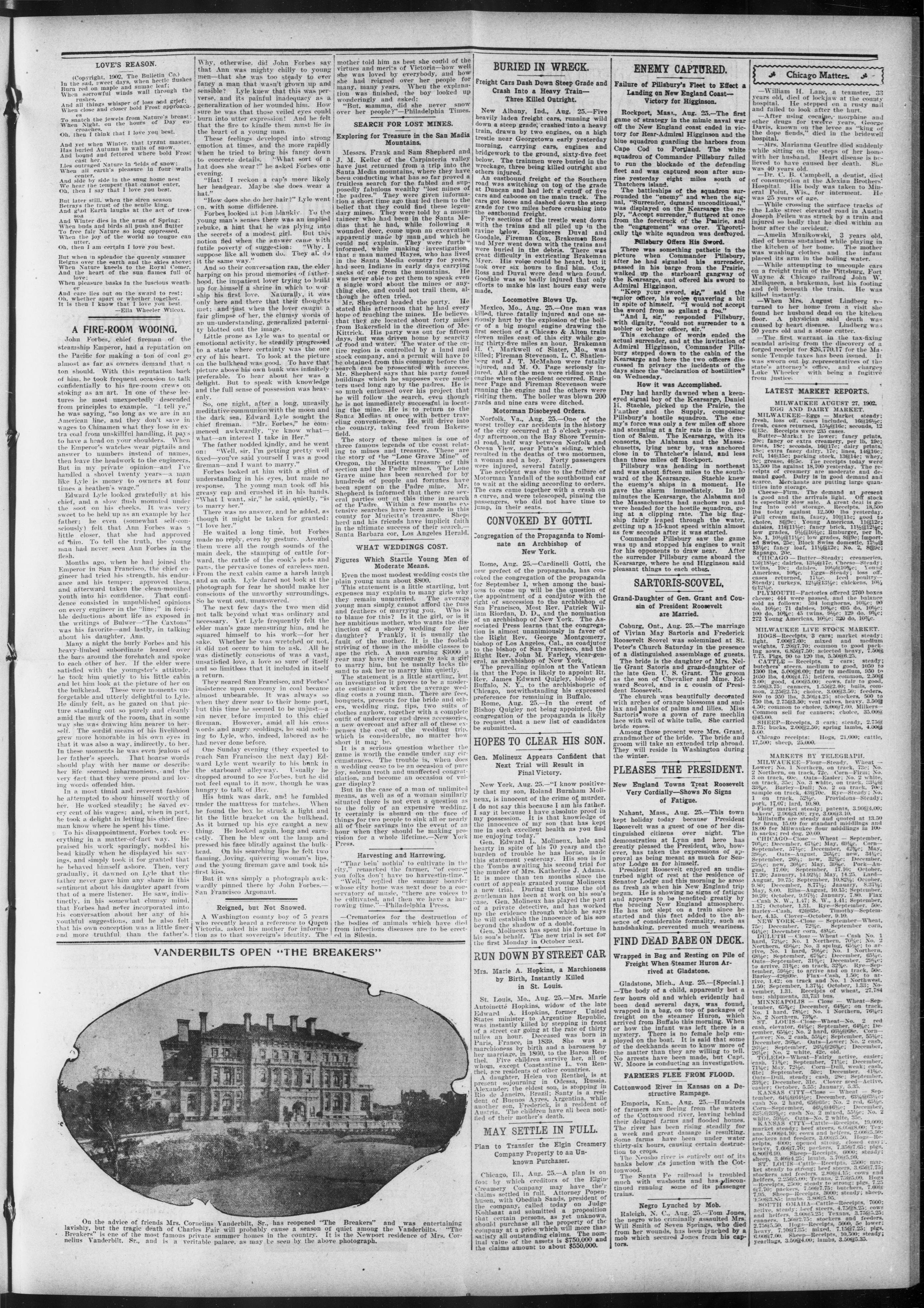
VANDERBILTS OPEN “THE BREAKERS”
a oo
: ee Oe
<—. i LE.
_. Shhh >
Lo j cS eS
Se x 2 ae pe
oe . : ; if oi oe eee z oe
ce = ee Pt zi | ae | —
bo See tees rm ee rae et ae : _
5 QRRieecaara = 8 60h
‘ =< * Sal ee ae os peace hee 3 Sis
fo Somos gg. fas: ae [a | | Tee ee
& Se ong ere Ft ia GTR a ee neg ommenletnapneeele ee
kK eee Beles Gece age ee ee ee
Ue . ae Roe 5. <- oe 3 = see: ia. es ;
ie ii er 2 pe Oe oo ee Ts
ers eae Se ee Oe ae of
Aegon SY See ee a : eR
Be Ne Ra ee
Y eematc OOS
Wo or SO oS See : 3 :
_ On the advice of friends Mrs. Cornelius Vanderbilt, Sr., has reopened “The Breakers” and was entertaining
lavishly, but the tragic death of Charles Fair will probably cause a season of quiet among the Vanderbilts. © “The
Breakers” is ene of the most famous private summer homes in the country. It is the Newport residence of Mrs. Cor-
nelius Vanderbilt. Sr. and is a yeritable palace, as may ke seen by the above photograph. ;
LOVE’S REASON.
(Copyright, 1902, The Bulletin Co.)
In the sad, eweet days, when hectle flushes
Burn red on maple and sumac leat;
When sorrowful winds wail through the
rushes, x
‘And all things whisper of loss aad §! ef:
When close and closer bold Frost approach:
To snateh the jewels from Nature's breast:
When Night, on the hours of Day en-
croaches,
Oh, then I think that I love you best.
And yet when Winter, that tyrant master,
Has buried Autumn in walls of snow, |
‘And bound and fettered where bold Frost
cast her.
Lies outraged Nature in elds of snow:
When all earth's pleasure in four walls
center,
‘And side by side in the snug home nest
We hear the tempest that cannot enter,
Oh, then I say that I love you best.
But later still, when the siren season
Betrays the trust of the senile king,
And glad Earth laughs at the act of trea-
soa
And Winter dies in the arms of Spring:
When buds and birds all push and flutter
To free fair Nature so long oppressed,
When the joy of the world no tongue can
utter,
Oh, then I am certain I love you best.
But when in splendor the queenly summer
Reigns over the earth and the skies above:
When Nature kneels to the Royal Comer,
And oe heart of the sun flames full of
love:
hens pleasure basks In the luscious weath-
=)
And care lies out on the sward to rest;
Oh, whether apart or whether together,
It is then I know that I love you best.
—Ella Wheeler Wilcox.
A FIRE-ROOM WOOING.
John Forbes, ehief fireman of the
steamship Emperor, had a reputation on
the Pacific for making a ton of coal go
almost as far as owners demand that a
ton should. With this reputation back
of him, he took frequent occasion to talk
confidentially to his fire-room crews on
stoking as an art. In one of these lee-
tures he most unexpectedly descended
from principles to example. “I tell ye.”
he was saying, “so long as we are in an
American Jine, and they don’t save in
wages to Chinamen what they lose in ex-
tra coal from unskillful handling, it pays
to have a head on your shoulders. When
the Emperor’s watches wear pigtails and
answer to numbers instead of names,
then leaye the headwork to the engineers.
But in my private opinion—and I've
handled 2 shovel twenty years—a man
like Lyle is money to owners at four
times a heathen’s wage.”
Edward Lyle looked gratefully at his
chief, and a slow flush mounted under
the soot on his cheeks. It was very
sweet to be held up as an example by hei
father; he even (somewhat self-con-
sciously) felt that Ann Forbes was 4
little closer, that she had approved
of thim. To tell the truth, the young
man had never seen Ann Forbes in the
flesh.
Months ago, when he had joined the
Emperor in San Francisco, the chief en
gineer had tried his strength, his endur-
ance and his temper; approved them.
and afterward taken the clean-mouthed
youth into his confidence. That confi-
dence consisted in unpublished opinions
on every engineer in the “line;” in forci-
ble deductions about life as exposed in
the writings of Bulwer—"The Caxtons”
was his favorite—and lastly, in talking
about his daughter, Ann.
Many a night the burly Forbes and his
heavy-limbed subordinate leaned over
the bars around the forehatch and spoke
to each other of her. If the elder were
satisfied with the youngster’s attitude,
he took him quietly to his little cabin
and let him look at the picture of her on
the bulkhead. These were moments un-
forgetable and utterly delightful to Lyle.
He dimly felt, as he gazed on that pic-
ture standing out so purely and cleanly
amid the murk of the room, that in some
way she was drawing him nearer to her-
self. The sordid means of his livelihood
grew more honorable in his own eyes in
that it was also.a way, indirectly. to her.
In these moments he was even jealous of
her father’s speech. That hoarse words
should play with her name or deseribe
her life seemed inharmonioeus,-and the
very fact that ‘they were proud and lov-
ing words offended him.
In a most timid and reverent fashion
he attempted to show himself worthy of
her. He worked steadily; he saved ev-
ery cent of his wages; and, when in port,
he took a delight in letting his chief fire-
man know where he spent his time.
To his disappointment, Forbes took ev-
erything in a matter-of-fact way. He
praised his work sparingly, nodded his
head kindly when he displayed his sav-
ings, and simply took it for granted that
he behaved himself ashore. Then, very
gradually, it dawned on Lyle that the
father never gave him any share in ‘this
sentiment about his daughter apart from
that of a mere listener. He saw, indis-
tinctly, in his somewhat clumsy mind,
that Forbes had neter incorporated into
his conversation about her any of his
youthful suggestions, and he also felt
that his own conception was a little finer
end more truthful, than the father’s.
that Ann was mighty chilly to young
men—that she was too steady to ever
faney a man that wasn’t lowe up and
sensible? Lyle knew that this was per-
verse, and its painful inadequacy as a
generalization of her wounded him. How
sure he was that those veiled eyes could
‘burn into utter expression! And he felt
that the fire to kindle them must lie in
the heart of a young man.
These feelings developed into strong
emotion at times, and the more rapidly
when he tried to bring his fancy down
to concrete details. ‘What sort of a
hat does she wear?” he asked Forbes one
evening.
“Hat! I reckon a cap’s more likely
her headgear. Maybe she does wear a
hat.”
“How does she do her hair?” Lyle went
on, with some diffidence.
Forbes, looked at bim blankly. Tu the
young man’s senses there was an implied
rebuke, a hint that he was plyiuz into
‘the secrets of a modest girl, But this
notion fled when the answer eaiuve with
futile poverty of suggestion: “Why. I
suppose like all women du. They al. do
‘it the same way.”
And so their conversation ran, the elder
harping on his proud memories of iather-
hood. the impatient lover trying to build
up for himself a shrine in which to wor-
ship his first Jove. Naturally, it was
‘only here and there that their thoughts
wet; and just when the lover caught a
fair glimpse of her, the clumsy words of
an un-understanding, generalized paterni-
ty blotted out the image. a
Little prone as Lyle was to mental or
emotional activity, he steadily progressed
to a state where certainty was the one
ery of his heart. To look at the picture
on the bulkhead was good. To have that
picture above his own bunk was infinitely
preferable. ‘To hear about her was a
delight. But to speak with knowledge
and the full sense of possession was heay-
enly.
So, one night, after a long, uneasily
meditative communion with the moon and
the dark sea, Edward Lyle sought the
chief fireman. “Mr. Forbes,” he ecom-
menced awkwardly, “ye know what—
what—an interest I take in Her.”
The father nodded kindly, and he went
on: “Well, sir, I'm getting pretty well
fixed—you’ve said yourself I was a good
fireman—and [ want to marry.”
Forbes looked at him with a glint of
understanding in his eyes, but made no
response. ‘The young man took off his
greasy cap and crushed it in his hands.
“what I want, sir,’ he said, quietly, “is
to marry her.”
There was no answer, and he added, as
though it might be taken for granted:
“L love her.” 3
He waited a long time, but Forbes
made no reply, even by gesture. Around
them were all the rough sounds of the
main deck, the stamping of cattle for-
ward, the rattle of the cook’s pots and
pans. the pervasive tones of careless men.
From the next cabin came a harsh laugh
and an oath, Lyle dared not look at the
photograph for fear he should make her
conscious of the unworthy surroundings.
So he went out, unanswered.
The next few days the two men did
net talk beyond what was ordinary and
necessary. Yet Lyle frequently felt the
elder man’s gaze measuring him, and he
squared himself to his work—for her
sake. Whether he was wretched or not,
it did not oecur to him to ask. All he
was distinctly conscious of was a vasts;
unsatisfied love, a love so sure of itself
and so limitless that it included in itself
a return.
They neared San Francisco, and Forbes’
insistence upon economy in coal became
almost unbearable. It was always so
when they drew near to their home port,
but this time he seemed to be unjust—a
sin never kefore imputed to this chief
fireman. | However, amid all his cross
words and angry scoldings. he said noth-
ing to Lyle, who, indeed, labored as he
had never done before. |
One Sunday evening (they expected to
reach San Francisco the next day) Ed-
ward Lyle went wearily to his bank in.
the starboard alleyway. Usually he
dropped around to see Forbes. but he did
not feel equal to it now, though he was
hungry to talk of Her.
His bunk was dark, and he fumbled
under the mattress for matches. | When
he found the box he struck a light and
lit the little bracket on the bulkhead.
As it burned up his eye caught a new
thing. He looked again, long and earn- |
estly. Then he blew out the lamp and
pressed his face blindly against the bulk- 3
head. On his searching lips he felt two :
flaming, loving, quivering woman's lips,
and the young fireman gave and took his
first kiss.
But it was simply a photograph awk-
wardly pinned there by John Forbes.—
San Francisco Argonaut. |
Reigned, but Not Snowed.
A Washington county boy of 5 years
who recently heard a reference to Qugen
Victoria, asked his mother for informa-
tion as to that sovereign’s identity. The
‘mother told him as best she could of the
virtues and merits of Victoria—bow well
she was loved by everybody, and how
she had reigned over her people for
many, many years. When the explena-
tion’ was finished, the boy looked up
wonderingly and asked:
“But, mamma, did she never snow
over her people?”’—Philadelphia Times.
ee
SEARCH FOR LOST MINES.
Exploring for Treasure in the San Madia
Mountains.
Messrs. Frank and Sam Shepherd and
J. M. Keller of the Carpinteria valley
have just returned from a trip into the
Santa Media mountains, where they have
been conducting what has so far proved a
fruitless search for the fabled and sup-
posedly fabulous wealthy “lost mines of
the padres.” They were given informa-
|tion a short time ago that led them to the
belief that ee could find these legen-
dary mines. They were told by a moun-
taineer who had been in the Santa Me-
dias that he had, while following 28
wounded deer, come upon an excavation
apparently made by man and which he
could not explain. They’ were furth:*
informed, while making - investigation
that 2 man named Rayes, who has lived
‘in the Santa Media country for years,
had seen Indians in early days carrying
‘sacks of ore from the mountains. He
was never abie to get them to speak even
a single word about the mines or any-
thing else, and could not trail them, al-
though he often tried.
Mr. Shepherd headed the party. He
stated this afternoon that he had every
hope of reaching the mines. He believe:
‘that they are located about forty miles
from Bukersfield in the direction of Me-
Kittrick. His party was out for fifteen
days, but was driven home by scarcity
uf food and water. The water of the en-
tire region is controlled by a land and
stock company, and a permit will have to
be obtained from this company before the
search can be prosecuted with success.
Mr. Shepherd says that his party found
buildings which he supposes were smel-
ters used long ago by the padres. He is
so much enthused over his project that
he will follow the search, even though
he is not immediately successful in locat-
ing the mine. He is to return to the
Sanca Medias at once with better trav-
eling conveniences. He will drive into
the country, taking feed from Bakers-
field.
The story of these mines is one of
three famous fegends of the coast relat-
ing to mines and treasure. These are
the story of the “Lone Grave Mine” of
Oregon, the Murietta treasure of this
section and the Padre mines. The Lone
Grave mine has been searched for by
hundreds of people and fortunes have
been spent on the Padre mine. Mr.
Shepherd is informed that there are sey-
eral parties out at this time in search
of the Padre. Within a few months ex-
tensive searches have been made in this
county for Murieita’s treasure. — Shep:
herd and his friends have implicit faith
in the ultimate success of their search.—
Senta Barbara cor, Los Angeles Herald.
WHAT WEDDINGS COST.
Figures Which Startle Young Men of
Moderate Means.
Even the most modest wedding costs the
| plain young man about $800.
This statement is a little startling, but
expenses may explain to many girls why
they remain unmarried. The average
young man simply cannot afford the fuss
and feathers of marrying you. Who is
to blame for this? Is it the girl, or is it
her ambitious mother, who wants the dis:
tinction of a showy wedding for hex
daughter? Frankly, it is usually the
fault of the mother. It is the foolish
“striving of those in the middle classes to
ape the rich. A man earning $3000 a
year may haye the courage to ask a gir!
to marry him, but he usually lacks the
sand to ask her ro marry him quietly.
The statement is a little startling, but
on investigation it proves to be a moder-
ate estimate of what the average wed-
ding costs a young man. There are fees,
bouquets, presents for the bride and oth-
ers, wedding ring, tips, two suits of
clothes anyhow, together with a complete
outfit of underwear and dress accessories,
a new overcoat and after all of these ex-
penses the cost of the wedding trip.
which is considerable, no matter how
short it may be.
It is a serious question whether the
game is worth the candle under any cir
cumstances. The trouble is, when does
a wedding cease to be an oceasion of pure
joy, solemn troth and unaffected congrat-
ulation, and become an occasion of yul-
gar display?
But in the case of a man of unlimited
means, as well as of a woman similarly
situated there is not even a question as
to the folly of an expensive wedding.
It certainly is absurd on the face of
things for ewe people to sink all or nearly
all of their savings into the event of an
hour when they should be making pro-
vision for a whole lifetime-—New York
Press.
Harvesting and Harrowing.
“Thar bein’ nothin’ to cultivate in the
city.” remarked the farmer, “of course
you folks don’t have no harvestin-time.”
“Weill,” replied the summer boarder
whose city home was next door to a cov-
servatory of music, “there are voices to
be cultivated, and then we have a har-
rowing time.”’—Philadelphia Press.
—
—Crematories for the destruction of
the bodies of animals which haye died
trom infectious diseases are to be erect-
ed in Silesia.
BURIED IN WRECK.
Freight Cars Dash Down Steep Grade and
Crash Into a Heavy Train—
Three Killed Outright.
New Albany, Ind. Aug. 25.—Five
heavily laden freight cars, running wild
down a steep grade} crashed’into a heavy
train, drawn by two engines, on a high
trestle near Georgetown early yesterday
morning, carrying cars, engines and
bridgework to the ground, sixty-five feet
below. The trainmen were buried in the
Wreckage, three being killed outright ana
Others injured,
An eastbound freight of the Southern
road was switching on top of the grade
at Duncan and had left a cutoff of five
cars and caboose on the main track. The
cars got loose and dashed down the steep
grade for two miles before crushing into
the eastbound freight.
Five sections of the trestle went down
with the trains and all piled up in the
ravine below. Engineers Duval and
Goodale, Fireman Cox, Brakemen Ross
and Myer went down with the trains and
Were buried in the debris. There wes
great difficulty in extricating Brakeman
Myer. His voige could be heard, but it
took over six hours to find him. Cox,
Ross and Duval were dead when found.
Goodale was so badly injured that only
efforts to make his last hours easy were
made,
Locomotive Blows Up.
Mexico, Mo., Aug. 25.—One man was
killed, three fatally injured and one se-
riously hurt by the explosion of the boil-
er of a big mogul engine drawing the
first section of a Chicago & Alton train
eleven miles east of this city while go-
ing thirty-five miles an hour, Brakeman
i. C._Markwell of Slater, Mo., was
killed; Fireman Stevenson, L. C. Shatlen-
berg and J. T. MeMahon were fatally
| njured, and M. O. Page seriously in-
jured. All of the men were riding on the
engine when the accident occurred. Engi-
-neer Page and Fireman Stevenson were
running the engine and the others were
visiting them. The boiler was blown 200
yards and nine ears were ditched.
Motorman Disobeyed Orders.
Norfolk, Va., Aug. 25.—One of the
worst trolley car accidents in the history
of the city occurred at 5 o’clock yester-
day afternoon,on the Bay Shore Termin-
al road, half way between Norfolk and
Ocean View, near Futa’s siding, which
resulted in the deaths of two motormen,
x woman and a boy. Forty passengers
were injured, several fatally.
The accident was due to the failure of
Motorman Yandall of the southbound car
to wait at the siding according to orders.
The cars came together with a crash on
a curve, and were telescoped, pinning the
passengers, who did not have time to
jump, in their seats.
CONVOKED BY GOTTI.
Congregation of the Propaganda to Nomi-
nate an Archbishop of
New York.
Rome, Aug. 25.—Cardinelli Gotti, the
new prefect of the propaganda, has con-
voked the congregation of the propaganda
for September 1, when among the busi-
|uess to come up will be the question of
the appointment of a coadjutor with the
right of succession to the archbishop of
San Francisco, Most Rev. Patrick Wile
liam Riordan, D. D., and the nomination
of an sp of New York. The As-
sociated Press learns that the congrega-
tion is almost unanimiously in favor of
the Right Rev. otras Montgomery,
bishop of Los Angeles, Cal., as eee saipe
to, the bishop of San Francisco, and the
Right Rev. John M. ae vicar-gen-
eral. as archbishop of New York.
The prevailing opinion at the Vatican
is that the Pope is likely to appoint Rt.
Rey. James Edward Quigley, bishop of
Buffalo, N. Y., to the archbishopric of
Chicago, notwithstanding his expressed
preference for remaining in Buffalo.
Rome, Aug. 25.—In the event of
Bishop Quigley not being appointed, the
congregation of the propaganda is likely
to request that a new list of candidates
be submitted.
se ER EES,
Gen. Molineux Appears Confident that
Next Trial will Result in
Final Victory.
New York, Aug. 25.—“I know positive-
ly that my son, Roland Burnham Moli-
neux, is innocent of the crime of murder.
[ do not say this because I am his father.
I say it because 1 have absolute Pak in
my possession. It is that knowledge of
the innocence of my son that has kept
me in such excellent health as you find
me enjoying today.”
Gen, Edward L. Molineux, hale and
hearty in spite of his 70 years and the
burden of trouble he has borne, made
this statement yesteraay. His son is in
the Tombs awaiting his second trial for
the murder of Mrs. Katherine J. Adams.
It is more than ten months since the
court of appeals granted young Molineux
2 new trial. During that time the old
gentleman has been at work on his sou’s
case. Gen. Molineux has played the part
‘of a private detective, and has worked
up the evidence through which he says
‘he will establish the innocence of his sop
‘beyond the shadow of a doubt. %
Gen. Molineux has spent his fortune in
‘his son’s behalf, ‘The new trial is set for
‘the first Monday in October tiext.
RUN DOWN BY STREET CAR
Mrs. Marie A. Hopkins, a Marchioness
by Birth, Instantly Killed
in St. Louis.
St. Louis, Mo., Aug. 25.—Mrs. Marie
Antoinetté Hopkins, widow of the late
Edward A. Hopkins, former United
States minister to Argentine Republic,
was instantly killed by stepping in front
of a street car going at the rate of thirty
miles an hour. Deceased was born in
Paris, Wrance, in 1839, She was a
marchioness by birth and a baroness by
her marriage, in 1860, to the Baron Ren-
thel, Five children survive her, all of
whom, except Constantine L. von Ren-
thel, are residents of other countries.
‘A’ daughter, Helen von Renthel, is at
present sojourning in Odessa, Russia.
‘Alexander; the eldest son, is stopping in
Rio de Janeiro, Brazil; Santy is a_resi-
dent of Buenos Ayres, Argentina, while
another son, Frederick, is a resident of
‘Austria. ‘The children have all been noti-
fied of their mother's death.
——<—_——
1
MAY SETTLE IN FULL.
Pian to Transfer the Elgin Creamery
Company Property to an Un-
known Purchaser.
Chicago, Il., Aug. 25.—A plan is on
foot by which creditors of the Elgin
Creamery Company may have_ the’r
claims settled in full. Attorney Popen-
husen, with Obediah Sands, president of
the company, called today on Judge
Kohlsaat and submitted a proposition
that certain persons, as yet unknown,
should purchase all the propery. of the
company at a price which will more than
satisfy all outstanding claims. The noim-
inal valine of the assets is $750,000 and
the claims amount to about $550,000.
ENEMY CAPTURED.
Failure of Pillsbury’s Fleet to Effect a
Landing on New England Coast—
Victory for Higginson.
Rockport, Mas:., Aug. 25.—The first
game of strategy in the mimic naval war
off the New England coast ended in vic-
tory for Rear-Admiral Higginson and the
blue squadron guarding the harbors from
Cape Cod to Portland. The white
squadron of Commander Pillsbury failed
to run the blockade of the defending
fleet and was captured soon after sun-
rise yesterday eight miles south of
Thatchers island. =
The battleships of the oe sur-
rounded the “enemy” and when the sig-
nal, “Surrender, demand unconditional,”
was displayed on the Kearsarge the re-
ply, “Accept surrender,” fluttered at once
from the foretruck of the Prairie, and
the “engagement” was over. ore
cally the white squadron was destroyed.
Billsbury Offers His Sword.
There was something pathetic in the
picture when Commander Pillsbury,
after he had signaled his surrender.
passed in his barge from the Prairie,
walked up the starboard gangway of
the Kearsarge, and offered his sword to
Admiral Higginson,
“Keep your sword, sir,’ said the
*sepior officer, his voice quavering a bit
in spite of himself. “I would not accept
the sword from so gallant a fos.”
“And I, sir,” responded Pillsbury,
with dignity, “could not surrender to a
nobler or better officer, sir.”
This exchange of words ended the
actual surrender, and at the invitation of
Admiral Higginson, Commander Pills-
bury stepped down to the cabin of the
—— and here the two officers dis-
cussed In privacy the incidents of the
days since the “declaration of hostilities”
on Weduesday.
How it was Accomplished.
Day had hardly dawned when a keen-
eyed signal boy of the Kearsarge, Daniel
H. Staehle, picked up the Prairie, the
Panther and the Supply, composing
Pillsbury’s hostile squadron. The ene-
my’s force was only a few miles off shore
and steaming at a fair rate in the direc-
tion of Salem. The Kearsarge, with its
consorts, the Alabama and the Massa-
chusetts, lying near by, was anchored
close in to Thatcher's island, and less
than three miles off Rockport.
Pillsbury was heading in northeast
and was about fifteen miles to the south-
ward of the Kearsarge. Staehle knew
the euemy’s ships in a moment. He
gave the alarm immediately. In 10
minutes the Kearsarge, the Alabama and
the Massachusetts had anchors up and
were headed for the hostile squadron, go-
ing at a clipping rate. The big flag-
ship fairly leaped through the water,
getting up a 15-knot speed within almost
as few seconds after it was started.
- Commander Pillsbury saw the game
was up and stopped his engines to wait
for his opponents to draw near, After
‘the surrender Pillsbury came aboard the
| Kearsarge, where he and Higginson said
pleasant things to each othes.
SARTORIS-SCOVEL,
EE
Grand-Daughter of Gen. Grant and Cou-
sin of President Roosevelt
are Married.
Coburg, Ont., Aug. 25.—The marriage
of Vivian May Sartoris and Frederick
Roosevelt Scovel was solemnized at St.
Peter’s Church Saturday in the presence
of a distinguished assemblage of guests.
The bride is the daughter of Mrs. Nel-
lie Grant Satoris and grand-daughter of
the late Gen. U. S. Grant. The groom
as the son of Chevalier and Mme. Ed-
ward Scovel, and is £ cousin of Presi-
dent Roosevelt.
The church was beautifully decorated
with arches of orange blossoms and smi-
lax and banks of palms and lilies. Miss
Sartoris* wore a gown of rare mechlin
lace with veil of white tulle. She carried
bride roses.
Among those present were Mrs. Grant,
grandmother of the bride. The bride and
groom will take an extended trip abroad.
They will reside in Washington during
the winter.
PLEASES THE PRESIDENT.
New England Towns Treat Roosevelt
Very Cordially—Shows No Signs
of Fatigue.
Nahant, Mass., Aug. 25.—This town
kept holiday today because President
Reosevelt was a guest of one of her dis-
tinguished citizens over night. The
demonstration at ee and here has
greatly pleased the President, who, how-
ever, has taken the expressions of a-
proval as being meant as much for Sen-
ator Lodge as for himself.
President Roosevelt enjoyed an undis-
turbed night of rest at the residence of
Senator Lodge and this morning he arose
as fresh as when his New England trip
began. He is showing no signs of fatigue
and appears to be benefited: greatly by
the bracing New England atmosphere.
He has not slept on a train since he
started and this fact added to the ab-
sence of considerable formality, such as
handshaking, prevented much weariness.
as
FIND DEAD BABE ON DECK.
Wrapped in Bag and Resting on Pile of
Freight When Steamer Huron Ar-
rived at Gladstone.
Gladstone, Mich., Aug. 25.—[Special.]
—The body of a child, apparently but a
few hours old and which evidently had
been dead several days, was found,
wrapped in a bag, on top of packages of
freight on the steamer Huron, which
arrived from Buffalo this morning. When
or how the infant was left there is a
mystery. There is no female help em-
ployed on the boat. It is said that some
of the deckhands seem to know more of
the matter than they are willing to tell.
No arrests have been made, but Capt.
W. Moore is conducting an investigaticn.
Seageegemee
FARMERS FLEE FROM FLOOD.
Cottonwood River in Kansas on a De-
structive Rampage.
Emporia, Kan., Aug. 25.—Hundreds |
of farmers are fleeing from the waters
of the Cottonwood river, leaving behind
their deluged farms and flooded homes.
The river has been rising steadily for
a week and great damage is resulting.
Some farms have been under water
thirty-six hours, causiug certain destruc-
tion to crops.
The Neosho river is entirely ont of its
banks below its junction with the Cot-
tonwood. c
The Santa Fe railroad is troubled
much with washouts and has ptiscon-
tinued running some of its ager
trains.
ener
Negro Lynched by Mob.
Raleigh, N. C., Aug. 25.—Tom Jones,
the negro who criminally assaulted Mrs.
Will Smith of Seven Springs, who died
from her wounds, bas been Inches by a
mob which secured Jones from cap-
tors.
# Chicago Matters.
s*
—William H. Lane, a teamster, 33
Years old, died of lockjaw at the county
hospital. He stepped on a rusty nail
and failed to look after the hurt.
—After using Socalpec morphine and
other drugs for twelve years, George
Davis, known on the levee as “king of
the sore fiends,” died in the brideweil
hospital!
—Mrs. Marianna Gentlre died suddenly
while sitting on the steps of her home
with her husband. Heart disease is be-
lieved to have caused her death. Sie
was 40 years old.
—Dr. C. B. Campbell, a dentist, died
of consumption at the Alexian Brothers*
Hospital. His body was taken to Min-
eral Point, Wis., for interment. He
Was 25 years of age.
—While crossing the surface tracks of
the Lake street elevated road in Austin
Joseph Feilen was strneck by a train and
injured se badly that he died within an
hour after the accident:
—Amelia Manikowski, 3 years old,
died of burns sustained while playing in
the kitchen of her home. The mother
was washing clothes and the infant
placed its arm in the boiling water.
—While attempting to _uncouple cars
on a freight train of the Pittsburg, Fort
Wayne & Chicago railroad John W.
Mullqueen, a brakeman, lost his footing
and fell beneath the train. He was
killed instantly.
| —When Mrs, August Lindberg re-
turned to her home from a_ visit she
found her husband dead on the kitchen
floor. A physician said death wax
caused by heart disease. Lindberg was
50 years old and a stone cutter.
| —The first warrant in the tax-fixing
scandal arising from the discovery of a
forged receipt for $26,770.17 for the Ma+
sonic Temple taxes has been issued. It
Was sworn out by representatives of the
state's attorney's office, and charges
Luke Wheeler with being a fugitive
from instice.
LATEST MARKET REPORTS.
MILWAUKEE AUGUST 27, 1902.
EGG AND DAIRY MARKET.
MILWAUKEE—Eggs — Market steady:
fresh, loss off, cases included, 16@16%ec;
fresh, cases returned, 15%@16e; seconds, 12
@ikec. Receipts were 235 cases.
Butter—Markct le lower; fancy prints,
20c; fancy or extra creamery, per 1b, 19¢;
firsts, 18e; seconds, 16@17¢; dairy prints,
1Se; extra fancy dairy, le; lines, 14@16c;
rell, 14@15e; packing stock, 13@14c; whey,
Sci grease, 4GSe. The receipts todiy were
15,500 Ibs against 18,700 yesterday. The re-
celpts of creamery are moderate and de-
mand good. Dairy is in good demand and
scarce. Merchants are putting large quan-
titles into storage.
Cheese—Firm. The demand at_ present
is good and the arrivals lighi. ‘of stock
is especially slow sale. A xreat deal Is go-
Ing into cold storage. Recelpts, 18,500
lbs today against 12,500 Ibs yesterday.
Full cream mats, fancy, 10@lic; good te
choice, S@9c;. Young Americas, 11 3
daisies, 1@1lée; fancy brick, 114@12%e;
low grades, 9%@10igc; Imburger, ver Ib,
No. 1, loa ri4c: low grades, ‘SADC: {mport-
ed Swiss, 25c; Block Swiss domestic, 12\s@
18%ce; fancy loaf, 11M@12c; No. 2, 8@vc;
Pee 2fe,
CHICAGO — Butter—Steady; creameries,
Ib@18ibe: dairtes, 1I84@lte. Cheese—Steady:
twins, 10c; daisies, 1064@10%c; Young
Americas, 10%c. Eggs— ere loss off,
cases returned, — litgc. Iced poultry-—
Sten: turkeys, 1244@13t%e; chickens, 10%
Qe.
- PLYMOUTH—Factories offered 2760 boxes
cheese; 444 were passed, and the balance
sold as follows: 594 longhorns, 10%; 90
do, 10%e; 71 dalsies, 10%c; 605 do, 10%c:
100 do, —_: 45 twins, 9c: 129 do. 9c;
272 Young Americas, 10%4c; 320 do, 10%c.
MILWAUKEE LIVE STOCK MARKET.
HOGS—Receipts, 3 cars; market steady:
Ught, TG mixed and medium
welghts, 7.20@7.70; common to good pack-
ing SoWS, 6.85@7.00; selected heavy, 7.50@
7.75. Pigs, 90 to 120 Ibs, 5.50@6.25.
CATTLE — Receipts, 2 cars; steady;
butchers’ steers. medium to good, 1050 to
1300 Ibs, 5.00@6.00; fair to medium, 950 ta
1050 Ibs, 4.00@4.75; heifers, common, 2.006
3.00; good, 4.00@5.00; cows, fair to good,
2.50@3.75; canners, 1.55@2.40; _buils, com-
mon, 2.25@2.73; choice, %.00G@3.50; feeders,
800 ‘to 950 Ibs, 3.50@4.25; stockers, 500 to
TO Ibs, 2.75@3.50; veal calves, heavy. 3.50@
4,50; common to choice, 5.0007.00. Milkers—
Common sell for canhers; cholce, 35.000
G45.00.
SHEEP—Recelpts, 3 cars; steady, 2.75@
3-75; bucks, 2006250; spring lambs, 4.006
Chicago receipts: Hogs, 21,000; cattle,
17,500; sheep, 25,000.
MARKETS RY TELEGRAPH.
MILWAUKEE—Flour—Steady. Wheat —
Lower; No. 1 Northern, on track, 7c; No.
2 Northern, on track, 72c. Corn—Firm; No.
3 on track, G0c. Oats—Easier; No. 2 white.
on track, 35¢; No. 3 white, on track, 33i4q@
38%c. Barley—Dull; No. 2 on track, 7c;
sample on track, 43@70c. Rye—Steady ; No.
1 on track, S24. Provisions--Steady;
ree 17.07; ae 10.30.
jour market steady; patents, 3.90@4.00;
bakers', 2.0003.00¢ rye, 30UG3-10.
Millstuffs are steady and quoted at 13.50
for bran, 15.00 for standard middlings and
18.00 for Milwaukee flour middlings in 100-
Ib sacks; red dog, 20.00.
CHICAGO—Close — Wheat — September,
T%e; December, 67%; May, Gi%e. Corn—
September, 57%4c; December, 42%c; May,
39%c. Oats—Angust, 264c; mew, 34\c;
September, 264; new, 82%c; December,
Bdge; new, B0%c; May, 30%c. Pork—An-
gust, 17.00; September, 17.10; October,
17.20; January, 14.9244: May, 14.35. Lard—
Angust, 10.75; September, 10.8244; October,
9.80; December, 8.7744; January, 8.3744:
May, $.00. Ribs August, 10.15; September,
10.20; October, 9.97%; January, 7.80. Plax
—Cash N. W., 1.47; 8. W., £41; September,
Lai: October, Li.” Rye=Sepiember, Ge.
Barley—Cash, 42@63c. Timothy—Septem-
ber, 4.15. Clover—October, 9.10.
NEW YORK—Close — Beptember— Wheat,
Te; December, T2%e. ptember cora,
Girje: December corn, 43%e.
ULU'TH — Close — Wheat —Cash No. 1
hard, 72Z\%c: No. 1 Northern, 70%c; No. 2
Northern, Go%e: No, 3 sping, Gige: to ar-
rive, No. 1 hard, 70%c; No. 1 Northern,
G8¥gc; September, 673c; December, G5ic.
Oats—September, | 31%¢;" December, 2946;
to arrive, 31%; on track, 32%jc. Rye—Sep-
tember, 591gc; to arrive and on track, We.
Barley42@00c. Flax—Cash, 1.50; to ar-
rive, 1.42; on track and No. 1 Northwest,
1.50; September, 1.87%; October, 1.33;_ No-
vember, 1.31. Receipts of wheat, 27,784
bus: shipments, 33,733 bus.
. MINNEAPOLIS — Close — Wheat “Sep-
tember, Go%e; December, 64%c; on trac!
No. 1 hard, 78%: No. 1 Northern, 76%4¢3
No, 2 Northern, 73%ec.
Sir. “LOUIS—Close—Wheat—No. 2 red
cash, elevator, othe: Seen 6i%Kc; De-
cember, 65%e; No. 2 hard, 66ya6se. Corn—
Lower: No. 2 cash, 55%4c; September, 55%;
December, 36%e. Oats—Lower: No. 2 cash,
26ige; September, 264@26%ce; December,
26ijc; No. 2 white, 42c, old.
TOLEDO—Wheat—Fairly active, easter;
leash, 71%c:_ September, Tic; December,
Fie; May. 72%. Corn—Dull, weak; cash,
Gle; September, 0c; December, ° 41%c.
Oats—Duil, steady; cash, 2c; September,
s3%e: December, 3ic. Clover seed—Active,
easier: October, 5.55; January. 5.25.
KANSAS CITY—Close — Wheat — Sep-
tember, G44@64H%4e; December, 63 4GE3\se:
cash No. 2 hard, 69@6%e: No. 2 red, Gitse.
Corn—September, — 464@AG%c; __December,
BELABI%C; eaxh’ No: 2 mixed, S5igc; No. 2
white, Bike. Oats—No. 2 white, 35c.
KANSAS ‘CITY—Cattte—iteceipts, | 19,009;
market steady; beef steers, 6.06a18.00; ‘Tex-
Ens. LOMEL0: cows and heifers, 2.0005.
stockers and feeders, 3.00@0./. | Hozs—Re-
celpts, 4000: opened strong, closed easy;
heavy, 7.00@7.70; packers, 7.35@7.65: pigs,
6.5046.90. Sheep—Receipts, G00, steady:
sheep, 3.404425: lambs, 3.7005.90.
st LOUIS—Cattle—Receipts, 3500; mar-
ket steady to strong: beef steers, 3.607.753;
stockers and feeders. 280@4.15; cows nud
helfers, 2.25@5.00: Texans, 2.7545.00. Hogs
—Keeeipts, 200; steady to strong: pigs. 4-25
Gi; packers, 7.207.759: butchers, 7.00@
705. sheep iteceipts, 2000; steady; sheep,
Sonaanisc: Inmbs. 2.80005.965.
sOvTH OMAHA, -Cattle—Becsipes. 7000:
active, steady: Leef steers, 4. y, Cows
and heifers, 3.0005.25; Texans, 3.79@5.25:
canners, LO@2.75: stockers and_ feeders,
2.7545. Hogs-—Recelpts, Se lower;
heavy, 7-10@755; mixed, 7.15@7.25; pi
C108T.00. el anioe 10.5 y atendy
yearlings, 3. 00; lambs, 3.50@5.35.
Telephone Black No. 244.
SUBSCRIPTION RATES.
Any part of the United States may
postage paid.
One Year . $2.00
Six Months . 1.25
Three Months . .75
Send money by Express Money Order, P. O.
Money Order or Registered Letter to the
Wisconsin Weekly Advocate.
ADVERTISING RATES.
One inch, single insertion . 25c
One inch, per year . $9.00
Business locals 5c per line each insertion.
Apply for rates to the Advocate.
TO CONTRIBUTORS:
All communications must be sent with the name and address of the sender as an evidence of good faith, but not necessarily for publication. No manuscript returned if not accepted, unless accompanied by stamps.
The Wisconsin Weekly Advocate company wishes to notify the public that all contracts and business transactions with this company must have the company stamp, otherwise they will be void. Neither will this company be responsible for paid subscriptions unless given to duly-accredited agents, who, on request, will give the company's receipt for same. Subscribers failing to receive their papers regularly will kindly notify the general office. Address all business communications to the general manager, 79 Fifth street.
Entered in the Postoffice at Milwaukee as Second-class matter.
Sheriff Burmeister, of Dane county, "didn't know it was loaded."
Of course, it is the humane design of the trust in witch hazel to rub it into consumers.
Anthracite is hard coal in a double sense; just now chiefly because it is hard to get.
Alfonso seems to be bent on giving his subjects a fund of startling reminiscences of his royal self.
The New York Aero Club has discovered that M. Santos-Dumont can make flights other than those aerial.
Wave the long pig-tail and bring forth the fatted bird's nest: the Chinese have peacefully retaken Tien-Tsin.
The first launch of the new United States Shipbuilding Company was the floating of a mortgage for $16,000,000.
According to latest advices, the trouble in the Baldwin-Ziegler Arctic expedition was another case of too many captains.
Chicago can't escape responsibility for well-known conditions by tracing her name to the Miami Indian word meaning skunk.
The Belgian authorities might have known that they could not keep Botha out of Brussels, or any other city that he desired to reach.
Mr. Gates' $500 tip to a waiter in a Saratoga hotel is liable to make traveling "come high" for those who want to be in the upper swim.
And now the lawyers are rushing to get as much as they can of the Fair money. Well, why shouldn't they want some of that kind too?
The beginning of the hunting season is heralded by the usual accidental discharge of weapons with serious and sometimes fatal results.
Why did Mr. Morgan get up the Harvester trust? O, that's easy. Of course it was to harvest his gains from the Steel trust and the Shipping trust.
J. Pierpont Morgan has returned to his native soil, and the people on the other side are looking about to see what is left without an American name plate.
The San Francisco Argonaut publishes a long article on "Learning How Not to Play the Piano." Is it wise to devote space to an art so widely mastered?
Having been married in a cage of lions, the young Orfordville couple should now emulate the other spectacular menagerie attraction known as the happy family.
The "fake" oil well at Mass City, Michigan, belongs to a class of "strikes" of that kind which is just now much in favor among get-rich-quick promoters.
Like a newspaper without red-and-yellow pictures, like a church without a whistling girl in the choir, will be the St. Louis world's fair without a midway.
Heretofore only "hot air" has been under suspicion in connection with the floating of big enterprises such as that with which the name Trippler is now associated.
If Yohe and her "Putty" persist in their search for a place "where reporters or unknown" it will be a long time before they can settle down. But probably it would be a long time, anyway.
The Milwaukee recipient of a windfall who announces that he will start out to fight the world's trusts with his capital of $400,000 won't have to enlarge his pockets for the accommodation of results.
Something must be radically wrong with the location of the rifle range of the Minnesota National Guard, near Minneapolis, when babies can stray into the line of fire and become targets for the guardsmen.
If they have any respect for public sentiment, auto scorchers everywhere should go slow until the excitement over the recent accidents subsides sufficiently to give the enthusiasts further opportunity for slaughter.
Now that the International Typographical Union has given the quietus to the measure aimed at the privilege of its members to serve in the National Guard, the printers can use the "shooting sticks" of peace and war without fear of molestation.
THE POP
By Rev. Wallace Nutting, D. D.
Herein is my Father glorified, that ye bear much fruit.—John xv., 8.
It fell on a day that I came into one of the great modern expositions, where everything is for sale. Becoming weary of walking and gazing I sat down in a retired corner, and fell into a reverie, at last into a dream. And I saw in my dream an exposition larger than that at Buffalo or Chicago or Paris. Methought it was owned by one Person, and conducted by his Son.
As I was near the exit, I sat watching the people I had known when awake as they went out. And the gates of entrance and exit were exceeding narrow. I bade a gentleman good day. He cast on me a great, kindly eye, and spoke a good word. He did not perhaps know that I scrutinized what he carried. But there in his open satchel were bundles of letters containing thanks for the kindnesses he had done. He also carried a package of leaves from some aromatic tree. It was marked: "The love of many." He had expended half his talents to procure it. It seemed no weight to him, but it gave great cheer.
He had also several badges on his breast, which answered as orders on checks for anything in the exhibition. I asked him how he came by them, and he replied that the owner of the establishment, when he saw him in the department where the garments of praise were sold, attached these badges, and told him he could have anything he asked. And so my friend was well provided with the best of everything, for he was a person of discernment, and refused to carry away anything cheap. Particularly he had been careful to turn all his gold into drafts on the bank of the great Metropolis of Souls, towards which he was traveling.
The manner in which this transaction was conducted was as follows: That bank had correspondents in the exposition here and there. To them he gave of such as he had. To some sympathy, to some his substance, to some he imparted thoughts in a precious casket. But always their principal in the great City of Souls knew by direct wire the amount of the transaction, and I believe my friend is a very opulent citizen of that strong-based city wherein is no temple.
Presently I saw another go out. He was somewhat corpulent, and burdened by bulky and weighty parcels, which caused him some pain and anxiety lest he should not get them all through the door. I noticed several deeds to real estate peeping from his pocket, and I inquired if he felt sure the rentals would pass as money of the realm where he was going. He looked at me dubiously, and puffed on, hugging the papers. He had also evidently been in the wholesale department, for he carried sacks of wheat and bolts of cloth. One said to him as he groaned along, "They hunger no more at the Soul's Metropolis. Better drop those food products."
"But what," said the poor man, "shall I do? These parcels form the greatest part of my purchases. I've spent years in procuring them, and if I let them go I shall be almost empty handed. No! I must try to get past the custom house." And with troubled, half-despiring look, he wiped his dripping forehead and passed along.
One shuffled by with only a dice box and an empty flask, and, more astonishing still, one had nothing whatsoever. When I asked them how it occurred, seeing they were in an exposition teeming with bargains, they replied that they had gone from counter to counter, exchanging a better thing for a worse, which they wanted at the moment, and now they had descended to this plight, when they received an imperative summons to go as they were.
Then there were little children who ran along singing, and all they had was a halo of sunshine and a jewel case of trust. They told me they were not afraid, for what they had would buy anything. I marveled a little because I had heard parents in that fair tell their children they must be wise and carry many things. But now I saw that these little ones were right. Indeed, I hear they have the entree to all the parks and palaces of the City of Souls, and he that loves them spreads a tabernacle over them, and leads them to wondrous fountains that glow and play with gorgeous and manifold beauty.
Last of all, a dear little old man (of historic name) went out of the door. He had spent all he had, but left the purchases to be delivered. When I asked him if he had no fears that they would miscarry, he looked wonderingly at me, and took out a little notebook, where, at the bottom of his list of purchases, he made me read: "I know him whom I have believed and am persuaded he is able to keep that which I have committed unto him against that day." And so he went along with a bright, expectant eye. I was sure (in my dream) that he would not be disappointed.
I saw also a strange thing: All that men had with them when they entered the fair was taken from them as they went out. It seems they had been warned to expend all they had while in the fair. All unexpended balances were lost. But when a wise buyer went out, a beautiful old patriarch with a harp would turn to the gatekeeper and say, "Lift up the gate!"
I saw, therefore, that people who desired the best gifts went out richest. I perceived that quality, not quantity, was most convenient at the door, and particularly that they whose works were left to follow them were counted wise. I heard they were heirs, according to a promise, of eternal life. I was most struck by this: The anxious shoppers who had tried to carry away the whole establishment got away to the other side with far less than those who had converted their property and left their orders, confiding in the government of the city to which they were going to see that all was done well. These went on smil-
ing and nodding kindly, always with a sweet good night. But just here I was touched by a messenger who said, "I find you sleeping in this wide market. Go at once." I had not expected a call so soon. "That," said the messenger sadly, "is what almost everybody says."
So I started out with a little basket of fruit. I excited the astonishment of the doorkeeper, for word had gone out that fruit passed free. Indeed, I had lying against my heart (and it burned me there) this saying: "It is the will of my Father that ye bear much fruit." And I passed on to the great awakening.
RELIGION THE FIRST DUTY.
By Rev. Pearse Pinch
The ten commandments seem to many people to be in the wrong order, in that they say too little about our duties to our fellowmen and leave that little to the last.
Not till we get to the sixth commandment are we forbidden to kill. Sabbath breaking and profanity seem to be made worse offenses than stealing and lying. Is there an inverted moral order in this code of the ancient law giver? Why are religious duties put before the duties we owe our fellowmen?
The world's estimate would change the order, and probably leave religious duties out of the moral code altogether. Men who would not steal a pin or a railroad are sometimes wholly irreligious, and seem to feel that there is no moral wrong in it.
Is irreligion a moral offense, or is it not? Most men do not regard it wrong. But are they right? Would irreligion be to an uncorrupted moral sense any such sin as murder? Is indifference to-religion due to a low adjustment of conscience to life? This is worth thinking about.
If irreligion is a moral offense as serious as the others we certainly cannot treat it so in law.
We accept the principle that religion must be free. The sheriff cannot command it. Prison cannot enforce it. In its very-nature it must be free. For that reason it may be the world is losing a sense of the moral wrong of irreligion. Because a man must not be jailed or whipped for irreligion the average man concludes there is no wrong in it.
Irreligion puts a false estimate into all human affairs. We have to know what men are in their widest relations before we see just what are our duties to them. If we are a superior kind of brute dealing with other similar brutes, that is one thing. But if we are beings related to God with destinies, that is another thing. To destroy the life of men is murder, but to destroy the life of brutes may be innocent of all wrong. Men are subject to the first four of the ten commandments, and for that reason our duties to them are different and higher. To leave religion out is to demoralize human estimates and leave the way open to any sort of immorality.
Religion is needed for balance. Life cannot be healthy with the chief part left out. To be irreligious is to become overgrown on the earthward side. The attempt of a nature made to be immortal to live its whole life in three score years and ten can hardly fail of being disastrous. Religion has been a tremendous force in all human life. The material for religion is in all mcn. To suppress or ignore religion is to come into a disordered way of life. If we do not have religion in healthful operation we are sure to put something else in place of it.
Were our people to turn wholly away from the sane and uplifting religion of Jesus Christ, all manner of vile superstitions would come in to take its place. This all means that every man ought to attend to his religion as the first duty.
TWELVE MISSIONARIES.
By Rev. Ktttredge Wheeler.
Sometimes the change of a word heips to the idea, and sets forth in clear light the thought. The word apostle is Greek, and seems much farther removed from cur religious vocabulary than the Latin word missionary. What a help to the church, since the days of the King James Version at least, this slight change in translation would have been. Jesus chose twelve missionaries whom he educated and sent forth. This is exactly and definitely what Jesus did; and this one word, missionary, in the place of the Greek word apostle, might have prevented the controversy between mission and anti-mission churches.
What a fine reading that would be today, in all Christian churches, and how it would open the eyes of many of the selfishly blinded souls who call themselves followers of that Saviour who gave himself to God and to man and the truth! A Christian but not a missionary! Not sent forth in the name of Jesus, to serve hmi. Impossible! A Saviour who was crucified, who died upon the cross to give the truth of God to the world, to reveal the love of God to all mankind, and yet his followers giving nothing, doing little, to extend the kingdom and the knowledge of Jesus Christ! Doing little for Jesus; little for men.
Jesus chose twelve missionaries! Read your Bible that way! Put the word missionary in the place of apostle. And yet, alas! there are teachers and leaders and officers in the churches who are so orthodox that they will not give up the King James Version, nor will they accept any change in the English translation. There are teachers and officers in the churches to-day who seem to think that God and the Holy Spirit spoke English, and that the King James is the original language of Jehovah. For this reason the Bible is to-day to so many a sealed, closed book. Get a new translation, a new version whenever you can; the more the better. You will get a new idea, some newer, clearer thought. You will understand the Bible better; you will be a better teacher, leader, Christian. Jesus chose twelve missionaries! Read it so. It will help you and the whole church.
Only One Thing.-The only new thing in the world is the infinite possibilities of comfort, of virtue, the infinite variations of the higher experiences of life. Rev. T. R. Slicer, Unitarian, New York.
They Are Coming On to Chicago
MIDDLE STATES and MISSISSIPPI VALLEY EXPOSITION
TO BE HELD IN CHICAGO
AUG. 14th to SEF
First Regim
The first practical demonstration people of the North of the de the negro race in this section.
A Grand Display of
The nation's first big event of go is the freest and most hosp States, the greatest summer
The principal feature of t will be seen. Do not fail greatest of all Race Exposition
SPECIAL RAILF
G.14th to SEPT.14th,19 AT...
practical demonstration ever given the North of the development and race in this section.
and Display of Race Pro
it's first big event of the 20th century, the best and most hospitable city in the greatest summer resort in the west. Principal feature of the Charleston green. Do not fail to visit Chicago. All Race Expositions.
SOCIAL RAILROAD RA
First Regiment Armory
The first practical demonstration ever given to the people of the North of the development and growth of the negro race in this section.
A Grand Display of Race Progress
The nation's first big event of the 20th century. Chicago is the freest and most hospitable city in the United States, the greatest summer resort in the west. The principal feature of the Charleston Exposition will be seen. Do not fail to visit Chicago and the greatest of all Race Expositions.
SPECIAL RAILROAD RATES
For information, address
Suite 701.
THE COMMITTEE,
167 Dearborn St.
Butter. Telephone.
New York Tailorin
22 WELLS STREET
The New York 322 WELLS
The New York Tailoring Co.
322 WELLS STREET (Bet. 3d and 4th Sts.)
Ladies' and Gents' Suits Made to Order. We also Clean, Press, Repair and Dye All kinds of Ladies' and Gents' Garments. Satisfaction Guaranteed. . . . Milwaukee
HARTONA
POSITIVELY STRAIGHTENS
ALL
Kinky, Knotty, Stubborn.
Harsh, Curly Hair.
HARTONA makes the hair grow and glossy. Cures Dandruff, Bald Scalp Diseases. Prevents Falling in texture Baldness. HARTONA POSITIVE KINKIEST HAIR. Guaranteed by receipt of price—25c. and 50c. per bottle.
HARTONA FACE BLEACH will black or dark person five or six shin skin of a mulatto person almost BLEACH removes Wrinkles, Dark Scalp heads, and all Blemishes of the harmless. Sent to any address one per bottle.
Hartona Remedies are absolutely positively refunded if you are new us, and we will send you free a book one hundred people in your own use using Hartona Remedies.
SPECIAL GRAND OFFEE
we will send you three large boxes AND STRAIGHTENER, two large BLEACH, and one large box of H removes all disagreeable odors cause Arm-Pits, &c.
Goods will be sent securely se your name and post-office and exp Money can be sent in Stamps or be enclosed in Registered Letter or by Address all orders to—
NANA makes the hair grow long, straight, be
cured, Cures Dandruff, Baldness, Itching, Eczema
cases. Prevents Falling Out of the Hair
press. HARTONA POSITIVELY STRAIGHT
HAIR. Guaranteed harmless. Sent a
price—25c. and 50c. per box.
NANA FACE BLEACH will gradually turn to
dark person five or six shades lighter, and the
mulatto person almost white. HARTONA
removes Wrinkles, Dark Spots, Pimples; Free
all Blemishes of the Skin. Guaranteed.
Sent to any address on receipt of price—
Remedies are absolutely guaranteed, and
may refunded if you are not perfectly satisfied.
will send you free a book of testimonials or
people in your own State who have us
NANA Remedies.
MAL GRAND OFFER. Send us One
mention this.
If you three large boxes of HARTONA HAIR
RIGHTENER, two large bottles of HART
and one large box of HARTONA NO-SM
disagreeable odors caused by Perspiration,
etc.
will be sent securely sealed from observa-
tion and post-office and express office address
to be sent in Stamps or by Post-Office Mon-
Registered Letter or by Express.
all orders to—
HARTONA REMEDY CO.
909 E. Main Street,
RICHMOND, VIRGINIA.
HARTONA makes the hair grow long, straight, beautiful, soft, and glossy. Cures Dandruff, Baldness, Itching, Eczema, and all Scalp Diseases. Prevents Falling Out of the Hair and Premature Baldness. HARTONA POSITIVELY STRAIGHTENS THE KINKIEST HAIR. Guaranteed harmless. Sent anywhere on receipt of price—25c. and 50c. per box.
HARTONA FACE BLEACH will gradually turn the skin of a black or dark person five or six shades lighter, and will turn the skin of a mulatto person almost white. HARTONA FACE BLEACH removes Wrinkles, Dark Spots, Pimples, Freckles, Blackheads, and all Blemishes of the Skin. Guaranteed absolutely harmless. Sent to any address on receipt of price—25c. and 50c. per bottle.
Hartona Remedies are absolutely guaranteed, and your money is positively refunded if you are not perfectly satisfied. Write to us, and we will send you free a book of testimonials of more than one hundred people in your own State who have used and are using Hartona Remedies.
SPECIAL GRAND OFFER. Send us One Dollar and mention this paper, and we will send you three large boxes of HARTONA HAIR GROWER AND STRAIGHTENER, two large bottles of HARTONA FACE BLEACH, and one large box of HARTONA NO-SMELL, which removes all disagreeable odors caused by Perspiration of the Feet, Arm-Pits, &c.
Goods will be sent securely sealed from observation. Write your name and post-office and express office address very plainly. Money can be sent in Stamps or by Post-Office Money Order or enclosed in Registered Letter or by Express.
AGENTS WANTED in Every Town and City. Liberal Salary Paid.
AFTER USING
HARTONA
A. BAIRD, Cutter.
PADE-MARK.
BEFORE USING
KARTONA
AFTER USING
HARTONA
. 14th, 1902,
nt Armory
on ever given to the
opment and growth of
Race Progress
the 20th century. Chica-
able city in the United
ort in the west.
Charleston Exposition
visit Chicago and the
DAD RATES
ITTEE,
67 Dearborn St., Chicago.
Telephone Black 9343.
Tailoring Co.
STREET
Sts.)
Milwaukee, Wis.
TRADE-MAR.
ing, straight, beautiful, soft, us, Itching, Eczema, and all sort of the Hair and Prema-ELY STRAIGHTENS THE
mless. Sent anywhere on
gradually turn the skin of a leses lighter, and will turn the white. HARTONA FACE
its, Pimples, Freckles, Black-En. Guaranteed absolutely receipt of price—25c. and 50c.
guaranteed, and your money perfectly satisfied. Write to of testimonials of more than one who have used and are
Send us One Dollar and mention this paper, and HARTONA HAIR GROWER bottles of HARTONA FACE HARTONA NO-SMELL, which may Perspiration of the Feet,
from observation. Write its office address very plainly. Post-Office Money Order or express.
---
AFTER USING
TRADE-MARK.
BEFORE USING
HARTONA
Always ask for tickets via the Monon Route THE SHORT LINE BETWEEN Chicago, Indianapolis, Cincinnati,
Louisville
Six trains daily between Chicago and the Ohio river.
For folders, rates, etc., call at any Monon ticket office or address
FRANK J. REED,
Gen'l Pass. Agent, Chicago.
S. B. JONES,
C. P. Agent, 232 Clark St., Chicago.
GEORGE HAYS
Turning Mill and
Box Factory
Rockers and all kinds of Restaurant
Blocks, Extension Ladders, Tea Caddies, Boxes, Turning, Sawing, Mitchell Improved Washers, Trestels, Swinging Scaffolds. Repair Work PromptlyAttended to
TELEPHONE MAIN 252.
228-230 Fifth St., Milwaukee, Wis.
While in city visit .... STEPHENS' HOTEL and RESTAURANT First-Class Accommodations Home Cooking a Specialty...
No. 2832 State St., CHICAGO, ILL.
WILLIAM T. GREEN
Lawyer
Notary Public
Rooms 17-18 Birchard Block. 105 GRAND AVENUE. Telephone White 9214 MILWAUKEE.
WANTED--AGENTS
We want 100 agents in every city, town and hamlet in the U. S. for the Wisconsin Weekly Advocate. It will be devoted to the interest of the Negro race and will contain the news of their sayings and doings throughout the world.
50 Per Cent. Commission
ADDRESS
WISCONSIN WEEKLY ADVOCATE
MILWAUKEE, WIS.
Before Starting on Your Travels
CALL ON
Geo. Burroughs & Sons
MANUFACTURERS OF
PREMIUM TRUNKS
VALISES, SAMPLE CASES, Etc.
424 & 426 East Water St., Milwaukee.
TONEY THE ARTIST
FINE ART
Shining Parlor
2164 GRAND AVENUE
Opposite Flanner's Music Store
50 YEARS' EXPERIENCE
PATENTS
TRADE MARKS
DESIGNS
COPYRIGHTS &c.
Anyone sending a sketch and description may quickly ascertain our opinion free whether an invention is probably patentable. Communications strictly confidential. Handbook on Patents sent free. Oldest agency for securing patents.
Patents taken through Munn & Co. receive special notice, without charge, in the
Scientific American.
A handsomely illustrated weekly. Largest circulation of any scientific journal. Terms, $3 a year four months, $L. Sold by all newsdealers.
MUNN & Co. 361Broadway. New York
Branch Office, 625 F St., Washington, D. C.
NORTHERN WISCONSIN RAIL ROAD LANDS
NORTHERN WISCONSIN RAIL ROAD LANDS
Are increasing in value from year to year. Railroads are the great civilizers, for they give the settler as well as the manufacturer equal opportunity to work in undeveloped fields, thereby rapidly settling the country and bringing forth its undiscovered riches. Northern Wisconsin is rich in iron ore, clay, kaolin, marl, timber and fine farm lands. It has made many a settler independent and added to the wealth of manufacturers who have sought this territory. Opportunities have not passed, as there is still a generous supply of land which can be obtained at low figures and on easy terms.
THE WISCONSIN CENTRAL RY.
Was one of the first roads to penetrate the vast Northern Wisconsin Wilderness which stretches across the State from east to west. It, also, has developed from year to year and today offers the best of transportation facilities, enabling all to ship the products of that section to any market in the world. Illustrated pamphlets and maps which are interesting as well as instructive can be obtained by addressing W. H. KILLEN,
WISCONSIN CENTRAL RAILWAY.
TICKET OFFICE, 400 EAST WATER ST. Tel. 624.
TO AND FROM LEAVE ARRIVE
St. Paul, Minneapolis, Iron
Towns, Ashland, Superior,
Duluth, Pacific Coast ... *5:00 am *7:15 am
... *8:45 am *8:00 am
... *5:00 am *7:15 am
Marshfield, Chippewa Falls.
Eau Claire ... *12:01 pm *13:20 pm
... *8:45 pm *8:00 pm
... *5:00 am *7:15 am
Fond du Lac, Oehkosh, Neen-
nah, Mensaha ... *7:35 am *10:15 am
... *12:01 pm *13:20 pm
... *4:35 pm *6:15 pm
... *8:45 pm *8:00 pm
*Daily. +Daily except Sunday.
E. F. POTTER, Genl. Supt.
JAS. C. POND, Genl. Pass. Agt.
Milwaukee, Wis.
WONDERFUL DISCOVERY Curly Hair Made Straight By
FROM LETTER
OZONIZED OX MARROW
(Copyrighted.)
This wonderful hair pomade is the only safe preparation in the world that makes kinky or curly hair shiny and shows above. It nourishes the scalp and prevents the hair from falling out or breaking off, cures dandruff and makes the hair grow long and silky. Sold over forty years and used by thousands. Warranted harmless. Testimonials free on request. It was the first preparation ever sold for straightening kinky hair. Beware of imitations. Get the Original Ozonized Hair Pomade. It will keep the hair straight, soft and beautiful. A toilet necessity for ladies, gentlemen and children. Elegantly perfumed. The great advantage of this wonderful pomade is that by its use you can straighten your own hair at home. Owing to its superior and lasting qualities it is the best and most economical. It is not possible for anybody to produce a preparation equal to it. Full directions with every bottle. Only 50 cents. Sold by druggists and dealers or send us 50 cents for one bottle or $1.40 for three bottles. We pay all express charges. Send postal or express mail order. Write your name and address plainly to
OZONIZED OX MARROW CO., 76 Wabash Avenue, Chicago, Illinois.
MILWAUKEE...
PROTECTION
INSTRUMENT CO., LTD.
AND SPECIALTIES
Instantaneous Cleanable Star Burners,
Adjustable Needle Valve,
For Natural, Artificial or Gasoline Gas.
139 Burrell St., Milwaukee, Wis.
WHEN IN MADISON
Call at the
Avenue
Hotel...
M. J. REGAN, Prop.
$2.00 Rate.....
Free 'Bus.
Northwestern House
APPLETON, WIS.
JOHN A. BRILL, - Proprietor.
Terms $1.00 Per Day.
accommodations the best in the State. When in Appleton stop at the
NORTHWESTERN
S. F. PEACOCK & SON
Funeral Directors
AND
EMBALMERS
431 Broadway, MILWAUKEE, WIS.
HOUSEHOLD TALKS
She had studied not philosophy, nor had dallied with theosophy.
just a little look;
She avoided the piano, did Miss Ann
Eliza Hannah.
And devoted all her intellect to learning
how to cook.
With an earnest air and serious she
studied stews mysterious.
Her pies were each a poem, and she would proudly show 'em;
"Oh, how lucky will her husband be!" her friends and neighbors said.
But, alas! for all endeavor, that forever and forever.
Showeth Fate to be a carping fiend, of disposition cruel;
For the fellow that she married by dyspepsia was so harried That he wouldn't let her cook a thing but toast and tea and gruel.
Canned Tomatoes.
See that rubbers and tops are in perfect condition and thoroughly clean. Scald the tomatoes and peel. Into cold jars pack as many of the uncut tomatoes as you can, being careful not to break. Add a half-teaspoonful of salt to each jar, then pour in enough cold water to fill to overflowing. Wipe off each top, put on the rubber, wipe out the lid and screw this on about two-thirds, or so that you may pick it up by the lid without its coming off, but still loose enough to let out the steam. Of strips of wood make a little platform to fit the bottom of the boiler and stand the jars on this. The criss-cross strips of wood should be an inch or two from the bottom of the boiler. Pour in enough cold water to come half way up the jars, put the lid on the boiler and boil hard for twenty minutes. Take off the lid and as soon as you can handle them with a cloth screw on each jar cover as tight as possible while the jars still stand in the hot water. Take out and tighten for the last time. Cover with a warm, damp cloth on a wooden table. When cold put away. The tomatoes keep their shape and taste almost like fresh ones.
Toast.
Trim the crusts from stale slices you wish to toast and move it carefully over a clear red fire for two minutes. Then turn it over and let all the moisture be drawn out of the bread. Butter and serve immediately. Toast may be utilized, especially for breakfast, in all sorts of ways. Plain toast is a favorite in most households, then there is milk toast, cream toast, dropped eggs on toast, water toast, and the excellent dish of bread soaked in egg and milk which has all sorts of names, French, Spanish, German and Scotch toast, but more properly egged toast. At the luncheon and dinner table toast appears in all forms, under chicken and with such vegetables as asparagus and spinach, under minced meats, fricassees and creamed mixtures or in the delicate canape.
Boiled Tongue, Cornish Fashion. Soak the tongue for twenty-four hours, changing the water twice; then take it out of the water, scrape it and cut off any discolored bits of fat, and stick about two dozen cloves in it; put it into a deep saucepan with enough cold water to quite cover it. When it boils skim it very well and let it simmer gently until it is quite tender. Take it out of the saucepan, skin it, brush it over with beaten egg and sprinkle thickly with fine bread crumbs. Brown it nicely in a hot oven, basting it constantly with plenty of butter. Serve with brown gravy.
Tutti Frutti.
Make a custard with one pint of milk and five eggs. When cold beat into it a quart of rich cream, and put in the freezer. When half frozen open it and stir into the cream half a pound each of crystallized figs, peaches or apricots, and limes or cherries, all chopped very fine. Beat in with these the juice and grated peel of one lemon (sweetened) and a glass of pale sherry or white wine. Cover again, and freeze hard.
Lamb Salad.
Two cups cold roast lamb, one cup cold boiled potatoes, two cups beets, two cucumber pickles. Cut the lamb and potato into neat cubes, the beets into small morsels. Arrange in a nest of lettuce. Mix the meat and potato and sprinkle with the chopped beets. Dress with mayonnaise in which onion juice takes the place of mustard. Garnish the mayonnaise with finely chopped pickle.
Cream Filling.
One pint of milk, the yolks of two eggs, a piece of butter the size of a hickory nut, and two tablespoonfuls of cornstarch. Wet the cornstarch in a little cold milk; add to the remainder in a double boiler, also the eggs and butter, sweetening to taste, and flavoring with vanilla, not forgetting salt. When cold fill the crust and make a meringue as for lemon.
Raspberry Shrub.
Four quarts of red raspberries, cover with one quart of vinegar and let stand over night. Strain, then add one pound of sugar to every pint of juice. Boil twenty minutes, bottle and keep in a dry place.
Active Selling Bargains
—IN OUR—
LinenDepartm't
Regular 85c bleached 72-inch German Home Spun Table Damask, per yard only 69c
Regular $1.25 Double Satin Damask, 72 inches wide.
Friday special, per yard only. 87 $2
NAPKINS
Regular $2.50 Mercerized Napkins, beautiful style and finish, sizes 22-22. $1.75
Friday special pr.doz
6c Round and Square Doylies,
Friday special, only, each.......2c
Limit 6 to a customer.
ODD TABLE SPREADS
Reg. $2.25 Spreads, size
8x4 and 8x10, special...
Regular $2.50 Spreads,
hemstitched, size 8x10..
Regular $4.75 Spreads,
sizes 8x10.
READY-MADE SHEETS
Regular 79c Boston Mills 81x99
Hemstitched Sheets,
Friday only.....67 $ _{2} $ c
Regular 65c full bleached hemmed
81x90 Sheets, Friday
only.....53c
Regular 50c Unbleached Sheets,
81x90 sizes, Friday
only.....37 $ _{2} $ c
PILLOW CASES
Regular 12 $ _{2} $ c Hemmed Cases, 42x36 and
45x36 sizes, Friday
only.....9c
Regular 15c and 18c Hemstitched
Cases, 45x36 size, Friday only.....12 $ _{2} $ c
ROLLER TOWELING
Regular 6c Roller Crash Towel-
ing, Friday only.....3 $ _{4} $ c
COTTON BLANKETS
500, pairs 10-4 Cotton Blankets on sale,
as a leader for Friday
at each only.....27c
QUINCY ADAMS SAWYER
The Popular Novel Has Been Drama tized and is one of the Big Successes of the Season.
E.H. STEPPENS
"Quincy Adams Sawyer," a dramatization of the popular novel of that name, is one of the big dramatic successes of the year. Above are two of the leading character roles.
Rats Take Vacation.
Whole armies of rats leave towns at the end of summer to go and spend a part of the autumn in the country, there to enjoy the change of diet which fresh fruit affords. Country rats enjoy the eggs of the wild duck, and of many a water fowl, besides their luckless young, for whom they lie in wait in the long grass, and the rat can swim as well as run after his quarry. They will take the eggs and bury them one by one in the sofe bottom of a little stream till they have a store of these, to be judiciously indulged in as need arises.—Pall Mall Gazette.
Superiority of American Shoes.
American shoe companies are making great inroads into the trade of British companies. One reason for this is that the English people find the American shoes much the easier on the feet.
ELK EXPRESS CO.
G. J. CHARLESTON, Mgr.
63 E. Sixth Street,
ST. PAUL, MINN.
We Advertise What We Have; and Have What We Advertise.
Reed Bros & Lennon
GRAND AVE. & THIRD ST.
THE METROPOLITAN TRADE CENTER.
Extras for Friday-Bargain Day
Made of mercerized sateen and moreen, all colors, no blacks, well made, full size and none worth less than above prices—all put in one lot to close on Friday at Only $1.48 Each
New Fancy Bows made of best silk in splendid assortment of dark and light colorings and sell regularly at 25c each. Friday special
Chil dren's Underwear
1 case Children's 25c natural gray straight ribbed Cotton Shirts and Pants, slightly fleeced for fall wear, finished seams, pearl buttons, and correct shape and sizes, as a starter Fri. each Only 15c a garment
Chil- dren's Stocking
An assorted lot small size children's regular 10c and 15c Wool Cotton Stockings, to close on Friday at
The Oliver Typewriter ..
The Standard Visible Writer
GOLD MEDALS AND FIRST AWARDS.
Philadelphia, 1899. Earls Court, London, 1899. Omaha, 1899. Paris 1900
Venice, 1901. Lille (France), 1901
Buffalo, 1901.
It is displacing old style machines everywhere, and holds first place in the estimation of the majority of leading representative business and professional men. Write for Catalogue.
Wm. C. Kreul
434-436 Broadway, - Corner Mason Street
MILWAUKEE
Beware of Impostors
of different professions soliciting money in Wisconsin for purposes unknown to any person in that state and for use elsewhere. Driven out of other states they are overrunning this. We think it an imperative duty on us as being the only negro paper in the state, to protect its generous philanthropists. From now on, we shall warn the mayor and chief of police of every city in Wisconsin against such adventurers.
BARGAIN HUNTERS
Clothing to fit without being measured for. Prices less than you ever bought them for. Our specialty is misfit and uncalled-for custom tailor made clothing. Tailors' prices for full dress or Tuxedo suits from $30 to $50; our price from $15 to $18. English walking or good business suits made to measure by best of tailors from $18.00 to $35.00. Our price $8.00 to $18.00. Every suit bears our guarantee label. All garments bought of us are kept repaired and pressed free of charge for one year. To be convinced see our window display.
MILLER BROS.
213-15-17 West Water St.
Milwaukee, Wis.
Open evenings till 9 p. m.; Sundays
till 12 m.
THE WISCONSIN WEEKLY ADVOCATE
Is in a position to place Colored Female Help in the following cities at wages ranging from $4 to $7 per week:
R. B. MONTGOMERY
Wisconsin Weekly Advocate, 79 Fifth Street, Milwaukee
C. C. GITTINGS, Pres. E. E. BAILEY, Vice-Pres. W. G. GITTINGS, Sec.—Treas.
GOLD MEDAL
Folding Furniture
....MANUFACTURED BY....
Gold Medal Camp Furniture Mfg. Co.
Incorporated February, 1892. RACINE, WIS., U. S. A.
Those wishing a First=Class Meal at Any Hour are Cordially Invited to Call at the
519 Wells St., Milwaukee, Wis. Mrs. Lee Woodard, Prop. SUNDAY 5 O'CLOCK DINNER A SPECIALTY.
$1.48
of them all told.
and moreen, all colors, no
and none worth less than
the lot to close on Friday at
48 Each
COND FLOOR.
35c Muslin Drawers
Women's fine Muslin Drawers, umbrella style, 5-in. hemstitched cambric ruffle and French band, regular value 35c-Friday extra special
75c Skirts
Women's white Muslin Skirts, made of fine soft muslin, cut full with 18-in. deep flounce, cluster of tucks and French band, regular 75c val. —Friday sale
Perfumes
Lundborg's Celebrated
Extracts, such as
White Heliotrope,
Jockey Club,
Violet,
White Rose,
Frangipanui, etc.
Bottles Free
Only
25c
per oz.
Eleg
Louis
feta
strip
elty
and
yard
THE WISO
WEEKLY AD
Is in a position to place
Help in the following
ranging from $4 to $7 p
Only 25c per oz.
Appleton Calumet Eau Claire Florence Fond=du-Lac Jefferson Kenosha Manitowoc
For particulars address
R. B. MONTO
Wisconsin Weekly Advocate,
Great Sale of
10,000 Pairs All Told These are the finest lot of Ruffled Curtains ever offered in Milwaukee.
50c Lace Gloves
For only 29c a pair
Women's Fine Lace Lisle Gloves in tans, modes, gray, white and black, in dainty patterns, regular 50c qualities, Friday a pair
12$_2$c Handkerchiefs
200 doz. Women's Pure Linen Hemstitched Handkerchiefs with hand embroidered corners and initials, also sheer Swiss lace and embroidery edges, regular 12½c val. Friday bargain
For only 7c Each
50c Neckwear
For only
19c
Each
Women's Mull, Pique and Silk Stocks, embroidered and lace collars and lace ties in many dainty styles, worth to 50c, Friday sale, choice
Elegant All-Silk Taffeta Louisine and Satin Taffeta in plain colors, stripes, plaids and novelty effects, values 30c and, 35c. Friday sale, a yard
For only 19c a yard
BIG MILL IS DESTROYED.
Entire Plant of Prairie du Chien Woolen Mills in Ruins.
Prairie du Chien, Wis., Aug. 27.—The entire plant of the Prairie du Chien woolen mills, with the possible exception of one building, was destroyed by fire last night, entailing a loss of over $150,000. The origin of the fire is not known, it being discovered in the office of the main building.
The main building, which contained the offices, finishing rooms and shipping rooms on the first floor, carding and picking rooms on the second floor and drying room and pants department on the third floor, is a total loss, as is the building just north, which was completed three months ago. This building, which was 35x70 feet and two stories high, contained the washing rooms, dyerooms and woolrooms, and was fitted out with the latest improved machinery. The large warehouse to the north of the new building where hundreds of bales of wool were stored met the same fate as did the ending house and dye and drug houses, the south wing of which is about 110 by 220 feet, two stories high.
The fire was one of the most destructive this city has ever witnessed. All the buildings of the mills, except the south building, which is the largest and contains the weaving and spinning rooms, were consumed. The loss is estimated at $150,000 with insurance to the amount of about two-thirds the value. The north building, which was completed three months ago and fitted out for wet finishing department on the lower floor, contained some of the most expensive and improved machinery, one of which was valued at about $8000. Nothing definite can be learned this morning from the officers of the company in regard to rebuilding, although the general impression is that they will put up a larger mill than the one destroyed.
The explosion of the 150-horse power boiler about 12 o'clock caused considerable excitement among the onlookers which were thronged around the burning building, nearly the entire population being present. The night was still and clear and much adjoining property was saved. Had there been much wind from any direction the loss would have probably been much greater. The need of water works, which are being put in, is now appreciated more than ever, although the water used at last night's fire had to be pumped from hand engines, save one stream which was played on the fire by the Schumann & Menges Brewery fire company.
The mill was one of the largest in the state. During the past year the demand for Prairie du Chien made goods exceeded the output of the mills, and they were again enlarged by the addition of another set, which necessitated the building of an addition on the north side of the factory and otherwise remodeling the original buildings. The total amount of goods produced the past year was 228,480 yards and 98 persons were employed. A total of 1,468,062 yards of woolen goods was made in this factory during the eleven years of its existence and the estimated production for the year 1902 was 400,000 yards.
ILL-MATCHED COUPLE.
Divorce is Granted Mrs. Charles Job, Aged 24 Years, from Husband Aged 73 Years.
Waukesha, Wis., Aug. 27.—[Special.]
—Mrs. Charles Job, formerly Miss Claire Bohrke, aged 24 years, obtained a divorce yesterday in the circuit court from her husband, a well-to-do citizen of the town of Mukwonago, aged 73. Mrs. Job testified that her husband had choked her and called her unpleasant names. There was no defense, leaving it to be inferred that Mr. Job was not unwilling to become a bachelor again. His first wife obtained a divorce some eight or ten years ago, having married him when he had already attained middle life. His first wife still lives.
Morris H. Jones obtained a divorce yesterday from his wife, Margaret H. Jones, on the ground of desertion. The couple have lived over a quarter of a century near North Prairie, and have been married for thirty-five years. Mrs. Jones, however, left home five years ago, after thirty years of married life. There was no division of property, as some property has already been settled on the wife by Mr. Jones. All the children are grown up.
BOY ATTEMPTS ESCAPE.
Had Wall of West Superior Jail Almost Cut Through When He was Interrupted.
West Superior, Wis., Aug. 27.—George Cullen, a 16-year-old boy wanted in Duluth for stealing a gold watch, tried to break jail last night and had half the wall cut through before he was disturbed. His partner, John Gillis, returned without requisition, but Cullen refused to.
HAS ANOTHER ACCIDENT.
Mrs. Sherman Brown of Milwaukee Falls from Wagon.
Pewaukee, Wis., Aug. 27.—[Special.]—Mrs. Sherman Brown, wife of the manager of the Davidson theater, Milwaukee, who recently had a narrow, escape from being badly hurt while driving in this village, the horses taking fright and running away, has had another accident. Mrs. Brown, while driving, fell out of the back of a wagon. The seat slipped off from its support and Mrs. Brown fell out backwards. Fortunately she was able to break her fall by catching hold of a wheel. She was not badly hurt.
A. O. U. W. OFFICERS CHOSEN.
New Richmond Selected for the Next Meeting Place.
Eau Claire, Wis., Aug. 27. At the annual picnic of the Northern Wisconsin Association of the A. O. U. W., held here yesterday, it was decided to hold the next meet at New Richmond, the date being August 25. The following officers were chosen: President, W. P. Fletcher of Eau Claire; vice president, A. H. Nelson, Menomonie; secretary, W. J. Hathaway, New Richmond; treasurer, Frank L. Briggs, Superior.
DROWNS IN FOOT OF WATER.
Baraboo, Wis., Aug. 27.—Michael, the 2-year-old son of Mr. and Mrs. William Rooney, fell into the Baraboo river while playing and drowned in one foot of water. He was found within a half hour. His father is employed in Beloit.
La Crosse, Wis., Aug. 27.—[Special.] The horse thief arrested at the Sparta fair last week has been almost positively identified as Pat Ryan, the most dangerous horse thief in the North county. who has served three terms in the Wisconsin state prison at Waupun, being sent up from Crawford county twice and from this county once.
He is also said to have escaped from the Prairie du Chien jail once by assaulting a lady attendant who was passing in his dinner. He is at Black River Falls now, where his pictures were taken and submitted to the meeting of sheriffs of Iowa, Wisconsin and Minnesota in session here today to find ways and means of stopping the thieving. Sheriff Bennett of Prairie du Chien and others say there is no question, and pictures have been sent to Crawford county.
The gang which he is supposed to head has had headquarters in the wild Kickapoo valley running through many Wisconsin counties and into Iowa and has stolen thousands of dollars worth of horses. He gave the name of Dickerson when arrested.
Over a score of sheriffs are here at the tri-state meeting and are determined to stop the horse stealing, which, however, has ceased since Ryan's arrest.
WANT TO BE WARDEN.
Many Candidates in the Field for Position at the State's Prison at Waupun.
Madison, Wis., Aug. 27.—There are many candidates in the field seeking the appointment of warden at the state's prison at Waupun. The number was considerably increased since James Conklin refused to accept the place when it was offered to him by Gov. La Follette. P. R. Hannifin, a brother of Detective John Hannifin, was in the city yesterday conferring with members of the state board of control, relative to the appointment of a successor to Conklin. Former Sheriff Louis Leith of Portage was also in the city conferring with the board. Chief of Police Baker and Sheriff Burmeister, both of this city, are also after the appointment. The members of the board stated yesterday that nothing would be done until the governor returns from his present tri
The board adjourned at noon today without electing a warden. Members say they are entirely at sea in the matter. The board will probably meet September 8, when it is hoped a choice will be made.
SHEBCYGAN SUICIDE MAY BE G. W. MORRISON
Marshfield Man Threatened to Kill Himself When He Left His Home Last Thursday
Marshfield, Wis., Aug. 27.—George W. Morrison of this city is thought to have been the man who committed suicide off Sheboygan Monday afternoon by jumping from a steamer. Morrison left here last Thursday afternoon, presumably for Chicago. He had quarreled with his wife and they decided to separate. She went to Winchester, Ind., last Saturday, accompanied by their 6-year-old son, and will make her home with her sister. The couple had been married nine years and were cousins. Jealousy is said to have been the cause of their domestic unhappiness. He sold his home here several months ago and had about $400 on his person when he left here. He remarked that he was going to Chicago to win back $900 he lost on a previous visit.
SHOOTS BOY WHILE SHOOTING AT TARGET.
Paul Gumz of the Town of Black Wolf Has Narrow Escape from Death.
Oshkosh, Wis., Aug. 27.—[Special.] While practicing shooting at a target yesterday in the town of Black Wolf, near here, Norman Peek of this city seriously wounded Paul Gumz, the 16-year-old son of Edwin Gumz of the village. The shot of a 22-caliber rifle struck the young boy in the head and after passing completely through the head came out at the back. The bullet luckily did not touch the brain and this was the only thing that saved him from sure death.
FORMER POLICE CHIEF COMMITS SUICIDE.
Penew L. Clark, One of the Oldest Residents of La Crosse, Shoots Himself.
La Crosse, Wis., Aug. 27.—Ex-Chief of Police Penew L. Clark, one of the city's earliest residents, and father of A. P. Clark, president of the city council, committed suicide in the bath room of his home at 6 o'clock this morning by shooting himself in the right temple. He was a sufferer from asthma and had a bad night last night. He had threatened to take his life, but his threats were not taken seriously.
FOREST FIRES STILL RAGE
Serious Damages Reported from South of Rhinelander—Villages are Threatened.
Rhinelander, Wis., Aug. 27.—[Special.]
Forest fires are raging northeast and south of Rhinelander and although no serious losses have been reported there is great danger owing to the dry condition of everything and lack of rain.
F. S. Campbell, a merchant of Three Lakes, had difficulty in driving through to this city. He reported the roads almost impassable owing to the fires. Thousands of feet of timber and cords of wood are being burned. No fatalities are reported here as yet.
INJURED IN RUNAWAY.
Mrs. Lindner of Prairie du Chien Has Three Ribs Broken.
Prairie du Chien, Wis., Aug. 27.—Mrs. George Lindner of Eastman had three ribs broken in a runaway accident. The team was frightened by a steam threshing engine and started, breaking off the seat of the carriage and throwing Mr. and Mrs. Lindner backward. They are each about 70 years old.
GETS A LIFE SENTENCE.
Chippewa Falls Wife Murderer is Given Life Sentence.
HIT WIFE WITH CLUB.
Confessed Crime Before Sentence was Imposed and Described How it was Done.
Shell Lake, Wis., Aug. 27.—[Special.]
—George Wolf, the wife murderer of Chippewa Falls, was brought here from that place yesterday, and upon a plea of guilty of murder in the first degree, was sentenced by Judge Vinje to imprisonment at Waupun for the term of his natural life.
He arose in court and told the story of the murder, saying: "Through jealousy, I had inteded committing the crime for some time, but my temper had not reached that stage until June 27 when I returned home and another quarrel took place.
"I then determined to kill her. I got a rig after dinner and went to Gravel Island and dug a grave about 6 feet deep. I borrowed tools from old Grip house and threw them in the brush to use at night.
"About 9 o'clock I induced her to go riding and we quarreled again. When I got to the pasture fence I struck her and pushed her out of the buggy.
"I got out on the other side. She was standing when I approached her. I knocked her down with a club. She appealed to me and said she would be faithful to me if I would stop. I was desperate and would not hear her.
"Another blow did the work. I let her lay about fifteen minutes and then she seemed cold. I picked her up and carried her to the grave and buried her. I then threw the tools in the brush."
PETE HUSTING MARRIED.
Well-Known Baseball Pitcher Weds Mayville Girl at Her Home-Von Trott-Barney Nuptials.
Mayville, Wis., Aug. 27.—[Special.—Berthold J. Husting and Miss Agnes Sternberger were married at the residence of Mrs. Ruedebusch (Mrs. Ruedebusch being a sister of the bride) of this city at 20'clock this afternoon by County Judge J. A. Barney. The best man was Bonduel Husting and the maid of honor Miss Gretchen Ruedebusch. After the ceremony the assembly of the relation and some of the friends took place, after which a bountiful supper was served and then the groom and bride left on the 5 o'clock train for Chicago, where Mr. Husting will join the Philadelphia American League baseball team. The couple will make their honeymoon trip with the team on the last series in the East. They will return home in the latter part of September after which time they will live at Fond du Lac, where he is engaged in law practice with his brother. Mr. Husting is the youngest of the family of seven boys and one sister of which all are at home today.
Harry von Trott of Milwaukee and Miss Jessie Barney of this city were also married this afternoon at 3 o'clock at the home of the bride's parents in this city by County Judge J. A. Barney, father of the bride. The young couple will leave also on a wedding trip. The groom is well known in Milwaukee and the bride one of Mayville's well known and highly respected ladies. After the ceremony a spread was had at the home of J. A. Barney at which many friends and the relation partook. They will make their home after returning from the East in Milwaukee.
WILL GO TO INDIA.
Young Couple Married at Hartford Today will Become Missionairice to Foreign Country.
Hartford, Wis., Aug. 27.—[Special.]—The marriage of Miss May Morgan of this city and Rev. William McKelvey of Monmouth, Ill., took place today at the home of the bride's parents, Mr. and Mrs. Lyman C. Morgan, the ceremony being performed at high noon by Rev. Hanna of Monmouth. The young people will make a tour of the northern part of Wisconsin, and in Illinois, after which they go to New York, from where they sail for Sialkot, India, as missionaries of the United Presbyterian Board of Foreign Missions.
Miss Morgan taught school three years in this city, one at Clinton, Wis., and two at Union Grove. Mr. McKelvey graduated from the theological seminary at Xenia, O., the past year, and while a student at this college he decided to devote his life to missions and received the assignment to Sialkot. His wife has also been appointed a missionary by the Board.
TRAMP MEETS DEATH.
Broken Wisconsin Central Freight Train Crash Together at Waupaca Railroad Yards.
Waupaca, Wis., Aug. 27.—[Special.]—A freight wreck on the Wisconsin Central road occurred in the Waupaca yards about 11:35 o'clock Tuesday evening, in which a tramp supposed to have hailed from Utica, N. Y., was killed and another from Kankakee, Ill., probably fatally injured.
The accident was caused by a section of the freight breaking away on the Waupaca hill and then crashing into the section to which the engine was attached, after it had reached the foot of the grade. Several cars, including the one the tramps were in, were completely demolished. A wrecking crew came here from Fond du Lac and was engaged during the remainder of the night in clearing away the debris.
Train No. 4 was delayed three hours, but the others following were on time.
ANOTHER STATE MEET.
W. E. Tallmadge, Member of Driving Association, Thinks it Would Prove a Success.
Sheboygan, Wis., Aug. 27.—[Special.]
W. E. Tallmadge, president of the State Driving Association, wants another meeting of the executive board to talk up a second state meet, this time at Appleton. The receipts at the Milwaukee meeting did not pay expenses and President Tallmadge thinks a second meet at a more convenient railroad point, like Appleton, or maybe Sheboygan, would draw a larger crowd. The local driving club draws a larger crowd here than the state meet did at Milwaukee.
Mrs. Allen Griffith. Palmyra.
Palmyra, Wis., Aug. 27.—[Special.]— Mrs. Allen Griffith, who came here on a visit to her parents, Mr. and Mrs. J. M. Ritter, died suddenly last evening. She lived in New Jersey.
CLOSE CALL FOR LIMITED.
BURLINGTON TRAINS BROUGHT TO STOP FEW FEET APART.
Engineer of Freight Train Thought He Could Make Run to the Next Station
La Crosse, Wis., Aug. 26.—[Special.]—The Chronicle today says the Burlington limited, southbound, escaped a dangerous collision with a fast freight in the dead of night near Hagara.
According to the story, Engineer Fackler thought he could get to the next town to pass the limited. When he got out on the main line some distance, the trainmen saw the mistake and succeeded in stopping the freight and the fireman ran ahead and flagged the limited, which was bearing down on them at a mile-a-minute rate.
A few seconds more would have meant disaster as the limited train's locomotive was only a few feet from the freight when brought to a standstill. Fackler resigned, but contends his watch was to blame. The passengers were unaware of the incident.
WEST SUPERIOR MAYOR STOPS ALL GAMBLING.
Northern City's Chief Executive Says Slot Machines and Gaming Houses will Not be Allowed.
West Superior, Wis., Aug. 26.—[Special.]—All gambling in the city has been ordered out by Mayor O'Hare and the mayor says that it is out to stay out. This order includes the slot machines in saloons and candy stores. Mayor O'Hare has nearly two years in office yet and he tells the police that he wants to see nothing more of these devices while he is mayor. Up to the present time the gamblers have had things pretty much their way, being unmolested either by the authorities or reformers. Recently there has been some kicking on slot machines but the police had given strict orders that no minors should be allowed to play and the objections were reduced to a minimum. The mayor, however, had been turning the matter over in his mind and says that he has come to the conclusion that he wants no gambling and that he wants it kept out as long as he is in the chair. The gamblers are feeling disappointed, as the mayor is firm in refusing to ameliorate.
BELOIT MAN BADLY INJURED AT CHICAGO.
V. B. Maynard is Thrown Over Railing by an Unknown Person—Foul Play Suspected.
Chicago, Ill., Aug. 26.—[Special.]—A well-dressed man, supposed to be V. B. Maynard of 317 Superior street, formerly of Beloit, was thrown over the railing into the area in front of 203-205 Ontario street early this morning and probably fatally hurt. He was taken to the Passavant Hospital, where it was found his skull was badly fractured. The police think the man was deliberately thrown over the railing and several arrests have been made, a woman, supposed to have seen the affair, being one of the prisoners. The attention of Policeman P. C. Ryan was called to the affair by a colored man, who reported that a man had been murdered. Ryan went to the place, and, finding the injured man unconscious, summoned the police of the East Chicago avenue station.
A notebook in the pocket of the unconscious victim bore the name of Maynard and a telephone number. The number was called up and it was learned that the place was at 317 Superior street and that a man named Maynard boarded there. Maynard is employed in a shoe factory at Erie and Franklin streets.
GIRLS PILFER A CHURCH.
The Leader of the Gang is in the Toils at Marinette Charged with
Marinette, Wis., Aug. 26.—[Special.]
Annie Sickler, a 14-year-old girl, was arrested here today on the charge of stealing from the Polish Catholic Church. She is accused of taking laces and flowers from the altar; ribbons from the confessional, with which to adorn herself. She is also charged with taking money from the poor-boxes. Other little girls it is believed are involved in the thefts and a number of arrests will be made.
Articles have been missed from every Catholic church in the city and it is believed there was a regular band of the little girls acting as thieves. The losses will amount to several hundred dollars.
Burglars last night entered the home of William Stephenson, superintendent of the Boom Company, and stole $50 from Mr. Stephenson's trousers which were hanging on his bed. They also carrried off two gold watches and considerable jewelry.
STEAMER ON SANDBAR.
Trempealeau, Wis., Aug. 26.—The steamer J. S., with 2200 excursionists on board, was stuck on a sandbar in the Mississippi near Dresbach, fourteen miles below here. Four hundred of the excursionists are from Trempealeau. The excursionists were all lightly clothed and they spent a chilly night on board the steamer. Some of the women and children became hysterical during the night. The boat cleared the bar this morning.
OBITUARY MENTION.
John U. Baker. Madison.
Madison, Wis., Aug. 26.—John U. Baker, aged 88, who died at the home of his son, N. D. Baker, at Mendota Beach Sunday night, was one of the pioneer residents of Wisconsin. He was born in England in 1815, and came to Wisconsin in 1837, settling first in Iowa county, where he remained until 1876, when he removed to Madison. Of his ten children, six are graduates of the state university.
Edward Stebbins. Portage
Portage, Wis., Aug. 26.—[Special.]— Edward P. Stebbins, an old resident of the town of DeKorra, is dead, aged 74 years. He came to DeKorra in 1849, and has resided on the same farm since 1850. The funeral was held this morning.
Josiah Auld. Harmony.
Harmony, Wis., Aug. 26.—[Special.] Josiah Auld, a pioneer resident of the town of Harmony, in Rock county, died at his home Sunday at the age of 70 years.
FINDS LONG LOST WIFE.
Man Thought Killed in Civil War Discovers Former Spouse.
Menasha, Wis., Aug. 26. [Special.] George A. Thurston, an employee of the Appleton Printing and Paper Company, believed by his wife to have been killed on the battlefield thirty-seven years ago, has reclaimed the woman whom he had married nearly four decades ago, after she had been, as she believed, twice left a widow. Thurston enlisted with the Forty-third Ohio Regiment during the Civil War, and was reported killed. When he returned to his home in Canton he found his wife gone, and had since mourned her as dead.
One week ago in La Crosse, Wis., Thurston met his wife, who had just buried a second husband. Within a few hours after the reunion the two went before a justice of the peace and were married for the second time. Thurston returned to Appleton yesterday.
DECLINED BY CONKLIN.
Madison Man Refuses to Accept the Position of Warden at the State's Prison.
Madison, Wis., Aug. 26.—James E. Conklin will not be the next warden at the state prison at Waupun, although it was understood that the selection had been made and that the appointee of the state board of control had accepted it. Mr. Conklin, appointed at the meeting of the state board of control here last Tuesday, said today that he would not take the position and that he had sent a letter to the board to that effect. None of the members has admitted that the letter of Mr. Conklin had been received. The board of control will hold a meeting here today, when Mr. Conklin's letter probably will be read. It is not probable that a warden will be named at the meeting today. All but three of the members were in the city yesterday, but they maintained silence regarding the wardenship. Mr. Conklin gives as his reason for not accepting the place that his business requires his attention and that the position's salary does not warrant his giving up his occupation here. His brothers, Matthew and James W. Conklin, he says, are not sufficiently familiar with the details of the business to care for it without his presence.
DID NOT SWALLOW TEETH.
An X-Ray Examination Fails to Reveal Them in Janesville Man's Stonach.
Janesville, Wis., Aug. 26.—[Special.] An X-ray examination at a Chicago laboratory has disclosed the fact that J. G. Robertson of Cooksville did not swallow his false teeth, as he had supposed. This discovery has greatly relieved Mr. Robertson's mind, and, incidentally, an acute stomach trouble from which he had suffered since the disappearance of the teeth, but the mystery as to the whereabouts of the useful article is deepened. Robertson lost his teeth while asleep, and the belief that he had swallowed them so preyed upon him that he made the trip to Chicago to have them removed if they proved to be in his stomach.
ENGINEERS ENGAGED FOR FAIR COLLISION.
Sol Tuttle of Madison and James Heacox of Baraboo will Pilot the Two Doomed Engines.
Madison, Wis., Aug. 26.—[Special.]— Engineers Sol Tuttle of this city, an old Milwaukee road engineer, and James Heacox of Baraboo, a veteran North-Western engine man, have been secured by Secretary True of the state board of agriculture to run the engines in the collision at the State Fair. Entries for the races are already nearly filled. There are ten or twelve entries for the 2:11 pace, including the best horses in the country.
SIX PEOPLE PERISH BY EXPLOSION OF KEROSENE
Machinist was Trying to Start Fire When Contents of the Can Exploded.
Cheyenne, Wyo., Aug. 26.—In a fire at Gehring, Neb., six people lost their lives. S.H. McCumpsey, a machinist, started a fire with kerosene. The can exploded, igniting the clothes of McCumpsey, his wife, two children, aged 1 year and 4 days respectively, and two other little girls. The parents remained in the burning house, trying to save the children, and all perished.
FOREST FIRES RAGING.
The Village of Three Lakes in Oneida County is Threatened with Destruction.
Rhinelander, Wis., Aug. 26.—Forest fires have been raging in the vicinity of the village of Three Lakes for several days and the entire town is threatened with destruction, unless rain falls within the next few days. The fires are spreading and rain is needed badly. Three hundred acres of hay marsh have been burned over and the smoke in the village is quit dense. All business has been suspended and the farmers are fighting the fires to keep them from spreading any more.
WOMEN ACT AS PALLBEARERS.
Janesville Young Man Requested that This be Done.
Janesville, Wis., Aug. 26.—Six young women served as honorary pallbearers at the funeral of Edward A. Bartels, the 19-year-old son of Mr. and Mrs. John Bartels, which was held from the Baptist Church at Afton Sunday. The young women are Misses Jessie McRae, Lottie Poe, Hylah Eldredge, Fannie Brinkman, Alma Brinkman and Eda Uehling. The active pallbearers were young men.
Portage Officer Given a Sword.
Portage, Wis., Aug. 26.—[Special.]— Capt. J. C. Britt of Co. F, W. N. G., was presented with a handsome sword by the enlisted men and officers of Co. F on the return of the company from the annual encampment at Camp Swanson.
Strange Career of Uncle of Benjamin Harrison's Widow.
A special dispatch to the New York Times from Port Jervis says: Col. John H. Lord, for thirty years a recluse, died at Rio, a mountain settlement ten miles west of here, recently, at the age of 85 years. He was born at Rome, N. Y., and became a protege of the well-known civil engineer, John B. Jarvis, after whom Port Jarvis was named, and assisted him in the construction of the Croton aqueduct. New York city.
Nearly fifty years ago Col Lord's family was among the most prominent in northeastern politics, and he exercised a tremendous power in the policy of the Keystone state. He was a member of the Pennsylvania miitia, and belonged to Gov. W. F. Packer's staff. At the time his brother, Russell F. Lord, was at the head of the management of the now abandoned Delaware and Hudson canal, Col. Lord was his lienttenant and next to him in authority. He was an uncle by marriage of President Benjamin Harrison's first wife and a blood uncle of his widow.
Some eighty years ago a bank was established in Honesdale, Pa., and John Neal was its first cashier. He had a daughter who afterward became the wife of Col. Lord. Mrs. Neil's sister was the wife of Rev. Dr. Scott, professor in Washington College, Washington, Pa., and they had two daughters, Carrie and Elizabeth. They visited their aunt, Mrs. John F. Lord in Honesdale, and one of them, Lizzie, eventually married Russell F. Lord, who had become a widower and was several years her senior. The other sister was visited in Honesdale by President Harrison, then a young Indiana lawyer, and their acquaintance ripened into marriage. Mr. and Mrs. Russell Lord had a daughter, who is now the widow of President Harrison and niece of his first wife.
After the Civil war the Lords lost their prestige and the deceased became irregular in his habits and finally lost his wealth. For a number of years he worked at odd jobs at the late Winthrop W. Gilman's tannery in Sullivan county, and in lumber mills, and suddenly disappeared from his family and lived apart from his fellow man in an isolated cabin on the mountains west of here. A few years ago the cabin was burned and Col. Lord resided with residents of Rio. He is survived by one son, a wealthy retired merchant of Philadelphia, whose repeated offers of a home to his father were refused. Chance visitors to his cabin found it well supplied with books and were surprised at his extensive knowledge.
OF UNTOLD VALUE.
The Information Contained in This Statement Is Valuable.
The hale, the hearty, the strong can afford to toss this paper to one side impatiently when they read the following, but any sufferer in this vicinity who has suffered hours of torture caused by kidney complaint will stand in his own light if he does not follow the valuable advice offered here.
Mr. Fred Koletzke, dealer in musical instruments and mouldings of 733 College avenue, Appleton, Wis., says: "Louls Holzer, shoemaker at Heckert's store, and Mr. Tony Van Ooyen, the liveryman, both friends of mine, induced me to use Doan's Kidney Pills. They had tried them and pronounced them up to their representations. I strained my back six years ago lifting a piano. It must have injured my kidneys, for trouble with these organs and rheumatism followed. I was lame and ached all over for several months. Then, in a measure, it ceased. A recurrence took place and I was confined to my bed for ten weeks. During the time I was attended by doctors and took all kinds of medicine, but grew worse instead of better. The pain in my back was excruciating, the kidney secretions were dark and thick. Part of my body bloated and other parts were skin and bone. I could scarcely walk from one room to another; could not eat and almost came to the conclusion that I was done for. Acting on the advice of my friends, I procured Doan's Kidney Pills at Woelz Bros.' drug store and took four boxes. They cured me."
A free trial of Doan's Kidney Pills, the remedy that cured Mr. Koletze, can be had by writing the proprietors, Foster-Milburn Co., Buffalo, N. Y. Cut this advertisement out and name paper.
Sold the Laundry.
An amusing incident occurred at a jumble sale recently held at a nonconformist church at Southampton. The church is situated near a well-known laundry, to which a messenger, who was not very safe in his topography, was to take the weekly washing of a prominent citizen of the town. Unfortunately for the owner the washing was left at the church, whereupon the holders of the sale, thankful for the anonymous gift, proceeded to offer the collars, shirts and various other articles to the highest bidder.—Pearson's Weekly.
The Largest Known Tree.
What undoubtedly is the largest known tree in the world has been discovered on the government reservation far up in the Sierras, in Fresno county, Cal. Six feet from the ground it took a line 154 feet 8 inches long to encircle the tree, making it over 51 feet in diameter.
Houses Built of Lava
On the west side of Mount Etna there are several villages in the midst of former lava streams and with all the houses built of lava.
Four railway lines now connect Mexico with the United States. In 1880 there was only one railway in Mexico, leading from the capital to Vera Cruz.
KEEP YOUR SADDLE DRY!
THE ORIGINAL
TOWER'S
TRACE
FISH BRAND
POMMEL
SLICKER
BLACK OR YELLOW
PROTECTS BOTH
RIDER AND SADDLE
IN THE
HARDEST STORM
ON SALE EVERYWHERE.
BEWARE OF IMITATIONS.
LOOK FOR ABOVE TRADE MARK.
CATALOGUES FREE
SHOWING FULL LINE OF GARMENTS AND HATS
A.J.TOWER CO.,BOSTON.MASS. 39
HAMLIN'S WIZARD OIL
FOR CUTS. WOUNDS
ALL DRUGGISTS SELL IT
FYARM FOR SALE 170 acres, Jefferson County, Wis. 1½ miles from station, fair house, new barn, 85 acres under plow, good soil, abundant native timber, good orchard, only $50 per acre if sold soon. Write to J. H. MYERS, G. 14, Mack block, Milwaukee, Wis.
900 DROPS
CASTORIA
A Vegetable Preparation for Assimilating the Food and Regulating the Stomachs and Bowels of
INFANTS & CHILDREN
Promotes Digestion, Cheerfulness and Rest. Contains neither Opium, Morphine nor Mineral. NOT NARCOTIC.
Recipe of Old Dr. SAMUEL PITCHER
Pumpkin Seed -
Aix. Senna +
Rochelle Salts -
Anise Seed +
Peppermint -
Di-arbonate Soda +
Worm Seed -
Clarified Sugar
Wintergreen Flavor.
A perfect Remedy for Constipation, Sour Stomach, Diarrhoea Worms, Convulsions, Feverishness and LOSS OF SLEEP.
Fac Simile Signature of
Cha. H. Flitcher.
NEW YORK.
At 6 months old
35 Doses - 35 CENTS
EXACT COPY OF WRAPPER.
CASTORIA
For Infants and Children.
The Kind You Have Always Bought
Bears the Signature of
Chat. H. Flitcher.
In Use For Over Thirty Years
CASTORIA
THE CENTAUR COMPANY. NEW YORK CITY.
TO YOUNG LADIES.
From the Treasurer of the Young People's Christian Temperance Association, Elizabeth Caine, Fond du Lac, Wis.
"DEAR MRS. PINKHAM:—I want to tell you and all the young ladies of the country, how grateful I am to you for all the benefits I have received from using Lydia E. Pinkham's Vegetable Compound. I suffered for
A
MISS ELIZABETH CAINE.
eight months from suppressed menstruation, and it effected my entire system until I became weak and debilitated, and at times felt that I had a hundred aches in as many places. I only used the Compound for a few weeks, but it wrought a change in me which I felt from the very beginning. I have been very regular since, have no pains, and find that my entire body is as if it was renewed. I gladly recommend Lydia E. Pinkham's Vegetable Compound to everybody."—MISS ELIZABETH CAINE, 69 W. Division St., Fond du Lac, Wis.—$5000 forfelt if above testimonial is not genuine.
At such a time the greatest aid to nature is Lydia E. Pinkham's Vegetable Compound. It prepares the young system for the coming change, and is the surest reliance for woman's ills of every nature. Mrs. Pinkham invites all young women who are ill to write her for free advice. Address Lynn, Mass.
Aerial view of the city of Bristol.
The University of Notre Dame. NOTRE DAME. INDIANA.
The University of Notre Dame. NOTRE DAME. INDIANA.
FULL COURSES in Classics, Letters, Economics and History, Journalism, Art, Science, Pharmacy, Law, Civil, Mechanical and Electrical Engineering, Architecture.
Thorough Preparatory and Commercial Courses.
Rooms Free to all students who have completed the studies required for admission into the Junior or Senior Year of any of the Collegiate Courses.
Rooms to Rent. Moderate charge to students over seventeen preparing for Collegiate Courses.
A limited number of candidates for the Ecclesiastical state will be received at special rates.
St. Edward's Hall, for Boys under 13 years, is unique in the completeness of its equipment.
The 59th Year will open September 9, 1902.
CANDY CATHARTIC
Cancarets
BEST FOR THE BOWELS
10c. A18
85c. 50c.
Druggista.
Genuine stamped C. C. C. Never sold in bulk.
Beware of the dealer who tries to sell
"something just as good."
FARMS FOR SALE. Improved or unimproved,
sota, Missouri, North and South Dakota. If you
wish to BUY a farm, or have one which you desire
to SELL or EXCHANGE, write to J. H.
MYERS, G-14, Mack block, Milwaukee, Wis.
For mining stock investments write DAN. P.
BAGNELL & CO., Spokane, Wash.
MICROBES IN LETTUCE.
Fine Collection of Germs Found in Ordinary Salad by an Investigator.
There is really such a thing as getting too much for one's money, as, for instance, when one buys lettuce at 5 cents a bunch and has a menagerie and a flower garden thrown in. Even the casual consumer of salads occasionally has a temporary loss of appetite from the discovery of a large white scale or small green worm among the crisp crinkles of his lettuce. But these discoveries are only a faint suggestion of the glories of animal life which lurk undetected in those same inviting leaves. A man by the name of Ceresole, having found more than the usual number of insects pasturing upon his plate or, salad, went out into the market place and bought samples of lettuce, endive, radishes, celery and the like.
The wily Ceresole washed his marketing in sterilized water and examined the sediment. A simple microscopical survey revealed a luxuriant, if not pleasing, fauna of fifty-two species, comprising amoebae and anguillulae along with the eggs of the Toenia, Ozyuris axarides and Ankylostoma. Not content with these pleasing revelations, the curious Ceresole undertook a bacteriological investigation and added to his previous discoveries a rich menagerie of microbes, including micrococci, staphylococci, streptococci, sarcinae. There were others; but why enlarge upon the matter? Enough is enough. When it is a question of 5 cents' worth of salad, the throwing in of a whole bear garden of microbes would seem to be too much. And the moral of this is, you can't be too careful about washing your salads.—New York Sun.
A Wonderful Feat.
Recently a party from the embassies at Constantinople went to inspect the international lifeboat service on the Black sea coast. At one of the life-saving stations they thought they would like to test the conditions of lifeboat work, so, clothing themselves in bathing costumes and cork jackets, they each took an oar in a lifeboat, to the huge delight of the Turkish boatmen. One of the secretaries of the British embassy is never seen without an eyeglass, and is said even to sleep with it. On this occasion he was faithful to his glass, and solemnly embarked in a cork jacket and eyeglass. All the proper exercises were gone through, and finally the boat was capsized and righted again by its own crew. As they crept out from under the capsized boat a howl of surprise came from the Turks, for the secretary's head appeared with the eyeglass firmly fixed in its proper position, its owner taking it as a matter of course that it should be there.—London Telegraph.
What an Almanac Did.
Matthews, Ark., Aug. 25th.—Mrs. Lee S. Sanders, of this place, tells how an almanac saved her life.
"I have been troubled a great deal with my kidneys all my life and was constantly growing worse.
"I chanced to get a copy of Dodd's Almanac for 1902 and in it read some stories of how Dodd's Kidney Pills had cured many very bad cases of Kidney Trouble.
"My husband bought a box and I began to use them, and in a short time we were surprised and delighted at the wonderful improvement in my case.
"I am now as well as anybody and I can not say too much for Dodd's Kidney Pills. It was a lucky day for me when I picked up that almanac.
"I believe Dodd's Kidney Pills will cure anyone who suffers with Kidney Trouble."
Artificial Rhine Wine.
The process of making artificial Rhine wine is somewhat complicated. Mix one pound of essence in three gallons of proof spirits and add thirty-seven gallons of rectified cider; then dissolve a pound of tartaric acid in a half gallon of hot water, and add to suit taste. About one-half of the Rhine wine used in the United States is made in this manner, says Pearson's Weekly.
Hall's Catarrh Cure
Is taken internally. Price, 75c
The Canadian Pacific railway will shortly place the enormous amount of 23,000,000 acres of land on the market for settlers.
Piso's Cure for Consumption is the best medicine I have ever found for coughs and colds.—Mrs. Oscar Tripp, Big Rock, Ill., March 20, 1901.
At Turin they had an automobile cotillon recently in which forty-five automobiles took part.
WHAT SHE SHOULD AVOID
It would be a great help to society aspirants if a social chart could be published showing those who are on pleasure bent and who are desirous of spending a pleasant summer, irrespective of any deciding circumstances, what places are the most desirable for the season's campaign. For no apparent reason, some places are frigid to newcomers, others are temperate or indifferent, while others again show delightful warmth in their cordial reception of desirable strangers. New people who are desirous of entering society are apt to establish themselves at once in the most ultra-fashionable localities, a Fifth avenue house in "Millionaires' Row" or a villa at Newport seeming at first to them all that is necessary in order to belong to the social as well as actual neighborhood. This is a fatal mistake, and one that is often irretrievable, for a verdict once passed by society is not easily revoked. A Newport youth whose people are much in the swim met at some other resort a girl whom he found charming, and who seemed a great belle at the place they were in. One day, to his astonishment, she spoke of Newport as her summer home. "But that is my home, too," he exclaimed.
"Yes, I know," she answered, coloring with annoyance, for she knew very well who he was, but that he did not place her argued that she was completely unknown. She was a beautiful girl, and desirable in every way, her people simply having made the mistake of settling themselves in an exclusive neighborhood without proper credentials. Very chilly indeed is the atmosphere of Newport to those who are not acclimated. The indifference, the neglect and the consequent loneliness become almost unbearable to gregarious souls, who fully expected to be cordially received. "How are the D.'s getting on?" asked one of their so-called friends. "Oh, I am afraid they are having a dreary time, poor things, and it is really very hard on me, for I am one of the few people they know, and they bother me to death. Unless they have some exceptional advantage, people who are on the fringe of society in New York can never hope to become smart by going to Newport, and how foolish they are to attempt it! At another place they might become socially prominent among very nice people, and have a beautiful time, while here they remain nobodies."
LORD CHESTERFIELD'S MENUS.
One of a Series of Ancient English Bills of Fare.
In the Atlantic Monthly for July is a most entertaining account given by Elizabeth Bobins Pennell. of her remarkable collection of cookery books. I have often been asked, says she, if, with such a fine collection to choose from, I do not amuse myself experimenting with the old recipes. But all our flat turned into a kitchen would not be large enough to cook an Eighteenth century dinner, nor our year's income to pay for it. The proportions used in each different dish are gigantic. What Dr. King wrote in jest of the different cooks who, "to show you the largeness of their soul, prepared you mutton swol'd and oxen whole," was virtually true. ("Swol'd mutton is a sheep roasted in its wool," according to Dr. Lister himself.) For a simple "fricassy," you begin with half a dozen chickens, half a dozen pigeons, half a dozen sweetbreads, and I should need a page to explain what you finish with for garniture. Fowls disappeared into a lamb or other meat pie by the dozen; a simple leg of mutton must have its garniture of cutlets; twelve pounds of good meat, to say nothing of odd partridges, fowls, turkey and ham, went into the making of one stew—it is something stupendous to read. And then the endless number of dishes in a menu—the insufferably crowded table. A century before, Pepys had discovered the superior merit of serving "but a dish at a time" when he gave his fine dinner to Lord Sandwich. But the Eighteenth century books continue to publish menus that make Gargantua's appetite seem mere child's play; their plates "exhibiting the order of placing the different dishes, etc., on the table in the most polite way" would spoil the appetite of the bravest. Forty-three dishes are symmetrically arranged for a single course in one of Vincent la Chapelle's plates, and La Chapelle was a Frenchman, and in England enjoyed Lord Chesterfield's patronage. Cooks may have got so advanced as no longer to believe "that syllibubs come first and soups the last," but quantity was still their standard of merit. Authorities may have begun to decree that "three courses be the most." But consider what a course meant! Let me give one menu of two courses as an average example. It is for a July day, and Mrs. Smith is the artist: First course—Cock salmon with buttered lobsters; dish of Scotch collops, chine of veal, venison pasty, grand salad, roasted geese and ducklings, patty royal, roasted pig larded, stewed carps, dish of chickens boiled with bacon, etc.—that etc. is expressive. Second course—Dish of partridge and quails, dish of lobsters and prawns, dish of ducks and tame pigeons, dish of jellies, dish of fruit, dish of marinated fish, dish of tarts of sorts. Add a third course to this if you dare.
THE CORONATION BANQUET.
Royal Guests and Elaborate Menu at Buckingham Palace.
The banquet which his majesty, King Edward VII., gave at Buckingham palace on the night of his coronation was attended by all the royal and princely guests invited to England in honor of his coronation. Covers were laid for many, and among those present were the Prince and Princess Henry of Prussia, the Crown Prince and Princess of Greece, and other notables. The menu included dishes which, as is usual at the royal table, were of the most recherche description, with appropriate international titles for the occasion, such as:
Consomme a l'Imperiale
Consomme a l'Indienne
Filets de Turites a la Russe
Poulardes a la Norvegienne
Selles de Presale a la Nicole
Jambon d'Espagne a la basque
Chateau Langoa, 1874
Brandy, 1800
Moet & Chandon Champagne
France was well represented by the language of her country and the produce of her soil, as shown by the list of wines and edibles included in the service. The menu card was surmounted with the Imperial crown and the monogram, E. R.
Canada's Game Fields.
To one who knows what the vast solitudes of Northern Canada really mean the dread of game extermination seems rather uncalled for. The latest census of Labrador gives it a population of one man to every thirty-five square miles. This can hardly be called an inconvenient crowding. There are almost as many persons in a single east side New York block as there are in the whole of Labrador. Why should game become extinct in this region? I must confess I can see no reason why the caribou and the bear and the
other animals should not live out their lives just as they have always done. The numbers killed by man must surely be insignificant. The same conditions obtain in Northern Ontario, the greater part of the northwest territories, and a very large part of British Columbia. The date is far distant when there will not be sufficient game and to spare for the sportsman who is content to take the bitter with the sweet and to leave behind the luxuriousness of the fashionable resort.—Outing.
Tea Table Chatter.
She—But a chaperon is an awful bore. He—Yes, she is apt to "ma" the occasion.—Harvard Lampoon.
A stylish man likes to have the latest wrinkle, but he doesn't want it located across the middle of his back.-Philadelphia Record.
Col. Boggs fell into a dry well on Saturday last, but the colonel was by no means dry when he fell in.-Whitsett (Ga.) Courier.
"Waiter, it is almost half an hour since I ordered that turtle soup."
Waiter—Sarry, sir, but you know how slow turtles are.—Tit-Bits.
"I suppose that work in sixty volumes is an encyclopedia?"
"No; it is cailed 'The Love Letters of a Mormon Elder,'"—Exchange.
"Do they call them blue grass widows in Kentucky?"—Yonkers Statesman.
This "harmony's" a curious word.
Its purpose is polite;
Yet, every time you mention it
You start another fight.
—Washington Star.
"I can safely say that no man ever attempted to bribe me, gentlemen." Voice in the crowd—"Don't be down-hearted, old chap; your luck may change."—Titbits.
"See where they've formed a broomstick trust."
"What for?"
"To beat the carpet trust."—Detroit Free Press.
Santos-Dumont, the airship inventor, is said to be a teetotaler. Well, we fancy we can see why, in his business, he would hardly dare to take a drop.—Hoston Herald.
Caller—What is the matter with Fido, that you are watching him so closely?
Charlie—Mamma said your hat was enough to make a dog laugh, and I want to see him do it.
First English Lord—Did you propose to Miss Porkpacker?
Second English Lord—No, to her father. I hate to have my business dealings with a woman.—Life.
She—It's awfully hot, isn't it? I wish we could find a big bowlder where we could rest awhile. He—I should be only too glad to be a little bolder, if I were not afraid of being sat on.—Life.
THE WAVES. TOO.
The beach's Sunday quiet's oft Disturbed by merry-makers;
Down on the seashore. e'en the waves Are surely Sabbath-breakers.
—Smart Set.
Logical.—Pat—Pfwat's th' raison Clancy do be afther havin' a tin weddin', Oi wonder? Mike—Faith, an' it's because he's been married to his ould woman tin years, Oi'm thinkin'."—Chicago Daily News.
Customer (to head waiter)—Here, sir, this clumsy fellow has spilled over half of my cup of tea down my back.
Head waiter (to clumsy waiter, sternly)—Bring this gentleman a full cup of tea instantly.
Mr. Pepper—I don't believe there was a dry eye in the house when the curtain went down on the third act.
Mrs. Pepper—No; but there seemed to be the usual number of dry throats.—New York Daily News.
Tourist (after unusually long stoppage at small border station)—I say, guard, why aren't we going on? Anything wrong? Guard (who is peacefully taking his lunch)—There naething wrong, sir, but I canna whustle the noon; ma mouth's ful' o biscuits!—Tit-Bits.
Principal—Well, did you get that money owing by Smith? Collector—I'm sorry to say I did not. There were a number of Smiths at that address, all of whom denied being your debtor. One even threw me out.
Not Alwarys Hard.—"Yes; he swindled us." said one of the victims, "and we considered him such a perfect gentleman; he had such a gentle, suave way about him." "Proving," remarked the other, "that the way of the transgressor is sometimes soft."—Catholic Standard and Times.
"I wish there were a sure plan of ridding the country of the locusts," complained the farmer.
"I bet you," declared the postmaster, "that if the milliners would start to trimming hats with locusts there wouldn't be one of 'em seen around here any more for a hundred years."
Martha's Bravery.—Kate—Martha has got herself a daisy rainy suit. She's what I call a brave girl. Edith—A brave girl simply because she is going to wear a short dress in public? I don't see where the bravery comes in; the thing is quite common. "Guess you never have seen Martha's feet."—Boston Transcript.
"There," said one old crony to another, to whom he was showing the lions of a Scottish town, "that's the statue of Bailie Watson."
"Is it no' a guid bit larger than life size, though?" queried his friend. "On, aye; it's a' that, but it's no' a bit bigger than the bailie thocht he was himsel'!"—Tit-Bits.
Jones—Well, Imitt, how did you make out with the general manager of the railroad company?
Imitt (newly graduated C. E.)—I didn't make out at all. I told him what I knew and what I wanted, and he said he was sorry, but their present chief engineer was giving entire satisfaction.—New York Daily News.
Dangerous Tobacco-Habit Cure.
One of the imitation cigars now being sold as a cure for the tobacco habit is more dangerous to the smoker than a dozen tobacco cigars, declares the French hygienic council.
Sweden has Lowest Death Rate.
Sweden's last census records the lowest death rate yet attained by a civilized nation. During the last ten years it only averaged 16.49 per 1000.
"I SUFFERED TERRIBLY WITH FEMALE WEAKNESS:
SAYS MRS. ESTHER M. MILNER.
MRS. ESTHER
M, MILNER.
any female derangement write him a description of your symptoms and he will give you the benefit of his experience in the treatment of women's diseases. If you do not derive prompt and satisfactory results from the use of Peruna, write at once to Dr. Hartman, giving a full statement of your case, and he will be pleased to give you his valuable advice gratis. Address Dr. Hartman, President of The Hartman Sanitarium, Columbus, O.
DAINTY SUMMER GIRLS USE CUTICURA SOAP CUTICURA OINTMENT for preserving, purify, fying the skin, scalp, hair, and hands, for irritations of rashes, tan, sunburn, bites and stings of insects, lameness incidental to outdoor sports, for sanative, antiseptic clear all the purposes of the toilet, bath, and nursery.
Much that all should know about the skin, scalp, and the circular with CUTICURA SOAP.
Kroegers'
The Story That Trends To Plead
National, Corner First Reason, Mil
S USE CUTICURA SOAP assisted by
NT for preserving, purifying and beauti-
d hands, for irritations of the skin, heat
stings of insects, lameness and soreness
for sanative, antiseptic cleansing, and for
bath, and nursery.
Now about the skin, scalp, and hair is told in
SOAP.
The Store
That Tries
To Please.
National, Corner
First Avenue, Milwaukee,
ation and exposition of Fashion's
popular weaves cannot be found any-
s Goods range in price from 25c to
less Goods from 25c to 2.00 the yard;
from 50c to 2.50 the yard. Here's an
al:—
A
DAINTY SUMMER GIRLS USE CUTICURA SOAP assisted by CUTICURA OINTMENT for preserving, purifying and beautifying the skin, scalp, hair, and hands, for irritations of the skin, heat rashes, tan, sunburn, bites and stings of insects, lameness and soreness incidental to outdoor sports, for sanative, antiseptic cleansing, and for all the purposes of the toilet, bath, and nursery.
Much that all should know about the skin, scalp, and hair is told in the circular with CUTICURA SOAP.
ABETTER representation and exposition of the best and most popular weaves cannot be found where. Our Black Dress Goods range in price from 4.00 the yard; Colored Dress Goods from 25c to 2.00 c Fancy and Black Silks from 50c to 2.50 the yard. Excellent September special:—
BETTER representation and exposition of Fashion's best and most popular weaves cannot be found anywhere. Our Black Dress Goods range in price from 25c to 4.00 the yard; Colored Dress Goods from 25c to 2.00 the yard; Fancy and Black Silks from 50c to 2.50 the yard. Here's an excellent September special:—
Mixed Suiting, 36 inches wide, new fall colorings, fully worth 40c, for a short time only the yard price is— 29c
Samples are cheerfully furnished. Try us on a Ma-
our department is perfectly equipped rendering s
service as though goods were shopped in person.
"Our Advertiser" a weekly exponent of barga
spersed with stories and funnyisms
will be sent free to any address. KROEGER BR
DON'T SUFFE
When You Can Buy a Bottle of
Mexican Mustang Linime
For MAN OR BEA
rurnished. Try us on a Mail order—
actly equipped rendering same good
were shopped in person.
weekly exponent of bargains inter-
onyisms
address. KROEGERBROS.CO.
SUFFER
an Buy a Bottle of
mustang Liniment
OR BEAST
Samples are cheerfully furnished. Try us on a Mail order our department is perfectly equipped rendering same good service as though goods were shopped in person.
"Our Advertiser" a weekly exponent of bargains interspersed with stories and funnyisms will be sent free to any address. KROEGERBROS.CO
For MAN OR BEAST
If afflicted with weak Eyes, use Thompson's Eye Water
WANTED Men for the United States Navy; able bodied, age 15 to 35, and boys age 15 to 17. Write for information. Naval Recruiting Rendezvous, 1421 Masonic Temple, Chicago
M. N. U. NO. 35, 1902
WHEN WRITING TO ADVERTISERS please say you saw the Advertisement in this paper.
PISO'S CURE FOR
CURES WHERE ALL ELSE FAILS
Best Cough Syrup. Tastes Good. Use in time. Sold by druggists.
CONSUMPTION
---
---
"I Had the Headache Continually—Could Not Do My Work Pe-ru-na Cured."
Mrs. Esther M. Milner, DeGraff, Ohio, writes:
"I was a terrible sufferer from female weakness and had the headache continually. I was not able to do my housework for my husband and myself. I wrote you and described my condition as near as possible. You recommended Peruna. I took four bottles and was completely cured. I think Peruna a wonderful medicine and have recommended it to my friends with best results."
—Mrs. E. M. Milner.
Miss Mamie Groth, Platteville, Wis., writes: "Accept a grateful girl's thanks for the wonderful help I have received
through the use of Peruna. Although I looked well and strong I have for several years suffered with frequent backache and would for several days have splitting headaches. I did not wish to fill my system with poisonous drugs, and so when several of my friends advised me to take Peruna, I asked my physician what he thought of it. He recommended it and so I took it and am entirely without pain of any kind now."—Miss Mamie Groth.
Dr. S. B. Hartman, President of The Hartman Sanitarium, has had over fifty years' experience in the treatment of female catarrhal diseases. He ad-
NEW FALL DRESS GOODS AND SILKS
Evangelism as a Business Proposition.
An evangelist is going about in Illinois offering to "work" on these terms: "Forty dollars a week and fifty conversions guaranteed or money refunded.
MRS. WINSLOW'S SOOTHING SYRUP for Children teething; softens the gums, reduces inflammation, allays pain, cures wind colic. 20 cents a bottle.
Methodism has gained in New York city nearly 47 per cent. since 1875.
Write for circulars of Spencerian Business College. Milwaukee, Wis.
Great Britain brews annually $345,000,000 worth of beer.
AGRICULTURAL
Coops for Young Chicks.
When the early-hatched chicks are two or three months old it is a good plan to go over the flock and take out such pullets as are promising and which will form the laying flock of the winter. Such chicks must be separated from the main flock, so that they may be given the neeed attention, and must be provided with shelter at night, even though they have the range during the day. Coops like that shown in the illustration are inexpensive, as they are formed from large dry goods boxes. Saw the back of a box so that a slanting roof may be nailed on and be covered with tarred paper to make it waterproof.
The door is hinged to the box and the illustration shows how it is hooked up during the day when the chicks are out. The three auger holes of good size just above the door provide ventilation, although at one side is an opening to permit fresh air in the coop while the weather is warm, this opening to be securely covered with heavy wire netting of rather fine mesh. If for any reason it is desirable to confine the birds for any portion of the day, they will be quite comfortable if a water can is placed inside the coop, as shown in Figure 1, and it is secured at either side by a loop of wire to a screw, so that it cannot be tipped over. The water may be poured into the can from the outside, through the wire netting. The small food trough, shown at Figure 3, is so simple anyone can make it. Two end pieces are secured by a bottom board, the desired size; a narrow strip is placed at the back and another strip nailed from the highest point.
From these two strips are fastened heavy wires, which permit the chicks to thrust their heads through and get
2
the food, which may be thrown in from the outside of the coop, although the chicks cannot get their feet in it. Figure 2 shows the roosts, which are simply heavy cleats nailed to the box, and the roosting poles secured to them, as shown.
Remedy for Gape's.
Gapes are usually due to filth, the eating of the residuum of food previously given and feeding in damp places. It is believed that they are propagated in earthworms, but facts have been discovered substantiating this claim. The best remedy for gapes, if the chicks will eat, is to add a teaspoonful of spirits of turpentine to a mixture of one pint of corn meal and a half pint of middlings, says an exchange. Thoroughly incorporate the turpentine with the dry material, then scald as much of the material as may be required and feed to the chicks on a clean board. Put ten drops of carbolic acid in every pint of drinking water and change the water frequently every day. There is no sure remedy for gapes, and inserting feather tips into the windpipe to draw out the gape worms can be done only by an experienced person. There are suggested remedies, but they are sometimes as fatal to the chicks as the gapes.
The Runt Pig.
We have heard people say that a runt pig was not worth raising, and it would be better to kill it at birth. This may be true where the litter is a large one, but if the sow has milk enough for it and the others it costs but little to raise it to weaning time. Then take it from the others, that they may not crowd it at the trough or in the sleeping quarters, and feed it regularly to fatten quickly. It will never eat a very large amount or make a very large hog, but if healthy it will fatten quickly and soon be almost as broad as it is long. The cheapest and best pork we ever made was a runt pig that we killed when it weighed a little less than 150 pounds, so fat that he would not stand up long enough to eat. We never heard it squeal for food.—American Cultivator.
An Old Gander on Guard.
"Keep an old gander," says a writer in a gardening paper, "if you would protect young chicks from their enemies in the shape of dogs, cats, crows and magpies. The gentleman will be
found of great use, shifting all objectionable characters with commendable promptness. Not only will intruders be smartly looked after, but the gander will make as much noise as possible while performing his duty, thus giving the poultry keeper and game rearer warning when all is not right."
Home-Made Windmills.
A farmer of Dodge County, Neb., writes as follows to Iowa Homestead: "I have had some experiments with homemade windmills that I would like to contribute for the benefit of your readers. I have been experimenting with three designs, shown at 1, 2 and 3. The shaft to which the arms are attached are upright, the four arms projecting at right angles across the upper end of the shaft. By placing swinging frames covered with canvas on the arms the wind will catch and turn the shaft by blowing against the fans on the sides indicated by arrows. As they pass around to the opposite side they
HOME-MADE WINDMILL.
will open as seen at C. In Figure 1 at A will be seen one of the wings catching the breeze and is held in place by a rope attached to the arm in the rear of it; as it passes around to B its edge is towards the wind. Passing a little further the wind strikes it on the opposite side, and, having nothing to resist, it raises out of the way until it comes around to the point D, when it falls in position to again catch the wind. The same principle is found in Figures 2 and 3. These wings are so constructed as to become pendulous and unrestrained when returning against the wind, to be caught rigid when the wind acts upon them so as to obtain power."
Soil for Small Fruits.
It is almost impossible to do the work of preparing the soil for small fruits too thoroughly, and this is particularly the case with strawberry plants. Much of this preparatory work may be done in the late summer and fall as soon as the crop now occupying the soil is removed. Fertilizers should be applied, the soil should be plowed and thoroughly harrowed and covered with a crop of some kind that may be plowed under in the early spring.
After such crop is plowed under the soil should be harrowed several times to put it in the best possible condition before setting the plants. If one has a strip of ground that can be used for the purpose at this time it will be found a good plan to set out a number of varieties of strawberry plants now, using the pot-grown plants that are offered by plantsmen at this season. These plants will fruit next summer, and while they are quite inexpensive there is no cheaper way of having a test bed.
Binder for Corn Fodder.
It is coming time when Southern farmers are getting ready to top their corn for fodder. As corn has been so scarce this year corn top fodder will probably be worth more than usual. Farmers know that when tying tops they often get out of order from not being tied tightly
a b c d
enough. By using this binder you can tie the stalks firmly. It is made by taking a piece of barrel stave about eighteen inches long, and two sticks three feet long, with rings to slip over end of stick. When closed together, fasten hook about one foot from lower end. Use a pair of hinges to fasten sticks to the stave, and, taking a strap 31-3 feet long, with one end fasten to stick as shown. Cut several holes in the end of strap to fit any bundle. When the bundle is bound, take twine and tie. Then release the binder and you have a firmly tied sheaf.—A. V. Herron, in Farm and Home.
Cucumbers and Melons.
Cucumbers, squashes and melons prefer rich soil and an abundance of wellrotted manure. Old sawdust, or rotten wood mixed with manure, are said to be serviceable. It will be an advantage to allow cucumbers to grow on stakes or bushes the same as peas. Tomatoes may also be fastened to stakes. One of the best plans is to grow cucumbers along a fence if the location is not too shady.
Will Graze in Canada.
A considerable number of Texas ranchmen have leased grazing land from the Canadian government and are now establishing ranches in Alberta along the eastern slope of the Rocky Mountains. The Canadian government will give leases on ranges in that locality, it is said, for twenty-one years at a nominal rental of 2 cents per acre. It is claimed to be a very fine stock country.
The True Hair Grower and Hair Straightener IS FOUND AT LAST.
Acts' Quicker. Smells Sweeter, and Easier Applied than Any Other Preparation. IT WILL TAKE THE PLACE OF ALL OTHER HAIR TONICS.
WHAT GLOSSINE WILL DO.
JUST READ THIS. Now, here is the glorious opportunity we offer you. Remember, GLOSSINE sells at 50c. for an extra large box Now you must send to us only $2.00 and the very moment we receive the money we will at once send to you 12 extra large boxes of GLOSSINE which will sell at retail for 50c. each or $6.00. We exact of you only the following easy conditions, which are easily complied with: 1st. You agree to use it on your own Hair: 2d. Just as soon as you see the improvement in your own Hair (which will be in a few days only after you have commenced to use it) you must talk it up to your friends, showing your own Hair to prove its merits, and, as they will see what it has done for you, they will eagerly buy it. 3d. You are to sell it for no less than 50c. per box, and you are to keep all of the money that you receive for same, to compensate you for your kind efforts in introducing the great remedy in your locality. All we ask is that you act fair with us, and do us all the good you can, by showing the people, white and colored, what GLOSSINE has done for you. REMEMBER, we send you actually $6.00 worth of goods for only $2.00. Why? Because we know it will give you a beautiful head of Hair, and, when the people have seen your Hair, they will buy thousands of boxes. Every one whom you sell a box, white or colored will be a walking advertisement for GLOSSINE. PLEASE DONOT WAIT A MINUTE, but fill out the Coupon and mail to us at once, and after you have received the $6.00 worth of GLOSSINE and seen its good effects you will certainly become our Agent. Remember that GLOSSINE is now recognized as the standard and acme of all Hair Tonics by the best people of the country, who are sending us hundreds of testimonials daily.
To Continental Chemical Co.,1700 Lucas Ave., St. Louis, Mo.:
Enclosed please find the sum of $2.00, for which please send me at once twelye (12) of your regular extra large boxes of GLOSSINE HAIR TONIC, worth 50c. each, or $6.00 in all. In return for this favor, I hereby bind myself to use GLOSSINE on my own Hair, and to sell all that I do not use at no less than 50c. per package. I also agree not to cut the price under any consideration. And for and in consideration of you allowing me to keep the money that I receive for same, I agree to act as your Agent in the future. But if all that you have told me is not true, you are to return the $2.00 that I hereby send to you. If frockness or any other good reason, I cannot act as your Agent in the future, I will endeavor to find some one who will take the Agency in my price. To all these agreements I hereby bind myself for the privileges as specified above. If you send only $1.00, 6 boxes, worth $3.00, will be sent to you.
THE BAKERY
Visitors to the city and those who appreciate Cleanliness, Elegance and Comfort should patronize
Cures Dandruff, Tetter, Itch, and all Scalp Diseases at once and forever. Straightens curly troublesome Hair in from 7 to 30 days, without the use of hot irons or any other mediums. When the Hair has become straight, which it surely will if you use GLOSSINE, it will stay straight forever. It will stop the Hair from falling out in 2 to 4 days. It will restore Gray Hair to its natural color in 30 to 60 days. It will grow Hair on the baldest head in from 10 to 40 days. It will improve the hair at once. You do not have to wait. Just as soon as it is applied the Hair will become soft, lustrous, pliant, and wavy, so that you can dress it in any style you wish. It has never failed to straighten and beautify the most obstinate, curly, refractory, troublesome Hair, and will be sure to give you supreme satisfaction. It is good for all kinds of Hair for white or colored, for ladies and gentlemen, children or grownup people, babies, and boys and girls. Good for the Hair, the Mustache, and the Eye-Brows. It is made from roots and herbs and leaves, and is
HERE IS A TRUE AND GENEROUS OFFER-Not a Bluff to get your JUST READ THIS. Now, here is the glorious Now you must send to us only $2.00 and the very more which will sell at retail for 50c. each or $6.00. We agree to use it on your own Hair: 2d. Just as soon as have commenced to use it) you must talk it up to you done for you, they will eagerly buy it. 3d. You are receive for same, to compensate you for your kind effort with us, and do us all the good you can, by showing the you actually $6.00 worth of goods for only $2.00. We have seen your Hair, they will buy thousands of boxed GLOSSINE. PLEASE DONOT WAIT A MINUTE, of GLOSSINE and seen its good effects you will cert and acme of all Hair Tonics by the best people of the
$4.00—This Co.
Special Trials
To Continental Chemical Co., 19
Enclosed please find the sum of $2.00, for which HAIR TONIC, worth 50c. each, or $6.00 in all. sell all that I do not use at no less than 50c. per packation of you allowing me to keep the money that I receive is not true, you are to return the $2.00 that I here the future, I will endeavor to find some one who will privileges as specified above.
If you send only
Name
Street
State
Nearest Express O
...UNION...
Laundry and New
No. 208 Sixth Street
GEO. W. SAYLE
ALL WORK CAREFULLY
Lowest Prices and Satisfaction Guarantee
ELEGANT NEW
TONSORIAL PARLO
Second to None in the World.
Visitors to the city and those who appr
Cleanliness, Elegance and Comfort s
patronize
Daughter's Turf Hotel Tonsorial
217 Wells Street, Milwaukee.
t and Cold Baths in Connection. Franklin A. H
GLOSSINE THE WONDER
QUEEN OF ALL HAIR TONICS
FOR DIRECTIONS
BEFORE
AFTER
SEE INSIDE
STRAIGHTENS
CURLY KINKY
KNAPPY HAIR
CONTINENTAL CHEMICAL CO
ST. LOUIS, MO.
your money, but a chance we offer you to secure a b
terious opportunity we offer you. Remember
moment we receive the money we will at once.
We exact of you only the following easy com-
pan as you see the improvement in your own
your friends, showing your own Hair to prie
are to sell it for no less than 50c. per box, and
efforts in introducing the great remedy in
the people, white and colored, what GLOS
Why? Because we know it will give you
boxes. Every one whom you sell a box, whi
E, but fill out the Coupon and mail to us and
certainly become our Agent. Remember to
the country, who are sending us hundreds
Coupon is worth $4.00 to the
Real-Order Agents
1700 Lucas Ave., St. Louis
which please send me at once twelve (12) of
all. In return for this favor, I hereby bind
package. I also agree not to cut the price u
I receive for same, I agree to act as your Ag
hereby send to you. If frightness or an
will take the Agency in my place. To all
only $1.00, 6 boxes, worth $3.00, will be se
P. C.
House No.
(if any)
Office
we offer you to secure a beautiful head of hair offer you. Remember, GLOSSINE has the money we will at once send to you. The following easy conditions, which movement in your own Hair (which will give your own Hair to prove its merits, less than 50c. per box, and you are to bring the great remedy in your locality, colored, what GLOSSINE has done, now it will give you a beautiful head from you sell a box, white or colored envelope and mail to us at once, and after Agent. Remember that GLOSSINE sending us hundreds of testimonials.
North $4.00 to You—$4.00 Agents' Corner Ave., St. Louis, Mo.:
At once twelve (12) of your regular earfavor, I hereby bind myself to use C not to cut the price under any consisgree act as your Agent in the future if from sickness or any other good reason in my place. To all these agreements north $3.00 will be sent to you.
P. C.
House No. (if any)
```markdown
```
To Each
To the
will pre
ot an el
Presiden
To Each Su
To the Wisconsin will present a hand of an elegantly go President McKinley
To Each Subscriber
To the Wisconsin Weekly Advocate the editor will present a handsome souvenir in the form of an elegantly gotten up portrait of the late President McKinley.
NELSONS
STRAIGHTINE
THE
LATEST DISCOVERY
FOR MAKING
KNOTTY, KINKY, CURLY HAIR STRAIGHT
BEFORE
AFTER
appreciate it should
Nelson's Store
out, removes dandruff
long and beautiful
people in all sections
from all injurious stains
make the hair stick
sold at all drug stubs
your druggist does
securely wrapped,
A. Hackley, Mgr.
Agents can m
Nelson's Straightline out, removes dandruff, cures ito long and beautiful head of hair people in all sections of this country from all injurious chemicals, and make the hair sticky or gummy, sold at all drug stores. Price, your druggist does not keep it he securely wrapped, on receipt of 3 NELSON MA Agents can make big mon
Nelson's Straighline Not only straightens the hair, but, by nourishing the roots, prevents it from falling out, removes dandruff, cures itching, irritating scalp diseases, and gives a long and beautiful head of hair. It is used and highly endorsed by the best people in all sections of this country. We guarantee Straightine to be free from all injurious chemicals, and cannot injure the hair. Straightine does not make the hair sticky or gummy, and will not become rancid. Straightine is sold at all drug stores. Price, 25 cents a can (one month's treatment). If your druggist does not keep it he will get it for you, or we will send it by mail, securely wrapped, on receipt of 30c. in stamps. Address,
so harmless that it can do no injury—not even to a three-day-old baby. Three boxes are sure to complete the treatment, and in most instances one box alone is sufficient. It is very cheap—50c. for an extra large size box, or $1.00 for three extra large size boxes, guaranteed a full and complete treatment. You will never have to use more than three boxes. After you have used that quantity your Hair will be in a perfect condition, and you will never have to use any Hair Tonic of any kind again. It is the greatest wonder of the century, and will take the place of all other Hair Tonics now on the market. No one, after once using GLOSSINE, will use any other Hair Tonic, because there is nothing to equal it in the whole wide world. Everybody be they white or colored, old or young, who will only use it, cannot fail to have a beautiful head of long, fine Hair. It is a wonder and as sure as sunrise. Who is it that will let a $1.00 bill prevent them from having a beautiful head of Hair?
GLOSSINE sells at 50c. for an extra large box once send to you 12 extra large boxes of GLOSSINEditions, which are easily complied with: 1st. You Hair (which will be in a few days only after you love its merits, and, as they will see what it has and you are to keep all of the money that you your locality. All we ask is that you act fair GLOSSINE has done for you. REMEMBER, we send a beautiful head of Hair, and, when the people write or colored will be a walking advertisement for once, and after you have received the $6.00 worth that GLOSSINE is now recognized as the standard of testimonials daily.
You—$4.00.
Contract.
Is, Mo.:
your regular extra large boxes of GLOSSINE myself to use GLOSSINE on my own Hair, and to under any consideration. And for and in consider-ment in the future. But if all that you have told other good reason, I cannot act as your Agent in these agreements I hereby bind myself for the intent to you.
BEFORE
AFTER
Alfred A. Grunitz
DEALER IN
Fresh, Salted & Smoked Meats
OF ALL KINDS.
Fresh Fish and Oysters in Season
MAIN 6253. 502 WELLS ST.
ch Subscriber
Wisconsin Weekly Advocate the editor sent a handsome souvenir in the form elegantly gotten up portrait of the late McKinley.
THE MOST PERFECT
Hair Dressing
EVER DISCOVERED.
Guaranteed Perfectly Harmless.
ELEGANTLY PERFUMED.
Not only straightens the hair, but, by nourishing the roots, prevents it from falling in a ruff, cures itching, irritating scalp diseases, and gives a head of hair. It is used and highly endorsed by the best sons of this country. We guarantee Straightine to be free of chemicals, and cannot injure the hair. Straightine does not dry or gummy, and will not become rancid. Straightine is sores. Price, 25 cents a can (one month's treatment). If you do not keep it he will get it for you, or we will send it by mail, on receipt of 30c. in stamps. Address, NELSON MANUFACTURING CO., Richmond; Va. Make big money. Write for terms.
Do not ruin your hair by using dangerous and worthless preparations when you can't get this reliable remedy.