Wisconsin Weekly Advocate
Thursday, September 4, 1902
Milwaukee, Wisconsin
Page text (machine-generated)
State Historical Society
WISCONSIN
WEEKLY
ADVOCATE
DEVOTED TO THE INTERESTS OF THE NEGRO RACE
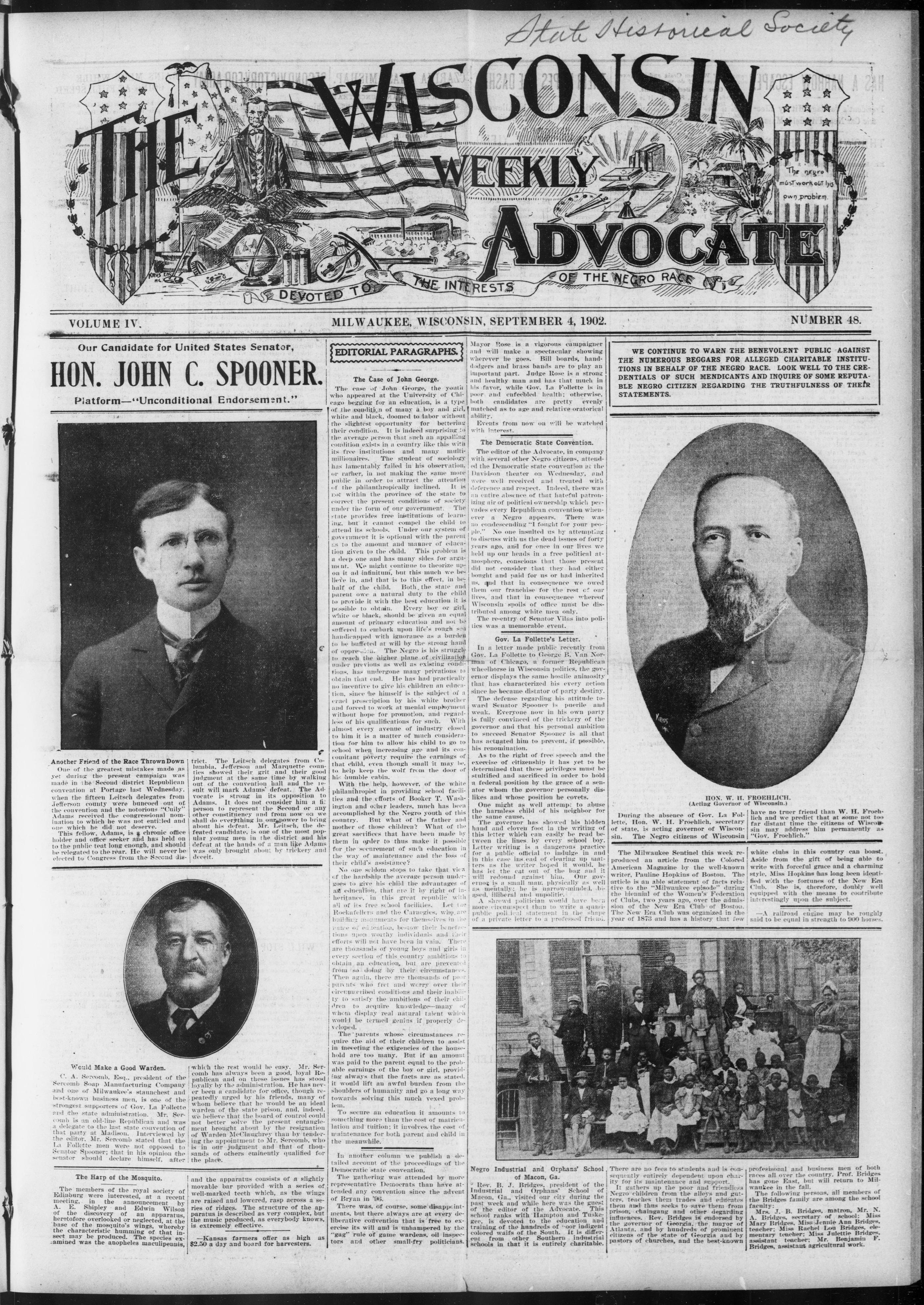
Our Candidate for United States Senator,
HON. JOHN C. SPOONER.
Platform—"Unconditional Endorsement."
[Name not visible in the image]
WILLIAM B. BURKE
VOLUME IV.
Our Candidate for Un
HON. JOHN
Platform—"Uncondit
One of the greatest mistakes made as yet during the present campaign was made in the Second district Republican convention at Portage last Wednesday, when the fifteen Leitsch delegates from Jefferson county were buncoed out of the convention and the notorious "Cuily" Adams received the congressional nomination to which he was not entitled and one which he did not deserve. This fellow, Adams, is a chronic office holder and office seeker and has held on to the public teat long enough, and should be relegated to the rear. He will never be elected to Congress from the Second dis
Would Make a Good Warden.
C. A. Sercomb, Esq., president of the Sercomb Soap Manufacturing Company and one of Milwaukee's staunchest and best-known business men, is one of the strongest supporters of Gov. La Follette and the state administration. Mr. Sercomb is an old-line Republican and was a delegate to the last state convention of that party at Madison. Interviewed by the editor, Mr. Sercomb stated that the La Follette men were not opposed to Senator Spooner; that in his opinion the senator should declare himself, after
The Harp of the Mosquito.
The members of the royal society of Edinburg were interested, at a recent meeting, in the announcement by A. E. Shipley and Edwin Wilson of the discovery of an apparatus, heretofore overlooked or neglected, at the base of the mosquito's wings, whereby the characteristic humming of that insect may be produced. The species examined was the anopheles maculipennis,
trict. The Leitsch delegates from Columbia, Jefferson and Marquette counties showed their grit and their good judgment at the same time by walking out of the convention hall and the result will mark Adams' defeat. The Advocate is strong in its opposition to Adams. It does not consider him a fit person to represent the Second or any other constituency and from now on we shall do everything in our power to bring about his defeat. Mr. Leitsch, the defeated candidate, is one of the most popular young men in the district and his defeat at the hands of a man like Adams was only brought about by trickery and deceit.
WILLIAM STOCK
which the rest would be easy. Mr. Sercomb has always been a good, loyal Republican and on these issues has stood loyally by the administration. He has never been a candidate for office, though repeatedly urged by his friends, many of whom believe that he would be an ideal warden of the state prison, and, indeed, we believe that the board of control could not better solve the present entanglement brought about by the resignation of Warden McClaughrey than by tendering the appointment to Mr. Sercomb, who is in our judgment and that of thousands of others eminently qualified for the place.
and the apparatus consists of a slightly movable bar provided with a series of well-marked teeth which, as the wings are raised and lowered, rasp across a series of ridges. The structure of the apparatus is described as very complex, but the music produced, as everybody knows, is extremely effective.
—Kansas farmers offer as high as $2.50 a day and board for harvesters.
MILWAUKEE, WISCONSIN, SEPTEMBER 4, 1902.
EDITORIAL PARAGRAPHS.
The Case of John George.
The case of John George, the youth who appeared at the University of Chicago begging for an education, is a type of the condition of many a boy and girl, white and black, doomed to labor without the slightest opportunity for bettering their condition. It is indeed surprising to the average person that such an appalling condition exists in a country like this with its free institutions and many multimillionaires. The student of sociology has lamentably failed in his observation, or rather, in not making the same more public in order to attract the attention of the philanthropically inclined. It is not within the province of the state to correct the present conditions of society under the form of our government. The state provides free institutions of learning, but it cannot compel the child to attend its schools. Under our system of government it is optional with the parent as to the amount and manner of education given to the child. This problem is a deep one and has many sides for argument. We might continue to theorize upon it ad infinitum, but this much we believe in, and that is to this effect, in behalf of the child. Both the state and parent owe a natural duty to the child to provide it with the best education it is possible to obtain. Every boy or girl, white or black, should be given an equal amount of primary education and not be suffered to embark upon life's rough sea handicapped with ignorance as a burden to be buffeted at will by the strong hand of oppression. The Negro is his struggle to reach the higher plane of civilization under previous as well as existing conditions, has undergone many privations to obtain that end. He has had practically no incentive to give his children an education, since he himself is the subject of a cruel proscription by his white brother and forced to work at menial employment without hope for promotion, and regardless of his qualifications for such. With almost every avenue of industry closed to him it is a matter of much consideration for him to allow his child to go to school when increasing age and its concomitant poverty require the earnings of that child, even though small it may be, to help keep the wolf from the door of his humble cabin.
With the help, however, of the white philanthropist in providing school facilities and the efforts of Booker T. Washington and other leaders, much has been accomplished by the Negro youth of this country. But what of the father and mother of those children? What of the great sacrifices that have been made by them in order to thus make it possible for the securement of such education in the way of maintenance and the loss of their child's assistance?
No one seldom stops to take that view of the hardship the average person undergoes to give his child the advantages of an education, that are it by right of inheritance, in this great republic with all of its free school facilities. Let the Rockafellers and the Carnegies, who are building monuments for themselves in the name of education, bestow their benefactions upon worthy individuals and their efforts will not have been in vain. There are thousands of young boys and girls in every section of this country ambitions to obtain an education, but are prevented from so doing by their circumstances. Then again, there are thousands of poor parents who fret and worry over their circumscribed conditions and their inability to satisfy the ambitions of their children to acquire knowledge—many of whom display real natural talent which would be termed genius if properly developed.
The parents whose circumstances require the aid of their children to assist in meeting the exigencies of the household are too many. But if an amount was paid to the parent equal to the probable earnings of the boy or girl, providing always that the facts are as stated, it would lift an awful burden from the shoulders of humanity and go a long way towards solving this much vexed problem. To secure an education it amounts to something more than the cost of matriculation and tuition; it involves the cost of maintenance for both parent and child in the meanwhile.
In another column we publish a detailed account of the proceedings of the Democratic state convention. The gathering was attended by more representative Democrats than have attended any convention since the advent of Bryan in '96. There was, of course, some disappointments, but there always are at every deliberative convention that is free to exercise its will and is unhampered by the "gag" rule of game wardens, oil inspectors and other small-fry politicians.
THE SCHOOL FOR THE BLACKS
Mayor Rose is a vigorous campaigner and will make a spectacular showing wherever he goes. Bill boards, hand-dodgers and brass bands are to play an important part. Judge Rose is a strong and healthy man and has that much in his favor, while Gov. La Follette is in poor and enfeebled health; otherwise, both candidates are pretty evenly matched as to age and relative oratorical ability. Events from now on will be watched with interest.
The Democratic State Convention
The editor of the Advocate, in company with several other Negro citizens, attended the Democratic state convention at the Davidson theater on Wednesday, and were well received and treated with deference and respect. Indeed, there was an entire absence of that hateful patronizing air of political ownership which pervades every Republican convention whenever a Negro appears. There was no condescending "I fought for your people." No one insulted us by attempting to discuss with us the dead issues of forty years ago, and for once in our lives we held up our heads in a free political atmosphere, conscious that those present did not consider that they had either bought and paid for us or had inherited us, and that in consequence we owed them our franchise for the rest of our lives, and that in consequence whereof Wisconsin spoils of office must be distributed among white men only.
The re-entry of Senator Vilas into politics was a memorable event.
Gov. La Follette's Letter
In a letter made public recently from Gov. La Follette to George B. Van Norman of Chicago, a former Republican wheelhorse in Wisconsin politics, the governor displays the same hostile animosity that has characterized his every action since he became distator of party destiny. The defense regarding his attitude toward Senator Spooner is puerile and weak. Everyone now in his own party is fully convinced of the trickery of the governor and that his personal ambition to succeed Senator Spooner is all that has actuated him to prevent, if possible, his renomination.
As to the right of free speech and the exercise of citizenship it has yet to be determined that these privileges must be stultified and sacrificed in order to hold a federal position by the grace of a senator whom the governor personally dislikes and whose position he covets. One might as well attempt to abuse the harmless child of his neighbor for the same cause.
The governor has showed his hidden hand and cloven foot in the writing of this letter which can easily be read between the lines by every school boy. Letter writing is a dangerous practice for a public official to indulge in and in this case insed of clearing up matters as the writer hoped it would, he has let the cat out of the bag and it will redound against him. Our governog is a small man, physically as well as mentally; he is narrow-minded, biased, illiberal and unpolitic. A shrewd politician would have been more circumspect than to write a quasi-public political statement in the shape of a private letter to a professed friend.
Negro Industrial and Orphans' School of Macon, Ga.
Rev. B. J. Bridges, president of the Industrial and Orphans' School of Macon, Ga., visited our city during the past week and while here was the guest of the editor of the Advocate. This school ranks with Hampton and Tuskegee, is devoted to the education and training of the hundreds of poor indigent colored waifs of the South. It is different from other Southern industrial schools in that it is entirely charitable.
WE CONTINUE TO WARN THE BENEVOLENT PUBLIC AGAINST THE NUMEROUS BEGGARS FOR ALLEGED CHARITABLE INSTITUTIONS IN BEHALF OF THE NEGRO RACE. LOOK WELL TO THE CREDENTIALS OF SUCH MENDICANTS AND INQUIRE OF SOME REPUTABLE NEGRO CITIZEN REGARDING THE TRUTHFULNESS OF THEIR STATEMENTS.
KROS
HON. W. H. FROEHLICH
(Acting Governor of Wisconsin.)
During the absence of Gov. La Follette, Hon. W. H. Froehlich, secretary of state, is acting governor of Wisconsin. The Negro citizens of Wisconsin have no truth and we far distant sin may ad "Gov. Froehlich
The Milwaukee Sentinel this week reproduced an article from the Colored American Magazine by the well-known writer, Pauline Hopkins of Boston. The article is an able statement of facts relative to the "Milwaukee episode" during the biennial of the Women's Federation of Clubs, two years ago, over the admission of the New Era Club of Boston. The New Era Club was organized in the year of 1873 and has a history that few white clubs. Aside from write with f style, Miss Fied with the Club. She equipped wit interestingly.
—A railroad said to be eq
THE WEEKLY NEWS OF THE CITY OF NEWARK
THE SCHOOL OF EDUCATION
There are no fees to students and is consequently entirely dependent upon charity for its maintenance and support. It gathers up the poor and friendless Negro children from the alleys and gutters, teaches them trades and educates them and thus seeks to save them from prison, chaingang and other degarding influences. Rev. Bridges is endorsed by the governor of Georgia, the mayor of Atlanta, and by hundreds of prominent citizens of the state of Georgia and by pastors of churches, and the best-known
```markdown
```
---
BENEVOLENT PUBLIC AGAINST
ALLEGED CHARITABLE INSTITU-
RACE. LOOK WELL TO THE CRE-
S AND INQUIRE OF SOME REPUTA-
THE TRUTHFULNESS OF THEIR
have no truer friend than W. H. Froehlich and we predict that at some not too far distant time the citizens of Wisconsin may address him permanently as "Gov. Froehlich."
white clubs in this country can boast. Aside from the gift of being able to write with forceful grace and a charming style, Miss Hopkins has long been identified with the fortunes of the New Era Club. She is, therefore, doubly well equipped with the means to contribute interestingly upon the subject.
—A railroad engine may be roughly said to be equal in strength to 900 horses.
THE WOMEN'S WORKING HOUSE
profesional and business men of both races all over the country. Prof. Bridges has gone East, but will return to Milwaukee in the fall. The following persons, all members of the Bridges family are among the school faculty:
Mrs. J. B. Bridges, matron, Mr. N. A. Bridges, secretary of school; Miss Mary Bridges, Miss Jennie Ann Bridges, teacher; Miss Rachel Lou Bridges, elementary teacher; Miss Julettie Bridges, assistant teacher; Mr. Benjamin F. Bridges, assistant agricultural work.
NUMBER 48.
President's Carriage Hit by Electric Car Near Pittsfield, Mass.
Mr. Roosevelt Received a Cut on the Head—Secret Service Man was Instantly Killed.
Lenox, Mass., Sept. 3.—A terrible accident overtook the President's coach a short distance from Pittsfield about 10 o'clock this morning. After a short visit to the home of ex-Senator Dawes the President started on the long drive to Lenox. He had not gone far when an electric car ran into them, throwing everyone to the ground and badly damaging the coach. The President received a cut on the head, Gov. Crane was bruised, and William Craig, the secret service man, was instantly killed. The President was able to resume his journey to Lenox, but sent word ahead that there should be no cheering.
After leaving Senator Dawes' house the four carriages containing the President and his immediate party were driven down South street, two carriages on either side. When near the Country Club and at the railroad crossing an electric car was noticed coming at a terrific rate of speed. Mr. Craig signaled to the motorman to stop, but he apparently paid no attention to the warning and the car came plunging on its work of death. The President's carriage was literally smashed to pieces. A witness of the accident stated that the motorman was speeding his car in order to reach the club. The President, Gov. Crane and Secretary Cortelyou were piled up in a heap. The awe-stricken crowd which witnessed the accident rushed to the President's carriage, but with no expectation that he would be found alive. The President was cut on the right side of his chin and his face is much swollen.
Agent Craig Killed Outright.
Secret Service Agent W. A. Craig was killed outright and D. J. Pratt, the driver of the coach, sustained a fracture of the skull which, it is feared, will result fatally. The coach, which was a regulation tally-ho vehicle, was struck by an electric car on the Pittsfield & Lenox street railway at about 9:30 o'clock. The accident happened at a point about a mile and a half from this city, near the Pittsfield Country Club house, while the President and his party were enjoying a coaching trip from Dalton, Gov. Crane's home, where the President spent the night, to Lenox, a distance of about twenty miles over the Berkshire hills. The car was in charge of Conductor James Kelly with Motorman Luke J. Madden on the front platform.
The car struck the coach in the rear and smashed in the back of the vehicle, tipping it over and throwing its occupants to the ground. The car was not badly damaged. Motorman Madden and Conductor Kelly were at once arrested and taken to Pittsfield. Pratt, the driver of the coach, also was taken here.
Sustained Slight Bruises.
The President sustained only slight bruises and a few scratches. Secretary George B. Cortelyou, who suffered in a manner similar to that of the President with the exception that he was cut on the head, with the other members of the party went to the Country Club near by, where their wounds were dressed. In a short time they proceeded to the Curtis hotel at Lonox, arriving there at 11 o'clock. The President retained his complete composure, although he was solicitous for the rest of those in the carriage. The excitement was intense and rumors flew thick and fast that the President had been killed. After remaining at the scene of the accident for over an hour the President determined to continue his journey to Stockbridge. After a brief stop at Lonox he was driven to the train.
Physician with President's Party
In the next carriage to the President's when the accident happened was Dr. G. A. Lung of the navy, who accompanied the President for just such emergencies as this and who was promptly on hand to render assistance to the President. But the President declined to receive medical attention, saying he was but slightly hurt.
The President's programme today included a journey from this state through Connecticut and he was to stop at Lenox, Stockbridge and Great Barrington in Massachusetts, and at New Millford and at Bridgeport in Connecticut. At Bridgeport the yacht Sylph was to meet him and take him back to Oyster Bay. The accident, however, probably will cause a change in the intermediate stops from Lenox to Bridgeport, the President proceeding directly there and at once embarking on the Sylph for Oyster Bay.
Motorman Warned.
Another account of the accident says the trolley car was coming up behind the President's carriage at terrific speed. The carriage was struck as it was crossing the tracks diagonally. Craig, who was looking around and half standing, trying to warn the trolley car back, was knocked from the box to the track and the car passed over him, killing him instantly. The carriage was knocked to one side and wrecked. The President was thrown out and the wreck of the carriage fell against him. He was picked up bleeding from a cut on the right cheek but he was able to get on his feet at once. Secretary Cortelyou was unconscious when picked up. He was badly hurt on the back of the head and cut on the face, but soon recovered enough to ask for the President. Gov. Crane was badly bruised, and Representative Lawrence was the least hurt of any of the party in the President's carriage.
The President at once directed that Craig's body be cared for and sent couriers ahead to prevent cheering and to announce that he would go at once to his train which had been sent ahead to Stockbridge. The President stopped for a few moments at the Hotel Aspinwall, where the party was to have lunched, and made a brief announcement of the accident to the people who were silently gathered on the steps.
Excitement at Oyster Bay.
Oyster Bay, L. I., Sept. 3.—News that the President had met with an accident in Massachusetts caused great excitement and telegraph and telephone offices were soon besieged by residents anxious to obtain particulars. When it was learned that President Roosevelt was not seriously hurt, expressions of thankfulness were heard on all sides. William Craig, who was killed in the accident, was well known here. He was in charge of the secret service men here during the President's stay.
Leaves for Home.
Stockbridge, Mass., Sept. 3.—The President's train left here at 12:15 for Bridgeport, Conn., from which point he will embark for Oyster bay. The President's physician, Dr. Lung, says that the President and Mr. Cortel-you received slight contusions about the head and face but that the injuries are not at all serious and the scheduled stops would be made. The President has asked Gov. Crane to look after the
remains of William Craig and the gover nor will personally do so.
Over the Berkshire Hills.
Pittsfield, Mass., Sept. 3.—It is twenty miles from Dalton to Lenox and the route is over the picturesque Berkshire hills. The President was accompanied by Gov. Crane and a detachment of Massachusetts cavalry doing escort duty. At the Opera house at Dalton before leaving that town, President Roosevelt delivered an address on the advantages accruing from good citizenship. The President's entire party in tallyhos are taking the drive to Lenox. This is a beautiful day—the last day of President Roosevelt's tour of New England which began August 22. An immense crowd gathered in the public square here. The town was handsomely decorated and the drive from Dalton was marked by another of the remarkable demonstrations which everywhere in Massachusetts has greeted the President. In this city the President spoke briefly, again taking occasion to refer to the services of the Union veterans and he urged his hearers to display the spirit in time of peace which the veterans exhibited in time of war.
Deplores Craig's Death.
Stockbridge, Mass., Sept. 3.—The President was calm and collected and deplored the death of Craig. "He was the most faithful man I ever knew," said he; "my children fairly worshiped him."
When Craig saw the impending danger and that a collision could not be averted he was heard to say, "Oh, my God!" and then he was hurled through the air and fell under the car wheels, his head and body being mutilated almost beyond recognition. On the right of him was the driver, Pratt, who was thrown a distance of twenty-five feet.
The President asked the motorman: "Why were you running your car like that?" which brought only the response, "Because I had the right of way."
The President said that when he saw the car coming at such terrific speed he felt that all in the carriage would surely be killed.
President's Face Swollen.
Stockbridge, Mass., Sept. 3.—President Roosevelt arrived in Stockbridge shortly before 12 o'clock, having driven leisurely across the country from Lenox. The people had turned out to give him a welcome, but the news of the accident had preceded him. His face was badly swollen and he was no doubt suffering pain, but not to disappoint the crowd, many of whom had driven some distance to see him, he stopped just long enough to say a few words. He spoke as follows:
"I presume you have heard that our party met with an accident in which one man was killed. Therefore, I shall not address you beyond thanking you for your kind reception, and request that you make no applause or demonstration of any kind."
The President went immediately to his train, which left as soon as he got aboard.
Guard at White House.
Lenox, Mass., Sept. 3.—William Craig, the secret service operator who was killed, was a man who has been on duty as special guard at the white house for many years. He was 48 years old and was a giant in physique. He weighed over 200 pounds and was more than 6 feet tall. He was a former member of the Queen's Grenadiers and was an expert broadswordsman. Years ago he gave exhibitions with Duncan Ross and was credited with many victories over him. Craig caught and arrested a crook at Montpelier who was attempting to reach the President on his trip.
In Wall Street
New York, Sept. 3.—News of the accident to President Roosevelt and his party was received in Wall street shortly before 11 o'clock. A general decline in the stock list followed although at no time was the market panicky. The downward tendency was checked as soon as it became known that the President's injuries were not serious and a rally followed. Reading, which in the early morning transactions had made a gain of almost 3 points, lost the greater part of this improvement. The balance of the list steadied for the most part and by noon conditions were again normal.
The News at Washington.
Washington, D. C., Sept. 3.—Capt. Montgomery, in charge at the temporary white house, received a telegram shortly after 11 o'clock today stating that an electric car running at high speed had crashed into the President's carriage near Lenox, Mass., throwing the occupants out, and reducing the vehicle to splinters. The dispatch stated that the President fortunately was only slightly scratched. Gov. Crane and Congressman Lawrence were bruised, and Mr. Corteiyou, private secretary to the President, was badly though not seriously cut about the face and head. William Craig, the secret service operative who has been regularly on duty at the white house, was thrown in front of the car and killed.
Capt. Montgomery immediately informed Mr. Loeb, assistant secretary to the President, who is now at Oyster Bay, and it is assumed that the latter probably advised Mrs. Roosevelt of the occurrence and of the President's fortunate escape.
Savs President is All Right.
Capt. B. F. Montgomery, in charge of the temporary white house, is in receipt of the following telegram from George B. Cortelyou, secretary to the President, dated Great Barrington, Mass.: "The President is all right and perfectly well. I send you this in order that those who should be informed or who make inquiries may be accurately advised. Craig of the secret service was killed. No one else of the party injured."
Street Car Men Arrested.
Pittsfield, Mass., Sept. 3.—Immediately after the accident the motorman, Luke J. Madden, and the conductor, James Kelly, were placed under arrest and taken to police headquarters, the crowd giving them a stormy reception as they passed along the street.
Meanwhile Medical Examiner Colt had arrived and, finding the body of Mr. Craig was at the Stevens house, proceeded there to perform his duty. President Roosevelt himself was attending to the mangled body of his guard. The medical examiner found that no extended examination would be necessary and an undertaker was called, who removed the body to his rooms in this city.
Mr. Craig has two brothers living at Springfield. They were notified of the accident and the body will remain here until they arrive to attend to its disposition.
Asks People Not to Cheer.
Having seen that the body of Craig was properly attended to and hearing the clamor of the crowd outside the house, the President stepped to the door. The tumult indicated great excitement among the people, seeing which President Roosevelt stepped forward into full view. As he did so, a cheer burst forth. He quieted it with a motion of his hand. Then he urged the people not to cheer, as one of the party was dead.
He assured the assembly that he was uninjured but that the driver of his carriage, he feared, was fatally hurt. He said that he should continue his journey as it did not seem just right to disappoint the large number of people who were expecting him.
Then the President returned to the house and directions were given for another carriage to be brought up. It was soon at the door and the ride to Lenox was resumed.
Politicians will Not be Allowed to Interfere in Coal Strike.
Pennsylvania Senators Hold a Protracted and Unsuccessful Conference with President Baer.
Philadelphia, Pa., Sept. 3.—United States Senators Quay and Penrose held a protracted conference today with President Baer of the Reading railway, in reference to the miners' strike. After the conference Senator Quay said:
"We went over the situation thoroughly and are now satisfied that nothing can be accomplished at the present time."
"Politics will not be allowed to interfere in this strike," was President Baer's only comment.
Case of Misplaced Confidence.
Wilkesbarre, Pa., Sept. 3.—Persistent reports that the strike is close to an end prevail throughout the coal region. Developments of the last few days show that the operators, threatened with the loss of a Republican governor and a Republican Legislature in this state, can be compelled to make concessions and end the strike. At present the labor vote is believed to be going steadily to the Democrats and candidates for the Legislature who are pledged to vote for laws favoring the union man.
These laws would be an eight-hour workday, compulsory arbitration and others which would be of more benefit to the miners than the granting of every demand they are now making. At Harrisburg the railroaders indorsed Pattison, the Democratic candidate for governor, and this is taken as an indication of how the labor vote of the state will go.
Expect Sweeping Offer.
What concessions may be offered, if any, are merely surmises, but it is expected it will in all likelihood be a sweeping offer of 10 per cent., with a settlement of such questions as the weighing of coal, the recognition of the union or a minimum wage scale. Whether it would be accepted by the strikers is another question.
It is said Senator Penrose and President Roosevelt had a talk over the situation a month ago, and when the President suggested that Penrose and Quay should do something to settle the strike Penrose replied he thought something could be done, but he had not been asked to interfere.
The operators, threatened with two alternatives to choose from—concessions to the strikers and a settlement of the strike or the possibility of seeing an anti-corporation Legislature elected—would in all likelihood choose the lesser evil, and that in the opinion of the politicians is what has been done.
Two Firebugs Caught.
Charleston, W. Va., Sept. 3.—A detachment of soldiers on duty at Rush Run last night caught two men in the act of firing the coal company's houses and arrested both. It is said that both men are nonunion. United States Marshal Summers served injunctions at St. Clair, Eureka and Davis Gordon mines today, the new seat of trouble, where an attempt has been made to start work. Gov. White says he has no present intention of withdrawing the military force and will do so only when the sheriff reports that he does not need them.
Fire Still Burning.
Bramwell, W. Va., Sept. 3.—The fire in the Pocahontas mine, which was thought to be under control last night, is still burning this morning and great damage is resulting. The mine officials who yesterday thought they had the fire under control say today that it may be ten days before the fire is extinguished.
Wright's Recommendations.
Washington, D. C., Sept. 3. The report of Carrol D. Wright, commissioner of labor, on the anthracite coal strike, was made public today.
Commissioner Wright finds that there is no confidence existing between the employees and the employers. This he believes is one of the chief causes of the difficulties between the operators and miners. Commissioner Wright suggests that it would be reasonable and just for the operators to concede at once a nine-hour day for a period of six months as an experiment. He suggests that there should be organized a joint committee on conciliation composed of representatives of the operators and of a new union of anthracite employees, to which all grievances should be referred for investigation, that their decision should be final and binding upon all parties, and that there should be no interference with the nonunion men.
DEMANDS ARE CONCEDED.
Chicago Packers Grant Shorter Hours and More Pay—Strike Thereby Avoided.
Chicago, Ill., Sept. 3.—The stockyards butchers of Chicago and other Western packing concerns have won a strikeless victory. J. Ogden Armour, speaking for himself and the other packers, has conceded principally all the demands of the meat cutters and butchers. The men are granted shorter hours and more pay. Under the old scale the highest paid butchers received 45 cents an hour. They now are to get $47\frac{1}{2}$ cents. The lowest paid butchers who were receiving 16 and 17 cents are to earn $22\frac{1}{2}$ cents an hour. Ten hours are to constitute a day's work, with time and a half for overtime.
GAS TANK COLLAPSED;
DOZEN MEN KILLED.
New York, Sept. 3.—A large gas tank, located on Wythe avenue, Brooklyn, collapsed this afternoon and it is feared that from twelve to eighteen men were killed. The men were engaged in riveting the tank when it collapsed.
WILL RULE COPPER MARKET
New Combine Can Place Material in New York at 2 Cents a Pound.
Buffalo, N. Y., Sept. 3. After but five days' existence the combine between the interests of the Garretson Furnace concern and the Copper River Mining Company is to be syndicated into new form, with a capital of $150,000,000. The Garretson Furnace, which smelts copper so cheaply that the bi-product pays for the cost of mining and smelting, combined with the Copper River Mining Company of Alaska, which has $3,000,000,000 deposit of 70 per cent. ore, will dictate the copper market of the world since they affirm they could place copper in New York at 2 cents per pound. Since the announcement of the combine an unknown Wall street interest, believed to be led by James J. Hill. have offered to finance the syndicate merging all the seven companies.
CZARINA HAS MISHAP.
COURT SURGEONS ANNOUNCE THAT THERE ARE NO COMPLICATIONS.
St. Petersburg, Sept. 3.—The Official Journal de St Petersburg today contained the following announcement: Some months ago certain changes occurred in the condition of the Czarina which indicated pregnancy. Now, owing to a deviation from the normal course of pregnancy, her majesty has had a miscarriage. There are no complications. Temperature and pulse normal.
PROF, OTT, Court Accoucher.
HIRSCH, Court Surgeon.
Copenhagen, Denmark, Sept. 3.—Messages received at the court here today announced that the Czarina was in a serious condition, but that no further danger was anticipated. It was also suggested that possibly the Dowager Czarina of Russia, who was to have left St. Petersburg September 7 for Copenhagen, accompanied by King George of Greece, will postpone her departure in consequence of the Czarina's illness.
ELECTION IN VERMONT.
Republican Vote is Divided Between the Two Republican Candidates.
White River Junction, Vt., Sept. 3. Election returns from 150 cities and towns out of 246 do not show a majority over all of any one gubernatorial candidate. These returns include cities of St. Albans, Barre, Vergennes, but do not include the large cities and many large towns. If the remaining cities and towns give a corresponding vote there will be no election for governor and lieutenant governor by the people. The state law requires a majority vote to elect. In this case, with three candidates in the field, none will have more than his two opponents, and the election will be thrown into the Legislature, which is certain to be for prohibition, as every town, large or small, has equal representation, and a majority of the municipalities are for prohibition.
There were two Republican tickets in the field. Gen. John G. McCullough, the regular nominee, and Percival W. Clement, bolting Republican. The bolting delegates represented the high license, local option faction of the party.
An Absurd Statute.
Clement has for years given freely of his time and money in an attempt to replace the prohibitory law with a high license or local option statute. Attempts to revise the law, to make it less stringent, to eliminate from it provisions that make it possible to send a liquor seller to the penitentiary for sixty years—practically a life sentence—have always met with failure in the Legislature.
The regular Republican candidates for secretary, auditor and treasurer, which were indorsed by the Clement faction, are elected by majorities estimated to be 55,000 or more.
Results for Congress.
D. J. Foster, in the First Congressional district, and Kittredge Haskins, in the Second district, both Republicans, are re-elected by slightly increased majorities. Partial returns indicate a total vote in round numbers of 67,000, which is almost exactly what it was two years ago. The indicated vote from partial returns in round returns is:
McCullough ...31,000 McGettrick ...6,000 Clements ...28,000 Sherburn ...2,000 This indicates a Republican loss of 35 per cent. over two years ago, while the Democratic loss is 63 per cent. The complexion of the Legislature is not indicated by the returns. The Democrats apparently have elected forty or more members of the House, and have at least two seats in the Senate, and may have as many as six when the returns are tabulated. The Democrats may have the balance of power in the Legislature, but McCullough, though rebuffed at the polls, will stand the best chance of winning.
FORM AN ASSOCIATION.
Representatives of Forty Butter Renovating Creameries Hold Meeting in Chicago.
Chicago, Ill., Sept. 3.—Representatives of forty butter renovating creameries have met here and organized the National Association of Press Butter Manufacturers.
To keep in close touch with one another and to better the trade, also a desire to keep down the purchasing price.
Representatives of manufacturers were present from Evansville, Wis.; Omaha and Lincoln, Neb.; Des Moines, La.; Owosso, Mich.; Topeka, Kas., and other points.
H. W. Henshaw of Chicago was elected president of the association. D. E. Wood of Elgin was elected vice president; W. S. Goodhue of Chicago, secretary, and L. B. Kilbourn of Chicago, treasurer. A board of directors consisting of E. F. Dudley, E. L. McAdams and A. A. Chapin of Washington, D. C., was elected.
OVERDOSE OF STRYCHNINE
Hospital Nurse Gave a Patient Two Grains of the Poison and the Patient Died.
Chicago, Ill., Sept. 3.—Miss Emily Etheridge; a nurse in the Presbyterian hospital and daughter of the late Dr. James H. Etheridge, one of Chicago's leading physicians, confessed to Coroner Traeger last night that she had made a fatal mistake in administering strychnine to a patient in the hospital.
The victim of this error was Mrs. Lauro Moore of Rensselaer, Ind., whose sudden death one week ago today had been a mystery until Miss Etheridge made a clean breast of the matter. The confession was spoken to the coroner and his physician at Miss Etheridge's residence, 1631 Michigan avenue, tonight.
"I gave Mrs. Moore two grains of strychnine when I should have given her only the thirtieth part of a grain," said Mitss Etheridge, who was on the verge of nervous collapse.
JUDGE HORTON PASSES AWAY.
Kansas Justice was in Sanitarium at Kenosha.
Topeka, Kas., Sept. 3.-Judge Albert H. Horton, ex-chief justice of Kansas, died here last night after a long illness. Two weeks ago he was brought home from a sanitarium at Kenosha, Wis.
ROBBED IN CHICAGO.
H. P. Vanderpool of Columbus Loses His Money.
Chicago, Ill., Sept. 3.—H. P. Vanderpool of Columbus, Wis., was robber of $30, a diamond stick pin valued at $20 and a watch worth $40 while watching the parade Labor day.
Ships Make Unsuccessful Attempt to Pass Through Plum Cut.
Enemy's Fleet is Sighted Off Fisher's Island and a Call to Arms is Immediately Sounded.
New London, Conn., Sept. 2.—The second attack on the island forts took place at 5 o'clock this morning and as far as they went the maneuvers were practically a repetition of last night's engagement, though, of course, there were different tactical maneuvers. The army men claim a second victory. The ships attempted to pass through Plum Cut, but were obstructed by mines, three of the vessels being put out of action. After the engagement, which lasted over an hour, the ships proceeded towards Block island.
Fisher's Island, Sept. 2.—The fleet of the enemy was lighted again this afternoons at 3 p. m. in the southeast and a call to arms was immediately sounded at Fort Wright. While the vessels were too far away to be easily made out without the aid of glasses, ten or twelve shots from the mortar battery were fired after which the order to cease firing was given. It is thought here that another attack is contemplated by the fleet.
New London, Conn., Sept. 2.—Heavy firing was heard again this morning from the guns of Fort Michie on Gull island and Fort Terry. From the lighthouse here several war vessels could be seen attempting to pass the forts to the westward.
NAVY IS REPULSED.
An Attack on Fort Wright is Defeated by Troops Under Gen. MacArthur.
Fisher's Island, N. Y., Sept. 2.—After suffering the loss of Block island, which was taken by Admiral Higginson, the army under Gen. MacArthur repelled an assault on Fort Wright. The Mayflower was blown up, theoretically, by a submarine mine while attempting to force an entrance to Fort Gut. A night attack on New London was made by the naval force under Admiral Higginson. Fort Wright exchanged shots with a battleship of the Indiana type going toward Fort Terry on the Long island side. Afterward the guns of Fort Terry were heard, apparently trained on the battleship. A message was received from the signal station at Fort Mansfield announcing that the whole fleet was coming this way.
Fort Guns Open Fire.
New London, Conn., Sept. 2.—When the booming of the big guns signaled the beginning of the attack all communication with the forts by telegraph and telephone was cut off, the artillery men being engaged with the enemy and all the wires at the forts being utilized in the firing of the guns. Gen. MacArthur boarded his yacht Kanawha and proceeded to Fort Wright. Far out in the Race the ships commanded by Admiral Higginson were sighted and just as soon as they came within firing distance the fort guns opened fire on them. There was quick response from the enemy. It seemed that the fleet of the enemy had been divided, the squadron under command of Admiral Coghlan not being seen during the first attack.
Admiral Higginson came from the East to the Race and there the fight commenced with all the realism as far as possible of actual war.
The ship's lights were out and evidently the admiral hoped he could get nearer the forts within the safety line before he was discovered, but in this he was foiled, so the army officers maintain, and his ships, including the Massachusetts and Indiana, were put out of action. Just exactly were the fleet went was not known definitely at headquarters.
Officer Shot Through the Heart While Trying to Save Property of Railway Company.
Kansas City, Mo., Sept. 2.—At 3:30 this morning an attempt was made by two masked men to rob the Metropolitan street railway car barn at Armourdale, Kansas. Watchman Minsker was ordered to hold up his hands and taken inside the office, but before the robbers secured any booty Policeman J. W. Morris entered through the back door. Morris dealt one of the robbers a heavy blow on the head with his club and was shot through the heart and instantly killed by the second robber. Watchman Minsker was also shot and slightly injured. Both robbers made their escape.
Ike Johnson, a negro well known to the police, is being held for investigation.
WILL STOP AGITATION.
Anti-Imperialists Said to Have Received Assurances that Filipinos will be Free.
Boston, Mass., Sept. 1.—The leaders of the anti-Imperialist party, whose headquarters is in Boston and most of whose names were signed to the petition to President Roosevelt, calling attention to the alleged outrages in the Philippines, have decided that their work for the present is done, and will stop all further agitation. They have had from President Roosevelt himself, through a reliable source, it is said, a definite promise which amounts to an offer of independence to the Philippines so soon as the inhabitants of the islands have shown their ability to manage the civil government which Gov. Taft is to establish.
This means that the anti-Imperialists will drop the matter of the petition and will stop other public criticism of the administration's Philippine policy.
IEALOUS MAN KILLS HIS SON.
Family Trouble Caused by Father's Second Marriage.
Muskegon, Mich., Sept. 2.—David P. James, a farmer residing near this city, Sunday morning killed his son John and shot a neighbor named Henderson. The latter will live. James had been having some trouble with his son over his second wife, who he claims was paying more attention to the young man than himself. The father, after killing his son, dragged the body into the woods, and then went to the Henderson farm, where he shot Henderson. He then went to the place where his wife was living and fired twice at his father-in-law, but neither took effect. James then concealed himself in the woods, but was later captured.
TRAINS MEET WHILE GOING AT FULL SPEED.
Collision Between Cattle Train and Engine Results in the Death of Four Men.
Kansas City, Mo., Sept. 2.—An east-bound Rock Island cattle train and an engine and caboose collided head-on near Birmingham, Mo., ten miles east of Kansas City last night, killing four trainmen and injuring three others. The dead:
JAMES SPEYER, engineer, Trenton, Mo.
THOMAS GRIDDITH, engineer, Trenton, Mo.
CLARENCE MAHARDT, fireman, Trenton, Mo.
C. W. BALLINGER, fireman, Trenton, Mo.
Glibson, conductor, brother of above, serious. Dudley, conductor, serious. The trains were running at full speed when they met. Both engines were demolished and the entire train of thirty cars was overturned. The train was heavily loaded with cattle and nearly 300 head of livestock were killed.
NEGRO SHOOTS EIGHT.
New York Darkey Holds 100 Policemen at Bay for More Than Three Hours.
New York, Sept. 2.—Jerry Hunter, the negro who shot a number of policemen and set fire to his house in Queensborough last night, in an effort to escape arrest, was captured early today and locked up in the Astorja jail. In the fight between Hunter and those who tried to arrest him, eleven policemen, three citizens and Hunter's wife were wounded. Mrs. Hunter, who helped her husband in his efforts to escape, was taken to a hospital, where it was said today that she was in a serious condition. Hunter was badly beaten in the struggle when he was caught.
John McKenna, a patrolman, was shot in the head and face. Both his eyes were destroyed and the wounds in his head were so serious that his recovery was thought to be doubtful. The citizens wounded were men who had been called upon by the police to aid in subduing Hunter.
Hunter was employed as caretaker of a large tract of land near North Beach. L. I. Yesterday he saw a man digging sand worms on the property and he shot at the intruder, who ran away and told Policeman McKenna what Hunter had done. McKenna ran to Hunter's home and was shot by the negro. The police reserves were called out then, and a siege was begun. Shortly after 2 o'clock this morning Hunter set fire to the house and tried to escape. Mrs. Hunter carried an old cavalry saber and with this she fought until overpowered, inflicting severe wounds on Patrolman Cassidy. Hunter ran for a patch of woods near the house, but was caught and subdued after a severe struggle in which he was badly wounded.
A THOUSAND DEAD.
Later Details of Mont Pelee Eruption Add to the Hor-
Paris, Sept. 2.—The Havas agency has received an undated dispatch from Fort de France, Island of Martinique, announcing that about 1000 persons were killed and that several hundred were injured as the result of a violent eruption of Mont Pelee on Saturday, August 30, which destroyed Morne Rouge and Ajoupa Bouillon, two village near Mont Pelee. The dispatch confirms the report that the village of Le Carbet was damaged by a tidal wave which was also felt at Fort de France, where the people were stricken. The French cruisers Suchet and Tage are embarking people in the northern part of Martinique.
BALLOON CAUGHT IN STORM.
Aeronauts Buffeted in Rocky Mountain Crossing Pike's Peak.
Denver, Col., Sept. 2. After a lapse of more than twenty-four hours, during which no word was received from the three aeronauts who left Denver to try for a transconfinental balloon voyage, a telegram came last night announcing that the airship had been wrecked in a storm twenty-seven miles north of Florence, Col. Although bruised and frostbitten, the occupants were not seriously hurt. The experience of the aeronauts was terrible in the extreme. Three times the balloon was carried over Pike's peak and the last time it was necessary to throw out all the water, provisions and instruments in order to clear the rocky summit of the mountain.
LOST IN SIGHT OF SHORE.
Boat Capsized in Lake Michigan and Physician is Drowned.
Ludington, Mich., Sept. 2.—When but a short distance from the Epworth Heights shore a boat containing Dr. W. B. Swan and two companions was capsized, in full view of the resorters at the Epworth hotel. Dr. Swan sank and his body was washed ashore half an hour later. The others were saved. Dr. Swan was a prominent physician of Topeka and a member of the Kansas state board of health.
HAD SENT FOR HIS FIANCEE
Michigan Miner was Killed Before She Arrived.
Norway, Mich., Sept. 2.—The inquest into the death of Anton Leeb, killed last week at the Vulcan mine, has developed the fact that a short time ago he sent funds to his native land to pay the expenses of his fiancée to this country. They were to be married immediately on her arrival, and the girl is already on the ocean in ignorance that her prospective husband is dead. Leeb met his death by striking with his pick a blasting charge which, had failed to explode.
Spine May be Dislocated.
Iron Mountain, Mich., Aug. 30.—The peculiar case of Mary Brown, a 16-year-old girl, is puzzling the physicians at the local hospital. While eating dinner a few days ago she dropped a fork and after leaning over to pick it up was unable to straighten up. In that condition and unable to speak she was brought to the hospital. It is believed that her spine is dislocated.
Sheep and Cattle in Uruguay.
In Uruguay sheep for freezing cost an average of $3 a head, and cattle $23 to $30 in gold. The River Plata can easily furnish from 3,000,000 to 4,000,000 quarters of beef for export.
Brazil Coffee Crop.
The Brazilian coffee crop for the year ending June 30, 1902, amounted to about 10,000,000 bags.
-Fines are now being imposed at Dundee, Scotland, for striking matches on the walls of public buildings.
THE WHISTLE
A willow grew by a rippling river,
Lifting its head in the sun-drenched air;
It saw its leaves in the water quiver,
And knew its image was passing fair.
It spread its arms in petition anguished,
Feeling the call of a strange, sweet lyre;
And answering dumbly it longed and languished,
Strove and thrilled with a keen desire.
It yearned to sing of the blue sky over,
The wondrous yielding of night to day;
Of the silver stream, and the scent of the clover
Drifting from uplands far away.
It yearned to sing of the springtime tender,
When the blackblud piped in its branches slender
Of the message brought by the April rain;
It swelled to join in the notes in vain.
Down strolled a lad to the vista golden,
Heart a-chime with the happy world,
And stirred by a sense of craftship olden,
Stopped where the tree its green unfurled.
He cut a twig with his jack-knife greedy,
Fashioned and trimmed it, stem and tip.
And the voice of the willow, wild-wood,
reedy,
Gushed at the touch of a boylsh lip!
—Edwin L. Sabin in Lippincott.
A CHARCOAL SKETCH. BY CHARLOTTE MOLYNEUX HOLLO- WAY.
"What feeling and emotion dere is in dem poetry lines, Miss Cl'rindy."
"I 'clar to goodness, Mr. Hamilton, you gib me a start. You are very po'try-etic, dis mawnin'.."
A sigh from Mr. Hamilton.
"S'pect you are dredful put out not to find Miss M'riar in de laundry. You must be powful anxious to talk to she."
"Me want to converse with her!" said Madison Randolph Hamilton. "Wot does she know ob a gemman like me? She don't unsterain' me."
Miss Clorinda Montmorenci paused in the operation of starching, and surveyed him with an open-mouth admiration that met with his unqualified approval, for in his own and the ladies' opinion, he was the handsomest gentleman connected with the Ocean house. He had the most perfect teeth, the most charming mahogany complexion, and Hyperion himself would have gnashed his teeth in envy could he have seen that brow surmounted by such curls, always "so iled." as Clorinda expressed herself in confidence to Celinda Eugenia Bush.
But the depressing knowledge that Madison Randolph had been pre-empted, so to speak, by Mrs. Maria Parthenope Brown, the naiad who presided over the laundry, had dampened the spirits of her hand maidens. Still, they attributed Mrs. Maria's powers of fascination to the possession of a bankbook popularly supposed to represent lousands and tousands. It must be admitted that Madison Randolph was influenced by pecuniary considerations, but it also should be put to his credit that he was not impervious to the charms of youth and beauty. Every time he looked at Maria and then at her lovely assistant Clorinda, a great sigh welled from the very soles of his shiny shoes, and he reflected gloomily on the whyness of the thus.
Moreover, his dusky fiancee displayed none of that trusting reciprocity which he desired, for she would not give him even a peep into the bankbook. Indeed, when he tried to snatch it from her the previous evening, she had dealt him a box on the ear that had opened a whole firmament of stars to his vision and caused him to reflect upon the possibilities of conjugal happiness with a partner who had evidently taken lessons in the noble art of Pollux while he was a pickaninny stealing melons. Furthermore, he shrewdly argued that matrimony was not likely to develop a sweetness in a disposition that had not mellowed under the softening influence of courtship.
"Did you consider that remark in poet'y pussual?" he inquired.
"I didn't notice what you said," rejoined Clorinda with colossal indifference.
"Now, what you want to pervaricate to? You heard me 'jaculate in the language of true affection the following, inasmuch, wharas, to wit:
Tis sweet to lub, but, ah! how bitter,
To lub a gal and den not git her!
The tenderness with which Madison Randolph Hamilton rolled out the lines was unmistakable. Clorinda tossed her head, turned up her eyes till only the whites were visible and tittered.
'G'long out of this, you 'siniwatin critter!"
"But did you construct it pussonal, dat's wot I wants luciferated"
dat's wot I wants luciferated.
"Ax Miss Mariar. Don't 'pear as if you was as sweet on her as you used to was."
"Arsk she?" said Madison Randolph in lofty scorn after he had cast a careful glance about him lest he be surprised by Miss Mariar. "Dat ornery old niggah! She took 'vantage of my youf. I don't want to conversate wif she. She don't unnerstan' me. She has no culchaw. She jest nuffin' but an old rabbit wif no soul above shinin' shirt collars. My wife has got to have culchaw. She don't even know grammar. The first principles of grammar is never to say 'her.' She aiways does."
"Wot is culchaw?" asked Clorinda in some anxiety.
"Corse you don't know. You is young and inexperienced. Very few folks does know. You unnerstan', Miss Clorinda, dat I am superior to the average gemman? I have been a resident of Boston and prominent places 'proximating to dat intellectual radish of America, as my professor called it. At one period of my existence I officiated as janitor in an institution of learning where the atmosphere was thicker than molasses with culchaw. I declar', when I contemplates dat butterific period when I 'sociated wif de giants of de land, and acquired dat nebulosity of mind dat caused dem to confab wif me on de wickedness of de umpires, I could a'most knock out my brains for havin' abandoned dem classic shades. Dat Miss Marian, she hasn't any more soul dan a pumpkin. Might as well talk poet'y to a cabbage as to she."
Clorinda's face grew pleased as Madison Randolph continued, and she said:
She am mighty comfortable fixed, and wot good is culchaw?
"Wh-wh-at is dat?" cried Madison Rauholph, leaping a foot off the floor as he heard a slight noise. "'Taint nuffin', he added, encouragingly, after listening.
"Oh, you needn't care for culchaw, Miss Clorinda. Youf and beauty don't need it. Culchaw is only for middle-aged ladies, real down ordnery lookin'. Dey must have somethin' to attract the opposite sex. Besides, when a gemman has culshaw, has lady don't want none. Too much culchaw spoils the cookin'."
"You's just awful, Mr. Hamilton."
"Why don't you answer my question? Did yo' propriate to your be-au-ti-ful self dat pussonal poet'y line dat I 'jaculated?'
"Lawsy, me, Mr. Hamilton."
"Don't you known a gentleman who is in the perdiction so sensationally expatiated in does feelin' lines? Does your heart tell you right here at your feet, not t'ree feet from you, is one who adores you? Contagious to you is one who loves you better than his life or or or a whole patch of watermelons. Clorinda. I lub you ter extraction. I throw myself at your lubly feet for you to prognosticate whether I am to exist in the sunshine of your presence or forever vegetable in darkness. Clorinda let the garment she was starching drop, and clasping her hands.
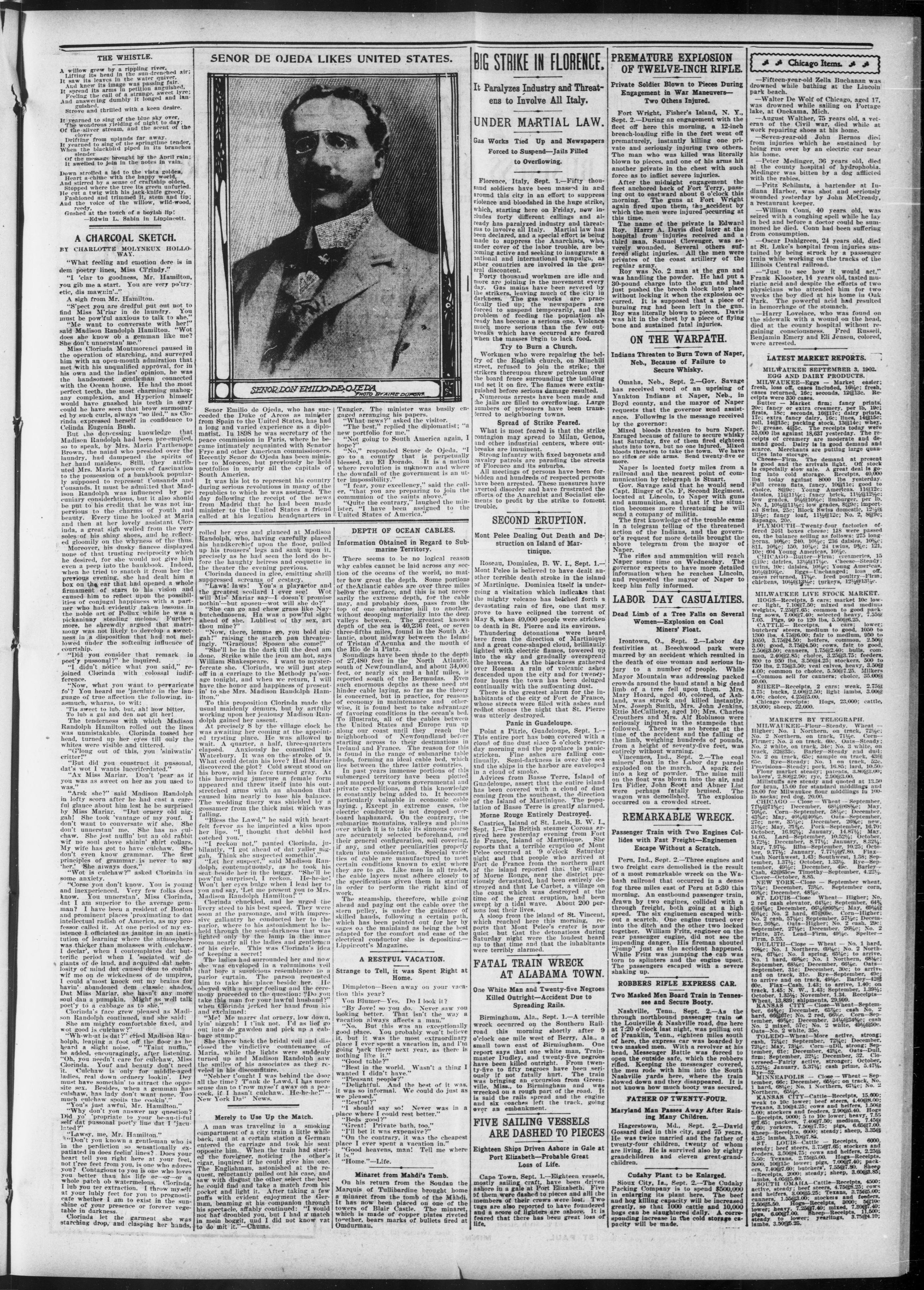
SENOR DON EMILIO DE OJEDA
PHOTO BY AIRÉ DUFOUR
Senor Emilio de Ojeda, who has succeeded the Duke of Arcos as minister from Spain to the United States, has had a long and varied experience as a diplomatist. In 1898 he was secretary of the peace commission in Paris, where he became intimately acquainted with Senator Frye and other American commissioners. Recently Senor de Ojeda has been minister to Morocco, but previously he held protfolios in nearly all the capitals of South America. It was his lot to represent his country during serious revolutions in many of the republics to which he was assigned. The day following the receipt of the news from Madrid that he had been made minister to the United States a friend called at his legation headquarters in
rolled her eyes and glanced at Madison Randolph, who, having carefully placed his handkerchief upon the floor, pulled up his trousers' legs and sank upon it, precisely as he had seen the lord do before the haughty heiress and coquette in the theater the evening previous.
Clorinda danced in glee, emitting shrill suppressed screams of ecstacy.
"Laws! laws! You's a playactor and the greatest scollard I ever see! Wot will Mis' Marian say—I doesn't promise nothin'—but sposen—wot will she do?"
"She can go and chew grass like Naybutchednosens. Ha was a pow'ful sight ahead of she. Lubliest of thy sex, art thou mine?"
"Now, there, lemme go, you bold niggah!" raising the starch pan threateningly.
"Gracious! Sposen she come!"
"She'll be in the dark till the deed am done. Strike while the iron am hot, says William Shakespeare. I want to mysterfercate she. Clorinda, we will just step off in a carriage to the Methody pa'sonage tonight, and when we return, I will have the honor and happiness of presentin' to she Mrs. Madison Randolph Hamilton."
To this proposition Clorinda made the usual maidenly demurs, but by artfully working upon her jealousy Madison Randolph gained her assent.
At precisely 8 by the village clock he was awaiting her coming at the appointed trysting place. He was allowed to wait. A quarter, a half, three-quarters elapsed. Anxiously he consulted his Waterbury. It was on the stroke of 9. What could detain his love? Had Marian discovered the plot? Cold sweat stood on his brow, and his face turned gray. At this harrowing juncture a female form appeared and threw itself into his outstretched arms with an abandon that caused him nearly to lose his balance. The wedding finery was shielded by a gossamer from the thick mist which was falling.
"Bless the Lawd," he said with heartfelt fervor as he imprinted a kiss upon her lips. "I thought that debbil had catched you."
"I reckon not," panted Clorinda, jubilantly. "I got ahead of dat yaller niggah. Think she suspected somethin'."
"Let her suspect," said Madison Randolph, contemptuously, as he took his seat beside her in the buggy. "She'll be pow'ful surprised, I reckon. He-he-he! Won't her eyes bulge when I lead her to you and say, 'Let me present you to Mrs. Madison Randolph Hamilton!'"
Clorinda chuckled, and he urged the livery steed to his best speed. They were soon at the parsonage, and with impressive gallantry he conducted her to the parlor, where to his astonishment he beheld through the semi-darkness that was lighted only by the lamp in the inner room nearly all the ladies and gentlemen of his circle. This was Clorinda's idea of keeping a secret!
The ladies had surrounded her and now she was enveloped in a voluminous veil that bore a suspicious resemblance to a parlor curtain. The parson requested him to take his place beside her. He obeyed with a queer feeling and the ceremony proceeded to the question: "Do you take this man for your lawful husband?" when Clorinda jerked her hand from his and exclaimed:
"Me! Me marry dat ornery, low down, lyin' niggah! I tink not. I'd as lief go out into de gawden and pick up a cabbage stump."
She threw back the bridal veil and disclosed the vindictive countenance of Maria, while the lights were suddenly turned up and Madison Randolph saw the smiles of his associates as they reveled in his discomfiture.
"Nebber t'ought I was behind the door all the time? T'ank de Lawd, I has more sense dan to t'row mysef away on a peacock, if I hasn't culchaw. He-he-he!"--New York Da" News.
Merely to Use Up the Match.
A man was traveling in a smoking compartment of a city train a little while back, and at a certain station a German entered the carriage and took his seat opposite him. When the train had started the foreigner, noticing the other's cigar, inquired if he could give him one. The Englishman, astonished at the request, reluctantly pulled out his case, and saw with disgust the other select the best he could find and take a match from his pocket and light it. After taking a few puffs with evident enjoyment the German, beaming at his companion through his spectacle, affably continued: "I would not haf droubled you, but I had a match in mein boggit, und I did not know vat to do mit it."—Chums.
Tangier. The minister was busily engaged arranging his papers.
"What news?" asked the visitor.
"The best," replied the diplomatist; "a new portfolio for me."
"Not going to South America again, I hope?"
"No," responded Senor de Ojeda, "I go to a country that is perpetually blessed, an El Dorado. It is a nation where revolution is unknown and where the downfall of the government is an utter impossibility."
"I fear, your excellency," said the caller, "that you are preparing to join the communion of the saints above."
"Quite the contrary," laughed the minister, "I have been assigned to the United States of America."
DEPTH OF OCEAN CABLES.
Information Obtained in Regard to Submarine Territory.
There seems to be no logical reason why cables cannot be laid across any section of the oceans of the world, no matter how great the depth. Some portions of the Atlantic cables are over three miles below the surface, and this is not necessarily the extreme depth, for the cable may, and probably does, pass from the top of one submarine hill to another, without drooping materially into the deep valleys between. The greatest known depth of the sea is 40,236 feet, or seven three-fifths miles, found in the South Atlantic, about midway between the Island of Tristan d'Acunha and the mouth of the Rio de la Plata.
Soundings have been made to the depth of 27,480 feet in the North Atlantic, south of Newfoundland, and about 34,000 feet, or nearly six and a half miles, is reported south of the Bermudas. Even such enormous depths as these need not hinder cable laying, so far as the theory is concerned, but in practice, for reasons of economy in maintenance and otherwise, it is found best to take advantage of favoring conditions in the ocean's bed. To illustrate, all of the cables between the United States and Europe run up along our coast until they reach the neighborhood of Newfoundland before starting across to their destinations in Ireland and France. The reason for this is found in the range of submarine table lands, forming an ideal cable bed, which lies between the three latter countries.
In past years immense portions of this submerged territory have been plotted and mapped by various governmental and private expeditions, and this knowledge is constantly being added to. It becomes particularly valuable in economic cable laying. Except in extreme cases, the electric conductor is not dropped overboard haphazard. On the contrary, the submarine mountains, valleys and plains over which it is to take its sinuous course are accurately selected beforehand, and their general configuration, soil covering, if any, and other peculiarities properly taken into consideration. Special varieties of cable are manufactured to meet certain conditions known to exist where they are to go. Like men in all trades, the cable layers must adhere closely to the specifications given them in starting in order to perform the right kind of work.
The steamship, therefore, while going ahead and paying out the cable over the stern pulley, is under the guidance of skilled hands, following a certain path, which has been pointed out for her by sages on the mainland as being the best adapted for the comfort and ease of the electrical conductor she is depositing. Lippincott's Magazine.
A RESTFUL VACATION
Strange to Tell, it was Spent Right at Home.
Dimpleton—Been away on your vacation this year?
Von Blumer—Yes. Do I look it?
"By Jove! so you do. Never saw you looking better. That isn't the way a vacation always affects a man."
"No. But this was an exceptionally good place. You probably won't believe it, but it was the most extraordinary place I ever spent a vacation in, and I'm going back there next year, as there is nothing like it."
"Good table?"
"Best in the world. Wasn't a thing I wanted I didn't have."
"Pleasant people?"
"Delightful. And the best of it was, it was so informal. We could do just as we pleased."
"I should say so! Never was in a place where I could rest better."
"I'll bet it was expensive?" "On the contrary, it was the cheapest place I ever spent a vacation in."
"Good heavens, man! Tell me where it is."
"Home."—Life.
Minaret from Mahdi's Tomb
On his return from the Soudan the Marquis of Tullibardine brought home a minaret from the tomb of the Mahdi. It has now been placed on one of the towers of Blair Castle. The minaret, which is made of copper plates riveted together, bears marks of bullets fired at Omdurman.
BIG STRIKE IN FLORENCE.
It Paralyzes Industry and Threatens to Involve All Italy.
UNDER MARTIAL LAW.
Florence, Italy, Sept. 1.—Fifty thousand soldiers have been massed in and around this city in an effort to suppress violence and bloodshed in the huge strike, which, starting here on Friday, now includes forty different callings and already has paralyzed industry and threatens to involve all Italy. Martial law has been declared, and a special effort is being made to suppress the Anarchists, who, under cover of the labor trouble, are becoming active and seeking to inaugurate a national and international campaign, as other countries are involved in the general discontent.
Forty thousand workmen are idle and more are joining in the movement every day. Gas mains have been severed by the strikers, leaving much of the city in darkness. The gas works are practically tied up; the newspapers are forced to suspend temporarily, and the problem of feeding the population already has become a serious one. Violence much more serious than the few outbreaks which have occurred are feared when the masses begin to lack food.
Try to Burn a Church
Workmen who were repairing the belfry of the English church, on Minchill street, refused to join the strike; the strikers thereupon threw petroleum over the board fence surrounding the building and set it on fire. The flames were extinguished before serious damage resulted. Numerous arrests have been made and the jails are filled to overflowing. Large numbers of prisoners have been transferred to neighboring towns.
Spread of Strike Feared.
What is most feared is that the strike contagion may spread to Milan, Genoa, and other industrial centers, where outbreaks are imminent.
Strong infantry with fixed bayonets and cavalry patrols are parading the streets of Florence and its suburbs. All meetings of persons have been forbidden and hundreds of respected persons have been arrested. These measures have averted disorder and have frustrated the efforts of the Anarchist and Socialist elements to profit by the strike to foment trouble.
SECOND ERUPTION.
Mont Pelee Dealing Out Death and Destruction on Island of Martinique.
Roseau, Dominica, B. W. I., Sept. 1. Mont Pelee is believed to have dealt another terrible death stroke in the island of Martinique. Dominica itself is undergoing a visitation which indicates that the mighty volcano has belched forth a devastating rain of fire, one that may prove to have eclipsed the torrent of May 8, when 40,000 people were stricken to death in St. Pierre and its environs. Thundering detonations were heard here from the direction of Martinique and a great cone-shaped cloud, brilliantly lighted with electric flames, towered up into the sky and gradually overspread the heavens. As the blackness gathered over Roseau a rain of volcanic ashes descended upon the city and for twenty-four hours the town has been deluged continually with the suffocating dust.
There is the greatest alarm for the inhabitants of the city of Fort de France, whose streets were filled with ashes and redhot stones the night that St. Pierre was utterly destroyed.
Panic in Guadeloupe.
Point a Pitrie, Guadeloupe, Sept. 1. This entire port has been covered with a cloud of fine dust since 5 o'clock yesterday morning and the populace is panic-stricken. Fine ashes are falling continually. Semi-darkness is over the sea and the ships in the harbor are enveloped in a cloud of smoke. Advices from Basse Terre, Island of Guadeloupe, assert that the entire island has been covered with a cloud of dust coming from the southeast, the direction of the Island of Martinique. The population of Basse Terre is greatly alarmed.
Castries, Island of St. Lucia, B. W. I., Sept. 1.—The British steamer Corona arrived here yesterday evening from Fort de France, Island of Martinique. She reports that a terrible eruption of Mont Pelee occurred at 9 o'clock Saturday night and that people who arrived at Fort de France from the northern part of the island reported that the village of Morne Rouge, near the district previously devastated, had been entirely destroyed and that Le Carbet, a village on the coast which was destroyed at the time of the great eruption, had been swept by a tidal wave. About 200 persons lost their lives.
A sloop from the island of St. Vincent, which reached here this morning, reports that Mont Pelee's crater is now quiet but that the detonations during Saturday night were the loudest heard up to that time and that the inhabitants were terribly alarmed.
FATAL TRAIN WRECK AT ALABAMA TOWN.
FATAL TRAIN WRECK AT ALABAMA TOWN.
One White Man and Twenty-five Negroes Killed Outright—Accident Due to Spreading Rails.
Birmingham, Ala., Sept. 1.—A terrible wreck occurred on the Southern Railroad this morning shortly after 9 o'clock one mile west of Berry, Ala., a small town east of Birmingham. One report says that one white man, Trainmaster Dudley, and twenty-five negroes have been killed outright. From twenty-five to fifty negroes have been seriously if not fatally hurt. The train was bringing an excursion from Greenville, Miss., to Birmingham and was wrecked on a rough part of the road. It is said the rails spread and the engine and slx coaches left the track, going over an embankment.
FIVE SAILING VESSELS ARE DASHED TO PIECES
Eighteen Ships Driven Ashore in Gale at Port Elizabeth—Probable Great Loss of Life.
Cape Town, Sept. 1.—Eighteen vessels, mostly sailing craft, have been driven ashore in a gale at Port Elizabeth. Five of them were dashed to pieces and all the members of their crews were lost. Two tugs are also reported to have foundered and a score of lighters are ashore. It is feared that there has been great loss of life.
PREMATURE EXPLOSION OF TWELVE-INCH RIFLE.
PREMATURE EXPLOSION OF TWELVE-INCH RIFLE.
Private Soldier Blown to Pieces During Engagement in War Maneuvers Two Others Injured.
Fort Wright, Fisher's Island, N. Y., Sept. 2.—During an engagement with the fleet off here this morning, a 12-inch breach-loading rifle in the fort went off prematurely, instantly killing one private and seriously injuring two others. The man who was killed was literally blown to pieces, and one of his arms hit another private in the chest with such force as to inflict severe injuries.
After the midnight engagement the fleet anchored back of Fort Terry, passing out to eastward about 6 o'clock this morning. The guns at Fort Wright again fired upon them, the accident by which the men were injured occurring at this time.
The name of the private is Edward Roy. Harry A. Davis died later at the hospital from injuries received and a third man, Samuel Clevenger, was severely wounded. Several others suffered slight injuries. All the men were privates of the coast artillery of the regular army. Roy was No. 2 man at the gun and was handling the powder. He had put a 30-pound charge into the gun and had just pushed the breech block into place without locking it when the explosion occurred. It is supposed that a piece of burning rag had been left in the gun. Roy was literally blown to pieces. Davis was hit in the chest by a piece of flying bone and sustained fatal injuries.
ON THE WARPATH.
Indians Threaten to Burn Town of Naper, Neb., Because of Failure to Secure Whisky.
Omaha, Neb., Sept. 2.—Gov. Savage has received word of an uprising of Yankton Indians at Naper, Neb., in Boyd county, and the mayor of Naper requests that the governor send assistance. Following is the message received by the governor:
Mixed bloods threaten to burn Naper. Enraged because of failure to secure whisky last Saturday, five of them fired eighteen shots into town, but no one injured. Mixed bloods threaten to take the town. We have no rifles or side arms. Send twenty-five or more.
Naper is located forty miles from a railroad and the nearest point of communication by telegraph is Stuart.
Gov. Savage said that he would send Capt. Ringer of Co. F, Second Regiment, located at Lincoln, to Naper with guns and ammunition, and that if the situation becomes more threatening he will send a company of militia.
The first knowledge of the trouble came in a telegram telling of the threatened action of the Indians, and the governor's request for more details brought the above telegram from the mayor of Naper.
The rifles and ammunition will reach Naper some time on Wednesday. The governor expects to have more detailed information when he reaches Lincoln, and requested the mayor of Naper to keep him fully informed.
LABOR DAY CASUALTIES.
Dead Limb of a Tree Falls on Several Women—Explosion on Coal Miners' Float.
Irontown, O., Sept. 2.—Labor day festivities at Beechwood park were marred by an accident which resulted in the death of one woman and serious injury to a number of people. While Mayor Mountain was addressing packed crowds around the band stand a big dead limb of a tree fell upon them. Mrs. Mary Hoard, aged 40, colored, of Ashland, was struck and killed instantly. Mrs. Joseph Smith, Mrs. John Jenkins, Ettie McCallister, aged 10; Mrs. Charles Crouthers and Mrs. Alf Robinson were seriously injured in the stampede that followed. There was no breeze at the time of the accident and the falling of the limb, weighing hundreds of pounds, from a height of seventy-five feet, was entirely without warning.
Vincennes, Ind., Sept. 2.—The coal miners' float in the Labor day parade exploded on the march. A spark fell into a keg of powder. The mine mill on the float was blown into the air, and Ira Fidler, John Scott and Abner List were perhaps fatally bruised. The wagon was demolished. The explosion occurred on a crowded street.
REMARKABLE WRECK.
Passenger Train with Two Engines Collides with Fast Freight—Enginemen Escape Without a Scratch.
Peru, Ind., Sept. 2.—Three engines and two freight cars demolished is the result of a most remarkable wreck on the Wabash railroad that occurred in a dense fog three miles east of Peru at 5:30 this morning. An eastbound passenger train, drawn by two engines, collided with a through freight, both going at a high speed. The six enginemen escaped without a scartch. One engine turned over into the ditch and the other two locked together. William Fritz, engineer on the rear passenger engine, did not see the impending danger. His fireman shouted "jump" just as the accident happened. While Fritz was jumping the cab was torn to splinters and the engine upset. The passengers escaped with a severe shaking up.
ROBBERS RIFLE EXPRESS CAR.
Two Masked Men Board Train in Tennessee and Secure Booty.
Nashville, Tenn.. Sept. 2.—As the through northbound passenger train the Louisville & Nashville road, due here at 7:20 o'clock last night, was pulling out of Franklin, Tenn., eighteen miles south of here, the express car was boarded by two masked men. With a revolver at his head, Messenger Battle was forced to open the outside safe, which the robbers rifled. Keeping the messenger covered, the men rode with him into the South Nashville yards here, where the train slowed down and they disappeared. It is not known how much booty was secured.
FATHER OF TWENTY-FOUR.
Maryland Man Passes Away After Raising Many Children.
Hagerstown, Md., Sept. 2.—David Gossard died in this city, aged 75 years. He was twice married and the father of twenty-four children, twenty of whom are living. He is survived also by eighty grandchildren and eleven great-grandchildren.
Cudahy Plant to be Enlarged
Sioux City, Ia., Sept. 2.—The Cudahy Packing Company is to spend $500,000 in enlarging its plant here. The beef and hog killing capacity will be increased greatly, so that 1000 cattle and 10,000 hogs can be slaughtered daily. A corresponding increase in the cold storage capacity will be made.
—Fifteen-year-old Zella Buchanan was drowned while bathing at the Lincoln park beach.
—Walter De Wolf of Chicago, aged 17, was drowned while sailing on Portage lake, at Onekama, Mich.
—August Walther, 75 years old, a veteran of the Civil war, died while at work repairing shoes at his home.
—Seven-year-old John Bernos died from injuries which he sustained by being run over by an electric car near his home.
—Peter Medinger, 36 years old, died at the county hospital of hydrophobia. Medinger was bitten by a dog afflicted with the rabies.
—Fritz Schilmtz, a bartender at Indiana Harbor, was shot and seriously wounded yesterday by John McCready, a restaurant keeper.
—William Conni, 40 years old, was seized with a coughing spell while he lay in bed and before a doctor could be summoned he died. Conn had been suffering from consumption.
—Oscar Dahlgreen, 24 years old, died at St. Luke's hospital from injuries sustained by being struck by a passenger train while working on the tracks of the Illinois Central railroad.
—"Just to see how it would act," Frank Klooster, 14 years old, tasted muriatic acid and despite the efforts of two physicians who attended him for two weeks the boy died at his home in Oak Park. The powerful acid had resulted in hemorrhage of the stomach.
-Harry Lovelace, who was found on the sidewalk with a wound on the head, died at the county hospital without regaining consciousness. Fred Russell, Benjamin Emery and Eli Jensen, colored, were arrested.
LATEST MARKET REPORTS.
MILWAUKEE SEPTEMBER 3, 1902 EGG AND DAIRY PRODUCTS.
MILWAUKEE—Eggs — Market easier; fresh, loss off, cases included, 16½c; fresh, cases returned, 16c; seconds, 12@13c. Receipts were 330 cases. Butter — Market firm; fancy prints; 20c; fancy or extra creamery, per lb, 19c; firsts, 18c; seconds, 16@17c; dairy prints; 17c; extra fancy dairy, 18c; lines, 14@15c; roll, 14@15c; packing stock, 13@14c; whey, 9c; grease, 4@5c. The receipts today were 35,000 lbs against 18,637 yesterday. The receipts of creamyery are moderate and demand good. Dalry is in good demand and scarce. Merchants are putting large quantities into storage.
Cheese—Firm. The demand at present is good and the arrivals light. Off stock is especially slow sale. A great deal is going into cold storage. Receipts, 40,000 lbs today against 8000 lbs yesterday. Full cream flats, fancy, 10@11c; good to choice, 8@9c; Young Americas, 11@12c; daisles, 11@11½c; fancy brick, 11½@12½c; low grades, 9½@12½c; limburger, per lb, No. 1, 10½@11½c; low grades, 8@9c; imported Swiss, 25c; Block Swiss domestic, 12½@13½c; fancy loaf, 11½@12c; No. 2, 8@9c; Sapsago, 20c.
PLYMOUTH—Twenty-four factories offered 2461 boxes cheese: 118 were passed on, the balance selling as follows: 275 long-horns, 10%c; 240, 10%c; 236 daisles, 10%c; 811, 10%c; 150, 10%c; 24 twins, 9%c; 121, 10c; 604 Young Americas, 10%c.
CHICAGO—Butter-Firm; creameries, 15 @19c; daisles, 13½@17½c. Cheese—Steady; twins, 10c; daisles, 10%c; Young Americas, 10½@10%c. Eggs—Unchanged; loss off, cases returned, 17½c. Iced poultry-Firm; chickens, 10½@13½c; turkeys, 12½@13½c.
MILWAUKEE LIVE STOCK MARKET.
HOGS—Receipts, 5 cars; market 10c lower; light, 7.10@7.50; mixed and medium weights, 7.25@7.65; common to good packing sows, 7.00@7.40; selected heavy, 7.55@7.05. Plgs, 90 to 120 lbs, 5.50@6.25.
CATTLE—Receipts, 4 cars; lower; butchers' steers, medium to good, 1050 to 1300 lbs, 4.75@6.00; fair to medium, 950 to 1050, 3.75@4.50; helfers, common, 2.50@3.00; good, 3.75@4.50; cows, fair to good, 2.50@3.50; canners, 1.75@2.40; bulls, common, 2.40@2.85; choice, 3.25@3.75; feeders, 800 to 950 lbs, 3.50@4.25; stockers, 500 to 750 lbs, 2.75@3.50; veal calves, heavy, 3.50@4.00; common to choice, 5.50@7.25. Milkers—Common sell for canners; choice, 35.00@50.00.
SHEEP—Receipts, 2 cars; weak, 2.75@3.75; bucks, 2.00@2.50; light iambs, 3.00@4.00; choice, 4.25@5.00.
Chicago receplts: Hogs, 23,000; cattle, 18,000; sheep, 22,000.
MARKETS BY TELEGRAPH
MILWAUKEE—Flour—Steady. Wheat—Higher; No. 1 Northern, on track, 72½c; No. 2 Northern, on track, 71½c. Corn—Flirmer; No. 3 on track, 60c. Oats—Steady; No. 2 white, on track, 34c; No. 3 white, on track, 32@33c. Barley—Steady and duil; No. 2 on track, 65c; sample on track, 43@65c. Rye—Steady; No. 1 on track, 52c. Provisions—Steady; pork, 16.8; lard, 10.50. Flour market steady; patents, 3.80@3.90; bakers', 2.80@2.90; rye, 2.90@3.00. Millstuffs are steady and quoted at 13.50 for bran, 15.00 for standard middlings and 18.00 for Milwaukee flour middlings in 100lb sacks; red dog, 20.00.
CHICAGO — Close — Wheat — September,
71%@71%c; December, 68%@71%c; May,
70%c; Corn—September, 58%c; December,
43%c; May, 40%@40%c; Oats—September,
27c; new, 35%c; December, 26%c; new,
31%c; May, 31%c; Cork—September, 16.70;
October, 16.92%; January, 14.87%; May,
14.05; Lard—September, 10.52%; October,
9.72%; December, 8.77%; January, 8.32%;
May, 7.97%; Ribs—September, 10.25; October,
9.77%; January, 7.77%@7.80. Flax—Cash Northwest, 1.43; Southwest, 1.38; September, 1.37%; October, 1.33%; Rye—September, 49%c; December, 49c; Barley—Cash, 42@63c; Timothy—September, 4.22%;
Clover—October, 8.85.
NEW YORK—Close — September wheat,
75%c; December, 73%c; September corn,
60%c; December, 48%c.
8T. LOUIS—Close Wheat—Higher; No. 2 red cash elevator, 64%c; September, 64%c@64%c; December, 66%c@60%c; May, 69%c@69%c; No. 2 hard, 67%c@69c. Corn—Higher; No. 2 cash, 57%c; September, 57%c; December, 36%c. Oats—Higher; No. 2 cash, 29c; September, 27%c; December, 26%c; No. 2 white, 37c. Lead—Firm, 49%c. Spelter—Firm, 5.25.
DULUTH—Close — Wheat — No. 1 hard,
70%c; No. 1 Northern; 69%c; No. 2 Northern,
67%c; No. 3 spring; 65%c; to arrive,
No. 1 hard; 69%c; No. 1 Northern; 68%c;
September, 68%c; December, 66%c; Oats—
September, 31c; December, 30c; to arrive
and on track, 31c; Rye—September, 49c;
to arrive and on track, 49%c; Barley—42@
60c; Flax—Cash, 1.43; to arrive, 1.40; on
track, 1.45; N. W., 1.43; September, 1.39%;
October, 1.35%; November, 1.34; Receplts—
Wheat, 13,839; shlpments, 29,999.
KANSAS CITY—Close—Wheat—September,
64%c; December, 63%c; cash No. 2
hard, 66@67c; No. 2 red, 66%c; Corn—Se-
ptember, 49%c; December, 34%@34%c; cash
No. 2 mixed, 57c; No. 2 white, 49%@50c.
Oats—No. 2 white, 35c.
TOLEDO—Wheat—More active, strong;
cash, 72½¢; September, 72½¢; December,
72½¢; May, 73½¢; Corn—uDll, strong;
September, 61¢; December, 42½¢; Oats—Dull,
firm; September, 32½¢; December, 32. Clov
verseed—Fairly active, stronger; October,
5.52½¢; January, 5.37½¢; cash prime, 5.47½¢.
Rye-52.
MINNEAPOLIS — Close — Wheat — Sept
ember, 66¢; December, 65½¢; on track, No.
1 hard, 68½¢; No. 1 Northern, 67½¢; No. 2
Northern, 65½¢.
KANSAS CITY—Cattle—Receipts, 15.00;
weak to 10¢ lower; beef steers, 4.40@8.00;
Texans, 3.10@4.25; cows and heifers, 1.50@
5.00; stockers and feeders, 2.90@5.40. Hogs
—Receipts, 9000; 5 to 10¢ lower; heavy, 7.55
@7.65; packers, 7.40@7.50; medium, 7.45@
7.60; yorkers, 7.50@7.55; pigs, 6.65@7.00.
Sheep—Receipts, 6000; steady; sheep, 3.35@
4.25; lambs, 3.70@7.85.
ST. LOUIS — Cattle — Receipts, 6000;
steady; beef steers, 3.75@7.65; stockers and
feeders, 3.50@4.75; cows and helpers, 2.25@
5.50; Texans, 2.75@5.00; Hogs—Receipts,
5000, 10@15c lower; pigs, 7.00@7.40; packers,
7.40@7.60; butchers', 7.55@7.80; Sheep—Receipts, 2000; steady; sheep, 3.00@3.85;
lambs, 4.05@5.60.
SOUTH OMAHA—Cattle—Receipts, 4500;
active, steady; beef steers, 4.75@5.25; cows
and helpers, 3.00@5.25; Texans, 3.75@5.00;
canners, 1.55@3.00; stockers and feeders,
2.50@5.50. Hogs—Receipts, 3000; 5@10c
lower; heavy, 7.25@7.40; mixed, 7.80@7.40;
pigs, 6.00@7.00. Sheep—Receipts, 11.50;
steady to lower; yearlings, 3.75@4.10;
lambs, 3.50@5.25.
The Wisconsin Weekly Advocate
Printed in the Interests of the Negro Race, MILWAUKEE, WIS.
Telephone Black No. 244.
Any part of the United States and Canada, postage paid.
One Year ..... $2.00
Six Months ..... 1.25
Three Months ..... .75
Send money by Express Money Order, P. O. Money Order or Registered Letter to the Wisconsin Weekly Advocate.
ADVERTISING BATES.
One inch, per year..... $9.00
Business locals 5c per line each insertion.
Apply for rates to the Advocate.
TO CONTRIBUTORS
all communications must be sent with the name and address of the sender as an evidence of good faith, but not necessarily for publication. No manuscript returned if not accepted, unless accompanied by stamps.
The Wisconsin Weekly Advocate company wishes to notify the public that all contracts and business transactions with this company must have the company stamp, otherwise they will be void. Neither will this company be responsible for paid subscriptions unless given to duly-accredited agents, who, on request, will give the company's receipt for same. Subscribers failing to receive their papers regularly will kindly notify the general office. Address all business communications to the general manager, 79 Fifth street.
Entered in the Postoffice at Milwaukee as Second-class matter.
Proceedings of Convention at Milwaukee.
For Governor—David S. Rose, Milwaukee
For Lieutenant Governor—John Wattawa,
Kewaunee.
For Secretary of State—Louis A. Lange,
Fond du Lac.
For State Treasurer-Edward L. Luckow, Baraboo.
For Attorney General—Olaf R. Skaar, La Crosse.
For Railroad Commissioner—William E. Redner, Ashland.
Redner, Ashland.
Korner, Insurance Commissoner—William
Ferber, New London.
Ferber, New London.
For SuperIntendent of Public Instruction
—Karl Mathie, Wausau.
Milwaukee, Wis., Sept. 3, 1902. It was 10 minutes past 12 when Chairman Warden's gavel fell to call the Wisconsin Democratic convention to order this noon. Many of the delegates were not in their seats and the confusion attending the rush to get seated necessitated the lapse of several minutes before the chairman could proceed.
"The convention will come to order," said Chairman Warden. "I will not occupy your time in reading the official call," he continued, "for I assume all of you understand the purpose for which we are here or you would not have gathered in such large numbers. At the direction of the state central committee I have to announce the selection of the following temporary organization:
Temporary Chairman—J. E. Davies, Watertown.
Secretary—W. C. Collins, Portage. Assistants—F. B. Schutz, Milwaukee; C. Clement, Eau Claire.
Mr. Davies was in excellent voice. His tones penetrated to every corner of the room, even to the gallery, though there was not a soul there to hear him. He spoke well, with good emphasis and all the force and expression of voice, from the tremolo to the basso profundo of a well-trained elocutionist. Throughout he was interrupted by applause.
A Row About Proxies.
Everything was harmonious until the temporary chairman concluded his address and then the uproar began and pandemonium reigned for a time. The consequence of it all is that it portents ill for the chances of David S. Rose, although the strenuous work of his lieutenants and friends during the recess may smooth over matters and restore confidence.
The rumpus was precipitated by a resolution offered by James H. Stover, the curly-locked orator and lieutenant of Mayor Rose from the First ward, which had for its object the shutting out of proxies unless they were held by persons residing in the same ward as the regularly elected delegates. This was taken as a move to head off the work that has been done in the state by the friends of Dr. Anderson and other of the outside candidates in securing proxies, and it was credited to the friends of Mayor Rose, as it came from one of his most active workers.
After much discussion Mr. Stover's resolution was referred to the committee on resolutions and was not heard from again.
State Central Committee
The following members of the state central committee were announced:
First District—P. J. Mouat, Janesville;
C. N. Freeman, Racine.
Second District—John Barry, Montello;
W. H. Rogers, Madison.
Third District—E. W. Evans, Spring Green; A. R. Bushneli, Lancaster.
Fourth District—Peter Barry, Milwaukee; Michael Blenski, Milwaukee.
Fifth District—D. R. Worcester, Worcester.
Fifth Distr.—D. J. Hemlock, Waukesha; A. J. Grundman, Milwaukee. Sixth District—Martin Luckes, Dodge; William Joachin, Ozaukee.
Seventh District—W. H. Frawley, Eau
Quire; W. R. McCall, Tomah.
Eighth District—Fred Rawson, Waushara
county; J. C. Nolan, Manitowoc.
Ninth District—R. J. McGeehan, Depere;
Dan E. Madigan, Marinette.
Dan E. Madigan. Marlette.
Tenth District—J. J. Hogan, Antigo; D.
D. Hogan, Antigo.
D. Conway, Grand Rapids.
Eleventh District—John M. Bashford, St.
Croix; T. D. Leonard, Chipnews.
Chairman Kearney's Speech.
Nothing was accomplished at the afternoon session beyond the perfecting of the permanent organization and the presentation of the speech of Permanent Chairman Kearney.
Applause for ex-Senator Vilas.
There was a long wait after Mr. Kearney concluded and then someone called for Vilas. There was a loud former Senator Vilas. There was a loud demonstration as he made his way to the stage which continued for several minutes. He spoke for twenty minutes, urging unification and allegiance to the old time principles of Democracy. The trusts and the Republican party were bitterly arraigned, and while he congratulated the nation upon the escape of President Roosevelt from serious accident, he denounced the measures suggested by the President for relief from trusts and combinations, saying they were impossible of ministration. When Mr. Vilas concluded, Chairman Kearney announced the platform committee won't be ready to make its report until 7
.3JXS1H0ZL3V18W/T0
J. H. H.
MAYOR DAVID S. ROSE. (Who Promises to Break the Record in Campaigning.)
o'clock and at 5:30 o'clock the convention adjourned.
Rose Nominated for Governor.
Milwaukee, Wis., September 4, 1902. Mayor David S. Rose was nominated for governor, on the first ballot, a few minutes before midnight, by the Democratic state convention last night. Immediately following, and before the mayor could be brought before the convention, John Wattawa of Kewaunee was nominated by acclamation for lieutenant governor.
It was 11:25 o'clock before the roll call began and it had not proceeded far before it became evident that Mayor Rose would be the nominee. Just as the call of Wood county, in the Tenth district, was completed there was an inarticulate yell from the mayor's delegation from the First ward that told everyone that the mayor had obtained more than a majority, and it was taken up and repeated with every announcement of a vote for him during the call of the Eleventh and last district.
When the roll call was completed the mayor had 339 votes; Burr W. Jones, 103; W. A. Anderson, 75½; Neil Brown, 46; George W. Peck, 46, and J. E. Jones, 19.
The Stampede Begins.
Before the result could be announced the stampede began. Winnebago was the first on the floor. It had given the mayor 11 votes at first, with 2 for Burr Jones and 9 for Neil Brown. The entire 22 votes swung into line and then in rapid succession came Juneau, Dodge, Rock, Waukesha and Green counties. The convention was in an uproar. Delegates were hoarsely shouting for recognition in the frantic effort to get on the loaded wagon, causing so much confusion that the secretary became nervous and Chairman Kearney declined to recognize anyone until quiet was restored. When the stampede was over the mayor had 384 votes; B. W. Jones, 81; W. A. Anderson, 72; J. E. Jones, 17; Neal Brown, 37, and G. W. Peck, 36.
It required some little time for some of the delegates to find out what was happening, and then there was another rush to change the ballot, but Chairman Kearney declined to listen, having declared the ballot closed. One Rip Van Winkle woke up while the secretary was about to announce the result and seemed surprised at the roar of laughter that greeted him when he endeavored to give his entire delegation to the mayor. After the announcement of the ballot the nomination was made unanimous.
After the nomination of the mayor for governor and the appointment of the committee to escort him to the convention, an effort was made to prevent the nomination of John Wattawa for lieutenant governor by forcing an adjournment. The motion came from the Eighth district, but was quickly voted down.
Wattawa by Acclamation.
Immediately following the nomination of the mayor, John Wattawa was nominated for lieutenant governor by acclamation.
Mavor Rose's Acceptance.
Mayor Rose was greeted with tumultuous applause when he made his appearance to accept the nomination for governor. Delegates sprang from their seats to grasp his hands and the mayor's face expanded to an alarming extent. It was several minutes before the uproar ceased. The mayor then delivered his speech of acceptance.
The Platform.
Following is the platform adopted by the convention: We, the duly accredited representatives of the Democratic party of Wisconsin in convention assembled to nominate candidates for state officers, do hereby declare:
1. We realize that the Republican party of history has been, temporarily at least, driven from the political field in this state, and that, in this campaign, we are confronted by an organization entrenched in political power, which has debauched and will continue to debauch the public service for the accomplishment of political and personal ends.
2. It is a matter of history that the nominee of the Madison convention secured his nomination through the active efforts of employees of the state, who, at his bidding, organized and controlled caucuses and conventions in his personal interest, drawing compensation for the time they were thus employed from the treasury of the state.
3. We charge that the candidate of the Madison convention has demonstrated his ability to mislead the people in pretending hostility to the leaders of his party in high place, while covertly seeking their friendly assistance in furthering his personal ends, and in attempting to return the favors received from corporations by advising the Legislature in his annual message, and with reference to the willingness of property owners within the state to pay taxes that "the railway companies have been fairer than the average of individuals." (Senate Journal, page 25.)
4. We condemn the shameful traffic in the nomination of state superintendent of public instruction entered into by the Madison convention, tolerated by the chief executive of the state and shielded by his organization. The concealed barter and sale of the school interests of the state to rapacious book agents is an unpardonable crime against education and high-minded citizens. The educational interests of the state should be kept out of political strife and free from commercial influences, and we appeal to the women of Wisconsin, who have a vote on all school questions, to join us and rally for the support of the principle of keeping school matters out of politics. We favor the election of state superintendent of public instruction at the same time and in the same manner as the judges of the supreme court.
5. The Republican party has debauched our state government by creating a multitude of useless offices and filling them with political favorites, whose sole duty is to promote the political interests of those who appointed them. The army of game wardens, oil inspectors, factory inspectors, folsted upon the people of Wisconsin by the Republican party of this state, is a fair example of Republican extravagance and misrule. We demand the prompt and unconditional repeal of every law which provides for a useless office, and adds unnecessary burdens upon the taxpayers. 6. We are opposed to any and all meas-
BUSINESS BRINGERS---FRIDAY---BARGAIN DAY
Housekeepers' Bargains
All Summer Corsets regular 50c, 75c and $1.00 styles—white pink and blue—clearance price
Only
25c
each
Don't Miss This. Actual regular $8.50, $10.00 and $12.00 Jackets, satin lined and silk lined, nicely tailored and just the thing for present wear, everything just as advertised. The price on Friday is
A lot of regular $2.25 Turkey Red Tabe Spreads and Allinen damask clothes plain and hemstitched choice Friday
Only
$1.59
each
Silkoline Comforters
A special lot of 100 fine Silkoline Comforters, large size, well made, fine corded cotton filling, good patterns, choice Friday
Only
$1.19
Regular 50c Table Damask
A nice line of patterns in regular 5 c linen Table Damask cream bleach good width and quality-choice Friday
Only 37 $ _{2}^{1} $ c a yard
user, the tendency of which is to deprive the people of their constitutional right to assemble together, either in their own proper person, or by representatives chosen by themselves for the nomination of all candidates for offices; and we denounce the Stevens primary election bill as un-American and un-democratic in principle and dangerously and viciously paternalistic. It enacted into law, it would destroy the elementary principles of republican institutions, by subordinating the will of the majority to that of a small plurality, and which would disfranchise the minority in a large number of the counties in the state, and give cities and municipalities great power in the selection of candidates for office.
7. We favor the repeal of all laws now in force which provide for double taxation. While opposing double taxation, we are in favor of uniformi y in the taxation of all property not by law exempt from taxation, whether owned or controlled by corporations or individuals, and we pledge ourselves to the enforcement of all laws enacted or to be enacted in the furtherance of such wise and equitable purpose. We believe that the declaration in the Madison platform on this question is not sincere, but simply a pretended love for the Democratic doctrine of just taxation, as is evidenced by the fact that during the two years of control of the legislative machinery no effective steps have been taken by its governor for the establishment of a system of equal taxation. The Democratic party has always been a friend of honest taxation, and will be more successful in consequence of its sympathies with the common people in overcoming these difficulties than any other political party in the country.
8. Appreciating the burning and pressing necessity for relief from the extortions to which the people are subjected, we condemn the Republican party for the enactment and maintenance of a tariff law, which fosters trusts and enables certain combinations and corporations to charge American consumers exorbitant prices for the products of their factories, while selling the same class of goods to European consumers at greatly reduced prices. We point to the business methods of the steel trust as a striking example of the infamous workings of certain schedules of the Dingley tariff law. It is a notorious fact that this trust is selling the products of its factories to European consumers at prices ranging from 25 to 40 per cent, less than it charges American consumers for the same class of goods. Any law which thus permits American manufacturers to rob American consumers, either directly or indirectly, is wrong in morals, un-American, un-democratic and subversive of good government, and so far as it so operates we demand its immediate and unconditional repeal.
We believe that the state should not grant of its sovereign power to corporations to be exercised in the unlawful oppression of the people; and we hereby pledge ourselves to cause to be instituted and prosecuted with vigor, such proceedings in the courts by information, quo waranto or otherwise, as shall be necessary to forfeit and annul the franchises of any corporation created under the laws of this state, which shall violate the law by unlawfully destroying competition or controlling the price of material or of finished product, and we demand that all foreign corporations doing business in this state be compelled to comply with the laws of this state applicable to the same.
10. We are in favor of prosecuting the work of establishing and in maintaining good roads; of encouraging the dairy, agricultural, manufacturing and mining interests of the state; of developing and protecting our public school system, and the promotion of such public works and improvements as shall serve to keep our state where she now stands, in the front rank of progress.
11. We believe in the rights of conscience as guaranteed by the constitution of our state, and in the entire and complete separation of church and state. We welcome the private and parochial schools as valuable auxiliaries to our public school system, and declare our unalterable opposition to paternalistic interference, in any form, with the sacred rights of citizenship.
12. And to the strict observance of the principles and pledges herein enumerated, we commit the candidates nominated by this convention and pledge the hearty support of the Democratic party of Wisconsin
THURSDAY MORNINGS' SESSION.
Six Men in Conference.
Milwaukee, Wis., Sept. 4, 1902.—Owing to a misunderstanding as to the (Continued on Fifth page.)
These are not 89c or $1.00 Wrappers, but actual $1.25 garments, made of lawn and percale, nicely trimmed with tucks and braids, deep flounce skirt and lined waists, Friday, choice
Underwear Regular 25c Underwear
ers' Bargains $1.00 and $1.25 Napkins U Regula This lot consi
This lot consists of children's regular 25c fleece lined Vests and Pants, ecru or natural gray, come in all sizes, and sell regularly at 25c a garment. special for Friday
Only 15c each
Hosiery
Regular 15c Stockings
Children's regular 15c heavy and light ribbed School Stockings for boys and girls. They come with double knees, heels and toes, and sizes 5 to 9½, Choice for Friday
Only
7½c
a pair.
Men's ½ Hose
Regular 19c ½ Hose
A clean-up of a lot of men's regular 15c and 19c black, tan and fancy cotton ½-Hose, splendid quality, double soles and nice patterns — Choice Friday
Only
10c
Choice regular Emb hote, Hand good steel
---
THE WISCO
WEEKLY AD
Is in a position to place
Help in the following
ranging from $4 to $7 p
THE WISCONSIN WEEKLY ADVOCATE
Is in a position to place Colored Female Help in the following cities at wages ranging from $4 to $7 per week:
For particulars address
R. B. MONTO
Wisconsin Weekly Advocate,
Wisconsin Weekly Advocate, 79 Fifth Street, Milwaukee
C. C. GITTINGS, Pres. E. E. BAILEY, Vice-Pres. W. G. GITTINGS, Sec.—Treas.
GOLD MEDAL
Folding Furniture
MANUFACTURED BY.....
Gold Medal Camp Furniture Mfg. Co.
Incorporated February, 1892. RACINE, WIS., U. S. A.
---
Only
$5
An assorted lot of reg. $1.50 anl $1.25 reg. size Linen Napkins, all nice patterns and a good bargain, on Friday, at
87 $ _{2}^{1} $ c a dozen
Regular 7c Cotton
One ba'e of regular 7c soft-finish 36-inch Muslin-as a special for Friday, at
Only $ 4_{2}^{1} \mathrm{c} $ a yard
Flan'el'te Gowns
Regular 50c Gowns These are made of splendid quality flanellette, good pattern, well-made and ample sizes-choice Friday
Only 43c each
The Oliver Typewriter ..
The Standard Visible Writer
GOLD MEDALS AND FIRST AWARDS.
Philadelphia, 1899. Earls Court, London, 1899. Omaha, 1899. Paris 1900
Venice, 1901. Lille (France), 1901
Buffalo, 1901.
It is displacing old style machines everywhere, and holds first place in the estimation of the majority of leading representative business and professional men. Write for Catalogue.
434-436 Broadway, Corner Mason Street MILWAUKEE Beware of Impostors
ot different professions soliciting money in Wisconsin for purposes unknown to any person in that state and for use elsewhere. Driven out of other states they are overrunning this. We think it an imperative duty on us as being the only negro paper in the state, to protect its generous philanthropists. From now on, we shall warn the mayor and chief of police of every city in Wisconsin against such adventurers.
BARGAIN HUNTERS
Clothing to fit without being measured for. Prices less than you ever bought them for. Our specialty is misfit and uncalled-for custom tailor made clothing. Tailors' prices for full dress or Tuxedo suits from $30 to $60; our price from $15 to $18. English walking or good business suits made to measure by best of tailors from $18.00 to $35.00. Our price $8.00 to $18.00. Every suit bears our guarantee label. All garments bought of us are kept repaired and pressed free of charge for one year. To be convinced see our window display.
MILLER BROS.
213-15-17 West Water St. Milwaukee, Wis. Open evenings till 9 p. m.; Sundays till 12 m.
-BARGAIN DAY Skirts
A lot of fancy Moreen and Mercerized Sateen, in plain and combination colors, splendidly made and finished, and sell regularly at $3.00, $3.50, $4.00 and $4.25, choice, Friday
Only $1.48 each
Laces
Regular 12½c Laces
Notions Regular 25c Scissors
WISCONSIN
Y ADVOCATE
n to place Colored Female
following cities at wages
4 to $7 per week:
MONTGOMERY
State, 79 Fifth Street, Milwaukee
E. BAILEY, Vice-Pres. W. G. GITTINGS, Sec.—Treas.
R. B. MONTGOMERY
Those wishing a First-Class Meal at Any Hour are Cordially Invited to Call at the
519 Wells St., Milwaukee, Wis. Mrs. Lee Woodard, Prop. SUNDAY 5 O'CLOCK DINNER A SPECIALTY.
79c
15c
Onl:
7 $ _{2}^{1} $ c
a pair.
10c
Appleton Calumet Eau Claire Florence Fond=du=Lac Jefferson Kenosha Manitowoc
A splendid assortment of regular 25c and 35c Pocket Books, assorted leathers, nice mountings, well made—an exceptional bargain at
Regular $4.25 Skirt
Only $1.48
A splendid lot of regular 8c, 10c and 12c Torchon, Normandy, Valenciennes and Oriental Lace Elgings and Insertions from 1/2 to 4 inches wide - choice on Friday
Only 5c
Ribbons
A well assorted lot of regular 25c to 35c Silk Taffetas, Satins, Louisines, Liberty Satins, novelty effects and striped effects in all widths — choice Fri ay
Only 14c a yard
Choice of any of our regular 25c Manicure Embroidery. Buttohote, Dress Makers' and Hand Scissors & Shears, good quality, tempered steel—Friday
15c a pair
Neenah
Neillsville
Marinette
Marquette
Oconomowoc
Racine
Sheboygan
Waupaca
DEMOCRATIC STATE TICKET.
hour to which adjournment had been taken, the convention was not called to order until 10 a.m. The hour between 9 and 10 o'clock was utilized by some of the readers for a conference at which an effort was made to decide upon the composition of the rest of the ticket.
It was finally decided that more work could be done in conference at that stage of the business and an adjournment was taken until 1:30 p. m.
THURSDAY AFTERNOONS' SESSION
The Democratic convention was late in assembling this afternoon, owing to the failure of the slate-makers to find a candidate for attorney general who would be suitable to all parties. Col. Bird, who was selected at an early morning conference, this noon absolutely declined to accept the nomination, despite strenuous efforts that were made to have him do so.
Burr W. Jones was also mentioned as a candidate for the office, but when it was tendered to him he refused it. Wattawa Declines to Withdraw. The efforts to induce John Wattawa, against whom certain charges had been circulated, to withdraw as candidate for lieutenant governor were renewed this afternoon, but Mr. Wattawa, however, was obdurate and on the advice of his friends, particularly the home delegates, he declined to withdraw. The convention was called to order at 2:15 o'clock and the state central committee was authorized to fill all vacancies on the ticket and on the state committee.
At 2:25 nominations for secretary of state were called for. Burt Williams of Ashland was given the floor first and he presented the name of John J. McNally of Milwaukee as a candidate for the office.
Delegate Sampson of Dodge county presented the name of Louis A. Lange of Fond du Lac.
Jefferson county seconded the nomination of Mr. McNally and Columbia county did likewise. Hugh Ryan seconded the nomination of Mr. Lange, pointing out that it would be a mistake to nominate two men from Milwaukee county.
C. E. Armin said geographical locations were useful only in conventions. No one stopped to consider where a man lived, when they went to vote. He pleaded for recognition of the 4000 traveling men of the state. M. K. Reilly seconded the nomination of Mr. Lange.
Lange is Chosen
The result of the informal ballot for secretary of state was as follows: Lange, 366; McNally, 258. On motion of John J. Gregory of Milwaukee the vote was made unanimous and formal.
Superintendent of Instruction
On motion of B. W. Wright of Monroe the next nomination was made that of superintendent of public instruction. The motion being carried, Mr. Wright nominated G. H. Landgraf of Berlin.
Col. Bird presented the name of Carl Mathie of Wausau.
The convention has departed from the usual order of nomination. While Chairman Kearney stated that there was no regular order, the nomination of state treasurer had always preceded that of superintendent of public instruction.
This was because of the wish to await the result of the efforts to have John Wattawa withdraw, before filling these places, as it might make a very material difference in the candidates.
Neal Brown, representing Marathon county, seconded the nomination of Mr. Mathie.
The result of the informal ballot for superintendent of public instruction was as follows: Mathie, 388; Landgraf, 208. The vote was made unanimous and Mathie declared the nominee for state superintendent. In the vote for state superintendent of public instruction, Kenosha county cast its entire eight votes for L. D. Harver.
For State Treasurer.
At 4 o'clock nominations for state treasurer were called. The first district yielded its right to the Fifth district and James Stover of Milwaukee, amid great applause, made his way to the stage. In a passionate speech he lauded the convention as one standing head and shoulders above any convention held in Wisconsin in half a generation. He placed in nomination the name of Ed. L. Luckow of Baraboo. He characterized Mr. Luckow as a man who would not keep a "doodlebook."
Ed. L. Luckow for State Treasurer.
Ed. L. Luckow for State Treasurer.
At the conclusion of Mr. Stover's speech, there being no other candidates, Mr. Luckow was given the nomination.
Redner for Railroad Commissioner.
W. A. Redner of Ashland was nominated for railroad commissioner and his nomination was made by acclamation, there being no other candidate. Hugh Ryan of Milwankee nominated John A. Dennis of Dodge county for insurance commissioner.
Ferber for Insurance Commissioner.
Judge McGillan of Green Bay nominated William Ferber of New London for insurance commissioner. A vote was taken, resulting as follows: Ferber, 435, Dennis, 185. The vote was made unanimous and Ferber declared the nominee. Skaar for Attorney General. John Donavon nominated Olaf Skaar of La Crosse for attorney general. E. Armin of Waukesha nominated J. E. Dickinson of West Superior. M. L. Luck of Dodge county nominated M. E. Burke of Dodge county. Skaar received the majority of the votes on the first ballot, his vote being 494 against 140 received by Burke. The nomination was made unanimous.
Warden Again Chosen.
A. F. Warden was re-elected chairman of the state central committee by acclamation.
A motion to adjourn was made, seconded and carried and Mr., Rogers' motion was not acted upon.
HEADSPETH A STAR.
Colored Rider Wins Five-Mile and Ten- Mile Motor-Paced Bicycle Races.
"Woodie" Headspeth, the Negro rider, yesterday afternoon and evening demonstrated his ability as a rider before the largest crowds ever present to witness the cycle races at Pabst park by winning all the events in which he participated. These are the half-mile open for professionals, five-mile motor-paced match race and ten-mile motor-paced race. A. A. Hansen of Minneapolis, the world's champion twenty-four-hour motor rider, who was scheduled to appear in the evening's programme, went to Racine in the afternoon and did not return in time. The summaries:
Half-mile open for professionals—First, Woodie Headspeth, Dayton; second, George F. Kramer, Dayton; third, E. J. Dalby, Minneapolis, Time—1:13 3-5.
Mile motor for record-Peterson breaks former record of 1.52 4.5. New record—1.52 1.5.
Two-mile motor race-Won by Orlando
Weber of Milwaukee against George 1.
Kramer of Dayton, Time: 8:56
Kramer 6. Dayton. Time—3:56.
Five-mile motor pace matched race—Won by Woodie Headspeth of Dayton against Alex Peterson of Chicago. Time—10:55 3:5.
Half-mile, open for professionals—First, Woodie Headspeth, Dayton; second, George 1. Kramer, Dayton; third, Alex Peterson. Time—1:09 3:5.
Two-mile motor race—Won by Orlando Weber of Milwaukee against George 1. Kramer of Dayton. Time—4:16 2:5.
Two-mile motor paced match race—Won by Woodie Headspeth against Alex Peterson. Time—20:56 4:5.
The "unterrified" had their inning this week and put up almost as good a show as the "half-breed" aggregation at Madison now weeks since.
"Rah for the "unwashed!"
CREAM CITY NOTES.
We will be glad to publish news of local and race interest if left at the office, 79 Fifth street, before G o'clock Wednesday evenings.
We would respectfully ask our readers to bestow at least a share of their custom upon those who advertise with us.
Anyone desirous of private tuition in the ordinary, or higher branches without publicity can hear of a competent teacher at reasonable rates by applying at the office of the Advocate.
The various remedies and hair restorers advertised in this paper can be had at the advertised price at the office of this paper.
* * *
The Advocate is in a position to place an unlimited number of female colored cooks and general servants in the smaller cities of Wisconsin, Michigan and Minnesota. Wages from $6 to $7 per week and comfortable homes guaranteed. For further particulars address 729 St. Paul avenue, Milwaukee, Wis.
N. B.—Help is furnished only to subscribers to the Advocate.
Then gently sean your brother man,
Still gentler sister woman;
Tho' they may gang a kennin wrang.
To step aside is human.
One point must still be greatly dark—
The moving why they do it;
And just as lamely can ye mark
How far perhaps they rue it.
Who made the heart, 'tis He alone
Decidedly can try us;
He knows each chord—its various tone;
Each spring, its various bias.
Then at the balance let's be mute;
We never can adjust it.
What's done we partly may compute,
But know not what's resisted.
—Robert Burns.
The Milwaukee Protective Association, with offices in the Ubileh building, has for several years last past been filling a longfelt want in warning the too charitably disposed business and professional men of Milwaukee against the fakes, franks and deadbeats both black and white which have been imposing upon the public and soliciting funds for bogus industrial schools and imaginary churches and seminaries.
Messrs. J. E. Brausch and F. J. Sullivan are keen sighted and wide-awake young men and have the interest of the community at heart. Their telephone is main 2202. Before donating the public should ring up this association and uscertain whether the applicant is worthy or not.
***
The M. S. and M. V. Exposition, now being held at Chicago, is a decided success and is being visited daily by hundreds and thousands.
Mr. Oliver Davis spent Sunday at Racine visiting his parents, Mr. and Mrs. Logan Davis.
Mr. W. C. Evans, better known as the "original fishman," recently returned to the city from a business trip in the interior of the state. Mr. Evans is one of our progressive business men and has a complete store on Eleventh street with a fine line of gold fish of every variety and other aquatic curiosities. He is the designer of a tripod bowl that is both unique and beautiful. It was Mr. Evans who furnished the aquarium that was presented to Prince Henry by the Negro citizens of this city, which won the admination of his royal highness and the members of his suite.
宋 枣 求
Mr. Alfred Smith, who for over twenty years was chief steward at the Broadway Club, has been re-engaged by the management of that palatial establishment after an absence therefrom of several years.
※ ※ ※
Have you been to the M. S. and M. V. exposition at Chicago? If not, you are not abreast of the accomplishments of the race.
We have received a communication from a former subscriber to the Wisconsin Weekly Advocate, and inasmuch as the subscriber desires to forfeit his subscription by having his paper discontinued, we take the liberty of publishing the same in order that the public may know the reason given by the writer therefor:
Wausau, Wis., Sept. 2, 1902.—General Manager Weekly Advocate, Milwaukee, Wis.—Dear Sir: Your editorial in regard to Senator Spooner of the 21st ult. received my approval. However, when I read in your last issue, dated the 28th, the article entitled "Stand by Your Guns," I was thoroughly disgusted. When you speak of our governor as "selfish and pusillanimous" you show your ignorance of the man.
The "waterlogged craft" you speak of convinces me that you see through a mist. I advise you to put on spectacles, both for sight and intellect.
I can support Senator Spooner on national issues and Gov. La Follette on state issues and be consistent. I do not need to back-bite or throw mud.
You may discontinue my paper. Yours truly. C. L. WARREN.
Here is at once a political incongruity. We believe in the early washing of our dirty linen by ourselves in the hope that the political stream may purify itself before election day, and not to permit our opponents to drag it from cover and expose our method of housekeeping to the view of the public. This we have labored earnestly to do since the Republican convention.
To accomplish such results it is absolutely necessary to truthfully call things by their right names; to show up our weakness and other shortcomings in order that they may be strengthened and rectified and not to connive at wrong simply because the trouble is within our own household. There must be no family skeleton lurking behind the closet door; to ask for the suffrage of honest men we must stand upon principles that are broad enough and strong enough to bear the searchlight of investigation.
Our correspondent is woefully in the dark if he is not aware of the causes that led to Mr. Harvey's defeat for renomination and that it was done at the behest of the leaders who more closely represented the governor's ideas than the federal officeholders reflect the opinions of Senator Spooner regarding the governor's "hobbies," and which the latter claims to be sufficient grounds for his opposition to Senator Spooner.
Passin; over the inconsistency of Mr.
The True Hair Grower and Hair Straightener IS FOUND AT LAST.
Acts Quicker. Smells Sweeter, and Easier Applied than Any Other Preparation. IT WILL TAKE THE PLACE OF ALL OTHER HAIR TONICS.
Cures Dandruff, Tetter, Itch, and all Scalp Diseases at once and forever. Straightens curly troublesome Hair in from 7 to 30 days, without the use of hot irons or any other mediums. When the Hair has become straight, which it surely will if you use GLOSSINE, it will stay straight forever. It will stop the Hair from falling out in 2 to 4 days. It will restore Gray Hair to its natural color in 30 to 60 days. It will grow Hair on the baldest head in from 10 to 40 days. It will improve the hair at once. You do not have to wait. Just as soon as it is applied the Hair will become soft, lustrous, pliant, and wavy, so that you can dress it in any style you wish. It has never failed to straighten and beautify the most obstinate, curly, refractory, troublesome Hair, and will be sure to give you supreme satisfaction. It is good for all kinds of Hair for white or colored, for ladies and gentlemen, children or grown-up people, babies, and boys and girls. Good for the Hair, the Mustache, and the Eye-Brows. It is made from roots and herbs and leaves, and is
Now you must send to us only which will sell at retail for 50 agree to use it on your own Hair have commenced to use it) you done for you, they will eager receive for same, to compensate with us, and do us all the good you actually $6.00 worth of hair have seen your Hair, they will GLOSSINE. PLEASE DON'T of GLOSSINE and seen its g and acme of all Hair Tonics b
To Continental C
Enclosed please find the HAIR TONIC, worth 50 sell all that I do not use at nation of you allowing me to k me is not true, you are to retu the future, I will endeavor to privileges as specified above.
UNI
Laundry and
No. 208 S
GEO. W.
...ALL WORK C
Lowest Prices and
HERE IS A TRUE AND GENEROUS OFFER-Not a Bluff to get JUST READ THIS. Now, here is the glance Now you must send to us only $2.00 and the very which will sell at retail for 50c. each or $6.00. We agree to use it on your own Hair: 2d. Just as so have commenced to use it) you must talk it up to done for you, they will eagerly buy it. 3d. You receive for same, to compensate you for your kind with us, and do us all the good you can, by showing you actually $6.00 worth of goods for only $2.00 have seen your Hair, they will buy thousands of GLOSSINE. PLEASE DO NOT WAIT A MINUTE of GLOSSINE and seen its good effects you will and acme of all Hair Tonics by the best people of
$4.00—This
Special Tr
To Continental Chemical Co.
Enclosed please find the sum of $2.00, for your HAIR TONIC, worth 50c. each, or $6.00 in sell all that I do not use at no less than 50c. peration of you allowing me to keep the money that me is not true, you are to return the $2.00 that I the future, I will endeavor to find some one who privileges as specified above. If you send
Name
Street
State
Nearest Expres
...UNION...
lundry and New
No. 208 Sixth Street
GEO. W. SAYL
LL WORK CAREFULLY
Lowest Prices and Satisfaction Guar
JUST READ THIS. Now, here is the glorious opportunity we offer you. Remember, GLOSSINE sells at 50c. for an extra large box Now you must send to us only $2.00 and the very moment we receive the money we will at once send to you 12 extra large boxes of GLOSSINE which will sell at retail for 50c. each or $6.00. We exact of you only the following easy conditions, which are easily complied with: 1st. You agree to use it on your own Hair: 2d. Just as soon as you see the improvement in your own Hair (which will be in a few days only after you have commenced to use it) you must talk it up to your friends, showing your own Hair to prove its merits, and, as they will see what it has done for you, they will eagerly buy it. 3d. You are to sell it for no less than 50c. per box, and you are to keep all of the money that you receive for same, to compensate you for your kind efforts in introducing the great remedy in your locality. All we ask is that you act fair with us, and do us all the good you can, by showing the people, white and colored, what GLOSSINE has done for you. REMEMBER, we send you actually $6.00 worth of goods for only $2.00. Why? Because we know it will give you a beautiful head of Hair, and, when the people have seen your Hair, they will buy thousands of boxes. Every one whom you sell a box, white or colored will be a walking advertisement for GLOSSINE. PLEASE DONOT WAIT A MINUTE, but fill out the Coupon and mail to us at once, and after you have received the $6.00 worth of GLOSSINE and seen its good effects you will certainly become our Agent. Remember that GLOSSINE is now recognized as the standard and acme of all Hair Tonics by the best people of the country, who are sending us hundreds of testimonials daily.
Special Trial-Order Agents' Contract.
To Continental Chemical Co.,1700 Lucas Ave., St. Louis, Mo.:
Enclosed please find the sum of $2.00, for which please send me at once twelve (12) of your regular extra large boxes of GLOSSINE HAIR TONIC, worth 50c, each, or $6.00 in all. In return for this favor, I hereby bind myself to use GLOSSINE on my own Hair, and to sell all that I do not use at no less than 50c. per package. I also agree not to cut the price under any consideration. And for and in consideration of you allowing me to keep the money that I receive for same, I agree to act as your Agent in the future. But if all that you have told me is not true, you are to return the $2.00 that I hereby send to you. If free thickness or any other good reason, I cannot act as your Agent in the future, I will endeavor to find some one who will take the Agency in my place. To all these agreements I hereby bind myself for the privileges as specified above. If you send only $1.00, 6 boxes, worth $3.00 will be sent to you.
THE BAKERY
...UNION.... Laundry and News Co. No. 208 Sixth Street GEO. W. SAYLES ...ALL WORK CAREFULLY DONE... Lowest Prices and Satisfaction Guaranteed.
Warren in commending our editorial of the 21st, which had the same ring to it as had the one he took exception to, only without, perhaps, the usage of personalities, we ask Mr. Warren, whom we take for granted to be a fair-minded man, judging him by his profession, how it is possible for him to endorse wholly and without making a wry face, the conditional resolution concerning Senator Spooner that was passed by the late convention at the dictation of the governor himself, and at the same time be in harmony with the senator upon national issues? Surely, Mr. Warren, a lawyer, is aware of the fact that Senator Spooner has nothing whatever to do with the making of state laws; that his record as a Republican is too well established to be questioned by members of his party at home, and that he must be in accord with any idea that means to bring about tax reform or other benefits that will lighten the burdens of citizenship. We may need spectacles, Mr. Warren, and we may be devoid of intellect, but with the naked eye of common sense we can see through the mystic illusion of Gov. La Follette's hypnotic spell, the influence of which has overcome your better judgment. Vale, Mr. Warren, we regret to part company with you, but will try to exist in spite of our loss.
---
---
GLOSSINE
WHAT GLOSSINE WILL DO.
Now, here is the glorious opportunity we have $2.00 and the very moment we receive the c. each or $6.00. We exact of you only the air: 2d. Just as soon as you see the impulse you must talk it up to your friends, showing you buy it. 3d. You are to sell it for no less rate you for your kind efforts in introducing you can, by showing the people, white and foods for only $2.00. Why? Because we will buy thousands of boxes. Every one who NOT WAIT A MINUTE, but fill out the Co. good effects you will certainly become ours by the best people of the country, who are.
4.00—This Coupon is worth $2.00, for which please send me a c. each, or $6.00 in all. In return for this less than 50c. per package. I also agree to keep the money that I receive for same, I am to turn the $2.00 that I hereby send to you. If you send only $1.00, 6 boxes, we
Name
Street
(if any)
State
Nearest Express Office
ION...
and News Co.
xth Street
SAYLES
REFULLY DONE...
satisfaction Guaranteed.
A correspondent asks one of my medical contemporaries: "When a medical man attends the funeral of a patient, should his carriage precede the hearse, or follow the other carriages in the procession?" The editor replies that "It would be quite out of place for a doctor's carriage to precede the hearse." That may be his opinion; but there may be others who will think it in accordance with the fitness of things that the doctor should figure in the procession as conducting the deceased to the grave. Evidently the doctor who asked the question thought that he ought to go in front, and he ought to know better than anybody else how far he was entitled to the most prominent position in connection with the ceremony. Personally, were I a doctor, I think I should keep as far away from my patients' funerals as possible. It is one of the few cases where the professional rules against advertising seem to be entirely in the interest of the practitioner.—London Truth.
The bamboo holds the record among plants for quick growth. It has been known to grow two feet in twenty-four hours.
GLOSSINE THE WONDER
QUEEN OF ALL HAIR TONICS
FOR DIRECTIONS
BEFORE
AFTER
SEE INSIDE
STRAIGHTENS
CURLY KINKY
KNAPPY HAIR
CONTINENTAL CHEMICAL CO
ST. LOUIS, MO.
your money, but a chance we offer you to secure a
various opportunity we offer you. Remember
moment we receive the money we will at once.
We exact of you only the following easy con-
son as you see the improvement in your own
your friends, showing your own Hair to pr
are to sell it for no less than 50c. per box,
and efforts in introducing the great remedy in
the people, white and colored, what GLOS.
Why? Because we know it will give you
boxes. Every one whom you sell a box, wi
TE, but fill out the Coupon and mail to us as
certainly become our Agent. Remember
the country, who are sending us hundreds
Coupon is worth $4.00 to
Special-Order Agent
, 1700 Lucas Ave., St. Louis
which please send me at once twelve (12) of
all. In return for this favor, I hereby bind
package. I also agree not to cut the price u
I receive for same, I agree to act as your A
hereby send to you. If free thickness or an
will take the Agency in my place. To all
only $1.00, 6 boxes, worth $3.00 will be se
P.
House No.
(If any)
Press Office
To Ea
To the
will pre
ot an e
Preside
Doctors at Funerals.
```markdown
```
We offer you to secure a beautiful head of hair
offer you. Remember, GLOSSINE sells
the money we will at once send to you,
the following easy conditions, which are
movement in your own Hair (which will
your own Hair to prove its merits, a
less than 50c. per box, and you are to
get the great remedy in your locality.
Colored, what GLOSSINE has done,
now it will give you a beautiful head
from you sell a box, white or colored
upon and mail to us at once, and after
Agent. Remember that GLOSSINE
ending us hundreds of testimonials.
North $4.00 to You—$4.00
Agents' Cor
Ave., St. Louis, Mo.:
At once twelve (12) of your regular ex-
favor, I hereby bind myself to use G
not to cut the price under any consid-
gree act as your Agent in the future
if freckness or any other good re-
sult in my place. To all these agreement
North $3.00 will be sent to you.
P. C.
House No. (if any)
Davis
To Each Sub
To the Wisconsin will present a hand of an elegantly got President McKinley
To Each Subscriber
To the Wisconsin Weekly Advocate the editor will present a handsome souvenir in the form of an elegantly gotten up portrait of the late President McKinley.
NELSONS
STRAIGHTINE
THE
LATEST DISCOVERY
FOR MAKING
KNOTTY, KUNKY, CURLY HAIR STRAIGHT
BEFORE AFTER
Nelson's Straightline
out, removes dandruff, cures itch, long and beautiful head of hair. people in all sections of this county from all injurious chemicals, and can make the hair sticky or gummy, and sold at all drug stores. Price, 2 your druggist does not keep it he will securely wrapped, on receipt of 30 NELSON MA
Agents can make big money
out, removes dandruff, cures itching, irritating scalp diseases, and gives a long and beautiful head of hair. It is used and highly endorsed by the best people in all sections of this country. We guarantee Straightine to be free from all injurious chemicals, and cannot injure the hair. Straightine does not make the hair sticky or gummy, and will not become rancid. Straightine is sold at all drug stores. Price, 25 cents a can (one month's treatment). If your druggist does not keep it he will get it for you, or we will send it by mail, securely wrapped, on receipt of 30c. in stamps. Address,
NELSON MANUFACTURING CO., Richmond, Va.
so harmless that it can do no injury—not even to a three-day-old baby. Three boxes are sure to complete the treatment, and in most instances one box alone is sufficient. It is very cheap—50c. for an extra large size box, or $1.00 for three extra large size boxes, guaranteed a full and complete treatment. You will never have to use more than three boxes. After you have used that quantity your Hair will be in a perfect condition, and you will never have to use any Hair Tonic of any kind again. It is the greatest wonder of the century, and will take the place of all other Hair Tonics now on the market. No one, after once using GLOSSINE, will use any other Hair Tonic, because there is nothing to equal it in the whole wide world. Everybody be they white or colored, old or young, who will only use it, cannot fail to have a beautiful head of long, fine Hair. It is a wonder and as sure as sunrise. Who is it that will let a $1.00 bill prevent them from having a beautiful head of Hair?
beautiful head of hair, besides putting money in your pocket.
Hair, GLOSSINE sells at 50c. for an extra large box once send to you 12 extra large boxes of GLOSSINE conditions, which are easily complied with: 1st. You Hair (which will be in a few days only after you love its merits, and, as they will see what it has and you are to keep all of the money that you own in your locality. All we ask is that you act fair GLOSSINE has done for you. REMEMBER, we send a beautiful head of Hair, and, when the people quite or colored will be a walking advertisement for it once, and after you have received the $6.00 worth that GLOSSINE is now recognized as the standard of testimonials daily.
To You—$4.00.
e' Contract.
His, Mo.:
By your regular extra large boxes of GLOSSINE myself to use GLOSSINE on my own Hair, and to under any consideration. And for and in consider-agent in the future. But if all that you have told my other good reason, I cannot act as your Agent in these agreements I hereby bind myself for the intent to you.
Alfred A. Grunitz
DEALER IN
Fresh, Salted & Smoked Meats
OF ALL KINDS.
Fresh Fish and Oysters in Season
MAIN 6253. 502 WELLS ST.
ch Subscriber
Wisconsin Weekly Advocate the editor sent a handsome souvenir in the form elegantly gotten up portrait of the late McKinley.
THE MOST PERFECT
Hair Dressing
EVER DISCOVERED.
Guaranteed Perfectly Harmless.
ELEGANTLY PERFUMED.
Straightline Not only straightens the hair, but, by nourishing the roots, prevents it from falling, bruff, cures itching, irritating scalp diseases, and gives a full head of hair. It is used and highly endorsed by the best sons of this country. We guarantee Straightline to be free of chemicals, and cannot injure the hair. Straightline does not dry or gummy, and will not become rancid. Straightline is stores. Price, 25 cents a can (one month's treatment). We do not keep it he will get it for you, or we will send it by mail, on receipt of 30c. in stamps. Address,
NELSON MANUFACTURING CO., Richmond, Va.
Make big money. Write for terms.
BEFORE AFTER
Do not ruin your hair by using dangerous
and worthless preparations when you can
get this reliable remedy.
Tossed About for Hours at the Mercy of the Sea.
Boiler Pipe Bursts and Water Puts Out Fires—Everybody Frightfully Seasick.
Marinette, Wis., Sept. 3.—[Special.]—The steam yacht Bonita, with Isaac Stephenson and a party of fifteen relatives and friends aboard, lay for six hours Monday afternoon in a heavy sea on Lake Michigan totally disabled. She had a narrow escape from a serious disaster. She left Mackinac at 12 o'clock and when a few miles out one of the boiler pipes burst. This let water into the fire hole and put out the fires. It was after 4 o'clock before repairs could be made and during that time the craft was tossed and tumbled in the heavy sea in a frightful manner. Everybody aboard was sick and discouraged. Finally the Bonita succeeded in reaching Manistique, Mich., and the party returned home by rail.
This was the trip Gov. La Follette and party expected to take.
CHIPPEWA RIVER RAILWAY IS SOLD.
Soo Line and Beldenville Lumber Company Secure Road—Will Open Up Rich Farming Lands.
Apollonia, Wis., Sept. 3.—[Special.]— The sale of the track and right of way of the Chippewa River & Menomonie railway, owned by the Chippewa Lumber and Boom Company, was consummated today by the Soo line purchasing the first thirteen miles and the Beldenville Lumber Company the remainder, which consists of sixteen miles of track and right of way running north into Sawyer county. The road will be operated as a logging road for the next two years, after which it will be put into shape for general traffic. Ed Johnson of this place has been appointed as superintendent of the road. The road will open up a vast farming and dairy tract of lands.
JUSTICE BARDEEN HAS RECOVERED.
He is Able to Sit On Supreme Court Bench—Col. Rusk is Better
Madison, Wis., Sept. 3.—[Special.] Justice C. V. Bardeen has recovered from his illness sufficiently to take his place on the supreme court bench today. Col. L. J. Rusk, who went to the city hospital for a slight operation, is programming favorably today.
FIRE AT MARINETTE.
Large Hardware Store of Watson Brothers is Destroyed, Causing Loss of $50,000.
Marinette, Wis., Sept. 3.—Fire destroyed the stock and building of Watson Brothers, wholesale hardware dealers. The loss is about $50,000, partly covered by insurance. An explosion of shells and cartridges caused the ground floor to fall in, but no one was injured.
MANY DEATHS AT RACINE.
Eight Persons Expire Within Forty-eight Hours.
Racine, Wis., Sept. 3.—Eight deaths, two of them accidental, have occurred in the city during the last forty-eight hours. J. William Riley, aged 45, was killed by cars; Christian Patzke, aged 52, was killed by being thrown over a road scraper; Irving Mills, aged 23, died suddenly of heart trouble; Miss Margaree Brown, aged 40, died from the effects of an operation; Michael Brach, aged 66 years, one of the oldest dry goods merchants in Racine, died; Mrs. Robert Hebblerthwaite, aged 27, died; Jacob Segwart, aged 55 years, died; Margaret Goebel, aged 82, died; Mrs. A. Gaiser, aged 23, died.
Mining Company is Formed by Lancaster Capitalists.
Lancaster, Wis., Sept. 3.-Louis Eberlee, a miner of experience, started prospecting for mineral about eight miles southwest of here and four miles northeast of Beetown some time ago and after attaining a depth of 90 feet he discovered a ledge of 10 feet of solid ore. A company was formed here with $30,000 as capital stock. Articles of incorporation are being drawn up. The stock all was sold here to business men within a few days after being placed on the market. The incorporators are Louis Eberlee, E. E. McCoy, Richard Meyer, Jr., and William Shimmius.
LOOK INTO WATERTOWN RIOT.
Common Council Orders Investigation of Attack on Ministers.
Watertown, Wis., Sept. 3.—The city council at its regular meeting last night ordered an investigation of the riots last Saturday night, when two local ministers, Rev. A. M. Bullock and Rev. Henry Bens and Evangelist Miller of Chicago were pelted with rotten eggs on the Methodist church steps while carrying the American flag.
BAD FIRE ON A FARM.
Charles Froelich, Living Near Lake Mills, Suffers Heavy Loss.
Lake Mills, Wis., Sept. 3.—[Special.]—Charles Froelich, residing about four miles northeast of this city in the town of Milford, lost all his farm buildings, grain, grain stacker, hay and farming tools yesterday afternoon by fire, the origin of which is supposed to have been spontaneous combustion.
OBITUARY MENTION.
E. B. Sturdivant. Elroy.
Elroy, Wis., Sept. 3.—[Special.]—E. B. Sturdivant, an old resident of Elroy, died at Baraboo Monday night. He will be buried here Thursday at 10:30 o'clock with Masonic rites. He was an Odd Fellow also. Mr. Sturdivant leaves a wife and three children, all married. He was 72 years old.
Mrs. George Goldie. Newton.
Manitowoc, Wis., Sept. 3.—[Special.]—Mrs. George Goldie, one of the best known residents of the county, died at her home in the town of Newton of paralysis, aged 65 years. She was born in Ireland and came to Manitowoc with her parents in 1849.
HEAVY LOSSES BY FIRE NEAR ALGOMA AND PLAINFIELD.
Algoma, Wis., Sept. 2.—[Special.]— All the buildings on the farm of Jacob Denhik burned yesterday afternoon. The farm is situated five miles from here. A spark from a traction engine started the blaze which spread to two large barns which were quickly consumed. A stable, two stock barns and the residence were also burned. Many head of cattle, horses, fowls, grain and machinery were destroyed. The total loss is $8000 with $2000 insurance. Plainfield, Wis., Sept. 2.—[Special.]— The large farm barn of C. L. Stilwell of this town was destroyed by fire Saturday night, together with all his season's grain and hay, also three horses, four calves and farm implements. His loss is $1500 with only $700 insurance. The origin of the fire is supposed to be the work of tramps.
HE GOT USED TO THE WAYS OF THE OFFICE.
Smooth Robber Takes Possession of Depot at Vandyne and Disappears with the Money.
Fond du Lac, Wis., Sept. 2.—[Special.]
The ticket agent of the North-Western station at Vandyne didn't cash any big checks last evening for the reason that the wherewithal had disappeared. It was all due to the arrival and departure of a man with a brown suit of clothes. Along in the afternoon this man arrived. Walking boldly into the depot he took possession, informing the operator that the company had sent him to "get used to the office." The first idea to suggest itself to the agent was, of course, that for some reason or other he was to be discharged. In the excitement of this conjecture he lost all sight of the fact that the gentleman might be an impostor and allowed him full sway. The man in the brown suit sat himself down and soon commenced to familiarize himself with the surroundings. The principal object of his efforts was the cash box, which he "got next to" just as soon as the operator left the room for a moment, and when the agent returned he found that the man in the brown suit had skillfully disappeared, in company with all of the valuables which the office could furnish. Realizing that he had been duped, the agent immediately telegraphed the circumstances to Oshkosh and Fond du Lac. He was of the opinion that the man had gone south and the officers here were instructed to keep a close look-out for the offender. The impostor was described as a man about five feet eight inches in height, dressed in a dark brown suit with a white cap and eye-glasses.
CHILTON'S BIG DAY.
Memorial to the Calumet County Veter ans is Presented to the
City.
Chilton, Wis., Sept. 2.—[Special.]—The Chilton soldiers' monument was dedicated today. The event brought out an immense crowd from every part of the state. At 8 o'clock a company of the Appleton national guard, together with a fife and drum corps from the same city, arrived and the town was given over to the boys in khaki. At 9:15 o'clock the company formed and marched to the depot to receive the guests from the north. Gen. Winkler of Milwaukee, who was expected to speak, was unable to come because of sudden illness.
At 11 o'clock the mess call was sounded and the soldier boys and the guests of the city marched to the Turner hall, where a dinner was served to them. At noon the company formed at the G. A. R. hall and together with numerous carriages paraded through the streets of the city, finally drawing up at the monument at the intersection of Wayne and Madison streets.
Miss Blanche Breed, daughter of Postmaster George D. Breed, then unveiled the monument and Dr. J. E. Luce of this city presented it in the name of Anton Kocher, the donor of the monument, to the city. Mayor R. W. Monk delivered the speech of acceptance, which was followed by speeches by L. J. Nash of Manitowoc and Rev. F. Clifford of Chilton.
The city was beautifully decorated and during the whole day the strains of martial music filled the air.
This evening the Appleton soldiers will return home and the greatest day in the history of Chilton will be brought to a close.
WRECK AT KAUKAUNA
Freight Train Smashed Up in Front of Depot—Valuable Machinery Pulined
Kaukauna, Wis., Sept. 2.—[Special.] A freight wreck here yesterday afternoon directly in front of the Wisconsin division depot of the North-Western road made kindling wood of a Cincinnati, Columbus & St. Louis flat car, a clover huller and a threshing machine. The flat car was caught in the center of a heavy freight train and jackknifed, throwing the machines into the ditch. The Ashland division wrecking train and crew were called to pick up the debris. The brakeman in charge came near being hurt in the collision which was caused by a flying switch.
PASS STATE BAR EXAM.
Fourteen Out of Thirty-eight are Successful—The Sad Case of a Racine Young Man
Madison, Wis., Sept. 2.—The result of the state bar examination was announced by the examiners last night. Of the thirty-eight applicants fourteen passed. E. D. Minehan, Chilton, was highest, being marked 87 out of a possible 100. Others who passed are:
T. H. Spence, Milwaukee; Albert H. Relmer, Milwaukee; George Widule, Milwaukee; James B. Leedom, Milwaukee; Stuart H. Markham, Milwaukee; Harry E. Carthew, Launcaster; L. K. Eaton, Oshkosh; M. W. Kalaher, Manitowoc; Fred Y. King, Oshkosh; Irving G. Mills, Racine; Bernhard Palmer, Janeville; Charles E. Phoenlix, Madison; John W. Steehen, Higham.
Irving G. Mills of Racine, who successfully passed his examination, died yesterday of nervous prostration brought on by overstudy in preparation for the examination.
Killed While Teaching Men.
Racine, Wis., Sept. 2.—Christian Papake, 45 years old, while showing a number of men how to operate a road scraper was thrown over the machine into an open sewer. He sustained injuries from which he died.
ORLANDO CULVER IS DEAD.
Pioneer Resident of Waukesha Dies of Stroke of Paralysis.
ILL SEVERAL MONTHS.
Proud Record as Soldier in the Civil War
—Held Many Responsible Offices.
Waukesha, Wis., Sept. 2.—[Special.]—At 5 o'clock this morning occurred the death of Orlando Culver, one of the pioneer residents of the county and a leading citizen of Waukesha. He had been in poor health for several months and suffered a stroke of paralysis three weeks age from which he never rallied. He was 68 years of age.
Born of sturdy New England stock in 1839, Mr. Culver lived the first few years of his life in New York state, coming West with his parents when 14 years old, taking up his residence in Waukesha county during the following summer. In 1800 he married Miss Anna Wells, daughter of Rev. William Wells of Portage, one of the noted pioneer ministers of the state, and when the war broke out in the next year the young man enlisted in the Fifth Wisconsin Volunteers as a private. He served for nearly three years, being a member of three different regiments during that time, and in 1864 he was honorably discharged from the army, he having been promoted to the rank of second lieutenant. Returning home he took up the active pursuit of business and has been closely connected with the upbuilding of the city. Something may be judged of the confidence and esteem in which he was held by the public from the number of responsible offices conferred upon him without active work on his part. He has been at different times president of the village, member of village board, town treasurer, village treasurer two terms, village marshal three terms, poor commissioner, member of the county board of supervisors and in addition to these has been a prominent G. A. R. worker and was at one time commander of the local post. He was a member of the Soldiers' Relief Commission up to the time of his death. He was a prominent member also of the Masons, Royal Arcanum, I. O. O. F. and Modern Woodmen of America, and all of these lodges will attend the funeral in a body.
Mr. Culver is survived by his wife and three daughters, Mrs. Clarence Bigsby of Milwaukee, Mrs. H. E. Blair and Mrs. A. D. Price of this city, and there are also two brothers and one sister remaining. The funeral will be held from the M. E. Church Thursday afternoon at 2:30 o'clock, Rev. Williamson and Lean officiating.
Death of John Wright.
John Wright, aged 82 years, died at his home in the town of Waukesha yesterday morning, his death being caused by apoplexy which attacked him less than twenty-four house previous. Mr. Wright has resided in the county since 1840, when he came from his native country, Ireland, with his parents. He is survived by two daughters, Mrs. William Baird and Miss Alice Wright, and by one son. The funeral will be held from the home tomorrow morning, interment being at the Covenanter cemetery at Vernon.
NEARLY SUFFOCATED.
Two Young Men Narrowly Escape Perishing in Fire at Fond du Lac
Fond du Lac, Wis., Sept. 2.—[Special.]—Two young men had narrow escapes from being burned to death in the fire in the rear of the J. W. Gerhardt bakery at 3:30 o'clock this morning. They were asleep in the upper story of the building in which the fire originated and did not awake until the whole place was in flames. One was carried out unconscious by the firemen, while the other made his escape from a second story window by jumping. The fire originated in the bake room, one of the ovens becoming overheated. The oven house stands in the midst of several wooden buildings and the flames had made great headway when discovered. The department managed to save part of the surrounding buildings, but they were unable to prevent the total destruction of the bake shop.
Arthur Schwebke and Fred Wendt were asleep in the room over the bake shop. When the department arrived the firemen found that the men had not been notified of their peril and that they had either been suffocated or were in great peril. The firemen made their way to the room occupied by the men and discovered that Schwebke was unconscious. Wendt had gathered together his clothing and was trying to get out of a window. The unconscious man was carried out and Wendt jumped to the ground and escaped without injury. Schwebke was revived in a short time and will suffer no serious effects from his experience. He has lost everything he owns. It is difficult to accurately estimate the loss, but Mr. Gerhardt thinks it will be between $2000 and $3000. There is partial insurance.
HOLD UP MAN WHO GAVE THEM DINNER.
Tramps Show Their Gratitude to Benevolent Man by Robbing Him of His Money.
Elroy, Wis., Sept. 2.—[Special.]—W. Gray of New Orleans was held up in front of the Star restaurant here yesterday noon by two tramps and relieved of $45. They were caught after a short chase, but the money has not yet been recovered. The men appealed to Gray for something to eat and after he had fed them at a restaurant they seized him and took his money.
JUSTICE BARDEEN ILL.
Unable to Hear Cases in State Supreme Court—Has Stomach Trouble.
Madison, Wis., Sept. 2.—[Special.]—The supreme court met this morning at 10 to take up its work. All the justices were on the bench except Judge Bardeen, who is ill with stomach trouble. Several minor motions were disposed of before the hearing of arguments.
COL. L. J. RUSK ILL.
President of the State Board of Examiners for Admission to the Bar.
Madison, Wis., Sept. 2.—Col. L. J. Rusk of Chippewa Falls, president of the state board of examiners for admission to the bar, went to the Madison general hospital last night for treatment. An operation may be necessary.
WASHOUTSCAUSEWRECKS
Bad Accidents on North-Western and Milwaukee Roads.
Fairchild, Wis., Sept. 1.—[Special.]— An accident with fatal results occurred on the Chicago, St. Paul, Minneapolis & Omaha road (North-Western system) between Fairchild and Humbard at 10:50 o'clock on Saturday night, by which Engineer I. F. Wallace and Fireman John Robertson lost their lives and two mail clerks, Henry Fernholse and B. E. Smith, were injured, but will recover. The accident was caused by a washout in the quicksands near Fairchild, resulting from a sudden and heavy downpour of rain.
Engineer Gives Life for Passengers.
Engineer Gives Life for Passengers.
The Chicago-Duluth limited on the Omaha road was making its regular run from Duluth to Chicago, via the Omaha and North-Western roads. The train consisted of ten or eleven heavy cars, several of them being through sleepers. Rain began to descend about 9 o'clock and during the night it became almost a deluge. At Fairchild Conductor C. H. Gillen received instructions to proceed cautiously along this part of the line, as washouts were possible and great care was taken. This the train did, and this fact, probably, saved the lives of many passengers and also the train from destruction. Engineer Wallace was feeling his way slowly along and upon reaching the washout his careful scrutiny detected a bad spot. He immediately applied the air with such force as to bring the train to a dead stand, but too late to save his own life, although his prompt act saved the train and passengers. At the moment the train stopped the big, standard locomotive plunged into the washout, the undermined track giving way beneath it, and at the same instant the huge engine toppled over on its side. The force with which the engineer had applied the air to save his train caused the breaking of a steam guage and this emitted a great volume of steam, which struck the engineer and fireman, causing their death almost instantly.
Two Mail Clerks Injured.
Two clerks in the mail car, next the engine, Henry Fernholse and B. E. Smith, were badly bruised in the sudden stop and shock to the train, but their injuries are not serious. The accident caused a delay of ten hours to the through train. Relief crews and trains went from this place and brought the passengers and the injured here. Traffic generally was suspended on the line for six or eight hours until the damage to the track could be repaired.
Eau Claire, Wis., Sept. 1.—[Special.]
The body of John Robertson, the fireman killed in the Fairchild wreck, was shipped to Grand Rapids, Mich., this morning. The funeral of Engineer Wallace probably takes place Wednesday afternoon at Altoona.
MILWAUKEEAN ON TRAIN.
Henry Merz Tells of the Railway Accident Near Fairchild.
Milwaukee, Wis., Sept. 1.—[Special.]— Henry Merz, a real estate dealer in Milwaukee, whose residence is at 123 Lloyd street, was a passenger on the illfated train, being on his way to this city from Northern Wisconsin. He was interviewed on the belated train while it was running to Madison. The following is Mr. Merz's story of the accident.
"The train was well filled with passengers, and I guess there would not have been many of us left to talk of the accident had it not been for the slow rate at which the train was going. If we had been traveling at the usual rate of the limited train I have no doubt the entire train would have been piled into kindling wood by reason of the hole in the track and the sudden stop. As it was we were going along very slowly under orders received at Fairchild, and this alone is what saved the train from a terrible wreck.
"At the time of the crash it was pouring down rain and had been raining hard for some time. The train came to a stop with a crash and jar that threw me from my seat and scattered the passengers around generally. A number of us rushed out in the rain and darkness, fearing the train was about to go over some embankment or some other terrible thing was about to happen. The electric lights were knocked out with the shock and the trouble to the engine.
Scalded to Death.
"As soon as we got out we saw the great engine lying in the ditch on her side with steam pouring out of the pipes. Trainmen told us the engineer and fireman were in the engine and a number of us volunteered at once to help get them out, everybody seeming indifferent to the pouring rain and the escaping, hissing steam and the danger of the boiler blowing up and passengers and train crew worked with a will. In about fifteen minutes we had the engineer out. He was in the cab with one leg wedged in the machinery. He was still living, although unconscious, and we carried him to the baggage car, where he died ten minutes later. About the same time others got the body of the fireman out. He was dead when taken from the wreck. Both were scalded to death and were not in the least mangled. Had it not been for the escaping steam neither would have been seriously injured, I think.
Saved Passengers' Lives.
"It seems the prompt act of the engineer, Mr. Wallace, was what cost him his life as well as what saved the passengers from almost certain death. He applied the air so quickly after seeing something wrong that the power of the application not only instantly stopped the train but it blew the cap off one of the gauges, thus allowing the steam to pour out and scald the poor fellows. A number of us assisted a physician who was on the train in stripping the bodies, washing them and preparing them for their last trip home. Both bodies were parboiled to a deep red from head to foot, and both were terribly swollen by reason of the steam's awful work. We had to cut their clothing from their bodies, and great care was necessary in order not to remove the thoroughly-cooked flesh. Poor Wallace lived at least ten minutes after we got him out, and he had been dying in the wreck for fifteen or twenty minutes before we got him out.
A Terrible Experience.
"It was a terrible experience for all hands. As I said, the rain was pouring down in torrents. The night was black and most of our lights were out, except some of the lanterns of the trainmen. Working in the wreck and removing the dead men under such conditions was something more terrible than I can describe, and I never want to be placed in such a position again. Strange enough, however, all, or nearly all, the passengers acted with great coolness and no one really went hysterical, as you usually read about a trainload of passengers do.
ing. The women and children were advised to stay in the coaches as well as all the male passengers who could not be of actual service.
Relief Trains Sent.
"The company was very prompt in getting relief to the scene, notwithstanding the terrible rain and soft condition of the track. Two wrecking trains, a relief train for the passengers and other things were soon there and we were all returned to Fairchild, where we waited for six or eight hours before the track was repaired and our train came on. It was several hours before we left the wreck, so that our train was about ten hours late getting away from Fairchild. The company did everything possible in the way of relief and the passengers were not allowed to suffer any more inconvenience than could possibly be helped under the circumstances.
Bridegroom Dies in Wreck
"The engineer was a large, fine-looking man, about 50, and we were told had been running on the road more than twenty years. The fireman had only been married fourteen days before. He was a young, strong-looking fellow. Both made their homes in Minneapolis." Mr. Merz reached home in Milwaukee at 8 o'clock on Sunday evening, instead of about 7 o'clock Sunday morning, as he expected.
TWO OTHER WRECKS.
North-Western Train on Princeton Division Goes Off the Track.
Milwaukee, Wis., Sept. 1.—[Special.]—As a result of the heavy rains of Saturday night, another wreck occurred on the North-Western. This was to a train on the new Princeton division of the North-Western, near Marshfield. Engine No. 372, drawing a train in charge of Conductor Barden and Engineer Young of Milwaukee, and carrying Milwaukee and Chicago sleepers, left the track and turned twice over before it stuck fast in the bottom of a ditch twenty feet below. The accident happened on a low point on a curve where the roadbed had been badly washed. The rails spread as the train reached the spot and the engine went over. No one was killed or seriously injured, and the escape of the engineer and fireman was miraculous. The train reached Milwaukee on Sunday, twelve hours late.
RALPH H. WILDE INJURED.
Milwaukeean is Injured in a Wreck Near Owatonna, Minn.
Milwaukee, Wis., Sept. 1.—[Special.]—Still another wreck was caused on the North-Western system by the terrible rains in the northern part of Wisconsin and Southern Minnesota on Saturday night. A passenger train on that road was caught in the awful storm or cyclone near Owatonna, Minn., which caught the passenger cars and they were picked up and hurled down a steep embankment. The storm seemed to be only about 100 feet in width and carried everything before it. The engine of the train escaped the fierce gale and remained standing on the track, while six coaches were thrown over the bank by the force of the wind. Three passengers were killed and more than thirty badly injured. Among the injured was Ralph H. Wilde, whose home is in Milwaukee and who is reported to have been internally injured. His injuries are too serious to permit of his being brought home at this time and he is being cared for by the company's physicans at Waseca, Minn.
ON THE MILWAUKEE ROAD.
Trains on River Division Delayed for More Than Twelve Hours.
Milwaukee, Wis., Sept. 1.—[Special.]—The Milwaukee road came in for a share of trouble and mishap on account of the storm and heavy rains of Saturday night. For about twelve hours the traffic on the River division of the road was suspended, as well as on the upper end of the La Crosse division. A bad washout near Lake City, Minn., was the chief cause of delay, as the point where it occurred made it a serious and dangerous problem to build around the washout, although an army of men was at once put to work. The Pioneer Limited, due here from St. Paul at 7 on Sunday morning, did not reach Milwaukee until 7:50 on Sunday evening, more than twelve hours late. Trainmen reported that the Mississippi had overrun its banks at some places on account of the terrible rains and the volume of water pouring in from small feeders. There were no fatal or serious accidents on this road, as far as could be learned, although traffic generally through Minnesota and along the Mississippi in this state, as well as in Northern Wisconsin was badly demoralized all day Sunday. Officials state that the damage was more extensive and serious as to delays and extent of washed out tracks than has been experienced in years.
BRIDGES WASHED OUT.
Storm in Western Part of State Does Much Damage.
La Crosse, Wis., Sept. 1.—In the storm which swept Western Wisconsin early yesterday morning several bridges were washed out near Lake Pepin on the Chicago, Milwaukee & St. Paul and on the Burlington. The residence of a farmer named Peterson, south of here, was almost destroyed by lightning, but none of the occupants were injured, although the entire family was asleep in the house.
STRICKEN IN PULPIT.
Racine Pastor Collapses During His Sermon.
Racine, Wis., Sept. 1.—Rev. H. P. Haylett of the First M. E. Church, while delivering a sermon before a large congregation yesterday, suddenly collapsed, sinking into a chair. Althougs conscious the pastor was completely exhausted and suffering from nervous prostration. It will be necessary for him to take a long rest. Several months ago Mr. Haylett was stricken in a similar, manner.
SAVES YOUNG GIRL'S LIFE.
La Crosse Man Risks His Life for That of Another.
La Crosse, Wis., Sept. 1.—Arthur Robarge, secretary of the Novelty Wood Works, who recently married Miss Edna Nichols, president of the Nichols Lumber Company, Saturday risked his life to save that of Emily Peterson, 18 years old. The girl was taken with cramps while swimming in the Mississippi and was sinking when Robarge reached her.
HILLSBORO BANKER DIES.
L. H. E. Webster Passes Away After Short Illness.
Hillsboro, Wis., Sept. 1.—[Special.]—L. H. E. Webster died at his home in this village Sunday morning after a few days' illness. He was 60 years of age and was proprietor of Citizens' Bank of this place. He was worth about $20,000 and was a prominent member of the Masonic fraternity. The funeral took place today.
Forest Fires Dying Out.
Rhinelander, Wis., Sept. 1.—The forest fires in this vicinity are gradually dying down and although the farmers were badly frightened for a time, the conditions have improved quite a good deal and there is not much danger in the future.
EDUCATION.
SPENCERIAN BUSINESS COLLEGE.
No one desiring a thorough business or shorthand course with best prospects of a position when qualified, will regret choosing the reliable, time honored Spencerian Business College. It is under the most experienced, able and conscientious management and has long stood at the head. Other schools have sprung up and passed away, but the Spencerian Business College is larger, stronger and more influential than at any time since it opened in 1863. The school year begins September 2nd, but there are no vacations and students may enter at any time most convenient. For circulars, information or advice, address Spencerian Business College, Wisconsin Street and Broadway, Milwaukee, Wis.
DIED SHIELDING LITTLE ONES
Storks Voluntarily Burned to Death in Turkish Fire.
Storks have always been held in great esteem in Turkey, and their good reputation has gone up considerably owing to a most touching incident that occurred quite recently.
A smill village on the Gulf of Ismidt caught fire and over 200 houses were destroyed. A large number had storks' nests on them, and at the beginning of the fire all the birds took flight. Almost immediately, however, they returned to their little ones, of which there were two or three in each nest.
The old birds settled down over their broods, covering them with their wings, and one after another perished in the flames without attempting to save themselves.—London Daily Telegraph.
A Benefit to Farmers
The benefits that will undoubtedly result to farmers from the recent incorporation of the International Harvester Company which took over the business of the five leading harvester manufacturers have probably not been considered by a large portion of the farming community. The economical necessity of a consolidation of the interests of manufacturers and those of their farmer customers must be apparent to any one who understands the present situation.
The increased and increasing cost of material, manufacturing and selling the latter in consequence of extreme and bitter competition between manufacturers and their several selling agents-has made the business unprofitable. The two alternatives left for the manufacturers were either the increasing of the prices of machines or the reduction of the cost of manufacture and sales. The latter could only be accomplished by concentrating the business in one company.
As can readily be seen, the forming of the new company was not a stock jobbing operation but a centering of mutual interests. There is no watered stock; the capitalization is conservative and represented by actual and tangible assets. There is no stock offered to the public, it having all been subscribed and paid for by the manufacturers and their associates.
The management of the International Harvester Company is in the hands of well-known, experienced men.
The officers are: President, Cyrus H. McCormick; Chairman Executive Committee, Charles Deering; Chairman Finance Committee, George W. Perkins; Vice Presidents, Harold F. McCormick, James Deering, Wm. H. Jones and John J. Glessner; Secretary and Treasurer, Richard F. Howe. The members of the Board of Directors are as follows: Cyrus Bentley, William Deering, Charles Deering, James Deering, Eldridge M. Fowler, E. H. Gary, John J. Glessner, Richard F. Howe, Abram M. Hyatt, William H. Jones, Cyrus H. McCormick, Harold F. McCormick, George W. Perkins, Norman B. Ream, Leslie N. Ward, Paul D. Cravath.
The International Harvester Company owns five of the largest harvester plants in existence. The Champion, Deering, McCormick, Milwaukee and Plano-plants that have been producing nearly or quite 90 per cent of the harvesting machines of the world. It also owns timber and coal lands, blast furnaces and a steel plant; it has a new factory in the process of construction in Canada.
It is believed that the cost of producing grain, grass and corn harvesting machines will be so reduced that the present low prices can be continued, and that consequently the results cannot be otherwise than beneficial to the farmer. To maintain the present prices of these machines means to continue and increase the development of the agriculture of the world, for no one cause has contributed or can contribute more to this development than the cheapness of machines for harvesting grains.
Now Come Paper Teeth.
Actual use has proved paper teeth to be in every respect equal to those made of porcelain or other similar compositions. Dentists in Germany are now making them as prominent in their work as the latter, and in every case they are said to give satisfaction. Naturally, too, they are very much less expensive than the artificial teeth used hitherto, while they cannot break so easily, and are not in the least susceptible to conditions of temperature.
Where Donkeys are Numerous.
There are but 330,000 donkeys in the British Isles. Spain and Portugal have between them over 2,500,000.
SUICIDE IN COMFORT.
Why Pat Didn't Put the Rope Around His Neck.
Pat had come over to America with the expectation of finding money lying around loose, only waiting for someone to pick it up. Of course this was long ago. Pat had soon become disillusioned and was always glad to get hold of odd jobs which would net him a little something to help him keep body and soul together. Finally, becoming tired of the struggle, he decided to end it all, and was very industriously tying a rope around his waist when his landlord happened in on him. After whitening him curiously for a few minutes, he asked:
"What's up, Pat? What are you trying to do?"
ing to do
"Troyin' to choke meself, av coorse," was Pat's answer.
"Choke yourself? You can't do it that way. You'll have to put the rope around your neck."
"Sure an' I thried thot, but I couldn't breathe."—New York Times.
Petition for Stylishness
A little girl was spending the summer at a fashionable watering place, and one morning as she played upon the veranda of the hotel where her mother was staying she heard a lengthy conversation upon the fashions of the day and the absolute necessity of stylishness in dress if one hoped to be a success in society. One woman went so far as to say that stylishness was far more important than beauty.
That night as the child said her usual prayer she added with great earnestness, "And, O dear Lord, do please make me stylish."—Lippincott's Magazine.
Visit Milwaukee.
Blumenfeld, Locher & Brown Co., the new and progressive and very large wholesale millinery house, 368-374 Broadway, Milwaukee, invite all dealers to visit them and inspect their immense line of latest millinery. They make a specialty of "Ready-to-wear" and "Ready-to-sell" trimmed hats and it will pay you to "Have a Look."
Ask your station agent for cheap railroad rates to the great Jahrmarkt and the state fair.
Influx of Japanese Laborers.
It is said that almost every steamer from the Hawaiian islands that arrives on the Pacific coast brings hundreds of Japanese laborers.
No swearing will be tolerated at future conventions of the North Carolina State Federation of Labor.
FITS Permanently Cured. No fit or nervousness after first day's use of Dr. Klime's Great Nerve Restorer. Send for FREE $2.00 trial bottle and treatise. DR. K. H. KLINE, Ltd., 911 Arch St., Philadelphia, Pa.
Experts have discovered a petroleum oil field in the island of Trinidad.
Write for circulars of Spencerian Business College, Milwaukee, Wis.
The demand for American goods is increasing throughout Canada.
W. L. DOUGLAS
$3 & $3.50 SHOES UNION MADE
W. L. Douglas shoes are the standard of the world.
W. L. Douglas made and sold more men's Good-
year Welt (Hand Sewed Process) shoes in the first
six months of 1802 than any other manufacturer.
REWARD will be paid to anyone who
can disprove this statement.
W. L. DOUCLAS $4 SHOES
CANNOT BE EXCELLED.
CANNOT BE EXCELLED.
1899 sales, $1,103,820 1902 sales, $2,340,000
1st 6 months, 1st 6 months, $2,340,000
Best imported and American leathers, Heyl's
Patent Calf, Enamel, Box Calf, Calf, Vicl Kid, Corona
Colt, Nalt, Kangaroo. Fast Color Eyecatches reed.
Caution! The genuine have W. L. DOUGLAS
name and price stamped on bottom.
Shoes by mail, 25c. extra. Illus. Catalog free.
W. L. DOUGLAS, BROCKTON, MASS.
COFFEE
From Libby's famous hygienic kitchens. We employ a chef who is an expert in making
We don't practice economy here. He uses the very choicest materials. A supply on your pantry shelves enables you to have always at hand the essentials for the very best meals.
Write for our booklet "How to MAKE GOOD THINGS TO EAT."
THE BEST
WATERPROOF CLOTHING
IN THE WORLD
BEARS THIS TRADE MARK
TOWER'S
FISH BRAND
MADE IN BLACK OR YELLOW
TAKE NO SUBSTITUTES
ON SALE EVERWHERE
CATALOGUES FREE
SHOWING FULL LINE OF
GARMENTS AND HATS
A.J.TOWER CO., BOSTON, MASS.
MRS. I. T. Shepardie
Society is greatly interested in the divorce suit of the Elliott F. Shepards Jr. The absence of a demand for alimony is causing considerable comment. A report unverified is going the rounds, that prominent members of the Vanderbilt family anxious to free their relative from his matrimonial yoke have offered to give Mrs. Elliott F. Shepard, Jr., a sum as high as $100,000 if she carries the divorce suit to a successful conclusion.
FACTS AND FANCIES.
Waiting for the wagon may be a good idea in warm weather, but the fellow who "gets there" generally meets the wagon on the way.—Atlanta Constitution.
Mrs. Crow—James, have you ever stopped to think what will become of us when we are old?
Mr. Crow—Oh! I suppose we'll wind up as quail on toast at some table d'hote restaurant.—Life.
A mother asked a little boy on his return from his first day at school how he liked the teacher. He said, "Mamma, she is the funniest teacher I ever saw. She didn't ask me a think 'cept what I didn't know."
"You must abandon all business cares for the future," says the physician. "But I fear that I have not yet accumulated sufficient maney," protested the multi-millionaire.
"Sufficient?" repeats the doctor. "Why, my dear sir, you have enough money to pay physicians' fees for the rest of your life."—Baltimore American.
"Can you refer me to some of your former employers?" asked the lady of the girl who had applied for a position.
"I cud, mum," replied the girl, "but faith, I won't, fer if I did yez wouldn't hire me, an' what yez don't know won't hurt yez, at all, at all."—Ohio State Journal.
"Confound that wall paper man!"
"What's he done now?"
"Cost me a good cook, that's what he's done. I told him to paper my kitchen appropriately, and he stuck up some paper plastered over with shamrocks and harps."
"Well?"
"And my cook was an importation direct from Germany!"—Baltimore News.
KEEP PANAMA WORKMEN WELL.
Medical Paper Says Lives Need Not be Lost on Canal.
It has been said that every tie of the Panama railroad represented a sacrificed life. In the building of the canal our government and our profession owe it to the world that no such disgrace, suffering and loss of life shall take place. At this time, moreover, it is absolutely unnecessary, because our knowledge of preventive and curative medicine is such as to make it entirely possible to carry out the undertaking without any such scandals. This indeed demonstrated by the experience in Cuba.
A similar foresight and science may be realized in building the canal. For years 10,000 or 20,000 workmen must live and work there, and if stringent regulations are enforced as to the prevention of typhoid and other infectious diseases there is no need that the mortality shall be much or any higher than in enterprises carried out in the United States. An adequate force of good medical men must be provided, well-equipped hospitals must be supplied and almost military discipline should be maintained as to the prevention of disease and sanitation. The medical profession of our country has here another opportunity to exhibit to the world the national and professional qualities which were so splendidly shown in Cuba.-American Medicine.
The Pope and His Tailor.
Last Sunday Leo XIII. gave a kind of jubilee garden party to 1500 of the poor of Rome, 50,000 spectators and his court au grand complete. For such a unique occasion the autocrat of the Vatican (as he may be called) Pio Centra, the Pope's private and confidential servant, announced that the pontiff must have a new set of robes. "But," protested Leo XIII. weakly, "I have a good set; I really do not require others." "Oh, yes," pronounced the autocrat, "you do; your others have a spot on them." The tailor was accordingly called, on a two days' notice, and promised faithfully that the clothes should be ready.
Saturday morning came, no robes! Saturday night, no robes! Sunday morning, no robes! And finally Sunday afternoon, and still no robes! Centra was in a whirlwind of rage and promised all kinds of things, mostly bad and indifferent, but still the pontiff was obliged to appear be-
fore his guests in a gown with a spot on it. Centra is keen for revenge on the recalcitrant tailor, but has not yet cocted the mode, as Leo XIII. will not hear of the man being dismissed. "What!" he exclaimed, "send him away after so many years' faithful service. And then, you know," he added slyly, "I did not want the gown." "That is so," ventured Centra, "but you will have to pay, all the same," he added grimly. Rome Correspondence Pall Mall Gazette.
TESTS OF DIAMONDS
Simple but Scientific Ways of Judging Gems.
Anyone can tell a genuine diamond or precious stone even from a very clever imitation. There are a few household tests which are practically infallible. The diamond expert, after long years of experience with gems, can detect an imitation, as a rule, at a glance. The layman in such matters, with a few simple tests, takes more time to solve such problems, but his judgment in the end is scarcely less accurate.
An imitation diamond is never so brilliant as a genuine stone. If your eye is not experienced enough to detect the difference a very simple test is to place the stone under water. The imitation stone is practically extinguished, while a genuine diamond sparkles even under water, and is distinctly visible. When possible place a genuine stone beside the possible imitation under water and the contrast will be apparent to the least experienced eyes.
The glass-cutting test is, of course, more or less familiar. It is probably the most common. False diamonds are usually cut more regularly than the genuine stones. In cutting a diamond the material is saved as far as possible. In any imitation the material is itself worthless, and no attention is made to suit the size or angle of the facets to the form of the stone. It can be put down as a safe rule that when a stone is cut with great evenness and regularity it is, to say the least, a very suspicious sign.
Another very simple and effective test is to place a drop of water on the stone and carefully observe the result. The stone should first be carefully cleaned. On an imitation diamond the drop, however small, will deliquesce. The drop will, however, retain its original shape on a true stone. To make the test quite sure use a magnifying glass when watching the action of the drop.
Still another test of this nature is to pass the stone over a piece of aluminum. Both the metal and the stone should be absolutely free from any trace of grease. The metal will give off some of its color to an imitation stone, while a genuine diamond will remain perfectly clear and unaffected. Among jewelers the final test is to apply a drop of fluorhydric acid to the stone under suspicion. The acid will eat into any false diamond and frost it, while the genuine stones will not be damaged in the slightest degree.
Perhaps the simplest method of all, however, is to examine an ink spot on a sheet of white paper through a diamond, by holding the upper surface against the eye. If the stone be counterfeit the black spot will appear greatly multiplied, or at least doubled. The outline will, moreover, appear blurred and indistinct. By using a magnifying glass the test can readily be made absolute.
The optical test is the best in examining rubies and emeralds. It is commonly supposed that such stones can be best tested by rubbing them with a file, that the genuine stones resist the steel, while the imitations only will suffer; but the test is not exhaustive. The best plan is to examine them closely with a microscope of about 100 diameters. The genuine stones have a number of minute flaws, whereas the imitations are likely to be much more nearly perfect in texture.—London Express.
Danger in Inkstands.
In Germany a new microbe has been discovered and a very dangerous one it is said to be. Only in inkstands and ink bottles it is found, and for this reason it is known as the ink microbe. Vessels which contain ink and which are seldom cleansed or corked furnish a most congenial home for it. Ink infected with this microbe was recently injected into rats and guinea pigs, and as a result the animals speedily died. Fortunately there is an easy way to get rid of this pest, and that is by keeping one's inkstands clean and covered.
TREES DRINK LIKE HORSES.
Plan to Irrigate an Orchard by Capillary Attraction.
Irrigation on the capillary attraction principle is now being investigated by the state board of horticulture, and the government experiment station at Fort Collins, with a view to recommending it for adoption in this state. Fruit growers who have experimented with the scheme declare it to be entirely feasible and much more effective than the old way of feeding moisture to trees by way of the roots.
Flage Carter of Park county, the first person to try the plan in this state, wrote Gov. Orman some time ago explaining the method of irrigating a tree by capillary attraction. He takes a vessel, a pan, or a bucket, or anything that can be tied to a tree limb and will hold water. He fills it with water and then bends a twig about the circumference of an ordinary lead pencil into the water. The liquid will be rapidly absorbed by the twig, and in turn the water will enter the limb and soon permeate every part of the tree. The problem of keeping the vessels supplied with water is not a difficult one, for the reason that a half gallon of water will do as much irrigating as many cubic inches under the present plan, the adherents of the scheme claim.
"Capillary attraction is the future of orchard irrigation," says the originator of the proposition. "I took up the matter two years ago, but did not put it to a final test until this spring. Then I had two trees that needed attention badly, and I experimented with each. One young tree had been rubbed thoroughly by a horse and was wilted badly. I applied my method of watering it and within one week it completely revived. I next treated a sick apple tree, and now it is all right, thanks to the capillary attraction principle."—Denver Post.
Time Is the Test.
There is a heap of difference between relief and cure. Any one with an aching back may find relief in numerous remedies, but do these remedies cure? The aches and pains of kidney ills, the weary, wornout condition, nervous attacks, too frequent urination, retention of the urine and many other indications of kidney and bladder disorders can be cured. Will the cure last? There is a ringing answer in the test of time and you have it here in the following statement:
Mr. Geo. Foot, a retired farmer, residing at No. 415 Addison street, Elgin, Ill., says:
"I just as emphatically endorse Doan's Kidney Pills to-day as I did in the fall of 1897 when I began taking this remedy, and followed up the treatment until it cured me of backache and other irregularities due to either weakened or over-excited kidneys. I am only too pleased to endorse a preparation which is just as represented." A free trial of Doan's Kidney Pills sent on application. Address Foster-Milburn Co., Buffalo, N. Y. For sale by all druggists. Price 50 cents per box.
Dead-Ball Golf.
Now and again modifications of galf are submitted by ingenious patentees destined to suit those who wish to practice the game, but have not sufficient scope for full-length performances. "Garden golf" was for a time in favor, but not much is heard of it, or of the captive ball play, in which a small balloon prevented an ordinary guttapercha from being driven even by the best of players more than thirty yards. In the latest invention, which is called "dead-ball golf," the balls are not made of gutta percha, but of soft wood or cork, the former for preference. Soft white pine is found to be the lightest and most satisfactory material for a cheep and useful ball. The balls can be made for about 4 pence a dozen, which is in striking constrast to the Haskell at 2 shillings each, or the Kempshall at 3 shillings each. They are crisscrossed on the surface with the edge of a chisel, and in order to paint them a pin is struck lightly into each ball, which is then submerged in a can of thin enamel paint, and afterward hung up to dry. Wooden clubs suit best for play, and, as no ball can be driven over fifty yards, a good round can be had in a five-acre field. As ping-pong is to lawn tennis, so is dead-ball golf to the living game, but the modification may be found useful.—Edinburgh Scotsman.
A Faithful Friend.
Lenox, Mo., Sept. 1st.—Mr. W. H. Brown, of this place, has reason to be thankful that he has at least one friend by whose good advice he has been spared much pain and trouble. He says:
"I have had backache for over twelve months. Sometimes I could hardly get up when I was down, the pain in my back was so great.
"I tried many things but could not get anything to help me or give me relief till a good friend of mine advised me to try Dodd's Kidney Pills.
"After I had used two boxes the pain in my back had all left me and I was as well as ever I was.
"I am very thankful to Dodd's Kidney Pills for what they have done for me, and I will never forget my friend for having suggested this remedy."
A Novel: Arm Chair.
An arm chair has been grown from the seed of a gingko tree by a Corean. He planted it, pruned, twisted and guided each tendril of the growing plant for twenty years. The chair weighs over 100 pounds, is 40 inches in height and 25 inches wide. It has been bought and carried to California by a sea captain.
Do Your Feet Ache and Burn?
Shake into your shoes Allen's Foot-Ease, a powder for the feet. It makes tight or New Shoes feel Easy. Cures Corns, Bunions, Swollen, Hot and Sweating Feet. At all Druggists and Shoe Stores, 25c. Sample sent FREE. Address Allen S. Olmsted, LeRoy, N. Y.
The grounds of coffee after using the liquid are excellent to mix with the earth used in flower pots. They keep the earth moist and facilitate blossoming.
Hall's Catarrh Cure
Is a constitutional cure. Price, 75c.
A membres of the British Royal Society has demonstrated, to the satisfaction of his colleagues, that the age of fish may be determined by their scales.
I find Piso's Cure for Consumption the best medicine for croupy children.--Mrs. F. Callahan, 114 Hall street, Parkersburg, W. Va., April 16, 1901.
Two torpedo boats of the imperial German navy will always be stationed in future on the Rhine.
MRS. WINSLOW'S SOOTHING SYRUP for Children teething; softens the gums, reduces inflammation, allays pain, cures wind colic. 20 cents a bottle.
—Cream and acids do not curdle, but milk and acids will.
Household Utilities
ALMOST everything of daily need in the household can be procured at this store and at lower prices than at any other store in town. This is an unquestioned fact-a trial order will convince you. Just one mention to-day:
Mason's Fruit Jars with Porcelain Lined Caps Plnts 35c the Doz. | Quarts 43c the Doz.
IF you are coming to the MILWAUKEE JAHRMARKT or STATE FAIR make this beautiful store your headquarters—splendid reception room on first floor balcony, writing facilities, public telephone, free parcel checking, and other accommodations.
Write for anything you want in Dress Goods, Silks, Cloaks, Shoes, Crockery, etc., and we will furnish you with lowest prices. "Our Advertiser" a weekly bargain reporter sent free to any address. KROEGERBROS.CO
SKIN-TORTURED BABIES
Sleep for skin-tortured Babies and rest for tired, fretted Mothers in warm baths with CUTICURA SOAP, and gentle anointings with CUTICURA OINTMENT, purest of emollients and greatest of skin cures, to be followed in severe cases by mild doses of CUTICURA RESOLVENT PILLS. This is the purest, sweetest, most speedy, permanent, and economical of treatments for torturing, disfiguring, itching, burning, bleeding, scaly, crusted, and pimply skin and scalp humours, with loss of hair, of infants and children, as well as adults.
MILLIONS OF MOTHERS
Use CUTICURA SOAP, assisted by skin cure, for preserving, purify for all the purposes of the toilet. Women use CUTICURA SOAP in tations, inflammations, and ulcer sanative, antiseptic purposes.
COMPLETE TREATMENT
Consisting of CUTICURA SOAP, OINTMENT, to heal the skin; and cool and cleanre the blood. A S the most torturing, disfiguring, l rashes, and irritations, with loss.
CUTICURA REMEDIES are sold through trhouse Sq., London. French Depot; Chem. Corp., Sole Props., Boston.
WINCH
FACTORY LOADED
"New Rival" "Le
If you are looking immunition, the kin point your gun, Loaded Shotgun Shells: Black powder; "Leader" with Smokeless. Insist Factory Loaded Shells ALL DEALER
MEXICAN MUSTAN
FOR MAN
The Standard Liniment for the Sta remedy possible for Rheumatism,
CUTICURA SOAP, assisted by CUTICURA OINTMENT, the best for preserving, purifying, and beautifying the skin of the purposes of the toilet, bath, and nursery. Minimum CUTICURA SOAP in the form of baths for annoying inflammations, and ulcerative weaknesses, and for antiseptic purposes.
PLEASE TREATMENT FOR EVERY HUMAN BODY OF CUTICURA SOAP, to cleanse the skin; CUTICURA SOAP, to heal the skin; and CUTICURA RESOLVENT BODY TORTURING, disfiguring, itching, burning, and scaly skin and irritations, with loss of hair, when all else fails.
REMEDIES are sold throughout the world. British Depot: London. French Depot: Rue de la Paix, Paris. POTTER DEPOT: Sole Propa, Boston.
MANCHESTER
ORY LOADED SHOTGUN SHOTGUN
Rival” “Leader” “Res
You are looking for reliable shotgunition, the kind that shoots well at your gun, buy Winchester Shotgun Shells: “New Rival,” low powder; “Leader” and “Repeater” bulletless. Insist upon having Winchester Loaded Shells, and accept n ALL DEALERS KEEP THEM.
MUSTANG LINING
FOR MAN OR BEAR
Treatment for the Stable and for the House for Rheumatism, Lameness, Sprains
Use CUTICURA SOAP, assisted by CUTICURA OINTMENT, the great skin cure, for preserving, purifying, and beautifying the skin, and for all the purposes of the toilet, bath, and nursery. Millions of Women use CUTICURA SOAF in the form of baths for annoying irritations, inflammations, and ulcerative weaknesses, and for many sanative, antiseptic purposes.
CUTICURA REMEDIES are sold throughout the world. British Depot: 27-28. Char-
tirhouse Eq., London. French Depot & Rue de la Paix, Paris. POTTER DRUG AND
CHEM. CORP., Sole Prop., Boston.
FACTORY LOADED SHOTGUN SHELLS "New Rival" "Leader" "Repeater"
If you are looking for reliable shotgun ammunition, the kind that shoots where you point your gun, buy Winchester Factory Loaded Shotgun Shells: "New Rival," loaded with Black powder; "Leader" and "Repeater," loaded with Smokeless. Insist upon having Winchester Factory Loaded Shells, and accept no others.
ALL DEALERS KEEP THEM
FOR MAN OR BEAST
The Standard Liniment for the Stable and for the Household. The best remedy possible for Rheumatism, Lameness, Sprains, and Bruises.
Keep Your Bowels Strong.
Constipation or diarrhoea when your bowels are out of order. Cascarets Candy Cathartic will make them act naturally. Genuine tablets stamped C. C. C. Never sold in bulk. All druggists, roc.
GILBERT
M.E. CORNER
BROADWAY &
MASON ST.
COMMERCIAL COLLEGE
A High-Grade School—Reasonable Ratee
BUSINESS AND SHORTHAND
Students may enter at any time. Write for prospectus E.
A. L. GILBERT, Principal.
Hathaway Building, Milwaukee, Wits.
HAMLIN'S WIZARD OIL
FOR TOOTHACHE
ALL DRUGGISTS SELL IT
LARGEST IN WISCONSIN.
Hoffmann's College
THIRD AND STATE, MILWAUKEE.
SEND FOR CATALOGUE "B."
Wanted Salesmen acquainted with the cigar and liquor trade; a good opening for a hustler. HYGEIA MFG. CO., 417 Sycamore street, Milwaukee, Wis.
—There are in the United States 2,561,333 more men than women.
---
---
CUTICURA OINTMENT, the great
ing, and beautifying the skin, and
t, bath, and nursery. Millions of
the form of baths for annoying irrit-
ative weaknesses, and for many
T FOR EVERY HUMOUR
to cleanse the skin; CUTICURA
and CUTICURA RESOLVENT PILLS, to
ANGLE SET is often sufficient to cure
ching, burning, and scaly humours,
of hair, when all else fails.
About the world. British Depot: 27-28. Char-
Rue de la Paix, Paris. POTTER DRUG AND
NESTER
SHOTGUN SHELLS
Reader" "Repeater"
for reliable shotgun am-
d that shoots where you
buy Winchester Factory
"New Rival," loaded with
and "Repeater," loaded
upon having Winchester
and accept no others.
KEEP THEM
NG LINIMENT
OR BEAST
able and for the Household. The best
Lameness, Sprains, and Bruises.
FARMS FOR SALE. Improved or unimproved.
Wisconsin, Iowa, Minnesota.
Missouri, North and South Dakota. If you wish to BUY a farm, or have one which you desire to SELL or EXCHANGE, write to J. H. MYERS, G-14, Mack block, Milwaukee, Wis.
185 ACRE DAIRY and STOCK FARM
In Jackson Co., Wis., on Black river, soll heavy black loam, 35 acres hardwood timber, small orchard, tiled well, price $4000, easy terms. Write to J. H. Myers, G. 14, Mack blk., Milwaukee, Wis.
FREE
A box of 50 clear Havana 10c cigars.
Write at once for particulars. LA COMMERCIAL CIGAR CO., 76 Buffalo street, Milwaukee, Wis.
PENSION JOHN W. MORRIS,
Washington, D.C.
Successfully Prosecutes Claims.
Late Principal Examiner U.S. Pension Bureau.
3yrs in civil war, 15 adjudicating claims, attic since
WANTED Men for the United States Navy; able bodied, age 18 to 28, and boys age 15 to 17. Write for information. Naval Recruiting Wandaevous, 1421 Masonic Temple, Chicago
10 WA FARMS $4 PER ACRE
CASH BALANCE CROP TIL FAIDS MUCHALL $500 CITY CITY
WHEN WRITING TO ADVERTISERS please say you saw the Advertisement in this paper.
PISO'S CURE FOR
CURES WHERE ALL ELSE FAILS
Best Cough Byrup. Tastes Good. Use in time. Sold by druggists.
CONSUMPTION
NORTHERN WISCONSIN RAIL ROAD LANDS
Are increasing in value from year to year. Railroads are the great civilizers, for they give the settler as well as the manufacturer equal opportunity to work in undeveloped fields, thereby rapidly settling the country and bringing forth its undiscovered riches. Northern Wisconsin is rich in iron ore, clay, kaolin, marl, timber and fine farm lands. It has made many a settler independent and added to the wealth of manufacturers who have sought this territory. Opportunities have not passed, as there is still a generous supply of land which can be obtained at low figures and on easy terms.
THE WISCONSIN CENTRAL RY.
Was one of the first roads to penetrate the vast Northern Wisconsin Wilderness which stretches across the State from east to west. It, also, has developed from year to year and today offers the best of transportation facilities, enabling all to ship the products of that section to any market in the world. Illustrated pamphlets and maps which are interesting as well as instructive can be obtained by addressing W. H. KILLEN, Land & Industrial Commissioner:
WISCONSIN CENTRAL RAILWAY.
TO AND FROT
ST. Paul, Minneapolis, Iron
Yowns, Ashland, Superior,
Duluth, Pacific Coast ..... *5:00 am
*8:45 pm
...
Marson Chippewa Falls,
Eau Chaire ..... *5:00 am
+12:01 pm
*8:45 pm
*5:00 am
*7:35 am
+12:01 pm
*4:35 pm
*8:45 pm
Fond du Lac, Oshkosh, Nee-
nah, Menasha ..... *7:15 am
+13:20 pm
*8:00 pm
*7:15 am
+10:15 am
+3:20 pm
*6:15 pm
*8:00 pm
*Daily* Daily except Sunday.
E. F. POTTER, Gen'l Supt.
JAS. C. POND, Gen'l Pass. Agt.
Milwaukee, Wis.
WONDERFUL DISCOVERY Curly Hair Made Straight By
TAKEN FROM LIFE:
BEFORE AND AFTER TREATMENT.
ORIGINAL
OZONIZED OX MARROW
(Copyrighted.)
This wonderful hair pomade is the only safe preparation in the world that makes kinky or curly hair bright and shown above. It paints the scalp and prevents the hair from falling out or breaking off, cures dandruff and makes the hair grow long and silky. Sold over forty years and used by thousands. Warranted harmless. Testimonials free on request. It was the first preparation ever sold for straightening kinky hair. Beware of imitations. Get the Original Ozonized Ox Marrow as the genuine never falls to keep the hair straight, soft and beautiful. A toilet necessity for ladies, gentlemen and children. Elegantly perfumed. The great advantage of this wonderful pomade is that by its use you can straighten your own hair at home. Owing to its superior and lasting qualities it is the best and most economical. It is not possible for anybody to produce a preparation equal to it. Full directions with every body color. 600 cents for drudge and coilers or send 50 cents for the bottle or $1.40 for three bottles. We pay all express charges. Send postal or express money order. Write your name and address plainly to
OZONIZED OX MARROW CO. 76 Wabash Avenue, Chicago, Illinois. MILWAUKEE... GAS STOVE CO., MANUFACTURERS OF
PERFECTION
AND SPECIALTIES
Instantaneous Cleanable Star Burners,
Adjustable Needle Valve,
For Natural, Artificial or Gasoline Gas.
139 Burrell St., Milwaukee, Wis.
WHEN IN MADISON
Call at the
Avenue
Hotel...
M. J. REGAN, Prop.
$2.00 Rate . . . . .
Free 'Bus.
Northwestern House
APPLETON, WIS.
JOHN A. BRILL, - Proprietor.
Terms $1.00 Per Day.
Accommodations the best in the State. When in Appleton stop at the
FARM AND GARDEN
Making Butter in Hot Weather. In a recent Home and Farm, Maud Shields, of Arkansas, gives some points on the subject. She says: I say by all means get a separator, then buy milk cans large enough to hold one milking of cream, let it cool, put the lid on the can and hang it in the well. It does not matter whether it is in the water or not, it will keep cool, and will be ready to churn in twenty-four hours. Use a thermometer and churn at about 64 or 67 degrees. Take up the butter, wash thoroughly by pressing with the paddle. Don't drag the paddle through it, as it spoils the grain. Salt it, using pure salt, and mold it as quick as possible. Wrap each pound in a nice clean cloth wrung out of cold water.
Get you an empty butter keg from your grocery man, bore holes near the top just below the lid, take a piece of new rope and make a handle, put nice, clean, new white paper in the bottom, then put in the butter. Put another piece on top just below the lid and hang it in the well. Paper is better than cloth, as the cloth mildews.
When you are ready to go to town, use another keg just like the one in the well; put a clean towel in the bottom; put in the butter; then another clean towel on top. Fasten on the lid, wet some clean sacks in a tub, fold them without wringing on the bottom of your wagon, set the butter keg on them, and wrap wet sacks around the keg and on top. As you deliver the butter take the cloths off, take them home, and wash and scald thoroughly. Keep two sets of cloths; while one set is sunning and drying another can be used. We have a separator; we sell a part of the milk sweet, the rest we make buttermilk. We set it and let it clabber; then take an old-fashioned churn-dash, and churn it up and down until it is free from lumps and is smooth. Don't put any water in it! leave it thick; it sells much better. When you are ready to go to town, mix what buttermilk you have from the cream with it.
Saw-Filing Device.
Selecting a crosscut saw that will work rapidly and with ease requires considerable experience. A saw having 4 cutting teeth, as shown in cut at a, to 1 straight drag tooth, b, with back of saw 4 gauges thinner than edge, will do as much work as any other. It requires less work to keep such a saw in order. Medium thickness is
a b a b
c c c
d d
e
best. A thick saw is clumsy and cuts a large groove, while a very thin one requires frequent resetting. Our cut shows a filing frame for a crosscut saw. The base, e, is 2 feet long, 1 foot wide and 6 inches high. It should be fastened to the floor. The pieces, d, d, are 2x3 inches and are mortised in the base. The piece, e, is 1x6 inches, cut shape of saw and beveled to the saw. There are three 1/2-inch bolts at c, c, c, on which saw rests and is tightened when put in the frame. The entire height is 45 inches.—W. A. Sharp, in Farm and Home.
Feed for Laying Hens.
Feed for Laying Hens.
There is probably no food better calculated to promote laying in fowls than cowpeas. Peas or beans of any sort are good, but large ones must be ground, or fowls will rarely eat them. Of cowpeas the smallest variety should be chosen, as fowls unused to such grain must be accustomed to it gradually. But once get them to eat peas and the victory is won. They are a perfect substitute for insects, meat scrap, bloodmeal and other animal preparations that are often so combined with cheap substances that the hens are a long time learning that when they are fed "Lobsmith's concentrated egg food" they ought to lay fluently, instead of almost imperceptibly. Pea vines with peas on them cut as soon as the peas are full grown and while yet green, thrown into the chicken yard, will give them exercise and the very sort of food their nature craves. They will eat the peas, the leaves, and as much of the stems as they can break up small enough to swallow.
A Good Thing to Do.
There is no branch of farm operations that can be permanently and profitably improved more easily and at less cost than the poultry yards. A dollar or two invested in eggs of good breeds of fowls will bring back many times the investment within a year or two. If you want to improve your poultry, you can do it quickly, cheaply and with but little risk. Breeders have learned that it pays to send out no eggs except from good stock. A sitting or two is all that is needed for a good start. A very few dollars spent for good eggs means a
nice flock of fowls in one year, when you may be in a position to sell to your neighbors at good big prices. Exchange.
Cutting Grass Early.
Chemical analysis is said to show that the grass cut when the seed has ripened, or is nearly ripe, has about the same amount of nutrition as it has when cut earlier, and thus some allow it to stand that it may increase in weight. But when the cow puts it through her laboratory she does not find the same value in the latecut hay. A part of the seeds have rattled out and been lost, and the remainder are so small and so encased in a dry coating or shell that not many of them are chewed up, and thus pass through the stomach and bowels undigested. Then the stalks which contain the most nutriment before the seed has formed have become simply woody fibre as indigestible as bean poles, and she gets but little nutrition from them. We think if she could speak she would say that two-thirds or less of the amount of hay, cut early, and not sun-dried too long, was better than her usual ration of hay, ripened before cut and overdried afterward. But if she can not talk she has many times put herself on record to that effect at the mailk pail and the churn, and it is because the owner fails to see and understand these records that he does not know the facts. The scale to weigh the milk and the Babcock test for the butter fat help to tell what is the best food, as well as which is the best cow.—American Cultivator.
Haying on Soft Meadows
Along sluggish streams are thousands of acres producing fairly good cow hay, but on which teams cannot cannot be driven without danger of becoming mired. The work is therefore all done by hand, including the dreaded task of "noling
cannot be driven without danger of becoming mired. The work is therefore all done by hand, including the dreaded task of "poling
out," or carrying the hay in large cocks on a pair of poles, to the edge of the upland, where it is to be loaded. To avoid this drudgery some farms use mud shoes for their horses, as illustrated. The shoes are of oak, 1 inch thick and 8x10 inches for a horse of average weight. Edges are beveled and planed, and ends are strongly cleated on the under side. Holes are made to fit the projections of the iron shoe and an iron strap, which a blacksmith will make from the illustration for a few cents, passes across the hoof and is fastened by nuts on the lower side of the mud shoe.
After Harvest.
After the wheat is harvested the young clover grows rapidly, as its supply of plant food is increased by reason of the riddance of its wheat competitor, but many farmers allow weeds to grow, mowing them down before they produce seed. Such a plan is better than to leave the weeds to mature, but the proper course to pursue is to mow the weeds when they are young and before they have deprived the clover plants of food. By mowing them two or three times during the summer many of them will be destroyed.
Clipping Work Horses.
Whether or not it pays to clip work horses was tested at the Michigan experiment station and reported in a recent bulletin. The conclusions were not as definite as might be desired. The station, however, believes that the horses which were clipped did their work with much greater comfort in early spring than those which were not clipped. This of course means a great deal when animals are at work preparing the land for spring crops. The clipped horses always look better.
Grass for Sandy Lands.
Awnless brone grass (bromus inermis) will be found excellent for use on drifting sands. It is a perennial, looks somewhat like blue grass and is suitable for light, dry, poor soils and resists dry weather. About fifteen pounds of seed per acre should be used. It spreads by creeping underground stems or root stocks. It will not thrive on wet soils. While not as valuable as many other varieties, yet it serves well on light sandy soils upon which no other grass will grow.
Commercial Feeding Stuffs. The New York experiment station says that in its inspection of commercial feeding stuffs unmixed or standard goods were found to be of fairly uniform quality and practically as good as the guarantees except in a single instance. The discrepancies occurred with the mixed goods, many of which contained oat hulls, as shown by the percentage of crude fiber present. Adulteration of cornmeal and other grain products appears to be practiced.
Managing Dairy Cows.
The proper management of dairy cows embraces far more than their mere cramming with food. "The cow milks by the mouth," is an old saying, and it is quite true to a certain extent, but if she be given even large quantities of unsuitable or badly balanced food she will not milk to her fullest capacity. Besides, there are a great many other things to be attended to as well as the food, such as watering and ventilation.
Hay Will Be High.
It seems a probability that hay will continue high one more year, says an exchange. Last year's drought affected the area of meadows in the West beyond doubt, and the crop reports place condition below the average. Some dry weather this year has cut the possibilities of the crop badly. In portions of the East the weather has been equally dry.
MIDDLE STATES and MISSISSIPPI VALLEY EXPOSITION
TO BE HELD IN CHICAGO
AUG. 14th to SER
First Regim
The first practical demonstration
people of the North of the de-
the negro race in this section.
A Grand Display of
The nation's first big event of
go is the freest and most hosp
States, the greatest summer n
The principal feature of th
will be seen. Do not fail
greatest of all Race Expositi
SPECIAL RAILR
14th to SEPT. 14th, 19 AT
practical demonstration ever given the North of the development and race in this section.
And Display of Race Pro
's first big event of the 20th century, the best and most hospitable city in the greatest summer resort in the west. Principal feature of the Charleston area. Do not fail to visit Chicago and all Race Expositions.
SOCIAL RAILROAD RA
First Regiment Armory
The first practical demonstration ever given to the people of the North of the development and growth of the negro race in this section.
A Grand Display of Race Progress
The nation's first big event of the 20th century. Chicago is the freest and most hospitable city in the United States, the greatest summer resort in the west. The principal feature of the Charleston Exposition will be seen. Do not fail to visit Chicago and the greatest of all Race Expositions.
SPECIAL RAILROAD RATES
For information, address
THE COMI
Suite 701.
THE COMMITTEE, 167 Dearborn S
THE COMMITTEE,
New York Tailorin 22 WELLS STREET
The New York 322 WELLS
The New York Tailoring Co.
322 WELLS STREET (Bet. 3d and 4th Sts.)
Ladies' and Gents' Suits Made to Order. We also Clean, Press, Repair and Dye All kinds of Ladies' and Gents' Garments. Satisfaction Guaranteed. . . .
HARTONA
POSITIVELY STRAIGHTENS
ALL
Kinky, Knotty, Stubborn,
Harsh, Curly Hair.
HARTONA makes the hair grow and glossy. Cures Dandruff, Baldness, Scalp Discases. Prevents Falling of the picture Baldness. HARTONA POSITIVE KINKIEST HAIR. Guaranteed by receipt of price—25c. and 50c. per bottle.
HARTONA FACE BLEACH will black or dark person five or six shades of a mulatto person almost BLEACH removes Wrinkles, Dark Scalp heads, and all Blemishes of the hairless. Sent to any address one per bottle.
Hartona Remedies are absolutely is positively refunded if you are not us, and we will send you free a book one hundred people in your own use using Hartona Remedies.
SPECIAL GRAND OFFEE
we will send you three large boxes of AND STRAIGHTENER, two large BLEACH, and one large box of HLEACH, and all disagreeable odors cause Arm-Pits, &c.
Goods will be sent securely sear your name and post-office and express Money can be sent in Stamps or be enclosed in Registered Letter or by Address all orders to—
NA makes the hair grow long, straight, best for Cures Dandruff, Baldness, Itching, Eczema. Prevents Failing Out of the Hair and HAIR. Guaranteed harmless. Sent an Price—25c. and 50c. per box.
NA FACE BLEACH will gradually turn the dark person five or six shades lighter, and will mulatto person almost white. HARTON removes Wrinkles, Dark Spots, Pimples, Freckles, All Blemishes of the Skin. Guaranteed to any address on receipt of price—25c.
Remedies are absolutely guaranteed, and you are refunded if you are not perfectly satisfied. Will send you free a book of testimonials of people in your own State who have used NA Remedies.
REAL GRAND OFFER. Send us One mention this way: you three large boxes of HARTONA HAIR RIGHTENER, two large bottles of HARTON and one large box of HARTONA NO-SMELT disagreeable odors caused by Perspiration or it will be sent securely sealed from observation and post-office and express office address will be sent in Stamps or by Post-Office Money Registered Letter or by Express.
All orders to—
HARTONA REMEDY CO.
909 E. Main Street,
RICHMOND, VIRGINIA.
HARTONA makes the hair grow long, straight, beautiful, soft, and glossy. Cures Dandruff, Baldness, Itching, Eczema, and all Scalp Diseases. Prevents Falling Out of the Hair and Premature Baldness. HARTONA POSITIVELY STRAIGHTENS THE KINKIEST HAIR. Guaranteed harmless. Sent anywhere on receipt of price—25c. and 50c. per box.
HARTONA FACE BLEACH will gradually turn the skin of a black or dark person five or six shades lighter, and will turn the skin of a mulatto person almost white. HARTONA FACE BLEACH removes Wrinkles, Dark Spots, Pimples, Freckles, Blackheads, and all Blemishes of the Skin. Guaranteed absolutely harmless. Sent to any address on receipt of price—25c. and 50c. per bottle.
Hartona Remedies are absolutely guaranteed, and your money is positively refunded if you are not perfectly satisfied. Write to us, and we will send you free a book of testimonials of more than one hundred people in your own State who have used and are using Hartona Remedies.
SPECIAL GRAND OFFER. Send us One Dollar and mention this paper, and we will send you three large boxes of HARTONA HAIR GROWER AND STRAIGHTENER, two large bottles of HARTONA FACE BLEACH, and one large box of HARTONA NO,SMELL, which removes all disagreeable odors caused by Perspiration of the Feet, Arm-Pits, &c.
Goods will be sent securely sealed from observation. Write your name and post-office and express office address very plainly. Money can be sent in Stamps or by Post-Office Money Order or enclosed in Registered Letter or by Express.
AGENTS WANTED in Every Town and City. Liberal Salary Paid.
AFTER USING
HARTONA
A. BAIRD, Cutter.
=ADE-MARK..
DESTROY USING
KARTONA
AFTER USING
HARTONA
14th, 1902,
nt Armory
on ever given to the
lopment and growth of
Race Progress
the 20th century. Chica-
able city in the United
port in the west.
Charleston Exposition
visit Chicago and the
DAD RATES
MITTEE,
67 Dearborn St., Chicago.
Telephone Black 9343. Tailoring Co. STREET Sts.) Milwaukee, Wis.
---
ing, straight, beautiful, soft,
iss, Itching, Eczema, and all
out of the Hair and Prema-
ELY STRAIGHTENS THE
unless. Sent anywhere on
gradually turn the skin of a
us lighter, and will turn the
white. HARTONA FACE
iss, Pimples, Freckles, Black-
en. Guaranteed absolutely
ceipt of price—25c. and 50c.
guaranteed, and your money
perfectly satisfied. Write to
of testimonials of more than
rate who have used and are
Send us One Dollar and
mention this paper, and
HARTONA HAIR GROWER
bottles of HARTONA FACE
HARTONA NO, SMELL, which
by Perspiration of the Feet,
from observation. Write
office address very plainly.
Post-Office Money Order or
press.
---
TRADE-MARA.
AFTER USING
TRADE-MARK.
BEFORE USING
HARTONA
Six trains daily between Chicago and the Ohio river.
For folders, rates, etc., call at any Monon ticket office or address
FRANK J. REED,
Gen'l Pass. Agent, Chicago.
S. B. JONES,
C. P. Agent, 232 Clark St., Chicago.
GEORGE HAYS
Turning Mill and
Box Factory
Rockers and all kinds of Restaurant
Blocks, Extension Ladders, Tea Caddies, Boxes, Turning, Sawing, Mitchell
Improved Washers, Trestels, Swinging
Scaffolds. Repair Work PromptlyAttended to
TELEPHONE MAIN 252
228-230 Fifth St., Milwaukee, Wis.
While in city visit . . .
STEPHENS'
HOTEL and RESTAURANT
First-Class Accommodations
Home Cooking a Specialty...
No. 2832 State St., CHICAGO, ILL.
WILLIAM T. GREEN
Lawyer
Notary Public
Rooms 17-18 Birchard Block.
103 GRAND AVENUE.
Telephone White 9214
MILWAUKEE.
WANTED--AGENTS
We want 100 agents in every city, town and hamlet in the U. S. for the Wisconsin Weekly Advocate. It will be devoted to the interest of the Negro race and will contain the news of their sayings and doings throughout the world.
50 Per Cent. Commission
ADDRESS
WISCONSIN WEEKLY ADVOCATE
MILWAUKEE, WIS.
Before Starling on Your Travels
Geo. Burroughs & Sons
MANUFACTURERS OF
PREMIUM TRUNKS
VALISES, SAMPLE CASES, Etc.
424 & 426 East Water St., Milwaukee.
TONEY THE ARTIST
FINE ART
Shining Parlor
2161 GRAND AVENUE
Opposite Flanner's Music Store
MILWAUKEE, WIS.
50 YEARS' EXPERIENCE
PATENTS
TRADE MARKS
DESIGNS
COPYRIGHTS & C.
Anyone sending a sketch and description may quickly ascertain our opinion free whether an invention is probably patentable. Communications strictly confidential. Handbook on Patents sent free. Oldest agency for securing patents.
Patents taken through Munn & Co. receive special notice, without charge, in the
Scientific American.
A handsomely illustrated weekly. Largest circulation of any scientific journal. Terms, $3 a year four months, $1. Sold by all newsdealers.
MUNN & Co. 361Broadway. New York
Branch Office, 625 F St., Washington, D. C.