Wisconsin Weekly Advocate
Thursday, September 11, 1902
Milwaukee, Wisconsin
Page text (machine-generated)
State Historical Society
WISCONSIN
WEEKLY
ADVOCATE
DEVOTED TO THE INTERESTS OF THE NEGRO RACE
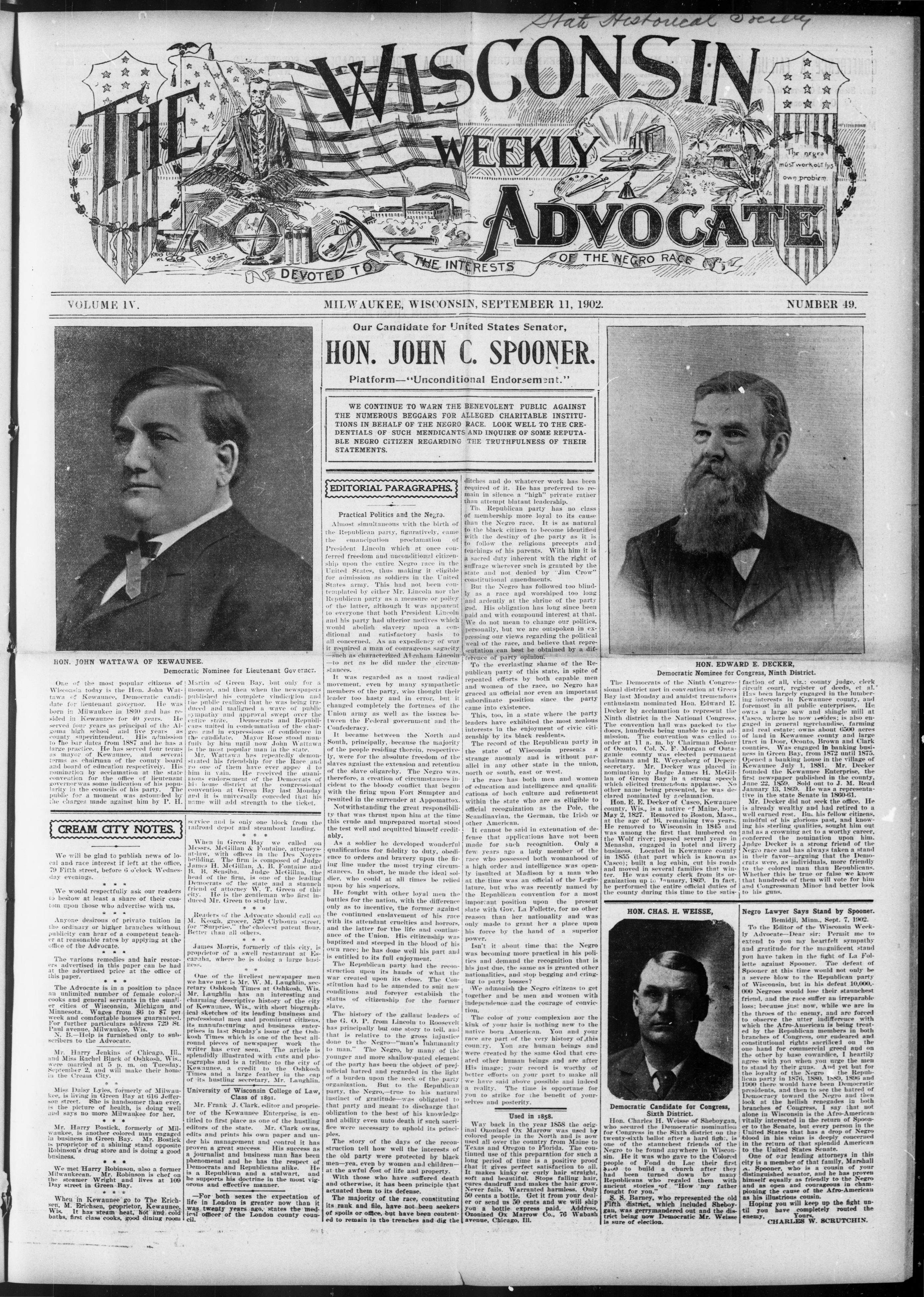
HON. JOHN WATTAWA OF KEWAUNEE.
Democratic Nominee for Lieutenant Governor.
VOLUME IV.
HON. JOHN WATTAWA OF KEWAU
Democ
One of the most popular citizens of Wisconsin today is the Hon. John Wattawa of Kewaunee, Democratic candidate for lieutenant governor. He was born in Milwaukee in 1860 and has resided in Kewaunee for 40 years. He served four years as principal of the Algoma high school and five years as county superintendent. His admission to the bar dates from 1887 and he has a large practice. He has served four terms as mayor of Kewaunee, and several terms as chairman of the county board and board of education respectively. His nomination by acclamation at the state convention for the office of lieutenant governor was some indication of his popularity in the councils of his party. The public for a moment was astounded by the charges made against him by P. H.
CREAM CITY NOTES.
We will be glad to publish news of local and race interest if left at the office, 79 Fifth street, before 6 o'clock Wednesday evenings.
We would respectfully ask our readers to bestow at least a share of their custom upon those who advertise with us.
安 安 安
Anyone desirous of private tuition in the ordinary or higher branches without publicity can hear of a competent teacher at reasonable rates by applying at the office of the Advocate.
* * * *
The various remedies and hair restorers advertised in this paper can be had at the advertised price at the office of this paper.
* * * *
The Advocate is in a position to place an unlimited number of female colored cooks and general servants in the smaller cities of Wisconsin, Michigan and Minnesota. Wages from $6 to $7 per week and comfortable homes guaranteed. For further particulars address 729 St. Paul avenue, Milwaukee, Wis.
N. B.—Help is furnished only to subscribers to the Advocate.
Mr. Harry Jenkins of Chicago, Ill., and Miss Rachel Black of Oshkosh, Wis., were married at 5 p. m. on Tuesday, September 2, and will make their home in the Cream City.
* *
Miss Daisy Lyles, formerly of Milwaukee, is living in Green Bay at 616 Jefferson street. She is handsomer than ever, is the picture of health, is doing well and says no more Milwaukee for her.
* * *
Mr. Harry Bostick, formerly of Milwaukee, is another colored man engaged in business in Green Bay. Mr. Bostick is proprietor of a shining stand opposite Robinson's drug store and is doing a good business.
We met Harry Robinson, also a former Milwaukeean. Mr. Robinson is chef on the steamer Wright and lives at 109 Day street in Green Bay.
When in Kewaunee go to The Erichsen, M. Erichsen, proprietor, Kewaunee, Wis. It has steam heat, hot and cold baths, first class cooks, good dining room
```markdown
```
Martin of Green Bay, but only for a moment, and then when the newspapers published his complete vindication and the public realized that he was being traduced and maligned a wave of public sympathy and approval swept over the entire state. Democrats and Republicans united in condemnation of the charges and in expressions of confidence in the candidate. Mayor Rose stood manfully by him until now John Wattawa is the most popular man in the state. Mr. Wattawa has repeatedly demonstrated his friendship for the Race and no one of them have ever appealed to him in vain. He received the unanimous endorsement of the Democrats of his home district at the congressional convention at Green Bay last Monday and it is universally conceded that his name will add strength to the ticket.
service and is only one block from the railroad depot and steamboat landing.
* * *
When in Green Bay we called on Messrs. McGillan & Fontaine, attorneys-at-law, with offices in the Des Noyers building. The firm is composed of Judge James H. McGillan, A. B. Fontaine and B. B. Sensiba. Judge McGillan, the head of the firm, is one of the leading Democrats of the state and a staunch friend of attorney W. T. Green of this city. He is the gentleman who first induced Mr. Green to study law.
* * *
Readers of the Advocate should call on M. Keogh, grocer, 529 Clybourn street, for "Surprise," the choiceest patent flour. Better than all others.
James Morris, formerly of this city, is proprietor of a swell restaurant at Escanaba, where he is doing a large business.
One of the liveliest newspaper men we have met is Mr. W. M. Laughlin, secretary Oshkosh Times at Oshkosh, Wis. Mr. Laughlin has an interesting and charming descriptive history of the city of Kewaunee, Wis., with short biographical sketches of its leading business and professional men and prominent citizens, its manufacturing and business enterprises in last Sunday's issue of the Oshkosh Times which is one of the best allround pieces of newspaper work the writer has ever seen. The article is splendidly illustrated with cuts and photographs and is a tribute to the city of Kewaunee, a credit to the Oshkosh Times and a large feather in the cap of its hustling secretary, Mr. Laughlin.
University of Wisconsin College of Law, Class of 1891.
Mr. Frank J. Clark, editor and proprietor of the Kewaunee Enterprise is entitled to first place as one of the hustling editors of the state. Mr. Clark owns, edits and prints his own paper and under his management and control it has proven a great success. His success as a journalist and business man has been phenomenal and he has the respect of Democrats and Republicans alike. He is a Republican and a stalwart, and he supports his doctrine in the most vigorous and effective manner.
—For both sexes the expectation of life in London is greater now than it was twenty years ago, states the medical officer of the London county council.
MILWAUKEE, WISCONSIN, SEPTEMBER 11, 1902.
HON. JOHN C. SPOONER.
Platform—"Unconditional Endorsement."
WE CONTINUE TO WARN THE BENEVOLENT PUBLIC AGAINST THE NUMEROUS BEGGARS FOR ALLEGED CHARITABLE INSTITUTIONS IN BEHALF OF THE NEGRO RACE. LOOK WELL TO THE CREDENTIALS OF SUCH MENDICANTS AND INQUIRE OF SOME REPUTABLE NEGRO CITIZEN REGARDING THE TRUTHFULNESS OF THEIR STATEMENTS.
EDITORIAL PARAGRAPHS.
Practical Politics and the Negro.
Almost simultaneous with the birth of the Republican party, figuratively, came the emancipation proclamation of President Lincoln which at once conferred freedom and unconditional citizenship upon the entire Negro race in the United States, thus making it eligible for admission as soldiers in the United States army. This had not been contemplated by either Mr. Lincoln nor the Republican party as a measure or policy of the latter, although it was apparent to everyone that both President Lincoln and his party had ulterior motives which would abolish slavery upon a conditional and satisfactory basis to all concerned. As an expediency of war it required a man of courageous sagacity—such as characterized Abraham Lincoln—to act as he did under the circumstances.
It was regarded as a most radical movement, even by many sympathetic members of the party, who thought their leader too hasty and in error, but it changed completely the fortunes of the Union army as well as the issues between the Federal government and the Confederacy.
It became between the North and South, principally, because the majority of the people residing therein, respectively, were for the absolute freedom of the slaves against the extension and retention of the slave oligarchy. The Negro was, therefore, a creation of circumstances incident to the bloody conflict that begun with the firing upon Fort Sumpter and resulted in the surrender at Appomattox.
Notwithstanding the great responsibility that was thrust upon him at the time this crude and unprepared mortal stood the test well and acquitted himself creditably. As a soldier he developed wonderful qualifications for fidelity to duty, obedience to orders and bravery upon the firing line under the most trying circumstances. In short, he made the ideal soldier, who could at all times be relied upon by his superiors.
He fought with other loyal men the battles for the nation, with the difference only as to incentive, the former against the continued enslavement of his race with its attendant cruelties and horrors, and the latter for the life and continuance of the Union. His citizenship was baptized and steeped in the blood of his own race; he has done well his part and is entitled to its full enjoyment.
The Republican party had the reconstruction upon its hands of what the war created upon its close. The Constitution had to be amended to suit new conditions and forever establish the status of citizenship for the former slave.
The history of the gallant leaders of the G. O. P. from Lincoln to Roosevelt has principally but one story to tell, and that is relative to the gross injustice done to the Negro—"man's inhumanity to man." The Negro, by many of the younger and more shallow-pated element of the party has been the object of prejudicial hatred and regarded in the light of a burden upon the neck of the party organization. But to the Republican party, the Negro,—true to his natural instinct of gratitude—was obligated to that party and meant to discharge that obligation to the best of his knowledge and ability even unto death if such sacrifice were necessary to uphold its principles.
The story of the days of the reconstruction tell how well the interests of the old party were protected by black men—yea, even by women and children—at the awful cost of life and property. With those who have suffered death and otherwise, it has been principle that actuated them to its defense. The majority of the race, constituting its rank and file, have not been seekers of spoils or office, but have been contented to remain in the trenches and dig the
ditches and do whatever work has been required of it. He has preferred to remain in silence a "high" private rather than attempt blatant leadership. The Republican party has no class of membership more loyal to its cause than the Negro race. It is as natural to the black citizen to become identified with the destiny of the party as it is to follow the religious precepts and teachings of his parents. With him it is a sacred duty inherent with the right of suffrage wherever such is granted by the state and not denied by "Jim Crow" constitutional amendments.
But the Negro has followed too blindly as a race and worshiped too long and ardently at the shrine of the party god. His obligation has long since been paid and with compound interest at that. We do not mean to change our politics, personally, but we are outspoken in expressing our views regarding the political weal of the race, and believe that representation can best be obtained by a difference of party opinion.
To the everlasting shame of the Republican party of this state, in spite of repeated efforts by both capable men and women of the race, no Negro has graced an official nor even an important subordinate position since the party came into existence.
This, too, in a state where the party leaders have exhibited the most zealous interests in the enjoyment of civic citizenship by its black residents. The record of the Republican party in the state of Wisconsin presents a strange anomaly and is without parallel in any other state in the union, north or south, east or west. The race has both men and women of education and intelligence and qualifications of both culture and refinement within the state who are as illigible to official recognition as the Pole, the Scandinavian, the German, the Irish or other American.
It cannot be said in extenuation of defense that applications have not been made for such recognition. Only a few years ago a lady member of the race who possessed both womanhood of a high order and intelligence was openly insulted at Madison by a man who at the time was an official of the Legislature, but who was recently named by the Republican convention for a most important position upon the present slate with Gov. La Follette, for no other reason than her nationality and was only made to grant her a place upon his force by the hand of a superior power.
Isn't it about time that the Negro was becoming more practical in his politics and demand the recognition that is his just due, the same as is granted other nationalities, and stop begging and cringing to party bosses?
We admonish the Negro citizens to get together and be men and women with independence and the courage of conviction.
The color of your complexion nor the kink of your hair is nothing new to the native born American. You and your race are part of the very history of this country. You are human beings and were created by the same God that created other human beings and are after His image; your record is worthy of better efforts on your part to make all we have said above possible and indeed a reality. The time is opportune for you to strike for the benefit of yourselves and posterity.
Used in 1858.
Way back in the year 1858 the original Ozonized Ox Marrow was used by colored people in the North and is now used all over the country from Maine to Texas and Oregon to Florida. The continued use of this preparation for such a long period of time is a positive proof that it gives perfect satisfaction to all. It makes kinky or curly hair straight, soft and beautiful. Stops falling hair, cures dandruff and makes the hair grow. Never fails. Warranted harmless. Only 50 cents a bottle. Get it from your dealer or send us 50 cents and we will ship you a bottle express paid. Address, Ozonized Ox Marrow Co., 76 Wabash avenue, Chicago, Ill.
[Portrait of a man with a long beard and a formal suit, facing slightly to the right.]
The Democrats of the Ninth Congressional district met in convention at Green Bay last Monday and amidst tremendous enthusiasm nominated Hon. Edward E. Decker by acclamation to represent the Ninth district in the National Congress. The convention hall was packed to the doors, hundreds being unable to gain admission. The convention was called to order at 11 a. m. by Chairman Bedour of Oconto. Col. N. F. Morgan of Outagamie county was elected permanent chairman and R. Weyenberg of Depere secretary. Mr. Decker was placed in nomination by Judge James H. McGillan of Green Bay in a strong speech which elicited tremendous applause. No other name being presented, he was declared nominated by acclamation.
Hon. E. E. Decker of Casco, Kewaunee county, Wis., is a native of Maine, born May 2, 1827. Removed to Boston, Mass., at the age of 16, remaining two years. He removed to Wisconsin in 1845 and was among the first that lumbered on the Wolf river; passed several years in Menasha, engaged in hotel and livery business. Located in Kewaunee county in 1855 (that part which is known as Casco); built a log cabin, cut his roads and moved in several families that winter. He was county clerk from its organization up to January, 1869. In fact, he performed the entire official duties of the county during this time to the satis-
HON. CHAS. H. WEISSE.
[Name]
Democratic Candidate for Congress, Sixth District.
Hon. Charles H. Weisse of Sheboygan, who secured the Democratic nomination for Congress in the Sixth district on the twenty-sixth ballot after a hard fight, is one of the staunchest friends of the Negro to be found anywhere in Wisconsin. He it was who gave to the Colored people of Fond du Lac their first $100 to build a church after they had been turned down by many Republicans who regaled them with ancient stories of "How my father fought for you."
S. S. Barney, who represented the old Fifth district, which included Sheboygan, was gerrymandered out and the district being now Democratic Mr. Weisse is sure of election.
NUMBER 49.
RD E. DECKER,
Congress, Ninth District.
faction of all, viz.: county judge, clerk circuit court, register of deeds, et al. Has been largely engaged in the lumbering interests in Kewaunee county, and foremost in all public enterprises. He owns a large saw and shingle mill at Casco, where he now resides; is also engaged in general merchandise, farming and real estate; owns about 6500 acres of land in Kewaunee county and large tract in Door, Oconto, Brown and Clark counties. Was engaged in banking business in Green Bay, from 1872 until 1875. Opened a banking house in the village of Kewaunee July 1, 1881. Mr. Decker founded the Kewaunee Enterprise, the first newspaper published in the county, June 22, 1859. Sold out to J. M. Read January 13, 1869. He was a representative in the state Senate in 1860-61.
Mr. Decker did not seek the office. He is already wealthy and had retired to a well earned rest. But his fellow citizens, mindful of his glorious past, and knowing his sterling qualities, sought him out and as a crowning act to a worthy career, conferred the nomination upon him. Judge Decker is a strong friend of the Negro race and has always taken a stand in their favor—arguing that the Democrats were, as individuals, more friendly to the colored man than Republicans. Whether this be true or false we know that hundreds of them will vote for him and Congressman Minor had better look to his guns.
Negro Lawyer Says Stand by Spooner.
To the Editor of the Wisconsin Weekly Advocate—Dear sir: Permit me to extend to you my heartfelt sympathy and gratitude for the magnificent stand you have taken in the fight of La Follette against Spooner. The defeat of Spooner at this time would not only be a severe blow to the Republican party of Wisconsin, but in his defeat 10,000,-000 Negroes would lose their staunchest friend, and the race suffer an irreparable loss; because just now, while we are in the throes of the enemy, and are forced to observe the utter indifference with which the Afro-American is being treated by the Republican members in both branches of Congress, our endeared and constitutional rights sacrificed on the one hand for commercial greed and on the other by base cowardice, I heartily agree with you when you urge the men to stand by their guns. And yet but for the loyalty of the Negro the Republican party in 1876, 1880, 1889, 1896 and 1900 there would have been Democratic presidents, and then to see the hatred of Democracy toward the Negro and then look at the hellish renegades in both branches of Congress, I say that not alone in Wisconsin is the Afro-American vitally interested in the return of Spooner to the Senate, but every person in the United States that has a drop of Negro blood in his veins is deeply concerned in the return of that splendid American to the United States Senate.
One of our leading attorneys in this city is a member of that family, Marshall A. Spooner, who is a cousin of your distinguished senator, and he has proven himself equally as friendly to the Negro and as open and courageous in championing the cause of the Afro-American as his illustrious cousin.
Hoping you will keep up the fight until you have completely routed the enemy, Yours.
CHARLES W. SCRUTCHIN.
CONFERENCE A FAILURE.
Gov. Stone and Others Plead with
: Coat Barons.
‘MORGAN SAYS NOTHING
Qne of His Henchmen, However, Says
| that Trust Magnate’s Attitude
bo _ ‘Remains Unchanged.
! New York, Sept. 10.—Gov. William A.
Stone of Pennsylvania, accompanied by
Attorney General Elkins of Pennsyl-
yvania and Senator Flynn of Pittsburg,
made a special pilgrimage to this city to
induce J. P. Morgan to intervene in the
anthracite coal strike and failed.
) P. A. B. Widener, acting as intermed-
jary for Gov. Stone, made a visit to the
office of Mr. Morgan, and after a private
conference with him informed Goy. Stone
that Mr. Morgan declined to interfere or
in any way change the attitude he has
held ever since his return from Europe.
. Gov. Stone and his party went directly
to the offices of the United States Steel
Corporation in the Empire building.
‘There they had a conference with P. A.
B. Widener on the strike situation. Later
Mr. Widener went to the office of J. P.
Morgan, where he had a talk lasting not
more than five minutes with Mr. Morgan.
i Stone Gives Partial Statement.
' Goy. Stone hurried for the elevator as
soon as the conference ended and almost
bumped into a sup of reporters on the
xround floor. He smiled and said:
“Gentlemen, I am glad you have waited
for me. I have a little statement for
you, and here it is.” He produced a
scrap of paper containing the following:
“Attorney General Elkins, Senator
Flyan and myself have been in consulta-
tion for some hours with P. A. B. Widen-
er of Philadelphia, who is a director in
the United States Steel Corporation, and
is associated with Mr. Morgan in many
business interests. Mr. Widener is anx-
ious to see the strike settled, and took
up the matter me Mr. Mergan. We
are doing what ean.”
Gov. Stone declined to add anything to
his stafement.
Morgan’s Partner Tatks.
‘There were rumors afloat that the gov-
ernor’s visit had results, but George W.
Perkins of J. P. Morgan & Co. denied
that there was any change in the situa-
tion. Word to the same effect was re-
ceived by long distance telephone from
President Truesdale of the Delaware,
Lackawanna & Western railroad, who is
out of town.
It was reported that a statement would
be issued by J. P. Morgan & Co. con-
cerning the day's negotiations, but just
before the firm’s offices were closed for
the day Mr. Perkins said the firm had
nothing to give out.
Mr. Perkins said that Mr. Morgan had
had no direct word from, Goy. Stone, but
that Mr. Widener had been in conference
with Mr. Morgan. He added that Mr.
Morgan had no comment to make in re-
gard to the conference.
i Strike of Chicago Teamsters.
' Chicago, Il., Sept. 10.—All the exca:
vating teamsters in Chicago. went on
strike this morning for an increase in
wages to $2 a day. Abont 600 men,
doing the teaming for the principal firms
making excavations for new buildings,
are involved. The teamsters’ joint coun-
cil last night ordered the strike.
- The teamsters demand $2 a day and
the doing away with taking care of their
teams all day Sunday. They are now
receiving $1.50 and 1.75 a day. They
are willing to look after their horses
Sunday mornings and then not return
until time to take the teams out Monday.
. SHOT HIS BETROTHED.
Young Lawyer Then Fires at Girl’s
Mother and Attempts Suicide—Re-
sult of Lover’s Quarrel.
Chicago, Il, Sept. 10.—As a result
of a lover’s quarrel Rollin O'Shea, a
young lawyer just admitted to the bar,
shot and killed his betrothed, Emily Ho-
ganson, here today, tried to kill the girl’s
mother, and then turned the weapon
upon himself and tried to commit sui-
cide. He was removed to the Norwegian
Hospital in such a serious condition that
it is thought he will die. Last night the
young couple quarreled. Early this
morning O'Shea visited the Hoxanson
home with a view to a reconciliation.
‘The altercation was resumed and
reached such a height that Mrs. Hogan-
son interfered. O’Shea resented this ac-
tion and fired at both of them. The shot
tired at Mrs. Hoganson went wild.
ae ope aig area
Woman Charged with Cremating Living
Babies in Her Kitchen
Range.
Chicago, DL, Sept. 10.—Cremation of
‘iving babies in her kitchen range is a
charge made by Charles Early against
Mrs. Pauline Taeschler, who conducts a
private hospital for women in South
May street. Early made this and other
serious charges before the state board
of health. As a result officials of the
board secured a warrant against Mrs.
‘Laeschler on a charge of practicing medi-
cine without a license and the woman
has been arrested.
Mrs. Taeschler attributes the charges
to motives of reyenge inspired by her re-
fusal to allow Barly to visit a woman
patient in her hospital.
BC aAR OE AS
a
Party of Manistique (Mich.) Men Who
Went on Fishing Expedition to
Indian Lake.
Manistique, Mich., Sept. 10.—[Spe-
cial.]—Leroy and Walter Woodruff, aged
24 and 18 respectively and sons of a
prominent farmer, and William Tennant,
2 brother-in-law, 21 years of age, were
drowned in Undian lake, tive miles from
here, Saturday night or Sunday. They
left home-Saturday night to go fishing.
The body of the first named was found
on shore this morning.
rs
EXPEL THE BRITISH.
Presence of Foreigners in Manchuria De-
clared by Russia to be Ob-
jectionable.
Pekin, Sept. 10.—Paul Lessar,. the
Russian minister here, has advised the
Russian commander in Manchuria- that
the presence of foreigners: in Manchuria
during ‘the military occupation is objec-
tionable and he is directed to expel the
British imperial custom-employes who
may be sent to Manchuria te resume
«harge of the postal service.
FILLED WITH MYSTERY.
Tragedies.
Chicago, Ill., Sept. 9.—The finding and
identification of the body of William
Bartholin in a field at Lowthers, Ia.,
throws little or no light upon the Bar-
tholin case in its details. The first and
most important thing in Bartholin’s coa-
fession is the sentence, “It was all Min-
nie and I could do.” The natural ques-
tion that presents itself is, “What had
Miss Mitchell to do with the death of
Mrs. Bartholin?’ No one has been found
who even intimated that Minnie Mitchell
knew anything of the death of Mrs.
Bartholin.
‘The history of the case is filled with
mystery. From the first no light has
been thrown upon it that would leave
the police even a plausible theory on
which to work. These are some of the
questions they would like to have an-
swered:
What was the motive that induced
Bartholin to kill his mother? ‘
How did he succeed in transferring the
body to the cellar and in burying it with-
out being seen or suspected?
Why did be kill the little dog, which
was his mother’s fayorite, and bury it in
the cellar, destroying the body with
quicklime, without using the same upon
the body of .his mother?
The manner in which Bartholin con-
cenled his mother’s “disappearance,” the
circumstances of her death, and what he
told Edward Counselman on the night of
July 12, when Counselman cglted at the
Bartholin home, are other mysteries the
police cannot explain.
About the Girl’s Death.
Coming down to the disappearance of
Bartholin and Miss Minnie Mitchell the
police still find themselves face to face
with inexplicable circumscances. Was
Minnie Mitchell aware of the murder
of Mrs. Bartholin? Was it Bartholin’s
intention to kill the girl that night? If
so, where did he kill her? Hew did he
get the body to Seventy-fourth and
Scate streets?
Where Miss Mitchell and Bartholin
went after tifey were seen at Indiana
avenue and Forty-thirdg street by Sam
Wisler and Con Mulvey never bas been
learned. The most plausible theory
has been that théy weut for a street
car vide which terminated in the murder
et Miss Mitchell at Seventy-fourth and
State stréets, The motive of that mur-
der is believed to have been her discov-
ery of the. murder of Mrs. Bartholin
and Aer threat to expose the young man.
Wich the death of the girl Bartholin
had no further motive to remain in the
city. Driven by fear of capture, he
sought safety on ows farms, where re-
morse finally drove him to suicide.
Sudden Exodus of the Roomers.
Another phase of the case which never
has been satisfactorily explained is the
sudden exodus of the roomers. Milton
L. 8. Edwards and E. Orson Hunter left
the city hurriedly, July 31. Thompson
closed up the house and sought quarters
elsewhere. Edward» said he was “afraid”
to stay there longer, “for fear he would be
murdered.” Hunter said Thompson told
him to get out, as he “intended io ciose
the house.” ‘Thompson's reason for leav-
ing, given to Inspector Hunt, was be-
cause Mrs. Bartholin and “Will” had
disappeared, and ‘he knew of nothing else
to do.
Condition or the Bodies.
One of the striking features to the po-
lice was the condition of the bodies of the
three principals of the tragedy. None
was recognizable when discovered. Was
it the idea of William Bartholin at the
start to effect this result?
The motives which prevailed in the
whole case still are amystery, and there
is little he of their ever being
known. ‘he confession left by the mur-
dever indicated that he knew of the ar-
rest of Thompson, Counse!man ad Claffy,
yet no ene with whom he associated after
his departure from Chicago has been
found who eer saw him purchase or read
a newspaper. Perhaps in the future
some person will offer the key to the case,
which has proven the greatest mystery in
the history of the Chicago police.
Reminded of His Mother.
Riceville, In., Sept. 9.—Since the dis-
covery of the body of a suicide and its
identification as that of William Bartho-
lin, country folk are recalling incidents
of the murderer’s stay in this vicitity.
All show that the young man suffered
keenly frosn remorse. a
Charles’ Hoeft remembered another in-
cident of Bartholin’s stay with him.
Mrs. Hoeft’s baking had been delayed,
and when the mea sat down to dinner
she brought in the hot loaves of bread,
still steaming.
“This is bread like my mother used to
mike,’ said Dvorak. He hesitated for
a moment, and then continued, address-
ing Bartholin: “How about yours?”
“Stevens, as we knew Bartholin then.”
said Mrs. Hoeft, “nearly choked. We
thought he had swallowed something the
wrong way. So I poured out a big cup
of buttermilk, but he shook his head and
went out. When he got just outside the
kitchen door he was sick at his stomach,
and then he went down by the big tree
by the well and sat and cried for over
an hour.”
CANNOT GET ANTHRACITE.
War Department Driven to Use of Bitu-
minous in Buildings.
Washington, D. C., Sept. 9.—The coi-
tractor who furnished .coal for the
war department hag notified Chief
Clerk Scofield that he no longer could
obtain anthracite coal. He said if the
department could obtain anthracite he
would pay the difference between the
contract price and the price the depart-
ment would have to pay.
Officers of the department say they
cannot obtain coal and are about to pur-
chase bituminous coal. A local law pre-
hibits black smoke in the District of Co-
lumbia and officers of the war depart-
ment are In some doubt whether the law
applies to buildings used by the govern-
ment.
nsaeieaee een eee
BABY BICYCLIST DEAD.
Carl Linn, Aged 3 Years, Whe Had Been
Riding for Year and a Half.
Indianapolis, Ind., Sept. 9.—Carl Linn,
the youngest “professional” bicycle rider
in the world, is dead at his home, 1083
East, Washington street, of brain fever
and meningitis, after an illness of sev-
eral weeks. Carl was the son of George
Linn. The child was three years old
and had been riding a bicycle especially
made for him ‘by his father for a year
and a half, having learned to ride before
he could talk and almost as soon as he
could walk. Not long ago his father
issued a challenge for a match race
against any other rider in the world of
a similar age.
——_——_____—_
FINDS JUG FILLED WITH GOLD.
Mississippi Farmer Discovers Hidden
Treasure in Old House.
New Orleans, La... Sept. 9.—John
Moore, a farmer living near Hermans-
ville, Claiborne county, Miss., while de
moushing: an ancient building on his
farm, ‘found a..jug containing nearly
$4000 in $20 gold pieces. Nothing is
known of how the money got there: but it
is thought to have been hidden by some
one during the Civil war.
DR. SENN RETURNS.
Famous Surgeon Inspects Foreign Hos-
pitals—Entertained at Dinrier by
Czar of Russia.
Chicago, Ill., Sept. 9.—“‘The finest hos-
pital I ever saw is owned by the Sultan
of Turkey,” said Dr. Nicholas Senn, the
famous Chicago surgeon who returned
from a four months’ European trip yes-
terday. =
“I was given the privilege of thor-
oughly inspecting this remarkabie hos-
pital. It is rup entirely at the expense
of the Sultan and is principally for wom-
en and children,
“No payment is accepted for treatmeut
of any cases which come into its care.
‘There are sixteen beds for foreigners
and strangers. All a stranger in Con;
stantinople has to do if he is ill is 1
get a note to the hospital authorities
frém the minister of the government to
which he claims allegiance and the hos-
pital gladly does the rest.
“[ had a splendid and most profitable
time,” said the doctor, “1 visited Con-
stantinople, Assyria, Palestine, Egypt,
Sweden, Russia and England. I founc
that the hospitals of England are quite
poor. They are far inferior to those of
the United States. The hospitals of
Germany and Prussia, however, T foun
to be particularly good. They have th
most. modern appliances and building:
and are run on highly scientific prin-
ciples.”
Dr. Senn says he was royally enter-
tained in St. Petersburg. A dinner was
given by the Czar and Czarina to a nun-
ber of distinguished medical men who
were in attendance at the Red Cross con-
yention and Dr. Senn was among the in-
vited guests. He was presented to the
Czar and Czarina and was shown every
consideration at the state-dinner in the
Se
Sees
Fierce Battle Betweeen Venezuela Troops
and the Revolutionary
Forces.
New York. Sept..9.—The consul gen-
eral of Venezuela has received the follow-
ing undated cablegram from President
Castro:
“A fierce battle was ofugh today at
Finaquillo in which the revolutionary
army under Gens. Luciana Mendoza and
Riera was completely defeated, thus in-
suring national peace. y
Haytien Perts Closed.
Hamburg, Sept. 9.—According to in-
formation received from the Haytain con-
sulate here the provisional government
of Hayti has closed the ports of Go-
naives, Saint Mare and Port de Paix to
foreign ships jn consequence of the dis-
turbances on the island. The provisional
President, Boisrond Canal, has issued
instruction that bills of lading, manifests,
ete., for these ports be not issued for the
present.
Dairymen Asked to Stand by Those Who
Stood by Them in Anti-Oleomar-
garine Legislation.
Elgin, Ill, Sept. 9.—Senator Spooner
of Wisconsin, Congressman Tawrey of
Minnesota and Speaker David B. Hen-
derson of Iowa were commended by the
Elgin dairy board of trade in recogni-
tion of their valued services in securing
the passage of the oleomargarine bill.
One important clause of a resolution
passed by the board reads as follows:
Resolved, that the Elgin dairy board of!
trade, representing a production of more
than '25,000,000 pounds of butter annually
and the Interests of 40,000 farmers and
dairymen of the great Higin district. in
the ‘name of pure bntter do hereby call
Se their brother dairymen in Wisconsin,
Minnesota and Iowa, Irrespective of politics,
to stand by those who stood by them when
they sorely needed such influence and sup-
port, particularly in cases where such sup-
port has been go conspicuously tendered, as
in the case of the three able and loval
Statesmen of national reputation.
gee ms acl ta
Fanned by Strong North Wind the
Flames Sweep Everything in Their
Path.
Oregon City, Ore., Sept. 9.—Extensive
forest fires are destroying a large amount
of property ten miles from this city
between Shubel postoffice and Clarkes.
The fire covers three miles of country.
It has been a strong north wind that
has spread it rapidly in a southerly di-
rection, bree is everything before it.
Laramie, Wyo., Sept. 9.—Reports from
timber fire districts state that sheep-
men_ will be heavy losers. Many of
the bands have scattered and thousands
of sheep are now right in the burning
timber country.
Work in the Rambler mine has been
suspended and all bands sent to com-
bat the fire.
ne A alae
SLAIN WITH AN AXE.
Arkansas Man Strikes His Wife While
She was Asleep.
Stamps, Ark., Sept. 9.—The wife of
John Harper, a resident of this place,
has been murdered, her slayer using an
axe with which he dealt the woman two
heavy blows when she was asleep. Her
head was almost severed from the body.
The woman’s husband has disappeared,
oe
JUMPED INTO RIVER.
Suicide of Woman Who Had Set Fire to
Her Five Children.
Greenville, Miss., Sept. 9.—Mrs. Mollie
Westrobe of Clayton, Miss., who while
insane murdered and burned her five
children near Hazelhurst, Miss., June 16,
committed suicide here yesterday by
jumping into the river.
——_—_-__—_—_—
Settled an Old Grudge.
Vunsburg. Ky., Sept. 9.—William Scott
shot and killed C. C. Beard, on Rock
Run, four miles south of this city. Scott
was lodged in jail here this morning. An
old grudge, it is said, caused the killing.
$$
Postoffice Safe Robbed.
Seymour. Ind., Sept. 9.—The safe in the
Freetown postoffice was blown open early
this morning and completely wrecked,
$300 worth of stamps, all the loose money
and two registered letters being taken.
i
Former Congressman Dies.
Knoxville, Tenn., Sept. 9.—W. C. An-
derson, formerly congressman from the
First district of Tennessee, died last
night at his home at Newport, Tenn. He
had been ill ten days of typhoid fever.
fe
Business Blocks Destroyed.
Rouseville, Pa., Sept. 9.—Seven frame
business blocks and two dwellings were
destroyed by fire this morning, entailing
a loss of $50,000. a
are eee cee ae
Negro Fiend Hanged.
Montross, Va., Sept. 9.—John Lomax, a
snegro, who criminally assaulted. Susie
Costenbader, a young woman of Potomac
Mills, near Alexandria, lust June, was
hanged here shortly before moon today.
HAVE A NARROW ESCAPE
Young Couple Hurled by a Train
Nearly Killed.
MAN LOSES MEMORY.
George Dittman and Miss Lucile Selstad
Run Into While Crossing Rail-
way Track.
La Crosse, Wis., Sept. 10.—[Special.]
—The Chicago, Burlington & Quincy
limited train, southbound, last night
struck a carriage containing George
Dittman, the son of a prominent mer-
chant, and Miss Lucille Selstad, killing
the horse, demolishing the carriage and
hurling the occupants down an embank-
ment after dragging them over 200 feet.
The train was going at full speed, but
aeither Mr, Dittman nor his companion
were hurt physically, although Mr. Ditt-
man was s0 overcome by the shock he
had to be led home, and all the events
tor several days before the accident are
a blank to him.
easiest a
CHILDREN TAKEN
FROM THEIR MOTHER.
Jefferson Woman Says She Left Home
Because She was Overworked
on Farm.
La Crosse, Wis., Sept. 10.—[{Special.]
—As a sequel to the alleged elopement
of a couple from Jefferson, Wis., habeas
corpus proceedings were instituted by
Jacob Raeithel, husband of Mrs. Sar-
bara Raeithel, to obtain custody of the
two children which the women took
with her. The petition alleges that the
woman was an unfit person to have
charge of the children, and also alleges
that she committed adultery with Her-
man Schulbert. Both the woman and
Schulbert deny this and also deny stay-
ing at the Hotel Julian together. Mrs.
Rueithel’s name appears alone on the
hotel register, and there is no evidence
that anything improper had been com-
mitted. Court Commissioner Alfred
Harrison, before whom the matter was
taken, granted the custody of the chil-
dren to the husband, and he left with
them for Jefferson. Mrs. Raeithel de-
clares that she was overworked on the
farm by her husband, and that she was
often cruelly treated by him. She is a
German woman in her forties. She says
she will probably return to Jefferson and
sue for a divorce. Schulbert says that
he met the woman here and did not
come to La Crosse from Jefferson in her
company.
J. €. SPENCER’S DEATH.
One of the Best Known Fire Chiefs in
the State—Also a News-
paper Man.
Janesville, Wis., Sept. 10.—[Speciail.]
—John C. Spencer, chief of the Janes-
ville fire department, died at his home at
8 o’clock this morning from an attack of
heart failure caused by asthma.
Mr. Spencer was 64 years of age and
has been a member of the department
since 1855. He was assistant chief from
1885 to 1892 and chief since that time.
He was connected with the editorial de-
partment of the Gazette for many years
and was one of the best known fire chiefs
in_the state.
He leaves a widow, three daughters
and three sons.
(eels ceacigiaibincieannanation
LONG TRIP IN A CANOE.
Racine Boys Go to St. Louis in Little
Craft.
Racine, Wis., Sept. eee ee
Henry A. Guenther and August Kohi-
man, two Racine boys, aged 23 and 21
years respectively, started out seveu
weeks ago on a decidedly novel trip in
® cauvas canoe about fourteen feet lonz.
According to letters received the young
men are now near St. Louis, Mo., after
having had many interesting experi-
ences. When in this city they were
both telegraph operators at Racine Junc-
tion and are very well known. Their
route has been down the Wisconsin riv-
er and the Mississippi, and wherever
they have been they attracted a great
deal of attention and are considered
very daring for making a trip in such a
frail craft. The people cannot even be
induced to step into the canoe. When
the wind is fair the boys hoist a big
wagon umbrella and sail very rapidly.
At night they camp along the shore aud
buy eatables from the farm houses near
by.
—
MEETS SEPTEMBER 23.
State Supreme Court will Hand Down
Decisions.
Madison, Wis., Sept. 10.—The supreme
court has announced that the next sit-
ting would be September 23, when de-
cisions in cases argued at the last as-
signment would be handed down and
arguments on the next assignment taken
up. The next assignment consists of
cases numbered 33 to 59, inclusive, on
the calendar, No. 148 and state 4. Case
No. 143 is the action of George B. Hall,
respondent, against the city of Milwau-
kee, impleaded, ete., appellant. It was
set forward on the calendar for argu-
ment, a motion to that effect having been
granted. The regular assignment in-
cludes cases from the Thirteenth, Four-
teenth and. Fifteenth circuits.
HELD IN $2500 BONDS.
{. Dickinson Must Stand Trial on Horse
Stealing Charge.
Black River Falls, Wis., Sept. 10.—
[Special.J—T. Dickinson,” an alleged
member of the gang of horse_thieves
which has been operating in Jackson,
Monroe and La Crosse counties, who
was arrested some weeks ago charged
with stealing a horse and buggy in this
city, was bound over to the October term
of the circuit court today. Being unable
to furnish bail to the amount of $2500
he was committed to jail.
>
MAY HAVE KILLED HERSELF.
River at Janesville Being Dragged for
‘Woman's Body.
Janesville, Wis., Sept. 10.—The police
and a searching crew are dragging the
river for the bedy of Miss Eva Johnson,
who is supposed to have jumped in Mon-
day night. She was at the school for
the blind as a helper, aud she was last
seen going toward the river. Her para-
sol was found on the river bank.
_———————
Dedicate Oshkosh Episcopal Church.
Oshkosh; Wis., Sept. 10.—[Special.J—
The dedication services of Grace Episco-
pal Chureh will be held Sunday at 10:30
De M,. Bishop Heber Weller. of Fond du
Lac and the new rector, Rev. Mr. Say-
lor, will conduct the services. -
BIG COPPER FIND
NEAR THREE LAKES.
hae n
Farmers Believe They Have Discovered a
Rich Vein of Metal—Won’t
Sell Property.
Three Lakes, Wis., Sept. 10.—[Spe-
cial.]—James Donnelly of this place be-
lieves he has found a copper mine a short
distance from this town, At the depth
of eighteen feet he has found specimens
of ore which assay 95 per cent. copper
ond some silver. He claims he can trace
the vein for ten miles or more aud be-
lieves it contains a rich treasure. Farm-
ers owning this supposed mineral land
are so enthused oyer Mr. Donnelly’s pros-
pects that they will not sell for any price,
nor will they even give an option on the
land.
Se ae eae
SHE TOOK CARBOLIC
ACID BY MISTAKE.
Mrs. C. H. Webster, Formerly of Eau
Claire, Expires in Awful Agony
at Passadena.
Los Angeles, Cal... Sept. 10.—Mis.
Christina Webster, wife of C. H. Web-
ster, formerly sales manager of the Hau
Claire Grocery Company of Kau Ciaire,
died at Passadena from carbolic acid
poisoning. She had been ill and rose in
the night and took a dose from a_ bottle
labeled “pain killer,” but which contained
earbolic acid. She died within an hour
in great agony. Mrs. Webster's first
husband, A. Niqvist, hanged himself in
Eau Claire some six years ago. She
leaves two grown sons, one of whom is
here, the other being in Wisconsin.
ear ee
BEASTS TEAR MAN’S
BODY TO PIECES.
Skeleton Found in the Woods Near
Tomahawk—Probable Victim of
Hunter’s Bullet.
Tomahawk, Wis., Sept. 10.—[Special.]
--A human skeleton was found in the
woods three miles north of this city.
Little was found to throw light upon the
identity of the man or how he came to
his death. The body might have laid
there one or two years. Every vestige
of flesh had disappeared. The oniy
trace of clothing was the remnant of a
blue striped shirt and a part of a cheap
pair of trousers within overalis. The
feet were encased in a pair of light
summer shoes. Wild animals had_cvi-
dently torn the body to pieces. #rom
the light clothing it is evident that the
man must have met his death during tie
summer season. The fact that the body
was found near a runway lends color to
the theory that the unfortunate wandered
from the railroad along the trail, thinking
it might lead him to a human habitation;
that night was coming on and in the
dusk he was mistaken for a deer by il-
legal hunters, who shot him and left the
body to rot.
DR. J. P. WAYLAND ©
Prominent Physician Suddenly Expires
After Suffering an Attack of
Apoplezy.
Portage, Wis., Sept. 10.—[Special.j -
Dr. J. P. Wayland, one of the promiuert
physicians of this city, died of apoplexy.
He was born in Kenton county, Ken-
tucky, May 4, 1841, and spent the most
of his life at Byron, Ill. He came to
Portage three years ago and had made
many friends here. In politics Dr. Way-
land had always been a staunch Repub-
lican, but was Prohibition in sentiment.
He was examining physician for seven
different local organizations and was a
member of the Masonic fraternity, Inde-
pendent Order of Odd Fellows, Modern
‘Woodmen of America, Knights of the
Maccabees, Knights of the Globe and
other organizations. ‘The funeral will be
held Thursday afternoon at 1:30 o'clock.
Mrs. M. E. Fisk, Racine.
Racine, Wis., Sept. 10.—[Special.]J—
Mrs. Mary Elizabeth Fisk, aged 68 years,
died at the home of her daughter, Mrs.
S$. C. Johnson, in Racine, after a short
illness. She was a daughter of the late
Sereno Fisk.
A. C. Bowen, Columbus.
Columbus, Wis., Sept. 10.—[Speciat.}
—A. C. Bowen died Tuesday.
Aetin naw pies eae
THIRD REGIMENT REUNION.
Will be Held at Fond du Lac September
16 and 17.
Fond du Lac, Wis., Sept. 10.--[ Special]
—Another state meeting scheduled for
Fond du Lac is the reunion of the Third
Wisconsin Regiment of the Civil War.
‘This reunion_will be held here Septem-
ber 16 and 17. This will be the first re-
union since 1895. ‘The meetings will be
held at Armory E and it is expected that
veterans will be present from all over
Wisconsin and neighboring states. There
will be a business meeting of the asso-
ciation and a programme, including 2
song and original poem on the regiment's
history by W. D. Cornell. The reunion
will close with a camp fire on Wednes-
day creee to which the public is in-
vited.
“Hamilton’s regiment,” as it is best
known, was panes in Fond du Lac
in June, 1861, It served throughout the
war until the close in 1865 and was en-
gaged in many of the principal battles,
including Cedar Mountain, Antietam,
Chancellorsville and Gettysburg. It was
also with Sherman on his march to the
sea. The reunion will be of interest to
every old soldier in the state.
BE acca h aoe!
ACCEPT “HE BUILDINGS.
Eoard of Control at the Feeble Minded
Home.
Chippewa Falls, Wis., Sept. 10.—[{Spe-
cial.J—The building committee of the
board of control, N. B. Treat, A. G. Nel-
son and H. Grotophorst, spent yesterday
in the city inspecting the four new build-
ings at the Feeble Minded Home. They
accepted the buildings and will prepare
a report to that effect to present to the
board. The buildings consist of an ad-
ministration building and congregate din-
ing room, a school house and two dormi-
tories. The contract called for their
completion by January 1 last, but delay
was bg ea in securing materia! and
help. eorge B. Potter of Stevens Point
was the contractor and was with the
board during the inspection yesterday.
Amplius Chamberlin. Kilbourn.
Kilbourn Wis., Sept. 10.—[{Special.]—
Amplius Chamberlin died after a very
brief illness at his home in Kilbourn. He
was one of the early settlers in this see-
tion of the country, coming to Elkhorn
from Vermont, and was 81 years old.
He was treasurer of Adams county from
1857 to 1860, when he settled in Kil-
bourn, where he had held the office of
‘president of the village several terms and
various town offices. He was once the
Defiocratic wominee for member of Ax-
sembly and served as deputy postmaster
under Cleveland.
BOODLERS EXpousap,
ineteen Members of St. Lonts Municipal
ne © heey Indicted dy the =
Grand Jury.
Bt. Lous, st0., Sept. 9—As 9 a
of the confession of J. KK. Ny Feaut
+ AbUrrell, 2
-member yf the house of delegates of ty:,
city, bench warrants for the arrest. ét
eighteen members and former members
of the same legislative tydy were issued
Some of the warrants were served and
the remainder will be as seon as th.
police ean get trace ef the defendants.
The warrants charge bribery and por-
jury in euunees ne — the passage of
street railway and other franchise:
St. Louis, ark
Murrell’s confession alleges that the
men for whom warrants were issued, to-
gether with others who have been found
guilty or are now fugitives in Mexico.
formed a combine in the city couuci! i¢
control and sell legislation, It says Mur-
rell was the eustodian of the $75,u00 de-
posited for the combine as the price of
pushing through the suburban street rai!-
way franchise. It shows also that the
ae obtained $47,000 for anothe;
veil,
Trafficking for Years.
- In addition—and this feature of it has
enaused the most amazing phase of the
sensation of the day—the confession de-
glares that the combine had been opera:
ing for years, the traffickers in the pul-
He rights for their own gain not thinkin:
that they were doing wrong.
Following are the names of the men
for whom bench warrants were issne:!
charging bribery and perjury in connec-
tion with suburban street railway ail
other legislation:
Albright, T. EB. Lehman, Julius.
Berseh, Edmund, Murrell, J. K.
Denny, Charles J. Murrell, EB, B.
Decker, Louis. Maderr, Adolph.
Faulkner, H. A. Robertson, Gee. F.
Gutke, Charles A. Sehnettler, John Ji.
Hartman, Emile. Schumacher, Otto.
Hanmgan, J. J. Sheridan, John A.
Helms, John. Tamblyn, William.
Kelly, Charles F.
Nine Arrests are Made.
Warrazts were served on B. E. Mur-
rell, Schuettler, Albright, Robertson.
Helas, Gutke, Faulkner, Schumacher
and Hannigan, Albright and Faulkuer
were released in bonds of $30,000 each.
The others arrested were allowed to go
to their homes in the custody of depzty
sheriffs. The police are watching the
bridge and other possible avenues of es-
cape from the city and it will be difficul.
for any of the indicted men to remai:
long out of the hands of the law.
St. Louis, Mo., Sept. 9.—It developed
today that each of the nineteen aldermen
indicted by the grand jury for corrupt
trafficking in street railway franchises
was reeuired to subscribe to the follow-
ing oath:
I do solcienly swear before the Almighty
God that in associating myself and in’ be
coming a manber of this combine I will
yote and act with the combine waenever
and wherever I may be so ordered to do so.
And I further solemnly swear that I wil!
not, at auy mace or time, reveal the fact
that there is a combine, and that I will
not ¢ommuxieate to any person o* persons
anything that may take place at any mect-
ing of the combine.
‘And I do solemnly swear and agree that in
case } should reveal the faet that any per
son in this-combine has received money.
T hereby permit and authorize other mem-
bers of this combine to take the forfelt of
my life in sueh manner as they may deou:
proper ond that my throat may be cut, my
Tongne torn and my body cast inte the
Mississippi river.
‘And iil of this 1 do solemnly swear, so
belp me God.
AGUA DULCE HAS
BEEN SURRENDERED.
’ ap ae
Washington, D. C., Sept. 9—Mr, Ehr-
man, viee-consul general at Papama ad-
vises, the state department that Agun
Dulee has been surrendered by the gov-
ernment forces. Four revolutionary war
vessels are now in the Bay of Panama
and the revolutionists are reported to be
moving toward the railroad.
Mr. Ehrman considers the situation at
Colov and at Panama serious.
ADMIRAL KILLICK
IS REPORTED LOST.
a eigeaiemte
Washington, D. C., Sept. 9.—Mr. Pow-
ell, United States minister to Hayti, has
cabled the state department that he has
a report that Admiral Killick aud two
of his officers went down with the Crete-
a-Pierrot, recently sunk near Cape Hay-
tian by the German gunboat Panther.
MASE ge eee eee
CANDY COMBINE FORMED.
Merger Incorporated in New Jersey with
$9,000,000 Capital.
New York, Sept. 9.—The Nationa!
Candy Company, with an authorized capi
tal stock of $9,000,000, ‘has been incor-
porated in New Jersey and has filed its
articles of incorporation with the clerk
ef Hndson county. The incorporators
are Henry Semple Ames, St. Loni:
Frank W. Reid. George B. Goedwii,
Edward 8. Rogers, Samuel EB. Hill, Chi-
cago, and Frank P. McDermot, Jersey
City.
i Se
UNQUESTIONABLY INSANE.
Preacher Slashes Wife with Razor to Se-
cure Remission of Sin.
Genoa, W. Va., Sapt. 9.—Rev. Maurice
Wilson, who almost severed his wife's
head from her body with a razor as he
said, “Withont the shedding of blood
there shall be no remission of sin,” was
found this morning in the woods a few
miles from home. He had had rv food
since the commission of the crime Satur-
vay morning. He is unquestionably in
sane and will not be taken to jail. He
is over SO years old.
Se eee are
WANTED A NEW DRESS.
Husband Wouldn’t Provide the Money
and Wife Took Carhelic Acid.
Minneapolis, Minn,, Sept. 9.-- Becaus
her husband failed to give her $25 le
had promised her for a new dress, Mrs.
Louis Dahlstrom, of 217 Twelfth av+-
nue, swallowed a quantity of earbolir
acid Jute yesterday.
Physicians were called, but their e!-
forts were unavailing aud in three hows
she was dead.
—vinalatnonspaie ts cine
Bostonese for Sawhorse.
“Mater!” cried little Emerson Postinz.
“may I not amuse myself with the vidit-
equus ?”
“Yes. You may permit him to do so,
purse.” ma
“But what is it he wants, ma’am?
inquired the new nurse.
“The saw-horst. L suppose you would
eall it.” said Mrs. Bosting, admirably
concealing her impatience at such ig-
norance.—-Philadelphia Press. -
(a
Orange. Lemon and Olive Fields.
An orange tree in full. bearing. has bee»
known to produce 15,000 oranges;.a lem-
on tree, 6000 fruit. . An olive -tree yields
six pounds of olives when it is three
years old. . At the. age of 00,.it yields
from 22 to 26 pounds... Palit Flan
———_——_——_ -¢
—Those Who notice tlie rapid growth of
their finger nails should be happy, for it
is considered to indicate good health.
NOT AT ALL MODEST.
London, Sept. 10.—A parliamentary paper issued today gives a full report of the recent conference between the colonial secretary, Joseph Chamberlain, and the Boer generals, Botha, Dewet and Delarey. Prior to agreeing to the interview which the Boers asked for August 20, the colonial secretary requested a list of the subjects which it was desired to discuss, and the generals forwarded a list, including the following:
Complete amnesty to the rebels.
A yearly grant to all Boer widows and orphans and maimed burghers.
Equal rights for the English and Dutch languages in the schools and courts.
languages in the schools and courts. That equal rights with the British be conceded to burghers complying with the terms of surrender, including the right to return to South Africa.
The immediate release of all prisoners of war.
The reinstatement of the officials of the late South African republics or compensation for their loss of office.
Compensation for all loss occasioned by the British troops by the use, removal, burning or destruction by other means of all private property.
The reinstatement of the burghers in the ownership of their farms confiscated or sold under the proclamation of August 7, 1901.
Compensation for the use of the properities of burghers taken by the British authorities.
Payment of the lawful obligations of the late South African republics, including those incurred during the war.
The resselection of the decision to add a portion of the Transyval to Natal.
Granting an extension of time for the payment of all debts due by the burghers to the late governments of the South African republics.
Chamberlain is Staggered.
Mr. Chamberlain, in replying, expressed great surprise at the number and character of the proposals, pointing out that the conditions agreed on at Vereeniging were duly accepted by the burghers and the British government and that they could not be reopened, nor could proposals rejected at that time be again discussed. If the interpretation of the agreement was open to question his majesty's government would endeavor to remove all doubts.
At the opening of the conference the Boer generals disclaimed any desire to alter the terms of surrender in any way. On the subject of amnesty to rebels Gen. Botha expressed disappointment that after the promise given by Lord Kitchener that the rebels had not been granted amnesty at the time of King Edward's coronation, in reply to which Mr. Chamberlain promised that the imperial government would not hinder any generous intentions of the governments of Natal and Cape Colony in regard to rebels.
As to the return of burghers to South Africa the colonial secretary declared it was the government's intention to retain the right to prevent the return of disloyal persons who had not frankly accepted the terms of peace, instancing former State Secretary Reitz of the Transvaal as a case in point, and saying that Mr. Reitz was using language on the continent inconsistent with the declarations he had signed at Vereeniging.
Reitz' Foolish Talk.
Gen. Botha said he hoped that the "sins of one man would not be visited upon others," adding: "If one man says foolish things, let him suffer therefor alone." Mr. Chamberlain informed the generals that there was no truth in the report that the government intended to sell farms belonging to burghers. Regarding some farms sold in the Orange River colony under the proclamation of August 7, 1901, Mr. Chamberlain promised that the farms bought by the government would be retransferred to their former owners.
Gen. Potha criticised the composition of the commission appointed to allot the grant of $15,000,000 (for the purpose of assisting burghers and their families to return to their homes and for restocking their farms, etc.) and objected to national scouts serving as commissioners, but Mr. Chamberlain maintained that the government must be true to those who supported it.
Relative to the transfer to Natal of part of the Transvaal, Gen. Potha said the burghers proposed to trek therefrom. He lived there, but he saw no chance of remaining, the feeling of the British in Natal being so strongly anti-Boer.
On the subject of martial law, Mr. Chamberlain said it would not be continued much longer.
Recognition Refused
The colonial secretary refused to recognize as burghers foreigners who had been naturalized during or just out of the war, saying they had been bribed by the resolution of the Volksraad, giving them burghers' rights as a reward for taking part in a conflict in which they were not concerned.
Gen. Botha concluded with an appeal for the widows and orphans, and said he considered that the appropriation of $15,000,000 was inadequate.
Replying to this, Mr. Chamberlain compared Great Britain's treatment of the Boers with the treatment of the South by the North after the Civil war in America.
"I would remind the general." said Mr. Chamberlain, "that we have undertaken already more obligations than have ever before been undertaken under similar circumstances. To take one case in my time, I recollect very well the great Civil War in America, and I appeal to that because that stands out as a case in which, more than ever before, or indeed ever since, the victor showed a magnanimous and generous feeling to the conquered. There was good reason for this because they were brothers of the same race, the same religion, the same everything. It was a civil war, but even in that case the Northern side, that is to say the victorious side, made no provision whatever, either by way of grant, pension, or allowance, to the people who had been wounded, to the side that had been conquered. They gave them their lives and their liberties, and after a period of ten years gave them votes but did not give them any money compensation. But we have gone a step beyond that, because we have contributed, in addition to all our own enormous expenses, a very large sum to relieve those who are really destitute in our new colonies. We have done more than I think was expected, and we have done all that we can afford to do, and I think it would be undesirable for the generals to press us any farther in this matter, either now or in writing."
Both Have Much to Forgive.
Proceeding, Mr. Chamberlain reciprocated the desire expressed by Gen. Botha that they should all live in peace in future in South Africa. "We went in this country," said the colonial secretary, "to forgive and forget.
because if you think, as you well may, that you have something to forgive, we also think we have a great deal to forgive. But we want to put all that on one side. The war is over. We each fought as well as we knew how and now there is peace. All we want is to recognize you as fellow-subjects with ourselves, working as we shall for the prosperity and liberty of South Africa. How great that liberty is and how soon complete self-government will be extended to South Africa depends entirely upon the rapidity with which the old animosities die out."
Mr. Chamberlain concluded with saying that the government would be glad of the co-operation of men like the generals who had loyally accepted the new situation. As they wanted South Africa to be a happy abiding place for all, he felt sure that if the burghers met the British half way they would find them quite as good friends in the future as they had been loyal enemies in the past.
CAUSED BY JEALOUSY,
Married Woman Horsewhips Pretty Girl and is Promptly Shot by the Latter
Bloomington, Ill., Sept. 10.—A sensational tragedy took place in the residence district of the city, near the corner of Market and Prairie streets, about 9 o'clock last night. Daisy Carlton, a very pretty girl of 20 years, shot and instantly killed Mrs. Joseph Leslie, following an attack on the former with a horsewhip by the murdered woman. The shooting was the sequel to the jealousy aroused in Mrs. Leslie's breast by the alleged attentions paid to Miss Carlton by her husband. Miss Carlton has always lived in Bloomington, but of late years her parents have been in somewhat reduced circumstances, and she has been forced to earn her own living.
She has been employed for several weeks as waitress in a local chophouse, and at the same place Joseph Leslie was engaged as cook. Leslie and his wife came here from Springfield about a year ago, and he has since been employed in the same occupation. It seems that several weeks ago Mrs. Leslie visited the restaurant and bitterly denounced the Carlton girl for encouraging the attentions of her husband, as she expressed it. As her anger increased she hurled a tumbler of water at the girl. It is also stated that she has accosted her on other occasions and scored her for her conduct.
Last night as Mrs. Carlton and a girl friend were going to her home on the east side, they noticed concealed behind a tree the wife of Leslie. They started to cross the street diagonally to avoid her, but she followed and, according to the statement of the two girls, struck Miss Carlton several times with her whip.
Miss Carlton suddenly drew a revolver from a pocket and, pointing it at the head of Mrs. Leslie, pulled the trigger. The bullet severed the jugular vein and the victim bled to death in a few minutes. She did not recover consciousness nor make any statement.
Miss Carlton retraced her steps with rare self-possession to the business district and gave herself up to the officers. She has declined to make any statement.
FIRED A MAGAZINE.
Admiral Killick Refused to Obey the Instructions Given by Gen. Boisrond Canal.
Gonaives, Hayti, Sept. 10.—An investigation into the sinking of the Firminist gunboat Crete-a-Pierrot at the entrance of this harbor Saturday shows that Admiral Killick, her commander, personally fired the after magazine of that vessel when the German gunboat Panther attempted to capture her and that he apparently went down with his ship. The Panther, which had previously attempted to board the Crete-a-Pierrot, the latter being moored to the shore, reversed her engines when the magazine exploded and one hour afterwards fired thirty shots from her guns at the Crete-a-Pierrot in order to finish the work of sinking her.
It is claimed here that the rifles and the machine guns of the Crete-a-Pierrot have been saved.
The body of Admiral Killick was recovered Saturday afternoon and was buried the same evening.
The surgeon of the Crete-a-Pierrot, who was asleep in his cabin, and two sailors of that vessel also perished.
A newspaper of Port au Prince dated July 14 contained the following telegram from Admiral Killick to Gen. Boisrond Canal, provisional President of Hayti:
Gonalves, July 12.—Boisrond Canal, Port au Prince. Killick does not fear anything. Will blow up ship and company for the sake of the national honor. You alone remain responsible.
Previous to sending the message to Gen. Boisrond Canal, it appears Admiral Killick had received orders from the latter to give up his vessel to Lieut. Reid, his second in command, and it was also reported that the provisional government had requested the United States gunboat Marietta and the French cruiser d'Assas to capture the Crete-a-Pierrot, hence the defiant dispatch to Gen. Boisrond Canal.
Desperate Fighting
Kingston, Jamaica, Sept 10.—The German steamer Valencia arrived here today from Santa Maria, capital of the department of Magdalena, Colombia, and reported that desperate fighting occurred there from Friday to Monday last. One hundred government troops were killed, the railroad was completely demolished and terrible atrocities were committed.
Take 2000 Prisoners.
Washington, D. C., Sept. 10.—The navy department is in receipt of the following cablegram, dated Panama today, from Commander Potter of the United States steamer Ranger: "Two thousand men surrendered to revolutionists at Agua Dulce, Colombia. Revolutionists reported advancing near Panama, Colombia."
BOY KILLED AT PICNIC.
Baliscuse Rovinski Victim of Accidental Discharge of Rifle at Dun-
Menominee. Mich., Sept. 10.—[Special.]—While attending a picnic with his father, mother and three brothers yesterday at Five Mile lake, near Dunbar, Baliseuse Rovinski, the 7-year-old son of Thomas Rovinski, was accidentally shot in the head with a 44-caliber rifle and instantly killed. Several men in the party had been shooting at a target and were examining a rifle when it was discharged. The bullet struck young Rovinski, who was standing near by, squarely in the center of the forehead, going clear through his head.
CROP REPORT.
Washington, D. C., Sept. 10.—Condition of winter and spring wheat combined, 80. Average condition corn, 84.3.
Bank of France Robbed.
Paris, Sept. 10.—The Bank of France has been robbed of $44,000 in gold. The gold was taken in the day time, evidently by a person or persons having access to the cash vault.
FIND DEAD MAN'S BODY.
A Corpse is Unearthed on a Farm Near Beloit.
BURIED MANY YEARS.
Remains are Wonderfully Well Preserved
—May Clear Up Mysterious Dis-
appearance of a Stranger.
Beloit, Wis., Sept. 8.—[Special.]—
Much excitement has been caused by the
discovery of a body of a man buried on
the farm of William Roth, near this
city. The body was in a rough box and
was dressed and had on boots. It is wonderfully well preserved, but it has evidently been buried for many years.
Mr. Roth made the gruesome discovery
while excavating for a foundation for a
building. He had not dug down very
far before he came in contact with the
box and on opening it found the body.
Old inhabitants recall that nearly thirty years ago a stranger came to this place and settled on the Roth farm. The family was very small and had little or nothing to do with any of their neighbors. After a time the man disappeared and nothing was ever seen of him. Soon after that the rest of the family left this vicinity.
FATAL HEADACHE CURE.
CHARLES W. ROBERTS OF RACINE TAKES AN OVERDOSE.
Dies Alone in House While His Wife and Children Are at Church.
Racine, Wis., Sept. 8. - Charles William Roberts, one of Racine's best known citizens, died yesterday at his home on Washington avenue from taking medicine. His wife and children were at church at the time.
The powder is said to contain quantities of drugs produced from coal tar.
Mr. Roberts was for many years manager of the Manitowoc News and later was identified with the Racine Journal. He was 40 years of age and was born and raised in the city of Racine, receiving his education in the public schools here. He is survived by an aged father, W. H. Roberts, a widow, two sons, two brothers and one sister. Mr. Roberts was a thirty-second degree Mason.
DYNAMITE EXPLODES.
Fearful Concussion Caused by Explosion at Appleton—Fatality Narrowly Averted.
Appleton, Wis., Sept. 8.—[Special.]— The four iron tires of the wheels is the only portion of a buggy which remained intact this morning as the result of an accidental explosion of fifteen sticks of dynamite on the farm of George Cough, near this city. Mr. Cough had purchased twenty pieces of the explosive and placed six of them under a stump, leaving the remainder of the vehicle. The six pieces were ignited and the stump blown up. A portion of the burning stump dropped into the buggy, the concussion exploding the dynamite in the rig. The explosion was terrific and narrowly resulted in a fatality. Several cows and a horse stabled in a barn near by were knocked to the floor and the concussion was distinctly felt throughout the Fourth ward of this city.
COVERED WITH TAR.
Painful Accident to Minneapolis Man While Working on a Roof at Kaukauna.
Kaukauna, Wis., Sept. 8.—[Special.]
—A peculiar and very painful accident happened here Saturday afternoon to C. L. Sanborn of Minneapolis, Minn., who was engaged in covering the roof of the Kaukauna mill with tar. Sanborn had just reached the highest part of the roof with a bucket of hot tar when he slipped and the contents of the vessel covered him from head to foot, burning the exposed parts of his body terribly. His face, hands and one arm are deeply burned. When the doctor tried to remove the thick coating from his face the whole surface came away like a mask, the skin having blistered deeply and peeled off the eyelashes, eyebrows and his mustache in one piece. Physicians think his eyes can be saved, and that he will recover.
FIERCE STORM IN WEST WISCONSIN.
School at -au Claire is Struck and Several Persons are Shocked Torrents of Rain.
Eau Claire, Wis., Sept. 8.—[Special.]—A sharp electric storm occurred about 2 o'clock this morning. The high school was struck by lightning and slightly damaged and the residence of Breck Boswick, nearby, was in the path of the bolt and all the family were severely shocked. La Crosse, Wis., Sept. 8.—[Special.]—One of the fiercest electrical storms of the season passed over here early this morning accompanied by torrents of water fall. As yet no damage is reported but is expected.
BLOW SAFES DURING STORM
Robbers Break Into Bank and Postoffice at Arena.
Arena, Wis., Sept. 8.—The store building of Orht & Salzman Bros., in which is also located the banking house of W. H. Jones and the postoffice, was entered by burglars about midnight under cover of a very heavy rain and electrical storm, which were accompanied by heavy and frequent peals of thunder. They succeeded in blowing up the large safe in the bank portion of the building and in forcing an entrance into the store safe of the firm. Banker W. H. Jones, who resides with his family at Madison, had withdrawn all money from the safe before leaving for home. The burglars succeeded in locating the government till in the postoffice and rifled it of a few stamps and small change. A larger package, containing over $100 in postage stamps, which was left in fireproof safe over night, was taken and a small amount of goods from the dry goods department in the same building, consisting principally of wearing apparel.
New London, Wis., Sept. 8.—The North-Western depot was broken into Saturday night, the gum machines were broken and robbed, the baggage room entered, trunks broken open, clothes scattered about the room and one valise cut open and the contents spilled out. Two tramps are suspected.
SOLDIERS AT HOME.
THEY TELL SOME INTERESTING ANECDOTES OF THE WAR.
How the Boys of Both Armies Whiled Awhy Life in Camp-Foraging Experiences, Tiresome Marches-Thrilling Scenes on the Battlefield.
Occasionally one comes across a verse or line that unexpectedly touches a dormant chord in the heart and bids the teardrop spring. Into the past we wander under the influence of such excitant and bygone memories, then come to view pictures long since velled even from ourselves. Memory uprises, silences upstart, life and emotion that once were real become again to us a reality. That which in this way touches one heart bids fair to touch others, and just now a letter in print brings before the writer of these lines a boyish face of the long ago, a childish companion, who turned his face toward the loved South, never by us, his boyhood's friends, to be seen again.
But let that pass. The subject is "The Death of Johnnie Burns," possibly now told for the first time in its realistic pathos to his relatives and friends, if relative he has yet living. Johnnie Burns was a Cincinnati boy, a hero whose name history ignores. No shoulder straps were his part, but that he was a hero will be evident to whoever reads the story this Southern soldier, forty years after the boy's death, tells in his letter to the Confederate Veteran, which chances to come before my eyes. It is a touchingly pathetic tale, and challenges thought. One cannot but wonder which Baptist Sunday school in this city the boy attended, who were his loved ones, whether that Bible with the bloody finger marks on the fourteenth chapter of St. John ever reached his mother. And one cannot but further wonder, after these years have passed, if in this city lives a friend to value this veteran's touching tribute paid to their boyish soldier of that sad long ago, or if it strikes only empty air in the home city where once the child was a pet.
With a view of possibly doing a service to relative or comrade, possibly bringing some member of the Fourth Ohio into touch with the Southern soldier who cared for a brother in blue, I presume to offer for publication this Confederate's letter concerning the death of Johnnie Burns of Cincinnati. From the Confederate Veteran: "C. L. Gay, an Alabama veteran, writes that Joe T. Williams of Montgomery, was a member of company D, Twenty-first Alabama regiment, and tells this:
"A comrade and I were searching the battlefield of Shiloh for some missing men of our company, D, of the Twenty-first Alabama regiment. In passing through a swampy thicket near where that regiment charged the Fourth Ohio regiment early in the morning, we heard the voice of a wounded man crying: "Boys! boys!" Thinking it might possibly be one of our men we went to him. He first begged for a drink of water, which I gave him out of my canteen. After he was wounded he had rolled into the edge of this thicket in order to protect himself from being run over by the flying ambulances, artillery and cavalry, constantly passing near. His left knee cap was entirely shot off, and he was extremely weak from the loss of blood. His pitiful appeal to help him we could not and would not resist after talking to him. His name was John Burns of Cincinnati, Ohio, company B, Fourth Ohio regiment. He begged to be carried to our field hospital, where he might receive attention, and, if possible, get word to his loving mother, being her only son. He had a small Bible in his hand, with his thumb resting inside on the fourteenth chapter of St. John. His thumb being bloody it made a bloody spot on this chapter. He desired that the Bible should be sent to his mother, showing where he last read.
Our field hospital being a few hundred yards in the rear, we carried him there and requested our surgeon, Dr. Redwood, of Mobile, to examine him, which he did in a few minutes, the hospital being crowded with patients. On examination the doctor found his wound to be fatal and his physical condition too weak for an operation. He was 18 years old. When the doctor told him there was no hope he inquired if there were any Christians present. We told him yes. In the meantime several of our comrades had gathered around him. He requested a prayer, to which one of us responded, all being deeply touched, then repeating a few lines of his mother's favorite song:
Where saints immortal stand. Which he requested us to sing with him. This song begun there was taken up through the entire camps, even back among the Federal prisoners. All around then bade him good-by. He handed me his Bible, and requested me to hand it to Sergeant Stevenson, of Company B, Fourth Ohio Regiment. This sergeant knew his family, and he wanted him to send it to his mother and tell her he "died a Christian." The next morning I went to the hospital and learned he was dead.
"As his body lay there I thought his face bore the most peaceful look I ever saw. I learned this Fourth Ohio Regiment was a part of General Prentiss' brigade, which we had almost entirely captured and had them corralled near our lines. I told my captain about the incident and requested a pass to the prisoners to see if I could find Sergeant Stevenson. He granted my request, and I soon located the Fourth Ohio Regiment and inquired for the
sergeant, calling his name. He came forward to know what I wanted. I inquired if he knew John Burns. He said, "Yes, have you all got him?" I replied, "No, he is in glory." I then told of his death. He was visibly affected, and I could not restrain myself. He said: "Johnnie Burns was the best boy I ever saw; he was a pet with the company. I boarded with his family in Cincinnati, Ohio, and was his Sunday school teacher in the Baptist church." Other comrades gathered near and heard of his death, all being very much affected, and expressed their gratitude to me for what I had done. During my entire service of three years I frequently noticed the fondness which existed between Ohio and Alabama soldiers.
"This narrative I have frequently told, and now, in my declining years, I desire it published. After the battles are over there still exists that tender tie between mankind and human sympathy which is wondrous kind."—John Uri Lloyd, in Cincinnati Enquirer.
Kenesaw a Picturesque Fight. "The most picturesque battle I ever witnessed was at Kenesaw," remarked Gen. Joseph Wheeler. "It was on the morning of June 27, 1864, that we Confederates found that Sherman had strengthened his picket line, and presently he began a warm fire in our direction. Within half an hour after the small arms opened on us the heavy field pieces began to pour a raking fire into our lines. Our breastworks were strong and so were those of the Fed-
A
"A MAJESTIC SIGHT, EVEN TO A CONFEDERATE."
erals. Directly I knew that this continued firing meant an assault upon us.
"When the sun was well up I saw a long line of Federals rise up out of their breastworks, move forward 300 yards and then lie down. It was a majestic sight, even to a Confederate. Then in a few minutes another line of soldiers was seen to rise up, march forward 200 yards in good order and then lie down. During all this time the Federals were keeping up a continuous fire. In twenty minutes the fire had become so fierce that our pickets were driven back and our forces were in a rather demoralized condition. In the meantime a number of Union soldiers had reached our breastworks and were engaged in a hand-to-hand conflict with our men. Then the Confederates rallied and after a half-hour of the fiercest fighting I ever saw they managed to drive the enemy back into their breastworks. Both armies now sent out flags of truce and began gathering up the dead and caring for the wounded. I shall never forget that scene."—Chicago Record.
The public has always been under the impression that Gen. Nelson A. Miles issued the orders placing the shackles on President Jefferson Davis during his imprisonment, as taught by most histories. Several days ago there was in Mobile F. M. Shipman, of Meridian, Miss. In conversation with him the subject of Mr. Davis' imprisonment was mentioned, the name of Gen. Miles was mentioned as the officer responsible for this seemingly brutal act.
Mr. Shipman, who was then a lieutenant in the United States army, said that he was in command of the guard whose duty it was to watch the fort in which the noted prisoner was kept and forcibly declares that Gen. Miles was not the one who issued the orders. He says that the secretary of war, Edwin M. Stanton, was the dictator and issuer of these great talked-of orders. The secretary sent the orders to Gen. Miles, who then gave them to Mr. Shipman that he might carry them into execution, which was done. After wearing the shackles for two hours they were removed from the prisoner.
Another order accompanied this one, saying that anything on Mr. Davis' person was to be sent to Gen. Miles. Mr. Shipman found this duty much more difficult to perform, as there were many small articles that Mr. Davis wished to retain. One article in particular, was a comb given him by his wife, but in accordance with orders Mr. Shipman was compelled to send all to Gen Miles, sending with them a request that they be returned to Mr. Davis, which was done a short time afterward.
Mr. Shipman does not know whether the last order was issued by the secretary of war or not, says the Birmingham (Ala.) News, but has every reason to believe it was.
Mr. Davis was allowed neither a knife nor fork during his imprisonment. This hardship Mr. Shipman was able to overcome by the assistance of one of the guards who carved from hard wood a knife and fork that Mr. Davis might use. The knife was in possession of a lady in Alabama when last heard from.
SHORT TEMPERANCE SERMONS.
The young man who drinks strong liquor is like the commander of a fortified city who deliberately admits a known enemy within its walls. Drink is more hostile and more deadly than any army. It has sent more men to destruction and death than have all the armies of the world. There is nothing in it. You can't gain by it; you may lose everything—health, position, reputation, self-respect, manhood, soul. The first drink admits a demon that every successive drink strengthens, until some day it may be strong enough to dominate and glut its ravenous appetite with your brain and blood.
You may think yourself strong enough to resist taking too much. Don't deceive yourself about your strength. You know nothing about that until the test comes, and then it often is too late. You may never be sure you have the strength to resist until you have asserted that strength by resistance.
To resist once, or twice, or a dozen times, does not prove strength to resist always. It can be proved only by constant and unfailing resistance. Any man can resist sometimes. The only man who can have absolute confidence in his power to resist is he who never drinks at all. If you have the strength, use it. Assert it now. One drink more is too much. Be strong right now. It is your best chance.
And do not fall into the dangerous delusion that only weak men overdrink. Weak men do not, as a rule, overdo anything. It is the strong, self-confident man, who drinks as he does all else, with gusto and without fear, proud of his strength, who some day succumbs to the subtle, insidious poison that rots his body and palsies his brain.
Strong young man! If you can today mock at the assertion that one drink is too much, some day you may think the same of ten drinks, and later $ ^{0}f $ twenty drinks. And when that day comes, the strength that could resist one drink, before appetite was formed, will be but as straw in a whirlwind.
If you have not the strength and sense to stop drinking right now, when will you have it? Will continued yielding give you added strength or better sense? When the raveled nerves of a disordered stomach and the flaccid tissues of a softening brain demand whisky, will you, who could not resist when strength and sense were whole and craving was unknown—will you be better able to resist then?
It is not an absturse question of piety, or ethics, or morality; it is a simple question of common sense and health. One does not need to become a drunkard in the gutter to be injured by whisky. It is poison even in small quantities. Few physicians prescribe it any longer for any purpose except in hopeless cases to dull the senses at the approach of death. No physician of learning and honor administers it to the young in any case.
When impure, as most of the commercial whisky is, it is full of unknown dangers. When pure it is more dangerous still. It is sometimes given to pups to stunt their growth and turn them into "freaks." The young man hoping for the highest possible mental and physical development should think seriously of this when tempted to put himself in the place of the pup. Young man, don't drink! There is no good in it. The only possible result is harm to yourself and sorrow to those that love you best.
Refuse the first drink, or, if you have taken that and more, assert your strength now, and refuse to take another, and the spirits of all dearest to you, on earth or in Heaven, will lean and listen and smile. Take it, and devils will laugh and leer and mock. St. Louis Chronicle.
What One Glass of Rum Did.
A sailor once spoke as follows to a large audience of people:
"My friends, I don't know how to make a speech, but I want to tell you what one glass of rum did for me. I had a small vessel on the coast. My brother was the mate and there were two other sailors. I had my wife and two children on board. One night it was stormy. My brother was to keep watch that night. The sailors persuaded him to take one glass of rum to help him through the night. He was not used to liquor. It overcame him and he sank into a heavy sleep. I woke after midnight to find my vessel a wreck. I took one of the little ones in my arms and my wife took the other. For hours we battled with the cold waves. After a long struggle the waves swept the little one from my embrace. Before long the other little one was swept from the arms of my wife and our darlings were lost from us forever. We battled on with the storm and the waves. Then I looked at my wife and she was cold in death. I struggled on and made my way to the shore. Then I found that my wife, my children and all I had in the world were snatched away from me by one glass of rum."
Thomas Sheridan, 18 years old, was before Magistrate Pool in the Essex Market Court, New York City, recently, on the complaint of his mother, Mary, who told the magistrate that the boy had abused and threatened to assault her. She said he drank beer to excess. "Why don't you stop your drinking?" said the court.
"I can't, because beer has got a hold on me," replied the prisoner. Sheridan was sent to the workhouse for six months.
The Wisconsin Weekly Advocate
Printed in the Interests of the Negro Race. MILWAUKEE, WIS.
Telephone Black No. 244.
SUBSCRIPTION RATES
Any part of the United States and Canada, postage paid.
One Year $2.00
Six Months 1.25
Three Months .75
Send money by Express Money Order, P. O.
Money Order or Registered Letter to the
Wisconsin Weekly Advocate.
ADVERTISING RATES
One inch, single insertion..... 25c
One inch, per year..... $9.00
Business locals 5c per line each insertion.
Apply for rates to be Advocate.
TO CONTRIBUTORS:
all communications must be sent with the name and address of the sender as an evidence of good faith, but not necessarily for publication. No manuscript returned if not accepted, unless accompanied by stamps.
The Wisconsin Weekly Advocate company wishes to notify the public that all contracts and business transactions with this company must have the company stamp, otherwise they will be void. Neither will this company be responsible for paid subscriptions unless given to duly-accredited agents, who, on request, will give the company's receipt for same. Subscribers failing to receive their papers regularly will kindly notify the general office. Address all business communications to the general manager, 79 Fifth street.
Entered in the Postoffice at Milwaukee as Second-class matter.
Now it is said that the seamen of the British navy do not like the submarines for divers reasons.
When Marconi talks over a distance of 25,000, miles it will be time enough to say he is shouting.
The automobile cure said to have been adopted by Mr. Schwab is of the "make or break" school of medicine.
There is nothing of a mimic character to the forces that are compelling the evacuation of the Island of Martinique.
Every fugitive from justice, of late, has revealed the influence of the recent dramatic and tragic flight of Mr. Tracy of Oregon.
The plague report from Aslaska will frighten all but the gold hunters. Nothing can scare them; not even the guns of claim holders.
Estimates of the number of deaths caused by the latest Mont Pelee eruption now range from 1000 to 1500. Horror on horror's head accumulates in Martinique.
All that the Baldwin-Ziegler expedition has discovered in the Arctic sea thus far is ice enough to demoralize any number of ice trusts, if it could be brought to market.
---
When the Duchess of Marlborough is old and gray, she will delight to tell of the time when grim-visaged war smoothed his wrinkled front to give her a polite reception.
---
The story that Mr. Morgan charges $24,771 a minute for his time ought to warn all but multi-millionaires from the danger of button-holing the creator of gigantic combinations.
The dachshund brought over by Prince Henry is biting people who pass its present owner's home near New York, with an avidity that attests his hereditary value as a protector of royal preserves.
The Pennsylvanian who has been spending $2000 a day in a Chicago saloon must have treated the crowd every time he took anything himself, and paid for sardine sandwiches with every drink.
The claim of an Austrian reform journal that no less than 1500 soldiers were killed or wounded in the recent manoeuvers in Hungary is proof, if true, that the Austrian soldiers play too earnestly.
Kaiser Wilhelm's salute to the American officers who viewed the autumn manoeuvers, on Templehof field was one of those royal acts that mean a great deal in the code of stiff-necked military amenities.
Reports of drowning by the wholesale by floods in India are inconsistent with recent reports that famine is threatened because of drought. But India is big enough to have feast and famine at the same time.
The Baltimore chemist who claims to have discovered how to convert dirt into a fuel superior to coal, may have chanced upon a "happy thought" that will enable Chicago to snap her fingers at the anthracite barous.
Grand Duke Boris is in New York, and Chicago is feverishly watching to see whether he plants any ducal kisses in that quarter. If he does, the value of the Chicago kiss will of course suffer a heavy decline.
In expressing gratitude for America's attitude toward stricken China, the Empress Dowager is revealing the development of emotions that may inure to the benefit of the nine-spot at the end of her apron string.
Mr. Baldwin will go into winter quarters near Tromsoe, Norway, from which safe point of vantage he will descend with vigor upon the north pole should it have the temerity to show itself above the Arctic horizon.
Sir Thomas Lipton's third challenge for the America's cup is expected to arrive about the middle of this month. "Three times and out" is an old saying—and Sir Thomas, in spite of his pluck, may find himself "out" for the third time.
The rapids at Niagara Falls have been navigated by a swimmer, but the swimmer, Carlisle D. Graham, was simply a passenger on a set of floats. The difference between an act of this kind and a trip through the rapids in a barrel lies only in the character and the size of the floats.
HOUSEHOLD DEPARTMENT
One of the handiest tools to have in the house is an ordinary pair of strong gas pliers. In a household there are innumerable small jobs and repairs to be done, on account of constant wear and tear, and a manageable tool always ready at hand is a great help to the housekeeper. The most refractory nails and tacks can be pulled from floors and carpets, bent tinware can be pressed into shape, wire can be cut and twisted, and the wire from wired bottles easily taken off by these pliers. For holding hot tin plates or small baking tins the tool is very convenient; for screwing in hooks and numerous other little things which are required in every house it is almost indispensable.
Mixed Fruit Safad.
Mixed Fruit Salad. This is made of one pineapple, four bananas, the yolks of four eggs, three oranges, one cup of powdered sugar and the juice of two lemons. Peel the pineapple, remove the "eyes," cut out the core and shred the remainder; cut the peeled and seeded oranges into small pieces and slice the bananas. The yolks of the eggs should be beaten until light and frothy, then the powdered sugar may be gradually added, and the lemon juice must be beaten in last. Arrange the fruit in a deep glass dish, first a layer of fruit, then one of dressing, alternately. This salad should be made at least an hour before required, and placed on ice to become thoroughly cold.
Ribs of Beef in Belleyne.
After the ribs of beef are prepared cook them the same as for a la Bristed, adding several calves' feet. When the meat is well cooked remove it from the fire, strain the gravy, and clarify it. Pare the meat well and glaze. Have a jelly-coated mould sufficiently large to contain this, put it in, and fill the entire mould with jelly, leaving it on the ice till ready to serve. Unmould it on a large dish, garnish around with chopped jelly, and form an outside border of oblongs or triangles of jelly.
Fried Stuffed Eggs.
Prepare the eggs as for stuffed eggs, filling the cavity of the whites evenly, and pressing the two halves together so as to make it appear as a whole egg. Take what is left of the mixture, add to it one raw egg beaten light, roll each egg in this, covering thoroughly every part of it, and fry in boiling fat. Serve around a dish of green peas, or with cream sauce into which has been stirred, just before removing from the fire, two slightly heaping tablespoonfuls of grated Parmesan cheese.
Toasted Sandwiches.
Often after a picnic or entertainment a housewife has a number of breadand-butter sandwiches left, too stale to serve. They may form the basis of a bread pudding, or they make an attractive dish for breakfast, luncheon or supper in the shape of toasted sandwiches. Do not take them apart, lay them between the wires of a toaster and hold over a clear red fire. The butter will melt and the inside left soft, warm and buttered, with the outside a crisp, golden brown.
Cream Rice Pudding.
Two tablespoons cold boiled rice, three tablespoons sugar, yolk one egg, three tablespoons constarch, two cups milk, one-half teaspoon vanilla. Put the milk with the cold rice in a double boiler, add the sugar and salt. When it boils, add the constarch wet in a few tablespoons of cold milk. Just before it is ready to take from the fire, add the egg and flavoring. Eat cold with whipped cream.
Water Frozen in the Carafe.
When water is served at the table from a carafe, it may be frozen in the bottle with little trouble. The carafe should be filled about a third full of water and packed in ice and salt, wrapped around with wet newspapers and then with dry ones, and the water will freeze in possible two hours. The carafe is filled with water just before it is taken to the table.
Minced Clams.
Twenty-five clams, two tablespoons butter, two tablespoons flour, one gill cream, salt and pepper. Melt the butter, add the flour, and mix until smooth. Then add the clams, chopped fine, with half a pint of their liquor. Cook fifteen minutes. Just before serving, add the cream and bring to a boil.
Pineapple Ice.
One quart of water, a pound and a quarter of sugar boiled and skimmed, and the juice of one lemon and a large, perfectly ripe pineapple, carefully peeled and shredded fine with a silver fork; freeze.
Brief Hints.
Kerosene oil is the easy zinc cleaner. Houseboats are the latest summer homes. Milk is a pleasant substitute for soap in dishwashing. Nothing brightens old brass and nickel better than strong ammonia. Clean eastern mattings and bamboo furniture with warm salt and water to prevent changing color. The banana is very good if peeled, split down the center and baked with a little butter and sugar.
A little chloride of lime in water boiled for a few minutes in the enamled saucepan will remove many stains from the latter.
REED BROS. & LENNON
New Fall Millinery
Women's fine Mohair Felt Hats, draped and stitched, trimmed with quills, wings and ornaments, reg. $3 values, Friday bargain Stylish Hats made of fine felts and velvets, trimmed with wings, breasts, ribbons, chenile andornaments, $5 values. A Friday bargain
Curtain Sensation
75c Ruffled Curtains
Our great Lace Curtain Sale keeps right up, and an xtra special for Friday and Saturday we place on sale 100 pairs of regular 75c Ruffled Curtains at
29c
DUCHESS CONSUELO.
First Visit to Native Land Since She Left as a Bride Seven Years Ago.
Consuelo, Duchess of Mariborough, for the first time since her marriage, seven years ago, has returned to the land of her birth. With her mother, Mrs. O. H. P. Belmont; O. H. P. Belmont and Mr. and Mrs. William K. Vanderbilt, Jr., she was a passenger on a recent Western voyage of the Kronprinz Wilhelm.
They had planned a joyous home coming, but the occasion was turned to one of sorrow when the news was received at quarantine of the tragic death of Mrs.
A
THE DUCHESS OF MARLBOROUGH.
Vanderbilt's brother, Charles L. Fair, which occurred several days after they sailed. In view of the death of Mr. Fair the plans of Mr. and Mrs. Belmont for the entertainment of the duchess were necessarily altered.
The duchess is slender, and even more beautiful than when she left this country as a bride. In manner she is simple and unaffected, and none of the girlish charm which characterized her has departed. The passengers on the Kronprinz declared that she was both gracious and democratic.
Many of the women present remarked on the beauty of the simple gown of the duchess. It was green crepe de chine over white taffeta. About her neck was a brown chenille boa, and her waist was encircled by a cream colored sash, which had brown polka dots. The hat was of straw, with trimmings of brown and white.
Mr. and Mrs. Belmont and the duchess went at once to the Waldorf-Astoria hotel, but left soon afterward for Newport. Imperative social engagements in England make it necessary for the duchess to return by the last of this month. She will be for at least three weeks in Newport and for a few days at Hampstead.
Mrs. Hermann Oelrichs met her sister. Mrs. Vanderbilt, at the pier, where she had waited for more than an hour. She had sent aboard the steamer at quarantine a mourning gown, in which Mrs. Vanderbilt was attired when she disembarked. Mrs. Vanderbilt will be the guest of her sister.
A Famous Photograph
Among artist photographers the world over there is, perhaps, no better known picture than Sutcliffe's "Water Rats," which is, perhaps, more in evidence in West End picture shops than in the town of its origin. Frank M. Sutcliffe of Whitby, whose work this attractive picture is, though a man of extreme modesty and one with difficulty induced to speak of his own work, gave some amusing details some years since to an interviewer about the arranging and taking of the "Water Rats"—a study of a group of little naked lads larking near a boat on the river close to the old town of Whitby, which is seen finely subdued in the background of the picture. I give his version of the matter as well as I can from memory, though it must be nearly ten years since I heard it. Mr. Sutcliffe said he was arranging to expose a plate on a small group of nude boys near the aforementioned boat, when he was espied at a distance by another large contingent of bathing laddies, who, probably
Pure Silk Wash Taffeta, in plain colors and fancy stripes and hemstitched effects, 3 and 4 inches wide, 25c values, Friday.....
$1.50 Neckwear
Women's Fine Silk Stocks, Silk and Chiffon Jabors, Lace Ties and Fichus, regular $1.00,
$1.25 and $1.50 Neckwear—on Bargain Counter Friday, choice.....
50c
Kid Glove Specials
$1.00 Kid Gloves for 69c
Women's 2-clasp Kid
Gloves, in tans, modes,
browns, grays, white
and black, regular $1
values—Friday
bargain
69c A Pair
Women's Fine Real French Kid and Suede Gloves, in all colors and black, always sell for $1.50— Friday.
98c
60c Jamestown
75c Suitings
for..... 38c
$1.0) Serges, Armours,
$1.25 Whipcords,
Etamines,
for..... 68c
$1.25 BlackGoods
$1.5) Plain and
$1.75 Novelities... 88c
from past experience in the art of posing as models to casual artists and photographers, foresaw possible baksheesh, and took the boat by storm—a merry shoal of shining human eels. Mr. Sutcliffe added that after he had posed and exposed he was besieged by a jostling, clambering mob, and he said that it was funny to see how, when he had given out his stock of pennies—with which, as one knowing the ways and expectancies of Whitby models, he had come well provided—how awkward and careful these trouser pocketless boys were in ttheir anxiety not to lose their precious coins. Mr. Sutcliffe's charming and unusual studio is a pleasure and a privilege to see, and should be the mecca of all ardent photographers who may be in the district at any time. His fine studies are worth preserving, both for their intrinsic value and for their great worth as examples to those amateur photographers who are striving to excel.—London Daily News.
PROF. BELL'S AERIAL SHIP.
Man Who Invented the Telephone Studies Aerial Navigation.
Among the more serious students of aerial navigation, and there are a number of such in the scientific and engineering force of the government, much interest is felt in the experiments being conducted by Prof. Alexander Graham Bell, inventor of the telephone. Prof. Bell has a summer home in Canada, and while there he spends most of his time experimenting with aerial apparatus. Private advices to friends in Washington are to the effect that Prof. Bell is about to assemble the results of his extensive studies in a machine which will be on a scale to demonstrate the practicability of aerial flight for man. Prof. Bell's high standing in the scientific world, and his success in giving to the world one of the most valuable inventions of this century, insures his experiment a serious consideration. His very great wealth, moreover, enables him to take advantage of every aid that modern engineering can give.
In matter of aerial dynamics Prof. Bell is a student of Prof. S. P. Langley, secretary of the Smithsonian institute. Prof. Bell was one of the half dozen persons privileged to witness the flight of the Langley aerodrome in May, 1896, on the Potomac, a few miles below Washington. He was profoundly impressed by what he saw, and believes with Prof. Langley that the possibility of mechanical flight has already been demonstrated, and that it only remains now to bring to perfection the machine which Langley invented.
It is understood that Prof. Bell has devoted himself to certain modifications of the supporting aeroplanes or wings, which were the features of Prof. Langley's machine. His changes are suggested by the "box kite" as distinguished from the old style of flat kite. One of the most serious difficulties encountered in the Langley machine was balancing it in the shifting currents of air. As the box kite arrangement of aeroplanes is more stable than the old single plane kite with its elaborate balancing "tail" and its quadruple "bellyband," so Prof. Bell figured that he could secure a greater relative degree of stability for his flying machine by an adaptation of that arrangement in place of the wings. A rough idea of the Bell machine may be had by conceiving a typical box kite, placed as in flight, the motor supported under the center of the parallelogram, while the native propellers work fore and aft. It is not known what motive power Prof. Bell proposes to use.
Plea Worked Both Ways.
The youthful attorney secured a verdict in favor of the Irishman charged with murder on the ground of temporary insanity. He did not meet his client again for several months, when the following remarks were exchanged between them: "Well, Pat, isn't it about time you gave me that extra $200?" "Faith, an' what two hoondred is thot?" "The two hundred you promised if I saved that worthless neck of yours." "Sure, an' did Oi promise that? Oi don't ramimber." "Why, Pat, you promised it to me." Pat scratched his head for a minute, and then with a smile outlawed the claim with the remark: "Oh, well, but ye know Oi was crazy thin."—Philadelphia Telegraph.
---
COR. GRAND AVE. AND THIRD STREET
To STATE FAIR and JAHRMARKT
Coats and Suits
For Fall and Winter Wear
There is a blending of smart style and fine elegance in our new SUITS, SKIRTS, JACKETS. New shipments arriving every day.
$15 Suits
These are regular $10
and $12 Jackets, suit-
able for fall wear.
nicely made, some
silk lined, some satin
lined—choice
These are regular $12 and $15 all-wool finely tailored Suits, black, gray, blues and brown, the greatest bargain of them all
For Only $5
For only $8
Women's Regular $1 Natural Wool Vests and Pants, made of fine Australian wool, special
89c
100 doz. Men's regular. 35c and 25c fine Cashmere Half-Hose. Plain black and fancy colored Fashioned foot, merino heel and toe. Extra special
Only
19c
a pair.
Children's Un
Choice of Children's
Natural Gray 4-wool
or Natural Gray Ribbed Merino Shirts,
Pants or Drawers,
sizes 18 to 34
Only
20c
Rise 5c a Size.
1 case Women's regular 50c full fashioned ribbed Cashmere Stockings, double soles, extra long and very elastic, special!
Only
39c
a pair.
Petticoats
35c Wool Stockings
A splendid quality Black Sateen Petticoat, well made, deep ruffled edged accordian pleat flounce and correct size, special
Only
75c
Each.
Only
25c
a pair.
These are Children's regular 35c grade of heavy fine quality ribbed woolStockings double knees, heels and toes, all sizes
TO BURN A MORTGAGE.
G.V. MASHEK
Former Milwaukee Clergyman Bestirs Himself to Lift a Church
Rev. Dean Richmond Babbitt, one time rector of St. John's Church in Milwaukee, now rector of the Church of the Epiphany, Brooklyn, through heroic effort succeeded in preventing the foreclosure of a mortgage covering his church last week, by turning over the amount due for interest, taxes, etc., just a few moments before the time specified. From now until January 1 Dean Babbitt will engage in an endeavor to raise $32,800 necessary to discharge the mortgage debt.
For some reason the holders of the mortgage began to force payment of interest money overdue and on August 4 filed a summons in foreclosure, threatening to take charge of the church and oust the congregation if the money was not paid by 5 o'clock on Monday afternoon, August 25. Churchmen generally in Brooklyn became interested and donations were received from Jews and members of every Protestant denomination. The amount necessary, something more than $1300, was finally secured just a few moments before the expiration of the specified time.
Beware of Impostors
of different professions soliciting money in Wisconsin for purposes unknown to any person in that state and for use elsewhere. Driven out of other states they are overrunning this. We think it an imperative duty on us as being the only negro paper in the state, to protect its generous philanthropists. From now on, we shall warn the mayor and chief of police of every city in Wisconsin against such adventurers.
Dean Babbitt now proposes to clean the entire indebtedness by January 1. He says he will secure a curate to take charge while he devotes his entire time to raising the $32,800 necessary. Of the amount $10,000 has been pledged conditioned upon the raising of the balance by the first of the year. Dean Babbitt proposes to hold a great service on New Year's day, when he expects to be able to burn the mortgage and with it the summons and notice in foreclosure proceedings. In 1889 Dean Richmond was rector of St. John's Church on Hanover street, where he officiated for about three years, finally accepting a call to the East. He has been pastor of the Church of the Epiphany for the past four years.
Electric Fluid from the Atmosphere
Prof. Clemente Figueras of the Canary islands claims to have succeeded in inventing a generator which can collect the electric fluid from the atmosphere, store it and apply it to an indefinite number of purposes. It is reported that he has constructed a rough apparatus by which he obtains a current of 550 volts, which he utilizes in lighting his house and driving a 20-horsenpower motor.
The Oliver Typewriter .
OVER
VOLUME
BARGAIN HUNTERS
Clothing to fit without being measured for. Prices less than you ever bought them for. Our specialty is misfit and uncalled-for custom tailor made clothing. Tailors' prices for full dress or Tuxedo suits from $30 to $50; our price from $15 to $18. English walking or good business suits made to measure by best of tailors from $18.00 to $35.00. Our price $8.00 to $18.00. Every suit bears our guarantee label. All garments bought of us are kept repaired and pressed free of charge for one year. To be convinced see our window display.
Philadeiphia, 1899. Earls Court, London, 1899. Omaha, 1899. Paris 1900 Venice, 1901. Lille (France), 1901 Buffalo, 1901.
It is displacing old style machines everywhere, and holds first place in the estimation of the majority of leading representative business and professional men. Write for Catalogue.
Wm. C. Kreul
434-436 Broadway, - Corner Mason Street
MILWAUKEE
MILLER BROS.
213-15-17 West Water St.
Milwaukee, Wis.
Open evenings till 9 p. m.; Sundays
till 12 m.
NORTHERN WISCONSIN RAIL ROAD LANDS
Are increasing in value from year to year. Railroads are the great civilizers, for they give the settler as well as the manufacturer equal opportunity to work in undeveloped fields, thereby rapidly settling the country and bringing forth its undiscovered riches. Northern Wisconsin is rich in iron ore, clay, kaolin, marl, timber and fine farm lands. It has made many a settler independent and added to the wealth of manufacturers who have sought this territory. Opportunities have not passed, as there is still a generous supply of land which can be obtained at low figures and on easy terms.
THE WISCONSIN CENTRAL RY.
Was one of the first roads to penetrate the vast Northern Wisconsin Wilderness which stretches across the State from east to west. It, also, has developed from year to year and today offers the best of transportation facilities, enabling all to ship the products of that section to any market in the world. Illustrated pamphlets and maps which are interesting as well as instructive can be obtained by addressing W. H. KILLEN,
TH KET OFFICE, 400 EAST WATER ST. Tel. 624.
TO AND FROG
St. Paul, Minneapolis, Iron
Town., Ashland, Superior,
Duluth Pacific Coast ...
Mrs. 0-11. Chippewa Falls.
Eau Chaire ...
Fond de Lac, Oshkosh, Neen-
nah, Menasha ...
LEAVE
*5:00 am
*8:45 pm
*5:00 am
*12:01 pm
*8:45 pm
*5:00 am
*7:35 am
*12:01 pm
*4:35 pm
*8:45 pm
AERIVE
*7:15 am
*8:00 pm
*7:15 am
*13:20 pm
*8:00 pm
*7:15 am
*10:15 am
*13:20 pm
*6:15 pm
*8:00 pm
*Daily. +Daily except Sunday.
E. F. POTTER, Gen'l Supt.
JAS. C. POND, Gen'l Pass. Agt.
Milwaukee, Wis.
WONDERFUL DISCOVERY Curly Hair Made Straight By
TAKEN FROM LIFE:
BEFORE AND AFTER TREATMENT.
ORIGINAL
OZONIZED OX MARROW
(Copyrighted.)
This wonderful hair pomade is the only safe preparation in the world that makes kinky or curly hair straight as shown above. It nourishes the scalp and prevents the hair from breaking and dandruff and makes the hair grow long and silky. Sold over forty years and used by thousands. Warranted harmless. Testimonials free on request. It was the first preparation ever sold for straightening kinky hair. Beware of imitations. Get the Original Ozonized Ox Marrow as the genuine never fails to keep the hair straight, soft and beautiful. A toilet necessity for ladies, gentlemen and children. Eleganly perfumed. The great advantage of this wonderful pomade is that by its use you can straighten your own hair at home using qualities it is the best and most economical. It is not possible for anybody to produce a preparation equal to it. Full directions with every bottle. Only 50 cents. Sold by druggists and dealers or send us 50 cents for one bottle or $1.40 for three bottles. We pay all express charges. Send postal or express money order. Write your name and address plainly to
OZONIZED OX MARROW CO
OZONIZED OX MARROW CO. 76 Wabash Avenue, Chicago, Illinois. MILWAUKEE... GAS STOVE CO., MANUFACTURERS OF
PERFECTION
AND SPECIALTIES
Instantaneous Cleanable Star Burners,
Adjustable Needle Valve.
For Natural. Artificial or Gasoline Gas.
139 Burrell St., Milwaukee, Wig
WHEN IN MADISON
Call at the
Avenue
Hotel...
M. J. REGAN, Prop.
$2.00 Rate .....
Free 'Bus.
Northwestern House
APPLETON, WIS.
JOHN A. BRILL, - Proprietor.
Terms $1.00 Per Day.
Accommodations the best in the State. When in Appleton stop at the NORTHWESTERN
S. F. PEACOCK & SON
Funeral Directors
AND
EMBALMERS
431
431 Broadway. MILWAUKEE, WIS.
THE POP
By Rev. S. Edward Young, D. D.
For he loveth our nation, and he hath built us a synagogue.-Luke vii., 4-5.
Shall you be people's favorite? Verily, when you become their lovers. Sweet boon, bestowed by public press, by quick pulse beat of our times, by all classes thinking for themselves, sweet boon to believe that, should we care deep down for fellow-beings, act our part exceeding well, to us will come a grateful recognition, earlier than the epitaph, dearer than sorrow after we are gone! Begin nearest you.
Somewhere war's ravage tore a lad out of parents' arms. Dice-lot threw him a slave to our text's hero to carry his spear, burnish his helmet, tidy his tent, go petty errands. Sympathy for the little, lonesome fellow opened two hearts, the slave's, the master's, and Scripture says he called the boy his child.
Sickness smote the lad, and lying fever-tossed he seemed to feel his mother's hand again. No, it was faithful like hers, though only the rough captain's, watching tenderly the motherless captive. Then through soldiers' quarters and city others, too, were tender. A fountain of good wishes went from his bosom every whither. Commotion outside. "The Nazarene! Nazarene!" cry populace astir. "I'll ask him to cure my darling!" exclaimed our soldier, bending over bedside; nor was there heathen or Hebrew, street waif or sauctuary elder who did not want to bear his message, Israelite rulers rushing, supplicating, in his behalf, eulogizing a Roman.
The devil take your celebrities whose fame rings loudest farthest from home! What do wife, husband, children, brother, sister, domestics, employs, neighbors testify? Don't trouble yourself, teacher, to show diploma and directors' commendation and ancestral pedigree. Let your pupils, keenest, cruelest, kindest critics, bring verdict. Your blandishments of guests, oh, drawing room host, are given the lie or else eclipsed by witness of their underlings. The roofs of some families' servants' garrets are low enough to keep the whole household out of heaven. The man who says it might about as well first pack his baggage for leaving town; but to treat employed as Jesus would must end strikes and the everlastingly worse—getting servant question.
Ideas of equality now pervade American common classes, and bright, ambitious men and women will not engage themselves to be put at society's very bottom; will rather work for less and harder elsewhere; hence the inevitable, a trifle higher rank for mill and kitchen toil or more anarchy and good-for-nothing cookery.
Meanwhile the lowliest ought to do as Christ would in their places. Immortal praise to Robert E. Lee for offering seat to laboring woman on train near Richmond and refusing those offered him immediately by officers and privates, he protesting, "Gentlemen, if there was no seat for that tired woman, there can be none for me."
Additional crown to Queen Victoria that she never discharged domestics for getting old, merely promoted them, as Miss Thornton, aged 82, invited guest in palace parlors at jubilee, served with refreshments, spectator of her majesty's triumphal departure, escort and return.
Grandest panegyric on David Livingstone reckon fidelity of Susi and Chuma and those black men who would have known and despised his vices, fidelity that carved inscription on Myula tree where he died, buried his heart there, wrapped his body with calico, bark and canvas, and later, for disguise, mapira stalks; fidelity that suffered everything, risked everything from Africa's jungle to England's glorious abbey, conveying to its grave the dust so dearly cherished, and in proof that love, Redeemer-like love, never was wasted, never will be, never can be; royalty, nobility, statesmanship, science, a world's veneration, bedecked his bier with immortelles, while humorist saddened into threnody, wrote:
He needs no epitaph to guard a name
Which men shall praise while worthy
work is known;
He lived and died for love—be that his
fame!
Let marble crumble; this be his living
—stone.
Shall you be people's favorite? Verily, verily, when their lover and serving their highest interests. "He hath built us a synagogue." Look here, by Gennesaret's embayed shore, her pearl-white strand, I stumble across cornices elaborately carved, capitals wrought wondrously, niches and shattered arch—ruins of the house of God, this Roman captain built back yonder well-nigh nineteen centuries, Ah, me! And Jesus pretched therein! Hail, all hail, 10,000 benevolences gathered in one patriotism climaxed, epitomized!
Who proceeds more philanthropically than the church builder, Sabbath school planter, Sabbath service supporter? Did not Napoleon foresee no government could endure without its citizenship betimes at worship, Napeleonic religious institutions reared accordingly? Mention any financial investment that, viewed from beyond the veil, will gratify you ceaselessly as dollars in hospital walls and cots, dollars in Bibles and Christly literature, strewn among mission stations, dollars in sanctuaries speaking God's loving kindness unto mankind after your voice is silent and your money grasping hand is ashes. How much sublimer that Capernaum synagogue looms up when you realize the donor's modesty? Approach the Lord—unfit the centurion saw himself—so signifies his Greek word hikanos; unfit he deemed himself in deepest soul—so signifies his Greek word exiosa. Sincere—no bid for halo.
Directly people observe you boasting, like Nebuchadnezzar vaunting, "Is not this great Babylon that I have built?" they are quite willing to let you also go to grass. Criterion or honest self-examination, evidence the atmosphere of the Holiest surrounds us, it is as if we be
smitten with self-disapproval, Job-like,
meaning eye seeth thee.
Enter dark room—air apparently clean, Turn shutter slat—through sunshine's path innumerable infinitesimal motes are wrestling. Once St. Paul shook hands with himself, remarking, "I suppose I was not one whit behind the very chiefest apostles." God turned his window slat, sent trials, victories, mightier baptism; then Paul wrote, "Unto me who am less than the least of all saints." Graduate him into sainthood and on edge of paradise he subscribes himself, "Sinners, of whom I am chief."
Follow Caesar's march over western Europe, Pompey's around the Mediterranean, Crassus' into Parthia, by desolation inflicted. Follow our text's soldiers—and may yours thus be traced—by the mercies he bestowed, the flowers he set a-blooming, the good he sowed unto a harvest where the field is human lives, the seed is words and deeds, the garnering our epoch's end, the reapers angels. Descend a pit a mile of depth, next crawl a crevice hours below that, afterward cleave a crater of subgterranean volcano and beneath that inferno bury the Satanic suggestion that magnificent opportunities to serve fellow-mankind are past, none left for you in your humdrum existence, over-weighted with disadvantages.
Genius to love and look for humanitarian roads eternity-long can blaze. "Your Chance" golden on doors all over our cities and country. Before you die and I die, for God's sake, for man's sake, let's do something to diminish our shame when we greet unknown captain from Galilee, greet Savonarola, Florentine community's benefactor, who wore the red hat of martyrdom into the celestial glory; Columbia, rescuer of Scots and Picts and Irish; Anschar, deliverer of Sweden from barbaric bondage; Luther and Lincoln, Whittier, the poet emancipator; Garrison, the journalist emancipator; Wendell Phillips, the orator emancipator; John Brown, the emancipator forcing the issue to crisis; Howard, prison purifier; Nightingale, sweet angel of the hospitals; Grace Darling, inspiration of life-savers; Horace Mann, benediction of the schools; Gough and Frances Willard, knightly defenders of our firesides against alcoholism's assaults.
Shall you be people's favorite? Verily, verily, verily, when their lover, serving their highest interests and appropriating the Christ. Remember you Christ's pinnacling faith with this captain's? "I have not found so great faith; no, not in Israel."
As the Magians ever studying stars tracked the meteor to Bethlehem; as the shepherds saw the bediamoned finger of the sky point down at Jesus' manger cradle; as Galilean fisher folk met the Master via boats and nets, each finding ing him along his line of work; thus the captain, accustomed to camp and commands and absolute obedience, conceived of Jesus generalissimo above the universe and disease and health and mortalkind all subject to his word. "I also am a man set under authority, having under me soldiers; and I say unto one, Go, and he goeth; and to another, Come, and he cometh." Say in a word, and my servant shall be healed.
No matter who, or where, or what you are, something akin to God still stays and sighs for him. Uncanny and yet enticing, sounds the sailors' legend, telling how off Brittany's coast, underneath the waves, an ancient village lies overwhelmed, its church spires standing, and ever and anon the mariner may hear bells ringing far down the water abyss. Oh! to strike a bell peal in your being's depths, the long-hidden sanctuary within calling you to better self, to best self's God.
Ring out the old, ring in the new,
Ring out the false, ring in the true,
Ring in the valiant man and free,
Ring in the Christ that is to be.
A Perpetual Life.—We have not divined the whole Gospel when we point to the four Gospels and say, "It is all there." Only in a limited sense is that true, for the life they record is a perpetual life among men. There are volumes of it in the life of to-day that are not put into print and bound up in a book.—Rev. J. A. Rondthaler, Presbyterian, Indianapolis, Ind.
Soul Cleansing.—The capitalist needs it that he may apply the Golden Rule so that he may allow to live as well as live. The employee needs it that he may be no longer an eye servant, but that body and soul will do their work. Preachers need it more than all others, that they have charity and common sense and be willing to follow the Master, doing all things with an eye single to his glory.—Rev. W. B. Leach, Methodist, Chicago, Ill.
The Home.—That place on the earth which gives us our sweetest ideas of Heaven is a well-ordered, sweet, godly, righteous home. Such a home is what I term the American paradise. In the home centers all that is of choicea value to individuals, the family, the state. Here are the hallowed influences of all the family and of God, in the home is what it should be, for God loves to dwell in the homes of people. Rev. Dr. Pickard, Baptist, Cleveland, Ohio.
God's Revelation.—God's revelation of his character in Jesus Christ was the word made flesh. God and man are revealed by God in man. Grandeur is carried up to service and sacrifice. Fear, conscience, beauty are born again for the race. Still, his own received him not. The Jew continued to say that God loves only the Jew. The ecclesiastic limited God's interest to the church. The people of the reformed faith declared God's interest confined to the elect. It is now pretty well understood that God loves us all. The race is redeemed.—Rev. A. B. Penniman, Congregationalist, Adams. Mass.
THE WISCONSIN WEEKLY ADVOCATE
Is in a position to place Colored Female Help in the following cities at wages ranging from $4 to $7 per week:
For particulars address
R. B. MONTO
Wisconsin Weekly Advocate,
C. C. GITTINGS, Pres. E. E. BAILEY, Vice-P
GOLD M
Folding F
MANUFACTU
Gold Medal Camp F
Incorporated February, 1892.
B. MONTGOMER
Advocate, 79 Fifth S
res. E. E. BAILEY, Vice-Pres. W. G. GIT
GOLD MEDAL
ing Furnit
MANUFACTURED BY.....
dal Camp Furniture
February, 1892. RACINE, W
Wisconsin Weekly Advocate, 79 Fifth Street, Milwaukee
C. C. GITTINGS, Pres. E. E. BAILEY, Vice-Pres. W. G. GITTINGS, Sec—Troas.
GOLD MEDAL
Folding Furniture
MANUFACTURED BY.....
Gold Medal Camp Furniture Mfg. Co.
Incorporated February, 1892.
RACINE, WIS., U. S. A.
New York Tailor
22 WELLS STREET
(Bet. 3d and 4th Sts.)
The New York T
322 WELLS
(Bet. 3d and 4t
The New York Tailoring Co.
322 WELLS STREET
(Bet. 3d and 4th Sts.)
Ladies' and Gents' Suits Made to Order.
We also Clean, Press, Repair and Dye
All kinds of Ladies' and Gents' Garments.
Satisfaction Guaranteed. . . .
Those wishing a First=0
Hour are Cordially Inv
WOODARD
519 Wells St., Milwaukee, Wis.
SUNDAY 5 O'CLOCK DINN
Fishing a First-Class Meal
Cordially Invited to CALL
MODARD HOUSE
Milwaukee, Wis. Mrs. Lee W
MAY 5 O'CLOCK DINNER A SPECIAL
HARTONA
POSITIVELY STRAIGHTENS
—ALL—
Kinky, Knotty, Stubborn.
Harsh, Curly Hair.
A makes the hair grow long, straight, be
Cures Dandruff, Baldness, Itching, Ec-
ses. Prevents Falling Out of the Hair.
HARTONA POSITIVELY STRAIGHT
HAIR. Guaranteed harmless. Sent a
ce—25c. and 50c. per box.
A FACE BLEACH will gradually turn
a six person five or six shades lighter, and
manalatto person almost white. HART
moves Wrinkles, Dark Spots, Pimples, Fro
all Blemishes of the Skin. Guarantee
ent to any address on receipt of price—
Remedies are absolutely guaranteed, and
refunded if you are not perfectly satisfied.
Will send you free a book of testimonials
people in your own State who have w
ta Remedies.
AL GRAND OFFER. Send us One
mention this
you three large boxes of HARTONA HA
IGHTENER, two large bottles of HART
and one large box of HARTONA NO-SM
agreeable odors caused by Perspiration.
Will be sent securely sealed from observa-
tion and post-office and express office address
be sent in Stamps or by Post-Office More
registered Letter or by Express.
All orders to—
HARTONA REMEDY CO.
909 E. Main Street,
RICHMOND, VIRGINIA
Those wishing a First=Class Meal at Any Hour are Cordially Invited to Call at the
519 Wells St., Milwaukee, Wis. Mrs. Lee Woodard, Prop. SUNDAY 5 O'CLOCK DINNER A SPECIALTY.
HARTONA makes the hair grow less and glossy. Cures Dandruff, Baldness, Scalp Diseases. Prevents Falling Out of Texture Baldness. HARTONA POSITIVE KINKIEST HAIR. Guaranteed hair receipt of price—25c. and 50c. per box.
HARTONA FACE BLEACH will give black or dark person five or six shades of a mulatto person almost the BLEACH removes Wrinkles, Dark Spoiled heads, and all Blemishes of the Skin harmless. Sent to any address on request per bottle.
Hartona Remedies are absolutely is positively refunded if you are not us, and we will send you free a book or one hundred people in your own St. using Hartona Remedies.
SPECIAL GRAND OFFERS
we will send you three large boxes of AND STRAIGHTENER, two large box of BLEACH, and one large box of HAIR removes all disagreeable odors caused by Arm-Pits, &c.
Goods will be sent securely sealed your name and post-office and express Money can be sent in Stamps or by enclosed in Registered Letter or by E-mail.
Address all orders to—
TRADE-MARK. HARTONA
HARTONA makes the hair grow long, straight, beautiful, soft, and glossy. Cures Dandruff, Baldness, Itching, Eczema, and all Scalp Diseases. Prevents Falling Out of the Hair and Premature Baldness. HARTONA POSITIVELY STRAIGHTENS THE KINKIEST HAIR. Guaranteed harmless. Sent anywhere on receipt of price—25c. and 50c. per box.
HARTONA FACE BLEACH will gradually turn the skin of a black or dark person five or six shades lighter, and will turn the skin of a mulatto person almost white. HARTONA FACE BLEACH removes Wrinkles, Dark Spots, Pimples, Freckles, Blackheads, and all Blemishes of the Skin. Guaranteed absolutely harmless. Sent to any address on receipt of price—25c. and 50c. per bottle.
Hartona Remedies are absolutely guaranteed, and your money is positively refunded if you are not perfectly satisfied. Write to us, and we will send you free a book of testimonials of more than one hundred people in your own State who have used and are using Hartona Remedies.
SPECIAL GRAND OFFER. Send us One Dollar and mention this paper, and we will send you three large boxes of HARTONA HAIR GROWER AND STRAIGHTENER, two large bottles of HARTONA FACE BLEACH, and one large box of HARTONA NO-SMELL, which removes all disagreeable odors caused by Perspiration of the Feet, Arm-Pits, &c.
Goods will be sent securely sealed from observation. Write your name and post-office and express office address very plainly. Money can be sent in Stamps or by Post-Office Money Order or enclosed in Registered Letter or by Express. Address all orders to—
AGENTS WANTED in Every Town and City. Liberal Salary Paid.
AFTER USING
HARTONA
Appleton Calumet Eau Claire Florence Fond-du-Lac Jefferson Kenosha Manitowoc
A. BAIRD, Cutter.
LAKE MARKET
BEFORE USING
LARTONA
AFTER USING
HARTONA
Neenah
Neillsville
Marinette
Marquette
Oconomowoc
Racine
Sheboygan
Waupaca
GOMERY
79 Fifth Street, Milwaukee
Pres. W. G. GITTINGS, Sec—Treas.
MEDAL
urniture
URED BY....
urniture Mfg. Co.
RACINE, WIS., U. S. A.
Telephone Black 9343.
Tailoring Co.
S STREET
(4th Sts.)
Milwaukee, Wis.
=Class Meal at Any
vited to Call at the
D HOUSE
Mrs. Lee Woodard, Prop.
NNER A SPECIALTY.
very long, straight, beautiful, soft,
business, Itching, Eczema, and all
Out of the Hair and Prema-
tively STRAIGHTENS THE
warmless. Sent anywhere on
box.
All gradually turn the skin of a
shades lighter, and will turn the
first white. HARTONA FACE
spots, Pimples, Freckles, Black-
Skin. Guaranteed absolutely
a receipt of price—25c. and 50c.
y guaranteed, and your money
not perfectly satisfied. Write to
k of testimonials of more than
State who have used and are
ER. Send us One Dollar and
mention this paper, and
of HARTONA HAIR GROWER
bottles of HARTONA FACE
HARTONA NO-SMELL, which
led by Perspiration of the Feet,
called from observation. Write
press office address very plainly.
by Post-Office Money Order or
Express.
---
AFTER USING
HARTONA
TRADE-MARK.
BEFORE USING
KARTON'
NORTH OR SOUTH Always ask for tickets via the
Monon Route
THE SHORT LINE BETWEEN
Chicago,
Indianapolis,
Cincinnati,
Louisville
Six trains daily between Chicago and the Ohio river.
For folders, rates, etc., call at any Monon ticket office or address
FRANK J. REED,
Gen'l Pass. Agent, Chicago.
S. B. JONES,
C. P. Agent, 232 Clark St., Chicago.
GEORGE HAYS
Turning Mill and
Box Factory
Rockers and all kinds of Restaurant
Blocks, Extension Ladders, Tea Caddies, Boxes, Turning, Sawing. Mitchell
Improved Washers, Trestels, Swinging
Scaffolds. Repair Work PromptlyAttended to
TELEPHONE MAIN 252.
228-230 Fifth St., Milwaukee, Wis.
While in city visit .... STEPHENS' HOTEL and RESTAURANT First-Class Accommodations Home Cooking a Specialty...
No. 2832 State St., CHICAGO, ILL.
WILLIAM T. GREEN
Lawyer
Notary Public
Rooms 17-18 Birchard Block.
105 GRAND AVENUE.
Telephone White 9214
MILWAUKEE.
WANTED--AGENTS
We want 100 agents in every city, town and hamlet in the U. S. for the Wisconsin Weekly Advocate. It will be devoted to the interest of the Negro race and will contain the news of their sayings and doings throughout the world.
50 Per Cent. Commission
ADDRESS
WISCONSIN WEEKLY ADVOCATE
MILWAUKEE, WIS.
Before Starting on Your Travels
CALL ON
Geo. Burroughs & Sons
MANUFACTURERS OF
PREMIUM TRUNKS
VALISES, SAMPLE CASES, Etc.
424 & 426 East Water St., Milwaukee.
TONEY THE ARTIST
FINE ART
Shining Parlor
2164 GTA D AVENUE
Opposite Flanner's Music Store
MARKET E. WIS.
50 YEARS? EXPERIENCE
PATENTS
TRADE MAR'S
DESIGNS
COPYRIGHTS &C.
Anyone sending a sketch and description may quickly ascertain our opinion free whether an invention is probably patentable. Communications strictly confidential. Handbook on Patents sent free. Oldest agency for securing patents.
Patents taken through Munn & Co. receive special notice, without charge, in the
Scientific American.
A handsomely illustrated weekly. Largest circulation of any scientific journal. Terms, $3 a year, four months, $1. Sold by all newsdealers.
MUNN & Co. 361Broadway. New York
Branch Office, 625 F St., Washington, D. C.
JOG ALONG!
JT
Never mind the weary way—
Jog along!
Dark is drifting te the day—
Jox along!
Never wind how times may go— ‘
World's the very best we know,
An’ the good God made it so—
Jog along!
It.
‘What our hopes and what our fears?
Jog along!
What our crosses and our cares?
Jog along!
What the therny crown love wears—
What the falling of love’s tears?
There is sunshine for the years—
Jog along!
nt.
Time and tide. and earth se wide—
Jeg along!
Joy is born where joy has died—
Jog along!
So that love may still abide—
So contentment seeks our side—
Living still, though cracifiead—
Jog along!
—Atlanta Constitution.
BY S. I. BENANSON.
after Derby day, when all his seleotions
have been placed. Seeing me in the ger-
den he called a halt and saluted.
“Mebbe you're wantin’ suthin’?” he re-
marked; and I replied that my disposi-
tion was contented and my wants were
few.
“Pve got a power o’ goods in this here
cart,” said the owner, proudly, even jo-
vially, “what does. credit to most any
man. I'm a gencral salesman, that’s
what IT am; there ain't nothin’ I can’t
sell, an’ nothin" 1 can’t do, and do well.
If't so be ye has doubts, just ask for
what’s wanted in th’ house or out of it.”
“You must feel proud at times?” I
suggested,
“Middiin’,” said the general salesman.
“f can paint ye inside or out, hang y’r
papers, shave ye, kill y’r pigs, if’t so be
as ye ‘as some, tend th’ garden, groom
th’ pony, mend th’ stove an’ cook th’
dinner in it, an’ ye won't find me in the
alchouse an hour in th’ year.”
“fam delighted to make your ac-
quaintance,” T said.
“Well, now, I like to hear ye say ut,”
responded the general salesman, “aa I'll
tell ye summut, if ye’ll lef me, Pots
an’ pans, an’ dishes an’ glasses, an’ lamp-
ile an’ coal, an’ candles an’ soap. See
y’r housekeeper an' get some real bar-
gains.” He left: his pony ‘to cat the most
tender portions of my hedge, and, filling
a big basket with wares, hurried to the
door, where 1 soon heard him extolling
his goods to the skies and calling Land-
shire to witness it held nothing like
them.
lie'came back looking satisfied.
“Sixty year an’ more I’ve been in these
parts,” he remarked, mounting to his
seat with some diffiewty and saving a
standard rose from the’ pony’s teeth at
the eleventh hour, “sixty year, man an’
boy, an’ allers gie’d everybody pleasure.
*Cos- why? ’Cos there ait nothin’ I
can’t go an’ do. Mend ketties an’ pans,
an’‘set lamps to rights, tend a garden
an’ make it look suthin’ wunnerful, look
after ferrets an’ dawgs, walk over land
an’ see there ain’t no poachin’, keep a
sailin’-boat, clean a gun, an’ ye won't find
me in th’ aleshouse one day in th’
month.” f
“You're something Maychester should
be proud of,” T said, politely.
“Bless ye, they be amazin’ pro’d o’ me,”
the gencral salesman admitted, cheer-
fully, “seein’ there be nuthin’ I can’t do.
Break a puppy to th’ gun, help in wi’
th’ harvest, dig a well, plant. a orchard,
do a bit 0’ mowin’, put in winders, thatch
a roof, build a bit o’ stablin’ or a barn,
milk a cow, set th’ slates right on y'r
roof,/look after th’ tennis Jawa or a
ericket-pitech, set a saw or sharp a chisel,
an’ never in th’ ale-house, ‘cept it be a
Saturday night.”
+ “Can ‘you tune a piano?” T asked, and
ihe veteran's face fell a little way, only
to recover itself.
“Can't say as I’ve tooned many 0°
them,” he said, dubiously; “but I dessay
{can if ye want ut. Jus’ gie me th’ idea
an’ UI follow ut wunnerful smart, ye'll
find. Do ye want ut tooned now ?”
“No,” T said; “it will do for the pres-
ent, The man from Market Waldron was
here last: week.”
“Aht” said’ the general salesman, “it
.gies me a chanst to find out suthin’
about em’. They be pesky things, pian-
ners, if not treated careful. UU be able
io do ut next time, never a doubt on it.
‘Lake y’r carpets up an’ beat ’em, hang
y'r pictures, move ye fr’ here to Market
Waldron an’ back here agen, make a
coffen tor y'rself or any one o’ y’r frens:
wunnerful ready wi’ mi’ ands, like, an’
never go near th’ alehouse till me day's
work is done. That’s my rule, an‘ I
never break ut. not to please no one—
not even th’ King hisself, beggin’ his
pardon.”
“You kre right,” I observed, solemnly.
“Temperance is one of the secrets of suc
cess.” ;
“{ feel ut,” replied the general’ sales-
man. “Sixty year of ut, man an’ boy, an’
now I defy ye to. name what I can’t do.
Make buttetr for ye agin a dairy-mide,
brush y’r hedges and ditches, dig a well
if’t so be as ye wants ’un, mend a cart-
wheel or shoe a ’oss, shear a sheep an’
dip ’un, mend th’ ’arness an’ polish ut,
drive the bards to ye when ye shoots y’r
shootin’, wark fr’ mornin’ early to night
late, an’ not ask a big wage, neither. I
wants me fair price an’ me drop o’ beer,
an’ then Vil wark f'r ye or any man,
If't so be as ye wants a good man to look
after y'r things, say th’ word, an’ I'll sell
Ebenezer an’ th’ cart, though itll go
sore to me heart to part wi’ ’em.”
I hastened to assure the general sales-
man that I had no wish to part him from
Wbenezér and. the cart; but, though T
spoke as clearly as I could, my words
were not distinctly understood.
“I think less o” ye than I did, if ye’ll
excuse my sayin’,” he remarked, severe-
ly, “fr a gent th’ like o” you to ast me
to sell th’ pony an’ cart. I'l not do ut.
“Im a pore man, though I can do most
anythin’; but PH not sell th’ animal
what L've druv this fifteen year. Un-
less,” he added, in the tone of a man who
has made ‘a sudden discovery, “ye'd like
to buy h@ t'r y’rself. She’s not young;
Vl tell ye no lie. She'll be eight or nine
year old come th’ ‘arvest, but a better
pony nor Ebenezer weren't foaled. She’l!
carry ye far or near, and she can do wi'
Jess Corn. nor most on 'em. Eats grass
most all th’ summer, ’cept she be goin’
an amazin’ long*way.* She'll be th’ very.
thing for ye.” *
I shook my head.
“I’m mistaken in ye,” said the general
Z = ibs Seis se
TO REPRESENT THE UNITED STATES,
As the representatives of the United States at the big German military ma-
reuvers, Gen. H. C. Corbin and Maj.-Gen. Young are being made much of by Kai-
ser Wilhelm. ‘The above pictures show how the American generals look in the
new fie. uress they will wear at the German military reception.
gmat bs Gs eae
ge os
eee i Sie
ame
: ig _— ee a
i te ee he
2 a om
| et
2 ag a oe nae
e eine
sae)
ln
fe ae et
Fi -
tg
p> as o
oo. ~~
a. = pe eer a)
ee ee
| ADT GEN: FF C:CORBIK
salesman, reproachfully, “to trifle wi’ an
aged man. I'll toon no pianners o’ yourn,
’tain’t likely, an’ I'll ha’ no more to say
to th’ likes o’ ye. And,-with these words,
and others still less complimentary ad-
dressed to the unoffending Ebenezer, he
drove off—as far as the Wheatsheaf,
where, Iam told, he declared his willing-
ness to kiss the landlady or fight the
"ostler.
The local policeman passed, and, in my
informant’s words, “made a cases on ut,”
and, as I sat down to write my diary this
afternoon, Father William called over the
hedge to tell me the general salesman
had been haled before the Great Unpaid
who sit at Market Waldron, and that
they had assessed his contempt of law
and order at half a crown and two shil-
lings costs.—New York Daily News.
MUD BOUQUETS.
How Flowers May be Arranged in Plates
of Damp Earth.
_This does not sound a very elegant
title, but I assure you that the finest
effects I have ever seen have been the
result of flowers arranged in moist
earth. The work is most pleasing, too,
and invalids would find it a very health-
ful way of disposing of some of those
tedious hours which are sometimes ex-
tremely wearying to the convalescent.
Before you commence the earth used
must be finely sifted, or, at least, freed
from stones; then having provided your-
self wich soup places or oval pickle
dishes, fill them with the earth, press-
ing it firmly with the hands and raising
it in the center quite two inches higher
than the sides.
When it is molded to your fancy dip a
brush into water, and very gently wet
every part, but avoiding anything like
sloppiness—a little experience will very
soon teach you the exact consistency
needed to support the stems of the flow-
ers. You will find it a good plan to take
a knife and press the earth back to
within half an inch of the edge of the
plate—this will prevent any uneven or
slovenly appearance.
Now commence your decorative work
by arranging a border of leaves round
the edge, as they do not wither quickly.
Lay those on, horizontally, letting them
overlap each other slightly, and make
a hole for the stem with a a or
knitting needle; the stems of all flowers
and leaves should be about an inch long.
Insert little sprays of delicate grass here
and there among the leaves, using your
taste and judgment as to the length of
the grass—so as to impart a feathery ap-
pearance—yet not making it topheavy.
As to the flowers, novices had better
content themselyes with one color at
first; afterward combinations can be at-
tempted. In any case small blossoms or
those which can be pea to pieces are
to be used. I saw the other day a very
pretty arrangement made with the com.
mon yet beautiful dandelion, the border
being comnosed of brown foliage—cop-
per. -beech, I think—and a few feathery
grasses mixed with the blossoms.
Nasturtiums give a very handsome ef-
feet, especially if some of the — rich
brown:red blossoms are mixed with the
lighter shades. No specific rule can be
given as to the arrangement of the blos-
soms.
Taste and experience will soon -enable
you to produce beautiful ornaments for
the drawing or dining room, and wild
flowers, which, in my opinion, are ever
more lovely than many of our ‘high.
priced cultivated blooms, lend — theny
selves charmingly to this style of table
decoration.—_Scotsman.
Curious South Afiican Product.
Among its many curious products South
Africa includes the “sneezewood" tree,
which takes the name from the fact that
one cannot cut it with a saw without
sneezing, as the fine dust has exactly the
effect of snuff. Even in planing the
wood it will sometimes cause sneezing.
No insect, worm or barnacle will touch
it; it is very bitter to the taste, and when
placed in water it will sink, The color
is light brown and the grain very close
and hard. For dock work, piers or jet-
ties it is a useful timber, lasting a long
while under water.
ee
—Tea pilis are now sold. They run
fourteen to the ounce, and each makes a
large cup of tea. *
Se
é Sf me ie
fe ee
d oe + pln “tag
Cs ie
Se eG
ee oa
ye ea ‘ fr j
& I Se via wines z
Ye ies ;
a. ll
3 Bn Rs: : Pa 4
ge os ee,
ea a ee
i ee me
FO
—— LVAT- GEN YOUNG ma
LORD BERESFORD COMING.
Latest Picture of the Famous British
Sailor Who Will Study
Our Navy.
Lord Charles Bere-ford has announced
his intention of coming to America to
study or naval and. shipping methods.
tee nL el Ol ee ee
Se la Me
ii sta Na Ms, AM
ee ee
ee
as Bf (ie
* eed » ele:
occur a 8 ee:
ie : eB
Ce gt
iene oe i ee
asi em ay
es ae 3 ge z
2 A Ee
‘fhe visit will take place in the very near
future. Above is the latest picture of the
famous British sailor.
sien
THE KIKUYU COUNTRY.
A Fine Region in Africa Right on the
Equator.
The Kikuyu country in East Africa is
famous for having within its borders one
of the greatest snow mountains of Af-
rica, Mount Kenia, whose summit is al-
ways white with snow, though it lies di-
rectly under the ecuator. All travelers
have been enthnsiastie over the beauty
and fertility of this region of forest and
plain that rises from a height of about
4000 feet to the summit of Kenia. more
than 18,000 feet above the sea. In this
land, exceedingly rich in agricultural pos-
sibilities, it is said the white man can
live and work as he does in Europe and
very likely die of old age. It is prac-
tically the only region yet studied in
‘tropical Africa of which it may be truth-
fully asserted.
Travelers, however, have given the in-
habitants of these uplands an evil repu-
tation: In other words, the Akikuyu are
said to be suspicious, treacherous and
hostile to all strangers. But the latest
‘testimony, coming from Maj. Richard
‘Crawshay of the British army, who has
lived among these peopie for years, is to
the effect that they ure the finest African
people he ever met, and he has had long
experience among many tribes in. British
East Africa. It wili be interesting to
read some things that Maj. Crawshay
says about the country in which white
men may live in good health and about
the remarkable ratives who inhabit it.
The first traveler to deseribe this re-
gion was the late explorer, Joseph Tho:n-
son, who wrote »s follows of the large
area of Kikuyu lying between 6000 and
9000 feet above the sea, where it is said
white maf live and work:
“‘Drouglt is unkown and astionishing
fertility is everywhere seen. Streams
found in great numbers. Enormous
quantities of sweet potatoes, yams, eas-
sava, Sugar cane, millet, ete., are raised
and the supply seems to be quite inex-
haustible. On my return journey I found
a caravan of over 1500 men who. re-
mained « month and carried away little
short of three months’ provisions, yet it
did oa seem perceptibly to affect the
supply or to raise the ridiculously low
prices. Extremely fat sheep and goats
abound and there are enttle in consider-
able anumbers.”"—New Yerk Sun.
Moonlight for Ripening Tomatoes.
Tomatoes are said to ripen best b;
light of the moon. og y the
DESTROYED BY FLAMES,
Many People Visit Destruction of
Farm Near Waterford.
THE LOSS. IS $7000.
Spark from Threshing Engine Starts
Conflagration Which Causes Se-
vere Loss to Farmer.
Racine, Wis., Sept. 9.—[Special.]-Fire
did $7000 damage on the farm of Henry
Katterhagen, near Waterford, yesterday,
barns, sheds and g.ain being consumed.
The hands had just finished threshing
oats, rye and wheat when a spark from
the engine set fire to a strawstack. In a
moment fifteen otLer stacks were ablaze
and the flames spread rapidly to barns
and sheds, all being destroyed within
half an hour. The loss is purtially cov-
ered by iusurance carried in one of the
town insurance companies.
Hundreds of ites were attracted to
he scene and set to work yalliantly
stve the homestead and the adjoinin,
fields, where there were thousands of
bushels of grain not cut. There are 230
aeres in the farm, of which Mr. Katter-
hagen became owner only a short time
ago.
a
LIVES WERE IN PERIL.
Bolt Strikes Barn in Which Several Mea
were Seeking Shelter from
the Storm.
Waukesha, Wis., Sept. 9.—[Special.]
—During the thunderstorm which ‘swept
over the county early last evening, hgin-
ning struck the barn of Thomas J. Jones,
a well-known farmer residing about half
a mile west of the little village of Wales,
and besides resulting iu the injury of
three men who had taken shelter in the
building, caused the total destruction of
the barn, its contents aud a large grain
stack near by.
When the rain began to fall the section
erew of the North-Western road, who
were working in that vicinity, hastened
to the building for refuge, finding already
there for the sume purpose Mr. Jones,
the owner, and Walter Bouchier of the
firm of Steele & Bouchier of this civ
who had been installing some machine.!
in thet vicinity and was on his way
nome. With him was a machinist who
had been agsisting him. The party had
been in the structure but a few moments
when the bolt of lightning struck, and in
an instant he barn was on fire and the
hay in the loft was burning fiercely. Mr.
Bouehier and his companion drove their
horse from the building and then
returned themselves, finding that three
of the section crew had been stunned
by the bolt and had to be carried
bodily from the burning building. A
horse which was tied in one of the
stables was killed instantly. In the
loft was nearly 100 tons of hay av?
straw, and this fed the flames and mace,
it absolutely useless to attempt to ex-
tinguish them, The destruction of more
than one pile of the grain outside was
prevented by the active work of the
men and neighbors, who scattered the
blazing straw about in the rain, thus
saving a dozen other piles, comprising
the entire harvest of this year on Mr.
Jones’ farm. One of the section men who
was injured, and who resides at Sulli-
van, was serionsly hurt and his recovery
is not yet assured. The property loss to
Mr. Jones will amount to about $2000, a
third of it being covered by insurance.
No loss from the storm in other parts
of the country has been reported.
Boy and Horse are silled.
Depere, Wis., Sept. 9.—[Special.]—
Anton Gerarden, aad 17, son of Levi
Gerarden, was killed by lightning yester-
day while coming to town with a load
of cheese. The horse he was drivng was
also killed.
Lightning Causes Heavy Loss.
- West Bend, Wis., Sept. 9.—[{Special.]
—The barn belonging to William Maed-
er, one mile west of here, was struck
by lightning, and totally destroyed, to-
gether with the entire crop of hay and
grain. The loss is about $2000, insur-
ance $600.
i aceciag lena
Thinks Ashland the Celestial Place and
Talks Three Days Without Stop-
ping a Moment.
Ashland, .Wis., Sept. 9.—[Special.]—
Mrs. Larkin of Chieago, who recently
eame to Ashland with her husband,
holds the long distance record for talk-
ing. Mrs. Larkind began talking last
Saturday morning, and up to 7 o'clock
last evening she had not mores a
moment, She was examine for
insanity here yesterday and last evening
was taken to the state hospital for the
insane. She imagines she is in heaven
and talks continuously about “golden
chariots,” “golden wings” and other
things celestial. In the train last even-
ing she insisted on kissing the whole train
crew.
ee
Miss Elsie C. Knudson Becomes the Wife
of Burton M. Woodward at
Waukegan, Ill.
Racine, Wis., Sept. 9.—[Special.J—
Burton M. Woodward, a barber of this
city, and Miss Elsie C. Knudson of Mil-
waukee, were married at midnight, Mon-
day, at the parsonage of the Baptist
Church at Waukegan. It is understood
that the parents of the girl entertained
objections to the match. The sae
went to Waukegan, however, secu: a
license and were married, notification
being sent to the girl's parents this
morning, The groom formerly resided
in Milwaukee, and is a well-known mem-
ber of the fraternal Order of Eagles.
apes arene ae
MADISON MAY DECLINE.
a eee oe
Aldermen Want the $75,000 Library Gift
of Andrew Carnegie Turned
Down.
Madison, Wis., Sept. 9.—There_ is
danger that the gift of $75,000 by An-
drew Carnegie to the city of Madison
for a new library will be refused, Ald.
Klein and Ald. Higgins, representing the
Eighth ward, announce their intention of
blocking any proposition other than a
resolution to refuse the proffered gift
from Mr. Carnegie. They say they have
three other aldermen with them, and if
this be so they can block any library ap-
propriation, as it requires a three-fourths
majority to pass such a measure through
the Madison common council. A meet-
ing will be held el when the
matter is expectec to be determined one
way or the other.
DR. E, N. CLARK IS DEAD.
ete eee
PROMINENT PHYSICIAN AND DEN-
TIST OF BELOIT PASSES AWAY.
His Experiments in Scientific Farming
Have Proven of Great Value
to Rock County.
Beloit, Wis., Sept. 8—{Special.]—Dr.
E. N. Clark died today at the age of
85 years. He came here from New York
state in 1847 and took up the practice
of medicine. In 1852 he caught the
gold fever and weut to California, where
he remained for three years. At the
end of that time he returned to Beloit
and resumed his practice and later took
up dentistry in addition to his other
practice. In 1887 he gave up his med-
ical practice and devoted himself to
dentistry, He was a_ prominent Odd
Feilow and Mason. Dr. Clark made a
reputation for himself as an agricultur-
ist. He owned a fine farm just outside
of the city which he conducted on scien-
tifie principles. His experiments’ proved
most valuable to the farmers in this
part of the state.
Crownhart Cartwiight, Eau Claire.
Eau Claire, Wis., Sept. 8.—[Speciai.]
—Crownhart Cartwright died yesterday
afternoon of typhoid fever. He leaves
a wife and six children.
Miss Lillie Crandell, Plainfield.
Plainfield, Wis., Sept. 8.—[{Special.}—
The funeral of Miss Lillie Crandell,
daughter of John Crandell of this city,
was held here yesterday. She was ouly
22 years old and died of quick cousump-
tion.
Mrs. Nancy Carpenter, Dartford.
Dartford, Wis., Sept. a eee boas
Mrs. Nancy Carpenter died at her home
yesterday morning of appoplexy. She
was the mother of S. M. Carpenter, ed-
itor of the Green Lake County Reporter
and leaves besides him four daughters
and a son,
OLDEST MOUNTAINS
IN THE WORLD.
Prof. George Coolie’s Theory Concerning
the Porcupine Hills Near
Bayfield, Wis.
Bayfield, Wis., Sept. 8.—[Special.J—
Prof. George Coolie, at one time in the
historical department of the state of
Wisconsin and now professor in the Be-
loit College, gives out somo startling in-
formation regarding the Porenpine moun-
tains and the hill immediately south of
the state fish hatchery, three miles dis-
tant from Bayfield.
Mr. Coolie was up here a few years
—- and spent the summer months on
Madeline island. Rev. Charles Rogers of
Mason City, La., who occupied the pul-
pit in the Presbyterian Church here a
short time ago, was spending his vaca-
tion on the island at the time and on
becoming acquainted with the gentleman
in question was asked to accompany him
to the hill south of the hatchery. He
asked Mr. Coolie why he was desirous
of going to this place. For answer the
professor said:
“Why, Mr. Rogers, don't you know
that that hill over there and the Porcu-
oe mountains are considered the oldest
in the world?”
Mr. Rogers acknowledged that up until
now he had heard nothing of this and
would now like to visit the historie spot.
According to the Bible the Lord said:
“Let the waters under the heaven be
gathered together unto one place, and
let the dry land appear;” and it was so,
It is Mr. Coolie’s belief the Poreupine
mountains and the Pike’s bay hill were
the first to appear above water after the
great deluge and are many millions of
yeats old.
Stranger Dies in Awful Agony in Madi-
son—Police Think He Com-
mitted Suicide.
Madison, Wis., Sept. 8.—A stranger
giving his name as John Smith, died in
terrible agony at the police station Sat-
urday night. He was found in the
woods in the rear of main hall of the
University late in the afternoon and ap-
peared to be suffering prom poison. The
police believe the man took the poison,
which was evidently strychnine, with
suicidal intent. Before he expired, how-
ever, he told a story of having been
robbed and foresd to take some white
powder by the robbers. The police do
not credit this story, and believe he
created it and adopted the name of Jolin
Smith simply to deceive and prevent
them from finding his true identity. He
said he came here a few days ago from
Fairmount, Minn., and that he was walk-
ing in the University woods when he
was set gg by two men, who robbed
him of $122.
INSTANTLY KILLED BY
BOLT OF LIGHTNING.
Farmer Dies, His Son is Stunned and
Stack of Hay Set on Fire
by the Bolt.
Berlin, Wis., Sept. 8—([Speciai.J—
August Nigbor, a well known farmer,
residing six miles west of here, was in-
stantly killed by lightning while stacking
hay this morning. His son, who was
working with him, was stunned and was
unconscious for several hours. The hay
stack was set on fire and entirely cov-
sumed.
—_—_
DEDICATE OSHKOSH CHURCH.
New Baptist Temple is a Very Handsome
Building.
Oshkosh, Wis., Sept. 8—The temple
of the First — bern said to be
the handsomest Protestant place of wor-
ship in this section and erected at a
cost of $50,000, was formally dedicated.
The dedication sermon was preached by
Dr. J. B. Thomas of Chicago. 4 dedica-
tion hymn that was written by Miss
Harriet Cecil Magee of the Oshkosh
norutal faculty was rendered. In the
evening addresses were delivered by
Rev. John Greenwood, who spoke on
“Divine Origan of the Church;” Rev.
G. D. Lindsay on “The Churcs of To-
day;” Rey. George Farnam, on “Scoxrce
of the Church’s Power.” Rev. S. iz
Anderson and Rey. E. H. Smith also
spoke.
—_—___+—____
ELKHORN RECTOR RESIGNS.
Rev. J. D. Areson is Going to Chippewa
Falls.
Elkhorn, Wis., oh, Ses, J.D.
Areson, rector of St. "s Episcopal
Church, has resigned. He has accepted
. cali to Christ Church at Chippewa
Falls, and will assume his new charge
Jetober 1, Mr. Areson has been rector
vf St. John’s Church four years.
Cure for Asthma.
Sufferers from Asthma, Hay PF
or Bronchitis will be interested to lence
that Dr. R. Schiffmann’s “Asthma
Cure” instantly relieves the most yio-
lent attack, insures comfortable sleep
and has effected cures in thousands of
ewses that had previously tried every
other remedy in vain. No waiting for
results. Its action is immediate, direct
and certain. So firm is his confidence
that the doctor requests this paper to
announce that he has sent to druggists
of this town, as well as to all other
druggists in this country, sample pack-
ages of his remedy which will be given
free to sufferers of above complaints.
who apply promptly, thus offering an
opportunity to such as have not yet
tried the remedy to make a personal
test which will convince the most skep-
tical.
Persons failing for any reason to re-
ceive a sample package from their
druggist will receive one free by mail
by sending name andeaddress (enclos-
ing 2 cent stamp for postage) to Dr. R.
Schiffmann, Box 814, St. Paul, Minn.
LATEST MARKET REPORTS.
MILWAUKEE, SEPTEMBER 10, 1902
EGG AND DAIRY PRODUCTS.
EW ACE a ae firm; fresi,
loss off, cases inclu 1 + fresh, cases
returned, 17c; seconds, 13c. Receipts
were 300 cases.
Butter—Market . firm; fancy prints, 20%
@2ic; fancy or extra creamery, ea Ib, 200:
firsts, 18@19e; seconds, 16@17c: a,
17M4e; extra fancy dairy, lfc; lines, 14@15¢;
roll, eee ides ok stock, 13@14c; whey,
9c; grease. ic The receipts today were
15,000 Ibs against 22,500 yesterday. The re-
celpts of creamery are moderate and de
mand very good, all extra grades being
taken on arrival. Dairy is in good demand
and searce. Merchants are putting large
quantities into storage.
Cheese—Firm. The demand at —
Is good and the arrivals light. Off stock
is especially slow sale. A great deal le go-
ing into cold storage. Receipts, 18,000
ibs today spelen 16,000 lbs yesterday
Full cream fiats, fancy, 11@12¢; good to
cholce, 9@10c; Young Americas, uaa:
daisies, 11%4@12%%c; fancy brick, 11 Ze;
iar ae eee: pnt er, Ps _
0. 1, 1046@: Mow grades, Bde: {ty rt:
ed Swiss, Soe: Block Swiss domestic, Tea
13%e: faney loaf, 12%4@13'4e; No. 2, 10@11c;
Sapsago, 20c.
CHICAGO— Butter—Firm; creameries, 16
G@20%c; dairies, 144@1Se. Cheese—Steady:
twins, 104@10%ec; daisies, 10% @l0c; Young
Americns, Houdriowe. Reyx—Stesoy; loss
off, cases returned, 18¢, Iced poultry.
Steady turkeys, 12),@18ihc; chickens, 11¢¢
3e.
PLYMOUTH —Twenty-three factories of-
fered 2502 boxes of cheese, all of which
sold, as follows: (367 longhorns, 10%gc; 65
longhorns, 105gc; S73 daisies, 10%¢; 155 dais-
sles, 105c: 220° daisies, 10%¢; 124 tiins.
10e; 528 Young Americas, 10%c; 170 Young
‘Americas, 10%c.
MILWAUKEE LIVE STOCK MARKET.
HOGS—Receipts, 5 cars; market 5c lower
light, 7.25@7.50; mixed and mediam
weights, 7.35@7.65; common to good pack
ing sows, 7.00@7.50; selected heayy, 7.700
7.80. Pigs, 90 to 120 Ibs, 5.50@6.25.
CATTLE — Receipts, 3 cars; «steady;
Dutchers’ steers, medium to good, 1050 to
1300 Ibs, oy ma fair to medium, 950 to
1050, 3.75@4.50; heifers, common, 2.50@
8.00; good, 3.75@4.50; cows, fair to good,
2.50@3.50; cauaers, Le bulls, com-
mon, 2.40@2.85; choice, 3.25@3.75: feeders,
800 to 950 lbs, 3.50@4.00; stockers, 500 to
75) Ibs, 2.50@3.25; veal calves, heavy, 3.50@
4.00; common to choice, 6.50@T.75. Milkers
Se sell for canners; choice, 35.00@
3.50 ; bucks, 2.00@2.50; light lambs, 3.5046
3.50; bucks, sogc oo, light lambs, 3.00@@
oe cholce, ss ae 18,00
“hicago receipts: 0; 00; cattle,
8500; sheep, 8,600, on
MARKETS BY TELEGRAIU.
nt bey AU Aes Greedy... wats ~~
Migher; No. 1 Northern, on track, 7c; No,
2 Northern, on track, 72c. Corn—Steady:
No. 3 on track, 60¢. | Outs—Steady; No. 2
white, on track. 34c; No. 3 white, om track,
Ri@sse. Barley—Firm and active; No. 2
on track, 67c; sample on track, ‘43@67c.
Rye—Steady; No. 1 on track, Sve Tro-
eee Sees pork, 16.75; lard, 10.65, os
‘lour market steady; tent LES .OU,
bakers’, 2.80G2.00; i¥e, Boas 00,
Millstuffs are steady and quoted at 12.50
for bran, 15,00 for standard middlings and
18.00 for Milwaukee flour middiings in 100:
Ib sacks; red — 19.00.
CHICAGO — Close — Wheat — September,
Tite; December, 65%c; May, GihK@cnthige
CornSeptember, Seiee: October, H2ige; Le
cember, 427%@43e; May, S\ec. Outs—Sep-
tember, 25%%c; new, 3444e; December, 20°%c:
new, snqaal ae; May, Sie. Pork sen
tember, 16.75; October, 1.687%; January,
14.87%; May, 14.00. Lard—September, 10.79;
October, 9.6716) December, 8.70; January,
SBT M4: May. 00. Ribs—September, 10.00
October, 10.06; “January, 7.8214. * Flax
Cash Northwest, 185; Southwest, 1.35; Sep
tember, 1.34; October, 1.2001.21%4. Rye
September, 49@49%4c. — Barley—Cash, 29%
ose. ‘Timothy—September, 4.45. Clover—
October, STs 8
NEW _ YORK — Close—Wheat—September,
76\4c; December, 73%e. Coru—September,
G6iKe; December, 48%c.
DULUTH — Close — Wheat — Cash No. t
‘hard, 70%c; No. 1 Nortiera, GS%e; No. 2
aa GG%e; No. 3 spring, Gye; to ar
rive, No: : hard, OMe, No. 1 Northern.
67%e; Septen.ber, Gime? December, Gre.
OatsSeptembex,’ 31e; Deeember, 30¢; to
arrive, Sle; on track, ize. Rye—Septen:
ber, dsc; to arrive and on track, | i.
Barley—42@60e. Flax—Cash, 1.38; to ar-
rive, 1.34; on track and Northwest, 1.28;
September, 1.13%; October, 1.234; Novem
ber, 1.28. ' Receipts of wheat, 227,001 bus;
shipments, 135-559 bus.
ANSAS CITY — Close—Wheat—Septem-
ber, ise; December, 68%¢; cash No. 2
hard, 3; No. 2 red, 68e. Corn—Heptem-
ber, 40%c; December, 34/4@3434c; cash No.
2 mixed, 57%e; No. 3 white, Heide. . Oats
No, 2 white, ITyaaste.
MINNEAPOLIS — Close — Wheat — Sep
tember, 66c; December, G4t%c; on track, No.
1 bard, Goes No. 1 Northern, 68\4¢; No. 2
Northern, ce
TOLEDO—Wheat—Dull; September, 724¢:
December, 72c; May, oe Corn—Dou'l,
Steady; September, Gc: December, 41%:
May, S8%e. Oats—Dull, easy; September.
i December, 314c. | Clover seed—More
active and easier; October, 5.42%; January,
5.274. Prime ene. Kye Ste.
ST. LOUIS--Close—Wheat—Higher; No. 2
Fed cash elevator, Otic: Seppemabet, CHC;
December, ean: Ay, ; No, % hare.
Gsisaai0e.” Corn “Higher: No. 2 cash, (ec:
September, ome ecember, Sone: May.
aike. Oats—Higher; No. 2 2 BOY":
September, 28%c; December, 27%c; Mar,
the No,’ wile, Bagge LaeadStea>
z Spelter—Quiet; 5.15
soUTH OMAHA—Cattle—Receipts, 6900:
best steady, others lower; beef steers, 4.7%
$723 sr: and nee gate Texans,
743.25; canners, 1. ; stockers and
feeders, 215.25. Hors Receipts, 10:
slow i he lower: peovd TAG; wisest,
TOE pet os ge oe . Shi —Reecipts,
4000; steady; yearlings, 3.00GL 00; Ianb=
3.05.10,
KANSAS CITY—Cattle—Recelpts. 16,000:
steady to rower; beef steers, 4.500700: Tex:
ans, 3.25@4.00: cows and heifers, 1.04.25:
stockers and feeders, 3.00@5.25, | Hogs—Ke-
ceipts, 0000; weak to Se lower: heavy, 7.9
Gi.0; packers, 7.40G@7.500; medium. 7.454
7.65; yorkers, 7.00@T.53: pigs, G..06/7.25-
Sheep—Receipts, 5000, slow but steady,
sheep, 3.15@4.00; lambs, 3.70@P4.25.
ST. LOUIS—Caitle—Reevipts, 7000; beet
steers, 4.70@7.40; stockers aiid feeders, 3.
Gis: cows and heifers, 2.2505.07, Texans.
2.70G5.00. Hogs—Reevipts, 4500. aloe
lower; pigs, 7.20@7.50> packers, 7207.4»
butchers", 7.65@7.55. Sheep— sree 2000;
steady; sheep, %.40@4.25: lambs, 4.25650
Queer Elevators of London.
Lifts in the city offices are generally
to. few, and are painfully slow, and the
sanitary arrangements are altogether in-
adequate. In one of the largest blocks
of offices in the city the lifts resemble
small open horse boxes in elegance of
structure, and move round in 2 circie;
Passengers ate supposed to step in and
out at will. There is no ne, of acci-
dent from failing to cateh these pom
tive lifts. No one in a hurry would use
them, but would tire himself climbing
five or six stories instead. He bas to
choose between losing time and wasting
energy.—London Daily Mail.
FARMERS CORNER
For ordinary stones, says a Farm and Home correspondent, the frame should be built 18 inches wide, 30 inches high and 36 inches long. Make the ends of 3 by 8-inch stuff and the sides of 2 by 8 inch. Plane it up nicely, bolt it securely together and give it a good coat of paint.
One can buy very good sets of grindstone irons now for 50 cents, including a mandrel roller, bearings and crank. I have one very serious objection to the common grindstone mandrel, and that is that the crank does not screw on, but has a square end, on which the crank does not fit, but flops about "any old way" and very often causes the one who is furnishing the power to bruise or skin his knuckle against the frame.
The first thing I would do with such a mandrel, would be to take it to the nearest blacksmith shop, saw the square end off with a hack saw, run
FRAME FOR GRINDSTONE.
a drill through the square hole in the crank and make it round, run a tap through the crank and thread the end of the mandrel. By so doing you have a good, steady, easy-going crank, without any backlash. Fit a piece of wood in the square hole in the stone, find the exact center with your dividers; then bore a hole the size of the mandrel through the block. Use a piece of thick pasteboard on each side of the stone between the iron washer and the stone. Put the stone on the mandrel, observing to use the washers as above, and screw the nut up hard and fast.
Mome-Made Milk-Cooler.
Where one does not have sufficient milk to have an elaborate method of keeping it cool, or where such a plan is not warranted, a substitute may be found in the homemade cooler shown this week. Secure a strong box, large enough to hold three or four cans, and line it with zinc to make it water-tight.
Have the box high enough so that the water may come to within six inches of the neck of the cans. A rack made of strong strips an inch thick and two inches wide (see Figure 3) is fitted in the bottom of the box, and another rack (see Figure 2) is fitted to the top of the box to prevent the cans from slipping over or upsetting when the box is full
2
3
HCME-MADE MILK COOLER. of water or when one or more cans are removed. The detail shown at Figure 2 shows how this top rack is braced at the corners.—Indianapolis News.
Treatment of Celery.
The first thing to do is to prevent rust and blight, which is readily done by spraying, and this should be done when the plants are not more than two or three inches high. Use bordeaux mixtures applied gently while the plants are small, and make a second application when the plants are six inches high; if a third application is needed, give it regardless of the size of the plants. After the care in spraying or rather along with it comes the cultivation and this, must be done, at least in part, by hand, for the weeds must be kept out of the rows at all cost. Blanching is next in order, and the board process is by far the best, for it enables the plants to get plenty of light, so as to keep up their growth. Place the boards close to the rows of plants holding them in place with stakes. After the plants grow above the height of the boards, bring the latter close together at the top, without bruising the plants, so that the space is dark and the plants will continue to grow.
Raspberry and Blackberry.
Upon the care given the plantations of raspberry and blackberry plants after fruiting largely depends the crops of the next season. Cultivation of the space between the rows and around
the plants should be thorough so that the weeds may be kept in subjection and the moisture in the soil conserved that the canes may make all the growth possible. It is necessary to obtain strong, healthy and well ripened lateral growths during the growing season if the plants are to give a full crop the next season. By keeping up the cultivation the plant is kept growing and the foliage clings until cut off by the frosts in the fall; if cultivation is not done the plant, weakened perhaps by heavy fruiting, is likely to shed its leaves and the new growth of vine is subjected to the warm weather of the late summer.
Broom Corn.
Almost every family has one or more brooms in the house, and very few have any idea where the broom corn comes from, or how it came to be grown here. We may have told before, but it will bear to be repeated, that Benjamin Franklin picked the first seed that were ever planted here from an imported broom, and sent them to a lady friend to be planted. In 1899 the State of Illinois had 95,137 acres in broom corn, and produced 60,665,520 pounds, valued at $2,357,066 in the hands of the growers. Kansas had 34,383 acres, and the product was 11,813,310 pounds, worth $458,481. Oklahoma had 12,366 acres and a crop of 3,418,490 pounds, worth $129,813, and Missouri with 10,219 acres had 3,693,930 pounds, worth $159,990. It will be seen that the largest acreage does not always produce the largest crop or the most money. Texas had 3,743 acres and a crop of 1,638,150 pounds, worth $60,313; Arkansas 879 acres, producing 304,609, worth $12,558, and Indian Territory, 397 acres, with 147,020 pounds, worth $7,018. There are amounts grown in other States that bring the total crop up to 90,947,370 pounds in 1899, and that was thought a short year, though the yield was probably less in 1900. California, Iowa, Nebraska and Tennessee are among the other States producing broom corn. The value of the broom corn crop averages about $80 per ton, or $20 an acre.
Low Farm Wagons.
An enormous amount of force is wasted in loading material into high farm wagons. It is fortunate that this truth is being discovered and lower gears are put into use. This sketch shows a convenient low farm wagon, commodious and light, but strong enough to make loading a very easy matter. The long body has a truss under it to support the middle, the chain being attached well under the body at the front, to avoid the wheels in turning. Side and end pieces can be put upon such a body and a wagon box made if needed. Let the wheels be not only low, but let them have broad rims, so they will not cut into the land when
HOME-MADE LOW-DOWN WAGON.
hauling across the fields.—M. D. Emerson, in Farm and Home.
Government Whitewash.
The United States government uses a whitewash mainly on lighthouses, that is brilliant and durable. Considerable whitewash ought to be used on the farm. Poultry houses may be covered with it inside and out, and it may be used to advantage on fences. The recipe is as follows: Slake one-half bushel of quicklime with boiling water, covering it as soon as the water is applied. When slaked strain it and add a peck of salt, dissolved in warm water, three pounds of ground rice that has previously been boiled in boiling water to a thin paste, half a pound of Spanish whiting and one pound of clean glue, which has been dissolved in warm water, mix well together and let stand for several days. The wash should be applied hot, using a brush or making it sufficiently thin so that it may be applied by a spraying pump.
To Stop a Sucking Cow.
To stop a sucking cow take a piece of half inch basswood six inches long and four inches wide and cut into the
shape shown in picture. Put this in her nose. If she does not stop, put sharp nails in, as indicated by dots. If she is cute enough
BEEF
to milk herself ANTISUCKING BOARD. with the nails in, then put on a halter and a surcingle. Fasten a stiff hardwood stick on each side from halter to surcingle, placing the surcingle of course just back of the fore legs. If she is so determined to suck herself that she will throw herself with this harness, I should feed her abundantly upon fat forming foods and visit the butcher.—Rural New Yorker.
Garden Hints.
When getting the window boxes and garden urns ready use good, fresh soil. Nothing is gained, and much may be lost, by economizing in the matter of earth. If the violets and other spring and autumn bloomers show signs of mildew or mold because of too much rain, cut off close to the ground immediately. The plants will find it easier to make renewed growth than to recover from this creeping and insidious disease.
After all, the scarlet geranium can scarcely be surpassed as a garden standard. It can be set out at any time and a number of good geraniums will yet save the summer's happiness for the flower lovers whose treasures have suffered from the unusual weather. Let them buy red geraniums and be comforted with vivid bloom.
GLOSSINE
The True Hair Grower and Hair Straightener IS FOUND AT LAST.
Acts Quicker. Smells Sweeter, and Easier Applied than Any Other Preparation. IT WILL TAKE THE PLACE OF ALL OTHER HAIR TONICS.
WHAT GLOSSINE WILL DO.
Now, here is the glorious opportunity we offer you. Remember, GLOSSINE sells at 50c. for an extra large box. Now you must send to us only $2.00 and the very moment we receive the money we will at once send to you 12 extra large boxes of GLOSSINE which will sell at retail for 50c. each or $6.00. We exact of you only the following easy conditions, which are easily complied with: 1st. You agree to use it on your own Hair: 2d. Just as soon as you see the improvement in your own Hair (which will be in a few days only after you have commenced to use it) you must talk it up to your friends, showing your own Hair to prove its merits, and, as they will see what it has done for you, they will eagerly buy it. 3d. You are to sell it for no less than 50c. per box, and you are to keep all of the money that you receive for same, to compensate you for your kind efforts in introducing the great remedy in your locality. All we ask is that you act fair with us, and do us all the good you can, by showing the people, white and colored, what GLOSSINE has done for you. REMEMBER, we send you actually $6.00 worth of goods for only $2.00. Why? Because we know it will give you a beautiful head of Hair, and, when the people have seen your Hair, they will buy thousands of boxes. Every one whom you sell a box, white or colored will be a walking advertisement for GLOSSINE. PLEASE DONOT WAIT A MINUTE, but fill out the Coupon and mail to us at once, and after you have received the $6.00 worth of GLOSSINE and seen its good effects you will certainly become our Agent. Remember that GLOSSINE is now recognized as the standard and acme of all Hair Tonics by the best people of the country, who are sending us hundreds of testimonials daily.
To Continental Chemical Co., 1700 Lucas Ave., St. Louis, Mo.:
Enclosed please find the sum of $2.00, for which please send me at once twelve (12) of your regular extra large boxes of GLOSSINE HAIR TONIC, worth 50c. each, or $6.00 in all. In return for this favor, I hereby bind myself to use GLOSSINE on my own Hair, and to sell all that I do not use at no less than 50c. per package. I also agree not to cut the price under any consideration. And for and in consideration of you allowing me to keep the money that I receive for same, I agree to act as your Agent in the future. But if all that you have told me is not true, you are to return the $2.00 that I hereby send to you. If free thickness or any other good reason, I cannot act as your Agent in the future, I will endeavor to find some one who will take the Agency in my place. To all these agreements I hereby bind myself for the privileges as specified above. If you send only $1.00, 6 boxes, worth $8.00 will be sent to you.
"MY" Steam Laundry
SCHMELING & COMSTOCK, Props. 2446 Vliet Street, Milwaukee, Wis.
```markdown
```
Visitors to the city and those who appreciate Cleanliness, Elegance and Comfort should patronize
Cures Dandruff, Tetter, Itch, and all Scalp Diseases at once and forever. Straightens curly troublesome Hair in from 7 to 30 days, without the use of hot irons or any other mediums. When the Hair has become straight, which it surely will if you use GLOSSINE, it will stay straight forever. It will stop the Hair from falling out in 2 to 4 days. It will restore Gray Hair to its natural color in 30 to 60 days. It will grow Hair on the baldest head in from 10 to 40 days. It will improve the hair at once. You do not have to wait. Just as soon as it is applied the Hair will become soft, lustrous, pliant, and wavy, so that you can dress it in any style you wish. It has never failed to straighten and beautify the most obstinate, curly, refractory, troublesome Hair, and will be sure to give you supreme satisfaction. It is good for all kinds of Hair for white or colored, for ladies and gentlemen, children or grown-up people, babies, and boys and girls. Good for the Hair, the Mustache, and the Eye-Brows. It is made from roots and herbs and leaves, and is
HERE IS A TRUE AND GENEROUS OFFER-Not a Bluff to get
JUST READ THIS. Now, here is the gloss.
Now you must send to us only $2.00 and the very
which will sell at retail for 50c. each or $6.00. We
agree to use it on your own Hair: 2d. Just as soo
have commenced to use it) you must talk it up to
done for you, they will eagerly buy it. 3d. You
receive for same, to compensate you for your kind
with us, and do us all the good you can, by showing
you actually $6.00 worth of goods for only $2.00.
have seen your Hair, they will buy thousands of
GLOSSINE. PLEASE DO NOT WAIT A MINUTE
of GLOSSINE and seen its good effects you will
and acme of all Hair Tonics by the best people off
$4.00—This O
Special Trick
To Continental Chemical Co.
Enclosed please find the sum of $2.00, for w
HAIR TONIC, worth 50c. each, or $6.00 in a
sell all that I do not use at no less than 50c. per p
ation of you allowing me to keep the money that
me is not true, you are to return the $2.00 that I
the future, I will endeavor to find some one who
privileges as specified above. If you send
Name
Street
State
Nearest Express
Shirts Ironed Either by Hand or Machine High Gloss. Domestic Finish
GLOSSINE THE WONDER
QUEEN OF ALL HAIR TONICS
FOR DIRECTIONS
BEFORE
AFTER
SEE INSIDE
STRAIGHTENS CURLY KINKY
KNAPPY HAIR
CONTINENTAL CHEMICAL CO
ST. LOUIS, MO.
your money, but a chance we offer you to secure a lot of serious opportunity we offer you. Remember moment we receive the money we will at once. We exact of you only the following easy conditions as you see the improvement in your own friends, showing your own Hair to prepare to sell it for no less than 50c. per box, and efforts in introducing the great remedy in the people, white and colored, what GLOSSE Why? Because we know it will give you boxes. Every one whom you sell a box, will NE, but fill out the Coupon and mail to us and certainly become our Agent. Remember that the country, who are sending us hundreds of Coupon is worth $4.00 to the Real-Order Agent, 1700 Lucas Ave., St. Louis, which please send me at once twelve (12) off all. In return for this favor, I hereby bind a package. I also agree not to cut the price up. I receive for same, I agree to act as your Agent hereby send to you. If free thickness or any will take the Agency in my place. To all of you only $1.00, 6 boxes, worth $8.00 will be sent.
P. C.
House No.
(If any)
s Office.
we offer you to secure a beautiful head of hair offer you. Remember, GLOSSINE is money we will at once send to you for the following easy conditions, which movement in your own Hair (which will your own Hair to prove its merits, than 50c. per box, and you are to take the great remedy in your locality. colored, what GLOSSINE has done now it will give you a beautiful head from you sell a box, white or colored upon and mail to us at once, and after Agent. Remember that GLOSSINE sending us hundreds of testimonials.
North $4.00 to You—$4.00 Agents' Corner Ave., St. Louis, Mo.:
At once twelve (12) of your regular flavor, I hereby bind myself to use not to cut the price under any consent act as your Agent in the future from thickness or any other good reason my price. To all these agreements north $8.00 will be sent to you.
P. C.
House No. (if any)
```markdown
```
dry
e, Wis.
and
To Ea
To the
will pre
ot an e
Preside
To Each Su
To the Wisconsin will present a ha of an elegantly go President McKinle
To Each Subscriber
To the Wisconsin Weekly Advocate the editor will present a handsome souvenir in the form of an elegantly gotten up portrait of the late President McKinley.
NELSONS
STRAIGHTINE
THE
LATEST DISCOVERY
FOR MAKING
KNOTTY, KINKY, CURLY HAIR STRAIGHT
BEFORE
AFTER
appreciate
it should
al Parlors,
A. Hackley, Mgr.
Nelson's S
out, removes danc
long and beautiful
people in all secti
from all injurious
make the hair stick
sold at all drug s
your druggist does
securely wrapped.
Agents can n
Nelson's Straight line out, removes dandruff, cures it long and beautiful head of hair people in all sections of this cover from all injurious chemicals, and make the hair sticky or gummy, sold at all drug stores. Price, your druggist does not keep it securely wrapped, on receipt of 3 NELSON M. Agents can make big mon
Nelson's Straightline Not only straightens the hair, but, by nourishing the roots, prevents it from falling out, removes dandruff, cures itching, irritating scalp diseases, and gives a long and beautiful head of hair. It is used and highly endorsed by the best people in all sections of this country. We guarantee Straightline to be free from all injurious chemicals, and cannot injure the hair. Straightline does not make the hair sticky or gummy, and will not become rancid. Straightline is sold at all drug stores. Price, 25 cents a can (one month's treatment). If your druggist does not keep it he will get it for you, or we will send it by mail, securely wrapped, on receipt of 30c. in stamps. Address,
so harmless that it can do no injury—not even to a three-day-old baby. Three boxes are sure to complete the treatment, and in most instances one box alone is sufficient. It is very cheap—50c. for an extra large size box, or $1.00 for three extra large size boxes, guaranteed a full and complete treatment. You will never have to use more than three boxes. After you have used that quantity your Hair will be in a perfect condition, and you will never have to use any Hair Tonic of any kind again. It is the greatest wonder of the century, and will take the place of all other Hair Tonics now on the market. No one, after once using GLOSSINE, will use any other Hair Tonic, because there is nothing to equal it in the whole wide world. Everybody be they white or colored, old or young, who will only use it, cannot fail to have a beautiful head of long, fine Hair. It is a wonder and as sure as sunrise. Who is it that will let a $1.00 bill prevent them from having a beautiful head of Hair?
GLOSSINE sells at 50c. for an extra large box once send to you 12 extra large boxes of GLOSSINEditions, which are easily complied with: 1st. You Hair (which will be in a few days only after you love its merits, and, as they will see what it has and you are to keep all of the money that you your locality. All we ask is that you act fair GLOSSINE has done for you. REMEMBER, we send a beautiful head of Hair, and, when the people write or colored will be a walking advertisement for once, and after you have received the $6.00 worth that GLOSSINE is now recognized as the standard of testimonials daily.
You—$4.00.
's' Contract.
is, Mo.:
your regular extra large boxes of GLOSSINE myself to use GLOSSINE on my own Hair, and to under any consideration. And for and in consider-ment in the future. But if all that you have told my other good reason, I cannot act as your Agent in these agreements I hereby bind myself for the cut to you.
BEFORE
AFTER
Alfred A. Grunitz
DEALER IN
Fresh, Salted & Smoked Meats
OF ALL KINDS.
Fresh Fish and Oysters in Season
MAIN 6253. 502 WELLS ST.
ch Subscriber
Wisconsin Weekly Advocate the editor sent a handsome souvenir in the form elegantly gotten up portrait of the late McKinley.
THE MOST PERFECT
Hair Dressing
EVER DISCOVERED.
Guaranteed Perfectly Harmless.
ELEGANTLY PERFUMED.
TEL. MAIN 6253. 502 WELLS ST.
straightline Not only straightens the hair, but, by nourishing the roots, prevents it from falling off. Bruff, cures itching, irritating scalp diseases, and gives a full head of hair. It is used and highly endorsed by the best brands of this country. We guarantee Straightine to be free from chemicals, and cannot injure the hair. Straightine does not dry or gummy, and will not become rancid. Straightine is sold in stores. Price, 25 cents a can (one month's treatment). If you do not keep it he will get it for you, or we will send it by mail, on receipt of 30c. in stamps. Address, NELSON MANUFACTURING CO., Richmond, Va. Make big money. Write for terms.
NELSON MANUFACTURING CO., Richmond; Va.
Do not ruin your hair by using dangerous and worthless preparations when you can get this reliable remedy.