Wisconsin Weekly Advocate
Thursday, September 18, 1902
Milwaukee, Wisconsin
Page text (machine-generated)
State Historical Society
WISCONSIN
WEEKLY
ADVOCATE
DEVOTED TO THE INTERESTS OF THE NEGRO RACE
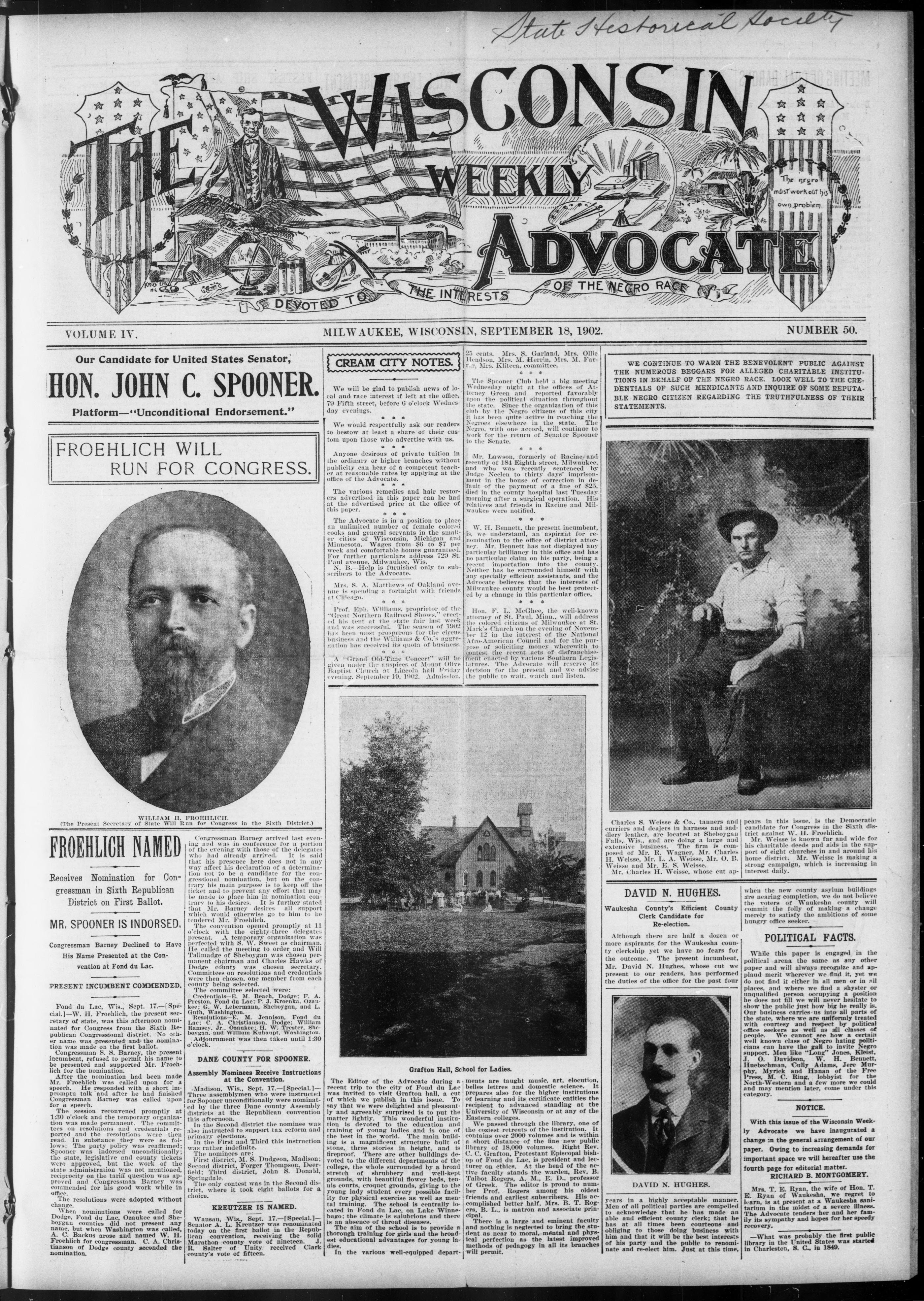
Our Candidate for United States Senator,
HON. JOHN C. SPOONER.
Platform—"Unconditional Endorsement."
FROEHLICH WILL RUN FOR CONGRESS.
[Name not visible in the image]
(The Present Secretary of State Will Run for Congress in the Sixth District.)
VOLUME IV.
Our Candidate for U
HON. JOHN
Platform—"Uncondite
FROEHLICH W
RUN FO
WILLIAM H.
(The Present Secretary of State Will
FROEHLICH NAMED
Receives Nomination for Congressman in Sixth Republican District on First Ballot. MR. SPOONER IS INDORSED.
Congressman Barney Declined to Havo His Name Presented at the Convention at Fond du Lac.
PRESENT INCUMBENT COMMENDED.
Fond du Lac, Wis., Sept. 17.—[Special.]—W. H. Froehlich, the present secretary of state, was this afternoon nominated for Congress from the Sixth Republican Congressional district. No other name was presented and the nomination was made on the first ballot. Congressman S. S. Barney, the present incumbent, refused to permit his name to be presented and supported Mr. Froehlich for the nomination.
After the nomination had been made Mr. Froehlich was called upon for a speech. He responded with a short impromptu talk and after he had finished Congressman Barney was called upon for a speech.
The session reconvened promptly at 1:30 o'clock and the temporary organization was made permanent. The committees on resolutions and credentials reported and the resolutions were then read. In substance they were as follows: The party policy was reaffirmed; Spooner was indorsed unconditionally; the state, legislative and county tickets were approved, but the work of the state administration was not mentioned, reciprocity on the tariff question was approved and Congressman Barney was commended for his good work while in office. The resolutions were adopted without change.
When nominations were called for Dodge, Fond du Lac, Ozaukee and Sheboygan counties did not present any name, but when Washington was called, A. C. Backus arose and named W. H. Froehlich for congressman. C. A. Christianson of Dodge county seconded the nomination.
Congressman Barney arrived last evening and was in conference for a portion of the evening with those of the delegates who had already arrived. It is said that his presence here does not in any way affect his declaration of a determination not to be a candidate for the congressional nomination, but on the contrary his main purpose is to keep off the ticket and to prevent any effort that may be made to place him in nomination contrary to his desires. It is further stated that Mr. Barney desires all support which would otherwise go to him to be tendered Mr. Froehlich.
The convention opened promptly at 11 o'clock with the eighty-three delegates present. A temporary organization was perfected with S. W. Sweet as chairman. He called the meeting to order and Will Tallmadge of Sheboygan was chosen permanent chairman and Charles Hawks of Dodge county was chosen secretary. Committees on resolutions and credentials were then chosen, one member from each county being selected.
The committee selected were:
The committee selected were.
Credentials—E. M. Beach, Dodge; F. A.
Preston, Fond du Lac; P. J. Kroenka, Ozaukee; G. W. Lebermann, Sheboygan, and L. Guth, Washington.
Resolutions—E. M. Jennison, Fond du Lac; C. A. Christianson, Dodge; William Ramsey, Jr., Ozaukee; H. W. Trester, Sheboygan, and William Kuhaupt, Washington.
Adjournment was then taken until 1:30 o'clock.
DANE COUNTY FOR SPOONER.
Assembly Nominees Receive Instructions at the Convention. Madison, Wis., Sept. 17.—[Special.] Three assemblymen who were instructed for Soponer unconditionally were nominated by the three Dane county Assembly districts at the Republican convention this afternoon. In the Second district the nominee was also instructed to support tax reform and primary elections.
In the First and Third this instruction was rather indefinite. The nominees are: First district, M. S. Dudgeon, Madison; Second district, Forger Thompson, Deerfield; Third district, John S. Donald, Springdale. The only contest was in the Second district, where it took eight ballots for a choice.
KREUTZER IS NAMED.
Wausau, Wis., Sept. 17.—[Special.]— Senator A. L. Kreutzer was renominated today on the first ballot in the Republican convention, receiving the solid Marathon county vote of nineteen. J. R. Salter of Unity received Clark county's vote of fifteen.
CREAM CITY NOTES.
We will be glad to publish news of local and race interest if left at the office, 79 Fifth street, before 6 o'clock Wednesday evenings.
We would respectfully ask our readers to bestow at least a share of their custom upon those who advertise with us.
Anyone desirous of private tuition in the ordinary or higher branches without publicity can hear of a competent teacher at reasonable rates by applying at the office of the Advocate.
The various remedies and hair restorers advertised in this paper can be had at the advertised price at the office of this paper.
The Advocate is in a position to place an unlimited number of female colored cooks and general servants in the smaller cities of Wisconsin, Michigan and Minnesota. Wages from $6 to $7 per week and comfortable homes guaranteed. For further particulars address 729 St. Paul avenue, Milwaukee, Wis.
N. B.—Help is furnished only to subscribers to the Advocate.
Mrs. S. A. Matthews of Oakland avenue is spending a fortnight with friends at Chicago.
Prof. Eph. Williams, proprietor of the "Great Northern Railroad Shows," erected his tent at the state fair last week and was successful. The season of 1902 has been most prosperous for the circus business and the Williams & Co.'s aggregation has received its quota of business.
A "Grand Old-Time Concert" will be given under the auspices of Mount Olive Baptist Church at Lincoln hall Friday evening, September 19, 1902. Admission.
The image shows a large tree with a dense canopy of leaves, situated in a rural setting. In the background, there are several people gathered around the tree, possibly engaging in a communal activity or observing the surroundings. The ground is covered with grass, and there are buildings visible in the distance. The overall atmosphere suggests a peaceful, community-oriented environment.
The church is a large wooden building with a steep roof and a tall bell tower. It is surrounded by a large tree and a grassy field where people are gathered.
Grafton Hall, School for Ladies.
The Editor of the Advocate during a recent trip to the city of Fond du Lac was invited to visit Grafton hall, a cut of which we publish in this issue. To say that we were delighted and pleasantly and agreeably surprised is to put the matter lightly. This wonderful institution is devoted to the education and training of young ladies and is one of the best in the world. The main building is a magnificent structure built of stone, three stories in height, and is fireproof. There are other buildings devoted to the different departments of the college, the whole surrounded by a broad stretch of shrubbery and well-kept grounds, with beautiful flower beds, tennis courts, croquet grounds, giving to the young lady student every possible facility for physical exercise as well as mental training. The school is centrally located in Fond du Lac, on Lake Winnebago; the climate is salubrious and there is an absence of throat diseases.
The aim of the school is to provide a thorough training for girls and the broadest educational advantages for young ladies.
In the various well-equipped depart-
---
25 cents. Mrs. S. Garland, Mrs. Ollie Hendson, Mrs. M. Herrin, Mrs. M. Farrar, Mrs. Kliteca, committee.
* * *
The Spooner Club held a big meeting Wednesday night at the offices of Attorney Green and reported favorably upon the political situation throughout the state. Since the organization of this club by the Negro citizens of this city it has been quite active in reaching the Negroes elsewhere in the state. The Negro, with one accord, will continue to work for the return of Senator Spooner to the Senate.
Mr. Lawson, formerly of Racine and recently of 184 Eighth street, Milwaukee, and who was recently sentenced by Judge Neelen to thirty days' imprisonment in the house of correction in default of the payment of a fine of $25, died in the county hospital last Tuesday morning after a surgical operation. His relatives and friends in Racine and Milwaukee were notified.
W. H. Bennett, the present incumbent, is, we understand, an aspirant for renomination to the office of district attorney. Mr. Bennett has not displayed any particular brilliancy in this office and has no particular claim on his party, being a recent importation into the county. Neither has he surrounded himself with any specially efficient assistants, and the Advocate believes that the interests of Milwaukee county would be best protected by a change in this particular office.
Hon. F. L. McGhee, the well-known attorney of St. Paul, Minn., will address the colored citizens of Milwaukee at St. Mark's Church on the evening of November 12 in the interest of the National Afro-American Council and for the purpose of soliciting money wherewith to contest the recent acts of disfranchisement enacted by various Southern Legislatures. The Advocate will reserve its decision for the present and we advise the public to wait, watch and listen.
THE CHURCH OF THE NATIONAL SCHOOL OF CHRISTIANITY
ments are taught music, art, elocution, belles lettres and domestic science. It prepares also for the higher institutions of learning and its certificate entitles the recipient to advanced standing at the University of Wisconsin or at any of the Eastern colleges.
We passed through the library, one of the coziest retreats of the institution. It contains over 2000 volumes and is within a short distance of the fine new public library of 18,000 volumes. Right Rev. C. C. Grafton, Protestant Episcopal bishop of Fond du Lac, is president and lecturer on ethics. At the head of the active faculty stands the warden, Rev. B. Talbot Rogers, A. M., E. D., professor of Greek. The editor is proud to number Prof. Rogers among his oldest friends and earliest subscribers. His accomplished better half, Mrs. B. T. Rogers, B. L., is matron and associate principal.
There is a large and eminent faculty and nothing is neglected to bring the student as near to moral, mental and physical perfection as the latest improved methods of pedagogy in all its branches will permit.
***
WE CONTINUE TO WARN THE BENEVOLENT PUBLIC AGAINST THE NUMEROUS BEGGARS FOR ALLEGED CHARITABLE INSTITUTIONS IN BEHALF OF THE NEGRO RACE. LOOK WELL TO THE CREDENTIALS OF SUCH MENDICANTS AND INQUIRE OF SOME REPUTABLE NEGRO CITIZEN REGARDING THE TRUTHFULNESS OF THEIR STATEMENTS.
CLARK ATHL
Charles S. Weisse & Co., tanners and curriers and dealers in harness and saddlery leather, are located at Sheboygan Falls, Wis., and are doing a large and extensive business. The firm is composed of Mr. R. Wagner, Mr. Charles H. Weisse, Mr. L. A. Weisse, Mr. O. B. Weisse and Mr. E. S. Weisse.
DAVID N. HUGHES.
Waukesha County's Efficient County
Clerk Candidate for
Re-election.
Although there are half a dozen or
more aspirants for the Waukesha county
clerkship yet we have no fears for
the outcome. The present incumbent,
Mr. David N. Hughes, whose cut we
present to our readers, has performed
the duties of the office for the past four
M. B.
years in a highly acceptable manner. Men of all political parties are compelled to acknowledge that he has made an able and efficient county clerk; that he has at all times been courteous and obliging to those doing business with him and that it will be the best interests of his party and the public to renominate and re-elect him. Just at this time,
NUMBER 50.
BENEVOLENT PUBLIC AGAINST
ALLEGED CHARITABLE INSTITU-
RACE. LOOK WELL TO THE CRE-
S AND INQUIRE OF SOME REPUTA-
THE TRUTHFULNESS OF THEIR
pears in this issue, is the Democratic candidate for Congress in the Sixth district against W. H. Froehlich. Mr. Weisse is known far and wide for his charitable deeds and aids in the support of eight churches in and around his home district. Mr. Weisse is making a strong campaign, which is increasing in interest daily.
when the new county asylum buildings are nearing completion, we do not believe the voters of Waukesha county will commit the folly of making a change merely to satisfy the ambitions of some hungry office seeker.
POLITICAL FACTS.
While this paper is engaged in the political arena the same as any other paper and will always recognize and applaud merit wherever we find it, yet we do not find it either in all men or in all places, and where we find a shyster or unqualified person occupying a position he does not fill we will never hesitate to show the public just how big he really is. Our business carries us into all parts of the state, where we are uniformly treated with courtesy and respect by political office seekers as well as all classes of people. We cannot see how a certain well known class of Negro hating politicians can have the gall to invite Negro support. Men like "Long" Jones, Kleist, J. O. Davidson, W. H. Bennett, Huebschman, Cully Adams, Jere Murphy, Myrick and Hanan of the Free Press, M. C. Ring, lobbyist for the North-Western and a few more we could and may mention later, come under this category.
NOTICE.
With this issue of the Wisconsin Weekly Advocate we have inaugurated a change in the general arrangement of our paper. Owing to increasing demands for important space we will hereafter use the fourth page for editorial matter. RICHARD B. MONTGOMERY. Mrs. T. E. Ryan, the wife of Hon. T. E. Ryan of Waukesha, we regret to learn, is at present at a Waukesha sanitarium in the midst of a severe illness. The Advocate tenders her and her family its sympathy and hopes for her speedy recovery.
What was probably the first public library in the United States was started in Charleston, S. C., in 1849.
MEETING OF COAL BARONS
Declare Again that They will
Make No Concessions,
POLITICIANS REBUKED.
a One Way to End This Trouble, and
i that is by Returning to Work—
t Gompers at Wilkesbarre.
' NewYork, Sept. 16.—A conference of
the leading anthracite coal interests was
held this afternoon at the Philadelphia
& Reading Company’s office. Those
present included President Baer of the
Reading road; President Truesdale of
the Delaware, Lackawanna & Western;
President Fowler of the New York, On-
tario & Western; President Walters ot
the Lehigh Valley; President Oban
of the Delaware & Hudson; Irving
Stearns of Coxe Bros. & Co., and John
‘Markle of G. B. Markle & Co, The
two last named represented the indepen-
dent operating interests in the hard-coal!
dadustry.
+ The precise subjects of the soutereae
could net be learned, but it was stated
WI Slsses ce ser ee LORS CERS IE SESS ESOS EOE LED
BP POESIS SESE: ES EG EE IL IIS SoS EA EELS
VALEEIEG EELS CUTE: SEs
GE iii" LILLE ASSES
ies ise Ce
GPT LTP SLA LEOES,
gS EEE iii Wee
BEST Ss EI ee sats
Ie 6 oe ee
Vo a Be
iia Wo. ee
Li bath # ae ised
MED ee
bate : Pees,
i - (Ge 3 o Ree.
3 3 : Beto
ee i 4
j Pe
ie ee ee
Pie wee ao
GEORGE F. BAER,
President of Reading Railroad and Bx.
ponent of Divine Right. of Coal Barons.
in advance of the et that no con-
cessions would be granted and that re-
cent events of a semi-political character
would not be seriously considered.
plowing 2 meeting with J. P. Mor-
gan, John Markle made this statement:
"I do not think it necessary to repeat
that all talk of coneessions on the part
of the operators is foolish, and certaiuly
without foundation. Our position now
is the same as when Mitchell made his
original propositions, and no different
than when the strike began.
“We said then that we would make
no concessions and we repeat it now.
There is no 2 ee why this should not
be understoed. The operators haye
shown that they mean it and I repeat
only by way of emphasis.
“There is just one way to end the
strike—by the men returning to work,
and every day they ene away by giv-
ing willing ear to Mitchell's specious
promises will only entail further loss
and suffering to them. Conditions are
improving daily; more men are returning
to work and more coal is being mined.
“So far as recent attempts at settle-
ment are concerned it is only necessary
to add that every effort from Senator
Hfanna’s down has been fftile. We
have defined our position and will main-
tain it.”
GOMPERS A? WILKESBARRE.
Labor Federation Takes Hand in Coal
Miners’ Strike.
Wilkesbarre, Pa., Sept. 16.—Samuel
Gompers, president of the American Fed-
eration of Labor, arrived: in town this
morning. He at once went to President
Mitchell’s headquarters, where he met
National Treasurer Wilson and the dis-
trict presidents of the United Mine
Workers.
Mr. Gompers and the executive officers
of the miners’ union held a lengthy con-
ference. Before he went to the meeting
Lng pa
gfe areas,
: iE AR os Rist 2
Po aa :
om a a RE ies oY
Beis coed ee
ie E ad
8 re FER ¢
Rates as /
wes .
SAMUEL GOMPERS.
President of American Federation of Labor,
Now at Wilkesbarre, Pa.
Gompers was asked what his mission
here was. He replied that he came to
confer with Mr. Mitchell and the other
officials of the union regarding the strike.
It was stated that after the conference
a statement will be given out.
At 1 o'clock the conference adjourned
for dinner. Mr. Gompers was the oaly
one who would speak regarding the de-
liberations. He said the strike situation
was discussed in all its phases; the
finances were found to be in good condi-
tion; the relief funds were coming in
promptly and there was no reason why
the strike should not continue without
inflicting any hardship on the strikers.
Mr. Gompers was asked whether it
was proposed to levy an extra assess-
ment in order to help the miners out.
He declined to answer the question. He
also refused to say whether the Ameri-
ean Federation of Labor will be con-
yened in extra session to take action on
the strike.
Working Force Increased.
Tamaqua, Pa. Sept. 16.—Today the
working force at Greenwood colliery,
which resumed yesterday, was increased
somewha- and the plant is now running
apparently without difficulty. Last night
2 committee from the Tamaqua local of
the United Mine Workers visited Supt.
M. A. Gerber, and asked him to close
the plant. This he refused du do.
- The No, 4 and 12 collieries of the Le-
high Coal & Navigation Company, the
Smith-Myers washery and the Green-
wood Coal Company combined shipped
about 2000 tous of coal to market yester-
iv.
SEVENTEEN ARE DEAD.
Coal Minere Entrapped by Explosion of
Gas and Gunpowder Near
Bluefields, W. Va.
Bluefield, W. Va., Sept. 16.—Seven-
teen men were killed by the explosion ©
gas and gun powder in the Big Vo.
mine.
Eleven bodies have been taken from
the mine, and six more have been lo-
cated, and will be removed as soou as
the mine clears a little.
The bodies so far recovered are those
of negroes, except that of one white en-
gineer named James Lester.
It is almost certain that the seven-
teen men now accounted for and two
who escaped are all that were in the
workings.
H. F. Frankenfield, a mine boss, and
George Gaspie, a Hungarian miner, suc-
ceeded in crawling over the fallen coal
and slate, after the explosion, to the
rescuing party, and were taken out
alive, although badly burned and nearly
suffocated by the gas and smoke inhaled.
The explosion is said to have been
caused by an accumulation of gas catch-
ing on fire from the lamp of a miner who
was going to work, and this in turn fired
six kegs of blasting powder that had
been stored back in the mines.
The explosion knocked down all of the
brattices for a quarter of @ mile back
towards the mine entrance, thus cutting
of all of the air from the men im-
prisoned bebind the debris.
The coal is burning, and there’ is no
hope of extinguishing the flames until
a new air passage can be built to t'-
point of the explosion.
PREVENT PRIZE FIGHT.
Attorney General of Kentucky Sues for
Injunction Against McGovern-
Corbett Meeting.
Louisville, Ky., Sept: 16.—In accord-
ance with instructions received from Gov.
Beckham Attorney-General Pratt filed
thYs morning in the Jefferson circuit court
snit for an injunction, seeking to prevent
the contest scheduled to take place. before
fe Athletic Club next Monday
night from being held in this city.
The metion for the injunction will be
argued Thursday morning and !t is ex-
pected that a decision wil be handed
down promptly. Should the decision be
against the match the fighters’ attorneys
say the case will be taken at once to the
court of appeals and will be pushed
through in ample time for the contest.
‘The defendants to the suit are:
Terry McGovern, Sam H. Harris, his
rasnagers Young Corbett, John F. Cor-
bett, his manager; James J. Corbett, the
referee; William F. Horton, owner of
the Auditorium; Robert C. Gray, man-
ager of the Southern Athletic Club, and
C, E. Lamberton, sporting editor of a
Cincinnati paper, as a stakeholder. The
petition states that both Terry McGov-
ern and Young Corbett are professional
prize fighters and that in the fight
each contestant will exert his ut-
most efforts to disable his oep-
ponent. The petition further de-
clares that the proposed contest is
merely a postponement of the fight ar
ranged to take place before the Nutmeg
Athletie Club in Hartford, Conn., where
an egreemext was made to split the purse,
60 per cent. to the winner and 40 to the
loser. It is alleged that the prize fight
will bring together a dangerous assem-
blage of many thousand persons which
will have a demoralizing effect on the
well being of the community and that
the contest is contrary to the laws of the
pes ha
SEWING MACHINE TRUST.
Several Big Concerns to be Merged in a
Combine with Capital Steck
of $30,000,000.
Belvidere, Ill., Sept. 16.—It is learned
on the highest authority that the organ-
ization of a sewing machine trust, with
a capital of $30,000,000, is about to be
announced. The combination has been
in the process of evolution for several
weeks past, and the work of the ap-
praisers is all that remains to complete
the organization. The details of the plan
were satisfactorily arranged at a meet
ing of representatives of the leading
sewing machine concerns of the country,
held at the Waldorf-Astoria, in New
Yord, recently.
It is suid that Barnabas Hidredse of
this city, president of the National Sew-
ing Machine Company, will be at the
head of the new concern. Mr. Hldredge
refused to make a statement in regard
to the company.
Following are some of the prominent
companies to be merged: New Home
Company of Orange, Mass.; Household
of Proyidenee, R. I.; Domestic of New-
ark, N. J.; Demorest of Williamsport,
Pa.: Williams Mauufacturing Company
of Plattsbur> N. Y.;_ Standard and
White Companies of Cleveland; Davis
Company of Dayton, O.. Foley & Wil
liams Manufacturing Company of Chi-
cago and Kankakee; Illinois Sewing Ma-
chine Company of Rockford, Il.; Chi-
eago Sewing Machine Company of Chi-
cago, and the National Sewing Machine
Company af this city.
WHIRLED TO HIS DEATH.
Morse Kinner Instantly Killed in a Man-
istique, Mich., Leather
Plant.
Manistique, Mich., Sept. 16.—[ Special.]
—Morse Kinner, 67 years old, an en-
gineer in charge of the construction en-
gine at the Federal Leather Company's
plant here, was caught on the main shaft
of the engine at 9 o'clock this morning
and whirled to his death, Kinner was
alone at the time of the accident, but
was evidently oe to oil a part of
the machinery. His clothing was com-
pes stripped from his body. Tor!
legs ang arms were broken and the riz ..
foot wag completely severed at the ankle.
The ankle bone was found some three
rods away. inner ie survived by an in-
valid wife and two married children.
He Was an old resident of Manistique.
er ee
American Liberians Not in Favor.
The American Liberians _ sometimes
have a hard time of it in Liberia, in-
sulted almost daily by natives, who de-
spise them because they were former
slaves of white men. The cry is raised,
“Me no slave! Me no slave!” If the
United States emigrant wants to fight
he can have all he is jouking for. In
Liberia no man can vote unless he owng
real estate.
tt
The Largest Balloon.
The biggest balloon ever made was by
a German named Ganswendt, about
twenty years ago. Its tapacity was 20,-
000 cubie yards. It weighed 21% tons
and would raise 314 tons into the air.
$$ —_—_—_—
Boxed for Benefit of a Church.
A sparring exhibition was recently held
in Kansas City for the benefit of a
church,
————
—Ducks, when migrating, rarely fly
lower than 600 feet, and more usually
1400 feet.
CASTRO IN RETREAT.
Venzuelan Troops Compelled to Give
Way Before Advance of
Revolutionists.
Willemstad, Island of Curacoa, Sept.
17.—President Castro of Venezuela hag
retreated from Ocumare before the ad-
vance of the revolutionists.
‘The Venezuelan government's situation
is critical.
Recent advices from Venezuela state
that the battle in the vicinity of Tina-
quillo between about 400 revolutionists
and government forces of — about the
same strength resulted in the defeat of
the government forces and not in a vie-
tory as was announced in a dispatch
from Torres Cardenas, secretary of Pres-
ident Castro, which set forth that Gen.
Mendoza’s army had been annihilated
September 8, uear Tinaquillo. The en-
gagement of that date was only an ad-
vance guard fight of no importance. The
‘real battle began September 11, and
lasted four days, after which’ Gen,
Garrido retreated on Valencia and
eventually entered that city September
15, with about 2100 men, leaving the road
free for the further advance on Cara-
cas for the revolution army.
The only other mo yenwens army in the
field is the one whfth is under the per-
‘sonal command of President Castro, who
“abandoned his posjtion precipitately be-
fore the advance of the revolutionists
who have occupied Ocumare.
According to a report, the President
intends to move his army to a poise near
Valencia, join forces with the troops
under Gen. Garrido and attack the revo-
lutionary army commanded by Gen.
Mendoza,
From all points are reported deser-
tions of government*soldiers to the ranks
of the revolutionists and the general im-
pression in Venezuela is that the last im-
portant incident of the revolution is ap-
proaching.
PROTECT THE RAILROAD.
Fifty Marines With a Small Rapid Fie
Gun Are Landed.
Colon, Colombia, Sept. 17.—American
marines are now traveling as guards on
the passenger trains to and from Pana-
ma.
The United States cruiser Cincinnati
landed fifty marines today and also sent
ashore a small rapid fire gun, which was
placed on a railroad truck protected by
iron plates.
A small detachment of insurgents wus
seen near Mindi station early today. The
orice treops attacked the enemy
immediately and drove them back. A
colored woman who was in the vicinity
of the scene of the skirmish was’ killed,
GIVEN A WARNING
Washington Authorities Send a Protest
to Bogota Government.
Washington, D, C., Sept. 17.—The lat-
est development in the Colombian situa-
‘tion has called for a protest on the part
of the United States to the government
at Bogota.
Secretary of the Navy Moody received
a eablegram from Commander McLean,
of the Cincinnati, in, which be reports
that government soldiers placed obstrue-+
tions on the Isthmus railway while he
was on his way to Panama,
Accompanied by Commander Potter of:
the Ranger and the United States consul,
he called on Gen. Salazar, the command-
er of the government troops, with whom!
he had a friendly conference. {
| Nevertheless on his return trip the
commander found other obstructions on)
'the road and Colombian soldiers stand-
ing immovable on the track. They
jumped away, however, when the com-
mander gave orders for the train to be
moved on. It was found necessary to
place a guard of marines on the trains to
insure uninterrupted traffic.
After a conference between Acting
Secretary of State Adee and Secretary’
Moody, it is believed that a decision was
reached to make representations to the
Colombian government with a view to
prevent a repetition of the incident.
By the treaty of Granada, Colombia
and the United States mutually guaran-
tee free and uninterrupted traflic across
the isthmus, and in the event that one
or the other showed a disposition to in-
terfere with free transit, it would be the;
right of the other to step in and insure it.
SCIENCE IS EMPLOYED
AS A DIVINING ROD.
Eminent Geologist to Aid Cleveland-Cliffs
Company in Tracing Lost Vein
of Iron.
Duluth, Minn., Sept. 17.—There arei
more ways than one for detecting the’
presence of a body of iron ore. One is
experience in such matters and the other’
is seience. The Cleveland-Cliffs Iron
Company is bringing the latter to bear
on the Vermillion iron range. Prof. H.,
L. Smith of ‘Cambridge, Mass., profes-'
sor of*genology at Harvard College, and!
J. E. Jopling of the Cleveland-Cliffs,
Company have spent some days on the
Vermillion range, and since their return
to Duluth have been busy with. official
eke and such other informatipn in that
field.
It is understood that the services of
the eminent geologist have been obtained
with a view to getting “a line” on ad-
ditional iron ore deposits on the Vermil-
lion. The iron formation is traceable
nearly all the way between Bly and
‘Tower, but explorations have been, as a
rule, discouraging between the two
towns. If Prof. ‘Smith can inform the
iron ore people what has become of tlie
ore which it would naturally seem ought
to lie between the two places, he will
have solved one of the most interesting
question that puzzles them now.
The Cleyeland-Cliffs Iron Company is
a new comer.in Minnesota so far as
acquiring iron properties is concertied,
but it is a pioneer in the Lake Superior
region.
GROWS MORE ALARMING.
Two Towns May Be Wiped Out if the
Forest Fires are Not Soon
Checked.
Cheyenne, Wyo., Sept. 17.—A tele-
phone message from Grand Encampment
says the forest fire situation is growing
more alagming along the Wyoming-Colo-
rado ‘line. The residents of Pearl, Col.,
and Encampment fear that unless the
fires are soon checked the towns may be
wiped out. The fires are creeping dan-
gerously close to the mining camps and
ranching settlements, and while no loss
of life has been reported, it is feared iso-
lated miners, prospectors and sheep herd-
ers may get caught in the sea of flames
sweeping over the district and perish be-
fore aid can reach them.
—————_-—___
Carpenter’s Helper Has a Fall.
Escanaba, Mich., Sept. 17.—Edward
Weak, a carpenter's helper, fell fifty
feet yesterday morning from the scaf-
folding on the inside of the new Si,
Patrick’s Church. He will recover.
—London, with 6,000,000 inhabitants,
has only eight murders annually.
WILL END BY AGREEMENT.
Gompers Hopeful that Miners’
Strike Can be Settled.
SOME TIME IN FUTURE.
Believes That the Union Will Be Maiu-
tained and Improved Conditions
for Men Secured.
Wilkesbarre, Pa., Sept. 17.—President
Gompers of the American Federation
of Labor, in a statement issued today,
takes a hopeful view of the strike situa-
tion, The statement is as follows: ~
At this time it is impossible to say ex-
actly when the strike will terminaie, but,
after careful inquiry into the situation at
the mines, I am convinced that the struggle
will end by agreement. The wage-earucrs
and the general public are generously cou-
tuibuting to the aid of the miners. It is
essential that this ald be extended and
continued.
If the manhood of the miners is to be
maintained they must at least have bread
for their wives and little ones as well as
for themselves, The declared attitude of
the presidents of the anthracite ratlroads
has not apparently changed. Despite this
fact, I am fully convinced that the strike
will’ end through agreement, with im-
proved conditions for the miners, and the
union maintained.
(Signed) SAMUEL GOMPERS,
President American Federation of Labor.
Seek Employment Elsewhere.
Pottsville, Pa., Sept. 17.—The exodus
of anthracite mine workers continues
from the Schuylkill region because the
strikers have given’ up hope of an eitrly
settlement. Today forty certified miners
left for Wise county, Va., where they
will be employed in the soft coal mines.
A similar number left for the same
point ten days ago and in a few days a
earload of driver boys will go to West-
moreland county, this state. They say
they are promised good wages.
It is estimated that 2000 mine work-
ers have gone to the Irwin, Madison,
Latrobe amd Greensburg bituminous coal
fields and upwards of 7000 are said to
have secured employment in the Pitts-
burg district.
Aid for the Strikers.
Atlanta, Ga., Sept. 17.—The United
Brotherhood of, Carpenters and Joiners
of America, whose biennial conyention
is now being held in this city, today de-
cided to contribute $10,000 to aid the
anthracite coal striktrs in Pennsylvania.
‘The money will be sent to Secretary
Wilson at Indianapolis.
PARADE OF ODD FELLOWS.
Twenty-five Thousand Men Participate in
Demonstration at Des Moines—
Marred by Rain.
Des Moines, Ia., Sept. 17.—The feature
ot the third doy of the sovereign grand
lodge of Odd Fellows was the parade
this afternoon, in which 25,000 men par-
ticipated. ‘The parade was reviewed by
Goy. Cummins, Mayor Brenton, Grand
Sire Goodwin and Past Grand Sire
Cable. Rail this forenoon marred the
day to some extent, but the parade was
held according to plans. Gen, E. E.
Lambert, of Newton, Ia...was grand mar-
shal. The patriarchs wilitiament to the
number of 3000, commanded by Gen. M.
A. Ramsey of Iowa, headed the parade.
Following were over 20,000 Odd Fellows,
with John B. Cockrum of Indiana as
chief marshall of that division. The
sovereign grand lodge officers and
grand representitives rode in carriages
at the head of the parade.
The grand band contest occurs this
evening, with two dozen bands entered.
Prizes aggregating $500 are offered for
the best bands. Following this will be
a reception and bankquet with 600 cov-
ers. ‘The place of next year's convention
will be selected tomorrow, with Hot
Springs, Ark., in the lead. Only one
business session was leld today, owing
to the parade, and only routine business
transacted.
EFFORTS TO PREVENT
RATE DISCRIMINATION.
E. P. Bacon and Others Appear Before
Executive Committee of Railroad
and Warehouse Commission _
Chieago, IL, Sept. 17.—Ways and
means to prevent the railways*from dis-
criminating in favor of the so-called
trust were discussed at a meeting of the
executive committee of the National As-
sociation of State Railroad and Ware-
house Commissioners. The adoption by
Congress of the Elkins bills was advised.
Those present at the meeting were BE.
P. Bacon of Milwaukee, C. H. Seypt aud
BH. O, Stannard of 8t. houis; Charles
Kennedy of Baffalo, Wiliiam R. Cor-
wine of New York city, William Larra-
bee of Clarmont, Ia., John W. Springer
of Denver, 8S. H. Cowen of Fort Worth,
Tex., J. E. Howard of Wichita, Kas..
and R. S. Lyon and W. 8. Warren of
Chicago.
The members of the committee re-
ported a general public dissatisfaction at
the failure of Congress at its last sessioa
to enact legislation giving the interstata
commerce commission larger powers to
prevent rate discrimination. It was de-
cided to take imntediate steps to collect
expression of ponion and bring these ex-
pressions to bear upon Congress as soon
as the session opens.
——
RIOTS AT THE PRESIDIO.
Soldiers Wreck Saloon and Are Driven
Back to Their Camp.
San Franciesco, Cal., Sept. 17.—Fiva
hundred soldiers, ohagrindd at being mo-
lested in an attempt to destroy the sa-
loon of Adolph Rehfield, gathered in
front of the place and began a the
bailding, breaking windows and doing
other damage
Rehfield left,the saloon in charge of his
wife and proceededsto the Presida to get
aid. During bis absence tho soldiers
proke in the front doors and the mob
proceeded to drink up Rehfidd’s stock
antl te make way with cigars and tobac-
co.
A squad of soldiers from the reserva-
tion aor on the scepe and the riot-
ous soldiers were erdered*to their camps.
Mounted pofice and a guard of soldiers
now patrol tho disttict ,which has been
the scene of much disturbance during the
last few days.
———_-—__——_
FOILS ATTEMPT ON HER LIFE.
Woman Gets Finger Inside Trigger
Guard—Man Commits Suicide.
Springfield, Ill, Sept. 17.—Marshall
Derry made an unsuccessful attqmpt to
murder Mrs. Lou Wolf, his paramour.
After failing in the intent, Derry drank
a quantity of carbolic caid and died in
great agony. The woman had jilted Der-
ry because of his excessive drinking. Go-
ing to her home he attempted to shoot
her. Mrs. Wolf managed to pose one
fingee inside the trigger guard, at the
rear of the trigger, and Derry was un-
able to discharge the weapon. He then
went to a hotel, where he drank the acid.
FASTEST SHIP AFLOAT.
ALL WESTERN RECORDS BEATEN
BY KRONPRINZ WILHELM.
Crosses from Cherbourg to Sandy Hook
in 5 Days, 11 Hours, 57 Minutes—
Average of 23:09 Knots,
New York, Sept. 16.—The North Ger
man Lloyd steamer Kronprinz Wilhelm
arrived in port today from Bremen,
Southampton and Cherbourg beating al!
westward records. The Kronprinz Wil-
helm left Cherbourg at 9:10 p. m. on
Wednesday, enue 10, and arrived
at the Sandy Hook light ship at 4:07
this morning, making the run of 3047
miles in 5 days 11 hours and 57 minutes,
oe an average speed of 23.09 knots per
our,
The time made is 3 hours and 48
minutes better than the.best previous
westward record of the Kronprinz Wil-
helm and is 26 minutes better than the
time of the Deutschland, Her day ruas
were: 349, 574, 574, 581, 573 and 396.
ee
FURIOUS FOREST FIRES
More Than 300 Square Miles of Magnifi-
cent Timber Land in Fremont
County in Ashes.
Cheyenne, Wyo., Sept. 16.—Goy. Rich-
ards has been informed by telephone
from Grand Encampwent that for many
miles along the Wyoming-Colorado line
north of Pearl, Col., a furious forest fire
is raging, devastating everything in its
pat. aay effort to subdue the flames
as been exhausted without effect. Gov.
Richards immediately communicated
with Goy. Orman of ‘Colorado and ar-
ranged for both to send a felegram to
os secretary of the intérior, asking for
aid.
According to the latest reports there
are at least eighteen serious forest fires
burning in Wyoming, to say nothing of
numerous smailer fires in Southern <Al-
bany county that are destroying great
swamps of fine pine timber in the Medi-
cine Bow range and threatening mining
pulldings: Although 100 miles away
from Cheyenne the smoke from these
fires obscures the sky here and the odor
of burning wood is plainly noticeable.
The fires in Southern Carbon county
ere burning fiercely, A government
agent with a large force of men is on the
ground but is reported to be making
little progress,
Five or more fires are burning in Fre-
mont county and more than 300 square
miles of magnificent timber land is al-
ready in ashes.
In central Uinta county a fire is burn-
ing and in the Jackson Hole county two
big blazes are eating the timber in the
game country. Further east in the Sho-
shone reservation fire has been burning
for a_week,
In Natrona county a good sized fire
has been destroying timber for the past
ten days.
One big fire threatens the timber of the
Big Horn mountains.
Denver, Col., Sept. 16.—But little prog-
ress toward checking the forest fires in
different sections of the state is being
made. At the head of Chicago creek the
fire is again beyond control. A vast strip
of territory has been burned over and
it is feared that the towns along Clear
creek will experience a shortage of water
due to the fact that the fire has destroyed
the protection to the snow beds.
Henry Nicholson, United States forest
supervisor, who is sip pet & the fight
against the fire in the neighborhood of
Cassels, at the head of Piatt ‘canyon,
called upon the mining companies in
that vicinity for assistance in fighting the
flames and men were dispatched with
complete equipment to his aid. The fire
has burned for several weeks and has
destroyed much valuable timber. Several
summer resorts are in danger.
The Estes eae fires are burning slow-
ly, but stubborily resist all efforts to
guench them.
The fires in the neighborhood of EI-
dorado have destroyed an immense quan-
tity of rich timber.
Washington, D. C., Sept. 16.—Secre-
tary Hitchcock today received dispatches
from the governors of both Colorado and
Wyoming, appealing for government as-
sistance in fighting a terrific forest fire
that is raging*in government timber lands
along the Colorado-Wyoming boundry line.
Every effort will be made to do some-
thing to reinforce the fire fighters, but it
is not yet known what step will be taken.
The department has frequently, but in-
effectually, appealed to Congress to in-
crease the appropriations for this pur-
nose.
SUICIDE BY SHOOTING.
Naval Officer Who Was with the Maine
at Time of Disaster in Havana
Harbor Kills Himself.
Boston, Mass., Sept. 16.—Lieut. John
It. Morris, U. S. N., was found dead in
his stateroom on the United States ship
Olympia by a fellow officer yesterday.
He had committed suicide by shooting
with a revolver.
Kensas City, Mo., Sept. 16.—The
news of the suicide of Lieut. Morris on
the Olympia in Boston harbor, while it
was hardly expected by his friends here,
was no surprise to them. Morris has
had a weight of some kind on his mind
ever since the blowing up of the Maine
at Havana, and it is the general impres-
sion here that his suicide is the indirect
result of that disaster. Morris was an
electrician on the Maine, with the rank
of assistant engineer. When he visited
here after his providential escape at Ha-
vana he was very averse to talking about
the matter, but his friends at the Kan-
sas City Club and elsewhere gathered
the impression that he knew the cause
of the explosion and that it was not due
to Spanish mines or torpedoes. They
have always believed, from Morris’ ac-
count, that the explosion was due to de-
fective electric wiring on the Maine.
See ee
DUMPED ORE UPON HIM.
Accident Which Cost the Life of John
Jenkins at Tronwood—Recently
Made Captain.
Ironwood, Mich., Sept. 16.—[Special.]
—John Jenkins was instantly killed in
the Newport mine last evening. He was
riding to the surface in a skip, when
trammers at work at the top accidentally
dumped an ore car and its contents into
the shaft. A companion named Ebli
jumped from the skip and was uninjured,
but Jenkins received injurics from which
he died a few hours later. He had been
promoted to the position of captnin only
a month ago. Deceased wes 40 years of
age and leaves a wife and daughter. He
represented the Eighth ward in the com-
mon council.
ees
Killed by Threshing Machine.
Barron, Wis. Sept. 16.—William_ E)}-
lis, 5 years old, was instantly killed by
a threshing machine oe over him.
The machine was hitched iud an en-
gine. The boy was riding on the tongue
ant fell off. “
+ Chicago Matters, 5
—Typhoid fever has broken o,
bridewell. Two deaths from dade
were reported yesterday and sixteen
cases are in the hospital.
—Carrying a shotgun on his arm, Gar-
land Bell, attempted to step into a boat
yesterday, when the weavon was dis-
charged and probably fatally injured the
man. His companion, Robert Lambert,
narrowly escaped serious injury.
—Miss Mamie Carlson was found dead
yesterday in her room, which has been
securely locked, and when the door was
broken open two gas jets were found
turned on, pointing to suicide. Miss Carl-
son was 26 years old. Despondent over
an illness, Mrs. Annie Gordon, 30 years
old, attempted suicide yesterday by eat-
ing corrosive sublimate tablets.
—Tustice Dooley ruled yesterday that
swearing into a public telephone con-
stitutes disorderly conduct, and he or-
dered John Laskowski to pay a_ fine of
$20 and costs for the offense. Laskow-
ski is said to have sworn at the tele-
phone operator when he was unable to
get a prompt connection.
—Adolph Rador, part owner of the
schooner Thomas C, Wilson, is dead at
Menominee, and no trace can be found
of his relatives or friends. Rador was
well known to men in the Chicago lum-
ber fleet and made his home here much
of the time. Among his effects was
found the name of a Mrs. Pietsch of
Chicago. Rador's estate is said to be
extensive.
—One may took his life and another
made an attempt at suicide in the city
yesterday, as follows: Joseph Gurkow-
ski, 56 years-old, hanged himself with
a wire; cause of act unknown. T. W.
Spencer, Newbern, N. C., turned on gas
in his room at Windsor-Clifton hotel;
found unconscious, and upon being re-
vived became so violent that he was
sent to detention hospital.
—Dora Miller, the 18-year-old daugh-
ter of Rev. Morris Miller, in charge of
the Jewish congregation of Ohave Sho-
lom Mariampol, has decided to become
an actress and, in opposition to her fath-
er’s wishes, she has joined the dramatic
company at Glickman’s theater. These
facts were called to the attention of the
police Sunday, when Rabbi Miller com-
plained that his daughter was remaining
away from home without his consent, as-
serting that she was but 14 years old.
‘The irate father was anxious to have her
cared for by the police until such time as
he could obtain the legal papers neces-
sary to have her placed in an institution
for the care of girls .
LATEST MARKET REPORTS.
EGG AND DAIRY PRODUCTS.
MILWAUKEE—Exgs—Market very finn;
fresh, loss off, cases Included, 18¥¢: fres3,
cases retuned, 18c; seconds, 12@1ic. Ke-
celpts were 273 cases.
Butter—-Market firm; fancy prints, 22%4c;
fancy or extra creamery, per Ib, 22c:
firsts, 19@20c¢; seconds, 17@18e; dairy prints,
18¢; extra fancy dairy, 17@17'gc; lines, M@
lie; roll, 14@15¢; packing stock, 13@i4e:
whey, 9c: grease, 4@5c. The receipts today
were 34,865 Ibs against 22,000 yesterday.
The receipts of creamery are moderate and
demand very good, all extra grades being
taken on arrival. Dairy is in good demaud
and scarce.
Cheese—Firm. The demand at_ present
Js good and the arrivals light. Of stock
{s especially slow sale. A great deal Is go-
ing Into ‘cold storage. Receipts, 3100
Ibs today, against 18,050 Ibs yesterday.
Full cream flats, fancy, 11@1ze; good +o
choice, ¥@10c: Young Amerieas, 11@12c;
eeenee UG laye: poe: meee “eet
jow grades, 14471014c; limbarger, per 1b,
No. 1. jogs low grades, ‘Bade: fnport:
ed Swiss, ; Block Swiss domestic, ae
13%4c; fancy, loaf, 124%@i3%c; No. 2, 10@11c;
Sapsago, 20c.
CHICAGO—Butter — Steady: creamertes,
IWE@22%c; dairies, 15@20c. Cheese—Steady:
twins, 104@10%e; daisies, 1OMGIONE;
Young Americans, 10KG10%e. ‘Ba8—
Strong; loss off, cases returned, 20c. iced
poultry—Steady; turkeys, 12@13%e; chick-
ens, 11@11%e.
PLYMOUTH—Twenty-one _ factories _of-
fered 2185 boxes of cheese, 50 were passed
on, the balance selling as follows: 287 long-
horns, 10%¢; 858 daisies, te do, We:
205 do, 11%e; 113 twins, 1 3; 347 Young
Americas, 10%4c; 295 do, 10%e.
MILWAUKER LIVE STOCK MARKET.
HOGS—Receipts, 3 cars; market lower;
light, 7.25@7.60; mixed and medium
weights, 7.40@7.70; common to good pack-
ing sows, 7.00@7.50; selected heavy, 7.70@
7.80, Pigs, 80 to 120 Ibs, 5.50@6.25.
CATTLE — Receipts, 6 cars; — weak:
butchers’ steers, medium to good, 1050 to
1300 Ibs, 4.50@4.50; fair to medium, 950 to
1050 Ibs, 3.75@4.25; heifers, common, 2.500
8.00; good, 3.50@4.25._ cows, fair to good,
2.50@8.50; canners, 1.75@2.40; bulls, com-
mon, 2.40G@2.85; choice, 3.25@3.75; feeders,
800 to 950 Ibs, 3.5004.00; stockers, 500 to
750 Ibs, 2.50@3.25; veal calves, heavy, 3.50@
4.00; common to choice, 6.50@7.50. " Milkers
Dull; common sell for canners; choice, 35.00
@45.00, i
SHEEP—Reeeipts. 1 car; steady, 2.7547
3.50; bucks, 2.00@2.50; light iambs, 5.50@
4.25; choice, 4.50@5.00.
Chicago receipts: Hogs, 26,000; cattle,
17,000; sheep, 23,000.
MARKETS BY TELEGRAPIL
MILWAUKEE —Fiour—Steady, Wheat —
Steady; No. 1 Northern, on track, Te: No.
2 Northern, on track, 72e. Corn—Steady;
No. 3 on track, 60¢. Oats—Dull; No. 2
white, on track, 34¢; No. 3 white, on track.
$2@33e. Barley—Firm and active; No. 2
on track, 6S8e; sample on track, 45@6S8e.
Rye—Firm; No. t on track, 513gc,_ Pro-
visions—Firm; pork, 16.60; lard, 10.87.
Flour nurket steady; patents, 2.50@3.00;
bakers’, 2.80@2.90; rye, 2.90@3.00.
Millstuffs are steatty and quoted at 13.50
for bran, 15,00 for standard Tales, and
18,00 for Milwaukee floar middlngs fn 100-
ib sacks; red dog, 19.00. Delivered to coun-
try points, 1.00 extra.
CHICAGO — Close — Wheat — September,
72Ke; December, Ge; May, TOY%c. Corn—
September, 58%e; October, 58c; December,
ABG@4de; May, 4ii%Ke. ee er
B8c; December, 31%; old, 264e; May, 30%
a@3ite. VPork—September, 16.15; October,
16.25; January, 15.05; May, 14.27%. Lard--
September, 10.75; October, 9.7744; Deeem-
her, 8.95; January, 8.55; May, 8.12%. Ribs
—Séptember, 10.8714; October, 10.05; Janu-
ary, 7.90; May, 7.65. Flax—Cash North-
west, 1.35; Southwest, 135; September.
1.33;' October, 1.30. Rye—September, 481407
December, 48@48\4e. Barley—Cash, 35
ze. Timothy—September, 4.15. Clover—
October, $.90@9.00.
NEW _YORK—Close — September—Wheat,
75c; December, 4c. Corn—September,
66%e: December, HOKe.
KANSAS CITY — Close—Wheat—Septem-
hor, dtiges December, O4e; cash No. 2 hard,
O6%c; No. 2 red, he. Cora—September,
52%e; December, 34¢; cash No. 2 mixcd.
SSigc} No. 2 white, Gc.’ Oats—No. 2 white,
he :
TOLEDO--Wheat—Dull, firm; cash. 731y¢3
September, 73ie: December, ‘THe; May,
T3ioe. Corn—Dnil, fimy cash, 614e; ‘Sep-
tember, Gc: December, eae May, 40%".
Oats—Dull, ‘steady; September, 31%¢; De-
cember, 3ic. Clover seed—Duil, firm; Oc-
tober, 5.55; January, 5.40. Ryc—S2e,
DULUTH — Close’— Wheat — Cash No. 1
hard, 70%c; No. 1 Northern, 6S%c; No. 2
Northern, 66%e; No. 3 spring, 647,c: to ar
tive, No. 1 hard, 69%: No. 1 Northern,
G8Ke; September, GSige; December, 65%1¢+
Macaioni No. 1, 63%c; Ne. 2, G2%c. Onts—
September, 8014; December, 20¢; on track
and to arrive, dove, _ Rye—September, to
arrive and on track, 47%gc. Bariey—42@Wc.
Plax—Cash and on track, 1.33: to ares
1.80%; September, 1.5214; October, 1.20; > oe
yember, 1.20; December, 1.27. Receipts 0!
wheat, ‘376,081 bus; shipments, {191,055 }us-
MINNEAPOLIS — Close — Wheat—Sep-
tember, 66%c;¢ December, 654040" 0
track, ‘No. 1 hard, 69%c; 'No. 2 Norther,
Gsige; No. 2 Northern. G6%e. 14,000:
KANSAS. CITY—Cattle—Recelpts,, 14,007:
Weak to Jie lower; beet steers, $20
‘exans, 2.55@3.75; cows and heifers, © iv"
4.25; stockers and’ feeders, 2.505.25. oe
—Receipts, — c a a Be 06
Gi.6i%: packers’, 7. 55; medium, te,
Tos: forkers, 1 q1Ss; pies 6.1.90
Sheep—Recelpts, spay 10¢ lowers
shepe, 3.15@4.00; lambs, 2,’ s
ae
THE END OF THE QUEST.
Unarm him here. Now wish him rest,
His was the fate of those who fail;
Who never end the knightly quest,
‘Nor ever find the Holy Grail.
as the fieriest tance in all
Moat yirgin honor called to dare:
‘The courtliest of the knights in hall,
The boldest at the barriere.
Joyful he took the sacred Task
That led him far by flood and field;
His lady’s favor at his casque,
God's cross upon his argent shield.
See where the Paynim point has cleft
‘The crimson cross that could not save!
See where the scimitar has reft
‘The favor that his lady gave!
For this poor fate he rode so far
With faith untouched by toil or time;
A perfect knight In press of war, ‘
Stainless before the Mystic Shrine.
One finds the Rose and one the rod;
‘The weak achieve, the mighty fail.
None knows the dark design but God,
Who made the Knight and made the
Grail,
‘The single eye, the steadfast heart,
‘The strong endurance of the day,
The patience under wound and smart—
Sha'l all these utterly decay?
The long adventure resteth here;
His was the lot of those who fail,
Who ride unfouled by sin or fear,
Yet never find the Holy Grail.
—Frank L. Pollock in the Atlantic.
STORY OF TWO LETTERS.
+7. dan Fraser and Jim Grant, his col-
lege chum, met on a busy street of Ayr
after a long separation. Dr. Fraser was
Ayr’s most popular physician, and Grant
was a Glasgow journalist. After a few
hearty words of greeting Dr. Fraser
dragged his friend home with Jn to din-
ner.
Half an hour later, as they sat in the
doctor’s cozy bachelor rooms exchanging
reminiscences across the dinner table,
Jim’s eyes chanced to light upon a photo
on a side table, and he grew pale.
“You have a photo there that recalls
some bitter memories to me,” he said.
“Whose?”
“Mrs. Forrest’s. You know her?”
“Pretty well. She’s been one of my
patients for a while,” and the doctor
ilushed slightly.
His friend observed it, and shook his
head.
“Tan, my lad, I can see you're becoming
one of the moths.”
“Why, what do you mean?”
“I hope your wmgs have not been so
badly singed at the flame as mine were.
But let me explain. It was at-Brodick
last summer that I met Mrs. Forrest for
the first time. You know what she is
like—young, not more than twenty-five,
though four years a widow, beautiful as
a Greek goddess, and fascinating beyond
words. A few days of increasing inti-
macy and I was blindly in love—ay,
blindly! For three weeks I was at her
beck and call. Then the awakening
eame; and one night when I parted from
her at the garden gate, the lips that had
returned my kisses bade me a final good-
by, with the smiling hope that 1 had
spent a pleasant holiday.”
He paused a moment, gazing bitterly
at the photo, while the doctor’s face be-
came hard and set.
“T was one of the moths,” he contin-
ued, with a mirthless laugh, “and I have
since learned that we are quite a large
and varied collection.”
The doctor’s face was as pale as that
of his friend, and his voice was husky
as he said:
“Pm sorry for you, lad; but perhaps
you have saved me in time.”
“Ah!”
“Ay; she plays her cards well, and I’ve
been blind, or I would have seen that. I
met her for the first time about two
months ago, when she had a cyeling ac-
cident opposite my consulting rooms, and
was brought in. She had sprained her
ankle, she said, and after attending to it
{ drove to her house in Racecourse road.
At her request I called occasionally, oft-
ener than was necessary for all the in-
jury that I eould discover. Then her
daughter, Marjory, a dear little girl of
4, took whooping cough, and my visits,
though nominally professional, gradually
became more frequent and more friendly.
During the last week I have been attend-
ing her for a cold, and I had promised to
call tonight; but after what I have heard
I shall write a note of apology, and break
off my relationship with her.”
Three hours Jater this fascinating
young widow who regarded her life’s mis-
sion as the breaking of men’s hearts sat
in her room with an open letter in her
hand,her face changing color as she read:
“Dear Mrs. Forrest: Cireumstances
which I cannot here explain render it im-
possible for me to keep my appointment
tonight, or indeed to ciaim a continuance
of our present relationship; and I beg
that from this time you will cease to re-
gard me either as your medical adviser
or aequaintance. In the interests of both
of us it is better that we should not meet
aga, ond I hope, therefore, that you
will let me pass as quickly out of your
Kfe as L entered it. Yours truly,
“IAN FRASER.”
Her first fecling was of anger and in-
jured pride, then €ame the consciousness
that this man had stirred her heart a3 no
other had ever done.
“I will not lose him yet,” she ex-
claimed.
Tl.
In the cool of the June eventide the
two friends passed arm in arm along the
sands, breathing the freshness of the sea
beach and reveling in its freedom with
the keen appreciation of the overworked.
Across the firth rose the peaks of
Arran purpled by the setting sun; in
front the rock-built ruin of Greenan cas-
tle stood clear against the amber sky.
As they drew near the castle a young
woman who sat reading at the base of
the rock suddenly raised her head and
jooked toward them.
“Ha!” whispered Jim. “That's surely
a fair specimen of Ayr’s bonnie lassies.
Who is she?”
“TI don’t know. I haven’t seen her be-
fore. Certainly she’s very bonnie. But
hilloa! what’s up?”
The girl had sprang to her feet, and
was gazing anxiously up and down the
beach, Presently her eyes rested on the
summit of the rock, her face grew white
as death, and she stood a moment as if
spellbound. Then, with a horrified ery
ot “Marjory!” she had started toward
the rock, and was struggling frantically
up its steep side.
An upward glance revealed to the doe-
tor the cause of her action. At the base
of the castle wall, some sixty feet above
the beach, is a ledge of rock not more
than a foot in width, along which the
foolhardy delight to pass, and mistake
PRINCE NICHOLAS’ BRIDE 1S POPULAR.
ee
PE rk tp A MM arereeae eter a
ee ey
ew Wee 2 eee /
a
Seere Goss ees tencreaee wis « Bee]
es oo ae ee acces
SS a Ry en ccreonea
ee ie
se tats oa ae tad 0 ee ae
ee ENG N'A.
cca oe a as sees
| eed passe 2 = 2 NUR
ee eet
eT a et ||
ee ee |.
ee bo ~ ee AY Tf
N\ PF Me = LN — Da asA
a he a. SD
COV SF 4 OA LR
eae oo ee 2 Yi
a Ki 6 we 7
‘ Qe soca 226 66) sa i
(| Mg a oe GRAND’-
Ropers NO gee Joe gs Ez
eer TRS PRINCE NICHOIAS
rs OF GREECE
ete”
Grand Duchess Helene, the bride of Prince Nicholas of Creece, is very po!
ular in the country of her husband. These are the very latest pictures of th
this madness for courage, when a single
false step or a moment's giddiness will
send them to a certain death upon the
rocks below. Half way along this nar-
row path, crawling on hands and knees,
was the figure of a little girl, and the
woman’s ery had helped the doctor to
recognize the child as Marjory Forrest.
A few great strides and the two men
reached the foot of the rock together;
side by side, with the nimble, sure-footed
strength of the days when as boys they
had climbed the cliffs around their High-
land home, they dashed up its precipitous
flank, passed the struggling woman half
way and reached the top pantingly to-
gether.
Even as they turned the corner of the
wall it seemed too late, for the little one
lad become frightened, and was trying to
turn back. There was no room, however;
for a moment she swayed, then her child-
ish hands slipped from the narrow ledge.
and with a heartrending cry of “Aunty!”
she fell.
But not to death; for the sinewy form
of the doctor shot forward across the
ledge, and his hand caught the fluttering
dress in a grip of iron,
They found “Aunty” lying insensible at
the foot of the rocks, down which she
had fallen in her excitement, and, while
Marjory kissed her white face, saying
piteously—‘Aunty, aunty! T’ll be good
now, aunty!” the two men worked to
bring her back to consciousness.
Presently she looked up, recognized the
little girl with a glad ery, and made to
clasp her to her breast, but her left arm
dropped helplessly, and she closed her
lips as if in pain.
“Ah!” said the doctor, running _ his
fingers over her arm; “you've broken it.
Let me put it right!”
“It’s very good of you to take so much
trouble,” she said, with a slight blush,
lowering her eyes beneath his gaze.
“Not at all; it’s quite in my line; I’m
a doctor, you know!”
He had broken his own walking-stick
and Jim’s into splints, and was bandag-
ing her arm, handling it with a touch
that was tender as a caress; and, as his
friend afterward declared, taking so long
and fumbling so foolishly over it as to
endanger his professional reputation in
the eyes of his patient if she had been
less interested in himself and more in his
work,
“What a terrible thing it would have
heen if you hadn’t come in time,” she
said, with a shudder.
“I’m glad we were at hand—for Mar-
jory’s sake. She and I are old acquaint-
ances. By the way, as a mutual friend
she might have introduced us. My
name’s Ian Fraser. This is my friend,
Jim Grant.”
“Mine is Mona Forrest. I'm Marjory’s
aunt! T’'ve just come over from Canada
for a three months’ holiday, and am go-
ing to spend a weck or two with my
sister-in-law. Marjory’s father was my
lonly brother. I arrived in Ayr yesterday
morning.”
The doctor had finished his bandaging
and giving her his hand he helped her to
her feet, only to find that the fall had
twisted her ankle, and she was now un-
able to use it.
Half an hour later Jim arrived with a
cab, and the four drove to Fernton villa,
in Racecourse road. Dr. Fraser’s meeting
with Mrs. Forrest, coming so soon after
the reception of his letter, was naturally
strained: but each was more than willing
now that the visits should be renewed,
though for quite different reasons.
There is no need to tell of the weeks
that followed, the daily visits. In due
course the crisis came; and one night
Dr. Fraser turned away from the front
door of Fernton villa, staggering down
the stairs like a man who is ill. She had
gone. This fair Canadian girl who had
given him the right to speak of love, an
Lad become the center of his every earth-
ly hope and espiration, had left him
without one word of warning, one breath
‘of farewell.
qT.
Another fortnight had dragged wearily
past, and Dr. Fraser, pale and hollow-
eyed, was crossing the Low Green when
he eame upon. little Marjory Forrest.
She was sitting upon a seat undressing
a large doll which she had already re-
cuced to a state of semi-nudity, and she
hailed his coming with delight.
“Oh, doctor” she cried, gleefully.
“come and vacksnate Dolly!”
“Vaccinate Dolly ?”
“Yes; same as everybody.” |.
Smiling at this reference to the small-
pox scare, then at its height, he took the
doll in his hand, and, as he turned it
over, the stamped corner of an envelope
protruding from under the solitary gar-
ment which it now wore caught his eye.
He withdrew the envelope, but as he
glaneed at the writing the laugh died
from his lips and his face grew white.
It was addressed to “Miss Mona For-
rest,” the writing was his own, and there
was a letter within.
“Where did you get this?” he demand-
ed quickly.
“I got it under aunty’s pillow after she
go away.”
“Does your mother know about it?” .
“No; I just put it on Dolly’s chesi.
Aunty not want it, 1 think, ’cause it
make her ery.
“Ah!”
He took the letter out and read it.
The secret was revealed. It was the
letter which he had written to Mrs. For-
rest at the time of his friend’s visit, but
with two slight alterations that had
made a world of difference in its effect.
He had written that letter in June, using
the Roman number (VI.) to indicate the
month. This simply altered to VIIL, an
“s” added to “Mrs.” and a dot over the
somewhat indistinet “r” had changed the
title to “Miss” and brought the date uj
to the time of his letter to Mona with
bitter aptitude. There was but one
woman who could hold the key to the
mystery, and he sought her without de-
Jay.
Half an hour later he left the house
with flushed face, but a glad light in his
eves, for he had wrung from Mrs. For-
rest the confession of her deceit.
That night in the bedroom of a London
| notel a woman with two telegrams under
‘her pillow lay awake through the weary
hours, sighing for the dawn: and in the
early morning, when she stool on the
platform of St. Paneras station await-
ing the arrival of the Scotch express, a
tail figure leaped from the still moving
train, clasped her in his arms, and, heed-
less of the crowd, pressed his lips to hers
in a never to be forgottea kiss of re-
, wnion.—New York Daily News.
PENNIES ON THE CEILING.
A New Method of Collecting Charity
Funds.
| The landlords of some of the public
houses in the poorest districts in the East
Wand have invented a new method of coi-
lecting money for the hospitals. They
‘recognize the fact that the average mai
is usually charitably disposed when he is
‘in a public house, and so they give him a
‘chance to do some good with his money.
Incidentally, they also furnish him with
a little innocent amusement. While the
‘man is sipping his drink the landlord
vostentatiously takes a penny from his
till. He next produces a thin siice from
a cork with a tin tack run through the
center. He then places the piece of cork
on the top of the penny and wraps them
in a piece of thin colored paper. ‘The
paper is screwed up tightly, so that the
point of the tin tack pierces it, and is
twisted in the form of a “tail.” When
the landlord has completed these mys-
terious preparations he throws the penny
wrapped in the paper up to the ceiling.
The tack goes into the ceiling and the pen-
ny in the colored paper remains up there.
eee the “tail” is cut into ribbons,
and sometimes two or three pieces of
paper of different colors are used. In any
case the customer wants “to have a try.”
The landlord furnishes the cork and the
tin tack and the colored paper. The
customer finds the penny. With a very
little practice any one can make a penny
stick on the ceiling, and so, in course of
time, the ceiling becomes gay with col-
ored streamers of paper. When the ceil-
ing is full the pennies are pulled down
and sent toa ea the fun begins
all over again.—London Graphic.
An Eccentric Will.
An aged Yorkshireman was so fond of
Sir Henry Irving’s acting that in his
will he said that when he died his body
was to be buried headless, and the skuil
was to be cleaned and mounted, suitably
inscribed with a silver inscription and
handed to the actor, with the request
that it be always used for Yorick’s skull
in the presentations of “Hamlet.”
a a sa seh
Large South African Coal Field.
One hundred and eighty miles north-
west of Bulawayo, South Africa, is a
coal field 400 square miles in extent, and
in many places only 40 feet below the
surface.
ent tte tae Shas
Table Pada of Asbestos Cloth.
A new material for table pads has re-
cently been placed upon the market.
It is made of asbestos cloth, woven so
soft that it cannot injure the most high
ly polished table, and ‘it is absolutely
heat proof.
STATE FAIR A SUCCESS,
—_-——_-
Great Show Attracts Thousands
from All Parts of Wisconsin.
seceeairieies
President McKerrow Says a Night Show
by Electric Light will be
Given Next Year.
| Milwaukee, Wis., Sept. 12.—[Special.]
—For the first time in some years the
| state board of agriculture will this year
come out financially considerably to the
good, and the members of the board are
correspondingly happy. A comparative
| statement of the receipts during the past
few years is as follows:
1900. 1901, 1902.
Tuesday ...$ 585.25 $ 707.00 § 1,167.00
Wednesday. 4,443.75 2,779.00 18,148.25
Thursday... 11,224.15 4,162.50 _7,901.00
Friday...... 421.00 8,988.50 Not in.
Totals... $16,624.15 $11,637.00 $27,216.25
A Bie Shorthorn Sale.
the interesting features on the grounds
today were the sale of representative
shorthorn stock and the annual cavaleade
of premium stock, given before the grand
stand this morning.
The shorthorn sale was largely attend-
ed by farmers from all parts of the state
and a large number of young cattle of
the shorthorn breed was sold at very
fair Lens The sale was conducted un-
der the auspices of the Wisconsin Short-
horn Breeders’ Association, and was an
experiment this year. It will be fol-
lowed in subsequent years a sales of
other breeds of Wisconsin cattle.
The best price paid for young short-
horn cows at the sale on the grounds
today was $275. The average pe paid
for twenty-six head of young Cows was
Po nearly all of which were bought by
go, Bardolf & Oo. of Iowa. Several
cows were sold to Wisconsin farmers.
phe best pee paid for a bull was $230
‘or a 10-months-old specimen, and one
6-months-old brought Bi70. The bulls
were not, however, in the very best show
condition and they sold slowly.
Cost of Wreck.
The wreck was a great success. Two
locomotives named “La Follette” and
“Rose” were started at full speed on a
track 1000 feet in length. The engines
crashed into each other with facet force
and both were demolished. The feature
gave the spectators an idea of a railway
collision.
The actual cost to the state board of
giving the railway wreck, to which is at-
tributed the success as to attendance
this year, was $4500. Today the
wrecked sage were sold, as scrap iron,
to Henry ‘arschauer, a junk dealer on
Cherry ‘street, for $1100, so that the
actual expense will be a little over $3000.
A Night Show the Attraction Next Year.
“It the Legislature next winter agrees
to the idea, we will undoubtedly have a
night show next year, giving races by
electric light and Presenting other at-
tractions by night,” said President Mc-
Kerrow this morning. “This feature for
next year rests, of course, with the Leg-
islature. State fairs in several states
adopted the plan this year and it worked
well. I understand there are about 70,-
000 artisans in Milwaukee who work
steadily every week day in the year ex-
cept the few national holidays.
Hoard is Enthusiastic.
Former Gov. W. D. Hoard and State
Senator Barney Haton were in evidence
all over the grounds today. Gov. Hoard
declared it was the greatest aoe and
cheese show he ever saw, and Barney
Eaton Soe remarked “Plenty of vo-
ters around.”
Crowds Visit Jahrmarkt.
The Jahrmarkt gotten up by the mer-
chants of the south side of Milwauke,
as an auxiliary attraction to the State
SG) proved @ great success and was
visit oD crowds of people daily. It is
estimated that 50,000 ae saw the
unique fair on ees which was the
banner - of the markt. A drenching
rain on Monday night made the opening
somewhat a failure, but the fine weather
of the following days more than made up
for the gloomy start. _ Every feature
that h:.d been advertised was faithfully
presented and the promoters of the affair
are thoroughly satisfied with the result.
TO WED HIS LOVE.
Scotch Evangelist Marries Indiana Girl
and Loses Riches—Coming to
Wisconsin to Preach.
Chicago, Ill., Sept. 12.—George Augus-
tus Wain, a Scotchman who came to
this country as an a a and
preached for some time in the Bantist
Church in Barron, Wis., has, by his nfar-
riage on Wednesday to Miss Pearl De
Normandie of Hammond, Ind.,_re-
nounced a fortune and his family estates
in the fatherland.
During the days of his childhood
Wain’s mother took a beautiful Scotch
girl into her home as a ward and told
her that if she married her son when he
grew to manhood he would be given the
family estate, and that if he wedded an-
other girl he would be disinherited. He
valued loye above riches, however, and
married the girl of his choice. The
couple will return to Wisconsin, where
Mr. Wain expects to preach.
MAN DISAPPEARS ON
EVE,OF MARRIAGE.
. ———_-_—_
Collects Money and Starts for Train—
Friends Fear He Met with
Foul Play.
Reedsburg, Wis., Sept. ane, L
Steffier, a hginter is) massing ani his
whereabouts is unknown. e left here
on August 27 for Blair, Wis., where he
was to have married Miss Henrietta Elli-
son September 8. He went from here
to Valley Junction, where he made some
arrangements and secured $100. He
lett the hotel the ne morning and
started for the ee which was the last
seen of him. e station agent, with
whom he was well eee saw noth-
ing of him, and said he was not on the
pee when the train pulled out.
‘here are fears of foul play.
———
EPISCOPAL RECTOR’S
TENURE IS FOR LIFE.
The Decision of Bishop Grafton in the
Case of Father Frank of
Sheboygan.
Fond du Lac, Wis., Sept. 12.—Bishop
Graften has decided that according to
the law of the Hpiscopal Church when
a minister is called to the rectorship of
a parish and the call is withont limita-
tion as to the time the tenure is for
life unless terminated by mutual con-
sent or the pastoral relationship is dis-
solved as provided for in the canons.
‘The decision was in the case of Rev.
Edward M. Frank, rector at Sheboygan
HEAR NEWS FROM PEARY,
Arotio Explorer Now on Labrador
Coast on His Way Home,
ABSENT THREE YEARS.
Dispatch Received in New York Stating
that All on Board the Windward
Were Quite Well.
New York, Sept. 16.—Lieut. R. E.
Peary, who sailed for the polar regions
July 2, 1898, is on his way home. A dis-
patch was received from him by Herbert
L. Bridgman, secretary of the Peary Arc-
tic Club.
The dispatch was dated at Chateau
bay, on the coast of Labrador, and con-
tained the brief statement that all on
board the Windward are well. No ref-
erence was made to the results of the
expedition.
The “last news from Lieut. Peary di-
vect was contained in a letter at Fort
Conger, on April 4, 1901. In that letter
the explorer sumnfarized the work he had
already accomplished, as follows:
First—The rounding of the northern limit
of the Greenland archipelago, the most
northerly known land in the world; proba-
* the most northerly land.
cond—The bighest latitude yet attained
in the Western Hemisphere; 83 degrees 50
minutes north.
Third—The determination of the os
ce socalied “poleocrystie ice” (foe
Wife and Child with Him.
On the Windward with Lieut Peary
are Mrs* Peary and their danghter, who
was born in Greenland on September 12,
1893. They sailed last July to meet the
Seow and acrmeeyy him-home.
jeut. Peary made his fifth and last
voyage to northern Greenland in the
steamer Windward, presented to him by
Alfred ~Tiarmsworth of London. He
sailed from New York July 2, 1898, with
the best equipped expedition ever sent
into the polar regions up to that tizae.
His primary objective point was Sherard
Osborne Fiord, an extreme northing for
a ship. The condition of ice and water
proved unfavorable and the Windward
was frozen up near Cape Durville, falling
ts of Sherard Osborne Fiord 150
miles,
Loses Seven of His Toes.
But Peary was undaunted and speed-
ily devised a plan adaptabie to the al-
tered conditions. He determined on a
land march to Fort Conger, the home af
the ill starred Greely expedition at Lady
Franklin bay, which had then been fif-
teen years isolated, and from there he
would attempt his poleward march.
He started for Fort Conger in the i 24
days of December, 1898, with his two
comrades—Dr. Dederick and Matthew
Henson, a colored man—and on New
Year's day a snow storm beset them and
they lost their way.
At last, on January 6, they found the
abandoned Greely -station and made
themselves as comfortable as could be
expected, but Peary’s feet had been
frostbitten during the storm, and seven
of his toes had to be amputated. This
mischance destroyed all prospect of a
polar campaign for that season.
The Windward was freed in August,
1899, after a year’s imprisonment, and
Lieut. Peary retired to tah, near Cape
York, the entrance gate to the desolate
northland. Etah is the home of the
Eskimos, or Arctic Highlanders, who
provided him with men and Es and
among them he decided to, spend the
winter of 1899-1900, sending the ship
back to St. John’s, N. F., for repairs.
Mrs. Peary’s Arctic Winter.
The repairs to the Windward were
completed early in 1900 and the —
sailed on the return voyage on July 20,
accompanied by Mrs. Peary and her
little daughter. The steamer did not
find the explorer and his party, nnd from
September, 1900, until July, 1901. Mrs.
Peary and her daughter waited, the
Windward fast in the ice at Payer har-
bor, near Cape Sabine.
Lieut. Peary_had wintered at Port
Conger, only 150 miles from the Wind-
ward, and did not know that his wife
and child were so near.
Mrs. Peary returned to New York late
in the year 1901 and at one began
preparations for re-equipping the Wind-
ward for its last voyage to the arctic.
What Has He Accomplished?
It is known that Lieut. Veary was an
indefatigable explorer, but little has been
reported of the actual work ac-
complished. It is known that he estab-
lished the fact, definitely, that Green-
land is an island, and that its northern
extremity is 83.39 degrees. Between
this point and the north pole is an ice-
bound sea. It was the lieutenant’s pur-
pose to start from the north coast of
Greenland, in a dash for the pole, dur-
ing the winter of 1901-02. Whether he
did this, or, if he did, hoav far he went,
is not known.
QUEEN MAKES SPEECH.
Wilhelmina Discusses Domestic Affairs in
Opening the Netherlands
Parliament.
The Hague, Sept. 16.—Queen Wilhel-
mina opened the Staats General in per-
son today. She appeared to have com-
pletely recovered from her illness. She
was accompanied by her husband, Prince
Henry, and the Queen mother. The
Queen's referenece to the foreign affairs
in the speech from the throne was con-
fined the statement that the relations of
the Netherlands with foreign powers con-
tinned very friendly. The rest of the
speech was devoted to domestic affairs.
The Queen said that although the
Dutch shipping trade had been
affected by the crisis which had arisen
elsewhere the condition of the commerce
and industry of the Netherlands remained
satisfactory and that of agriculture was
not unfavorable. Labor eonditions were
improving, but there was much room for
betterment. Among the bills announced
were measures increasing educational fa-
cilities, restricting compulsory vaccina-
tion, pensioning teachers, regulating lot
teries, abolishing the state lottery and
amending the sugar law.
ss
News Agency in London Receives Report
of Whoiesale Slaugh-
ter.
London, ‘Sept. 16.—A dispatch to a
news agency from Pekin says:
Catholics here understand that from
300 to 1000 converts have been killed by
Bexers in the province of Sze Chuen.
a el aces
Match Factory for Waukegan.
Waukegan, Il., Sept. 16.—[Special.]—
The long idle factory of the Uuited
States Starch Company has been pur-
‘chased by parties representing Senator
Addicks of Delawure for ‘$40,000. It
is said it will be remodeled and enlarged
and used as a match factory for a new
company Addicks is organizing.
: 2
BANKER IS ASSAULTED.
Nicholas Fish Slugged in Germae
Beer Hall in New York. 1
BADGER GAME VICTIM.
Three Women Smile at Him While Stand-'
ing on the Corner—Follows Them Into '
Saloon and Assailant Appears Later.
New York, Sept. 16.—The police are
making a thorough investigation into the
death of Nicholas Fish, the banker, who
was found with his skull fractured in
front of a saloon in West Thirty-fourth
street and who died early this morning
in Roosevelt Hospital. Thomas Sharkey,
48 years old, a private detective; Mrs.
Libbie J. Phillips, 38 years old, and Mrs.
Nellie Casey, 30 years old, were arrested
today in connection with the cases. |
_ The banker left his office in the Na-
tional Park Bank building in the after-
acon and was approaching a German
beer hall at 265 West ‘rhirty-fousth
street, At the same time three women
seme up the street toward the salooa.
Mr. Fish was standing on the corner
nearly opposite. As the women passed
they noticed him and bowed to him,
He ‘followed them into the saloon and
they were inside the place for nearly two
hours, Then the unknown man came in
quickly and a quarrel was started.
Fish Did the Buying. 5
According to the police Mr, Fish en-
tered the saloon with Mrs. Phillips and
Mrs. Casey. Sharkey, who knew the
women, was not reluctant to join the
party when one of the women_ invited
him to. The police say that Fish did
most of the buying. Fish then dis-
covered that his money was exhausted
and he announced that he would have
to draw a check. Sharkey ee
tioned his ability to make his check
good. Fish, it is said, took offense
at this and angry words ensued. Th
according to the police, someone slapped
Fish’s face. One of the women, clinging
to Fish’s arm, dragged him toward the
door of the saloon and out to the side-
walk. Sharkey followed and he and
Fish encountered each other on the side-
walk. There was a scuffle and Fish fell
or was knocked down, his head at
a flagstone. After Fish fell, it is sai
that Sharkey boarded a car, closely fol-
lowed by Mrs. Phillips, who was carry-
ing his hat. Fish way lying on the street
when a policeman appeared. The officer
ealed an ambulance from Roosevelt Hos-
pital. Fish’s identity was not learned
until the hospital was reached and his
clothing searched. As soon as it was
learned who he was he was entered aa
a private patient.
Prisoners are Held.
Mrs. Casey, Mrs. Phillips and Sharkey
were arraigned today in police court and
were held for the coroner. A detective
said to the sitting magistrate that the
prisoners were arraigned as suspicious
persons in connection with the death of
Nicholas Fish.
Mrs. Casey denied all knowledge of
the case. Mrs. Phillips, when questioned
on the case, said: “You'll find out
later.”
Coroner Jackson held Sharkey in
$10,000 bail and Mrs. Phillips and Mrs.
Casey in $500 bail each as witnesses.
Sharkey’s Statement.
Sharkey made the following statement
reliminary to his arraignment: “I went
Into Ehrhard’s and saw there two women
with whom I am. acquainted. They
called out when they saw me to come
over and haye a drink. I went over
and sat down with them and after I had
talked to them some this banker, Fish,
seemed to take offense at my being there.
We had a few words and ail at once he
drew off with him arm and struck me.
Then we both got up. I went out ong
door and he the other. He must have
fallen down the steps and falien in going
out.”
Banker Fish, who was 53 years old,
was the descendant of one of the oldest
and most distinguished of American fam-
ilies. His grandfather, Col. Nicholas
Fish, fougitt with distinction in the bat~
tles of Harlem Heights, Saratoga and
Yorktown, and his father, Hamilton
Fish, was the first secretary of state un-
der President Grant. .
After several years in the diplomatie
service he entered the banking business
in this city in 1887. Of his brothers,
Hamilton is fornier Republican speaker
of the New York Assembly and Stuy-
vesant is president of the Illinois Cen-
tral Railroad Company.
ald aa
NEENAH CARNIVAL OPENS.
eee
Crowds Gather from Aj! the Neighboring
Cities and Towns—Programme
for the Week.
Neenah, Wis., Sept. 16.—[Special.]—
The first annual street fair and carnival
under the auspices of the Merchants and
Manufacturers’ Association opened here
last evening. It is estimated that over
5000 visitors from surrounding towns
nnd cities were present at the opening.
The electric car facilities from Oshkosh
and Appleton were not suflicient to ac-
commodate the crowds. Highteen side-
shows were opened and these and the
street venders did a lively business.
The programme for the balance of the
week is as follows:
Tuesday—Neenah and Menasha day; fire
driil and midway dance.
Wednesday — Kankauna-Appleton day;
public carriage, Judge S. Dennison Baird
offelatizg.
‘Thursday—Oshkooh day; floral parade.
Friday—Merchants and Manufacturers’ pa-
rade and governor's day.
faturday—Confetti and everybody's day;
grand masked carnival at night.
HER SUDDEN DEMISE.
Young Woman, Who was Known Only
as “Nellie,” Thought to Have
Been Poisoned.
Calumet, Mich., Sept. 16.—[Special.]—
A young and attractive woman who re-
cently arrived here and was known sim-
ply as “Nellie” died last night under sns-
picious circumstances. She was last
seen, it is claimed, with Edward
O’Mears, who is being held by the police.
O'Mears claims he first met her last
week. hey went to Laurium last night
to see his new barber shop. Shortly aft-
er their arrival “Nellie” suddenly com-
plained of being ill. While O’Mears was
absent ia search of a doctor she expired.
An examination of the woman's stomach
reveals traces of poison, it is alleged, and
the organ was forwarded to Ann Arbor
for further analysis.
—_——_—__>__—_-
MACHINERY AND GRAIN BURNED.
“9 Horses Almost Sacrificed Trying to
Save Separator.
Baraboo, Wis., Sept. 16.—[Special.j—
While threshing on the farm of Albert
Hawkins, Charles Cobbledick’s persis
and eleven stacks of grain were burned.
"Pwo horses were almost burne dto death
while trying to save the machine.
Printed in the Interests of the Negro Race, MILWAUKEE, WIS.
Telephone Black No. 244.
postage paid.
One Year ..... $2.00
Six Months ..... 1.25
Three Mouths ..... .75
Send money by Express Money Order, P. O. Money Order or Registered Letter to the Wisconsin Weekly Advocate.
ADVERTISING RATES.
One inch, single insertion ..... 25c
One inch, per year ..... $9.00
Business locals 5c per line each insertion.
Apply for rates to the Advocate.
TO CONTRIBUTORS:
All communications must be sent with the name and address of the sender as an evidence of good faith, but not necessarily for publication. No manuscript returned if not accepted, unless accompanied by stamps.
The Wisconsin Weekly Advocate company wishes to notify the public that all contracts and business transactions with this company must have the company stamp, otherwise they will be void. Neither will this company be responsible for paid subscriptions unless given to duly-accredited agents, who, on request, will give the company's receipt for same. Subscribers failing to receive their papers regularly will kindly notify the general office. Address all business communications to the general manager, 79 Fifth street.
Entered in the Postoffice at Milwaukee as Second-class matter.
EDITORIAL PARAGRAPHS.
Reform Put to Shame
The publication of an open statement relative to the book agents deal in defeating the renomination of State Supt. of Public Instruction Harvey over the signatures of Senator J. H. Stout and exSpeaker of the Assembly George H. Buckstaff furnished the political sensation of the week.
Theodore Kronshage, president of the Milwaukee Free Press Co., publishers of the "Half-breed" organ, and chief proctor of the "reform" governor, La Follette, betook himself to Chicago just prior to the state convention and sought a purchaser in the open market at the highest option from a clique called the "Independent Book Companies." The sum of $2000 was reluctantly given Mr. Kronshage as his mess of pottage for his pound of flesh and he forthwith sought to deliver the goods.
The money was brought to Milwaukee, placed on deposit in the bank, and the check therefor sent to Gov. La Follette.
Poor Harvey had to go as he had to be thus sacrificed to vent the governor's petty spleen and, incidentally, raise $2000 towards a campaign fund.
The La Follette combine carried out the deal with the audacity befitting the Chicago Common Council, even though it lacked in cunning and dispatch.
It was a bungling job at best, but inasmuch as the governor was hard up and in "need of the money" he had to have it, no matter from what source it came. Mr. Kronshage, in extenuation of the crime, admitted that he sent a certificate of deposit to the governor immediately after the deal was closed.
It will be remembered about that time the "Half-breed" organization, having drifted into a comatose condition, suddenly became renascent and Col. Murphy began to flood the state with distorted literature. How long the money lasted in the hands of the governor and to what actual purpose it was put is immaterial at this time, suffice it to say that the governor accepted the unclean lucre and exhibited no signs of conscious disturbance thereafter. Both Messrs. Stout and Buckstaff are gentlemen whose integrity is unimpeachable. They have been supporters of the governor and his themes of reform, but at the same time were friendly to both Mr. Harvey and Senator Spooner.
They attempted to counsel with the governor against the iniquity, but the latter put them off by saying he was too busily engaged with the preparation of his speech and could not be bothered. They sought to bring the matter before the convention, but that body had evidently been given the tip by fac-to-tum Kronshage and the game wardens and oil inspectors hissed their efforts and turned the convention into a howling mob. This is the most dastardly outrage that has ever been perpetrated by an executive of this state elected by the votes of Republicans. That La Follette has disgraced himself and the party is evident to all. His attempt to humiliate a great man like Senator Spooner in the face of recent events is indeed pathetically ludicrous. Like the proverbial calf with too much rope, he has become entangled in a maladorous scandal, the stench of which recalls to mind the memory of the malfeasance of Democratic Gov. William Taylor. It is about time this "apostle of reform" began his argument in rebuttal.
A Warning to the Republican Party.
The Milwaukee News very aptly calls attention to a fact unknown to many, but long since recognized by leading Negro citizens throughout the country, to the effect that the Negro is the balance wheel upon whose pivot depends the success of the Republican party in the Middle West. In the states of Ohio, Indiana and Illinois, where the population is large, the Negro is a potent political factor.
With the constant ignoring by the administration of the appeals of this class of voters for recognition and failure to protect the political rights that have been guaranteed by the Constitution, the time may soon prove opportune for the Negro to exert this power to his own advantage. Since the leaders of the Republican party are reluctant to grant the Negro that which is his due it may be well to remind them in time that the race will no longer beg the loaves from the party table and be contented with the crumbs. As a race we will demand in the future and if our demands are not acceded to we will resort to the use of the ballot—
the most formidable weapon of civil liberty:
We entertain a very high estimation of President Roosevelt, personally, and are in complete sympathy with his foreign and most of his domestic policies, but believe his attitude toward the elimination of the Negro and his attempt to build up a white Republican party in the South to be a fatal mistake and will redound against the party sooner or later. There can be no class distinction within the fold of the party if it is to continue in power as the exponent of the principles of a republican form of government. The race heretofore has received substantial recognition by appointment to official federal positions at the hands of the President, but under the present regime these positions have been given to the whites in the hope of building up a so-called new party in that section which considers itself too good to affiliate with the blacks.
This policy proved to be a disastrous failure when President Hayes first attempted it. The removal of the federal troops from the South where Gen. Grant had kept them for the purpose of enforcing the laws vouchsafed by the national Constitution to the enfranchised Negro was attended by outrageous and brutal murders by wholesale and which resulted in the adoption of a "shot-gun" policy at a fearful cost of human life. The class of Southern white men whom Mr. Roosevelt is trying to enlist in the ranks of the party are for revenue only and are not prompted by a change of political conviction. As long as the President continues to parcel out fat federal patronage he will find alleged converts to the party principles, but when they cease to receive presidential preferment, they will also cease to affiliate with the G. O. P.
The removal of the troops by President Hayes brought into existence the "Ku Klux" and the "Red Shirts," bands of organized outlaws, whose sole object and mission were to torture and kill Negroes for attempting to vote the Republican ticket. The bounty placed upon sugar a few years since by the Republican party gave birth to what is known in Louisiana as the "Lily whites," an organization composed of sugar planters who became "Republicans" for the 2 cents per pound paid them on their product.
If this is the intention of President Roosevelt to practice this kind of proselytism he may succeed in building up a few bastard factions within the party but at the expense and loss of tens of thousands of black votes within the great middle West.
To successfully reconstruct the average Southern white man to the principles of law and order he must be regenerated by a change of heart rather than prompted by the bribery of office. But the worm may turn. The Negroes are fully alive to the situation and we warn the party leaders not to be too hasty in their zeal to drive them from the open field to cover. We ask only that which is just and right; we want nothing more and will be satisfied with nothing less.
Drawing the Color Line.
The action at Northwestern University in shutting Negro lady students out of the dormitories, is another instance of the wave of race prejudice sweeping over the country. It is not a matter of social contact, but of social recognition. The slave-holding women of the "old South" had their personal slaves, women who waited upon them, performed every service for them, were constantly about them. No offense was ever taken by the white woman. Her slave made her bed, cared for her person, rode in the same carriage with her, had, in fact, every sort of association with her, but simply was not recognized as a social equal. There was the whole point.
This is the case now. The spirit of aristocracy is abroad in the land. The development of the country, the increase of wealth, the formation of woman's clubs, and other agencies which thrust women to the fore, all have engendered an itching desire to be noticed by the "better classes," and to prove onesself of superior standing. So the color line must be drawn, and is drawn.
It only shows how much alike human nature is, and how unreal all our boasts of American independence of thought and equality. This is the only people who draw the color line; who claim to be the leaders of thought, the leading nation of the earth, the most advanced exponents of the teachings of Christ. They draw the line which stigmatizes and dishonors beautiful, refined, pure hearted, earnest women, because a bit taint of the Negro blood, which also God has made, is in them.
It is to be hoped that this institution, the leading representative of the grand old Methodist church, will find the courage to deal rightly and truly with this question.
"For Justice All Place a Temple, and All Seasons Summer."
A white man was arrested upon the heinous crime of criminal assault committed upon a 13-year-old girl in the town of Rollin, Langlade county, Wis., this week, pleaded guilty when arraigned before Judge Silverthorn at Wausau the following day and was sentenced to state's prison at Waupun to fifteen years at hard labor.
The newspapers, instead of using glaring headlines as they did in the case of Carter, the Negro who was charged with committing rape upon a half-witted woman of forty or more years of age and frightened into pleading guilty to a crime of which he was innocent, in Dane county, near Madison, a few weeks ago, merely commented upon the summary justice that had been dealt by the court in dispensing with the case with dispatch within a two-inch paragraph. We do not wish to reopen the case of the poor, degraded and equally half-witted Negro, as it is not the purpose of this paper to condone crime, wherever and by whomsoever it may be committed, but it does seem strange to find such antipathy and hair-splitting discrimination against the Negro by the press of a Northern commonwealth. Had the offender in this case been either a Chinese or a Negro, the wild imagination of the callow youths who represent the reportorial staff of the Associated Press would have run riot.
Threats of uprising by the populace to do mob violence and the proverbial imaginary bloodhounds which every good sheriff is supposed to keep in irons just for such an occasion, even though it seldom happens, would be called into requisition and put upon the burly brute's trail. Public sentiment would have been aroused to the highest pitch against an innocent people and to the detriment of every one, directly or indirectly concerned.
The managing editors of the dailies in the majority of instances are men of mature age and experience, whose judgment of what constitutes the truth in the way of news should be well balanced and conservative. It is, therefore, amazing to the average law-respecting citizen that such drivel should pass the notice of this functionary unchallenged and allowed to reach the eyes and outrage the sensibilities of the public. The editor who fails to weigh the matter of news from the viewpoint of veracity is either a knave or a blunderbuss.
We hope the press of this state will hereafter be more fair in its dealings with the nationalities of mankind and will not attempt to usurp the functions of the courts by pre-judgment.
Anniversary of the Death of McKinley.
Since our last issue the first anniversary of the death of President McKinley has passed. The wheel of time has made the revolution of one year since the dread announcement of the death of our beloved President startled the civilized world and saddened the heart of the nation. The pall of sorrow still hovers over us and the memory of the sad scenes of a year ago are as vivid to the mind's eye as if it were but yesterday. Mr. McKinley, the ideal Christian American, will long be remembered by his countrymen as having lived a life of patriotic devotion to country, and his sagacicus wisdom will continue to guide its destinies for time indefinite. His memory will endure and be revered longest, however, for the pure domestic nature of his life, both as a private citizen and beside the family hearthstone. His tender devotion to his mother, father, wife and friend will be remembered as long as the memory of man endureth. The Negro, in common with other Americans, gave expression to his sympathy through the pulpit and press; and none more sincerely feel the poignant sting caused by the death of Mr. McKinley than he.
"Long" Jones. the chronic Chicago office-seeker, has transplanted himself and his methods into Wisconsin and has attempted to graft himself on the voters of Waukesha county. A gentleman who has known him all his life has this to say of him: "Jones is a 'dead' one. He is a back number." He has been out for office so long that he is regarded as an old chestnut. No one pays any attention to him. The only time Jones knows a Negro is when he is running for office; after that he cares no more for him than for a yellow dog. Sam Anderson, a Negro of Waukesha, conducted the campaign which laid him on the shelf two years ago, and he is doomed to the same dose this year.
NEWS NOTES.
Mr. Horace Morris of Louisville, Ky., will arrive in the city shortly for the purpose of entering the Milwaukee College of Engineering. Mr. Morris will reside while here with his cousin, Mr. S. M. Minor.
* * *
Little Isabella Potter is indisposed this week from the effects of a bad cold.
* * *
Mrs. Robert Hargraves will leave next week to join her husband at Atlantic City, where she will spend the winter. Mr. Hargraves is in charge of the refectory of one of the largest hotels at this famous summer and winter resort.
FORMAL NOTICE
Many Candidates Have Many Offices There will Be More to Come. During the current week a number of aspirants for county offices have announced the fact and they will henceforth work for the nomination before the Republican convention.
M. B.
Donald McKav.
who has served very acceptably as under sheriff and he now desires to acquaint his ability to perform the duties in a thoroughly businesslike way. The office he now holds has never had a more courteous and intelligent occupant, and if all who seek the place are as well qualified to be sheriff as he is it is certain the duties will be well performed.
Horses are Overworked.
The majority of the horses are overworked, both in speed, weight to be carried or drawn, and duration of hours of toil, to say nothing of their suffering from hunger and thirst, the lash of the whip, the constant stoppages and restarting necessary to crowded traffic, and the torture of the bearing rein. To put a sunbonnet on the head of this much abused brute is a sheer mockery.—Medical Press
A Leaung Waukesha Lawyer a Possible United States Senator. In event of a Democratic victory in Wisconsin this fall and the election of a Democratic Legislature, it is stated by Democrats who are in a position to know that Hon. T. E. Ryan of Waukesha,
J. M. S.
whose profile appears above, will be the choice of his party for the position of United States senator to succeed Senator Spooner. Mr. Ryan is the local attorney for the C., M. & St. Paul R. R., the Milwaukee Electric Light and Railway Company and a member of the Democratic national committee. He received the honorary vote of the Democratic members of the Legislature when J. V. Quarles was elected in 1899. Like Senator Spooner Mr. Ryan is an able defender of the Negro and he would fill the office with credit if elected.
waukesha News.
Messrs. Tullar & Lockney, lawyers of Waukesha, composed of Judge D. S. Tullar and Henry Lockney, is one of Waukesha's strongest legal firms. They have offices at rooms 2, 3 and 4 Putney block with a large practice. Chauncey J. Fraser, one of Waukesha's prominent young men, is a candidate for the Republican nomination for office of clerk of courts, and if nominated will make an aggressive campaign. Open day and night. The London dining hall and lunch room, 712 Clinton street, J. M. Kendall, proprietor, Wauke-
TERRIFIC AERIAL EXPLOSION.
How was the City of St. Pierre Destroyed?
The problem of exactly how St. Pierre and its inhabitants were destroyed is still before us. There are two theories:
1. The heat-blast theory. This assumes that the lapilli, gases and steam of the cloud were ejected with sufficient initial force to destroy buildings from two to five miles distant, and were sufficiently hot to inflame the city and destroy the people by singeing, suffocation, and asphyxiation.
2. The aerial gas explosion theory. This postulates that the weight of the cloud, causing it to descend, the exhaustion of air, the flame, and the great aerial force developed, were the products of an explosion caused by the union of the gases of the cloud with the oxygen of the air, but near the surface of the ground.
From whatever point of view the subject is approached, all the evidence focuses upon a single deduction: that there was a terrific aerial explosion within the cloud after it erupted from the mountain, which developed tremendous destructive forces, and that the situation of St. Pierre adjacent to the bluff behind it was such that reverberation caused therefrom assisted in its destruction.
The position of the cliffs enclosing the area of devastation would have had much to do with the destruction of St. Pierre, inasmuch as places outside of the cliff-bound amphitheater and upon the edge of the plateau above its depth were spared from destruction.
The aerial explosion, if it occurred, involves the presence within the cloud of a combustible gas, but science is still unable to state its nature. The distinguishing of explosive gases involves a faculty of scientific specialization which the writer does not possess; but as sudden and mysterious as was the great secret, it has left its traces and clues, which the detectives of science will follow up. Metal surfaces of objects in the ruins will be examined and analyzed for traces of sulphur and chlorids. The deposits from the numerous steaming fumaroles are already within the chemical laboratory. Even the ash and rocks of the island will be submitted to minute investigation.
Haunting my mind is a hypothesis which may be but a dream, and which cannot be proved, yet is one which would explain all the phenomena.
On that fateful morning two clouds erupted almost simultaneously from the mountain, one following the other at a slight interval. The first of these came from the open flue of the summit chimney and floated southward horizontally toward Mont Vert. In this cloud developed a violent storm of electrical discharges. The second came from lower down the mountain at the spot probably known as La Soufriere or L'Etang Sec. The ejecta from the latter vent were not from an open flue, as the summit cloud, but were from the initial explosion of an ancient vent long clogged up by an accumulation of old material and sulphurous gases. Being heavy with gases, and while rolling toward the city, what would have happened had that host of electrical sparks from the upper cloud flashed into the lower aerial mass of superheated gases, even though they had otherwise refrained from already uniting with the oxygen?—Prof. Hill in September Century.
Water Cure Three Centuries Old.
A correspondent of the Boston Transcript calls attention to the fact that the "water cure" was employed by the Dutch nearly three centuries ago. In Martin's history of the Indian empire an account is given of the struggles of the European powers to secure the rich trade with the East Indies. In 1623 the Dutch seized the Japanese at Amboyna and subjected them to torture to make them confess to a conspiracy. "Each victim was placed on the rack and compelled to inhale water at every attempt to draw breath until his body became inflated and he swooned, was recovered and the same horrible process repeated."
Smallest Massachusetts Town.
Gosnold, the smallest town in Massachusetts, comprises those little specks of land which, beginning at Woods Holl at the "shoulder" of old Cape Cod's right arm, extend seaward till they terminate in that fatal reef of the Sow and Pigs.
The Benefit cf Fads.
If you haven't a fad acquire one. Fads are the charm of life. A fad may be anything; some people make a fad of their work, and better work would be done if more of us tried it; but if you get enough of your work in working hours take up something else. The trouble with a great many young men who go the way they shouldn't go is that they have nothing to occupy their minds, nothing in which they are interested. When spare time comes it hangs heavily on their hands. The natural inclination is to be sociable, and that leads to taking a drink. That in turn leads to more drinks, and by and by the crash comes. If you are interested in something, if you are fascinated with it, time will fly swiftly and you will be happy. Take up something—golf, amateur photography, physical culture—anything that will arouse your enthusiasm and hold it. You won't know yourself in six months. It will get your mind out of a rut, get it off yourself, and you will be broader, stronger and better for having been the possessor of a fad.—Toledo Bee.
A Negro Dehorned.
A negro who has for years been exhibited as the wild man from Forneo has had his horns removed at Syracuse Hospital. They were attached to a silver plate skillfully inserted under the scalp.
Beware of Impostors
of different professions soliciting money in Wisconsin for purposes unknown to any person in that state and for use elsewhere. Driven out of other states they are overrunning this. We think it an imperative duty on us as being the only negro paper in the state, to protect its generous philanthropists. From now on, we shall warn the mayor and chief of police of every city in Wisconsin against such adventurers.
The Oliver Typewriter ..
DELIVERY MACHINE
Philadelphia, 1899. Earls Court, London, 1899. Omaha, 1899. Paris 1900 Venice, 1901. Lille (France), 1901 Buffalo, 1901.
It is displacing old style machines everywhere, and holds first place in the estimation of the majority of leading representative business and professional men. Write for Catalogue.
Wm. C. Kreul
434-436 Broadway, - Corner Mason Street
MILWAUKEE
Clothing to fit without being measured for. Prices less than you ever bought them for. Our specialty is misfit and uncalled-for custom tailor made clothing. Tailors' prices for full dress or Tuxedo suits from $30 to $60; our price from $15 to $18. English walking or good business suits made to measure by best of tailors from $18.00 to $35.00. Our price $8.00 to $18.00. Every suit bears our guarantee label. All garments bought of us are kept repaired and pressed free of charge for one year. To be convinced see our window display.
MILLER BROS.
213-15-17 West Water St. Milwaukee, Wis. Open evenings till 9 p. m.; Sundays till 12 m.
NORTHERN WISCONSIN RAIL ROAD LANDS
Are increasing in value from year to year. Railroads are the great civilizers, for they give the settler as well as the manufacturer equal opportunity to work in undeveloped fields, thereby rapidly settling the country and bringing forth its undiscovered riches. Northern Wisconsin is rich in iron ore, clay, kaolin, marl, timber and fine farm lands. It has made many a settler independent and added to the wealth of manufacturers who have sought this territory. Opportunities have not passed, as there is still a generous supply of land which can be obtained at low figures and on easy terms.
THE WISCONSIN CENTRAL BY
Was one of the first roads to penetrate the vast Northern Wisconsin Wilderness which stretches across the State from east to west. It, also, has developed from year to year and today offers the best of transportation facilities, enabling all to ship the products of that section to any market in the world. Illustrated pamphlets and maps which are interesting as well as instructive can be obtained by addressing W. H. KILLEN,
Land & Industrial Commissioner:
TICKET OFFICE, 400 EAST WATER ST. Tel. 624.
TO AND FROM LEAVE ARRIVE
St. Paul, Minneapolis, Iron
Towns, Ashland, Superior,
Duluth, Pacific Coast
*5:00 am *7:15 am
*8:45 pm *8:00 pm
Marshfield, Chippewa Falls,
Eau Claire
*5:00 am *7:15 am
*12:01 pm *3:20 pm
*8:45 pm *8:00 pm
*5:00 am *7:15 am
Fond du Lac, Oshkosh, Neenah,
Menasha
*7:35 am *10:15 am
*12:01 pm *3:20 pm
*4:35 pm *6:15 pm
*8:45 pm *8:00 pm
*Daily. †Daily except Sunday.
E. F. POTTER, Gen'l Supt.
JAS. C. POND, Gen'l Pass. Agt.
Milwaukee, Wis.
WONDERFUL DISCOVERY Curly Hair Made Straight By
TAKEN FROM LIFE:
BEFORE AND AFTER TREATMENT.
ORIGINAL
OZONIZED OX MARROW
(Copyrighted.)
This wonderful hair pomade is the only safe preparation in the world that makes kinky or irritated hair grow long and silky. Sold over forty years and used by thousands. Warranted harmless. Testimonials free on request. It was the first preparation ever sold for straightening kinky hair. Beware of imitations. Get it from O'Neal. It is more than as the genuine never fails to keep the hair straight, soft and beautiful. A toilet necessity for ladies, gentlemen and children. Elegantly perfumed. The great advantage of this wonderful pomade is that by its use you can straighten your own hair at home. Owing to its superior and lasting qualities it is not possible for anybody to produce a preparation equal to it. Full directions with every bottle. Only 50 cents. Sold by druggists and dealers or us 50 cents for one bottle or $1.40 for three bottles. We pay all express charges. Send postal or express money order. Write your name and address plainly to
9 OZONIZED OX MARROW CO.,
76 W. sh Avenue, Chicago, Illinois.
MILWAUKEE...
GAS STOVE CO.,
MANUFACTURERS OF
PERFECTION
PERFECTION GAS RANGES
AND SPECIALTIES
Instantaneous Cleanable Star Burners,
Adjustable Needle Valve.
For Natural, Artificial or Gasoline Gas.
139 Burrell St., Milwaukee, Wis.
WHEN IN MADISON
Call at the
Avenue
Hotel...
M. J. REGAN, Prop.
$2.00 Rate .....
Free 'Bus.
Northwestern House
APPLETON, WIS.
JOHN A. BRILL, - Proprietor.
Terms $1.00 Per Day.
Accommodations the best in the State. When in Appleton stop at the NORTHWESTERN
S. F. PEACOCK & SON
THE SHORT LINE BETWEEN
Chicago,
Indianapolis,
Cincinnati,
Louisville
Six trains daily between Chicago and
the Ohio river.
For folders, rates, etc., call at any
Monon ticket office or address
FRANK J. REED,
Gen'l Pass. Agent, Chicago.
S. B. JONES,
C. P. Agent, 232 Clark St., Chicago.
GEORGE HAYS Turning Mill and Box Factory
Rockers and all kinds of Restaurant Blocks, Extension Ladders, Tea Caddies, Boxes, Turning, Sawing, Mitchell Improved Washers, Trestels, Swinging Scaffolds. Repair Work PromptlyAttended to TELEPHONE MAIN 252. 228-230 Fifth St., Milwaukee, Wis.
While in city visit.... STEPHENS' HOTEL and RESTAURANT First-Class Accommodations Home Cooking a Specialty...
No. 2832 State St., CHICAGO, ILL.
WILLIAM T. GREEN
Lawyer
Notary Public
Rooms 17-18 Birchard Block.
105 GRAND AVENUE.
Telephone White 9214
MILWAUKEE.
WANTED--AGENTS
We want 100 agents in every city, town and hamlet in the U. S. for the Wisconsin Weekly Advocate. It will be devoted to the interest of the Negro race and will contain the news of their sayings and doings throughout the world.
50 Per Cent. Commission
ADDRESS
WISCONSIN WEEKLY ADVOCATE
MILWAUKEE, WIS.
Before Starting on Your Travels
CALL ON
Geo. Burroughs & Sons
MANUFACTURERS OF
PREMIUM TRUNKS
VALISES, SAMPLE CASES, Etc.
424 & 426 East Water St., Milwaukee.
TONEY THE ARTIST
FINE ART
Shining Parlor
2161 GRAND AVENUE
Opposite Flanner's Music Store
MILWAUKEE, WIS.
50 YEARS' EXPERIENCE
PATENTS
TRADE MARKS
DESIGNS
COPYRIGHTS & C.
Anyone sending a sketch and description may quickly ascertain our opinion free whether an invention is probably patentable. Communications strictly confidential. Handbook on Patents sent free. Oldest agency for securing patents. Patents taken through Munn & Co. receive special notice, without charge, in the
Scientific American.
A handsomely illustrated weekly. Largest circulation of any scientific journal. Terms, $3 a year four months, $1. Sold by all newsdealers.
MUNN & Co. 361Broadway. New York
Branch Office, 625 F St., Washington, D. C.
FARMS AND
How to Roll Barbed Wire. The illustration shows a home-made device for rolling barbed wire which will work well and enable one to handle the wire without trouble. Use any sort of a small barrel and nail the ends in tight and see that all hoops are securely fastened on. On the center of each end or head nail a block of wood thick enough to be above the level of the edges of chimes. Through this bore a hole into the barrel. Make handles of material an inch thick, two inches wide and five feet long. Take an iron rod, pass it through the ends
FOR ROLLING BARBED WIRE.
of the handles and through the barrel, as shown in the cut, fastening at the ends with a nut. Nail a piece of board across the handles, or use iron bars, if possible, to stiffen the handles, and the machine is complete. Stretch the wire out on the ground, fasten one end to the barrel and then simply roll the barrel over the wire until the latter is wound around the barrel.
Hay in Round Bales.
The cylindrical bale has become very popular for hay and cotton, and many shippers are discarding their old presses to get one that will press it in this form. The standard bale is eighteen inches in diameter and thirty-six inches long. The pressure used in packing for home use puts about two hundred pounds in such a bale, but when intended for export they use higher pressure and get in about 275 pounds. A bale put up for army use is but half as long, or eighteen inches, and weigs about 140 pounds. It is calculated that a good pack horse or mule will travel with one of these on each side, and they can go where the army wagons could not. Thousands of tons of these round bales have been shipped to our army in the Philippines, and a large amount to the British army in South Africa. In this form a given weight of hay is compressed into about one-half the space that it occupied in the square bale, and the fact that it does not pack as closely in car or vessel, there being spaces between the bales, which prevents moulding, preserves the sweetness of the hay, and the close pressure in the bale reduces the combustibility. For cotton many of the same advantages are claimed for the round bale, that is, getting more in small space and reducing the danger from fire.—American Cultivator.
Cutting Potatoes for Seed.
Here are some outline drawings showing how to cut potatoes for seed. In the first case the potato is cut in two pieces; in the second and third, in three and four respectively. By cutting potatoes as indicated about ten
POTATOES CUT FOR SEED.
POTATOES CUT FOR SEED. bushels of seed are required per acre. Much of the success with the crop depends on starting right. With a good strong growth at the start the battle is half won. The other half of the battle may be won by proper spraying and tillage.
The Strawberry Pests.
The most objection to continuing to keep the strawberry bed in one place for several years is not the exhaustion of the soil, because the fertility can be applied. It is not the matting of the row, because after runners have put out into the paths between them, if they are worked mellow and enriched, the old row of plants can be cut out, leaving the path there, and the new plants can be thinned, if too abundant, and the weeds can be taken out, but insect pests are so numerous now that it may be easier to set a new bed than to try to kill them. There are more than a dozen that are well known, and the root borer, crown borer, stalk borer, leaf rollers, cutworms and grubs are probably those which do the most damage. Nearly every one of these can be found in the soil as eggs, larvae or pupa soon after the fruit is picked, and when any of them have been especially troublesome, we would advise the setting a new bed at some distance from the old one, and plowing up the old bed in August, which will destroy most of them. If any plants are taken from
FARMERS the old bed to set in the new one, wash all soil from their roots before they are set, to prevent carrying the pest to the new bed, and reject all that are not strong and vigorous.—American Cultivator.
Our Farmer Aristocrats.
Tales of sudden wealth are quite common in the famous Kansas and Oklahoma wheat belt; fine houses, modern in every appointment, are the rule; rubber-tired buggies and automobiles are nothing to attract attention. In certain communities even the farmer has grown metropolitan to the extent of building an opera house on a school lot and securing some of the best attractions in the theatrical line. It was not until the present winter that Wichita could afford a guarantee for certain notable singers. Among those occupying front seats were well-known wheatgrowers. Farmers' daughters and farmers' sons form a goodly part of the Kansas society element, while piano salesmen look to them for their quick deals. It is nothing uncommon for a farmer to come to town and buy two or three rubber-tired buggies, or even to place an order for an automobile. Mr. D. W. Blaine, a rich farmer of Pratt County, superintends all his harvesting in an automobile. Many others are equally plutocratic.
One of the richest farmers in the Kansas wheat belt is John T. Stewart, who came to the State five years ago. He borrowed $50 from a friend, rented a quarter section of land in Sumner County and began work. To-day he is worth $2,000,000, and his income from wheat in 1901 was $64,000. He is known as the wheat king of Kansas. There are twenty-three millionaires in Kansas, fifteen of whom are farmers living on farms and running them as an investment. Perhaps they have not all of their fortune invested in land, but a goodly portion of it is. Solomon Besley, of Wellington, placed $31,000 in wheat land last year and realized 30 per cent on his investment, or ten times as much as he receives from money loaned in Illinois.—Ainslee's Magazine.
Snowshoes for Horses.
Over the light crust that form on the snow in the dense forests and deep gulches of Northern Idaho the horses of the winter mail carriers make their way on snow shoes, and wooden snow shoes at that. These shoes are made with a double thickness of inch boards, the whole about 20 inches long and 14 wide. An in-
A
dention to fit the horse's foot is branded in with a hot horse shoe, and an iron clamp, secured by a screw bolt, holds it over the hoof.
Alfalfa on Sandy Soil.
The claim that alfalfa will not thrive on sandy soil is not borne out by experiment. Col. B. W. Richards, secretary of the Laurel Hill Cemetery Company, who has a farm at Hammonton, N. J., has grown alfalfa for several years, and on a plot consisting of white sand. The plot was seeded in August, 1898, and another later. As many as four or five cuttings are secured every season, and from two to three tons of hay per acre are cured. Manure is spread over the land every fall and lime (mostly from burnt oyster shells) is broadcasted. The land has become very productive, and more animals were necessary in order to consume the hay produced. The experiment 's a valuable one, as it demonstrates what can be done with alfalfa on the lightest kind of sand.—Philadelphia Record.
In Favor of Sheep.
It is sometimes asserted that cattle and sheep require the same amount of feed per 1,000 pounds of live weight, according to Prof. Curtiss. This statement seems not to be well founded. In some experiments at the Iowa station the cattle consumed 19.6 pounds of dry matter per 1,000 pounds of live weight against an average of 29.7 by the sheep. Both cattle and sheep were on full feed. The sheep made a daily gain of 3.73 pounds per 1,000 pounds of live weight and the cattle 2.14. In summing up this comparison we find that while the sheep ate 48 per cent more than the cattle they gained nearly 75 per cent more.
Topdressing Winter Wheat.
In some sections of the country it is a practice to top dress the wheat in the fall, and this regardless of the quantity of fertilizer applied to the field before seeding. This is an excellent plan and should be more generally practiced. The idea is to apply this top dressing immediately after seeding, using a manure spreader arranged so that the manure will be scattered evenly but quite thin. During the winter the strength of the manure is washed down to the roots of the plants while the coarser portion acts as a mulch.
Feed Bulky Food.
Growing animals need bulky food to keep the stomach distended? Whey feeding illustrates the point to an extreme. One hundred pounds contain only about seven pounds of solids. The animal therefore must drink and void nine-three pounds of water to get the seven pounds dry matter. While not an ideal food, the growth obtained serves to show a demand for bulk.
HOUSEHOLD TALKS
Two quarts of sifted flour, a pint of warm milk, half a cup of butter melted in the milk, a quarter of a cup of sugar, three or four eggs beaten light, a little salt, a half cake of compressed yeast dissolved in a little warm milk. Make a batter of the milk and flour, add the eggs and sugar, beat hard for fifteen minutes. Cover the pan and set to rise over night if for luncheon, in the morning if for tea. Knead them well, but do not add any more flour. Make them into shape, and let them rise again until light. Bake about fifteen minutes in a quick oven. For buns add cinnamon. Sift the flour before measuring, and measure lightly.
Cream Filling for Chocolate Cake.
For a delightful chocolate creme filling for layer cake try the following: One and a quarter squares of chocolate, one cupful of sugar, three-quarters of a cupful of flour, one-eighth of a teaspoonful of salt, two cupfuls of milk, two eggs and a teaspoonful of vanilla. Melt the chocolate in a double boiler; mix the sugar and flour, salt and milk, and add the two eggs slightly beaten. Cook the mixture fifteen minutes in a double boiler, then add the chocolate and one teaspoonful of vanilla. When cold, spread between the layers of cake.
Stuffed Peppers
Take three green peppers, wash them, then put them in hot grease and blanch until tender. Remove from the fire and again wipe the skins with a cloth. Cut off the tops and take out the seeds. Take one ounce of butter, chop up a few shallots and fry in the butter, adding a few chopped mushrooms. Season with tomato puree, thickened with bread crumbs, and put this filling into the peppers. Place on the dish and serve with bechamel sauce.
Fudge.
Two cups of granulated sugar, half a cup of milk, a piece of butter a little larger than an egg, a little salt, and seven teaspoonfuls of Baker's cocoa. Boil twelve minutes. Add three teaspoons of vanilla, and stir for three minutes. Remove from the fire. Pour, caramel thickness, into buttered tins. When partially cold, mark off in squares.
The Wash Boiler.
Many people complain that the boiler rusts and iron molds the clothes. This may be entirely prevented by rubbing the boiler well with any good kitchen soap immediately after emptying it and while it is warm. Give it a liberal coating, remembering the soap is not wasted, as it all goes into and helps the first filling the the boiler next washing day.
Frozen Raspberries.
Two quarts of raspberries, one pint of sugar and one quart of water. Boil the water and sugar together fifteen minutes, add the berries and cook fifteen minutes longer. When cold add the juice of three lemons and freeze. When the beater is taken out add one pint of whipped cream.
Hamburg Steak
Two pounds of the round of beef chopped very fine; press it into a flat steak, sprinkle with salt and pepper and a little onion juice; flour it lightly and broil the same as beefsteak. Make a brown gravy with a little soup stock; thicken with flour.
Brief Hints.
Carry a lighted match with the lighted end from you to keep it from going out.
To set the dye in cotton stockings put a good handful of common salt in the washing water.
Iron the silk fronts of embroidered stockings with a warm iron to make them bright and shiny.
To polish fretwork first rub it over with sandstone, then dip a cloth in linseed oil and rub the wood well with it.
When ripping up the seams of an old skirt, if the ripping is started from the bottom, the goods are much less likely to tear at the edges.
A little pipeclay dissolved in the water employed in washing clothes will vastly improve their color and will prove a great saving of time, trouble and soap. Keep all hooks and eyes and buttons firmly sewed on, thus avoiding the temptation to use pins and saving the wear on your skirt bands. Nothing wears and tears out bands so quickly as pinning.
An admirable idea for cramped bedrooms is to have a long mirror set in the closet door; extra hooks on the other side and a skirt hanger or so never come amiss, and a bag below them for boots and slippers is very desirable.
To clean wood tables and shelves use this mixture: Half a pound each of soft soap and sand and a quarter of a pound of lime. Mix and apply with a scrubbing brush. Rinse with plenty of clean water and when dry the wood will be spotlessly white.
The cleaning of windows may be greatly facilitated by first dusting them with whiting. Sew up some whiting in a small linen bag and rub the whole window and ledges. Rub this off with a rough cloth and polish with chamois. Another plan is to rub the glass with a chamois, dampened with whiting, and polish with soft cloths.
THE WISCONSIN WEEKLY ADVOCATE
Is in a position to place Colored Female Help in the following cities at wages ranging from $4 to $7 per week:
For particulars address
R. B. MONTO
Wisconsin Weekly Advocate,
C. C. GITTINGS, Pres. E. E. BAILEY, Vice-
GOLD M
Folding F
....MANUFACTU
Gold Medal Camp Fu
Incorporated February, 1892.
MONTGOMERY
te, 79
E. BAILEY, Vice-Pres.
OLD MED
ing Furnit
ANUFACTURED
Camp Furniture
1892. RAC
Tele
York Tail
VELLS ST
C. C. GITTINGS, Pres. E. E. BAILEY, Vice-Pres. W. G. GITTINGS, Sec.—Treas.
GOLD MEDAL
Folding Furniture
....MANUFACTURED BY....
Gold Medal Camp Furniture Mfg. Co.
Incorporated February, 1892. RACINE, WIS., U. S. A.
The New York 322 WELLS
The New York Tailoring Co.
322 WELLS STREET (Bet. 3d and 4th Sts.)
Ladies' and Gents' Suits Made to Order. We also Clean, Press, Repair and Dye All kinds of Ladies' and Gents' Garments. Satisfaction Guaranteed. . . .
Those wishing a First=
Hour are Cordially Inv
WOODARD
519 Wells St., Milwaukee, Wis.
SUNDAY 5 O'CLOCK DINN
a First=Clas tially Invited
Those wishing a First=Class Meal at Any Hour are Cordially Invited to Call at the WOODARD HOUSE 519 Wells St., Milwaukee, Wis. Mrs. Lee Woodard, Prop. SUNDAY 5 O'CLOCK DINNER A SPECIALTY.
HARTONA makes the hair grow l
and glossy. Cures Dandruff, Baldne
Scalp Diseases. Prevents Falling O
ture Baldness. HARTONA POSITIVE
KINKIEST HAIR. Guaranteed hair
receipt of price—25c. and 50c. per box.
HARTONA FACE BLEACH will be
black or dark person five or six shad
skin of a mulatto person almost
BLEACH removes Wrinkles, Dark Spo
heads, and all Blemishes of the Skin
harmless. Sent to any address on re
per bottle.
Hartona Remedies are absolutely
is positively refunded if you are not
us, and we will send you free a book
one hundred people in your own St
using Hartona Remedies.
SPECIAL GRAND OFFER
we will send you three large boxes of
AND STRAIGHTENER, two large b
BLEACH, and one large box of HA
removes all disagreeable odors caused
Arm-Pits, &c.
Goods will be sent securely sealed
your name and post-office and express
Money can be sent in Stamps or by
enclosed in Registered Letter or by E
Address all orders to—
HARTONA makes the hair grow long, straight, beautiful, soft, and glossy. Cures Dandruff, Baldness, Itching, Eczema, and all Scalp Diseases. Prevents Falling Out of the Hair and Premature Baldness. HARTONA POSITIVELY STRAIGHTENS THE KINKIEST HAIR. Guaranteed harmless. Sent anywhere on receipt of price—25c. and 50c. per box.
HARTONA FACE BLEACH will gradually turn the skin of a black or dark person five or six shades lighter, and will turn the skin of a mulatto person almost white. HARTONA FACE BLEACH removes Wrinkles, Dark Spots, Pimples, Freckles, Blackheads, and all Blemishes of the Skin. Guaranteed absolutely harmless. Sent to any address on receipt of price—25c. and 50c. per bottle.
Hartona Remedies are absolutely guaranteed, and your money is positively refunded if you are not perfectly satisfied. Write to us, and we will send you free a book of testimonials of more than one hundred people in your own State who have used and are using Hartona Remedies.
SPECIAL GRAND OFFER. Send us One Dollar and mention this paper, and we will send you three large boxes of HARTONA HAIR GROWER AND STRAIGHTENER, two large bottles of HARTONA FACE BLEACH, and one large box of HARTONA NO-SMELL, which removes all disagreeable odors caused by Perspiration of the Feet, Arm-Pits, &c.
Goods will be sent securely sealed from observation. Write your name and post-office and express office address very plainly. Money can be sent in Stamps or by Post-Office Money Order or enclosed in Registered Letter or by Express.
AFTER USING
HARTONA
Appleton Calumet Eau Claire Florence Fond-du-Lac Jefferson Kenosha Manitowoc
A. BAIRD. Cutter.
BEFORE USING
HARTONA
TRADE-MARK.
AFTER USING HARTONA
Neenah
Neillsville
Marinette
Marquette
Oconomowoc
Racine
Sheboygan
Waupaca
GOMERY
Pres. W. G. GITTINGS, Sec.—Treas.
MEDAL
urniture
FURNED BY....
urniture Mfg. Co.
RACINE, WIS., U. S. A.
Telephone Black 9343.
Tailoring Co.
S STREET
(With Sts.)
=Class Meal at Any
wited to Call at the
O HOUSE
Mrs. Lee Woodard, Prop.
NER A SPECIALTY.
long, straight, beautiful, soft,
bness, Itching, Eczema, and all
Out of the Hair and Prema-
NIVELY STRAIGHTENS THE
warmless. Sent anywhere on
ox.
gradually turn the skin of a
deses lighter, and will turn the
st white. HARTONA FACE
spots, Pimples, Freckles, Black-
Skin. Guaranteed absolutely
receipt of price—25c. and 50c.
by guaranteed, and your money
t perfectly satisfied. Write to
of testimonials of more than
State who have used and are
R. Send us One Dollar and
mention this paper, and
of HARTONA HAIR GROWER
bottles of HARTONA FACE
HARTONA NO-SMELL, which
by Perspiration of the Feet,
led from observation. Write
ess office address very plainly.
By Post-Office Money Order or
Express.
```markdown
```
79 Fifth Street, Milwaukee
Milwaukee, Wis.
TRADE-MARK.
AFTER USING
HARTONA
TRADE-MARK.
BEFORE USING
HARTONA
PROF. TURNEAURE NAMED.
Chosen for University Position
Left Vacant by Dean Johnson.
NEW LAW INSTRUCTOR
E. A. Gilmore of Boston Selected to Fill
Vacancy Caused by Resignation
of Prof. Bruce.
‘ Madison, Wis., Sept. 17.—[Special.J]—
‘At the quarterly meeting of the board of
regents of the University of Wisconsin,
held yesterday afternoon, Frederick 1.
‘Turneaure, professor of bridge and sani-
tary engineering at the university and
formerly city engineer of Madison, was
selected to succeed Dean J. %. Johnson,
who was killed in a runaway accident at
Pier Grove. Mich., in June.
Prof. Turneaure was chosen at the sus-
gestion of the faculty of the school of
engineering, who represented that if a
temporary head of the engineering de-
partment be chosen, that it be Prof.
Turneaure. A permanent choice for the
position may not be for another year.
An increase will be allowed Prof. Turne-
aure in his position.
Bugene A. Gilmore of Boston, a gradu-
ate of Harvard, class of 1899, later clerk
of the faculty of the Harvard law school
and lately a legal practitioner in Boston,
was elected to tle law school faculty
with a salary of $1800. He is to take the
pee of Prof. A. A. Bruce, resigned, but
tis title is not yet announced, as the
studies he is to teach are not yet de-
termined.
Assemblyman E. Ray Stevens of Madi-
son was elected as special lecturer on
criminal law. H. J. B. Thorkelson of
Racine, graduate of the university in
4898 and lately assistant superintendent
of the J. I. Case factories, was elected as
instructor in steam engineering, with a
salary of $1200.
Resolutions were adopted on the death
of Dean Johnson testifying to the esteem
in which he was held by educators, stu-
dents and regents.
The question of electing a president of
the university to succeed the late Dr.
Charles K. Adams did not come up in the
board meeting. After the board ad-
journed the matter was informally dis-
cussed by some of the regents, but it is
understood that no one has been sug-
gested yet who is acceptable to ‘he en-
tire board. One of the leading members
of the board said after the meeting that
there was no change whatever in the
waniter.
Riot Call Was Sent Out at Racine Late
Last Night—One Man Placed
Under Arrest.
Racine, Wis. Sept. 17.—A_ riot call
was sent out shortly before midaight last
night and almost the entire police force
was brought to the saloon of Arnold
Pahl in short order. . After a struggle ia
which several policemen were more or
less injured Henry Dawson, an employe
of the Case works, was landed at the
police station on a charge of shooting
with intent to, kill.
He was displaying some sleight-of-
hand tricks when one of a party of young
men began to ridicule him. He was
about to shoot him with a rifle he had
seized. Later he returned to the saloon
with another rifle and began to fire it,
holding the crowd at bay. When the po-
lice arrived they had a severe struggle
with him before he could be overpowered.
eee
Farmer Residing Near West Superior
Given That Amount for False
Imprisonment.
West Superior, Wis., Sept. 17.—LSpe-
cial.]—A judgment of 65 cents and costs
has been rendered in the superior court
here against Constable Christianson of
Solon Springs. A. J. Wicks, a farmer
from near there, was driving to town one
Sunday at a rather nee jog ant ee
reining up was placed under arrest. e
next day a warrant was served chafging
him with cruelty to animals. In a mis-
up at the time of his arrest he had a
leg broken—a wooden leg. He was taken
‘before a justice of the peace and aes
he was scared into paying $5, which the
two officers divided up. ‘hen he came
here to get revenge, the result being a
GS cent verdict.
<a AS
+
Charles Beers, a Saloonkeeper, Claims His
Business Was Damaged to the
Extent of $5000.
Manitowoc, Wis., Sept. 17.—[Special.]
—Charles Beers, a local saloonkeeper, has
brought suit for $5000 damages against
the Manitowoc & Northern Traction
Company, alleging that a side track that
has been laid in front of his premises is
a detriment to his business. A, J.
Schinitz of Milwaukee is attorney for the
plaintift ¥ a
Charles Brick, one-of the pioneer resi-
dents of the ote died Monday night,
aged 82 years. e came ee in 1855;
and had been a continuous ident since.
A family survives.
ee
BITTEN BY A SNAKE,
seg :
La Crosse Lineman Attacked By Black-
snake While at |
. Work.
La Crosse, Wis., Sept 17.—[Special.]—
Thomas De Jean, a dineman on’ the tele,
graph of the Chicago, Burlington &
Quincy, was severely bitten by a black,
snake near Potosi, and he and
shoulder were swollen. to ice thei
natural size. He is now out of danger,
De Jean was Stains, up a side hill to
a giass insulator tha’ nig Speen’ broken
when the reptile jumped at him from the
brush without warning. lt demonstrates
that the popular idea that blacksnakes
are poisonous is erroneous,
oe ‘
MAILBOX AS A HIVE,
——_———
Swarm of Bees Cause Consternation to
La Crosse People Who
Mailed Letters.
La Crosse, Wis., Sept. 17.—[Special.]
A swarm of bees selected a mailbox
lin the heart of the city for a hive yester-
day, much to the consternation of all
‘people attempting to mail letters and to
ithe great discomfort of the carrier who
picked up the mail from that box. They
‘sent ahead scouts first to select winter
quarters and the mailbox was selected.
They were finally driven out but remain
tin the vicinity in-sswarms and cannot be
driven away, but must be captured.. A
man who makes bee Keeplpe: his_busi-
mess has been selected to do the job.
COU NCIL ACCEPTS JANESVILLE CITY HALL.
PI
Fale
ioe a i
\ LEE: Ba 3
P Zaz ee ee) = A
N\ ge ee
[pees ON eo
Z ( ar es z le Te
AaQlygerey Mi LB Seay ca c ah ce
qe) S00 Odd peel Laie
a AS <a f- 1 Pi aE = nk: Nee
Beira. a TT hii = a nates
pei th TT TT ag a ay
aerate cin aa
Un Weg
ae cece Veen ee eae
ee ver \ ae we neti
Ry cidie ue, er cao uae een
Janesville, Wis., Sept. 17.—[Special.]
—The common council last evening ac-
cepted the new city hall, which has just
been completed. The building is a credit
to the city. The architectural work re-
flects much credit to A. W. Rush, who
planned and designed the building.
James Rowson & Son also performed
their work in a creditable manner and
hurried the covstruction of it as much
as possible. The work on the building
was commenced on September 23 of last
year. The foundation walls have been
put in with a view of supporting great
weight. The offices in the building are
SS
KILLED IN A RUNAWAY.
ee
GOTTFRIED KRIEGER, A FARMER OF
MAPLE GROVE, MEETS DEATH.
age ee
Horses Became Frightened and Aged Man
Was Thrown From the Wagon,
Striking on His Head.
Manitowoe, Wis., Sept. 17.—[Special.]
—Goitfried O.. Krieger, a well known
farmer of Maple Grove, this couniy, was
killed at Reedsville yesterday as the re-
sult of a runaway.
While eatering the village his horse
became frightened and he was thrown
ie the wagon and dragged several
rods.
When picked up he was found to be
dead, an injury to the head having proved
fatal. Krieger was well advanced in
years and had resided at Maple Grove
for a quarter of a century.
————_——
Annual Convention of Wisconsin Wom-
en’s Clubs Will Be Held at
| Ashland Next Month.
_ Ashland, Wis., Sept. 17.—[Special.]—
‘The local committees appointed to as-
‘sume charge of the annual convention of
the Wisconsin State Federation of Wom-
en’s Clubs, which is to be held here next
month, have completed all arrangements.
It is expected that almost 5000 women
will be in attendance.
_ Arrangements have been made for the
entertainment of many of the seats
‘at private houses. A reception will be
‘given in honor of the visitors by Mrs.
‘Thomas Bardon and a noon luncheon
will be arranged at one of the large
churches. .
The programme has not yet been given
out. Mrs. Robert J. Birdette, vice pres-
ident of the general federation, will be
one of the principal speakers. Mrs. Lin-
da Hull Larned of Syracuse, N. Y., pres-
ident of the National Household Heco-
nomics Association, will also address the
convention. There will be other speak-
ers from outside the state and a number
of Wisconsin’s most able club women
will be heard.
The following committees of Ashland
women haye been appointed to arrange
for the convention:
Coe Cc. F. Latimer.
Bete ion—Mmes. 8. S. Fifield, G. F. Mer-
rill, Thomas Bardon, E. F. Gleason, C. +".
Latimer.
Credentials—Mmes. E. J. Born, 8. W.
Tanner, W. T. O'Brien.
Information and Press—Mmes. Augusta
Kennedy, G. P. Rossman, J. H. Meer, Miss
Faith Prince.
Place of Meeting—Mmes. J. A, Watson, E.
F. Gleason, D. J. Mowatt, O. W. Hoffmann.
pegs eee Ed. Brown, E, B. Bald-
win, 8S. M. Enochson.
Club Exhibits—Mmes. H. E. Fuller, J. T.
Hooper, J. S. Holbrooke, Frank French,
Griffith,
Decorations—Mmes. G. _C. _ Loranger,
Austin, J._S. Ellis, J. H. Madden, G. P.
Rossman, W. N. Tomkins, Joe Dolton, J.
E. Straw, Ed. Brown.
Entertainment—Mmes. C. F. Merrill, G.
S$. Rodd, J. H. Madden, Austin, George
Johnson, John Joyce, Will Garnich, John
Ceargel. Paul Weed, F. M. Cole, Enoch-
son, Miss Shores.
Social—Mmes. Thomas Bardon, M. 8. Hos-
mer, E, A, Shores, R. G. Rodman, G. F.
Sanborn, Charles Clark, Misses Merrill and
Shores.
Finances—Mmes. M. 8S. Hosmer, G. F.
Sanborn, Hazeltine, G. A. McDonald, W.
G. Harrison, Etta Osborn, ‘8. 8. Fiseld.
Music—Mmes. J. D. Puffer, G. W. Myers,
|B. A. Brazelton, 8. W. Tanner, J. H. Mad-
oRatiroads’and Hotel
ailroads an ‘otels—Mmes. A. W. San-
born, J. H. Madden, 8. F. Peck, A. P.
Tomkins.
MISTAKEN FOR BIRD.
cee ee ee
Hunter Discharged Shotgun at Plume on
Woman's Hat, Inflicting Seri-
ous Injuries. -
Hurley, Wis., Sept. 17.—[{Special.j—
Mrs. Julia Barnes of Rockford, Ill., au-
thor of “The Annals of a Country Town,”
was accidentally shot at a surmer re-
sort near Manitowish.
While walking Seana the woods she
seated ‘herself upon a Jog to rest. The
log was situated near a lot of shrubbery.
A hunter who was in the vicinity saw
her hat and thinking the plume was that
of a partridge, discharged his shotgun
at_it.
The shot took effect in her face. She
was taken to a Chicago hospital, and it
is feared may lose the sight of one eye.
Mrs. Barnes was a member of the Ili-
rois Woman's Press Association.
eee eee
Farmers to Take Action.
Spring Valley, Wis., Sept. 2 er
cial.]—A meeting was held yesterday by
the farmers whose land lies along the
East Gall river, to see if something can-
not be done to present the mud being
earried down from the iron mines.
all large and roomy and the lighting is
first-class.
The structure is of a Romanesque ar-
chitecture and its dimensions are 710x100
x110, two stories high and basement,
with a tower reaching 70 feet high above
the main cornice line. It is one of the
most imposing buildings in the city, and
its perfectness in the way of construc-
tion and evenness of the color of the
material used in its construction makes
it show up very prominent.
The inside finish of the building is one
of the attractitve features of it, and it
has been done in a manner that conforms
in beauty to the solidness and excellence
of the exterior.
TRIP DOWN FOX RIVER.
a ae
COL. WHEELER OF MILWAUKEE
AND FRIENDS ON OUTING TOUR.
The Party Travel in Two Light Row-
boats—Trouble Experienced in
Going Through the Locks.
Kaukauna, Wis., Sept. 17.—[Special.]|
—Col. Wheeler, commandant of the Na-|
tional Soldiers’ home at Milwaukee,
stopped here over night while on his way)
through from Portage to Green Bay by
rowboat. Col. Wheeler is accompanied
by three young friends, D. D. Pieter of
New York, John G. Roebel of Milwau-
kee and D. C. Pierpont of the National!
home, {
The party have two light rowboats and]
are making their stops each night. at!
some leading hostelry. Their route has;
been along the Fox river and has been,
covered lcisurely, hunting and fishing as
occasion offered. ,
Col. Wheeler expressed the conviction.
that duck hunting along the Fox river!
was poor this year, but nevertheless the
party have enjoyed the ten days which,
it has taken them to complete the trip.
The most vexatious part of the jours
ney was their experience with the vari-
ous lock tenders, some of whom objected
most strenuously to openiug and closing;
the lock, gates to let a ae rowboat
pass. A's a last resort Col. Wheeler got
a written permit from the United States
engineer department at Oshkosh for his
boats to pass the locks of the lower Fox
river. At Berlin he was told that no
locks were to be opened, unless one-half
dozen rowboats at a time applied for
passage, and the official in charge came
near making the party portage their
crafts around the lock, but finally yield-
ed when he became convinced of the
rank held by the colonel.
—_—-_—_
john Hoelz, a Marshfield Hunter, Returns
After Having Suffered From
Loss of Food.
Marshfield, Wis., Sept. 17.—[Special.]
—After wandering about in the woods
for three days and three nights without
any food, excepting what he could pro-
cure with the aid of his gun, John Hoelz,
a business man of this city, returned to
his home again last evening, having un-
dergone untold sufferings.
Hoelz with sixteen others left Marsh-
field on September 6 for a hunting trip.
On Friday morning Mr. Hoelz strayed
away from his companions and until he
returned suddenly early yesterday morn-
ing no trace could be found of him.
The search was kept up continuously,
but without success.
Mr. Hoelz stated last evening that he
lost his way soon after he left his friends
and that although he tried to regain the
lost path, he was unable to do so. Harly
yesterday morning he discovered an old
Indian trail. He followed this and it led
him to eciviligation again.
Requisition Papers Issued at Madison for
Return From Iowa of Jacob
Thompson.
Madison, Wis., Sept. af peed
A requisition was issued from the gover-
nor’s office today for Jacob M. Thomp-
son of Reedsburg, who is under arrest
at West Union, {fa., on the charge of
a ee .
d Dompens's case is a mist pecmiae one,
his second marriage, on which the charge
rests, being a forced one performed in
the same court which now issues the
warrant for his arrest,
Thompson has a wife and three chil-
dren at Reedsburg. Early last summer
he went to Stoughton and worked as a
scavenger. In June he eloped with
Clara Johnson, 2 Stoughton girl,
They were arrested and brought back,
but the case was settled by their mar-
riage in court, Judge Donovan perform-
ing the ceremony.
ater it’ was discovered that Thompson
had a wife and the officers began an-
other search for him. He was located
at West Union and Chief of Police
Baker went there and arrested hiur yes-
terday. et
NEW CHIEF AT JANESVILLE.
Henry C. Klein Selected as Head of the
Fire Department.
Janesville, Wis., Sept. 17.—Henry C.
Wlein, city electrician, was iast evening
appointed chief of the Janesville fire de-
partment to fill the vacancy caused by
the death of Chief Spencer,” There was
no opposition to Mr. Klein and his con-
firmation was unanimous. The salary
of the office was fixed at $100 a month.
Resolutions were passed by the councii
touching upon the death of the chief.
LITTLE GIRL FIRED UPON.
Agnes Funger is Again a Victim
of Assault at La Crosse.
BULLET WHIZZED BY.
Although the Shots Did Not Hit Her, the
Young Girl Fainted from
the Fright.
La Crosse, Wis., Sept. 16.—[Special.]
—The portion of the city known as West
La Crosse is very much excited over the
alleged attempt by unknown parties to
shoot little Agnes Funger, the victim of
an assault some months ago by Charles
La Belle, it is alleged. The case of as-
sault was to have come up at this term
of court but has been adjourned until
January,
‘The story of the little girl is that last
evening while standing in her front yard
three boys, friends of the La Belles, she
alleges, came past and hid behind a tree.
She watched them and they pointed a
gun from behind the tree and shot at
her twice. The bullets whizzed by her
but did not hit her. She, howeyer, had
been threatened so much that she faint-
ed and was found by her folks in a semi-
conscious condition.
Her people allege that they have heard
threats made openly that the little girl
would be killed if she persisted in press-
ing the suit against the boy charged with
assault. The assault was an aggravated
one. The little girl was found uncon;
scious in the brush covered with blood!
her clothes torn badly and otherwise ini
jured. She asserts that since the affair
she has been threatened openly and often
by different people who she says are at-
tempting to get her to drop the case. La
Belle is out on bail and if convicted will
have to serve a long term in prison.
TOSSED ABOUT ON LAKE.
Yacht Carrie B.. with Seven Passengers
Aboard Encounters Severe Wind
Storm Off Kenosha.
Kenosha, Wis., Sept. 16.—The crew of
the little yacht Carrie B. and seven pas-
sengers on board had an exciting experi-
ence in the lake just off Kenosha Sun-
day night during the gale which pre-
vailed along the west coast. The yacht
had left Chicago to sail to Kenosha and
just before the little vessel reached here
she was struck by a heavy wind. The
wind picked the little craft up and car-
ried it back out into the lake.
The sails were reefed down, but even
then the fury of the wind was so great
that the boat tossed and rocked while
the heavy breakers swept over the decks.
The passengers were all placed below
decks and a signal of distress was hoist-
ed, but before the life-savers reached the
boat she managed to secure more favor-
able winds and came into the harbor un-
der her own canvas.
Both the men and women in the party
were 80 ieighiened by the struggle in the
gale that they refused to trust the little
boat for the return trip, and leaving it
in charge of the life-saving crew they re-
turned to Chicago by rail.
Paces eea gues aa eeees
BIBLE DISAPPEARS.
Racine Congregation Brings Suit Against
Its Secretary to Recover Jewish
T’nach.
Racine, Wis., Sept. 16.—[Special.]—
Suit was commenced here today by the
members of the Bnei Yashurin congrega-
tion against Max Walk, the secretary of
the congregation, to recover a Jewish
Bible known as the T’nach, which is said
to be valued at $250,
The congregation ‘was organized about
a year and a half ago and Mr. Waik was
chosen secretary of the church. He was
given possession of the Bible in question,
with instructions to bring it to the meet-
ings each week. This he has failed to
do, in spite of repeated requests.
Yesterday a repletin action was com-
menced and Sheriff Baumann went to
the residence of Mr. Walk and searched
for the Bible. He was unable to find it
and today a second suit was brought
against the secretary of the congrega-
tion.
—___.+—___—_-
PREACHER UNDER ARREST
Rev. Dalstrom, a Scandinavian Minister
at West Superior, Called a
Woman a Liar.
West Superior, Wis., Sept. 16.—[Spe-
cial.]—Albert Dalstrom, a Scandinavian
preather who has been conducting tent
meetings here for a couple of weeks, is
under arrest charged with having called
Mrs. Gus Johnson, wife of a former su-
pervisor, a liar and a low woman. The
preacher says he will get out a warrant
for the woman charging her with break-
ing up his meeting. His story runs like
this; As he was in the midst of a deep
exposition of the problem of the non-
existence of hell, a woman arose and ac-
cused the preacher of being a bigantist
and a bad man, to which he took offense
and upon replying brought her wrath
upon his head. Dalstrom says it is
downright slander to call him a biga-
mist.
Sekine
FARMER’S WIFE MISSING.
PRA ae
Mrs. John Ohl of Monroe Drew $2000
from Bank and Disappeared Very
Mysteriously..
Monroe, Wis., Sept. 16.—Mrs. John
Ohl, the wife of a retired farmer living
near here, disappeared in a very mysteri-
ous manner on Sunday and no trace can
be found of her. Mr. Oh! thinks she
has gone to California. The couple have
been married over thirty years and no
domestic troubles are known of.
Mr. Ohl had planned to go to Indiana
coday and his wife told him she would
yisit relatives at Juda while he was
gone. She has failed to go there, how-
ever, and her sister has not heard from
her. It is said Mrs. Ohl drew $2000
from the bank, sold her jewels and took
a trip.
—___+___.
FIND WATCH ON TRAMP.
Racine Police Arrest Vagrant Who Com-
mitted Theft in Milwaukee.
Racine, Wis., Sept. 16.—The Racine
police yesterday arrested James Collins,
a vagrant, who had in his possession a
woman's gold watch, which was stolen
in Milwaukee several months ago. He
was arrested and pleaded guilty to the
charge of vagrancy and was sentenced to
serve twenty-five days in the county jail.
The Milwaukee police were notified of
the finding of the timepiece and came to
the city to claim it.
PASTORS SHIFTED.
(One-third of the Churches in Wisconsin
M. E,Conferenece Have New
Winieters_
Manitowoc—Wiillam Hooton.
Marlnette—T. D, Williams,
Marion and Hunting—S. J. Fink.
Mattoon—A. J. Buxton.
Merrill—E. W. Mager.
Milladere—To be supplied.
Mosinee and ‘Daney--yoseph Conway.
Oconto—J. H. Paul.
Oconto Falls—E. B. Fisher.
Oneida Indian Mission—C. E. Carpenter.
ee and Harmony—William Atkin-
Rhinelander—H. T. Wiltsee.
Seymour—J. E. Manning.
Shawano—H. C. Seidel.
Stevens Point—W. A. Hall.
Sturgeon Bay—G. C. Carmichacl.
Suamico—J, J. Gelling. :
Tomahawk—A. A. Bennett.
Washington Island—To be supplied.
Wausau—F. A, Pease.
Welcome—J. C. Smith.
Wittenberg and Tigerton—J. B. Cole.
FOND DU LAC DISTRICT.
A. J. Benjamin, presiding elder.
Beaver Dam—E. W. F. Ke Qua.
Brandon—M. 8. Drew.
Byron and Leroy—To be seporet
Campbellsport—To be supplied.
Columbus and Lowell—M. 8S. Pettit.
Fall River—J. A. Collinge.
Fond du Lac—Cotton Street, §. Smith;
Division Street, S. Halsey; Fond du Lac
cireult, L. Knutzen.
Fox Lake—S. Oleson.
Teen and Glenbevlah—To be sup-
Pp .
Hingham and Onion River—J. 8. Stretton.
Hoxfcon and Mayville—H. L. Houghton.
Juneau and Lowell—W. J. Corr.
Kingston—H. Hodges.
Lamartine and Homiston—C. A. Tuttle.
Markesan—J. V. ‘frenery.
Marshall—P. Christian.
Montello—W. Hull.
Neosho and Hartford—B. Babcock.
Oakfield and Rock River—W. J. Perry.
Pardeeville—Thomas James.
Randolph and Courtland—D, Woodward.
Rosendale and Cadoga—T. H. Cadman.
res and City Mission—W. A. De-
wing.
Sheboygan Falls—To be a
Sun Prairie and Bristol—B. T. White.
Waterloo and York—Thomas Austin.
Waupun—P. G, Potter.
West Bend—J. B. Noyes.
JANESVILLE DISTRICT.
E. S. McChesney, presiding elder.
Allen’s Grove and Fairfield--Thomas
Sharp.
Beloit—R. W. Bosworth.
Clinton—George Vater.
Delavan and Darien—Andrew Porter.
East Troy and Vernon—J. M. Woodward.
Edgerton and Albion—A. W. Stevens.
Elkhorn and Bethel—S. A. Sheard.
Evansville—James Churm.
Footyille—To be savaged
Fort Atkinson and Kishkonong—Jobn
Reynolds.
Heart Prairie, La Grange and Troy Cen-
ter—J. C. ie ase
Hebron and Rome—Wm. Dawson.
Janesville—Court Street, J. H. Tippett;
First Church, W. W. Warner.
Jefferson—W. R. Mellott.
Lake Geneva—Webster Miller.
Lake Mills and Milford—M. L. Eversz.
Lyons—E. J. Seymour.
Milton and ioge W. North.
Milton Junctfon and Otter Creek—C. M.
Starkweather.
Orfordyille and Plymouth—L. P. Bear.
Palmyra and Little Prairle—Samuel Lugg.
Palmyra Cireuit—F. Howarth.
3 ne and Utter’s Corness—J. M.
udy.
Sharon—J. T. Murrish.
Shoplere—C. J. R. Buller.
Stoughton and Wheeler’s Pralric—H. C.
Logan.
Whitewater—G. H. Trever.
Watertown—A. M. Bullock.
MILWAUKEE DISTRICT.
J. S. Lean. presiding elder.
Bristol—J. D. Cole.
Cedarburg and Grafton—V. W. Thrall.
Franksville and Ives Grove—Frank Millar.
Genoa Sunction—To be supplied.
Kenosha—W. W. Stevens.
Menomonee Falls—E. A. Builock.
Milwaukee—Asbury, Otis A. Luce; Ep-
worth, B. Kancen; Kingsley, W. D. Cox;
Grand Avenue. C. P. Masden: Park Place,
J. J. Lngg: Sherman Street. A, 8. Gilbert;
Simpsou and Layton Park. R. 8. Ingraham:
Suinmerfield. 8. P. Young; Trinity, Perry
Millar: Washington Avenue, Enoch Perry.
North Greenfield—C. W. Turner.
North Prnirle and Wagke—C. C. Caspar.
Oconomowoe and Monterey—S. Jolliffe.
Pewaukee and Brookfield—R. H. Jones.
s Pleasant Prairle and Wesley—S. R. Wil-
ams.
Port Washington and Fredonia—G. K.
McInnis.
Racine—First pe Ne R. K._ Manaton;
Union Church and Rerryville, T. 11. Downs.
Salem, Wilmot and Silver Lake—C. R.
Montague.
Somers and Sylvania—A. Stockham.
South Milwaukee—E. D. Kohlstedt.
Sussex, Merton and North Lake—E. D.
Allen.
Union Grove—W. W. Wilson.
Waterford, Burlington and Caldwell—C.
F. Weed.
Waukesha—H. P. Haylett.
Wauwatosa—C. E, Goldthorpe.
Yorkville—L. E. Shanks.
OSHKOSH DISTRICT.
D. C. John, presiding elder.
Almond—D. B. Coffeen.
Amherst—To be supplied.
Berlin and Rush Lake—F. H. Brigham.
Buena Vista—E. G. Roberts.
Dartford and Frinceton—F. G. Richard-
son.
Elo and Nekim!--J. S. Neff.
Eureka—J. F. Decker.
Green Lake--William Dewey.
Hiortonville and Medina—F. B. Sherwin.
Menasha ani Vine'and—William Bennett.
Neenah—J. PF. Garrett.
New London—Isaac Johnson.
Omro—Fleteher Roberson.
OshkosL—Algoma Street, Willlam Ro)-
lins; First Churels. 8. Ti. Anderson; Second
— John Wills; Mission, to be sup-
plied.
Plover—Frederick Zoerte.
Poysippl—H. D. Stone.
Ripon—B. F. Sanford.
Stockbridge—J. F. Fish.
Waukau—S, F. Reynolds.
Waupaca—G. W, White.
Waupaca Cirenit—G. R. Short.
Wautoma—Andrew Beernink.
Welsh Mission—J. V. Jones.
Weyauwega—J. T. Leek.
Wild Rose and Dopps—A. O. Nuss.
Winneconne and Clemensyille—Wiliiam
Movie.
Zion—Alfred Christiansen.
a
TORACCOH CROP TS HARVESTRYD
Frosts Have Not Been Hard Enough to
‘ Cause Damage.
Janesville, Wis., Sept. 16.—The tobac-
co crop of 1902 in Wisconsin is practical-
ly all in the sheds, there being less than
10 per cent. remaining in the fields. With
another week of good weather the re-
mainder of the crop will have been har-
vested. Frosts have been so light as.to
cause no damage to the tobacco in the
fields. Every section has been visited by
the buyers, of whom there are fifty rid-
ing in all growing sections. Prices in
this county will average about 7 cents,
ranging from 6 to 10 cents a pound.
MAN 1S GORED TO DEATH
Dwight Wales, Living in Town of
North Geneva, is Killed,
BY INFURIATED BULL.
He Opened the Gate of the Pasture and
the Animal Rushed Onto
; Him, ese
Elkhorn, Wis., Sept. 15.—[Special.]—
Dwight Wales, 60 years of age, one of
the most prominent farmers in the town
of North Geneva, was gored to death by
an infuriated bull on his farm last even-
ing.
‘When found in the farm yard Mr.
Wales had been dead for some time.
The supposition is that he eet the
gate leading to the pasture and that the
bull rushed through and gored him be-
fore he was able to defend himself.
Mr. Wales is survived by,a wife and
several children.
————_—______ :
GIRL FATALLY BURNED.
eras
Explosion of Gasoline Stove Causes Se-
¥ere Injuries to Miss Kittie
Thomas of Somers.
Kenosha, Wis., Sept. 15.—Miss Kittie
Thomas, 18 years of age, whose home is
at. Oak Park, Ill, was perhaps fatally
burned by the explosion of a gasoline
stove in the town of Somers, near here,
yesterday morning. The young gn was
visiting her aunt, Mrs. BH. B. jomas,
and was assisting in preparing the din-
ner. She accidentally turned on one of
the burners in the oven and when this
was filled with gasses, an explosion fol-
lowed, wrecking the entire kitchen and
burning Miss Thomas severely.
ee ener
GOOD TEMPLARS AT ASHLAND.
Forty-seventh Annual Session Opened
There on Saturday.
Ashland, Wis., Sept. 15.—The forty-
seventh annual session of the grand
lodge of the Independent Order of Good
Templars opened in Masonic temple Sat-
urday with an attendance of 150 dele-
gates and visitors. Most of the grand
logge officers are present. At the morn-
ing session the grand lodge degree was
conferred upon forty candidates and they
were seated as members of the lodge.
Reports of officers show that the condi-
tion of the order in the state is very
good, There has been an increase dur-
ing the year of twelve lodges with a total
membership September 1 of 7417.
ae
NEW BRANCH ON S00 LINE.
To Extend to Douglas County to Connect
with Logging Camps.
Frederic, Wis., Sept. 15.—It is ru-
mored, and apparently on foe author-
ity, that the “Soo Line” will extend its
road north from this place to connect
with a logging railroad in the southern
art of Douglas county, which runs intu
Faneror A few weeks ago it was re-
rted that the “Soo” had secured a
controlling interest in this logging road.
By extending its line fifty miles north
from here the “Soo” will have the short-
est road between the Twin Cities and
Duluth and Superior. :
——__+—___—_—_
BURIED FOR HUNDRED YEARS. |
The Skeleton of a Man Discovered at
Prairie du Chien.
Chippewa Falls, Wis., Sept. 15.—[Spe
cial.]—A skeleton of a man about 6 feet
tall was found by workmen while dig-
ing a trench for the waterworks mains.
imme case in which the body had been
buried was all decomposed, but the bones
were in a good state of preservation, al-
though they show age. It is estimated
that the skeleton, which lay face down-
ward, has been there for a hundred years.
Some of the oldest residents do not re-
member of a body ever being buried in
that part of the city.
SOLD LIQUOR WITHOUT LICENSE.
Witnesses in Case Are Served with Sum-
mons at Racine.
Racine, Wis., Sept. 15.—[Special.]—
Summons* were served this morning
upon James Dardis, A, Levistain and
rank Bersingey in the ease of the
state against Frank Lauer of Somers,
Kenosha county, who is charged with
selliig liquor without a license. The
hearing is set for tomorrow Ome and
it is reported that some sensational tes-
timony will be introduced.
ee
FIRE CAUSED FROM SPARKS.
Farm Machinery Near Reedsburg De-
stroyed by a Blaze.
Reedsburg, Wis., Rept 15.—[Special.]
—While threshing at the farm of Albert
Hawkins, in the town of Winfield, a
spark from the engine set fire to the
stacks. The blaze made such rapid head-
way that they were unable to save the
separator. One of the horses was also
severely burned. The damage is esti-
mated to ‘be $1800 with no insurance.
pt aaa irate esas
SUDDEN DEATHS AT’ RACINE.
Coroner Called to Investigate Cases in
Same Block.
Racine, Wis., Sept. 15.—The coroner
was called to hold wpquests in two cases
of sudden death. derbert Du Four
dropped death and Miss Etta Piggins
was found dead in her bed room. The
two people lived but a few doors from
each other. Heart disease was the cause
of both deaths. Herbert Du Four was
20 years old and Miss Piggins was 35.
a
BIRD AND ROGERS PART.
Well Known Madison Law Firm Dis-
solves—Rogers Gqing West.
Madison, Wis, Sept. 15.—Col. George
W. Bird and W. H. Rogers, members of
the Democratic state central committee
from the Second district, have broken up
their law partnership, which has existed
here for several years. Both are aon
nent Democrats. It is said Mr. Rogers
is going to California to reside.
oe
-DIES WHILE ON A VISIT.
a, eee Se
Mrs. Anne McBride of Waldo Expires at
Forest.
Askeaton, Wis., Sept. 15.—[Special.]
Mes hate Mebaiincgt Walle was
taken ill and died suddenly while visiting
her daughter, Mrs. James Loftus, at
Forest, near here. The remains were
taken to Waldo for interment.
—_——_—_—___
COUPLE DID NOT ELOPE.
Sudden Disappearance | of Miss Engebret-
son of La Crosse is Explained.
La Crosse, Wis., Sept. 15.—Miss Selma
Engebretson and Seger Gryttenholm ot
this city who disappeared some time #5°%
did not elope as was reported at the time.
‘The Tee lady was visiting relatives and
this led to the report being circulated.
Keys’ in Cold Storage for Nosebleed.
In the ice chegt of a Germantown
residence there are always lying four or
five ee keys. ‘Fhis is because the nose
of the little son of the house bleeds every
few days, and nothing stops the hemor-
rhage like the ropes of a large, cold
key down the child’s back. He squirms
and cries out and then, in a moment, he
is well; his nose stops bleeding. A phy-
sician said [ea that the cold key
remedy for hemorrhage of the nose was
as old, he supposed, as keys themselves
are. “It is a very good remedy,” he
went. on, “and its curative power is due
to the shock it gives.’—Philadelphia
Record.
—_—_—_-—_—__
Another Viking Ship.
A viking ship 40 feet long has been
nnearthed on the island of Karmoe.
ST. JACOBS
2
CONQUERS
aN
ES. “SS
_—————
eee Joey Wee,
Ee Gee. WSs
eae SAP IS we
Ey =" |G )
te p)f
ay ee é
ei a E
SL N°
eA LENS
CSIP EN 1
PREM RRR af =)
Goes See ce
Uifhiti ccc eee
WER eS
GS fh
BNR SSS iG
LN S SA D5
PR Wass EP RON
CaS yo Nine serine tasers Ca A LEA il
BORN ARCADE we Metta |
W. iL. DOUCLAS
UNION
$3 & $3.59 SHOES i
W. L. Douglas shoes are the standard of the world,
W. L. Douglas made aud sold more men’s Goode
year Welt (Hand Sewed Process) shoes in the first
six months of 1902 than any other manufacturer.
$1 0 000 REWARD will be paid to anyone who
y can disprove this statement.
W. L. DOUCLAS $4 SHOES
aon CANNOT BE EXCELLED-
Hive montis, $1,108,820 | 12°¢ sesita, $2,840,000
Best i ried and American leathers, Heyl’s
Patent eal Enamel, Box oh Calf, Vici Kid, Corona
Colt, Nat. Kangaroo, Fast Color Eyelets used.
ii ‘Th re UGLAS’
Caution ! Zis,fand price stambed on bettom.,
\, Shoes by mail, 2oc. extra. Illus. Catalog free.
' “W. L, DOUGLAS, BROCKTON, MASS. :
; ai’ Se
oe — Sy
NS LH g ==
S CUA
> ae aaa Vee <
ae aan
> a A é
> 5 f Q
Ei Wiss |
> Peer EN.
Bere a kak
MAK sg Se | ae Hea
ty) 4G, “2 ee ae
® 4s “ EWP Soae Ue
ae A es ly
0 SE
. a aS a.
;
¢ LIBBY Luncheons
———_— eC
‘Wosenl thi ink T ¢
a Kegend lo Pere ae mcaskiy as ti att
us. We put them up in this way
Potted Ham, Beet and Tongue,
Ox Towzue (whole), Veal Loaf,
Denled Ham, Brisket Beet
3 Slice” Smoked Beet. 4
3 AM Natweal Flavor foods, Palatable and
Wholesorae. Your grocer should have them. §
; Libty, McNeill @ Libby, Chicago
“How To Maxx Goop Tutwas To Ear” will 4
; be vent free if you ack us. g
ee BE SORRY
WHEN IT RAINS
fF YOU DONT HAVE
yy Ue
Si i, foes |
MY fel) ota
Ze LK CLOTHING
S543 KEEP YOU DRY
MADE, FOR WET WORK
A He RACKED BY Obie GUARANTEE,
- ee See res
CILBERT E25)
OMMERCIAL COLLEGE
A High-Grade School—Reasonablie Rates
BUSINESS AND SHORTHAND
Students may enter at any time. Write for pros-
pectus E A. L. GILBERT, Principal.
____ Hathaway Building, Milwaukee, Wis.
LARGEST IN WISCONSIN. bees
THIRD AND STATE, MILWAUKEE.
2. i" SEND FOR CATALOGUE “'B,”
DWA FARMS$4 PF! nt ag
by BA ARMSS4 FER tee
THREE DAYS TO CROSS THE ATLANTIC.
SD NaF Rc 9 te renee ee gd m ae nae
Eee. eee
ee cee eee ee ee 3 oS
Bee ee Seas ooo eens Fee —. * aS
eee Seite Re We Sian soca ay coe ee Ps
ici as Seca a ga eee am * SMe 3
tas se S ee, Cae eae cee be 3 ae
‘ ns fi le ee ae ba oa} ca
ee Bos wae
fp q ee Be a
Fee cs oe s % *
, : = : — . eS
: tials iting 3 REBAR i.
: ver ee edie en —
‘ ae ; Aa 2 liege is ee Soheted
eae ns IN ce a
‘ pe ee at 2
a ee a po ale ae eee
rie i seer Rea
ee ee ae eee ee :
5 PORES SS ROS 2 SS zi
= eee BEI, OS PE Rae OOPS Sa ERE St ae BS 0
By steamship from New York to
Burope in three days no longer seems
an idle dream. If the word of the in-
ventor of the fastest thing afloat is to be
considered. the day of this seeming
marvel is not far off. Charles D. Mosh-
er, inventor of the yacht Arrow, which
covered a mile in 1 minute and 98 80-100
seconds recently, predicts that in a few
years he will be able to reach Liverpool
and Southampton in seventy-two hours
from New York.
“Not only can the thing be done,” says
Mr. Mosher, “but it will be done as soon
as any man or company is ready to
apply money and energy to the task.
When the owners of trans-Atlantic fleets
at last say so themselves with conviction
those magic words, ‘It will pay,’ then we
shall see the New York-Liverpool ferry
making regular three-day trips.
“What the Arrow has done in little a
properly designed steamship can do in
big. It is a matter that the Arrow’s
practical demonstration has proved. Ir
is practically an axiom that the speed
RT
THE KNOCKER.
eke Ce Ak oe |. ceekt
She used it with a will,
She knocked at everybody—
‘They couldn't keep her still;
She knocked about her neighbors
If they were friends or foes,
She knocked about the table,
She knocked about her clothes.
She knocked at hubby’s smoking,
About his snoring, too;
She knocked about his whistling,
And so, perhaps, would you;
At last the reaper claimed her,
Her course on earth was 1un;
Her husband then considered
Her knocking days were done.
But hubby went one evening
To see a spirit show.
Where always in the gloaming,
‘The spirits come and go.
He heard a spirit knocking—
“My wife,” he said, “I'll bet!
Now, isn’t she a wonder?
By gosh! she’s knocking yet!"
—Yonkers Statesmai
In a few weeks people will be coming
back to town to get rested from their
vacations.—Boston Transcript.
Ethel—What a lovely costume your
mamma has on, What is it?
Kitty—I’m not sure whether she’s a
Daughter of a Revolver or a Continental
Damn.—Life.
si one has he ever done anything use-
‘ul?
“You bet he has. He's the man who
invented the new stroke in polo.”—Cleve-
land Plain Dealer.
New Yorker—Well, uncle, what do you
think of New York City?
Uncle Upstate—Gol dern if it don’t re-
mind me of the time when they was dig-
ging the Erie canal!—Brooklyn Life.
Mrs. Justwed—This is excellent cake.
Did you get the recipe out of a book?
‘ — Newwed—No; I got it out of my
ead,
Mrs. Justwed—No wonder it is so light.
DROPPED WITH A MOG?
A dog in the town of Cologne
‘Absent-mindedly snapped at a bogne,
But the misguided brute
Had just grabbed his own foot,
So the bone that he snapped was his ogne.
—Philadeiphia Press.
Couldn’t resist it—What deep mourn-
ing she has on for such a distant rela-
tive?’ “Well, you see, she went shop-
ping and struck such a splendid sale of
black goods.”—Philadelphia | Evening
Bulletin.
Prof. Von Note—“You haf a vine col-
lection of classic music here.” Music
Dealer—“That’s for young ladies to look
over previous to asking for a copy of
‘The Honeysuckle and the Bee.’ "—New
York Weekly.
“Did you see that a number of mons-
ter bullfrogs got on the track and held
up a coal train out West?” ‘
“IT suppose they knew the train hands
couldn’t afford to throw the coal at
them.”’—Cleyeland Plain Dealer.
Barr ieXon, when Jack married her he
thought she’ was an angel, but it wasu’t
long before he found out his mistake.
Sibyl—Disappointed?
“T should say not. He found she was
a good ¢cook.’’--Baltimore Herald.
Gushington—Ah, your wife is a most
remarkable woman.
Henpeck—Think so?
Gushington—Indeed, I do. Don’t you?
Henpeck—Well, she certainly is able
to make more remarks than any other
woman I know.—Philadelphia Press.
“Tt's terrible to be sleepy so much of
the time,” said Meandering Mike.
“Why don’t ligt to sleep?” rejoined
Plodding Pete. ‘ou might as weil.”
“Dat’s where you're wrong. If dere
is anyt’ing I dreads, it’s goin’ to. peer: b
might dream I was workin’.”—Washing-
ton Star.
| “These fish, my dear Mrs. Hendricks,”
remarked the minister, who was discuss-
ing a fay dinner with the family;
“are distinctly fresh. I am enjoying
them very much.”
“They ought to be fresh,” volunteered
Bobby, also enjoying them. ‘Pa caught
’em only this. morning.”—New York
Daily News.
“That young man has a brilliant fu-
‘ture before him,” said the phrenologist.
And ‘the little Boston boy whose
bumps were being examined, polished his
spectacles and exclaimed:
“Pardon me; but you open _up a yery
interesting field of inquiry. Where else
attained by a certain ratio of drivins
power to a small hull of apes ee size
and model can be duplicated in a large
ocean-going ship, provided the proper
ratio of power to hull is maintained and
that the hull proportions are modified
to suit deep-sea conditions.
“After many experiments I created the
Norwood, which steamed at the rate of
a mile in two minutes. Then came the
Feiseen, which moved at the pace of one
mile in one minute and fifty-four sec-
onds. This year I have. produced the
Arrow, whose speed is the swiftest ever
accomplished by any craft known to
man. She gees at the rate of 46.06
statute miles, or 39.13 knots an hour.
“The horse power required to drive a
700-foot vessel at the speed necessary
to cross the ocean in three days is about
140,000 on a vessel of 19,000 tons dis-
placement. Appalling as the _ figures
seem, there is nothing about the con-
struction of such a vessel and its ma-
chinery but would be undertaken by
many of our best shipbuilders.”
Ss Se ener eee en a
could my future be if it were not before
me?’—Washington Star.
_ “I think I'll take the house,” said the
man. “By the way, who was the last
‘tenant, and why did he leave, do you
‘know ?”
“Why, he was a cornetist,” replied the
fgpnt, “and he—er—died rather sudden-
iv?
“H'm! I guess I'll think it over for a
day or so. I’m a cornetist imyself.”—
PhiJadelphia Press.
pice Beas bait TS
CHAIN BOATS ON THE RHINE.
A Means of Water Propulsion in Ger-
manv Not Used in This Country.
A while ago Consul General Cole, at
Dresden sent a description of the method
of propelling steamboats on the Elbe by
means of chains. The Elbe is not the
only river in Germany on which this
method of propulsion is employed. It is
used on the swifter parts of a number of
other rivers, and notably on the Rhine.
This stream, the greatest freight carrier
among the rivers of Europe, has a very
swift current for most of the way
through the beautiful highlands that have
made the Rhine famous; and while the
lighter and powerful passenger steamers
can stem the rapid onflow of the river,
he slow and heavy-laden rreighters could
make scarcely any headway if it were
not for the chains laid on the bottom of
the river that follow its sinuosities for
scores of miles.
‘This method of propelling freighters
has been in use in Germany for about
forty years. There are perhaps 100 large
sveighters on the Rhine, all of which are
provided with propellers, though they are
used only along the stretches where the
current is comparatively sluggish; but in
the long reaches, where the current is
swift, the chain is the sole dependence
both going up and down the river.
It takes only a minute when an end of
the chain is reached to pass it through
the two sets of rollers on board. Specia!
machinery on the vessel starts the rollers
turning and the chain is constantly being
pulled aboard over the bow and dropped
astern into the river again.
But the chain not only provides loco-
motion for the freighter. but also for four
to six barges that are usually carried in
tow, carrying about 2000 tons of freight
in addition to the cargo on the steamer.
It has been found that these chain boats
can carry and tow a large amount of
ifreight at an expenditure of only one-
| third the power required by the big side-
wheel towboats on the Rhine and other
rivers; there is accordingly a large savy-
jing of fuel. The chain has proved to be
a very economical means of propulsion
and has, therefore, come to be an im-
portant facility for transportation on the
German rivers.
Many tourists going up or down the
Rhine have their first introduction to this
| curious means of propulsion when they
| See one of these odd-looking vessels, wit’:
big revolving rollers on the deck, pulling
a chain on board and dropping it behin:!
ee Their attention is for the moment
diverted from the castles on the Rhine
|to this new thing under the sun. They
‘are eager for an explanation of the phe-
|nomenon and are certain that they have
acquired some useful information when
they learn that chains at the bottom of
the Rhine bave an important part in the
commerce of the river.
_ Only the heaviest and bulkiest material
jis earried by these chain boats. The
cargoes from the mountain regions of the
south consist of building stone, lumber,
coal and merchandise; and the freight
taken up the river is grain, flour, kero-
sene, anthracite and merchandise.
Some Parisian Delights.
“English as she is writ” by the hotei
proprietors of the old-fashioned hostelries
on the Contitient continues to be a joy to
the Anglo-Saxon traveler. This fact is
made evident by the four bits of paper
clinging to as*many tacks in the wall,
showing where the “Rules and Regula-
tious” have been - ruthlessly snatched
from their original sphere of usefulness
to arouse merriment across the seas.
Herewith some choice excerpts from a
staid and respectable hotel in Paris, just
around the corner from the New York
Herald office, on the Avenue de l'Opera:
1. Visitors are requested to make to the
proprietor observations or complaints which
may not give entire satisfaction.
2. Visitors are also informed that the
proprietor shall be responsible only for the
precious objects deposited to him.
8. Visitors are informed that they are
responsible for damages that could be done
by their dogs.
Bell.
One strick for the butler. .
Two stricks for the maid. t
Three‘stricks for the valet du chambre.
>
Monster Hvdraulic Forgine Press.
A 3000-ton hydraulic forging press,
which is being erected in the gun factory
at Woojwich arsenal, is believed to be
the largest in the world, says the London
Daily Mail. ni +.
DAMAGED BY SEA WATER.
The Rapid Corrosion of Steel Rails in the
Tropics Near the Sea. ;
Mr. Bricks, one of the engineers in
charge of the rajlroads owned by the
French government, recently read a paper
in which he said that sea water, particu-
larly im tropical countries, has a very de-
structive influence on steel rails. A few
Weeks ago the same observation was
made by Dr. Delprat, the engineer in
charge of the Dutch railroads in Su-
matra,
This gentleman says that the short rail-
road at Port Emma, one of coast of Su-
matra, which has been in operation for
ten years and which occupies a position
ouly a little above mea: high tide, has
been greatly damaged by sea water, the
rails haying been largely eaten away by
rust. The rails on one of the short
branches of this road, which runs over a
breakwater, have been diminished in
Weight about two and a half pounds for
every three and a half feet the entire
length of the rails. He says that every
Year these rails are losing about Te
cent. of the weight of new rails. The
Width of the rail surface has been dimin-
ished aboit one inch. 5
The engineer urges that for all. rail-
roads and street car routes occupying a
Position near the sea in the tropies rails
of unusuai width of surface should be
employed. He says that any one who
may discover a method of protecting steel
rails from the corrosive action of salt
water will make a fortune——New York
un.
Don’t Give Up.
Don’t be discouraged by past efforts
to find. relief and cure from the myriads
of ills that come from sick kidneys.
You may pass nights of sleepless toss-
ing annoyed by frequent urination.
Your back may ache like a toothache
or sudden twitches and twinges of
backache pain make life a misery. Per-
haps you have nervous spells, are weak,
tired out, depressed. There is cure for
all of this and for every trouble of the
bladder and kidneys. Read this case
and note it tells how well the cure was
tested.
Charles Lindgren, sealer of freight
cars on the L, 8S. & M.S. RR. La
Porte, Ind., says: “I have greater faith
in Doan’s Kidney Pills to-day than I
had in the fall of 1897, when I began
taking them, and made a public state-
ment of the result. At that time I
had suffered with lameness and sore-
ness of the back which was so excru-
ciating that I could scarcely turn in bed
and Doéun’s Kidney Pills completely
cured this trouble. I am always ready
to indorse Doan’s Kidney Pills person-
ally te anyone requiring a kidney rem-
edy. After a lapse of three years I
make this statement which shows my
undoubted faith in the preparation.”
A FREE TRIAL of this great kidney
medicine which cured. Mr. Lindgren
will be mailed on application to any
part of the U. 8S. Address Foster-Mil-
burn Co., Buffalo, N. Y. For sale by
all druggists, 50 cents per box.
Single Beds for Real Rest.
If single beds were more numerous
than they are a great many people would
be better off. When one is tired, sick,
cross, restless, out of sorts, he or she
ought to sleep alone and not communi-
cate by proximity the maladies that af-
fect him. ‘The brute creatures when sick
go away by themselves till they die or
get over their troubles, and this instinct
a great many human beings have. Those
that have it are best if indulged in it—
not to the slightest degree of neglect,
however. Where two children in a fam-
ily must share the same room, in a great
many cases they would be better off te
have two single beds rather than one
wide double bed. We can share a great
many things with those we love, but
solitude clings to us from birth to death.
We come into the world alone, we must
go out of it alone, and we live in it alone
in a certain important sense, and to get
and keep our “bearings” we must some-
times be left alone. It is good that we
should be.—Family Doctor.
Sespebetaberee a
A Mirror for Theaters.
The little theatrical mirror just in-
vented will call down blessings on het
head from all theatergoers, masculine as
well as feminine, if it is placed, as it
should be, on the backs of all the theater
seats in the country. It will not only
assist in the proper adjustment of the
ladies’ hats after the play is over, but
will also allow persons to take a survey
of the house behind them, doing away
with the stretching of the neck now
necessary to see who are present and
what they are wearing. The mirror ‘s
secured to the back of the seat by means
of a curved arm, which folds against the
chair back when not in use. The glass
is secured to the outer end of the arm
by a double joint, allowing it to swing
horizontally and tilt in a vertical plane.
thus placing the mirror at any desired
angle, giving the desired rear view. If
one does not wish to use the glass it can
be used as a support for the hat.—Ro-
chester Union and Advertiser.
Perea ees
In Red Three Months.
Oolitic, Ind., Sept. 15th.—Mr. W. A.
Terry, of this place, suffered for
months with a very severe case of Kid-
ney Trouble. ‘
He was so very bad that he was
almost confined to his bed for three
months.
He tried many medicines, but he
could not get any relief till he com-
meneed to use a remedy introduced
here some time ago as a cure for Kid-
ney Trouble, the name of which is
Dodd’s Kidney Pills.
Mr. Terry says that the second day
after commencing to.use this remedy
he could notice a very marked im-
provement in his condition, and in a
short time he was able to go about
again.
He is naturally filled with gratitude
to Dodd's Kidney Pills for the im-
Mense anrount of good they have done
him and says:
“I would recommend Dodd's Kidney
Pilis to every sufferer from kidney or
bladder trouble, for from my experi-
ence I am sure they are the best medi-
cine to be had for all diseases of this
nature.”
| Oat Hulls for Paper.
The oat hulls which accumulate as
detritis at cereal factories are being test-
ed by a strawboard manufacturer as ma-
terial for paper.
——
Salvation Army to invade Hungary.
Hungary will shortly be invaded Pe the
‘Salvation Army, according to a letter
writer to a Hungarian friend by Gen.
| Booth.
>
| "Hall's Catarrh Cure
Is a constitutional cure. Price, 75e.
. oe :
- —The stairway leading to the tower of
the Philadelphia city hall contains 598
steps, and is said to be the tallest con-
‘tinuous stairway in the world. me
9 Se Sure
, Te Please.
Kational, sum Hilwaukeo,
Unequaled B e
teavting. Dargains
eee opportunities are ever rife at this store
—round after round of conspicuous bargains are
always in evidence. Here are a few things which
you may need:—
Notions Laces
Tobe Shoe Laces, 4c French and Italian Valen-
Monriiag Pins, 2c ciennes Laces, choice of yslues
values Ic from 6c to 10c, the 3
Finishing Braid, 15¢ Ic yard— c
values— .
=. French Valenciennes Laces,
200 ‘d 1 Basti: ~
ae ashen Ic fine dainty patterns, values
Gold Eyed Sewing te 12}c, the yard
Needles— 1 C now—’ 5¢
Try us ona Mail Order—we know you'll be satisfied—our mail
order department is perfectly equipped, assuring same good
service as though goods were shopped in person.
“Our Advertiser,” a weekly exponent of bargains inter-
spersed with stories and funnyisms
will be sent free to any address. HROEGERBROS:G.
WOMAN'S
The Sanative, Antisep-
tic, Cleansing, Purifying,
Beautifying Properties of
CUTICURA SOAP render
it of Priceless Value to
Women.
EI RIE EE aE sd.)
Ie Mae
Ppa ene ne oo Be ee a ee
Pea new Es eB Seo oats te EEA es, ea
Pepi te ee ES ig eS age Bees wie ee
ane e Oe fe I nC rae ioe)
eee
f . >
nt ESTER
iMG LIVIN
cee TING SHOTGUNS &
1 ! i TAKE sen vidas Shotgun, with
Hi wu nay v a, A Winchester eae are ene He
ie Ess integer ere eey md an extra interchangeable
AY tA a ld trap or duck shooting, an aes ee
h Lu , modified one only. $42.00 Dealers sell a haa
i | ae rete makes viceable all round gun wi
i 4 i iceal ul ae
aa) Jaa . This makes a servi all round gun wet
V i ( reach = Stchons Lara the lertag Ragin ai
Tt soelotmc t as relia .
| hd Wi Seattle barrel guns ase ae . Sep piven cae:
Mie ) A WINCHESTER REPEATING ARMS CO., :
Bes ta"
vy ha aia 2c Ra oth SO SMO Le one te ee es es ennes OT ee
\ X 7 MILE the far- Ni to attend to the latter
mer is gather- iwiexican crop? That is just
ing his crops what it is intended
his body is gathering for. It drives out the
acrop of aches and ustang aches and heals the
pains, cuts, bruises, as wounded flesh most
backache, sore mus- s s thoroughly. It’s the
cles and stiffened } t Best \iniment for the
joints. Why not allow I G I en flesh of man or beast.
Its Rotation.
The rotation of a waterspout at .the
surface of the sea has been estimated at
354 miles an hour, or nearly six miles a
minute.—Rochester Union and Advertiser.
viet a baer
—An otter seized a lady’s foot while
she was swimming in a floating bath at
Berlin and bit off a toe. She will be a
cripple for life.
scseceeppeegs tamale
I have used Piso’s Cure for Consump-
tion with good results. It is all right.—
John W. Henry, Box 642, Fostoria, Ohio;
Oct. 4, 1901.
ae
—An elephant’s sense of smell is so
delicate that the animal can scent a
human being at a distance of a thousand
yards. a
—_—- -____.
wae Simona a eae SEES,
Ginustion, alleys pala, cures’ wind 2
cents a bottle.
—___—_——_—.
—If you take the salt out of sea water
you deprive it of one-thirtieth of its
weisht.
a
ENS Etiry eee ce steneceteee
- or
DR ic. U. KLINE, Ltd., 981 Arch St., Philadelphia, Pa.
—The weight of the syornge cnet man
is 140 pounds; of a hemes 125 pounds.
Write for circulars of Spencerian Busi-
ness College. Milwaukee, Wis.
: a
~-_Basel has the only zoological garden
in Switzerland.
gia abs gai
“C. C. C.” on Every Tablet.
Every tablet of Cascarets Candy
Cathartic bears the famous C. C. C.
Never sold in bulk. Look for it and
accept no other. Beware of fraud.
All druegists. 10¢.
4 Ee mais \.ie elt
Soa
An) SORE FEET
eee dees
FARMS FOR SALE “Improved or unimproved.
« Wisconsin, Iowa, Minne-
sota, Missouri, North and South Dakota. If you
wish to BUY a farm, or bave one which jou de-
sire to SELL or EXCHANGE, write to J. H.
MYERS, G-14, Mack block, Milwaukee, Wis.
WANTED 822 8020P et see
4 Geet. Weilts tor information, Noval
Hecraiting Rendexvous, 142 Masonic Temple, Chicago
WANTED Ladies $0 become trained nerses or
midwives; the best school is Ked
Cross, 468 Eighth street, Milwaukee, Wis., to
ition reasonable. Send for booklet. Sa
DM, Ne UievcscecsnesecsesssvsesserronseereessecceneO, 38,1902
solo
pee en WRITING TO ADVERTISERS
please say you saw the Advertisement
in this paper.
RE eS
“w PISO'S CURE FOR _,,
= CURES MERE ALL ELS: AILS eo
> Fe pect Sonsh ios Good. Use pa
Ret ise.” Bold By dro 3
“ "CONSUMPTION
THE PO
To rejoice in his labor; this is the gift of God.—Ecclesiastes 5:19.
The duties of young men in connection with labor agitations can be understood only when we view modern conditions of labor in connection with the purposes of God. Let us start with solid truth on the main facts. Let us speak of labor.
A superficial view pronounces it a source of misery, insisting that it curtains relaxation; that it holds the most of men down to ceaseless manual toil; that it hardens the hand and broadens the foot and stretches the limb and knots the sinuses and breaks down the body, even laying its iron grasp on the soul, weighing down the nature with care, anxiety and dread.
Then there is an intelligent view, de-
daring that toil impresses the mind with
an exalting sense of strength worthily
directed, that it affects the soul with per-
ception of the harmonious operation of
male faculties, that it charms mankind
with the precious results that wait on
rise exertion.
"The Man with the Hoe" presents, in
popular form, the false conception. Let
us rather conceive of toil as one of the
Mnighty's great methods for exalting
men—it being God's will that man should
rejoice in his labor—so leading us from
the lowest earthly condition to the high-
level of gracious privilege and spiral
excellence.
Nothing is more wonderful in all the range of social studies than the abundant, overflowing emoluments of very successful workers; and scarcely anything is more mournful than the terrific antagonism experienced by those who, by their own fault or by the fault of others, are left to labor on the lowest plane of manual effort, to labor on the hardest labor—say the mining of coal in darkness and heat in the bowels of the earth—and who for this toil will get only a pittance. The artist, with a group of carefully dressed persons represented on his canvas, will be paid at the rate of $500 to $1,000 a figure.
Labor offers its immediate and immense rewards to industry, reflection, invention, analytical acumen, to the generalizing faculty, to the power of command. The simple demand is for the man who works best, in primeval forest or on the floor of the modern exchange. Knowledge must rise above ignorance, forethought above carelessness, tact above dullness, facility above awkwardness, ability above stupidity. The successful ones will be lifted out of a multitude of difficulties and started fresh on a higher plane; the unsuccessful will be ground by forces that to the superficial seem brutal, blind and pitiless. So, in a sense, they are, but Jehovah has adapted them to those that they are meant to incite. The mercy of it all is seen in this, that men in this life can never fall so low that an inducement to progress and growth and exaltation is not always before them.
In the seeming impossibility of the absolute doing away with the law of competition, and yet with this purpose of God that the laborer should rejoice in his toil, what becomes the duty of young men? A young man will best discharge his duties in the labor agitations of the present day having just ideas of labor and a very tender regard for his fellow men.
Hudeavor by all the means in your power, while you give yourself with the greatest energy to the highest form of all of which your nature is capable, to secure the rights of the weak, the oppressed, the humble. Guard the interests of the poor; have a care especially for all women that work; with all the strength that God has given you, fight untitious conditions of labor, like the sweat shop. Keep your heart near the common people.
The party in power will make a great mistake if it imagines the country at large will long view with favor any policy that perpetually aggrandizes the prosperous and everlastingly impoverishes the trailing. We want no despotism of wealth no curse of monopoly. Let no man suppose that the election dissipates the fear on the part of our people that the interests of the poor, the laboring, those that are down, are in danger of being sacrificed to the well-to-do, the luxurious, the upper 1,000,000. The proposition that trusts are inevitable and beneficent may be correct in an academic sense, but the people want to see that proposition in operation, abreast of popular rights and Christian charity. Let not the reins held by plutocracy over the masses become stronger, nor the whiplash sharper, nor the yoke resting on hirelings more intolerable.
Let no man be deceived by the present prosperity. All our history has taught us to expect seasons of inflation, alternating with seasons of depression. Today, boom; to-morrow, panic. Once and again has this country been roused from the slumber of peace and from golden dreams of wealth, to find that it held in its vaults worthless securities and coupons, valueless as dried leaves.
Endeavor to promote amicable relations between labor and capital. Emphasize the necessity in policy and morals for every rich man to keep himself in body and spirit among the workers. We ought to deal not only honestly, but generously, with the laboring. We ought to avert strikes by forestalling the conditions that make strikes. As in a falling market, the best course for capital is to state the case fairly to labor and warn of decreased wages, so in a rising market capital is bound, not alone in all honor, but on the low ground of policy, to extend to labor increased earning, before one offensive demand is heard, before one insulting banner is carried, before one worker is excluded from the factory or the mine.
We should keep ourselves fresh and up-to-date on these social and labor questions. The best book on political economy is the New Testament, and the wisest social teacher is Jesus Christ. He speaks of wealth, labor, the family, marriage, the State, not as modern specialists do, and must do, isolating each, but rather having an eye to all, viewing them as co-
ordinated, as standing in relation to the building up of his eternal kingdom.
The seed of the grand principles of human brotherhood planted by Jesus Christ seemed to die, but when it had germinated, what fruit it bore!—slowly ripening abolition of slavery, gentleness on the part of master to man and self-respect on the part of man to master, sacredness of the person, not alone of kings, but of every man; compassion on the part of them that rule, and kindlier submission on the part of the subject.
This same self-sacrificing, altruistic feeling is working mightily through the world. It cries to England to strike no blow, to issue no order against the Boers in a spirit of vindictiveness; it cries to America to lay no finger of oppression on Cuba, Porto Rico or the Philippines; it cries in every cabinet of Europe not to permit dismemberment in China, but to leave that ancient people, in spite of their little heads and their bigotry, a fair opportunity to rise to the dignity of their national destiny; it cries in the halls of Congress, in State Legislatures, in the room where the cabinet assembles in the White House, and by the desk of the President, that in the name of Jesus Christ the burdens of living must be as nearly as can be equalized for the rich and poor, for the ignorant and cultivated, for the weak and the strong.
We believe that that spirit that came direct from Christ, that struck the fetter from the slave, that freed the serf from the thrall of feudalism, that expelled despotism by free institutions, that decreed education for the people, that put the ballot in the hand of every man, that to-day struggles like a giant, but as yet ineffectually, against the accursed power of rum, will yet insist on the amelioration of the poor man's condition, even at the cost of some loss to the rich.
SUCCESS FROM SEEKING.
By Rev. Thomas.
Man seeks for the best and endeavors to find that which will bring to himself and his loved ones the greatest prosperity. In our Saviour's life we can find much by simply looking up this one word, "Seek." In our Saviour's life, however, we cannot but notice that few indeed came to him seeking spiritual food. Many came from curiosity because they desired to see the miracles he performed, others followed him for selfish purposes only. They cared nothing for him and took no interest in the affairs of his kingdom.
The crying need of the church to-day is for men and women who will earnestly seek to find Christ and know the will of God instead of being satisfied with an occasional presence in the church, where they come not to worship in sincerity and to find out the will of God, but too often to simply find fault or criticize the minister or the choir.
There is a lack of humanity in all our churches. Men are seeking their own and losing sight of the eternal in the ever increasing desire to find and hold on to that which will only bring a temporal blessing and a few years of worldly prosperity at the best. The man who seeks God earnestly denotes a consciousness of his need of him. Men in general do not regard God. The man of our own day reminds me very strongly of Pharaoh as he defies minister and people of God alike and when spoken to about the evil influence he is exerting and warned of the wrath of God he calmly folds his arms and asks: "Who is the Lord?"
If the business men of our country and the laboring men sought to know the will of God and to do that which is becoming to a Christian people we would have an end to all labor disputes, ill-advised strikes and strife between capital and labor.
NEW LIFE AND NEW VISION. By Rev. A. H. Stephens
Our ability to see things in their proper relations depends upon our attitude toward the things seen. If that attitude be one of kindness we shall see the beauties; if it be one of unkindness we shall see the blemishes. Hence Jesus is seeking to change the human heart that men may see things in their true relations and without prejudice for or against his kingdom. There are many misconceptions concerning the gospel which are removed not so much by argument as by bringing men into new relations toward Christ.
The man without the new life may see men as trees walking, but only after the regenerating power of the holy spirit is applied to the heart can he see clearly. In the spiritual world a new heart brings new eyes and the ability to appreciate and appropriate divine help. This new life brings new plans, purposes, principles.
Instead of conformation to the world there is transformation to Christ, holiness supplants unholiness, purity supplants impurity, selfishness is dethroned and unselfishness is enthroned. There is a marvelous difference before and after the new life has been born in us. One of the strongest characters in history found his duty and pleasure before his conversion in making havoc of the church, but in his new life this same man would count all things lost that he might win Christ, the persecutor became preacher.
Harmony with God's Will.—What is the will of God with which we are to bring ourselves into harmony? Power is only one of the divine attributes. Christ taught that God has a resistless impulse toward men. The will of God is holy love. Is it possible for men like us to come and come joyously? As I have said, power is not the only attribute of God. The power that works for righteousness is a power still, but it is the power best for all. From the study of nature itself in the outside world the fatherhood of God is proven. That is power still, the law given by the law giver, once for all our Father. Truly the doctrine of Christianity is one of future reconciliation. Science and the Scriptures are two departments of revelation, but they work together to reveal God. The will of God is not power law directed but holy love, love of a father accomplishing the best good of his children.—Rev. Dr. Jennings, Presbyterian, Detroit, Mich.
The True Hair Grower and Hair Straightener IS FOUND AT LAST.
Acts Quicker. Smells Sweeter, and Easier Applied than Any Other Preparation. IT WILL TAKE THE PLACE OF ALL OTHER HAIR TONICS.
WHAT GLOSSINE WILL DO.
JUST READ THIS. Now, here is the glorious opportunity we offer you. Remember, GLOSSINE sells at 50c. for an extra large box Now you must send to us only $2.00 and the very moment we receive the money we will at once send to you 12 extra large boxes of GLOSSINE which will sell at retail for 50c. each or $6.00. We exact of you only the following easy conditions, which are easily complied with: 1st. You agree to use it on your own Hair: 2d. Just as soon as you see the improvement in your own Hair (which will be in a few days only after you have commenced to use it) you must talk it up to your friends, showing your own Hair to prove its merits, and, as they will see what it has done for you, they will eagerly buy it. 3d. You are to sell it for no less than 50c. per box, and you are to keep all of the money that you receive for same, to compensate you for your kind efforts in introducing the great remedy in your locality. All we ask is that you act fair with us, and do us all the good you can, by showing the people, white and colored, what GLOSSINE has done for you. REMEMBER, we send you actually $6.00 worth of goods for only $2.00. Why? Because we know it will give you a beautiful head of Hair, and, when the people have seen your Hair, they will buy thousands of boxes. Every one whom you sell a box, white or colored will be a walking advertisement for GLOSSINE. PLEASE DONOT WAIT A MINUTE, but fill out the Coupon and mail to us at once, and after you have received the $6.00 worth of GLOSSINE and seen its good effects you will certainly become our Agent. Remember that GLOSSINE is now recognized as the standard and acme of all Hair Tonics by the best people of the country, who are sending us hundreds of testimonials daily.
Enclosed please find the sum of $2.00, for which please send me at once twelve (12) of your regular extra large boxes of GLOSSINE HAIR TONIC, worth 50c. each, or $6.00 in all. In return for this favor, I hereby bind myself to use GLOSSINE on my own Hair, and to sell all that I do not use at no less than 50c. per package. I also agree not to cut the price under any consideration. And for and in consideration of you allowing me to keep the money that I receive for same, I agree to act as your Agent in the future. But if all that you have told me is not true, you are to return the $2.00 that I hereby send to you. If free thickness or any other good reason, I cannot act as your Agent in the future, I will endeavor to find some one who will take the Agency in my place. To all these agreements I hereby bind myself for the privileges as specified above. If you send only $1.00, 6 boxes, worth $3.00 will be sent to you.
"MY" Steam Laundry
2446 Vliet Street, Milwaukee, Wis.
ELEGANT NEW
TONSORIAL PARLORS,
Second to None in the World.
Visitors to the city and those who appreciate
Cleanliness, Elegance and Comfort should
patronize
Slaughter's Turf Hotel Tonsorial Parlors,
217 Wells Street, Milwaukee.
Hot and Cold Baths in Connection. Franklin A. Hackley, Mgr.
Cures Dandruff, Tetter, Itch, and all Scalp Diseases at once and forever. Straightens curly troublesome Hair in from 7 to 30 days, without the use of hot irons or any other mediums. When the Hair has become straight, which it surely will if you use GLOSSINE, it will stay straight forever. It will stop the Hair from falling out in 2 to 4 days. It will restore Gray Hair to its natural color in 30 to 60 days. It will grow Hair on the baldest head in from 10 to 40 days. It will improve the hair at once. You do not have to wait. Just as soon as it is applied the Hair will become soft, lustrous, pliant, and wavy, so that you can dress it in any style you wish. It has never failed to straighten and beautify the most obstinate, curly, refractory, troublesome Hair, and will be sure to give you supreme satisfaction. It is good for all kinds of Hair for white or colored, for ladies and gentlemen, children or grown-up people, babies, and boys and girls. Good for the Hair, the Mustache, and the Eye-Brows. It is made from roots and herbs and leaves, and is
HERE IS A TRUE AND GENEROUS OFFER-Not a Bluff to get you
JUST READ THIS. Now, here is the glorious Now you must send to us only $2.00 and the very much which will sell at retail for 50c. each or $6.00. We agree to use it on your own Hair: 2d. Just as soon have commenced to use it) you must talk it up to you done for you, they will eagerly buy it. 3d. You are receive for same, to compensate you for your kind of with us, and do us all the good you can, by showing that you actually $6.00 worth of goods for only $2.00. have seen your Hair, they will buy thousands of bo GLOSSINE. PLEASE DONOT WAIT A MINUTE of GLOSSINE and seen its good effects you will ce and acme of all Hair Tonics by the best people of the
$4.00—This C
Special Trial
To Continental Chemical Co.,
Enclosed please find the sum of $2.00, for wh HAIR TONIC, worth 50c. each, or $6.00 in all sell all that I do not use at no less than 50c. per pacation of you allowing me to keep the money that I me is not true, you are to return the $2.00 that I he the future, I will endeavor to find some one who will privileges as specified above. If you send on
BEFORE AFTER
Telephone West 272.
"MY"
Shirts Ironed Either by Hand or Machine High Gloss. Domestic Finish
GLOSSINE THE WONDER
QUEEN OF ALL HAIR TONICS
FOR DIRECTIONS
BEFORE
AFTER
SEE INSIDE
STRAIGHTENS CURLY KINKY
KNAPPY HAIR
CONTINENTAL CHEMICAL CO
ST. LOUIS, MO.
your money, but a chance we offer you to secure a very serious opportunity we offer you. Remember the moment we receive the money we will at once. We exact of you only the following easy conditions as you see the improvement in your own friends, showing your own Hair to prepare to sell it for no less than 50c. per box, and efforts in introducing the great remedy in the people, white and colored, what GLOSSE. Why? Because we know it will give you boxes. Every one whom you sell a box, will NE, but fill out the Coupon and mail to us and certainly become our Agent. Remember that the country, who are sending us hundreds of Coupon is worth $4.00 to the Real-Order Agents, 1700 Lucas Ave., St. Louis, which please send me at once twelve (12) off all. In return for this favor, I hereby bind a package. I also agree not to cut the price up. I receive for same, I agree to act as your Agent hereby send to you. If from sickness or any will take the Agency in my place. To all only $1.00, 6 boxes, worth $3.00, will be sent.
P. C.
House No.
(If any)
Ms Office
We offer you to secure a beautiful head of hair offer you. Remember, GLOSSINE has money we will at once send to you for the following easy conditions, which movement in your own Hair (which will your own Hair to prove its merits, more than 50c. per box, and you are to give the great remedy in your locality. colored, what GLOSSINE has done now it will give you a beautiful head from you sell a box, white or colored upon and mail to us at once, and after Agent. Remember that GLOSSINE sending us hundreds of testimonials.
North $4.00 to You—$4.00
Agents' Corner
Ave., St. Louis, Mo.:
Once twelve (12) of your regular flavor, I hereby bind myself to use not to cut the price under any considere act as your Agent in the future from thickness or any other good rea in my place. To all these agreements north $3.00 will be sent to you.
P. C.
House No. (If any)
```markdown
```
lry
e, Wis.
and
TEL
To Ea
To the
will pre
ot an e
Preside
To Each Su
To the Wisconsin will present a hat of an elegantly go President McKinley
To Each Subscriber
To the Wisconsin Weekly Advocate the editor will present a handsome souvenir in the form of an elegantly gotten up portrait of the late President McKinley.
NELSONS
STRAIGHTINE
The
LATEST DISCOVERY
FOR MAKING
KNOTTY, KINNY, CURLY HAIR STRAIGHT
BEFORE
AFTER
appreciate it should
Nelson's S
out, removes dane
long and beautiful
people in all sect
from all injurious
make the hair sti
sold at all drug s
your druggist does
securely wrapped
A. Hackley, Mgr.
Nelson's Straightline out, removes dandruff, cures it long and beautiful head of hair people in all sections of this country from all injurious chemicals, and make the hair sticky or gummy, sold at all drug stores. Price, your druggist does not keep it securely wrapped, on receipt of 3 NELSON M. Agents can make big money
Nelson's Straightline Not only straightens the hair, but, by nourishing the roots, prevents it from falling out, removes dandruff, cures itching, irritating scalp diseases, and gives a long and beautiful head of hair. It is used and highly endorsed by the best people in all sections of this country. We guarantee Straightline to be free from all injurious chemicals, and cannot injure the hair. Straightline does not make the hair sticky or gummy, and will not become rancid. Straightline is sold at all drug stores. Price, 25 cents a can (one month's treatment). If your druggist does not keep it he will get it for you, or we will send it by mail, securely wrapped, on receipt of 30c. in stamps. Address,
so harmless that it can do no injury—not even to a three-day-old baby. Three boxes are sure to complete the treatment, and in most instances one box alone is sufficient. It is very cheap—50c. for an extra large size box, or $1.00 for three extra large size boxes, guaranteed a full and complete treatment. You will never have to use more than three boxes. After you have used that quantity your Hair will be in a perfect condition, and you will never have to use any Hair Tonic of any kind again. It is the greatest wonder of the century, and will take the place of all other Hair Tonics now on the market. No one, after once using GLOSSINE, will use any other Hair Tonic, because there is nothing to equal it in the whole wide world. Everybody be they white or colored, old or young, who will only use it, cannot fail to have a beautiful head of long, fine Hair. It is a wonder and as sure as sunrise. Who is it that will let a $1.00 bill prevent them from having a beautiful head of Hair?
beautiful head of hair, besides putting money in your pocket.
Hair, GLOSSINE sells at 50c. for an extra large box once send to you 12 extra large boxes of GLOSSINE additions, which are easily complied with: 1st. You Hair (which will be in a few days only after you love its merits, and, as they will see what it has and you are to keep all of the money that you pay your locality. All we ask is that you act fair GLOSSINE has done for you. REMEMBER, we send a beautiful head of Hair, and, when the people write or colored will be a walking advertisement for it once, and after you have received the $6.00 worth that GLOSSINE is now recognized as the standard of testimonials daily.
To You—$4.00.
e' Contract.
Is, Mo.:
Your regular extra large boxes of GLOSSINE myself to use GLOSSINE on my own Hair, and to under any consideration. And for and in consider- gent in the future. But if all that you have told my other good reason, I cannot act as your Agent in these agreements I hereby bind myself for the intent to you.
Alfred A. Grunitz
DEALER IN
Fresh, Salted & Smoked Meats
OF ALL KINDS.
Fresh Fish and Oysters in Season
MAIN 6253. 502 WELLS ST.
ch Subscriber
Wisconsin Weekly Advocate the editor
sent a handsome souvenir in the form
elegantly gotten up portrait of the late
nt McKinley.
THE MOST PERFECT
Hair Dressing
EVER DISCOVERED.
Guaranteed Perfectly Harmless,
ELEGANTLY PERFUMED.
Straightline Not only straightens the hair, but, by nourishing the roots, prevents it from falling in ruff, cures itching, irritating scalp diseases, and gives a real head of hair. It is used and highly endorsed by the best stores of this country. We guarantee Straightine to be free chemicals, and cannot injure the hair. Straightine does not dry or gummy, and will not become rancid. Straightine is stores. Price, 25 cents a can (one month's treatment). If it is not keep it he will get it for you, or we will send it by mail, on receipt of 30c. in stamps. Address, NELSON MANUFACTURING CO., Richmond; Va. Make big money. Write for terms.
NELSON MANUFACTURING CO., Richmond; Va.
BEFORE AFTER
Do not rain your hair by using dangerous and worthless preparations when you can get this reliable remedy.