Wisconsin Weekly Advocate
Thursday, October 2, 1902
Milwaukee, Wisconsin
Page text (machine-generated)
State Historical Society
WISCONSIN
WEEKLY
ADVOCATE
DEVOTED TO THE INTERESTS OF THE NEGRO RACE
HON. JOHN C. SPOONER.
Platform—"Unconditional Endorsement."
VOLUME IV.
Our Candidate for U
HON. JOHN
Platform—"Uncondit
MEN OF THE HOUR
Fred Tegtmeyer, the popular south side resident and present undersheriff, was made the unanimous choice of the Republican convention held at the West Side Turn hall on the 22d day of September, 1902. This solendid endorsement was made in view of the fact that Mr. Tegtmeyer's experience has given him every qualification necessary to fulfill the important duties of that office. Mr. 'tegtmeyer has been a resident of the county of Milwaukee for over thirty years and during all this time he has manifested the utmost of interest in affairs pertaining to the welfare of the community. Business men with whom he has had dealings do not hesitate to offer their assistance in his behalf and we take pleasure to publish one of the many recommendations.
Mr. Tegtmeyer is a good man for the office of sheriff and the Republicans could not have made a better choice. I have known Fred Tegtmeyer for a number of years as an absolutely honest official, as honest as the day is long, and what more, qualified in every way for the office." NEELE B. NEELEN, Judge, District Court.
FOR SHERIFF.
[Name]
Vote for Fred Tegtmeyer.
Mt. Olive Church Concert a Grand Success.
The concert given under the auspices of Mt. Olive Baptist Church, 227 Seventh street, Friday, September 19, at Lincoln Hall, was a great success, and the congregation is pleased to make note of the following persons who kindly assisted them with their talents to make the programme one of the strongest yet given in Milwaukee. Programme: Opening Chorus—My Country Tis of Thee, Piano Solo—By Miss N. B. Jackson of Waukesha, Recitations—Miss Edna Kruse, Ruth Cary and Eta Curry
and Esta Curry.
Duet.....Agnes and Amy Whitfield
Graphophone Solo-By Mrs. W. L. Parrier,
Ln. Chicago.
Solo.....By Miss Laura Washington
Recitation.....Mr. Clide Carter
Solo.....Miss Mammie Patterson
Solo.....Mrs. W. L. Parrier, Jr., Chicago
Recitation.....Miss Clara Orten
Paper.....Mrs. W. T. Kenner
Duet—Mrs. Mame Jackson of Chicago and
Piano Solo-By Mr. W. L. Parrier, Jr. Chicago.
Recitation.....Miss Margaret Carter
Recitation.....Mrs. Clara Lyvers
Solo.....Mr. I. W. Bess
Recitation.....Miss Mirtle Conner, Chicago
Solo.....Mrs. Sadle Ganes
Progress of Nineteenth Century by members.
Which concluded the exercises of the evening.
I. W. BESS, Manager.
MRS. G. T. GANES, Organist.
C. PARRIER, Pastor.
New Pastor at St. Mark's.
St. Mark's A. M. E. Church has a new pastor, Rev. Dr. Fendrick, who takes the pastorate left by the transfer of Rev. T. W. Lewis to Keokuk, Ia. Rev. Fendrick was formerly a resident of Chicago. He has a family consisting of a mother, wife and son. Rev. Fendrick has gone to Chicago to bring them to this city. They will reside at the parsonage, 256 Seventh street. The new pastor is an able man and it is the wish of the Advocate that the members and congregation of St. Mark's will do all in their power to make his administration a success and aid him in building up the church.
Negro Goes Insane.
Joseph Dard, son-in-law of Rt. Rev. Joseph Jackson, bishop of Bay View, was arrested upon the complaint of his wife and mother-in-law for attempting to set fire to the family domicile on Robinson street last Tuesday. It is thought the fellow is insane, he having been wounded in the skull while serving in the army of the Philippines some time ago, since which he has shown symptoms of mental aberration.
CREAM CITY NOTES.
We will be glad to publish news of local and race interest if left at the office, 79 Fifth street, before 6 o'clock Wednesday evenings.
We would respectfully ask our readers to bestow at least a share of their custom upon those who advertise with us.
Anyone desirous of private tuition in the ordinary or higher branches without publicity can hear of a competent teacher at reasonable rates by applying at the office of the Advocate.
The various remedies and hair restorers advertised in this paper can be had at the advertised price at the office of this paper.
* * *
The Advocate is in a position to place an unlimited number of female colored cooks and general servants in the smaller cities of Wisconsin, Michigan and Minnesota. Wages from $6 to $7 per week and comfortable homes guaranteed. For further particulars address 729 St. Paul avenue, Milwaukee, Wis.
N. B.—Help is furnished only to subscribers to the Advocate.
Mr. John L. Slaughter recently returned from a six weeks' vacation trip looking much improved in health. Mr. Slaughter's itinerary included Niagara Falls, Montreal, Saratoga, New York city, Atlantic City, Philadelphia, Washington, Lexington, Ky., and Louisville. Mr. Slaughter was accompanied by Mr. Scott Walker of St. Paul on his trip. Both gentlemen are exultant with pleasurable recollections of the best time it has ever been their lot to enjoy. While in Kentucky Mr. Slaughter purchased several thoroughbred yearlings of high pedigree from the veteran Milton G. Young. It is Mr. Slaughter's intention to develop these youngsters and enter them for the great Eastern stakes. Mr. Bob Miller of Georgetown Pike, Lexington, Ky., will train for Mr. Slaughter. Mrs. Slaughter is still at Columbus, O., with her mother and will return home about October 15.
---
Mr. John L. Slaughter, the genial boniface who owns and manages the elegant new European house, the Turf hotel, has made valuable additions thereto and recently opened a most complete cafe. The main entrance is on Third street. We will give a detailed description of this new enterprise in our next issue.
***
Miss Delia Brown, formerly of this city but more recently of Denver, Col., is visiting relatives and friends in the Cream city. Miss Brown is a charming young lady, intelligent and refined. She is stopping with Miss Anderson of Sycamore street.
* * *
Mrs. S. M. Minor and son Julian have left the city for a ten-days' visit with the former's parents at Oshkosh, Wis.
* * *
Mr. Horace Morris of Louisville, Ky., has arrived in the city and is making his home with Mr. and Mrs. S. M. Minor of Mason street.
* * *
Mrs. Walter Hawkins has returned from a long visit with friends at Des Moines, Ia.
Mrs. S. A. Matthews reached home this week from Chicago, where she has enjoyed a most pleasant time with friends.
Mr. Archie Tegtmeyer, the leading south side jeweler, is a son of Under Sheriff Fred Tegtmeyer. Republican nominee for sheriff, and is managing his father's campaign. Though a young man, Mr. Tegtmeyer is at the head of one of the leading jewelry houses in the state. This establishment is situated on the corner of Grove street and National avenue and has a large patronage. The firm carry a large stock of gold and silver watches, diamonds and other jewelry, all of the latest styles and patterns. Mr. Tegtmeyer is a successful campaigner and his management of his father's campaign is businesslike and thorough.
ATTENTION
For some time past a chemical discovery for straightening and strengthening KNOTTY, KINKY or CURLY HAIR has been advertised and sold under various names. Several firms have become wealthy from its manufacture and sale through agents. As a SPECIAL OFFER, for the next thirty days, we will send the COMPLETE FORMULA and full directions for making and using this wonderful preparation to any reader of the Advocate on receipt of only 50 cents, money or stamps.
C. R. PARIS & CO..
Waupaca, Wis.
MILWAUKEE, WISCONSIN, OCTOBER 2, 1902.
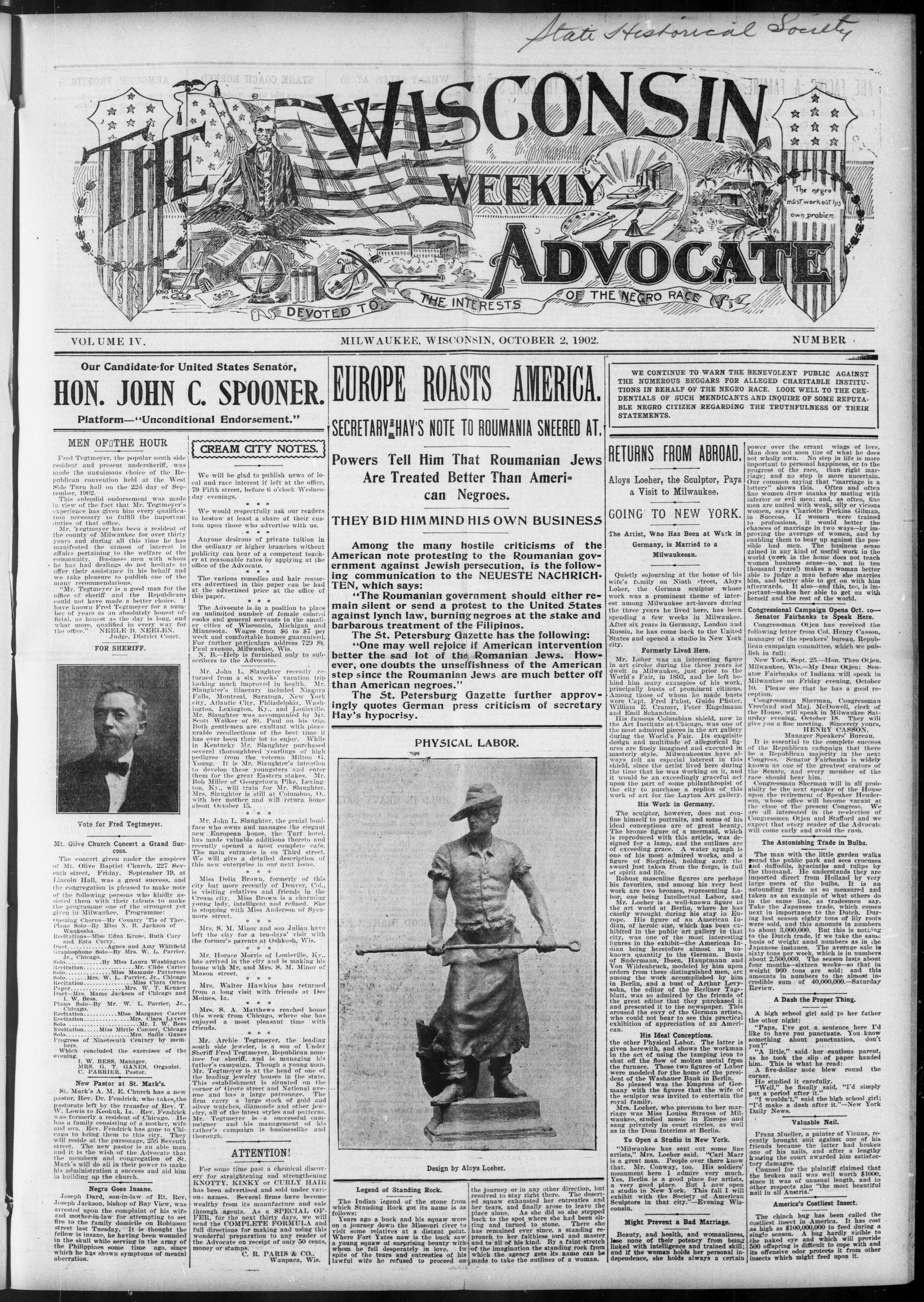
EUROPE ROASTS AMERICA.
THEY BID HIM MIND HIS OWN BUSINESS
Among the many hostile criticisms of the American note protesting to the Roumanian government against Jewish persecution, is the following communication to the NEUESTE NACHRICH TEN, which says: "The Roumanian government should either remain silent or send a protest to the United States against lynch law, burning negroes at the stake and barbarous treatment of the Filipinos. The St. Petersburg Gazette has the following:
"One may well rejoice if American intervention better the sad lot of the Romanian Jews. However, one doubts the unselfishness of the American step since the Roumanian Jews are much better off than American negroes." The St. Petersburg Gazette further approvingly quotes German press criticism of secretary Hay's hypocrisy.
PHYSICAL LABOR.
Design by A
Design by Aloys Loeher.
1874
Legend of Standing Rock.
The Indian legend of the stone from which Standing Rock got its name is as follows:
Years ago a buck and his squaw were on a journey down the Missouri river to visit some relatives at a distant point. Where Fort Yates now is the buck saw a young squaw of surprising beauty with whom he fell desperately in love. In spite of the tears and entreaties of his lawful wife he refused to proceed on
```markdown
```
loys Lceher.
the journey or in any other direction, but resolved to stay right there. The deserted squaw exhausted her entreaties and her tears, and finally arose to leave the place alone. As she did so she stepped back to the spot where she had been sitting and turned to stone. There she has remained ever since, a standing reproach to her faithless lord and master and to all of his kind. By a faint stretch of the imagination the standing rock from which the agency gets its name can be made to take the outlines of a woman.
WE CONTINUE TO WARN THE BENEVOLENT PUBLIC AGAINST THE NUMEROUS BEGGARS FOR ALLEGED CHARITABLE INSTITUTIONS IN BEHALF OF THE NEGRO RACE. LOOK WELL TO THE CREDENTIALS OF SUCH MENDICANTS AND INQUIRE OF SOME REPUTABLE NEGRO CITIZEN REGARDING THE TRUTHFULNESS OF THEIR STATEMENTS.
RETURNS FROM ABROAD.
Aloys Loeher, the Sculptor, Pays a Visit to Milwaukee.
Quietly sojourning at the home of his wife's family on Ninth street, Aloys Loher, the German sculptor whose work was a prominent theme of interest among Milwaukee art-lovers during the three years he lived here, has been spending a few weeks in Milwaukee. After six years in Germany, London and Russia, he has come back to the United States and opened a studio in New York city.
Formerly Lived Here.
Mr. Loher was an interesting figure in art circles during the three years he dwelt in Milwaukee, just prior to the World's Fair, in 1883, and he left behind him many examples of his work, principally busts of prominent citizens. Among those of whom he made busts were Capt. Fred Pabst, Guido Pfister, William E. Cramer, Peter Engelmann and Emil Schandlein.
His famous Columbian shield, now in the Art Institute at Chicago, was one of the most admired pieces in the art gallery during the World's Fair. Its exquisite design and multitude of allegorical figures are finely imagined and executed in masterly style. Milwaukeeans have always felt an especial interest in this shield, since the artist lived here during the time that he was working on it, and it would be an exceedingly graceful act upon the part of some philanthropist of the city to purchase a replica of this work of art for the Layton Art gallery.
His Work in Germany.
The sculptor, however, does not confine himself to portraits, and some of his ideal conceptions are of great beauty. The bronze figure of a mermaid, which is reproduced with this article, was designed for a lamp, and the outlines are of exceeding grace. A water nymph is one of his most admired works, and a figure of Siegfried, holding aoft the sword just taken from the forge, is full of spirit and life.
Robust masculine figures are perhaps his favorites, and among his very best work are two bronzes, representing Labor, one being Intellectual Labor, and Mr. Loeher is a well-known figure in the art world at Berlin, where he has chiefly wrought during his stay in Europe. His figure of an American Indian, of heroic size, which has been exhibited in the public art gallery in that city, was one of the most interesting figures in the exhibit—the American Indian being heretofore almost an unknown quantity to the German. Busts of Sudermann, Ibsen, Hauptmann and Von Wildenbruck, modeled by him upon orders from these distinguished men, are among the work accomplished by him in Berlin, and a bust of Arthur Levysohn, the editor of the Berliner Tageblatt, was so admired by the friends of the great editor that they purchased it and presented it to the newspaper. This aroused the envy of the German artists, who could not bear to see this practical exhibition of appreciation of an American
His Ideal Conceptions.
the other Physical Labor. The latter is given herewith, and shows the workman in the act of using the tamping iron to shut off the flow of molten metal from the furnace. These two figures of Labor were modeled for the home of the president of the Washauer Bank in Berlin. So pleased was the Empress of Germany with the figures that the wife of the sculptor was invited to entertain the royal family. Mrs. Loeher, who previous to her marriage was Miss Louisa Strauss of Milwaukee, studied music in Europe and sang privately in court circles, as well as in the Dom Interims at Berlin.
To Open a Studio in New York.
"Milwaukee has sent out some fine artists," Mrs. Loeher said. "Carl Marr is a great man. People over there know that. Mr. Conway, too. His soldiers' monument here I admire very much. Yes, Berlin is a good place for artists, a very good place. But I now open a studio in New York. This fall I will exhibit with the Society of American Sculptors in that city."—Evening Wisconsin.
Might Prevent a Bad Marriage.
Beauty, and health, and womanliness, lose none of their potency from being linked with intelligence and trained skill; and if the woman holds her personal independence, she holds always a certain
BENEVOLENT PUBLIC AGAINST ALLEGED CHARITABLE INSTITU-RACE. LOOK WELL TO THE CRES AND INQUIRE OF SOME REPUTA- THE TRUTHFULNESS OF THEIR
power over the errant wings of love. Man does not soon tire of what he does not wholly own. No step in life is more important to personal happiness, or to the progress of the race, than right marriage; and no step is more uncertain. Our common saying that "marriage is a lottery" shows this. Often and often fine women draw blanks by mating with inferior or evil men; and, as often, fine men are united with weak, silly or vicious women, says Charlotte Perkins Gilman, in Success. If women were trained to professions, it would better the chances of marriage in two ways—by improving the average of women, and by enabling them to bear up against the possible bad men. The business sense gained in any kind of useful work in the world (work in the home does not teach women business sense—no, not in ten thousand years!) makes a woman better able to judge a man before she marries him, and better able to get on with him afterwards. It also—and this, too, is important—makes her able to get on with herself and the rest of the world.
Congressional Campaign Opens Oct. 10
Senator Fairbanks to Speak Here
Congressman Otjen has received the following letter from Col. Henry Casson, manager of the speakers' bureau, Republican campaign committee, which we publish in full:
New York, Sept. 25.—Hon. Theo Otjen, Milwaukee, Wis.—My Dear Otjen: Senator Fairbanks of Indiana will speak in Milwaukee on Friday evening, October 10. Please see that he has a good reception.
Congressman Sherman, Congressman Vreeland and Maj. McDowell, clerk of the House, will speak in Milwaukee Saturday evening, October 18. They will give you a fine meeting. Sincerely yours, HENRY CASSON
Manager Speakers Bureau. It is essential to the complete success of the Republican campaign that there be a Republican majority in the next Congress. Senator Fairbanks is widely known as one of the greatest orators of the Senate, and every member of the race should hear him. Congressman Sherman will in all probability be the next speaker of the House upon the retirement of Speaker Henderson, whose office will become vacant at the close of the present Congress. We are all interested in the re-election of Congressmen Otjen and Stafford and we expect that every reader of the Advocate will come early and avoid the rush.
The Astonishing Trade in Bulbs.
The man with the little garden walks round the public park and sees crocuses and daffodils, hyacinths and tulips by the thousand. He understands they are imported direct from Holland by very large users of the bulbs. It is an astounding trade as so measured and taken as an example of what others do in the same line, as tradesmen say. Take the Japanese trade, which comes next in importance to the Dutch. During last season eighty tons of lily roots were sold, and this amounts in numbers to about 3,000,000. But this is nothing to the Dutch trade, if we take the same basis of weight anud numbers as in the Japanese instance. The average sale is sixty tons per week, which is in numbers about 2,500,000. The season lasts about four months—sixteen weeks—so that in weight 960 tons are sold; and this amounts in numbers to the almost incredible sum of 40,000,000.—Saturday Review.
A Dash the Proper Thing.
A high school girl said to her father the other night:
"Papa, I've got a sentence here I'd like to have you punctuate. You know something about punctuation, don't you?"
"A little," said her cautious parent, as he took the slip of paper handed him. This is what he read:
A five-dollar note blew round the corner.
He studied it carefully.
"Well," he finally said, "I'd simply put a period after it."
"I wouldn't," said the high school girl; "I'd make a dash after it."—New York Daily News.
Franz Mueller, a painter of Vienna, recently brought suit against one of his friends because the latter had broken one of his nails, and after a lengthy hearing the court awarded him satisfactory damages. Counsel for the plaintiff claimed that the broken nail was well worth $1000, since it was of unusual length, and in other respects also "the most beautiful nail in all Austria."
America's Costliest Insect
The chinch bug has been called the costliest insect in America. It has cost as high as $100,000,000 to feed during a single season. A bug hardly visible to the naked eye and which will provide 500 offspring is difficult to cope with and its offensive odor protects it from other insects which might feed upon it.
ARE FACING A FAMINE.
New York, Sept. 30.—The coal situation in New York is today more serious than at any time since the strike of the anthracite miners began. Instead of 150,000 tons usually in stock at this time of the year there are but 2000 tons of hard coal. In tenement districts the price is 75 cents a bushel, which is at the rate of $25 a ton. Dealers in other parts of the city who yesterday were selling half tons, today cut the allowance to customers to quarter tons. Coal and coal dust by the pail of 20 pounds is selling at 25 cents.
Mayor Low received a telegram from the mayor of Detroit today asking him to appoint ten men to confer in Detroit on October 9 regarding the coal strike situation. The mayor said he was "considering the matter."
Hospitals will Suffer.
Hospitals are threatened with being seriously affected by scarcity of coal. The J. Hood Wright Hospital has only enough coal to last this week, while St. Luke's was so fortunate as to obtain a cargo of 240 tons about a week ago—enough to last two months. St. Mary's Hospital for children has practically no supply of steam coal and is using furnace coal, of which it has about twenty-five tons. This condition prevails at many other institutions.
The price of anthracite has reached $21, but some retailers are peddling out their small supply at $15 or $16 to old customers.
Coal Barons Meet.
New York, Sept. 30.—The heads of the coal railroads were in conference today at one of the weekly meetings of the Temple Iron Company. There were present: President Baer of the Philadelphia & Reading railroad, President Truesdale of the Lackawanna, Olyphant of the Delaware & Hudson and Fowler of the New York, Ontario & Western, and John Markle of the firm of G. B. Markle & Co., independent operators. Before Mr. Markle went into the meeting he was asked as to the truth of the report from Philadelphia that John Mitchell, president of the United Mine Workers of America, had been in conference at the Hotel Walton in that city with a representative of the operators and J. P. Morgan.
"It is not true," said Mr. Markle, "for if a representative of the operators and Mr. Morgan had been there I would be in a position to know it, and I have heard nothing of the kind."
Crisis of Some Kind Expected.
Wilkesbarre, Pa., Sept. 30.—President Mitchell and his advisors, District President Nicholls, Fahey and Duffy were in conference at strike headquarters this morning. Nothing could be learned as to their deliberations and Mr. Mitchell was as reticent as ever regarding his visit to Philadelphia. The leader of the miners, however, appeared to be in buoyant spirits and the belief is growing that a crisis of some kind is near at hand.
Says Strike will be Settled.
Philadelphia, Pa., Sept. 30.—Mayor Ashbridge today declined to comply with the request of Mayor Maybury of Detroit to appoint a delegation of citizens to attend a conference to be held in that city on October 9 to devise ways and means for obtaining a reasonable coal supply from the mining regions of Pennsylvania and West Virginia. The mayor's reply contained the statement that differences will be adjusted and work resumed before date of conference named.
Mayor Ashbridge today contracted with President Baer of the Reading Company to furnish fifty tons of coal daily, beginning next Wednesday, for use at the Philadelphia hospital andalmshouse. The mayor's telegram and the contract with President Baer is significant, coming on top of the visit here yesterday of President Mitchell, National Secretary-Treasurer Wilson and officials of the United Mine Workers' Union. Boston, Sept. 29.—Mayor Collins has called a conference of representatives men of Boston to be held Monday noon in the commercial chamber to consider ways and means for relieving the present coal situation in view of the threatened suffering to the poor of the city.
Using Sidewalks for Fuel.
Rochester, N. Y., Sept. 29.--Not a ton of anthracite coal can be had here at any price. Sidewalk inspectors report that in the outlying districts residents are tearing up the sidewalks and using them for fuel. Altogether several miles of plank walks have been pried up with growbars and carried off. In some sections canal bridges have been stripped of planking. Piles of new lumber left on streets for repairs also have disappeared.
Soldiers at Mt. Carmel.
Mt. Carmel, Pa., Sept. 30.—Six companies of the Fourth regiment, commanded by Col. O'Neil of Allentown, arrived here this morning from Reading, Allentown, Lebanon and Harrisburg. When they alighted in the Reading railroad yard, northeast of the town, over 2000 strikers assembled but made no demonstration. The soldiers are now distributed along the Reading railroad until Gen. Gobin, who arrived here on a special train from Shenandoah, selects a permanent encampment site. The soldiers were ordered out last night to suppressioting. Everything is quiet in this vicinity. Strike leaders are doing all they can to prevent the men from committing disorderly acts and are urging large numbers of strikers from the Shenandoah region to return home., All last night fifty deputies at Richard's colliery were surrounded by a big mob. At daybreak the strikers dispersed.
Form New Party to Seize Mines.
Springfield, Mass., Sept. 30.—A movement was inaugurated in this city to form the People's Coal League, an organization for the purpose of electing on November 1 a Congress that will deal adequately with the coal question. Platform: "We demand that the federal government own the coal mines and administer them in the interest of the whole people." It is claimed that the adoption of this plan will permanently solve the coal question by sending to Congress men who have pledged themselves to favor government ownership of the coal mines. The plan includes soft and hard coal.
NO FEDERAL INTERFERENCE
Decided that President is Powerless Regarding Coal Strike.
Washington, D. C., Sept. 30.—The coal strike and the situation that has resulted from it was the subject of a conference held at the temporary white house today in which the President, Attorney General Knox, Secretary Moody, Postmaster General Payne and Gov. Crane of Mas-
sachusetts participated. Everyone connected with the conference was very reticent, but it is learned that the President is much concerned over the situation, the near approach of winter and the great scarcity of fuel. Just what action can be taken is not known. The fact that a move has been made in the Massachusetts courts to have receivers appointed for the coal companies was discussed, but the legal view was that this was entirely inadequate and would not be likely to relieve the situation. The impression prevails that one reason for the hurried visit of Secretary Root to New York was for the purpose of discussing with the leading business men of that city the situation with a view to bringing the strike to an end.
The conferees met again about 2 o'clock, and are now in session in the President's room. The second conference lasted less than an hour. The coal situation was further discussed but the participants refused to make any statements when they came from the President's room. "Has any line of action been taken that the administration confidently expects will settle the strike?" Postmaster General Payne was asked:
"I cannot answer that question," he said.
"Is it not true?"
"To say so now would be premature," he replied as he entered his carriage.
he replied as he entered his carriage. The principal subject under consideration at both conferences was the power of the President to interfere in any way with the coal strike. The result of the conference thus far is that no matter how much interested the administration may be in ending the strike, it does not seem to have any power to act in the premises. The legal advisers of the President told him they could find no warrant in the constitution for federal interference. There had been no interference with the mails or deputy marshals or other federal authority. The only way, it was pointed out, by which there could be federal interference, would be at the request of Gov. Stone of Pennsylvania, and it was stated that he is not likely to ask for federal troops because he has not yet called out the entire militia of his state. The matter of federal interference by the appointment of receivers for the coal companies also was discussed but the President was informed that there was nothing in the constitution nor any law to warrant such action.
WAR IS POSTPONED.
Storm Which Swept Over Fort Riley was Very Severe—Rain Fell in Torrents.
Fort Riley, Kan., Sept. 30.—Last night's heavy storm placed the grounds in such a wretched condition for field maneuvers that late last night Gen. Bates decided to call off the programme for the day. Instead of the maneuvers originally scheduled for the day it was decided to hold a general review later in the day in honor of Assistant Secretary of War Sanger, Brig.-Gen. Carter, acting adjutant general of the army, and Gov. Stanley of Kansas. The attack on the convoy, which was to have been the feature of the day, was postponed until tomorrow. This morning was occupied by a general discussion of the military problems that have already been worked out.
The commanding officers of the opening forces in each one of the maneuvers read his report, the umpire's report was read and general explanations and a discussion followed. The lyceum was conducted for the benefit of the National Guard officers, who were given every facility to acquire all possible information. The storm that swept over Fort Riley last night was one of the most severe that has been experienced here for several years. The wind blew a howling gale, the rain fell in torrents and the cold was intense. Some of the National Guard companies that arrived during the latter part of the evening came in without equipage of any kind, and but for the efforts of Capt. C. B. Baker, the camp quartermaster, many of them would have fared badly.
RAVAGES OF CHOLERA
Frightful Mortality in Province of Iloilo More Than 5000 Cases and 2740 Deaths.
Manila, Sept. 30.—It is announced that 5124 cases of cholera and 2740 deaths in that province were reported in the province of Iloilo, island of Panay, on Monday. This is the highest record for any district since the outbreak of the disease occurred and exceeds the total of Manila and many of the provinces since the commencement. The town of Miago, in the province of Iloilo was the worst sufferer, 1173 cases being reported there Monday. At Cabatuan there were 939 cases and at Dumangas 395 cases were reported Monday. The people are fleeing to the mountains, leaving the dead unburied and the dying uncared for. The government has ordered additional doctors and medicines to be sent to Iloilo. The number of victims makes ordinary sanitary measures impossible.
The totals for all the provinces, Monday, were, 5390 cases and 3091 deaths.
CONSPIRACY CHARGED
Executors of Stratton Will Said to be Managing Estate for Their Own Ends.
Colorado Springs, Col., Sept. 30.—Formal charges of conspiracy to involve the Stratton estate in litigation for the profit of persons interested in no way in the estate are brought against H. M. Blackmer and C. C. Hamlin, two of the administrators to collect appointed by Judge Orr, Blackmer being declared to have already provided money of his own in an effort to carry out the terms of a deliberate and fraudulent conspiracy entered into with a view to speculating upon the will of the estate.
A charge is made that the court itself, the judge of which is a brother-in-law of O. P. Grimes, the third administrator to collect, has shown itself biased and prejudiced and grossly imposed upon, and the demand is made that the litigation be taken out of this court and transferred to the district court of El Paso county.
MARRIED QUIETLY.
Miss Alice Hay Becomes the Wife of James W. Wadsworth at Geneseo. N. Y.
Newbury, N. H., Sept. 30.—Very quietly and in the presence of only relatives and closest friends, Miss Alice Hay, second daughter of Secretary of State John Hay, and James W. Wadsworth of Genesee, N. Y., were married today at The Fells, Lake Sunapee, the summer home of the bride's father. Although all arrangements for the event were made with the utmost privacy, the residents of the vicinity felt great interest in it as it is by far the most prominent wedding that ever took place in this section. In fact, the number of guests was only thirty.
The ceremony took place at 2 o'clock. Rev. C. L. Hayden of Cleveland, who married Col. and Mrs. Hay, performed the ceremony today.
Washington, D. C., Oct. 1.—The President, Secretary Root, Secretary Moody, Attorney General Knox and Postmaster General Payne resumed their conference on the coal strike situation at 10:30 o'clock this morning.
The conference closed shortly before noon. It is understood that a decision was arrived at, as it was announced that there will be no more conferences held on the question.
Washington, D. C., Oct. 1.—President Roosevelt will try to end the anthracite coal strike by exerting all the legal powers of the federal government together with the moral influence of the national administration.
Exactly what course the President will adopt has not been definitely decided, as there are so many plans under consideration. First, the President will attempt to settle the vexed question by moral influence, and he will invite the presidents of the coal companies to come to Washington for a conference. It is possible some of the labor leaders also will be invited here. President Roosevelt, it is said, will lay a sensible and reasonable plan before those so vitally interested, which, it is hoped, will be accepted by both sides to the controversy without delay.
President May Invoke Laws.
If moral influence is not successful in converting the coal fields of Pennsylvania from an armed camp to an industrial community then the President will resort to legal means and every law upon the statute books which has any bearing on the situation will be invoked for the purpose of bringing about a resumption of work in the mines and giving relief to the people.
Just what the powers of the federal government in the premises are will necessitate a thorough search of the statutes to determine, and instructions have been given by the President to the attorney general to prepare to make a winning fight against the coal companies.
May Call Extra Session.
An extraordinary session of Congress will be called if there is no other means to reach the trouble. Attorney General Knox, who will devote his time to this important question to the exclusion of everything else, is of the opinion that laws already exist which can be utilized in forcing a cessation of the strike if moral influences do not prevail.
WILL ACCEPT INVITATIONS.
Operators and Strike Leaders to Meet President on Friday.
New York, Oct. 1.—President Truesdale of the Lackawanna road, President Fowler of the Ontario & Western Company, and President Oliphant of the Delaware & Hudson Company this afternoon acknowledged the receipt of President Roosevelt's invitation to confer with him over the coal strike situation. It is quite certain that the invitation will be accepted by the operators, but none of those seen would discuss the probable outcome of the meeting. President Truesdale made this statement this afternoon:
"There is absolutely no truth whatever in the report that President Baer of the Reading Company has resigned. There is no truth whatever in the reports that the strike has been settled or contemplated."
Following the receipt of the President's invitation, the coal presidents in this city held a brief conference, but no word as to what passed between them was obtainable. J. P. Morgan said: "I have heard of the President's invitation to the coal presidents, and I think it is an admirable thing. As to results we can tell better when the operators come back." John Markle, one of the leading independent operators, was also invited by President Roosevelt to attend the Washington conference. Mr. Markle's invitation awaited him at Morgan & Co.'s office, where he called late this afternoon. Mr. Markle said he would certainly go. He, too, declined to prophesy what result, if any, might be reached as a result of a talk with the President.
Wikkesbarre, Pa., Oct. 1.—President Mitchell stated this afternoon that he had received an invitation from President Roosevelt to attend a conference to be held in this city on Friday. He said he would accept and will leave here tomorrow for Washington.
Engineer Stoned by Mob.
Mt. Carmel, Pa., Oct. 1.—While Engineer F. P. Hoffman was on a Lehigh Valley locomotive here last night he was stoned by a mob because he was running a car full of supplies into the soldiers' encampment. The cab was almost totally wrecked. Hoffman escaped injury by lying down. Before the mob could jump on the engine a detail of soldiers drove them away.
This Coal Dealer is Popular.
Portland, Me., Oct. 1.—A Freeport coal dealer, who had secured his supply for the winter trade before prices advanced, has made himself popular by selling freely to the citizens of Freeport at $6 a ton. No one residing outside of Freeport, however, can buy from him at any price.
GREAT CROWD GATHERED.
Dedication of Monument to Memory of Abraham Lincoln's Mother.
Lincoln City, Ind., Oct. 1.—A monument to Nancy Hanks Lincoln was dedicated here today and notwithstanding the disagreeable weather the largest crowd that ever gathered in the county wienessed the ceremonies.
One of the disappointing features of the exercises was the inability of J. S. Calver to be present. He is the contractor who furnished the stone for the Nancy Hanks monument from the old base of the Abraham Lincoln monument at Springfield. He charged nothing for the stone, and his liberality made the Nancy Hanks monument a possibility:
Gen. J. C. Black of Chicago delivered the oration and Gov. Durbin accepted the monument.
ARRIVES AT PANAMA.
Battleship Wisconsin Finishes Long Trip from San Francisco.
Panama, Oct. 1.-The United States battleship Wisconsin, Capt. George C. Reiter, which left San Francisco September 17 for the isthmus, arrived here this morning and exchanged salutes with the land batteries.
Miles Sails for Manila
San Francisco, Oct. 1.-Lieut.-Gen. Nelson A. Miles sailed for the Philippines on the transport Thomas, which will call at Houolulu and Guam.
WHEAT SELLS AT 95.
Nearly All of the Available Supply Practically Cornered by Armour & Co.
Chicago, Ill., Sept. 30.—September wheat sold here on the board of trade today at 95 cents, which is the highest price on that cereal since the great Leiter deal in 1898. The cause of the high price today was the fact that all the available supply was practically cornered and it was rumored that Armour & Co. held the greater part of it. There has been great anxiety among the shorts in September wheat for the past two weeks, but it was supposed that all or them had covered during the scare last week. There were early advances of from 2 to $2\frac{1}{2}$ cents between sales. The opening was $1\frac{1}{8}$ to 5 cents higher at 88 to $88\frac{1}{2}$ cents, an quickly advanced to 94 cents, around which figure there was considerable selling and a decline to 88 cents followed. After the shorts again renewed their efforts to cover and the price rose in five minute from 90 cents to 95 cents. The brokerage firm of H. H. Wells, members of the board of trade, today filed a petition asking for a temporary injunction against Armour & Co., J. J. Townsend, the Board of Trade and others, to prevent what is technically known as "the endorsing down of margins." This is practically the same action as was asked for in the recent corner in oats. The cause of the petition was the cornering of September wheat by one or two local houses.
At 95 cents there was a halt in the advancing figures, shorts apparently having succeeded in supplying their needs. The close was at the high price with a gain of $7\frac{1}{3}$ cents over yesterday's close.
ROCKEFELLER VISITS THE COPPER COUNTRY.
Accompanies Milwaukee Road Officials on Tour of Inspection—Interested in Tri-Mountain.
Houghton, Mich., Sept. 30.—[Special.]—William Rockefeller of Standard Oil fame was a visitor to the copper country yesterday, his especial mission, it is said, being to inspect the Tri-Mountain and other properties in which Standard Oil capitalists are interested. He came on a special train bearing officials of the Milwaukee road who are making an inspection of the system subsequent to the annual meeting held in Milwaukee last week. Besides Mr. Rockefeller there were in the party:
President A. J. Earling of the Milwaukee road, H. H. Rogers, a multi-millionaire; J. V. Harkness of New York, a Standard Oil official; Roswell Miller, chairman of the board of directors of the Milwaukee road; A. C. Bird, first vice president; Peter Jennings, a New York capitalist; W. R. Williams, general manager; George R. Peck, general counsel, and E. R. Hastings of Green Bay, superintendent of the Superior division of the road.
Prior to the return of the party to Chicago, Congressman Carlos D. Sheldon entertained the visitors at the Onigaming Club.
RATTLER IN BABY'S LAP.
Child Found in Yard Caressing a Reptile Mother Screams and Snake Slips Away.
Centralia, Ill., Sept. 30.—Mrs. John Browning of Washington county missed her 2-year-old-baby and after searching the yard for over two hours she found it sitting in some tall grass caressing a rattlesnake that was coiled in its lap.
The baby was talking to the snake and patting it on the head, and the sharp beadlike eyes of the rattler were watching the little one's every movement as its head moved restlessly.
Mrs. Browning screamed and the snake moved slowly off into the grass while the mother stood transfixed. As the snake disappeared she recovered herself and catching up the baby ran to the house to examine it. The child was found to be entirely unhurt. The mother then went to the place where the child had been sitting and a few feet away killed a rattlesnake that had eight rattles and a button.
Mystery is added to the case by the fact that a small gold ring which was securely on the child's finger was found in the grass near the snake.
HELD IN HEAVY BAIL.
Charles Vroman and Charles Sjoquist Bound Over at Menominee to Answer Conspiracy Charge.
Menominee, Mich., Sept. 30.—[Special.]—Charles Vroman and Charles Sjoquist were bound over in Justice Opsahl's court this morning to the November term of circuit court on a charge of conspiracy to defraud Raber & Watson, cedar sealers of Menominee and Chicago, of the sum of $7000. Bail in the case of Vroman was fixed at $2400 and in Sjoquist's $1400, two or more sufficient sureties being demanded in each case. The men expect to raise the bail by night.
HAD GOOD NIGHT'S REST.
Latest Bulletin from Washington Regarding Condition of President Roosevelt.
Washington, D. C., Sept. 30. At the White House this morning it was stated that the President had enjoyed a good night's rest. No bulletin was issued from the White House today, but it was stated that the President's condition was satisfactory. He passed a comfortable night and participated today in the conference over the coal situation, which was held at the temporary White House.
Mrs. Monk of Ironwood was Carrying Supper to Husband.
Ironwood, Mich., Sept. 30. While carrying supper to her husband at the Anora mine last evening, Mrs. Edward Monk, who had long been a sufferer from asthma, dropped dead. Two children and the husband survive.
Rich in Timber and Minerals..
The numerous island of the Patagonia archipelago are covered with evergreen forests capable of supplying immense quantities of valuable timber, while the mountain ranges, being of the same geological formations as those of Chili and Peru, are probably rich in mineral resources.
The Rubber Plant.
The first accurate information regarding the wonderful rubber plant was furnished by La Condamine, a French scientist, who was sent in 1735 by the government of France to measure an arc of the meridian near Quito. This brought him to the heart of the rubber-growing country, and much valuable information was thus obtained.
—Dr. H. K. Carroll reports the total church membership in the United States in 1901 to be 28.090.637.
STAGE COACH ROBBED.
Passengers Held Up by Masked Men and Relieved of Money and Valuables.
Middletown, N. Y., Oct. 1.—Three masked horsemen held up and robbed the stage coach Pioneer, which makes daily trips between Warwick and Goshen.
The coach was bowling along the road two miles from Florida. At a lonely spot on the road Clinton and Horatio S. Wisner, who own the coach, and were on the seat, saw the men on horses suddenly emerge from the dense woods which line the highway. Clinton was driving.
The robbers ordered him to pull up his horses. He refused to do so and the highwaymen opened fire with revolvers. None of the shots took effect, but the shooting had the effect of compelling the whip to bring his horses to a stop.
Inside the coach were Mrs. J. A. Chamberlain, Mrs. Fred Webster, Mrs. James Fuller, Mrs. Hart and Mrs. Ed Johnson of Florida.
While two of the highwaymen covered the Wisner brothers with their revolvers the third, using many threats, compelled the passengers to give up all their money and valuables.
After the robbery had been completed the robbers spurred up their horses and escaped.
When news of the holdup became known this whole section of Orange county was first astounded, and then excited. Posses of armed men were hastily formed and at once started a search for the highwaymen. Clinton W. Wisner is president of the village of Warwick.
New York, Oct. 1.—According to a Times dispatch from Goshen, N. Y., the hold-up of the coach "Pioneer," between Goshen and Warwick, by three masked and heavily armed men, was a hoax perpetrated by young society men from Warwick. The passengers were in entire ignorance of the affair, however. The joke was arranged, the dispatch declares, as a fitting climax for the coaching season. The "Pioneer" was on its last trip.
MUST FURNISH SAMPLES.
Method of Determining Whether Oleo Manufacturers Comply with the Law.
Washington, D. C., Oct. 1.—Oleomargarine manufacturers are to be required to furnish the commissioner of internal revenue, at frequent intervals, samples of the ingredients used in their product, and also the finished article. This decision was reached after Representative Tawney, who led the dairy forces in the House last session and secured the new legislation, explained to the commissioner the apprehension of members of the National Dairy Union that unless close watch is kept in such way the spirit of the law would be violated. Mr. Tawney stated that he had been told that natural products, such as cottonseed oil and burnt salt, are being used in the manufacture of oleomargarine to give it a color like butter. The commissioner agreed to issue an order that would require oleo makers to keep the department informed by samples that can be analyzed if desired by the department chemist.
SEVERAL VESSELS LOST.
One with 110 Persons on Board Has Not Been Heard from for Six Months.
Victoria, B. C., Oct. 1.—The steamer Moana brings news of the loss of several Australian vessels during gales in the South seas. The schooner Sybil of Sidney, recruiting vessel, left the Solomon islands in April with 110 persons on board for Queensland and was never heard of again. The steamer Quirang of Sydney was lost off the Australian coast with all hands, numbering thirty, never having been heard of after leaving Sydney on a coasting trip. The steamer Mammbare, a 2000-ton steamer belonging to Buris, Phillip & Co. of Sydney, on the interisland trade, was lost off the coast of Santos by stranding on a reef, but fortunately all hands were saved and taken to Noname by the H. M. S. Phoebe. The schooner Eclipse was lost in the Solomon islands and Father Rouillac, a French priest, was drowned.
CLARENCE THURSTON IS ASPHYXIATED BY GAS
Door of Room Tightly Closed, Keyhole Plugged and Gas Jets Open—Will Probably Die.
St. Louis, Mo., Oct. 1.—Clarence Thurston, a son of former United States Senator Thurston of Nebraska and an attache of the world fair offices in St. Louis, was found unconscious from asphyxiation in his apartments at a hotel late last night. The door of his room was tightly closed, the keyhole plugged, the windows bolted and the gas jets opened. Indications pointed to an attempt at suicide. He was taken to the city hospital. The physicians say he may die.
LOW WATER IN BOILER.
Five Persons Were Killed by an Explosion at Rocky Hill,
Glasgow, Ky., Oct. 1.—Five persons were killed by the explosion of a boiler at Jesse Hinslow's mill at Rocky Hill today. Their names are Jesse Hinslow, William Hinslow, Allen Shackelford, John V. Cump and Cump.
The accident is supposed to have been caused by low water in the boiler.
Safeblowers Steal $2000 from E. J. Ely & Co. at Mineral. Ill.
Kewanee, Ill., Oct. 1.—Bank robbers secured $2000 from the Bank of Mineral, a town fifteen miles northeast of here, and made their escape. The robbers broke into the front door and blew open the vaults with dynamite.
No Trace of Missing Woman.
Menominee, Mich., Oct. 1.—Nothing has yet been learned of the whereabouts of young Julia Kachiney, who disappeared from her home Sunday morning. The matter is being thoroughly investigated and a searching party will scour the woods.
President Doing Nicely.
Washington, D. C., Oct. 1.—After the physicians had visited the President this morning Secretary Cortelyou announced that the President had passed a very comfortable night and that he was doing nicely.
Lynched for Shoeting White Man.
Pine Bluff, Ark., Oct. 1.—Walter Sullivan, a young negro, was lynched at 2 o'clock this morning in Portland, Ashley county. Sullivan was charged with shooting D. J. Roody, a white man, in the back.
ARMOURS' PROFITS.
Grain Firm Cleans Up About $2,000,000 by Operations in September Wheat.
Chicago, Ill., Oct. 1.—The Armour Grain Company yesterday closed one of the most successful wheat deals in recent years and their operations netted a profit estimated at nearly $2,000,000. However, the company is now facing an injunction suit, the outgrowth of Judge Chytraus' recent decision. H. W. Wells, one of the shorts who got squeezed, alleges in his petition that he sold 25,000 bushels, but because of what he terms a corner he was unable to buy for delivery at any but fictitious prices.
The Armour Company put forth a theory that the wet weather which continued throughout the summer season was detrimental to the grading of grain of all kinds. Producers who had inferior grain in their possession found it necessary to ship to centers where they had cleaning apparatus. Much of it came to Chicago and found its way to grain "hospitals." The result was the keeping down of contract stock, with an increase in the total arrivals of wheat.
Armours Bought Freely.
It is estimated that the Armours bought nearly 20,000,000 bushels of September wheat. In the meantime they hedged large purchases by selling short. As a result of this the market for September became congested. The Armours hold options on twenty times the quantity in store here. With two or three weeks to control the situation they bought heavily, thus controlling all contract wheat in the West. September closed yesterday at a premium of 26% cents over December. At the same time car lots of No. 1 northern, contract grade, were not salable in the sample market for more than $72 \frac{1}{2}$ cents. October was selling from $68 \frac{1}{4}$ cents down to $67 \frac{1}{4}$ cents.
Shorts Fail to Put Up.
Throughout the September deal the shorts became aggressive and were not disposed to put up growing margins. Consequently September, which sold at 88 cents at the opening of the board, closed at 95. In his petition for a restraining order Mr. Wells urged that in August he instructed Townsend & Co. to sell 25,000 bushels for September delivery, but that a corner had been formed by which he would have to pay $88 \frac{1}{2} $ cents a bushel or more, which was not the actual value of the grain. Thus he would lose from 16 to 20 cents a bushel.
TWO BOYS KILLED BY ELECTRIC WIRE
One Climbed Pole to Recover His Hat and the Other Went Up to Release His Comrade.
New York, Oct. 1.—Within sight of his father and 2000 persons, Richard Houser and his 9-year-old companion, Freddie Pepolo, of Woodhaven, L. L., were killed by an electric current.
Pepolo had climbed to the top of the iron pole to recover his hat, which had caught on the wire and was slowly being burned. As he reached out for the cap his hand came in contact with the wire. The shock passed through his body, killing him instantly and forming a circuit between the pole and the wire.
Young Houser, believing his comrade only stunned, climbed up the pole to release him any carry him to the ground. When he reached the top he placed his arm around the body, holding to the pole with the other arm, he was also killed.
ALL GENTILES EXPELLED.
None but Believers are Allowed to Work in Dr. Dowie's Zion
Waukegan, Ill., Oct. 1.—[Special.] The time has come when none but members of Dowie's church can work in Zion City excepting the lace makers who are there under contract. As a result of an order from Dowie there was an exodus yesterday of nearly 200 men who have been employed in various capacities there. For some days past the heads of the church spent much time trying to induce nonbelievers to apply for membership and thus retain employment. Few were induced to join in order to keep their places and consequently there is now none but followers at work in building the city.
ADMIRAL JOUETT DIES
Washington, D. C., Oct. 1.—Rear Admiral K. James E. Jouett, U. S. N., reined, died at his home, The Anchorage, Silver Spring, Md., at an early hour this morning. He was 74 years of age and had a long and distinguished career. He was born in Kentucky and was appointed in the navy from that state. He was retired in 1890.
RECEIVER FOR SALT TRUST.
Affairs of National Company Put Into Hands of Court Appointees.
Trenton, N. J., Oct. 1.—Chancellor Magie appointed Frank P. McDermott of Jersey City and Nathan S. Beardslee of Warsaw, N. Y., receivers for the National Salt Company. The application for a receiver was made by Chauncey H. Strickland of New York city. The company's liabilities are given at $1,150,000 and the quick assets at $858,000. It is said that the company lost $225,-000 during the first six months of the present year and that it stands to lose $35,000 a month by a contract with the Michigan Salt Association. The company has works at Warsaw, Watkins, Ludlowville, Ithaca, Pavilion and Pearl Creek in New York state, and Marine City, Saginaw and Wyandotte in Michigan.
DISCRIMINATING BURGLARS
Thieves Take Three Tons of Hard Coal,
Leaving Silver Untouched.
Philadelphia, Pa., Oct. 1.—After spending the summer at the seashore H. G. Taylor and family returned to their home here to find that burglars had been in their house. When Mr. Taylor went to the seashore he left three tons of anthracite coal in his cellar, and during the last two months he has been congratulating himself that he would not have to worry about the coal strike.
But his fond illusion is gone, for the burglars, who spurned silverware and jewels, stole the three tone of coal, carrying it away in a wagon. The coal cost Taylor $16.50 when he bought it. It will cost him about three times that much to replace it.
Weyler's Decrees Rejected
Madrid, Oct. 1.—It is reported from San Sebastian that King Alfonso has refused to sign certain decrees presented to him by the minister of war, Gen. Weyler, and the matter is receiving much comment.
THE EXCEPTION.
I hold a certain girl in mind.
Not far above the mediocre:
Yet, strange to say, I'm half inclined
To yoke her.
In looks, 'tis true, a likelier maid
Perchance has crossed this bard's horizon:
More beauteous girls he's often laid
His eyes on.
Ibsen and Richard Strauss she knows,
But really she's no rara avis.
Rag-time appeals and, I suppose.
Dick Dards.
One day each week she cuts pink tea,
Departs this life of sweets and orchids,
And leads a club of twenty-three
Or four kids.
While other girls their charms possess,
She has an extra one that stilkes me
Which other lack—I must confess
She likes me!
That's why I hold this girl in mind
in most things merely medlocre;
That's why I'm more than half inclined
To yoke her.
--Melville Henry Cane in Harper's Maga-
zine.
IN GAY NEW YORK.
The steamer Patricia, from Hamburg, brought as part of her cargo a large number of wild animals. Some of the animals are for the zoological gardens at Philadelphia and Cincinnati.
Speaker Henderson's retirement has given rise to a Carnegie story in Wall street. It is in effect that the laird in the past few years has given tips to his brother Scot that have made the statesman fairly rich.
For the first time in its history, the department of charities has a Chinese foundling on its hands. A pretty little yellow girl baby was picked up at a ferry station, where it had been abandoned or lost by its mother.
Isaac Myer, lawyer, author and Egyptologist, who died here last August, is announced to have left his library, devoted to Oriental subjects, and a vast quantity of scientific manuscripts to the Lenox library. Mr. Myer was one of the foremost authorities on old Egyptian lirterature, history and philosophy.
The dahlia show in progress under direction of the American institute, is one of the prettiest exhibits of the season. This flower has been steadily gaining in favor in recent years, and a number of the richest of New York women have aided its boom by having whole gardens of the flower laid out at their country homes.
Plans have been filed at the bureau of buildings for Charles M. Schwab's new residence. The building will be six stories high, and 90 by 107 feet deep. The lot faces Riverside drive, and is bounded by Seventy-third and Seventy-fourth streets and West End avenue. The building will be of granite and is to cost $900,000.
John E. Condon, who was an important witness for the prosecution in the trial of Lawyer Albert T. Patrick, convicted of the murder of Millionaire William M. Rice, committed suicide at his home. Condon took carbolic acid and died almost immediately. His wife says she does not know what prompted him to take his life.
The birth of a daughter to Mr. and Mrs. William Bayard Cutting, Jr., has been announced. The event took place in London. Mrs. William Bayard Cutting was Lady Sybil Cuffe. Since her wedding two years ago she has by her own wish been called Mrs. W. Bayard Cutting, Jr., instead of Lady Sybil Cutting, according to the English rule.
Most of the smart equipages nowadays carry boy footmen. Handsome little fellows of the Fauntleroy type and ranging between 12 and 13 years are on at least a dozen of the swell turnouts. Thus does fashion's pendulum swing. Time was—and that not so very long ago—when a man less than six feet tall might hunt in vain for a job as footman.
A recent convenience inaugurated in New York is a hanging telephone register, with a leather backing and mounting, which may also be folded up for traveling use when necessary. It consists of four separate sections, containing openings for twelve slips of paper in each section, equivalent to forty-eight different telephone numbers, easily changed at any time. These registers sell for $2.50 each.
"Iris," Arthur Pinero's new play, has raised a perfect bedlam in New York. The yellow hammers are pecking at it ferociously. They want it stopped. They say it is perfectly awful. William Winter has never been so mad at anything in his life before. He calls it a "riot of bestiality." Virginia Harned, the heroine, admits that it is not a play for school girls. All this has made a big jam around the box office.
If you don't know how big a ping-pong ball is take a walnut and imagine a baby's head that size. Such a one was born in New York at the Bellevue Hospital. The newcomer is a girl and is eight inches high and weighs ten ounces. The doctors say it will live, for it has a full-size "cry," which indicates good lungs. The little one is packed in an incubator made of a macaroni box and is doing finely. She looks like one of those Japanese dolls that children play with.
It is reported that the New York Central railroad is planning to purchase a string of hotels along the main line of the system. It is the intention, so it is reported, to secure a hotel in each of ten cities, including New York and Chicago. The other cities are Albany, Syracuse, Rochester, Buffalo, Erie, Pa.; Cleveland, Toledo, Sandusky and South Bend. The company, it is said, has decided not to build new hotels, but to purchase old-established and popular hotels, which must of course be located near the railroad depots in each instance.
Broadway haberdashers are beginning to show the things that well-dressed men are expected to wear this fall and winter. A noticeable innovation is in neckwear, which this year will be of such rich materials that the cheap imitators will be outwitted in an attempt to duplicate them. Ascots of immense size and brilliant colors appear to rule as favorites. These are set off best by fancy vests of bizarre cut and colors like the coat of Joseph. In keeping with the general scheme for brilliant effect colored silk handkerchiefs are to be the thing. A dress shirt of white silk, with only the bosom of linen, will be de rigueur, as will also be the tall wing collar, which comes back after a season among the retired fancies.
The helpless visitor to New York who has been looking in vain for legends indicating the name of the streets is at last to be given a chance. Five thousand blue metal signs, indicating in plain letters the names of the streets, will be placed in position in the down-town section of the city within ten days. There will be no illuminated street signs down town. The contract for this character of sign will
be let within the next two weeks. These signs, which will be highly ornamental and cost $26 each, will be reserved for the residential districts and uptown thoroughfares. The reason that illuminated signs will not be used in the down-town section of the city is that there are comparatively few people in that district after business hours.
Six million dollars is the estimated sum paid out by New York women for laces alone in the past year. An additional $2,000,000 was spent in the same time for veilings. That these figures are correst is vouched for by one of the heads of a firm in the city which does an enormous yearly business in the importation of laces of all sorts and descriptions. His firm imports the famous Irish crochet, the filet guipure, spangled, European crochet, Venetian, Valenciennes and exquisite hand-painted chiffon laces, which sell at tremendous prices per yard or piece, and so his statement may be taken as authoritative. The same authority says the women of the United States, all told, expend $100,000,000 for laces and about $30,000,000 for incidental lingerie during a year's time.
"A Country Girl" is already one of the reigning belles of New York. But such is the case with almost every English musical comedy that succeeds on this side—there are just a few excellent numbers that make up what the rest fails to accomplish. One of the songs, "Two Little Chicks," promises to become the tuneful rage of the season. The words are like this:
Two little chicks
Lived in a farmyard,
Happy as chicks can be;
She was a Dorking,
Proudly stalking,
Only a bantam he.
He was a most superior bantam,
And cried out aloud,
"Now what in the world are you?"
"Chick, chick, chick, chick!
Won't you marry me, chick?
Be my little wife," said he, "chick,
Chick, chick, chick, chick!"
"You're a very free chic;
Wait a little bit," said she.
"Give me one kiss," said the little he chick
What is more, he kissed her, too.
"Let me be, chick,"
Said thee she chick.
"Cock-a-doodle, that'll doodle do!"
Four big murder cases, to all of which attach the elements of universal interest, are now engrossing New York. Just as Molineux was beginning his last fight for life the body of a beautiful young woman was dragged out of Tiana bay and a few hours later that of a young man was discovered floating only a hundred yards away. Marks of violence which could not have been self-inflicted by either were found, and the suspicion of double murder finally attached to young Louis Disbrow, around whom the police are now weaving an ever-tightening coil of evidence. This for a time distracted attention from the Molineux case and bid fair to become the ruling matter of interest for the morbid, when suddenly, like a bolt from the blue, came the announcement that Millionaire Nicholas Fish had been murdered in a drinking place on the west side. It was an open murder, done in the presence of witnesses, and the alleged slayer was quickly apprehended and now awaits trial. The notable family connections of the slain man, no less than his own prominence and the sad circumstance of his only son's heroic death on San Juan hill, all contributed to make a profound impression. This lamentable tragedy had scarcely ceased to be a theme of public discussion when New York and the whole country were struck dumb with horror by the enactment of another crime, more shuddering than any of its predecessors in the hideous details of its consummation. A young and beautiful woman was lured from her home and foully slaughtered in the apartment occupied by W. Hooper Young, the grandson of the famous Mormon leader. The body was denuded of clothing and cast into a canal near Hoboken, weighted with a twenty-pound hitching iron. The tides revealed this crime, and today the man charged with the deed was dragged from a little Connecticut town to face his accusers in New York.
MEDICINE FOR 400,000,000.
Ginseng, the Panacea for Many of the Ills of the Chinese People.
Physicians in the western world have not a high opinion of the medicinal qualities of ginseng. The Chinese, on the other hand, believe that this root is a heaven-given blessing specially designed as a panacea for many of the physical ills that afflict mankind. The Coreans share the same belief, but most of the rest of the world has little use for ginseng except to sell it to the Chinese.
Is ginseng, after all, a humbug as far as its medicinal virtues are concerned? At least one Chinese has said so. Dr. Chung King-u of the Imperial Medical College of Tien Tsin, who is versed in western medicine, asserted four years ago that in all his experience he had failed to observe any definite results that could properly be ascribed directly to the influence of ginseng. He said that its use among his fellow countrymen was entirely empirical, and its efficacy depended upon the imagination.
There may be two sides to this question. Ginseng has preserved its reputation for centuries among many millions of people, as a tonic and otherwise, as among the greatest of medicines. Could it keep this repute for ages among fully one-fourth of the people of the world if it did not possess at least some of the virtues attributed to it? If so, the use of ginseng is the greatest illustration of the efficacy of faith cure on record.
At any rate, there is a great demand for the root in China. The market for a good article is practically unlimited. Consul Johnson wrote from Amoy a while ago that he believed $20,000,000 worth of the roots might be sold annually in China. Perhaps this is an exaggeration. Minister Allen, writing from Seoul in May, on the ginseng crop of Corea last year, said that about a fifth of the crop had been burned by the exporters after they had bought it, packed and all ready for market, because the supply exceeded the demand and they did not propose to break prices by sending more of the commodity to the Chinese than they wanted.—New York Sun.
Much Marked Note.
Mrs. Sarah Knowles received in change an interesting $5 note, No. 613,624, series of 1899, says the New York Press. It is covered on both sides with the names of persons who have handled it. On the face is stamped "Moona Kader Sultan, Singapore," in blue ink, the design including a number of Indian characters. Underneath is the trademark of "Gordon & Co., Sydney, N. S. W." Then follows a signature, "Manuel Prieto, San Salvador, Salvador, C. A., and the date, "June 7, 1900." "Solon Leon, Graband, Prag-Praha," is the fourth mark. The fifth is written in so large a hand that it covers the other: "Louise Moreau, Avenue du Trocadero, 7, Paris." On the back of the note is this: "Paid by Fred Neimeyer to Ella Larkin, Washington, October 28, 1901"
For Tender Feet.
People who are troubled with tender feet should never indulge in the false economy of wearing much-darned
stockings. A chiropodist was once heard to boast that darned stockings were the mainstay of his business; and certain it is that they are the cause of much unnecessary pain. If you want to prevent ingrowing toe nails, too, never cut your nails down the side, but only straight across. For those that have already started, cut a V-shaped piece out of the center, and they will soon be all right again.
NOMINEE FOR GOVERNOR
Benjamin B. Odell Renominated for Chief Executive of the Empire State.
M. B.
GOVERNOR ODELL FROM A SNAPSHOT TAKEN ON 23 2013
Gov. Benjamin B. Odell of New York is the Republican renominee for governor in the coming campaign. Here is the latest snapshot of Gov. Odell, who has more than once been spoken of as a 1904 presidential possibility.
WANTS TO RETURN.
Ex-President Sam Said to be Watching Present Trouble in Hayti for Chance to Regain Lost Ground.
[Portrait of a military officer in uniform, wearing a dark jacket with a white sash and a star-shaped insignia. The background is plain white.]]
Gen. Sam, one time President of Hayti from which country he was forced to flee for his life, is keenly watching the present revolution with the hope of being able to regain control once more.
THE "PULL BACK" IS DOOMED.
Expert Dressmakers Say Garment is Vulgar and Immodest.
Take a last look at the "pull back" skirt and then hang it in your wardrobe. According to Mme. Baker, who lectured on "styles" at the convention of the National Dress-building at Chicago, the days of the "pull back" are numbered.
"Even at the beginning the 'pull back' was considered a vulgar garment," said Mme Baker. "It was so tight about the hips, and almost down to the knees, that it displayed a woman's form too freely, and it could have been called anything but modest. In Paris today, if you see a woman walking about with a skirt that fits like an eel skin, you can rest assured that she is an American woman. No Parisienne would think of wearing such a skirt now, for they have long gone out of fashion.
"The 'pull back' skirt is immodest, and a newer and better style has been adopted. The skirts of today are cut somewhat looser, and while they still preserve the general outlines, the back and the hips are hidden by plaits. Otherwise the skirt is made with a flare at the bottom and produces a charming effect and at the same time avoids the vulgarity of the old 'pull back' skirt, making walking possible without an effort."
Sagacious Birds.
Mexico has a clever bird called the melanarpes, which has discovered a new use for the telegraph pole. At the foot of the pole this bird makes a large hole, in which it rears its family. Somewhat higher up the post it makes an observatory, from which bored holes permit it to observe the horizon in every direction. Still higher this sagacious bird makes its storehouse, and thus the pole serves as its home, fortress and warehouse.
World's Zinc Production.
The world's zinc production in 1901 increased 28,237 tons over 1900, or $ 5 \frac{1}{4} $ per cent. The largest increase was in the Rhine district of Europe, 12,965 tons; the next largest in the United States, 12,802 tons.
EMILE ZOLA FOUND DEAD.
French Novelist Passes Away at His Apartments in Paris.
Particulars Not Yet Disclosed, but it was Said that Novelist's Death was Accidental.
Paris, Sept. 29.—Emile Zola, the novelist, who was born in Paris April 2, 1840, died this morning.
Zola was found dead in his house from asphyxiation. His wife is gravely ill. It is said that the novelist's death was accidental.
3:01 p. m.—Zola was asphyxiated by fumes from a stove, the pipes of which are said to have been out of order. At
EMILE KÖLA
EMILE ZOLA. the same time it is stated that there are indications of suicide. Zola and his wife returned to Paris yesterday after spending three months in the country. It is hoped that Madame Zola will survive.
Zola returned to his Paris home from his country house at Median and owing to a sudden spell of cold weather here he ordered the heating stove in his bedroom to be lighted. The stove burned badly, but Zola and his wife retired at 10 o'clock last night and the servants not hearing any movement in the apartment this morning, entered the bedroom at 9:30 and found Madame Zola lying on the bed, inanimate. Zola was lying half out of bed with his head and shoulders on the floor and his legs on the bed. Doctors were summoned but they failed to restore Zola to life. After prolonged efforts they resuscitated Madame Zola.
The rumor circulated regarding Zola's supposed suicide from poison was based on the fact that ejections from his stomach were found on the floor, but the doctors say they came from Zola's dog which was also in the bedroom and which did not suffer from asphyxiation. Zola dined with a good appetite yesterday evening and the servants of the household ate of the same dishes. Nothing unusual was heard in the bedroom during the night.
Some workmen arrived at the Zola residence at half-past 9 this morning to make certain repairs in Zola's bedroom, but the servants had already become alarmed at hearing no sound from the room, decided to enter it and burst the door open. A slight odor of carbonic gas was at once noticed and the bodies of the novelist and his wife were found in the positions already described. Zola had evidently been awakened by a choking sensation, tried to rise, but was overcome by the fumes which apparently escaped from the defective stove. The windows were immediately opened, doctors and a commissary of police were summoned and the utmost efforts were made to revive the novelist and his wife, but the former had already succumbed. Mme. Zola regained consciousness at about noon. She now lies in a state of complete prostration. An improvement in her condition is anxiously awaited in order to obtain further light on the occurrence.
Emile Zola was born in Paris April 2, 1840, passing his infancy in Provence with his father, the originator of the canal which bears his name at Aix. He then studied in the Lycee Saint-Louis in Paris, and obtained employment in the well-known publishing firm of Hachette & Co. He gave up that situation about 1865, in order to devote his attention exclusively to literature. He had been an industrious contributor to the newspaper press, and wrote the following works of fiction: "Contes a Ninon," 1863; "La Confession de Claude," 1865; "La Voeu d'une Morte," 1866; "Les Mysteres de Marseille;" "Therese Raquin;" "Manet," a biographical and critical study, 1867; "Madeleine Ferat," 1868; a series of political, social and physiological studies, entitled, "Les Rougon-Macquart, Historie naturelle et sociale d'une famille sous le second Empire," which has been called his "Human Comedy;" the earlier volumes are entitled respectively "La Fortune des Rougon," "La Curee," "Le Ventre de Paris," "La Conquete de Plassans," "La Faute de l'Abbe Mouret." "Son Excellence Eugene Rougon," and "L'Assommoir" (1874-77.) The last-named volume created a great sensation, and has passed through many editions. M. Zola since then wrote a novel entitled "Une Page d'Amour," 1878; "Le Bouton de Rose," a three-act comedy played at the Palais Royal in 1878; "Nana," 1880; "Pot Bouille," 1882. His later works are: "La Joie de Viwe," "Au Bonheur des Dames," "Germinal." All these belong to the "Rougon-Macquart" series. In 1888 M. Zola was appointed a Knight of the Legion of Honor.
MOB BURNS A NEGRO.
Confesses to Three Murders and Several Assaults—Husband of Last Victim Applies Torch.
Corinth, Miss., Sept. 29.—Having confessed to three murders, a robbery and numerous assaults on women and having set the day when he should be burned at the stake by a mob, Tom Clark, a negro, voluntarily gave the signal to set ablaze his funeral pyre today. He watched the husband and brother of his last victim light the huge pile of ragots on top of which the mob had chained him to an iron post. Then as the flames leaped up and engulfed him he writhed amid the awful torture, but at the same time admitted that he deserved his fate, while he warned parents to safeguard their children by a proper bringing-up against such a death.
Hundreds of citizens took part in the burning, for the negro's last victim had been the wife of a prominent man and the country was aroused by the atrocity of the crime as never before in the history of Mississippi. The crime for which Clark died was the assault, and murder of M. Carey Whitfield on Aug. 19.
—James Regan fell from the elevated platform. Physicians say his left leg is broken.
—Hugh Reilly, convicted of the murder of Policeman Patrick Duffy on May 1 last, was sentenced to the penitentiary for fourteen years.
—Engineer Samuel McKinley was killed and another slightly injured and five others narrowly escaped death in a train wreck on the Baltimore & Ohio railroad.
—Edward Christman, a clerk 33 years old, was mysteriously shot in the left leg while on his way home. He says he heard no report and saw nobody near him at the time. His wound is not considered serious.
—George Dimakis, a Greek, who was struck on the head with a milk bottle by his room-mate, Anthasios Antenopalos, died at the county hospital. Antenopalos is being held. He asserts that the blow was struck in self-defense.
—After being unconscious for six days Fred Johnson, one of the two brothers who were overcome by gas at their house, died. As he breathed his last his brother Carl manifested his first sign of consciousness, but it was temporary.
—With his neck broken and his body lying in the road near his house, Dr. Maximilian Muffat, for twelve years a resident of Palatine, was found dead. It is believed he was a victim of a runaway, but there was no witness of the accident.
—Wounded by the bullet of a sentry who had attempted to prevent his escape, and weak from the loss of blood, John H. Mills, a prisoner at the Fort Sheridan guard house, eluded a mounted guard of pursuers and was not recaptured until, faint and breathless, he sought medical aid at the house of a physician in Highland Park.
—Anthony Brueggestradt, for many years engaged in the restaurant business in Chicago, died at his home. He had been in poor health for two years and four weeks ago was compelled to give up active business. Mr. Brueggestradt was 38 years old and had lived in Chicago for twenty years.
LATEST MARKET REPORTS.
MILWAUKEE, OCTOBER 1, 1902.
EGG AND DAIRY MARKETS.
MILWAUKEE—Eggs—Market firm; fresh, loss off, cases included, 20%@21c; fresh, cases returned, 20@20%c; seconds, 12@13c. Receipts were 175 cases.
Butter—Market steady; fancy prints 23c; fancy or extra creamery, per lb, 22%c; firsts, 19%@20%c; seconds, 17%@18%c; dairy prints, 19c; extra fancy dairy, 17%@18%c; lines, 14@16c; roll, 14@16c; packing stock, 18@14c; whey, 9c; grose, 4@5c. The receipts today were 22,000 lbs against 34,800 yesterday. The receipts of creamery are moderate and demand very good. all extra grades being taken on arrival. Dairy is in good demand and scarce.
Cheese—Firm. The demand at present is good and the arrivals light. Off stock is especially slow sale. A great deal is going into cold storage. Receipts 28,000 lbs today, against 1920 lbs yesterday. Full cream flats, fancy, 11@12c; good to choice, 9@10c; Young Americas, 11@12c; daisies, 11½@12¢; fancy brick, 11½@12¢; low grades, 9½@10¢; limburger, per lb, No. 1, 10½@11¢; low grades, 8@9c; imported, Swiss, 25c; Block Swiss, domestic, 12½@13¢; fancy loaf, 12½@13¢; No. 2, 10@11e; sapsago, 20c.
CHICAGO—Butter—Firm; creameries, 16@22¢; dalries, 15@20c. Eggs—Steady; loss off, cases returned, 20@20¢. Cheese—Steady; twins, 10¢; dalries, 11¢; Young Americas, 11@11¢. Iced poultry—Steady; turkeys, 13¢; chickens, 11@12c.
SEYMOUR—Sales of cheese were 504 boxes, flats, 11%c; 765 double dales, 11%c.
SEYMOUR—Sales of cheese were 140 boxes flatts, 11¼c; 765 double daisies, 11¼c.
PLYMOUTH—On the board twenty-two factories offered 2747 boxes cheese, which sold as follows: 181 longhorns, 11¼c; 247 do, 11¼c; 1918 daisies, 11¼c; 94 twins, 11½c; 99 Americans, 11½c; 208 do, 11½c.
MILWAUKEE LIVE STOCK MARKET.
HOGS—Receipts, 11 cars; market 10c lower; light, 7.00@7.25; mixed and medium weights, 7.10@7.40; common to good packing sows, 6.70@7.10; selected, 7.40@7.50. Pigs, 90 to 120 lbs, 5.25@6.00.
CATTLE—Receipts, 6 cars; lower; butchers' steers, medium to good, 1050 to 1300 lbs, 4.50@5.25; fair to medium, 950 to 1050, 3.75@4.25; helfers, common, 2.50@2.85; good, 3.25@4.00; cows, fair to good, 2.50@3.50; canners, 1.50@2.25; bulls, common, 2.25@2.75; choice, 3.00@3.50; feeders, 800 to 950 lbs, 3.50@4.00; stockers, 500 to 750 lbs, 2.50@3.25; calve calves, heavy, 3.00@4.00; common to choice, 6.00@7.00. Milkers—Common to choice, 6.00@7.00. Milkers—Common to choice, 6.00@7.00.
Coxon, lance steady, 8:00@
SHEEP—Recelpl, 1 car; steady; 2.75@
3.50; bucks, 2.00@2.50; light lambs, 3.50@
4.40; choice, 4.25@4.75.
Chicago receipts: Hogs, 20,000; cattle, 20,000; sheep, 20,000.
MARKETS BY TELEGRAPH.
MILWAUKEE—Flour—Steady. Wheat — Firm; No. 1 Northern, on track, 73c; No. 2 Northern, on track, 711c; Corn—Steady; No. 3 on track, 591c; Oats—Firm; No. 2 white, on track, 321c; No. 3 white, on track, 29@32c. Barley—Choice steady, low grades dull; No. 2 on track, 99c; sample on track, 40@69c. Rye—Dull; No. 1 on track, 49c. Provlstons—Steady; pork, 16.90; lard, 10.10.
Flour market steady; patents, 3.75@3.85; bakers', 2.85@2.95; rye, 2.85@2.95.
Millstuffs are steady and quoted at 13.75 for bran, 14.00 for standard middlings and 17.00 for Milwaukee flour middlings in 100lb sacks; red dog, 20.00. Delivered to country points 1.00 extra.
CHICAGO—Close—Wheat—October 68½¢; December, 69½¢@69½¢; May, 70½¢@70½¢; Corn—October, 58½¢; December, 47½¢@47½¢; May, 42½¢; Oats—October, 30½¢; December, 31½¢; old, 26½¢; May, 32½¢; Pork—October, 16.90; January, 15.35; May, 14.30. Lard—October, 10.00; November, 9.30; December, 9.00; January, 8.77½¢; May, 8.12½¢; Ribs—October, 11.00; January, 8.15; Flax—Cash Northwest, 1.25½; Southwest, 1.25½; October, 1.25; Rye—December, 47½¢@48¢. Barley—Cash, 38@60¢. Timothy—October, 3.65. Clover—October, 9.50.
NEW YORK—Close—Wheat—December, 74½¢; May, 75¢. Corn—December, 53½¢; May, 47¢.
ST. LOUIIS—Close—Wheat—Higher. No. 2 red cash, elevator, 67c; December, 67c; May, 69½c; No. 2 hard, 67@69c. Corn—Higher. No. 2 cash, 56c; December, 39c; May, 38½c. Oats—Higher. No. 2 cash, 29½c; December, 29½c; May, 29½c; No. 2 white, 35c. Lead—Steady, 4.00@4.02½c. Spelter—Quiet. 5.20.
KANSAS CITY — Close—Wheat — December, 64½@64½c; May, 56½c; cash No. 2 hard, 65½c; No. 2 red, 65c. Corn—October, 47½c; December, 37½c; May, 37c; cash No. 2 mixed, 56½@57c; No. 2 white, 59½@60c. Oats—No. 2 white, 32@32½c.
DULUTH—Close — Wheat—Cash No. 1 hard, 69½c; No. 1 Northern, 68½c; No. 2 Northern, 65½c; No. 3 spring, 63½c; to arrive, No. 1 hard, 69½c; No. 1 Northern, 68½c; December, 66½c; May, 69½c. Macaron—No. 1, 64½c; No. 2, 62½c. Oats—December, 28½c; on track and to arrive, 29½c. Rye—October, on track and to arrive, 47c. Barley—40@66c. Plax—Cash, on track, to arrive and October, 1.26; November, 1.25½; December, 1.24; May, 1.27½. Receipts—Wheat 414.003; shipments 657.471
MINNEAPOLIS—Close — Wheat -- 66¼c;
May, 68½c; on track. No. 1 hard, 69¼c;
No. 1 Northern, 68¼c; No. 2 Northern, 66¼c.
KANSAS CITY—Cattle—Receipts, 15,000;
steady to 15c lower; beef steers, 4.40@7.90;
Texans, 3.75@4.30; cows and heifers, 1.25@4.40; stockers and feeders, 2.50@4.50;
Hogs—Receipts, 14,000; market 10c lower;
heavy, 7.00@7.25; packers, 7.10@7.17½; medium, 7.20@7.30; yorkers, 7.25@7.30; pigs, 6.15@7.10. Sheep—Receipts, 6000; steady to weak; sheep, 3.15@3.85; lambs, 3.70@4.25.
ST. LOUIIS—Cattle—Receipts, 6000; market steady; beef steers, 4.30@7.50; stockers and feeders, 3.25@4.50; cows and heifers.
2.25@5.00; Texans, 2.50@4.40. Hogs—Receipts, 5000; 5@10c lower; pigs, 6.75@7.15;
packers, 7.00@7.30; butchers, 7.15@7.55.
Sheep—Receipts, 500; strong; sheep, 3.25@5.25; lambs, 4.50@5.60.
SOUTH OMAHA—Cattle—Receipts, 8100:
slow, steady and lower; beef steers, 4.75@
8.25; cows and heifers, 3.00@4.50; Texans,
3.50@4.50; canners, 1.75@2.75; stockers and
feeders, 2.75@5.10. Hogs—Receipts, 3300:
5@10c lower; heavy, 7.10@7.20; mixed, 7.10@
7.15; plugs, 6.00@7.00. Sheep—Receipts,
22.00; weaker, yearlings, 3.60@3.90; lambs,
3.50@4.90.
STOCKS'VIOLENTREBOUND
Opening Gains in Sales Followed by Prompt Relapse.
Fluctuations Were Extensive and Trading Very Excited—Secretary's Order Has Good Effect.
New York, Sept. 30.—There were wild scenes for an hour on the stock exchange this morning, owing to the violent rebound in prices from yesterday's panicky closing. Opening gains over last night's prices were from a fraction up to 4 and over 5 points. First sales were of 1000 to 9000 shares, simultaneous prices varying as much as 4 points in the case of Missouri Pacific, which made the maximum gain of $5\frac{1}{4}$ points. Evident urgent buying by distressed shorts played an important part in the buoyant uprush, as there was a prompt relapse. Buyers in yesterday's slump hastened to take profits at the expense of yesterday's shorts. Prices ran off from 1 to $1\frac{1}{2}$ for important stocks. Louisville lost all its rise and Missouri Pacific relapsed $3\frac{1}{2}$. Fluctuations were wild and trading very excited. Loans on call at 15 to 18 per cent. helped to unsettle the trading again but the market steadied and became quiet by 11 o'clock at prices above the lowest. The subsequent decline was much more orderly. The principal cause of the rebound this morning was the announcement of Secretary of the Treasury Shaw's intention to remit the requirements on national banks to maintain a cash reserve against government deposits which are secured by government bonds and to accept other securities than government bonds for government deposits where it would release the 2 per cent. bonds for the purpose of taking out additional bank notes. Authoritative statements from Mr. Morgan releaved the fears of a miscarriage of the plan for transfers of control of the Louisville & Nashville.
Shaw Confers with Bankers.
Secretary Shaw was an early visitor at the subtreasury today. Mr. Shaw came to the financial district for the purpose of discussing the situation with bankers. His early callers included President George F. Baker of the First National Bank; Francis L. Hine, vice president of that bank, and-Vice President Vanderlip of the National City Bank. The secretary expects to remain downtown the greater part of the day. He expressed himself as being much gratified at the improvement shown by the monetary outlook.
In an interview the secretary said that "all savings bank securities accepted by the treasury department in place of government bonds would be of the highest class, panic-proof, and as good in London as in New York."
The secretary said he had been assured that fully $40,000,000 in cash will be released today as a result of his action. Among the secretary's other callers were W. A. Nash, president of the Corn Exchange Bank and chairman of the clear house committee; Joseph C. Hendrix, president of the National Bank of Commerce; W. H. Perkins, president of the Bank of America, and James A. Blair. The representatives of two leading bond houses also conferred with the secretary.
Secretary's Act Commended.
Chairman Elbert H. Gary of the United States Steel Corporation and James Stillman of the National City Bank called in the early afternoon.
"I simply called to congratulate the secretary," said Mr. Gary. "In my opinion he has shown good judgment and I firmly believe his plan will go a great ways toward easing the situation."
Mr. Stillman remained with the secretary for some time. Upon taking leave he said: "I think the secretary's act is very commendable." Mr. Stillman declined to say whether he thought the financial situation would show more than temporary improvement.
H. W. Cannon, president of the Chase National Bank, and United States Senator John Kean of New Jersey spent a brief time with the secretary, who is reported to have requested the bankers to increase their circulation without delay. Several of them, it is understood, promised that they would do so.
UNLOADING STOCKS.
Caal Loans Advanced to 35 Per Cent. in New York.
New York, Sept. 30.—Wall street was in a frenzy of bearish excitement yesterday and the stock market closed under almost panicky conditions. Call money shot as high as 35 per cent. in the final hour, and stocks were dumped right and left on anybody who had the courage to buy them. Prices of many of the issues that have been bulled out of all reason during the last month or six weeks simply melted away. Strongly organized pools that were supposed to occupy a position invulnerable against high money rates were hit with the rest of "the street," and were forced to liquidate part of their holdings to protect the rest.
Shaw Promises Relief
Relief for the money market is promised through a statement issued by Secretary of the Treasury Shaw. He says that the banks will hereafter not be required to carry a reserve against government deposits secured by government bonds. This will make available more than $30,000,000.
Total sales of the day ran well over 1,000,000 shares, with the hardest kind of selling pressure crowded into the last hour. A short time before the end declines of a point between sales were not at all uncommon.
Yield to Bear Attacks.
Louisville & Nashville, St. Paul, Union Pacific, Missouri Pacific, Atchison, Illinois Central and Baltimore & Ohio were selected as special marks to bearish attacks, and they yielded to the onslaught rather easily. Louisville broke 10% points under Saturday's closing quotation, and St. Paul lost nearly 9. With such stock as those breaking at that rate it was inevitable that the rest of the list should give way, and the professional bears made the best of a golden opportunity.
Morgan Pays Out Millions.
J. P. Morgan, when he was asked, after the close of the stock market, "Can you say something about the general financial situation?" replied: "Well, I think things are much better than they were." "Then, do you think that the liquidation has cleared the atmosphere?"
"I haven't anything to do with the stock market. I am simply talking about the general financial situation. You see, we have paid out some $10,000,-000 or $12,000,000 in coupons, and that will help. Of course, it will take a few days to straighten matters out."
A Monster Mushroom.
Weight 3 pounds 4 ounces, circumference 45 inches, is the description of a monster mushroom gathered at Braconash, near Norwich, England.
The Wisconsin Weekly Advocate
Any part of the United States and Canada,
postage paid.
One Year ..... $2.00
Six Months ..... 1.25
Three Months ..... 7.5
Send money by Express Money Order, P. O.
Money Order or Registered Letter to the
Wisconsin Weekly Advocate.
ADVERTISING RATES.
One inch, single insertion..... 25c
One inch, per year..... $9.00
Business locals 5c per line each insertion.
Apply for rates to the Advocate.
TO CONTRIBUTORS:
All communications must be sent with the name and address of the sender as an evidence of good faith, but not necessarily for publication. No manuscript returned if not accepted, unless accompanied by stamps.
The Wisconsin Weekly Advocate company wishes to notify the public that all contracts and business transactions with this company must have the company stamp, otherwise they will be void. Neither will this company be responsible for paid subscriptions unless given to duly-accredited agents, who, on request, will give the company's receipt for same. Subscribers failing to receive their papers regularly will kindly notify the general office. Address all business communications to the general manager, 79 Fifth street.
Entered in the Postoffice at Milwaukee as Second-class matter.
EDITORIAL PARAGRAPHS.
La Follette Opens Fire.
The Republican campaign was auspiciously opened in this city on Tuesday night when Governor La Follette opened fire upon the enemy in one of the most classical political speeches ever delivered in this city. Mr. La Follette spoke with dramatic effect for nearly three hours to an overcrowded audience that fairly packed the big hall and was listened to with attentive interest throughout. From a rhetorical point of view the governor's address was a masterly effort, abounding with the philosophy he honestly believes to be practical and sound political doctrine.
Upon national affairs concerning the proposed revision of the tariff in which interest centers in the great manufacturing state of Wisconsin, Mr. La Follette embodies the Iowa idea and in this respect the Wisconsin Weekly Advocate is in hearty accord.
His reference to Senator Spooner in recognition of his distinguished ability and invaluable service to the nation was a graceful tribute and clears the atmosphere of all the distrust entertained by the senator's strongest adherents. It is now the duty of Republicans to "bury the hatchet" and fall into line in the fight for party success. Differences we may have as to some of the planks in the party platform, yet they are of minor consequence, when compared to the complete surrender of the state to Democratic control. There are in connection with the platform candidates for office whom we have a personal antipathy for, but for the good of the party we will earnestly and most sincerely support the ticket in its entirety.
Not all men who claim allegiance to the Republican party are in sympathy with the Negro race, nor are particularly free from prejudice. Nevertheless, it is about time our family discord was at an end, and we close up our ranks by moving shoulder to shoulder and side by side upon the common enemy. The Wisconsin Weekly Advocate has fully demonstrated its capability to fight, and while advocating what we consider the wisest and safest course for Republicans to pursue under the present circumstances will continue to battle in behalf of the rights of the Negro, political and civil, whenever and wherever it becomes necessary, whether within the fold of the G, O. P. or out of it.
The prejudice that is the white man's against the black is not confined to any particular political party, religious creed or nationality.
Only scratch his skin and it lies immediately below the surface.
It is needless for the Milwaukee Free Press to indirectly assail Senator Spooner and at the same time and with the same breath talk harmony. Both of the contending factions have been vindicated by the recent demonstrations of the people, who are one for both Spooner and La Follette. It ill becomes a paper, the recognized exponent of the governor's political interests and welfare, to resort to a low method of persecution.
We admire a fighter who fights in the open and is not afraid to attack his opponent in the light of God's sunshine, but we detest the bushwhacker who lies cowardly secreted in ambush to attack a supposed friend.
It is that kind of guerilla warfare that is sniping the life away from our brave warriors in the Philippines. Why adopt such tactics in the very center of civilization?
Of course, the Milwaukee Free Press, whose sustenance is supposed to be nourished from your uncle Isaac's bottle, might be considered ungrateful by small-bore politicians should it cease its attacks upon its personal enemies and work for the good of the party, but, surely, not by a man of the sagacious political wisdom such as has characterized Mr. Stephenson's past history. He is wise enough to realize when he is beaten and magnanimous enough to acknowledge defeat without a desire to block public traffic. A diet of too much "taffy" by innuendo may become nauseating to even those who peculiarly relish it, as well as disgusting to the disinterested public.
Perhaps the editor of the Milwaukee Free Press, by continuing his fight upon Republicans, is trying to appease the ambition of your uncle "Ike" which became a Jonah upon the Republican craft after the state convention succeeded in arousing public sentiment in favor of Senator Snooner and had to be cast overboard.
As a harbinger of peace the Milwaukee Free Press is not making much progress by its vitriolic paragraphs attacking Republicans who openly were opposed to Gov. La Follette's renomination but who are anxious for party success at all hazards.
In thus keeping up the fight Mr. Myrick is not conserving the best interests of the party, nor is he in harmony with the governor's public utterances, as set forth in his speech of Tuesday night.
CORONATION GAVOTTE.
Are you "on to" the "Coronation Gavotte?" No? Well, then you may as well "cut out" socially this season, for the dancing masters of America, in convention assembled, have decreed that the "coronation gavotte" shall be the one and only thing in the way of dancing. It is brand new, as its name indicates, and has been readily adopted by the convention of dancing masters now in session at the Hotel Majestic, this city, as the "proper caper."
Debutantes will delight in it, for it is a stately dance. The somewhat blase society devotees will revel in it because it is more restful than the romping twostep, which has had such a sway for half a decade. Those who glory in the enchanting swing of the slow-gliding waltz will find renewed pleasure in the ballroom with the "coronation gavotte" as a pastime, for it mingles the minuet with the "mazy waltz" to a charm.
You take your partner upon the floor, and, while the music is droning along with some dreamy waltz, you bow to the right and left and describe a semi-circle with the tip of your patent leather shoe. This is all mere preliminary. Your partner has been doing the same all the while, with many a glance from one side and the other, like a Spanish senorita when the orchestra plays "La Gitana" at the carnivals of Madrid.
Then you take your partner by the hand. She steps around lightly to the other side and smiles and bows some more. You are supposed to recognize these bows by "courtesying" a little yourself. Next you place your arm around your partner as in the old-fashioned waltz, holding her elbow so as to allow her arm from the elbow down to her finger tips to rest lightly upon your arm above the elbow. This is a little more loving than the old style of waltz, where you simply take the girl's hand and fly around as if you were pumping on an old-fashioned farm pump handle, but it is far more comfortable and certainly causes the young woman to look as if she was at least on speaking terms with her partner.
A few glides at the waltz step brings you back again to the minuet part of the "coronation gavotte," and you do some more smiling and bowing, just as if you had a lace handkerchief in one hand, a snuffbox in the other and a white wig on your head, saying nothing of the knickerbockers and white satin slippers. The "Coronation Gavotte" is offered to society this year by Oskar Duenweg, a dancing master of Terre Haute, Ind.
Another new one that has been passed favorably by the convention is to be known as the "Waltz Dip." Now, don't think this the old regulation "Boston Dip," which sent you dropping to the floor three times after several glides of the waltz step. It is quite different. You and your partner take two glide steps as if waltzing, that is to say, the well-known motion forward and backward, and then the lady glides off to the side with an oblique step, which further than making her appear extremely coquettish, enables her to show her tiny foot from beneath a perfect Niagara of lingerie. Recovering your composure you follow the lady and both of you, as if by inspiration, make two slight dips, which bring you back to position again, ready to repeat.
R. W. Vizay of Milwaukee, president of the association, who is dancing instructor at the United States Military Academy, said:
"I approve of the recent turn in dancing. Everything now is looking backward to our old dignified and stately dances. There is less of the hilarious romping around the floor, such as the two-step furnished the young people in America and Great Britain during the war campaigns recently.
"Just get a band started on a march and you would see the boys and girls fly away on a two-step as if they were all skipping off to war. Quite different from now on. The dances that are being approved now by the teachers of the art are such as bring back into play the old forms of dancing—a snatch here and there of the minuet, the gavotte, the waltz.
"After all, there is nothing more thrilling than the old slow glide waltz, and it is gradually coming back to rule society at all big balls."
HOW SALT COOLS COFFEE.
A Little Experiment Worth the Trying Out of Mere Curiosity.
Between bites of the simple breakfast he had ordered, the young clerk gazed nervously at the restaurant clock. It was plain he had overslept himself, and was paving the way to future indigestion by bolting his food. The coffee was the stumbling block. It was hot, very hot, but the clerk needed it badly, and he sipped it carefully, having due regard for his mouth and tongue.
But time pressed, and, with a parting glance at the clock, he reached for his glass of ice water and prepared to pour some of the frigid fluid into his cup.
"Don't spoil your coffee, young man," said an elderly gentleman, who was eating his breakfast on the other side of the table. "You take all the good out of it by putting ice or ice water in it."
The clerk was at first inclined to resent the interference, but the patriarchal appearance of the other man tempered his resentment.
"What am I to do?" he asked. "I am late for the office, and I want this coffee badly."
"Let me show you a little scheme," said the elderly man. Taking the cylindrical salt cellar from the table, he wiped it carefully with a napkin, then reached over, deposited the glass vessel in the cup of coffee.
"Salt, you know, has peculiar cooling properties," he said, meanwhile holding the receptacle firmly in position. "They put it with ice to intensify the cold when making ice-cream. It is used extensively in cold storage warehouses for cooling purposes, and being incased in glass does not affect its power to any great extent."
As he spoke he withdrew the salt cellar from the coffee and motioned to the younger man to drink. He raised the cup to his lips, and to his surprise found the liquid cooled to such an extent that he could drink it without inconvenience. "The uses of salt are manifold," said the elderly man with the air of one beginning a lecture. "I remember once when I was in Mexico—"
But the clerk, with another glance at the clock, thanked him profusely and dashed out of the restaurant.—New York Mail and Express.
Geniuses are problematic enough to the humdrum, workaday world. Perhaps they are doubly so when products of a foreign soil and only known to us through vague tales floated across the sea. So naturally enought, readers of occasional stories in the papers this summer of a new Parisian star—a child of 10—whose literary talents made the gay city marvel—have been inclined to think the stories but fairy tales. It was really too much to believe that a little girl not yet in her teens had been elected a member of the famous literary and dramatic societies, the Gens de Lettres and the Auteurs Dramatiques. The accounts of this literary prodigy, who writes under the pen name of Carmen d'Assilva, assume new interest and reality when we come into direct communication with their subject. Little Carmen is not a myth, but a tangible substance, a wide awake and very much alive little creature, who evidently finds time not only to write plays and act them, but to post herself on the happenings in far away lands as well, in proof whereof a letter found its way to the office of the Eagle recently, bearing the postmark of Paris. It was addressed to the editor and contained a gracefully-worded note of thanks for an article which had appeared in the paper some time previous. The signature at the bottom was Carmen d'Assilva and the article referred to the story of her brief career. In reply to a request from the Eagle for some additional details of her life and work Mile. d'Assilva writes the naive and interesting letter given below, which necessarily loses much of its charm of diction in translation. It displays a fascinating mixture of childishness and maturity, of self-confidence and modesty. The handwriting is well formed and punctuation and paragraphing quite correct.
The letter reads as follows: "Your kind letter touched me very much as did also the interest that is taken in me in New York, and it gives me great pleasure to send the little details you ask for as well as the photograph. I began to write in monologue everything that struck my imagination at about 5 years of age. 'Carmen in the Kitchen' was a very funny recital of my misdeeds in the kitchen, for the cook, having been obliged to go out, had asked me to watch the dinner. Wishing to season the dishes I had put some vinegar on the fish, some oil in the soup, and, thinking that the chicken was tasteless because it had not cooked enough, I managed to burn it. The result was a terrible scene between mamma and me and I was sent to my room. As there happened to be a pencil handy on my way I picked it up and sat down to write, calmly telling myself that posterity should judge if I had been justly punished.
"Since then I have composed several other stories besides seven plays. I am not at all satisfied yet with what I have done and hope in time to do much better.
"I have read very little beyond the classics, which I have learned by heart, thanks to a good memory; but I borrow nothing from them. I observe and I write what I see. If I go in the omnibus I scrutinize my neighbors, I surmise their thoughts. The adventures which I suppose them to have suggest little scenes which I construct, but always from my own observations. It requires several days for my ideas to ripen; when I have them well matured and they are ready to be written I throw myself on the large couch in my room, where, with eyes on the ceiling, I see unroll before me all my play and my characters speak to me one by one. A few minutes later I sit down to my work and write my play. Then I turn the room upside down, putting chairs to represent doors and brooms, feather dusters, etc., for the people. I read the different roles and arrange my brooms, feather dusters, etc., in a way to give me an idea of the mise-en-scene."
The Parisian press has not been slow to exploit the story of little Carmen and her genius, and various doings have furnished material for much newspaper comment for some time past.
Gen. Lee's Very Words.
The Tip-of-the-Tongue man of the New York Press tells of a most unsophisticated Florida "Cracker" seeing the sights of New York. Some friends drove past Grant's tomb in a victoria, with him on the front seat, his eyes as searching as an astigmatic lens. "Whose house is that?" he asked, as the carriage wheeled in front. "Why, don't you know?" replied one of the escort. "That's Lee's monument." "Bob Lee! Hell! I didn't know these darned Yanks had raised anything like that to Bob Lee. They ain't as bad as we've given them credit for." "Look up there at Lee's famous words, 'Let Us Have Peace!'" "Ding my cats! That's so, Them's Bob Lee's very words. I was standin' under the apple tree at Appomattox and heard him say 'em. I'll tell my wife about that when I get back to Jacksonville. That thing must have cost money."
The Mileage of Dances?
Every person who dances an ordinary waltz travels 1200 yards, according to a French statistician who has recently been studying the subject.
This seems a long journey, but a longer one is taken by people dancing a quadrille, for, says the statistician, "each of the eight persons who take part in this dance travels almost two kilometers." After the waltz comes the mazurka, representing a journey of 950 yards, then the polka representing one of 900 yards, and finally the four-step, representing over 800 yards.
Every person who goes to a large ball which begins at 10 o'clock at night and ends at 5 o'clock in the morning and dances every dance, including the final cotillon, takes not less than 56,000 steps.
Let any one walk this distance and he will readily see that dancing is a more vigorous exercise than is generally supposed.
Was Loosing by the Deal.
The report that the American Bankers' Association had decided to pay a salary of $500 a year to Charles Becker, the famous forger, if he will "just be good," reminds the Boston Herald of an old story, which, perhaps, will bear repeating, of the Southern judge who had a fine lot of hogs, and on seeing a colored man notorious for stealing said: "Uncle Jack, I'll tell you what I'll do. You pick out two of those hogs you think you'd like best and I'll give them to you, provided that you won't steal any of the others." And the negro replied: "Jedge, you've always been a good neighbor an' I likes yuh, an' I wants to do right by yuh, an' so accepts de offer yuh makes, but I wants yuh to know dat I'll lose meat by it."
Temperature of Moon's Surface
It is probable that the temperature of the moon's surface at its midday is 750 degrees Fahrenheit. The drop at night is probably 1000 degrees, to 250 degrees below.
REED BROS.& LENNON
METROPOLITAN TRADE CENTER. Grand Ave. and Third St.
ANNIVERSARY SALE EXTRA FRIDAY SPECIALS
Cloak and Suit Department
To make room for more new Fall and Winter Goods arriving daily, we offer some very startling bargains for Friday's selling.
79c a pair for regular $1.25----11-4 extra heavy, white, gray or tan CottonBlankets.
$4.75 a pair for regular $6.00 10-4 size strictly all-wool white or gray Blankets—fancy borders and silk bound.
ANNIVERSARY SALE IN . . . CURTAIN DEP'T.
Startling Bargains in This Department for FRIDAY and SATURDAY.
8c for regular 15c Lace Curtain Extension Rods, and for regular 15c All Wool Rug Fringe.
ANNIVERSARY SALE SPECIAL CHINA DEP'T.
Ladies' Tailor Suits in all-wool materials, various colors, former prices $12.50 and $15.00. $7 Choice on Friday, only.....
Children's Fall Jackets, all-wool, sizes 2 to 6 years, values to $3.50 each, choice on Friday only $1½
ANNIVERSARY SALE OF
79c a pair for regular $1.25—11-4 ton Blankets.
$1.19 a pair for regular $1.50 extra Blankets.
$1.69 a pair for the heaviest 11-4 gray only.
$2.98 a pair for regular $4.50 4-po gray or natural.
$4.75 a pair for regular $6.00 1 Blankets—fancy borders and
ANNIVERSARY SALE IN . . .
Startling Bargains in This Department
29c a pair for regular 59c Ruffled Leno Curtains.
15c and 25c each for
8c a yard for regular 12½c 36-inch Striped and Figured Swiss.
10c a yard for regular 20c 36-inch imported Fish Net Curtain-ing.
8c for regular 15c Lace Curtain Ext Wool Rug Fringe.
ANNIVERSARY SALE SPECIAL
Friday Only From
$2.25—3-piece Pudding Sets,
$1.50 fine China Vases.
$1.50 Plastic Busts.
$2.00 Biscuit Jars.
$2.00 Chocolate Pots.
$1.50 Comb and Brush T
$1.50 Cake Plates.
$2.00 Chop Tray.
$2.00 Sal
WHAT WOMEN ARE DOING
Few Occupations in Which Some Are Not Engaged.
The census figures certainly justify the Saturday Evening Post's semijocular assertion that women are the people nowadays. The extent to which they are spreading their energies over the industrial field is wonderful. Apparently there are only a very few occupations in which they are not engaged.
There are now in the United States, according to the census figures just published, no fewer than 3405 women clergymen. Four hundred and nine women in this country are professional electricians and 84 are civil engineers and surveyors. It might not be imagined that woodchopping was an employment to attract the gentler sex, and yet 113 women make a living in that way.
One thousand and nine lawyers in this country wear petticoats—an enumeration which does not take in Dr. Mary Walker, who pursues the legal profession in pantaloons and a frock coat. Of women physicians and surgeons there are 7399, and 14 more are veterinaries. There are 787 women dentists—a rather surprising number, when one comes to think of it—and 324 women undertakers.
Inasmuch as in ages it has been the task of women to prepare the dead for burial, it is rather surprising that more of them have not gone into undertaking. But one might suppose that they were by no means so well equipped for running railway trains, and it is surprising to learn that there are now in the United States 45 female locomotive engineers and firemen and 7 female conductors on steam railroads. Add to these 31 brakemen—or should one not rather say brakewomen?—and 10 paggagewomen.
What a treat it would be to see a husky baggage lady throw trunks into a car! But, for that matter, would it not be even more enjoyable to listen to a female auctioneer? There are three women auctioneers in the United States, according to the new census; 281 women work at gathering turpentine and fifty-one make a living by keeping bees. There are ninety-one female sextons—it would be interesting to know if they dig the graves themselves—and no fewer than 5582 women barbers and hairdressers
Four hundred and forty women are bartenders, twenty-one are stevedores and thirty-one run elevators: 1042 are architects and draftsmen and 545 are carpenters, while 167 work as masons in brick and stone. Within recent years newspaper work has attracted many women, and it is not surprising to find that there are 2193 of them in that profession. On the other hand, it is little short of astonishing to learn that 1320 professional hunters and trappers wear petticoats.
There are eighty-five female bootblacks in the United States and five pilots; 946 women make a living as commercial travelers, and seventy-nine work as hostlers, while 190 keep livery stables; 6663 girls and women are employed as errand and office boys, while 1271 are officials of banks and companies; 196 are black smiths, and eight women make steel boilers.
There are in this country 1805 women who earn a livelihood as fishermen and oystermen; 624 women are coal miners; fifty-nine mine for gold and silver, and sixty-three are quarrymen. There are actually two motormen in petticoats employed on the street railroads. In fact, women are represented in very nearly every kind of occupation, though as yet they are barred from the army and navy, nor have they thus far been able to obtain employment as telegraph linemen.
```markdown
```
Ladies' Fall Jackets, in fine all-wool materials, nicely tailored, regular prices $8.00,$10.00,$12.00. Choice on Friday only.....$5
Walking and Dress Skirts, in great variety of styles, trimmed and untrimmed, values straight up to $6.50. Choice Friday only.....$3½
BLANKETS
CURTAIN DEP'T.
Department for FRIDAY and SATURDAY.
Ruffled | 75c a pair for regular $1.50 and $1.75 Ruffled Muslin Curtains.
each for Half Pairs and Odd Pairs.
6-inch
less.
98c a set for regular $1.50 Lace
Bedspread and Pillow Sham
Set.
6-inch
curtain-
98c each for regular $1.75 3-panel
Filled Screens.
Cain Extension Rods, and for regular 15c All
CHINA DEP'T.
only From 10 to 12 A. M.
CHOICE
$1.00
EACH
1 Piece to a Customer.
Pat Had the Appetite.
An English nobleman in ill health was out one morning early, wearily taking a constitutional. Walking along his game preserves, he turned a sharp corner and came face to face with an Irishman who had the reputation of being an inveterate poacher. Putting his hands and what they held behind him, he preserved a perfectly virtuous aspect, while the gentleman hailed him cordially with, "Good morning, Pat."
"Good marnin', yer Haner. An' phwat brings yer Haner out so airly this marnin'?"
"I'm just walking around, Pat, to see if I can't get an appetite for my breakfast. And what brings you out so early, Pat?"
"Och, bejabbers. Oi'm jest a-walkin' around to see if Oi can't git a breakfast fer me oppetite!"—New York Times.
Secrets of the Campanile.
Now that St. Mark's Campanile is forever down, a great controversy has arisen. A Rome correspondent writes to us as to the method in which it was built. Signor Ugo Ojetti, who conducted the first inquiry after the disaster, pronounced it to have been built hollow—that is, of an outer and an inner wall, with the middle space filled up by broken stone or brick work. This would involve that the apparent solid wall thickness of 71 inches was delusive, and that the lower would depend on the thickness of its outer shell, which was stated to be only 24 inches. Signor Moresco, after further investigation, however, declares that there was no hollow, and that the wall was absolutely solid and homogeneous.—London Globe.
Furniture Made of Horns.
Charies F. Klein of St. Louis has much of the furniture in his house made of horns of different animals, which he gathered during his many years' residence in Western Texas.
The Oliver Typewriter . .
GOTER
MARK
Philadelphia, 1899. Earls Court, London, 1899. Omaha, 1899. Paris 1900 Venice, 1901. Lille (France), 1901 Buffalo, 1901. It is displacing old style machines everywhere, and holds first place in the estimation of the majority of leading representative business and professional men. Write for Catalogue.
434-436 Broadway, Corner Mason Street
MILWAUKEE
$5.00 Hats for $2.98 Trimmed EXTRA SPECIAL — We will place on sale for Friday bargain seekers an elegant line of women's trimmed and ready-to-wear hats in nobby styles—regular $4 and $5 values, at anniversary sale price of... $2.98
Anniversary
Ribbon Bargain
Regular 25c, 30c and 35c Ribbons in all Silk Taffeta, Louisine, Satin Taffetas, Liberty Taffetas, and double-faced Satins, 3 to 5 inches wide. Anniversary sale price, Friday only, yd. 19c
$2.00
Perrin's Glove $1.25
Perrin's best quality of French Kid Gloves, 2 and 3-clasp pique or cable sewn, in all the best shades of brown, mode, castor, gray, red and black-and-white. Sold world over for $2.00 a pair. Anniversary sale price..... $1.25
10c Wash Laces 4c
5000 yards fine Normandy Valenciennes, Point de Paris and fine Torchon Lace Edging and Insertions, values to 10c a yard. Anniversary sale price Friday.....4c
19c a yard for an unusually fine assortment of regular 25c, 35c and 50c applique, embroidery and fancy trimmings, black and colored braid, plain and fancy, narrow and wide.
5c a skein for Broken line of Regular 7c, 10c, and 12c Saxony, Shetland Floss and Germantown Yarn.
25c a bolt for Regular 35c Linen Battenburg Braids, all widths —white, cream and ecru.
American Extravagance in Paris.
Four million dollars is the sum annually left in Paris by visiting Americans, according to a writer in the Petit Parisian. Mrs. Charles T. Yerkes is credited with spending $20,000 a year on gowns purchased there, and Mrs. Mackay sometimes orders $10,000 or $15,000 worth at a time. Among male customers the best are said to be Morgan, Carnegie, Schwab and Vanderbilt.
Silver Weddings in Berlin.
Over 50,000 couples resident in Berlin have celebrated their silver weddings.
BARGAIN HUNTERS
Clothing to fit without being measured for. Prices less than you ever bought them for. Our specialty is misfit and uncalled-for custom tailor made clothing. Tailors' prices for full dress or Tuxedo suits from $30 to $60; our price from $15 to $18. English walking or good business suits made to measure by best of tailors from $18.00 to $35.00. Our price $8.00 to $18.00. Every suit bears our guarantee label. All garments bought of us are kept repaired and pressed free of charge for one year. To be convinced see our window display.
MILLER BROS.
213-15-17 West Water St.
Milwaukee, Wis.
Open evenings till 9 p. m.; Sundays
till 12 m.
Beware of Impostors
of different professions soliciting money in Wisconsin for purposes unknown to any person in that state and for use elsewhere. Driven out of other states they are overrunning this. We think it an imperative duty on us as being the only negro paper in the state, to protect its generous philanthropists. From now on, we shall warn the mayor and chief of police of every city in Wisconsin against such adventurers.
NORTHERN WISCONSIN RAILROAD LANDS
Are increasing in value from year to year. Railroads are the great civilizers, for they give the settler as well as the manufacturer equal opportunity to work in undeveloped fields, thereby rapidly settling the country and bringing forth its undiscovered riches. Northern Wisconsin is rich in iron ore, clay, kaolin, marl, timber and fine farm lands. It has made many a settler independent and added to the wealth of manufacturers who have sought this territory. Opportunities have not passed, as there is still a generous supply of land which can be obtained at low figures and on easy terms.
THE WISCONSIN CENTRAL RY.
Was one of the first roads to penetrate the vast Northern Wisconsin Wilderness which stretches across the State from east to west. It, also, has developed from year to year and today offers the best of transportation facilities, enabling all to ship the products of that section to any market in the world. Illustrated pamphlets and maps which are interesting as well as instructive can be obtained by addressing W. H. KILLEN,
Land & Industrial Commissioner:
WISCONSIN CENTRAL RAILWAY.
TICKET OFFICE, 400 EAST WATER ST. Tel. 624.
TO AND FROM LEAVE ARRIVE
St. Paul, Minneapolis, Iron
Towns, Ashland, Superior.
Duluth, Pacific Coast ..... *5:00 am *7:15 am
*8:45 pm *5:00 pm
Marshfell, Chippewa Falls.
Eau Claire ..... *5:00 am *7:15 am
*12:01 pm *13:20 pm
*8:45 pm *8:00 pm
*5:00 am *7:15 am
Fond du Lac, Oshkosh, Neenah,
Menasha ..... *7:35 am *10:15 am
*12:01 pm *13:20 pm
*4:35 pm *6:15 pm
*8:45 pm *8:00 pm
*Daily. *Daily except Sunday.
E. F. POTTER, Gen'l Supt.
JAS. C. POND, Gen'l Pass. Agt.
Milwaukee, Wis.
WONDERFUL DISCOVERY Curly Hair Made Straight By
TAKEN FROM LIFE:
BEFORE AND AFTER TREATMENT.
ORIGINAL
OZONIZED OX MARROW
(Copyrighted.)
This wonderful hair pomade is the only safe preparation in the world that makes kinky or curly hair straight as shown above. It nourishes the scalp and prevents the hair from falling out or breaking off, cures dandruff and makes the hair grow long and silky. Sold over forty years and in thousands of positions for free request. It was the first preparation ever sold for straightening kinky hair. Beware of imitations. Get the Original Ozonized Ox Marrow as the genuine never fails to keep the hair straight, soft and beautiful. A toilet necessity for ladies, gentlemen and children of all ages. The wonderful pomade is that by its use you can straighten your own hair at home. Owing to its superior and lasting qualities it is the best and most economical. It is not possible for anybody to produce a preparation equal to it. Full directions with every bottle. Only 5 cent. Sold by druggists and used on 5 cent. or less for $1.40 for three bottles. We pay all express charges. Send postal or express money order. Write your name and address plainly to
OZONIZED OX MARROW CO.
OZONIZED OX MARROW CO. 76 Wabash Avenue, Chicago, Illinois. MILWAUKEE... GAS STOVE CO., MANUFACTURERS OF
PERFECTION
MACHINERY CO., LTD.
Made in the United States
AND SPECIALTIES
Instantaneous Cleanable Star Burners,
Adjustable Needle Valve.
For Natural, Artificial or Gasoline Gas.
139 Burrell St., Milwaukee, Wis.
WHEN IN MADISON
Call at the
Avenue
Hotel...
M. J. REGAN, Prop.
$2.00 Rate.....
Free 'Bus.
Northwestern House
APPLETON, WIS.
JOHN A. BRILL, - Proprietor.
Terms $1.00 Per Day.
Accommodations the best in the State. When in Appleton stop at the
NORTHWESTERN
S. F. PEACOCK & SON
Funeral Directors
AND
EMBALMERS
431 Broadway. MILWAUKEE, WIS
---
THE POP
By Rev. John Brittan Clark, D. D.
Ye call me Master and Lord; and ye say well; for so I am—John xiii. 13.
I think we will none of us doubt or deny that of all the powers ever in this world with an influence over the mind of humanity, Christ's power is easily supreme. Considered solely on its intellectual side, I do not know of any thought that has ever been given to the world that has affected the thinking of all ages in a way at all comparable with the thought of Jesus Christ.
Living but three brief years in public and but a short thirty-three years in all, and posterity inheriting but a few fragments of his thinking at the most, we find it utterly impossible, in our search for the truth about what is admittedly the most important part of our being, the spiritual, to go either back to the centuries before Christ, or into the centuries since his birth and death, or to venture into the centuries that we are rushing toward, without being compelled, either willingly or reluctantly, to refer all our thinking to this one man of Nazareth.
Jesus Christ is inevitably the pivotal mind of the world's religious thinking today. This is all the more wonderful when we admit that Christ was not a philosopher in the technical sense of the term; that his thought, as we have it, is not a regular, orderly system of philosophy. There are very few personalities that can so readily control and shape the thinking of mankind. You can count on your two hands—and have fingers to spare—those minds that have made a truly new and indelible and irrefutably true impress on the thought of the world. As time strings the centuries on his girdle, they nearly all have the same general luster. Only far apart we catch a new radiance in some one. And amid these very few, those antedating the Nazarene are eclipsed by him; those succeeding him catch their color from his. Let no one think that I am importing this intellectual meaning into the term Master, for the word in the text is Christ's own word, and that is teacher.
Christ is the Master because his thought is dynamic, is operative. The great painters are not masters solely because they suggest the proper things in drawing and color and design, but because, in addition to this, they personally carry their principles into execution. When you look upon their paintings you see both the principle of their art and the execution of the principle they advocated. It is so in all directions where mastery is claimed. The master musician is not he who can understand and expound only, but who with firm and plant touch can so well execute what he understands and teaches. We reach here the second indispensable element of mastery—it is to be able to do what you claim the ability to do.
Apply this test to Jesus Christ; does it not support the claim that he is Master? He taught that self-control was an indispensable requisite for character. Then, as men listened in charmed wonder to his words they saw this teacher of self-control go among men who offered him every provocation to retaliate, to lose control of himself, and without one slip or failure exhibit self-control. This teacher from Nazareth held men spellbound by his teaching of self-forgetfulness in behalf of others. Then he walked before them doing, in instances beyond number, what he had taught, painting with fatigue, exhaustion, poverty, homelessness and his life blood at last for his pigments, the principle he had presented. This Jesus set men thinking about purity in life and freedom from sin—thinking on higher levels and along loftier lines than men ever had before his time; then he lived before them during thirty-three years of life in which the hostile and microscopic criticism of twenty centuries has failed to find any flaw or fault.
So we may run the thought into all the elements of Christ's teaching. What he expounded he executed. The principles he advocated he applied. He lectured not only, but he lived his lecture. He was the master of thought and he was the master in vitalizing his thought. This is a very sure evidence of mastership. "I know how it ought to be done, but I cannot do it," we say. Then one steps up and does it as it should be done, and we say, "Ah, but you have mastered it." If this is the test we continually apply to the multitude of lesser things in our life, how supreme appears the mastership of him who in this mighty undertaking of living a rigid life, while every man repeats Paul's words, "The good that I would I do not; but the evil which I would not, that I do"—steps out before the world and actually so masters the tendencies of the human life which, in common with us all, he felt the inclination to obey, that he actually lives the perfect life—perfect beyond the power of man to find fault in.
We have seen that mastership consists in the combination of masterful thought, and masterful execution, and that this combination is found in Jesus Christ in the most supreme degree. But there is another indispensable element in complete masterliness which I am sure has already occurred to you, namely, the ability to transmit one's own personal power. Certainly this is the supremest test of mastership; this is the rarest possession. The great master is he who knows, who personally can do, and finally who can personally empower others to do.
Jesus, the Christ, is master because he can and actually does enable every one that puts himself under him to so overcome his faults, to so develop his power, be it little or much, to so conceive and plan and execute that the result is amazing to all, and to none more than to the student himself.
Although Christ is Master because of the master thought, the master power to develop his pupils, the astounding fact is that he is never any one's master by irresistible might. He is not a despot. He does not enter any life against its will and crush and beat it down into subjection to him. This is what some people wish he did do; that he would make them
Christians so that they would not have to try to be, but simply could not but be. Nevertheless, that is not Christ's way. No more possible is it to buy instruction from him. We become pupils of the master by going to him in prayer, telling him we know nothing, but want to learn, and that we will put ourselves under his instruction and do what he tells us to do. Then begins the most marvelous training man can have.
Perhaps the very first lesson he will give us is the same lesson that he in the text environment gave his first disciples, namely, the price essential of mastership is to be able to serve, to reach the mastership by becoming the slave. That almost leaves the novice breathless. It is so revolutionary, so antithetical to all teaching of other masters. Did the great Master himself do that? You have the record of his life: what shows it?
Perhaps the next lesson will be the suffering of pain. The novice almost rebels. That is so unexpected. Did the great Master himself become master in that way? There is the story of his career. What says it? "Made perfect through suffering." The most patent lesson, the most conspicuous fact in the world, is that the few really great in any line have had years of toil and pain and darkness before they heard the world's applause.
He is the Master, because he has in the highest possible sphere of thinking, the spiritual, given the world the supremest thought. He is the Master because he has in the hardest and noblest sphere of achievement, the sphere of life, given the absolutely faultless execution. He is the Master because he can take the poorest and meanest and least talented of humanity and make them masters together with him.
DUTIES OF THE BUSINESS MAN.
By Rev. Wm. F. Bartor
If I were a business man I would attend to my own business better than most business men do—I mean those parts of my business which concern myself and family most nearly.
I would seek to own my own home. I would try to do this if I had to cover the house knee-deep with mortgages at the start. Flats have their mission and their menace. In a land as large as this God's ideal is to have every family own a spot of the green earth from the center of the earth to the summit of heaven.
And, when I got the home, I would put it in my wife's name. I would have the family home in her name, not the family religion. I would transfer the house to her when things were going well with me, in good times, so that no one could suspect my motive. I would do it openly and let the world know it.
Then I would buy life insurance intelligently. Hardly a business man does this. Instead of insuring his life, as he does his stock of goods, he waits to be teased to protect his wife and children, and then take the kind of life insurance which the agent, being usually a personal or business friend, recommends.
It almost takes the breath away from a life insurance company to have a business man walk in and say, "I want life insurance, so much and such a plan," showing that he has done his own thinking about it. I would buy some life insurance on the twenty-payment plan, or, if I could afford it, on the twenty-year endowment plan. I would find the best companies and scatter the insurance among them.
But I would also buy some on a convertible term plan, the money to be paid, not in a lump sum, but in annual installments, so long as my children are in school. Rather than leave $10,000 in a lump sum to my wife, a sum difficult for her to invest, I would have it payable in annual payments for twenty years, $500 a year, and the policy that would pay more than that, principal and interest, would be far better than $10,000 in a lump sum. The wife would not need to lend it to her cousins, and the boys could not get at it and be ruined by it.
THREE ESSENTIALS OF THE AGE
By Dr. George E. Hall
My belief is that the three greatest needs of this age are clean manhood, pure womanhood and good citizenship.
How few men can be found to-day who are absolutely clean! The majority chew, smoke, drink, gamble, swear or violate the laws of decency in other particulars. Men are old at fifty now and die of heart failure at sixty, when they should live to be a hundred. How rare is a really clean young man to-day!
Pure womanhood is the sweetest flower that blooms. America has millions of these flowers. And yet authorities tell us that social vices are on the increase.
Drinking is now quite fashionable in many quarters. Flirting is all too common, and divorce is the order of the day. A few months ago the leading clergymen of New York found it necessary to unite in denouncing gambling among their lady parishioners.
By good citizenship I mean living, praying, voting like a true gentleman should. Having a sense of honor, a fellow feeling, the nerve and the knack of right doing. A good citizen will do his duty at the primaries and at the polls. He will not let the tough element do all the slate making and voting and then complain because things are not better. He will take a hand himself and stand for good morals, respectable laws, righteousness. He will practice the golden rule. With these three crying needs supplied, the age would soon be characterized by peace, prosperity, honor and happiness such as the world has never seen.
Place of Business.—Christ desires with such an earnest longing to enter all the places of business and plant there his kingdom of righteousness and equity and salvation; but so many times he finds Himself shut out by a strange door that will not open to Him. The door is perfectly round. On the one side is inscribed the word "Liberty," and on the other side "In God We Trust." It seems to be rightful place; but this mighty dollar is so securely fastened to the hinges of the heart that it will not open to Him. Rev. F. H. Hays, Presbyterian, Grand Forks, N. D.
Thousands of Lives, Characters and Fortunes Are Annually Wrecked Along the Gilded Pathway, Having Its Beginning in the Wine Room.
It is necessary to bear in mind that the human infant comes into the world at a stage of development much more remote from its perfect condition than any other mammalian. It is at birth perfectly helpless and continues so, more or less, for a long period, so that it would necessarily perish but for external aid. Some of the tissues and organs of the body, especially those of organic life, are already perfect at birth; but they are not complete, because they have to become much larger in correspondence with the demands of a growing organism. Alcohol may affect these organs just as it affects the organs of adults, but it has also a most important action on the multiplication of cells and parts by which the organ increases in size.
But there are some organs which are not perfect at birth, nor for many years afterwards, and it is clear that alcohol has even greater opportunities of affecting these. The minute structure of these organs, if it is injured by alcohol, must inevitably depart to some extent from the standard of perfection to which it would attain, with the result that its functions must be more or less imperfectly performed. The nervous system is the most striking instance of this kind.
The brain of a new-born child is so imperfect that there is not even consciousness and this does not appear to exist during the first two years of life, and generally not till well on into the third.
But beyond this there is a gradual development of the judgment. This is the result of experience; but the power to profit by experience, or maturity of judgment, also grows with lengthening years. So, also, there is a gradual increase of will power or self-control. These continue to grow (or should do so) long after adult life is reached.
It is for this reason that alcohol has an apparently selective action. When sufficient has been taken to produce any perceptible effect it is found that it is the highest and last acquired powers of the mind which are first affected. These are weakened so that they have less control or check upon the centers of thought. Under such circumstances, if there are appropriate stimuli these centers are more easily excited, ideas flow with greater ease, but more automatically, they are more commonplace according to the habits of the individual. But there is a tendency to confusion as well as profusion.
It is obvious that if such a state of things is repeatedly produced there must be more or less permanent injury. The rapidly growing nerve cells of the child are peculiarly susceptible to the action of alcohol, though it must not be forgotten that new cells and fresh paths of communication are being continually formed up to a late period in life.
The use of alcohol is calculated to stunt and dwarf the mental powers, to promote the formation of, and contentment with low association of ideas. It cannot fail to handicap the child in the race of life and to cause the predominance of the merely animal nature over the ideal and the spiritual. It must inevitably lower the standard of the national life and be inimical to the morality and the intellectual activity of the nation.-J. J. Ridge, M. D.
The Ruin of Rum.
Chicago papers recently gave wide publicity to one of the appalling deeds of the liquor traffic—making a drunkard of a 4-year-old boy. It seems that the parents are separated, and the baby was given into the charge of strangers, who found hideous amusement in intoxicating it and watching its irresponsible actions. The alcohol habit is now so fixed upon the baby boy that when he awakens in the morning he demands with infant persistency the means for bringing on again the stupor from which he has just recovered. Feelings of ordinary humanity can hardly bear to contemplate this outrage, this worse than child-murder. Yet when we pause to measure the ruin of rum we know that even this crime has been surpassed. A vast army of children, despoiled of sound bodies and sound minds through the father's cup, totter daily to their early graves. Even such victims as these innocent, helpless babies fail to move the saloon cohorts, though their tiny hands be held up in beseeching prayer and their eyes, wet with tears; plead for but a chance to live. But, thanks be to God, these martyred innocents have made a moving appeal. For them the flower of the Christian Motherhood of the world is organized to save the childhood of today, the manhood and womanhood of to-morrow.—Union Signal.
Beer Bottles Start Fires.
It has been discovered that many of the prairie fires that have destroyed the grass on the ranges in Montana and in the western part of Dakota have been started by the concentration of the rays of the sun upon broken beer bottles that are scattered freely along the cattle trails and wagon roads. When a fire has been traced to its source, in almost every instance a broken bottle has been found with evidences around it to convince the investigators that it was the cause of the mischief. The curved glass was lying in such a position as to focus the rays of the sun upon a tuft of dry bunch grass and start a flame.
THE WISCONSIN WEEKLY ADVOCATE
Is in a position to place Colored Female Help in the following cities at wages ranging from $4 to $7 per week:
R. B. MONTGOMERY
C. C. GITTINGS, Pres. E. E. BAILEY, Vice-Pres. W. G. GITTINGS, Sec—Treas.
GOLD MEDAL
Folding Furniture
....MANUFACTURED BY....
Gold Medal Camp Furniture Mfg. Co.
Incorporated February, 1892. RACINE, WIS., U. S. A.
The New York Tailoring Co.
The New York Tailoring Co.
322 WELLS STREET (Bet. 3d and 4th Sts.)
Those wishing a First=Class Meal at Any Hour are Cordially Invited to Call at the
519 Weils St., Milwaukee, Wis. Mrs. Lee Woodard, Prop. SUNDAY 5 O'CLOCK DINNER A SPECIALTY.
HARTONA makes the hair grow long, straight, beautiful, soft, and glossy. Cures Dandruff, Baldness, Itching, Eczema, and all Scalp Diseases. Prevents Falling Out of the Hair and Premature Baldness. HARTONA POSITIVELY STRAIGHTENS THE KINKIEST HAIR. Guaranteed harmless. Sent anywhere on receipt of price-25c and 50c per box.
HARTONA FACE BLEACH will gradually turn the skin of a black or dark person five or six shades lighter, and will turn the skin of a mulatto person almost white. HARTONA FACE BLEACH removes Wrinkles, Dark Spots, Pimples, Freckles, Blackheads, and all Blemishes of the Skin. Guaranteed absolutely harmless. Sent to any address on receipt of price—25c. and 50c. per bottle.
Hartona Remedies are absolutely guaranteed, and your money is positively refunded if you are not perfectly satisfied. Write to us, and we will send you free a book of testimonials of more than one hundred people in your own State who have used and are using Hartona Remedies.
SPECIAL GRAND OFFER. Send us One Dollar and mention this paper, and we will send you three large boxes of HARTONA HAIR GROWER AND STRAIGHTENER, two large bottles of HARTONA FACE BLEACH, and one large box of HARTONA NO-SMELL, which removes all disagreeable odors caused by Perspiration of the Feet, Arm-Pits, &c.
Goods will be sent securely sealed from observation. Write your name and post-office and express office address very plainly. Money can be sent in Stamps or by Post-Office Money Order or enclosed in Registered Letter or by Express.
Appleton Calumet Eau Claire Florence Fond=du=Lac Jefferson Kenosha Manitowoc
For particulars address
R. B. MONTG
Wisconsin Weekly Advocate,
C. C. GITTINGS, Pres. E. E. BAILEY, Vice-P
GOLD M
Folding F
MANUFACTUR
Gold Medal Camp Fur
Incorporated February, 1892.
A. BAIRD, Cutter.
The New York T
322 WELLS
(Bet. 3d and 4th
Ladies' and Gents' Suits Made to Order. We also Clean, Press, Repair and Dye All kinds of Ladies' and Gents' Garments. Satisfaction Guaranteed. . . .
Those wishing a First-C
Hour are Cordially Invite
WOODARD
519 Weils St., Milwaukee, Wis.
SUNDAY 5 O'CLOCK DINNER
BEFORE USING
KARTONA
HARTONA makes the hair grow long and glossy. Cures Dandruff, Baldness, Scalp Diseases. Prevents Falling Outure Baldness. HARTONA POSITIVE KINKIEST HAIR. Guaranteed harmless receipt of price—25c. and 50c. per box.
HARTONA FACE BLEACH will give black or dark person five or six shades of skin of a mulatto person almost BLEACH removes Wrinkles, Dark Spot heads, and all Blemishes of the Skin harmless. Sent to any address on request bottle.
Hartona Remedies are absolutely good is positively refunded if you are not paid us, and we will send you free a book or one hundred people in your own Station using Hartona Remedies.
SPECIAL GRAND OFFER.
we will send you three large boxes of AND STRAIGHTENER, two large boxes BLEACH, and one large box of HAR removes all disagreeable odors caused by Arm-Pits, &c.
Goods will be sent securely sealed your name and post-office and express Money can be sent in Stamps or by enclosed in Registered Letter or by Ex
Address all orders to—
AFTER USING
HARTONA
```markdown
```
Neenah Neillsville Marinette Marquette Oconomowoc Racine Sheboygan Waupaca
GOMERY
79 Fifth Street, Milwaukee
e-Pres. W. G. GITTINGS, Sec--Treas.
MEDAL
urniture
URED BY....
urniture Mfg. Co.
RACINE, WIS., U. S. A.
Telephone Black 9343.
Tailoring Co.
S STREET
(4th Sts.)
Milwaukee, Wis.
=Class Meal at Any
invited to Call at the
D HOUSE
Mrs. Lee Woodard, Prop.
NNER A SPECIALTY.
AFTER USING
by long, straight, beautiful, soft,
bness, Itching, Eczema, and all
Out of the Hair and Prema-
tively Straightens THE
warmless. Sent anywhere on
box.
will gradually turn the skin of a
shades lighter, and will turn the
first white. HARTONA FACE
spots, Pimples, Freckles, Black-
Skin. Guaranteed absolutely
a receipt of price—25c. and 50c.
only guaranteed, and your money
not perfectly satisfied. Write to
k of testimonials of more than
State who have used and are
R. Send us One Dollar and
mention this paper, and
of HARTONA HAIR GROWER
bottles of HARTONA FACE
HARTONA NO-SMELL, which
led by Perspiration of the Feet,
called from observation. Write
press office address very plainly.
by Post-Office Money Order or
Express.
TRADE-MARK.
BEFORE USING
HARTONA
```markdown
```
Forrest Kincaid of Oshkosh May Have Been Murdered.
INVESTIGATING DEATH.
Young Man Quarreled with a Member of Railway Construction Gang with
Prairie du Chien, Wis., Oct. 1.—Investigation of the mystery surrounding the death of Forrest Kincaid, the Oshkosh young man whose body was found after a disappearance of ten days, may reveal a murder. It has been found that on the day of his disappearance he quarreled with other members of the gang of Wisconsin Western railroad construction men in which he was employed near Wauzeka. The others had been drinking freely of intoxicants. The efforts of the officers are now directed toward learning the names of the men with whom Kincaid had trouble.
Kincaid's lifeless body was found after a long hunt near the mouth of the Kickapoor river and identified by the clothing, as decomposition had already set in. He had been a member of the construction gang since June 1. He was 18 years old and his parents reside at Oshkosh. The father took the body home last night.
BURGLARS' GOOD HAUL.
They Break Into Store at Middleton, Dane County, and Secure
Middleton, Wis., Oct. 1.—[Special.]—Burglar entered the general store of David Lyle about 3 o'clock this morning and carried away $3000 in money. The men blew open the door of the safe with dynamite. They gained an entrance by forcing the door of the store. The explosion was heard by many persons. Several men who heard the explosion rushed out into the streets and they saw three men running away. An armed posse was formed and a wild chase was begun. The robbers tried to elude the posse taking to the woods.
Early this morning two men were captured and they were brought here and held until the sheriff arrived. They were then taken to Madison and lodged in the county jail, where they will be held on suspicion. The posse is hot on the trail of the third man and expect to catch him. Mr. Lyle, owner of the store, resides in Madison.
STRANGLED TO DEATH.
Green Bay Employee of the Diamond Match Company is Victim of a Strange Accident.
Green Bay, Wis., Oct. 1.—[Special.]—Auton Sorenson of this city was choked to death early this morning. His dead body was found at 6 o'clock in the plant of the Diamond Match Company, where he was employed.
The last seen of Sorenson alive was at 3 o'clock this morning, when he was sent to the top of the mill to repair some shafting which had gotten out of order. When he did not return and it was seen that the shafting had not been repaired a search was started and Sorenson was soon found dead. The collar of his coat had become caught in the shaft and he had fallen and was strangled to death. He had been dead some time when discovered.
Sorenson leaves a wife, who is dangerously ill, and several small children. The funeral arrangements have not as yet been made. The mill closed down today on account of the accident.
KEEPS $30,000 FARM.
Court Holds that Widower of Mr. Slaymaker's Widow Has Right to Valuable Beloit Property.
Beloit, Wis., Oct. 1.—By a decision of the supreme court, which reverses the decision of the circuit court, George Yeiser of this city retains the possession of the Slaymaker farm, for which a bill of sale was given him by the trustees of the estate. Certain of the heirs of Emanuel C. Reigert brought suit to set aside the sale claiming that the trustees had no valid right to sell. The property involved was a farm valued at $30,000. Mr. Yeiser is the widower of Mr. Slaymaker's widow.
DIDN'T SIGN HIS WILL.
Testament of Rev. David Davis of Oshkosh in Court.
Oshkosh, Wis., Oct. 1.—A point of law arose in regard to the will of Rev. David Davies. The will was drawn March 13, 1902, and was apparently in the hand-writing of the deceased, but it was not signed by him. However, it started with the words, "I, Rev. David Davies," which may be held to be considered a signature. The will was signed by Ebenezer Williams and one other witness.
NO LONGER A LUMBER CENTER.
West Superior Mills are Going Out of Business.
West Superior, Wis., Oct. 1.—[Special.]—Superior begins to see the end of her importance as a lumber center. One of her three large sawmills, the oldest at the head of the lakes, is already preparing to go out of business and in another year the second will probably drop out unless it changes hands. The one that is quitting this fall is the Payton, Kimball & Barber mill.
MAN ALMOST CUT TO PIECES.
Ezar Sturgis of Bayfield Falls Onto Saw in Mill.
Bayfield, Wis., Oct. 1.—[Special.]—Ezar Sturgis, an employee at Pike's mill, was almost cut to pieces by a saw. He had just taken the belt off and attempted to stop the saw with a stick when he was thrown on top of it. Sturgis is still alive.
YOUNG MAN SHOOTS HIMSELF.
William Miller of La Crosse May Die as Result of Accident.
La Crosse, Wis., Oct. 1.—[Special.] William Miller, a young man residing in this city, accidentally shot himself last evening while getting out of a launch. He had been hunting. It is not thought that he can recover.
Milwaukeean's Game Seized.
Madison, Wis., Oct. 1.—[Special.] Game shipped from Lake Bingham billed to C. A. Higgins, Milwaukee, was seized by a game warden here yesterday.
---
WISCONSIN INDIANS ARE BADLY SWINDLED
Induced to Sell Land Worth $70 Per Acle for $20—May Lead to a Scandal.
Black River Falls, Wis., Oct. 1.—[Special.]—The wholesale disposal of heirship lands by the Wisconsin Winnebago Indians is liable to lead to a scandal. These lands in question are located in Nebraska, at what is known as the Winnebago agency, comprising some of the finest agricultural lands in the state. It will be remembered that about 1870 the Wisconsin Winnebagoes were removed to Nebraska and were given lands. Some remained in their new homes while others returned at the first opportunity to their old Wisconsin homes. In the course of time the old generation in Nebraska began to die off and the heirs in most cases were found in this part of Wisconsin. Wide awake young Indians from Nebraska were sent here by land speculators to deal with the heirs and thousands of acres have been purchased at prices ranging from $15 to $20 per acre, when in fact the land is worth from $60 to $70 per acre.
HYPNOTIZED BRIDE RESTORED TO HUSBAND.
Mrs. Babcock of Racine is Found by the Police in Chicago—Happy Reunion.
Chicago, Ill., Oct. 1.—"James, I'll never let another man talk to me after this, unless I know that he isn't a hypnotist. I'm so glad to see you that I could cry."
With these words of greeting Mrs. James Babcock, for whom the police have been seeking since she disappeared with "Prof." Roy Lord Saturday evening, threw herself into her husband's arms at station Central.
"He hypnotized me all right, James," she continued. "That man's black eyes and piercing look have not left me yet. Hold to my hand, for I'm actually afraid he will come in here now."
These statements from the bride of two months, who faintly remembers that she has been with "Prof." Lord since arriving in the city from Racine Saturday evening, confirmed the husband's fears that his wife had been hypnotized. Mrs. Babcock was found on Michigan avenue by two detectives.
FEAR GIRL ELOPED WITH AN INDIAN.
Parents of La Crosse Girl are Taking Steps to Prevent Her Marriage
La Crosse, Wis., Oct. 1.—[Special.] Light was thrown on the mystery of the strange disappearance of Ida Frenz of this city Friday last by the filing with the local clerk for countersigning of an application of a marriage license.
The application came from Odanah, in Ashland county. The parents have taken steps to have the elopers caught and the marriage stopped, if possible, as she is a white girl, and they think from everything they can hear that the man is an Indian off the reservation. The girl is employed in the Pamperin & Wigginhorn cigar factory and Saturday night went down town without changing her factory clothes. She did not go home at night and all the parents could find was that the girl's friends say they saw her on a merry-go-round with an Indian. The next clue was the marriage license. She is quite attractive and only 16 years old, although the man swore in the license application in Ashland county that she was of legal age.
ONE EMPLOYE OF THE NORTH-WESTERN KILLED
Steve Mullen of Eden Crushed to Death Between Cars at Fond du Lac.
Fond du Lac, Wis., Oct. 2.—[Special.]
—Steve Mullen, a resident of Eden and employed as a brakeman on the North-Western road, was killed at 9 o'clock this morning, while he was engaged in making a coupling in the North-Western yards at North Fond du Lac. He was caught between the bumpers of two box cars and crushed so badly that he died on the way to the hospital. Justice Blewett impaneled a jury, which adjourned until tomorrow, when an inquest will be held. Deceased had lived in this vicinity nearly all his life and was an old employe in the service of the North-Western road.
ELKS GIVE MINSTREL SHOW.
Elaborate Entertainment Given by the Appleton Lodge.
Appleton, Wis., Oct. 1.-The Elks minstrel show was staged in a very elaborate manner, while the costumes were brilliant and tasteful. Joe Walsh of Milwaukee and Ed. Thomas, a commercial traveler who was formerly in the show business, as end men, shared honors with E. H. Pixley and Jack Carsion, eccentric singing and dancing comedians. The end men also included J. A. Carson, T. J. Long, John Buchanan, R. G. Syke, H. Pixley, J. Walsh, Dr. G. D. Chafee, Robert McGillan, Burt Harwood and Percy Greene.
The profits of the performance will amount to about $150.
OBITUARY, MENTION.
Mrs. Polly Day. Sparta.
Sparta, Wis., Oct. 1.—[Special.]—Mrs. Polly Day, aged 68, an old resident of this city, died this morning from injuries received from a fall a week ago. She slipped and fell in the woodshed, breaking one hip and otherwise injuring herself. The funeral will take place Friday at 3 o'clock p. m.
A.phonse Pettier, Florence.
Florence, Wis., Oct. 1.—[Special.]—Alphonse Pettier, aged 60, died of heart disease.
David Van Wart, Evansville.
Evansville, Wis., Oct. 1.—[Special.]—David Van Wart, aged 72, died of paralysis. He was an old settler in Wisconsin.
John Faucett. Lancaster
Lancaster, Wis., Oct. 1.—[Special.]—John Faucett, former sheriff of Grau county, died at his home south of here.
Mrs. E. C. Jones, Eureka.
Eureka, Wis., Oct. 1.—[Special.]— Mrs. E. C. Jones died in a hospital at Oshkosh after a week's illness, aged 49.
Fire at Rhinelander.
Rhinelander, Wis., Oct. 1.—[Special.]—The Model steam laundry, owned by L. W. Homel, was destroyed by fire which originated in the ironing room last night. The loss to the building and machinery is estimated at $800 with $300 insurance, carried on the machinery. The plant will be rebuilt at once. The big machines in the rear of the building were saved.
Had Frequently Threatened to Kill Him self, but His Friends Gave No Credence to Threats.
Hayton, Wis., Sept. 30.—[Special.]—John Tesch, once a prominent clothing dealer of Chilton, committed suicide last night or early this morning by jumping into the Manitowoc river above the mill dam.
His body was washed ashore near the warehouse of the Chilton Granite Works, where it was found at an early hour this morning by passersby.
He was about 60 years old and leaves a family. For some time he had been in poor health and this, together with other troubles, is thought to have led him to commit the deed.
He often threatened to end his life, but no credence was given his threats. He has lived at Chilton for many years.
Oconto Mason Kills Himself.
Oconto, Wis., Sept. 30.—[Special.]— Joseph Siple, a stone mason and a resident of Spruce, this county, was found dead at the Hausener hotel here this morning, with a gash in his throat. He evidently committed suicide.
CANE RUSH AT BELOIT.
Sophomores and Freshmen Engage in a Lively Encounter in the City Park.
Beloit, Wis., Sept. 30.—[Special.]—The Beloit College freshmen and sophomores met in a regular old-time cane rush this morning and for a time the fight waxed quite warm until upper classmen finally interfered and broke up the fight.
The two classes had an argument over a flag, which resulted in a challenge for a rush by the sophomores. The freshies accepted the defiant and immediately proceeded downtown to secure canes. The two classes met at the City park near the college campus and a fight ensued without any further ado.
When the struggle commenced the best of feeling prevailed, but as the fight progressed considerable feeling was shown by both sides. Upper class members finally put an end to the affray.
AWARDED $8000 ALIMONY.
Mrs. F. A. Portlow of Clear Lake Granted a Divorce from Her Hus-
Barron, Wis., Sept. 30.—[Special.]—Mrs. F. A. Portlow, the wife of F. A. Portlow, formerly a well-known banker at Turtle Lake, and who was a candidate for Congress from this district on the Democratic ticket, was granted a divorce from her husband.
She was also awarded $8000 alimony. Mrs. Portlow resides at Turtle Lake at present.
CHILD IS VICTIM.
Three-Year-Old Son of Northern Wiscon sin Farmer Killed by Accidental Discharge of Gun.
New Richmond, Wis., Sept. 30.—[Special.]—Fred Skundberg, the 3-year-old son of a prominent farmer of the town of Alden, was instantly killed by the accidental discharge of a rifle in the hands of an older brother.
WIFE OF FORMER PASTOR DIES.
Mrs. Rossiter, Who Once Lived at Omro,
Passes Away.
Oshkosh, Wis., Sept. 30.—[Special.]—News has been received here of the death at Plainville, Mich., of Mrs. Rossiter, wife of Rev. F. Z. Rossiter, formerly pastor of Oshkosh and Omro Presbyterian churches. Mr. Rossiter is in very poor health and has been obliged to resign his position.
A. A. Pfiffner, La Crosse.
La Crosse, Wis., Sept. 30.—[Special.]
-A. A. Pfiffner, a well-known druggist, is dead. He spent almost his entire life in La Crosse, being born here September 1, 1858.
Mrs. Catharine Bonni, Portage.
Portage, Wis., Sept. 30.—[Special.]
Mrs. Catharine Bonni died Sunday in Fort Winnebago. She was a native of Ireland. Her age was 55 years.
Edward Davis. Oconto.
Oconto, Wis., Sept. 30.—[Special.]— Edward Davis, a pioneer merchant of Oconto, is dead.
INSPECT EASTERN PRISONS
Members of State Board of Control Go on a Trip.
Madison, Wis., Sept. 30.—Herman Grotophorst, A. G. Nelson and N. B. Treat, members of the state board of control, will leave Wednesday on a three weeks' tour of state prisons and reformatories of the East. They will visit Toronto, Canada, Boston, Concord, Philadelphia, Allegheny, Sing Sing, Auburn and Elmira. The disbursements for the different charitable and penal institutions of the state for the month ending September 15 were made public yesterday and are as follows:
State hospital, Mendota, $9731.64; Northern hospital, Oshkosh, $12,537.16; school for deaf, Delavan, $3354.89; school for blind, Janesville, $2812.94; industrial school for boys, Waukesha, $6404.66; state prison, Waupun, $9681.98; state public school, Sparta, $3499.25; home for feeble minded, Chippewa Falls, $7291.79; state reformatory, Green Bay, $9075.63; total, $64,389.94.
CHURCHES DEDICATED.
Catholic and Evangelical Services Held at Ashland.
Ashland, Wis., Sept. 30.—The greatest celebration in church circles that was ever held in Ashland took place when the Polish Catholic Church and the new German Evangelical Church were formally dedicated. Right Rev. James Schwebach of La Crosse diocese conducted the services at the Catholic Church and delivered an address. Bishop Bowman, D. D., of Chicago, assisted by members and the local clergy, conducted the services at the German Evangelical Church.
- Wants State to Distinguish.
Madison, Wis., Sept. 30. The Standard Oil Company is preparing to compel the state to distinguish between illuminating and fuel oil in inspecting it. Attorney Eddy of Chicago, representing the company, was here to see Attorney General Hicks about the matter.
INTRODUCTION CASE IS THROWN OUT OF COURT.
N.. H. Manger will Get Nothing for Presenting E. E. Bailey to Rich Racine Widow.
Racine, Wis., Oct. 1.—[Special.]—Judge Belden has thrown the suit of Nathan H. Manzer, plaintiff, vs. Edward E. Bailey, defendant, out of court. The complaint alleged that the defendant contracted with the plaintiff to pay the plaintiff $1000 for introducing the defendant to Mrs. Ida Peck, widow of the late Calvin Peck, a pretty and wealthy woman, and for arranging matters so that the defendant might have the privilege of visiting Mrs. Peck in the plaintiff's home until he, the defendant, had become well acquainted with Mrs. Peck. That the plaintiff complied with all the terms of such contract on his part to be performed and afterward Mr. Bailey married the widow, worth possibly $100,000. For this the plaintiff asked for judgment. In his decision the judge says:
It is readily admitted that if this alleged contract were on its face a marriage brokerage contract it would be void. The complaint says nothing, however, about marriage between the defendant and Mrs. Peck, but alleges only, as a basis for the stipulated payment to plaintiff, that plaintiff should use his offices and give the use of his home to the end that the defendant might become well acquainted with Mrs. Peck.
It is the opinion of the court that the contract set up in the complaint is void as against public policy.
SITE FOR BADGER BUILDING SELECTED.
Ex-Gov. Hoard Says Wisconsin will be Second to No State in Exhibit at St. Louis.
St. Louis, Mo., Oct. 1.—Ex-Gov. W. D. Hoard of Wisconsin, president of the Wisconsin World's Fair commission, yesterday selected the site for the Wisconsin state building. In the course of his remarks Gov. Hoard stated that Wisconsin would be second to no state in the showing she proposed to make at the Louisiana Purchase Centennial Exposition. Her resources and industries, he said, would be displayed to greater advantage than ever before, and he was confident the state appropriation would ultimately reach the sum of $100,000. He believed that the North was interested in the progress and greatness of the Southwest, and Wisconsin would do all in its power to exemplify the friendly sentiments her people felt.
President Francis of the exposition declared that nowhere had the fair management found greater encouragement than with the Wisconsin people, and he would give assurance that no matter what sum of money was expended it would be a judicious investment. The Wisconsin building will be located to the northeast of the government exhibit, and almost directly adjoining Kentucky and New York.
CHILDREN ARE HURT.
Runaway Team Crashee Into 'Bus Containing Load of Fupils at Bruce.
Ladysmith, Wis., Oct. 1.—[Special.]— As a bus load of school children were being transported to their homes last evening at Bruce, a runaway team dashed into the rig, injuring five in the load. Peter Coey had a leg broken and his hip dislocated. A boy named Nelson was injured in the head and sustained serious internal injuries. The others were not so badly hurt.
LITTLE GIRLS HAVE BEEN MURDERED.
Marinette, Wis., Oct. 1.—[Special.]— The body of little Julia Kachincky, the missing Menominee girl, was found this afternoon buried back of the blacksmith shop of Joseph Beck. The latter has been arrested, charged with the murder of the girl. Helen Renard, 13 years old, of this city is also missing and thought to have met the same fate.
BURGLARS ROB STORE AND POSTOFFICE.
Baldwin, Wis., Oct. 1.—[Special.]—Burglar's broke into Stockman Bros.' store at Woodville last night and secured $30 in money and $275 in checks. The safe was found open by the burglar. Burglar's also broke into the postoffice at Elmwood and secured $200 in money.
SAFE BLOWERS AT LA CROSSE.
Burglars Have Been Active for Several Nights Past.
La Crosse, Wis., Oct. 1.—[Special.]—Burglars have been active in these parts for several days past but the police have as yet made no arrests. Last night the Franklin Iron Works safe and that of the W. J. Solberg Company were blown but very little boodle captured. In the latter place the thieves took away a few iron working tools, presumably to use in safe-cracking in the future. Otherwise the loss is small.
AGED WOMAN INJURED.
Mrs. Martin Sorensen of Menomonie Run Down by a Switch Engine.
Menomonie, Wis., Oct. 1.—Mrs. Martin Sorensen, aged 75 years, while driving across the Omaha railroad track at the brickyard here, was struck by a switch engine and seriously if not fatally injured.
Toilet of a Lady Ant.
A naturalist has been making observations on the toilets of certain ants, and has discovered each insect goes through most elaborate ablutions.
They are not only performed by herself, but by another, who acts for the time as lady's maid. The assistant starts by washing the face of her companion, and then goes over the whole body. The attitude of the ant that is being washed is one of intense satisfaction. She lies down with all her limbs stretched loosely out; she rolls over on her side, even her back, a perfect picture of case. The pleasure the little insect evinces being thus combed and sponged is really enjoyable to the observer.—London Express.
Fourth Wisconsin Battery Reunion.
Beloit, Wis., Oct. 1.—[Special.]—The Fourth Wisconsin Battery held a reunion today. The battery was organized at Beloit in 1861.
Insanity in Berlin.
There are 300 new cases of insanity in Berlin every year. A new asylum is under construction, and the Tageblatt says two more ought to be begun at once.
About 400,000 larks a year are sent from the continent to London markets.
La Crosse Lad Accidentally Shoots His Companion.
FIRING AT A TARGET.
Milwaukee Road Fireman Victim of a Hunter's Bullet—Osceola Babe Killed.
La Crosse, Wis., Sept. 29.—[Special.]
—Joseph Lautner, aged 13, son of Joseph Lautner of Hastings, Minn., was accidentally shot and killed here by Frank Kisselbach, age 15, with whom he was visiting. The boys were shooting at a target with a rifle. The mark was in the back yard of the Kisselbach's. Just as Frank Kisselbach was about to shoot his little friend ran across the path of the bullet which struck him behind the ear and he died in an hour. A coroner's jury found accidental death. The little Kisselbach boy is almost crazed with grief.
Killed by Stray Bullet.
Iron Mountain, Mich., Sept. 29.—Joe Koucha, the fireman on train No. 65, of the Milwaukee road, a fast freight, was shot and instantly killed while the train was running about 35 miles an hour. The accident occurred as the train was passing Bocher Lake, just south of Pembine. The fireman was sitting in his accustomed place in the cab and it is supposed that the shot was a stray one from some hunter. The body was taken to Pembine, Wis.
Osceola Child Killed.
Osceola, Wis., Sept. 29.—[Special.]—Norman Anderson, the 3-year-old son of M. F. Anderson, residing near Spur Three, was killed Saturday by a rifle, which was left standing by his older brother against the wall, falling down and discharging. The boy was shot through the head and died instantly.
HIS WIFE KIDNAPED.
Racine Man Puts a Strange Case Into Hand of the Chicago Police.
Chicago, Ill., Sept. 29.—In the mysterious disappearance of Mrs. Helen Babcock, the 20-year-old wife of James Babcock, a former clerk in a wholesale grocery in Racine, Wis., the police of the East Chicago avenue station believe they have discovered a case of kidnapping in which possibly hypnotism played an important part.
Prof. Roy Lord, alleged to be a hypnotist and fortune teller, it is said, is also missing and it is believed he induced the young woman to leave her husband, after first placing her in a trance. A man answering the description of the professor was seen to leave the Anna hotel Saturday night with Mrs. Babcock and enter a closed carriage, which was driven rapidly away in North Clark street.
From information which Inspector Campbell and his detectives have received Mrs. Babcock seemed to be in a trance when she followed the stranger from the hotel to the carriage. The man was attired in dark clothes and wore a long overcoat with high collar hiding part of his face from view. Inspector Campbell has detailed Detectives Berwick and Wally on the case.
BELOIT CO-ED ELOPES
Girl Member of the Senior Class Runs Away with Her Lover—End of a Vacation Romance.
Beloit, Wis., Sept. 29.—[Special.] College circles were surprised today to learn of the elopement of one of the senior co-eds. Authentic reports from hard to obtain, but investigation revealed the fact that one of the senior girls who arrived Wednesday at Emerson hall suddenly packed up her trunks the next morning and left for home. Later inquiries from her home arrived trying to ascertain the co-ed's location, but in vain. It seems that the girl had met a young man during vacation and both had become very much enamored. Leaving her home ostensibly to attend school, a meeting was arranged and the elopement followed.
COAL TRAIN WRECKED.
Madison-Portage Branch of the Milwaukee Road Blocked for Many
Portage, Wis., Sept. 29.—The Madison-Portage branch of the Milwaukee road was blocked from 5 o'clock last night until 11 this morning by a wreck of a fast freight, going at a high speed, at Arlington hill, 14 miles south of here, one of the steepest grades in the state. Fourteen carloads of soft coal were scattered along the road bed, for many rods. The head brakeman, named Johnson, was completely buried in a mass of coal, wagons and agricultural implements, and was extricated with difficulty, but will live. The accident was probably caused by a broken flange or car wheel.
OBITUARY MENTION.
Mrs. Jane Nobles, Gratiot.
Gratiot, Wis., Sept. 29.—[Special.]—Mrs. Jane Nobles, widow of Dr. Richard Nobles, died very suddenly at her residence in this village Sunday, aged 81 years. She was one of the old settlers of this place, having moved here in 1845. She leaves a family of three sons and two daughters.
George Horsman. Sparta.
Sparta, Wis., Sept. 29.—[Special.]— George Horsman, agen 80 years, died last night of pneumonia. He was one of the prominent pioneers of this city. A wife and daughter survive. The funeral will take place tomorrow.
Kenosha, Wis., Sept. 29.—[Special.]—Mrs. Margaret McNulty, wife of Lawrence McNulty and a pioneer resident of Kenosha county, died at her home near Silver Lake Friday.
Christian Bettrav. Racine.
Racine, Wis., Sept. 29.—[Special.]—Christian Bettray, 73 years old, a pioneer, died Saturday.
M. L. Knight, Centerville.
Galesville, Wis., Sept. 29.—[Special.]—M. L. Knight, one of the oldest residents of Trempealeau county, died Saturday at Centerville. He was 76 years of age.
SUPREME COURT ADJOURNS
Will Meet Again on October 21 to Hand Down Decisions.
Madison, Wis., Sept. 29.—The supreme court has adjourned until October 21, when decisions will be handed down.
HAZING AT MADISON.
Madison, Wis., Sept. 30.—The freshmen are having a rather hard time at the University of Wisconsin this year. They dare not venture on the streets after dark and even the security of their domicile does not afford them sufficient protection as the sophomores have in some cases invaded their rooms and compelled them to accompany the invaders. The hazing is all done good naturedly, however, and unless the freshman is unduly "fresh," he is allowed to go home after singing a song, or giving a speech. If the freshman, however, shows fight, he is more severely dealt with. The sophomores cut the hair of one freshman who grew too talkative, compelled him to sing on the end of the pier on Lake Mendota, and then jump in. This was an exceptional case, however. The rush takes place Friday, and a majority of both classes will probably feel the cool water of the lake on that day.
HUSBAND FINDS CLUE TO HIS MISSING WIFE
James Babcock of Racine Discovers that His Spouse Registered at Hotel Under Assumed Name.
Chicago, Ill., Sept. 30.—[Special.] While waiting for the police to find his wife, who he believes has been lured from him by hypnotic influence, James Babcock, formerly of Racine, Wis., says he is doing a little detective work on the case himself. He has learned from a cab driver that his wife went to the Palmer house Saturday evening, registered under an assumed name, and then left the hotel. Babcock's troubles began, he says, when he came to Chicago from Racine with his wife. He said that Roy Lord, a hypnotist, had promised him a good salary if he would come to Chicago and assist Lord in his work. Babcock, his wife and Lord came to Chicago on Saturday and went to the Anna hotel. Then Lord and Mrs. Babcock disappeared.
IDENTIFIES SKELETON.
Humbird Woman Says it is that of Her Husband—Trying to Clear Augusta Mystery.
Augusta, Wis., Sept. 30.—The mystery surrounding the finding of the human skeleton near this city recently has been partially cleared. A Mrs. Schneller of Humbird, Wis., came here and identified the remains as those of her husband. The identification is rather unreliable. Schneller left his wife four years ago and came to this place in company with another woman and her two daughters. They purchased a farm near here and lived there a year. Then the house burned and the woman left for other parts. It was thought at the time that Schneller went with her, but the finding and identification of the skeleton puts a suspicious aspect on the case.
COAL DOCK GIVES WAY.
Jones & Adams of Ashland Suffer a Loss Which will Amount to About
Ashland, Wis., Sept. 30.—The giving way of the Jones & Adams coal dock allowed 9000 tons of coal to be spilt into the bay and did a damage to the dock which it will take thousands of dollars to repair. The exact loss cannot be estimated, as the price of coal is fluctuating so rapidly. The approximate loss is computed at $45,000.
PHIL. SPOONER HURT.
Tries to Jump on a Swiftly Moving Street Car.
Madison, Wis., Sept. 30.—Philip L. Spooner, son of Senator John C. Spooner, is suffering from the effects of being hurled from a swiftly moving street car. He came from the Psi Upsilon fraternity house on State street and attempted to board a car in the middle of the block. He grabbed the side irons at the front step of the car, apparently slipped and was hurled heels over head in the mud. No bones were broken or other serious injury occasioned, but he is considerably scratched and bruised.
$4500 FOR HUSBAND'S DEATH.
Mrs. Steene of Cumberland Awarded that Amount for Fatal Accident.
Barron, Wis., Sept. 30.—[Special.]—The circuit court adjourned late last night. There were no criminal cases on the calendar and the only jury case tried was that of Mrs. John Steene against the Beaver Dam Lumber Company of Cumberland. Mrs. Steene sued for $5000 for the death of her husband, who was killed in the company's mill near Cumberland, April 1, 1901. The jury found for the plaintiff in the sum of $4500.
BURGLARY AT OSHKOSH.
Valuables Stolen from Room in Which Couple Were Sleeping.
Oshkosh, Wis., Sept. 30.—[Special.]—The residence of Fred Kluwin was entered by burglars some time during Sunday night while Mr. and Mrs. Kluwin were asleep. The sum of $57 in cash, two gold watches and four gold and diamond rings belonging to Mrs. Kluwin and a revolver were taken from their apartments without arousing them. The total value of the property taken was $150.
NEW BANK AT WAUSAUKEE
It is to Open for Business on January 1—
Capitalized at $25,000.
Madison, Wis., Sept. 30.—A new state bank is to open for business at Wausaukee, Marinette county, on January 1. The bank is capitalized at $25,000 and the incorporators are as follows: H. G. Lauer, H. P. Bird, George Bogrand, C. E. Rollins, W. B. Quinlan, Frank La Fond, James P. Deuer, Alexander Martin, William Sellers, E. S. Spears, W. E. Hallenbeck, W. P. Wagner, Sylvester Duquaine and Harry T. Merriman.
WOMAN FALLS INTO SEWER.
Mrs. Ewer, Jr., of Barron Sustains Serious Injuries.
Barron, Wis., Sept. 30.—[Special.]—Mrs. David Ewer, Jr., fell into an open waterworks ditch last evening and sustained serious injuries. The ditch had been left without guards or warning lights. A damage suit is in sight for the city.
LITTLE BOY IS KILLED
Falls Under Wagon on Which He was Hitching.
West Superior, Wis., Sept. 30.—Joseph Van Haelst, 4-year-old child of H. Van Haelst, was killed in front of his home by being run over with a wagon load of heavy timbers, upon which he was trying to climb.
Radium for X-Rays.
Radium, the most, active of the three
uew elements emitting {invisible radi-
ations; has been proved by Prof. George
F. Parker to be a cheap and efficient
substitute for X-ray apparatus for pho-
a. infernal parts of the body.
the hand was placed between the
mail sod the sensitive plate a auetate
she the bones was taken in half a
minute. Aside from this valuable prop-
erty radium rays act like Roentgen rays
ia prennany, Dee and dis-
discharged electrified bodies. Radium
is one of the greatest puzzles on account
of its anomalous expenditure of energy
without appearing to lose any or to re-
ceive any from the suulight or any other
souree.
—_-___
Unredeemed Coin.
Of the big copper cents issued many
years ago ,119,000,000 have not been re-
deemed by the government. About 2,-
000,000 of the nickel three-cent pieces
are not accounted for.
——<—<—<$_—_——__—_
Monarch over pain. Burns, cuts,
sprains, stings. Instant relief. Dr.
Thomas’ Eclectri¢ Oil. At any drug
store.
—Vesta is the only one of-the smaller
planets which can be seen with the naked
eye. Its diameter is only 300 miles and
its whole surface but oneninth that of
“nrope.
ST. JACOBS
Ol
CONQUERS.
arn.
Rect WS
pose = SH
a ae EE
pe SS
y 4 es ef
Ua, wa ok Ey
Lea
Ei ec SS
URS ee
CGN SES
BY Wes i
FEE BSS (ese
Gree BOY THAN
HEADIN Re zat eee PR LAPT
W. iL. DOUQLA
UNIC!
$3 &$3.59 SHOES ii!
| W. L. Douglas shoes are the standard of the world.
W.L. Douglas made and sold more men’s Good.
year Welt (Hand Sewed Process) shoes in the first
six months ef 1902 than any, other manefacturer.
$10 008 REWARD will be paid to anyone who
W.’L, DOUGLAS $4 SHOES
* deo SEA Set SC
12g months, $1,108,826 | 12°S contin, $2,840,600
Best Imported and American leathers, Key's
Patent calf? Enamel, Box Calf, Calf, Visi Kid, Corona
Colt, Nat. Kangaroo, Fast Color Eyelets used.
Caution! Zis.Send price stamped en bottom.
\, Shoes by mail, 25c. extra. Tllus. Catalog sree.
“W. L. DOUGLAS, BROCKTON, MASS.
: SF
DONT _ sour,
GET WET! m0
“ASK YOUR DEALER FOR THE
SLICKER
MADE FAMOUS BY A REPUTATION
EATENDING OVER MOPE THAN,
HALE A CENTURY,
-"4 \\. materials in black or yellow
for all kinds ef wet work.
SATISFACTION JS QUABAMTEED IF YQU STICK TO
_ THE SIGN OF THE FSH.
A.J. TOWER CO., BOSTON, MASS.
FREE ELE@TRIC BELT OFFER
Vee eZ, Wy,
[2OSE BORE) ES
Rn an yee
Ge: SL TNE NS
| ares SP aetna 0
WORig oes Eis ergela
Seeeye wor
WITH TENDAYS) 77 See
FREE WEARING TA Sa hoe
Milokiskna sutessctine Coneve’ Ecce wea
Sei oaks igre
{cle belts, appliances und remedies fall. QUICK CURE for more
than 5 ailiuests. Only sure cure for all nerrone fheasea,
Weskmesres and disorders. For complete senled con-
fidential cata! e, cut this ad. out and mat! to us.
SEARS, ROEBUCK & CO., SHICAGO.
Buy and Try a Box Tonight.
While you think of it, go buy and
try a box of Casearets Candy Ca-
thartic, ideal laxative, tonight. Vowill
mever regret it. Genuine tablets
stamped C. C. €. Never sold in
bulk. All druggists, roc.
g ELY’S LIQUID CREAM Bale
a :
BLN, SES ars "eis tee ss
Ap PCA atomizer in spraying the dis-
(Fe Gap islet tiking ees
OG ssexot Cream Baim are retain
és Seeruotcyar oe weneaones
x price imeliiding spray! -ambe
EE 36 ccorargi ony Se
LOWA 4
MOWA FARMSS4 Fen Gui sesiziet
GEN. GRANT TO COMMAND.
Ce C mi 2 ee a is $ sa a: PA
fie ges , N 2)
ee eee errr NS
\ EF ZZ «)
Of) é ~ Z N
2 a i i Pais * a - a
ee |
eee a oie : : : |
eg ee ee
Hj — see a es pe \
ier, aS 'e
Brig..-Gen. Frederick D. Grant has been ordered home from the Philippines to
take charge of the Department of Texas. Above is a picture of the general show-
ing him in camp in the Philippines.
{ HUMOROUS ITEMS. }
How much sooner it gets too dark to
saw wood than it does to play gqlf.—
Atchison Globe.
It takes a woman to wear a ball dress
and then kick about the immodesty of
the bathing suit.—Exchange.
“Often,” said the large-waisted phi-
losopher, “an epigram is an excuse for
something worse.”—Indianapolis News.
Chimmie—What kinder pie do you like
best? Mag—Oh, I dunno. Sone
I guess. “Ah, I don’t like pumpkin—
it musses up yer ears so!"’—Smart Set.
The Viear—Now, boys, what animal
supplies you with boots and gives you
meat to eat?
First Boy (promptly)—Father.—Moon-
shine.
Jaspar—Marconi and Tesla were very
politely sarcastic to one another.
Jumpuppe—Yes, indeed. They seem to
have swearless cussing down to a fine
poinut.—Judge.
“She seems to be doing everything she
ean possibly think of to ape high-toned
people.” “Yes; she told me that she even
thinks of having an operaion for appendi-
citis.”—Philadelphia Evening Bulletin.
Mary (a Christian Scientist)—Why
hayen’t people as much faith in the Lord,
sir, as they have in doctors?
“Well, for one thing, my dear girl, the
Lord never pretends to be able to de
what he can’t.”—Life.
Old lady (to boy who has fetched her a
glass of water)—Thank you, my boy.
Yon were very quick about it.
Boy—That’s nothin’, ma’am. I’m used
to it. I had a job carrying water to the
elephants in a circus.—Pick-Me-Up.
Manager—What is the matter with the
gloss enter?
Assistant—He is getting too tony.
Manager—How so?
Assistant—He refuses to eat anything
but cut glass.—Philadelphia Record.
HE FEILLES.
A masher who lived in Marseilles
Was a winner with giddy femeilles,
But a girl from Bordeaux,
When he popped, snorted: “Neaux!”
And it took all the wind from his seilles.
—Philadelphia Press.
“I'm thinking of going hunting,” said
Bloomfield to Bellefield. “Do you know
anything of the game laws?”
“Not much,” replied Bellefield, “except
that this is the open season for shooting
straw hats.’’—Pittsburg Chronicle-Tele-
graph.
Bertha—I guess it’s going to be a
match between Maude and Charley.
Constance—So?
Bertha—Yes; Mande today spoke of
his stuttering as a slivwht hesitancy in the
enunciation of words.—Boston Tran-
script.
“You say your daughter is engaged
to that young man?” “Yes. I have at
last given my consent to their mar-
riage.” “I hope he will prove that he
is worthy of her?” “He has already. I
kicked him out three different times!”—
Yonkers Statesman.
The caller wore a cp of those spec-
‘tacular shoes with soles projecting hait
‘an inch beyond the uppers. Little ‘Tim
looked at them for a few moments in
silence. “Mr. Squilford,” he said at last,
“what you got coweatchers on your shoes
for?”—Chicago Tribune.
Plodding Pete—What makes Weary
Willie so chesty this morning?
Trotting Tim—Oh, he read in a paper
last night that the volume of the world’s
commerce is two and a half or three
times as great as it was thirty years
ago.—Yonkers Statesman.
“Pa,” said little Willie, who was
reading the evening paper, “what does
‘Gas Trust’ mean?”
“Gas Trust, my son,” replied his fa-
ther, “means, for one thing, the abso-
lute confidence we are compelled to have
in the metre.”—Philadelphia Press.
“Is he rich, you ask?” said the man who
knows -
To the one who wanted to learn.
“Is he rich? Great Scott! I should say
. he is!
Why, he’s got coal to burn!”
—Cincinnati Commercial Tribune.
“What ever became of that prehistoric
man who was dug up in Kansas about
‘two months ago?” asked the individual
who reads the papers. “He is being
worked up into prehistoric novels?” ex-
plained the man who keeps pace with
literary progress.—Baltimore American.
Mr. Payshentz—Ah! well I suppose
an earner ts i
the innocent frequently suffer for the
guilt of others in this world.
Mr. Markley—Yes, a case in point oc-
eurred at church this morning. There
were only a few of us there, and we
| canght bailghoo about the lazy ‘ones who
joare away.—Philadelphia Press.
General (when bullet-proof uniforms
become common)—What have = you
learned?
‘Aide-de-Camp—Vietory will soon perch
upon our banners. We have filled the
jenemy’s clothes so full of lead that they
can't move another step without un-
| dressing —New York Daily News.
| “And,” muttered the suburbanite,” the
{agent who rented me that property told
,me the house was only ten minutes from
the station.”
Here he resumes his sprint for the
train, gasping.
“I wonder if he thought I was a flash
of lightning.”—Baltimore American.
Bridget—Oi can’t stay, ma’am, onless
ye_give me more wages.
Mrs. Hiram Often—What! why you
gone Baar how to cook or do housework
at all. =
Bridget—That’s jist it, ma’am, an’ not
knowin’ how, sure the wurk is all the
harder for me, ma’am.—Philadelphia
Press.
Cross—Do you think that dyeing the
hair is as dangerous as the doctors make
out?
Crabbe—Certainly; you may take my
word for it. Only last year a rich uncle
of mine took to dyeing his hair, and in
three weeks he was married to a widow
with four children.—Glasgow Evening
Times. uke
Greene—After all, Slimset is good at
heart. He prevailed upon the boys to
give up smoking for a week and to give
the money they would have spent for
cigars and tobacco to old Derby to get
him a suit of clothes,
Gray—Yes, when Derby has any
clothes he always buys them at Slimset’s
store.—Boston Transcript.
“Dey is gwinter put as top to ragtime
music in white folks’ concerts,’ said
Miss Miami Brown.
“Well,” said Erastus Pinkley. “if dey'll
turn up deir noses at chickens an’ water
millions along wif ragtime. I reckon
mebbe de cullud race will hab a chance
to enjoy itself wifont so much interfer-
ence.’’-—Washington Star.
“Dear,” she said, during an interval of
comparative sanity, “promise me one
thing.” “Anything,” he answered with
the recklessness of love. “After we have
been married a reasonable time, if we
decide a divorce is desirable, promise
that my brothers, who are struggling
young lawyers, shall represent us.”—Phi-
ladelphia ‘North American.
“My wife always lets me have the
last word,” remarked the meek looking
man.
“Indeed!” exclaimed his friend, in
tones which implied a doubt of the
other's veracity.
“She does, really. Whenever I say
‘Yes, my dear, you are quite right,’ she
stops talking immediately—New York
Daily News.
“So that young man wants to marry
you?’ said Mabel’s father.
“Yes,” was the reply.
Past you know how much his income
“No; but it’s an awfully strange coin-
cidence.”
“What do you mean?”
“Herbert asked the very same question
about you.”—Washington Times.
British Trusts,
Trusts do not escape criticism in the
United Kingdom any more than in the
United States, though their development
there has not been on anything like the
scale thet has been witnessed here. We
notice that the trades union congress at
London has passed a resolution declaring
that “the growth of gigantic capitalistic
trusts, with their enormous power of con-
trolling production, is injurious to the ad-
vancement of the working classes, as by
such combinations the prices of commodi-
ties are raised, the standard of comfort
of the people can be reduced, the work-
men’s freedom endangered and national
prosperity menaced.” Before the adoption
of this resolution the congress voted
down a proposal for the establishment of
a court of arbitration for labor disputes
which it was assumed would arise in
consequence of the growth of trusts.
Some of the delegates opposed this pro
posal on the ground that under the sys-
tem suggested the unions would not only
lose many of the advantages they had
wrung from the employers, but would die
of inanition, since the need of their sur-
vival would no longer exist. The propo-
‘sition was defeated by a vote of more
than three-fourths.—Bradstreet’s.
Expensive Uniforms.
The handsome uniforms of the six foot-
jmen who walked by the side of the
King’s state carriage to and from West-
minster Abbey on coronatiom day cost
$550 apiece.
ee
“It was almost a miracle. Burdock
Blood Bitters cured me of a terrible
breaking out all over Soe tod. I aim
very grateful.” Miss Julia Filbridge.
West Cornwell, Conn.
THE ACCOMPANYING NOTE.
How Gardener Made Embarrassing Situa-
tian for Patron.
A young man, whose gallantry was
largely in excess of his poceslety means,
sought to ey this defect and to save
the,money required for the purchase of
expensive flowers by arranging with a
gdrdener to let him have a bouquet from
time to time in return for his cast-off
elothes. So it happened that one day
he received a bunch of the most beauti-
ful roses, which he at once dispatched to
his lady love. In sure anticipation of a
friendly welcome, he called at the house
of the young woman the same evening,
and was not a little surprised at a frosty
reception,
After a pause the young woman_re-
marked in the most frigid tones: “You
sent me a note today.”
“A note—1?"
“Certainly, along with the flowers.”
“To be sure, I sent you flowers; but”—
“And this note was with the bouquet.
Do you mean to deny it?”
And the young man read: “Don’t for-
get the old trousers you promised me the
other day.”
——_—_-—___—_.
A Catch in the Back.
Grand View, Iowa, Sept. 29th.—Mrs,
Lydia Parker, of this place, says:
“I wag troubled with backache all the
time for years. When I would stoop
over a catch would take me in the back
and | could not straighten up for some
time.
“L tried everything I could think of
but got no relief till I sent and got
Dodd's Kidney Pills. ,
“T used one box and part of another
before the trouble all left me; but now
I am well and strong and I have not
been troubled with my back fer some
months,
“I believe my cure is a permanent one
and lam yery grateful indeed to Dodd’s
Kidney Pills fer what they have done
for me.
“I would most heartily recommend
them to anyone suffering with lame
back, for I believe they will cure any
case of this kind.”
—_——_-+—____
Sacred Birds.
This involves no irreverence to sport,
but merely recapitulates a few of the
birds which in different countries have
been and are invested with a sort of pop-
ular reverence. In Paris the sparrow, ail
objections notwithstanding, remains the
pet of the Dopnlace, and Tegislative pro-
tection is only just beginning to safe-
guard the swallow. In Alsace, Basle and
Germany the stork sits enshrined in
popular respect, not to say superstition,
while in Egypt the sparrow-hawk holds
sway and atones for his predatory in-
stincts by acting as a licensed’ scaven-
ger.—Paris Nature.
——e
¥ A Hard Struggle.
When you have a bad back, a back
that's lame, weak or aching, it’s n hard
struggle sometimes to find relief and
cure, but It’s a harder struggle when
the dangers beset you of urinary dis-
orders, too frequent urination, reten-
tion of the urine with all the subse-
quent pains, annoyances and suffering.
There are many medicines that relieve
these conditions, but you want a rem-
edy—a cure. Read this statement; it
tells of a cure that lasted:
Veteran Josiah Heller, place of resi-
dence 706 South Walnut street, Ur-
bana, Ill, says: “In the fall of 1889 I
procured Doan’s Kidney Pills at Cun-
ningham’s drug store in Champaign,
and after taking the remedy conscien-
tiously I made a public statement of
the results. I told how Doan’s Kidney
Pills relieved me of kidney trouble, dis-
posed of my lame back and the pains
across my loins, beneath the shoulder
blades, ete. During the interval which
has elapsed I haye had ocaslop at times
to resdrt to Doah’s Kidney Pills when
I noticed warnings of another attack,
and on each and every occasion the re-
sult obtained was just as satisfactory
ag When the pills were first broyght to
my netice., At this time I just as em-
phatically endorse the preparation as I
did several years ago.”
A FREE TRIAL of this great Kid-
ney medicine which cured Mr, Heller
wil be mailed on application to any
part of the United States. Address
Foster-Milburn Ce., Buffalo, N.Y. For
sale by all druggists, price 50 cents per
box.
Eccentricities of the Ostrich.
At the ostrich farm at Coronado, Cal.
it takes a bale of alfalfa hay cut UP and
a sack of barley to feed fifty-three birds.
The chicks are as inquieys as a
monkey, and will snap a button off your
coat if an opportunity offers. The old
males are fighters and can split fence-
boards with a kick; but when they get
res] mad they lie down and twist their
necks and flap their wings like a skirt
dancer. Young chicks a few weeks old
are Worth in the market $25 each.
—$——_>—__—_—
New Use for Old Shoes.
In France old shoes are bought up in
quantities by rag dealers and sold to fac-
tories, where they are taken apart and
submitted to long processes which turn
them iuto paste, from which the material
is transformed into an imitation leather,
appearimg much like the finest morocco.
Upon this material stylish designs are
stamped and wall papers, trunk cover-
ings and similar articles are manufac-
tured from it.
algo —e a
For Hich-Sneed Railwav Trains.
Machinery for a train that may revo-
lutionize the railway transportation of
the world is being built at_ the General
f£iectrie Works at Lynn, Mass. It is
soon to be tried in Illinois, where the
track is almost completed. The engi-
neers estimate that the train will mmeke
90 to 100 miles an hour.
oe
Only one remedy in the world that will
at once stop itchiness of the skin in any
part of the’body. Doan’s Ointment. At
any drug store, 50 cents.
ee
—Five hundred and thirty-two tons of
cigarettes were exported from Egypt in
the year 1901.
——__+____
MRS. WINSLOW'S SOOTHING SYRUP for
Gaildren, teething:, softens the gums, reduces in-
cents @ bottle.
>
—In some New Zealand towns there
are more women voters than men.
—
PUTNAM FADELESS DYES are
fast to Nght and washing.
—_—_———___—_—_
—A ton of soot results from the burn-
ing of 100 tons of coal.
Write for cireulars of Spencerian Busi
ness College. Milwaukee, Wis.
Tice anieapiatintenie
—Roses eame from Persia, and int:
Persia from India.
9 Se Son
ss That Trive
‘ To Please.
National, TT sum_ Hiloauker,
ARE YOU OPEN TO
== Bargains?
66QuR ADVERTISER” is issued weekly—
it’s an exponent of bargain news, de-
scriptive and pictorial.
“Our Advertiser” also contains, in each issue,
eight columns of interesting and fresh stories
from good authors, and, some pleasing funny-
isms of the day.
“Our Advertiser” will be sent free to any ad-
dress—a postal card fetches it to your home.
Write today—mention this paper. We are
general merchants. Mail orders are promptly,
accurately and satisfac- z
torily filled. HROEGERBROS:@,
: = ‘ Mid or e
ee Be Breas 5 (3 3
Saag Fle mq. FS,
eae > o.. 3
Sy aera a. y
oie am apres aN a”
he } i\ 5 oy Semi Att Rk
4 NY if Somat ie :
Hii WS Wes final P&S en
tn <1) eg ey ae a
ae ta SD R\ ig) z bas Sa) a
Ng dat d y 7 ? SS .
" v 5 —
Rae AN HR HTP oy ae
i. oy van
Ss SEL i aia Ms A i mn
; eee seme emer are (VF A | Hh }
ei
pee i "4 eG AN
ani —_ Sy Gries Steg. ae
TS Nee me : :
Se VD, “me % S
OR IRRITATIONS OF THE SKIN, RASHES,
Heat Perspiration, Lameness, and Soreness incidental
to Canoeing, Riding, Cycling, Tennis, or any Athletics,
no other application so soothing, cooling, and refreshing as
a bath with Cuticura Soap, followed by gentle anointings
with CuTicur, the Great Skin Cure.
Millions of Women use CUTICURA SOAP for preserving, purifying, and
beautifying the skin, for cleansing the scalp of crusts, scales. and dandruff,
and the stopping of falling hair, for softening, whitening, and soothing red,
rough, and sore hands, for baby. rashes and chafings, in the form of baths
for annoying irritations — inflammations of women, or too free or offen-
sive Terese: in the form of washes for ulcerative weaknessts, and many
sanative, antiseptic pares which readily suggest themselves, as well as
for all the purposes of the toilet, bath, and nursery. CUTICURA SOAP
combines ‘aclicate emollient rope cae derived from CUTICURA, the great
skin cure, with the purest of cleansing ingredients and the most refreshing of
flower odours. Nothing can induce those who have once used these great
skin pusifiers and beautifiers to use any others.
Seld throughout the world., British Depot: F» Newaury & Sows, 27, Charterhouse
Sq., London, B.C. Porrer Druc axp Cus. Corr., Sole Props., Boston, U. S. A.
‘Copyright applied for.
a FACTORY LOADED SHOTGUN’ SHELLS
Hee ea cee nmetotte
MEME you are looking for reliable shotgun am-
munition, the kind that shoots where you
3 point your gun, buy Winchester Factory
Loaded Shotgun Shells: “New Rival,” Joaded with
Black powder; “Leader” and “Repeater,” loaded
with Smokeless. Insist upon having Winchester
Factory Loaded Shells, and accept no others.
ALL DEALERS KEEP THEM
A Little Book Free M EXICAN |:
Wess MUSTANG
Eee LINIMENT
They are Known as Cattelos.
An experiment in crossing bison with
damestic cattle is to be made at Fairfield,
Me., following similar successful tests in
the West. Cattelos the hybrid animals
are called.
—tiniitimetitpiceapienes
A boon to travelers. Dr. Fowler’s Ex-
tract of Wild Strawberry. Cures dysen-
tery, diarrhoea, seasickness, nausea.
Pleasant to take. Acts promptly.
os
—The bed of the Black sea and that of
the Canvas have been raised by repeat-
ed earthquakes, and channels which
were formerly navigable are no longer
pe
: BSNS VELEEES VEEe
Is a constitutional cure. Price, 75c.
rr ooo
| —Charles T. Yerkes is said to claim
that men are meee their argrentce
‘ship until Shey are 40, and that is the
ripe age of the business man.
———$<$.__—__—-
| Two bottles of Piso’s Cure for Con-
‘sumption cured me of a terrible cough.—
Free, Hermann, 209 Box avenue, Buffalo,
N. Y., Sept. 21, 1901.
re
—A. young white thrush with pink
eyes has been caught at Ipswich.
(ee
FITS Roatepe'tec or bre Kitnos tareae Nore Be
eh Pine eee
(ne
—Venice has a cafe which has been
open day and night for 150 years.
la eae A eid He ak os os gl So
LARGEST IN WISCONSIN.
4 Z :
[THIRD AND STATE, MILWAUKEE.
1W-SEND FOR OATALOGUE “B.”
A id WIZARD OIL
cS oe fa
CORE anny
Ait ORUCCISTS SELL IT
FARMS FOR SALE, Wittco'Stn, “tows, Siiame-
sota, Missouri, North and South Dakota. If you
wish to BUY a farm, or have ane which you de-
sire to SELL or EXCHANGE, write to J. H.
MYERS. G-14, Mack block, Milwaukee, Wis.
LON Emr
‘Washington, D.
eee HI Prosecutes Cigims.
eek PS Pension Burent
ives: Frat. adiusoating claims, atty moe
WANTED Ladies to become trained ourses or
midwives; the best school is Red
Cross, 468 = Street, Milwaukee, Wis.. te
{tion reasonable. “Send for booklet._
WANTED Navy ble bodied, ngs toy
ee eee Sea tlal Masonic Temple, Ohioxse
MA06L2 a ses
ee
WHEN WRITING TO ADVERTISERS
DIMER prcase say you saw the Advertisement
in this paper.
a
FISO'S CURE FOR 3,
ee runES WHERE ALL ELSE FAILS ,
<4 nest Cong! Geo. Use
Pe oe in time. Sold by aruges 5
SONSUMPTION %
Always ask for tickets via the Monon Route THE SHORT LINE BETWEEN Chicago, Indianapolis, Cincinnati,
Louisville
Six trains daily between Chicago and the Ohio river.
For folders, rates, etc., call at any Monon ticket office or address
FRANK J. REED,
Gen'l Pass. Agent, Chicago.
S. B. JONES,
C. P. Agent, 232 Clark St., Chicago.
GEORGE HAYS Turning Mill and Box Factory
Rockers and all kinds of Restaurant Blocks, Extension Ladders, Tea Caddies, Boxes, Turning, Sawing, Mitchell Improved Washers, Trestels, Swinging Scaffolds. Repair Work PromptlyAttended to TELEPHONE MAIN 252. 228-230 Fifth St., Milwaukee, Wis.
While in city visit . . .
STEPHENS'
HOTEL and RESTAURANT
First-Class Accommodations
Home Cooking a Specialty...
No. 2832 State St., CHICAGO, ILL.
WILLIAM T. GREEN
Lawyer
Notary Public
Rooms 17-18 Birchard Block.
105 GRAND AVENUE.
Telephone White 9214
MILWAUKEE.
WANTED--AGENTS
We want 100 agents in every city, town and hamlet in the U. S. for the Wisconsin Weekly Advocate. It will be devoted to the interest of the Negro race and will contain the news of their sayings and doings throughout the world.
WISCONSIN WEEKLY ADVOCATE MILWAUKEE, WIS.
Before Starting on Your Travels
CALL ON
Geo. Burroughs & Sons
MANUFACTURERS OF
PREMIUM TRUNKS
VALISES, SAMPLE CASES, Etc.
424 & 426 East Water St., Milwaukee.
TONEY THE ARTIST
FINE ART
Shining Parlor
2164 GRAND AVENUE
Opposite Flanner's Music Store
MILWAUKEE, WIS.
50 YEARS' EXPERIENCE
PATENTS
TRADE MARKS
DESIGNS
COPYRIGHTS & C.
Anyone sending a sketch and description may quickly ascertain our opinion free whether an invention is probably patentable. Communications strictly confidential. Handbook on Patents sent free. Oldest agency for securing patents.
Patents taken through Munn & Co. receive special notice, without charge, in the Scientific American.
A handsomely illustrated weekly. Largest circulation of any scientific journal. Terms, $3 a year, four months, $1. Sold by all newsdealers.
MUNN & Co. 381 Broadway. New York
Branch Office, 625 F St., Washington, D.C.
FARM AND GARDEN Mustard in Grain Fields.
The plant referred to scarcely needs description, as it is so common, although the accompanying illustration will impress the reader with its identity. The flowers are yellow and the leaves soft, somewhat resembling those of rape, cabbage, turnips, etc.; in fact mustard belongs to the same family of plants as those named. It is one of the most serious of all the weed pests. This is due to the fact that it ripens its seed before most of the cereals, so that the ground is again seeded down for another year. But this is not all. The seeds are so oily in their nature that they have been known to remain in the
B
A
ground for a period of twenty-five years when buried so deeply as to prevent germination, and yet after this time have grown vigorously. It is because of this characteristic that it is specially important to prevent wild mustard from seeding. In fields where the plants are few in number the labor expended by way of pulling them up by root would be most profitable.
Where it is not practical to pull out mustard, owing to the large amount present, it may be advisable to make the cereal crop into hay rather than allow it to ripen. If some such plan as this is not adopted where fields are badly infested with mustard it may be necessary in the near future to allow the land to lie idle and adopt the summer fallow system in order to get rid of the pest. This would be an instance where an ounce of remedy would be worth many pounds of cure.—Iowa Homestead.
Table for Handling Grapes.
Table for Handling Grapes. I have seen large, heavy tables for this work in many grapehouses, upon which the grapes were emptied from the trays to be sorted, trimmed and packed into baskets. I do not favor this method of treating grapes. I think the less they are handled the better. The packing table shown makes it possible to take the grapes out of the tray stem by stem as wanted by the packer and thus avoid the emptying out of the grapes. The table is so constructed that a tray fits into it tipped up suffi-
GRAPE PACKING TABLE.
ciently to make it convenient to take the clusters from it. In the illustration half of the tray is cut away in order that the construction of the table may appear more plainly. The little block (B) on the headpiece of the tray answers a twofold purpose it serves as a handle in place of the hand holes and it keeps the trays from dropping off one from the other when they are being piled up in the store-room or when hauling on the wagon sled.—F. Grenier, in Farm and Fire-side.
Sowing Clover in Corn.
The farmer who sows clover and finds in the spring that it was winter killed considers that he has lost time, labor and the value of the seed. This is not so, for the growth the clover makes during the late summer and fall has added enough fertility to the soil to materially assist in paying for the time and labor involved. As a matter of fact, there ought not to be much labor spent in seeding the clover beyond the work of putting in the seed, particularly if the work is done at the last cultivation of the corn. Under almost any weather conditions, except severe and prolonged drouth, it may be considered wise to make a seeding of clover, crimson or red, at the last cultivation of the corn. If it goes through the winter, one adds so greatly to the fertility of the soil that they can afford to take some chances.
Shows Lack of Phosphate.
When cattle chew leather, wood or old bones it indicates a lack of phosphate or lime in their food, which is required to supply bone material. A teaspoonful of bone meal given daily with their grain will correct the habit and supply the deficiency which induces it. If the disposition to eat bones is indulged in when cows are in grass the deficiency then evidently exists in the soil, and the pasture will be greatly
benefited by a top dressing of bone dust. Two or three hundred pounds to the acre, sown broadcast, will repay attending expenses in a better yield and in quality of milk and butter.
The Farmer's Telephone.
A surprising thing is the development of the telephone system among the farmers here on the prairies, says a correspondent in Nebraska. An independent telephone company has been extending its lines from town to town and village to village. The result is that farmers living from five to ten miles from town are connected and within speaking communication with doctor, storekeeper, bank, grain buyer, etc. Farmers telephone into town in the morning for the price of grain, and if they like it they drive in with a load or two. For their telephones the farmers pay from $1 to $1.50 a month, and as time-savers they are said to be worth from ten to twenty times their cost. At the rate the telephone system is now being developed it will not be more than a couple of years till nearly every farmer in Nebraska is on the wire. With cheap telephones, rural free delivery and consolidation of district schools into central buildings, where there are several rooms, as many teachers and grading pupils, modern life in the rural regions is not what it once was.
Evaporated or Dried Potatoes.
Evaporated or Dried Potatoes. "Dried potatoes" is the name of a new product evolved by the South Carolina Agricultural Experiment Station. The potatoes are boiled, peeled and evaporated in a cannery, and will remain in perfect condition for years. The preserved potato becomes fit for eating after being soaked in warm water for an hour. Like many other new ideas, this promises to be a big thing, and its development may have a great effect on the vast potato fields of northern Maine. It is reported that an acre of potatoes yielded 357 bushels, which made 105 bushels of the dried product, nearly a pound to $ 3 \frac{1}{2} $ pounds of the raw product. Although the report we have does not say anything about it, probably the sweet potatoes can be subjected to the same process.—American Cultivator.
Cutting Up a Hog.
After the hog has been killed and cleaned, cut down on each side of the backbone with a sharp hatchet, then with a few cuts with the knife at the lower part, loosen the leaf lard, pull it upward and take it out. Begin at the breast bone, and with the aid of a knife take out the ribs. Run a knife down between the lean and the fat
```markdown
```
meat of the backbone. By the aid of splits spread the hog to its full width and allow it to hang until it has thoroughly cooled. The accompanying diagram will show just how the carcass is cut. If the animal is a very heavy one, cut the sides apart, then take off the shoulder, then the side meat and finally the ham. By taking it down in pieces in this manner I can handle a heavy hog myself.—E. Esterley, in Farm and Home.
Plowing by Steam.
An exchange tells of an experiment in plowing by steam near Lenawa Junction. The field was about eighty rods long, containing a little over thirty acres. The engine was attached to a four-gang plow, which turned furrows about sixteen inches wide and seven inches deep, and it laid them over very even and smoothly. It took just seven minutes to make the trip of eighty rods, with one short stop. The outfit is claimed to turn over an acre in an hour, and uses one hundred pounds of soft coal to the acre.—Exchange.
Farm Notes
If you do not have enough manure for a large field use it on a small plot, and endeavor to make as much as possible by concentrating the manure and work to a limited area. Manure may be wasted by attempting to make it do service on a larger space than it will profitably cover, as well as entailing more labor than the crop can compensate for.
Sheep are one of the best kinds of stocks to keep in orchards. After a little practice they will pick up fallen fruit quicker than hogs; and this is often very important, as the codling moth worm generally leaves the apple soon after it drops. But, with either sheep or hogs, sufficient food must be supplied or the trees will be barked. The food thus given goes, however, where it will do the most good, in the production of the largest and best fruit.
There is quite a difference in the advantages of budding and grafting. The proper time for budding is any period when good buds can be procured and the bark will run on the stocks. Peaches and roses are always budded, but grafting is used on apples, pears and grapes. Budding is sometimes done in order to change the tops of quite young fruit trees. Dry weather is not favorable to budding, and as a rule budding is not as successful as grafting.
Bones may be dissolved by the use of unleached wood ashes, especially if they are broken or ground. The proportions for a fertilizer, used by some farmers, are one barrel of raw bone flour, three barrels dry wood ashes, fifty pounds of gypsum and ten gallons of water. The materials are placed in a heap upon the floor and stirred with a hoe while the water is added. The mast is kept moist, and in two or three weeks will be ready for use. Five barrels of this mixture is considered an efficient and cheap dressing for an acre of ground.
HOUSEHOLD
DEPARTMENT
Cold cooked ham can be made into an appetizing dish. Mince the meat, leaving enough to fill one cup, and mix it with half as much fine bread crumbs. Add pepper, one chopped hard boiled egg, one teaspoonful of mustard and lastly sweet milk to moisten well. Finish by baking and serve either hot or cold. The beauty of most of the ham made-over-dishes is that it matters not at all whether the meat has been boiled or fried. Ham patties are very similar to the ham loaf. For every cupful of ham use two cupfuls of bread crumbs. Add a generous amount of butter and milk and seasonings as desired. Pour the mixture into patty pans, break one egg over each, sprinkle with crumbs, and brown in the oven. Or, again, leave out the crumbs, and mix the chopped ham with a little milk and beaten eggs and cook in a hot batter in the frying pan.
Orange Ice Cream.
Grate the peel of three Valencia oranges into a pint of boiling milk. Be careful to use only the yellow peel, none of the bitter white peel that lies underneath. Add the juice of the oranges, mixed with a cup of sugar and the yolks of six eggs. Stir the boiling milk gradually into the eggs. It must not curdle. Add a pint of perfectly fresh cream, and if the mixture is not a good yellow, a drop or two of the yellow French coloring liquid used by confectioners and caterers. The vegetable colorings are perfectly safe and often add considerably to the appearance of the dish. Freeze the ice cream as usual and dish it out in little round forms about the size of small oranges. There is a scoop for the purpose of dishing ice cream which serves it in a perfectly round, symmetrical form. It costs but twenty-five cents, and can be found at any shop supplying bakers' and confectioners' utensils.
Chow Chow.
One peck of green tomatoes, nive onions, three heads of solid cabbage, one dozen green peppers. Chop each separately and then mix together and put in a coarse, linen bag and drain over night. Put in a porcelain kettle three pounds of brown sugar, one-half teacupful of grated horseradish, a teaspoonful of ground black pepper, a teaspoonful of ground mustard, a tablespoonful of whole white mustard and a tablespoonful of celery seed. Cover with vinegar, boil and pour on pickles in a jar. If you wish it to be yellow, add curry powder to the vinegar.
Chicken Essence
Fry one pound of sliced kernel or veal and a pound and a half of broken chicken bones in some butter without coloring them, adding two minced shallots, half a pound of minced carrots, and four ounces of onions. Moisten with one quart of white chicken bouillion, and reduce to glaze; moisten again and reduce once more, then add a bunch of parsley garnished with two bay leaves and as much thyme, four cloves and half a bottleful of white wine; boil, skim and cook slowly for half an hour, then strain through a napkin or silk sieve.
Beefsteak Hash.
Beefsteak makes one of the best of hashes. The steak need not be porterhouse or sirloin; it may be the cheaper flank steak. Slice one small onion and fry it till brown in a little buter. Have half a pound of the steak cut in fine pieces and add it to the onion. After tossing the meat for a few moments in the butter, add a good teaspoonful of browned flour, and stir until smooth. Season with salt and cayenne. Cook for a few minutes, then add a cupful of gravy, cover the pan and simmer. Just before serving add one tablespoonful of orange juice.
Eggs With Bread Sauce.
Put one heaping cupful of bread crumbs (the center of the bread) into a saucepan, with a cupful and a half of milk, one-half a teaspoonful of salt, a dash of cayenne and one-half a teaspoonful of onion juice, and simmer slowly until thick and smooth, beating several times with a spoon. Pour the sauce into a broad, shallow dish, and break carefully over it one-half a dozen eggs. Place in a hot oven until the eggs are set, then send quickly to the table.
Charcoal as a Purifier.
Housekeepers do not use charcoal enough about their kitchens. A few pieces of charcoal laid in the refrigerator absorb impurities in the air. A bag of powdered charcoal tied around the mouth of the faucet removes impurities in the water as it passes through it. Charcoal used in this way soon becomes foul, and should be frequently replaced by a fresh supply. It is best to burn up charcoal that has been used as a germ trap.
Pickled Onions.
Peel very small onions with a sharp knife, put in a jar and leave in salt water five days, changing brine every other day; keep them covered well; pour off the brine and pour on scalding hot brine and leave until cold. Drain through a colander and put in widemouthed bottles. Fill the bottles full with good cider vinegar, adding ginger root and spices if you wish. Put in cork and seal.
Telephone West 272.
Steam
SCHMELING & CO
2446 Vliet Street
Shirts Ironed
or M
High Gloss.
"MY"
ream Laund
SCHMELING & COMSTOCK, Props.
Wliet Street, Milwaukee,
irts Ironed Either by Hand
or Machine
high Gloss. Domestic Fin
Alfred A. G.
DEALER IN
Fresh, Salted & Sm
OF ALL KIN
Fresh Fish and Oyster
MAIN 6253. 502 WELLS S
ch Subscriber
Wisconsin Weekly Advocate th
sent a handsome souvenir in t
egantly gotten up portrait of
nt McKinley.
"MY" Steam Laundry
SCHMELING & COMSTOCK, Props. 2446 Vliet Street, Milwaukee, Wis.
Shirts Ironed Either by Hand or Machine
To Each Subs
To the Wisconsin Week will present a handso ot an elegantly gotten President McKinley.
To Each Subscriber
To the Wisconsin Weekly Advocate the editor will present a handsome souvenir in the form of an elegantly gotten up portrait of the late President McKinley.
NELSONS
STRAIGHTINE
TRADE MARK
THE
LATEST DISCOVERY
FOR MAKING
KNOTTY, KINNY, CURLY HAIR STRAIGHT
BEFORE
AFTER
Nelson's Straightline
out, removes dandruff, cures itching,
long and beautiful head of hair. It is
people in all sections of this country.
from all injurious chemicals, and cannot
make the hair sticky or gummy, and w
sold at all drug stores. Price, 25 ced
your druggist does not keep it he will g
securely wrapped, on receipt of 30c. in
NELSON MANU
Agents can make big money.
ELEGANT
TONSORIAL
Second to No
Visitors to the city and
Cleanliness, Elegance
patronize
Slaughter's Turf H
217 Wells St
Hot and Cold Baths in Connecti
Straightline Not only straightens the hair, it shing the roots, prevents bruff, cures itching, irritating scalp disease, and head of hair. It is used and highly endorsed of this country. We guarantee Straight chemicals, and cannot injure the hair. Straighty or gummy, and will not become rancid. Sores. Price, 25 cents a can (one month's worth) not keep it he will get it for you, or we will on receipt of 30c. in stamps. Address, NELSON MANUFACTURING CO., Bake big money. Write for terms.
ELEGANT NEW
SORIAL PARLOR
Second to None in the World. Serves to the city and those who applaud business, Elegance and Comfort size
R's Turf Hotel Tonsorial
217 Wells Street, Milwaukee.
Baths in Connection. Franklin A.
Nelson's Straightine Not only straightens the hair, but, by nourishing the roots, prevents it from falling out, removes dandruff, cures itching, irritating scalp diseases, and gives a long and beautiful head of hair. It is used and highly endorsed by the best people in all sections of this country. We guarantee Straightine to be free from all injurious chemicals, and cannot injure the hair. Straightine does not make the hair sticky or gummy, and will not become rancid. Straightine is sold at all drug stores. Price, 25 cents a can (one month's treatment). If your druggist does not keep it he will get it for you, or we will send it by mail, securely wrapped, on receipt of 30c. in stamps. Address,
NELSON MANUFACTURING CO., Richmond; Va.
ELEGANT NEW
TONSORIAL PARLORS,
Second to None in the World.
Visitors to the city and those who appreciate
Cleanliness, Elegance and Comfort should
patronize
Slaughter's Turf Hotel Tonsorial Parlors,
217 Wells Street, Milwaukee.
Hot and Cold Baths in Connection. Franklin A. Hackley, Mgr.
Rev. Brown, a man of less than medium stature, possessed a high, squeaky voice.
Not long ago he was invited to exchange pulpits with a minister in a neighboring city. The church in which he was to preach was much more imposing than the home chapel.
Arriving early, he peered from behind the pulpit and watched what he considered an immense congregation with trepidation.
As the last notes of the organ voluntary died away his little head popped up from behind the desk, and without a word of warning he piped out, "It is I, be not afraid."—Lippincott's.
ELK EXPRESS CO.
G. J. CHARLESTON, Mgr.
63 E. Sixth Street,
ST. PAUL, MINN.
```markdown
```
"Be Not Afraid.'
MY"
Laundry
& COMSTOCK, Props.
eet, Milwaukee, Wis.
ed Either by Hand
Machine
Domestic Finish
Alfred A. Grunitz
DEALER IN
Fish, Salted & Smoked Meats
OF ALL KINDS.
Fish Fish and Oysters in Season
53. 502 WELLS ST.
Subscriber
Weekly Advocate the editor
and some souvenir in the form
ten up portrait of the late
THE MOST PERFECT
Hair Dressing
EVER DISCOVERED.
Guaranteed Perfectly Harmless,
ELEGANTLY PERFUMED.
Do not rain your hair by using dangerous and worthless preparations when you can get this reliable remedy.
Not only straightens the hair, but, by nourishing the roots, prevents it from falling, irritating scalp diseases, and gives a comfort. It is used and highly endorsed by the best country. We guarantee Straightine to be free and cannot injure the hair. Straightine does not and will not become rancid. Straightine is 25 cents a can (one month's treatment). If you will get it for you, or we will send it by mail, Oc. in stamps. Address,
MANUFACTURING CO., Richmond, Va.
y. Write for terms.
GANT NEW
GAL PARLORS,
None in the World.
Many and those who appreciateurance and Comfort should
Hotel Tonsorial Parlors,
Street, Milwaukee.
Connection. Franklin A. Hackley, Mgr.
G. V. MASHEK
HARDWARE,
NAILS,
CUTLERY,
UNIVERSAL STOVES &
RANGES
HOUSE
FURNISHING
GOODS.
KEWAUNEE, WIS.