Wisconsin Weekly Advocate
Thursday, October 9, 1902
Milwaukee, Wisconsin
Page text (machine-generated)
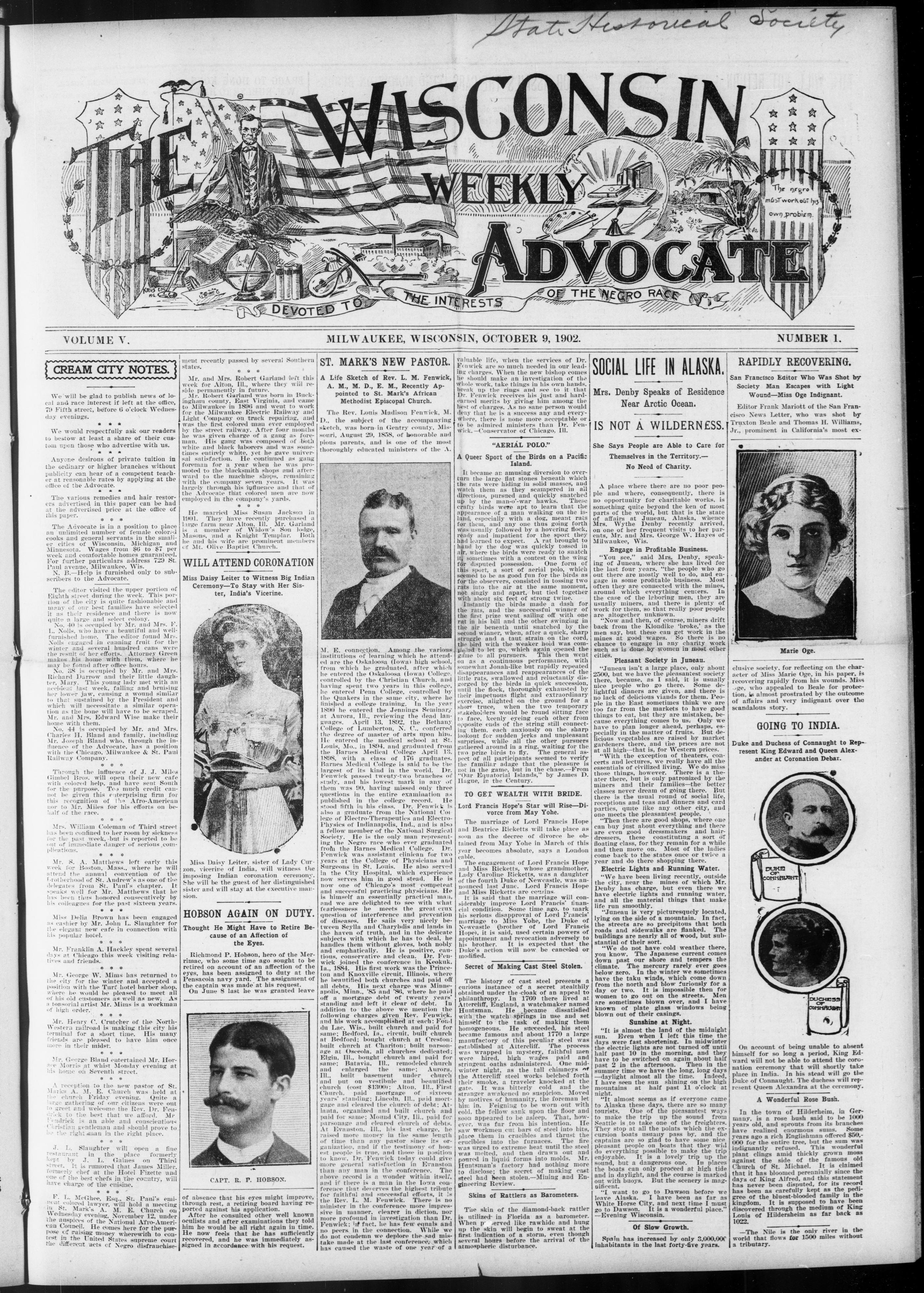
WISCONSIN
WEEKLY
ADVOCATE
DEVOTED TO THE INTERESTS OF THE NEGRO RACE
We will be glad to publish news of local and race interest if left at the office, 79 Fifth street, before 6 o'clock Wednesday evenings.
☆ ☆ ☆
We would respectfully ask our readers to bestow at least a share of their custom upon those who advertise with us.
☆ ☆ ☆
Anyone desirous of private tuition in the ordinary or higher branches without publicity can hear of a competent teacher at reasonable rates by applying at the office of the Advocate.
* * * *
The various remedies and hair restorers advertised in this paper can be had at the advertised price at the office of this paper.
***
The Advocate is in a position to place an unlimited number of female color-cooks and general servants in the smaller cities of Wisconsin, Michigan and Minnesota. Wages from $6 to $7 per week and comfortable homes guaranteed. For further particulars address 729 St. Paul avenue, Milwaukee, Wis.
N. B.—Help is furnished only to subscribers to the Advocate.
The editor visited the upper portion of Eighth street during the week. This portion of the city is quite fashionable and many of our best families have selected it as their residence and there is now quite a large and select colony.
No. 40 is occupied by Mr. and Mrs. F. L. Nolls, who have a beautiful and well-furnished home. The editor found Mrs. Nolls engaged in canning fruit for the winter and several hundred cans were the result of her efforts. Attorney Green makes his home with them, where he may be found after office hours.
No. 38 is occupied by Mr. and Mrs. Richard Darrow and their little daughter, Mary. This young lady met with an accident last week, falling and bruising her lower jaw, causing a wound similar to that sustained by the President and which will necessitate a similar operation as the bone will have to be scraped. Mr. and Mrs. Edward Wise make their home with them. No. 44 is occupied by Mr. and Mrs. Charles H. Bland and family, including Mr. Joseph Bland who, through the influence of the Advocate, has a position with the Chicago, Milwaukee & St. Paul Railway Company.
* * *
Through the influence of J. J. Miles Gimbel Bros. will open their new cafe with colored help, and have sent South for the purpose. Too much credit cannot be given this enterprising firm for this recognition of the Afro-American nor to Mr. Miles for his efforts on behalf of the race.
* * *
Mrs. William Coleman of Third street has been confined to her room by sickness for the past week, but is reported to be out of immediate danger of serious complications.
* * *
Mr. S. A. Matthews left early this week for Boston, Mass., where he will attend the annual convention of the Brotherhood of St. Andrew's as one of the delegates from St. Paul's chapter. It speaks well for Mr. Matthews that he has been thus honored consecutively by his colleagues for the past sixteen years.
***
Miss Delia Brown has been engaged as cashier by Mr. John L. Slaughter for the elegant new cafe in connection with his popular hotel.
☆ ☆ ☆
Mr. Franklin A. Hackley spent several days at Chicago this week visiting relatives and friends.
* * *
Mr. George W. Mims has returned to the city for the winter and accepted a position with the Turf hotel barber shop, where he would be pleased to meet all of his old customers as well as new. As a tonsorial artist Mr. Mims is a workman of high order.
* * *
Mr. Henry C. Crutcher of the North-Western railroad is making this city his terminal for a short time. His many friends are pleased to have him once more in their midst.
东 东 东
Mr. George Bland entertained Mr. Horace Morris at whist Monday evening at his home on Seventh street.
* * *
A reception to the new pastor of St. Marks A. M. E. Church was held at the church Friday evening. Quite a large gathering of our citizens were out to greet and welcome the Rev. Dr. Fendrick to the best that we afford. Mr Fendrick is an able and conscientious Christian gentleman and should prove to be the right man in the right place.
* * *
J. L. Slaughter will open a fine restaurant in the place formerly kept by J. L. Gaines on Third street. It is rumored that James Miller, formerly chef at the Hotel Fizette and one of the best chefs in the country, will have charge of the cuisine.
F. L. McGhee, Esq., St. Paul's eminent colored lawyer, will hold a meeting in St. Mark's A. M. E. Church on Wednesday evening, November 12, under the auspices of the National Afro-American Council. He comes here for the purpose of raising money wherewith to contest in the United States supreme court the different acts of Negro disfranchise-
ment recently passed by several Southern states.
Mr. and Mrs. Robert Garland left this week for Alton. Ill., where they will reside permanently in future.
Mr. Robert Garland was born in Buckingham county, East Virginia, and came to Milwaukee in 1896 and went to work for the Milwaukee Electric Railway and Light Company on track repairing, and was the first colored man ever employed by the street railway. After four months he was given charge of a gang as foreman. His gang was composed of both white and black laborers and was sometimes entirely white, yet he gave universal satisfaction. He continued as gang foreman for a year when he was promoted to the blacksmith shops and afterward to the machine shops, remaining with the company seven years. It was largely through his influence and that of the Advocate that colored men are now employed in the company's yards.
* * *
He married Miss Susan Jackson in 1901. They have recently purchased a large farm near Alton, Ill. Mr. Garland is a member of Widow's Son lodge, Masons, and a Knight Templar. Both he and his wife are prominent members of Mt. Olive Baptist Church.
WILL ATTEND CORONATION
Miss Daisy Leiter to Witness Big Indian Ceremony—To Stay with Her Sister. India's Vicerine.
THE LADY OF THE ROOM
Miss Daisy Leiter, sister of Lady Curzon, vicerine of India, will witness the imposing Indian coronation ceremony. She will be the guest of her distinguished sister and will stay at the executive mansion.
HOBSON AGAIN ON DUTY.
Thought He Might Have to Retire Because of an Affection of the Eyes.
Richmond P. Hobson, hero of the Merrimac, who some time ago sought to be retired on account of an affection of the eyes, has been assigned to duty at the Pensacola navy yard. The assignment of the captain was made at his request.
On June 8 last he was granted leave
19
CAPT. R. P. HOBSON.
of absence that his eyes might improve, through rest, a retiring board having reported against his application. After he consulted other well known oculists and after examinations they told him he would be all right again in time. He now feels that he has sufficiently recovered, and he was immediately assigned in accordance with his request.
ST. MARK'S NEW PASTOR.
A Life Sketch of Rev. L. M. Fenwick A. M., M. D., E. M., Recently Appointed to St. Mark's African Methodist Episcopal Church.
The Rev. Louis Madison Fenwick, M. D., the subject of the accompanying sketch, was born in Gentry county, Missouri, August 29, 1858, of honorable and pious parents, and is one of the most thoroughly educated ministers of the A.
[Picture of a man with a mustache and wavy hair, wearing a suit and a white shirt. The background is plain and light-colored.]
[The caption reads: "A man in a suit and white shirt, with a mustache and wavy hair, standing in a plain, light-colored background."]
valuable life, when the services of Dr. Fenwick are so much needed in our leading charges. When the new bishop comes he should make an investigation of the whole work, take things in his own hands, break up the rings and see to it that Dr. Fenwick receives his just and hardearned merits by giving him among the best of charges. As no sane person would deny that he is a success any and everywhere, there is none more acceptable or to be admired ministers than Dr. Fenwick.—Conservator of Chicago, Ill.
"AERIAL POLO."
A Queer Sport of the Birds on a Pacific Island.
It became an amusing diversion to overturn the large flat stones beneath which the rats were hiding in solid masses, and watch them as they scampered in all directions, pursued and quickly snatched up by the man-o'-war hawks. These crafty birds were apt to learn that the appearance of a man walking on the island, especially with a dog, meant rats for them, and any one thus going forth was usually followed by a hovering flock, ready and impatient for the sport they had learned to expect. A rat brought to hand by the dog was quickly tossed in air, where the birds were ready to snatch it, sometimes with a contest on the wing for disputed possession. One form of this sport, a sort of aerial polo, which seemed to be as good fun for the birds as for the observers, consisted in tossing two rats into the air at the same moment, not singly and apart, but tied together with about six feet of strong twine.
Instantly the birds made a dash for the rats, and the successful winner of the first prize went sailing off with one rat in his bill and the other swinging in the air beneath until snatched by the second winner, when, after a quick, sharp struggle and a taut strain on the cord, the bird with the weaker hoid was compelled to let go, which again opened the game to all pursuers. This then went on as a continuous performance, with somewhat Jonah-like but rapidly repeated disappearances and reappearances of the little rats, swallowed and reluctantly disgorged by the birds in quick succession, until the flock, thoroughly exhausted by their impetuous flight and extraordinary exercise, alighted on the ground for a short truce, when the two temporary stakeholders would be round sitting face to face, keenly eyeing each other from opposite ends of the string still connecting them, each anxiously on the sharp lookout for sudden jerks and unpleasant surprises, while all the other pursuers gathered around in a ring, waiting for the two prize birds to fly. The general aspect of all participants seemed to verify the familiar adage that the pleasure is not in the game, but in the chase.—From "Our Equatorial Islands," by James D. Hague, in the Century.
TO GET WEALTH WITH BRIDE
Lord Francis Hope's Star will Rise—Divorce from Mav Yohe.
The marriage of Lord Francis Hope and Beatrice Ricketts will take place as soon as the decree of divorce he obtained from May Yohe in March of this year becomes absolute, says a London cable.
The engagement of Lord Francis Hope and Miss Ricketts, whose grandmother, Lady Caroline Ricketts, was a daughter of the fourth Duke of Newcastle, was announced last June. Lord Francis Hope and Miss Ricketts are cousins.
It is said that the marriage will considerably improve Lord Francis' financial condition. Some time ago, to mark his serious disapproval of Lord Francis' marriage to Miss Yohe, the Duke of Newcastle (brother of Lord Francis Hope), it is said, used certain powers of appointment and revocation adversely to his brother. It is expected that the Duke's action will now be canceled or modified.
Secret of Making Cast Steel Stolen.
The history of cast steel presents a curious instance of a secret stealthily obtained under the cloak of an appeal to philanthropy. In 1760 there lived at Attercliff, England, a watchmaker named Huntsman. He became dissatisfied with the watch springs in use and set himself to the task of making them homogeneous. He succeeded, his steel became famous and about 1770 a large manufactory of this peculiar steel was established at Attercliff. The process was wrapped in mystery, faithful men were hired, high wages paid and stringent oaths administered. One midwinter night, as the tall chimneys of the Attercliff steel works belched forth their smoke, a traveler knocked at the gate. It was bitterly cold and the stranger awakened no suspicion. Moved by motives of humanity, the foreman let him in. Feigning to be worn out with cold, the fellow sank upon the floor and soon appeared to be asleep. That, however, was far from his intention. He saw workmen cut bars of steel into bits, place them in cruisibles and thrust the crucibles into the furnaces. The fire was urged to extreme heat until the steel was melted, and then drawn out and poured in liquid forms into molds. Mr. Huntsman's factory had nothing more to disclose; the secret of making cast steel had been stolen.—Mining and Engineering Review.
Skins of Rattlers as Barometers.
The skin of the diamond-back rattler is utilized in Florida as a barometer. When preserved like rawhide and hung up the skin will begin to sweat at the first indication of a storm, even though several hours before the arrival of the atmospheric disturbance.
SOCIAL LIFE IN ALASKA.
She Says People are Able to Care for Themselves in the Territory.— No Need of Charity.
A place where there are no poor people and where, consequently, there is no opportunity for charitable works, is something quite beyond the ken of most parts of the world, but that is the state of affairs at Juneau, Alaska, whence Mrs. Wythe Denby recently arrived, on one of her frequent visits to her parents, Mr. and Mrs. George W. Hayes of Milwaukee. Wis.
Engage in Profitable Business.
"You see," said Mrs. Denby, speaking of Juneau, where she has lived for the last four years. "the people who go out there are mostly well to do, and engage in some profitable business. Most often they are connected with the mines, around which everything centers. In the case of the laboring men, they are usually miners, and there is plenty of work for them, so that really poor people are altogether unknown.
"Now and then, of course, miners drift back from the Klondike 'broke,' as the men say, but these can get work in the mines at good wages. So there is no chance to engage in any charity work such as is done by women in most other cities.
Pleasant Society in Juneau.
"Juneau isn't a large place, only about 2500, but we have the pleasantest society there, because, as I said, it is usually nice people who go there. Some delightful dinners are given, and there is no lack of delicious viands for them. People in the East sometimes think we are too far from the markets to have good things to eat, but they are mistaken, because everything comes to us. Only we have to plan longer ahead, perhaps, especially in the matter of fruits. But delicious vegetables are raised by market gardeners there, and the prices are not at all high—that is, for Western prices.
"With the exception of theaters, concerts and lectures, we really have all the essentials of civilized living. We do miss those things, however. There is a theater there, but is only patronized by the miners and their families—the better classes never dream of going there. But there is the usual round of social life, receptions and teas and dinners and card parties, quite like any other city, and one meets the pleasantest people.
"Then there are good shops, where one can buy just about everything and there are even good dressmakers and hairdressers, these constituting a sort of floating class, for they remain for a while and then move on. Most of the ladies come back to the states once or twice a year and do there shopping there."
Electric Lights and Running Water.
"We have been living recently, outside the city, near the mines of which Mr. Denby has charge, but even there we have electric lights and running water, and all the material things that make life run smoothly.
"Juneau is very picturesquely located, lying on the side of a mountain. In fact, the streets are so precipitous that both roads and sidewalks are flanked. The buildings are nearly all of wood, but substantial of their sort.
"We do not have cold weather there, you know. The Japanese current comes down past our shore and tempers the climate. The mercury rarely ever goes below zero. In the winter we sometimes have the taku winds, which come down from the north and blow furiously for a day or two. It is impossible then for women to go out on the streets. Men are sometimes blown over, and I have known of plate glass windows being blown out of their casings.
Sunshine at Night.
"It is almost the land of the midnight sun. Even when I left this time the days were fast shortening. In midwinter the electric lights are not turned off until half past 10 in the morning, and they have to be switched on again about half past 2 in the afternoon. Then in the summer time we have the long, long days—daylight almost all the time. Indeed, I have seen the sun shining on the high mountains at half past 11 o'clock at night.
"It almost seems as if everyone came to Alaska these days, there are so many tourists. One of the pleasantest ways to make the trip up the sound from Seattle is to take one of the freighters. They stop at all the points which the excursion boats usually pass by, and the captains are so glad to have some nice pleasant people on boats that they will do everything possible to make the trip enjoyable. It is a lovely trip up the sound, but a dangerous one. In places the boats can only proceed at high tide and in daylight, and the course is marked out with buoys. But the scenery is magnificent.
"I want to go to Dawson before we leave Alaska. I have been as far as White Horse City, and next time I must go to Dawson. It is a wonderful place."
—Evening Wisconsin.
Of Slow Growth.
Spain has increased by only 3,000,000 inhabitants in the last forty-five years.
RAPIDLY RECOVERING.
San Francisco Editor Who Was Shot by Society Man Escapes with Light Wound—Miss Oge Indignant. Editor Frank Mariott of the San Francisco News Letter, who was shot by Truxton Beale and Thomas H. Williams, Jr., prominent in California's most ex-
A.
Marie Oge. elusive society, for reflecting on the character of Miss Marie Oge, in his paper, is recovering rapidly from his wounds. Miss Oge, who appealed to Beale for protection, is almost prostrated by the outcome of affairs and very indignant over the scandalous story.
GOING TO INDIA.
Duke and Duchess of Connaught to Represent King Edward and Queen Alexander at Coronation Debar.
DUKE
OF
CONNAUGHT
DUCHESS
OF
CONNAUGHT
On account of being unable to absent himself for so long a period, King Edward will not be able to attend the coronation ceremony that will shortly take place in India. In his stead will go the Duke of Connaught. The duchess will represent Queen Alexandra at the ceremony.
A Wonderful Rose Bush
In the town of Hilderheim, in Germany, is a rose bush said to be 1000 years old, and sprouts from its branches have realized enormous sums. Some years ago a rich Englishman offered $50,-000 for the entire tree, but the sum was indignantly refused. This wonderful plant clings amid thickly grown moss against the side of the famous old Church of St. Michael. It is claimed that it has bloomed perennially since the days of King Alfred, and this statement has never been disputed, for its record has been as carefully kept as the pedigree of the bluest-blooded family in the kingdom. It is supposed to have been discovered through the medium of King Louis of Hildersheim as far back as 1022.
The Nile is the only river in the world that flows for 1500 miles without a tributary.
EEE EEO
MEH WILL NOT RETURN.
Preserce of Entire United States
Army Would Avail Nothing.
LOCAL UNIONS ACT.
Vote to Hold Out Until Demands of the
Shamokix Convention are Com-
plied With by Operators.
Wilkesbarre, Pa., Oct. 8—The follow-
ing official statement was issted from
strike headquarters at 1 o'clock this aft-
ernoon:
At 12:30 noon fifty telegrams had been
received from as many mass meetings In
various sections of the anthracite coal
regions, conveying the information that by
unanimous yote of the men on strike, all
of whom attended such meetings, It was
resolved that the presence of the entire
United States army in the anthracite coal
regions would not induce the men to re-
turn to work until the demande of the
Shamokin convention had been conceded,
the strike declarea off by a delegate conven-
tion of mine workers, or by the district and
national ee
Similar tefegrams are constantly _belng
received and it is expected that every min-
ing town will be heard from by 6 o'clock
tonight.
‘Thus far the returns emphasize and sub-
stantlate the declarations of the officials
of the miners’ union made at the Washing-
ton conference, that the strikers are not
deterred from going to work through fear
of bodily harm.
(Signed) JOHN MITCHELL.
President Mitchell and the three dis-
trict presidents left for New York at
3:05 on the Lehigh Valley railroad.
They are due in New York at 8:30
o'clock tonight. Mr. Mitcheli and his
associates refused to say wh™% their mis-
sion was.
Want Action, Not Talk.
New York, Oct. 8.—The presidents of
the anthracite coal roads and John Mar-
kle have received a telegram from the
committee ef the National Association
of Munufacturers asking for a confer-
ence tomerrow at. the Manufacturers’
Club in Philadelphia, Two of the oper-
ators named have announced their inten-
tion to decline the invitation,
President Fowler of the Ontario &
Western said that there was nothing
new in the situation as far as his road
was concerned,
“This is not the time to talk,” said
President Fowler, “it’s the time for ac-
tion, We are trying our best to mine
coal and will bend all our energies in
that direction.”
Attack on Coal Train.
Harrisburg, Pa., Oct. 8.—The first out-
break of disorder since the marches and
arrests of two weeks ago occurred at
Williamscown last night, when an at-
temnt was made to move thirty-two cars
of coal from the siding of the Likens
Vallev Coal Company.
When the Summit Branch Railroad
Company attempted to move the loaded
ears. the coupling pins were drawn and
the engine held to back the cars again.
This occurred five times and there were
some stones thrown at the cars. Finally
the trainmen got the cars coupled aud
started off with the train amid the hoots
and jeers of men and boys.
When the cars were taken throuch
Wiconisco there was a demonstration and
the train crew was jeered. Soon after
the train passed through the town aud
threw stones at the houses of men who
had been working. No damage was done
and the men a? away before they could
be detected by the sheriff's deputies.
An Unlawful Combination.
Philadelphia, Pa., Oct. 8.—Frank H.
Thompson of this city began proceedings
today in the United States cireuit court
to have the Philadelphia & Reading rail-
way, the Central Railroad of New Jer-
sey, the Lehigh Valley railroad, the Dela-
ware, Lackawanna < Western railroad,
the Delaware & Hudson railroad and the
New York, Ontario & Western Raiiroad
Company declared an illegal combination
because they are engaged in an unlawful
restraint of the anthracite coal supply.
Mr. Thompson also requests that the
representatives of the companies ‘be re-
strained and prohibited from meeting to-
gether for the purpose of fixing the rate
of coal or market price thereof.”
One Company Makes Denial.
Albany, N. Y., Oct. 8—The hearing
which was to have been given today be-
fore Attorney General Davies on the ap-
plication to commence proceedings
‘against the coal carrying railroad com-
panies operating in this state, which con-
trol the anthracite fields in Pennsylvania,
has been adjourned until October 15 at
the jos eee of the railroad companies.
The enusylvania Railroad Company
filed an answer in which it denies that it
is a party to any illegal combination.
MITCHELL SAYS NO.
Miners’ Chief Says Proposition of Presi-
dent Cannot be Entertained.
Philadelphia, Pa., Oct. 8.—A request
from President Roosevelt that the an-
thracite coal miners return to work, and
promising a full investigation of the dif-
ferences with the operators, was au-
swered in the negative by, John Mitchell,
ag representative of the men,
That the miners will abide by the deci-
sion of their leader is considered certain.
Reports from all points in the anthracite
district indicated that few favored a re-
turn to work until the operators at least
have met the men half way.
'The proposition of President Roosevelt
that he would do all possible to secure a
settlement between the workers and em-
ployers, if the latter would return to the
mines, was Soeie to President
Mitchell at Buffalo. He declared the
plan impossible, and word was sent to
the nation’s executive, through Samuel
Gompers, president of the American Fed-
eration of Labor, now in Washington,
that the question of resuming work on
such terms ¢ould not be entertained.
Strikers Discuss Proposition.
An officer of the union now in the city,
who does not care to be quoted in the
absence of President Mitchell, for fear
that it would be coustrued as being olli-
cial, said teduy:
“The anthracite mine workers of Penn-
sylvania appreciate the efforts being made
by President Roosevelt to end the strike
in the interests of the entire country,
and ey have only words of praise for
hin. owever, they hold that after sac-
rificing everything for the iast five manths
it would be unfair for anyone to ask
them to return to work without a single
concession, especially when the miners see
victory almost at hand.
“The hard coal diggers of Pennsyl-
vania have gone into the ficht to win,
and they would not be doing justice to
themselves or to the great body of or-
ganized workmen throughout the coun-
try and other persons who have and are
financially assisting them in the present
struggle.” x
Not to be Settled by Troops.
‘There is a feeling among some of these
officials that the mere move of sending
all the troops into the coal region may
not have the desired effect in bringing
about an early resumption of the. coi-
Jieries. An official of one of the largest
coal companies in the territory is au-
Spcity for the sfatement that an early
resumptien depends altogether upon
where the officers place the troops.
If Gov. Stone's order that “all men who
desire to work, and their families, shall
have ample military protection” is liter-
ally carried out, instead of mobilizing the
troops at certain points, then the com-
panies will be able to make good progress
in opening up the mines.
“Iy the troops are kept in all commu-
nities where violence and intimidation is
racticed,” this official said, “there will
fe no trouble. The difficulty now is that
a man goes to work one day under the
rotection of the soldiers and the next
Say, after the neighborhood has been
quieted down, the troops will be sent
away and the willing workman is again
‘at the mercy of the Inwless element. Men
‘will not risk going to werk today when
‘they are not sure they will have protec-
tion tomorrow or that their families will
be cared for in their absence.”
Return to Wilkesbarre.
Wilkesbarre, Pa., Oct. 8—National Pres-
‘ident Mitchell of the Miners’ Union and
‘tie three anthracite district president re-
turned to this city from Buffalo early
this morning. The chief of the miners
had nothing to say regarding yesterday's
‘trip and also declined to discuss Presi-
dent Roosevelt’s proposition for ending
the strike.
Several of the locals met yesterday and
last night. All of them voted to stay out
and it is predicted that when the com-
plete returns are in it will be found that
‘the vote to continue the strike will be
nearly unanimous.
| The mail matter received at strike
headquarters is increasing as the ther-
mometer goes down. Probably the larg-
est mail since the strike was inaugurated
i was received today. Scores of letters are
| from eccentric persons, giving advice as
to what to do, and many are received
from persons who want the strike ended
so that they can get coal. One postal
card reached headquarters from Canada
l'on which was written:
| “Please take the advice in the third
chapter, fourteenth verse St. Luke’s gos-
pel and let us have some coal.”
? ADVICE FROM THE BIBLE, *
: And the soldters Hkewise demand- :
ted of Him, saying, And what shall :
:we do? And He salfl unto them, :
: Do violence to no mun, neither ac- :
:euse any falsely; and’ be content :
: with you wages. :
A Sabbath-like — stillness reigned
throughout the Wyoming valley this mora-
ing, neither the sheriff nor the soldiers
receiving a single call for assistance. It
is not definitely known how the troops of
the Third Brigade, which has been as-
signed to this territory, will be distrib-
uted = Uiseacenat at
Coal Shipments.
Reading, Pa., Oct. 8.—About 100 cars
of coal have passed through Reading
down the road to Philadelphia on the
Philadelphia & Reading railway since
yesterday. Nearly ali_of it was coal
from the washeries, For some reason
fresh mined anthracite shipments have
practically ceased. In the west end of
Schuylkill county, where there are no
troops, coal is being mined at Brookside,
Good Spring and Lincoln collieries, the
railway officials claim,
Buying Coal Abroad.
New York, Oct. 8.—At least 300,000
tons of coal—anthracite, bituminous and
non-bituminous—have been purchased in
England, Scotland and Wales for export
to this side, according to estimates made
today by paiparens and steamship
agents. My. Mackey, in eharge of the
coal imports of Barber & Co., steamship
agents, said today that his firm. had
100,000 tons of the best Scotch and
Welsh anthracite and all grades of bi-
tuminous and non-bituminous coal. Of
this amount 15,000 tons was coming to
New York, the remainder to Philadel-
phia, Baltimore and Boston.
REAR-END COLLISION.
Engine Plougs Half-Way Through the
Mail Car—Express Messen-
ger Killed.
New York, Oct. 8—One man was
killed and twelve persons injured in a
rear-end collision of passenger trains on
the Pennsylvania railroad near Menlo
Park, N. J., today. The Western express
was run into the local passenger train
from Philadelphia.
The mail car was on the end of the
eps and received the full force of the
collision. Fhe engine ploughed half way
through it and the front of the mail car
was forced on top of the coach ahead.
The dead man was Courtney Silpath,
an express messenger.
Train No. 6 was about three and a
half hours late and was standing at the
Menlo Park station for the purpose of
cooling a hot box. Knowing that No.
76, a local from Philadelphia, was due,
the passengers on the express were told
to leave the train and a fiagman was
rushed back. There is a very sharp
curve just at this point and the flagman
had hardly reached it when the Philadel:
phia train came around the curve at a
high rate of speed. The engineer de
clares that his brakes failed to work.
Many of the passengers on the express
had not had time to leave the train when
the big engine crashed into the rear.
Family of La Crosse Man Missing for
Several Days—Murder and Sui-
cide Feared.
Keokuk, Ia., Oct. 8.—Police are search-
ing this city and the surrounding coun-
try for Mrs. Kate Huston and her four
little girls. They are the entire famiiy
of William Huston, who came here
with them from La Crosse, Wis., one
week ago, to start a feed store. Huston
reported to the police that his wife had
aise poesces last Friday night, when he
reached his home, and had left no trace.
The children range from 18 months to 11
years in age, and disappeared with the
mother. A note was found lying on a
table in the deserted home. It contained
simply the name and address of a promi-
nent business man of Keokuk, who says
he never heard of Mrs, Huston before.
The husband and the sister of the miss-
ing woman fear she has killed the chil-
dren end committed suicide.
RAIDED BY LADRONES.
eo ee
Bandits Levy Tribute on Natives cf
Biliran Island—Fights with
Constabulary.
Manila, Oct. 8.—Ladronisra is rampant
on Biliran island. There have been re-
peated and simultaneous attacks on
towns, and once a levy of tribute. The
constabulary have attacked the ladrones
several times with great gallantry and
both sides have lost heavily. Business is
ut a standstill. Reinforcements ars be-
is sent to the island.
t is believed that the trouble is caused
by a general combination of the gangs
that were recently driven from the island
of Leyte. Widespread ladronism is ex-
pected until the harvest time. The situa-
tion is the natural result of poverty, the
large number of unemployed and the
scarcity of cariboes,
MOB ASSAILS THE CARS.
Strikers Resist Efforts of Railway
Company to Operate Its Lines.
SEVERAL BADLY HURT.
New Orleans Police Charge Rioters and
General Melee with Clubs and
Pistols Follows.
New Orleans, La., Oct. 8.—The first
attempt to run cars from the Canal street
barn which was made at 8 o'clock this
morning resulted in a serious riot in
which Policeman Schlessinger was shot
through the head and probably fatally
injured; Conductor Kennedy was shot in
the hand; Motorman Ferguson, a striker,
was shot through the arm, and a number
ef policemen were painfully wounded by
fiying missiles, Fifty shots Were fired
during the disturbance.
The Riot Begins.
The first car which started from th>
barns was in cnarge of Motorman Fred
Nintz of Chicago and Conductor M. L.
Kennedy. There was on board a large
force of policemen and Peter Johuson
and ‘Alfred Clark, the two men from Chi-
cago who arrived here last night with a
force of thirty men to take the art ot
the strikers. An immense crowd of peo-
ple, including strikers, their sympathizers
and curious people, were on the street.
As the car approached the corner ef Dor-
genois street, members of the mob rushed
out, tore up planking from either side of
the street and threw it across the track.
Then bricks and stones filled the air.
Qbstructions brought the car to a
standstill and a rush was made for the
nonunion men on board. There was such
a hail of missiles that the police and
others on board had to duck to save
themselves. As the car stopped numbers
of bluecoats jumped off in an attempt
to press back the strikers. Immediately
a shot was fired. Then a perfect fusil-
lade of shots came from both sides aud
the car was enveloped in smoke,
Two Men Terribly Beaten.
In the meantime R. D. Kountz, a young
man of Luray, Va., who was on the ear,
ran out and attempted to clear the track
of the planks and debris that had been
thrown upon it. He was pelted with
bricks and stones, but was perfectly cool
and had pretty well cleared the track
when the mob descended on him and
overwhelmed him. Clark and Johnson
were dragged from the car and terribly
beaten before the police could fight off
the mob and rescue them.
Police Charge the Mob.
Police reinforcements were rushed :o
the scene and after a long struggle the
space immediately around the car wis
cleared. It was then found that Officer
Schlessinger had been shot in the head,
Motorman Ferguson, a striker, through
the arm, and Conductor Kennedy in the
hand, and that a number of policemen
had been painfully hart by flying mis-
siles, Fifty shots were fired.
Motorman Nintz is charged with hav-
ing fired the first shot from the street
ear, Orders for his arrest have been
issued, After the rioting the car was
run back to the barn and it is now said
that no further efforts to operate cars
will be made until the troops are on the
scene. The mayor sent today for Gen.
Glynn, who commands the First _Bri-
gade. He said the troops were ready to
respond to any call made upon them, but
that nothing could be done until the gov-
ernor be communicated with. The may-
or is using every effort to reach Gov.
Heard.
Nonunion Men Armed.
All the nonunion men who were on the
ear attacked today were armed and all
of them are said to have used their
weapons during the attack.
Alexander Derby, a laborer and by-
stander, was shot in the leg during the
rioting.
At 9:30 this morning, Manager Wood
of the railway company announced his
intention of cperating cars today, though |
none had been run out of the barn up to
that time except a mail car which start-
ed at 7 o’clock and was allowed to pro-
ceed in an uninterrupted manner by the
mob which was in the neighborhood.
The police, consisting of mounted men,
and men on foot, were stationed along
the street for the distance of 2 mile and
seemed to have the crowd in hand more
effectively than they did yesterday.
Arrests will be Made.
Jt is said warrants will be sworn out
in the federal court against many of the
men who participated in the rioting yes-
terday, on the ground that the service of
the mail cars was interrupted. Secret
service agents from Washington are re-
ported to be here and co-operating wita
the local police officials.
One hundred and twenty members of
the police force guarded the barns of the
railway company during the night. It
was feared that some attempt might be
made to fire them.
A number of the men who came from
Chicago are reported to have been cap-
tured by the strikers and to have deserted
te~ he union.
i Governor to Send Troops.
Goy. Heard was finally located this
afternoon. He is on his way home from
Farmerville. It is expected that before
night the call for troops will be issued.
All the Chicago men who were on the
ear attacked today have been placed un-
der arrest ‘charged with carrying con-
ecealed weapons and with inciting riot.
A patrol wagon returning to head-
quarters with a large force of policemeu
and a number of Saerepee attracted the
attention of a mob which believed that
Strike Breaker Eidson of St. Louis was
aboard. In trying to escape from the
crowd the driver turned the wagon over.
Six policemen were hurt, Officer Fordyce
MEDICAL LAW HELD VALID.
Indiana Supreme Court Rules on a
Clause Attacking Quacks.
Indianapolis, Ind., Oct. 8.—The state
supreme court decided that the medical
act of 1901 was constitutional. The
court formerly held the act of 1897 con-
stitutional, but this act was amended in
1901 by a definition of what constitutes
the practice of medicine which was tu-
tended to drive out of Indiana persons
that go by the name of “professor” or
“healer.” The state medical board is
pleased with the outcome of the suit.
The “healers” and “professors” may be
attacked in many ae of the state. By
some it is believed that the law applies
to Christian Scientists.
Ss
Thickness of Glaciers.
A few oa ago Profs. Blumcke and
Hess, from Bavaria, who are well known
for their studies of glaciers, succeeded in
boring through the Hinteries glacier in
the Otzthal Alps, at a point where the
ice was found to be 153 meters deep.
————_-_
Safest Boat that Floats
In considering boats the dory, a flat-
bottomed, lap streak boat, though but i2
er 13 feet long, is the safest that floats.
FIND MONEY ON BUSHES.
A VALUABLE CROP DISCOVERED In
NEB-_.ASKA.
Section Men Pluck Thousands of Doilazs
Along a Railroad Way-
side.
Lincoln, Neb., Oct. 7.—The fairy tale
of money growing on bushes was re-
alized this week along the right of way
of the Burlington railroad, between Hy-
annis and Alliance.
A gang of section men were at work
when ove of them neticed something
that looked like a bill waving from the
tangled top of a sunflower growing by
the roadside. He investigated. It was
a treasury note for $10,
*He walked a few steps further and
there, nodding trom a branch of a bit of
dog fennel, was another bill of similar
genomination,
He called to his companions and the
entire gang threw down their tools and
started on a money hunt. For three
hours they searched up and down the
right of way and far akeld.
At almost 2 yard their trouble
was rewarded by finding either a tive or
a ten-doliar bill, Some bills were tan-
gled in the ee of weeds, others half
hidden in bushes along the fence and
still others in the stubble of the field.
‘The entire day’s clean-up of the eight
was $2135. When the find was reported,
word came from headquarters that a
money pouch containing $2500 had been
lost from an express shipment the day
before.
The supposition is that the bag fell
out of the open car door and was ground
t» pieces under the wheels and the con-
tents were scattred to the winds. This
hypothesis is supported by the latter dis-
covery of portions of the damaged
pouch_
VENICE IN DANGER.
Church of St. Mark, the Palace of the
Doges and Other Structures in
Shaky Condition.
| Venice, Oct. 7.—The Church of St.
Mark, the Doge’s palace, the Procuratie
Vecchie, the Zecca, and the Churches of
‘Santa Maria Gloriosa Dei Frari and SS,
| Giovanni E. Paolo need prompt atteu-
tion if catastrophies are to be averted.
In St. Mark’s there is a crack in the
great arch of the Apocalypse, aud t e
arch sags downward almost a foot. [\
is expected that it will be necessary to
remove all the mosaics of the arch aud
that the brick wall behind them will
have to be more solidly constructed.
In the Doge’s Palace diagonal lesions
are visible and it looks as though the
briek work were tumbling outward. The
correspondent says that this is not sur-
prising, seeing that one of the chief iu-
ternal walls was cut through in order to
‘make room for an elevator for the heay-
ier books in the Biblioteca Marciana.
In the Procuratie Vecchie there are
serious cracks, caused probably by the
wholesale demolition of internal walls
‘and the stacking of heavy goods in the
Foomns aboy* the Colonnade.
T’ ere is ' msideralile comment on the
foll, ot thetc.vA engineering corps which
is }.eparing to remove the Biblioteca
Marciana to the Zecca. The latter build-
ing is already in a rickety condition from
top to bottom. The engineers intend to
roof in the “Renaissance courtyard so as
to make a reading room ont of it. It is
promis that the place will tumble in
efore the library can be opened.
Regarding the general subsidence of
Venetian soil, it is said that the land has
sunk at the rate of about 3% inches a
century.
AFTER THAT CUP.
Lipton’s Third Challenge for a Series of
Races Signed and
Posted.
London, Oct. 7.—Sir Thomas Lipton's
third challenge for a series of races for
the America’s cup was signed this morn-
ing at Belfast, Ireland, by the officials
of the Royal Ulster Yacht Club. Charles
Russell represented Sir Thomas Lipton.
The challéage was immediately posted
and goes to New York on the White Star
steamer Oceanic, which sails from Liver-
pool tomorrow and from Queenstown on
ace
The Associated Press understands that
the terms of the challenge do not ma-
terially differ from those of 1900. The
first races are expected to take place in
August. ke
Sir Thomas Lipton said: “I cannot
discuss the terms until the officials of
the New York Yacht Club has had an
opportunity to deal with them.”
Secak pein tea
MODERNIZED WILLIAM TELL.
Youth Who Heid Cigar in Mouth, as a
Target, is Injured.
Houghton, Mich., Oct. 7—Homer Pen-
nock, 20 years old, of Baraga, lies in a
critical condition as the result of a mod-
ernized William Tell act. Pennock and
edward Robillard, who is of the same
age, secured a rifle and practiced shoot-
ing cigars out of each other's mouth.
Pennock shct first and missed; then
Robillard teok nim_at a cigar held be-
tween the lips of Pennock. He missed
the cigar, but the bullet tore away part
of Pennock’s jaw.
teal ees
A Lake Superior Pioneer.
Calumet, Mich., Oct. 7.—Charles Kunz,
one of the earliest pioneers of the Lake
Superior copper district, died at Eagle
Harbor. the came here nearly sixty
years ago and was sheriff of Keweenaw
county when slawlessness was at its
height. He was 80 years old.
a
Into Barrel of Boiling Water.
Iron Mountain, Mich., Oct. 7—Herman
Dundin, a surface employe at the Ara-
gon mine, while walking in the dark
stepped into a barrel of boiling water,
which was sunk in the ground with its
top level with the surface. He may die.
Tunnel Under the Thames.
A tunnel under the Thames for the
accommodation of pedestrians has been
recently completed and opened to the
public. It is a tube 11 feet in diameter,
1217 feet long, with the top 13 feet be-
low the river bed. It is accessible by
electric elevators and a spiral iron stair-
way at either end.
Siti ny
Free Lunches in India.
The free lunch habit is much in vogue
in Egypt. In one bar-room at Cairo the
purchaser of a glass of beer for 3 cents
gets seven little plates with bread, olives,
potato and green salad, beans, liver and
mussels on them. There are replenished
with every glass of beer.
ee
a ber
WANTED QUICK niptuet Ian ee
trial, positions, good any; advancements. Can't
fill half demands. Address H. O. Howland, Mgz.,
‘Wisconsin School of Telegraphy, Oshkosh, Wis.
BRAGG TO HONG KONG
WM. RUBLEE TO HAVANA
Fond du Lac Man is Transferred te a
Post of Similar Rank in China—
Result of Pig Whistle Episode.
Washington, D. C., Oct. 8.—Edward
S. Bragg, consul general at Havana,.has
been transferred to the post of United
States consul general at Hong Kong,
taking the place of William A. Rublee,
who has Leen transferred to the consul-
ate at Havana,
The transfer of Consul General Bragg
trem Havana to Hong dXong is undoubt-
edly the result of an indiscreet, or rather
undiplomatie letter which Gen. Bragg
wrote to his wife shortly after arriving
at his post in Havana. In that letter,
which Mrs. Bragg gave to the news-
papers for publication without thought
of the effect it would have, Gen. Bragg
stated that it would be about as easy to
make a whistle out of a pig's tail as to
make good citizens out of the Cubans.
‘This language was resented by the Cu-
bans and was called to the attention of
the state department at Washington and
to President Roosevelt by the Cuban. min-
ister. Gen. Bragg sought refuge in the
fact that the letter was private and of
no concern to anybody but himself and
his wife. The incident was supposed to
be closed for good, but today’s appoint-
ments indicate that the officials at Wash-
ington deemed it necessary to palliate
Bragg’'s offense in some degree.
William A. Rublee, who will succeed
Bragg as consul general at Havana, is a
son of the late Horace Rublee and was
employed on the editorial staff of the
Sentinel at the time of his appointment.
FIRE IN OIL FIELDS.
Workman Exposes a Lantern in an At-
mosphere Heavily Laden
. with Gas.
Beaumont, Tex., Oct. 8.—Another de-
structive fire, the second within a month,
swept over a portion of the oil field last
night, causing one known fatality and
entaihag a property loss roughly es-
timated at $100,000. The fire at 2
o'clock this morning is still burning, but
practical oj] men declare the flames will
scon subside. Thomas Rowley, a worker
in the fields, was caught in the path of
the flames and sustained burns from
which he will die. This is believed to be
the only casualty.
The tire started-in a peculiar manner:
Shortly before midnight a workman lift-
ed the top of his lantern to blow out the
light. ‘The atmosphere was heavily
laden with gas and in an instant there
was a flash, followed by a sheet of flame.
The blaze was communicated to a small
settling tank near by owned by J. S. Cor-
bett. In an instant a derrick, adjoining
the tank, was enveloped in fire and with
remarkable rapidity the flames spread to
other derricks in the Hogg-Swayne
tract, which comprises one of the largest
sections of the oil fields. The fire de-
partments and hundreds of citizens
rushed to the scene, but their efforts to
check the flames were unavailing, Ex-
citement ran high and in the confusion
2 rumor became current that tweive or
fifteen persons had perished in the
flames. This report was telephoned to
many outside towns, but careful inves-
tigation at a later hour showed that only
one fatality occurred. ‘here are no
gushers in the immediate vicinity of the
fire and unless a strong wind should de-
velop it is believed that the damage will
be confined to the destruction of seventy-
five derricks and twenty pumping plants.
Big Blaze in Chicago.
Chicago, Oct. 8.—The building of the
Pittsburg Plate Glass Company on Wa-
bash avenue was destroyed by fire which
started at 2:30 this morning. The loss
will be $250,000,
Jn the rear of the structure and facing
on Michigan avenue is the Bucklen apart-
ment building, which became filled with
smoke as the fire progressed. An alarm
was given and within a few minutes hun-
dreds of persons were rushing from the
building, some of them clad only in their
night clothes. These were cared for by
the oe and two fire companies were
detailed to watch the building.
After an hour’s hard fight Chief
Musham declared a fear of any spread
of the flames to tle apartment building
had passed and announced the fire under
coatrol, -
it developed later that the fire liad
probably been started by explosions of
gasoline in the basement of the building.
A policeman said that several panes of
glass were blown out of the basement
windows a short time after the fire was
discovered,
Loss will be Very Heavy.
Birmingham, Ala., Oct. 8—The build-
ings of the Moore & Handley Hardware
Company, on Powell ayenue, the largest
wholesale hardware house in the South,
are burning. The fire seems to be beyond
the contra] of the department and it looks
as if the loss will te very heavy, prob-
ably $500,000. Adjoining the Moore &
Handley buildings are immense freight
depots.
BRITISH STEAMER SUNK.
Collision with North German Lloyd Liner
in Dense Fog—Mate and One
Passenger Drowned.
London, Oct. 8.—The North German
Lloyd steamer Kron Pring Wilhelm,
which sailed from Southampton today for
New York, ran into and sank the British
steamer Robert Ingham during a dense
fog, off Beachy Head this morning. ‘Phe
Robert Ingham went down about four
minutes after the collision, but the Kron
Prinz Wilhelm saved all her crew of
thirteen men with the exception of the
mate and the only passenger she had on
board.
The Kron Prinz Wilhelm suffered no
damage whatever and proceeded on her
voyage after landing the shipwrecked
men at Southampton.
ela apiece eat:
BRAKEMAN HAS FIVE WIVES.
Union Pacific Employe Also Charged
with Attempted Murder.
Sheridan, Wyo., Oct. 8.—Theodore A.
Shope, a Union Pacifie brakeman, has
been arrested by Sheriff J. A. Kennedy
of White county, Arkansas, and will be
taken East to answer to attempted mur-
der, bigamy and grand larceny.
Shope was formerly employed on the
Iron Mountain road in Arkansas, where,
it is alleged, he organized a gang of rail-
road men and_ systematically robbed
freight cars on the road, It is said he
married five different women without get-
ting a divorce and attempted to murder
the last one.
2
HARGRAVE CONVICTED.
Michigan Man Who Beat His Invalid
Wife to Death.
Traverse City, Mich., Oct. 8.—The jury
today found John A. Hargrave guilty of
manslaughter. Hargrave last April
choked his invalid wife and beat her to
death with a club in a bedroom of their
home in this city. His principal defense
was that if he had killed the woman it
was while he was having a fit, to which
he was subject, and he could remember
nothing of it.
THE SPRINTING ROACH, :
How the Ant Played Upon his Weak.
ness and Won.
Once upon a time there wa,
lived in a hole in the wall net: "90ct
to a wise old ant. Now it happened th, ft
the ant did not like the roach and wont
gladly have murdered him but for the
roach's size and great strength, which
made the ant no match for him in a eon-
test of sien
The ant placed poison at the roach’s
door, but the roach was wary and ate jt
not. One evening, when the lady of the
house came into the room to look for
roaches, the ant called upon the roach to
come out of his hole, hoping the lady
would kill him, but the roach heard her
footsteps and kept close. Next the ant
tried to compass the destruction of the
roach by daring him to climb up the side
of the wall, hoping that the roach would
fall from a great height and break his
neck. The roach, however, refused to
climb.
Now it happened that the roach was a
great sprinter and was very proud ot
his ability to get over the ground in a
hurry. The ant chanced to think of this,
and, going to the roach, challenged him
to 2 footrace. The roach accepted the
challenge at once end stated that he
could run faster with his front feet tied
than any bandy legged ant in the whole
house. The ant selected the spot where
the foot race was to be run, which was
across a Few sheet of paper on the
window sill. Hither both the aut and
the roach went and halted at the edge
of the sheet of paper. |
“Are you ready?” cried the reach.
“T am!” shouted the ant.
“Go!” yelled the roach, and with that
started across the sheet of paper at aj
dreadful place, only to fall down and stick:
fast in a nauseous mire ere he had gone,
two inches. The ant did not start at all,
for wel Ihe knew that the race course
was across a sheet of Sree
Moral: There is a weuk spot in every
man’s armor if you,can but find it.—Ohio'
State Journal.
In a Red Way.
Night after night, with rest and sleep
broken by urinary troubles. Painful
passages, frequent calls of nature. Re-
tention, make the day as miserable as
the night. Man, woman or child with
any wrong condition of the bladder
and kidneys is in a bad way. Don't
delay ‘till dangerous Diabetes comes.
Cure the trouble before it settles into
Bright’s Disease. Read how certain
are the cures of Duan’s Kidney Pills
and how they last.
John J. Scharschug, a retired farmer,
residing at 474 Concord street, Aurora,
Ill, says: “Three years ago I was a
sufferer from backache and other kid-
ney disorders, and for months exhaust-
ed all my knowledge of medicine in ar
endeavor to obtain relief. Doan’s Kid-
ney Pills curved me, and time has not
diminished my estimation of this prep-
aration. Not only did Doan's Kidney
Pills cure me at that time, but althouch
over three years have elapsed, there
bas not been a symptom of a recur-
rence of the trouble. I consider this
preparation to be a wonderful kidney
remedy and just as represented.”
A FREE TRIAL of this great Kid-
ney medicine, which cured Mr. Sehar-
sehug, will be mailed on application to
any part of the United States. Address
Foster-Milburn Co., Buffalo, N. Y. For
sale by all druggists. Price 50 cents
per box.
Seaweed for Market.
The men who gather seaweed for the
market are busy at this season of the
year, especially along the shores of Long
Island, where great quantities of it are
heaped up by the waves. The owners of
water frouts are only too glad to have it
hauled away, as it accumulates in heaps
above the tidal line and soon rots and be-
comes offensive. It is carted away and
allowed to lie in heaps, where it soon
becomes in shape to be spread over the
farm lands as a fertilizer. A great deal
of it is also carefully dried and sent to
New York to be used by the upholsterers,
who make it up into mattresses.
The man who gathers seaweed is gen-
erally a ee who takes life eas-
ily, satisfied that the sea is sure to pro-
vide him food, fuel and all the money
needed for his few wants. He often lives
in a house built of wreckage that has
come in to him from the sea.
— +
A wupervisur’s Story.
Lockport, N. ¥., Oct. 6th, — Mr.
George P. Penfold$ Superviser for the
First: Ward of the city of Leckport, tas
written the following letter for publ!-
cation to the newspapers:
“It gives me great pleasure to rec-
ommend Dodd’s Kidney Pills as a cure
for Kidney Trouble.
“My kidneys troubled me more or
less-for years and treatment by local
physicians only’ gave me partial and
temporary relief.
“An old friend, knowing my trouble,
advised me to try Dodd’s Kidney Pills,
telling me at the same time how much
they had helped him.
“I used altogether six boxes and
found a permanent cure.
“This was two years ago, and I have
not since been troubled in any way
with pains in the back or any of the
many othe? distressing difficulties aris-
ing from diseased kidneys.”
(Signec) George P. Penfold,
807 Church St.. Leekport, N. Y.
>_<.
White Paint for Screen Doors.
If a thin coat of white paint is put on
the outside of a screen door or window
is will effectively obscure the view from
outdoors. The paint is scarceiy perce)'-
ible, even on the outside, and from withia
cannot be seen at all.
ere
Everybody’s liable to itching _ piles.
Rich and poor, old and young—terrible
the torture they,suffer. Only one sire
eure. Doan’s Ointment. Absolutely
safe; can’t fail.
pete teats
—Upon the basis of a cord of sheli-
bark hickory wood being worth SU as
faei the wood of the Lombardy poplar 1s
worth only $2.40.
apatite
In Galicia the wage of the farm la-
‘borer has been so reduced that he is
starving to death on a pittance of from
8 to 16 cents a day.
Calne eta me
—About 620,000,000 crossties are now
laid on American roads, and 90,000,000
new ties are required annnally for te
newals.
-———__-____—_
—In France 474,000 is spent every
tpg in the or cameo of horse breed-
a
CASTORIA
For Infants and Childre2.
The Kind You Have Always Bougitt
omens, Gif Uidet
AN AUTUMN FIELD.
‘How rich and full in June's all-perfectnes:
ee = lash grass which, In this ample
eld,
Grew opens giad! How prodigal the
yiel
Ot every flower whose absence had mad
less
‘The hounteous whole! Now, where thal
sweet excess
Abounded, to itself has bareness sealed
The thriftless sods; reft, like a glorious
shieid
Of all its wrought and painted loveliness.
Yet not quite all; for here and there be-
hold
‘A flower like those which made the sum
met sweet
Puts forth some meager tint of red or
gold,
To wake the barrenness seem more com
plete.
eee) overflow of life, such wealth of
iss;
ron remembrance and enduranece—
—John White Chadwick In the Atlantic
— °
stoic satisiaction.
For three weeks now he had denied
himself the exhilarating influence of
Eleanor Duncan’s society. He was in-
deed holding firmly to his promise—the
promise he had given to his highest self
on the day that Koy Hadley, all uncon-
scious of the wound he was inflicting,
impulsively confided to him his love for
Eleanor.
Even while he marvelled at Hadley’s
blindness, Pearson had resolutely deter-
mined to be loyal to the friendship which,
begun at college, had strengthened into a
sturdy bond seemingly impossible of dis-
solution.
Roy Hadley should be given a fair
chance, as far as Pearson’s absence from
ihe field was concerned. Thus the latter
fed resolved. Thus he had acted, even
to the present day—the twenty-first day
since he had made this promise.
Twenty-one days without glimpse of
her! They were twenty-one months—
nay, years—instead of days.
Pearson began to wonder at his su-
perb self-control and to congratulate
himself upon the heroie strength of his
invincible will. The fact that his unruly
thoughts revelled in sweet imaginings did
not as yet impress him as being ineon-
sistent. So he steeped his soul in dreams
of her and let delicious memories have
their sway.
It was not until the twenty-fifth day
that his spiritual indulgence of his love
impressed him with a sense of disloy-
aity. The startling accusation of an
aggressive conscience awakened within
him a fire of rebellion.
“I may chain my body,” he protested,
“put not my thoughts, my longings, the
very impulses of my being! They belong
to Eleanor. They will always belong to
her—to crush them would be to erush life
itself.”
The twenty-sixth day, nevertheless,
found him struggling against the dear
imaginings which heretofore had fed his
love and compensated in some degree for
the sacrifice he was making. Uncon-;
sciously at first, then with direct intent,
he strove to curb even the tender secret
thoughts which, following the lead of his
longing, winged their flight toward
Eleanor by day and night.
Meanwhile he avoided too frequent
meetings with Hadley, nor did he en-
courage further confidences. He at least
need not force himself to endure another
ordeal of that nature.
‘Then came the thirty-first day, when
Pearson, looking heavily about him, won-
dered at the blank desolation that had
settled upon the earth. For four entire
days he had sueceeded in keeping Eleanor
out of his thoughts. But where now
was the motive for living? Ambition,
incentive, inspiration—all had left him.
His heart was of lead, his soul of stone.
Again rebellion shook him. “It is be-
cause I have shut her out of my life!
it is wrong—wrong! I love her—love
her!”
‘The old influence swept ‘upon him once
more, magnetizing his thoughts, thrilling
his world with color.
It was in the early afternoon that he
strolled through the park in the veinity
of Eleanor’s home. Of course he would
not for the world break that sacred
promise of his by venturing near her
residence. He merely wished to breathe
the pure air and witness the beautiful
miracle of awakening spring.
By no effort of will could he resist
the onslaught of dear memories that at-
tacked him as h> paced the pebbly paths
and let the magie of that exquisite day
thrill through him. Eleanor, Eleanor!
The image of her shone everywhere.
Radiant blue sky, delicious air, budding
teen things, vast sweeps of velvety
turfs, fragrance, sunsitine—and Eleanor!
it was all Eleanor!
He walked on and on, in a tumult of
happiness. At a turn in the path a sud-
den glorious premonition _ throbbed
through him. He looked up. The im-
age of his brain resolved itself into the
real image. Coming down the path to-
ward him was -the flesh and blood
Eleanor, radiantly sweet in her- dainty
spring attire.
There was no mistaking the fact that
her eyes grew Juminous at sight of him.
“You!” she eried. “Where have you
Leen all this time? One whole month!”
Pearson murmured some unintelligible
apology. He was aware of but one thing
now—the intoxication of her actual pres-
ence.
“For shame, sir! I fear, after all, you
are at heart a selfish recluse.”
There was a bench near by and they
unconsciously moved toward it and
seated themselves. Pearson looked at
her and tried to think of a fitting reply
to her accusation. A soft haze hung pal-
pitating before his eyes. Out of this haze
her face smiled upon him.
“You have, of course, seén Hadley?”
he at length questioned.
“Oh, yes—he comes very often. But
yyou—you have not treated me as he has.
You have forgotten me. Confess!”
Pearson looked sternly at the ground.
“Roy is a good fellow,” he said; “s
splendid fellow! You have no idea——’
He paused vaguely. There was a long
silence.
“Why don’t you speak for yourself,
John?”
He started violently. Had his memory
become vocal, or was it indeed Eleanor
herself who had given utterance to the
familiar quotation?”
His gaze met hers and clung. In
flash he knew—knew without doubt.
“Dearest—dearest!”
* . * . «
After a while she tried to release her
hand.
ian fashion, right in sight of everybody?”
“But no one is looking!” he protested
“No one is jooisag and——” i leanec
his head forward imploringly, “quick
Eaeanor—just one!”
_ “Are’t you ashamed?” she panted, rosy
and smiling, as she tried to readjust her
hat.
“No, Tam not!” he declared. “I shoul:
have some reward for thirty-one days o1
blank wretchedness. Oh, those awfu
days—each one a wilderness!”
“Each one?” she repeated. “Surely
there is one exception!”
“Yes—just one,” he replied, seizing her
hand again, “and that is the thirty irst
day.”—New sork Daily News.
es
FORTUNE FOR A GAMIN.
interesting Legal Verdict Brings Thou-
sands to Blind Vendor of News-
papers in New York.
Thomas Angus, a New York _ local
character known as “Blind Tom” the
newsboy, has just been awarded a ver-
dict that will bring him $6280. Tom
EEE Z,
eee se % gE Z
Ze , a
ee : ; 2
a eee
eel gee
x eee
“RIIND TOM TELIING Hif beetor.leeeeeeee eee
PLL TANT ELLING Hf BAER.
was blinded when a child by his chum,
Pill Jangling. The latter on arrival to
man’s estate has inherited a large for-
tune. The court, with the wisdom of
Solomon, decides that Jangling must
provide for his unfortunate victim.
ep aca atic es
“IN EMERALD ISLE.”
Helena Frederick, Dainty Prima Donna
of the De Angelis Op«ra Company,
Meeting wlth Great Success.
EEUU MYL
pay Ps : oe i
fal on ey
we @ : ee ,
. | ey Es, a ;
fd lee a
. aes , 3 Oe 2
= ne 5 I 7.
Helena Frederick, prima donna of the
De Angelis Opera Company, is making
a stupendous success in “The Emerald
Isle,” now playing to crowded houses at
the Herald Square, New York.
oo
A SAILOR’S MENU.
Had the Ship Lay To When Eggs Were
Desired.
A party of men seated in a third-class
railway carriage were inventing stories
to pass away the time. They had all had
a turn at it except an old sailor, who had
remained silent all the time, until pressed
by the others to spin them a yarn. He
began:
“I was once in a dreadful storm. All
the provisions were washed overboard.
I was very ill afterward and ate nothing
for four days; at the end of that time I
began to feel hungry, and the steward
gave me beef, chicken, port wine and
eggs.”
“But you said all the provisions were
washed overboard. Where did the beef
come from?”
“From the bullocks” (bulwarks), said
the old sailor.
“And where did you get the chickens
from?” 4
“From the hatch.”
“And the port wine?”
“From the port hole.”
“And the eggs?”
“Eggs?” said the sailor. “I didn’t say
eggs, did 1?”
“Oh, yes, you did,” said the others.
“We caught you now.”
The old sailor thought he was caught,
and had to consider. At last he said:
“Oh, yes; I did have eggs. The cap-
tain ordered the ship to lay to, and he
gave me one.”—Yorkshire Post.
Cleanliness and Godliness.
The bishop of Fano, in North Italy,
provides for the association of cleanli-
ness with godliness in his instruction to
pastors. In all churches after feast days
the floors are to be cleansed with a sub-
limate solution 1-1.000. At least once a
week pews and confessional benches
must be wiped with a damp cloth and the
grating of the confessionals washed in
ye.
—_—__——_—-
Twins and Triplets.
The number of twins and triplets born
in Berlin has steadily risen since 1825.
Out of nearly 2,000,000 children born
within hat ee twins were born 22,-
441 times, triplets 229 times and quadru-
plets 3 times. During the same pe-
riod in London twins were born 14,000
times, triplets 75 times and quadruplets
twice.
YOUNG GIRL 1S FOUND.
Ida Franz of La Crosse Found on
Reservation Near Ashland.
TAKEN FROM INDIANS.
Girl Claims She was Forced to Remain
in Red Man’s Home—Found
by a Lawyer.
Sere en
La Crosse, Wis., Oct. 6.—[Special.]—
Ida Franz, the 16-year-old girl who dis-
appeared a week ago Friday night and
who, it was thought, had married an
Indian, is once more under the parental
roof, having been brought back from the
La Pointe reservation near Ashland by
Attorney Fred H. Hartwell, who was re-
tained to look up her whereabouts and
bring ‘her back. He cannot be induced
to talk to ata phe about the details
of the aftair nothing can be gotten
from the parents, but from the tele-
graphic reports from Ashland the search
and reseue read like a dime novel.
According to. special aispateies from
the scene of the events, Mr. Hartwell
arrived in Ashland late Friday afternoon
and found that the telegram which had
been sent by his firm to the district at-
torney had not been delivered to the oat
party, Hence he had to begin at the be-
ginning. A visit to the coynty judge
elicited the fact that a license had been
issued for the marriage of Thomas Bea-
son and the girl but that no hurryup
order had been made. This gave the
first glimmer of hope as the five days
wait had not elapsed. .
Goes Into the Enemies’ Country.
Then at dusk, in company with Dis-
trict Attorney A. P. Haagenson of Ash-
land county, the La Crosse lawyer drove
to the reservation some twelve miles
through the pine forests and into the
enemies’ country. Here a consultation
was held with Norbert Sero, an Indian
who is the deputy United States marshal
and also holds the position of govern-
ment farmer and who is considered one
of: the finest and most highly educated
trikesman in the Northwest. He had
not seen the girl, but thought perhaps
she might be secreted at the Beason
home a mile and a half across country.
The horse was put up and the walk be-
gan. When the shack was reached the
lights in it went out and the trio expect-
ed trouble. Sero knocked at the front
door, but got no response. The party
then cocked their revolvers and burst in,
only to find that the family had all gone
to the lumber camp two miles away. A
thorough search of the place was made,
but the girl could uot fe found. Then
the party went to the home of an old
Indian named Horace Greeley and were
told that no girl was there. Not satis-
fied, however, Sero threatened to put
Greeley in jail unless she was produced
and finally the party were -informed that
the girl was upstairs in the tender cus-
tody of Greeley’s wife, a full-blooded
squaw. Greeley told them the only rea-
son he kept the girl there was that she
had told them her parents were mean
to her and she did not wish to go home.
This the girl denied and said she had
been attempting for days to get away
but could not do so. Her explanation
for going with Beason was that she
“had to.”
Wild Ride Through the Woods.
She was placed in a carriage with the
curtains closely drawn and the start
made for Ashland, The night was bitter
cold, the roads muddy and the forest so
dark that the ceapents could not see
their hands before their faces. The fact
that there was danger of the Beason
family and friends sree ag. to get the
girl back made it necessary, however, to
get to Ashland at the earliest possible
moment. The La Crosse man,drove the
horse at breakneck speed in spite of the
fact that the road was new to all the
party. When the lumber camp was
reached Beason and a party of friends
were in the road. The Ashland county
man knew him well and the road was
light in front of the camp. Trouble was
expected, but the horse was whipped up
and plunged past the crowd before they
realized anyone was near. ‘The girl,
frightened at the reckless speed, gave a
little ery. The Indians stopped a mo-
ment, but evidently thinking it was
nothing of interest to them went on their
way. They were just starting home.
Once a shot by the road startled the
party, but they did not wait to see from
whence it came, and long after midnight,
muddy and tired, they drove into Ash-
land, where the girl was locked in a room
at the aes Hotel and the key given
to the clerk. In the morning she was
driven to the station and after fifteen
hours of rellroading reached this city.
The girl seeméd drowsy as though
doped or drugged when rescued. This
would seem to help out the statement of
some of her friends who say that at the
Milwaukee depot she was given some-
thing in a cup of water. Beason is only
24 years old and a good looking fellow.
He mae the girl at the fair held here re-
cently,
COAL STRIKE DELEGATES.
Gov. La Follette Names Twenty-two to
Represent Wisconsin.
Madison, Wis., Oct. 6.—Gov. La Fol-
lette has appointed twenty-two delegates
to the coal striks conference at Detroit
as follows:
Former Goy. William D. Hoard, Fort At-
kinson; State Senator W. H. Hattan, New
London; Assemblyman William Bogers, Ke-
waukee; Rey. Eugene G. Updike, Stadison:
Rey. Judson Titsworth, Milwaukee; 8.
George Hubbell, Milwhukee; Edward Man-
uel, Milwaukee; Lambert Sprink, Milwau-
kee; Paul Huebner, Milwaukee; Frank J.
Weber, Milwaukee; H. C. Stivers, Superior:
President George McKerrow of state board
of agriculture, Sussex; State Labor Com-
misioner Halford, Madison: Orlando E.
Clark; Appleton; Col. John Hicks, Apple-
ton; Rey. Father Robert Condon, Reeds-
burg; Assemblyman A. R. Hall, Paap:
Judge Charles Smith, Superior; A. J. Web-
ster, South Superior: Rev. W. R. Bennett,
Darlington; William B. Gueder, Milwaukee;
Cc. W. Croty, Tomah.
ee
BODY BURIED IN SAND.
Believed to be Remains of an Unknown
Suicide.
Racine, Wis., Oct. 6.—The body of a
man was found almost buried i the
sand on the lake beach, seven miles north
ot the city, yesterday by two farmers.
The man appeared to be about 50 years
of age, weighs 200 pounds, and was 6
feet if height. Seven dollars were found
in the-clothing. It is believed the man
committed suicide by jumping from. a
steamer running between Chicago and
Milwaukee,
pce tae
NEW RAILWAY INCORPORATES.
Tony & Northeastern Files Articles at
Madison.
Madison, Wis., Oct. 6.—[Special.J]—
The Tony & Northeastern Railway Com-
pany filed articles of organization with
the secretary of state today, its purpose
being to construct a railroad from Tony,
Gates county, eighteen miles northeast.
‘The capital stock is $25,000, and the in-
corporators are John Hein, A. F. Hein,
John Hein, Jr., Peter Hein and W. F.
O'Connor, all of Tony.
ROOSEVELT VIEWS
| PARADE OF 6. A. R
President Drives from White House to
| Peace Monument and is Enthu-
siasticallv Cheered.
_abeny parade in bis carriage. ie was
carried down stairs from his room on the
second floor of the temporary white house
in an invalid’s chair, and, amid the cheers
of 4 large crowd, placed in the carriage
in which there was a large board to sup-
port his injured leg. He was accompa-
nied by Secretary Cortelyou and Col.
Bingham, His carriage was guarded by
a_ platoon of mounted police. As the car-
riage appeared on the avenue the Presi-
dent was greeted with loud cheers. The
President stepped at the reviewing stand
for 4 momént until the marshals of the
parade and Rawlins post of Minneapolis
on the right of the line had passed, and
then drove down the avenue to the Peace
monument,
Less than thirty-five minutes were con-
sumed in the journey. During its pro-
gress the President found that the board
used to rest his limb was uncomfortable
and it was discarded. When the white
house was reached the President did not
alight. Instead Secretary Cortelyou and
Col. Bingham got ont and much to the
surprise and _ delight of the waiting
crowds Mrs. Roosevelt emerged, entered
the carriage and was driven rapidly away
with the President. The drive had been
alTanged beforehand but had not been
announced. It took the President and
Mrs. Roosevelt through the northwest
section of the city.
The veterans faced the carriage as the
President droye by and saluted him.
There was continuous cheering from the
crowds as the President drove along.
Ranks Sadly Thinned.
The ten years that have elapsed since
the former review of the Grand Army
here in 1892 have sadly decimated the
ranks of the veterans. Most of the
prominent figures in the first grand re-
view have eos to their last bivouac.
But those who still remain trudged vali-
antly to the sound of drum and fife, and
the vast multitude through which they
passed greeted them with cheers.
Although the procession was not to
move until 10 o'clock, the swarming
crowds were abroad early, lining the
sidewalks and overflowing the great
stands along the line of march, and even
Rnnows and roofs were black with peo-
ple,
Formation of the Procession.
The procession moved in the order pre-
scribed by Chief Marshal Gen. A. Noei
Blakeman, It was preceded by a platoon
of splendidly-mounted police, and this
was followed in turn by a drum corps
composed of survivors of Civil war mu-
sicians. Then came a mounted escort
of citizens of Washington, followed by
the Marine Band, whose familiar music
elicited frequent cheers from the crowd.
Gen, Eli Torrance, commander-in-chief,
occupied a carriage. He was. preceded
by his personal, escort, consisting of
John A. Rawlins Post, of the Depart-
meut of Minnesota, and accompanied by
his pony staff, consisting of Quar-
ter Master Burrows, Asst. Adjt.-Gen.
B. H. Warner, Judge Advocate Gen.
Duitield, Inspector General Wetherbee,
Junior Vice Commander O'Donnell,
Chaplain Boyle, Surgeon General Thrall,
Senior Vice Commander McBiroy and
the executive committee of the G. A. R.,
immediately followed by the escort of the
Grand Army, consisting of the First
Regiment of the Sons of Veterans and a
reserve of the Pennsylvania division, and
then came the various organizations of
the Grand ae itself, led by the De-
artment of Illinois, with Commander
E M. Trimble in command.
Wisconsin Up in Front.
The departments marched in the fol-
lowing order:
Wisconsin, Commander James Algen;
Pennsylvania, Commander R. P. Scott;
Ohio, Commander Walton, Weber; New
York, Commander Allen C. Black; Con-
necticut, Commander N. Burtgn Rogers;
Massachusetts, Commander Wilmon W.
Islackmar; New Jersey, Commander Enos
F, Hann; Maine, Commander James L,
Merrick; California and Nevada, Command-
er W. G. Hawley; Rhode Island, Command-
er George H. Chenery; New ‘Hampshire,
Commander William 8. Carter; Vermont,
Commander R. F., Hathorn; Virginia and
North Carolina, Commander C. D. Graw;
Maryland, Commander John W, Worth; Ne-
braska, Commander Calvin F, Steele; Michi-
gan, Commander Edward C, Anthony; Iowa,
Commander John Lindt; Indiana, Com-
mander Benjamn Starr; Colorado and
Wyoming, Commander J, W. Huff; Kansas,
Commander H. C. Loomis; Delaware, Com-
mander John C. Garner; ‘Minnesota, Com-
mander Perry Starkweather; Missouri,
Commander Ira T. Bronson; Oregon, Com-
mander M. L, Pratt; Kentucky, Command-
er T, F, Beyland; West Virginia, Command-
er C, C. Matthews; South Dakota, Com-
mander T. F. Blanchard, Washington and
Alaska, Commander B. C. Bedell; Arkansas,
| Commander John H. Avery; New Mexico,
Commander BE. J. W. Edwards; Utah, Com-
mander W. M. Bostaph; Tennessee, Com-
mander George W. Patten; Louisiana and
Mississippl, Commander Charles W. Keel-
ing; Florida, Commander 8. Herbert Lan-
cey; Montana, Commander Alanson N. Bull;
Texas, Commander C. C. Haskell; Idaho,
Commander George M. Parsotis; Arizona,
Commander C. F. Schumacher; Georgia,
Commander M. W. Scott; Alabam», Com-
mander E. D. Bacon; North Dakyta, Com-
mander J. C. Gipson; Oklahoma, Command-
er Wesley Taylor; Potomac, Commander B.
F, Bingham.
The Reviewing Party.
‘The procession was reviewed from the
stand immediately in front of the white
house by Commander in Chief Torrance,
who was assisted by the members of the
President’s cabinet and by Adjt.-Gen.
Towler of the G. A. R. Occupying seats
well to the front were many veterans of
the Civil war, including Gen. O. O.
Howard, Gen. Edward McCook, Gen.
Daniel Sickles, Gen. Carringten, Gen. J.
Warren Kiefer and Gen. Edgar Allen.
Sitting in the midst of these dis-
tinguished soldiers was the ex-Confeder-
ate Lieut.-Gen. Longstreet. He was es-
corted to the front together with Gen.
Sickles and the two appeared side by
side. They were ingest with’ hearty
cheers. It is said to be the first time that
an ex-Confederate soidier appeared in a
Grand Army ee sens E
Mrs. Gen. John A. Logan, who was on
the stand, received much attention from
the veterans as they marched by.
Thrown from His Horse.
_ While on his way to take his position
in the line of march this morring, Gen.
W. W. Blackmer of Boston, department
| ¢ommander of Massachusetts, was
thrown from his horse. He was at, once
| conveyed to his hotel, and although he is
ee ae Ce a el te eae ae
ZOLA LAID TO REST.
Sixty Thousand People Follow Remains
to Grave—Dreyfus a Mourner,
but Unnoticed.
Paris, Oct. 6—Emile Zola was buried
yesterday with simple but impressive
ceremonies. Not a discordant note was
heard, nor was there a sign of disorder,
except at the close, when a few scuffles
took place. Sixty thousand workingmen,
many of them accompanied by their
wives, marched behind the coffin, while
the streets were crowded with an immoy-
able mass.
Municipal guards, mounted and on foot,
lined the route, but éxcept for a company
of ere which rendered military hon-
ors to the bo ly as it was carried from the
house to th: hearse, they were there as
guardians of order and not as partici-
pants in te ceremony.
Dreyfus, marched in the funeral cor-
tege, according to the authority of the
precet of police, hut he passed complete-
iy unnoticed by the crowd. A little dis-
tance behind him came Mme. Dreyfus,
accompanied by her father. Dreyfus sent
a handsome‘wreath which was placed be-
side the coftin.
pane
SCHEME TO AVOID WORK.
Illinois Convicts Cut Off Their Fingers
Because Prison Tasks were
Too Severe.
Chester, Ill, Oct. 6—Two convicts
named Reagdon and Rose in the South-
ern Illinois penitentiary here, chopped off
three fingers each from their right hands
with an old rusty hatchet iti order te
avoid working in the foundry, where,
they say, the demands made upon them
were beyond their strength.
As soon as the men were discovered
they were taken to the surgeon, who
dressed their wounds, after which they
were taken to the prison yard and made
to stand upon a block the remainder of
the day. R. J. Watson, who was a keep-
er over the foundry gang, resigned rather
than be a party, he said, to such punish-
ment. *
A prison official, when asked why such
punishment was inflicted on the men,
replied that that was only the usual pun-
ishment inflicted on prisuners for infrac-
tions of the prison rules.
GEN. PERCIN WOUNDED.
Described M. Pollonais as a Renegade
Jew and is Challenged to
Fight a Duel.
Paris, Oct. 6.—The death of Emile
Zola was the indirect cause of a duel
today between Gen. Percin, chief of the
cabinet of the minister of war, and Gas-
ton Pollonais, 2 well-known Nationalist
writer, who was responsible for the state-
ment that Gen, Percin met Dreyfus at
Zola’s late residence and shook hands
With him. The general in his letter re-
plying to the question of Count Boni de
Castellane on this subject, described M.
Pollonais as a “renegade Jew,” and also
told the count he did not admit the latter
had any right to judge his actions.
M., Pollonais then challenged Gen. Per-
cin and they fought with swords near
St. Cloud today. The general was
slightly wounded in the hand.
pat Se SE
ae
Fifteen Hundred Native Christians Said
to Have Been Killed in Prov-
f ince of Sze Chuen.
- Victoria, B. C., Oct. 8—Advices have
been received from China of the increase
of Boxerism both in Sze Chuen and Chi
Li. In Sze Chuen some 10,000 Boxers
attacked Cheng Tu, the provincial capi-
tal, and there are some sanguinary fights
in the streets. The Boxers were held in
cheek by the imperial forces and a re-
port being proclaimed that reinforce-
ments were coming for the garrison, the
Boxers fled from Cheng Tu and en-
camped at Shippantan, where earthworks
had been thrown up.
It is estimated that 1500 native Chris-
tians have been killed in Sze Chuen. In
Chi Li the Boxers are secretly drilling
every morning before daylight, even in
the vicinity of the capital.
edema
COLLIDED HEAD ON.
‘two Freight Trains Come Together on
Gulf, Colorado & Santa Fe Road
with Disastrous Results.
Ardmore, I. T., Oct. 6.—Two freight
trains on the Gulf, Colorado & Santa Fe
railroad collided head on near here to-
day. Two members of the crew were
killed and are still buried under the
wreck, and tive were injured, two per-
ae fatally.
oth trains were loaded with wheat
and cotton, The collision resulteé from
a misunderstanding of orders. The in-
jured were brought here.
tinct
GOULDS TO INVADE MICHIGAN.
Wabash’ Engineers Map Out Various
Routes Across Upper Peninsula.
Toledo, O., Oct. 6.—It was learned
here that the Goulds are to further in-
yade the north Michigan territory, <A
‘Toledo man who has just returned from
the Clergue country brings the news that
Wabash engineers have toured the upper
Michigan peninsula and are preparing
blue prints of several proposed exten-
— of the Ann Arbor railway, a Gould
ine.
One of the new projected routes plans
an extension of the Ann Arbor raliwey
+o Cheboygan. This extension is to be
brougat about either by ‘die he | a new
road or by buying the Detroit Mack-
inaec and extending that line to Cheboy-
gan. At that city # line of carferries
would connect with Detour. From De-
tour the track would extend to the Soo.
a
LIU KUN YI DEAD.
Chinese Viceroy Who Labored to Repress
Boxer Outbreaks.
Shanghai, Oct. 6—Liu Kun Yi, the
famous a of Nanking died today.
Liu Kun Yi and Chang Chi Tung be-
tween them ruled the Yang Tse hae for
many years. They were regar as
among the most enlightened men in the
Chinese empire and were favorably dis-
posed towards foreigners. They did every-
thing in their power ree the Boxer
outbreak. Liu Kun Yi was about 64
years of age.
BICYCLE NOVICE MEETS DEATH.
Man Learning to Ride on Decks Goes
Into Lake and Drowns.
Boughine. Mich., Oct. 2.—While try-
ing to learn to ride a bicycle on the docks
at Pointe Mills, five miles east of Hough.
ton, Sunday, Gust Johnson, 38 years oid
lost control of the wheel aud was throw:
‘into the lake. A man threw a plank,
which Johnson failed’ to reach, but war
more successful with a second plank.
While the man ran for aid Tohnsos
drowned. A widow survives.
Rapid Growth of a Puppy.
_ A few months ago a young man who
is employed in one of the railroad offices
of this city bought a very small pointer
up. The dog ‘w steadily, but mainly
i the head and legs, having no body to
speak of. The lady of the househoid, like
many newly married women, was making
a thorough test of her husband's digestive
pec by baking bread for the family.
e pointer pup was now taking on the
appearance of a genuine dog and put in
most of his time looking for something to
ag He fourd just what he was looking
‘or.
Mrs. Newly-Wed had eginy a pan con-
taining three loaves in the state of dough
under the kitchen stove and had gone
upstairs for a few minutes. Like many
new ‘bread makers she was generous in
the use of yeast, and her bread_was
usually lighter than a sponge. When
she returned the dough had been trans-
ferred from the pan to the interior of the
pointer, who was already showing signs
of distress. The yeast was getting in its
deadly work and gradually the dog's body
began to swell. The head, which had
pormery, been the most prominent fea-
ture of his makeup, was quite eclipsed be-
side the bursting body. The legs looked
like toothpicks supporting a — keg.
‘The r pointer was now writhing in
sean eee after several neighbors had
pioneers various strenuous measures, an
application of saleratus water brought
relief.—Morning Oregonian.
LATEST MARKET REPORTS.
MILWAUKEE, OCTOBER §, 1902.
EGG AND DAIRY MARKETS.
MILWAUKEE—Eggs—Market firm; fresh,
loss off, cases included, 20%@2Ic;" fresh,
cases returned, 2 ; seconds, 16@17c.
The demand is 5
Butter—Market about steady on creamery;
firm on dairy; fancy prints, 23c; fancy
or extra creamery, per 1b, 22%;
firsts, 14@0Kke: seconds, 17%4@18i4c; dairy
E. 3 €xtra fancy dalry, i74@18%ec;
ines, 14@16c; roll, 14@16c% packing stock,
Dee: whey, 9c; grease, . Creamery
is In falr supply and only falr demand—
hardly large enough to take up all offerings
and movenient Is a little slow. Dairy is in
good demand and scarce.
Cheese—Firm and a shade pignes, The
demand at present fs good and the arrivals
light. Off stock is very slow sale. A great
deal is going into cold storage. Full cream
oe ae i good aes eae
3; Young Americas, 12@ ; dals-
les, Legacy fancy brick, 10@11c;
low grades, 7@9c; limburger, per — lb,
No. 1, Sua lore: low grades, 8@9c; import:
ec Swiss, ; Block Swiss, domestic,
13%4e; aerate 12%@138%e; No. 2, 10@1ic;
SPT MOUTH—Twenty-three factories of-
fered 2599 boxes cheese, all of which sold
as follows: 109 longhorns, 11%c; 282 long-
horns, 11%c; 1248 daisies, 11%c; 100 dasies,
11%e; 452 daisies, 115¢c; 112 twins, 11c; 269
Americas, ee
CHICAGO—Rutter—Firm; creameries, 16
2c; dairies, 156@20c. Eggs—Steady; 2¥@
. loss off, cases returned. Cheese—
Steady; twins.’ 10%c; daisies, 1it%e; Younz
Americas, D@liKe. Iced ultry—Firmer;
turkeys, 134c; chickens, 10@11c.
MILWAUKEE LIVE STOCK MARKET.
HOGS—Receipts, 9 cars; market 10@l5¢
lower; light, 7.00@7.30; mixed and medium
weights, 7.10@7.40; common to good pack-
Ing sows, 6.75@7.05; selected, 7357-50.
Pigs, 90 to 120 Ibs, 5.25@6.00.
CATTLE — Receipts, 5 cars; lower:
butchers’ steers, medium to good, 1050 to
1300 Ibs, Actes; fair to medium, 950 to
1050, 3.75@4.25; heifers, common, 2G
geod. 3.253.753; cows, fair to good, 2.40
3825; canners, '1.00@2.25: bulls, common,
2.25@2.75; choice, 3.00@3.50; feeders, 800
to 950 Ibs, 3.25@3.75; stockers, 500 to 750
Ibs, 2.25@3.00; veal calves, heavy, 3.00@
4.00; common to choice, 5.75@6.75. | “Milkers
—Common, dull; fancy ‘steady, 35.00@50.00.
SHEEP—Receipts, 3 cars; steady, 2.75@
3.50; bucks, 2.00@3.00; light lambs 3.50q
4.25; choice, 4.50@4.75.
Chicago receipts: Hogs, 24,000; cattle,
17,500; sheep, 25,000,
POTATO MARKETS.
MILWAUKEE.
pactateen ae ors Northern, 2
Us, ney w J ;, home-grown, us,
ont good, Boas: inferlor stock Sowa te
CHICAGO—Coyne Brothers report: Re
ceipts, 45 cars; market slightly firmer;
prices’ unchanged: mixed red. 27q28e|
mixed red and wiite, 3; long wi
29@31c; dusty rurals, Saisie, es =
MARKETS BY TELERAGPH.
Gita anh highers RA ee Wheat —
Active and higher; No. 1 Northern, ov
track, 73c; No. 2. Northern, on Page a
Corn—Firm; No. 3 on track, 62%. ts—
Firm; No. 2 white, on track, 33c; No. =
white, on track, 31@32%c. Barley—Choice
steady, low grades dull; No. 2 on track, T2e|
sample on track, 40@69e. Rye—Steady’; No.
1 on track, Sle. Provisions—Steady; pork,
16.90; lard, 10.05.
Flour market steady; Patents, 3.75@3.85;
bakers’, 2.8502.00; Tye, 2852.05.
Millstuffs are steady and quoted at 14.00
for bran, 14.00@1.425 for standard mid-
dlings and 17.00 for Milwaukee flour mid
dlings in 100-Ib sacks; red dog, 20.00. De-
livered to country points, 1.00 extra.
CHICAGO—Close — Wheat — October,
G8%e; December, 69%@70c; May, 714@
7i\e. . Corn—October, 58%c; November,
55%e; December, 48%c: May, 43%c: July,
42%c. Oats—October, 32c; old, 27%e; De
cember, 32%4c: old, 28%4c; May, 33%c. Pork
—October, 17.00; "January, 15.77%; May,
14.87%. ‘Lard—October, 10.25; November,
9.65: December, 9.17%; January, 8.90@
8.9216: May, ah Ribs—October, 11.40;
January, 8.25@8.27%; May, 7.90. Flax—
Cash N. W., 1.25; 8. W., 1.28; October, 1.23;
December, ‘a Seen Aine.
Barley—Cash, 35@58e. mot! ctober,
3.85. Clover—October, 10.00.
“DULUTH — Close —"Wheat — Cash No. 1
hard, 70%e; No. 1 Northern, 69¢; Ne. 2
Northern, 67¢; No. 3 spring, 65¢; to arrive,
No. 1 hatd, TOige: No. 1. Northern. @9c; De*
-cember, 67c; May, 69%c; Macaron!, No. 1,
64c; No. 2, 62c. Oats—December, 20%4c;
on track and to arrive, 30%%c. Rye—Octo-
ber, to arrive and on track, 48¢. Se
S863. Flax—Cash, on track, to arrive
and October, 1.22; November, "1.21%; De-
cember, 1.21; “May, 1.25%. Receipts of
wheat, 324,037 bus; shipments, 434,410 bus.
pw aNSAs crry — Close = ,tvheat—Decem-
G4%c; May, 66%c; cash No. ard,
tar Sage De red, COGasise. | Corn Oe
tober, cy recember, 3T%c; ay,
ST%ec; cash “No. 2 mixed, Bisdoouse: Nod
white, 60e. Oats—No. 2 white, Z4c.
NEW YORK—Close — Wheat — Decem-
ber, ae May, 75%c. Corn—December,
Ske j Mex. 4oRe.
‘SLEDO_Wheat—voll, strong; cash_and
October, 73%c; December, 74%c; May, T5%e
asked. " Corn—Moderately active, ‘strong;
December, 45%c; May, 43%e¢. Oats—Dull,
firm; December, 32%c; May, 22\%c. Clover
soot Moses ey active, oa
81% asked; January, 6.07% Rye—
MINNEAPOLIS — Close — Wheat—De-
cember, 674e; — 6S%c; on track, No. 1
hard, 70%c; No. 1 Northern, 604@69%c; No.
2 Northern, Sryeasse.
8T. LOUI jose — Wheat—Higher; No.
2 red cash elevator, 67i4c; December, 67i4ci
a. SHE : No. 2 hard, 67@7lc. Cora
—Higher; No. 2 cash, 38c; December, umes
May, 39%c. Oats—Higher; No. 2 cash, 3ic;
December, 29%c; May, 30c; No. 2 white,
B5e. Lard—Steady, 4.00. Spelter—Quiet,
KANSAS CITY—Cattle—Recelpts, 10
best steady, others slow; beef steers, 4.
G79; Texans, 2.75@3.40; cows and helf-
ers, 3.90@4.20; stockers and feeders, 2.0@
4.65. Hogs—Receipts, 9000; 10c lower;
dium, 7.25@7.35; yorkers, nl pigs,
6.2547.50. Sheep—Receipts, i. seas
Ae preek; sheep, 3.15@3.85; lambs, 8.7
ST. SNES Cae eee an mar-
ket steady; beef steers, 4. .40; stockers
and feeders, 3.3004.50; cows and heifers,
2.25@0.25; Texans, 24504.40. Hi Re-
ceipts, 8500; 10@15c lower; pigs, 25;
ekers, 7.13@7.35: butchers, | 7. 79.
Rheepiteceipts. 1200; steady; sheep, 3.504
3.90; lambs, 4.50@5.50. x t
SOUTH OMAHA—Cattle— Receipts, 6000:
active, steady to strong; beef st 4.754
8.75: cows and helfers. 3.00@4.73; aa,
3.15@4.15; canners, 1.75@2.75:. stockers an
feeders, 2.50@5.00. Hogs—Receipts, 4500,
1O@I5e lower; heavy. Ghar: mixed, rz
40; 0087.00. Recel
fn000, reas: ‘yearlings, 2001 50; lamba
3.50@5.10.
—Factory girls in Leeds, England, go
to work fashionably attired, numbers of
them on cycles. 4
2 SR a ONE SET
Printed in the Interests of the Negro Race,
MILWAUKEE, WIS.
eran
Telephone Black No. 244.
SUBSCRIPTION RATES.
Any part of the United States and Canada,
postage paid.
One Year .......+22-2eeeeeerseeeeeees $2.00
Bix Months ........-sscccccssecceses LS
Three Months .......-..-.sssecceeses TS
Send money by Express oeey Le, P..0.
Money Order or Registered tter to the
Wisconsin Weekly Advocate.
ie ADVERTISING RATES.
One inch, single insertion.............. 25¢
One inch, Ee FEAT.......cseeeeee--- $9.00
Business locals 5¢ per line each insertion.
Apply for rates to the Advocate.
TO CONTRIRT’TORS:
111 communications must be sent with the
pame and addvess of the sender as an evi-
dence of good faith, but not necessarily for
publication. No manuscript returned if not
accepicd, unless accompanied by stamps.
The Wisconsin Weekly Advocate company
wishes to notify the public that all contracts
and business transactions with this com-
pany must have the company stamp, other-
wise they will be vold. Neither will this
company be responsible for paid subscrip-
tions unless given to duly-accredited agents,
who, on request, will give the company’s re-
ceipt for same. Subscribers falling to re-
ceive their papers ey will kindly noti-
fy the general office. Address all business
communications to the general manager,
79 Fifth street,
Entered in the Postoffice at Milwaukee as
Second-class matter,
: EDITORIAL PARAGRAPHS. !
“I know of the bravery and character
of the Negro soldier. He saved my life
at Santiago, and I have had occasion to
say so in many articles and speeches.
The Rough Riders were in a bad position
when the Ninth and Tenth cavalry came
rushing up the hill carrying everything
before them. The Negro soldier has the
faculty of coming to the front when ne
1s needed most. In the Civil war he came
400,000 strong, and I believe he saved
the Unicn.”—President Roosevelt.
es
Buiv the Hatchet.
As the campaign progresses certain
newspapers and orators representing the
faction known as the “Half Breed” ele-
ment in the Republican party persist and
delight in antagonizing those who op-
posed Goy. La Follette before the con-
vention either by innuendo or vulgar and
outspoken insult.
The time for such puerile pranks has
long since passed; in fact, it should have
ceased with the close of the convention
at Madison last August.
Up to the time of the renomination of
Gov. La Follette the Wisconsin Weekly
Advocate gvas a disinterested spectator
upon the scene of discord that has been
sradually undermining the Republican
party in this state for the past several
years. -But when in the natural turn of
affairs the “fine Italian hand” struck «
concealed blow at Senator Spooner’s of-
ficial hexd,for good and sufficient reasons,
we regarded it from a race standpoint in
the nature of a personal affront and were
quick to resent it with all the force at
our command. Unwittingly we had been
drawn into a controversy by the domi-
nant faction, through its attempted at-
tack upon Senator Spooner, without mal-
ice or bitter feeling, further than
the defeat of their efforts. When
assured that the danger had been
averted by a general and spontaneous
sentiment in which the people of the
state expressed unmistakably their de-
sire for the return of Mr. Spooner to the
Senate, we ceased to further spike our
lumbering guns that had been trained
upon the enemy within our own ranks
and counseled for peace and harmony.
As for the position we took from the be-
ginning to the end, we felt that we were
in the right then and have had nothing to
change our belief since that our po-
sition was either wrong or without war-
rant. We have never claimed for this
paper that it was the organ of any but
the Negro race in Wisconsin, consequent-
ly it is with an eye singular to its inter-
est that animates our every action rather
than the principles of political parties
that we my or may not indorse,
Our record in this campaign—fast be-
coming memorable with each approach-
ing day—is clear-cut and well defined;
what we have said no doubt served our
purpose. and we have nothing te retract.
But what we earnestly desire and hope
for now is success at the polls next month
for the entire Republican ticket, and for
this we are more concerned than with
the foolish indulgences of hare-brained
editors and half-cracked orators who ae
engaged at “mud-slinging.” But there
are instances that call for strenuous at.
tention ‘when these idiots become to»
Mlatant, and it is but justice to the party
under whose colors they falsely sail that
a halt was called before further injury ‘s
done its cause.
The Milwaukee Free Press, the chie!
organ of the dominant faction, continue:
to vituperate and assail Republicans an¢
with a bludgeon talks about harmony
But it.has remained for young Mr
Cochems, in his opening speech at Greet
Bay Tuesday night, to cap the climax.
It is hard to conceive how a man of 2%
years of age, with the erudition and past
experience of Mr. Cochems, could possi:
bly make such a genuine ass of himsel!
as he did upon this occasion. His entir¢
attitude, from start to finish, was vulgar:
coarse, cheap and of the bar-room va:
riety. He lamentably failed to discus:
the issues at stake, in which the people
of the state are concerned, but devotec
his efforts to a general personal villifica:
tion of Mayor Rose and his methods o!
eonducting the affairs of the city of Mil
‘waukee, which is of purely local con
cern. His flippant criticism of the lat
Hagemeister, bill was irrelevant to, th
prevailing issues; entirely uncalled for
and disclosed a premeditated and willfu
disposition to bully and browbeat the sup
porters of Mr. Hagemeister in revengefu
spite against the latter for his well
known advocacy to the canse of Senatoi
Spooner. In his audience were ladies, re
fined and cultured, who were forced tr
leave the hall before the speaker had fin-
ished his tirade of abuse, with shocked
and outraged sensibilities. There were
also within his hearing young men who
‘are wavering as to the casting of their
first ballot and older ones of maturer
judgment who came to hear from the
lips of one of the closest adherents of
Gov. La Follette an intelligent arraigu-
ment of the issues embodied in the Re-
publican platform and for which Mr. La
Follette is the brilliant advocate. It is
time such billingsgate and blatherskite
methods of conducting a campaign were
peremptorily ended by Gen. Bryant and
decent methods installed.
It is a sad commentary upon the party
of McKinley, Roosevelt and . Spooner
when it fails to appeal to reason and the
logic of intellectual argument upon the
stump by its public speakers and repre-
sentative press. Unless the tactics of
the Milwaukee Free Press change for
the better and a muzzle is put upon the
barking orifice of young Mr. Cochems,
Mr. La Follette’s chances for success
will be considerably impaired.
“Let us have peace.” .
The Encampment at Washington.
This has been the week for the old sol-
dier at Washington. The national en-
campment at the nation’s capital at-
tracted general interest throughout this
broad land of ours. It recalls to the
memory of the remnants of what once
composed the most formidable fighting
force the world ever saw, in either an-
j cient or modern times, when the deve
of peace perched high upon their yicto-
rious banners, as they wheeled into
Pennsylvania avenue and marched
twenty-four abreast past the capitol
building for two solid days in “grand re-
view.” After four years of the most
sanguine war, through which the Negro
was liberated from bondage as an expe-
dient of advantage to the Union army
and in which he at once took a conspicu-
ous part, the enemy* was forced to sur-
render to the superior power and better
equipped army of the North.
But the surrender, aside from being
unconditional, was not marked by pomp
of valorous and vain-glorious deeds, it
was attended with the proverbial pity and
sorrow for the defeated who had honestly
and bravely contended for what they
considered a constitutional right—state’s
sovereignty, and the right to exteud hu-
man slavery—such as fills the heart and
mind of every true hero for his less for-
tunate adversary. Time has mellowed
the voice of the rebel cant and cooled
his fiery passion. The institution of hu-
man slavery, by which the Negro was
stolen from his native heath and was the
subject of traffic by the owners of
“slavers,” was a- fundamental wrong at
the very inception of the form-
ation of this government and should
fave been abolished with the de-
feat of Cornwallis at Yorktown. For
this error the nation, like the individual
who goes contrary to nature, paid God's
immutable penalty with its own blood.
President Roosevelt received the be-
draggled and begrizzled veterans as they
passed in review for the last time from
his carriage and received an ovation by
the old warriors’ that shows to the youth
of today that their patriotism and confi-
dence is as unshakened in its strength of
love and devotion to the greatest republic
God ever permitted man to create, as
when they enlisted in its defense forty
years ago. May the youth of this gener-
ation guard its interests and institu-
tions with the same zealous care that
these dear old men have in all of the
years of their manhood. Begin at the
cradle and teach the prattling “babbie”
to love, revere and ever respect the Stars
and Stripes as the symbols of all that is
good in the government of a people, by
the people and for the people. That the
Negro must still contend for his rights is
the result of former conditions of which
education on the part of both white and
black will satisfactorily adjust does not
lessen the ardor of his love for country
nor his willingness to fight for its defense.
To offer one’s life for the sake of his
country is the highest test of citizenship,
and this the Negro has done ever since
the death of Crispus Attucks on the
Boston commons. The Negro is loyal to
this government and is entitled to its pro-
testion. The Negro posts were given
prominent positions in the great line of
march accompanied by Negro bands and
were given enthusiastic ovations on every
hand. Vale, dear capital! Vale, dear old
Washington! May it continue to en-
dure as long as the Almighty Father per-
mits man to exist.
Jew and Negro.
We clip the following from the: New
York Age:
The New York Sun prints the follow-
ing dispatch:
Rome, Sept. 23.—The Tribune prints a
letter from the Roumanian Prince Ghika
on Secretary Hay’s note to the powers in
regard to the treatment of Jews in that
country. Prince Ghika says:
“Supposing that Europe accepts Mr.
Hay’s interference and consents to act in
bebalf of the Roumanian Jews, what will
Mr. Hay say if Roumania requests the
power to intervene and stop the persecu-
tion of Negroes in the United States and
demand explanations in regard to the
treatment of Filipino prisoners?”
What could Seeretary Hay say? Noth-
ing. He can ask the powers to interfere
in behalf of the persecuted Jews of Rou-
mania but he dare not protest against the
persecution of Afro-Americans.
This is one of the reasons, Mr. Fortune,
why Negroes in Wisconsin are
moving Leaven and earth to aid in the re-
election of Senator Spooner. They can-
not stand idly by and see the active op-
ponents of the shotgun, Negro-burning
and Negro-hanging policy of the South
growing fewer and fewer in the halls of
Congress, Negroes throughout _ the
country should support only those
Republicans who pledge themselyes to
support such legislation.°as will ‘check
and forever put a stop to these Southern
outrages. A. protest from a European
governnient, however insignificant, may
be the only thing which will open the
eyes of the American people to the faet
that the burning of Negroes is the lowest
species of barbarism, unworthy of civiliz-
ation and second only to cannibalism,
Bridle the irrespousible youths who are
ranting about loose in the state by put-
ting a curb-bit between their teeth. It
will be to Mr. La Follette’s advantage to
do so.
It is time to sidetrack local differences
and pull the party together. Just at
present it is mighty hard wheeling.
—_—_———
Abuse is the argument of the brawler
and loafer and earries with it contempt
instead of conviction.
—_—_——_—_—_—_——
Not every man with the advantages of
a university education is necessarily a
gentleman, Mrs. Astor to the contrary
‘netwithstanding.
sd
At every opportmmity, and sometimes
without one, ‘the “Half-Breed” pack
show their teeth at their “Stalwart?
brethren with an air of threatened de-
fiance. This snapping and snarling busi-
ress we thought belonged to a lower
grade of ‘animals, but such seems not to
be the case.
—_—_—_—————_
It is a very pretty fight as it stands,
isn’t it, Dr. Usher?
- The callow youth should be careful
when it feeds peanuts to the monkeys
and not get’ too near the cage. Now
let the band play and the elephant will
continue to go around the ring.
—_—_—_—_
Young Mr. Cochems, young Mr. Krons-
hage and young Mr. McGee form a
triumvirate of youthful strenuosity that
is hard to beat.
__
COLORED PEOPLE MEET.
An Address on the Subject of Duty De-
livered at Plankinton
House,
L. W. Winston, who is a senicr in
Roger Williams University at Nashville,
Tenn., and who for the past month has
Leen acting as a waiter in the Plankinto:
House, addressed the colored waiters ot
the hotel this afternoon at 3:30 o'clock
in the Colonial room of the hotel on
the subject of “Duty.”
Mr. Winston will leave Sunday night
to complete his senior year at the ani.
versity. He acted as a waiter at the
Fountain House in Waukesha during the
summer.
eee aera
ATTENTION!
For some time past a chemical discovy-
ery for straightening and strengthening
KNOTTY, KINKY or CURLY HAIR
has been advertised and sold under vari.
ous names. Several firms have become
wealthy from its manufacture and sale
through agents. As a SPECIAL OF-
FER, for the next thirty days, we will
send the COMPLETE FORMULA and
full directions for making and using this
wonderful preparation to any reader ot
the Advocate on receipt of only 50 cents,
money or stamps.
Cc. R. PARIS & CO..
Waupaca, Wis.
Hercules Braid on
Newest Lace Robes.
Hercules braid has altogether taken the
place of narrow ribbon ruching upon the
imported lace robes. A beautiful Chan-
tilly model gown has four rows of gradu-
ating sizes run in and out among the in-
tricacies of the patterns. They range from
one to four inches in depth and are treat-
ed by some process that makes them
glossy, so that they do not appear at all
incongruous upon the sheer tabrie. Ac-
companying the waist is an adjustable
‘round “Nun's” yoke of the braid joined
by Renaissance stitches, and there is also
e deep cuff to use for the lower sleeve.
One of cream Brussels net is run with
bands of cream serpentine mohair gul-
loon, put on horizontally the whole length
of the skirt. At the top extremely nar-
row braid is used, in pointed tablier fash-
ion, but each succeeding row grows wider
till the lowest one is in reality a broad
flounce. A complete bolero jacket of the
wavy mohair galloon is sold with the
robe for a waist trimming cr to be worn
independently.
In a black point d’esprit, black Louis-
ine ribbon is inserted lengthwise in strips
that broadened out at her hem. They
meet without overlaping at the waist.
This “sunburst” effect is further empha-
sized by a full side plaited ruffle of the
net, put on in festoons and edged with
narrow quillings. For evening wear the
pattern of the lace is picked out in pearls
and crystals, sometimes used together on
one flower, at other times alternating.
A particularly rich Renaissance robe
is shown with mofits of white panne
satin inserted so as to alternate with the
roses of pink chiffon, scattered about the
lower part of the skirt. The upper part
is made altogether of the panne placed
below cut-out lace, embroidered with ‘sil-
ver thread and pink pearl beads. These
are woven into a necklace shaped garni-
ture for the bodice. Chains of beads fall
in festoons over the lace drapings of the
waist, and form the upper half of the
sleeve. The other portion is an immense
puff of pink chiffon, with medallions of
lace introduced and joined by silver and
pearl tracing.
About as rich and handsome as any
is a combination of black moire antique
and Point Venise. The moire is the mir-
oir watering and is inserted in lozenge
shaped designs, with the jointings hidden
beneath fine silk cord. The trimming is
arranged to form a panel on the front
breadth, and extend as a heading to the
shaped flounce of accordion plaited chif-
fon, which falls about the lower edge.
The waist is an accordion plaited chif-
fon blouse, with Venise medallions, and a
slightly pointed yoke of the samé lace.
A beautiful folded girdle of moire has the
short sash ends, extending down the
back, in the style now so popular abroad,
Very dainty is one shown in pale blue.
Chantilly of 2 small vine pattern is col-
ored to match inserted motifs of pale
blue panne velvet, so “crushed” as to
have a frosted appearance. The motifs
are irregularly placed over the surface
of the waist, and extend down into the
skirt in front to the very hem, branching
off on either side above a suple flounce
of rows of. Chantilly ‘united by “baby”
yelvet ribbon.—New York Mail and Ex-
press. =
Problem for a Philosopher.
Little Boy—I wish I was a great phil-
osopher like you.
Great Scientist—And why, my son?
“Cause you know everything, and
there’s some things I can’t understand:
but if I was like you I could.”
“Tell me one of them.”
“Well, for one thing, I'd like to know
why photographers can take pictures of
comets, an’ meteors. an’ flying cannon
balls, an’ lightning flashes, and yet they
can’t photograph a boy without squash-
ing his head in a pair of pincers.”—
New York Daily News.
LT hs
JeaeR ap
200k.”
“He has a picture of his sweetheart
inside his, watch.” “Indeed! Well, he
looks so happy lately, I though there
must be a woman in the case.”
Churech—I see the definition of a gen-
tleman is one who never gives pain.
Gotham—I don’t suppose my dentist
would like it if I told him that.
Invalid—I understand it is quite dry
out here. Broncho William—Dry?
Why, stranger, it’s so dry here that
the rain is wet only on one side.
“So the engagement’s off?’ “Yes;
she advised him to practice economy,
and he started in by getting her an imi-
ration diamond.”—Detroit Free Press.
Wife—Really, she’s the worst gossip
| n the neighborhood. Why, I heard this
morning that she—— Husband—Come,
aow, don’t try to beat her at her own
game!
A Common Variety: : Young Doctor—
Which kind of patients do you find it
nardest to cure? Old Doctor—Those
who have nothing the matter with
them.—Judge.
“Were you much embarrassed when
he kissed you?’ “No. I was frighten-
ed, though.” “How so?’ “I ‘told him
to stop, and for a moment I thought he
was going to.”
Beetem—Pshaw! I must have $20 by
noon to-day, and I left all my money at
home in my other clothes. Can't you
help me out? Wiseman—Sure! I'll
lend you carfare to go home for it.
“What care I for gold or silver?” said
the proud beauty. “Your sentiments are
eminently practical,” answered Miss
Cayenne. “Get some steel. or copper
stock and the gold and silver will take
care of themselves.”
Summer Hotel Proprietor (proudly)—
Nearly all my waiters are college men
who are working their way through
college. Guest—Well, judging by the
way they work your guests, they'll
all be graduated with honors.
The Status.—Marie—‘“I have an en-
gagement with Cholly, and I don't
know how to get out of it.” Helen—
“Haven’t you any reason for breaking
it?” Marie—“Yes, I have a reason—
Cholly is the reason—but I want an ex-
cuse,”—Puck,
“Is there any profit in selling postage
stamps?” inquired the man in search of
information. ‘Not directly,” replied the
druggist; “but it gets people into the
x: of going to the drug store, and
ter that it doesn’t take long to make
chronic invalids of them.”—Puck.
Mrs. Goodsole—Why, Johnny, are
you just going home now? Your moth-
er’s been loolsing for you all afternoon.
Johnny—Yes'm, I know. Mrs. Goodsole
—Just think how worried she must be.
Johnny—Oh, she’s near the end o’ her
worryin’. I'm just beginnin’ mine.
“Gracious!” exclaimed Mrs. Newli-
wed, examining the window-sash,
“Something bas been gnawing at this
woodwork.” “Yes; I noticed that,” re-
plied her husband. “A little dormouse,
perhaps; there are lots of them around.”
“as dormouse? But this is on the win-
dow-sash!”
No so Disinterested: Biggs—I had
no idea old Graspit was a philanthro-
pist until I saw him circulating a peti-
tion yesterday for the purpose of rais-
ing money to enable a poor widow to
pay her rent. Diggs—Oh, Graspit’s all
right. He owns the house the poor
widow lives in.—Chicago News.
A certain Dyersburg woman assured
her husband she never told him a lie
and never would. He told her he didn’t
doubt it, but would hereafter cut a
notch in the piano when he knew she
deceived -him. “No, you won't!” she
screamed. “I’m not going to have my
plano all ruined!”—Tennessee State Ga-
zette.
Examining a class of children, a patri-
archal gentleman asked for the names
of some of the islands near England.
‘There was a dead silence, and to help
the scholars-——himself thinking of the
Isle of Man—he remarked, encourag-
ingly: “Can you think of any places
where no women are allowed, only
men?’ Instantly a girl held up her
hand: “Please, sir, the Scilly Isles.”
‘The front-door bell rang furiously. A
head adorned with shaggy and unman-
ageable whiskers was thrust out of the
chamber window, and a voice that fit-
ted the beard inquired, “Who is it?”
“Oh, ig this Mr. Higgins?” came a shrill
voice from the shade of the doorway
below. “Yes.” “Please come to No, 41
High street just as quick as you can,
and bring your instruments.” “I ain't
no doctor; I’m a carpenter. Dr. Hig-
gins lives two doors below,” and the
window was coming down with a slam,
when “Please, sir,” said the little
voice, “it’s you we want. Pa and ma
| Two-Linked Buttons.
The new lord lieutenant of Ireland,
Earl of Dudley, has acquired some celeb-
rity by introducing a style of using two
linked buttons to fasten his frock coat.
——_—_—_-___——.
Mexico’s Greatest Drawback.
| One of the greatest drawbacks in Mex-
ico is the scarcity of fuel. Hopes are
placed in the probable discovery of oil in
paying quantities.
—_—_—__—_——_
‘Thirteen doctors have been nominated
for members of the Legislature in Kan-
sas.
Our Candidate for United States Senator, __
HON. JOHN C. SPOONER,
Platform—‘‘Unconditional Endorsement.”
WE CONTINUE TO WARN THE BENEVOLENT PUBLIC AGatney
THE NUMEROUS BEGGARS FOR ALLEGED CHARITABLE INstice
TIONS IN BEHALF OF THE NEGRO RACE. LOOK WELL TO THE con,
DENTIALS OF SUCH MENDICANTS AND INQUIRE OF SOME REPU.
BLE NEGRO CITIZEN REGARDING THE TRUTHFULNESS OF tuc.,
STATEMENTS. Tae
O, FOR THE SEA.
(With Apologies to Mary McLane.)
O, for the sea,
Gray sea,
And ship of death
With shadow sails,
And salty breath
Of stormy gales!
O, for the wave's
Dark graye,
No hope have I
And love is dead;
There let me lie
My aching head! :
0. for the gloom
“Of the gray, cold
the gray, co
Desolate sca
I hate the world
The woild hates me!
How like its moan
Of angry strife—
My heart of stone
And sunless life!
O, for the sea’s
Eternity!
Goodby, old world,
Pray do not weep
When I go down
In the lonely deep!
And may there be,
No evening star,
But night for me
Beyond the bar!
—Ch. Kiely Shetterly In Boston Courier.
IRONICAL JUSTICE.
The curtain had fallen on the first act,
and Lysaght, feeling for his hat, glanced
inquiringly at his companion. “Not
now,” Arbuthnot answered, looking about
him; “I shall stay here until the next in-
terval. By the way,” he added, as a
thought struck him. “I have left some
notes in my cigar case, and my cigar case
is in my coat in the cloak room. You
might bring it back with you—the cigar
case, I mean—it is hardly safe to leave it
there,” and he handed his friend _ his
check. “You will find the case in the in-
side breast pocket.”
Lysaght took the check, and a minute
later stood talking with some friends in
the lobby of the theater. Not until the
warning bell suddeniy purred briskly did
his friend’s request recur to him. Then
he at once went in search of the coat.
* * * * *
By the time he had obtained it, and
discovered the cigar case and re-entered
the auditorium, the curtain had risen.
With some difficulty he regained his seat,
for the stalls were crowded and the lights
turned low, and seeing that Arbuthnot,
now again engrossed in the piece, thonght
no more either of his coat or of his cigar
case, he refrained for the time from re-
minding him of them. At the close of
the act, however, he produced the latter
from his poeket.
“Why, whose is this?” his companion
exclaimed, turning over with some
curiosity the cigar case of beaten gold,
inlaid with precious stones, that his
friend had just handed to him. This isn’t
mine, you know.”
“Not yours? It was in your pocket.”
“Tt can’t have been. The attendant
must have handed you the wrong coat.”
“My word! I suppose he must have.
Quick, give me the case. I must return
it at once.”
This time they went together to the
cloak room. On the pegs hung many
scores of coats, the majority almost ex-
actly resembling one another. The at-
tendant, however, having hit upon one
that he declared for certain he had hand-
ed to Lysaght during the previous in-
terval, the latter, with a feeling of relief,
though not without secret misgivings,
slipped back into its pocket the cigar case
he had come by so inadvertently.
* * * * *
Basking in the sunshire of the Riviera
some ten days later the two sat idly
scanning their London newspapers of the
previous morning. It was Arbuthnot
who suddenly uttered an exclamation.
“What is the matter?” his companion
asked carelessly, without looking up.
“A good deal, it seems to me,” the
other answered dryly; “at least so far
as you are concerned. Read that para-
graph. It may interest you.”
He handed over the paper, and Ly-
saght’s glance fell at once on the follow-
ing lines in leaded type:
DASTRDLY THEFT FROM A NOBLEMAN
“Man arrested on suspicion in a West
End hotel. A clever capture has just
been effected by the London police. On
getting home after the theater on the
night.of Friday before last, Lord Alger-
non Railton, whose town address is 302
Grosyenor square, discovered that his
pocket had been picked, a gold cigar case,
set with gems, which he valued highly,
having been taken from him, presumably
as he was leaving the theater. Early on
the following morning he informed the
police of his loss, with the result thai the
day before yesterday afternoon the al-
leged culprit, who, it is believed, must
haye been implicated in several similar
robberies that have been reported of late.
was arrested on suspicion in his rooms
at the Great Hotel, where the missing
case was subsequently discovered among
his effects. Upon his being charged yes-
terday with the robbery, he had no de-
fense to offer. The case has been ad-
journed until Tuesday.”
For a moment Lysaght remained
speechless; then .he quickly recovered
himself.
“We must return to London at once.
Arbuthnot,” he exclainied, almost ex:
citedly. “The..man is. innocent,. if. amy
man ever was, and you and I must prove
it. If we don’t he will be convicted fot
certain. I had my doubts about that
-|coat all the time. What a terrible pre
dicament for him to be in, poor chap
I wonder who he is.”
* * * * *
_| In a comfortable private sitting room
-|in the Great Hotel a well-dressed mar
|| conversed in subdued tones with a com
panion.
| “It's the oddest and quite the best bi
| of luck I ever struck,” he was saying.
“How do you account for it, anyway ?”
BARGAIN
HUNTERS
Clothing to fit without being measured
for. Prices less than you ever bought
them for. Our specialty is misfit and un-
called-for custom tailor made clothing.
Tailors’ prices for full dress or Tuxedo
suits from $30 to $50; our price from
$15 to $18. English walking or good
business suits made to measure by best
of tailors from $18.00 to. $35.00. Our
price $8.00 to $18.00. Every suit bears
our guarantee label. All garments bought
of us are kept repaired and pressed free
of charge for one year. To be convinced
see our window display.
MILLER BROS.
213-15-17 West Water St.
Milwaukee, Wis.
Open evenings till 9 p. m.; Sundays
till 12 m.
Beware dt InNasiars
of different professions solic-
iting money in Wisconsin for
purposes unknown to any per-
son in that state and for use
elsewhere. Driven out of
other states they are overrun-
ning this. We think it an im-
perative duty on us as being
the only negro paper in the
state, to protect its generous
philanthropists. From now
on, we shail warn the mayor
and chief of police of every
city in Wisconsin against such
adventurers.
r e
Ihe Oliver
.
Typewriter ..
oe ses,
es re
eng ee
RAG ERR a
\aVe Siete = 4)
yp
i saat
The Standard Visible Writer
GOLD MEDALS AND FIRST AWARDS,
Philadelphia, 1629. Earls Court, Lom:
don, 1899. Omaha, 1899. Paris 1900
Venice, 1901. Lille (France), 190L
Buffalo, 1901.
It is displacing old style machine:
everywhere, and holds first place ix
the estimation of the majority of lead:
ing representative business and pro:
fessional men. Write fer Catalogue.
Wm. C. Kreul
| 484-436 Broadway, - Corner Mason Street
| MILWAUKEE
“Easily enough. What they said must
have been true. They wouldn’t have come
all that way to prove innocent a com-
plete stranger unless they believed me in-
nocert. It is a fine thing, this conscien-
tiousness; a fine thing.”
“And where did you pinch it?”
“As he left the theater that night. I
knew all along he had it on him. I was
nabbed so unexpectedly I had no defense
faked up. It was the luckiest thing in
the world I said I found it on me. Pass
that wine, Fred. Here’s luck again to all
konorable gentlemen. I wish there were
more of them.”—The Tatler.
—_—__
STAG. ICE CRrAM ABLAZE.
Joe Jefferson’s Reminiscence of “Camiie”
in Years Gone By.
a ee eee
According to the Times-Ledger Joseph
Jefferson tells a story of “business” in
the earlier days of the Walnut Street
theater, Philadelphia. “Camille” was
being played, and all was going with iv-
tensity. Then came a scene between Ca-
mille. and Armand, in the course of
which a servant was to enter with lights.
“In those days,” says Mr. Jefferson, “sea
island cotton was stage ice cream, just
as molasses and water were stage wine,
sherry or port, according to the Gor
tion of molasses. Armand and Camille
were seated at the table, where they had
been enjoying such viands as these, and
their dialogue was making the very best
sort of an impression on a crowded
house. Then in came that maid servant
with the wabbliest sort of candelabra.
The scene was so engrossing that she
was. scarcely noticed, but when she sat
down with her burden between the lovers
and one candle toppled out and put the
ice cream in a blaze—well, the strain
was broken. The entire audience burst
into @ laugh, and the curtain had to be
rung down.”
HAD TO FLEE FROM FIRE.
Michigan Village Seemed Doomed, but was Saved.
Marinette, Wis., Oct. 9.—[Special.]—Fisher, Mich., was saved by a seeming interposition of Providence.
All the women and children in the place had been taken away on a special train, as it seemed that the town was doomed. But, strange to say, the flames crept right up to the edge of the town, destroying a barn and doing some damage in the C. H. Worcester cedar yard, but then leaped beyond, impelled by a strong wind, and lodged in a cedar swamp.
Fires are burning all over Marinette county, but they are in the pine toppings and serious damage is not feared.
Village Totally Destroyed.
The village of Kells, Mich., ten miles north of Fisher, was wiped out by fire last night. The cedar yards of the C. H. Worcester Company were destroyed with 20,000 pieces of cedar. Five houses which constituted the village were also burned up. Several children, who had been left in one of the houses, had a narrow escape, being rescued from the flames just in time.
Heavy Losses by Fire.
Oconto, Wis., Oct. 9.—[Special.]—Word came this morning that fire in the woods near Breed, this county, destroyed 1,000,000 feet of logs and 1000 cords of tan bark, belonging to the Oconto company of this city. Peter Lundquist is also a heavy loser as he was the contractor who was to put in the timber. No other damage has been reported as yet.
The shifting of the wind late yesterday afternoon prevented the destruction by fire of several towns in the northern part of this county, Marinette county and the lower part of Menominee (Mich.) county. By constant fighting the forest fires in this county which have been raging in the northern woods for two days, have been gotten under control.
People Flee from Fire.
Iron Mountain, Mich., Oct. 9.—[Special.]—Forest fires are raging in this vicinity. The village of Niagara, seven miles from here, is threatened. A paper mill there lost 9000 cords of wood. People are moving their household goods from their homes. The fire is very close to the town
All Danger Passed.
Menominee, Mich., Oct. 9.—[Special.]
—Word has been received from Faithhorn Junction that the fierce forest and swamp fires which have been burning north and west of her have about burned out. All danger is now about past. The wind changed, driving the fire back over the burned territory.
Fight for Their Homes.
Wausaukee, Wis., Oct. 9.—Forest fires are burning near Middle Inlet, south of here, and thousands of dollars' worth of property is in danger of destruction. The large farmhouse, barn and granery of E. Van Keuran and the lumber yard of George Dillon, east of the village, have been destroyed. Every man, woman and child turned out to fight the fire with buckets of water and neighboring towns sent assistance. Van Keuran's loss is $8000. Hundreds of bushels of grain, a large amount of hay, farm machinery, buggies and wagons were burned.
The fires were started by farmers who are clearing land, and as there has been no rain here to amount to anything for weeks, the flames travel rapidly over the dry leaves and brush that cover the ground. Forest fires are also burning dangerously close to some of the settlers living east of Wausaukee and in some cases the farmers have had to resort to back firing.
Model Farm Destroyed.
Kenosha, Wis., Oct. 9.—The model farm belonging to former Congressman Isaac Stephenson of Marinette, located five miles west of this city, was visited by a disastrous fire yesteday, and as there was no fire protection on the farm all the buildings on one side of the road were completely destroyed, entailing a loss of from $8000 to $10,000. A blanket policy of $6000 covers the insurance, but few of the buildings burned were fully insured. The fire started in the rooms of the large boarding house occupied as living quarters for the ten men employed on the farm. It is supposed that a defective flue caused the fire.
MISS NELSON CHOSEN QUEEN OF CARNIVAL.
Freshman at the State University is Selected to Rule Over Madison's Street Fair.
Madison, Wis., Oct. 9.—Miss Alice Nelson, a freshman in the university and daughter of M. L. Nelson, a prominent grocer of Madison, was last night elected queen of the fall festival to be held here next week. The election was by popular vote, each ballot costing the voter 5 cents. Miss Nelson received 2266 votes to 1590 for Miss Begina Groves, daughter of Mayor J. W. Groves; 1170 for Miss Grace Daley, 689 for Miss Nellie Cullen and 314 for Miss Mabel Sharratt. There were fifty candidates, and the total number of votes cast was 7768, bringing in a revenue of $388.40 to the festival management. The winner of the contest will receive $50 in gold from the festival management. Miss Groves, who was second in the voting, will receive $30 and Miss Daley, who was third, $20.
ASKS DIVORCE FROM HER AGED HUSBAND.
She Claims Her Spouse is Crazy and that He Thinks She Tried to Poison Him.
Sheboygan, Wis., Oct. 9.—[Special.]
—Elizabeth Pfeifer is petitioning the circuit court for a divorce from George Pfeifer, aged 74 years. Parties are well known residents of Greenbush. The wife testified that the husband had accused her of putting paris green in his coffee with a desire of getting rid of him. The wife denied the charge, says the husband is crazy and asks the court for a separation. Judge Kirwan has the case under advisement.
James Meenahan of Monroe Made Bequests to Those Who Served.
Monroe, Wis., Oct. 9.—To each of the pallbearers at his funeral James Meenahan bequeathes $1.50 in his will, offered for probate today. St. Victor's Church Society is given $2000.
THE PO
By Rev. John B. Wakefield, D. D.
Arise, shine, for thy light is come.—
Isaiah ix.. 1.
The Holy Scriptures ring the changes upon this word "light" in its application to the Lord Jesus Christ, and the work that he came to do. It was of his coming that the prophet Isaiah wrote when he said in the above text, "Thy light is come." It was of him that the older Balaam foretold, as "the star that should arise out of Jacob." It was to him that the prophet Malachi applied the glorious title of "the Sun of Righteousness." It was of him that St. John spoke as "the true Light that lighteth every man." Even in his babyhood the aged Simeon was taught of God to rejoice in him as "a light to lighten the Gentiles." When he was born God set in the heavens the lesser light of a mysterious star, to guide wise men from the East into the presence of the greater light. When he came to manhood and entered upon the work of his ministry, he spake of himself as the light of the world.
Light and darkness are used as synonyms of good and evil to-day. The good man is said to walk in the light, and the bad man to walk in darkness. By those who lived before the coming of the Christ, and who knew nothing of the law that in so many things prefigured him, light was taken as the figure of what was pure and good, and darkness as that of what was evil, and needed in shame to hide itself. There is some element of truth and goodness in most of the old religious. When men worshiped the sun and the stars there was in that worship something that was inspiring and ennobling. Degradation did not come to a man through religion until he began to deify his own vices, and to make a god of himself, and of the things that he could make subservient to his own desires.
In the worship of light there was an element of truth, a yearning after something higher than had been already attained, to which yearning God gave heed when he sent his Son into the world to become man's light.
What, then, are some of the plain and practical lessons that we can gather from this word "light"? Well, whatever mysterious things can be said about light, and these are many, we can say this plain thing about it, that it is the medium through which we see all things. Light is the great revealer. We can never know the beauty of the beautiful things with which God's universe abounds except through the medium of the light. The part of Christ's work to which the word light more especially points is the teaching part of that work. With his work of willing sacrifice the word "love" is more fitly associated; but every enlargement of knowledge wrought by him, every new truth taught us, and every old truth brought more closely home to us, is a part of his work as the light of the world.
And by common consent even of those who do not choose to walk in his light, if they have in them anything of truth and candor, he is acknowledged as pre-eminent among the world's teachers. They were not disciples of his, but enemies, who came back to their masters with the testimony: "Never man spake like this man"; and enemies as well as friends have continued to echo that testimony down to our own times.
"The Light of the World" he called himself, meaning by that that none who cared to come to his light should be debarred or forbidden, that to come into his light is not the peculiar privilege of one nation or people, but the common privilege of all who will to come.
When we note how nearly ooterminous are the words civilization and Christianity, it would seem almost as if the light of Christ had illuminated all the paths of knowledge, as if he had taught men science and philosophy, as well as religion. There may be something in the thought that God is more willing to unlock the secrets of science to those who seek to penetrate them in reverent spirit, giving glory to him; and that men are more likely to find a true philosophy when they give to him his place of preeminence in that system. But there are irreverent scientists enough to keep us from making overmuch of that thought, and there is enough of corrupt and goo-less civilization to keep us from accounting civilization and Christianity as words of the same meaning.
So the word "light." as applied to our Lord, needs some limitation. He did not come to guide men into the mysteries of physical science. He brought no revelation about these mysteries to put a check upon human effort and research and a premium upon human indolence. What man can find out or does not need to find out Christ leaves him to seek for, or do without? What man needs for the right working out of his destiny, to make him the sort of man that God wants him to be—that Christ came to teach him. So the word light, in its application to Christ, is joined with and limited by the word "life." "In him was life, and the life was the light of men." "He that followeth me shall have the light of life."
It is upon our human life, upon its origin, its destiny and its pathway of duty and privilege that the Christ came to shed his light.
The origin of human life, what is that, according to the light of Christian teaching? Did man struggle up by a slow development out of lower forms, so that if there be a difference between him and other living things, it is a difference made by his own toil and effort, and he may pride himself on having realized the survival of the fittest, and in that pride may know no need of other religion than that of self-adulation? Nay, man came from the hand of God, bearing the stamp of the divine image, pre-eminent over all other creatures from the very start.
And what is man's destiny, according to the light of Christ? Is it to die like dumb beasts and be forgotten, and to know no life beyond death? Nay, it is to go back to the God who made him, clothed upon with a glorious and unfad-
ing body, such as we know not how to picture in this earthly life.
And what is man's privilege, in this life that he now lives? It is to walk this earth in the thankful consciousness of his divine sonship. It is to have his body sanctified as a temple of God through the Holy Ghost. It is to have fellowship with the Father, and with his son Jesus Christ; and to realize through that fellowship a peace that passeth all understanding, and is incapable of explanation except to those who know it; and who, knowing it, need no explanation.
And what is man's way of duty? Amid the clamor of discordant voices, bidding us this way or that, amid the blind promptings of passion or ambition, that beckon to the right hand or to the left, amid the bewildering differences of example set forth by our fellows, there stands one Guide, and over the din of those whose discussions of duty darken counsel by words without knowledge his voice rings out in tones of clear command: "Follow me." They who follow him find the light of life. Others see it in some measure. They can stand off at a distance and see him as a lonely star, shining out of a dark sky. But those who follow him find in his example an illumination of all the paths of life in which it is lawful for man to walk. He is the incarnation of all right and justice. His footsteps trace out that path of the just which is as a shining light, "that shineth more and more unto the perfect day."
Thy light is come! Let not thy sin cast a veil between thyself and him. No other veil can intercept his light. Let it shine upon thee unhindered. And then, as when the dark body of the moon, bathed in the glory of the sunlight, reflects that glory back to the dark places of the earth—so thou, when the glory of the Lord is risen upon thee, arise, shine, testify of him to those who know him not, or know him little; and in gentler words, and nobler deeds, and purer life, let them take knowledge of thee, that thou hast been with Jesus.
UNHAPPY LABOR STRUGGLE.
Terrible is the suffering which is being caused in the little towns and villages where the Pennsylvania miners live. A lady who just left the village of Shickshinney, which is situated in the heart of the coal region, told me that there the men and women and the children were practically starving.
More serious to the national welfare is it to think that hundreds of thousands, and even millions, of men, women and children all over the East are being indirectly affected on account of this miners' strike, in addition to those who directly earn their daily wages in the mines.
Strikes among the brieklayers; strikes among the freight men; strikes among the builders; strikes among the sewing girls; strikes up and down this land in every direction. Strikes in time of financial prosperity. Strikes in times of panic. What are the causes of all these strikes? The object of this sermon is to try to adduce some reasons for the labor agitations, present and past, and to show capital and labor that each has selfishly erred and sinned. My object is also to show that if the employers, as well as the employes, would equally live by the Golden Rule, and love their neighbors as themselves, an era of national as well as individual prosperity, both financial and spiritual, would result, such as the world has never seen.
Capital has sinned and helped to cause the present social agitation because it has ceased to make the laborers' interest its own interest. The present social conditions prevailing between capital and labor could not have existed fifty or one hundred years ago. In olden times the employer associated with his employe.
The world does not owe a lazy, good-for-nothing loafer any lodgings better than the poorhouse or the county jail when he is alive, nor any burial place better than a grave in the potter's field when he is dead, but the world does owe every honest, faithful man who is willing to work the opportunity to work.
THE MYSTERY OF PRAYER.
By Dr. Charles E. Jetters.
It is sometimes urged that prayer is mysterious. So is everything, if we stop to think about it. Matter is a mystery. Nobody knows what matter is. Force is a mystery. Nobody knows what force is. Gravitation is a mystery. Nobody knows what gravitation is. Nobody knows what takes place when we drop a lump of sugar into a cup of coffee. Whether the change is mechanical or chemical, the very wisest men are not able to say. We know just one thing, that by dropping sugar into the coffee the coffee is sweetened. For most of us that is enough. We know that by dropping a prayer into a day we sweeten the day. How this is brought about we do not know. Who has sight so keen and strong that it can follow the flight of song or the flight of prayer? Why should we not be as reasonable and practical in our religion as we are at the dinner table?
Purgatory.—Purgatory, when stripped of false corruption, is a Protestant and Christian idea. One great church places it between this world and a final heaven. To me it is an integral part of this world, as of the other. All life tends to purge itself, and the earthly life is often called a furnace.—Rev. J. C. Smith, Indianapolis, Ind.
The Will of God.—This is the will of God, even your sanctification. I beg of you allow no petty, peacemeal conception of holiness to dwarf your conception of God. He can direct your physical, mental and spiritual life. The will of God is my wholeness. This is the ideal of Christ, the perfect man. That is the will of God that we should be like him. God will have all men to be saved. It is not the will of God that any man should perish.—Rev. Dr. Jennings, Presbyterian, Detroit, Mich.
Telephone West 272.
Steam
"MY" team Laund
"MY" Steam Laundry
SCHMELING & COMSTOCK, Props.
2446 Vliet Street
Shirts Ironed
or M
High Gloss.
Wliet Street, Milwaukee
irts Ironed Either by Hand or Machine
high Gloss. Domestic Fin
Alfred A. G.
DEALER IN
Fresh, Salted & Sm
OF ALL KIN
Fresh Fish and Oyster
MAIN 6253. 502 WELLS
ch Subscriber
Wisconsin Weekly Advocate th
sent a handsome souvenir in
elegantly gotten up portrait of
nt McKinley.
Shirts Ironed Either by Hand or Machine High Gloss. Domestic Finish
```markdown
```
To Each Subs
To the Wisconsin We
will present a handso
ot an elegantly gotten
President McKinley.
To Each Subscriber
To the Wisconsin Weekly Advocate the editor will present a handsome souvenir in the form of an elegantly gotten up portrait of the late President McKinley.
NELSONS
STRAIGHTINE
TRADE MARK
THE
LATEST DISCOVERY
FOR MAKING
KNOTTY, KINKY, CURLY HAIR STRAIGHT
BEFORE
AFTER
Nelson's Straightline
out, removes dandruff, cures itching,
long and beautiful head of hair. It
people in all sections of this country
from all injurious chemicals, and cann
make the hair sticky or gummy, and
sold at all drug stores. Price, 25 c
your druggist does not keep it he will
securely wrapped, on receipt of 30c. i
NELSON MANU
Agents can make big money.
ELEGANT
TONSORIAL
Second to No
Visitors to the city and
Cleanliness, Elegance
patronize
Slaughter's Turf H
217 Wells St
Hot and Cold Baths in Connecti
ELK EXPRESS CO.
G. J. CHARLESTON, Mgr.
63 E. Sixth Street,
ST. PAUL, - - MINN.
straightline Not only straightens the hair, itching the roots, prevents bruff, cures itching, irritating scalp disease, head of hair. It is used and highly endorses of this country. We guarantee Straight chemicals, and cannot injure the hair. Strighty or gummy, and will not become rancid stores. Price, 25 cents a can (one month) is not keep it he will get it for you, or we will on receipt of 30c. in stamps. Address, NELSON MANUFACTURING CO., make big money. Write for terms.
ELEGANT NEW
TENSORIAL PARL
Second to None in the World, serves to the city and those who applaudiness, Elegance and Comfort toize
Mr's Turf Hotel Tonsorial
217 Wells Street, Milwaukee.
Baths in Connection. Franklin A.
RESS CO.
ESTON, Mgr.
Street,
MINN.
G. V. M.
HARDW
NAIL
CUTL
ishing the roots, prevents it from falling out, removes dandruff, cures itching, irritating scalp diseases, and gives a long and beautiful head of hair. It is used and highly endorsed by the best people in all sections of this country. We guarantee Straightine to be free from all injurious chemicals, and cannot injure the hair. Straightine does not make the hair sticky or gummy, and will not become rancid. Straightine is sold at all drug stores. Price, 25 cents a can (one month's treatment). If your druggist does not keep it he will get it for you, or we will send it by mail, securely wrapped, on receipt of 30c. in stamps. Address,
NELSON MANUFACTURING CO., Richmond, Va. Agents can make big money. Write for terms.
ELEGANT NEW
TONSORIAL PARLORS,
Second to None in the World.
Visitors to the city and those who appreciate
Cleanliness, Elegance and Comfort should
patronize
Slaughter's Turf Hotel Tonsorial Parlors,
217 Wells Street, Milwaukee.
Hot and Cold Baths in Connection. Franklin A. Hackley, Mgr.
Ants Put People to Flight.
Myriads of ants have made things so uncomfortable in the pretty little French village of Nerac (Lot-et-Garonne) that the inhabitants of an entire quarter have had to flee from their dwellings and seek shelter elsewhere.
A Monster Hennery.
William T. Simpson of Cincinnati proposes starting the largest hennery on earth near Dupont, Ind. He has bought 2,000,000 eggs. The cost $18.000, and will be placed in 100,000 incubators to hatch.
---
MY" Laundry
eet, Milwaukee, Wis.
d Either by Hand
Machine
Domestic Finish
Alfred A. Grunitz
DEALER IN
Fish, Salted & Smoked Meats
OF ALL KINDS.
Fish Fish and Oysters in Season
53. 502 WELLS ST.
Subscriber
Weekly Advocate the editor
dsome souvenir in the form
ten up portrait of the late
THE MOST PERFECT
Hair Dressing
EVER DISCOVERED.
Guaranteed Perfectly Harmless,
ELEGANTLY PERFUMED.
Do not ruin your hair by using dangerous and worthless preparations when you can get this reliable remedy.
Not only straightens the hair, but, by nourishing the roots, prevents it from falling, irritating scalp diseases, and gives a it is used and highly endorsed by the best entry. We guarantee Straightine to be free cannot injure the hair. Straightine does not and will not become rancid. Straightine is 25 cents a can (one month's treatment). If will get it for you, or we will send it by mail, Oc. in stamps. Address,
INUFACTURING CO., Richmond, Va.
By. Write for terms.
Are increasing in value from year to year. Railroads are the great civilizers, for they give the settler as well as the manufacturer equal opportunity to work in undeveloped fields, thereby rapidly settling the country and bringing forth its undiscovered riches. Northern Wisconsin is rich in iron ore, clay, kaolin, marl, timber and fine farm lands. It has made many a settler independent and added to the wealth of manufacturers who have sought this territory. Opportunities have not passed, as there is still a generous supply of land which can be obtained at low figures and on easy terms.
THE WISCONSIN CENTRAL RY.
Was one of the first roads to penetrate the vast Northern Wisconsin Wilderness which stretches across the State from east to west. It, also, has developed from year to year and today offers the best of transportation facilities, enabling all to ship the products of that section to any market in the world. Illustrated pamphlets and maps which are interesting as well as instructive can be obtained by addressing W. H. KILLEN,
Land & Industrial Commissioner:
WISCONSIN CENTRAL RAILWAY.
TICKET OFFICE, 400 EAST WATER ST. Tel. 624.
TO AND FRO 4 LEAVE ARRIVE
St. Paul, Minneapolis, Iron
Towns, Ashland, Superior,
Duluth, Pacific Coast ..... *5:00 am *7:15 am
*8:45 pm *8:00 pm
Marshfield, Chippewa Falls,
Eau Claire ..... *5:00 am *7:15 am
*12:01 pm *3:20 pm
*8:45 pm *8:00 pm
*5:00 pm *7:15 am
Fond du Lac, Oshkosh, Nee-
nah, Menusha ..... *7:35 am *10:15 am
*12:01 pm *3:20 pm
*4:35 pm *6:15 pm
*8:45 pm *8:00 pm
*Daily. *Daily except Sunday.
E. F. POTTER, Gen'l Supt.
JAS. C. POND, Gen'l Pass. Agt.
Milwaukee, Wis.
WONDERFUL DISCOVERY Curly Hair Made Straight By
TAKEN FROM LIFE:
BEFORE AND AFTER TREATMENT.
ORIGINAL
OZONIZED OX MARROW
(Copyrighted.)
This wonderful hair pomade is the only safe preparation in the world that makes kinky or curly hair straight as shown above. It nourishes the scalp and prevents the hair from falling out or breaking off, cures dandruff and makes the hair grease. Sold in large quantities by thousands. Warranted harmless. Testimonials free on request. It was the first preparation ever sold for straightening kinky hair. Beware of imitations. Get the Original Ozonized Ox Marrow as the genuine never fails to keep the hair straight, soft and beautiful. A toilet necessity for ladies, gentlemen and children. Elegantly perfumed. The great advantage of this wonderful pomade is that by its use you can straighten your own hair at home. Owing to its superior and lasting qualities it is the best and most economical. It is not possible for anybody to produce a premature bottle. Only 50 cents. Sold by drugstores and dealers or send us 50 cents for one bottle or $1.40 for three bottles. We pay all express charges. Send postal or express money order. Write your name and address plainly to
3 OZONIZED OX MARROW CO., 76 Wabash Avenue, Chicago, Illinois.
MILWAUKEE...
PERFECTION
INCORPORATED BY
THE WORLD'S FIRST
CAST IRON MACHINE
AND SPECIALTIES
Instantaneous Cleanable Star Burners,
Adjustable Needle Valve,
For Natural, Artificial or Gasoline Gas.
139 Burrell St., Milwaukee, Wis.
WHEN IN MADISON
Call at the
Avenue
Hotel...
M. J. REGAN, Prop.
$2.00 Rate ....
Free 'Bus.
Northwestern House
APPLETON, WIS.
JOHN A. BRILL, - Proprietor.
Terms $1.00 Per Day.
Accommodations the best in the State. Wha
FEARED FOR HIS LIFE.
Insane Man Thinks People are Trying to Kill Him.
CAUGHT AT GREEN BAY.
C. W. Uecke, Formerly of Appleton, Had $500 in Cash and Certificate of Deposit When Caught.
Appleton, Wis., Oct. 8.—[Special.] After an absence of seven weeks, during which time he traveled the Southern states and Mexico and managed to evade the officers who were on his trail, C. W. Uecke of Seymour, Wis., a victim of sudden insanity who recently threatened the lives of all his relatives and compelled his brother, John Uecke, who resides in this city, to walk into the woods where he was kept under the point of a Winchester rifle during an entire day and night, was captured yesterday at Green Bay and brought to this city. The examination to determine his mental condition was conducted by three of the leading physicians of the city, who pronounced him mentally deranged. Uecke, however, demanded a jury trial, which was granted and will be conducted tomorrow before Judge Henry Kreiss.
C. W. Uecke, formerly a reputable and wealthy real estate dealer of Ashland, Wis., is a prominent dealer of the Elks' lodge and declares the members of this order, together with those of the Odd Fellows and Masons, were conspiring against his life. He was seized with this hallucination several weeks ago and since that time has been armed with two revolvers and a rifle. Three weeks ago he called at the home of his brother in this city, and while seated on the veranda in front of the house he noticed the electric light flicker and promptly declared that it was the effort of his brother to extinguish the light that he might rob him in the darkness. Going into the house he procured his weapons and, under the point of the rifle forced his brother, under penalty of death, to take to the woods. Fearing the worst, the latter obeyed the commands and for nearly twenty-four hours the two men wandered aimlessly about in the swamps and woods. Becoming weary of his task, the insane man finally sat down and fell asleep. John Uecke took this occasion to escape, and, going to the city to notify the officers, he left his brother in the woods. The sheriff arrived promptly, but found the demented man had gone, and for three weeks Uecke wandered around the northern woods threatening the lives of all who attempted his capture.
Uecke arrived yesterday at Green Bay and proceeded promptly to the home of a relative. The officers were advised of his whereabouts and he was finally taken captive. When arrested the demented man had on his person nearly $5000 in cash and a certificate of deposit amounting to $5000. Uecke is 35 years of age and belongs to one of the most prominent families in this vicinity. The relatives are at a loss to know what cause to attribute his condition and refused to permit the unfortunate man to be taken to an insane asylum. It is probable that after the jury trial he will be taken to a sanitarium at Milwaukee, where he will be kept until cured.
THEY WED IN SECRET.
Superior Couple Surprise Their Friends and Relatives by Announcing Their Marriage.
West Superior, Wis., Oct. 8.—The marriage of Byron Pattison, only son of Martin Pattison, a large iron owner of the Minnesota range, to Miss Grace Bampfylde of this city is announced at a reception given at the home of the groom's parents last night. The couple have been married for over a year, but this was the first intimation given the public and in fact the parents of the bride and groom had know of the marriage for only a short time. The young couple attended the Superior high school. Obstacles were placed in the way of their marriage by the parents of the young man, who believed they were both too young. The young man was then sent to the College of Mines at Houghton, Mich. A year ago last June, however, the young people took matters in their own hands and young Pattison went to Canada, where Miss Bampfylde was visiting relatives, and the marriage ceremony was performed. The young people will probably make their future home in the western mining district, where Mr. Pattison is interested in several mining ventures.
Romance Ends in Wedding.
La Crosse, Wis., Oct. 8.—Miss Katherine McLaren, daughter of prominent La Crosse parents, is en route to Clarksburg, W. Va., where she will wed John C. Beck, an electrician, formerly of La Crosse. In the wedding is the culmination of a romance the first scenes of which were opened in the quaint town of Genoa, a few miles from the river, where Miss McLaren was visiting. She was adrift in an oarless boat and was taken aboard a river packet by Beck, who was employed as the ship's electrician.
Fort Atkinson Teacher Weds.
Elgin, Ill., Oct. 8.—[Special.]—The marriage of Miss Ethel Ogden of Fort Atkinson, Wis., formerly an Elgin school teacher, and William C. Gilbert of Chicago takes place today. They will be at home in Chicago after November 10.
BIG PLANT BURNS.
The Buildings of the Burlington, Wis. Malting Company are Destroyed by Fire.
Burlington, Wis., Oct. 8.—[Special.] Fire was discovered in the plant of the Burlington Malting Company at about 10:15 o'clock this morning and the entire plant is in ruins.
The fire is supposed to have originated from overheated shafting in the storage and conveying building and was first seen on the fourth floor, near the big storage bins. The upper floors were soon a mass of flames. The fire ate its way down and to the east to the big elevator and kiln building.
The local fire department was compelled to lay nearly 2000 feet of hose to reach the plant and could not cope with the flames. The building was also supplied with fire hose and steam pumps, but these were soon put out of business. The plant was built four years ago by M. P. Petrie of this city and J. G. Mueller and John Ruplinger of Allenton. It was a monster brick building, the elevator and kiln part being six stories and the vat, malting and storage bin part five stories high. It had its own steam and electric lighting plant. The cost of the plant was about $75,000 and the insurance carried was about $35,000.
Ashland, Wis., Oct. 8.—[Special.]—The jury which sat in the Davidson inquest decided that Dr. Davidson came to his death from an overdose of medicine taken accidentally.
AT EAU CLAIRE NEXT.
That City will Probably be Selected by Wisconsin Congregationalists' Convention.
La Crosse, Wis., Oct. 8.—[Special.]—Eau Claire will probably get the next convention of the Congregational Church of Wisconsin. Milwaukee had it last year, so it is now out of the race Rev. E. G. Updike of Madison introduced a resolution concerning the coal strike, condemning the method of the coal mine owners and thanking President Roosevelt for his efforts in the matter. It was carried unanimously. The resolution also demands that the coal operators accord the mine labor unions as an organization the same recognition which they themselves demand. It condemns them for refusing to allow the laborers to organize when they themselves are strongly organized into a trust. The resolution sympathises with the laborers.
Church in Fine Condition.
The report of the registrar, Rev. A. H. Miner of Madison, was bristling with facts and figures concerning the progress of the church in Wisconsin. There are 260 CongregationrI churches in Wisconsin today, a gain of 15 during the past year, a showing that under all the conditions is considered by the delegates to be very good. The gain in membership has been 666, making a total membership in the state of 23,940. Deducting absent members it leaves 20,073. There are 49 more ministers engaged by these churches than last year at this time, making 269, of which number 165 are pastors and 104 without a charge. A peculiar coincidence in this relation is the fact that during the past year 25 ministers have left the state of Wisconsin and exactly the same number have come in.
Fewer Sunday School Scholars
The Sunday school membership has climbed up to 24,977, a gain of only 179, not very satisfactory to the delegates who consider that the Sunday school is the foundation of the future church and should show gains in order to show the church prosperous. There has been a falling off in another branch of the Congregational Church devoted mostly to the young people, that is in the number of Christian Endeavor Society members. Although there has been a gain of six in the number of these societies, the actual membership has been decreased by 444 members. There are at present 146 such societies in the state. Among the financial items touch, upon was a report showing $57,312 raised for benevolent purposes and $270,499 raised for home expenses.
Last evening's programme consisted of the annual sermon by Rev. S. P. Wilder of Delavan, memorial addresses and the Lord's Supper administered by Rev. W. J. C. Bond of Boscobel and Rev. W. J. C. Ralph of Clintonville.
Milwaukee Good Marriage Town.
Two Milwaukee divines have led the impression to get out that Milwaukee is a good town for marriage fees. Revs. Ide and Titsworth were tardy by having been delayed to finish Cupid's work. Among the most interesting men at the meeting is Rev. E. A. Kidder of Eau Claire. He is nearly 90 years of age and was a missionary in this county before a church was founded here. Dean Birge of the University of Wisconsin, President Eaton of Beloit and Prof. Tawney are here, as is also Rev. E. G. Updike of Madison, who is so popular with the university students.
WHY EMMA THOMAS IS SUSPECTED OF MURDER
Evidence Introduced at Preliminary Hearing—She Had Threatened Miller's Life.
Washburn, Wis., Oct. 8.—[Special.]—The preliminary examination of Miss Emma Thomas, alias Cassoday, charged with the murder of Michael Miller, superintendent of the Ashland & Sisk-wit railroad, was begun in the municipal court yesterday afternoon. The interest in the hearing is great and owing to the big crowds court was adjourned to the town hall. Fred Mitz was the first witness and gave evidence as to the finding of the body of the dead man. Other evidence was brought forward to show that the woman's whereabouts, during the hours when the murder is supposed to have taken place, is a mystery and that being jealous of the man she had threatened his life. The hearing was adjourned until Thursday.
DANISH BROTHERHOOD'S NATIONAL MEETING
Order is Holding an Important Session at Racine—Report of the President.
Racine, Wis., Oct. 8.—[Special.]—The annual convention of the grand lodge of the Danish Brotherhood of America is in session with 160 delegates in attendance. The delegates were welcomed by Mayor Michael Higgins. P. H. Vogt of Davenport, Ia., president of the society, in his annual address said that at present there were 154 lodges with 8300 members. Since the organization in 1880, $245,500 has been paid out in death benefits, $85,000 in sick benefits and $11,-000 in charity work. The convention will continue through the week and officers will be elected and changes made in the bylaws.
TOWN THREATENED BY FOREST FIRES
Armstrong, Oconto County, in Danger and Nothing but Rain Can Check the Flames. Oconto Talis, Wis., Oct. 8.-Forest fires are raging in the vicinity of the town of Armstrong, this county, and large amounts of logs on skids are in danger. Unless rain sets in the loss will be heavy. Men sent up to fight the fire report that they are unable to make any headway.
AGED MAN DIVORCED
August Poesch, 80 Years Old, Has Long Matrimonial Record—Wife Married. Three Times.
Sheboygan, Wis., Oct. 8.—[Special.]—Judge Kirwan has granted a divorce to Mrs. Eva Poesch from August Poesch, west side parties. The plaintiff, who is 58 years old, was granted $200 alimony. Poesch is 80 years old and this was his eighth venture. Mrs. Poesch had been married three times.
Askeaton Man Terribly Injured While Running Machine.
Askeaton, Wis., Oct. 8.—[Special.] While threshing on the Hayes farm here yesterday, in adjusting a belt on the machine, Peter Wall had his hand drawn into the gearing and torn to shreds, and he also received internal injuries which may prove fatal.
BOY SHOOTS HIS SISTER.
Was Cleaning a Gun when Accident Occured Near Abrams.
WILL PROBABLY DIE.
Martha Bolt, Aged 18, Receives Bullet in Her Forehead—Boy is Crazed with Grief.
Abrams, Wis., Oct. 7.—[Special.]—Martha Bolt, the 18-year-old daughter of John Bolt, living one and one-half miles west of this town, was accidentally shot yesterday by the discharge of a shotgun in the hands of her younger brother, who was cleaning it, not knowing it was loaded. The shot hit her in the right side of her forehead. There is very little hope entertained for her recovery. The boy is crazed with grief.
CLAIMS PROPERTY.
Monroe, Wis., Man Says that Chicago Real Estate Belongs
to Him.
Chicago, Ill., Oct. 7.—A peculiar instrument, which has the tendency to cloud title to all property bounded by West Madison and Harrison, Robey and Wood streets, was filed for record yesterday. It came by mail from Andrew Layton of Monroe, Green county, Wis. The document is an affidavit in which Layton, who signs by his mark, makes oath that at no time has he ever signed any deed or quit claim to any part of this property. The latter contains eighty acres and is known as Ashland's second addition. The territory embraces one of the most thickly settled portions of the west side, and includes the Lewis Institute, the College of Physicians and Surgeons, recently transferred to the University of Illinois, and nearly a dozen churches and schools
No title expert or real estate dealer in the city could be found yesterday who ever had heard of any transaction out of which a claim could accrue to Layton. A few dealers had faint recollections of the name, but not in connection with the tract in question.
GREAT INTERURBAN ELECTRIC RAILWAYS.
Lines will be Built Connecting Eau Claire with Menomonie and Mondovi.
Eau Claire, Wis., Oct. 7.—[Special.]— At an informal conference last night by President Appleyard of the Chippewa Valley Electric railroad and President Barber and other members of the Eau Claire Commercial Association, plans were outlined for an electric railway to connect Eau Claire and Menominee. Mr. Appleyard is also considering the project for an electric railway connecting Eau Claire and Mondovi.
KILLS HURLEY MAN.
Isaac Stang Shoots Peter Caski of Hurley When He Breaks Into
Hurley, Wis., Oct. 7.—Peter Caski, known as "Crooked Pete," and a man named Johnson, both of Hurley, tried to force an entrance to a saloon at Pence, a village near here, where Isaac Strang was sleeping. He admitted the men and commenced shooting, killing Caski instantly. Stang was arrested.
RUSH WAS GENTLEMANLY.
No Rowdyism is Shown at the University of Wisconsin.
Madison, Wis., Oct. 7.—[Special.]—Yesterday was the big class rush at the University of Wisconsin. It was the most gentlemanly rush that has ever taken place at the university and throughout the whole hour and one half that the two classes opposed each other there was not the slightest semblance of rowdyism. There were no fist fights, no weapons drawn, no vicious treatment of either freshmen or sophomores. The two classes tried to put each other into Mendota in the best of humor. The sophomores were powerless to oppose the far greater number of freshmen, but they resorted to no unfair means to encompass a victory. Not a single man of either class was in any way seriously injured. This fact of the gentlemanly behavior of the participants in this year's rush is especially dwelt upon because every year the fair name of the university is assailed by newspaper correspondents who care nothing about the facts as long as they can send in sensational reports.
ON ANTI-SPOONER PLATFORM
Charley Roberts of West Superior Running Independently for Assembly. West Superior, Wis., Oct. 7.—[Special.]—Charley Roberts, who was defeated for Republican nomination by Assemblyman Irvine Lenroot, has come out as an independent candidate. He is running on an anti-Spooner platform. Lenroot and J. P. McDonald, the latter being the Stalwart who was nominated by the Democrats, are both declared Spooner men.
L. C. Stanley and W. R. Bartlett Dispose of Oregon Holdings.
Chippewa, Falls, Wis., Oct. 7.—[Special.]—L. C. Stanley of this city and W. R. Bartlett of Eau Claire have disposed of their holdings in Oregon and the consideration was over $1,000,000.
Berlin Man Charges that She Stabbed Him with Butcher's Knife.
Berlin, Wis., Oct. 7.—Mrs. Matt Ohlbranz was arrested, charged with stabbing her husband with a butcher's knife.
Appleton, Wis., Oct. 7.—[Special.]—Word was received announcing the death at Fort Sheridan of Capt. A. M. Fuller, Sixth United States cavalry, formerly military instructor of Lawrence University. He is survived by a widow, mother and three sons.
Edward Neumann, Watertown.
Watertown, Wis., Oct. 7.—[Special.]
—Edward Neumann, a cigar manufacturer, is dead at Watertown. He was a member and traveling representative of the firm of Krueger & Neumann.
William Wade. Beaver Dam.
Beaver Dam, Wis., Oct. 7.—[Special.]
William Wade died Sunday night, aged 82 years. He was born in the Isle of Man and came to America with his parents in 1827. In 1856 he entered into partnership with his brother, John Wade, in a carriage manufactory in Berver Dam.
DISCUSS EDUCATION.
The State Congregational Convention is Now in Session at La Crosse.
La Crosse, Wis., Oct. 7.—[Special.]— The cause of education in the state will take up a greater portion of the time of the state Congregational convention in session here. There are several college presidents in attendance, among them the heads of Beloit and Ripon, and all will talk on the subject. The delegates began to arrive yesterday noon and by this morning most of the 300 expected had arrived. They represent Congregational churches all over the state. It is the sixty-second annual meeting of the church in Wisconsin and it attended by many who have seen the institution grow from its infancy.
It opened informally with a reception of the visitors in the church parlors of the First Congregational church here last evening. The meeting was devoted to the most part to the delegates getting acquainted.
The convention proper opened this morning at 8:30 with the report of the registrar and committees. It was about 11 o'clock before Rev. T. S. Kidder of Ripon arose to make the first address of the convention on "What About Our Academies?"
This afternoon four addresses are to be made by each of the following; Rev. F. P. Stiles, Sparta; Rev. J. G. Smith, Tomah; Prof. G. A. Tawney of Beloit and Rev. J. P. Deane of Ashland. This evening Dr. S. P. Wilder of Delavan will deliver the annual sermon.
ON MURDER CHARGE.
Sensation in the Shooting of an Alleged Maniac Near Wau-
Marinette, Wis., Oct. 7.—[Special.]— Otto Wenzel, the man who shot the alleged insane man near Wausaukee, has been bound over to circuit court on the charge of murder.
On the examination it was proven that the deceased was shot first through the leg and then four times in the back as he was running away. This discovery has caused a sensation.
It has been ascertained that the alleged insane man killed near Wausaukee was George Arnold, son of Phillip Arnold, living at Kewaunee. The father is a wealthy man.
Two men fired at him, Otto Wenzel, who was bound over to the circuit court, and Charles Olsen, the cook, who fired five shots at him. The defendants justify themselves by saying that they thought he was running to get a vantage point so as to shoot them. Mr. Arnold arrived this morning at Wausaukee to investigate the matter.
THREE INJURED IN RUNAWAY ACCIDENTS.
Series of Mishaps at Galesville May Cause Death of Some of the Victims.
Galesville, Wis., Oct. 7.—[Special.] Three runaway accidents have occurred in this vicinity during the past twenty-four hours. Mrs. M. Abram, aged 65 years, was thrown from a wagon and badly hurt. Her breast bone was crushed in and three ribs fractured. John Jones, a farmer, all but lost his life while operating a potato digging machine. The team ran away, throwing Jones beneath the shovels. He was crushed and bruised and his skin torn off in places. County Superintendent of Schools L. S. Keith was injured today by a loaded, wagon passing over his body. He is injured internally.
ROUTE OF ROAD CHANGED.
New Omaha Extension will Run Into Medford.
Chippewa Falls, Wis., Oct. 7.—[Special.]—The order from President Hughitt of the North-Western road to suspend work on the Eau Claire, Chippewa Falls & Northeastern, the new Omaha extension north from this city, does not apply to the work now under way as far as Little Falls dam, thirty-five miles from here. That part of the line will be pushed with all possible speed. The part of construction referred to lies east of the Yellow river and the intention is to change the survey for about forty-five miles to select a more suitable route. Near Medford there are several bad cuts. To avoid these the road will be built into Medford.
VILAS SUGGESTS REMEDY.
Ex-Senator Thinks Court of Arbitration Should be Formed.
Madison, Wis., Oct. 7.—Col. William F. Vilas, former Democratic United States senator, at the initial dinner of the Six O'Clock Club last night declared that the laws of the country are at present inadequate to deal with the situation arising from the strike of the anthracite miners. As the remedy he advocated the establishment of a tribunal in which labor and capital might enter their grievances, and according to the determination of which employers and employees must abide.
NECESSARY TO KILL ANIMALS.
Many Cattle at Abrams Affected with Hydrophobia.
Abrams, Wis., Oct. 7.—[Special.]—Deputy State Veterinarian Pink reached here today in response to the request of the board of health of this town, made September 26. After investigating the case he ordered the four head of cattle living, that were afflicted with hydrophobia, shot. Besides these seven cattle have died of the disease, and it was necessary to shoot two horses, a dog, a colt and two pigs.
Secretary True Tells What the Bad Weather Has Cost.
Madison, Wis., Oct. 7.—Secretary John M. True of the state board of agriculture estimated that the loss to Wisconsin farmers on the corn crop this season by reason of the cold, wet weather during a portion of the summer and the early frosts this fall approximates $5,000,000.
FRED UPTON WOUNDED.
Berlin Manufacturer Shot in the Arm by a Small Boy.
Berlin, Wis., Oct. 7.—Fred Upton, half owner and manager of an extensive fur factory in this vicinity, was shot through the arm while working on his private launch. Some small boys were using the edge of the boat for a target, not knowing that the boat was occupied.
BERLIN COUPLE ELOPE.
Nellie Novak and Joseph Gosch Married in Chicago.
Berlin, Wis., Oct. 7.—Nellie Novak, aged 17 years, daughter of Lawrence Novak, eloped with John Gosch, an employee of the Russell Glove factory. They were married in Chicago.
PRESBYTERIAN PASTOR PRAISES PE=RU=NA.
Chronic
Catarrhal
Ailments
Cured.
REV. E. G. SMITH
PASTOR
J. ROSSMAN
ELDER
First Presbyterian Church of Greensboro, Ga., and Its Pastor and Elder.
Mayer's SHOES
Mayer's shoes for the FARMER, MINER, LABORER, etc., are made of strong and tough leather. They are reliable in every respect and are guaranteed to give satisfactory wear.
PRICE from $2,00 up. Ask your dealer for our shoes and look for the trade mark stamped on the sole of every shoe.
F. MAYER BOOT & SHOE CO.,
MILWAUKEE, WIS.
YOUR GRANDFATHER Always kept a bottle of
MEXICAN MUSTANG LINIMENT
In the cupboard Sixty Years Ago.
There was no better remedy then for Man or Beast, and there never has been a better remedy since. Keep it in the house.
THE day was when men or prominence hesitated to give their testimonials to proprietary medicines for publication. This remains true to-day of most proprietary medicines. But Peruna has become so justly famous, its merits are known to so many people of high and low stations, that no one hesitates to see his name in print recommending Peruna.
The highest men in our nation have given Peruna a strong endorsement. Men representing all classes and stations are equally represented.
A dignified representative of the Presbyterian Church in the person of Rev. E. G. Smith does not hesitate to state publicly that he has used Peruna in his family and found it cured when other remedies failed. In this statement the Rev. Smith is supported by an elder in his church.
Rev. E. G. Smith, pastor of the Presbyterian Church of Greensboro, Ga., writes: "Having used Peruna in my family for some time, it gives me pleasure to testify to its true worth. "My little boy, seven years of age, had been suffering for some time with catarrh of the lower bowels. Other remedies had failed, but after taking two bottles of Peruna the trouble almost entirely disappeared. For this special malady I consider it well nigh a specific.
RAISING THE WIND.
Shah of Persia Had Great Scheme and Worked it to Perfection.
When a certain late Shah of Persia became temporarily embarrassed the money he had quite a unique method of filling his purse. He would go to the market, when, after examining the shops, he would select one, and, turning to the proprietor, would say: "Will you take me in as a partner in your business for the day?" The offer was, of course, accepted. The Shah would take his seat near the shop entrance and say to his courtiers, whom he always took with him on these occasions: "Now, I'm the salesman. Who'll buy?" the latter, not daring to refuse the offers of the royal merchant, set about clearing the shop of its contents, paying sometimes $250 for goods that were not worth $50. No one was allowed to beat down the prices or to leave the premises without making purchases. When everything was sold the Shah had a list of the cost price of each article made out, and loyally shared with the shopkeeper the amount of the profit realized.—Pearson's Weekly.
The Insidious Penny
A Honolulu paper holds up its hands in horror at the invasion of Hawaii by the "insidious penny." The postoffice is responsible for the invasion, the pennies being issued by the money order and the registry departments. The stores have not yet begun to use them.
Best Wage Earners.
In the average wages paid to employes the industry that stands highest among the large undertakings is that of smelting and refining, says Mahin's Magazine. Here the average for the 24,500 workers is $652 per worker.
Piso's Cure for Consumption always gives immediate relief in all throat troubles.—F. E. Bierman, Leipsic, Ohio, Aug. 31, 1901.
The greatest depths of ocean yet discovered have been off the New Zealand coast, and go down for about six miles.
—London is better off for trees than any other city in Europe.
"As a tonic for weak and worn-out people it has few or no equals."—Rev. E. G. Smith.
Mr. M. J. Rossman, a prominent merchant of Greensboro, Ga., and an elder in the Presbyterian Church of that place, has used Peruna, and in a recent letter to The Peruna Medicine Co., of Columbus, Ohio, writes as follows:
"For a long time I was troubled with catarrh of the kidneys and tried many remedies, all of which gave me no relief. Peruna was recommended to me by several friends, and after using a few bottles I am pleased to say that the long looked for relief was found and I am now enjoying better health than I have for years, and can heartily recommend Peruna to all similarly afflicted. It is certainly a great medicine."—M. J. Rossman.
Catarrh is essentially the same wherever located. Peruna cures catarrh wherever located. If you do not derive prompt and satisfactory results from the use of Peruna, write at once to Dr. Hartman, giving a full statement of your case, and he will be pleased to give you his valuable advice gratis. Address Dr. Hartman, President of The Hartman Sanitarium, Columbus, Ohio.
Fruit Trees in Germany.
A census has recently been taken of Germany's fruit trees. There are 806 fruit trees to every square mile of territory in the German empire, in the following proportions: Plum, 332; apple, 251; pear, 119, and cherry, 104. There are about three trees to every inhabitant.
A Reliable Preparation—A Responsible Firm
Of the many remedies before the public there is, perhaps, none that has given such uniform satisfaction as Ely's Cream Balm, the renowned specific for Catarrh and kindred diseases. For over a quarter of a century it has stood the good test, growing in popularity as the years roll by, until the fame of the good work it has performed has made it a household word the country over. A soothing, efficacious and entirely harmless balm, it is easy to apply and brings relief and comfort to the thousands who are sufferers from catarrh in this climate during the fall, winter and spring seasons. A more reliable nor honorable firm than the proprietors, Ely Brothers, whose name the celebrated remedy bears, cannot be found in any business or profession, so that in recommending this preparation to sufferers it can truthfully be said that it is not only meritorious as to the ingredients of which it is composed, but that it is backed up by honor and integrity as well.
Grass Houses in Oklahoma.
Among the most interesting features of Southern Oklahoma are the remains of the grass houses formerly built by the Wichita Indians, who, to a certain extent, keep up their novel mode of architecture to the present day.
No such thing as "summer complaint" where Dr. Fowler's Extract of Wild Strawberry is kept handy. Nature's remedy for looseness of the bowels.
—It is said that the Southern textile mills employ 50,000 children under 16 years of age.
A BIG SHOE FACTORY.
From a Small Beginning in 1880 it Grows to Immense Proportions.
THE F. MAYER BOOT & SHOE CO. of Milwaukee, Wis., now occupies $ 3 \frac{1}{2} $ Acres of Floor Space, and has capacity for making 6000 pairs of Shoes per Day.
Just 22 years ago Mr. F. Mayer established a shoe factory in Milwaukee, and began the manufacture of shoes in a modest way. The working force at that time was small and the facilities inadequate, yet it was the foundation of what was destined to be one of the largest shoe factories in this country. The underlying business principle was then, as now, to produce the best shoes possible at the lowest prices. That this policy was successful has been demonstrated by the fact that shoes bearing the Mayer trade mark are now sold in every state and territory west of the Ohio river. Over 600 people are kept busy as bees supplying a demand that has steadily increased as a result of the universal satisfaction given by Mayer's shoes.
Milwaukee being the home of the biggest leather tanneries in the world, and also the market for the very best shoe leather known, gives the Milwaukee manufacturer advantages in cost as well as the choice of leather, that outside manufacturers cannot obtain, thus enabling the Mayer shoe factory to turn out better shoes at less cost than outside competitors.
Something like 40 traveling salesmen are required to visit merchants in thousands of towns and villages in twenty different states. The magnitude of this business can best be appreciated when you take into consideration that, with the present capacity, 6000 complete pairs of shoes can be turned out every working day.
The business is now conducted under the name of the F. Mayer Boot & Shoe Co., by the three sons of Mr. F. Mayer, who succeeded him in the business. As Mayer's shoes are being liberally advertised the further growth of the company is sure to be rapid.
A Historic Hitching Post.
One of the oldest signs in Washington is the cast iron figure of a Chinaman, about $3\frac{1}{2}$ feet in height, that stands in front of a livery stable on Sixth street northwest, between Pennsylvania and Louisiana avenues. It has been there since 1862 and is one of the familiar landmarks of the city.
During the Civil war Gens. Grant, McClellan, Hooker and others, who patronized this stable a great deal, tied their steeds to this hitching post, and since then other distinguished personages have had occasion to use this post during every presidential inauguration that has occurred since Lincoln's second term.
As a matter of fact, this much of Sixth and Louisiana avenues is a historic locality in more than one sense. It was on the corner of this street and Louisiana avenue that Gen. Robert E. Lee bade farewell to his old commander, Gen. Winfield Scott, when the former withdrew from the union army to join that of the confederates. During the first two years of the war Gen. McClellan and others came here regularly to purchase and inspect horses, it being at that time a sort of horse market.-Baltimore American.
Sagacity of Hawks.
A strange instance of sagacity in two peregrines has just been told. They had often been seen following trains in Croatia without any explanation suggesting itself, until one afternoon the train suddenly put up a covey of young patridges. Down swooped the hawk at the covey and carried off one of them, and this gave the answer to the riddle. The cunning bird must have noticed, while soaring for his pleasure, that the noise of the train often put up game, and this gave him the idea of making use of the train as a beater for his own benefit.
—A Vienna dentist reports having made considerable success with artificial teeth made of paper treated by a process of his own invention.
'Tisn't safe to be a day without Dr. Thomas' Eclectric Oil in the house. Never can tell what moment an accident is going to happen.
While Scotland has 156 whisky distilleries there are only twenty-seven in Ireland and nine in England.
ST. JACOBS OIL
POSITIVELY CURES
Rheumatism
Neuralgia
Backache
Headache
Feetache
All Bodily Aches
AND
CONQUERS
PAIN.
WET WEATHER COMFORT
There is no satisfaction keener than being dry and comfortable when out in the hardest storm.
YOU ARE SURE OF THIS IF YOU WEAR
TOWERS
FISH BRAND
SLICKERS
MADE IN BLACK OR YELLOW
AND BACKED BY OUR GUARANTED.
A.J.T. TOWER CO. BOSTON, MASS.
ASK YOUR DEALER.
If he will not supply you send for our free catalogue or garments and hats.
If afflicted with weak Eyes, use Thompson's Eye Water
TERRY'S BROTHER TO RETIRE.
Although his own work in the prize-ring has brought him fame and fortune, Terry McGovern is earnestly set against his young brother Hughey of entering upon a pugilistic career. Terry wants his brother to follow a more conservative calling and Hughey, who has already made some signal successes in the ring, will retire from prize fighting at his brothers' request.
A CHANGED GIRL.
I sang to her with deep "blue" eyes,
The editor put "brown,"
But left them "like to summer skies,"
Altho' he changed her gown.
I praised her "slender as a doe,"
He gave her malt extract.
And made her bosom "ample" grow,
Quite matronly, in fact.
Her "golden" hair he dyed to "black"—
Thank heaven, it was not red!—
I had it hanging down her back,
He put it up instead.
She left me "pale," he made her blush—
With ample cause, I'm sure.
The liberties he took would flush
A mummy's cheek demure.
I sent her forth on "dainty" feet,
But she came back on small;
The wonder is, so young and sweet,
She kept her feet at all.
Now, all of this I might have stood,
Without a word of blame.
Had he, while changing, been so good
As just to change my name.
—Frank Leslie's Monthly
Plaids are Popular for Waists and Petticoats.
Plaids in all sizes and combinations are shown in shirtwaists and petticoats. Elan tartans are imitated with great fidelity, and, occasionally, a new color is added in horizontal or cross stripes.
Bright green and navy blue combined with three shades of yellow is the artistic color scheme of a handsome house in "Gibson" style. It closes at the left side with the three silver filigree buttons, which match the belt buckle, and again are used as collar ornaments on the folded blue panne velvet stock.
In another example of the ever popular "Gibson" the colors are red and black, in broken effects, the dividing lines being blue, green and gold. The sleeves are in leg of mutton style, with black panne velvet puffs falling from a fold about two inches below the elbow and confined in a deep-pointed cuff at the wrist.
A shaped girdle of the panne and a stock collar of black, embroidered with French knots in the waist coloring, complete this beautiful shirt waist.
Peacock blue, dark garnet, and apple green blended with faint stripes of golden brown is used on the bias for a blouse in the "pinch" tuck style. The tucks are in groups of five, front and back, and also for the upper part of the sleeves. Near the wrist they end, in order to give the fashionable flares. Simulated undersleeves of peacock blue Louisine, are in narrow bands, joined by very small "fagoting." About the neck is a high stock of the same material, finished with a turn-over collar of hand embroidered Persian lawn.
A petticoat in Macdonald plaid is in sheath-shape to the knee, where a deep accordion plaiting on the bias is added. Narrow braid ruching is used to finish the flounce.
Another in dark green and blue, plaided with red, yellow and black, is simply a seven-gored flare, made exactly like a dress skirt, except as to length. The garment itself is made with the goods on straight lines, but the shaped flouances which trim it are cut on the cross.
Many of the skirts shown are made of moreen or poplin for every-day use. For dressy wear a firm rich quality of taffetta or peau de cygne is employed. In nearly every case the adjustable yoke is of satine, matching the prominent color of the plaid.
The handsomest dresses for little girls and misses are made of tartan this season, with shoulder knot and crossed sash of solid-colored goods in true Highland style.—New York Mail and Express.
The Telephone Surgically Used
According to a London medical journal, several London hospital surgeons are now using the telephone whenever they have occasion to probe for bullets or other metallic objects imbedded in the body of a person. The receiver of the telephone is placed on the head of the operator, and the patient is placed in the usual manner, in contact with a plate, the general medium employed being a wet sponge or some paper saturated with a saline solution, which is spread over the plate. The latter is connected with a telephone by wire, and the probe, after it has been introduced into the body, vibrates as soon as the foreign metallic substance comes in contact with it. The probe is also connected with the telephone
by a wire, and thus no such blunder is possible as sometimes happens when an ordinary battery is used. When a telephone is used in this way, the plate acts as one pole and the probe as the other. Needles, bullets, grains of shot and pieces of steel and copper have been easily located by use of this simple method. The only instances when the telephone does not work satisfactorily are when the objects to be located are of the same metal as the probe. French and German surgeons have been following these experiments in London with the intention of introducing the same method into the hospitals of Berlin and Paris.—Scientific American.
RUNNING FAST TRAINS
Engineer Who Runs a Flyer Gives His Version of How it Feels.
Mr. Nagle, an engineer on one of the big roads, was asked if there was any certain trick in the running of fast trains, and replied:
"There is no difference in the running of the fast train and the slow one. There is one thing that a man should remember, though, and that is not to get nervous, no matter what turns up before him. The engineers who run the flyers must also be men of quick decision, because a little wavering on their part might cause a bad wreck. If it is the engineer's opinion that the train should be stopped he should do so at once, but if he thinks he can get through, then all right—throw her open and go through, but don't hesitate. The success in running fast trains lies in the one fact of keeping your mind on what you are doing and not getting excited when something turns up unexpectedly before you. An engineer must always be on his guard, for going over the ground at 60 or 70 miles an hour he must act quickly when the time comes, as there is no chance to consider what is best to do.
"The engine I run makes from ten to twelve miles faster time than is ordinarily run. To be able to do this I have got to know every foot of the road. For in knowing the track I can tell just where the long level stretches of road are before I get to them, and in this way I can calculate just where I can make up any little time that I might have lost in the beginning of the trip. In some places in making a run I will go away ahead of my schedule, but what I have gained here I will lose on some other part of the road that is not so good.
"In making fast runs it is in the stops and slowdowns where an engine loses time. You take, for instance, a train that has to be brought to a dead standstill; it will require as high as ten minutes before it can be gotten well under way again, and when you are going at sixty miles an hour ten minutes counts a great deal.
"It seems singular, but to a person who is associated with engines all the time they almost seem alive. This is on account of the sensitive machinery about them. You can't any more say what kind of time an engine is going to make when you start out with it than you can tell how a race horse is going to run. Some days when you take the machine out it will worry along, and you can't get it to running right during the whole trip, and then at other times it will start off perfectly smooth and you will have no trouble whatever. The weather has much to do with the way an engine works. When the atmosphere is damp and cold and the oil is thick the machinery works harder than in dry, warm weather when the oil remains thin. Then there is the difference in coal; some engines will burn one kind better than another. And the way the wind blows also has much to do with the speed that it made."-Indianapolis Journal.
Forgotten Lighthouse Men.
The lighthouse keepers on Percy island, off the coast of Queensland, were not long ago forgotten for months by the government authorities. The food supply of Percy island is supposed to be delivered once a quarter, but no food arrived at the island after the first week in June until a British sloop passed months later. The islanders, twenty in number, and delirious from lack of food, managed to hail the vessel, which left behind an ample supply of provisions and reminded the Queensland government of the lighthouse men whose existence it had forgotten.
Norway's Fish Flour.
Fisheries represent one of Norway's chief industries, and quantities of fish are sold at very low rates, particularly during summer. One way in which these are utilized is by means of an invention which quickly dries and pulverizes the flesh of fresh fish. The resulting product called fish flour, is easy to transport from one place to another and has great nutritive value.
ALABASTINE THE ONLY DURABLE WALL COATING
The World's Fur Centers.
Nearly the whole fur trade of the world concentrates itself in the two cities of London and Leipsic; but as about two-thirds of the London furs, which are sold at auction, go to Leipsic, the result is that the fur market of Leipsic is really the greater of the two. The Leipsic warehouses receive raw and half-prepared furs from Siberia, European Russia, America, Australia and China, making the business of the fur exchange worth from $15,000,000 to $17,000,000 yearly.
Trust Those Who Have Tried.
I SUFFERED from catarrh of the worst kind and never hoped for cure, but Ely's Cream Balm seems to do even that. —Oscar Ostrom, 45 Warren avenue, Chicago, Ill.
I TRIED Ely's Cream Balm and to all appearances am cured of catarrh. The terrible headaches from which I long suffered are gone.—W. J. Hitchcock. late Major U. S. Vol. and A. A. Gen., Buffalo, N. Y.
MY SON was afflicted with catarrh. He used Ely's Cream Balm and the disagreeable catarrh all left him.—J. C. Olmstead, Arcola, Ill.
The Balm does not irritate or cause sneezing. Sold by druggists at 50 cts. or mailed by Ely Brothers, 56 Warren St., New York.
A Leipsic physician expresses the opinion that on account of their delicate sense of touch blind persons are specially qualified for practicing massage. In Japan this is done very largely.
Hall's Catarrh Cure
The best record made on picking hops was that of a young lad who picked 458 pounds in one day, earning $3.80 by so doing.
Can't be perfect health without pure blood. Burdock Blood Bitters makes pure blood. Tones and invigorates the whole system.
The 1902 cranberry crop of the United States is estimated at 725,000 bushels, against 1,040,000 bushels in 1901.
MRS. WINSLOW'S SOOTHING SYRUP for Children teething; softens the gums, reduces inflammation, allays pain, cures wind colic. 20 cents a bottle.
—Paris pays nearly one-quarter of all the direct taxes levied in France.
Write for circulars of Spencerian Business College. Milwaukee, Wis.
—In Germany the state debt amounts to £11 17s per head of the population.
PUTNAM FADELESS DYES color Silk, Wool and Cotton at one boiling.
—A machine has been invented for squeezing out lemons by the dozen.
ALABA THE ONLY DURAB
The Doctor—"One layer of paper is bad enough; you have three here. Baby may recover, but cannot thrive."
ALABASTINE COMPA
Syrup of Figs appeals to the cultured and the well-informed and to the healthy, because its component parts are simple and wholesome and because it acts without disturbing the natural functions, as it is wholly free from every objectionable quality or substance. In the process of manufacturing figs are used, as they are pleasant to the taste, but the medicinal virtues of Syrup of Figs are obtained from an excellent combination of plants known to be medicinally laxative and to act most beneficially. To get its beneficial effects-buy the genuine-manufactured by the
CALIFORNIA FIG SYRUP CO.
San Francisco, Cal.
New York, N.Y.
ll. druggists. Price fifty cents per bottle.
Louisville, Ky. San Francisco, Cal. New York, N.Y. For sale by all. druggists. Price fifty cents per bottle.
FALLING HAIR
Prevented by shampoo, SOAP, and light dress, purest of emollient Skimment at once stops crusts, scales, and dandruff, itching surfaces, stimulates the roots with ment, and makes the sweet, healthy scalp well.
Millions of
Use CUTICURA SOAP, assisted by CUTICURA purifying, and beautifying the skin, scales, and dandruff, and the stop whitening, and soothing red, rough itchings, and chafings, in the form of inflammations, and ulcerative warts antiseptic purposes which readily.
CUTICURA SOAP, to cleanse the skin, and CUTICURA RESOLVEN SET is often sufficient to cure the burning, and scaly skin, scalp, and irritations, with loss of hair, when Sold throughout the world. British Depot Depot: & Rue de la Paix, Paris. POTTER D.
CUTICURA RESOLVENT PILLS (Chocolate economical substitute for the celebrated lie other blood purifiers and humour cures.
revented by shampoos of CUTICURA SOAP, and light dressings of CUTICURA,arest of emollient Skin Cures. This treatment at once stops falling hair, removes crusts, scales, and dandruff, soothes irritated, itching surfaces, stimulates the hair follicles, supplies the roots with energy and nourishment, and makes the hair grow upon a sweet, healthy scalp when all else fails.
Millions of Women
The CUTICURA SOAP, assisted by CUTICURA OINTMENT, for preserving, drying, and beautifying the skin, for cleansing the scalp of crusts, scales, and dandruff, and the stopping of falling hair, for softening, itching, and soothing red, rough, and sore hands, for baby rashes, itching, and chafings, in the form of baths for annoying irritations, dandruffs, and ulcerative weaknesses, and for many sanative, antiseptic purposes which readily suggest themselves to women.
CUTICURA SOAP, to cleanse the skin; CUTICURA OINTMENT, to heal skin, and CUTICURA RESOLVENT PILLS, to cool the blood. A SINGLE DOT is often sufficient to cure the most torturing, disfiguring, itching, itching, and scaly skin, scalp, and blood humours, rashes, itchings, and itations, with loss of hair, when all else fails.
Found throughout the world. British Depot: 27-28, Charterhouse Sq., London. French Depot: 5 Rue de la Paix, Paris. Potter DRUG AND CHEM. CORP., Sole Props., Boston.
CUTICURA RESOLVENT PILLS (Chocolate Coated) are a new, tasteless, odourless, economical substitute for the celebrated liquid CUTICURA RESOLVENT, as well as for all other blood purifiers and humour cures. In pocket vials, 60 doses.
Prevented by shampoos of CUTICURA SOAP, and light dressings of CUTICURA purest of emollient Skin Cures. This treatment at once stops falling hair, removes crusts, scales, and dandruff, soothes irritated, itching surfaces, stimulates the hair follicles supplies the roots with energy and nourishment, and makes the hair grow upon a sweet, healthy scalp when all else fails.
Millions of Women
Use CUTICURA SOAP, assisted by CUTICURA OINTMENT, for preserving, purifying, and beautifying the skin, for cleansing the scalp of crusts, scales, and dandruff, and the stopping of falling hair, for softening, whitening, and soothing red, rough, and sore hands, for baby rashes, itchings, and chafings. In the form of baths for annoying irritations, infarmations, and ulcerative weaknesses, and for many sanative, antiseptic purposes which readily suggest themselves to women.
CUTICURA SOAP, to cleanse the skin; CUTICURA OINTMENT, to heal the skin, and CUTICURA RESOLVENT PILLS, to cool the blood. A SINGLE SET is often sufficient to cure the most torturing, disfiguring, itching, burning, and scaly skin, scalp, and blood humours, rashes, itchings, and irritations, with loss of hair, when all else falls.
Sold throughout the world. British Depot: 27-28, Charterhouse Sq., London. French Depot: & Rue de la Paix, Paris. POTTER DROUG AND CHEM, CORP., Sole Prop., Boston.
CUTICURA RESOLVENT PILLS (Chocolate Coated) are a new, tasteless, odorous, economical substitute for the celebrated liquid CUTICURA RESOLVENT, as well as for all other blood purifiers and humour cures. In pocket vials, 60 doses.
---
CANDY CATHARTIC
Cancarets
BEST FOR THE BOWELS
10c.
85c, 50c.
All
Drugzlate.
Genuine stamped C. C. C. Never sold in bulk.
Beware of the dealer who tries to sell
"something just as good."
HAMLINS WIZARD OIL
FOR NEURALGIA
ALL DRUGGISTS SELL IT
FARMS FOR SALE. Improved or unimproved, Wisconsin, Iowa, Minnesota, Missouri, North and South Dakota. If you wish to BUY a farm, or have one which you desire to SELL or EXCHANGE, write to J. H. MYERS. G-14, Mack block, Milwaukee, Wis.
—Genuine frankincense is produced only in Arabia and a part of East Africa.
Hoffmann's College THIRD AND STATE, MILWAUKEE. SEND FOR CATALOGUE "B."
Kalsomines are temporary, rot, rub off and scale.
SMALL POX and other disease germs are nurtured and diseases disseminated by wall paper.
ALABASTINE should be used in renovating and disinfecting all walls.
ANY, Grand Rapids, Mich.
---
WITH TEN DAYS' FREE WEARING TRIAL in your own home, we furnish the genuine and only HEIDKLBERG ALTERNATING CURRENT ELECTRIC BELTS to any reader of this paper. No money in advance; very low cost; positive guarantee. COSTS ALMOST NOTHING compared with most all other treatments. Cures when all other electric belts, appliances and remedies fail. QUICK CURE for more than 50 ailments. Only sure cure for all nervous diseases, weakness and disorders. For complete sealed confidential catalogue, cut this ad. out and mail to us. SEARS. ROEBUCK & CO., CHICAGO.
FOR SALE Blacksmith shop with H. H. P. gasoline engine, trip hammer and polishing outfit. Will sell cheap on account of poor health. Thom. Stoutland, Brooten, Minn.
WANTED Ladies to become trained nurses or midwives; the best school is Rod Cross, 468 Eighth street, Milwaukee, Wis., tuition reasonable. Send for booklet.
PISO'S CURE FOR
CURES WHERE ALL ELSE FAILS.
Best Cough Syrup. Tastes Good. Use
in time. Sold by druggists.
CONSUMPTION
Always ask for tickets via the Monon Route THE SHORT LINE BETWEEN
Chicago,
Indianapolis,
Cincinnati,
Louisville
Six trains daily between Chicago and
the Ohio river.
For folders, rates, etc., call at any
Monon ticket office or address
FRANK J. REED,
Gen'l Pass. Agent, Chicago.
S. B. JONES,
C. P. Agent, 232 Clark St., Chicago.
GEORGE HAYS Turning Mill and Box Factory
Rockers and all kinds of Restaurant Blocks, Extension Ladders, Tea Caddies, Boxes, Turning, Sawing, Mitchell Improved Washers, Trestels, Swinging Scaffolds. Repair Work PromptlyAttended to TELEPHONE MAIN 252. 228-230 Fifth St., Milwaukee, Wis.
While in city visit . . .
STEPHENS' HOTEL and RESTAURANT
First-Class Accommodations Home Cooking a Specialty...
No. 2832 State St., CHICAGO, ILL.
WILLIAM T. GREEN
Lawyer
Notary Public
Rooms 17-18 Birchard Block.
105 GRAND AVENUE.
Telephone White 9214
MILWAUKEE.
WANTED--AGENTS
We want 100 agents in every city, town and hamlet in the U. S. for the Wisconsin Weekly Advocate. It will be devoted to the interest of the Negro race and will contain the news of their sayings and doings throughout the world.
WISCONSIN WEEKLY ADVOCATE MILWAUKEE, WIS. Before Starting on Your Travels CALL ON
Geo. Burroughs & Sons
MANUFACTURERS OF
PREMIUM TRUNKS
VALISES, SAMPLE CASES, Etc.
424 & 426 East Water St., Milwaukee.
TONEY THE ARTIST
FINE ART
Shining Parlor
2164 GRAND AVENUE
Opposite Flanner's Music Store
MILWAUKEE, WIS.
50 YEARS' EXPERIENCE
PATENTS
TRADE MARKS
DESIGNS
COPYRIGHTS & C.
Anyone sending a sketch and description may quickly ascertain our opinion free whether an invention is probably patentable. Communications strictly confidential. Handbook on Patents sent free. Oldest agency for securing patents.
Patents taken through Munn & Co. receive special notice, without charge, in the
A handsomely illustrated weekly. Largest circulation of any scientific journal. Terms, $3 a year four months, $L. Sold by all newsdealers. MUNN & Co. 361Broadway. New York Branch Office, 625 F St., Washington, D. C.
FARMERS CORNER
Wheat Bulb Worm.
The wheat stem maggot or wheat bulb worm, the Iowa Homestead says, has proved to be rather a serious pest in some localities. Its presence may be easily detected in a crop. When the maggot form of the insect enters the stalk, it cuts off the stem just above the upper joint, with the result that the head takes on a ripened appearance while the crop is yet green. It seems to be more plentiful where both winter and spring wheat are grown in the same locality. In this case the mature insects with wings deposit their eggs upon the young plants of winter wheat. When these hatch, the larvae feed upon the central part
I
I
I
of the plants on their course downward. They remain during the winter in the surface of the ground and appear in the spring in the adult form. These in turn lay their eggs upon spring wheat plants and cause the destruction of such plants as they feed upon.
The accompanying illustration shows portions of two heads of wheat that have been affected by this insect as well as the pupa and larva form and mature condition of the insect. These are magnified, and conception of the real size may be obtained by the little character placed beside each figure, which indicates their exact length. The available remedies for this insect are preventive rather than curative. Wheat should not be grown continuously on the same soil, and indeed long rotation should be introduced in which there are a variety of crops.
Good Turnip Varieties.
The soil for turnips should be rich and mellow. For the best results sow the seeds in drills twelve to eighteen inches apart and half an inch deep. When the plants are a few inches high, thin them out so that they will stand six inches apart. The seeds should be
```markdown
```
sown at any time from the middle of July to the middle of August, using two or three pounds of seeds per acre. The varieties shown in the illustration are two of the most desirable for all sections. The one in the foreground is Purple Top White Globe, an improved variety of the old purple top flat turnip. This sort has the merit of being equally desirable for the table or for feeding stock. In quality it is good and a splendid keeper. The other variety is the Orange July, a distinct yellow in color. It is especially desirable for table use.
Live Stock in Iowa.
According to late census bulletins issued by the United States government, the State of Iowa leads all her sister commonwealths in the value of the live stock owned by her citizens on her farms. The total value of the stock owned in the Hawkeye State is $271,844,034. Texas is second, with $236,227,934; Illinois third, with $186,856,020; Kansas is fourth, with $186,317,248; then comes Missouri fifth, with $154,295,363; Nebraska sixth, with $142,769,629; New York seventh, with $120,673,101; Ohio eighth, with $120,466,134; Indiana ninth, with $105,508,528, and Wisconsin tenth, with $93,521,430.
Build Airtight Silos.
If we have silos filled with well eared, well matured corn and plenty of early cut clover hay, very little protein need be bought. Many make a great mistake in not building silos that are air tight. A few dollars extra spent in the construction of a silo may save tons of silage. I have seen silos made of only one thickness of boards, and there
would be a foot of rotten silage around the walls. Can a man afford this loss? The cheap silo is expensive in the end. American Agriculturist.
Early-Cut Hay.
In those sections where hay is a commercial crop, mostly intended for sale, they are very sure to cut all kinds of hay early, and cure it as little as possible without danger of its heating in the bale. They cut timothy before it has blossomed, and if the red top is sown with it that must be cut at the same time. They find that they can get from $2 to $4 per ton more for early-cut hay than for that which is not cut until in bloom or later. If it is worth that much more to the city buyers who mostly want it for horses, the value of it for milch cows increases even more by early cutting, and the larger dairymen who make butter or sell their milk by the test of butter fat have nearly all learned this lesson, but we often see the grass on small farms standing about two weeks after we should have said it ought to have been cut. There is a class of farmers who will not learn by the experience of others, and will not begin to cut the grass any earlier than their grandfathers did. The old meadows, where the grass is thin and largely June grass and daisies or white weed, need to be cut about the first of any, both because they are early, and even the white weed makes pretty good hay for cows and young stock if it is cut just as it begins to blossom. When the blossoms have fallen off it makes a very poor hay. When they are cut early the land can be plowed, fertilized and some other crop put in or grass sown in August.—Exchange.
For Outdoor Feeding:
At a season of the year when it is desirable to feed most of the stock in the pasture a number of troughs made like that shown in the illustration will be found to save considerable labor. The trough may be made any size to accommodate the animals to be fed. For horses and cows it may be arranged on the fence as shown and for sheep and swine fastened lower down on the fence. Made a foot wide at the bottom and, say, twenty inches at the top, it will be about right.
The trough should be securely spiked to the fence posts as shown, and if two animals are to be fed at a time it may be divided in the middle. If the animals are tied to the rings at the posts each will get its share. Troughs of this kind are especially desirable when corn, oats or chopped roots are to be
TROUGH FOR PASTURE.
fed in the field and by their use loss or waste of the food is prevented.—Indianapolis News.
Deep Plowing.
We used to believe in what we read when young about the value of plowing deep to bring up the fertility that had leached down through the surface soil into the subsoil. Our opinion was changed when we tested the deep plowing upon a field with a clay subsoil that we planted with corn. Later experiments have more thoroughly convinced us that deep plowing, by which we mean a depth of more than four to six inches, is seldom beneficial in this climate, whatever it may be in other sections of the country. The crops like corn, that like to spread their roots near the surface where the soil is warmed by the sun, certainly do not need to have the earth stirred very deeply for them, while those that send their roots down into the subsoil, as onions, clover beets, etc., can do so almost through the hardest subsoil or anything excepting a gravel in which there is no moisture.—Cultivator.
"Blue Milk."
What is known as "blue milk" may be epidemic in a herd or confined to a single cow. It is probably from some unknown source of filth and may be checked by attention to cleanliness and careful washing of the cow's teats with a little weak acetic acid solution. Such milk has been fed to animals that ate it readily and without harm.
Farm Notes.
Abundant foliage assists in protecting fruit on trees and vines. Fruit ripens earlier on trees where the leaves have not been killed, and, as leaves take carbonic acid from the air and give off oxygen, they serve to purify the air while deriving food therefrom.
Roots are superior to ensilage as winter food for stock, but the cost of ensilage is much less than roots. A crop of carrots will be found one of the best foods that can be grown on the farm, but the work of growing the carrots is the great drawback. Ensilage, on the contrary, can be always relied upon as something sure, as the corn may be cut at any stage of growth should necessity so demand.
Good silage that has been well and closely packed in the silo is estimated to weigh about twenty pounds or more per cubic foot, and forty pounds is about the ration allowed each cow for one day. A silo ten feet deep and ten feet square will consequently hold enough ensilage to supply two or more cows over four months. Such a silo is a small one, but the estimate shows what a large proportion of food can be stored away for winter in a small place by the use of ensilage.
HOUSEHOLD TALKS
One peck of green tomatoes, half a dozen green peppers, one solid head of cabbage; chop the tomatoes and squeeze them through a bag, chop the cabbage and mix all together, sprinkle over with half a pint of salt and let it stand all night; then drain through a colander and pack in a jar. Take two pounds of brown sugar, two table-spoonfuls of ground cinnamon, two of whole white mustard seed, half a pint of grated horseradish and add enough cider vinegar to cover the pickle, heat boiling hot and pour on the pickle. After it is cold cover with horseradish leaves, which prevents pickles from molding, and put a small plate or saucer inside the jar, upside down over the pickle to keep all under vinegar.
Chicken Souffle.
Two tablespoons flour, two tablespoons butter, one teaspoon salt, one-eighth teaspoon of pepper, two cups scalded milk, one-half cup stale bread crumbs, two cups cold chicken, one tablespoon chopped parsley, three eggs. Make a white sauce from the butter, flour, salt, pepper and milk. Add the crumbs and cook until quite thick. Take from the fire and beat in the chicken, parsley and the yolks of the eggs beaten till thick and lemon colored. Whip the whites until stiff and dry and fold in. Pour in a buttered dish and set in a pan of hot water and bake in a hot oven thirty-five minutes.
Tomato Soup:
Put a generous tablespoonful of butter in a saucepan. When it is hot add half an onion chopped fine, let it stew gently for a few minutes, then add a pint of canned tomatoes; cook half an hour. Rub a heaping tablespoonful of dour and one of butter smoothly together and stir into the tomatoes. Have ready a pint of boiling milk, pour the tomatoes into a puree sieve with the boiling milk and rub through the sieve. Season with salt and pepper and a very little sugar. Return to the fire, make it hot, but be careful not to let it boil, as it will curdle. Serve at once with croutons.
Vegetable Hash:
Vegetable hash, as usually made, uses the vegetables left from a boiled dinner, such as cabbage, potatoes, beets, carrots and parsnips. For one quart of the vegetables, about half a cupful of stock and one tablespoonful of butter should be used. Meat hash is sometimes varied by the addition of rice. Often, to a beef and potato hash, Spanish sweet peppers are added, together with chopped onion. A beef hash is much improved by tomato sauce.
Corn Pudding.
Four large ears of corn grated, or a can of corn prepared as for corn cakes, one heaping tablespoonful of butter, one teaspoonful of flour, one teaspoonful of sugar, one whole egg and one yolk. Melt the butter and stir into the corn, beat the eggs and add with one pint of milk, the sugar and flour, and salt and pepper to taste. Bake in a shallow dish in a moderate oven from twenty minutes to half an hour. If it bakes too long it becomes watery.
Salt Codfish in Egg Cups.
Let salt codfish picked in bits (not shredded) stand over night or some hours in cold water, then drain and wring out all the water. To each quarter of a cup of fish, add one-half a cup of cream or thin white sauce, and a beaten egg. Turn into a buttered cup, egg stirrer or poacher, and cook standing in hot water until nearly firm. The water should not boil. Serve in the cup or turn out as desired.—From the Boston Cooking School Magazine.
Salmon Loaf.
Two cups salmon, one cup stale bread crumbs, one teaspoonful onion pulce, salt and pepper, one teaspoonful chopped parsley, three eggs. Flake the salmon fine, mix with the bread crumbs and seasoning and molsten with the well-beaten egg. Pack into a buttered mold and steam for two hours. Serve hot. Any left-over of this dish may be broken into small pieces, and served with mayonnaise it makes a palatable salad.
To Cook Prunes.
Prunes are much better if, after washing them in plenty of cold water. they are put to soak in hot water. Necessarily they are afterward to be cooked in the same water in which they have soaked, for it holds much of their goodness in solution.
Ice Cream Sandwiches.
Ice cream sandwiches are nice to serve at luncheons. They are made of sponge cake filled with plain or fancy ice cream. Sometimes a hot chocolate or fruit sirup or whipped cream is poured over the sandwich.
Oyster Plant.
Scrape one oyster plant, cut into small lengths, and throw into cold water at once to keep from turning dark. Cook in boiling salted water one hour. Serve with a cream sauce.
Orange Ice.
Take the juice of six oranges and grated rind of three, and the juice of two lemons, with the same proportion of sugar and water. Prepare and freeze is lemon ice.
THE WISCONSIN WEEKLY ADVOCATE
Is in a position to place Colored Female Help in the following cities at wages ranging from $4 to $7 per week:
Appleton Calumet Eau Claire Florence Fond=du=Lac Jefferson Kenosha Manitowoc
For particulars address R. B. MONTO
B. MONTGOMER
Advocate, 79 Fifth St
res. E. E. BAILEY, Vice-Pres. W. G. GIT
GOLD MEDAL
ing Furnit
MANUFACTURED BY...
dal Camp Furniture
February, 1892. RACINE, WI
Wisconsin Weekly Advocate,
C. C. GITTINGS, Pres. E. E. BAILEY, Vice-P
GOLD M
Folding F
MANUFACTU
Gold Medal Camp F
Incorporated February, 1892.
C. C. GITTINGS, Pres. E. E. BAILEY, Vice-Pres. W. G. GITTINGS, Sec—Treas.
GOLD MEDAL
Folding Furniture
....MANUFACTURED BY....
Gold Medal Camp Furniture Mfg. Co.
Incorporated February, 1892. RACINE, WIS., U. S. A.
The New York T
322 WELLS
(Bet. 3d and 4th
ew York Tailor 12 WELLS STRE (Bet. 3d and 4th Sts.)
The New York Tailoring Co.
322 WELLS STREET (Bet. 3d and 4th Sts.)
Ladies' and Gents' Suits Made to Order. We also Clean, Press, Repair and Dye All kinds of Ladies' and Gents' Garments. Satisfaction Guaranteed. . . .
Those wishing a First-0
Hour are Cordially Inv
WOODARD
519 Weils St., Milwaukee, Wis.
SUNDAY 5 O'CLOCK DINN
Fishing a First-Class Meal
Cordially Invited to C
ODARD HOUSE
Milwaukee, Wis. Mrs. Lee W
AY 5 O'CLOCK DINNER A SPECI
HARTONA
POSITIVELY STRAIGHTENS
—ALL—
Those wishing a First=Class Meal at Any Hour are Cordially Invited to Call at the WOODARD HOUSE 519 Weils St., Milwaukee, Wis. Mrs. Lee Woodard, Prop. SUNDAY 5 O'CLOCK DINNER A SPECIALTY.
Kinky, Knotty, Stubborn. Harsh, Curly Hair.
HARTONA makes the hair grow hard and glossy. Cures Dandruff, Baldness, Scalp Diseases. Prevents Falling Out of Texture Baldness. HARTONA POSITION KINKIEST HAIR. Guaranteed hard receipt of price—25c. and 50c. per box.
HARTONA FACE BLEACH will will black or dark person five or six shades skin of a mulatto person almost BLEACH removes Wrinkles, Dark Spine heads, and all Blemishes of the Skin harmless. Sent to any address on or per bottle.
Hartona Remedies are absolutely is positively refunded if you are not us, and we will send you free a book of one hundred people in your own St. using Hartona Remedies.
SPECIAL GRAND OFFER
we will send you three large boxes of AND STRAIGHTENER, two large BLEACH, and one large box of HAIR removes all disagreeable odors caused by Arm-Pits, &c.
Goods will be sent securely sealed your name and post-office and express Money can be sent in Stamps or by enclosed in Registered Letter or by E-mail. Address all orders to—
A makes the hair grow long, straight, be
Cures Dandruff, Baldness, Itching, Ec-
cess. Prevents Falling Out of the Hair.
HARTONA POSITIVELY STRAIGHT
HAIR. Guaranteed harmless. Sent a
price—25c. and 50c. per box.
A FACE BLEACH will gradually turn
dark person five or six shades lighter, and
mulatto person almost white. HART
moves Wrinkles, Dark Spots, Pimples, Fro-
all Blemishes of the Skin. Guarantee
not to any address on receipt of price—
Remedies are absolutely guaranteed, and
refunded if you are not perfectly satisfied.
Will send you free a book of testimonials
people in your own State who have
aia Remedies.
AL GRAND OFFER. Send us One
mention this
you three large boxes of HARTONA HA
IGHTENER, two large bottles of HART
and one large box of HARTONA NO-SM
agreeable odors caused by Perspiration
will be sent securely sealed from observa-
tion post-office and express office address.
We sent in Stamps or by Post-Office More
registered Letter or by Express.
All orders to—
HARTONA REMEDY CO.
909 E. Main Street,
RICHMOND, VIRGINIA
HARTONA makes the hair grow long, straight, beautiful, soft, and glossy. Cures Dandruff, Baldness, Itching, Eczema, and all Scalp Diseases. Prevents Falling Out of the Hair and Premature Baldness. HARTONA POSITIVELY STRAIGHTENS THE KINKIEST HAIR. Guaranteed harmless. Sent anywhere on receipt of price—25c. and 50c. per box.
HARTONA FACE BLEACH will gradually turn the skin of a black or dark person five or six shades lighter, and will turn the skin of a mulatto person almost white. HARTONA FACE BLEACH removes Wrinkles, Dark Spots, Pimples, Freckles, Blackheads, and all Blemishes of the Skin. Guaranteed absolutely harmless. Sent to any address on receipt of price—25c. and 50c. per bottle.
Hartona Remedies are absolutely guaranteed, and your money is positively refunded if you are not perfectly satisfied. Write to us, and we will send you free a book of testimonials of more than one hundred people in your own State who have used and are using Hartona Remedies.
SPECIAL GRAND OFFER. Send us One Dollar and mention this paper, and we will send you three large boxes of HARTONA HAIR GROWER AND STRAIGHTENER, two large bottles of HARTONA FACE BLEACH, and one large box of HARTONA NO-SMELL, which removes all disagreeable odors caused by Perspiration of the Feet, Arm-Pits, &c.
Goods will be sent securely sealed from observation. Write your name and post-office and express office address very plainly. Money can be sent in Stamps or by Post-Office Money Order or enclosed in Registered Letter or by Express.
AGENTS WANTED in Every Town and City. Liberal Salary Paid.
AFTER USING
HARTONA
A. BAIRD, Cutter.
BEFORE USING
KARTONA
A.
AFTER USING
HARTONA
Neenah Neillsville Marinette Marquette Oconomowoc Racine Sheboygan Waupaca
GOMERY
79 Fifth Street, Milwaukee
Pres. W. G. GITTINGS, Sec.—Troas.
MEDAL
urniture
PRED BY...
urniture Mfg. Co.
RACINE, WIS., U. S. A.
Telephone Black 9343.
Tailoring Co.
STREET
(th Sts.)
Milwaukee, Wis.
Class Meal at Any
vited to Call at the
HOUSE
Mrs. Lee Woodard, Prop.
NER A SPECIALTY.
long, straight, beautiful, soft,
ness, Itching, Eczema, and all
Out of the Hair and Prema-
tively STRAIGHTENS THE
warmless. Sent anywhere on
ox.
I gradually turn the skin of a
shades lighter, and will turn the
st white. HARTONA FACE
spots, Pimples, Freckles, Black-
skin. Guaranteed absolutely
receipt of price—25c. and 50c.
my guaranteed, and your money
not perfectly satisfied. Write to
work of testimonials of more than
State who have used and are
R. Send us One Dollar and
mention this paper, and
of HARTONA HAIR GROWER
bottles of HARTONA FACE
HARTONA NO-SMELL, which
by Perspiration of the Feet,
led from observation. Write
press office address very plainly.
by Post-Office Money Order or
Express.
HERTON
TRADE-MAR.
AFTER USING
HARTONA
AFTER USING
HARTONA
TRADE-MARK.
BEFORE USING