Wisconsin Weekly Advocate
Thursday, October 16, 1902
Milwaukee, Wisconsin
Page text (machine-generated)
WISCONSIN
WEEKLY
ADVOCATE
DEVOTED TO THE INTERESTS OF THE NEGRO RACE
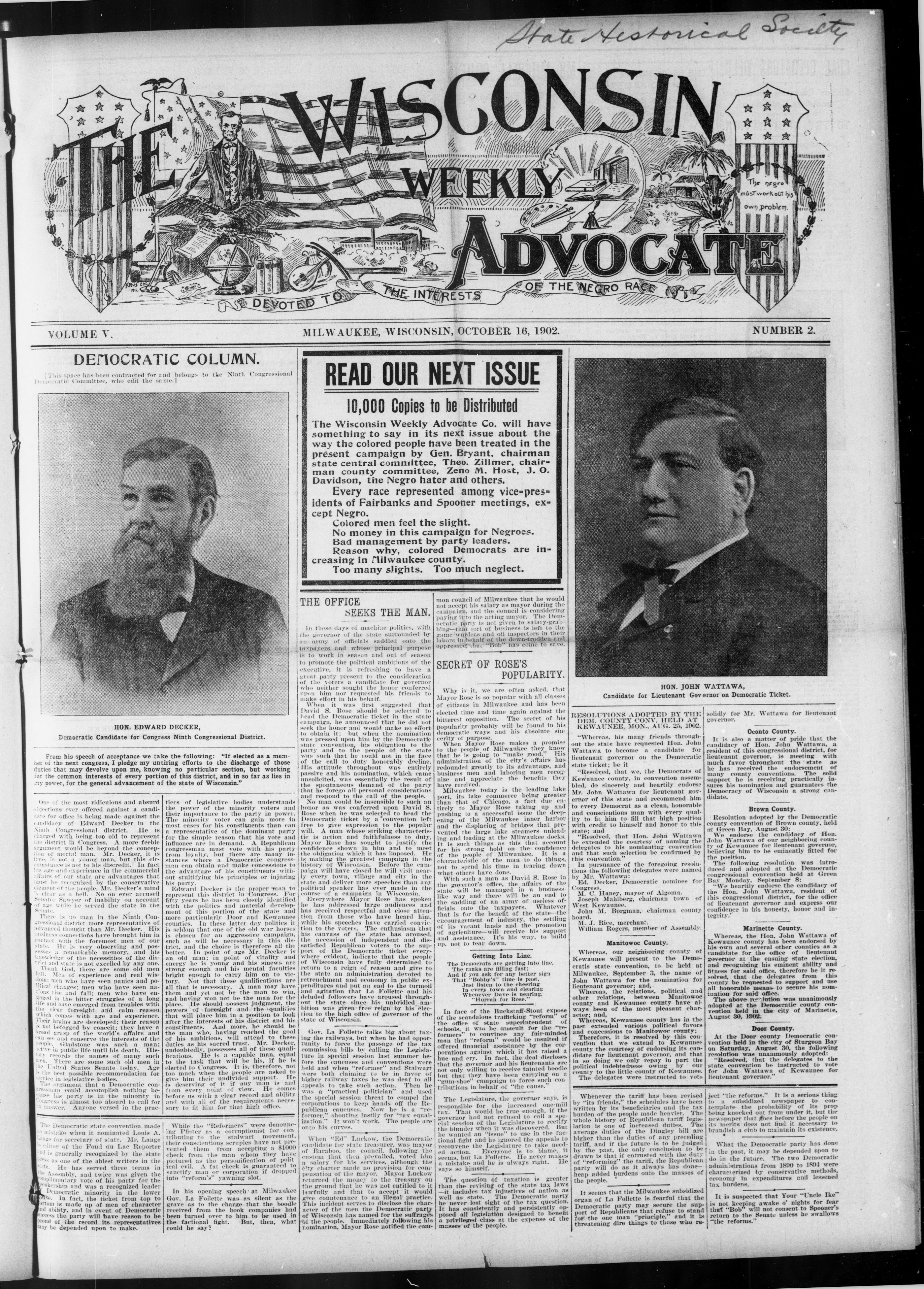
DEMOCRATIC COLUMN.
[This space has been contracted for and belongs to the Ninth Congressional Democratic Committee, who edit the same.]
[Name]
HON. EDWARD DECKER, Democratic Candidate for Congress Ninth Congressional District.
From his speech of acceptance we take the following: "If elected as a member of the next congress, I pledge my untiring efforts to the discharge of those duties that may devolve upon me, knowing no particular section, but working for the common interests of every portion of this district, and in so far as lies in my power, for the general advancement of the state of Wisconsin."
VOLUME V.
DEMOCRAT
[This space has been contracted for a Democratic Committee, who edit the sa]
HON. EDWAR
Democratic Candidate for Congr
From his speech of acceptance we take
ber of the next congress, I pledge my un
duties that may devolve upon me, know
for the common interests of every porti
my power, for the general advancement o
One of the most ridiculous and absurd objections ever offered against a candidate for office is being made against the candidacy of Edward Decker in the Ninth Congressional district. He is charged with being too old to represent the district in Congress. A more feeble argument would be beyond the conception of mortal man. Mr. Decker, it is true, is not a young man, but this circumstance is not to his discredit. In fact his age and experience in the commercial affairs of our state are advantages that must be recognized by the conservative element of the people. Mr. Decker's mind is clear as a bell. No on ever accused Senator Sawyer of inability on account of age while he served the state in the Senate.
There is no man in the Ninth Congressional district more representative of advanced thought than Mr. Decker. His business connections have brought him in contact with the foremost men of our state. He is very observing and possesses a remarkable memory, and his knowledge of the necessities of the district and state is not excelled by any one. Thank God, there are some old men left. Men of experience and real wisdom; men who have seen panics and political changes; men who have seen nations rise and fall; men who have engaged in the bitter struggles of a long life and have emerged from troubles with the clear foresight and calm reason which comes with age and experience. Their brains are developed; their reason is not befogged by conceit; they have a broad grasp of the world's affairs and can see and conserve the interests of the people. Gladstone was such a man; active in public life until his death. History records the names of many such men. There are some such old men in the United States Senate today. Age is the best possible recommendation for service in legislative bodies.
The argument that a Democratic congressman could accomplish nothing because his party is in the minority in Congress is almost too absurd to call for an answer. Anyone versed in the prac-
The Democratic state convention made no mistake when it nominated Louis A. Lange for secretary of state. Mr. Lange is editor of the Fond du Lac Reporter and is generally recognized by the state press as one of the ablest writers in the state. He has served three terms in the Assembly, and twice was given the complimentary vote of his party for the speakership and was a recognized leader Democratic minority in the lower house. In fact, the ticket from top to bottom is made up of men of character and ability, and in event of Democratic success the party will have reason to be proud of the record its representatives may be depended upon to make.
```markdown
```
tices of legislative bodies understands the power of the minority voters and their importance to the party in power. The minority voter can gain more in most cases for his constituents than can a representative of the dominant party for the simple reason that his vote and influence are in demand. A Republican congressman must vote with his party from loyalty, but there are many instances where a Democratic congressman can obtain and make concessions to the advantage of his constituents without stultifying his principles or injuring his party.
Edward Decker is the proper man to represent this district in Congress. For fifty years he has been closely identified with the politics and material development of this portion of the state and more particularly Door and Kewaunee counties. In these latter day politics it is seldom that one of the old war horses is chosen for an aggressive campaign, such as will be necessary in this district, and the choice is therefore all the better. In point of age Mr. Decker is an old man; in point of vitality and energy he is young and his sinews are strong enough and his mental faculties bright enough to carry him on to victory. Not that these qualifications are all that is necessary. A man may have them and yet not be the man to win, and having won not be the man for the place. He should possess judgment, the powers of foresight and the qualities that will place him in a position to look after the interests of his district and his constituents. And more, he should be the man who, having reached the goal of his ambitions, will attend to these duties as his sacred trust. Mr. Decker, undoubtedly, possesses all of these qualifications. He is a capable man, equal to the task that will be his, if he is elected to Congress. It is, therefore, not too much when the people are asked to give him their undivided support. He is deserving of it if any man is and from every point of view. He comes before us with a clear record and ability and with all of the requirements necessary to fit him for that high office.
While the "Reformers" were denouncing Pfister as a corruptionist for contributing to the stalwart movement, their conscientious scruples have not prevented them from accepting a $1000 check from the man whom they have pictured as the personification of political evil. A fat check is guaranteed to sanctify man or corporation if dropped into "reform's" yawning slot.
In his opening speech at Milwaukee Gov. La Follette was as silent as the grave as to the charge that the boodle received from the book companies had been turned over to him to be used in the factional fight. But, then, what could he say?
READ OUR NEXT ISSUE
10,000 Copies to be Distributed
The Wisconsin Weekly Advocate Co. will have something to say in its next issue about the way the colored people have been treated in the present campaign by Gen. Bryant, chairman state central committee, Theo. Zillimer, chairman county committee, Zeno M. Host, J. O. Davidson, the Negro hater and others. Every race represented among vice-presidents of Fairbanks and Spooner meetings, except Negro. Colored men feel the slight.
mon council of Milwaukee that he would not accept his salary as mayor during the campaign, and the council is considering paying it to the acting mayor. The Democratic party is not given to salary-grabbing—that sort of business is left to the game wardens and oil inspectors in their labors in behalf of the down-trodden and oppressed that "Bob" has come to save.
SECRET OF ROSE'S POPULARITY.
Why is it, we are often asked, that Mayor Rose is so popular with all classes of citizens in Milwaukee and has been elected time and time again against the bitterest opposition. The secret of his popularity probably will be found in his democratic ways and his absolute sincerity of purpose. When Mayor Rose makes a promise to the people of Milwaukee they know that he is going to "make good." His administration of the city's affairs has redounded greatly to its advantage, and business men and laboring men recognize and appreciate the benefits they have received.
Milwaukee today is the leading lake port, its lake commerce being greater than that of Chicago, a fact due entirely to Mayor Rose taking up and pushing to a successful issue the deepening of the Milwaukee inner harbor and the displacing of bridges that prevented the large lake steamers unloading and loading at the Milwaukee docks. It is such things as this that account for his strong hold on the confidence of the people of Milwaukee. It is a characteristic of the man to do things, not to spend his time in tearing down what others have done.
With such a man as David S. Rose in the governor's office, the affairs of the state will be managed in a business-like way and there will be an end to the saddling of an army of useless officials onto the taxpayers. Whatever that is for the benefit of the state—the encouragement of industry, the settling of its vacant lands and the promotion of agriculture—will receive his support and assistance. It's his way, to build up, not to tear down.
In face of the Buckstaff-Stout expose of the scandalous trafficking "reform" of the office of state superintendent of schools, it will be uncoult for the "reformers" to convince any fair-minded man that "reform" would be insulted if offered financial assistance by the corporations against which it has raised a hue and cry. In fact, the deal discloses that the governor and his lieutenants are not only willing to receive tainted booole but that they have been carrying on a "gum-shoe" campaign to force such contributions in behalf of "the cause."
The Legislature, the governor says, is responsible for the increased one-mill tax. That would be true enough, if the governor had not refused to call a special session of the Legislature to rectify the blunder when it was discovered. But he wanted an "issue" to use in the factional fight and he ignored the appeals to reconvene the Legislature to take needed action. Everyone is to blame, it seems, but La Follette. He never makes a mistake and he is always right. He says so himself.
The question of taxation is greater than the revising of the state tax laws—it includes tax injustices of nation as well as state. The Democratic party he never lost sight of the tax question. It has consistently and persistently opposed all legislation designed to benefit a privileged class at the expense of the masses of the people.
THE OFFICE SEEKS THE MAN.
In those days of machine politics, with the governor of the state surrounded by an army of officials saddled onto the taxpayers and whose principal purpose is to work in season and out of season to promote the political ambitions of the executive, it is refreshing to have a great party present to the consideration of the voters a candidate for governor who neither sought the honor conferred upon him nor requested his friends to make effort in his behalf.
When it was first suggested that David S. Rose should be selected to head the Democratic ticket in the state campaign, he announced that he did not seek the honor and would make no effort to obtain it; but when the nomination was pressed upon him by the Democratic state convention, his obligation to the party and to the people of the state was such that he could not in the face of the call to duty honorably decline. His attitude throughout was entirely passive and his nomination, which came unsolicited, was essentially the result of the spontaneous demand of the party that he forego all personal considerations and respond to the call of the people.
No man could be insensible to such an honor as was conferred upon David S. Rose when he was selected to head the Democratic ticket by a convention left free to give expression to the popular will. A man whose striking characteristic is action and faithfulness to duty, Mayor Rose has sought to justify the confidence shown in him and to meet the obligation which it has imposed. He is making the greatest campaign in the history of Wisconsin. Before the campaign will have closed he will visit nearly every town, village and city in the state and deliver more speeches than any political speaker has ever made in the course of a campaign in Wisconsin
Everywhere Mayor Rose has spoken he has addressed large audiences and has received respectful and close attention from those who have heard him, while his speeches have carried conviction to the voters. The enthusiasm that his canvass of the state has aroused, the accession of independent and dissatisfied Republican voters to the support of the Democratic ticket everywhere evident, indicate that the people of Wisconsin have fully determined to return to a reign of reason and give to the state an administration devoted to retrenchment and economy in public expenditures and put an end to the turmoil and agitation that La Follette and his deluded followers have aroused throughout the state since his unbridled ambition was given free reign by his election to the high office of governor of the state of Wisconsin.
Gov. La Follette talks big about taxing the railways, but when he had opportunity to force the passage of the tax commission bills by calling the Legislature in special session last summer before the caucuses and conventions were held and when "reformer" and Stalwart were both claiming to be in favor of higher railway taxes he was deaf to all appeals to take such action. Then he was a "practical politician" and used the special session threat to compel the corporations to keep hands off the Republican caucuses. Now he is a "reformer," shouting lustily for "tax equalization." It won't work. The people are onto his curves.
When "Ed" Luckow, the Democratic candidate for state treasurer, was mayor of Barahoo, the council, following the custom that then prevailed, voted him a salary for his services, although the city charter made no provision for compensation of the mayor. Mayor Luckow returned the money to the treasury on the ground that he was not entitled to it lawfully and that to accept it would give countenance to an illegal practice. This incident serves to disclose the character of the men the Democratic party of Wisconsin has named for the suffrages of the people. Immediately following his nomination, Mayor Rose notified the com-
Getting Into Line
Getting Into Line.
The Democrats are getting into line.
The ranks are filling fast.
And if you ask for any better sign
That "Bobby's" time is past.
Just listen to the cheering
In every town and clearing
Whenever Dave is nearing,
"Hurrah for Rose."
[Name]
HON. JOHN WATTAWA,
Candidate for Lieutenant Governor on Democratic Ticket
RESOLUTIONS ADOPTED BY THE DEM. COUNTY CONV. HELD AT KEWAUNEE, MON., AUG. 25, 1902.
"Whereas, his many friends throughout the state have requested Hon. John Wattawa to become a candidate for lieutenant governor on the Democratic state ticket; be it
"Resolved, that we, the Democrats of Kewanuee county, in convention assembled, do sincerely and heartily endorse Mr. John Wattawa for lieutenant governor of this state and recommend him to every Democrat as a clean, honorable and conscientious man with every quality to fit him to fill that high position with credit to himself and honor to this state; and
"Resolved, that Hon. John Wattawa be extended the courtesy of naming the delegates to his nominating convention and that such selection be confirmed by this convention."
In pursuance of the foregoing resolutions the following delegates were named by Mr. Wattawa:
Ed. Decker, Democratic nominee for Congress.
M. C. Haney, mayor of Algoma.
Joseph Mahlberg, chairman town of West Kewaunee.
John M. Borgman, chairman county board.
M. J. Rice, merchant.
William Rogers, member of Assembly.
Manitowoc County.
Whereas, our neighboring county of Kewaunee will present to the Democratis state convention, to be held at Milwaukee, September 3, the name of John Wattawa for the nomination for lieutenant governor; and. Whereas, the relations, political and other relations, between Manitowoc county and Kewaunee county have always been of the most pleasant character; and. Whereas, Kewaunee county has in the past extended various political favors and concessions to Manitowoc county: Therefore, it is resolved by this convention that we extend to Kewaunee county the courtesy of endorsing its candidate for lieutenant governor, and that in so doing we only repay in part the political indebtedness owing by our county to the little county of Kewaunee. The delegates were instructed to vote
Whenever the tariff has been revised by "its friends," the schedules have been written by its beneficiaries and the tax burden of the people made heavier. The whole history of Republican tariff legislation is one of increased duties. The average duties of the Dingley bill are higher than the duties of any preceding tariff, and if the future is to be judged by the past, the only conclusion to be drawn is that if entrusted with the duty of "reforming" the tariff, the Republican party will do as it always has done—heap added burdens onto the masses of the people.
It seems that the Milwaukee subsidized organ of La Follette is fearful that the Democratic party may secure the support of Republicans that refuse to stand for the one man "principle," and it is threatening dire things to those who re-
NUMBER 2.
WATTAWA,
Governor on Democratic Ticket.
solidly for Mr. Wattawa for lieutenant governor.
Oconto County.
It is also a matter of pride that the candidacy of Hon. John Wattawa, a resident of this congressional district, for lieutenant governor, is meeting with much favor throughout the state as he has received the endorsement of many county conventions. The solid support he is receiving practically insures his nomination and guarantees the Democracy of Wisconsin a strong candidate.
Brown County
Resolution adopted by the Democratic county convention of Brown county, held at Green Bay, August 30:
We endorse the candidacy of Hon. John Wattawa of our neighboring county of Kewanuee for lieutenant governor, believing him to be eminently fitted for the position.
The following resolution was introduced and adopted at the Democratic congressional convention held at Green Bay Monday, September 8:
"We heartily endorse the candidacy of the Hon. John Wattawa, resident of this congressional district, for the office of lieutenant governor and express our confidence in his honesty, honor and integrity."
Marinette County.
Whereas, the Hon. John Wattawa of Kewaunee county has been endorsed by his own and several other counties as a candidate for the office of lieutenant governor at the ensuing state election, and recognizing his eminent ability and fitness for said office, therefore be it resolved, that the delegates from this county be requested to support and use all honorable means to secure his nomination for said office.
The above resolution was unanimously adopted at the Democratic county convention held in the city of Marinette, August 30, 1902.
Door County
At the Door county Democratic convention held in the city of Sturgeon Bay on Saturday, August 30, the following resolution was unanimously adopted: "Resolved, that the delegates to the state convention be instructed to vote for John Wattawa of Kewaunee for lieutenant governor."
ject "the reforms." It is a serious thing to a subsidized newspaper to contemplate the probability of its prop being knocked out from under it, but the newspaper that goes before the people on its merits does not find it necessary to brandish a club to maintain its existence.
What the Democratic party has done in the past, it may be depended upon to do in the future. The two Democratic administrations from 1890 to 1894 were characterized by conservative methods, economy in expenditures and lessened tax burdens.
It is suspected that Your "Uncle Ike" is not keeping awake o' nights for fear that "Bob" will not consent to Spooner's return to the Senate unless he swallows "the reforms."
COAL OPERATORS YIELD.
Pierpont Morgan Holds Night Conference with President and the Secretary of War.
Washington, D. C., Oct. 14.—For the first time since the coal miners' strike began last May the contending factions have reached a common ground where an adjustment of difficulties is possible. J. Pierpont Morgan came to Washington last night to represent the coal operators and propose an amended proposition from them for ending the strike. The operators have at last realized that they offended not only the President but the American people by their refusal to consider any plan of arbitration which recognized the President as the creator of the court. Mr. Morgan and Mr. Cassatt, president of the Pennsylvania
10
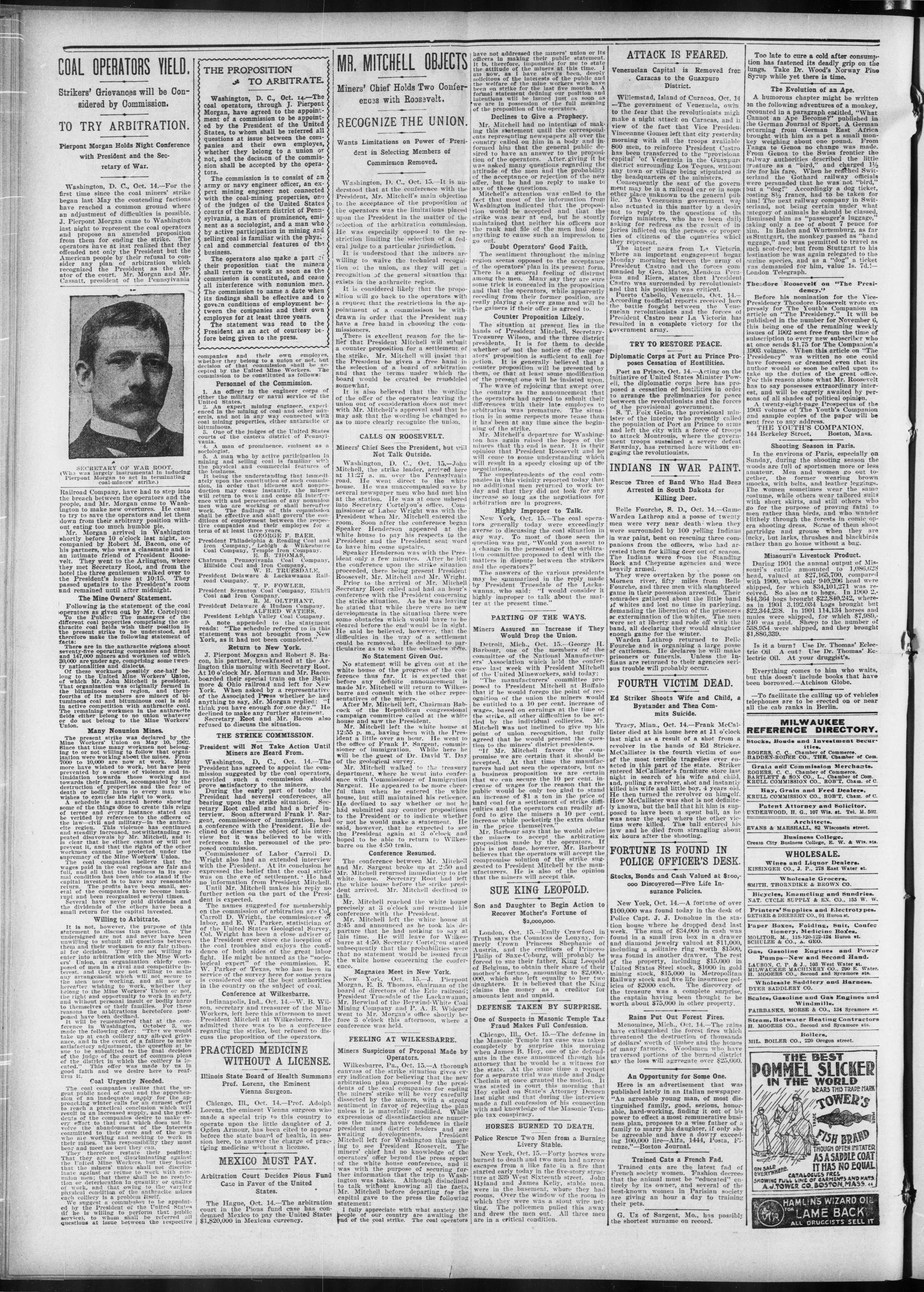
SECRETARY OF WAR ROOT. (Who was largely instrumental in inducing Pierpont Morgan to act in terminating coal-miners' strike.)
Railroad Company, have had to step into the breach between the operators and the people, and Mr. Morgan came to Washington to make new overtures. He came to try to save the operators and let them down from their arbitrary position without eating too much humble pie.
Mr. Morgan arrived in Washington shortly before 10 o'clock last night, accompanied by Robert M. Bacon, one of his partners, who was a classmate and is an intimate friend of President Roosevelt. They went to the Arlington, where they met Secretary Root, and from the hotel the three gentlemen walked over to the President's house at 10:15. They passed upstairs to the President's room and remained until after midnight.
The Mine Owners' Statement.
Following is the statement of the coal operators as given out by Mr. Cortelyou: To the Public: The managers of the different coal properties comprising the anthracite coal fields wish their position in the present strike to be understood, and therefore make the following statement of facts: There are in the anthracite regions about seventy-five operating companies and firms, and 147,000 miners and workmen (of which 30,000 are under age, comprising some twenty nationalities and dialects. Of these workmen possibly one-half belong to the United Mine Workers' Union, of which Mr. John Mitchell is president. That organization was originally formed in the bituminous coal region, and three-fourths of its members are miners of bituminous coal and bituminous coal is sold in active competition with anthracite coal. The remaining workmen in the anthracite fields either belong to no union whatever or do not belong to the Mine Workers' Union.
Many Nonunion Mines.
The present strike was declared by the Mine Workers' Union on May 10, 1902. Since that time many workmen not belonging to or not willing to follow that organization were working about the mines. From 7000 to 10,000 are now at work. Many more have wished to work, but have been prevented by a course of violence and intimidation towards those working and towards their families, accompanied by the destruction of properties and the fear of death or bodily harm to every man who wishes to exercise his right to work. A schedule is annexed hereto showing some of the things done to create this reign of terror and every instance stated can be verified by reference to the officers of the law—civil and military—in the anthracite region. This violence has continued and steadily increased, notwithstanding repeated disavowals by Mr. Mitchell, and it is clear that he either cannot or will not prevent it, and that the rights of the other workmen cannot be protected under the supremacy of the Mine Workers' Union.
The coal companies believe that the wages paid in the coal regions are fair and full, and all that the business in its normal condition has been able to stand if the capital invested is to have any reasonable return. The profits have been small, several of the companies have become bankrupt and been reorganized several times. Several have never paid dividends and the dividends of the others have been a
Willing to Arbitrate.
It is not, however, the purpose of this statement to discuss this question. The undersigned are not and never have been unwilling to submit all questions between them and their workmen to any fair tribunal for decision. They are not willing to enter into arbitration with the Mine Workers' Union, an organization chiefly composed of men in a rival and competitive interest, and they are not willing to make any arrangement which will not secure to the men now working, and all now or hereafter wishing to work, whether they belong to the Mine Workers' Union or not, the right and opportunity to work in safety and without personal insult or bodily harm to themselves or their families. For these reasons the arbitrations heretofore postponed have been declined.
It will be remembered that at the conference in Washington, October 3, we made the following offer: "That we would take up at each colliery any alleged grievance, and in the event of a failure to make satisfactory adjustment, the question at issue to be submitted to the final decision of the judge of the court of common pleas of the district in which the colliery is located." This offer was made by us in good faith and we desire here to reaffirm it.
Coal Urgently Needed.
The coal companies realize that the urgent public need of coal and the apprehension of an inadequate supply for the approaching winter calls for an earnest effort to reach a practical conclusion which will result in an increased supply, and the presidents of the companies desire to make every effort to that end which does not involve the abandonment of the interests committed to their care and of the men who are working and seeking to work in their mines. This responsibility they must bear and meet as best they can.
They therefore restate their position: That they are not discriminating against the United Mine Workers, but they insist that the miners' union shall not discriminate against or refuse to work with nonunion men; that there shall be no restriction or deterioration in quantity or quality of work, and that owing to the varying physical condition of the anthracite mines each colliery is a problem itself.
We suggest a commission to be appointed by the President of the United States (if he is willing to perform that public service), to whom shall be referred all questions at issue between the respective
THE PROPOSITION
Washington, D. C., Oct. 14.—The coal operators, through J. Pierpont Morgan, have agreed to the appointment of a commission to be appointed by the President of the United States, to whom shall be referred all questions at issue between the companies and their own employees, whether they belong to a union or not, and the decision of the commission shall be accepted by the operators.
The commission is to consist of an army or navy engineer officer, an expert mining engineer not connected with the coal-mining properties, one of the judges of the United States courts of the Eastern district of Pennsylvania, a man of prominence, eminent as a sociologist, and a man who by active participation in mining and selling coal is familiar with the physical and commercial features of the business.
The operators also make a part of their proposition that the miners shall return to work as soon as the commission is constituted, and cease all interference with nonunion men. The commission to name a date when its findings shall be effective and to govern conditions of employment between the companies and their own employes for at least three years. The statement was read to the President as an act of courtesy before being given to the press.
---
companies and their own employees, whether they belong to a union or not, but decision of that commission shall be accepted by the United Mine Workers. The commission to be constituted as follows:
Personnel of the Commission.
1. An officer in the engineer corps of either the military or naval service of the United States.
2. An expert mining engineer, experienced in the mining of coal and other minerals, and not in any way connected with coal mining properties, either anthracite or bituminous.
3. One of the judges of the United States courts of the eastern district of Pennsylvania.
4. A man of prominence, eminent as a sociologist
5. A man who by active participation in mining and selling coal is familiar with the physical and commercial features of the business.
It being the understanding that immediately upon the constitution of such commission, in order that idleness and nonproduction may cease instantly, the miners will return to work and cease all interference with and persecution of any nonunion men who are working or shall hereafter work. The findings of this commission shall be effective and shall govern the conditions of employment between the respective companies and their employees for a term of at least three years.
GEORGE F. BAER.
President Philadelphia & Reading Coal and Iron Company, Lehigh & Wilkesbarre Coal Company, Temple Iron Company.
E. B. THOMAS.
Chairman Pennsylvania Coal Company, Hillside Coal and Iron Company.
W. H. TRUESDALE.
President Delaware & Lackawanna Railroad Company.
T. P. FOWLER.
President Scranton Coal Company, Elkhill Coal and Iron Company.
ALFRED WATERS.
President Lehigh Valley Coal Company.
President Lenigh Valley Coal Company. A note appended to the statement reads: "The schedule referred to in this statement was not brought from New York, as it had not been completed."
Return to New York
J. Pierpont Morgan and Robert S. Bacon, his partner, breakfasted at the Arlington this morning with Secretary Root. At 10 o'clock Mr. Morman and Mr. Bacon boarded their special train on the Baltimore & Ohio railroad and left for New York. When asked by a representative of the Associated Press whether he had anything to say, Mr. Morgan replied: "I think you have enough for one day." He declined to make any further statement. Secretary Root and Mr. Bacon also refused to discuss the situation.
THE STRIKE COMMISSION.
President will Not Take Action Until Miners are Heard From.
Washington, D. C., Oct. 14.—The President has agreed to appoint the commission suggested by the coal operators, provided such a commission should prove satisfactory to the miners. During the early part of today the President had several conferences, all bearing upon the strike situation. Secretary Root called and had a brief interview. Soon afterward Frank P. Sargent, commissioner of immigration, had a conference with the President. He declined to discuss the object of his interview but it was believed to be with reference to the personnel of the proposed commission.
Commissioner of Labor Carroll D. Wright also had an extended interview with the President. At its conclusion he expressed the belief that the coal strike was on the eve of settlement. He had no information from President Mitchell. Until Mr. Mitchell makes his reply no further action on the part of the President is expected.
The names suggested for membership on the commission of arbitration are Col. Carroll D. Wright, the commissioner of labor, and E. W. Parker, statistician of of the United States Geological Survey. Col. Wright has been a close adviser of the President ever since the inception of the coal troubles and enjoys the confidence of both sides of the great labor fight. He might be named as the "sociological expert" of the commission. E. W. Parker of Texas, who has been in service of the survey here for some years is considered one of the best authorities in the country on the subject of coal.
Conference at Wilkesbarre.
Indianapolis, Ind., Oct. 14.—W. B. Wilson, secretary and treasurer of the Mine Workers, left here this afternoon to meet President Mitchell at Wilkesbarre. He admitted there was to be a conference regarding the strike, but refused to discuss the proposition of the operators.
PRACTICED MEDICINE WITHOUT A LICENSE.
Illinois State Board of Health Summons Prof. Lorenz, the Eminent Vienna Surgeon. Chicago, Ill., Oct. 14.—Prof. Adolph Lorenz, the eminent Vienna surgeon who made a special trip to this country to operate upon the little daughter of J. Ogden Armour, has been cited to appear before the state board of health, in session here, to answer the charge of practicing medicine without a license.
MEXICO MUST PAY.
The Hague, Oct. 14.—The arbitration court in the Pious fund case has condemned Mexico to pay the United States $1,820,000 in Mexican currency.
MR. MITCHELL OBJECTS
Miners' Chief Holds Two Conferences with Roosevelt.
RECOGNIZE THE UNION.
Washington, D. C., Oct. 15.—It is understood that at the conference with the President, Mr. Mitchell's main objection to the acceptance of the proposition of the operators was the limitations placed upon the President in the matter of the selection of the arbitration commission. He was especially opposed to the restriction limiting the selection of a federal judge to a particular jurisdiction. It is understood that the miners are willing to waive the technical recognition of the union, as they will get a recognition of the general situation that exists in the anthracite region.
It is considered likely that the proposition will go back to the operators with a request that the restrictions in the appointment of a commissison be withdrawn in order that the President may have a free hand in choosing the commissioners.
There is excellent reason for the belief that President Mitchell will submit a counter proposition for a settlement of the strike. Mr. Mitchell will insist that the President be given a free hand in the selection of a board of arbitration and that the terms under which the board would be created be remodeled somewhat.
It is also believed that the wording of the offer of the operators leaving the union out of consideration does not meet with Mr. Mitchell's approval and that he may ask that the wording be changed so as to more clearly recognize the union.
CALLS ON ROOSEVELT.
Miners' Chief Sees the President, but will Not Talk Outside.
Washington, D. C., Oct. 15.—John Mitchell, the strike leader, arrived here at 11:27 a. m. over the Pennsylvania road. He went direct to the white house. He was unaccompanied save by several newspaper men who had met him at the station. He was at once ushered into Secretary Cortelyou's office. Commissioner of Labor Wright was with the President when Mr. Mitchell entered the room. Soon after the conference began Speaker Henderson appeared at the white house to pay his respects to the President and the President sent word to have him come upstairs.
Speaker Henderson was with the President only a few minutes. After he left the conference upon the strike situation proceeded, there being present President Roosevelt, Mr. Mitchell and Mr. Wright. Prior to the arrival of Mr. Mitchell Secretary Root called and had an hour's conference with the President concerning the strike situation. As he was leaving he stated that while there were no new developments in the situation there were some obstacles which would have to be cleared before the end would be in sight. He said he believed, however, that the difficulties in the way of a settlement could be removed. He declined to particularize as to what the obstacles were.
No Statement Given Out.
No statement will be given out at the white house of the progress of the conference thus far. It is expected that before any definite announcement is made Mr. Mitchell will return to Wilkesbarre and consult with the other representatives of the miners. After Mr. Mitchell left, Chairman Babcock of the Republican congressional campaign committee called at the white house and saw the President. Mr. Mitchell left the white house at 12:55 p. m., having been with the President a little over an hour. He went to the office of Frank P. Sargent, commissioner of immigration. While here he will be the guest of Dr. David T. Day of the geological survey.
Mr. Mitchell walked to the treasury department, where he went into conference with Commissioner of Immigration Sargent. He appeared to be more cheerful than when he entered the white house, but still maintained his reticence. He declined to say whether or not he had submitted any counter propositions to the President or to indicate whether or not he would make a statement. He said, however, that he expected to see the President again at 3 o'clock and hoped to be able to return to Wilkesbarre on the 4:50 train.
Conference Resumed.
The conference between Mr. Mitchell and Mr. Sargent broke up at 2:50 and Mr. Mitchell returned immediately to the white house. Secretary Root had left the white house before the strike president arrived. Mr. Mitchell declined to talk.
Mr. Mitchell reached the white house precisely at 3 o'clock and resumed his conference with the President.
Mr. Mitchell left the white house at 3:45 and announced as he took his departure that he had nothing to say at this time. He will leave for Wilkesbarre at 4:50. Secretary Cortelou stated subsequently that the probabilities were that no statement would be issued from the white house concerning the conference.
Magnates Meet in New York.
New York, Oct. 15.—J. Pierpont Morgan, E. B. Thomas, chairman of the board of directors of the Erie railroad; President Truesdale of the Lackawanna, Mr. Berwind of the Berwind-White Coal Mining Company and P. A. B. Widener went to Mr. Morgan's office shortly before 3 o'clock this afternoon, where a conference was held.
FEELING AT WILKESBARRE
Miners Suspicious of Proposal Made by Operators.
Wilkesbarre, Pa., Oct. 15.—A thorough canvass of the strike situation gives every indication for believing that the new arbitration plan proposed by the presidents of the coal companies for ending the miners' strike will be very carefully dissected by the miners, with a strong sentiment in favor of rejecting the plan unless it is materially modified. While expressions of dissatisfaction are numerous the miners have confidence in their president and district leaders and are awaiting developments. President Mitchell left for Washington this morning to see President Roosevelt. The miners' chief had no knowledge of the operators' offer beyond the press report of the white house conference, and it was with the purpose of securing further information that the trip to Washington was taken. Although disinclined to talk without knowing all the facts, Mr. Mitchell before departing for the capital gave to the press the following statement:
I fully appreciate with what anxiety the people of our country are awaiting the end of the coal strike. The coal operators
have not addressed the miners' union or its officers in making their public statement. It is, therefore, impossible for me to state the attitude of the miners at this time. I am now, as I have always been, deeply solicitous of the interests of the public and the welfare of the mine workers who have been on strike for the last five months. A formal statement defining our position and intentions will be issued just as soon as we are in possession of the full meaning of the proposition of the operators.
Declines to Give a Prophecy.
Mr. Mitchell had no intention of making this statement until the correspondents representing newspapers all over the country called on him in a body and informed him that the general public desired to have an answer to the proposition of the operators. After, giving it he was asked many questions regarding the attitude of the men and the probability of the acceptance or rejection of the new offer, but he had no reply to make to any of these questions.
Mitchell's attention was called to the fact that most of the information from Washington indicated that the proposition would be accepted and that the strike was near at end, but he stoutly maintained that neither his officers nor the rank and file of the men had done anything to cause such an impression to go out.
Doubt Operators' Good Faith.
The sentiment throughout the mining region seems opposed to the acceptance of the operators' plan in its present form. There is a general feeling of distrust among the men. Many say they are sure some trick is concealed in the proposition and that the operators, while apparently receding from their former position, are really playing a clever game and will be the gainers if their offer is agreed to.
Counter Proposition Likely.
The situation at present lies in the hands of President Mitchell, Secretary-Treasurer Wilson, and the three district presidents. It is for them to decide whether or not the notice of the operators' proposition is sufficient to call for action. It is generally believed that a counter proposition will be presented by them, or that at least some modification of the present one will be insisted upon. The wave of rejoicing that swept over the country as the announcement that the operators had agreed to submit their differences with their late employees to arbitration was premature. The situation is in some respects more tense than it has been at any time since the beginning of the strike.
Mr. Mitchell's departure for Washington has again raised the hopes of the miners that the end is near. It is their opinion that President Roosevelt and he will come to some understanding which will result in a speedy closing up of the negotiations.
The superintendents of the coal companies in this vicinity reported today that no additional men returned to work today and that they did not look for any increase so long as the negotiations for arbitration are in progress.
Highly Improper to Talk.
New York, Oct. 15.—The coal operators generally today were exceedingly averse to discussing the coal situation in any way. To most of those seen the question was put. "Would you assent to a change in the personnel of the arbitration committee proposed to deal with the matters in dispute between the strikers and the operators?"
The answers of the various presidents may be summarized in the reply made by President Truesdale of the Lackawanna, who said: "I would consider it highly improper to talk about the matter at the present time."
PARTING OF THE WAYS.
Miners Assured an Increase if They Would Drop the Union.
Detroit, Mich., Oct. 15.—George H. Barbour, one of the members of the committee of the National Manufacturers' Association which held the conference last week with President Mitchell of the United Mineworkers, said today: "The manufacturers' committee proposed to President Mitchell at Buffalo that if he would forego the point of recognition of the union the miners would be entitled to a 10 per cent. increase of wages, based on earnings at the time of the strike, all other difficulties to be settled by the individual collieries. Mr. Mitchell was not inclined to give up his point of union recognition, but fully agreed that he would present the question to the miners' district presidents.
"If Mr. Mitchell favors the compromise we are certain that it should be accepted. At that time the manufacturers had not seen the operators, but as a business proposition we are certain that we can secure the 10 per cent. increase of wages for the reason that the public would be only too glad to stand an increase of $1 a ton in the price of hard coal for a settlement of strike difficulties and the operators can readily afford to give the miners a 10 per cent. increase while pocketing the extra dollar in the price themselves."
Mr. Barbour says that he would advise the miners to accept the arbitration proposition made by the operators. If this is not done, however, Mr. Barbour believes that the operators will accept the compromise solution of the strike suggested to President Mitchell by the manufacturers. He is also of the opinion that the miners will accept this.
SUE KING LEOPOLD.
Son and Daughter to Begin Action to Recover Mother's Fortune of
$2,000,000.
London, Oct. 15.—Emily Crawford in Truth says the Countess de Lonyay, formerly Crown Princess Shephanie of Austria, and the creditors of Princess Philip of Saxe-Coburg, will probably be forced to sue their father, King Leopold of Belgium, to obtain their share of their mother's fortune, amounting to $2,000,000, which she left equally to her two daughters. It is believed that the King claims the money as a creditor for amounts lent and unpaid.
DEFENSE TAKEN BY SURPRISE.
One of Suspects in Masonic Temple Tax Fraud, Makes Full Confession.
Chicago, Ill., Oct. 15.—The defense in the Masonic Temple tax case was taken completely by surprise this morning when James B. Hoy, one of the defendants in the case announced through his attorney that he would be a witness for the state. At the same time a request for a separate trial was made and Judge Chetlain at once granted the motion. It was stated in court this morning that Hoy called on State's Attorney Deneen last night and that during the interview made a full confession of his connection with and knowledge of the Masonic Temple tax conspiracy.
HORSES BURNED TO DEATH
Police Rescue Two Men from a Burning Livery Stable.
New York, Oct. 15.—Forty horses were burned to death and two men had narrow escapes from a like fate in a fire that started early today in the five-story structure at 339 West Sixteenth street. John Hyland and James Kelly, stable men, were in the basement, where they had rooms. Over the window of the room in which they were was a stout wire netting. The policemen pulled this away and drew the men out. All three men are in a critical condition.
ATTACK IS FEARED.
Venezuelan Capital is Removed from Caracas to the Guaxpuro District.
Willemstad, Island of Curacao, Oct. 14.—The government of Venezuela, owing to the fear that the revolutionists might make a night attack on Caracas, and in view of the fact that Vice President Vincennne Gomez left that city yesterday morning with all the troops available 800 men, to reinforce President Castro has been transferred to the "provisional capital" of Venezuela in the Guaxpuro district surrounding Los Teques, without any town or village being stipulated as the headquarters of the ministers.
Consequently the seat of the government may be in a railroad car or in some other place unknown to the general public. The Venezuelan government way also actuated in this matter by a desire not to reply to the questions of the foreign ministers, who have been daily asking for redress as the result of injuries inflicted on the persons or properties of citizens of the countries which they represent.
The latest news from La Victoria, where an important engagement began Monday morning between the army of President Castro and the forces commanded by Gen. Matos, Mendoza Peralozza and Riern, states that President Castro was surrounded by revolutionists and that his position was critical.
Puerto Cabello, Venezuela. Oct. 14. According to official reports received here the battle fought between the Venezuelan revolutionists and the forces of President Castro near La Victoria has resulted in a complete victory for the government army.
TRY TO RESTORE PEACE.
Diplomatic Corps at Port au Prince Proposes Cessation of Hostilities.
Port au Prince, Oct. 14.—Acting on the initiative of United States Minister Powell, the diplomatic corps here has proposed a cessation of hostilities in order to arrange the preliminaries for peace between the revolutionists and the forces of the provisional government.
S. T. Foix Golin, the provisional minister of the interior who recently called the population of Port au Prince to arms and left the city with a force of troops to attack Montrouis, where the government troops sustained a severe defeat Saturday, has returned here without engaging the revolutionists.
INDIANS IN WAR PAINT.
Belle Fourche, S. D., Oct. 14.—Game Warden Lathrop and a posse of twenty men were very near death when they were surrounded by 100 yelling Indians in war paint, bent on rescuing three companions from the officers, who had arrested them for killing deer out of season. The Indians were from the Standing Rock and Cheyenne agencies and were heavily armed. They were overtaken by the posse on Moraeu river, fifty miles from Belle Fourche, and three men with slaughtered game in their possession arrested. Their comrades gathered about the little band of whites and lost no time in parleying, demanding the liberation of the prisoners or extermination of the whites. The men were set at liberty and rode off with the band, all declaring they would slaughter enough game for the winter.
Warden Lathrop returned to Belle Fourche and is organizing a large posse of cattlemen. He declares he will make prisoners or funerals. Unless the Indians are returned to their agencies serious trouble will probably occur.
FOURTH VICTIM DEAD.
Ed Striker Shoots Wife and Child, a Bystander and Then Commits Suicide.
Tracy, Minn., Oct. 14.—Frank McCallister died at his home here at 11 o'clock last night as a result of a shot from a revolver in the hands of Ed Stricker. McCallister is the fourth victim of one of the most terrible tragedies ever enacted in this part of the state. Striker entered McCallister's furniture store last night in search of his wife and child, and, pulling a revolver, shot and instantly killed his wife and little boy, 4 years old. He then turned the revolver on himself. How McCallister was shot is not definitely known, but the ball that hit him is supposed to have been a spent ball, as he was near the spot where the other victims were killed. The ball entered his jaw and he died from strangling about six hours after the shooting.
FORTUNE IS FOUND IN POLICE OFFICER'S DESK.
Stocks, Bonds and Cash Valued at $100,000 Discovered—Five Life Insurance Policies.
New York, Oct. 14.—A fortune of over $100,000 was found today in the desk of Police Capt. J. J. Donohue in the station house where he dropped dead last week. The sum of $34,000 in cash was found in a small iron box in a drawer and diamond jewelry valued at $11,000, including a solitaire ring worth $1500, was found in another drawer. The rest of the property, including $15,000 in United States Steel stock, $1000 in gold mining stock, $15,000 in Metropolitan Railway stock and five life insurance policies of $2000 each. The discovery of the treasure was a complete surprise, the captain having been thought to be worth about $75,000 in other property.
Rains Put Out Forest Fires
Menominee, Mich., Oct. 14.—The rains have extinguished the forest fires which threatened the destruction of thousands of dollars' worth of timber and the homes of many farmers. Woodsmen who have traversed portions of the burned district say the loss will aggregate over $25,000.
An Opportunity for Some One.
Here is an advertisement that was published lately in an Italian newspaper. "An agreeable young man, of most distinguished family, good, serious, honorable, hard-working, finding it out of his power to effect a most remunerative business plan, proposes to a wise father of a family to marry his daughter, if only she be agreeable and have a dowry exceeding 100,000 lire—Alfa, 1444, Posta, Firenze."—Boston Journal.
Trained Cats a French Fad
Trained cats are the latest fad of French society women. Fashion decrees that the animal must be "educated" entirely by its owner, and several of the best-known women in Parisian society are giving an hour a day to training their pets.
G. Uz of Sargent, Mo., has possibly the shortest surname on record.
Too late to cure a cold after consumption has fastened its deadly grip on the lungs. Take Dr. Wood's Norway Piue Syrup while yet there is time.
The Evolution of an Ape.
A humorous chapter might be written on the following adventures of a monkey, recounted in a paragraph entitled, "What Cannot an Ape Become?" published in the German Journal of Sport. A German returning from German East Africa brought with him as a pet a small monkey weighing about one pound. From Tanga to Genoa no change was made. From Genoa to the Swiss frontier the railway authorities described the little creature as a "bird," and charged 1½ fire for his fare. When he reached Switzerland the Gothard railway officials were persuaded that he was not "bird," but a "dog!" Accordingly a dog ticket, costing $8½ francs, had to be taken for him! The next railway company in Switzerland, not being certain under what category of animals he should be classed, dismissed him as "passenger's luggage," taking only a fee of about 7 pence for him. In Baden and Wurtemburg, as far as Stuttgart, the monkey passed as "hand luggage," and was permitted to travel as such scot-free; but from Stuttgart to his destination he was again relegated to the canine species, and as a "dog" a ticket was demanded for him, value 1s. 7d.!—London Telegraph.
Theodore Roosevelt on "The Presidency."
Before his nomination for the Vice-Presidency Theodore Roosevelt wrote expressly for The Youth's Companion an article on "The Presidency." It will be published in the number for November 6, this being one of the remaining weekly issues of 1902 sent free from the time of subscription to every new subscriber who at once sends $1.75 for The Companion's 1903 volume. When this article on "The Presidency" was written no one could have foreseen or dreamed even that its author would so soon be called upon to take up the duties of the great office. For this reason alone what Mr. Roosevelt has to say possesses extraordinary interest, and will be eagerly awaited by persons of all shades of political opinion.
A twenty-eight-page Prospectus of the 1903 volume of The Youth's Companion and sample copies of the paper will be sent free to any address.
THE YOUTH'S COMPANION
144 Berkeley Street, Boston, Mass.
Shooting Season in Paris.
In the environs of Paris, especially on Sunday, during the shooting season the woods are full of sportsmen more or less amateur. Men and women go out together, the former wearing brown smocks, with belts, and leather leggings. The women sometimes wear the same postume, while others wear tailored suits with short skirts, and still others who go for the purpose of proving fatal to men rather than birds, and who wander blithely through the forests in comic opera shooting dress. Some of them shoot partridge and grouse when they are lucky, but larks, thrushes and blackbirds rather than go home without a bag.
Missouri's Livestock Product.
During 1901 the annual output of Missouri's cattle amounted to 1,086,628 head, valued at $27,165,700, compared with 1900, when only 940,206 head were shipped, for which $34,101,271 was received. So also as to hogs. In 1900 2,844,364 hogs brought $22,840,242, whereas in 1901 3,192,034 hogs brought but $22,344,238. In 1901 114,134 horses and mules were shipped, for which $7,989,240 was paid. Sheep to the number of 538,954 were shipped, and they brought $1,886,339.
Is it a burn? Use Dr. Thomas' Eclectric Oil A cut? Use Dr. Thomas' Eclectric Oil. At your druggist's.
Everything comes to him who waits, but this doesn't include books that have been borrowed.—Atchison Globe.
-To facilitate the calling up of vehicles telephones are to be erected on or near all the cab ranks in Berlin.
MILWAUKEE
Stocks, Bonds and Investment Securities.
ROGERS, C. C., Chamber of Commerce.
HADDEN-RODEE CO., THE, Chamber of Com.
Grain and Commission Merchants.
ROGERS, C. C., Chamber of Commerce.
BARTLETT & SON CO., L., Chamber of Com.
KRULL COMMISSION CO., ROB'T, Cham. of C.
Hay, Grain and Feed Dealers,
KRULL COMMISSION CO., ROB'T, Cham. of C.
Patent Attorney and Solicitor.
UNDERWOOD, H. G., 107 Wis. st. Tel. M. 502.
Architects.
EVANS & MARSHALL, 82 Wisconsin street.
Business College.
Cream City Business College, E. W. & Wis. sts.
WHOLESALE.
Wines and Liquor Dealers.
KISSINGER CO., J. P., 278 East Water st.
Wholesale Grocers.
SMITH. THORNDIKE & BROWN CO.
Bicycles, Enameling and Sundries.
NAT. CYCLE SUPPLY & EN. CO., 153 W. W.
Printers' Supplies and Electrotypes.
GETHER & DREBERT CO., 91 Huron st.
Paper Boxes, Folding, Suit, Confectionery, Medicine Boxes.
MOLITOR, M., 118-120-122-124 Huron st.
SCHULZE & CO., A. GEO.
Gas, Gasoline Engines and Power
Pumps-New and Second Hand.
Scales, Gasoline and Gas Engines and Windmills.
FAIRBANKS, MORSE & CO., 134 Sycamore st.
Steam, Hotwater Heating Contractors
H. MOOERS CO., Second and Sycamore sts.
THE BEST
POMMEL SLICKER
IN THE WORLD
DEARS THIS TRADE MARK
TOWER'S
TRADE
FISH BRAND
THOUGH OFTEN IMITATER
AS A SADDLE COAT
IT HAS NO EQUAL
ON SALE
EVERYWHERE.
CATALOGUES FREE
SHOWING FULL LINE OF GARMENTS AND MATS.
A.J.TOWER CO., BOSTON, MASS. 44
HAMLINS WIZARD OIL
FOR
AME BACK
HAMLINS WIZARD OIL
FOR
LAME BACK
ALL DRUGGISTS SELL IT
SUMMER'S END.
Shrilly the geese honk: the partridges drum again;
South toward the sedgelands the flocked ducks fly;
Bees have filled the honeycomb (when will they hum again?);
Tattered the trees stand, etched against the sky.
'Tis the last amber wine, ah, but the strain of it!
'Tis the last cup at lip, O let us drain of it!
Life!—let us clutch at the little we may gain of it!
Winter stands menacing; the dear days die!
Here along the lowlands the pools lie shimmering;
There along the uplands the asters burn;
Still by the road-marge the sumach is glimmering;
Still there's gold fringe edging the fern;
Pluck, then, the fruit to be had for the plundering—
Graft of the isles of the ancient wondering—
O pluck and eat, for soon comes the sundering—
Winter, and blight, and the storm-winds stern!
—Clinton Scollard in Collier's Weekly.
The Romance of a Library Girl.
A True Story Told Me One Thanksgiving by the Nile.—Henry Austin.
Thanksgiving night beneath an Egyptian moon the sweet red-headed lady told me a curious tale.
Twas a magical night, full of vague suggestions of strange perfume and faint zephyr-tones of mysterious music, and the full moon did not look like a moon in any other land.
It seemed rather as if it might have been a platter of gold, which, flung at the purple sky by Cleopatra in some festive freak, had stuck there for a symbol and a sign to lovers in the aftertime.
Had I not been in love with the glorious red hair of the lady I should have worshiped that Oriental moon; but the oddness of the Occidental revelation she made me—the lady, that is, not the luminary—soon absorbed my attention.
'Twas the tale of how they met, her first and only love and his first and only love—and he was her first husband!
I marked him now and then, strolling placidly at some distance, puffing a cigar of doubtful virtue in the majestic face of nature.
He didn't mind my dancing attendance on her, for he knew I was but a scribbler of impassioned verses and was only in love with her rich red hair, and barely 16, and was merely an American, while he was her English lord and master. So it was all right all around.
"You think we never met before this trip up the Nile," she murmured, "but we have. Several times in the last four years." (Here she laughed, and her laughter was as warm and full of vital color, though low in key, as her beautiful, profuse hair.) "I have handed books to you over the counter of the Boston public library, and you have thanked in a dreamy, far-away manner that made me think you must be a most interesting boy."
I did not particularly like this reference to my being a boy, but I made no protest. She continued:
"You look surprised, but since we have become such chums I'm going to tell you my romance as a mark of my personal esteem. I was a poor girl from the Barkshire hills, working in that great, splendid library, and, strange as it may sound, I had never seen a man I cared for.
"Well, one day a stranger, very badly, almost shabbily, dressed, came up and got a book, not from me, but a girl near by. As he turned our eyes met, and he gave me a slight stare, and the thought flashed through me, 'What kind eyes that rough-looking fellow has!' Then I forgot all about him the next minute.
"Several days after this one of the girls said to me, 'Nell, have you noticed that man who comes here day after day, gets a book, and sits at that table facing your corner and stares and stares over the book at me or you, and I guess you must be it this time?"
"I was nettled at this nonsense, but I looked in the direction she had indicated, and there, sure enough, was the roughly-dressed stranger with the kind, quiet gray eyes; and they met mine for a moment, then fell before my frown on a big book.
"A queer thrill ran through me. It wasn't love, but it was queer. I turned to my duties, and took no further notice. But in a few days the other girls began to plague me about this constant visitor, who, they said, always took out the same big book, and never turned more than one leaf from day to day, and watched me like a faithful dog.
"I saw that what they said was true, and I grew very angry; but what could I do? I couldn't complain to the authorities of the library, for the man had done nothing but look, and looking is not a crime, though it's often an offense to a woman."
"Then I bethought myself of Cousin Jim, a big 6-footer from Vermont, who could easily take up my little persecutor by the scruff of the neck and drop him into the frog pond before anyone had time to interfere. So I appealed to Jim. "At first Jim roaded—Jims always do, I think, at first, when you tell them anything important. "But when I blubbered about it, that fetched Jim around quite serious, and he said he'd come to the library and watch my cowboy (I had told him the fellow, when he put on his siouch hat to leave the place, looked like a Western man) and see whether the charge against him was a true bill or not.
"Girls are so blamed vain,' said Jim; 'they always think a man is eking them, when he's only wrapped up in thought or stewing over a business problem.' "But Jim was convinced after he had watched that person a couple of hours, and what do you guess Jim did? He didn't wait for the starer to leave the library, but went right up to him and laid a heavy hand on his shoulder. "My! how all the girls, and I, too, would have given our little fingers to have heard what was said then; but both men spoke in awfully low tones. "Look here, sir!' began Jim, 'what do you mean by coming here day after day and staring at that red-headed girl over there? She's my cousin and this thing has got to stop.'
"I can't help it,' stammered the stranger, with a bewildered but not frightened look. 'I'm sorry if I've annoyed her, but I've f-f-f-allen in love with her. I'd give all I've got to get acquainted with her, but I don't know how.' "The absolute simplicity and sincerity of this reply staggered Jim.
"Come out on the Common,' said he, and we'll talk it over.' "The stranger rose with evident eagerness on his face and they went out.
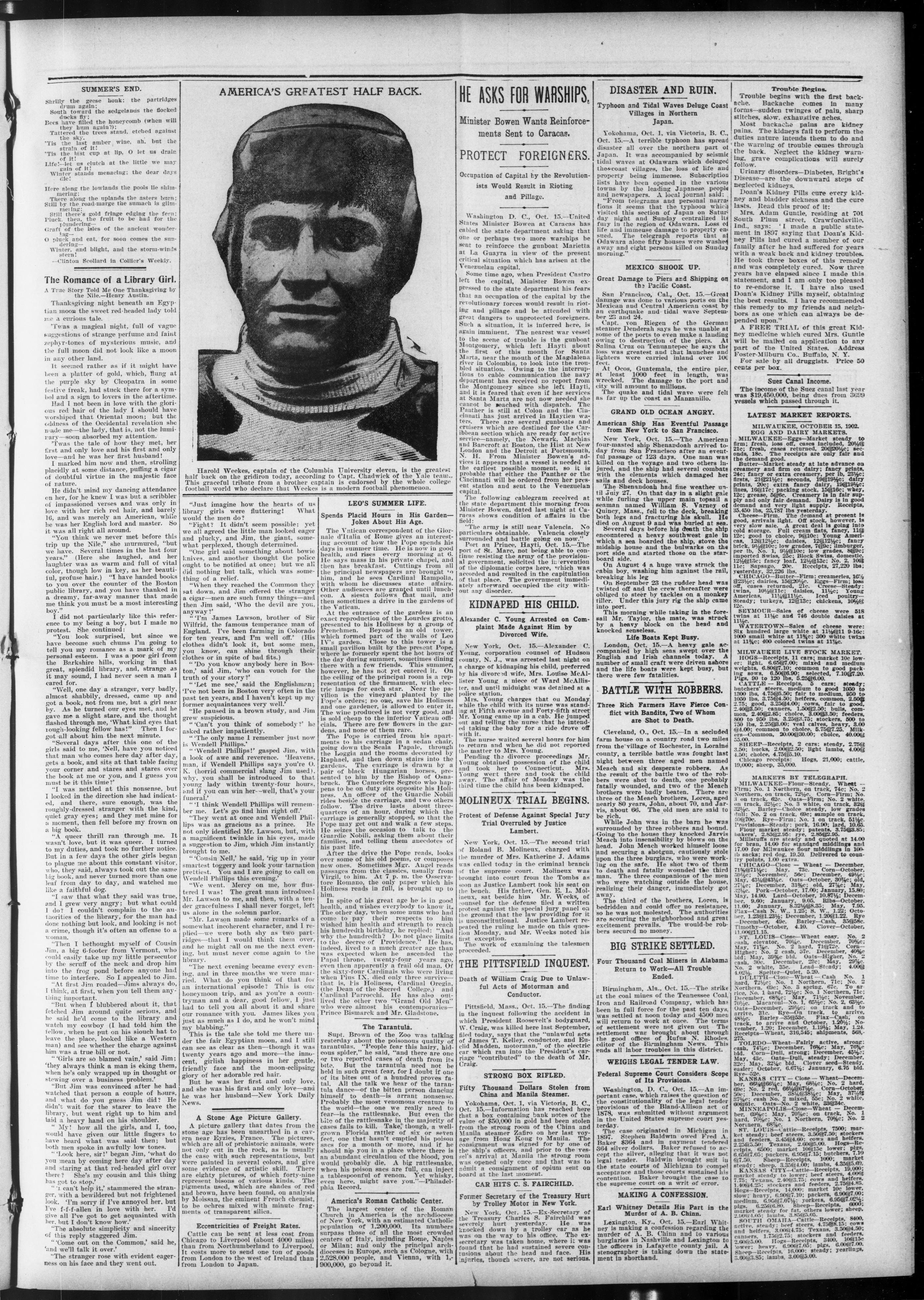
Harold Weekes, captain of the Columbia University eleven, is the greatest half back on the gridiron today, according to Capt. Chadwick of the Yale team. This graceful tribute from a brother captain is endorsed by the whole college football world who declare that Weekes is a modern football phenomenon.
Harold Weekes, captain of the Columbia University eleven, is the greatest half back on the gridiron today, according to Capt. Chadwick of the Yale team. This graceful tribute from a brother captain is endorsed by the whole college football world who declare that Weekes is a modern football phenomenon.
"Just imagine how the hearts of us library girls were fluttering! What would the men do?
"Fight? It didn't seem possible; yet we all agreed the little man looked eager and plucky, and Jim, the giant, somewhat perplexed, though determined.
"One girl said something about bowie knives, and another thought the police ought to be notified at once; but we all did nothing but talk, which was something of a relief.
LEO'S SUMMER LIFE.
Spends Placid Hours in His Garden—Jokes About His Age.
The Vatican correspondent of the Gloria nale d'Italia of Rome gives an interesting account of how the Pope spends his days in summer time. He is now in good health, and rises every morning at 6. He says mass in his private chapel, and then has breakfast. Cuttings from all the principal newspapers are brought to him, and he sees Cardinal Rampolla.
"When they reached the Common they sat down, and Jim offered the stranger a cigar—men are such funny things—and then Jim said, 'Who the devil are you, anyway?'
"I'm James Lawson, brother of Sir Wilfrid, the famous temperance man of England. I've been farming in Colorado for ten years, and I'm well off.' (His clothes didn't look it, but some men, you know, can shine through their clothes or in spite of bad fits.)
"Do you know anybody here in Boston,' said Jim, 'who can vouch for the truth of your story?'
"Let me see,' said the Englishman; 'I've not been in Boston very often in the past ten years, and I haven't kept up my former acquaintances very well.'
"He paused in a brown study, and Jim grew suspicious.
"Can't you think of somebody?' he asked rather impatiently.
"The only name I remember just now is Wendell Phillips."
"Wendell Phillips!' gasped Jim, with a look of awe and reverence. 'Heavens, man, if Wendell Phillips says you're O. K. (horrid commercial slang Jim used), why, you shall be introduced to that young lady within twenty-four hours, and if you can win her--well, that's your funeral."
"I think Wendell Phillips will remember me. Let's go find him right off."
"They went at once and Wendell Phillips was as gracious as a prince. He not only identified Mr. Lawson, but, with a magnificent twinkle in his eyes, made a suggestion to Jim, which Jim instantly brought to me.
"Cousin Nell,' he said, 'rig up in your smartest toggery and look your tarnation prettiest. You and I are going to call on Wendell Phillips this evening."
"We went. Mercy on me, how flustered I was! The great man introduced Mr. Lawson to me, and then, with a tender gracefulness I shall never forget, left us alone in the solemn parlor.
"Mr. Lawson made some remarks of a somewhat incoherent character, and I replied—we were both shy as two partridges—that I would think them over, and he might call on me the next evening, but must never come again to the library.
"The next evening became every evening, and in three months we were married. What do you think of that for an international episode? This is our honeymoon trip, and as you're a countryman and a dear, good fellow, I just had to tell you all about it and share our romance with you. James likes you just as much as I do, and he won't mind my blabbing."
This is the tale she told me there under the fair Egyptian moon, and I still can see as clear as then—though it was twenty years ago and more—the innocent, girlish happiness in her gentle, friendly face and the moon-eclipsing glory of her adorable red hair. But he was her first and only love, and she was his first and only love—and he was her husband—New York Daily News.
A Stone Age Picture Gallery.
A picture gallery that dates from the stone age has been unearthed in a cavern near Eyzies, France. The pictures, which are all of prehistoric animals, were not only cut in the rock, as is usually the case with such representations, but were painted in several colors, and give some evidence of artistic skill. There are eighty pictures, of which forty-nine represent bisons of various kinds. The pigments used, which are shades of red and brown, have been found, on analysis by Moissan, the eminent French chemist, to be ochres mixed with minute fragments of transparent silica.
Eccentricities of Freight Rates.
Cattle can be sent at less cost from Chicago to Liverpool (about 4000 miles) than from Northumberland to Liverpool. It costs more to send one ton of goods from London to the west of Ireland than from London to Japan.
LEO'S SUMMER LIFE.
Spends Placid Hours in His Garden—
Jokes About His Age.
The Vatican correspondent of the Glornale d'Italia of Rome gives an interesting account of how the Pope spends his days in summer time. He is now in good health, and rises every morning at 6. He says mass in his private chapel, and then has breakfast. Cuttings from all the principal newspapers are brought to him, and he sees Cardinal Rampolla, with whom he discusses state affairs. Other audiences are granted until luncheon. A siesta follows that mail, and then sometimes a drive in the gardens of the Vatican.
At the entrance of the gardens is an exact reproduction of the Lourdes grotto, presented to his Holiness by a group of Frenchmen. Beyond is an old tower, which formed part of the walls of Leo IV's garden. Close to this tower is a small pavilion built by the present Pope, where he formerly spent the hot hours of the day during summer, sometimes dining there with a few friends. This summer, however, he has not yet entered it. On the ceiling of the principal room is a representation of the firmament, with electric lamps for each star. Near the pavilion is the vineyard planted by the Pope's orders; no one, save his Holiness and one gardener, is allowed to enter it. The wine produced is not very good, and is sold cheap to the inferior Vatican officials. There are few flowers in the gardens, and none of them rare.
The Pope is carried from his apartments to his carriage in a sedan chair, going down the Scala Papale, through the Loggia and the rooms decorated by Raphael, and then down stairs into the gardens. The carriage is drawn by a pair of black Hungarian horses, presented to him by the Bishop of Osnabruck. The Camerlere Segreto who happens to be on duty sits opposite his Holiness. An officer of the Guardie Nobili rides beside the carriage, and two others follow. The drive lasts about three-quarters of an hour, during which the carriage is generally stopped, so that the Pope may get out and walk a few steps. He seizes the occasion to talk to the Guardie Nobili, asking them about their families, and telling them anecdotes of his past life.
After the drive the Pope reads, looks over some of his old poems, or composes new ones. Sometimes Mgr. Angel reads passages from the classics, usually from Virgil, to him. At 7 p. m. the Osservatore Romano, the only paper which his Holiness reads in full, is brought up to him
In spite of his great age he is in good health, and wishes everybody to know it. The other day, when some nuns who had come to pay their respects to him wished him health and strength to reach his hundredth birthday, he replied: "And why the hundredth? Do not place limits to the decree of Providence." He has, indeed, lived to a much greater age than was expected when he ascended the Papal throne, twenty-four years ago, even then apparently a frail old man. Of the sixty-four Cardinals who were living when Pius IX, died only three survive—that is, his Holiness, Cardinal Oregia, (the Dean of the Sacred College.) and Cardinal Parroechi. He has also outlived the other two "Grand Old Men" who were almost his contemporaries—Prince Bismarck and Mr. Gladstone.
The Tarantula.
Supt. Brown of the Zoo was talking yesterday about the poisonous quality of tarantulas. "People fear this hairy, hideous spider," he said, "and there are one or two reported cases of death from its bite. But the tarantula need not be held in such great fear, for I doubt if one of its bites out of a hundred proves fatal. All the talk we hear of the tarantula dance—of the bitten person dancing himself to death—is arrant nonsense. Probably the most venomous creature in the world—the one we really need to fear—is the rattlesnake. But even the bite of the rattlesnake in the majority of cases fails to kill. Take, though, a well-grown Florida rattler of six or seven feet, one that hasn't emptied his poison sacs for a month or more, and if he should nip you in a place where there is an abundant circulation of the blood, you would probably die. A big rattlesnake, when his poison sacs are full, can inject a tablespoonful of venom. Yet whisky, even here, might save you."—Philadelphia Record.
America's Roman Catholic Center
The largest center of the Roman Church in America is the archdiocese of New York, with an estimated Catholic population of 1,200,000. Its numbers surpass those of all the most crowded centers of Italy, including Rome, Naples or Milan; and only the principal archdioceses in Europe, such as Cologne, with 2,528,000 people, and Vienna, with 1,900,000 go beyond it.
HE ASKS FOR WARSHIPS
and Pillage.
Washington D. C., Oct. 15. United States Minister Bowen at Caracas has cabled the state department asking that one or perhaps two more warships be sent to reinforce the gunboat Marietta at La Guayra in view of the present critical situation which has arisen at the Venezuelan capital.
Some time ago, when President Castro left the capital, Minister Bowen expressed to the state department his fears that an occupation of the capital by the revolutionary forces would result in rioting and pillage and be attended with great dangers to unprotected foreigners. Such a situation, it is inferred here, is again imminent. The nearest war vessel to the scene of trouble is the gunboat Montgomery, which left Hayti about the first of this month for Santa Marta, near the mouth of the Magdalena river in Colombia, to look into the troubled situation. Owing to the interruptions to cable communication the navy department has received no report from the Montgomery since she left Hayti, and it is feared that even if her services at Santa Marta are not now needed she cannot be reached with dispatch. The Panther is still at Colon and the Cincinnati has just arrived in Haytien waters. There are several gunboats and cruisers which are destined for the Caribbean section which are ready for active service—namely, the Newark, Machias and Bancroft at Boston, the Hist at New London and the Detroit at Portsmouth, N. H. From Minister Bowen's advises it appears that a vessel is needed at the earliest possible moment, so it is probable that either the Panther or the Cincinnati will be ordered from her present station and sent to the Venezuelan capital.
The following cablegram received at the state department this morning from Minister Bowen, dated last night at Caracas shows condition of affairs in the field:
"The army is still near Valencia. No particulars obtainable. Valencia closely surrounded and battle going on now."
Port au Prince, Hayti, Oct. 15.—The port of St. Marc, not being able to continue resisting the army of the provisional government, solicited the intervention of the diplomatic corps here, which was accorded and resulted in the capitulation of that place. The government immediately afterward occupied the city without any disorder.
KIDNAPED HIS CHILD.
Alexander C. Young Arrested on Complaint Made Against Him by Divorced Wife.
New York, Oct. 15.—Alexander C. Young, corporation counsel of Hudson county, N. J., was arrested last night on a charge of kidnapping his child, preferred by his divorced wife, Mrs. Louise McAllister Young a niece of Ward McAllister, and until midnight was detained at a police station.
Mrs. Young charges that on Monday while the child with its nurse was standing at Fifth avenue and Forty-fifth street Mr. Young came up in a cab. He jumped out and telling the nurse that he intended taking the baby for a ride drove off with it.
The nurse waited several hours for him to return and when he did not reported the matter to Mrs. Young.
Pending the divorce proceedings Mr. Young obtained possession of the child and took her to Connecticut. Mrs. Young wert there and took the child away. The affair of Monday was the third time the child has been kidnapped.
MOLINEUX TRIAL BEGINS.
Protest of Defense Against Special Jury Trial Overruled by Justice Lambert.
New York, Oct. 15.—The second trial of Roland B. Molineux, charged with the murder of Mrs. Katherine J. Adams was called today in the criminal branch of the supreme court. Molineux was brought into court from the Tombs as soon as Justice Lambert took his seat on the bench. His father, Gen. E. L. Molineux, sat beside him Mr. Weeks, of counsel for the defense filed a written protest against the special jury panel on the ground that the law providing for it is unconstitutional. Justice Lambert repeated the ruling he made on this question Monday, and Mr. Weeks noted his first exception.
The work of examining the talesmen proceeded.
THE PITTSFIELD INQUEST.
Death of William Craig Due to Unlawful Acts of Motorman and Conductor.
Pittsfield, Mass., Oct. 15.—The finding in the inquest following the accident in which President Roosevelt's bodyguard, W. Craig, was killed here last September, filed today, says that the "unlawful acts of James T. Kelley, conductor, and Euclid Madden, motorman," of the electric car which ran into the President's carriage "contributed" to the death of Mr. Craig.
STRONG BOX RIFLED.
Fifty Thousand Dollars Stolen from China and Manila Steamer.
Yokohama, Oct. 1, via Victoria, B. C., Oct. 15.—Information has reached here that a box containing bank notes of the value of $50,000 in gold had been stolen from the strong room of the China and Manila steamer Zafiro on her last voyage from Hong Kong to Manila. The consignment was signed for by one of the ship's officers, and prior to the vessel's arrival at Manila the strong room was opened only once and that was to admit a consignment of opium sent on board at the last moment.
CAR HITS C. S. FAIRCHILD.
Former Secretary of the Treasury Hurt by Trolley Motor in New York.
New York, Oct. 15.—Ex-Secretary of the Treasury Charles S. Fairchild was severely hurt yesterday. He was knocked down by a trolley car as he was on the way to his office. The ex-secretary was taken home, where it was found that he had sustained severe contusions about the head and face. His injuries, though severe, are not serious.
DISASTER AND RUIN.
DISASTER AND RUIN.
Yokohama, Oct. 1, via Victoria, B. C., Oct. 15.—A terrible typhoon has spread disaster all over the northern part of Japan. It was accompanied by seismic tidal waves at Odawara which deluged the coast villages, the loss of life and property being immense. Subscription lists have been opened in the various towns by the leading Japanese people and newspapers. A local journal said: "From telegrams and personal narrations it seems that the typhoon which visited this section of Japan on Saturday night and Sunday centralized its fury in the region of Odawara. Loss of life and immense damage to property ensued. The telegraph reports that at Odawara alone fifty houses were washed away and eight persons killed on Sunday morning."
MEXICO SHOOK UP.
Great Damage to Piers and Shipping on the Pacific Coast.
San Francisco, Cal., Oct. 15.—Great damage was done to various ports on the Mexican and Central American coast by an earthquake and tidal wave September 23 and 24.
Capt. von Riegen of the German steamer Denderah says he was unable at some of the ports to even make a landing owing to destruction of the piers. At Salina Cruz on Tenuantepec he says the loss was greatest and that launches and lighters were carried inland over 100 feet.
At Ocos, Guatemala, the entire pier, at least 1000 feet in length, was wrecked. The damage to the port and city will amount to millions.
The quake and tidal wave were felt as far up the coast as Manzanillo.
GRAND OLD OCEAN ANGRY.
American Ship Has Eventful Passage from New York to San Francisco.
New York, Oct. 15.—The American four-masted ship Shenandoah arrived today from San Francisco after an eventful passage of 123 days. One man was killed on the voyage and two others injured, and the ship had several combats with the elements which damaged her sails and deck houses. The Shenandoah had fine weather until Juiy 27. On that day in a slight gale while furling the upper main topsail a seaman named William S. Varney of Quincy, Mass., fell to the deck, breaking both legs and fracturing his skull. He died on August 9 and was buried at sea. Several days before his death the ship encountered a heavy southwest gale in which a sea boarded the ship, stove the midship house and the bulwarks on the port side and started those on the starboard side.
On August 4 a huge wave struck the cabin boy, washing him against the rail, breaking his leg
On September 23 the rudder head was twisted off and the crew thereafter were obliged to steer by tackles on a monkey tiller. Under this jury rig the ship came into port.
This morning while taking in the foreseail Mr. Taylor, the mate, was struck by a heavy block on the head and knocked senseless.
Life Boats Kept Busy.
London, Oct. 15.—A heavy gale accompanied by high seas swept over the English and Irish channels today. A number of small craft were driven ashore and the life boats were kept busy, but there were few fatalities.
BATTLE WITH ROBBERS.
Three Rich Farmers Have Fierce Conflict with Bandits, Two of Whom are Shot to Death.
Cleveland, O., Oct. 15.—In a secluded farm house on a country road two miles from the village of Rochester, in Loraine county, a terrible battle was fought last night between three aged men named Meach and six desperate robbers. As the result of the battle two of the robbers were shot to death, one probably fatally wounded, and two of the Meach brothers were badly beaten. There are three of the Meach brothers, Loren, aged nearly 80 years, John, about 70, and Jarvis, about 66. The old men are said to be rich.
While John was in the barn he was surrounded by three robbers and bound. Going to the house they knocked Jarvis Meach into insensibility by blows on the head. John Meach worked himself loose and securing a shotgun, cautiously stole upon the three burglars, who were working on the safe. He shot two of them to death and fatally wounded the third man. The three companions of the men who were watching outside the house, realizing their danger, immediately got away.
The third of the brothers, Loren, is bedridden and could offer no resistance, so he was not molested. The authorities are scouring the neighborhood and great excitement prevails. The would-be robbers secured no money.
BIG STRIKE SETTLED.
Four Thousand Coal Miners in Alabama Return to Work—All Trouble Ended.
Birmingham, Ala., Oct. 15.--The strike at the coal mines of the Tennessee Coal, Iron and Railroad Company, which has been in full force for the past ten days, was settled at noon today and 4500 men will return to work at once. The terms of settlement were not given out. The settlement was brought about through the good offices of Rufus N. Rhodes, editor of the Birmingham News. This ends all labor troubles in this district.
WEIGHS LEGAL TENDER LAW.
Federal Supreme Court Considers Scope of Its Provisions.
Washington, D. C., Oct. 15.—An important case, which raises the question of the constitutionality of the legal tender provisions of the Bland-Allison act of 1878, was submitted without argument in the United States supreme court yesterday. The case originated in Michigan in 1897. Stephen Baldwin owed Fred A. Baker $364 and in payment tendered 364 silver dollars. Baker refused to accept the silver, alleging that it was not legal tender. Baldwin brought suit in the state courts of Michigan to compel acceptance and those courts sustained his contention. Baker brought the case to the supreme court on a writ of error.
MAKING A CONFESSION.
Earl Whitney Details His Part in the Murder of A. B. Chinn
Lexington, Ky., Oct. 15.—Earl Whitney is making a confession regarding the murder of A. B. Chinn and to various burglaries in Nashville and Lexington to the officers in Lafayette county jail. A stenographer is taking down the statement in shorthand.
Trouble Begins.
Trouble begins with the first backache. Backache comes in many forms—sudden twinges of pain, sharp stitches, slow, exhaustive aches.
Most backache pains are kidney pains. The kidneys fail to perform the duties nature intends them to do and the warning of trouble comes through the back. Neglect the kidney warning, grave complications will surely follow.
Urinary disorders—Diabetes, Bright's Disease—are the downward steps of neglected kidneys.
Doan's Kidney Pills cure every kidney and bladder sickness and the cure lasts. Read this proof of it:
Mrs. Adam Guntle, residing at 701 South Plum street, Crawfordsville, Ind., says: 'I made a public statement in 1897 saying that Doan's Kidney Pills had cured a member of our family after he had suffered for years with a weak back and kidney troubles. He took three boxes of this remedy and was completely cured. Now three years have elapsed since I made this statement, and I am only too pleased to re-endorse it. I have also used Doan's Kidney Pills myself, obtaining the best results. I have recommended this remedy to my friends and neighbors as one which can always be depended upon."
A FREE TRIAL of this great Kidney medicine which cured Mrs. Guntle will be mailed on application to any part of the United States. Address Foster-Milburn Co., Buffalo, N. Y. For sale by all druggists. Price 50 cents per box.
The income of the Suez canal last year was $19,450,000, being dues from 3699 vessels which passed through it.
LATEST MARKET REPORTS.
MILWAUKEE, OCTOBER 15, 1902.
EGG AND DAIRY MARKETS.
EGG AND DAILY MARKETS.
MILWAUKEE—Eggs—Market steady to firm; fresh, loss off, cases included, 20%@ 21c; fresh, cases returned, 20@ 20%c; seconds, 18c. The receipts are only fair and the demand good.
Butter—Market steady at late advance on cremery and firm on dairy; fancy prints, 24c; fancy or extra cremery, per lb, 23½c; firsts, 21@21½c; seconds, 19@19½c; dairy prints, 20c; extra fancy dairy, 19@19½c; lines, 16@17c; packing stock, 15@16c; whey, 12c; grease, 5@6c. Creamery is in fair supply and only fair demand. Dairy is in good demand and very light supply. Receipts, 35,450 lbs, 25,787 lbs yesterday.
Cheese—Firm. The demand at present is good, arrivals light. Off stock, however, is very slow sale. A great deal is going into cold storage. Full cream flats, fancy, 11@12c; good to choice, 9@10c: Young Americas, 12@12½c; dalses, 12@12½c; fancy brick, 9½@10c; low grades, 7@9c; limburger, per lb, No. 1, 9½@10c; low grades, 8@9c; imported Swiss, 25c; Block Swiss, domestic, 12½@13c; fancy loaf, 12½@13c; No. 2. 10@11c; Sapsago, 20c. Receipts, 27,220 lbs; yesterday, 32,226 lbs.
CHICAGO—Butter—Firm; creameries, 16½%@23½c; dairies, 15½%@21¾c. Eggs—Firm; loss off, cases returned, 21¾c. Creese—Steady: twins, 10½%@11c; dairies, 11½%c; Young Americas, 11½%@11½c. Iced poultry—Steady; turkeys, 12@13c; chickens, 10½%@12c.
SEYMOUR—Sales of cheese were 518 twins at 11½c and 746 double daisies at 11½c.
WATERTOWN—Sales of cheese were: Six hundred large white at 11½%@11 9-16c; 1000 small white at 11½c; 300 white twins at 11½c; 400 colored twins at 11½c.
MILWAUKEE LIVE STOCK MARKET.
HOGS—Receipts, 11 cars; market 10c lower; light, 6.65%@7.00; mixed and medium weights, 6.80%@7.10; common to good packing sows, 6.50%@6.90; selected, 7.10%@7.20. Pigs, 90 to 120 lbs, 5.25%@6.00.
CATTLE — Receipts, 5 cars; steady;
butchers' steers, medium to good 1050 to
1300 lbs, 4.75@5.50; fair to medium, 950 to
1050 lbs, 3.75@4.50; heifers, common, 2.50@
2.75; good, 3.25@4.00; cows, fair to good,
2.40@3.50; canners, 1.50@2.50; bulls, common,
2.40@2.85; choice, 3.00@3.50; feeders,
800 to 950 lbs, 3.25@3.75; stockers, 500 to
750 lbs, 2.25@3.00; veal calves, heavy, 3.00@4.00; common to choice, 5.75@7.25. Milkers—Common, 20.00@30.00; choice, 40.00@55.00.
SHEEP—Recelpts, 2 cars; steady, 2.75@
3.50; bucks, 2.00@2.50; light lambs, 4.00@
4.50; choice, 4.75@5.10.
Chicago receipts: Hogs, 21,000; cattle, 19,000; sheep, 35,000.
MARKETS BY TELEGRAPH
MILWAUKEE—Flour—Steady. Whent —Firm; No. 1 Northern, on track, 74c; No. 2 Northern, on track, 72½c; Corn—Firm; No. 3 on track, 62c; Oats—Firm; No. 2 white, on track, 32½c; No. 3 white, on track, 32½c; Barley—Choice steady, low grades full; No. 2 on track, 69c; sample on track, 40@70c; Rye—Firm; No. 1 on track, 51½c; Provisions—Steady; pork, 16.90; lard, 10.65. Flour market steady; patents, 3.75@3.85; bakers', 2.83@2.95; rye, 2.85@2.95. Millstuffs are steady and quoted at 14.00 for bran, 14.00 for standard middlings and 17.00 for Milwaukee flour middlings in 100lb sacks; red dog, 10.50. Dellivered to country pots, 1.00 extra.
CHICAGO—Close — Wheat — December,
71%c@71%c; May, 73c. Corn—October,
59%c; November, 58c; December, 49%c;
May, 43%c@43%c. Oats—October, 30%c; old,
27%c; December, 31%c; old, 27%c; May,
32%c. Pork—October, 17.00; January, 15.80;
May, 14.90. Lard—October, 10.87%; December,
9.60; January, 9.05. Ribs—October,
11.60; January, 8.32%@8.35; May, 7.95.
Flax—Cash N. W., 1.25. S. W., 1.22. October,
1.23%@1.23%; December, 1.20%@1.22. Rye
—December, 49c. Barley—Cash, 35@58c.
Timothy—October, 4.10. Clover—October,
11.00@11.15.
ST. LOUISE—Close—Wheat easy. No. 2
cash, elevator, 70%c. December, 70%c;
May, 71%c. No. 2 hard, 71%@72c. Corn—
Higher. No. 2 cash, 57c. December, 40%c
bld. May, 39%c bld. Oats—Higher. No. 2
cash, 30c. December, 29c; May, 29%c.
No. 2 white, 35c. Lead—Steady; 4.00@
4.00% Spelter—Ouelt, 5.20.
DULUTH—Close—Wheat—Cash. No. 1 hard, 72½c; No. 1 Northern, 71c; No. 2 Northern, 69c; No. 3 spring, 67c. To arrive, No. 1 hard, 72½c; No. 1 Northern, 71c; December, 68½c; May, 71½c; November, 70½c. Macaroni—No. 1, 65½c; No. 2, 63½c. Oats—December, 29½c; on track and to arrive, 31c. Rye—On track, to arrive, 48½c. Barley—35@53c. Flax—Cash, on track, to arrive and October, 1.20%; November, 1.20; December, 1.19%; May, 1.24. Receipts—Wheat, 316,545; shipments, 568, 275.
TOLEDO—Wheat—Fairly active, strong; cash, 74½c; December, 76½c; May, 76½c bld. Corn—Dull, strong; December, 45½c; May, 43c. Oats—Dull, steady; December, 32c; May, 32½c bld. Clover seed—Steady, easier; October, 6.67½; January, 6.75 bld. Rye—52c.
KANSAS CITY—Close—Wheat—December, 66½@61½c; May, 68½c; No. 2 hard, 69c; No. 2 red, 66½@67½c. Corn—October, 50c; December, 38½@38½c; May, 37½c; cash No. 2 mixed, 55c; No. 2 white, 60@61½c. Oats—No. 2 white, 33@34c.
MINNEAPOLIS—Close—Wheat — December, 69%c; May, 70%c; on track, No. 1 hard, 70%c; No. 1 Northern, 70%c; No. 2 Norinern, 68%c.
ST. LOUIS—Cattle—Recelpts, 7500; market steady; beef steers, 3.50@7.50; stockers and feeders, 3.45@4.60; cows and helfers, 2.25@5.50; Texans, 2.60@5.00. Hogs—Recelpts, 6500; market 10@15c lower; plgs, 6.65@7.05; packers, 6.95@7.15; butchers, 7.10@7.50. Sheep—Recelpts, 1000; market steady; sheep, 3.35@4.00; lambs, 4.35@5.60.
KANSAS CITY—Cattle—Recelpts, 19,000; market steady to lower; beef steers, 4.00@7.75; Texans, 2.40@3.75; cows and helfers, 1.40@4.25; stockers and feeders, 2.75@4.85. Hogs—Recelpts, 14,000; market 10c lower, slow; heavy, 6.90@7.10; packers, 6.90@7.00; medium, 6.95@7.01%; yorkers, 6.95@7.02%; pigs, 6.25@6.80. Sheep—Recelpts, 6000; market steady for fat, others lower; sheep, 2.40@4.05; lambs, 3.85@5.05.
SOUTH OMAHA—Cattle—Receipts, 8400,
active, steady; beef steers, 4.75@8.15; cows
and heifers. 3.00@4.75; Texans, 3.50@4.50;
canners, 1.75@2.75; stockers and feeders,
2.60@5.00. Hogs—Receipts, 3400, 10@15c
lower; heavy. 6.90@7.05; pigs, 6.00@7.00.
Sheep—Receipts, 16,000; steady; yearlings,
3.00@3.85; lambs, 3.00@5.00.
Telephone Black No. 244.
Any part of the United States and Canada, postage paid.
postage paid.
One Year $2.00
Six Months 1.25
Three Months .73
Send money by Express Money Order, P. O.
Money Order or Registered Letter to the
Wisconsin Weekly Advocate.
ADVERTISING RATES.
One inch, single insertion..... 25c
One inch, per year..... $9.00
Business locals 5c per line each insertion.
Apply for rates to the Advocate.
TO CONTRIBUTORS:
All communications must be sent with the name and address of the sender as an evidence of good faith, but not necessarily for publication. No manuscript returned if not accepted, unless accompanied by stamps.
The Wisconsin Weekly Advocate company wishes to notify the public that all contracts and business transactions with this company must have the company stamp, otherwise they will be void. Neither will this company be responsible for paid subscriptions unless given to duly-accredited agents, who, on request, will give the company's receipt for same. Subscribers falling to receive their papers regularly will kindly notify the general office. Address all business communications to the general manager, 79 Fifth street.
Entered in the Postoffice at Milwaukee as Second-class matter.
EDITORIAL PARAGRAPHS.
"I know of the bravery and character of the Negro soldier. He saved my life at Santiago, and I have had occasion to say so in many articles and speeches. The Rough Riders were in a bad position when the Ninth and Tenth cavalry came rushing up the hill carrying everything before them. The Negro soldier has the faculty of coming to the front when he is needed most. In the Civil war he came 400,000 strong, and I believe he saved the Union."—President Roosevelt.
Negroes Not Wanted.
Gen. Bryant, through the influence of well-known Negro-hating officials and of his own personal volition, has given the race a direct slap in the face and refused to entertain the slightest concession in its behalf as proposed by the editor of this paper as a result of the outspoken stand we have taken against the enemies who have sought to cut short the political caarer of Senator Spooner. We were questioned as to what was termed "audacity" in daring to have manhood and courage enough to truthfully assail those who were responsible for the conditional resolution regarding Senator Spooner's re-election as adopted by the Republican state convention. Never before in the history of the Republican party has such an insult been offered to the Negroes of the North.
Is it possible that the narrow prejudices of Gen. Bryant and others of like ilk are destined to rupture the tranquillity of party harmony by forcibly driving the Negroes to the extremity of retaliation and thus cause the defeat of the national party? Could assininity go further? "By what meat doth this our Caesar feed that he hath grown so great?" Does he not know that the Negro is the keystone in the political wall of the Republican party upon which the success of the entire structure rests?
Without the Negro vote in the Northern states this whole country would become hopelessly Democratic as little as short-sighted politicians seem to regard the fact. This is the Twentieth century; the time is the present day, and forty years have elapsed since the shackles of slavery were severed from the arms of human chattel in these United States of America. The Negro was baptized into citizenship during the slaveholders' rebellion, where he bravely carried arms in the defense of this government and died in his own weltering blood; the citizenship thus conferred through the common school system and the natural inclination of the Negro himself to acquire knowledge, has crystallized into a civilization equal to the demands of the great republic. Yet, the remnants of that conflict, with whom time has been more merciful to than have been the baiters who are carrying things with such a high sail at Republican headquarters, and their scions, after years of party devotion and blind servitude are given the cold shoulder in the Republican state of Wisconsin, the home of Senator Spooner and Postmaster General Payne, by the present managers of the G. O. P. and as much as told that "no 'niggers' need apply." It is about time that the fossils and mossbacks awakened to the fact that the Negro of today is not the "darkey" of ante-bellum days. A familiar pat upon the back and the conventional purchase of a glass of gin has long since lost its vote-getting power with a progressive and intelligent people. More anon. R. B. M.
Republican agitation in favor of tariff revision does not displease Democrats. They place principle first and care not how it is secured, although they know that if the tariff is ever revised in the interests of the people, instead of its beneficiaries, it will be when the Democratic party is in power.
Where does the Democratic party stand on the tax issue? It stands for uniform taxation, not double taxation; for economy, not extravagance; for lower, not higher, taxes. Isn't that what the people want and what they have a right to expect in the management of the state's affairs?
With his acknowledged executive ability, his breadth of view, his devotion to the public welfare and his absolute integrity, David S. Rose should be able to give the people of Wisconsin one of the best and most satisfactory administrations in the history of the state. The Milwaukee "reformer" who held up the book companies for $2000 appears to be one of "God's patient poor" that is picking up a bit.
Noblesse Oblige.
Senator John C. Spooner delivered his first speech of the campaign at Schlitz park Monday night before a vast audience of enthusiastic citizens.
It was the first political speech Mr. Speoner has made in this city for several years and this fact alone naturally aroused an unusual desire to hear once more from his lips a discussion of the great issues that have confronted the Republican party in our national life and of the crisis through which it safely piloted the nation from want and impoverishment to plenary and prosperity, from a discredited power in the eyes of the nations of the world to a power of the first magnitude of greatness—carrying with it justice, fear and respect, to say nothing of the part he would play in regard to local differences that have estranged and embittered men of life long acquaintance against one another.
Those who came expecting encouragement from Senator Spooner for a continuation of factional strife were disappointed, and utterly bereft of whatever comfort such forlorn hopes may have entertained.
As was expected of him Senator Spooner arose to the full dignity of the occasion and at once took high ground for action. To be great is to be generous, and both of these virtues may be truly claimed for John C. Spooner as was exemplified by the hearty and sincere endorsement he gave Gov. La Follette and the entire Republican ticket. "I am a Republican" he declared, "and I am not ashamed to say so."
It was truly characteristic of the nature of the man.
Although a ready, effective and most able adversary in the arena of intellectual debate the little giant of Wisconsin is an unyielding and uncompromising fighter, as logical as he is fearless. The prefatory tributes he paid to the memories of the lamented dead—President McKinley, Senator Sawyer and Lieut.-Gov. Jesse Stone--were pathetically touching and beautiful. His dissertation upon the various phases of national legislation was an eloquent peroration of the magnificent benefactions that have been wrought through the Republican party. The "trust" question that has been laid to the protective idea of the tariff by the Democratic party was clearly proven to be fallacious and without warrant.
Mr. Spooner asseverated upon the coal strike and upbraided the "divine" operators for their perversity and unwillingness to submit their cause to a tribunal of fair-minded men. He paid a high and glowing tribute to President Roosevelt and his personal efforts to bring about an amicable settlement between the miners and operators, which has since been rewarded by a satisfactory adjustment even though it required the wisdom of a sage and the energy of a Napoleon to bring it about.
Taking it altogether it was a great speech, convincing, logical and puissant and will ring in the memory of those who were fortunate enough to hear it along with other great speeches delivered by him in the past in upholding the principles of the Republican party. Magnanimity is a part of Senator Spooner and he surprised no one but those who have sought to take his political scalp and who have for months grown desperate in their attempts to find a vulnerable spot whereby it would be possible to drive a poisoned shaft into his political body. By those who knew him best such was expected of him and they would have been disappointed had he failed to make good their expectations.
Rose has stirred up enough Republican "orators" to solve the coal problem, if there were any way of utilizing for heating purposes the hot air that they are throwing at the voters.
Mayor Rose's Madison declaration in favor of placing trust products on the free list and revising the tariff in the interests of the masses, has the true Democratic ring.
The greatest reform the state of Wisconsin is in need of today is to remedy the botch-work of the "reformers" in their stupidly fanatical efforts to revise the tax laws.
Real reform is always desirable—that is why the people of Wisconsin are awake to the necessity of reforming the public service and returning to same methods.
It seems that Mr. Kronshage, Gov. La Follette's factotum in the book company scandal, is firmly convinced that Mr. Buckstaff and Senator Stout are "no gentlemen."
It appears that the anthracite coal combine and the Standard Oil trust are protected by the Dingley tariff. None of the "infants" have been neglected.
Notice!
The undersigned herewith endorse the efforts of Hon. Frederick H. McGee, financial secretary for the National Afro-American Council, as being duly accredited with authority to solicit funds for the council, to be used in testing the abridgement of suffrage as has been imposed upon the Negro race by constitutional amendment by various states of the South.
Attorney McGee will speak in behalf of this movement at St. Mark's A. M. E. Church on the evening of November 12, 1902.
A large assemblage is earnestly desired.
JOHN J. MILES,
SHELTON M. MINOR,
Members of the National Executive Committee for the State of Wisconsin,
National Afro-American Council.
Opening of a New Enterprise.
The new cafe in connection with the Turf hotel was thrown open to the public for inspection and business this week. In appointment and style Mr. Slaughter has again exercised the same splendid taste and judgment as has characterized the furnishings and finish of his hotel. The entrance to this beautiful refectory is on Third street and there is, aside from the main room, which is replete in everything necessary to the convenience and furnishings of a model restaurant, an adjoining room where smoking is permissible for gentlemen desiring to engage in the art of conversation after having partaken of a substantial meal.
The upper floor is designed for the gentler sex, singly or in parties composed of either ladies exclusively or ladies and gentlemen, where dining is more quiet and home-like than on the main floor. An electroleer is suspended over each table and the room may be converted into a banquet room without trouble. The decorations are tasty and add much to the cheerful coziness that pervades the entire establishment. On the second floor
is a large lavatory for ladies, equipped with mirror, curling irons, comb and brush and other necessaries that are peculiar to the arrangement of a lady's toilet. A large display ice box filled with edibles stands to rear of the cafe on the main floor and is a tempting menace to the appetite of the hungry and unfed patron. Mr. Slaughter should be complimented and given credit for having opened so elegant an establishment for the benefit of the public. By patronizing his place you will not be humiliated or unjustly treated because the All Wise Creator did not give you as fair a skin as He did others of His creation, even though "out of one blood He made all nations of mankind."
We will be glad to publish news of local and race interest if left at the office, 79 Fifth street, before 6 o'clock Wednesday evenings.
We would respectfully ask our readers to bestow at least a share of their custom upon those who advertise with us.
Anyone desirous of private tuition in the ordinary or higher branches without publicity can hear of a competent teacher at reasonable rates by applying at the office of the Advocate.
The various remedies and hair restorers advertised in this paper can be had at the advertised price at the office of this paper.
The Advocate is in a position to place an unlimited number of female color-cooks and general servants in the smaller cities of Wisconsin, Michigan and Minnesota. Wages from $6 to $7 per week and comfortable homes guaranteed. For further particulars address 729 St. Paul avenue, Milwaukee, Wis.
N. B.—Help is furnished only to subscribers to the Advocate.
Mrs. S. M. Minor and son, Julian, returned home Wednesday evening after a fortnight spent at Oshkosh visiting relatives and friends.
Mrs. Harry Jenkins, nee Black, is rapidly convalescing from her recent severe illness and expects to leave shortly for Chicago, where she will reside permanently with her husband.
Mrs. William Coleman is reported to be much improved and we hope for her speedy recovery.
Mrs. Louis Hughes, of Green Bay road, has been a sufferer this fall from a severe attack of erysipelas. Brother Hughes has the entire sympathy of all friends in this community, as he has had nothing but sickness to contend with for many years.
Mrs. John Hutchinson recently returned from a trip to Kansas City, Mo. Attorney W. T. Green will leave the city next week for Keokuk, Ia., on legal business connected with the Eastern Iowa United States circuit court. Mrs. J. L. Slaughter, after a visit of three months with her mother at Columbus, O., returned home Tuesday night much improved in health. Miss Delia Brown is giving excellent satisfaction in her new position as cashier at the Turf cafe. We wish her continued success.
Postmaster General Payne Here
Hon. H. C. Payne, postmaster general of the United States, arrived in the city this week to attend the marriage ceremony of his nephew, which occurred Wednesday evening, and left for Washington Friday morning. Mr. Payne was accompanied by Mrs. Payne, who is much improved in health. Washington life evidently agrees with both of them—judging by their appearances. The postmaster general attended the big Spooner meeting at Schlitz park Monday evening and spent his spare time counseling with politicians around the corridors of the Hotel Pfister.
DIED
Edward Waters, a colored man, was found dead in bed early Friday morning at his home, 574 Market street. He was taken to the morgue where an inquest was held and his death was found to be due to heart disease. At the time of his death he was 67 years of age and he is survived by a wife and six small children, the oldest being 13 years.
French Laws Against Drunkenness
Sitting the other day in a French cafe I noticed a placard legibly displayed, headed, "Law for the repression of public drunkenness and for combating the progress of alcoholism." I procured a copy of the placard and found therein certain points of interest from the social science standpoint. The law is an old one. It is dated 1872-1873, and has appended the names of Jules Grevy, A. Thiers and E. de Goulard. It provides for the infliction of a 5-franc fine on those who are found drunk in public places. If a second offense be committed within a year of the first conviction imprisonment for a period varying from six days to a month may be inflicted, with a fine of from 16 francs to 300 francs. Sundry penalties also follow conviction at the police court of persons who have twice been found guilty of drunkenness. They are deprived of the power of voting, cannot serve as jurors or hold public office, and are otherwise degraded from public service. Drunk people are not allowed to be served under pain of fine, and to persons under the age of 16 years alcoholic liquors must not be served. The placard in question by law must be exhibited at the municipal offices, cafes and other places where liquors are consumed.—London Chronicle.
Paul Revere's Business Card.
To the treasured relics in Christ Church, Salem street, the historic "Old North Church" of Revolutionary fame, there has just been added a valuable reminder of the early days of this country. This is the business card of Paul Revere, the design of which is a curious combination of patriotism and business suggestion. The card has been owned for several years by James H. Collins, a north end truckman. Refusing all offers for the sale of the card, Mr. Collins finally loaned it to the Daughters of the American Revolution and the other custodians of the church. Since that time duplicates of the card have been printed for distribution among the visitors to the church.—Boston Transcript.
Buckingham Palace.
Buckingham palace, once more the principal residence of the British court, is so called because it occupies the site of a house built by a Duke of Buckingham in 1703. Many people, however, think it would be more appropriate to give the building a national title.
The giraffe, armadillo and porcupine have no vocal cords, and are, therefore, mute. Whales and serpents are also voiceless.
KRUS PHOTO
HON. MICHAEL HIGGINS,
[Name not provided]
HON. CHAS. METZNER, Democratic Candidate for State Senator, First District.
The Hon. Michael Higgins, Racine's popular mayor and one of the most prominent manufacturers of Racine, is the Democratic nominee for state senator. Never in the history of the party has there been a more popular nomination nor one which has given more universal satisfaction.
Both Democrats and Republicans, men of all shades of political belief, unite in predicting his election over his blundering opponent by a large majority. It is generally conceded by the Republicans of the district that the party made a great mistake by the nomination of Otis Johnson. Mayor Higgins, unlike his opponent, is essentially a man of the people. He was born in Oswego, N. Y., forty-seven years ago; at 17 he began his apprenticeship as a spring maker at Kalamazoo, Mich.; five years later he went to Bridgeport, Conn., as foreman of a factory, and in 1885 he founded the spring factory in Racine, of which he is the head and which is one of the largest in the country.
Mr. Higgins did not seek the nomination. It came to him as the offering of both Democrats and Republicans in rec-
HON. CHAS.
Democratic Candidate for Sta
Charles Metzner, Democratic nominee for state senator in the First district, was born in Menasha in 1855. His father, John Metzner, immigrated to this country from Germany in 1842. At the breaking out of the Mexican war he enlisted as a volunteer in a New Jersey regiment and followed the Stars and Stripes throughout that campaign. He again enlisted in the Civil war as a volunteer in 1861 and died in the service in 1864. At the age of 3 years the subject of this sketch came with his parents to Kewaunee, where he has since resided. Here he received his early education in the village schools. Later he attended the German-English Academy at Milwaukee and the Spencerian Business College at the same place.
In 1876 he accepted a position in a general store and in 1883 was taken in as a partner, the firm name being the Mashek & Metzner Company, of which he was manager until 1893, when the part-
Our One Poisonous Vine.
The wanderers afield in these delightful autumn days should not forget that there is a vine to be avoided. We call it "poison oak," but in many parts of the country it is called "poison ivy." All the states have it, and there is no vine more beautiful, especially in the autumn. It closely resembles the Virginia creeper, but poison oak belongs to the cashew family, while the harmless Virginia creeper belongs to the vitaceae family. While they resemble each other in appearance, yet they can readily be differentiated, because the creeper's leaves grow in threes, while those of poison oak are in fives. Don't forget this simple rule. There are other differences, but
---
ognition of his integrity, ability and unselfish devotion to duty. Mr. Higgins is known far and near as a strong friend of the Afro-American people, amongst whom he has hundreds of friends. In this respect again he differs widely from his opponent, Johnson, who is an intense Negro hater with ignorant and narrow views upon the race question. On the Fourth of July, 1900, at the grand celebration given by the colored citizens of Milwaukee, Racine and Kenosha, Mayor Higgins was present and delivered an able and interesting address and occupied a seat upon the platform alongside Attorney Green, the orator of the day.
Twice has he been elected mayor of Racine, and the able and efficient administration he has given that city is an indication of why he should receive the votes of the people for senator and why he will have a walk-away over his Negro-hating opponent.
The editor of the Advocate is a lifelong Republican, but he will take the stump for Mayor Higgins in the interest of good government and against the political misfit who calls himself the Republican nominee and insults colored men and laboring men without provocation or cause.
METZNER,
te Senator, First District.
nership was dissolved. Mr. Metzner then opened a clothing store, which is still one of the leading business establishments in the city. He is also interested in vessel property and in lands.
Charles Metzner served his political apprenticeship in almost every capacity of municipal government and is at present serving his third term as mayor. He has also served as a member of the county board of supervisors. His twenty-five years of business experience in various lines, together with the training he has acquired while in public office, has made him a man of broad views and fully qualified to perform the duties of the office of state senator, to which he aspires. He has traveled extensively and is conversant with three languages, English, German and Bohemian. This will enable him to keep in close touch with his constituents, many of whom are of foreign birth. His record in public life is a clean one, against which none can utter a derogatory word or one of condemnation.
this one is quite enough for defensive purposes.—Birmingham Age-Herald.
No place to Kiss
A man had been absent for some time and during his absence had raised a pretty luxuriant crop of whiskers, mustache, etc. On returning home he visited a relative, whose little girl he was very fond of.
The little girl made no demonstration toward saluting him with a kiss, as was usual.
"Why, child," said the mother, "don't you give Uncle Will a kiss?"
"Why, ma," returned the little girl, with the most perfect simplicity, "I don't see any place!"—Washington Times.
Editor's Flying Trip Through the State in the Interest of the Wisconsin Weekly Advocate.
The Wisconsin Weekly Advocate stands pledged, as should every Negro journal, to the re-election of Hon. John C. Spooner to the United States Senate. It has generally been understood that opposition within the party in this direction had ceased, but a rumor from Door county that under the leadership of Game Warden Overbeck an effort would be made to defeat Charles Reynolds, the Spooner candidate. The editor, with other friends of the senator, left Milwaukee October 6 for Sturgeon Bay to work for the senator. The contest was an exciting one but at its close the result showed that Mr. Reynolds had won by a majority of 13 votes and that Mr. Overbeck had lost control of the county organization. The editor made stops at Sturgeon Bay, Appleton, Kaukauna, Green Bay, Algoma, Sawyer, Kewaunee and Casco, thus taking in the principal cities and towns in the counties of Door, Brown, Kewaunee and Outagamie. We were received with great respect by both Democrats and Republicans, securing several hundred new subscribers. Among the many citizens of Sturgeon Bay who have become subscribers to the Advocate are the following leading business and professional men of that thriving city:
Stiles & Co., leading druggists; Martin Knudson, Theodore J. Kartheiser, Reynolds Preserving Company, R. P. Cody, attorney; Charles Greisen, dealer in dry goods and clothing, shoes, hats, caps, etc.; H. J. Hahn, undertaker and embalmer, agent for church and school furniture; Falk & Buchan, jobbers in flour, feed and produce; W. S. Hay, of the J. S. Hay Furniture Company.
At Green Bay: Messrs. A. M. Murphy and E. N. Murphy, proprietors Murphy Box Company; D. W. Britton, manufacturer of cooperage, pork, pickle, syrup and fish packages, with mill and shops at foot of Monroe avenue. W. L. Evans, lawyer; Miss Allie Edwards.
At Sawyer, Wis., a small town directly across from Sturgeon Bay, we found: Lyon Bros. & Co., wholesale dealers in general merchandise. These gentlemen conduct a general store and are heavy buyers of farm produce of all kinds; J. C. Rank & Co., wholesale and retail dealers in meat, butter and eggs; C. Wulf & Co., general hardware, paints and oils; Dr. A. J. Kreitzer. At Kewaunee Haney Bros, agricultural implements, sewing machines and farm machinery. At Green Bay we met Mr. James J. McMahon and Miss Jennie McGuire, stenographer, employees of the law office of McGillen & Fountain, to whom we are indebted for much kindness and many favors.
W. L. Evans of Green Bay is the Democratic candidate for district attorney of that county. He is a graduate of the University of Wisconsin of the class of 1892 and of the law school of the same university of 1894. He has practiced law in Green Bay for eight years, being a member of the law firm of Sheridan & Evans.
Hon. "Ikey" Karel of Milwaukee, who accidentally slipped into the Legislature, is opposed to his brother spending money in his campaign. With all due respect to this young gentleman we predict that the accident which happened to him two years ago will never happen again. We have confidence that Hon. J. C. Karel knows how to run his campaign and has shown his good sense in managing it himself, notwithstanding his illustrious relative. There are a few things that even the Hon. Ikey does not know and when the present campaign is over he will know some things he does not seem to know now.
The editor had the pleasure of calling upon Mr. and Mrs. Charles Reynolds at their beautiful home at Sturgeon Bay. Wis., and received a cordial welcome. We had met Mrs. Reynolds at St. Paul at the session of the National Afro-American Council, she being at the time in attendance at the Catholic summer school which convened in the same building. She attended several sessions of the council and is much interested in the race.
SOCIETY "NOTHINGS."
Proof Positive that Many Women Give Little Thought to Conversation at Receptions.
Mrs. Francis Chalmers of Prairie avenue is a woman who thinks she neither approves of or believes in most of the methods society women employ ostensibly to repay their social obligations, but in reality to show off their numerous gowns. The afternoon reception in particular falls under the ban of her disapproval. She maintains that there the conversation of women is lacking entirely in originality. She even declares that what they do say is purely mechanical, and that they rarely hear and never sense the replies to their little set speeches. In proof of this she tells the following story:
The other day she attended a young bride's first "at home." There was a crush, and she determined to see just how far the inattention of the women would carry them. The first to greet her was a well-known society matron from the north shore.
"How do you do, my dear Mrs. Chalmers. I am so pleased to see you," gushed Madam North Shore.
"Thank you, I am quite well; I was found dead in bed this morning," answered Mrs. Chalmers.
"Indeed, I am so charmed to hear it," and the other passed on.
"Even if she was glad I was dead, she needn't have told me so to my face," pouted Mrs. Chalmers in telling the story. "But, of course, you know she didn't know what she was saying," she added.
The next to approach was a young woman from Kenwood, whose position in society was not secure as she could have wished. She was particularly desirous of pleasing. She almost embraced Mrs. Chalmers and when the latter told her that she had died in the morning the Kenwood person fairly bubbled over with joy.
"Such a delightful thing at this time of year, don't you know," was her parting remark.
"I repeated my experiment with so many women with such similar results that finally I found myself rubbing my eyes to reassure myself that I wasn't in a lunatic asylum. However, just then along came a woman of whom I felt reasonably sure," said Mrs. Chalmers. "I made the same statement to her. She looked at me for a moment and then said:
"My dear, have you been in town all summer? If you have or whether you have or not, you'd better run away for a little rest, you're a bit done up."
"I explained the situation to her and we both had a good laugh at the expense of our sisters. Women should employ the time spent at teas, receptions, and such in some more profitable way, and then they wouldn't allow themselves to become such hare-brained creatures as some of us are."—Inter Ocean.
The cost of firing a single shot from a 16-inch gun would pay a private British soldier for five years.
M. H.
Frank O. Phelps, Candidate for County Clerk, Has Rendered Good Service.
Frank O. Phelps, nominee for county clerk, was born in Fredonia, Chautauqua county, N. Y., in 1848. He came to Wisconsin in 1868, to engage in bridge building, and went to Wayland Academy at Beaver Dam. Shortly after leaving school he was married and conducted a farm up to 1874 in Dodge county. Later
Senator Spooner in his great speech on the issues of the present campaign at Schlitz park Monday evening spoke as follows of Congressman Theobald Otjen: "Here is a man, a member of Congress from this city. I served with him down there some years. He is a candidate for re-election, and I want to say to you now I know the young man who is running against him and have known him from boyhood and I wish him well. He is a brilliant young man, but it would be a strange thing for you to send him to represent this district in Congress in place of Theobald Otjen, who has grown in knowledge of public affairs in the House
5
CONGRESSMAN OTJEN
of Representatives and in the departments every hour since you sent him there in the first place years ago. Most attentive, intelligent, faithful, and possessing the confidence of every speaker, of the chairmen of the committees, popular with his associates, almost always right. So far as efficiency is concerned and fidelity, one of the best representatives of any district in the United States you have in Theobald Otjen." These are strong words of commendation coming from a man thoroughly versant with the affairs of the nation and whose opinion of our public men is highly regarded everywhere. However, Mr. Otjen deserves all that Senator Spooner said of him and more—his work while a member of the United States industrial commission won for him the confidence of all of his fellow workers on that commission. Mr. M. D. Ratchford, formerly national president of the miners' union, who served with him on this commission, said: "I have found Mr. Otjen a sincere and untiring worker, who always reasons things from a logical and a practical standpoint, and a true friend to the interests of labor." The laboring people of the Fourth Congressional district fully appreciate Mr. Otjen's stand on all questions in which labor is involved and will do all in their power to see that he is elected as a member of the Fifty-eighth Congress.
Errors in Translation.
A correspondent of the Westminster Gazette contributes some amusing examples of the woes of translators—among them these: "An instance in which a translator keeps the word to the ear but 'breaks it to the hope' occurred in the two literal version of the Gospels as rendered into an Indian idiom, where 'Judge not, that ye be not judged' came out as 'Do no justice, lest justice be done to you.' Another amusing misuse of an unfamiliar language was lately to be seen in a German shoemaker's window in a South coast watering place, where a pair of boots were labeled 'scarcely creditable: 7s. Gd.'"
Agriculture in Great Britain.
The agricultural returns of Great Britain for 1902 show that the total under crops and grass was 32,387,765 acres—a decrease of 29,480 compared with 1901.
he came to Milwaukee and was employed in the store of Swale, Cameron & Co. as a salesman. A year later he traveled for the firm, and for twenty-one years was engaged as a commercial traveler. In 1898, after having left the road, he went into the insurance business. Mr. Phelps was appointed assistant secretary of the Republican committee, in which capacity he has remained since. Mr. Phelps' work as assistant secretary has been in a great measure the cause for the excellent county organization now existing, and he has labored hard during his term for the party. His official duties in the past four years has fitted him for the work which will come under his charge if elected to the office which he seeks.
LONGPROMINENTIN PARTY
Oscar H. Pierce, Candidate for Register of Deeds, Present Incum-
Oscar H. Pierce, who was nominated for the second time for register of deeds, is one of the old Republicans of Milwaukee, and has been conspicuous in the party ranks for forty years. He was born in Franklin county, Mass., in 1840, and came to Wisconsin in 1849, going into the lumber business with his broth-
M. B.
OSCAR H. PIERCE.
er. At the outbreak of the Civil war he enlisted with the Fifth Wisconsin Infantry and served through the war. He was a prisoner at Andersonville. After his return from the South he re-entered the lumber business and afterward went into the real estate business. In the Fourth ward he has been a leader and popular always. He has been chairman of the Republican city committee and secretary of the county committee. Two years ago he went into the register of deeds' office and since that time has reorganized the office force and systematized the work until the department is in far better condition than it ever was before. He has proved himself entirely efficient as an official.
ATTENTION!
For some time past a chemical discovery for straightening and strengthening KNOTTY, KINKY or CURLY HAIR has been advertised and sold under various names. Several firms have become wealthy from its manufacture and sale through agents. As a SPECIAL OFFER, for the next thirty days, we will send the COMPLETE FORMULA and full directions for making and using this wonderful preparation to any reader of the Advocate on receipt of only 50 cents, money or stamps. C. R. PARIS & CO., Waupaca, Wis.
The Champion, Bancia.
On the walls of Padua enormous posters notify that the pianist, "Bancia, the World's Champion for Uninterrupted Piano Playing, will give a piano concert, commencing on Sunday at 7 in the morning and concluding on Monday night at 11—that is, forty hours. During this time the artist will play 250 compositions from memory, and his Passion Play, breaking off but twice for ten minutes. He will take only liquid food during the performance and medicine prescribed by the doctor. His condition will be notified at regular intervals to the public."—London Telegraph.
Peach of Chinese Origin.
A curious and interesting peach has turned up among the collections of fruit trees growing on the grounds of the Massachusetts Agricultural College at Amherst. This is the fruit known to promological experts as the Peen-to peach. The fruit is about the size of a tangerine orange, but much more oblate. In fact, it is almost as flat as the proverbial pancake. The Peen-to peach comes to this country from Southern China.
NORTH OR SOUTH
Always ask for tickets via the Monon Route THE SHORT LINE BETWEEN
Chicago,
Indianapolis,
Cincinnati,
Louisville
Six trains daily between Chicago and
the Ohio river.
For folders, rates, etc., call at any
Monon ticket office or address
FRANK J. REED,
Gen'l Pass. Agent, Chicago.
S. B. JONES,
C. P. Agent, 232 Clark St., Chicago.
GEORGE HAYS
Turning Mill and Box Factory
Rockers and all kinds of Restaurant Blocks, Extension Ladders, Tea Caddies, Boxes, Turning, Sawing, Mitchell Improved Washers, Trrestels, Swinging Scaffolds. Repair Work PromptlyAttended to
TELEPHONE MAIN 252.
228-230 Fifth St., Milwaukee, Wis.
While in city visit . . .
STEPHENS'
HOTEL and RESTAURANT
First-Class Accommodations
Home Cooking a Specialty...
No. 2832 State St., CHICAGO, ILL.
WILLIAM T. GREEN
Lawyer
Notary Public
Rooms 17-18 Birchard Block.
105 GRAND AVENUE.
Telephone White 9214
MILWAUKEE.
WANTED--AGENTS
We want 100 agents in every city, town and hamlet in the U. S. for the Wisconsin Weekly Advocate. It will be devoted to the interest of the Negro race and will contain the news of their sayings and doings throughout the world.
50 Per Cent. Commission
ADDRESS
WISCONSIN WEEKLY ADVOCATE
MILWAUKEE, WIS.
Before Starting on Your Travels
CALL ON
Geo. Burroughs & Sons
MANUFACTURERS OF
PREMIUM TRUNKS
VALISES, SAMPLE CASES, Etc.
424 & 426 East Water St., Milwaukee.
TONEY THE ARTIST
FINE ART
Shining Parlor
2161 GRAND AVENUE
Opposite Flanner's Music Store
MILWAUKEE, WIS
50 YEARS' EXPERIENCE
PATENTS
TRADE MARKS
DESIGNS
COPYRIGHTS &C.
Anyone sending a sketch and description may quickly ascertain our opinion free whether an invention is probably patentable. Communications strictly confidential. Handbook on Patents sent free. Oldest agency for securing patents.
Patents taken through Munn & Co. receive special notice, without charge, in the
Scientific American.
A handsomely illustrated weekly. Largest circulation of any scientific journal. Terms, $3 a year four months, $1 Sold by all newadecalers.
MUNN & Co. 361 Broadway. New York
Branch Office, 625 F St., Washington, D.C.
THE WISCONSIN WEEKLY ADVOCATE
Is in a position to place Colored Female Help in the following cities at wages ranging from $4 to $7 per week:
Appleton Calumet Eau Claire Florence Fond=du=Lac Jefferson Kenosha Manitowoc
For particulars address
R. B. MONTO
Wisconsin Weekly Advocate,
C. C. GITTINGS, Pres. E. E. BAILEY, Vice-
GOLD M
Folding F
MANUFACTU
Gold Medal Camp F
Incorporated February, 1892.
B. MONTGOMER
Advocate, 79 Fifth St
res. E. E. BAILEY, Vice-Pres. W. G. GIT
GOLD MEDAL
ing Furnit
MANUFACTURED BY....
dal Camp Furniture
February, 1892. RACINE, W
R. B. MONTGOMERY
Wisconsin Weekly Advocate, 79 Fifth Street, Milwaukee
New York Tailor
22 WELLS STREET
(Bet. 3d and 4th Sts.)
The New York T
322 WELLS
(Bet. 3d and 4
The New York Tailoring Co.
Ladies' and Gents' Suits Made to Order. We also Clean, Press, Repair and Dye All kinds of Ladies' and Gents' Garments. Satisfaction Guaranteed. . . .
Those wishing a First-
Hour are Cordially Inv
WOODARD
519 Wells St., Milwaukee, Wis.
SUNDAY 5 O'CLOCK DINN
wishing a First=Class Me
Cordially Invited to C
ODARD HO
Milwaukee, Wis. Mrs. Lee W
AY 5 O'CLOCK DINNER A SPECI
HARTONA
POSITIVELY STRAIGHTENS
—ALL—
Those wishing a First=Class Meal at Any Hour are Cordially Invited to Call at the
519 Wells St., Milwaukee, Wis. Mrs. Lee Woodard, Prop. SUNDAY 5 O'CLOCK DINNER A SPECIALTY.
Kinky, Knotty, Stubborn. Harsh, Curly Hair.
HARTONA makes the hair grow fast and glossy. Cures Dandruff, Baldness, Scalp Diseases. Prevents Falling Out of Texture Baldness. HARTONA POSITION KINKIEST HAIR. Guaranteed hair receipt of price—25c. and 50c. per box.
HARTONA FACE BLEACH will black or dark person five or six shades skin of a mulatto person almost BLEACH removes Wrinkles, Dark Spine heads, and all Blemishes of the Skin harmless. Sent to any address on or per bottle.
Hartona Remedies are absolutely is positively refunded if you are not us, and we will send you free a book one hundred people in your own Su using Hartona Remedies.
SPECIAL GRAND OFFER
we will send you three large boxes of AND STRAIGHTENER, two large BLEACH, and one large box of HAIR removes all disagreeable odors caused by Arm-Pits, &c.
Goods will be sent securely sealed your name and post-office and express Money can be sent in Stamps or by enclosed in Registered Letter or by E-mail Address all orders to—
A makes the hair grow long, straight, by Cures Dandruff, Baldness, Itching, Eczema. Prevents Falling Out of the Hair. HARTONA POSITIVELY STRAIGHT HAIR. Guaranteed harmless. Sent price—25c. and 50c. per box.
A FACE BLEACH will gradually turn black person five or six shades lighter, and mulatto person almost white. HART moves Wrinkles, Dark Spots, Pimples, Frothy Blemishes of the Skin. Guaranteed sent to any address on receipt of price.
Remedies are absolutely guaranteed, and refunded if you are not perfectly satisfied. Will send you free a book of testimonials or people in your own State who have HARTONA Remedies.
AL GRAND OFFER. Send us One mention that you three large boxes of HARTONA HAIR HEIGHTENER, two large bottles of HARTONA and one large box of HARTONA NO-SMALL disagreeable odors caused by Perspiration.
Will be sent securely sealed from observance and post-office and express office address. Be sent in Stamps or by Post-Office More Registered Letter or by Express.
HARTONA REMEDY CO.
909 E. Main Street,
RICHMOND, VIRGINIA.
HARTONA makes the hair grow long, straight, beautiful, soft, and glossy. Cures Dandruff, Baldness, Itching, Eczema, and all Scalp Diseases. Prevents Falling Out of the Hair and Premature Baldness. HARTONA POSITIVELY STRAIGHTENS THE KINKIEST HAIR. Guaranteed harmless. Sent anywhere on receipt of price—25c. and 50c. per box.
HARTONA FACE BLEACH will gradually turn the skin of a black or dark person five or six shades lighter, and will turn the skin of a mulatto person almost white. HARTONA FACE BLEACH removes Wrinkles, Dark Spots, Pimples, Freckles, Blackheads, and all Blemishes of the Skin. Guaranteed absolutely harmless. Sent to any address on receipt of price—25c. and 50c. per bottle.
Hartona Remedies are absolutely guaranteed, and your money is positively refunded if you are not perfectly satisfied. Write to us, and we will send you free a book of testimonials of more than one hundred people in your own State who have used and are using Hartona Remedies.
SPECIAL GRAND OFFER. Send us One Dollar and mention this paper, and we will send you three large boxes of HARTONA HAIR GROWER AND STRAIGHTENER, two large bottles of HARTONA FACE BLEACH, and one large box of HARTONA NO-SMELL, which removes all disagreeable odors caused by Perspiration of the Feet, Arm-Pits. &c.
Goods will be sent securely sealed from observation. Write your name and post-office and express office address very plainly. Money can be sent in Stamps or by Post-Office Money Order or enclosed in Registered Letter or by Express.
AGENTS WANTED in Every Town and City. Liberal Salary Paid.
---
A. BAIRD, Cutter.
PEACE MATRIX
BEFORE USING
KARTONA
AFTER USING
HARTONA
Neenah
Neillsville
Marinette
Marquette
Oconomowoc
Racine
Sheboygan
Waupaca
GOMERY
79 Fifth Street, Milwaukee
Pres. W. G. GITTINGS, Sec.—Treas.
MEDAL
urniture
URED BY....
urniture Mfg. Co.
RACINE, WIS., U. S. A.
Telephone Black 9343.
Tailoring Co.
S STREET
(4th Sts.)
Milwaukee, Wis.
=Class Meal at Any
invited to Call at the
D HOUSE
Mrs. Lee Woodard, Prop.
NNER A SPECIALTY.
new long, straight, beautiful, soft,
bness, Itching, Eczema, and all
Out of the Hair and Prema-
tively Straightens THE
warmless. Sent anywhere on
box.
will gradually turn the skin of a
shades lighter, and will turn the
first white. HARTONA FACE
spots, Pimples, Freckles, Black-
Skin. Guaranteed absolutely
in receipt of price—25c. and 50c.
only guaranteed, and your money
not perfectly satisfied. Write to
work of testimonials of more than
State who have used and are
R. Send us One Dollar and
mention this paper, and
of HARTONA HAIR GROWER
bottles of HARTONA FACE
HARTONA NO-SMELL, which
led by Perspiration of the Feet,
called from observation. Write
press office address very plainly.
by Post-Office Money Order or
Express.
---
AFTER USING
HARTONA
AFTER USING
HARTONA
TRADE-MARK.
BEFORE USING
MARTONA
NORTHERN WISCONSIN RAIL ROAD LANDS
Are increasing in value from year to year. Railroads are the great civilizers, for they give the settler as well as the manufacturer equal opportunity to work in undeveloped fields, thereby rapidly settling the country and bringing forth its undiscovered riches. Northern Wisconsin is rich in iron ore, clay, kaolin, marl, timber and fine farm lands. It has made many a settler independent and added to the wealth of manufacturers who have sought this territory. Opportunities have not passed, as there is still a generous supply of land which can be obtained at low figures and on easy terms.
THE WISCONSIN CENTRAL RY.
Was one of the first roads to penetrate the vast Northern Wisconsin Wilderness which stretches across the State from east to west. It, also, has developed from year to year and today offers the best of transportation facilities, enabling all to ship the products of that section to any market in the world. Illustrated pamphlets and maps which are interesting as well as instructive can be obtained by addressing W. H. KILLEN, Land & Industrial Commission:
WISCONSIN CENTRAL RAILWAY.
TICKET OFFICE, 400 EAST WATER ST. Tel. 624.
TO AND FROM
St. Paul, Minneapolis, Iron
Towns, Ashland, Superior,
Duluth, Pacific Coast
Marsell, Chippewa Falls
Eau Claire
Fond en Lac, Oshkosh, Nee-
nan, Menasha
E. F. POTTER, Gen'l Supt.
JAS. C. POND, Gen'l Pass. Agt.
Milwaukee, Wis.
WONDERFUL DISCOVERY Curly Hair Made Straight By
FROM LETT
OZONIZED OX MARROW
This wonderful hair pomade is the only safe preparation in the world that makes kinky or curly hair straight as shown above. It nourishes the scalp and prevents the hair from falling out or breaking off, cures dandruff and makes the hair grow long and silky. Sold over forty years and used by thousands. Warranty harms, is costimated. It will be the first preparation ever sold for straightening kinky hair. Beware of imitations. Get the Original Ozonized Ox Marrow as the genuine never fails to keep the hair straight, soft and beautiful. A toilet necessity for ladies, gentlemen and children. Elegantly perfumed. The great advantage of this wonderful pomade is that by its use you can straighten your hair without causing qualities it is the best and most economical. It is not possible or anybody to produce a preparation equal to it. Full directions with every bottle. Only 50 cents. Sold by druggists and dealers or send us 50 cents for one bottle or $1.40 for three bottles. We pay all express charges. Send postal or express money order. Write your name and address plainly to OZONIZED OX MARROW CO., 76 Wabash Avenue, Chicago, Illinois.
MILWAUKEE...
PERFECTION
MACHINERY CO.
NEW YORK, N.Y.
AND SPECIALTIES
Instantaneous Cleanable Star Burners,
Adjustable Needle Valve,
For Natural, Artificial or Gasoline Gas.
139 Burrell St., Milwaukee, Wis.
WHEN IN MADISON
Call at the
Avenue
Hotel...
M. J. REGAN, Prop.
$2.00 Rate.....
Free 'Bus.
Free 'Bus.
Northwestern House
APPLETON, WIS.
JOHN A. BRILL, - Proprietor.
Terms $1.00 Per Day.
Accommodations the best in the State. Who in Appleton stop at the
NORTHWESTERN
S. F. PEACOCK & SON
Funeral Directors
AND
EMBALMERS
131 Broadway. MILW&UKEE. WIS
---
NEAL BROWN FLAILS GOVERNOR LA FOLLETTE
Wausau Orator Delivers a Most Scathing Address at Big Meeting in Janesville.
Severe Arraignment of the Governor and His Followers by the Man Who Failed to Get the Democratic Nomination
LA FOLLETTE TRIED BY THE RECORD HE HAS MADE.
Aside from the opening address of Mayor Rose, the speech that has attracted and is attracting the widest attention of the present campaign is one delivered by Neal Brown of Wausau at Janesville Thursday evening. In the language of the street, it is "hot stuff." Mr. Brown was a prominent candidate for the gubernatorial convention, which made his speech all the more interesting. Throughout the entire address Mr. Brown confined himself to the facts as presented by the record, asking his hearers to decide whom to vote for by weighing well what the two parties really stand for, the politicians and methods of government they expect or promise to carry out. Here are a few sentences taken at random:
'The Voters' Hand Book—"I should judge is was compiled by La Follette and the twelve apostles; it is hand made, with all its morals deckle-edged, full of beautiful thoughts, chastely expressed."
```markdown
```
"Gov. La Follette seems to be an exception to the rule that the good die young."
* * *
"It is the men of independent thought and action who have saved whatever of good government we now have in this country."
* * *
"I can imagine that Senator Sawyer at the present time would certainly be happier in Wisconsin than he is in heaven."
* * *
"He (Rogers) hung the $2000 on the horns of the altar, where the governor could find it, and then went discreetly outside and waited until it had disappeared."
* * *
"The eleventh floor in Milwaukee may after all be nearer heaven than the ground floor in the state capitol."
"Is the bribe of the school book companies a form of 'alluring vice' within the definition of that term in the governor's veto of the Hagemeister bill?"
***
"He (La Follette) and his followers roar loudly over the inequalities of state taxation, but they have not a soft whisper of blame for the greater inequality of federal taxation."
"There are people mean enough to wish the governor would turn state's evidence."
* * * *
"He and Kronshage evidently believed that in giving the school superintendent to the book companies, they were lending to the Lord."
* * * *
"La Follette probably thought that the ground floor with the school book company was better than the eleventh floor with the Stalwarts."
* * * *
"Whenever he wanted to help 'God's Patient Poor,' he has appointed a few more game wardens."
* * * *
"However I never expect to affect the tariff bigot with a fact."
"So we have nothing to hope from the Republican party and its scheme for a tariff commission."
* * *
"Yet human credulity is fathomless, with no limitations of reason. It is safe to say that, out of a given number of men some can be found who will be fod for fakirs in politics, in business, or religion. This accounts for the dupes and victims of this political Dowieism."
* * *
After a discussion of the tariff Mr. Brown, coming down to state issues, thus pays his respect to Gov. La Follette.
La Follette in Hysterics.
The Republican party in Wisconsin has been having a fearful fit of hysteries, and owes its convulsions to the genius and ambition of one man, whose name it is unnecessary to mention.
Like the doctor in the story, who first threw his patient into fits, preparatory to curing them of whatever ills they were heir to, Gov. La Follette has given his party an awful dose of fits in order that he may cure it of all its disabilities.
In order to demonstrate that he is an unfit public official; that he has prostituted his influence and his office to further his own selfish ends; that he has organized bands of political heelers and thimble-ringers for the purpose of perpetuating his power; that he has played the demagogue and used as pawns in this game every part of the machinery of state government, we need not go beyond the testimony of reputable members of his own party.
They have given this testimony, many times reluctantly, at the risk of his vengeance, and at the risk of party ostracism.
Many of these witnesses are not officeholders or office-seekers. Many of them have nothing to gain by his downfall except the gain in good government. I have known many of them for years, and they represent the best citizenship of Wisconsin. They differ from me in politics, but that difference has never altered the respect and esteem which I have for them.
Some of them were associates of mine in the state Legislature; I have sustained with some of them intimate social, professional and business relations. Some of them attested their devotion to their country on Southern battlefields and bear scars of honorable battle in the cause of their country. Some of them have been honored by high offices and have held the respect of political opponents through all the changing and bitter contentions of political parties. Sadly they have seen their party debauched and well-nigh wrecked in this state by devices and policies that are new to
them. If abuse and villification could drive men from a political party, they would be driven from theirs. If they bore towards me that ill opinion which they bear towards the present governor of Wisconsin I think I could hardly have the face to meet this audience and plead with it for good government. But I am willing to lay aside for the time being their testimony, powerful and potent though it is, to convict the governor of this state of malfeasance in office. I wish to try him by the record he has made, without malice, without any desire to overstate one single argument against him.
La Follette the Exception.
Gov. La Follette seems to be an exception to the rule that the good die young. I cannot find in this veracious history that he ever stole apples or fought pitched battles with bad boys. Perhaps some Simple Simon among his mates under his hypnotic spell may have stolen apples and put them in the future governor's pockets when he was asleep so that when he awoke and found them there, not knowing where they came from, he never returned them. Kronshage did that with the school book bribe and the governor don't know to this day where it came from, so he is keeping it for a reward and no questions asked
God's Patient Poor.
Taking up the game warden scandal, Mr. Brown, after referring to the abuses Gov. La Follette had subjected the law to, proceeded:
The number of game wardens now largely exceeds thirty, and there are still more to come. The extent to which he has exercised his unlimited power of appointment can be best judged by the expense account of this department. Whenever the Cause of Purity and Reform has needed a few more props, he has appointed a few more game wardens. Whenever he wanted to help "God's Patient Poor," he has appointed a few more game wardens. Whenever the Stalwarts got off their reservation and commenced to sing their war song, he would round them up and head them off with a few game wardens.
The Game Warden Missionary
Whenever the heathen in their blindness persisted in worshiping other gods than Me, a missionary game warden would be sent among them to bring them back to the true path.
It is a curious and noteworthy coincidence that all of these game wardens are for La Follette first, last and all the time.
These game wardens are a compact, well disciplined and growing body of men, their souls with but a single thought, their hearts that beat as one. They are sent here and there where they will do the most good to the cause of Purity and Reform. Call a Republican caucus at any place howso'er sequestered it may be, and the omnipresent game wardens will start from every thicket; they will be found sitting on the front door step waiting for the door to open. You are liable at any time to wake up in the morning and find that a new game warden has been born over night at your next door neighbor's.
God Helps Those Who Help Themselves.
They believe that God helps those who help themselves, out of the state treasury.
According to the biennial report of the Secretary of State W. H. Froehlich, just issued, the game wardens cost the state in the year 1901, the first year of Gov. La Follette's administration, $33,695.47. For the nine months ending in August of this year they cost the state $47,074.66. It is curious to know that the fish and game of the state needed protection during the twelve months of last year to the extent, in round numbers, of $33,000, while in election year protection is needed to the extent of $47,000 in nine months. At this rate of increase and taking into account the strenuousness of Gov. La Follette's life from now on, the cost of game wardens for the full year of 1902 will be probably not less than $75,000. This year of our Lord 1902 seems to be a great year for Reform and game wardens.
Game Wardens Come High.
If the game wardens cost us $75,000 this year, what will they cost us in the years to come, as the number grows. If Ia Follette is elected, and there is a La Follette Legislature to prevent the repeal of the law allowing the appointment of unlimited game wardens? As the spirit of Reform grows it will surely need more valets to attend upon its inspirations. In time every village will be able to boast of its permanent game warden, and every large city will have a whole covey of them. They will be connecting links between the governor and his people.
Has La Follette Been Honest
Has he endeavored to promote the interest and honor of the state, and command the confidence of an intelligent and patriotic public? Let the scandal of the game wardens answer him; let the scandal of the school book companies answer him; let the testimony of men of the highest character in his own party answer him, and when these shall fully testify to the people of the state, he must stand convicted of insincerity and demagogism, and of official malfeasance, at the bar of public justice.
The School Book Scandal.
And now we come to the darkest chapter in this history, a chapter that no man who has known the governor in better days likes to read or likes to comment upon. If it were mere act of his private life comment would be unnecessary and perhaps improper. I refer to the schoolbook scandal, as disgraceful an episode as ever occurred in our political history. The first intimation of this matter came in the shape of gossip at the Republican state convention that certain book companies were putting up a large amount of money to defeat State Supt. Harvey, the candidate for the office of state super-
intendent of public instruction, and to have a man of their own choosing nominated on the Republican ticket. Mr. Brown, after giving the details of the deal, whereby the $2000 was turned over to Kronshage, who sent it to the governor, proceeded:
La Follette Took to the Woods.
Meanwhile La Follette remained in the woods. Kronshage also remained in the woods for a considerable time before he volunteered this explanation. The climate in the woods was more healthful than the climate in this state for a time after this exposure, and La Follette and Kronshage took to the woods to recuperate. The trouble is that the denial of Kronshage does not deny, or rather, it admits more than it denies. He seems to have been a pleasant and unsophisticated person, of somewhat the same innocent credulity as Ah Sin in Bret Harte's famous poem.
So with Ah Sin Kronshage he seems to have had cards up his sleeve, the right bower and other cards, and his smile, which was childlike and bland, only disappeared when he wrote his explanation abusing Buckstaff and Harvey and nearly everyone else except the book companies that had given him the $2000.
He had appointed them with the sacred gall, I suppose, and they were immune against all attacks upon their virtue. From this letter we find that Harvey is bad, Buckstaff is bad, Stout is bad, the American Book Company is bad, the other book companies which approved of Gov. La Follette to the extent of $2000 are good, and the governor is good and he (Kronshage) is exceedingly good. There are people mean enough to wish that the governor would turn state's evidence, but I presume he is too busy, gazing in rapt admiration at his primary election law, to be bothered with any such small matter. The Christian virtues of simple honesty and truth are too common to interest him.
Big Bribes and Little Bribes.
Big Bribes and Little Bribes. The governor strained at a $500 retainer offer by Senator Sawyer once on a time, but swallowed the $2000 bribe from the school book company. La Follette probably thought that the ground floor with the school book company was better than the eleventh floor with the Stalwarts. The difference between Judas and La Follette and Kronshage is that Judas betrayed the Master for thirty pieces of silver; they betrayed the cause of education in Wisconsin for $2000. La Follette may have learned from Senator Sawyer more than he has ever admitted. If La Follette's story is true that Senator Sawyer tried to bribe him and did not succeed, the revelations of the school book scandal would indicate that the cause of Senator Sawyer's failure was that the price was not high enough. Kronshage was La Follette's right hand in political manipulation, and La Follette's ignorance probably arises from the fact that he has obeyed the Biblical injunction, "Let not thy right know what thy left hand doeth." He thought that there was not enough dirty linen in the Republican laundry, so he hung the school book scandal on the line to air. I can imagine that Senator Sawyer at the present time would certainly be happier in Wisconsin than he is in heaven.
It looks as if La Follette's hatred of the bribes he charges as having been given by the eleventh floor Republicans was due to the fact that they were little
A Spade is a Spade.
Seriously all the whitewash in the world cannot whiten the bribe. A spade is a spade, and a bribe is a bribe, and no efforts of the La Follette faction can ever make the people of this state call these things by any other name. The eleventh floor in Milwaukee may after all be nearer heaven than the ground floor in the state capitol.
I expect that the school book scandal will lead to a demand, on the part of the La Follette worshipers, for a revision of the ten commandments. The priests in the La Follette temple can now charge all of their tin halos for those of brass. What an example in degradation this scandal sets before the people of the state. Through this example the little grafters, such as the game wardens under La Follette's administration, will feel that a new mark has been set them in the science of grafting, and they will try to live up to it, no matter how much time they spend over their accounts for per diem and expenses. All the little scandals of the state capitol must have felt very much abashed when the school book scandal walked in and hung its hat on the nail next to La Follette's.
"The Bribe" of Book Companies.
Is the bribe of the school book companies a form of "alluring vice" within the definition of that term in the governor's veto of the Hagemeister bill? Harvey did not seem to have any school book companies handy when he met La Follette in that death struggle before the Republican convention.
The acceptance of this $2000 by La Follette gives him an additional reason to thank God that he is not as other governors are. He reconsecrated himself to duty when he took the money. He should now deliver a course of lectures to Tammany Hall on the gentle art of grafting. Perhaps he expected to gain favor with the agricultural interests in the state by his skill in the art of grafting. He certainly knows how to milk the school book companies.
Primary Election and Bribes.
The solemn inquiry might now arise, will the primary election law prevent the governor and his lieutenants from accepting bribes? It looks as if the ice companies in trying to defeat the ice tax bill before the Legislature should have treated directly with the governor. One answer Kronshage makes to the charge of bribery is "you are another." La Follette can answer it by calling attention to the vast benefits of a protection tariff. He can claim that he was simply levying taxes on non-resident corporations for the privilege of doing business in this state. It would be awful for the school book companies who paid $2000 to find that they had bought a gold brick. They fired at Harvey and hit the governor. La Follette said to them remember God's patient poor, and they gave him $2000 as a token of their approval. Our Uncle Isaac has a right to look on his protege as a very promising pupil.
Kronshage Got the Stuff.
Kronshage went down to Chicago and fell among book companies, but unlike a certain traveler the Bible speaks of who went down to Jericho and fell among thieves, who robbed him of all he had, Kronshage came back with the stuff. It is evident that La Follette is afflicted with moral strabismus. He is unable to distinguish between God's patient poor and the devil's patient book companies. He did not seem to find so much fault with Harvey for his favoritism to the American Book Company as he did for his favoritism to the eleventh floor Republicans, consequently Harvey was crucified between La Follette and the book companies.
The Bread of Book Companies.
The school book companies cast their bread upon waters when they gave the $2000 to La Follette. If the people of this state do their duty this bread will be sour and moldy when it is returned to those who gave it.
The entries in the account of the LaFollette administration with the school book companies are as follows:
First—The payment of the $2000 to La Follette.
Second—The defeat of Harvey.
Third—The nomination of a friendly candidate on the Republican ticket for
state superintendent, and the account is to be closed when the following entries are made:
First-The payment into the La Follette campaign fund of $5000 to $10,000 more.
Second-The election of Cary.
Second—The election of Cary.
Third—The turning over of the public book system of the state to the bribing book companies.
With Kronshage to act as financial agent, and Rogers as book-keeper, no doubt the accounts will be accurately kept and made to balance at the end. A single entry system will be enough; double dealing does not necessarily mean a double set of books.
The Bribe Giver and Taker.
The twin destroyers of our institutions are the bribe-giver and the bribe-taker. Shall we allow designing politicians to make merchandise of our school system?
End Justifies the Means.
With all zealous and fanatics the end justifies the means; so it is with La Follette, and thus it is that he has done the things that have brought shame upon this state. Fanaticism, whether in politics or religion, never stops to hold parley with the moralities. It is the creature of an overpowering passion that rides ruthlessly obedient to its own law. It may break but it never bends or temporizes; it never heeds the view of friendly counsel. The cry of the fanatic is, if you are not for my shibboleth you are against me.
Those who have belief in the integrity of Gov. La Follette and blindly follow him wherever he might lead may well bow their heads in shame before the disgrace which has come upon him.
WHO GETS THE WORST OF IT?
A practical demonstration of Gov. La Follette's proposed system of double taxation, clearly setting forth the contentions of the Democratic argument regarding this issue and bringing the proposition as close to the Republican nominee as might be hoped for by the opposition, is presented in a record taken from the office of the register of deeds of Clark county at Neillsville.
One of the principals in the instrument unearthed for use by Mayor Rose and the Democratic campaign speakers is L. M. Sturtevant, the nominee for attorney general on the Republican ticket.
Money Lender Escapes Taxation.
Mr. Sturtevant is by this record made to play the role of the money lender who escapes taxation on mortgages—casting that burden upon the borrower.
The case, of which the following are the facts, furnishes the strongest possible example of what the Democrats of the state are urging in opposition to the plan of alleged double taxation promulgated by the governor.
The mortgage in question, a copy of which was received here this morning, shows that Mr. Sturtevant loaned Dean Babcock the sum of $900 on a tract of land in Clark county. The mortgage is dated March 6, 1902. Inserted in writing in the regular mortgage blank is this stimulation:
And the said Dean Babcock does agree to pay all taxes which may be assessed against the owner of this mortgage on account of this mortgage when they become due.
Subject to Foreclosure.
With this condition as a part of the mortgage, the Republican nominee for attorney general requires the mortgagor not only to pay the tax on the full value of his property, but also on the mortgage and upon his failure or refusal to do so the mortgage becomes subject to foreclosure.
Where this objectionable arrangement for the payment of the taxes on the mortgage does not specifically saddle the burden upon the borrower, the Democratic argument is that the money lender will provide for the taxes on the mortgage—if he is going to pay them—by increasing the rate of interest on the mortgage—the points of the contention made by Mayor Rose in his speeches being that the borrower will pay the taxes on the mortgage either directly, as required by the Republican candidate for attorney general, or indirectly by an increased rate of interest. Therein lies the double taxation of the borrower, who pays taxes on the property mortgaged and upon the mortgage.
Double Taxation an Injustice
That double taxation is an injustice which Dean Babcock will suffer through the deal with Sturtevant which forms the subject matter, cannot be gainsaid in the face of the record. It is equally apparent that Sturtevant, the lender, escapes taxation on the mortgage in question. The property upon which the Sturtevant mortgage was taken in the present year is the southwest quarter of the northwest quarter of section 18, all in township 23 north, of range 1 west, in Jackson county.—Daily News.
Autumn Coloring of Trees.
There is a certain amount of mystery about the autumn coloring of the foliage of hardy trees and shrubs in this country. We have never yet been able to ascertain with any degree of exactness the conditions that produce the richest and brightest colors. Probably the conditions most favorable generally are provided by a good growing season—that is, a warm, moist summer—followed by a dry, sunny autumn. But it frequently happens after what one would regard as favorable seasons that species fail to color well, though considered as very reliable in this matter. Probably one set of conditions does not suit all trees and shrubs in this respect. To produce the coloration of the leaf just before it falls certain subtle chemical changes in its composition take place. And to bring about these changes certain conditions in regard to sunlight, temperature and moisture are necessary. But in a climate such as that of Britain, where the seasons are never alike two years together, we can never hope to obtain the same regularity of autumnal coloring that characterizes the vegetation, for instance, of the Eastern United States—The Garden
Curious Excrescences.
Curious excrescences, resembling rude flowers that grow on trees in Tierra del Fuego, are described by a correspondent of La Nature, Paris. These are found to be due to a parasite growth, but the "flowers" consist of the inner wood of the tree which has been forced through the bark and assumes various fanciful shapes, often those of the classical acanthus, seen on Corinthian capitals. The parasite that causes the growth is a relative of the mistletoe.
Castles on the Rhine.
It is stated that from the mouth to the source of the Rhine 725 castles, formerly the homes of war-like chiefs, are to be found overlooking its waters.
The Bible Issue.
The greatest number of complete Bibles ever issued in one year-viz., 869, 706-was sent out in 1901 by the British and Foreign Bible Society.
Bad Collision on North-Western Road Near Sparta.
THREE MEN INJURED.
Freight and Double-Header Come Together on Steep Grade—Fireman
Sparta, Wis., Oct. 15.—[Special.]—A bad wreck occurred on the Chicago & North-Western railway at 9 o'clock this morning between Summit and Norwalk ten miles south of this city. A south bound freight met a doubleheader coming down grade. The air brake of the latter had become unmanageable and they were unable sto stop as per orders. The engines crashed together, wrecking all three. Twenty-four box cars were piled up in the ditch.
Fireman Davis of the doubleheader was instantly killed and three other trainmen were badly injured. Physicians were summoned from this city. The condition of the injured are not yet known.
Mr. Davis lived at Verona.
TWO LADS DROWN.
George, Little Son of K. D. Peterson Victim of Accident on Lake
Delafield, Win, Oct. 15.—[Special.]—George Petersor, aged 9 years, and Aubrey Claflin, three years his senior, are supposed to have been drowned in Lake Nagowicka late yesterday afternoon. The Peterson boy was a son of Mr. and Mrs. K. Duncan Peterson, formerly of Milwaukee. Mr. Peterson is at present an employee of the Northwestern Mutual Life Insurance Company in Milwaukee.
Little Boys Go Sailing.
The lads, who were cousins, went out in a small sailboat yesterday afternoon. When night came and they did not return their parents became worried and a search was started. The wind had been blowing hard and when Mr. Peterson discovered that the boys had gone out on the lake he became greatly worried and he with several others went out in boats to search for them.
There was a bright moon and in the light it shed the searchers were able to see all parts of the lake, but no signs of the missing boat could be seen. The shore was carefully gone over and the searchers rowed to every part of the lake, but up to midnight no trace of the boys was found.
Find Overturned Boat.
Just before 2 o'clock, when the searchers were about to return home in despair of doing anything until morning, a dark object was sighted at the north end of the lake. When the searchers reached it it was found to be an overturned sailboat.
Some of the villagers identified the boat as the one the lads had gone out in and then it was felt sure that both had met their deaths.
Mr. Peterson and several friends spent the rest of the night looking for the bodies of the boys, but when morning came they had accomplished little or nothing.
Father Leads Search.
Later in the day other parties were formed and all joined in the search, led by Mr. Peterson. The lake is deep and weedy and there is little chance of recovering the bodies by dragging. Besides, it is impossible to say where the boat capsized, as the strong wing probably floated it a long distance before it was found. The Claflin boys' father resides in the village. He is employed by the Singer Sewing Machine Company in Chicago. He is not here at the present time, but he has been informed of the accident and is expected here by this evening.
Petersons Lived Here.
Mr. and Mrs. Peterson are well known in Milwaukee, having both resided there since childhood. Several years ago they took up their residence in this village Mr. Peterson is a brother of Miss. Lillie Peterson, organist at All Saints' Cathedral. He has taken a prominent part in church work. His eldest son is Harold S. Peterson; a student at the University of Wisconsin and a most accomplished musician. Mrs. Peterson was a Miss Nicholson. She is prostrated with grief at the loss of her little boy.
Hope Boys May Have Escaped.
There is a faint hope that the boys may have escaped. It is hoped that when the boat capsized the lads were able to swim to the shore and that they are walking home. They may have been tipped over on the further side of the lake and have been lost in the woods later on. Acting upon this theory several hunting parties are in the woods looking for the lads. It is feared, however, that there is small chance of the boys having reached shore, as it is probable that the boat capsized in the center of the lake, too far from shore for the lads to reach it by swimming.
Attended St. John's Academy
Both boys were students at St. John's Academy. Many of the cadets were sent out this morning to aid in the search. The flags on the school buildings are all at half-mast and the drowning has cast a deen gloom over the institution, as both of the little boys were very popular Every one in the village who is able has gone either to the woods or out on the lake.
BARLEY CROP GOOD.
Yield in Vicinity of Green Bay is a Banner One.
Green Bay, Wis., Oct. 15.—[Special.]
The barley crop in this section of the country this year is a banner one and the yield in this vicinity is 25 per cent greater than during any year for some time past. The average yield to the acre is 30 bushels and the kernel is a good one. The local malting houses are buying all the barley available and it is presumed that there will be considerable shipments of malt from this point to Eastern markets.
MILWAUKEE MAN ARRESTED.
James Grinliton Charged with Robbing Many Houses at Racine.
Racine, Wis., Oct. 15.—[Special.]—James Grinliton, aged 22, who claims that he resides in Milwaukee and who for the past three weeks has been in the employ of the Racine Gas Company, was arrested this afternoon charged with robbing several houses in which he has been sent by the gas company to install fixtures.
FIFTY GIRLS STRIKE
Employes of Horlick Food Company Demand More Pay.
Racine, Wis., Oct. 15.—[Special.]— Fifty girls in the employee of the Horlick Malted Milk Company of this city went out on a strike today demanding an increase of 1 cent an hour. They are now getting 8 cents.
HEMMED IN BY FIRES.
MANITOWOC PARTY OF CAMPERS HAVE NARROW ESCAPE.
Nearly Suffocated by Forest Fires-They are Held Prisoners for a
Manitowoc, Wis., Oct. 15.—J. D. Markham and a party of campers from this city had a narrow escape from death while camping near the Peshtigo river October 3. They narrowly escaped being suffocated by forest fires which hemmed them in on all sides.
The party included Mr. Markham, his son, Herbert, the latter's wife, a domestic and two small children. Only did they succeed in opening communication with the outside world after a week of the most arduous work in keeping a forest fire, which started two days after their arrival, from burning the camp and its occupants. By almost superhuman effort the two men succeeded in chopping timber and underbrush one hundred yards around the camp, thus removing the food for the flames. In this manner they succeeded in saving themselves until the fire burned itself out. To add to the discomfort of the party, part of the stock of provisions ran out and there was no feed for the horses. All suffered severely from hunger. In a letter to friends in which Mr. Markham relates the harrowing experiences, he tells of nights when it was impossible to sleep, and of a continual fight until the party was fairly exhausted.
CLAIM MAN TRIED TO PULL ELKS' TEETH.
Police of Green Bay Believe Animals Attacked Peddler Only in Self Defense.
Green Bay, Wis., Oct. 15.—[Special.]
Jacob Jackson, the man who was gored by the elks at the menagerie at Hagemeister's park Monday, is now able to speak and stated that he was going to make a short cut to the next street by jumping over the park fence when he was attacked by the animals. The police have been investigating the matter, however, and do not believe the story of Jackson's accident. One of the members of the force said that it was his opinion that the man went into the elks' enclosure for the purpose of pulling the teeths of the animals. The teeth of these animals are very valuable and it is claimed that the man must have attacked the elks or they would never have molested him. The police also claim that the man's home is not in Winona, as he claims, and they think that he is from Chicago.
ODD FELLOWS ELECT.
Baraboo, Wis., Oct. 15.—Special]—At the grand encampment of the I. O. O. F. this morning the following officers were elected: Grand patriarch, B. H. Kopern, Milwaukee; grand high priest, B. W. John, Marinette; Grand senior warden, E. C. Zimmerman, Wausau; grand scribe, L. O. Holmes, Baraboo; grand treasurer, J. A. Feathers, Janesville; grand representatives, J. L. Fulton, Whitewater, and J. F. Hutchinson, Janesville; grand junior warden, Alex Johnson, Chippewa Falls. The grand patriarch appointed the following: J. I. Jones, Milwaukee, grand marshall; G. W. Noyes, Beaver Dam, grand sentinel, and H. J. Suttle, Viroqua, grand sentinel. The next place of meeting is Madison. The per capita tax was raised from 20 to 30 cents. The membership is 2555, a net gain of sixty-six. A decoration of chivalry was conferred this afternoon on Dr. Jones of Milwaukee.
BISHOP BADLY HURT.
Rt. Rev. James Schwebach of La Crosse the Victim of a Runaway Accident.
La Crosse, Wis., Oct. 15.—Bishop James Schwebach of the La Crosse diocese of the Catholic Church was seriously injured in a runaway accident at Cassels, Wis., and is now confined to his residence in this city, where he will have to remain for a few weeks. He was being driven to the church in Cassels and salutes were fired at his approach. The driver did not know of this and as the first salute was fired the horses shied and the driver dropping one of the reins, ran away. The carriage was smashed to pieces and the bishop seriously injured. No bones were broken, however.
MEET NEXT AT ARGYLE.
Rev. S. J. Dowling President of Catholic Total Abstinence Union.
Madison, Wis., Oct. 15.—[Special.]—The session of the Catholic Total Abstinence Union of Wisconsin adjourned at noon today to meet at Argyle next June. Officers were elected as follows: President, Rev. S. J. Dowling, Argyle; first vice president, Rev. W. B. Norton, Truman; second vice president, Rev. Eugene McCarthy, Waunakee; third vice president, Miss Ellen Quinn, Truman; secretary, Miss Minnie Walsh, Waunakee; treasurer, Miss Mary McLaughlin, Oshkosh; spiritual director, Rev. James O'Malley, Oshkosh. Fifty-seven delegates, representing about thirty societies, attended the convention. Today's session opened with high mass conducted by Father Dowling. The morning sermon was by Father O'Malley.
LITTLE BOY LOSES SIGHT
Walter Jersted of Racine will Always be Blind
Racine, Wis., Oct. 15.—[Special.] Walter Jersted, aged 7 years, was frightfully hurt this afternoon by falling from a tree. His eyelid caught in a hammock hook and his eye was torn out and his face was horribly mangled. He will probably always be blind.
Physicians in a State Union.
Oshkosh, Wis., Oct. 15. The state board of medical examiners is to join the interstate reciprocal commission, including thirty states, and by January 1, 1903, it will be possible for any reputable physician to transfer his place of residence and practice from the state in which he now lives to any one of thirty other states without taking an examination.
Fight Pardon of Murderer
Oshkosh, Wis., Oct. 15.—The effort that is being made to obtain the release of Andrew Ripple of this city from state prison at Waupun, where he is serving a life sentence for the murder of Policeman Hardy, thirteen years ago, will be vigorously opposed by the officials of this city.
MILWAUKEE
F.MAYER B.&S.CO.
CUSTOM MADE
Mayer's
MEN'S FINE SHOES
Are nobby and up-to-date in style. They are made on perfect fitting lasts. PRICE from $2.50 up. ASK YOUR DEALER FOR OUR SHOES and look for the trade mark stamped on the sole.
F. MAYER BOOT & SHOE CO., MILWAUKEE, WIS.
ST. JACOBS OIL
POSITIVELY CURES
Rheumatism
Neuralgia
Backache
Headache
Feetache
All Bodily Aches
AND
CONQUERS
PAIN.
```markdown
```
W. L. DOUGLAS
$3 & $3.50 SHOES
UNION MADE
W. L. Douglas shoes are the standard of the world.
W. L. Douglas made and sold more men's Good-
year Welt (Hand Sewed Process) shoes in the first
six months of 1902 than any other manufacturer.
$10,000 REWARD will be paid to anyone who
can disprove this statement.
W. L. DOUGLAS $4 SHOES
CANNOT BE EXCELLED.
1399 sales,
1st 6 months,
$1,103,820
1802 sales,
1st 6 months,
$2,340,000
Best imported and American leatherts, Heyl's
Patent Calf, Enamel, Box Calf, Calf, Vici Kid, Corona
Colt, Nat. Kangaroo. Fast Color Eyelens used.
Caution! The genuine have W. L. DOUGLAS
name and price stamped on bottom.
Shoes by mail, 25c. extra. Illus. Catalog free.
W. L. DOUGLAS. BROCKTON. MASS.
Two Valuable Remedies Free.
I have discovered two great remedies. One will cure Rheumatism and Gout. The other will cure Stomach trouble in all its forus and complications. My rheumatism cure has cured fully two hundred thousand persons in the past. My stomach remedy has not cured quite that many, because it is a more recent discovery. To introduce these wonderful remedies among the readers of this paper a trial box will absolutely be mailed free of cost to all who write at once. Simply state which one you want. Both are scientific remedies of rare ingredients and the only *remedies known which will cure permanently. Do not waste your time on a remedy which is claimed to cure every ill, that is not possible, but absurd. My remedies are not such. Write at once and state that you have seen my advertisement in this paper. Address JOHN A. SMITH, SI Germany bldg., Milwaukee, Wis.
Chronic Constipation Cured.
The most important discovery of recent years is the positive remedy for constipation. Cascarets Candy Cathartic. Cure guaranteed. Genuine tablets stamped C. C. C. Never sold in bulk. Druggists, 10c.
Ely's Cream Balm
WILL CURE
CATARRH
Druggists, 50 Cts.
Apply Balm into each nostril.
ELY BROS... 56 Warren St. N.Y.
Druggists, 50 Cts.
Apply Balm into each nostril.
ELY BROS., 56 Warren St., N.Y.
FARMS FOR SALE. Improved or unimproved.
Wisconsin, Iowa, Minnesota,
Missouri, North and South Dakota. If you wish to BUY a farm, or have one which you desire to SELL or EXCHANGE, write to J. H.
MYERS, G-14, Mack block, Milwaukee, Wis.
WANTED Men for the United States
Navy; navy bodied, age 18 to 25,
and boys age 15 to 17. Write for information. Naval
Recruiting Rendezvous, 1421 Masonic Temple, Chicago
MILWAUKEE
F.MAYER B.&S.CO.
TRADE MARK
CUSTOM MADE
It's a mistake to imagine that itching piles can't be cured; a mistake to suffer a day longer than you can help. Doan's Ointment brings instant relief and permanent cure. At any drug store, 50 Cts.
BOTH COUPLED AND UNCOUPLED
Wherein the Young Scotchman Had Advantage Over "Meenister."
A well-known Glasgow divine related the following anecdote, showing that the ready wit of a countryman was more than a match for him. He was going to the country for his holidays and was in a railway train when a young man entered. In a short time the two commenced a conversation, in the course of which the clergyman asked the youth what he worked at. "I am a coupler, sir," was the reply. "A coupler! So am I," replied the clergyman with a laugh. The youth looked at him for a minute or so; then burst into a fit of laughter and said: "Oh, I see; ye'r a meenister. Ye marry folks. But I gang farther than ye dae. I baith couple and uncouple." The clergyman laughed heartily and acknowledge that the youth had the better of the sally.
Helen Moon's Case.
New Providence, Ia., Oct. 13th.—The wonderful case of little 3-year-old Helen Moon continues to be the talk of the neighborhood and everyone is rejoicing with Mr. and Mrs. E. V. Moon, the happy father and mother.
It will be remembered that this sweet little girl was given up by the doctors with Dropsy. She was so far gone that her eyes were closed up and her body bloated till it was purple.
After everything else had failed Dodd's Kidney Pills were used, and to the joy and surprise of everyone she commenced to improve.
This improvement resulted in complete good health and she continues to keep strong and well and without the slightest symptom of the Dropsy left.
The doctors are as much bewildered as anyone at the wonderful cure of this desperate case.
Strange Craft.
A traveler says: "The strangest craft I have ever seen were the balsas of Lake Titicaca in Bolivia and Peru. These balsas are made of an aquatic plant growing in the waters of the lake. The principle on which they are constructed by the Aymaras Indians proves their ingenuity. A bale of hay naturally floats in the water, and according to the quantity of dried grass used in constructing the boat do they control the displacement or carrying capacity. These boats are likewise fitted with a mast and sail, and in some instances carry from eight to ten persons. The Indians travel long distances over this vast inland lake, the surface of which is on a level with the summit of the Jungfrau of the Swiss Alps.
Dyspepsia—bane of human existence. Burdock Blood Bitters cures it, promptly, permanently. Regulates and tones the stomach.
The best cheese made in Switzerland is usually exported and is seldom to be had even in the famous hotels of that country.
Piso's Cure for Consumption cured me of a tenacious and persistent cough.—Wm. H. Harrison, 227 W. 121st street, New York, March 25, 1901.
The summer season of 1902 will count among the worst in the annals of Paris. It has been a failure in every way.
Hall's Catarrh Cure
Is a constitutional cure. Price, 75c.
A Topeka seed house has received a shipment of 20,000 bulbs direct from Haarlem, Holland.
MRS. WINSLOW'S SOOTHING SYRU' for Children teething; softens the gums, reduces inflammation, allays pain, cures wind colic. 20 cents a bottle.
There are sixty-five steamers on the Swiss lakes. The largest can transport 1200 passengers.
FITS Permanently Cured. No fits or nervousness after first day's use of Dr. Kline's Great Nerve Restorer. Send for FREE $2.00 trial bottle and treatise. DR. R. H. KLINE, Ltd., 931 Arch St., Philadelphia, Pa.
Rome had 954,000 visitors during the first six months of the year.
PUTNAM FADELESS DYES color more goods, per package, than others.
—It is said that Texas alone markets $50,000,000 worth of cattle annually.
Write for circulars of Spencerian Business College. Milwaukee, Wis.
—Pittsburg ships more than 12,000,000 tons of coal annually.
—Missouri has adopted sanitary laws for barbers.
THE MARSHAL OF THE UNION
Gen. John P. S. Gobin, commander of the Pennsylvania troops engaged in the coal strike, has a long record as a soldier, both in the United States army during the Civil war, and as commander of the Pennsylvania state militia during many labor disturbances, notably the great strikes of Homestead, Lattimer and Shenandoah. He was born in 1837, earned the rank of brigadier general by brevet in the Civil war, and since 1884 has been identified with the National guard. He is a prominent Grand Army man, was its commander in chief in 1897, and in 1898 was elected lieutenant governor.
Tea Table Chatter.
"By Jove! It's good thing a man's vacation comes just after he packs up!"—Puck.
"I see that John 's speakin' on the financial question." "What's the old man doin'?" "Furnishin' the finances."—Atlanta Constitution.
Beryl—A good deal is thought of her singing. Sybil—It's merciful they don't put their thoughts into words."—Sacred Heart Review.
On the shore—"How sweet it would be to live alone with you in yonder lighthouse!" he whispered, tenderly. "Yes," she murmured, abstractedly; "and do light housekeeping."—Smart Set.
"Here," said Mr. Snaggs, as he laid a volume on the table, "here is a book that I am very desirous Lucy shall read." "Very well," replied Mrs. Snaggs; "I'll forbid her to touch it."—Pittsburg Chronicle-Telegraph.
Miss Ascum—Wasn't that Mr. Bonds I saw you walking with last evening? Miss Coy—Yes. Miss Ascum—He's a landed freeholder of the county, isn't he? Miss Coy (blushing)—Well-er-he isn't quite landed yet.—Philadelphia Press.
She was a teacher in one of the lower classes, and she was trying to remind the young scholar of the letter "r." "Now, Tommy, what comes at the end of dinner?" "Oh, yes, ping-pong!" shouted Tommy joyfully.—Yonkers Statesman.
Driver—Did you mark the spot where your comrade fell out of the boat and was drowned? O'Lafferty—Shure, Oi did. Oi took a piece av wood an' left it floatin' on th' wather at th' very place he went down, sor.—Ohio State Journal.
Marie Antoinette walked to the scaffold with all the dignity of a queen. As she stepped to the block, however, a horrified expression crossed her face. "Please tell me," she begged the executioner, "is my head on straight?"—New York Sun.
Mrs. Wederly (unmasking after the fancy ball)—Oh, but didn't I fool you, though? You had no idea that you were flirting with your wife all the evening. Mr. Wederly—No, I hadn't; you were so very agreeable I was completely deceived.—Tit-Bits.
"Education," said the impassioned orator, "begins at home." "That's where you're off," said the calm spectator. "It begins in the kindergarten, is continued in the boarding school, football field, Paris, London and Wall street, and ends either in Sing Sing or Newport."—Life.
"So you are not going to Europe again?"
"Not for a long time," answered Mrs. Cumrox. "It is our intention to live in America, thereby calling attention to the fact that we can afford to pay the highest prices for everything."—Washington Star.
"So he's trying to live on other people's brains," said the publisher indignantly. "What's the trouble? Has someone been stealing the ideas from your books?" "I suppose so. But that's a minor matter. They're trying to coax away the man who writes my advertisements."—Washington Star.
Courtesy Due.—"Why in the world is Brokeman laughing so uproariously at that old story Cashum told him just now? I've heard Brokeman tell it himself a dozen times, years and years ago." "Probably you have, but Brokeman just borrowed a five from Cashum."—Cincinnati Commercial Tribune.
William Slimson, Jr.—Do you believe in being kind to the sick, mamma?
Mrs. W. Slimson—Certainly, Willie, and I hope you always will. Why do you ask?
William—Because, mamma. I heard the little boy on the next block had the
measles, and I've been visiting him all the afternoon.—Harper's Bazar.
"Yes, my dear said grandma, "when I was a girl it was a matter of pride with us to know how to cook. But you girls of today seem to have lost interest in such domestic arts."
"Oh, no, grandma," replied Ernestine, proudly, "not altogether. I am sure. Why, I can make three different kinds of fudge!"—Cincinnati Commercial Tribune.
THE FOOTBALL HERO.
Raw! Raw! Raw!
Gee! Gee! Gee!
Nose off—ear off—
Spavin on my knee!
Jawbone busted—
Splices in my spine—
Won't the girls go crazy
As I waltz down the line!
—St. Paul Dispatch.
"I've been two weeks trying to coax my husband to give me $50 to buy a new dress," complained Mrs. Gazzam to Mrs. Wiffles.
"I never do that."
"What do you do?"
"I have my new dress charged, and leave my husband to fight it out with the collector."—Harper's Bazar.
BEATING THE BAND.
A band of gold,
A plighted troth—
Now time has rolled
He's in the broth.
A legal fee,
A jury, and
A court decree
To beat the band.
—Judge.
Mrs. Higley.—Wonder what's the matter with the Belchers. I met Mrs. Belcher this afternoon and she wouldn't look at me.
Mrs. Weston—Why, haven't you heard?
They have had ten tons of coal put into their cellar this week.
Mrs. Higgley—Oh, that accounts for it.
I knew something had lifted them up mightily.—Boston Transcript.
SOME RARE PAINTINGS.
The M. M. McDonald Collection at the Iversen Art Store.
Perhaps the rarest and most valuable collection of paintings ever exhibited in this city is now being displayed at Iversen's art store on East Water street. It is the M. M. McDonald collection, the result of six months' search through the leading studios of Europe, from which Mr. McDonald returned a few weeks ago.
In the place of honor is the particularly artistic work of Detti, the Parisian artist, "Don Juan and Julia." The mere monetary value on the picture is $2500, but as a work of art it is much more valuable.
Two smaller pictures, valued at $400 each, are the works of Max Scholz of Munich, "Perfect Contentment" and "A New Vintage." Not the least attractive is the Bacchanalian Festival in the time of Nero, painted by E. M. Oberhauser of Munich, it being a veritable riot of color. "Tasso Caught Making a Declaration of Love to Lenora" is another wonderful effect of colors and figures. It is by Pingerra of Paris and consists of seven figures.
The "First Love Letter" and "A Pleasant Task," by A. Sarani of Rome, are wonderful in their simplicity. Among the other noted artists whose works are on exhibition are A. Zoppi, A. Sani and Postglione, all of Florence. There are nearly 200 pictures in all, almost every one of them a masterpiece of modern schools of art.
Jamaica's Banana Trade
Nature seems to have made Jamaica the home of the banana, but it remained for American enterprise to turn the yellow fruit to gold. It is estimated that 9,000,000 bunches of bananas were shipped from this island last year. At on average of 35 cents a bunch this would yield $3,150,000. It is also stated that about $1,850,000 is paid out annually in wages by fruit companies. This would bring a total of $5,000,000 to this island in one year as a direct result of the fruit trade.
the Trust trade.
SUFFERED SEVEN YEARS
With Catarrhal Derangements of the Pelvic Organs.
THE YOUTHS COMPANION
THANKSGIVING
THE YOUTHS COMPANION
CHRISTMAS 1908
EIGHT
Issues Free.
HOSE who subscribe at once to The Youth's Companion for 1903 will receive all the issues for the remaining weeks of 1902 free from the time of subscription, in addition to the 1903 Volume. (SEE OFFER BELOW.)
The November and December Issues will contain a number of noteworthy articles and stories by prominent writers, a few of whom are mentioned below:
Full Illustrated Announcement of the 1903 Volume sent with Sample Copies of the Paper to any address. Free.
Annual Subscription Offer.
Every New Subscriber for 1903 who will cut out this slip and send it at once with name and address and $1.75 will receive:
THE YOUTH'S COMPANION, BOSTON, MASS.
WINCHESTER
DURING our 30 years of gun making, we have discovered many things about ammunition that no one could learn in any other way. Our discoveries in this line, together with years of experience manufacturing ammunition, enable us to embody many fine points in Winchester Metallic Cartridges for rifles and revolvers which make them superior in many ways to all other brands upon the market. Winchester cartridges in all calibers are accurate, sure-fire and exact in size; being made and loaded in a modern manner by skilled experts. If you want the best INSIST UPON HAVING WINCHESTER MAKE OF CARTRIDGES.
Miss Kate Brown.
Miss Kate Brown, Recording Secretary of the L. C. B. Association of Kansas, in a letter from 605 N. Seventh St., Kansas City, Kan., says:
"For seven years I have not known what it was to spend a well day. I caught a severe cold which I neglected. It was at the time of menstruation and inflammation set in and prostrated me. Catarrh of the kidneys and bladder followed, my digestive organs gave way, in fact the cold disarranged my whole system.
"I spent hundreds of dollars with doctors and medicine, but derived but little benefit until I began treatment with Peruna. I kept taking it for nearly nine months before I was completely cured, but I kept growing better gradually so that I felt encouraged to continue taking Peruna until my health was re-
THE YOUNTH COMPANY
THE MANAGING OF
EIC
Issues
THOSE who subscribe at once to
receive all the issues for the rema-
of subscription, in addition to the 190
The November and December Issues
cles and stories by prominent writers
COPYRIGHTED BY PACH BROS.
PROFESSOR SIMON NEWCOMB
SARAH BARNWELL ELLIOTT,
Full Illustrated Announcement of the
of the Paper to
Annual Subscriber
Every New Subscriber for 1903 who w
with name and address
FREE — All the issues of The Com
FREE — The Thanksgiving, Christ
The Companion Calendar f
And The Companion for the fifty-two
EDCH 50 special articles, etc.—
THE YOUTH'S COMPA
WINCH
METALLIC
D
to embody many
Metallic Cartridges for rifles a
superior in many ways to all o
Winchester cartridges in all o
and exact in size; being m
manner by skilled experts.
INSIST UPON HAVING WINCH
LARGEST IN WISCONSIN.
Hoffmann's College
THIRD AND STATE, MILWAUKEE.
SEND FOR CATALOGUE "B."
FOR SALE Blacksmith shop with H. H. P. gasoline engine, trip hammer and polishing outfit. Will sell cheap on account of poor health. Thom. Stoutland, Brooten, Minn.
WANTED Ladies to become trained nurses or midwives; the best school is Red Cross, 468 Eighth street, Milwaukee, Wis., tuition reasonable. Send for booklet.
IOWA FARMS $4 PER ACRE
CASH BALANCE CROP TIL PAID MULHALL SIOUX CITYIA
Hundreds of Dollars Spent in Vain==Pe=runa Cured.
stored. I send my thanks and blessings to you for Peruna."—Miss Kate Brown. A neglected cold is frequently the cause of death.
It is more often, however, the cause of some chronic disease.
There is not an organ in the body but what is liable to become seriously deranged by a neglected cold. Diseases of the kidneys, bladder and digestive organs are all frequently the result of a neglected cold.
Hundreds of dollars are spent on doctors and medicines trying to cure these diseases, but until the true cause of them is discovered, there will be no use in using medicine.
Dyspepsia medicine, diarrhoea medicine and constipation medicine is of no good whatever when catarrh is the cause. The catarrh must be treated. The cause being removed, the derangements will disappear.
Peruna cures catarrh of the digestive organs, the urinary organs or any of the internal organs.
If you do not derive prompt and satisfactory results from the use of Peruna write at once to Dr. Hartman, giving a full statement of your case, and he will be pleased to give you his valuable advice gratis. Address Dr. Hartman, President of The Hartman Sanitarium, Columbus, O.
EIGHT Issues Free.
Once to The Youth's Companion for 1903 will the remaining weeks of 1902 free from the time of the 1903 Volume. (SEE OFFER BELOW.)
Or Issues will contain a number of noteworthy arti-t writers, a few of whom are mentioned below:
THEODORE ROOSEVELT contributes an article of unusual public interest on The Presidency.
(This highly important article was written before Mr. Roosevelt received his nomination as Vice-President.)
C. A. STEPHENS, That Merry Golden Wedding.
A series of unusual stories.
THE DUKE OF ARGYLL.
The Ventures of Robert Bruce. JUSTICE DAVID J. BREWER, The Supreme Court. SARAH ORNE JEWETT, A Thanksgiving Story. T. P. O'CONNOR, Prime Ministers' Wives. WINSTON SPENCER CHURCHILL, M. P., On the Flight of the Army
On the Flank of the Army.
HENRY VAN DYKE, Keeping Christmas.
WCOMB, Are Other Worlds Inhabited?
LIOTT, A Christmas Story.
It of the 1903 Volume sent with Sample Copies paper to any address, Free.
Subscription Offer.
33 who will cut out this slip and send it at once and address and $1.75 will receive:
The Companion for the remaining weeks of 1902.
Christmas and New Year's Double Numbers.
calendar for 1903, lithographed in 12 colors and gold.
fifty-two weeks of 1903,—more than 250 stories,
etc.,—till January, 1904, for $1.75.
COMPANION, BOSTON, MASS.
WINCHESTER CARTRIDGES.
For 30 years of gun making, we have many things about ammunition that would learn in any other way. Our aim in this line, together with years of manufacturing ammunition, enable us to many fine points in Winchester rifles and revolvers which make them so all other brands upon the market. In all calibers are accurate, sure-fire making made and loaded in a modern experts. If you want the best WINCHESTER MAKE OF CARTRIDGES.
WANTED QUICK A number bright young men
to learn TELEGRAPHY, Free
trial, positions, good pay, advancements. Can't
fill half demands, Address H. O. Howland, Mgr..
Wisconsin School of Telegraphy, Oshkosh, Wis.
M. N. U.....NO. 42, 1902
WHEN WRITING TO ADVERTISERS
please say you saw the Advertisement
in this paper.
PISO'S CURE FOR
CURES WHERE ALL ELSE FAILS
Best Cough Syrup. Tastee Good. Use
in time. Sold by druggists.
CONSUMPTION
THE PO
"Now, behold, thou trustteth upon the staff of this bruised reed."—II. Kings, xviii., 21.
A year or more ago a man climbed laboriously up the stairs to my church study on crutches. He was seeking for something to do, something that even a lame man could do. His was a pathetic case. After asking him a few questions, I came directly to the point, and said: "Well, my friend, what can you do?" He named over a few things that he thought he might be able to do, but added, sorrowfully: "A man compelled to spend his days on crutches doesn't amount to much."
I have thought of his words many times. He probably had in mind the chances of a man on crutches in the competitions of life, and from this point of view he doubtless spoke truly, for so fierce and continuous are these that a man needs all his faculties and bodily powers at their best if he is to keep pace and fare well in the struggle.
As I was standing in the door of St. Vincent's hospital, Norfolk, Va., one morning, with one of the hospital physicians, he said, pointing to the pathway leading to the gate: "Do you see that man walking on crutches?" "Yes." I replied. "Well," he answered, "there hasn't been a day for three months that he could not have walked without the crutches if he had only thought so."
There are people everywhere who seem to be constitutionally inclined to lean upon something or somebody. There are, of course, many accidents and incidents of life which make this temporarily entirely legitimate. Men need at these times temporary external support to tide them over an exigency, but aside from these accidents of life, there are many who seem to be born without any moral or mental stamina. One sees this even in the attitude. I know a man who cannot sit down for five minutes anywhere in public or private without lopping over to one side or the other and seeking somewhere at reclining or half-reclining position, as if he were always tired, probably "born tired." You have doubtless seen more than one public speaker who exhibits the same tendency. If he could find some desk, pulpit or table to lean upon, he was sure to seek a support. Let me point out a few of the commonest crutches which men are in the habit of using.
1. The crutch of friendship. I would be the last to deny the obligations of friendship on the one side or its uses on the other side. I believe God intended that in the exigencies and accidents of life men should be worth something to each other, but at the same time I think he meant that every man should have the power of independent locomotion and achievement. He did not mean that we should ever overburden our friends; he did not intend that we should use them for crutches for life. Yet this is what some men are constantly doing. Instead of calling on the friend in the hour of emergency, they call upon him at all hours of the day and night, year in and year out. Having leaned upon him for a little while, they demand the right permanently and without interruption; and if the overburdened friend demurs even mildly to being used as a perpetual crutch, he is charged with being disloyal to the claims of friendship. It is only an illustration of substantially the same thing.
2. Society as a crutch. I occasionally hear a man say with some degree of emphasis, "The world owes me a living and I intend to have it." Those who are ready to indulge flippantly in exclamations of this kind are seldom very particular as to how they get their living. The one sure thing is that they do not mean to work for it. They are dependents. They are parasites. They are incompetent by nature, by training and desire. They do not mean to live by their own efforts, but by the efforts of other people. They make some vain and selfish definition of society which excuses them from all personal responsibility except drawing their own breaths and putting food into their own mouths when it has been prepared by somebody else.
Of course, I do not deny that society was meant to be used. I do not deny that God taught men to come together because they are stronger in communities, because the strength and wisdom of one adds to the strength and wisdom of another. God meant men to be helps to each other, but he meant that it should be mutual, and not one-sided, and no man has a right to use society as a perpetual crutch to aid his own halting and worthless existence.
3. Yet other men will use the home as a crutch. That is, they use it merely as a temporary convenience. These people miss entirely the spiritual and moral elements of the home. It may indeed be a place of refuge. It is certainly a place of rest, but all through their attitude towards the home and their use of it there seems to run the idea merely of temporary personal convenience. The real moral and spiritual home element seems to have been left entirely out of their interpretation.
The moment you use the word home instead of the word house you lift the whole thought infinitely above this material and utilitarian plan. If it is honorable to be merely a housekeeper, as I think it is, it is infinitely nobler to be a homekeeper; but if we are to lift this office to this high spiritual and moral plane, then the home should be treated by the man as something more than a crutch, as having something more than a mere external and temporary ministry.
4. But the same mistake is quite as common in men's conception of the church. Men think of it in all sorts of purely utilitarian relations. One man says, "It will introduce me to interesting and profitable companionships." He would use the church as a sort of social crutch.
Many a man is ready to ask the vulgar and selfish question, "What am I going to get out of it?" Here, as elsewhere,
he is looking out for number one. He is hunting for something to lean upon, and he does not hesitate to choose the most sacred organization in the world as a temporary material crutch. He does not ask, "How can I use the church to bless the world?" but only, "How is it going to benefit me?"
All these crutches are generally disappointing. God did not intend men to go upon crutches. He means them for independent walking. Crutches belong to an abnormal condition. In the very nature of things they were meant to be temporary and not permanent, to be used in the emergencies and accidents of life, not habitually.
Where would you go for the highest estimate of the things which the true man values. For the best estimate of home will you go to the man who has used it only as a stopping place, only as a temporary refuge? Shall you go to the man who has taken only the material view of it? If he speaks frankly, he will tell you that he is disappointed in the home, that he does not care much for it. Of course he does not. He has used it only for his own selfish ends. He has given nothing of it. Therefore, he does not love it.
Where do you find your rankest critics of the church? Probably in the men who have tried to use it and failed. They will tell you they have little use for the church. They wanted to use it, but could not. They approached it for gain. They are disappointed. They looked upon it with material eyes. They failed to see its spiritual ministry. They tried to use it as a crutch.
Where will you find your rankest cynics? You will find them among men who have tried to use society for their own selfish ends and have failed. They have found that the world cares little for a mere dependent. Society has little use for a man who is not willing to honestly play his part and do his work. These men find it out, and sooner or later they are soured. They believe the world is bad and is growing worse. They are doubtful about human friendship. They do not believe in it.
If a man would believe in his fellowmen, if he would believe in society and the possibilities of human nature, if he would believe in God, he must approach his duties in the spirit of the Master when he said: "I come not to be ministered unto, but to minister."
STRIVE FOR CHARACTER. By Bex Leander
By Rev. Leander Turney. Preachers are accused of telling the poor to be contented in their hard fortune while preaching pleasant things to the rich. This pulpit, at least, is not guilty. Wealth as an end ought never to be sought, and even as a means it is easy to make too much of it. But this teaching is for the rich as well as the poor; of the two classes the rich need it far more than the poor. Even Christians have come very slowly to understand and believe the teaching of Jesus in regard to wealth.
When He came the nations were literally living for the seeking of things, things, things. They lived material lives, and their chief objects of pursuit were material power, beauty, pleasure and wealth. Those who saw the error of this went to the opposite extreme of accounting things as of no value. The originality and the truth of Jesus are shown in his avoidance of both errors under conditions in which no other man avoided them. He did not teach that things are of no account, but He put things in their rightful place, which is a subordinate one.
He rebuked living for material things clearly and unmistakably. And no age of the world has needed the rebuke more than this age in which we live. When we give rich men honor they do not deserve and pass by the really honorable poor, when we teach that a millionaire is successful, and that a man who has done some great service for humanity but died poor was not successful, we surely need to learn of Christ on this subject.
He taught that the spiritual is the supreme thing in life and that the temporal is relatively unimportant. Character is in comparably more important than reputation or possessions. They change and pass away, but character endures. Faith, hope and love are better than the best gifts, and they abide. Moreover, character can do something which wealth cannot do—it can make a man happy. True wealth, therefore, is in a man—in the qualities of manhood he has—and never in what he owns.
CHANGE IS INEVITABLE.
Does Paul contradict himself when he condemns conformity to the world? In his first letter to the Corinthians he declares that he becomes all things to all men. He conforms to his environment in all that has no moral significance. In dress and speech and social usage he is not unlike his fellows. But in all that pertains to the moral and religious realm he is peculiar. In this realm he refuses to conform to the spirit of his age, but acts as a citizen of the kingdom of God. People imagine that there is some special virtue in dressing in a peculiar garb, using strange speech, refusing to live as their fellows live. It is a shallow view of the religious life which sees it to consist in externals. Jesus lived as those of his time lived, so far as social customs were concerned. He never tried to make himself noticeable by eccentricities of conduct. He was separated from his fellow men only in the spirit and purpose of his life.
Change is inevitable. It marks all nature and character does not escape it. We cannot remain in a fixed moral condition, for each day brings growth or decay. By what shall this inevitable change be governed? If by the influences about us then we shall never make any great progress in mobility and likeness to Christ. About us is selfishness and folly and sin. Lofty ideals in the heart, continuing visions of the best that life knows, a purpose and will dominated by the law of God, only by these shall we go on from strength to strength, growing in grace.
The earnestness of life is the only passport to the satisfaction of life.—Theodore Parker.
WE CONTINUE TO WARN THE BENEVOLENT PUBLIC AGAINST THE NUMEROUS BEGGARS FOR ALLEGED CHARITABLE INSTITUTIONS IN BEHALF OF THE NEGRO RACE. LOOK WELL TO THE CREDENTIALS OF SUCH MENDICANTS AND INQUIRE OF SOME REPUTABLE NEGRO CITIZEN REGARDING THE TRUTHFULNESS OF THEIR STATEMENTS.
O en Day and Night.
The Tu
Oysters, Game, Fish, S
Delicacy the S
Banquet Rooms for Dinner Parti
Table I
NOTE—We have neither private rooms
general
Banquet Rooms for Dinner Parties, Etc. Cuisine Par Excellent. Table D'Hote.
Dinner from 12 to 2:30, 35c. J. L. SLAUGHTER 194 Third Street, Milwaukee, Wis. "The Bachelors' H
J. L. SLAUGHTER, Prop. 194 Third Street, Milwaukee, Wis.
Steam Heat. Electric Light.
Telephone in Every Room.....
...THE TURF EUROPEAN HO
A New and Modern Establishment for
Gentlemen Only.
217 Wells Street,
Milwaukee.
J. L. SLAU
Pro
Cafe in Connection: Prices with Accommod
A PRETTY WOMAN'S RIGHTS.
She is Privileged to Study Surroundings to Aid Effect.
Cafe in Connection: Prices Moderate and Consistent with Accommodations Furnished.
"People are apt to be inconsistent in their judgment and criticisms of a pretty woman," said an artist. "They think it is perfectly permissible for her to study her toilet with a view to its becomingness as much as she likes, but if she places herself with intention against some custom which she knows will prove a particularly good background for her peculiar coloring, she is cailed vain and self-conscious. This is hardly fair. It is as legitimate for a woman to study her surroundings with a view to enhancing her charms, as her dress, for the former has as much to do with her good looks as the latter. Every one knows how little details aid the general appearance in gowning one's self, and it is the same in the drawing room. One chair may be more becoming than another; an arrangement of colored cushions at one's back may mar or improve one's frock, and an artistically arranged corner often suggests an attractive picture if its occupant seems in keeping. Of course, a woman should not be continually considering her charms, and her choice of attractive surroundings therefore should at the time be instinctive, but there is no reason why they should not be studied at leisure and chosen and considered with a view of heightening the general effect of the looks of their fair mistress, inasmuch as every one concedes that it is the duty of a woman to be as pretty as she can, and the 'still life' that surrounds her is as important as her clothes. Few women, however, realize this, and seldom consider if their rooms are furnished to form a harmonious ensemble with their own personality. They choose their furniture and hangings with aesthetic appreciation, perhaps, but with no idea of making an attractive whole, with themseleves as a center figure, as the charming mistress of a charming house has a perfect right to do, without being considered vain or maneuvering. At a recent dinner one of the men guests called the attention of his neighbor to the pretty blond head of their hostess, which was thrown out in strong relief by the carved back of the chair, which extended well above her parure and formed a sort of frame for her face and figure. 'Yes, it is certainly picturesque,' admitted the woman, rather grudgingly; 'I dare say,' she added, maliciously, 'she considered that effect when choosing her dining room furniture.' 'If she did, she considered her friends, as well,' answered the man, rather sharply, 'as the chairs are the same for you all.'
"Seats with very high backs are almost always becoming. A yellow screen placed behind a low chair makes an admirable foil for a brunette, while a blond looks her best against pale blue, green or pink, for the arrangement of cushions is sometimes wonderfully fetching, and brings out both the face and figure in beautiful relief, while foliage plants, such as ferns and palms, always make an effective background. The woman who considers such things cannot be, at least, called selfish: she helps others as well as herself, for her friends always look at their best in her drawing room."
Priceless Objects Destroyed.
Greed is responsible for the loss of some priceless objects that were found in ancient shafts in a little island off the coast of Ecuador, that would, no doubt, have cast valuable light on the high stage of civilization reached by the prehistoric inhabitants of Ecuador and Colombia. The objects consisted of many small articles of jewelry and two magnificent solid gold helmets. The latter were fortunately rescued from the smelting pot in time, but almost all the rest of the precious ornaments were lost to science. The helmets are beautifully made and richly ornamented, showing not only an advanced condition of industrial art, but a high state of decorative art.
Marconi's Latest.
Marconi is perfecting an apparatus for establishing communication with submarine vessels while they are under water.
Some er dese hard-headed sinners kin take dis fer dey consolation: Dey won't be any coal strike in de place whar dey gwine.—Atlanta Constitution.
For Ladies and Gentlemen.
rf Cafe
steaks, Chops and Every
seasons Afford.
es, Etc. Cuisine Par Excellent.
D'Hote.
nor "private" people, but cater to the
public.
DUGHTER, Prop. ee, Wis. lors' Home"
EOPEAN HOTEL...
J. L. SLAUGHTER, Prop. and Mgr. Moderate and Consistentations Furnished.
BARGAIN HUNTERS
Clothing to fit without being measured for. Prices less than you ever bought them for. Our specialty is misfit and uncalled-for custom tailor made clothing. Tailors' prices for full dress or Tuxedo suits from $30 to $50; our price from $15 to $18. English walking or good business suits made to measure by best of tailors from $18.00 to $35.00. Our price $8.00 to $18.00. Every suit bears our guarantee label. All garments bought of us are kept repaired and pressed free of charge for one year. To be convinced see our window display.
MILLER BROS.
213-15-17 West Water St.
Milwaukee, Wis.
Open evenings till 9 p. m.; Sundays
till 12 m.
Beware of Impostors
of different professions soliciting money in Wisconsin for purposes unknown to any person in that state and for use elsewhere. Driven out of other states they are overrunning this. We think it an imperative duty on us as being the only negro paper in the state, to protect its generous philanthropists. From now on, we shall warn the mayor and chief of police of every city in Wisconsin against such adventurers.
The Oliver Typewriter . .
DELIVERY
MACHINE
Philadelphia, 1899. Earls Court, London, 1899. Omaha, 1899. Paris 1900 Venice, 1901. Lille (France), 1901 Buffalo, 1901. It is displacing old style machines everywhere, and holds first place in the estimation of the majority of leading representative business and professional men. Write for Catalogue.
Wm. C. Kreul
434-436 Broadway, Corner Mason Street
MILWAUKEE
Telephone West 272.
Steam
SCHMELING & C
2446 Vliet Street
Shirts Ironed I
or M
High Gloss.
"MY"
ream Laundry
SCHMELING & COMSTOCK, Props.
Vliet Street, Milwaukee
Arts Ironed Either by Hand or Machine
High Gloss. Domestic Fin
Alfred A. G.
DEALER IN
Fresh, Salted & Sm
OF ALL KIN
Fresh Fish and Oyster
MAIN 6253. 502 WELLS
ch Subscriber
Wisconsin Weekly Advocate th
sent a handsome souvenir in
elegantly gotten up portrait of
nt McKinley.
"MY" Steam Laundry
SCHMELING & COMSTOCK, Props. 2446 Vliet Street, Milwaukee, Wis.
Shirts Ironed Either by Hand or Machine
BULL
To Each Subs
To the Wisconsin Wee will present a handso ot an elegantly gotten President McKinley.
To Each Subscriber
To the Wisconsin Weekly Advocate the editor will present a handsome souvenir in the form of an elegantly gotten up portrait of the late President McKinley.
NELSONS
STRAIGHTINE
TRADE MARK
THE
LATEST DISCOVERY
FOR MAKING
KNOTTY, KINKY, CURLY HAIR STRAIGHT
BEFORE
AFTER
Nelson's Straightline
out, removes dandruff, cures itching,
long and beautiful head of hair. It is
people in all sections of this country.
from all injurious chemicals, and cannot
make the hair sticky or gummy, and w
sold at all drug stores. Price, 25 ced
your druggist does not keep it he will g
securely wrapped, on receipt of 30c. in
NELSON MANU
Agents can make big money.
ELEGANT
TONSORIAL
Second to No
Visitors to the city and
Cleanliness, Elegance
patronize
Slaughter's Turf H
217 Wells St
Hot and Cold Baths in Connecti
ELK EXPRESS CO.
straightline Not only straightens the hair, imbishing the roots, prevents bruff, cures itching, irritating scalp disease, and head of hair. It is used and highly endorsed of this country. We guarantee Straight chemicals, and cannot injure the hair. Strighty or gummy, and will not become rancid or sores. Price, 25 cents a can (one month) not keep it he will get it for you, or we will on receipt of 30c. in stamps. Address, NELSON MANUFACTURING CO., make big money. Write for terms.
ELEGANT NEW
TUSORIAL PARL
Second to None in the World. Serves to the city and those who applaudiness, Elegance and Comfort to organize
Mr's Turf Hotel Tonsorial
217 Wells Street, Milwaukee.
Baths in Connection. Franklin A.
ishing the roots, prevents it from falling out, removes dandruff, cures itching, irritating scalp diseases, and gives a long and beautiful head of hair. It is used and highly endorsed by the best people in all sections of this country. We guarantee Straightine to be free from all injurious chemicals, and cannot injure the hair. Straightine does not make the hair sticky or gummy, and will not become rancid. Straightine is sold at all drug stores. Price, 25 cents a can (one month's treatment). If your druggist does not keep it he will get it for you, or we will send it by mail, securely wrapped, on receipt of 30c. in stamps. Address,
Agents can make big money. Write for terms.
ELEGANT NEW
TONSORIAL PARLORS,
Second to None in the World.
Visitors to the city and those who appreciate
Cleanliness, Elegance and Comfort should
patronize
Slaughter's Turf Hotel Tonsorial Parlors,
217 Wells Street, Milwaukee.
Hot and Cold Baths in Connection. Franklin A. Hackley, Mgr.
G. J. CHARLESTON, Mgr.
63 E. Sixth Street,
ST. PAUL, MINN.
Nebraska Acreage and Crop Yield.
The acreage and yield of Nebraska crops has been compiled for the present year by Deputy Labor Commissioner C. E. Watson. His estimates of acreage and yield is: Winter wheat, 1,904,939 acres, 45,781,536 bushels; spring wheat, 645,828 acres, 7,749,963 bushels; corn, 5,516,801 acres, 176,537,632 bushels; oats, 1,638,647 acres, 52,463,704 bushels; barley, 78,414 acres, 1,960,450 bushels; rye, 483,554 acres, 8,703,972 bushels.
A machine has been invented for squeezing out lemons by the dozen.
---
---
MY"
Laundry
& COMSTOCK, Props.
Seet, Milwaukee, Wis.
d Either by Hand
Machine
Domestic Finish
Alfred A. Grunitz
DEALER IN
Fish, Salted & Smoked Meats
OF ALL KINDS.
Fish Fish and Oysters in Season
53. 502 WELLS ST.
Subscriber
Weekly Advocate the editor
some souvenir in the form
ten up portrait of the late
THE MOST PERFECT
Hair Dressing
EVER DISCOVERED.
Guaranteed Perfectly Harmless,
ELEGANTLY PERFUMED.
Do not ruin your hair by using dangerous and worthless preparations when you can get this reliable remedy.
Not only straightens the hair, but, by nourishing the roots, prevents it from falling, irritating scalp diseases, and gives a smooth texture. It is used and highly endorsed by the best country. We guarantee Straightine to be free, cannot injure the hair. Straightine does not sound will not become rancid. Straightine is 25 cents a can (one month's treatment). If you will get it for you, or we will send it by mail, DC. in stamps. Address,
MANUFACTURING CO., Richmond; Va.
By. Write for terms.
EUGANT NEW
GAL PARLORS,
None in the World.
By and those who appreciate luxury and Comfort should
Hotel Tonsorial Parlors,
15 Street, Milwaukee.
Connection. Franklin A. Hackley, Mgr.
G. V. MASHEK
HARDWARE,
NAILS,
CUTLERY,
UNIVERSAL STOVES & RANGES
HOUSE
FURNISHING
GOODS.
KEWAUNEE, WIS.
---