Wisconsin Weekly Advocate
Thursday, October 23, 1902
Milwaukee, Wisconsin
Page text (machine-generated)
State Historical Society
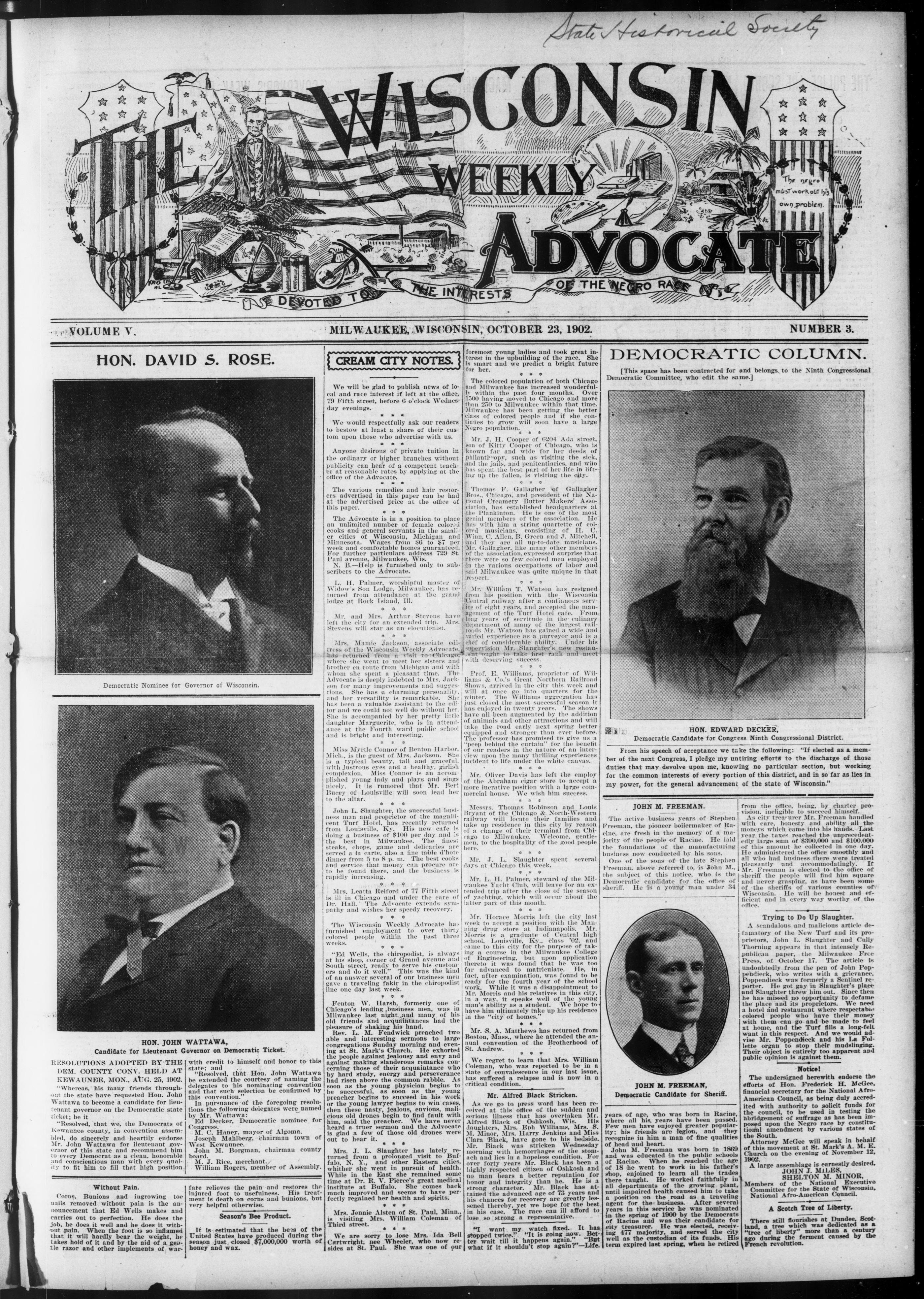
WISCONSIN
WEEKLY
ADVOCATE
DEVOTED TO THE INTERESTS OF THE NEGRO RACE
VOLUME V.
HON. DAVI
HON. DAVID S. ROSE.
Democratic Nominee for Governor of Wisconsin
HON. JOHN
Candidate for Lieutenant
HON. JOHN WATTAWA,
Candidate for Lieutenant Governor on Democra
[Name]
RESOLUTIONS ADOPTED BY THE DEM. COUNTY CONV. HELD AT KEWAUNEE, MON., AUG. 25, 1902. "Whereas, his many friends throughout the state have requested Hon. John Wattawa to become a candidate for lieutenant governor on the Democratic state ticket; be it "Resolved, that we, the Democrats of Kewaunee county, in convention assembled, do sincerely and heartily endorse Mr. John Wattawa for lieutenant governor of this state and recommend him to every Democrat as a clean, honorable and conscientious man with every quality to fit him to fill that high position
Without Pain.
Corns, Bunions and ingrowing toe nails removed without pain is the announcement that Ed Wells makes and carries out to perfection. He does the job, he does it well and he does it without pain. When the foot is so inflamed that it will hardly bear the weight, he takes hold of it and by the aid of a gentle razor and other implements of war-
---
WATTAWA,
governor on Democratic Ticket.
with credit to himself and honor to this state; and
"Resolved, that Hon. John Wattawa be extended the courtesy of naming the delegates to his nominating convention and that such selection be confirmed by this convention."
In pursuance of the foregoing resolutions the following delegates were named by Mr. Wattawa:
Ed Decker, Democratic nominee for Congress.
M. C. Haney, mayor of Algoma.
Joseph Mahlberg, chairman town of West Kewaunee.
John M. Borgman, chairman county board.
M. J. Rice, merchant.
William Rogers, member of Assembly.
fare relieves the pain and restores the injured foot to usefulness. His treatment is death on corns and bunions, but very helpful otherwise.
Season's Bee Product.
It is estimated that the bees of the United States have produced during the season just closed $7,000,000 worth of honey and wax.
MILWAUKEE, WISCONSIN, OCTOBER 23, 1902.
CREAM CITY NOTES.
We will be glad to publish news of local and race interest if left at the office, 79 Fifth street, before 6 o'clock Wednesday evenings.
We would respectfully ask our readers to bestow at least a share of their custom upon those who advertise with us.
☆ ☆ ☆
Anyone desirous of private tuition in the ordinary or higher branches without publicity can hear of a competent teacher at reasonable rates by applying at the office of the Advocate.
☆ ☆ ☆
The various remedies and hair restorers advertised in this paper can be had at the advertised price at the office of this paper.
* * *
The Advocate is in a position to place an unlimited number of female colored cooks and general servants in the smaller cities of Wisconsin, Michigan and Minnesota. Wages from $6 to $7 per week and comfortable homes guaranteed. For further particulars address 729 St. Paul avenue, Milwaukee, Wis.
N. B.—Help is furnished only to subscribers to the Advocate.
L. H. Palmer, worshipful master of Widow's Son Lodge, Milwaukee, has returned from attendance at the grand lodge at Rock Island, Ill.
* * *
Mr. and Mrs. Arthur Stevens have left the city for an extended trip. Mrs. Stevens will star as an elocutionist.
* * *
Mrs. Mamie Jackson, associate ediress of the Wisconsin Weekly Advocate, has returned from a visit to Chicago, where she went to meet her sisters and brother en route from Michigan and with whom she spent a pleasant time. The Advocate is deeply indebted to Mrs. Jackson for many improvements and suggestions. She has a charming personality, and her versatility is remarkable. She has been a valuable assistant to the editor and we could not well do without her. She is accompanied by her pretty little daughter Marguerite, who is in attendance at the Fourth ward public school and is bright and interesting.
宗 宗 宗
Miss Myrtle Connor of Benton Harbor, Mich., is the guest of Mrs. Jackson. She is a typical beauty, tall and graceful, with lustrous eyes and a healthy, girlish complexion. Miss Connor is an accomplished young lady and plays and sings nicely. It is rumored that Mr. Bert Bucye of Louisville will soon lead her to the altar.
* * *
John L. Slaughter, the successful business man and proprietor of the magnificent Turf Hotel, has recently returned from Louisville, Ky. His new cafe is doing a business of $100 per day and is the best in Milwaukee. The finest steaks, chops, game and delicacies are served a la carte, also a fine table d'hote dinner from 5 to 8 p. m. The best cooks and service that money can procure are to be found there, and the business is rapidly increasing.
```markdown
```
Mrs. Leatta Relford of 77 Fifth street is ill in Chicago and under the care of Dr. Hall. The Advocate extends sympathy and wishes her speedy recovery.
* * *
The Wisconsin Weekly Advocate has furnished employment to over thirty colored people within the past three weeks.
* * *
"Ed Wells, the chiropodist, is always at his shop, corner of Grand avenue and South street, ready to serve his customers and do it well." This was the kind of an answer several of our business men gave a traveling fakir in the chiropodist line one day last week.
* * *
Fenton W. Harsh, formerly one of Chicago's leading business men, was in Milwaukee last night and many of his old friends and acquaintances had the pleasure of shaking his hand.
Rev. L. M. Fendwick preached two able and interesting sermons to large congregations Sunday morning and evening at St. Mark's Church. He exhorted the people against jealousy and envy and against making slanderous remarks concerning those of their acquaintance who by hard study, energy and perseverance had risen above the common rabble. As soon as the young physician begins to be successful, as soon as the young preacher begins to succeed in his work or the young lawyer begins to win cases, then these nasty, jealous, envious, malicious old drones begin to find fault with him, said the preacher. We have never heard a truer sermon and the Advocate is glad a few of those old drones were out to hear it.
Mrs. J. L. Slaughter has lately returned from a prolonged visit to Buffalo, N. Y., and other Eastern cities, whither she went in pursuit of health. While in the East she remained some time at Dr. R. V. Pierce's great medical institute at Buffalo. She comes back much improved and seems to have perfectly regained her health and spirits.
* * *
Mrs. Jennie Alsten of St. Paul, Minn., is visiting Mrs. William Coleman of Third street.
* * *
We are sorry to lose Mrs. Ida Bell Cartwright, nee Wheeler, who now resides at St. Paul. She was one of our
foremost young ladies and took great interest in the upbuilding of the race. She is smart and we predict a bright future for her.
☆ ☆ ☆
The colored population of both Chicago and Milwaukee has increased wonderfully within the past four months. Over 1500 having moved to Chicago and more than 250 to Milwaukee within that time. Milwaukee has been getting the better class of colored people and if she continues to grow will soon have a large Negro population.
Mr. J. H. Cooper of 6204 Ada street, son of Kitty Cooper of Chicago, who is known far and wide for her deeds of philanthropy, such as visiting the sick, and the jails, and penitentiaries, and who has spent the best part of her life in lifting up the fallen, is visiting the city.
* * *
Thomas F. Gallagher of Gallagher Bros., Chicago, and president of the National Creamery Butter Makers' Association, has established headquarters at the Plankinton. He is one of the most genial members of the association. He has with him a string quartette of colored musicians, consisting of H. C. Winn, C. Allen, B. Green and J. Mitchell, and they are all up-to-date musicians. Mr. Gallagher, like many other members of the association, expressed surprise that there were so few colored men employed in the various occupations of labor and said Milwaukee was quite unique in that respect.
Mr. William T. Watson has resigned from his position with the Wisconsin Central railway after a continuous service of eight years, and accepted the management of the Turf Hotel cafe. From long years of servitude in the culinary department of many of the largest railroads Mr. Watson has gained a wide and varied experience as a purveyor and is a chef of considerable ability. Under his supervision Mr. Slaughter's new restaurant ought to take first rank and meet with deserving success.
Prof. E. Williams, proprietor of Williams & Co.'s Great Northern Railroad Shows, arrived in the city this week and will at once go into quarters for the winter. The Williams aggregation has just closed the most successful season it has enjoyed in twenty years. The shows have all been augmented by the addition of animals and other attractions and will take the road early next spring better equipped and stronger than ever before. The professor has promised to give us a "peep behind the curtain" for the benefit of our readers in the nature of an interview upon the many thrilling experiences incident to life under the white canvas.
* * *
Mr. Oliver Davis has left the employ of the Abraham cigar store to accept a more lucrative position with a large commercial house. We wish him success.
* * *
Messrs. Thomas Robinson and Louis Bryant of the Chicago & North-Western railway will locate their families and take up residence in this city by reason of a change of their terminal from Chicago to Milwaukee. Welcome, gentlemen, to the hospitality of the good people here.
Mr. J. L. Slaughter spent several days at Chicago this week.
* * *
Mr. L. H. Palmer, steward of the Milwaukee Yacht Club, will leave for an extended trip after the close of the season of yachting, which will occur about the latter part of this month.
Mr. Horace Morris left the city last week to accept a position with the Manning drug store at Indianapolis. Mr. Morris is a graduate of Central high school, Louisville, Ky., class '02, and came to this city for the purpose of taking a course in the Milwaukee College of Engineering, but upon application thereto it was found that he was too far advanced to matriculate. He, in fact, after examination, was found to be ready for the fourth year of the school work. While it was a disappointment to Mr. Morris and his relatives in this city, in a way, it speaks well of the young man's ability as a student. We hope to have him ultimately take up his residence in the "city of homes."
```markdown
```
Mr. S. A. Matthews has returned from Boston, Mass., where he attended the annual convention of the Brotherhood of St. Andrew.
* * *
We regret to learn that Mrs. William Coleman, who was reported to be in a state of convalescence in our last issue, has suffered a relapse and is now in a critical condition.
Mr. Alfred Black Stricken.
As we go to press word has been received at this office of the sudden and serious illness that has overtaken Mr. Alfred Black of Oshkosh, Wis. His daughters, Mrs. Eph Williams, Mrs. S. M. Minor, Mrs. Harry Jenkins and Miss Clara Black, have gone to his bedside. Mr. Black was stricken Wednesday morning with hemorrhages of the stomach and lies in a hopeless condition. For over forty years Mr. Black has been a highly respected citizen of Oshkosh and no man bears a better reputation for honor and integrity than he. He is a strong character. Mr. Black has attained the advanced age of 73 years and his chances for recovery are greatly lessened thereby, yet we hope for the best in his case. The race can ill afford to lose so strong a representative.
"I want my watch fixed. It has stopped twice." "It is going now. Better wait till it happens again." "But what if it shouldn't stop again?"—Life.
DEMOCRATIC COLUMN.
DEMOCRATIC COLUMN.
[This space has been contracted for and belongs to the Ninth Congressional Democratic Committee, who edit the same.]
[Portrait of a man with a long beard and a formal suit, facing slightly to the right. The background is plain and light-colored.]]
From his speech of acceptance we take the following: "If elected as a member of the next Congress, I pledge my untiring efforts to the discharge of those duties that may devolve upon me, knowing no particular section, but working for the common interests of every portion of this district, and in so far as lies in my power, for the general advancement of the state of Wisconsin."
JOHN M. FREEMAN.
The active business years of Stephen Freeman, the pioneer boilermaker of Racine, are fresh in the memory of a majority of the people of Racine. He laid the foundations of the manufacturing business now conducted by his sons.
One of the sons of the late Stephen Freeman, above referred to, is John M., the subject of this notice, who is the Democratic candidate for the office of sheriff. He is a young man under 34
[Picture of a man in a suit with a tie].
JOHN M. FREEMAN,
Democratic Candidate for Sheriff.
years of age, who was born in Racine, where all his years have been passed. Few men have enjoyed greater popularity; his friends are legion, and they recognize in him a man of fine qualities of head and heart.
John M. Freeman was born in 1869 and was educated in the public schools of Racine. When he reached the age of 18 he went to work in his father's shop, enjoined to learn all the trades there taught. He worked faithfully in all departments of the growing plant, until impaired health caused him to take a position on the road as a traveling agent for the business. After several years in this service he was nominated in the spring of 1900 by the Democrats of Racine and was their candidate for city treasurer. He was elected, receiving 477 majority, and served the city well as the custodian of its funds. His term expired last spring, when he retired
NUMBER 3.
D DECKER,
Press Ninth Congressional District.
Make the following: "If elected as a mem-
tiring efforts to the discharge of those
being no particular section, but working
ion of this district, and in so far as lies in
of the state of Wisconsin."
from the office, being, by charter provision ineligible to succeed himself
vision, ineligible to succeed himself.
As city treasurer Mr. Freeman handled with care, honesty and ability all the moneys which came into his hands. Last year the taxes reached the unprecedentedly large sum of $390,000 and $100,000 of this amount he collected in one day. He administered the office smoothly and all who had business there were treated pleasantly and accommodatingly. If Mr. Freeman is elected to the office of sheriff the people will find him square and never grasping, as have been some of the sheriffs of various counties of Wisconsin. He will be honest and efficient and in every way worthy of the office.
Trying to Do Up Slaughter.
A scandalous and malicious article defamatory of the New Turf and its proprietors, John L. Slaughter and Cully Thorning appears in that intensely Republican paper, the Milwaukee Free Press, of October 17. The article is undoubtedly from the pen of John Poppendieck, who writes with a grievance. Poppendieck was formerly a Sentinel reporter. He got gay in Slaughter's place and Slaughter threw him out. Since then he has missed no opportunity to defame the place and its proprietors. We need a hotel and restaurant where respectable colored people who have their money with them can go and be made to feel at home, and the Turf fills a long-felt want in this respect. And we would advise Mr. Poppendieck and his La Follette organ to stop their mudslinging. Their object is entirely too apparent and public opinion is against them.
Notice!
The undersigned herewith endorse the efforts of Hon. Frederick H. McGee, financial secretary for the National Afro-American Council, as being duly accredited with authority to solicit funds for the council, to be used in testing the abridgement of suffrage as has been imposed upon the Negro race by constitutional amendment by various states of the South. Attorney McGee will speak in behalf of this movement at St. Mark's A. M. E. Church on the evening of November 12, 1902.
A large assemblage is earnestly desired. JOHN J. MILES, SHELTON M. MINOR.
SHELTON M. MINOR
Members of the National Executive Committee for the State of Wisconsin,
National Afro-American Council.
A Scotch Tree of Liberty.
There still flourishes at Dundee, Scotland, a tree which was dedicated as a "tree of liberty" more than a century ago during the ferment caused by the French revolution.
THE POLICE ARE SCORED.
Resolutions Before Watertown Council Laid Over.
Watertown, Wis., Oct. 22.—[Special.]
—At a meeting of the common council last night Ald. Prentiss introduced resolutions censuring Chief of Police Block for failing to stop the disturbance in front of the Methodist Church on the night of August 30, when eggs were thrown at Pastor A. M. Bullock and Evangelist Miller, who were holding service on the church steps. The resolutions were the subject of considerable debate, and a motion to lay them over until the next meeting was carried, two aldermen objecting.
Ald. Prentiss, who was chairman of the investigating committee, said that while there was no positive evidence that the police witnessed the egg throwing, the disturbance came under the ordinance prohibiting such assemblages and the police were at fault in not preserving order and maintaining the rights of the people. At a meeting of the official board of the M. E. Church of Watertown the following resolutions concerning the attack upon Rev. Mr. Bullock and Evangelist Miller were passed:
We are sorry to be compelled to note the insult to the churches, and to all law-abiding citizens, and the woeful disgrace to our city resulting from the unprovoked and unwarranted riot of Saturday evening, August 3, 1902. Evidence shows that the riot was prearranged, planned and carried out by men, not by "irresponsible boys," as some would have us believe, though boys became accesories.
That disgraceful scene has become a matter of history; its true inwardness and reality, however, the beyond picturing. We deplore the fact, and its possibility here in Wisconsin would seem incredible but for the fact of its occurrence. We are deeply grateful, however, for the general favor of law-abiding citizens of every class and of every religious belief in Watertown accorded to those against whom the wrong was perpetrated.
We can but denounce unsparingly the misrepresentations and cowardly attacks which have appeared in some of the local papers-upon Mr. Miller.
We regret the seeming attitude of a portion of the local press in attempting to palliate this outrage by a specious effort to justify this wrong, or shifting the blame of the instigators and perpetrators of the wrongdoing upon "irresponsible boys," and our brethren who were exercising their legal and constitutional rights in peaceably conducting a religious service, and that, too, on the rightful property of the church.
We solemnly enter our most earnest protest and condemnation against the dereliction of duty on the prt of our city police and other officers of the city government for their failure to preserve the peace and good order on the occasion of the religious meeting in question, and we believe this outrage merits universal disapproval of every law-abiding citizen. We believe it would be conducive to law and order and for the highest welfare of the city that the instigators and perpetrators of the riot be brought to justice.
We highly appreciate the eminently fair treatment, for the most part, of this deplorable affair by the press of Milwaukee and elsewhere.
MOTHER DEMANDS POSSESSION OF SON.
Mrs. Fannie Lepp Wants. Possession of Child Now with Grandfather at Green Bay.
Green Bay, Wis., Oct. 22.—Mrs. Fannie Lepp has started proceedings in the county court to gain possession of her 7-year-old son who is now living with his grandfather, Frank Lepp, in the town of Pittsfield, in this county. She sets forth in her affidavit that Lepp is not a fit person to bring up the boy. The child when an infant was given to the old man by the father as he laid upon his deathbed. The two have become much attached to each other and the little boy refuses to go with the mother. The mother, with Sheriff Burke, drove to the Lepp home this morning, but the old man refused to give up the child. The mother lives at Nadeau, Mich.
REFUSED TO COME TO AID OF LOVER.
Beloit Young Man Decides to Plead Guilty When Girl will Not Come to Him.
Racine, Wis., Oct. 22.—[Special.]—Winne Breese of Beloit, arrested here yesterday, charged with passing forged checks on local merchants, was this morning sentenced to the state prison at Waupun for a term of two years. Yesterday afternoon Breese wired to his intended wife at Beloit, asking here to come here and help him out of his trouble. She refused to come and Breese accordingly decided to plead guilty. He was taken before a court commissioner and waived his preliminary hearing, after which he was taken before the judge of the municipal court, where he pleaded guilty.
BODY OF CLAFLIN BOY IS RECOVERED.
It is Found Floating in Lake Nagowicka —No Trace of the Peterson Lad.
Delafield, Wis., Oct. 22.—[Special.]—The body of Aubrey Claflin, who was drowned a week ago while sailing with his little cousin, George Peterson, was found at 10 o'clock this morning floating in Nagowicka lake near the summer home of Alfred Janes. The body was in good condition. No trace of the Peterson boy's body has been found. The cannon on Howard island is being fired at intervals and it is thought that it raised to Claflin bay's body. The funeral of Aubrey Claflin will take place tomorrow afternoon at 2 o'clock. George Peterson was 10 years old and his cousin was 12.
SICK PRISONER
MAKES HIS ESCAPE.
Man Ill with Typhoid Fever Gets Out of Jail—Arrested Again Near Platteville.
Platteville, Wis., Oct. 22.—A man giving his name as Wilson was arrested at Bridgeport. He was confined in the Galena, Ill., jail and made his escape last Thursday. Being seriously sick with typhoid fever he was taken from the cell and given a room. During the night he made his escape from the fourth floor by the aid of torn sheets.
KLEPTOMANIAC IS ADJUDGED INSANE.
Outcome of Arrest of Wealthy Woman Arrested for Alleged Theft of $25,-000 Worth of Jewels.
New York, Oct. 18.—Mrs. Rachel Richman, wife of a wealthy merchant of this city, who was arrested in Alexandria Bay last July on the charge of having stolen jewels worth more than $25,000 from Dr. and Mrs. Walter E. Delabarre, has been adjudged insane. Justin Leventritt in the supreme court has confirmed the report of Vernon M. Davis, the referee before whom evidence as to the woman's mental condition had been taken.
Mr. and Mrs. Richman arrived at a summer hotel in Alexandria Bay about the same time Dr. and Mrs. Delabarre of this city registered. The rooms assigned to the Richmans and the Delabarres were near each other and both opened on the same veranda. The Delabarres, who were on their wedding trip, went downstairs to dinner. After returning they sat for a while on the veranda. On returning to their rooms Mrs. Delabarre's necklace of diamonds, worth $25,000, could not be found. Money to the amount of $400 also was missing. The proprietor was notified and half an hour later a warrant was issued for the search of the Richmans' room. It was stated that the necklace was found in a trunk belonging to Mrs. Richman. The money was in a skirt lining. Mr. and Mrs. Richman were arrested and held for the grand jury. They were taken to Watertown and released under $5000 bail each. Everyone who knew the couple testified to their high character. They returned to this city. Recently came the application for a commission in lunacy, with the result stated.
CATCH REVEREND SMUGGLER.
Customs Officers at Baltimore Confiscate Indiana Pastor's Goods.
Baltimore, Md., Oct. 18.—Customs officers seized a lot of jewelry and fancy goods concealed about the persons of Rev. L. Sternberg of Urbana, Ind., and Mrs. Charles Eggert of Wichita, Kan., who arrived on the Frankfurt from Bremerhaven.
The articles were confiscated, though the minister wept and offered to pay the duty. He had one gold watch and chain, one woman's gold chain, one gold and silver brooch, one pair of gold bracelets, twelve yellow metal spoons and six silver spoons.
The woman had much more. The customs officers said that if the discovery had been made ashore instead of on ship both would have been committed.
ELEVEN PAIRS OF TWINS.
Numerous Offspring of Iowa Couple Equally Divided as to Sex.
St. Paul, Minn., Oct. 18.—There is no other man in the country, is is said, who enjoys the distinction that James Weir of Boone, In., possesses. He is the father of eleven pair of twins, twenty-two children. It is said that the mother was partial to girls, while the father preferred boys. Nature satisfied them both, for at each birth came a boy and a girl. Mrs. Weir's two eldest daughters are married to twin brothers. Within twelve hours of each other each of the daughters gave birth to twins, a boy and a girl. Mr. Weir's offspring enjoys the best of health.
ASK REPAYMENT OF RANSOM.
Missionaries Request State Department to Collect from Turkey.
Washington, D. C., Oct. 18.—Representatives of the missionary societies have at length formally requested the state department to make a demand on Turkey for repayment of the amounts of ransome paid on account of the release of Miss Ellen Stone. The request assumes the liability of Turkey as settled, but the state department has by no means assured itself on that point and it is stated that the responsibilily still lies between Turkey and Burgaria, with, perhaps, the weight of evidence against the latter country.
CRIB OF LUMBER STOLEN.
In All River Experience Such a Thing
Had Never Been Heard of Before.
St. Paul, Minn., Oct. 18.—The steamer Musser, belonging to the Van Sant line of steamers, while splitting her raft for Cassville slough last night, had a crib of lumber stolen. Four men held up the watchman and boldly purloined the lumber. In all river experience such a thing has never been heard of before. The thieves on the river are becoming very bold. A liberal reward has been offered for the arrest and conviction of the thieves and the authorities along the river have been notified to be on the lookout for them.
HAD TO WAIT FOR COAL.
Sailing of Two Atlantic Liners Postponed for Several Hours.
New York, Oct. 18.—The sailing of the North German Lloyd steamer Grosser Kurfurt for Bremen was postponed from 10 o'clock this morning until 7 o'clock tomorrow morning because her coal supply did not arrive until half an hour before the time set for her departure. The sailing of the Holland American liner Pottsdam was postponed until 4 o'clock this afternoon for the same reason.
Tried and Hanged in Two Hours
Nacogdoches, Tex., Oct. 18.—Jim Buchanan, colored, the murderer of the Hicks family, was tried here yesterday. A plea of guilty was accepted by the judge and the negro was legally hanged within two hours after sentence had been passed.
Shot Off Cow's Tail
Calumet, Mich., Oct. 18.—For shooting off the the tail of a cow which trespassed on his property, Fred Larson of this city has been fined $20 and costs. The case, it is likely, will be appealed to the circuit court.
Wisconsin Man Murdered.
St. Paul., Minn., Oct. 18.—The body of the man found murdered in Prospect park. Monday was identified as that of Thomas Vance of Birchwood, Wis.
Japanese Characteristics.
Etiquette is the religion of Japan. No people in the world are as polite as the Japanese. As a nation the Japanese are more cleanly than any other people. In nearly every way they are superior to the Chinese, but they lack the Chinese conscience and the doctrine of commercial honor. London and New York merchants sell many Chinese merchants goods on credit, but they have learned by bitter experience that the Japanese merchants frequently fail to pay their debts.
Black Bass Kill Salmon.
The people of the state of Washington, it is claimed, are making a serious mistake in their effort to obtain the consent of the government to plant black bass in Washington waters. There is no question but that black bass will kill salmon, to which they are a most deadly foe.
Governor Has Not Hesitated to Abuse State Institutions.
FOR FACTIONAL END.
One of the Most Serious Accusations that Has Been Brought Against La Follette.
One of the most serious accusations that can be brought against Gov. La Follette is his prostitution of the various state institutions to factional ends. In previous administrations, when the men in charge of the state government were ordinary men without pretensions to a greater degree of holiness than their fellow citizens, it was the custom to leave the management of the many state institutions to the board of control without interference from the executive office
Governors there were who were partisan and disposed to do all they could to advance the interests of their party but they recognized certain limits beyond which they did not go. The state of Wisconsin had for years been building up a system of public institutions that were the pride of every citizen. Her penitentiary was a model one under the personal charge of one of the most eminent prison men in the United States, who after years of training had risen to the highest point in his profession. Her system of caring for the insane and feeble minded had been evolved from the old mad house system and, administered by competent men, was so admirably adapted to provide for the mentally afflicted that it brought state officials and alienists from all parts of the country to study it. The Wisconsin system of caring for the insane has since been adopted in at least a dozen other states. Not only the insane, but the blind, the deaf and dumb and the orphans were equally well cared for. Educationally the state had gradually built up one of the largest and best nonsectarian universities in the world.
Old Politicians Not Saints.
The old style politician was not a saint —he did not even pretend to be—but he at least respected the public educational, charitable and penal institutions and did not attempt to make use of them for partisan purposes. An occasional appointment of a clerk in the state hospital or penitentiary was about as far as any governor previous to Robert M. La Follette cared to go.
Since 1901 the state institutions have been revolutionized. The new governor was scarcely located in the executive mansion before he began to make use of every department of the government he could control not only for partisan but for factional ends. The state board of control from an independent body became, as has aptly been described, "the state board under control." Its members were compelled to yield unquestioning obedience to the ambitious dictator, or if they developed any symptoms of individuality they were replaced as fast as their terms expired by men who could be depended upon to do what they were told. Then began a systematic cleaning out
Bliss was Indiscreet.
The first institution to receive the personal attention of the governor was the State School for the Blind at Janesville. Its superintendent, Howard F. Bliss, was also editor of the Janesville Gazette, and had been so indiscreet as to make some unfavorable comment in his editorial capacity on the governor's attempt to control the Legislature. For the remark of Bliss, the editor, Bliss, the superintendent, was promptly dumped out of office. The governor was so vindictive that the state board of control did not allow Supt. Bliss to finish the school year but removed him summarily without a hearing. A tried La Follette man was given his place at an increased salary.
McClaughry Next.
The next victim was Warden McClaughry of Waupun prison. His offense was in believing that he should be allowed to handle the internal affairs of the prison, as he had done under the Scotfield administration. He resigned upon discovery that the governor and his board were trying secretly to obtain evidence among the convicts to bring about his removal. This place was hung out as a tempting bait for the faithful until after the delegates had been elected to the Republican state convention and has since been used to win over certain interests wanted on November 4.
The latest deal was a barter of the office of state superintendent of public instruction to a number of book companies in exchange for campaign funds. The details are too well known and established to require repeating. Two of the most prominent Republicans in the state declare that the governor personally was the beneficiary of this transaction while the governor's friend, Theodore Kronshage, rather lamely attempts to show that the money went to the governor's clerk, who expended in his master's interests without informing him of
Re-election a Catastrophe.
The state university, insane hospitals and normal schools have not yet been "reorganized" and swallowed up by the machine, but no one knows what will happen to them in case of Gov. La Follette's re-election. There have already been signs of executive interference in the election of a president of the university. If Gov. Robert M. La Follette is re-elected politics will control the appointment to the Wisconsin Industrial School to fill the vacancy to be caused by the retirement of Prof. C. O. Merica and the new head of the school will without doubt be some man who has done yoeman service in support of La Follette, in his pre-convention campaign.
Reports are already being circulated to the effect that Samuel Breese, Jr., the present secretary of the Republican county committee of Milwaukee county, is likely to get the place, and other politicians are also out for the place. Mr. Merica will, however, likely stay in the place until the end of his present term, which is June 30, 1903, and with this condition of affairs it is quite likely that lack of official position caused by a failure of re-election may prevent Gov. La Follette from dictating the appointment.
Gen. Lee's Socks.
The discipline of Gen. Lee's socks was an "institution" peculiar to our hospital. Mrs. Lee, it is well known, spent most of her time in making gloves and socks for the soldiers. And she gave me, at one time, several pairs of Gen. Lee's old socks, so darned that we saw they had been well worn by our hero. We kept these socks to apply to the feet of those laggard "old soldiers" who were suspected of preferring the "luxury" of hospital life to the activity of the field. And such was the effect of the application of these warlike socks that even a threat of it had the result of sending a man to his regiment who had lingered months in inactivity. It came to be a standing joke in the hospital, infinitely enjoyed by the men. If a poor wretch was out of his bed over a week, he would be threatened with "General Lee's socks;" and through this means some most
---
obstinate cases were cured. Four of the most determined rheumatic patients, who had resisted scarifying of the limbs, and what was worse, the smallest and thinnest of diets, were sent to their regiments and did good service afterwards. With these men the socks had to be left on several hours, amidst shouts of laughter from the "assistants." showing that though men may withstand pain and starvation they succumbed directly to ridicule.—Emily V. Mason, in the Atlantic.
HOW IT WORKS IN MINNESOTA.
Wisconsin Newspaper Man After a Practical Exposition of the Primary Election Changes His Mind.
S. E. Bronson, who recently edited and published the Wonewoc (Wis.) Reporter and who was a rabid advocate of the primary election theory, seems to have had a wet blanket thrown upon his enthusiasm. He is now editor of the Leroy (Minn.) Independent and has just passed through a primary election, and as a result seems to be hunting for something better. Here is what he says: "The writer has been a believer in and an advocate of a primary election law, the purpose of which is to take the nomination of officers out of the hands of rings and cliques, snap caucuses and conventions, and put the matter where it properly belongs, into the hands of the people.
"But we are now convinced that the primary election law now in force in this state is worse than the old system and should either be repealed or mutilated to such an extent that its own mother wouldn't know it.
"In a county where there is a city large enough to exercise a big influence on an election the primary law works squarely into their hands, for the reason that the country vote is scattered, while that of the city is easily directed solidly to the support of its own men.
"Generally through the country the primary vote was about 85 per cent. of the vote of 1900, but in Austin it not only took the entire Republican strength, but called out no less than 200 and probably 250 Democratic votes, enough to determine the nomination of Campbell and Lightly. Austin has always had the disposition to grab everything in sight, and the new primary law affords her a dead cinch on all the nominations in the county."—Baraboo News.
ROSE ANSWERS
LA FOLLETTE
Puts the Words of Messrs. Stout and Buckstaff Against the Denial of the Governor Concerning Book Deal.
Mayor Rose took occasion to comment on Gov. La Follette's dental of the Buckstaff-Stout charges that the independent book companies had contributed money for his personal campaign, at Whitewater Saturday. After discussing the school question for a few moments the mayor said:
"In a speech made yesterday Gov. La Follette denied for the first time that lie knew where the contribution came from, but I want to call to your attention the witnesses who are conversant with the facts, Mr. George Buckstaff of Oshkosh, an eminent Republican and an eminent citizen, and Senator Stout of Menomonie, and both of these the warm personal friends of Gov. La Follette down to the moment that his perfidy was discolsed to them.
"Mr. La Follette denies that he knew where the contribution came from. Mr. Buckstaff and Senator Stout say that when this information came to them before the Madison convention' was held they called upon the governor and told him what Kronshage had said to them, but he refused to take any action, refused to listen to them unless Kronshage was present. Gov. La Follette has allowed the matter to rest, waited for nearly three months after these charges were made, when, driven to it by the goad, he comes out and makes a denial.
"There is the evidence and there are the witnesses. The witnesses are all Republicans and, as I said, personal friends of Gov. La Follette's prior to this time."
CHAIRMAN WARDEN SEES VICTORY.
Says Mayor Rose will be Surely Elected by from 20,000 to 30,000 Plurality.
"As near as I can get at anything," said Chairman A. F. Warden of the Democratic state central committee, "we expect David S. Rose to carry the state of Wisconsin by from 20,000 to 30,000 plurality. He is about 12,000 stronger than the balance of the ticket.
"We shall elect three congressmen sure, and have flattering prospect in the case of the fourth. Which ones are they? Why, in the Fourth, Fifth and Sixth districts sure, and the one in which we have more than a fighting chance I prefer to keep to myself for various reasons.
"The predictions I have given you are based on careful estimates received from about sixty counties and general reports from the others. We have reports from all but three or four counties.
"We expect to elect a majority of the members of the Legislature. My report shows that up to this time the Republicans have done almost nothing.
"Up to the present time Republicans have not held twenty meetings in the state and some of them have been poorly attended. Just what effect the entrance into the campaign of Senators Spooner and Quarles will have upon the conditions as they now exist remains to be seen.
"Our state campaign will open generally Monday, October 13. We shall send out from 150 to 200 speakers and will cover the whole state."
A Caucasus Glacier.
Between Mount Kazbek and Ghimarai Khokh in the Caucasus a glacier descends into the narrow, wedge-shaped valley of the Ghenaal Don, which after a course of thirteen miles joins the Ghizel Don, a tributary of the Terek. Like most glaciers of the Caucasus the Ghenaal Don has of late years receded considerably and some years ago copious springs of hot sulphur water were uncovered by this recession. About the middle of July the whole end of the glacier broke off and slid down the valley, grinding down everything in its path. Thirty-two lives were lost. On July 19 another huge block of ice broke off and followed the first with terrible rapidity for over eight miles down the valley.
Women Laborers in Finland.
The women of Finland of the lower classes perform arduous labor that in other countries is usually assigned to males. They wheel handcarts and barrows of various descriptions containing heavy burdens. They also sweep the streets, act as boatmen and even assist in loading ships.
The colonial possessions of France cover an area twenty times as large as that country, and contain 12,000,000 more inhabitants.
Tells Voters what He Proposes to Do in the Future.
Ignores All Questions with Exception of His Pet Hobby, the Stevens
In his speeches this year Gov. La Follette is pleading for votes mainly on the ground that he proposes to compel the railroad, express, sleeping car and street railway companies to pay a larger share of taxes than they are now contributing to support the public burdens. All other questions, except the enactment of the Stevens bill, are entirely ignored. The scandal of the game wardens, the scandal of the book companies and the forcing of the state institutions into politics, are not referred to.
Nowhere in the 32,000 word speech of the governor first delivered at Milwaukee and since repeated at other places in the state is there a word of defense of the administration policy on these subjects, a policy that has driven thousands of life-long Republicans temporarily into the ranks of the Democracy. It may be the chief executive of the state feels he can say nothing that will excuse his conduct, but whether willingly or unwillingly, he must answer his critics or stand convicted of the serious charges made against him.
An Eleventh-Hour Issue.
Neither does Mr. La Follette's record on the question of taxation bear examination. It was an eleventh hour issue embraced desperately to prevent the loss of party control. After the election of 1900 and during the session of the Legislature in 1901 the people heard nothing of it from its present self-styled champion. During the entire legislative session when the governor was bending every energy and making use of every political resource at his command to establish control over the law-making body, no attempt was made to pass taxation legislation of importance. Then the test of every Republican member, deciding in the governor's mind whether he was a faithful Republican or a traitor, was his position on the Stevens primary election bill. Everything else was neglected in the fight between the governor and the Stalwarts for control of the Legislature. The opportunity to enact equitable taxation laws was overlooked and the bills were permitted to die while the struggle on the primary election law went on.
La Follette's Great Discovery.
When the Legislature adjourned all admitted the contest between the factions for control of the Republican organization would be fought out on the issue of the Stevens bill. The alignment remained the same until a few months ago. Then the governor made a great discovery. He learned that the public was taking little interest in the so-called primary bill of Assemblyman Stevens and that unless he could invent some other device to win popular support he must be defeated for renomination. Accordingly the taxation issue, which had done duty for Mr. La Follette and other politicians in the past and could be made sufficiently indefinite for practical political purposes, was once more brought to the front. It helped to renominate the governor and now he hopes by careful nursing it may be kept alive until the election.
In light of Gov. La Follette's record on the taxation question it is reasonable to predict that, if elected, he will do no more to secure a fair taxation law than he has done in the past. His record in that respect is entirely a talking one, with nothing accomplished, nothing even attempted. This is what has been done in the past two years on the question of taxation: The "public service corporations" have not been taxed higher than before; instead by the increase of the state assessment 25 to 50 per cent, their burdens on the same valuation as previously have been greatly reduced. A bill passed to prevent double taxation (the Frost mortgage bill), was vetoed.
Contrast of Platforms.
The Republican platform this year vaguely hints at reform in taxation. The Democratic platform defines the party's position so clearly that it cannot be misunderstood, and it means just what it says. The Democratic platform favors absolute uniformity of taxation—the uniformity required by the state constitution. It proposes to tax all property alike. It is a policy to which no honest man, workingman or capitalist, can object. If once put into effect, as it will be if the Democratic party is victorious in November, it will dispose of the taxation question for all time to come and it will also dispose of the ambitions of designing politicians seeking office in the name of "reform."
An Ocean Mystery
The most remarkable ocean mystery is that which enshrouds the fate of the crew of the Marie Celeste, an American merchant vessel, which sailed from New York for Villefranche a few years ago. She had on board thirteen persons, including the captain's wife and daughter. Some time after she was sighted off Gibraltar by a French steamer. The Frenchmen gazed long and earnestly at the vessel lying becalmed under full sail, Glasses failed to discover any signs of life on board of her. On the captain hailing the vessel and receiving no response, a boat was put off and the crew boarded her. They were surprised to find everything in apple-pie order, but not a soul on board. The Marie Celeste was searched from stern to bow; there were no signs of a struggle; the boats were all there, and clothes were hanging out to dry.
In the cabin, on the table, was a half-finished meal; a piece of calico was on a sewing machine; and the compasses and watches of the captain and mate were found. There was plenty of water on board and, altogether, it was a most unaccountable mystery what had become of the thirteen people. The ship's log had been kept within forty-two hours of the time when she was discovered, and spoke of a voyage without accident of any kind. It was with difficulty a crew was secured to take the vessel to her destination. Since then nothing has been heard of the crew of thirteen who so mysteriously disappeared.
How the Japs Smoke
The Japanese smoke in a very peculiar manner. The pipes have very small metal bowls with bamboo stems and metal mouthpieces, and only hold enough tobacco for three or four whiffs. They use a tobacco which is cut extremely fine, and looks more like a light blond hair than anything else. It is of a very good quality, however. The Japs take a whiff of smoke and inhale it, letting it pass out through their nostrils.
--The eel has two separate hearts. One beats 60, the other 160, times a minute.
THE TWINE ECONOMY
Some New Thoughts on the Preservation of String.
It is curious how long some simple childish duty taught in early youth will cling to one through life! Gray-haired men and women find themselves doing persistently certain little insignificant things, just because their mothers taught them the habits in their childhood—funny little flotsam and jetsam of infancy which the waves of time have left high and dry on the arid plains of age.
"I always end up my prayers every night by saying 'God bless papa and mama and make me a good girl,' said an aged woman recently. "I cannot give it up; it is like saying amen to my petitions. My dear parents have long since joined the great majority, but I always keep it up, and undoubtedly will do so until I die."
The small courtesies of life which do so much toward sweetening existence are almost all of them habits acquired in the nursery, which become second nature in after years and never leave one—marking the innate difference between gentle breeding and want of early culture. In some of these elementary remnants of nursery origin one can find trace of the teachings of some old nurse whose wise sayings used to be like inspired utterances, or of moral tales, particularly Miss Edgeworth's, that have had a lasting influence quite incommensurate with the importance of the subject matter. Take the cutting of twine around a parcel, for instance. How many women will insist upon the family painfully untying hard knots, no matter how long it takes to open the parcel, all on account of the historic hero of Miss Edgeworth's "Two Strings to a Bow," which depicted the ultimate triumph which resulted from the careful disentangling and preservation of a cord around a bundle. A ball of twine which costs a few cents will last the needs of an ordinary family for a year, and yet many excellent housekeepers refuse to purchase this simple luxury, rolling up consciously the untied strings that come around the parcels and putting them into a drawer for use. How frequently the supply gives out at crucial moments, and how often it is impossible to find a piece of the right length when in a great hurry, only the harassed head of the family whose wife's pet economy is the preservation of parcel cord and who refuses to buy twine in consequence could say.
High Honors for Winchester
The reputation of the Winchester Repeating Arms Co., New Haven, Conn., the largest manufacturers of guns and ammunition in the world, stands as high abroad as in this country, as is evidenced by the fact that most of the crowned heads of Europe place orders with them for their hunting outfits. The last addition to the long list of potentates to favor the Winchester Company with his patronage is King Oscar of Sweden. He was so pleased with the guns made for him by this great company that, without solicitation upon their part, he appointed them gunmakers to His Majesty.
New York's Zoo.
Uncle Si (agriculturist)—I've hearn the New York Zoo is great.*
Uncle Joe (countryside joker)—Wal, I guess! They's got the unmitigated ass, and money sharks, and country suckers, and Chicago lobsters, and Wall street bulls, and stock exchange bears, and peacocks of fashion, and monkey-faced dudes, and society apes, and old hen reformers, and gawkies, and snipes, and snakes of vice, and Tammany tigers, and owl cars, and doves of peace, and dogs of war, an'—"
Uncle Silas—Say, Joe, I want a gallon of that same cider.—Life.
Man with Cracked Skull Able to Work.
Houghton, Mich., Oct. 16.—A remarkable case of recovery is that of a Finnish laborer who was severely injured while at work in the Portage Entry quarries several months ago. His skull was fractured from temple to temple, with fractures in several other places, and the man was picked up for dead. However, much to the surprise of the surgeons, he responded to the treatment, steadily recovered and is now again at work, as if nothing had happened.
No one would ever be bothered with constipation if everyone knew how naturally and quickly Burdock Blood Bitters regulates the stomach and bowels.
—Only 2240 bicycle licenses have been taken out this year in Montreal, as against 3755 last year and 6347 in 1900.
7% INVESTMENT The Preferred Stock of the W. L. Douglas Shoe Co. Capital Stock, $2,000,000.
$1,000,000 Common Stock.
Shares, $100 each. Sold at Par.
Only Preferred Stock offered for sale.
W. L. Douglas retains all Common Stock.
The Preferred Stock of the W. L. Douglas Shoe Company pays better than Savings Banks or Government Bonds. Every dollar of stock offered the public has behind it more than a dollar's worth of actual assets. W. L. Douglas continues to own one-half of the business, and is to remain the active head of the concern.
A. B.
This business is not an unad demonstrated dividend payer. This is the largest business in the industry and the product of Goodyear Welt (Hand Sewed Process) shoes, and has always been immensely profitable. There has not been a year in the past twelve when the business has not earned the annual cash much more than the amount necessary to pay 7 per cent annual dividend on the preferred stock of $1,000,000.
The annual business now is $5,500,000, it is increasing very rapidly, and will equal $7,000,000 for the year 1908. The factory is now turning out 7500 pairs of shoes per day, and an addition to the plant is being built which will increase the capacity to 10,000 pairs per day.
The reason I am offering the Preferred Stock for sale is to permeate the business. If you wish to invest in the best shoe business in the world, which is permanent, and receive 7 per cent on your money, you can purchase one share or more in this great business. Send money by cashier's check or certified check, made payable to W. L. Douglas. If there is no bank in your town, send money by express or post office money orders.
Prospectus giving full information about this great and promising corporation.
W. L. DOUGLAS Brochure Muss.
IN WET WEATHER
A WISE MAN
WEARS
TOWER'S
FISH BRAND
OILED
WATERPROOF
CLOTHING
BLACK OR YELLOW
WILL KEEP YOU DRY NOTHING ELSE WILL
·TAKE NO SUBSTITUTES ·CATALOGUES FREE
SHOWING FULL LINE OF GARMENTS AND HATS
A.J.TOWER CO., BOSTON, MASS. 46
HAMLINS WIZARD OIL
FOR
PAIN OF ANY KIND
ALL DRUGGISTS SELL IT
THAT OTHER LAND.
I love that other England—Milton's land,
The land of Hampden, and the home of
Pitt,
The little isle that held that gallant band
That feared not Spain's armada to with-
stand—
England, and all the lessons learned of it.
What of that other England, fallen now From her estate-her glorious banners down
down,
The tinsel crown of empire on her brow,
Who gasping at the sword forsakes the
plough,
Her ancient honor, and her high renown.
Pity for Gladstone's England—pity those
The saddened hearts within her proud
domain.
deflain.
Who if thus must England's glory
close.
And freedom find not in her lands repose,
Where Sydney's fame and Hampden's
memory wane.
There is a Milton's England even yet,
And they who gather where the stars
are cold,
For liberty on veldt and kopje met,
These burghers, ere her sun shall wholly
set,
Are allies of that England loved of old!
—Joseph Dana Miller in the Pilgrim.
Set a Thief to Catch a Thief.
If any person had told me the day before it happened that I was capable of stealing a valuable article from the house of a friend, I should have called that person a story teller, and deliberately knocked him down. But then, man never knows himself until he is tried, and so it happened that I. John Granger, hitherto considered honest, did nefariously abstract a thing of value from my friend's house, and did often gloat over the same in secret.
Occasionally, I will confess, contrite pangs assailed me; but, as time went on, these became less and less, and so it was that, about six months after the dreadful event, I had almost ceased to remember that I was—well, I'll put it politely, and say a "kleptomaniac." And then something happened, alas! which brought my crime home to me in a manner which I shall never forget.
It was, as I said before, about six months after I had committed the dark deed when I received a very troubled note from my cousin. Dollie Leslie, urging me to go to her at once.
As I had been kindly put "in loco parentis," or "in loco fraternis," to Dollie by her husband during his enforced absence, she having no other male relative, there was nothing for it but for me to go immediately. So I went, and a pretty kettle of fish I found when I got there. It seems that Mistress Dollie, never very wise, had engaged for herself a companion, as a kind of solace for her husband's absence.
This companion, a Miss Lucy Firman by name, had decamped with Dollie's diamond bracelet and a host of other trifles. At least so my cousin declared, and I had no reason to doubt her word, for after a great deal of trouble I elicited the following facts: that Dollie had never even taken the trouble to verify her companion's references, that she had thrown herself headlong into a gushing friendship with her new acquaintance, and that Miss Firman had greatly admired Mrs. Leslie's jewels, which, needless, to say, had never been properly locked up.
After administering a severe lecture to the youthful matron on the sin of leaving valuables about and thus exposing otherwise virtuous people to temptation—I could speak feelingly on the subject—I next questioned the servants.
From them I gleaned a good bit of information. "None of them could abide her;" "She wasn't a real lady;" "For her part, she never could see what her mistress took such a fancy to her for, poking, prying thing"—this last from Dollie's own maid. I returned to my cousin in the drawing room, and found that young lady prostrate with grief, partly at my lecture, and partly at the thought of losing the "b-b-bracelet, F-f-frank's last p-p-p-res-e-ent."
"Dollie!" I said severely, "you must rouse yourself; come now, give me an accurate description of Miss Firman; and if you have such a thing as a photograph of her, let me have it—it will be invaluable to us in tracking her down."
Dollie, thus adjured, sat up, dried her eyes, remembered suddenly that Lucy had presented her with a photograph of herself, and, after some delay, produced the aforesaid likeness. Armed with this important aid to detection, which I carefully placed between the leaves of my pocketbook, I went straight off to police headquarters and there detailed the case. "Dark eyes," said the inspector, to whom I had been describing the suspected woman, "with fairish hair, tall, good figure, rather handsome, faint indications of a mustache. H-m, think I know the party; been under suspicion before." Then there was silence for a space, while scratch, scratch, scratch went the pen of my companion.
"That is all the information you can afford me, then," he said at last, looking steadily across at me.
"All, with the exception of the photograph," I replied, taking out my pocketbook, and fumbling among its leaves for the picture. It was growing quite dusk in the little office, and I could scarcely see. "Here it is!" I exclaimed, handing it over to the detective, and feeling very confused at my remissness in not showing it before.
Whatever he thought about my stupidity, I cannot tell, for in a few minutes I found myself in the streets, with Mr. Hunter's last words ringing in my ears—
"We'll let you know, sir, as soon as we have anything worth communicating."
we have anything worth communicating."
The next day I called upon Dollie, told her what I had done, and also warned her that, though the detectives were upon Miss Firman's track, she must not hope too much.
"A woman like that will have a good many disguises," I added, "and be a past mistress in the art of eluding the police.
Well! about a month went by, and I had heard no news from headquarters, when one morning I was startled to receive a wire from them saying that the bird was caught.
"Never had a neater case in my life, sr," exclaimed the delighted detective, whom I interviewed about an hour afterward. "Really, the impudence of the woman was remarkable," he continued. "Living in one of the best London squares with a party she calls her aunt. About as much my aunt as hers," he interpolated, with a chuckle. "However," he added, more seriously, "she is safe enough now; and aunty is with her for the present to keep her company. And now, sir," he added, "will you step this way and identify her?"
"I can't identify her," I added; "I have never seen the woman in my life; but I will bring my cousin, her late emplover.
here. I suppose she can do all that is necessary."
Dollie was very much excited when I told her my mission, and evidently believed that she herself was going to be tried and imprisoned for theft. It took me all my time to reassure her, and she trembled like a leaf as she was ushered into the room where the prisoner sat, or rather crouched. It was not an ordinary prison cell, but looked dark, gloomy, bare and cheeriest enough to be the real article.
We stood for a moment or so, until our eyes became more accustomed to the semi-dusk. And then—was I going mad or dreaming? Was it Dollie who was kissing and cuddling her late companion, all the time murmuring words of endearment? Suddenly the prisoner raised her head, and I saw, not the lineaments of Miss Lucy Firman, as portrayed in that unlucky photograph, but the face of the most rarely beautiful girl I had ever seen in my life; a face which seemed strangely familiar, and yet one which I could have sworn I had never beheld before. Burning wrath took possession of me; to think of what that delicate girl must have suffered, my anger rose to boiling point.
"You idiot!" I shouted, turning to the detective. "What do you mean by such conduct as this?" "There is evidently some mistake." he answered, in a confused way. "And yet I am not to blame."
"This young lady is my sister-in-law, Miss Leslie," here broke in Dollie.
"And you'll have to answer for your behavior, both to her brother and me," I interrupted, furiously.
The detective glanced at me with calm contempt.
"Let me explain," he said, addressing himself courteously to both young laures. "Pray, madam," he continued, "is not this your photograph?"
Miss Leslie bent forward and looked earnestly at the bit of cardboard. "It is," she answered, quietly; "but may I ask how it came into your possession?" Before the man had time to reply recollection returned to me; my sin of six months ago had found me out. The pretty painted photo which I had deliberately stolen from my friend's house was a likeness of Miss Leslie, whom I had never seen. And that photo I had given—inadvertently, true; but still I had given it to a sleuth hound of the law, in order to hunt the original down. And well he had performed his task. Alas! too too well.
I do not care to dwell upon the time that followed; the explanation I was forced to give; the frigid silence in which my stammering apologies were accepted; the—the—in fact, the awfulness of the whole thing.
It makes me hot even now to think of it, but not quite so warm as did a certain question which I pronounced to a dainty little maiden about two months afterward. "I—I—don't know," she faltered, mischievously, "whether I could marry a kleptomaniac!" And then I stopped her with a kiss. But afterward I had some slight difficulty in explaining how it was I had carried Miss Firman's photograph next my heart for a whole month, and never found it out.
'When you took the trouble to steal my likeness," pouted my beloved the next day, "you might have had the grace to occasionally look at it." And it was only when I gravely declared that the mute evidence of my crime became after a time unbearable to me that the smiles returned to my darling's face.
"You goose," she retorted lightly, "it was simply because you had forgotten the incident."
And I rather think she was right.—New York Daily News.
Line Roads with Trees
As to lining the roads of the state with trees, the Cicero New Era says that in Hamilton county are miles of roads with as fine specimens of maple, ash and walnut as ever pleased the eye of the most esthetic; but just as the farmers began to pride themselves on the product of their pains and patience the telephone companies came along and literally cut to pieces every tree along their routes. It adds: "If the News will only suggest capital punishment for every corporation that would morally abuse its privileges, the New Era will certainly fall in line."
The acceptance by the state of trees planted at the roadside in lieu of a certain portion of the road tax would establish the value of the offering. The proposition is simply that part of the regular improvement of the state's roads shall take the form of tree planting, when those that would cut their road tax elect. If the state adopts this policy, it follows, of course, that it will protect its work, and will no more allow trees to be wan'tonly destroyed by corporations or any one else than it would allow the roads to be cut into gullies and ditches. Thus the notion of roadside tree planting, like all good things, carries in its train collateral as well as direct good. Push on the proposition. Let up have trees planted by the roadside.—Indianapolis News.
"Unwritten Law."
So long as the law offers a ready means of release to the husband whose wife is false to her marriage vows, I do not see how the law can wink at his presuming to attach the punishment to death to what the law itself only regards as a breach of contract. To my mind, the doctrine that he has any excuse for killing the woman is revolting in the extreme and based on the falsest of false sentiment. Apart from the moral, religious and legal prohibitions against murder, has he not taken the woman for better, or worse, and sworn to love, honor, and cherish her, with all her frailties and imperfections? Had he, at his own risk, wreaked his vengeance on the seducer, I could understand even the judicial mind feeling some sympathy for him. But when he turns on the defenseless creature whose natural protector he is—well, if six months' imprisonment is to be the measure of this crime in the eyes of his majesty's judges I do not see how I can go on pillorying the Great Unpaid for letting off wife-beaters with paltry fines, while awarding heavy terms of imprisonment for breaches of the sacred rights of property.—London Truth.
Kept His Tail Dry.
"He's perfectly quiet, gentlemen," said an innkeeper, apropos of a horse which two very inexperienced whips were to drive; "but you must keep the reins from his tail." "Right," said they, "we will bear it in mind." When they returned the innkeeper inquired how they had got on. "Splendidly," was the reply. "We had one rather sharp shower, but we took it in turns to hold the umbrella over the horse's tail, so there was no real danger."—London Globe.
Bread from Chestnuts.
In Corsica bread is made from chestnuts, without admixture of any other substance. It has not the firmness of orninary bread, but is healthful, sweet in flavor, agreeable to eat and easily digested. It keeps more than fifteen days, and constitutes the chief food of the Corsican mountainers.
JIM YOUNGER ENDS LIFE.
DISAPPOINTED IN LOVE
St. Paul, Minn., Oct. 20.-Jim Younger, member of Jesse James' gang, who, with his brothers, Cole and Bob Younger, was sentenced to life imprisonment in 1877 for the Northfield, Minn., bank raid and the murder of Cashier Hayward, committed suicide yesterday in a room in the Reardon Hotel in this city. The dead ex-bandit was found with a revolver clinched in his right hand. Despondency, illness and the refusal of the
5
JIM YOUNGER.
board of pardons to allow him to wed a woman who had aided in securing his release from the penitentiary, are the motives ascribed for the act.
On a bureau in the room was found a long manila envelope, on one side of which was written:
To all that is good and true I love and bid farewell. JIM YOUNGER.
On the other side of the envelope were these words:
Oh, lassie, goodby.
All relatives, just stay away from me.
No crocodile tears wanted.
Reporters: Be my friends. Burn me up.
Disappointed in Love Affair
The envelope contained a package of letters that had passed between Younger and a woman with whom he is said to have been in love. The woman, who is prominently connected, is said to have reciprocated his affection, and it was reported at one time that they were to be married. Her relatives raised objections and a further obstacle was the fact that a paroled prisoner could not legally contract a marriage. The couple determined to disregard the objections of relatives and an effort was made to overcome the other obstacle to their marriage by securing from the state board of pardons a full pardon and restoration to citizenship. This effort failed, and this, it is thought, had much to do with Younger's determination to end his life.
Brain Affected by an Injury.
On July 10, 1901, Jim and Cole Younger were released from the state prison at Stillwater on parole. Bob died many years ago. After Jim's release from the penitentiary he was employed by a firm of tombstone cutters of this city, and with Cole, who was in the employ of the same firm, went through the state soliciting orders. On one of these trips Jim was thrown from his wagon and hurt his head badly, aggravating an old wound he had received in the Civil war. He left the firm in a few months and was clerk of a cigar stand in one of the largest grocery stores of the city.
Story of Younger's Career.
James Younger was the youngest of the three brothers, who between the years of 1866 and 1873 gained great notoriety through their association with Jesse and Frank James. The band was charged with many robberies of banks and railroad trains, in the execution of which many desperate encounters took place, and a number of men were killed. The members of the band had served through the Civil war, fighting on the side of the Confederacy with Quaintrell and his guerrillas.
The scene of most of their depredations was Missouri, but in September, 1876, the band entered Minnesota, traversing the state as far as Northfields, in Rice county. There, on September 7, after terrorizing the people on the streets, an attempt was made to loot the First National Bank. Cashier J. L. Heywood made a fight and was shot and killed, not, however, until he had wounded several of the raiders.
Posse Pursues the Bandits.
The citizens of Northfield started in pursuit of the desperadoes, who had mounted their horses and were attempting to escape. A battle ensued, in which three of the members of the gang were killed and the three Younger brothers were captured. Jesse James and the remainder of the outlaws succeeded in making their escape.
All of the three Younger brothers had been wounded. The prisoners were brought speedily to trial and on November 21, 1876, pleaded guilty to the charge of murder in the first degree and were given life sentences.
The Legislature in 1901 passed a law empowering the state board of pardons to grant paroles to life prisoners who had served twenty-five years or more. The House recalled the bill before the governor signed it. The state pardoning board decided that the bill had become a law without the signature of the governor, and on July 10, 1901, upon recommendation of the board of pardon commissioners, a parole was granted to Coleman and James Younger, and on July 14 they were released.
GIRL IS VICTIM OF HOLD-UP.
Highwaymen Stop Miss Mackenzie Near Negaunee
Negaunee, Mich., Oct. 20.—While Miss Virginia Mackenzie, daughter of the late Dr. A. C. Mackenzie, was driving to Ishepming Saturday afternoon she was held up by three highwaymen. In their search or rings the trio ripped open her gloves with knives. A little change from the young woman's purse was all the robbers secured.
Calumet Has Some Snow
Calumet, Mich., Oct. 20.—[Special.]— Enough snow fell here this morning to cover the ground. It was the first of the season.
SHAVE NOT NECESSARY.
JUDGE DECIDES AGAINST BARBER IN SUNDAY PROSECUTION CASE.
La Crosse, Wis., Oct. 21.—In a decision handed down today Judge Fruit of the circuit court decided that shaving on Sunday was not a necessity, if it was done in a public shop. In the case of the state versus Rice, the defendant was charged with violating the state laws which provides that none but necessary work be done. Rice shaved a man in his shop at Tomah on Sunday and was arrested for it. The attorney for the defense argued that it was necessary for a man to be shaved on Sunday in order to make him presentable to go to church.
GIRL DRIVEN INSANE BY GRIEF AND CARE.
Mother Dies Leaving 12-Year-Old Child in Charge of Four Babes—Girl Passes Away.
Kaukauna, Wis., Oct. 21.—[Special.]—A sad case came to light by the death Sunday of Louise Kappell, aged 13 years, at the Northern Hospital for the Insane at Oshkosh. About a year ago when the smallpox was at its heights in Kaukauna, the mother of the girl died in childbirth from the disease—smallpox—leaving six children; the baby also died soon after from the same disease. The oldest girl, Louise, became crazy from grief over her mothers' death and the care of her little brothers and sisters. Death came to the motherless little girl, and today she will be placed by her mother's side. The four remaining children had to be placed in the Good Shepherd's Home at Green Bay and the location of the father cannot be ascertained.
FORGED CHECKS IN ORDER TO MARRY.
Beloit Young Man Trying to Get Enough Money to Wed—Arrested at Racine
Racine, Wis., Oct. 21.—[Special.]—Winna Breese, aged 20 years, whose home is in Beloit, was arrested this morning charged with forgery. It is claimed that he secured $114 by passing forged checks. Breeze says that he is engaged to marry Jennie Fonda of 515 Park place, Beloit, and that he forged the checks in order to get enough money to marry her. He was formerly in the employ of Fairbanks-Morse Company in Beloit.
BRIDGE GIVES WAY AND MEN FALL INTO RIVER.
Thresher and Engine Too Heavy for Structure—Two Men Badly Injured.
Sauk City, Wis., Oct. 21.—A thresher and engine went throguh the iron bridge across the Wisconsin river yesterday and carried eight men with it. Editor C. F. Niaman of the Sauk City Pioneer Press and Henry Meyers, a butter and egg dealer, were seriously hurt. The engine an dthresher were submerged. The outfit was owned by Jacob Meyer and Steffles.
A SHOOTING AFFRAY.
Pine Board Saves Life of a Stranger at La Crosse.
La Crosse, Wis., Oct. 21.—[Special.]—A stranger whose name is unknown and who left the city after the affair, was saved from injury, possibly, by a piece of pine stick last night, the wood stopping a bullet aimed at his body by another stranger giving the name of Thomas Clark. The two had a quarrel in a saloon and went outside to settle it. Clark was heard to say he would kill the other man and then a shot was fired. The bullet lodged in a pine slab in the intended victim's hands and then he fled. Clark was arrested, but as the other man could not be found, he pleaded guilty to a trivial charge.
GAME WARDENS ON THE WATCH.
Search Northern Lumber Camps for Contraband Venison.
Florence, Wis., Oct. 21.—[Special.]—Deputy Game Wardens M. F. Carpenter of Fond du Lac and Thomas Fitzgerald of Peshtigo are on a still hunt in this section for violators of the Wisconsin game laws. The lumber camps are receiving much attention from the wardens, since it is known that venison is not an uncommon feature of the menu in those places. Two arrests have already been made and the penalties imposed.
TWO FATAL ACCIDENTS.
Hans Olson of Chippewa Falls and Warren Shrake of Eagle Point Killed.
Chippewa Falls, Wis., Oct. 21.—Hans Olson was fatally injured while working in the Chippewa Lumber and Boom Company's mill. He was struck by a rotary carriage and mangled in a horrible manner. Trempealeau, Wis., Oct. 21.—Warren Shrake was blown to pieces by a premature blast at Eagle Point.
PARK FOR CITY OF RACINE.
Stephen Bull will Donate a Handsome Tract of Land.
Racine, Wis., Oct. 21.—[Special.]— This afternoon Stephen Bull bought fifty-three acres of property northwest of the city from the Sylvan Dell Land Company of Milwaukee for $12,500. He will buy eleven acres adjoining and he will give this to the city for a public park.
Miss Raymond to Wed
Appleton, Wis., Oct. 21.—Invitations in the city announce the coming marriage of Miss Alice Jeannette Raymond to Luther Hayward Frost, which will occur at the home of the bride's parents, Mr. and Mrs. Bradford Paul Raymond, in Middleton, Conn., on October 26. Dr. Bradford P. Raymond will be remembered as the president of Lawrence University from 1883 to 1889. Miss Raymond has many friends in this city.
Old Fireman Injured.
Racine, Wis., Oct. 21.—[Special.]—Andrew Rohn, one of the oldest members of the Racine fire department, was thrown from a hose wagon while going to a fire this morning. It is feared he will die.
Hurt While Playing Football.
La Crosse, Wis., Oct. 21.—[Special.]— Thomas Evans of Marion, O., a student at the Wisconsin Business University, broke his collar bone while practicing with the school's football team.
SUES HIS FORMER FRIEND.
For Alleged Alienation of His Wife's Affections.
Mrs. Anderson Was Maude Melville, a Well-known Actress, Before She Married Wisconsin Man.
La Crosse, Wis., Oct. 20.—[Special.]—The sensation of the hour in society circles is the announcement from Chicago that Oscar Anderson, formerly of this city, has sued William A. Edwards for $20,000 for the alienation of his wife's affections. Mrs. Anderson was an actress known on the stage as Maude Melville and is one of three Melville sisters, Pearl, and Miss Rose, who is the original "Sis Hopkins."
About ten or twelve years ago when the Baldwin-Melville Company played here Oscar Anderson fell deeply in love with Miss Maude Melville. He was a fine pianist and was engaged with the company and accompanied the object of his affections. The wooing and winning was short and within three weeks they were married during a performance of the company at a Detroit (Mich.) theater. The couple shortly after marriage retired from the stage and came back to La Crosse to live. To them was born a girl, how a beautiful child, of 7 years. The husband is about 37 years old and the wife somewhat younger. Not long ago they went to Chicago to live and then the public began to get inklings of an estrangement. Finally the wife left him and at present is suing for a divorce.
While in La Crosse Billy Edwards, as he is known here, was a United States mail clerk and he and Anderson were almost inseparable. It is now alleged that he made use of that friendship to get into the good graces of the wife. Mr. Anderson is a leading salesman on the road for a big Eastern clothing house. Mr. Edwards a short time ago studied to be an optician in Chicago and is now following that vocation although he has wealth enough so that if he did not so desire he would not have to work. He is about 34 years old and an athlete of more than local prominence.
CHILD WIFE DIVORCED.
Racine Girl Was Married When She Was Only 13 Years of
Age.
Racine, W1s., Oct. 20.—[Special.]—Mrs. Hattie Bauer Barton, aged 15 years, was this morning granted a divorce from her husband, Tobias Barton, whose present whereabouts are unknown.
Mrs. Barton told the court that she married Barton two years ago, when she was only 13 years old, upon the advice of her sister, who was 23 years old at that time. Her sister had told her that married life was much pleasanter than living on their father's farm in the town of Caledonia.
Thirteen-year-old Girl Weds.
The wedding took place on August 14, 1900. John Bauer, the bride's father, was violently opposed to the marriage, but his daughters overruled his demurrer and he was told to "retire to the rear and be seated"—and he did.
Barton took his child bride to this city to reside and they lived together until February 27, 1902, when the husband left his wife and since that time he has not been heard from.
When the husband deserted her, Farmer Bauer opened his home to his poor little girl and she left Racine and went to live on the Caledonia farm, thoroughly disgusted with married life.
Didn't Know What She Was Doing.
The young wife in her petition to the court says that she was totally ignorant of what she agreed to when she married Tobias Burton. She said she didn't know what she was doing and that she had been induced to marry by promises that she was going to escape the monotony of farm life. She said that from the first she had deeply regretted the step she had taken
Barton Was 23 Years Old.
Barton, the husband, was 23 years old at the time of his marriage and was employed on one of the lake steamers plying between here and Chicago. He is said to have been kind to his girl wife, but that there were frequent quarrels and disagreements. No reason was given for his leaving her last February. The udge annulled the marriage and gave the girl the right to use her maiden name.
HAD FAREWELL MEETING.
Y. W. C. A. State Convention Comes tc a Close at Whitewater—Has Pledged $600.
Whitewater, Wis., Oct. 20.—[Special.]
The Y. W. C. A. state convention closed Sunday night with a farewell meeeting led by State Secretary Mary E. Moxcley, the 150 delegates forming a circle within the church for the final session. Addresses were made by Miss Marie Hilgesen of Chicago, Mrs. Samuel Plantz of Appleton and Miss Agnes Radford of Milwaukee. The delegates pledged $600 for association work this year.
GROUND TO DEATH UNDER TRAIN.
Awful Death of Man at Evansville—Accident at Tomah.
Evansville, Wis., Oct. 20.—[Special.]—Ole Christofferson, a Norwegian working on the section, was killed at the coal shed of the North-Western Railway Company yesterday. Several empty cars were sent down the incline and a man on top of the cars motioned for Christofferson to get out of the way, but the supposition is that he caught onto the passing cars and when they struck some other cars at the end of the incline, he was thrown off and run over. He leaves a wife and three small children. Racine, Wis., Oct. 20.—Peter Peterson, a section hand, was found badly cut about the head and body lying beside the tracks of the Milwaukee road at Corliss last night. A freight train had run him down and he died in an hour.
Tomah, Wis., Oct. 20—[Special.]—Louis Fauri of Oakdale was instantly killed yesterday morning by being hit on the head by a steam shovel while working in a sand pit.
Place for Mary A. Sabin.
Madison, Wis., Oct. 20.—Miss Mary A. Sabin, who held the Rockford College fellowship in economics in the University of Wisconsin in 1896-97, has been made professor of domestic economy in the Iowa State College at Ames.
Santa Cruz's Wave Motor.
It is said that the only practical and efficient wave-motor in existence is owned by the city of Santa Cruz, California. At a point unprotected by outlying rocks or shoals are two wells, eight and five feet in diameter, sunk in the cliff, one behind the other, the foremost only five feet from the edge of the cliff. These wells extend from 30 feet above
high tide to below the ebb, and open at the bottom in the ocean. A counterbalanced float rises and falls in the form most well as the swells outside raise lower the water level. The plunger of a common force pump occupies the second well, and on the down stroke this forces the salt water vertically 125 feet to a 5000-gallon tank built on a 60-foot platform. From the derrick the water runs to tanks along the country roads for miles around, and is used for sprinkling purposes. In ordinary weather, the pump fills the tank in an hour.
He Beat the Youngsters.
When the gun club at Carlisle, Pa., turned out one day recently for a match at clay pigeons some of the younger members looked on with good-natured amusement as William Caufman, 78 years old, lined up to take part. The old gentleman calmly proceeded to shoot all around the others, killing twenty-five out, of a possible twenty-five and winning the medal.
Season's Bee Product
It is estimated that the bees of the United States have produced during the season just closed $7,000,000 worth of honey and wax.
LATEST MARKET REPORTS.
MILWAUKEE, OCTOBER 22, 1902.
EGG AND DAIRY MARKETS.
EGG AND DAIRY MARKETS.
MILWAUKEE—Eggs—Market firm; fresh, loss off, cases included, 21c; fresh, cases returned, $21\frac{1}{2}$; seconds, $18\frac{1}{2}$. The receipts are rather light while the demand is good. Butter—Market steady at quotations on creamery and firm on dairy; fancy prints, 25c; fancy or extra creamery, per lb, $24\frac{1}{2}$; firsts, $21\frac{1}{2}$; seconds, $19\frac{1}{2}$; dairy prints, 21c; extra fancy dairy, $19\frac{1}{2}$; lines, $17@18$; packing stock. 16@17c; whey, 13c; grease, 5@6c. Creamery is in only fair supply and good demand. Dairy continues in good demand and very light supply. Receipts, 27,820 lbs, yesterday, 43,585 lbs.
Cheese—Firm. The demand at present is good, arrivals light. Off stock, however, is very slow sale. A great deal is going into cold storage. Full cream flats, fancy, 11@12c; good to choice, 9@10c; Young Americas, 12@12½c; daisies, 12@12½c; fancy brick, 12@12½c; low grades, 7@9c; limburger, per lb, No. 1, 9@10c; low grades, 8@9c; imported Swiss, 25c; Block Swiss, domestic, 12½@13c; fancy loaf, 12½@13c; No. 2. 10@11c; Sapsage, 20c. Receipts, 9110 lbs, yesterday, 6150 lbs.
CHICAGO—Butter—Firm; creamery, 16%@24½c; dairies, 15@21c. Eggs—Firm; loss off, cases returned, 22c. Cheese—Steady; 10½@11c; daisies, 11½c; Young Americas, 11½@11½c. Iced poultry—Steady; turkeys, 10@13½c; chickens, 10@11c.
MILWAUKEE LIVE STOCK MARKET.
HOGS—Receipts, 43 cars; market 10c lower; *light, 6.50@6.85; mixed and medium weights, 6.60@7.00; common to good packing sows, 6.40@6.80; secelted, 7.00@7.10. Pigs, 90 to 120 lbs, 5.25@6.00.
CATTLE — Receipts, 24 cars; weak butchers' steers, medium to good 1050 to 1300 lbs, 4.75@5.50; fair to medium, 950 to 1050 lbs, 3.75@4.50; hefters, common, 2.50@2.75; good, 3.25@4.00; cows, fair to good, 2.40@3.50; canners, 1.75@2.40; bulls, common, 2.40@2.85; choice, 3.00@3.50; feeders, 800 to 950 lbs, 3.25@3.75; stockers, 500 to 750 lbs, 2.25@3.00; veal calves, heavy, 3.00@4.00; common to choice, 5.75@7.25. Milkers—Common, 20.00@30.00; choice, 40.00@55.00.
SHEEP-Receipts, 6 cars; steady, 2.75@
3.40; bucks, 2.00@2.50; light lambs, 4.00@
4.50; choice, 4.75@5.25.
Chicago, receipts; Hors, 30.00; cattle
Chicago receipts: Hogs, 30,000; cattle, 9000; sheep, 36,000.
MILWAUKEE HAY MARKET
Timothy, firm; carlots, choice timothy,
12.00@12.50; No. 1 timothy, 11.25@11.75;
No. 2 timothy, 7.00@9.50; clover and clover
mixed, 7.00@7.50.
Prairie hay, steady; choice Kansas, 11.50
@12.00; No. 1 Kansas, 10.60@11.00; No. 2,
8.50@9.00; choice Nebraska, 10.50@11.00;
No. 1, 9.00@9.50.
Wisconsin prairie, 8.00@8.50.
Straw, steady; rye, 6.50@6.75; oats, 4.50@
5.00; wheat, 4.00@4.50; packing hay, 6.25@
6.50.
MILWAUKEE POTATO MARKET
Potatoes—Markuet quotably firm; supply only falr; demand good; carlots, on track, per bus, Ruralis and Burbanks, fancy large up to 40c; choice Rose and Pereless, 36c/38c; inferlor stock down to 34c.
MARKETS BY TELEGRAPH.
MILWAUKEE—Flour—Steady. Wheat —
Quilt and weak; No. 1 Northern, on track,
73½c; No. 2 Northern, on track, 73c. Corn
—Steady; No. 3 on track, 60c. Oats—Firm;
No. 2 white, on track, 33½c; No. 3 white,
on track, 31@33c. Barley—Choice steady,
low grades dull; No. 2 on track, 65c; sample
on track, 36@59c. Rye—Firm; No. 1 on
track, 52c. Provisions—Steady; pork, 17.10;
lard, 10.70.
Flour markets steady; patents, 3.75@3.85; bakers', 2.85@2.95; rye, 2.85@2.95.
Millstuffs are steady and quoted at 14.25 @14.50 for bran, 14.25@14.50 for standard middlings and 17.00@18.00 for Milwaukee flour middlings in 10-lb sacks; red dog, 20.50. Delivered to country points, 1.00 extra.
CHICAGO—Close — Wheat — December, 72¼@72¾c; May, 73¼@73¾c. Corn—October, 56c; November, 55c; December, 50¼@50¾c; May, 43¼@43¾c; July, 42¾c. Oats—October, 31¾c; old, 28c; December, 31¾c; old, 28¾c; May, 32@32¾c. Pork—October, 16.90; January, 15.67¾; May, 14.77¾. Lard—October, 10.70; November, 10.20; December, 9.40; January, 9.05; May, 8.40. Ribs—October, 11.50; January, 8.27¾; May, 7.80. Flax—Cash N. W., 1.22½; S. W., 1.18; December, 1.19@1.20; May, 1.22—1.23. Rye—December, 49¾c; May, 51½—52c. Barley—Cash, 35@58c. Timothy—October, 4.10; January, 4.20. Clover—October, 11.25.
NEW YORK—Close — Wheat —December,
77%c; May, 77%c. Corn—December, 56%c;
May, 48%c.
TOLEDO—Wheat — Dull, easier; cash, 75½¢; December, 77½¢; May, 77½¢; Corn—Fairly active, easier; December, 43½¢; May, 42½¢; Oats—Dull, steady; December, 32½¢; May, 32½¢; Cloverseed—Dull, easier; October, 6.75 asked; January, 6.85 asked. Rye—52½¢.
MINNEAPOLIS — Close — Wheat—December, 70½¢; May, 71½¢@71½¢; on track, No. 1 hard, 72½¢; No. 1 Northern, 71½¢; No. 2 Northern, 69½¢.
DULUTH—Close — Wheat — Cash No. 1 hard, 73½¢; No. 1 Northern, 71½¢; No. 2 Northern, 69½¢; No. 3 spring, 67½¢; to arrive, No. 1 hard, 73½¢; No. 1 Northern, 71½¢; November, 71½¢; December, 69½¢; May, 72½¢; Macaronl—No. 1, 66½¢; No. 2, 64½¢. Oats—December, 31¢; on track and to arrive, 31½¢; Rye—on track and to arrive, 48½¢. Barley—35@50c. Flax—Cash and on track, 1.18: to arrive, 1.17½; October, 1.18; November, 1.17½; December, 1.17; January, 1.18; May, 1.21½. Recepcpts—Wheat 375,360; shipments, 111,774.
ST. LOUISE—Close-Wheat, lower. No. 2 red cash elevator, 69%c; December, 69%c; May, 71%c bid. No. 2 hard, 67%c; Corn—Lower. No. 2 cash, 56c; December, 39%c bid: May, 39%c. Oats—Firm. No. 2 cash, 30c; December, 28%c bid: May, 29%c; No. 2 white, 34c. Lead—Steady, 4.00. Spelter—Qulet, 5.20.
ST. LOUISE—Cattle—Receipts, 5500; steady; beef steers, 4.00@7.25; stockers and feeders, 3.00@4.50; cows and heifers, 2.21@5.75; Texans, 2.53@5.25. Hogs—Receipts, 7500; 15c lower; pigs, 6.50@6.75; packers, 6.70@6.90; butchers, 6.80@7.00. Sheep—Receipts, 2500; steady. Sheep, 3.25@4.00; lambs, 4.25@5.95.
SOUTH OMAHA—Cattle—Receipts, 8600; range steers heavy, others 10c lower; beef steers, 4.75@7.73; cows and heifers, 3.00@4.50; Texans, 2.75@4.50; canners, 1.75@2.75; stockers and feeders, 2.75@4.75. Hogs—Receipts, 3800; open 10c@15c lower; close active, strong; heavy, 6.60@6.70; mixed, 6.65@6.75; plugs, 5.10@6.00. Sheep—Receipts, 18.50; steady; sheep, 3.50@4.00; lambs, 3.50@4.00.
KANSAS CITY—Cattle—Receipts, 17,000
steady to lower; beef steers, 4.25@8.00
Texans, 1.75@4.25; cows and heifers, 1.75@
4.50; stockers and feeders, 2.40@5.25. Hogs
—Receipts, 14,000; 10@15c lower; heavy,
6.60@6.75; packers, 6.55@6.70; medium, 6.55@
6.75; yorkers, 6.60@6.05; pligs, 0.00@6.00.
Sheep—Receipts, 8000; steady; sheep, 3.00@
4.10; lambs, 4.00@5.30.
Telephone Black No. 244.
postage paid.
One Year ..... $2.00
Six Months ..... 1.25
Three Months ..... 73
Send money by Express Money Order, P. O.
Money Order or Registered Letter to the
Wisconsin Weekly Advocate.
ADVERTISING RATES.
One inch, single insertion.....25¢
One inch, per year.....$9.00
Business locals 5¢ per line each insertion.
Apply for rates to the Advocate.
TO CONTRIBUTORS:
All communications must be sent with the name and address of the sender as an evidence of good faith, but not necessarily for publication. No manuscript returned if not accepted, unless accompanied by stamps.
The Wisconsin Weekly Advocate company wishes to notify the public that all contracts and business transactions with this company must have the company stamp, otherwise they will be void. Neither will this company be responsible for paid subscriptions unless given to duly-accredited agents, who, on request, will give the company's receipt for same. Subscribers falling to receive their papers regularly will kindly notify the general office. Address all business communications to the general manager, 79 Fifth street.
Entered in the Postoffice at Milwaukee as Second-class matter.
"I know of the bravery and character of the Negro soldier. He saved my life at Santiago, and I have had occasion to say so in many articles and speeches. The Rough Riders were in a bad position when the Ninth and Tenth cavalry came rushing up the hill carrying everything before them. The Negro soldier has the faculty of coming to the front when he is needed most. In the Civil war he came 400,000 strong, and I believe he saved the Union."—President Roosevelt.
We Stand by Those Who Stand by Us.
There was a time when the Republican party was composed of men who almost to a man had the interest of the colored man at heart, and but few could be found mean enough to snub and insult him upon every conceivable occasion and then have the temerity to expect from him his influence and his vote.
The Republican party is still the greatest, grandest party on earth, but its Lincolnns, its Wendell Phillipses, its Summers, Garrisons and Spooners, are growing scarcer and scarcer, and while there are many good men and true, yet many seem to forget that the colored man is entitled to consideration, and like Chairman Bryant, J. O. Davidson and Zeno Host, consider no snub too mean and no mark of disrespect too low for the man and brother. The party is unfortunate in the selection of these men for the places they hold. No man ever suffered for being a gentleman, and colored men of worth and merit resent the being snubbed and called "niggers" by these whilom bosses. All colored men do not live in "bad lands," and we know colored men who are the superiors of either of these three men in both education and manners and who will not swallow such insults from such a source.
"Give them niggers $5.00 and send 'em out o' here," said Gen. Bryant of A. G. Burgette and Bert Luker in the last campaign. Remarks of this character are uncouth and ungentlemanly, and every self-respecting Negro resents it. Should the Negro support a man like J. O. Davidson, Republican candidate for lieutenant-governor, a man who can scarcely speak the English language, and who is openly conceded to be notoriously unfit for the office, and who notwithstanding these failings makes it his business to use his influence to prevent the state central committee and such prominent Republicans as he could reach from aiding the Advocate because it was a Negro paper?
J. D. Cook, a colored book agent, on his way to Janesville and Beloit, was intercepted by Gen. Bryant and promised a situation at Republican state headquarters, but the promise was not kept and the Negro was turned down. Wisconsin Negroes do not ask recognition because of their color, but object to being turned down forever because of it. We are tired of such treatment. Now is the time to speak and act and teach these political upstarts that they cannot snub, insult, lie to, and abuse colored men with impunity, and this paper will make it a special point to show up these Negro-hating varmints who have no business in the Republican party, much less as its leaders.
Lynching of Negroes.
How great must be the heartache of Abraham Lincoln, as he watches the returning outrages upon the Negroes of this country! and how his soul must spurn the degenerate offspring of the valiant men with whom, as well as against whom, he struggled as their efforts to debase and annul the gift of liberty and union are more evident! A chain is no stronger than its weakest link. A government is tested by its protection of the lowliest citizen. All that a generation has accomplished in developing the Negro as a citizen and a producer of wealth is imperiled by the spirit which gains ascendancy each year.
A Negro who sins against womanhood should be punished. A white man who likewise sins should not escape. What are the facts?
There are, among the Negroes of the country, a portion who lack grievously mental and moral development. They bear yet the curse of slavery in their lack of character. From these come the outrages of which we hear. But who made them what they are? The white people of the nation cannot repudiate the nation's historic responsibility. We must work out with painful and slow experience the consequences of all that
cruelty and sin. Instead of seeking to uplift and educate, this spirit would defame even the substantial Negro citizen, and rob him of his civil rights. Mark the chill caused by Mr. Roosevelt's statement that he did not intend to build up a white man's Republican party in the South.
Why are there no white men punished for wrongs against Negro women? These things are known—they reach the public through individual channels. But the same spirit which of old denied the Negro family ties today is unconcerned over the destruction of his love and hope. Men who laugh at the adventures of white savages among the Negroes lift bloody hands to heaven in cries for vengeance while they hurry to the stake the black ruffian whom they have made what he is.
It may be that God is waiting till the Negro learns the lesson of self-defense. It may be that we are to be shot down until we shoot back; that our daughters are to be the white man's plaything till we muster force to burn some white miscreants. If it must come that way, well and good. But the God of liberty, the God of Lincoln and Grant, will not let go of this people until the Negro is made as secure in the peace and virtue of his home and the honorable conduct of his life as his white neighbor; and the honor of girl whom the sun has kissed more warmly is as dear to the American heart as that of the fair-skinned maiden who carries unmixed Anglo-Saxon blood.
Verily. Verily. Yea Verily.
In the last issue of The Wisconsin Weekly Advocate, which is "devoted to the interests of the Negro race," it is disclosed that the colored brother is not altogether happy over the treatment he is receiving from the Republican party—the professional friend of the sons of Ham. Complaint is made that "Gen. Bryant, through the influence of well-known Negro-hating officials and of his own personal volition, has given the race a direct slap in the face and refused to entertain the slightest concession in its behalf, as proposed by the editor of this paper (The Advocate), as a result of the outspoken stand we have taken against the enemies who have sought to cut short the political career of Senator Spooner. We were questioned as to what was termed 'audacity' in daring to have manhood enough to truthfully assail those who were responsible for the conditional resolution regarding Senator Spooner's reelection as adopted by the Republican state convention. Never before in the history of the Republican party has such an insult been offered to the Negroes of the North."
Senator Spooner, however, appears to have made concessions to the race, for there is a laudatory editorial on his Schlitz park effort, which is characterized as "a great speech, convincing, logical and pussiant." Editor Pfister didn't do better than that when he sought to convey his impressions of Spooner's utterances. But we transgress, Spooner is neither here nor there—it is the Republican party that is up to the rack. What has it done for the Negro? Let the colored brother answer: "Every race represented among vice presidents of Fairbanks and Spooner meetings, except Negro. Colored men feel the slight. No money in this campaign for Negroes. Bad management by party leaders. Reason why colored Democrats are increasing in Milwaukee. Too many slights. Too much neglect."
It is strange, passing strange, that the Republican party, which is filled with woe over the treatment the Negro receives in the South and is always posing as the colored brother's friend and guardian, refuses to recognize him as an equal, except at a distance. In Milwaukee there are educated, refused and worthy Negroes—men capable of filling any office in the state or city, yet when has the Republican party recognized them? Are they bidden to Republican feasts? Do they banquet at the Pfister with Republican presidents, or Republican governors? Do they grace the stage at Republican meetings? Instead, the colored brother is permitted to stand on the sidewalk and see the procession go by—he is not in it.
If the office of spittoon cleaner happens to be vacant the Negro, if he brings pressure enough to bear, may be recognized. In times of party stress the crap-shooting representatives of the race may be given a bunch of money to distribute among the worthy that show signs of dissatisfaction, but outside of minor jobs and petty boodle, the recognition the Negro receives from the Republican party is the recognition the rooster gets from the axe.
The Milwaukee Daily News.
The News has again paid us a compliment and placed us under grateful obligation to it by coming to our rescue in our hour of trial and need with its moral support. We have been constant readers of the News since its beginning and have admired and commended its pluck as displayed during its infancy and vigorous maturity even though we differed with it politically at times. But what has endeared it most of all to us—as well as to all who love truth and fair dealing as regards mankind—is the broad and liberal spirit that has characterized its every action in behalf of the rights of man. It does not believe that because a man happens to be of a different nationality than another he is any worse or any better for it. There are good and bad men in this wicked world, but the News has the temerity to "hew to the line" and is not blinded by the color of its "chips" should they prove derogatory to the white race. It has time and again held the Anglo-Saxon up to scorn, for its outrageous and intentional mistreatment of the Negro when other papers in this commonwealth have maintained a contemptible silence. It has decryed outlawry and the brutal lynching of Negroes at the South not from the impulse of mere sentiment, but from the fact that it was a crime against the government and would in time destroy respect for human life, regardless of color or nationality, as well as for law and order.
The News stands essentially for the downtrodden of humanity and believes in fair play and an even fight for all who struggle to uplift themselves and their posterity to the goal of a better day. There are many newspapers in the state of Wisconsin boasting of large subscription lists that could emulate the policy that governs the News in this respect to advantage. Again, Br'er Hoyt, we extend our heartfelt thanks in profusion.—[Ed.
United States Sugar Consumption.
United States Sugar Consumption. The United States consumes now eight times as much sugar per capita as in the first quarter of the last century, four times as much as the average per capita during the decade ending with 1850, and twice as much as in any year prior to 1870.
ARLIS MCE
The Democrats of the Third State Senatorial district present as their candidate Hon. Michael Higgins, Jr., to whom already attaches the distinction of mayor of the Belle City, an office to which he has been twice elected. Mr. Higgins has never sought office. On the occasions when he has heretofore been singled out by his fellow Democrats to run for offices in their gift he has reluctantly consented to the use of his name, after trying to "get out of it" by mentioning others whom he alleged to be better fitted and more worthy. As he is a man of great and deserved prominence in the city of Racine it is our wish to tell here why this is and state some reasons why he should be elected to the important legislative office for which he was unanimously nominated by his party of the Assembly districts of Racine and Kenosha counties, whose delegates assembled in convention in Racine, September 25. Perhaps as a preliminary to this something of a biography should be given.
Mr. Higgins was born June 28, 1855, at Constantia, Oswego county, New York, where the first year of his existence was passed. Then his parents removed to Chicago, where they lived for a year, and thence returned to New York state. When the subject of this sketch had attained to the age of 6 his parents moved to Gananoque, Ontario, a small place near Kingston. The youngster was there sent to the public schools where, until he was 17, he conned the elementary text books with his fellows of similar age. At 17 he was put to work like other boys whose parents are of slender means. Then it was he took up the trade of a carriage spring worker, passing the threshold of a theater of action destined to make him, through honest work and square dealing, a prominent manufacturer whose articles are in demand throughout the most progresssive parts of the continent. He worked at this trade till he reached his majority, when he returned to the States, settling at Kalamazoo, Mich. There he was married and his first child was born. After five years of hard work in the employ of a spring maker in the Michigan town he went to Bridgeport, Conn., and there became superintendent of the factory of the Spring Perch Company, one of the most prominent manufacturing concerns of New England whose output was carriage springs.
In 1885 he came to Racine and here, associated with Mr. Ansted, opened a factory and began to turn out carriage springs, their plant being located on the site of the present Higgins Spring Factory. Mr. Ansted and he were from the first very prosperous in their business and in the nine years during which their partnership lasted they not only laid the foundation for the present extensive business here, now solely owned by Mr. Higgins, but established a very large and successful factory at Connersville, Ind. On their amicable dissolution of partnership Mr. Higgins remained at the "old stand." The progress of the business has been uninterrupted.
In his factory Mr. Higgins has employed, as he continues to employ, many workers who are highly skilled and command good wages. In no department of his shops or office has any dissatisfaction arisen which was not speedily and harmoniously adjusted. He never had a strike and the best of relations have always existed between him and his men. In no demagogic sense does he claim to be a friend and respector of labor. He knows the rights of labor and the measure of sympathy and reward he gives it springs naturally from his long association with it.
In 1889 Mr. Higgins was elected to be a member of the common council from his ward, the Sixth. He was re-elected the succeeding year. During these terms in the council he showed exceeding intelligence and was marked for sound views on municipal questions.
In 1889 he was prevailed upon to be the candidate of his party for the office of mayor, to which he was elected by a small majority. So popular did he become in the office that in the succeeding election, for which his constituency forced him to stand, he was preferred over the opposing candidate by the almost unprecedented majority of 826. He is now serving his second term, three-quarters of which is past.
To say that as mayor he has filled with satisfaction that very important office would but perfunctorily express that feeling of all our citizens. He has presided with dignity and rare intelligence over the deliberations of the council, and by his handling of important questions, like that of taxation, has earned and enjoys the commendations of the people.
When he was called before the senatorial convention at the city hall to accept the nomination tendered him he made some brief remarks which were in excellent taste and are worthy of reproduction here. He said:
"This is the third time I have been called before a Democratic convention in this hall to accept from our party a nomination tendered unanimously to me. Twice have you nominated me for mayor, the highest and most honorable position in the gift of the city of Racine. On each occasion I have had the great pleasure of having the nomination endorsed
at the polls, an honor for which I thank the people of Racine, regardless of how this contest may terminate. Gentlemen of Racine and Kenosha counties, you represent the Democratic party of a much larger constituency than the city of Racine and I appreciate the honor you have bestowed in nominating me to represent you in the State Senate at Madison, a nomination which I accept and will to the best of my ability fill if elected. I believe you should send men to Madison who will be best fitted to represent the wants of this community in which we live. The Legislature is run on about the same lines that our city council and town boards are, but is of course the highest deliberative body in the state. I have been mayor four years and am in a general way familiar with the wants of our community, and when new laws are to be enacted the knowledge gained in my present position would be of considerable value to the citizens of this district should I be elected to represent them at Madison.
"I have appeared before a committee of the Legislature of Wisconsin in the interest of Racine county and two years ago, when the city of Milwaukee made an effort to reduce its assessment some $25,000,000 and add same to the other counties of the state, particularly mentioning that Racine county should have over $5,000,000 added to its assessed valuation. I with other officials appeared before the state tax commission in session at Madison and protested against this, giving figures and facts to prove that we were not only over-valued on the assessment, but were actually paying more taxes in proportion than Milwaukee. The outcome was that, instead of adding $5,000,000 to our assessed valuation as proposed, the state tax commission reduced our assessment over $1,-000,000, making a substantial saving to the taxpayers of this county. I again thank you for this nomination and when I next appear at Madison I believe I will have credentials from Racine and Kenosha counties to represent them there."
In the foregoing speech the mayor but modestly referred to an official action tending to reduce the taxes of every freeholder of the district, Republican or Democrat. He is quiet, but always effective. For him it may be truly claimed that he is a man of great merit and force, whose mission in the world is to do useful things. That he is a man in whose honest intentions, sense of duty and keen discernment the electors of the entire senatorial district are fully justified in having confidence, no one who knows him can doubt. If elected he will labor for the good of both these fair counties of the Southeast and it will sufficiently appear that he has the ability and character to give them prominent representation.
With "Long" Jones and "Bobbie" La Follette shedding crocodile tears over their former political differences the spectacle is a sorry one. Jones reminds us of a former governor of the territory of Wisconsin who, after serving his time, desired to secure an elective office from the populace. He addressed at length a great assemblage of citizens upon the then prevailing issues of the day and concluded by saying: "Now, fellow citizens, them are my sentiments and my principles," and with an air of self-confidence he drew himself up to the measure of his full height, and with both hands in the lapels of his old-time frock coat he critically scanned the audience for approval of his remarks, but perceiving the stolid and sang froid aspect that pervaded the reception they had met with, quickly replied with Pecksniffian dignity—"but, fellow citizens, if you don't like 'em I'll change 'em to suit your desires and convenience." Jones is a political montebank and deserves to be ignominiously defeated.
The lynching spirit has again broken out and is becoming epidemic. Several Southern states have within the past week been disgraced by the wanton and brutal taking of human life by mob law. It is needless to say that in every instance the victim was a Negro, which fact alone was sufficient cause to arouse the prejudices of the whites upon the flimsiest kind of evidence to commit crime.
25,000 Copies Wisconsin Weekly Advocate Free of Charge.
Twenty-five thousand copies of the Wisconsin Weekly Advocate for this week have been contracted for and will be distributed in close districts throughout the state. We want every voter to receive a copy. Persons failing to receive one can do so by addressing WISCONSIN WEEKLY ADVOCATE,
Tel. White 9214
Facts, it is well known, are stubborn things, but they are not nearly so stubborn as some fictions.—Indianaapolis News.
INDEPENDENT QUARTETTE
ATTENTION!
For some time past a chemical discovery for straightening and strengthening KNOTTY, KINKY or CURLY HAIR has been advertised and sold under various names. Several firms have become wealthy from its manufacture and sale through agents. As a SPECIAL OFFER, for the next thirty days, we will send the COMPLETE FORMULA and full directions for making and using this wonderful preparation to any reader of the Advocate on receipt of only 50 cents, money or stamps.
John S. Sargent, Famous Painter, to Return to America to Portray Roosevelt.
JOHN S.
GARGENT.
John S. Sargent, the famous American portrait painter, will return to America expressly to paint a portrait of President Roosevelt. The artist is desirous of picturing the President in other than the conventional garb.
TO PLAY IN ENGLAND.
Miss Ina Colby, Famous American Pianist, Receives Tempting Offer from London Conservatorie.
A.
Miss Ina Colby, the young and talented pianist, whose genius has found signal recognition in America, is considering a tempting offer to play next season at the London Conservatorie of Music.
The Oriental and His Rugs.
A recent writer on Oriental rugs says that there is no arbitrary test by which an inexperienced person can tell a genuine rug from a bogus one. Knots and strands mean nothing except in connection with other important elements. Shades and spots are imitated. Washing the rug to discover if it has been painted over with brush and water color frequently leads only to the discovery of a bad spot in an otherwise fine rug. The Oriental dyer does his work according to his own sweet will. Between the puffs of a cigarette and the gossip of his friends, he dips his material in the dye tub. Only the expert knowledge of the old rug buyer can be depended on. These buyers go to the great fairs on the edge of the desert, where once a year the men of the East gather to haggle together. The fairs are in progress for weeks, yet little money changes hands, for, curiously enough, the Orientals are just as anxious for machine made products of America and Europe as the cultured of those lands are for the matchless products of his loom. Sometimes Western buyers push into Persia and the Caucasus to search out rare weaves in the homes of the weavers, but the venture is always attended with some danger from native hostility. It is said that the annals of commerce contain greater romances than were ever woven around tales of war.
Where Ignorance is Bliss.
Mrs. Teacup—O, Mr. Tubbs, I was so delighted when I heard that you were such a stanch champion of the temperance cause.
Tubbs—Why—er—I'm not exactly—
"Now, don't try to hide your light under a bushel, Mr. Tubbs. I know, because I heard George say that you have been a booze fighter all your life. He said you punished more of it than any ten men in the state."—Life.
—To facilitate the calling up of vehicles telephones are to be erected on or near all the cab ranks in Berlin.
FLOWERS OF THE OCEAN.
Anemones and Sea Cucumbers that Grow in Neptune's Garden.
The sea anemone is one of the commonest of flowering animals. It is found clinging to rocks in sheltered places along the shore in practically every part of the world, for it is not confined to any special region. It grows only in comparatively shallow water, that is, in depths of less than 500 fathoms, although there is one species that lives in the open sea, but wherever found it is essentially the same in structure. It is a tough, leathery tube, spread out below into a "base" that fastens it to a rock or other foundation, and expanding above into the flowerlike "disc" with the mouth in the center. All around the opening of the mouth are curling tentacles, not unlike the petals of a modern chrysanthemum. Some varieties are almost or entirely colorless, while in some others the tentacles are gorgeously tinted, and rival the flowers in the field; but in all lurk death in a certain and horrible form. Watch some little creature touch the curving arm, and they will be seen to curl inward and wrap the intruder in their folds as they push it toward the mouth. The inner sides of the tentacles are covered by poison glands that sting the prey to insensibility or death, and so stop the struggles that might prove disastrous to the anemone. When the mouth is reached, the captive is pushed into the hollow interior, and the anemone shuts up into a reddish-brown ball until its meal is digested, when it spreads its fatal beauties for another victim.
Another great family of flowering animals is that including the "sea cucumbers," very plentiful in the shallow waters of Pearl Harbor. These animals have long flattened bodies of a dark color that ranges from brown to reddish purple and their most active movement is a slow creeping along the bottom. At one end is the mouth, surrounded by the petal-like tentacles that push into it the mud and sand on which the organism lives. The mud of the bottom is filled with tiny beings that really furnish the food, but it appears to subsist on the inorganic mud itself. The most curious thing about the "cucumber" is that it takes lodgers in a way. It has a large cavity within its body that is filled with water, and into this cavity a little fish called the fieraster works its way, and then lives within the helpless host. It is not a parasite, for it leaves its lodgings to seek food, but it merely lodges in the holothurian for shelter, as the power of stinging that sea cucumbers possess to a high degree renders them fairly safe from molestation. The little lodgers do not seek to do any harm to their landlord, except when several take quarters in the same one, and then they may inflict fatal damage by overcrowding.—Honolulu Star.
The Thunder Flower.
Science, as every one knows, is very often the interpreter of legend, as often almost as it is the destroyer of myth and superstition. A notable instance of this happy fate has just been discovered by the Garden in relation to the humble and familiar wild flower, the stonecrop (Sedum tectorum), a flower which is known in the lake region as the thunder flower, in Belgium as dunderblomen and at Aras as fluer de tonnerre. In the pages of the Pharmaceutical Journal our contemporary has discovered the following interesting explanation of this extraordinary name: Two pharmacists, it is related, were once walking together, when they stopped to admire a fine profusion of the stoonecrop on the roof and the outbuildings of a primitive farmhouse. The tenant, an aged but hale and hearty woman, informed the men of science that a building was protected from thunderstorms by the stonecrop, and she told how that very house was saved by its intervention. "In my grandfather's time," she said, "the lightning struck the roof and turned the thunder flower all to a jelly, but the house was saved, and that is why it is called the thunder flower." In deference of this pleasing theory, which sounds so very much like a legend, the Garden points out that the stonecrop is very probably a natural lightning conductor, seeing that it is succulent and full of water. And another authority adds: "There is no reason in life why the explanation should not be correct." The ubiquity of the name certainly adds weight to the theory, and justifies a decisive scientific opinion on the matter.—London Globe.
The World's Greatest Fur Market.
Nearly the whole fur trade of the world concentrates itself in the two cities of London and Leipsic; but as about two-thirds of the London furs which are sold at auction go to Leipsic, the result is that the fur market of Leipsic is really the greater of the two. The Leipsic warehouses receive the raw and half prepared furs from Siberia, European Russia, America, Australia and China, making the business of the fur exchange worth from $15,000,000 to $17,000,000 yearly. The chief article of import is the raw astrakhan Bokhara, which comes via Nizhni Novgorod, this product reaching an import figure of about 1,000,000 skins, each of which is worth from $2.06 to $3.35. With the cost of tanning and dressing added the value of this trade amounts to from $3,000,000 to $3,500,-000.
The second most important division of goods includes sable furs, of which about 50,000 skins, each worth from $50 to $100 are imported yearly. Of fox skins near 30,000 pelts are tanned and dyed yearly. Lamb skins average about 1,000,000 a year. Formerly Leipsic handled annually about 4,000,000 Russian squirrel skins, which were bought mostly in England; but as the fashion of long fur garniture on women's dresses disappeared the demand was reduced to 2,000,000 pelts. The tails for boas are mostly imitation marten and sable tails. The sale of the pelt of the white fox in this market amounts yearly to about $500,000, which is about the whole available product of the world's markets.—From advance sheets of consular reports.
NORTHERN WISCONSIN RAILROAD LANDS
NORTHERN WISCONSIN RAILROAD LANDS
are increasing in value from year to year. Railroads are the great civilizers, for they give the settler as well as the manufacturer equal opportunity to work in undeveloped fields, thereby rapidly settling the country and bringing forth its undiscovered riches. Northern Wisconsin is rich in iron ore, clay, kaolin, marl, timber and fine farm lands. It has made many a settler independent and added to the wealth of manufacturers who have sought this territory. Opportunities have not passed, as there is still a generous supply of land which can be obtained at low figures and on easy terms.
THE WISCONSIN CENTRAL RY.
Was one of the first roads to penetrate the vast Northern Wisconsin Wilderness which stretches across the State from east to west. It, also, has developed from year to year and today offers the best of transportation facilities, enabling all to ship the products of that section to any market in the world. Illustrated pamphlets and maps which are interesting as well as instructive can be obtained by addressing W. H. KILLEN, Industrial Commission.
Land & Industrial Commissioner:
WISCONSIN CENTRAL RAILWAY.
TICKET OFFICE, 400 EAST WATER ST. Tel. 624.
TO AND FROM LEAVE ARRIVE
St. Paul, Minneapolis, Iron
Towns, Ashland, Superior,
Duluth, Pacific Coast ... *5:00 am *7:15 am
*8:45 pm *8:00 pm
Marshfield, Chippewa Falls,
Eau Chaire ... *5:00 am *7:15 am
+12:01 pm +3:20 pm
*8:45 pm *8:00 pm
*5:00 pm *7:15 am
Fond on Lac, Oshkosh, Neen-
nah, Menasha ... *7:35 am +10:15 am
+12:01 pm +3:20 pm
+4:35 pm *6:15 pm
*8:45 pm *8:00 pm
*Daily. +Daily except Sunday.
E. F. POTTER, Gen'l Supt.
JAS. C. POND, Gen'l Pass. Agt.
Milwaukee, Wis.
WONDERFUL DISCOVERY Curly Hair Made Straight By
TAKEN FROM LIFE:
BEFORE AND AFTER TREATMENT.
ORIGINAL
OZONIZED OX MARROW
(Copyrighted.)
This wonderful hair pomade is the only safe preparation in the world that makes kinky or curly hair straight as shown above. It nourishes the scalp and prevents the hair from falling out or breaking off, cures dandruff and makes the hair grease and silky. Sold over key locations by thousands. Warranted harmless. Testimonials free on request. It was the first preparation ever sold for straightening kinky hair. Beware of imitations. Get the Original Ozonized Ox Marrow as the genuine never fails to keep the hair straight, soft and beautiful. A toilet necessity for ladies, gentlemen and children. Elegantly perfumed. The great advantage of this wonderful pomade is that by its use you can straighten your own hair at home. Owing to its superior and lasting qualities it is the best and most economical. It is not possible for anybody to produce a preparation equivalent to 50 cents. Sold by drugstores, even dealers or send as 50 cents for one bottle or $1.40 for three bottles. We pay all express charges. Send postal or express money order. Write your name and address plainly to
A OZONIZED OX MARROW CO.
OZONIZED OX MARROW CO. 76 Wabash Avenue, Chicago, Illinois. MILWAUKEE... GAS STOVE CO., MANUFACTURERS OF
PERFECTION
MACHINERY
MADE IN THE USA
AND SPECIALTIES
Instantaneous Cleanable Star Burners,
Adjustable Needle Valve,
For Natural, Artificial or Gasoline Gas.
139 Burrell St., Milwaukee, Wis.
WHEN IN MADISON
Call at the
Avenue
Hotel...
M..J. REGAN, Prop.
$2.00 Rate .....
Free *Bus.
Northwestern House
APPLETON, WIS.
JOHN A. BRILL, - Proprietor.
Terms $1.00 Per Day.
Accommodations the best in the State. Who in Appleton stop at the
NORTHWESTERN
S. F. PEACOCK & SON
Funeral Directors
AND
EMBALMERS
431 Broadway. MILWAUKEE, WIS.
[Image of a man with a mustache and a suit].
FRANK O. PHELPS,
Nominee for County Clerk.
J.
CONGRESSMAN OTJEN.
Colored men are unanimous in their enthusiastic support of Oscar H. Pierce, F. O. Phelps and Theobald Otjen.
These men are and always have been our friends when others turned their back and did not know us. Let us stick to them. This space will be reserved for these candidates until after election. They are true blue.
ENGLISH BEAUTY EN
MISS MURIEL
Muriel Wilson, the famous English lady this side of the water as she is popular Earl of Hardwicke. The earl is a clever character in politics. Miss Wilson is as accolade famous as an amateur actress.
ENGLISH BEAUTY ENGAGED TO AN EARL.
MISS MURRAY WILSON
MISS MURIEL WILSON.
Muriel Wilson, the famous English beauty who is almost as well known on this side of the water as she is popular in England, is reported engaged to the Earl of Hardwicke. The earl is a clever, hardworking young peer with a future in politics. Miss Wilson is as accomplished as she is beautiful and is quite famous as an amateur actress.
Temperature of Bakers' Ovens.
"Bakers have a curious way of telling just what the temperature of the oven is," said a downtown baker who has been in the business for more than a quarter of a century, "and they can tell, too, with almost marvelous accuracy. You take a man who is an expert in the business, and he can tell what the temperature of the oven is by simply touching the handle of the oven door. In nine cases out of ten he will not miss it the fraction of a degree. Bakers have other ways, of course, of testing the heat of an oven. For instance, when baking bread they sometimes throw a piece of white paper into the oven, and if it turns brown the oven is at the proper temperature; or, when baking other things they will throw a little cornmeal or flour into the oven in order to test the heat. But the baker's fingers are the best guage, and when you come to think of the different temperatures required in baking different things, it is no small achievement to even approximate the heat of the oven by touching the handle of the oven door. Bakers figure that during the rising time of a loaf of bread, after it has been placed in the oven, it ought to be in a temperature of 75 degrees Fahrenheit. During the baking process, in order to cook the starch, expand the carbonic acid gas, air and steam, and drive off the alcohol, the inside of the loaf must register at least 220 degrees. In baking rolls, buns,
---
M. B.
Oscar Pierce when ward chairman always did his duty by the colored boys. He is the only Republican who ever appointed a colored inspector of election. Under him W. T. Green served as judge of election for three years, until he resigned to run for supervisor in 1894. No colored man ever approached either of these three men and was turned down. Let us stand by them.
ENGAGED TO AN EARL.
EL WILSON.
beauty who is almost as well known on ear in England, is reported engaged to the peer, hardworking young peer with a fuplished as she is beautiful and is quite
scones, tea biscuits, drop cakes, fancy cakes, New Year's cakes, muffins, puff cakes and things of this sort, the oven must show a heat of 450 degrees or higher. When the oven it at 400 degrees it is fit for cream puffs, sugar cake, queen cakes, rock cakes, jumbles. lady fingers, rough and ready and jelly rolls. At 350 degrees wine cakes, cup cakes, ginger nuts and snaps, pies, gingerbread, spice cakes, such as raisin, currant, citron, pound, bride, and so on, may be baked. It requires a still lower temperature to bake wedding cakes, kisses, anise drops and things in this class. But whatever temperature the old baker wants he can tell when he has it by simply touching the handle of the oven door."—New Orleans Times-Democrat.
The export of coal is becoming very important in Japan, amounting in value, as it did in 1900. to $10,244,715. A large proportion of that has been sent to China, British India, Hongkong, and the remainder to other countries in the Eastern seas.
Practical measures are now in progress with a view to exploiting the various coal fields existing in Egypt and elsewhere on the direct Eastern route. The Egyptian government has granted concessions for this purpose to Edward Nicholls, an Englishman.
OSCAR H. PIERCE.
Japan's Coal Exports.
Egyptian Coal Fields.
WE CONTINUE TO WARN THE BENEVOLENT PUBLIC AGAINST THE NUMEROUS BEGGARS FOR ALLEGED CHARITABLE INSTITUTIONS IN BEHALF OF THE NEGRO RACE. LOOK WELL TO THE CREDENTIALS OF SUCH MENDICANTS AND INQUIRE OF SOME REPUTABLE NEGRO CITIZEN REGARDING THE TRUTHFULNESS OF THEIR STATEMENTS.
Open Day and Night.
The Tu
Oysters, Game, Fish, S
Delicacy the S
Banquet Rooms for Dinner Parti
Table I
NOTE- We have neither private rooms
general
Banquet Rooms for Dinner Parties, Etc. Cuisine Par Excellent. Table D'Hote. NOTE-We have neither private rooms, nor "private" people, but cater to the general public. Dinner from 12 to 2:30, 35c.
194 Third Street, Milwaukee "The Bache
J. L. SLAUGHTER, Prop. 194 Third Street, Milwaukee, Wis.
"The Bachelors' Home"
Steam Heat. Electric Light.
Telephone in Every Room.....
...THE TURF EUF
A New and Modern
Gentlemen
A New and Modern Establishment for Gentlemen Only.
Cafe in Connection: Prices with Accommodation
Cafe in Connection: Prices Moderate and Consistent with Accommodations Furnished.
THE AMERICAN WIFE
Her Genuine Affection for Her Husband, but Lack of Knowledge About Him.
"But the American wife? Henry James has summed up the American wife in just one sentence. He says 'The American wife knows nothing of her husband's affairs—except that they are not of the slightest consequence.' This is both epigrammatic and exactly true. The American wife has quite a genuine affection for her husband. Even after years of marriage have gone by she thinks of him with unaffected friendliness. He is so useful! She credits him with almost all the virtues, except perhaps the virtue of being interesting, and she overlooks that one defect of his with charitable toleration. She sees him come and go each day with clock-like regularity. She vaguely knows what his profession or vocation is. She thinks better of him if it is a profession or vocation that is generally regarded as quite creditable; but this is practically all she knows or cares about it. She sees his rising early and hurrying to his office. She hears him sitting late into the night in the room overhead; and she is probably aware that he is immersed in a great sea of papers and documents of some kind or other—tiresome and stupid things that he will persist in bringing home and fussing over. She finds that he must sometimes stay in town all through the summer when the thermometer is in the nineties and when the sickly heat sweats on the very walls or sizzles on the pavement. She thinks it very inconsiderate of him to do this. She would really rather have him go with her to the cool, wind-swept nook that she selects for her own summer's outing. Just why he does not go, she cannot possibly imagine. It is one of the curious, irrational traits which he possesses and which prevent her from taking him quite seriously. Perhaps he will run up there for a day or two; and when he does come she is very nice to him, apart from seolding him a little for getting so hideously thin and sallow. But he is not particularly comfortable there. He follows her meekly into the dining room three times a day for a while, and then he has to go back to whatever it is that he does in town. Just what it is she doesn't know. The household bills are paid; the checks come to her regularly. She does the things she likes to do, and sometimes dimly recognizes the fact that it is pleasant to have somebody to see that her various projects and arrangements all come out so nicely. Her husband is really quite what a husband ought to be. He does his duty perfectly, and she has a very accurate notion of what that duty is. To provide whatever she requires, to fetch and carry at her bidding, to leave her absolutely free from care, responsibility or worry—such is the whole duty of the American husband.
"And then, she is so very sure of him! It never enters her head that he has anything to wish for, that he can possibly be conscious of a void somewhere in life, or experience even the faintest stirring of dissatisfaction; that he could ever imagine anything different from what he has; that he might ever dream of an existence where he should be something better than the household banker, a glorified butler, a superior maitre d'hotel. She is absolutely satisfied with herself and absolutely sure of him. She does not want another kind of husband, so why should he desire a different sort of wife?"—Harry Thurston Peck in Ainslee's Magazine.
Darkness Explained.
The explanations of children for various happenings are weird and wonderful. No matter what it is, their active minds can figure out how the thing occurred, and they are not backward in announcing their solution. The other day a car of the Thirteenth and Fifteenth streets line was passing under the Pennsylvania station when the pole slipped from the wire and the car was left in the darkness. At the same instant a tall passenger who was clinging to a strap happened to sneeze. Instantly a small voice piped out: "Mammy, mammy, light the gas! The big man wif the red nose blowed it out! I heard him.—Philadelphia Evening Telegraph.
"You say that man who is loudly denouncing automobiles is a doctor?" "Yes-a horse doctor."--The Automobile Magazine.
217 Wells Street, Milwaukee.
For Ladies and Gentlemen.
rf Cafe
steaks, Chops and Every
seasons Afford.
es, Etc. Cuisine Par Excellent.
D'Hote.
nor "private" people, but cater to the
public.
UGHTER, Prop. ee, Wis. lors' Home"
EROPEAN HOTEL...
n Establishment for
en Only.
J. L. SLAUGHTER,
Prop. and Mgr.
s Moderate and Consistentations Furnished.
BARGAIN HUNTERS
Clothing to fit without being measured for. Prices less than you ever bought them for. Our specialty is misfit and uncalled-for custom tailor made clothing. Tailors' prices for full dress or Tuxedo suits from $30 to $60; our price from $15 to $18. English walking or good business suits made to measure by best of tailors from $18.00 to $35.00. Our price $8.00 to $18.00. Every suit bears our guarantee label. All garments bought of us are kept repaired and pressed free of charge for one year. To be convinced see our window display.
MILLER BROS.
213-15-17 West Water St.
Milwaukee, Wis.
Open evenings till 9 p. m.; Sundays
till 12 m.
Beware of Impostors
of different professions soliciting money in Wisconsin for purposes unknown to any person in that state and for use elsewhere. Driven out of other states they are overrunning this. We think it an imperative duty on us as being the only negro paper in the state, to protect its generous philanthropists. From now on, we shall warn the mayor and chief of police of every city in Wisconsin against such adventurers.
The Oliver Typewriter . .
SUVER
PRINTER
Philadelphia, 1899. Earls Court, London, 1899. Omaha, 1899. Paris 1900 Venice, 1901. Lille (France), 1901 Buffalo, 1901.
It is displacing old style machines everywhere, and holds first place in the estimation of the majority of leading representative business and professional men. Write for Catalogue.
434-430 Broadway, Corner Mason Street
MILWAUKEE
Always ask for tickets via the Monon Route THE SHORT LINE BETWEEN Chicago, Indianapolis, Cincinnati,
Louisville
Six trains daily between Chicago and the Ohio river.
For folders, rates, etc., call at any Monon ticket office or address
FRANK J. REED,
Gen'l Pass. Agent, Chicago.
S. B. JONES,
C. P. Agent, 232 Clark St., Chicago.
GEORGE HAYS
Turning Mill and
Box Factory
Rockers and all kinds of Restaurant
Blocks, Extension Ladders, Tea Caddies, Boxes, Turning, Sawing, Mitchell
Improved Washers, Trestels, Swinging
Scaffolds. Repair Work PromptlyAttended to
TELEPHONE MAIN 252.
228-230 Fifth St., Milwaukee, Wis.
While in city visit . . .
STEPHENS'
HOTEL and RESTAURANT
First-Class Accommodations
Home Cooking a Specialty...
No. 2832 State St., CHICAGO, ILL.
WILLIAM T. GREEN
Lawyer
Notary Public
Rooms 17-18 Birchard Block.
105 GRAND AVENUE.
Telephone White 9214
MILWAUKEE.
WANTED--AGENTS
We want 100 agents in every city, town and hamlet in the U. S. for the Wisconsin Weekly Advocate. It will be devoted to the interest of the Negro race and will contain the news of their sayings and doings throughout the world.
WISCONSIN WEEKLY ADVOCATE MILWAUKEE, WIS. Before Starting on Your Travels CALL ON
Geo. Burroughs & Sons
MANUFACTURERS OF
PREMIUM TRUNKS
VALISES, SAMPLE CASES, Etc.
424 & 426 East Water St., Milwaukee.
TONEY THE ARTIST
FINE ART
Shining Parlor
2164 GRAND AVENUE
Opposite Flanner's Music Store
MILWAUKEE, WIS.
50 YEARS°
EXPERIENCE
PATENTS
TRADE MARKS
DESIGNS
COPYRIGHTS & C.
Anyone sending a sketch and description may
quickly ascertain our opinion free whether an
invention is probably patentable. Communications
strictly confidential. Handbook on Patents
sent free. Oldest agency for securing patents.
Patents taken through Munn & Co. receive
special notice, without charge, in the
Scientific American.
A handsomely illustrated weekly. Largest circulation of any scientific journal. Terms, $3 a year. four months, $1. Sold by all newsdealers.
MUNN & Co. 361Broadway. New York
Branch Office, 625 F St., Washington, D. C.
COAL STRIKE IS ENDED.
MINERS TO GO BACK.
Wilkesbarre, Pa., Oct. 21.—By a unanimous viva voce vote the convention of the United Mine Workers accepted President Roosevelt's arbitration plan shortly before noon today. Great cheers greeted the announcement of the result. The resolution as adopted carries with it a declaration that the strike is off and provides for an immediate resumption of work in the coal mines throughout the anthracite region.
President Mitchell told the convention that President Roosevelt had informed him that he would call a meeting of the arbitration commission immediately after the convention's acceptance of his proposal, and Mr. Mitchell gave it as his opinion that the findings of the arbitrators would be announced within a month.
After the convention had given itself over to heated debate for an hour and a half President Mitchell arose and calmly told the delegates that it must be apparent to all of them that there was no doubt whatever that the President's proposal would be adopted. There had been a renewal of the serious opposition of the steam men and heated words had passed between delegates. Explanations of the President's proposal had been made in four foreign languages. There seemed to be more opposition than ever to settlement, when suddenly there was a break in the clouds when a motion was put by a delegate down in front near the presiding officer. In a clear voice the strike leader called for a vote on the all-important question and instantly there was a roar of aves.
The next instant messengers were flying in all directions from the convention to give the news to the world through the newspapers.
Hundreds of miners who were not delegates filled nearby sidewalks and streets and the news quickly spread. The faces of men who had suffered hardships since last May at once became brighter.
After the strike had been declared off there was some routine business including the usual votes of thanks and then shortly before 1 o'clock the convention adjourned sine die.
The resolution to resume at once means that the pump men will go to work tomorrow and that the mining of coal will be started at 7 a. m. Thursday.
THE SECOND DAY.
Debate on Reinstatement of Engineers is Resumed.
Wilkesbarre, Pa., Oct. 21.—The delegates were prompt in getting down to work when the convention reassembled this morning. As soon as President Mitchell arrived in the hall at 10:05 a.m., he called the delegates to order. The committee on resolutions was called on for its report, but it was not ready to respond.
The debate on reinstatement of all men in their former positions was immediately resumed. The question before the convention was a motion to accept the recommendations of the officers to call off the strike and submit all questions at issue to the arbitration commission. A delegate from the Hazleton region asked how the individual operators stood on the arbitration plan. He called attention to the fact that the arbitration offer made by the railroad operators did not contain the name of John Markle or the name of any other individual concern. In reply, Mr. Mitchell said that while no individual operators had signed the plan he did not understand that they were against it.
A delegate from Wilkesbarre said the superintendent of the Kingston Coal Company had promised to give work to all men who applied. This brought out considerable applause.
Time to Stop Talking.
An impassioned speech by another delegate from the Wyoming valley followed. He asked the men to stop talking about all getting back to work. He hoped the convention would take a vote by noon and end the strike. In all victorious wars men have fallen and there would be some to fall in this one. The debate was continued for fifteen minutes more and the committee on resolutions was again called upon, but it was not ready. At this juncture, it seemed to be the desire of the delegates to end the debate. No one caring to speak a delegate arose and took exception to an article in one of the local newspapers, but the objector was pacified by an explanation from Mr. Mitchell. There being nothing further to do but wait on the report of the committee on resolutions a delegate suggested a song. Two songs were sung, after which the committee on resolutions reported. It was as follows:
Report of Resolutions Committee.
We, the committee on resolutions, beg leave to recommend that the following communication be adopted and forwarded to neodore Roosevelt, President of the United States of America:
Dear Sir: We, the representatives of the employees of the various coal companies engaged in operating mines in the anthracite coal fields of Pennsylvania, in convention assembled, having under consideration your telegram of October 15, 1902, addressed to John Mitchell, president of the United Mine Workers of America, which reads as follows: "I have appointed as commissioners Brig.-Gen. John H. Wilson, E. W. Parker, Judge George Gray, E. E. Clark, Thomas H. Watkins, Bishop J. L. Spalding, with Carroll D. Wright as recorder. These names are accepted by the operators and I earnestly ask and urge that the miners likewise accept this commission. It is a matter of vital concern to all our people and especially to those in our great cities, who are least well off, that the mining of coal should be resumed without a moment's unnecessary delay."
We have decided to accept the proposition therein embodied and submit all questions at issue between the operators and mine workers of the anthracite coal region for readjustment to the commission which you have named.
In pursuance of that decision we shall report for work on Thursday morning, October 23, in the positions and working places occupied by us prior to the inauguration of the strike.
We have authorized John Mitchell, president of the United Mine Workers of America, with such assistants as he may select, to represent us in all hearings before the commission. (Signed)
JOHN MITCHELL,
Chairman of the Convention.
W. B. WILSON.
Secretary of the Convention.
The debate on reinstatement was immediately renewed. One delegate strenuously objected to the adoption of the resolutions because no provision is made in them for the men who may fail to get work. The other side of the question was taken up by a delegate from the Panther Creek valley. He said:
There were cries for the previous question, but President Mitchell stopped this
by announcing that every man would be given a chance to speak and that he would not entertain a motion to vote so long as there was one delegate in the hall who wanted to be heard. National Secretary-Treasurer W. B. Wilson was recognized by the chair. He made a strong speech for the acceptance of the proposition. He said the miners were always willing to arbitrate and now that the coal company officials agreed the miners are bound to agree. To those men who feared that they might not get back their position, he put the question how they knew they would not be taken back. He said they were only anticipating it. He felt sure that no competent man need fear the result. He closed by paying a tribute to all those who have helped the miners.
Specific Assurances Wanted.
The delegates in brief speeches took up both sides of the question with great earnestness. Those opposed to the proposition wanted specific assurances that they would be taken care of. During the debate three speeches were made in foreign languages—Slavonic, Polish and Lithuanian. The three foreign speaking delegates favored the acceptance of the proposition. A Slav delegate wanted to know what wages the men would receive if they go to work Thursday which created a laugh. He was informed that the question would be placed in the hands of the commission.
The Italian delegates also wanted the proposition explained to them, which was done by an Italian speaker. When he had completed his explanation a motion was immediately made to close the debate. Before the motion was put, Mr. Mitchell, in answer to a query, announced that he had a telegram from the President of the United States stating that he would call a meeting of the commission as soon as the convention took favorable action. This was received with cheers. President Mitchell gave it as his opinion that the commission would make its report within one month.
The Motion to Close Debate.
He then put the question on the adoption of the report after a motion to close debate had been adopted, and asked in a short speech that the vote be unanimous. There was one loud roar of approval and the great strike was off officially. The delegates arose and cheered for full a minute. President Mitchell came in for a share of the applause.
When order was restored resolutions were adopted thanking all organizations and individuals for the assistance they have rendered the mine workers in the strike. A resolution was also adopted recommending to state legislators that no persons under 21 years be employed in or about mines for more than eight hours a day. Another important action was the adoption of a resolution that all men who are needed to place the mines in condition can return to work at once. This applies more particularly to the engineers, firemen and pumpmen.
Plea for the Engineers.
The engineers made another plea that something be done in the way of taking care of the men who fail to find work. It was decided that this question be left in the hands of the executive boards of the three districts.
Envelopes addressed to President Mitchell at Wilkesbarre were distributed among the delegates with instructions that all pay envelopes, due bills, statements of wages and anything that may help the miners in their case before the arbitration commission be sent to him.
Rev. J. J. Curran of Wilkesbarre made a few remarks to the miners and congratulated them on the outcome of the strike. There being no further business before the convention a delegate arose and suggested that before adjourning the delegates should sing "My Country, 'Tis of Thee." "Just to show that we are law-abiding citizens."
This was done and the mine workers' convention came to an end with three cheers for John Mitchell.
Board to Meet Friday.
Washington, D. C., Oct. 21.—The President has summoned the strike arbitration board to meet here at 10 a. m. Friday.
EMPLOYES CALLED BACK.
Thousands of Trainmen, Station Agents and Clerks are to be Reinstated.
New York, Oct. 21.—Anthracite coal carrying railroads, through orders just issued by the general managers, have called back into service ali trainmen, station agents and clerks laid off in consequence of the suspension of coal transportation during the strike. The Philadelphia & Reading and the Jersey Central roads will reinstate between 4500 and 5000 trainmen this week and the other coal carrying roads probably 10,000 more.
Sharp Drop in Prices.
Prices fixed last week by the retail coal dealers at their exchange have not been maintained. Some domestic sizes were sold at the schedule rate of $15 a ton, but many dealers made prices to suit customers, selling as low as $12 a ton in many cases and advising them to get along with as little as possible until the price could be reduced again. Most of the dealers said they believed that anthracite of all domestic sizes would be selling at $8 a ton and possibly at $7 a ton within a week.
Soft coal was selling far below the schedule price of $6.50 a ton. In many cases the dealers were selling it at $4.50 a ton and were not making large sales even at that price. The dealers who were obliged to order their supplies of soft coal in advance are suffering from the fall in prices.
The coal roads are making preparations to rush anthracite to the market as soon as the miners get back to work. The Reading company alone already has nearly 10,000 cars sidetracked near the mines.
Joy in Anthracite Region.
Shenandoah, Pa., Oct. 21.--News that the convention declared the strike off reached Shenandoah at 12 o'clock and almost silmultaneously every bell in the town was ringing and the whistles of every factory and breaker pealed joyously. There was a spontaneous outpouring of people and ten minutes after the good news reached town the streets were crowded.
At Mahoney City, and elsewhere in the anthracite field the news of the strike settlement was received with wild enthusiasm. In some localities there were impromptu parades in which the fire departments and other organizations joined.
Pathetic scenes were enacted as the men who have been idle and under a great strain for nearly six months rushed off to prepare for work.
Comment of the Magnates.
New York, Oct. 21.—The news that the coal strike had been officially declared at an end was received with delight in this city. President Baer of the Reading, when informed of the news, said: "Well, I am very glad to hear that. I had heard of the resolution but had not heard that it had been adopted."
President Truesdale said: "I am delighted to hear the news and trust that the men are satisfied. I believe there will be work for all. We'll get coal here in a jump, probably by the end of the week."
"Just as I expected," was President Fowler's only comment.
Fowler's only comment. "There's no reason," said President Olyphant, "why we should not be pleased, I am sure. I trust we shall have coal here by the end of the week. If we do not I shall be surprised, although there is a little doubt about it."
MANY LIVES ARE LOST.
Chicago, Ill., Oct. 22.—The great plant of the Chicago Sugar Refining Company, situated at Taylor street and the Chicago river, was partially destroyed by fire last night, and many of the company's employees lost their lives. The list of dead is placed at fourteen, and may reach as high as thirty. Only one of the five men whose bodies have been recovered has been identified.
The known dend are:
OTTO TRAPP.
EDWARD STEINKE.
UNIDENTIFIED BODY, now at O'Brien's morgue.
TWO UNIDENTIFIED BODIES, at county hospital, where victims were removed last night, but died early this morning. Frank Rothenberg, the foreman of the plant, who was reported as dead last night, was not in the building at the time of the fire, having gone home early.
Explosion in Drying House.
The fire broke out with an explosion in the drying house, which is seven stories in height and stands close to the main building of the plant, which is fourteen stories high. A third structure is four stories high. The two smaller buildings were completely destroyed and the larger building was badly damaged. The fire spread after the explosion with such rapidity that it was impossible for the men in the upper stories of the drying house to make their escape and it is the number of men believed to have been at work in the seventh floor that causes the uncertainty in the list of dead. Some of the employes, who made their escape, say that there were twenty or thirty, and others say that there were not more than ten at work when the fire broke out. Whatever the number, all are dead. Four men leaped from the upper floors and all met death. The fifth man in the list of dead is an electrician, who is known to have entered the building and was there at the time of the fire. He is supposed to be dead, for the reason that all the firemen and laborers about the building say that no man made his escape from the upper floors.
Men on Upper Floors Lost.
Frank Moore was working on the fourth floor and made his escape by sliding down the water pipe. He declared that none of the men in the floors above him were able to get away.
The dry house and the other smaller building of the plant are a mass of red hot debris, and it will be impossible to search the ruins for several hours. It will take considerable time to complete the work after it shall be commenced.
Secretary Glass of the refining company said at 2 o'clock this morning that he estimated the loss at $500,000.
EXHUME BODY THOUGHT TO BE C. A. RICHARDSON
Chicago Authorities Aid in Search for Engineer Who Disappeared from Munising.
Chicago, Ill., Oct. 22.—A body in the potter's field, thought to be that of Chester A. Richardson, missing from Munising, Mich., will be exhumed for identification. It was found October 4 in a ditch near Kemnitz & Schneider's brick yard, 1258 Oakdale avenue, and had evidently been in the water five or six days. There were no scars or marks of any kind on the body, and from this it was supposed that the man had been drowned.
Mr. Richardson, who was construction engineer at the new Munising paper mill, has been missing for a month. He was 25 years old and 5 feet 10 inches tall. Except for a difference in height the description of the unidentified man is like him. Warren W. Sanders of the Victor Chemical Company, the friend whom he was on his way to visit when he disappeared, will be asked to identify the body this morning.
Mrs. Barry, the aunt of the missing young man, went to Munising on Monday night, leaving the matter in the hands of her friends.
GEN. MILES ROBBED.
Valise Containing Jewelry, Money and Valuable Papers Stolen—Documents, However, Recovered.
Honolulu, Oct. 15, via San Francisco, Cal., Oct. 22.—Lieut. Gen. Nelson A. Miles arrived here on the 9th of this month on the transport Thomas, and remained in Honolulu two days, during which time he paid a visit to Pearl harbor and examined the Honolulu coast line where forts are to be erected.
On the evening of the 10th the general was the victim of a robbery, which, for a time, was thought to mean the loss of some valued documents. A valise containing jewelry and money and some of the general's papers was stolen from the room of Lieut. Colonel Maus, aid-decamp to Gen. Miles, in the Hawaiian hotel. The theft took place during a reception and dance given at the hotel in honor of the visitors, and was detected early in the evening. On the following day the valise was recovered a short distance from the hotel. It had been cut open, the jewelry and money taken, but the papers were untouched. Gen. Miles resumed his journey to the Philippines on the Thomas on October 11.
LARGE APPLE CROP
An Increase of 16,000,000 Barrels Over Production Last Year.
Boston, Mass., Oct. 22.—The apple crop throughout the country this year, according to the estimate of the correspondent of the New England Homestead, will be 43,000,000 barrels, against 27,000,000 barrels in 1901. The older established orchard sections in the Middle and Eastern states, the increase over last year's failure is very pronounced. In the Central West there are also sharp gains, while in the Southwest, a territory last year favored by exceptionally good yields, the crop this season is unusually deficient. As for quality this is far from satisfactory in the Central and Western states and in New England it is very much better.
Carriage and Wagon Manufacture
In the annual value of carriages and wagons manufactured Ohio ranks first, with $16,000,000; New York and Indiana, about $14,000,000 each, and Michigan, $12,000,000. The aggregate for the United States is little short of $100,000,000. Of this more than half is for 950,000 pleasuro carriages which are sold in each year.
IMPLICATES PAT CROWE.
Lincoln, Neb., Oct. 22.—John Flax, etptured at Fairbury, Neb., several days ago and secretly confined in the county jail in this city, has been bound over to the district court on the charge of being implicated in the robbery of the Portland express on the Burlington road near this city October 11. The plunder, according to various estimates, ranges from $2000 to $50,000. Flax's own confession is responsible for his being held. The man was first arrested at Fairbury. While carousing he divulged enough of his history to newly formed acquaintances to satisfy the officers that he was familiar with the robbery and possibly was implicated.
In the confession that he made the following day when sober he said he was prompted by a desire for revenge on his
M.
PAT CROWE.
alleged pals. One of the latter, he stated, was Pat Crowe, the alleged kidnapper of Eddy Cudahy, son of the Omaha millionaire packer. Flax declared that his accomplices treated him unfairly after the robbery, kicking him out of the buggy and then driving away without dividing any of the booty. They threatened to kill him if he ever dared to divulge their identity, but Flax says he has decided to tell what he knows and trust to the law for protection.
Flax was brought to Lincoln at once after his confession, and here he was positively identified as having been seen near the scene of the train robbery, which was four miles from the city. His description of the rig in which the robbers escaped after stealing it differed slightly from the facts, but the officers attach no importance to this shortcoming, inasmuch as the theft of the horses and buggy occurred in the dark, and Flax had no opportunity to make a close inspection.
Search for Gang Futile.
The prisoner next expressed his willingness to aid in locating the three remaining robbers if he could be pledged immunity for himself. This was pledged and Flax, in custody of two officers, was taken to Omaha, where he declared all but Crowe could be found in some of the saloons. Crowe, he said, undoubtedly had most of the plunder, but he kept in hiding, and he had no definite knowledge of his whereabouts. He was confident, however, that Crowe was constantly in the vicinity of Omaha. The rounds of all the saloons were made, but the visit of Flax and the officers was futile.
Flax was brought back to Lincoln, and was arraigned on the charge of train robbery. The preliminary examination was held in the jail, Flax being held for trial. His own freedom depends upon his ability to inform the officers as to the whereabouts of his comrades. He was held under heavy bonds and remanded to
COFFIN BOX MUTILATED.
Body of Late Jim Younger Arrives at Old Home in Missouri—Buried
Lees Summit, Mo., Oct. 22.—The body of Jim Younger, the bandit, who shot himself at St. Paul, arrived here today and probably will be buried in the family lot tomorrow. Pallbearers have been selected from Younger's former Missouri friends, several of whom knew him from childhood and served with the Youngers under Quantrell. When the coffin arrived it was seen that many splinters had been cut from the pine box enclosing it, probably by relic hunters who had met the funeral party at different points along the route from the North.
USE OF DRUGS KILLS OSHKOSH YOUNG MAN.
Clarence Fish Found Dead in Room at Boarding House in St.
St. Louis, Mo., Oct. 22.—Clarence Fish, aged 23, whose parents are prominent residents of Oshkosh, Wis., was found dead in his room at a boarding house. Excessive use of drugs is said to be the cause. Oshkosh, Wis., Oct. 22.—News of the death of Clarence Fish, whose father is county clerk, was received here yesterday. WENT THROUGH BURNED TRESTLE.
Engine and Baggage Car Plunged Fifteen Feet Into a Ravine.
Cairo, Ill., Oct. 22.—A passenger train on the Big Four last evening going twenty miles an hour went through a burned trestle near Parker and forty passengers escaped with only slight injuries to a few. The engine and baggage car plunged fifteen feet into the ravine. Two passenger coaches left the track, slid down the embankment and turned over.
FOR HEBREW CHARITIES.
Wm. Guggenheimer Gives $50,000 and Promises $250,000 Additional. New York, Oct. 22. At the twenty-eighth annual meeting of the United Hebrew Charities just held it was announced that William Guggenheimer, in memory of his mother, had donated $50,000 for the establishment of an endowment fund, and offered to give $250,000 more if the society will raise $50,000 additional among its members.
Mayer's
LADIES'SHOES
Embrace every feature of
style, grace, beauty and
durability—They wear well,
look well.
PRICE from $2.00 up. ASK
YOUR DEALER FOR OUR
SHOES.
F. MAYER BOOT
& SHOE CO.
MILWAUKEE, WIS.
MILWAUKEE
F.MAYER B.&S.CO.
CUSTOM MADE
ON THE EUROPEAN PLAN.
Novel Rules and Regulations Posted in Illinois Hotel.
Following are the rules and regulations posted in the European hotel in Bloomington, Ill.:
Board, 50 cents per square foot; meals extra; breakfast at 6, supper at 7.
Guests are requested not to speak to the dumb-waiter; guests wishing to get up without being called can have self-rising flour for lunch.
Not responsible for diamonds, bicycles and other valuables kept on the counter; they should be kept under the safe.
The office is convenient to all connections; horses to hire, 25 cents a day.
Guests wishing to do a little driving will find hammer and nails in the closet.
If the room gets too warm open the window and see the fire escape.
If you are fond of athletics and like good jumping, lift the mattress and see the bed spring.
Baseballists desiring a little practice will find a pitcher on the stand.
Any one troubled with nightmare will find a halter in the barn.
Don't worry about paying your bill; the house is supported by its foundation.
A Cure for Rheumatism.
Bridgeport, Wash., Oct. 20.—Rheumatism and Kidney Trouble seem to be the prevailing alliments in this territory and particularly in Douglas County. A remarkable and plainly sure cure has, however, recently been introduced. It is called Dodd's Kidney Pills and although but a short time on the market, it has already worked many wonderful cures.
One of the most striking of these is that of Mr. John Higgins, who for a long time suffered with Rheumatism and Kidney Trouble. The pains of these diseases had combined to make his life very miserable indeed, and he could get nothing to do him any. good till he heard of this new remedy. He tells his experience with it in these words:
"Dodd's Kidney Pills have done more for my Rheumatism and Kidney Trouble than anything else I have ever used. There is more virtue in them than in any other medicine and I will always highly recommend them to all of my friends."
Knew of But One Bell.
"Then, when the table is set, Annie," said the mistress to the maid, "and the soup is quite ready, you may ring the bell that we may come."
A short while afterward there came a furious and prolonged peal from the door bell. As it seemed to receive no response from the kitchen, the mistress rushed to the door, expecting to find an ambulance or at least a telegram. There she found her newly acquired treasure.
"Annie," she expostulated, "what does this mean?"
"Sure and when the table was ready you told me to ring the bell," Annie reminded her reproachfully.—New York Evening Sun.
Briquette Fuel in Berlin.
A fuel called briquette, composed of brown coal, peat and waste from coal mines, was manufactured in Germany last year to the extent of 1,560,230 tons and sold at $3.17 a ton. These briquettes are the principal domestic fuel in Berlin and other German cities. They are clean and convenient to handle, light quickly and burn with a clear, intense flame without smoke. Their use makes Berlin, though a large manufacturing city, one of the cleanest in Europe.
A Cvnic's Dictionary.
Crank—A person whose views are the opposite of our own. Egotist—A person who thinks as much of himself as other people do of themselves. Honor—That which people talk about when they want to get out of doing something they don't want to do. Society—That which we lay the blame on when anything goes wrong. —Lippincott's Magazine.
"A dose in time saves lives." Dr. Wood's Norway Pine Syrup; nature's remedy for coughs, colds, pulmonary diseases of every sort.
—Taranaki, New Zealand, is suffering from a pest of blackberries. Pigs are being set to grub the roots of the bushes out of the soil.
Hall's Catarrh Cure
Is taken internally. Price, 75c.
—So difficult is the art of cutting gloves that most of the principal cutters are known in the trade by name and by fame.
—Darwin asserted that there is insanity among animals, just as there is among human beings.
Money refunded for each package of PUTNAM FADELESS DYES if unsatisfactory.
—The number of laborers required to cultivate the tea crop of India is 666,000.
MRS. WINSLOW'S SOOTHING SYRUP for Children teething; softens the gums, reduces inflammation, allays pain, cures wind colic. 20 cents a bottle.
An ordinary brick will absorb sixteen ounces of water.
Write for circulars of Spencerian Business College. Milwaukee, Wis.
Detached bits of human skin live two to ten days.
Cures croup, sore throat, pulmonary troubles.—Monarch over pain of every sort. Dr. Thomas' Eclectric Oil.
—Bread as a daily article of food is used by only about one-third of the population of the earth.
ST. JACOBS OIL
POSITIVELY CURES Rheumatism Neuralgia Backache Headache Feetache All Bodily Aches AND
```markdown
```
THE YOUTH'S COMPANION
THE YOUTH'S COMPANION
A CHRISTMAS STORY
By David S. Benson
Free Every Week till Jan., 1903.
NEW SUBSCRIPTION OFFER.
Every new subscriber who cuts out and sends this slip at once with $1.75 for the 1903 volume of The Youth's Companion will receive:
1. All the issues of the paper for the remaining weeks of 1902 FREE.
remaining weeks of 1902 FREE.
2. The beautiful Double Holiday Num-
bers of The Companion for Thanksg-
giving, Christmas and New Year's FREE.
3. The Youth's Companion Calendar for
1903—a beautiful art souvenir litho-
graphed in twelve colors and gold, FREE.
4. The 52 issues of The Companion for
1903—a library of the best reading
by the most popular writers. ICH
We will send Free to any address Illustrated
Prospectus of the 1903 volume with
Sample Copies of the Paper.
THE YOUTH'S COMPANION, Boston, Mass.
ELY'S
CREAM BALM
CATARRH
ROSE COLD
HEAD
HAY-FEVER
BENEFITS
KEN BACHE
50 CTS.
TRADE BALM
ELY BROS.
NEW YORK
Nasal CATARRH
In all its stages.
Ely's Cream Balm
cleanses, soothes and heals
the diseased membrane.
It cures catarrh and drives
away a cold in the head
quickly.
Cream Balm is placed into the nostrils, spreads
over the membrane and is absorbed. Relief is im-
mediate and a cure follows. It is not drying—does
not produce sneezing. Large Size, 50 cents at Drug-
gists or by mail; Trial Size, 10 cents
ELY BROTHERS, 56 Warren Street, New York.
WOMEN AS SPECIAL POLICE.
LADY POLICE.
Who wouldn't be arrested by a policewoman as charming as the above? At the big woman's exhibition in New York, run by the Professional Woman's League, fair women are employed to serve as special police. They swing clubs in their dainty hands, but don't have to use them; for a flash of scorn from their dark eyes is effectual in reforming the most hardened rogue.
HAPPINESS IS A HABIT.
How Pleasure May be Cultivated—Good Nature is Contagious.
"The wisest habit of all is the care in the formation of good habits," and one of the best and most helpful habits to form is that of happiness.
No doubt you have often noticed when on the street or in the cars the expression on the faces around you and have seen how nine out of ten have a worried, tired or some other disagreeable expression.
It seems to be contagious, for as you look your face will naturally reflect the atmosphere around you.
To prove how much there is in the law of reflection I shall tell you of a girl who boarded a car one rainy day. She seated herself in the middle of the car, paid her fare, and after a glance around at the various expressions of worry, ill-temper and care on the faces of those about her, she settled herself comfortably back in her seat and began to gaze smilingly out of the window.
At first only one or two noticed her cheerful expression, and they turned unconsciously and followed her eyes to see what there was outside that amused and pleased her so much, but saw nothing but the gray skies and the downpour of rain.
The curiosity on the part of these few, however, attracted the attention of the other passengers to the smiling, happy girl, and they seemed to be forced to smile, too, out of sympathy.
As the car rolled along the girl's smile perceptibly broadened into a silent laugh, as though at some extraordinarily happy thought, and the pleased expression on the face of her small audience deepened also.
Finally the girl signaled to the conductor, arose and left the car. As she weded through the puddles in the street, still smiling, the wind overheard her say: "Well, I wondered if I could cheer them up, and I did."
Many of us might learn a lesson from this happy young girl. It is as easy to look happy as to look cross and worried, and far more satisfactory to yourself and those about you.
If you think of it and reflect upon it often happiness will become habitual and a power in your hands for so much good. We can cultivate the habit of always looking on the bright side of things. We all possess the power of exercising the will so as to direct the thoughts upon objects calculated to yield to happiness and improvement rather than their opposites. Dr. Johnson said that the habit of looking on the best side of things is worth more to a man than a thousand pounds a year. I believe to bring children up with a genial nature, a happy frame of mind, is quite as important as to perfect them in knowledge and accomplishments.
Even a kind look will give pleasure and happiness.
In one of Robertson of Brighton's letters he speaks of a lady who told him of "the delight, the tears of gratitude, that I witnessed in a poor girl to whom, in passing, I gave a kind look on going out of church on Sunday."
"What a lesson! How cheaply happiness can be given! What opportunity we miss of doing an angel's work. I remember doing it, full of sad feelings, passing on, and thinking no more about it; and it gave me an hour's sunshine and lightened the load of life to a human heart for a time."
If we try to always look happy and pleasant, whether we feel so or not, the effort will gradually become a habit with us.—Margaret Stowe.
Busiest Royal Kitchen.
More meals are served daily at the court of Madrid than at any other court in Europe. A 8 o'clock in the morning comes the first breakfast, consisting of tea, chocolate, coffee, cakes and hot and cold meat. At 11 o'clock a second breakfast is served, consisting of soup, two entrees, roast meat, vegetables and dessert. Four o'clock is the lunch hour, and the royal family then partakes of tea, cakes, sandwiches and Spanish wine. At 7 o'clock the grand dinner, to which several guests are invited, is served, and it consist of two kinds of soup, two entrees, roast meat, several Spanish dishes, dessert, cheese and fruit. At 9:30 o'clock the final meal is served, consisting of tea, chocolate, cold meat, cakes and wine.
Sunflower Rhetoric.
A brief for the state in the early Nebraska case indulges in the following prairie flowers of fancy: "Plaintiffs in error are afraid that the honor and dignity of the state will suffer, and they invoke for the claimants broad principles of natural equity, and the claim that neither the laws governing courts nor the constitution apply to them. The logical sequence is this—
that persons who hold claims against the state are a favored class, who can alone make wings of 'justice and right' to fly to that mystic region above and beyond the trammels of law, and where such unjust things as contracts and written constitutions do not exist; but where for them a straight and narrow pathway leads to the treasury, whose doors, without stint or delay, turn softly on golden hinges to admit them. Yet if I do not very much mistake this court, 'these wings' will unfeather in their flight, and claimants against the state must fall to a common level with all other litigants, and stand up to the rack where is fed that good old fodder of 'justice and right' as administered by our courts."
WHAT WERE PAPA'S VIEWS?
Mamma's Catechism of Bobby After the Fight.
An ominous silence greeted Bobby's entrance. There was a wild look in his eye; his clothes were disarranged, and there was a suggestion of blood about his mouth. Mamma frowned severely, and papa hid himself behind his paper. "Ahem!" began mamma. Bobby squared his shoulders and prepared for the coming attack.
"Ahem! Don't you know that it's very wrong of little boys to fight?"
Bobby pretended to find a point of interest in the pattern of the hearth rug.
"Haven't I told you. Bobby, that it's very wicked to fight?" demanded mamma, in a tone that was meant to be sorrowful.
Thus challenged Bobby fell back on argument.
"He hit me first, mamma," he pleaded.
"But that doesn't make any difference. Nobody loves little boys who fight."
Bobby pondered a few moments, and then his face brightened.
"Is that so?" he asked.
"Yes, my dear, nobody will love you if you are always fighting. And look at your clothes!"
"Well," said Bobby, with slow deliberation, "then, mamma, I finks it's better to be unloved!"
Something between a shriek and a laugh escaped from papa as he fled from the room.—Judy.
THE USE OF WRONG WORDS.
A Little Exercise in Pronunciation and Spelling.
The following is an illustration of pronunciation and spelling in the use of wrong words, and which, properly read, would sound aight:
"A rite suite little buoy, the sun of a a grate kernel, with a rough about his neck, flue up the road as swift as eh dear. After a thyme he stopped at a gnu house and wrung the belle. His tow hurt him and he kneaded wrest. He was two tired to raise his fare, pail face. A feint mown of pane rows from his lips. The made who herd the belle was about to pair a pare, out she through it down and ran with awl her mite, for fear her guessed wood knot weight. But when she saw the little won, tiers stood in her eyes at the site.
'Ewe poor deer! Why due you lye here? Are you dyeing?'
'Know,' he said. 'I am feint to the corps.'
"She boar him in her arms, as she aught, to a room where he mite be quiet, gave him bred and mete, put cent under his knows, tide his choler, rapped him warmly, gave him some suite drachm from a viol, till at last he went fourth hail as a young hoarse. His eyes shown, his cheek was red as a flour, and he ran a hole our."—New York News.
He Filled the Bill.
"Why," he asked, when they had seated themselves alone at one end of the porch, "do you suppose is it that educated women do not marry?"
"But educated women do marry," she replied. "I know of three or four educated women who have been married within the past month or two."
"Oh, yes, of course, some of them marry. But why do so many of them remain single?"
"Perhaps it is because the educated woman's horizon is broader than that of the uneducated; because she demands more."
"Then it is not because she looks upon marriage itself as a bad thing?"
"Oh, dear, no!"
"And you have declined proposals because you have demanded much?"
cause you have demanded much:
She tied and untied her dainty handkerchief and looked down and blushed and faintly answered:
"Yes. One of them was five feet and three inches and the other couldn't have weighed more than ninety pounds."
Being six feet four in his socks, he then spoke out and got her.—Philadelphia Times.
LIVER TONIC
ASCARETS
CANDY CATHARTIC
BEST FOR THE BOWELS
10c.
25c. 50c.
ALL DRUGGISTS
NEVER
SOLD IN BULK
CURE all bowel troubles, appendicitis, biliousness, bad breath, bad blood, wind on the stomach, bloated bowels, foul mouth, headache, indigestion, pimples, pains after eating, liver trouble, sallow complexion and dizziness. When your bowels don't move regularly you are getting sick. Constipation kills more people than all other diseases together. It is a starter for the chronic ailments and long years of suffering that come afterwards. No matter what ails you, start taking CASCARETS today, for you will never get well and be well all the time until you put your bowels right. Take our advice; start with CASCARETS to-day, under an absolute guarantee to cure or money refunded.
GUARANTEED
TO CURE: Five years ago the first box of CASCARETS was sold. Now it is over six million boxes a year, greater than any similar medicine in the world. This is absolute proof of great merit, and our best testimonial. We have faith and sell CASCARETS absolutely guaranteed to cure or money refunded. Go buy to-day, two 50c boxes, give them a fair, honest trial, as per simple directions, and if you are not satisfied, after using one 50c box, return the unused 50c box and the empty box to us by mail, or the druggist from whom you purchased it, and get your money back for both boxes. Take our advice—no matter what ails you—start today. Health will quickly follow and you will bless the day you first started the use of CASCARETS. Book free by mail. Address:
STERLING REMEDY CO., NEW YORK or CHICAGO
WHY DID YOU MARRY?
Responses to Postal Card Inquiry Sent to Men.
Postal cards having been sent out to married men with the inquiry, "Why did you marry?" a large number of responses came to hand, from which the following are selected:
"That's what I have been trying for eleven years to find out.—X."
"Married to get even with her mother, but never have.—W."
"Because Sarah told me that five other young men had proposed to her.—C."
"Because I thought she was one among a thousand; now I sometimes think she is a thousand among one.—E."
. "Because I did not have the experience I have now.—G."
"That's the same question that my friends ask me.-C. H." "Because I had more money than I knew what to do with. Now I have more to do than I have money with.-B. D." "I wanted a companion of the opposite sex. P. S.-She is still opposite.-A."
"Have exhausted all the figures in the arithmetic to figure out an answer to your question; between multiplication and division in the family, and distraction, in addition, the answer is hard to arrive at. Old Man."
"I married to get the best wife in the world.—Simon."
"Because I asked her if she'd have me. She said she would. She's got me.—Blivins."—New York News.
A BUTCHER. NEVERTHELESS.
The Astute Character-Reader Routed by Facts.
"Now, I rather pride myself on my ability to read character," said the man who was given to buying detective tales, "and yet, why should I? It is really a very simple thing—requires nothing but close observation. For instance, it is easy to tell a man's occupation. His facial expression, his actions, even his dress, are stamped by his daily work. You see that man sitting opposite us? Well, I am just as sure as though he had told me that he is a barber."
"You are mistaken," replied his friend. "That man is a butcher."
"Impossible!" exclaimed the ameteur detective. "You never saw a butcher with slim, white hands like his."
"Perhaps not," admittet the other,
"but he is a butcher just the same."
"How do you know he is?"
"How do I know? Why, the scoundrel
shaved me once."—Household Guest.
Danger of a Little Knowledge
"Don't you sometimes regret that you did not devote more time to your education in early life?" "No; sir," answered the politicican; "if I had learned to talk grammatical the voters in my district would think I was puttin' on airs and driftin' away from the hearts of the people."—Washington Star.
Scald head is an eczema of the scalp—very severe sometimes, but it can be cured. Loan's Ointment, quick and permanent in its results. At any drug store, 50 cents.
—The pineapple crop in Cuba for 1902 is estimated at nearly 200,000 barrels, holding an aggregate of 14,000,000.
—Formasa is a country where a man must have a license before he is allowed to smoke opium.
—One-third of the people who go mad recover their senses.
THE DOVE WAS THERE.
But Alteration Had to be Made in Preacher's Allegory.
Maj. Shattuck of the signal corps tells an amusing story of an old-time "religious revival" meeting at a negro church near Savannah. In order that the revival spirit might be quickened, it was arranged that the preacher should give a signal when he thought the excitement was highest, and from the attic through a hole cut in the ceiling directly over the pulpit, the sexton was to shove down a pure white dove, whose flight around the church and over the heads of the audience was expected to have an inspiring effect, and, as far as emotional excitement was concerned, to cap the climax. All went well at the start; the church was packed; the preacher's text was "In the form of a dove," and as he piled up his eloquent periods the excitement was strong. Then the opportune moment arrived—the signal was given—and the packed audience was scared out of its wits on looking up to the ceiling and beholding a cat, with a clothesline around its middle, yowling and spitting, being closely lowered over the preacher's head. The preacher called qut to the sexton in the attic: "Whar's de dove?" And the sexton's voice came down through the opening so you could hear it a block: "Inside the cat!"
The busiest people read The Youth's Companion because it is condensed, accurate and helpful. Its weekly summary of important news is complete and trustworthy.
is complete and trustworthy.
Its editorial comment on political and domestic questions is non-partisan; it aims to state facts in such a way that the busiest person can use them as the basis of an intelligent opinion.
It reflects on every page the wholesome, industrious, home-loving, homemaking side of American life, the life of noble aims and honorable ambitions.
A full Announcement of the new volume will be sent to any address on request. The new subscriber for 1903 who sends $1.75 for the new volume at once will receive free all the remaining issues for 1902, including the Double Holiday Numbers; also The Companion Calendar for 1903, lithographed in twelve colors and gold.
THE YOUTH'S COMPANION.
144 Berkeley Street. Boston, Mass.
Eclipse of the Climax.
"Do tell me something about the play," she said to the young man. "They say the climax at the close of the third act was superb."
"Yes, I am inclined to think it was very good."
"Can't you describe it to me?"
"Why, the heroine came stealthily on the stage and knelt, dagger in hand, behind a clump of pink ribbons. The hero emerged from a large bunch of purple flowers, and as soon as she perceived him she fell upon him, stabbed him twice, and sank half conscious into a very handsome aigrette. This may sound queer, but the lady in front of me didn't remove her hat, and that's how it looked."
—New York Daily News.
The Most American City in Canada.
Winnipeg is the Mecca of the immigrant to Manitoba and the Northwest. A city of 60,000 inhabitants, with banks and warehouses that would do credit to the old country, with miles of avenues and red-brick villas, down which run rapid electric cars, carrying their lines, with an eye for the future, far into the market gardens and cornfields. Winnipeg, with its forest of telegraph and telephone poles and network of overhead wires, is more American and go-ahead than any city in the west of Canada.—London Daily Express.
H. O. HOWLAND, Manager, Oshkosh, Wis.
MEXICAN Instead of giving a list of we will say use it on your cattle for almost every au be every- a good ought to MUSTANG you ma good re follow. it's what horse-owners say of in Mustang Liniment LINIMI
Instead of giving a list of ailments you will say use it on your horses or cattle for almost every ailment and you may be sure good results will follow.
STANG
of
ent LINIMENT
se
some.
after-effects.
substances.
of plants.
ples of plants.
liquids which are taste.
very compounded.
manufacture and to the combination.
the genuine.
SYRUP Co.
Cal.
New York, N. Y.
DRUGGISTS.
MEXICAN Instead of giving a list of ailments we will say use it on your horses or cattle for almost every ailment and It will cure every thing that a good liniment ought to cure—that's what horse-owners say of Mexican Mustang Liniment MUSTANG you may be sure good results will follow. LINIMENT
ment parts are all wholesome.
notly without unpleasant after-effects.
very free from objectionable substances.
is the laxative principles of plants.
is the carminative principles of plants.
is wholesome aromatic liquids which are
free and refreshing to the taste.
are.
dicately blended.
wellfully and scientifically compounded.
is due to our method of manufacture and to
normality and simplicity of the combination.
beneficial effects — buy the genuine.
Manufactured by
CALORNIA FIG SYRUP CO.
San Francisco, Cal.
Le, Ky. New York, N. Y.
R SALE BY ALL LEADING DRUGGISTS.
Homeseekers! Will you listen to free advice? Now is the time. Drop postal for free list of cheap and good farms in eastern Monroe Co., Wis., 100 miles north of Illinois line. Fine corn belt. Crops there to be seen. Address F. H. SCHENNING, Silver Lake, Wis.
LARGEST IN WISCONSIN.
Hoffmann's College
THIRD AND STATE, MILWAUKEE.
SEND FOR CATALOGUE "B."
LARGEST IN WISCONSIN.
Hoffmann's College
THIRD AND STATE, MILWAUKEE.
SEND FOR CATALOGUE "B."
FARMS FOR SALE. Improved or unimproved. Wisconsin, Iowa, Minnesota, Missouri, North and South Dakota. If you wish to BUY a farm, or have one which you desire to SELL or EXCHANGE, write to J. H. MYERS. G-14, Mack block, Milwaukee, Wis.
WANTED Ladies to become trained nurses or midwives; the best school is Red Cross, 468 Eighth street, Milwaukee, Wis., tuition reasonable. Send for booklet.
FIGURE: Five years ago the box of CASCARETS was now it is over six million a year, greater than similar medicine in the merit, and our best testi- CARETS absolutely guar- er simple directions, and the 50c box, return the un- bury mail, or the druggist your money back for both that all you - start today.
PATENTS 46-p. High.
W. T. FITZGERALD & CO., W.
M. N. U.
WHEN WRITING TO please say you saw th in this paper.
PATENTS 46-page book FREE. Highest references.
W. T. FITZGERALD & CO., Washington, D. C.
M. N. U. NO. 43,1902
WHEN WRITING TO ADVERTISERS please say you saw the Advertisement in this paper.
If afflicted with Weak Eyes, use Thompson's Eye Water
FIGURE: Five years ago the box of CASCARETS was now it is over six million a year, greater than similar medicine in the merit, and our best testi-CARETS absolutely guard buy to-day, two 500 boxer simple directions, and the 500 box, return the unby mail, or the druggist your money back for both that all you—start today. Ill bless the day you first free by mail. Address:
YORK or CHICAGO
---
Because
Telephone West 272.
Steam
SCHMELING & C
2446 Vliet Street
Shirts Ironed
or M
High Gloss.
"MY"
eam Laund
SCHMELING & COMSTOCK, Props.
Vliet Street, Milwaukee
irts Ironed Either by Hand or Machine
high Gloss. Domestic Fin
Alfred A. G.
DEALER IN
Fresh, Salted & Sm
OF ALL KIN
Fresh Fish and Oyster
MAIN 6253. 502 WELLS
ch Subscriber
Wisconsin Weekly Advocate th
sent a handsome souvenir in th
egantly gotten up portrait of
at McKinley.
"MY" Steam Laundry
SCHMELING & COMSTOCK, Props. 2446 Vliet Street, Milwaukee, Wis.
Shirts Ironed Either by Hand or Machine High Gloss. Domestic Finish
```markdown
```
A
To Each Subs
To the Wisconsin Wee will present a handson of an elegantly gotten President McKinley.
TEL. MAIN 6253. 502 WELLS ST.
To Each Subscriber
To the Wisconsin Weekly Advocate the editor will present a handsome souvenir in the form of an elegantly gotten up portrait of the late President McKinley.
NELSONS
STRAIGHTINE
THE
LATEST DISCOVERY
FOR MAKING
KNOTTY, KINNY, CURLY HAIR STRAIGHT
BEFORE
AFTER
Nelson's Straightline
out, removes dandruff, cures itching,
long and beautiful head of hair. It is
people in all sections of this country.
from all injurious chemicals, and cannot
make the hair sticky or gummy, and will
sold at all drug stores. Price, 25 ced.
your druggist does not keep it he will g
securely wrapped, on receipt of 30c. in
NELSON MANU
Agents can make big money.
ELEGANT
TONSORIAL
Second to No
Visitors to the city and
Cleanliness, Elegance
patronize
Slaughter's Turf H
217 Wells St
Hot and Cold Baths in Connection
straightline Not only straightens the hair, it ruff, cures itching, irritating scalp disease, and head of hair. It is used and highly endorsed of this country. We guarantee Straight chemicals, and cannot injure the hair. Straight or gummy, and will not become rancid stores. Price, 25 cents a can (one month) is not keep it he will get it for you, or we will on receipt of 30c. in stamps. Address, NELSON MANUFACTURING CO., make big money. Write for terms.
ELEGANT NEW
TENSORIAL PARL
Second to None in the World, doors to the city and those who applaudiness, Elegance and Comfort to organize
Her's Turf Hotel Tonsorial
217 Wells Street, Milwaukee.
Baths in Connection. Franklin A.
Nelson's Straightine Not only straightens the hair, but, by nourishing the roots, prevents it from falling out, removes dandruff, cures itching, irritating scalp diseases, and gives a long and beautiful head of hair. It is used and highly endorsed by the best people in all sections of this country. We guarantee Straightine to be free from all injurious chemicals, and cannot injure the hair. Straightine does not make the hair sticky or gummy, and will not become rancid. Straightine is sold at all drug stores. Price, 25 cents a can (one month's treatment). If your druggist does not keep it he will get it for you, or we will send it by mail, securely wrapped, on receipt of 30c. in stamps. Address,
NELSON MANUFACTURING CO., Richmond; Va. Agents can make big money. Write for terms.
ELEGANT NEW
TONSORIAL PARLORS,
Second to None in the World.
Visitors to the city and those who appreciate
Cleanliness, Elegance and Comfort should
patronize
Slaughter's Turf Hotel Tonsorial Parlors,
217 Wells Street, Milwaukee.
Hot and Cold Baths in Connection. Franklin A. Hackley, Mgr.
G. V. MASHEK
HARDWARE,
NAILS,
CUTLERY,
UNIVERSAL STOVES & RANGES
HOUSE
FURNISHING
GOODS.
KEWAUNEE, WIS.
```markdown
```
---
MY"
In Laundry
& COMSTOCK, Props.
Street, Milwaukee, Wis.
ed Either by Hand
Machine
. Domestic Finish
Alfred A. Grunitz
DEALER IN
Fish, Salted & Smoked Meats
OF ALL KINDS.
Fish Fish and Oysters in Season
53. 502 WELLS ST.
Subscriber
Weekly Advocate the editor
dsome souvenir in the form
ten up portrait of the late
THE MOST PERFECT
Hair Dressing
EVER DISCOVERED.
Guaranteed Perfectly Harmless,
ELEGANTLY PERFUMED.
Do not ruin your hair by using dangerous and worthless preparations when you can get this reliable remedy.
Not only straightens the hair, but, by nourishing the roots, prevents it from falling, irritating scalp diseases, and gives a it is used and highly endorsed by the best entry. We guarantee Straightine to be free cannot injure the hair. Straightine does not and will not become rancid. Straightine is 25 cents a can (one month's treatment). If will get it for you, or we will send it by mail, 0c. in stamps. Address, MANUFACTURING CO., Richmond; Va.ey. Write for terms.
GANT NEW
REAL PARLORS,
None in the World.
y and those who appreciate
gance and Comfort should
Hotel Tonsorial Parlors,
s Street, Milwaukee.
Connection. Franklin A. Hackley, Mgr.
G. J. CHARLESTON, Mgr.
63 E. Sixth Street,
ST. PAUL, MINN.
France's Automobiles.
According to a statement of the Inland Revenue, the number of motor cars in France now reaches 5386, 2893 being carriages with three or more seats, and 2493 carriages with one or two seats. One-fifth of the motor cars are registered in Paris. Compared with the million odd bicycles running in France, these figures are somewhat disappointing. On account of their speed, the noise they make, motor cars seem to be far more numerous than they really are. The figures show that many makers cannot be working at a profit.—London Daily News.
```markdown
```
THE POR
THE KINGDOM OF HEAVEN.
By Rev. A. V. V. Raymond, D. D., LL. D.
The kingdom of heaven is like unto a merchant man seeking goodly pearls, who, when he had found one pearl of great price, went and sold all that he had and bought it.—Matthew xiii., 45-46.
"The kingdom of heaven"—a phrase, a figure of speech, a picture, a dream. Intangible, vague, mysterious, yet it expresses the inspiration of all the generations, the dominant force in all history; for under some form of words it has voiced the faith and aspiration of humanity from the beginning, and all the struggles of the ages have been but witnesses to its hidden energy. Wherever men have believed in something purer, holler, more enduring and more satisfying than they have yet seen or known, there the influence of the kingdom of heaven has been felt.
From the beginning the forces of light and of life have been striving for excellence, the complete unfolding of everything in itself true and beautiful and good. This is the general truth that appeals to the instinctive faith of humanity in the essential nature of a sovereign energy, a controlling intelligence and will, a kingdom of heaven.
Its more definite and practical teaching is to identify this kingdom of heaven with all our human strivings for something beyond our present attainment, something more complete, less marred and imperfect. What new meaning this gives to life, bringing sacredness to much that we are wont to think is wholly of earth, separate and distinct from the heavenly world. Every man reaching up in any way is so far under the influence of the kingdom of heaven, which is as a merchant man seeking goodly pearls, unsatisfied until he has found the best. Surely this is in part the teaching of Christ, and its immediate effect is to clear our vision and show us what is essentially divine; not a spirit that impels us forward, the spirit of progress, a discontent that will not let us rest while something that may be attained is yet beyond us.
What a new dividing line this draws among the children of men. Only they are altogether of the earth earthy, having no part in the kingdom of heaven, who are without ambition, without a desire to excel, content with themselves and their work, willing to do to-day what they have always done, and even less, undisturbed by imperfections, indifferent to failures, consulting only ease and physical comfort, living aimlessly and hopelessly. These are the subjects of degenerating influences. They belong in spirit and life to the inferior world, the kingdom of earth and not of heaven, the kingdom of death and decay, and not the kingdom of life and growth.
There is nothing arbitrary in the law that determines destiny. Life means growth. The persistent striving for something better is the sign of life, the evidence of the power within us, of the kingdom of heaven. The absence of striving, contentment with the inferior and unworthy is the mark upon us of the kingdom of death. Unquickened from above, we go back to the earth from which we sprung.
But here we have need to distinguish. There is a discontent, an ambition, a striving, that is begotten not of heaven, but of earth. Striving for excellence is not the same as striving for rewards. The ambition to do more is different altogether from the ambition to be paid more. It may be difficult for us to make the distinction, since, as a rule, we receive in proportion to what we give; nevertheless, there is a distinction, and it is vital, because it is a distinction between reality and its counterfeit.
In the world at large we see the distinction where men struggle for success alone, the honors of place, the show of wealth. Out of their ambition grow political corruption, social pretense, business trickery and fraud. It requires no argument to show that much of human unrest and strife does not bear the distinguishing mark of the kingdom of heaven, which is a striving to excel rather than to win, a desire for the real rather than the seeming, for merit rather than its rewards.
The kingdom of heaven is like unto a merchant man seeking good pearls; not merely the profits of the pearl trade which might be won with inferior goods, by sharp practice, concealing their defects and passing them off for excessive values. Seeking goodly pearls means seeking real values; seeking what is superior, more perfect, for its own sake. Let us not miss this thought. It is fundamental. The distinction we have made strikes deeper than we may realize. It concerns life in all its phases. It enters into all the great questions of the day. When capital combines, not to improve products, but to increase profits; when its aim is by monopoly to create fictitious values, to make uniform prices without uniform merit, it is false to the first principle of the kingdom of heaven and its triumphs are but temporary. When labor unites to demand uniform wages irrespective of individual efficiency, it is following the principle subversive of abiding good. All those forms of socialism that seek to level humanity, putting the rights of man above the rights of men, ignoring relative merits in zeal for the less deserving, are not inspired of him who taught that heaven begets desire for excellence and fosters striving for the best.
Every theory of communism that disdains this truth can only be destructive in its workings, for the kingdom of heaven is supreme, and whatever opposes it must fall. As it is supreme, so also is it beneficent, and the progress of the world, greater good for the individual and society, can only come through obedience to its laws.
Let us then learn well the lesson of Christ. The heavenly influence in any life, that which holds within itself the largest promise, is a spirit that impels a man to seek perfection, that leaves him dissatisfied while yet there is something better to be obtained. Holiness is wholeness. Holy work is whole work. A holy
ambition is an ambition for thoroughness for completeness. All striving for ar ideal is a divine inspiration.
As with the individual, so with the organized life of nations. More important than the striving for material development, commercial superiority, physical strength and excellence, is the striving for justice and the peaceable fruits of righteousness. Permanent national gain can only come through the increase of permanent national virtues, the larger expression of the abiding forces of the eternal kingdom. So long as the kingdom of heaven is supreme nothing can endure that does not incarnate the spirit.
The fact that in the council of nations, debating the great questions of policy in the Orient, the voice of America has been heard and heeded, is an evidence of our growing influence, a tribute to our strength, and, as such, may appeal to our pride. Of far greater importance to us, however, and of far greater importance to the world, is the fact that America's voice has been for patience and forbearance, for mercy and magnanimity.
That is an evidence of our spiritual development, a tribute to the greatness of our national faiths and purposes. Nothing in all the history of this land that we love has borne surer witness to the power of the kingdom of heaven upon us than the effort of our government within the last two or three years to realize the higher ideals of national life. There is larger promise for the future of America in this striving after international righteousness and peace than in all our boasted industrial superiority and commercial triumphs; for, let it be said again, the kingdom of heaven is supreme, and moves resistlessly toward the fuller incarnation on earth of its spirit and life. The permanent forces are those which come from above.
Supreme in the literature of Europe and America is the literature of the Bible. A controversy has arisen on the teaching of the Bible in our schools. This cannot be done, one party says, because it is a theological book. This ought to be done, says the other party, because it is a theological book. And so the battle rages between the Christian and non-Christian sects.
But there is a serene region where the smoke of sectarian narrowness and rancor never rises to obscure the meaning of the book of books. It is on that mountain peak where the Bible is regarded as the literary expression of a great people's life; where poet and seer and apostle expressed in the imperishable forms and with the deathless passion of personal conviction those truths of the spirit and heart which make men and nations great and noble. To deny to our children this fountain of life is the foulest crime as it is the awfulest blunder of our age.
There is nothing so striking in contemporary statesmanship as the intensity of the educational question, as well in the oldest countries of Europe as in the newest colonies. England is about to face a great political crisis on the question whether the priest is again to rule in education. But it is impossible to put back the hands of the clock of time. The ecclesiastic had his innings in Europe, and he not only failed to educate the people, but he perverted the very purposes of the educational system for sectarian ends. In America, at least, we shall never again make the priests our schoolmasters. But this fact does not rid us of the responsibility of giving our children a moral training.
And whether for good or ill, the history, the laws, the political and social traditions, the literature and the art of Europe and America, as well as moral, ideal and religious customs, all demand for their understanding and perpetuation that we shall teach the Bible in our schools. It only remains for us to say whether we shall continue to fight like sectarian bigots over points of theology that no two churches have ever agreed about or come together on that fact about the Bible that no scholars ever differed about, and let the children quench their thirst from this fountain of life—the Bible.
Out of the soil of avariciousness springs the deadly upas of dishonesty to shed its baleful influence. Is there one who is bold enough to challenge the fact that the dishonesty which intrenches itself behind legal fraud is not an imminently impending peril? We have been passing through times upon which such dishonesty has been sown broadcast and has produced an hundred fold. The nation is beginning the reaping of the harvest. We are coming to see that there can be an anarchy of greed at the top as well as an anarchy of poverty at the bottom, either one of which is dangerous to the public life.
Will any one care to question the haughty arrogance of corporate avariciousness, which sets at naught the plea of a President, and public opinion of the press and people?
Were America not the land of largest liberty under the sun that attitude could not be possible Oh for some Cromwell to dissolve the parliament of greedy wealth, making the voice of the people omnipotent. Were I desirous of drawing a startling parallel, I might do so between Samson, the Hercules of the Jews, and this modern giant, fat with the spoils of selfishness.
The first went forth and heaped the plain with the bodies of the slain; the second lays its iron power on helpless children and frail women to their suffering in poverty. The first defied man; this second not only defies man, but well nigh God. The first possessed his power by the braids of his hair; the second by the long locks of gold, bonds and mortgages.
The first lost his power when his locks were shorn; the second needs to be deprived of his. The first was made to grind at the mill of public shame. The first drew death upon himself by the fall of the mighty pillars of the temple; the second will meet its death under the ruin itself hath wrought. The Lord hasten it in His own good time.
The best way of recognizing a benefit is never to forget it.—Barthelmey.
THE WISCONSIN WEEKLY ADVOCATE
Is in a position to place Colored Female Help in the following cities at wages ranging from $4 to $7 per week:
For particulars address R. B. MONTO
MONTGOM
te, 7
E. BAILEY, Vice-Pres.
OLD MED
ing Fur
ANUFACTURED
Camp Furnit
, 1892. RAC
Tele
York Ta
VELLS ST
C. C. GITTINGS, Pres. E. E. BAILEY, Vice-President
GOLD MEDAL Folding Fund
MANUFACTURE
Gold Medal Camp Fund
Incorporated February, 1892.
C. C. GITTINGS, Pres. E. E. BAILEY, Vice-Pres. W. G. GITTINGS, Sec.—Troas.
GOLD MEDAL
Folding Furniture
....MANUFACTURED BY....
Gold Medal Camp Furniture Mfg. Co.
Incorporated February, 1892. RACINE, WIS., U. S. A.
The New York T 322 WELLS
322 WELLS STREET (Bet. 3d and 4th Sts.)
Ladies' and Gents' Suits Made to Order. We also Clean, Press, Repair and Dye All kinds of Ladies' and Gents' Garments. Satisfaction Guaranteed. . . .
Those wishing a First-One Hour are Cordially Invited
WOODARD
519 Weils St., Milwaukee, Wis.
SUNDAY 5 O'CLOCK DINNER
a First=Clas ially Invited
Those wishing a First=Class Meal at Any Hour are Cordially Invited to Call at the
HARTONA makes the hair grow long and glossy. Cures Dandruff, Baldness, Scalp Diseases. Prevents Falling Out of Nature Baldness. HARTONA POSITIVE KINKEST HAIR. Guaranteed hard receipt of price—25c. and 50c. per box.
HARTONA FACE BLEACH will give black or dark person five or six shades of skin of a mulatto person almost BLEACH removes Wrinkles, Dark Spots, heads, and all Blemishes of the Skin harmless. Sent to any address on request bottle.
Hartona Remedies are absolutely good is positively refunded if you are not paid us, and we will send you free a book or one hundred people in your own St. using Hartona Remedies.
SPECIAL GRAND OFFER
we will send you three large boxes of AND STRAIGHTENER, two large boxes of BLEACH, and one large box of HARVES removes all disagreeable odors caused by Arm-Pits, &c.
Goods will be sent securely sealed your name and post-office and express Money can be sent in Stamps or by enclosed in Registered Letter or by E-mail.
Address all orders to—
HARTONA makes the hair grow long, straight, beautiful, soft, and glossy. Cures Dandruff, Baldness, Itching, Eczema, and all Scalp Diseases. Prevents Falling Out of the Hair and Premature Baldness. HARTONA POSITIVELY STRAIGHTENS THE KINKIEST HAIR. Guaranteed harmless. Sent anywhere on receipt of price—25c. and 50c. per box.
HARTONA FACE BLEACH will gradually turn the skin of a black or dark person five or six shades lighter, and will turn the skin of a mulatto person almost white. HARTONA FACE BLEACH removes Wrinkles, Dark Spots, Pimples, Freckles, Blackheads, and all Blemishes of the Skin. Guaranteed absolutely harmless. Sent to any address on receipt of price—25c. and 50c. per bottle.
Hartona Remedies are absolutely guaranteed, and your money is positively refunded if you are not perfectly satisfied. Write to us, and we will send you free a book of testimonials of more than one hundred people in your own State who have used and are using Hartona Remedies.
SPECIAL GRAND OFFER. Send us One Dollar and mention this paper, and we will send you three large boxes of HARTONA HAIR GROWER AND STRAIGHTENER, two large bottles of HARTONA FACE BLEACH, and one large box of HARTONA NO-SMELL, which removes all disagreeable odors caused by Perspiration of the Feet, Arm-Pits, &c.
Goods will be sent securely sealed from observation. Write your name and post-office and express office address very plainly. Money can be sent in Stamps or by Post-Office Money Order or enclosed in Registered Letter or by Express.
ARTES USING
NARTONA
Wisconsin Weekly Advocate,
A. BAIRD, Cutter.
CADE-MARK. 1
BEFORE USING
HARTONA
A. B.
RES. W. G. GITTINGS, Sec.—Treas.
EDAL
Furniture
ED BY....
Furniture Mfg. Co.
RACINE, WIS., U. S. A.
Telephone Black 9343.
Tailoring Co.
STREET
Sts.)
Class Meal at Any
ted to Call at the
HOUSE
Mrs. Lee Woodard, Prop.
ER A SPECIALTY.
long, straight, beautiful, soft, mass, Itching, Eczema, and all part of the Hair and Prema-VELY STRAIGHTENS THE seamless. Sent anywhere on gradually turn the skin of a les lighter, and will turn the white. HARTONA FACE kits, Pimples, Freckles, Black-in. Guaranteed absolutely receipt of price—25c. and 50c.
guaranteed, and your money perfectly satisfied. Write to of testimonials of more than state who have used and are
Send us One Dollar and mention this paper, and HARTONA HAIR GROWER bottles of HARTONA FACE HARTONA NO-SMELL, which by Perspiration of the Feet,
and from observation. Write its office address very plainly. Post-Office Money Order or express.
---
79 Fifth Street, Milwaukee
Milwaukee, Wis.
TRADE MINISTRY
AFTER USING
HARTONA
TRADE-MARK.
BEFORE USING
HARTON*