Wisconsin Weekly Advocate
Thursday, October 30, 1902
Milwaukee, Wisconsin
Page text (machine-generated)
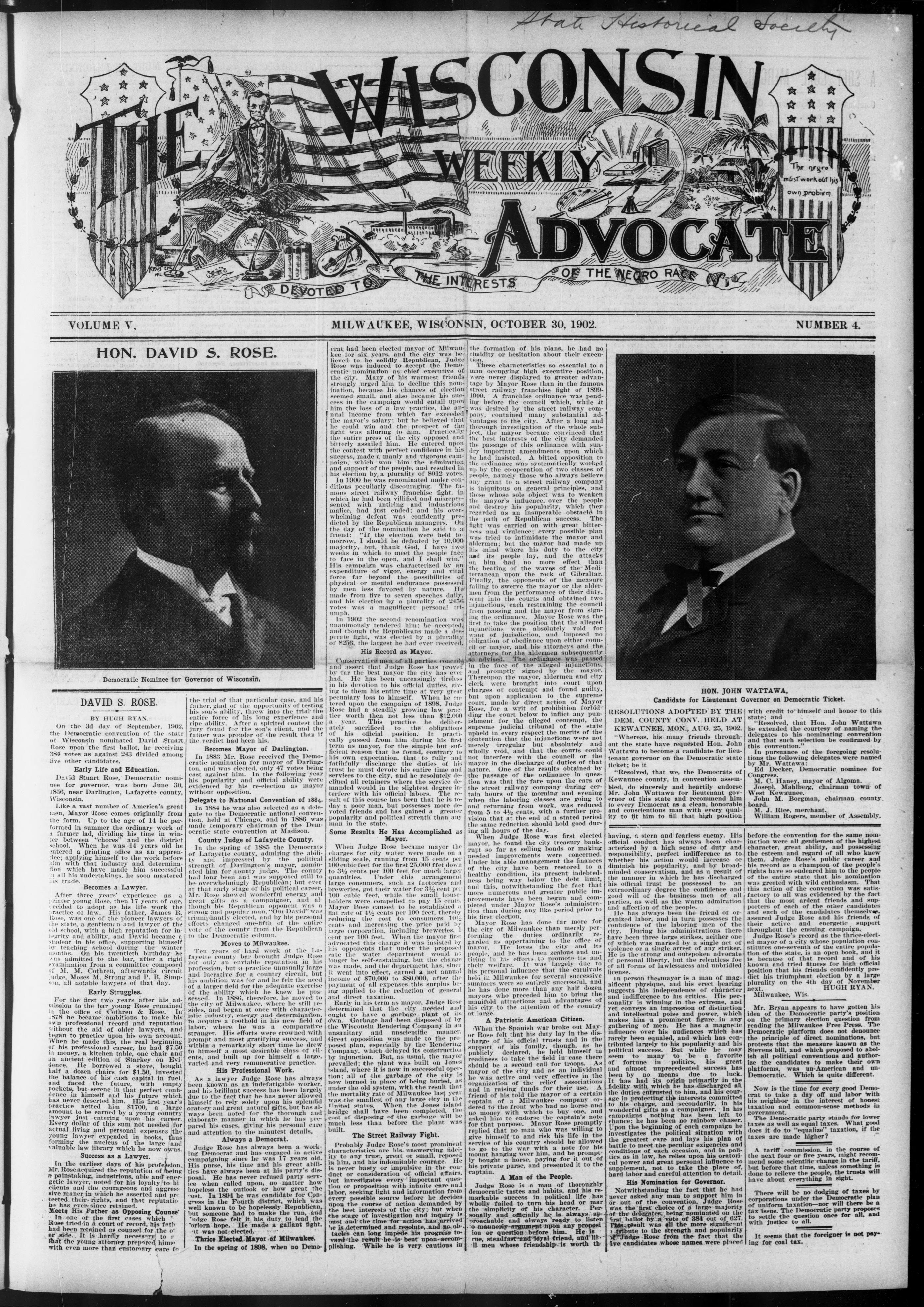
WISCONSIN
WEEKLY
ADVOCATE
DEVOTED TO THE INTERESTS OF THE NEGRO RACE
VOLUME V.
HON. DAVI
Democratic Nominee for Governor of Wisconsin.
DAVID S. ROSE.
BY HUGH RYAN.
On the 3d day of September, 1902, the Democratic convention of the state of Wisconsin nominated David Stuart Rose upon the first ballot, he receiving 284 votes as against 243 divided among five other candidates.
Early Life and Education
David Stuart Rose, Democratic nominee for governor, was born June 30, 1856, near Darlington, Lafayette county, Wisconsin.
Like a vast number of America's great men, Mayor Rose comes originally from the farm. Up to the age of 14 he performed in summer the ordinary work of a farmer lad, dividing his time in winter between "chores" and the district school. When he was 14 years old he entered a printing office as an apprentice; applying himself to the work before him with that industry and determination which have made him successful in all his undertakings, he soon mastered his trade.
Becomes a Lawyer.
After three years' experience as a printer young Rose, then 17 years of age, decided to adopt as his life work the practice of law. His father, James R. Rose, was one of the pioneer lawyers of the state, a gentleman and lawyer of the old school, with a high reputation for integrity and ability, and David became a student in his office, supporting himself by teaching school during the winter months. On his twentieth birthday he was admitted to the bar, after a rigid examination from a committee composed of M. M. Cothren, afterwards circuit judge, Moses M. Strong and P. B. Simpson, all notable lawyers of that day.
Early Struggles.
For the first two years after his admission to the bar young Rose remained in the office of Cothren & Rose. In 1878 he became ambitious to make his own professional record and reputation without the aid of older lawyers, and began to practice upon his own account. When he made this, the real beginning of his professional career, he had $7.50 in money, a kitchen table, one chair and an ancient edition of Starkey on Evidence. He borrowed a stove, bought half a dozen chairs for $1.50, invested the balance of his cash capital in fuel, and faced the future, with empty pockets, but serene in that perfect confidence in himself and his future which has never deserted him. His first year's practice netted him $1700, a large amount to be earned by a young country lawyer just entering upon his career. Every dollar of this sum not needed for actual living and personal expenses the young lawyer expended in books, thus forming the nucleus of the large and valuable law library which he now owns.
Success as a Lawyer
In the earliest days of his profession, Mr. Rose acquired the reputation of being a painstaking, industrious, able and energetic lawyer, noted for his loyalty to his clients and the courageous and aggressive manner in which he asserted and protected their rights, and that reputation he has ever since retained.
Meets His Father as Opposing Counsel
In one of the first cases which Rose tried in a court of record, his father had been retained as counsel for the other side. It is hardly necessary to say that the young attorney prepared himself with even more than customary care fo
the trial of that particular case, and his father, glad of the opportunity of testing his son's ability, threw into the trial the entire force of his long experience and ripe ability. After a spirited contest the jury found for the son's client, and the father was prouder of the result than if the verdict had been his.
Becomes Mayor of Darlington.
In 1883 Mr. Rose received the Democratic nomination for mayor of Darlington, and was elected, only 47 votes being cast against him. In the following year his popularity and official ability were evidenced by his re-election as mayor without opposition.
Delegate to National Convention of 1884.
Delegate to National Convention of 1884 he was also selected as a delegate to the Democratic national convention, held at Chicago, and in 1886 was made temporary chairman of the Democratic state convention at Madison.
County Judge of Lafayette County.
In the spring of 1885 the Democrats of Lafayette county, admiring the ability and impressed by the political strength of Darlington's mayor, nominated him for county judge. The county had long been and was supposed still to be overwhelmingly Republican; but ever at that early stage of his political career, Mr. Rose showed wonderful energy and great gifts as a campaigner, and although his Republican opponent was a strong and popular man, "Our David" was triumphantly elected, and by his personal efforts changed one-fifth of the entire vote of the county from the Republican to the Democratic column.
Moves to Milwaukee.
Ten years of hard work at the Lafayette county bar brought Judge Rose not only an enviable reputation in his profession, but a practice unusually large and lucrative for a country circuit, but his ambition was for and he felt the need of a larger field for the adequate exercise of the ability which he knew he possessed. In 1886, therefore, he moved to the city of Milwaukee, where he still resides, and began at once with characteristic industry, energy and determination, to acquire a foothold in his new field of labor, where he was a comparative stranger. His efforts were crowned with prompt and most gratifying success, and within a remarkably short time he drew to himself a most desirable class of clients, and built up for himself a large, varied and very remunerative practice.
His Professional Work
As a lawyer Judge Rose has always been known as an indefatigable worker, and his brilliant success has been largely due to the fact that he has never allowed himself to rely solely upon his splendid oratory and great natural gifts, but has always been noted for the thorough and elaborate manner in which he has prepared his cases, giving his personal care and attention to the minutest details.
Always a Democrat.
Judge Rose has always been a working Democrat and has engaged in active campaigning since he was 17 years old. His purse, his time and his great abilities have always been at his party's disposal. He has never refused party service when called upon, no matter how hopeless the outlook or how great the cost. In 1894 he was candidate for Congress in the Fourth district, which was well known to be hopelessly Republican, but someone had to make the run, and Judge Rose felt it his duty to lead the orlorn hope. He made a gallant fight, it was not elected. Thrice Elected Mayor of Milwaukee. In the spring of 1898, when no Demo-
crat had been elected mayor of Milwaukee for six years, and the city was believed to be solidly Republican, Judge Rose was induced to accept the Democratic nomination as chief executive of the city. Many of his warmest friends strongly urged him to decline this nomination, because his chances of election seemed small, and also because his success in the campaign would entail upon him the loss of a law practice, the annual income from which far exceeded the mayor's salary; but he believed that he could win and the prospect of the fight was alluring to him. Practically the entire press of the city opposed and bitterly assailed him. He entered upon the contest with perfect confidence in his success, made a manly and vigorous campaign, which won him the admiration and support of the people, and resulted in his election by a plurality of 8012 votes.
In 1900 he was renominated under conditions peculiarly discouraging. The famous street railway franchise fight, in which he had been villified and misrepresented with untiring and industrious malice, had just ended; and his overwhelming defeat was confidently predicted by the Republican managers. On the day of the nomination he said to a friend: "If the election were held tomorrow, I should be defeated by 10,000 majority, but, thank God, I have two weeks in which to meet the people face to face in the open, and I shall win." His campaign was characterized by an expenditure of vigor, energy and vital force far beyond the possibilities of physical or mental endurance possessed by men less favored by nature. He made from five to seven speeches daily, and his election by a plurality of 2456 votes was a magnificent personal triumph.
In 1902 the second renomination was unanimously tendered him; he accepted, and though the Republicans made a desperate fight, was elected by a plurality of 8256, the largest he had ever received.
His Record as Mavor.
Conservative men of all parties conceded and assert that Judge Rose has proved by far the best mayor the city has ever had. He has been unceasingly tireless in his devotion to his official duties, giving to them his entire time at very great pecuniary loss to himself. When he entered upon the campaign of 1898, Judge Rose had a steadily growing law practice worth then not less than $12,000 a year. This practice he deliberately sacrificed to the obligations of his official position. It practically passed from him during his first term as mayor, for the simple but sufficient reason that he found, contrary to his own expectation, that to fully and fatihfully discharge the duties of his trust he must devote his entire time and services to the city, and he resolutely declined all retainers where the service demanded would in the slightest degree interfere with his official labors. The result of this course has been that he is today a poor man, but possesses more devoted friends and has gained a greater popularity and political strenth than any man in the state.
Some Results He Has Accomplished as Mayor.
When Judge Rose became mayor the charges for city water were made on a sliding scale, running from 15 cents per 100 cubic feet for the first 25,000 fft down to $3 \frac{1}{2} $ cents per 100 feet for much larger quantities. Under this arrangement large consumers, such as factories and breweries, got their water for $3 \frac{1}{2} $ cent per 100 cubic feet, while the small householders were compelled to pay 15 cents. Mayor Rose caused to be established a flat rate of $4 \frac{1}{2} $ cents per 100 feet, thereby reducing the cost to consumers 101 $ cents and increasing the price paid by large corporation, including breweries. 1 cent per 100 feet. When the mayor first advocated this change it was insisted by his opponents that under the proposed rate the water department would no longer be self-sustaining, but the change was made, and the department has, since it went into effect, earned a net annual income of $70,000 to $80,000, after the payment of all expenses this surplus being applied to the reduction of general and direct taxation.
Early in his term as mayor, Judge Rose determined that the city needed and ought to have a garbage plant of its own. Garbage had been disposed of by the Wisconsin Rendering Company in an unscientific and unscientific manner. Great opposition was made to the proposed plan, especially by the Rendering Company, which delayed its construction by injunction. But, as usual, the mayor prevailed; the plant was built on Jones island, where it is now in successful operation; all of the garbage of the city is now burned in place of being buried, as under the old system, with the result that the mortality rate of Milwaukee last year was the smallest of any large city in the United states. When the Jones island bridge shall have been completed, the cost of disposing of the garbage will be much less than before the plant was built.
The Street Railway Fight.
Probably Judge Rose's most prominent characteristics are his unswerving fidelity to any trust, great or small, reposed in him, and his indomitable courage. He is never hasty or impulsive in the conduct or consideration of official affairs, but investigates every important question or proposition with infinite care and labor, seeking light and information from every possible source before he decides upon the course of action demanded by the best interests of the city; but when the stage of investigation and inquiry is past and the time for action has arrived he is determined and resolute, and no obstacles can long impede his progress toward the result he is bent upon accomplishing. While he is very cautious in
the formation of his plans, he had no timidity or hesitation about their execution
These characteristics so essential to a man occupying high executive position, were never displayed to greater advantage by Mayor Rose than in the famous street railway franchise fight of 1899-1900. A franchise ordinance was pending before the council which, while it was desired by the street railway company, contained many substantial advantages to the city. After a long and thorough investigation of the whole subject, the mayor became convinced that the best interests of the city demanded the passage of this ordinance with sundry important amendments upon which he had insisted. A bitted opposition to the ordinance was systematically worked up by the co-operation of two classes of people, namely those who always believe any grant to a street railway company is iniquitous on general principles, and those whose sole object was to weaken the mayor's influence, over the people and destroy his popularity, which they regarded as an insuperable obstacle in the path of Republican success. The fight was carried on with great bitterness and virulence; every possible plan was tried to intimidate the mayor and aldermen; but the mayor had made up his mind where his duty to the city and its people lay, and the attacks on him had no more effect than the beating of the waves of the Mediterranean upon the rock of Gibraltar. Finally, the opponents of the measure failing to swerve the mayor or the aldermen from the performance of their duty, went into the courts and obtained two injunctions, each restraining the council from passing and the mayor from signing the ordinance. Mayor Rose was the first to take the position that the alleged injunctions were absolutely void for want of jurisdiction, and imposed no obligation of obedience upon either council or mayor, and his attorneys and the attorneys for the aldermen subsequently so advised. The ordinance was passed in the face of the alleged injunctions, and promptly signed by the mayor. Thereupon the mayor, aldermen and city clerk were brought into court upon charges of contempt and found guilty, but upon application to the supreme court, made by direct action of Mayor Rose, for a writ of prohibition forbidding the court below to inflict any punishment for the alleged contempt, the supreme judicial tribunal of the state upheld in every respect the merits of the contention that the injunctions were not merely irregular but absolutely and wholly void, and that the courts could not interfere with the council or the mayor in the discharge of duties of that nature. One of the results obtained by the passage of the ordinance in question was that the fare upon the cars of the street railway company during certain hours of the morning and evening when the laboring classes are going to and returning from work, was reduced from 5 to 4½ cents, with a further provision that at the end of a stated period the same reduction should hold good during all hours of the day.
When Judge Rose was first elected mayor, he found the city treasury bankrupt so far as selling bonds or making needed improvements were concerned. Under his able management the finances of the city have been restored to a healthy condition, its present indebtedness being way below the debt limit, and this, notwithstanding the fact that more numerous and greater public improvements have been begun and completed under Mayor Rose's administration than during any like period prior to his first election.
Mayor Rose has done far more for the city of Milwaukee than merely performing the duties ordinarily regarded as appertaining to the office of mayor. He loves the city and its people, and he has been zealous and untiring in his efforts to promote its and their welfare. It was largely due to his personal influence that the carnivals held in Milwaukee for several successive summers were so entirely successful, and he has done more than any half dozen mayors who preceded him to bring the manifold attractions and advantages of his city to the attention of the country at large.
A Patriotic American Citizen.
When the Spanish war broke out Mayor Rose felt that his duty lay in the discharge of his official trusts and in the support of his family, though, as he publicly declared, he held himself in readiness to take the field in case there should be a second call for troops. As mayor of the city and as an individual he was active and very effective in the organization of the relief associations and in raising funds for their use. A friend of his told the mayor of a certain captain of a Milwaukee company ordered to the front who had no horse and no money with which to buy one, and asked him to endorse the captain's note for that purpose. Mayor Rose promptly replied that no man who was willing to give himself to and risk his life in the service of his country should be allowed to go to the war with a note for his mount hanging over him, and he promptly bought a horse, paying for it out of his private purse, and presented it to the captain.
A Man of the People.
Judge Rose is a man of thoroughly democratic tastes and habits, and his remarkable success in political life has wholly failed to turn his head or mar the simplicity of his character. Personally and officially he is always approachable and always ready to listen to mannerly argument upon any proposition or question before him. He is true, steadfast and loyal friend, and all men whose friendship is worth th
HON. JOHN WATTAWA,
Candidate for Lieutenant Governor on Democratic Ticket
RESOLUTIONS ADOPTED BY THE
DEM. COUNTY CONV. HELD AT
KEWAUNEE, MON., AUG. 25, 1902.
"Whereas, his many friends throughout the state have requested Hon. John Wattawa to become a candidate for lieutenant governor on the Democratic state ticket; be it
with credit to himself and his state; and
"Resolved, that Hon. John be extended the courtesy of delegates to his nominating and that such selection be con-
this convention."
In pursuance of the forego-
tions the following delegates w
by Mr. Wattawa:
"Resolved, that we, the Democrats of Kewaunee county, in convention assembled, do sincerely and heartily endorse Mr. John Wattawa for lieutenant governor of this state and recommend him to every Democrat as a clean, honorable and conscientious man with every quality to fit him to fill that high position
having, a stern and fearless enemy. His official conduct has always been characterized by a high sense of duty and responsibility, perfect indifference as to whether his action would increase or diminish his popularity, and by broad-minded conservatism, and as a result of the manner in which he has discharged his official trust he possessed to an extraordinary degree the confidence and good will of the business men of all parties, as well as the warm admiration and affection of the people.
He has always been the friend of organized labor, and in turn possesses the confidence of the laboring men of the city. During his administrations there have been three large strikes, neither one of which was marked by a single act of violence or a single arrest of any striker. He is the strong and outspoken advocate of personal liberty, but the relentless foe of all forms of lawlessness and unbridled license.
in person the mayor is a man of magnificent physique, and his erect bearing suggests his independence of character and indifference to his critics. His personality is winning in the extreme, and yet conveys an impression of distinction and intellectual poise and power, which makes him a prominent figure in any gathering of men. He has a magnetic influence over his audiences which has rarely been equaled, and which has contributed largely to his popularity and his political success. But while he may seem to many to be a favorite of fortune in politics, his great and almost unprecedented success has been by no means due to luck. It has had its origin primarily in the fidelity with which he has discharged all the duties entrusted to him, and his courage in protecting the interests committed to his charge, and secondarily, in his wonderful gifts as a campaigner. In his campaigns nothing has been left to chance: he has been no rainbow chaser. Upon the beginning of each campaign he investigates the political situation with the greatest care and lays his plan of battle to meet the peculiar exigencies and conditions of each occasion, and in politics as in law, he relies upon his oratorical power and great personal influence to supplement, not to take the place of, hard labor and careful attention to detail.
His Nomination for Governor.
Notwithstanding the fact that he had never asked any man to support him in or out of the convention, Judge Rose was the first choice of a large majority of the delegates, being nominated on the first ballot by a vote of 384 out of 627. This result was all the more significant tribute to the strength and popularity of Judge Rose from the fact that the five candidates whose names were placed
NUMBER 4.
WATTAWA,
Governor on Democratic Ticket.
with credit to himself and honor to this state; and
"Resolved, that Hon. John Wattawa be extended the courtesy of naming the delegates to his nominating convention and that such selection be confirmed by this convention."
In pursuance of the foregoing resolutions the following delegates were named by Mr. Wattawa:
Ed Decker, Democratic nominee for Congress.
M. C. Haney, mayor of Algoma.
Josepl. Mahlberg, chairman town of West Kewaunee.
John M. Borgman, chairman county board.
M. J. Rice, merchant.
William Rogers, member of Assembly.
before the convention for the same nomination were all gentlemen of the highest character, great ability, and possessing the esteem and regard of all who knew them. Judge Rose's public career and his record as a champion of the people's rights have so endeared him to the people of the entire state that his nomination was greeted with wild enthusiasm. That this action of the convention was satisfactory to all was evidenced by the fact that the most ardent friends and supporters of each of the otier candidates and each of the candidates themselves assured Judge Rose and his friends of their active and energetic support throughout the ensuing campaign.
Judge Rose's record as the thrice-elected mayor of a city whose population constitutes one-seventh of the entire population of the state, is an open book, and it is because of that record and of his known and tried fitness for high official position that his friends confidently predict his triumphant election by a large plurality on the 4th day of November next. HUGH RYAN.
Milwaukee, Wis.
Mr. Bryan appears to have gotten his idea of the Democratic party's position on the primary election question from reading the Milwaukee Free Press. The Democratic platform does not denounce the principle of direct nominations, but protests that the measure known as the Stevens bill, and which proposed to abolish all political conventions and authorize the candidates to make their own platforms, was un-American and un-Democratic. Which is quite different.
Now is the time for every good Democrat to take a day off and labor with his neighbor in the interest of honest taxation and common-sense methods in government.
The Democratic party stands for lower taxes as well as equal taxes. What good does it do to "equalize" taxation, if the taxes are made higher?
A tariff commission, in the course of the next four or five years, might recommend some scientific change in the tariff, but before that time, unless something is done to relieve the people, the trusts will have about everything in sight.
very tight
There will be no dodging of taxes by corporations under the Democratic plan of uniform taxation—nor will there be a tax issue. The Democratic party proposes to settle the question once for all, and with justice to all.
It seems that the foreigner is not paying for coal tax.
A SOFT COAL MERGER.
Combination of Bituminous Concerns.
Indications that Anthracite Operators are Not Acting in Good Faith in Arbitration Business.
Pittsburg, Pa., Oct. 29.—Plans are being laid for the merging of the Pittsburg Coal Company and the Monongahela River Consolidated Coal and Coke Company, with their combined autorized capitalization of $110,000,000 and assets of $120,088,581. Consolidation of these interests will launch by far the strongest bituminous concern in the world. The combined coal output of the two companies is close to 30,000,000 tons a year. The plan is to make the Pittsburg company lessee and the purpose to economize operations. Successful termination of the deal will end the trade rivalry which has existed between the two companies.
No New Stock to be Issued.
The tentative plan is to merge the two companies and at the same time eliminate one of the seeminly fundamental principles of such moves, which is the issuance of a new and increased lot of watered stock to constituents. While the Pittsburg company will probably become the Investor interest, there is no present purpose to issue new stock of the Pittsburg company to take over that of the River Company. Anything like a stock-watering deal is to be eliminated.
The total assets of the Pittsburg company are figured at $76,276,769 and those of the River company at $43,811,812.
SUSPICIOUS OF OPERATORS.
Some of Them May Not be Bound by the Arbitration Findings.
Washington, D. C., Oct. 29.—People who have carefully studied the course of the anthracite coal operators fear that the arbitration craft may land on the rocks before the end of its journey. Many of the operators have not been made parties to the proceedings up to the present time and they may not consider themselves bound by the findings of the commission, and skeptics declare that there is a basis for a large share of disappointment and cause for a controversy later on.
The most significant fact is the objection of E. B. Thomas of the Erie to the use of the word "arbitration," instead of "investigation." If this view were to prevail it would entirely nullify the purposes of the commission. No idea is entertained that the commission will sanction it, because it is considered that the language of the President on this subject is beyond mere cavil. The miners called the strike off as a result of an understanding that their difficulties were to be arbitrated and that the parties to the arbitration were to abide by its results.
To Eliminate Mitchell.
The third suggestion, looked upon as having within it possible seeds of great dissension, is that made by Mr. Truesdale of the Delaware & Lackawanna Railroad Company, employing about 12,000 men and boys. Mr. Truesdale wanted his employees, union and nonunion, to appoint a committee to come before the commission, state their grievances and represent his employees. If such a committee were appointed without Mr. Mitchell as a member of it it would eliminate him from all consideration in matters concerning that particular company. On being asked what would be done if either of the parties to the controversy should refuse to abide by the decision of the commission, one of the board made this reply:
"I do not regard that as a possibility. We see no reason to anticipate anything of the sort. I do not believe that either side could face the force of public opinion by rejecting the conclusions which they have agreed in advance to accept.
VISIT COAL FIELDS.
Members of Coal Strike Commission Start for Pennsylvania.
Washington, D. C., Oct. 29.—The majority of the members of the anthracite coal strike commission left here at 3 o'clock this afternoon over the Baltimore & Ohio railroad for Scranton, Pa., where they will meet tomorrow morning to begin their investigation of the conditions in the mining region. The other members of the commission are also expected to reach Scranton by tomorrow morning. Judge Gray, the chairman, is in Wilmington, Del., and expects to board the train on its arrival there late this afternoon. Messrs. Watkins and Parker are in New York city and have been officially notified of the departure of the others from here. The commission will spend tomorrow at Scranton, arranging the details of the trip through the coal fields. The hearings will not begin until the formal claims of the miners and the answer of the operators have been filed.
The first place to be visited by the commission after leaving Scranton probably will be Walkesbarre. The tour of the commission through the coal fields in advance of the hearings will be of a preliminary character, as the same points in all probability will be visited later for the purpose of taking the testimony of the mine bosses, forremen and the miners themselves
MINERS TAKE DAY OFF.
Celebrate Anniversary of Former Strike
—Do Honor to Mitchell.
Wilkesbarre, Pa., Oct. 29.—Mitchell day was celebrated by all the union miners in the anthracite region today. There was a general suspension of work. A few washeries were working, but their output of coal was very small. President Mitchell arrived from New York today. He will go to Scranton to attend the first session of the arbitration commission. There were demonstrations in many of the nearby towns today and after the parade the people flocked to Wilkesbarre in large numbers to see the big parade. Shamokin, Pa., Oct. 29.—Mitchell day was observed here today. Seven thousand United Mine Workers, headed by the Tenth Regiment Band and troops, paraded the streets, after which the mine workers were addressed by several labor leaders. No collieries were in operation and all business was generally suspended.
SOLDIERS ARE STONED
Troops Ordered to Fire, but Order was Countermanded.
Pittsburg, Pa., Oct. 29.—A scene denounced by bystanders as contemptible and outrageous marked the return of the soldiers of the Fourteenth Regiment from the anthracite region today. While passing down Fifth avenue they were assailed with chunks of concrete, blocks of wood as large as bricks, and even tools, thrown from the twenty-first floor of the new Farmers' Deposit Bank building, a distance of 275 feet, by workmen.
The act was evidently premeditated, for the workmen had collected enough missiles to be able to keep up the assault the whole time the regiment was passing. That no one was seriously hurt is remarkable.
When the soldiers realized that the missiles were aimed at them a line was quickly formed on the opposite pavement, an officer gave the command to load, but the commanding officer countermanded the order and no shots were fired.
DYNAMITE A SAFE.
Masked Men Secure $4000 from the Exchange National Bank of Gardner, Ill.
Gardner, Ill., Oct. 29.—Six men blew open the vault of a bank here early this morning and took several thousand dollars. They seized Marshal Edmondson at the engine house, tied him with ropes, took him to the bank and sat him in a chair. The marshal is the only policeman. The rest of the inhabitants were asleep. The vault was blown open with dynamite and the inside of the bank wrecked. The robbers are supposed to have secured between $3000 and $4000, though the amount is not known. After leaving the bank they took the marshal to the school house, tied him to a chair and put a rope around his neck. The chair was placed at the head of a stairway so that if he struggled to release himself he would fall down stairs and hang himself. The robbers took a train which left at 4:40 for Chicago.
Took All but 30 Cents.
Des Moines, Ia., Oct. 29.—One suspect was arrested at Pella last night in connection with the Prairie City bank robbery and is being held to await identification.
As Night Watchman Erskine and Dentist Gibford watched the men for three hours during the robbery it is believed identification will be possible, although the men were masked. It has developed that there were five of the bandits, two of whom engaged in dynamiting the safe, and that it required eight shots before the safe was finally opened. The loss has been definitely placed at $4500. They took all the cash but 30 cents. It is believed that the bandits boarded a Rock Island train at Fairmount and went southeast. It is feared the robbers have escaped.
Private Bank Robbed.
Rochester, N. Y., Oct. 29.—The vault of the private bank of Charles K. Knapp at Sodus was broken into with dynamite by burglars early today and a sum believed to be $5000 was secured. The owner of the bank refuses to say how much was stolen. Not only the vault but also the bank building was wrecked by the force of the explosion.
Stolen Money Recovered.
Miles City, Mont., Oct. 29.—Warden McTague of the state penitentiary and Fred Morrow, a convict, were here yesterday and, following Morrow's directions, recovered $4500 in money which Morrow stole on May 29, 1900, from the Northern Pacific Express Company and concealed near the Tongue river bridge.
Burglars Frightened Away.
Sioux City, Ia., Oct. 29.—Robbers wrecked the safe in the Bank of Buffalo County, at Gann Valley, S. D., this morning, but fled without securing any money. It is supposed they were alarmed by the explosion.
GOES BAIL FOR LOVER.
Chicago Woman Charges Harry Scott Sears of Berlin, Wis., with Forgery.
Chicago, Ill., Oct. 29.—[Special.]—Amanda C. Davidson of Ravenswood caused the arrest of Harry Scott Sears, her sweetheart, Monday on a charge of forgery. Then she repented and signed his bond. Young Sears is a son of H. D. Sears, a tanner of Berlin, Wis. He signed his father's name to a check for $75, which Miss Davidson cashed for him, in payment of a loan.
Sears came to Chicago to visit his brother, H. H. Sears, a short time ago and was introduced to Miss Davidson, whose confidence and affection he soon won. Then he borrowed the money from her. The check was protested three times. Meantime Miss Davidson had written to the young man's mother, saying that she was practically engaged to Harry Sears, and asking the mother to make the check right.
Mrs. Sears wrote back that her husband could not be held responsible for the debts of his son and asked Miss Davidson to tell Harry to come home. The young woman then began prosecution. When she saw Sears taken into custody by the constable she relented and spent several hours of the early evening trying to find a justice before whom she could sign the young man's bond. At last Justice Hamburgher was found at a political meeting and the bond was signed. The case is set before Justice Hurley for November 6.
HE THREATENED TO SHOOT SON'S SLAYER.
Father of Victim of Accidental Shooting Prevented by Trainmen from Carrying Out Intention.
Houghton, Mich., Oct. 29.—[Special.]— An accidental shooting in which the victim was mistaken for a deer and was killed nearly had a tragic sequel, it is alleged. Later in the day upon which John L. Krantz, a young man who resided near Laird, was killed by William McKernan, the father of the victim was traveling from Keweenaw bay on the South Shore railroad. At Allston station McKernan boarded the train, and, seeing the elder Krantz, he offered to shake hands. The father of the victim drew a revolver, it is alleged, and threatened to shoot the man who had accidentally killed his son. Prompt interference by the trainmen saved McKernan from injury.
TWO ACRES OF GROUND CAVED IN
Valuable Mining Property in Joplin, Mo.
Takes' Sudden Drop.
Joplin, Mo., Oct. 29.—The Stewart hill and other valuable mining property including seven shafts in the Eleventh Hour tract at Prosperity, near here, taking in over two acres of ground, caved in today to a depth of 100 feet. The cavein is perhaps the largest that ever occurred in the Missouri-Kansas district. Fifty miners escaped uninjured, having been warned of the approaching danger by the cracking of the ground.
BADGER STUDENTS' TOUR.
Engineers Inspect the Big Plants at Pittsburg, Pa.
Pittsburg, Pa., Oct. 29.—Twenty-nine students from Wisconsin University are in Pittsburg for a visit to the industrial plants. The party is under the direction of Prof. J. G. D. Mack, mechanical engineer; Prof. B. V. Sweenson, electrical engineer, and Prof. A. W. Richter, experimental engineer, all members of the college faculty.
BOLD BANK ROBBERY
Citizens Kept at Bay While the Safe is Dynamited.
MUCH MONEY SECURED.
Des Moines, Ia., Oct. 28.—The boldest bank robbery occurring in Iowa in recent years took place at Prairie City early this morning. The robbers dynamited the safe of the Iowa State Bank and secured an amount approximating $4000. They exchanged a fusilade of shots with local officers and escaped. Night Watchman Erskine discovered four men approaching the bank at I o'clock. One of the men cornered him and kept him covered with a rifle for three hours while another broke open the bank door and worked on the safe. The other two men patrolled the street and by a system of signals were able to hold at bay a dentist, a physician and two or three other citizens who were attracted to the scene. Five dynamite shots were fired by the man in the bank before he succeeded in getting at the cash box.
The sum secured was mostly silver, although it included a quantity of currency. At 4 o'clock the four men left the bank and disappeared in an easterly direction after firing a number of shots to terrify those who had seen them and shooting through a door in an effort to hit Erskine, who had opened fire. A general alarm was given and a posse is now on their trail with a pack of bloodhounds.
Made a Miscalculation
Irwin, Pa., Oct. 28.—After binding, gaging and badly maltreating the night watchman, John Hamburg, Sr., at the Westmorel and Coal Company's office in West Irwin at an early hour this morning, four masked men entered the building and blew open the safe in the big vault and secured all the money that it contained. The robbery was evidently timed, as it was just before payday, when about $40,000 is disbursed for the regular two weeks' pay. The money is not kept there and the robbers only secured about $200. They escaped without leaving any clue to their identity.
Postal Money Stolen.
Mount Vernon, Ky., Oct. 28.—Two masked men entered the depot at Broadhead last night and robbed it of $600 part of which belonged to the postoffice and which was placed there for safekeeping. The store of C. H. Frith was also broken into and considerable amount of jewelry and other valuables taken. The men are being pursued.
Neat Haul by Burglar.
Davenport, Ia., Oct. 28.-Burglars last night entered the residence of M. J. Eagal, a well-known business man of this city and secured diamonds and jewelry valued at $2000. No clue.
A VERY SICK WOMAN
Mrs. Douglas Robinson, Sister of President Roosevelt, Ill for Past Six Months While Abroad.
New York, Oct. 28.—Mrs. Douglas Robinson, sister of President Roosevelt, who arrived from Europe today, was reported to have been seriously ill during the entire voyage. At her home in this city this afternoon it was said that Mrs. Robinson was a very sick woman. She is under the care of a physician. Mrs. Robinson was assisted from the ship by her husband and an attendant. She appeared to be so weak that she could hardly walk and looked extremely pale. Mr. Robinson said: "We believe that it is an attack of grip." It was learned that during the voyage the ship's surgeon lanced a boil on the back of Mrs. Robinson's neck; that during the six months that Mrs. Robinson was abroad she was ill most of the time.
TO DEVELOP THE WATER POWER.
Meuominee will Have the Aid of Government Geological Survey.
Menominee, Mich., Oct. 28.—[Special.]—Experts in the employ of the United States geological survey will visit the Menominee river next spring to study the big stream and its tributaries for the purpose of making suggestions about utilizing water power. The government engineers will visit Chappee and White Rapids, where it is claimed the water power is the best in this section of the country. The plan is to generate electricity at small cost and transmit it to the manufacturing establishments at the mouth of the Menominee. Three years ago Menominee and Marinette street railway companies agreed to use the power if it could be transmitted at reasonable cost.
CUBA REJECTS THE TREATY
Palma's Government Sends a Counter Proposition to Washington.
Havana, Oct. 28.—The representative here of the Associated Press has learned from official sources that the proposed treaty between the United States and Cuba was returned to Washington by mail last Saturday. With the treaty was sent a counterproposition from the government of Cuba to that of the United States, the nature of which is not known, but it is understood that President Palma in a letter sent with the treaty says that the acceptance of the proposition made by the United States would be ruinous to Cuba, as it would result in a large reduction of the customs revenue of the island.
STANDING PINE IS SOLD
Culligan Tract in Minnesota Brings
$328,000.
Duluth, Minn., Oct. 28.—Another large deal in Northern Minnesota standing pine has just been consummated through K. A. McDonald of this city. The entire Culligan tract of timber in St. Louis and Itasca counties, comprising over 80,000,000 feet, has been sold to W. H. Cook of this city for $328,000. F. W. Gilscrist of Alpena, Mich., had an interest in the Culligan tract. It is said the timber comprises some of the best remaining standing pine in the northern part of the state.
FOUL BALL KILLS A YOUTH.
Strikes His Hand and Drives Knife Blade Through Artery in Side.
Bellfontaine, O., Oct. 28.—Thomas Walker met instant death yesterday while watching a baseball game. He and two young companions were sittling on a fence when one of the boys asked for a knife to sharpen a pencil. As the Walker boy was passing the knife to him, the small blade of which was open, a soul Ball struck by one of the players bite Walker's hand and drove the knife into his side, cutting an artery and causing him to bleed to death.
PRESIDENT APPOINTS DAY OF THANKSGIVING.
Washington, D. C., Oct. 29.—President Roosevelt today issued his proclamation designating Thursday, November 27, as a day of thanksgiving. The proclamation is as follows. According to the yearly custom of our people, it falls upon the President at this season to appoint a day of festival and thanksgiving to God. Over a century and a quarter has passed since this country took its place among the nations of the earth and during that time we have had on the whole more to be thankful for than has fallen to the lot of any other people.
Generation after generation has grown to manhood and passed away. Each has had to bear its peculiar burdens, each to face its special crises and each has known years of g. m. trial when the country was menaced by malice, domestic or foreign levy, when the hand of the Lord was heavy upon it in drouth or flood or pestillence, when in bodily distress and anguish of soul it pald the penalty of folly and a froward heart. Nevertheless, decade by decade, we have struggled onward and upward; we now abundantly enjoy material wellbeing and under the favor of the Most High we are striving earnestly to achieve moral and spiritual uplifting. The year that has just closed has been one of peace and overflowing plenty. Rarely has any people enjoyed greater prosperity than we are now enjoying. For this we render heartfelt and solemn thanks to the Gliver of good; and we seek to praise Him not by words only, but by deeds, by the way in which we do our duty to ourselves and to our fellowmen.
Now, therefore, I, Theodore Roosevelt, President of the United States, do hereby designate as a day of general thanksgiving, Thursday, the 27th of the coming November, and do recommend that throughout the land the people cease from their ordinary occupations and in their several houses and places of worship render thanks unto Almighty God for the manifold blessings of the past year.
In witness whereof I have herenuto set my hand and caused the seal of the United States to be affixed.
Done at the City of Washington this 29th day of October, in the year of Our Lord, 1902, and of the Independence of the United States the one hundred and twenty-seventh.
(Signed)
THEODORE ROOSEVELT.
By the President:
(Signed)
JOHN HAY,
Secretary of State.
CHANTING WEIRD HYMNS.
Colony of Russian Zealots on the March, Apparently Without Destination or Purpose.
Winnepeg, Man., Oct. 29.—With gaunt faces and eyes lifted heavenward an army of fanatics chanting weird religious hymns, entered Yorkton, Assinaboia, filling the inhabitants with fear and pity. The pilgrims form part of the colony of Doukhobers or Russian zealots, who located in the Canadian Northwest two years ago, which has gone on the march leaving crops half harvested and deserting their horses and cattle. Sixteen hundred men, women and children entered Yorkton carrying their infants and sick on stretchers. The body marched to the immigration sheds, where agents of the government met and interviewed them. Through interpreters the Doukhobers told the officials they did not know where they were going or what they expected to do, their only mission was to convert people and find "Lesus."
The male members of the party refused proffered shelter for the women and children and the sick, but after much persuasion were induced to leave the weaker ones behind while they continued their march through the city. The men and women are living on weeds and raw potatoes and looked emaciated after their long tramp from the villages.
Four hundred more Doukhobers are now exiles out of the town and 600 more are leaving their villages. One child died while on the march.
When word was brought in of their proximity a meeting of the council was hastily called and several special constables were sworn in. Some apprehension is felt that they will be driven to acts of violence by sheer necessity.
ADVANCE IN WAGES FOR 8000 SHOPMEN.
Chicago & Alton Concedes Increase to Machinists, Boilermakers, Repairers and Handy Men.
Chicago, Ill., Oct. 29.—Eight thousand shopmen employed by the Chicago & Alton railroad are to get an advance in wages of 2 cents an hour, beginning November 1. The increase will approximate $10,000 and will affect the machinists, boilermakers, repairers and general handy men in all the shops of the system. The men filed a demand for an advance a month ago and asked for a flat increase of 20 per cent. This the road was not willing to grant, but compromised on 10 per cent. This rate gives the machinists 30 cents an hour, the boilermakers a little less and the handy men 25 cents.
BRYAN'S TRAIN IN WRECK.
Special Crashes Into the Caboose of Freight Train Near Leadville, Col.
Cripple Creek, Col., Oct. 29.—The Bryan special crashed into the caboose of a freight at Arena, in Brown canyon, fifteen miles above Leadville, yesterday. The special remained on the track, but the caboose was thrown from the track. Mr. Bryan's train, however, was unable to proceed.
The freight had pulled in on a siding to let the special pass. The caboose had not cleared the main line when the special swept around a sharp curve and struck it. The occupants of the caboose were warned of their danger and three jumped to save their lives.
Mr. Bryan was uninjured. He and his party were put into an empty refrigerator car and, drawn by a freight engine, taken to Nathrop, seven miles away. There a chair car was taken from a siding and attached to the engine and run to Buena Vista and Leadville.
FORGED BILL OF LADING
Minneapolis Man Swindled Bank and its Given Long Term in Penitentiary.
Minneapolis, Minn., Oct. 29.—Edward Blew, senior member of the commission firm of Blew & Armstrong, pleaded guilty today to forging a bill of lading on which he secured an advance at a local bank. He was sentenced to seven and one-half years in the state penitentiary in spite of his attorney's plea for clemency. His partner, Thomas F. Armstrong, will plead to a similar charge tomorrow morning.
OVERSTUDY CAUSES SUICIDE
Daughter of Wealthy Illinois Farmer Cuts Her Throat.
Waynesville, Ill., Oct. 29.—Ada, the eldest child of Charles W. Jones, a wealthy farmer residing two miles northwest of here, committed suicide by cutting her throat from ear to ear. The victim was aged 17, and one of the most attractive girls of the vicinity. All efforts to find some reason for the act have so far proven futile. It is presumed that overstudy was the real reason.
COLOMBIA BALKS.
Government Declines to Accept Conditions Proposed on Lines of the Spooner Act.
Washington, D. C., Oct. 28.—Coloml has responded to the proposition made the state department for the negotiation a canal treaty on the lines of the Spooner act. The reply was presented to the state department by Mr. Herran, secretary of the Colombian legation. The Colombian government is dissatisfied with the payment to be made by the United States under the terms of the protocol, which it is proposed to use as the basis for the treaty. This sum is $7,000.000. Colombia wants at least $10,000,000.
In addition the original proposal looked to a wait for fourteen years before beginning the payment of annual rental, the amount of which was to be fixed then by mutual agreement. Colombia asks the United States to agree at once on a lump yearly payment of $600,000, which will considerably increase the immediate cost of the enterprise.
Proposes a Long Lease.
The Colombian government clings to its contention that it has no constitutional authority to alienate any Colombia territory and reiterates that the best it can do to meet the language of the Spooner act, which looks to a perpetual control by the United States over the canal strip, is to make a 100-year lease with a distinct stipulation that the same shall be renewable by the United States at the expiration of the first century. One obstacle which, it is believed, will interfere somewhat with the immediate resumption of negotiations of the treaty is the feeling aroused in Colombia by the actions of American naval officers during the revolutionary movements there.
American Interference Resented.
These are declared to have been bitterly resented in Bogota, where it was felt the American officers had exceeded their authority in interfering with the transportation of Colombian soldiers across the isthmus railroad—a right the Colombian officials have asserted is guaranteed them by treaty. The question at issue touches the question of sovereignty and has an important bearing on the pending sub-
ABJURE THE POPE.
Catholic Church of the Philippines is Formally Inaugurated at Manila.
Manila, Oct. 28.—The Catholic Church of the Philippines was inaugurated here yesterday. Mass was celebrated and Bishop Aglipay, the leader of the movement, delivered an address, in which he renounced allegiance to the papal authority. He said the new church would maintain practically all the religious forms of the Roman Catholic Church. Aguinaldo has been named as a lay official of the church of the Philippines. He did not attend the inaugural ceremony on account of illness, but sent a letter approving the matter.
The first announcement of the dissenting of the church was given in a dispatch dated August 10. The organizers of the movement were then said to be Isabelo de los Reyes, a labor leader, and Pasqual Poblete, formerly a member of Katipunan secret society. Father Aglipay, a native priest who has been excommunicated by the Roman Catholic Church, was appointed bishop of the new church. Fourteen junior bishops and a large lay council were also named. The council included Felipe Buencamino, one of the leaders of the Federal party, who was recently in the United States. In some quarters in Manila, this new movement is considered serious. It is thought that it will further upset the political situation and possibly create a clash between the regular Catholics and the dissenters.
COLLEGE BOYS ON STRIKE.
Thousand Quit Classes in Michigan as Sequel to Freshman Rush.
Lansing, Mich., Oct. 28.—One thousand students at the Michigan Agricultural College struck today, owing to the suspension of seventeen others for participation in the freshman-sophomore rush ten days ago.
Two years ago, when a student was permanently injured as the result of a "rush," the faculty issued an edict for bidding such affairs in the future.
Resolutions were drawn up at a mass meeting of all the students. These demanded the reinstatement of the suspended students. The committee that presented the resolutions to President Snyder, however, was informed that the faculty meant to stand firm in its position. The strike was the result.
RUSH TO NEW COAL FIELDS.
Railways Seeking to Build Into Rich Region in Eastern Kentucky.
Indianapolis, Ind., Oct. 28.—The Cincinnati, Hamilton & Dayton railroad is preparing to make a dash to the coal, iron and lumber country of Eastern Kentucky. It has practically closed negotiations with J. C. C. Mayo and others for the charter bridge rights between Ironton, O., and Ashland, Ky. This will put it into the Kentucky side with a line from Dean, or thereabouts, on the Ohio side. Several roads are racing for the section of country for which the Cincinnati, Hamilton & Dayton is heading. This line has 3000 men at work and will spend $2,500,000.
WEALTHY FARMER IN JAIL.
Charged with Killing Young Man Who was Attentive to His Daughter.
Quincy, Ill., Oct. 28.—Millard Filmore Lester, a prominent and wealthy farmer of Plainville, was placed in jail, charged with killing Frederick Larimore, who was found dead near his home in Plainville last Thursday night. Lester, it said, had warned Larimore to cease paying attention to Lester's daughter and this directed suspicion toward Lester. Bloodhounds went three times from the orchard, where the body was found, directly to the post in the village where Lester had his horse hitched on the night of the shooting.
Washington Monument Fatal to Birds.
Every spring and fall large numbers of birds are killed by the Washington monument. The city of Washington seems to be directly in the route taken by many of the migratory birds in the night between the North and South, and twice a year thousands of feathered songsters meet their death by flying against the tall marble shaft in the night.
Our Rice Production.
Whether we are going to become a rice-eating nation or not, we are certainly going to be a rice-producing country, the rice product increasing 65,000,000 pounds the past year. Where the land is so situated that the necessary irrigation may be secured it is proving one of the most profitable crops to raise.
If great cold turned our atmosphere to liquid air it would made a sea 35 feet deep over the surface of the whole globe.
MUST BE ENJOINED.
Scheme of Steel Corporation to Retire Preferred Stock and Issue Bonds Instead.
Newark, N. J., Oct. 29.—Vice Cancellor Emery today filed his decision in the suit of J. Aspinwall Hodge and others to prevent the United States Steel Corporation from retiring $200,000,000 of preferred stock and issuing $250,000,000 in bonds. In his decision the vice chancellor says: "I will advise that a preliminary injunction be granted restraining the issue of bonds under the resolution upon the terms that if the defendant desires to appeal, the complainant shall consent that the cause be set down for hearing at the next term of the court of errors and appeals."
The resolution referred to by the vice chancellor was adoptel by the directors of the United States Steel Corporation and ordered the retirement of the preferred stock. Vice Chancellor Emery decides that the meeting of the directors at which the resolution was adopted was prematurely called and that the retirement of the stock under the resolution must be therefore enjoined. The decision of the vice chancellor agrees with the decision of the court of errors and appeals in the Berger case on all other points.
Preparing a Sipulation.
St. Paul, Minn.; Oct. 29.—The hearing of evidence before Special Examiner F. G. Ingersoll in the case of the state of Minnesota against the Northern Securities Company, the Great Northern and Northern Pacific Railway Companies and others, set for today has been postponed until November 18..
Attorney General Douglas and the attorney for the Northern Securities Company have been consulting for several days with a view of preparing a stipulation of what evidence taken in the federal case against the company and in the Power case may be admitted to the record of the state's case, so that it will not be necessary to go over the same ground again.
Such a stipulation has been agreed upon and Mr. Ingersoll adjourned the hearing set for today to November 13 in New York city.
Mr. Ingersoll is also the referee in the federal case, and the hearing in that case was adjourned to November 10 in New York. The plan is to adjourn the hearing in New York of the state case from day to day, if necessary, until the federal hearing is completed and then to proceed at once with the hearing in the state case. It is expected that the taking of evidence in the East will be completed before any witnesses are heard in the West.
REVOLUTIONISTS BEATEN.
Force Under Uribe-Uribe Compelled to Surrender—Much Rejoicing
Colon, Oct. 29.—The government gunboat, Gen. Pinzon, arrived here bringing news of the defeat of the revolutionists under Uribe-Uribe and Castilla at Rio Frio. Both these generals were made prisoners. There is much rejoicing in Colon and Panama over the success of Gen. Marjarres, and especially over the capture of Uribe-Uribe, who had ten cannon, 2500 rifles and 300,000 rounds of ammunition.
Gen. Marjararres with 2000 men proceeded against the rebels from La Cienaga and engaged the enemy two days ago. The government general succeeded in surrounding the rebels and forcing them to surrender. Heavy casualties on both sides are reported. The surrender of Uribe-Uribe is said to complete the pacification of the departments of Magdalena and Bolivar. The revolutionists now occupy the isthmus only.
FOUND DEAD IN CABIN.
Ranchman with Bullet Hole in Head and His Mother with Her Head
Butte, Mont., Oct. 29.—A special to the Miner from Bearmouth gives the following details of the discovery of a double crime at the Conn ranch on Willow Creek.
A member of a threshing crew on an adjoining ranch had occasion to visit the Conn ranch and when he entered the farm house a terrible sight presented itself. On the floor, with brains oozing from his head, lay James Conn, dead, with a ragged bullet hole through his temple. Near him lay his mother, her head crushed in with a blunt instrument, precumably the butt of a revolver.
Near the stable the threshing man met a demented woman who had dwelt with the Conn family for some time. This woman killed her husband about twenty years ago and it is suggested that she may have knowledge of the tragedy.
HE DISCOVERS HIS LONG LOST SISTER.
Thomas Kane of Chicago Finds Her at Waukegan—Formerly Resided at Kenosha.
Waukegan, Ill., Oct. 29.—[Special.]—Thomas Kane of Chicago came to this city yesterday and found in Mrs. Joseph Sylvester his long-lost sister of nearly forty years ago. The Kane family lived in Kenosha at that time. When the father died and the family was broken up Mrs. Sylvester, then a baby, became lost to her brother and sister and they were unable to trace her until recently, when they heard of her living here, and yesterday her identity was fully confirmed.
EMPLOY MALE LOBBYIST.
Woman Suffragists Think Their Cause Would Thereby be Improved.
Des Moines, Ia., Oct. 29.—Mrs. Adelaide Ballard of Hull, president of the Equal Suffrage Society, which is holding its state convention here, urged the organization in her annual address to employ a male lobbyist instead of a woman to press equal suffrage legislation in the Iowa General Assembly. The recommendation has not yet been adopted. Mrs. Carrie Chapman Catt, president of the national organization, in an address to the convention said that "abominable treatment of the women of Iowa by the Legislature of this state" has aroused sentiment among the people of other states which was favorable to the suffrage movement and would help it in the long run.
DISPUTE OVER WAGES.
Twelve Hundred Musicians at Paris Theaters Vote to Strike.
Paris, Oct. 29.—The musicians of the Paris theaters at a meeting today voted unanimously in favor of a general strike beginning tomorrow at noon. Twelve hundred musicians were represented at the meeting.
The decision to strike is the result of a protracted conflict with the managers of the theaters over wages and extras for rehearsals and matinees.
A DIGNIFIED DISCUSSION.
National Committeeman Ryan Speaks on State and National Issues.
La Follette's Re-election Would be a Calamity--His Administration Has Fomented Confusion.
One of the most thought exciting speeches of the campaign in Wisconsin was delivered at Burlington Tuesday evening by Timothy E. Ryan, national committeeman from Wisconsin, in support of the state ticket. It was an intelligent discussion and presented national and state issues squarely, honestly and forcibly.
The following are a few of the remarks, taken at random from the speech of Mr. Ryan, and serve to indicate its general character as one of the strongest vote makers of the campaign:
"The cardinal principle of Democracy is well understood by every student of Democratic principles to be 'equal rights to all and special privileges to none.'"
* * *
"The history of the Republican party proves that that party practices 'equal rights to some and special privileges to many.'"
☆ ☆ ☆
"The Democrats early in the history of the tariff question argued that a high protective tariff would result in breeding and creating trusts and monopolies that would become so gigantic as to be a menace to the country."
* * *
"If he (La Follette) had the ability to lead men by appealing to their judgment, instead of trying to drive them to do just as he wanted them to do, regardless of how they themselves felt upon the questions, I believe a large portion of the friction that existed in the last Legislature could have been avoided."
* * *
"The Democratic party takes the position that no mercy nor consideration should be shown to any combination of capital that takes advantage of the protective tariff to mulct American consumers."
* * *
"We have had a succession of five or six good crops in our great grain-growing sections and a like number of crop failures in many foreign countries. * * * Good crops, or bad crops, are not the result of a high tariff."
```markdown
```
"The theory of primary election (Gov. La Follette's pet scheme) can be said with perhaps some propriety to be Democratic, because it is claimed that it means the placing of the power of government in the hands of the people."
* * *
"I can well conceive how a primary election experiment might be tried in municipal and county affairs; but when you undertake to extend beyond that."
非 常 乐
"I am satisfied that a party once placed in power under a general primary election, such as the Stevens bill contemplated, never could be dethroned afterward."
宋 亦 亦
"When Gov. La Follette advised and directed the doubling of the assessed valuation of all the real estate of the individual I cannot understand that to be any advancement towards equal and just taxation."
"Why should our manufacturers be aided by our laws to charge our citizens more for the same goods than they do to foreigners."
"Examination of the expenditures made by the different departments of the state it will be found that our expense account, in almost every direction, is constantly increasing. Our taxes are growing greater all the time."
承承承
"For the business interests of this great commonwealth a change in the management of state affairs should be made."
The Tariff Question.
Of the tariff Mr. Ryan said:
Of the tariff Mr. Ryan said:
The Republican party has just as persistently advocated a high protective tariff, regardless of the amount of revenue derived from the same, under many a pretext. First it was said by protectionists that a protective tariff was necessary to protect infant industries from competition with foreign countries. When that argument failed to convince they justified a high protective tariff under the excuse of protecting the American laborer from the pauper labor of Europe. We can all remember with what confidence, as well as audacity, we were told that it could make no difference to the American people how high a tariff was established by this country, because the foreigner paid the tax and not the American.
These questions have been so thoroughly threshed over in the past quarter of a century by both parties that it seems almost unnecessary to enter into any lengthy discussion of them at this time. The tariff question is of so much importance, however, that you will pardon me if I call your attention to some facts connected with it that you have heard over and over again in different campaigns.
The Democrats early in the history of the tariff question argued that a high protective tariff would result in breeding and creating trusts and monopolies that would become so gigantic as to be a menace to the country. These infant industries, which the Republican protectionists claim to be protecting, have now grown so strong as to invade the world, and are at present looking to attain commercial supremacy. Do not the American people ask themselves why they alone should be unfavored by world competition? The study of the manner in which these infant industries protected for so many years by the tariff laws of this country show their gratitude to their protector is quite interesting. I cannot take the time to call your attention to the difference between the home price of many of the articles manufactured by these so-called infant industries as compared with the export price; I will, however, call attention to a few of the articles which are sold abroad at a greatly reduced price compared to what they are sold for to the consumer at home.
consisting of numerous agricultural implements and tools, of kitchen utensils and household goods, carpenter tools, etc. It will be seen that the domestic prices usually exceed the foreign prices by from 10 to 25 per cent., and as high as 100 per cent. in some cases. Cultivators selling at home for $11, sell abroad for $8.40.
Citizens Should be First.
Why should our manufacturers be aided by our laws to charge our citizens more for the same goods than they do to foreigners? Upon this question let me give you some admissions from government publications in 1900. We find in a government publication the report of the bureau of statistics, commerce and finance, for 1900, undoubted Republican auspices, a large number of statements and confessions. We are informed, for instance, that the progress of work on shipbuilding in the United States has been retarded because makers of steel materials required a higher price from the American consumers than from the foreign consumers for substantially similar products. Also in addition to this that American export plate makers are interested in preventing the establishing of plate manufactories among their customer nations abroad and to that end bid low enough in foreign markets to discourage foreign nations from entering the field for producing their own plate at home. The same authority contends that this policy is short sighted and shows how it has resulted in curtailing the home demand. Up to April, 1900, it had resulted in a very positive shrinkage in domestic consumption. Farmers had ceased to purchase wire for fences; retail dealers had complained for months on account of the diminished sale of wire and nails; jobbers had gotten in the way of doing a hand to mouth business on prices that had advanced from $1.35 to $3.20 in the course of a year.
Farmer's Wife Handicapped.
The wife of the American farmer is compelled to use a sewing machine in her home, produced by an American factory, which costs nearly twice as much as the same machine sold the housewife of Mexico or South America. The American farmer must pay more for the plow manufactured in his own country, out of raw material furnished by his own country, than the Russian peasant has to pay for the same plow. We now have combinations covering almost everything from sugar and lead to brooms, soap and coffins.
No Mercy to Corporations.
The Democratic party takes the position that no mercy nor consideration should be shown to any combination of capital that takes advantage of the protective tariff to mulct American consumers. What is imperatively required is a revision of the tariff, such as will modify the rates and place upon the free list all foreign goods that are the subject of domestic monopoly.
The much talked of trust question is one of great importance to the American people. How to regulate and how to control the great combinations known as trusts is the topic of the hour. The Democratic party does not offer tariff reform as a complete remedy for this troublesome question. We do claim, however, that if all trust-made articles were placed upon the free list it would destroy a great advantage that the trusts have over the small competitor and the consumer.
Republicans Not in Earnest.
It is amusing to hear the charge made by Republicans in high station that the Republican party has a much better record on the trust question than the Democratic party, and the only explanation attempted to be made of that charge is that it is claimed that in the second last Congress it was proposed by the Republican party to submit an amendment to the federal constitution which would authorize the federal government to control the trusts, and that by Democratic votes it was defeated. The well-known fact of the matter is that the Republican party as a makeshift and as a campaign dodge, during the last days of that Congress, did submit such a proposition, when they knew full well that the resolution would die a natural death, and that if it did not, it would take from three to four years before it could be ratified by the states in the manner provided by law. They forget to state that during the last session of Congress the Republicans had an overwhelming majority in both the House and the Senate, and that not one step was taken by said Congress towards passing legislation of any kind or description in regard to regulating, controlling or in any way interfering with the trusts.
When the Republican party and a Republican President announce their opposition to the trusts, as a proof of their sincerity, ask them if they are willing to stand for legislation placing all articles selling abroad cheaper than at home, upon the free list, and request a promise that a bill will be reported from the ways and means committee of the next national Congress to this effect.
Laboring Man Not to Suffer.
A very much favored argument used by protectionists against a modification of the tariff is the one that the laboring man would suffer by a reduction of wages which would necessarily follow any interference with the tariff. It would seem as if this argument, which has been so long and often used, would by this time be quite thoroughly understood.
Who are the parties that are so much interested in the laboring man? Are they not the "trust barons" who have grown immensely wealthy under the protective system, who, during the discussion of this question in each campaign shed crocodile tears for the laboring man? I have no doubt but what the "coal barons" who are involved in the present unfortunate so-called strike, are afraid to have the tariff modified for fear the laboring man would suffer by any interference!
Labor Has Competition.
The laboring man now thoroughly understands that his labor, which is the only capital that he has and the only article that he has to sell upon the market of the world, is in direct competition with the labor of the world and has no direct protection under any tariff system ever adopted, and the very men who are crying in the interests of the laboring man are very ready to import the cheapest kind of pauper labor from abroad, land it in this country and put it in direct competition with American labor.
Farmers Have Been Misled.
The farmers have long been misled, at least many of them, upon the question of high protective tariff. I believe they now understand that the produce of their farms is sold at market prices fixed in the competitive market of the world, and that the proceeds from the sale of their produce they are compelled—under the protective tariff system—to expend in the dearest market in the world, so it can justly be claimed that farmers of this country sell their produce in the cheapest market of the world and take the proceeds therefrom and purchase their necessities in the dearest market of the world. It is the boast of Americans that we are now able to undersell the people of every other nation in the markets of the world; if that is true, it cannot be said that any other nation can undersell us.
As to State Issues.
Upon state issues Mr. Ryan said: Upon state issues the Democratic party has adopted a platform which clearly defines its position upon the important questions before the people of the state of Wisconsin.
Tells of Rose's Record.
The candidates of the party for the different state officers are all well-known citizens of the state of Wisconsin, thoroughly equipped and competent to perform the duties of the respective offices for which they were placed in nomination. The standard bearer of the party, Mayor D. S. Rose of the city of Milwaukee, has been elected, three times in succession, as mayor of the metropolis of this state, having been elected for the third time last spring by a larger majority than he received in the two preceding elections. This certainly speaks well for Mayor Rose and justifies the claim that having acted as mayor of the city of Milwaukee for four and a half years, up to the present time, and conducted the affairs of that great metropolis to the satisfaction of the large business interests of that city, that his experience as an executive officer has equipped him so that he will make a splendid governor for our commonwealth.
The campaign in this state, according to Gov. La Follette, is to be fought out upon two principal issues: First, the question which has been developed and brought forward through the partisanship of Gov. La Follette, known as the primary election law. Second, the question of taxation in its different phases.
People Tired of Party Fight.
For the past five or six years Gov. La Follette has been waging war against a large element of his own party, accusing that element (known as the Stalwart element) of everything that is bad and crediting them with nothing that is good. On the other hand, the so-called Stalwart wing of the Republican party has been making all kinds of accusations against the La Follette wing of the party (known as the Half-Breeds), and so it has gone on until I am satisfied that I express the sentiment of the business interests of this state when I say that the people have got tired of this kind of political "clap-trap" and that they propose to put an end to it at the coming election. If this kind of partisan warfare is permitted to go on it cannot help but disburb our business interests and interfere with the progress and happiness of the people of this state.
"Turn Out the Fighters."
I appeal to the great business interests of Wisconsin, and ask as a business proposition that if the state of Wisconsin was a business corporation, and each voter was a stockholder in said corporation, and it had such a board of directors as the last Legislature of the state of Wisconsin proved to be, and it became necessary at this time to act upon the question of either choosing a new board of directors entirely by the stockholders, or the retention of the same board of directors which accomplished nothing but kept up a general warfare during its term, would you not, as business men, say. "We will turn out this old belligerent board of directors and elect a new set of men to take charge and manage the affairs of the corporation." I firmly believe that any man interested in a corporation of that character would, as a business proposition, refuse to keep in control of the affairs of the corporation a set of men as board of directors who could not agree upon anything and seemed to be satisfied with occupying their time in finding fault and making faces at each other.
It would therefore seem that the conduct of the Republican party for the past four or five years in the state of Wisconsin has been such that it becomes the duty of the people of this state, who are more or less independent on political questions, to take a positive stand and see that men are placed in control of the affairs of this state who are willing to work harmoniously, and try to accomplish some good.
All Want Equal Taxation.
The question of equal taxation is one to which a great deal of attention is being paid in this campaign. It is highly proper that this troublesome question should receive the consideration of every citizen who is interested in the welfare of the state of Wisconsin. It is not a new question. It is as old as our republic. How to bring about a system of equal and just taxation has been discussed for years and years. Very impressive appeals are being made by Gov. La Follette to the people of this state to stand firmly for equal and just taxation.
Ah, but he says that the "public service corporations" of the state of Wisconsin have such a control and influence over the people of this state that it is impossible to establish a system of equal and just taxation! I cannot believe that the public service corporations can exercise such a control as that over our citizenship or over the citizens that we elect to our Legislature.
No Remedy Provided.
The trouble has been that Gov. La Follette nor any other man, as yet, has not presented for the consideration of the people any measure which it can be said will establish absolute, equal and just taxation. If the railroad companies of the state of Wisconsin are not paying their just share of taxation we all say they should be made to do so; that same rule should also be applied to the individual. But when Gov. La Follette advised and directed the doubling of the assessed valuation of all the real estate of the individual I cannot understand that to be any advancement towards equal and just taxation.
I am sure that upon this question there ought to be no necessity for exciting such feeling as Gov. La Follette seems to have, judging from the expressions used in his veto messages addressed to the last Legislature, and also in the speeches that he has already made in this campaign. A calm, cool, dispassionate discussion of this question, along business lines, or a consideration of it in the same manner that business men would consider the important questions
concerning their business affairs, could be much more advisable than the appeals that are being made to the people intended to excite prejudice against railroads and corporations. We must not forget that the railroad systems of this state are an important part of our business interests and that a large amount of the resources of this commonwealth are managed by corporations. We cannot afford to establish a warfare between the people and railroad companies without some good reason therefor.
Gov. La Follette's administration seems to have been unfortunately marked with a lack of business ability and conspicuous for exciting turmoil, trouble and dissensions among the people as well as among men occupying important political positions in the state. I believe the candidates on the Democratic ticket to be natural leaders of men, tactful, resourceful men, who are willing to recognize the judgment of other men and who will not attempt to place their own judgment above all others and insist that their will must rule. For that reason I believe it will be for the best interests of the state of Wisconsin that the Democratic party should be successful in this campaign. I do not desire to be understood as claiming that any party should win unless it deserves to win, and no party should be retained in power unless by its action it deserves to be retained.
Governor Open to Many Charges.
Government Open to many charges.
There is the question of the appointment of supervisors of assessment in every county which necessitates a large expense with doubtful returns therefor. There is the new policy adopted by Gov. La Follette of the taxation of mortgages. A veto of what was known as the Frost bill introduced in the last Legislature on the grounds, as claimed by Gov. La Follette, that it was not constitutional. The shameful and scandalous dealing with book companies as to contributions to campaign fund in this state; all of which has been fully explained through the press. It is to be regretted that the chief executive of this state should leave himself open to have such charges brought against him. We must remember, too, that this charge was not brought against him by Democrats or by that wing of his party which is opposed to him, known as the "Stalwart." It is a charge made by some of his stanchest supporters, eminent Republicans, whose honor and reputation has never been questioned, and whose services to the state in the past are deserving of favorable mention.
For the interest of the state of Wisconsin any impartial and unbiased man cannot help but arrive at the conclusion that the ticket nominated by the Republican party in this election should be defeated, and for the business interests of this great commonwealth a change in the management of state affairs should be made.
PRECIOUS MANUSCRIPT.
Iowa Man Has Formal Acceptance of Lincoln's Second Election.
Abraham Lincoln was chosen to his second term as President of the United States in November, 1864. After the official canvass of the votes a committee of the two houses of Congress was appointed to notify him of his election. The committee consisted of Lyman Trumbull of Illinois on the part of the Senate and Messrs. James F. Wilson of Iowa and John F. Dawson of Pennsylvania on the part of the House. It will be remembered that Mr. Wilson was at that time a member of the House of Representatives. Waiting upon him at the executive mansion, the committee, by its chairman, notified him of his election to a second term. Mr. Lincoln, in anticipation of this official visit, had his acceptance, written by his own hand, and filling a little more than half a page of old-fashioned letter paper, ready for the occasion. He read as follows:
"Having served four years in the depths of a great, and yet unended, national peril I can view this call to a second term in no wise more flattering to myself than as an expression of the public judgment that I may better finish a difficult work, in which I have labored from the first, than could anyone less severely schooled to the task. In this view, and with assured reliance on that Almighty Ruler who has so graciously sustained us thus far, and with increased gratitude to the generous people for their continued confidence I accept the renewed trust, with its yet onerous and perplexing duties and responsibilities."
When the official ceremony was over Mr. Wilson said: "With your permission, Mr. President, I would be glad to keep that page of manuscript." "You are very welcome to it," replied Mr. Lincoln, handing it to Mr. Wilson. This paper, which was Mr. Lincoln's formal and official acceptance of his second term as President of the United States was retained by Senator Wilson until his death. It has since remained in the possession of his family. Just now they have turned it over to Mr. Charles Aldrich, by whom it has been placed in his great autograph and photograph collection in the historical department of Iowa. While it is not signed it is yet a manuscript of great value. It would command a price in New York city or London which would have to be expressed in three figures. It is a precious memorial of the great martyr President and of James F. Wilson of Iowa. We may add that the page upon which it is written also contains seven lines, which are in the handwriting of Mr. Wilson, explanatory of the manuscript.—Des Moines (Ia.) Register and Leader.
A German Motor Novelty.
A motor-wagon of a decidedly novel character is being experimented with, among others, by the army service corps, with a view to its adaptability for a transport of military stores, etc. It is known as a Meller wagon, and is of German make. The principle is that it lays down a line of rails to travel over as it goes along. Four steel double-flanged wheels about 2 feet in diameter carry the wagon, and these rest inside 7 feet circular rails, the outside surfaces of which are broad and flat. The rails are kept in position at the sides of the wagon by two smaller flanged guide wheels across its diameter, by means of which the steering is done. As the wagon is driven along the rails revolve, thus presenting a uniform level surface for the wagon to travel over. A speed of eight miles an hour can be attained drawing a fairly heavy trailer, the engines being 28-horsepower. Three large circular rails at each side of the wagon give it the appearance of having four large wheels without spokes or axles.—London Telegraph.
Must Move a Whole Town.
Within a few weeks the original town of Delta, Idaho, one of the oldest mining camps in the Coeur d'Alenes, will be no more. Every building in the town has to be torn down, burned, or moved away. The townsite has been purchased by the Beaver Creek Gold Mining Company, which will soon start to dredge that portion of the creek, and it has issued an order that every lot must be vacated. The work of removing the town already has begun. Some of the buildings have been burned. Nearly all the buildings were of high value at the time of the boom back in the '80s, but now most of them are worth but little. Some houses have been erected recently, and these will likewise have to be moved.
MRS. STANTON IS DEAD.
New York, Oct. 27.—Elizabeth Cady Stanton, the well-known woman suffragist, died yesterday at her home in West Ninety-fourth street in this city. Old age was given as the cause of death. She was conscious almost to the last. About a week ago Mrs. Stanton began to fail rapidly. This became more noticeable last week, and then it was known to the family that her death was only a question of days or hours. The children with Mrs. Stanton when she died were Mrs. M. F. Lawrence and Mrs. Stanton Blatch of New York, Henry and Robert L. of New York, lawyers;
C. de Prins
ELIZABETH CADY STANTON.
Theodore of Paris, and G. Smith, a real estate broker at Warden Cliffe, L. I.
The funeral will be held on Wednesday. The interment will be in Woodlawn cemetery.
Story of Notable Career.
Elizabeth Cady Stanton, who signed the first call for a woman's rights convention in the United States, was born in Johnstown, N. Y., on November 12, 1815. She was the daughter of Judge Daniel Cady and Margaret Livingston Cady, both persons of unusual education and refinement. In her youth Elizabeth Cady was much at her father's law office and from what she learned there she became impressed with the injustice and inequality of the laws. It is related of her that this idea became so fixed in her mind that she decided to cut the objectionable laws out of the books, hoping by that means to abolish them.
She pursued her studies zealously, mastering Greek and Latin, and was deeply distressed at being refused admission to Union College with her brother because she was a girl, although it was admitted that her mental attainments were equal to the requirements.
Opponent of Slavery.
In 1839 she met Henry Brewster Stanton, an anti-slavery orator of some note, and in 1840 they were married. Immediately after their wedding they went to London, where the international anti-slavery convention was to be held. Mrs. Stanton was one of the delegates from America, but was denied participation in the proceedings because she was a woman. While in London she met Lucretia Mott, and with her signed the first call for a women's rights convention. It was in Seneca Falls, on the 19th and 20th of July, 1848, in the Wesleyan chapel that the first women's rights convention was held. Mrs. Stanton was the head of the movement at that time, and beside caring for the delegates wrote the declaration of aims which became the subject of ridicule and jest throughout the United States.
Father Thought Her Crazy.
When Mrs. Stanton's father, Judge Cady, heard of her resolution, "That it is the duty of the women of this country to secure to themselves their sacred rights to the elective franchise," he was impressed with the idea that her mind had become deranged and hastened from Johnstown and Seneca Falls to care for her. He tried to reason with her on the elective franchise question, but failed to move her from her purpose.
From 1867 to 1874 she went from state to state campaigning for woman's suffrage and became associated with numerous organizations having that end in view. She became a candidate for Congress from the Eighth New York district, having the support of the New York Herald. She became associated in the management of the revolution with Susan B. Anthony and was the joint author in many books bearing on woman's suffrage. She had five sons and two daughters, all of whom are living and successful in life.
EMPEROR IN RUNAWAY.
Horses Became Unmanageable and Francis Joseph of Austria Jumps from His Carriage. Vienna, Oct. 27.—While Emperor Francis Joseph was driving from his country place at Schoenbrunn today the horses attached to his carriage became unmanageable and he jumped out of the vehicle and walked the remainder of the distance to the Hoffburg. No one was hurt, but great excitement was caused by rumors to the effect that the Emperor had been injured.
HAS CORNER IN PEPPERMINT
Ex-Congressman's Company Controls 95 Per Cent. of High-Priced Crop.
Kalamazoo, Mich., Oct. 27.—Ex-Congressman A. M. Todd, president of the A. M. Tood Company, said his company practically controlled the peppermint and essential oil crop of the world, having 95 per cent. of the total. The crop this year approximates 190,000 pounds. A month ago it was worth $2.50 a pound, but now the price is $5. The total value of the crop therefore is $950,000, showing an advance of nearly $500,000 since September.
The cause for the increased price as given by Todd is a shortage of the crop, which is only two-thirds of the usual supply, and the greatly increased demand for essential oils.
Train Flagged Just in Time
Marquette, Mich., Oct. 27.—Men loading cordwood at Granite Bluff, near Iron Mountain, on the Milwaukee road, let a loaded car run out on the main line. The brakes became disabled and the car, which had gained considerable momentum, ran a quarter of a mile down the track. The evening passenger train was soon due, but a man named Tamborini seized a lantern, signalled and stopped the train.
Roller Rink to Open.
The regular skating season will open at the Exposition rink next Thursday night, October 30. Manager Trumpff has had the skates overhauled, and the floor leveled and put in good condition. Clauder's Band has been engaged to furnish music for the skaters throughout the season. Every Saturday morning and afternoon children will be admitted for 5 cents, and will be furnished skates for the same price.
Japanese Language to be Taught.
Japanese is the latest language to be added to the list taught at the University of Chicago. Prof. Yashiaka, a graduate of Northwestern University, has been selected to teach the language. There are a number of students in the university who expect to go to Japan as missionaries.
LATEST MARKET REPORTS.
MILWAUKEE, OCTOBER 29, 1902.
EGG AND DAIRY PRODUCTS.
EGG AND DAIRY PRODUCTS.
MILWAUKEE—Eggs—Market firm; fresh,
loss off, cases included, $22\frac{1}{2}@23\c$; fresh,
cases returned, $22@22\frac{1}{2}@$; seconds, 18c; receipts of fresh eggs continue very light; demand is good. Receipts were 295 cases.
Butter — Market firm at quotations on both creamery, extra and dairy;
fancy prints, 25c; fancy or extra creamery;
per lb, $24\frac{1}{2}c$; firsts, $21\frac{1}{2}c$; seconds, $19\frac{1}{2}c$; dairy prints, 21c; extra fancy dairy, $19\frac{1}{2}c$; lines, $17@18c$; packing stock, $16@17c$; whey, $13c$; grease, $5@6c$; supply of creamery is only fair; demand is good and offerings are rather light; dairy is coming in more freely and demand is good, all offerings finding a ready market. Receipts, 29,905 lbs; yesterday, 22,430 lbs.
Cheese—Firm. The demand continues good; arrivals fair. Off stock, however, is very slow sale. Full cream flats, fancy, 11¹/₂c; good to choice, 9¹/₁0c; Young Americas, 12¹/₂½c; daisies, 12¹/₂½c; fancy brick, 9¹/₁0c; low grades, 7¹/₉c; limburger, per lb, No. 1, 9¹/₁0c; low grades, 8¹/₉c; imported Swiss, 25c; Block Swiss, domestic, 12¹/₁3c; fancy loaf, 12¹/₁3c; No. 2, 10¹/₁1c; Sapsago, 20c. Receipts, 13,810 lbs; yesterday, 16,385 lbs.
PLYMOUTH—Twenty-one factories offered 2068 boxes of cheese and all but 50 sold as follows: 153 longhorns, 11¹/₂c; 40 do, 11¹/₂c; 1286 daisies, 11¹/₂c; 57 do, 11¹/₂c; 206 twins, 11¹/₂c; 40 do, 11¹/₂c; 200 Americas, 11¹/₂c; 30 do, 11¹/₂c.
CHICAGO—Butter-Easy; creamy, 16¹/₂@24½c; dairies, 15¹/21c. Eggs—Steady; loss off, cases returned, 22c. Cheese—Steady; twins, 10¹/₁1c; daisies, 11¹/₂c; Young Americas, 11¹/₁1c; Iced poultry—Firm; turkeys, 10¹/₁3c; chickens, 10¹/11c.
MILWAUKEE LIVE STOCK MARKET.
HOGS—Recelpts, 15 cars; market strong; light, 6.25@6.50; mixed and medium weights, 6.35@6.60; common to good packing sows, 6.00@6.40; selected, 6.55@6.65. Plgs, 90 to 120 lbs, 5.25@6.00.
CATTLE — Recelpts, 7 cars; steady; butchers' steers, medium to good, 1050 to 1300 lbs, 4.75@5.50; fair to medium, 950 to 1050 lbs, 3.75@4.50; helfers, common, 2.50@2.75; good, 3.25@4.00; cows, fair to good, 2.40@3.50; canners, 1.25@2.25; bulls, common, 2.40@2.85; choice, 3.00@3.50; feeders, 800 to 950 lbs, 3.25@3.75; stockers, 500 to 750 lbs, 2.25@3.00; veal calves, heavy, 3.00@4.00; common to choice, 5.75@7.25. Milkers—Common, 20.00 to 30.00; choice, 40.00@55.00.
SHEEP—Recelpts, 1 car; lower; 2.50@3.00; bucks. 2.00@2.50; llight lambs, 3.75@4.25; choice, 4.50@5.00.
Chicago receipts: Hogs, 26,000; cattle, 21,000; sheep, 35,000.
Potatoes—Market quotably firm and unchanged; supply fair; demand very good; movement on the whole very satisfactory; quotable, per bus, carlots, on track, Rurals and Burbanks, fancy large up to 40c; choice Rose and Pereless, 36@38c; inferior stock down to 34c.
CHICAGO—Coyne Brothers report: Receipts, 113 cars; market steady; dusty rurals, 43@45c; choice rurals, 41@43c; long white, 42@44c; mixed white, 41@43c; red, 40@42c; mixed red and white, 38@40c
MILWAUKEE HAY MARKET
Timothy, firm; carlots, choice timothy,
12.25@12.50; No. 1 timothy, 11.50@11.75;
No. 2 timothy, 7.00@9.50; clover and clover
mixed. 7.00@7.50.
Prairie hay, steady; choice Kansas, 11.50
@12.00; No. 1 Kansas, 10.60@11.00; No. 2,
8.50@9.00; choice Nebraska, 10.50@11.00;
No. 1, 9.00@9.50.
Wisconsin prairie. 8.00@8.50.
Wisconsin prairie 8.00@8.50
Straw, steady; rye, 6.50@6.75; oats, 4.50@
5.00; wheat, 4.00@4.50; packing hay, 6.25@
6.50.
MARKETS BY TELEGRAPH
MILWAUKEE—Flour—Steady. Wheat —Firm; No. 1 Northern, on track, 75½c; No. 2 Northern, on track, 74c. Corn—Steady; No. 3 on track, 59½c. Oats—Firm; No. 2 white, on track, 33½c; No. 3 white, on track, 32@33c. Barley—Choice firm, low grades steady; No. 2 on track, 58c; sample on track, 36@60c. Rye—Steady; No. 1 on track, 52c. Provisions—Steady; pork, 16.50; lard, 11.20.
Flour markets steady; patents, 3.75@3.85; bakers, 2.85@2.95; rye, 2.85@2.95
Millstuffs are steady and quoted at 14.25
for bran, 14.25 for standard middlings and
17.00@18.00 for Milwaukee flour middlings
in 100-lb sacks; red dog, 20.50. Delivered
to country points, 1.00 extra.
CHICAGO — Close — Wheat — December,
72%@72%c; May, 74%@74%c. Corn—October,
55%c; November, 54%c; December, 50%
@50%c; May, 43c; July, 42%c. Oats—October,
29%c; December, 30%c; old, 28%c;
May, 31%c. Pork—October, 16.60; January,
15.57%c; May, 14.77%c. Lard—October, 11.20;
November, 10.85; December, 9.92%c; January,
9.32%c; May, 8.60. Rlbs—January, 8.22%c;
May, 7.80. Flax—Cash Northwest, 1.21%c;
Southwest, 1.19; October, 1.20; December,
1.16@1.18%c; May, 1.21%c. Rye—December,
51c; May, 52%@52%c. Barley—Cash, 35@
58c. Timothy—October, 4.12%c; January,
4.25. Clover—October, 11.15.
NEW YORK—Close — Wheat — December,
79%c; May, 78%c; Corn—December,
55%c; May, 47%c.
DULUTH — Wheat — Cash, No. 1 hard, 74%c; No. 1 Northern, 72%c; No. 2 Northern, 70%c; No. 3 spring, 68%c. To arrive, No. 1 hard, 74%c; No. 1 Northern and November, 72%c; December, 70%c; May, 73%c. Macaroni—No. 1, 67%c; No. 2, 65%c. Oats — December, 30c. Rye — On track and to arrive, 49c. Barley — 35@53c. Flax — Cash, on track, to arrive, October, November and January, 1.17; December, 1.16%; May, 1.20%; Receipts — Wheat, 267,971. Shipments, 232,775.
MINNEAPOLIS — Close — Wheat — December, 71%c; May, 72%c; on track, No. 1 hard, 74%c; No. 1 Northern, 73%c; No. 2 Northern, 71%c.
KANSAS CITY — Close — Wheat — December, 66%@66%c; May, 68%; cash No. 2 hard, 68c; No. 2 red, 67@67%c. Corn — October, 54c; December, 37%@37%c; May, 36%@36%c; cash No. 2 mixed, 47@48c; No. 2 white, 49@50c. Oats — No. 2 white, 33c.
TOLEDO—Wheat—Fairly active, lower, cash, 76c; December, 77½c; May, 77½c; Corn—Dull, lower; December, 43c bid; May, 42½c. Oats—Dull, lower; December, 32c; May, 33c. Rye—No. 2, 52c. Seed—Dull, higher; October, 6.85 bid; January, 6.97½c. Timothy—Prime, 1.85. Alsike—Prime, 8.50.
ST. LOUIS—Close—Wheat—Weak; No. 2 red, cash, elevator, 69½c; December, 69½c@ 69½c; May, 73c; No. 2 hard, 69@71c. Corn—Lower; December, 39½c; May, 39c. Oats—Steady; No. 2 cash, 29@29½c; December, 28½c; May, 29½c; No. 2 white, 33@33½c. Lead—Steady, 4.00 bid. Spelter—Steady, 5.20.
KANSAS CITY—Cattle—Receipts, 16,000; steady to strong; beef, steers, 4.00@7.95; Texans, 2.00@4.25; cows and heifers, 1.50@4.50; stockers and feeders, 2.65@4.40. Hogs—Receipts, 15,000; strong; heavy, 6.55@6.65; packers, 6.55@6.62; medium, 6.55@6.67½; yorkers, 6.55@6.65; plugs, 5.50@6.20. Sheep—Receipts, 6000; nirm; sheep, 3.00@4.10; lambs, 4.00@5.25.
ST. LOUI5—Cattle—Recelpts, 6000; beef steers, 6.50@7.25; stockers and feeders, 3.00 @4.25; cows and heifers, 2.25@5.50; Texans, 2.20@5.20. Hogs—Recelpts, 6500; 5c higher; pligs, 6.35@6.55; packers, 6.45@6.55; butchers, 6.55@6.80. Sheep—Recelpts, 1500; market steady to strong; sheep, 3.25@4.00; lambs, 4.50@5.60.
SOUTH OMAHA — Cattle — Recelpts, 65,000; active, strong; beef steers, 4.25@8.00; cows and heifers, 3.00@4.40; Texans, 2.75@4.40; canners, 1.50@2.65; stockers and feeders, 2.75@3.75. Hogs—Recelpts, 6800; steady; heavy, 6.40@6.50; pigs, 5.75@6.25. Sheep—Recelpts, 8600; steady; yearlings, 3.50@3.85; lambs, 3.50@5.00.
J.
The subject of this brief sketch, Hon. Charles Cassius Rogers, better known as plain "Cash" Rogers, is the Republican senatorial candidate for the Legislature from the Fifth district and is well and favorably known by all classes of people in the city of Milwaukee. Mr. Rogers has always been an active "hustler" for the advancement of the substantial interests of the city and state, and it is safe to say that in nominating him the Republicans of the district have exercised extraordinary wisdom.
M.
1920
FRANK O. PHELPS,
Nominee for County Clerk.
M.
CONGRESSMAN OTJEN. Colored men are unanimous in their enthusiastic support of Oscar H. Pierce, F. O. Phelps and Theobald Otjen. These men are and always have been our friends when others turned their back and did not know us. Let us stick to them. This space will be reserved for these candidates until after election. They are true blue.
La Follette's Lame "Denial"
Gov. La Follette, prodded on by the inexorable force of public opinion, has made an eleventh hour "denial" of the book-boodle charge brought by Senator Stout and ex-Speaker Buckstaff. He says that no money was contributed with the understanding that Harrey should be defeated or any other candidate he made the Republican nominee for state superintendent of schools. He says that he had nothing to do with the campaign that was carried on for his renomination, but he has satisfied himself that the men that did do the work entered into no deal with the Boston book company.
Gov. La Follette's denial of the shameless transaction in which the nomination of state superintendent on the Republican ticket was used to secure a money contribution from a Boston book company to pay the expenses incident to the governor's campaign for renomination fails to carry conviction. It is absurd for him to contend and expect the intelligent people of this state to believe that the book company paid Kronshage the $2000; with promise of $5000 or $10,000 more in event of Harvey's defeat, should have been moved by no other motive than its interest in the governor's "reforms" and a disinterested desire to see him renominated, that virtue might triumph and purity in government be secured.
The fact—the discreditablt fact—still
---
Mr. Rogers is a native of the Pine Tree state of Maine, where he was born fifty-five years ago, but has lived in this state nearly all his life and is familiar with its growth and development. He has always been an ardent Republican; is prominent in Masonic, religious and social circles, and a warm sympathizer of and believer in the future of the Negro race. We commend him to the support of every man in his district as a man of the highest type and one worthy of support at the polls on November 4.
PHELPS,
County Clerk.
M. B.
Oscar Pierce when ward chairman always did his duty by the colored boys. He is the only Republican who ever appointed a colored inspector of election. Under him W. T. Green served as judge of election for three years, until he resigned to run for supervisor in 1894. No colored man ever approached either of these three men and was turned down. Let us stand by them.
remains that Kronshage got the $2000; that $1500 of this money was sent to the governor's executive clerk; that the candidate that Kronshage proposed in the Milwaukee Free Press, of which he is president, was nominated for state superintendent and Harvey defeated, and that Senator Stont and ex-Speaker Buckstaff did not invent the charge, because they brought it to the governor's attention prior to the nomination of a state superintendent and pleaded with him to use his influence to prevent the bargain being carried out with its inevitable scandal.
Until the governor undertook to white-wash Kronshage and the book company there was reason to suspect that, possibly, Kronshage had made the deal without consulting the governor and sought to implicate him to make it stick, but since the governor has sought to give Kronshage a certificate of character, it has been made evident that there is a fellow feeling between them and that both realize that they must stand or fall together.
The Democratic party of the state and nation is the party of the masses. It has never made a secret alliance with any class or interest. It works open and above board and it doesn't dodge or shuffle.
God hates a quitter!
OSCAR H. PIERCE
FRANK M. HARBACH, Secretary. R. J. M'GEEHAN, Treasurer. W. H. FITZGERALD, Chairman Speakers' Bureau. Democratic State Central Committee. OF WISCONSIN
A. F. WARDEN, Chairman.
Milwaukee, Wis., Oct. 23, 1902. To the Voters of Wisconsin: The campaign for a return to same methods in government and economy in public administration has now reached a stage where it may confidently be predicted that the Democratic state ticker will be elected by a substantial majority, with promise of Democratic control of the Legislature and the election of several Democrats to the House of Representatives of the federal Congress.
The issues of the campaign have been fairly presented to the voters of the state by the Democratic press and by Democratic speakers that have addressed the voters of every city, village, town and hamlet in the state. David S. Rose, the Democratic candidate for governor, has been making one of the greatest campaigns in the history of the state. Before the polls will have been closed, he will have addressed more voters than any other public speaker has ever spoken to during a political campaign in this state. Wherever he has spoken, his meetings have aroused widespread interest among the voters. The enthusiasm which his speaking campaign has created and the evidence on every hand that his speeches have carried conviction to the minds of the voters warrant the statement that the election of the Democratic state ticket is assured. It is not, however, upon what might be deemed surface indications that the prediction of Democratic success is made. A thorough organization in every precinct of the state has been perfected and from a careful poll of the voters made by the correspondents of the Democratic state central committee there is every assurance of the election of the Democratic ticket by a majority larger than the most sanguine reasonably could expect.
The voters of Wisconsin have come to realize the hollowness of "reform" and the perfidy of its apostle, who, while professing attachment to high ideals and to purity in government, has been convicted at the bar of public opinion upon the evidence of men of the highest standing in the Republican party, of scandalous methods of raising money contributions from corporations with which to carry on his personal campaign for factional supremacy. They have come to realize the insincerity of the Republican candidate for governor in professing to desire tax legislation which shall make corporations and individuals bear a justly proportionate share of the burden of government. They have had it brought home to them that this "reformer" made the Stevens bill the paramount measure of his administration and through his influence withheld consideration of the tax commission tax bills by the Assembly until the Republican factions had become so embittered that the passage of any important measure was impossible. They have contrasted his public utterances demanding "tax reform" with the double taxation and the enormous increase in the state mill tax under his administration that "it is but just to note in this connection that, as appears by the above tables, the railroad companies have been fairer than the average of individuals, who, as to the great mass of personal property, assess themselves," and have come to realize that "tax reform" as advocated by the Republican party is merely to afford Gov La Follette an issue with which to address the voters after having exhausted his hobby to inaugurate purity in government by abolishing all political conventions and to reduce office-seeking to an exact science.
The voters of Wisconsin have come to see that the Democratic party alone
Bob I. to His Troops
Once more unto the booths, dear friends,
once more:
Or lose the jobs that mean your daily bread!
In spring, there's nothing so becomes a man
As modest heeling and servility;
But when the blast of Rose blows in our ears.
Blow hard my horn and work up every promise
To its full wind!—
On! On! you noblest wardens.
Whose purse is fat from moneys of the state;
Moneys that now come handy paying boosters
That have in these parts loyally fought and heeled.
Nor sheathed their tongues for lack of argument.
Remember who has fixed you: now attest The motive well why first I did beget you. Be guardians now to men of grosser blood And teach them how to vote.—
That you are worth your breeding, which I doubt not;
For there is none of you so poor and hungry
That hath not some state money in your clothes.
I see you stand like bloodhounds in the slips.
Sniffing still for more. The game's afoot;
Follow my commands; and upon this charge
Cry,—Vote for Bobby, Buncomb and St.
Ike. —Spearshake.
Two Administrations.
Mayor David S. Rose, the Democratic candidate for governor, is the executive of the municipal government of the principal city of Wisconsin—a city that includes within its limits nearly one-seventh of the population of the state. A comparison, then, between his administration of the governmental affairs of the city of Milwaukee with the administration of the larger affairs of the state by Gov. La Follette is neither irrelevant nor impertinent.
When David S. Rose was elected mayor of Milwaukee, the finances of the city were in a deplorable condition. The city had exhausted its credit and public improvements were at a standstill. Under Mayor Rose's four years of administration, the city's debt has been reduced more than $1,500,000 below the 5 percent, limit, taxes have been lowered and the burdens of the taxpayers lightened. While his management of the affairs of the city has been characterized by close economy, great public improvements have been undertaken, many of which have been carried to completion. Miles of streets have been repaved, and today Milwaukee is credited with having more splendid drives and cleaner streets than any other city of its size in the United States. New bridges, at great cost, have been built to facilitate the city's lake commerce, and Milwaukee now ranks the first in the amount of tonnage
offers in its plan of uniform taxation the only method of placing the several classes of property subject to taxation upon a basis of absolute equality. The record the Democratic party made in its administration of the state government from 1891 to 1895 offers a striking contrast with the "reform" administration of Gov. La Follette. Under Democratic administration, economy ruled, tax burdens were lightened and sinecures abolished. Under the administration of Gov. La Follette there has been great outcry for "tax reform," but no effort has been made to relieve the burdens of the taxpayers by cutting off useless expenses; instead there has been extravagance in every department of government, the taxes of the individual taxpayer has been made heavier, useless officials have been multiplied, and under the increase in the assessment the taxes of public-service corporations have been reduced.
In the election of state officers, the voters of Wisconsin are called upon to determine whether they prefer conservative and sane methods of public administration, uniformity in taxation and economy in expenditures, or false pretense, extravagance, the riding of hobbies and the blocking of legislation by factional warfare between the executive and the Legislature. That their verdict will be such as will justify the efforts of the Democratic party to present the issues fairly before them, I have every reason to believe. Democratic success is assured, if every Democrat does his duty. To you, Democrats of Wisconsin; to you, independent voters and Republicans that have freed yourselves from partisan prejudice, the Democratic party confidently looks for the redemption of our common state from the affliction of pharisaical and hypocritical "reform," and relief from the burdens of unjust taxation and extravagance in public administration which the people of Wisconsin are now to bear.
A. F. WARDEN. Chairman Democratic State Central Committee.
of the lake ports. Encouragement has been given to every movement designed to advance the interests of the city, and today Milwaukee is one of the best known and most prosperous cities of the country.
In state affairs, what has been accomplished under the administration of Gov. La Follette? What great improvement has been undertaken, what new public institution created, what extraordinary expenditure made to require increase of taxes? Not a single improvement has been made, not a new public building erected, yet we find added burdens heaped upon the taxpayers and are told that the taxes now raised are inadequate to meet the expenses of the state. No encouragement has been given the movement to settle the vacant lands of the north and bring added wealth to the state to lessen the general burden of taxes, but out of a narrow spirit of factional revenge, the state board of immigration has been abolished. To further the political ambitions of the executive a pretense of "reform" has been raised and the state inflicted with turmoil, agitation and strife. Public affairs have been neglected and the capitol has been made the rendezvous of political workers that have carried on an incessant agitation to further the governor's political ambitions.
In a word, David S. Rose's administration has been devoted to the interests of the public—to the interests of the taxpayers, the home owners and the business men—while the administration of Gov. La Follette from first to last has been given over entirely to promoting his unbridled ambition to achieve political power without regard to its injurious effect, nor consideration for the interests of the people.
David S. Rose is not constantly prating about purity in government and posing as a martyr to the cause of the people. It is not that he does not approve of honest methods of administration nor seek to safeguard the interests of the people that he is not posing as a "friend of the peepul" and a martyr to their interests, but that he believes that deeds count for more than words. In whatever official position he has filled, no scandal has attached to his administration nor sacrifice of the people's interests been made. Instead, the last time he was elected mayor of Milwaukee he received a larger majority than he did when first elected and the people by an overwhelming vote placed the stamp of their approval upon his policies.
Henry C. Payne is quite a "mutualizer," but "mutualizing" the candidates for office and satisfying the voters are altogether two different propositions. The exigencies of politics required that Spooner should take his medicine and that Quarles should get out on the stump and deny that he ever said it, but there are others that are not to be so easily assimilated by the apostle of "reform."
Why despair of the millenium? When Eastern corporations feel such a deep interest in "reform" and "purity" in government that they are impelled to contribute lavishly and without solicitation to the campaign funds of Wisconsin "reformers," who is there to declare that the corporation is without a soul or that its existence threatens the perpetuity of free institutions?
THE LATE ALFRED BLACK.
(Special Correspondence.)
Oshkosh, Wis., Oct. 27.—The funeral services of Alfred Black, who died Saturday morning, were held this morning at his late residence on Mt. Vernon street and were largely attended by old citizens of Oshkosh with whom the decedent had long been associated. The pallbearers were as follows: George Bauman, L. D. Harmon, Robert Hillard, S. B. Nelson and M. A. Searles, and the entire arrangement was by a committee from the local "boss" barbers' union, under whose auspices it was held. Rev. E. H. Smith officiated. Interment took place upon the family plot at Riverside cemetery and of exp. Mr. Black of this city was well and a man of among his and nations of conversion current thoMr. Black termed a p of the word an ardent an in politic the Civil war with the ab and operate
Aside from the immediate members of the family and friends in this city there were a number of friends from outside the city. The floral offerings were many
1
ERNST MERTON.
Nominee for State Senator.
Ernst Merton, nominee for state senator from this district, is one of the state's prominent lawyers and well known Democrats. He was born in Berlin, Germany, in 1848, and came to this country with his parents in 1856, settling at Milwaukee. He attended the Lutheran parochial school at that city until he became 14 years of age, when he left home to make his own way in the world. For a while he was employed on farms in Milwaukee and Walworth counties and subsequently commenced the study of law in the office of James Merrill, at East Troy. He was admitted to the bar in 1877 and at once opened an office at Burlington and commenced the practice of his profession. From the first he was successful and in 1883 was admitted to practice in the supreme court. While a resident of Burlington he was elected president of the village and subsequently re-elected, resigning in 1889, when he came to the city to reside. In 1884 he was the Democratic nominee for Congress in the First district, but was defeated, the district being hopelessly Republican. Mr. Merton was married at East Troy, in 1868, to Miss Evelyn Adams. Upon coming to Wankesha Mr. Merton formed a law partnership with T. E. Ryan. The firm is now known as Ryan, Merton & Newbury and has a large practice. He is at present an alderman from the Sixth ward. Everything indicates Mr. Merton's election over Senator Long Jones by a gratifying majority. He is exceedingly popular with the Democrats of the district and has the assurance of much Republican support both in this county and Washington. There is no candidate on the Democratic ticket whose election would give more universal satisfaction than the election of Mr. Merton over that great political turncoat "Long Jones" of Illinois, erstwhile stalwart Republican, and the man who against the protests of Henry C. Payne organized the eleventh floor, and who now truckles at the heels of the La Follette crowd in the vain hope that it may save his political hide. Jones made his reputation by running around the Hotel Pfister during the Quarles campaign, yelling: "This is the way we do it in Illinois." Jones is one of those good Republicans who thinks a Negro newspaper has no business to attack a white man. He will learn some sense before he gets much older and we would not give much for his political carcass after November 4.
W. H. Hardy. Si., Nominee for Register.
and of exquisite and beautiful design. Mr. Black had been a respected resident of this city for more than forty years and was well and favorably known. He was a man of intelligence, and numbered among his customers men of prominence and national distinction who never tired of conversing with him upon topics of current thought. Mr. Black was what might have been termed a practical man in every sense of the word. He was 73 years of age, and an ardent and uncompromising Republican in politics. In the early days before the Civil war he was an active co-worker with the abolition movement in the North and operated a station upon the line of the "underground railway." He was a credit to the Negro race and will be missed by many, old and young, in this city.
cantile business, subsequently being engaged in the sale of wool and lumber. He was married at Palmyra, in 1860, to Miss Asenath Hill of Franklin county, New York. Mr. Hardy has always been identified with the growth and progress of the county. He was a notary public for years and chairman of the town of Genesee in 1873. Always a stanch Democrat, he was elected to the Legislature in 1874 and 1876 and also served as town clerk, justice of the peace and a variety of minor offices.
C. E. Armin, Nominee for District Attorney.
In the nomination of Charles E. Armin for district attorney the convention made a wise selection and added a name to the ticket that gave unquestionable strength to the same. Mr. Armin is one of the county's most prominent lawyers and a loyal Democrat. He was born in New York in 1853 and received his education in the common schools of his native state and state normal school. He studied law for a time under Judge Knowles at Potsdam, N. Y., and came West in 1878. He was admitted to the bar here in 1883 and opened a law office in May, 1884, having since followed the practice of his profession in the city. In 1892 he was elected district attorney and served one term, declining a renomination. He filled the office with credit and was the only district attorney, since
J.
HON. C. D. ARMIN,
Nominee for District Attorney.
his residence in the county, that found it unnecessary to secure legal assistance in the prosecution of cases. In the event of his election Mr. Armin will again fill the office unassisted. The office of district attorney was the only elective office he has ever held. In 1898 Mr. Armin made the run for Congress in this district against Hon. S. S. Barney, making the best run ever recorded in the district. He is the author, of the bills creating the municipal courts in the county and went to Madison and saw the same through the Legislature. As a Democrat he has made an enviable record, having worked faithfully on the stump in every campaign. Mr. Armin is a member of Waukesha Lodge, B. P. O. a member of Waukesha Lodge, B. P. O. Spring City Camp, Modern Woodmen of America, Court Fountain, United Order of Foresters, and Burr Oak Camp, Woodmen of the World. The writing on the wall indicates his election by a gratifying majority.
There is reason to suspect that a Mariette "friend of the peepul" is not now staying awake o'nights best "God's patient poor" will be denied justice by the oppressive plutocrats that are now shouting for "Bob" and "reform."
The subsidized Milwaukee organ of Gov. La Follette, whose president engineered the book boodle deal, impudently asked: "What are you going to do about it?" That's easy—cancel the corrupt contract.
After a while, we may expect that Messrs. Stout and Buckstaff will be charged with having made the deal and pocketed the money.
Gov. La Follette's genial of the book company deal at least has the merit that he didn't put the blame onto to Legislature.
RELIEVED OF LARGE SUM
Appleton Saloonkeeper Held Up by Two Highwaymen.
Martin Cornelius Had the Money with Him, Intending to Close Real Estate Deal.
Appleton, Wis., Oct. 29.—[Special.]— Martin Cornelius, a wealthy saloonkeeper of this city, was held up and robbed of $8000 at 9 o'clock last night. Cornelius was in Oshkosh yesterday afternoon, where he intended purchasing some real estate, and this accounts for his having such a large sum of money on his person at the time of the robbery. He left the latter city about 6 o'clock and arrived at Appleton shortly before 9. Leaving the interurban car near the downtown district, he immediately started for his home.
At the corner of Pacific and Bates streets he met two men who confronted him and ordered him to throw up his hands. One of the men held Cornelius' hands to his back while the other covered him with a revolver and went through his pockets. The money, which was in one roll and consisted of bills ranging in denomination from $10 to $500, was carried in his inside vest pocket.
After securing the roll the robbers quietly warned Cornelius against making any outcry and then disappeared down a dark side street. The matter was promptly reported to the police, but up to this morning no clue to the highwaymen had been found.
IS WORTH THOUSANDS.
Lizzie Riebes Returns to the Old Home in Racine with Lots of
Racine, Wis., Oct. 29.—[Special.]— Lizzie Ziebes, whose relatives thought that she was dead, returned to this city today. She has government drafts for $25,000 and says that she is worth between $50,000 and $60,000. Mrs. Ziebes left here eight years ago and went to San Francisco to live. Four years ago she went to the Klondike and was a nurse for a while in a hospital at Dawson City. Later she went to a mining camp to become cook, and after that her relatives lost track of her and it was later reported that she had died.
It seems that Mrs. Ziebes while in the mining camp invested what little money she had in some claims, all of which turned out well. She did some mining herself and secured a large amount of gold dust. When she arrived in Seattle, Wash., she sold the dust for $25,000.
The avful hardships experienced by the Racine woman can hardly be described. She suffered from cold and hunger and at one time she was at the point of death in a mining camp 200 miles from any settlement. She is now well and has come back to Racine to live.
Beloit, Wis., Oct. 29.—F. L. Preston of this city, who has been absent for some months looking after his mining interests at Boulder, Col., has returned to Beloit, and states that he has just sold interests in certain mines for $200,000 and has stock left worth millions. His friends declare him to be now the richest man in Beloit.
LIGHTNING WRECKS PLANT
Electric Power House and Water Works at Cumberland Put Out of Business.
Cumberland, Wis., Oct. 29.—[Special.] During a severe electric storm in this city last night, lightning struck the Cumberland electric light and water plant power house, damaging the engine to such an extent that the city is left in total darkness while awaiting the arrival of the repairs from Pittsburg.
AGED WOMAN FALLS AND BREAKS NECK.
Mrs. Caroline Frost of Columbus Slips on Stairs and is Instantly Killed.
Columbus, Wis., Oct. 29.—[Special.]—Mrs. Caroline Frost, aged 87, fell downstairs in the dark last night and broke her neck and arm. She was picked up dead.
FIND MUTILATED BODY.
Edward Bailey of Carney, Mich., Killed by Train Near Pembine.
Pembine, Wis., Oct. 29.—The mutilated body of a man, identified as Edward Bailey, formerly of Carney, Mich., was found on the "Soo" tracks east of here by the crew of a passenger train which also passed over the body. Bailey was probably struck and killed by No. 8 passenger, east bound, as he had started early yesterday morning for a lumber camp where he has been working. Bailey was about 30 years old and had no family.
PRISON CONTRACT NOT LET
State Board of Control will Meet Again Later in the Month.
Madison, Wis., Oct. 29.—[Special.]— No action will be taken by the board of control on the prison labor contract at the present session, but another meeting will be held about the middle of the month, at which the matter will probably be settled. A. M. Hess, representing a rattan chair company, called on the board yesterday afternoon and is at Waupun today looking over the prison.
DRAGGED SEVERAL BLOCKS.
Cumberland Man Badly Hurt in Runaway—Veterinarian Kicked by Horse.
Cumberland, Wis., Oct. 29.—[Special.]
—Martin Doty, a drayman of this city, was badly hurt in a runaway accident yesterday. While trying to stop his team he was dragged several blocks, receiving severe injuries about the head and face.
Dr. A. W. Clark, a veterinary surgeon here, was kicked by a vicious broncho yesterday, his leg being broken in two places.
Runaway Boys are Located.
Tony, Wis., Oct. 29.—The sons of Ed Johnson and John Espling, aged 11 and 13 years, who ran away from home over a week ago, have been located at Weyerhauser, and will be returned to their homea.
Manitowoc, Wis., Oct. 29.—[Special.]
—Edward Musil, a 9-year-old youth, has been held under $200 bonds to answer to the theft of a picycle.
WILL SURVEY RIVERS.
The Waterways of Wisconsin will be Made by Professors of State University.
Madison, Wis., Oct. 29.—Prof. L. S. Smith of the civil engineering department, with a score of assistants, is to make a hydrographic survey of the principal rivers of the state of Wisconsin. The survey consists of a systematic study of the discharge of many of the principal streams of the state and will be carried on through a term of three years. Its purpose is twofold: (1) To determine the possible power of development. (2) To determine the water supply of the separate rivers. Incidentally its purpose is to find the relation or ratio between the amount of rainfall on a given water-shed and the run-off from the same.
Gauges will be established on the upper and lower courses of both the Wisconsin and Fox rivers. A single gauging station will be established on each of the following rivers: Chippewa, Black, Menomonee and possibly on other important rivers. The amount of water flowing in these streams will be actually measured every month and the law of the stream determined. The cost of the survey is paid out of an appropriation of $2,500,000 by the United States government for the work of the United States geological survey.
MURDEROUS MANIAC MAKES HIS ESCAPE.
Adam Hammer of Beaver Dam, Who Shot Seven Men, Gets Away from Asylum.
Beaver Dam, Wis., Oct. 29.—Adam Hammer, who shot seven men employed in the plant of the J. S. Rowell Manufacturing Company and was adjudged insane by a jury in the circuit court four years ago and committed to the Northern Hospital for the Insane at Oshkosh, escaped from that institution Saturday night and started to walk to this city, which was formerly his home. When about a mile east of Minnesota Junction he was met and recognized by District Attorney Lueck, who represented the state when Hammer was tried in the circuit court. Mr. Lueck at once telephoned to Chief of Police Powderly of this city, who captured Hammer yesterday as he came into town. He was returned to Oshkosh.
BRIGHT YOUNG MAN DIES OF APPENDICITIS.
Albert Krauss, an Authority on Mining Engineering, Passes Away at Florence—Was Only 25 Years Old.
Florence, Wis., Oct. 29.—[Special.]—Albert Krauss, assistant superintendent of the Florence mine, led this morning of appendicitis at St. James' Hospital, aged 25 years. He was born in Stuttgart, Germany, where his parents still reside, and was a graduate with high honors from the Universities of Stuttgart and Berlin. Mr. Krauss was a practical as well as a scientific mining engineer and wrote several text books in German that are accepted as authority on matters pertaining to mining engineering. He came to Florence three months ago from Glasgow, England, was unmarried, and has no relatives in America. Interment will take place here Saturday.
WOULD BE SUICIDE IS SENT TO JAIL.
Sheboygan Man Hangs Himself, but is Discovered in Time to Save
Sheboygan, Wis., Oct. 29.—Frank Landgraf, aged 41 years, drove his family out of his home and then attempted to hang himself. He was cut down by members of his family and later arrested. In the police court he was sentenced to fifteen days in jail for being drunk and disorderly.
FOOT CAUGHT IN HAY PRESS
Farmer Living Near Cumberland Injured Girl's Arm Dislocated.
Elma, the young daughter of Mr. and Mrs. John Smith, living seven miles southeast of this city, had her right arm dislocated at the wrist in a fall yesterday.
ASKS DIVORCE FROM RICH MAN.
Caledonia Woman Claims that Her Husband is Cruel.
Racine, Wis., Oct. 29.—Mary Rosevall has commenced an action in the circuit court for divorce from her husband, John Rosevall. The husband is a rich farmer of the town of Caledonia. The couple have been married a number of years and have three children. In her complaint Mrs. Rosevall charges cruel and inhuman treatment.
ENGAGE MILWAUKEE MAN.
W. P. Ream to Become Principal of Monticello Schools.
Monticello, Wis., Oct. 29.—[Special.]—W. P. Ream of Milwaukee has just been engaged as principal of the Monticello schools to fill the vacancy caused by the death of A. J. Gunnison one week ago. Mr. Ream is a graduate of Beloit College.
PUTS CARTRIDGE INTO STOVE.
Cumberland Woman Badly Hurt by Explosion Which Followed. Cumberland, Wis., Oct. 29.—[Special.]—Mrs. Frank Chambers, who lives near this city, accidentally put a loaded cartridge in her cook stove. The shell discharged, a large portion of the shot lodging in the woman's hip, injuring her severely, though not seriously.
Coal on Fire at Racine.
Racine, Wis., Oct. 29.—A large pile of soft coal screenings, possibly 75,000 tons, at the yards of William Pugh, which has been on fire for three weeks, is spreading. A trench has been dug through the middle of the pile to keep the fire from spreading to hundreds of tons of lump soft coal.
Omro Pastor Resigns.
Omro, Wis., Oct. 29.—Rev. A. Le Grand, who has been pastor of the Omro Baptist Church for several years, has announced his resignation in order to accept the pastorate of the Baptist Church at Appleton.
Lone Rock, Wis., Oct. 29.—An old and well-known Polish farmer named Katelka was struck and killed by a passenger rain on the Milwaukee road between this village and Avoca.
REPORT OF STATE BANKS.
Institution Shown to be in Most Flourishing Condition. BERGH'S STATEMENT
Big Increase is Shown in Resources and Liabilities—Large Sum
on Deposit.
Madison, Wis., Oct. 28.—The report of Bank Examiner M. C. Bergh shows the state, private and savings banks of Wisconsin to be in a most flourishing condition. The report is based on the returns made by the banks in response to the examiner's recent call for a statement of their condition at the close of business September 15 last. The tardiness of one of the banks in making the required report caused some delay in the announcement of the result of returns. On the date of the report, September 30, there were 179 state, 138 private and one savings bank in the state an increase of twelve state and two private banks over the report of April 15 six motnhs previous. As compared with the report of April 15, the loans and discounts of these banks increased $2,934,077.86. The net increase in resources and liabilities was $1,880,664.36, of which amount $1,057,960.35 was in deposits subject to draft on certificates and $593,291.01 in savings deposits. The financial condition of the state banks on September 15, 1902, follows:
RESOURCES.
Loans and discounts.....$45,745,126.49
Unpaid capital stock.....974,222.74
Overdrafts.....519,852.54
Banking house.....939,604.28
Other real estate.....447,533.02
Furniture and fixtures.....260,160.94
Bonds, stocks and securities.....5,886,006.32
Cash items.....214,327.74
Checks on other banks.....448,346.01
Due from banks and bankers.....11,590,415.14
U. S. and national currency on hand.....1,619,277.94
Nickels and cents.....18,616.92
Specie.....1,630,617.63
Total.....$70,345,952.41
LIABILITIES.
Capital stock.....$7,614,725.00
Surplus fund.....1,811,658.27
Undivided profits, less loss and expense account.....1,184,272.51
Individual deposits subject to
check ..... 19,972,477.06
Certificates of deposit ..... 25,190,772.58
Savings deposits ..... 13,114,620.54
Due to banks and bankers ..... 1,473,893.73
Dividends unpaid ..... 3,859.58
Certified checks ..... 39,569.78
Cashier's checks outstanding ..... 152,414.93
Bills rediscounted ..... 204,064.61
Bills payable ..... 83,628.00
Total ..... $70,845,952.43
The report of the financial condition of
private banks on September 15, 1902, is
RESOURCES.
Loans and discounts..... $8,952,187.00
Overdrafts ..... 220,900.01
Banking house ..... 300,063.43
Other real estate ..... 385,522.60
Furniture and fixtures ..... 196,739.40
Bonds, stocks and securities ..... 463,642.83
Cash items ..... 33,124.50
Checks on other banks ..... 50,065.00
Due from banks and bankers ..... 2,289,038.66
U. S. and national currency on
hand ..... 417,653.80
Specie ..... 241,279.40
Nickels and cents ..... 6,141.67
Revenue stamps ..... 44,785.19
Total ..... $13,511,744.53
LIABILITIES.
Capital stock ..... $1,069,757.90
Surplus fund ..... 233,250.37
Undivided profits, less loss and expense account ..... 222,856.31
Individual deposits subject to check ..... 4,864,026.17
Certificates of deposit ..... 6,840,055.73
Due to banks and bankers ..... 111,872.04
Bills rediscounted ..... 307,000.23
Bills payable ..... 103,425.73
Total ..... $13,511,744.53
OCONOMOWOC COUPLE
GO TO RACINE TO WED.
Both Had Been Married Before and They Did Not Want Friends to Know About Plans.
Racine, Wis., Oct. 28.—[Special.]—Max F. Scheffler and Jessie Kreiter came to this city today at noon from Oconomowoc and secured a marriage license. After two hours they found a judge who would grant them a special dispensation and they were married late this afternoon by Rev. Mr. Haylett. They stated that they had both been married and divorced and that they did not want their friends at Oconomowoc to know that they were going to be married again.
CHARGES HUSBAND WITH AWFUL CRIME.
Racine Woman Says that He Tried to Murder Her and Wants Him Arrested.
Racine, Wis., Oct. 28.—[Special.]—This afternoon Mrs. Augusta Voge appeared before Court Commissioner Wentworth and swore out a warrant against her husband, Frederick Voge charging him with trying to murder her. Voge is still in a critical condition at St. Luke's hospital.
SEGELKE'S SKIFF
FOUND CAPSIZED
Little Doubt but that Wealthy La Crosse Man and His Nephew Were Drowned.
La Crosse, Wis., Oct. 28.—This morning's developments confirm the belief that C. F. Segelke and his nephew, Charles Buest, have been drowned. Their empty skiff was found swamped eight miles below here, with the fishing tackle all intact. Searching parties are trying to find the remains of the two men. A reward of $200 has been offered for the recovery of their bodies.
WIPING OUT A VILLAGE
There will Soon be Nothing Left of Parrish, Langlade County.
Stevens Point, Wis., Oct. 28.—The passing of the village of Parrish in Langlade county will soon be complete. Parrish was at one time the scene of busy operations by the Ross Lumber Company, but after the timber was cut and hauled away the village was abandoned, and thirty good-sized frame cottages owned by the company were vacated. These were purchased a few days ago by Heffron Bros., and will be removed to other places.
Steal a Cash Register
Sparta, Wis., Oct. 28.—[Special.] Thieves entered Thomas Knudson's "Palm Garden" last night by a rear window and carried away his cash register. The register was found this morning in the rear of Warne's hotel barn, where the robbers had smashed it and secured its contents, about $25. No clue to the thieves has been obtained.
TAX DISTRIBUTED IN THE COUNTIES.
Figures are Compared to Those of a Year Ago—Official Announcement is Made.
Madison, Wis., Oct. 28.—[Special.]—The state tax levy, announced from the office of Secretary of State Froehlich is made up as follows: One mill tax, $1,504,346; normal school tax, $215,000 university, $289,000 high school, $100,000; graded school, $60,000; interest or certificates of indebtedness, $157,570 The items in the last year were the same except that the one mill tax was $1,436,284, a difference of $468,062. The total tax by counties in the last two levies is as follows:
1902 levy.
Adams $4,647.11 $4,045.45
Ashland 13,602.39 13,116.85
Barron 10,821.53 8,658.38
Bayfield 17,162.42 16,571.71
Brown 38,750.88 35,325.18
Buffalo 13,505.63 11,375.37
Burnett 2,711.52 2,509.08
Calumet 20,310.33 19,252.46
Chippewa 18,414.19 16,336.35
Clark 17,957.31 15,509.97
Columbia 40,394.06 37,244.17
Crawford 8,343.12 7,179.37
Dane 110,030.02 103,758.65
Dodge 75,890.60 73,544.05
Door 8,712.49 8,156.08
Douglas 37,469.79 42,823.84
Dunn 16,277.49 15,890.96
Eau Claire 20,961.39 19,023.98
Florence 3,598.06 3,946.42
Fond du Lac 61,662.30 63,116.57
Forest 5,168.29 4,898.57
Gates 4,829.26 3,794.43
Grant 44,757.01 40,807.26
Green 89,903.06 38,447.87
Green Lake 20,495.72 19,614.13
Iowa 27,479.57 22,862.02
Iron 6,903.97 6,757.33
Jackson 9,289.45 8,651.12
Jefferson 53,530.49 53,127.89
Juneau 13,676.98 11,601.00
Kenosha 29,729.67 29,504.03
Kewaunee 12,083.13 11,114.72
Lafayette 49,753.88 51,688.62
Langlade 29,729.67 28,217.44
Langlade 7,457.41 1,844.52
Lincoln 9,039.95 7,814.57
Milowoc 44,355.90 41,346.74
Marathon 21,615.12 19,988.35
Marinette 21,391.89 18,699.99
Marquette 7,206.89 6,657.87
Milwaukee 539,727.50 553,025.74
Monroe 18,739.48 16,207.06
Oconto 12,074.34 11,600.02
Onelda 10,918.23 9,256.54
Outagamie 49,571.68 48,781.14
Ozaukee 23,184.90 22,723.70
Peplin 4,238.60 3,744.27
Plerce 16,846.51 16,691.03
Polk 9,894.56 8,805.81
Portage 20,448.30 19,294.64
Price 6,019.10 5,589.65
Racine 56,828.76 56,087.72
Richland 13,776.48 12,798.51
Rock 78,955.96 78,272.09
St. Croix 18,545.97 17,437.31
Sauk 33,862.52 31,134.55
Sawyer 4,475.19 4,599.72
Shawano 12,659.84 11,293.37
Sheboygan 64,471.44 62,169.59
Taylor 7,757.65 6,972.91
Trempealeau 15,442.52 14,527.52
Vernon 19,455.24 16,979.01
Villas 4,697.37 4,351.35
Walworth 59,589.36 57,958.58
Washburn 4,300.88 3,500.64
Washington 35,695.84 34,554.20
Waukesha 66,311.26 67,262.13
Waupaca 21,172.07 18,849.25
Waushara 11,336.29 10,172.58
Winnebago 71,185.95 70,361.45
Wood 14,419.78 12,170.54
Total..... $2,325,916.00 $2,257,854.00
DEFENSE HOPES TO PROVE AN ALIBI.
Emma Thomas Claims She was in Odanah on Night Which Miller was Murdered
Washburn, Wis., Oct. 28.—[Special.]
The reading of the letters written by Emma Thomas, alias Cassody, to Mike Miller, has occupied the attention of the circuit court in the murder trial this morning. There are thirty of them, and they contain all sorts of entreaties and threats. They create the sensation of the trial so far. During the reading of them the defendant kept her face covered and for the first time during the trial was visibly affected. Miss Thomas had men on the stand for a short time today who claim that on the night she is accused of the murder of Miller she drove to Odanah, which is in an opposite direction from Nash, the scene of the tragedy. The defense is going to attempt to prove an alibi for her.
FOUGHT HARD TO BREAK INTO JAIL.
West Superior Man is Now as Anxious to Get Out as He was to Get In.
West Superior, Wis., Oct. 28.—[Special.]—Joseph Stach, a laborer who has been living around here for ten years, got an idea that his father was in the county jail and taking a rawhide whip went to that institution. He appeared at the door with a threat to break it in unless admitted. The jailor got a stay of proceedings, then summoned his force and admitted the man. He fought hard with the jail force, but was overpowered and put in the dungeon. Now he is as anxious to get out as he was to get in. Doctors will be called in to examine his mental condition.
TWENTY MINERS HAVE A NARROW ESCAPE.
Cave-In at the Graham Stephens Mine Near Platteville Causes Suspension of Business.
Platteville, Wis., Oct. 28.—A cave-in at the Graham Stephens mine Saturday caused a suspension of removing ore for a couple of weeks and came near causing the death of a number of men. But a short time before the earth and stone came crashing down, twenty men had been at work in the drift, and escaped through a tunnel used to drain the mine.
EVIDENCE WAS STOLEN.
Game Wardens Unable to Secure Conviction at Florence.
Florence, Wis., Oct. 28.—[Special.]—Deputy Game Wardens Carpenter and Fitzgerald confiscated as evidence of violations of the state game laws eight deer hides found in the possession of a man of this place. The hides were then stored in a private apartment in a storage plant of a Florence hotel, but were stolen during the temporary absence of the wardens from town and destroyed. When the case was called before Judge Tully the defendant was acquitted, the prosecution being unable to produce the hides as evidence.
ENDS GREEN BAY FIGHT.
Government's Selection of Site for Public Building.
Green Bay, Wis., Oct. 28.—[Special.] The site offered by Leola C. Elmore, southeast corner of Adams and Walnut streets, has been selected for the United States government building in Green Bay. The price which will be paid for this place will be $10,500. This ends the rivalry that has been going on for some time, ever since the appropriation for the building passed Congress last winter.
FREE TRIAL
Positions Guaranteed
WAGES $48.00 to $70.00 PER MONTH
Write for Particulars at Once. State Age.
Wisconsin School of Telegraphy
H. O. HOWLAND, Manager, Oshkosh, Wis.
FOR TWO GENERATIONS
MEXICAN MUSTANG LINIMENT
HAS BEEN THE FARMER'S FRIEND AND A HOUSE-HOLD NECESSITY. PAIN LEAVES WHEN MUSTANG LINIMENT ARRIVES——FOR MAN OR BEAST
Boom in Walnut Stumps.
Old walnut stumps are on a boom throughout Tennessee, says the Memphis Appeal. Stumps that have remained unnoticed for years and were regarded as worthless are now eagerly sought after at prices that seem almost fabulous. One Indiana concern has had men traveling over the country buying every old walnut stump that could be found. At first the prices paid were small, but as the eyes of the stick timber folks began to open the prices went higher and higher, until new they are out of sight, and the funny part about it is that the uglier, knottier and more unsightly the stump the more money it will bring. The stump of a walnut tree that was cut down several years ago brought more than the whole of the tree. It is stated that the stumps are made into veneering material and used in the manufacture of high-grade furniture.
In cases where bronchitis has become chronic from want of proper treatment in the earlier stages, there is nothing so good as Dr. August Koenig's Hamburg Breast Tea, in conjunction with which is strongly advised the use of St. Jacobs Oil as an outward application along the front of the throat, from close up under the chin to well down to the top of the chest; the one remedy assists the other, and as intended, they work in complete unison. The wonderful penetrating power of St. Jacobs Oil enables it to reach the adhesion of foreign matter which lines the bronchial tubes and which makes breathing more and more difficult. As these adhesions become inflamed and enlarged, St. Jacobs Oil causes such adhesions to break away, making expectoration easier and more free. Dr. August Koenig's Hamburg Breast Tea, drank slowly and very hot, soothes and heals the parts, is comforting and quieting, stops the cough and relieves the breathing. This manner of treatment (and there is no other two remedies that will work together so successfully) reaches the difficulty from the outside and the inside at the same time. St. Jacobs Oil reaches the roots of the adhesion, and assists Dr. August Koenig's Hamburg Breast Tea in clearing them; then both remedies act in unison in healing and curing. The above remarks apply with equal force in cases of asthma, croup, whooping cough, enlarged tonsils and all bronchial affections. Every family should have St. Jacobs Oil and Dr. August Koenig's Hamburg Breast Tea always in the house in order that they may be promptly used in the first stages. Often the malaies develop with wonderful rapidity, and complications take place with equal suddenness.
Rapid Transit Courting.
The proud people of Neck City claim that the shortest courtship on record in Missouri took place there a few days ago. At noon H. W. Parker of Chitwood met Miss Clara Holdman. Neither had seen nor heard of the other before, but at 7:30 o'clock the same evening they were married. This beats by a half hour the record of the Carthage couple that recently got married in eight hours after their first meeting. Kansas City Journal.
The Youth's Companion Calendar Free
The publishers of The Youth's Companion are sending free to new subscribers to the paper for 1903 a very handsome calendar, lithographed in twelve colors, with a border embossed in gold. The exquisite home scene which forms the principal feature of the Calendar is suitable for framing. The Calendar is sold to non-subscribers for fifty cents, but to new subscribers for 1903 it is sent free, with all the issues of The Companion for the remaining weeks of 1902, the paper then being sent for a full year, to January, 1904.
THE YOUTH'S COMPANION.
144 Berkeley Street. Boston, Mass.
Cattle Poisoned by Weeds
Not even does the shrewd instinct of animals always prevent them from eating food which is injurious. In Montaula from 50,000 to 100,000 cattle per annum are poisoned each year and die as the result of eating two poisonous weeds wild larkspur and poison camass--while great losses are sustained each year in the Southwest country from stock eating the loco weed.
Beware of Ointments for Catarrh that
Contain Mercury.
as mercury will surely destroy the sense of smell and completely derange the whole system when entering it through the mucous surfaces. Such articles should never be used except on prescriptions from reputable physicians, as the damage they will do is tenfold to the good you can possibly derive from them. Hall's Catarrh Cure, manufactured by F. J. Cheney & Co., Toledo, O., contains no mercury, and is taken internally, acting directly upon the blood and mucous surfaces of the system. In buying Hall's Catarrh Cure be sure you get the genuine. It is taken internally, and made in Toledo, Ohio, by F. J. Cheney & Co. Testimonials free.
Atomic Weight of Radium.
Madame Currie, in an account of experiments in which she has succeeded in obtaining pure chloride of radium, has taken the opportunity for determining the atomic weight of radium and states definitely that it is 225, within a unit.
ELY'S LIQUID CREAM BALM is prepared for sufferers from nasal catarrh who are used to an atomizer in spraying the diseased membranes. All the healing and soothing properties of Cream Balm are retained in the new preparation. It does not dry up the secretions. Price, including spraying tube, 75 cts. At drugists' or Ely Bros., 56 Warren street, New York, mail it.
—Eaton square is the largest square in London. Its area is 607,000 square feet. This is nearly one-sixth greater than Lincoln's Inn Fields.
Cures croup, sore throat, pulmonary troubles.—Monarch over pain of every sort. Dr. Thomas' Eclectric Oil.
—So powerful is the new electric light in Dunkerque lighthouse that its beams are visible at a distance of forty miles.
—A man should weigh twenty-six pounds for every foot of his height.
W. L. DOUGLAS
$3 & $3.50 SHOES
UNION MADE
W. L. Douglas shoes are the standard of the world:
W. L. Douglas made and sold more men's Good-
year Welt (Hand Sewed Process) shoes in the first
six months of 1902 than any other manufacturer.
$10,000 BEWARE will be paid to anyone who
can disprove this statement.
W. L. DOUCLAS $4 SHOES
CANNOT BE EXCELLED.
1899 sales,
lot 6 months,
$1,103,820 | 1092 sales,
lot 6 months,
$2,340,000
Best Imported and American leathers, Heyl's
Patent Calf, Enamel, Box Calf, Calf, Vicl Kid, Corona
Cot, Nat. Kangaroo. Fast Color Eyelids used.
Caution! The genuine have W. L. DOUGLAS
name and price stamped on bottom.
Shoes by mail, 25c. extra. Illus. Catalog free.
W. L. DOUGLAS, BROCKTON, MASS.
7% INVESTMENT The Preferred Stock of the W. L. Douglas Shoe Co. Capital Stock, $2,000,000. $1,000,000 Preferred Stock.
Shares, $100 each. Sold at Par. Only Preferred Stock offered for sale. W. L. Douglas retains all Common Stock. The Preferred Stock of the W. L. Douglas Shoe Company pays better than Savings Banks or Government Bonds. Every dollar of stock offered the public has behind it more than a dollar's worth of actual assets. W. L. Douglas continues to own and the business, and is to remain the active head of the concern. This business is not an undeveloped prospect. It is a demonstrated dividend payer. This is the largest business in the world producing Man's Goodyear Welt (Hand Sewed Process) shoes, and has always been immensely profitable. There has not been a year in the past twelve when the business has not earned more actual cash much more than the amount necessary to pay 7 per cent annual
This business is not an un-
developed prospect. It is a
demonstrated dividend payer. This is the largest business in the country purchasing the
Goodyear Welt (Hand Sewed
Process) shoes, and has always been immensely profitable. There has not been a year in the past twelve when the business has not earned in actual cash much more than the amount necessary per 7 per cent annual dividend on the preferred stock of $1,000,000. The annual business now is $5,500,000, it is increasing very rapidly, and will equal $7,000,000 for the year 1908. The factory is now turning out 7800 pairs of shoes per day, and an addition to the plant is being built which will increase the capacity to 10,000 pairs per day. The reason I am offering the Preferred Stock for sale is to perpetuate the business. If you wish to invest in the best shoe business in the world, which is permanent, and receive 7 per cent on your money, you can purchase one share or more in this great business. Some money by cash check is fixed check, made payable to Doe. If there is no bank in your town, send money by express or post office money orders.
Prospectus giving fall information about this great and profitable business sent upon application. Address W. L. DOUGLAS, Brockton, Mass.
The Most Light
FOR THE LEAST MONEY
CONSULT
FRANKE The Heavy Light Man
The LITTLE WONDER LAMP
needs no glassware; bur s 90 per
six in 10 per cent. gasoline a brl
cent. air, 10 per cent gasoline, a brilliant 500 candle power light, costs one-third cent per hour; for stores, homes, halls and factories, it has no equal; the lightest store and brightest window is the store doing the most business. Regular price of this lamp is $14.00, but to introduce will sell the first 300 at $8.75 net, complete. Every lamp guaranteed for one year. Agents here is a chance for a bright future; cells on sight; good man wanted in every town. Write today. H. E. FRANKE, 138 Third St., Milwaukee, Wis. Reference, Mil Nat. Bank.
of Ladies residing at a distance from a city. Latest styles in Everything pertaining to Ladies' and Children's Clothing—also Gents' and House Furnishings carefully selected, with no extra cost to you. Information cheerfully furnished. References: The Cashier of the First National Bank, the Wisconsin National Bank or the Marshall and Isley Bank. Address, Mrs. M. E. MARTIN, P. O. Box 666 D., Milwaukee, Wis.
Homeseekers! Will you listen to free advice? Now is the time, Drop postal for free list of cheap and good farms in eastern Monroe Co. Wis., 100 miles north of Illinois line. Fine corn belt Crops there to be seen. Address F. H. SCHENNING, Silver Lake, Wis.
RHEUMATISM CURED FREE. I have discovered a harmless remedy that will cure Rhumatism, and to prove its merit I will give away 25.00 0.50c boxes free. O. H. ROWAN, Sta. H. 900, Milwaukee, Wis.
LARGEST BUSINESS SCHOOL IN WISCONSIN.
EXPECTANT MOTHERS DON'T SUFFER DON'T WORRY
American Maternity Oil applied externally eases
the nerves, relaxes the muscles, brings comfort
and alleviates pain at and before childbirth. Our
circular explains. Write today. AMERICAN
REMEDIES CO., P.O. Box 666 F, Milwaukee, Wis.
HAMLINS WIZARD OIL
FOR SPRAINS & BRUISES
ALL DRUGGISTS SELL IT
FARMS FOR SALE. Improved or unimproved.
Wisconsin, Iowa, Minnesota,
Missouri, North and South Dakota. If you wish to BUY a farm, or have one which you desire to SELL or EXCHANGE, write to J. H.
MYERS. G-14, Mack block, Milwaukee, Wis.
WANTED. Ladies to become trained nurses or
midwives; the best school is Red Cross, 468 Eighth street, Milwaukee, Wis., tuition reasonable. Send for booklet.
"A dose in time saves lives." Dr. Wood's Norway Pine Syrup; nature's remedy for coughs, colds, pulmonary diseases of every sort.
MAINE'S VETERAN HUNTER.
Began Trapping at Eight Years, and is Now Eighty-four.
The town of Bingham is the home of Nathan B. Moore, undoubtedly the oldest guide in Maine. Mr. Moore is 84 years of age, erect of figure, and still able to stand his share of a tramp through the woods. He estimates his record of big game killed at 276 moose, 200 caribou, 100 bear and many deer. At 8 years of age he began trapping and he has followed it every season since.
"My father," he says, "was the ferryman at the time, and he gave me two small steel traps, which I set near the ferry at a point where muskrats and mink were plenty, and this, my first effort, met with good success. I was so small that I could not spring the traps alone, and I had to take the animals caught to my father, who removed them and reset the traps. The money secured from those skins was the first I ever earned. Before long, however, I was able to look after the traps myself, and from that time on I took many fur-bearing animals each season. As I became older I had a gun and hunted small game and killed many partridges, which were eaten at our table.
"At fourteen years of age I killed my first moose, a large bull, and soon after that my career as a trapper and hunter began, and I have devoted most of my time to it since.
"When I started out in life I determined that I would always tell the truth, never drink spirits or use tobacco.
"Moose and caribou were very plentiful about here in those days and I killed many of them, taking the meat down the river and selling it, often realizing $100 for a moose and nearly as much for a caribou, besides having the hides, tallow and shanks left for my own use.
"I ran down on snowshoes most of the 276 moose I killed, and I think that I must have found some of the smartest moose in the woods in the number, but I never yet found one that I could not catch the first time I started him in the morning under favorable conditions, and without he help of either man or dogs. Some would run five, some ten, and a few twenty miles, but I was always sure of them sooner or later."—Bangor (Me.) Commercial.
On the Verge of Bright's Disease.
A Quick Cure that Lasted.
CASE NO. 30,611.-C. E. Boies, dealer in grain and feed, 505 South Water Street, Akron, O., made the following statement in 1896, he said: "Ever since the Civil War I have had attacks of kidney and bladder trouble, decidedly worse during the last two or three years. Although I consulted physicians, some of whom told me I was verging on Bright's disease, and I was continually using standard remedies, the excruciating aching just across the kidneys, which radiated to the shoulder blades, still existed. As might be expected when my kidneys were in a disturbed condition, there was a distressing and inconvenient difficulty with the action of the kidney secretions. A box of Doan's Kidney Pills, procured at Lamparter & Co.'s drug store, brought such a decided change within a week that I continued the treatment. The last attack, and it was particularly aggravated, disappeared."
Three Years After.
Mr. Boies says in 1899: "In the spring of 1896 I made a public statement of my experience with Doan's Kidney Pills. This remedy cured me of a terrible aching in the kidneys, in the small of my back, in the muscles of the shoulder blades, and in the limbs. During the years that have gone by I can conscientiously say there have been no recurrences of my old trouble. My confidence in Doan's Kidney Pills is stronger than ever, not only from my personal experience but from the experience of many others in Akron which have come to my notice."
A FREE TRIAL of this great kidney medicine which cured Mr. Boles will be mailed on application to any part of the United States. Address Foster-Milburn Co., Buffalo, N. Y. For sale by all druggists, price 50 cents per box.
Paper as Fuel.
In these days of scarcity of fuel it may be interesting to know how one thrifty housekeeper, with more leisure than money, has warmed her house for years during the two weeks or so in the fall and spring when heat is needed in the morning and evening only. She uses old newspapers and prepares them for combustion by twisting them into fagots. For the furnace she tears the paper in half, doubles each half together and twists it tightly. For the fireplace heater she separates the sheets, crumples each together and finishes by giving a slight twist, while for the small stove in her sewing room, or for a grate that is sometimes used in a north room, she merely gives the paper a close crumple. She finds it better to prepare the fuel pretty near the time of using it, as it burns better if it has not been allowed to gather dampness. This fuel is prepared at odd times, usually at dusk, by the mistress and her children, and is kept in huge bags made of castoff garments, and these form measures for the amounts needed.
Deaths in France Exceed Births.
The latest statistics compiled for France are for the year 1900, and these show that for the fourth time in eleven years the number of deaths exceeded the births.
No one would ever be bothered with constipation if everyone knew how naturally and quickly Burdock Blood Bitters regulates the stomach and bowels.
—It is one of the privileges of Chinese commanding officers that they may only be beaten by the hand of their generals.
—Judges have worn the peculiar wigs they now wear ever since the reign of Charles II.
WET WEATHER HATS
MADE BY THE MAKERS OF
ON SALE
EVERYWHERE
FREE
CATALOGUES
OF
GARMENTS
AND
HATS.
AUTOWER CO.
BOSTON
MASS.
TOWER'S
FISH BRAND
SLICKERS
HAVE THE SAME POINTS
OF EXCELLENCE AND GIVE
COMPLETE SATISFACTION.
EN FAMILLE
"Where are the summer girls now?"
The summer girls are back in town,
From Bangor to Oshkosh;
Fair Kathryne's dainty arms so brown
Are helping mother wash.
And debonair Lucille, who wore
Some stones as big as panels.
Is back in her department store,
Dispening Canton flannels.
And gentle Jane and Claribel,
Teresa and Irene,
Nina, Isthel and Estiele—
All girls of gracious mien.
Who turned down foreign noblemen (?)
And titled royal fighters—
Are getting each five dollars per
For pounding on typewriters.
And Tessie Penhyn-Astor-Brooks,
Who was of royal stock,
Is canvassing subscription books
On "How to Darn a Sock:"
And paste-bejeweled Genevieve,
Who said she snubbed a rich lord,
No longer hears the billows heave—
She's working at her switchboard!
—F. P. Pitzer in Smart Set
IN GAY NEW YORK.
Oyster Bay's tax roll, just completed for the year, shows an assessment of $40,000 against President Roosevelt.
Miss Victoria Roberts McCook, daughter of Maj. Gen. Edward M. McCook, was married today at Riverside, Conn., to Louis Henry Gieser.
Col. Tom Ochiltree, the celebrated traveler and recounteur, is dangerously ill in his apartments. He is suffering from fatty degeneration of the heart and the physicians hold out little hope for his recovery.
Maurice Grau has completed the number of German tenors he has engaged for this country by adding to the list Herr Anther, who has sung in Dresden for a number of years, and is one of the best known German tenors.
Simon Raphael, believed to be the oldest man in New York, is dead, at the age of 106 years. He was born in Russia and is survived by a son, six daughters, forty-five grandchildren and twenty-eight great grandchildren. Mr. Raphael retired from the dry goods business when 100 years old.
Foxhall Keene had hardly recovered from a bad shaking up by being thrown out of his automobile at Mineola, L. I., when, on going to the dog show in Madison Square garden, he was bitten by a bull terrier. The animal sank its teeth into Mr. Keene's right hand, inflicting a painful injury.
It is definitely settled that C. Oliver Iselin will be the managing owner of the new boat which the Herreshoffs are to build as a candidate for the defense of the America's cup. Mr. Iselin has been abroad with his family since early summer and is still away, but the arrangement, it is said, was made by cable.
Invitations for a "three score and ten reception" have been sent to about 100 Brooklyn men who are between the ages of 70 and 100 by Dr. William B. Hund, a veteran dentist. These aged men are to participate in a "social" in Dr. Hund's home, Williamsburg. The old men are to have a social time and swap stories.
On board the Majestic, from Liverpool, was Miss Geraidine Stoney, famous in British society circles as an Irish beauty. Miss Stoney is on her way to Bermuda, where she will visit the family of the governor of that colony, Sir Henry Le G. Geary, K. C. B. She was accompanied by Lieut.-Col. Parkinson, who is attached to the governor's staff.
The famous Hudson river trip, which is part of all Eastern honeymoon tours, is to be made doubly attractive next year by the launching of magnificent palace steamers which will make the trip in five hours. It is designed to meet the fastest river service in the world. Charles W. Morse, the millionaire banker and former president of the ice trust, is behind the scheme.
Two idols of Broadway are ill. Marie Dressler is confined to her apartments in a delirium of typhoid, and her condition is said to be serious. Bonnie Maginn, the pretty little dancer of the Weber & Fields Company, has been obliged to give up work indefinitely through illness brought on by the complex stunts she has nightly amused audiences with for the past three months.
Little Margaret Palma has done something that will cause her to be held up for emulation in all the Sunday school societies of the country. She is a little 5-year-old miss and with the pennies that she saved she bought a bisque doll and raffled it off for the benefit of a church fund. The $5 she made formed the nucleus of an $8000 collection and the cornerstone has just been laid. St. Joseph's Catholic Church of Rosebank is the beneficiary.
According to an estimate made by an expert there were just a quarter of a million worth of "dawg" on exhibition in Madison Square Garden. There were 1500 canines housed in the building and they ranged in value from 15 cents to $15,000. Over 200 men are constantly employed in caring for these aristocrats of dogdom and a high salaried chef looks after the cuisine. The dog biscuit is the piece de resistance, but many dainties enter into the daily bill of fare.
Mrs. Annie Donovan, the "bearded lady" exhibited with, Barnum's circus, died in Williamsburg, aged 37 years. She will be buried with her whiskers uncut, according to her dying request. She had hair on her face from birth, and was only 9 months old when brought from Virginia by a Barnum agent to New York. She continued to exhibit herself until five months ago, when she was forced by consumption to quit the circus in Spain and come home. Mrs. Donovan is said to have been married twice.
Hilda Clark, the prima donna, is soon to become the bride of Anson Flower, the son of the late Gov. Flower. The marriage probably will take place at Mr. Flower's old home in Watertown, N. Y. Miss Clark was a guest there last Wednesday at the wedding of Anson Robinson, Mr. Flower's nephew, and Miss Marguerite Williams. A date for the wedding has not been set, but the invitations are expected at any time. Her mother is Mrs. Lynda Clark, wife of M. E. Clark of Leavenworth, Kan.
A daughter was born to Mrs. Lewis Rutherford Morris, who was formerly Miss Katherine Clark, daughter of the millionaire senator from Montana. The child is even now heiress to $20,000,000, which was her mother's dowry when she married Dr. Morris, and undoubtedly will succeed to some of the many millions of Senator Clark. Miss Clark and Dr. Morris were married in St. Thomas' Church May 29, 1900. They live at 175 West Fifty-eighth street and have been noted for the magnificence of their entertainments.
The announcement is made of the engagement of Miss Pearl Livingston Underwood, daughter of Mr. and Mrs. Frank L. Underwood, to Rev. John Hopkins Denison, pastor of the Church of the Sea and Land, at Market and Henry streets. Miss Underwood is one of the members of New York's smart set, who
torsook society for the church, and while doing parish work for Dr. Parkhurst met the young clergyman, who was the doctor's assistant. Rev. Mr. Denison is a grandson of Mark Hopkins, who was for years president of Williams College.
Asbestos bricks by the use of which oil can be burned in ordinary stoves, are selling freely on the market. They are made of a size to fit the average firebox. The brick is soaked in kerosene for a half minute, and will take up a half-pint of the fluid. It is then placed in the stove and lighted, and will give out an intense heat for a half-hour. The salesman's advice to customers is: "Take three bricks, for safety and convenience. While one is burning another will be cooling off, and the other in soak. The hot brick must never be put in the oil."
Mrs. E. M. Schoonmaker, at Asbury Park, formerly Miss Bessie Turner, the adopted daughter of Theodore Tilton, lies in a partly unconscious condition, the result of a stroke of paralysis. The story of Bessie Turner, who figured so conspicuously in the Beecher-Tilton trial, is well known. Drawn into the public gaze when almost a child, wherever she went notoriety pursued her, even though she had married a prominent and highly respectable member of the New York National Guard. He husband, leaving a competence, died six years ago, and three years ago she removed to Asbury Park.
A middle-aged, black mustached man wearing a black coat and a silk hat walked down Wall street the other day until he sighted the statue of George Washington on he subtreasury steps. Then he reverently removed his hat and, kneeling down, kissed George Washington's toe. Theis he did thrice while a big crowd cheered. He started to make a speech, but could not be heard for the applause. The same man had made a disturbance in Wall street on other occasions recently. He tells people that his name is Belden and that he was formerly a high officers of the Northern Pacific Railroad Company.
His royal highness, Chowfa Maha Vajiravudh, crown prince of Siam, has returned to New York. He is incognito, Mayor Low called on the prince, and the prince returned the call. He told the mayor he has found America amazing. The crown prince went to see the antics at Weber & Fields'. He occupied an orchestra seat. The greater number of the "gags" and "jokes" he could not quite understand, but he laughed. Asked whether it was true that he was engaged to Miss Wilson, the daughter of Gen. James H. Wilson, whom he had visited in Delaware, the prince said the story was imaginative and an injustice to the girl mentioned.
In the last month New York city has been overrun by inventors of devices to consume smoke. They were brought here, of course, by the universal consumption of soft coal, made necessary by the strike. With the ending of the great conflict they are beginning to flit. It must not be supposed, however, that the smoke nuisance has been abated by the magic touch of arbitration. In fact, along Broadway this evening it was almost impossible to see the tops of the tall sky-scrapers through the heavy pall of smoke. The ordinance dealing with this nuisance has been suspended during the strike and will probably not again become effective until close to the holidays.
Anybody who has curiosity enough to investigate for himself may go into old Trinity church yard any of these fine days and find sitting around the steps at the entrance to the church anywhere from a dozen to three dozen girls, complacently eating the luncheons which they brought away from home with them in the morning. As many more may be seen wandering around and about the gravestones, most of them reading. A casual glance at the covers would not lead the observer to mistake the books for works of theology. St. Paul's Chapel church yard, across the street from the Astor house, is also a favorite lunching place for girls who work in skyscrapers in the neighborhood.
Mrs. James Roosevelt Roosevelt, Jr., who, before her sensational marriage to the young scion of the Astor-Roosevelt families, was known as "Dutch Sadie," is not in the least disturbed because her father-in-law had transferred to her husband's sister, Miss Helen Roosevelt, property valued at several million dollars. Young Roosevelt's escapade two years ago startled society. He was a college senior when he met "Dutch Sadie," otherwise Sadie Messinger. He became infatuated with her and they were married, in spite of threats of disinheritance. The young man is a nephew of President Roosevelt. The fortune of Miss Helen Roosevelt, whose engagement to Theodore Roosevelt Douglas Robinson, a distant cousin, was recently announced, is estimated at $5,000,000. Miss Roosevelt made her debut in Washington last winter.
There was a small spot of coffee on the menu card that lay upon a table at a much-crowded Broadway restaurant. The hawkeyed manager saw it.
"Excuse me," he said to the man who was about to order supper, and he tore the card into several pieces, says the New York Sun.
He then took a card that was spotless, like the other appointments of the place, and handed it to the guest. The latter had not noticed the spot upon the card and asked what was the matter.
The manager explained that an imperfect menu card was as much of a blot upon his establishment as a badly cooked or badly served dish.
"We do our own printing," he said, "and you will notice that each card bears a date. The date is that of today.
"The paper and printing cost us about $20 a day, and as we keep open seven days a week the annual cost of menu cards is not a bad income.
"In old times and times not so old a card might last for two or three days, or even more. Now, new cards are provided each day, and I might say that nearly every other item of expense connected with the business has kept pace with the increased cost of menu cards."
Capt. Titus, chief of detectives, has had a double relay of men to meet every incoming Atlantic steamship since the cable reports reached New York of the expulsion of American "guns" and "grafters" from Paris and London. The adventurers, having been driven out of the two best capitals of Europe for their business, have no recourse but to return to their own city. Most of them come back with fat bank rolls, for the past year or two have been the best in all the history of graft abroad. All or nearly all of them are known to the police of New York, and not a few who went away in some haste and stress of weather left behind their souvenirs in the form of photographs, which still adorn the rogues' gallery. Capt. Titus says that if these pilgrims expect to spend the winter here in peaceful activity they will be disappointed. He has no idea of accepting the "discard" of Scotland Yard. The grafters will be closely watched, and if they attempt to turn a trick will be brought without recourse or delay to the front office, photographed again and warned to leave town. Or, if they be found on the street with no apparent means of support, they will be "vagged." A vag with $50,000 or $100.000 in his pocket would be a curio, even at 300 Mulberry street.
CASCARETS
CANDY CATHARTIC
THEY WORK WHILE YOU SLEEP
ANNUAL SALE
10,000,000 BOXES
Greatest in the World
A MILLION AMERICAN NURSING MOTHERS keep themselves and their babies in splendid health with CASCARETS Candy Cathartic. The wonderful things CASCARETS do for mamas and their babies have become known through kind words of those who have tried them, and so the sale is now nearly A MILLION BOXES A MONTH. Mama takes a CASCARET, baby gets the benefit. The sweet, palatable tablet, eaten by the nursing mother, regulates her system, increases her flow of milk, and makes her milk mildly purgative. Baby gets the effect diluted and as part of its natural food—no violence—no danger—perfectly natural results. No more sour curds in baby's stomach, no more wind colic, cramps, convulsions, worms, restless nights. All druggists, 10c, 25c, 50c. Never sold in bulk. Genuine tablet stamped CCC. Sample and booklet free. Address Sterling Remedy Co., Chicago or New York.
Food Faddists Have Had a Great Year for Their Theories.
It has been a fine year for the increasing thousands who have fads about their food. The high prices of almost everything in the market have given the opportunity. The advocates of no breakfast, of meat once a day, of no meat at all, of certain kinds of vegetables, of no kinds of vegetables, of nuts only, of the absolute avoidance of nuts, of raw fruit, of fruit only when cooked, of neither coffee nor tea nor sassafras, and of all the other things, or of any part of things, or of no things at all, have come forth, not singly, but in battalions, and have told us how to live to be to a hundred—if we don't die.
It would be gross ingratitude not to be thankful to these advisers. They are sincere. They want to do good. They give their time for the benefit of others. They are sad to think of ignorant thousands going to early graves on full stomachs. They raise their warning voices against satiety. People should stop eating before they get enough. The old saying about losing what is left on plates finds no echo in their doctrines. Eating for the sake of eating is a sin. Eating all the things that are offered is wickedness. So they find something bad in every number of the bill of fare—from typhoid fever in raw oysters to dyspepsia and vain regrets in pie.
They have a right to their convictions. A man down in Virginia went without food for thirty days this year. But like as not they doubled the price of his board for the next month. People use the starvation plan for many ailments. Many of them go to health resorts and pay $50 to the hotel doctor, who strikes off from the bill of fare all the good things they would like to eat. The hotels get their savings, the doctor gets his big fees and they get—hungry. But most of the faddists have their imaginations in their culinary departments, and it is not reasonable of them to expect the robust members of society to follow their examples. It may be wrong, but the average American wants breakfast. It may hurt him, but he will have meat. He may be jeopardizing his very soul, but he likes to play with the menu all the way from soup to satisfaction. And somehow it agrees with him. Look at the other nations. We don't know of any that beat him when the food or the fuel within him works its way to results in the progress and civilization of mankind.—Saturday Evening Post.
Helped Everybody
Gainesville, Texas, Oct. 27.—Mrs. L. E. Burton, formerly of Eureka, Kan., has been at 507 Gladstone street, this city, for some time. While here Mrs. Burton has been the means of doing much good by introducing to her sick friends a remedy which it seems is very popular in Kansas, but which has not been very much heard of in this neighborhood. It is called Dodd's Kidney Pills and in every case where it has been used it has produced wonderful results.
Mrs. Burton has good reason to speak well of Dodd's Kidney Pills, for they have done much for her and her family. She says: "I must tell everybody what Dodd's Kidney Pills have done for me and for as many of my friends as have used them.
"I had a very bad case of Kidney Trouble, for which I had been doctoring for a long time without benefit. I saw Dodd's Kidney Pills recommended. I tried them and was completely cured. My mother and my brother were ill and they took them and were soon well again.
"Dodd's Kidney Pills have done much for us."
Hot Water Baths for Laborers.
A large factory in Jena, Germany, utilizes its surplus hot water in such a way as to afford the laborers nearly a thousand baths a week.
Scald head is an eczema of the scalp—very severe sometimes, but it can be cured. Doan's Ointment, quick and permanent in its results. At any drug store, 50 cents.
Boiling meat is less wasteful than baking and baking less wasteful than roasting.
FITS Permanently Cured. No fits or nervousness after first day's use of Dr. Kline's Great Nerve Restorer. Send for FREE $8.00 trial bottles and treaties. DR. R. H. KLINE, Ltd., 931 Arch St., Philadelphia, Pa.
The price of Western farm land has risen in a marked degree within two years.
MRS. WINSLOW'S SOOTHING SYRUP for Children teething; softens the gums, reduces inflammation, allays pain, cures wind colic. 20 cents a bottle.
There are over 21,000 stitches in an ordinary white shirt.
JUNE TINT BUTTER COLOR makes top of the market butter.
A diet of garlic is a wonderful aid to the complexion.
Write for circulars of Spencerian Business College. Milwaukee, Wis.
Artificial pearls are made from fish scales.
GOVERNOR OF OREGON
Uses Pe-ru-na in His Family For Colds and Grip.
CAPITOL BUILDING, SALEM, OREGON.
Pe-ru-na is known from the Atlantic to the Pacific. Letters of congratulation and commendation testifying to the merits of Pe-ru-na as a catarrh remedy are pouring in from every State in the Union. Dr. Hartman is receiving hundreds of such letters daily. All classes write these letters, from the highest to the lowest. The outdoor laborer, the indoor artisan, the clerk, the editor, the statesman, the preacher—all agree that Pe-ru-na is the catarrh remedy of the age. The stage and rostrum, recognizing catarrh as their greatest enemy, are especially enthusiastic in their praise and testimony.
Any man who wishes perfect health most be entirely free from catarrh. Catarrh is well-nigh universal; almost omnipresent. Pe-ru-na is the only absolute safeguard known. A cold is the beginning of catarrh. To prevent colds, to cure colds, is to cheat catarrh out of its victims. Pe-ru-na not only cures catarrh, but prevents. Every household should be supplied with this great remedy for coughs, colds, and so forth.
The Governor of Oregon is an ardent admirer of Pe-ru-na. He keeps it con-
MILWAUKEE
F. MAYER B. & S. CO.
CUSTOM MADE
PRICE from $1.50 up. ASK YOU
look for the trade mark stamp
F. MA
WINCH
FACTORY LOADED
"New Rival" "Le
IF you are looking
munition, the kin
point your gun,
Loaded Shotgun Shells:
Black powder; "Leader'
with Smokeless. Insist
Factory Loaded Shells
ALL DEALERS
Mayer's
SCHOOL
SHOES
Are made for boys and
every conceivable stu-
are made of the best
only and will WEAR
from $1.50 up. ASK YOUR DEALER FOR OUR S
or the trade mark stamped on the sole.
F. MAYER BOOT & SHOE
MILWAUKEE, WIS.
INCHESTER
HISTORY LOADED SHOTGUN SHELLS
Rival" "Leader" "Rep
you are looking for reliable shotg
unition, the kind that shoots wh
point your gun, buy Winchester
Shotgun Shells: "New Rival," load
powder; "Leader" and "Repeater,"
nokeless. Insist upon having Win-
Loaded Shells, and accept no
ALL DEALERS KEEP THEM
Mayer's
SCHOOL
SHOES
Are made for boys and girls, in every conceivable style—They are made of the best material only and will WEAR LIKE IRON.
PRICE from $1.50 up. ASK YOUR DEALER FOR OUR SHOES and look for the trade mark stamped on the sole.
F. MAYER BOOT & SHOE CO.,
MILWAUKEE, WIS.
WINCHESTER
FACTORY LOADED SHOTGUN SHELLS
"New Rival" "Leader" "Repeater"
If you are looking for reliable shotgun ammunition, the kind that shoots where you point your gun, buy Winchester Factory Loaded Shotgun Shells: "New Rival," loaded with Black powder; "Leader" and "Repeater," loaded with Smokeless. Insist upon having Winchester Factory Loaded Shells, and accept no others.
ALL DEALERS KEEP THEM
PENSION JOHN W. MORRIS, Washington, D.C. Successfully Prosecutes Claims. Late Principal Examiner U.S. Pension Bureau. 3 yrs in civil war. 15 adjudicating claims, atty since
avets
ATHARTIC
WHILE YOU SLEEP
ets
STATE OF OREGON,
EXECUTIVE DEPARTMENT,
SALEM, May 9, 1898.
The Pe-ru-na Medicine Co., Columbus,
Ohio:
Dear Sirs-I have had occasion to use
your Pe-ru-na medicine in my family
for colds, and it proved to be an exe
lent remedy. I have not had occasion
to use it for other ailments.
Yours very truly, W. M. Lord. It will be noticed that the Governor says he has not had occasion to use Pe-ru-na for other ailments. The reason for this is, most other ailments begin with a cold. Using Pe-ru-na to promptly cure colds, he protects his family against other ailments. This is exactly what every other family in the United States should do. Keep Pe-ru-na in the house. Use it for coughs, colds, la gripe, and other climatic affections of winter, and there will be no other ailments in the house. Such families should provide themselves with a copy of Dr. Hartman's free book, entitled "Winter Catarrh." Address Dr. Hartman, Columbus, Ohio.
yer's
SCHOOL
SHOES
Are made for boys and girls, In every conceivable style—They are made of the best material only and will WEAR LIKE IRON. OUR DEALER FOR OUR SHOES and on the sole.
YER BOOT & SHOE CO.,
MILWAUKEE, WIS.
ESTER
SHOTGUN SHELLS
ader" "Repeater"
for reliable shotgun am- that shoots where you buy Winchester Factory "New Rival," loaded with and "Repeater," loaded upon having Winchester and accept no others.
S KEEP THEM
M. N. U. NO. 44,1902 WHEN WRITING TO ADVERTISERS please say you saw the Advertisement in this paper.
Always ask for tickets via the Monon Route THE SHORT LINE BETWEEN
Chicago,
Indianapolis,
Cincinnati,
Louisville
Six trains daily between Chicago and the Ohio river.
For folders, rates, etc., call at any Monon ticket office or address
FRANK J. REED,
Gen'l Pass. Agent, Chicago.
S. B. JONES,
C. P. Agent, 232 Clark St., Chicago.
GEORGE HAYS
Turning Mill and
Box Factory
Rockers and all kinds of Restaurant
Blocks, Extension Ladders, Tea Caddies, Boxes, Turning, Sawing, Mitchell Improved Washers, Trestels, Swinging Scaffolds. Repair Work PromptlyAttended to
TELEPHONE MAIN 252.
228-230 Fifth St., Milwaukee, Wis.
While in city visit . . .
STEPHENS'
HOTEL and RESTAURANT
First-Class Accommodations
Home Cooking a Specialty...
No. 2832 State St., CHICAGO, ILL.
WILLIAM T. GREEN
Lawyer
Notary Public
Rooms 17-18 Birchard Block.
105 GRAND AVENUE.
Telephone White 9214
MILWAUKEE.
WANTED--AGENTS
We want 100 agents in every city, town and hamlet in the U. S. for the Wisconsin Weekly Advocate. It will be devoted to the interest of the Negro race and will contain the news of their sayings and doings throughout the world.
50 Per Cent. Commission
ADDRESS
WISCONSIN WEEKLY ADVOCATE
MILWAUKEE, WIS.
Before Starting on Your Travels
CALL ON
Geo. Burroughs & Sons
MANUFACTURERS OF
PREMIUM TRUNKS
VALISES, SAMPLE CASES, Etc.
424 & 426 East Water St., Milwaukee.
TONEY THE ARTIST
FINE ART
Shining Parlor
2161 GRAND AVENUE
Opposite Flanner's Music Store
MILWAUKEE, WIS.
50 YEARS' EXPERIENCE
PATENTS
TRADE MARKS
DESIGNS
COPYRIGHTS & C.
Anyone sending a sketch and description may quickly ascertain our opinion free whether an invention is probably patentable. Communications strictly confidential. Handbook on Patents sent free. Oldest agency for securing patents. Patents taken through Munn & Co. receive special notice, without charge, in the
Scientific American. A handsomely Illustrated weekly. Largest circulation of any scientific journal. Terms, $3 a year four months, $1. Sold by all newsdealers. MUNN & Co. 381 Broadway. New York Branch Office, 625 F St., Washington, D. C.
We will be glad to publish news of local and race interest if left at the office, 79 Fifth street, before G o'clock Wednesday evenings.
We would respectfully ask our readers to bestow at least a share of their custom upon those who advertise with us.
Anyone desirous of private tuition in the ordinary or higher branches without publicity can hear of a competent teacher at reasonable rates by applying at the office of the Advocate.
The various remedies and hair restorers advertised in this paper can be had at the advertised price at the office of this paper.
* * *
The Advocate is in a position to place an unlimited number of female colored cooks and general servants in the smaller cities of Wisconsin, Michigan and Minnesota. Wages from $6 to $7 per week and comfortable homes guaranteed. For further particulars address 729 St. Paul avenue, Milwaukee, Wis.
N. B.—Help is furnished only to subscribers to the Advocate.
We desire to urge upon every colored voter the absolute necessity of casting a vote next Tuesday for Cassius C. Rogers for state senator. Mr. Rogers has always been friendly to them, he is one of our best citizens and business men, and is a frequent contributor to colored churches and charitable institutions. The senatorial term is four years and Mr. Rogers will, if elected, have an opportunity to vote not only for the re-election of Senator Spooner in 1903, but of Senator Quarles two years later. Mr. Rogers is true blue and when some of our lily-white Republicans sought to influence him against a Negro paper he told them he was running his own campaign and refused to turn us down. This is the type of Republican we should stand up and do battle for November 4.
Attorney Green was called to Madison on legal business during the week.
There will be a mass meeting held under the auspices of the Colored Men's Republican Club this (Friday) evening, October 31, at their headquarters at H. P. Knebel's hall, 254 Fifth street. Speakers, William Hawkins and William Miller. W. T. Green will preside.
The only colored woman in the Fourth ward, Milwaukee, who registered in the present campaign is Mrs. J. J. Miles of 408 Wells street. Where are all our loud-mouthed sisters who have been reading essays and talking about woman's suffrage and the like? If the franchise were denied our people you could not keep them quiet. They would infest the literary societies and criticise our public men, but now when the ballot, though in a limited sense, is placed within their reach they are too busy talking about their neighbors to exercise it.
ATTENTION!
For some time past a chemical discovery for straightening and strengthening KNOTTY, KINKY or CURLY HAIR has been advertised and sold under various names. Several firms have become wealthy from its manufacture and sale through agents. As a SPECIAL OFFER, for the next thirty days, we will send the COMPLETE FORMULA and full directions for making and using this wonderful preparation to any reader of the Advocate on receipt of only 50 cents, money or stamps.
C. R. PARIS & CO.
Waupaca, Wis.
Notice!
The undersigned herewith endorse the efforts of Hon. Frederick H. McGee, financial secretary for the National Afro-American Council, as being duly accredited with authority to solicit funds for the council, to be used in testing the abridgement of suffrage as has been imposed upon the Negro race by constitutional amendment by various states of the South.
Attorney McGee will speak in behalf of this movement at St. Mark's A. M. E. Church on the evening of November 12, 1902.
A large assemblage is earnestly desired. JOHN J. MILES. SHELTON M. MINOR. Members of the National Executive Committee for the State of Wisconsin. National Afro-American Council.
G. V. MASHEK
HARDWARE,
NAILS,
CUTLERY,
UNIVERSAL STOVES & RANGES
HOUSE
FURNISHING
GOODS.
KEWAUNEE, WIS.
WHEN IN MADISON
Call at the
Avenue
Hotel...
M. J. REGAN, Prop.
$2.00 Rate .....
Free 'Bus.
ELK EXPRESS CO.
G. J. CHARLESTON, Mgr.
63 E. Sixth Street,
ST. PAUL, MINN.
INDEPENDENT QUARTETTE
Furnishes Music for Political Meetings
To Each Subscriber
To the Wisconsin Weekly Advocate the editor will present a handsome souvenir in the form of an elegantly gotten up portrait of the late President McKinley.
Visitors to the city and those who appreciate Cleanliness, Elegance and Comfort should patronize
```markdown
```
To Each Subs
To the Wisconsin We
will present a handso
of an elegantly gotten
President McKinley.
ELEGANT
TONSORIAL
Second to No
Visitors to the city an
Cleanliness, Elegand
patronize
Slaughter's Turf H
217 Wells St
Hot and Cold Baths in Connecti
The Oliver Typewriter.
The Standard Visible Writer
GOLD MEDALS AND FIRST AWARDS.
Philadelphia, 1899. Earls Court, London, 1899. Omaha, 1899. Paris 1900
Venice, 1901. Lille (France), 1901
Buffalo, 1901.
It is displacing old style machines everywhere, and holds first place in the estimation of the majority of leading representative business and professional men. Write for Catalogue.
Wm. C. Kreul
434-436 Broadway, Corner Mason Street MILWAUKEE MILWAUKEE... GAS STOVE CO. MANUFACTURERS OF
PERFECTION
MACHINERY COMPANY
AND SPECIALTIES
Instantaneous Cleanable Star Burners,
Adjustable Needle Valve.
For Natural, Artificial or Gasoline Gas.
139 Burrell St., Milwaukee, Wis.
Northwestern House
APPLETON, WIS.
JOHN A. BRILL, - Proprietor.
Terms $1.00 Per Day.
Accommodations the best in the State. Who
in Appleton stop at the
NORTHWESTERN
R. WING, 2d Bass
Phone 8032 White
Alfred A. Grunitz
DEALER IN
sh, Salted & Smoked Meats
OF ALL KINDS.
Fish Fish and Oysters in Season
253. 502 WELLS ST.
Subscriber
Weekly Advocate the editor
and some souvenir in the form
written up portrait of the late
y.
GANT NEW
REAL PARLORS,
None in the World.
y and those who appreciate
gance and Comfort should
Hotel Tonsorial Parlors,
s Street, Milwaukee.
Connection. Franklin A. Hackley, Mgr.
BARGAIN HUNTERS
Clothing to fit without being measured for. Prices less than you ever bought them for. Our specialty is misfit and uncalled-for custom tailor made clothing. Tailors' prices for full dress or Tuxedo suits from $30 to $60; our price from $15 to $18. English walking or good business suits made to measure by best of tailors from $18.00 to $35.00. Our price $8.00 to $18.00. Every suit bears our guarantee label. All garments bought of us are kept repaired and pressed free of charge for one year. To be convinced see our window display.
MILLER BROS.
213-15-17 West Water St.
Milwaukee, Wis.
Open evenings till 9 p. m.; Sundays
till 12 m.
Beware of Impostors
of different professions soliciting money in Wisconsin for purposes unknown to any person in that state and for use elsewhere. Driven out of other states they are overrunning this. We think it an imperative duty on us as being the only negro paper in the state, to protect its generous philanthropists. From now on, we shall warn the mayor and chief of police of every city in Wisconsin against such adventurers.
S. F. PEACOCK & SON
Funeral Directors
AND
EMBALMERS
WE CONTINUE TO WARN THE BENEVOLENT PUBLIC AGAINST THE NUMEROUS BEGGARS FOR ALLEGED CHARITABLE INSTITUTIONS IN BEHALF OF THE NEGRO RACE. LOOK WELL TO THE CREDENTIALS OF SUCH MENDICANTS AND INQUIRE OF SOME REPUTABLE NEGRO CITIZEN REGARDING THE TRUTHFULNESS OF THEIR STATEMENTS.
THE WISCONSIN WEEKLY ADVOCATE
Is in a position to place Colored Female Help in the following cities at wages ranging from $4 to $7 per week:
For particulars address
R. B. MONT
Wisconsin Weekly Advocate,
Open Day and Night.
The Turn
Oysters, Game, Fish, Stee
Delicacy the Sea
Banquet Rooms for Dinner Parties,
Table D'R
NOTE—We have neither private rooms, nor
general pub
Dinner from 12
J. L. SLAU
194 Third Street, Milwaukee
"The Bachelor
Waupun
lars address
. MONTGOMIE
Advocate, 79 Fifth
R. B. MONTGOMERY
Wisconsin Weekly Advocate, 79 Fifth Street, Milwaukee
The Turf Caf
me, Fish, Steaks, Chop
licacy the Seasons Affo
or Dinner Parties, Etc. Cuis
Table D'Hote.
other private rooms, nor "private" per
general public.
Dinner from 12 to 2:30, 35c.
L. SLAUGHTER
eet, Milwaukee, Wis.
Bachelors' H
The Turf Cafe
Oysters, Game, Fish, Steaks, Chops and Every Delicacy the Seasons Afford.
Banquet Rooms for Dinner Parties, Etc. Cuisine Par Excellent.
Table D'Hote.
NOTE—We have neither private rooms, nor "private" people, but cater to the general public.
Dinner from 12 to 2:30, 35c.
J. L. SLAUGHTER, Prop. 194 Third Street, Milwaukee, Wis.
"The Bachelors' Home"
Steam Heat. Electric Light.
Telephone in Every Room.....
...THE TURF EURO
A New and Modern H
Gentlemen
217 Wells Street,
Milwaukee.
Cafe in Connection: Prices
with Accommodati
C. C. GITTINGS, Pres. E. E. BAILEY, Vice-
GOLD M
Folding F
MANUFACTU
Gold Medal Camp F
Incorporated February, 1892.
A. BAIRD, Cutter.
The New York
322 WELLS
(Bet. 3d and 4
URF EUROPEAN
New and Modern Establishment
Gentlemen Only.
J. L.
ction: Prices Moderate and
Accommodations Furnis
E. E. BAILEY, Vice-Pres. W. G.
GOLD MEDAL
ing Furniture
MANUFACTURED BY
Real Camp Furniture
february, 1892. RACINE,
ter. Telepho
New York Tailor
2 WELLS STRE
(Bet. 3d and 4th Sts.)
...THE TURF EUROPEAN HOTEL...
A New and Modern Establishment for Gentlemen Only.
Cafe in Connection: Prices Moderate and Consistent with Accommodations Furnished.
C. C. GITTINGS, Pres. E. E. BAILEY, Vice-Pres. W. G. GITTINGS, Sec.—Treas.
GOLD MEDAL
Folding Furniture
....MANUFACTURED BY....
Gold Medal Camp Furniture Mfg. Co.
Incorporated February, 1892.
RACINE, WIS., U. S. A.
The New York Tailoring Co.
Ladies' and Gents' Suits Made to Order. We also Clean, Press, Repair and Dye All kinds of Ladies' and Gents' Garments. Satisfaction Guaranteed. . . .
Those wishing a First Hour are Cordially Inv
WOODARD
519 Wells St., Milwaukee, Wis.
SUNDAY 5 O'CLOCK DIN
thing a First=Class M
Cordially Invited to
ODARD HO
Milwaukee, Wis. Mrs. Lee
5 O'CLOCK DINNER A SPE
Those wishing a First=Class Meal at Any Hour are Cordially Invited to Call at the
519 Wells St., Milwaukee, Wis. Mrs. Lee Woodard, Prop. SUNDAY 5 O'CLOCK DINNER A SPECIALTY.
Appleton Calumet Eau Claire Florence Fond=du=Lac Jefferson Kenosha Manitowoc
Neenah
Neillsville
Marinette
Marquette
Oconomowoc
Racine
Sheboygan
Waupaca
GOMERY
79 Fifth Street, Milwaukee
For Ladies and Gentlemen.
of Cafe
breaks, Chops and Every
seasons Afford.
Etc. Cuisine Par Excellent.
Hote.
or "private" people, but cater to the
public.
to 2:30, 35c.
RIGHTER, Prop.
, Wis.
ors' Home"
OPEAN HOTEL.... Establishment for Only. J. L. SLAUGHTER, Prop. and Mgr.
Moderate and Consistent
Options Furnished.
Pres. W. G. GITTINGS, Sec.—Treas.
MEDAL
FURNITURE
PRIED BY....
Furniture Mfg. Co.
RACINE, WIS., U. S. A.
Telephone Black 9343.
Tailoring Co.
S STREET
(with Sts.)
Milwaukee, Wis.
=Class Meal at Any invited to Call at the HOUSE Mrs. Lee Woodard, Prop. NER A SPECIALTY.