Wisconsin Weekly Advocate
Thursday, November 6, 1902
Milwaukee, Wisconsin
Page text (machine-generated)
WISCONSIN
WEEKLY
ADVOCATE
DEVOTED TO THE INTERESTS OF THE NEGRO RACE
CREAM CITY NOTES.
We will be glad to publish news of local and race interest if left at the office, 79 Fifth street, before 6 o'clock Wednesday evenings.
We would respectfully ask our readers to bestow at least a share of their custom upon those who advertise with us.
The various remedies and hair restorers advertised in this paper can be had at the advertised price at the office of this paper.
Prof. Eph Williams was called suddenly to Nashville, Tenn., this week by the receipt of a telegram announcing the death of his only sister.
Messrs. Palmer and Royal of the yacht club are busily engaged in closing the club house for the ensuing winter months. The yachting season has been an unprecedented success.
康 永 欢
Mrs. S. M. Minor and son, Master Julian, returned this week from Oshkosh.
Mr. G. W. Perry, formerly editor of the Kalamazoo Plain Dealer of Kalamazoo, Mich., will hereafter occupy a place upon the Advocate staff and will have special charge of the advertisement department. Mr. Perry has had fourteen years' experience in the newspaper business and comes to us highly recommended.
G. D. Puffin, manager of the Wisconsin Butter and Cheese Company of Waukesha, Wis., is one of our subscribers. Mr. Puffin is a Republican, but is not one of the "Long" Jones type and took occasion to compliment the editor on the stand taken by him in the fight against him.
Mrs. Mamie Jackson Carter and little daughter, Marguerite, will leave for Chicago within a few days to visit friends. They will not return for some time.
MARIA MAYER
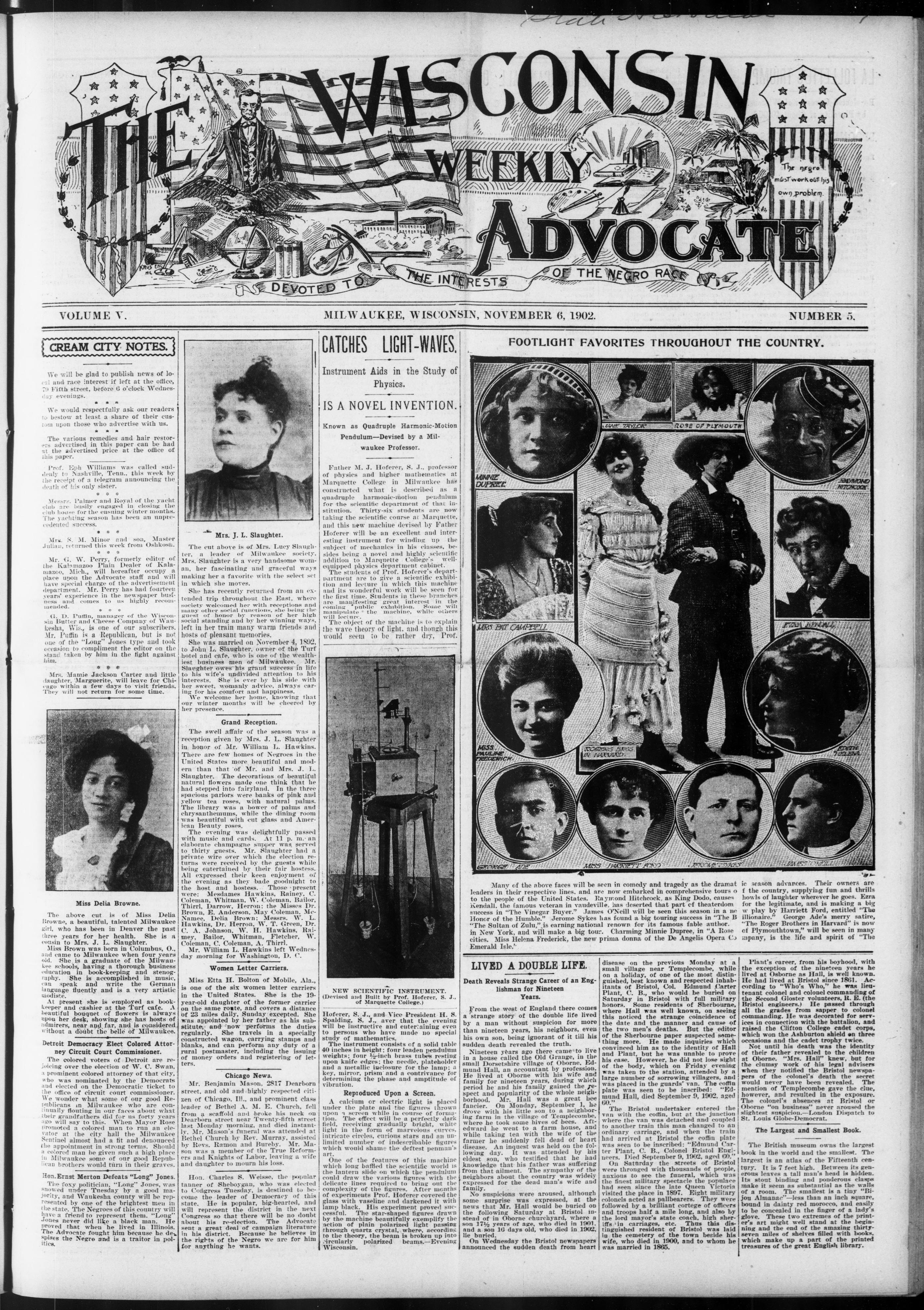
Miss Delia Browne.
The above cut is of Miss Delia Browne, a beautiful, talented Milwaukee girl, who has been in Denver the past three years for her health. She is a cousin to Mrs. J. L. Slaughter.
Miss Brown was born in Columbus, O., and came to Milwaukee when four years old. She is a graduate of the Milwaukee schools, having a thorough business education in book-keeping and stenography. She is accomplished in music, can speak and write the German language fluently and is a very artistic modiste.
At present she is employed as book- keeper and cashier at the Turf cafe. A beautiful bouquet of flowers is always upon her desk, showing she has hosts of admirers, near and far, and is considered without a doubt the belle of Milwaukee.
Detroit Democracy Elect Colored Attorney Circuit Court Commissioner.
The colored voters of Detroit are rejoicing over the election of W. C. Swan, a prominent colored attorney of that city, who was nominated by the Democrats and elected on the Democratic ticket to the office of circuit court commissioner. We wonder what some of our good Republicans in Milwaukee who are continually flouting in our faces about what their grandfathers did for us forty years ago will say to this. When Mayor Rose promoted a colored man to run an elevator at the city hall the Milwaukee Sentinel almost had a fit and denounced the appointment in strong terms. Should a colored man be given such a high place in Milwaukee some of our good Republican brothers would turn in their graves.
Hon,Ernst Merton Defeats "Long" Jones
The foxy politician, "Long" Jones, was snowed under Tuesday by a good majority, and Waukesha county will be represented by one of the brightest men in the state. The Negroes of this country will have a friend to represent them. "Long" Jones never did like a black man. He proved that when he lived in Illinois. The Advocate fought him because he despises the Negro and is a traitor in politics.
M.
Mrs. J. L. Slaughter.
The cut above is of Mrs. Lucy Slaughter, a leader of Milwaukee society. Mrs. Slaughter is a very handsome woman, her fascinating and graceful ways making her a favorite with the select set in which she moves.
She has recently returned from an extended trip throughout the East, where society welcomed her with receptions and many other social functions, she being the guest of honor by reason of her high social standing and by her winning ways, left in her train many warm friends and hosts of pleasant memories.
She was married on November 4, 1892, to John L. Slaughter, owner of the Turf hotel and cafe, who is one of the wealthiest business men of Milwaukee. Mr. Slaughter owes his grand success in life to his wife's undivided attention to his interests. She is ever by his side with her sweet, womanly advice, always caring for his comfort and happiness. We welcome her home, knowing that our winter months will be cheered by her presence.
Grand Reception.
The swell affair of the season was a reception given by Mrs. J. L. Slaughter in honor of Mr. William L. Hawkins. There are few homes of Negroes in the United States more beautiful and modern than that of Mr. and Mrs. J. L. Slaughter. The decorations of beautiful natural flowers made one think that he had stepped into fairyland. In the three spacious parlors were banks of pink and yellow tea roses, with natural palms. The library was a bower of palms and chrysanthemums, while the dining room was beautiful with cut glass and American Beauty roses.
The evening was delightfully passed with music and cards. At 11 p. m. an elaborate champagne supper was served to thirty guests. Mr. Slaughter had a private wire over which the election returns were received by the guests while being entertained by their fair hostess. All expressed their keen enjoyment of the evening as they bade goodnight to the host and hostess. Those present were; Mesdames Hawkins, Rainey, C. Coleman, Whitman, W. Coleman, Bailor, Thirrl, Darrow, Herron; the Misses Dr. Brown, E. Anderson, May Coleman, McNamee, Delia Brown; Messrs. W. L. Hawkins, Dr. Herron, W. T. Green, Dr. C. A. Johnson, W. H. Hawkins, Raimey, Bailor, Whitman, Fletcher, W. Coleman, C. Coleman, A. Thirrl.
Mr. William L. Hawkins left Wednes day morning for Washington, D. C.
Women Letter Carriers.
Miss Etta H. Bolton of Mobile, Ala., is one of the six women letter carriers in the United States. She is the 19-year-old daughter of the former carrier on the same route, and covers a distance of 23 miles daily, Sunday excepted. She was appointed by her father as his substitute, and now performs the duties regularly. She travels in a specially constructed wagon, carrying stamps and blanks, and can perform any duty of a rural postmaster, including the issuing of money orders and registering of letters.
Chicago News.
Mr. Benjamin Mason, 2817 Dearborn street, and old and highly respected citizen of Chicago, Ill., and prominent class leader of Bethel A. M. E. Church, fell from a scaffold and broke his neck on Dearborn street near Twenty-fifth street last Monday morning, and died instantly. Mr. Mason's funeral was attended at Bethel Church by Rev. Murray, assisted by Revs. Ramon and Bureby. Mr. Mason was a member of the True Reformers and Knights of Labor, leaving a wife and daughter to mourn his loss.
Hon. Charles S. Weisse, the popular tanner of Sheboygan, who was elected to Congress Tuesday, is destined to become the leader of Democracy of this state. He is popular, big-hearted, and will represent the district in the next Congress so that there will be no doubt about his re-election. The Advocate sent a great deal of campaign literature in his district. Because he believes in the rights of the Negro we are for him for anything he wants.
CATCHES LIGHT-WAVES.
CATCHES LIGHT-WAVES.
Instrument Aids in the Study of Physics.
Known as Quadruple Harmonic-Motion Pendulum-Devised by a Milwaukee Professor.
Father M. J. Hoferer, S. J., professor of physics and higher mathematics at Marquette College in Milwaukee has constructed what is described as a quadruple harmonic-motion pendulum for the scientific department of that institution. Thirty-six students are now taking the scientific course at Marquette, and this new machine devised by Father Hoferer will be an excellent and interesting instrument for winding up the subject of mechanics in his classes, besides being a novel and highly scientific addition to Marquette College's well-equipped physics department cabinet.
The students of Prof. Hoferer's department are to give a scientific exhibition and lecture in which this machine and its wonderful work will be seen for the first time. Students in these branches are manifesting great interest in the coming public exhibition. Some will manipulate the machine, while others will lecture. The object of the machine is to explain the wave theory of light, and though this would seem to be rather dry, Prof.
1930
NEW SCIENTIFIC INSTRUMENT. (Devised and Built by Prof. Hoferer, S. J. of Marquette College.)
NEW SCIENTIFIC INSTRUMENT. (Devised and Built by Prof. Hoferer, S. J., of Marquette College.)
Hoferer, S. J., and Vice President H. S. Spalding, S. J., aver that the evening will be instructive and entertaining even to persons who have made no special study of mathematics.
The instrument consists of a solid table 40 inches in height; four leaden pendulum weights; four 1/2-inch brass tubes resting upon knife edges; the needle, plateholder and a metallic enclosure for the lamp; a key, mirror, prism and a contrivance for determining the phase and amplitude of vibration.
Reproduced Upon a Screen.
A calcium or electric light is placed under the plate and the figures thrown upon a screen while in course of formation. The effect will be a perfectly dark field, receiving gradually bright, white light in the form of marvelous curves, intricate circles, curious stars and an unlimited number of indescribable figures which would shame the deftest penman's art.
One of the features of this machine which long baffled the scientific world is the lantern slide on which the pendulum could draw the various figures with the delicate lines required to bring out the complexity of the figures. After months of experiments Prof. Hoferer covered the glass with vaseline and darkened it with lamp black. His experiment proved successful. The star-shaped figures drawn by the machine beautifully exemplify the action of plain polarized light passing through quartz crystal, where, according to the theory, the beam is broken up into circularly polarized beams.—Evening Wisconsin.
MINNIE DUPREE
MRS. PAT CAMPFELL
MISS. PAULINE FREDERICK
GEORGE ADE
MISS JARRIETT FOND
JENNY MCGREGOR
JAMES TONFILL
ROSE OF PLYMOUTH
DAYMOND HITCHCOCK
EDITH TIELENA
Many of the above faces will be seen in comedy and tragedy as the dramat leaders in their respective lines, and are now embarked in comprehensive tours to the people of the United States. Raymond Hitchcock, as King Dodo, causes Kendall, the famous veteran in vaudeville, has deserted that part of the theaterdom success in "The Vinegar Buyer." James O'Neill will be seen this season in a new Honor of the Humble." Jerome Sykes has found a big touring success in "The B "The Sultan of Zulu," is earning national renown for its famous fable author. in New York, and will make a big tour. Charming Minnie Dupree, in "A Rose cities. Miss Helena Frederick, the new prima donna of the De Angelis Opera Co Emerald Isle."
LIVED A DOUBLE LIFE.
Death Reveals Strange Career of an Englishman for Nineteen Years.
From the west of England there comes a strange story of the double life lived by a man without suspicion for more than nineteen years, his neighbors, even his own son, being ignorant of it till his sudden death revealed the truth.
Nineteen years ago there came to live in a house called the Old Grange, in the small Dorsetshire village of Oborne. Edmund Hall, an accountant by profession. He lived at Oborne with his wife and family for nineteen years, during which period he and his family gained the respect and popularity of the whole neighborhood. Mr. Hall was a great bee fancier. On Monday, September 1, he drove with his little son to a neighboring farm in the village of Templecombe, where he took some hives of bees. Aftedward he went to a farm house, and while taking tea with the wife of the farmer he suddenly fell dead of heart disease. An inquest was held on the following day. It was attended by his eldest son, who testified that he had knowledge that his father was suffering from that ailment. The sympathy of the neighbors about the country was widely expressed for the dead man's wife and family.
No suspicions were aroused, although some surprise was expressed, at the news that Mr. Hall would be buried on the following Saturday at Bristol instead of in Oborne churchyard, where a son 17½ years of age, who died in 1901, and a son 16 days old, who died in 1902, lie buried. On Wednesday the Bristol newspapers announced the sudden death from heart
disease on the previous Monday at a small village near Templecombe, while on a holiday, of one of the most distinguished, best known and respected inhabitants of Bristol, Col. Edmund Carter Plant, C. B., who would be buried on Saturday in Bristol with full military honors. Some residents of Sherbourne, where Hall was well known, on seeing this noticed the strange coincidence of the date and the manner and cause of the two men's deaths. But the editor of the Sherbourne paper suspected something more. He made inquiries which convinced him as to the identity of Hall and Plant, but he was unable to prove his case. However, he did not lose sight of the body, which on Friday evening was taken to the station, attended by a large number of sorrowing villagers, and was placed in the guards' van. The coffin plate was seen to be inscribed: "Edmund Hall, died September 9, 1902, aged 60."
The Bristol undertaker entered the van with the coffin, but at the junction where the van was detached and coupled to another train this man changed to an ordinary carriage, and when the train had arrived at Bristol the coffin plate was seen to be inscribed: "Edmund Carter Plant, C. B., Colonel Bristol Engineers, Died September 1, 1902, aged 60."
On Saturday the streets of Bristol were thronged with thousands of people, anxious to see the funeral, which was the finest military spectacle the populace had seen since the late Queen Victoria visited the place in 1897. Eight military colonels acted as pallbearers. They were followed by a brilliant cortege of officers and troops half a mile long, and also by the lord mayor's state coach, high sheriffs in carriages, etc. Thus this distinguished resident of Bristol was laid in the cemetery of the town beside his wife, who died in 1900, and to whom he was married in 1865.
NUMBER 5.
THE COUNTRY.
RAYMOND HITCHCOOK
FEDERAL KINCOLL
KENTH T. HELENA
JAMES LOMILL
ic season advances. Their owners are f the country, supplying fun and thrills howls of laughter wherever he goes. Ezra for the legitimate, and is making a big w play by Harriett Ford, entitled "The illionaire." George Ade's merry satire, "The Roger Brothers in Harvard" is now of Plymouthtown," will be seen in many impany, is the life and spirit of "The
Plant's career, from his boyhood, with the exception of the nineteen years he lived at Osborne as Hall, is well known. He had lived at Bristol since 1861. According to "Who's Who," he was lieutenant colonel and colonel commanding of the Second Gloster volunteers, R. E. (the Bristol engineers.) He passed through all the grades from sapper to colonel commanding. He was decorated for services in connection with the battalion, and raised the Clifton College cadet corps, which won the Ashburton shield on three occasions and the cadet trophy twice.
Not until his death was the identity of their father revealed to the children at Oborne. "Mrs. Hall" knew, but for the clumsy work of his legal advisers when they notified the Bristol newspapers of the colonel's death the secret would never have been revealed. The mention of Templecombe gave the clue, however, and resulted in the exposure. The colonel's absences at Bristol or Oborne "on business" never aroused the slightest suspicion.—London Dispatch to St. Louis Globe-Democrat.
The Largest and Smallest Book.
The British museum owns the largest book in the world and the smallest. The largest is an atlas of the Fifteenth century. It is 7 feet high. Between its generous leaves a tall man's head is hidden. Its stout binding and ponderous clasps make it seem as substantial as the walls of a room. The smallest is a tiny "Bijou Almanac"—less than an inch square, bound in dainty red morocco, and easily to be concealed in the finger of a lady's glove. These two extremes of the printer's art might well stand at the beginning and the end of the amazing thirty-seven miles of shelves filled with books, which make up a part of the printed treasures of the great English library.
---
Re-elected Governor of Wisconsin by Plurality of About 40,000.
SPOONER IS ENDORSED.
Enough Legislators Pledged to Him to Insure His Return to the
STATE TICKET.
Governor—Robert M. La Follette.
Lieutenant Governor—James O. Davidson.
Secretary of State—Walter L. Houser.
State Treasurer—John J. Kempf.
Attorney General—L. M. Sturdevant.
State Superintendent—Charles P. Cary.
Railroad Commissioner—John W. Thomas.
Commissioner of Insurance—Zeno M.
Host.
Milwaukee, Wis., Nov. 5.—[Special.] From returns received up to 4 o'clock this afternoon the plurality of Gov. La Follette is estimated at over 49,000 and it is thought that it will pass 50,000 when all of the returns are in. The returns have come in very slowly on account of the great number of split tickets. In many parts of the state the election inspectors have not sent in their reports, as they have not finished counting the ballots.
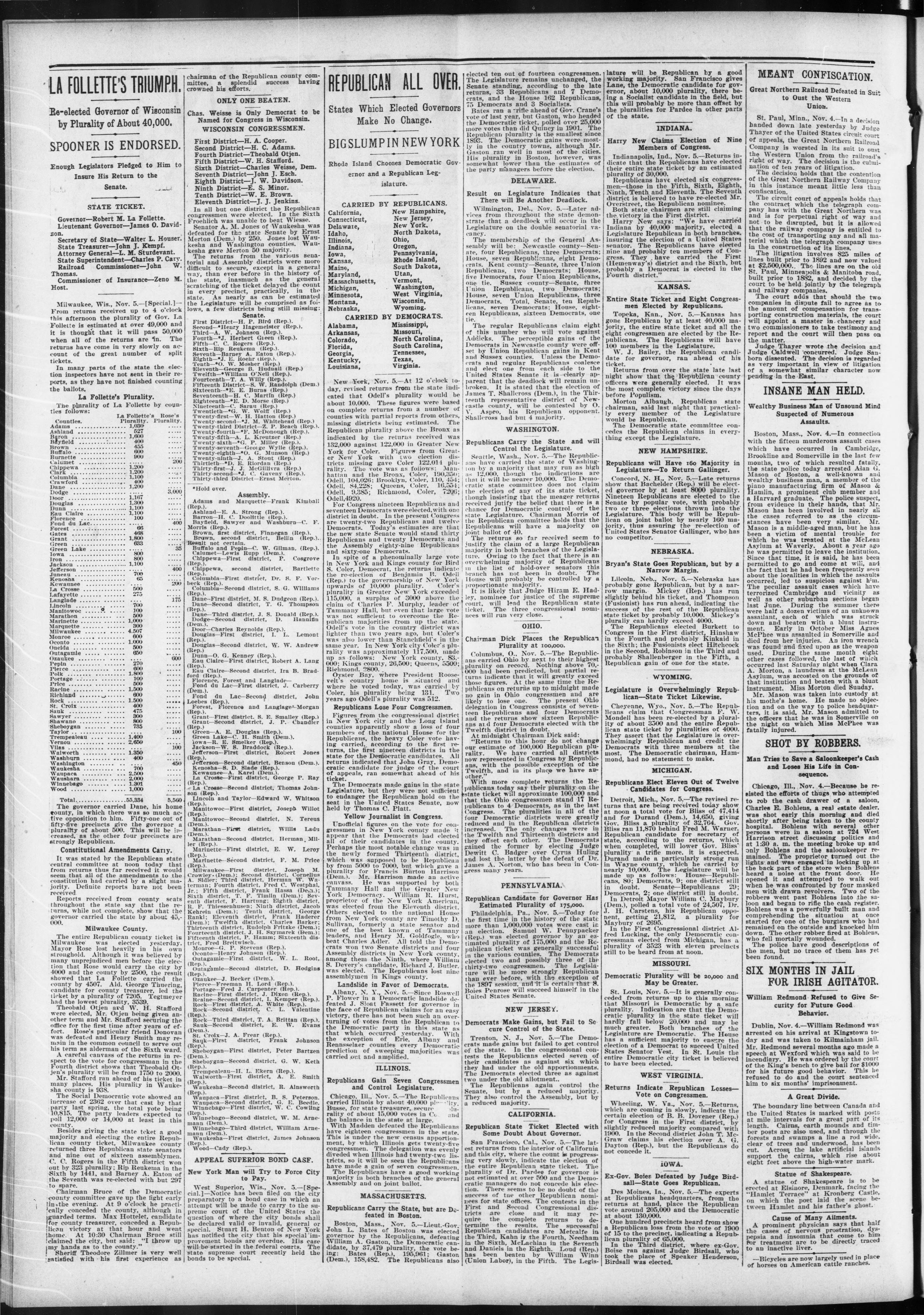
La Follette's Plurality.
ties follows:
Countles. La Follette's Plurality. Rose's Plurality.
Adams 1,030
Ashland 527
Baron 1,600
Bayfield 400
Brown 455
Buffalo 600
Burnette 900
Calumet 200
Chippewa 1,200
Clark 1,200
Columbia 1,100
Crawford 400
Dane 1,200
Dodge 200
Door 1,167
Douglas 1,300
Dunn 1,100
Eau Claire 1,100
Florence 100
Fond du Lac 400
Forest 66
Gates 468
Grant 1,800
Green 633
Green Lake 35
Iowa 800
Iron 800
Jackson 1,100
Jefferson 400
Juneau 700
Kenosha 65
Kewaunee 200
La Crosse 500
Lafayette 275
Langlade 175
Lincoln 700
Manitowoc 100
Marathon 500
Marinette 1,000
Marquette 300
Milwaukee 4,507
Monroe 600
Oconto 1,000
Onelda 500
Outagamie 650
Ozaukee 600
Pepin 270
Plerce 600
Polk 1,800
Portage 100
Price 500
Racine 1,500
Richland 600
Rock 1,500
St. Croix 400
Sauk 475
Sawyer 300
Shawano 800
Sheboygan 735
Taylor 100
Trempealeau 1,400
Vernon 2,650
Villas 100
Walworth 1,350
Washburn 400
Washington 450
Waukesha 700
Waupaca 2,500
Waushara 2,000
Winnebago 1,301
Wood 1,000
The governor carried Dane, his home county, in which there was so much active opposition to him. Fifty-one out of fifty-five precincts give the governor a plurality of about 500. This will be increased, as the other four precincts are strongly Republican.
Constitutional Amendments Carly.
It was stated by the Republican state central committee at noon today that from returns thus far received it would seem that all of the amendments to the constitution had carried by a slight majority. Definite reports have not been received. Reports received from county seats throughout the state say that the returns, while not complete, show that the governor carried the state by about 45,000
Milwaukee County
The entire Republican county ticket in Milwaukee was elected yesterday. Mayor Rose lost heavily in his own stronghold. Although it was believed by many unprejudiced men before the election that Rose would carry the city by 4000 and the county by 2500, the result showed that La Follette carried the county by 4507. Ald. George Thuering, candidate for county treasurer, led the ticket by a plurality of 7205. Tegtmeyer had the lowest plurality, 3539. Theobald Otjen and W. H. Stafford were elected, Mr. Otjen being given another term and Mr. Stafford securing the office for the first time after years of effort. Rose's particular friend Donovan was defeated and Henry Smith may remain in the common council to serve out his term as alderman of the Sixth ward.
A careful canvass of the returns in respect to the vote for congressman in the Fourth district shows that Theobald Otjen's plurality will be from 1750 to 2000. Mr. Stafford ran ahead of his ticket in many places. His plurality in Waukesha county is 938. The Social Democratic vote showed an increase of 2362 over that cast by that party last spring, the total vote being 10,815. The party leaders expected to poll 12,000 or 14,000 at least in this county.
Besides giving the state ticket a good majority and electing the entire Republican county ticket, Milwaukee county returned three Republican state senators and nine out of sixteen assemblymen. C. C. Rogers in the Fifth district won out by 323 plurality; Rip Reukema in the Sixth by 1441, and Barney A. Eaton of the Seventh was re-elected with but 297 to spare.
Chairman Bruce of the Democratic county committee gave up the fight early in the evening. At 9 o'clock he practically conceded the county, although in guarded terms. Max Hottelet, candidate for county treasurer, conceded a Republican victory at that hour and went home. At 10:30 Chairman Bruce still claimed the city, but said: "I throw up my hands as to the county."
Sheriff Theodore Zillmer is very well satisfied with his first experience as
chairman of the Republican county committee, a splendid success having crowned his efforts.
ONLY ONE BEATEN.
Chas. Weisse is Only Democrat to be Named for Congress in Wisconsin. WISCONSIN CONGRESSMEN.
First District—H. A. Cooper.
Second District—H. C. Adams.
Fourth District—Theobald Otjen.
Fifth District—W. H. Stafford.
Sixth District—Charles Weisse, Dem.
Seventh District—John J. Esch.
Eighth District—J. W. Davidson.
Ninth District—E. S. Minor.
Tenth District—W. E. Brown.
Eleventh District—J. J. Jenkins.
Senator A. M. Jones of Waukesha was defeated for the state Senate by Ernst Merton (Dem.) by 250. Jones lost Waukesha and Washington counties. Waukesha gave Merton 50 majority. The returns from the various senatorial and Assembly districts were more difficult to secure, except in a general way, than ever before in the history of the state, inasmuch as the general scratching of the ticket delayed the count in every precinct, practically, in the state. As nearly as can be estimated the Legislature will be comprised as follows, a few districts being still missing:
First District—H. P. Bird (Rep.).
Second—*Henry Hagemelster (Rep.).
Third—A. W. Johnson (Rep.).
Fourth—*J. Herbert Green (Rep.).
Fifth—C. C. Rogers (Rep.).
Sixth—Rip Reukema (Rep.).
Seventh—Barney A. Eaton (Rep.).
Eighth—*J. E. Roehr (Rep.).
Tenth—*O. W. Mosher (Rep.).
Eleventh—George B. Huduall (Rep.).
Twelfth—*William O'Nell (Rep.).
Fourteenth—T. A. Willy (Rep.).
Fifteenth District—S. W. Randolph (Dem.).
Sixteenth—*E. E. Burns (Rep.).
Seventeenth—H. C. Martin (Rep.).
Eighteenth—*E. D. Morse (Rep.).
Nineteenth—C. Sarau (Rep.).
Twentieth—*G. W. Wolft (Rep.).
Twenty-first—W. H. Hatton (Rep.).
Twenty-second—*J. M. Whitehead (Rep.).
Twenty-third District—Z. P. Beach (Rep.).
Twenty-fourth—*F. McDonough (Rep.).
Twenty-fifth—A. L. Kreutzer (Rep.).
Twenty-sixth—*G. P. Miller (Rep.).
Twenty-seventh—George Wylle (Rep.).
Twenty-eighth—*O. G. Munson (Rep.).
Twenty-ninth—J. A. Stont (Rep.).
Thirtieth—*D. E. Riordan (Rep.).
Thirty-first—J. J. McGillivra (Rep.).
Thirty-second—*J. C. Gaveny (Rep.).
Thirty-third District—Ernst Merton.
*Hold over.
Assembly.
Adams and Marquette—Frank Kimball (Rep.).
Ashland—E. A. Strong (Rep.).
Barron—H. C. Doolittle (Rep.).
Bayfield, Sawyer and Washburn—C. F. Morris (Rep.).
Brown, first district, Finnegan (Rep.).
Brown, second district, Bellin (Rep.).
Result not certain.
Buffalo and Peplin—C. W. Gillman, (Rep.).
Calumet—Lewis Rupp (Dem.).
Chippewa—First district, P. Cosgrove (Rep.).
Chippewa, second district, Bartlette (Rep.).
Columbia—First district, Dr. S. F. Vorbeck (Rep.).
Columbia—Second district, S. G. Williams (Rep.).
Dane—First district, M. S. Dudgeon (Rep.).
Dane—Second district, T. G. Thompson (Rep.).
Dane—Third district, J. S. Donald (Rep.).
Dodge—Second district, D. Hannifin (Dem.).
Door—Charles Reynolds (Rep.).
Douglas—First district, I. L. Lemont (Rep.).
Douglas—Second district, W. W. Andrew (Rep.).
Dunn—O. G. Kenney (Rep.).
Ean Claire—First district, Robert A. Lang (Rep.).
Eau Claire—Second district, Ira B. Bradford (Rep.).
Florence, Forest and Langlade—Fond du Lac—First district, J. Carberry (Dem.).
Fond du Lac—Second district, John Loebes (Rep.).
Forest, Florence and Langlade—Morgan (Rep.).
Grant—First district, S. E. Smalley (Rep.).
Grant—Second district, J. P. Chandler (Rep.).
Green—A. E. Douglas (Rep.).
Green Lake—C. H. Smith (Dem.).
iowa—R. E. Smelker (Rep.).
Jackson—W. S. Braddock (Rep.).
Jefferson—First district, Robert Jones (Rep.).
Jefferson—Second district, Benson (Dem.).
Kenosha—S. D. Slade (Rep.).
Kewaunee—A. Karel (Dem.).
La Crosse—First district, George P. Ray (Rep.).
La Crosse—Second district, Thomas Johnson (Rep.).
Lincoln and Taylor—Edward W. Whitson (Rep.).
Manitowoc—First district, Joseph Willot (Rep.).
Manitowoc—Second district, N. Tereus (Dem.).
Marathan—First district, Willis Ladu (Dem.).
Marathan—Second district, Herman Miller (Rep.).
Marlinette—First district, E. W. Leroy (Rep.).
Marlinette—Second district, F. M. Price (Rep.).
Milwaukee—First district, Joseph M. Crowley·(Dem.); Second district, Cornelius A. Sldler; Third district, Herman W. Waterman; Fourth district, Fred C. Westphal, Jr.; Fifth district, Frank Hassa (Dem.); Sixth district, T. F. Timlin (Dem.); Seventh district, F. Hartung; Eighth district, R. F. Thiessenhusen; Ninth district, Jacob Kehrein (Dem.); Tenth district, George Rankl; Eleventh district, Frank Haderer (Dem.); Twelfth district, Charles Barker; Thirteenth district, Rudolph Fritzke (Dem.); Fourteenth district, J. H. Szymarek (Dem.); Fifteenth district, P. Hamm; Sixteenth district, Fred Breltwisch.
Outagamie—Second district, D. Hodgins (Ben.)
Ozaukee—J. Becker (Dem.).
Pierce—Freeman H. Lord (Rep.).
Portage—Fred J. Carpenter (Rep.).
Racine—First district, J. Dixon (Rep.).
Racine—Second district, I. Kemper (Rep.).
Rock—First district, A. White (Rep.).
Rock—Second district, C. L. Valentine (Rep.).
Rock—Third district, T. A. Brittan (Rep.).
Sauk—Second district, E. W. Evans (Dem.).
St. Crolix—J. A. Frear (Rep.).
Sauk—First district, Frank Johnson (Rep.).
Sheboygan—First district, Peter Bartzen (Dem.).
Sheboygan—Second district, G. W. Keth (Rep.).
Trempealeau—H. L. Ekern (Rep.).
Walworth—First district, A. E. Smith (Rep.).
Waukesha—Second district, R. Alnsworth (Rep.).
Waupaca—First district, B. S. Peterson.
Waupaca—Second district, G. E. Beedle.
Winnebago—First district, W. C. Cowling (Rep.).
Winnebago—Second district, W. M. Arnemann (Dem.).
Winnebago—Third district, William Arnemann (Dem.).
Waukesha—First district, James Johnson (Rep.).
Wood—Cady (Rep.).
APPEAL SUPERIOR BOND CASE
New York Man will Try to Force City to Pay.
West Superior, Wis., Nov. 5.—[Special.]—Notice has been filed on the city preparatory to a bond case in which an attempt will be made to carry to the supreme court of the United States the question of where the city bonds shall be declared valid or invalid, general or special. Stuart H. Benton of New York has notified the city that his special improvement bonds are overdue. His case will be started in the federal courts. The state supreme court recently held the bonds to be special.
REPUBLICAN ALL OVER.
States Which Elected Governors Make No Change.
CARRIED BY REPUBLICANS.
California, New Hampshire,
Connecticut, New Jersey,
Delaware, New York.
Idaho, North Dakota,
Illinois, Ohio,
Indiana, Oregon,
Iowa, Pennsylvania,
Kansas, Rhode Island,
Maine, South Dakota,
Maryland, Utah,
Massachusetts, Vermont,
Michigan, Washington,
Minnesota, West Virginia,
Montana, Wisconsin,
Nebraska, Wyoming.
Alabama, Mississippi,
Arkansas, Missouri,
Colorado, North Carolina,
Florida, South Carolina,
Georgia, Tennessee,
Kentucky, Texas,
Louisiana, Virginia.
New York, Nov. 5.—At 12 o'clock today, revised returns from the state indicated that Odell's plurality would be about 10,000. These figures were based on complete returns from a number of counties with partial reports from others, missing districts being estimated. The Republican plurality above the Bronx as indicated by the returns received was 132,000 against 122,000 in Greater New York for Coler. Figures from Greater New York with two election districts missing gave Coler 122,014 plurality. The vote was as follows: Manhattan and the Bronx, Coler, 190,350; Odell, 104,026; Brooklyn, Coler, 110,454; Odell, 84,228; Queens, Coler, 16,554; Odell, 9,385; Richmond, Coler, 7206; Odell,4920.
For Congress nineteen Republicans and seventeen Democrats were elected,with one district in doubt. In the present Congress are twenty-two Republicans and twelve Democrats. Today's estimates are that the new state Senate would stand thirty Republicans and twenty Democrats and the Assembly eighty-nine Republicans and sixty-one Democrats.
In spite of a phenominally large vote in New York and Kings county for Bird S. Coler, Democrat, the returns indicate the re-election of Benjamin B. Odell (Rep.) to the governorship of New York upwards of 10,000 plurality. Coler's plurality in Greater New York exceeded 115,000, a surplus of 3000 above the claim of Charles F. Murphy, leader of Tammany Hall, but even that large vote was not sufficient to overcome the Republican majorities from up the state. Odell's vote in the country district was lighter than two years ago, but Coler's was also lower than Stanchfield's in the same year. In New York city Coler's plurality was approximately 117,500, made up as follows: New York county. 83,000; Kings county, 26,500; Queens, 5500; Richmond, 2800.
Oyster Bay, where President Roosevelt's country home is situated and where he voted today, was carried by Coler, his plurality being 131. Two years ago Odell's plurality was 512.
Republicans Lose Four Congressmen.
Figures from the congressional district in New York city and the Long Island counties apparently show a loss of four members of the national House for the Republicans, the heavy Coler vote having carried, according to the first returns, the first nineteen districts in the state for the Democratic candidates. All returns indicated that John Gray, Democratic candidate for judge of the court of appeals, ran somewhat ahead of his ticket. The Democrats made gains in the state Legislature, but they were not sufficient to endanger the Republican hold on the seat in the United States Senate, now held by Thomas C. Platt.
Yellow Journalist in Congress.
Unofficial figures on the vote for congressmen in New York county made it appear that the Democrats had elected all of their candidates in the county. Perhaps the most notable change was in the newly formed Thirteenth district, which was supposed to be Republican by from 5000 to 7000, but which gave a plurality for Francis Burton Harrison (Dem.). Mr. Harrison made an active canvass. He was supported by both Tammany Hall and the Greater New York Democracy. William R. Hurst, proprietor of the New York American, was elected from the Eleventh district. Others elected to the national House from New York county are Timothy D. Sullivan, formerly a state senator and one of the best known of Tammany leaders, and Henry M. Goldfogle, who beat Charles Adler. All told the Democrats won two Senate districts and four Assembly districts in New York county, among them the Ninth, where William S. Devery's candidate, Richard J. Butler, was elected. The Republicans lost nine assemblymen in Kings county.
Landslide in Favor of Democrats.
Albany, N. Y., Nov. 5.—Since Roswell P. Flower in a Democratic landslide defeated J. Sloat Fassett for governor in the face of Republican claims for an easy victory, there has not been such an overturning of votes from the Republican to the Democratic party in this state as that which occurred yesterday. With the exception of Erie, Albany and Rennsselaer counties every Democratic prediction of sweeping majorities was carried out and amplified.
ILLINOIS
Republicans Gain Seven Congressmen and Control Legislature
Chicago, Ill., Nov. 5.—The Republicans carried Illinois by about 40,000 plurality. Busse, for state treasurer, secured plurality of about 15,000 votes in Co. and the balance in the state at large. With Madden defeated the Republicans have eighteen congressmen in the state. This is under the new census apportionment, by which Illinois gets twenty-five congressmen. The delegation was evenly divided when Illinois had twenty-two districts, so it will be seen the Republicans have made a gain of seven congressmen
The Republicans have a good working majority in both branches of the general Assembly and on joint ballot.
MASSACHUSETTS
Republicans Carry the State, but are Defeated in Boston.
Boston, Mass., Nov. 5.—Lieut.-Gov. John L. Bates of Boston was elected governor by the Republicans, defeating William A. Gaston, the Democratic candidate, by 37,479 plurality, the vote being: Bates (Rep.), 195,961; Gaston (Dem.), 158,482. The Republicans also
elected ten out of fourteen congressmen. The Legislature remains unchanged, the Senate standing, according to the late returns, 33 Republicans and 7 Democrats, and the House 162 Republicans, 75 Democrats and 3 Socialists. Bates ran a rifle ahead of Gov. Crane's vote of last year, but Gaston, who headed the Democratic ticket, polled over 25,000 more votes than did Quincy in 1901. The Republican plurality is the smallest since 1893. The Democratic gains were mostly in the country towns, although Mr. Gaston ran well in most of the cities. His plurality in Boston, however, was somewhat lower than the estimates of the party managers before the election.
DELAWARE
Result on Legislature Indicates that There will Be Another Deadlock
Wilmington, Del., Nov. 5.—Later advices from throughout the state demonstrate that a deadlock will occur in the Legislature on the double senatorial vacancy.
The membership of the General Assembly will be: Newcastle county—Senate, four Republicans, three Democrats; House, seven Republicans, eight Democrats. Kent county—Senate, three Union Republicans, two Democrats; House, five Democrats, four Union Republicans, one tie. Sussex county—Senate, three Union Republicans, two Democrats; House, seven Union Republicans, three Democrats. Total, Senate, ten Republicans, seven Democrats; House, eighteen Republicans, sixteen Democrats, one tie.
The regular Republicans claim eight of this number who will vote against Addicks. The perceptible gains of the Democrats in Newcastle county were offset by Union Republican gains in Kent and Sussex counties. Unless the Democrats and regular Republicans coalesce and elect one from each side to the United States Senate it is clearly apparent that the deadlock will remain unbroken. It is stated that the election of James T. Shallcross (Dem.), in the Thirteenth representative district of Newcastle county, will be contested by O. V. Aspro, his Republican opponent. Shallcross had but 4 majority.
WASHINGTON
Republicans Carry the State and will Control the Legislature.
Seattle, Wash., Nov. 5.—The Republicans have carried the state of Washington by a majority that may run as high as 12,000, though the indications are that it will be nearer 10,000. The Democratic state committee does not claim the election of any of its state ticket, though insisting that the meager returns received justify the belief that there is a chance for Democratic control of the state Legislature. Chairman Morris of the Republican committee holds that the Republicans will have a majority on joint ballot of 40.
The returns so far received seem to justify the claim of a large Republican majority in both branches of the Legislature. Owing to the fact that there is an overwhelming majority of Republicans in the list of hold-over senators this branch has not been in doubt. The House will probably be controlled by a proportionate majority. It is likely that Judge Hiram E. Hadley, nominee for justice of the supreme court, will lead the Republican state ticket. The three congressional nominees will run very close.
OHIO.
Chairman Dick Places the Republican Plurality at 100,000.
Columbus, O., Nov. 5.—The Republicans carried Ohio by next to their highest plurality on record. Nothing above 70,000 had been predicted, but partial returns indicate that it will greatly exceed those figures. At the same time the Republicans on returns up to midnight made no gain in Ohio congressmen and are likely to lose one. The present Ohio delegation in Congress consists of seventeen Republicans and four Democrats and the returns show sixteen Republicans and four Democrats elected with the Twelfth district in doubt.
At midnight Chairman Dick said:
"Returns to this hour do not change our estimate of 100,000 Republican plurality. We have carried all districts now represented in Congress by Republicans, with the possible exception of the Twelfth, and in its place we have another."
With more complete returns the Republicans today say their plurality on the state ticket will approximate 100,000 and that the Ohio congressmen stand 17 Republicans to 4 Democrats, as in the last Congress. The pluralities in all of the four Democratic districts were greatly reduced and in the Republican districts increased. The only changes were in the Twelfth and Thirteenth districts and they offset each other. The Democrats gained the former by electing Judge Dewitt C. Badger over Cyrus Huling and lost the latter by the defeat of Dr. James A. Norton, who has been in Congress many years.
PENNSYLVANIA.
Republican Candidate for Governor Has Estimated Plurality of 175,000.
Philadelphia, Pa., Nov. 5.—Today for the first time in the history of the state more than 1,000,000 votes were cast in an election. Samuel W. Pennypacker (Rep.) was elected governor by an estimated plurality of 175,000 and the Republican ticket was generally successful in the various counties. The Democrats elected two and possibly three of the thirty-two congressmen. The Legislature will be more strongly Republican than ever before, with the exception of the 1897 session, and it is certain that 8. Boies Penrose will succeed himself in the United States Senate.
NEW JERSEY.
Democrats Make Gains, but Fail to Secure Control of the State.
Trenton, N. J., Nov. 5.—The Democrats made gains but failed to get control of the state. In the congressional contests the Republicans elected seven of their candidates as against six which they had under the old apportionments. The Democrats elected three as against two under the old allotment...
The Republicans again control the Senate, but by a reduced majority. They also control the Assembly, but by a reduced majority.
CALIFORNIA.
Republican State Ticket Elected with Some Doubt About Governor.
San Francisco, Cal., Nov. 5.—The latest returns from the interior of California and this city, where the count is progressing very slowly, indicate the election of the entire Republican state ticket. The plurality of Dr. Pardee for governor is not estimated at over 500 and the Democratic managers do not concede his election. There seems to be no doubt of the success of the other Republican nominees for state offices. The contests in the First and Second Congressional districts are close and it may require the complete returns to determine the results. The successful Republican candidates are Metcalfe in the Third, Kahn in the Fourth, Needham in the Sixth, McLachlan in the Seventh and Daniels in the Eighth. Loud (Rep.) has been beaten by William Winn (Union Labor), in the Fifth. The Legis-
lature will be Republican by a good working majority. San Francisco gives Lane, the Democratic candidate for governor, about 10,000 plurality, there being a Socialist candidate in the field, but this will probably be more than offset by the pluralities for Pardee in other parts of the state.
INDIANA.
Harry New Claims Election of Nine Members of Congress.
Indianapolis, Ind., Nov. 5.—Returns indicate that the Republicans have elected their entire state ticket by an estimated plurality of 30,000.
Republicans have elected six congressmen—those in the Fifth, Sixth, Eighth, Ninth, Tenth and Eleventh. The Seventh district is believed to have re-elected Mr. Overstreet, the Republican nominee.
Both state chairmen are still claiming the victory in the First district. Harry New says: "We have carried Indiana by 40,000 majority, elected a Legislature Republican in both branches, insuring the election of a United States senator. The Republicans have elected nine and probably teu members of Congress. They have carried the First (Hemenway's) district and the Sixth, but probably a Democrat is elected in the Fourth district."
KANSAS.
Entire State Ticket and Eight Congressmen Elected by Republicans.
Topeka, Kan., Nov. 5.—Kansas has gone Republican by at least 40,000 majority, the entire state ticket and all the eight congressmen are elected by the Republicans. The Republicans will have 100 members in the Legislature.
W. J. Bailey, the Republican candidate for governor, ran ahead of his ticket.
Returns from over the state late last night show that the Republican county officers were generally elected. It was the most complete victory since the days before Populism.
Morton Albaugh. Republican state chairman, said last night that practically every member of the Legislature would be Republican.
The Democratic state committee concedes the Republican claims in everything except the Legislature.
NEW HAMPSHIRE.
Republicans will Have 160 Majority in Legislature—To Return Gallinger.
Concord, N. H., Nov. 5.—Late returns show that Bachelder (Rep.) will be elected governor by at least 8000 plurality. Nineteen Republicans are elected to the Senate by popular vote, with probably two or three elections thrown into the Legislature. This body will be Republican on joint ballot by nearly 160 majority, thus assuring the re-election of United States Senator Gallinger, who has no competitor.
NEBRASKA.
Bryan's State Goes Republican, but by a Narrow Margin.
Lilcoln, Neb., Nov. 5.—Nebraska has probably gone Republican, but by a narrow margin. Mickey (Rep.) has run slightly behind his ticket, and Thompson (Fusionist) has run ahead, indicating the success of the rest of the Republican state ticket by probably 10,000. Mickey's plurally can hardly exceed 4000. The Republicans elected Burkett to Congress in the First district, Hinshaw in the Fourth and probably Kinkaid in the Sixth; the Fusionists elect Hitchcock in the Second, Robinson in the Third and probably Shallenberger in the Fifth, a Republican gain of one for the state.
WYOMING
Legislature is Overwhelmingly Republican—State Ticket Likewise
Cheyenne, Wyo., Nov. 5.—The Republicans claim that Congressman F. W. Mondell has been re-elected by a plurality of about 3500 and the entire Republican state ticket by pluralities of 4000. They assert that the Legislature is overwhelmingly Republican and credit the Democrats with three members at the most. The Democratic chairman, Hammond, had no statement to make.
MICHIGAN
Republicans Elect Eleven Out of Twelve Candidates for Congress.
Detroit, Mich., Nov. 5.—The revised returns that are being received today show at noon a total vote for Bliss of 47,414 and for Durand (Dem.), 14,650, giving Gov. Bliss a plurality of 32,764. Gov. Bliss ran 11,870 behind Fred M. Warner. Republican candidate for secretary of state, according to the returns, which when completed, will lower Gov. Bliss' plurality a trifle more. it is expected. Durand made a particularly strong run in Wayne county, which he carried by nearly 10,000. The Legislature will be made up as follows: House—Republicans, 80; Democrats, 9; one district still in doubt. Senate—Republicans 29; Democrats, 2; one district still in doubt. In Detroit Mayor William C. Maybury (Dem.), polled a total vote of 24,507, Dr. J. H. Carstens, his Republican opponent, getting 21,812, a plurality for Maybury of 2695.
In the First Congressional district Alfred Lucking, the only Democratic congressman elected from Michigan, has a plurality of 3523 with eleven precincts still to be heard from at noon.
MISSOURI.
Democratic Plurality will be 20,000 and May be Greater.
St. Louis, Nov. 5.—It is generally conceded from returns up to this morning that Missouri is Democratic by a safe plurality. Indication are that the Democratic plurality in the state ticket will hardly fall below 20,000 and may be much greater. Both branches of the Legislature are Democratic. The House has a sufficient majority to ensure the election of a Democrat to succeed United States Senator Vest. In St. Louis the entire Democratic city ticket is believed to have been elected.
WEST VIRGINIA.
Returns Indicate Republican Losses— Vote on Congressmen.
Wheeling, W. Va., Nov. 5.—Returns, which are coming in slowly, indicate the certain election of B. B. Dovener (Rep.) for Congress in the First district, by slightly reduced majority compared with 1900. In the Second district John T. McGraw claims his election over A. G. Dayton (Rep.), but the Republicans do not concede it.
IOWA.
Ex-Gov. Boies Defeated by Judge Birdsall—State Goes Republican.
Des Moines, Ia., Nov. 5.—The experts at Republicans headquarters, from the returns at hand, place the Republican vote around 205,000 and the Democratic at about 130,000.
One hundred precincts heard from show a Republican loss from the vote of 1900 of 15 to the precinct, indicating a Republican plurality of 65,000.
In the Third district, where ex-Gov. Boise ran against Judge Birdsall, who took the place of Speaker Henderson, Birdsall was elected.
MEANT CONFISCATION
Great Northern Railroad Defeated in Suit to Oust the Western
St. Paul, Minn., Nov. 4.—In a decision handed down late yesterday by Judge Thayer of the United States circuit court of appeals, the Great Northern Railroad Company is worsted in its suit to oust the Western Union from the railroad's right of way. The decision is the culmination of ten years of litigation. The decision holds that the contention of the Great Northern Railway Company in this instance meant little less than confiscation.
The circuit court of appeals holds that the contract which the telegraph company has with the Great Northern was and is for perpetual right of way and not to be disrupted, but it is allowed that the railway company is entitled to the cost of transporting any and all material which the telegraph company uses in the construction of its lines.
The litigation involves 825 miles of lines built prior to 1892 and now valued at $2,500,000.. The lines are on the old St. Paul, Minneapolis & Manitoba road, built prior to 1892, and decided by the court to be held jointly by the telegraph and railway companies.
The court adds that should the two companies in dispute fail to agree as to the amount of compensation for transporting construction materials, the court will appoint a master in chancery and two commissioners to take testimony and report and the court will then pass on the matter. Judge Thayer wrote the decision and Judge Caldwell concurred. Judge Sanborn dissented. The decision is regarded as very important in view of litigation of a somewhat similar character now pending in the East.
INSANE MAN HELD.
Wealthy Business Man of Unsound Mind Suspected of Numerous
Boston, Mass., Nov. 4.—In connection with the fifteen murderous assault cases which have occurred in Cambridge, Brookline and Somerville in the last few months, two of which resulted fatally, the state police today arrested Alan G. Mason of Boston, a well-known and wealthy business man, a member of the piano manufacturing firm of Mason & Hamlin, a prominent club member and a Harvard graduate. The police suspect, from evidence in their hands, that Mr. Mason has been involved in nearly all the cases referred to as the circumstances have been very similar. Mr. Mason is a middle-aged man, but he has been a victim of mental trouble for which he was treated at the McLean Asylum at Waverly. About a year ago he was permitted to leave the institution. Since that time, it is said, he has been permitted to go and come at will, and the fact that he had been frequently seen about the localities in which the assaults occurred, led to suspicion against him. The peculiar assault cases which have terrorized Cambridge and vicinity as well as other suburban sections began last June. During the summer there were half a dozen victims of an unknown assailant, each of which was struck down and beaten with a blunt instrument. Early in October Miss Agnes McPhee was assaulted in Somerville and died from her injuries. An iron wrench was found and fixed upon as the weapon used. During the same month eight other cases followed, the last of which occurred last Saturday night when Clara A. Morton, a laundress at the McLean Asylum, was accosted on the grounds of that institution and beaten with a blunt instrument. Miss Morton died Sunday.
Mr. Mason was taken into custody at his mothe's home. He made no objection and on the way to police headquarters, it is said, Mr. Mason admitted to the officers that he was in Somerville on the night on which Miss McPhee was fatally injured.
SHOT BY ROBBERS.
Man Tries to Save a Saloonkeeper's Cash and Loses His Life in Consequence.
Chicago, Ill., Nov. 4.—Because he resisted the efforts of thugs who attempted to rob the cash drawer of a saloon, Charles E. Bohlens, a real estate dealer, was shot early this morning and died shortly after being taken to the county hospital. Bohlens with several other persons were in a saloon at 724 West Harrison street discussing politics and at 1:30 a.m. m. the meeting broke up and only Bohlens and the saloonkeeper remained. The proprietor turned out the lights and was engaged in locking up at the back part of the store when Bohlens heard a noise at the front door. He opened it and attempted to walk out when he was confronted by four masked men with drawn revolvers. Two of the robbers went past Bohlens into the saloon and began to rifle the cash register. Bohlens was a powerfully built man and comprehending the situation at once started for one of the burglaries who had remained on the outside and knocked him down. The other robber fired at Bohlens, who fell mortally wounded.
The police have good descriptions of the men, but no trace of them has yet been found.
SIX MONTHS IN JAIL FOR IRISH AGITATOR.
William Redmond Refused to Give Security for Future Good Behavior.
Dublin, Nov. 4.—William Redmond was arrested on his arrival at Kingstown today and was taken to Kilmainham jail. Mr. Redmond several months ago made a speech at Wexford which was said to be incendiary. He was ordered by the court of the King's bench to give bail for $1000 for his future good behavior. This he refused to do and the court sentenced him to six months' imprisonment.
A Great Divide.
The boundary line between Canada and the United States is marked with posts at mile intervals for a great part of its length. Cairns, earth mounds and timber posts are also used, and through the forests and swamps a line a rod wide, clear of trees and underwood, has been cut. Across the lake artificial islands support the cairns, which rise about eight feet above the high-water mark.
Statue of Shakespeare.
A statue of Shakespeare is to be erected at Elsinore, Denmark, facing the "Hamlet Terrace" at Kronberg Castle, on which the poet laid the scene between Hamlet and his father's ghost.
Cause of Many Ailments.
A prominent physician says that half the cases of nervous prostration, dyspepsia and insomnia that come to him for treatment are to be directly traced to an inactive liver.
Bicycles are now largely used in place of horses on American cattle ranches.
PIPES OF PASSAGE.
In the gray of earliest dawn,
When the night was not yet gone.
But the street lamps lonely and strange
Burned in a still sea-change,
Over the ghostly ghostly street
I heard the voices passing sweet,
Pipes of passage!
Wings of the summer froth
And the silent throats of the north
Southward, southward away
Peopling the ghostly gray,
Over the city's sleep they ran,
The innumerable caravan,
Pipes of passage!
Over our drowsy heads,
Death beds and bridal beds,
Over our human hush,
Swallow and sparrow and thrush.
Over our life, if life be sleep,
Heat my voyagers laugh and weep,
Pipes of passage!
Joseph Russell Taylor in the Atlantic.
TOM LANDERS' WIFE.
"Your charge is looking pale, Mrs. Vanderveer," said one of the chattering hevy of embroiderers on the hotel piazza. "Sometimes I have fancied she has something on her mind."
Mrs. Vanderveer frowned. "Nonsense!" she said quickly. "Black makes any girl look pale; besides, Elinor's mother has not been dead six months, and her deep mourning naturally shuts her off from all the gayeties of a summer resort. I try my best to make her feel less lonely, but she cannot forget that she is an orphan."
Nevertheless, she felt worried. It was no small responsibility to chaperon an heiress, but when she had undertaken Elinor Haywood for the summer a fit of melancholia was the last thing in the world she had looked for. She had expected to have a battle with scores of ineligible men, the kind that always crowd around a girl with money, but Elinor did not seem to care for attention, and kept to herself as much as possible.
In fact, the one eligible man in the place, the one whom Mrs. Vanderveer had picked out as the only desirable party, she had kept at a severe distance. This was Tom Landers—a handsome young lawyer of good family with some means of his own. He seemed more than willing to try to make Miss Haywood's life pleasanter, but lately her avoidance of him had been noticeable. Mrs. Vanderveer wondered if there was another love affair, of which she knew nothing, somewhere in the background. She determined to find out.
"Why don't you like Mr. Landers?" she asked, when the two were alone together. The girl flushed painfully, and turned away. "I don't dislike him," she faltered, "but I don't care to talk to him; you know I like to be quiet. In fact, I was wondering——"
"Wondering what?" said the elder woman, anxiously.
"There are so many people here. I thought we might be more comfortable if we moved to some other place."
Mrs. Vanderveer raised her eyebrows a trifle. "My dear girl, that's ridiculous. You yourself chose this place, and you know our rooms are taken for the entire season."
The girl sighed and said nothing more. She was very unhappy. She longed to tell Mrs. Vanderveer what she felt it would blister her lips to utter, and yet it seemed strange that she did not see for herself what all the people in the hotel knew. For though Tom Landers had sought her out from the very first, and seemed to have determined to make her like him in the end, he did not conceal the fact that he was a married man; in fact, he was spending his vacation with his wife.
Elinor had not known it at first. Mrs. Vanderveer had presented him, and she had taken it for granted that he was unmarried. He had been so kind and thoughtful, and in her loneliness her heart had gone out to him; without intruding upon her great sorrow or even mentioning it, he seemed to understand everything, and by the very sympathy of his manner helped her to bear her loss. If he had only told her then!
Elinor could not remember without a certain humiliation the day when she had first discovered the truth. A party of girls had chartered a coach and had persuaded her to drive with them. Without listening, she overheard the conversation of the two just in front of her, and found that they were talking about the subject of her own thoughts, Tom Landers.
"Yes, he's awfully handsome," said the first speaker, "but I think Miss Landers; his sister, is the sweetest thing. She came this morning."
"She isn't Miss Landers, she's Mrs. Landers; most people make that mistake," said her companion. "He was speaking about it the other day. They think it a great joke."
By an effort of will Elinor nerved herself to dress and go downstairs to meet Tom Lander's wife. She was at least no coward. He himself introduced her that very evening, and Elinor got through it somehow without breaking down. Mrs. Landers was very pretty, and very young, with a frank smile and a very cordial manner.
One afternoon several women were discussing husbands in general and tobacco in particular. One speaker said that she allowed her husband three cigars a day, but when he was away from her she supposed he smoked all the time. Mrs. Landers seemed to find this very amusing.
"Tom is the best boy in the world," she said, "and I dare say he would give up smoking to please me, but I would no more think of trying to limit the number of cigars my husband smokes than I would the number of clean collars he wears. Would you, Miss Haywood?" "It is a subject in which I take no interest," said Elinor, coldly, and walked away.
A few days later Elinor met Mrs. Landers alone in the hallway one morning. "I want you to come into my room for a moment, Miss Haywood. I have something particular to say to you." Elinor could not refuse, and followed her. Mrs. Landers sat beside her, and took the girl's hot hand between her own cool palms.
"Now I want to know what Tom has done to offend you, and why you avoid him so?" she said. "The poor boy is desperately unhappy over it, and I am sure it is only a misunderstanding, and all can be explained."
Elinor tried to draw away. "Mr. Landers has done nothing to offend me," she answered.
Just then there was a bustle at the door, and a bell boy handed a telegram to Mrs. Landers, who tore it open and gave a little cry of pleasure. "Just think!" she said; "my husband left the city this morning, and is on his way to
spend a week with me. I didn't expect to see him for another month."
"Your husband!" said Elinor blankly.
"Will you please tell me how many you have? One is usually all the law allows!"
Mrs. Landers looked puzzled. Then a light seemed to dawn upon her, and she laughed until she almost cried.
"You poor deluded child, did you think all this time that Tom was my husband? Didn't Mrs. Vanderveer tell you? She has known us from childhood."
"I never asked her," said Elinor faintly. "I took it for granted you were Mrs Landers."
"Yes, I am; but my husband is my second cousin, and I did not change my name when I married. Why, I thought, of course, you knew he is my brother."
Elinor hung her head, but could not feel very unhappy.
"I am an orphan, as you are," the other continued, "and Tom and I have always been inseparable. I suppose you thought we were a newly-married couple. Well, what a joke! Now I must dress, for I want to meet my husband at the station. By the way, Tom wanted me to ask you to go, rowing with him this afternoon. What shall I tell him?"
And Elinor did not say no.—New York Daily News.
JUDGES OF WINE.
The Pocket Nerve More Potential Than That of the Tongue.
"Many people claim to be judges of wine," remarked an old citizen yesterday; "in fact, they resent any implication that they cannot tell a good wine from a bad wine.
"Apropos of this, I recall an incident which happened here some time ago. The proprietor of a wine shop, which he had bought from a former dealer, lock, stock, and barrel, discovered one day a barrel of sherry which was not on the inventory, and which proved to be a sherry of fine quality. He searched the invoices but could not find any trace as to where it came from. He wanted to order more, but no one knew anything as to its origin.
"He, of course, intended to sell it, and he had the sherry bottled. He put three kinds of labels on the bottles, all of the wine in them being the same. On one bottle he marked the price as $4, another $3, and another $2. He sent samples of each to various prominent citizens in town, explaining that he had some fine varieties of sherry, and asking their opinion as to which was the best. In nearly every case the most wealthy of the citizens said that the highest priced wine was the best and the $2 quality decidedly inferior, and they ordered some of the $4 brand. Those who were not quite so wealthy expressed their choice for the $3 kind, and ordered some of that, while the ones who could not pay over $2 said that was by far the best wine of the lot." Birmingham (Ala.) Age-Herald.
SOAP IN THE GINGERBREAD.
A Product of the Maine Forest Which is Said to be Luscious.
"Did ye ever eat hot gingerbread with soap in it?" asked Frank Brown, the oldest camp cook on the west branch, who boasts that he has made more than 2000 barrels of flour into cream of tartar bread in the course of twenty-six winters in the forest. "Ef ye hain't e't it, you don't know what's good."
"Why, a lumberman would no more think of eating gingerbread without soap into it than he would think of drinking new rum without molasses. They always go together—soap into the gingerbread and molasses into the rum, and both are jest about as good as is made."
"My rule is to dissolve a hunk of hard soap as big as a hen's egg in a gallon of water, then pour in a gallon of molasses, a half pound of baking powder and stir in the flour until the dough will almost run. Then grease yer pans, slap in the mixture and chuck it into a red hot oven. When it comes out all golden brown and full of sweet bubbles that smoke when you break them open—the man who won't eat such food isn't fit to live or die. "You can't tell me that soap gingerbread ain't fit to eat. I've eat it more than twenty-five years, and I'm jest as sound today as I was when I first tasted the food."—Greenbush (Me.) dispatch to New York Sun.
Bird's-Eve View of Forest Fires.
From an elevation of 8000 feet on the slopes of Mount Ranier last week Arthur Hunter, mountaineer, witnessed scenes of awful grandeur. It was given to Hunter to view from his eminence forest fires raging over a hundred miles away in Oregon. Flames shot upward from the tops of hundred-foot trees, and above them rose tremendous clouds of smoke. As he looked the flames crossed the Columbia river, and simultaneously another great fire began, sweeping westward from Wind river valley. Hunter's position gave him a panoramic view embracing the Columbia river valley, Gray's harbor, 100 miles away to the westward; Puget sound, to the north, and British Columbia in the further distance. The distant fires climbed higher in the treetops and then the great scene moved. The smoke poured high into the heavens and rolled forward toward Puget sound and the Pacific ocean. Soon the smoke became one great blanket which overhung all Western Washington, shutting out sunlight and compelling the lighting of lamps everywhere.
Gradually the clouds of smoke rolled higher and higher, until they finally crossed the summit of the Cascade mountains and spread their hot breath over Eastern Washington. Los Angeles Times
A Substitute Victim.
In China it is nothing out of the way for a criminal under sentence of death to secure, at a price, a substitute to die for him at the hands of the executioner. Money, of course, comes mainly into play, the price going to the substitute's relations. A remarkable case of such substitution is reported from Foo Chow. The particulars to hand show that, when a certain childless criminal there was adjudged to death, his family met to see what should be done. The superstition of the land ran counter to a man dying without leaving a son, at least, to worship him after death. The criminal had a brother who had so many sons that he had no fear of being left without worshippers. The family decided to put him in as substitute for the childless one, so that the latter could live on to get a son. The military mandarin concerned was brought over, the criminal was set free and his guiltless brother's head was cut off. The family, the mandarin and the public were satisfied. But the mandarin's superiors did not see it in that light, and informed the prefect at the city. He ordered the mandarin to be scourged like a common coolie.
Latest Parisian Craze.
The latest craze in Paris is the wearing of a lighted lantern as a personal ornament. The fashion originated with a speculative manufacturer, whose "petites lanternes" were bought by tens of thousands at the fair of Neuilly. The lantern is very small and neat, and made in a gothic form after an ancient model.
DEMANDS OF THE MINERS
President Mitchell Submits His Case to Strike Commission.
MORE PAY; LESS HOURS.
Hazleton, Pa., Nov. 4.—The statement of the anthracite mine workers' case, which was filed with the strike commission on Sunday night, was made public today. Copies of the statement have been furnished to the operators, who will reply in three or four days. The miners' statement in full is as follows:
To the Anthracite Coal Strike Commission: The mine workers make of the operators the following demands, which were formulated by the Shamoklin convention, held March 18 to 24, and for the enforcement of which the strike was inaugurated:
First—An increase of 20 per cent. upon the prices paid during the year 1901 to employees performing contract or piece work. This demand is made on account of the following reasons:
1. The present rate of wages is much lower than the rate of wages paid in the bituminous coal fields for substantially similar work.
2. The present rate of wages is lower than is paid in other occupations requiring equal skill and training.
3. The average annual earnings in the anthracite coal field are much less than the average annual earnings in the bituminous coal fields for substantially similar work.
Compensation Insufficient
4. The average annual earnings in the anthracite coal fields are much less than the average annual earnings for occupations requiring equal skill and training.
6. The annual earnings of the mine workers are insufficient to maintain the American standard of living.
7. The increased cost of living has made it impossible to maintain a fair standard of life upon the basis of present wages, and has not only prevented the mine workers from securing any benefit from increased prosperity, but has made their condition poorer on account of it.
8. The wages of the anthracite mine workers are so low that their children are prematurely forced into the breakers and mills instead of being supported and educated upon the earnings of their parents.
9. Wages are below the fair and just earnings of mine workers in this industry.
Demand a Shorter Day.
Second—A reduction of 20 per cent. in hours of labor without any reduction of earnings for all employees paid by the hour, day or week. The second demand is similar to the first in that it is designed to increase the hourly rate of wages of mine workers employed by the hour, day or week, and all the reasons applicable to the first demand are asked to be applied to the second with repetition.
In addition thereto we submit the following: 10. The ten-hour day is detrimental to the health, life, safety and well-being of the mine workers.
11. Shorter hours improve the physical, mental and moral conditions of the workers.
12. Shorter hours increase the intensity and efficiency of labor.
13. The tendency of national and state government, of organized trade and of production generally is toward shorter hours.
14. A working day of eight hours is sufficiently long for the best interests of the workingmen and of the community.
Better System of Weighing Coal
Third—The adoption of a system by which coal shall be welghed and paid for by weight wherever practicable; the minimum rate per ton to be 60 cents for a legal ton of 2240 pounds; the differentials now existing at the various mines to be maintained. This demand is made on account of the following reasons:
1. Measurements by the legal ton wherever practicable is the only honest and just system of measuring the earnings of mine workers.
2. When the operators sell or transport coal it is on the basis of a legal ton of 2240 pounds.
3. The excessive ton was originally intended to compensate the operator for the weight of the small sizes of coal, which were then discarded but which are now utilized and sold, and therefore there is no present necessity for the use of any other than the legal ton.
4. The adoption of this system would remove an incentive, both to the operator and the worker, for cheating and dishonesty, and would allay jealousy among the miners and prevent unjust discrimination and favoritism.
5. The change of the present system to the one asked for would prove a strong factor in allaying suspicion and discontent among the mine workers.
For Adjustment of Grievances.
Fourth—The incorporation in an agreement between the United Mine Workers of America and the anthracite coal companies of the wages which shall be paid and the conditions of employment which shall obtain, together with satisfactory methods for the adjustment of grievances which may arise from time to time, to the end that strikes and lockouts may be unnecessary.
In support of this demand we submit the following reasons:
1. The anthracite mine workers should not be compelled to make or sign individual agreements, but should have the right to form such organization and choose such agents and officers as they desire to act collectively instead of individually when they deem that their best interests are subserved thereby.
2. Agreements between employers and employees through workingmen's organizations are the ordinary method of regulating production and wages in the bituminous coal fields and in other large industries, and are benficial, successful and in keeping with the spirit of the times.
3. Unions of workingmen tend to the better discipline of the men and to the improvement of their physical, moral and mental condition, and to the preservation of friendly relations between employer and employe.
4. Experience shows that the trade agreement is the only effective method by which it is possible to regulate questions arising between employers and employed in large industries, and that a trade agreement is the only possible way to establish the relations between employers and the wage workers in the anthracite fields or a just, permanent basis, and as far as possible to do away with any cause for the occurrence of such difficulties as those you (the anthracite coal commission) have been called in to settle. Respectfully submitted. JOHN MITCHELL, Representative of the Anthracite Mine Workers.
Use Rubber Coats and Hats.
Shamokin, Pa., Nov. 4.—The arbitration commission arrived here at 10:50 a.m. from Hazleton. The commission inspected the Bear Valley mine and afterward made a trip through the Shamokin region, going as far as Trevorton. Bear Valley mine is a very wet one, and the commissioners were compelled to don rubber coats and hats. The party was lowered into the workings at noon. The shaft is about 450 feet deep and miners are paid by the lineal yard and not by the car or ton as at some other collieries.
Crystal Falls, Mich., Nov. 4.—Mistaking a bottle containing acid for whisky Karl Lindquist drank about half a pint and died today. He was a laborer who came from Colorado six weeks ago.
CRASHED DOWN HILL.
Trolley Car Descends at Frightful Speed and Jumps Track at a Curve.
Kansas City, Nov. 4.—A heavy trolley car on the Broadway line jumped the track today at Fifth and Broadway and crashed into a saloon. Two persons, a woman and a negro, were killed, and six others were injured.
None of the injured will die.
The dead:
MRS. MARGARET CRIST, Olathe, Kan.
CHARLES JOHNSON, Kansas City, driver.
The injured:
Miss Mollie Crist, Olathe, Kan.; cut and bruised.
Mrs. A. E. Cartmell, Kansas City; cut and bruised.
Miss Lizzle Doan, Kansas City; head and shoulders cut, severe shock.
Ernest McMillin, motorman; scalp, face and
and shoulders badly cut. Frank Gibson, Kansas City; head and shoulders cut.
Miss Rose Reaves, Kansas City; cut and bruised.
The motorman lost control of the car at the top of the hill two blocks away and it descended at a terrific speed. At Fifth street, where the track turns, the car continued straight ahead. It struck a wagon driven by Johnson and pushed it with Mrs. Crist and daughter, who were on the sidewalk, through into the saloon. The building front was completely demolished and the car, badly damaged, landed with its passengers half way through the saloon room. Mrs. Crist and Johnson were instantly killed. None of the passengers had time to jump.
Train Ran Away on Steep Grade.
Cleveland, O., Nov. 4.—As a result of a freight wreck on the Erie road in the southern part of the city early today three men were badly injured, two of them probably fatally. The heavy train of thirty-eight cars got beyond the control of the trainmen and ran away on a steep grade. At the Union street crossing of the Cleveland & Pittsburg road the engine jumped the track, followed by twelve cars, all being piled in a huge mass of wreckage. The injured men were stealing a ride from Youngstown to Cleveland. The trainmen jumped and were uninjured.
WANTS $30,000 FOR HER BROKEN HEART.
Lake Geneva Woman Says Chicago Man Courted Her Seven -ears Before His Wife Died.
Chicago, Ill. Nov. 4.—Alida Cordano, widow, 65 years old, of Lake Geneva, Wis., has began suit against Charles Thieleman. 65 years old, for breach of promise. The defendant is a member of the Germania Club and is said to be worth $50,000. Mrs. Cordano formerly lived at 104 Center street, but for two years has made her home at Lake Geneva. She was one of the chief mourners at the funeral of Mrs. Thieleman three years ago. According to the bill filed by Mrs. Cordano Mr. Thieleman courted her while his wife was dying and for seven years before. She asserted that her heart, already torn by one brief matrimonial experience, sustained shock and injury to the extent of $30,000 because Mr. Thieleman refused to make her the second Mrs. Thieleman.
"I told her I would never marry her if she should live to be a thousand years old," said Mr. Thieleman, interspersing his words with a German phrase now and then. He is a retired cornicemaker and for ten years has lived at 202 Center street.
"Why not?" he was asked.
"I told her I was going to get me another wife."
"Did you?"
"Not yet."
"When is the wedding to take place?"
"This winter, I think. It all depends if I can find a woman that I want to marry. That woman would love me into the poorhouse—she is too expensiveness."
Mrs. Cordano, who is represented in the breach of promise proceedings by Attorney H. R. Christopher, alleges that Mr. Thieleman did not tell her that he was married during the seven years she says he courted her before his wife died.
COMES TO JOIN HER LOVER IN WISCONSIN.
Hedvig Jackson Held by Immigration Officers at Boston-Left Her Home in Sweden.
Boston, Mass., Nov. 4.—Hedvig Isakson, a pretty little 17-year-old Swedish girl, is detained on the Dominion liner Commonwealth by immigration officers until they can receive some word from the girl's fiance, Emil Hakenstrom, whom she says is in Wisconsin, but in what city she does not know.
She and Hakenstrom were lovers in a little village in Sweden five years ago, when the latter came to this country to better his fortune. Hedvig wrote him again pleading for him to send for her, but to her appeals he always had some plausible excuse. Finally, tiring of her narrow home life and longing for her lover, Hedvig decided to come to America. She hoarded her savings until she had enough to buy a ticket to Chicago and $6 over and sailed on the Commonwealth, arriving here yesterday.
COL. WASHINGTON DIES.
Well-Known Newspaper Man Who was Related to the Father of His
Washington, D. C., Nov. 4.—Col. L. Q. Washington of this city, died here today. Through a collateral branch of the Washington family he was related to George Washington. During the Civil war Col. Washington entered the Confederate military service, later becoming chief clerk of the rebel department of state. He was intimately associated with Secretaries Hunter and Benjamin of the Confederacy and toward the close of the war became assistant secretary of state. Col. Washington's home here was frequently a meeting place for some of the most distinguished men of the country. He was born in this city and was 77 years of age. Col. Washington was for many years prominently identified with newspaper work, and achieved a reputation as correspondent.
SCHOONER RUN DOWN.
Captain, Mate and Two Seamen Drowned by an Accident Ten Miles Off Case Cod
Boston, Mass., Nov. 4.—The United Fruit Company's steamer, Admiral Sampson, which arrived here today, reports that she collided with the three-masted schooner, Charley Buck, about ten miles off the Cape Cod lightship at 2 o'clock this morning. The schooner was sunk and Capt. Freeman Huntley of Jonesport, Me., Mate Elmer Huntley and two seamen of the Buck were drowned.
PRESIDENT ROOSEVELT VISITS PHILADELPHIA.
Participates in Anniversary Celebration of Washington's Initiation Into Masonic Fraternity.
Philadelphia, Pa., Nov. 5.—The train bearing President Roosevelt arrived at the Pennsylvania railroad station in this city at 11:18 a. m. The President was escorted to Masonic temple, where he participated in the exercises celebrating the sesquicentennial anniversary of the initiation of George Washington into the Masonic fraternity, which event took place in the lodge at Fredericksburg, Va. November 4, 1752.
New York, Nov. 5.—President and Mrs. Roosevelt left Oyster Bay at 7 o'clock this morning and arrived at Long Island City in fifty minutes. They entered a carriage in waiting and were transferred by ferry to Thirty-fourth street, New York. They reached the Twenty-third street ferry station of the Pennsylvania railroad at 8:40, having been delayed on the route by a heavy fog on the river. Mrs. Roosevelt remained in this city until noon. The President missed the boat which would have enabled him to arrive in Jersey City on time and his departure from Jersey City to Philadelphia was about ten minutes behind the schedule.
The President's country home at Oyster Bay will be closed today for the winter. The two youngest children, Archie and Quentin, will go to Washington tomorrow, accompanied by the household servants. Mrs. Roosevelt will go to Philadelphia about noon to join the President, returning to Washington with him tonight.
IN PREACHER'S ARMS.
Omaha Pastor and Female Assistant Die Together in Church Vestibule
Omaha, Neb., Nov. 5.—Rev. William G. Rabe, pastor of the German Baptist Church at Twenty-sixth and Seward streets, and Miss Augusta Rush, a young lady living in that neighborhood, were found dead early today in a vestibule in the rear of the church auditorium. The two bodies were locked in embrace and the gas jets were turned on but not burning. Rev. Rabe was 65 years of age and a prominent minister.
Miss Rush was about 28 years old and was missionary pastor of the church. She came here some months ago from the missionary college of Chicago and had worked with Rev. Rabe since. Last night she did not return to her home as usual, and Oscar Berndes, janitor of the church, at whose home Miss Bush lived, started in search of her. In the pastor's room at the rear of the pulpit Berndes discovered the dead bodies of the pastor and young woman and the room filled with illuminating gas. A gas stove was turned on full force, as were also several gas jets. The coroner was immediately notified and took charge of the bodies and will conduct an investigation. It is believed to be a case of double suicide. Rev. Rabe leaves a widow in this city and has a son living in New York.
MILWAUKEE MAN HURT.
Stage Coach Rolls Down Mountain Side Between Ouray and Red Mountain. Col.
Ourray, Col., Nov. 5.—The stage coach which runs between this place and Red Mountain met with an accident near here on one of the steepest grades of the road, and together with the fourteen passengers rolled down the mountain side for a distance of 300 feet. One of the horses was killed and the coach rolled over several times in its descent. All the passengers were injured more or less, the most severely injured being the following:
Supt. E. C. Mittes of the Swamp Angel mines. Red Mountain; left leg broken in two places below the knee, right leg broken above the knee.
Allen McFarland, mining man, Red Mountain; badly hurt in back and hips.
B. L. Hancock, Milwaukee, Wis., interested in Red Mountain mine; shoulder and hips injured.
Tim Mannion, manager and one of the owners of the New York and Brooklyn mine, Chattanooga, Red Mountain district; leg broken and back hurt; head badly cut. John Skell, badly bruised. Rodney Bacon, Ouray; head, fact and neck lacerated; back hurt. Master Walter Foley, Red Mountain; back hurt; hand crushed and face cut. George Ross, wife and son, seriously lacerated and bruised. The driver attributes the accident to the slipping of the brakes and an unruly horse.
BUY VALUABLE MINING LEASE.
Cleveland and Duluth Parties Get Mesaba Range Property.
Duluth, Minn., Nov. 5.—Pickands, Mather & Co. of Cleveland and Joseph Sellwood of Duluth have purchased a lease jointly covering eight acres in section 3, 57-21. The property will be known as the Cypress mine. The lease was formerly controlled by the Great Northern interests.
The property contains between 2,000,-000 and 3,000,000 tons of high-grade ore and it will be an open pit mine. Butler Bros. have the contract for stripping. The fee of the property is owned by Barrows and Goff.
The Cypress adjoins the Latonia mine on the north and the Donora on the east. The lease provides for a 36-cent royalty. The property is situated two and one-half miles west of the Mahoning.
MINISTER'S WERE DISGUISED
Visit Saloons to Get Evidence of Violations on Sunday Law.
Calumet, Mich., Nov. 5.—[Special.]—Partly disguised, Rev. Harry Appleton, pastor of the Red Jacket Congregational Church, and Rev. William Coombe, pastor of the Calumet Methodist Church, visited the saloons of this city Sunday. They collected evidence for the conviction of a number of saloonkeepers for keeping their saloons open on Sunday. Rev. William Coombe has made numerous charges against saloonkeepers, many of whom have been convicted and heavily fined. The minister has received anonymous letters threatening his life.
Funeral of Father Bourion.
Menominee, Mich., Nov. 5.—The funeral of the late Father Honoratus Bourion, one of the pioneer priests of Northern Michigan, was held today. The remains lay in state yesterday and hundreds of people visited the bier in St. Anne's Catholic Church.
Tea Warehouse Destroyed.
New York, Nov. 5.—Fire in the warehouse of the Atlantic & Pacific Tea Company in West street has damaged the building and stock to the estimate of $125,000.
Dies While Visiting Friend.
Galesville, Wis., Nov. 5.—[Special.]—Mrs. Wesley King, aged 60 years, died suddenly today while visiting a friend in this city. She was the wife of a well known farmer living near Galesville.
Saved a Life.
Gratitude promotes publicity and it's no wonder people testify when life is saved.
Every reader with a bad back is in danger, for bad backs are but kidney ills and neglect may prove fatal.
Neglected backache is quickly followed by too frequent urinary discharges; retention of the urine, painful urination, Diabetes, Bright's disease.
Read how all such troubles can be cured.
CASE NO. 34,520.-Mr. Walter McLaughlin, of 3022 Jacob Street, Wheeling, W. Va., a machine hand working at J. A. Holiday & Son's planing mill, says: "I firmly believe had I not used Doan's Kidney Pills when I did I would not be alive now. I was in a terrible condition, and although I took quarts of medicine, and was attended by doctors, I got no better, but worse. Friends spoke of my bad appearance, and thousands knew about it. I could hardly get around and felt and looked like a dead man rather than a living one. Doan's Kidney Pills, procured at the Logan Drug Co.'s store, were a blessing to me; half a box relieved me; three boxes entirely cured me."
A FREE TRIAL of this great kidney medicine which cured Mr. McLaughlin will be mailed on application to any part of the United States. Address Foster-Milburn Co., Buffalo, N. Y. For sale by all druggists, price 50 cents per box.
LATEST MARKET REPORTS.
MILWAUKEE, NOVEMBER 8, 1902.
EGG AND DAIRY PRODUCTS.
EGG AND DAILY PRODUCTS.
MILWAUKEE — Eggs — Market firm; fresh, loss off, cases included, $22\frac{1}{2}@23c$; fresh, cases returned, $22@22\frac{1}{2}c$; seconds, 16c; receipts of fresh eggs continue very light; demand is good. Receipts were 191 cases.
Butter — Market firm at quotations on both creamery, extra and dairy; fancy prints, 25c; fancy or extra creamery, per lb, $24\frac{1}{2}c$; firsts, $21\frac{1}{2}c$; seconds, $19\frac{1}{2}c$; dairy prints, 21c; extra fancy dairy, $19\frac{1}{2}c$; lines, $17@18c$; packing stock, $16@17c$; whey, $13c$; grease, $5@6q$; supply of creamery is only fair; demand is good and offerings are rather light; dairy is coming in more freely and demand is good, all offerings finding in ready market. Receipts, 29,380 lbs yesterday, 25,480 lbs.
Cheese—Firm. The demand continues good; arrivals fair. Off stock, however, is very slow sale. Full cream flats, fancy, 11@12c; good to choice, 9@10c; Young Americas, 12@12½c; dalsles, 12@12½c; fancy brick, 9½@10c; low grades, 7@9c; limburger, per lb, No. 1, 9½@10½c; low grades, 8@9c; imported Swiss, 25c; Block Swiss, domestic, 12½@13c; fancy loaf, 12½@13c; No. 2, 10@11c; Sapsago, 20c. Receipts, 9200 lbs; yesterday, 10,200 lbs.
PLYMOUTH—Twenty factories offered 1745 boxes cheese, all of which sold, as follows: 32 longhorns, 11½c; 95 longhorns, 11½c; 1188 dalsles, 11½c; 237 twins, 11½c; 198 Americas, 11½c.
CHICAGO — Butter—Steady; creameries, 16½@24½c; dalries, 15@21c. Eggs—Steadier; loss off, cases returned, 22c. Cheese—Steady to firm; twins, 11@11½c; dalsles, 11½@12c. Young Americas, 11½@12c. Iced poultry—Easler; turkeys, 9@13c; chickens, 10@11c.
UTICA—New York buyers took all offerings; small, 11½c; large, 11½c.
MILWAUKEE LIVE STOCK MARKET.
HOGS—Receipts, 12 cars; market steady; light, 6.25@6.40; mixed and medium weights, 6.30@6.50; common to good packing sows, 6.00@6.40; selected, 6.50@6.60. Pigs, 90 to 120 lbs, 5.25@6.00.
CATTLE — Receipts, 2 cars; higher; butchers' steers, medium to good, 1050 to 1300 lbs, 4.75@6.50; fair to medium, 950 to 1050 lbs, 3.75@4.50; helfers, common, 2.50@2.75; good, 3.25@4.00; cows, fair to good, 2.40@3.50; canners, 1.25@2.25; bulls, common, 2.40@2.85; choice, 3.00@3.50; feeders, 800 to 950 lbs, 3.25@3.75; stockers, 500 to 750 lbs, 2.25@3.00; veal calves, heavy, 3.00@4.00; common to choice, 5.75@7.50. Milkers—Common, 20.00 to 30.00; choice, 40.00@50.00.
SHEEP—Receipts, 2 cars; steady, 2.50@3.00; bucks. 2.00@2.50; light lambs, 3.75@4.25; choice, 4.50@5.00.
Chicago receplts: Hogs, 32,000; cattle, 17,000; sheep, 20,000.
MILWAUKEE HAY MARKET
Timothy, firm; carlots, choice timothy,
12.25@12.50; No. 1 timothy, 11.50@11.75;
No. 2 timothy, 9.00@10.50; clover and clover
mixed, 7.00@9.00.
Prairie hay, steady; choice Kansas, 11.50
@12.00; No. 1 Kansas, 10.60@11.00; No. 2,
8.50@9.00; choice Nebraska, 10.50@11.00;
No. 1, 9.00@9.50.
Wisconsin prairie, 8.00@8.50.
Straw, steady; rye, 6.50@6.75; oats, 4.50@
5.00; wheat, 4.00@4.50; packing hay, 6.25@
6.50.
Potatoes—Market quotably firm and unchanged; supply fair; demand very good; movement on the whole very satisfactory; quotable, per bus, carlots, on track, Ruralis and Burbanks, fancy large up to 40c; choice Rose and Pereless, 36@38c; inferior stock down to 34c.
MARKETS BY TELEGRAPH.
MILWAUKEE—Flour—Steady. Wheat --
Lower; No. 1 Northern, on track, 73½c;
No. 2 Northern, on track, 72½c. Corn--
Steady; No. 3 on track, 58½c. Oats—Eas-
ier; No. 2 white, on track, 32½c; No. 3
white, on track, 29@31c. Barley—Choice
easier, low grades dull; No. 2 on track, 60c;
sample on track, 36@56c. Rye—Steady; No.
1 on track, 51½c. Provisions—Steady; pork,
15.40; lard, 10.50.
Flour markets steady; patents, 3.75@3.85; bakers', 2.85@2.95; rye, 2.90@3.00.
Millstuffs are steady and quoted at 14.00 for bran, 14.00 for standard middlings, and 17.00 for Milwankee flour middlings in 100-lb sacks; red dog, 20.50. Delivered to country points, 1.00 extra.
CHICAGO — Close — Wheat — December, 71½c; May, 73½@73½c. Coin—November, 53½c; December, 51½c; January, 42½c; May, 42c; July, 41½c. Oats—November, 29½c; December, 29½c; old 27½c; May, 30½@31c. Pork—January, 15.50; May, 14.60. Lard—November, 10.75; December, 9.82½; January, 9.37½; May, 8.60. Ribs—January, 8.25; May, 7.77½. Flax—Cash Northwest, 1.17; Southwest, 114; November, 1.14; December, 1.14; May, 1.19@1.20. Rye—December, 49½c; May, 51½c. Barley—Cash, 35@58c. Timothy—January, 4.20. Clover—November, 11.15
DULUTH—Close — Wheat — Cash No. 1
hard, 73½c; No. 1 Northern, 72c; No. 2
Northern, 70c; No. 3 spring, 68c. To arrive, No. 1 hard, 73@73½c; No. 1 Northern and November, 72c; December, 69½c; May, 72½c; Macaroni—No. 1, 66½c; No. 2, 64½c; Oats—December, on track and to arrive, 29½c; Rye—On track and to arrive, 49c; Barley—35@53c; Flax—Cash, on track, to arrive and November, 1.15½; December, 1.15½; January, 1.16; May, 1.19½; Receipts—Wheat, 968,022; shipments, 545,352.
TOLEDO—Wheat — Dull, higher; cash, 75½c; December, 77c; May, 77½c; Corn—Dull, higher; December, 42½c; May, 41½c; Oats—Dull, lower; December, 31c; May, 32c. Seed—Dull, higher; November, 6.67½ asked; January, 6.80 bld. Prime timothy, 1.85; prime alske, 8.50.
NEW YORK—Close — Wheat—December, 78c; May, 77½c; Corn—December, 55½c; May, 43½c.
ST. LOUIS—Close—Wheat—Higher. No. 2 red cash, elevator, 69c; December, 69c; May, 72½@72½c bld; No. 2 hatd, 66½@71c; Corn—Higher. No. 2 cash, 45c; December, 40%c bld; May, 38%c. Oats—Firm; December, 28c bld; May, 28%c bld; No. 2 white, 31c. Lead—Quelt; 3.97½@4.00. Speeter—Qulet; 5.15.
SOUTH OMAHA—Cattle—Receipts, 4500; steady; beef steers, 4.50@8.00; cows and heifers, 3.00@4.50; Texans, 2.75@4.40; canners, 1.75@2.75; stockers and feeders, 2.75@4.60. Hogs—Receipts, 4500; steady; heavy, 6.40@6.52½; plgs, 6.00@6.40. Sheep—Receipts, 11,000; steady; yearlings, 3.50@3.90; lambs, 3.50@4.90.
KANSAS CITY—Cattle—Receipts, 12,000; beef steers, 3.00@3.75; Texans, 2.00@4.55; cows and heifers, 1.75@4.75; stockers and feeders, 2.00@4.75. Hogs—Receipts, 13,000; steady; heavy, 6.42½@6.55; packers, 6.35@6.45; medium, 6.40@6.50; yorkers, 6.42½@6.45; plgs, 5.50@6.35. Sheep—Receipts, 7000; strong; sheep, 3.00@4.15; lambs, 4.00@5.25.
The Wisconsin Weekly Advocate
Telephone Black No. 244.
Any part of the United States and Canada,
postage paid.
One Year ..... $2.00
Six Months ..... 1.25
Three Months ..... .75
Send money by Express Money Order, P. O.
Money Order or Registered Letter to the
Wisconsin Weekly Advocate.
ADVERTISING RATES.
One inch, single insertion..... 25c
One inch, per year..... $9.00
Business locals 5c per line each insertion.
Apply for rates to the Advocate.
TO CONTRIBUTORS:
All communications must be sent with the name and address of the sender as an evidence of good faith, but not necessarily for publication. No manuscript returned if not accepted, unless accompanied by stamps.
The Wisconsin Weekly Advocate company wishes to notify the public that all contracts and business transactions with this company must have the company stamp, otherwise they will be void. Neither will this company be responsible for paid subscriptions unless given to duly-accredited agents, who, on request, will give the company's receipt for same. Subscribers failing to receive their papers regularly will kindly notify the general office. Address all business communications to the general manager, 79 Fifth street.
Entered in the Postoffice at Milwaukee as Second-class matter.
EDITORIAL PARAGRAPHS.
---
"I know of the bravery and character of the Negro soldier. He saved my life at Santiago, and I have had occasion to say so in many articles and speeches. The Rough Riders were in a bad position when the Ninth and Tenth cavalry came rushing up the hill carrying everything before them. The Negro soldier has the faculty of coming to the front when he is needed most. In the Civil war he came 400,000 strong, and I believe he saved the Union."—President Roosevelt.
---
"Great God!" said the Woodcock, and away it flew.
---
ATTENTION
For some time past a chemical discovery for straightening and strengthening KNOTTY, KINKY or CURLY HAIR has been advertised and sold under various names. Several firms have become wealthy from its manufacture and sale through agents. As a SPECIAL OFFER, for the next thirty days, we will send the COMPLETE FORMULA and full directions for making and using this wonderful preparation to any reader of the Advocate on receipt of only 50 cents, money or stamps.
C. R. PARIS & CO.
Waupaca, Wis.
Notice!
The undersigned herewith endorse the efforts of Hon. Frederick H. McGee, financial secretary for the National Afro-American Council, as being duly accredited with authority to solicit funds for the council, to be used in testing the abridgement of suffrage as has been imposed upon the Negro race by constitutional amendment by various states of the South.
Attorney McGee will speak in behalf of this movement at St. Mark's A. M. E. Church on the evening of November 12, 1902.
A large assemblage is earnestly desired.
JOHN J. MILES.
SHELTON M. MINOR.
Members of the National Executive Committee for the State of Wisconsin, National Afro-American Council.
Cheap Chocolates Cause Appendicitis.
Many cheap chocolate sweetmeats contain paraffin wax, which has a tendency when eaten to bring on appendicitis states the chief inspector of foods and drugs for the county of Durham, England.
Mosquitoes in India.
Mosquitoes in India, when they cannot get blood, enjoy the pollen or the sap of plants and preserved fruits and other sweets about the houses.
ELK EXPRESS CO.
G. J. CHARLESTON, Mgr.
63 E. Sixth Street,
ST. PAUL, MINN.
It appears that Lady Somerset, also, has been accused of intemperance—that is, intemperate remarks.
According to reports, the new Shamrock is to be a little boat with a big time allowance.
Marriage has been conspicuously beneficial to Count Castellane in providing somebody to pay his bills.
Mary MacLane will return to Butte. There is a suspicion that she has discovered that she is only a small toad, etc.
After countless years of musical culture, the man with music in his heart is still a phenomenon to interest surgeons.
The French didn't get to Berlin, but Bernhardt has arrived there at last, and seems to have captured the Kaiser's capital.
According to startling revelations, the Chicago schools are centers of neither the application Lor the study of sanitary science.
Guatemala's volcano is confirming the conviction that there is sure to be an eruption of some kind in Central America, all the while.
When Mr. Chamberlain visits South Africa he may learn something to his advantage. Long-range management causes much injustice.
The relic hunters who whittled "Jim" Younger's coffin box belong to the morbid class that fills the cells of condemned murderers with bouquets.
Kaiser Wilhelm sees in Andrew Carnegie's proposed polyglot republic a royal opportunity for the establishment of a "bear garden" in all languages.
The Kaiser having taken to smoking a meerschaum pipe, the habit of nursing pet buckskin covered pipe bowls will probably again become prevalent.
The State Bank of Prairie City, Iowa, feels like 30c., because the burglars forgot to take that with the $4500 they carried away with their operating kits.
A test of a globe-shaped life-saving contrivance, on the English channel, gives practical value to the idea of bottling things when a ship goes down.
---
The Fond du Lac (Wis.) man who used his dog to sweep a chimney must excite the admiration of those who have only employed their poodles as window mops.
John Bull has the Mad Mullah on his hands, while Brother Jonathan is provoked by the Sultan of Baccolod. But the area of civilization is spreading day by day.
Barnum's "Bearded Lady," who has just passed away, was a standing example of courage under trying circumstances, to ladies who secretly use depilatories.
Is there no possible way by which the thousands of carloads of cabbage going to rot in the fields of Wisconsin can be converted into fuel more potent than hot sauerkraut?
The Northern Pacific train robber is indulging in the aristocratic sport of hunting with hounds, after the reversed order made conspicuous recently by the late Mr. Tracy of Oregon.
As the Shamrock has four leaves, Sir Thomas Lipton will probably have another "try" if his third yacht crosses the finish line three times with the American defender's taffrail as a guide for her helmsman.
It transpires that the only difference between the Boer generals during their stay in London arose over the question as to whether it was good policy to make themselves conspicuous on a certain social kopje.
---
Gen. Corbin believes that while the German army is the best in the world the American soldier is the best "all by himself." This is acceptable to patriots, because more than ever it is the individual soldier who now does the fighting.
Hops have taken another jump, and the price in Oregon is now 25 cents a pound. Let them jump as much as they will, so long as they do not skip. It is when they skip the vat that the consumers of brewed liquors complain.
Perhaps the Chinese Emperor (more likely Empress) was notified that Wu Ting Fang recently appeared with his wife in plain American clothing, and has called him home to show him how much better he would feel in a yellow jacket.
With C. Oliver Iselin in charge of the new defense yacht which the Herreshoffs are to build, and with good men at the helms of the Constitution and Columbia, the trial races next year will be almost as interesting as the races with the third Shamrock.
---
To prove that the Emperor William is economical and patriotic, the story is in circulation that only German champagne is drunk at the imperial table. If "German champagne" means the same thing in Berlin as in Milwaukee, the Emperor treats his guests to beer.
sts to beer.
Anthracite will continue to soar in price for some time to come, but consucers who are "getting the knack" of using soft coal will patiently wait until it settles to rational figures. The bituminous miners will be gainers through the soft coal habit for some years.
One hunter predicts a mild winter, because the coons are going into winter quarters with little fat concealed beneath their hides, while another hunter predicts a hard winter because the shells of the acorns are tough and because woodchucks are crawling into the burrows for their winter sleep with thick fur and before real hard frosts have begun. People who are not weather prophers believe the winter will be a hard one only for those who fail to get enough fuel to make themselves comfortable.
NEARING THE SHORE.
Behind me stretch the lake's green waves so far
The shore I left this morn is lost to sight:
Though o'er it brightly glows the vesper
star.
Dear eyes will see, but miss my smile tonight.
Before me in the purpling twilight lifts
Another shore, and swift my bark draws
near:
near;
Stange lights are twinkling through its woody rifts.
Among whose glooms there lurks for me no fear.
A day's short voyage o'er an inland sea
Is almost done, and on the stranger's shore
I shall lie down and sleep as tranquilly
As on the other shore I slept before.
A little parable hides in my rhymes—
A tender parable of peace and grace.
More sweet than echoes of the evening
chimes
That drift but now across yon narrowing
space.
A longer voyage I have almost done—
Across a wide, and strange, and shifting
sea;
Morn after morn, and many a setting sun
Have made that farther shore seeem
strange to me.
Backward I gaze o'er life's tumultuous
main,
Till mists and fogs oppress my straining eyes.
I would not sail that wide, wide sea again—
So look before me into unknown skies.
Another port I soon shall reach.
All other port I soon sham teach.
That lies amid strange shadows, yet unseen.
For signs more sure than gleams and echoes teach
echoes teach
How brief the space that port and me
between.
Yet, in its shadows lurks for me no foe.
For Christ its warden's with me in the
ship:
And be my landing there or quick or slow. When He appoints-I'll let my anchor slip.
CIRCUMSTANTIAL EVIDENCE
The Carews had quarreled. There was no doubt about it. A prolonged fit of "sulks" indulged in by Mrs. Carew because her husband had forgotten a certain commission she had charged him with had culminated in verbal warfare following the removal of the cloth after dinner; and this was followed shortly after by the removal of the master of the house. The act had been prefaced by a statement on Harry's part that if she was going to sulk all the evening he would go out and amuse himself, and then, hardly giving Millie time to get in a last word, Mr. Carew had dashed into the hall, snatched hat and stick and quitted Laburnum villa, closing the front door behind him with a vigor that shook the whole house.
When perfectly convinced that she had driven him off the premises, Millie repented with the thoroughness that marked all her actions; she ran into the hall and opened the front door, in the vague hope that Harry was within calling distance, but there was nothing but darkness to be seen, and she reluctantly closed it again.
And Harry had gone out without his great coat—he would catch cold, be very ill, perhaps die, and she would be responsible; the tears came into her eyes at this train of thought, and she felt herself the wickedest woman in London.
As she stood remorsefully gazing at the garment Harry ought to have been wearing she saw it lacked the top button, and remembered during dinner Harry had said something about a button coming off his great coat. Millie carried the coat into the dining room and fetched her workbasket. The button should be put on at once. She laid the coat on a table for greater convenience, and as she did so a letter slid out of the inside breast pocket.
Millie picked it up. "Henry Carew, Esq., Acanthus Club, Earl street, W. C.," was the inscription, in a feminine hand, and the postmark was on that day, and Harry's excuse for forgetting his commission had been pressure of work at the office; yet he had found time to visit the club. Who was his correspondent.
"He certainly ought to tell me; it doesn't look like a business letter," said Millie to herself, and then somehow the letter came out of the envelope. She was only looking for the signature, but the heading first caught her eye, and it was, "My darling Harry." After that it is needless to say she read the letter. The address was 6, Queen Anne Villas, Wellington Road, Kensel Rise.
My darling Harry—Your bracelet came by this morning's post: it's just lovely. But you mustn't be so extravagant. Be sure and come this evening to be thanked and scolded by your loving sweetheart, DORIS FORBES. Millie turned very white and held her breath. What did it mean? She looked again at the address, at the envelope, examined the postmarks. There could be no mistake; the letter was genuine, addressed to Harry, received and read by Harry—Harry, who had married her a little over a month ago.
Presently she rose to her feet, shaking with emotion. That was where he had gone, to see this Doris Forbes; well, she would follow him, expose him to the innocent girl to whom he was obviously passing as a single man.
Sternly repressing a longing to cry, Millie went upstairs and put on her hat and cloak; she would not let herself think of the future, but kept firmly before her the thought of exposing Harry to the girl he was deceiving. With the evidence of his double dealing in her pocket she came downstairs, and leaving the great coat still lying on the table, lacking its top button, she opened the front door and slipped quietly out of the house.
!!
The Carews lived in Kilburn, so it was not far to Kensal Rise, and a cab speedily deposited Millie at the gate of No. 6; in response to her rap a trim maid opened the door.
"Is Mr. Carew here?" asked the wife, trying to speak in an ordinary tone.
"No, ma'am, he's not." The servant turned and addressed a young lady who was descending the stairs: "A lady, Miss Doris, asking for Mr. Carew; are you expecting him this evening?"
The girl came forward and glanced curiously at the visitor. Millie noted she was slim and pretty, with fair hair and delicate features. "Mr. Carew may come here this evening," said Miss Forbes courteously: "did you want to see him?"
"You will do," muttered Mrs. Carew hoarsely, and without asking permission stepped into the hall. The servant had retired, and the two women faced each other under the ornamental gas bracket. "I must have a few words with you," said Millie. Miss Forbes, without answering, led
MAY DISMISS FIRE CHIEF CROKER.
THE EDITOR
Fire Chief Edward Croker of New York, who was recently elected head of the International Association of Fire Chiefs, may be dismissed from his office in the New York fire department as a result of charges now being considered by Fire Commissioner Sturgis. Public opinion is largely with Croker, who besides has the support of all his brother fire chiefs. Conspiracy and malicious prosecution are openly charged.
the way into an empty sitting room, then coldly addressed the visitor. "What have you to say to me?" "Are you engaged to Mr. Carew?" burst out Millie. The girl flushed hotly. "Yes; but who are you, and why do you ask?" "Because I have every right to ask. Because he is deceiving you. Because he is my husband." "Your husband!" Doris stared at the strange young lady who made this astounding statement. "Oh, no; you must be mistaken." Millie thrust the letter before the other's eyes. "You know your own letter, don't you? Well, I found it half an hour ago in my husband's great coat pocket."
"There must be some mistake. Have you got the envelope?"
"Henry Carew, of the Acanthus Club, is my husband; he married me a little over a month ago," replied Millie, producing the envelope.
"I can't believe it," said Doris, slowly but she had grown very pale; "it seems so impossible—and yet—"
A knock at the front door interrupted her. "That will be he," she cried eagerly; "now we can have this cleared."
She opened the door. "Jane, if that's Mr. Carew, show him in here."
Very faintly through the closed door the two women heard the footsteps of some one in the hall. Mrs. Carew stood by the corner of the table motionless; but Doris, in a fever of anxiety, moved restlessly to and fro. The moments seemed to drag, the delay to be endless, but really only a couple of minutes had passed before the door opened again, and the maid's voice announced "Mr. Carew!" A young man strode in. "Doris!" he cried, as he came toward Miss Forbes with outstretched hand and a smile on his face; but she just touched the extended fingers and indicated Millie. "Do you know this lady?" she asked.
111.
The young man announced as Mr. and Mrs. Carew looked at one another across the table. "I have not, to my knowledge, that pleasure," he said politely, and then stared with amazement at the relief on his betrothed's face and the bewilderment on that of the strange lady.
"I knew it!" cried Doris with heartfelt relief. "She said—she must be crazy—you were her husband."
"I her husband!"
"Is this your Henry Carew?" Millie finally found voice to say to Doris.
"Yes, of course it is! Now will you kindly explain what you mean by saying he married you a month ago?"
"I never saw this gentleman before in my life. I said I was married to Henry Carew; in my husband's pocket this evening I found the letter I showed you just now."
In fact, except being about the same height, there was not the smallest resemblance between the visitor and Millie's husband.
"Ah, the letter!" cried Doris; "that's what so bewildered me." She turned to ber Harry. "Where is the letter I wrote you by the first post this morning, addressed to your club, which you ought to have received?"
"I did receive it; at 2 o'clock today, when I went to the Aeanthus for luncheon. "I have it now," he dived into his breast pocket of his great coat—"why, no! it's gone."
"How did it get into my husband's coat?" demanded Millie; "that's where I found it."
Henry Carew the second took the letter and envelope Mrs. Carew produced and gazed wonderingly at them. "This is positively uncanny!" he stated.
"Has the coat been out of your possession?" asked Doris, as he seemed unable to give any explanation.
"Let me think. I read the letter in the vestibule and put it in the breast pocket of my overcoat. I hung the coat on a peg in the luncheon room while I lunched. Then I put it on and went out. No, I didn't. I had half an hour to spare, and had a game of billiards and gave the coat to a waiter, and he brought it to me when I finished, and I put it on and went out. Ah! Is your husband a Henry Carew?" inquired the young man of Millie.
"Of course," said Mrs. Carew, impatiently, "or all this trouble wouldn't have arisen."
"Then I believe I know who your husband is," was the triumphant reply.
Millie, who in her bewilderment, was beginning to wonder whether the existence of her Harry was not imagination on her part, gave him all her attention, and Doris began to think her supposition that her visitor was crazy might be incorrect.
"He's Paul Carew, the junior partner of Stephens & Co., the wool brokers?" asked the young man.
"Yes, yes,' cried Mrs. Carew, eagerly;
and in her excitement ungrammatically added, like the monks when they spotted the thieving jackdaw, "that's him!"
"But still," continued Miss Forbes' Harry, speaking more to himself than to his eager audience, "that doesn't explain how he got—why, I don't believe this is my coat!"
He was feeling in the pockets of his overcoat with a puzzled expression, and looking at a season ticket pass drawn from the ticket pocket.
"That's Harry's ticket! You've got on his coat," cried Millie, a ray of light illuminating the puzzle, "and he's got yours—but they're exactly alike."
"Of course they are," said Harry Carew! "Harry and I patronize the same tailor. He must have been at the club today, though I didn't see him, and the waiter mixed up our coats." "You know my husband?"
"I should think I do! Why, we're first cousins, and have been great chums till a year ago, when we quarreled over some trifling matter, and haven't spoken since. I heard he'd recently married. Hasn't he ever told you of his cousin Harry Carew? Fancy that!"
"Well, Harry," said Doris, "you've never told me you had a cousin of the same name as yourself."
"Haven't I? That just shows how we've drifted apart. I must make it up with Harry; I'm Harry Solus, he's Henry Paul Carew. Now is everything clear to you two ladies, and are the characters of Harry and Harry Paul cleared?"
And both the matron and the maid declared the two Harry Carews were completely vindicated.
Harry went home with his relation by marriage, to fetch his own overcoat and return his cousin's, and then left with a message to his old chum that he would call on him on the morrow at his office and "make up" their quarrel; and presently Mr. Carew returned and Millie made full confession of all that had happened since his departure. So, the moral of it is, never judge by circumstantial evidence.—N. Y. News.
PATRONS OF SAVINGS BANKS.
Women are Often the Custodians of the Family Resources.
Among the 36,029 persons who opened new accounts with the Philadelphia Saving Fund Society in 1898, there were 16,-219 males and 16,810 females. This preponderance of females does not indicate greater thrift on the part of the women, but is an illustration of the well-known fact that in America the women, though they do not participate actively in the business of their husbands, as in some European countries, are very frequently made the custodians of the wages of the men, to spend or to save, as they are thrifty or improvident. These new depositors have also been classified as to an occupation, and this classification shows to an extent at least the social condition of these particular depositors. This table shows the occupation of the new depositors of 1898 in the Philadelphia Saving Fund Society:
Mechanics, artisans, weavers, handi-
Mechanics, artisans, weavers, handcraftsmen
Foremen, managers, superintendents.
Porters, laborers, waiters, attendants.
Coachmen, carmen, draymen, carters,
stable keepers
Policemen, watchmen, municipal and federal civil officers
Liquor dealers, tavern and saloon keepers
Marines, soldiers and officers of the army and navy.....
Merchants, shopkeepers, traders and brokers .....
Farmers, gardeners, dairymen and marketmen .....
Agents, bookkeepers, clerks, salesmen.
Stenographers, typewriters, telegraph and telephone operators and electricians .....
Physicians and apothecaries .....
Lawyers and scriveners .....
Clergymen, teachers, professors and artists .....
Gentlemen .....
Students .....
Boys without special employment.
Nurses and seamstresses.....1,109
Boarding house keepers, housekeepers. 9,395
Shopkeepers and market women.....42
Saleswomen, bookkeepers, clerks,
agents and forewomen.....683
Stenographers, typewriters, telegraph
and telephone operators and electricians.....199
Widows and gentlewomen.....3,625
Operatives in manufactories.....1,190
Professors, teachers, artists, superintendents, lawyers and physicians.....480
Students.....43
Girls without special employment.....250
Total .....19,910
Two-thirds of these depositors, it is interesting to note, are natives of the United States. There is probably no other city in the country where the percentage of natives would be anywhere nearly so large.
A Model California Town.
Berkley, near San Francisco, a town of 20,000 inhabitants, which is the seat of the University of California, contains no public houses and has no policemen.
THE PRESENT COMET
Remarks in England Upon Its Discovery by an American.
The new comet has now been observed at a number of different stations. At the Lick Observatory it was seen on September 1, 2 and 3; at the Urania Sternwarte, Berlin, and at Konigsberg on September 2; at the Royal Observatory, Greenwich, on September 3; at Copenhagen on September 4, and at many other stations. The materials, therefore, for a preliminary determination of its orbit are at hand, and the following elements, computed by the discoverer, C. D. Perrine, from observations made on the first three evenings of the month, give the date of its perihelion passage as November 24, a little before Greenwich mean, midnight. The longitude of the ascending node is 49 degrees 50 minutes, and the angle between the perihelion and the ascending node on the comet's orbit is 154 degrees.
The inclination of the orbit of the comet to that of the earth is given as 156 degrees, that is to say, the planes of the two orbits are inclined to each other at an angle of 24 degrees, but to a spectator looking down upon the two orbits from above. the comet and the earth would appear to be moving in different directions; the comet moving in the direction of the hands of a watch, the earth in the contrary direction. From such a station, therefore, the comet will appear to pass over the orbit of the earth on its journey toward the sun about a month hence, while the earth would pass under the comet's orbit almost at the same time. This, then, will be the time when the two bodies will approach each other the most closely, and up to this time the comet will increase in brightness very considerably, for it is approaching not only the earth, but the sun, and is, therefore, becoming at the same time both apparently larger and intrinsically brighter. Indeed, it has doubled its brightness already since its discovery, and in a fortnight's time will be seven times its initial brightness. It may, therefore, well become visible to the naked eye, but it will be lost to sight before its perihelion, for that will take place when it is on the far side of the sun and nearly in conjunction with it.—London Standard.
PASSING OF THE WELL SWEEP.
Once Familiar in Yankeeeland, Now Supplanted by Modern Contrivances.
In the course of a twenty-mile walk along country roads in Southern Connecticut there were seen by a visiting New Yorker recently only two well sweeps, once as common a feature of the landscape there as windmills are in Holland. There were found a number of wells of the ordinary kind, with two buckets at the ends of a rope running on a wheel, and one or two wells of the windlass kind, with a bucket at the end of a rope wound up on a roller by the turning of a crank, but in most cases the old oaken bucket in whatever manner it may have been used had been supplanted by the chain pump.
At one of the wells at which in the course of this walk the two well sweeps were encountered there was found fixed in the well curb a steel spout. The old-fashioned well spout, it will be remembered, was of wood, and commonly so formed that care had to be used in pouring the water into it from the well bucket so as to avoid wasting it, inside the curb or out. The steel well spout is so shaped that the well bucket can be emptied all at once into the ample receptacle inside the curb without its sloping over, while the part outside of the curb is so shaped that the water thus poured in all runs into the pail set to receive it.
This well was therefore, equipped at once with the most ancient and the most modern of well contrivances, namely, a well sweep as a means of lowering and raising the bucket and a steel spout. But the water from the well was quite unchanged. Like the water everywhere found it was excellent. Man might invent new-fangled contrivances for raising it from the earth, but nature at least keeps on doing business in the good old way. In the same stretch of country one who had not for some years before visited it would be struck by the number of windmills now used there for pumping water. He might have become familiar enough with windmills in the West—he would find them now commonly used in the East.—New York Sun.
An Epidemic of Prodigality.
It seems to cost a great deal to live nowadays. Most persons notice it, especially persons who are hard put to it to find the money to pay their bills. The statisticians report that commodities in general use cost on an average about 10 per cent. more than they did last year. The rise in the price of meat contributes a good deal to this advance, though breadstuffs have been high too. Articles of luxury, like good clothes and country houses, have grown dearer in proportion than most articles of necessity, because the huge influx of money that the country has sustained has made a brisk market for luxuries. Rents are higher, houses cost more, servants get higher wages, board is higher at resort hotels. The living expenses of any given family are very much affected by the expenses of other families of their acquaintance, and the scale of living of "other families" seems just now to have become inconveniently liberal. Prodigality is so conspicuously prevalent that it has become more or less epidemic.—Philadelphia Inquirer.
Duties of the "Pet" Sheep.
Out at the abattoir the "pets" among the sheep may be distinguished by their superior height and shapeliness and by the intelligence of their expression. The pets are murderers. In the other pens sheep come and go by thousands to the slaughter, but the pets remain. They are trained to lead their fellows to death, and they do this work well, for they have by reason of their strength, intelligence and beauty a great influence. When the butchers of the abattoir wish to slaughter a flock of sheep word is passed to the pets, and they indifferently, calmly saunter in among the flock, gain their confidence and esteem and then take their places at their head and lead them to the slaughter house. The bloodstained and murderous pets have more than one unsheeplike quality. They eat pretzels and pie and drink beer.—Philadelphia Record.
Transmission of Sound.
It is generally supposed that sound, like light, passes through solid bodies as an elastic penetrating wave, but late experiments by Dr. F. L. Tufts show that this is not the case. The transmission is by a to and fro vibration of the solid inside, setting up a new wave on the opposite side. It is found that nothing is gained by providing an air space between the double walls of telephone booths and of other rooms intended to be sound-proof, but that the greater rigidity secured by placing the walls in contact would more than offset any advantage of the air-cushion.
Newfoundland caribou make two annual migrations—south in the fall and north in the spring.
THE POR
But lay up for yourselves treasures in heaven, where neither moth nor rust doth corrupt, and where thieves do not break through nor steal.—Matthew vi., 20.
"Store away stores for yourselves in heaven." That is the rendering—in one of the earlier English translations of the Bible—of our Lord's injunction in his sermon on the mount. He had just told his hearers that the treasures laid up on earth were liable to be consumed by the moth and the rust, or stolen away by thieves. If they wanted to put what was dearest to their hearts out of the reach of the rust and the robbers, they must lodge them in God's keeping; there they would be safe. The shrewdest business man may often lie awake in uneasiness about the absolute security of his investments; the Master declares that what we invest in heavenly treasures can never be lost.
Did Christ mean to recommend a large bestowment of money for charitable purposes in order to secure a place in heaven? Some have twisted this passage into this selfish direction, and insisted that alms giving in this world would purchase salvation in the next world. But our Lord never descended to such a mercenary morality; God is not to be bargained with for gold or silver. The scope of this divine injunction is infinitely wider, higher and holier than any pecuniary transaction for selfish purposes; it has an intensely spiritual significance.
The treasures to which he refers are all those objects for which an immortal being ought to live, and the possession of which is the most pleasing in the sight of God. When any man gives his heart to God, and sincerely aims to give his life to the service of God, he then makes God his trustee. His property may vanish in the flames, or be swept away by commercial hurricanes, but what is dearest to him is secure. "I know whom I have trusted, and I am persuaded that he is able to keep that which I have committed unto him against that day." This precious passage covers more than the salvation of a believer's soul. It embraces all the results and the fruits, and the outcome of a genuine Christian life. The moment that you are truly converted, that moment you begin to make spiritual investments, you begin to lay up heavenly treasures.
The servants of Christ have a different arithmetic from the worldling. He counts his gains by the earthly possessions that he accumulates. The Christian often gains by the losses of earthly things. "He that loses for my sake finds" is an assurance full of good cheer to many a tired and afflicted child of God. Grasping after earthly wealth or honor costs very often a sad loss of grace and godliness. It is not what we take up, but what we are ready to give up, that makes us spiritually rich. Giving up for the sake of our Master honors him, and adds to our treasures in heaven. Therein is the peculiar glory of the martyrs; they counted not even their lives as dear, so that they might honor their crucified Lord, and glorious will be their reward among the crowned conquerors up yonder.
It is impossible to compute what treasures every faithful Christian may be storing away for that celestial storehouse. There is a constant accumulation. There is a "laying up" day by day. God is a just accountant and a generous rewarder. A "book of remembrance" is kept, and God will give to every one as his work shall be. That record on high will read very differently from the assessors' tax books in this world. Plutus and Midas are assessed in New York or London as millionaires. Up yonder a "certain poor widow" will outshine many of these colossal money mongers because she put into the Lord's treasury the two mites that were all her living. That box of alabaster which Mary broke over the feet of her beloved Master will not lose its fragrance in heaven.
Every act of self-denial for Christ is an investment for heaven. Every word spoken for him here will echo there. A precious encouragement is this for faithful parents, and Sunday school teachers, and city missionaries, and the whole army of hard toilers in the service of the best of masters. Do you sometimes get discouraged because you do not see more immediate results of your efforts? Don't worry. You are responsible for doing your whole duty; God is responsible for results. His "reward is with him" to give to every servant according as his work shall be.
It goes without saying that, as "they who turn many to righteousness will shine as the stars" in that celestial firmament, there are some favored servants of Jesus who will come into magnificent inheritances in heaven. We can imagine Robert Raikes surrounded by a multitude of those who were the spiritual trophies of his Sunday schools, and Spurgeon welcomed by the happy souls whom he led to Jesus, and our own Moody finding his heaven all the more joyous for the number of those whom his untiring labors won to the life everlasting. Consecrated talents will then blaze as crowns of rejoicing. What an inducement is this to every young man and woman who is raising the question: How shall I employ my brains, my culture or my money to the best advantage? Even one talent, if not hidden or wasted, shall make some very humble Christians rich and radiant when they come into their heavenly inheritance.
In these days, and especially in our own country, there is an astonishing increase of men of immense wealth; the word "million" is almost as common as the word "thousands" was in the days of my childhood. Haste to be rich is the prevailing mania; yet only a very, very small proportion of all the most eager seekers after wealth will ever attain it. But every one of my readers may become "rich toward God." The secret of it is to get by giving. This is the true paradox in the economy of grace. He that refuses to give his whole heart to Christ is doomed to perish without Christ. He that saves for self only loses; he that loses for Christ's sake is sure to save. Would you secure treasures in heaven? Then learn to give, and give bountifully.
God loveth the cheerful giver. This is not to be limited to gifts of the purse; for the offerings of silver and gold are only a part of what our Master has a right to; we must freely give of everything that we have freely received.
If you have the heart to pray give your prayers; answered prayers will be a part of your heavenly inheritance. You that have acquired wisdom and experience, give your counsels to those who need them. Give your personal labors for Christ and the salvation of souls; no wealthy Christian ought to compound with his Master by drawing a bank check in lieu of personal Christian work. Those who have not much money, or counsel, or Christian work to bestow can afford the blessing of godly living and a holy example. And so a Christly life may be a constant expenditure; even as the noonday sun overflows his golden urn of radiance, and is none the poorer in warmth and brightness.
Such a life is a constant accumulation of heavenly treasures. It is a laying cut here for Christ, and a laying up youder. Every good deed is recorded; every victory over sin has its crown; every service for our Lord is remembered; for he hath said, "the reward is with me to give to every one as his work shall be." Labor on, pray on, suffer on, battle on, O faithful servant of the crucified Jesus! Every day will add to your treasures in heaven; and so shall you be made meet to be partakers of the glorious inheritance of the saints in light.
HE KNOWS US.
He knew what was in man.—John ii., 25.
Knowledge of man is of two sorts. First, the knowledge of man as he is—the actual man; second, the knowledge of man as he is to be—the possible man. When it is declared that Christ knew what was in man, there was reference to the possibilities within him. Now, it is not very difficult accomplishment to tell what man has done, or what he is; but it is extremely so to give prophetic speech.
As Americans, we are to-day sitting with pencil in hand counting up the number of dollars in our coffers, how many people we are, how many islands and ships and guns are ours. We have thus arrived at a general estimate of our strength. We have even dared to figure back through the century and measure and weigh our progress for a hundred years. But how many have dared tell what our nation will be a century hence? Some have ventured, but it has been of a fantastic and humorous character and was not meant. It is unsafe to play the prophet.
We are usually left to work out our own salvation with fear and trembling. He knew what was in man, that is, He knew what there was to come out of him if only the opportunity were allowed. He looked down the centuries; down, even past our present generation and a thousand years beyond it, and saw the man of the future—the perfect man; and it was to this man that He addressed much of His truth that seems hard to comprehend. When He spoke of faith, saying that if we have faith as a mustard grain we could work wonders; when He mentioned the perfect man, stating that he could eschew all evil and be perfect as He was perfect; when He mentioned love and commanded that we should love even our enemies, that we should do good unto those who despitefully use us, we instinctively exclaim, as did his auditors then, "How can these things be!" We are inclined to squeeze these and kindred great truths into the narrow confines of our contracted hearts, and, because there is a misfit, say that such things cannot be so, such living is not ours to have, we cannot attain unto it, only One has done so, that was Christ.
Thus we do Christ and His word an injustice. Rather should we pray to grow that we might approach unto these truths, that we might magnify the heart rather than minify the Word. It would have been very unwise for the Lord to have spoken half truths to have accommodated our little existence. He spoke whole truth; He addressed the ultimate man, and it is our business to grow into that truth and not deny it nor minimize it, and sometime we shall know the length and breadth and height and depth of Christ's life. We shall even know as we are known.
THE MEANING OF FAITH.
A right apprehension of God if the real basis of faith. One divine personality, one divine essence, with three personal distinctions — Omnipotent, Omniscient, Omnipresent—all-powerful, all-knowing, everywhere present, changeless, God who is, and is a rewarder of all who diligently seek him. All faith is the same—faith is faith. The object of faith differs. Faith in man makes commerce international and business relations possible. Faith in the God of nature makes seed time and harvest possible. Faith in the God of grace makes religion possible. Without faith it is impossible to please God or live comfortably with our fellow men. It is not faith in a dead dogma, but faith in a living, loving personality. This kind of faith is not a theory of religion, but the power of religion which brings God to man and man to God through the vinculum of faith.
Faith is opening the door to let in the light. It is a gift of God, but God gives it to all. That is, he gives the power to believe, the choice of being like a plant that grows upon the sunny side of the house.
The World's Ills.—Christianity can find and remedy the world's ills better than the sublimest poet. Sin is the troubler, and the Gospel of Christ has the remedy for sin. When that panacea is applied disintegration gives way to unity. The trust and combination among workmen has come to stay. The two forces may be cemented together by the Christianity of Christ.—Rev. E. W. Caswell, Methodist, New York.
The Moral Support. Without taking sides with the operators or miners, the time has come when the moral support of every good man who reverences law and order should be given for the peace and protection of the individual in his rights. Bishop Talbct, Episcopal, Philadelphia, Pa.
MEMORIES
OF THE
WAR
"A good man stories," said the Captain, "are yet to be told of the army foragers. On one occasion on the march from Savannah to Goldsboro, the longest, by the way, ever made by an army in modern times, the boys who had pushed far to the front intercepted the correspondence between Wade Hampton and General Beauregard. Hampton had been ordered to stop Sherman's army at all hazards, and he returned the order with the indorsement, 'All can't stop Sherman's bummers.'
"This showed such appreciation on Hampton's part that the boys rather liked him, but they gave him lots of trouble and lived up to the reputation he gave them. They pressed forward every day into the enemy's country and became resourceful in organizing and resisting attack. If they came on a company or regiment of rebel cavalry the bummers did not fall back on the main force, or scatter before the rebels, but acting on a system of their own formed a line, and skirmished until re-enforced. More often than otherwise the foragers of one division rallied to the support of those of another and beat off the rebels before the advance guard of the army came up.
"Under such training men became reckless and venturesome, but they became also self-poised and resourceful. Most particularly was this true of the bodies of mounted men whose duty it was to keep open communication between the several columns advancing on different roads. I have in mind twenty or thirty members of the Twentieth Illinois infantry, who were mounted and served as a sort of bodyguard to General Leggett. They formed really an independent company, engaged in all sorts of expeditions and duties. All of them had seen three years' service and were particularly well-fitted for the duties assigned to them by general and staff officers.
"When we were near Bentonville a squad from this Twentieth Illinois company was sent across the country carrying important dispatches. They met the enemy's cavalry and the few men deployed at once as they would have deployed had they been supported by a full regiment. While they engaged the enemy the officer in command sat coolly on his horse striking matches. In every minute of that skirmish he held a lighted match in one hand and the dispatches in the other. He was perfectly cool. He knew just what he was going to do and he was not in danger of making a mistake. If his men were surrounded or captured he proposed to burn the dispatches, and he had a match ready to burn them, but in the end the Twentieth boys drove the enemy and the dispatches were delivered. This was only one example of the self-contained level-headedness that grew upon the men with their experience in an enemy's country in advance of the army."
"The thing that most interested me," said the Adjutant, "was the unswerving loyalty of even the most reckless foragers to their commanders and to the army as an army. In hundreds of cases on the march to Savannah and on the longer march of 425 miles from there to Goldsboro men were absent from company roll call for several days in succession. At first this absence caused a great deal of irritation, but as the march proceeded it was found that such men were far in advance, taking care of themselves and devoting themselves zealously to the interests of the army. Sometimes they were twenty or thirty miles from their companies. They had forged ahead under the soldierly impulse of doing the best they could and had been carried beyond their own plans of the morning. Sometimes they were surrounded by the enemy and had to fight their way out. At other times they were in hiding and could not report until the enemy was driven away.
"Again, having learned the location of heavy supplies of forage and provisions, they were keeping watch that the supplies might not be carried off by the rebels. In one case I remember a party of a dozen men took possession of every vehicle in a neighborhood and met the advance regiment of their brigade with wagons, carts, and old family coaches loaded with supplies. In another case when General Howard was deploying a division to capture an important railway five miles away a hummer rode up to report that a squad of foragers had already captured the road, and wanted him to hurry up. Wherever the foragers were, they were, in their own language, 'workin' for Uncle Sam.'
"This meant that they were doing whatever came to their hand in the service of the Government. If they had cared to desert or to shirk duty, opportunities were open to them in every direction, but in not a single case in our division, did any forager who escaped the enemy's bullets fail to report to his company. Many of them were punished for missing roll calls. Not a few of them were marked on the rolls as absent without leave, but they accepted punishment and scoldings in good spirit, saying that a man who was working for Uncle Sam could not be particular.
"In one case, one of our men was absent for over two weeks and the conclusion was that he had been killed in some skirmish or that he had taken French leave. But in the end it appeared that one of his squad of foragers had been severely wounded and that he had remained with his wounded acquaintance until the latter was well enough to be moved, when he carried him to the road along which he knew the Union troops were passing and reported all the circumstances to the commanding officer of the regiment. This officer in due time made report to our own regimental commander and the soldier who had been marked 'absent without leave' was received by his comrades as a 'bully boy.'"
"Sometimes," said the Sergeant, "the regulation bummer was in the rear. He seemed to know when the rebel cavalry would attempt to cut in between brigades, and he was nearly always 'just foolin' round' whenever anything of that kind happened. Often a bummer on a mule would give notice of a movement to the rear and would ride along with the intercepting regiment to see the work well done. Occasionally a force moving in this way would come upon a group of foragers watching at a crossroads for the enemy.
"One night a corporal came in late and reported that he had left Sergeant White five miles back, sick as a horse. Without a word, another sergeant who had just come over from headquarters left the bivouac and was not seen or heard of for two days. He went back to his sick friend, helped him forward just in time to prevent his capture, and after numerous adventures brought the sick man into the zone of safety. He never said much about how he saved his friend. It was enough for the boys to know that they saved him."—Chicago Inter-Ocean.
How Lincoln Franked a Letter
When the army was encamped in Virginia, near Washington, in 1862'-63, President Lincoln franked a letter, "Let It Go. A Lincoln," for a youthful soldier named Frank King, of Fond du Lac County, Wisconsin, and the envelope is still held as a sacred treasure by the family of the soldier lad, who lost his life at Gettysburg. Captain Thomas Jones, of the Pension Office, related the story in this way:
"It was no easy matter to get letters home to the loved ones during the War of the Rebellion. Paper and envelopes were hard to get, and stamps were almost as scarce as diamonds. Soldiers who were fortunate enough to be near Washington had their letters franked by Senators and Representatives, and you may imagine that our lawmakers were kept busy with their pens. President Lincoln was even known to help the boys out occasionally. On one occasion Frank King, a private in a Wisconsin regiment, encamped near Arlington Heights, got a package of envelopes, and, with a friend, Harry Dunn, went to the White House and asked Mr. Lincoln to frank the envelopes. It was easier to see the President then than it is now, and at certain hours of the day a soldier could reach him as easily as could any of the high officials.
"When King called and the President knew what was wanted, he asked, 'Why don't you get your Congressman to frank these envelopes? I am very busy, boys.'
"'The folks at home would like to see your name on the envelopes, Mr. President,' was the reply."
Mr. Lincoln smiled, and taking a pen, he wrote on one of the envelopes the foregoing order. He carefully blotted it, and handing it to the young man said, "Take this with the rest of the package to your Congressman, Scott Sloan, and tell him that I said to fix them for you. If he refuses, and I don't think he will, bring them back to me. I want you boys to be brave soldiers,' and shaking the hand of King and Dunn, he bade them good-by."
The Gray-Haired Veteran.
The boys in blue! How proud we were
When first they marched away:
How proud we are, 'mid scenes more fair,
To welcome them to-day!
They're still the boys with earnest hearts
That years can never chill;
Boys ready still to do their parts
And do them with a will.
Yet time, with transformation strange,
Has touched them in his flight,
The hair once brown begins to change
To venerable white.
And so, fate's irony anew
Eggs Are Sensitive.
"An egg in the process of hatching," says an expert, "is remarkably sensitive to vibration. Half the failures that amateurs encounter in hatching out chicks by the incubator method are due to lack of precaution in providing against the effect of vibration on the eggs. The rumble of a train or the passage of a wagon along the street will spoil a whole incubator full of eggs if the faintest vibratory wave reaches the apparatus. Even such a little thing as the banging of a door in some other part of the house will destroy the chances of hatching out a brood where care has not been taken to place the incubator beyond the reach of such disturbances. A thunderstorm always gives breeders a scare, as thousands of eggs may be spoiled by a sudden heavy thunder clap. To sneeze or cough in the vicinity of the incubators will sometimes work a disastrous result."
Six per cent of the German students are near-sighted.
SHORT TEMPERANCE SERMONS.
A young man from Masachusetts had made his way to a bustling Western city, and hung out his lawyer's "shingle." Then he sat down to wait, in anxiety, but with determination, for his first case. It came at last, an unimportant case from the point of view of an older and more experienced lawyer, but the event of a lifetime to this youth. He threw himself into it with as much fervor as if it involved a fee of thousands of dollars.
From the beginning, chances seemed to be against him.
The trial was before a justice of the peace in a turbulent settlement three miles away. The court-room was upstairs over a saloon. The preliminaries convinced the young lawyer that he had small chance of justice, and he asked for a change of venue, but the court indignantly refused, and he then availed himself of his remaining right, and demanded a jury. The jury was impaneled; the trial began, and the young lawyer fought with all his strength for the case against which he knew a strong prejudice to exist, but which he believed to be just.
The jury brought in a verdict in his favor, and the young lawyer was surprised by a cheer which shook the court-room. Jury and witnesses joined in the applause, which the lawyer found was in his own honor. Even the Judge did not withhold admiration for the plucky young attorney. "Come downstairs and have a drink?" shouted his client, and led his way to the door. The whole company followed, and bore him with it to the door of the saloon. "Thank you," said the young man, "but I do not drink."
"But just one drink to celebrate your first case," said the client, and it would have been easy for the young man to yield.
"No, thank you," he said, "I guess you'll have to excuse me. I can't do it."
"Well, a glass of beer, then!" cried one of the crowd, still holding his arm.
"No, not even beer."
"Nor wine?"
"No, nor wine." The men were warm-hearted and generous, although rough, and were disinclined to yield to the young fellow; but he remembered the habits of his home—the little home in the Berkshire hills where he had been reared—and he took new courage.
"Well, come and have a cigar, anyway," his client said.
"Thank you," said he, "but I never learned to smoke."
"Ah, well," cried some one in disgust, "let him go, then!" And go he did, walking back alone the long three miles, and feeling as depressed over the apparent disgust of his new friends as he had felt elated over his victory.
He often referred to it afterward as the hardest struggle of his life, and he debated over and over again whether principles so rigorous as his were suited to his new environment. But he resolved to be true to himself and his early training. It caused him a struggle to decide, but he decided once for all, and in that same decision settled a great many other questions without knowing it.
He did not lose by his fidelity. Even the men who ridiculed his Puritanism knew that their interests were safe with a man of such principles, and before long it came to be recognized that temptations and ridicule were wasted upon him.
So were laid the foundations of a successful career at the bar, and of influence in the community.
"I had two cases that first day," said the lawyer, years afterward, "and by the grace of God I won them both."
"Wanted, a Bartender."
The other day we picked up a news paper, and glancing over the advertisements for help, read as follows: "Wanted, a bartender. Must be a total abstainer. Apply, etc."
Is not that a curious advertisement? What should we think of such an advertisement in any other line of business? How would an advertisement like this look?
"Wanted, a barber who never has had his hair cut. Apply at the barbershop on the corner," or this:
"Wanted, a salesman in a shoe store. He must go barefooted while on duty. Apply at Blank's store."
What other business finds it necessary or desirable to advertise for help pledged to make no use of the goods sold? Can it be that the liquor traffic finds it has wrought so great demoralization among its followers that it is forced to draw upon temperance, or total abstinence fanatics in order to continue its business?
For some years many of the great railroads, banks and other corporations have insisted upon partial abstinence from intoxicating liquor by their employees, and now liquor dealers themselves are advertising for total abstainers to sell their product, thereby confessing the demoralization wrought by it.National Advocate.
Tell the Young About It.
Tell the Young About It.
Teach your children that drunkenness is a horrible disease, as bad as leprosy. Teach them that it can be avoided; that the disease is contracted in youth through carelessness and that it is spread by those who encourage drinking in others. Tell them that the avoiding of whisky is not merely a question of morals or obedience to parents, but a question involving mental and physical salvation, success in life, happiness and the respect of others.—New York Tribune.
The Oliver Typewriter..
OUTER
PRINTS
Philadelphia, 1899. Earls Court, London, 1899. Omaha, 1899. Paris 1900 Venice, 1901. Lille (France), 1901 Buffalo, 1901.
It is displacing old style machines everywhere, and holds first place in the estimation of the majority of leading representative business and professional men. Write for Catalogue.
Wm. C. Kreul
434-436 Broadway, Corner Mason Street
MILWAUKEE
BARGAIN HUNTERS
BARGAIN HUNTERS
Clothing to fit without being measured for. Prices less than you ever bought them for. Our specialty is misfit and uncalled-for custom tailor made clothing. Tailors' prices for full dress or Tuxedo suits from $30 to $60; our price from $15 to $18. English walking or good business suits made to measure by best of tailors from $18.00 to $35.00. Our price $8.00 to $18.00. Every suit bears our guarantee label. All garments bought of us are kept repaired and pressed free of charge for one year. To be convinced see our window display.
MILLER BROS.
213-15-17 West Water St.
Milwaukee, Wis.
Open evenings till 9 p. m.; Sundays
till 12 m.
MILWAUKEE...
GAS STOVE CO.,
MANUFACTURERS OF
AND SPECIALTIES
Instantaneous Cleanable Star Burners,
Adjustable Needle Valve,
Por Natural, Artificial or Gasoline Gas.
139 Burrell St., Milwaukee, Wis.
Beware of Impostors
of different professions soliciting money in Wisconsin for purposes unknown to any person in that state and for use elsewhere. Driven out of other states they are overrunning this. We think it an imperative duty on us as being the only negro paper in the state, to protect its generous philanthropists. From now on, we shall warn the mayor and chief of police of every city in Wisconsin against such adventurers.
G. V. MASHEK
HARDWARE,
NAILS,
CUTLERY,
UNIVERSAL STOVES & RANGES
HOUSE
FURNISHING
GOODS.
KEWAUNEE, WIS.
S. F. PEACOCK & SON
funeral Directors
AND
EMBALMERS
1 Broadway. MILW4UXEE. WIS.
---
SON KILLS HIS FATHER.
Waukesha, Wis., Nov. 3.—[Special.]—The commission of one of the most revolting crimes ever reported in this county took place at 6 o'clock last evening when George Bowers, a laboring man residing with his parents at their home two miles north of the city, inflicted injuries upon his aged father, George Bowers, Sr., which resulted in his death shortly before midnight, and cruelly beat and choked his mother, a woman of 65 years, so that she was insensible several minutes. It is believed now that she will recover. The commencement of the inhuman assault was witnessed by two persons, Charles Mayes, the hired man living on the farm, and Miss Martha Gerlach, who has been spending some time visiting at the Bowers home.
As soon as he realized the terrible nature of his deed, Bowers, who was under the influence of liquor, ran out of the
J.
GEORGE BOWERS, JR. house, first chasing Maves into a neighboring field, and went to the farm of Nicholas Wallrabenstein, situated about a quarter of a mile from the scene of the crime, and stayed there until about 8 o'clock, when he was discovered by the officers and brought to the county jail.
Under Influence of Liquor.
According to the story of Miss Gerlach, Bowers, Jr., had been to Waukesha during the greater part of the day in company with his little son, a boy of 4 years, and had succeeded in getting intoxicated. He was given a ride on the return trip by a farmer named Connor, and he stopped off at the home of his half-sister, Mrs. Maduska, who lives about a mile from the Bowers' farm. Here he is said to have engaged in a fist fight with some men and his face bore evidence to the story, for when arrested later on he required medical attendance, so badly was his head cut and bruised. After causing all the trouble possible there he started home, and left his little son at Wallrabenstein's as he passed.
Jealous of Girl.
In an ugly mood he entered the home of himself and his parents, and the first thing which met his gaze was Miss Gerlach and Charles Maves engaged in playing cards. It is said that Bowers was open in his admiration for the girl, while she has never shown anything but contempt for him. She refused to go riding with him last week, and this incensed him greatly and he said that the refusal was the result of interference by his mother. With this jealousy, then, as an incentive, he rushed to the table and swept the cards and paper which were on the table to the floor and attempted to strike Miss Gerlach. When she spoke to him it seemed to increase his frenzy and he seized a chair and swung it around violently against the door, breaking one of the heavy panels and a large mirror which hung on the wall. This took place in a room used as kitchen and dining room
Attacks His Mother.
Mrs. Bowers, who was in the room and saw her son acting in that way, rebuked him and told him to stop the fighting. Shouting "Shut up, — you," he sprang upon her, it is claimed, and after first choking her, hit her with a heavy piece of firewood, inflicting a bad gash on her forehead. In his struggle with her Bowers put his hand through a window pane by mistake, and as a result cut his hand. The mood in which he was at this time may be judged by the fact that he continued to remark that he had just gotten through whipping two men and was afraid of no one on earth.
Murder of Aged Man.
Hardly had Mrs. Bowers fallen to the floor when the aged father, who had been sleeping in the next room, stepped into the kitchen to find the cause of the noise. Bowers then turned upon him with a curse, and after he had vented his wrath as much as was possible in words, he seized the chair with which he had previously caused so much damage and struck Mr. Bowers, Sr., a terrible blow on the head, and after he had fallen to the ground is believed to have kicked or struck him again in the body, and that it was this latter injury which was the primary cause of his death. As soon as the attack upon Mrs. Bowers had commenced Miss Gerlach ran to the home of John Dye and give the alarm and a man was sent to Waukesha to notify Sheriff Blair, who came immediately with Deputies Robert and Joseph Boyd and placed the patricide under arrest.
Thought Both Would Live.
It was at first believed that both of the old people would recover, Dr. Malone being unable to discover the traces of any serious internal injury, although he stated last evening that such injuries might exist. The reassuring statement had considerably lessened the feeling of the farmers in the vicinity against the drunken wretch, who had taken refuge on the Wallrabenstein farm or otherwise he might not have fared so well while awaiting the arrival of the officers.
Mr. Bowers was 74 years of age and his wife is ten years younger. They have lived on the same farm for thirty years, the property being situated on the Beach road a mile past the Dye school house.
Married Three Times.
George Bowers, Jr., has borne a bad reputation for a long time and has appeared in local courts several times in the past four years. Two of the most
serious charges against him on these occasions were assaulting his sister and threatening to shoot a neighbor because of a quarrel over the line fence. He has been married three times, the first wife securing a divorce, the second having died, and the third one, who is now living in Northern Wisconsin, leaving him because of alleged cruelty. He is a man of about 38 years and is by no means bad looking. He has on several instances, it is said, threatened to kill his parents for what he called their interference with his business. Of late he has been drunk almost constantly and the people at the house have been in constant fear of him.
When visited last night the old home presented a scene of indescribable confusion. In his frenzy Bowers had broken furniture, dishes, windows, etc., and the floor was strewn with pieces of wood and glass and the deck of cards lay scattered about everywhere. Occasional patches of blood, and a slightly stained piece of firewood gave evidence of the character of the struggle which had gone on shortly before.
Bowers Claims Self-Defense.
Bowers denies his guilt and says that he struck his parents only in self-defense. He claims that they began to abuse him when he first entered the house and he only started to fight when his patience had been tried to the utmost. This story is denied by three witnesses—Miss Gerlach, Maves and Mrs. Bowers. The last-named has nearly recovered from the effects of her wounds and there is not much doubt but that she will be entirely well within a few days, if her health is not impaired by the shock of her husband's death.
Hela Without Bail.
A coroner's jury was summoned shortly after midnight and they went to the Bowers home, where the body of the dead man was viewed and then an adjournment was taken until Thursday morning at 9 o'clock, when the jurors will meet in the office of Justice Armin. The younger Bowers was taken before Judge Tullar this morning and held without bail on a charge of murder. He will have a preliminary hearing on Friday morning.
LA CROSSE BROKER IS UNDER ARREST.
Jerre Van Wormer Charged with Embez zling $11,000 of the Firm He Represented
La Crosse, Wis., Nov. 3.—[Special.]— The warrant issued for the arrest of Jerre Van Wormer until a few days ago local representative of Finlay, Barrell & Co. of the New York stock exchange and Chicago board of trade, charged with embezzling $11,000 of the firm's funds, was served today. Mr. Van Wormer was prepared for the event, having expected it for several days. In fact he retained his attorney early in the week. Mr. Van Wormer waived examination and was bound over under $1000 bail.
and was bound over under $1000 bail.
The contention of the complaining witnesses is that Van Wormer mulcted them out of $11,000 by what is known in trade parlance as "bucket shopping" the firm. It is claimed that he repeatedly received various sums of money, presumably as agent of Finlay, Barrell & Co., to cover margins upon stocks which the patrons of the firm bought and that he never made any record of these transactions on the firm books, keeping them in a separate account of his own and pocketing the money. It is the allegation of the firm that Van Wormer habitually converted these margins to his own use, selecting for his operations the money invested in deals which in Van Wormer's opinion would net a loss and there would be nothing to turn back to the customer.
Mr. Van Wormer has been in the brokerage business for years. He was representative of Logan & Bryan here for some years, finally going to Seattle to start a branch office. In February he returned to this city and has since represented Finlay, Barrell & Co.
HOG'S ATTACK CAUSES DEATH OF WOMAN
Wealthy Spinster Dies of Blood Poisoning Caused by Bites of Animals
Baraboo, Wis., Nov. 3.—Bridget Brennan, aged 78, a wealthy spinster, died Saturday of blood poisoning as the result of an attack by hogs recently. With her apronful of apples she was walking through an closure in which was a drove of hogs. She was followed by the animals and taking up a stick struck one of the hogs, making it squeal badly. Several of the larger hogs immediately attacked her. Knocking her down, the animals set their fangs into her flesh.
BOILER WORKS TO BE BUILT AT DEPERE.
Company Capitalized at $100,000 is Organized at Green Bay—Will Erect Big Plant.
Depere, Wis., Nov. 3.—[Special.]—Negotiations are practically completed for the erection of a large boiler plant in this city. The plant will be started by the Burns Boiler Company of Green Bay with a capital stock of $100,000, of which $37,500 has been subscribed by local capitalists. Work on the plant will be started at once to have same in operation by April 1. The cost of the plant is estimated at about $60,000.
MAN SLAYS HIS WIFE.
Peter Grant, a Farmer Residing Near Coleman, Shoots Her Through the Heart.
Coleman, Wis., Nov. 3.—[Special.]—Peter Grant, a farmer, residing in the town of Grover, shot and killed his wife and then committed suicide. No motive is known for the crime. Mrs. Grant was sitting in the kitchen yesterday mornin' when her husband entered the room carrying a shot gun. His eyes looked wild and without a word of warning he shot her through the heart. He then went to the barn and sent a bullet into his brain. It is thought that he was insane.
RACINE PIONEERS DEAD.
Mrs. S. D. Slauson and Mrs. William Scholt Pass Away.
Racine, Wis., Nov. 3.—[Special.]—Mrs. Sarah D. Slauson, aged 74 years, wife of James R. Slauson, a pioneer resident of this city, died at her home, where she has resided for fifty-four years. Her husband and two children survive.
Mrs. William Scholt, aged 68 years, died at the home of her daughter, Mrs. B. S. Page. Two sons and two daughters survive.
John Gunn. Columbus.
Beaver Dam, Wis., Nov. 3.—[Special.]—John Gunn, a prominent farmer of the town of Calamus, died Sunday at his residence five miles west of Beaver Dam. He leaves a widow and two children. Mr. Gunn was born in Scotland in 1817. He came to Wisconsin in 1849.
BURGLARS RAID A BANK.
Marshfield, Wis., Nov. 4.—[Special.]—The little city of Greenwood, just north of here, was invaded by a gang of robbers last night, who blew open the vaults of the Greenwood State Bank and secured $8000 in currency and gold, leaving the silver untouched, at about 2 o'clock this morning.
Fred Woolikey and James Vankamp were awakened by the explosion. They hurried to the bank, followed by Cashier Sherbrook and others. The robbers had done their work and were leaving. A running fire was kept up by the citizens and robbers, but as far as known no one was hurt. The robbers escaped by team.
It is plainly evident the work was done by professionals. Three of them were seen and it is thought there were two others.
The vault doors and safe are entirely ruined. A bottle of nitro-glycerin, a sledge hammer and other tools being left on the ground.
The adjoining towns have been notified and searching parties are out looking for the bandits.
The bank is incorporated for $25,000, is fully insured against burglars and the depositors will not lose a cent. The bank will resume operations as soon as a new safe can be got there.
MATHIAS GOTTFRIED DIES.
Wealthy Chicago Brewer Passes Away at His Summer Home at Elkhart Lake.
Elkhart Lake, Wis., Nov. 4.—[Special.]—Mathias Gottfried of the Gottfried Brewing Company of Chicago died here at his palatial summer home, Monday evening at 8 o'clock, after a two weeks' illness of 80 years. Although well advanced in years, he was very robust and active up to the time of his fatal illness. Mr. Gottfried owned one of the finest summer residences in the state, besides was the owner of the Elkhart Lake Light and Power Company, which is considered one of the best-equipped electric light plants in the United States. He was also owner of the Elkhart Lake Driving park, which is known all over the state to be one of the best tracks in the West.
Mr. Gottfried was a native of Germany, emigrating to America in the '40s and located in Chicago, working for different malting and brew houses, and in later years started in the brewing business for himself. Being a man of great business ability and broad view, he accumulated considerable wealth, and today the Gottfried Brewing Company is one of the largest breweries in Chicago. He was the inventor of several valuable and important brew patents. He was a large holder of valuable real estate here and in the city of Chicago. Gottfried park here at Elkhart consists of about 150 acres.
Mr. Gottfried was a fancier of fine horses and his barns here contain some 150 horses, of which some are very valuable. He also owned a model creamery, equipped with all the latest and modern appliances for the manufacture of the finest butter. His herd of Durhams and Jerseys number over seventy head.
Mr. Gottfried located here in 1890, acquiring the site of the once famous Marsh Hotel, one of the most beautiful residence sites on the lake, and he had spent a vast amount of money in building up one of the most magnificent summer homes in the state. He always took keen interest and pride in the village of Elkhart Lake, and contributed most liberally to the beautifying of streets and avenues, and spent most of his later years here looking after his large interests.
Mr. Gottfried is survived by his wife, one son, who is the manager of the Gottfried Brewing Company, and four daughters, who are all married and reside in Chicago. His Chicago home is 4559 Ellis avenue, to which place his remains will be taken and interred in Chicago.
Mrs. C. E. Thompson, Portage.
Portage, Wis., Nov. 4.—[Special.]—Mrs. Cornelia E. Thompson was stricken with paralysis Friday night and died Sunday night. Mrs. Thompson was a daughter of Warren S. Reed, and was born in Ovid, Seneca county, N. Y. She came to Portage in 1858. Her husband died in 1865.
Mrs. Herbert Nelson. Racine.
Racine, Wis., Nov. 4.—[Special.]—Mrs. Herbert Nelson, wife of the foreman of the Mitchell & Lewis Wagon Company, was found dead in bed this morning. She was 43 years old and leaves a husband and four children. Heart disease was the cause.
John Kronzer, Sheboygan.
Sheboygan, Wis., Nov. 4.—[Special.]—John Kronzer, a well-known German-American citizen, died this morning at 2 o'clock of inflammation of the bowels. His age was 82 years. Years ago he was a prominent hotelkeeper at Fond du Lac.
WISCONSIN LEPER'S SUFFERINGS OVER.
Thomas Nelson Found Dead in His Lone ly Home Near Madison—Ill Thirty-one Years
Madison, Wis., Nov. 4.—Thomas Nelson, the Dane county leper, died at his lonely home south of the Dane county poor house. His faithful attendant, William Bradley, was chatting pleasantly with him Friday night, the leper remarking on the near approach of Thanksgiving day, and in the morning, after Mr. Bradley had breakfast ready, went to call him as usual, when he found him dead in bed. Mr. Nelson was always resigned to his fate. Rev. S. Gunderson of Mt. Horeb had visited him and gave him the Lutheran church communion. He was a great reader of both English and Norwegian until about a year ago, when he lost the use of his eyes.
Mr. Nelson was born in Sogne, Norway, in 1849 and came to this country when he was 7 years old and first settled in Columbia county with his parents, where he remained a few years, after which he moved to Windsor, in Dane county. There he lived until he was taken to the Dane county farm by Commissioner John A. Quammen in 1896. He had been afflicted with leprosy for thirty-one years. His mother was a leper and died about twenty-five years ago.
TWELVE PERSONS KILLED.
Explosion of Fireworks in Madison Square in New York.
EIGHT ARRESTS MADE.
Coroner Charges Gross-Criminal Neglect in Allowing Use of Dynamite Bombs in Public Place.
New York, Nov. 5.—With a list of twelve persons killed and seventy-four injured before him, Coroner Scholer has inaugurated an investigation of the explosion of fireworks in Madison Square last evening. Eight men already have been locked up, charged with criminal neglect, and the coroner has issued a warrant for the arrest of John Dimundio of Coney island, who is alleged to have been in charge of the fireworks.
"It is a case of absolute criminal neglect," said the coroner. "One of the mortars was set off and it was pointed at a row of other mortars in a line. There was a defect in the bottom of the mortar and it leaned towards the others, which were set off by the fire ball thrown toward them.
District Attorney Jerome, who was at the Union Club, in Fifth avenue, not far away from the scene of the explosion, hurried to the scene and, after an investigation, ordered the arrest of the men in charge of the fireworks. He had the prisoners taken to police headquarters, together with the unexploded fireworks. Inspector Brooks of the police department also ordered the arrest of the manufacturer of the bombs, but he has not yet been found.
Rigid Investigation Ordered.
The district attorney said: "Dynamite bombs should not be allowed in such a public place. I have no doubt that a permit has been issued for the exhibition, but a rigid investigation will be made. Steps will be taken to prevent anything like this occurring in the future."
A revised list of the dead follows:
PATROLMAN DENNIS SHEA of the Brooklyn bridge squad.
WILLIAM G. FEENEY. 12 years old; nephew of Maj. W. H. Buck of this city.
HAROLD ROBLEE. 12 years old; son of Milton Robles, proprietor of the Bartholdi hotel.
NATHANIEL DINGLEY, 13 years old.
FIVE UNIDENTIFIED WHITE MEN.
TWO UNIDENTIFIED COLORED MEN.
WILLIAM R. VARCLE, 15 years old.
JOSEPH H. HEBER
UNIDENTIFIED MAN, 20 years old.
ALBERT KAEMETIE, JR.
W. S. M'AVERY, 16 years old.
CONCILEO GAPPRENTO.
GEORCE LANDAU.
The scene at the hospital and at the morgue following the terrible crush after the explosion were beyond description. It is estimated that 50,000 persons were in the square at the time. Probably 20,000 of these were massed around the point where the explosion occurred and while they were scrambling to reach places of safety 30,000 others were cheering from the opposite side of the park, where they were viewing the election returns which were thrown upon a screen before the new skyscraper known as the Flatiron building. The persons in this portion of the park apparently were elated over the returns and supposed the explosions which rent the air were a part of the programme and were totally unaware of the tragedy being enacted so near at hand until a detachment of police forced their way through to make room for the passage of the men bearing the mangled remains of Patrolman Shea. Instantly a terrible calm swept over the crowd and all interest in the returns immediately died.
Rescuing the Injured.
As the long line of patrol wagons, ambulances and other vehicles carrying dead and injured filed through Twenty-fifth street for Bellevue Hospital thousands lined the walk and gazed awestricken at the conveyances. Five hundred persons gathered outside of the morgue and other hundreds came and went during the night, seeking among the unidentified dead relatives and friends whom they had lost during the terrible crush following the explosion. The scenes around Bellevue Hospital were the most exciting in the history of the institution.
Nearly the entire force was at work over the injured. Sixty-five emergency surgeons and physicians, forty visiting surgeons and physicians and 200 male and female nurses, together with every attendant at the hospital was summoned for immediate duty. Sixteen of the best-known surgeons in the city and 150 extra nurses hurred to the institution to perform operations. Many amputations were found necessary. At the hospitals the injured were reported as being in a fair way toward recovery with the exception of Mortimer Butler, who became unconscious after the amputation of one of his legs and is not expected to recover, and Frank Leisten, one of the men engaged in settling off the fireworks. Leisten's right leg was blown off, his chest was badly mangled and his death is probable.
TRAIN RAN ON SIDING.
Black Diamond Express Collides with Engine and Fifteen People are More or Less Hurt.
New York, Nov. 5.—The Black Diamond express of the Lehigh Valley railroad which left Jersey City, westward bound, at 12:12 p. m. today, was wrecked near the Jersey Meadow shops, east of Newark, about 12:20 p. m. and fifteen people were more or less seriously hurt, one coach and the engine being overthrown. The seriously injured were taken to a hospital. The express ran on a siding and collided with an engine sanding there.
NOT BONDED FOR A CENT
Auspicious Beginning of Menominee's Beet Sugar Enterprise. Menominee, Mich., Nov. 5.—[Special.] Nearly $500,000 worth of stock in Menominee's new beet sugar factory was subscribed for by local capitalists at the meeting last evening. The factory is to cost between $6000 and $7000 and will not be bonded for a single cent. The company will perfect its organization next week.
Springfield, Ill., Nov. 5.—Gov. Yates was still delirious. His temperature at noon was 102 degrees and his pulse 98. His doctor does not apprehend danger, however.
Loses Hand in Corn Shredder.
Menomonie, Wis., Nov. 5.—Charles Bilse of the town of Sheridan had his right hand completely ground off in a corn shredder.
Took All the Bank Had
Richards, Mo., Nov. 5.—Robbers early today wrecked the vault of the Bank of Richards with dynamite and secured $1590, all that it contained.
CONGRESSMAN WILBER SAYS
CONGRESSMAN
D.F. WILBER.
FROM NEW YORK.
Congressman D. F. Wilber, of Oneonta, N. Y., writes: The Peruna Medicine Co., Columbus, Ohio: Gentlemen:—"Persuaded by a friend, I have tried your remedy and I have almost fully recovered after the use of a few bottles. I am fully convinced that Peruna is all you claim for it, and I cheerfully recommend your medicine to all who are afflicted with catarhal trouble."—David F. Wilber.
The Youth's Companion
will give its readers during 1903
6 Serial Stories, each a book in itself.
50 Special Articles contributed by Famous Men and Women.
200 Timely Editorial Articles on Public and Domestic Questions.
250 Short Stories by the most popular of Living Story-Writers.
1000 Short Notes on Current Events, Science and Natural History.
2000 Amusing Anecdotes, Poems and Sketches.
Annual Subscription Offer
Every New Subscriber for 1903 who will cut out this slip and send it at once with name, address and $1.75 will receive:
- All the issues of The Youth's Companion for the remaining weeks of 1902.
- The Thanksgiving, Christmas and New Year's Double Numbers.
- The Youth's Companion Calendar for 1903, lithographed in twelve colors and gold.
And The Companion for the fifty-two weeks of 1903—a library of the best reading for every member of the family.
DCH
Announcement of the 1903 Volume and Sample Copies of the Paper sent Free.
THE YOUTH'S COMPANION, BOSTON, MASS.
FREE TRIAL
Positions Guaranteed
WAGES $45.00 to $70.00 PER MONTH
Write for Particulars at Once. State Age.
Wisconsin School of Telegraphy
H. O. HOWLAND, Manager, Oshkosh, Wis.
Pain Won't Trouble You
Only Keep a Bottle of MEXICAN MUSTANG LINIMENT
IN THE HOUSE.
For SIXTY YEARS it has Proved the BEST LINIMENT for MAN or BEAST.
Pe-ru-na a Preventive and Cure for
Colds.
Mr. C. F. Given, Sussex, N. B., Vice-President of "The Pastime Boating Club," writes:
"Whenever the cold weather sets in I have for years past been very sure to catch a severe cold which was hard to throw off, and which would leave after-effects on my constitution the most of the winter.
"Last winter I was advised to try Peruna, and within five days the cold was broken up and in five days more I was a well man. I recommended it to several of my friends and all speak the highest praise for it. There is nothing like Peruna for catarrhal afflictions. It is well nigh infallible as a cure, and I gladly endorse it."—C. F. Given.
A Prominent Singer Saved From Loss of Voice.
Mr. Jullan Weisslitz, 175 Seneca street, Buffalo, N. Y., is corresponding secretary of The Sangerlust, of New York; is the leading second bass of the Sangerlust, the largest German singing society of New York and also the oldest.
The Y
Comp
will give
during
6 Serial St
in itself.
50 Special
by Fam
200 Timely
Public an
250 Short St
ular of L
1000 Short No
Science n
2000 Amusing
and Sket
Annual Subscrib
Every New Subscriber for 1903 who w
with name, address o
All the issues of The
weeks of 1902.
The Thanksgiving, CH
The Youth's Compan
twelve colors and g
ing for every memb
Announcement of the 1903 Volume and
THE YOUTH'S COMPAN
FREE TRIAL
Position
WAGES $45.0
Write for Particu
Wisconsin Scho
H. O. HOWLAND, Ma
Pain Won't
Only Keep
MEXICAN MUST
IN THE
For SIXTY YEAR
BEST LINIMENT
LARGEST BUSINESS SCHOOL IN WISCONSIN.
Hoffmann's College
THIRD AND STATE, MILWAUKEE.
SEND FOR CATALOGUE "B."
RHEUMATISM CURED FREE
I have discovered a harmless remedy that will cure Rheumatism, and to prove its merits will give away 25,000 500 boxes free. C. H. ROWAN, Sta. B, 900, Milwaukee, Wis.
FARMS FOR SALE. Improved or unimproved, Wisconsin, Iowa, Minnesota, Missouri, North and South Dakota. If you wish to BUY a farm, or have one which you desire to SELL or EXCHANGE, write to J. H. MYERS, G-14, Mack block, Milwaukee, Wis.
In 1899 The Sangerlust celebrated its fiftleth anniversary with a large celebration in New York City. The following is his testimony:
"About two years ago I caught a severe cold while traveling and which settled into catarrh of the bronchial tubes, and so affected my voice that I was obliged to cancel my engagements. In distress I was advised to try Peruna, and although I had never used a patent medicine before, I sent for a bottle.
"Words but illy describe my surprise to find that within a few days I was greatly relieved, and within three weeks I was entirely recovered. I am never without it now, and take an occasional dose when I feel run down."—Jullan Weisslitz.
If you do not derive prompt and satisfactory results from the use of Peruna write at once to Dr. Hartman, giving a full statement of your case, and he will be pleased to give you his valuable advice gratis.
Address Dr. Hartman, President of The Hartman Sanitarium, Columbus, Ohio.
Youth's Companion
its readers
g 1903
stories, each a book
Articles contributed
ous Men and Women.
Editorial Articles on
Domestic Questions.
stories by the most pop-
Living Story-Writers.
tes on Current Events,
and Natural History.
Anecdotes, Poems
ches.
Description Offer
will cut out this slip and send it at once
and $1.75 will receive:
The Youth's Companion for the remaining
Christmas and New Year's Double Numbers.
Mon Calendar for 1903, lithographed in
old.
weeks of 1903—a library of the best read-
er of the family.
DCH
Sample Copies of the Paper sent Free.
UNION, BOSTON, MASS.
Guaranteed
00 to $70.00 PER MONTH
Dollars at Once. State Age.
School of Telegraphy
manager, Oshkosh, Wis.
Trouble You
a Bottle of
TANG LINIMENT
HOUSE.
S it has Proved the
or MAN or BEAST.
M. N. U. NO. 45, 1902
WHEN WRITING TO ADVERTISEERS please say you saw the Advertisement in this paper.
PATENTS 46-page book FREE. Highest references. W. T. FITZGERALD & CO., Washington, D. C.
WANTED Ladies to become trained nurses or midwives; the best school is Red Cross, 468 Eighth street, Milwaukee, Wis., tuition reasonable. Send for booklet.
10 WA FARMS $4. PER ACRE CASH BALANCE & CROP TIL FAIDS HOWALL SIGN CITY LIA
If afflicted with weak Eyes, use Thompson's Eye Water
---
Hives are a terrible torment to the little tokes, and to some older ones. Easily cured. Doan's Ointment never fails. Instant relief, permanent cure. At any drug store, 50 cents.
Shade Trees in Paris.
The city of Paris, France, spends about $50,000 every year in maintaining its trees. There are about 87,800 trees in the city, and they grow in rows along the sidewalks. This number, however, does not include the trees in the parks or squares. To care for these trees a corps of inspectors is constantly on the watch. The soil about them is frequently renewed, and iron guards are placed around young trees to protect them, says the Municipal Journal. To prevent the injury to trees which is caused by the asphalt and sidewalks shutting out the water, a circle of at least 9 feet in diameter around the base of each tree is kept free from asphalt or any pavement. This circle is generally covered with an iron grating. The trees are watered by the street hose, and large excavations are made around the trees so that the water can collect about the base of the trunk and percolate to the roots. Many kinds of trees are planted, but horse chestnuts are great favorites because they put forth their leaves so early in the year. It has been calculated that Paris has at least one tree for every one of its inhabitants, and the city officials fully appreciate the great good that the trees do toward improving the health rate.
A. Peculiarity in Hair.
In a Berlin insane asylum is a patient, it is said, whose hair changes color with her temperature. When she is cool and quiet her hair is a light yellow, but when she is restless and excited it becomes auburn.
Hundreds of lives saved every year by having Dr. Thomas' Eclectric Oil in the house just when it is needed. Cures croup, heals burns, cuts, wounds of every sort.
The highest of all navigable rivers is the Tsangpo, which flows nearly 1000 miles at an elevation of from 11,000 to 14,000 feet.
-To prevent stockings wearing at the heels line the backs of shoes with a piece of black velvet.
-The South African Kaffirs manifest a growing unwillingness to do hard work on any terms.
-Los Angeles, Cal., may now be reached from New York in ninety hours.
20 MILLION BOTTLES
SOLD EVERY YEAR.
TRADE
MARK.
Happiness is the absence of pain, and millions have been made happy through being cured by St. Jacob's Oil of RHEUMATISM, NEURALGIA, TOOTHACHE, HEAD-ACHE, LAMENESS, SCALDS, BURNS, SPRAINS, BRUISES and all paints for which an external remedy can be applied. It never fails to cure. Thousands who have been declared incurable at baths and in hospitals have thrown away their crutches, being cured after using St. Jacob's Oil. Directions in eleven languages accompany every bottle.
CONQUERS
PAIN
Two Valuable Remedies Free.
I have discovered two great remedies. One will cure Rheumatism and Gout. The other will cure Stomach trouble in all its forms and complications. My rheumatism cure has cured fully two hundred thousand persons in the past. My stomach remedy has not cured quite that many, because it is a more recent discovery. To introduce these wonderful remedies among the readers of this paper a trial box will absolutely be mailed free of cost to all who write at once. Simply state which one you want. Both are scientific remedies of rare ingredients and the only remedies known which will cure permanently. Do not waste your time on a remedy which is claimed to cure every ill, that is not possible, but absurd. My remedies are not such. Write at once and state that you have seen my advertisement in this paper. Address JOHN A. SMITH, S1 Germania bldg., Milwaukee, Wis.
THE WHOLE STORY!
WE CLOTHE YOU
DOWN TO THE FEET
WITH WATERPROOF
OILED CLOTHING
BEARING THIS
TOWER'S
TRADE
MARK:
NONE BETTER
KNOWN.
NONE BETTER
MADE
YOU WANT
THE BEST.
FISH BRAND
FULLY BACKED BY OUR GUARANTEE
ASK YOUR DEALER.
FREE CATALOGUES OF GARMENTS AND MATS.
A. J. TOWER CO., BOSTON, MASS. $1
The Most Light
FOR THE LEAST MONEY
CONSULT
FRANKE The Heavy
Light Man
The LITTLE WONDER LAMP
needs no glassware; bur s 90 per
cent. afr.10 per cent. gasoline, abril-
liant 500 candle power light costs one-third cent
per hour; for stores, homes, halls and factories,
it has no equal; the lightest store and brightest
window is the store doing the most business.
Regular price of this lamp is $14.00, but to in-
troduce will sell the first 300 at $8.75
net. complete. Every lamp guarauteed for one
year. Agents here is a chance for a bright
future; sells on sight; good man wanted in every
town. Write today. H. E. FRANKE, 138 Third
St. Milwaukee, Wis. Reference, Mil Nat. Bank
CANCER CURE FREE . A cure found at last. SEPTICIDE kills the cancer germs, and is curing the most malignant cases. We will send a FREE bottle to any cancer sufferer who will send full description of their case. SEPTICIDE MFG. CO., Milwaukee, Wis.
HAMLIN'S WIZARD OIL FOR HEADACHE ALL DRUGGISTS SELL IT
IDLE MONEY judiciously invested, can be made to earn a handsome income. Earning power of my investments as high as 25 per cent. For particulars address JAMES BILLINGS, 27 William street, New York City.
---
CADET BOYER
CAPT.
WEST POINT
FOOTBALL
TEAM
Because they belong to Uncle Sam, as well as because of their high standing among the second grade of football elevens, the gridiron fortunes of the West Point Military Academy football eleven are followed with great interest by the whole country. Their game with the Naval Cadets on November 29, at which President Roosevelt will be present, is expected to be one of the big events of the football year.
A MYSTERY
His mouth was large and his nose not
stright,
His eyes were a washed-out blue.
His ears stuck far from a peal-like pate,
His hair was a carroty hue.
An insignificant, gimcrack man,
Comical, quaint, outre.
Built on a wondrously homely plan
From the odds and ends of clay.
And the people mocked, but—Love took
part,
The mischievous, kindly elf.
And threw a glamour by subtle art
Known just to his cunning self.
Then, sudden, a woman, regal, tall.
Sprang close to the scarecrow's side—
"Indeed, he's the handsomest man of all
In the whole, whole world!" she cried.
—Edwin L. Sabin in Smart Set.
FACTS AND FANCIES.
Browne—He's in love with himself. Towne—He'll never feel the pangs of jealousy.—Town and Country.
Von Blumer (roaring)—Who told you to put this paper on the wall? Decorator—Your wife, sir. Von Blumer—Pretty, isn't it?—Harper's Bazar.
"He's quite a star as an after-dinner speaker, isn't he?"
"Star? He's a regular moon. He becomes brighter the fuller he gets."—Philadelphia Press.
First Rooter (shivering on the bleacheries)—Why is a football "fan" like one of the palm leaf variety?
Second Rooter—'Cause it never shuts up.—New York Times.
A Texas man says the world will come to an end in January next. If he is correct in his prediction some of us will no longer be troubled by a scarcity of coal.—Atlanta Constitution.
"Whipping the devil round a stump is apt to make one's head swim," says a Georgia sage, "but it's lots better than trying to run him down in an open field."—Atlanta Constitution.
"That certainly was a clever joke of yours," said the first paragrapher, enviously. "I wish I had written it."
"You will, some day," replied the other, pointedly.—Philadelphia Press.
Judge—Of course. I might let you off, Casey, if you had an alibi. Casey—Shure, yer honor, Oi haven't wan about me, but here's me lasht quarter, if that'll timpt ye.—Philadelphia Evening Bulletin.
"I intend to come and see your wife this afternoon. I haven't been able to sooner." "Thankee kindly, miss. It'll be like a bottle o' physic to her!"—Punch.
Bacon—I see that thirteen doctors have been nominatel for members of the Legislature in Kansas.
Egbert—These are probably doctors whom no one would run for.—Yonkers Statesman.
Sharpe—Is the the soft coal smoke bad out your way?
Whealton—Bad? Why, when we gave the minstrel show we didn't even have to blacken up. Just sat out on the porch a few minutes and the soot did the rest. —Philadelphia Record.
"I see Boston people eat pie in the morning and New Yorkers have it at night. Which do you think the better way, doctor?" "Well, I should say the New York style. The longer a man puts off eating pie the better it is for him."—Yonkers Statesman.
"Most people are satisfied when they are in clover," remarked the Observer of Events and Things; "but the cow is different. She doesn't seem to wear a real contented expression until she succeeds in getting into the prohibited coru-field."—Yonkers Statesman.
Casual Customer—Say, give me a little whisky with some seltzer or charged water of some sort on the side, will you? Bartender—Yes, sir.
Casual Customer (after a pause and a gulp)—A-h-h-h! And I forgot to say that I wanted the whisky charged, too.
Mamma's Angel—'Now, Willie,' said
the careful mother, "I don't want you to associate with those Smith boys—they are so rough and rude."
"Not t' me, ther' ain't. Why, I picked a fight an' licked 'em as soon as I struck de neighborhood."—Baltimore Herald.
Miss Mainchantz—I suppose you've hard of my engagement to Mr. Jenks.
Miss Ascott—Yes, and I confess I was surprised. You told me once that you wouldn't marry him for a million dollars.
Miss Mainchantz—I know, dear, but I discovered later that he had two millions.
Weary Wiggles—Lady, can't yer help a poor feller w'at de coal strike has knocked out of his livin'? Mrs. Kindart—Here, take this quarter; and so you're a miner, eh? Weary Wiggles—No, ma'am. I make a specialty o' fallin' down open coal holes an' suin' fur damages.—Philadelphia Press.
"You say that you have made a success of politics."
"Yes."
"Are you an orator?"
"No, sir. I'm the leader of a brass band. The musicians always get money, but the orators are expected to talk for nothing."—Washington Star.
He was wandering in Ireland, and came upon a couple of men "in holts" rolling on the road. The man on top was pummeling the other within an inch of his life. The traveler intervened. "It is an infernal shame to strike a man when he's down," said he. "If you know all the trouble I had to get him down," was the reply, "you wouldn't be talking like that."—Sporting Times.
HOW TO CLIMB THE STAIRS
Go Slowly, Tread on the Ball of the Foot, Don't Lean Forward.
"Those stairs will be the death of me yet." You have heard the expression of such sentiment if, indeed, you have not felt the probability of the same unvoiced prophecy. Girls complain to me of backache and quickly say: "You know I have to go up and down stairs so much this year." The flights to which they refer are in a town hall; the steps are high and flights are long—yet some can climb them several times a day and not have a grumbling back or any other uncomfortable result. The secret lies in the way they do it.
A girl is putting a severe strain on her hack when she goes upstairs using a heavy, flat-footed tramp. She is uncomfortable, a heavy step jars her spine and head, and to make the ordeal as short as possible she hurries and possibly runs. Naturally the body remonstrates at such unjust treatment.
I have watched carefully the manner which most people adopt, and think that you will agree that this is a very common spectacle. One woman I frequently see ascending stairs leans so far over that when she turns the spiral she invariably puts her hands on the upper stairs.
Try another way if you want to feel all the exhilaration and buoyancy of an excellent exercise. Keep the weight well over the advanced foot, with the chest the farthest point forward. To strike only the ball of the foot on the stairs gives buoyancy of step to most people, although some claim they can place the whole foot lightly on the stairs to good advantage. Be sure and take your time. Remember you are lifting the weight of the body many times, and it is no light exercise. The work the back has to do ought to be no greater going upstairs correctly than when on a level. The legs are the members of your bodily community which ought to perform that service for you.
I have known medical authorities to recommend walking upstairs correctly as good exercise for reducing prominent abdomen and relieving indigestion. Therefore the commonly conceived bugbear of some housekeepers may become a boon. They ought to reach the top of the stairs exhilarated, feeling the glow of healthful exercise.—Medical Talk.
Profit in Hen Raising.
If a hen lays an egg a week the year through it will just about pay for her feed, and every extra egg will yield a profit.
THE CHILDREN ENJOY
Life out of doors and out of the games which they play and the enjoyment which they receive and the efforts which they make, comes the greater part of that healthful development which is so essential to their happiness when grown. When a laxative is needed the remedy which is given to them to cleanse and sweeten and strengthen the internal organs on which it acts, should be such as physicians would sanction, because its component parts are known to be wholesome and the remedy itself free from every objectionable quality. The one remedy which physicians and parents, well-informed, approve and recommend and which the little ones enjoy, because of its pleasant flavor, its gentle action and its beneficial effects, is—Syrup of Figs—and for the same reason it is the only laxative which should be used by fathers and mothers.
Syrup of Figs is the only remedy which acts gently, pleasantly and naturally without gripping, irritating, or nauseating and which cleanses the system effectually, without producing that constipated habit which results from the use of the old-time cathartics and modern imitations, and against which the children should be so carefully guarded. If you would have them grow to manhood and womanhood, strong, healthy and happy, do not give them medicines, when medicines are not needed, and when nature needs assistance in the way of a laxative, give them only the simple, pleasant and gentle—Syrup of Figs.
Its quality is due not only to the excellence of the combination of the laxative principles of plants with pleasant aromatic syrups and juices, but also to our original method of manufacture and as you value the health of the little ones, do not accept any of the substitutes which unscrupulous dealers sometimes offer to increase their profits. The genuine article may be bought anywhere of all reliable druggists at fifty cents per bottle. Please
to remember, the full name of the Company—CALIFORNIA FIG SYRUP CO.—is printed on the front of every package. In order to get its beneficial effects it is always necessary to buy the genuine only.
Religious Freedom in Mexico.
Missionaries in this country are on an equal footing before the law with the clergy of the Catholic Church. The federal nor the state governments make any distinction between them. Around the members of all communions is thrown the protection of the federal constitution. Because some of the more fanatical and uninfluential people in Catorce warned the missionaries to leave the town the impression has gone abroad that the whole community was hostile to Protestant missionaries. It is time that this utterly false impression was done away with. The municipal government of Catorce is composed of enlightened and unprejudiced men; they will uphold law and order in that community.—Mexican Herald.
A Wonderful Pill.
Freedom, Mo., Nov. 3.—A splendid remedy has recently been introduced in this neighborhood. It is called Dodd's Kidney Pills, and it has cured Rheumatism right and left. On every hand may be heard stories of the remarkable recoveries and from what has been stated already there seems to be no case of Rheumatism that Dodd's Kidney Pills will not cure. One of those who has already tested the virtue of Dodd's Kidney Pills is Katie Anderson of this place, who says:
"I can't say enough for Dodd's Kidney Pills. They have helped me so much. I suffered very severely with Rheumatism. Five boxes cured me completely. They are certainly the most wonderful medicine I have ever used." Osage County abounds in just such cases and if the good work keeps on there will soon be no Rheumatism left in this part of the State.
The Chinese National Dish.
Chop-sney, the national Chinese dish, is growing in popularity in this country. Over sixty Chinese and some American restaurants in New York serve it. The "base," so to speak, is of pork and chicken livers and gizzards. Celery, mushrooms, green peas, chopped string beans and asparagus tips are placed in a frying pan with the meat and covered with a gravy of peanut oil, heavily spiced.
TO ACCOMMODATE those who are partial to the use of atomizers in applying liquids into the nasal passages for catarhal troubles, we prepare Cream Balm in liquid form, known as Ely's Liquid Cream Balm. Price, including the spraying tube, is 75 cents. Druggists or by mail. The liquid embodies the medicinal properties of the solid preparation. Ely Bros., 56 Warren St. New York.
Albert Lea, Minn., March 21, 1901. Messrs. ELY BROS.:—I suffered from a severe cold in the head. I could not breathe through my nostrils and was about dead from want of sleep. I used your Cream Balm and woke up with a clear head. I would not take five dollars for my bottle of Cream Balm if I could not get another.
Longevity in New South Wales.
When the census was taken in New South Wales among the ages returned were five of 100 years, six of 101, three of 104, one of 107 and another of 113 years.
Energy all gone? Headache? Stomach out of order? Simply a case of torpid liver. Burdock Blood Bitters will make a new man or woman of you.
—France has more than 4,000,000 acres of vineyards.
CASTORIA
For Infants and Children.
The Kind You Have Always Bought
Bears the
Signature of
Charles H. Fletcher.
MILWAUKEE
F.MAYER B.A.S.C.O.
CUSTOM MADE
Mayer's
COMFORT SHOES
Made with silk goring on the sides and over the instep. All styles and grades. We recommend them to persons wishing easy wearing and comfortable shoes. They fit like a glove and always look stylish. The elastic retains its strength until the shoe is worn out. Price from $1.75 up. If your dealer does not keep Mayer's shoes, write to us and we will help you get them. Look for the trade mark on the soles.
F. MAYER BOOT @ SHOE CO.,
MILWAUKEE, WIS.
How Japanese Handle Mortar.
There is no hodcarrying in Japan. The native builders have a method of transferring mortar which makes it seem more like play than work—to the onlooker. The mortar is mixed in a pile in the street. One man makes this up into balls of about six pounds weight, which he tosses to a man who stands on a ladder midway between the roof and the ground. This man deftly catches the ball and tosses it up to a man who stands on the roof. This plan would scarcely work for skyscrapers.
How's This!
We offer One Hundred Dollars Reward for any case of Catarrh that cannot be cured by Hall's Catarrh Cure.
F. J. CHENEY & CO., Props., Toledo, O.
We the undersigned have known F. J. Cheney for the last 15 years, and believe him perfectly honorable in all business transactions and financially able to carry out any obligation made by their firm.
WEST & TRUAX. Wholesale Druggists, Toledo, O.
WALDING. KINNAN & MARVIN. Wholesale Druggists, Toledo, O.
Hall's Catarrh Cure is taken internally, acting directly upon the blood and mucous surfaces of the system. Price 75c. per bottle. Sold by all Druggists. Testimonials free.
Hall's Catarrh Cure is taken internally, acting directly upon the blood and mucous surfaces of the system. Price 75c. per bottle. Sold by all Druggists. Testimonials free.
Hall's Family Pills are the best.
Fifteen years ago a German domestic servant, now aged 22, swallowed a hairpin. It has just been extracted from her leg at Marienburg.
No matter how long you have had the cough; if it hasn't already developed into consumption, Dr. Wood's Norway Pine Syrup will cure it.
Spearing swordfish on the Atlantic coast is one of the most exciting and daring occupations of the ocean farmer. These fish bring good prices.
"Dr. August Koenig's Hamburg Breast Tea," writes Mr. F. Batsch of Horicon, Wis., enabled me to get rid of an obstinate cough; we feel very grateful to the discoverer of this medicine."
The Indus, the second sacred river of India, is 1700 miles long. Its waters have always been considered almost as holy as those of the Ganges.
MRS. WINSLOW'S SOOTHING SYRUP for Children teething; softens the gums, reduces inflammation, allays pain, cures wind colic. cents a bottle.
Newspapers are now being sold through automatic machines in Berlin.
PUTNAM FADELESS DYES produce the brightest and fastest colors.
Whitewash made of quicklime and wood ashes will destroy moss on tiles.
Write for circulars of Spencerian Business College. Milwaukee, Wis.
The land area of Hawaii is 4,000,000 acres.
Biliousness
"I have used your valuable CASCARETS and find them perfect. Couldn't do without them. I have used them for some time for indigestion and biliousness and am now completely cured. Recommend them, to everyone. Once tried, you will never be without them in the family." Edw. A. Marx, Albany, N. Y.
BEST FOR THE BOWELS
Cascarets
CANDY CATHARTIC
REGULATE THE LIVERS
Pleasant, Palatable, Potent, Taste Good, Do Good, Never Sicken, Weaken or Gripe. 10c, 25c, 50c.
CURE CONSTIPATION
NO-TO-BAC Sold and guaranteed by all drug
gifts to OURL Tobacco Habit
$1,000,000 Common Stock.
Shares, $100 each. Sold at Par.
Only Preferred Stock offered for sale.
W. L. Douglas retains all Common Stock.
Why invest your money at 8% or 4% when the W. L.
Douglas Preferred Stock pays 7% and is absolutely safe.
Every dollar of stock offered the publishers behind it more
than a dollar worth of money.
W. L. Douglas continues
to own one-half of the business,
and is to remain the active head
of the concern.
ual
ues
ress
ad
de-
on-
is is
wild
elt
and
ely
safe
or
n-
This business is not an unde-
veloped prospect. It is a demon-
strated dividend payer. This is
the largest business in the world
producing Men's good year. Well
hand sewed process), and has al-
ways been in immense
profitable. The business is safe
against fierce competition or
panic, making it a better in-
vestment than any other in-
dustrial stock. There has
not been a year in the past
to be able to purchase the
stock, and has not earned in actual
cash much more than the amount necessary to pay 7%
annual dividend on the preferred stock of $1,000,000.
The annual business now is $5,500,000, it is increasing
very rapidly, and will equal $7,000,000 for the year 1968.
The factory is now turning out 7800 pairs of shoes per
day, and an addition to the plant will be
provided to 10,000 pairs per day. The
reason I am offering the Preferred Stock for sale is to
perpetuate the business.
If you wish to invest in the best shoe business in the
world, which is permanent, and receive 7% on your
money, you can purchase one share or more in this
great business. Send money by cashier's check, certified
check, express or P. O. money orders, made
W. I. L. COUPLAS, Brockton, Mass.
W. L. COUPLAS, Brockton, Mass.
Always ask for tickets via the Monon Route THE SHORT LINE BETWEEN Chicago, Indianapolis, Cincinnati,
Louisville
Six trains daily between Chicago and the Ohio river.
For folders, rates, etc., call at any Monon ticket office or address
FRANK J. REED,
Gen'l Pass. Agent, Chicago.
S. B. JONES,
C. P. Agent, 232 Clark St., Chicago.
GEORGE HAYS Turning Mill and Box Factory
Rockers and all kinds of Restaurant Blocks, Extension Ladders, Tea Caddies, Boxes, Turning, Sawing, Mitchell Improved Washers, Trestels, Swinging Seaffolds. Repair Work PromptlyAttended to TELEPHONE MAIN 252. 228-230 Fifth St., Milwaukee, Wis.
WHEN IN MADISON Call at the
Avenue Hotel...
M. J. REGAN, Prop.
$2.00 Rate . . . .
Free 'Bus.
WILLIAM T. GREEN
Lawyer
Notary Public
Rooms 17-18 Birchard Block.
105 GRAND AVENUE.
Telephone White 9214.
MILWAUKEE.
WANTED--AGENTS
We want 100 agents in every city, town and hamlet in the U. S. for the Wisconsin Weekly Advocate. It will be devoted to the interest of the Negro race and will contain the news of their sayings and doings throughout the world.
50 Per Cent. Commission
ADDRESS
WISCONSIN WEEKLY ADVOCATE
MILWAUKEE, WIS.
Before Starting on Your Travels
CALL ON
Geo. Burroughs & Sons
MANUFACTURERS OF
PREMIUM TRUNKS
VALISES, SAMPLE CASES, Etc.
424 & 426 East Water St., Milwaukee.
TONEY THE ARTIST
FINE ART
Shining Parlor
2161 GRAND AVENUE
Opposite Flanner's Music Store
MILWAUKEE, WIS
50 YEARS EXPERIENCE
PATENTS
TRADE MARKS
DESIGNS
COPYRIGHTS & C.
Anyone sending a sketch and description may quickly ascertain our opinion free whether an invention is probably patentable. Communications strictly confidential. Handbook on Patents soot free. Oldest agency for securing patents.
Patents taken through Munn & Co. receive special notice, without charge, in the Scientific American.
A handsomely illustrated weekly. Largest circulation of any scientific journal. Terms, $3 a year, four months, $1. Sold by all news dealers.
MUNN & Co. 361 Broadway. New York
Branch Office, 625 F St., Washington, D.C.
FARMERS CORNER
The first of the illustrations shows how a low down wagon may be made for handling silage corn, or for drawing green corn fodder, or corn that is not husked, or anything of that character, from the Wisconsin Experiment Station report. The second cuts show how ladders may be made that are convenient for picking apples. The last representation represents a sort-
A
ing table, or chute for sorting apples. Apples should not be piled upon the ground after picking, but should at once be placed on a sorting table like this and run off into barrels and headed up at once. The upper end of this chute should be higher than the lower end. The last two illustrations are from the Minnesota Horticulturist.
Planting Wind Breaks.
In many sections a wind-break would be a decided advantage on nearly all farms, and if one is located where small evergreen trees may be had near by, from the woods, for example, they may be transplanted now with but little loss, and especially so if in sections where the rainfall has been copious during the summer. This is the period of root growth with evergreens, so that if the young tree is properly handled it will live. Select a cloudy day for transplanting the trees, and have the holes ready for them before digging the trees. If the ground around the young trees is not moist, pour a pail of water slowly around the roots before digging. Then dig carefully down, so that the tree may be taken up with a mound of soil adhering to the roots; place it in the hole prepared, fill in with fine earth, working carefully around exposed roots and covering them well, press the soil down firmly until the hole is three-quarters full; then pour in water in sufficient quantity to thoroughly wet the roots; a half hour later fill the hole to the level of the surrounding surface with soil, and press down firmly. Large trees, in small numbers, may be successfully transplanted in the manner advised.
Big Arkansas Pears.
The St. Louis Chronicle a few days ago published a picture of a Duchess pear grown with six others on one twig in Illinois, and sent to that office. It was a wonderful evidence of the fruit development of Illinois and attracted general attention. Now comes Arkan-
```markdown
```
sas with a claim that Illinois cannot outshine Arkansas. Another box of pears was received from G. M. Settlemire at Cherry Valley, Ark., containing a twig to which were clinging ten big pears, being three more than the twig from the Illinois tree. The ten pears weighed seven pounds and five ounces.
Mutton and Wool.
It is surprising how many people are still thinking that the mission of the sheep is to grow wool, says an exchange. Many are abandoning sheep, says a writer in the Ohio Farmer, just because wool is low, and going into cattle and hogs because beef and pork are high. The fact that mutton is also high and that a pound of mutton can be produced at less cost than a pound of beef and about as cheaply as a pound of pork, and that whatever wool is produced is additional gain, is lost sight of.
Sunday on the Farm.
Sunday on the farm is regarded as a day when members of the families may draw near to one another. It may be regarded as the "home" day of the week. It is a good practice to finish the work a little earlier on Saturday.
as this makes a splendid preparation for spending the Sabbath day in a proper manner. Regular Sunday school attendance is considered important, and is also that of church going. Part of the day may be profitably spent in reading good books or magazines while part of the day may be devoted to singing by members of the home. One writer thinks it necessary to guard against too much gloominess in the home on the Sabbath day.—Iowa Homestead.
Fall Plowing for Spring Crops.
One advantage of fall plowing is that it enables the land to absorb and store up more water for plant use than does the unplowed solid land. Another is that it dries out quicker, so that it can be worked earlier in the spring. These two statements may seem contradictory, but they are easily reconciled. The water penetrates through the loose furrows to the subsoil, where it remains to be drawn up by capillary attraction as soon as the ground is worked over with the disc harrow in the spring, and the surface gets dry and warm. The water, being below the furrow, does not make the ground as cool or as hard to work as if it was in the surface soil. An experiment made by Prof. King showed that unplowed land had evaporated or lost nine pounds of water to the square foot more than the fall-plowed land from April 30 to May 6. This was equal to 1¼ inches of rain in a week. What need would there be of irrigating the land if that was stored up in the subsoil, for the plant roots and the sunshine to pump up when there was a drought, if the top soil was stirred by frequent cultivation? The importance of this frequent shallow cultivation, in a dry time, and keeping on the surface a dust mulch is not sufficiently understood yet.—American Cultivator.
The Apple Crop.
The apple crop could be made much more profitable if better care were taken of the inferior fruit. Much of the crop that falls prematurely could be utilized in the manufacture of ciders which in turn can be disposed of in the form of vinegar at a reasonable profit. Wormy fruit should be fed to farm animals, more especially hogs, as they not only have a feeding value but handling them in this way tends to lessen the number of insects in the future. Many persons make the mistake of leaving their orchard down to a tough sod. In the marketing of fruit careful sorting is always profitable. In the picking season such apples as become bruised may be dried and sold at a profit if not manufactured into cider. Apples are exceedingly healthful and should be used even to a greater extent than is now the case.
For a Stubborn Horse.
George Becker of Piatt County, Illinois, sends Iowa Homestead a sketch of a device he has used for holding a horse that has become stubborn and hard to control by the bit. The lines are passed through rings of the bridle bits and snapped to either the hame
horse that has become stubborn and hard to control by the bit. The lines are passed through rings of the bridle bits and snapped to either the hame ring or the gag ring of the bridle. This gives the driver purchase on the horse and the slightest pull will have a great deal of effect on the actions of the horse. Almost any person can hold a bad horse by this method, Mr. Becker says.
Increasing Use of Corn Fodder. A census bulletin reports that in Indiana in 1899, 38,039 farms used 564, 770 tons of cornstalks for forage. Ohio came next, with 32,658 farm, using 563,149 tons. The other big corn producing States used far less and thus permitted a large portion of their corn crop to go to waste. Since 1899 the amount of corn fodder used has greatly increased, but there are no statistics of the amount at hand.
Celery for the Market.
For market purposes it is best to grow but two or three varieties of celery and build up a trade for a uniform product. The northern growers, for the most part, plant White Plume and Golden Self Blanching for summer and fall marketing, and those who make a practice of storing also plant some such variety as Giant Solid.
Farm Notes.
The importance of using plenty of seed may be mentioned from the fact that only 30 per cent germinates on the average. The conditions of the soil kind of seed, its age and depth of the planting must be considered, but the rule to be observed is to use rather more seed than too little.
An excellent time to select seed corn is when it is being husked. All seed corn should be kept in a dry place, and if hung up where the air can circulate through it so much the better. In some sections seed corn is injured in winter by severe cold, but this danger is not so great if the seed is kept dry
It is not a bad plan for any farmer to have some specialty aside from his regular crops, if he is not too short for help. Among the things to be suggested a small area in some one fruit would be within reach of all. This would afford a profit in the majority of seasons, and every now and then comes a year when a fruit crop is worth a very handsome sum.
When the crops are removed from the garden burn the ground over so as to destroy the weeds and seeds. It may then be plowed and seeded to rye if not too late in the season at the time, the rye to be plowed under in the spring. The object should be to avoid having weeds in the garden so as to render the work less difficult during the busy season, and if this matter is carefully attended to there will be no weeds to kill in two or three seasons.
THE HOUSEHOLD
Two pounds of raisins, one pound of currants, one pound of citron, half pound of almonds, one pound of butter, one pound of flour, one pound of brown sugar, one teaspoonful each of ground cinnamon, cloves, allspice, ginger and nutmeg, half a pint of brandy and wine mixed and one dozen eggs. Boil six hours. Keep water boiling by the side of pudding boiler all the time, and continually refill as the water evaporates. In preparing the pudding have all the fruit stoned and cut, but not too fine, the almonds blanched and chopped. Incorporate all the ingredients well together before adding the eggs and spirits, and beat the mixture well together for at least an hour—the longer the better.
Date Bread.
To one cupful of warm wheat mush add one-fourth cupful of brown sugar, half a teaspoonful of salt, one tablespoonful of butter, and one-fourth cake of compressed yeast, dissolved in one-fourth cupful of lukewarm water, then add one cupful of walnut meats cut into small pieces, three-fourths cupful of dates cut in pieces, and enough flour to make a dough that may be kneaded; when well kneaded, cover and let rise over night; in the morning, again knead, shape into loaves, and when again nearly doubled in bulk, bake in a moderate oven.
How to Make Washing Fluid.
How to Make Washing Fluid. A good washing fluid is made by mixing five pounds of salsoda, one pound of borax, half a pound of fresh, unslaked lime and four ounces of liquid ammonia. Pour one gallon of boiling water upon the soda and borax. Let this cool, then add the ammonia. Pour one gallon of hot water over the lime and let it stand until entirely settled, then carefully pour off the clear fluid and turn it upon the dissolved borax and soda. Add eight gallons of cold water. Six tablespoonfuls of this fluid may be added to a tubful of clothes.
Fried Fish.
Clean well, removing the head and, if quite large, the backbone also. Slice the body crosswise in five or six pieces, season with salt and pepper. Dredge with flour, brush each piece with beaten egg, roll in bread or cracker crumbs, and fry in hot lard or dripping. Be sure to have the fat hot, as it will not be absorbed so quickly. When the fish is browned, turn carefully to avoid breaking, and brown the other side. Garnish with slices of lemon.
Panned Oysters.
Put a small cup of the liquor from two dozen fine oysters in a frying pan or chafing dish, add two tablespoonfuls of butter and a dash of paprica, and when the butter is melted pour in a teacupful of cream to which a pinch of baking soda has been added, and when this mixture is very hot drop in the oysters. Cook until the edges curl, salt to taste and serve upon crustless slices of buttered toast.
Salmon Timbales.
Flake one-half can of salmon with a silver fork; add two beaten eggs, one cupful of milk, season with salt and pepper. Bake in buttered tins or cups for twenty or thirty minutes. Turn on to a hot platter and pour over the timbales one cupful of cream sauce flavored with made mustard. Garnish with parsley. Chopped chicken or turkey may be used instead of fish.
Pickled Pearls.
Make a syrup of three pints of vinegar, five pounds of sugar, one-half an ounce of ground cinnamon tied in a bag, and boiled all together. Then put in the pears and cook slowly. Allow seven pounds of fruit after it is peeled. If your pears are large peel and cut in halves, take out the core nicely; if small leave them whole with stems on.
Corned Beef Hash.
Use twice as much potato as meat. Chop the meat very fine and the potato coarse. Season with salt and pepper. Put the hash into a spider, add one tablespoonful of butter and two or three tablespoonfuls of rich milk. Cook slowly for half an hour, stirring often, let a brown crust form, fold like an omelet, and serve very hot.
Cornmeal Muffin Formula.
This recipe for cornmeal muffins was selected from among a housewife's choicest formulas: Two cups of Indian meal, two cupfuls of flour, two eggs, one heaping tablespoonful of sugar, one heaping tablespoonful of melted butter, two teaspoonfuls of baking powder and milk to make a thin batter.
Caring for Yolks of Eggs.
Sometimes yolks of eggs are left over when making a dish which calls for only whites; drop them gently in a bowl of cold water if you do not need them immediately. They will not spoil if they stand for several days. Handle them carefully so they will not break.
To Clean Rusty Flatirons.
Beeswax and salt will make your rusty flatirons as clean and smooth as glass. Tie a lump of wax in a rag and keep it for that purpose. When the irons are hot, rub them first with the wax rag, then scour with a paper or cloth sprinkled with salt.
Sugared Sweet Potatoes.
Peel cold boiled potatoes cut in tw elengthwise, place in a dripping pa side up, sprinkle with salt, pepper and granulated sugar quite freely. On each piece place a small piece of butter, and brown in a quick oven.
WE CONTINUE TO WARN THE BENEVOLENT PUBLIC AGAINST THE NUMEROUS BEGGARS FOR ALLEGED CHARITABLE INSTITUTIONS IN BEHALF OF THE NEGRO RACE. LOOK WELL TO THE CREDENTIALS OF SUCH MENDICANTS AND INQUIRE OF SOME REPUTABLE NEGRO CITIZEN REGARDING THE TRUTHFULNESS OF THEIR STATEMENTS.
Open Day and Night.
The Turf Cafe
me, Fish, Steaks, Chop
licacy the Seasons Affo
or Dinner Parties, Etc. Cuisi
Table D'Hote.
other private rooms, nor "private" per
general public.
The
Oysters, Game, Fis
Delicacy
Banquet Rooms for Dinner
NOTE- We have neither priva
Oysters, Game, Fish, Steaks, Chops and Every Delicacy the Seasons Afford. Banquet Rooms for Dinner Parties, Etc. Cuisine Par Excellent. Table D'Hote.
Dinner from 12 to 2:30, 35c.
J. L. S.
194 Third Street, Mi
"The Back
Steam H
Telepho
...THE TURF
A New and
L. SLAUGHTER
eet, Milwaukee, Wis. Bachelors' H
J. L. SLAUGHTER, Prop. 194 Third Street, Milwaukee, Wis.
Steam Heat. Electric Light.
Telephone in Every Room.....
URF EUROPEAN
New and Modern Establishment
Gentlemen Only.
J. L.
ction: Prices Moderate and
Accommodations Furnish
E. E. BAILEY, Vice-Pres. W. G. G
GOLD MEDAL
ing Furniture
MANUFACTURED BY
Real Camp Furniture
february, 1892. RACINE, V
A New and Modern Establishment for Gentlemen Only.
Cafe in Connection:
with Acco
C. C. GITTINGS, Pres. E. E.
GOL
Folding
....MAN
Gold Medal Ca
Incorporated February, 189
Cafe in Connection: Prices Moderate and Consistent with Accommodations Furnished.
C. C. GITTINGS, Pres. E. E. BAILEY, Vice-Pres. W. G. GITTINGS, Soc--Treas.
GOLD MEDAL
Folding Furniture
....MANUFACTURED BY....
Gold Medal Camp Furniture Mfg. Co.
Incorporated February, 1892.
RACINE, WIS., U. S. A.
New York Tailor
22 WELLS STREET
(Bet. 3d and 4th Sts.)
Suits Made to Order.
Lass, Repair and Dye
and Gents' Garments.
Seed. . . .
Alfred A. C.
DEALER
Fresh, Salted & St
OF ALL K
Fresh Fish and Oys
MAIN 6253. 502 WELL
ELEGANT NEW
SORIAL PARI
Second to None in the Wor
s to the city and those who a
iness, Elegance and Comfo
ize
's Turf Hotel Tonsori
217 Wells Street, Milwaukee.
Baths in Connection. Franklin
Eern House
N, WIS.
- Proprietor.
While in city visit
STEP
HOTEL and
The New Y
322 W
(B
Ladies' and Gents' Suits Made
We also Clean, Press, Repair
All kinds of Ladies' and Gents'
Satisfaction Guaranteed. . .
The New York Tailoring Co.
Ladies' and Gents' Suits Made to Order. We also Clean, Press, Repair and Dye All kinds of Ladies' and Gents' Garments. Satisfaction Guaranteed. . . . Milwaukee, Wis.
TEL. MAIN
TONSOR
Second
Visitors to the
ELEGANT NEW
TONSORIAL PARLORS,
Second to None in the World.
Visitors to the city and those who appreciate
Cleanliness, Elegance and Comfort should
patronize
Slaughter's Turf Hotel Tonsorial Parlors,
217 Wells Street, Milwaukee.
Hot and Cold Baths in Connection. Franklin A. Hackley, Mgr.
```markdown
```
217 Wells Street, Milwaukee.
A. BAIRD, Cutter.
```markdown
```
For Ladies and Gentlemen.
rf Cafe
breaks, Chops and Every
seasons Afford.
s, Etc. Cuisine Par Excellent.
'Hote.
nor "private" people, but cater to the
public.
JUGHTER, Prop. ee, Wis. ors' Home"
OPEAN HOTEL.... Establishment for Only. J. L. SLAUGHTER, Prop. and Mgr.
Moderate and Consistent
ations Furnished.
ce-Pres. W. G. GITTINGS, Soc—Treas.
MEDAL
urniture
FURNED BY....
Furniture Mfg. Co.
RACINE, WIS., U. S. A.
Telephone Black 9343.
Tailoring Co.
S STREET
(4th Sts.)
Milwaukee, Wis.
Fred A. Grunitz
DEALER IN
Salted & Smoked Meats
OF ALL KINDS.
Fish and Oysters in Season
502 WELLS ST.
IT NEW
PARLORS,
in the World.
and Comfort should
Tonsorial Parlors,
set, Milwaukee.
n. Franklin A. Hackley, Mgr.
While in city visit . . .
STEPHENS'
HOTEL and RESTAURANT
First-Class Accommodations Home Cooking a Specialty...
No. 2832 State St., CHICAGO, ILL.