Wisconsin Weekly Advocate
Thursday, November 13, 1902
Milwaukee, Wisconsin
Page text (machine-generated)
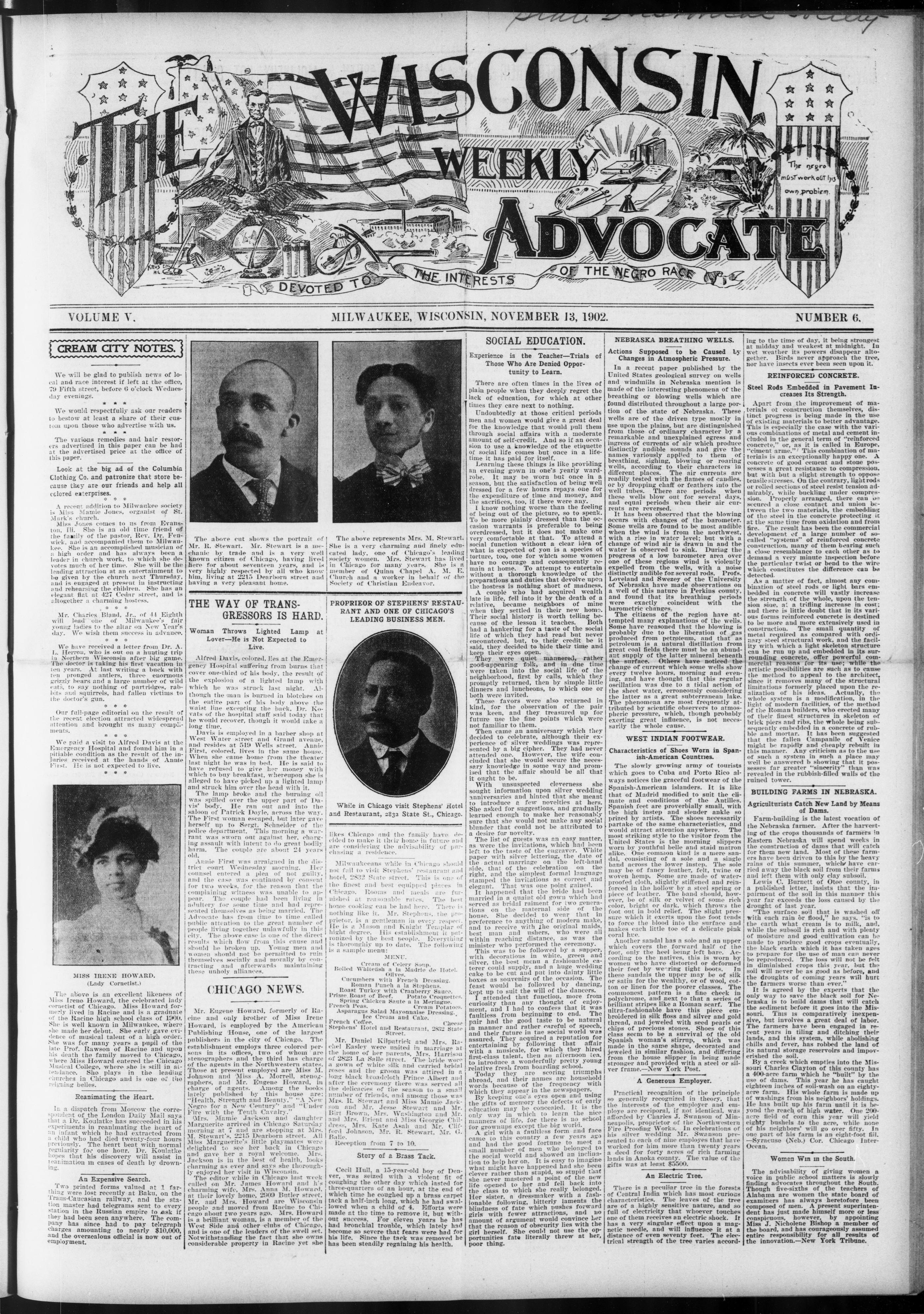
WISCONSIN
WEEKLY
ADVOCATE
DEVOTED TO THE INTERESTS OF THE NEGRO RACE
CREAM CITY NOTES.
We will be glad to publish news of local and race interest if left at the office, 79 Fifth street, before 6 o'clock Wednesday evenings.
☆ ☆ ☆
We would respectfully ask our readers to bestow at least a share of their custom upon those who advertise with us.
The various remedies and hair restorers advertised in this paper can be had at the advertised price at the office of this paper.
Look at the big ad of the Columbia Clothing Co. and patronize that store because they are our friends and help all colored enterprises.
A recent addition to Milwaukee society is Miss Mamie Jones, organist of St. Mark's church.
Miss Jones comes to us from Evanton, Ill. She is an old time friend of the family of the pastor, Rev. Dr. Fenwick, and accompanied them to Milwaukee. She is an accomplished musician of a high order and has always been a leader in church work, to which she devotes much of her time. She will be the leading attraction at an entertainment to be given by the church next Thursday, and is engaged at present in instructing and rehearsing the children. She has an elegant flat at 427 Cedar street, and is altogether a charming hostess.
* * *
Mr. Charles Bland, Jr., of 44 Eighth will lead one of Milwaukee's fair young ladies to the altar on New Year's day. We wish them success in advance.
* * *
We have received a letter from Dr. A. L. Herron, who is out on a hunting trip in Northern Wisconsin after big game. The doctor is taking his first vacation in ten years. At last writing a buck with ten pronged antlers, three enormous grizzly bears and a large number of wild eats, to say nothing of partridges, rabbits and squirrels, had fallen victims to the doctor's gun.
```markdown
```
Our full-page editorial on the result of the recent election attracted widespread attention and brought us many compliments.
\* \* \*
We paid a visit to Alfred Davis at the Emergency Hospital and found him in a pititable condition as the result of the injuries received at the hands of Annie First. He is not expected to live.
THE WOMEN'S HISTORY MUSEUM
MISS IRENE HOWARD.
(Lady Cornetet.)
The above is an excellent likeness of Miss Irene Howard, the celebrated lady cornetist of Chicago. Miss Howard formerly lived in Racine and is a graduate of the Racine high school class of 1900. She is well known in Milwaukee, where she made her debut. She early gave evidence of musical talent of a high order. She was for many years a pupil of the late Prof. Rawson of Racine and upon his death the family moved to Chicago, where Miss Howard entered the Chicago Musical College, where she is still in attendance. She plays in the leading churches in Chicago and is one of the reigning belles.
Reanimating the Heart.
In a dispatch from Moscow the correspondent of the London Daily Mail says that a Dr. Koulatke has succeeded in his experiments in reanimating the heart of an infant which he had extracted from a child who had died twenty-four hours previously. The heart beat with normal regularity for one hour. Dr. Koulatke hopes that his discovery will assist in reanimation in cases of death by drowning.
An Expensive Search
Two printed forms valued at 1 farthing were lost recently at Baku, on the Trans-Caucasian railway, and the station master had telegrams sent to every station in the Russian empire to ask if they had been seen anywhere. The company has since had to pay telegraph charges amounting to nearly $10,000, and the overzealous official is now out of employment.
M. H.
The above cut shows the portrait of Mr. R. Stewart. Mr. Stewart is a mechanic by trade and is a very well known citizen of Chicago, having lived here for about seventeen years, and is very highly respected by all who know him, living at 2215 Dearborn street and having a very pleasant home.
THE WAY OF TRANS- GRESSORS IS HARD.
Woman Throws Lighted Lamp at Lover—He is Not Expected to Live. Alfred Davis, colored, lies at the Emergency Hospital suffering from burns that cover one-third of his body, the result of the explosion of a lighted lamp with which he was struck last night. Although the man is burned in blotches on the entire part of his body above the waist line excepting the back, Dr. Kovats of the hospital staff said today that he would recover, though it would take a long time.
Davis is employed in a barber shop at West Water street and Grand avenue, and resides at 519 Wells street. Annie First, colored, lives in the same house. When she came home from the theater last night he was in bed. He is said to have refused to give her money with which to buy breakfast, whereupon she is alleged to have picked up a lighted lamp and struck him over the head with it.
The lamp broke and the burning oil was spilled over the upper part of Davis' body. He ran out and into the saloon of Patrick Doyle, across the way. The First woman escaped, but later gave herself up to Sergt. Schneider of the police department. This morning a warrant was sworn out against her, charging assault with intent to do great bodily harm. The couple are about 24 years old.
Annie First was arraigned in the district court Wednesday morning. Her counsel entered a plea of not guilty, and the case was continued by consent for two weeks, for the reason that the complaining witness was unable to appear. The couple had been living in adultery for some time and had represented themselves as being married. The Advocate has from time to time called public attention to the great number of people living together unlawfully in this city. The above case is one of the direct results which flow from this cause and should be broken up. Young men and women should not be permitted to ruin themselves socially and morally by contracting and afterwards maintaining these unholy alliances.
CHICAGO NEWS
Mr. Eugene Howard, formerly of Racine and only brother of Miss Irene Howard, is employed by the American Publishing House, one of the largest publishers in the city of Chicago. The establishment employs three colored persons in its offices, two of whom are stenographers and the third has charge of the agents in the Northwestern states. Those at present employed are Miss M. Johnson and Miss A. Morrell, stenographers, and Mr. Eugene Howard, in charge of agents. Among the books lately published by this house are: "Health, Strength and Beauty," "A New Negro for a New Century" and "Under Fire with the Tenth Cavalry."
Mrs. Mamie Jackson and daughter Marguerite arrived in Chicago Saturday morning at 7 and are stopping at Mrs. M. Stewart's, 2215 Dearborn street. All Miss Marguerite's little playmates were delighted to see her back in Chicago and gave her a royal welcome. Mrs. Jackson is in the best of health, looks charming as ever and says she thoroughly enjoyed her visit in Wisconsin.
The editor while in Chicago last week called on Mr. James Howard and his charming wife, Mrs. Anna M. Howard, at their lovely home, 2909 Butler street. Mr. and Mrs. Howard are Wisconsin people and moved from Racine to Chicago about two years ago. Mrs. Howard is a brilliant woman, is a member of the West Side and other clubs of Chicago, and is one of the leaders of the swell set. Notwithstanding the fact that she owns considerable property in Racine yet she
MILWAUKEE, WISCONSIN, NOVEMBER 13, 1902.
Mary E.
The above represents Mrs. M. Stewart. She is a very charming and finely educated lady, one of Chicago's leading society women. Mrs. Stewart has lived in Chicago for many years. She is a member of Quinn Chapel A. M. E. Church and a worker in behalf of the Society of Christian Endeavor.
PROPRIEOR OF STEPHENS' RESTAU RANT AND ONE OF CHICAGO'S LEADING BUSINESS MEN.
[Image of a man with a mustache and a suit, facing slightly to the right].
While in Chicago visit Stephens' Hotel and Restaurant, 2832 State St., Chicago.
likes Chicago and the family have decided to make it their home in future and are considering the advisability of purchasing a residence.
Milwaukeeans while in Chicago should not fail to visit Stephens' restaurant and hotel, 2832 State street. This is one of the finest and best equipped places in Chicago. Rooms and meals are furnished at reasonable rates. The best home cooking can be had here. There is nothing like it. Mr. Stephens, the proprietor, is a gentleman in every respect. He is a Mason and Knight Templar of high degree. His establishment it patronized by the best people. Everything is thoroughly up to date. The following is a sample menu:
MENU.
Cream of Celery Soup.
Boiled Whitehish a la Madrie de Hotel.
Olives.
Cucumbers with French Dressing.
Roman Punch a la Stephens.
Roast Turkey with Cranberry Sauce.
Prime Roast of Beef. Potato Croquettes.
Spring Chicken Saute a la Meringue.
French Peas. Cream Potatoes.
Asparagus Salad Mayonnaise Dressing..
Ice Cream and Cake.
French Coffee.
French Coffee. Cheese Stephens' Hotel and Restaurant, 2832 State Street.
Mr. Daniel Kilpatrick and Mrs. Rachel Easley were united in marriage at the home of her parents, Mrs. Harrison of 2823 La Salle street. The bride wore a gown of white silk and carried bridal roses and the groom was attired in a long black broadcloth Prince Albert and after the ceremony there was served all the delicacies of the season to a small number of friends, and among those was Mrs. R. Stewart and Miss Mamie Jackson and Mr. Jesse Stewart and Mr. Birt Brown, Mrs. Washington and Mr. and Mrs. Erient and Miss Georgie Childress, Mrs. Kate Asah and Mr. Clifford Johnson, Mr. R. Stewart, Mr. G. Balie.
Reception from 7 to 10.
Story of a Brass Tack.
Cecil Hull, a 15-year-old boy of Denver, was seized with a violent fit of coughing the other day which lasted for three-quarters of an hour, at the end of which time he coughed up a brass carpet tack a half-inch long, which he had swallowed when a child of 4. Efforts were made at the time to remove it, but without success. For eleven years he has had bronchial trouble, which lately had become so severe that fears were had for his life. Since the tack was removed he has been steadily regaining his health.
SOCIAL EDUCATION.
Experience is the Teacher—Trials of Those Who Are Denied Opportunity to Learn.
There are often times in the lives of plain people when they deeply regret the lack of education, for which at other times they care next to nothing.
Undoubtedly at those critical periods men and women would give a great deal for the knowledge that would pull them through social affairs with a moderate amount of self-credit. And so if an occasion to use a knowledge of the etiquette of social life comes but once in a lifetime it has paid for itself.
Learning these things is like providing an evening gown in one's yearly wardrobe. It may be worn but once in a season, but the satisfaction of being well dressed for a few hours repays one for the expenditure of time and money, and the sacrifices, too, if there were any.
I know nothing worse than the feeling of being out of the picture, so to speak. To be more plainly dressed than the occasion warrants is preferable to being overdressed, but it does not make one very comfortable at that. To attend a social function without a clear idea of what is expected of you is a species of torture, too, one for which some women have no courage and consequently remain at home. To attempt to entertain without a thorough knowledge of the preparations and duties that devolve upon the hostess is nothing short of madness. A couple who had acquired wealth late in life, fell into it by the death of a relative, became neighbors of mine when they settled in their new home. Their social history is worth telling because of the lesson it teaches. Both had a hankering for a taste of the social life of which they had read but never encountered, but, to their credit be it said, they decided to bide their time and keep their eyes open.
They were quiet mannered, rather good-appearing folk, and in due time were taken into the social life of the neighborhood, first by calls, which they promptly returned, then by simple little dinners and luncheons, to which one or both were invited. These favors were also returned in kind, for the observation of the pair was keen, and they treasured up for future use the fine points which were not familiar to them. Then came an anniversary which they decided to celebrate, although their experience of silver weddings was represented by a big cipher. They had never attended one. However, the wife concluded that she would secure the necessary knowledge in some way and promised that the affair should be all that it ought to be.
With unsuspected cleverness she sought information upon silver wedding anniversaries and hinted that she meant to introduce a few novelties at hers. She asked for suggestions, and gradually learned enough to make her reasonably sure that she would not make any social blunder that could not be attributed to a desire for novelty. The list of guests was an easy matter, as were the invitations, which had been left to the taste of the engraver. White paper with silver lettering, the date of the actual marriage on the left-hand side, that of the celebration on the right, and the simplest formal language stamped the invitations as correct and elegant. That was one point gained.
It happened that the bride had been married in a quaint old gown which had served as bridal raiment for two generations on the maternal side of the house. She decided to wear that in preference to anything of modern make, and to receive with the original maids, best man and ushers, who were all within reaching distance, as was the minister who performed the ceremony.
This was to be followed by a supper, with decorations in white, green and silver, the best menu a fashionable caterer could supply, and a huge wedding cake to be cut and put into dainty little boxes as souvenirs of the occasion. The feast would be followed by dancing, kept up to suit the will of the dancers. I attended that function, more from curiosity than any thought of enjoyment, and I had to confess that it was faultless from beginning to end. The pair had the good taste to be natural in manner and rather careful of speech, and their future in the social world was assured. They acquired a reputation for entertaining by following that affair with a musicale, for which they hired first-class talent, then an afternoon tea, to introduce a wonderfully pretty young relative fresh from boarding school.
Today they are scoring triumphs abroad, and their names are household words because of the frequency with which they appear in the newspapers. By keeping one's eyes open and using the gifts of memory the defects of early education may be concealed. It is the only way in which to learn the nice manners of life, for there is no school for grownups except the big world.
A girl with a faultless form and face came to this country a few years ago and had the good fortune to meet a small number of men who belonged to the social world and showed an inclination to help her on. It is easy to imagine what might have happened had she been clever rather than stupid, so stupid that she never mastered a point of the new life opened to her and fell back into the class to which she really belonged. Her sister, a dressmaker with a fashionable following, bitterly laments the blindness of fate which pushes forward girls with fewer attractions, and no amount of argument would convince her that the reason of obscurity lies with the girl herself. She could not use the opportunities fate literally threw at her, poor thing.
NEBRASKA BREATHING WELLS.
In a recent paper published by the United States geological survey on wells and windmills in Nebraska mention is made of the interesting phenomena of the breathing or blowing wells which are found distributed throughout a large portion of the state of Nebraska. These wells are of the driven type mostly in use upon the plains, but are distinguished from those of ordinary character by a remarkable and unexplained egress and ingress of currents of air which produce distinctly audible sounds and give the names variously applied to them of breathing, sighing, blowing or roaring wells, according to their characters in different places. The air currents are readily tested with the flames of candles, or by dropping chaff or feathers into the well tubes. There are periods when these wells blow out for several days, and equal periods when their air currents are reversed.
It has been observed that the blowing occurs with changes of the barometer. Some wells are found to be most audible when the wind is from the northwest, with a rise in water level; but with a change of wind air is drawn in and the water is observed to sink. During the progress of a low barometer area over one of these regions wind is violently expelled from the wells, with a noise distinctly audible for several rods. Profs. Loveland and Swezey of the University of Nebraska have made observations on a well of this nature in Perkins county, and found that its breathing periods were exactly coincident with the barometric changes.
The citizens of the region have attempted many explanations of the wells. Some have reasoned that the blowing is probably due to the liberation of gas produced from petroleum, and that as petroleum is a natural distillation from great coal fields there must be an abundant supply of the latter mineral beneath the surface. Others have noticed the change of current which some wells show every twelve hours, morning and evening, and have thought that this regular oscillation was due to a tidal action of the sheet water, erroneously considering the latter as a great subterranean lake. The phenomena are most frequently attributed by scientific observers to atmospheric pressure, which, though probably exerting great influence, is not necessarily the whole cause.
WEST INDIAN FOOTWEAR.
Characteristics of Shoes Worn in Spanish-American Countries.
The slowly growing army of tourists which goes to Cuba and Porto Rico always notices the graceful footwear of the Spanish-American islanders. It is like that of Madrid modified to suit the climate and conditions of the Antilles. Spanish feet are proverbially small, with the high instep and slender ankle so prized by artists. The shoes necessarily partake of the same characteristics, and would attract attention anywhere. The most striking style to the visitor from the United States is the morning slippers worn by youthful belle and staid matron alike. One common kind is a mere sandal, consisting of a sole and a single band across the lower instep. The sole may be of fancy leather, felt, twine or woven hemp. Some are made of waterproofed cloth, slightly stiffened and reinforced in the hollow by a steel spring or piece of leather. The band should, however, be of silk or velvet of some rich color, bright or dark, which throws the foot out in bold relief. The slight pressure which it exerts upon the foot tends to force the blood into the surface and makes each little toe of a delicate pink coral hue.
Another sandal has a sole and an upper which covers the forward half of the foot, only the heel being left bare. According to the natives, this is worn by women who have distorted or deformed their feet by wearing tight boots. In these sandals the upper may be of silk or satin for the wealthy, or of wool, cotton or linen for the poorer classes. The commonest pattern is a fine check in polychrome, and next to that a series of brilliant stripes like a Roman scarf. The ultra-fashionable have this piece embroidered in silk floss and silver and gold thread, and jeweled with seed pearls or chips of precious stones. Shoes of this class seem to be a survival of the old Spanish woman's stirrup, which was made in the same shape, decorated and jeweled in similar fashion, and differing from the house slipper in being made stronger and provided with a steel or silver frame.—New York Post.
A Generous Employer
Practical recognition of the principle so generally recognized in theory, that the interests of the employer and employee are recipral, if not identical, was afforded by Charles J. Swanson of Minneapolis, proprietor of the Northwestern Fire Proofing Works. In celebrations of his silver wedding Mr. Swanson presented to each of nine employees that have worked for him more than twenty years a deed for forty acres of rich farming lands in Anoka county. The value of the gifts was at least $5500.
An Electric Tree.
There is a peculiar tree in the forests of Central India which has most curious characteristics. The leaves of the tree are of a highly sensitive nature, and so full of electricity that whoever touches one of them receives an electric shock. It has a very singular effect upon a magnetic needle, and will influence it at a distance of even seventy feet. The electrical strength of the tree varies accord-
ing to the time of day, it being strongest at midday and weakest at midnight. In wet weather its powers disappear altogether. Birds never approach the tree, nor have insects ever been upon it.
REINFORCED CONCRETE.
Steel Rods Embedded in Pavement Increases Its Strength.
Apart from the improvement of materials of construction themselves, distinct progress is being made in the use of existing materials to better advantage. This is especially the case with the various combinations of metal and cement included in the general term of "reinforced concrete," or, as it is called in Europe, "ciment arme." This combination of materials is an exceptionally happy one. A concrete of good cement and stone possesses a great resistance to compression, but with but a slight strength to oppose tensile stresses. On the contrary, light rods or rolled sections of steel resist tension admirably, while buckling under compression. Properly arranged, there can be secured a close contact and union between the two materials, the embedding of the steel in the concrete protecting it at the same time from oxidation and from fire. The result has been the commercial development of a large number of so-called "systems" of reinforced concrete construction, many of them bearing such a close resemblance to each other as to demand a very minute inspection before the particular twist or bend to the wire which constitutes the difference can be detected.
As a matter of fact, almost any combination of steel rods or light bars embedded in concrete will vastly increase the strength of the whole, upon the tension side, at a trifling increase in cost; and there is little doubt that in its various forms reinforced concrete is destined to be more and more extensively used in construction. The small quantity of metal required as compared with ordinary steel structural work, and the facility with which a light skeleton structure can be run up and embedded in its surrounding concrete, offer powerful commercial reasons for its use; while the artistic possibilities are such as to cause the method to appeal to the architect, since it removes many of the structural limitations formerly placed upon the realization of his ideas. Actually, the whole system is a modification, in the light of modern facilities, of the method of the Roman builders, who erected many of their finest structures in skeleton of brick piers and ribs, the whole being subsequently embedded in a concrete of rubble and mortar. It has been suggested that the fallen Campanile of Venice might be rapidly and cheaply rebuilt in this manner. Any criticism as to the use of such a system in such a place may well be answered b showing that it possesses far greater "sincerity" than was revealed in the rubbish-filled walls of the ruined tower.
BUILDING FARMS IN NEBRASKA.
Agriculturists Catch New Land by Means of Dams.
Farm-building is the latest vocation of the Nebraska farmer. After the harvesting of the crops thousands of farmers in Eastern Nebraska will spend weeks in the construction of dams that will catch for them new land. Most of these farmers have been driven to this by the heavy rains of this summer, which have carried away the black soil from their farms and left them with only clay subsoil. Lewis C. Burnett of Otto county, in a published letter, insists that the impairment of the soil in this manner this year far exceeds the loss caused by the drought of last year.
"The surface soil that is washed off with each rain or flood," he says. "is to the earth what cream is to milk, and, while the subsoil is rich and with plenty of moisture and good cultivation can be made to produce good crops eventually, the black earth which it has taken ages to prepare for the use of man can never be reproduced. The loss will not be felt in diminished crops this year, but the soil will never be as good as before, and the droughts of coming years will hurt the farmers worse than ever."
It is agreed by the experts that the only way to save the black soil for Nebraska is to build dams that will catch the sediment before it goes into the Missouri. This is comparatively inexpensive, but involves a great deal of labor. The farmers have been engaged in recent years in tiling and ditching their lands, and this system, while abolishing chills and fever, has robbed the land of its natural storage reservoirs and impoverished the soil.
By a creek which empties into the Missouri Charles Clayton of this county has a 400-acre farm which he "built" by the use of dams. This year he has caught eighteen inches of soil-wash on an eighty-acre farm. His whole farm is made up of washings from his neighbors' holdings. He has built up his farm until it is beyond the reach of high water. One 200-acre field of corn this year will yield eighty bushels to the acre, while none of his neighbors' will go over fifty. In one part of his farm is an eight-foot fill. —Syracuse (Neb.) Cor. Chicago Inter-Ocean
Women Win in the South.
The advisability of giving women a voice in public school matters is slowly finding advocates throughout the South. Though five-sixths of the teachers of Alabama are women the state board of examiners has always heretofore been composed of men. A present superintendent has just made himself more or less conspicuous, however, by appointing Miss J. Nicholene Bishop a member of the board, and has courageously assumed entire responsibility for all results of the innovation.-New York Tribune.
HAVE NO USE FOR UNIONS.
Declare That Miners Were Comfortable and Contented Until Union Agitators Were Introduced.
Washington, Nov. 12. That the anthracite coal mine owners will resist to the utmost every effort to make the recognition of the United Mine Workers of America an issue in the arbitration which is now in progress is made evident by the replies which have been filed with the strike commission. They also agree in resisting the demands of the miners for an increase of pay for piece work, a reduction of hours for time work and for the weighing rather than the measurement of coal.
No Union Recognition.
The reply of the Delaware & Lackawanna Company is signed by W. H. Truesdale, president of the company, who says that the company owns twenty-five anthracite collieries and employs 12,000 workmen in this branch of its business. Mr. Truesdale, like Mr. Baer, objects, to making the recognition of the union one of the issues to be considered by the commission, saying that in the proposition made by the company for arbitration one of the express conditions was that the "finding of the commission should govern the conditions of employment between it and its employees."
He adds: "This company unequivocally asserts that it will under no conditions recognize or enter into any agreement with the association known as the United Mine Workers of America or any branch thereof. Nor will it permit said association or its officers to dictate the terms and conditions under which it shall conduct its business."
Referring to the recent strike. Mr. Truesdale says that he is reliably informed that 80 per cent. of his company's employees were opposed to the strike, but were forced to enter upon it by a majority vote of the mine workers in other fields.
Were Comfortable and Contented.
"Prior to the introduction of agitators and mischief makers," declares Mr. Truesdale, "the anthracite workers were on an average as prosperous and comfortable and contented as any body of workers in similar employment in this country. The wages are such that frugal employees have saved a substantial amount every year." Mr. Truesdale resists the demand for a reduction of 20 per cent. in hours of labor, saying that no such branch of business employing thousands of men can hope to compete successfully in the markets of the world if its hours of labor are restricted
President Olyphant, of the Delaware & Hudson Company, in his reply, declares that the wages paid by his company are just and adequate. He also says that "those of its employees who perform contract or piece work as a matter of their own volition work only about six hours a day and take numerous holidays without the consent or approval of this respondent, and their earnings by hours or actual work are, therefore, much higher than those in any similar employment."
Denounces the Union.
President Olyphant also takes exception to the proposition to arbitrate the question of the recognition of the miners' union. This position is placed on the ground that the organization seeks to control the entire fuel supply of the country; that as the union is unincorporated it is incapable of making a binding contract and that the association has shown its inability to control its own members. He says his company has no desire to discriminate against members of the union.
President T. P. Fowler speaks for the Scranton Coal Company and the Elkhill Coal and Iron Company. He says they own ten collieries and work 5000 men. He asserts that if the average wage earned by the anthracite pieceworkers is less than that paid to workers in other employment it is because "they fix their own hours of labor and the amount of their earnings without any regard to the interests or wishes of their employers and in total disregard of the earnings and welfare of every other class of employees."
Make the Public Pav.
Washington, D. C., Nov. 12.—It is evident from the reply of President Baer filed with the strike commission that any award made in favor of the miners will be offset by a corresponding advance in price of anthracite to the general public. "Any increase in wages," declares Mr. Baer, "will necessarily increase the price of coal to the public, restrict its use and seriously affect the ability of the industries using it as fuel to compete with the industries using bituminous coal; it will bear heavily on the workmen and necessarily oppress the general public and injure the general business of the country. Because of the injury to the mines by the strike of the United Mine workers of America the cost of producing coal has been greatly increased."
Legal Status of Miners' Case.
Wilkesbarre, Pa., Nov. 12. President Mitchell of the United Mine Workers and several members of the executive board of the third anthracite district were in session at miner's headquarters today. Later they were joined by half a dozen attorney whom Mr. Mitchell has employed to look after the legal status of the miners' case before the arbitration commission. There was a general discussion of the situation. At noon a big delegation of miners from Shamokin arrived in town. After dinner they repaired to the office of a local attorney, where they were examined as to their knowledge of the conditions of mining in their region, the wages paid and the cost of living.
District President Duffy, commenting on President Baer's statement in reply to the the filed by President Mitchell with the commission, said: "The time for controversy has now passed. Facts will tell before the commission."
ROBBED OF HIS SAVINGS.
Miner Falls in Among Thieves and Loses $5000—Now in Insane Word
Ward.
New York, Nov. 12.—Homeward bound with a bag of gold nuggets and his pockets full of cash. $5000 in all, won in the mines of French Guiana, Jacques La Travers, a native of France, has been robbed in this city and is now in the insane ward at Bellevue.
Travers and his partner had reached this city on their way back to France and, as neither understood English, they took a room in a lodging house near the docks.
Both displayed their treasures carelessly, and when Travers went out alone to purchase a watch he is believed to have been induced to drink drugged liquor. He returned shortly to his room, his gold gone. When he realized his loss he became violently insane and was taken in charge by the police.
APPLIES TO RAILROADS.
GOVERNMENT'S CONTENTION IN MERGER MATTER.
Continuation of Hearings to Test the Hill-Morgan Railroad Com-
New York, Nov. 12.—The hearing in the suit of the United States to test the alleged transfer of control of the Great Northern and Northern Pacific roads to the Northern Securities Company was continued today in this city. The suit was begun last January in St. Paul, and F. G. Ingersoll was appointed special examiner to take testimony. The complainant, which contends that the anti-trust law has been violated, has completed its case and the hearing today is for the defense.
Attorney-General Griggs presented a statement that for years prior to 1890, many of the principal railway companies of the United States had got control of competing lines and that this fact was reported to the government and known to Congress at the time of the passage of the Sherman anti-trust act. Solicitor-General Richards objected to the acceptance of official reports of railroads, offered in support of Mr. Griggs' statement, but they went into the record, the special examiner having no power to rule.
Capt. John P. Meany, editor of a railroad manual, was called. Mr. Richards objected to his testimony on the ground that what was aimed at by it was irrelevant. The solicitor-general argued that the anti-trust law undoubtedly refers to railroads and railroad combinations, and that if other railroad companies had entered into such combination to restrain trade, even before the passage of the Sherman act, it was no defense for any present violation of the law.
Capt. Meany testified as to how the railroad manual of which he is editor is compiled, and Mr. Griggs put in the manual for the years from 1871 to 1901 inclusive and the statistics of railways published by the interstate commerce commission. Mr. Richards renewed his objection on the ground of irrelevancy. An adjournment was taken until Friday, November 21. The case of the State of Minnesota against the Northern Securities Company will be discussed on the same day.
TARIFF DIFFERENCES.
President Palma Holding Back the Reciprocity Treaty with the Island
Washington, D. C., Nov. 12.—An important conference bearing on the subject of the Cuban reciprocity treaty was held at the war department today, the participants being Secretary Hay, Secretary Root and Gen. Tasker Bliss. The latter was called into the conference at Secretary Hay's suggestion because of his expert knowledge of the existing Cuban tariff. Senor Quesada, the Cuban minister here, was not able to furnish the draft of the reciprocity treaty which has been under consideration so long by the authorities at Havana, as the document has not left that place. So officially the United States government continues in ignorance of the extent and character of the changes, if any, which President Palma may desire to make in the treaty.
In other than official sources, however, has developed pretty clearly the disposition of the Cuban President in this matter. The cardinal objection of President Palma to the treaty as it stands is the insufficient rebate of 20 per cent. proposed to be allowed on Cuban imports into the United States and Secretary Hay's purpose is to ascertain if possible how far he can yield in that matter and still be able to rely upon the support of Congress next session when the treaty is submitted. So far, his advices do not favor any increase of rebates, and, indeed, he has been assured by some persons with whom he has talked that under no conditions would Congress consent to any substantial increase of this rebate.
It is understood that the Cubans, too, are entirely unwilling to accept any small increase. In the face of a great shortage in the European crop and a rapidly rising market they have acquired confidence in their ability to get along for an indefinite period of time without reciprocity with the United States and so it is understood that they are showing an indifference in the prosecution of the treaty negotiations which is serving in turn to stimulate the efforts of our own negotiators.
President Palma makes the point that conditions have changed in Cuba so that whereas the 20 per cent. rebate might have served when it was first proposed, it would at present afford so little relief as not to warrant the sacrifice of Cuban revenues that would be involved in its acceptance. Secretary Hay has determined to clear up that point and to that end, after talking with Secretary Root today, it was decided that Gen. Bliss should be sent at once to Cuba to make a personal investigation of the industrial situation and the fiscal possibilities of the islands. So it is improbable that, pending his return from Cuba, the state department can advance the treaty negotiations in any way.
PLAN FOR TAXING RAILROADS.
Companies' Representatives Meet Minne sofa Officials in Conference.
St. Paul, Minn., Nov. 12.—Representatives of all the railroads doing business in Minnesota, with a few exceptions, met the railroad and warehouse commission and considered a basis for the division of their gross earnings for purposes of taxation. A basis proposed by the commission was adopted with a few modifications. Copies of the revised schedule will be printed and served on the companies interested, who will be given the opportunity of making the modifications. The general principle is to determine the proportion which the entire business of each company bears to the business done in this state.
KILLED ASHLAND MAN.
Jean B. Fournier Shot by Rhode Island Farmer.
Pawtucket, R. I., Nov. 12.—At a special session of the district court at Central Falls Walter Fiske, a Cumberland Hill farmer, was arraigned on the charge of manslaughter. Bail was fixed at $3000. Fiske was awakened by a noise in his barn. He went out to investigate with a shotgun and saw a man with a bundle on his back making his escape. He fired and almost instantly killed the man. The victim has been identified as Jean B. Fournier, who was liberated from the state asylum Saturday and who comes from Ashland, Wis.
LOSES $3230 IN GAME.
Wisconsin Man is Buncoed at Spokane, Wash.
Spokane, Wash., Nov. 12.—H. E. Gower, a tall, lank countryman hailing from Wisconsin, was bunkoed out of $223 in cash and a certificate of deposit for $3000 in a game of cards he did not understand.
WILL KEEP THEIR JOBS.
Chicago Switchmen Accept Compromise Wage Scale.
Similar Demands Will Now be Renewed Upon Railway Companies in Other Districts.
Chicago, Ill., Nov. 12.—Settlement of the wage dispute between the railroads entering the city and the switchmen was effected last night. The switchmen accepted the compromise wage scale offered by the general managers. This scale provides for an increase of 3 cents an hour in the pay of the helpers in the switch yards and of 4 cents an hour in the pay of foremen. Agreements providing for the payment of the new wage scale were immediately presented to the general managers. All signed the scale with the exception of the Atchison, Topeka & Santa Fe and the Chicago, Rock Island & Pacific railroads.
Will Sign Agreement Today.
The former road will sign the new agreement today, its failure to do so yesterday being occasioned by a misunderstanding as to the hour set for a conference with the brotherhood committee. The latter railroad has signed an agreement with the Switchmen's Union, a rival of the brotherhood's. The Rock Island agreement provided for increases of $2\frac{1}{2}$ and $3\frac{1}{2}$ cents an hour in the pay of helpers and foremen. The immediate effect of the signing of the agreement will be the obtaining of similar compacts in all large Western cities.
Means $1,000,000 a Year.
If their expectations are realized 10,000 switchmen will receive an increase. This will mean that the Western railroads will be put to an additional expenditure of $1,000,000 a year. Eastern railroads are expected to grant increases in pay to their switchmen which will compare favorably with those received by the men in the Chicago switching district.
Demands on Other Roads.
Denver, Col., Nov. 12.—Having received a telegram from Grand Master Morrissey anouncing the advance in wages granted switchmen by Chicago railroads, the Brotherhood of Railway Trainmen last night decided to demand 20 per cent. increase from the Union Pacific and Colorado Southern railway. A committee will leave Denver for Omaha to confer with Union Pacific officials. All the divisions of the Union Pacific and Colorado Southern will have representatives in the committee. The lodge to which most of the Denver and Rio Grande switchmen belong will take action tonight.
ANARCHY APPLAUDED.
Chicago Reds Hold Commemorative Exercises in Honor of the Haymarket Assassins.
Chicago, Ill., Nov. 12.—Anarchy was defiant and the deed of Leon Czolgosz lauded by speakers at the annual commemorative exercises held by the followers of the Anarchists who ended their lives on the gallows in Chicago fifteen years ago. Roosevelt and the coal arbitration commission were attacked by an Italian speaker, who urged that the only solution of the social and industrial evils of the hour was to be found in a universal strike of workingmen.
The North Side Turner hall was the scene of the gathering. Lucy Parsons and the widow of Michael Schwab sat prominently in a front row.
George Brown of Philadelphia stirred his hearers to the utmost depth by his reference to the assassination of President McKinley.
"The sympathies and the support of the righteous," he said, "are with the moral heroes, with the man, who possesses moral courage. What more glorious spectacle can there ever be than that of a young man, calm and self-possessed in the throng, his right hand thrust beneath the folds of his coat. The tyrant comes, the right hand is withdrawn, and the tyrant has passed away."
This reference to the Buffalo tragedy passed unnoticed for a full half minute, and then a wave of wild applause broke out all over the hall.
AFTER RICE'S MILLIONS.
Further Complications Arise Relative to Estate of Man Killed by Albert T. Patrick.
New York, Nov. 12.—Complications have arisen, says the Herald, relative to the estate of Mrs. Elizabeth Baldwin Rice, who was the wife of William Marsh Rice. Albert T. Patrick is now under sentence of death at Sing Sing, having been found guilty of causing the death of the latter. Both estates are likely to be involved in further litigation in the surrogate's court of this county. Some of the legatees under her will claim they have not yet been paid and want letters of administration taken out in this state where such steps may be taken to prosecute a claim against the estate of Mr. Rice. The case will come before Surrogate Fitzgerald next month.
Mrs. Rice died on January 27, 1897, at Houston, Tex. By the provisions of her will she made bequests aggregating $750,000 to various friends and relatives. Mr. Rice contested the probate of the will in Houston, claiming that his wife was not competent at the time of its execution, but the paper nevertheless was admitted to probate. Adele Baldwin is a cousin of Mrs. Rice and one of the legatees. If the executor of the will does not qualify here she will make a motion to Surrogate Fitzgerald that she be appointed administratrix. Mrs. Rice's estate in this state consists of personal property—namely, a claim for about $1,000,000 against the estate of her deceased husband. Mr. Rice died in September, 1900, and his millions are still the subject of controversy.
Secures Residence in Washington Two Squares West of the Executive Mansion
Washington, D. C., Nov. 12.—[Special.]—Senator Spooner, before leaving Washington, concluded a lease for the residence of Senator Stewart of Nevada, located at the corner of Eighteenth and F streets. This residence is a commodious one, eminently fitted for large entertainments, and is situated in the heart of the residence section of the older aristocratic families of the District of Columbia. It is only one block west of the war department and two squares away from the white house.
STARTS FOR SOUTH.
President Roosevelt Goes After Panthers and Bears in Northern Mississippi.
Pittsburg, Pa., Nov. 12.—President Roosevelt passed through Pittsburg at 10:30 this morning en route to a point in Mississippi where he has arranged to spend several days hunting black bear. The exact destination of the President has been kept secret. Hunting with a gallery is not the taste of a sportsman
[Image of a man with a bald head and a mustache, wearing a suit and a bow tie. The background is a solid black oval with a white border.]]
GOV. A. H. LONGINO. (Who Invited President Roosevelt to Hunt Bears in Mississippi.) like Mr. Roosevelt. A camp has already been prepared in Northern Mississippi, a few miles from the line of the railroad, and it is understood one of the best packs of hounds in the South is waiting to be slipped on the trail of old Bruin. Bears are reported to be plentiful and there are also said to be some panthers in the vicinity, so that the President is looking forward to the sport with keen interest. The train will be side-tracked at the nearest point to the camp and remain there until the President's return to Memphis next Wednesday.
During the short stop here to change engines the President got out of his car and paced up and down the platform. A large crowd had gathered. After greeting them with a pleasant "good morning," the President stepped off the platform and took a brisk walk down the tracks, stopping ocaesionally to speak to a yard switchman or an engineer in his cab on a siding. The crowd was amazed at his display of unconventionality. The secret service men with the train started to follow the President, but he waved them back. The police, however, took care to keep the crowd back of the end of the train and the President had a clear field for his constitutional.
The train left at 10:41 for the West, and as it pulled out the crowd cheered heartily. The President came out on the back platform and waved goodbye. Vicksburg, Miss., Nov. 12.-Two cars of hunting apparatus, guns, ammunition, etc., are now sidetracked at Smedes station awaiting the arrival of President Roosevelt tomorrow morning. The President will hunt for several days in the Issaquena swamps.
REPUDIATES D. B. HILL.
Albany Argus Declares Against the Former Senator as Democratic Leader.
Albany, N. Y., Nov. 12.—The Albany Argus has repudiated David B. Hill as Democratic leader. The Argus for nearly a century has been the organ of the upstate Democracy of New York. it is now believed to be largely under the influence of Edward Murphy, Jr., of Troy. During the late campaign the Argus was one of D. B. Hill's most devoted champions. Today, as showing that it has undergone a change of heart, it came out with a double-leaded editorial a column long, headed "Overboard with Our Jonah." The "Jonah," in this instance, was Mr. Hill himself. The Argus said:
"Misfortune after misfortune has befallen the Democratic party year after year for a full decade, to be candidly specific, ever since Hill's captaincy. In justice to our own reputation for party fealty, in justice to the Democratic party of the state, we must, if we hope ever again to participate in the affairs of the nation, be rid of David B. Hill as our state leader."
ACCIDENT AT CROSSING.
North-Western Train Leaves the Track and Plunges Into Ditch—Four Passengers are Hurt.
Chicago, Ill., Nov. 12.—A Chicago & North-Western passenger train, diverted from the track by an automatic safety device, left the rails at the Wisconsin Central crossing at Desplaines last night and plunged into a ditch, causing the injury of four persons. A Wisconsin Central train, which had the right of way, was stopped within a few feet of the crossing. The injured:
E. C. Clark, Woodstock, Ill., bruised about shoulders and knees.
Lyman T. Hoy, Woodstock, Ill., bruised about the body.
Mrs. Anna Trowbridge, Harvard, Ill. ankle sprained and hands injured.
Adelbert Wright, Woodstock, Ill., thrown through a car window; hands cut and bruised about body. The danger signal at the crossing was seen too late by the North-Western engineer to enable him to stop.
BIG SALE OF TIMBER.
Wisconsin and Minnesota Parties Secure
Vast Tracts of Pine and Tamarack in Idaho.
Boise City, Idaho, Nov. 12.—The state land board has sold to William Deary of Moscow, Idaho, representing the Northland Pine Company, in which are interested several Minnesota and Wisconsin men, 224,868,000 feet of yellow pine, red fir and tamarack. The consideration named is $182,143, of which 10 per cent. is down. The timber is on the north fork of the Payette river and embraces 32,859 acres.
HAWAII REPUBLICANS
"Prince Cupid" Elected Delegate to Congress by 2000 Majority.
San Francisco, Cal., Nov. 12.—The steamer Alameda, from Honolulu, brings the news that the recent election in the territory of Hawaii resulted in a sweeping Republican victory. Prince Kalanianole, popularly known as "Prince Cupid," was elected delegate to Congress over Robert W. Wilcox, the incumbent and Democratic candidate, by a majority of over 2000.
Hominy Mills Destroyed
St. Joseph, Mo., Nov. 12.—The Hudnut hominy mills were totally destroyed by fire early this morning. Estimated loss, $100,000. Insurance unknown.
MOLINEUX NOT GUILTY.
Verdict of Aquittal Rendered by Jury in Famous Trial.
Reasonable Doubt.
New York, Nov. 11.—The jury in the Molineux trial found the defendant not guilty.
The Molineux jury was brought into court at 3:35. At the same time Molineux was taken from the Tombs into court and District Attorney Jerome was summoned. On his arrival the courtroom was locked and no one was allowed to enter or leave it.
The jury rendered a verdict of not guilty.
The jury remained out just twenty-five minutes. When the foreman announced the verdict of acquittal there was much applause and the cheering extended to the crowd waiting outside in the corridors and on the street.
Although the jury was out but twenty-five minutes they agreed on their verdict within ten minutes after leaving the court room. Notice was immediately given, but it took some minutes to re-assemble the court. Among the first persons to re-enter the court room was Assistant District Attorney Osborne, who seemed to be nervous as he waited for the verdict.
The criminal court building is in an uproar. At least 3000 persons are massed in the building. The court room doors were locked when the jury came in, being polled and apparently he was not affected. His attitude indicated that he had prepared himself for any verdict that might be given. When the large crowd outside the court heard what the verdict was a great shout went up and three cheers for Molinenx were given.
Molineux was formally discharged a few minutes after the jury returned their verdict. Some delay in this formality was caused by the enormous crowd. When the court room had been cleared the order of discharge was made out and Molineux left with his father, followed by a cheering throng.
Early Proceedings.
New York, Nov. 11.—More than 1000 men and women, and there were more women than men, crowded the corridors of the criminal court building before 9 o'clock this morning and fought for admission to the room where Justice Lambert is sitting in the Molineux trial.
After the usual preliminaries Assistant District Attorney Osborne resumed his summing up. He said ex-Gov. Black had made a misstatement when he declared the experts had testified that the writing on the poison package wrapper was not in a disguised hand. Mr. Osborne read extracts from the testimony to show that two out of three of the experts had found the address disguised.
Mr. Osborne argued that the Barnet letters, the earliest in the case, gave the first evidence of an attempt to disguise and that the disguise improved with every letter exhibit. He declared that the earlier Barnet letters conformed almost exactly to the handwriting of Molinney.
Asks for Conviction.
Mr. Osborns took up the Burns, Cornish and Barnet letters, the first two asking for certain remedies and the third for a "marriage guide," and declared that the envelope matched the paper of the Cornish letter and that the wording of the conceded Burns letter was identical with the wording of the Cornish letter.
"This case," counsel said in concluding his talk on the handwriting, "does not depend upon any witnesses who may lie, but on the common sense and intelligence of the jury. Ex-Gov. Blackwell said in defining circumstantial evidence that every circumstance must point to the one man as the magnetic needle points to the pole. Every circumstance in this case points to Molineux." Mr. Osborne in his peroration pointed out again the circumstances upon which he relied for a conviction, turning at each mention of Molineux's name to point his finger at the defendant. Molineux sat unmoved at the arraignment but attentive to every word of it. Not so with his father. The old general was visibly affected by the words of the prosecuting officer and Cevil Molineux, the prisoner's brother, was very nervous.
In his concluding words Mr. Osborne begged the jury not to let their feelings run away with their judgment and not to refuse to convict through timidity. It was past noon when Mr. Osborne was through, and then Justice Lambert suspended proceedings until 1:15 o'clock.
Judge Lamberts' Charge.
At the afternoon session Justice Lambert delivered his charge. "Katherine J. Adams," he began, "died on December 26, 1898, and the defendant is charged with the responsibility for her death. The defendant may be convicted, if you think the evidence adequate, of murder in the first degree, or if you think well of murder in the second degree or of manslaughter in the first degree or of manslaughter in the second degree." Justice Lambert read from the statutes the definition of the various degrees of homicide, laying stress on the necessity of deliberation and premeditation to constitute murder in the first degree.
"It is contended here by the people," he went on, "that if this defendant is found guilty he will be guilty of murder in the first degree. The defendant by his counsel has made no argument in this regard, but you are required to consider those things in reaching your decision.
"The defendant is presumed to be innocent unless the evidence shows his guilt beyond a reasonable doubt. The burden of proof never shifts. It is always with the state to prove guilt and not for the defendant to prove innocence.
"It is not easy to impart to a jury the legal definition of a reasonable doubt. If his guilt has not been shown to you beyond a reasonable doubt you must acquit him. A reasonable doubt should be actual and substantial and not founded on mere possibility."
POULTNEY BIGELOW INJURED.
Author Thrown from Horse and Collar Bone Broken.
Munich, Bavaria, Nov. 11.—Poultney Bigelow, the author, was thrown from his horse yesterday and broke his collar bone while hunting with the officers of the garrison.
Operator Badly Injured.
Manistique, Mich. Nov. 11.-Fred Pfeiffer, night telegraph operator at the Soo line depot, is at the Manistique Hospital with one leg cut off at the knee and the other at the ankle, the result of being run over. He was off duty for the afternoon and was riding on a box car.
Mason is Discharged.
Cambridge. Mass., Nov. 11.—Alan G. Mason, held for the murder of Miss Clara A. Morton at Waverly November 1, was today discharged from custody at a hearing here.
Partial Destruction of the Structure in Course of Erection Over East River. New York, Nov. 11.—The new East river bridge in process of construction between New York and Brooklyn was damaged to the amount of at least $1,500,000 by a fire that for four hours raged 355 feet in the air on the summit of the great steel tower on the New York side.
Owing to the enormous height of the tower it was impossible to reach the fire with any apparatus in the fire department and the flames, after devouring all the woodwork on the top of the tower, seized on the timber false work of the two foot bridges suspended from the main cables, burning away the supports until nearly 1,000,000 feet of blazing lumber fell with a mighty splash and hiss into the stream.
Fall of the Foot Bridge
The fall of the foot bridge carried away scores of the lighter cables and guys, which trailed in the water, rendering it necessary for the police to stop all traffic up and down the river.
The Fall River steamer Puritan and several other craft had narrow escapes while running the gauntlet of fiery brands that fell in showers from the burning bridge. The fire was the most spectacular conflagration that has ever been in New York.
Started in Tool Shed.
The fire started in a tool shed and from this spread to the great timber framework. Within five minutes after the first discovery of the fire the whole top of the tower was in a blaze. Then the foot bridges fell, carrying with them many tons of bolts, rivets, nuts and tools. At that moment the Brooklyn fireboat was just below the bridge and a heavy steel beam fell on her, breaking her rudder and sending her drifting helpless down the stream. Sound steamers and all other upriver navigation was stopped.
No Lives Were Lost.
It is officially announced that no lives were lost, the three men reported killed having been accounted for. New York, Nov. 11.—Later estimates of the loss by the East river bridge fire last night place the amount at $75,000. The contractors who will be forced to meet the loss are the John A. Roebling Sons Company, the Pennsylvania Steel Company of Scranton, Pa., the New Jersey Steel Company and Terry & Trench. The fire was caused, Engineer Hildebrand said today, by a workman carelessly throwing a lighted match among some oily rags. The delay in completing the structure will not exceed two months. None of the great cables were harmed.
CHAFFEE REACHES HOME.
Philippine Commander Says Conditions in the Islands Are Growing Better Each Day.
San Francisco, Cal., Nov. 11.—Maj. Gen. Adna Chaffee and Vice Gov. Luke E. Wright of the Philippines arrived here from Manila on the transport Sumner, after a long and hard voyage.
Gen. Chaffee says that during the typhoon on October 17 he was almost convinced that the ship was lost, as many boats were washed away and the ship swept by the waves.
Gen. Chaffee, while not wishing to be quoted at length concerning affairs in the Philippines, remarked that the islands were rapidly becoming pacified, and that the island of Samar, but recently regarded as the most savage section of the arcnipelago, was at last accounts extremely peaceable.
The most trouble recently had been with the Moros, to the south of Luzon, against whom Gen. Chaffee sent an expedition just before he left Manila. They are expected to be permanently overcome, though the Spaniards were never able to conquer them. Manila, Gen. Chaffee said, was greatly improved in every way since he had first seen the city, and he thought that conditions in the Philippine capital had not been correctly reported.
MASON IS SET FREE
Negro is Charged With Murder of Clara Morton-Enters Plea of
Cambridge, Mass., Nov. 11.—The discharge of Alan G. Mason, the Boston clubman, accused of the murder of Clara A. Morton at Waverly a week ago last Sunday night, was ordered by Judge Charles Almy of the Third district court of Eastern Middlesex today. The government lawyer announced that an investigation had failed to disclose evidence sufficient to hold the accused man and ordered the discharge of Mason. Almost immediately in the same court George L. O. Perry, a young negro who yesterday was held as a witness against Mason was charged with the murder of Miss Morton. He pleaded not guilty and was remanded without bail for a hearing November 18. After his release Mason held an informal reception and after a short time was driven to his home in Boston.
MYSTERIOUS SHOCK EXPLAINED.
Bursting of Supporting Pillar in a Copper Mine.
Hancock, Mich., Nov. 11.—[Special.]—The cause of the unaccountable blast, which so violently shook houses in Hancock and Houghton at 8 o'clock Friday night that citizens were alarmed, has been learned. It proved to have been due to the bursting of a supporting pillar in the fifty-ninth level of the Quincy mine. Miners working in the same level and within a few hundred feet of the pillar saw the phenomenon, but they were neither injured nor greatly alarmed. Neither was the shock so violent in the mine as it was on the surface. Why this should be is a mystery that defies solution just at present. This is the second time within the last three months that the twin villages have been subjected to a like occurrence. The first proved to have been caused by the falling of a 300-foot wall in an old working of the Quincy mine.
Her Present Family.
A school teacher visiting in a nearby city was a guest at a party the other day, and a lady to whom she had been just introduced did not catch the "Miss" and, supposing she was married, asked: "How many children did you say you have?" "Well, only forty now," was the reply that nearly staggered the questioner.
Unphased Courtesy.
Caller—Speaking of babies, madam, that's a fine youngster. Allow me to congratulate you.
Young Woman—Sir, that baby is not mine.
Caller—I repeat, madam, allow me to cangratulate you.—Tit-Bits.
—News comes from Boston that a painting by Titian dated 1543 has been found there in a shopkeeper's cellar.
—Australia finds homes for more than 106,500 Germans.
TO A LADY OF TITLES.
"Twas Margaret of Cortona, from A Journey just returned.
In search of Souls Belated to such her spirit yearned.
Straightway to The Confessional she went to tell One Grief.
And, entering, met The Duchess at Prayer, who held belief
That days of Crucial Instances should ever thus be spent.
But when The Twilight of the God a somber aspect lent,
Both left the church and passed along The Line of Least Resistance.
The Duchess was A Coward—Margaret humored her persistence.
They passed The Angel at the Grave, on guard, and nothing daunted.
Though, since The Muse's Tragedy, they say the place is haunted.
The Duchess said, "O, Margaret, has aught repaid thy zeal?"
"The Recovery of The Rembrandt; but The Portrait is not real."
"A Copy!" cried the Duchess, sad, and utterly dismayed;
For now she knew the time had come, The Reckoning must be paid.
All silently they wandered through The Valley of Decision
Thinking to find The Touchstone, when, behold! they saw a vision:
The moon rose o'er the Quicksand and solved the situation
For The Moving Finger pointed toward The Greater Inclination.
—Elizabeth Gannon in The Reader.
THE CACTUS.
The most notable thing about time is that it is so purely relative. A large amount of reminiscence is, by common consent, conceded to the drowning man, and it is not past belief that one may review an entire courtship while removing one's gloves. That is what Trysdale was doing, standing by a table in his bachelor apartments. On the table stood a singular looking green plant in a red earthen jar. The plant was one of the species of cacti and was provided with long, tentacular leaves that perpetually swayed with the slightest breeze with a peculiar looking motion.
Trysdale's friend, the brother of the bride, stood at the sideboard complaining at being allowed to drink alone. Both men were in evening dress. White favors like stars upon their coats shone through the gloom of the apartment. As he slowly unbuttoned his gloves there passed through Trysdale's mind a swift, scarifying retrospect of the last few hours. It seemed that in his nostrils was still the scent of the flowers that had been banked in odorous masses about the church, and in his ears the low-pitched hum of a thousand well-bred voices, the rustle of crisp garments, and, most insistently recurring, the drawling words of the minister irrevocably binding her to another.
From this last, hopeless point of view he still strove, as if it had become a habit of his mind, to reach some conjecture as to why and how he had lost her. Shaken rudely by the uncompromising fact, he had suddenly found himself confronted by a thing he had never before faced—his own innermost, unmitigated and unbedecked self. He saw all the garbs and pretense and egoism that he had worn now turn to rags of folly. He shuddered at the thought that to others, before now, the garments of the soul must have appeared sorry and threadbare. Vanity and conceit! These were the joints in his armor. And how free from either she had always been! But why—
As she had slowly moved up the aisle toward the altar he had felt an unworthy, sullen exultation that had served to support him. He had told himself that her paleness was from thoughts of another than the man to whom she was about to give herself. But even that poor consolation had been wrenched from him. For, when he saw that swift, limpid, upward look that she gave the man when he took her hand, he knew himself to be forgotten. Once that same look had been raised to him, and he had gauged its meaning. Indeed, his conceit had crumbled; its last prop was gone. Why had it ended thus? There had been no quarrel between them, nothing—
For the thousandth time he remarshaled in his mind the events of those last few days before the tide had so suddenly turned.
She had always insisted upon placing him upon a pedestal, and he had accepted her homage with royal grandeur. It had been a very sweet incense that she had burned before him; so modest (he told himself), so childlike and worshipful, and (he would once have sworn) so sincere. She had invested him with an almost supernatural number of high attributes and excellencies and talents, and he had absorbed the oblation as a desert drinks the rain that can coax from it no promise of blossom or fruit.
As Trysdale grimly wrenched apart the seam of his last glove, the crowning instance of his fatuous and tardily mourned egoism came vividly back to him.
The scene was the night when he had asked her to come up on his pedestal with him and share his greatness. He could not now, for the pain of it, allow his mind to dwell upon the memory of her convincing beauty that night—the careless wave of her hair, the tenderness and virginal charm of her looks and words. But they had been enough, and they had brought him to speak. During their conversation she had said:
"And Capt. Carruthers tells me that you speak the Spanish language like a native. Why have you hidden this accomplishment from me? Is there anything you do not know?" Now, Carruthers was an idiot. No doubt he (Trysdale) had been guilty (he sometimes did such things) of airing at the club some old, canting Castilian proverb dug from the hotch-potch at the back of dictionaries. Carruthers, who was one of his incontinent admirers, was the very man to have magnified this exhibition of doubtful erudition
But, alas! the incense of her admiration had been so sweet and flattering, he allowed the imputation to pass without denial. Without protest he allowed her to twine about his brow this spurious bay of Spanish scholarship. He let it grace his conquering head, and, among its soft convolutions, he did not feel the prick of the thorn that was to pierce him later.
How glad, how shy, how tremulous she was! now she fluttered like a snared bird when he laid his mightiness at her feet! He could have sworn, and he could swear now, that unmistakable consent was in her eyes, but, coyly, she would give him no direct answer. "I will send you my answer tomorrow." she said, and he, the indulgent, confident victor, smilingly granted the delay. The next day he waited, impatient, in his rooms for the word. At noon her groom came to the door and left the
WOODROW
WILSON
Dr. Woodrow Wilson, recently installed as president of Princeton University, is engaged on another important literary work, to which he finds time to devote himself despite the laborious duties of his new post. Dr. Wilson's contributions to political, economical and historical literature are too well known to need mention.
Dr. Woodrow Wilson, recently installed as president of Princeton University, is engaged on another important literary work, to which he finds time to devote himself despite the laborious duties of his new post. Dr. Wilson's contributions to political, economical and historical literature are too well known to need mention.
strange cactus in the red earthen jar. There was no note, no message, merely a tag upon the plant bearing a barbarous foreign or botanical name. He waited until night, but her answer did not come. His large pride and hurt vanity kept him from seeking her. Two evenings later they met at a dinner. Their greetings were conventional, but she looked at him, breathless, wondering, eager. He was courteous adamant, waiting her explanation. With womanly swiftness she took her cue from his manner and turned to snow and ice. Thus, and wider from this on, they had drifted apart. Where was his fault? Who had been to blame? Humbled now he sought the answer amid the ruins of his self-conceit. If—
The voice of the other man in the room, queriously intruding upon his thoughts, aroused him.
"I say, Trysdale, what the deuce is the matter with you? You look as unhappy as if you yourself had been married instead of having acted merely as an accomplice. Look at me, another accessory, come 2000 miles on a garlicky, cockroach banana steamer all the way from South America to connive at the sacrifice—please to observe how lightly my guilt rests upon my shoulders. Only little sister I had, too, and now she's gone. Come now! take something to ease your conscience."
"I won't drink just now, thanks," said Trysdale.
"Your brandy," resumed the other, coming over and joining him, "is abominable. Run down to see me some time at Punta Redonda, and try some of our stuff that old Garcia smuggles in. It's worth the trip. Hallo! here's on old acquaintance. Wherever did you rake up this cactus, Trysdale?"
"A present, said Trysdale, "from a friend. Know the species?"
"Very well. It's a tropical concern. See hundreds of 'em around Punta every day. Here's the name on this tag tied to it. Know any Spanish, Trysdale?"
"No," said Trysdale, with the bitter wraith of a smile. "Is it Spanish?"
"Yes. The natives imagine the leaves are reaching out and beckoning to you. They call it by this name—'Ventomarne.' Name means in English, 'Come and take me.'"—Sidney Porter in Everybody's Magazine.
FORTUNE IN BONBON BOXES.
When a man was sentenced the other day to four years' imprisonment for robbing Mrs. Timothy Woodruff of a gold bracelet watch valued at $170 and a bonbon box valued at $160, many people, not thoroughly acquainted with the fads of the wealthy women of today, were amazed at the apparently disproportionate value set on the latter article. A bonbon box, a tiny thing to be carried in a small bag or worn on a chain costing as much as a watch, may seem absurd, but for the woman who delights in pretty, dainty accessories in dress, $160 is not a large sum to put into such a toy. A visit to a jeweler's store will show that of two or three gold bonbon boxes taken at random from the case the price will range from $145 to $165, and these are simple little affairs without a jewel. They are hand-made, or a fine quality rose gold, in an attractive design and heavy, but comparatively commonplace in the eyes of the jeweler. A box of crystal with gold top, which is shown in one such store, has a round cut emerald in the center, surrounded by diamonds, and with a few smaller diamonds set here and there around. It costs between $400 and $500, and neither is this one of the most expensive boxes. When jewels get into the boxes the prices run up quickly into four figures, and as a matter of fact $1000 is not an unusual sum for a wealthy woman to pay for a trinket of this kind. A number of bonbon boxes which were made and put into stock by one of the best jewelers in the city had what the jeweler says, "no jewels to speak of," upon them, and they sold readily for $500 each. They were hand-made, of fine gold, and had a few small diamonus scattered over the top.
It is not always the intrinsic value of gold and jewels for which a woman pays. A jeweler who devotes his attention to what is known as "art" work, says that a wealthy woman will at any time pay $200 more willingly for an original idea than for a more costly gem set in a conventional manner. New York women have gone beyond the stage of appreciation of anything simply because of its money value. There are too many people of wealth. As far as money is concerned, there is practically no limit to their acquisitions, but original ideas are not always to be had on demand, and the woman who can get something new and beautiful or ugly and quaint—anything
different from her neighbor's—is glad to pay well for it. For the more original and expensive bonbon dishes the designs are always made for the individual and not duplicated.
The jewels may not always be new. The New York society woman possesses quantities of jewels which are a part of her equipment in matters of dress, and they appear in many different guises. She is constantly having them reset in different forms, and the diamond which may be worn in a necklace one day as likely as not will later be worn dangling on her lorgnette or chatelaine chain, or she may dally with it in her small wrist bag set in a bonbon box. "If." as the jeweler says, "you put a five-hundred-dollar diamond into a bonbon box, it is not difficult to bring the price as a whole up to $1000."—New York Times.
Platina and gold plating in different shades combine in a rather novel watch fob.
Turquoises in oblong designs are set in oxidized silver filigree, for something new in the buckle line.
Soft, full bows of ribbon fasten one of the new red broadcloth shirtwaists instead of the "Gibson" buttons, or the equally popular card ornaments.
Tall, triangular clothes hampers, which fit nicely into the corners of a room, where space is an object, are shown at the house furnishing counters in the stores.
A dainty lace framing for a golden haired baby girl is the blue chiffon double quilling, terminating in two full streamers of the same, which edges a little moire bonnet.
For daily use in the kitchen nothing exceeds the brown enamel ware egg poachers and custard cups in point of durability and the ease with which they can be kept clean.
Sprays of silk or muslin flowers are rarely seen in the millinery displays of this season. Most of the new blossoms are formed in rose shapes of coque feathers, tinted in all colors.
A handsome yet simple dress trimming introduced this fall is the crocheted Renaissance ring, joined by strands of silk cord, and edged with tiny drops or festoons between the rings.
Dog baskets for household pets of every size from the tiny Mexican to the English bull have adjustable linings with a space left at one corner upon which doggy's monogram can be worked.
Grapes and grape leaves are seen everywhere, from millinery to silver-plated ware. The latest grape invasion is in the lace department. Irish crochet insertions and "all overs" show bunches of the fruit and tendrils, and leaves which are detachable and can be grouped together in numerous designs.
Exceedingly rich and elegant is a big black velvet hat in the new low-crowned shape, though the trimming consists simply of one row of heavy white venise inserted in the brim. Two long ends of satin-faced velvet ribbon fall from a knot at the left side, and are caught to the hair with a rhinestone crescent.
Conservatory scissors hold fruit or flowers securely after they are cut from the branches, and have a little division in which wire can be kept in readiness for tying them.—New York Mail and Express.
A Unique Case
The case of E. J. Dimmick, late a private in the United States marine corps, is unique in the history of the military service. Both the age limit and the time service limit were waived in his case. He is 50 years of age, and his period of service extended only from August 22 to September 18 of this year. During that period he was rated as a private, with pay at the rate of $13 a month. Dimmick is a lieutenant colonel and inspector of rifle practice in the Illinois National Guard, and spends considerable time in this city advocating the enactment of the new militia bill. He is an expert with the rifle, and makes it a point to attend rifle meets and state guard encampments. His service with the marine corps was that of a "coach" to its rifle team, which took part in the recent match at Sea Girt. N. J. His term of enlistment merely covered the period of preparation and participation in the meet. It required the special authority of the secretary of the navy to get him in, as well as to get him out of the service.—Washington Star.
The Cathedral of Gothenburg, which was only built in 1815, threatens to collapse.
OPERATORS MAKE REPLY
File their Answer with the Strike Commission.
Demands of Strikers Are Declared to be Unjust and Inequitable—Unionism Denounced.
Wilkesbarre, Pa., Nov. 11.—A copy of the statement sent by President Baer of the Philadelphia & Reading Company to the arbitration commission in answer to the one filed with the commission by President Mitchell in behalf of the miners was received at miners' headquarters last night. Mr. Mitchell said he would go over the statement with his attorneys. Attorneys Clarence Darrow of Chicago and John F. Shea of this city are assisting President Mitchell in preparing the legal side of the miners' case for presentation to the arbitration committee.
Answers Mitchell's Charges.
Washington, D. C., Nov. 11.—The reply of President George F. Baer of the Philadelphia & Reading Coal Company to the charges of President Mitchel of the United Mine Workers was today given to the public. Mr. Baer makes no reference to Mr. Mitchell as the president of the miners' organization, but refers to him simply as an individual. Taking up the specifications in Mr. Mitchell's charges seriatim, Mr. Baer first admits that his company owns thirty-seven collieries and that before the strike it employed 26,829 people. Following is a brief summary of the response to Mr. Mitchell's other specifications:
Second. The demand for 20 per cent. increase in wages on piece work is denounced as "arbitrary, unreasonable and unjust." The company contends that after making all necessary allowance for different conditions the rate of wages paid for the mining of anthracite coal is as high as that paid in the bituminous coal fields. Third. The company denies that the present scale of wages is lower than is paid in other occupations in the same locality and controlled by like conditions. Fourth and fifth. Mr. Baer denies that the earnings of the anthracite workers are less than average earnings for other occupations requiring skill and training and also the charge that the earnings are insufficient because of the dangerous character of work in the anthracite mines. Sixth. This specification made by Mr. Mitchell is referred to as too vague for specific answer, but in a general way it is stated that the anthracite regions are among the most prosperous in the United States.
Pronounced Uniust and Inequitable.
Seventh. The company pronounced as unjust and inequitable the demand for a reduction of 20 per cent. in hours of labor without a reduction of earnings for time employed and this is pronounced impracticable. In this connection the following statement is made: Because of the injury to the mines by the strike the cost of producing coal has been greatly increased and a temporary advance in price was made by this company, but it will be impracticable to continue such increase when mining operations become normal. Eighth. Mr. Baer says that his company has no disagreement with any of its employees about the weighing of coal, because the quantity is usually determined by measurement and not by weight.
Ninth. Replying to the fourth demand made by Mr. Mitchell, Mr. Baer says since the advent of the United Mine Workers' Organization into the anthracite fields, business conditions there have been intolerable; that the output of the mines has decreased; that discipline has been destroyed; that strikes have been of almost daily occurrence; that men have worked when and as they please, and that the cost of mining has been greatly increased. He also takes the position that the jurisdiction of the commission is limited to the conditions named by the coal company presidents which excludes the United Mine Workers from any recognition in the proceedings. He says, however, that "when a labor organization limited to anthracite mine workers is created which shall obey the law, respect the right of every man to work and honestly co-operate with employers, trade agreements may become practicable."
Hazleton, Pa., Nov. 11.-G. B. Markle & Co. and their 2500 men, who refused to return to work because they were asked to make individual applications for positions, have reached an agreement, and operations at the four collieries will be resumed. The company offered to reinstate all the employees except the thirteen recently evicted and not to discriminate against members of the union on condition that the men agree to abide by the decision of the arbitration commission and answer questions as to their age and other details before resuming their places. These terms were accepted. The thirteen evicted employees will be provided for by the United Mineworkers.
SCARLET FEVER CURE.
Serum of Detroit Chemist May Win Rockefeller $100,000 Prize.
Detroit, Mich., Nov. 11.—It is possible that the Rockefeller prize of $100,000 for a cure for scarlet fever will go to Dr. William R. Hubbert of Detroit. Mr. Rockefeller was prompted to make the offer by the death of his grandson from the malady. Dr. Hubbert has worked for five years to perfect a method of preserving the usefulness of the antistrepticococc serum, which applied in time by physicians, it is claimed, will minimize the mortality from scarlet fever and remove from that contagion most of the dread in which it is now held.
Since June 24 Dr. Hubbert has treated fifteen cases. All were severe and the majority would have terminated fatally under ordinary treatment. Thirteen of these cases recovered promptly without complications, and the other two were in a dying condition when brought to the hospital. Detroit physicians say that the discovery of this serum promises to revolutionize the treatment of scarlet fever.
BRAGG AT STATE DEPARTMENT.
Calls to Receive Instructions Regarding Duties at Hong Kong.
Washington, D. C., Nov. 11.—Gen. Bragg, consul-general at Havana, who has exchanged posts with Consul-General Rublee at Hong Kong, has arrived in Washington, and called at the state department today to consult officials in regard to his new duties. Before going to China, Gen. Bragg will visit his home in Wisconsin and attend to private business. He expects to return to Washington and meet Consul-General Rublee, who left Hong Kong about November 1. The two will exchange commissions and proceed to their respective posts. Gen. Bragg is accompanied by Mrs. Bragg.
HEARING RESTORED BY SHOCK.
Boy Who Had Been Deaf for Seven Years. Steps on Live Wire.
Pittsburg, Pa., Nov. 11.—Almost totally deaf for seven years, and after lavish expenditure with fruitless results upon the part of parents, Charles McCormick, aged 11 years, has regained his hearing. He was playing near his home with several companions, when he stepped on a live telephone wire that had fallen to the ground. He was thrown violently to the ground and badly shocked.
His playmates ran to him and took him home. Upon his arrival home it was found that the boy had completely regained his hearing.
FORMALLY DEDICATED.
A Handsome New Structure for the New York Chamber of Commerce.
New York, Nov. 11.—With the President and a former President of the United States as its guests of honor and with representatives of foreign governments and other distinguished guests in attendance, the New York chamber of commerce formally dedicated its building in this city today. The new building, a handsome structure of white marble, is situated in Liberty street, between Nassau street and Broadway. The proceedings were opened with a prayer of dedication by Rev. Morgan Dix, rector of Trinity Church. An address of welcome by Morris K. Jessup, president of the chamber, followed and then the oration of the day was delivered by former President Grover Cleveland. He said in part:
It need not surprise us if the popular estimate of this business organization should fail to take into account all that it has done to promote high and patriotic purposes not always related to commerce. No associated body of our citizens felt more deeply and effectively the throbbing of patriotism and devotion to country when our government was threatened by armed rebellion; its protest and aid was immediately forthcoming when afterwards an insiduous attack was made upon financial integrity through an attempted debasement of our currency; from no quarter has a more earnest and insistent demand been heard for the adjustment of international disputes by arbitration; its espousal of the cause of business education among our people has been hearty and practical; it has advocated enlarged reciprocal relations between nations and the removal of their vexation hindrances, and last, but by no means least, it has practically and with an open hand relieved distress and alleviated disasters. Such incidents as these illustrate the organization's beneficent accomplishments in the advancement of civilization and in furtherance of the improvement of humanity.
Immense Service to Humanity.
If we justly appreciate what these things mean, we shall realize that commerce has done an immense service to humanity by enlarging within its wide influence the acceptance of the laws of honest dealing among civilized communities, and by curbing man's besetting sins of selfishness and greed.
We shall thereupon be led to apprehend the especial benefits in a moral sense that have accrued to our own countrymen from the work and example of the chamber of the state of New York and of kindred institutions scattered throughout our land. They have brought together a vast number of our citizens and made the American merchant who, too great to be mean, has by bold enterprise and brave venture challenged the admiration of the world; equally as important as this in its moral complexion and significance, they have by the adoption and enforcement of rules for their government illustrated to a people, apt to chafe under enforced restraint, how usefully they themselves may voluntarily restrain and regulate their conduct; and beyond all, they directly and by example leaven the mass of our citizenship with a love of scrupulous honor and largely contribute to the preservation of true devotion to fair play.
What I have said must not be understood as in the least intimating that commerce should be an altruistic or benevolent affair, managed on lines of amiability and concession. Such a conception would be absurdly at fault. Commerce is born of enterprise; and enterprise in this busy, bustling age is born of struggle and competition. But the struggle and competition need not be to the death. Alertness and keenness in securing business opportunities does not by any means impart unmindfulness of all else save ruthfulness and ravenous snatching.
Growth of American Commerce.
As the pioneer of colonization and expansion sordidly undertaken in its interest, commerce has in other days had justly laid at its door cruel aggression and ruthless disregard of human rights in regions where, to use the language of apologist, "the welfare of the inhabitants of these possessions is subordinate to the strategic or commercial purpose for which they are held." If any measure of restitution or compensation has fallen due from commerce to humanity on this score, we know that its full acquittance has been made or is forthcoming; and we certainly should have no cause to fear that a like guilty responsibility will be again incurred.
These exercises, recalling so forcibly the growth of American commerce in worldwide influences abroad and in usefulness and benefidence at home, cannot fall to be of interest to all our countrymen; but the citizens of the greatest of our states and of our imperial city, with all they have to make them proud and happy, must especially congratulate themselves upon the association of their state and city with the fame and honor which have been wrought out by the chamber of commerce of the state of New York."
President Rooosevelt's Remarks.
At the conclusion of Mr. Cleveland's address Morris K. Jessup, president of the chamber, announced that President Roosevelt, although reserving his address for the banquet this evening, had consented to say a few words. As President Roosevelt stepped forward to address the chamber, the whole assemblage rose and cheered. He spoke as follows:
Mr. President and Gentlemen: As I am to speak to you this evening, I shall now simply say a word of greeting to you and to your guests. I have been asked here as the chief executive of the nation and so I can speak, not merely on your behalf but on behalf of our people as a whole, in greeting and thanking for their presence here these representatives of foreign countries, who have done us the honor and pleasure of being present today. (Apclause.)
I greet the ambassador (turning to M. Cambon), whose approaching departure we so sincerely regret, the ambassador to whom on his advent we extended such hearty greeting, and especially representatives of those great friendly civilized nations with whom we intend to be knit even closer by ties of commercial and social good will in the future (turning to the Russian and British ambassadors and Prince Henry von Pless).
And now, gentlemen, having greeted your guests on your behalf, I greet you in the name of the people, not merely because you stand for commercial success, but because this body has been able to show that the greatest commercial success can square with the immutable and eternal laws of decency and right and of fair dealing between man and man.
The demonstration as the President concluded ended with three cheers.
CREMATED IN HIS HOME.
Spectators Witness Burning of Thomas Baxter at Ottumwa, Ia.
Ottumwa, Ia., Nov. 11.—Hundreds of horrified spectators saw Thomas Baxter, an aged resident of Chariton, cremated in a fire which destroyed his residence last night. The blazing body could be seen through the windows of the burning house. There is much mystery surrounding the case and it is thought he was murdered and the house set on fire to conceal the crime.
FORTY PRISONERS ESCAPE.
Authorities Now Building Jail Out of the Side of a Mountain. Tucson, Ariz., Nov. 11.—Forty prisoners confined in the jail at Cananea have overpowered the jailers and escaped in broad daylight. The men were charged with different offenses ranging from petty larceny to murder. This is the second jail delivery in a month and a new prison is being cut out of the side of the mountain where escape will be well-nigh impossible.
Injured in Football Game.
Waukegan, Ill., Nov. 11.—[Special.]— Charles Casperson, Jr., had his collarbone broken at the football game in Kenosha on Sunday. He will be laid up by it for two weeks.
New Paint for the British Navy.
Within a short time all the ships of the British navy will be painted a uniform gray, which will take the place of the black and yellow of the home fleets and the white of the ships serving in tropical waters. After much experiment the color selected was obtained by the mixture of six pounds of white paint with eleven ounces of black. It was reported from Portsmouth that the submarines could not have been seen at 200 yards had it not been for their improvised masts.
Sea Shell Its Model
One of the most remarkable architectural structures in existence is the left handed spiral staircase in the Chateau de Bois. The design of the staircase corresponds to exactly with the spirals of the common Mediterranean shell known as the Voluta vespertilio that there is little doubt where the designer got his model.—The Great Round World.
LATEST MARKET REPORTS.
MILWAUKEE, NOVEMBER 12, 1901.
EGG AND DAIRY MARKETS.
MILWAUKEE—Eggs—Market firm; fresh, lass off, cases included, $22\frac{1}{2}@23c; fresh, cases returned, $22@22\frac{1}{2c; seconds; 16c; receipts of fresh eggs continue very light; demand is good. Receipts were 215 cases.
Butter — Market steady; extra and dairy, fancy prints, $21\frac{1}{2c; fancy or extra creamery, per lb, 25c; firsts, 22c; seconds, 20c; dairy prints, 21c; extra fancy dairy, $19\frac{1}{2c; lines, 17@18c; packing stock, 16@17c; renovated butter, 20\frac{1}{2c; whey, 13c; grease, 5@6c; supply of creamery is only fair; demand is good and offerings are rather light; dairy is coming in more freely and demand is good, all offerings finding a ready market. Receipts, 18,500 lbs; yesterday, 45,000 lbs.
Cheese—Firm. The demand continues good; arrivals fair. Off stock, however, is very slow sale. Full cream flats, fancy, 11¹²c; good to choice, 9¹⁰c; Young Americas, 12¹²¹c; daisies, 12¹²¹¹c; fancy brick, 9¹²¹¹c; low grades, 7¹⁹c; limburger, per lb. No. 1. 9¹⁰¹¹c; low grades, 8¹⁹c; imported Swiss, 2¹⁵c; Block Swiss, domestic, 12¹²¹¹c; fancy loaf, 12¹²¹¹c; No. 2. 16¹⁰¹¹c; Sapsago, 20c. Receipts, 17,500 lbs; yesterday, 15,000 lbs.
PLYMOUTH—Twenty factorories offered 1335 boxes cheese and all sold, as follows: 65 longhorns, 11¹²¹c; 16 longhorns, 11¹²¹c; 812 daisies, 12c; 165 twins, 11¹³¹c; 71 twins, 11¹³¹c; 206 Americas, 12¹²¹c.
CHICAGO—Butter—Firm; creamerles, 16¹²¹¹c; dairies, 15¹²¹c. Eggs—Steady; loss off cases returned, 22¹²¹¹c. Cheese—Steady; twins, 11¹¹¹¹c; dairies, 11¹²¹¹c; Young Americas, 11¹²¹¹c; been poultry—Steady; turkeys, 9¹²¹¹c; chickens, 8¹¹¹¹c.
MILWAUKEE LIVE STOCK MARKET.
HOGS—Receipts, 15 cars; market lower; light; 5.90@6.05; mixed and medium weights, 5.95@6.10; common to good packing sows, 5.80@6.05; selected, 6.05@6.15. Plgs, 90 to 120 lbs, 5.25@6.00.
CATTLE — Receipts, 8 cars; lower; butchers' steers, medium to good, 1050 to 1300 lbs, 4.75@5.50; fair to medium, 950 to 1050 lbs, 3.75@4.50; heifers, common, 2.50@2.75; good, 3.25@4.00; cows, fair to good, 2.50@3.50; canners, 1.50@2.50; bulls, common, 2.50@2.90; choice, 3.00@3.75; feeders, 800 to 950 lbs, 3.25@3.75; stockers, 500 to 750 lbs, 2.25@3.00; veal calves, heavy, 3.00@4.00; common to choice, 5.50@6.75. Milkers—Common, 20.00@30.00; choice, 40.00@50.00.
SHEEP-Recelpts, 3 cars; lower; 2.50@
3.00; bucks, 2.00@2.50; light lambs, 3.00@
4.00; choice, 4.25@4.85.
Chicago recelpts: Hogs, 40,000; cattle,
22,000; sheep, 30,000.
Timothy, nrm; carotts, choice timothy,
12.00@12.25; No. 1 timothy, 11.00@11.50;
No. 2 timothy, 9.00@10.50; clover and clover
mixed, 7.00@9.00.
Prairie hay, steady; choice Kansas, 11.75
@12.00; No. 1 Kansas, 10.75@11.00; No. 2,
8.50@9.00; choice Nebraska, 10.50@11.00;
No. 1, 9.00@9.50.
Wisconsin prairie, 8.00@8.50.
Straw, steady; rye, 6.50@6.75; oats, 4.50@
5.00; wheat, 4.00@4.50; packing hay, 6.25@
6.50.
Potatoes—Market firm; supply light; demand very good; quotable, per bus, carlots, on track, Rurals and Burbanks, fancy large up to 40c; choice Rose and Pereless, 36@ 38c; inferior stock down to 34c.
CHICAGO—Coyne Brothers report: Receipts, 50 cars; market firmer; rurals and burbanks, 43@45c; mixed stock, 40c.
MARKETS BY TELEGRAPH
MILWAUKEE—Flour—Steady. Wheat —
Firmer; No. 1 Northern, on track, 75c; No.
2 Northern, on track, 74c. Corn—Steady;
No. 3 on track, 55c. Oats—Firm; No. 2
white, on track, 34c; No. 3 white, on track,
30@32½c. Barley—No. 2 on track, 60c;
sample on track, 40@62c. Rye—Firm; No. 1
on track, 51c. Provisions—Steady; pork,
15.16; lard, 10.10.
Flour markets steady; patents. 3.75@3.85; bakers. 2.85@2.95; rye. 2.90@3.00.
Millstuffs are steady and quoted at 14.00
for bran, 13.25@13.50 for standard middlings
and 10.50@16.75 for Milwaukee middlings in 100-lb sacks; red dog, 18.50@19.00.
Delivered to country points, 1.00 extra.
CHICAGO — Close — Wheat — December,
72%c; May, 74%c. Corn — November, 53%c;
December, 51c; January, 43%c; May, 41%c;
July, 40%c. Oats — November, 29%c; December,
29%@29%c; old, 27%c; May, 30%@31c.
Pork — January, 15.10; May, 14.32%c.
Lard — November, 10.17%; December, 9.40;
January, 9.05; May, 8.45. Ribs — January,
7.95; May, 7.60. Flax — Cash Northwest,
1.23; Southwest, 1.17; November, 1.18; December,
1.18; May, 1.23%. Rye — December,
50c; May, 51%c. Barley — Cash, 35@58c.
Timothy — January, 4.00@4.07%c. Clover — November,
11.15.
NEW YORK — Close — Wheat — December,
78%c; May, 78%c. Corn — December, 55%c; May,
46%c.
DULUTH—Close—Wheat — Cash No. 1 hard, 74½c; No. 1 Northern, 72½c; No. 2 Northern, 70½c; No. 3 spring, 68½c; to arrive, No. 1 hard, 74½c; No. 1 Northern and November, 72½c; December, 70½c; May, 73½c; Macaroni—No. 1, 67½c; No. 2, 65½c; Oats—December, on track and to arrive, 29½c; Rye—On track and to arrive, 49c; Barley—35@53c; Flax—Cash, on track, to arrive, November and December, 1.19½; January, 1.20½; May, 1.23½; Receipts—Wheat, 23.591; shipments, 189,710.
KANSAS CITY—Close—Wheat — December, 64½@64½c; May, 69@69½c; cash No. 2 hard, 66@68c; No. 2 red, 66@68c; Corn—November, 41½c; December, 38½c; May, 36½@36½c; Cash No. 2 mixed, 41c; No. 2 white, 43c; Oats—No. 2 white, 32½c.
TOLEDO — Wheat — Dull, lower; cash,
75%c; December, 77%c; May, 78%c; Corn—
Fairly active, steady; December, 42%c;
May, 41%c. Oats—Dull, lower; December,
31%c; May, 32%c; Rye—No. 2, 51%c. Seeds—
Fairly active, lower; November, 6.97%c;
January, 7.07%c bld; March, 7.07%c asked.
Prime timothy—1.85 bld. Prime alsyke—
8.70.
ST. LOUIS—Close—Wheat—Easy. No. 2
red cash elevator, 68%c; December, 68%@
68%c; May, 72%@72%c; No. 2 hard, 60%@70%
Corn—Firm. No. 2 cash, 45c bld; December,
40%@40%c; May, 38%@38%c; Oats—
Weak. No. 2 cash, 30c bld; December, 28
@28%c; May, 29%c; No. 2 white, 34c. Lead—
Steady. 4.00. Spelter—Quiet. 5.15.
MINNEAPOLIS — Close — Wheat —
December, 71%c; May, 72%@73c. On track,
No. 1 hard, 73%c; No. 1 Northern, 72%c;
No. 2 Northern, 71%c.
KANSAS CITY—Cattle—Recelpts, 16,000
steady to 10c lower; beef steers, 3.50@6.70
Texans, 2.50@5.60; cows and heifers, 1.75@
2.65; stockers and feeders, 2.75@4.15. Hogs
—Recelpts, 17,000; 10@15c lower; heavy,
6.00@6.17½; packers, 6.00@6.10; medium,
6.00@6.17½; yorkers, 6.05@0.72½; plugs, 5.65@
6.00. Sheep—Recelpts, 6000; steady;
sheep, 3.00@4.15; lambs, 4.00@5.25.
§T. LOUIS—Cattle—Recelpts, 6000; slow
and lower for Texans; steady for natives;
beef steers, 4.50@7.50; stockers and feeders,
3.00@4.45; cows and heifers, 2.25@5.25.
Texans, 2.20@4.90. Hogs—Recelpts, 6300;
10@15c lower; plgs, 5.90@6.10; packers, 6.00@
6.15; butchers', 6.10@6.30. Sheep—Recelpts,
3000; steady; sheep, 3.25@4.00;
lambs, 4.05@4.90.
SOUTH OMAHA—Cattle—Receipts, 5000.
Dull and 10@15c lower. Beef steers, 4.00
@6.50; cows and heifers. 3.00@4.25; Texans,
2.25@4.25; canners, 1.50@2.50; stockers and
feeders, 2.50@4.40. Hogs—Receipts, 8000;
10@15c lower. Heavy, 6.00@6.10; pigs, 5.50
@6.00. Sheep—Receipts, 10,000. Weaker.
Yearlings, 3.40@3.90: lambs, 3.75@4.75.
—The puffin is the most punctual of
birds in the matter of its annual migration
Printed in the Interests of the Negro Rca,
MILWAUKEE, WIS.
Telephone Black No, 244.
SUBSCRIPTION RATES.
Any part of the United States and Canada,
postage paid.
One Year .....ecccccecscnccrcescecers $200
Bix Months ....-..0sceeseccceeecreee LOS
Three Months ....+.-+++eeeereereeeee 75
Send money by Express Me P.O.
Money Order or Registered ter to the
Wisconsin Weekly Advocate.
ADVERTISING RATES.
‘One inch, single Insertion..........---. 25¢
One. inch, e JOAL. ccecscerereces +> $9.00
Business locals 5¢ per line each insertion.
Apply for rates to the Advocate.
a ree
TO CONTRIBUTORS:
‘21 communications must be sent with the
name and address of the sender as an evi-
dence of good faith, but not necessarily for
publication. No manuscript returned if not
accepted, unless accompanied by stamps.
The Wisconsin wreck Advocate company
wishes to notify the public that all contracts
and business transactions with this com-
pany must haye the company stamp. other-
wise “hey will be void. Neither will this
company be responsible for paid subscrip-
tions unless given to duly-accredited agents,
who, on request, will give the company’s re-
ceipt for same. Subscribers failing to re-
celve their papers regularly will kindly not!-
fy the general office. Address all business
communications to the general manager,
79 Fifth street.
Entered in the Postoffice at Milwaukee as
Second-class matter.
lsc isa ache eth a ae 8S 26 aed Goan oa
EDITORIAL PARAGRAPHS,
“I know of the bravery and characte:
of the Negro soldier. He saved my life
at Santiago, and I have had occasion to
say so in many articles and speeches.
‘The Rough Riders were in a bad position
when the Ninth and Tenth cavalry came
rushing up the hill carrying everything
before them. The Negro soldier has the
faculty of coming to the front when ac
is needed most. In the Civil war he came
400,000 strong, and I believe he saved
the Unicn.”—President Roosevelt.
———_—_—_*_
The Lilvwhites.
After a_prolonged flirtation with the
Southern Democrats, the administration
apparently has concluded that the white
people of the South, with Repubiican
carpetbag and scalawag government
still fresh in their memory, are not yet
ready to embrace the reconstruction pol-
icy which was more disastrous to the
South than the Civil war and whieh if it
had not been overthrown by the election
of Samuel J. Tilden to the presidency
and the consequent compromise by which
the Republican party abandoned its pol-
iey of coercion would have made the
South another Hayti.
The recent election returns have dis-
closed to the administration the futility
of trying to create a white Republican
party in the South and it has returned to
its first love, the sons of Ham. The re-
moyal of the collector of revenue is ¢x-
plained by Postmaster-General Payne as
having been due to his activity in the
“lilywhite” movement. It is quite true
that President Roosevelt did not appoint
a Negro to the vacant place—that is not
the policy of the administration, but he
emphasized the fact that the administra-
tion does not view with approval the ex-
clusion of the colored brother from the
councils of the Republican party in the
South. There would be no objection to
the elimination of the Negro if his ex-
clusion would deprive the Democratic
party of its white following, but inas-
much as the South insists in remaining
true to the party that stood by it when
the vials of hate were loosened upon its
hapless head, Roosevelt ‘has concluded
that a Negro in the hand is worth two
white men in the bush.
The policy the Republican party has
been pursuing toward the Southern Ne-
gro has served to threaten its supremacy
in the North. It is not to be assumed
that the Republican party cares a_pica-
yune for the Negro. It would like to rid
itself of him if it could do so without in-
terrupting its hold on the government.
He is something of a “nuisance,” espe-
cially when there are campaign funds to
distribute, while Southern delegations to
Republican national conventions have
long been a soutce of scandal to the
party. In a number of Northern states,
however, the Negro has grown to be an
important factor, and the leaders of the
Republican party find it advisable occa-
sionally to make manifest their high
regard for the colored brother to keep
him “in line.” It is suspected that Roose-
yelt’s somewhat belated and spectacular
recognition of the un-Republican charac-
ter of the lilywhite movement is owing
largely to the administration’s desire to
impress the colored voter of the North
that Short’s his friend.—Milwaukee
Daily News.
There is much truth in the way the
News sizes up the policy of the Republican
party of the north relative to the negro.
The party, as a party today, has no
further interest in the blacks than to
use them to bear. the burden of “hewing
wood and drawing water” without hope
of recompense, but upon the timeworn
assumption that the Negro owes his
freedom to the interference of the party
und that his lifelong loyalty thereto is
ouly a slight evidence of gratitude. The
“loaves and fishes,” however, are for the
pale face brother from the standpoint of
the Republican leaders. The color of the
Negro’s skin and the kink of his hair is as
objectionable to the sight of the average
Republican leader in the North as a red
flag would be to a Durham bull, no mat-
ter what his: accomplishments may be.
All the Republicans. in the North who
have stood conspicuously for the rights
and recognition of the Negro for the past
two decades can be counted by the fin-
wers of a single hand.
*"In the ‘aforesaid article it is amusing
to read of the Hon. Henry Clay Payne
acting as spokesman for the administra-
tion and expressing himself in such
broad and manly terms. The elevation
‘df Mr.; Payne to a cabinet position does
not deny him the opportunity to continue
to ply his old vocation of “trimmer” or
“apologist,” if you please. Mr. Payne
speaks the sentiments of a man who
fully has the courage of his convictions.
He emits the words of President Roose-
velt. We seriously doubt whether Mr.
Payne, personally, has regarded the sit-
uation to be grave enough to form an
opinion of the matter, much less to ex-
press one. Mr. Payne represents one of
the Northern Republicans who are quasi
“lily-white” in sentiment regarding the
recognition of the Negro, of whom the
News has reference to in its ar-
tide. Only a few years ago when
in the zenith of his political
power 2s a factor or “boss” in this state,
a very capable and most worthy young
Negro applied to him for a clerical posi-
tion of some kind in one of the depart-
ments of the state, but “trimmer” Payne,
for fear ef displeasing somebody, either
the head of department or a subordinate,
industriously secured a position for the
young man who had the substantial en-
dorsement of his race, with the Pullman
Car Company, as porter.
Senator Spooner and President Roose-
velt have never weighed public senti-
ment on the question of the Negro. They
are actuated by what appeals to them
to be right and just and do not care a
continental what the world may think to
the contrary. Republicans of their stripe
are growing scarcer each year and the
Negro will soon awaken to the fact that
the Republican party of today is not
the party of forty years ago. The lead-
ers in the North must take cognizance of
the dissatisfied attitude of the Negro and
accord him the recognition he merits and
persistently demands, before it is too late
to prevent his retaliation.
Go to Harris’ Little Hungery, 160 Third
Street.
Where you can get the nicest steaks
and one of the finest dinners in the city
for fifteen cents. Mr, Harris and_his
wife are obliging and accommodating.
They have a small place but it is clean
and you can get cold lunch or hot at
all hours. Give him a call.
ree erg ee
Hon. Frederick K. McGee, who was to
have spoken in this city Wednesday
night, was unavoidably detained at St.
Paul by sickness. He will be here later
in the month when due announcement of
his coming will be made through the
columns of the Advocate,
ee ee ge
Miss Nannie Elliott. of Indianapolis,
Ind., paid our city a flying trip. She was
accompanied by Miss Myers. They both
were highly pleased with the outlook of
the Cream City and much more so with
the people of it.
The Mad Mullah is as active as though
he were running for office.
Mr. Kruger’s memoirs will be interest-
ing simply as the reflections of a “has
been.”
Let us all be thankful there are other
things to eat than turkey at ‘steen cents
a pound,
The republic of Colombia seems to be
thoroughly versed in the methods of se-
curing “graft.”
—_——-
Two miles in 4:17 flat is a record that
will keep the name Cresceus at the front
for some years,
—_—_—__
The British Queen’s feat of eating an
eight-course dinner in sixteen minutes is
a record of course,
From the way Marie Corelli talks
abouts millionaires, she must have been
in collision with one.
tS
The Crown Prince of Siam should
not forget to remember that Chicago’s
“elephant” isn’t a sacred animal.
The man who is said to be hypnotizing
the Czar can command a large salary by
addressing the head of the Nihilists.
Mr. Morgan appears to have brought
up against a feeling in the House of
Commons that he wants to be the “whole
thing.”
—————
Kaiser William’s record of 47,443 pieces
of game in thirty years is proof that he
hunts in accordance with the abattoir
principle.
New York’s story of “spouted” paint-
ings doesn’t prove that this is the first
time that Old Masters have been forced
to the pawn shop.
The New York florist who imagines
that he can control the flower markets
of the principal cities of the United
States must be a daisy.
Michigan's claim upon the football
championship for 1901 suggests a retro-
active policy that would knock football
vecords over the fence.
SE
South Manitou island, Lake Michigan,
is said te be sinking, and therefore
|property there may as an investment
soon be “out of sight.”
———=
The Czar’s nervousness, to cure which
physicians have been summoned, is a
traditional complaint that Nihilism
threatens to make chronic.
ae
Curlers and yachtsmen are preparing
for fun on the ice, but the pedestrian will
as usual come to his fun unpreparedly
when the walks are in condition for
surprises,
——
The Meat Trust is to be followed by
a Stockyards Trust, which will in turn
probably be matched to a Stockraiser’s
Trust. But the consumers will have to
co it alone.
Davy Jones’ locker received a whole-
sale consignment when the British steam-
er Ventnor, with the bones of 500 China-
ment, went to the bottom off the coast
vf New Zealand.
Lake steamers are hurrying coal west-
ward to various ports. They can’t hurry
too much or too often, because Winter
will soon whistle from the northwest, to
announce his coming.
——
The St. Louis alderman who has been
sentenced to five years’ imprisonment for
perjury in connection with beodling is a
victim of the ways of municipal legisla-
tion. There will.be others,
—
When Trince: Henry comes to the
Louisiana Purchase Exposition he will
have to come as some other fellow if he
wants to see anything but crowds cager
co get a glimpse of royalty. |
fowa's supreme court having decided
that liquor shipped into the state C. O.
D. is liable to seizure, people who are
determined to have consignments thereof
must themselves bring them in J. U. G.
Kann Aa . & £4 Liye ie is S SOAS Ne: < ena en y
ee ee eC Ci
SSS ih - EM Le _ OT ERE. wae H
~< WITH A $10.00 PURCHASE
? .
A $20,000 Overcoat and Suit Stock at Your Own Price. The C. F
A. Rouss, New York, Overcoat and Suit Stock at 50c on the Dollar. -agme
Rours $7.50 Rouss $11.50 Rouss $13.50 Rouss $18.00 Rouss $22.00 Rouss $25.00 . 4 & ;
Overcoat at Overcoat at Overcoat at Overcoat at Overcoat at Overcoat at ¢ ie ; t
SS eran ot i
$3.95 | $5.95 | $7.95 | $9.95 |$12.95|$14.95, ga |
fee Lenin niece’ ee Ct
Ready-to-wear Hand Tailored, Stylish Colors, Finely Tailored Overcoats | oH Pe f
Men’s and Young Men’s Suits from the C. A. Rouss Stock, Friday at 50c on the Dollar Ke feo
Rouss $7.50 | Roucs $11.50 | Rouss $13.50 | Rouss $18.00 | Rouss $22.00 | Rouss $25.00 |" pa ee oo aN
Suits at Suits at Suits at Suits at Suits at Suits at fo ees »
ee ec eee
$3.95 | $5.95 | $7.95 |$9.95 |$12.95|$14.95| 3s eee
Rouss Boys’ Rouss Boys’ Rouss Boys’ Rouss Boys’ | Rouss Boys’$5 | Rouss Boys’ ae og
$3.00 Reefers | $4.00 Topcoats $4.00 Suits $5.00 Suits | Long Overc’ts $6 Overcoats ee ee
$1.65 | $1.95 | $1.95 | $2.95 | $2.95 | $3.95 | faeas
100 silver gray | 100piecesofnob- | 300 pair boys’ {| 100 men’s 4-piy [500 pair men’s | Men’s nobby ele oe a
ribbed Shirts & [| by 50¢ men’s} heavy wool | Linen Collars,all | Nettleton Shoes, | new shape soft Aca ee eis See,
Draw’rsformen, | Neckwear, Fri- | Knee Pants, Fri- | shapes, all sizes, | $5 and $6 values, Hats, $3 hats aad Sat bs
50c quality, Fri. day day Friday Friday marked for Fri. = a2 eae A ef 5 ‘
25¢ 25¢ 15c 5c__| $2.95 | $1.95 | fee eee
) cor. ~ e
} m= i : ; = ) 7A\ GRAND AVE, a Y
GN " | NS AND4 Gs 7
coma nN) AN homed alam \ STREET a
SEE OUR BARGAINS!)
| Good Warm Clothes Are | :
: Cheaper Than Coal. ;
HERMANN NOLDE, ;
sas haan
Milwaukee. ° ° ° - Wisconsin.
EAU DE COLOGNE.
Invented About acc Years Ago by an
Italian Priest.
_ How many of these who use eau de
cologne, from Cologne, daily, one might
almost say hourly, are aware of the fact
that it was invented by an italian and
not by a son of the fatherland which
gives it its name?
Almost 200 years ago an Italian priest,
Giovan Maria Furina, whose name is
seen on every authentic bottle, eked out
his modest fortune by selling perfumery,
little art objects, and so on, at Domo-
dossola. In 1702, happening to be in
Cologne, and making use of some of the
finest vegetable productions of the coun-
try, he discovered the secret of the
miraculous perfume, which has never
been revealed to this day, except to his
descendants. He soon devoted himself
to the sale of his invention, which was
so satisfactory that, needing help in its
manufacture, he had his brother and
nephew join him from Italy,
The increasing fame of the water
brought increasing difficulties of rival-
ry. New firms, who stole his name, his
trade marks, stamps, and so on, sprung
up like mushrooms, but they could not
steal his secret. The difficulty of the
name they overcame by importing. a
peasant from Italy who declared his
name was Farina, and made him head
of the firm. One of the distinctive
marks of the true Farina cologne are
the words sorpenite Julich Platz.” The
spurious manufactories came as near as
possible and put “near,” “next,” “be-
hind,” “before” Julich Platz, or “opy
site” a platz with a somewhat. sintlar
name.
These maneuvers of course in the lapse
of Five have had their effect, so. that
half of the cologne Bought in the city of
its birth is not made according to
Giovan Maria’s Eoceits In buying your
cologne always look for “Opposite Julich
Platz.” Those are the magic words
which will enable you to breathe your
cologne as the old priest intended, to the
glory of own fatherland and the enrich-
ment of his adopted country.—Pall Mall
Gazette.
A Tram-Car Village.
Nidah, Ga., has a population of,,2000.
people, all of whom live in tramears.
The town hall consists of two cars
knocked into one and a church has alse
been provided by the same device.
THE NATIONAL [). mans,
Proprietor.
TAILORING GO, | *s:cc°
1 B CK
Ladies’ and Gents’ Tailoring, Cleaning,
Dying, Repairing and Pressing promptty
wand neatly done.
Pants Pressed......10c
Suits Pressed.......40c
Suits Cleaned........75c
Repairing at Reasonable Prices
405 Grand Ave.,
Milwaukee, - - Wisconsin.
eae
Yeggmen.
William A. Pinkerton of Chicago, talk-
ing of the “yeggmen,” or criminal tramps,
who make Chicago a headquarters, says
that they travel with cards purporting to
be issued to them as members of labor
organizations. They have their own
slang. When a yeggman becomes an in-
former he is called a “snitch,” and fre-
quently men of this class have been dove
| away with by their associates. A prison
is called a Bare Dyxaumite or_nitro-
glycerine is called “soup,” “oil” or
“grease.” Men who operate with it are
called “boxmen” or “shotmen.” A news-
paper story about a robbery or a mem-
ber of the profession is called a “bawl
out.” Many other slang phrases are in
use by these men which are entirely new
and meaningless to the public. |" Very
rarely are yeggmen known by their cor-
rect names. .They use nicknames given
by others or adopted by themselves, usu-
ally suggested by some personal peculiari-
ty or by their former place of residence.
‘A blond native of Wisconsin may be
called Wisconsin Whitey. If he were
from Canada and of dark complexion. he
would be called Canada Blackey. Some
of the prominent yeggmen who are still
operating are “’Frisco Slim. ‘sa aauetiess
Red,” “The Rambler,” “Topeka Joe,”
“Warren Fatty,” “Macon Tip.” “Sliv-
ers,” “The Frog.” “Wheeling Red,”
“Janesville a eenny, “Zanesville
Shorty,” “Olean Flyer,” ouenen
“Ohio eet “Shenandoah anny,”
“Yorker Dick.” oe Irish,” “Sleepy
John,” “The Turk,” “Dako Frank” and
many others. Yeggmen have an ingeni-
ous way of keeping track of each oth-
5 ,
Afro-American News Office
3104 STATE STREET
Here all the best and leading weekly journals
and magazines from all parts of the U. S. can
be found every week, including all other stand-
ard magazinz2s, weekly and daily publications.
Following is a list of the leading weekly papers
for sale:
Wisconsin Weekly Advocate, Milwaukee; Reformer,
Richmond, Va.; Planet, Richmond, Va.; Odd Fellows
Journal, Philadelphia, Pa.; Guardian, Boston, Mass.;
Atlanta Age, Atlanta, Ga.: State Capitol, Spring-
field, I!l.; CairoStandard, Cairo, Ill.; Gazette, Cleve-
land, Ohio: Kentucky Standard, Louisville, Ky.;
Detroit Informer, Detroit, Mich.; Colored Ameri-
can, Washington, D.C.; New York Age, New York
City, N. Y.; Freeman, Indianapolis, Ind.; Recorder,
Indianapolis, Ind.; Conservator, Monitor, Broad
Ax, Chicago, Ill.
Magazines Published Every Month:
The Colored American, Boston, Mass.; R. R.
Porters and Waiters Magazine, Philadelphia, Pa.;
also the Buffalo Tragedy by King Jefferson, and
Oration, entitled: “‘Climb, "Though the Rocks be
, Rugged,” by Alton H. Blake (the Boy Orator.)
. . . .
A Full Line of Stationery, Cigars and Tobacco
Papers sent through the mail to any part of the country. Give us
a call and see for yourself. If we have not what you want, leave
your order and we will get it for you.
REMEMBER THE NAME AND PLACE
Afro-American News Office
E. H. FAULKNER, Manager, 3104 STATE ST., CHICAGO.
er's moyements and whereabouts. It is
the custom of every professional tramp
and ii burglar-to write or carve what
he calls his “road name” on the water
tanks, outhouses or, switch shanties and
in the toilet rooms of railway stations,
with the date and the direction in which
he is going, thus: “Petersburg Whitey,
4-19-98, W.;” “Chi. Frank, 3-20-95, EB.”
This indicates to the initiated that “Pe-
tersburg Whitey” registered on April 19,
1898, and went west, and that “Chicago
Frank” registered on March 20, 1895,
and went east.
or ooo
—News comes from Boston that a
painting by Titian dated 1543 has been
found there in a shopkeeper’s cellar.
G. J. CHARLESTON, Mgr.
63 E. Sixth Street,
ST. PAUL, - - MINN.
—_—_—_—X—_:
Population Capacity of Canada.
Progressive Canada estimates that “the
population capacity of Canada car sad
be less than 100,000,000.” There are 3,
300,000 square miles of arable land.
THE PO
By Rev. Edward Everett Hale, D. D.
In my Father's house are many mansions. If it were not so, I would have told you; for I go to prepare a place for you.—John xiv.. 2.
As the declaration in which the Savior lifted the curtain highest, this text is studied, of course, with curious, even anxious, interest. There is, it seems, a heaven for each of us, whatever his mood or his attainment; and it seems that, as Jesus thought of it, these might be quite different each from each. One thing more, which our stately word "mansion" does not teach, but which appears distinctly in the original text, and in all that Jesus ever says of heaven—these places which he prepares are so many homes. Your home is ready for you, mine for me. The text would be better rendered, indeed, if we read, "In my Father's house are many homes."
To Jesus Christ, leading a life wholly spiritual, the whole sense of these realities, what I may call the sight of them, the hearing and conception of them, was perfectly clear. To us it is clear or not clear, strong or faint, according as our lives are lives of the spirit or of the flesh; according as we live for things that die, or for the three realities which endure.
And here is the answer to the frequent question, why Christ himself, with his clear vision of the infinite life, gave us no more description of it, nor other pictures of it, than are in these words. But what is the use of pictures to a person who cannot see, or of descriptions to one who cannot understand? No revealer can reveal anything to us which we have not the spiritual power to at least apprehend, and in a measure to comprehend. Jesus reserves what he might have said, because unless those who heard him are of spiritual life, habit and experience, which is to say, unless they are exercised in faith, hope and love, they cannot understand, see or hear of the spiritual heaven, of a heaven of faith, hope and love. He did not make, therefore, the fatal error which teachers of children make, who, with a poor earthly fancy, describe to the poor little things that before which the loftiest heavenly imagination is silent—a mistake which, if it has any fruit, results in binding them for years to a heaven which is only a garden, or only a shop of jewels, or a king's palace, according as the childish allegory may have taught them. The description of a spiritual heaven, though it were perfectly wrought out by archangel, would be as unintelligible to the carnal mind as the heaven itself.
So is it that the only statement of detail which the Savior gives is this in the text, which, translated into our habit of speech, says this—that whatever be the heaven which we are prepared for when we pass from this world, that spiritual life we shall have. Our homes are there such as we ourselves have made them. If your highest joy be the counting out of rubies, or the dressing your person with diamonds, omnipotence itself will not force you into life more spiritual. There are many mansions there. That is, the economy of the life before us is the same as that of life here in its variety and in its adaptation to each separate soul.
So in all life, there and here, each shall find himself in his own home, bearing his own character, and living his own life. Because love is one of the three elements of heaven, these homes are homes of mutual life. As there is society here, so there is there; sympathy here and sympathy there; kindred hearts fuse together here and they fuse together there. But the mansions are different mansions there as here. It is no ghastly caravansary, poorhouse or palace, where room 99 is like room 1, and room 1000 like room 99. It is myriad multitude of homes. There are many spheres of duty, many voices in chorus. There are different trees to water—if you call it a garden—and different flowers to train, as in the old paradise, where Adam "taught the tangled ivy how to climb."
If you describe heaven for another and insist on your description, you drive your pupil right away from it, unless he be a precise counterpart of yourself. An eager student will tell a child that in heaven he shall always learn; and the child, hating book-learning, really dreads such a heaven. An eager spirit, always on the alert, preaches that in heaven there shall be no pause in its activity. Heaven, like earth, is to be eager planning, forward marching, and every success a stepping stone for new plans and other marches. What a wound is this to the aged heart which has tossed long enough in the gales of life to be longing for a harbor! I am afraid that many of us can remember the gloom which has fallen upon our exuberant youth when taught that heaven was a place of eternal Sunday, or that the saints are to have no occupation there but the perpetual singing of psalms.
Such is the result, and a deserved result, of the best pictures your poor fancy can paint, if you are bigot enough after the fashion of creedmakers to try to fix them, and to say this is all just so. For its stimulus, for its faith, for its hope, and for perfect love, the soul wishes to enter not your heaven, but its own. The Savior knows this when he says, "In my Father's house are many homes."
To the prisoner heaven is freedom. To the wanderer it is his father's house. To the ignorant it is learning. To this poor, lame boy, to that weak, deformed girl, it is the roving free through limitless existence. To the slave it is a world without labor. To the weary it is rest. To the sanguine it is action. To the doubtful it is truth. To the struggling it is peace. To the sick it is health. To him who is careworn, distressed, pulled hither and thither, with not a moment he can call his own, it is eternity; that is, it is life without time; where there are no minutes, no hours, no days, and no years; no late, no early, no tedious, no slow, no thought nor care for time.
Nor is it true that these conceptions of heaven weaken each other because they thus contradict each other. Those who are eager to find action in heaven need not fear but there will be motive enough, effort enough, in a life which reaches from one side of eternity to the other. Duty there must be where there are
God's children with their father. But this is the promise, that whether the faithful spirit, sent on some errand, pass from one end of heaven to the other, or whether he sit at the footstool, as those do who serve while they wait, there is no more wear and tear, no more fatigue for him. He shall "rest from his labors."
And this is the promise all along; the spirit remains, but the limitation is gone. The mind could once be cramped by a fevered brain or by paralyzed fingers; but now it is free! The soul may soar to the top wing beat of its noblest aspirations and never outwear itself in its effort; yet it shall all the while be resting in its father's smile. These pests of earth, fatigue, nervous exhaustion, unrest, with all the attendant despairs and melancholies—these powers of evil which may haunt us all the closer as our effort is the nobler—belong in this life, because this life means partnership of a finite body and an infinite soul. The willing soul keeps the tired body up to the end of each long day; but they are yoked unequally; they are of different nature; and at last the poor body must fall back to sleep, to rest, to be recreated and recruited, before with another morning it can begin again. The flying steed is yoked to an earthly roadster. He can inspirit him, but he cannot teach him to fly.
From such a life, so limited, hampered, thwarted, the infinite soul springs at death into the heaven, where it is held in no such bondage.
As between these earthly homes there is the quickest sympathy and the closest love, so between those myriad homes of that other life; and among them all there is one spirit, and they are made perfect in one! So is it that each soul of us here, for his own cheer, for his own help, for his own training, has, if he be faithful, pure and wise, the idea or vision of heaven which for him is best at this moment. It is not for me to paint your picture, not for you to paint mine. For it is thus that to you and to me God is pleased to give one more stimulus for our upward way.
And here is the promise to you and to me; that what we need will be ours. What we have gained will be ours. For our labor, rest. For our hunger, food. For our thirst, the water of life. For our love, such love as Christ's, as all good angels', as the very love of God. And no man is to fear that he is not ready for the place. What the Savior went for was to prepare the place for him. What place I am fit for that place I shall find. In my Father's house are many homes!
SPIRITUAL LIBERTY.
"Arbitration," as the word is now used, means nothing more or less than Christian grace and love. It is an application of the principles of Christ, he says, which, if carried further into affairs of business and state, would work a regeneration.
A healthy atmosphere of pure freedom pervades the whole biography of Jesus Christ. The outward conditions were constraining, but His spirit could not be bound. He was free within. He was intensely in the world, so much so that the Phariseses said He was worldly, but He was remarkably distinct from it as to his spiritual independence.
Where the moral atmosphere of Jesus prevails there is the liberty of high thought and sincere action. Where Christ's attitude to your fellows is observed there is the freedom of right, equity, fair dealing and justice. Where His heroism inspires there is the freedom of courage. No man is really free until he is spiritually courageous, until he fears no hating Herods or cynical Pilates or betraying Judases.
Where the spirit of Jesus Christ inspires there is the finest possible expression of the human and the humane. "Arbitration" is a great word just now. It has come to a larger meaning and force this last week than ever before. The divine that was in Christ is the spirit that brings men on an equal footing and decides their differences by the divine law of justice and equity.
To have the Christly humane spirit means the ability to go so freely into other people's sorrow that you are at liberty to see and feel their trouble, not from your opinion about it, but from what they think and feel about it.
The spirit of Jesus was free to love. Love is the freest of all graces. You cannot forbid it and say: "You are doing too much." Say that to mother about her love for her child, and she will look down from her serene height and wonder at your petty ignorance about what love really is.
Love goes freely even unto death. Jesus died of love for the world. The divine Christ love is not tethered by sectionalism, or trammeled by selfishness or curbed by professionalism, or checked by precedent, or guarded by conventionalism.
"God so loved that He gave His Son," and that Son gave Himself without reserve or limitation, condition or proviso.
Where the spirit of Jesus is, there is the spirit to love—your husband or wife to the last, your child through eternity, your neighbor as yourself, your enemy with forgiveness, your friend with a loyalty that is stronger than death. This is religion. This is the liberty of love.
GOD'S GUIDANCE OF NATIONS.
There is no religion that does not imply some relationship between God and man. We must believe that God is the rewarder of them that diligently seek him or we do not know the alphabet of religion. With the patriarchs of ancient Israel the pendulum swung at God's command from man to God in conscious personal fellowship and guidance. What was true of the individual was true of the nation. Why should Jehovah be thought of as guiding the Jew and not the American?
Someone has said that we were in the Philippine Islands by an act of God. Bishop Thoburn denies having made the statement, and yet there is a sense in which the statement is true. The intervention in behalf of Cuba was for liberty and humanity. It is sometimes said when men point to the Stars and Stripes: "There is a flag that has never known defeat." It is even a prouder boast that "There is a flag without a stain, a nation without a crime."
Greatest of Anarchists.—Hunger and cold are the greatest of anarchists when aroused.—Rev. Dr. Banks, Methodist, New York.
SOLDIERS' STORIES.
SOLDIERS' STORIES.
ENTERTAINING REMINISCENCES OF THE WAR.
Graphic Account of Stirring Scenes Witnessed on the Battlefield and in Camp-Veterans of the Rebellion Recite Experiences of Thrilling Nature.
"I was in forty-two engagements and was scared every time," remarked Colonel George B. Van Norman, of the Eighth Wisconsin regiment, to a number of his comrades at the Sherman House. Colonel W. B. Britton spoke up, saying: "Van, you are an honest man; go ahead and tell us something about the Eighth."
"At Corinth, Miss., I got the biggest scare in my life," said Colonel Van Norman. "It was the day Price and Van Dorn undertook to capture Corinth from General Rosecrans. Our regiment had been on a forced march of about fifteen miles and was making double-quick time the last three or four miles, in order to get to the fort before we should be cut off by the Confederates. About this time General Mower was ordered to take the Second Brigade and advance a skirmish line on the outskirts of Corinth in front of Fort Robinette and Fort Williams. During this engagement General Mower was captured. He told the Confederates that he was badly wounded and so was left near where some horses were picketed. A little later, when the opportunity offered, he sprung upon a horse and escaped. When a little later he rode into our lines there was
A
CROUCHING BEHIND A STUMP. a shout sent up that echoed far back into the lines of the enemy.
'A few hours later I received my scare. The Confederates had drawn up very close to our line—so close, in fact, that at every volley several of our men would fall. About this time I had advanced with my old 'Harper's Ferry' musket and stood crouching behind a stump, from which point of advantage I was loading and firing as fast as I could. Then the Confederates began advancing in a heavy line. Colonel G. W. Robbins had just been wounded and had retired from the field. The next volley caught Major Jefferson and he was carried off the field in a dying condition. I was so busy firing that I did not hear the order to retreat. Then I looked around, but could see only one Union soldier, Jewell Walker, of Company E, and he was standing behind a tree and firing at the advancing enemy. I asked him where our comrades were. He said they must have been ordered to retreat. By this time the 'Johnnies' were very close and advancing rapidly. I turned to Walker and said: 'Let's shoot and run.' Talk about a fellow being scared to death! Well, when we began to run and the bullets began to whizz over our heads we ducked at every sound, whether the bullet was within a foot or ten feet of our heads. Any man who says he was not frightened some time in battle must have been in the hospital most of the time. —Chicago Record.
Chivalry in the Old South.
In 1862, when General Grant entered Holly Springs, which from 1861 to 1865 was alternately in the hands of the Federal forces and the Confederates, he arranged to make his private residence in one of the beautiful homes in that little city of north Mississippi. He might have occupied the house by force of arms; but instead of doing so, says a writer in the Memphis Commercial Appeal, he wrote a courteous note to Mrs. Pugh Goran, who had the place in charge, asking the favor of board for himself, Mrs. Grant, several of their children, and a large military family, which included officers of his staff and their wives.
During General Grant's occupancy, but while he was absent on a brief visit, Gen. Earl Van Dorn made a raid into Holly Springs, destroying commissary, ordinance and quartermaster's stores, and other army supplies concentrated there, and thus defeated temporarily the purpose of the Federal commander, the onward march of whose conquering army through Mississippi had Vicksburg as its objective point.
Failing to find General Grant's official headquarters, General Van Dorn and some of his followers dashed down to Grant's private quarters, intending to search his apartments. The Confederates entered the house and mounted the stairway, but at the head of the stairs Mrs. Goran, who was a beautiful Southern woman of the finest type, met them.
"General," she gently said, "I entreat you not to enter Mrs. Grant's bedroom. Such an intrusion would do for vandals, but not for Southern soldiers."
"Madam," returned Van Dorn, "it would be a courtesy and not the usual practice of war to leave the rooms unsearched. However, we will not enter,
as it is possible," with a twinkle in his eyes, "that the documents are not there."
Promptly turning, with his troopers at his heels, Van Dorn clattered down the stairway and left the premises. Twenty-four hours later Grant returned, and heard of the Confederates' call. Knowing what an uncompromising Southerner Mrs. Goran was, he said to her:
"Mrs. Goran, I owe you a debt of gratitude, for you have unconsciously done me a great service. You have saved my campaign papers. All the documents General Van Dorn wished were in the drawer of my wife's dresser."
Mrs. Goran's womanly impulse, which prompted her to shield the wife of a generous foe, and Van Dorn's chivalrous deference to her wishes, had injured the cause for which they were willing to give their lives; but both acts were typical of the high-bred courtesy of the South of that day.
It is pleasant to add that General Grant paid his "debt of gratitude" in the coin of kindness. When he left Holly Springs he gave Mrs. Goran protection papers, which are still in possession of her eldest son. Several times thereafter the house was fired by Union soldiers, but the fire was quickly extinguished when Grant's orders were exhibited.
The Tattered Flag.
In the sun-bright dust of the street below
Glittered the bayonets all a-row,
And the muffled tread of a thousand feet
Deepened the roll of the war-drum's beat,
And the gray old sergeant roused to hear,
With his hollowed palm to his deafened
ear,
While the fife shrilled loud and the drums
kept time
To the nation's heart beats hid in rhyme.
He lifted himself from his old armchair
And gazed on the regiment marching
there
In a glory of scarlet, and blue, and gold. And high overhead, like a torn-out fold Of Liberty's robe, with its glimmering stars— Heaven's glorious blue on a field of Mars— The old flag fluttered, half shot away In the storm and stress of that judgment day, When through blood-dyed stream, by threatening crag.
The Old Line Regiment carried the flag.
The veteran looked; and his face turned gray
With the spectre light of a bygone day.
He fingered his old gun's rusty lock,
He felt the thrill of the battle's shock,
And he lifted his head like a startled stag
As he saw the ghosts by the tattered flag.
Some were withered and bent and gray,
Some were blithe and bonny and gay,
And their voices shrilled through the martial din—
"Comrade, comrade, where have ye been?
Ye have missed the drill this many a year"—
The call rang sweet to his deafened ear,
And his soul broke loose from the crippled form
That had weathered a nation's years of storm.
And he joined the soldiers who never lag
The ghosts that march by the tattered flag.
—Washington Times.
A Canteen of Applejack.
Several old soldiers were sitting in the lobby of the Palmer House relating their war experiences, when one of them turned to George Burghardt, who served for two years as one of the escort of Gen. John A. Logan, and said, "Come, George, tell us that canteen story."
"It ain't much of a story," he replied. "It was in the early summer of 1862 and our regiment was on its way to Vicksburg. We had reached Champion Hill and gone into camp to the left of 'Joe' Davis' home. Along about dusk General Logan sent out a squad to scout around and see what was going on. We came upon a settler's cabin which had been deserted. Some of the boys, including myself, went inside where we found several kegs of applejack. Of course we all filled our canteens and incidentally put a little under our belts. An hour later we returned to camp and when 'taps' sounded we were feeling pretty good and rolled in. Early the next morning General Logan, who had heard about the applejack, sent for me and I was a trifle scared for fear he was going to reprimand me. When I appeared at his headquarters he was standing at the door waiting for me. As I drew up in front and saluted the general said: 'Burghardt, I want a drink of that applejack.'
"I felt flattered that the general should wish to drink from my canteen, so I unslung it and handed it to him. As he raised it to his lips there was a crash and the next instant it went flying over his head. A spent ball from some unknown quarter had struck it full on the side, making a big dent in it."—Chicago Record.
Light as a Healing Agent.
In view of the growing importance of the application of light as a healing principle in medical science, the medical congress which recently convened at Wiesbaden invited Professor Bie, of Copenhagen, to read a paper on the subject. The lecturer explained the principle of employing light for healing purposes after excluding its chemical effects. The results obtained by this method in cases of smallpox, according to the lecturer, are such that the question is raised whether the light treatment shall not be made compulsory. Professor Bie approves the apparatus invented by Dr. Finsen, of Copenhagen, with which the latter has achieved such remarkable success in cases of lupus, but urges that no one but qualified doctors should be allowed to apply the light treatment, as disturbances are apt to occur which render it necessary to break it off suddenly.
One golden day redeems a weary year.—Celia Thaxter.
TEMPERANCE TALKS.
THE RUM TRAFFIC SHOULD BE SUPPRESSED.
Dangers that Always Lurk in the Flowing Bowl-How Bright and Influential Men Have Been Dragged Down by the Demon Drink.
Lady Henry Somerset, the great English reformer, the bosom friend of Frances Willard, and the president of the World's W. C. T. U., has again been in this country on a visit. Her object is to study the methods of temperance and social work employed in America.
Lady Henry greatly deplores the present condition of England, declaring it to be a nation of drunkards, and that drunkenness among women is increasing at a terrific rate. She said in an interview given the press:
"Drunkenness is on the increase in England. I am really ashamed to tell the American people in what a deplorable state the United Kingdom is. It has become a nation of drunkards. It seems hopeless to work for its reformation. The increase in intoxication at home is due to the spread of the drink disease among women.
"I am sorry to hear that women in America are drinking more than formerly. I had such great hope of American women.
"To illustrate to you how women abroad have taken to drink, I want to say that about fifteen years ago the average arrests in London for intoxication was four men to one woman. Now it is three women to one man.
"Why is it? Well, one of the chief reasons is that there has been too much privacy put about public houses of late and women are now able to go to any of them without being seen by the public.
"The increase in drink among women has naturally made a great increase in crime. The reason is apparent. Women are more excitable, sensitive and nervous in drink than men, and in this condition will commit crime more readily. The school bill that as passed prohibiting the sale of liquor to children under 14 years has stopped drunkenness to some extent, but not enough to count.
"There is one thing I will say about England, notwithstanding the fact that she is in the grasp of the brewer and the liquor interested politician. She is doing everything she can to prevent the necessity of sending drunken women to prison. She is trying the open air cure on them.
"We have near Surrey a large farm, to which are sent those women whose drinking habits have gotten them into disrepute, but for whom there is hope of reformation. They are sent into the gardens with the sunlight and the fresh air, and when we think they are reformed we send them back to their families.
"We had a royal commission to England to study the cause for the increase in the use of intoxicants and the attendant increase in crime. Twenty out of the twenty-five members of that commission were brewers, brewers' sons, owners of brewers' lands, or other paid social assassins. They were placed on that commission for the purpose of preventing an honest report, and their work is seen to-day in the thousands of desolated homes in every part of the kingdom."—Ram's Horn.
Age of Drunkards.
More interesting and remarkable, perhaps, than any other disclosures made by Dr. Dana are those relating to the capacity of men for drink and the duration of life among habitual inebriates, reports Leslie's Weekly. On the latter point, the conclusions reached are that in serious cases the duration of life is about fifteen years—the maximum being over forty years. In general, it is said that hard drinking can rarely be carried on for more than twenty years, and it generally brings the victim to grief at about the age of 40. Referring to persons who drink most heavily and frequently, it is said that it takes ten or fifteen years to bring on dementia or insanity, during which time it may be estimated that each inebriate consumes about 2,000 gallons of intoxicants. A man 55 years old confessed to Dr. Dana that he had been drunk twice a day for three years, making about 2,000 intoxications; another man of 40 had been drunk weekly for twenty years, and a third, aged 43, had been drunk 1,000 times in fifteen years. Two thousand "drunks" is set down as the maximum limit in any ordinary inebriate experience. The favorite combination for hard drinkers was found to be beer and whisky, and beer alone came well up in the scale. Other beverages used by inebriates included cocoa wine, Jamaica ginger, tincture of soap, and a well-known proprietary "bitters."
Away with Pitfalls.
Do away with the dives and pitfalls of our cities and our jails would soon be empty. The number of patients in our hospitals would be reduced more than 50 per cent, the cost of running our courts would be lessened more than one-half. If any one doubts the truth of this statement, let the docket of any county where whisky is sold be shown, and see if whisky is not the cause of 75 per cent of the criminal cases. Arizona Star.
An Archbishop's View.
The great cause of crime is drink. The great cause of poverty is drink. When I hear of a family broken up and ask the cause—drink. If I go to the gallows and ask its victim the cause, the answer is drink. Then I ask myself in perfect wonderment, "Why do not men put a stop to this thing"—Archbishop Ireland.
The Oliver Typewriter..
The Standard Visible Writer
GOLD MEDALS AND FIRST AWARDS.
Philadelphia, 1899. Earls Court, London, 1899. Omaha, 1899. Paris 1900
Venice, 1901. Lille (France), 1901
Buffalo, 1901.
It is displacing old style machines everywhere, and holds first place in the estimation of the majority of leading representative business and professional men. Write for Catalogue.
Wm. C. Kreul
434-436 Broadway, Corner Mason Street
MILWAUKEE
BARGAIN HUNTERS
Clothing to fit without being measured for. Prices less than you ever bought them for. Our specialty is misfit and uncalled-for custom tailor made clothing. Tailors' prices for full dress or Tuxedo suits from $30 to $50; our price from $15 to $18. English walking or good business suits made to measure by best of tailors from $18.00 to $35.00. Our price $8.00 to $18.00. Every suit bears our guarantee label. All garments bought of us are kept repaired and pressed free of charge for one year. To be convinced see our window display.
MILLER BROS.
Open evenings till 9 p. m.; Sundays till 12 m.
CENTRAL
AND SPECIALTIES
Instantaneous Cleanable Star Burners,
Adjustable Needle Valve.
For Natural, Artificial or Gasoline Gas.
139 Burrell St., Milwaukee, WI.
Beware of Impostors
of different professions soliciting money in Wisconsin for purposes unknown to any person in that state and for use elsewhere. Driven out of other states they are overrunning this. We think it an imperative duty on us as being the only negro paper in the state, to protect its generous philanthropists. From now on, we shall warn the mayor and chief of police of every city in Wisconsin against such adventurers.
G. V. MASHEK
HARDWARE,
NAILS,
CUTLERY,
UNIVERSAL STOVES & RANGES
HOUSE
FURNISHING
GOODS.
KEWAUNEE, WIS.
NEW TRIAL ORDERED.
Phillip Ryan of Antigo will be
Given Another Chancs to
Clear Himself.
DECISION OF SUPREME COURT.
Killing if Frank O’Brien May Have Been
Accidental—Lower Court’s In-
structions Faulty.
Madison, Wis., Nov. 11.—[Special.j-
The supreme court today granted a vew
trial to Philip Ryan, convicted of mar-
slaughter in the fourth degree for killing
Frank O'Brien in a saloon at Antigo,
December 1 last, and sent to Waupua
for two years. It appeared that O'Brien,
who was a freight conductor, was drunk
and abusing Ryan in the saloon, insist-
ing on his drinking whisky, calling Lim
vile names and finally advancing on him
and threatening to knock his head oll.
Ryan drew a revolver, but claimed he
did not point it at O’Brien, or know it
was cocked, but that he only wanied to
keep him away. It was discharged and
kilied O’Brien. The reversal and new
trial is granted on the ground of instruc-
tions of the lower court to the jury. The
supreme court holds that there was evi-
dence from which the jury might have
found that the homicide was committed
by accident and without any unlawfui
intent and that this question should have
been submitted.
The supreme court granted a motion io
dismiss the appeal in the case of Hel-
stern versus Katzer.
CUT OFF HEIRS WITH $1.
Children of the Late Samuel Hickenboth-
am of Sheboygan Want Es-
state of $30,000.
Sheboygan, Wis., Nov. 11.—[Special.]
—The hearing of the proof of the will of
the late Samuel Hickenbotham of the
town of Holland is one of the important
cases up for disposal in the county court
this afternoon. He left an estate valued
at $30,000, and cut off several of his
children with $1 each. Among them is
Albert Hickenbotham, a clerk for the
Goodrich Transportation Company in this
city.
Other cases heard were claims in es-
tates of Christopher Older, Mary Voelker,
Fred Werthmann, Ava D. Crocker, Ma-
ria Kuse, Henry ©. Johnson, Mary
C. Thompson; proce of wills of Henry
Pierce, George Ziesemer, Parmelia Metz-
ger, August Gosse, Sr.; petition for ad-
ministrator, William Nequette, Mary E.
Weeks; on’ final account, George Wil-
helm, Edward Fritsch.
——
CHANGE OF VENUE.
Claims that He Could Not Get a Fair
Trial in Oconto—Prosecution
Wants Continuance.
Oconto, Wis., Nov. 11.—[Special.]—
The case of Robert O. Hunt, charged
with mutilating the records of Oconto
county, was called yesterday and the
district attorney asked for a continuance.
Arguments on the motion are being heard
today by Judge Hastings, The defense
has offered to the court 100 affidavits sup-
porting a claim of prejudice on the part
of people of Oconto county ae nes
for taking a nen of venue. je case
will have to be taken to Langlade, Mar-
inette, Shawano, Brown, Door or Ke-
waunee county. It is leis of litigation
that sprung up in the big suit of R. O.
Hunt against the Peshtigo Company for
$50,000 worth of land.
a eens
INCENDIARIES SET
_ FIRE AT MAUSTON,
.
Mill and Hotel Stables Are Completely
Destroyed, Causing Heavy
Loas_
Mauston, Wis., Nov. 11.—[Special.]—
It is supposed that the fire which de-
stroyed the flour mill here yesterday and
the stables of the Riverside hotel was the
work of incendiaries. The loss is esti-
mated at between $35,000 and_ $40,000.
The mill had a apace, of 125 barrels
of flour a day, and did an extensive busi-
ness in business. Jeff T. Heath and E.
V. Benjamin, bankers, aud C. F. Depue
comprised the company.
———————__
YOUNG HUNTER KILLED.
See
Arnold Scherland of Black Wolf Acciden-
tally Sheots Himself—Boy
Shot in Legs.
Oshkosh, Wis., Nov. 11.—[{Special.]--
Arnold Scherland, 17 years old, of the
town of Black Wolf. shot and killed him-
self while hunting ducks on Lake Winne-
bago. In stepping out of a boat the
gun ee ore and was discharged.
L. . Anderson, Jr., aged 14, son of
Louis Anderson of Van Dyne, was shot
in the legs while hunting.
» i. REORGANIZE COMPANY.
Badger Telephone System to be Greatly
‘'4A™ Extended,
Monroe, Wis., Nov. faece ik Twin-
ing of this city, president of the com-
mites on! Horpauteation of the Badger
State “Long Distance Telephone Com-
pany, has mailed a letter to stockholders
informing them that parties well backed
financially propose purchasing the vari-
ous interests represented in the company
and: offer eS. fox, obey of the 270 shares
or: to exchange for each share $50 of
stock in <the> next organization. The
stockholders are told that the new man-
agement will extend the lines to connect
with ‘Burlington, Corliss, Racine, Ke-
nosha and Milwaukee when the neces-
sary changes are installed; also with
Freeport, -Rockford, Whitewater, Wan-
kesha and probably copper connections
will besmade with Elgin, Aurora and the
Fox river ‘valley lines in Hlinois.
QPEN LA CROSSE HOSPITAL.
Institution Built by Lutheran Synod of
the Northwest.
_, a Crosse, Wis., Noy. 11.—[Special:]
—The™ ‘new «Lutheran hospital will be
dedicated;on Thanksgiving day and tie
gecasion ill bring many notables of the
Norwegian branch of the church from
the surrounding state. The new hospita!
is not .a, local institution, but is support-
ed andjtenéeted by the Lutheran Synod
of the:‘Northwest,~ comprising several
states. slg has been in process of evn-
struction“Yor over a year and is one of
the hbest-built_and best-equipped institu-
tions inithe West. 4
_——>+____- p
Miss Marjorie Steele, Portage. --
“Portage, Wisy.,Nov. -1i.<-[Special.]—
Marjorie Steele, daughter of Frank
Steele. died Sunday. The remains were
taken to Sparta for burial.
FRESHIES ATTACKED.
Barguet Given by the First Year Class
at Beloit College is Brok-
en Up.
Beloit, Wis., Nov. 11——A banquet of
the Beloit College freshmen was stccess-
fully broken up last night by the sopho-
mores, The freshmen tried to keep the
time and place of their_event a secret,
but failed to do so, and while they were
enjoying their spread the sophomores
climbed up on surrounding buildings,
broke in some windows and showered the
banquet hall with eggs, foul-smelling
chemicals and liquid glue. The fresh-
men resisted vigorously, and clothing was
torn on both sides.
While the battle was on some sopho-
mores fell through the ceiling into the
banquet hall. This led to a call for the
police, who rounded up the sophomores,
securing their names.
After seizing the viands the sopho-
mores ran through town eating them and
yelling. The freshmen rallied as best
they could, consumed what was left of
a fine dinner and carried out their pro-
gramme without further incident.
The janitor of the K. P. hall, where
the banquet was held, stood off the
sophomores at the point of a revolver for
some time, but finding that it was of no
use he went to the police station for
help. The moment he left the sopho-
mores rushed onto the roof, the banquet
being held in the top story of the build-
ing, and tried to open the skylight. At
that moment the roof caved in aud fit-
teen of the students were precipitated in-
to the hall. In the wild seramble that
ensued many were more or less injured.
When the police arrived it was agreed.
that no arrests would be made if the
students would disperse and if they
would pay for the damage they had
caused. The names of the following
ringleaders were taken: Shattuck of
Clinton, Ill., Crane of Mt. Sherry, Strong
of Chicago, Wilder of Delavan and Fel-
lows of Racine.
‘The faculty threaten to expel the lead-
ers in the riot, but the majority of the
sophomores say they will leave college
if this is done.
VIGILANT COMMITTEE.
The Country Around Appleton is at
the Mercy of Daring
Thieves.
Aepleton, Wis., Nov. 11.—Special.J—
Robbers are again rampant among the
farmers in the towns of Grand Chute
and Greenville and numerous reports of
loss have been made within the past
week. The barn of James Hawley, liv-
ing on the Spencer road, was entered
last night and among other things stolen
were a number of new harnesses and
some farm machinery valued at several
hundred dollars. Grain and chicken
thieves have operated for some time in
that vicinity, but the mauraders have
only recently commenced stealing in the
harness and farm implement department.
The farmers are contemplating the or-
ganization of a vigilance committee and
efforts will be made to locate the stolen
goods and prosecute the holders.
eg aan
STRANGE CRIES FROM
BURNING BUILDING.
Feared That Tramp Perished in Fire at
North Fond du Lac—No
Trace of Body.
North Fond du Lac., Wis., Nov. 11.~
[Special.]—Rumors haye been circulated
during the past few days of strange
cries said to have been heard proceeding
from the Post barn while it was in
flames Friday night. It has been ‘con-
pees that a tramp was burned in the
uilding. - Investigations have given the
story no substantial foundation but the
destruction of the building was so com-
plete that it is doubtful whether there
would have been anything remaining as
an indication even had a man perished
in the flames as some surmise.
a aster areas
INSANE FATHER
STABS HIS SON.
—_—_-___
Drink Drives Leopold Kellner of Green
Bay Crazy and He Attempts
Murder.
Green Bay, Wis., Nov. 11.—[Special.]
—Leopold Kellner, aged 60, was taken
back to the insane asylum at Oshkosh
this morning. He was released from
that institution recently. Saturday he
drank heavily and then attacked his son
with a long knife. The young man
fought his father, but a bad wound in
his breast was inflicted before the man
was subdued. The young man will prob-
ably recover.
—
GOES INSANE AT CONCERT.
Music of Italian Band Too Much for
Menasha Woman.
Appleton, Wis., Noy. 11.—[Special.]—
While attending the concert of the fa-
mous Banda Rossa at the First Congre-
gratinal Church of this city last night,
Mrs. Wane Hodgins of Menasha was sud-
denly taken with insanity and for a few
minutes ran frantically back and forth
across the seats shouting: “I want my
prince.’ The audience was terrified and
it was several minutes before the insane
woman could be conquered and her cries
dispelled. Medical assistance was prompt-
ly summoned and the attending physi-
cian was of the opinion that the sudden
attack was due to religious excitement,
although other causes were admitted as
being possible.
——$_.—____
TO MADISON FOR BURIAL.
Remains of W. E. Fagg, Who was Killed
at Houghton, Mich.
Houghton, Mich., Nov. 11.—Funera!
services for William Edward Fagg of
Madison, the young man who was killed
by railroad cars Saturday night while
jumping from a train in order to hasten
to the home of his fiiance, Miss Helen
Henghens, were held yesterday at the
Heughens residence in West Houghton.
Dr. Dow Marcus Fagg of Milwaukee, a
brother, accompanied the remains tc
Madison for interment.
—_————_-—___—__
“LON CHAMBERLAIN TO WED,
Former Captain of Varsity Football
- Team Will be Married.
Madison, Wis., Noy. 11.—A. A. Cham:
berlain, captain of the Wisconsin . Uni
versity 1900 football team and a Ee
uate of the law class of 1901, will be
wedded tonight to Miss Claudia Hall,
daughter of Dr. and Mrs. C. H. Hall
and also a member of the class of 1901.
Sinee: his ~graduation Mr. Chamberlair
has been, practicing law at Huron, S. D
b ee :
Drag River for Bodies.
La, Crosse, Wis., Noy. 11.—Though
every foot of the river between La Crosse
and New Albin,Ia., is being dragged hour-
ly: by. scores of fishermen, clammers and
men from La Crosse in quest of the
bodies of FP’. J. Segelke and Arthur Beust,
who were drowned several weeks ago, no
trace of the bodies have been found.
[Mike Clifford 100 Years Ole.
ee S A
LC te. - oo
ee Pr
i :
Rete pe Eee Se :
ee
Fol ea amma aS
ee
: a ee S ee
Pee ae & ae <caene
Cr rrr SDrt—
a i, Neer gee 7 ergs) Sas Be ee
—— _- ee
shi, ri Ea aaa Pee Me ik
err So oe
s . ee
| es
ee eS bo wee
MR. AND MRS. MIKE CLIFFORD.
(Mrs. Clifford Died Two Years Ago. ‘This Photograph Was Taken a Few Months Be-
fore She Pas sed Away.)
Baraboo, Wis., Nov. 12.—[Special.]—Mike Clifford was 100 years old yes-
terday and is remarkably vigorous for one who has spanned a century, Like many
others who have attained so remarkable an age, he was born in Lreland and has
always followed some active vocation.
When maahood was reached he became a slater and at the age of 30 years
moved to England where he remained for twelve years, In 1834 he was swept
away by that great tide of emigrants from his native land and came with many
of his countrymen to the United States.
Mr. Clifford went direct to Milwaukee, where he remained for more than
twenty years and during that time followed the trade of a mason. On leaving
Milwaukee he moyel to the town of Woodland in this county, which was then
a wilderness and which was rapidly being filled with new settlers. Since com-
ing to Sauk county he has remained on a farm and has been able to take the
active duties of a husbandman until recent years.
While a resident of England he was married to Miss Mary Sims and the
wife died one or two years agv, haying attained an age of almost 100 years
Although his age is remarkable, yet there are other features somewhat
unusual. At the age of 30 he was grey and bald. He never sat but once for
a picture and the accompanying illustration is a reproduction of that one taken
a short time before his wife’s death. With the exception of his father, his an-
cestors lived to a remarkable age. Both of his grandfathers were centenarians
and one of his great-grandfathers was the parent of twenty-one children,
It was the custom a century ago to partake of strong drink on divers and
sundry occasions and this has always been the habit with Mr. Clifford, but using
the stimulants with great moderation,
A healthy looking plug or a pipe and pouch have been his companions for
more than four score years.
When asked as to what he attributed his longevity he replied that it was
due to his inheriting a robust constitution, having ancestors with long lives
to their credit and for being moderate in all things. Being a hard worker, ab-
stemious of diet and an early riser he says has no doubt been of value in this
respect. Although tobacco and beverages have been used yet he always re-
tained control over his physical machinery. He believes that moderation in all
things is the open sesame to old age.
He marvels at some of the wonderful things accomplished during the last
hundred years. When he was born, a fire was started with a flint, piece of
steel and some rotten wood. Railroads, automobiles and like improvements were
so remote in the minds of men that to haye discussed them would have made
the person a suitable subject for an insane asylum.
Mr. Clifford has three children: James Clifford, Wonewoe, Wis.; John
Clifford, Longmont, Col., and Mrs. Mary St. John, Oaks, Wis. There are eleven
grandchildren, but no great-grandchildren.
WASSHOT BY A STRANGER,
Coleman Girl is Wounded by Un-
known Man.
DISAPPEARS IN WOODS.
The Man Without Warning Fired Re-
volver at Jennie Gilowski—
Wound Not Dangerous.
Coleman, Wis., Nov. 12.—[Special.]—
Ah unknown man shot Miss Jennie Gil-
owski, two miles west of her, yesterday
afternoon.
The young woman was walking along
the road when a man approached her
and without warning shot her in the
thigh of the right leg.
As she sank to the ground the man ran
into the woods, and disappeared.
Neighbors hearing the report of the re-
volver hurried to the assistance of the
young woman. While she was being
carried to a nearby house she gave the
details of the assault and pointed in the
direction her assailant had fled.
An examination of the wound showed
that the bullet had glanced from the
bone without fracturing it and that the
injury was not a serious one.
In the meantime the men in the neigh-
borhood were informed of the affair and
armed with shotguns and clubs a score
or more of them searched the woods, but
could not find the man, who was de-
seribed by the girl as being young,
smooth-faced and respectably dressed.
The search was continued unsuccessfully
a darkness made further effort use-
jess.
No motive for the deed is known.
This is the third shooting affray within
three weeks in the immediate vicinity of
this town.
FIRED AT IN COURT.
ca eae
Man Acquitted at Antigo Has a Nar-
tow Escape from Being
Shot.
Antigo, Wis., Nov. 12.—[Special.]—
Thomas Grignon, a barber, fired a re-
volver at George Huykes in municipal
eourt. The bullet went wide of the
mark. Grignon was arrested aud put in
jail.
Huykes had been acquitted of a charge
of assaulting Grignon’s wife. The law-
yers, principals and spectators were
leaving the court room when Grignon
pulled a revolver from a pocket and fired
at Huykes, missing him. Before Grig-
non could fire again his revolver was
taken away from him by persons close
by and he was then placed under arrest,
Some time ago, it was charged, Hnykes
broke into the residence of Grignon and
tormented his wife aud children: Grig-
non had Huykes arrested. Grignon, it
is said, declared that-if Huykes won the
case he would kill him. <
HOTEL FOR MADISON.
———
A Company is Now Being Formed
to Erect and Elegant
Building.
Madison. Wis., Noy. 12.—[Special.]—
It is practically settled that a $300,000
hotel is to be built here in the near fu-
ture. A conditional option has been se-
cured on the site of the Park Hotel and
it is intended to issue $1,000,000 in stock.
If the Park property is bought, that old
caratansary will be torn down to make
way for the new structure, containing
200 rooms. The incorporators of the
new company, which is known as the
Metropolitan Hotel Company, are:
President—W. H. Huppeler, proprietor of
the Capital house.
Vice Wresident- Mayor J. W. Groves.
‘Treasurer—Mathias Breckhelmer, — presi-
dent of the Breckheimer Brewing Company.
Secretary—N, A. Ladd. =
Assistant Secretary—M. E. Draught.
Connsel—Bashford, Aylward & Spensley.
Beloit, Wis., Nov. 12.—[{Special.]—
The Beloit Hotel Company will meet
Friday to make plans for building.
NO EVIDENCE OF CRIME.
Sheriff of Walworth County Says He Has
Run Down Every Clue in the
Wickingson Case.
Elkhorn, Wis., Nov. 12.—Sheriff White
of Walworth county says he is convinced
that the deaths of the members of the
Wickingson family, who were burned in
their own home near Palmyra about two
weeks ago, was the result of an accident.
Mr, White says he has run down every
clue, but has so far been unable to se-
cure any evidence of crime. ‘
See
GANG OF ROBBERS ARE
REAPING A HARVEST.
jae
Operating in Vicinity of Spring Valley
—Many Stores and Houses
Burglarized.
Spring Valley, Wis., Nov. 12.—[Spe-
cial. ]—A gang of robbers is operating in
this vicinity. They break open stores in
the little villages, burglarize houses
and hold up lone travelers. The store of
George Whinnery at Downsville and the
store of Frank Hatch at Hatchville are
the latest to be robbed.
ee eee
adel ts
Store and Saloon Are Broken Into at
Minocqua and Money Stolen
from Safe.
Minoequa, Wis., Nov. 12.—[{Special.]
—The general store of F. O. Dorwin at
this: place was broken into last night and
the safe was wrecked with explosives:
The robbers-secured about $60 in money.
Valuable papers were left in the safe. un-
touched. “The opera house saloon, owned
by Robert ‘Farrell, was also broken into.
by only 5) cents was secured. A good
clue has heen left and it’ is expected the
robbers will be arrested’ today.
Te LT PL Pe CR EE Re” Sat a aes bp
For Bruises and Sprains :
oe _ e =
MExIcAS Mustang Liniment. :
For MAN OR BEAST m
RARARAARARARARARAAARARAAARARARARARARARARARARARS
UNS See fe ae
Sper a en eee |
Bee — K lladean eh sell Fit ie es cea
i | z
we) 9 MeIREPEATING RIFLES
Sy ¥ Ball repeat. They don’t jam, catch, or fail to extract.
a ua In a word, they are the only reliable repeaters.
a= 7} Bll) Winchester rifles are made in all desirable |
aS N cl calibers, weights and styles; and are plain,
ns fa| partially or elaborately ornamented, suiting every
Ze NY i 1 | purpose, every pocketbook, and every taste. |
ie me M| WINCHESTER AMMUNITION
© el 5 made fot all kinds of shooting in all kinds of guns.
bi 79. fe
le Bee FREES crite
| ny WINCHESTER REPEATING ARMS CO., NEW HAVEN, CONN. }
a 20 a) Sa * se
“Little Colds” neglected—thousands of
lives sacfificed every year. Dr. Wool’s
Norway Pine Syrup cures little eolds—
cures big colds too, down to the very
verge of consumption.
————
Chased by a Whale.
Chased by a huge whale, with nothing
but a pair of oars with which to defend
himself, is the steels by a fisherman,
Fred Campbell of Mainadieu, Cape Bre-
ton. Mr. Campbell went out in a small
boat. He was not very far from land
when he noticed a huge sea monster ap-
prosehing tim Not wishing to encoun-
ter it, Mr. Campbell bent himself to
the oars and tried to get in shore before
the monster reached him. The whale
gained on him, and he soon recognized
that his efforts to reach the shore ahead
of his pursuer were futile. His means of
defense were not of much account, but
he made good use of what was at hand.
The monster opened his jaws wide and
tried to swallow the boat, man and all.
Mr. Campbell reached over with: an
oar and for a few minutes succeeded in
keeeping the whale away. When it
looked as though Campbell was doomed,
a small boat hove in sight, and its oc-
cupants, noticing the man’s perilous po-
sition, hastened to his aid. The whale
then disappeared. A contemporary sug-
gests that it was probably a descendant
of Jonah’s.
oe
Greene County's Sensation.
Catskill, N. Y., Nov. 10.—Ulster and
Greene Counties are ringing with the
news of the wonderful recovery of
George F. Ayers, who lives at 16 Divis-
ion street, in this city. One year ago
Mr. Ayers was suffering from Bright’s
Disease of the Kidneys and the doctors
gave him little relief and less hope. To-
day Mr. Ayers is as well as man could
wish. He tells the following story:
“About a year ago I was at West
Camp, sick with Bright’s Disease and
without hope of ever being better,
When an old gentleman from Bath, N.
X., advised me to take Dodd’s Kidney
Pills, telling me they had cured him
of the same disease.
“I had tried so many remedies that I
Was past hoping and told him so, but
when he bought me a box of Dodd's
Kidney Pills and coaxed me to try
them I did so just to humor his whim.
“That was the means of saving my
life. I took that box and half a dozen
more. Thanks. to that old man and
Dodd's Kidney Pills, I am cured.”
aE
Missouri’s Biggest Apple.
Mrs. A. E. Jones of Boone county, and
B..P. Smith of Holt county, who thought
they had raised the biggest sence in
Missouri, will have to move back a few
seats. The largest aie of each was fif-
teen inches in circumference and weighed
one and one-fourth pounds—that _ is,
twenty ounces. Now comes the Ridge-
way Journal and announced that Spen-
cer Young, living east of Blythedale, has
presented its editor with an apple that
is fifteen and one-half inches in, cir-
eumference and weighs twenty-one and
one-half ounces. The Ridgeway Journal
will give Mr. Young a year’s subscription
for it, unless somebody produces a still
bigger one. Missouri, besides being the
“state of the big red ae this year,
seems to be the state of the biggest red
apple-—Kansas City (Mo.) Journal.
—_—_——_.————_
Deamess Cannot Be Curea
bd local applications, as they cannot reach the
diseased portion of the ear. There is only one.
way to cure Deafness, and ‘that Is by constitu.
tlonal remedies. Deafness is caused by an in-
flamed condition of the mucous ee the
Eustachian Tube. When this tube gets inflamed
ee have a rumbling sound or imperfect hear-
ig, and when it is Lag ong Deafness is
the result, and unless the jammation can be
taken out and this tube restored to its normal
condition, bee will be dzstroyed forever;
nine cases out of ten are caused by rae
which is nothing but an inflamed condition
the mucous surfaces.
We wal Be. One Hundred Dollars for an;
ease of ness eee en, that cannot
be cured by Hall’s Catarrh Cure. ‘Send for cir-
culars, free.
F. J. CHENEY & CO., Toledo, 0.
#TSold by Druggists, 75c.
Hall's Family Pills are the best.
eg es
Postal Stages in Germany..
The multiplication of railways has not
diminished the number of postal stages
in Germany. On the contrary, the num-
ber of stage drivers rose from 5176 in
1896 to 5314 in 1900.
ina gir acinas,
Years of suffering relieved in a night.
Itching piles yield at once to the curativ>
properties of Doan’s Ointment. Never
fails. At any drug store, 50 cents.
—The keep of one dog costs as much as
the keep of sixty hens, and sixty hens
will lay 600 dozen eggs.
eens capeeete toe a,
PUTNAM FADELESS DYES do not
stain the hands or spot the kettle, ex-
cept green and purple.
Saiemibin nian grensyconrces!
—Of 106 aliens who became natural-
ized British subjects last month sixty-
two hailed from Russia.
—_-—__—_—.
FITS Permanently Cured. Noms or nervoumess after
first day’« use of Dr. Kline's Great Nerve Re-
storer. Send for FREK @®.00 trial bottieand treatise.
DR. R. H. KLINE, Ltd., 981 Arch St., Philadelphia, Pa.
ee rae
—About 300,000 cases of dynamite are
used annually at the Johannesburg
mines,
ee
MRS. WINSLOW'S SOOTHING SYRUP for
Children teething; softens the gums, reduces in-
flammation, allays pain, cures wind cole. 4
cents « bottle.
—_—_——_-___—
—The standard of hefght in the Brit-
ish army is greater than in any other
army in the world.
| CHE.
aU
ye io Poe Sy z A
Wh = ee
u ee =r aN \\
Me
WT RAST Na
\ i ,
Backache is a forerunner and
one of the most common symp-
toms of kidney trouble and
womb displacement.
READ MISS BOLLMAN'S EXPERIENCE,
“Some time ago I was in a very
weak condition, = work made me
nervous and my back ached frightfully
all the time, and I had terrible head-
aches,
‘*My mother got a bottle of Lydia
E. Pinkham’s Vegetable Conse
pound for me, and it seemed to
strengthen my back and help me at
once, and I did not get so tired as
before. I continued to take it, and it
brought health and strength to me,
ede want to thank you for tho
oe it has done me.”— Miss Karz
LLMAN, 142nd St. & Wales Ave.,
New York City. — $5000 forfeit if original of
above letter proving genuineness cannot be produced,
Lydia E. Pinkham’s Vegetable
Compound cures because it is
the greatest known remedy for
kidney and womb troubles.
Every woman who is puzzled
about her condition should write
to.Mrs. Pinkham at Lynn, Mass.,
and tell her all. :
A Rr
fo INS
vie rs
= Owe
Pe sage Ss
e et ae aS pas?
He. a! * Eo
si: fae SS, oo
EU Ns (E
GEO
Seige EN =:
EN eS
ye Ress St .
isc BSS AE Sita.
RESIS Sea ae
HST LER zeed BE 7B
W. iL. DO A
UNI
$3 &$3:52 SHOES i?
W. L. Douglas shoes are the standard of the world.
W, L, Douglas made and sold more men's Good.
year Welt (Hand Sewed Process) shoes in the first
six months of 1902 than any other manafacturer.
1 0 000 BEWARD will be paid to anyone who
| can disprove this statement.
. L. DOUCLAS $4 SHOES
wos SANNOT BE EXCELLED.
sal : 9
120 moses, $1,108,820 | 1205 meatie, $2,540,000
Best Imported and American leathers, Heyl's
Patent Calf, Enamel, Box or Calf, Vici Kid, Corona
Colt, Nat. Kangaroo, Fast Color Eyelets used.
A UGLAS’
Caution! The,Sthd price stamped on bottom,
Shoes by mail, 25c. extra. Ilius. Catalog free. ,
W. L. DOUGLAS, BROCKTON, MASS. *
i DR. MCNAMARA.
i Established 1861 forthe cura
oy Esz of Nervous Debility, Exhaustion
lhe, of Brain Energy, Sexual Weak-
My eax ness, Kidney Affoctions. Biood
[WARNS Diseases, Barrenness, Monthly
PAA) ities Period and Marriage. Unsur-
COVA A ‘ () passed eager =e noses
“NGI exoerience . Applyin confidence
NSS) at G20 Breadway, Milwantee, Wis.
ie, —-ELY'S LIQUID CREAM Bein
Ope is prepared for sufferers from
iM 8) nasal catarrh who use an
Rot eC atomizer in spraying the dis-
Bod eased membranes. All: the
Pravreves ¢) healing and soothing proper-
b ties of Cream Baim are retain-
z ed in the new preparation. It
oe, does not dry up the secretions;
SSaehs, pfleeinetuding spraying tubs
SEA .Atdruggists or Bly Bros.
| ae: 56 Warren St., N. Y., mail it
‘DR jJ- CAVANEY
| DISEASES OF THE LUNGS
A SPECIALTY——_-
OFFICE 411 GRAND AVE. = Milwaukee.
‘HAMLIN'S WIZARD OIL:
-BURNS.SCALDS |.
ALL. ORUGGISTS SELL IT
THE SHORT LINE BETWEEN Chicago, Indianapolis, Cincinnatl,
Louisville
Six trains daily between Chicago and the Ohio river.
For folders, rates, etc., call at any Monon ticket office or address
FRANK J. REED,
Gen'l Pass. Agent, Chicago.
S. B. JONES,
C. P. Agent, 232 Clark St., Chicago.
GEORGE HAYS
Turning Mill and
Box Factory
Rockers and all kinds of Restaurant
Blocks, Extension Ladders, Tea Caddies, Boxes, Turning, Sawing, Mitchell
Improved Washers, Trestels, Swinging
Scaffolds. Repair Work PromptlyAttended to
TELEPHONE MAIN 252.
228-230 Fifth St., Milwaukee, Wis.
WHEN IN MADISON
Call at the
Avenue
Hotel...
M. J. REGAN, Prop.
$2.00 Rate.....
Free 'Bus.
WILLIAM T. GREEN
Lawyer
Notary Public
Rooms 17-18 Birchard Block.
105 GRAND AVENUE.
Telephone White 9214
MILWAUKEE.
WANTED--AGENTS
We want 100 agents in every city, town and hamlet in the U. S. for the Wisconsin Weekly Advocate. It will be devoted to the interest of the Negro race and will contain the news of their sayings and doings throughout the world.
50 Per Cent. Commission
ADDRESS
WISCONSIN WEEKLY ADVOCATE
MILWAUKEE, WIS.
Before Starting on Your Travels
CALL ON
Geo. Burroughs & Sons
MANUFACTURERS OF
PREMIUM TRUNKS
VALISES, SAMPLE CASES, Etc.
424 & 426 East Water St., Milwaukee.
TONEY THE ARTIST
FINE ART
Shining Parlor
21764 GRAND AVENUE
Opposite Flanner's Music Store
MILWAUKEE, WIS.
50 YEARS' EXPERIENCE
PATENTS
TRADE MARKS
DESIGNS
COPYRIGHTS & C.
Anyone sending a sketch and description may quickly ascertain our opinion free whether an invention is probably patentable. Communications strictly confidential. Handbook on Patents agent free. Oldest agency for securing patents.
Patents taken through Munn & Co. receive special notice, without charge, in the Scientific American.
A handsomely Illustrated weekly. Largest circulation of any scientific journal. Terms, $3 a year four months, $L Sold by all newsdealers.
MUNN & Co. 361 Broadway. New York
Branch Office, 625 F St., Washington, D. C.
FARMS AND
Bracing a Picket Fence.
Bracing a Picket Fence. The illustration shows a method of bracing a sagging fence of any kind that has a top rail. Take two boards six or eight inches wide and of a thickness according to the weight of the fence, cross them at the top as shown and fasten together with heavy wire nails.
Each piece may be notched so that the notch will come under the top rail on either side, or the boards may be spiked to the top rail on either side. Fasten these boards at the bottom as shown in the cut, brace them by driving strong stakes in the ground and nail the boards to the stakes. To give aditional strength the lower bar of the supporting frame may be spiked to the bottom rail of the fence. This support is readily made, and if fastened to the
PICKET FENCE BRACE
fence as directed will hold it in place securely even under the pressure of heavy winds.
Weeds in Grass Land.
It would astonish many farmers to make an investigation of the number of weed plants that are to be found in grass lands, and even in meadows that are supposed to be in a high state of cultivation. They are more conspicuous in the pastures, because our most common weeds will grow on land where the cultivated grass makes but little growth. The daisy, the rag weed, mints and others are often to be found by the hundred on a single square foot in the pasture, while in spots the thistle, milkweed and orange hawkweed have taken almost complete possession. But there are many in the richly manured mowing, where the grasses grow so much faster and ranker as to hide them until the hay is taken off. Too close pasturing is in some cases responsible for these weeds. Some of these larger perennials must be dug out, root and all, before they can make seed, or cut down so often that they will perish because of a lack of leaf growth. In some cases plowing, manuring and reseeding with clean seeds seems to be the only remedy, and it is not always easy to get grass seed free from the seeds of weeds, and a course of three years in cultivation, killing every weed in the field or around its borders, may be the only way to reduce their number.—New England Homestead.
Keep Buildings Painted.
Keep Buildings Painted. The importance of keeping farm buildings well painted is apparently not appreciated as it should be. In traveling about the country great carelessness in this respect is noticeable on every hand. Neat-looking houses, barns and other buildings denote thrift and good management, while dilapidated, weather-worn structures give the place an air of neglect or poverty, according to the degree of decay. If a farmer cares nothing for looks, he should keep his buildings well painted, because it is good business to do so. Good paint in convenient form for use is now put up and sold at reasonable prices. Any one with sufficient energy to rub the paint well into weather checks, and interest enough in his work to keep the paint thin, can do a good job of painting. A thoroughly good brush is necessary; this a sure case of the best being the cheapest, as it will not only enable a man to do more and better work, but a good brush will last longer than a cheap one. The fall is the best time to do outside painting, as it then has all winter in which to harden slowly—whereas, paint put on in spring or summer is sometimes injured with the hot sun while it is fresh and soft. Agricultural Epitomist.
Breeds of Cattle.
To summarize the matter of breeds—the Jerseys produce a large yield of rich milk and are good rustlers, but of very little value for beef; the Ayrshires are good milk producers, will thrive on a poorer pasture than most others, and are easily fattened when wanted for beef; the Holstein-Friesians produce an immense yield of milk which is not rich, and are easily made into good beef, but require the best of care and an abundance of rich and succulent food; the Devons produce a moderate amount of rich milk and are quickly made into good beef; the "milking strains" of Shorthorns produce a good yield of milk which is of good quality, and can be turned into excellent beef at any time, but are not good rustlers and need the best of pastures to do well. Probably three-fourths of the pure-blooded cows now in the Gulf States are Jerseys.—Dairying in the South.
Succulent Feed for Hogs. Where it is not practical to soak grain for hogs the animals can be kept in a thrifty condition by furnishing a
succulent feed like corn silage or roots of some kind. When green feed is not available, something of this sort is absolutely necessary for best results. Of course, hogs will live and do fairly well on corn alone, but are not always profitable unless given some other kind of feed.
Fall Plowing
Fall plowing should always be deeper than spring plowing, because the newer soil brought to the surface in the fall becomes disintegrated by the agency of frost and is thereby better prepared for crop production. Some prefer to plow twice, once just as soon as possible after harvest and once in October or November. In this case the first plowing is shallow and the second somewhat deeper. In the great majority of instances early plowing of stubble is most suitable in the preparation of a soil for wheat the following year, while a few prefer late fall plowing in preparing a soil for corn. One advantage of getting a soil plowed in the fall is that the spring crop may be put in much earlier, as the soil dries out much more quickly. It is seldom profitable to burn stubble, as most of our soils are in need of humus. It is not always practicable to plow rolling lands in the fall, as they are much more apt to wash.—Iowa Homestead.
Testing Wheat Varieties. The Ohio Experiment Station during the past ten years has tested thirty-four differently named varieties of wheat. The Penquite's Velvet Chaff is used as a standard by which to test the yield, and every third plot is sown with that, and as the yield rises above or falls below that, the productiveness and the value are estimated. During the ten years test the Mealy has made the best showing, having had an average yield of $4 \frac{1}{2}$ bushels per acre greater than the Velvet Chaff. The Poole, Red Russian and Harvest King are decided to be the same variety, and they have ranged from 31-3 to $3 \frac{3}{4}$ bushels better than the Velvet Chaff, the Gypsy $3 \frac{3}{4}$ bushels better, and Early Ripe $3 \frac{1}{2}$ bushels better than Velvet Chaff. Yet they class the Poole next to the Mealy, perhaps because it has been longer tested, or because it stands up better than the Gypsy or Early Ripe.—American Cultivator.
A Brooder Attachment.
The brooder chicks can be let upon the ground and yet be protected from the cold winds by the attachment shown. A box without top or bottom is hooked to the side of the brooder, an opening being cut in the side where
RUN FOR BAD WEATHER.
the door of the brooder comes. The top of the attachment is covered with coarse cotton cloth, or a sash may be used. The cloth lets in fresh air and the sun's rays, but protects the chicks from the cold winds.
Things that Will Pay:
If there is any one thing that will help dairymen succeed more than any others, it is a constant use of scales and the Babeock test on our farms. It will pay any farmer to keep an accurate record of the milk produced by each cow.
Treatment for Mange.
Mange is caused by a small parasite (insect). Rub once a day with carbolic acid, half ounce; oil of tar, four ounces; sulphur, four ounces; cottonseed oil, one quart. Wash with tar soap after three or four days.
Farm Notes.
If the animals are allowed to run down in flesh it will be a loss to the farmer, as he is then compelled to restore them to their original condition before he makes a gain. At the same time there is a waste of as many days as the animals are below their normal condition, which is lost time that can never be regained.
Select some plot of ground, or part of a field, for experimental purposes. Fix your plan, and end the year with some positive information that you have gleaned from your year's labor. Unless it is well planned at the start, and data fully kept, it ends only in opinions that are largely guesses, and little more is known than at first.
Farmers are not disposed at the present day to cure as much bacon as formerly. Small carcasses are being preferred, and the farmers are beginning to kill a pig as required for use, instead of salting down large quantities of pork late in the fall. By so doing they have more fresh meat and of better quality than that from the pork barrel that was packed months before.
Many of the pasture fields are grazed too close to the ground. When a herd of cows have free access to pasture they really cut the grass down many times, and much closer than is usually done with the mower. No plants will thrive if not given an opportunity to make growth, and the grass on some pastures is killed by continually checking the growth, while the feet of the animals greatly damage the grass, as the smaller, the supply the more trampling by the stock.
HOUSEHOLD DEPARTMENT
Lemon Custard Cheesecakes. Ingredients: One-half pound of puff paste, four ounces of butter, four ounces of powdered white sugar, four lemons, eight eggs, and one drop of essence of lemon. How to use them: Put the butter, sugar, the juice of four lemons, and rubbing of one lemon into a stewpan; add the eggs, then stand the stewpan in a pan of boiling water on the fire, and continue stirring until the ingredients become quite a thick custard; take off the fire and stand in a pan of cold water, and stir until quite cold. Roll the pulp paste out the thickness of a quarter of an inch; now cut some round pieces and lay them in tartlet pans, press out the paste from the center with the thumb and finger, then place in each a teaspoonful of the mixture. Then put them on a baking tin, in a moderate oven, and bake a pale brown. When baked take out of the pans and let them get cold, then dish them on lace papers in glass or silver dishes.
Male Housekeepers.
A Liverpool newspaper says that a novel experiment is being tried in one of the inland Lancashire towns. Two bachelors, working men, being misogynists, have set up house. Alternately, each goes out to work, week by week, leaving the other to cook the meals and clean up the house and attend to domestic affairs generally. The house is spotless, but there is an absence, by design, of anything in the way of knick-knacks. The rooms show a visible distinction between the results of a woman's and a man's handiwork. So far the experiment has succeeded, the little rivalry between the two men as to their respective success in domestic duties having produced excellent results, especially as regards economy.
"Dont's" for Young Housekeepers. Don't put butter in your refrigerator with the wrappings on. Don't use butter for frying purposes. It decomposes and is unwholesome. Don't keep custards in the cellar in an open vessel. They are liable to become poisonous. Don't scrub your refrigerator with warm water. When necessary sponge it out quickly with two ounces of formaldehyde in two quarts of cold water.
Don't put tablecloths and napkins that are fruit-stained into hot soapsuds; it sets or fixes the stains. Remove the stains first with dilute oxalic acid, washing quickly in clear water.—Philadelphia Evening Telegraph.
To Improve Tomato Salad.
To Improve Tomato Salad. Few people who enjoy a salad of tomatoes know how vastly they are improved by the addition of a little thyme. This may be added in the form of the powdered leaves spread on the tomatoes and allowed to stand in the icebox for a few hours, or if fresh thyme leaves are to be obtained they may be thrown into a preserving bottle, covered with vinegar and allowed to stand for a few weeks. After the aroma has been taken up by the vinegar it is best to strain it off. For the purpose of keeping the aromatic vinegar, old beer bottles, the kind that have attached rubber-tipped corks, are very good.
Saratoga Chips.
Peel some medium-sized white potatoes, and slice them very thin. It is better to have a potato slicer for these, if possible, as it cuts them so quickly and perfectly. Wash the potatoes in one or two waters, then cover with fresh water and lay a lump of ice on the top of them. Let them stand an hour, if convenient, drain in a colander, wipe dry with a towel and fry in boiling fat-not too many at a time in the basket, or they will stick together and will not brown. Have a quick fire and fry until brown and crisp, drain on paper, sprinkle with salt and serve.
Chicken Fricassce.
Cut the chicken into pieces as for fried chicken; put in a saucepan and just cover with cold water; cover the pan and stew gently until tender; season with salt, pepper, a little butter and two tablespoonfuls of chopped celery. Take out the chicken and lay on a hot platter. Add two tablespoonfuls of flour made smooth with a little of the stock and the well-beaten yolks of two eggs; bring all to a boil and pour over the chicken.
Almond Cake.
One cupful of sugar, one-third cupful of milk, one and one-half cupfuls of flour, one-half cupful of butter, one scant teaspoonful of baking powder, the beaten whites of three eggs. Beat butter and sugar together, add a little flour, and lastly the beaten whites, and one-half teaspoonful of almond extract. Bake in a loaf in slow oven for forty minutes. Frost with a boiled frosting into which one-half cupful of blanched chopped almonds has been stirred.
Beef's Heart Stuffed.
Remove all the muscles from a wellwashed beef heart. Parboil and stuff with a dressing of moistened bread crumbs, a small onion, salt, pepper, sage and thyme. Tie it well, and rub salt on the outside. Place in pan with a few slices of bacon or plenty of butter and one-half cup hot water. Cook in very hot oven till done, basting frequently.
WE CONTINUE TO WARN THE BENEVOLENT PUBLIC AGAINST THE NUMEROUS BEGGARS FOR ALLEGED CHARITABLE INSTITUTIONS IN BEHALF OF THE NEGRO RACE. LOOK WELL TO THE CREDENTIALS OF SUCH MENDICANTS AND INQUIRE OF SOME REPUTABLE NEGRO CITIZEN REGARDING THE TRUTHFULNESS OF THEIR STATEMENTS.
Open Day and Night.
ne Turf Ca
me, Fish, Steaks, Chop
elicacy the Seasons Affo
For Dinner Parties, Etc. Cuis
Table D'Hote.
either private rooms, nor "private" per
general public.
The Turf Cafe Oysters, Game, Fish, Steaks, Chops and Every Delicacy the Seasons Afford.
The Tur
Oysters, Game, Fish, St
Delicacy the Se
Banquet Rooms for Dinner Parties
Table D'
NOTE- We have neither private rooms, general p
Banquet Rooms for Dinner Parties, Etc. Cuisine Par Excellent. Table D'Hote.
NOTE- We have neither private rooms, nor "private" people, but cater to the general public.
DINNER FROM 5:30 TO 8:00, 35c.
194 Third Street, Milwaukee "The Bachele
L. SLAUGHTER
eet, Milwaukee, Wis.
Bachelors' H
194 Third Street, Milwaukee, Wis.
Steam Heat. Electric Light.
Telephone in Every Room.....
...THE TURF EURO
A New and Modern Gentlemen
217 Wells Street, Milwaukee.
Cafe in Connection: Prices with Accommodation
C. C. GITTINGS, Pres. E. E. BAILEY, Vice
GOLD M
Folding F
MANUFACT
Gold Medal Camp F
Incorporated February, 1892.
URF EUROPEAN
New and Modern Establishment
Gentlemen Only.
J. L.
ee.
ction: Prices Moderate a
h Accommodations Furnis
E. E. BAILEY, Vice-Pres. W. G.
GOLD MEDAL
ing Furni
MANUFACTURED BY...
Tal Camp Furniture
february, 1892. RACINE, V
A New and Modern Establishment for Gentlemen Only.
217 Wells Street, J. L. SLAUGHTER, Milwaukee. Prop. and Mgr.
Cafe in Connection: Prices Moderate and Consistent with Accommodations Furnished.
C. C. GITTINGS, Pres. E. E. BAILEY, Vice-Pres. W. G. GITTINGS, Sec—Treas.
GOLD MEDAL
Folding Furniture
....MANUFACTURED BY....
Gold Medal Camp Furniture Mfg. Co.
Incorporated February, 1892. RACINE, WIS., U. S. A.
A. BAIRD, Cutter.
The New York
322 WELLS
(Bet. 3d and 4d)
New York Tailor 2 WELLS STRE (Bet. 3d and 4th Sts.)
The New York Tailoring Co.
Ladies' and Gents' Suits Made to Order. We also Clean, Press, Repair and Dye All kinds of Ladies' and Gents' Garments. Satisfaction Guaranteed. . . .
Alfred A. C.
DEALER
Fresh, Salted & S
OF ALL K
Fresh Fish and Oys
MAIN 6253. 502 WELL
ELEGANT NEW
SORIAL PARK
Second to None in the Wor
is to the city and those who a
ness, Elegance and Comfo
ize
Y's Turf Hotel Tonsori
217 Wells Street, Milwaukee.
Baths in Connection. Franklin
Born House
N, WIS.
- Proprietor.
While in city visit
STEP
HOTEL and
TEL. MAIN 6253.
ELEGANT
TONSORIAL
Second to None
Visitors to the city and
ELEGANT NEW
TONSORIAL PARLORS,
Second to None in the World.
Visitors to the city and those who appreciate
Cleanliness, Elegance and Comfort should
patronize
Slaughter's Turf Hotel Tonsorial Parlors,
217 Wells Street, Milwaukee.
Hot and Cold Baths in Connection. Franklin A. Hackley, Mgr.
---
For Ladies and Gentlemen.
rf Cafe
Steaks, Chops and Every
Seasons Afford.
es, Etc. Cuisine Par Excellent.
D'Hote.
nor "private" people, but cater to the
public.
UGHTER, Prop. ee, Wis. lors' Home"
ROPEAN HOTEL...
n Establishment for
n Only.
J. L. SLAUGHTER,
Prop. and Mgr.
Moderate and Consistent
ations Furnished.
ice-Pres. W. G. GITTINGS, Sec—Treas.
MEDAL
Furniture
FURNITURE Mfg. Co.
RACINE, WIS., U. S. A.
Telephone Black 9343.
Tailoring Co.
S STREET
d 4th Sts.)
Milwaukee, Wis.
fred A. Grunitz
DEALER IN
Salted & Smoked Meats
OF ALL KINDS.
Fish and Oysters in Season
502 WELLS ST.
NT NEW
L. PARLORS,
me in the World.
and those who appreciate
e and Comfort should
Hotel Tonsorial Parlors,
eet, Milwaukee.
on. Franklin A. Hackley, Mgr.
While in city visit . . .
STEPHENS'
HOTEL and RESTAURANT
First-Class Accommodations Home Cooking a Specialty...
No. 2832 State St., CHICAGO, ILL.